CENTRAL BANK ROBBERS MUST BE CLEAN BOWLED

December 23rd, 2018

RANJITH SOYSA

We are moved and encouraged to hear that a high powered meeting had been held headed by the President with the officials including the Attorney General , CID and the Central Bank – Island report 22nd Dec- to pursue the master minds of the biggest bank robbery. We have already wasted nearly 20 months since the Central Bank alone incurred a loss of Rs 754 billion as a result of the unholy actions which took place on 29th March 2017. It is indeed a shame that the key player of the scam, fly by night Arjuna Mahendran has run a foil on our senior policy makers and powerful officials by flying into their faces. His is hanging out in  Singapore for last 20 months in the odour of sanctity!

The powerful legal machinery paid by the public appears hesitant to move the extradition orders while lesser mortals shoulder the burden of the heavy lifting caused by the loss of billions of rupees from the public purse for a long period of 20 months. This is in-spite of the fact that evidence provided by two parliamentary committees and a public commission of inquiry The chief architect, the chief operating officer and other partners who advised and opened the doors of state institutions to this perpetual crime and also who pocketed the loot, who destroyed the records and lied to the authorities pretend not to hear the sound and fury of the ailing public and continue to enjoy going on the bust.

It is high time to press the button. ACT NOW without further ado. The tired masses of the country is awaiting with a lot of hope so that the robbers will not be let off the hook AGAIN. We expect the President to take the initial step of publishing Bond report soonest and to bring justice to the criminals at the earliest opportunity,


YAHAPALANA AS A PUPPET REGIME Part 8

December 22nd, 2018

KAMALIKA PIERIS

Revised 18.1.19. 7.4.19

Janatha Vimukthi Peramuna (JVP) gets much attention in Parliament and on television today, because Its leader Anura Kumara Dissanayake keeps speaking and speaking  , holding audience attention,  using  long sentences,  in  slow measured tones. He ends up uttering empty statements. JVP is not a popular party. At the 2015 general election JVP only got 4.87 % and six seats. The Joint Opposition has openly stated that the JVP is there to support the America-influenced UNP and the TNA.  The Joint Opposition calls them ‘Rathu Ali’.

Godahewa Indradasa has written about the activities of the JVP in his book ‘Failed revolts in Sri Lanka.   Indradasa served in the top echelons of the Sri Lanka Intelligence service for nearly three decades, the major part of which was the investigation of insurgent activities.  The subversive activities of the JVP had come to the attention of the intelligence services and  a special unit has been formed in the CID to watch them.

Rohana Wijeweera, the creator of the JVP, was given a scholarship by Russia in the 1960s to study medicine at Lumumba University, Moscow.  His visa was thereafter revoked, when he came on a visit to Sri Lanka and he was not allowed to re-enter Russia. It is now alleged that Wijeweera was secretly recruited by USA when he was in Moscow in the 1960s.

Wijeweera on his return to Sri Lanka set about creating a radical movement in Sri Lanka. Wijeweera secretly sought support for a closely knit and well organized clandestine movement starting in 1965, said Indradasa. He began to build a base among the Sinhala youth. Wijeweera visited various parts of the country to obtain support for his movement. The movement gained support in the rural areas   where there were many alienated youth.

The JVP   organization consisted of a central committee and politbureau at the top,  followed by district leaders,  district secretaries, village committees, grass roots units and full time volunteers. The grass roots unit was a group of five, in each Police area. JVP also established contacts in temples. They   used them as hide outs   after the 1971 insurrection.

The high degree of security consciousness introduced into each of these committees, is significant, said Indradasa. JVP conducted their political affairs in secret. The leaders used aliases to prevent identification. The politbureau met every month in Colombo and the district secretaries would take the decisions back to their district and from there to the cadres. JVP started a propaganda section to conduct meetings all over the country, except North and East. JVP impressed the public through its poster campaigns. The same poster appeared island wide overnight. 

 JVP went into action soon after its formation. Several ‘farms’ were established, not for farming but for conducting secret classes and storing weapons. The first were in Anuradhapura, Tissamaharama and Kirinda. The Kirinda one was a poultry farm. The first educational camp was held in Akmeemana in 1967 followed by one in Tanamalwila.    Education camps were thereafter held secretly in remote parts of the country. Camps were held in Kurunegala, Anuradhapura   Tissamaharama, Elpitiya, Akmeemana, Tanamalwila, Tambuttegama, Kataragama and Middeniya. Each camp taught about   25 to 100 cadres.

The youth were told that armed struggle was necessary, and they must be prepared to fight. Instructions in the use of arms were done through diagrams. In 1970 there was a spate of robberies of guns and cartridges. They were removed from houses, taking nothing else.  There was an unprecedented increase in the theft of guns in the country, said Indradasa.  

The JVP also started making bombs. Bombs were made using condensed milk tins. These were collected in large quantities and sent to remote areas. Not surprisingly, there was an explosion at Nelundeniya. At a meeting in Ambalangoda In September 1970, Rohana Wijeweera ordered the distribution of 1000 bombs and 1000 Molotov cocktails (petrol bombs) to each JVP police division unit.

Wijeweera from the very beginning targeted the Sri Lanka navy. This is not well known. A list of navy personnel were submitted to him by a contact whose name is given in Indradasa’s book. Wijeweera met this group at Trincomalee navy base and spoke to them,   probably in 1965. A group of JVP navy men was created. Many naval personnel attended the JVP classes in 1966 and 1967. Naval ratings who were close to Wijeweera were among the instructors. Several members of the armed forces were also recruited and used very discreetly for this purpose, said Indradasa.

Uyangoda alias “Oo mahattaya” of the JVP had visited Karainagar naval base in 1971 and met one these JVP navy men.This navy man had succeeded in posting pro JVP sailors to work at the armories of the outstation navy bases, telling his superior that they were trustworthy men. The gullible superior had believed him. (names withheld)If the JVP plan had succeeded in 1971 it would have been disastrous for the navy as well as the country,  said Indradasa. Wijeweera also tried to recruit SLFP army personnel arrested on suspicion of trying to over throw the UNP government. But they were not interested.

There were scattered references to CIA, the Central Intelligence Agency of the USA.Dharmasekera, who was dismissed from the JVP, formed the Mathroo bhumi Arakshaka Sangamaya, which attacked the UN embassy in Sri Lanka in March 1971. Rohana Wijeweera said that this attack was engineered by the CIA agents.  Dharmasekera faction in turn accused Rohana Wijeweera of being a CIA agent. When a splinter group of ex JVPersm, theVikalpa kandayama’ emerged, sometime later, Wijeweera said its leader was a CIA agent. When the April insurrection occurred, N.M Perera stated that it was a CIA operation.

In 1971, the JVP   staged the first of its two insurrections. This has been described as a romantic, innocent revolution, an unplanned spontaneous attack. It was nothing of the sort. It had been planned beforehand and the purpose was to bring down the SLFP government of Sirimavo Bandaranaike.

 92 police stations, all in ‘Sinhala’ areas, were attacked. The electricity supply was cut. Approaches to police stations were sealed off, in some cases, by felling large trees. The idea was to take and hold certain Sinhala areas. At the Colombo end, Prime Minister Sirimavo Bandaranaike would be taken into custody from her Rosmead Place residence. The army cantonment at Panagoda would be attacked.  Navy personnel at Ragama and air force personnel at Katunayake were to be immobilized by introducing a purgative to their food.

 However, the insurrection failed. The April 1971 insurrection was amateurish, ill planned, and carried out hastily, said Indradasa.  Also, JVP was not a united organization at the time. This supports my view that the JVP had ‘jumped the gun’ and launched the attack prematurely, without waiting till its foreign handlers gave the order.

The JVP did not fade away after April 1971 as it would have done, had it been a purely local affair. Instead, JVP met secretly and reorganized.  JVP first retreated into their hideouts in the jungles of the North Central Province. They moved the camps from place to place.  They did not stay in one place for long. The leader at Namal oya camp was in a separate chena known only to couple of trustworthy members.

There were jail breaks. In November 1971 JVPers escaped from Vidyalankara, Vidyodaya and Weerawila camps. At Vidyalankara, they   escaped through a tunnel which they had dug.  Prison authorities had earlier reported that there was no tunnel  leading to the conclusion that JVP has accomplices in the prison. At Anuradhapura prison as they escaped, JVPers had freed the other prisoners as well.

According to Indradasa, 8000     JVPers, out of a possible 14,000, were arrested by government. The plan was to get back the original cadres rather than recruit new ones. JVP prisoners received visits by   persons pretending to be relatives. They carried JVP messages in and out of these camps and prisons.  JVP cadres   met them as they were released. One of the places used for this was the Peradeniya University.  It was done discreetly without arousing suspicions of undergrads, said Indradasa.

After 1971, JVP made changes in its structure. All key points in the organization were held by those loyal to Rohana Wijeweera. A secret Central Committee was established, which gave the main directions.  The identities of this secret committee were known only to the district organizers. The leading JVPers had code names. The JVP was wary of those who wanted to join them and they were first screened. There was tight control of information. Those who came for lectures were given places to meet at, from where they would be taken to a secret venue.

JVP established a branch in London, known as Ginipupura.  Ginipupura provided the JVP with contacts with Portugal, Spain and France. A military wing Deshapremi Janatha Viyaparaya (DJV) was established.  This wing was responsible for the violence of the 1987 period.

JVP also established   8 fronts in Sri Lanka. They were Youth Front, Student Front, Bhikku Front, Peasants Front, Trade union Front, Women’s front, Cultural front and Propaganda front. JVP created their own trade unions and also infiltrated the trade unions of other political parties. The bhikku front, “Manava hithawadi bhikku    Sangamaya”,  could be used to great advantage, observed Indradasa. The robe offered cover, and had impact on a Buddhist population.

Since 1960s JVP presence in campuses has been constant, observed Indradasa.    The most powerful organization formed by JVP in the universities was the Inter University Student Federation.  There was also the Interuniversity Bhikku Balamandalaya.    Daya Pathirana, head of the rival Independent Students Union was killed. JVP was considered responsible.

There was also the Patriotic Students Movement for secondary schools. This was entirely controlled by the JVP though they avoided getting identified directly with it.  Branches of this organization were set up in several schools in Colombo and outstations.  The intention was to build up a membership, especially in the ‘A’ level classes, from which these students would enter university. This would ensure a readymade membership from among freshers.

Cells were established throughout the country except North and East. Cells were set up in Colombo, Galle, Tangalle, Embilipitiya, Ratnapura, Polonnaruwa, Chilaw Kegalle and Moneragala. These were used for recruitment, indoctrination, and weapons training. The five lectures were revised. They now focused on the need to capture power by force. JVP was also compiling information regarding vital institutions which affected the country security and economy, said Indradasa. The motive clearly was to destabilize the country.

JVP also successfully infiltrated the lower rungs of the police and armed services. JVP planned to establish military units in each police area in the country. Infiltrating the army was not difficult as persons were recruited to army and police without full screening at this time. The army soon realized that its lower rungs had been infiltrated. There were acts of indiscipline and appropriation of arms. The army suspended its training of one batch of recruits suspecting that they were JVPers. The batch recruited in 1986 to the army was not sent for training until they were fully screened.

In the early 1970s JVP gave the impression that they were champions of the Sinhala race. This would have been done to capture Sinhala youth for the movement. After 1977 JVP changed its stance. JVP discarded its pro Sinhala attitude. JVP recognized the right of Tamil people for self determination and by 1980 they were supporting the secession of Tamil areas.

 Indradasa observed that JVP while pursuing concerted action in support of Tamils kept Sinhala masses guessing as regard to their attitude to ethnic issue. However there was evidence to show that they were pursuing a policy of support for the separatist Tamils though they attempted to give the impression that they were champions of the Sinhala race.

In Feb 1978 President J.R.Jayewardene declared an amnesty for JVP prisoners and all of them, including Rohana Wijeweera were freed. JVP was allowed to register as a political party in 1981.   At the same time, JVP was getting ready for violence.

Collection of weapons started in early 1987 .Guns were got after breaking into houses island wide. There was a set pattern in doing this. In the 1980s the JVP was running temporary training camps to familiarize member with various types of weapons such as T56, AK 47, said Indradasa. This was done mainly by hand drawn sketches, and pictures of rifles. A rudimentary military training was given.  There were also classes in physical training.

JVP then staged a second uprising which lasted from 1987 to 1989. This was not an open revolt, but a low intensity conflict with the JVP resorting to assassinations, raids and attacks on military and civilian targets. This campaign virtually brought the country to a standstill.

The timing of this 1987 insurrection is important. It came in between the first two Eelam wars, Eelam War 1(1983-1987) and Eelam war ii (1990-1995). The purpose was to paralyze the government, ruin the economy, and cripple the armed forces, so that Sri Lanka would not win the Eelam War. The foreign powers pushing for Eelam, knew that Eelam War 1 would most certainly be followed by Eelam War 2.

The first targets of the JVP in 1987 were, therefore, armed forces and police. The  insurrection started in April 1987 with attacks on Pallekelle army camp, Kotelawela defense academy and Air force base at Katunayake, in sequence. The daring and ingenuity of the Pallekelle raid in early hours of New Year day revealed the imprint of a well organized movement, said Indradasa.  

JVP issued threats to members of the armed services and police that they should resign or be killed. Police officers investigating JVP activity got death threats. Letters were sent to OIC of police directing them to release suspects already taken into custody.

JVP attacked police patrols and even resorted to killing unarmed constables on beat duty and traffic duty. JVP assassinated several servicemen and policemen in their homes or while on leave or off duty when they could not defend themselves. Director CID and Director, Counter subversive Drive were gunned down close to their homes while on their way to work.

JVP killed 122 members of families of security forces and police in the most brutal fashion. Some were hacked to death, some were burned alive in their homes which were set on fire, they made no discrimination regards old people or children. One such case was the murder of mother, brother, sister in law and two nephews of a DIG who was serving in the south. They were shot and whilst still alive, their residence was set on fire with them inside. The IGP had said he wanted to finish off the JVP.

JVP resorted to sheer terrorism to bring about work stoppages, disruption to transport services,    and trade  JVP burned down post offices, robbed the collections from bus conductors, and destroyed their ticket machines, damaged industrial and domestic electricity and water meters. JVP , forcibly collecting vehicle revenue licenses . JVP destroyed records held in kachcheries including files on local taxes and land registers. Almost two thirds of the country did not have an electricity supply for more than six weeks, because the power pylons in Matale were destroyed by the JVP.

JVP issued death threats to professionals, to lawyers and doctors so they could not work.  JVP called for hartals and work stoppages. As a result, trains were not functioning properly, schools and college did not hold exams for almost two years.  For four years no one had graduated from any of the state universities. Medical College was not functioning for almost five years. Factories and work place were forced to close down for long periods resulting in the workers undergoing severe hardship and production suffered.  Strikes paralyzed key government departments. Tourists were walking past immigration and customs   counters freely as the officers were not there.

JVP called upon the public to engage in a civil disobedience campaign by refraining from paying taxes and other dues such a bus fares. Posting letters’ without stamps. JVP said people must observe curfew and not leave homes, work places should shut down, transport must cease to operate, blackout must be observed from 6 pm. People should refrain from listening to radio or watching TV.

Initially the public did not take JVP orders seriously. But JVP started killing and the public realized that they dare not disobey these orders. Teachers who resisted interference of JVP activities were assassinated. JVP selectively conducted attacks on shopkeepers, drivers of public and private vehicles,   trade unionists, management staff of government and private institutions and burning buses of both private and public companies. These acts of terror served to create fear among the public.

JVP reacted violently to exposure of their activities by newspapers, TV and radio. Newspaper agents were killed, vehicles transporting newspapers were burned, and employees of TV stations, Rupavahini, ITN and SLBC were threatened and ordered to give up employment. When these were ignored JVP killed important media personnel, including  DG of Rupavahini and SLBC,  a director of SLBC,  a radio and TV announcer . Gladys Jaywardene, Chairman of the State Pharmaceutical Corporation was also assassinated for not stopping the import of Indian pharmaceutical.

JVP killed 1342 government supporters, 353 government servants, 250 policemen, 284 policemen, 163 servicemen, and 80 home guards. 3 university dons, 2 education officers, 44 principals of schools, and 57 teachers. They destroyed 430 post offices, 78 DDC offices, 59 GA/AGA offices, and 59 agrarian centers, 17 Superintendants of estates were killed. Many civilians including a cultivation officer in Anamaduwa, cooperative chairmen of Weuda and a CTB driver were killed   these killings were all in Sinhala areas. JVP also killed surrendering JVP cadres. They killed two families of surrendered cadres in Anuradhapura. Heads of people who were slain were arranged around the Peradeniya University pond.

The country did not tolerate this for long. The army and police started shooting suspected JVPers and their families and burning their houses. In Kandy road barriers were put up at night time,   in places like Lewella.   Private armed groups emerged to counter JVP terrorism. JVP were killed by private vigilante groups,  such as  Black Panthers and Yellow Scorpions.

Estates  employed private defence groups known as Green Tigers.  JVP had killed 17 estate superintendants. Lawyers who took up the causes of JVPers were also killed by these vigilantes. It was not possible for the security forces to  protect all threatened persons, so they encouraged the creation of these vigilance groups and provided them with shot guns. Political parties were given repeater shot guns for their protection.

When JVP issued threats,   these vigilante groups issued counter threats. When JVP issued death threats, other posters appeared which said ape ekata thope dolahak.” The ‘Deshapremi Sinhala tharuna Peramuna’ circulated a letter to JVP. This letter said  Dear father/ mother/ sister, your son, / brother/ husband has taken the lives of mothers like you, also sisters and innocent children.  They have killed the family members of heroic Sinhala soldiers who fought the Tamil tigers to protect the motherland.  Is it not justified  to put you also to death? Be  ready to die. May you attain Nirvana. Sgd Patriotic Youth Front. ( abridged )

Government of Sri Lanka eventually defeated the JVP. Intelligence cells  set up in police stations, had  good penetration and advance information  was received on JVP activities.  By November  1989 Rohana Wijeweera  and  12 of  the 13 JVP politbureau members  were arrested. Wijeweera was ‘a person easy to control,’ though his speeches  sounded fiery, said Indradasa.   Facing the camera for a video statement when arrested, the expression on his face was one of disappointment and dismay. He had spoken in a shattered voice, with emotion.

After the 1989 defeat, the JVP was rescued by its foreign contacts. The foreign links of the JVP came to light only then. This fact has not received the publicity it deserved. After 1987,  a large number of cadres set up active cells in France, Switzerland , Italy, Thailand , Japan and Australia. In Thailand alone about 60 cadres have been identified. The cell in Thailand not only looked after the cadres but also ferried them to Japan. JVPers had also ended up in Maldives.

 JVP received funds said to be from well wishers in the Middle East. Those in Thailand and Japan were also remitting funds. JVP  supported Iraq in the Iraq-Iran war and was given funds in return.   The sole Politbureau member to escape,  Somawansa Amarasinghe  left in March 1990 to France via India. He lived in Paris and London  for 12 years and  returned to lead the JVP in 1994. This essay shows that there are certain  similarities between the LTTE movement and the JVP movement.

Senator S. Nadesan (1904-1986) made a speech in the Ceylon Senate on 14 and 15 of May 1971 regarding the JVP insurrection of April 1971. This speech was published as a booklet in 1988, by the Nadesan Centre for Human rights. In the booklet, Senator Nadesan was compared to Cincinnatus, a Roman leader who lived in 5 BC.   The booklet also noted that Senator Nadesan was a founder member of the Civil Rights Movement of Sri Lanka and was very active in the cause of Civil Rights.  The Nadesan Centre is named after him.

The JVP insurrection of 1971 was met with stunned disbelief, said Suriya Wickremasinghe in her Introduction. It was marked with confusion, bewilderment, rumor and speculation. How could such a situation have come about, who were the leaders of the JVP, was there a foreign hand behind this extraordinary event,     and so on. There was a curfew and people could not easily meet and discuss. But Senator Nadesan had a curfew pass and ‘used it to the full’   to go about and make inquiries.  He used this information in his speech.

Nadesan’s speech on the 1971 insurrection in the Ceylon Senate,  was the first forthright objective assessment made in public on the matter, said Suriya.  The speech      was used as an appendix in the report made by Lord Avebury, who came  in September, on behalf of Amnesty International, to report on the 15,000 people in detention without trial.The Senate however did not show similar respect. There were interruptions to Senator Nadesan’s speech. Nadesan said, at one point,  ‘this is not an occasion for laughter,’  and again, ‘this is not a time for levity.

In his speech, Nadesan attributes the rise of the JVP to population growth, higher education and  unemployment. The insurgents were mainly poor undergraduates, staying in hovels, seven  or eight in a room, for their undergraduate studies and  exploited by the landlord  in Peradeniya and Colombo.

These students saw no future for themselves, said Nadesan. There were no jobs awaiting them.  They were studying because there was nothing else to do. They did not  go to the  campus gymnasium or playground,  instead they were seated discussing  jobs, their futures, and socialist politics. Politics was the principal diet of the students. The     voting age had been reduced to 18 years, so they were very much a part of the electorate too.

Nadesan says JVP  campaigned for the United Front government of 1971. The JVP youth stopped their work and organized house to house campaigns in support of the United Front.  The UF  victory was the victory of the youth vote.  A study of the voting patterns will show that it was the youth who defeated the UNP, said Nadesan.

But once this new government came into power there was an unprecedented outburst of lawlessness throughout the  country. JVP had infiltrated  government industrial concerns and had intimidated the workers.  There were work stoppages.  ‘ I do not know why that happened,‘ said Nadesan.

Nadesan  agreed that the   armed uprising  had attacked a duly established, democratically elected, popular government. But  he  listed several weaknesses in the government , such as nepotism, favoritism when it came to jobs. Also said Nadesan, there was unemployment. People were thrown out of jobs.

MPs gave themselves pensions, enhanced allowances and  wanted to import Peugeot cars for official travel. The JVP has also complained that the MPs took the Rs 50 allowance per day and vanished without staying for the Constituent Assembly meetings. The Senators listening to Nadesan, helpfully  added at this point, ‘there  were also objections to MPs foreign  travel  and safaris’. Nadesan said he   did not know of those and was speaking only of what he did know.

One of the first items referred to at the JVP rally held at Hyde Park in Feb 1971   continued  Nadesan was the fact that the  government had introduced compulsory retirement of those over 55.  Very  violent speeches were made by the sons of these dependants, observed Nadesan. JVP had also objected to the fact that  the government had gone to the agents of American imperialism such as World Bank, IDB  for loans like the previous government.

The government had failed to nationalize  banks as promised,  and put a ceiling on land ownership. So their only hope lay ,  JVPers said, in establishing by themselves a socialist society in this country. They proposed to give the government a little time and then take matters into their hands. These were the type of speeches made, said Nadesan.

The JVP leaders, instead of advising these youth that the government should be given a reasonable time and chance of redeeming its promise,  instead started propaganda against the government  and organized discontented youth to attack. The youth were impatient for radical measures, they had been prepared for warfare. They wanted results.

 The youth were either misled  or were foolish enough to think that immediate solutions were possible. The Youth may have thought that if they deferred their actions and make preparations quietly over the years, they would miss the bus,  because by that time the security forces would have hunted them down . That is my analysis. I am looking at this objectively, said Nadesan.

Government declared a state of emergency to wipe put this movement and the security forces ‘went  round to a number of places and sometimes through  good fortune and luck were able to find bombs, ammunitions and arms collected at various places and they started hot on the trail of this movement, continued Nadesan.

The significant part of Nadesan’s speech comes after this. Nadesan  draws attention to the weaknesses of the  Emergency Regulations enacted at the time, particularly Regulations 19 and 20  which deal with arrest, detention, cremation and burial. These Regulations say that any police officer may arrest without a warrant a person suspected of an offence under the Emergency Regulations.  The earlier safeguards that such a person must be produced before a magistrate within 24 hours and also that police must report to magistrate if they arrest a person without a warrant were removed.

Further, nothing need be done in any part of the country in respect  not only of person shot dead while in combat between security forces and insurgents but also of person who dies while in detention after they have been taken into custody, said Nadesan. Any ASP of officer in charge of a police station can bury or cremate any dead body without inquest, or death certificate.  And the burials needed not be recorded anywhere.

In  the case of those who die in combat, it is well known all over the world that a count is taken of the people who die and their identities established if they can be   ascertained.  a list is given of the wounded and the dead, so that people from the other countries can know whether somebody is a prisoner, dead or wounded. These are dispensed with here in Sri Lanka.

Nadesan observed that the police have many honorable capable people but ‘ there are also a  number of persons who oppress the public’. In certain police stations people are frightened that they will be assaulted,  even in normal times. When police are attacked some of them, not particularly educated,  may think of revenge. Some members of the police when their lives are not in danger have been guilty of  cowardly attacks.  One can just imagine what they will do at a time of  civil strife when they can without giving  account to anybody, be a law unto themselves.

 The bulk of the police will not take advantage of ht regulations to abuse their powers,  but in any society, particularly in a country like ours  there are bound to be certain people who will utilize the safeguards provided by these regulations to carry out some private  vendetta or misuse the power granted to them, said Nadesan.

Nadesan then listed a series of allegations regarding criminal behavior on the part of the  armed forces  while dealing with the insurgency. Allegations have reached my ears from  reputable sources  whose names I will not disclose here, that insurgents who surrendered or were captured were shot in a large number on the ground that there was no way of keeping them in prison and there were no faculties for transporting them or for accommodating them. Whether this allegation is true or not is a different matter.

 Allegations have been made that in areas far away from the place of actual confrontation between security forces and insurgents, a number of youth were arrested on suspicion, some were shot summarily, others assaulted, tortured, taken away and shot. Suspects were asked to run away from the police station and then shot when running.

Allegations have been made that  in some police stations torture and sadisms have been indulged in by some police officers, they were deprived of their wrist watches and then sent off. Nadesan had been able to verify one such case.

Allegations have been made that the houses of parents of a large number of young persons who were suspected of being insurgents have had their houses burnt down. Allegations have been made that some members of the police force and army have in broad daylight gone to shops, markets and other places and helped themselves to goods and in some cases they have indulged in looting of shops and boutiques, taking away jewellery.

Nadesan  repeated this a second time. Allegations have been made that after curfew house in places close to Colombo like Nugegoda and in faraway places like Badulla  members of security forces have gone into boutiques and shops and carried away jewellery and cash to the extent of Rs 5,000, 6000 and 7000. Allegations have been made that people’s residences, shops and boutiques with all valuables have been burnt down.

There were interruptions while Nadesan was narrating this list of ‘allegations’. Senator Kumarasuriar had interrupted Nadesan to say these allegations are false. Senator Somaratne asked to whom these allegations have been made. Nadesan’s reply was  people dare not complain, so they don’t. In any case the police will deny.”

I do not  say the armed force and the police are lawless. What I say is that there are certain allegations of lawlessness made against them which it is not possible in the present climate to investigate.  government should take up the position that it will investigate these when the time is suitable and every respondent who has a genuine complaint to make will be  given the opportunity.

Senator Nadesan then moved on to the main thrust of his speech, the need to tell the ‘truth ‘ about of  what the security forces had done  during the insurgency and after. The first casualty in civil  war is  truth” he said.  In a civil war, to ensure the security of the state, propagandists  prefer to  utter an untruth or  give a garbled version to the people, than to state the truth and run the risk of  more trouble.

‘I do not expect the government at a time like this, to come out with the truth, and to state the whole truth in respect of all that has happened. the time is not yet ripe for that. But eventually, it is necessary to report excesses committed by some members of the police and security forces.

  I implore the government  in respect of these allegations not to say whether they are true or false. I ask them not commit themselves one way or the other when they do not have the facilities’ for the purpose of investigating and arriving at the truth.  Better take the position.  well there are these allegations, we cannot say anything one way or other, at  present but later we will inquire into them.

In the process of combating the insurgents and putting down the movement with a firm hand we should not give the impression that we are at any  time  prepared to tolerate indiscipline or lawlessness on the part of the  armed forces or the police. Once  matters have settled,  the government must promise to investigate.    Nadesan then called for economic reform and the speech ended  with a statement on  banning the import of  potatoes and chillies. ( continued)

APPENDIX

 The following report appeared in Island 6.4.19 p 9  sent in by Janaka Perera,  former  chief of staff of the Sri Lanka  army.

Towards the end of March, 1971, the Trincomalee Naval Base received a letter from the Peradeniya University requesting to arrange a football match between university students and Navy personnel on the naval base grounds on April 5. The letter also requested the Navy to arrange for the university team to spend the night at the base, since it was difficult for them to return to Peradeniya the same day after the match.

The naval authorities were reluctant.  eventauly  the Navy decided it was not safe to allow a football match between the Navy and University team. the university authorities were informed that the naval base grounds could not be given for the match on the scheduled date.

If the match was held as planned, one of the Navy men who would have participated was Able Seaman H.M. Tillekeratne, one of the Navy’s best football players. He had also been selected as an all-island hockey champion.  A strong well-built man, Tillekeratne was serving at the Navy’s Elara Camp in Karainagar at the time. Tillekeratne was the ‘Coordinating Officer’ between the Navy and the JVP, which was planning to appoint him as North-East commander if they seized power.     He was in the habit of regularly travelling between the Elara Camp and the Trincomalee  Naval Base.  he was conducting political classes for some Navy personnel. 

On April 4, the date on which the Navy decided not to have the football match, Tillekeratne was on duty at the Elara Camp.  In the early hours of the following day the JVP insurrection began, with an attack on the Wellawaya Police Station, killing a policeman at his desk.  Fighting then commenced country-wide with attacks on 92 police stations. By this time the CID had got wind of Tillekeratne’s strong connection with the  JVP.

Within 48 hours of the JVP uprising, and the government declaring an island-wide curfew, the then Superintendent of Police Jaffna, Ramachandra Sunderalingam, received a message from Colombo of a suspected  move by Tillekeratne to put sleeping tablets into the water filters at the Elara Camp’s officers mess.  The police took immediate action.

Tillekeratne was ordered to go to Chunnakam and thereafter proceed to Palaly Airport for the flight to Colombo.  He knew the game was up.  There was no question he would be arrested as soon as he arrived in Colombo. Tillekeratne headed for Chunnakam in a Navy jeep What happened next was like a scene from a gangster movie.

 Upon reaching the power station Tillekeratne got off the jeep, instructing the driver to keep the engine running.  Tillekeratne then walked nonchalantly towards the power station, which was guarded by a detachment from the Elara Camp. They knew him well. When he entered the power station the Naval guards who had completed their duty the previous night were relaxing. They had kept their submachine guns aside. Suddenly, Tillekeratne picked up one of the guns ordered the other Navy men to raise their hands.

All obeyed Tillekeratne, except Petty Officers Cecil Gunasekera, N.J.T. Costa and another. Since the three men were his close friends they thought he was joking. He then repeated his order. “This is my last warning. Are you putting up your hands or not?”  But the three men ignored him.

Then Tillekeratne opened fire, killing two of them –Gunasekera and Costa – on the spot. several others were  Seriously injured , among them a Navy PT instructor, T.M.N. Abdul, who was crippled for life as a result.  He was the father of five children. His mother had fallen ill and died following the shock she had on hearing her son’s cruel fate. According to Abdul, whom this writer met eight years later in 1979, Tillekeratne had shot him because he wanted to ‘settle’ a score. Abdul was the man earlier detailed to escort him to Colombo for the CID interrogation.

Following the shooting Tillekeratne, according to Abdul, had forced two other Navy men at gun point to load the jeep with all the weapons and ammunition he had seized from his colleagues, and accompany him in the vehicle.  Tillekeratne’s aim was to join the insurgents waging guerilla war against the State to usher in ‘socialism’.

Suspecting that he would try to flee Jaffna, the SP Sunderalingam,promptly telephoned ASP Mendis, manning the Elephant Pass Police check point to be on the alert for the jeep carrying Tillekeratne.  As soon as the message was received, the policemen at the check point along with army personnel waited for the vehicle to appear. A short while later they saw the jeep at a distance. They waited until it came close and then ordered the driver to stop. Their guns were aimed at the jeep.  At first it appeared the vehicle was going to slow down. Suddenly Tillekeratne tried to grab the submachine gun on his seat. But those manning the check point were faster. Their shots killed Tillekeratne and the driver on the spot. Everything happened within a matter of three minutes, according to Sunderalingam.

After Tillekeratne’s death, police searched his personal belongings and found secret documents, and several bottles of sleeping tablets which were to be put into the water filters of the Elara Camp’s officers’ mess.  His plan was to seize all weapons and ammunition from camp’s magazine, before joining his JVP comrades after making naval officers unconscious. JANAKA PERERA”

Importance of 2008: ITAK amends its Constitution & endorses Vaddukoddai Resolution for separatism

December 22nd, 2018

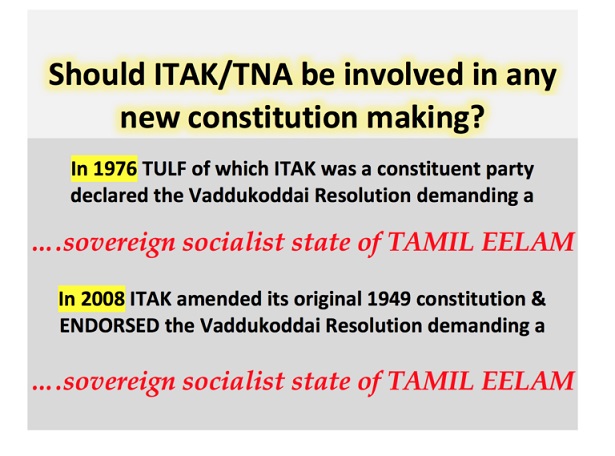
2008 was significant for several reasons. LTTE was defeated in the East. Sri Lankan Military was moving to liberate the North. TNA that had been virtually functioning as LTTE’s political wing realized that its military arm would soon be permanently clipped. The next strategic & tactical maneuver was to internationalize what LTTE sought with gun & to do so ITAK needed to change its aims & objectives in its constitution given that by virtue of 13a Sri Lanka already had a federal system within a unitary constitution. ITAK decision was to amend its 1949 original constitution replacing ‘Shamashthi’ with ‘Innaipatchchi’ & thereafter endorse the 1976 Vaddukoddai Resolution for a sovereign socialist state of TAMIL EELAM”. Until such time ITAK/TNA re-amends its constitution we have to presume it is working towards fulfilling the Vaddukoddai Resolution quest for ‘Tamil Eelam’ and we should discard their verbal statements in toto.

Two factors place ITAK/TNA in a very sensitive situation.

Firstly, in 2008 ITAK decided to amend its 1949 original constitution replacing ‘shamashthi’ with ‘innaipachchi’ immediately after LTTE was defeated by Sri Lanka’s military in the East, liberating the Eastern province of LTTE.

The 1949 ITAK constitution in Tamil envisaged a federal system of governance, used the Tamil word ‘shamasthi’ to connote federalism.

Why should ITAK then replace ‘Shamasthi’ with ‘Innaipatchchi’ in 2008?

If ‘Shamasthi’ meant federal what does ‘innaipatchchi’ mean? ‘Innaipatchchi’ actually does not mean federal. ‘Innaipatchchi’ means confederal.

Anyone aware of what constitutes a confederal system would realize that every demand ITAK/TNA & even the Northern Province Chief Minister is making aligns with the features of a confederal system and not federal system.

http://www.onlanka.com/news/itak-stop-fooling-sri-lanka-is-your-constitution-federal-or-confederal.html

Just listen to MP Sumanthiran openly explain https://www.facebook.com/senaka.rajapakse/videos/10215483270588656/UzpfSTEwMDAyNDc3Mjg5MzQ5MjozMjEzMTYyMTIwMzc0NzM/?q=sumanthiran%20federal&epa=SEARCH_BOX

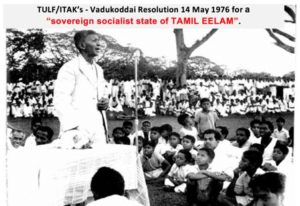
Secondly, ITAK after amending its original constitution, also included a clause that endorsed the 1976 Vaddukoddai Resolution.

Note the importance of Clause 17 (D) of the 1949 ITAK Constitution that ITAK amended in 2008.

The General Committee of the Illangai Tamil Arasu Kadchi decided on 24.04.2008 and 03.08.2008 to approve all resolutions and actions taken by the Tamil United Liberation Front (TULF) and the Illankai Tamil Arasu Kadchi from 14 May 1976”.

The importance of the endorsement of the Vaddukoddai Resolution by ITAK & its ramifications for Sri Lanka CANNOT be understood without being aware of the demands made by the Vaddukodai Resolution.

http://www.sangam.org/FB_HIST_DOCS/vaddukod.htm

‘This convention resolves that restoration and reconstitution of the Free, Sovereign, Secular, Socialist State of TAMIL EELAM based on the right of self-determination inherent to every nation has become inevitable in order to safeguard the very existence of the Tamil nation in this Country….And this convention calls upon the Tamil Nation in general and the Tamil youth in particular to come forward to throw themselves fully into the sacred fight for freedom and to flinch not till the goal of a sovereign socialist state of TAMIL EELAM is reached’

Therefore, when ITAK amends Clause 17 (D) of the 1949 ITAK Constitution on 24th April 2008 & 3 August 2008 approving ALL RESOLUTIONS & ACTIONS by TULF & ITAK on 14 May 1976 it means ITAK approves TULF’s quest for a sovereign, secular, socialist state of Tamil Eelam. ITAK unanimously upheld this in 2008.

This endorsement nullifies TNA’s verbal claims of wanting to live in a ‘united’ Sri Lanka

Notice how a flood of LTTE fronts also began blooming immediately before or immediately after 2009 – these foreign LTTE fronts were all basing their aims & objectives on this TULF Vaddukoddai Resolution of which ITAK was a signatory in 1976.

Starting the process of writing the Constitution of Tamil Eelam, based on the principles enunciated in 1976 Vaddukottai Resolution, Interim Self-Governing Proposal (ISGA), and the Tamil Eelam Freedom Charter and involving Tamils all around the world”

TGTE Dec 2015

The 2008 amendment to ITAK constitution & endorsement of Vaddukoddai Resolution is important as it came at a time when the LTTE’s political wing, the TNA knew that it could no longer depend on the military arm to illegally gain territory.

What ITAK probably next decided upon was to internationalize the demand for separatism through the amended aims & objectives of the constitution.

By amending ITAK constitution in 2008 & endorsing TULF/ITAK’s 1976 demand, ITAK is reconfirming it is working towards that goal. An amendment is important by virtue of the INTENT that it advocates. This is what makes ITAK amendment of importance in the present political discussion & constitution making.

When Vaddukoddai Resolution declares that Tamil Eelam state is to consist of people living in the North & East provinces

ITAK is also endorsing this

When Vaddukoddai Resolution declares that Tamils have a right to self-determination of Tamil Nation which LTTE demanded in Thimpu in 1985 – ITAK is also endorsing this

When Vaddukoddai Resolution demands recognition of Tamils of Ceylon as a nation which LTTE also demanded in Thimpu in 1985

ITAK is also endorsing this

When Vaddukoddai Resolution declares that the Tamil Eelam constitution is to be a secular state

ITAK is also endorsing this

When Vaddukoddai Resolution declares that Tamil will be the language of N & E provinces in their ‘Tamil Eelam’ and Sinhalese minorities living in Tamil Eelam can study in Sinhalese

ITAK is also endorsing this

When Vaddukoddai Resolution virtually asks youth to take up arms

ITAK is also endorsing this

TNA is an alliance created by LTTE in 2001. Its election manifestos of 2001, 2004, 2010 & NPC manifesto for 2013 elections unabashedly declares LTTE as sole representative of Tamils.

Anandasangaree in a letter to Indian PM Modi in 2014 too reconfirmed TNA as a LTTE proxy.

Tamil organizations got together and resolved on May 14, 1976 to establish a sovereign independent Tamil Eelam based on our inalienable right to self-determination.”

TNA manifesto 2004

Tamil People are entitled to the right of self-determination”

TNA manifesto 2010

ITAK and the other Tamil parties came together under a banner called Tamil United Liberation Front (TULF), and in 1976 passed a resolution calling for a restoration of our lost sovereignty in the background of the continued denial of the right of the Tamil People to self-determination” TNA manifesto 2010

‘Our expectation for a solution to the ethnic problem of the sovereignty of the Tamil people is based on a political structure OUTSIDE that of a UNITARY GOVERNMENT, in a UNITED SRI LANKA in which Tamil people have all the powers of government needed to live with self-respect and self-sufficiency’

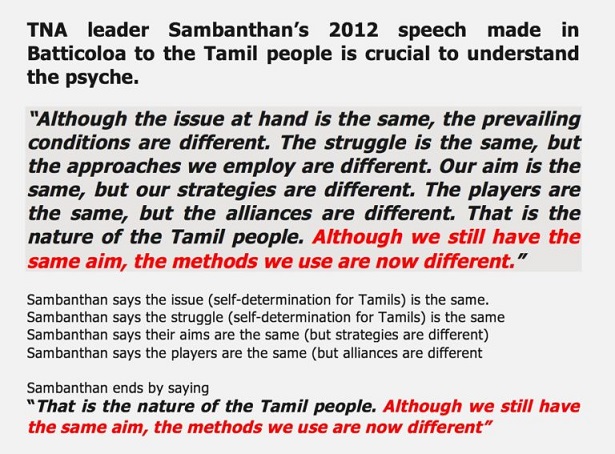
Sambanthan at ITAK convention 2014

‘Tamil United Liberation Front, of which our party was a member took the historical decision to establish the separate government of Tamil Eelam in 1976’

Sambanthan at ITAK convention 2014

‘meaningful devolution should go beyond the 13th Amendment to the Constitution passed in 1987’

Sambanthan ITAK Convention 2014

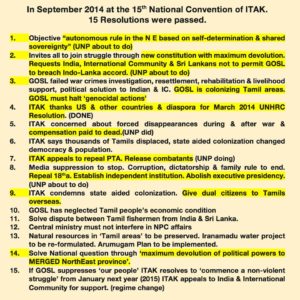
In 2014 ITAK Resolution put forward 15 demands

https://www.colombotelegraph.com/index.php/full-text-of-the-itak-15-resolutions-including-merger-of-the-north-and-east-provinces/

our right to determine our destiny to ensure self-government in the Tamil Speaking North-East of the country within a united and undivided Sri Lanka.”

TNA manifesto 2015

Devolution of power on the basis of shared sovereignty shall be over land, law and order, enforcement of the law so as to ensure the safety and security of the Tamil People, socio-economic development including inter-alia health, education, higher and vocational education, agriculture, fisheries, industries, livestock development, cultural affairs, mustering of resources, both domestic and foreign and fiscal powers.”

TNA manifesto 2015 (basically means running a separate state)

Tamils did not ask for a separate state in 1948 when colonial British gave independence.

Why was ITAK formed on 18 Dec 1949 in Maradana (not even Jaffna)

Ironically it was ITAK founder Chelvanayagam’s son-in-law A J Wilsom who drafted the 1978 Executive Presidency constitution.

1949 ITAK aims & objectives, demands of elite & high caste Tamil leaders culminating in the 1976 Vaddukoddai Resolution created a cult of hate among Tamils against non-Tamils.

All of their demands have a connection. Terms used are virtually same. It always follows a formula of – ask a little now & keep demanding little more later.

Their statements & unsubstantiated demands drummed unfairly across the world speaks volumes of the lies that have been propagated over the years & continues still, challenged by only a handful while fear of being labelled & called racists silence the rest.

If there is any divide, if there is any genuineness by those advocating reconciliation, they must realize that it is this Vaddukoddai Resolution that seeks to create a separate Tamil Eelam that stands between harmony & peaceful coexistence & it is this Vaddukoddai Resolution that must be annulled.

Let no one forget that it is the goodwill of the Sinhalese that are stopping them from demanding ownership of the entirety of the island given that it is their civilizational heritage that built the nation. The moment that the Sinhalese start presenting their demands for Sinhala Homeland the entire lies surrounding the Tamil homeland myth will explode.

Until & unless ITAK removes this aim & objective & clearly redefines ‘shamasthi’ & ‘innaipatchchi’ ITAK/TNA should not have anything to do with drafting a new constitution for Sri Lanka.

Shenali Waduge

https://www.lankaweb.com/news/items/2017/07/11/the-secret-that-the-tna-doesnt-want-exposed/ (Dharshan Weerasekera)

ජනපතිගේ විරෝධය විකුණා අගමැති ගැසූ “political Game” එක එළියට..!

December 22nd, 2018

උපුටා ගැන්ම ලංකා නිව්ස් වෙබ්

ජනපති ෆීල්ඩ් මාර්ෂල්ට කපද්දී අගමැති රංගේ බණ්ඩාරට කපලා..!

බහුතරයේ විරෝධයට හිස නමා තීරණ ගන්නවා නම් අගමැති මුලින්ම කළ යුත්තේ එජාප නායකත්වයෙන් ඉල්ලා අස්වීමයි..!

තමාට කැපුවේ ජනපති නොව එජාපය බව රවී කරුණානායක කියයි..!

සියල්ලන් පාවා දී රනිල් මලික්-සාගල”රැක ගනියි..!

(උපුල් බණ්ඩාර)

පුත්තලම් දිස්ත්‍රික් එක්සත් ජාතික පෙරමුණු  පාර්ලිමේන්තු මන්ත්‍රී පාලිත රංගේ බණ්ඩාර,බදුල්ල දිස්ත්‍රික් පාර්ලිමේන්තු මන්ත්‍රී රවීන්ද්‍ර සමරවීර සහ එම පෙරමුණේ ජාතික ලැයිස්තු මන්ත්‍රී ඩී.එම් ස්වාමිනාදන් යන මහත්වරුන්ගේ නම් කැබිනට් මණ්ඩල  නාම ලේඛනයෙන් කප්පාදු කළේ ජනාධිපති මෛත්‍රීපාල සිරිසේන මහතා නොව අග්‍රාමාත්‍ය රනිල් වික්‍රමසිංහ මහතා බව මේ වන විට හෙළිදරව් වී තිබේ.

එපමණක් නොව මුදල් අමාත්‍ය ධූරය රවී කරුණානායක මහතාට ලබා දෙනවාට ජනාධිපතිවරයාගේ දැඩි විරෝධයක් නොතිබී ඇති අතර ඔහුගේ නම ඒ සඳහා යෝජනා කිරීමෙන් වැළකී සිට ඇත්තේ ද එක්සත් ජාතික පෙරමුණ විසිනි.

මුදල් අමාත්‍ය ධූරය රවී කරුණානායක මහතාට ලබා දෙනවාට ජනාධිපතිවරයා විරුද්ධ ද නැද්ද කියා දැන ගැනීමට නම් කැබිනට මණ්ඩල නාම ලේඛනය යටතේ ඔහුගේ නම ඒ සඳහා යෝජනා කර එවිය යුතුව තිබුණත් අග්‍රාමාත්‍ය රනිල් වික්‍රමසිංහ මහතා එසේ නොකිරීමෙන් ඒ බව මානව පැහැදිළි වන බව ජනාධිපතිවරයාගේ සමීපතමයෙක් lankanewsweek” සමග පැවසීය.

ජනාධිපති මෛත්‍රීපාල සිරිසේන මහතා විරුද්ධ වූයේ ෆීල්ඩ් මාර්ෂල් සරත් ෆොන්සේකා,ශ්‍රී ලංකා නිදහස් පක්ෂය ප්‍රධාන එක්සත් ජනතා නිදහස් සන්ධානය පක්ෂයක් ලෙස ඒකමතික ගත් තීන්දුව උල්ලංඝණය කරමින් ආණ්ඩුවට සහය පළ කළ ඒ.එච්.එම්.ෆවුසි සහ පියසේන ගමගේ යන මහත්වරුන්ට කැබිනට් ඇමති ධූර ලබාදීම සම්බන්ධයෙන් පමණක් යැයි ද ඔහු හෙළි කර සිටියේය.

ඊට අමතරව ඛණිජ තෙල් සහ ඛණිජ සම්පත් සංවර්ධන අමාත්‍යංශයේ පුද්ගලයෙකු ඝාතනයට ලක්වීම සම්බන්ධයෙන් ප්‍රශ්නයක් පතින නිසා එම අමාත්‍ය ධූරයට අර්ජුන රණතුංග මහතා පත් නොකර ඔහුට වෙනත් ඕනෑම සුදුසු අමාත්‍යංශයක් ලබා දෙන්න යැයි මෛත්‍රීපාල සිරිසේන මහතා එක්සත් ජාතික පෙරමුණට යෝජනා කර සිටී බව ද ජනාධිපතිවරයාට අතිශය සමීප එම පුද්ගලයා පෙන්වා දුන්නේය.

මේ අනුව රවී කරුණානායක මහතාට මුදල් ඇමති ධූරය  ලබාදීමට නොහැකි වූයේ ජනාධිපතිවරයාගේ පාර්ශවයෙන් වගේම එක්සත් ජාතික පෙරමුණේ අභ්‍යන්තරයෙන් එල්ල වූ විරෝධතා හමුවේ බවටත්, පාලිත රංගේ බණ්ඩාර මහතාට කැබිනට් ඇමතිකමක් ලබා දීමට නොහැකි වූයේ ඊට ජනාධිපතිවරයාගේ පාර්ශවය විරුද්ධ වූ නිසා බවටත් අග්‍රාමාත්‍ය රනිල් වික්‍රමසිංහ මහතා ප්‍රකාශ කළේ යැයි කියමින් සති අන්ත පුවත්පත්වල දේශපාලන ඕපාදුප තීරු ලිපිවල  පළ වී තිබෙන වාර්තා සම්පූර්ණයෙන්ම අසත්‍ය බව ද ඔහු සඳහන් කළේය.

මේ සිද්ධිය සම්බන්ධයෙන් වැඩි දුරටත් අදහස් දැක්වූ ජනාධිපති මෛත්‍රීපාල සිරිසේන මහතාට අතිශය සමීප එම පුද්ගලයා මෙසේ ද කීය.

කැබිනට් මණ්ඩලය දිවුරුම්දීමට  දින දෙකකට පෙර රාත්‍රියේ එනම් අඟහරුවාදා (18) අග්‍රාමාත්‍ය රනිල් වික්‍රමසිංහ මහතා,දොස්තර රාජිත සේනාරත්න,මලික් සමරවික්‍රම සහ රංජිත් මද්දුමබණ්ඩාර යන මහත්වරුන් ඇතුළු පිරිසක් සමග ජනාධිපතිවරයා හමුවීමට ඔහුගේ නිල නිවසට පැමිණියා.

එහිදී මලික් සමරවික්‍රම මහතා  ජාතික ආණ්ඩුවක් සඳහා ගිවිසුමක් අත්සන් කර පෙර පරිදිම ආණ්ඩුව ඉදිරියට ගෙන යමු යැයි ජනාධිපතිවරයාට යෝජනා කළා.එම යෝජනාව තරයේ ප්‍රතික්ෂේප කළ ජනාධිපතිවරයා යෝජිත කැබිනට් මණ්ඩල ලැයිස්තුව ඉල්ලා සිටියා.

එහිදී එක්සත් ජාතික පෙරමුණ, ඇමතිවරුන් තිස් හය දෙනෙකුගෙන් යුතු කැබිනට් මණ්ඩල ලැයිස්තුවක් ජනාධිපතිවරයාට ලබා දුන්නා.එම ලැයිස්තුව පරීක්ෂා කර බැලූ ජනාධිපතිවරයා ෆීල්ඩ් මාර්ෂල් සරත් ෆොන්සේකාගේ,ඒ.එච්.එම්. ෆවුසිගේ සහ පියසේන ගමගේ ගේ නම් කපා හැර අර්ජුන රණතුංග මහතාට ඛණිජ තෙල් අමාත්‍ය ධූරය හැර වෙනත් අමාත්‍ය ධූරයක් ලබා දෙන ලෙසට යෝජනා කරමින් එම ලැයිස්තුව යළි අගමැතිවරයාගේ අතට දුන්නේ, යෝජිත කැබිනට් ඇමතිවරුන් සංඛ්‍යාව  විසි අට දෙනෙකු දක්වා අඩු කර යළි ඉදරිපත් කරන ලෙස දැනුම් දෙමිනුයි.

ජනාධිපතිවරයා එසේ කියා සිටියේ රටේ පවතින්නේ ජාතික ආණ්ඩුවක් නොව තනි ආණ්ඩුවක් නම් 19 වැනි ව්‍යවස්ථා සංශෝධනය අනුව උපරිම කැබිනට් ඇමතිවරුන් සංඛ්‍යාව තිහකට සීමා විය යුතු නිසයි.ඒ කියන්නේ එක්සත් ජාතික පෙරමුණ කැබිනට් ඇමතිවරුන් විසි අටක ලියිස්තුවක් ඉදිරිපත් කළාම ජනාධිපතිවරයා සහ අගමැතිවරයා දරන ඇමති ධූර දෙක සමග කැබිනට් ඇමතිවරුන් තිහ සම්පූර්ණ වනවා.

කෙසේ නමුත් එක්සත් ජාතික පෙරමුණ සංශෝධන සහිතව ඉදිරිපත් කළ කැබිනට් ඇමතිවරුන් විසි අට දෙනෙකුගෙන් යුතු ලයිස්තුවේ පාලිත රංගේ බණ්ඩාර,රවීන්ද්‍ර සමරවීර සහ ඩී.එම් ස්වාමිනාදන් යන මහත්වරුන්ගේ නම් තිබුණේ නැහැ.

ඒ වගේම එම පෙරමුණ මුලින්ම ඉදිරපත් කළ ලයිස්තුවේත් ඊට පසුව ඉදිරිපත් කළ සංශෝධිත ලයිස්තුවේත් මුදල් ඇමති ධූරය සඳහා රවී කරුණානායක මහතාගේ නම යෝජනා කර තිබුණේ නැහැ.ඔහුගේ නම ලිඛිතව යෝජනා නොකර ඔහුට මුදල් ඇමතිකම ලබා දෙනවාට  ජනාධිපතිවරයා විරුද්ධ ද නැද්ද කියා අගමැතිවරයා ප්‍රධාන එක්සත් ජාතික පෙරමුණ උපකල්පනය කරන්නේ කෙසේ ද..?

ඒ වගේම කියන්න ඕනෑ පාලිත රංගේ බණ්ඩාර මහතා ඇතුළු අලුත් පිරිසක් කැබිනට් මණ්ඩලයට නම් කරන බවටත් මලික් සමරවික්‍රම සහ සාගල රත්නායක යන මහත්වරුන් ඒ වෙනුවෙන් සිය කැමැත්තෙන්ම ඇමති ධූර පරිත්‍යාග කිරීමට පොරොන්දු වී සිටින බවටත් එක්සත් ජාතික පෙරමුණ කියා සිටියාට, එම පෙරමුණ මුල සිටම ඉදිරිපත් කළ කැබිනට් මණ්ඩල ලැයිස්තු යටතේ ප්‍රබල ඇමති ධූර සඳහා අලුත් අයගේ නම් කෙසේ වෙතත් මලික් සමරවික්‍රම සහ සාගල රත්නායක යන මහත්වරුන්ගේ නම් යෝජනා කර තිබුණා”

මේ කාරණය සමබන්ධයෙන් එක්සත් ජාතික පක්ෂයේ උප නායක රවී කරුණානායක මහතා කියා සිටින්නේ එක්සත් ජාතික පක්ෂයේ සිටින කළ ගුණ නොදත් ඊර්ශ්‍යවෙන්,කුහකකමෙන් සහ බියෙන් පෙළෙන හතර පස් දෙනෙකු කුමන්ත්‍රණකාරී ලෙස තමාට මුදල් ඇමතිකම ලැබීම වැළැක්වූ අතර මීට වග කිව යුත්තේ කිසිවකු නොව එක්සත් ජාතික පක්ෂයම බවය.

සිය නම හෙළි නොකරන ලෙස ඉල්ලා සිටිමින් මේ සම්බන්ධයෙන් lankanewsweek” සමග අදහස් දක්වමින් එක්සත් ජාතික පෙරමුණේ ප්‍රබල නායකයෙක් මෙසේ පැවසීය.

රවී කරුණානායක මහතාට මුදල් ඇමතිකම ලබා නොදුන්නේ ජනාධිපතිවරයාගේ පාර්ශවයෙන් සහ එක්සත් ජාතික පෙරමුණ අභ්‍යන්තරයෙන් එල්ල වූ විරෝධය මත යැයි ද,ෆීල්ඩ් මාර්ෂල් සරත් ෆොන්සේකා, පාලිත රංගේ බණ්ඩාර,රවීන්ද්‍ර සමරවීර සහ ඩී.එම් ස්වාමිනාදන් යන මහත්වරුන් ඇතුළු අයට ද ඇමතිකම් ලබා දීමට නොහැකි වූයේ මේ විරෝධතා ඇතුළු ප්‍රශ්න නිසා බව අගමැති රනිල් වික්‍රමසිංහ මහතා කියනවා.

මේ ප්‍රකාශයෙන් පැහැදිළි වන්නේ ඔහු බහුතරයේ විරෝධයට,කැමැත්තට සහ අදහස්වලට ඇහුම්කන් දී ඊට ගරු කරමින් ඒ අනුව තීන්දු තීරණ ගන්නා බවයි.එසේ නම් අග්‍රාමාත්‍ය රනිල් වික්‍රමසිංහ මහතා වහාම කළ යුත්තේ සුවහසක් එක්සත් ජාතික පාක්ෂිකයින්ගෙන් අවුරුදු ගණනාවක් මුළුල්ලේ තමාට එල්ල වන විරෝධයට ද හිස නමා ඊට ගරු කරමින් බහුතරයේ කැමැත්තට ඉඩ දී එක්සත් ජාතික පක්ෂ නායකත්වයෙන් ඉවත්වීමයි.”

අග්‍රාමාත්‍ය රනිල් වික්‍රමසිංහ මහතා ජනාධිපති මෛත්‍රීපාල සිරිසේන මහතා වෙත මුලින්ම ඉදිරිපත් කළ යෝජිත කැබිනට් ඇමතිවරුන් තිස් හයදෙනෙකුගෙන් යුතු නිල ලැයිස්තුව මෙසේය.

The other Christmas

December 22nd, 2018

Laksiri Warnakula

Journeying into the past, riding on a fading and fleeting memory is one of my favourite pastimes. And the ride I enjoy most is; ‘Letting myself lose in those reveries and then be at that starting line once again, waiting for the Mother Nature’s whistle for the ‘go’, the line being the boundary between the infant, the toddler, and then the child, who begins to look around with wide-eyed amazement and curiosity followed by insatiable inquiry and inquisitiveness’.

Fast forward the reel of these cinematic reveries and suddenly there I am, pedalling my father’s rusty Raleigh towards home with a branch of a ‘kasa’ tree firmly tied across the luggage plate of the bicycle. It’s time for the Christmas tree. Oh yes. It is Christmas next day.

The coastal township, where I grew up, was then more like a big village with only the slightest of signs of urbanization on display, the full invasion of which on all fronts was yet to come and still a good few years away. The majority of the people were fisherfolk, who were also almost hundred percent Catholics. And the Christmas season was one that they were all looking forward to, from day one of the year. Even the annual church feast and the end of the Lent culminating on Easter Sunday were somewhat behind the Christmas in terms of magnitude of the  cheer and the spirit that usually prevail during these Christian religious events.

And, in spite of the differences that existed amongst them, they all celebrated Christmas with what was available to each family. And the prevailing atmosphere was one imbued with an aura of peace and contentment, both material and spiritual. And I believe this contentment was mainly due to the simplicity of rural living, and a state of sobriety induced by the religious sentiments that prevailed in that neck of woods during the season, in particular.

Now back to the Christmas tree and the Nativity crib. As cypress and pine were beyond our means then, most of the kids had to be content with ‘Kasa’ (Casuarina equisetifolia) branches, probably one of the closest in appearance to the other two.

Having led the project of setting up the tree, I usually appointed myself as the person in-charge of the whole setup. Of course, my younger brother and sister had no problem with it and they never went too close to it without my express permission. Only our pet dog Tommy and the cat would go near it with their self-granted permissions, of course, and had a sniff around the tree though at nothing in particular, yet doing it anyway, whenever they felt like doing it.

The Nativity crib sat on a teapoy standing in front of the Christmas tree with its tiny clay figures of Joseph, Mary, the three wise men all kneeling down and few tiny sheep stood looking towards the baby Jesus sleeping peacefully in the manger, while a handmade Star of Bethlehem covered in glitter, a handiwork of a young boy, twinkled from above, sitting at the summit of the tree.

Yes. It was a simple and sweet Christmas. The sweet aroma of the Christmas cake, dough prepared by mother and baked at the bakery in the town centre filled the whole household. In the evening you could see and hear carol-singing groups of children accompanied by a Santa and few adults on foot or riding in bullock carts while, the ‘Silent night’ and the ‘Kalakata pera e Bethleheme’ (Long time ago in Bethlehem) tried their best to compete with sporadic bursts of firecrackers coming from all four corners of the village. The Christmas cards not the phone calls conveyed the ‘Season’s Greetings’ of loved ones from near and far.

It was another Christmas, a far cry from the Christmas of today, where the true meaning of it seems to be getting lost amid earthly glamour, glitter and glitz of commercialism. The celebrations are now becoming parties and carnivals that smack of a secular superficiality taking away the sanctity and the spirit surrounding the birth of ‘The Saviour’.

And as we celebrate and shower our loved ones with gifts and wishes of love and peace, let’s also not forget the hapless and the helpless. Let’s do our best to share the joy with them too and tell them that they are not forgotten.

Lastly, don’t let the gloom that the recent political drama brought upon the nation ruin the cheer and spirit of Christmas.

‘Render unto politicians what they rightly deserve! Render unto yourself what is rightly yours’.

Merry Christmas!

Laksiri Warnakula

Korean Ambassdor and Kukkiwon Cup details

December 22nd, 2018

Sports

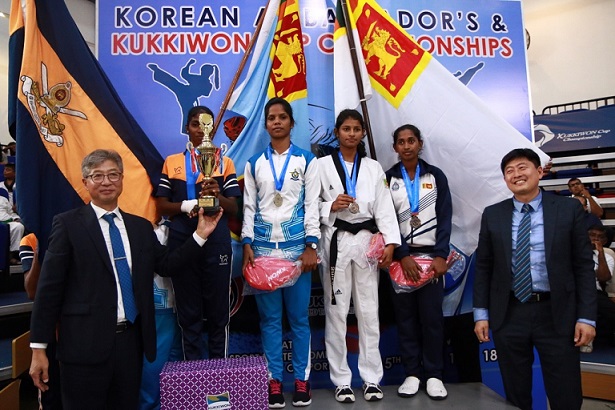
The Korean Ambassador’s and Kukkiwon Cup Taekwondo Championships 2018 were held from 15th to 20th December 2018 at the indoor Gym of Ministry of Sports and the Royal Mas arena, Royal college. It was the biggest scale Taekwondo Competition in Sri Lanka, along with around 2,000 Taekwondo competitors and officials.

His Excellency Heon Lee, Korean Ambassdor and Kukkiwon Dispatched Taekwondo Master Ki Su Lee hand over Sparring Gold Medal, Best player trophy and gift to Y.K.M.Madushani(SL Army)

The Korean Ambassador’s Kukkiwon Cup Championship is organized by the Embassy and Kukkiwon-which is the world Taekwondo Headquarters-in cooperation with the Ministry of Sports-Sri Lanka and the Sri Lanka Taekwondo Federation. It was held for the first time in the year 2015, with the aim of promoting unity and solidarity among Sri Lankan Taekwondo enthusiasts, as well as to promote the development of this martial art in the island.

His excellency Heon Lee, Ambassador of the Republic of Korea who was chief Guest stated that Over the past two decades, the Korean government and Kukkiwon have worked together to promote Taekwondo all over the island, including universities, schools, National Youth Council, government agencies and the Sri Lankan Army, Navy, Air Force and Police. Sri Lankans practice Taekwondo as a sport or a martial art, and it has now become an important contributory factor in deepening the bonds of friendship, understanding and cooperation between our two countries.

Mr. Suresh Subramaniam, Chairman of National Olympic Committee as guest of honor, Mr. Kanchna Jayarathana, President of Sri Lanka Taekwondo Federation, Grand Master Ki Su Lee, Kukkiwon Dispatched Taekwondo Master, Ms. Kim Min Ji, Secretary of Korean Embassy, Additional Secretary and Director General of Ministry of Sports, Representatives from Army, Navy, Airforce, Police, District Taekwondo Associations and others were presented for the final matches and Awarding ceremony.

His excellency Heon Lee, Korean Ambassador and Kukkiwon dispatched Taekwondo

Master Ki Su Lee hand over taekwondo equipment donation to Mr. Kanchana Jayarathna and Mr. Chaminda Punchihewa, Secretary General of Sri Lanka Taekwondo Federation

Mr. Kanchna Jayarathna received the Honorary 6th Dan Black belt from Kukkiwon-World Taekwondo Headquarters for the contribution to develop and promote taekwondo in Sri Lanka. His excellency Heon Lee, Korean Ambassador and Kukkiwon dispatched Taekwondo Master Ki Su Lee are handing over the certificate.


Fake Politics of the UNP

December 21st, 2018

R Chandrasoma

It is now well-known that many ‘stirring’ news items highlighted in major news channels are fake – bogus ‘plants’ designed to advance a barely hidden political agenda. On a larger scale there is such a thing as ‘Fake Politics’ where a situation of crisis – threats of diverse kinds – are artificially foisted on a gullible public to win political support that they would not have ordinarily received.

In Sri Lanka there is supposed to be a burning ‘National Problem’ that is largely the product of the chauvinist and irrational sentiments of the Sinhala-Buddhist Majority.

This Fake Thesis has ardent support within the UNP leadership as ploy to win friends and supporters among the Tamils – even if the naked truth is that the Tamils are mostly with the Sinhala people in the South and are doing wonderfully well.

As a natural corollary of this fake thesis,  the notion of ‘injustice’ enters the political lexicon – the resolution of which is seen to be the only path to peace and stability in Sri Lanka.    it is further argued that true progress is possible only after the installation in power of a Party that radically eschews all links with groups  and influences that have roots in Sinhala-Buddhist nativism.

Indeed this is now the ‘keystone’ in the Fake Political Arch that sustains the dreams and desires of the UNP leadership. They can win only by riding on the back of the minorities and disaffected cranks such as the JVP.

In this enterprise, what is important is not the truth but the exploitability of Untruth – the creation of Myth of Racial Injustice. That the Tamils and other minority groups welcome such a political mindset is readily understandable as it is the  chief route to the ‘separation’ that they ardently desire.

While the Folly of the Tamils – if we are permitted to use such an opprobious phrase in describing the political shenanigans of the Tamil political leadership of Sri Lanka – is both explainable and understandable,  the Ant-National Duplicity of the UNP cannot be exculpated on the basis of political expediency or the weak-headedness of its leaders. It is an astonishing fact that the Sinhala People – not the Tamils – have – and have had – leaders that loathe their own kind .

We must go beyond politics and turn to cultural psychology to account for such anomalous behaviour.

Sinhala infighting, discrimination faced by the Sinhalese and emergence of the Tamil Eelam

December 21st, 2018

Chanaka Bandarage

  1. It is Sinhala infighting that will bringforth the country’s downfall and creation of the Eelam
  2. Denying the Sinhalese the right to live in most parts of the north and the east and other acts of discrimination against them in those areas is the biggest problem that Sri Lanka faces today

Sri Lanka is the oldest democracy in Asia where Universal Suffrage was implemented in 1931.  We had successful state council elections in 1931, 1936 and a parliamentary election in 1947. In the 1947 election, Sinhalese overwhelmingly voted for DS Senanayake’s UNP.  He became the Prime Minister.  LSSP having  secured 10% of the total vote became the main opposition party with Dr NM Perera becoming the Leader of the Opposition.  Tamil parties were insignificant then and there were nil Muslim political parties.   Unlike today the Sinhalese then were not divided on party political lines.  They voted en-mass for the major Sinhalese political party – UNP.  With the defection of SWRD Bandaranaike to the opposition in 1951 where he formed his own political party – SLFP, the Sinhalese became a heavily divided community, based on party political lines.  Sinhala infighting commenced with grassroots members of UNP and SLFP clashing against each other during election times and thereafter.  Violence, thuggery, vote rigging, lies and various election malpractices have become a hallmark of the Sri Lankan elections.  The ugly scenes we witnessed in the parliament recently are simply a reflection of this.

In the past 67 years, though the majority Sinhalese have fought out fiercely among each other based  on party political lines, the Tamils and Muslims have always been careful not to follow suit.  Like what the Sinhalese did from 1931 to 1947, having wisdom, they have always stuck to their own ethnic candidate when it came for voting.  Thus, in today’s parliament neither the UNP nor the SLFP (for this essay Pohottuwa is included therein) are struggling to form a majority government.  They are compelled to seek support from minority political parties, who in turn make most unreasonable and unjust demands.  TNA is the best example.

It is very clear that in the future no person/party would be able to come to power in Presidential/Parliamentary elections without the direct support of minority parties who have grown enormously since 1931.  How did they manage to grow this much, it is time for the Sinhalese to take a stock of it.  This is important as the growth of the minority populations will continue to rise in time.  Sinhalese would not be able to state they are comprised of 75% of the population.  Recently a Buddhist monk from Dambulla stated on radio that the Sinhala population now in the country should be in the middle to late sixty percentage mark than the middle of seventy (also taking into account the large number of illegal immigrants in the country).  How much truth is in that statement, the writer is unsure.

It is high time we Sinhalese realise that it is an utter foolish thing to fight among ourselves based on party political lines.  A true patriot will assess actions of political parties and their leaders on a piecemeal basis – how they react when Sinhalese rights are affected or threatened to be affected.  A true patriot will criticise unpatriotic acts committed by political party/leaders, no matter how faithful they are to them.  This is because the true patriot’s foremost loyalty lies with the nation, not with the political party and the leaders that they support.

Unfortunately this is not happening today.  Patriots blinded by party affiliations and cult like political personalities, tend to disregard unpatriotic acts committed by their leader/s to whom they show deep loyalty.  Even when they know that particular acts by their favourite politician/s are damaging to Sinhala interests/causes, they keep quiet or try to play the veracity down.  In actual fact, such persons cannot be categorised as patriots.  A close examination of them shows that they ‘go shopping’ on behalf of their leaders owing to having received or in anticipation of receiving favours/benefits from them.

Already Sinhalese have been denied the right to live in majority of the north and the east of Sri Lanka which consists of 1/3 of the country and nearly ¾ of the coastal area.  This is one of the biggest problems that the country faces today.  But very few speak about this.

The racist, Wigneswaran did not want Sinhalese even to live in the north as free citizens (this is not about Sinhala colonies/settlements) and even placing a Buddha statue for worshiping purposes was strenuously opposed by him.  The hidden agenda of his Elangu Thamil Movement was to create the north as an ethnic enclave exclusively for  Tamils.  And he succeeded in doing that.

Wigneswaran’s administration took measures not to display Sinhala writings in northern billboards, hoardings and public signs.  Train arrivals at the Jaffna railway station were not announced in Sinhalese by the station’s public address system. The writer had earlier reported how a very powerful TNA MP intervened to chase out Sinhalese from farming lands in the Trincomalee district where the land in question was subsequently given to Tamils who were recent arrivals to the area.  The list of discrimination faced by the very few Sinhalese now living in the north and east under the hands of Tamil administrators is endless.

Neither the SLFP nor the UNP have shown an interest to assist the Sinhalese plight in the parliament.  Due to infighting they seldom have time even to investigate the acts of discrimination faced by the Sinhalese in the north and the east.  These parties talk about a ‘Sri Lankan identity’ without acknowledging that Sri Lanka has a Sinhala Buddhist foundation (in Malaysia, Mahathir Mohamad established the ‘Bhumiputhra’ identity for the indigenous Malays, thus protected their rights and aspirations).

Thousands of Sinhalese (and Muslims) who were former residents of the north and the east are stranded in the south without a pathway of returning to their former places of residence. Since winning the war in 2009 governments took no concrete action to resettle the displaced Sinhalese in the north.  In 2010 about 150 Sinhalese who were former residents of the north (they all spoke fluent Tamil), parked in the old Jaffna Railway station demanding the return of their northern lands, were provided with CTB buses by the then government to return to the south.  They were promised land in the south should they agree to return to the south.  Thus, majority of them returned; the very few diehard former residents who remained in the north established the Navatkuli Sinhala village (about 6 km to Jaffna).  The writer is a Patron of the village association.  Today, it is a successful Sinhala village in the north – built through sheer hard work of the residents.  But, it lacks a school, thus school children have difficulty in living there.

In Mannar, the Madu Road Sinhala School was closed shop early this year, after the existence of at least 40 years.  The reason given by the Northern Provincial Council (NPC) was the shortage of Sinhala students and teachers.  What would happen to the excellent buildings and the large schoolyard; only the NPC  would know.  The 13th Amendment blocked Land and Police powers to the provincial governments, but due to weak central governments, since its inception the NPC has acted as if it has Land powers.  That is why they are now only demanding Police powers.

The Yahapalana Government’s promise to re-open the Jaffna Sinhala Maha Vidyalaya  never materialized (Prabhakaran bombed and flattened this school in 1985 which boasted the best science laboratory in Jaffna schools).  Prior to 1983 this school had about 3500 students.  It has produced Sinhala luminaries, for example, Maithripala Senanayake and KB Rathnayake.  That land is currently occupied by the Army (located in close proximity to Jaffna General Hospital – parts of it had been gradually taken over by squatters).  It is feared that under the government’s land release scheme, this land may be handed to the NPC or a similar body.

The central government once outlined that insufficient number of Sinhala students in Jaffna is the reason for not re-commencing the school.  There is legitimacy in this argument; yet, the government is bound by its promise made during the election time.  The government can start it as a National School and of course Tamil and Muslim students should be allowed to attend classes.  Until the Sinhala student numbers are increased, the symbolic presence of the ‘Sinhala Maha Vidyalaya’ in Jaffna will be a good way forward for the Yahapalana government’s Reconciliation program.  If TNA opposes, it will be a fine demonstration of their racism.  Many Tamil schools have propped up in the south since the war ended, and no one has complained.

In Silavathura (Kondachchiya), Sinhala children are compelled to study in Tamil language as there is no Sinhala school there.  Many residents have left the village to areas such as Medawachchiya and Anuradhapura in order to provide education to their children.  The same problem exists at Kokilai Sinhala village.  In Kokilai, there is an attempt to remove the Sinhalese people from their existing fishing village to elsewhere.  This will affect their livelihood, and they do not know any other trade than fishing.  The Sinhalese in Kokilai live in ramshackle huts, people in the surrounding areas, having received government assistance, live in much more comfortable houses.

Jayagrahanaya Organisation which the writer is an Executive Member has spent millions of rupees in the past few years to  improve the living standards of the Sinhalese in the north and the east. Bogaswewa, Helambawewa, Madu Road, Kondachchiya,  Dehiwatta/Gomarankadawala have been some of our projects. This organisation under the able Presidency of Dr Anula Wijesundera is doing a yeomen service to the Sinhalese in these areas.  Other notable patriotic members of the Organisation are Dr SD Jayarathne, Sepali Nammuni and Manel Vasanthi.

Since winning the war, thousands of acres of land that the military occupied in the north and the east have been disbanded.  This trend continues.  TNA demands the release of allegedly hardcore terrorists currently held in remand custody.  This shows that TNA does not care about the law and order situation of the country.  They only want their men and women released, regardless of the severity of the criminal acts that these people have allegedly committed.

As stated before, when we must demand governments to act against the discrimination faced by Sinhalese in the north and the east and criticise the racist acts of the Tamil politicians, what we have done has been to quarrel among ourselves.

It is essential to mount a massive campaign that land in the north and the east should be opened up for the Sinhalese to live and do business.  For this, we must confront all politicians – Sinhala, Tamil and Muslim.  Are we ready to undertake this fight?  It is unlikely that we are.

It has been reported that TNA now wants the central government to alienate all crown lands including jungle and forest lands.  Unless the patriots raise a strong voice, the government may succumb to the enormous TNA (and western government) pressure, and release them.

If Tamils can live safely anywhere in Sri Lanka, even in the deep south, why cannot the Sinhalese live in the north and the east?  After all, the north and the east are traditional Sinhala Buddhist areas. Thambapanni (where Vijaya landed), Nagadipa (where Lord Buddha visited), Dambakola Patuna (where Sangamitta Thero landed), Yapa Patuna (ruled by Prince Sapumal), Yodha Wewa (built by King Dhatusena in the fifth century and restored by King Parakramabahu in the twelfth century), Malwathu Oya (the route taken by Sangamitta Thero and fellow nuns from Jaffna to Anuradhapura), Iranamadu Tank (built by King Dhathusena) are all located in the north.  Everyone knows land is extremely scarce in the south and there is plenty of livable land in the north and the east.  Put simply, the south is jam packed and the north and the east are sparse, but, we Sinhalese are forcibly denied the right to live in the Tamil dominated north and the east.  If fair dinkum, TNA should agree to vary/reform laws that may be discriminatory, so that the Sinhalese could buy and sell land in the north/Jaffna on freehold basis. The central government must be proactive in this regard.

If TNA wants favours such as governments to disband land, release terrorist suspects from remand custody; they should reciprocate in kind.  Rather than placing every possible obstacle, they must allow the Sinhalese (and Muslims) to live in the north and the east.  Freedom of Movement and Freedom to choose Residence is implied in our Constitution.  It is enshrined in the International Covenant on Civil and Political Rights  (Article 12) which Sri Lanka is a signatory.

If TNA wants favours, it should give a guarantee that it will strive to end discrimination faced by the Sinhalese in the north and the east.

Even during the British colonial rule the north and the east had more military camps than elsewhere in the country; this is because they are the most strategically important areas of the country.  Talaimannar is the main gateway to Sri Lanka; it is less than 30 km away from India.  From time immemorial Valvetithurai has been a centre of invasions/illegal migration from South India.

All political parties (including JVP) are hell-bent on pleasing minorities hoping that they could secure some of their vote.  There is nothing wrong with that provided that they fight against discrimination that the Sinhalese face in the north and the east.  Empirical evidence shows that minorities in the north and the east vote for their own political parties; no matter how much the southern political parties do to develop those areas.

Preserving the sovereignty and territorial integrity is the number one priority of any nation.  Currently this is under threat in our country due to Tamil separatist agendas and Tamil discrimination against the Sinhalese in regards to their rights in the north and the east.  This is the biggest problem that the country faces today.  The Tamil diaspora work day and night to achieve the Eelam.  They have close links in Sri Lanka.  TNA though talks about a unitary Sri Lanka has repeatedly demonstrated by deed that they secretly seek separatism.  They were the LTTE proxy in the parliament.  The examples are many.  The writer has personally confronted them in foreign forums.  When overseas TNA MPs speak in a ‘different language’, which is very hostile to Sri Lanka.

The recent killing of two police constables in the east re reminds us that the separatists have not given up their ambition of creating the Eelam.  Then, the massive Mahaveer Day celebrations held on 26 November 2018 (Prabhakaran’s Birthday).  We Sinhalese are not bothered about same; one prominent minister of the day – a ‘foremost patriot’, stated that we should be happy that such celebrations are happening.  What he did not say is that the separatists are using the occasion to trump out their bogus claim that over 40,000 innocent Tamils were killed by our brave security forces in the final stages of the war.

Again, it is important that we bear  in mind that  SLFP, UNP or JVP do not fight for the rights of the Sinhalese, basically there is no one to wage that fight.  The minorities have specialist political parties to look after their rights.

This is a fight that we Sinhalese patriots must wage.  It is foolish to think that someone else will come and do it for us; there is simply no one else to do it.

Through our own stupidity, complacency and ignorance (they are part of the reasons for our infighting) we are digging our own graves. It is high time that we Sinhalese realise the gravity of the problem that we face and show a desire to unite and fight, just how the minorities successfully do it for themselves.  As stated before, between 1931- 1947 we voted for one party, keeping best interests of the motherland as the paramount consideration.  That is why nationalist songs flourished those days and broadcast over the radio.  This is not happening today.  Lyricists today are scared to write patriotic songs, and they know they will not be broadcast.  A friend asked the writer recently – Have Sinhala and Buddhism become banned words in Sri Lanka?”

Basically it is the Sinhala infighting based on political affiliations that is causing our destruction, it is our own actions that will help create the Eelam, and that could happen much sooner than we all think.

The writer is a Lawyer

chanakbandar@yahoo.com

Bond scams: Parliament sabotaged probe – Prez Office

December 21st, 2018

Courtesy The Island

  • Forensic Audit not launched yet
  • Courts not moved against those who lied before PCoI

The Presidential Secretariat yesterday alleged that a parliamentary Sectoral Committee had deliberately undermined the process to amend laws required to handle Treasury bond scams in 2015 and 2016. The alleged scams involved the Central Bank and the Perpetual Treasuries Limited (PTL).

The Presidential Secretariat also alleged though the Presidential Commission of Inquiry (PcoI) that probed Treasury bond scams had recommended a forensic audit on January 18, 2018, it had not been launched.

The media was briefed on the ongoing probe following a meeting chaired by President Maithripala Sirisena at the Presidential Secretariat on Friday (Dec 21). Among those present were Attorney General Jayantha Jayasuriya, PC, Director General, CIABOC, Sarath Jayamanne, PC, Senior DIG of the CID, Ravi Seneviratne and Senior Deputy Governor of the CBSL Dr. Nandalal Weerasinghe.

They also discussed the urgent need to expedite investigations into the Treasury bond scams. They pointed out the inordinate delay in moving court against those who lied before the PCoI and destroyed evidence pertaining to the case.

It was also revealed that foreign expertise hadn’t been sought to recover deleted telephone conversations. They alleged that the phones used by suspects hadn’t been subjected overseas scrutiny and relevant agencies had been pressured to delay investigations.

It was also revealed that Singapore hadn’t taken action yet to extradite Singaporean Arjuna Mahendran wanted in connection with the investigation.

President Sirisena has directed relevant authorities to expedite the investigation.

Oil-based economy? Russia’s non-energy exports go boom

December 21st, 2018

Courtesy RT

Volume of non-resource shipments from Russia is going to set a new record by the end of the current year, hitting $147 billion, Andrey Slepnev, Chief Executive of the Russian Export Center said on Friday.

The figure is compared to the previous record that was fixed in 2013, when the country’s non-energy exports reached $143.5 billion.

According to the official, the boost has been seen in various sectors. In October alone, sales of food amounted to $2.47 billion, which is $330 million higher than the previous record set in November 2017.

ALSO ON RT.COMRussia seeks to ‘feed the whole planet’ – PMExports of forest-industry produce are expected to reach an all-time high with an estimated volume of sales to hit $11.7 billion, compared to $9.5 billion last year. At the same time, sales of wheat are projected to smash the previous year’s record, growing to more than 42 million tons.

Boosting of Russia’s non-commodity exports is currently a key priority for the strategic development of the Russian economy. This year results are showing that we have chosen the right track for developing the export industry,” Slepnev said, stressing that the current export policy is making a significant contribution to the economic growth.

ALSO ON RT.COMRussia remains main supplier of coal to Ukraine as coming bitter frost forces Kiev to boost importsUnder the terms of the priority project on International Cooperation and Industrial Exports, the Russian Export Center has been adjusting the amount of support for Russia’s exporters. The agency pledged to provide access to the export market for all 85 regions of Russia.

For more stories on economy & finance visit RT’s business section

Tamil asylum seeker family to be deported to Sri Lanka next year

December 21st, 2018

Courtesy SBS News

The Federal Court on Friday rejected an appeal from a Tamil family, who had settled in the small Queensland town of Biloela, to stay in Australia.

A Tamil asylum seeker family who made their home in a small Queensland town will be deported to Sri Lanka, after the Federal Court on Friday rejected their bid to stay in Australia.

Nadesalingam, Priya and their two daughters made an eleventh-hour appeal to the Federal Court in August after they were taken into detention in March, but their appeal was rejected on Friday.

The judge ordered the deportation of Nadesalingam, Priya and their two daughters, but not before 1 February 2019.

The parents came to Australia separately by boat in 2012 and 2013 following Sri Lanka’s civil war.

A copy image acquired Sunday, 24 June 2018 shows a family portrait of Sri Lankan Tamils Priya and Nadesalingam and their two Australian-born children.

A copy image acquired Sunday, 24 June 2018 shows a family portrait of Sri Lankan Tamils Priya and Nadesalingam and their two Australian-born children.
AAP

They settled in the small Queensland town of Biloela, where they have become ingrained in the local community.

But they and their Australian-born daughters were removed from their home in March and placed in a Melbourne detention centre, after Priya’s bridging visa expired.

The family was issued deportation notices in June after the federal government ruled they couldn’t stay.

But their removal from Australia has been on hold while the Federal Court appeal was considered.

Family friend and Biloela resident Angela Fredericks said the two young girls should be flying to their hometown for Christmas, not being kept in detention.

India Tea is likely to benefit from Sir Lanka wage hike

December 21st, 2018

Courtesy commodityonline

Indian Tea is likely to gain benefit from wage hike in Sri Lankan plantations and pesticide problems in Vietnam.

India is the second largest producer of Tea in the world and contributes 26% to the global production.

The expected wage hike in Sri Lankan plantations is estimated to help South Indian orthodox production also.

Domestic tea production during 2018 is expected to stay more or less the same as last year despite lower rainfall, while exports are expected to marginally increase.

India’s Tea production for the January-October of 2018 stands at 1,117.6 mkg, against 1,127.2 mkg in the year-ago period. South Indian tea production for 10 months of 2018 stands at 187.6 mkg, against 197.3 mkg in 2017. North Indian Tea production for 10 months of 2018 was 929.98 mkg, against 929.85 mkg in the same period last year.

Judicial Dictatorship

December 20th, 2018

By Charles S.Perera

There is a serious political and a social problem in Sri Lanka that hampers the democratic process , which lies in the question of democratic legitimacy of  judicial reviews affecting the governance of the people. The US Constitution makes a point  in stating that, it is the people that should decide  how they are governed and the Constitutional norms that their society holds . The Judiciary having this power is illegitimate…….”.

In an interesting  research article- a thesis on Judicial Dictatorship: Potential Institutionalisation of the Constitutional Review Process  by Stephen Cranney  of the Faculty of Law, Victoria University of Wellington  states  We the People.” One of the most emotion evoking and potentially over used statements has found its way to the center of many democracy-based arguments in constitutional analysis. But if the ‘people’ are center to democracy and the social contract that democracy constructs, then how is it that their voice has become irrelevant?”

https://researcharchive.vuw.ac.nz/xmlui/bitstream/handle/10063/4625/thesis.pdf?sequence=2

This  is very relevant to the surprising judgment of two courts in Sri Lanka, an Appeal Court and the Supreme Court  delivered  in interpreting the relevant sections of the Constitution of Sri Lanka with regard to the decision taken by the President of Sri Lanka in a political imbroglio , to  dissolve the Parliament and go to the people for an election.

The decisions of both the Appeal Court and the SC on the issues could be interpreted as judicial errors,  and the interim order issued by the Appeal Court to  stop the Prime Minister and his Cabinet of Ministers functioning until the Appeal Court takes a decision,  an enormous Judicial error, perhaps a first in the world.

As it was stated at the beginning there is a serious political and a social problem in Sri Lanka with the people divided into  ordinary people largely Sinhala Buddhists ,and another English Educated mainly Colombian  high society. The latter group has a following  of  the people depending on the rich and powerful and drawing their strength from them. Those were the people who were  seen recently  filling the Galle Face Green  for a gathering called for by the high society politicians .

Mahinda Rajapakse and now  Maithripala Sirisena belong to the ordinary Sinhala Buddhist population, and trusted, accepted, and loved by them.

The high Society consisting more of the Judiciary, Company Directors , Doctors Engineers, Christians, Evangelists,and the English educated Colombians tend to shun Mahinda Rajapakse  and now  Maithripalan Sirisena. They  have confidence  on the political class led by Ranil Wickramasinghe , the UNP and their allied political parties  belonging  to the high society, and their dependents. So are the  JVP  calling itself a Marist Party is perhaps trying to reach the high and powerful, while Sumanthiran of the TNA wants a federal constitution and the Eelam, and the rest of the Tamil and Muslim MPs are more keen following the rich and well to do in their sense as that helps their business sense.

Therefore there is the  question where lies and who promotes the  democratic legitimacy of the people. Mahinda Rajapakse and his Ministers when they were sworn in on 26 Ocober,2018 was not seeking to take vengeance from his political enemies but keen in making the people benefit from their forming a government to give the people as much relief as possible.

But it is the contrary  when Ranil Wickramasinghe  brings his Kiriellas, Ajith Pereras Champikas, Rajithas , Sarath Fosekas, Harin , and their partners in the JVP, to take over the government. It is for them  to take vengeance and take their political enemies  to courts and prisons , making their lives miserable, rather than find means to give relief to the people as Mahinda Rajapakse did during the short time he was Prime Minister.

In the light of this high society UNP and the political partners who seems to care less for  the people other than to get them to participate in manifestations and fill the grounds where they gather to shout their hatred of Mahinda Rajapakse and President Sirisena. But some how in this political jamboree the Judiciary also seem to play their part along with Ranil and the high society politicians.

Sri Lanka’s Judicial Independence is strange to tell the least. It is certainly independent of the Executive, but not completely independent of the  Legislature  with an evident support for   the right wing  legislators.  It is certainly independent of the people,  unconcerned about their suffering due to political mismanagement of the country by the right wing politicians of the Legislature, that was seen by the Appeal Court making an interim order suspending the functions of the social wing Prime Minister and his Cabinet thus denying the little relief the people were to receive.

The President of Sri Lanka and the Parliamentarians are elected by the people and the people have confidence  in them. However, they are able to show their preference  between  the high society  politicians led by Ranil Wickramasinghe and his political partners,   and the Socialist politicians  led by Mahinda Rajapakse and his parties supported by the President only at an election , but the SC denied them that democratic right ruling that the President cannot dissolve the Parliament for four and a half years.

The two wings of the judiciary  the Appeal Court and the SC seem in my opinion  keen in putting the  Prime Minister Mahinda Rajapakse and President Sirisena, in their place making them understand that the Judiciary is above both of them, and they- the Judiciary have become a deciding factor and it is there with them  that the power lies.   Strangely the Judiciary can exercise this super power of theirs  when a Constitutional review is demanded from them.

A Constitutional Review is defined as the inquiry and decision of whether a piece of legislation is consistent with a constitutional norms”.

There are critical studies made on using the Judiciary with no political or democratic legitimacy as  the ultimate resort  to make Constitutional reviews. The article referred to above on Judicial Dictatorship, argues as follows:

This power given to the courts, of the judicial review of legislation, involves a group of people who seemingly enjoy no political legitimacy and certainly no democratic legitimacy to impose their preferences on citizens generally. The judiciary’s decisions work to thwart policies of the democratic branches of government. The individuals who strike down the legislation are both unelected and unaccountable. What they are effectively doing is invalidating democratically adopted laws.The question must be asked of how this role can be justified in a system that is based on the view that policy and value choices are for the elected and politically responsible institutions.”

This paper argues that the underutilized organ of the executive can be employed to legitimise and solve many of the issues surrounding the constitutional review power that currently lies with the courts.

The paper proposes three review mechanisms. Firstly, an executive override of judicial decisions, where the executive branch can return a piece of legislation that has been struck down to legal effectiveness. Secondly, a veto of constitutionally consequential legislation, where the executive can render a piece of legislation legally ineffective, coupled with an inability for a legislative override. Lastly, an executive mandate for judicial intervention, where the executive informs the judiciary which pieces of legislation can potentially be struck down. The paper expands of these descriptions, discussing potential problems that these methods face before finally defending one decision-making process. By this, the paper aims to satisfactorily create a stable and democratically legitimate constitutional review procedure.

However, it appears correct that  using the Judiciary for  a Constitutional review is un-acceptable in terms of democratic legitimacy of a Judicial decision on a matter concerning the Constitution, as the Judiciary consists of men who are not elected by the people and unaccountable for their decision.

A  future Government should reconsider the question of Judicial independence, specially of its role in  Constitutional reviews in the interest of the people and the country. This is very important  specially  in the case of Sri Lanka a Sinhala Buddhist Country with a culture as old as its history.  It would not therefore be wrong to include in the Constitution that the Chief Justice should be a Sinhala Buddhist.

That would avoid the danger of electing some one like the retired Judge Wignesvaran as Chief Justice of Sri Lanka.  It is not being extra nationalist, but when we see the role that is being played by the TNA MP Sumanthiran and Sampanthan with regard to writing  a new Constitution and JVP wanting to have the President of the Country elected  by the Parliament, the Sinhalese- the majority should remember that they have a responsibility to perpetuate both the  Sinhala Buddhist Culture and  its Buddhist  religious background for the future generation of Sinhala Buddhists,  as Sri Lanka is the only Country they have, which they can call their own. 

We welcome Tamils and Muslims to be part of it without forgetting what Sri Lanka is and what it has given to all minority Communities that lived with the Sinhala  for thousands of years.

New Cabinet Ministers sworn in

December 20th, 2018

Courtesy Adaderana

A new Cabinet consisting of a total of 29 ministers were sworn in before President Maithripala Sirisena at the Presidential Secretariat, a short while ago.

New Cabinet:

1. Prime Minister Ranil Wickremesinghe: Minister of National Polices, Economic Affairs, Resettlement & Rehabilitation, Northern Province Development, Vocational Training & Skills Development & Youth Affairs

2. John Amaratunga: Tourism Development, Wildlife and Christian Religious Affairs

3. Gamini Jayawickrama Perera: Minister of Buddha Sasana and Wayamba Development

4. Mangala Samaraweera: Minister of Finance and Mass Media

5. Lakshman Kiriella: Minister of Public Enterprise, Kandyan Heritage & Kandy Development

6. Rauff Hakeem: Minister of City Planning, Water Supply and Higher Education

7. Thilak Janaka Marapana: Minister of Foreign Affairs

8. Rajitha Senaratna: Minister of Health and Indigenous Medicine

9. Ravi Karunanayake: Minister of Power, Energy and Enterprise Development

10. Vajira Abeywardena: Minister of Internal and Home Affairs and Provincial Councils and Local Government

11. Abdul Rishad Bathiudeen: Minister of Industry & Commerce, Resettlement of Protracted Displaced Persons & Co-operative Development

12. Patali Champika Ranawaka: Minister of Megapolis & Western Development

13. Navin Dissanayake : Minister of Plantation Industries

14. P. Harrison: Minister of Agriculture, Rural Economic Affairs, Livestock Development, Irrigation and Fisheries & Aquatic Resources Development

15. Mohamed Hashim Mohamed Kabir : Minister of Highways, Road Development and Petroleum Resources Development

16. Ranjith Maddumabandara: Minister of Public Administration & Disaster Management

17. Gayantha Karunatilake: Minister of Lands and Parliamentary Reforms

18. Sajith Premadasa: Minister of Housing Construction and Cultural Affairs

19. Arjuna Ranatunga: Minister of Transport & Civil Aviation

20. Palani Thigambaram: Minister of Hill Country New Villages, Infrastructure & Community Development

21. Chadrani Bandara: Minister of Women & Child Affairs and Dry Zone Development

22. Thalatha Atukorale: Minister of Justice and Prison Reforms

23. Akila Viraj Kariyawasam : Minister of Education

24. Abdul Haleem Mohamed Hasheem: Minister of Postal Services & Muslim Religious Affairs

25. Sagala Ratnayaka: Minister of Ports & Shipping and Southern Development

26. Harin Fernando: Minister of Telecommunications, Digital Infrastructure, Foreign Employment and Sports

27. Mano Ganesan: Minister of National Integration, Official Languages, Social Progress and Hindu Religious Affairs.

28. Daya Gamage: Minister of Labour, Trade Union Relations, and Social Empowerment.

29. Malik Samarawickrama: Minister of Development Strategies, International Trade and Science, Technology and Research.

ITAK’s separatist demands & pro-LTTE statements

December 20th, 2018

ITAK is the main constituent party of the TNA & a key party promoting a new constitution & attempting to abolish the Executive Presidency. ITAK though formed in 1949 has a history of demands made for a separate state though shrouding its objectives by calling itself the Federal Party. ITAK has also openly endorsed either directly or through its alliance the TNA pro-LTTE sentiments. We quote these to showcase the dangers of allowing parties that have not relinquished their separatist notions or hide them in nicely camouflaged democratic terminology are being allowed to separate Sri Lanka.


What readers need to understand is that the Tamil Only Nation that the Tamil political leadership was politically trying to achieve & that which LTTE tried to achieve militarily is one & the same.


ITAK’s claim that it was formed because of Sinhala discrimination is nullified because

  1. ITAK was formed in 1949 months after independence via dominion status to then Ceylon
  2. Head of State in Ceylon remained the Queen till 1972.
  3. Final judicial verdicts were also given by the Supreme Court in UK until 1972.
  4. Any grievance Tamils claim was caused by British & not Sinhalese as administration of the island was in foreign hands from 1505 to 1948 (443 years) and then from 1948 to 1972 (as a dominion where Queen still remained Head of State)
  5. Direct Sinhala majority rule can be claimed ONLY from 1972 onwards (just 46 years)
  6. The creation of Tamil New Tigers by Prabakaran in 1972 & rechristening it LTTE in 1976 also nullifies false notion that LTTE was created in response to July1983 riots.


1951 – ITAK defined for the first time at its 1st annual convention what constituted a Tamil Nation declaring it to be the Tamil speaking people in Ceylon constitute a ‘nation distinct from that of the Sinhalese by every fundamental test of nationhood” http://tnapolitics.org/?page_id=80


1956 August 19 –  ITAK summoned national convention in Trincomalee on passing resolution:

  • the replacement of the present pernicious constitution by a rational and democratic constitution based on the federal principle and the establishment of one or more Tamil linguistic state or states incorporating all geographically contiguous areas in which the Tamil speaking people are numerically in a majority as federating unit or units enjoying the widest autonomous and residuary powers consistent with the unity and external security of Ceylon”


  • The restoration of the Tamil language to its rightful place enjoying the absolute parity of status with Sinhalese as an official language of the country”


  • The repeal of the present citizenship laws and the enactment in their place of laws recognizing the right to full citizenship on the basis of a simple test of residence for all persons who have made this country their home”


  • The immediate cessation of colonization of the traditional Tamil speaking areas with Sinhalese people


1957 January 19 – ITAK carries out anti-Sri campaign tarring cars that bore vehicle number plate SRI” – what is important to note is that the counter campaigns started ONLY AFTER ITAK action.  


1957 – ITAK calls for action against Ministers from South visiting North & East. Ministers Dahanayake & Marikkar were attacked in Batticoloa. MP Siriwardena on a mail train to Jaffna blocked.


1972ACTC and ITAK combined to make TUF which became TULF in 1976.


1975 February – ITAK leader Chelvanayagam winning the by-election for Kankasanthurai declared I will to announce to my people and to the country that I consider the verdict at this election as a mandate that the Tamil Eelam Nation should exercise the sovereignty already vested in the Tamil people and become free”.


1976 May 14th – TULF’s Vaddukoddai Resolution had 5 objectives


  • State of Tamil Eelam to consist of North & Eastern provinces to all Tamil speaking people
  • Constitution of Tamil Eelam based on principles of decentralization. No foremost place to any religion or territorial community.
  • Tamil Eelam will assure equal status to all
  • Tamil Eelam will be a secular state with equal protection to all religions
  • Tamil will be language of the State but Sinhala speaking minority can educate and transact in Sinhala subject to reciprocity of Tamil speaking minority in Sinhala state.


If demand was for equal language rights –why make Tamil the official language of the State of Tamil Eelam?


Pro-LTTE statements


ITAK remembers the ‘Tamil youth who sacrificed their lives in armed struggle’ (Sampanthan’s speech at the 14th Annual ITAK convention in 2012 Batticoloa) – the only Tamil youth who sacrificed their lives in armed struggle were the LTTE!


Ilankai Thamil Arasu Katchi, which has become the political symbol of the Tamil Nation” – Sambanthan Speech at ITAK 14th Convention 2012


‘Tamil United Liberation Front, of which our party was a member took the historical decision to establish the separate government of Tamil Eelam in 1976’ – Sambanthan at ITAK convention 2014


Pro-LTTE Election Manifestos


TNA manifesto 2001


recognition of the inalienable right of self-determination of the Tamil nation.”


The immediate commencement of the process of negotiations with the Liberation Tigers of Tamil Eelam (LTTE) with international third party involvement.”


Tamil organizations got together and resolved on May 14, 1976 to establish a sovereign independent Tamil Eelam based on our inalienable right to self-determination.”


TNA manifesto 2004


Independent Thamil Eelam received its mandate as a result of the overwhelming support given to the TULF by the Tamil speaking people of NorthEast in the general elections of July 1977”


Sinhala nation should accept ISGA document put forward by the LTTE which contains excellent proposals”


The LTTE has for the past two years put up with the violent, surly behaviour of the armed forces without impairing the conditions for peace and observing the cease-fire and acting steadfastly and firmly towards the path of peace. Hence, the international community should create the environment by removing the restrictions put in place by certain countries on the LTTE, the authentic sole representatives of the Tamil people, so that they could, with authority, dignity and with equal status conduct talks with the government of Sri Lanka.”


Accepting LTTE’s leadership as the national leadership of the Tamil Eelam Tamils and the Liberation Tigers as the sole and authentic representatives of the Tamil people, let us devote our full cooperation for the ideals of the Liberation Tigers’ struggle with honesty and steadfastness. Let us endeavour determinedly, collectively as one group, one nation, one country, transcending race and religious differences, under the leadership of the LTTE for a life of liberty, honor and justice for the Tamil people. Let us work side by side with the LTTE, who are fighting for the protection and autonomous life of the Tamil speaking people, for the political initiatives under their leadership.”


TNA manifesto 2010

ITAK and the other Tamil parties came together under a banner called Tamil United Liberation Front (TULF), and in 1976 passed a resolution calling for a restoration of our lost sovereignty in the background of the continued denial of the right of the Tamil People to self -determination”


Tamil People are entitled to the right of self-determination


Devolution of powers should be over land, law and order, socioeconomic development including health and education, resources and fiscal powers”


Direct foreign investment in the North and East will be facilitated”


legitimate and inalienable right of the Tamil Speaking Peoples to charter their own destiny in the areas historically inhabited by them within a united country.”


TNA manifesto for 2013 NPC elections


Tamil People are entitled to the right to self-determination


Power sharing arrangements must be established in a unit of a merged Northern and Eastern Provinces based on a Federal structure, in a manner also acceptable to the Tamil Speaking Muslim people”

TNA manifesto for 2013 NPC elections

https://www.facebook.com/118282528507832/videos/554160994919981/UzpfSTExODI4MjUyODUwNzgzMjpWSzo1NTQxNjA5OTQ5MTk5ODE/ (Sumanthiran’s explanation of what the plan is should make people open their eyes better)


Devolution of power on the basis of shared sovereignty shall necessarily be over land, law and order, socio-economic development including health and education, resources and fiscal powers”


TNA 2015 manifesto


our right to determine our destiny to ensure self-government in the Tamil Speaking North-East of the country within a united and undivided Sri Lanka.”


Tamil Speaking Northern and Eastern provinces is the historical habitation of the Tamil People and the Tamil Speaking Peoples”


Tamil People are entitled to the right to self-determination in keeping with United Nations International Covenants on Civil and Political Rights and Economic, Social and Cultural Rights, both of which Sri Lanka has accepted and acceded to”


Devolution of power on the basis of shared sovereignty shall be over land, law and order, enforcement of the law so as to ensure the safety and security of the Tamil People, socio-economic development including inter-alia health, education, higher and vocational education, agriculture, fisheries, industries, livestock development, cultural affairs, mustering of resources, both domestic and foreign and fiscal powers.” (basically means running a separate state)


meaningful de-militarization resulting in the return to the pre-war situation as it existed in 1983 before the commencement of hostilities by the removal of armed forces, military apparatuses and High Security/Restricted Zones from the Northern and Eastern Provinces.”    


And what are LTTE demands


Thimpu Principles – demands made by LTTE delegation in 1985

  1. recognition of the Tamils of Ceylon as a nation
  2. recognition of the existence of an identified homeland for the Tamils of Ceylon
  3. recognition of the right of self-determination of the Tamil nation
  4. recognition of the right to citizenship and the fundamental rights of all Tamils of Ceylon


Note: Term Ceylon Tamils came to be used only after 1911 prior Tamils were known and referred to as Malabars by Portuguese, Dutch and British. Malabars are from India and have no right to seek self-determination in Sri Lanka while Ceylon Tamils earlier known as Malabars cannot seek self-determination either!


TNA leader Sambanthan’s 2012 speech made in Batticoloa to the Tamil people is crucial to understand the psyche.


Although the issue at hand is the same, the prevailing conditions are different. The struggle is the same, but the approaches we employ are different. Our aim is the same, but our strategies are different. The players are the same, but the alliances are different. That is the nature of the Tamil people. Although we still have the same aim, the methods we use are now different.”

Sambanthan says the issue (self-determination for Tamils) is the same.

Sambanthan says the struggle (self-determination for Tamils) is the same

Sambanthan says their aims are the same (but strategies are different)

Sambanthan says the players are the same (but alliances are different

Sambanthan ends by saying

That is the nature of the Tamil people. Although we still have the same aim, the methods we use are now different”


Readers should now understand the dangers of abolishing the constitution primarily because it prevents the realization of the aims & objectives of political parties that have been asking for little, expecting more, buying time & people and waiting patiently and propped by international vested parties who see that aim as the perfect means to realize their geopolitical objectives and so promise them their support. But we know from history’s experience that we are likely to not only loose our island, these separatists are likely to be in worse conditions then they claim to be separating from. However, these are experiments or risks we cannot & should not take just to say at the end ‘didn’t we tell you so’ because there will be no means to reverse once the damage is done.


What the Tamil political leadership has been striving for is the same as that which Tamil militant groups took up arms for.

Tamil leaders wanted to rule as kings over their own where caste would prevail, LTTE wanted to do the exact same with the gun but where low castes ruled.

International community are using this as separate state that hold the riches they want to acquire would be easier for them to grasp & control.


Are we then insane to allow these politicians to draft a new constitution, privatize land & abolish the Executive Presidency which are an obstacle for their objectives. Look imagine the damage that these 3 items will result in?


Why are external parties helping this? Certainly not for any love for the minorities. They know a weakened centre, privatizing of land, removal of national army from these new autonomous provinces will make it easier for them to get their dirty hands on the resources (land, ports, harbours, airports, natural resources etc)


Can’t people foresee the lurking dangers?


Shenali D Waduge


https://www.lankaweb.com/news/items/2017/03/08/if-ltte-tna-demands-are-the-same-why-is-sri-lanka-government-agreeing-to-implement-them/


http://www.sinhalanet.net/are-the-demands-of-itak-tulf-tna-ltte-ltte-fronts-india-one-the-same

Hong Kong inspection recovers deleted conversations in Namal Kumara’s phone

December 20th, 2018

The audio clips recovered from Namal Kumara’s mobile phone have been submitted to the court by the CID team that returned from Hong Kong, the Police Spokesperson stated.

A team consisting of two officers from the Criminal Investigation Department (CID) and one official from the Government Analyst’s Department that had left for Hong Kong on the 14th of December returned to the country on December 14.

The team had taken the relevant mobile phone, containing the alleged conversations between the former DIG Nalaka de Silva and Namal Kumara, and the court order with them.

Accordingly, specialists have recovered a number of audio clips that had been deleted from the mobile phone through inspections.

The CID had submitted the pen drive containing the recovered audio clips and the report of the specialist to the Colombo Fort Magistrate’s Court today (19).

The CID is conducting further investigations based on the relevant audio clips that are currently in their custody and the report of the specialists.

Director (Operations) of Anti-Corruption Movement, Namal Kumara, on September, had uncovered information of the conspiracy and the alleged conversations that he has had with former DIG Nalaka de Silva regarding the matter and other controversial topics.

The CID subsequently commenced investigations regarding the alleged conspiracy and has recorded statements from both Namal Kumara and the former DIG on multiple occasions.

Namal Kumara makes another revelation

December 20th, 2018

Courtesy Adaderana

Director (Operations) of the Anti-Corruption Force Namal Kumara has revealed another voice clip to the media today (20).

Convening a press conference in Mahawewa area, he pointed out that following the submission of resignation letter of Mahinda Rajapaksa from the premiership MP Nalin Bandara had alleged that the VIP assassination plot was feigned.

Namal Kumamra further commented that he is ready to face any investigation carried out in this regard.

Meanwhile, MP Nalin Bandara had stated that further investigations would reveal the true nature of Namal Kumara.

Why did Sri Lanka’s new Ministers left in a hurry wearing a shocked face?

December 20th, 2018

Colombo, 20 December, Courtesy Asiantribune.com:

Sri Lanka’s legitimate Cabinet of Ministers was sworn in on the morning of today 20 December-but with a twist!

According to some MPs who were sworn in as Ministers this morning, their swearing in event was not what they expected.

Usually the swearing in takes place when everyone who has been summoned is seated together and names of Ministers to be are called one by one -in the presence of all the new Cabinet Ministers.

However, today Sri Lankan President Sirisena took a different beat. In that, all the Ministers to be” were kept out of President’s office room and in the hallway, and thereafter one by one were individually called in and handed over his Ministerial appointment.

No Minister was aware what he would get until he saw the letter of appointment. Neither were they aware of the portfolio any other Minister would get -until everyone individually returned to their respective offices from the President’s office and switched on their TV news.

There was no group photo of the new Cabinet nor the usual tea party/refreshments served.

It is also now learnt that many Ministers sworn in were given a strong dressing down by the President, reminding their past misdeeds and performance issues” before finally he signed and handed over their appointment letters.

Not surprisingly, many newly appointed Ministers were seen wearing a shocked face” as they were leaving the Presidential Secretariat after receiving their letters-an otherwise supposedly a happy event.!

– Asian Tribune –

Back to USSR: Record number of Russians regret collapse of Soviet Union

December 20th, 2018

Courtesy RT

The number of Russians who want to go back to the USSR has reached 66 percent in 2018, setting a 15-year record, a fresh poll revealed.

It’s an 8 percent increase compared to last year when 58 percent of those surveyed said yes” to the question if they regretted the fall of the Soviet Union, the Levada-Center poll said.

The numbers have never exceeded 65 percent since 2004, while the absolute record was set in 2000, when 75 percent gave an affirmative response. Levada-Center has started asking the population this question in 1992, a year after the USSR fell apart.

The majority of those nostalgic for the Soviet Union were people older than 55. However, in recent years such moods have also been growing among those aged between 18 and 24 years, the pollster said.

60 percent of the respondents also expressed the belief that the collapse of the USSR could’ve been prevented.

ALSO ON RT.COM‘Learn some history, boy!’ Young Communist MP under fire for calling Gulag a ‘good thing’The people mainly miss the Soviet Union because of the destruction of the joint economic system of its 15 republics (52 percent); the loss of a sense of belonging to a great power (36 percent) and the growth of mutual distrust and enmity among former countrymen (31 percent).

Back to USSR: Record number of Russians regret collapse of Soviet Union
A demonstration in Red Square in 1986. © Sputnik

The increase in the number of those missing the USSR was triggered by this year’s pension reform, which increased the retirement age by five years, Karina Pipiya, a Levada-Center researcher, said.

The people usually explain their nostalgia for the Soviet Union with mainly irrational perceptions about the strong economy and prosperity during that period, completely forgetting about the lack of essential goods and the food stamp system,” she said.

Romantic attitude towards everything Soviet and lack of historic knowledge” among the younger generations may lead to dangerous consequences, including rehabilitation of the Stalin’s Purge, rewriting history and complete devaluations of the democratic reforms [in Russia],” Pipiya warned.

1600 people from 136 towns and villages in Russia took part in the survey, which was carried out by Levada-Center between November 22 and 28.

Reinstatement of Wickremesinghe has intensified, not mitigated conflict in Sri Lanka

December 19th, 2018

Courtesy NewsIn.Asia

Colombo, December 19 (newsin.asia): Ironically, the reinstatement of Ranil Wickremesinghe as Prime Minister of Sri Lanka following the Supreme Court’s order negating a Presidential gazette dissolving parliament, has intensified and not mitigated the political conflict in the country. With Sirisena in alliance with the Leader of the Opposition Mahinda Rajapaksa, the conflict is set to continue as vigorously as before.

The standoff between President Maithripala Sirisena and  Prime Minister Wickremesinghe is continuing with the President piling accusation after accusation on Wickremesinghe even after the latter’s reinstatement.  On his part, Wickremesinghe has initiated, through the Janatha Vimukthi Peramuna (JVP), a parliamentary move to abolish the Executive Presidency which he believes Sirisena is misusing for self-aggrandizement.

The JVP, which had moved the 20 th.Amendment earlier in May to abolish the Executive Presidency but had failed to achive the objective, on Tuesday moved an adjournment motion in parliament to discuss and vote on the abolition of the Executive President.

Reinstatement of Wickremesinghe has intensified, not mitigated conflict in Sri Lanka

Wickremesinghe has urged all MPs to support it. The Tamil National Alliance (TNA), the All Ceylon Makkal Congress (ACMC) and Sri Lanka Muslim Congress (SLMC) have supported the move to abolish the Executive Presidency and establish a Westminster style parliamentary democracy.

But Sirisena is keen on retaining the Executive Presidency and using its powers purportedly to save the country from the right wing and pro-Western policies of Wickremesinghe and his cohorts.

And in this, he has the support of Mahinda Rajapaksa, the current Leader of the Opposition and the de-facto leader of the Sri Lanka Podujana Peramuna (SLPP). He believes that Sri Lanka can progress economically and defend itself against internal and external threats, only fi there is a single, highly empowered leader.

In a formal statement, Rajapaksa has accued Wickremesinghe of getting into an agreement with the TNA to present a new constitution which will divide the country into nine semi-independent federal units”. He also accused Wickremesinghe of of planning to barter away national assets to foreign countries.

On his part, President Sirisena said that the Wickremesinghe government should be prevented from releasing suspected Tamil terrorists unless cases against Lankan military personnel are also dropped simultaneously.

The TNA has been pressing Wickremesinghe to release what it calls Tamil political prisoners” but these are seen as terrorists” by the mainstream Sinahelse majoritarian parties.

Sirisena has called for zero tolerance of the government’s alleged bid to sell off assets like the Trincomalee Oil Tanks, the Mattala airport and the East Terminal in Colombo port to foreign parties. These assets were to be operated as joint ventures with Indian entities, but these schemes were thwarted by President Sirisena who had dubbed them sinful”.

Earlier, the President had said that his Sri Lanka Freedom Party (SLFP) will function as an opposition party along with Rajapaksa’s  SLPP and its allies in the United Peoples’ Freedom Alliance (UPFA).

However, to the President’s dismay, three SLFP MPs,Wikemuni de Zoysa, Lakshman Seneviratne and Indika Bandaranayake,  crossed over. Three more, Mahinda Samarasinghe, Duminda Dissanayake and Faizser Musthapha, are likely to follow suit in the guise of bringing stability to the country.”

In retaliation, the President warned that he will use his power as Executive President to deny sanction for their inclusion in the Council of Ministers.

But Wickremesinghe’s United National Front (UNF) pointed out that the constitution very clearly says that the President shall” appoint ministers on the advice of the Prime Minister. The President can decide, on his own, only the departments assigned to ministers.

There is also a move in the UNF to deny the President portfolios. Prior to the reinstatement of Wickremesinghe, President Sirisena held the portfolios of Defense, Mahaweli Development, Environement and Reconciliation. The UNF now says that as per the constitution, the President can only preside over meetings of the Council of Ministers.

This is a major challenge to Sirisena, as previously, all Executive Presidents had held cabinets posts with Defense being considered mandatory. And Sirisena has plans to use the Executive Presidency to thwart all anti-national and sinful” policies and actions of the corrupt” Wickremesinghe regime. Denial of cabint portfoios will cripple him.

In his meeting with the UNF, the President said that the Constitutional Council set up under the 19 th. Amendment of 2015 to appoint top official personnel, had rejected names of senior judges he had recommended, and appointed juniors.

On the multi-bilion rupee 2015 Central Bank bonds scam, Sirisena said that he found out from the Governor of the bank that it is yet to start a forensic audit of the trasactions related to the scam recommended by the Presidential Commission.

Sirisena with Rajapaksa

Sirisena said that over the last fifteen to twenty years, the Central Bank had been robbed of LKR 1000 billion. The Wickremesinghe government had failed to arrest the then Central Bank Governor Arjuna Mahendran despite being indicted by a Presidential Commission.

An amendment to the Bribery and Corruption Commission Act was proposed in 2017, but it gathered dust despite repeated reminders sent to the Minister of Justice. Finally, it was presented to parliament. But debate on it was postponed indefinitely.

The debate will never take place and the Central Bank robbery that cost billions of rupees for over 15 or 20 years will not be investigated and the guilty are not going to be punished. Money cannot be recovered,”  Sirisena told stunned UNF MPs.

On the Sri Lanka-Singapore Free Trade Agreement Sirisena said that the Presidential Commission he had appointed found that it  was entered into without the concurrence of relevant agencies such as trade, ports, industry and finance. The pact  should either be amended or thrown out, the President said.

He had asked government not to imprison soldiers who had defeated terrorism but this request was ignored.

International forces are pointing accusing fingers at Sri Lanka for violating human rights but they allow Tamil Tigers to roam around freely in the world though the Tigers had killed more than 100,000 Lankan military personnel. If the members of our security forces are to be punished, they (the Tamil Tigers) should also be punished. If not, both sides should agree to cancel these punishments,” Sirisena said.

On the release of Tamil prisoners,  who the Tamils think are political persons but the government thinks are militants, the President said: If the Tamil prisoners are to be freed, then our soldiers should also be freed from different court cases that have been filed against them. That is justice.”

On the alleged threat to his life from some members of the Wickremesinghe government, Sirisena said: During the recent incidents (political crisis), your platform speakers said that I will be dragged and murdered like Gaddafi. Some of your MPs said I will be burnt in my own house with my family. The NGO operatives who were holding press conferences also said so.”.

But I did not see anyone of you make a statement about the conspiracy to assassinate me. The conspiracy has not yet been proven, but it has certain details should be clearly addressed. Since the police are running under me these days, there is a big progress in these issues.”

Yet the biggest regret is that when the murder conspiracy against the President of the country was taken up in the courts, there was not a single person of the Criminal Investigations Department to be found in the premises,” Sirisena noted.

Wickremesinghe-Rajapaksa Conflict

Meanwhile, a gigantic conflict is brewing between Prime Minister Wickremesinghe and the opposition stalwart Mahinda Rajapaksa.

Wickremesinghe has declared that he will start a broad-based movement to abolish the Executive Presidency. He said that he is in talks with the TNA for a political solution in which all ethnic communities can live in harmony  within a Unitary State.”

But Rajapaksa is campaigning for the strenghthening of the Executive Presidency and has dubbed Wickremesinghe’s plan to bring about a new constitution as divisive and anti-national.” He has charged that Wickremesinghe has accepted the TNA’s demand for the division of the country into nine semi-independent federal units.”

Besides, Rajapaksa is demanding snap elections to settle all issues with the peoples’ mandate. President Sirisena is fully with him on this, having said that he prefers the verdict of 15 million voters of Sri Lanka as opposed to the will of just 122 MPs.

Therefore, Sri Lanka is now divided into two camps: One is the leftist-nationalist combine led by Sirisena and Rajapaksa; and the other is the UNF which os led by right-wing, internationalist and pro-Western United National Party (UNP) led by Wickremesinghe.

These two will fight it out in the coming provincial, Presidential and parliamentary elections in 2019-2020.

(The featured imagea at the top shows President Sirisena with Prime Minister Ranil Wickremesinghe)

යුනෙස්කෝ ලෝක උරුම සිංහරාජ වන රක්ෂිතය ජේ සී.බී යන්ත්‍ර යොදා ගනිමින් දින කීපයක සිට වනසමින් පවතී.

December 19th, 2018

පේශල පසන් කරුණාරත්න මාධ්‍ය සම්බන්ධීකාරක වැසිවනාන්තර සුරකින්නෝ සංවිධානය

යුනෙස්කෝ ලෝක උරුම තෙත් කලාපීය වැසි වනාන්තරයක් වන සිංහරාජ රක්ෂියේ කලවාන, කුඩව පිවිසුමේ සිට සංචාරය සඳහා පැමිණෙන සංචාරකයින් ගමන් කරනුයේ වන බිම හරහා වැටී ඇති අඩි පාරෙනි. මෙම ගමන් මාර්ගයේ ප්‍රවේශ පත්‍ර පරීක්ෂා කරන ස්ථානයක් ඇති අතර එම ස්ථානයෙන් ප්‍රවේශ පත්‍ර පරීක්ෂා කර ගමන් කල යුතුව ඇත.

දින කීපයක සිට මේ වන විටත් මෙම අඩි පාරේ දොරන ඇල්ල පිහිටි ස්ථානයේ  සිට ප්‍රවේශ පත්‍ර පරීක්ෂා කරන ස්ථානය දක්වා ඇති අඩි පාර  පාගමනින් ගමන් ගන්නා සංචාරකයන්ගේ පහසුව වෙනුවෙන් යැයි පවසා වන සංරක්ෂණ දෙපාර්තමේන්තුව මගින් ජේ සී.බී යන්ත්‍ර යොදා වාහන ගමන් කිරීමට හැකිවන අයුරින් ඉන්ටර්ලොක් ගල් යොදා මාර්ගය සැකසීම සඳහා පුළුල් කරමින් පවතී. එය සිංහරාජ රක්ෂිතයට කරන්නා වූ දැඩි හානියක ආරම්භයකි. මෙම අඩිපාරට අමතරව ප්‍රවේශ පත්‍ර පරීක්ෂා කරන ස්ථානයට වාහන ගමන් කිරීමට මාටින් ලොජ් වෙත වැටුනු පිටකැලේ මාර්ගය ඇති අතර එසේ තිබියදී වාහන ගමන් කිරීමට අවශ්‍ය පරිධි මෙම මාර්ගය පූළුල් කිරීම විශාල ගැටළුවක්ව පවතී.

මෙම යෝජිත කිලෝ මීටර 1.2 පමන වන මාර්ගය පිළිබඳ වන සංරක්ෂණ දෙපාර්තමේන්තුවේ නිලධාරීන්ගෙන් විමසන කල පවසන්නේ පාගමනින් ගමන් ගන්නා සංචාරකයන් හට පහසුව සැලසීම සඳහා මෙම මාර්ගය ඉදි කරන බවත් කිසිසේත් සංචාරකයන්ගේ වාහන මෙම මාර්ගයේ ගමන් කිරීමට ඉඩ නොදෙන බවත්ය. එසේ නම් පාගමනින් ගමන් ගන්නා සංචාරකයන් හට මෙවැනි විශාල මාර්ගයකින් ඇති වන පහසුව කුමක්ද? ඇත්ත වශයෙන්ම මෙම මාර්ගය තනන්නේ පාගමනින් ගමන් ගන්නා සංචාරකයන්ගේ පහසුව සඳහාද යන වග එම කාරනා මගින් ඇති වන මූලික ගැටලුවයි.

වන රක්ෂිතය අභ්‍යන්තරයේ දැකිය නොහැකි කුරුළු විශේෂ නැරඹීමට මෙම අඩිපාර සංචාරකයන් සඳහා ප්‍රචලිත ස්ථානයකි. එමෙන්ම සර්ප විශේෂ, කෘමි විශේෂ, කටුසු විශේෂ, ගොළුබෙලි විශේෂ බහුලව දැක ගැනීමට හැකියාව ඇති අතර නෙලූ, මීවන ඇතුළු ශාක විශේෂ ගණනාවක් මෙම අඩි පාර දෙපසින් දැක ගැනීමට හැකියාව ලැබේ. මේ අසලින් කුඩා දිය ඇලි කීපයක්ම ගලා බසී. මෙම අඩි පාර ජේ සී.බී යන්ත්‍ර යොදා ගනිමින් පළල් කිරීම දිය ඇලි, ශාක , සතුන් සහ සංචාරකයන්ට කරන්නා වූ විශාල හානියකි. එමෙන්ම මෙම මාර්ගය ඉදි කොට වාහන ගමනා ගමනය කිරීම ආරම්භ උවහොත් වාහන මගින් පිටවන දුම් නිසාවෙන් වාතය දූෂණය වී සිතා ගත නොහැකි විනාශ කාරී තත්වයකට සිංහාරාජ වන බිම පත් විය හැක. සංචාරකයන්ට පහසුවක් කෙසේ වෙතත් මෙම අඩි පාර දෙපස ඇති අලංකාරවත් ජෛව විවිධත්වය නැරඹීමට ඇති අවස්ථාව අහිමි කිරීමක් ලෙස මෙම ක්‍රියාවලිය දැකිය හැකිය. එමෙන්ම පසු ගිය කාලයේ මෙම අඩි පාරේ එක් ස්ථානයක් නාය යැමට ලක් වූ අතර එම ස්ථානය ජේ සී.බී යන්ත්‍ර යොදා පස් කැපීම තවත් විශාල නාය යෑමකට අත වැනීමකි. සංචාරකයන්ගේ පහසුව සඳහා අවශ්‍යම වන්නේයැයි සිතෙනවානම් යන්ත්‍ර සූත්‍ර භාවිතයෙන් තොරව මිනිස් ශ්‍රමය පමණක් භාවිත කරමින් ඉන්ටර්ලොක් ගල් භාවිත නොකට ස්භාවික ගල් යොදා ගනිමින් අඩි හතරක පමණ පුළුල් මාර්ගයක් සැකසීම ප්‍රමාණවත්ය.

පසු ගිය කලායේ සිංහරාජ රක්ෂිතය තුළ මාර්ග ඉදිකරමින් ජීප් රථ සේවාවක් ආරම්භ කිරීමට උත්සහ ගත් අතර පරිසරවේදීන්ගේ දැඩි බලපෑම් මත එය නතර විය. නැවත මෙලෙස අනවශ්‍ය අයුරින් මාර්ග සකස් කරනුයේ එම ජිප් රථ සේවාව හොර රහසේ නැවත ආරම්භ කිරීමට දැයි සැකයක්ද පවතී. සංචාරකයන්ගේ පහසුව සඳහා  හදිසි අවස්ථාවක වාහන ගමන් කිරීම සඳහා දැනටමත් පවතින මාර්ගයක් වන පිට කැලේ මාර්ගය ප්‍රමාණවත් වන අතර එම මාර්ගය තවත් පිළිසකර කර භාවිත නොකර ජේ සී.බී යන්ත්‍ර යොදාගෙන වන බිමට විශාල හානියක් සිදු කරමින් කරන්නා වූ මෙම ක්‍රියාවලිය අදූරදර්ෂී ක්‍රියාවකි. මෙම මාර්ගය ඉදිකිරීම මෙම ව්‍යාපෘති පද්ධතියේ ප්‍රථම අදියර වන අතර තවත් බොහෝ ඉදිකිරීම් වනාන්තරය තුළ ඉදි කිරීමට නියමිතව ඇති බව අපට සැල වී ඇති අතර ඔවුන් මෙම මාර්ගයද ඉදි කරන්නේ එම ඉදි කිරීම් සඳහා භාන්ඩ ප්‍රවාහනයට බව සැලවී ඇත. සිංහරාජ වන බිමට පැමිණෙන දේශිය විදේශිය සංචාරකයන් හට ආහාර ගැනීමට ස්ථානයක් සහ වැසිකිලි පහසුකම් නොමැති අතර සංචාරකයන්ගේ පහසුව තකා එවැනි අඩුපාඩු ඉදිකර දීම වෙනුවට රක්ෂිත භුමිය වීනාශ කිරීම ලෝක උරුම වනාන්තරයකට කිසිසේත් උචිත ක්‍රියවක් නොවන අතර වනාන්තර රැකීමට සිටිනා වන සංරක්ෂණ දෙපාර්තමේන්තුව මෙසේ විනාශ කාරී ක්‍රියාවලීන් සිදු කරන්නේ ඇයි දැයි සොයා බලා මේ පිලීබඳව කඩිනම් ක්‍රියා මාර්ගයක්  ගන්නා ලෙස වැසිවනාන්තර සුරකින්නෝ සංවිධානය අදාල බලධාරීන්ගෙන් ඉල්ලා සිටී.

මේ පිළිබඳ වැඩිදුර තොරතුරු  0777771348 (ජයන්ත විජේසිංහ, කැඳවුම්කරු, වැසිවනාන්තර සුරකින්නෝ සංවිධානය) ඇමතීමෙන් ලබාගත හැක.

ජේ සී.බී යන්ත්‍ර යොදා ගනිමින් සිදු කරන්නා ක්‍රියාවලියේ ඡායාරූප සහ වීඩියෝ දර්ශණ ලබා ගැනීම සඳහා වනාන්තරයට ඇතුළු වීමට අවසර නොමැති විය.

පේශල පසන් කරුණාරත්න
මාධ්‍ය සම්බන්ධීකාරක
වැසිවනාන්තර සුරකින්නෝ සංවිධානය

DOES SRI LANKA NEED TO ABOLISH EXECUTIVE PRESIDENCY?

December 18th, 2018

BY EDWARD THEOPHILUS

Mr Ranil Wickremasinghe, the Prime Minister and the leader of UNP has expressed at the victory rally held in Galle Face ground that he will form a new political front, which predominantly focus on abolishing the executive presidency with a view to transforming the political system to a parliamentary democracy with a cabinet government. The motive of Mr Wickremasinghe is, in fact, honestly to abolish the executive presidency or to coverup his weaknesses and failures in governing the country during the yahapalana regime aiming at re-electing in the next election, is quite difficult to understand. Politically, Mr Wickremasinghe experience and performance were a massive failure during the yahapalana regime as he was leading to destroy the unity and the economy allowing for massive corruptions done by his friends and colleague and the association with TNA which has prime aim to divide the country. He also ruined the entire rural economy, which is the heart of the country.  In fact, people of Sri Lanka do not want revisiting old political slogans such as abolishing executive presidency, but they want re-establishing the destroyed economy and making justice punishing to corrupt friends of Mr Wickremasinghe who robbed the country. People also want political stability like traditional kings, in the system cantered the authority to a head of state elected by the vote of people.

The executive presidency, which is inaudibly like traditional rule of Kings and Mr JR Jayewardene had clearly explained that why Sri Lanka wanted an executive presidential system to the country (Please read the book, Jayewardene of Sri Lank – A Political Biography by K.M. De Silva and Howard Wiggins).  When presidential system was commenced in 1978, people of the country was annoyed with the so-called democratic cabinet government, which was a ground of jokers. The executive president who is elected by the votes of people reflect the sovereignty and firm decision-making power to the country.

During the time of Mr J.R. Jayewardene, many economic decisions were made for the country and supported to uplift the rural economy empowering poor people as the new economic system gave a price to each product and service of regional Sri Lanka. Mr Premadasa as executive president further made decisions for the empowerment of rural people and Mrs Chandrika Bandaranaike as executive president attempted to change her own political party from traditional socialism to liberal system and withdrew the power of the Prime Minister when he was attempted to tactical strategies that were vicious to the country.  Mr Mahinda Rajapaksa as an executive president like J.R. Jayewardene used the system to eliminate terrorism as well vicious dividing elements of the country and opened the way for economic policy implementation and a balanced growth between rural and urban areas. Mr Rajapaksa never allowed to divide the country.  Mr. Maithripala Sirisena as an Executive President effectively worked to defeat the separatism disguisedly work with UNP and control external conspiracies that were harmful to unity of Sri Lanka.

Executive presidency seems that it is a necessary evil to the country. The parliament in Sri Lanka is the most disgusted place to people and many people in the country state that MPs are like frogs jumping one side to other accepting bribes. They are elected to the parliament from the free votes of people and after the election, they do horse trading or relegate to tendering the status of them for the highest bidders. The quality of MPs is like a frog living in a well, many of them have no good education, skills and experience.  The cabinet of the government also consist of MPs selected from the frogs of the parliament.  In this environment, Mr Wickremasinghe’s alternative strategy is to abolish the executive presidency and releasing frogs to a pool allowing them to play.  These types of policies do not want Sri Lankans and with these policies there is no doubt that Mr Ranil Wickremasinghe will be achieved nothing at the next general election or the presidential election.

The desire of Sri Lankans is not to creating a misguided Orumiththa Nadu, but a strong unitary state, which cannot be divided the country and support the building integrity of the nation. This will be ensured only with an executive presidency but not with a pool of progs.  I don’t think that people of Sri Lanka can be misled second time. Now people are vigilante on what is Wickremasinghe planning to do. No leader in the world attempt go against the wish of the own people.

Mr Ranil Wickramasinghe has already left the Temple Tree to his house.  It means that he has already accepted the defeat at the next general election. However, people of Sri Lanka have no clear understanding of the consequences of a new constitution, which mainly focus to divide the power to provinces with a unification of the North and East.  The system of the devolution of power also confirm that the central government has no authority to put hand on provincial governments affairs. This means the proposed constitution is to divide the country beyond a federal system and it is surely a dividing the country.   When the new situation achieved through new constitution, foreign forces can use Sri Lanka with the support of North and East government to establish their ports and airports and sometimes they can use Sri Lanka for their weapon testing and even nuclear testing purposes. The people of Sri Lanka have no clear understanding about this and Mr Wickramasinghe secretly works out with Western forces.  When there is an executive president, vicious strategy could be securitized by the executive presidential system and that is why Sri Lanka should not be abolished the executive presidential system.

There are tremendous problems with the 19th amendment to the constitution.  According to current experience of the country, although various committees established in terms of the 19th amendment, they are not working well and the system of appointing members to the committees are subject to political preferences and ruling party can influence the committee. The best example is the election committee, which failed to conduct elections on time in the country.  The postponing was UNP tactical strategy and the election commission has supported to vicious elements of UNP.  The audit committee has failed to conduct a forensic audit in relation to Central Bank Bond Scam and there are many failures in the committee system.

When there is an executive president in the country, the president can order the committee to impartially work.

Therefore, executive presidency will bring many benefits to Sri Lanka and it shouldn’t be abolished.

YAHAPALANA AS A PUPPET REGIME Part 7

December 18th, 2018

KAMALIKA PIERIS

Part 1.

President Sirisena speaking to the Sri Lanka Foreign Correspondents’ Association (FCA) at his official residence in Colombo on 26.11.18 said that the political unrest that occurred in the country after October 26 is not something sudden. The removal of Wickremesinghe was a result of several incidents that stretched over a long period of time. The President reiterated that he would never reappoint Ranil Wickremesinghe to the post of Prime Minister.

Following is the full text of President Sirisena’s speech: The appointment of Mahinda Rajapaksa as Prime Minister and removal of Ranil Wickremesinghe from the post of Prime Minister. This was not a sudden occurrence. It was the result of several incidents that stretched over a long period of time. I assumed duties as President on January 9, 2015. Immediately afterwards, Ranil Wickremesinghe was appointed Prime Minister even though he had only 41 members of Parliament. This had done after removing D.M. Jayaratne from the post of Prime Minister when he had 162 members out of a total membership of 225 in Parliament. I offered Ranil Wickremesinghe all facilities and privileges to enable him to function as Prime Minister. (Daily News 27.11.18 p 2)

Within the first week itself, namely, the third week in January 2015, a disagreement occurred between the two of us about our work plan. It was about the appointment of a Cabinet of Ministers. My election manifesto clearly stated that according to the Yahapalana concept, a Cabinet of Ministers would be appointed according to a scientific basis.

The speech continued, This was in keeping with a report formulated by a three-member committee of university dons chaired by Prof. Hettige. I gave this report to Prime Minister Ranil Wickremesinghe and said Ministers should be appointed according to it. But Wickremesinghe ignored it and divided subjects between Ministers in an arbitrary manner. An example was the Higher Education and Highways Ministry. When I visited foreign countries within the first year of office and held discussions at diplomatic level to reach development agreements, they questioned me as to whether Higher Education and Highways were in tandem.

Sirisena continued,” From 1947 state banks had functioned under the purview of the Finance Minister. For the first time in history, Wickremesinghe took state banks away from this Finance Ministry. The Central Bank had always been under the Finance Minister. But the Prime Minister took the Central Bank under his wing. Then the Cultural Ministry was bifurcated and one of its sections was created as Internal Affairs and Wayamba Development. Certain institutions were linked to the Education Ministry. Ministers were not divided in a scientific basis. This was the first clash.

Then came the appointment of the Central Bank Governor. When he proposed the name of Arjuna Mahendran, I told him that Mahendran was not a Sri Lanka resident. But as Economic Policy and Planning Minister, Wickremesinghe insisted on appointing Arjuna Mahendran and pleaded with me to appoint him as Central Bank Governor. Finally I acceded to his request and appointed Arjuna Mahendran as Governor against my wish.

But as you know, just three months after I became President and he became Prime Minister, the first Central Bank fraud occurred and it was a grave one. Another Central Bank fraud occurred just three months afterwards. A Presidential Commission was appointed to look into it and evidence was heard. Arjuna Mahendran is the first defendant in this case and he is in hiding today. Ranil Wickremesinghe knows Mahendran’s whereabouts, because he was his good friend. An international warrant has been issued for Mahendran’s arrest. Wickremesinghe did not show any interest in getting Mahendran to surrender to court.

This was the biggest and the largest robbery of state funds which led to mass protests. It was to calm down the situation that I appointed a Presidential Commission to probe the Central Bank bond scam. When protests against the bond scam heightened, the Central Bank’s functions got disrupted. Arjuna Mahendran, instead of resigning from the post, went on leave. Around 8 am in the morning, I spoke to a Central Bank Deputy Governor and said I will come over around 10 am. When I got ready to visit the Central Bank, an employee informed me that Prime Minister Ranil Wickremesinghe had arrived to see me. Wickremesinghe never visited me unannounced. But on this day I saw that he was restless and under deep mental stress.

I asked him why he had come suddenly. Then he asked me whether I was going to the Central Bank. I told him I had decided to go there to calm down the situation since the employees there were unsettled. As I got down from my car near the Central Bank, Arjuna Mahendran, who was on leave, came and received me with a sheaf of betel leaves. I didn’t not care about it because Mahendran was an accused by then. When I moved a few feet forward, I came across Ranil Wickremesinghe. He must have got Mahendran to come and receive me. I spoke to the Central Bank staff and told them to be calm and start work, promising an investigation to settle all problems.

Sirisena continued, I hope to appoint a Presidential Commission to probe fraud and corruption committed during the government from 2015 to October 25, 2018, when Ranil Wickremesinghe was Prime Minister. More startling facts may emerge when it starts investigations. Another extremely corrupt deal of recent times was the EAP transaction relating to Swarnawahini which belonged to the Central Bank. Ranil Wickremesinghe without informing the Cabinet called for tenders through his economic management committee to sell EAP (Private) Ltd.

Sirisena said, “The highest bidders were local businessmen who quoted US dollars 65 million and 70 million. But EAP Ltd was sold to a Singaporean company for US dollars 35 million incurring a large loss to the government. Large sums were given as pay offs to several local politicians. The Hilton transaction was another corrupt deal.  Then the proposed Lands (Special Provisions) Act and the Land Bank were not approved by the Cabinet. I halted both because they were against indigenous principles.

Sirisena said, The situation became more serious when the alleged plot to assassinate me came to light. The individual who gave the information also submitted a tape. The informant also named a Cabinet Minister. The IGP before conducting any investigation said the allegation was suspicious. Two months had passed after beginning an investigation into the plot, but to date Ranil Wickremesinghe has not asked me anything about it. Social media networks friendly with the Prime Minister were ridiculing this alleged plot as a mere comedy. Against such a background I could not move forward with Wickremesinghe as Prime Minister.

Sirisena concluded, Appointing a new Prime Minister, removal of the former Prime Minister, dissolution of Parliament, proroguing of Parliament, and dissolution of the Cabinet of Ministers have all been done in keeping with the provisions of the Constitution. All these actions have not been challenged in court except the dissolution of Parliament. I will never appoint Ranil Wickremesinghe as Prime Minister again in my whole life. I have told them not to bring Ranil Wickremesinghe to me along with them even if they show a majority because I will never reappoint him. This is not a personal clash, but a clash of principles. As I see it, Ranil Wickremesinghe does not seem to love his country. He loves neo-liberalism.  (end of speech)

Part 2

The appointment of Mahinda Rajapaksa as Prime Minister was completely legal. That is why Ranil Wickremasinghe did not challenge the appointment in court. The appointment was  greatly welcomed by the public. Jehan Perera of the National Peace Council says he was in Anuradhapura in November 2018. The manager of the hotel he stayed in had told him, when asked, that the people were happy that Prime Minister Wickremesinghe had been shown the door and they were also happy that former president Rajapaksa had been appointed in his place. During his brief time in office, the highly experienced Mahinda Rajapaksa and his cabinet took decisions which  helped the public such as the reduction of fuel price.

Following is the text of the speech delivered by Prime Minister Mahinda Rajapaksa at the Prime Minister’s Office:”What we did on the 26th of October was to form an interim government that would have lasted only until the conclusion of the general election that has already been declared, but temporarily put on hold by the courts. We never had any intention of running an administration through the government that has been formed at present. The whole country can see that only a few members of the Joint Opposition hold office in this government. That is because this is only an interim arrangement. I have been stressing ever since I took oaths as Prime Minister that our foremost aim was to go for an election in order to establish a stable government. However the objective of the other side is to revive the previous government and to rule the country for as long as possible without holding any election at all. That is the reason for the present political situation. (Island 26.11.18 p 4)

“Some people ask me why I accepted office when there was less than 18 months to go for the next elections. I have heard members of the UNP saying that if I had been patient for another 18 months, I could have won the ensuing election with a two thirds majority. We did not form a government to continuously administer the country but to hold a general election. The President explained in his address to the nation that he appointed me as the Prime Minister only after things reached a stage where he had absolutely no other option. When the government is entrusted to me in such circumstances, I cannot in all fairness, shun the responsibility. This was not a question of political power. The fate of our country and the future of our younger generation were at stake.

“Furthermore if after everything was said and done, it was still we who would have to assume that responsibility anyway, there was much to be said for assuming office before further damage was inflicted upon the country. The President dissolved Parliament and paved the way for a general election. But the UNP filed action in courts and got the elections put off. If things had gone according to the gazette notification issued by the President, by now the elections authorities would have started accepting nominations. The UNP will continue to engage in disruptive activates until the Supreme Court decides whether anyone’s fundamental rights had been infringed by the declaration of a general election.

“The former finance minister claims that the economy is on a downward trend because of the change of government. The President invited me to take over the government precisely because of the collapse of the economy during the previous government. In such circumstances, what any democratic country would do is to hold a general election and have a new government elected to power. Because the President was in our government he knows how we handled difficult situations. We managed to find the money to fight the war. We managed to complete a large number of major development projects that no previous government had been able to get off the ground. We did not allow the people to feel the effects of the 2007 world food crisis. Even though the worst global economic recession since the 1930s took place in 2008, the people of Sri Lanka were not even aware that there was such a worldwide recession.

Even though the world prices of crude oil rose to levels never seen before or since during those years, we managed to minimize the fallout from the global oil crisis as well. Within a period of nine years, my government increased the US Dollar per capita income of the country threefold. The average economic growth rate during those years was 7.4%. The exchange rate was Rs. 131 to the US Dollar. The debt to GDP ratio was 70%. On the 9th January 2015 we handed over to the new UNP government an economically stable country. Four years later however the country is now in a perilous state. The most serious aspect of the economic crisis facing this country today is the foreign currency debt burden.

When I assumed office as President for the first time in 2005, there was a war in the country. However the economy was not in such a bad state as it is now. At that time too, the debt to GDP ratio was 90% but the proportion of foreign currency debt was not as high as at present. I made it a point to inform the people from time to time in writing, of the foreign currency loans that the UNP government was taking through various sources such as Sri Lanka Development Bonds, Sovereign Bonds, Syndicated Loans, Currency swaps etc., because I knew that once we were back in power, this debt burden would be the biggest problem that we would have to face. Within a period of about three and a half years, the Yahapalana government had taken a total of more than UDS 20.7 billion in foreign currency loans alone. Due to this debt burden, it will take a while to turn things around. It should be plain to everyone that those who are trying to revive the previous government and rule without holding elections, are incapable of turning this country around. It was they who destroyed the stable economy that we had created. This is why they are so reluctant to hold elections.

“In 2006, after the war with the LTTE resumed, the people of this country, the trade unions, consumers, professionals, businessmen and all sections of the population made it a point to refrain from doing anything that would disrupt the war effort. It is because of that public support that we were able to end the war that no one else was able to bring to an end. I wish to request the people to extend to us the kind of support they gave us during the war, in order to get this country out of the economic crisis it is now in. This is the last opportunity we have. If our effort fails, this country will end up like Greece.

“We will have to work on the assumption that there is a situation of national calamity with regard to the economy. We will have to put a stop to burdening the people with taxes on the one hand and then spending lavish amounts on importing vehicles for ministers, spending money on ceremonies and excessive amounts on foreign travel as the UNP government was wont to do. I have to make it clear that after the next general elections, we will have to appoint a suitable number of ministers so as to be able to have a stable government. Before everything else, this country has to have a stable government. However that new government will have to keep expenditure under strict control.

“The President and the people of this country know that only we can extricate this country from the crisis it is in. After we assumed power in November 2005, we had to face many challenges. When we obtained a loan of USD 500 million from the HSBC in 2007 at the height of the war, the UNP surrounded the bank and told them not to give us that loan and if they did, the money would not be repaid under a UNP government. In April 2009 when the war was in its final stages, an IMF loan to which were entitled as a member state was delayed.

“At that stage, I spoke to a friendly Middle Eastern country and obtained a pledge of USD 500 million and we were able to work around that obstacle. Soon afterwards, Prabhakaran died, the IMF released the loan and we never had to take the USD 500 million that had been pledged by the friendly Middle Eastern country. The former finance minister says that the credit ratings agency Moodys has downgraded Sri Lanka. It would have been surprising if they didn’t. In 2015 when we handed the country over to the UNP, all those ratings were going up. They started coming down only after 2015.  “I have to say that there is a subtle political element in these ratings as well. In 2009, immediately after the war when our credit ratings should have gone up, we were downgraded. But the markets had complete confidence in our government and no one took any notice of the downgrade.

The President entrusted the country to us because he knows that we have the capacity to meet such challenges as well. The UNP too is well aware of that fact – which is why they speak to foreign journalists and diplomats on a daily basis in a campaign to convince the outside world that it is undemocratic to hold a general election. They know that if a general election is held and a government led by us comes into power, we will solve all these problems. The government that we will form together with the President will be a powerful and people oriented government.

“It is now barely a month since the change of government on 26 October. What we have now is only an interim government. When a downward trend manifests itself, it is difficult to turn things around in a month or two. As the general election which would have enabled the people to elect a stable government has been delayed, it will take some time for a stable government to be formed. During this interim period, I request the people to stand by us and to participate in the effort to restore economic stability to this country. The people will remember that during our period of rule between 2006 and 2014, we took every measure possible to avoid imposing heavy burdens on the people. This is why we reduced the price of fuel and some essential foodstuffs soon after assuming office on October 26. We reintroduced the fertilizer subsidy and reduced taxes on agricultural incomes so as to reduce the burden on the people and to increase production.

“The people living in this country are aware of the difference in the situation that prevailed before 2015 and after 2015. The Cabinet Spokesman of the previous government has publicly stated on numerous occasions that in 2015, the people had not voted for a change of government due to any lack of food and clothing. He said that the people voted for a change in 2015 for the sake of democracy. But after that change of government, the people ended up without democracy, without the right to vote and without food and clothing as well. Is that not what happened? The endeavour that we are engaged in now is Sri Lanka’s last chance to come out of the crisis it is in. Let us all join hands to defeat the forces that seek to destroy this country by perpetuating their rule without holding elections.” (end of statement)

Part 3

The Yahapalana puppet regime, received another shock when in November 2018, President Sirisena dissolved Parliament and set a date for a general election in January 2019. But to Yahapalana’s great relief, Supreme Court declared in its judgment of December 2018 that this action was irregular. Yahapalana government could continue. Mahinda Rajapaksa must resign.

Mahinda Rajapaksa resigned from the post of Prime Minister. He did so with unexpected aplomb, before television cameras. This shows that at long last, the Rajapaksa group has become image conscious and media savvy. The resignation was choreographed. The sangha chanted pirit. There was also a blessing by a Hindu religious person and an Islam religious person, followed by a speech on the lawn with Rajapaksa showing greater confidence and poise than  before.

The media reported, ‘On Saturday morning, former President Mahinda Rajapaksa recorded a speech to the nation announcing his resignation from the position of Prime Minister on the lawn of his residence in the presence of a crowd of SLPP and UPFA politicians. The video and the text of the speech were released to the press immediately under the title “Our pledge to the people.”

Here is a full translation of his resignation speech. Today however, I wish to speak on the political implications of not being able to hold the general election that had already been declared. We are now in direct confrontation with a group of political parties that have continuously engaged in various subterfuges to avoid facing elections. When this group of political parties tried to get the local government elections postponed indefinitely by petitioning courts over the delimitation of wards, we were able to hold the local government election only because the Chairman of the Elections Commission intervened and declared that he would hold elections at least in respect of the local government institutions that had no delimitation issues pending before courts. If not for that intervention, the people would not have got even the local government election. (Sunday Island  16.12.18 p 5)

Elections to Provincial Councils have been delayed by more than one year and three months, but no one has an inkling of when those long overdue elections will be held. The law has been manipulated in such a way that those elections will be put off indefinitely. In September 2017, when the Attorney General said that a two thirds majority will be necessary to pass the law designed to postpone the Provincial Council elections, the then government kept Parliament going till night time and with great effort, mustered the necessary number of MPs to get the law passed. So desperate were they, that when some smaller political parties said they would not vote for the law unless the proportional representation quota was increased from 40% to 50%, the government agreed to that demand in the corridors of Parliament so as to get the required number of votes. They had to perform demeaning contortions to get the provincial council elections postponed.

It was only on 12 December when a resolution was passed expressing confidence in Mr. Ranil Wickremesinghe and requesting that he be appointed Prime Minister that the people of the country were able to see the real state of things. A total of 117 MPs voted calling for Mr. Ranil Wickremesinghe to be appointed as Prime Minister. Fourteen of those votes belong to the TNA. So what has actually happened here is that the UNP which has a minority of 103 seats, has been taken hostage by the TNA. If they do not adhere to the diktat of the TNA, the UNP minority can lose their parliamentary majority at any moment. The TNA now holds the remote control in Parliament.

On 12 December, even before the Supreme Court judgement was delivered, Mr. Ranil Wickremesinghe spoke in Parliament about bringing in a new constitution. This new constitution has already been drafted and published in the newspapers as well. Under the provisions of that draft constitution, this country will be divided into nine semi-independent federal units. The new constitution will also abolish the executive presidency which means that the presidential election that is due before the 9th December 2019 will not have to be held. The new constitution will also change the system of electing MPs to Parliament which means that the parliamentary election due in 2020 can also be postponed citing delimitation issues the same way that the provincial council elections have been put off indefinitely. That is what they are now preparing for.

After we formed a government on 26 October, the President declared a general election. When I was sworn in as Prime Minister on 26 October that was to form an interim government that would last only for about two months until the conclusion of the general election which was scheduled for the 5th January 2019. A President cannot stand by and do nothing when the whole country was facing destruction at the hands of the people running the government. When the main opposition force which is in effect the alternative government is invited to form an interim government that will last until the conclusion of a general election, such a request cannot be turned down either. Furthermore, a minority government would more than suffice to run things till the conclusion of a general election.

What we are confronted with now, is an attempt to rule the country without holding any kind of election. Since a general election can no longer be held, we cannot implement any of the measures we had planned to take to prevent this country from becoming another Greece. The UNP government borrowed 20.7 billion US Dollars in foreign currency loans alone within a period of three and a half years, and we have no idea as to how much more they will borrow in the coming months. The UNP brought our economy to the brink of collapse through such foreign currency borrowings. Even though some have expressed the view that it will be possible to minimize the damage done by the UNP because the President is no longer with them, we must realize that there is much that the UNP-TNA coalition can do without informing the President.

We should bear in mind that back in 2002, the then UNP government signed a cease-fire agreement with the LTTE without informing President Chandrika Kumaratunga. After the 26th October, we were able to reduce the pressure on the people by bringing down the price of fuel and some essential food items and restoring the distribution of school uniform material. We restored the fertilizer subsidy and reduced income taxes on agricultural incomes to encourage agricultural production. We were also able to take certain measures to address the concerns of  young professionals in this country over the Sri Lanka – Singapore Free Trade Agreement entered into by the previous government. Even though a general election will not be held, it must be said that the events that took place after the 26th of October have benefitted the public in other ways.

 The most important thing that happened during this period was that the two thirds majority in Parliament that was available to the UNP to be used at will, is now no longer available to them. Therefore it is now possible to prevent the passage of the new constitution that has been drafted by the same individuals who turned this country into an ungovernable mess through the 19th Amendment. Furthermore it has now become possible to end the totalitarian system that prevailed in Parliament over the past four years, with partners of the government taking over the position of opposition leader and chief opposition whip and masquerading as the opposition while supporting the government. As a result of that dangerous perversion, the Constitutional Council which recommends candidates for appointment to high office, was made up of representatives of one political persuasion. Consequently all appointees to high office over the past four years belonged to the same group. The whole country is now suffering the consequences of that situation.

 Since I have no intention of remaining as Prime Minister without a general election being held, and in order to not hamper the President in any way, I will resign from the position of Prime Minister and make way for the President to form a new government. When I was sworn in as Prime Minister, on 26 October, a feeling of optimism swept through the country. The All Share Price Index which had declined after 2015, suddenly picked up on expectations of a change of government. The LMD-Nielson Business Confidence Index recorded the sharpest increase after 2015 in November 2018. Despite the political turmoil in the country after 26 October, tourist arrivals had increased by 16% in November 2018 when compared with the same period in 2017. Those trends which took place despite the political instability in the country after 26 October are a clear indication of what the people’s hopes and aspirations are.

The change of government that the people expected has now had to be put off. But the people will definitely get the change they desire. No one can prevent that. The coming together of the Joint Opposition and the SLFP group that was in the government has now created a power block that commands around 54% of the vote base. To this will have to be added the votes of our allied political parties in the North and East and the hill country. What is now gathering against the enemies of the country is a country wide political force that no one can stop. Our main aim in the immediate future will be to hold the Provincial Council elections which have already been delayed by more than one year and three months. The main challenge facing us in the interval between now and the formation of a people’s government will be to minimize the damage that can be done by the destructive forces that are now seeking restoration to their former positions. There is no doubt at all that the people who stood by us since 2015, will continue to support us in the future as well. We will bring the forces opposed to the country down to their knees by organising the people. ( end of speech)

Part 4

After Rajapaksa resigned, a chastened Ranil Wickremasinghe took office  once again as Prime Minister on  15.12.18.   The event was not open to the media. But something far more interesting happened after the swearing in.

President Sirisena sat the UNP group down and made a lengthy speech in which he repeated all the charges he had made against Ranil Wickremasinghe at a Pohottu function. He said so in the hearing of Ranil Wickremasinghe. He even said he was going to write a book and put into it all the things that Ranil Wickremasinghe had done. The camera focused on Ranil Wickremasinghe face at this point. Ranil grimaced. The UNP group listened to this  speech silently, with long faces, but did not dare walk out. The event was  videoed and  televised .  The cameras were ready. This meeting is, in my view, a rather unique occurrence  . It may qualify for a Guinness record.  Has such a thing happened anywhere else.

Here is the President’s speech in full.  The source is https://www.lankaweb.com/news/items/2018/12/17/sirisena-says-itll-be-very-hard-to-go-on-a-collective-journey-with-a-corrupt-unp/

The January 08, 2015 Presidential election was an extraordinary people’s victory achieved through a challenging election campaign. In that victory, the people of the country had many of their hopes and expectations. As of now, with the completion of almost four years, we have had several achievements as a government that have a significant place in history. At the same time, there were many disastrous acts, corruption and disturbing incidents as well. We are pleased that we fulfill some of the aspirations of the people during this period. At the same time we could not take the country to the level the people expected us to take. Now, I do not know how far we will be able to achieve those expectations.

From the date of the victory of 2015 election, the promises of our election manifesto have floundered since the date of the swearing-in of the Cabinet of Ministers. According to our Election Manifesto, ministries had to be allocated on a scientific basis. Not only that, a team of experts had been appointed for that responsibility and necessary document was prepared. But, I do not know, if that document was even looked at.

In the past, most of us have witnessed most unfortunate situations. When it comes to progressive results, I see the establishment of democracy in the country and the freedom of the people, the 19th amendment and the establishment of independent commissions. I see only those steps as progress in the country. On the other side, today I only see a huge political crisis. It is uncertain to me whether the appointment of independent commissions and selection of some persons to positions under the 19th Amendment to Constitution were done impartially. The Constitution Council has to appoint the Chief Justice, the Attorney General and the Inspector General Police. The main thing I noticed was when the names of senior most judges were submitted for the judiciary appointments, they were rejected.

There is an allegation among the judges in the judiciary service that I do not give appointments in accordance with seniority. I should clearly state that I have sent every single name of those who level those charges against me, but the Constitutional Council has rejected those names. In that situation, there has been injustice to those who hold seniority in the field of judiciary. Therefore, the question arises as to how impartial the Constitutional Council has been when appointing of Judges.

As a result of the previous government’s serious misdeeds President Mahinda Rajapaksa was defeated, which was the first time a President was defeated, and I was elected as the President by 6,250,000 people voting for me. What was opposed in the previous government was corruption and fraud. But the new people’s government that was elected by the people, plundered the Central Bank within three months. In the two cases reported in 2015, our fight against corruption was destroyed. So, Yahapalana (good governance) political concept has been destroyed. The citizen’s Yahapalana (good governance) expectation has been destroyed.

I spoke to the Central Bank Governor this morning by telephone and asked him as to where was the Forensic Audit, which was a major recommendation made by the Presidential Commission. Until today nothing has been done. As such the total financial loss to the Central Bank robbery cannot be estimated. The Commission Report says this fraud has happened over several years.

Then, economic experts told me about this last week and told me that this massive robbery had been over Rs 1,000 billion for many years. And, in this issue, Prime Minister Hon. Ranil Wickremesinghe clearly knows that I was opposed to the appointment of Mr. Arjuna Mahendran. But, I did not want any conflict with Mr. Ranil Wickremesinghe and I appointed Mr. Arjuna Mahendran because of his strongest demand. Therefore, I too came under the allegation that I should take the responsibility. The fraud that has taken place under Mr. Arjuna Mahendran has ignited the country like a wildfire. Mr. Arjuna Mahendran is missing today. The plan for his arrest was not implemented properly. The Criminal Investigations Department (CID) and other officials who assisted the Presidential Commission on Central Bank robbery were threatened. There were pressures and some of the officials came under various investigations.

On 26th October, I appointed Mr. Mahinda Rajapaksa as the Prime Minister. Four days before that an amendment to the Bribery and Corruption Commission Act was presented to Parliament in order to punish the suspects who plundered the Central Bank. This was recommended by the Attorney General’s Department but the proposed Amendment, which was first sent last year was in a cupboard for more than five months. I reminded about this to the Minister of Justice Thalatha Atukorale and Minister Kiriella several times. Finally, with great difficulty, I could get Minister Kiriella to submit it to Parliament. But eventually, the debate on its amendment was postponed indefinitely. Because of this delay, the Act could not be changed. Now it will not happen and the Central Bank robbery that cost billions of rupees for over 15 or 20 years will not be investigated and the guilty are not being punished. Money cannot be recovered. This is a serious issue today.

‘The CCEM that was established with a decision of the Cabinet. However, the CCEM has led to the rise of many issues. In reality, I have been too grateful to the Prime Minister, that he actually enjoyed the powers of the President. I did not ask about his conduct. He acted in this same manner in dealings with international leaders and trade agreements. Mr. Wickremasinghe sued powers that he had not been vested with by the 19th Amendment.  But I waited patiently as a man with gratitude. I appointed a Commission on the Singapore trade agreement. I received its recommendations last week. According to that, there are lot of weaknesses. I am not going to explain them in detail at this moment. Particularly, in one paragraph mentions how the agreement has been entered into without concurrence of relevant agencies such as trade, ports, industry and finance. Therefore, the Singapore trade agreement is a major problem today. I suppose is that it should be suspended temporarily by government .I am not sure if this agreements needs to be amended or completely revoked after seeking the opinion of experts. We must be correct in the future.

I must tell you another matter. Within the past four years, in matters of eradicating bribery and corruption, I told, and as I always said there are certain very strong and powerful forces related to religion, customs, language etc. Mostly, it is those cultural forces, than political forces, that make or break governments. I clearly pointed out in the recent past in the matter regarding filing cases against Bikkhus need to be done carefully. There were no elephants for the Perahera from temples or Dewala and that amounted to a huge socio-religious and cultural resistance over this. As such, I asked to study the legality and release the elephants. Over this issue, we lost the whole Bhikkhu community.

I must also clearly mention about imprisoning the members of the Tri forces. I asked not to imprison our soldiers who have fought in battles and defeated terrorism; but nobody listened to me. Today, they ask us to punish our soldiers, from all over the world, yet there are  no punishments for the people of Prabhakaran who have destroyed our country. Even today, there are bigger hands of L.T.T.E. freely roaming around in the world. The same international forces point fingers at us, but they are the ones who committed all these wrongdoings. But they still demand conducting enquires against our forces. They accuse us of violating human rights and international laws.

But , they killed nearly one lakh members of our tri-forces, police, civil security forces as well as a President of this country. So where is a programme to find and bring to justice those who have committed all these gross violations and now hiding in various parts of the world? The international community is silent about it. Not even anyone in the country talks about it.  If the members of our security forces are to be punished, they should also be punished. If not, both sides should agree to remove those punishments. Here, I clearly hold a firm idea that the forces should be freed after discussing with the international community. There is a request that Tamil prisoners should be released. We held several discussions. If the Tamil prisoners are to be freed, then our soldiers too.

During the recent incidents, your debaters said that I will be dragged and be murdered like Kaddafi. Some of your MPs said, I will be also burned in my own house with my family. The NGO operatives who were holding press conferences also said so. Why do they say that? No state leader in this country had been called like this. There were severe issues in the country during the tenure of President J.R. Jayawardena who was considered as a very strict ruler. I was imprisoned since I spoke against J.R. Jayawardhana’s government.

Even J.R.Jayawardena was not addressed like this; President Premadasa was not called like this. How many misdeeds were committed against Chandrika Bandaranaike? Nobody talked to them like that. Nobody said Mahinda Rajapaksa will be dragged like Gaddafi. I was called like that since I am the only person who would silently watch upon such acts. If the former leaders including J.R. were called upon like that nobody will be able to save their lives. But they know that the house of a man like me could be burnt down and person like me could be dragged liked that.

Just as there are good people, there are criminals and underworld gangs. It was those evil forces that made those barbaric pronouncements. I did not see anyone of you make a statement about the conspiracy to assassinate me. The conspiracy has not yet been proven, but it has certain details that should be clearly addressed. Since the police are running under me these days, there is a big progress in these issues. Yet the biggest misery is that the murder conspiracy against the President of the country was taken up in the courts, there was no single person of the Criminal Investigations Department to be found in the premises.

When I issued some gazette notifications recently, I did so with the advice of expert lawyers and constitutional experts. All what I did was done with utmost good faith. I didn’t do any of those acts with any malefic thought or with an intention of violating the constitution. The country was in a huge political turmoil. The best solution to solve the problem was to enter in to an election. It was only 122 members of Parliament who signed this letter. But there are 155 lakhs of voters in this country. I know the power of all these 15.5 million voters is much stronger than 122 members of the Parliament. That is why I reached that decision. If I am to be punished for such pure intentions or if an impeachment is to be brought against me, then it is a different issue.

Nevertheless, the truth will be written in the history as words carved in stone. Even though the courts delivered such a judgment, my intention was to empower the 15.5 million people eligible to vote. I know the citizens of this country are stronger than the number of 122 Parliamentarians, who refused an election. Hence, I have no worry about giving any punishment to me. I am a person who has been nearly killed five to six times in my political career. First, I was almost killed in 71, when the Principal of my school gave my name to the authorities, even though I have no connection with JVP, they labeled me as Che Guevara follower, and after beating me, they put me in the Batticaloa Prison. That was the first instance when God saved me.

When all these started in 1971, I was only 19 years of age. At present my age is 67 years. Since the age of 19, I have been living with a bonus opportunity. It is God who has saved me five times. Thus, persons who wish to assassinate me like Gaddafi can fulfill their wish. I have no objection to that. I will not take action to shoot them by deploying the Army and S.T.F. I will remain silent at any time if such an incident occurred. I will open the gate when I get to know that they are coming for me. I will order the Army and S.T.F to leave the place. I will clearly state all, including the NGO persons and all your MPs who threatened to kill me to come and kill me and set fire on me and my house.

Taking into consideration all of these incidents, we must seriously think how things will unfold in the future, and how this government will move forward. Some of your MPs over the phone or when they meet me,  said that we must move forward together, but I can’t see what the guarantee for such a collective journey is. I don’t want to create conflicts. At every turn of this conflict, it is the country that will fall back. The prevailing corrupt situation is very strong. There are some extremely corrupt politicians in the Parliament. When we consider our Cabinet there are some corrupted individuals, the promise of good governance, which we gave to our people, has been completely violated. I clearly state that I am not the person who responsible for this calamity. I made all the sacrifices toward achieving good governance; however, all those sacrifices were destroyed.

‘The majority of respectable members of the UNP who voted for me, do not know about this rotten and corrupted political system. If they did, I do not think they will get together in shouting, marching and in other activities.

‘We say that this is a blessed country. Yes, it is truly a blessed country. But, how many politicians are there to build this country, to free this land of corruption? We need the assembly of such politicians to build a better country, and achieve our development goals. We need them to establish an administration free of corruption and to establish good governance which has failed. The countries in the world have developed by respecting their core values and traditions in their respective societies as well as honoring their religious and cultural values. Therefore, there is a question before me as to where such individuals are to take up the responsibility to build this country. This is a task which cannot be done by one person or two, to achieve this target we need a group of leaders to provide leadership to the public.

People may tell that I said that I will not reappoint Mr. Ranil Wickremesinghe as Prime Minister even if he received  the consent of 225 parliamentarians. The social media will target on me in this regard. That is my political view. I made that statement based on my political view. In this situation all of you went to the Parliament and by signing 117 MPs showed me the majority of the House.  There is no any provision in the constitution that the Parliament could dictate or order the President that a particular person should be appointed as the Prime Minister, for my knowledge event the courts cannot make such an order. That power is clearly vested with the Executive President.

Nevertheless, as a person who values the Parliamentary tradition, when 117 MPs requested to appoint Mr. Ranil Wickremesinghe as the Prime Minister, accordingly, I decided to appoint him. My personal and political view, that even the 225 MPs signed to request the appointment of Mr. .Ranil Wickremesinghe as the Prime Minister, I will not appoint him, has not changed and it remains unchanged at present too. But, I respected the Parliamentary tradition and decided that the post of Prime Minister should be given to Mr. Wickremesinghe. I see this as a characteristic of a democratic society as well as a society that values ethics. (end of speech)

This is not a satisfactory record of  President Sirisena’s speech. We  saw this on television. He  said much more and with greater effect. He went on at length about the bond scam and Singapore FTA. He  defended the gazette regarding the  dissolution of Parliament. He said he did not issue this gazette in a thoughtless manner. It was prepared by a group of highly respected lawyers. He only put his signature to it.

Sirisena also gave an interview to Sunday Times in November 2018. Inter alia,  he said that he did not want Arjuna Mahendran as Governor of the Central Bank.  There were others who were more suitable, but Ranil Wickremasinghe insisted and he gave in. Corruption was high in the Ranil Wickremasinghe cabinet and it continued.  I do not want speak at length about it.  One example was the EAP Edirisinghe Group  deal which was given to a foreigner who had quoted much less.  A Sri  Lankan had made a higher bid. It was a corrupt deal. What forced you to take a hurried decision to remove Ranil Wickremasinghe as Prime Minister, asked the interviewer. it as the conspiracy to assassinate me and Gotabhaya, replied President. A cabinet minister’s name has transpired.

Part 5

This return to Prime-Minister-hood was  certainly not a triumph for Ranil Wickremasinghe. It was pointedly observed that this was his fifth time as Prime Minister. Pohottuwa said Ranil Wickremasinghe took office three times during the present Yahapalana rule. After the first  swearing in came the first Bank scam, after his second swearing in, came the second Bank scam, and now after the third swearing in,  there may be a third Bank scam.

It was not a triumphant return for Yahapalana either. This was not the great victory for democracy that it was made out to be .Yahapalana still remained an unpopular government which had managed  to prevent an election.  The public wanted an election. Island editorial said, The UNP-led government will not be same again. It is like a weightlifter recovering from a spinal fracture. It is no longer capable of doing what it used to do by mustering a two-thirds majority in Parliament; it, now, has a powerful Opposition and a hostile President to contend with.

Island editorial continued  The UNP’s biggest problem will be that it cannot claim debt servicing as the reason for its inability to grant the public economic relief and carry out development projects. Before Oct. 26, the UNP had the public believe that the Rajapaksas had run away, unable to pay back the loans they had obtained, and it had been burdened with the task of repaying debts. This slogan will no longer be valid in that the Rajapaksas, having formed a government on Oct. 26, undertook to repay the loans. Why didn’t the UNP let them stew in their own juice?

The Sirisena-Rajapaksa government also granted some relief to the public by slashing fuel prices and offered tax cuts and subsidies. Whether those relief measures that administration adopted, out of desperation, to win over the public would have been viable in the long run may be in doubt, but the people will expect the new UNP administration to do likewise. Attempts to reintroduce the fuel pricing mechanism and increase taxes will cause the UNP to lose votes.

Island editorial concluded  The new government will not be able to justify the postponement of the Provincial Council polls further. The SLPP has suffered a political setback due to its undisciplined adventurism, which backfired, and its reunion with President Sirisena and the SLFP rump. But whether the UNP will be able to capitalize on the situation and better its electoral performance remains to be seen. .

Prime Minister Ranil Wickremesinghe delivering a brief speech at Temple Trees following his swearing in as Prime Minister. He  stated that their first task will be to bring the country back to normal and establish the status quo. Prime Minister Wickremesinghe also said that he is proud how the Supreme Court and Parliament acted when democracy was in jeopardy. The Prime Minister extended his gratitude to the Supreme Court, Speaker Karu Jayasuriya and Parliament for their steadfastness in protecting democracy in the country.

He said that the first thing they will look to achieve is to restore normalcy in the country and kick start development activities. Prime Minister Wickremesinghe promised to provided better living conditions and a to create a prosperous economy for the people despite the serious economic repercussions that the country had to face due to the political crisis.For three years, our people went through a number of hardships to bring the country to a stable level. When we were about to reap the benefits of these hardships, we were thrown into this conflict situation. However, we promise our people better living conditions soon. Development activities in the country came to a standstill in the last few weeks. This was very unfortunate. All of us want to lead normal lives. We want development,” .Prime Minister Wickremesinghe also extended his gratitude for those who fought relentlessly for the establishment of democracy in the country, including protesters, social activists and UNP supporters who carried the struggle to all parts of the country.

I said on that day our fight was for the sake of democracy; justice; to protect the Constitution; adherence of the rule of Law and civilized and moral conduct of society. And I also said that at the end, we would win the fight.”

There was support from the state owned Daily News . Daily News said, Yesterday marked a Red Letter Day for democracy in this country of 21 million people where the attempts of dark forces of anarchy to trample on the free will of the people were resoundly defeated, restoring their sovereignty and independence.

Daily News of 17.12.18  devoted five pages to him, two full pages of photos of his triumphant return ( p 10, 12 ) and three other pages which praised his return, (p 1,3.5). Daily News on 18.12.18 focused positively on the UNP Galle face rally . it was a  sea of heads Daily News  said, and ran two full pages of photos of it.

Daily News wrote at length on the return of Ranil Wickremasinghe.  It said, the people who cherish democracy owe an eternal debt to Prime Minister Ranil Wickremesinghe, who was sworn last morning as the Prime Minister of Sri Lanka, for walking the gauntlet all the way in achieving for them this victory. Had he baulked at the unequal challenge that confronted him since the day he was illegally deposed as Prime Minister on October 26 and allowed the forces of anarchy to prevail it would certainly have spelt the end to democracy and constitutional rule in Sri Lanka. The true democrat that he was, he fought his way according to the rule book and his unflappable demeanour and composure, amidst heavy odds, should be a lesson for all budding politicians who are wedded to democracy.

Daily News  continued He did not sway from his insistence that he was still the Prime Minister of this country and was the rightful occupant of Temple Trees, knowing full well the might of the military and the police were in the hands of the illegal Government. His implicit faith in the eventual triumph of democracy, no matter what peril it was being subjected to, is also testament to his determination not to allow the vitiation of a system that the people of Sri Lanka had been nurtured on since we gained universal adult franchise in 1935.

Daily News said, To Wickremesinghe also goes the kudos of being the symbolic figure who protected democracy which was being assailed from within the system for the first time in this country. Earlier democracy was under threat from external forces. For the first time in the post-independence history of this country democracy was under siege when two insurgences broke out in 1971 and 1989/90 threatening the system. Both revolts were quelled by the Armed Forces. However, post October 26, democracy was undermined by actors who functioned within the system and had a good chance of success given that the Armed Forces, this time, were under the control of the usurpers. It is in this context that Premier Wickremesinghe’s role assumes historic importance.

Daily News continued  Sri Lankans who cherish democracy should also salute the role played by the Judiciary for rescuing the system from what threatened to be its imminent collapse, through its impartial arbitration of matters that came before it. Their Lordships of both, the Supreme Court and Court of Appeal, certainly delivered their verdicts in keeping with the Constitutional provisions. The unanimity reached by the seven member Supreme Court Bench that held the dissolution of Parliament illegal left no doubt, whatsoever, in the minds of the public that those responsible had acted outside the Constitution, the Supreme Law of the country.

Daily News concluded It should be a matter for gratification for all that the country’s Judiciary has today asserted its independence, removing all doubts that existed on the impartiality of our courts. For this, the credit should undoubtedly go to the former Yahapalana Government for establishing the Independent Commissions which has ensured that no judicial officer could be subjected to intimidation by the Executive, like in the past. Their Lordships have opened a new chapter in the country’s judicial history that will now restore the confidence of the public in the judiciary that was virtually under siege pre-19A. For this, his name will occupy a prominent place among the pantheon of world figures who made sacrifices, risking their lives, in the endeavour of protecting democracy and freedom for their people.  ( continued)

UNP ඉතිහාසයේ නියම ගේම් කාරයා …… රනිල්නෙ

December 18th, 2018

Ape Kelam අපේ කේලම්

https://www.facebook.com/Apekealam/videos/339038870251744/

ඌවේ කැරැල්ලේ පුරෝගාමී කිවුලේගෙදර මොහොට්‌ටාල..

December 18th, 2018

ලිලානි සුරවීර  (FB)

ක්‍රි.ව. 1815 දී උඩරට රාජධානිය ඉංග්රීසීන්ට යටත් වීමට හේතු වූ ප්රධාන කාරණයක්‌ වූයේ එවකට උඩරට සිටි ප්රධානීන් බලලෝභයෙන් භේදභින්න වී කටයුතු කිරීමය. ඔවුහු පසුව ඉංග්රීසීන් උඩරටට ගෙන්වා ගෙන ගිවිසුමක්‌ ද අත්සන් කරමින් උඩරට පාලන බලය බ්රිතාන්ය අධිරාජ්යයට පැවරුවෝය. එතැන් පටන් ඉංග්රීසීන් විසින් ගෙන ගිය පාලනය උඩරට රදළයන් බලාපොරොත්තු නොවූ එසේම රදළයන්ට අවාසි සහගත වූවක්‌ බව පෙනී යැමට වැඩි කලක්‌ ගත වූයේ නැත. මෙසේ උඩරටින් ඇති වූ අප්රසාදයේ ගිනි පුපුරු පුපුරා ගියේ ඌවෙනි. 1818 දී ඉංග්රීසි පාලකයන්ට විරුද්ධව ඇති වූ කැරැල්ල සුළු කලකින් මර්දනය කිරීමට හේතු කීපයක්‌ බලපෑවේය. එයින් ද ප්රධාන වූයේ සමහර සිංහල ප්රධානීන් ඉංග්රිසීන්ගේ තාන්න මාන්නවලට ලොබ වී ඉංග්රීසීන් වෙනුවෙන්

කැරැල්ල මර්දනය කිරීමට ඉදිරිපත් වීමයි. ඔවුන් අතරින් මහවලතැන්න හා එක්‌නැලිගොඩ ප්රධාන වන අතර කැරැල්ල මැඬලීම සඳහා ඌව විනාශ කිරීමේදී ඌවේ අහිංසක ගැමියන් ඝාතනය කිරීමෙන් පමණක්‌ නොව ඔවුන්ගේ ගේ දොර, ගම්බිම් ගිනි තැබීම ද හරකබාන මරා දැමීම ද ඵල දරණ ගහකොළ කපා දමා විනාශ කිරීම ද කිරීමෙන් ඌවේ වැසියන් බියවද්දමින් කරනු ලැබුවේ මහා විනාශයකි. මෙහිදී මහවලතැන්න හා එක්‌නැලිගොඩ ඉංග්රීසීන්ටත් වඩා දරුණුව ක්රියා කළ බව වාර්තා වී ඇත. කැරැල්ල අවසාන වීමෙන් පසු කැප්පෙටිපොළ මෙන් ම මඩුගල්ලේ ද ඉංග්රීසීන් විසින් ෙද්ර`හියන් යෑයි නම් කොට හිස ගසා දමන ලද අතර මේ සටන ගැන සිහිපත් කරන බොහෝ අයගේ සිහියට එන්නේ ඒ දෙදෙනාගේ නම් පමණකි. එහෙත් ඉංග්රීසි විරෝධී මෙම කැරැල්ලේ ආරම්භය මෙන්ම අවසානය දෙස ද බැලීමේදී එහි මූලිකත්වය ගෙන ඇත්තේ කිවුලේගෙදර මොහොට්‌ටාල බව මනාව පැහැදිලි වෙයි.

1818 දී කීර්ති ශ්රී රාජසිංහගේ මස්‌සිනා කෙනෙකු වූ කළුනාක්‌කාරගේ පුතෙකු වූ දොරේසාමි නමැත්තෙකුට රජකම ලබා දීමට කිවුලේගෙදර මොහොට්‌ටාල ක්රියාකරන බවට රාවයක්‌ උඩරට පුරා පැතිර ගියේය. ඒ සමගම එම වසරේදී භික්ෂුන් පිරිසක්‌ කතරගම ගිය අතර එම පිරිසේ ප්රධානියා තමා කතරගම දෙවියන් විසින් රජු වශයෙන් පත් කොට ඇති බව කතරගම දේවාලයේ මහබෙත්මේ වූ කැබිලිත්තේ රාළ ඇතුළු පිරිසට දන්වමින් රාජසිංහ රජු විසින් කතරගම දේවාලයට දී තිබූ කඩුව හා රන් සළුව ලබා ගත්තෝය අනතුරුව ප්රදේශවාසීන් විසින් සැලකුම් ලබමින් ගිය මේ පිරිස පුබ්බාරය නම් ගමට ගිය කල්හි එහිදී පිළිගනු ලැබුයේ කිවුලේගෙදර මොහොට්‌ටාල ප්රධාන පිරිස විසිනි. එම අවස්‌ථාවේ දී කිවුලේගෙදර විසින් රජු වශයෙන් පෙනී සිටි තැනැත්තා පෙරවාගෙන සිටි සිවුර වෙනුවට සුදු රෙද්දක්‌ හා රන් නූලෙන් වියන ලද හිස්‌ පළඳනාවක්‌ ඔටුන්න සේ පළඳවා දොරේසාමී ජනතාවට ප්රථම වරට හඳුන්වා දුන්නේය. අනතුරුව කිවුලේගෙදර ද සමඟ මෙම පිරිස ඌවේ දුෂ්කර ප්රදේශයක්‌ වන කොකාගලට ගියේ ය. එහිදී ඔවුන් හමුවීමට පැමිණි මහබදුළුගම් රටේ රාළ ඇතුළු පිරිස පිළිගන්නා ලද්දේ ද කිවුලේගෙදර මොහොට්‌ටාල විසිනි. මෙම අවස්‌ථාවේදී

රැස්‌වූ පිරිසට දොරේසාමි තමාට රජකමට ඇති උරුමය කියා පෑවේය. ඉනික්‌බිති මහබදුළුගම රටේ රාල දොරේසාමිගේ දෙපා නැමද තම පක්ෂපාතීත්වය කියා පෑවේය. නව රජතුමා විසින් පළමුවෙන් ම කිවුලේගෙදරට වලපනේ දිසා පදවිය ප්රදානය කළේය.

කිවුලේගෙදර මොහොට්‌ටාල වියළුවේ කිවුලේගෙදර නම් ගමේ උපන්නෙකි. වියළුව ප්රදේශය එකල රජ වාසලට මිරිස්‌ සපයන රාජකාරිය පැවරුණු ගමක්‌ බව පැවසේ. මෙම කාලයේ ඉංග්රීසි හමුදාවේ සේවය කළ මේජර් ෆෝබස්‌ විසින් රචිත ලංකාවේ එකොළොස්‌ වසරක්‌ නම් වූ ග්රන්ථයේ දක්‌වා ඇත්තේ කැරළි නායකයන් අතර උපරිම කැපවීම කළේ කිවුලේගෙදර මොහොට්‌ටාල බවය. ඔහු දක්‌වන පරිදි කිවුලේගෙදර වූ කලී බකළ කකුලක්‌ හා බිහිසුණු පෙනුමක්‌ ඇති පහළ මට්‌ටමේ ප්රධානියෙකු විය. එසේම ඉංග්රීසීන්ට විරුද්ධව මුලින්ම ෙද්ර`හී කටයුතු ඇරඹුවේ ඔහුය. ඉංග්රීසි හමුදා නිලධාරීන් පිරිසක්‌ සමඟ අලුත්නුවර සිට මඬුල්ල බලා ගිය කෙනඩි නම් වෛද්යවරයා හා පිරිස තිබ්බොටුගොඩ අසළ දී මරා දැමුයේ ඔහු විසින් ය. මේ අනුව ද පෙනී යන්නේ කැරැල්ලේ මුල් ආරම්භකයා කිවුලේගෛදර මොහොට්‌ටාල බවය. කන්දකැපූඋල්පොත ගමමහගේ නමැත්තකු ඉඩම් ප්රශ්නයක්‌ හා සම්බන්ධව කිවුලේගෙදර මොහොට්‌ටාල හමුවීමට ගිය අවස්‌ථාවේ ඇති වූ සිද්ධියකින් ගමමහගේ මරා දැමීමේ චෝදනාවට හසුවීම නිසා ඔහුට එවකට බදුල්ලේ දිසාපති වූ රයිට්‌ හමුවේ පෙනී සිටින ලෙස නියෝග කර තිබුණ ද කිවුලේගෙදර සැඟවී ගියේය. දෙවැනි වරටත් ඔහුට කොළඹ දී බ්රවුන්රිග් ආණ්‌ඩුකාරය හමුවන ලෙස නියෝග කළ ද ඔහු එම අවස්‌ථාව ද මඟ හැර ගියේය. පසුව 1816 දී ඔහු ඉංග්රීසීන්ට භාර වූ අතර උඩරට සිංහල නීතිය අනුව නඩුව ඇසීමට ජෝන් ඩොයිලි කටයුතු සැලැස්‌වීය. ඒ අනුව වලපනේ දිසාව වූ දූල්ලෑව, සහ උඩුගම්පහ යන ප්රධානීන් නඩුව විනිශ්චයකරුවන් සේ පත් කළහ. ඔහුට විරුද්ධව නගා තිබූ චෝදනා ඔප්පු කිරීමට ප්රමාණවත් සාක්ෂි ඉදිරිපත් නොවුවද, සැකකටයුතු සේ සලකා තවදුරටත් ප්රශ්න කිරීම සඳහා ඔහු රඳවා තබන ලෙස ඩොයිලි නියෝග කළේය. නැවතත් මාතලේ හා වලපනේ දිසාව වූ කපුවත්ත වෙඩික්‌කාර ලේකම්, මහ ගබඩා නිලමේ ඉදිරියේ නඩුව ඇසීමේදී ඊට පෙර බොරු සාක්‌කි දුන් සුද්දනා නමැත්තකු ඒ බව පිළිගැනීම නිසා ඔහුට සිර දඬුවම් නියම විය. නඩුව තවදුරටත් කල් ගියේය. එහෙත් සිර භාරයේ සිටි කිවුලේගෙදර සිරගෙදරින් පැන ගිය අතර ඌවේ

කැරැල්ල ආරම්භ කරන ලද්දේ එසේ සැඟවී සිටි ඔහු විසින් ය. මෙම කිවුලේගෙදර මොහොට්‌ටාලගේ රූපයක්‌ බදුල්ල ළිඳමුල්ල පත්තිනි දේවාලයේ ඇඳ ඇති බව පවසන මොනරාගල හිටපු දිසාපතිවරයකු වූ ස. ජ. සුමනසේකර බණ්‌ඩා මහතා එම ප්රදේශයේ ගැමියන්ගේ ඇදහිල්ලට ලක්‌ව ඇති සත්කට්‌ටුවක්‌ දේවතා බණ්‌ඩාරවරුන්ගේ අන්තිමයා වූ පුංචි අලුත්බණ්‌ඩාර දෙවියෝ නමින් මියගිය කිවුලේගෙදර මොහොට්‌ටාල පුදන බව ද සඳහන් කර තිබේ.

1818 දී කිවුලේගෙදර මොහොට්‌ටාලගේ මූලිකත්වයෙන් ආරම්භ වී තිබූ ඌවේ කැරැල්ලට කැප්පෙටිපොළ හෙවත් මොනරවිල දිසාව අතර මැඳ දී සම්බන්ධ වූයේ ඔහු කැරැලිකරුවන්ගේ සිරකරුවකු බවට පත්වීමෙන් පසුවය. පසුව ඔහු නිසා මඩුගල්ල හා පිළිමතලාව ද කැරැල්ලට සම්බන්ධ වූහ. මෙම කැරැල්ල ඉක්‌මන් කිරීමට හේතු වූයේ මෙතෙක්‌ පැවැති උඩරට සම්ප්රදායට විරුද්ධව වෙල්ලස්‌ස ප්රදේශය භාරව මුස්‌ලිම් ජාතිකයකු වු මුත්තුහඡ්ජියාර් ඉංග්රීසීන් විසින් පත් කිරීමය. පරංගි ලන්දේසි මෙන්ම ඉංග්රීසි පාලන අවධියේ ද වෙළෙන්දන් වශයෙන් කටයුතු කළ සමහර මුස්‌ලිමුන් සිංහල ප්රදේශවලට ගොස්‌ ඉංග්රිසීන්ට ඔත්තු සැපයීම කළ බවට වාර්තා කීපයක්‌ ම ඇති අතර මේ හැම මාර්ගයක්‌ නිසා ම මුස්‌ලිමුන් ඉංග්රිසීන්ගේ සිත් දිනා ගෙන සිටියහ. කෙසේ වෙතත් ඉංග්රීසීන් විසින් ඔවුන්ට ලබා දුන් බලයෙන් සිංහලයන්ට බලවත් සේ පීඩා වන පරිදි කටයුතු කළ බවට වාර්තා ඇත. මෙහෙයින් බූටාවේ රටේ රාළ හා පිරිස මුත්තු හඡ්ජියාර් අල්ලා කොකාගල සිටි නව රජතුමා වෙත ඉදිරිපත් කළහ. එහි දී ඔහුට මරණ දඬුවම දෙන ලදී. කැරළිකරුවන් විසින් බිබිලේ ඊතණවත්තේ දී මරා දැමූ බදුලු දිසාපති විල්සන්ගේ භාෂා පරිවර්තක කරෝලිස්‌ ඩයස්‌ මුහන්දිරම් ද අල්ලාගෙන අවුත් නඩු අසා මරණ දඬුවම දෙන ලදි. මෙකී නඩුවලදී නව රජුගේ තෝල්ක වශයෙන් කටයුතු කළේ ද කිවුලේගෙදරය.

මෙසේ ආරම්භ වූ ඉංග්රීසි විරෝධී ඌවේ කැරැල්ල පරාජයට පත් වූයේ ඉහත කී අයුරු සිංහල යෑයි කියාගත් එක්‌නැලිගොඩ, මහවලතැන්න ඇතුළු සමහර ප්රධානීන් නිසා ය. ඉංග්රීසීන් වෙනුවෙන් ඔවුහු සිංහල ජනයා ඝාතනයට වෙල්ලස්‌සේ සංහාරයක්‌ ආරම්භ කළෝය. ඉංගී්රසීහු උඩරට රජු වශයෙන් පෙනී සිටි දොරේසාමි අල්ලා දෙන කෙනෙකුට රික්‌ස්‌ ඩොලර් 2000 ක්‌ තෑගි දෙන බවට ද කිවුලේගෙදර හා බූටෑවේ රටේ රාළ අල්ලා දෙන අයට රික්‌ස්‌ ඩොලර් 500 බැගින් දෙන බවට ද නිවේදනයක්‌ නිකුත් කළහ. කැරැල්ලේ අතරමගදී ඊට සම්බන්ධ වූ කැප්පෙටිපොළ පිළිමතලාව හා මඩුගල්ල අල්ලා දෙන අයට රික්‌ස්‌ ඩොලර් 4000 ක්‌ (තරුපගෝදි 1000) ගෙවන බව ද ප්රකාශයට පත් විය. පසුව කිවුලේගෙදර සඳහා තරු පගෝදි 500 (රික්‌ස්‌ ඩොලර් 2000 ක්‌) ගෙවන බව බ්රවුන්රිග් ආණ්‌ඩුකාරයා නිවේදනය කළේය. මේ අතර අභිනව රජු වඩුග වංශයට අයත් වූවෙකු නොව විල්බාවේ නම් වූ සිවුරු හළ තැනැත්තකු බව අනාවරණය වූයෙන් කැප්පෙටිපොළ මඩුගල්ල වැනි නායකයන් සටන අතහැරීමත් නිසා අවසානයේ ඔවුන් ඉංගී්රසීන් අතින් හිස ගැසුම් කෑවෝය. සටන නොනවත්වාම කරගෙන යන ලෙස කිවුලේගෙදර දැන්වුව ද, සබරගමු සත්කෝරළේ ආදි නායකයන්ගේ සහාය නොලැබීමෙන් කැරලිකරුවන්ට යටත් වීමට සිදු විය. ඉංග්රීසීන් හා ඔවුන්ට සහාය වූ ප්රධානීන් කිවුලේගෙදර සොයමින් සිංහල ගම් ගිනි තබා විනාශ කළහ. ඔහු සැඟවී සිටි වටගොල්ල කැලයේ ගල්ලෙනක තිබී හාපත්ගමුව විසින් කිවුලේගෙදරට එවූ තල්පතක සඳහන්ව තිබුණේ ඉංග්රිසීන් ඌවේ මිනිසුන් ද රැගෙන ප්රදේශය වටකොට ඇති හෙයින් යටත් වීම හෝ වස පානය කොට මිය යැමට සිදුව ඇති බවය. කිවුලේගෙදර කරන යම් දෙයක්‌ තමා ද කිරීමට සූදානම් බවය. අවසානයේ සටන පරාජයට පත් වීමෙන් පසු කිවුලේගෙදර යාචක වේශයක්‌ ගෙන සැඟවී ගියේය. එහෙත් පරණගම මුස්‌ලිම් ජාතිකයන් දෙදෙනකු ඔහු හඳුනාගෙන අලුත්නුවර බින්තැන්නේ දිසාවට භාර දුන් අතර පසුව ඔහු බදුල්ලට ගෙන ගොස්‌ 1818 නොවැ, 24 දිනක දී ඒජන්ත සෝවර්ස්‌ට භාර දෙන ලදී. යුද්ධාධිකරණයකින් නඩු අසා 1818 දෙසැ. 18 දින හිස ගසා මරණයට පත් කරන ලදී..

US’ ACHIEVEMENTS IN AFGHANISTAN

December 18th, 2018

ALI SUKHANVER

More war, more injuries, more casualties; what is the future of the war-torn country Afghanistan; certainly there must be an answer to this painful question. Decades have passed but the situation in Afghanistan is still the same. The people of Afghanistan are leading a life full of uncertainty, insecurity and anxiety. A school going Afghan boy would simply remain silent rather dumb if someone asks him what he is going to be when he grows up. The reason behind this silence and dumbness would be nothing but fear of uncertainty. What did the US planners get out of the war in Afghanistan? Did they succeed in winning the hearts of the Afghan people or they succeeded in conquering the Afghan lands; surely they did nothing but wasted a lot of time and a lot of money. The Taliban were the basic target of the US and NATO forces from the day one but the US planners badly failed in ‘crushing’ the Taliban; they even could not make Taliban unpopular in spite of a very well organized media campaign against them. The Taliban are still there, playing a very active role in Afghan politics. Time is strengthening them day by day; their strengthening means defeat of all the forces hostile to them.

We see today US is left with only one option; to bring Taliban to the negotiation-table. A few weeks back General Joseph Dunford, chairman of the Joint Chiefs of Staff said talking about the Taliban at a security forum in Halifax, Nova Scotia, They are not losing right now; I think that is fair to say.”  He further said, While there is no military solution to peace in Afghanistan, Washington and its allies in the NATO military alliance are trying to use all their military, political and economic potentials in a bid to convince the Taliban to come to the negotiation table. The key to success is to combine all the pressure to incentivize the Taliban to negotiate.” It is a very strange contradiction that on one hand Gen. Dunford is claiming that Washington has no military solution to the Afghan problem but on the other hand U.S. President Donald Trump is in favour of designing a strategy for a long-running war which focuses on bringing more troops and use them to force a political resolution to militant groups. Under this new strategy President Trump last year, announced an increase in U.S. troop levels, bringing the total number of foreign foot soldiers in the country to about 14,000.

Efforts for peace-talks and adding more troops to an already war-torn territory; these two actions are going opposite to each other. President Trump must try to convince himself that war is never a solution to conflicting issues. War gives birth to new conflicts. Moreover, at present it is out of question to pressurize the Taliban by sending more troops to Afghanistan because with the passage of time the Taliban have become expert in tackling with the foreign troops. They are now the ‘experienced-targets’. The most feasible way to resolve the Afghanistan issue is to concentrate only on the peace-talks with the Taliban; threatening them with more troops would simply distort the situation.

Recently a report was published on the pages of the Albawaba News with the title ‘U.S Officials Admit Taliban Are Not Losing in Afghanistan. The report said, The Taliban are gaining strength as the Afghan government in Kabul struggles to keep ground. The U.S. government’s overseer for the military push in Afghanistan warned in a report earlier this month that the Taliban had cemented their position by taking control over larger chunks of the country while the Afghan government had seen its control shrink to about 56 percent of the land — down from 72 percent in 2015.”

Contradiction in US’ approach towards the settlement of the Afghan issue is simply adding to the gravity of problem. On one hand the Trump Administration is seeking Pakistan’s help in bringing the Taliban to the negotiation table and on the other hand Pakistan is being continuously blamed for ‘patronizing’ the Taliban. In a recent interview with the ‘Atlantic’ Washington’s envoy to UN, Nikki Haley has repeated allegations against Pakistan. She is the first Indian-American ever appointed to a Cabinet position in any US presidential administration. She said, The US did not need to give money to countries that wish harm to America, go behind its back and try and stop us from doing things.” She further said, The one example I’ll give you is, look at Pakistan. Giving them over a billion dollars, and they continue to harbour terrorists that turn around and kill our soldiers —that’s never okay. We shouldn’t even give them a dollar until they correct it. Use the billion dollars. That’s not a small amount of change.” President Trump is no doubt a very intelligent politician; if he is really serious in finding a solution to the problems in Afghanistan, first of all he will have to do something to stop the blame game against Pakistan.

දේවසිරිගේ ගණනාථ ඔබේසේකර වන්දනාව 

December 18th, 2018

පුන්සර අමරසිංහ Institute of Law and Politics Scuola Superiore Sant Anna Pisa, Italy

සුපුරුදු ආකාරයටම නිර්මාල් දේවසිරි උත්සහ කර ඇත්තේ ගණනාථ  ඔබේසේකර සිංහල බෞද්ධ ජාතිකචින්තනය   විසංයෝජනයකල බව කියන මුසාව   ඉස්මතු කිරීමටය. කොළඹ සරසවියේ සිසුවෙකු සිටි සමයේ සිට ඔහුගේ මේ කතාන්දරය අසා ඇති මට මෙහි පුදුමයක් නොපෙනේ. දෙසැම්බර 7ත් වෙනිදා නිර්මාල් රන්ජිත් දේවසිරි විසින් රාවය පුවත්පතට “සැබෑ සිංහල ගැමියා දුටු මානව ද්ධ ජාතික චින්තනය අවබෝධ කර ගත්තා ද යන්න පෙන්නවනු ලැබීමය. මෙහිදී නිර්මාල් දේවසිරි මහතා පුන පුනා පෙන්නුම් කරන කාරණයක් නම්  ඔබේසේකර පෙන්වනු ලැබීමට උත්සහ කරන සිංහල බෞද්ධ සමාජය යනු සිංහල නාගරික මද පන්තියේ නිර්මාණයක් යන්න නලින් ද සිල්වා ඇතුළු සිංහල බෞද්ධ ජාතිකවාදීන්ට දැරිය නොහැකි බවය. දේවසිරි මහතා තම ලිපියෙන් මෙසේ කියයි

“මම නම් නලීන් ද සිල්වාගේ ලිපිවලින් ගණනාථව දකිමි. නලීන් මේ වෛර කරන්නේ කුමකටද? යන්න වටහාගත යුතු ය. ගණනාථ මේ කරන්නේ නලීන් ලා වසා දැමීමට හදන සිංහල බෞද්ධයා නිරාවරණය කිරීමයි. නලීන් පවසන්නේ ගණනාථ බටහිරවාදියකු කියාය. එහෙත් මා සිවිද්‍යා ප්‍රාඥයා ගණනාථ ඔබේසේකර” යන ශීර්ෂය යටතේ ලියන ලිපිය හරහා උත්සහ ගෙන ඇත්තේ ඔබේසේකර කොතරම් සාර්ථක සහ සියුම් ලෙස සිංහල බෞතන්නේ කතිකාමය තලය විශ්ලේෂණය කළ විට ගණනාථගේ සහ වේදනාව (empathy) එක යොමුකර තිබෙන්නේ පූර්ණ යටත්විජිත සංස්කෘතික සත්වයා    දෙසටය. එසේ අභිමුඛවීමේදී සිංහල බෞද්ධ ගැමියා වෙත ඔහු තම සහ වේදනාව යොමු කරයි. එහෙත් නලීන් ලා ඔහුව බටහිරවාදියකු බව දකින බව පෙනේ. මා සිතන්නේ එයට පටහැනිව නලීන්ලා ධර්මපාලලාගේ මතවාදය ගමන සුරක්ෂිත කරන බවය.”

නිර්මාල් රංජිත් දේවසිරි මහත් ඉහලින් අගය කරන “ඔබේසේකර විසින් ඉදිරිපත් ගොඩ නගනු ලැබූ ” ප්‍රෝතෙස්තන්ත බුදුදහම ” යන තීසිසය තුලින් ඔබේසේකර  ගොඩනගනු ලබන ප්‍රවාදය හැදෑරීමේදී ඔබේසේකර සබැ ලෙසම මෙරට තුල 19වන සියවසේ අග බාගයේ සිට පැවති දේශීය චින්තන විප්ලවය   සහ බෞද්ධ පුනර්ජීවනය වටහා ගැනීමට නොහැකි වූ ආකාරය ස්ථාපනය වෙනු ලැබේ.  ප්‍රෝතෙස්තන්ත බුදුදහම යන සංකල්පය හරහා ඔබේසේකර මතු කරනු ලබන මුලික තර්කයක් නම් මෙරට තුල ඇති වූ බෞද්ධ පුනරුදය බාහිර බලපෑමක් මගින් පැමිණි දෙයක් බවය. ගොම්බ්‍රිච් සහ ඔබේසේකර රචිත “Buddhism Transformed නම් කෘතිය   මගින් ඉදිරිපත් කරනු ලබන නම් ඕල්කට් සහ බ්ලවස්කි සමග පැමිනි තියෝසොෆිස්ට්වාදීන් විසින් ගෙන එනු ලැබූ ප්‍රොතේස්තන්ත අදහස් අනුව මෙරට තුල බෞද්ධ පුනර්ජීවනය ඇති වූ බවය. නමුත් අමතක කල නොහැකි කරුණක් වනාහි ඇමරිකාවේ නිව්යෝර්ක් හි සිටි  ඕල්කට් මෙරටට  පැමියේ මෙරට තුල මිගෙට්ටුවත්තේ ගුණානන්ද හිමි විසින් ක්‍රිස්තියානි පුජකයන් සමග මුහුණට මුහණ කරනු ලැබූ වාදයන්  කියවීමෙන් බවය. බෞද්ධ පුනරුදය ඕලකට් නිර්මාණයක් ලෙස පෙන්වා දීමට උත්සහ ගන්නා  ඔබේසේකර සහ ගොම්රිච් මතු කරන තවත් කරුණක් නම් බෞද්ධ හිමියන් එතෙක් ගත කරමින් සිටි ආරාමික ජිවිතයෙන් බැහැරව ලුතර් විසින් යුරෝපයේ ඇති කල ආගමික පුබුදුව සමග නැගී ආ නිදහස් මතධාරී පුජක පන්තිය මෙන් මෙරට බෞද්ධ බික්ෂූන් වහන්සේලා ඕල්කට් ඇති කල ව්‍යාපාරය හරහා සමාජ කටයුතු කිරීමට එක් වූ බවය. නමුත් ඇත්තටම සිදුවූ දෙය නම් බෞද්ධ හිමිවරුන්  සමාජ මෙහෙවරක නිරත වී සිටීම මෙරටට ආගන්තුක නොවීමයි. උදාහරනයක් ලෙස 18වන සියවස තුල වැලිවිට සරණංකර හිමියන් ඇරබූ සිල්වත් සමාජය තුල ද පැවතියේ බෞද්ධ හිමිවරුන් සමාජ ආගමික ව්‍යාපාරක් සදහා මූලික  ලෙස දායක කර ගැනීමේ අරමුණ වේ. ඔබේසේකර  සහ ගොම්බ්‍රිච් ගෙනෙනු ලබන “Protestant Buddhism” තීසිසය මගින් දැඩි ලෙස සාකච්චාවට බදුන් කරන කණ්ඩායමක් නම් බෞද්ධ ස්වාමින්  වහන්සේලාය. වල්පොල රාහුල හිමියන්  රචිත ” Heritage of Bikku නම් කෘතිය සදහා පෙරවදනක් සැපයු ඇමරිකානු විද්වතෙකු වන එඩ්මන්ඩ් පෙරී සදහන් කරන පරිදි බෞද්ධ බික්ෂුන් වහසේලා සමාජ කටයුතු වලින් ඉවත් කර තැබීම යටත්විජිත පාලකයන්ගේ උපාය මාර්ගයක් විය. ඔහු තවදුරත් සදහන් කරන්නේ කතෝලික තාපසාරම වල සිටි බෙනදික්ත නිකායික පුජකයන් මෙන් බෞද්ධ හිමිවරුන් ජනතවගෙන් ඉවත් ව සිටිනු දැකීම යටත්විජිත පාලකයන්ගේ සහ මිෂනාරීන්ගේ මුලික අරමුනක් විය.  ඕල්කට් මෙරට ට පැමිණීමට පෙර සිට බෞද්ධ හිම්වරුන්ට බටහිර නුතනවාදී නිදහස් චින්තනය පිළබද අවබෝදයක් තිබු බව ඔබේසේකර වචනයක් වත් සදහන් නොකරයි. පානදුර වාදය සදහා බුද්ධිමය දායකත්වය දුන් හික්කඩුවේ සුමංගල හිමි ජෝන් ස්ටුවර්ට් මිල් වැනි ලිබරල් චින්තකයන් පිලිබදව හොද අවබෝදයක් තිබුඋගතෙකු බව උන්වහන්සේ පිළබදව තම රචනා වල සදහන් කර ඇති ඩෙන්මාර්ක් ජාතික විද්වතෙකු වන ඔල්ඩෙන්බෙර්ග් සාක්ෂි දරයි. Protestant Buddhism හරහා ඔබේසේකරලා ඉදිරිපත් කරන තවත් කාරණයක් නම් මෙරට සංඝයා     සමාජ සුබසාධන කටයුතු සදහා යොමු වුයේ ඕල්කට් අති කල පුනරුදය  හරහා මෙරට කිතුනු පුජකයන් සහ මිෂනාරි වරුන් විසින් පාසල් , රෝහල් හරහා ගෙනගිය සුබසාධක වැඩපිළිවල කොපි කර  බවයි. නමුත්  ඕල්කට් මෙරටට පැමිණීමට ශතවර්ෂ ගණනාවක සිට බෞද්ධ හිමිවරුන්වෙදකම    වැනි ලෞකික කටයුතු වල නිරත වී සිටි බව ඔබේසේකර තම මතයෙන් සගවා සිටිනු ලබයි.

 ගණනාථ ඔබේසේකර සහ රිචර්ඩ් ගොම්රිච් ඉදිරිපත් කල “Protestant Buddhism තීසිසයට පිළිතුරක් ලෙස සුසන්ත ගුණතිලක විසින් රචිත ” Anthropologizing Sri Lanka: A Eurocentric Misadventure” කෘතිය මගින් ඔබේසේකරගේ ඇකඩමික කුහකත්වය මානව එළිදරව් කර තිබේ. උදාහරනයක් ලෙස ඔල්කට් සහ බ්ලැවැස්කි ගේ ආගමනය මෙරට බෞද්ධ නුතනවාදය පටන් ගත් මොහොත බව ඔබේසේකර ඉදිරිපත් කරන කරුණ සදහා ගුණතිලක තම කෘතියෙන් අබියෝගයට ලක් කරනුයේ ඔල්කට් සමග මෙරටට හදුන්වා දුන් තියෝසොෆි ව්‍යාපාරය දේශීය බෞද්ධ චින්තනයක් නොවූ අකරයයත් පසුව අනගාරික ධර්මපාල ඇතුළුඇතුළු බෞද්ධ නායකයන් ඕල්කට් සහ බ්ලවස්කි විසින් ගෙනගිය තියෝසොෆි ව්‍යාපාරය ගුප්ත ආගමික චින්තනයක් මත පදනම් ව තිබුවක් බව තේරුම් ගෙන ඉන් මෙරට බෞද්ධ පුනර්ජීවනය ගලවා ගැනීමට කටයුතු කරනු ලැබූ ආකාරය පෙන්වා දීමෙනි.  නිර්මාල් දේවසිරි ගණනාථ ඔබේසේකරයන් දුටුවා කියන දේශීය බෞද්ධ චින්තනය පිළබදව මෙසේ කියයි

“සිංහල බෞද්ධ ජාතිකවාදය දැඩි ප්‍රභූතන්ත්‍රයකි. එය සේවය කරන්නේ යම් ප්‍රභූ පිරිසකගේ පැවැත්ම උදෙසාය. එහෙත් ඒ අතරම එය නියෝජනය කරන පිරිසට තම පොදු ජන භාවය පෙන්වීමට අවශ්‍ය වී තිබේ.”

මෙය නිවැරදි කරුණක් නම් අනගාරික ධර්මපාල කිසිදිනක දේශීය ගම්බද ජනතාව සදහා කාර්මික පුහුණුවීම් වල වැදගත් කම ගැන මතු නොකළ යුතුව තිබුණි. මන්ද දේවසිරි සහ ඔහු සිංහල ගැමියා දුටු සබැ සබැ විද්වතා විද්වතා ලෙස සලකන ඔබේසේකර කියන තර්කය අනුව ධර්මපාල පැමිණි දේශීය නාගරික ධනපති පන්තිය නිසා  ඔහු කිසිදිනක සිංහල ගැමියන් කාර්මික පුහුණුව ලැබීමේ ලැබීමේ  අරමුණ මතු නොකරනු ඇත. එහෙත් ධර්මපාලගේ දැඩි විවේචනයට හසුවුයේ ඔහු නියෝජනය කල දේශීය නාගරික සමාජ කණ්ඩායම් වේ.  වඩාත් සරදම් සහගත තත්වයක් වනුයේ අප අසල්වැසි ඉන්දියාවේ ජාතික ව්‍යාපාරය පවා මුල් වකවානුවේදී ඇනි බෙසන්ට් වැනි තියෝසොෆිවාදීන්ගෙන් පෝෂණය ලැබුවත් කිසි වෙකුත් එය Protestant Freedom Movement ලෙස නම් නොකිරීමයි.

බෞද්ධ චින්තනය පිළබදව ඔබේසේකර ඉදිරිපත් කල තවත් වැරදි මතයන් ඔහු විසින් රචිත “Imagining Karma ” කෘතියේ දක්නට ලැබේ. පුනරුත්පත්තිය පිළබදව බෞද්ධ අදහස්  බටහිර දාර්ශනික අදහස් සහ රතු ඉන්දියානු ජනයා නැවත ඉපදීම විශ්වාස කල ආකාරය පිළබද මානව විද්‍යාත්මක කෘතියක් ලෙස ලියවී ඇති Imagining Karma මගින් බෞද්ධ ඉගැන්වීම් පිළබද වැරදි මතයන් රැසක් ඉදරිපත් කර ඇත. ඔහු තම කෘතියෙන් සදහන්  කරන එක් කරුණක් නම්  අනිත්‍ය සංකල්පය බෞද්ධ චින්තකයන් විස්තර කර ඇත්තේ  කර්මය පිළිබද බෞද්ධ මතවාද පදනම් කර ගෙන බවය. නමුත් නිවැරදි කාරණය නම් බුදුන් තම චින්තනමය චාරිකාව තුල මුලික ස්ථානයක් ලබාදුන්නේ ඇති වීම සහ නැති වීම නම් “වෙනස් වන වන ස්වභාවය අවබෝධ කරගනු ලැබීමටය. බෞද්ධ උගැන්වීම් වල මුලික ලෙස වෙනස් වන ස්වභාවය තනිව වැටහා ගැනීම කර්මය පිළබදව සිතනවාට වඩා  විමුක්තිය ලබා ගැනීමේ මාර්ගයට අවතීර්ණ වු කෙනකුට අවශ්‍ය වේ. බුදුන් තම දේශනා තුල කර්මයේ ස්වභාවය පිලිබදව දිගු අර්ථකතන සැපයුණු නොලැබුවේ එබැවිනි. නමුත් අනිත්‍යතාව”  යන්න තනිකරම බෞද්ධ චින්තනය තුල ගොඩනැගී ඇත්තේ කර්මය යන්න පදනම් කර ගෙන බව ඔබේසේකර විසින් වැරදි ලෙස තම කෘතිය තුලින් දක්වා ඇත. 

ගණනාථ ඔබේසේකර මහතා මෙරටින් පමණක් නොව සමස්ත ආසියාවෙන්ම තම විෂය අරභයා මතවාද රැසක් බිහි කල මහා චරිතයයක් බවට විවාදයක් නැත. ඔහු විසින් ජේම්ස් කුක් ගේ මරණය සහ හවායි දුපත් වැසියන් කුක් ව දේවත්වයෙන් සැලකීමට පටන් ගැනීම ගැන මාෂල් සහලින්ස් සමග සිදු කල බුද්ධීමය විවාදය හරහා ඔබේසේකර දේශීය දුපත් වැසියන් බටහිර මිනිසුන් සිතු ආකාරයෙන්ම තාර්කිකව සිතා ඇති බව මතයක් ඉදිරිපත් කල අතර එමගින් ඔහු යුරෝපය මුලික කර ගෙන ඇතිව තිබු චින්තනයට (Eurocentricism ) පහර එල්ල කරනු ලැබිය. නමුත් ඔබේසේකර වැරදියට අල්ලා ගනු ලැබූ මෙරට බෞද්ධ පුනර්ජීවනය බාහිර බලපෑමක් මත 19වන සියවසේ අග භාගයේ දී සිදුවූවක් පැහැදිලිව ම බිද දැමිය හැකි තර්කයකි

  නමුත් මෙරටින් එහා සිටින විද්වතුන් සහ මෙරට කොළඹ සරසවියේ සමාජ විද්‍යා දෙපාර්තමේන්තුවත්, ඉතිහාස දෙපාර්තමේන්තුවටත් බුදුදහම මෙරට ජනවාර්ගික හිංසනයට මුලික වූවාය කියන බොරුව සදහා ඇකඩමික මතයක් අවශ්‍ය වූ විට ඔවුන් කෝකටත් බෙහෙත ලෙස යොදා ගන්නේ ඔබේසේකර සහ ගොම්බ්‍රිච් ගෙන ආ “Protestant Buddhism ” තීසිසයයයි. එයට එරහිව ලියන සියලුම සියලුම අනිත් රචකයන් ඔවුන් දකිනු ලබන්නේ ඔබේසේකරගේ ඇකඩමික බස සහ තර්කයන් තේරුම් ගත නොහැකි නාහෙට නාහන ජාතිවාදීන් ලෙසය. නිර්මාල් දේවසිරි රාවයට ලියු ලිපියෙන්  නලින් ද සිල්වාට ඔබේසේකර ව තේරුම් ගත නොහැකි වූ බවට නිගමනය කර ඇත්තේ එම නිසාය.

යහපාලන හෙඩ්මාස්ටර් සහ තානාපති පාස්ටර්

December 18th, 2018

මතුගම සෙනෙවිරුවන්

 දින පණහක කෙටි ආණ්ඩුවක් අවසන් කොට දැන් තවත් නව ආණ්ඩුවක් පත්ව තිබේ. මේ කාලය තුළ රටේ තිබූ අස්ථාවර බව කාහටත් ප්‍රශ්නයක් විය. නමුත් ආණ්ඩුවක අවිනිශ්චිත බව තිබුණද රාජ්‍යයක් තිබෙන බව ජනතාව අවබෝධ කරගත්හ.  එනම් රජයේ නිළධාරීන් සිය රාජකාරි කටයුතු වල අඛණ්ඩව යෙදීමෙන් රටේ වියවුල් ඇති නොවීමට මග පාදනු ලැබීය.පාර්ලිමේන්තු සම්ප්‍රදාය මගින් රට කාබාසිනියා කරන ආකාරය පළමු වරට සංවාදයට ලක් විය.කෙසේ වෙතත් දැන් පත්ව පැමිණි නව රජයේ අගමැති දිව්රුම් දෙන අවස්ථාවේදී ජනපතිවරයා යම් ඓතිහාසික ප්‍රකාශකනයක යෙදුණි.  එවැනි ප්‍රකාශනයක යෙදීමට මේ යුගයේ සිටි කිසිම ජනපතිවරයෙකු සමත් නොවූ බව අවංකව කිව යුතුය. ව්‍යවස්ථාදායකය විධාකය සහ අධිකරණ යන බල තුලනය යටතේ ඇති වූ ගැටළුව මැනවින් විග්‍රහ කොට සැකසුණු එම ප්‍රකශනයෙන් ජනතාවට හංගන්නට දෙයක් තිබුණේ නැත. පක්ෂ විපක්ෂ සියළු දෙනාගේම හෙලුව ඉන් ප්‍රදර්ශනය විය. නිදහස ලැබී වසර හැත්තෑවක් ඉක්ම ගොස තිබෙන මේ යුගයේ රට ඉදිරියේ ඇති ප්‍රධාන අභියෝග මෙනවාදැයි මෙම කතාවෙන් හොඳින් ගම්‍ය වේ යැයි සිතමි. සිංහල ජනතාව දෙකට බෙදී සිටීමත් හරි හෝ වැරදි කුමක් වුවත් පක්ෂයේ මතය පිළිගෙන කටයුතු කිරීමත් නිසා රටේ සුලුතරය බොරදියේ මාලු බාන බව ජනතාවට ඒත්තු ගොස් ඇත. මේ සඳහා එකම විකල්පය මහ මැතිවරණය බවට ජනපතිවරයා නැවතත් ඒත්තු ගන්වා තිබේ. මන්ත්‍රී වරුන් 225 දෙනාගේ බලයට හෝ අධිකරණ විනිසුරුවන් ගේ ප්‍රමාණයට වඩා ජනතාව විසින් දෙන තීරණය වැදගත් බව මෙහිදී දැඩිව ඒත්තු ගැන්විණ. නමුත් පාර්ලිමේන්තු ක්‍රමය මහ මැතිවරණය වැනි දෙයකින් පමණක් මෙම අභියෝග වලට මුහුණ දීමට හැකි වේ දැයි යම් ප්‍රශ්ණයක් මතුව තිබේ. පසු ගිය කාලයේ දී පාර්ලිමේන්තුව සහ අධිකරණය හැසිරුණු ආකාරයත් විදේශ තානාපතිවරුන් හැසිරුණු ආකාරයත් දෙස බලන කල්හි රටේ ස්වාධීනත්වය ගැන බරපතල ලෙසට කල්පනා කරලීමේ අවස්ථාව දැන් පැමිණ තිබෙන බව පෙන්වා දිය යුතුය.

          යහපාලන රජය පත්ව වසර තුනහමාරක් ගත වූ අවස්ථාව වන විට එම රජය කුමක්දැයි බහුතර ජනතාව හොඳින් දැන ගත්හ.එම නිසා පසුගිය පළාත් පාලන මැතිවරණයේදී ආණ්ඩුව කෙරෙහි වූ අප්‍රසාදය විශාල වශයෙන් පළ කරන්නට ඔවුන් නොපැකිලුණහ. මේ වාසිය උකහා ගනු ලැබූයේ මහින්ද රාජපක්ෂ මහතා ඇතුළු ඒකාබද්ධ විපක්ෂයයි. ඔවුහු ද පසුගිය කාලයේ සටන් වල නිමග්න ව සිටියද යහපාලන රජයේ යම් තීරණාත්මක වැරදි තීරණයන් හිදී එක්කෝ නිශ්ශබ්දව සිටියහ. නැතහොත් සහාය දුන්හ. රණවිරුවන්ට විරුද්ධව ජාත්‍යන්තර පනත් සම්මත කරන කල්හි වැඩි බරක් නොයොදා නිහඩව සිටීම නිසා විශාල හානියක් අද සිදු වී තිබේ. දහනව වන ව්‍යවස්ථා සංශෝධන සිදු කරන අවස්ථාවේ දී සරත් වීරසේකර මහතා හැර අනෙක් සියළු දෙනම එයට පක්ෂව චන්දය භාවිතා කළහ. ස්වාධීන කොමිෂන් සභා තොරතුරු දැන ගැනීමේ පනත ආදී කරුණු වල සාධාරණත්වය උදෙසා මේ කැමැත්ත ප්‍රකාශ කළ බව ඒත්තු ගැන්විණ. එහෙත් ඒ එල්ලය පිට දමා 1978 ව්‍යවස්ථාව විකෘති කරලීමට ගත් උත්සාහය පරාජය කිරීමට ඔවුන්ට නොහැකි විය. ජනමත විචාරණයකට ගොසින් කළ යුතු සංශෝධන පවා ඇති කරන්නට ගත් වෑයම සහ ආණ්ඩුවේ ප්‍රෝඩාතන්ත්‍රවාදය අද වන විට කවුරුත් තේරුම්  ඇත.මේ අවස්ථාවේදී ඒකාබද්ධ විපක්ෂය විශාල උගුලක පැටළුණ බව පැහැදිලිය . අද වන විට ව්‍යවස්ථා දායක සභාවේ තත්ත්වයත් පළාත් සභා සීමා නීරණ වල විකෘතියක්ද ඇති බව පැවසීමට ඔවුන්ට සිදුව තිබේ. අගමැති වරයා මුළු පාර්ලිමෙන්තුවම එක මිටට ගෙන නව ව්‍යවස්ථාවක් කෙටුම්පත් කිරීමට අර අදින කල්හි ඒ උගුලටද ඔවුන් අසුවුණ හැටි අපට හොඳ හැටි මතකය. මේ නිසා ඔවුන් කළ වැරදි බූමරංගයක් ලෙසට ඔවුන් කරා පැමිණීම ගැන පුදුමය පළ කළ යුතු නැත.

         ජනාධිපතිවරයා වර්තමාන අගමැතිවරයා ඉදිරියේ කළ සමස්ත ප්‍රකාශයේ හරය නම්  යහපාලන සංකල්ප අමු අමුවේ උල්ලංඝණය කරමින් හිතුවක් කාර ලෙසට කටයුතු කිරීමට අගමැති උත්සාහ කළ බවයි.. ඇතැම් විට ජනපතිවරයාගේ බලතලද භාවිතා කළ බව පැවසීම මුසාවක් නොවේ. එසේම මේ රටේ තිබෙන ශක්තිමත් සංස්කෘතික සම්ප්‍රදායන්ට පහර ගැසීමට චේතනාන්විතව කළ සියළු දේ ජනපතිවරයා හොඳින් දැන සිටි බව කතාවෙන් පැහැදිලි විය.එහෙත් ඔහු මෙම කතාවේ දී නොකියන්ට පරිස්සම් වූ එක කාරණයක් විය. එය නම් නව ආණ්ඩුක්‍රම ව්‍යවසථාවක් ඉදිරිපත් කොට උතුර සහ නැගෙනහිරට ස්වයංපාලනයක් ලබා දීමට කරන ලද වෑයමයි. මෙම කාරණය පසුගිය වසර තුන පුරාවටම ලංකාවේ ජාතික බලවේග මගින් ජනතාව ඉදිරියේ සාකච්ඡාවට බඳුන් කළහ. එම ව්‍යවස්ථා යෝජනා  මහජන අදහස් වාර්තා අතුරු කමිටු වාර්තා සියල්ල විශාලේෂණයකළ ඔවුහු ඉතා පැහැදිලිව රට ඉදිරියේ ප්‍රකාශ කර සිටියේ   විදේශ න්‍යාය පත්‍රයට සහ දෙමළ ඩයස්පෝරාවේ පදයට ආණ්ඩුව නටන බවයි. . දෙමළ ඩයම්පොරාව විසින් මුදුල් දී මිළට ගන්නා ලද මෙරට මන්ත්‍රී වරු නිළධාරීන් ගැන මේ කාලයේ දී හොඳින් හොළිදරව් විය.සිංගප්පූරුවට ගොසින් රෝ සංවිධානයෙන් මුදල් ගත ඇමැතිවරු ගැනද සවිස්තර වාර්තා තවමත් හොළිදරව් නොවී පවතී. මංගල සමරවීර මහතා විසින් සම එකඟතාවය දක්වා අත්සන් කළ ජිනීවා 30/1 යෝජනාව නිසා මෙරට රණ විරුවන්ට එරෙහිව යුධ අපරාධ ගොනු කිරීමට විශාල ඉඩකඩක් විවිර විය. රණ විරුවන් සිර ගත කෙරුණි. උතුර සහ නැගෙනහිර තිබෙන හමුදා කඳවුරු අනවශ්‍ය ආකාරයට ඉවත් කෙරුණි. පුරාවිද්‍යා සිද්ධස්ථාන ඩෝසර කෙරුණි. උතුර නැගෙනහිර ප්‍රදේශ වල අවතැන් වූ සිංහලයන්ට ඉඩම් නොලැබුණි. මේ සියළ කරුණු යහපාලන හෙඩ්මාස්ටර් නොදන්නවා නොවේ. ඔහු ඒවාට නියඬව සිටි බවද සියල්ල දැන ගත්තේ පත්තරෙන් බවටද ප්‍රකාශ වුණි.විජයකලා වැනි මන්ත්‍රීවරියන් හුරතල් කිරීම දක්වා මෙම නාඩගම දිග හැරුණි.එවැනි තත්ත්වයක් දක්වා යහපාලන සංහිඳියාව රෝල් වී ගියද මේ අතේ රෝල වර්තමාන අගමැතිවරයාට එල්ල කරන කාල බෝම්මබයක් බවට පත් කරන්නට ජනපතිවරයා උත්සාහ ගත් බව පෙනේ.

      වත්මන් අගමැති රනිල් වික්‍රමසිංහ චේතනාන්විතවම සිංහල සංස්කෘතියට වෛරකරන්නෙකි. ඔහු දොන් ජුවන් කෙනෙකු බවට චම්පික ඇමතිවරයාගෙන්ම වරක් බෞතීස්ම ලැබූවෙකි. එසේම ඔහු ඔස්ලෝ සම්මුතිය පිළිගන්නෙකි. ඒ වෙනුවෙන් වැඩ කරන්නෙකි. ඔහු ජනතාවට එකක් කියා සංහිඳියාව උදෙසා වෙන දෙයක් කරන පුද්ගලයෙකු නොවේ. තානාපතිවරුන් විදේශ ඇමැති වරුන් ඔහු පසු පස්සේ පැමිණ ඔහුට අත දෙන්නේ පස්සෙන් සිටින්නේ බටහිරයන්ට අවශ්‍ය දේ ඔහු කරන බැවිනි. එහි විවාදයක් නැත. එහෙත් ජනපතිවරයා සිය සැර වදන් වලින් නොකියන දේ නම් මේ රට බෙදීම පිළිබඳ තිබෙන සැබෑ සත්‍යයයි. පසුගියදා ජාතික සංවිධාන කීපයක නියෝජිතයන් ඔහු හමු වීමට ගොස් ඇති අවස්ථාවේදී මෙම ප්‍රශ්ණය ඉස්මතු කරණු ලැබිණ. එහිදී ඔහු පවසා ඇත්තේ දෙමළ ජනතාවට යම් ප්‍රශ්ණයක් ඇති බැවින් යමක් ඔවුන්ට ලැබිය යුතු බවයි. එසේම පසුගිය කාලය පුරාවටම දෙමළ ජනතාවට සිංහලයන් ගේ හිරිහැර සිදු වූ බවද ඔහු පවසා තිබේ. මේවා අමූලික මුසාවන්ය. උතුර නැගනහිර සැබෑ ඉතිහාසය ගැන ඇති වූ සංවාදයට දැන් දශක තුනක් ගත්ව තිබේ. දෙමළ අභිලාශය ඊලාම් සංකල්ප පට්ට ගසා තිබේ. එසේ තිබියදීත් බොරු සංහිඳියාව වෙනුවෙන් දෙමළ අභිලාශ කතා කරන්නා වංචනිකයෙකි. මේ ප්‍රකාශ තුළ යම් දෙශපාලන අවශ්‍යතා තිබුණද ඒ මගින් ජාතික අභිලාශ දුර්වල කරණු නොහේ. එම නිසා අදට අවශ්‍යව තිබෙන්නේ ජාතික නායකයෙකු මිස දේශපාලන පක්ෂ නායකයෙකු( හෙඩ් මාස්ටර් කෙනෙකු) නොවන බව ජනතාව ඉදිරියේ පසක් කළ යුතුය. . එම තත්ත්වය මත දේශපාලන හෙඩ්මාස්ටර් වරයෙකු වේවැල අතට ගෙන  කළ ප්‍රකාශය ගැන අප එතරම් උදම් ඇනිය යුතු නොවේ. සිංහලයා පරාජයට පත් වන්නේ උගුල් වලට වැටීමෙනි. එසේත් නැතිනම් නිදා වැටීමෙනි. ඉදිරියේදී හෙඩ් මාස්ටර් යටතේ තානාපති පාස්ටර් යම් තරමකින් දමනය වනු ඇත. එහෙත් නූතන අරිට්ට කී වෙණ්ඩු ගේ දෙමළ සන්ධානයත් රතු අලි පැටව් නාමධාරී ලිබරල් පැංචන් රැළත් දත් විලිස්සාගෙන උගුල් අදින්නට මාන බලමින් සිටින බව තේරුම් ගත යුතුය.එහිදී මාස්ටර් සහ පාස්ටර් ගේ අඩු තැන් මැනවින් වටහා ගෙන කටයුතු නොකළහොත් ජාතික බලවේග නැවතත් පරාජයට පත් වනවා නිසැකය..

මතුගම සෙනෙවිරුවන්

ජනතා වීමුක්ති පෙරමූන  ගෙන යන කුමන්ත්‍රණය නවත්තන්න. 20වන සංසෝධනය ගෙනෙන්ට උන්ට ඉඩ දෙන්න එපා.

December 18th, 2018

චාල්ස්.එස් පෙරේරා විසින්.

දැන්  ජනතා වීමුක්ති පෙරමූන  එක්සත් ජාතික පක්ෂයටත්  ත්‍රස්තවාදයටත් වඩා විනාෂකාරී පක්ෂයක්.  මුන්ට දැන් ඉන්දියාවත් අධාරදෙනබව ආරන්චිවෙනවා.  මුන් ලේ උනුවුන තරුණ දේශපාලඥගයෝ  පිරිසක් ඔවූන්ට මුහුකුරාගිය දේශපාලන දැනුමක් නැ.  ඔවුන් හය  දෙනෙක් පාර්ලිමෙන්තුවෙ ඉදං කරන  විනාශය අතිමහත්. මෙවිධියට ගියොත් ශ්‍රී ලංකාවක් හොයාගන්නවත් බැරිවෙයි.
 ලංකා සමසමාජ පක්ෂය  වැනි පෙර තිබුනු මාර්ක්ස්වාදී පක්ෂ මේ විදියට අන්තොනොමතික තේරුමක් නැති දේශපාලනයක් කලේ නැ. 

ප්‍රන්සයටත් අද වෙලා තියෙන්නේ මේ වැරැද්ද දේශපාලන අත්දැකීම්වලින් තොර මුහුකුරාගුය නුවනක් නැති හෙයින් අද ප්‍රන්සය අකර්මන්යවෙලා. කවරදාකවත් සිදුවුනුදෙයක් නොවේ.
 ජනතා වීමුක්ති පෙරමූන ත් මේ දේමයි ලංකාවට කරන්න හදන්නෙත්. එක්සත් ජාතික පක්ෂයයි දේමල සන්ධානයයි  මුස්ලිම් දේශපාලන පක්ෂයි ජනතා වීමුක්ති පෙරමූනයි එක්ව   ගෙන යන මේ රට බෙදා නැති කිරීමේ ක්‍රියාවලියට විරුද්ධව හැම සිංහල බෞද්ධයෙක්ම නැගී සිටින්න අවශ්‍යයි.
මේවුන් ගෙනයන්නේ වයිරී දේශපාලනයක් මුන් කතාකරන කොට මුන්ගේ මුහුනුවල මනුස්සකමක් පේනවද? අනුර  විජිත හේරත් බිමල්  මජුබර් රහමන්  මරික්කාර් හෂීම්  මුන් රටේ සංස්කෘතියට බෞද්ධකමට සින්හලකමට විරුද්ධ  එවුන්.

දෙමල සන්ධානයේ සුමන්දිරන් එක්ක පෙළපාලි යන ජනතා වීමුක්ති පෙරමූනේ  මුන් පහුගිය දවස්වල විශ්වාෂ භංග යෝජනාවක් ගෙනල්ල කල විගඩම දැක්කාද. කවුද මේවා අනුමතකරන්නේ ?  මුන් නිසා අද රටේ ප්‍රජාතන්ත්‍ර වාදය අක්රියවෙලා.  ජනතාවට අවශ්‍ය චන්ද බලය ලැබෙන්නේ නැ,  ඒ ගැන ජනතා වීමුක්ති පෙරමූනේ උන්ට උවමනාවක් නැ. අවශ්‍ය නැති පෙඩරල් ව්‍යවස්ථාව ගැන මුන් කතා කරනවාද?
අද එක්සත් ජාතික පක්ෂය ඔවුන්ගේ විදේශ බලවේගත් එක්ක කරන කුමන්ත්‍රණයෙන් ගෙන යනවා  ලංකාවේ හැම අංශයක්ම ක්‍රියා විරහිත වෙලා. ප්‍රජාතන්තවාදය වල දාල,  විනිශ්චයකාරයන් ඇතුළු අධිකරණය   බලවත් ප්‍රජාතන්ත්‍ර විරෝධී බලවේගයක් වශයෙන් මතුවෙලා.

 අධිකරණයෙ ආඥා දායකත්වයක් ඉස්මතුවෙලා තියෙනවා (judicial dictatorship). මෙකටවිරුද්ධව නැගී හිටින්න පුළුවන් විධායක ජනාධිපතිවරයෙකුට පමණයි . ඒකත් මේ ජනතා වීමුක්ති පෙරමූනේ මළ හැත්ත 20 වන සංශෝධනයක් ගෙනත්  උන්ගේ  විනාශකාරී ප්‍රජාතන්ත වාදයට විරුද්ධ  ක්‍රියා පරිපාටිය ගෙනියනවා.

 20 වන සංශෝධනයක්  කියල එකක් විධායක ජනාධිපති ක්‍රමය නැති කරන්න  ගෙන්න හදනවා. මේක හොඳට  බලන් ඉඳල පාරලිමේන්තුවේ ඉදිරිපත්කරන්න ඉඩ තියන්නනම් එපා.  මේක ඉන්දියාවේ අවෂ්‍ය තාවයක් සඳහා ගෙන යන කුමන්ත්‍රණයක්.


A UNP govt. under a hostile President

December 18th, 2018

By C. A. Chandraprema Courtesy The Island

The whole purpose of making it virtually impossible to dissolve Parliament until the lapse of a period of four and a half years was a knee-jerk reaction to the dissolution of Parliament in 2004 by Chandrika Kumaratunga, who sent the UNP into the political wilderness for over a decade. While the recent Supreme Court decision shows that the UNP has succeeded in achieving its objective, the wisdom of what it did through the 19th Amendment needs to be called into question. What is surprising is that there would be so-called ‘constitutional experts’ who would seek to insert such an ill-thought out provision into the Constitution without giving any thought to the practical aspects of running a government.

Under the present provisions of the Constitution, as confirmed recently by the Supreme Court, Parliament cannot under any circumstances be dissolved before the lapse of four and a half years. Article 48(2) of the Constitution after the 19th Amendment states that if Parliament rejects the Statement of Government Policy or the Appropriation Bill or passes a vote of no-confidence in the Government, the Cabinet of Ministers shall stand dissolved, and the President shall, appoint a new Prime Minister, and a new Cabinet. Those who introduced this provision to the Constitution for some reason do not seem to have realised that contrary to the objectives of the 19th Amendment which was ostensibly brought to reduce the powers of the executive presidency, what has now happened is that the executive president has now been strengthened immeasurably and he has been vested with powers that J. R. Jayewardene never even thought of.

Under the provisions of the present law, the executive president can give a portfolio to any one of the 225 Members of Parliament. In the event an incumbent government loses the vote on the budget, the vote on the statement of government policy or loses a vote of no confidence, that means that the group that earlier had the majority in Parliament, no longer has that majority to be able to run the country. In such a situation, more often than not, there will not be any single group that can command a majority in Parliament. Under such circumstances, before the introduction of the 19th Amendment, Parliament would have been dissolved and the people given the opportunity to elect a new government. However in circumstances where Parliament cannot be dissolved, the responsibility for forming a new government will fall entirely on the shoulders of the President. He will have no option but to take a few MPs from one party, a few more from another party and somehow cobble together a majority even if he has to appoint all 113 MPs needed to maintain a bare majority as Ministers, State Ministers and Deputy Ministers.

The telling off of the century

The only reason why President Sirisena has not had to do that in the present instance is that the UNP government has got the backing of the TNA to be able to have a majority in Parliament and in any case, the UNP government that was in power before October 26th did not lose a vote on the budget, a vote on the statement of government policy or a vote of no-confidence motion. So, in this instance, the UNP has a majority in Parliament and that majority was able to prevail upon the President to appoint as Prime Minister the person they wanted appointed to that job. President Sirisena has now done that. But to think that they have brought the President under their control would be a bad mistake.

Last Sunday, President Sirisena appointed Ranil Wickremasinghe as Prime Minister, then got all of the UNP stalwarts who had come to witness the swearing in, seated around a table and proceeded to give them the kind of telling off that no Prime Minister has ever had to stomach immediately after being sworn in.

The video of that telling off went viral on the internet and that was the first taste that the UNP got of what life was going to be like under a hostile President. There will be worse to follow. Under the provisions of the 19th Amendment, the President can only if he sees fit, consult the Prime Minister, in determining the number of Ministers and the assignment of subjects and functions to such Ministers. Even though the President is mandatorily required to consult the Prime Minister in appointing MPs as Ministers, the President may at any time change the assignment of subjects and functions and the composition of the Cabinet of Ministers.

Furthermore, according to the provisions of the 19th Amendment the President is not only the head of the state and the executive, but also the head of the government and the head of the Cabinet as well. Thus, whether we like it or not, he will be compelled to shape the government according to his wishes. The reason why that parting of ways of October 26 took place was because the President had not sought to assert himself earlier. He watched the doings of the UNP as a passive partner in the government and over a period of time resentment built up. There were periodic outbursts as when he instituted a Commission of Inquiry to probe the Central Bank bond scam and disbanded the UNP’s economic affairs committee but his role and the role of the large number of UPFA Parliamentarians that he had within the government was mostly passive at least as far as policy making was concerned.

Remember what happened to Justice K. Sripavan?

If the president had actually been driving policy as his titles of head of state, head of the executive, head of the government and head of the Cabinet would suggest, there would have been no break up on October 26. This time, because the President has had to reappoint Wickremesinghe under protest, and the two will be compelled under the Constitution to continue together for at least one year and three months, the President will have to do whatever is necessary to browbeat, whip or flog that government into the shape he desires. The President is the head of the Cabinet and the head of the government. Therefore anything that the UNP does will also be his responsibility. Between 9 January 2015 and 26 October 2018, the people of this country did hold President Sirisena to be responsible for everything that was happening in the country.

Even though President Sirisena tried to distance himself from the doings of the UNP led government during the Feb. 10 local government elections, the people did not accept the President’s platform rhetoric. Now once again, if he plays a passive role in government letting the UNP do just as they please while he retains the titles of head of government and head of Cabinet, that will be the end of his political career. Thus, the exigencies of politics will compel him to stamp his imprimateur on the government that he is now in the process of forming with the UNP. Even after the President broke up with the UNP on 26 October and then lashed out at the UNP, many speakers of the UNP began saying that the President cannot escape blame for all that happened after 9 January 2015, because he too was part of the government and the Cabinet which makes collective decisions.

It must also be remembered that some time ago, the former Chief Justice K. Sripavan was given the impression by the then President of the Bar Association Geoffrey Alagaratnam that the Bar Association was recommending the appointment of a member of the private bar one R. Kannan as a High Court judge. When Kannan was appointed as a High Court judge there was an outcry against it from the career judges at the District Judge level who were waiting promotion. At that point the BASL issued a letter saying that no decision had been made by the BASL that Kannan should be appointed as a High Court Judge and it turned out that the president of the BASL had been canvassing for Kannan in his private capacity. What had happened in fact was that Alagaratnam had misled the Chief Justice and the members of the Judicial Services Commission.

By that time Kannan had already been appointed as a judge. Later, instead of apologizing to Justice Sripavan for having led him up the garden path, Alagaratnam had the temerity to say that the former Chief Justice should have exercised ‘due diligence’ in appointing Kannan as HC Judge. That is to say that if the CJ had been taken for a ride, the CJ was at fault. That was yahapalana morality at its best. Most normal, non-yahapalana types would think that the Chief Justice of the country should be able to have implicit faith in the President of the Bar Association and to accept his word without further scrutiny. These are the types that President Sirisena now has to contend with. So if he does not want to become another Sripavan, President Sirisena will have to whip the UNP government (both figuratively and literally) into a shape that is acceptable to him as the head of the government and the head of the Cabinet.

So Sri Lanka!

If President Sirisena does not do that, he will have only himself to blame when he has to share the responsibility for what happens in the country in the next one year and three months. The mighty harangue that President Sirisena started his new journey last Sunday shows that he is in fact acutely aware of this unwanted and unsought responsibility that has been thrust upon him by the Constitution, as interpreted by the Supreme Court. The President has now been burdened with not only having to tolerate and coexist with a political party and individuals that he detests but even to function as their leader and to take collective responsibility for their doings! At least in this case, he was lucky to some extent because there was a readymade majority which he could appoint as a government and he did not have to exert himself to cobble together a majority to form a government.

However, if President Sirisena had found himself in a situation like that which President Chandrika Kumaratunga found herself, in 2001, he would have had to offer various inducements to reluctant MPs to join his government because the Constitution placed the responsibility of forming new governments and continuing until it was possible to dissolve Parliament on his shoulders. This writer has been saying, since the time this controversy broke out, that the power of dissolution is an integral part of the parliamentary system and that no Parliamentary form of government can be expected to run successfully without being able to dissolve parliament when the Parliamentary government can no longer command a majority.

However, the drafters of the 19th Amendment seem to have thought that the way to prevent a hostile President from dissolving parliament on a whim was to turn the MPs who aspire to form a government into prisoners of that same President. As former President Mahinda Rajapaksa has pointed out in his speech on 2 December, there is no legislature in the world with the sole exception of Norway which cannot be dissolved even if the incumbent government loses a vote on the budget, the vote on the statement of government policy or a no-confidence motion. Over the next one year and three months, the UNP and all of us Sri Lankans are going to learn the hard way why the power of dissolution was always an integral part of the Parliamentary tradition.


Copyright © 2026 LankaWeb.com. All Rights Reserved. Powered by Wordpress