ඉන්දියාවට යන බැතිමතුන්ගේ පහසුව පිණිස යාපනයේ කන්කසන්තුරේ හා ඉන්දියාවේ රාමේස්වරන් අතර නැව් සේවාවක්

November 28th, 2018

දිනසේන රතුගමගේ

ඉන්දියාවට යන බැතිමතුන්ගේ පහසුව පිණිස යාපනයේ කන්කසන්තුරේ හා ඉන්දියාවේ රාමේස්වරන් අතර නැව් සේවාවක් ආරම්භ කිරීමට පියවර ගන්නා බව පුනරුත්ථාපන හා නැවත පදිංචි කරවීමේ කටයුතු බාර අමාත් ඩග්ලස් දේවාන්නදා මහතා පැවසීය.

අමාත්යවරයා ප්රකාශ කළේ ඉන්දියාවේ පිහිටි බෞද්ධ සිද්ධස්ථාන වැදපුදා ගැනීම සදහා  සිංහල බෞද්ධයින් විශාල පිරිසක්ද ඉන්දියාවේ පිහිටි විවිධ කෝවිල් වැද පුදා ගැනීමට හින්දු බැතිමතුන් මෙන්ම බෞද්ධයින්ද විශාල පිරිසක් වසරකට යන බැවින් තමන් මේ තීරණය ගත් බවයි.

අමාත්යවරයා ප්රකාශ කළේ තමන් මේ පිළිබදව මේ වන විට ඉන්දියාව සමගද සාකච්ඡා කළ බවත් මෙහිදී වන්දනා කටයුතු සදහා යන පිරිසට වීසා ගාස්තු වලදී විශාල සහනයක් ලබා ගැනීමට අපේක්ෂා කරණ බවත්ය.

තමන් බොහෝ විට උත්සහ කරන්නේ ඉන්දියාව සමග සාකච්ඡා කොට වීසා ගාස්තුවක් නොමැතිව ජනතාවට යා හැකි ක්රමයක් සකස් කර ගැනීමටත් මේ සදහා ඉන්දීය  රජයෙන් යොදවා ගන්නා සුඛෝපභෝගී නෞකාව සදහා මගීන්ගෙන් අයකෙරෙන ගාස්තු අවම මට්ටමකට පත් කරගැනීමටත් බවද අමාත්යවරයා සදහන් කළේය.

යාපනය මහනගර සභාවේ නගරධිපතිවරයාද මෙවර මහවිරු සැමරුම් උළෙලවල් වලට

November 28th, 2018

දිනසේන රතුගමගේ

යාපනය මහනගර සභාවේ නගරධිපතිවරයාද මෙවර මහවිරු සැමරුම් උළෙලවල් වලට සහභාගී වී සිටියේය.

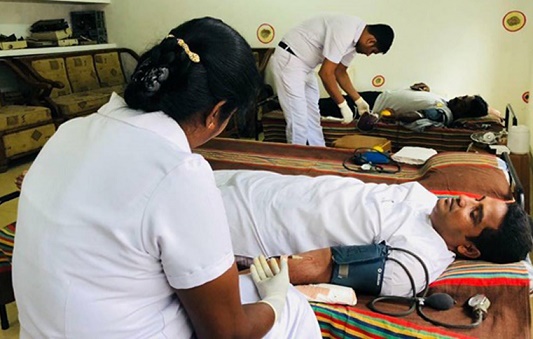
යාපනයේ සංවිධානය වී තිබූ මහවිරු උළෙලවල් අතරතුර  යපනයේ පලවන උදයන් පුවත් පත් ආයතනය විසින් ලේ දන් දීමේ ව්යාපාරයක්  සංවිධානය කොට තිබුණේ මියගිය පිරිසට පින් අනුමෝදන් කරවීම පිණිසය.

යාපනය නගරධිපති ආනෝල්ඩ් එමානුවල් මහතා ලේ දන්දීමේ ව්යාපාරයට සහභාගී වී මියගිය මහවිරුවන්ට පින් අනුමෝදන් කළේය.

SUPERMARKET ON AN UNEVEN KEEL

November 28th, 2018

Dr Sarath Obeysekera

Everybody talks about the fracas in the Parliament and state run TV’s with most of the private channels are crucifying the Speaker .One channel owned by the sibling of the ( ex) PM is in rampage against the President and the ( incumbent ( PM ) .Three pillars of the state apparatchik getting blasted everyday .

People have forgotten the price increase of vegetables etc. as the supermarkets keep ripping off  the masses.

That day my wife visited a Super… Supermarket in Thalawathugoda to buy weekly provisions. She Bought few carrots which cost het 250 Rupees and some (sour) grapes for 800 Rs .with other items .She comes out of the shop and started checking the bill ,She found that cost of grapes was charged twice .Few branches of Coriander Leaves was charged at 220 Rupees

She returned to the shop and confronted the manager and asked him to check why she was overcharged .He did not bother to apologize and gave a most audacious  and unbelievable reason .They spray water on the leaves and the weight may have gone up .My wife asked him whether we should pay for few drops water over 100 Rupees

When I walked into the same new Green Coloured super market with New Look to buy some bananas .I picked up sour bananas and I was charged the price of Kolikuttu with a price over three time’s sour bananas.

Same answer, the weighing boy is  from Jaffna and he did not know the difference.

Last week l visited a five star hotel with cinnamon  taste to dine with my daughter and son in law who came from abroad .We went to the fish restaurant called Lagoon to taste some fish with a draft  beer

Completed the dinner and the bill came .I wish  not to  indicate  the bill amount as it is embarrassing due to the fact that many people get that kind of money after working for a whole month !

My son in law being very cautious about billing by restaurants, started checking the bill and found that the Lagoon charged the price of a Pitcher of Draft Beer instead of the price for a Pint.

I thought that it is a mistake and pointed out to the manager .He took my credit card and charged again with an amount after deducting the  price difference between a pint and a pitcher and informed me that they have cancelled the previous charge to the credit card .

I immediately got two texts on my mobile from HSBC that I have been charged twice

I was furious and blasted the manager and the waiter and kept calling credit card Company to cancel first payment.

It is still charged and I am waiting until end of the month to check the credit card bill

Even though I complained to the manager of the Lagoon he has not come back to me.

This is how these conglomerates earn money from the people who have diverted their mind in the sea of lies and treachery forgetting that we are robbed day by day by not only politicians but also Super Markets


ධීවර ක්ෂේත්‍රයේ පවතින ගැටලු වලට කඩිනම් විසඳුම් ලබා දීමට අවශ්‍ය පියවර ගන්නා ලෙස ගරු අග්‍රාමාත්‍ය මහින්ද රාජපක්‍ෂ මැතිතුමා අද උපදෙස් දෙයි

November 28th, 2018

මාධ්‍ය නිවේදනය රොහාන් වැලිවිටඅග්‍රාමාත්‍ය මාධ්‍ය ලේකම් 

ධීවර ක්ෂේත්‍රයේ පවතින ගැටලු වලට කඩිනම් විසඳුම් ලබා දීමට අවශ්‍ය පියවර ගන්නා ලෙස ගරු අග්‍රාමාත්‍ය මහින්ද රාජපක්‍ෂ මැතිතුමා අද  (2018.11.27) උපදෙස් ලබාදෙන ලදී.

ගරු අග්‍රාමාත්‍යතුමා අද මෙම උපදෙස් ලබා දුන්නේ අපේ රටේ ධීවර කර්මාන්තයේ දැනට පවතින ගැටලු සාකච්ඡා කිරීම සඳහා උතුරු නැගෙනහිර ධීවර සංවිධාන, බහුදින යාත්‍රා ධීවර සංවිධාන, කුඩා ධීවර කර්මාන්ත සංවිධාන ඇතුළු සියලු ධීවර සංවිධාන වල නියෝජිතයින් හමු වූ අවස්ථාවේ දීය.

එහිදී දැනට ධීවරයින් හට පවතින නිෂ්පාදන වියදම අධික වීම සහ නිෂ්පාදනයට සාධාරණ මූලික යෙදවුම් මිලක් ඇති කිරීම සම්බන්ධව පවතින ගැටලු සහ ධීවර වරායවල් සහ ධීවර යාත්‍රා සම්බන්ධයෙන් පවතින ගැටලු මෙහිදී ගරු අග්‍රාමාත්‍යතුමාගේ අවධානයට යොමු විය. එමෙන්ම ධීවර බෝට්ටු නිෂ්පාදනය සඳහා අවශ්‍ය ෆයිබර්” ඇතුළු අමුද්‍ර‍ව්‍ය ආනයනය කිරීමේ දී රජයේ ආනයන බදු අඩු කර දෙන ලෙස ධීවර කාර්මිකයින් කළ ඉල්ලීම පිළිබඳව ද ගරු අග්‍රාමාත්‍යතුමා විශේෂ අවධානයක් යොමු කළේය.

තවද, දැනට ධීවර සංස්ථාව සතු ශීතාගාර ඉක්මණින් නවීකරණය කිරීමට අවශ්‍ය පියවර ගන්නා ලෙස ධීවර අමාත්‍යතුමාට උපදෙස් ලබා දෙන ලදී.  එමෙන්ම, ධීවරයින් ආදායම් බද්දෙන් නිදහස් කිරීමට සහ අයිස් මිල පාලනයක් ඇති කිරීමට අවශ්‍ය පියවර ගන්නා ලෙසද උපදෙස් ලබාදෙන ලදී.

එමෙන්ම ධීවර කර්මාන්තයේ යෙදෙන ධීවරයින්ගේ ජීවිතාරක්ෂාව වෙනුවෙන් රක්ෂණ ක්‍ර‍මයක් සහ මවු නෞකා දෙකක් ලබා දීමටත්, ජීවිතාරක්ෂක පහුරු ලබා දීමටත් අවශ්‍ය පියවර ගන්නා ලෙසත් උපදෙස් ලබාදෙන ලදී.

මෙම අවස්ථාවට හිටපු ධීවර අමාත්‍ය ගරු මහින්ද අමරවීර මැතිතුමා සහ වත්මන් ධීවර අමාත්‍ය ගරු විජිත් විජිතමුණි සොයිසා මැතිතුමා, සුදර්ශනී ප්‍ර‍නාන්දුපුල්ලේ මැතිතුමිය, අමාත්‍ය ඩග්ලස් දේවානන්ද මැතිතුමා, දුලිප් විජේසේකර මැතිතුමා, අරුන්දික ප්‍ර‍නාන්දු මන්ත්‍රීතුමා, සමඟ අග්‍රාමාත්‍ය ලේකම් එස්. අමරසේකර මහතා, මුදල් අමාත්‍යාංශයේ ලේකම් සහ ධීවර අමාත්‍යාංශයේ ලේකම් ඇතුළුව ධීවර සංගම් නියෝජිතයින් පිරිසක් එක්ව සිටියහ.  

රොහාන් වැලිවිට

අග්‍රාමාත්‍ය මාධ්‍ය ලේකම් 

 මන්නාරමේ සමූහ මිනී වළේ කැණීම්කටයුතු සොයා බැලීම පිණිස ශ්රී ලංකාවේ සිටින ජර්මන් තානාපතිවරයා ඇතුළු පිරිසක් එම ස්ථානයට පැමිනේ

November 28th, 2018

දිනසේන රතුගමගේ

 මන්නාරමේ සමූහ මිනී වළේ කැණීම් කටයුතු සති දෙකක කාලයකට තාවකාලිකව නතර කොට 27 දා පෙරවරුවේ යළි ආරම්භ කරණ අවස්ථාවේදී එහි කටයුතු සොයා බැලීම පිණිස ශ්‍රී ලංකාවේ සිටින ජර්මන් තානාපතිවරයා ඇතුළු පිරිසක් එම ස්ථානයට පැමිණ තිබේ.

ශ්‍රී ලංකාවේ සිටින ජර්මන් තානාපති ජෝන් රොහොඩ් (Jorn Rohde) මහතාට මන්නාරම සමූහ මිනී වළේ මෙතෙක් සිදු කෙරුණු කටයුතු පිළිබදව කැණීම් කටයුතු වල නියැලී සිටින වෛද්‍ය ෂාමින්ද රාජපක්ෂ මහතා විසින් විස්තර කොට දෙන ලදී.

මන්නාරම සමූහ මිනී වළේ 106 වෙනි දිනයට කැණීම් කටයුතු සිදුකෙරෙන විට මේ ස්ථානයෙන් මිනිස් ඇටසැකිළි 239 ක් හමු වී ඇති බවත් ඒවායින් 18 ක් ඉතා කුඩා ළමුන්ගේ  මිනිස් ඇටසැකිළි බවත්  මෙහිදී ප්රකාශ කොට තිබේ.

මෙම කැණීම් කටයුතු වලදී කීස්ම පුද්ගලයෙකුගෙන් හෝ ආයතනයකින් කීස්දු අන්දමක බාදාවක් හෝ බලපෑමක් නොමැති බවත් ඇති එකම ප්රශ්නය මාස් මෝසම් වර්ෂාව පමණක් බවත් කැණීම් කටයුතු බාර නිලධාරීන් ජර්මන් තානාපතිවරයාට දැණුම් දී ඇත.

UNSOLICITED PROPOSALS AND A HYBRID EXECUTIVE

November 28th, 2018

Dr Sarath Obeysekera

Nothing happened during the honeymoon of 100 days and 3 and ½ years and they kept boasting about transparency and criticised unsolicited proposals entertained by previous regime is full of corruption

Hambantota .Airport ,Highways and Oluvil  were  completed and Port Project Commenced during regime under MR

If we are to learn from Singapore and  we SHALL forget transparency and  democracy and entertain proposals which can be implemented   with minimum delay.

Lee Kwan Yu did not call tenders to develop shipyards and any other development projects in Singapore and now they have mammoth shipyards and other industries   which are enormous state owned entities

What Sri Lanka need a benevolent dictator who should be a Hybrid of JR and MR  and RP  and  current executive should follow suit rather than lamenting about how he could not perform because some people were pullinh his leg .

If he is honest he should not fear

Gammanpila writes to Editor of Hansard

November 28th, 2018

Courtesy The Daily Mirror

Minister Udaya Gammanpila today wrote to the Editor of the Hansard over an alleged distortion of the Parliamentary Affairs on November 14.

The Opposition MPs handed over a No-Confidence Motion to the Speaker on November 14 and Speaker announced that the motion was passed.

In a letter to the Editor, the Minister said what had happened on November 14 after the debate on the No-Confidence Motion was held, should be reported as of Speaker saying he would take up the vote by voice.

Speaker also said there was no majority for the new Government. In his words, the Speaker said ‘There is no majority for that’.

However, the phrase ‘There is no majority for that’ has been altered as ‘There is no majority for them’.

Meanwhile, a new phrase ‘The motion is carried’ had also been included,” he said in the letter.

He requested the Editor to look into these ‘Alterations’ and to make necessary amendments to the Hansard.(Lahiru Pothmulla)

Admiral Ravindra Wijegunaratne remanded

November 28th, 2018

Courtesy Adaderana

Sri Lanka’s Chief of Defence Staff Admiral Ravindra Wijegunaratne has been remanded unitl December 05 by the Colombo Fort Magistrate’s Court.

The top-ranking military officer appeared before court Wednesday after weeks evading arrest for allegedly protecting the chief suspect in the high-profile murder of 11 youths in 2008 and 2009.

In a dramatic new development, prosecutors told the court that Wijegunaratne and his bodyguards tried to abduct a key witness at the weekend who had previously testified against him.

He has denied all allegations and sought bail on Wednesday, however the court rejected the application and ordered that he be remanded until December 05.

The former Navy Commander is accused of aiding and abetting Lieutenant Commander Chandana Hettiarachchi, also known as ‘Navy Sampath’, the main suspect in the abduction, unlawful detention and murder of 11 youths in 2008 and 2009.

Investigators say Wijegunaratne helped Chandana Prasad Hettiarachchi, a navy intelligence officer and chief suspect in the murders, escape arrest.

Police believe the 11 victims were murdered while in the illegal custody of the navy. Their bodies were never found.

Hettiarachchi Mudiyanselage Chandana Prasad Hettiarachchi alias ‘Navy Sampath’ was arrested by the CID on August 13, 2018 in connection with the abduction, torture, extortion and murder of the 11 persons.

He is separately accused of involvement in the 2006 murder of a Tamil legislator.

Police recently told the court the admiral had protected the navy intelligence officer, who is the main suspect in the case.

Wijegunaratne has been summoned to appear at the Criminal Investigations Department (CID) yesterday to record a statement.

The CID had summoned the Chief of Defence Staff for questioning once before, however Wijegunaratne had failed to appear due to traveling overseas for an official visit.

The Colombo Fort Magistrate’s Court had ordered the police to arrest Admiral Ravindra Wijegunaratne on two occasions.

Bag limit is a weight off pupils’ shoulders

November 28th, 2018

Courtesy The Times UK

India has set strict weight limits for children’s school bags as part of an initiative to prevent injury and reduce the stress created by the immense pressure to achieve good grades.

The rules, which will be applied nationwide after successful trials in several Indian states, will impose a 1.5kg satchel weight limit on Year 1 and 2 pupils, aged about five or six years old, rising to 5kg for teenagers. Homework has also been stopped for the youngest pupils to spare them from hauling extra books to and from school.

India has the highest youth suicide rate in the world and the new scheme is intended to address years of mounting alarm at the physical and mental toll placed on students by family and social demands for academic success. Schools have found that children are carrying bags weighing a third of their body weight or more, risking long-term injury.

The excess weight puts undue stress on the muscles, ligaments and discs and damages them,” Ramneek Mahajan, director of orthopaedic medicine at the Max Smart Super Speciality Hospital in Delhi, told The Times of India. Children develop a forward head posture as they are swinging forward at the hip to compensate for the heavy weight.”

The government is also seeking to streamline the curriculum to create more time in the week for children to enjoy sport and other interests.

Current UNHRC sessions in Geneva, and its impact to our Motherland, Sri Lanka

November 26th, 2018

Guest Speaker : Asoka Weerasinghe, 

SLUNA – AGM, Saturday, 24 November 2018, at Advent Lutheran Church, 2800 Don Mills Road, Toronto, Ontario

Mr. President of SLUNA, Members of the Executive Committee, Your Excellencies, Distinguished Guests, the Daughters and Sons of my Mother Lanka and Friends of my Mother Lanka;

This is the topic: ‘Current UNHRC sessions in Geneva, and its impact to our Motherland, Sri Lanka’, is what was  proposed by the Executive Committee for me to speak on, It is vast.

It is all about the Geneva Resolution 30/1 which was co-sponsored by the Yahapalanayo Government in October 2015.  It is a theatre of  International cunning, Humbug, Bullying and Sri Lankan Gutlessness and Treason.

It targets the Sri Lankan Armed Forces personnel who annihilated the Tamil Tiger terrorists, on 19 May 2009, after they had hemorrhaged yours and my Motherland, Sri Lanka, for 30 bloodying years. This act gave back to 20.5 million of their people the most paramount Human Right – their right-to-life which was hijacked by the trigger-happy and claymore-mine detonating Tamil Tiger terrorists for 30 long years

The topic discussed at the UNHRC Session this September, has a history that goes back to the former Secretary-General of the UN, Ban Ki-Moon.  He was sitting on that chair in New York from January 2007 until December 2016,  who had the audacity of Mooning Sri Lanka”and bullying her, with his famous Darusman Report,  with no  formidable challenge by the present Maithripala Sirisena’s Yahapalana Government, nor the Government before. No one in these Sri Lankan Governments or its Oppositions  had the guts, had the gumption, had the spine to tell Ban Ki-Moon to cut out crapping on Sri Lanka and her valiant war-winning soldiers and pull up his pants and not to ever Moon” Sri Lanka, again as we don’t like it as it gets our goat and dragon-fire spitting anger.

I repeat, this UN Resolution 30/1  which was co-sponsored by  Yahapalanayo’s Sri Lanka at the UN, was a Tragic theatre of International  cunning, Liars, Humbugs, Bullying and Sri Lankan Gutlessness and Traitors lining up the valiant Sri Lankan soldiers who gave back the lost freedom to all colours of politicians to move around freely, in a ridiculous and a sick attempt to vilify the soldiers in front of an International War Crimes Court, as War Criminals.

Let me say loud and clearly so that all Sri Lankan politicians could hear, You let it happen ladies and gentleman, I point my finger at everyone of you who did not shield our patriotic courageous men and women in fatigues who fought that Eelam War to the bitter end.  As some gave their lives for you all to walk freely on Sri Lanka’s kabook earth to live another day without being blasted by the Tamil Tigers,  as being Sick.”

Conclusion of Eelam IV War

The Eelam IV which began on July 26 2006, when renewed hostilities began when Sri Lankan Air Force fighter-jets bombed several Tamil Tiger terrorists camps around Mavil Aru anicut in the East.

The reason for this aggression was because on July 21 the Tamil Tigers cut the water supply closing the sluice gates of the Mavil Aru reservoir for surrounding paddy fields  and starving over 15,000 people of drinking water in Government controlled areas.  Remember, that water is Life. We cannot allow people not to be given even a drop of water and starve the person to death.

The Eelam IV War concluded on 19 May 2009. This was after the 58 Division of the Sri Lankan Army led by Brigadier Shavendra Silva, the 59 Division led by Brigadier Prasanna de Silva, and the 53 Division Commanded by General Kamal Gunaratna, linked up  and cornered the last of the Tamil Tiger terrorists into a small sliver of land, near the Nandikadal lagoon and eliminated the last of the Tamil Tiger terrorists.  This final battle claimed the lives of several top Tamil Tigers, including Jeyam, Bhanu, Lawrence, Pappa, Laxmanan, Balasingham Nadesan, Pottu Amman, Soosai and their leader Velupillai Prabhakaran according to reports they all attempted to flee.

On the morning of the 19th of May, soldiers of the 4th Vijayabahu Regiment led by Lt.Colonel Rohitha Aluwihara claimed to have found the body of Velupillai Prabhakaran with a bullet wound on his forehead.  And so was the Sri Lankan Armed Forces ending a Tamil separatist War in Sri Lanka which defined her contemporary history of 30 bloodying years.

On 22  May 2009, Sri Lanka’s Secretary of Defence, Gotabaya Rajapaksa confirmed that 6,261 personnel of the Sri Lankan Armed Forces had lost their lives and 29,551 were wounded during the Eelam War IV since July, 26, 2006.  A ratio for each 1 killed there were 5 injured and maimed for life.

Ban Ki-Moon comes into the Act to heed his Masters who pay his wages as the UN Secretary-General:

However, the one country, a puny island  jutting out of the Indian Ocean that valiantly got rid of terrorism, a war that was aided and abetted by foreign countries, which included Canada, suddenly was the nucleus of interests for the senior UN officials to victimize this little island who fought an internal war with the democratically unelected Tamil separatists who wanted to carve out one-third of the island’s productive real estate bordered by 60% of the coastline for 12.6% of their people in the North and East of the island.   But mind you, by then 54% of the Tamil population lived in the South among the majority Sinhalese population that amounted to 74% of the entire population of the island.

On 23rd May, 2009, 4 days after the Sri Lankan Armed Forces ended terrorism in Sri Lanka, the UN Secretary-General Ban Ki-Moon made a spontaneous visit to Sri Lanka, it was under the guise of wanting to experience the post-war situation first hand.

President Mahinda Rajapaksa at this point had a choice.  He should have told Ban Ki-Moon, Sorry Buddy, we cannot entertain you 4-days after the war ended, we have much to take care of.  Your presence will be an impediment in our progress.  I will let you know when you can come over.  If you  have mischief in the agenda of your planned visit, well you might as well postpone it.  You are not invited to come here at the present time.”  So that was stupid of Mahinda Rajapaksa  not to have put his foot down, and he had that authority, as the Head of the Island’s peoples.  He didn’t.  Just too bad.  And so the valiant soldiers who got rid of the most dangerous terrorists in the world, the Tamil Tigers, are suffering from headaches not knowing whether they would be brought in front of an International War Criminal Court for allegedly violating human rights during the last 5-months of a 360 month long bloody war.

So what did Ban Ki-Moon do, he came, he saw and he conquered  to put in place the agenda to harass Sri Lanka for winning the Tamil Tiger terrorist war which the terrorists were aided and abetted  by outsiders like India, US, Norway, Germany, UK and Canada.  They screwed her to a crucifix for not obeying and accommodating Ban Ki-Moon’s pay masters, when they wanted the Rajapaksa Government to declare a Ceasefire,  a few days before the Tamil Tigers were annihilated. This would have given them a chance to extricate the Tamil Tiger leaders and their families from the island.  The Americans were waiting with their ships ready to do just that.

According to the then Sri Lankan Defence Secretary Gotabaya Rajapaksa, Norwegian-cum-Americans were exploring pathways to extricate the Tiger Leaders.  By mid-February they were mulling at the possibility of mounting a sea-directed rescue mission” and a high-level team from the United States Pacific Command (PACOM) headquarters in Hawaii” visited Sri Lanka to evaluate the logistics of such an exercise.

The famous Darusman Report the genesis of UN Resolution 30/1

Let me roll your memory back to 19 May 2009.  This was the day when the Tamil Tiger terrorists were defeated militarily after a 30 year long bloody conventional war. They were the only terrorist group in the world who had fighters on land, sea, and  air with five Czech ZLIN-Z 143 light aircraft converted as night bombers. These aircraft,  had a flying range of 630 nautical miles,  an endurance of 5 hours and a maximum speed of 168 miles per hour, and could carry an ordnance  load of 210 kilos.

The Tamil Tigers prior to that 30 years were a barefooted and some sandals and sarong wearing guerillas who couldn’t shoot straight. India’s Indira Gandhi took them over to India in the early 1980s and trained them in several military camps at the foothills of the Himalayas and South India’s Tamil Nadu, They were trained to shoot AK47s, pull the pin of a hand grenade and throw them at their enemy, SLRs, LMGs, No.36 Browning revolvers, Rocket Launchers, etc. They were sent back to North Sri Lanka in jack boots and kaki-fatigues, money in their pockets,  with festoons of live bullets around their necks and cradling Kalashnikovs like babies in their arms to fight and destabilize Sri Lanka.

When South Korea’s Ban Ki-Moon  the UN Secretary-General  who was reduced to be a puppet by his Western pay-masters being ordered to go on the war-path to hurt punny, but mighty Sri Lanka for not taking orders from the US, Norway, UK, France, India and others calling for a ceasefire a few  days before the Tamil Tigers were annihilated, to give them another day to fight for their Eelam, arrived in Sri Lanka 4-days after the war ended on a cunning comprehensive study tour. So Ban Ki-Moon  goes back to New York and appoints a Special Panel of three ‘experts’ to advise him on Sri Lanka’s alleged war crimes. This was the very issue that was dealt in June 2009 at the UN’s Human Rights Council in Geneva where members decided in a 29 to 12 votes not to intervene in Sri Lanka’s internal affairs.

By that appointment of a Specialist Panel Ban Ki-Moon exceeded his powers prescribed in Chapter XV of the UN Charter where the authority was detailed clearly in Article 97 and 98.

Ban Ki-Moon clearly violated Article 2 (7) of the UN Charter which prohibits intervention in matters which are essentially within the domestic jurisdiction of any state.  Thus this UN Panel Report known as the Darusman Report and released for international consumption is a good reason for Ban Ki-Moon,  the Secretary-General to have been impeached.   Did the Sri Lanka Government do any thing about it to safeguard Sri Lanka’s Armed Forces personnel who gave back 20.5 million of their people their right-to-life, the most paramount Human Right?  They did sweet nothing about it.  If they did, then we the people of Sri Lanka were not privy to know about it.  Pity!

Now to identify Ban Ki-Moon’s Specialist Panel of Three.  Here they are.

Let’s get this right.  The three panel report should not be accepted  as a UN Panel Report, but be recognized as the Moon’s Panel Report, as the composition of the panel of the so called ‘experts’ is from outside the UN organization.  As such it violates the authority under which the Secretary-General of the UN is expected to function under article 100, Clause 1, of the UN Charter.  This is the Charter that provides guidance to the Secretary-General to maintain his/her neutrality of the UN.

When he appointed the three member panel, the Sri Lanka Government should have gone at Ban Ki-Moon’s jugular exposing his mischief as all three panelists were bias against the Sri Lanka Government. It didn’t happen.  Why?  Were they scared and spineless fearing that the UN and its powerful members of the west including Canada, would ‘huff and would puff, and blow the Sri Lanka Government down with sanctions, et cetera.

The First Panelist was Marzuki Darusman,  the former Attorney General of Indonesia, and was appointed to Head the Panel.  This guy was a member of the International Independent Group of Eminent Persons (IIGEP) invited in March 2008, to observe the working of Sri Lanka’s Presidential Commission looking into alleged serious violations of Human Rights.

This guy Darusman left this Commission in a huff disagreeing with th Sri Lanka Government and yet signed the IIGEP Report, or else he wouldn’t have been entitled for the handsome consultant fee.  And there was no way that this guy could be neutral on Sri Lankan Government affairs.  But still Ban Ki-Moon appointed him letting him screw Sri Lanka unfairly and right Royally.  That is how UN’s questionable honesty and neutrality  cookie crumbled.

The Second Panelist was Steven Ratner. He was an advisor to the Non-Governmental Organization known a Human Rights Watch (HRW) that had been very critical of Sri Lanka from the very inception of the Eelam War.  Ratner co-authored a book with Jason Adams titled, Accountability Of Human Rights: Atrocities in International Law beyond the Nuremberg legacy, where in page 123 he has stated that the convention on banning apartheid should be invoked in relations to countries such as Sri Lanka.  This statement itself should have disqualified him for not being a neutral panelist.  But then Ban Ki-Moon had to satisfy his western pay-masters, and so he decided to go ahead with Steven Ratner as a panelist, also to gain another opportunity  to ‘Moon’ at Sri Lanka, one more time.

So the incumbent Sri Lanka government lacked the courage to rubbish this intended Report and go at the jugular of Ban Ki-Moon, the Secretary General of the UN, questioning his neutrality, asking him what the heck are you upto.  This didn’t happen.  Pity!

This guy, Ratner,  had also written elsewhere that the Tamils represented by the Liberation Tigers of Tamil Eelam (aka Tamil Tigers) are an oppressed community.  That is a load of hogwash.  If he had been honest with his research he would have found out that this Tamil community of 10% was the ‘privileged minority’ for 131 years of British colonial rule and some years beyond Ceylon’s Independence on 4 February  1948.  And that the majority Sinhalese of 75% of the population was the ‘wronged majority.”   I say, Come on Steven Ratner, be real.  I just can’t stomach that kind of ghoulish fairy tales.”

The Third Panellist appointed by Ban Ki-Moon was the South African Lawyer Yasmin Sooka, who was heavily dependent on EU funds to be impartial.  She was also a close associate of the South African Tamil Navi Pillay who was  a patron of the Sooka Foundation, and also responsible for the failed resolution that was brought against Sri Lanka before the UNHCR in May 2009.

With such credentials I smell three rats here who are supposed to be honest non-partisan members  who should not be appointed to any panel dealing with alleged human rights violations in Sri Lanka as all three of them carry full baggages of anti-Sri Lanka sentiments.

I say Boo” to Ban Ki-Moon, the then Secretary General of the UN and I am shocked that the Sri Lanka Government didn’t take him on.  Why?  There may have been a good reason to make pawns of our courageous men and women in Armed forces fatigues, who won the Tamil Tiger terrorist war for 20.5 million peoples of that  beautiful puny island jutting out of the Indian Ocean  on 19 May 2009 which mighty India in the North would love to have it annexed on to their huge land mass.

Now to the story of 40,000 Tamil deaths during the last 5 months of the Eelam War, which had been announced in the Darusman Report was the genesis of the UN’s Resolution 30/1 against Sri Lanka.

Once again, let me take you back to 19 May 2009, when the Tamil Tiger terrorists were defeated militarily, after 30 years of popping bullets from Kalashnikovs, blowing 386 Human suicide bombs and detonating many Claymore mines, the country was now in peace across the island.

This was followed by the January 2015 Presidential elections and  Maithripala Sirisena was elected as President. Ranil Wickremesinghe was appointed as the Prime Minister in a coalition Government. The mandate for which they won the election was to achieve reconciliation, ensure a durable peace, promote and protect human rights, uphold the rules of law and strengthen good governance and democracy.  And Lo behold, out of that flowed the UN Resolution 30/1 of 1 October 2015,  This Resolution was co-sponsored by Sri Lanka and spokesperson for the Yahapalanaya Government at the UN was Foreign Minister Mangala Samaraweera.

What intrigues and shocks me is to find out that such an important decision had not been discussed at Cabinet.  What kind of democracy do the Yahapalanayo think they are governing the country with.   It boggles my mind.

This beats me as it puts our valiant soldiers who won the war for Sri Lanka in jeopardy and possibly will be frog-marched to an International War Crimes Court charged with human rights violations during the last five months of the Eelam IV War.  Mind you, they talk of Ban Ki-Moon’s Darusman Report which says there were 40,000 Tamilian deaths.  I wish the UN’s Ban Ki-Moon had produced a War Manual for Dummies on how to win a war with Terrorists without having to kill a single terrorist or a civilian.  That would have helped  the Sri Lankan soldiers enormously, and there wouldn’t have been a UN Resolution 30/1 on Sri Lanka as no one would have been killed.

But here is the sad thing about this Darusman Report.  It says quite clearly as  clearly as the ding-dong of  the noon-chime of Westminster’s Big Ben, that There is still no reliable figure for civilian deaths”, yet, later put the figure at 40,000 civilian deaths in black and white print. This number is now bandied around by every human rights organization, the Tamil Diaspora and the Canadian parliamentarians who have sold their souls for the separatist Tamil cause.  The time was ripe for the Yahapalanayo Government to go after the UN and its  Darusman Report that they keep quoting.  They should have rubbished it, but they haven’t so far.

This act of co-sponsoring this Resolution 30/1 is the worst betrayal by any country against itself,  And is probably the first sovereign nation that did it.  This is asinine, it is pathetic!

But here is what the Yahapalanayo Government missed in the Darusman Report, either due to the lack of comprehension of the English language which the Darusman Report was written in, or because it didn’t matter as they were not prepared to challenge UN’s Ban Ki-Moon in New York, or UN’s Navi Pillay at their Human Rights Council in Geneva.  Whatever it was, the losers were the Sri Lankan people, especially our valiant soldiers, who gave back to the 2-o’clock-in-the-afternoon-Mothers  their freedom, who stood  at their front doors of their houses watching  far away into the roads waiting to sight their children coming home from school in one piece.  Not in a plywood box with their child’s ketchup blood covered body in a puzzle of  the head, flesh, heart and, limbs blasted to smithereens by a Tamil Tiger claymore mine, and the Mothers don’t have to do it anymore.  Or the Men and Women going to work each morning, making a sign of the cross over their chests, or placing palms together with a quick prayer before they get on a bus,  wanting to come home to their families safe and not in a plywood box in a puzzle of flesh, head, body, limbs and heart covered in clotted blood having been bombed by the Tamil Tigers.  I watched them on two 7 o’clock mornings standing by a bus stop on Sri Jayawardenapura Mawatha at Rajagiriya, by Royal Gardens opposite Keels Supermarket, and thank to the valiant Sri Lankan soldiers, they don’t have to do it anymore.

And here’s what the Yahapalanayo Government missed in the Darusman Report:

  1. In the Executive Summary, the Darusman Three Musketeers say, The panel’s mandate however does not extend to fact finding or  ” In confirmation of this the page 3 of this Report says, The panel has not conducted fact finding as that term is understood in United Nations practice,”
  2. Again on page 6 of the Report the Darusman panel of Three Musketeers say, The panel and the United Nations officials repeatedly made clear to the government the scope of its mandate as an advisory panel to the Secretary-General including that it was not engaged in any investigation.”

What!  This is unbelievable.   When the Government officials were briefed repeatedly”, were the officials asleep at the briefing table.  The Yahapalanayo Government had an excellent window for desk-thumping-screams at Navi Pillay the Head of the UNHRC in Geneva, and ask her to go back to school and learn English comprehension when her outfit in Geneva claimed that there were 40,000 Tamil deaths, as gospel.  Where the hell did the Darusman Three Musketeers get that number.  What Humbugs, what Liars, what a sham! I ask them, show me the 40,000 bodies, show me the 40,000 skeletons.  Where the hell are they?” 

  1. But here’s the punchline that the Sri Lanka Yahapalanayo Government proved that they lacked guts to challenge  Ban Ki- Moon  and his Co-worker in Geneva, when the  Darusman Three Musketeers on page 15 of their Report says, The panel has chosen to present the allegations it finds credible, in a narrative account.”

And on the same page they say, this account should not be taken as proven facts.”  This is mischievous….this is crap…  this is poppycock.  They played with semantics playing  Russian Roulette with the professional lives of these valiant Sri Lankan soldiers who won the Tamil Tiger Separatist

War. So what you and I find is that Ban Ki-Moon gave a pretty lucrative consulting fee for these anti-Sri Lankan Three  Musketeers to write a Halloween Horror Story of  Fiction  hoping that it would be a bestseller, and teach the  Grandmothers of those fools who ever use the Darusman  Report’s findings of 40,000 deaths as Gospel to suck-eggs.  And as a value added incentive to see that the Sri Lanka’s  Government get themselves nailed well on to a crucifix.

 We Gotch-Ya, Sri Lanka, you little turd of an island who did not obey our commands.  When we say ‘We want a Ceasefire’ we expect you to stand up, come to attention,  put your war weapons down, bring your right hand to the side of your forehead in salute, and say ‘Yes, Sir…Yes, Sir … three bags full”. That was it.

Do you know what?   The Darusman Three Musketeers achieved all what they wanted to nail Sri Lanka to a crucifix and Ban Ki-Moon delivered what his pay masters wanted, a document heralding the punishing action that the Western world and its UN handmaidens took over the next month’s to place a vice around Sri Lanka’s neck and tightened its screws until the Yahapalanayo Government frog-march our valiant soldiers who annihilated the Tamil Tigers to an International War Crimes Court for alleged War Crimes as reported in the Darusman Report.          

And Ban Ki-Moon’s  paymasters are  now revelling rubbing their palms together watching Sri Lanka’sYahapalanayo Government sweating at their chairs during the UN sessions.  I say tough-tiddy to  Sri Lanka’s President and and the Prime Minister for not applying the Sinhalese Mahinda Rajapaksa gumption to stand tall against international Bullies like Eric Solheim, David Milliband, Navi Pillay, and Robert Blake, and not accept their challenge and win the battle as what the Sri Lanka’s Armed Forces did.

This indeed is the rub.

Remember, when no less a person than the US Ambassador to  the UNHRC  in Geneva, Eileen Donahoe, spat out We will get you” to her Sri Lankan counterpart Tamara Kunanayakam within the stately corridors of the UNHRC in Geneva and not at a  friendly strawberry and cheese tea party.  It was a primeval desire for vengeance, Co-sponsoring UN Resolution 30/1,  was all because of unsubstantiated evidence of allegations that 40,000 Tamils were killed  during the last five months of the war.   If war statistics tell us that the number of wounded and maimed in a war are double the numbers killed, did anyone of  the Yahapalanayo Government personnel representing Sri Lanka at the UNHRC sessions in Geneva had the smarts to ask the Navi  Pillay bullies as to what happened to the 80,000 Tamil Tigers and civilians who were wounded during the last 5-months of the war.  If not, Why not?  What was indeed the problem to ask this legitimate question? Are we stupid or what? I am amazed by such intellectual paralysis,  such intellectual dishonesty among the Yahapalanayo legislators.

They indeed got us when the Yahapalanayo Government cosponsored the UN Resolution 30/1.  Well what do you know…this is how Sri Lanka’s good governance work.

Lord Naseby of the UK stands up for Sri Lanka to help clear the self-inflicted UN’s Resolution 30/1 mess.

What I have not figured out as yet is whether the decision to cosponsor UN’s Resolution 30/1 was a collective decision by President Maithripala Sirisena, Prime Minister Ranil Wickremesinghe, and Foreign Minister Mangala Samaraweera,  or whether it was a unilateral decision made by the Foreign Minister Samaraweera.  So far it has been a secret in the country which will ultimately come out clearly in the wash.  Whatever the computation  was, it was, in my eyes an act of treason.

On October 12, 2017, Lord Naseby, a long time friend of Sri Lanka initiated a short debate on Sri Lanka in the House of Lords in Westminster, London.

This was after receiving 39 pages of highly redacted dispatches between January 1 and May 19, 2009, from the Foreign and Commonwealth Office, in London.

These documents divulged views expressed by the then US Ambassador, Robert Blake; military expert Major General Holmes; UNs Media spokesperson Gordon Weiss, and the former British Defence Attache in Colombo, Lieutenant Colonel Anton Gash.

It was Colonel Gash’s observations and comment that got the Darusman three Musketeers caught as liars with their pants down.  Too bad,  One could not have expected anything different from these three anti-Sri Lankan so called experts.

Lord Naseby, in his speech to the British parliament paid scant respect to the guesstimate number of 40,000 civilians killed during the last five months of the Tamil Tiger terrorist Eelam War IV.  Several sources he cited estimated the number to be in the range of 7000 to 8000 and not 40,000.

The material evidence that Lord Naseby had elicited and received with much effort from the Commissioner of Information Act, were the dispatches to the Foreign and Commonwealth Office from the UKs own Defence Attache in Colombo, Lt.Col. Anton Gash from 1st Jan. until 19th May 2009.  He was quite certain that the UK Government knew the ground realities which contradict the negative propaganda that had been extracted from the highly suspect Darusman Report.

But what has shocked and saddened me and  a bitter pill to swallow was how the Sri Lanka Foreign Ministry essentially dismissed Lord Naseby’s assertions based on classified military dispatches obtained with the intervention of the UKs Information Commissioner’s Office according to the Freedom of Information Act The revelations were made during a debate on Sri Lanka, when Lord Naseby declared:

……The UK  must recognize that this was a war against terrorism. So the rules of engagement are based on international humanitarian law, and not the European  Convention on Human Rights.”

 I say Boo”to all sitting in Sri Lanka’s parliament who didn’t have the smarts to recognize Lord Naseby’s tireless efforts to set the record right about Sri Lanka in Geneva and never received the support but only received the wrath of the Government of Sirisena-Wickremasinghe Yahapalanayos., for having successfully countered the despicable UN Project against Sri Lanka.  Damn it!  It makes me angry.

,,,,,,,What is also interesting is that The United  Nations Country Team is one source of information; in a document that was never released publicly, it estimated  a total figure of 7,721 killed and 18,479 injured from August 2008 up to 13 May 2009, after which it became difficult to keep count” (para 134, UNPoE).

The Darusman Three Musketeers simply bypassed the implication of this data – a mark perhaps, of their office room blindness compounded by imbecility.

However, what made me cool off and make me happy was that finally Lord Naseby, on October 13, 2018, received the British-Sri Lanka Association Award for being an outstanding Friend to the British-Sri Lankan community from the British High Commissioner to Sri Lanka, James Dauris.  And I tell the then Yahapalanayo Sirisena-Ranil gang in Sri Lanka’s parliament you did not do right on Lord Naseby, you can now eat your hearts out and I say Boo” to everyone of you.

The Choices that Sri Lanka had regarding UN Resolution 30/1 and the impact to our Motherland

Yahapalanayo Government always had choices to shield our valiant soldiers from  possibly being Frog-marched to present themselves to an International War Crimes Court for alleged human rights violations during the last 5-months of the 360-month long Tamil Tiger terrorist Eelam War.  An unfair penalty for eliminating the most ruthless terrorists in the world, the Tamil Tigers,  which saw over 100 thousand innocent civilians killed.

But the Yahapalanayo opted to co-sponsor the UN Resolution 30/1 which was brought about by the suspect Darusman Report’s 40,000 unsubstantiated killings which was a spineless way that has led to a complete sell-out at the UNHRC Sessions in Geneva.

Britain’s Lord Naseby did the research for the  Yapalanayos which they obviously weren’t capable of doing.  His disclosures in the House of Lords on October 2017 disputed the very basis of the Geneva Resolution 30/1. It was a choice that the Yahapalanayo Government had, and they squandered it Big Time, not wanting to run with the ball.  Pity!

It is interesting to note that the Yahapalanayo Government continued to shirk its responsibility even after Lord Naseby provided them with the ammunition to battle their way through the UNHRC Sessions in Geneva and stand tall against the International bullies which included Canada.

And tell them loud and clearly, Oh no, you can fly your kites in the skies, but we won’t fall on our knees  to your cruel lies.”

So President Maithripala Sirisena trying to be macho flexes his muscles against the UN Bullies when outside the UN portals in New York and Geneva and announces at local gatherings in Sri Lanka that he will not allow  international investigators, prosecutors and judges interfere with Sri Lanka’s justice processors as UN Resolution 30/1 has not changed.

But what is pathetic is that he goes to New York’s UN Sessions and didn’t act macho and announce those political sentiments when he was addressing the UN assembly in September.  That was wimpish!

I tell the President:

                        Go tell it to the Mountain where your then Foreign Minister Mangala Samaraweera created  a  home for  International Tin Gods to guide the destiny of our  valiant Armed Forces Commanders in the field who  gave back to 20.5 million Sri Lankan peoples the most paramount human right, the-right-to life, by  eliminating the Tamil Tigers terrorists who had hijacked it for 30 bloody years.

The President has betrayed his people at the UN Session in September.  Regardless of the consequences, in my opinion, he should set the record straight.   He has foolproof well researched evidence given by Lord Naseby on a platter pro-bono. It is time he uses it.  Shred the Darusman Report to pieces  and watch it bleed to death in a waste paper basket.

And now for my final comment  on the UN Resolution 30/1 on the future of our Motherland, Sri Lanka.

If indeed the UN Resolution 30/1, was  the result of the Darusman Report authored by the disingenuous three anti-Sri Lankan Three Musketeers, it is upto the Yahapalanayo Government to prove it is a lie, a damn lie, then UNs Resolution 30/1 has no grounds to harass puny Sri Lanka.  And there is no snowball’s chance in hell to see it survive.

The 2020 Presidential elections will keep it or break the sovereign democratic state into two.You cannot recycle the same politicians whose primary intention is to sell the privileged  licenses to buy luxury cars, sell them and become millionaires and to hell with their country, and make its Real Estate a patchwork quilt of foreign owners. You know it, I know it and we all know it.  The solution  is staring at our faces. The year 2020 is to change direction and skirt around the big black hole that spells doom.  The change is in the hands of the  local patriotic intelligentsia.  SLUNA, you and I, we  have done our bit for our Motherland, much more than some of the paid officials who have been sent from Sri Lanka.

My strength came from my wife Jeannie- Daya,Mahinda and Mali, you have met her, a white Canadian-Newfoundlander who told me Asoka,                                   I know you are a good fighter and that you love Sri Lanka dearly, if you don’t fight to uphold the good name of Sri Lanka I will be disappointed in you.  If these separatist Tamils take you, they will have to take me with you, and we will take down one of the separatist Tamil bastards with And that was my strength to go toe to toe with them for 30 years.”  

Thank You.                        

Colonial crimes in British occupied Ceylon during the freedom struggles (1796 – 1948)

November 26th, 2018

Senaka Weeraratna

Abstract

In the 1520s Machiavelli wrote: “When it is absolutely a question of the safety of one’s country, there must be no consideration of just or unjust, of merciful or cruel, of praiseworthy or disgraceful; instead, setting aside every scruple, one must follow to the utmost any plan that will save her life and keep her liberty.”

Under British colonial rule, the governed in various parts of the world were subjected to a wide range of deprivations and extreme hardships, which in today’s context would tantamount to gross violation of Human Rights such as crimes against humanity, genocide, mass murder, mass famines, torture, rape and abuse of women, forcible religious conversion, transatlantic slave trade, confinement in concentration camps for long periods and brutal suppression of freedom struggles. Sri Lanka was no exception.

Evidence reveals even the use of germ warfare as part of colonial combat operations. When colonial rulers found themselves in desperate situations confronted with freedom struggles of the colonized, the usual “civilized” rules of warfare often were thrown out of the window. The British Colonial Governments had resorted to deliberately spreading smallpox among unsuspecting populations e.g. offering blankets infected with small pox to the Indians besieging Fort Pitt in Ohio, USA (1763), spreading small pox among Australian Aborgines in Sydney (1789), and poisoning Indians having invited them to a party in Virginia (1623).

In 1930, the American historian and philosopher Will Durant wrote that Britain’s ‘conscious and deliberate bleeding of India… [was the] greatest crime in all history’. He was not the only one to denounce the rapacity and cruelty of British rule, and his assessment was not exaggerated. Almost thirty-five million Indians died because of acts of commission and omission by the British-in famines, epidemics, communal riots and wholesale slaughter like the reprisal killings after the 1857 War of Independence and the Amritsar massacre of 1919. Besides the deaths of Indians, British rule impoverished India in a manner that beggars belief. When the East India Company took control of the country, in the chaos that ensued after the collapse of the Mughal empire, India’s share of world GDP was 23 percent. When the British left it was just above 3 per cent.

Shashi Tharoor says in ‘The Era of Darkness – the British Empire in India’ (2016) ‘The reality is that we were one of the richest countries in the world when the British came in but when they left us, we were one of the poorest.”

Given the thinking of the western colonial mind in administering colonies worldwide and employing the stratagem of ‘Hit first, hit hard, and hit everywhere’ during that point in time, in retrospect therefore the strategies of wholesale destruction used to quell popular uprisings in British occupied Ceylon  is not all that surprising.

There is a huge void in the information flow today among the current generation in respect to colonial crimes in British occupied Ceylon (1796 – 1948). This paper attempts to fill at least a part of that void.

It will examine the deployment of genocidal warfare including a scorched earth policy and mass murder of innocent civilians during the freedom struggles of 1818 and 1848. It will adduce evidence recorded in official inquiries of use of Lidice type operations’ in crushing the Matale rebellion (1848). These were the first two major wars for independence from British colonial domination. In addition this paper will examine whether the colonial rulers were engaged in a deliberate policy of retardation of development of the Kandyan Provinces especially in Uva, where there was great loss of life following the total destruction of irrigation works and the decimation of cattle that combined to impoverish the people and depopulate the area.

British injustice was felt mostly in the enactment of waste land laws. Kandyan peasants were made landless. They were reduced to a landless state by the takeover of their lands for the plantation industry (initially coffee, then tea) under a series of waste land laws commencing with the Crown Lands (Encroachments) Ordinance, No. 12 of 1840.

Kandyan chena which traditionally had no documentary proof of ownership was taken over for plantation agriculture. This is demonstrated by the names of estates with older names ending with hena or chena crop names. This affected the food security of the people. Evidence of starvation sometimes resulting in death is revealed in the writings of authors such as Le Merseur. The British systematically transferred the wealth of the Kandyan region into their own coffers.

An accountability process for these colonial crimes is warranted through an apology, catharsis and adequate reparations. An Apology must be particularly directed to the descendants of the Sinhala Buddhist Kandyans who were singled out victims of colonial brutalities. These are the descendants of a highly oppressed group of people who were also deprived of their inheritance by the colonial rulers planting thousands of indentured Indian labour in their lands without their consent. 19th century British official documents reveal how the freedom struggles against British colonial rule were suppressed in a most brutal, genocidal manner in one of the darkest pages of European colonial history.

Introduction

“Colonialism is not a thinking machine nor a body endowed with reasoning faculties. It is violence in its natural state. It will only yield when confronted with greater violence”

(Frantz Fanon: The Wretched of the Earth (1961) p 48

Footnote:  In this ground breaking book Fanon provides a psychiatric and psychologic analysis of the dehumanizing effects of colonization upon the individual and the nation, and examines the broader social, cultural, and political implications of creating a social movement for the decolonization of both the individual and the people).

There were two major wars for independence from British colonial domination. The first uprising took place in 1818 in Uva – Wellassa and the second uprising took place in Matale (1848). Both insurrections were brutally crushed. Millewa Adikarange Durand Appuhamy ( Rebels, Outlaws and Enemies to the British (Colombo: Gunasena, 1990), comments as follows in respect to the crushing of the Kandyan Sinhala uprising in 1818 :

This brute force was employed in Kandy to reduce the inhabitants to savages and to dehumanize them. Everything was done to wipe out their traditions, customs, culture and religion. Mind you, the Kandyans were promised that this would not happen, and that their customs and traditions would be maintained (cl. 4, 8 of the Convention). However, Kandyan villages and farms were burnt down. Their paddy-fields were scorched. Their cattle slaughtered and their fruit bearing trees were simply chopped down. Starved and ill, they were finished off with the gun as if they were stray dogs in a stranger’s land. British civilians then flocked in to take over their lands, clear the virgin forests, and convert them to cash crops for the benefit solely of the settlers and their financiers in Britain. To the Kandyans, the most concrete and the foremost in value was land. This land not only gave them their daily bread but also their dignity. It was to preserve this land that they fought off successfully three western imperial nations, Britain included. Now having ceded their country to trickery, they remained helpless against the planters who insolently trampled over their lands and their rights to their lands”.

The crushing of the uprising in Matale in 1848 is described in a nutshell in a remarkable critical article ‘English in Ceylon’ published in USA in 1851 (The United States Magazine and Democratic Review. Print: Vol. XXVIII, No. CLV, – 1851 May). It is as follows:

The history of Lord Torrington’s administration in Ceylon affords an epitome of English rule, wherever throughout the world, by force, or fraud, or violence, she has succeeded in planting her guilty flag. The horrors perpetrated during 1848 in the island-gem of the East, are the counterpart of those of which, from time to time, during a period of seven centuries, the green isle of the West has been the victim”.

This Conference is a timely reminder of these colonial misdeeds on the occasion of the 200th death anniversary of one of Sri Lanka’s greatest patriots Veera Keppetipola, who was unlawfully executed on November 26, 1818 by the colonial rulers for leading one of the last stands of the Kandyan Sinhalese against foreign occupation of this land. The dead cannot be brought to life. But their legacy can be remembered and honoured. This Conference provides a wonderful opportunity to express our gratitude to those who have laid down their lives for the cause of freedom from the tyranny of colonial rule, and also call for accountability for colonial crimes committed during the freedom struggles of our forbears.

British Colonial Policies

British rule over the entirety of the country began in 1815 when the Kingdom of Kandy fell into their hands through a process of diabolical planning and character assassination that led to the overthrow of the last ruler of the Kandyan Kingdom, King Sri Vikrama Rajasinha. The deposing of the King ended over 2300 years of Sinhalese monarchy rule on the island. The British occupation of the island lasted until 1948 when the country achieved National Independence.

It cannot be excluded from postulating that British rule in Ceylon was also influenced by developments in neighbouring India. The British Raj employed two military strategies in India to increase its hold on the country, namely, Policy of Ring Fence (1765-1813) and Policy of Subsidiary Alliance.

The policy of Ring Fence was a form of defense of neighbouring frontiers with a view to safeguarding one’s own territory at the expense of the neighbouring state. It was reflected in Governor Warren Hastings’ wars against the Marathas and Mysore, and it was aimed at creating buffer zones to defend the British East India Company’s frontiers. The main danger was from the Marathas and Afghans  (the Company undertook to organise Avvadh’s defence to safeguard Bengal’s security).

British Governor – General Wellesley’s policy of Subsidiary Alliance was an extension of Ring Fence—which sought to reduce Indian Princely states to a position of dependence on British Government in India. Major powers such as Hyderabad, Awadh and the Marathas accepted subsidiary alliance. Thus, British supremacy was established.

Fredrick North, the first British Governor of Ceylon (1798 – 1805), tried to emulate Governor – General Wellesley’s policy of Subsidiary Alliance in India, and asked Adigar Pilimatalavve to urge King Sri Vikrama Rajasinha to agree to have a British Regiment to be placed in Kandy on the basis of a Treaty where the Kandyan Kingdom would become subordinate to the British colonial administration. King Sri Vikrama Rajasinha rejected that proposal. He was in no mood to be dependent on the British as he saw no advantage for himself in such a relationship.

All three western colonial powers namely the Portuguese, the Dutch and the British that governed Sri Lanka in varying degrees during the period 1505 – 1948, had as the cornerstone of their imperial policy the conversion of the Sinhala Buddhists and the Tamil Hindus into Christianity. This enterprise had the blessings of the highest strata of people of the imperial countries including the Crown, the State and the Church. The avowed political objective in converting the colonized was to transfer their allegiance from the local sovereign to the foreign sovereign, and alienate the converted from identification with their traditional religion, culture, language and sense of self-determination. This diabolical plan invariably required the use of manipulative methods of conversion e.g. force, fraud and allurement, and the repression of indigenous religions i.e. Buddhism and Hinduism, by both overt and covert means.

In fact, Governor Robert Browning in a letter dated Nov. 5, 1816 to Earl Bathurst (Secretary of State) says that it was his intention to establish a Seminary in Kandy, and adds that as a first step towards spreading Christianity in Kandy I have reason to believe that this Nilame (Ekniliagodde Nilame) would have no objection to have his son and nephew brought up in the Christian religion, but I dare not in this early stage of our Government, venture the éclat which such an event would infallibly produce”.

An English Writer Gary Brecher, author of the book War Nerd” has written a long article on British crimes in Sri Lanka to a web site called  Exiled on Line” under the title When Pigs Fly-and Scold: Brits Lecturing Sri Lanka”.

He accuses the British establishment of destroying the Sinhalese people completely. Completely and deliberately, sadistically. Stole their land, humiliated and massacred their government, made it Imperial policy to erase every shred of self-respect the Sinhalese had left.  He says You can talk about the Nazis all day long, but nothing they did was as gross as what you find out when you actually look into the history of British-Sinhalese relations. If you can even call them relations”; I guess a murder-rape is a relation, sort of ” .

Making a comparison between Nazi and British atrocities he says that the British were great masters at grabbing some paradise island in the tropics, then using the British Royal Navy to wall it off separating the island from the rest of the world, and crushing the local tribe without any qualms of conscience. If the locals put up a resistance, the Brits would take measures to starve them to death, shoot them down, infect them with smallpox or get them addicted to opium (as in China) –whatever they had to do to gang-rape the locals so bad that they the victims would thereby lose the will to resist.

Brecher points out that the Nazis governed for only one decade but the Brits were able to quietly carry out their extermination programs for three hundred years, and to this day they have no remorse nor have any guilty feeling about it.

He further says that by all accounts, the Sinhala / Kandyans were harmless people, who didn’t need or want much from the outside world. All they asked was for people to leave them alone up on their big rocky highlands to indulge in their Buddhist way of life. Unfortunately that wasn’t British policy. It irked the red coats that Kandy still had a king, an army, all this impudent baggage that went with independence. The British decided to break the Sinhalese completely and crush the whole society” .

By this time, i.e. the early 1800s, the Brits had perfected their techniques in little experiments all over the world. Those Clockwork Orange shrinks were amateurs compared to the Imperial Civil Service. The British Empire knew dozens of ways of undermining and suppressing native kingdoms.

Brecher writing further says that destroying Buddhism was a big part of Brit policy. The Buddhist routine, the temples, begging monks, long boring prayers–it was the glue that kept Kandy together. So the Brits decided to destroy it. They even said so, in private memos to each other. They weren’t shy in those days. Here’s the Brit governor in 1807: Reliance on Buddhism must be destroyed. Make sure all [village] chiefs are Christian.”

The British developed ingenious ways of grabbing other people’s lands under various pretexts. For example, the British began invading Australia in 1788, on the footing that it was terra nullis: a land with no owners.

European powers like Spain and Portugal depended on bloody conquest and massacres in colonial expansion, especially in South America. Britain was not far behind, given what the British did to Australian Aborgines in Tasmania and mainland Australia. The British were the masters of the game of ‘ Divide and Rule’. The ethnic and religious tensions in Sri Lanka are very much a legacy of colonial rule. If the target country had many ethnic groups or tribes like in India, North America, Fiji, Malaysia, or Sri Lanka, the British first looked for any potential allies that have distinctive differences from other groups, particularly the majority. Then the British undermine the authority of the majority by promoting unfairly selected members of a minority community with a view to creating tension and conflict between various groups. The appointment of Haji Marikar (Muslim) as the Muhandiram to be in charge of roadways in Wellassa is a case in point. This appointment was resented by the Sinhalese as it undermined the authority of Dissawa Mellewa. This was the spark that led to the 1818 uprising.

British intrigue in Kandy under the directions of successive Governors, namely, North, Maitland and Brownrigg was also intended to achieve British supremacy in Ceylon as in India, by subduing the Kingdom of Kandy through a vicious campaign of propaganda and character assassination directed against the ruler of the Kandyan Kingdom, King Sri Vikrama Rajasinha. He was demonized. He was accused of being a tyrant. Killer of women and children (of persons who had committed treason). A common punishment for treason in most countries including imperial Britain.  A drunkard. And as he was of Indian origin the British discredited his Malabar ancestry as a ploy to alienate him from his Adigars, his chiefs and rejected his right to the throne.

In fairness it must be said that as a young King, Sri Vikrama Rajasinha was popular among the people of his Kingdom. He took charge of the administration which was fair and efficient. He displayed aesthetic sensibility regularly listening to music and commissioned the Royal Architect and Master Craftsman, Devendra Mulachari to design and build the Paththripuwa (1802) and the Kandy Lake (1807), among other novel creations. The King supervised the artists who enlarged and decorated the Kandy City.

Infringements of the Kandyan Convention

The failure to honour the solemn promises and undertakings by the British as enshrined in the Kandyan Convention (1815) led to increasing dissatisfaction among the Kandyan Chiefs. The Kandyan Kingdom was ceded (not conquered) to the British without any conditions or undertakings on the part of the Kandyan Chiefs. However as time passed by the Kandyan Sinhalese saw a planned effort being set in motion to dismantle the Kandyan Kingdom, and deceive a trusting people.

One of the most important Articles of the Kandyan Convention was Article 5. The British gave an unconditional warranty that Buddhism would remain inviolable (Article 5). Governor Brownrigg had later admitted that he gave this assurance purely to gain the support of the Buddhist monks without whose backing the Convention would have fallen through. But the British evangelists who had by this time entered the country sponsored by various Churches in England were strongly opposed to this provision. They had no right to interfere being not a party to the Treaty. Nevertheless they denigrated Buddhism as idolatry and dismissed its rituals and practices as tantamount to heathenism. They lobbied the British Govt. to remove this Article or dishonor it in violation of the Convention, and they seemingly relied on the advice proffered by Sade to the imperialist in De Juliette “take their god from the people that you wish to subjugate, then demoralize it; so long as they worship no other god than you, and has no other morals than your morals, you will always be their master” (Juliette is a novel written by the Marquis de Sade and published in 1797 – 1801) p324.

Governor  Brownrigg failed to honour the promise that he had made to Ehelepola Maha Nilame that he would facilitate an arrangement to make Ehelepola succeed to the vacant throne of the Kandyan Kingdom after the overthrow of the last King, Sri Wikrama Rajasinha. The Governor also began to violate the terms of the Kandyan Convention particularly in regard to protection of Buddhism, at the instance of the Christian Church and foreign missionaries.

The British presence in Kandy was day by day becoming unpopular and troublesome to the Sinhala people. A favourite saying among the people directed at the British occupation was ‘ You have now deposed the King and nothing more is required – please leave to enable us to manage our lives according to our values and culture ’. They were desperately seeking to restore their way of life which had the royal patronage in their cultural and religious activities, and they found themselves alienated in a system of governance where the Ruler was a King living thousands of miles away in England and had no direct contact with either the people or their local Chiefs.

Uprising in Uva – Wellassa (1817 – 1818)

The British started to antagonize the Kandyan Chiefs who had signed the Convention, in a number of ways including displaying lack of respect and breach of promises in terms of recognition of traditional privileges they had been enjoying under the Kandyan Kings.

The tension in the Kandyan Provinces had reached such a high level in 1817 that all it needed was a spark to get a fire going.

There were two major factors that led to an uprising.

In June 1816 Madugalle Uda Gabada Nilame clandestinely suggested to the incumbent monk of the Dalada Maligawa to have the sacred tooth relic removed from Kandy. He followed this move when he (in Sept. 1816) publicly sent offerings and prayers to the Devas at Bintenne and Kataragama, seeking the downfall of the colonial rulers and the revival of the Kandyan Kingdom.  These actions were viewed with great disapproval and considered tantamount to high treason. Madugalle was arrested and dismissed from office. He was forcibly taken to Colombo without being given an opportunity to bid farewell to his family. His residence or Walauwa was set on fire and destroyed in front of the public and his personal belongings were confiscated and sold, and the proceeds of the sale were utilized to create a pension fund for the benefit of British officers serving in Kandy.  In an instant Madugalle’s wife and children were rendered homeless by Governor Brownrigg acting in the name of the British Raj.

It was the Chiefs of Bintenna and Wellassa who mostly disliked British rule. They were conscious of their powers and duties, and jealously guarded them. When the British under their divide and rule policy appointed a Moor loyal to the British named Haji Marikkar (originally from Matara) as Travala Madige ( Transport) Muhandiram of Wellassa, despite stiff opposition from the majority Sinhalese in the Wellassa region and thereby undermining the authority of the Millewa Dissawa, the stage was set for a clash. This office of Chief of Madige ( Transport) Department, was a position traditionally held by the families of Bootawe, Kohukumbura, Nanaporuwa Raterala, and several other Sinhala families.

And when a claimant to the throne called Vilbave, former monk asserting relationship to the deposed King, emerged in September 1817, the Millewa Dissawa and his people decided to support him. The other Kandyan chiefs too then began to join the Sinhala resistance under Vilbave. It must be stated here that the story that first began to circulate of a Malabar named Doresamy (alleged brother in law of the King Rajaji Rajasinha – King immediately before King Sri Vikrama Rajasinha) was claiming title to the Throne, was subsequently disapproved when Doresamy was found peaceably living in Madurai by the British, with hardly any involvement in developments then taking place in the Kandyan Provinces. This is mentioned in the correspondence of Governor Robert Brownrigg addressed to Colonial Secretary The Earl Bathhurst dated February 19, 1818  – C.O. 54 / 70 No. 267 – reproduced in Tennakoon Vimalananda book ‘ The Great Rebellion of Kandy’ Gunasena: 1970) p. 141

In September 1817 Silvester Douglas Wilson who was the Assistant Resident in Badulla despatched a detachment under Haji Marikkar, and commanded by Hadji’s brother, to investigate reports that a Malabar (prohibited from entering the Kandyan Provinces without prior permission) had turned up in Uva – Wellassa with a large following claiming the throne of Kandy. The people of Wellassa were so provoked by the arrival of this group led by Haji whom they (Sinhalese) considered as low or inferior and unfit for high posts, that they under the command of Bootawe Rate Rala caught Haji and produced him before Vilbave who after a fair trial under the circumstances sentenced him to be executed by beheading. Wilson on hearing of this incident then proceeded to Uva with an armed escort of twenty – four Malay and Javanese soldiers under the command of Lieut- Newman,  When they had almost reached the present town of Bibile, Major Wilson was killed when an arrow aimed at him by an expert marksman of the Sinhala Resistance group struck his chest. Wilson died on September 16, 1817.

British unpopularity at this time was so high that the uprising spread rapidly to the other parts of the Kandyan Kingdom such as Matale, Dumbara, Denuwara, WalapaneHewaheta and other areas. This forced the British to summon troops from Batticaloa and Kandy. The British replaced Dissawa of Wellassa, the elderly Millewa, with Keppetipola who was appointed as Dissawa of Wellassa.

The British sent Monarawila Keppetipola who remained in Kandy until 17 October 1817, to Uva to bring the situation under control. When Keppetipola arrived in Wellassa he met the  Sinhalese fighters who invited him to join the movement under Vilbave. Without any hesitation, Keppetipola then realizing the plight of his people returned all his arms and ammunitions to the British Agent and joined the Sinhala Resistance to lead the battle. Upon hearing of this turn of events, other Sinhalese leaders including Pilamatalawe Disawa of Sathkorale, Madugalla, Uda Gabada Nilame, Ellepola (the leader of Viyaluwa), Ehelepola (a brother of Maha Adikaram Ihagama), Godagedara Adikaram, Badalkumbure Rala also joined the Resistance.

The British Army in Ceylon comprised of Europeans, Javanese, Malay and African troops, There were also Lascoreens and Sepoys recruited locally from the South i.e. low country and the Malabar region of India. The British were then forced to bring troops from India to crush the Resistance. At one point the situation prevailing in Uva and Wellassa was so alarming that the English resorted to setting fire to villages, houses, livestock, and whatever they could burn in total desperation.

In retaliation the British military embarked on a mission of reprisal killing and destruction never seen after the Portuguese were expelled from the country. This was something similar to the Nazis atrocities in occupied Europe in the Second World War. Some of the chief British culprits were Major MacDonald assisted by Lieut – MacCornell and Lieut – Taylor. They set fire to houses in the surrounding villages, burnt their grain, and cut down their coconut, jak, and breadfruit trees. The cattle were seized to have them slaughtered to feed their troops. The stricken villagers were dumbfounded at this sight. They simply watched in silence from a distance at the flames that were consuming their dwellings. The British genocidal operations comprising mass murder and destruction of property under orders from the Colonial Government, were totally alien to the Sinhala code of conduct in combat against an armed enemy.

Wellassa which literally means ‘ Wel Laksha’ or ‘ lakh of paddy fields’ was a fertile region and granary of the Kandyan Kingdom. It was laid to waste by British troops and was never able to recover the former strength.

After a little over a year of severe confrontation, with the British gaining overwhelming superiority in both arms and men, the British were able to suppress the opposition and apprehend most of the leaders. The properties of 18 Sinhala leaders were confiscated. Pilimatalawe Junior, who was gravely ill at the time of arrest, was exiled to the islands of Mauritius. The British were also able to recover the Tooth Relic of the Buddha which had been hidden by Monks. This was the crippling blow. The Sinhalese laid down their arms saying Now the English are indeed masters of the country; for whoever possess the Sacred Tooth Relic has a right to govern the  kingdom”.

Keppetipola was captured on October 28, 1818 by Lieutenant O’Neil after a Muslim trader visiting the village he was hiding in for barter, sneaked the information of his whereabouts to the British. A few days later Madugalle was captured. On 13th November Keppetipola was brought before a ‘Court Martial’ by name, but in fact it was basically a ‘Kangaroo Court’, and sentenced to death. The Court Martial of Madugalle was held a few days later and he too was sentenced to death. Though the execution was ordered to be carried out on November 26, 1818, according to Marshall, both Keppetipola and Madugalle were executed via beheading on Wednesday November 25, 1818 at around 8.00 a.m. in front of the Bogambara Tank.  Governor Robert Browning who had spent about 15 months in Kandy overseeing the quelling of the uprising left Kandy at about 12.00 noon on November 25, after the execution for Colombo, and arrived in Colombo on Saturday Nov. 28 to receive a grand welcome at the Kayman’s Gate.   .

British War Crimes during the freedom struggle in 1817 -1818

 ….. cut down every yielding tree, pull down every dwelling house, destroy all fields, canals and irrigation reservoirs, kill every man, woman and every male child above 16 years,  and slaughter all cattle leaving those which are needed for the use of the army.” 

Governor Robert Brownrigg

The British Soldiers followed the orders of the Governor to the letter, and killed large numbers estimated between 40,000 to 100,000 innocent men, women and children, enforcing the promulgation. The Sinhala Resistance leader Keppetipola was beheaded. These were the orders of Governor Robert Brownrigg (3rd British Governor of Ceylon from 1812 – 1820) to Maj. Gen. Hay MacDowell in 1818 that resulted in the people of the agriculturally rich grain growing region of Uva-Wellassa of then Ceylon reduced to a state of famine and starvation. Uva Wellassa region was the granary of the Kingdom of Kandy.

The British adopted a scorched earth policy like the Russians did in 1812 when Napolean’s Grand Armee marched into Russia, including mass murder and genocide of innocent Sinhala civilians to crush this uprising. scorched earth policy is a military strategy which involves destroying anything that might be useful to the enemy while advancing through or withdrawing from an area. It is a military strategy where all of the assets that are used or can be used by the enemy are targeted, such as food sources, transportation, communications, industrial resources, and even the people in the area.

In the entire Uva region members of the male population above the age of 16 were killed as reprisal killing for resisting British soldiers and defying British occupation. Such was the enormous loss of man power in the Uva region that it was not possible to engage in paddy or chena cultivation for another 10 years.  According to Davy while on an inspection of the Uva region with Governor Brownrigg they had not been able to sight a single person or an intact house for 7 days.

The entry of Herbert White, a British Government Agent in the (Compendium of Uva) Journal reads as follows there is no record of the population of Uva after the rebellion. No record is left about Uva before the rebellion. If thousands died in the battle field they were all brave fighters. If 80 % of the remaining population after the rebellion is considered as children and the old, the damage done is unlimited’.

The irrigation systems of the duchies of Uva and Wellassa the rice-bowl of Sri Lanka were systematically destroyed. Wellassa which means ‘Wel Lakshsa” Lakh of paddy fields, was brought to ruins by the British onslaught.  It must be stated here that the British army in Ceylon consisted of Europeans, Javanese, Malay, African troops, Indian sepoys and Sinhalese Lascorins. The British inducted Indian Tamils (Sepoys) from the Madras Presidency (now Tamil Nadu).

Governor Brownrigg branded 17 Sinhala resistance fighters who were in forefront of the uprising as ‘traitors’ in a Gazette Notification issued on 1 January 1818, and confiscated their properties by Government declaration. They were declared ‘Rebels, Outlaws and Enemies of the British’.  ( R.L. Brohier – The Golden Age of Military Adventure in Ceylon 1817 – 1818)

They were:

  1. Keppetipola, former Dissawe of Oova (Uva)
  2. Godagedara, former Adikaram of Ouva
  3. Ketakala Mohattala of Ouva
  4. Maha Betmerala of Kataragama in Ouva
  5. Kuda Betmerala of Kataragama in Ouva
  6. Palagolla Mohattala of Ouva
  7. Passerewatte Vidane of Ouva
  8. Kiwulegedera Mohottala of Walapane
  9. Yalagomme Mohotalla of Walapane
  10. Udamadure Mohottala of Walapane
  11. Kohukumbure Rate Rala of Wellassa
  12. Kohukumbura Walauwe Mohottala of Wellassa
  13. Bootawe Rate Rala of Wellassa
  14. Kohukumubura Gahawela Rate Rala of Wellassa
  15. Maha Badulle gammene Rate Rala of Wellassa
  16. Bulupitiye Mohottala of Wellassa
  17. Palle Malheyae Gametirale of Wallassa.

The Colonial rulers took disproportionate punitive measures and exhibited shocking brutality in the knowledge perhaps that they will not be held accountable for these atrocities.

Massacre details

  The Kandyans did perceive their ineluctable drift to serfdom and servitude. They sought their freedom and their self-respect. It was quite clear that the British interloper had acted fraudulently. He had to be ejected from the lands of their fathers. As Justice Hardinge Gifford suggested at that time, the British should have abandoned Kandy to the Kandyans. This was too galling for the colonial governor Brownrigg. He was determined to maintain his reputation and that of the Crown “unsullied and unimpaired”. He decided on using brute force to subjugate the Kandyans. Thus began the first Kandyan bloody struggle for freedom. The intruding British it as a rebellion against the Crown.

There were some colonial functionaries who suggested the extirpation of the whole Kandyan race, which Hardinge Gifford condemned as “too revolting to humanity to be entertained even for a moment”. Nevertheless, Brownrigg was determined to rely solely on the exercise of force and the effects of terror to subjugate the Kandyans. He threatened with extermination the refractory and the disaffected.

The colonial army officers carried out governor’s determination with ruthless efficiency. A few examples will suffice to prove my point. Maj MacDonald was the first to resort to arson in the Badulla district. In revenge for Govt. Agent Wilson’s death, he burnt down to the ground all the peaceful villages near Hausanvella. It was their fault that those villages happened to be located near the place where Wilson died. He plundered and destroyed their cattle, grain and other property. He then informed his Governor ” this act of severity, I trust, will not be disapproved of” (CO 54/56 7th Nov. 1817). It was, in fact, approved and praised by the governor and was held out as an example for others to imitate. This scorching of the earth soon became the main method of oppression.

Lt. J. Maclaine of the 73rd Regiment was a notorious sadist. Before the House of Commons Committee on Ceylon 1849/50, Col. Braybrooke reported that Maclaine hung the Kandyan prisoners without any trial, and particularly relished having them hung up outside his quarters, while he had his breakfast.

Capt. Fraser, Brownrigg’s aide-de-camp, one night killed nineteen and took ten prisoners. Seven of the latter were executed without any trial, and the other three were forced into service as his guides. His men hung up the bodies in the roadside ambalama (a wayfarers’ rest) at Godamunne. The blood from the corpses polluted the nearby river and made it unusable by them the next morning.

Col. Hook was another monster. In May 1818, he burnt down all the villages between Kadulova, where his garrison was posted, and Yatavatta Pass in the Matale district. In his frenzy he also executed Mavatagama Nileme (a Kandyan Chief), the brother of the High priest at Asgiriya Temple in Kandy. In this instance, the Governor apologized for the outrage, and made restitution to the family.

This terror and wanton manslaughter visited every nook and corner of the Kandyan kingdom with monotonous regularity. Wherever any sign of hostility was reported, troops were let loose on measures of repression; houses were burnt, stores looted, women and children seized, any men captured were executed. “There was seldom a day passed but we had parties out scouting the country for distance around burning all they came across and shooting they could not take prisoners” wrote sergeant Calladine. Small detachments were authorized to put to death anyone who opposed the British, reported by Dr. Davy. The pillage, plunder and cold-blooded murder were so common that Dr. Davy was moved to write ” such system of warfare as this, of which I have partially sketched in outline, had better not be given in detail”. Even London Times on the 7 of Oct. 1818 declared Brownrigg’s brutal “method of conflagration” (a term used by his Gazette) as “dreadful measures”.

The barbarous brutality committed by the colonial British on the Kandyans, can, of necessity, be only brief here. Anyone just perusing through the Colonial Papers of this period will find plenty of additional material on this matter to fill many volumes.” ( Durand Appuhamy)

Madulla Massacre

On the 9th of Dec. 1817, a few Kandyans armed with bows and arrows waylaid a convoy of provisions escorted by Malay soldiers in the forest near Tibbottugoda. In the ensuing melee the British lost both their provisions and their soldiers. Andavala Mohotalla who lived nearby, was the chief suspect for this raid. His property was destroyed, other buildings in the neighbourhood were all burnt, fruit trees were cut down, all stores were also plundered. Madulla was the next village. The people there feared the worst when five men were executed, and the houses of six headmen were also burnt down. Driven by fear, the villagers scaled the nearby rock and hid themselves in the cave there. What then happened was described by governor Brownrigg himself (General Report issued on 6th Jan. 1818); “having got information of the hiding place of the villagers, it was decided to surprise and seize them the same night. The rebels, as is supposed, to the number of fifty men were in the cave—which being silently approached by our detachment, small divisions, under Lt. L. and sergeant Murray, of 73 regiment were posted in the pathways at each end of the cave, while Capt.C. proceeded with the remainder of his brave soldiers, for the front. The alarm being given within, the inhabitants set up a hideous yell and rushed from the cavern. Twenty of them were killed by our troops and the remainder precipitated themselves down the deep declivity of the mountain, by which they must have severely suffered. In the darkness that prevailed, one woman and child were also killed”. The original intention was to seize the villagers. Instead, the trigger-happy soldiers simply shot them on sight as they came out of the cave. It was for a similar shoot-to-kill policy that Prime Minister Blair tendered his apology to the Irish not long ago. The villagers did not attack the soldiers, and the British did not sustain any injury or casualty. To salvage their conscience, a bogus excuse was then issued, to the effect, that, because the army acted with due care to protect the women and children in the cave, many of the rebels were able to escape. No credibility can be attached to this statement, as they had already massacred twenty Kandyans in cold blood. Further it was this same army that had earlier seized and raped many women all over the Kandyan province.” (Durand Appuhamy)

This dreadful incident is comparable to an event that took place in Okinawa, Japan, in the closing stages of the Second World War in 1945, when innocent Japanese civilians men, women and children, hiding in a cave were forced to jump into a deep ravine and kill themselves rather than surrender to American soldiers fearing that they will be maltreated.

J.B. Muller says

Sri Lanka is a very old country with a long history of civilization and a matured polity unlike some ‘Johnny-come-lately’ countries with hardly 500 years of history. The latter period of its history was marred by 443 years of European exploitation, each European power building on its predecessors to refine its instruments of exploitation. The British were the worst and the bloodiest when it came to merciless brutality as is evidenced by the manner in which it quelled the uprising of the Kandyans between 1818 and 1822. It committed genocide before that word was coined by slaughtering every man, woman, and child (including babes suckling at the breast!) in the Uva Province . That province comprised of the present Badulla and Moneragala Districts is yet to recover and is just now being developed by government. The Colonial Office 54 series of documents available at the Public Records Office in London holds all the General Orders issued by Lt. Gen. Sir Robert Brownrigg, governor and c-in-c, to Maj. General Hay McDowall and the correspondence with the Colonial Secretary, the Earl of Bathurst. (The Great Rebellion of 1818 by Prof. Tennekoon Vimalananda, Five Volumes, Gunasena Historical Series, Colombo, 1970)

In 1823 the British began selling Crown Land at two shillings an acre to British entrepreneurs—first, to cultivate cinchona [from which quinine is obtained], then coffee, then tea and rubber—from which they made huge profits for 149 years—and Mincing Lane and the members of the London Stock Exchange prospered beyond the dreams of avarice. (Land Reform Commission Report by Colvin R. de Silva, tabled in Parliament)

They created a huge ethnic and social problem by transporting indentured labour from the Ramnad district of Madras Presidency (present day Tamil Nadu). These helpless people were auctioned off at Matale like the African slaves at Charleston, SC, and families were cruelly torn apart. They reached Matale walking over 100 miles from Talaimannar along a route that came to be known as the ‘Skeleton Road’ because of the numbers that had perished by the wayside from hunger, thirst, snakebite, attack by wild beasts, cholera, dysentery, and what-have-you. Their tragedy has been carefully documented by Donovan Moldrich in his ‘Bitter Berry Bondage’—the story of the 19th century coffee workers in Sri Lanka . Another Burgher author, Lorna Ruth Wright, OAM, wrote Just another shade of Brown” which graphically details the sexual exploitation of the women plantation workers and the creation of the Eurasian Community (disowned by their very prim and proper British fathers!) Many authors domestic and foreign have written about what colonialism did to Sri Lanka (Ceylon up to 1972) and it is a wonder that the people of this country tolerated what was done to them for so long, so patiently. (‘Bitter Berry Bondage’ by Donovan R. Moldrich and ‘Just another shade of brown’ by Lorna R. Wright)

Father Paul Caspersz, SJ, head of Satyodaya, Kandy, has been labouring amongst the Tamil plantation workers of Indian origin for decades and has written extensively about how these human beings have been mercilessly exploited. They have lived in sub-human conditions for over one hundred years and their emancipation has been a long and hard struggle to restore to them their intrinsic dignity as human beings. (Satyodaya Centre, Kandy, Sri Lanka)”

See

How the British exploited Sri Lanka’

by J.B. Muller

https://thelionandsword.wordpress.com/2012/08/21/how-the-british-exploited-sri-lanka/

………………………………….

Select Committee of the British Parliament

This was presided over by Mr. Hume. It sat at Westminster from 1848 – 1850 to inquire into the grievances of the people and maladministration of officials of the British Government of Ceylon. It released a 10, 000 page Report. 

Viscount Torrington who was the Governor of Ceylon from 1847 – 1850, is known for his brutal suppression of the 1848 civil uprising.  He appeared before the Select Committee and in the course of his evidence,  he referred to the 1818 national uprising and said as  follows:

The difficulties of that year were brought about by treating the rebellion too lightly at the outset. Remembering, then, the character of the rebellion in 1818, and having taken the advice of all who were competent to give it, and with the reports now before me, I can say confidently now, as I felt then, and as it was the opinion of everybody in Ceylon at the time, that the rebellion which broke out in 1848 was a most serious and most dangerous one, and one which, but for the prompt and efficient steps taken to suppress it, would have spread ruin and calamity and destruction throughout the colony, and that European capital, to the extent of two or three millions, would have been sacrificed.

Before, however, I state the circumstances attending the rebellion of 1848, I think it will be convenient to the House if I take a retrospective view of our position in the Kandyan country, to afford a clearer insight into the circumstances which brought about that rebellion. Your Lordships are aware that, in 1795, we took possession from the Dutch of the maritime provinces of the island only, and that several kingdoms were still ruled by their own chiefs under a native king. Afterwards, in 1815, by treaty between the chiefs of the Kandyan country and Sir Robert Brownrigg, the government of the whole country was ceded to us. By this treaty, we undertook all the duties of the King of Kandy. Lord Bathurst, in his despatch containing the approval of the Prince Regent, adverts to the difficulties which might arise in carrying into effect this part of the treaty. I think that Sir R. Brownrigg acted too hastily in making that treaty, and that had he waited some time longer, we might have had the country on different and more advantageous terms. The treaty was understood in different senses by the two parties. The chiefs thought they would still continue to govern the country, to oppress the people, and to gather the revenues of Kandy as before, and that we were simply to have the regality of the territory. We, on the other hand, when we undertook all the duties appertaining to the King of the Kandyans, never intended that the chiefs should govern the country at all; hut on the contrary, we considered it essential to appoint our own administrators. I believe that this misunderstanding was the original cause of the rebellion in 1818, as well as of all the disturbances which have broken out since. It took two years and the sacrifice of 10,000 men to suppress the rebellion of 1818, and martial law was in operation for more than a year. There was another rebellion in 1823, and serious difficulties arose at that time; there were conspiracies in 1834 and 1843.

Among the duties of the King of Kandy was that of appointing priests to the Buddhist temples. The Colonial Office, long before my noble Friend became Secretary of State for the Colonies, had directed the Government not to make these appointments. It was part of my duty to continue this policy. The Government had therefore, for many years, refused to appoint priests to the temples, or to give any warrant for the collection of the dues to be paid to the temples, and as the only way of getting in these dues was by the warrant of the Governor, and as no warrant was given, the tenants withheld their dues, the temples fell into disrepair and ruin, and this led to great dissatisfaction among the priests and chiefs; when, in fine, we handed over to them the charge of Buddhu’s Tooth—a relic which was deemed by them to be of great value, and concerning which they believed that whoever possessed it would hold and govern the country—they were enabled to work upon the superstition of the people, and to induce them to believe that the time had come for throwing off the British rule. I; make these statements on the authority of the papers which I now move shall be laid before your Lordships.

The Kandyans have ever, in fact, been dissatisfied with our rule. They have seen their power, their position, their religion declining. They have ever looked for an opportunity of freeing themselves.

It is moreover to be noticed that the improvements which have been going on in the country, have not been without an injurious effect upon their native habits. They had been accustomed to live isolated and retired from Europeans; but their haunts were now constantly being encroached on. The jungles through which buffaloes were accustomed to roam unmolested, are now brought under cultivation; a great number of coolies have been introduced to cultivate the lands which the natives once considered as their own, and great jealousy has consequently arisen among them. These and other causes of jealousy had caused a great deal of discontent and dissatisfaction; and I can assure your Lordships, that during the disturbances which occurred in Europe at the beginning of the year 1848, means were taken by certain parties to sow among the natives the seeds of discontent and dissatisfaction. I am not prepared to say that these parties intended to proceed the whole length of rebellion; but political agitation was introduced into the island, which the people were not accustomed to, and reports were circulated among the natives, that if they went down to the coast they would see a large French force assembled there. The effect of these reports upon the people was very prejudicial. The soothsayers, also, were busy among them, prophesying that on a certain place and day they would be free, and have the independence of their country secured to them”.

…………………………………………………….

The Execution of Kappitapola

Dr Henry Marshall

Early in the morning on the 25th November, Kappitapola and Madugalle were, in compliance with their own request, taken to the Dalada Malegawa, or temple of the sacred relic. At the request of Kappitapola, and by permission of his Excellency Sir Robert Brownrigg, Mr. Sawers met him at the temple. Kneeling before the priest, upon the threshold of the sanctuary, the repository of the sacred relic, the chief detailed the principal meritorious actions of his life,—such as the benefits he had conferred on priests, together with the gifts he had bestowed on temples, and other acts of piety. He then pronounced the Proptannawah, or last wish; namely, that, at his next birth, he might be born on the mountains of Himmalaya, and finally obtain Neerwannah, a state of partial annihilation. Having concluded his devotions, he was addressed by the priest, who, in an impressive tone and manner, acknowledged that his merits were great, and concluded his address by pronouncing a benediction, the last words of which were as follows:—”As sure as a stone thrown up into the air returns to the earth, so certain you will, in consideration of your religious merits, be present at the next incarnation of Boodhoo, and receive your reward.” The scene between the chief, and the priest was most solemn and impressive. The chief, who had continued kneeling, rose, and turning round to Mr. Sawers, addressed him in the following words:—”I give you a share of the merit of my last religious offering,”—and, forthwith unwinding, his upper cloth from his waist he presented it to the temple, jocularly observing, that although it was both foul, and ragged, “the merit of the offering would not on those accounts be diminished, it being all he had to give.” He then requested Mr. Sawers to accompany him to the place of execution, which was kindly and respectfully declined.

Madugalle’s devotions were conducted in a similar manner, but although he had evinced great bravery in the field, he lost self-possession on this occasion. When the priest had given him his benediction, he sprang forward, and rushed into the sanctuary, where he loudly craved mercy for the sake of the relic. He was instantly dragged from behind the dagobah by Lieutenant Mackenzie, the fort adjutant, with the assistance of some of the guard. Kappitapola, who conducted himself with great firmness and self-possession, and who was greatly surprised at the pusillanimity of his fellow-prisoner, in the most impassionate manner observed, that Madugalle acted like a fool. He then, in a firm and collected manner shook hands with Mr. Sawers, and bade him farewell.

The prisoners were then taken to the place of execution, which was near to the Bogarnbarawa tank, about a mile distant from the temple. Here they requested to be provided with water for the purpose of ablution, which was brought to them. Kappitapola then begged to be allowed a short time to perform the ceremonies of his religion. This request being granted, both the prisoners washed their hands and face. Kappitapola then tied up his hair in a knot on the top of his head, and sat down on the ground, beside a small bush, grasping it at the same time with his toes. From the folds of the cloth which encircled his loins, he took a small Bana potta, (prayer-book) and, after reciting some prayers or vases, he gave the book to a native official who was present, requesting him to deliver it to Mr. Sawers as a token of the gratitude he felt for his friendship and kindness, while they were officially connected at Badulla,—Mr. Sawers as Agent of government, and Kappitapola as Dissawa of Uwa.

The chief continued to repeat some Pali verses; and, while he was so employed the executioner struck him on the back of his neck with a sharp sword. At that moment he breathed out the word Arahaan, one of the names of Boodhoo. A second stroke deprived him of life, and he fell to the ground a corpse. His head being separated from his body, it was, according to Kandyan custom, placed on his breast.

Madugalle continued to evince great want of firmness; and being unable to tie up his hair, that operation was performed by the Hearigha Kangaan, the chief public executioner. The perturbed state of his mind was evinced by the convulsive action of the muscle of his face. He earnestly begged to be dispatched by means of one blow, and then finally pronounced the word Arahaan. In consequence of his not having sufficient resolution to bend his head forwards, it was held by one of the executioners. After the first blow of the sword he fell backwards; but he was not deprived of life until he received the second stroke.

Kappitapola’s cranium was presented by the writer to the museum of the Phrenological Society of Edinburgh. ”

Source:
Dr Henry Marshall. Ceylon: A General Description of the Island and of its Inhabitants.
London 1846. (Reprint 1982) pp 198-199.

……………………….

Sir Archibald Campbell Lawrie

Sir Archibald Lawrie, an eminent British Judge and an author of number of Treaties on the Laws of Ceylon and historical works such as the ‘A Gazetteer of the Central Province of Ceylon’ (1896),

in recalling the dreadful events of the initial British Period says as follows:

The story of English rule in the Kandyan country during 1817 and 1818 cannot be related without shame. In 1819 hardly a member of the leading families, the heads of the people remained alive; those whom the sword and gun had spared, cholera and small pox and privations, had slain by hundreds. The subsequent efforts of Government to rule and assist its Kandyan subjects were, for many years, only attempts begun and abandoned. Irrigation and education did not receive due attention. The descendants of the higher classes of the Kandyan times rapidly died out, the lower classes became ignorant and apathetic. If Eheylepola had reigned, much that must now be regretted might have been avoided, but fate decided otherwise, and Eheylepola died in exile in Mauritius”. (Quoted in ‘The Great Rebellion of 1818’ by Tennakoon Vimalananda) p lxix

British injustice in the enactment of waste land laws

Kandyan Sinhalese peasants were reduced to a landless state by the takeover of their lands for the plantation industry (initially coffee, then tea) by the British colonial government under a series of waste land laws commencing with the Crown Lands (Encroachments) Ordinance, No. 12 of 1840 which stipulated that ‘ all forest, waste, unoccupied or uncultivated land was to be presumed to be the property of the Crown until the contrary is proved’. During that period of time an average peasant farmer did not keep documents to prove his ownership, particularly of chena lands. By this one stroke of legislation, bread” was taken out of the poor cultivator’s mouth and enormous hardship imposed on the Kandyan peasantry.

Lack of educational facilities in the Kandyan areas also contributed to the creation of a large functionally illiterate adult population. The Report of the Kandyan Peasantry Commission (1951) highlighted a peasant’s response to this issue as follows No land, no money; no money, no education; no education, no jobs; no jobs, no money for education or for the purchase of cultivable land”

Retardation of development of Kandyan Province especially Uva

With the advent of British rule in the Kandyan areas in 1815 there arose a set of new ideas of political organisation, of land utilization and of commerce.

At the same time there arose growing opposition from the Kandyan chiefs, the monks and the people to further continuation of British rule in the Kanda Uda Rata as they felt that the British were steadily moving away from honouring the commitments given to the Kandyan signatories under the Kandyan Convention of 1815.

The harsh methods adopted by the British contributed in no small measure to the retarding of development of the Kandyan Province, particularly that of Uva. There was great loss of life where the total destruction of irrigation works and the decimation of cattle combined to impoverish the people and depopulate the area.

Coffee Plantations

Kandyan Sinhalese peasantry were the pioneer coffee growers in Sri Lanka. They were engaged in coffee cultivation decades before British owned plantations were established. Between 1800 and 1804 during the rule of the last King of Kandy the average peasant coffee exports were 1, 116 cwts. While between 1822 and 1825 coffee exports had grown to 10, 246 cwts. The scale of production grew heavily in the 1830s and reached a peak of 148, 000 to 218, 000 cwts. in the period 1865 – 1869 ( Asoka Bandarage – Colonialism)

It was the early success of the Kandyan Sinhalese coffee growers and the discovery after 1815 that the wet zone areas of the Kandyan Province were ideally suited for the cultivation of coffee that pushed the British colonial administration to embark on large scale coffee production on estates.

Unfortunately Kandyan peasant small holders lacked the funds and the influence required to compete with British planters in purchasing crown land.

The colonial Government. itself took to the planting of coffee. But there were very many difficulties particularly in getting adequate labour. The Government utilized the rajakariya system in working its plantations. But the private planters found it difficult to find paid labour.  Kandyan Sinhala village organisation was based on service and agricultural labour on the basis of pay was something unheard of, strange and even considered degrading.

Governor Edward Barnes (Acting Governor of Ceylon from 1820 to 1821 and appointed Governor from 1824 to 1831) took many steps to encourage the plantation of coffee and other cash crops.

Early British coffee planters received large land grants from the colonial state free of payment in freehold (sinnakara). Major George Bird and Governor Barnes received large tracts of land close to Kandy for coffee growing. After 1833 crown land was sold at a nominal rate free of land tax. Road were opened connecting the coffee plantations with Colombo.

Land grants known as ‘British Grants’ were also made to Native chiefs who were loyal to the British during the Kandyan rebellion of 1818. But they were not given specific land grants in the interior for purpose of commercial agriculture per se. Some of the leading political families that figure in contemporary Lankan history were indeed beneficiaries of this colonial largesse (pay back) for betrayal of what in common parlance is sloganized today as ‘ Rata, Jathiya, Agama’.

The Government abolished the rajakariya system in 1833 pursuant to the recommendations of the Colebrooke Cameron Commission Report to solve the labour problem. But it did not bring in the desired results. Later in 1851 realizing the folly they tried to rectify it by bringing paddy land legislation but it was unsuccessful. British planters then made use of Indian Tamil labour which was brought down from India in great hordes.

British crown treated itself as successor to the Kandyan Kingdom and claimed the ownership of considerable extents of lands in the Kandyan Province. It then commenced on the basis of ‘ownership’ of the Kandyan land to make grants to coffee planters not only of remote forests but also of what are called communal village forests.

British entrepreneurs rushed to the Kandyan hills, resulting in forests and even chenas being sold without reference to the communal rights and the communal needs of the villages adjacent to them.

Crown Lands Encroachment Ordinance of 1840 and its Adverse Effecs

The British Govt. next took a hard – hearted step in enacting the ‘Crown Lands (Encroachments) Ordinance ‘ No.  12 of 1840. It is also called the Crown Lands Ordinance or Waste Lands Ordinance. Its Chief Architect was George Turnour (1799–1843) a British civil servant, scholar and a historian. He was member of the Ceylon Civil Service. He is known for his translation of the Mahavamsa, which was published in 1837. Along with James Prinsep and Captain Edward Smith, he began to decipher the inscriptions on the first discovered Pillar of Ashoka. The Turnour Prize at Royal College, Colombo is named after him. However as events have turned out later we see Turnour, as an uncaring individual lacking in empathy for the fallen. After the repression of the Kandyan Sinhalese in the 1818 freedom struggle under the watch of Governor Robert Browning, the next body blow to the Kandyans came from the enforcement of the Crown Lands (Encroachments) Ordinance of 1840, the brain child of George Turnour. In time to come Royal College may well consider whether its most prestigious Prize should continue to be named after Turnour.

Under this law it was declared (in Section 6 ) that :

  1. a) all forest, waste, unoccupied or uncultivated land was to be presumed to be the property of the Crown until the contrary is proved,
  2. b)  in the Kandyan Provinces  ( wherein no Thombu registers have hereto been established ) land which can only be cultivated after an interval of several years, shall be deemed to belong to the Crown and not to be the property of any private person claiming same against the Crown, except upon proof of a sannas, or grant or of such customary taxes, dues, or services having been rendered within twenty years for same, as having been rendered within such period for similar lands being the property of private proprietors in the same districts,
  3. c)  in the low  – country chenas and other lands which can only be cultivated after intervals of several years, shall be deemed to be forest or waste lands i.e. shall be presumed to be property of the Crown until the contrary be proved.

In demanding proof of ownership to a category of land which has been customarily treated as communal village land the Crown Lands Ordinance effectively abolished the user’s rights to high lands. In the pre-colonial Kandyan Kingdom a peasant had the right to engage in chena cultivation, which was a private right not founded on sannas or royal grant. It was a right to cultivate and not a right to the soil cultivated. Most peasants who had only users’ rights were not able to produce title deeds to prove ownership to ‘their’ lands. The British abolished this peasant’s private right to cultivate on Crown land. This was a huge blow to their subsistence and well-being.

The British policy makers were conscious of this adverse economic effect on the peasantry who were largely dependent on chena cultivation for their livelihood. But since the colonial aim was to make profit through cash crops planted on crown land given away to private investors they were quite ready to dispense with the protests of the badly affected peasantry. This led to starvation of the Kandyan peasantry and in some instances death.

Temple Lands Ordinance No. 10 of 1856

More accretions of land to the Crown resulted from the operation of the Registration of Temple Lands Ordinance, No. 10 of 1856.

This Ordinance required all land claimed by Temples to be surveyed for the preparation of a Register of Temple Lands, partly of the expense of the Temple and partly of the Government. A number of Temples that owned large extents of land were forced to omit making claims to large tracts of their temporalities so as to avoid paying the heavy survey charges. These unclaimed Temple lands which were underdeveloped forest and waste lands were subsequently vested in the Crown.

Waste Lands Ordinance, No. 1 of 1897

This Ordinance gave the facility to the Crown to declare vast tracts of land in the country as Crown land. Whenever it so appeared to the Govt. Agent of the Province or AGA of the District that any land situate within his Province or District is or are forest or chena waste or unoccupied ”, he was empowered by issue of a notice to compel any claimant to appear before and prove his title, in default of which the land would be declared the property of the Crown. Section 24 of this Ordinance re-echoed Section 6 of the Crown Lands Ordinance of 1846 in stating that ‘all chenas and other lands which can only be cultivated after intervals of years shall be presumed to be the property of the Crown until the contrary be proved’.

Comments of the Kandyan Peasantry Commission were far reaching. These laws failed to take cognizance  or make provision for the communal rights of user in forests which the neighbouring villages enjoyed” its greatest evil was that in practice it degenerated into an instrument for grabbing village forest and chena to be disposed of to the planters”.

Enclosure’ policies in England

There is some resemblance of the waste land laws in Sri Lanka to legislation enacted by the British in their own country in the 18th and early part of the 19th century which deprived the English peasantry of millions of acres of ‘common’ land which was utilized for purposes of large scale sheep rearing and farming. It was called the process of ‘enclosure’ which created a large mass of landless agricultural labourers who drifted gradually to the new industrial districts and in turn providing an abundant supply of cheap labour to the rapidly developing factories, mines and shipyards”.

In contrast in Sri Lanka the British Planters used cheap Indian Malabar (Tamil) labour in their tea and coffee plantations. This resulted in the Kandyan peasantry becoming virtually imprisoned in their own villages that had been shorn of their forests and chenas.   

Grain Tax Ordinance of 1878

This is another piece of draconian colonial legislation which contributed towards the passing of village land into the hands of outsiders. It imposed a tax on owners of paddy land which required them to pay to the Government a tax which was assessed on the basis of the income of the fields that were owned by the respective individuals. Many Sinhalese paddy land owners found it difficult to pay this tax because the rate was too high and the assessment not in proportion to the return from the fields. The unpopularity of this legislation led to its repeal in 1890 but not before much damage had been done to paddy land owners who had to dispose of large tracts of their paddy lands to outsiders, to pay the tax or whose paddy lands were sold for non – payment of the tax.

In this regard, The Kandyan Peasantry Commission made the following observation: The operation of this law directly affected the nucleus on which the village was built and deprived the peasant of the paddy field which was the main source of his food”.

Let me quote the words of the Kandyan Peasantry Commission:

Most of the land legislation during the British times tended to impoverish the village and to strengthen the hands of the speculators in land. The old Kandyan law which gave the seller of any land and his descendants the right to re-purchase the land at any time was abolished by proclamation in 1821. These new land laws made village lands alienable; the partitioning of land was made easy; the abolition of rajakariya loosened the bonds which held together the village unit. All these combined to impoverish the villager and destroy the economy of villages and the co –operative social life of its inhabitants”.

……………………………

The Matale Uprising (1848)

We have reproduced this Ceylon  tragedy, because it contains a moral
upon which it behooves the Democracy of America, at the present
moment, seriously to reflect. The flag which sanctioned the massacres
of the Cingalese, and has witnessed the devastation of Celtic Ireland;
the flag which, usurping every advantageous commercial and political
position throughout the globe, has been the harbinger everywhere of
desolation and death this flag, which in two wars, our fathers
levelled in the dust, now flaunts us in the face on the southern
portion of this our continent ; out-spreads its crimson folds over
republican soil, insulting our manhood, blighting our commercial
prospects, and dimming the lustre of the stars and stripes. Shall
Central America share the fate of  Ceylon ? Shall our sister Republics
on this continent, whose independence, by every principle of honor, of
interest, and of duty, we are bound to protect, be consigned to the
tender mercies of a Torrington ? Shall the island of Ruatan become the
Ceylon of the Western Hemisphere, and the Isthmus of Central America
be made, on a smaller scale, a second Hindostan ? We submit these
questions, in all earnestness, to the consideration of the Democracy
of America, confident that they will be answered in a manner worthy of
those, whose pride it is, that they inherit the principles of a
Jefferson, a Madison, a Monroe, a Jackson and a Polk.”

(An Editorial entitled The English in Ceylon” published in the Journal The United States Magazine and Democratic Review”
Print: Vol. XXVIII, No. CLV, – 1851 May, p. 409 p. 410 p. 411 p. 412
Publisher: J.& H.G. Langley, New York).

The above Editorial published in a prominent American Journal in 1851 sums up the revulsion felt internationally when the massacre of the Sinhalese in what was to become known as the ‘ Matale Rebellion of 1848’ ( Matale Karella) or the Second War for Independence in British occupied Ceylon,  became a subject of public inquiry of a Select Committee of the British House of Commons ( 1848 – 1849) resulting in the release of a 10, 000 word Report containing its findings.

The Matale Rebellion, also known as the ‘Rebellion of 1848′ took place in British occupied Ceylon in protest against the tyrannical administration of British Governor Lord Torrington ( later known as 7th Viscount Torrington) in the year 1848.

The British administration was making life increasingly intolerable for the Kandyan Sinhalese  since 1815. The first group to be struck down was the Kandyan Chiefs, They were basically destroyed with the quelling of the 1818 uprising. Then the British claiming succession to the vast land holdings of the Kandyan Kingdom proceeded to expropriate the land of the common people on the pretext that these were waste lands and therefore appropriate for cash crop cultivation e,g. Coffee, a crop which grows in high altitudes. The principal motivation to grow Coffee in Ceylon was the decline in Coffee production in the West Indies following the abolition of slavery there.

Under the Wasteland Ordinance the British Crown claimed title to vacant lands and excluded the peasantry from access to these lands which they had in the past used for chena cultivation. Instead the British used these lands for cash crop cultivation and brought down hordes of Indian Malabar (Tamil) coolies as indentured labour (modern form of slavery). The British also excluded the Kandyan peasantry from employment in these plantations and thereby driving them to penury. The ‘trail of tears’ in the cruel transportation of hundreds of thousands of Tamil indentured labour from South India to Sri Lanka to work in coffee estates is a poignant story. These Tamil labourers died in their tens of thousands on their journey either in India or Sri Lanka as well on the plantations.

An economic depression in the United Kingdom threatened the local coffee and cinnamon industry. Planters and merchants demanded a reduction of export duties. The Colonial Secretary in Colombo, Sir James Emerson Tennent proposed to Earl Grey, Secretary of State for Colonies in London, that taxation be shifted from indirect taxation to direct taxation. This proposal was accepted. A new Governor was appointed in 1846 to carry out these reforms. He was Lord Torrington (35 years), a cousin of Prime Minister Lord Russell. He arrived in May 1847 in Colombo

On 1 July 1848, Torrington imposed license fees on guns, dogs, carts, shops and labour was made compulsory on plantation roads, unless a special tax was paid. These taxes weighed  heavily on the poor people who could not pay these taxes. The taxes also affected the traditions of the Kandyan peasantry. A mass movement against the oppressive taxes then began to develop. In the absence of their King (deposed in 1815) and their Chiefs (killed in the 1818 uprising or serving the British) several individuals drawn from  the common masses began to assert themselves as leaders of a peasant revolt.


The peasant revolt for the liberation of the island from colonial rule was led by Gongalegoda Banda, Puran Appu, Dines and Dingi Rala. They received support from the people and the village headmen of Matale. Gongalegoda Banda led a protest march against unjustifiable taxes near the Kandy Kachcheri on July 6,  1848. He was seen at the Dalada Maligawa  immediately before the Rebellion broke out.

On 26 July 1848, the leaders and the supporters entered the Dambulla Vihara.  Gongalegoda Banda was consecrated by the head monk of Dambulla. Gongalegoda Banda was called “Sri Wickrama Siddapi”. He asked the people, whether they were on the side of the Buddhists or the British. On the same day Dines, his brother was declared the sub-king and Dingirala as the uncrowned king of the Sat Korale (Seven Counties). Veera Puran Appu was appointed as the prime minister or the sword bearer to Gongalegoda Banda and attended his consecration ceremony with 400 others.

After the proclamation of the King, he with his army left Dambulla via Matale to capture Kandy from the British. They attacked government buildings including the Matale Kachcheri and destroyed some of the tax records. Almost at the same time Dingirirala launched attacks in Kurunegala where eight people were shot dead by the British soldiers. Governor Torrington declared Martial Law on 29 July 1848 in Kandy and on 31 July in Kurunegala.

Puran Appu was taken prisoner by the British troops and was executed on 8 August. Gongalegoda Banda and his elder brother Dines escaped and went into hiding. Gongalegoda Banda lived in a cave at Elkaduwa, 13 kilometres (8 miles) from Matale. Torrington issued a warrant for his arrest with a reward of £150 for information on his whereabouts. On 21 September, he was arrested by Malay soldiers – although he offered resistance before his arrest – and was brought from Matale to Kandy where he was kept a prisoner.

The trial of Gongalegoda Banda commenced on 27 November at the Supreme Court sessions in Kandy. He was charged with high treason for claiming to be King of Kandy and waging war against the British. He declared that he was guilty of all the charges. The Supreme Court condemned him to be hanged on 1 January 1849. Subsequently, a proclamation was issued to amend the death sentence to flogging 100 times and banishment to Malacca (Malaysia). By deporting Gongalegoda Banda, Governor instilled in the inhabitants a permanent fear of rebellion against the British rule, since deportation was deemed worse than hanging.

The article The English in Ceylon” published in the Journal The United States Magazine and Democratic Review” comments as follows:
(Print: Vol. XXVIII, No. CLV, – 1851 May, p. 409 p. 410 p. 411 p. 412
Publisher: J.& H.G. Langley, New York)

In 1846. Lord Torrington was appointed by Earl Grey, Whig Colonial
Secretary,to the lucrative office of Governor of Ceylon. Arrived at
the seat of government, his lordship is surprised to find the
financial affairs of the colony in an embarrassed condition; and,
accordingly, in virtue of the wide discretionary powers vested in him,
proceeds to meet the difficulty off-hand by the imposition of severe
new taxes of his own invention. These taxes, though decidedly original
in their way, were yet of that character, that any one at all
acquainted with the colony might have foreseen that they could never
by any possibility be collected. The most obnoxious of them were, a
road-tax, a shop-tax, a gun-tax, and a dog-tax. The first ordained,
that every male resident in the island, between the ages of fifteen
and fifty-five, should either labor for six days in each year on the
public roads, or pay three shillings sterling, in lieu of such
personal service. The second enacted, that every occupant of a shop,
the rental of which amounted to £ 5, should take out a yearly license
on a £ 1 stamp. The third directed, that on a certain day in each
year, the Cingalese should repair to the chief towns, armed, and apply
for licenses for their fire-arms, at a cost of 2s. 6d. for each gun.
The fourth, imposed a tax of ir. on every dog kept in the island, and
sentenced to death all puppies above three months old whose
proprietors could not produce the protecting shilling. Now, it is
necessary to understand, that in Ceylon, as in all countries subject
to the British flag, the bulk of the population are extremely poor;
hence, the payment of these taxes was to them an impossibility. Those,
moreover, upon dogs and guns, were imposed upon what were to them
absolute necessaries of life. Besides, the road-tax was a direct
outrage upon that religion which, as we have shown above, the English
had bound themselves by treaty to protect, since the native priests
are restricted by it, both from labor and from touching money. The
promulgation of the decree announcing these new taxes naturally
created great excitement throughout the island. Petitions, memorials,
remonstrances, from all classes of the inhabitants, were laid before
the Governor. They were disregarded. By any means, Lord Torrington was
resolved to carry out his object. The assembling of the people in
large masses was encouraged by the government agents, in the hopes
that a collision between them and the British troops would occur. It
did occur. A British soldier is slightly wounded, whether by any of
the native inhabitants or not, does not appear from the evidence taken
before the Parliamentary Committee, which is the only authority which
we shall quote. But the collision, so anxiously sought for by Lord
Torrington, had taken place; and martial law is at once proclaimed.
Proclamations are issued, confiscating the lands and properties of all
those who, terrified at the atrocities they had before seen committed
under martial law, had fled into the jungles. Courts martial, composed
of subaltern officers, ignorant of the language of the country, tried,
convicted, sentenced, and put to instant death, hundreds of the
innocent inhabitants; and this, not only in violation of all law,
human and divine, but in utter contempt of the 7th article of the
treaty, to which we have already referred, which stipulates that No
sentence of death can be carried into execution against any
inhabitant, except by the written warrant of the British Governor or
Lieutenant Governor for the time being. But what cares Lord Torrington
for treaties, or for the laws of humanity ? Must he not govern ? And
what means government in the vocabulary of a British aristocrat, but
confiscation and murder ?

Much has been said of the magnanimity of the British soldier. Let the
following letters, addressed by the commandant of Kandy, to the
presiding officer of one of the courts martial, hounding him on in his
bloody career, serve as a specimen

My dear Watson:
You are getting on swimmingly. Impress on the court that there is no
necessity for taking down the evidence in detail; so they are
satisfied with the guilt or innocence of the individual, that is
sufficient for them to find and sentence. This is the law and the
mode.
Yours,  T. A. DROUGHT,
August 16, 1848.  Col. Commanding.

Well were these magnanimous instructions obeyed. For a period of nigh
three months, confiscations, burnings, massacres, were the order of
the day in Ceylon: and this, be it remembered, notwithstanding that
subsequent to the imposition of martial law, not a single offense was
pretended ever to have been committed by the inhabitants. Amongst
those who suffered during this period, was one whose execution is thus
mentioned by Lord Torrington in a dispatch to Earl Gray___” An
influential priest who was convicted of administering treasonable
oaths, was shot at Kandy in full robes. This priests trial took place
at Kandy, and he was arraigned–

First, For having directly or indirectly held correspondence with
rebels, and Cur not giving all the infomation in his power which might
lead to the apprehension of a proclaimed rebel, Kaddapolla Unanse,
professing to know his place of concealment on or about 17th August,
1848. Second, For administering, or conniving at the administration
(!) of a treasonable oath to one Kerr Bande, on or about the 17th
August, 1848.

On these absurd and unintelligible charges the poor Buddhist priest
was dragged before a military tribunal; tried by military judges, not
one of whom understood the language in which the evidence against him
was given; convicted and shot! Several attorneys who were present at
the trial; and who did understand the language, felt satisfied that
the witnesses for the prosecution had perjured themselves for the
purpose of currying favor with the Governor, and that the priest was
innocent. Under this impression they besought the Governor to postpone
the execution. In vain Lord Torringtons answer was By G, sir, if all
the lawyers in Ceylon said that the priest was innocent, he should be
shot tomorrow morning. And shot he was. More, Earl Grey, in answer to
Lord Torringtons dispatch announcing the execution, pronounced the
death of the Buddhist priest to be highly satisfactory! Again, in a
subsequent dispatch, Earl Grey, in the name of the Queen, complimented
Lord Torrington, and declared his complete approval of his decision,
promptitude, and judgment. Thus sustained by the Home Government, and
having triumphed over the refractory inhabitants of Ceylon, surely
Lord Torrington must feel proud and happy! But no: after all the
massacres, pillages, burnings and confiscations after he had made”

Conclusions

National patriots such as Keppetipola, Madugalle, Ven. Kudapola Unnanse and several others who were convicted on the footing of a Victor’s (White Man’s) Justice by colonial Judges presiding in what was in reality nothing more than Kangaroo Courts, for their leading role in popular uprisings in 1818 and 1848 deserve to be exonerated through public re –trials. The colonial Governors such as Robert Brownrigg and Lord Torrington and other officials such as George Turnour must be tried posthumously, in a Nuremberg like Trial, for their reprisal killings and drafting harsh laws that were later imitated on a bigger scale by the Third Reich in the massacre of the people of Lidice in Nazi – occupied  Czechoslovakia in June 1942. Trial in absentia is a criminal proceeding in a court of law in which the person who is subject to it is not physically present at those proceedings. ‘In absentia’ is Latin for “in the absence”.

Today, the West preaches human rights, demands accountability and upholding of universally accepted standards on human rights. British human rights campaigners point accusing fingers at Sri Lanka. Yet, a detailed scrutiny of colonial rule in British occupied Ceylon (1796 – 1948) reveals a sad saga of human rights violation of a gross kind such as tyranny, plunder, divide and rule, and a vicious policy of violence and discrimination directed mainly against Kandyan Sinhala Buddhists and confiscation of their precious inherited lands.

21st century international legal doctrines need to be availed of to present a case for compensation from the current British Government for genocide and mass murder of people of Uva – Wellassa.  The rectification of Historical Injustices is a prime duty of any self – respecting nation. Independence is never complete without meting out Justice to those who were wronged by an unjust colonial system.

An underlying theme of this paper is cognizance of the irony that some of the Western countries that champion human rights in the modern era, are the very same countries that had in the past systematically violated the human rights of the subject people in European colonies in Asia and Africa, and are now shamelessly evasive when it comes to accountability for the crimes committed by colonial rulers in European colonies.

Colonialism under three European countries was a dark chapter in the history of Sri Lanka. Much of the problems in the country today particularly ethnic and religious tension have their origin in divisive policies fashioned by the colonial rulers. This Chapter cannot be closed merely because the former colonial countries wish to evade accountability.  Reconciliation between the colonizer and colonized can be effective only on the basis of apology, catharsis and reparations for colonial crimes committed in Sri Lanka.

Senaka Weeraratna

October 26, 2018

Bibliography (List of References)

  1. The Great Rebellion of 1818 – Tennakoon Vimalananda ( Colombo: M.D. Gunasena, 1970)
  2. Buddhism in Ceylon under the Christian Powers – Tennakoon Vimalananda ( Colombo: M.D. Gunasena, 1963)
  3. The Execution of Keppetipola: Ceylon by Henry Marshall ( Wiliam H. Allen & Co : London, 1846)
  4. Frantz Fanon: The Wretched of the Earth (1961)
  5. The Prince by Niccolo Machiavelli (1532)
  6. Colonial Germ Warfare – Harold B. Gill Jr. (http://www.history.org/foundation/journal/spring04/warfare.cfm)
  7. ‘ The English in Ceylon ’ Journal: The United States Magazine and Democratic Review. Print: Vol. XXVIII, No. CLV, – 1851May, p. 409 http://lakdiva.org/moa/cornell/1851_english_in_ceylon.html
  8. When Pigs Fly – and Scold: Brits Lecturing Sri Lanka” by Gary Brecher  (2009)

(http://exiledonline.com/when-pigs-fly-and-scold-brits-lecturing-sri-lanka/)

  1. Tea and Empire ( James Taylor in Victorian Ceylon) by McCarthy & Devine ( Manchester : Manchester University Press, 2017)
  2. Colonialism in Sri Lanka: The Political Economy of the Kandyan Highlands, 1833-1886 by Asoka Bandarage (Berlin: Mouton, 1983) 
  3. ‘Crimes against humanity : The British Empire’ by Paul Gregoire (Sydney Criminal Lawyers2 July 2017)
  4. The Rebels, Outlaws & Enemies to the British by M.A. Durand Appuhamy (M.D. Gunasena & Co. Ltd, 1990)
  5. An Era of Darkness: The British Empire in India by Shashi Tharoor ( 2016 )

(https://www.amazon.in/Era-Darkness-British-Empire-India/dp/938306465X)

  1. Ceylon: A General Description of the Island and of its Inhabitants by.
    Henry Marshall ( London: 1846 – Reprint 1982)
  2. British Atrocities in Sri Lanka exposed ( 2013) (http://archive2.english.news.lk/features/political/7675-british-atrocities-in-sri-lanka-exposed
  3. How the British exploited Sri Lanka by J.B. Muller (https://thelionandsword.wordpress.com/2012/08/21/how-the-british-exploited-sri-lanka/
  4. Holocaust of Elephants by the British Raj by Senaka Weeraratna (2016) (http://www.sinhalanet.net/holocaust-of-elephants-by-the-british-raj-in-sri-lanka)
  5. British Crimes in the enactment and implementation of Waste lands laws during colonial rule in Sri Lanka ( 1796 – 1948) by Senaka Weeraratna (https://www.lankaweb.com/news/items/2016/04/18/british-crimes-in-the-enactment-and-implementation-of-waste-lands-laws-during-colonial-rule-in-sri-lanka-1796-1948/)
  6. The Crimes against humanity by British Governor Robert Brownrigg – Butcher of Uva – Wellassa in Sri Lanka (2014) by Shenali D. Waduge (https://www.lankaweb.com/news/items/2016/04/18/british-crimes-in-the-enactment-and-implementation-of-waste-lands-laws-during-colonial-rule-in-sri-lanka-1796-1948/)
  7. The Butcher of Matale by Shenali Waduge ( 2011) ( Sunday Times)

(http://www.sundaytimes.lk/080511/Plus/plus000022.html)

රනිල්ගේ ආණ්ඩුවේ දූෂණ වංචා සෙවීමට ජනාධිපති කොමිසමක්

November 26th, 2018

පහන් විජේසේකර උපුටාගැණීම  මව්බිම

මහ බැංකු බැඳුම්කර කොල්ලය ඇතුළුව රනිල් වික්‍රමසිංහ මහතා අගමැති ධුරයේ කටයුතු කළ කාල සීමාව තුළ ආණ්ඩුවේ සිදුවූ වංචා, දූෂණ සහ අක්‍රමිකතා පිළිබඳ සෙවීමට ජනාධිපති කොමිසමක් පත් කිරීමට කටයුතු කරන බවත්, ඒ හරහා ඔවුන්ගේ තවත් වංචා – දූෂණ සහ අක්‍රමිකතා රැසක් රටේ ජනතාවට අනාවරණය වනු ඇති බවත්, ජනාධිපති මෛත්‍රිපාල සිරිසේන මහතා විදෙස් ජනමාධ්‍යවේදීන් හමුවේ පවසා තිබේ.
ඊයේ (25දා) ජනාධිපති නිල නිවෙසේදී විදෙස් ජනමාධ්‍යවේදීන් සමඟ පැවැති සාකච්ඡාවේදී ජනාධිපතිවරයා සඳහන් කර ඇත්තේ කිසිදු හේතුවක් නිසා රනිල් වික්‍රමසිංහ මහතා නැවත අගමැති ධුරයට පත් නොකරන බවත්, එය මේ වන විට තමන් එජාපයට පැහැදිලිව ප්‍රකාශ කර තිබෙන බවත්ය.

දිගින් දිගටම සිදුවූ අක්‍රමිකතාවන් මෙන්ම හිටපු අගමැතිවරයාගේ අදූරදර්ශී සහ හිතුවක්කාරී ක්‍රියා පිළිවෙත හේතුවෙන් අගමැතිවරයා වෙනස් කර රටත්, ජනතාවත් වෙනුවෙන් සුබවාදී ගමනක් යෑමේ නව මාවතක් තෝරා ගැනීමට තමාට සිදුවූ බවද ජනාධිපතිවරයා එහිදී සිහිපත් කර තිබේ.

තමන් ඝාතනය කිරීමට උත්සාහ දැරූ දූෂිතයන් සමඟ තවදුරටත් ආණ්ඩු කිරීමට නම් තමන් රට වෙනුවෙන් නොව තමා වෙනුවෙන් අපේක්‍ෂා ඉටු කර ගැනීමට වෙර දරන දූෂිත දේශපාලනඥයකු විය යුතු බව විදෙස් ජනමාධ්‍යවේදීන්ට පෙන්වා දුන් ජනාධිපතිවරයා, වැඩිදුරටත් සඳහන් කර තිබෙන්නේ තම දේශපාලන ප්‍රතිපත්තිය එය නොවන බවත්, දැඩි ලෙසම දූෂණයට විරුද්ධව තමා නිරන්තරයෙන් ප්‍රජාතන්ත්‍රවාදයට ගරු කරමින් ආණ්ඩුක්‍රම ව්‍යවස්ථාවට අනුව කටයුතු කරන අයකු වන බවත්ය.

What civil society ignored

November 26th, 2018

By Prof. Rajiva Wijesinha Courtesy Ceylon Today

I realized when what is termed civil society threw its weight behind Maithripala Sirisena at the end of 2014, that it was divided between those who hated the Rajapaksas and those who wanted good governance. Sadly, the last four years have shown that the former are dominant, and even those who want good governance have subordinated this to the hatred.

Or perhaps one should say fear. I do not think Venerable Rathana Thera is motivated by hate, but throughout 2015 he seemed more fearful of the Rajapaksas than of the whole scale abandonment of good governance by the new government. The Bond Scam after all occurred in February, and Ranil Wickremesinghe’s prevarications on the issue began in March. The subversion of the commitment to reduce the powers of the President through checks and balances, by instead transferring powers to the Prime Minister, was obvious from the moment Jayampathy Wickramaratne unveiled his draft amendment. Equally telling was the determination to have a larger Cabinet than pledged after the next election, and the adamant refusal to introduce the pledged electoral reforms that would have increased the accountability of Members of Parliament and introduced a better selection process.

Nothing was done about the following solemn commitments in the President’s manifesto:

• The number, composition, and nature of the Cabinet of Ministers would be determined on a scientific basis.

• The Parliamentary Committee System for Ministries will be reinforced.

• An independent assessment of the merits of each Ministry would be undertaken and this will be subjected to the supervision of the Members of Parliament.

• A code of ethics binding on all people’s representatives will be legally enacted to prevent provincial politicians and their henchmen engaging in fraud, bribery, corruption, rape, murder, and other similar things on orders and political patronage they receive from higher ups. Stringent measures will be taken to prevent unjust influences, irregular actions and conduct, oppression of the people, threats and intimidation, unjust use of force and neglect of public services on the part of the people’s representatives.
Given that the President knew hardly anything of what was going on in those early days, and left the running to Ranil, it is not surprising that he ignored all this and concentrated on collecting money to pay debts and prepare for the General Election. But it is immensely sad that civil society did nothing about any of these. I did try then to develop contacts with Venerable Sobitha Thera, whom I had not known before the Presidential Election, and I found him deeply upset about what was going on. But he was not well and did not want to take a strong stand publicly. And the same went for Venerable Rathana Thera, whom I visited at his temple, when he was immensely kind, and gave me potions for diabetes, but did not seem inclined to lead a campaign for serious reform.

It was also shameful that civil society seemed to care nothing for electoral reform. In this regard, the UPFA tried to take a stand, and protested when the 19th Amendment, as drafted by Jayampathy Wickramaratne and his cronies ignored this subject altogether. The President’s manifesto had drawn attention to several of the ills attending on the existing system, in the paragraph immediately after the significant pledges noted above:

Amending the electoral system

Another serious problem that our Sri Lanka Freedom Party led government failed to address during the last twenty years is the change of the electoral system. The existing electoral system is a mainspring of corruption and violence. Candidates have to spend a colossal sum of money due to the preferential system. I will change this completely. I guarantee the abolition of the preferential system and will ensure that every electorate will have a Member of Parliament of its own. The new electoral system will be a combination of the first-past-the-post system and the proportional representation of defeated candidates. Since the total composition of Parliament would not change by this proposal, I would be able to get the agreement of all political parties represented in Parliament for the change.

Further, wastage and clashes could be minimized, since electoral campaigns would be limited to single electorates.”

To its credit, the UPFA criticized this lapse, and were assured by the President that he would insist on a 20th Amendment to follow straight on from the 19th Amendment.

He pledged he would not dissolve Parliament before electoral reform was carried. Unfortunately, my suggestion that it be incorporated in the 19th Amendment was dismissed on the grounds that would be too complicated, a singularly silly argument, given how complicated the 19th Amendment was. To show how easy it was, I did propose this amendment to the 19th Amendment:

Introduce a new Section 23 A, which reads as follows:

Delete Section 95 (1) and replace with ‘Within one week of this amendment being carried, the President shall establish a Delimitation Commission consisting of three persons appointed by him who he is satisfied are not actively engaged in politics. The Commission shall be required to present its Report within six months of its being appointed.’

Delete 96 (1) to (4) and replace with ‘The Delimitation Commission shall divide Sri Lanka into 150 constituencies, so that the population of Sri Lanka shall be divided equitably between those 150 constituencies, with the variation between the constituency having the largest number of voters and that having the smallest number not exceeding 10 per cent.’

Clauses 96 (5) and (6) of the current Constitution shall remain as 96 (2) and (3).

Delete 97 and replace with ‘The President shall by Proclamation publish the names and boundaries of the constituencies, which shall be the basis of elections to Parliament at the next ensuing General Election.’

Delete 98 and replace with: 98 (1) At General Elections, each voter shall be entitled to cast two separate votes. One shall be for an individual, chosen from amongst those nominated for the constituency in which such voter is entitled to vote. The second shall be for a political party, from a list of those registered political parties that are contesting that election. Political parties will be deemed to be contesting the election if they have nominated candidates for at least 5 constituencies.

In addition to candidates nominated for constituencies, each Party contesting the election shall be entitled to nominate on a National List 10 candidates who are distinguished for service in any two of the following areas – Administration, Business Enterprises, Cultural Activities, Education, Social Service. Each Party, in presenting its National List to the Elections Commissioner shall indicate the qualifications of each candidate on that list.

(2) Each constituency will return as the representative of that constituency the individual who received the most votes cast within that constituency.

(3) One hundred more members will be returned to Parliament on the basis of the second party vote, such that the final composition of Parliament shall reflect proportionately the votes cast for each such Party.

(4) Each party shall be told the number of seats to which it is entitled based on the votes cast for such parties.

(5) All candidates elected under 98 (2) shall be seated in Parliament. For any vacancies that remain in the entitlement made under 98 (4), each party may nominate up to half the number of seats it is entitled to from the National List, to the maximum of 10. The remaining vacancies shall be filled by those candidates contesting individual constituencies on behalf of the Party who received the highest percentage of votes in the individual vote.

Delete 99 (1) to (12) and renumber f99 (13) as 99 (1). Delete therein, in (a), the section from ‘or independent group’ to ‘Parliament.’

Replace (b) with ‘Where the seat of a Member of Parliament elected on the individual vote to a constituency becomes vacant, a bye-election shall be held for that constituency, with each voter being entitled to one individual vote.’

Replace (c) with ‘Where the seat of a Member of Parliament elected by means of the Party Vote becomes vacant, the political party to which such member belonged shall be entitled to fill that seat, either through nomination of a candidate on its National List, or through the next candidate of those who contested individual constituencies on behalf of the Party who received the highest percentage of votes in the individual vote.’

Delete 99 A and replace with ‘If any party received more seats on the basis of the constituency vote that it is entitled to under 98 (3), it may retain such seats for the duration of that Parliament, and Parliament shall during such period consist of 250 members plus such overhang.’

Add 102 B ‘If the Proclamation under 97 shall not have been made at the time of the next General Election, the Elections Commissioner shall hold such election on the system described above, subject to the proviso that, instead of the 150 constituencies envisaged, he shall proceed on the basis of the current 160 Constituencies. There shall then be only 90 seats available to be apportioned under 98 (3).’

This fulfils the pledge in the President’s manifesto to have a representative for each constituency, while it ensures that Parliament will be proportionate to the will of the people. There is provision for small parties and for a National List too.

But this was shouted down, as were most of my later amendments, most members, not being very concerned with what was going on and wanting to finish soon. Dinesh Gunawardena was an honourable exception and sought to involve me in the process, but the process soon degenerated into farce.

Temple Trees and Ranil’s theatrics

November 26th, 2018

By Shivanthi Ranasinghe Courtesy Ceylon Today

Sri Lanka’s prevailing situation would have been comical if not for the serious implications. Ranil Wickremesinghe despite being terminated from premiership defiantly occupies the Premier’s official residence
– Temple Trees. On 20 November, the Tamil National Alliance as the official Opposition met with a group of 15 diplomats to complain that a certain person even after two No- Confidence Motions (NCMs) were passed against him in Parliament, continues to call himself the Prime Minister and occupies the PM’s Office.

TNA is effectively turned tables on those who had called for Wickremesinghe’s eviction from the Temple Trees. Wickremesinghe is in effect abusing public property – a punishable offence. It was on a similar charge that the former Special Task Force Commandant DIG K.L.M. Sarathchandra was remanded on 23 November, 2016, for allegedly misusing a vehicle attached to the STF, which apparently caused the State a loss of Rs. 146,690. Apparently, the daily cost to maintain the Temple Trees is about Rupees four million.

GR was the only person to directly address the issue, even though he is no longer in the Government. However, as the Government failed to follow it up and the effort became a nonstarter. Instead, Wickremesinghe’s forcible occupation was used to gain political mileage by portraying him as insane and pathetic. Some, very irresponsible, government worthies have benevolently stated to allow Wickremesinghe to enjoy the luxuries for a few more days.

It is after all not the private holiday bungalow of any of these government worthies to extend it for Wickremesinghe’s pleasure. It is the official residence of the Prime Minister of Sri Lanka. Of course it is embarrassing when the occupant refuses to leave after his tenure expires. Nevertheless, decisive steps need to be taken to ensure that only the PM appointed by the President of Sri Lanka occupies the PM’s official residence.

Not the first time  

This is not the first instance we were confronted with an occupant refusing to be dislodged. After failing for months to convince Hema Premadasa to leave, the then government finally opted to disconnect the electricity. Any embarrassment caused, then, is long forgotten now.

Initially, Wickremesinghe justified his refusal to vacate the Residence claiming his termination was illegal and unconstitutional. However, to pass the NCM for the second time on 16 November, he on the instructions of Maithripala Sirisena removed the first clause. By doing so, he accepted not only that his own termination was well within the legal and constitutional frame, but so was the appointment of Mahinda Rajapaksa. Then the question is as to why he is still occupying Premier’s official residence.

The situation today is quite unlike the unsavory situation created by HP. In her case, she had just lost her husband in the most awful and tragic circumstances. Giving her time to gather her wits was the decent thing to do. However, in the prevailing situation Wickremesinghe is deliberately creating confusion in the country.

He as a learned lawyer declared that his termination was unlawful. He extensively quoted the 19th Amendment to justify his claim. He, however, failed to mention that the Article 3 of the Constitution blocked his manoeuvres to assume executive powers for himself in the guise of premier. As per the Constitution, the executive powers are vested in the President. To remove that power from the President to another entity, may it be the premier or Parliament; the people’s approval must be obtained via a referendum. As people’s consent was not obtained, Article 3 preserves the executive powers within the President’s domain. This was succinctly explained by President’s Counsel Samantha Rathwatte’s ‘President can Dissolve Parliament at Anytime’, that appeared in this newspaper on 22 November.

Wickremesinghe knew this, for he never sought justice for his grievance from the Supreme Court – the only body empowered to interpret the Constitution. His excuse was that eventually the matter would be referred back to Parliament. Instead, he directed his grievances to a select group from the diplomatic community. How he expected them to redress an internal issue of the country, which according to Wickremesinghe even the Supreme Court cannot, is baffling. It was only after addressing these diplomats did Wickremesinghe approach his own voters. Whether this implies that this select group is the link between Wickremesinghe and his voters is a question National Intelligence Bureau should investigate.

Even though Wickremesinghe had accepted he is no longer Sri Lanka’s premier, his continued stay at the PM’s official residence allows a life support to continue the confusion. The situation has exacerbated to the point that some even believe that Sri Lanka is without a government and the only elected person in office is the President.

Govt lethargy

The Government’s lethargy over the issue adds to the dilemma. It is as if the Government itself is unsure over the illegitimacy of Wickremesinghe’s occupancy. Their failure to resolve this simple issue adds to the impression that there is no decisive leadership in the country. In this apparent vacuum, investors are taking a watch-and-see approach.

The Wickremesinghe-led administration became unpopular, not because of their failure to capture the crooks”; the co-signing of a resolution against our own country; the federal featured Constitution in the pipeline; selling of national assets or even the Central Bank Bond scams. It was the economic mismanagement where 500,000 people lost their livelihoods. The aforementioned list just added to the grievances.

Even the recent fracas in Parliament over the haphazardly conducted NCMs did not bother the common man as much as certain interest groups hoped. Their worries continue to be dominated by rising economic woes.

Therefore, Government’s top priority is to restore the investors’ confidence. This will not happen if the Wickremesinghe-led camp is allowed to effectively portray that Sri Lanka is without a government.

TNA

Now the TNA had chosen to ridicule MR on the same basis Wickremesinghe was, by the Government worthies. Adapting that very same tone, TNA is stating that some person is claiming to be the PM and is occupying the PM’s offices.

Their argument is that two NCMs were successfully passed against this person” and therefore he is no longer the PM. Just as Wickremesinghe they are deviously hiding the truth. The two NCMs were passed in contravention to procedure and the Speaker interpreted the vote on the ‘voice’ he apparently heard the most. It is incredible that he heard any distinguishable word over the cacophony. Speaker’s verdict is unacceptable not only to Sirisena, but to any intelligent person. When both NCMs were not accepted by the President of the country, TNA is spreading a falsehood.

The NCMs were on the basis that MR does not command the Parliament’s majority. However, the TNA is the last body that can howl about it. The reason being, though they are the official Opposition, they were never the largest Opposition body. Earlier it was the 55-member Joint Opposition and now it is the Wickremesinghe-group that has over 100 members. The TNA has only 15 members and that too from only two of the nine provinces.

When the TNA has not addressed a single national issue, only the insane could accept them as the Opposition. During the race to muster the majority in the Parliament to be the justifiable PM, TNA continued to be self-serving. They pledged support to the side that will give them a written assurance to deliver their demands. Thus, they chose to keep the entire country in suspense for the gain of a small, select group.

If MR should vacate the PM’s post on the basis he does not have the numbers, then so should the TNA, for they too do not have the numbers (or the integrity) to be the Opposition.

Just as Wickremesinghe chose to create political drama when terminated and  refused to follow the proper procedure for an NCM. Had he done so, he might have ousted MR but would have exposed himself also for not having the numbers to form his own government. As he needs the TNA and the JVP to be the official Opposition”, he himself is without a majority.

Thus he opts to create confusion and chaos so the country cannot move forward. If to escape from Wickremesinghe’s theatrics and the Government’s indecisiveness, people must agitate for a general election so as to be given an opportunity to select a strong, patriotic government to lead the country forward.

ranasingheshivanthi@gmail.com

හිටපු අගවිනිසුරුගේ ස්වාමිපුරුෂයාට 5 වසරක සිර දඬුවමක්

November 26th, 2018

 Lanka Lead News

ජාතික ඉතිරි කිරීමේ බැංකුවේ හිටපු සභාපති ප්‍රදීප් කාරියවසම් හට කොළඹ ප්‍රධාන මහේස්ත්‍රාත් අධිකරණය විසින් අද (26) වසර 05ක අත්හිටවූ සිර දඬුවම් නියම කරනු ලැබුවේය.

ඒ නොවටිනා මිළකට සීමාසහිත ද ෆිනෑන්ස් සමාගමේ කොටස් මිලදී ගැනීමෙන් ජාතික ඉතිකිරීමේ බැංකුවට පාඩු සිදුකළ බවට ඔහුට එරෙහිව එල්ලවූ චෝදනාවට වැරදි කරමිනි.

කොළඹ ප්‍රධාන මහේස්ත්‍රාත් රංග දිසානායක විසින් හිටපු ජාතික ඉතිරි කිරීමේ සභාපති ප්‍රදීප් කාරියවසම්ට වසර 05 ක සිර දඬුවම් නියම කර එය වසර 05 කට අත්හිටවූ අතර ඊට අමතරව රුපියල් ලක්ෂ දෙකක දඩයක්ද නියම කරනු ලැබුවේය.

යම් හෙයකින් දඩ මුදල නොගෙව්වොත් ඒ සදහා ඔහුට වසර දෙකක සිර දඬුවම් නියම කරන බව මහේස්ත්‍රාත්වරයා ප්‍රකාශ කර සිටියේය.

ප්‍රදීප් කාරියවසම් යනු හිටපු අගවින්සුරු ශිරානි බණ්ඩාරනායකගේ ස්වාමිපුරුෂයායි.

Seven-member judge bench for petitions on parliament dissolution

November 26th, 2018

Courtesy Adaderana

Chief Justice has appointed a seven-member full judge bench to hear the petitions filed against the dissolution of the parliament.

The justices appointed to the bench are,

Nalin Perera
Buwaneka Aluwihare
Sisira de Abrew
Priyantha Jayawardena
Prasanna Jayawardena
Vijith Malalgoda
Murdu Fernando

Thirteen fundamental rights petitions were filed at the Supreme Court asking it to declare that the President’s order to dissolve the parliament is illegal.

The petitions have been filed by political parties including United National Party (UNP), Janatha Vimukthi Peramuna (JVP), the Tamil National Alliance (TNA), Tamil Progressive Alliance (TPA) and the All Ceylon People’s Congress. Organisations and activists such as the Centre for Policy Alternatives (CPA), Attorney Aruna Laksiri and also a member of Elections Commission Prof. S. R. H. Hoole have also filed petitions.

Accordingly, the Supreme Court has issued an interim order temporarily suspending the Gazette notification issued by the President on the dissolution of Parliament. An interim order was also issued on the Elections Commission preventing the holding of a general election.

The stay orders have been issued effective until December 7 and the petitions have been fixed for argument on December 4, 5 and 6.

The first national conference of the People’s Movement for a General Elections

November 26th, 2018

Convener Anupa Pasquel

Given the crisis that has arisen today, it is very clear that the sovereignty of the people should be given the opportunity to elect its representatives in accordance with the principles of democracy. However, it seems that various parties seem to be trying to suppress the sovereignty of the people, even with judicial measures. It also appears that several ambassadors are trying to interfere internal affairs of Sri Lanka trying to averting people’s franchise.

The executive, the legislature and the judiciary are the people’s sovereignty. We consider the attempt to suppress people’s franchise via institutions which are established as representative institutions of people’s sovereignty is a grave blow to the democracy.Therefore, the People’s Movement for a General Election was formed with the participation of wide range of stakeholders of the society including the Buddhist monks. intellectuals, artists, professionals and entrepreneurs. The first national conference of the People’s Movement for a General Elections will be held on Wednesday, 28th November at 3.30 pm at Sri Lanka Foundation Institution.

Anu Nayaka of the Malwatta Chapter Most Venerable Niyangoda Vijithasiri Thera, Secretary General of Asgiriya Chapter Venerable Dr. Medagama Dhammananda Thera, Anu Nayaka of the Rohana Chapter Venerable Omare Kassapa Thera, Venerable Elle Gunawansa Thera, President’s Counsel Manohara De Silva, Former Vice Chancellor of Uva Wellassa Univaersity Prof. Premalal De Silva, Former President of the Institute of Engineers, Sri Lanka Dr. Ananda Ranasinghe, veteran filmmaker  Sumitra Peries, Musician Jagath Wickramasinghe, Information Technology Professional Lasantha Wickremesinghe, Consultant Pediatrician Prof. Wasantha Devasiri, entrepreneur Samantha Kumarasinghe, former secretary to the Ministry of Mass Media Dr. Charitha Herath, President of Yuthukama Movement Gavindu Cumaratunga will be addressing the gathering.

Convener

Anupa Pasquel

මහ මැතිවරණයක් උදෙසා වූ ජනතා ව්‍යාපාරයේ ප්‍රථම ජාතික සමුළුව

November 26th, 2018

අනුප පැස්කුවල් කැඳවුම්කරු

2018.11.26
වර්තමානයේ උද්ගත වී ඇති අර්බුදය හමුවේ, ප්‍රජාතන්ත්‍රවාදයේ මූලධර්මවලට අනුකූල ව පරමාධිපත්‍ය බලය හිමි ජනතාවට සිය නියෝජිතයන් තෝරා පත්කර ගැනීමට අවස්ථාවක් ලබා දිය යුතු බව ඉතා පැහැදිලි ය. එහෙත් විවිධ පාර්ශව අධිකරණ ක්‍රියාමාර්ගවලට පවා යොමුවෙමින් ජනතාව ගේ පරමාධිපත්‍ය බලය යටපත් කිරීමට උත්සාහ දරන බව පෙනේ. තානාපතිවරුන් කිහිප දෙනකු ද ජනතාවට මහ මැතිවරණයක් සඳහා හිමි වූ අවස්ථාව අහිමි කිරීමට අනිසි බලපෑම් එල්ල කරමින් සිටිනු පෙනේ.

විධායකය, ව්‍යවස්ථාදායකය සහ අධිකරණය මඟින් ක්‍රියාත්මක වන්නේ ජනතා පරමාධිපත්‍යයි. මහජනතාව ගේ ඒ පරමාධිපත්‍ය බලය මහජනතාව විසින් පවරනු ලැබූ ආයනත හරහා ම උදුරා ගන්නට තැත් කිරීම ප්‍රජාතන්ත්‍රවාදයට එල්ල කරන මරු පහරක් සේ අපි දකිමු. ඒ නිසා දිවයිනේ වැඩසිටින බෞද්ධ භික්ෂූන් වහන්සේලා ප්‍රමුඛ පූජ්‍ය පක්ෂය, බුද්ධිමතුන්, කලාකරුවන්, වෘත්තිකයන්, ව්‍යාපාරිකයන් ඇතුලූ සකල විධ ක්ෂේත්‍ර නියෝජනය කරමින් මහ මැතිවරණයක් උදෙසා වූ ජනතා ව්‍යාපාරය පිහිටුවනු ලැබූ අතර එහි ප්‍රථම ජාතික සමුළුව 28 වන බදාදා සවස 3.30 ට කොළඹ පදනම් ආයතනයේ දී පැවැත්වීමට කටයුතු යොදා ඇත.

සියම් මහ නිකායේ මල්වතු පාර්ශ්වයේ අනුනායක පූජ්‍ය නියංගොඩ විජිතසිරි අනුනාහිමි, අස්ගිරිපාර්ශවයේ මහා ලේඛකාධිකාරී මැදගම ධම්මානන්ද නාහිමි, රෝහණ පාර්ශවයේ අනුනායක පූජ්‍ය ඕමාරේ කස්සප අනුනාහිමි, පූජ්‍ය ඇල්ලේ ගුණවංස නාහිමි හා ජනාධිපති නීතීඥ මනෝහර ද සිල්වා, ඌව විශ්වවිද්‍යාලයේ හිටපු උපකුලපති මහාචාර්ය ප්‍රේමලාල් ද සිල්වා, ශ්‍රී ලංකා ඉංජිනේරු සංගමයේ හිටපු සභාපති ආනන්ද රණසිංහ, සිනමාවේදී සුමිත්‍රා පීරිස්, සංගීතවේදී විශාරද ජගත් වික්‍රමසිංහ, වෘත්තිකයන්ගේ ජාතික පෙරමුණ නියෝජනය කරමින් තොරතුරු තාක්ෂණ වෘත්තික ලසන්ත වික්‍රමසිංහ, විශේෂඥ වෛද්‍ය මහාචාර්ය වසන්ත දේවසිරි, දේශීය ව්‍යවසායක සමන්ත කුමාරසිංහ, ජනමාධ්‍ය අමාත්‍යාංශයේ හිටපු ලේකම් ආචාර්ය චරිත හේරත්, යුතුකම සංවිධානයේ සභාපති ගෙවිඳු කුමාරතුංග යන මහත්ම මහත්මීන් අදහස් දක්වනු ඇත.

විමසීම් : 0714288220 / 0716369828

Is the dissolution of parliament legal and legitimate?

November 25th, 2018

By D. Laksiri Mendis,LLB (Cey), MPhil (Cantab)


After much consideration, I decided to write this article on the above subject as I have had long years of experience in Constitutional Law, Legislative Drafting and Statutory Interpretation in many parts of the world. At present, I conduct lectures on Legislative Drafting and Statutory Interpretation at the Sri Lanka Law College and draft legislation for various international organizations and statutory boards in Sri Lanka and abroad on a regular basis.

article_image

BACKGROUND

1. Since attaining Independence in 1948, Sri Lanka had three Constitutions, namely, Soulbury Constitution 1946, First Republican Constitution 1972 and Second Republican Constitution 1978. All three Constitutions differed very much from one another.

2. Soulbury Constitution adopted the Westminster model of Government and His Majesty King George VI of Great Britain was retained as Head of State. Late Sir Ivor Jennings, who drafted the Soulbury Constitution for Ceylon, incorporated section 29(2) from the Irish Constitution to protect minorities. In the Privy Council Lord Pearce held in Queen vs Liyanage (1965) that the Criminal Law (Special Provisions) Act 1962 ultra vires the Constitution, as the Soulbury Constitution has recognized the doctrine of separation of powers. This case is cited in many Commonwealth countries for constitutional interpretation.

3. The First Republican Constitution 1972 transformed Sri Lanka from a Monarchy to a Republic. Her Majesty the Queen was no longer the Head of State. Instead, under 1972 Constitution, we had a non-executive President. It made several changes to our constitutional order by providing a chapter on Fundamental Rights and Directive Principles of State Policy. It also gave foremost place to Buddhism. Under this Constitution, the Public Services ceased to be independent from the executive arm of the government.

4. The Second Republican Constitution 1978 transformed Sri Lanka into a Executive Presidency very different from the Westminster model. It has been called a “Presidential Parliamentary System of Government”. Professor A. J. Wilson called it the “Gaulist Constitution”. It provided extensive powers to the President, so much so that the First President of Sri Lanka, late J. R. Jayewardene said he could do anything except make a man a woman or vice versa. However, the 17th Amendment reduced the powers of the President by requiring the President to act on the advice or on the recommendations of the Constitutional Council. This legislative technique made 17th Amendment operative with a two-thirds majority in Parliament without a Referendum.

5. The 19th Amendment did not change the Presidential System to a Parliamentary System of Government as intended, but repealed some of the provisions of the 18th Amendment and added the Right to Information as a Fundamental Right. It expanded the provisions of the 17th Amendment but did not regulate the use of executive powers of the President in relation to the Legislature. In this context, it is useful to analyze whether the dissolution of Parliament is legal and legitimate by reference to the constitutional provisions of the 1978 Constitution as amended by the 19th Amendment.

NATURE OF CONSTITUTIONAL LAW

6. Constitutional law is a mixture of law and politics. The Constitution cannot be interpreted and applied without taking into account constitutional conventions, practices and politics which have contributed to the making of all Constitutions. In 1979, I published a book titled 1978 Constitution and the Law, in Sinhala in which I emphasized the importance of constitutional conventions and rules relating to the interpretation of constitutional provisions. At that time, I saw the demise of the 1972 Constitution and the birth of the 1978 Constitution from a vantage position, as I served as Senior Assistant Legal Draftsman and Lecturer in Constitutional Law at the Sri Lanka Law College.

7. The 1978 Constitution has a constitutional conundrum as expounded by late Dr. N. M. Perera. He said that if the President and Prime Minister belonged to two different political parties, it can lead to a “piquant situation” or “deadlock”. This defect has not been remedied by the 19th Amendment although it was intended to do so by transforming Sri Lanka into a Westminster model of Government in some form or the other. The poet, T. S. Elliot said that “between the policy and the law, falls a shadow”. In the 19th Amendment, there is a shadow of uncertainty in relation to the provisions pertaining to the dissolution of Parliament by the President. It is intended therefore to unravel the “shadow” of uncertainty by reference to the provisions of the 19th Amendment from a Legislative Drafter’s perspective.

RULES RELATING TO THE INTERPRETATION OF THE CONSTITUTION

8. Before dealing with the legality and legitimacy of the dissolution of Parliament under the 19th Amendment, it is useful to understand the rules relating to the interpretation of the Constitution.

9. Rules relating to the interpretation of the Constitution can be described as Lex Specialis. These rules are classified as the Literal Rule, Mischief Rule (today referred to as Purposive Rule) and Golden Rule (today referred to as the Dynamic Rule or Judicial Activism).

10. The Honourable Supreme Court of Sri Lanka has adopted all three rules to interpret all three Constitutions of Sri Lanka since the attainment Independence. In relation to judicial review of legislation vis-à-vis the Constitution, especially in regard to fundamental rights, Purposive and Dynamic Rules have been adopted in Sri Lanka and elsewhere.

11. The Literal Rule provides certainty to law. In the USA, it is referred to as “textualism”. If the constitutional provisions do not have any ambiguity, the words alone reflect the intention of the Parliament or the Constitution.

12. Late Justices Amerasinghe and Mark Fernando have used the Literal Rule to interpret various provisions of the Constitution for sake of certainty of the law. In Somawathie vs Weerasinghe (1990) and Faiz vs Attorney General (1995), the Literal Rule was applied.

13. In Faiz vs Attorney General (1995), Justice Mark Fernando said “Jurisdiction cannot be expanded by twisting, stretching or perverting the constitutional provisions”. Likewise, Justice Antonio Scalia who was a Judge of the Supreme Court of the USA said in his famous book On Reading Law (2012) – “The descent into social rancor over judicial decisions is largely traceable to non-textual means of interpretation.” He further said “Non-textual interpretation which makes “Statesmen” of Judges, promotes the shifting of the political blame from the political organs of the Government to the Judiciary”. It is humbly submitted that these words of Justice Scalia are of value to the Courts in Sri Lanka and elsewhere.

14. However, Justices Ahron Barak, Bagawati, Bandaranayake and Siripavan have used the Dynamic or Purposive Rule in relation to the interpretation of fundamental rights, as such rights need to be adapted and dovetailed into changing social needs and demands. Chief Justice Ahron Barak of Israel has called the Purposive Rule as the ultimate legal principle in statutory and constitutional interpretation. In Sriyani Silva vs Iddamalgoda (2008) and Noble Resources International Pte Ltd vs Ranjith Siyabalapitiya (2016), Justice Bandaranayake and the Chief Justice Siripavan have adopted the Purposive or Dynamic Rule of Interpretation.

15. In the UK and other Commonwealth countries, the Purposive Rule has been introduced by way of legislation or judicial activism. For example, in Australia, sections 15A and 15B of the Interpretation Act adopted the Purposive Rule in an elaborate manner. Likewise many Commonwealth countries have amended their Interpretation Acts to adopt the Purposive Rule of Interpretation.

16. In the UK, Pepper vs Hart (1993) is a landmark decision which adopted the Purposive Rule by way of judicial activism. It empowered the Courts to consult extrinsic material such as the Hansard to ascertain the intention of the Parliament. Hence, the Purposive Rule has gained some dominance in statutory and constitutional interpretation.

17. In Sri Lanka, the Supreme Court has recently rejected the draft clause 200 of the Inland Revenue Bill 2017, which introduced the Purposive Rule to interpret the ambiguous provisions of the Inland Revenue Bill 2017. The Supreme Court held that this provision is inconsistent with the sovereignty of the people, but gave no reasons.

18. Hence, it is doubtful whether the Purposive Rule can be used liberally in Sri Lanka to interpret the constitutional provisions relating to the dissolution of Parliament, when there are two provisions colliding with each other in relation to dissolution of Parliament.

INTERPRETATION OF ARTICLE 33(2) AND ARTICLE 70(1)

19. The main articles relating to dissolution of parliament are contained in 33(2) and article 70(1) of the 1978 Constitution

20. These two articles appear to collide against each other and therefore it seems difficult to harmonize these two articles on a rational basis.

21. Article 33(2) states that the President can dissolve Parliament without any restrictions. Article 70(1) states that the President cannot dissolve Parliament until four and a half years since the first meeting of the Parliament.

22. It seems to me that Article 70(1) is an “absurd” provision for the following reasons: –

Firstly, if parliament has a two thirds-majority, it can force a dissolution of Parliament by the President.

Secondly, the President can refuse the request at his own peril.

Thirdly, this Article 70(1) does not balance well with the Latimer House Principles, since the Parliament can impeach the President with a simple or two-thirds majority subject to certain conditions. Likewise President should be allowed to dissolve Parliament subject to certain conditions. Hence, Article 70(1), as it stands, is an “absurdity” which can be disregarded on the basis of the Dynamic Rule of Interpretation.

23. In Re the Nineteenth Amendment to the Constitution, [2002] 3 SLR, pages 85-112, a seven-member Bench held that article 70(1) requires a two-thirds majority and a Referendum to make this amendment valid and effectual. However, in the 19th Amendment in 2015, a Bench of three Judges allowed the same provision to be valid without a referendum, so long as article 33 is amended to grant the President similar powers. It seems to me therefore that article 70(1) has been approved by the Supreme Court in a manner inconsistent with the Doctrine of Stare Decisis as outlined in Bandahamy vs Senanayake, 62 NLR 313. (Also see: Dr. Kanag-Isvaran, PC – The Tissue of Justice and Judicial Attitudes in K.C. Kamalasabayson, PC – Memorial Orations 2008-2012).

24. In the interpretation of the Constitution, most Judges and text writers have said that if there are two provisions of the Constitution which are inconsistent with one another, it is axiomatic to interpret the Constitution in the way it can work and not in a way the Constitution can become futile.

25. In the above context, the legal maxim – Ut res magis valeat quam pereat is applied. This legal maxim means it is better for the Constitution to have effect than cease to operate. In the USA, Chief Justice Marshall in McCulloch vs Maryland (1819) said that the Constitution must be interpreted in a way it can operate and not in a way it can perish. In Trinidad Cement Company Limited vs AG of Guyana (2008) The Caribbean Community (CARICOM) Secretariat as amicus curiae argued successfully that the CARICOM economic integration legislation is futile unless the corporate entities are granted locus standi to institute proceedings in the Caribbean Court of Justice (CCJ) by adopting this legal maxim – Ut res magis valeat quam pereat, as the promissory clause in the Treaty of Chaguaramus was ambiguous.

Relevance of the Doctrine of Constitutional Necessity

26. In this context, it is also relevant to consider whether the Doctrine of Constitutional Necessity can justify the dissolution of Parliament. In India, Pakistan, Nepal, Grenada, Fiji and many other Commonwealth countries, the Doctrine of Constitutional Necessity has been applied in dealing with a constitutional deadlock. In a book titled God Save the Honourable Supreme Court written by the distinguished Indian Lawyer, Fali S. Nariman cites the case of Krishna Kumar Singh vs State of Bihar 2017 (Bench of seven Judges), where constitutional necessity was applied in upholding certain Ordinances which were patently unconstitutional. (See also Qarase and Others vs Bainimarama and Others [2009] 3 LRC 614 – The Commonwealth Latimer House Principles: Practitioner’s Handbook).

27. In this context the application the Doctrine of Constitutional Necessity is justified since there has been a “deadlock” between the President and the Prime Minister for some time. This deadlock has arisen due to divergent policies relating to the sale of national assets, ratification of FTAs without adequate consultation with affected parties, involvement of the PM in the Bond Scam and pursuing a flawed legislative agenda and adopting neo-liberal economic policies unsuitable for Sri Lanka in the 21st century. In this situation, the President has made an attempt to resolve this deadlock by requesting Hon. Karu Jayasuriya, and later on, Hon. Sajith Premadasa to accept the post of Prime Minister. Both refused to accept the proposal.

28. Hence, the application of the Doctrine of Constitutional Necessity may be justified in order to resolve the present constitutional crisis by reference to the people. After all, sovereignty of the people as enshrined in Article 3 is the grund-norm of 1978 Constitution

Concluding remarks and submissions

29. It can be concluded that the Constitution of a country is a “living document” and therefore it must interpreted in a manner it can work and not in a manner it can perish. Hence, the legality and legitimacy of the dissolution of Parliament by the President is distinct from the appointment and removal of the Prime Minister which is not dealt in this article.

30. In dealing with the 18th Amendment to the Constitution, it was said that “The power of dissolution of Parliament and the process of impeachment should be exercised where necessary in trust for the people only to preserve the sovereignty of the people and to make it meaningful, effective and beneficial to people.” – See: Ex Cathedra Statements of Hon. Justice Saleem Marsoof, PC – Some Thoughts on the Sovereignty of the People and the Rule of Law in K.C. Kamalasabayson, PC – Memorial Orations 2008-2012.

31. The 19th Amendment to the Constitution did not resolve the constitutional problem envisaged by late Dr. N. M. Perera. Instead, the 19th Amendment has created many conceptual, contextual and syntactic ambiguities due to ad hoc Committee Stage amendments.

32. It is unfortunate that the Legislative Drafters have not transformed the Presidential System to a Parliamentary System of Government by using the legislative technique adopted by me in drafting the 17th Amendment to the 1978 Constitution. It reduced the powers of the President by requiring him to act on the advice and/or on the recommendations in the exercise of his prerogative or executive powers in relation to certain appointments.

33. In this context, it is recommended that the 19th Amendment should be repealed and replaced by a new 19th Amendment to the Constitution, as it has ceased to be the centerpiece for good governance.

(D. Laksiri Mendis has been an UN and a Commonwealth Legal Expert on Drafting Legislation and Treaties for several years. He served as First Parliamentary Counsel and Head of the Parliamentary Division in Sierra Leone (West Africa) and as Legal Draftsman and Legislative Expert in many Commonwealth countries. He also served as Sri Lanka’s Ambassador in Austria and Permanent Representative to the UN in Vienna.).

(Email: mendis_law@yahoo.com).

President Sirisena’s Speech on Rule of Law being violated by Parliament in sale of State Land

November 25th, 2018

President Sirisena in an emotional address to the nation & pouring out how he weathered 3 1/2 years until it came to a breaking point, President Sirisena addressed the Nation on 28 October 2018 & explained the reasons that prompted the removal of Ranil Wickremasinghe as Prime Minister. What is this new practice adopted by Parliament bypassing the Rule of Law for passing land statutes divesting land to foreigners ignoring the President & even the cabinet? How is this possible? It is our understanding that no Bill can pass without the Presidents seal – or has this been changed without the Presidents knowledge? This requires immediate public attention in particular to the new Land Ordinance Special Act that would enable the sale of crown land to private parties was to be valid for only 7 years.

What kind of new procedure is this? Lawyers & legal entities as well as patriotic groups representing Sri Lanka’s interests must come forward to find out how the Rule of Law is violated in parliament. If the Supreme Court is the upper guardian of the country’s land we must have provision beyond the 7 day to petition the courts regarding dangerous land deals.

This cannot be allowed to become a practice by any government in power.

Legislation is one of the most important instruments of government in organising society and protecting citizens. It determines amongst others the rights and responsibilities of individuals and authorities to whom the legislation applies. The statement of the President proves how democracy has failed & the onus is on officials to now take correct that failure.

We now come to the crux of an important & oft ignored issue that needs to have immediate attention of the citizens & policy makers. One of the 3 allegations made against Ranil Wickremasinghe & reason for removal from post of PM was the detrimental sale of national assets to foreigners.

In his speech of 28 October 2018 he elaborates how Ranil delayed passing the amendment to the Bribery Commission Act that would have punished wrong doers within a year, he cited the fraudulent sale of EAP to a foreigner without tender, he also claimed many other assets had also been given to foreigners without tenders.

The President also says that the Committee set up by RanilW to manage the economy was fraudulent & to counter it the President had set up the National Economic Council which faced impediments by RanilW who had advised the international monetary body paying the economic expert to withhold monthly emoluments. Our question is, the Head of State, Govt, Cabinet is not the PM it is the President. If anything fraudulent was happening the President is well within his rights to take action. As per Presidents speech a series of malpractices had been carried out by RanilW three months into coming to power in January 2015 starting with the Bond Scam – if MPs were arrested when coming to give statements to the various commissions set up after 2015, why was did the same not happen to the sacked PM? The President owes the citizens an explanation.

As citizens, we need to demand the President reveal what these sales to foreigners without tenders are.

The President says that construction contracts were given to foreigners without tenders, we want to know what these contracts are & what foreigners have been given them & the exact nature of the transaction.

The President gives the example of the Kandy Highway Project – who is responsible & what are the punitive actions that can be taken by the State and more importantly what action will the President promise to take to ensure nonoccurrence of similar sales?

The most detrimental incident mentioned in the President’s speech was the Land Ordinance Special Act & a Paper establishing a Land Bank that had been presented to Parliament in mid-October 2018 which the President claims he had objected & not allowed to pass cabinet.

If this Land Ordinance Act had been passed 83% of crown lands would have all been privatized & the eventuality of them falling into foreign hands would have been detrimental to the sovereignty & territorial integrity of Sri Lanka. The President says that the land privatization bill was part of the political & economic vision of Ranil Wickremasinghe.

Given that we know how Bills have been passed of late wherein what is passed at Committee Stage is not the final Bill that the UNP Speaker ends up giving final seal of approval to, our next question is what else has Ranil’s Government done to wriggle through & override state procedures?

We ask this question because RanilW government has set up quite a number of task forces that are manned by foreigners overriding even Ministry approvals & working closely with UN & other foreign bodies to completely change the state administrative mechanisms currently practiced & have them all plugged to the UN systems so that the international bodies can manipulate our resources & assets. This is indeed a very dangerous scenario. https://www.facebook.com/WeR4SL1/videos/478235802577562/UzpfSTU4MjQzNjE3MDoxMDE1Njc1Nzg5Mzg4MTE3MQ/ in 2003 RanilW said he would bring legislation to remove land given for agriculture.

We cannot become another landless natives like in Hawaii – http://www.sinhalanet.net/yahapalana-is-going-to-turn-sri-lankans-to-landless-citizens-like-hawaii

To claim ownership to their own land Hawaiians have to pass a blood test – Is this what we want happening to us in Sri Lanka?

https://www.theatlantic.com/politics/archive/2016/09/native-soil/501419/

In August 2016 and Indian paper carried an article English laws to apply to Colombo port city, says Lankan PM” that then PM RanilW) had said that a British team would arrive to work out modalities. The same British law applying has been rumored to apply to the ‘economic corridor’ that is being proposed to cut across Colombo to Trincomalee where most likely foreign corporates would operate under British law. With so many stringent land laws & statues as per our understanding, how can these foreign projects take place under the guise of ‘investment’ when crown land is being leased for 99 years completely overlooking a string of other hazards likely to arise from these investment agreements which have not been taken to account or ignored simply because a large chunk of money is presented as investment! We do not elect a government burdening the tax payer for these legislators to be doling out our land with the possibility of not recovering land for generations & furthermore endangering the future of the people’s sovereign rights as a result of foreign corporates using the power of their wealth & international pressures to silence the rights & freedoms of the Sri Lankan people. By the manner NESTLE has acquired water in North/South America & Africa & people are now having to pay for water on the prices Nestle decides!

This is our understanding of State Land

  • As per Supreme Court Land Ownership Bill Special Determination No.26A-36/2003 State land is held by the state in trust for the People.
  • State land is vested in the Central Govt & can only be alienated under the seal of the President – therefore how can sales be done fraudulently without the seal of the President? If this has been done is it not illegal & what is the action that can be taken. If financial transactions have taken place there needs to be some means of legally recovering this.
  • Provincial courts have no purview over state lands.
  • A private party cannot make a prescriptive claim on state land (section 15, Prescription Ordinance
  • State Land is administered by the Land Development Ordinance which grants permits to cultivate & develop land & issued with certain conditions primary of which is that they cannot be leased or mortgaged.
  • What are the Acts/Bills that have been brought since 2015 that are detrimental to the country & overrides even the President of the country?
  • If the President has to have final say in all land transaction how can Ministers or their Ministries decide on granting or even sale of land to private parties even foreigners?
  • What is the Land Policy of Sri Lanka & when is it going to be made public to the People?

Globalization is all about converting sovereign lands into new statue laws that the West can directly control. Western governments push their hegemony via western corporates. When strong laws, policies & legal apparatus for violators are lacking as well as stringent processes that maintain checks & balances, it becomes easy for anyone to bribe a Minister or official & get crown lands passed. The Bimsaviya also has many a shortcoming which need to be immediately addressed. We should learn from the manner that land is being sold to developers & local government authorities are passing these without proper assessments all of which are likely to cause future issues. We need to also wonder if these land currently being sold to developers & building of apartments is a means of drawing people from lands to live in high rise apartments thus freeing their land for foreign corporate initiatives?

As per the speech by the President, inspite of existing laws new statues had been drafted as per a virtual dictatorship by the sacked PM – the views of the cabinet & the President had been ignored. However, it is our understanding that no Bill can pass without the Presidents seal – or has this been changed without the Presidents knowledge? If so all these need to have immediate public attention in particular to the new Land Ordinance Special Act that would enable the sale of crown land to private parties was to be valid for only 7 years. What kind of Act is this?

Govt lease has to be registered in the land registry for the public to see including all land given to corporates (local or in partnership with foreigners) land is a capital asset of a country & it must have regulated ownership. In the West one cannot even paint one’s house without local authority approvals!

All lands must be registered in the land registry. There must be a very clear transparent democratic principle & policy for any land transaction in Sri Lanka.

If the Supreme Court is the upper guardian of the country’s land we must have provision beyond the 7 day to petition the courts regarding dangerous land deals.

The Supreme Court, Lawyers & legal entities as well as patriotic groups representing Sri Lanka’s interests must come forward to protect Sri Lanka’s land from all these internal treacherous elements as well as ensure we have all laws in place to ensure no investor walks away with our land freehold!

Lawyers please come forward to protect the land rights of Sri Lanka for Sri Lankans & the sovereignty of Sri Lanka!

No development can result in Sri Lanka losing its ownership of land & having that passed on to foreign hands!

What is the point in saying Sri Lanka’s sovereignty is inalienable & with the People when a Govt elected for a term thinks STATE LAND is their personal property to sell claiming that to be a FOREIGN INVESTMENT – what eventually happens is we loose our land, the foreigners walk away with the profits & turn our citizens into cheap labourers & the govt MPs pockets the commissions!

This cannot be allowed to take place. President Sirisena removed Ranil as PM because he brought the Land Ordinance Special Act to privatise all 83% of State Land that would have ended up in foreign hands leaving the citizens landless.

WAKE UP PEOPLE…. we know that if the new constitution was passed we would have had 9 independent separate provinces & our families would have been separated like Africa when Africa was divided. Do we want this to happen to our small island nation?

Shenali D Waduge

Force white skinned barbarians to  halt their interference in Sri Lanka.

November 25th, 2018

By : A.A.M.NIZAM – MATARA.

The 20 odd nations of white skinned former imperialists, colonialists, slave traders and plunderers of international wealth and resources continue to fleece the countries of the world which consists 193 countries under various pretexts and abhorrent justifications forgetting that they are taken together only a minority in the world compared to some people friendly countries in the world.

Following the October revolution in Sri Lanka which was wholeheartedly welcomed by the natives and who continue to hold demonstrations demanding for an election except by a fringe unpatriotic quisling stooges these white skinned scoundrels are using the demented speaker and ousted opposition to slander Sirisena-Mahinda Rajapaksa government and project the new government as an anti-democratic, unconstitutional, autocratic government and obstruct the revolutionary government by threats, intimidation, warnings to impose sanctions, denial of GSP+ facility and warnings to cut aids and other assistances.

The Daily Mirror newspaper which has taken an extra mile to support its UNP masters claims that several countries including US and UK have expressed their concerns over the President’s decision  to dissolve Parliament on November 9, days before it was due to be reconvened and it poses a vital threat to Sri Lanka’s democratic institutions and  such actions jeopardize Sri Lanka’s economic progress and international reputation. It points out that the United States has called on the President  to respect his country’s democratic tradition and the rule of  law.,, and adds that the European Union has said that the decision of President Sirisena to dissolve the Parliament ahead of its planned reconvening risks undermining public confidence in the country’s democratic institutions and processes and further deepens the political and economic crisis in the country. It plagiarising EU statements the newspaper says that a fully functioning Parliament is an essential pillar of democracy and as a longstanding supporter of a democratic Sri Lanka, and the European Union expects a swift and peaceful resolution to the current crisis, in line with the Sri Lankan Constitution.

It was not a secret that that these white skinned minority in the world was responsible for regime changes in Iraq, Tunisia, Libya,. Egypt and Sri Lanka and it is reported that they are planning a similar action to prevent Prince Mohamed Bin Salman becoming the next King of Saudi Arabia but President Trump  is opposing a such move. The two personalities who call themselves as Muslim leaders who trade the interests of Muslims for their personal benefits and who allegedly got Umrah pilgrimages sponsored by the UNP from Bond Scam haram money, similar to JEPPOs keep quiet on this white skinned barbarians threat to Sri Lanka.  They may even if it become necessary justify these threats as Ranil Wickremasinghe justified American atrocities in Iraq in the past.,

The Daily Mirror further states that Australian Minister for Foreign Affairs Marise Payne has also expressed concern on President’s decision to dissolve the parliament on 9 November, and this  action undermines Sri Lanka’s long democratic tradition and poses a risk to its stability and prosperity..The newspaper also states that the UK Minister of State for Asia and the Pacific Mark Field has called on all parties to uphold the constitution and respect democratic institutions and processes, while Norway has stated that the President’s action undermines Sri Lanka’s long democratic tradition and poses a risk to stability, prosperity, reconciliation and accountability.

The newspaper continuing its pampering the white skinned reactionaries says Switzerland also deplored the decision to dissolve Parliament and has called upon the President to settle the current crisis as quickly as possible while respecting the country’s democratic institutions and processes.”

It is pertinent to ask at this juncture from all these white skinned bluffers where were they when Sri Lanka suffered for 30 years under the jackboots of the ruthless terrorist LTTE when they massacred unarmed women and children, killed young Buddhist monks at Aranthalawa and shot and killed nearly 200 Muslims while they were in prayers at the Kattankudy mosque to mention a few incidents.  It must be reminded that that what they did was when the terrorists erer miserably losing the war making an attempt to stop the war and rescue the LTTE leaders and they failed in this ignominious attempt since Sri Lanka was under an iron willed unwavering and determined patriotic leader at that time.

Commenting on these concerns and threats enunciated by the white skins Minister Nimal Siripala de Silva has said that parliament had been prorogued on many occasions and the current prorogation certainly not a reason to be alarmed of as the President is empowered by the Constitution to prorogue parliament up to two months, Minister Silva alleged that UNP  MP Karu Jayasuriya was seeking a role beyond the scope of the Speaker. Accusing Jayasuriya of collaborating with a section of western bullies to cause instability, Minister Silva said that the Speaker , too, voiced the concerns raised by foreign missions.

Referring to two unofficial meetings the Speaker had with party leaders, Minister Silva said that the UNPer warned of drop in foreign investment and suspension of GSP plus facility in case Sri Lanka ignored international concerns. The minister quoted the Jayasuriya as having said that he wouldn’t stop talking when government representatives at the above mentioned unofficial meetings asserted the Speaker couldn’t act beyond his responsibilities.

Minister Silva alleged the Speaker acted in consent with some foreign powers to trigger chaos on Nov 14. Pointing out that as demanded by EU, Norway and Switzerland, the Speaker was threatening to go for a vote on Nov 14 in contravention of accepted norms, Minister Silva said that the UNPer couldn’t under any circumstances exercise power he didn’t enjoy constitutionally. Minister Silva alleged that Jayasuriya had responded to the situation like a chandiya (tough guy). The Minister said that they wouldn’t allow the law of the jungle to prevail in parliament.

Minister Vasudeva Nanayakkara criticized Karu Jayasuriya for what he called ‘entertaining’ foreign envoys in Parliament and inquired if the Speakers of these countries would have allowed the intrusion by our envoys in the affairs of their Parliaments and States. Minister   Nanayakkara said he was shocked to note that the Speaker had entertained foreign Ambassadors at his Parliament office when it remain prorogued to discuss matters that concerned the President, Prime Minister and the State.

Significant among those who were invited were the envoys of the US and the UK as well as those from other western countries. It is common knowledge that some of these countries actively engaged themselves in the Presidential Election held in 2015, in which they played a pivotal role to oust the then regime. He said Jayasuriya was a part of the plot to oust the government in January 2015 and colluded to compel the President to appoint a Prime Minister, who had the backing of only 48 MPs, whilst there was a sitting Prime Minister who had the support of 155 members of the House..

Many patriotic organizations and scholarly personnel have come forward to the streets even with their kiths and kin vehemently condemn these Sudda fellows and in many parts of the country daily demonstrations are being held with the participation of massive crowds and demanding the President to hold elections soon. Petitions are being signed in support of the President and the Prime Minister at these demos.

Under this situation the pseudo patriotism of JEPPO political chameleons have got exposed fully and about their servitude to white skinned barbarians despite their hollow talks about patriotism and confirmed their only desire is to destabilize and destroy this country which they failed twice to achieve despite sacrificing several thousand youth.

Sri Lankan organizations throughout the world too condemn the Kalu Sudda Jayasuriya for his servitude to white skinned barbarians and the reactionaries and call on the President to hold elections soon.  The Society for Peace, Unity and Human Rights for Sri Lanka (SPUR) has called on all Sri Lankans  to respect the authority of the Executive President and abide by the rulings given by Sri Lanka’s Supreme Court.

The SPUR condemns the blatant interference of the European Union, Britain, the United States and a number of other countries who erroneously believe Sri Lanka to be a colonial state under their rule, forgetting that we have been an independent nation for the last 70 years. It says that these so-called guardians of democracy have been joined by a few international agencies and a bunch of tin-pot civil society organizations, who couldn’t muster a crowd to fill a dozen Tuk-Tuks plying on Sri Lanka’s roads.

The organization states the collective body of these paragons of virtue stands condemned for maintaining deathly silence:

  1. When Ranil Wickremesinghe became the Prime Minister in 2015 January with only 46 seats in parliament, whilst the party with over 150 seats was condemned to the opposition;
  2. When the United States of America blatantly boasted in public that they funded and was a major stakeholder of the initiative to execute Sri Lanka’s regime change;
  3. While the Ranil Wickremesinghe led government continued to delay provincial council elections manipulating the parliament to subvert democracy and disenfranchise the voting public;
  4. When Ranil’s Finance Minister had to step down due to corruption allegations and the Central Bank was relieved over a billion dollars by Rani’s bosom buddy, Arjuna Mahendran; and
  5. While speaker Karu Jayasuriya is crafting a constitutional crisis blatantly violating the law challenging the authority of the President.

In a lengthy article the former Chief of the UN Treaty Section (1995-2006), a former Sri Lanka Permanent Representative United Nations Headquarters in New York and a former Foreign Secretary Dr Palitha Kohona has condemned the world body for behaving like a mere mouthpiece of the West in joining the Western bloc to condemn happenings in Sri Lanka without any balance His article is highlighted here in a brief form.  .He has said that a raucous barrage of statements on the political situation in Sri Lanka is flooding the media from US and other Western sources. Dr. Kohona points out that the US Embassy in Colombo has imperiously called on the President to respect the country’s democratic tradition and the rule of law. He sways the ostensible theme motivating all these interventions appear to be the need to protect the s-called democracy and democratic institutions in Sri Lanka. There is a paternalistic assumption that democracy is somehow threatened, and it is their duty to intervene to protect it. The assumptions that h these Western interventions are based seem to suggest that the events of  26 October and the actions of the President c somehow would be a threat to democracy in Sri Lanka. Dr. Kohona emphasizes that Sri Lanka is the oldest democracy in Asia, the oldest country to enjoy universal adult franchise in Asia, a country that has faced elections on a regular basis and held its course despite being challenged by three bloody insurrections since independence from colonial rule.

Dr. Kohona further states the appointment of Mahinda Rajapaksa as Prime Minister by the President on 26 October and the refusal of the former Prime Minister, Wickremasingha to acknowledge this realty appears to be the root of this disquiet in the West. The fact that the relationship between the President and the former Prime Minister had broken down completely and the governance of the country had grounded to a disturbing crawl while the economy was slithering rapidly downwards requiring drastic measures.

The political editor of Sunday Times, an utterly pro-UNP newspaper owned by Ranil’s family members has said today that that this white skinned diplomats have held a meeting with government Ministers led by Leader of the House Minister Dinesh Gunawardene and warned that some of their countries had been contemplating punitive action such as a halt to aid and other forms of financial assistance including sanctions on politicians and their immediate families  directly responsible for alleged violations of the Constitution. It seems that they have a mindset that we are a colony of theirs and not a sovereign country and they gone far beyond of tolerable limits.  They should not be allowed to act in this despotic manner and some of them should be expelled soon as persona non-grata” to teach a lesson to all of them

Presidential Commission to probe alleged misdeeds of ousted Lankan PM Wickremesinghe

November 25th, 2018

Courtesy NewsIn.Asia

Colombo, November 25 (newsin.asia): A Presidential Commission is to be appointed to probe charges of corruption and fraud against ousted Prime Minister Ranil Wickremesinghe,  the Sri Lankan President Maithripala Sirisena said here on Sunday.

Speaking to the Foreign Correspondents Association of Sri Lanka, the President said that there are at this point of time, 17 reports against Wickremesinghe and his cohorts, which had not been investigated because the relevant departments were under Wickremesinghe’s control in the coalition government which existed between January 2015 and October 26, 2018.

Presidential Commission to probe alleged misdeeds of ousted Lankan PM Wickremesinghe

The President said that corrupt and questionable deals were made in respect of land and private sector companies from the word go.

Sirisena said that if parliament had passed Wickremesinghe’s Special Land Act, by voice vote as in the case of the recent No Confidence Motions against the government, foreigners would have been able to buy up Sri Lanka’s lands to the detriment of the country.”

The President said that his disagreement with Wickremesinghe could not be described as being purely personal .They were rooted in ideological and policy differences. There were disagreements about how to run the administration.

The decision to sack Wickremesinghe on October 26 and appoint Mahinda Rajapaksa as Prime Minister was not taken on the spur of the moment, the President said.

Differences had arisen even at the time of the formation of the cabinet in January 2015 soon after the Presidential election that month.

I wanted the new administration to be run on scientific lines and had appointed a committee headed by Prof.Hettige to make suggestions. They committee did submit its report which I passed on to Prime Minister Wickremesinghe. But he took no notice of it. He distributed portfolios in the most unscientific manner. For example, the Higher Education Minister was also Minister for Highways. When I went abroad to negotiate agreements, those governments wondered if Highway  construction was being taught in Sri Lanka’s Higher Educational institutions,” the President said.

Wickremesinghe took the Central Bank under his wing when it ought to have been with the Finance Minister. While the State banks were with the Finance Minister, the Central Bank was with PM Wickremesinghe causing confusion,” the President pointed out.

Central Bank Robbery

Then, within weeks of the formation of the coalition government on January 9, 2015, there was the great Central Bank robbery, ” Sirisena said recalling the billion rupee bonds sale scam involving   Wickremesinghe and his friend, the newly appointed Central Bank Governor Arjuna Mahendran.

I asked Wickremesinghe not to appoint  Mahendran because he was not a Sri Lankan citizen. But he argued that Mahendran he was the best candidate. I yielded because Wickremesinghe had worked hard to get me elected as President. But within weeks, the new Governor was party to the great Central Bank robbery.”

A Presidential Commission was appointed which pointed an accusing finger at Mahendran. He had to go on leave. Since the bank staff had become lethargic in the absence of the Governor I wanted to go to the bank and motivate the staff. But Wickremesinghe told me angrily not to go because the bank came under his purview and not mine. But I stood my ground and told him that as Executive President, I could go to any government institution.”

Again, when the Presidential Commission indicted Mahendran, Wickremesinghe made no effort to trace him and bring him back to the country even though there was a warrant against him,” Sirisena pointed out.

Ethnic Issue

On the ethnic issue too, the President said, he had differences with Wickremesinghe.

I had seen to it that 90% of the lands taken over by the armed forces during the war was returned and I was working towards establishing  a devolution system within a unitary  state. But on the contrary, Wickremesinghe was taking away powers already devolved to the provinces such as Environment and Sustainable Development.”

Economic Policy

Further, Wickremesinghe was continually presenting cabinet proposals based on his neo-liberal policies which were antithetical to the economic interests of Sri Lankans.

Every leader in every part of the world, including Trump, puts his country and its people first and pursues policies which will serve their interests, but Wickremesinghe’s policies were at variance with this trend. I had to stop many of his proposals with the result, there used to be frequent verbal duels in the cabinet,” Sirisena said.

Sri Lanka’s ousted Prime Minister Ranil Wickremesinghe (L) and the former Central Bank Governor, Arjuna Mahendran. (Photo: Ishara S.Kodikara AFP/Getty Images)

Electoral Debacle

The Lankan President said that matters came to a head after the debacle government parties suffered in the February 2018 Local Bodies elections.

Sirisena told Wickremesinghe that it was because of his economic policies that the ruling United Peoples’ Freedom Alliance and the United National Front were crushed.

I asked Wickremesinghe to step aside and allow somebody else from his party to  take up the Premiership. But Wickremesinghe would not resign. Then, about eight months ago, I asked his party man and parliament Speaker, Karu Jayasuriya, to take oaths as the Prime Minister. But he would not. Then I asked Sajith Premadasa. He said he did not want to alienate Wickremesinghe. It was then that I decided to appoint  Mahinda Rajapaksa (former President and leader of the Sri Lanka Podujana Peramuna),” Sirisena recalled.

Assassination Plot

The President then mentioned the alleged plot to assassinate him with the help of a foreigner, a cabinet Minister (Gen.Sarath Fonseka) and an LTTE sniper.

A man who claimed he knew of the plot told the  media about it and named some of the conspirators. But the police chief, without making any investigations, told the media, that the voices in the relevant telephone conversations did not match the voices of those named.

Later, it was established that the voices matched 95% and that some portions had been deleted. The police chief also did not explain why two Light Machine Guns were issued to a police unit and why a sniper rifle went missing.

Despite all this, including the alleged involvement of a cabinet minister (belonging to Wickremesinghe’s party) in a plot to kill the Head of State, Wickremesinghe did not get the plot investigated properly. He did not, even once, brief me about progress in the investigation.

Meanwhile, his ministerial colleagues were going about saying the assassination plot was but a joke or a drama. Can any leader in the world work with such a person?” Sirisena asked.

Not Power Hungry

The President denied that he was power hungry and arbitrary. He recalled that he was the only Executive President enjoying  powers associated with Emperors” to have clipped his own powers through the 19 th. Amendment of the Constitution.

The 19 th.Amendment clipped his powers by establishing Independent Commissions to set up and oversee various aspects of governance.

The President said that he was also compassionate and non-vindictive.

The LTTE had tried to kill me five times. But I pardoned the man whose bid to kill me was proved,” he said.

The President said that he is writing a book on his relations with Wickremesinghe. The 300 to 400 page book will have all the details including some which are repulsive,” he said.

Current Situation  

On the current political situation in Sri Lanka, Sirisena said that there is no national crisis as such, but some unrest confined to parliament.”

He said that normalcy will be restored when the Supreme Court gives its ruling on the constitutionality of the dissolution of parliament and the ordering of fresh elections. The court had stayed the dissolution of parliament till December 7.

I will accept the court’s ruling irrespective of what it is. If it says the dissolution was constitutional, elections will be held. If the ruling is otherwise, the government in place will have to prove majority support. If the government fails to do so, the opposition may put up a candidate for Prime Minister. But I will not appoint  Wickremesinghe as Prime Minister so long as I am alive,” Sirisena said categorically.

I will choose a Prime Minister who is compatible with me (the Executive President)”, he added.

No Confidence Motion  

On his refusal to accept the two No Confidence Motions passed against the government of Prime Minister Mahinda Rajapaksa, the President said that he will accept the result of the motion if the process is based on the Standing Orders of parliament and if the voting is done by show of hands or by the use of the electronic machine.

අද සිදුවන්නේ කොලඹුන්ගේ ද්‍රෝහී පාවාදීමේ දේශපාලනය හා ගැමිදේශපාලන අපේක්ෂා අතරසිදුවන බල අරගලයකි – Part 2

November 25th, 2018

Keerthi Godayaya

රනිල්වික්‍රමසිංහ මහතා ලහි ලහියේරට කාගෙන කාගෙන ගියේ හරි හදිස්සියෙන්වාගේ ය. මේ තකහනියේ, ලහි ලහියේ, හදිස්සියෙන් වගේ, නිනව්වක් නැතුවකාගෙන කාගෙන යාමට හේතුව කුමක්දැයිසලකා බැලිය යුතු කරුණකි.

බටහිරබලවතුන් මෙන්ම රනිල් වික්‍රමසිංහ මහතාදැන සිටි විශේෂතම කරුණවන්නේ රනිල්ගේ   දේශපාලනබලය තමා සන්තකව පවත්වාගත හැකි කාලය දිනවල සිට පැය ගණන්වලට කෙටි වෙමින් තිබූබවය. වික්‍රමසිංහ මහතාටසුළු කාලයක් තුල ලොකු කාරනාගොඩක් කිරීමේ උවමනාව තිබු බව පෙනේ. ඔහුගේ කාර්ය භාරය වූයේ ශ්‍රී ලංකාව ග්‍රීසිය මෙන් නැවත හැරවියනොහැකි ආකාරයේ දේශපාලන ආර්ථික පෙරලි රාශියක් හරහා රට උගුලකසිර කර බංකොලොත් කිරීමය. දැන් ග්‍රීසියට නැවතහැරී ගමන් කල නොහැක. ඔවුන් යුරෝපා සංගමයේ මහා ණය උගුලකසිරවී ඇති කොස් ඇටමීයෙකු වගේ ය. දැන්ඔවුන් එදිනෙදා ජීවත් වීම සඳහා ගෙදරබඩු  මූට්ටුවිකුණාගෙන කන ආකාරයට රාජ්‍ය දේපල විකුණාගෙනකමින් සිටිති. වික්‍රමසිංහ මහතාකලේ මෙයම නොවේද? ඒආර්ථික වශයෙනි. දේශපාලන වශයෙන් ඔහු රට බෙදාවෙන්කිරීමේ බටහිර න්‍යායය සුක්ෂමආකාරයෙන් ව්‍යවස්ථාව හරහාකිරීමේ ව්‍යාපාරයේ යෙදීසිටියේය.

රනිල්සතුව පැවැති දේශපාලන න්‍යාය පත්‍රයේ ප්‍රධානතමකරුණ වුයේ රට බෙදීමේව්‍යාපාරයට අවශ්‍ය නීතිමයරාමුව හා ආවරණය ව්‍යවස්තානුකුලව සපයාදීමයි. එවන් ව්‍යවස්ථාපිතආවරණයක් මුලින් ලභා දුන් පසුරට බෙදීමට අවශ්‍ය ඉදිරිපියවරයන් ක්‍රමානුකුලව ගැනීමටබෙදුම්වාදීනටත්, රට බෙදීමට කුමන්ත්‍රණය කරන බටහිරරට වලටත් හැකි වන්නේය.

එය ඉටුකිරීමට ඔන්න මෙන්න කියාතිබියදී රනිල්ව අගමැති කමෙන් ඉවත් කිරීම ඇසූසැනින් බලවත් ලෙස කම්පාවට පත්වූහා කලබල වූ අයඅතර ප්‍රධාන වුයේ, බටහිර තානාපති වරුන් හා බෙදුම්වාදී සම්බන්ධන්  ය. පසුගිය දිනකදී සම්බන්ධන් බටහිර තානාපති වරුන් සමග වෙනමම සාකච්චාවක්පැවැත්වීය. එහිදී කතා කල කරුණුමාධ්‍යයට සම්පූර්ණයෙන් හෙළිනොකලද, අපටනම් අනුමාන කල හැකි වන්නේය.  

කිසියම්දේශපාලකයෙකු පසුගිය දිනක කී පරිදි, වික්‍රමසිංහ මහතා තව මාසහයක් බලයේ සිටියානම්, කිසිවෙකුටබේරා ගැනීමට තරම් ශ්‍රීලංකාවක් ඉතුරු නොවන්නේය. වෙන කාටත් වඩාහොඳින් මෙය රනිල් වික්‍රමසිංහ මහතා ඉතා හොඳින්දන සිටියේය. ඔහුට බටහිරින් ලැබීතිබු න්‍යාය පත්‍රය ක්‍රියාත්මකකිරීමට ලැබී තිබුනේ වසරහතරහමාරක් පමණි. ඉනුදු වසර තුනක් ගෙවීගොස් අවසන්ය. තව තිබුනේ වසරඑකහමාරක් පමණි.

වික්‍රමසිංහ මහතා ක්‍රියාත්මකකලේ පොදුවේ ගත් කල ලිංගිකඅනන්‍යතා නිදහස අපේක්ෂාකරන අයගේ දේශපාලන දහමටඅනුගතවූ න්‍යාය පත්‍රයකි. එය නව ලිබෙරල්වාදී න්‍යාය හාසමග අපුරුවට ගැලපෙන දේශපාලන දහමකි.

බුදුදහමින්ශික්ෂණය වී ඇති ශ්‍රී ලාංකික සමාජයබටහිර රටවල මෙන් ලිංගිකඅනන්‍යතා නිදහස පිළිබඳවඅනුකුලතාවක් නොදක්වනු ඇතැයි ඔවුහු සිතති. එබැවින් මෙමෙ සිංහල බෞද්ධසමාජය විනාශවී යා යුතුය. ඒමත නව ලිබරල් වාදීසමාජයක් ගොඩ නැගිය යුතුය.

රනිල්ගේරට විනාසහ කිරීමේ වැඩපිළිවෙල අංශ දෙකකින් ක්‍රියාත්මක කිරීමට ඔහු වග බලාගත්තේය. එනම්, දේශපාලනිකව හා ආර්ථික වශයෙනි. දේශපාලන වශයෙන් මෙය විනාශ කලහැකි වන්නේ රට බෙදීමේ බටහිරන්‍යායපත්‍රය ක්‍රියාවටනැන්වීමෙනි. ආර්ථික වශයෙන් මෙය විනාශ කලහැකිවන්නේ රට නැවත ගොඩයා නොහැකි ආකාරයේ නය උගුලක සිරකරවා, ජනතා දේපල විදෙශීකයනටවිකුණා අසරණ කොට ජාතියේකොන්ද කඩා නිවට නියාලුතත්වයට පත් කිරීමෙනි. ඉන්පසු බින්දුවේ සිට නව ලිබරල්වාදීසමාජයක් ගොඩනැංවීම මොවුන්ගේ අරමුනයි. 

කෙටියෙන්කිවහොත් එය මෙසේ සංක්ෂේපගත කල හැක. “පවත්නාසමාජ දේශපාලන සංස්කෘතිය ලිංගික අනන්‍යතා නිදහසඅනුමත නොකරන්නේ නම් එම සමාජයමුළුමනින්ම විනාශ කර නව සමාජදේශපාලන සංස්කෘතියක් අලුතින් ගොඩ නගන්න” යනන්‍යායයි. මේ කණ්ඩායම කරනුලැබූ ලොකුම දේශපාලන වරද නම් සම්ප්‍රදායික සිංහල සමාජ සංස්කෘතියේ පවත්නාවිශ්වාස, ආකල්ප, ආචාරධර්ම හා ඒවා පවත්වාගෙනයන අද්යාත්මික ආයතන විනාශ කිරීමටපියවර ගැනීමය. ඔවුහු සම්ප්‍රදායික සිංහල සමාජ සංස්ථාවට වෛරකළහ. එනිසා ඔවුහු සම්ප්‍රදායික සිංහල සංස්කෘතික දේහයේ නිල බලා පහරදුන්හ. රට බෙදා වෙන්කිරීම මොවුන් දුටුවේ සිංහල සංස්කෘතිය අඩපන කොට මරාදැමීම අරභයා ඉටුකරගත යුතු අනුලංගනීය අවශ්‍යතාවක් ලෙසය. මේ සඳහා ශ්‍රී ලංකාවට නැවතගොඩ ආ නොහැකි ආකාරයේව්‍යවස්ථාමය ගැටයක් ගැසීමට වික්‍රමසිංහ මහතාටතදබල කැසිල්ලක් තිබිණි.

ඔවුනටමෙම විනාශකාරී මාවත තොරා නොගෙන, තම අනන්‍යතාව පිළිගැන්වීමටවෙන මාවතක් තිබුනෙම නැතිද? 

කිසියම්සමාජයක් විසින් ලිංගික අනන්‍යතාවය පිලිබඳනිදහස ඉවසීම සහ පිළිගැනීම එකකි. එහෙත් කිසියම් සුවිශේෂ ලිංගික අනන්‍යතාවක් ඇතිපිරිස් රජ කරවීම සඳහාසම්ප්‍රදායික පවුල් සංස්ථාව මුල් කරගත් සමාජක්‍රමය විනාශ කරදමා, මුළු මහත් සමාජදේශපාලන ව්‍යුහම තමන්ටරිසි පරිදි යලි සැකසීම තවත්එකකි. වික්‍රමසිංහ මහතාකිරීමට උත්සහ කලේ මෙකී දෙවැනිකරුණය.

සම්ප්‍රදායික සිහල සංස්කෘතික ලකුණකොළඹින් අතුරුදන් වී බොහෝ කල්ගොසිනි. දැන් එය යම්තරමින් හෝ පවතිනවා නම්පවතින්නේ ග්‍රාමීය සමාජයේපමණි. වත්මන් ජනාධිපති සිරිසේන මහතා සහ හිටපුඅගමැති වික්‍රමසිංහ මහතාඅතර ආරවුල හටගන්නේ මේ සියුම්තා සිරිසේනමහතාට වැටහී යෑම නිසා වියහැක. තමා සහ හිටපුඅගමැති වික්‍රමසිංහ මහතාඅතර නොපෑහිය හැකිතරමේ සංස්කෘතික වෙනසක් ඇති බව ජනාධිපතිතුමා පවසන විට අපඑය ගැඹුරින් විග්‍රහ කරගත යුතු වන්නේ එබැවිනි.

කොළඹපාලක පන්තිය වික්‍රමසිංහ මහතාගේමෙම කුජීතු දේශපාලන කුමන්ත්‍රණය අනුමත කළහ. කවදත් ජාතික ප්‍රශ්න පිළිබඳවඅතිශය අසංවේදී වූ, බහුතරයක් ඇතිඑ.ජා. ප පාක්ෂිකයින්මේ පිළිබඳව වෙනදා සේම අසංවේදී විය.  මේපිළිබඳව සංවේදී වුයේ ග්‍රාමීය    පදනමක්ඇති ජනයාය.  එනිසාමවික්‍රමසිංහ මහතාට තවදුරටත් මේ ක්‍රියාදාමයකරගෙන යාමට ඉඩ දුනහොත්ඉතිහාසයේ තමාට අත්වන ඉරණමපිලිබඳව සිරිසේන මහතා සංවේදී වුවාටසැක නැත.

කුමනඅයුරේ දේශපාලන බෙලි කැපීම් හාපාවාදීම් සිදු වුවද, හිටපුජනාධිපති රාජපක්ෂ මහතා බලයෙන් පහවීමහේතුවෙන් එක යහපත් දෙයක්සිදුවිය. එම පරාජය හාපසුබැස්ම රාජපක්ෂ මහතාට මොහොතක් පසෙකට වී සැම දෙයක්මපිළිබඳවම හොඳින් මැදහත් මනසින් සිතා බැලීම සඳහාවිරාමයක් සැපයුවේය. වෝටර්ලු සංග්‍රාමයෙන් පරාජයවීගෙදර ගිය නැපෝලියන් සතිගණනක්   මුල්ලකවී නිදාගත්තා සේ, මැද මුල්ලටගිය රාජපක්ෂ මහතා සියලු දේපිළිබඳව නැවත සිතා බැලීමටඅවස්තාව උදා කරගත්තේය. කෙතරම්ජාතික සේවයක් ඉටු කලද ජනතාවඔහුව පරාජය කිරීමට හේතුවූ කරුණු තේරුම් ගැනීමට ඔහු උත්සාහ   කලාට කිසිදු සැකයක්නොමැත. ජනතාවට වයිර කරනවා වෙනුවටතමා අතින් වැරදි සිදුවී ඇති බව පිළිගැනීමටතරම් ඔහු නිහතමානී වීමදමෙහිදී වැදගත් ය. 

එමෙන්මරනිල් වික්‍රමසිංහ මහතාගේඅග්‍රාමාත්‍ය තනතුර යටතේසිදුවෙමින් පැවති විනාශය තේරුම් ගැනීමට ජනාධිපති සිරිසේන මහතාටද කෙසේ හෝ හැකිවීම රටේ වාසනාවකි. එහෙත්ඊට එරෙහි පියවර මීට පෙර ගෙනතිබුනානම් සිදුව ඇති විනාශය අවමකර ගැනීමට හැකිව තිබුණි. කෙසේ හෝ වේවාඅද පවතින දේශපාලන අරගලය නව යටත්විජිත වාදී, නව ලිබරල් වාදී නාගරීක පන්තියහා ජාතිකත්වය අගයන ග්‍රාමීයජනයා අතර ඇති සටනක්බව එතුමා තේරුම් ගෙන ඇති බවඔහුගේ කතාවෙන් පැහැදිලි විය.

මේ සමස්ත අරගලය පිළිබඳව දුර සිට බලාසිටිනා අපිට කිව හැක්කේඔවුන් දෙපලට අප සුභ පතනාබවය. කෙසේ වුවද මෙවරවත්කොළඹා නමැති දේශපාලන පිළිකාව දේශපාලන පිටියෙන් ඉවත් කිරීම මේදෙපල එක්වී කරනු ඇති යයිඅප උදක්ම බලාපොරොත්තු වෙමු.

Keerthi Godayaya

DRASTIC DROP IN TAMILS RETURNING TO INDIA, CANADA AND AUSTRALIA AS REFUGEES- WHY?

November 25th, 2018

By M D P DISSANAYAKE

Since the end of the War, the number Tamils returned to their original land India had dropped drastically.  At the same time, the number of Tamils arriving in Sri Lanka and taking up residency  from India, Australia, UK, Noway, Canada etc. had increased since Tamils Engineered Sinhala former Prime Minister Ranil Wickremasinghe came to power.

The Tamil leaders are quietly very happy of the current situation.  The Tamil leaderS had found a new Prabahakaran in the shadow of Ranil Wickremasinghe.  The Tamils will do their utmost to ensure the return of the most hated Sinhala former Prime Minister Ranil Wickremasinghe.

Despite the fact that President Mahinda Rajapakse had provided a conducive climate for Tamils and Muslims in North and East,  the Tamil Leader are demanding more and more with the ultimate object of dividing the small island of Sri Lanka.  Now Norway,  and inexperienced Foreign Minister of Australia Marise Payne are dancing to the tune of Tamils.

The Sinhala Terrorists who caused a massive murder campaign and blood bath in Sri Lanka known as Janatha Vimukthi Peramana  have also joined hands with Tamil Leaders and Ranil Wickremasinghe, strengthening the hands of those who are aiming to divide Sri Lanka and destroy Buddhism.

If Sri Lanka is so bad for Tamils, why not they pack their bags and return to their home land.  The reason they are not returning to India is clearly demonstrated by the living conditions for Tamils in Tamil Nadu and elsewhere, based on their low –caste  origin.

Tamil Nadu ranks the highest among the southern state  in India as far as instances of discrimination against the Scheduled Caste is concerned, according to the National Scheduled Caste Commission of India. (Article 366(24) in the Constitution of India 1949 defines the Scheduled Caste means such cases, races or tribes or parts of or groups within such castes, races or tribes as are deemed under Article 341 to be Scheduled Castes for the purposes of this Constitution).

The country where Prince Siddhartha was born and later attained Buddha Status pioneered heavily against the caste discrimination, greatly influenced by the pathetic living conditions of low caste Indians.   

The Living conditions of Tamils in India are deplorable, so why happy Tamils in Sri Lanka seek to go and living in that Hell?

The current electoral system in Sri Lanka is favouring the minorities.  For example, in 2015 General Election, the JVP received 548,944 votes ( or 4.87%) and garnered 6 seats, whereas the Tamil National Alliance secured 515,963 votes  ( 4.62%) and secured 16 seats in Parliament.   These disgusting Tamil Leaders with their 16 seats are playing havoc in Sri Lanka Parliament against the Prime Minister Mr Mahinda Rajapakse.   Where is democracy in Sri Lanka.

Isn’t Sri Lanka is a HEAVEN FOR TAMILS AND HELL FOR SINHALESE?

රනිල්ගේ බෝධි පූජා හා සුමන්තිරන් පූජා

November 25th, 2018

රනිල් බෝධි පූජා තියන්න කියලා. ඔහු රවටන්නෙ හදන්නෙ කාව ද? දෙවියන් ද? ජනතාව ද? නැත්නම් ජනතාව හා දෙවියන් ද? රනිල්ට ඇති සිංහල බෞද්ධ සංස්කෘතියක් නැහැ. ඔහු මෙතෝදිස්ත සුමන්තිරන් එක්ක එකතුවෙලා ජයම්පති ලව්ව ව්‍යවස්ථා හදවල රනිල්ලාගේ අනුර කුමාර දිසානායක ලව්ව විස්ස පාර්ලිමේන්තුවට ඉදිරිපත් කරල කරන්න හැදුවෙ සිංහල බෞද්ධ සංස්කෘතිය නංවාලීම නො වෙයි.

රනිල් සිංහල බෞද්ධ විරෝධියකු බව අප කීවේ අද ඊයේ නො වෙයි. ඔහු තනිකර ම බටහිර ක්‍රිස්තියානි සංස්කෘතියෙ. ඔහුගෙ  ආගම මොකක් ද කියන එක මට වැඩක් නැහැ. ඔහුගෙ පියා ඇංග්ලිකන් ක්‍රිස්තියානි. අද එය හඳුන්වන්නෙ ලංකා සභාව කියලයි.  ඔහුගෙ බාප්පා ඇංග්ලිකන් බිෂොප්වරයෙක්. ඔහුගෙ මව බෞද්ධ ඒත් ඒ අයත් එක් කාලෙක විජේවර්ධන ඩෙප්ලා. හිටපු අගවිනිසුරු ඩෙප් ඔවුන්ගෙ නෑදෑ පරපුරේ. විජේවර්ධනලා තමයි ලේක් හවුසියෙ අයිතිකාරයො. රනිල්ගෙ තාත්තා එස්මන්ඩ් වික්‍රමසිංහ වැඩ කෙළෙ විජේවර්ධනගෙ ලේක් හවුසියෙ. එස්මන්ඩ්ලා බද්දෙගම පැත්තෙ. එස්මන්ඩ් තරුණ කාලෙ ට්‍රොට්ස්කිවාදියෙක්. පස්සෙ ලිබරල්වාදියෙක්.

ලේක්හවුසිය තමයි ධර්මපාලතුමාට එළව එළව ගැහුවෙ. ධර්මපාලතුමා අන්තිමට ඉන්දියාවට ගිහිල්ල නැවතුණෙ කළ කිරීමෙන්. විජේවර්ධනලාගෙ ලේක්හවුසිය සිංහල බෞද්ධත්වයට පහර ගැහුව. පනස්හයේ දි ලේක්හවුසිය ම එ පෙරමුණට විරුද්ධ වුණා. ආණ්ඩුවෙ ගුවන් විදුලියත් එහෙමයි. ලංකාදීපෙ ඩී බී ධනපාල විතරයි ම එ පෙරමුණ වෙනුවෙන් කතා කෙළෙ. ඒත් ම එ පෙරමුණ එ ජා පක්‍ෂය අටට බැස්සුවා. මාර්ටින් වික්‍රමසිංහ ජයග්‍රහණයෙන් පස්සෙ බමුණු කුලය බිඳවැටීම කියල ලිපියක් ලියල දහසින් බැඳි පියල්ලක් ලබා ගත්ත.

ඒත් බමුණු කුලය බිඳ වැටුණෙ නැහැ. මේ බමුණු කුලය කියන්නෙ වෛදික බමුණු කුලයක් නොවෙයි. එහෙම බමුණු කුලයකුත් ලංකාවෙ අතීතයෙ තිබුණා. වත්මන් බමුණු කුලය කියන්නෙ බටහිර ක්‍රිස්තියානි සංස්කෘතියෙ බමුණු කුලය. ලේක්හවුසිය පස්සෙ කාලෙක බණ්ඩාරනායක මැතිණියටත් කරදර කළා. ශාන්ත බ්‍රිජට් කන්‍යාරාමයෙ ඉගෙන ගත්තත් ඇය සිරිමාවෝ. පාසලක සංස්කෘතියට හැම තිස්සෙ ම ශිෂ්‍ය ශිෂ්‍යාවන් වෙනස් කරන්න බැහැ. ධර්මපාලතුමා රාජකීය විද්‍යාලයේත් ශාන්ත තෝමස් විද්‍යාලයේත් ඉගෙන ගත් අයෙක්.

බමුණු කුලය තවමත් තියෙනවා. එය තවමත් බලවත්. පාණදුරා වාදයට ප්‍රධාන ආසන්න ම හේතුව වුණෙ ඇංග්ලිකන් හා මෙතෝදිස්ත පූජකවරුන් හා දේශකයන් බුදුදහමට කළ නිග්‍රහ. 1840 දි ඉංගිරිසින් බුදුදහම රැකීමට 1815 ගිවිසුමෙන් වූ පොරොන්දුව කඩ කළා. ඉංගිරිසින් 1815 දී වාරියපොළ සුමංගල හාමුදුරුවන් යාපනේ හිර කර තිබ්බ. 1848 දී කඩහපොල හාමුදුරුවන්ට වෙඩි තිබ්බ. මෙරට ආගමික වාද කියන්නෙ සංස්කෘතික ගැටුම්. යටත්විජිතවාදයට එරෙහි ව කළ සටන්. අමද්‍යප ව්‍යාපාරයත් යටත්විජිත විරෝධී සටනක්. එහෙත් අදත් රටේ බලවත් ඉංගිරිසි ක්‍රිස්තියානි සංස්කෘතිය. බටහිර ක්‍රිස්තියානි නූතනත්වය අද රටේ අස්සක් මුල්ලක් නැතිව පැතිර ගිහිල්ල.  මාර්ටින් වික්‍රමසිංහත් අවසාන වශයෙන් ගත්ත ම ක්‍රිස්තියානි නූතනත්වයෙ.

අද ලංකාව මත්පැන් හා මත්ද්‍රව්‍ය භාවිතයෙන් ඉහළට ම ගිගින්. මිනිමැරුම් ඉහළ ම තලයක. මන්ත්‍රීවරුන් පාර්ලිමේන්තුවෙ පිහි වනනවා. පාසල් සිසුන් තම වයසෙ ම සිසුන් පිහියෙන් ඇන මරනවා. මේ සිංහල බෞද්ධ සංස්කෘතිය දුර්වල වීමේ ප්‍රතිඵල. සිංහල බෞද්ධ සංස්කෘතිය දුර්වල කෙරුණෙ ඉංගිරිසි ක්‍රිස්තියානි සංස්කෘතියෙන්. ඉංගිරිසි ක්‍රිස්තියානි සංස්කෘතිය ලෝක ආධිපත්‍යය දරනවා. එයට විරුද්ධව සටන් කරන්න ඔවුන්ගෙ උපක්‍රම භාවිතා කරන්න ඕන. අපට අපේ ප්‍රවාද තියෙන්න ඕනෙ.

පාණදුරා වාදය තිබූ දිනවලටත් වඩා අද ක්‍රිස්තියානි සංස්කෘතික ආධිපත්‍යයක් තියෙනවා. අද බෝන් අගේන් ක්‍රිස්තියානිය රටේ ඉහළ තැන්වල ඉන්න අය බිලි බා ගන්නවා. ඔවුන් දෙපැත්තෙ ම ඉන්නවා. මා නම් කියන්නේ නැහැ. අද රට මෙහෙයවන්නෙ ඇංග්ලිකන් සංස්කෘතියෙ රනිල් හා මෙතෝදිස්ත සංස්කෘතියෙ සුමන්තිරන්. රනිල්ලාගේ අනුර කුමාර ඔවුන් දෙදෙනා විසින් දක්ක ගෙන යන්නකු පමණයි. අප ඒ කල්ලිය රනිල් අනුර සුමන්තිරන් කල්ලිය ලෙස හැඳින්නුවා. සුමන්තරන් කොතරම් බලවත් ද කියන එක පසුගිය දා අප පාර්ලිමේන්තුවේ දී දුටුවා. හේතුව කුමක් ද යන්න ගැන විවිධ කතා පැතිර ගියත් උසාවියෙත් තම බල පරාක්‍රමය විහිදුවන  සුමන්තිරන් තම බලය උසාවි නොයන නීතිඥ කිරිඇල්ලට පෙන්නුවා. එය පාර්ලිමේන්තු සම්ප්‍රදායට එකඟ ද කියලා ඊනියා කතානායකගෙන් අහල වැඩක් නැහැ.

පහුගිය අවුරුදු තුනහමාරක පමණ කාලයෙහි රනිල් සිංහල බෞද්ධ සංස්කෘතියට එල්ල කළ පහරවල ලැයිස්තුව ඉතා දීර්ඝයි. භික්‍ෂූන් වහන්සේට රණ විරුවන්ට පමණක් නොව සිංහල ගොවිකමටත් සිංහල වෙදකමටත් පහර වැදුණා. සිංහල ගුරුවරු කියා පිරිසක් අද නැහැ. සඟ වෙද ගුරු ගොවි රණවිරු පංච මහා බලවේගය දුර්වල කෙරුණා. රනිල් අගමැති ධුරයෙන් ඉවත් කෙරුණෙ මේ කරුණු නිසා. එහි දී විධායක බලය ඇති මෛත්‍රිපාල ජන බලය ඇති මහින්ද සමග එකතු වුණා.

අද මේ එකතුවට විරුද්ධව ක්‍රිස්තියානි සංස්කෘතිය අවි අමෝරා ගෙන සටන් කරනවා. එහි දී බටහිර ක්‍රිස්තියානි රටවල තානාපතිවරුන් ද සිංහල බෞද්ධ සංස්කෘතියට විරුද්ධව සටන් කරනවා. මෙය විධායකය හා ව්‍යවස්ථාදායකය අතර සටනක් නොවෙයි. සංස්කෘතීන් අතර සටනක්, බොහෝ විට අවසන් සටන වෙන්න පුළුවන්. ඉංගිරිසි ක්‍රිස්තියානි සංස්කෘතිය ජයග්‍රහණය කළොත් ඉන් පසු සිංහල බෞද්ධ සංස්කෘතිය නැත්තට ම නැති කරල දාවි. මේ සංස්කෘතික ගැටුම,  විධායකය හා ව්‍යවස්ථාදායකය අතර ගැටුමක් ලෙස පෙන්නුම් කෙරෙනවා, පඬි බසින් කියනවා නම් ප්‍රක්‍ෂෙපණය කෙරෙනවා. මෙයින් කියන්නෙ තෙවරප්පෙරුමලා රංගෙ බණ්ඩාරලා ක්‍රිස්තියානි සංස්කෘතියෙ කියන එකවත් ජොන්ස්ටන්ලා බෞද්ධ සංස්කෘතියෙවත් කියන එක නො වෙයි. මා සඳහන් කරන්නෙ සමස්තයක් ලෙස ගැටුම මොකක් ද කියන එක.

මෙය අවසාන සටන විය හැකි නිසා ම රනිල් හා සුමන්තිරන් සටන අතහරින්න සූදානම් නැහැ. අනුරලා චම්පකලා රාජිතලා ඉත්තන් පමණයි. අධිකරණය ගැන විවිධ කතා පැතිර යනවා. අපි ඒ ගැන කතා නොකර ඉඳිමු. රනිල්ගේ බෝධි පූජාවෙ ව්‍යාජය තේරුම් ගනිමු.           

ජනාධිපති ඝාතන කුමන්ත‍්‍රණයට රංජිත් මද්දුම බණ්ඩාරත් සම්බන්ධයි..- හඬ පට සාක්‍ෂියි..

November 25th, 2018

 lanka C news

ජනාධිපති මෛත්‍රීපාල සිරිසේන මහතා සහ හිටපු ආරක්ෂක ලේකම් ගෝඨාභය රාජපක්ෂ මහතා ඝාතනය කිරීමේ කුමන්ත්‍රණයට හිටපු ඇමැති රංජිත් මද්දුමබණ්ඩාර මහතා ද සම්බන්ධ බව දූෂණ විරෝධී බලකායේ කියාසිටි.

එම සංවිධානයේ අධ්‍යක්ෂ නාමල් කුමාර මහතා මාධ්‍ය හමුවක් අමතමින් මේ බව කියා සිටියේ එය තහවුරු කළ හැකි හඬ පට කිහිපයක් ද මාධ්‍ය වෙත මුදා හරිමිනි.

ජනාධිපතිවරයා සහ හිටපු ආරක්ෂක ලේකම්වරයා ඝාතන කුමන්ත්‍රණය සම්බන්ධයෙන් මුලින්ම මාධ්‍ය වෙත සාක්ෂි සහිතව අදහස් පළකරන ලද්දේ නාමල් කුමාර විසිනි.

ජනාධිපති ඝාතන කුමන්ත‍්‍රණයට රංජිත් මද්දුම බණ්ඩාරත් සම්බන්ධයි..- හඬ පට සාක්‍ෂියි..

Standing Orders and the confusion in Parliament

November 25th, 2018

Courtesy The Daily Mirror

  • On 15, the Speaker’s declaration was not consistent with the proposed motion

  • It is practically impossible to summon parliament during prorogation

  • the Speaker did not see or hear the seconding of Sumanthiran MP’s motion

ere the No-Confidence Motions (NCMs) passed in Parliament? Was the Government of the Prime Minister dissolved on November 14 or 16? These are questions in the minds of many people.
Let’s read Article 48(2) of the Constitution: If Parliament rejects the Statement of Government Policy or the Appropriation Bill or passes a vote of no-confidence in the Government, the Cabinet of Ministers shall stand dissolved, and the President shall, unless he has in the exercise of his powers under Article 70, dissolved Parliament, appoint a Prime Minister, Ministers of the Cabinet of Ministers, Ministers who are not members of the Cabinet of Ministers and Deputy Ministers in terms of Articles 42, 43, 44 and 45.”
Therefore if a NCM was validly passed the President has two options; either (a) to dissolve the Parliament under Article 70, or (b) to appoint a new Cabinet.
On plain reading of Article 70 we find four basic instances of dissolution of Parliament;

i. After expiration of 4 ½ years from the first meeting (Art 70(1);

ii. On the request of the Parliament on a resolution passed by 2/3rd of its members (Art. 70(1);

iii. At any time while Parliament stands prorogued (subject to Article 70) (Art. 70(3);

iv. Dissolution by virtue of Article 62(2) of the Constitution (Art.70 (5) (b).


“On 14 and 16 November, the opposition wanted to hurriedly pass NCMs against the Government. On both days, M. A. Sumanthiran MP brought motions to suspend the operation of STOs”

Can the President first prorogue the Parliament and then dissolve it at any time under Article 70(3)? Since it is practically impossible to summon parliament during prorogation, can the President dissolve parliament without the sanction of 2/3rd of its members during prorogation? (As prorogation and parliament sittings cannot take place at the same time). Since these are issues now before the Supreme Court, I leave them as they are.
NCMs are brought by the opposition expressing lack of confidence in the Government. The procedure is stated in the Standing Orders. According to Article 74(1) business in the parliament is regulated by resolutions or Standing Orders (STOs). The latest standing orders were adopted and became operative from April 15, 2018.
Notice of motions should be given to the Secretary General of Parliament. STO 27;-.

27. (1) Notice of questions or motions shall be given in writing, signed by the Member giving the notice and addressed to the Secretary-General. Such notices may be handed over to the Secretary-General at any time when Parliament is sitting or may be sent to or left at the office of the Secretary- General at any time.

(2) The Secretary-General shall, upon receipt of any notice in respect of any question, unless the Speaker rules any question out of order, include in the Order Book for answer on a day not earlier than seven clear days from the day on which the notice was given:
Provided that, any question relating to a matter of urgent public importance may be asked by the Leader of the Opposition or a leader of a recognized political party at the conclusion of questions after due notice has been given to the Minister concerned.

(3) The Secretary-General shall, upon receipt of any notice in respect of any motion, unless the Speaker rules the motion out of order, include in the Order Book, but unless Parliament otherwise orders, no debate thereon shall take place unless five clear days have elapsed since the notice was given. Notwithstanding anything in this paragraph, notices of motions to be moved at the commencement of Public Business shall be included in the Order Paper if received at the Table on the previous Sitting Day.

(4) No debate shall take place on the giving of notice of any matter.

(5) Unless otherwise provided for in these Standing Orders, no debate shall take place except on a motion or order appearing in the Order Paper.

Motions should be considered by the Committee on Parliamentary Business, which is to be appointed at the commencement of every session (STO 114). In terms of STO 115 Committee on Parliamentary Business should consider and decide on the time that should be allocated for the discussion of such Business of Parliament and such other matters as the Speaker, in consultation with the Leader of the House of Parliament, may refer to the Committee.
This committee is essential to regulate the business of the Parliament. The Government party plays a prominent role in this Committee. As at the 18th November, no such committee was appointed.

Proceedings on November 14 and 15 

On 14 and 16 November, the opposition wanted to hurriedly pass NCMs against the Government. On both days, M. A. Sumanthiran MP brought motions to suspend the operation of STOs. Such could only be done under STO135;
135. Any one or more of the Standing Orders may be suspended on a motion made after notice by a majority of Members of Parliament at any meeting to enable any special business to be considered or disposed of:
Provided that, a motion under this Standing Order unless proposed by a Minister of the Cabinet of Ministers shall be decided on by a division and shall be declared lost if it appears that less than twenty Members of Parliament voted in the majority in support of such motion.”

Sumanthiran MP had not given proper notice of the motions (on suspension of STOs). Accordingly they were neither in the Order Book nor the Order paper. Further the motions were silent as to (a) the intended special business to be considered on suspension and (b) the specific STO or STOs to be suspended. These mandatory requirements were not met with. The motions were illegal and void. On both days (14 and 16) the STOs were not suspended when Anura Kumara Dissanayake, MP, was proposing the NCMs to the parliament.

Further on Nov.15, the Speaker did not see or hear the seconding of parliamentarian M. A. Sumanthiran’s motion. The speaker relied on an unknown bystander for information. The Speaker cannot delegate his functions or rely on hearsay evidence.
Therefore NCMs (on both days) should go through the normal procedure. In order to be valid notice of motions should have been given in terms of STO27 and included in the Order Book. No debate thereon could have taken place unless five clear days have elapsed since the notice was given. They should have been presented to the Committee on Parliamentary Business and then entered in the Order Paper. No copies of the motion were given to the members. No debate was held.

Voting

STOs 47 and 48 are applicable for voting;
47. (1) The question shall be put by the Speaker and the votes may be taken by voices, ‘Ayes’ and ‘Noes’, and the result may be declared by the Speaker.

(2) Any Member who is not agreeable with the decision of the Speaker may call for a division for a vote to be taken in any of the following methods as may be determined by the Speaker. In such case the division bells shall be rung for five minutes and thereafter –

(a) a division shall be taken by counting the Members row by row, rising in their places in support or against the motion before the House;

(b) a division shall be taken by the use of the electronic vote recorder. The Members shall press the appropriate button to indicate the decision of such Members within the time period allowed by the Speaker;

(c) a division shall be taken by the Secretary-General asking each Member separately as to how that Member desires to vote and shall record the votes accordingly. The Secretary-General shall first ask the Prime Minister and then the Ministers of the Cabinet of Ministers, Ministers who are not members of the Cabinet of Ministers and the Deputy Ministers in the respective alphabetical order of their names and then the other Members in the alphabetical order of their names. Any Member may if he wishes to decline to vote state such fact to the Secretary-General. In such case the Secretary-General shall record the name of such Member as having declined to vote.

(3) The Speaker shall announce the numbers of the votes for and against the decision and if the votes are equal the Speaker shall cast a deciding vote. The Speaker shall then declare the result of the division.

“NCMs are brought by the opposition expressing lack of confidence in the Govt. The procedure is stated in the Standing Orders. According to Article 74(1) business in the parliament is regulated by resolutions or Standing Orders (STOs) The latest standing orders were adopted and became operative from April 15, 2018”

48. In the event of confusion or inaccuracy in the course of a division concerning the numbers or names recorded, which cannot otherwise be corrected, the Speaker shall direct the House to proceed to another division immediately thereafter.” On both days voting was to be taken on four occasions; two on motions of suspension of STOs and two on NCMs.
The first method of taking a vote is by voice”. Only two words acceptable for counting; Ayes” and Noes”: (Sinhala Pakshai” / Vipakshai”).We heard no such words voicing from the house.

If a member does not agree with the decision of the speaker, a division for a vote should be taken. The Bells should be rung. Vote could be taken in one of the three ways. In terms of STO 135, Vote by voice is not permissible on suspension motions proposed by member who is not a Minister. On both days the Speaker admitted the need to have voting by name. Having decided to take vote on division (by name) he cannot thereafter go backwards and have on voice. Further he did not declare the results; instead said of the consent of the majority”, which is not provided in the STOs. On 15, the Speaker’s declaration was not consistent with the proposed motion. The Speaker never declared whether the motions were passed or not. All motions ended with a nullity. Therefore NCMs were not passed according to law. There are dozens of other violations of parliamentary procedures and practices which rendered NCMs null and void. Only few are stated here.

Conclusion

On Nov. 14 and 16, STOs were not suspended. Therefore when the no-confidence motions were proposed, STOs stood operative. All motions were moved violating STOs. Voting was defective. The Speaker’s pronouncements were inconsistent with the motions moved. The entire exercise was a nullity. No damage done to the Government. Cabinet was not dissolved. Therefore the President has no ground to act under Article 48(2).

‘King Charles I’ and the Speaker in 1642 Karu J. attempts to re-enact it

November 25th, 2018

K.K.S Perera Courtesy The Daily Mirror

  • Betrayed his voters, who demoted him to 4th place in preference for ‘Pabha’ in Gampaha Dist

  • MR and SLPP will attack previous government including Maithri in their campaign

  • What will the executive do if the highest Court would declare that his action is unconstitutional?

Speaker Karu Jayasuriya, who was parachuted, didn’t make it the hard way; he took to politics only at fifty five when Ranil invited him to become the Chairman of the Grand old Party. He chaired the Parliament which was initially prorogued then dissolved before the SC intervened to suspend the Dissolution resulting in sittings for two days last week which had been marred with violence. The Speaker initially accepted President’s appointment of MR as PM and arranged seating in the House accordingly. A couple of days later he abruptly announced that he rejected the position and revert to Status quo; announced that there was no government or a PM or a Cabinet. Next he allowed a NCM Against the ‘non-existent PM and government’ making a mockery of Parliamentary practices; Standing Orders and all norms.
Karu, after several attempts to kick out his leader and when he failed, in spite of being appointed as the Deputy among the Greens, he led a 17-member senior UNPers to shift loyalties and ‘Make MR’s hands strong’ by accepting plum Ministerial posts. He betrayed his voters, who demoted him to 4th place in preference for ‘Pabha’ in Gampaha District. Can anybody compare such a pathetic, irresponsible man with great Speakers beginning from Molamure.

Back to 16th Century House of Commons

May it please your Majesty, I have neither eyes to see nor tongue to speak in this place but as the House is pleased to direct me, whose obedient servant I am here”, Said William Lenthall, Speaker of the House of Commons who fell on his knees before His Majesty, King Charles I on January 4, 1642, when he entered the House escorted by armed soldiers, and sat in the Speaker’s chair to seize five members.
Will stand up to executive no matter what it costs me -The Executive Branch has seized the rights and usurped the powers of Members of Parliament who were elected to represent the people….”— Karu J. Former Speaker, as reported by Daily Mirror of November 12, where he should have continued: …Members of Parliament who were elected to represent the people, but instead engaged in political horse-trading while the parties tried to grab power …” [Enormous amounts of foreign currency were being offered, not shockingly, for this has become a tradition for all parties. It was Karu J, who during that fiery Parliamentary election campaign in 2001 who said he would not depend on the weather gods for power for then we will not need a government. But he became Minister of Power who seemed to be so dreadfully in favour of the rain gods, that the CEB imposed 8 -10-hour power cuts. History will remember him as the person who wreaked the most damage on the UNP. Ranil, the ousted PM was charitable or silly enough to take him back and make him the deputy.
Parliament descended into a violent brawl. President Maithripala Sirisena dissolved parliament probably as he failed to secure the 113 to prove a majority in parliament. In spite of having boasted about the support of lawmakers, they couldn’t take the manoeuvre to a successful end. We are dealing with a Constitution which is stuffed with inconsistencies, discrepancies and ambiguities caused by immense tinkering it received since 1978 for a specific problem or task more of a political interest.

Oliver Cromwell 1599 – 1658

Oliver Cromwell, a statesman, soldier, and revolutionary overthrew the monarchy, turning England into a Republican Commonwealth, and assumed rule as Lord Protector of England. Subsequently King Charles was tried, convicted, and executed for treason in 1649. Charles was accused of treason by using his power to pursue his private interest rather than the good of the state. Cromwell was so angered by subsequent happenings that he emptied the chamber and dissolved the Parliament in April 1653 supported by his cronies. Cromwell thundered, you are no Parliament; I will put an end to your sitting”, then he snatched up the mace, symbol of power.
I shall go from a corruptible to an incorruptible Crown, where no disturbance can be.” Saying so Charles placed his head on the block said a prayer and signalled the executioner by stretching out his hand; to be beheaded with one stroke.

Sri Lanka Podujana Peramuna (SLPP) or Pohottuwa

Prime Minister Mahinda Rajapaksa has obtained the membership of the Sri Lanka Podujana Peramuna –Pohottuwa (SLPP), at his official residence, Wijerama Road, Colombo on Sunday. Something fishy in all these events; what is their ultimate motive? Now he cannot pledge allegiance to both SLFP and SLPP. MR waited for the parliament to be dissolved.Now president cannot hold upper hand. He may win but will he throw Sirisena who not once but twice betrayed MR– into political wilderness; I doubt MR would trust him ? Has MR played his trump card? Will there be more? MR and SLPP will attack previous government including Maithri in their campaign.

Violating all Parliamentary norms, Karu Jayasuriya allowed the opposition to suspend the Standing orders enabling a deviation from the accepted procedures to pass the motion. President Sirisena has at least diluted the critical uncertainty of his first operation of swapping Prime Minister Ranil Wickremesinghe with MR had immersed the nation into by going before the people for a verdict. Now others must comprehend the truth—that it’s the People’s Sovereignty, which is the main cornerstone of a parliamentary democracy. Some analysts think Sri Lanka has just been thrust into a worst crisis of democracy after Sirisena announced late Friday evening that he was dissolving the Parliament.

Speaker Karu Jayasuriya was caught between two different, moral and legal worlds. The 19th Amendment took away in 2015 his rights as President to dissolve Parliament even if a government loses the budget; the vote on the statement of government policy, or no confidence motion against the PM since the introduction to Article 70 through the Amendment that made it impossible under any circumstances during the first four and a half years of its term. Accordingly, a succeeding government has to be formed only by the same Parliament and only the Cabinet can be dissolved paving the way for a new Cabinet.
Strong points of view have been offered against the dissolution saying the President has no power to do so before four and a half years into the term, as stipulated by the 19th Amendment.

“Karu, after several attempts to kick out his leader and when he failed, in spite of being appointed as the Deputy among the Greens, he led a 17-member senior UNPers to shift loyalties and ‘Make MR’s hands strong’ by accepting plum Ministerial posts”

Some of the fundamental conventions that made the parliamentary system worked under all previous Constitutions, 1948, 1972 and JR’s 1978 all upheld the tradition where it could be dissolved prematurely if necessary for elections to be held. All Constitution of 1948,1972 and 1978 had provisions for premature dissolution of Parliament if the state of affairs warrant it. Let us hope and pray for good sense to reign over political extremist and self-seekers.
Mangala Samaraweera, the sacked Finance Minister, who made it a practice to play with a non-existence ‘mila-suttra’ (Fuel pricing formula?) said, We will fight in the courts, we will fight in parliament and we will fight at the polls.”

The voter requires a rethink before they cast their vote to those who are obviously untrustworthy, unprincipled, politicians, [90% of them] as we have been doing for seven decades or so. A news item in last week’s Daily Mirror says Rs. 26 million has been paid to so-called People’s Representatives out of President’s Fund as medical expenses during the last three years; while the poorest of the poor can get only Rs. 100,000/-. Our unawareness, partisan allegiance or blind loyalties in popular figures is what they value. Good Governance never depends on laws, rules or commandments, but qualities of the men who govern. The method of choosing our leaders is the most significant element of governance.

The million dollar question is what will the executive do if the highest Court would declare that his action is unconstitutional? Further, if the SC holds it as constitutional, does it mean that President can dissolve an elected House at his whim and fancy— just even a day old Parliament? Need the views of legal luminary who are now clearly divided on the issue.

LG elections result expressed people’s dissatisfaction on major issues, corruption, the unprecedented Central Bank bond scam which occurred just 49 days after Ranil Wickremesinghe was appointed with only 43 MPs on his side. The enormous losses incurred including that of ordinary poor workers EPF funds and billions lost on shady deals involved with massive road development projects, coal scam to mention a few. The current crisis needs to be looked at as a systemic crisis, as one of the panelists observed at a TV talk show a couple of days ago.

The people must agitate for a constitutional amendments to reduce the Parliamentary period to three years and numbers to 150, like in Australia, as our politicians are too dishonest and not adequately educated for the future of a nation to be entrusted for longer terms. A Constitution with contradictory provisions one empowering the Executive free will to dissolve Parliament and the other with restrictions to dissolve Parliament has created the current impasse. Will a general election conducted under the same tinkered constitution allowing the sovereign people to exercise their franchise can pave way out of this mess? Will they select the same Knife-brandishing, Miris kudu (chilli powder) throwing and the people rejected ones who entered through the back door to the hallowed precincts of Diyawanna back again? Whatever it is they have a right to demand a General Election on priority.

The unspoken rule of democracy: three stupid ones will always outvote two smart ones.”

– Ljupka Cvetanova

I will not contest again if there is no change in UNP – Harin

November 25th, 2018

Courtesy Adaderana

Former Minister Harin Fernando states that the country should be rebuilt under the leadership of Sajith Premadasa as Premadasa is the wish of the whole country.

He mentioned this today (25) addressing a electoral board meeting in Badulla Postal complex.

Stating that he respects UNP Leader Ranil Wickremesinghe, Fernando said that they should instead appoint Wickremesinghe to an honorary position and seek his intelligence.

However, if this change doesn’t occur within the party, he will not contest at elections again, he further stated.

He adds that the President’s behavior has resulted in an awakening of the UNP and that they will carry that pride with them at their vehicle parades from Badulla to Kataragama on the 01st December and then to Kandy on the 02nd December.

He emphasized that the program will be launched throughout the country, encouraging the people.

I will never appoint Ranil as PM again – President

November 25th, 2018

Courtesy Adaderana

President Maithripala Sirisena on Sunday (25) vowed to never to reappoint Ranil Wickremesinghe as prime minister again, reports foreign media.

Mr Wickremesinghe’s party has a majority in parliament and Mr Sirisena’s bid to replace him with the country’s former strongman Mahinda Rajapakse has already failed.

But Mr Sirisena choked back tears in a meeting with foreign correspondents as he accused Mr Wickremesinghe, who he sacked on Oct 26, of being highly corrupt”.

Even if the UNP has the majority I told them not to bring Ranil Wickremesinghe before me, I will not make him prime minister,” he said, referring to Mr Wickremesinghe’s United National Party.

Not in my lifetime,” he added in comments that the UNP said showed the president uses Sri Lanka like his own private coconut estate”.

SEE ALSO: Sri Lanka state banks to borrow up to US$1b abroad before end of 2018
Mr Sirisena dismissed Mr Wickremesinghe following a host of personality and political clashes since they formed a coalition in 2015.

He named Mr Rajapakse as new premier and tried to dissolve parliament but the Supreme Court and legislators blocked the moves.

Mr Wickremesinghe, who continues to occupy the prime minister’s residence, and Mr Rajapakse, who has the premier’s official offices, have both refused to back down.

That has left the country officially without a prime minister, heightening international fears about Sri Lanka’s stability and looming foreign debt repayments.

Sirisena said at his official residence that he will appoint a commission to investigate corruption under Wickremesinghe since January 2015.

He is corrupt. His economic policies are not good for local industries. He pursued an extremely liberal form of government that is not compatible with our culture.”

Mr Wickremesinghe’s UNP hit back at the former ally.

He can choose any superintendent for his private coconut estate, but in government he must recognise the leader of the largest single party in parliament,” UNP spokesman Harsha de Silva told AFP.

Mr De Silva said the UNP welcomed any corruption investigation, but insisted that existing inquiries into high profile murders and corruption under Rajapakse should be pursued with vigour.

Close family and associates of Mr Rajapakse face allegations of murder and siphoning off millions of dollars of public money.

Mr Sirisena almost lost his voice as he recalled how he asked Wickremesinghe to step down in February when their respective parties were beaten in local elections.

I told him that we lost the election because his economic policies had failed. I told Ranil in this very room to step down, but he refused,” Mr Sirisena said.

He added that there had been hundreds” of clashes between the two that had become an open secret in the coalition government.

Sri Lanka’s parliament meets on November 27 and 29 to discuss a motion by the UNP to cut off government spending.

Government finances will stall on January 1 unless a 2019 budget is passed.

If the UNP wins the vote, it could force Rajapakse to withdraw his claim to the leadership, and compel Sirisena to name a prime minister from the UNP.

If the UNP shows a majority, I believe Mahinda will do the right thing (and stand down),” said Mr Sirisena, although he reiterated that he would still not reappoint Mr Wickremesinghe.

Asked if he could constitutionally ignore the leader of the largest party in parliament, Sirisena said he would rely on tradition.

There is a tradition that the person appointed PM should be able to work with the president. I cannot work with Ranil. The UNP will have to bring somebody else.”


Copyright © 2026 LankaWeb.com. All Rights Reserved. Powered by Wordpress