
The turmoil in the Middle East = Sri Lanka in economic trouble
Posted on April 1st, 2026
Courtesy The Daily Mirror
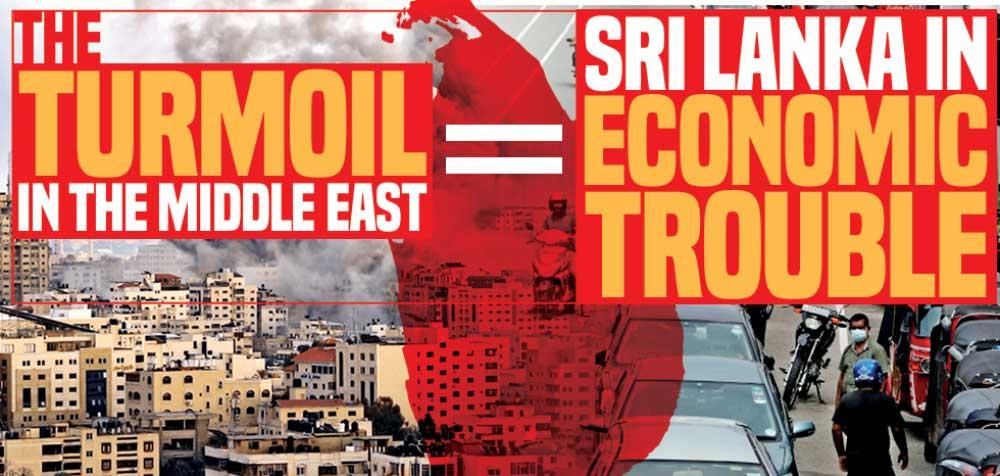
- The new reality is that the war has de facto created a gas and oil hegemon who now controls 20% of Gas and oil as we read this, with significant impact on the fertilizer industry as well.
- The reality is that no matter how many bombs each party has, disruption is only going to keep the strait shut and the price of oil and gas high
 If there was one thing that was sure to happen as an external factor that would affect the economy of Sri Lanka, it was the turmoil in the Middle East. This has been a constant since 1948 when Israel was established. All governments and organizations that have existed in this country have either had to deal with a war or some kind of disruption in the Middle East. Historically most of them have completely and utterly failed to deal with this issue preemptively, which now in all probability is going to becoming a long term certainty. The current government, government owned business undertakings and the other private businesses in Sri Lanka at this time is no exception; no contingencies only reactive crisis mitigation action at the cost of the public.
The usual risks for Sri Lanka are inward remittances and tourism and some export of tea. Sri Lanka has nearly 2 million people working in and around the Middle East and sending their hard earned salaries back home. Now, any disruption to this is going to have a massive effect on the economy of Sri Lanka. It is sad that over the years no government has been able to enhance this English illiterate, unskilled and low-skilled migration to the Gulf to an English literate, upskilled migration where people could be working across the world rather than in one region where there is a high demand for low-skilled and no-skilled jobs.
In addition to this, a significant amount of tourists had started to come from the Middle East. Not only was the Middle East becoming a hub that brought in tourists to Sri Lanka from other regions but the Arabian Peninsula was fast becoming a significant source market for Sri Lankan tourism. Now with this turmoil, all these are going to get disrupted and have a major negative impact on our economy. Even though there does not seem to be immediately actionable contingencies, Sri Lanka may be well be able to bring in tourists, flights would operate circumventing the geographic region where the conflict is happening and take them back to their home countries without major issues. However, the number of tourists that originated from the Arabian Peninsula will have to be replaced by another market.
Today, due to global connectivity and inter-connectedness of industries, conflicts do not distinguish among ordinary people, it really doesn’t matter to which race, religion you belong to, or which country you belong to, or which political opinions you have. At the end of the day, the amount of money you pay for your fuel at the pump and everything else is going to cost more due to this conflict. Who started it and how it ends will be inconsequential as we will probably never go back to those low oil and gas prices.
Was Iran gifted an unexpected victory?
The reason why I say this is that prior to this conflict, Iran was only a major producer of oil. It had its global share of 9% to 12%, however it did not have influence over 20% of the oil and natural gas that went through the Strait of Hormuz. The new reality is that the war has de facto created a gas and oil hegemon who now controls 20% of Gas and oil as we read this, with significant impact on the fertilizer industry as well. The reality is that no matter how many bombs each party has, disruption is only going to keep the strait shut and the price of oil and gas high.
It has also brought in to the limelight the cost of shipping and the fees charged by many such choke points around the world.
 Panama Canal: Charges fees based on vessel size and weight, and charges high premiums for last-minute booking slots.
Suez Canal (Egypt): A primary, high-cost route connecting the Mediterranean and Red Seas. It charges tolls that have increased following the Red Sea crisis.
Turkish Straits (Bosphorus & Dardanelles): Türkiye regulates passage and has increased fees for international ships transiting these straits.
Kiel Canal (Germany): Connects the North Sea to the Baltic Sea and charges tolls to avoid the longer route around Denmark.
Corinth Canal (Greece): A narrow waterway that charges fees, primarily for smaller vessels and tourist traffic
Even though currently the Bab el-Mandeb Strait is open to international shipping, with no fees levied for crossing it. The strait has the potential to become the next flash point in this crisis creating duel choke points to international trade.
In the current context, the only alternative to small countries that cannot project maritime power across the world is to agree to Iran’s terms and start trading oil and gas at a now higher price which includes a levy for passing through the Straits of Hormuz; paid in Chinese Yuan.
No matter how powerful a country may think they are and they may very well be, they won’t be able to put this Genie back in the bottle. The Iranians who as the aggrieved party having suffered from unilateral sanctions (again I am not judging the right or wrong of it) would see this as their opportunity and right to apply unilateral sanction as a result of this illegal war. In fact they may feel that they have nothing to lose. The world know that a low intensity asymmetric war can go on for decades keeping shipping away from this area and the prices of oil and gas high. Many countries would gladly pay the tax and get the oil and gas at a higher price than not have gas and oil and face instability within their own countries.
What’s next for Sri Lanka?
Not wanting to sound like a broken record on a repeat loop, the choices for Sri Lanka remain very simple and limited and has not changed since independence.
What has been consistent is successive governments have abandoned these strategically important activities to engage in petty politics which has resulted in the population being pulverized when these risks become real.
Let’s face it we will not be able become petroleum independent in the foreseeable future. No country or company is going to come and drill for oil and gas in Sri Lanka with a multiple billion-dollar investment when there are cheaper source options available around the world. Since we don’t have the technology, having our own petroleum is way over the horizon. Having said that, diversity of power sources is a must to be power-independent in the future.
It is sad that many learned economists make bold predictions of SL GDP growing at 4 – 5 %. However most don’t mention that for the economy to grow at that pace the power sector has to grow at least at double the pace in a stable manner.
1. Upgrading the national grid. How long and how often have we heard this from the previous to current government, the CEB and experts in the field? For any country to grow a major requirements is to have an efficient and manageable grid which is able to deliver power to areas that require it. Be it a factory (even oil and gas extraction and refining) a hotel or any other business, foreign or local investment will not happen in areas that does not have reliable power and a stable grid. If Sri Lankan electrical engineers are not knowledgeable and able to do this upgrade the state must intervene and get the expertise from countries such as India, China etc. and resolve this immediately before it becomes a major obstacle standing in the way of development of the country.
2. Invest in nuclear power energy to provide the base power need of the country. It is sad that since 2009 (end of the war) Sri Lanka has delayed implementing a nuclear power plant. Had we started in 2009, by now we would have a fully operational power plant. Moving the entire railway network into electric mode as well as moving all the buses into electric buses will help Sri Lanka considerably reduce the demand for diesel fuel. It should also help the country to manage the cost expectation of the public transport.
3. Within a period of 5 years ban all petroleum engine based three wheelers in the country and ensure that all new imports are done only for maintenance and new electric three wheelers.
4. QR Codes should only be issued to those with TIN Numbers to ensure those tax evaders and fuel hoarders are brought to book/eliminated
5. Maximize solar and wind projects to the level where all excess energy can be used to pump water back into the reservoirs to create and maintain a natural battery system and the balance of natural resources.
6. Adjust the vehicle import tax system to bring down the price of electrical vehicles and reduce the demand for petrol.
7. Enact a new Petroleum Retail Act so that it allows the petroleum retailers to be mandated to hold storage of three months’ supply of fuel (all types of fuel) in their retail establishment. This way all price fluctuations can be smoothed out.
8. Apply this same philosophy to all government institutions, such as the Central Transport Board, Railways, Airport and Aviation Services, the Tri-forces, police and other security agencies and any other organization that has their own pumps above ground to hold three months of fuel supply.
9. Leverage the utilization of all available and repairable tanks at the Trincomalee tank farm to store oil for our consumption.
Why Sri Lanka is still unable to become an air hub?
A weird dichotomy often pondered and discussed at various local and international fora. This elusive hub status for Air Line activity in Sri Lanka seems to evade us at every turn. Even during this current crisis there was a lot of hope on the much-debated white elephant down south in the name of Mattala International Airport. This crisis was perhaps seen as its salvation. However it turns out that we have only built half of a white elephant, which is completely unsuitable for any kind of hub operation with wide bodied or large aircraft. Aviation experts are of the view that the operational capacity it is less than ten wide-body aircraft that can be operated simultaneously at the Mattala airport. Whereas the requirement for a hub operation is much greater. In addition the lack of taxiways along the runway and so on, the list of should have beens seems to be greater than the list of could have beens. Which means that, most probably, Mattala will have a few more flights landing and taking off, especially cargo flights. However in terms of major passenger operations we are unlikely to get any large traffic through Mattala and will continue to have a few of those Russian planes landing in the foreseeable future.
So far there is only one Gulf Air aircraft which is parked (probably) on a long term basis at Katunayake. However, Authorities must take steps to move these aircraft to Mattala in order to prevent further congestion and denial of access to revenue generating activities at Katunayake.
Katunayake Airport it seems have more requests for transit flights at this time. The last thing we need is that flights will divert to India or Maldives due to the lack of space at Katunayake due to the negligence and lack of foresight of the officers’ operating the airport.
With regard to our national carrier; simple things such as air service agreements for emergency landings, refueling, and technical assistance that bypass the Middle East on a southerly route (Kenya, Nairobi, Ethiopia, Addis Ababa) connecting to Southern and Western Europe servicing hubs such as London; and easterly route (flying through the CIS countries to Turkey and into the Eastern and Central European destinations and hubs such as Amsterdam) should have been pre-entered and should have been ready in our books. When such an event occurs we could leverage on those air service agreements to fly to Europe and keep our tourism industry going at the level required by the country.
It is so sad and embarrassing to see the elites in the aviation industry fumbling about, not knowing what to do, when to do, how to do. Whereas these are fundamental conclusions that one can get to if one had followed a simple tool such as a SWOT analysis.
Another opportunity has come our way due to current congestion at the Katunayake airport where all the operations of the small business aircraft could be moved to Rathmalana. This is the ideal opportunity to rebrand and re-launch the Rathmalana airport (Another white elephant created by us since the construction of the KIA) as the Colombo City Business Airport of Sri Lanka with easy access to the Port City and connectivity to the expressways.
Once again it seems that the Sri Lanka is held, back by our own apathy. It is almost ubiquitous with Sri Lanka that most projects that are started are never completed. The same goes for the baseline road extension connecting the Kelaniya Bridge to the Rathmalana Airport. The road was terminated in Kirulapone and never extended to Rathmalana Airport. It seems that some sanity has prevailed and the current government is hoping to extend it maybe a couple of kilometres until it reaches Dutugemunu Street.
I hope that, given this current crisis, the government will expedite this project and extend it to the gates of the Rathmalana airport to ensure that we are able to make best use of this strategic connection between Rathmalana Airport and the city of Colombo to facilitate business and high net worth individuals (HNI’s) travel.
The fact that this road has been planned and designed and not executed for the last 20 years should be a source of national embarrassment and all necessary steps should be taken to quickly fulfill this need for the business community and investment flow.
The Rathmalana airport is also of great significance in terms of the rest of the infrastructure of the country. In terms of connectivity to the expressway and the Makumbura multimodal transport hub the distance is only 12 to 13 km.
While nations look for the silver lining in these dark cloud” times, Sri Lanka would be better served by looking inward for its silver lining and expediting and finishing projects so that we can avail of their strategic intention as well as enjoy the maximum economic benefit.
About the Author
Roshanga Wickremesinghe is the author of book How Small Countries Can Compete and Grow – A Case for Sri Lanka”. He is the founder of Think Tank Lanka (Pvt) Ltd. – a Strategy think tank and R & R Associates Consulting, a sector-independent Strategy Consulting practice.