බැංකු දෙකම එජාපයේ ගජමිතුරන්ගේ ණය බොල් ණය ලෙස කපා හැරලා

October 22nd, 2018

ඉෂාරා සිල්වා උපුටාගැණීම  මව්බිම

රටේ ප්‍රධාන රාජ්‍ය බැංකු දෙක වන ලංකා බැංකුව සහ මහජන බැංකුව පෞද්ගලීකරණය කිරීමට ආණ්ඩුව දරන උත්සාහය ව්‍යර්ථ කිරීම සඳහා බැංකු සේවකයන්ට සහාය දීමට ඒකාබද්ධ විපක්ෂය සූදානම් බව පාර්ලිමේන්තු මන්ත්‍රි ආචාර්ය බන්දුල ගුණවර්ධන පැවැසීය.

ටි්‍රලියන 3 1/2කට වැඩි වත්කම් ප්‍රමාණයක් තිබෙන මෙම රාජ්‍ය බැංකු 02 මෙලෙස නොසලකා හැරීමට නොහැකි බවද මන්ත්‍රිවරයා සඳහන් කළේය.

ඊයේ (21දා) පුංචි බොරැල්ල, වජිරාශ්‍රමයේ පැවැති ඒකාබද්ධ විපක්‍ෂයේ ආර්ථික පර්යේෂණ ඒකකයේ මාධ්‍ය හමුවට එක්වෙමින් ඔහු වැඩිදුරටත් මෙසේද කීය.

ලංකා ඉතිහාසයේ නිදහසින් පසු කවදාවත් නොවූ විරූ ආකාරයට රටේ සමස්ත බැංකු, මුදල් හා ණය ක්‍රමය ගැන අර්බුදයක් ඇති වුණා පසුගිය කාලයේ. යහපාලන ආණ්ඩුව බලයට පත්වෙලා දින 100 විප්ලවය යටතේ අගමැති රනිල් වික්‍රමසිංහ පත්කළ මහ බැංකු අධිපති අර්ජුන මහේන්ද්‍රන් යටතේ සිදුවූ මහ බැංකු කොල්ලය නිසා මහ බැංකුව ගැන තිබෙන විශ්වාසය කඩාවැටුණා. එහි ප්‍රතිඵලයක් ලෙස 2015 වසරේදී පමණක් රජයේ සුරැකුම්පත්වල ආයෝජනය වන මුදල් ඇමෙරිකානු ඩොලර් මිලියනයකට වැඩි ප්‍රමාණයක් විදේශ ආයෝජකයන් විසින් ආපසු රැගෙන ගියා.

අපේ රටේ රාජ්‍ය බැංකුවක් වන ලංකා බැංකුවේ වත්කම්වල වටිනාකම රුපියල් බිලියන 2,000කට වැඩියි. මහජන බැංකුවේ වත්කම්වල වටිනාකම රුපියල් බිලියන 1,500කට වැඩියි. රුපියල් බිලියන 3,500කට වඩා වැඩියි ලංකාවේ රාජ්‍ය බැංකු දෙකේ වත්කම් ප්‍රමාණය. විවිධ අවස්ථාවල දේශපාලන තීන්දු තීරණ මත මේ බැංකු 02 පිළිබඳව පෞද්ගලීකරණ යෝජනාව විටින් විට මතු වුණත් විශේෂයෙන් බැංකු සේවකකාරකාදීන් ඇතුළු සමස්ත රටේ ජනතාව රාජ්‍ය බැංකු 02 පෞද්ගලීකරණය නොකළ යුතුයි කියන පැහැදිලි ස්ථාවරයේ සිටිනවා.

එවන් තත්ත්වයක් තුළදී බැංකුවලට පත්කළ එ.ජා.ප.යේ හිතවතුන් අධ්‍යක්ෂ මණ්ඩලවලදී මහජනයා සතු වැඩිම මුදල් ප්‍රමාණය තියෙන බැංකු දෙකේ ඔවුන්ගේ ගජ මිතුරන්ගේ ණය කෝටි ප්‍රකෝටි ගණනින් බොල් ණය ලෙස කපාහැරලා තිබෙන බව වාර්තා වෙනවා. තමන්ගේ ගජ මිතුරන්ට අධ්‍යක්‍ෂ මණ්ඩලයේ සාමාජිකත්වය දරමින් සිටි අසාමාන්‍ය ලෙස ණය මුදල් ලබාදීලා තිබෙනවා. ලංකා බැංකුව පැහැදිලිව මහ දවල් මහ බැංකුවේ සිදුවූ කොල්ලයට සම්බන්ධතාව දක්වා තිබෙන බව බැඳුම්කර කොමිසමේ තහවුරු වුණා.

මේ තත්ත්වය තුළ ලංකා බැංකුවයි මහජන බැංකුවයි වැටිලා තිබෙන තත්ත්වය වැළැක්වීම සඳහා ජනාධිපති මෛත්‍රිපාල සිරිසේන විසින් ඇමැතිවරයාට උපදේශයක් ලබාදී තිබෙනවා, වහාම මේ බැංකු දෙකේ අධ්‍යක්‍ෂ මණ්ඩල විසුරුවා හැරලා නව අධ්‍යක්‍ෂ මණ්ඩල පත් කරන්න කියලා. නමුත් අද වනතුරු නව අධ්‍යක්‍ෂ මණ්ඩල පත් කරලා නැහැ. මේ නිසා ප්‍රධාන රාජ්‍ය බැංකු දෙකේ ඇති වෙලා තිබෙන කඹ ඇදිල්ල කරණකොටගෙන බැංකු ක්‍රමය තුළ අර්බුදයක් ඇති වෙලා තිබෙනවා. ඊයේ දිනයේදී ඒකාබද්ධ විපක්ෂයේ ආර්ථික පර්යේෂණ ඒකකයට ප්‍රධාන ආනයනකරුවන් කිහිපදෙනෙක් පැමිණ ප්‍රකාශ කළා, ඒ අයට දැනගන්න ලැබිලා තිබෙන ආකාරයට ඕස්ට්‍රේලියාව විසින් අපේ රාජ්‍ය බැංකුවලින් නිකුත් කරන ණයවර ලිපි ප්‍රතික්‍ෂේප කිරීමට සූදානම් වන බව. එවිට භාණ්ඩ ආනයනය කිරීමට අවහිරතා ඇති වන බවත් ඔවුන් කියා සිටියා.

මම ඔවුන්ට උපදෙසක් දුන්නා එය සත්‍යයක්ද කියලා බලන්න, සඳුදා දිනයේදී තවත් ණයවර ලිපියක් ඕස්ට්‍රේලියාවට මේ රාජ්‍ය බැංකු හරහා නිකුත් කරන ලෙස. එය ප්‍රතිග්‍රහණය කර නොගත්තොත් ඒ සඳහා රජයත් මහ බැංකුවත් බේරුම්කරණයකට යා යුතුයි.

1980 ගණන්වල පාර්ලිමේන්තුවේ විපක්‍ෂයේ මන්ත්‍රිවරුන් ලෙස සිටියදී මුදල් ඇමැතිවරයා ලෙස කටයුතු කළ ඩිංගිරිබණ්ඩා විජේතුංග මැතිතුමා එක්තරා දිනෙක පාර්ලිමේන්තුවට ඇවිත් ප්‍රකාශයක් කළා රාජ්‍ය බැංකු දෙකම බංකොලොත් කියලා. එහෙම කිව්ව ගමන් ඇති වූ ප්‍රතිඵලය තමයි මේ රාජ්‍ය බැංකු නිකුත් කළ ණයවර ලිපි ගනුදෙනු කරන්නේ නැහැ කියලා තීන්දුවක් ගැනීම. එහිදී රටේ ජනාධිපතිවරයා වශයෙන් සිටි රණසිංහ ප්‍රේමදාස මහතා මේ බැංකුවල ප්‍රාග්ධනය ප්‍රතිව්‍යුහගත කරලා නැවත නඟාසිටුවලා තමයි යන්තම් බැංකු දෙක බේරා ගත්තේ.

ඉන් පසුව ලෝකයේ විශාල මූල්‍ය අර්බුදයක් ඇති වුණා 2007 වර්ෂයේදී. ඇමෙරිකා එක්සත් ජනපදයේ බැංකු කඩාවැටුණේ කාඩ් කුට්ටමක් බිම වැටෙනවා වගේ. ඒ අවස්ථාවේදී ලංකාවේ සෙලාන් බැංකුව හෙලවුණා. එවකට රටේ මුදල් ඇමැතිවරයා ලෙස කටයුතු කළේ හිටපු ජනාධිපති මහින්ද රාජපක්‍ෂ මහතා. ඔහු සෙලාන් බැංකුව රජයට පවරාගෙන මූල්‍ය අර්බුදයෙන් බේරා ගත්තා. අදටත් සෙලාන් බැංකුව වඩාත් කාර්යක්‍ෂම බැංකුවක් ලෙස තිබෙනවා.
මේ රටේ ජනාධිපතිවරයා මෙතරම් අසරණ වෙලා තියෙන්නේ ඇයි කියලා අපට තේරෙන්නේ නැහැ. රටේ බැංකු ක්‍රමය, ණය ක්‍රමය අර්බුදයකට ලක්වෙලා තිබෙනවා.

මංගල සමරවීර මහතා කියලා තියෙනවා මාධ්‍ය සාකච්ඡාවකදී මගේ නම කියලා මම බදු ගෙවනවද දන්නේ නැහැ. ආදායම් බදුවල නඩු තියෙනවාද දන්නේ නැහැ. මම බලාපොරොත්තු වෙනවා මගේ ගිණුම් සකස් කරන ආයතනයට මේ අවුරුද්දේ බදු නොවෙයි, අවුරුදු 5ක 10ක ආදායම් බදු විස්තරය ගෙන එන්න කියලා ලබන අඟහරුවාදාට. මම එය ඉදිරිපත් කළ විට මම බලාපොරොත්තු වෙනවා වත්මන් මුදල් ඇමැති සහ හිටපු මුදල් ඇමැතිත් එලෙසින්ම ඔවුන්ගෙ ආදායම් බදු විස්තරය ඉදිරිපත් කරයි කියලා.

පාර්ලිමේන්තු මන්ත්‍රි සිසිර ජයකොඩි

අධ්‍යාපන ඇමැතිවරයා කියනවා පාසල් නිල ඇඳුම් සඳහා ආනයනය කළ රෙදිවලට එල්ල වන චෝදනාව බොරුවක්, වවුචර් ක්‍රමය අවසන් වෙන්නේ නැහැ කියලා. අපිට දැන් ප්‍රශ්නය තිබෙන්නේ මේ කැබිනට් පත්‍රයේ අධ්‍යාපන අමාත්‍යාංශයත් කර්මාන්ත සහ වාණිජ අමාත්‍යාංශයත් එකට එකතු වෙලා ඉදිරිපත් කළ කැබිනට් ප්‍රකාශනය.

මේ රෙදි ගනුදෙනුව සම්බන්ධයෙන් මෙහි සියලු කාරණා අන්තර්ගත වෙනවා. අධ්‍යාපන අමාත්‍යාංශයත් කර්මාන්ත සහ වාණිජ අමාත්‍යාංශයත් කැබිනට් පත්‍රිකා යොමු කරමින් කියනවා අපි බොරු කියනවා කියලා. මේ ගැන හෙළිදරව් කළ නිසා මේ ගනුදෙනුව ඉදිරියට ගෙන යා නොහැකි නිසයි ආණ්ඩුව මේ වගේ බොරු කියන්නේ.


පොලිස්පති ධුරය ගැන තීරණයක් ගන්න නොහැකි වුණත් දේශපාලන දඩයමට ආණ්ඩුව දක්‍ෂයි

October 22nd, 2018

කොළඹ – ජනක විජේවර්ධන, බත්තරමුල්ල – ඉනෝකා උදයංගනී ඡායාරූප – සස්සඳ ලියනාරච්චි උපුටාගැණීම  මව්බිම

ජනාධිපතිවරයා ඝාතනය කිරීමට උසස් පොලිස් නිලධාරියකු මැදිහත් වෙලා තියෙන මොහොතක, පොලිස්පති ඉවත් කර ගැනීමට මේ ආණ්ඩුවට නොහැකි වුවද, දේශපාලකයන් දඩයම් කරමින්, ඔවුන් හිරගෙවල් වෙත ගාල් කිරීම ආණ්ඩුවේ පිළිවෙත වී ඇතැයි හිටපු ආරක්ෂක ලේකම් ගෝඨාභය රාජපක්ෂ පැවැසීය.

ඒ මහතා එම අදහස් පළ කර සිටියේ කෝට්ටේ පැවැති ‘එළිය’ වැඩසටහන එක් වෙමිනි.

එහිදී ගෝඨාභය රාජපක්ෂ මහතා මෙසේද පැවැසීය.

අද මේ ආණ්ඩුව කියනවා මොනව කරන්න බැරි වුණත් අපි ලෝකය දිනුව කියලා. ආණ්ඩුව කියනවා අපි ජිනීවා ගැන කතා කරන්නේ ජනතාව බියගන්වන්න කියලා. යුද්ධ කාලේ පවා එක්සත් ජාතීන්ගේ සාම හමුදාවලට අපේ රණවිරුවන් යවන්න අවස්ථාව ලැබිල තිබුණා. අද එක්සත් ජාතීන්ගේ සංවිධානයෙන් ඉල්ලල තියෙනවා අපි ඒ රටට යවපු අපේ අණදෙන නිලධාරිතුමා වහාම ඒ රටෙන් පිට කරන්න කියලා. එදා යුද්දෙට මුහුණ දුන්න අපේ හමුදා නායකයන් කිසිවකුට අද බටහිර රටවලට යන්න බැහැ.

අපි ලෝකය දිනන්න කියලා බටහිර රටවලට ඕන විදියට අපේ රටේ නීති වෙනස් කරන්න යනවා නම් ලෝකය දිනුවා කියලා කියන්නේ කොහොමද කියලා ප්‍රශ්නයක් මතුවෙනවා.

මේ ආණ්ඩුවේ මුදල් ඇමැතිතුමා පාර්ලිමේන්තුවේදී කියනවා ආර්ථිකය කඩාවැටිලා තියෙන්නෙ මහින්ද යුගයේදී ආරම්භ කරපු සමහර ව්‍යාපෘති නිසා කියලා. මේ රටට දෙවැනි ජාත්‍යන්තර ගුවන්තොටුපොළක අවශ්‍යතාව ඉතාම තදින් තිබුණා. ඒක ජයගන්න පුළුවන් වුණේ මහින්ද රාජපක්ෂ මහතාට පමණයි. මේ වගේ වැදගත් ගුවන්තොටුපොළක් හැදුවම ඒකෙන් මුදල් උපයන්නට වාණිජ සැලැස්මක් තියෙන්න ඕන. එවැනි සැලැසුමක් ඇති කරන්නේ නැතිව දේශපාලන වෛරය නිසා ඒ ගුවන්තොටුපොළේ වායුසමීකරණය කළ ගබඩා තුළ වී ගබඩා කළා. අද ඒ ගුවන්තොටුපොළ ඉන්දියාවට දීල සල්ලි ගන්න හදනවා. මේ වගේ අදූරදර්ශී ක්‍රියා නිසා රටේ ආර්ථිකය අද කඩා වැටිලා.

මේ රටේ වසර තිහක් පුරා තිබුණු යුද්ධය නිසා අපේ සංවර්ධනය අඩාල කරලා ආර්ථිකය කඩාවැටිල තිබුණ අවස්ථාවක අපේ මූලික අවශ්‍යතාව වුණේ රටේ ආර්ථිකය ඉදිරියට ගෙනියන්න. මේ ආර්ථිකය ඉදිරියට ගෙනයන්න අපේ රටේ ආයෝජකයන් වගේම අපිට විදේශ ආයෝජකයොත් අවශ්‍ය වුණා. ලෝකේ සෑම රටක්ම ආර්ථිකය ඉදිරියට ගෙනියන්නට මූලිකව කරන්නේ යටිතල පහසුකම් වර්ධනය කිරීම. ඒ යටිතල පහසුකම් ආරම්භ කිරීම තුළින් කුඩා මට්ටමේ ව්‍යවසායකයන් විශාල ප්‍රමාණයක් රටේ බිහි වුණා. මේවා සියල්ලක්ම කඩා වැටීම නිසා ඍජුවම රැකියා හාරලක්ෂයක් ඉදිකිරීම ක්‍ෂේත්‍රයේ පමණක් අපිට නැති වුණා.

සමහර අය අපිට චෝදනා කරනවා සුළු ජාතීන්ට විරුද්ධව අපි වැඩ කළා කියලා. යුද්ධයෙන් පස්සේ උතුර නැඟෙනහිර පළාත්වල විශාල සංවර්ධනයක් අපි ඇති කළා. පශ්චාත් යුද සමයේදීත් ඒ පළාත්වල ජනතාවගේ ජීවන තත්ත්වය නඟාසිටුවන්නට අපි විශාල සංවර්ධන ව්‍යාපෘති ඇති කළා. කවුරුවත් මේ ගැන කතා කරන්නේ නැහැ.

මේ ආණ්ඩුව කියනවා ප්‍රජාතන්ත්‍රවාදය ඇති කළේ මේ ආණ්ඩුව කියලා. එදා මහින්ද රාජපක්ෂ ආණ්ඩුව පළමුවැනි වතාවට උතුරු පළාත් සභා මැතිවරණයක් පැවැත්වූවා. නමුත් එදා ප්‍රජාතන්ත්‍රවාදය ගැන කතා කරන මේ ආණ්ඩුව පළාත් සභා හයක පමණ ඡන්ද පවත්වන්නෙ නැහැ. ප්‍රජාතන්ත්‍රවාදයේ මූලික දේ තමයි මහජනතාවගේ ඡන්දය. මේ ආණ්ඩුව ඒ ඡන්ද පවත්වන්නේ නැහැ.

මේ රජයේ පොලිසියේ සමහර අයගේ ක්‍රියාදාමයන් ගැන ජනතාව දන්නවා. නමුත් එදා අලුත්ගම ඇතිවුණ සිද්ධිය වෙලාවේ එදා පැයක් ඇතුළත අපේ හිටපු පොලිස්පතිවරයා එතැනට ගියා. එහෙම ගිහිල්ල ඒ තත්ත්වය පාලනය කළා.

යුද්ධය ඉවරවෙලා ජනතාවට පීඩාවක් නොවන ආකාරයට උතුරු පළාතේ නීතිය අපි ක්‍රියාත්මක කළා. යුද්ධය අවසාන වෙලා මේ ආණ්ඩුවට අපි රට භාරදෙන අවස්ථාව වනතුරුම ඒ පළාතේ කිසිම සිද්ධියක් වෙන්න අපි ඉඩ දුන්නෙ නැහැ. නමුත් අද යාපනේ ආවා කල්ලිය පාලනය කරන්න මාර්ග බාධක දානවා. මේ අදුරදර්ශී ක්‍රියාකලාපය නිසා රට සෑම පැත්තකින්ම අසාර්ථක වෙලා. මෙයාලා රට භාර ගත්තේ කිසිම සැලැස්මක් නැතිවයි.
අපි මේ ආණ්ඩුව ඉවත් කිරීම ගැන පමණක් නෙවෙයි අපි භාරගන්න ආණ්ඩුව ඉදිරියට කරන්නෙ කොහොමද කියන එක ගැනත් සැලැසුම් හදන්න ඕන. ඒ සඳහා ජනතාව දැනුවත් කරමින් මේ එළිය සංවිධානය වගේ සම්මන්ත්‍රණ සෑම නගරයකම පවත්වනවා.

හිටපු මහ බැංකු අධිපති අජිත් නිවාඩ් කබ්රාල්

මේ ආණ්ඩුවේ මුදල් ඇමැතිතුමා පසුගියදා මාධ්‍යයට ඇවිල්ල පෙන්නුව ඉන්ධන සූත්‍රය කියල කොළයක්. ඒ පෙන්නපු සූත්‍රයේ ඉන්ධන කොස්ට් එකක් නැහැ. මේක වෙන සූත්‍රයක්. මුදල් ඇමැතිතුමා කිව්ව මේක හරි සරලයි පෙර පාසල් යන ළමයකුට වුණත් තේරෙනවා කියලා. මේ පෙන්නපු කොළේ ලියල තියෙනවා ර්පන ඍ 1,ඍ 2, ඍ 3, ඍ 4 කියලා.

මේකේ ථපන කියන්නේ මෛත්‍රි රනිල් ප්‍රතිපත්තිය ඍ1 කියන්නේ ඒ ප්‍රතිපත්තියේ දේශපාලන දර්ශනය. ඒ කියන්නේ වෙන් කිරීමේ බෙදීම. ඒ කටයුත්ත මේ දෙන්න දැනටමත් ඉතාම හොඳින් කරගෙන යනවා. ඍ2 කියන්නේ මේ මෛත්‍රි රනිල් ප්‍රතිපත්තියේ දේශපාලන න්‍යාය. මේ දෙන්න ඉතාමත්ම දක්ෂයි ඕනම දෙයක් විකෘති කරන්න. මේ ආණ්ඩුවේ ඇමැතිවරයෙක් කිව්ව රුපියල අවප්‍රමාණය වෙන එක හොඳයි කියලා.

මේ ආණ්ඩුව කියනවා අපේ රටේ අපනයන ප්‍රතිශතය අඩුවෙලා. ඒ නිසා තමයි මේ සේරම ප්‍රශ්න කියලා. අපේ රටේ දළ දේශීය නිෂ්පාදනය ශීඝ්‍රයෙන් වැඩි වුණේ මහින්ද රාජපක්ෂ මහතා කාලේ. නිදහසෙන් පස්සේ අවුරුදු 56ක් තිස්සේ අපේ රටේ මුළු ආර්ථික මට්ටම බිලියන 24යි. එතුමා අවුරුදු නවයකට පස්සේ රට භාරදෙනකොට සියයට 300කින් වැඩිවෙලා බිලියන 79 දක්වා වැඩිවෙලා තිබුණා. ඒක සුළු පටු වර්ධනයක් නෙවෙයි. මහින්ද රාජපක්ෂ යුගයේදී අපේ රටේ රුපියල අවප්‍රමාණය වුණේ වසරකට සියයට 2.8ක් පමණයි.

රනිල් වික්‍රමසිංහ මහත්තයා කියනවා ලෝකෙම ආර්ථික අර්බුදයක් ඇති වෙලා තියෙනවා කියලා. මේ කතාව කියන්නේ රනිල් වික්‍රමසිංහ විතරයි. වෙන කිසිම කෙනෙක් ඒ කතාව කියන්නේ නැහැ. ශ්‍රී ලංකාවට වෙන ප්‍රතිවිපාක හරියට කළමනාකරණය කරගත්තේ නැත්තන් ඒක අපේ ප්‍රශ්නයක්. ඒක ලෝකෙ ප්‍රශ්නයක් නෙවෙයි.

මහින්ද රාජපක්ෂ මහත්තයා මේ රට බාරදෙනකොට රටේ ණය ප්‍රමාණය තිබුණෙ රුපියල් බිලියන 7යි. අද ඒක රුපියල් ටි්‍රලියන 12 දක්වා වැඩිවෙලා තියෙනවා.

දැන් අපේ රටේ දළ දේශීය නිෂ්පාදනයත් එක්ක ණය ප්‍රමාණය සියයට 87 දක්වා වැඩිවෙලා. මංගල සමරවීරගේ ඍ3 එකෙන් කියන්නේ මේ ආණ්ඩුවේ පරිපාලන න්‍යාය. ඕනම ප්‍රශ්නෙකදී මේ ආණ්ඩුව ලිස්සා යෑම හරියටම කරනවා. ඒ ප්‍රතිපත්තිය තමයි ඒකෙන් කියැවෙන්නේ.

ඍ4 කියන්නේ විකිණීම. අතට අහුවෙන ඕනම එකක් මේ ආණ්ඩුව විකුණනවා. ඒ ප්‍රතිපත්තිය හරියටම මේ ආණ්ඩුව කරගෙන යනවා. මේ ආණ්ඩුව බලයට ආවේ රැකියා ලක්ෂ 10ක් ඇති කරනවා කියලා. නමුත් අද විරැකියාව ශීඝ්‍රයෙන් අපේ රටේ පැතිරගෙන යනවා. ජනතාවට මේ ප්‍රශ්නය උහුලන්න බැහැ. ජනතාව මේ ප්‍රශ්නෙට මුහුණ දෙන්නෙ කොහොමද කියල කල්පනා කරනවා. මේ ආණ්ඩුවේ ඇමැතිවරු එක එක බෝර්ඩ් පෙන්නල විනෝද වෙනවා.


Yahapalana Shylocks

October 22nd, 2018

Editorial Courtesy The Island


Former Petroleum Minister Chandima Weerakkody has called the government’s fuel pricing formula an affront to the people’s intelligence. He views it as a mechanism contrived to jack up fuel prices continually and raise funds for a spendthrift government. He is one of the ousted SLFP ministers who never miss an opportunity to settle scores with the government. However, he seems to have struck a responsive chord with the irate public reeling from the seemingly never-ending petroleum price hikes. One is at a loss to understand why some government ministers admitted, in public, a few weeks ago, that they could not comprehend the aforesaid formula, which is ludicrously simple.

An increase in fuel costs invariably pushes the general price level up. The problem with prices in this county is that they are sticky; even if the factors that lead to their increases cease to be, they still remain high. A substantial fuel price decrease is not possible before the next provincial council elections, which have been postponed indefinitely, and the cost of living is bound to soar further. It is only wishful thinking that transport costs will come down even in the unlikely event of a considerable fuel price reduction.

As for managing the cost of living and curtailing the ever increasing cost of production which is sure to put many a small venture out of business, the need for keeping fuel prices and electricity tariffs at affordable levels cannot be overemphasised.

Going by the yahapalana pricing formula, fuel prices can be brought down by reducing government taxes. No government can do without taxes and fuel is taxed all over the world. But tax reductions will be within the realms of possibility if wasteful government expenditure is curtailed. Petrol (regular) and diesel (regular) are currently taxed at the rate of Rs. 53.68 and Rs. 25.48 per lire respectively.

The government is currently on an election-oriented spending spree, camouflaged as a development drive. It is labouring under the delusion that development gimmicks will help it gain some traction on the political front, where it has suffered humiliating setbacks. Public funds are also allocated with a generous hand for a controversial soft loan scheme, which has come under heavy criticism as a vote-catching project.

A wag says publicity for the opening of a culvert costs the public as much as the construction of a new bridge thanks to ruling politicians’ ballooning egos. This is the name of the game in politics. We have pointed out, in this space, that the number of ships calling at the Hambantota Port has not yet exceeded that of dancers at the grand opening of the facility under the previous government. Such ‘boru shows’ did not help the Rajapaksa administration remain in power. The tradition continues. Politicians have no moral right to gain mileage from projects implemented with public funds, a sizeable chunk of which they and their kith and kin help themselves to by way of kickbacks. This kind of expenditure can be curtailed substantially, especially in times of crisis.

A cursory glance at the Appropriation Bill 2019 shows that fund allocations for the President and the Prime Minister have been increased significantly. But, as for the people, the real income has been declining steadily. It costs the taxpayers the earth to maintain their elected representatives who are living extravagantly. If the government adopts the austerity measures its leaders promised before the 2015 regime change, a great deal of funds can be saved and the need for jacking up fuel prices on a monthly basis obviated.

Regrettably, the government does a Shylock by exacting its pound of flesh in the form of extortionate taxes on fuel while claiming to uphold what it calls ‘compassionate governance’.

Visit of the Sri Lanka – Swiss Parliamentary Friendship Association to Switzerland, 14-20 October 2018

October 22nd, 2018

Sri Lanka Permanent Mission  Geneva

A delegation of Members of Parliament representing the Sri Lanka – Swiss Parliamentary Friendship Association (SLSPFA) visited Geneva on 18 October 2018, continuing with a week-long  programme of visit to Switzerland from 14 to 20 October 2018.  The multi-party delegation, led by Hon. Ananda Kumarasiri, Deputy Speaker of the Sri Lanka Parliament, comprised Hon. Jayampathy WICKRAMARATNE,  the SLSPFA President, as well as Hon. Seenithamby YOHESWARAN, Hon. J.C. ALAWATHUWALA, Hon. Edward GUNASEKARA, Hon. Dr. Sudarshini FERNANDOPULLE, Hon. Prof. Ashu MARASINGHE, Hon. Bimal RATHNAYAKE, Hon. Charles NIRMALANTHAN, Hon. K.K. PIYADASA, Hon. K. Sujith PERERA and Hon. Ishak RAHUMAN.

At the Permanent Mission of Sri Lanka, the Members of Parliament were warmly welcomed by Ambassador A.L.A Azeez and Mission’s staff and were hosted to a high tea reception.

The delegation’s programme in Geneva included meetings with the officials and experts of the Geneva International Center for Humanitarian Demining GICHD, the Geneva Centre for Security Policy (GCSP), the Geneva Centre for the Democratic Control of Armed Forces (DCAF), and the Office of the United Nations High Commissioner for Human Rights. They also visited the United Nations Office in Geneva, following which they were hosted to lunch by Permanent Representative of Switzerland in Geneva.

In the capital city of Bern and other cities they visited, the delegation engaged with Members of Parliament and high officials of Switzerland on a wide range of matters of bilateral significance. They also familiarized with the workings of the Swiss democratic institutions and the cantonal system, as well as development cooperation and trade, investment and migration policies of Switzerland.

Sri Lanka Permanent Mission

Geneva

Innovation and technology key to progress,  Deputy Speaker tells the IPU General Assembly  

October 22nd, 2018

Sri Lanka Permanent Mission Geneva

 Addressing the 139th Session of the Inter-Parliamentary Union (IPU) General Debate on 16 October 2018 under the theme ‘Parliamentary leadership promoting peace and development in the age of innovation and technological change’, Deputy Speaker Ananda Kumarasiri stressed that ICT has revolutionized the work of the Parliament of Sri Lanka bringing the parliamentarians and the parliamentary processes closer to the people.

Leader of the Sri Lanka delegation to the IPU session this year, Deputy Speaker Ananda Kumarasiri  spoke on the role of science and technology in the implementation of the 2030 Sustainable Development Agenda. He emphasized the need for development strategies to be responsive by taking into account the opportunities and challenges arising from new technologies such as nanotechnology, biotechnology, Artificial Intelligence, and space technology. Harnessing these technologies would be crucial to achieving sustainable development, said the Deputy Speaker.

In Sri Lanka,  the Deputy Speaker stated, the Government of Sri Lanka through its ‘Vision 2025’ provides a policy framework  to develop strategies that encourage the use of digital and other modern technologies that could help Sri Lanka become globally competitive and drive the nation towards a digitally empowered economy”. He further elaborated the recent initiative ‘Enterprise Sri Lanka’, a socio-economic advancement programme that includes among its objectives the development of technology and technical and managerial skills” given that this has been identified as an important constraint affecting SME and Micro sector development”.

Highlighting the key role that women could play in economic development including through participation in decision making, the Deputy Speaker stressed that ICT could have a significant impact enabling women empowerment and gender equality.

Sri Lanka delegation to the IPU Assembly comprised Minister of Transport and Civil Aviation Nimal Siripala de Silva, State Minister of Tourism and Christian Affairs Ranjith Aluvihare, Members of Parliament K. Thurairetnasingam and Prasanna Ranatunga and Secretary General of Parliament Mr. Dhammika Dasanayake.

Ambassador A.L.A. Azeez, Permanent Representative to the UN in Geneva, Mrs. Samantha Jayasuriya, Deputy Permanent Representative and Ms. Shashika Somaratne, Minister Counsellor of the Permanent Mission facilitated the programme of visit, and were associated with the delegation at the meetings held.

The delegation held bilateral discussions with Secretary General of IPU Mr. Martin Chungong on the sidelines of the IPU Assembly.

Full statement delivered by the Hon. Deputy Speaker attached herewith.

Sri Lanka Permanent Mission

Geneva

22 October 2018

Parliamentary Leadership Promoting Peace and Development in the Age of Innovation and Technological Change

Distinguished Delegates, Ladies and Gentlemen,

I am privileged to address you at the 139th Inter Parliamentary Union Assembly today. I would like to express my profound gratitude to all the organizers of the conference for the opportunity given to me to address this distinguished gathering.

A new wave of technology is driving rapid global change. Spectacular advances in science and technology over the last five decades have the entire world.  This rapid change has created innovative opportunities for the IPU member countries in the areas of sustainable development, state –society relations, peace and conflict, international security and global governance. Peace and development in the age of innovation and technological change is a timely topic.  The United Nations have come a long way in integrating new technologies into its discussions and work on peace and harmony. The 2000 UN Millennium Declaration, which laid out goals for a more peaceful, prosperous, and just world, contained a commitment to ensure that the benefits of new technologies, especially information and communication technologies are available to all.”

New technologies also offer new opportunities for managing conflict and building peace, particularly at the local level. Beyond assisting in conflict resolution, participatory data collection and processing tools can empower communities to resist violence and recover after conflicts. However, in peace building, too, these technologies may bring risks at times. Access to new technologies is often uneven and can be manipulated by persons and authorities causing users to face privacy and security risks. ICTs provide opportunities to collect data about crimes and conflict which could be used to find early solutions.

Parliament is the best and foremost place to promote peace and development in this digital age. It facilitates participation of citizens in the governance process through their elected representatives.  The NESTA, which  is a global innovation foundation, has stated that new experiments are showing how digital technologies can play a critical role in engaging new groups of people, empowering citizens and forging a new relationship between cities and local residents, and parliamentarians and citizens. Therefore, it is evident that in the 21st century, technology is interlinked with peace and development.

In Sri Lanka, we have a vision to make synergies between science and technology for development.   Sri Lanka’s ‘Vision 2025’ policy provides a framework  to develop strategies that encourage the use of digital and other modern technologies to become  globally competitive and drive the nation towards a digitally empowered economy.  We have taken steps to use ICT in every sector including economy, education, health, and environment. I am proud to say that recently the  Government initiated ‘Enterprise Sri Lanka Programme’ to  enhance the economy in order to achieve the Government’s medium-term targets such as per capita income of USD 5,000, one million new jobs, doubling exports, achieving and maintaining  more than five percent GDP growth etc . The programme is also focusing on the development of technology and technical and managerial skills which have also been identified as an important constraint affecting SME and Micro sector development.

I wish to sate at this juncture that, science and technology has a pivotal role to play in the implementation of 2030 Agenda for Sustainable Development, through research and development, innovations and inventions. I should stress that the  Goal 16 of the SDGs focuses on building peaceful, just, and inclusive societies. Furthermore, we must understand that there can be no sustainable peace without the Rule of Law. In this regard the essence of Sustainable Development Goal 16 to promote the Rule of Law and provide access to justice. It is important to note that development strategies of countries are geared to respond to opportunities and challenges in view of the rapid technological changes that are taking place in the world such as nanotechnology, biotechnology, robotics, Artificial Intelligence (AI),  solar space technology, etc. As we are working towards achieving Sustainable Development Goals (SDGs) by 2030, mobilizing these emerging technologies will have a significant impact in achieving the targets envisioned in SDGs including industrial innovation, sustainable production, improving health and education of societies while leaving no one behind.

Moreover, I strongly believe that women are important agents for creating stability in the lives of their families and to promote reconciliation and peace even under very difficult and traumatic situations. However, women’s peace building potential has had no significant impact on policies and decisions relating to conflicts because of their absence from the decision-making processes and bodies in the region. Women empowerment is crucial is achieving all development goals since they can contribute a lot to the economy and society.  ICT has great potential to enable women’s economic empowerment which would stimulate growth.   According to the Department of Census and Statistics, in Sri Lanka, female computer literacy rate was 26.1 per cent, in 2017. Computer literacy among male was 30.7 per cent.  These trends show that women’s participation in the information technology is lagging behind that of men.   Supporting women’s participation in the age of innovation has direct positive impacts on gender equality as well as economic development in a country.

We believe that effective Science Technology and Innovation (STI) policies and strategies can help societies to prepare for the rapid technological change while providing adequate rewards for the professional community to facilitate those policies and strategies. We note that there is a significant gap between the developed and developing countries in this regard such as inadequate funding and resources and industrial infrastructure, knowledge gap and brain drain. etc.

I would like to mention here that Parliament of Sri Lanka is now using new technology to enhance its key functions and uphold the e-parliament concept.  Further, Members of Parliament share information by using ICT applications and interact with the citizens. These applications provide information to citizens about ongoing parliamentary work.  The citizens’ input in the legislative process too can be obtained. In Sri Lanka, the Information and Communication Technology Agency (ICTA) and the United Nations Development Programme (UNDP) helped the Parliament to apply ICT in the Parliamentary work.  To create an e-chamber, computer portals have been fixed in front of the seats of every member in the Parliament to access the internet and the Parliamentary information service. In order to gain easily and quickly the updated information and other documents relevant to the chamber activities they are published in the Parliament website, Moreover, telecasting Parliament’s activities on a special TV channel helps tocreate awareness among the people. Thus, they are well-informed on Parliamentary matters.  We are proud to state that IPU has recognized Sri Lanka Parliament as a Model Parliament in the South Asian region.

Finally, I believe that the international cooperation is necessary to foster peace and development through science and technology, especially in terms of sharing expertise, improving human resources, facilitating research and providing pathways for effective transfer of information. In this regard, we welcome the ‘Science for Peace Schools’’ launched by  the IPU and CERN (European Organization for Nuclear Research) which is aimed at creating a link between the fields of science and politics , to build peace among nations through scientific cooperation.

In conclusion, I would like to request that all Parliaments should make maximum effort to promote peace and development through science and technology in this modern era.

Thank you!

එල්.ටී.ටී.ඊ.සංවිධානයට අයත් බවට සැක කෙරෙන ටී-56 වර්ගයේ ගිණි අවි අත් බෝම්බ ඇතුළු යුද උපකරණ 32 ක් පොලීසිය විසින් 21 දා රාත්රී ගොඩ ගෙන තිබේ.

October 22nd, 2018

දිනසේන රතුගමගේ

වවුනියාවේ කනගරායන්කුලම ප්රදේශයේ වළ දමා තිබූ එල්.ටී.ටී..සංවිධානයට අයත් බවට  සැක කෙරෙන ටී-56 වර්ගයේ ගිණි අවි අත් බෝම්බ ඇතුළු යුද උපකරණ 32 ක් පොලීසිය විසින් 21 දා රාත්රී ගොඩ ගෙන තිබේ.

වවුනියාව කනගරායන්කුලම  පොලීසියට ලබුණු තොරතුරක් මත මේ යුද උපකරණ තොගය  පොලීසිය වීස්න් සොයා ගෙන තිබේ.

කනගරායන්කුලම පොලීසිය මේ සම්බන්ධයෙන් පොලිස් විශේෂ කාර්ය බලකායේ නිලධාරීන්ට තොරතුරු දැණුම් දීමෙන් පසුව යුද උපකරණ ගොඩ ගැනීම සදහා පොලිස් විශේෂ කාර්ය බලකායේ නිලධාරීන් කනගරායන්කුලම පොලීසියේ නිලධාරීන්ට සහය වී තිබේ.

මේ යුද උපකරණ සම්බන්ධයෙන් 22 දා වවුනියාව දිසා අධිකරණයට කරුණු ඉදිරිපත් කිරීමෙන් පසුව ඒවා විනාශ කිරීමට දිසා අධිකරණයෙන් නියෝග ලැබී තිබේ.

කනගරායන්කුලම පොලීසිය සිද්ධිය පිළිබදව පරීක්ෂණ පවත්වා ගෙන යයි.

ජනතා විමුක්ති පෙරමුණ විසින් මේ දිනවල යාපනය පුරා අත් පත්රිකා බෙදීමේ ව්යාපාරයක් ආරම්භ කොට තිබේ.

October 22nd, 2018

දිනසේන රතුගමගේ

ජනතා විමුක්ති පෙරමුණ විසින් මේ දිනවල යාපනය පුරා අත් පත්රිකා බෙදීමේ ව්යාපාරයක් ආරම්භ කොට තිබේ.

ජනතා විමුක්ති පෙරමුණේ ලේකම් ටිල්වින් සිල්වා මහතාගේ ප්රධානත්වයෙන් බෙදා හැරෙන මෙම අත් පත්රිකාවල වත්මන් රජය වසර තුනක් තිස්සේ කරගෙන යනු ලබන ක්රියාදාමය තුළින් ජනතාවට සහනයක් සිදුව නැති බව පැවසෙන අතර රටේ වත්මන් තත්ත්වය පිළිබදවද කරුණු විග්රහ කොට තිබේ.

මේ අවස්ථාවට ජනතා විමුක්ති පෙරමුණේ යාපනය දිස්ත්රික්කයේ හිටපු පාර්ලිමේන්තු මන්ත්රී රාමලිංගම් චන්ද්රසේකරන් මහතාද එක් වී සිටින අතර ඔහු පැවසුවේ සමස්ත යාපනයම නියෝජනය වන අන්දමට මෙම අත් පත්රිකා බෙදා හරින බවයි.

යාපනයේ ආනේකෝට්ටේ කන්නගි අම්මාන් කෝවිලේ වාර්ෂික පෙරහැරේදී ඊළාම් සිතියමක් රැගෙන යයි

October 22nd, 2018

දිනසේන රතුගමගේ

යාපනයේ ආනේකෝට්ටේ කන්නගි අම්මාන් කෝවිලේ  වාර්ෂික පෙරහැරේදී  ඊළාම් සිතියමක් රැගෙන යාමේ සිද්ධිය සම්බන්ධයෙන් පුද්ගලයින් නව දෙනෙකුට එරෙහිව යාපනය අධිකරණයේ නඩු පැවරීමට පොලිස් ත්‍රස්ත මර්දන ඒකකය පියවර ගෙන තිබේ.

එම කෝවිලේ වාර්ෂික පෙරහැර පැවති පසුගිය ජූනි මාසයේදී ඊළාම් සිතියමක් විදුලි බුබුලු වලින් අලංකාර කොට පෙරහැරේ රැගෙන යාමේ සිද්ධිය සම්බන්ධයෙන් කට උත්තර ලබා ගැනීම සදහා කෝවිලේ බාරකාර මණ්ඩලයේ හා කෝවිලේ තරුණ සංගමයේ පස් දෙනෙකු නම් කොට ඔවුන්ට කොළඹට පැමිණෙන ලෙස පොලිස් ත්‍රස්ත මර්දන ඒකකය මගින් දැණුම් දී තිබුණි.

ඔවුන්ගෙන් ලබා ගත් කට උත්තර වලට අනුව මේ සිද්ධිය ඉතා සැලසුම් සහගතව සිදු කළ  ක්‍රියාවක් මිස එය අහම්බෙන් සිදු වූ සිදුවීමක් නොවන බව පොලිස් ත්‍රස්ත මර්දන ඒකකය මගින් තහවුරු කරගෙන තිබේ.

කොළඹට කැදවා කළ ප්‍රශ්න කිරීමට අනුව මේ සිද්ධිය සදහා නව දෙනෙකු සම්බන්ධ බවට පොලිස් ත්‍රස්ත මර්දන ඒකකයට තොරතුරු ලැබී තිබේ.

ඉන් දෙදෙනෙකු කෝවිලේ පූජකවරු වන අතර තවත් අයෙකු යාපනයේ ප්‍රාදේශීය මාධ්‍යවේදියෙකු වෙයි.ඉතිරි හය දෙනා කෝවිල හා සම්බන්ධව පිහිටුවාගෙන ඇති තරුණ හින්දු සංගමයේ සාමාජිකයෝය.

මේ පිරිස අතරින් පස් දෙනෙකු කොළඹට ගොස් පොලිස් ත්‍රස්ත මර්දන ඒකකයට කට උත්තර ලබා දීමෙන් පසුව ඔවුන්ව අත් අඩංගුවට ගනු ඇතැයි යන සැකය මත එම පස් දෙනා යාපනය දිසා අධිකරණයට පෙත්සමක් ගොණු කරමින් ඔවුන්ව අත් අඩංගුවට ගැනීම වළක්වාලමින් නියෝගයක් නිකුත් කරණ මෙන් ඉල්ලා තිබුණි.

ඔවුන් යාපනය අධිකරණයට පෙත්සමක්  ඉදිරිපත් කරමින් පවසා ඇත්තේ තමන් වරදක් කොට නොමැති නිසා පොලීසිය විසින් වැරදි චෝදනා ඉදිරිපත් කරමින් ඔවුන්ව අත් අඩංගුවට ගැනීමට  සූදානම් බැවින් එම අත් අඩංගුවට ගැනීම වළක්වා නියෝගයක් නිකුත් කරණ ලෙසයි.

මේ පෙත්සම සිංහල  භාෂාවෙන් තවත් තොරතුරු රැසක්  සමග ඉදිරිපත් කොට තිබු නිසා එම පෙත්සම දෙමළ භාෂාවෙන් ඉදිරිපත් කරණ ලෙස යාපනය දිසා වීනිසුරු කනකරත්නම් කේසවන් මහතා නියෝග කොට තිබේ.

පොලීසිය විසින් මේ පිරිසට එරෙහිව  යාපනය දිසා අධිකරණය වෙත නඩුවක් ගොණු කොට ඇති නිසා යාපනය අධිකරණයට ඉදිරිපත් කළ පෙත්සම යළි දෙමළ භාෂාවෙන් සකසා ඉදිරිපත් කොට  කෝවිලේ බාර කරුවන්  ඇතුළු පස් දෙනාට ලබන නොවැම්බර් මස  16 වෙනිදා අධිකරණය හමුවේ පෙනී සිටින ලෙසද විනිසුරුවරයා නියෝග කොට තිබේ.

මේ අතරතුර පොලිස් ත්‍රස්ත මර්දන ඒකකය විසින් තහවුරු කරගත් තොරතුරු වලට අනුව මේ සිද්දියට සම්බන්ධ නව දෙනෙකුට එරෙහිව නඩු පැවරීමට පොලිස් ත්‍රස්ත මර්දන ඒකකය පියවර ගෙන ඇත.

මන්නාරම මුල්ලිකුලම් ගම්මානයේ අක්කර 77 ක් නිදහස් කොට ඒවායෙහි අයිතිකරුවන්ට බාර දෙයි

October 22nd, 2018

දිනසේන රතුගමගේ

නාවික හමුදාව විසින් මන්නාරම මුල්ලිකුලම් ගම්මානයේ අක්කර 77 ක් නිදහස් කොට ඒවායෙහි අයිතිකරුවන්ට බාර දීමෙන් පසුව ගම්මානයට ඇතුළුවන ප්‍රධාන මාර්ගයේ බාධකද 21 දා ඉවත් කරණු ලැබීය.

මන්නාරම මුල්ලිකුලම ගම්මානයේ වැසියෝ යුද සමයේදී මේ ප්‍රදේශය අතහැර යාමෙන් පසුව නාවික හමුදාව එහි කදවුරක් ඉදිකොට පළාතේ ආරක්ෂක කටයුතු තහවුරු කරණු ලැබීය.

මේ වන විට මුල්ලිකුලම ගම්මානයේ වැසියෝ කණ්ඩායම් වශයෙන් මුල්ලිකුලම ගම්මානයට පැමිණෙමින් සිටින අතර ඔවුන්ට නාවික හමුදාවෙන් බොහෝ සහන සලසා දීමද සිදු කරණු ලබයි.

මුල්ලිකුලම ප්‍රධාන නාවික හමුදා කදවුරේ ආරක්ෂාවට යොදා තිබූ මාර්ග බාධක ගම්මානයේ වැසියන්ගේ ගමනාගමන කටයුතු වලට බාධාවක් වී තිබූ බැවින් ඒවා ඉවත් කිරීම නාවික හමුදා නිලධාරීන් විසින් සිදු කළහ.

මේ අවස්ථාවට මුල්ලිකුලම කතෝලික දේවස්ථානයේ ප්‍රධාන පියතුමා හා ගම්වාසීන් විශාල පිරිසක් පැමිණ නාවික හමුදාවට ඔවුන්ගේ සතුට ප්‍රකාශ කොට සිටියහ.

මියගිය තම ඥාතීන් තිස් තුන්දෙනෙකු සමරා 21 දා පහන් දල්වා ඔවුන්ට පින් අනුමෝදන් කළහ.

October 22nd, 2018

දිනසේන රතුගමගේ

මුලතිව් ඕට්ටමලෙයි ප්‍රදේශයේ වැසියෝ යුද සමයෙදී එකම ස්ථානයකදී මියගිය තම ඥාතීන් තිස් තුන්දෙනෙකු සමරා 21 දා පහන් දල්වා ඔවුන්ට පින් අනුමෝදන් කළහ.

සිද්ධිය දුටු පිරිසක් මුලතිව් ඔට්ටිසුඩාන් පොලීසියට දන්වා තිබුණේ සංවිධානාත්මක පිරිසක් විසින්  එල්.ටී.ටී.ඊ.සංවිධානයේ මියගිය සාමාජිකයින් පිරිසක් සමරණ බවටයි.

පොලීසිය පළාතේ ග්‍රාම නිලධාරීවරයා සමග අදාල ස්ථානයට පැමිණ පරීක්ෂා කළ අවස්ථාවේදී සිද්ධියේ සැබෑ තත්ත්වය අවබෝධ වීමෙන් පසුව පොලීසිය එම ස්ථානයෙන් පිටව ගොස් තිබේ.

මේ තිස්තුන් දෙනා මේ ස්ථානයේදී මියගොස් ඇත්තේ 1984 වර්ෂයේ ඔක්තෝබර් මස 21 වෙනිදාය.

”ආවා කල්ලියේ” බවට සැකකරණ පිරිසක් යාපනයේ කොණ්ඩාවිල් තාවාඩි ප්‍රදේශයේ වෙළද සැලකට පහර දෙයි

October 22nd, 2018

දිනසේන රතුගමගේ

යාපනයේ කොණ්ඩාවිල් තාවාඩි ප්‍රදේශයේ වෙළද සැලකට 21 දා රාත්‍රී ආවා කල්ලියේබවට සැකකරණ පිරිසක් පහර දී එම වෙළද සැල ඉදිරිපිට නවතා තිබූ ත්‍රී රෝද රථයකටද පහර දී අලාභහානි සිදු කොට තිබේ.

මේ ප්‍රහාරයෙන් වෙළද සැලට හා ත්‍රී රෝද රථයට අලාභහානි සිදුව තිබේ.

සිද්ධිය දුටුවන් පවසන්නේ මේ ප්‍රහාරය සදහා පස් දෙනෙකු පැමිණි බවත් ඔවුන්ගෙන් දෙදෙනෙකු අත පිස්තෝල දෙකක්ද අනෙක් දෙදෙනා ළග කඩු දෙකක්ද ඉතිරි පුද්ගලයාගේ අතේ යකඩ පොල්ලක්ද තිබූ බවයි.

නමුත් කෝපායි පොලීසිය ඔවුන් ළග පිස්තෝල දෙකක් තිබූ බවට සාක්කි කීස්වක් මෙතෙක් ලැබී නැතැයි කියා සිටියේය.

මේ ප්‍රහාරය එල්ල කරණ ලද්දේ කවුරුන් විසින්ද යන්න තවමත් හෙළි වී නැතත් යාපනයේ කොණ්ඩාවිල් තාවාඩි පළාතේ වැසියෝ කියා සිටියේ යාපනයේ ආවා කල්ලියවිසින් මෙම වෙළද සැලෙන් කප්පම් ඉල්ලා එය ගෙවීම පැහැර හැරීම නිසා මේ ප්‍රහාරය එල්ල කොට ඇති බවයි.

කෝපායි පොලීසිය සිද්ධිය පිළිබදව පරීක්ෂණ පවත්වාගෙන යයි.

Nama-Rupa -the Buddhist Body and Mind concept is not non-duality, It is the embodied Mind

October 22nd, 2018

Modern Buddhism

The history of the embodied approach in cognitive science (sometimes misleadingly called Embodied Cognitive Science) is woven with Buddhist links and references. There were indications that perception, language, thought and consciousness are fundamentally embedded in living bodies and in their relations with their environments.

Although the conditions for moving into a second phase in cognitive science matured through debates within the scientific community, early articulations of both criticism and the alternatives were raised in connection with Buddhism. The idea that the mind is a living and embodied entity, not a disembodied reasoning mechanism, has been expressed in the Buddhist inspired Shifting Worlds Changing Minds (Hayward, 1987), and more so in The Embodied Mind (Varela, et al., 1991). Hayward, Varela, Thomson and Rosch all drew on existing discussions in cognitive science and endeavoured to link them to aspects of Buddhist philosophy and practice. The Embodied Mind became a classic in the philosophy of cognitive science and is widely cited.

The question that concerns us here is the actual Buddhist contribution to the development of the embodied approach that is suggested in The Embodied Mind. The authors call for a revolution in cognitive science and bring forward a radical critique of the. Their criticism is directed at the assumed division between an independently existing «external» world of objects and events, and their «internal» representation in the symbolic computational environment of the brain or mind. They suggest that both scientific findings and Buddhist thought challenge this idea and suggest an alternative.

The alternative consists of an «enactive» account in which mind is embodied, not detached, and the «world» is being created and is not pregiven. This insight, they suggest, cannot be fully achieved without exercising «mindfulness», a practice directly absorbed from Buddhism, which will cause the practitioner «to experience what one’s mind is doing as it does it» (Varela, et al., 1991: 23). In other words, mindfulness meditation is the missing phenomenological link in cognitive science; it is a method for exploring and knowing what human experience is. This conception, that Buddhist mindfulness meditation is a valid scientific tool for investigating experience, appears also in Shifting Worlds Changing Minds (Hayward, 1987: 192-194), and is echoed in later discussions (Rosch, 1997), and more recently in the writing of Alan Wallace.(9)

Is it true that the «revolution» suggested in The Embodied Mind entailed a Buddhist input? Looking backwards on this publication, it is clear that the embodied approach in cognitive science was part of a bigger movement that was promoted by thinkers who had no affinity with Buddhist thought.

What Buddhism Taught Cognitive Science about Self, Mind and Brain
Posted on May 30th, 2016

Asaf Federman, Institute of Advance Study & Department of Psychology, Warwick University

What Buddhism Taught Cognitive Science about Self, Mind and Brain

Justice C. V. Wigneswaran, Chief Minister of Northern  Province, is running  away from a public debate

October 21st, 2018

H. L. D. Mahindapala.

The  note below deals with the refusal of Justice C. V. Wigneswaran to debate with Mr. H. L. D. Mahindapala.

When Mr. Mahindapala accepted the challenge of Justice Wigneswaran to a debate  Mr. Ranjith Soysa of the Society for Peace, Unity and Human Rights (SPUR) offered to facilitate the debate.

In reply to this offer Justice Wigneswaran has refused to join in a debate. He replied to Mr. Soysa in the following e-mail :

——– Forwarded Message ——–

Subject: Re: Re: ACCEPTING THE CHALLENGE OF JUSTICE
Date: Mon, 15 Oct 2018 17:12:06 +0530
From: CV Wigneswaran <cv.wigneswaran@gmail.com>
To: ranjiths@spur.asn.au

Saw this only now.We are at the tail end of our term of office. Hence quite busy.I had given five matters to be considered.Please let me know what your views are re- same. We can go from there.When we are trying to find out the truth we must be certain as to what our individual thoughts are.Then we could discuss matters. Please set out the five points and give your views re each of them.  If for example you do not accept Sinhala Language came into existence only around 6th or 7th Century AD  then state your views and the basis of your view.For example such and such inscription refers to the Sinhalese or Sinhala language in 3rd century BC etc. Then I shall check the verasity of your statement and come back to you. We are not here to check on our oratorical skills. You can get a Historian or Archaeologist to answer my questions or my views and come out with his or her views.Thanks. Sorry for the delay in responding. The communication was in the sent mail.W

This reply indicates that Justice Wigneswaran is reluctant to debate  with Mr. Mahindapala. As Mr. Soysa was not involved in the debate he forwarded Justice Wigneswaran’s reply to Mr. Mahindapala who initially accepted the challenge to debate with him. The following is Mr. Mahindapala’s reply sent to Mr. Soysa which was forwarded to Justice Wigneswaran with a covering letter. This reply contains some additional material to the reply sent to Justice Wigneswaran.

————————————-

Justice C. V. Wigneswaran

Chief Minister

Northern Province

Jaffna

Dear Sir,

I wish to forward  the following response I received from Mr.. H. L. D. Mahindapala to the e-mail you sent me.

I forwarded it to him as he was the first to accept your challenge to debate the issues raised by you.

I stepped in to merely facilitate the debate and  not as a participant in the debate.

His response is self-explanatory.

I trust you will send your  response as stated in your e-mail to me..

Wishing  you all the best.

Ranjith Soysa

SPUR

————————————-

Dear Ranjith,

Justice C. V. Wigneswaran, Chief Minister of Northern  Province, is running  away from a public debate

Thank you for forwarding the e-mail sent by Justice C. V. Wigneswaran in reply to your offer to provide the logistics for a debate with me on the various  issues raised by him. I am very disappointed to note that he had turned down the offer to debate the issues he has raised selectively. In the past he has been vociferously challenging the Sinhalese to debate with him on some  of the critical issues of Sri Lankan history. In issuing several challenges to debate with him he was posing as the great Tamil hero ready to vanquish the Sinhala enemies. But now when he is requested to take up the challenge he seems  to have lost his early enthusiasm for a debate.

He has back-pedalled saying that debates are to test the oratorical skills” and not exercises to seek the truth. If this is true I  wonder  why he  threw challenges to debate the  issues  identified by him, in the  first  place. Besides, he  should know that there are many ways of finding the truth. It is well known that some of the controversial issues of science, religion, politics, history etc have been debated in leading  universities and other  public fora as a means of  testing the validity of the competing arguments. Whether it is the Panadura Wadaya, or the historic Huxley-Wilberforce debate on Darwinism, (1860 at Oxford University) public debates have contributed significantly to raise awareness and increase the knowledge bank. It has  helped the general public to find answers to their questions and to discover what they consider to be the truth which can be both  provisional and/or relative.. Since he  is convinced that the facts of history, archaeology, numismatics, inscriptions etc., are on his  side he need not  be scared to debate. It is somewhat puzzling, to say the least, as to why he has decided to run on reverse gear at this stage, after issuing public challenges with gusty bravado initially.

He is now asking  you to send your points of view on the issues raised by him. After that he promises to check your points  of  view and send his replies. This approach, you will remember, is what we did at school: the school master corrected our copy and we had to accept his verdict. This schoolmasterish attitude is not  what  is  expected by the Tamils, Sinhalese, Muslims etc., to sort out the ideological issues bedevilling the nation. He knows that the issues raised by him are of immense interest to the public. We live in an  age where the public has a right to know the pros and cons of the issues that face them. Why is he reluctant  to argue his case in public now? He is also trained as a lawyer to argue his cases in public. So why is he running away from the challenges he  had thrown at the Sinhalese frequently?

I think this is his way of dodging the debate for reasons best known to him. This is further confirmed by asking you to respond instead of asking me to respond to the issues selected by him. It is  absolutely silly of him to  ask you to  respond when you had neither raised the issues with him, nor  had the intention of debating with him. He knew that the challenge to debate with him was accepted by me and not by you. As stated in your e-mail to him you only offered to facilitate the debate without burdening him with costs and other pressures related to organising a public debate. So why is he asking you to respond when you had nothing to do with the debate?

Consider also the absurdity of the exercise he had set for you. He says: If for example you do not accept Sinhala Language came into existence only around 6th or 7th Century AD  then state your views and the basis of your view. For example such and such inscription refers to the Sinhalese or Sinhala language in 3rd century BC etc. Then I shall check the verasity (sic) of your statement and come back to you. We are not here to check on our oratorical skills. You can get a Historian or Archaeologist to answer my questions or my views and come out with his or her views.”

Since it  is  not  your responsibility to reply please let me handle it my way. Please ask him  to check it  and send his response to you. I am  sorry to make you the post box but since he  has raised  it with you (unwarrantedly) please bear with me.

Here’s my response to the issue of the Sinhala language raised by him :

As in all other  issues raised by Justice Wigneswaran there  is a hidden political motive in raising  this  issue. He wants you to acknowledge that the Sinhala Language came into existence only around 6th or 7th Century AD” in order to boast that the Tamil language is an  ancient language that dates back to the pre-Christian era. He also wants you to acknowledge that the Sinhala Language  is made up of Tamil, Pali and  other  dialects of that time.” (See the letter  he sent  to  Mr. Gallege Punyawardana.) This is  typical  of  the kind  of boasts trumpeted by Tamil ideologues to make-believe that they are superior to the Sinhalese. Only a warped  mind  obsessed with imagined greatness can indulge  in childish  stupidities like this.

I am  prepared to concede that  the Tamil  language is a rich language that predates the Sinhala language. But all that  belongs to S. India. Jaffna Tamils are not entitled to claim the greatness of the Tamil language which was created in Tamil Nadu.  If the Jaffna Tamils are great, as they think they are, they should have, like the Sinhalese, created a new language and contributed to the grandeur of the global culture. But they failed to achieve such greatness. When the Jaffna Tamils claim the greatness of the Tamil language they are not establishing the  greatness of their ancestors or contemporaries. They are only paying homage to the creative and pioneering genius of the Tamils of S. India. Tamils of Jaffna have nothing to show in  terms of their greatness. Can they, for instance, compare their anthills with the monumental achievements of the Tamils of S. India or the Sinhalese of Sri Lanka? At best they have been mediocre imitators basking in the glory of the splendid culture of S. India.

Each nation is entitled to claim the greatness created by their ancestors with their blood, sweat and tears on the native soil into which they were born. Since  the Jaffna Tamils consider themselves to  be a  nation” on Sri Lankan soil they must prove their  greatness by revealing their achievements on Sri Lankan soil. They lose their legitimacy to be a nation” on Sri Lankan soil if they claim the achievements of Tamil Nadu, which is another nation”. The Sinhalese, on the other hand, can be proud of the Sinhala language because it was a unique language that was made by the Sinhala people, with the genius of the Sinhala people, for  the Sinhala people who made history on  Sri Lankan soil. The Tamils are claiming  greatness and glory of a language made by Dravidians  of the S. India. It did not  come out  of the greatness of the Tamils of Sri Lanka. Sinhala, on the contrary, came out  of the greatness of the Sinhala people. The Tamils of the north  never contributed a new language to the global, national or even the Dravidian culture.

The Tamils  of Sri Lanka were good mimics who could parrot the S. Indian language. There is no greatness in that. When the Jaffna Tamils talk  of greatness they invariably get mixed up with the greatness of Dravidian culture of S. India. They think they are great because they can imitate the original culture of S. India. The Sinhalese, on the contrary, are great because their genius produced an original culture, original civilisation  and an original language. The Americans, for instance, do not go around crowing  that they are great because they came from the great English culture. It is their creativity, energy and genius that made America great. Even the English language acquired a new vibrancy in their tongues. In fact, Winston Churchill said that America and Britain are two nations divided by one language, implying that  though they borrowed heavily from the mother country the Americans invigorated the language with a distinct accent, idiom, flavour  and meanings. With their Nobel Prize winning poets, novelists and dramatists the Americans made their own contributions to the enrichment of  the English language. Where are the Jaffna Tamil poets, novelists and dramatist who shone  brighter than the S. Indian creative artists?

So  what  have the Tamils to  crow about? Where, O where, can one find the greatness of the Jaffna Tamils? Justice Wigneswaran attempts to laugh at Sinhala language by dating  it  to the 6th or 7th” centuries.. Scholars trace its  origins to Prakrit  which dates back to 3rd B.C. As it evolved it  picked up words  from Tamil, Pali, Sanskrit etc., by inter-acting with other languages. This is a common trend found  in all other cultured languages. For  instance, there are over 1,000 Indian words (pariah, catamaran, mulligatawny etc) in  the English language. All languages and cultures were enriched by borrowings. Justice Wigneswaran wants to slight the Sinhalese for borrowing from the Tamils as if the Sinhala language could not  have emerged in  the 6th century without it. It is apparent that the general thrust of his argument is to promote the myth that Sinhalese owes everything to the superior Tamils who were the great founders and architects  of the nation.

Besides, in assessing  the greatness of the Sinhala language it must be noted that it not  only flourished but also refused to go  under the  pressures of Tamil, Pali, Sanskrit languages competing to reign supreme in  Sri Lankan  soil. If, for  instance, the Tamil language was so great and powerful no  other  language could  have had a chance of survival. The fact that the Sinhala language triumphed over the other languages and retained its identity speaks volumes of the greatness, the power and the creative energy of the Sinhala people and their language.

Tamil  ideologues tend to brag about their past as if there is sanctity in their antiquity. Consequently, in their eyes, the Sinhala language flowering in the 6th century lacks the superiority of ancient Tamil language. But this twisted dating system of assessing the greatness of language, culture, history etc., on antiquity invalidates the monumental achievements of civilisations that came later. For  instance, when  the Sinhala language began to flower in ,the 6th century neither the English nation nor  the language, as we know it now, existed. The Father of the English language, Geoffrey Chaucer, wrote his masterpiece, Canterbury Tales, in 1386 and that too in Middle English. During that time the  language of the English court was French and not  English. Tamil ideologues do not  downgrade English  because  it flowered  about eight centuries after the emergence of Sinhalese, do they?

In comparing the value  of a language it is futile to grade it on the date on which it emerged as a full blown flower. As pointed out in the previous paragraph, the English language emerged about eight centuries after the Sinhala language. Yet the English language has attained a status higher than that of Sinhalese or Tamil because of its growth with the developments of the times and its utility value. So does anyone care whether Tamil or Sinhalese existed before English or after the birth of English? In  Sri Lanka the value of the Sinhala language too has risen to indelible heights because it has defined and shaped the nation’s identity as that of the Sinhalese. Its utility value too has risen to a new level because the Tamil and Muslim elite / leaders speak fluent Sinhala in pursuing their professional goals, inter-actions with the majority Sinhalese and, most of all, in playing politics.

The day that I knew that the Sinhala language had reached the  indispensable level was the day I saw Kumar Ponnambalam, the son of G. G. Ponnambalam who was the bitter political opponent of S. W. R. D. Bandaranaike, address the court in impeccable Sinhala. Outside, in the political arena, he would excoriate Bandaranaike and downgrade Sinhala as being inferior to Tamil. But inside the court he  would  bend in two when addressing the  court in Sinhala. I am equally impressed with Justice Wigneswaran and Mr. M. Sumanthiran when they address media  conferences in Sinhala Though it is not  politically correct for them to acknowledge it officially, they acknowledge in performing their public duties the value and even the supremacy  of the Sinhala language. The Tamils have come a long  way from the time that S. J. V. Chelvanaykam, the political father of Prabhakaran, went from kachcheri to kachcheri urging the Tamil public servants not  to learn Sinhala.

The strength and the power of the Sinhala language was derived from the resistance it put  up to overcome  the high-powered pressures of Pali, Sanskrit and Tamil languages. The  pressures of the Tamil language would have been the greatest, particularly with the state patronage of the colonial Dravidian rulers. The survival, growth and the triumph of the Sinhala language over all the competitors proves the cohesive power of the historical forces that engendered and energised it to define and preserve its  identity amidst all adversities. The Sinhalese left their mark by defeating all the alien forces that came to  conquer them with notions of superiority. The latest was Velupillai Prabhakaran, the putative saviour of the Tamils backed by the entire Tamil elite, both at home and abroad. They did not last long because neither the forces that came down from the North nor  the West arrived here to protect nor foster the deep-rooted Sinhala-Buddhist culture. They invaded the nation at various  times to ram their anti-national culture down the  throat of the Sinhala-Buddhists. However, the overwhelming and unmistakable narrative of history that survives defines the triumphant trajectory of the Sinhala-Buddhists rising steadily above the alien and  inimical forces to save their identity, their culture, their history and, above all, their primary political objective of making this island a fit-dwelling  place for   men.” (Mahavamsa – 1: 44).

It is unlikely that archaeological excavations could discover a great Tamil civilisation of ancient  or medieval times in Sri Lanka. If at all, only a study of the Tamil settlements that began in the 13th century could reveal the achievements  of the S. Indian migrants, particularly that of the iron-fisted Vellalar casteists and  their slaves also imported from S. India. Judging by the anthills left behind by the Tamil chakravartis” and their Vellalar subalterns, or even by those who lived” before,  it is unlikely that they could match the achievements of the Sinhalese.

The  task before  the Jaffna Tamils in proving their superiority is simple. All what they have to do is to provide evidence of their greatness left behind by the post-13th century settlers in the North. Can the new archaeological excavations reveal some hidden glory of the Tamils who had established a brand new civilisation, a new culture, a new language and other monumental achievements, comparable to  that of  either  the Dravidians of S. India or the Sinhalese of Sri Lanka? There is absolutely no greatness in Justice Wigneswaran crowing about the Tamil language created and nurtured in S.. India, however old it is. Since Justice Wigneswaran is attempting to show the superiority of the Tamils of Jaffna he must provide historical proof from the Jaffna soil and  not  from S. India.  I hope  he will remember that we are talking about the history of the peoples of Sri Lanka and not S. India.

If  he  is  intends proving that the Tamils of Jaffna are cultural giants, far superior to the Sinhalese, he will have to show their monumental contributions to the culture of mankind. Can he at least name the great poets, novelists and dramatists that enriched the ancient Tamil language with their creative genius? Forget the Sinhalese, for the moment. Not even  in a thousand life cycles can the Jaffna Tamils reach the heights of the magnificent achievements of their only homeland in S. India. The richness and the magnificence of Tamil S. Indian culture cannot be matched easily. Many and variegated are the contributions of the Tamils of South India to the treasures of human civilisation. The early classical love and war poetry, the architecture of the Pallavas, the deservedly famous South Indian bronzes of the Chola period, the intricate school  of vocal and  instrumental music known as the Carnatic system, the well-known Bharata Natyam dance, the philosophy of Saiva Siddhanta, the magnificent temples of the South – for more  than two thousand years have the Tamils been contributing to Indian culture and taking part  in shaping and moulding the  great Indian synthesis,” wrote Prof. Kamil V. Zvelebil, the distinguished Indologist in his introduction to The Poets of Powers . His discovery of the Tamil Siddha poets is an intriguing saga in itself. His unearthing of the lost Siddah texts and the spiritual revelations of Siddha thoughts are dazzling gems that are as brilliant as some of the Western literary giants like T. S. Eliot, Gerald Manley Hopkins etc.

Compared to  the these attainments what have the Jaffna Tamils produced to make  them great?   According to some accounts, even the Nallur Temple was built by the Sinhala rulers of Jaffna. It is obvious that the peddling of anti-Sinhala racism is not  going to make the Jaffna Tamils great. Justice Wigneswaran has been indulging in beating the anti-Sinhala-Buddhist drum to make him  look like the latest avatar of Prabhakaran.

How far will this anti-Sinhala-Buddhist mantra take him? It hasn’t taken him to any great lengths so far. So far he has gone only to the extent of making Tamils, like him, look like hollow men, their  headpiece  filled with straws of imagined greatness.”

Yours sincerely

H. L. D. Mahindapala

PS: Ranjith, I wish to thank you and SPUR for offering  to facilitate the debate.

British Mahabodhi Society in association with London Buddhist Vihara

October 21st, 2018

A Seminar on Mindfulness 

SPEAKERS
Ajhan Amaro
Ven. Ajahn Amaro (Jeremy Horner) was awarded a B.Sc. in Psychology and Physiology by the University of London. He ordained in 1979. He served as a Bhikkhu in England at Chithurst, Amaravati and Harnham Monasteries for several years. In 1996 he together with Ajahn Pasanno
established the Abhayagiri Monastery in the Redwood Valley California. They were Co Abbots until 2010 when Ajahn Amaro was appointed as Abbot of Amaravati Buddhist Monastery in Great Gadsden, Hertfordshire.

Ajahn Amaro has written a number of books, including an account of a 830-mile trek from Chithurst to Harnham Vihara called Tudong – The Long Road North, republished in the expanded book Silent Rain. His other publications include Small Boat, Great Mountain (2003), Rain on the Nile (2009) and The Island – A n Anthology of the Buddha’s Teachings on Nibbana (2009) co-written with Ajahn Pasanno, a guide to meditation called Finding the Missing Peace and other works dealing with various aspects of Buddhism.

Ven. Kovida
A pupil of the late Most Ven. Balangoda Anandamaitreya, a renowned scholar, teacher, and meditation practitioner. Since then, he has been travelling and sharing the Dhamma in several countries and across Canada.

Bhante Kovida has worked tirelessly in introducing techniques of mindfulness, meditation, chi gong and hatha yoga as an effective tool in dealing with emotional stress, anxiety and depression and has conducted retreats and sessions across Canada and many other nations the world over.

Dr. Desmond Biddulph, CBE
Chairman of The Buddhist Society which was founded in 1924. He is a practising Psychotherapist specialising in Jungian Analysis and is a member of the Society of Analytical Psychology. He and his wife Darcy co authored The Teachings of the Buddha: The Wisdom of the Dharma from the Pali Canon to the Sutras. Other books include 1001 Pearls of Buddha’s Wisdom and Eternal Moments: Teachings of the Buddha.
He also started the Buddhist Society Chaplaincy to support the training of Buddhist Chaplains for services to Schools, Universities, Hospitals, Prisons and Communities. He is a member of the Jerusalem Article 18 Group and contributes to the Upper House Committees to promote cohesionof religious and ethnic communities. He was awarded the CB E in 2017 for services to Interfaith Relations in the UK .

Prof. Geoffrey Hunt
Founder of’New Buddha Way’ and is the Buddhist Chaplain for the University of Surrey, Author of the three-volume manual ‘New Buddha Way’. He also leads retreats, conducts funeral services, and teaches the Buddha Dharma in local schools. Professor Hunt retired as a Professor of Ethics from the University of Surrey in 2008. He is now the Professor of Philosophy at St Mary’s University College, Twickenham.

Mindfulness Seminar – 20 Oct 2018 held at London Buddhist Vihara -Sound Recording
… -Full Story- (londonbuddhistvihara.org – 22/10/18)

Mindfulness Seminar – 20 Oct 2018 Mindfulness Seminar – Discussion
… -Full Story- (londonbuddhistvihara.org – 22/10/18)

දෙමළ ජනතාව සදහා ස්වයං නිර්ණය අයිතිය ඔස්සේ වූ පෙඩරල් පාලන ක්රාමයක් ලබාගැනීම තම පක්ෂයේ මූලික අභිප්‍රායයි-උතුරු පළාත් සභාවේ වනිතා කටයුතු හා පුනරුත්ථාපන කටයුතු පිළිබද ඇමතිනී ආනන්දි සෂිහරන් මහත්මිය

October 21st, 2018

දිනසේන රතුගමගේ

දෙමළ ජාතික සන්ධානයට නොහැකි වූ දෙමළ ජනතාව සදහා ස්වයං නිර්ණය අයිතිය ඔස්සේ වූ පෙඩරල් පාලන ක්‍රමයක් ලබාගැනීම තම පක්ෂයේ මූලික අභිප්‍රාය බව නව දේශපාලන පක්ෂයේ අරමුණ පැහැදිලි කරමින් උතුරු පළාත් සභාවේ වනිතා කටයුතු හා පුනරුත්ථාපන කටයුතු පිළිබද ඇමතිනී ආනන්දි සෂිහරන් මහත්මිය 21 දා යාපනයේදී පැවසීය.

ආනන්දි සෂිහරන් මහත්මිය විසින් අලුතින් පිහිටුවන ලද දෙමළ ඊළාම් ස්වයං රාජ්‍ය සංවිධානයපක්ෂයේ අරමුණු හා ප්‍රතිපත්ති ප්‍රකාශනය එළි දැක්වීම පිණිස යාපනයේ  හෝටලයකදී පැවති රැස්වීමක් අමතමින්  ඇය මේ බව කියා සිටියාය.

දෙමළ ජනතාව වෙණුවෙන් පෙනී සිටිමින් කටයුතු කළ දෙමළ ජාතික සන්ධානයට  දෙමළ ජනතාව වෙණුවෙන් කිසිවක් ලබා දීමට නොහැකි වූ නිසා ප්‍රජාතන්ත්‍රවාදයට ගරු කාර්මින් තමන් මේ පක්ෂය පිහිටුවන බව කී අමාත්‍යවරිය ඊට  විශාල පිරිසකගේ සහය අවශ්‍ය බවද කියා සිටියාය.

දෙමළ ජනතාවට අවශ්‍යව ඇත්තේ ඔවුන්ගේ අයිතිවාසිකම් දිනාගෙන ඔවුන්ගේ අවශ්‍යතා ඉටුවන අන්දමේ පාලන ක්‍රමයක් බවද ඇය මෙහිදී සදහන් කළාය.

දකුණේ සිංහල බෞද්ධ දේශපාලනය විසින් විවිධ අවස්ථා වලදී දෙමළ ජනතාව රවටවා ඔව්න්ගෙන් ඡන්ද බලය ලබාගෙන ඒ ආණ්ඩු පොහොසත් වූ බව පැවසූ ඇමතිවරිය 1948 වසරේ සිට විවිධ ගිවිසුම් මගින්  දකුණේ පාලකයෝ දෙමළ ජනතාව රැවටූ බවද සදහන් කළාය.

බණ්ඩා-සෙල්වා ගිවිසුම,ඩඩ්ලි-සෙල්වා ගිවිසුම ආදී වශයෙන් ගිවිසුම් ගණනාවක් පැමිණ අවසානයේදී එල්.ටී.ටී.ඊ.පාලන සමයේදී එවකට සිටි පාලකයින් අන්තර්වාර පාලන ක්‍රමයක් ලබා දෙන බව කියමින් දෙමළ ජනතාව රවටන ලද අන්දමත් ඇය විස්තර කළාය.

මේ අවස්ථාව වන විට මෛත්‍රීපාල සිරිසේන ජනාධිපතිවරයාත්,රනිල් වික්‍රමසිංහ අග්‍රාමාත්‍යවරයාත් බලයට පත් වූයේ දෙමළ ජනතාව යළි රවටවමින් බව ප්‍රකාශ කළ ඇය දෙමළ ජාතික සන්ධානය ඔවුන්ගේ බොරු පොරොන්දු වලට රැවටෙමින් සිංහල බෞද්ධයින් පිරිසක් යළිත් මේ රටේ පාලකයින් බවට පත් කළ වගද  කියා සිටියාය.

මේ දෙදෙනා බලයට පත් වී වසර හතරක් ගත වීමට ආසන්නව ඇතත් දෙමළ ජනතාව වෙණුවෙන් ඉටුකරණ බවට පොරොන්දු වූ කිසිවක් මෙතෙක් ඉටු නොකළ බව සෂිහරන් අමාත්‍යවරිය කියා සිටියි.

යුද සමයේදී විපතට පත් වූවන්ගෙන් විශාල පිරිසක් තවමත් අනාථ කදවුරුවල සිටින බවත් ඔවුන්ව යළි පදිංචි කරවීමට දෙමළ ජාතික සන්ධානය විසින් පිහිටුවා ගන්නා ලද රජයකට බැරිව තිබියදී හමුදාව තව තවත් උතුරේ ඉඩම් ඔවුන්ගේ ප්‍රයෝජනයට ලබා ගන්නා බවද ඇය සදහන් කරයි.

දෙමළ දේශපාලන සිරකරුවන් නිදහස් කරණ බවට පොරොන්දු  රජය දැන් දෙමළ ජනයාව රවට්ටන්නේ මේ රටේ දෙමළ දේශපාලන සිරකරුවන් යනුවෙන් කිසිදු අයෙකු නොමැති බව කියමින් යැයි පැවසූ අමාත්‍යවරිය තම පක්ෂය මේ අන්දමට නොවිසදුණු සියළු දේට විසදුම් රජයෙන් ලබානොදෙන්නේ නම් ජාත්‍යන්තරය මැදිහත් කරවාගෙන හෝ ඉටු කරණ බව කියා සිටියාය.

නව පක්ෂය පිහිටුවීමේ අවස්ථාවට හින්දු කතෝලික හා ඉස්ලාම් පූජක වරුන් පැමිණ ආශිර්වාද කළ අතර පක්ෂයේ සාමාජිකත්වය ලබා ගැනීම පිණිසද විශාල පිරිසක් සහභාගී වී සිටියහ.

Sri Lanka gives Buddhist House in Berlin – Frohnau Bodhi tree

October 21st, 2018

Courtesy Berliner Morgenpost

Sri Lanka’s Ambassador and nine monks presented the Buddhist house in Frohnau with an offshoot of the historic Bodhi tree.

Berlin

Quickly the glass of the yellow box is cleaned again and flowers draped in it. Children swing Buddhist flags. Women in white robes wear colorful flower baskets and sing devoutly. Nine monks in traditional orange robes wait beside the SUV. Swift step comes the Ambassador of Sri Lanka, HE Karunasena Hettiarachchi. In his arms, he carries the sacred relic in a golden bowl to the glass case and embeds the small bodhi tree on a cloth. The little sprout is protected by a white umbrella. Devoutly and quietly the solemn procession begins – from Zeltinger Platz in Frohnau it goes up the Edelhofdamm. Around 120 Buddhist pilgrims follow the procession to the Buddhist house.

Sprout comes from 2000 year old tree

It is a very special gift that Sri Lanka’s government has given to the Buddhist Center in Frohnau on Sunday. The Bodhi Tree is an offshoot of the holy Sri Maha Bodiya from Anuradhapura in Sri Lanka. According to tradition, Siddhartha Gautama is said to have experienced his awakening at 528 BC and to have become Buddha (“Awakened”). The Bodhi tree is therefore considered to be the root of the Buddhist faith in Sri Lanka and the oldest historically documented tree in the world.

Bodhi Tree – an attraction for thousands of Buddhist pilgrims

The Historic City of Anuradhapura was founded in the fourth century BC and then became a religious and political center. Around the Bodhi tree, many Buddhist monasteries and convents were built for the monks, stupas and temples were built. Anuradhapura was until the 11th century a thriving metropolis. After a lost war, the city was abandoned . For a long time the deserted city was hidden in the jungle and was forgotten.

Today, it is again a magnet for thousands of Buddhist pilgrims, as it still houses the sacred Bodhi tree, which is an offshoot of the sacred poplar-fig tree in Bodh Gaya, India. The plant is said to have reached the island of Ceylon (now Sri Lanka) in the 3rd century BC. A Buddhist missionary nun Sangamitta from India brought the Bo Sapling in a golden vessel and planted the Sapling where it can be seen as a fully grown tree even today.

Sprout must survive in the greenhouse
The Buddhists in Sri Lanka believe that as long as the mighty, gnarled and more than 2,000 years old Sri Maha Bodhi bears green leaves, Buddhism will also exist in Sri Lanka. Accordingly, the care of his offspring in Frohnau is also important.

Tissa Weeraratna, Administrator of the Buddhist House, is a little bit concerned. Because the German climate is not necessarily conducive to the tropical tree. “It’s important that it survives,” says Weeraratna. The Buddhist house is located on a nutrient-poor sandy hill; now comes the winter. “The tree remains in our library until we can build a greenhouse,” says the host. He does not care that it will soon rip the books off the library shelves with its branches. “The tree grows very slowly, maybe one and a half meters in ten years.”

Photo: The brothers Senaka Weeraratna (2nd from left) and Tissa Weeraratna (3rd from left) of the German Dharmaduta Society were handed the sacred Bodhi tree offshoot in the library of the Buddhist Haus in Frohnau by the Ambassador of Sri Lanka in Germany HE Karunasena Hettiarachchi (right) 

Holy relic for Buddhists
While the festival is going on with many speeches in Sinhala, offering, meditation and eating together, Manel Böhm from Lichterfelde looks devoutly over to the tree. “This means a lot to us. The tree is part of our religion, and the Buddha sat gratefully for seven days in front of the tree for his awakening, “says the Sinhalese native. She also tries to follow Buddha’s path by collecting donations every month and then bringing sweets and school supplies to Sri Lanka.

First Buddhist Temple in Frohnau
During the ceremony, the German pioneer of Buddhism Dr. Paul Dahlke was gratefully acknowledged and commemorated. He founded the Buddhist House in 1924 in Frohnau. That is why the House is considered the oldest of its kind in Europe. During the Second World War, the Buddhist teachings were not allowed ( by the Nazi Regime). The debilitated House was almost demolished. But in 1957, the Founder and the then Secretary of the German Dharmaduta Society Asoka Weeraratna managed to acquire the land from the heirs of Dahlke. Frohnau henceforth housed the first Buddhist temple in Germany.

Buddha’s Teaching 
Today the house is run by his nephew Tissa Weeraratna. Lay people can follow lectures and practice meditation with the help of a Dharma Teacher. Often the Buddhist Haus accommodates traveling monks.

“Buddha’s teaching is not difficult. Its realistic. It’s like chemistry or physics, says Weeraratna. The Buddhist doctrine is basically meant to give an insight into how to overcome one’s own painful existence. To attain this knowledge is the goal of Buddhist practice.

House always dependent on donations
Every day about 20 to 40 visitors – including school classes – try to come closer to “virtuous behavior” and to forge “noble friendships”. The house is financed by donations.

© Berliner Morgenpost 2018 – All rights reserved.

https://www.facebook.com/permalink.php?story_fbid=2109855632565090&id=100006220213882

https://www.morgenpost.de/bezirke/reinickendorf/article215451285/Sri-Lanka-schenkt-Buddhistischem-Haus-Buddha-Baum.html


නිසි සොයා බැලීමකින් තොරව රුධිර ප්ල්ස්මාව මගින් ශ්‍රී ලංකාව අපකීර්තියට පත්වන ලකුණු

October 21st, 2018

Ravi Kumudesh President – Sri Lanka Society for Medical Laboratory Science

රුධිර පරිත්‍යාගශිලින්ගෙන් ලබා ගන්නා අතිරික්ත රුධිර කොටස් අපනයනය කිරීමේදී ඒවා මිලදී ගනු ලබන ආයතන හි සදාචාරාත්මක භාවිතය පිලිබදව සොයා නොබැලීම මගින් ශ්‍රී ලංකාවේ සසුඛ්‍ය සේවාව බරපතල අපකීර්තියකට ලක්විය හැකි බව සෞඛ්‍ය වෘත්තියවෙදින්ගේ විද්වත් පර්ෂදය පෙන්වාදෙයි. එම විද්වත් පර්ෂදයේ සභාපති රවී කුමුදේශ් මහතා විසින් සෞඛ්‍ය අමාත්‍යවරයා වෙත යොමු කරන ලද ලිපියක් මගින් පෙන්වාදෙනු ලබන්නේ, මේ වනවිට ශ්‍රී ලංකාවේ රුධිර කොටස් මිලදී ගැනීමට ඉල්ලුම් කර ඇති සමහර ආයතන වලට  කෘතීම රුධිරය කලවම් කිරීම වැනි සදාචාරාත්මක හා නිත්‍යානුකුල නොවන භාවිතාවන් පිලිබදව ජාත්‍යන්තර පරීක්ෂණ පවතින බවයි.

කෙසේ නමුත් මේ පිලිබදව වාර්තාවීමෙන් අනතුරුව 2018.08.27. දින ගරු සෞඛ්‍ය, පෝෂණ හා දේශීය වෛද්‍ය අමාත්‍ය, වෛද්‍ය රාජිත සේනාරත්න මහතා විසින් ඊ පිළිබද විදිමත් පරීක්ෂණයක් සිදු කරන ලෙස අදාල බලධාරින් දැනුවත් කර ඇති නමුත්, මේ වන විටත් ඒ සදහා කිසිදු ක්‍රියාමාර්ගයක් ගෙන නොමැති බව එම පර්ෂදය විසින් වැඩිදුරටත් පෙන්වාදෙන ලදී.  සෞඛ්‍ය ඇමතිවරයා විසින් නියෝග කරන ලද පරීක්ෂණය කල් දමා, රුධිරය අපතේ යාම වැලැක්වීම සදහා ගනු ලබන හදිසි තීරණයක් ලෙස පෙන්වා දෙමින්, චෝදනා සහිත ආයතනයකට රුධිර කොටස් විකිනිමේ වෑයමක් පවතින බවට තම සංගමය සැකකරන බව සභාපති රවී කුමුදේශ් මහතා පවසයි.

එම ලිපිය මගින් වැඩිදුරටත් පෙන්වාදෙන පරිදි, ශ්‍රී ලංකාව තුල මෙන්ම ලෝකයේ බොහෝ රටවල ශරීර කොටස් විකිණීම තහනම් ක්‍රියාවක් වන අතර ඒවා ලබාදිය හැකි වනුයේ පරිත්‍යාග වශයෙන් පමණි. රුධිරය යනු රොගී අවශ්‍යතාවය වෙනුවෙන් අත්‍යවශ්‍ය වන ජිවී සංගටකයක් වන බැවින් හදිසි අවශ්‍යතාවයන්හිදී පරිහරණය කිරීම සදහා පරිත්යාගශිලින්ගේ රුධිරය එකතු කර තැන්පත් කර ගැනීම සිදුවේ. කෙසේ නමුත් ශ්‍රී ලංකාව තුල මෙලෙස එකතු කර අතිරික්ත රුධිර කොටස් අපනයනය කරැණු ලබන අතර කාලාන්තරයක් තිස්සේ ඉන්දියානු සමාගම් කිහිපයක් විසින් තරගකාරී මිලකට ඒවා මිලදී ගනු ලබයි. ඉන්දියාව වැනි රටවලින් ඉතා අඩු මුදලකට මිලදී ගනු ලබන මෙම රුධිර කොටස් මගින්, විවිධ නිෂ්පාදන සිදු කොට ඉතා වැඩි මුදලකට බටහිර රටවලට විකිණීම සිදුවේ. කෙසේ නමුත් මිනිස් රුධිරය සදහා කෘතීම නිපදවූ සංගටක හා සත්ව රුධිර කොටස් එක කිරිමී ජාවාරම් පිළබදව ලෝක අහාර හා ඖශධ අධිකාරීන්හි දැඩි අවධානය යොමු වී ඇති අතර, එවන් ව්‍යාජ නිෂ්පාදන මගින් කිසියම ජීව විද්‍යාත්මක ව්‍යසනයක් සිදුවුවහොත් ඊට අදාල රුධිරය අපනයනය කර රට චෝදනාවට ලක්වීම නොවැලැක්විය හැක.

Not pounds and pence – here’s a different way to measure our wealth

October 21st, 2018

How do you measure the value and success of the economy?

Traditionally, by reporting on gross domestic product – the amount an economy produces of goods like cars and services like tourism.

But, since the financial crisis that measure has been questioned.

It can go up – showing growth – while at the same time people’s actual incomes are going down.

Which has left people wondering if the economy is really working for them.

Another way to measure economic success was launched today by the World Bank.

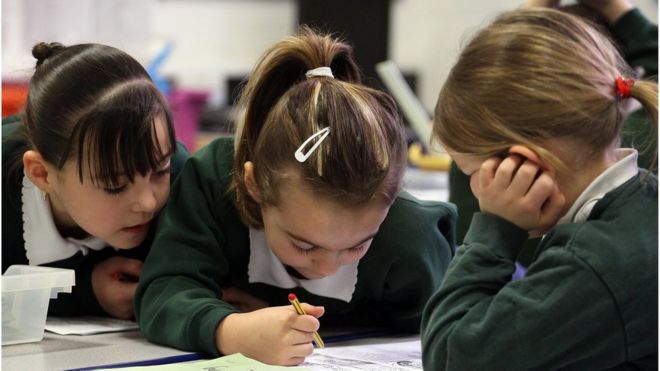
ClassroomImage copyrightMATT CARDY/GETTY IMAGESImage captionMore investment in education and health tends to lead to higher productivity, says the World Bank

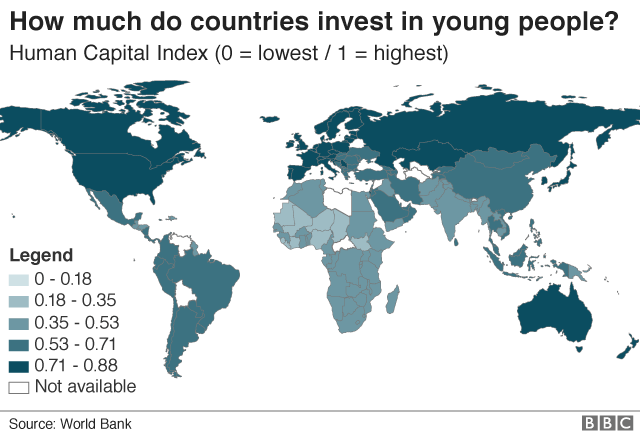
Its Human Capital Index ranks countries according to how much is invested in young people.

The higher the investment in education and health the more productive and higher earning the workforce tends to be, the World Bank says.

Which leads to the creation of higher levels of wealth and a stronger economy.

Human Capital Index

Human capital

Its rankings reveal that Asian countries dominate the top positions.

First is Singapore, followed by South Korea, Japan and Hong Kong.

Finland and Ireland are fifth and sixth, with the UK in 15th place, below Germany but ahead of France, Norway and Switzerland.

The bottom of the list is dominated by countries in Africa, where human capital scores are a third of those enjoyed by leading nations.

Chad, South Sudan and Niger are the bottom three countries.

For 157 countries the World Bank studied the quantity and quality of education provided to children, the mortality rate for under-5s, the “rate of stunting” among young people (a measure of how healthy children are) and the chances of someone living to 60 by the time they reach 15-years-of-age (the “adult survival rate”).

Bringing the data together produced a score between 0 and 1, where zero would mean all children died before reaching education age and 1 would be all children receiving the perfect education and health start in life.

Singapore scored 0.88 and the UK scored 0.78.

Chad’s index was 0.29.

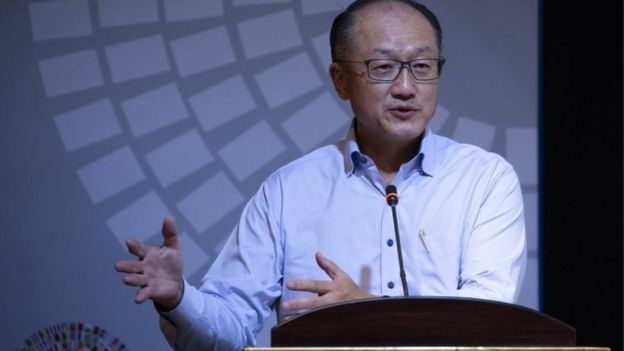
Jim KimImage copyrightEPA
Image captionJim Kim: “What children learn matters more than how long they stay in school.”

What is striking is that even a country with a relatively high score like the UK could still achieve 22% more wealth from its workforce if it improved its focus on health, education and skills training among the young.

A country with a score of 0.5 – for example, Tunisia and Kenya – could potentially double wealth creation.

Dr Jim Kim, the president of the World Bank, said that countries needed to “invest more, and more effectively, in their people”.

It wasn’t always the quantity of investment that was important, the quality was as well, he said – pointing out that some countries, rather than taking responsibility, had been “waiting for donations [to help education and health schemes] rather than taking it seriously”.

He said that he had raised the issue with the lead singer of U2, Bono, who has long campaigned for donations to charitable schemes.

Smart spending

Dr Kim said there was a danger of nations being too supply driven – putting more money into health and education schemes – rather than output driven – seeing what works and focusing on successful policies.

He said that some countries like South Korea spent lower amounts on education as a proportion of their overall income, but still beat higher spending countries on outcome scores.

“Human capital consists of the knowledge, skills and health that people accumulate over their lives, enabling them to realize their potential as productive members of society,” the World Bank report, published at the IMF annual meeting in Bali, said.

“It has large payoffs for individuals, societies, and countries.”

The report points out that during periods dominated by technological change, such as now with the growth of artificial intelligence, investment in “human capital” and problem solving skills is particularly important.

“For individuals, an additional year of school generates higher earnings on average,” the report says.

“These returns are large in low and middle-income countries, especially for women.

“What children learn matters more than how long they stay in school.

“In the US, replacing a low-quality teacher in an elementary school classroom with an average-quality teacher raises the combined lifetime income of that classroom’s students by $250,000 [£190,000].”

Long road

The report points out how some governments are keen to invest in projects that are quickly visible to voters, such as motorways, rather than think longer term.

But it points out that with policies sustained over a number of decades progress can be made.

In 1950, the average adult in Singapore had completed just two years of education.

Now the country has some of the best education results in the world and is top of the first Human Capital Index.

Recalling of Sri Lankan Armed Forces from UN Peace Keeping Missions: Questioning mandate of Sri Lanka HR Commission

October 21st, 2018

Two important factors need to be highlighted. Firstly, are all nations nominating tri-forces/police for UN peace keeping roles vetted by the respective human rights commissions of their countries & secondly on what valid basis does the UN have to request the recalling of Sri Lankan forces nominated for peace keeping citing war crimes record?


Let us take up the first question.

In April 2018 the Daily Mirror reported that the Human Rights Commission of SL had alleged that the SL Army had sent troops for UN Peace Keeping missions to Lebanon without seeking its approval. Since when & who gave HRCSL the right to handle Army/Police clearance protocol for UN Peacekeeping troops – such a set up did not exist before? Sri Lanka’s first peace keeping deployment was in 1960 and there was no HRCSL existing then. Even UK’s first peace keeping mission was in 1956. The HRCSL was only created in 1996. This new vetting procedure by HRCSL of tri-forces & police for overseas deployment started ONLY in SEPTEMBER 2016. So has the HRCSL mandate been officially changed to include this additional feature or is it simply an arbitrary inclusion? So there’s no two guesses for the modus operandi behind this.


Moreover, on what grounds does the HRCSL have to insist on being privy to every service record of the military personnel being nominated for deployment? How can such records be open to even third party scrutiny? Every national army is entitled to its level of confidentiality & no new entity created for political purposes can be allowed to breach or expose to public information that should be considered sensitive. Would the Defense establishments of US, UK, NATO countries, China, Pakistan or even India allow the entire service history of their military personnel to be open to public scrutiny? This is giving the HRCSL an undue & improper privilege which must be immediately addressed by the armed forces heads with the Government.


If any military personnel or police are to be nominated the UN must have a set procedure that has to be equally followed by all nations nominating their troops for peace keeping operations. Procedure for selection & nomination & who vets them should not be confined to newly created entities that are by their actions showing their bias. Therefore, the procedure followed by US, UK, China, India etc in nominating their troops for UN Peace Keeping deployment must be what Sri Lanka must adopt as well. There is simply no basis for a new entity like the HRCSL to be given undue powers to decide who gets selected to peace keeping missions after the military exposes the entire history of the personnel into public domain.


The second question is about the case of Col. Kalana Priyankara Amunupure.


According to the statement by Stephane Dujarric, spokesman for UN Secretary General Antonio Guterres, the commander of the Sri Lankan contingent in UN peace keeping operations in Mali has been ordered back after reviewing his human rights record.

https://www.ndtv.com/world-news/united-nations-sends-sri-lankan-peacekeeper-accused-of-anti-tamil-atrocities-home-1934842


Who has reviewed his human rights record?

What are the allegations made against him & by whom?

What is the evidence against him?

What are the ‘extra procedures done with the Sri Lankan contingents’ that Dujarric is referring to?

What is this ‘new information’ received about him & what is the source? Is this too like the OHCHR witnesses sealed for 20 years?

What are these ‘atrocities against Tamils’ and once again UN is repeating the blunder of referring to Sri Lanka’s conflict as ‘civil’ when it has classified it as a non-international armed conflict involving terrorists. Why else is LTTE banned as a terrorist group if the conflict was civil?


Not to be surprised the usual culprits & their media machine busy at work again. So the UN is relying on information given to them by the International Truth & Justice Project (ITJP) of which Yasmin Sooka is its Executive Director. And who is Yasmin Sooka, she was one of Ban Ki Moon’s panelists selected to appraise him on the last 3 months of Sri Lanka’s conflict. She is also a regular guest of LTTE fronts who lovingly refer to her as ‘comrade’ (2013 Guest speaker at Global Tamil Forum in UK)


The ITJP is administered by the Foundation for Human Rights. FHR was launched in 1996 through an agreement between the EU & South African Government. Sooka its executive director is paid by the EU to address the historical legacy of apartheid in South Africa. Sri Lanka is not South Africa – she is paid to look into the affairs of the People of South Africa so why is she creating a sub-entity within the FHR called the ITJP and running a website Stop Torture that too on Sri Lanka http://www.stop-torture.com? In fact Sooka spends more time on Sri Lanka than South Africa. Can UN please answer this. http://www.fhr.org.za/index.php/projects/


Sooka is also an advisory member of the Sri Lanka Campaign for Peace & Justice and no surprise who the other members are: J S Tissainayagam, Teesta Setalvad, Natalie Samarasinghe, Bianca Jagger, Bruce Haig, Basil Fernando, Beate Arnestad, Charu Lata Hogg of Chatham House is the chairperson while Callum Macrae of C4 is also a board member. Campaign for Peace & Justice in 2014 presented a petition signed by Sooka, Desmond Tutu, Bishop Rayappu Joseph, R Sambanthan, C V Wigneswaran & 35 others to demand a commission of inquiry to investigate war crimes against Sri Lanka.


Tragically, the UN is relying on these unverified, unsubstantiated hyped up allegations to humiliate the Armed Forces of Sri Lanka. Let it be made clear that the majority of these UN peace keeping operations are in illegally invaded & occupied nations where US, UK & NATO troops have committed atrocities that even the UN system cannot deny. However, how many of these Western troops have been recalled back because of their records?


While the UN has no standing army it does have Peace Keepers also known as Blue Helmets. There are 100,950 peace keepers from 123 countries deployed in 20 UN missions as of August 2016. Congo has the largest UN peace keeping mission with 18,333 peacekeepers. Ethiopia, India, Pakistan, Bangladesh, Rwanda, Nepal, Senegal, Burkina Faso, Ghana & Egypt are the top 10 countries nominating peace keepers. The approved budget for UN peace keeping operations for 2016-2017 was $7.87billion. US, China, Japan, Germany & France being the top 5 countries funding the UN peace keeping budget.

Sri Lanka has 682 peace keepers.


The UN must not be selective & biased in their treatment of peace keepers & in particular avoid humiliating a national army by accepting hearsay in particular by notorious groups that have direct connections to the terrorists that were instrumental in causing mayhem in Sri Lanka for 3 decades.


The Sri Lankan Government stands guilty of arbitrarily putting a new entity to vet the armed forces & police before deployment & not standing up for its national army when a clear concerted effort is on track to humiliate & degrade Sri Lanka’s armed forces. Look at how the US, UK & NATO as well as all other national governments stand up & defends their national army – it’s the exact opposite in Sri Lanka’s case.


When this govt has co-sponsored legally questionable UNHRC resolutions how can it even challenge the UN to produce facts or present evidence without demanding the recalling of a commander who served the nation to defeat a terrorist movement?


Poor show Government of Sri Lanka. The Nation is very disappointed at a governments’ inability & unwillingness to defend its troops & their good name internationally.


Shenali D Waduge


වවුනියාව මඩුකන්ද හන්දිය අසලදී 21 දා සවස  බස් රථයක් පෙරළී ගොස් තිබේ.

October 21st, 2018

දිනසේන රතුගමගේ

වවුනියාව කොළඹ අතර ධාවනය වන බස් රථයක් එහි තිරිංග වල  දෝෂයක් නිසා ගරාජයක් වෙත යොමු කොට තිබේ.තිරිංග සවි කිරීමෙන් පසුව තිරිංග නිසිලෙස  ක්‍රියාත්ම ක වන්නේදැයි පරීක්ෂා කිරීම පිණිස වවුනියාව මඩුකන්ද මාර්ගයේ ගමන් කොට තිරිංග ක්‍රියාත්මක කළ අවස්ථාවේදී බස් රථය පෙරළී ගොස් තිබේ.

බස් රථය පෙරළී යන අවස්ථාවේදී එහි රියදුරා කොන්දොස්තරවරයා හා ගරාජයේ සේවකයෙකු පමණක් සිට ඇති අතර අනතුරෙන් ඔවුන් කිසිවෙකුටත් තුවාල සිදු වී නොමැත.

මේ අනතුර සිදුව ඇත්තේ මීට සතියකට ඉහතදී ත්‍රී රෝද රථයක් හා  මෝටර් රථයක් එකිනෙක ගැටී දෙදෙනෙකු ඒ ස්ථානයේම මියගොස් තවත් අයෙකුට මාරාන්තික තුවාල සිදු වූ ස්ථානයේදීමය.

මේ අනතුර පිළිබදව  මඩුකන්ද පොලීසිය පරීක්ෂණ පවත්වාගෙන යයි.

The World’s six best doctors 

October 21st, 2018

Steve Jobs Died a billionaire at age 56.  This is his final essay:

I reached the pinnacle of success in the business world.  In some others’ eyes, my life is the epitome of success.  However, aside from work, I have little joy.  In the end, my wealth is only a fact of life that I am accustomed to.  At this moment, lying on my bed and recalling my life, I realize that all the recognition and wealth that I took so much pride in have paled and become meaningless in the face of my death.

You can employ someone to drive the car for you, make money for you but you cannot have someone bear your sickness for you.  Material things lost can be found or replaced.  But there is one thing that can never be found when it’s lost – Life.  Whichever stage in life you are in right now, with time, you will face the day when the curtain comes down.

Treasure love for your family, love for your spouse, love for your friends. Treat yourself well and cherish others.  As we grow older, and hopefully wiser, we realize that a $300 or a $30 watch both tell the same time.  You will realize that your true inner happiness does not come from the material things of this world.  Whether you fly first class or economy, if the plane goes down – you go down with it.

Therefore, I hope you realize, when you have mates, buddies and old friends, brothers and sisters, who you chat with, laugh with, talk with, have sing songs with, talk about north-south-east-west or heaven and earth, that is true happiness!  Don’t educate your children to be rich.  Educate them to be happy.  So when they grow up they will know the value of things and not the price.  Eat your food as your medicine, otherwise you have to eat medicine as your food.

The One who loves you will never leave you for another because, even if there are 100 reasons to give up, he or she will find a reason to hold on. There is a big difference between a human being and being human.  Only a few really understand it.  You are loved when you are born.  You will be loved when you die.  In between, you have to manage!

The six best doctors in the world are sunlight, rest, exercise, diet, self-confidence and friends.  Maintain them in all stages and enjoy a healthy life.”

Sirisena’s claims on LTTE seen as totally baseless

October 21st, 2018

Nirmala Joseph Courtesy Gulf Today 

Informed people have rejected an allegation raised by Sri Lankan President Maithripala Sirisena that the now-defunct Tamil Tiger outfit had planned to attack Colombo with an aircraft flying from Chennai in 2009. 

Speaking to the Sri Lankan community in New York where he spoke at the UN General Assembly, Sirisena said, No one knew it better than me.”

Retired Indian military intelligence officer Colonel R. Hariharan was quoted in the local media on Saturday as dubbing the Sirisena claim as fiction. The Chennai airport was fully secured and the Q branch of the Tamil Nadu police was on high alert,” he said.

They would have known had the LTTE hatched such a plan.”

Hariharan now works with the Chennai centre for China studies and the international law and strategic analysis institute.

TR Baalu, prominent leader of the opposition DMK, who was a Union minister during the days Sirisena refers to, said: What he says is totally baseless. How can he say either the Centre or the State government would have allowed our territory to be used to attack any other country?”

There was no such plan of the LTTE, a banned organisation. It is totally false.”

The DMK was in power in 2009.

Sri Lanka expert Prof PS Suryanarayana said, It is wild imagination that the LTTE had plans to attack Colombo from Chennai.”

Sirisena was the acting defence minister during the last two weeks of the civil war with the LTTE in May, 2009, when the Tigers were eliminated.

The former president (Mahinda Rajapaksa) was away, the former prime minister was away. There was no defence ministry Secretary and Army Commander in the country at the time,” Sirisena said, adding that all senior leaders were out of the country fearing an LTTE air raid.

The Tamil Tigers were going to operate an aircraft from Chennai or some other jungle area to bomb and destroy targets in Colombo,” the President said.

Sirisena said it was a well-guarded secret that all senior leaders were out of the country fearing an LTTE air raid. Even I did not stay in Colombo. I was at several locations outside Colombo in case the Tigers attacked the capital city,” he said.

“WAR CRIMES” IN EELAM WAR IV Part 10

October 20th, 2018

 KAMALIKA PIERIS

Two Sri Lanka obsessed NGOs, Journalists for Democracy in Sri Lanka” and International Truth and Justice Project, Sri Lanka” have taken an interest in Sri Lanka’s contribution to UN Peacekeeping.

Journalists for Democracy in Sri Lanka” is a group of journalists, human rights workers and other activists exiled from Sri Lanka and now based in Germany. The group focuses on human rights and war crimes in Sri Lanka. The International Truth and Justice Project, Sri Lanka” is administered by the Foundation for Human Rights, based in South Africa, under the guidance of Yasmin Sooka.

In November 2017, Journalists for Democracy in Sri Lanka (JDS) together with International Truth and Justice Project, Sri Lanka” (ITJP) released a joint report on Sri Lanka. The report is titled Sri Lanka’s UN Peacekeepers: Let the Punishment Fit the Crime”. This report stated that more than 100 Sri Lankan peacekeepers were sent home from Haiti in 2007 for alleged child sexual exploitation.  Strangely enough, while abusing the children, they have also taught them Sinhala. The interviews with the Haitian children were conducted in Sinhala.

Thereafter in 2018 ITJP issued on its own, a report titled Sri Lanka’s Special Task Force”. The report    was released in London, with much publicity. Several UK newspapers including Guardian, reported its launch. Guardian said the document, seen by the Observer, claims that senior Sri Lankan officers accused of war crimes have been deployed to UN operations in Mali, Lebanon, Darfur and South Sudan.

ITJP’s Executive Director, Yasmin Sooka speaking at the launch said, one STF officer who appears currently to be observing in a UN peacekeeping mission in Africa is alleged to have ordered summary executions of Tamils in the East of Sri Lanka in 2006/7 ” This report can be downloaded at http://www.itjpsl.com/reports/special-task-force. 

This ITJP report has not received the attention it deserves from the anti-Eelamists in Sri Lanka. The report is very generous with words.  .The report says the STF has from its inception in 1983 been steeped in allegations of human rights violations, including abductions, torture, killings and extrajudicial executions. The violations described in this report speak to an amoral attitude to the taking of life and to human dignity, and where dehumanization has become institutionalized”.

The STF never did routine policing during the war, continued the report.  STF was specifically tasked with a frontline combat role. It was armed with heavy weapons and at times also spearheaded ground offensives in the East The army had stationed artillery units with heavy weaponry in STF bases.

Since the STF was a frontline combat unit at the climax of the war, it should be subjected to the same vetting and screening criteria as military units who fought in the war.  ITJP has therefore helpfully prepared a confidential list of 56 names of individuals in the STF who should not be sent as UN peacekeepers. This consists of 32 names of STF officers involved in frontline command positions who should be barred from peacekeeping and 24 names of alleged perpetrators or individuals complicit in grave violations of human rights.

However, in order to protect witnesses, this information has not been made public. The names will be sent to the United Nations Department of Peacekeeping (DPKO), the Department of Field Support (DFS), the Conduct and Discipline Unit (CDU) and the Office of the High Commissioner for Human Rights (OHCHR), said the Report.

This report feeds on the Report of the OHCHR Investigation on Sri Lanka 2015, known as the OISL report. The OISL report has generously found that all the security forces of the government of Sri Lanka, have engaged in sexual violence. OISL charges everybody who was anywhere near the events of 2009 with war crimes.   This includes Police, National Intelligence Bureau, Military Intelligence, STF, Criminal Investigation Department (CID), and the Terrorism Investigation Department (TID).  Also of course, the   army and navy.

The OISL has named specific units and the ITJP report repeats them.  In the army it is 53rd, 55th and 58th brigades .These are the military units that were active in the final phase of the war, ‘when grave violations of international humanitarian law were committed’.   In the STF, it is the Task Forces 2, 3, 4 and 8. In the Air Force, it is No. 10 Sqn operating Kfir ground attack aircraft out of Katunayake. No. 12 Sqn. Operating Mig-27 ground attack aircraft out of Katunayake and No. 111 Sqn. Operating AIA Searcher reconnaissance UAV out of Vavuniya.

Any Major General having a defined geographical area of responsibility and the combat divisions and supporting units under his command are also guilty. Each formation from battalion level upwards includes a ‘staff’ of professional advisers who assist the commander in formulating and executing plans”. They are also complicit in alleged war crimes. Anyone who ordered MBRL or heavy artillery fire at civilian objects is also guilty.

The ITJP report has a further assortment of guilty person. They are

  • Those commanders active in the forward maintenance area, which was run by the former Army Commander who is now High Commissioner to Dhaka, Bangladesh. The FMA is where captured fighters were taken for initial interrogation.
  • Military and police deployed in Manik Farm or other IDP camps” post war58 where torture and sexual violence repeatedly occurred. .
  • Those who administered or worked in a rehabilitation centre post-war (PARCs).these include some SLA who were in logistics positions (engineering corps) in 2006-9.
  • Anyone involved in an interrogation of an LTTE suspect in rehabilitation or detention from 2008 onwards. This would include multiple wings of the security forces. These detainees did not enjoy any right of appeal and were subjected to mass arbitrary detention, as well as widespread torture and sexual violence.
  • Anyone in the security forces involved in organizing a forced abortion or forced contraceptive injections for women detainees.
  • . Anyone who worked closely with any of the Tamil paramilitary groups who were involved in the commission of crimes. OISL says the paramilitaries were reportedly acting alongside, or on behalf of SLA, SLN and STF in particular. In particular 23 Division”59.

The role of the STF in abducting and killing suspects in detention in the latter part of the civil war is also well documented by the OISL report, says the ITJP report. On this basis alone, the vetting of UN peacekeepers should exclude all STF personnel who were involved in active combat in the East of Sri Lanka from 2005-7 and the North from 2007-9.

This is the first ITJP report to be based primarily on insider witnesses, interviewed in four different countries by multiple investigators. They include several former STF officers and Tamil paramilitaries.  This is also the first time the ITJP has published testimony from Sinhalese witnesses and participants in some of the violations, indeed it has taken many years for even a handful of insider witnesses to emerge.

The section on sexual abuse was based primarily on the testimony of Sinhalese security force witnesses many of whom were involved in abductions, said the report. Several have confidentially provided the ITJP the names of commanding officers and colleagues. Witnesses also supplied photographs or other documentation or corroboration to show they served in the relevant security force unit, as well as in many cases map coordinates and detailed sketches of torture sites. Their exact units and times of service are not given here as it could reveal their identity.

The witnesses have not met one another and reside in 4 different countries. They have given very detailed accounts of operating procedures that overlap and anecdotes of specific events that would appear to be hard to fabricate on this scale.  Much of this detail has been omitted from this report lest it identify the witnesses to their former colleagues. The statements were taken by three different extremely experienced investigators, two of whom worked in the East of Sri Lanka during the war.

It is worth noting that some, but not all, of the Sinhalese witnesses are also psychologically damaged by the violence of which they have been a part and were keen to testify to unburden themselves of a strong sense of guilt. One individual in particular was eager, if it were safe, to inform families of the disappeared where the corpses are located that he buried, said the report.

These witnesses have been very extravagant in their accusations. Here are some of the things they have said, to ITJP, anonymously of course.

  • The STF and Karuna group conducted joint searches with the army in the East and the following witness saw people being abducted and says the STF was informed by the TMVP that they had killed the detainees.”
  • The STF decided the locations and if anything needed to be clarified during an operation the highest ranking STF officer would be in command, [redacted name].”
  • The army and the TMVP joined us. The orders we had were not to question Karuna’s people. The senior officer would be in phone contact with the SSP [redacted name], who would decide what to do with each of the persons we apprehended.
  • .On other occasions, the suspects would be taken away by the TMVP, beaten up, tortured and questioned and then released back to the village again. Sometimes the TMVP killed them, informed the STF about the killing and the STF would not be further.
  • Witnesses also described the detention in STF camps of suspects who were then killed: We tied their hands behind their backs, gagged them and covered their faces. There were villages around so we had to gag them in order for them not to make loud sounds, crying for help. Once a suspect had been taken to an STF camp, they never got released, they would always be killed.”
  • A member of the STF described witnessing his senior officer executing suspects in the camp: I saw the two guys kneeling, hands tied and blindfolded, and from about 3- 4 meters I witnessed the [senior officer – name redacted] standing next to them and shoot them one by one in the head with a T56. The bodies fell forward to the ground. Several STF guys including me witnessed the shooting.
  • While the bodies were doused in petrol and burned on a fire they all had a meal and a bottle of arrack.
  • A witness described the assassination of an unarmed former LTTE suspect by a police colleague who then cleaned the blood of his rifle in front of him explaining he had shot the man at very close range in the head: This was a normal incident, if we got information about suspected LTTE cadres, we would go either in police uniform or mostly in civilian and kill the person. Often we went two constables on a motorcycle in civilian and a pistol.”
  • Another STF witness described the practice of deliberately making Tamil civilians dig in heavily mined areas knowing that they would be killed or injured. He described occasions where a senior officer ordered civilians to do this.
  • An insider witness describes how during the final phase of the war in the East of Sri Lanka, Tamil women were forced into providing sex to STF members; with a large number forced into sexual slavery, including some women being subjected to frequent “visits” by different personnel and expected to provide sexual services for them. This amounts to sexual exploitation and abuse. A witness describes a colleague going to a house and ordering the husband to stand outside while going inside and raping his wife. The witness said his colleagues’ behavior would vary from place to place depending on the attitude of the Officer in Charge of the area – some would condone sexual violations, others would not.”

Yasmin Sooka, executive director of the International Truth and Justice Project, plays an important role in Sri Lanka‘s war crimes dance. Human Rights personnel do not stay for long, in the topic, because they are usually on limited term, non renewable contracts. But Yasmin Sooka, it appears, will go on forever. She is featured in several of the Sri Lanka war crimes” episodes.

Sooka has given an interview to Guardian” and provided them with lots of copy. Here are some of her comments.  a) ‘Peacekeeping is a privilege, not a right – only the very best should represent the country.” b)Sri Lanka’s security forces were involved in mass atrocities in 2009, for which there has been zero accountability – instead, alleged war criminals have been promoted and rewarded with prestigious and lucrative UN postings.c)This is an affront to those they are supposed to be protecting in Mali and Lebanon – as well as to victims in Sri Lanka who are desperate for justice. d)‘The UN needs to ensure countries like Sri Lanka publish the names and photographs of their peacekeepers a reasonable period before deployment, so that civil society can play a role in vetting them.

Sooka has targeted Gen. Jagath Jayasuriya and Maj. Gen. Shavendra Silva, the wartime General Officer Commanding of the celebrated 58 Division, for war crimes, observed Shamindra Ferdinando.

According to Al Jazeera (August 2017), Human rights groups in South America have, filed war crimes lawsuits  against, former Sri Lankan general Jagath Jayasuriya who is  Sri Lanka ‘s ambassador to Brazil. he is also ambassador to Colombia, Peru, Chile, Argentina and Suriname. The charge against Jayasuriya was spearheaded by ITJP said Al Jazeera.

The charge is that he oversaw military units that attacked hospitals and killed, disappeared and tortured thousands of people in the final phase of Sri Lanka’s civil war in 2009 Also Jayasuriya was commander of the Vanni Security Force from 2007 to 2009.Joseph Camp was under him. Joseph Camp was a hot bed of sexual violence and torture. ITJP said it interviewed 14 people who survived torture or sexual violence at the camp.

“There is no way General Jagath Jayasuriya can claim not to have known that torture routinely occurred in his camp; there were purpose built underground torture chambers, equipped with manacles, chains and pulleys for hoisting victims upside down,” said Sooka, the ITJP’s executive director, in March.”If the detainees could hear each other screaming at night from adjacent buildings, so could he.”

Petitions have been filed in Brazil and Colombia    and petitions in Argentina, Chile and Peru will follow. Suriname had refused to accept the petition .Jayasuriya has diplomatic immunity in all five countries, but the HR devotees hope they will compel regional governments to open investigations of Jayasuriya, remove his immunity and expel him.

The main figure behind this move of branding Jagath in Brazil, observed Chandraprema  is apparently Yasmin Sooka of the self styled ‘International Truth & Justice Project, Sri Lanka’, which claims to have obtained sworn statements along with evidence gleaned from medical and psychiatric examinations from Tamil individuals who had arrived in the UK claiming asylum.

They had claimed to have been arrested, blindfolded, held in darkened cells and subject to sexual attacks and repeated interrogations.  A woman had claimed she had been abducted in a white van, beaten with electric cables and suffocated, using a plastic bag containing petrol and later raped. Another woman had claimed to have been gang raped. A man had claimed to have been anally and orally raped by a captor. About half the people interviewed by Sooka’s organization had claimed to have attempted suicide after leaving Sri Lanka continued Chandraprema, cheerfully.

On the face of it, the evidence that Yasmin Sooka’s organization claims to have ‘unearthed’ looks like the usual stories related by asylum claimants trying not to get expelled from Britain. It goes without saying that a refugee status claimant will say what is calculated to get them what they want. All those arriving in Europe seeking refugee status, claim to have been tortured and raped,  he observed

Even though the ‘victim’s accounts’ and the ‘medical reports’ that professional human rights activists like Yasmin Sooka collect may not stand up to scrutiny by the UK immigration authorities or the courts, they can be used as purported evidence to file petitions in various courts against prominent Sri Lankan individuals and that is obviously what has happened in this case, concluded Chandraprema.

Other foreigners are also concerned about Sri Lanka’s awful record. Tory MP Paul Scully, chair of the all-party parliamentary group for Tamils, UK wrote to the UN’s peacekeeping operations in May 2017 asking for details of the vetting and screening process of members of Sri Lanka’s Special Task Force who may be deployed by the UN. He has made reference to a senior Sri Lankan special task force officer who appears to be currently deployed in Africa in a UN peacekeeping role, despite there being allegations that he was involved in ordering summary executions of Tamils in the east of Sri Lanka during the war”.

The UN insists on a vetting process before armed personnel are taken into UN activities. UN Member States that nominate or provide personnel to serve with the UN, such as the UN Peace keeping forces, must screen and certify that such personnel have not committed, or are alleged to have committed, criminal offences and/or violations of international human rights law and international humanitarian law. Those who seek to serve with the UN must attest the same and, where necessary, provide relevant information. The processes by which this can be done are outlined in Decision 2012/18 of the UN Secretary-General’s Policy Committee.

At present, Sri Lankan troops, majority being from the Sri Lanka Army have been deployed in Lebanon (UNIFIL), South Sudan (UNMISS), Mali (MINUSMA), Abyei (UNISFA), New York (UNHQ), Central African Republic (MINUSCA) and Western Sahara (MINURSO), either as military observers, liaison officers, staff officers, staff officer assistants or general contingent troops for peace keeping. To-date a total of 450 Sri Lankan peace keepers are serving 7 UN peace keeping overseas missions under the UNDPKO.

But after the OISL Report the UN tightened the screening. A thorough vetting for 200 Sri Lankan soldiers going to Mali was conducted in Geneva by OHCHR in 2016 by a staff member who had worked on OISL and had the necessary expertise and institutional knowledge. This has been described as enhanced vetting. “In the case of Sri Lanka, where there are specific human rights concerns, we put in place additional screening measures in 2016 to help ensure that deployed personnel meet our standards, said a UN peacekeeping spokesman.

Applicants were screened out if they belonged to a unit named in the OISL report and were active at the frontline in 2005-7 and 2007-9, depending on whether it was in the East or North. In addition they were screened out if there were allegations of human rights violations against them, for example, if they were named as an alleged perpetrator in any of the Zonal and All Island Disappearance Commissions in the past. It will be observed that mere mention is enough.  Principles of natural justice, such as fair   impartial inquiry, accepted canons of proof were not considered important.

Vetting was usually carried out by the UN. But in 2016, the task was transferred to Sri Lanka ‘s Ministry of Foreign Affairs, probably, said Ladduwahetty, because Sri Lanka had co-sponsored the UNHRC Resolution 30/1,  The Foreign Ministry decided that the Human Rights Commission was the obvious choice as it was an independent institution now under the 19th Amendment and had the credibility to take it on, reported the media.”

The Ministry wrote to the Human Rights Commission of Sri Lanka and requested it to take on the task. The Government of Sri Lanka and the HRCSL signed a formal agreement whereby the latter would vet peacekeepers. . Sri Lanka is the first nation to be granted the opportunity to vet military personnel for peacekeeping operations by a national Human Rights Commission.

In 2018 it was announced that a contingent of 49 sent to United National Interim Force in Lebanon (UNIFIL) in February 2018 has not been vetted for HR abuses.” The matter was raised by journalists at the UN headquarters in New York on two occasions. They questioned the Secretary-General’s office about a long, outstanding issue raised to DPKO [Department of Peacekeeping Operations] about Sri Lankans that were sent un-vetted by the Government to Lebanon Also  a commando from an elite police unit in Sri Lanka, alleged to have been involved in serious human rights violations, to ‘one of the missions in Africa’.

The ITJP report on the STF also commented. The last 3 Sri Lankan contingent commanders sent to Lebanon had not been subject to due diligence by Sri Lanka and should have been vetted out. The public disclosure of this information led to the suspension of the deployment of the fourth contingent commander, Lieutenant Colonel Wasantha Kumara Hewage, days before he was due to leave We have credible information that this individual has been involved in serious human rights violations, including involvement in extrajudicial killings, said ITJP

In May 2018 the media reported that Human Rights Commission of Sri Lanka was vetting a list of 204 military personnel nominated by the Sri Lanka Army for UN peacekeeping missions. This includes the 49 sent to Lebanon in February without review by the Commission, which hadn’t been told these officers were required to be released early. Sri Lanka Army sent in details of Army personnel selected for UN missions for HRCSL’s independent vetting.

But difficulties arose and vetting was temporarily halted in July 2018. HRCSL imitated a roundtable discussion with the tri-forces, police and the MFA  in order to recast the Standard Operating Procedures (SOPs), used for the vetting. The new SOPs will accommodate the views of all parties, including the tri-forces and police.

The army issued a statement on 27.6.18 where it said that To be in line with the UN Secretary General’s decision in relation to ‘screening of UN personnel for Human Rights’, the Sri Lanka Army, consequent upon discussions with the Defense Ministry, Foreign Affairs Ministry, the UN Department of Peace Keeping Operations (UNDPKO) and the HRCSL resolved that an own national mechanism be followed with respect to independent screening of personnel through the HRCSL

The office of the UN Secretary-General stated that We are working together with the Government of Sri Lanka to ensure that the screening arrangements with the Human Rights Commission of Sri Lanka comply with UN policy, Compliance with these arrangements will be required before the UN can receive any further deployments or rotations from Sri Lanka.”

In August 2018, the armed forces were awaiting the finalization of the Standard Operating Procedure (SOP). The military and HRCSL recently had a video conference with Geneva and New York based officials to discuss the  draft SOP. “We are concerned about some aspects of the original draft and,therefore, certain amendments were suggested. We are confident an agreement can be reached soon to enable the HRCSL to begin the vetting process, said the military..”

A major section of the 150-man 12th Force Protection Company (FPC) assigned for United Nations Interim Force in Lebanon (UNFIL) is awaiting the completion of the clearance process. The group comprising 101 personnel was originally scheduled to leave on March 6, 2018.The UNFIL mission consists of troops from Sri Lanka Sinha Regiment (SLSR), Sri Lanka Engineers (SLE), Sri Lanka Signal Corps (SLSC), Mechanized Infantry Regiment (MIR), Commando Regiment (CR), Special Forces (SF), Corps of Engineer Services (CES), Sri Lanka Army Service Corps (SLASC), Sri Lanka Army Medical Corps (SLAMC), Sri Lanka Electrical and Mechanical Engineers (SLEME), Sri Lanka Army Ordnance Corps (SLAOC), Sri Lanka Corps of Military Police (SLCMP) and Sri Lanka Army General Service Corps (SLAGSC).SLA joined UNFIL mission in 2010, a year after the conclusion of the conflict. Since then, 11 contingents have served there.

The UN said it was working with the government of Sri Lanka to ensure that the country’s domestic screening process complied with the UN’s policy on screening personnel. This is necessary before the UN can receive any further deployments or rotations from Sri Lanka.” UN was developing a strict vetting process with Sri Lanka to ensure all peacekeepers met their standards.  It is important that all procedures and institutional arrangements are in place so that the domestic screening process can meet these requirements. The national Human Rights Commission plays a key role in this process, said UN.

However, the competence of the HRCSL to carry out such vetting has been openly questioned.  Vetting armed forces does not come under the HRC’s mandate.  While civilian oversight of the military in any capacity is to be warmly welcomed, concerns remain about pushing this enormous task (vetting up to 3,500 individuals) on to one body with little experience of screening and vetting in what is a very challenging environment, and where this is not their main priority, said ITJP.  Observers have also raised concerns about whether the Human Rights Commission has vetted its own staff, some of whom were reported by human rights activists to be closely connected to members of the Armed Forces.

Ladduwahetty observed that the task of vetting is   beyond the mandate of the HRCSL, which according to Act No. 21 of 1996 is limited to “rights declared and recognized by the International Covenant on Civil and Political Rights and the International Covenant on Economic, Social and Cultural Rights”

Further, the vetting has to be done in terms of International Humanitarian Law, IHL and not Human rights generally. Has the HRCSL the competence to evaluate whether humanitarian law violations were committed during the armed conflict, he asked. Can the HRCSL all of a sudden acquire a competence to evaluate whether violations of international humanitarian law were committed by the personnel whom they screen on a case by case basis, when they are structured and organized to deal only with human rights violations?  If so why limit this capability only to UN peacekeeping.

HRCSL will have go through the list of peacekeepers, identify each individual by name and rank with details of what offence was committed and when, including the circumstances relating to the incident. If the HRCSL does not have the competency or the resources to make a judgment the screening process would be arbitrary and cause a grave violation of the human rights of the person concerned because he/she would be branded for life without an opportunity for defense.

According to Ladduwahetty, the HRCSL  should have flatly refused the  offer, saying that that it was not equipped to handle international humanitarian law certification and that these limitations would bring into question the credibility of certifications by the HRCSL.

APPENDIX

 Excerpts from AN APPRECIATION OF THE STF ,  FOR 4TH STF COMMEMORATION DAY,

 BY NIMAL LEWKE, RETIRED DIG, EX-COMMANDANT OF THE STF  (Island 31.8.18 p 5)

At a time STF Commemorating the 34th year, I thought I put this into print as a mark of respect for the committed, dedicated, disciplined and the sacrifices they made including their own lives to defend motherland at her darkest hour.

I joined the STF, underwent training conducted by the British Ex-SAS trainers and was posted to Batticaloa in charge of Kalawanchikudi base as base Commander. There were only two bases at that time in Batticaloa the other one was in Kalladi where Mr. N K Ilangakoon was the Base Commander. ASP at that time later IGP. Four of the STF personnel had got caught to a landmine in Jaffna and they had all died. And their bodies had been brought to Ratmalana. I had to go and bring them to Colombo.

Two days later, we got another shock. OIC Wellaveli, IP Masamja with seven of his PCs had gone to check a tip off towards Kokkadicholai, which is in the Kalawanchikudi area. Since, they did not return in time, we were informed. We went in search of the Police team. What we saw closer to Kokkadicholai was unbelievable. The police jeep had got caught to a landmine and men and the jeep was in pieces. We have never seen anything like that in our life time. What an experience it was for a young unit to face at a time they are being entrusted with a new task. So that was the beginning of the STF.

This highly trained young professional unit had excellent leadership under Zerney Wijesuriya SSP Commandant, Lionel Karunasena ASP Deputy Commandant, ASP Sahabandu, Director Training ASP Ilangakoon, ASP Rohan Abeywardena, ASP Jayantha Gamage etc. and many other young Inspectors. Mr. Ravi Jayawardena is the one who pioneered this programme and got specialized training from Israel and made STF’s VIP unit capable of matching any other VIP unit anywhere in the world. The STF had highly disciplined, committed, brilliant marksmen who could draw and fire within a second and hit the targets 10 out of 10 times.

All who joined the STF were volunteers. Nobody was forced to join the unit because at that time most of the police officers were reluctant to work in the North and East. The strength of this unit and the success story is the leadership at all levels. The brilliant training, discipline, commitment and the unity – all of which clearly proved that there was nothing called impossible.

STF dominated the Batticaloa-Ampara sector and never allowed any of the terrorist groups to have a hold there. In 1984 there were many groups, TELO, PLOTE, EPRLF, LTTE, EROS etc., but the most effective group in the Batticaloa was EPRLF. In 1985 during a confrontation with the EPRLF, we managed to over run them and eliminate their leadership, almost 10 leading members of the group. After the cease fire in 1986 only the LTTE strengthened under Prabhakaran’s cousin Kumarappa in the Eralukulam Kokkadicholai sector. Although Prabhakaran in his Ealam map had identified Batticaloa as their capital they never had a strong grip as we dominated the area.

Credit should go to the troops as day in and day out they launched operations one after the other to destroy their hideouts and capture those areas. STF was mostly on the coastal belt of Batticaloa – Ampara sector. From Bakmitiyawa to Lahugala was the Army area.

When the terrorists were attacking the Sinhala villages in those areas, gradually STF moved in and dislodged all their hideouts and we captured all their bases namely Beiruit, 46 Base in Eralukulam and 48 Base in Kanjikudiaru. Our concept was to “dominate the areas between us and the enemy.” That was our concept. In achieving it, the price was heavy as 463 young officers sacrificed their lives and 712 were injured/disabled.

There were many a time, when I planned operations and I had to leave out certain members, unofficially they came to me, to make personal requests to include them into the operational group so that they can be members of that operation. That was the unity and the commitment of the STF. Our men [had not] seen or spoken to their families for months. But they will wait for their turn as a team to get their due duty off. When I look back, I feel very proud.

I started as an Inspector and ended up as a DIG leading the STF to liberate the East purely because of the support and commitment of my men. The unity we built over the years is unbelievable and we are sad to note that in 1994 when the new Government came into power a volunteer Colonel took over the Defence Ministry. People like us who did yeoman service to the nation were removed as a result STF had a tough time for the first time in the history in 1995 a STF contingent was attacked at Pulukunawa camp that is the only time the terrorist came close to a camp and it is significant that out of the 463 officers who sacrificed their lives 300 was during this period. We got back to the STF in 2002 and rectified the error until we liberated the East.

Today STF security units have set a unique record by providing security to the present President, Prime Minister, former President and many other leaders. That has proved that how professional they have been and no security unit in this country has ever achieved that unbiased, professional recognition.

When Pigs Fly: Britain Preaching Human Rights to Sri Lanka

October 20th, 2018

Courtesy the carthaginian solution

Who issued this scorched-earth policy in response to local resistance against a foreign invasion army?

 ….”cut down every yielding tree, pull down every dwelling house, destroy all fields, canals and irrigation reservoirs, kill all males over the age of 14 years and slaughter all cattle leaving those which are needed for the use of the army.”   The army followed the orders to the letter, killing between 40,000 to 100,000 enforcing the promulgation. The rebel leader was beheaded.

Was it the Waffen SS Einsatzgruppen in Ukraine and Poland? Was it the Imperial Japanese Army in Manchuria? Was it the Imperial Belgian Army in the Congo? Was it Spanish Conquistadores destroying the Aztec Empire? No, it was Governor Brownrigg’s order to the British Army in 1818 to crush the Uva Wellassa” rebellion in Ceylon.

When Britain ruled Sri Lanka

Today’s ex-imperial Britain is a kinder, gentler country given to pontificate on the benefits of international humanitarian law, human rights and the rest of the tedious drivel. Its politicians are unable to resist their lecturing, hectoring and proclamatory urges regarding Sri Lanka’s post-war political and military landscape, with incessant demands for accountability, justice, truth-telling and independent investigations about the ending of Eelam War 4.

Despite no longer being the ruling Imperial power in Sri Lanka, British politicians and its foreign ministry (charmingly called the Foreign and Commonwealth Office) are unable to accept the uncomfortable political reality that, despite Sri Lanka’s lack of economic and political power, Britain’s proclamations demanding obedience no longer receive an reflexively deferential response from Sri Lanka’s political leadership. British politicians genuinely see nothing untoward in the ex-colonial power acting in loco parentis to an ex-colony.

The Global Tamil Forum, (a front group for the defeated LTTE terrorist group), recently showed off its most powerful British politicians who vied with each other to issue barely veiled threats against Sri Lanka including war crimes trials, international investigations and other powerful weapons from its ‘human rights’ arsenal. Who are these historically illiterate British politicians and international humanitarians intent on promoting the loser’s interests above those of the elected, legitimate (if authoritarian) government of Sri Lanka?

David Miliband (ex-Foreign Minister and Labour MP)

Miliband said that the ‘international community’ must act on the conclusions of the UN Panel Report as the evidence of war crimes committed by both parties are overwhelming.

David Miliband feels the love of Eelam

Not content with having visited Sri Lanka in May 2009 to demand (note the imperial mindset) that the Sri Lankan government halt it’s offensive against the LTTE on the grounds of excessive Tamil civilian casualties he then lead EU calls to indict Sri Lanka for war crimes at the UNHRC in Geneva in May 2009. Both attempts ended in ignominious failure. During his failed attempt to win the Labour leadership contest, he was strongly supported by sections of the diaspora Tamil community who appreciated his sterling work in trying to prevent an LTTE defeat.

Miliband strongly supported the 2nd Iraq War, the invasion of Afghanistan, UK’s strict anti-terrorism legislation and best of all, voted very strongly against an investigation into the Iraq war.

Siobhain McDonagh, Labour MP for Mullativu and Mulliavaikal

Siobhain is a truly heroic Fluffer for Eelam. She’s always available for pro-Eelam demonstrations, glorifying LTTE suicide bombers, economic boycotts against Sri Lanka’s poorest people and anti-Sri Lankan activities in the European Union. When not agitating for Eelam, she attends to her UK constituency (Mitcham & Morden – two dreary London suburbs), but always finds time to promote Eelam.

McDonagh and Eelamists boycotting Sri Lankan garments

McDonagh could barely contain her excitement at the GTF launch.

..there’s never going to be a quick fix or an easy answer..” [to what? Eelam? Regime change in Sri Lanka?]

..the guys from Channel 4 have been extraordinary and dedicated to this cause and they’ve become more dedicated and not less … they text and contact me and Lee [Scott] all the time telling us what the next step they’re taking [is]..”

Confirmation (if any were necessary) that Channel 4 has long since abandoned any pretence of impartiality and is fully behind the dregs of the Eelam struggle. McDonagh is at the forefront of British MPs who want to get tough with Sri Lanka”.

… we know from experience that expressing pious desires does not work with the Sri Lankan Government; we have to be tough and do something about it.”

She wants to make Sri Lanka’s poor, even poorer, believing wrongly that this will make Sri Lanka bend to the dictates of pro-LTTE British politicians

The LTTE’s favourite British MP

I believe that a boycott of Sri Lankan goods by British citizens will help Sri Lanka to resolve its past, in the same way that the boycott of South Africa helped that country to bring about peace and reconciliation.”

McDonaugh strongly supported the 2nd Iraq War, the invasion of Afghanistan, the UK’s strict anti-terrorism legislationand best of all, voted strongly against an investigation into the Iraq war. The payback for McDonagh? Eelamists’ votes at the 2009 UK election and for the foreseeable future.

Alistair Burt MP, Foreign Office Minister

Speaking on behalf of the Government, Burt, Parliamentary Under-Secretary of State for the Foreign and Commonwealth Office, emphasised that reconciliation and long-lasting peace in Sri Lanka could only be achieved through a credible and independent investigation into the allegations of war crimes committed during the final stages of Sri Lanka’s military conflict

A political descendant of Governor Brownrigg lays down the Law to uppity natives in Sri Lanka about how it needs to modify its behaviour to suit British political dictates.

Yolanda Foster – Amnesty International

She called for an international investigation into the serious violations of international humanitarian and human rights law during Sri Lanka’s civil war and highlighted the inadequacy of the Sri Lankan Government’s Lessons Learnt and Reconciliation Commission (LLRC) in addressing accountability or justice due to the limitations of its independence and mandate.

Amnesty International’s Yolanda Foster and LTTE activist together at last, promoting Sri Lanka’s Killing Fields”.

Yolanda proud stood alongside the pro-LTTE Global Tamil Forum promoting Channel 4’s Sri Lanka’s Killing Fields” ‘documentary’.  Yolanda has not yet had time (perhaps she was too busy doing her hair?) to initiate a campaign to indict and prosecute Adele Balasingham, self-admitted groomer of child suicide bombers, now living in safety and comfort in Morden, only a few miles AI’s smart, new central London head office.

However much Sri Lankans may dislike aspects of the current Sri Lankan government (corruption, waste, nepotism, abuses of power, hubris), they dislike even more, British politicians allying themselves to pro-LTTE diaspora Tamil groups trying to achieve through ‘international humanitarian action’, what they failed to achieve through 30 years of war. Pigs really will fly when British politicians utter the phrase, let Sri Lankans decide their own destiny without Britain’s continuing, malign support for the racist, irredentist cause of Tamil Eelam”.

The Tale of Jack the Ripper

October 20th, 2018

Dr. Ruwan M Jayatunge  

Jack the Ripper was an unidentified serial killer who terrorized the Whitechapel district in London’s East End by committing a number of murders in 1888. According to the official figures Jack the Ripper had killed five female prostitutes between August 31 and November 9, 1888.

However some experts believe that his victims were more than five and he even killed several children and also operated in France. Some of his victims disappeared without a trace or any police records. Up to date no one knows the real number of his victims.  Ripper was never identified. Ripper’s story became an unresolved riddle in the criminal history. Eventually Jack the Ripper became a symbol of horror in the Victorian era.

Ripper was a psychologically deviant person obviously had anti social personality traits. He was a psychopath. He was driven by lack of empathy and remorse. Ripper had a known dislike for prostitutes. He mainly targeted poor prostitutes who were mostly alcoholics living in utter destitution. He thought that he was doing the society a service by eliminating these elements. In his letters he often states that these sex workers did not deserve to live. He further thought that God had given him a mission to remove these unwanted people from the society. According to Ripper they were unfortunates” The writer George Bernard Shaw once concluded that Jack the Ripper revealed the deplorable conditions in the East End than any social reformer.

Ripper had a number of socially skills. He had superficial charm to deceit women. He was like a phantom and had the ability to blend into the crowd. He was cunning and acted fast. Moreover Ripper was an arrogant person. In his letters he mocked the Police and the Scotland Yard. Often he challenged them to catch him and ridiculed the Police for their ineffectiveness. He thought that he was always one step ahead than the Police. In these letters he signed himself Jack the Ripper with sardonic humor.

Ripper   had a homicidal streak and operated in the impoverished part of England. First the investigators thought that the murderer had a sound knowledge in human anatomy and surgical procedure. Analysis of wounds inflicted on Catherine Eddowes (one of the victims) indicated that Jack was unlikely to have been a medically-trained professional, or a medical or veterinary student. His cutting technique was gross.

Ripper was an addictive killer with profound OCD type of homicidal tendencies. He possessed a considerable physical strength. He murdered his victims with a knife and mutilated their bodies. Most of the victims were found with throat cut and disemboweled. Throat-cutting was Jack the Ripper’s hallmark. In some of the victims Ripper removed the internal organs. He was obsessed with liver, kidneys and uterus and probably collected these organs as trophies. He must have obtained sexual gratification committing these horrific acts.

There was a high probability that Ripper ate human flesh. He claims that he cannibalized Catherine Kate  Eddowes’s kidney. In one of his letters to the Police Ripper writes with misspellings: I send you half the Kidne I took from one women prasarved it for you tother piece I fried and ate it was very nise. The spelling mistakes in the letter could be a trick to mislead the Police.

There were a number of Ripper suspects. The famous one was Aaron Kosminski   a Polish Jew who immigrated from Russian Poland to England in the 1880s. He worked as a barber in Whitechapel. Later he became psychotic and transferred to a mental hospital. Kosminski probably suffered from Paranoid Schizophrenia. However Aaron Kosminski was not fluent in English and he could not write letters to the Police as articulately as the Ripper did. Kosminski was a racial scapegoat.

The second suspect was Frederick Bailey Deeming. He murdered his wife and children in England before moving to Australia. During the trial Frederick Bailey Deeming made a confession that he was Jack the Ripper. But Frederick was in South Africa when Whitechapel murders took place. Ripper was becoming famous in England and Frederick Bailey Deeming wanted to earn some publicity before his capital punishment.

Rumors linked Prince Albert Victor- Duke of Clarence The grandson of Queen Victoria with Jack the Ripper. The Prince contracted syphilis   from a prostitute.  His mental health was fading.  Probably the Prince suffered from Neurosyphilis that altered his mind. However Prince Albert was not in London when two of these brutal murders occurred.

The FBI agent John Douglas built up a detailed profile of Jack the Ripper in 1988 and surmised that Ripper came from a family where he was raised by a domineering mother and weak, passive father. John Douglas indicates that Ripper was an   introvert and started venting his frustration through violent destructive acts.

Patricia Cornwell, an American crime writer claimed that she spent $7 million solving the Jack the Ripper case. Patricia Cornwell presented the theory that Walter Sickert, a British painter, was the serial killer Jack the Ripper.

Walter Richard Sickert was an English painter and he had a profound fantasy about Ripper killings. He even did a painting and titled it as Jack the Ripper’s bedroom in 1907. This ambiguous and unnerving portrait contains an ominous figure symbolized as Jack the Ripper.

Assessing Walter Sickert’s childhood trauma and sadistic instincts Patricia Cornwell states that this Victorian painter had a psychological motivation to kill and mutilate helpless victims. She suggested that Sickert was a sexually incapable misogynist who had a murderous mind.

To establish her point Patricia Cornwell highlights that Ripper letter bore the unusual watermark found on Sickert’s writing-paper. In addition she claims that she found DNA evidence to prove that Sickert was Jack the Ripper. However some Ripperologists deny this claim and they insist for more evidence.

Despite a large number of investigations still Jack the Ripper remains an unsolved mystery. He still remains the most elusive serial killer in history.

Fuel pricing formula not suitable for Sri Lanka – Ravi

October 20th, 2018

The fuel pricing formula is not suitable for Sri Lanka, says the former Minister of Finance Ravi Karunanayake.

He stated this responding to the queries raised by the media today (19).
According to the former Minister Karunanayake, it is sufficient to formulate a method of determining the prices without being counterproductive to the CPC, while providing concessions to the public.

Meanwhile, Joint Opposition MP Shehan Semasinghe says that the fuel pricing formula has been introduced to hoax the public.

The fuel pricing formula does not contain any rational basis, says Prof Ranjith Bandara.

Cleaning up

October 20th, 2018

Editorial Courtesy The Island


Although conditions today are not what they were during the time the LTTE was waging war against the state and assassinating political leaders at will, and the JVP was doing likewise during its second adventure in 1988-89, political leaders in Sri Lanka continue to be a tightly guarded lot. The police have various divisions called the Presidential Security Division, the Prime Ministerial Security Division and the Ministerial Security Division among others to ensure that the country’s political leaders are safe. Even ordinary MPs, whether they belong to the government or opposition have their own police bodyguards who often answer their mobile phones and do sundry other non-security related jobs. One former MP was accused of getting her officially provided (and taxpayer paid) bodyguard to work on a paddy field belonging to her and do domestic chores!

We say all this in the context of recent reports that there has been a plot to assassinate President Mathripala Sirisena. This is currently under investigation and where such inquiries will eventually end is anybody’s guess. Following newspaper reports, including one in The Hindu which is widely respected not only in India but also in Sri Lanka, that the president had alleged at a cabinet meeting that India’s Research and Analysis Wing, widely referred to as RAW, was plotting to assassinate him, the president first told India’s high commissioner in Colombo, Taranjit Singh Sandhu, who sought clarification, that he has made no such allegation. Subsequently he repeated this assurance to Prime Minister Modi personally in a telephone conversation initiated by the Sri Lankan leader.

RAW like the CIA in the United States is no angel. Its activities supporting Prabhakaran and the LTTE which at one time trained and was based in India is well known. We in Sri Lanka have much to be grateful for to the Indian press, including The Hindu, which exposed such activity at that time. The days when national newspapers the world over acted on a creed ‘My Country Right or Wrong’ was by then long gone and skullduggery by states in many parts of the free world was being freely exposed by their own newspapers. Denials by Sirisena and the media division of his office that he did not mention RAW at a cabinet meeting has been publicly refuted by not just The Hindu but by N. Ram, the chairman of Kasturi and Sons Ltd. who are the publishers of the newspaper of which he was once editor-in-chief. He contemptuously tweeted “Another case of saying something wild and bizarre, expecting it to remain within a closed room and them blaming the media for the furor caused. The Hindu just did its job – truth-telling.”

Ram’s words would resonate with many. People are all too familiar with politicians, bureaucrats, businessmen and authorities of many stripes and spots conveniently going back on what they have said and blaming the media for misreporting, inaccuracy, taking words out of context and what have you when it suits them. The Hindu’s Colombo-based correspondent, Meera Srinivasan, had cross-checked the story with no less than four cabinet ministers who had spoken to her on condition of anonymity. While she has not revealed her sources, an ironclad journalistic ethic, her editors in Chennai and her publisher are convinced that there has been no misreporting. While we do not think that the Sri Lanka president seriously thinks that the Indian government or state is mired in a conspiracy to assassinate him, we do not discount the possibility that RAW had been mentioned. That, of course, resulted in the smelly stuff hitting the fan.

We said at the beginning of this comment that political leaders in this country, particularly its president and prime minister, are a tightly guarded lot. That was undoubtedly justified at a time the LTTE and the JVP were engaged in their bloody killing sprees. President Premadasa lost his life and President Chandrika Kumaratunga lost an eye. Lalith Athulathmudali and Gamini Dissanyake who may well have led this country were also cold bloodedly gunned down or blown up. The victims were legion and there was an undoubted need at that time for those at risk to be properly and professionally protected. But conditions have now changed. While not advocating in any way that our leaders are left vulnerable, we would say there is a need for continuing threat assessment as is done when security is sought by lesser beings, and measures adopted proportionate to the risk.

The information in the public domain at present is that a stool pigeon or paid police informant who is a self-proclaimed anti-corruption and anti-narcotic activist has produced recordings of compromising telephone conversations between himself and a DIG confirmed as authentic. The policeman was first sent on compulsory leave and has now been interdicted. There seems to have been a lot of foot dragging in the process deepening suspicion that the concerned officer enjoyed considerable patronage. Detailed statements from him have been recorded and recent precedents suggest that his arrest is imminent. Matters regarding firearms released to his unit have also surfaced during the investigation. All these obviously need thorough examination. The plot has thickened with an Indian national, described as mentally unstable by India’s high commission here, entering the picture. That may have catalyzed the RAW angle entering the equation.

However that be, a thorough investigation is essential. Prime Minister Ranil Wickremesinghe was meeting Prime Minister Modi in India yesterday. Hopefully and misunderstandings or misconceptions that have arisen over recent events would be cleared during their interaction because good relations with India must remain a cornerstone of Sri Lanka’s foreign policy.

Sirisena’s aides want swift probe

October 20th, 2018

Meera Srinivasan Courtesy The Hindu

Call alleged assassination plot ‘serious’

Sri Lanka’s investigation authorities must expedite their probe into the alleged assassination plot targeting President Maithripala Sirisena, his advisers have said, terming it a very serious matter”.

Addressing media persons here, presidential adviser Shiral Lakthilaka said Mr. Sirisena’s security has been heightened, following reports of an attempt to assassinate him.

Local questioned

We hear of a foreign national linked to the case,” he said, referring to an Indian arrested last month, in addition to a local who was questioned on the said plot.

However, authorities had said the Indian was mentally disturbed”.

In that case, he should be subjected to a medical examination and the results must be produced in court,” Mr. Lakthilaka said at a press briefing on Thursday. We are very concerned,” he added, urging investigators to look into all aspects of the case with utmost seriousness”.

‘Did not name RAW’

Denying recent media reports — including The Hindu’s — on the President alleging that India’s Research and Analysis Wing (RAW) was plotting his assassination, the adviser clarified that Mr. Sirisena had told the Cabinet of local media reports of an Indian intelligence agency being involved, but he did not name it”. Earlier, the Sri Lankan government too termed the news reports baseless and false”.

Ports and Shipping Minister Mahinda Samrasinghe, from the Sri Lankan Freedom Party (SLFP) led by Mr. Sirisena, in a separate media briefing on Thursday, said that the Ministers who leaked the RAW canard” must be exposed, the local newspaper Daily Mirror reported.

PM’s visit to India

The developments come even as Prime Minister Ranil Wickremesinghe departed for New Delhi on Thursday.

Mr. Wickremesinghe will have lunch with Prime Minister Narendra Modi on Saturday, after meetings scheduled with the Indian Home and External Affairs Ministers, The Hindu has learnt.

India-assisted development projects are expected to figure in the discussions. Mr. Wickremesinghe is accompanied by Minister of Development Strategies and International Trade Malik Samarawickrama; Minister of Youth Affairs, Project Management and Southern Development Sagala Ratnayaka and Minister of Petroleum Resources Development Arjuna Ranatunga.


UN sends Sri Lanka peacekeeping commander home over alleged atrocities

October 20th, 2018

The United Nations has asked Sri Lanka to immediately repatriate a commander serving in the peacekeeping force in Mali following allegations that he was linked to atrocities committed during Sri Lanka’s war with Tamil Tigers.

UN spokesman Stephane Dujarric said Friday that the request to send Lieutenant Colonel Kalana Priyankara Lankamithra Amunupure home was made following “a review of the human rights background of the commander.”

The commander of Sri Lanka’s contingent in the MINUSMA peacekeeping force was screened before he was sent to Mali but “new information recently came to light,” Dujarric said, without providing details.

Sri Lankan forces crushed the Tamil Tigers in a no-holds-barred military offensive that ended their long-running guerilla war in May 2009, leaving more than 100,000 people dead.

A UN peacekeeper from Senegal patrols the streets of Gao in northern Mali

In the final months of the war, Sri Lankan forces are accused of killing up to 40,000 Tamil civilians.

The expelled commander is said to have led Sri Lankan special forces in operations against Tamil civilians during the brutal, closing chapter of the war.

The International Truth and Justice Project (ITJP), a South Africa-based non-governmental organization that documents mass atrocities from Sri Lanka’s war, in April sent to the United Nations a list of 56 Sri Lankans who should be barred from peacekeeping.

The ITJP charged that UN officials had failed to properly vet Sri Lankan troops for peacekeeping.

The 56 officers and other personnel were either alleged perpetrators or were involved in frontline combat in the final stages of the war, when crimes were committed by security force units.

Dujarric said UN officials were working with the Sri Lankan government and the country’s human rights commission to set up an “effective domestic screening process.”

The United Nations has 15,000 troops and police serving in the peace mission in Mali, which began in 2013 and is considered one of the UN’s most challenging operations.

Sri Lanka has deployed about 200 troops in MINUSMA and has sent smaller contingents to UN peace operations in Lebanon and in the Central African Republic.

China’s foray into North SL stalled; India relieved

October 20th, 2018

Anirban Bhaumik, DH News Service, New Delhi, 

Sri Lanka has stalled China’s bid to spread its tentacles into the island nation’s war-ravaged Tamil-majority Northern Province, where several reconstruction projects are being funded by India. Sri Lanka has this week reversed its earlier decision…

Read more at: https://www.deccanherald.com/national/india-relieved-chinas-foray-698835.html


Copyright © 2026 LankaWeb.com. All Rights Reserved. Powered by Wordpress