Citizens’ justice for the mother of all scams

January 7th, 2018

By SANJA DE SILVA JAYATILLEKA Courtesy The Island
[The writer was member of the team that applied the Sarbanes-Oxley regulatory framework at GlaxoSmithKline, London, in the aftermath of the Enron scandal.]

There is now little doubt that a scam has been perpetrated with no remorse on Sri Lanka as a whole, by those who were meant to protect its financial integrity. The scam was pulled not once, but twice, within a few months. Incredibly, the second one took place after a Parliamentary committee had established that an unprecedented fraud had taken place and several irregularities that enabled it were identified.

From the many reports in the media, the massive swindle has resulted in a loss to the state of Sri Lanka (read the collective wealth of its citizens) of at least Rs. 11 billion, just for a start. And all this took place in the most sacred precincts of the Central Bank, allegedly at the hands of its guardians.

Thanks to some diligent media interest, on most evenings one got details of how the scam was carried out, as investigations revealed an astounding lack of ethical restraint and shocking disregard for the ordinary citizens who would eventually pay for what was essentially a colossal bank heist. The outrage of the presenters of the evening news as the Presidential Commission report was released was palpable as they hosted a special segment dedicated to this misdemeanor.

The consequences of the whole sorry affair fell on the heads of the innocent citizens, much like the stinking garbage mountain of Meethotamulla, burying them under increased interest rates, the falling value of the rupee, increased cost of staples, more government loans, and a loss of faith in the Parliamentarians who could not credibly explain their own shameful involvement in it.

In a brilliant deconstruction just weeks after the first scam was carried out on the 27th of February 2015, an analysis of the fraud was posted on Groundviews by Prof. Sam Samarasinghe and Dushyantha Mendis. Their analysis is clear enough for an amateur to understand the irregularities. Through the various in-depth analyses on TV and in the newspapers, it has become clear to regular citizens that the country and its people have been robbed by sophisticated financial maneuvers thought to be beyond discovery due to their complexity. It has come to light only due to the courage and integrity of a few officials, a relentless media, concerned citizens, and some Parliamentarians.

The story started with the Central Bank, presumably after due consideration of its experienced officials, offering the figure of 1 billion in Bonds, the lowest offered in the last six auctions. The story ends with The Central Bank accepting 10 times its own original offer, at high interest rates, for a thirty year period, to the unprecedented and vast benefit of some of the dealers and a proportionate and enormously excessive cost to the country. According to the Presidential Commission, crimes have been committed and it recommends criminal proceedings against several of the actors involved including the Finance Minister at the time.

That the President chose to address the nation on the day the report of the Presidential Commission was handed over shows that this was a scam of monstrous scale, in a country that has not been short of them. It is an indelible slur on the slogan on which this government was elected to power. It discredits the very notion of ‘Yahapalanaya’ or ‘good governance’ which will forever be associated with ‘Bond scam’ in the minds of the people.

It is incomprehensible how some officials could go along with suggestions that were so enormously detrimental to the welfare of the people on a scale and in a manner that had never been attempted even in South Asia where corruption is endemic. How could they do this to their own country and its people?

This brings us to the observation that the Governor of the Central Bank was not a citizen of this country, and couldn’t be expected to restrain himself on account of patriotism. This makes those involved at all levels who are in fact citizens, a callous group who would use their expertise and their privileged positions to wittingly burden their country and citizenry with long term financial difficulties instead of relieving those burdens.

How is it even possible not to consider the consequences to the people already struggling to survive, who are now burdened much more? How is it that reducing the people’s burden was not an overriding consideration not only for politicians who thrive on their support but for the officials who are in positions of power to do so?

Obviously, a country cannot rely on the integrity of neither its politicians nor its officials. That is why there are systems in place to prevent fraud. It is now clear that in the one place that should be double locked, doors and windows have been left open for theft.

Since the risk is as high as has now been demonstrated, an urgent task has to be the implementation of the recommendations of the Presidential Commission to improve the system of controls at the Central Bank, ensuring its independence, and to introduce similar measures at the other government institutions that have been implicated. For a start, it might be prudent to legislate that the Central Bank’s top official should be a citizen or dual citizen (which is the same thing) of Sri Lanka.

Perhaps, it is providential that an election is at hand, and the people will have an opportunity to respond. There is something right with a country that ensured that such a scam could not be conducted completely in the dark. The retired senior officials who sounded the alarm, those courageous officials who refused to go along, the whistleblowers who risked very real danger to their lives, the decision of the President to appoint the Commission, the outstanding personnel of the Attorney General’s Department who were part of the Commission, a lively media with a social conscience, and some dogged politicians and concerned citizens, brought it out into the full glare of an incredulous but grateful public.

The angry TV presenters of one of the media houses showed their outrage at the extent of the loss that resulted to the country by immediately recounting the unconscionable plight, 70 years after Independence, of school children studying under trees, villages without clean drinking water, desperate farmers without irrigation, and communities isolated for lack of roads that they had encountered during their programs, all of which could have been addressed with the money that was lost to the country. This is in addition to the direct losses to the EPF and Mahapola fund. Their anger is our hope.

These educated professionals, mostly young, are refusing to countenance the contempt displayed by this and other such corrupt practices by a political elite without pity or mercy for the citizens who entrust to them the care of the country and their welfare by voting them into parliament.

The voters who are tempted to stay at home through disappointment, should make the effort to go out and have their say, for in those people who showed courage and integrity, there lies a glimmer of hope. This is a chance to show moral revulsion and administer citizens’ justice to those who tried a scam so monumental and morally offensive, and nearly got away with it.

 

Bond scam loss burden placed on public through higher taxes – Mahinda

January 7th, 2018

By Anura Balasuriya Courtesy The Island

Former President Mahinda Rajapaksa says the loss caused by treasury bond scam was much bigger than the amount stated in the report of the Presidential Commission of Inquiry into the bond scam.

Addressing the Sri Lanka Podu Jana Peramuna’s inaugural rally in Kadawatha on Saturday, the former President said that he had serious doubts about the amount of loss mentioned in the report and was sure that the country suffered a very much larger loss than the amount mentioned by the commission.

The former President demanded to know from the government whether the profit earned by investing the funds obtained from the selling of treasury bonds too would be recovered from those responsible for the scam.

“This is the biggest fraud ever in this country. Nowhere in the world a central bank had been robbed in this manner. This is a disaster and people should think whether that they would allow the government to continue to swindle the public money in future,” he said.

Rajapaksa said the prices of essential goods were increasing on a daily basis because of the loss caused by the Central Bank treasury bond scam. The government shifted the burden of loss to the public by increasing taxes. The people should tell the world whether they were ready to continue with the same bunch of fraudsters on the election day on Feb 10, he said.

Large number of SLPP members, Joint Opposition MPs, Provincial Councillors and local government candidates and party supporters attended the meeting.

PM wants parliament summoned to debate bond probe report Calls for investigation into bonds issued from 2008 to 2014

January 7th, 2018

by Zacki Jabbar Courtesy The Island

Prime Minister Ranil Wickreme-singhe said yesterday that he would request Speaker Karu Jayasuriya to summon Parliament fast to debate the Presidential Commission Report on the issuance of Treasury Bonds between February 2015 and March 2016.

Addressing the UNP’s 70th anniversary celebrations at Campbell Park in Borella, Prime Minister Wickremesinghe stressed that the UNP was committed to upholding the rule of law and good governance. “I will ask the Speaker to convene Parliament as early as possible so that the House could discuss the Bond Commission Report,” the PM said, adding that an investigation into Treasury bonds issued between 2008 and 2014 should also be conducted.

Wickremesinghe, on Friday, directed Central Bank Governor Indrajit Coomaraswamy to implement the Bond commission’s recommendations.Yesterday, he urged the people to give the UNP a clear mandate at the forthcoming local government elections so that it could accelerate livelihood development programmes, increase employment opportunities for the youth, build more houses in the villages and ensure the overall development of the country.

Concrete steps had been taken to ensure food security and reduce the cost of living further, the Prime Minister added. Even though the UNP and SLFP were contesting local government separately, they were committed to continuing with their National Unity government, the PM said.

The UNP’s Colombo District Organisation Chairman and former Finance Minister Ravi Karunanayake, commenting on findings of the Treasury Bond Commission said that the Prime Minister nor he had done anything wrong.

Detailed answers to the allegations levelled, would be provided once a copy of the Original Report was released by the Presidents Office, he assured. “Those who had not run even a bulath kade are falsely trying to implicate the Prime Minister and me.”

Karunanayake said that the report did not hold him or Wickremesinghe personally responsible for the conduct of Perpetual Treasuries, though some Opposition politicians were trying hard to do so. He emphasised that the Sirisena-Wickremesinghe Government would continue their partnership, until the national agenda it had was fully carried out.

What does risk management have to do with Sri Lankan families?

January 7th, 2018

BY RALPH VAN DOORN     http://blogs.worldbank.org

Imagine there is a small fire in your house: someone forgot to put out a cigarette stub and accidentally set your rubbish bin on fire. You will need just one bucket of water to put it out.

But up the ante, and it is no longer possible for an individual to handle it. For instance, if your entire house was on fire, you would need to call your local fire station for help.

Now, go up one more level. You live in a thickly wooded part of a district like Badulla, and a forest fire covering hundreds of acres is threatening homes and businesses—then it would take the resources of the country, and maybe even aid and support from international allies, to battle the fire and help people recover.


While the number of Sri Lankans living under the poverty line has decreased tremendously, many still live right above it and can fall back into extreme poverty if they experience a shock such as a natural disaster. Photo Credit: Lakshman Nadaraja 

I am telling you this story to illustrate how there are levels of risks—and responses—to consider when discussing a subject like integrated risk management.

As part of our work on the recently released Sri Lanka Development Update (SLDU) we considered the risks and opportunities facing Sri Lanka, beginning from the smallest unit of the household and building up to the country, as represented by the public sector.

There’s been a lot of talk about the macro-economy and national level reforms and policy initiatives. However, in this blog I wanted to focus on your families. What does integrated risk management mean for households?

The poorest Sri Lankan families are vulnerable to shocks

Unlike some other countries in this region, Sri Lanka doesn’t have a problem with extreme poverty. Rates of extreme poverty have declined; per capita income has increased, and preliminary results of the Household Income and Expenditure Survey (HIES) show a further decline in the national poverty rate from 6.7 percent in 2012/13 to 4.1 percent in 2016.However, unpack the data and you can see that significant poverty still exists in certain areas; a large share of the population subsists on little more than the extreme poverty line.

Consider how such families living in such areas were affected by the floods and landslides in 2017 and the drought of 2016/17. 11 of the affected Divisional Secretary (DS) Divisions by landslides were found to be poorer than the national average. Approximately 12 percent of those affected were poor, nearly twice the national average of 6.7 percent.

It’s not just when disaster strikes that these households need attention. We have to think about, for instance, how the proposed reforms will affect the country’s poor. For instance, the removal of VAT exemptions will raise the cost of living, pushing some households further into poverty, while reforms in trade and business could put pressure on associated businesses and lead to certain households facing income insecurity. At least in the short-term, there will be vulnerable households who need support.

Social protection measures need to be designed and better targeted to support the poor

Like that big forest fire, some risks are too much for people or even families to manage on their own. For instance, the data reveals that social protection measures are needed to mitigate the impacts of drought floods, particularly landslides, on the poor. However, these social safety net programmes need to be better targeted to ensure that those who need it most are the ones who benefit.

When it comes to the impact of reforms, we can look at innovative and focused solutions to protect the poor. Take VAT exemptions: households in the top 60 percent income bracket account for 75 percent of spending benefitting from exemptions, compared to the bottom 40 percent, who account for just 25 percent. This means that many VAT exemptions are effectively subsidies to the non-poor. Instead, if VAT exemptions were limited to goods and services primarily consumed by the poor, the latter could actually benefit.

A similar argument goes for fuel price reforms. The top 30 percent of household account for 70 percent of direct consumption of fuel. This means that, as long as fuel prices are fixed below market prices as they have been most of the time, richer households are the main beneficiaries from low fixed fuel prices, while the state-owned utilities run losses compensated by the budget. We see these types of implicit or explicit fuel subsidies in many countries and nearly everywhere they are effectively subsidies to the non-poor.

VAT reforms should go hand in hand with strengthening safety net and targeted public expenditure to mitigate the impact on the poor, such as investment in infrastructure in districts with a high poverty incidence, and in the quality of public health and education services, even as we ensure that public funds are used wisely and channelled effectively. Successful fuel subsidy reforms, such as those in Indonesia, channelled the fiscal savings into social expenditure, such as the expansion of free schooling and social protection programs.

Better risk management will produce positive outcomes for the households:

Since the risks are clear, why should Sri Lanka still pursue reforms? As outlined in the ambitious Vision 2025 agenda, the reform agenda is designed to bolster Sri Lanka’s economy, create a stronger public balance sheet and reduce the likelihood of serious shocks to the public and private sectors.

This will be a time of change, and will offer new opportunities for development. For households, trade reforms can mean more and better paying jobs. More business opportunities will become available. As markets open up, Sri Lankan consumers will benefit as quality improves and prices drop.

Reforms and projects focused on boosting Sri Lanka’s physical resilience will help prevent natural disasters, save lives when people are exposed to them, and help families recover from losses to their property and livelihoods.

In the meantime, fiscal reforms will increase the government’s capacity to support new infrastructure projects, bringing desperately needed roads and health and education facilities to underserved areas.

Most importantly, households will be protected from shocks. By adopting responsible and rigorous measures to manage public debt and drive fiscal consolidation, the Government is protecting the Sri Lankan rupee and insuring that households can benefit from a stable economy.

Bonds Commission: An Untold Story

January 7th, 2018

BY Kavindya Chris Thomas Courtesy Ceylon Today

Sri Lanka has a long and vibrant history when it comes to formally inefficient inquiries and investigations carried out by various authoritative institutions. Yet, only a rare handful – let’s just say that it’s less than five and easily counted on the fingers of one hand – among the countless others that are established, have provided satisfactory solutions, which were implemented by the then administrations. We would like to believe that the Presidential Commission of Inquiry, investigating into the Treasury Bonds Auctions of the Central Bank, has achieved this unique disposition.

With its 1,257 pages and 100 annexures, the final report of the Presidential Commission of Inquiry is seemingly through and through. The inquiry carried out by the three Commissioners, its Secretary and the staff, and those who assisted the work of the Commission, Attorney General’s Department, Police Department and other relevant organizations and individuals, should be lauded. Yet, we cannot help but wonder how things could have been if matters were taken more seriously.

COPE Report at the AGs Department

Following the statement made by President Maithripala Sirisena last Wednesday (3) which, like seismic waves, sent the entire Government into shivers of fear, damaging the deeply rooted political relationships, the Prime Minister’s office also published a statement. This of course, did not have the same flare and attention-grabbing act of the President, after all, that would be abusing something that was already done. The Prime Minister cannot, of course, do that.

The statement read that Prime Minister Ranil Wickremesinghe had requested the Attorney General, in December in 2016, to make recommendations on legal action to be taken against those officials responsible for the controversial Bonds transaction. The statement added that the Prime Minister referred the COPE findings on the Bonds issue to the Attorney General on 31 October 2016.

The statement read, “the Attorney General had been assigned with the responsibility to institute legal action on the Bonds transaction by the Prime Minister in December, 2016 and by the President in January, 2018. The Yahapalana Government has been able to establish its law-abiding characteristic once again. It is expected that the Attorney General will initiate action.”

Furthermore, the Prime Minister’s Office once again touched on the recently pledged promise to probe the alleged frauds and irregularities, of similar nature, within the Central Bank, that happened since 2008. The Office said it was the duty of all to let the law prevail in this regard instead of resorting to mudslinging and character assassination.

Under this context, the 55-paged COPE findings on the Bonds issue came under massive criticism at that time. It reached a certain magnitude that it required another COPE committee to be established in order to understand what happened at the Central Bank on 27 February. This decision, to establish the second COPE into the Treasury Bonds matter, which would later on go on to become more controversial and poisonous, would have ultimately hindered the initial findings that were submitted to the AG’s Department.

Therefore, any attempt to pass the ball to the Attorney General’s court (pun intended) would be useless. The reason the second COPE was established and later on the Presidential Commission of Inquiry, is purely political. If those institutions were not established, the original COPE findings would have been sufficient for the Attorney General’s Department to take necessary legal action or at least recommend it against those who have been accused. Yet, things never took that turn. The COPE report was inundated by political waters at the Attorney General’s Department and now we have the current narrative which says otherwise.

Mahendrans Exit and the Future

In the fallout of the report and the President’s statement, there was a growing fear that those who stand accused, especially the former Central Bank Governor Arjuna Mahendran would leave the country to escape the repercussions. This comes as a palpable fear; as a Sri Lankan citizen with dual citizenship in Singapore, he could easily leave the country to Singapore, escaping the final report of the Presidential Commission. This would only go to make the matter of implementation much more complex. Of course, it’s not as if he has not done it before; the former Central Bank Governor left the country on 27 October, 2016 right before the findings of the initial COPE report was published.

However, if it was interpreted and argued properly, the Commission could have had the opportunity to stop him from leaving the country, as it would hinder the inquiry mandate. Seeing that the tenure of the Commission came to an end with the hearing of evidence last December, this would not have been possible unless it was predicted earlier on.

Mahendran stands large as one of the main culprits in the issue, as ruled by the Commission in its final report. While the actual report never saw the light of day, falling into the hands of the general public, we received the President’s narrative in a statement to media on Wednesday (3), President Sirisena said the list includes “relevant persons and officials who are responsible for the fraud including PTL, Arjun Aloysius and Kasun Palisena.” Accordingly, the Government is in consultation with the legal authorities in order to level charges in the criminal and civil Courts, the President said.

“The report stated that the Perpetual Treasuries Limited has earned profits through means that are not legal, with the involvement of then Central Bank Governor Arjuna Mahendran, Bank officials and some external parties,” he said.

The report stated that senior officials of the Central Bank were inactive before the former Governor.

The Commission also faulted Prime Minister Ranil Wickremesinghe for making a statement in Parliament supportive of Mahendran, because he “believed in the facts presented by Mr. Mahendran.” The Commission also wants action taken against former Minister of Finance Ravi Karunanayake, regarding the payment of rent for the ‘Penthouse’ apartment by Walt and Raw Company, owned and controlled by the Aloysius family.

Yet, last Thursday (4) Shanil Nethicumara, who allegedly threatened the initial witness- Anika Wijesuriya – in the Penthouse debacle, was released on bail. Nethicumara, who was charged with having issued death threats to Anika Wijesuriya and her sibling Vijith Wijesuriya over the telephone, for having submitted evidence against former Minister of Finance, Ravi Karunanayake, was released on a surety bail in Rs 150,000 by the Colombo Magistrate’s Court. Anika Wijesuriya, who fled the country due to certain death threats to her and her family, is currently living abroad.

implementation will take time

Undoubtedly, most of the directives given by President Sirisena, in his statement, would take time before they are in all actuality implemented. The Government has not set a deadline for it as yet. However, things seem to have started off with a bang. The President has already submitted a copy of the Commission report to the Attorney General to initiate necessary criminal or civil legal action. A minor amendment to the Bribery or Corruption Commission Act must be enacted to take legal action on the recommendations of the Commission. For this purpose, already experts at the Legal Draftsman’s Department are working on the required amendment.

A financial audit of the Central Bank and the Employee’s Provident Fund, as recommended by the Commission, will hopefully commence in the near future. According to reports, the Government is eyeing a foreign independent source for the audit. This would of course, ensure transparency and shed some light on the notorious similar frauds that had happened since 2008 under the then Central Bank Governor Ajith Nivard Cabraal.

Yet, the most major recommendation is the one that will take the most time. Under normal circumstances, recovery of money that was lost to the Government from the source that it was spent, is done through civil legal action. However, it is a time consuming method. As an alternative, the Commission has recommended that Parliamentary Legislation could be passed and the money could be recovered in a speedy manner through a Parliamentary procedure. This is a commendable method. However, before this happens, those who stand accused, those who have had a hand – nominal or otherwise – have to be dealt with.

Punishment is essential. Strict punishment is required; nothing less than the stripping them of their designations and powers. Unless this is achieved, there is a chance that recovery of losses through PTL assets might be a wasted move.

Japan FM in Sri Lanka pushes for ‘open Indo-Pacific strategy’

January 7th, 2018

WORLD By Abhishek G Bhaya Courtesy CGTN.COM

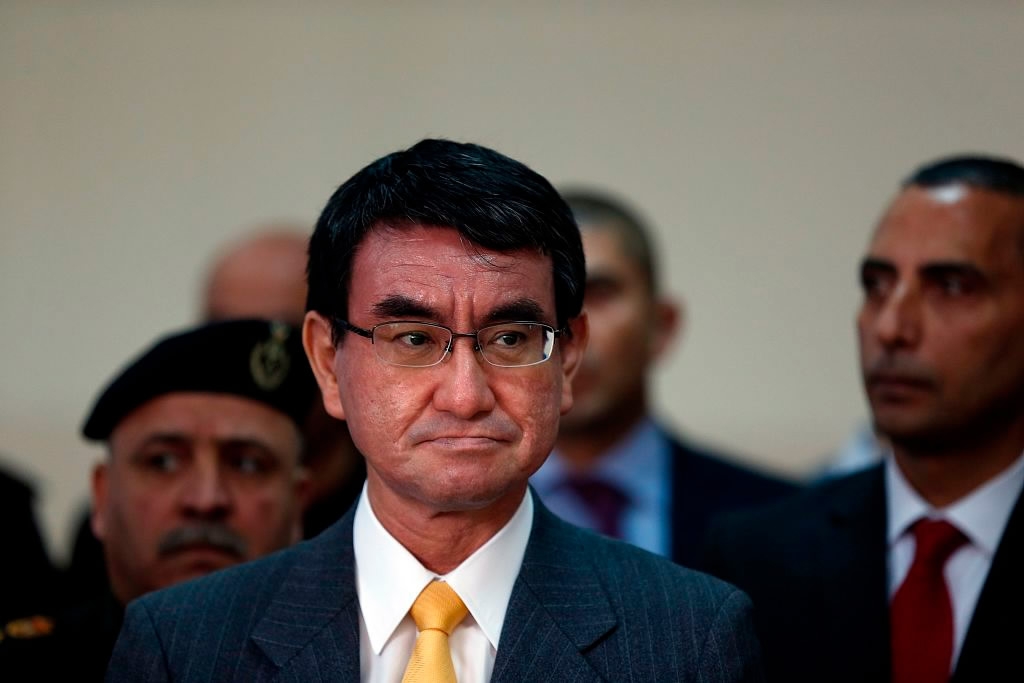
Japanese Foreign Minister Taro Kono called for a free and open Indo-Pacific” region on Friday at the start of a two-day visit to Sri Lanka – the first in 15 years by a top Japanese diplomat to the South Asian country.

Kono’s visit assumes significance amid growing concerns in Japan, and also in India, over China’s increasing investments and influence in the strategic island nation, and comes a month after Sri Lanka formally handed over its southern port of Hambantota to Beijing in a 99-year lease agreement.

Japan regards the Indo-Pacific region, the center of the vitality of the world, as free and open ‘international public good’ which is based on the rule of law and promotes the ‘Free and Open Indo-Pacific Strategy’ in order to ensure peace and prosperity of the region. Sri Lanka is quite significant in this context as it is developing as the international hub in the Indian Ocean,” Kono said in an interview with the Colombo-based Daily News newspaper.

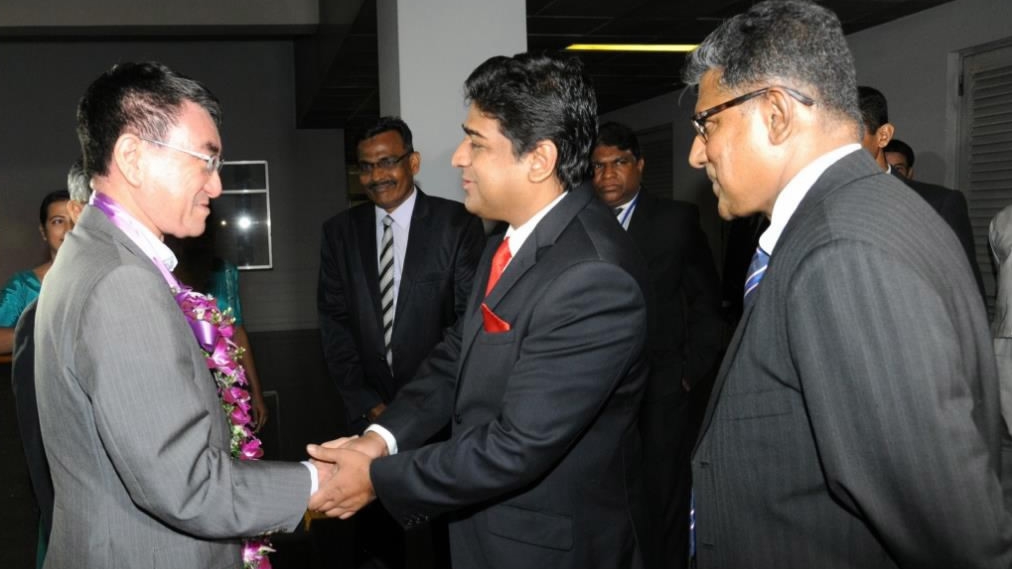
Japan’s Foreign Minister Taro Kono (left) is received by Sri Lanka’s State Minister of Foreign Affairs Vasantha Senanayake (center) and and other Foreign Ministry officials at the Bandaranaike International Airport, Colombo, late on Thursday. /Photo via Sri Lankan Ministry of Foreign Affairs

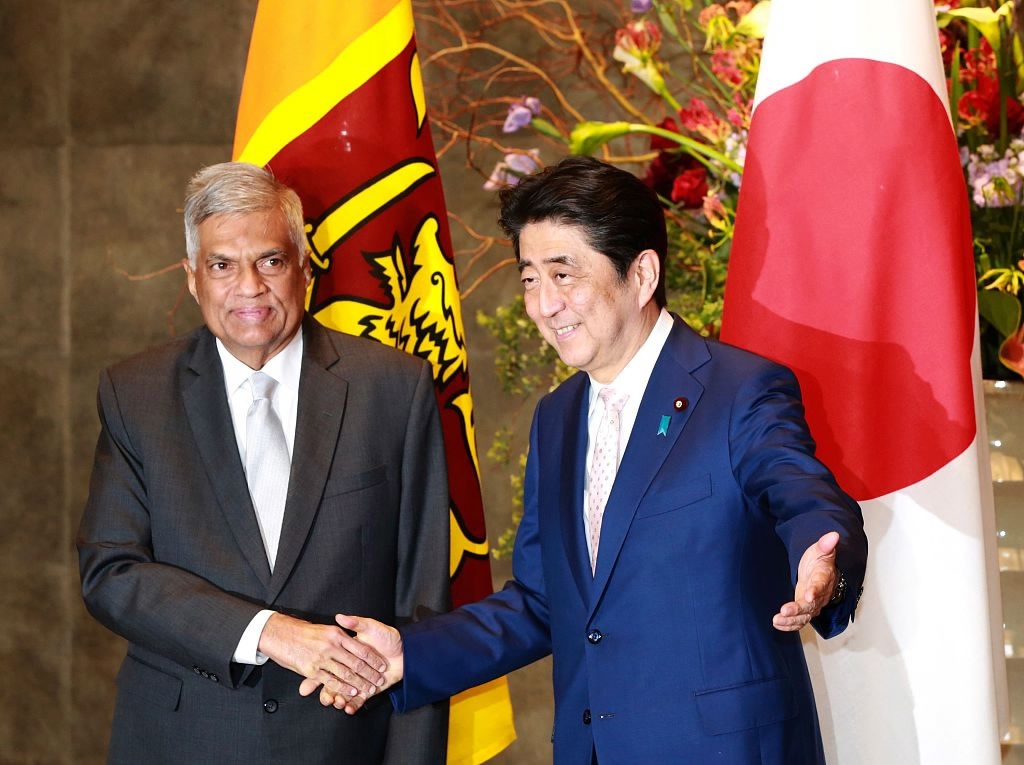
Kono’s statement echoed Japanese Prime Minister Shinzo Abe’s remarks last April during Sri Lankan Prime Minister Ranil Wikremesinghe’s Tokyo visit.  Without a free and open Indian Ocean, there cannot be real prosperity in the region,” the foreign minister said at the time. “This is why it is essential for Sri Lanka to achieve sustainable growth as a hub and develop ports that are open to everyone.”

Kono will meet Sri Lankan President Maithripala Sirisena and Wickremesinghe and hold bilateral discussions with Foreign Minister Tilak Marapana, according to a Sri Lankan Foreign Ministry statement.

Days before Kono’s visit, Japanese defense ship SETOGIRI (DD-156)” made a goodwill visit” to Sri Lanka’s eastern port city of Trincomalee and conducted joint exercises with the country’s navy, amid growing signs that Japan is rapidly expanding its maritime capacity and presence across the Indo-Pacific region.

Japanese Foreign Minister Taro Kono. /VCG Photo

Both Japan and Sri Lanka, as maritime nations, can enjoy development and prosperity from the free and open Indo-Pacific and thus bear responsibilities in realizing it. Japan is determined to further promote peace and prosperity in the region together with Sri Lanka by enhancing connectivity through quality infrastructure projects such as the port development as well as by strengthening cooperation for maritime safety,” Kono said.

The Japanese foreign minister’s visit is aimed at further consolidating the comprehensive partnership between Japan and Sri Lanka based on previous visits by Sri Lankan leaders; by H. E. the President Maithripala Sirisena in May 2016, and by Hon. Prime Minister Ranil Wickremesinghe in April 2017,” a statement from the Embassy of Japan in Sri Lanka said.

Strengthening cooperation and collaboration with Sri Lanka is important for the realization of a free and open Indo-Pacific area based on the rule of law,” the statement added.

Japan’s defense white paper for 2017, released last August, called for reinterpretation of the country’s pacifist constitution, citing threats from China, which strongly criticized it.

China, the largest investor

A general view of the port facility at Hambantota, Sri Lanka, on February 10, 2015. /VCG Photo

The Indian Ocean island county has seen increased international interest after the end of its decades-long civil war in 2009. Many countries, notably China, India and Japan, are seeking a greater role in developing Sri Lanka’s strategic location between the energy-rich Middle East, Africa and the Straits of Malacca.

Guided by a sense of geopolitical contest, each of the major countries have chosen to invest in a number of Sri Lankan port facilities, with China taking on Hambantota; Japan and Indian on Trincomalee and the US in Jaffna.

Earlier this week, Sri Lanka announced that a consortium led by Beijing’s state-run China Harbour Engineering Company Ltd (CHEC) will invest one billion US dollars in the construction of three 60-story office towers on reclaimed land of the Port City development near the main port of Colombo.

The deal follows an earlier Chinese investment of 1.4 billion US dollars to carry out reclamation work for the wider Colombo International Financial City development, strategically located next to Sri Lanka’s harbor, the only deep sea container port in the region, AFP reported on Tuesday.

China’s emergence as the single largest investor and lender to Sri Lanka in recent times with deals to build roads, railways and ports has caused anxiety in neighboring India and Japan who compete with Beijing for influence in the region.

Japanese largesse

Japanese Prime Minister Shinzo Abe (right) with his Sri Lanka counterpart Ranil Wickremesinghe in Tokyo on April 12, 2017. /VCG Photo

Last April, Japan offered 410 million US dollars in loans for Sri Lankan infrastructure projects and an additional 9.2 million dollars in grant aid for the development of the Trincomalee port during Wickremesinghe’s visit to Tokyo, his second since coming to power in 2015.

Economic relations between Japan and Sri Lanka have become closer since the end of the conflict of over 30 years in Sri Lanka. And now Japan and Sri Lanka are important economic and trading partners with annual bilateral trade exceeding 100 billion Japanese yen (885 million US dollars) and more than 130 Japanese companies have a presence in Sri Lanka,” Kono said in the interview.

Until today, Japan has contributed to the development of social and economic infrastructure and of human resources in Sri Lanka through providing the following assistance: more than 1 trillion Japanese yen (8.85 billion US dollars) in loan, approximately 200 billion Japanese yen (1.77 billion US dollars) grants aid, worth around 80 billion yen (708 million US dollars) technical cooperation and more than 1,000 Japan Overseas Cooperation Volunteers.”

Japan has also stepped up its engagement with Colombo in recent times by appointing a special representative to coordinate developments in Sri Lanka, inking a code sharing agreement between Sri Lankan Airlines and JAL to facilitate new flight routes, and boosting trade and tourism ties between Tokyo and Colombo.

Acknowledging the strategic location of Sri Lanka, Kono on Friday said: As Sri Lanka is located at a critical sea lane point to connect Asia and Middle East/Africa, it is a geopolitically and strategically important country.”

Moreover, in view of the stable public security and high economic growth in recent years, Sri Lanka is also a country with high potential for further development. Therefore I choose Sri Lanka as among my first destinations in 2018 in order to further enhance the bilateral relationship.”

A watchful India

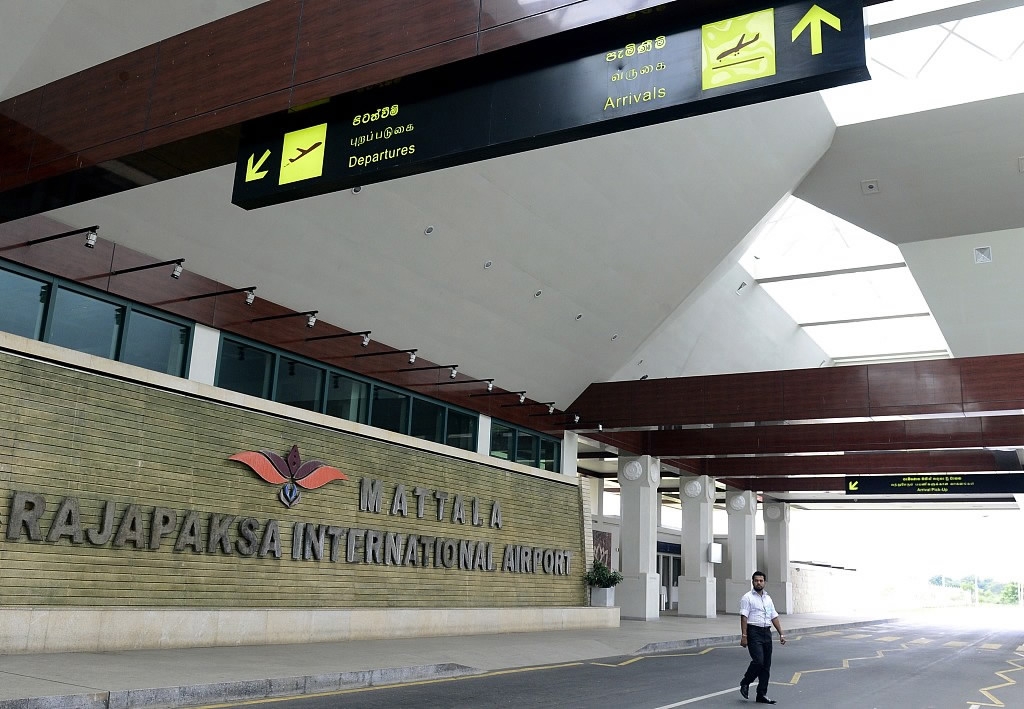
A Sri Lankan worker walks at the entrance to the international airport at Hambantota, Sri Lanka, on February 10, 2015. /VCG Photo

India, meanwhile, has entered into talks with Sri Lanka to take control of the loss-making Mattala Rajapaksa International Airport in Hambantota, not very far from the Chinese-leased port. According to media reports India could invest up to 205 million US dollars into the airport for a 70 percent share and a deal to operate it for 40 years.

Coincidentally, the airport, dubbed the world’s emptiest airport” due to its low number of flights, was built at a cost of 209 million US dollars, 190 million of which came as Chinese assistance.

The southern Sri Lankan port of Hambantota offers critical access to Indian Ocean sea lanes and its acquisition by China has spurred nervousness in India, which is watchful of Beijing’s increasing presence in the region.

Colombo even had to renegotiate the mega Port City project with China Communications Construction Company (CCCC) following geopolitical concerns raised by India. Colombo, a key hub for Indian import-export cargo, removed freehold rights granted to the Chinese company after protests by New Delhi and offered the land on a 99-year lease instead.

Sri Lanka, no doubt, wants to make the best of the situation by pitching itself as a potential trade and finance hub open to doing business with everyone.

Wikeremsinghe, during his Tokyo visit last year, said he wants Japan to use Sri Lanka as a hub for trade.”

“We expect to deepen our existing FTA (free trade agreement) with India through the Economic and Technology Cooperation Agreement, expect to sign an FTA with Singapore and another with China. We also hope to talk to Japan, Indonesia and other ASEAN countries with regards to FTAs,” he added.

[Top photo – Map and flag of Sri Lanka. /VCG Photo]

Prez, PM paved way for Mahendran’s ‘Great Escape’ GL

January 7th, 2018

By Ravi Ladduwahetty Courtesy Ceylon Today

Chairman of the Podujana Eksath Peramuna and former Minister of Justice and Constitutional Affairs Prof. G.L. Peiris yesterday charged that it was the gross inaction on the part of President Maithripala Sirisena and Prime Minister Ranil Wickremesinghe that paved the way for the now beleaguered ex-Central Bank Governor Arjuna Mahendran to escape to Singapore.

It was a great escape for Arjuna Mahendran, Prof. Peiris exclaimed, adding that he could have been arrested in Sri Lanka then, had President Maithripala Sirisena and Prime Minister Ranil Wickremesinghe heeded the advice of the Joint Opposition, given at the right time, well ahead of Mahendran getting away scot free.

“How can we ever get Arjuna Mahendran to come to Sri Lanka as he is a Singaporean citizen and he cannot be arrested or charged under the Sri Lankan laws,” he said, adding that the ideal solution for the Government, under these circumstances, was to impound his Singaporean Government passport, which the Joint Opposition repeatedly requested the Government to do, but to no avail.

“Had the Government listened to us, this catastrophe would never have happened,” Prof. Peiris remarked.

“This is an absurd situation where members of the Joint Opposition have been arrested and remanded and their passports impounded for reasons of far lesser magnitude and much more flimsy such as being unable to account for GI pipes. There were sufficient grounds to impound Mahendran’s passport which was not done and why he was allowed to leave the country,” Prof. Peiris asked indignantly.

Mahendran has said that he had given sufficient evidence to the Presidential Commission probing the Central Bank Bond Scam. “I have no reason to be in Sri Lanka and I have absolutely no intention of returning,” Prof. Peiris quoted Mahendran as having said.

Prof. Peiris, also Deputy Finance Minister and Acting Finance Minister during the Chandrika Bandaranaike Kumaratunga Presidency, who also brought in anti-Money Laundering Legislation in 1996 and who presented the 2000 National Budget in Parliament, said: “It is almost impossible to believe that all the people who stashed away the loot from the Bond Scam would leave it lying around in Sri Lankan banks. There is every reason to believe that the stolen funds would have been spirited away overseas.”

Responding to a question as to whether there was a possibility of the Government getting an international agency, such as Interpol, to arrest Mahendran, Professor Peiris said:” All these matters take time. How long will these matters take? Then the Government will have to resort to extradition procedures, where it will have to request the Government of Singapore to extradite him, which will be a complex, cumbersome procedure.The irony of it was that the Government was trying to lock the stable door after the horse as bolted. There were enough grounds for the Government to put him in remand prison, Prof. Peiris said in veritable disgust.

The way was paved for Mahendran to have a great escape with the loot as well so that all the people concerned could share this loot, he said.

The question which remains unanswered is why was he allowed the liberty to leave the country as and when he wished? , he asked, adding that it was not a part of inadvertence on anybody’s part but, it was deliberately done.

He also stressed that Mahendran was merely the cat’s paw and that people much higher engineered this at their will and pleasure.
“His departure from Sri Lanka was deliberately facilitated,” Prof. Peiris said.

Meanwhile, Colombo District JO MP Bandula Gunawardena told Ceylon Today that though the Bond Commission said that the loss to the country was Rs. 11 Billion (Rs. 11,145 million) that was the only the profits to Perpetual Treasuries, but the real loss to the Central Bank and the Government amounted to well over a whopping Rs 2 Trillion.

He also said that he was prepared to participate in a live television debate with former Finance and Foreign Affairs Minister Ravi Karunanayake, which will provide a true picture of the losses to the country.

New beginnings, old challenges

January 7th, 2018


As the credit and bank statements roll in, come January, the revelry of late December gives way to sober reflection and serious resolutions. This extends to politics. The final reports, handed over to the President, by commissions appointed to look into Central Bank bonds and corruption garnered, rightfully, the most media and public attention last week. The reports are not yet in the public domain, but the President made a hard-hitting and widely-reported statement based on their findings. At the same time, a Facebook post that went viral on social media identified the current President himself, and not Mahinda Rajapaksa, as the person who brought or wanted back in mainstream politics, nominated, promoted or officially rewarded a terrible array of brutes, underworld kingpins, drug dealers and murderers. They are all named. Given the seriousness of the allegations, the incumbent President – perennially preachy in nature – ought to have made a statement on this as well. To date, however, silence.

article_image

To have entrenched within official systems and voted into power, those responsible for its flagrant abuse, have many attendant problems, including obviously significant challenges around meaningful, sustainable political reform, justice and accountability domestically, no matter what is promised in international fora. We focus feverishly around individuals and individual cases of corruption. The mainstream media, primarily because of the partisan bias of owners and fearful of losing out on advertising revenue, doesn’t contextualise or analyse what is a culture of nepotism, corruption and violence that extends deep into the leadership of the current government. The result is a lot of reporting around a small number of cases, sporadically, with the illusion, rather compelling, that attention results in action. Particularly given the electoral tests over 2018, starting in February, the two commission reports, not unlike the many, equally if not more damning COPE reports previously, will be the subject of campaign propaganda and weaponised to suit parochial agendas. Any meaningful prosecution based on judicial review and due process will be kept at bay, because those named and implicated in these recent reports are vital nodes in the fluid equations that project and predict partisan electoral advantage. This is, in effect, a re-run of a familiar, tired script, albeit in the new cinema of yahapalanaya.

If everything imaginable counter to democracy is a hallmark of our mainstream politics and its consociational foundations, holding it at bay at best is arguably only possible with those who are corrupt, or violent, to a degree acceptable to the majority in the South. The litmus test on February 10 will be around this acceptability, and to what degree the UNP and SLFP, together and individually, will be held accountable for what they promised. The choice here for us is, put bluntly or simply, whether we are partial to those currently in power who have delivered little of what was promised but are generally tolerant of and supportive of democracy, or a return to favour of those who were in power previously, and the more effective, efficient delivery of promises based on foundations of violence many in fact were fine with, in the South, as long as visible markers of development were present, the cost of living managed and they somehow benefited. Democracy in Sri Lanka is a contest of perception. It is less about the actual exercise of constitutional rule. The current government suffers from a congenital inability to communicate coherently. This is not something the worst elements of the previous government suffer from. With a President now more interested in his physical security and political survival post-2020, the centrifugal interests that gathered everyone together late 2014 in a thirst to gain power has given way to the centripetal tendencies of coalition politics and a quest to retain power. And while political theorists will mull over the electoral implications of all this, the 700,000 first time voters in February, coupled with millions of others between 18 to 34 who are young, ambitious and really fed up with politics as it is, are those that propaganda, rumour and misinformation will target the most in ways that are publicly visible as well as individually targeted. Either through the ballot or by staying away from it in apathy, both of which are electoral strategies, the political map of Sri Lanka over 2018 will be redrawn in ways that, because we haven’t studied more robustly the impact and reach of social media, many will be surprised by.

This is not all doom and gloom. The telos of electoral uncertainty over 2018 is often and only projected as a return to power by elements voted out in January 2015. The problem with this argument is outlined above – individuals who embody the violence and corruption of the previous regime, if not the very architects of it, are already in government – many with the support of no less than the President. So yahapalanaya is more about keeping in check, to the extent possible, the worst tendencies and excesses of politicians, their family members and apparatchiks, instead of the heady rhetoric of systemic reform it initially promised. Better those in government are honest about this and admit to how hard reform really is when in power – it may actually win them more votes.

The greater danger than a return of, simplistically put, the Rajapaksa regime, is the real and perceived erosion of public support around constitutional reform and accountability, not necessarily in that order. Those partial to the status quo don’t need Gotabaya Rajapaksa to come back into power to derail efforts to bring about a new constitution, so urgently needed, or efforts to keep alive what may well be multi-generational process to hold those responsible for war crimes and crimes against humanity accountable for their actions. The old regime as well as individuals in the present government just need to seed doubt, anxiety and fear – relatively easily engineered with saffron robe donned brutes on demand, protests that turn violent and online hate – to keep meaningful reform at bay and give those at the helm of government an excuse to pause, and even falsely project an essential timidity as a government sensitive to the wishes of the electorate.

Asked if he is optimistic, the Leader of the Opposition, in an interview published in The Hindu newspaper last week, said he isn’t pessimistic. The captures so well, in what is said and left unsaid, Sri Lanka’s tryst with democratic reform over 2018 and beyond. At risk of insulting Mr. Sampanthan, our elder statesman, one wish for the New Year could be to live a life as long as richly textured as he has, and yet not be witness to as many broken promises. We all know what needs to be done and without delay. One risks disappointment to hope that the New Year brings with it better angels to secure a democratic, prosperous and just future for us all, across the political and social spectrum.

බැඳුම්කර කොල්ලයේ හෙළි වූ හොරු මෙන්න

January 7th, 2018

සාකච්ඡාවකින් සකස්‌ කළේ පාලිත සේනානායක උපුටා ගැන්ම දිවයින

බැඳුම්කර කොමිසමේ නිර්දේශ අපට නොකියා කියන කතාව

bedum2

හබැංකු බැඳුම්කර ගනුදෙනුව පිළිබඳ සෙවීමට ජනාධිපති මෛත්‍රිපාල සිරිසේන මහතා විසින් පත් කරන ලද ජනාධිපති විමර්ශන කොමිසමේ වාර්තාව ජනාධිපති කාර්යාලයේදී ඉකුත් 30 වැනිදා කොමිසමේ සභාපති ශේ්‍රෂ්ඨාධිකරණ විනිසුරු කේ. ටී. චිත්‍රසිරි මහතා විසින් ජනාධිපතිතුමා වෙත පිළිගැන්වූ අයුරු. කොමිසමේ ලේකම් එස්‌. උඩුගමසූරිය මහතා සහ එහි සාමාජිකයින් වන ශේ්‍රෂ්ඨාධිකරණ විනිසුරු පී. එස්‌. ජයවර්ධන, විශ්‍රාමික නියෝජ්‍ය විගණකාධිපති වී. කන්දසාමි යන මහත්වරුද මෙම අවස්‌ථාවට එක්‌ව සිටියහ. ජනාධිපති ලේකම් ඔස්‌ටින් ප්‍රනාන්දු මහතා ද ඊට සහභාගී විය.මහබැංකුවේ බැඳුම්කර වංචාව පිළිබඳ විද්යුත් හා මුද්‍රිත මාධ්‍ය ඔස්‌සේ ජනතාව දැනුවත් කරමින් එම වංචාව පිළිබඳ සොයාබැලීම සඳහා කොමිෂන් සභාවක්‌ පත් කරන්නැයි ජනාධිපතිතුමාගෙන් ද ඉල්ලීමක්‌ කළ ජනාධිපති නීතිඥ හේමන්ත වර්ණකුලසූරිය මහතා පසුගියදා ප්‍රකාශයට පත්වූ එම කොමිසමේ නිර්දේශ තුළින් හෙළිවන මේ මහා වංචාවේ ස්‌වභාවය පිළිබඳ සිදු කළ විග්‍රහයකි මේ.

bedum

අපේ රටේ ඉතිහාසයේ කොමිෂන් සභා අප්‍රමාණව පිහිටුවා තිබෙනවා. මමත් සහභාගි වුණු ලලිත් ඇතුලත්මුදලි ඝාතනය පිළිබඳ කොමිෂන් සභාව, විජය කුමාරතුංග ඝාතනය පිළිබඳ කොමිෂන් සභාව, ඩෙන්සිල් කොබ්බෑකඩුව ඝාතනය පිළිබඳ කොමිෂන් සභාව වැනි ඒ සියලුම කොමිෂන් සභා ඇතිකළේ වෙනත් ආණ්‌ඩු සිදුකළ යම් යම් කටයුතු ගැන සොයා බලන්නයි. එස්‌. ඩබ්ලිව්. ආර්. ඩී. බණ්‌ඩාරනායක මහතාගේ සමයේ ඇමැතිවරුන්ට එල්ල වූ අල්ලස්‌ චෝදනා ගැන සොයා බලන්න පත් කළ වෝල්ටර් තල්ගොඩපිටිය කොමිසම හැරෙන්නට අපේ රටේ ඉතිහාසයේ කිසිම ආණ්‌ඩුවක්‌ තමන්ගේ වැරදි සොයන්න කොමිසමක්‌ පිහිටුවලා නෑ. අපේ රටේ ආණ්‌ඩුවක්‌ තමන්ගෙම අයගේ වැරදි හොයන්න කොමිෂන් සභාවක්‌ පත් කළ මේ දෙවැනි අවස්‌ථාව. තමන්ගේ ආණ්‌ඩුවේ ප්‍රබල ඇමැතිවරු මේ බැඳුම්කර වංචාවට සම්බන්ධ බවට එල්ල වූ චෝදනාවට අනුව එය සොයා බැලීමට මේ කොමිෂන් සභාව පිහිටුවීමෙන් ජනාධිපති මෛත්‍රීපාල සිරිසේන මහතා විශේෂ කාර්යභාරයක්‌ ඉටු කර තිබෙනවා. එය ඉතිහාසගතවන සිද්ධියක්‌. දූෂණය පිටුදකින, දූෂණයට එරෙහිවන මේ රටේ සියලුදෙනාගේම ප්‍රණාමය ඒ සම්බන්ධයෙන් ජනාධිපති මෛත්‍රීපාල සිරිසේන මහතාට පුද කළ යුතුයි.

මේ ජනාධිපති කොමිසම සුවිශේෂ වන හේතු කිහිපයක්‌ තිබෙනවා. මෛත්‍රීපාල සිරිසේන ජනාධිපතිතුමා මේ කොමිසමට විගණකාධිපතිවරයෙක්‌ සහ ශ්‍රේෂ්ඨාධිකරණ විනිශ්චයකාරවරුන් දෙදෙනෙක්‌ පත්කළා. එම විනිසුරුවන් දෙදෙනාම ඉතාමත් දක්‌ෂ විනිසුරුවන් දෙදෙනෙක්‌. මා එහි දකින සුවිශේෂත්වය වන්නේ මේ විනිශ්චයකරුවන් දෙදෙනාම එක්‌සත් ජාතික පක්‌ෂය විසින් ශ්‍රේෂ්ඨාධිකරණයට පත් කළ විනිසුරුවන් දෙදෙනෙක්‌ වීම.

මේ වන විට ප්‍රකාශයට පත්කර තිබෙන මේ කොමිෂන් සභාවේ නිර්දේශ තුළින් හිටපු මුදල් අමාත්‍ය රවි කරුණානායක සහ වත්මන් අග්‍රාමාත්‍ය රනිල් වික්‍රමසිංහ මහත්වරුන් පිළිබඳ කර ඇති හෙළිදරව්ව අප කිසිසේත් බලාපොරොත්තු වූ දෙයක්‌ නොවෙයි. 

මේ කොමිෂන් සභාව ඇතිකළාට පසු මම කිහිප අවස්‌ථාවකදීම එම සභාවේ තීරණ සාධාරණ ලෙස විවේචනය කළ කෙනෙක්‌. අර්ජුන් ඇලෝසියස්‌ මහතා කොමිසම හමුවේ සාක්‌ෂි දීම ප්‍රතික්‌ෂේප කළ විට කොමිසම ඔහුගේ නීතිඥවරුන්ගේ දේශන පිළිඅරගෙන කොමිසම හමුවේ සාක්‌ෂි දෙන ලෙස අර්ජුන් ඇලෝසියස්‌ට බලකිරීමට නොහැකි බව කොමිසම ප්‍රකාශ කරන විට මම එම තීරණය විවේචනය කළා. සාක්‌ෂි කරුවෙක්‌ කොමිසමට කැඳවූ විට ඔහුගෙන් මූලිකව ප්‍රශ්න අහන්නෙ නීතිපති දෙපාර්තමේන්තුව. කබීර් හෂීම් සහ මලික්‌ සමරවික්‍රම සාක්‌ෂියට කැඳවූවිට ප්‍රශ්න ඇසීමට නීතිපති දෙපාර්තමේන්තුවට ඉඩ නොදී කොමිෂන් සභාව එය බාරගත්තා. අගමැතිවරයා කොමිසමට කැඳවීමට පෙර ප්‍රශ්න අගමැතිවරයාට යෑව්වා. මේවා ගැන මට සාධාරණ විවේචන තිබුණා. එහෙත් දැන් මම හිතනවා කොමිෂන් සභාව ගත් ඒ තීරණ නිවැරදියි කියල. අර්ජුන් ඇලෝසියස්‌ සාක්‌ෂි දීම ප්‍රතික්‌ෂේප කිරීම ගැන ඔහුගේ නීතිඥවරුන් ගෙනා තර්කය ගැන අදටත් මා තුළ ප්‍රශ්නයක්‌ තිබුණත් කොමිසම එදා ඔවුන්ගේ නීති තර්කය ඉවතට දමා සාක්‌ෂි දෙන ලෙස අර්ජුන් ඇලෝසියස්‌ට බලකළා නම් ඔහුට ශ්‍රේෂ්ඨාධිකරණය හමුවට ගොස්‌ එයට එරෙහිව රීට්‌ ආඥාවක්‌ ගැනීමේ හැකියාව තිබුණා. ඔහු රීට්‌ ආඥාවක්‌ ගත්තා නම් කොමිසම අක්‍රිය වෙනවා. එබැවින් කොමිසමේ විනිශ්චයකරුවන් දෙදෙනා ඉතාමත් බුද්ධිමත්ව ක්‍රියාකිරීම නිසා කිසිදු නීතිමය බාධාවක්‌ නැතිව කොමිසමේ කටයුතු අවසන් කිරීමට හැකිවුණා.

කොමිසමේ නිර්දේශ තුළින් හෙළිදරව් වෙන මේ බැඳුම්කර වංචාවේ ස්‌වභාවය අප අවබෝධ කරගත යුතුයි. එක්‌සත් ජාතික පක්‌ෂය සමඟ ඉතාමත් සමීප සම්බන්ධයක්‌ ඇති වරක්‌ ජපානයේ තානාපති ධුරය ද දැරූ චාලි මහේන්ද්‍රන්ගේ පුත්‍රයකු වන සිංගප්පූරුවේ පුරවැසිභාවය ඇති අර්ජුන මහේන්ද්‍රන් මහ බැංකුවේ අධිපති තනතුරට පත්වන්නේ අජිත් නිවාඩ් කබ්රාල් මහ බැංකුවේ අධිපති තනතුරෙන් ඉවත් වූ පසු එම තනතුරට සුදුස්‌සෙක්‌ මහ බැංකුව තුළ නොසිටි නිසාද? ඔහු සිංගප්පූරුවේ පුරවැසිභාවය සහිත පුද්ගලයකු වීම එම පත්කිරීමේදී ප්‍රශ්නයක්‌ වූවිට අර්ජුන මහේන්ද්‍රන් කියා සිටියේ තමා ද්විත්ව පුරවැසියකු බවයි. එය සම්පූර්ණ අසත්‍යයක්‌. සිංගප්පූරුවේ පුරවැසිභාවය සහිත පුද්ගලයකුට වෙනත් කිසිම රටක පුරවැසිභාවයක්‌ දරන්නට බැහැ. සිංගප්පූරුව ද්විත්ව පුරවැසිභාවය පිළිනොගන්නා රටක්‌. අර්ජුන මහේන්ද්‍රන් මහ බැංකුවේ අධිපති තනතුරට පත් වූ පසුත් ඔහු ශ්‍රී ලංකා රජයට පක්‌ෂපාතීව කටයුතු කරන බවට වන දිවුරුම් ප්‍රකාශය සිදු කළේ නැහැ. ඔහු ඒ දිවුරුම සිදුකළා නම් සිංගප්පූරුවේ පුරවැසිභාවය ඔහුට අහිමි වෙනවා.

යහපාලන ආණ්‌ඩුවට මේ රටේ ජනතාව ජන්දය දුන්නේ විශාල බලාපොරොත්තු ගොන්නක්‌ හිතේ දරාගෙනයි. කිසිදු රාජ්‍ය නායකයකුට කළ නොහැකි වූ තිස්‌ වසරක යුද්ධය නිමා කළත් මහින්ද රාජපක්‌ෂ ජනාධිපතිවරයාට ගෙදර යැමට සිදුවුණේ ඔහුගේ පාලන සමයේ පැවති දූෂණය සහ භීෂණය නිසා. එයට සාක්‌ෂි නැතිමුත් රටේ වැඩිදෙනෙක්‌ එය විශ්වාස කළා. දූෂණය නැති කිරීම සහ දූෂිතයන්ට දඬුවම් දීම තේමා පාඨය කරගත් වර්තමාන ආණ්‌ඩුවට ජනතාව ඡන්දය දුන්නා. එම ඡන්දයට පෙනී සිටියේ මෛත්‍රීපාල සිරිසේන මහතා වුණත් එහි ප්‍රධාන නියමුවා රනිල් වික්‍රමසිංහ මහතායි. ඔහු අපේ රටේ පෙනී සිටියේ අදූෂිත දේශපාලනඥයෙක්‌ ලෙස ‘මිස්‌ටර් ක්‌ලීන්’ යන අන්වර්ථ නාමයෙන්. ඔහු ලීක්‌වාන්යු කෙනෙක්‌ ලෙස කටයුතු කර අපේ රට සිංගප්පූරුවක්‌ කරයි යන විශ්වාසය ජනතාව තුළ තිබුණා.

බැඳුම්කර කොමිසමේ නිර්දේශ තුළින් මේ මහා වංචාව හෙළිදරව් කළත් අර්ජුන මහේන්ද්‍රන් මහ බැංකුවේ අධිපති තනතුරට පත් වූ හේතුව සොයා බැලිය යුතුයි. මුල්ම බැඳුම්කර වංචාව හෙළි කළේ කෝප් කමිටුවෙන්. ඩිව් ගුණසේකර මහතා කෝප් කමිටු වාර්තාව පිළියෙළ කළ විට සියලුම මන්ත්‍රීවරුන් එයට අත්සන් කර නොතිබූ නිසා එය නිකුත් කළ නොහැකි වුණා. තමා මේ සියල්ල සිදුකළේ අගමැතිවරයාගේ සෘජු මැදිහත්වීමෙන් සහ උපදෙස්‌ අනුව යෑයි අර්ජුන මහේන්ද්‍රන් දුන් සාක්‌ෂිය ඒ වාර්තාවේ ඉතා පැහැදිලිව තිබෙනවා. අර්ජුන මහේන්ද්‍රන්ගේ එම සාක්‌ෂිය සහිත කෝප් වාර්තාව පාර්ලිමේන්තුවේ සභාගත කිරීම වැළැක්‌වීමට අගමැතිවරයා සහ එක්‌සත් ජාතික පක්‌ෂය විශාල ප්‍රයත්නයක්‌ දැරුවා. එවැන්නක්‌ සිදුකිරීමට ඔවුන්ට තිබූ උවමනාව කුමක්‌ද? කෙසේ හෝ එම වාර්තාව සකස්‌ කොට පාර්ලිමේන්තුවට ඉදිරිපත් කිරීමට සූදානම් වන විට මෛත්‍රීපාල සිරිසේන මහතාට පාර්ලිමේන්තුව විසුරුවාහැරීමට සිදුවුණා. මෛත්‍රීපාල සිරිසේන මහතා බලයට පත්වුණේ, ජනාධිපති තනතුරට පත්වුණේ එක්‌සත් ජාතික පක්‌ෂයේ පිහිටෙන්. එය කවර හේතුවක්‌ මත සිදුකළත් ඒ අවස්‌ථාවේ පාර්ලිමේන්තුව විසුරුවාහැරීම ඔහු අතින් සිදු වූ වරදක්‌. පාර්ලිමේන්තුව විසුරුවා හැරීම නිසා කෝප් වාර්තාව යටගියා.

කෙසේ නමුත් අපරාධ පරීක්‌ෂණ දෙපාර්තමේන්තුවේ තිබුණු එම කෝප් වාර්තාවේ පිටපතක්‌ කවරකුගේ හෝ උවමනාවක්‌ මත නීතිපති දෙපාර්තමේන්තුවට ඉදිරිපත් වුණා. ඒ අවස්‌ථාවේදී හෝ අගමැතිවරයා ඉදිරිපත් වී කටයුතු කළා නම් මෙම බිලියන 11 ක වංචාව සිදුවන්නේ නෑ. තමා නියෝගයක්‌ නිකුත් කළ බවට අර්ජුන මහේන්ද්‍රන් කෝප් කමිටුවට දුන් සාක්‌ෂිය අසත්‍ය නම් අසත්‍ය ප්‍රකාශයක්‌ කිරීම මත අර්ජුන මහේන්ද්‍රන් එම තනතුරෙන් පහ කිරීමට අගමැතිවරයාට හැකියාව තිබුණා. අපරාධ පරීක්‌ෂණ දෙපාර්තමේන්තුව එම කෝප් වාර්තාව සොලිසිටර් ජෙනරාල් සුහද ගම්ලත් මහතාට බාර දුන්නා. එවකට නීතිපති දෙපාර්තමේන්තුවේ අපරාධ අංශය බාරව සිටි ඒ මහතා එම කෝප් වාර්තාවට අංකයක්‌ ලබා දී ඒ පිළිබඳ සොයා බැලීමට රජයේ ජ්‍යෙෂ්ඨ නීතිඥවරුන් දෙදෙනෙකු පත් කළා. ඔවුන් මේ පිළිබඳ විමර්ශන සිදුකරන විට නීතිපතිවරයා එම ලිපිගොනුව ගෙන්වාගෙන ඊට සිවිල් අංකයක්‌ යොදා එය වෙනත් දෙපාර්තමේන්තුවකට යෑව්වා. අපරාධ නඩුවක්‌ ලෙස අංකයක්‌ යොදා විමර්ශන කරමින් තිබූ ලිපිගොනුව නීතිපතිවරයා එයට වෙනත් අංකයක්‌ යොදා එය සිවිල් නඩුවක්‌ බවට පත් කළේ නම් එය කළේ කාගේ බලපෑමකටද යන්න සොයා බැලිය යුතුයි. සුහද ගම්ලත් මහතා කියන දේ ඇත්තද? නීතිපතිවරයා ලිපිගොනුව වෙනස්‌ කළාද? ඒ සම්බන්ධයෙන් පරීක්ෂණයක්‌ පැවැත්විය යුතු නොවේද? එසේ කළ යුතු වන්නේ මේ බලපෑම් සම්බන්ධයෙන් කොමිෂන් සභාව වක්‍රකාරව හෝ අගමැතිවරයාට ඇඟිල්ල දිගු කළ නිසයි. 

මහ බැංකුව සාමාන්‍යයෙන් පවතින්නේ මුදල් ඇමැතිවරයා යටතේ. සේවක අර්ථසාධක අරමුදල සහ සේවක භාරකාර අරමුදලත් තිබෙන්නේ මුදල් ඇමැතිවරයා යටතේයි. රනිල් වික්‍රමසිංහ මහතා අගමැති වූවාට පසු ඔහු ඒ දෙකම ඔහු යටතට පවරා ගන්නවා. මුලින් සිදුවූ දේ ඔහු හොඳින් දැන සිටියත් ඒ ගැන ඔහු කිසිදු පරීක්‌ෂණයක්‌ සිදුකරන්නේ නෑ. ඒ පිළිබඳ සොයා බලන්නට එක්‌සත් ජාතික පක්‌ෂයට ලැදි නීතිඥවරුන් තිදෙනෙක්‌ පත් කිරීමයි ඔහු කළේ. කිසිවකු සාක්‌ෂියට කැඳවීමට ඔවුන්ට බලයක්‌ නැති වුවත් ඒ පිළිබඳ පරීක්‌ෂා කළ ඔවුන්ගේ නිර්දේශය වුණේ සිදුවී ඇති වංචාව පිළිබඳ සොයා බැලීමට නම් වෝහාරික ගිණුම් පරීක්‌ෂාවක්‌ සිදුකළ යුතු බවයි. වෝහාරික ගිණුම් පරීක්‌ෂාවක්‌ යනු සාමාන්‍යයෙන් සිදුකරනු ලබන ගිණුම් පරීක්‌ෂණයකට වඩා පුළුල් විමර්ශනයක්‌ සහිත ගිණුම් පරීක්‌ෂාවක්‌. විශාල වංචාවක්‌ සිදුව ඇති බව ඔවුනුත් පිළිගත්තා. අගමැතිවරයා ඔහු පත්කළ නීතිඥවරුන්ගේ එම නිර්දේශ ක්‍රියාත්මක කළෙත් නෑ. එම නිර්දේශවලට සිදුවූ දෙයකුත් නෑ.

ඉන්පසු පාර්ලිමේන්තුවේදී අගමැතිවරයා ප්‍රකාශයක්‌ කරමින් මහින්ද රාජපක්‌ෂ පාලන සමයේ මෙරට කොන්ත්‍රාත්කරුවන්ට සහ නොයෙක්‌ යටිතල පහසුකම් සැපයූ අයට ණය වී තිබූ බිලියන 11 ක්‌ ගෙවීමට ඇති බැවින් එම මුදල් සොයාගැනීමට මහ බැංකුවට උපදෙස්‌ දුන් බව කියා සිටියා. පාර්ලිමේන්තුවේ දී ඔහු කළ මේ ප්‍රකාශය සත්‍යයද? අගමැතිවරයාට හෝ මුදල් ඇමැතිවරයාට මහබැංකුවට එවැන්නක්‌ නිර්දේශ කිරීමට බැහැ. අගමැතිවරයා එවැන්නක්‌ සිදුකර ඇත්නම් එය නීති විරෝධියි. මේ පිළිබඳ කොමිසම මහා භාණ්‌ඩාගාරයෙන් විමසූ විට එහි විශේෂ සාක්‌ෂිකරුවකු පවසා සිටියේ ඔවුන්ට අවශ්‍යව තිබුණේ බිලියන 1 ක්‌ පමණක්‌ බවයි. එසේනම් සත්‍ය ප්‍රකාශ කරන්නේ කවුරුන්ද යන්න සොයා බැලීමට ස්‌වාධීන පරීක්‌ෂණයක්‌ සිදු කළ යුතුයි.

ජනාධිපතිවරයා බැඳුම්කර වංචාව සෙවීමට කොමිසමක්‌ පත් කිරීමත් සමග ඔහුට විශාල මඩ ප්‍රහාරයක්‌ දියත් වෙනවා. අපරාධයක්‌ සිදු වී ඇති බවට විශාල වංචාවක්‌ සිදුවී ඇති බවට ලැබුණු තොරතුරු මත එය සෙවීමට කොමිසමක්‌ පත් කරන විට එයට එරෙහිව මඩ ප්‍රහාර එල්ල කිරීමේ උවමනාව ඇත්තේ කාටද? එක්‌සත් ජාතික පක්‌ෂයේ මන්ත්‍රීවරුන් ජනාධිපතිවරයාට නින්දිත ලෙස වාග් ප්‍රහාර එල්ල කළේ කාගේ උවමනාවටද? අපක්‌ෂපාත පරීක්‌ෂණයක අවශ්‍යතාව ඇත්තේ මෙවැනි දේ පිළිබඳ සොයා බැලීමටයි.

ජ්‍යෙෂ්ඨ නීතිඥවරුන් දෙදෙනකු වන යසන්ත කෝදාගොඩ සහ දප්පුල ලිවේරා මේ ජනාධිපති කොමිෂන් සභාවට පත්වන්නේ ඔවුන් තමන්ට වුවමනා ලෙස හසුරුවන්නට හැකි යෑයි එජාපය කල්පනා කළ නිසා වන්නට පුළුවන්. දප්පුල ලිවේරා මහතා පාරම්පරික එක්‌සත් ජාතික පාක්‌ෂිකයකු වීමත් නිසා එජාපය එසේ කල්පනා කළා විය හැකියි. එහෙත් අපේ රටේ ජාතික වීරයන් නැති මොහොතක මා සිතන්නේ ඔවුන් දෙදෙනා ජාතියට පහළ වූ වීරවරයන් දෙදෙනකු හැටියටයි. ඔවුන් කිසිදු බලපෑමකට යටත් නොවී අභීතව සිය රාජකාරිය අකුරටම ඉටු කර තිබෙනවා.

මෙවැනි මහා පරිමාණ දූෂණ චෝදනා එල්ල වූ විට යහපාලන ආණ්‌ඩු ඇති වෙනත් රටවල නම් එම පුද්ගලයන් තම ධුරවලින් ඉවත් වී ඒ පිළිබඳ සිදුකරන පරීක්‌ෂණවලට සහාය දෙනවා. අපේ රටේ ජනාධිපතිවරයා එවැනි පුද්ගලයින් ඉවත් කළත් ඔවුන්ට පාර්ලිමේන්තුවේ විශේෂ කාමර හා කාර්යාල ලැබෙනවා. මේවා මෙලෙස සිදුවන්නේ කෙසේද? එසේ කිරීමට කවරෙකුට හෝ ඇති අවශ්‍යතාව කුමක්‌ද? ස්‌වාධින පරීක්‌ෂණයක්‌ තුළින් මේ පිළිබඳ සොයා බැලිය යුතුයි.

කිසියම් අපරාධයක්‌ සිදුවූ බවට ඇසින් දුටු සාක්‌ෂි නොමැති වුවත් ඊට සම්බන්ධ යෑයි සැක සහිත පුද්ගලයින්ගේ පෙර ක්‍රියාකලාප සහ පසු ක්‍රියා කලාප ඇසුරින් ඔවුන් එම අපරාධයට සම්බන්ධද නැද්ද යන්න නිගමනය කරන්නට පුළුවන්. ඒවා හැඳින්වෙන්නේ පරිවේෂණ සාක්‌ෂි ලෙසිනුයි.

එවැනි සාක්‌ෂි ගණනාවක්‌ මේ බැඳුම්කර වංචාව සම්බන්ධයෙන් චෝදනා ලැබූ පිරිස්‌ තුළින් දැකගැනීමට තිබෙනවා. මේවා පිළිබඳ සොයා බැලීම සඳහා ස්‌වාධීන පරීක්‌ෂණයක්‌ පැවැත්වීමට සහ බැඳුම්කර වංචාව සෙවීමට පත් කළ ජනාධිපති කොමිෂන් සභාවේ නිර්දේශ ක්‍රියාත්මක කිරීමට ඉඩ ලබාදෙමින් අගමැතිවරයා දැන් කළ යුතු වන්නේ තම තනතුරෙන් ඉල්ලා අස්‌වී තාවකාලික නායකයකු පත්කිරීමයි.

සාකච්ඡාවකින් සකස්‌ කළේ පාලිත සේනානායක
ඡායාරූපය: ගාමිණී මුණසිංහ
 

ශ්‍රී ලංකා හමුදාවට උදව් කළ යකාගේ ආච්චීට එරෙහිවීම

January 7th, 2018

කීර්ති වර්ණකුලසූරිය උපුටා ගැන්ම දිවයින

ශ්‍රී ලංකාවේ ත්‍රස්‌තවාදය නැතිකර දැමීමට ශ්‍රී ලංකාව පලස්‌තීනය එක්‌වූ බවට මෙරට දේශපාලනඥයන් කීපදෙනෙක්‌ විසින් පසුගිය සතියේදී ප්‍රකාශ කර තිබුණි. එහෙත් කොටි ත්‍රස්‌තවාදය මර්දනය කිරීම සඳහා ශ්‍රී ලංකා හමුදාව මුහුණ පෑ අසීරුතම අවස්‌ථාවේ සහයට පැමිණියේ කවුද?

මෙරට දේශපාලකයන්ට වසර 17 ක අතීතය දැන් අමතක වී ඇත. ශ්‍රී ලංකාවේ යුද්ධය පැවැති අවස්‌ථාවලද පලස්‌තීනය ශ්‍රී ලංකාවට උදව්කර ඇති බවට දැක්‌වෙන ප්‍රකාශද මාධ්‍යවල පලවිය.

එසේවූවත් කොටි ත්‍රස්‌තයන්ට එරෙහිව සටන්වැදීම සඳහා ගුවන් හමුදාවට ප්‍රහාරක යානා මිලයට ගැනීමේ දැඩි අසීරුතාවයක්‌ උදාවූ අවස්‌ථාවේ ඇමරිකාව, ඉන්දියාව, බ්‍රිතාන්‍යය ඇතුළු කිසිදු රටක්‌ අපේ සහයට පැමිණියේ නැත.

මේ අවාසනාවන්ත තත්ත්වය මැද ඇමරිකානු බෙල් ප්‍රවාහන හෙලිකොප්ටර් යානාවලට අමතර කොටස්‌ ලබාගැනීමද දුෂ්කර විය. ඇමරිකානු රජයේ නියෝගය නිසා බෙල් සමාගම ගුවන් හමුදාවට අමතර කොටස්‌ පවා ලබාදීම ප්‍රතික්‍ෂේප කරනු ලැබීය. මෙම වාතාවරණය මැද එදා ජනාධිපතිවූ ඡේ. ආර්. ජයවර්ධන යකා බැරිනම් යකාගේ ආච්චිගෙන් හෝ හෙලිකොප්ටර් අමතර කොටස්‌ සහ ප්‍රහාරක යානා මිලයට ගන්නා බව කියා සිටියේය.

එහිදී ඔහු ඊශ්‍රායල් රජය වෙත යොමුවිය. එම අවස්‌ථාවේ ඊශ්‍රායල් රජය සිංගප්පූරු අතරමැදියකු හරහා කපිර් සී-2 (සිංහ පැටවා) ප්‍රහාරක යානා මෙරටට ලබාදීමට එකඟවිය.

මෙම පසුබිම මැද ඇමරිකානු කොටි හිතවාදීන් විසින් එම කෆිර් ප්‍රහාරක යානා ද්‍රවිඩයන් ඝාතනය කිරීම සඳහා බෝම්බ දැමීමට යොදා ගැනීමට ශ්‍රී ලංකා රජයට ක්‍රියාකරන බව දක්‌වමින් ප්‍රචාරයක්‌ දියත් කළහ.

මේ එක්‌ කෆිර් ප්‍රහාරක යානාවකට කිලෝ 1000 ක්‌ බරැති බෝම්බ ගෙනයා හැකි බවටද අනාවරණය විය.

එදා ඡේ. ආර්. ජයවර්ධන ජනාධිපතිවරයා යකාගේ ආච්චි යයි පැවසුවේ ඊශ්‍රායලයටය. එහෙත් ඔහු ඊශ්‍රායලයෙන් කෆිර් ප්‍රහාරක යානා මිලයට ගැනීමට කටයුතු කිරීම ගැන රජයේ සිටි මුස්‌ලිම් ඇමැතිවරු කට ඇරියේ නැත.

ඡේ. ආර්. මුහුණ පෑ කොටි තර්ජනයට හිටපු ජනාධිපතිනි චන්ද්‍රිකා කුමාරතුංගද මුහුණ පෑවාය.

sri12000 වසරේ ජුනි මස එක්‌තරා මාධ්‍යවේදිනියක්‌ රාජ්‍ය රහසක්‌ ප්‍රකාශයට පත්කරමින් කෆිර් යානා හතරක්‌ ශ්‍රී ලංකාවට ලැබෙන බව හෙළිකළාය. පසුව සුදු කොඩි කතාව ප්‍රකාශයට පත්කර ශ්‍රී ලංකා හමුදාව යුද අපරාධකරුවන් කිරීමට මුල්වූයේද ඇයයි. අද ඇය ඇමරිකාවේ පදිංචිව සිටියි.

ඇය මේ තොරතුරු හෙලිකිරීමට පෙර ඇමරිකානු කොංග්‍රසයේ මන්ත්‍රීවරියක්‌වූ සු කෙලී එරට කොංග්‍රස්‌ සභාව වෙත සංදේශයක්‌ ඉදිරිපත් කරමින් ශ්‍රී ලංකාවට කෆිර් ප්‍රහාරක යානා අලෙවි කිරීමට තීරණය වී ඇති බවට තොරතුරු ලැබී ඇති බවත් ශ්‍රී ලංකාව සතුව ඇති කෆිර් යානාවලින් හෙලූ බෝම්බ නිසා සිවිල් වැසියන් විශාල සංඛ්‍යාවක්‌ මරුමුවට පත්වී ඇති බවට තමාට තොරතුරු ලැබී ඇති බවත් පැවැසුවාය.

ඇමරිකානු කොංග්‍රස්‌ සභික කාන්තාව එම ලිපිය කොංග්‍රස්‌ සභාවට ඉදිරිපත් කිරීමට පෙර ඉන්දීය බලධාරීන්ට වාර්තාවූයේ සී 2 කෆිර් ප්‍රහාරක යානා පහක්‌ සහ සී. ටී. 2 කෆිර් යානාවක්‌ ශ්‍රී ලංකාවට ගොඩබා ඇති බවයි.

මේවන විට ඇමරිකානු රජය විසින් ඊශ්‍රායල් බලධාරීන්ට අනතුරු අඟවමින් කෆිර් ප්‍රහාරක යානාවල ඇත්තේ ජෙනරල් ඉලෙක්‌ටි්‍රක්‌ සමාගම නිපදවූ ඇමරිකානු එන්ජින් නිසා කෆිර් යානා අලෙවි නොකරන ලෙස දැන්වීය.

එහෙත් යකාගේ ආච්චී හෙවත් ඊශ්‍රායලය රජය ඇමරිකාවේ උපදෙස්‌ පිලිගත්තේ නැත. ඒ නිසා කෆිර් ප්‍රහාරක යානා මෙරටට අලෙවි කෙරුණි.

ආර්. ප්‍රේමදාස ජනාධිපති සමයේද ප්‍රධාන සතුරා ප්‍රභාකරන් සහ කොටි ත්‍රස්‌තවාදීන් යන්න පසෙකට දමා මෙරට මුස්‌ලිම් දේශපාලකයන් දැඩි ඊශ්‍රායල් විරෝධි පිලිවෙතක්‌ ගෙනගියහ.

මේ අතර පලස්‌තීන විමුක්‌ති සංවිධානයේ නායක යසර් අරපත් මෙරට නිල සංචාරයකට පැමිණියේය. එදා ඔහු කොළඹ ටාඡ් හෝටලයේ මාධ්‍ය සාකච්ඡාවක්‌ පවත්වන සමයේ අද මෙන් එෆ් එම් නාලිකා තිබුණේ නැත. එම මාධ්‍ය සාකච්ඡාවට පැමිණ සිටියේ සුළු පිරිසකි.

මෙහිදී මම යසර් අරපත් වෙත බරපතල ප්‍රශ්නයක්‌ යොමුකළෙමි. එම ප්‍රශ්නයෙන් ඔහු කෝපවනු ඇති බව මට සිතුවත් යසර් අරපත් එම ප්‍රශ්නයට සිනාවෙමින් ප්‍රතිචාර දැක්‌වීය.

ද්‍රවිඩයන් පුහුණුකළේ පලස්‌තීනය නේද යන්න මගේ ප්‍රශ්නය විය.

“ද්‍රවිඩ ගරිල්ලන් පුහුණු කළේ මගේ පලස්‌තීන විමුක්‌ති සංවිධානය නොවෙයි. ජෝරඡ් හබාශ්ගේ පලස්‌තීන ජනතා විමුක්‌ති පෙරමුණ යයි අරපත් සත්‍යය හෙලිකරමින් අනාවරණය කළේය.

යසර් අර්පත් කළ ප්‍රකාශය තවදුරටත් සනාථවූයේ ප්ලොට්‌ සංවිධානයේ නායක සිද්ධාර්ථන් හා ඊ.පී.ඩී.පී නායක ඩග්ලස්‌ දේවානන්ද පවා ඒ බව පිලිගැනීමෙනි.

sri2යසර් අරපත් මේ බව හෙලිකිරීමට පෙර වාර්තාවූයේ පලස්‌තීන විමුක්‌ති සංවිධානයේ ලන්ඩන් ශාඛාවේ නියෝජිත සයිද් හමිඩ් 1978-1980 සමයේ ඊරොස්‌ සංවිධානයේ ක්‍රියාකාරීන්ට ලෙබනනයේදී අවි ආයුධ පුහුණුව ලබාදී ඇති බවයි.

එසේම ඡේ. ආර්. ජයවර්ධන ජනාධිපති සමයේ මෙරට බුද්ධි අංශයේ ප්‍රධානියාව සිටියේ ශර්නි විඡේසූරියයි. ඔහුගේ බුද්ධි සේවයටද වාර්තා වී තිබුණේ ප්ලොට්‌ ගරිල්ලන් රැසකට ජෝර්ඡ් හබාශ් කණ්‌ඩායම අවි ආයුධ පුහුණුව දුන් බවයි.

මේ බව නෝර්වේහි ඔස්‌ලෝ නුවර සිටින ප්ලොට්‌ සම්බන්ධිකාරකද තහවුරු කර ඇත.

ආර්. ප්‍රේමදාස ජනාධිපති සමයේ විදේශ ඇමැතිවූයේ ඒසීඑස්‌ හමිඩ්ය. ඔහුද උග්‍ර ඊශ්‍රයල් විරෝධියෙකි.

එම සමයේ ඊශ්‍රායල් හමුදාව උගන්ඩාවේ එන්ටබේ ගුවන් තොටුපලට ගොස්‌ පලස්‌තීන ගරිල්ලන්ගේ ප්‍රාණ ඇපයේ සිටි ප්‍රංශ ගුවන් යානාවක සහ මගීන්ද බේරාගැනීමේ වීරවික්‍රමය පිළිඹුකෙරෙන “ද රේඩ් ඔෆ් එන්ටබේ” චිත්‍රපටය ශ්‍රී ලංකාවේ ප්‍රදර්ශනයට යොමුවිය.

එහෙත් ඒසීඑස්‌ හමීඩ් එම චිත්‍රපටය තහනම් කළේය. මේ අතර ඊශ්‍රායල් මොසාඩ් බුද්ධි සේවයේ ඒජන්තවරයකුවූ වික්‌ටර් ඔස්‌ත්‍රොව්ස්‌කි විසින් රචිත ග්‍රන්ථයෙන් ඊශ්‍රායලය කොටින්ටද අවි පුහුණුව ලබාදුන් බව කිරීමෙන් ශ්‍රී ලංකාවේ ඊශ්‍රායල් විරෝධි අර්බුදය වර්ධනය විය.

එහි ප්‍රතිඵලය වූයේ ජනාධිපති ප්‍රේමදාස මොසාඩ් කොමිසම නමින් කොමිසමක්‌ පත් කිරීමයි. මේ කොමිසම හමුවේ සාක්‍ෂි දුන් යුද – ගුවන් – නාවික සහ බුද්ධි ප්‍රධානීන් පැවසුවේ ඊශ්‍රායලය විසින් කොටින්ට අවි ආයුධ පුහුණුව ලබානුදුන් බවයි.

කෙසේ වෙතත් ජනාධිපති ප්‍රේමදාසගේ පාලනයෙන් පසු බලයට පැමිණි ආණ්‌ඩු, කොටි ත්‍රස්‌තවාදය පරාජය කිරීම සඳහා ඊශ්‍රායලයේ සහය ලබාගත්තේය.

ඒ අනුව ඊශ්‍රායලය එම්. කේ. 1-2 සුපර් ඩොව්රා වර්ගයේ අධිවේගී යාත්‍රා සහ ශැල්ඩාන් වර්ගයේ යාත්‍රාද සාර්-4 වර්ගයේ මිසයිල බෝට්‌ටු දෙකක්‌ද මෙරටට සපයනු ලැබීය.

කොටි මුහුදු ඒකකයට අයත් පාවෙන අවි ගබඩා විනාශ කිරීම සඳහා ගැඹුරු මුහුදට ගොස්‌ ප්‍රහාර එල්ල කළේ නන්දිමිත්‍ර සහ සුරනිමල යන එම ඊශ්‍රායල් නැව්ය.

එසේම කොටින්ට ප්‍රහාර එල්ල කිරීම සඳහා මිසයිල ද කොටි ආගමනය ගුවනේ සිට නිරීක්‍ෂණය කරන සර්චර් වර්ගයේ නියමුවන් රහිත යානාවන්ද මෙරටට සැපයීමට ක්‍රියාකළේය.

වන්නි මෙහෙයුමේදී කොටි ක්‍රියාකාරකම් නිරීක්‍ෂණය වූයේ මේ සර්චර් යානාවෙනි.

sri3එහෙත් මේ අතීතය දේශපාලකයන් විසින් මුළුමනින්ම අමතක කර ඇත.

එදා පලස්‌තීන නායක අරපත් මෙරටට පැමිණි අවස්‌ථාවේ පැවසුවේ ශ්‍රී ලංකාවේ හෙද සේවාවේ හිඟයක්‌ ඇති නිසා පලස්‌තීනය හෙද සේවාව නැංවීමට සහයවන බවයි. එහෙත් එවන් සහයක්‌ ලැබුනේ නැත.

පලස්‌තීන ගරිල්ලන් ද්‍රවිඩ ගරිල්ලන්ට අවි පුහුණුව දුන් බවට මා එදා නැගූ ප්‍රශ්නයට ප්‍රතිචාර දැක්‌වීමට ක්‍රියාකළ යසර් අරපන් පසුව පැවැති තේ පානයේදී මා සමීපයට පැමිණ පැවසුවේ ජෝර්ඡ් ගබාශ්ගේ ක්‍රියාකලාපය තමා අනුමත නොකරන බවයි.

මෙවන් පසුබිමක්‌ මැද ඊශ්‍රායලය විසින් පෙරුසලම එරට අගනුවර ලෙස ප්‍රකාශයට පත්කිරීමට එක්‌සත් ජාතීන්ගේ ඉදිරිපත් කළ යෝජනාවට එරෙහිව ශ්‍රී ලංකාව ඡන්දය පාවිච්චි කරනු ලැබීය. ඊශ්‍රායලයේ ශ්‍රී ලංකා තානාපති කාර්යාලයක්‌ ටෙල් අච්චි නුවර ක්‍රියාත්මක වේ. එහෙත් ඇමරිකාව බ්‍රිතාන්‍ය ඇතුළු රටවල් කීපයක්‌ ශ්‍රී ලංකාවේ හමුදාව යුද අපරාධ සිදුකළ බව දක්‌වමින් ඉදිරිපත් කළ ජිනීවා යෝජනාවට එරෙහිව ශ්‍රී ලංකාව ක්‍රියාකළේ නැත.

මින් සනාථ වූයේ ශ්‍රී ලංකා හමුදාවට එරෙහි මානව හිමිකම් කවුන්සිලයේ 30/11 යෝජනාවට වඩා ශ්‍රී ලංකා රජය ජෙරුසලම් යෝජනාවට ප්‍රමුඛත්වය දීම ඇති බවය.

මේ ජිනීවා යෝජනාවට එරෙහිව එක්‌සත්ජාතීන්ගේ සංවිධානයට දූත කණ්‌ඩායමක්‌ යවා ක්‍රියාකරනු වෙනුවට එම යෝජනාවේ සම අනුග්‍රාහකයා වීමට ශ්‍රී ලංකාව එකඟවීම ඛේදජනක සිද්ධියක්‌ බව රියර් අද්මිරාල් සරත් වීරසේකර මහතා කියාසිටියේය.

මේ අතර ජිනීවා – මානව හිමිකම් කොමසාරිස්‌ සෙයිස්‌ රාද් හුසේන්ගේ සේවා කාලය මේ වසරේ අගෝස්‌තු 31 දා අවසන් වේ. තමා 2 වැනි වරට මානව හිමිකම් කොමසාරිස්‌ ධුරයට තරග නොකරන බව සෙයිද් රාද් හුසෙන් පළකළේය.

මානව හිමිකම් කොමසාරිස්‌ සිය සේවාකාලය නිමවීමෙන් පසු 2 වැනි වරටත් තරග නොකරන බව පැවැසීම යනු ඇමරිකානු ජනාධිපති ට්‍රම්ප් සහ එක්‌සත්ජාතීන්ගේ ඇමරිකානු තානාපතිනි නිකී හේලි හමුවේ පරාජයට පත්වීමයි. මානව හිමිකම් උල්ලංඝණය කළවුන් මානව හිමිකම් කවුන්සිලයේ සාමාජිකයන් ලෙස ක්‍රියාකරනවා යයි නිකිහේලි තර්ජනාත්මක ස්‌වරූපයෙන් මානව හිමිකම් සමුළුව අමතා පවසද්දී සෙයිද් රාද් හුසේන් නිහඬ විය.

එසේම පිලිපීන ජනාධිපති රොඩ්රිගෝ ඩුටාටේ මානව හිමිකම් කොමසාරිස්‌ට තක්‌කඩියා යයි කියමින් පරිභව කළේය.

මේ පසුබිම මත උතුරු පළාත් සභා ඇමැතිනි ආනන්දි සසිතරන් දැඩි කම්පාවට පත්වී ඇත.

sri4“සෙයිද් රාද් හුසේන් අගෝස්‌තු මස කවුන්සලයෙන් ඉවත්ව යාමෙන් අපේ බලාපොරොත්තු බිඳවැටුණා” යයි ඇය කියාසිටියාය.

බටහිර රටවල රූකඩයක්‌ ලෙස ක්‍රියාකළ සෙයිද් රාද් හුසේන් එම රටවල බලපෑම් මත කොටි ඩයස්‌පෝරා ක්‍රියාකාරීන්ට මානව හිමිකම් කවුන්සිලයේ දොරවල් විවෘත කළේය. එසේම ශ්‍රී ලංකාවේ දේශප්‍රේමී කණ්‌ඩායම්වලට එරෙහිව කොටි හිතවාදීන් සහ රාජ්‍ය නොවන සංවිධාන එල්ල කරන බොරු පැමිණිලි විභාග කරන ලෙසද ඔහු තම නිලධාරීන්ට නියෝග කළේය.

එසේ වූවත් මානව හිමිකම් කොමසාරිස්‌වරයා ඇමරිකාව හමුවේ හිස නැමීය.

මේ අතර ශ්‍රී ලංකාවට එරෙහි ජිනීවා යෝජනාව ගැන තමා මාර්තු 21 දා අවසන් ප්‍රකාශය කරන බව හෙතෙම ප්‍රකාශ කළේය.

කෙසේ වෙතත් ඇමරිකානු රූකඩය ලෙස කටයුතු කළ සෙයිද් රාද් හුසේන් ඇමරිකාවේ තර්ජන ගර්ජන මැද මානව හිමිකම් පුටුවෙන් ඇදවැටුණි.

බටහිර රටවල් සිදුකරන යුද අපරාධ සම්බන්ධව ක්‍රියානොකිරීමක්‌ ශ්‍රී ලංකාවට එරෙහිව දැඩි පිලිවෙතක්‌ අනුගමනය කිරීමක්‌ තුළින් සෙයිද් රාද් හුසේන් අනුගමනය කළේ දෙබිඩි පිළිවෙතකි.

ඔහු 2017 වසර තුළ එක්‌සත්ජාතීන්ගේ නියෝජිතයන් 7 ක්‌ මෙරටට එවනු ලැබීය.

එසේම රැඳවුම්භාරයේ සිටින කොටි යුද අපරාධකරුවන්ගේ මානව හිමිකම් උල්ලංඝණය වී ඇති බව දක්‌වමින් ඔහු ඒ ගැන සෙවීමට එක්‌සත් ජාතීන්ගේ ත්‍රි පුද්ගල කණ්‌ඩායමක්‌ද මෙරටට එවනු ලැබීය.

එහෙත් බ්‍රිතාන්‍යයට එරෙහිව යුද අපරාධ චෝදනා එල්ලවෙද්දී ඔහු ඒ ගැන ක්‍රියාකළේ නැත.

ශ්‍රී ලංකාවේ ආණ්‌ඩුක්‍රම ව්‍යවස්‌ථා සංශෝධන ත්‍රස්‌ත මර්දන පනත අහෝසි කිරීම, යුද අපරාධ චෝදනා විමර්ශනයට හයිබ්‍රිඩ් අධිකරණයක්‌ පත්කිරීම සහ උතුරේ ආරක්‍ෂක හමුදාව ඉඩම් වලින් ඉවත්වීම යන කරුණු පිළිබඳව ශ්‍රී ලංකාවට උපදෙස්‌ දීමටද ඔහු ඉදිරිපත්විය. එසේම යුද අපරාධ චෝදනා එල්ලවී ඇති හමුදා නිලධාරීන් විශ්ව සම්මුතිය මත අත්අඩංගුවට ගතයුතු බවද කීවේය.

පසුගිය සැප්තැම්බර් මාසයේ ඔහු පැවසුවේ රැඳවුම්භාරයේ සිටින කොටි මිනීමරුවන් නිදහස්‌ කරන ලෙසයි. එහෙත් වත්මන් රජය ඊට එකඟවූයේ නැත.

එහෙත් 2018 මාර්තු 21 වැනිදා සෙයිද් රාද් හුසේන් ශ්‍රී ලංකාවට එරෙහිව ලිත වාර්තාවක්‌ද ඉදිරිපත් කිරීමට නියමිතය.

මේ වාර්තාවෙන් ඔහු ශ්‍රී ලංකාවට එරෙහිව කුමන පියවරක්‌ ගතයුතුද යන්න ප්‍රකාශ කරනු ඇත.

ඊට හේතුවී ඇත්තේ ශ්‍රී ලංකා රජය යුද අපරාධ චෝදනාවලට ලක්‌වූවන් ගැන කිසිදු පියවරක්‌ ගෙන නැති බවට මානව හිමිකම් කවුන්සිලයට තොගපිටින් පැමිණිලි ලැබීමයි.

මේ අතර නාවික හමුදාවේ උපාය මාර්ගික කේන්ද්‍රස්‌ථානයක්‌වූ ඉරනතිව් දූපත්වලින් නාවික කඳවුර ඉවත්කර ගැනීමේ මෙහෙයුමක්‌ දියත්වී ඇත.

වසර කිහිපයකට පෙර ලයන් එයාර් යානාවට මිසයිල ප්‍රහාරයක්‌ එල්ල වූයේ ඉරනතිව් සිටයි. නාවික හමුදාව විසින් වසර ගණනකට පසු ලයන් එයාර් යානාවේ සුන්බුන් හා එන්ජිමද මුහුදු පත්ලේ තිබී ගොඩගත් අතර මළසිරුරු හමුවූයේ නැත.

පසුව කොටි ත්‍රස්‌තවාදියකු හෙළිකළ තොරතුරු මත නාච්චිකුඩා වෙරළ ප්‍රදේශයේ හෑරීම කටයුතු සිදුකළත් මළ සිරුරුවල කොටස්‌ සොයාගැනීමට නොහැකිවිය.

sri5මෙම ඉරනතිව් දූපත් වල පවුල් 45 ක්‌ පදිංචිව සිටි අතර කොටි ඔවුන්ව එලවා දමා තිබුණි. එහෙත් ඉරනතිව් දූපත්වල පවුල් 2500 ක්‌ පදිංචිවී සිටි බවට සාවද්‍ය ප්‍රකාශ කරමින් එම දූපත්වල පාලනය සියතට ගැනීමට ද්‍රවිඩ මන්ත්‍රීවරු දැඩිඋත්සාහයක නිරතවී සිටිති.

මෙලෙස අවතැන්වූ බව කියන පවුල් 2500 සතු කිසිදු ඔප්පු තිරප්පුවක්‌ නැතැයිද හෙලිවී ඇත.

එසේම ඉරනතිව් දූපත්වල සිටින සිංහල නාවික හමුදාව ඉන්දියාවේ ආරක්‍ෂාවටද තර්ජනයක්‌ බව දක්‌වන උතුරේ කොටි හිතවාදීන් වන්නි වෙරළේ සිට මුහුදු සැතපුම් 12 ක්‌ ඈතින් ඇති මෙම දූපත් වසර 400 ක්‌ තිස්‌සේ කතෝලික පල්ලියේ පාලනයට නතුවූ බවට තවත් සාවද්‍ය ප්‍රචාරයක්‌ දියත් කර තිබේ.

2007 වසරේදී කොටි සංවිධානය ඉරනතිව් දූපත්වල මුහුදු කොටි කඳවුරක්‌ ස්‌ථාපිත වූයේ ඊලම් ද්‍රවිඩ ජනතාවගේ ආරක්‍ෂාව සඳහා බවටද කොටි හිතවාදීන් ප්‍රකාශ කර ඇත.

මෙලෙස ඉරනතිව් දූපත් වලින් නාවික හමුදාව පන්නා ගැනීමට උත්සාහ කරන විරෝධතාකරුවන් මෙහෙයවන්නේ සන්නියාගු වේදනායගම් නැමැත්තෙක්‌ බවද අනාවරණය වී තිබේ.

මේ අතර 2018 වසර ආරම්භ වීමත් සමඟම කොටි හිතවාදී සංවිධාන හතරක්‌ ජාත්‍යන්තර ප්‍රජාවෙන් ඉල්ලීමක්‌ කරමින් යුද අපරාධ චෝදනා වලට ලක්‌වූවන් එරෙහිව විශ්ව සම්මුතිය මත ක්‍රියාකරන ලෙස ඉල්ලා ඇත.

කවුරු කොහොම කිව්වත්…

January 7th, 2018

කතු වැකිය උපුටා ගැන්ම දිවයින

Insider Trading යනුවෙන් යෙදුමක්‌ ඉංග්‍රීසි භාෂාවෙහි තිබේ. මෙහි තේරුම බැංකුවක, මූල්‍ය ආයතනයක හෝ වෙන්දේසියක අභ්‍යන්තර මූල්‍ය තොරතුරු පිටතට විකිණීම යනුය. එම තොරතුරු මිලට ගන්නා තැනැත්තාට එම තොරතුරු පාවිච්චි කර මූල්‍ය වෙළෙඳපළ තුළ වාසි ලබාගත හැකිය. මෙය භයානක වරදකි. මෙවැනි තොරතුරුවලින් ප්‍රයෝජන ගෙන කෝටිපතියකු වූ ශ්‍රී ලාංකික සම්භවයක්‌ ඇති රා- රාජරත්නම් නමැති ඇමරිකානු ආයෝජකයා එම වරදට, අවුරුදු බර ගණනක සිර දඬුවමක්‌ ලැබ ඇමරිකාවේ හිර ගෙදරක කූරු ගණන් කරයි. 1995 දී නික්‌ලීසන් නමැති Insider Trader කෙනකු විසින් සිංගප්පූරුවේ කොටස්‌ වෙළෙඳ පොළේදී කළ මෙවැනි වංචාවක්‌ නිසා එංගලන්තයේ සුප්‍රකට බාරිංග්ස්‌ බැංකුව නැට්‌ටටම බංකොලොත් වී වසා දමන ලදි. “බාරිංග්ස්‌” යනු සූවස්‌ ඇළ කැපීම සඳහා අතේ සතේ නැතිව එංගලන්තය ළතවෙද්දී ඒ සඳහා මුළු මුදලම ණයට දුන් බැංකුවය. අන්තිමේදී නික්‌ ලීසන් හිරේ ගියේය. පසුගිය වකවානුවේදී එළියට ආ බැඳුම්කර වංචාව පිළිබඳ කියෑවුණ කරුණුවලට අනුව අර්ජුන මහේන්ද්‍රන් මහ බැංකු අධිපතිව සිටි කාලයේදී සිදුවී තිබුණු Insider Trading වැඩකි. මෙහිදී බයර් ලෙස කටයුතු කළේ පර්පෙචුවල් ට්‍රෙෂරීස්‌ සමාගමය. බැඳුම්කරය හරහා එම සමාගම උපයාගත් මුදල්වලින් සෑහෙන කොටසක්‌ මේ වන විට බැංකු කොටස්‌ සහ වෙනත් ව්‍යාපාරවලට ආයෝජනය කෙරී සමාජ ගතවී අවසන්ය. ඒ නිසා එම මුදල් කෙසේ ආපසු ලබාගත හැකිද යන ප්‍රශ්නය මතුවෙයි. බැඳුම්කරය නිසා ලොකුම අවුල සිදුවී ඇත්තේ සේවක අර්ථසාධක අරමුදලටය. එයට සිදුවූ පාඩුව නිසා එම අරමුදලේ සාමාජිකයන්ට ගෙවන පොලී ප්‍රතිශතය පවා අඩුවී තිබේ. අර්ථසාධක අරමුදලෙන් කොල්ලකා ගත් මුදල ආපසු එම අරමුදලටම ලබාදීමේ වගකීම ආණ්‌ඩුව සතුව ඇත. එම මුදල් ලබාගැනීම සඳහා විශේෂ පනතක්‌ සම්මත කරගත යුතු බව ජනාධිපති මෛත්‍රිපාල සිරිසේන මහතා මෙයට දින කිහිපයකට පෙර බැඳුම්කරය සම්බන්ධයෙන් කරන ලද විශේෂ ප්‍රකාශයක සඳහන් විය. පර්පෙචුවල් ට්‍රෙෂරීස්‌ සමාගමේ බැංකු ගිණුම් දැනටමත් තහනම් කර තිබේ. එහෙත් බැඳුම්කර කොල්ලයෙන් උපයාගත් මුදලින් සියයට දහයක්‌වත් එම ගිණුම්වල නැති බව අපට විශ්වාසය. හේතුව බැඳුම්කර කොල්ලකෑම් සහ Insider Trading සිදුකරන සමාගම්වල මෝඩයන් නොසිටීමය. ඔවුන් යමක්‌ කරන්නේ එහි ඊළඟ ඵලයද සලකා බලාය. ඒ අනුව ඉතිරි මුදල් සෙවීම සඳහා ඩුබායි බැංකුවලට යැමට ලක්‌ රජයට සිදු වූවොත් පුදුම විය යුතු නැත. 
 
 කවුරු කොහොම කිව්වත් බැඳුම්කර සිද්ධියේ අභ්‍යන්තරය රටට හෙළි කිරීමේ ගෞරවය ජනාධිපති මෛත්‍රිපාල සිරිසේන මහතාට හිමිය. එම වංචාවට එරෙහිව ජනමතයක්‌ ගොඩනැඟීමේ මූලාරම්භය ඇති කිරීම පිළිබඳ ගෞරවය ජනතා විමුක්‌ති පෙරමුණට හිමිය. කොමිසමේ සාක්‍ෂි මෙහෙයවීමේදී දප්පුල ද ලිවේරා සහ යසන්ත කෝදාගොඩ යන මහත්වරුන් කළ මෙහෙවර ඉතා අගනේය එහෙත් අන්තරාදායකය. මෙවැනි දූෂකයන් ගැන සෙවීමට ගිය ලලිත් අඹන්වල නමැති රජයේ නිලධාරියා වසර 2002 දී ඇසිඩ් පහරක්‌ කෑවේය. ඔහුගේ ඇස්‌ අන්ධ විය. තත්ත්වය එය නම් දප්පුල ලිවේරා සහ යසන්ත කෝදාගොඩ මෙතැන් සිට ජීවත් විය යුත්තේ ඉතා පරෙස්‌සමිනි. ජනාධිපති මෛත්‍රිපාල සිරිසේන මහතා ඊටත් වඩා පරෙස්‌සම් විය යුතුය. රුපියල් 5000 ට මිනීමරන, බෝම්බ ගසන අපරාධකරුවන් ගෙන් අද සමාජය පිරී ඉතිරී ගොස්‌ ඇති බව අප අමතක කළ යුතු නොවේ. සෑම මරාගෙන මැරෙන්නෙක්‌ම කොටියෙක්‌ නොවේ. එහෙත් මරාගෙන මැරීම සිදුවූ පසු එය සිදු කළ එකා කොටියකු බව කී විට ඔහුගේ මළකඳ එයට විරුද්ධ වන්නේ නැත. ලලිත් ඇතුලත්මුදලි ඝාතනය මතක ඇති අය අප අතර බොහෝය. 

Revoke 13th amendment – a threat to both India & Sri Lanka

January 6th, 2018

Shenali D Waduge

The Indo-Lanka Peace Accord was signed on 29 July 1987. JR Jayawardena signed on behalf of Sri Lanka & Rajiv Gandhi signed on behalf of India. What it achieved, what it did not achieve is just as important as what both countries need to now decide about its continuance! The scenario is certainly not what it was 30 years ago. Both signatories are now dead. JR having died naturally and Rajiv Gandhi being assassinated by the very militant group that his mother helped birth. What is most important for India to realize is that the troika – 13a, the PC system and the Indo-Lanka Accord have dampened friendly relations between the Sinhala’s majority & India. To mend festered ties India must now allow Sri Lanka to bury the 13a & the PC system for good. Moreover, having helped create Tamil militancy and allowed India to be a logistics hub for LTTE terrorism, India is morally bound to apologize by reversing the damage India had caused.

That the Accord and the 13th amendment to Sri Lanka’s Constitution on 14 November 1987 and with it the Provincial Council’s Act no 42 of 1987, were drafted by the South Block of the Indian External Affairs Ministry goes without saying. The manner it was forced upon Sri Lanka also does not need to be again reminded. When we drafted the 13th amendment, most of the Sri Lankan Tamil leaders – TULF leaders as well as militant leaders wanted Jaffna to be the capital of the North & East, but we insisted that Trincomalee should be the capital because of strategic importance of the sea port to India” said Former IPKF Commander General A S Kalkat clearly revealing India’s interference into Sri Lanka’s internal affairs. The Accord was signed under virtual duress. Emergency was declared. Media was banned. Sri Lankan Ministers were forced to sign undated resignation letters.

The reality is that the Indo-Lanka Accord has no real basis for continuance. None of the clauses were upheld. Clause 2.16 a) promising not to allow Indian territory to be used for activities prejudicial to the unity, integrity and security of Sri Lanka was never upheld by India. Tamil Nadu continued to be used as a logistics hub for anti-Sri Lankan activities. By signing the Accord India did not and could not eliminate or lessen LTTE terrorism or maybe India did not wish to do neither!

The bullying nature of India has made successive Governments fear to review and revoke the Accord on account of its failures using legal provisions like Pacta sunt servanda (agreements must be honored in full – which was not the case)

The irony was that India was offering a Peace Accord and a new administrative system after having armed, trained and financially supported Tamil militancy. The Jain Commission report clearly establishes this.

The 9 Provincial Councils are costing Rs.600billion annually with nothing extraordinarily being given to the public that the earlier municipal, district, urban councils cannot do. The amount incurred annually calculated into 30 years could have been better used for Sri Lanka’s development. Another valid reason why Sri Lankan polity are angry with India.

30 years has lapsed. We are now in 2018.

Given that India stresses on the impact of Sri Lanka’s security directly impacting India’s security, India needs to seriously relook at the 13th amendment introduced as a political toy merging two provinces in September 1988 and electing Varatharaja Perumal its first Chief Minister in December 1988 who called unilateral declaration of independence forcing President Premadasa to dissolve the merged NE province and bring it under the Centre.

In 2006 the NE merger was declared illegal by the Supreme Court of Sri Lanka. On 1st January 2007, the two provinces were formally demerged and elections were held for the first time in 2012.

Coming to the present, does India have complete control over Tamil political parties or the mainstream UNP? Both are like chameleons and can change like the weather. Can India trust them? India would recall how Hillary made a special visit to Tamil Nadu for direct talks with the late State Chief Minister while the US ambassador has made frequent visits to Muslims in East Sri Lanka. These visits are not to share a cup of tea and a friendly chat. Remember Saddam misread the US envoys ‘advice’ and invaded Kuwait only to have US invade Iraq! How secure does India feel about being a strategic partner of US if India remains under US surveillance?

In falsely claiming North East as ‘Tamil speaking homelands’ India made the same disastrous mistake in promoting the ethno-lingual division (federalism). India is reminded to relook at Dr. Ambedkar’s book Thoughts on Linguistic States, written in December 1955 one state, one language” citing examples of Germany, France, Italy, England & US.

Ambedkar asks

Why do Tamils hate Andhras and Andhras hate Tamils? Why do Andhras in Hyderabad hate Maharashtrians and Maharashtrians hate Andhras? Why do Gujaratis hate Maharashtrians and Maharashtrians hate Gujaratis?”

Ambedkar also says

A linguistic State with its regional language as its official language may easily develop into an independent nationality. The road between an independent nationality and an independent State is very narrow. If this happens, India will cease to be Modern India”

Dr. Ambedkar’s solution for India was the insertion that regional language shall not be the official language of the State. The official language of the State shall be Hindi” this certainly means that Sinhala should remain the ONLY official language of the Sri Lankan state. Let us remind India that it was after the Indo-Lanka Accord of 1987 that Tamil was made an official language alongside Sinhalese. Another faux pas & intervention committed by India.

These thoughts by Dr. Ambedkar is extremely noteworthy for both India & Sri Lanka

Any Indian who does not accept this proposal as part and parcel of a linguistic State has no right to be an Indian. He may be a hundred per cent Maharashtrian, a hundred per cent Tamil or a hundred per cent Gujarathi, but he cannot be an Indian in the real sense of the word except in a geographical sense. If my suggestion is not accepted India will then cease to be India. It will be a collection of different nationalities engaged in rivalries and wars against one another.”

http://drambedkar.co.in/wp-content/uploads/books/category2/9thoughts-on-linguistic-states.pdf

This should be the very reason why Sri Lanka should refuse to division on linguistic lines as being promoted via a bogus new constitution.

Every country that has experimented by dividing people along ethnic-linguistic lines has failed including India. Such a solution is completely devoid of logic when over 50% of the Tamil population do not live in the North/East. Therefore, India knowing the troubles it is suffering should not want Sri Lanka to suffer same fate unless this is part of India’s quest to continue to destabilize Sri Lanka.

Media plays a major role in forging or destroying relations between countries. The ownerships of media entities reveal their overall plan.

India’s media is also in non-Hindu hands. A report titled ‘Who controls Indian media’ gives some shocking insights. NDTV funded by Gospels of Charity in Spain. NDTV has bought India Today. CNN-IBN is 100% funded by Southern Baptist Church. Times Group (Times of India, Femina) is owned by Bennet & Coleman with World Christian Council making 80% funding and the other 20% funded by an Englishmen & Italian who is related to Sonia Gandhi. Star TV is run by Australian Robert Murdock supported by St. Peters Church Melbourne, Hindustan Times owned by Birla Group collaborates with Times Group. The Hindu is now under Joshua Society, Switzerland.

Leaders of the Muslim League has major investments in Mathrubhoomi while Asian Age & Deccan Chronicle is owned by a Saudi company.

The situation is really no different in Sri Lanka.

Sri Lanka has warned India many a time that the West will balkanize it just as they did to the Soviet Union and Yugoslavia. Tamil Nadu is earmarked to become a Christian satellite state combining Sri Lanka’s North & even East. These are warnings that India cannot ignore. That India has been blind or had ignored warnings is now clear as the damage is affecting India so much that the Indian Government has been forced to take action.

When India ordered Compassion International to leave for illegal conversions, the US State Dept even issued a statement. In 2014, over 1million Indians converted to Christianity in one single day!

https://www.nytimes.com/2017/03/09/world/asia/compassion-international-india.html

http://hinduismnow.org/blog/2016/02/06/over-one-million-people-accept-christ-at-single-event-in-india/

The Christian population in India has grown from 26.5 million in 2001 to 76.9 million in 2015 (3.2m converted annually)

India is tuned to the problem ONLY AFTER allowing the problem to grow and spread and exert influence of key Indians throughout India.

Since 2014, more than 20,000 NGOs have lost their license to accept foreign funding. George Soros’s Open Society Foundations and the National Endowment for Democracy have been asked to get National Security clearance first.

http://www.dailymail.co.uk/indiahome/indianews/article-4068886/India-bans-foreign-funds-20-000-charities-official.html

http://www.haindavakeralam.com/estimated-rate-conversion-2-hk21066

India needs to take stock where conversions are taking place in strategically located states. South India had 1.5m churches in 1990 by 2011 there were over 4million churches!

The Congress chairperson a staunch Catholic was accused by none other than Dr. Subramaniam Swamy of using LTTE to smuggle Indian artefacts out of India and sold in her sister’s shop in Italy. Elsewhere many Indian writers have brought up the links of the Church and the LTTE as well as the many Western-Government funded NGOs & charities that helped LTTE terrorism thrive. India too mindful of this has taken measures to ban some of these NGOs.

The most vociferous LTTE supporters are all Church-linked. Vaiko and N Ram of the Hindu shared the dais with Catholic priest Jegath Gasper Raj (who has raised funds for LTTE) founder of the Tamil Maiyam, of which former Tamil Nadu Chief Minister M. Karunanidhi’s daughter Kanimozhi is a coordinator.

According to Aravindan Neelakandan Evangelism in Tamil Nadu is steadily moving to the next level of making Dravidian politicians the vehicles of Christian evangelism”

https://swarajyamag.com/politics/vaiko-conversion-and-beyond

http://www.asiantribune.com/?q=node/4959

Leaving aside the LTTE and Western/Church links there is also the jihad factor which should be seriously addressed. The West’s pivot to Asia is clearly using its Muslim satellite states to provide the manpower, the Western intelligence to provide the arms & training and Asian countries to be plagued with a Muslim/Islamic menace. We see this unfolding in the Rohingya crisis in Myanmar where West is eyeing Myanmar’s natural resources as well as eyeing the Rakhine state which enables them to target China better. The transport of Muslims are ‘refugees’ is also part of a bigger plan. Both India & Sri Lanka must view this from a strategic point of view instead of emotionally being blackmailed into housing them on humanitarian grounds. All Muslim refugees should be directed to Muslim-majority countries.

In Sri Lanka too we should not take lightly the Oluvil Declaration for autonomy by the Muslims and the manner Eastern province is under extremist Islamic influence of late – trips by US envoy to East should not be taken lightly, the many Muslim settlements and expanding of territory redrawing boundaries is all with strategic planning for bigger games to come. The self-autonomy calls are strengthened by the 13th amendment and the PC system which is a major reason why India must support its removal.

Garikai Chengu writing to Global Research clearly portrays America as creating both Al Qaeda & ISIS terror groups. The links are alarming. Documents published by Germany’s Der Spiegel in 2010 reveal the US embassy in Yangon monitored telephones & communication networks through Special Collection Service run by CIA & NSA. While in 2011 the Guardian newspaper publishing Wikileaks revealed US funded civil society groups in Myanmar that forced it to suspend controversial Chinese Myitsone Dam on the Irrawaddy River. It is only a matter of time that the same entities will start pressing Kashmir buttons against India.

It is undeniable that the West’s links to these armed Islamic militants and the pivot to Asia should worry India just as it should worry Sri Lanka whose geopolitical location must be protected from becoming a ground base for terror.

As is always the case what is said diplomatically through speeches & statements is not necessarily what ends up happening and we have plenty of reasons to distrust India and India should not feel upset over it. However, when India’s Foreign Secretary Jaishankar arrived in February 2017, he called upon the TNA to move away from the merger of the North and East and to go easy on its demands. Is this a subtle indication that India is prepared to change its stance on the 13th amendment? Let us remind India & readers that 36 of the 37 subjects have been devolved except land & police powers. However, given the TNA-LTTE links and the demands for self-determination & self-autonomy Sri Lanka has every right to be reluctant to give land & police powers to the provinces. The best option now given the global political scenario and the fact that a more dangerous wave of terrorism is now engulfing Asia using the tentacles of West, Western Christian Media, Western-linked Islamic terror groups, India must give a nod of approval to revoke the 13th amendment and the Provincial Council system. With India having enough of headaches on its home turf India cannot afford to allow Sri Lanka to be taken over by these elements which will only hasten India’s disintegration as well.

While India has been happy to think it is influencing Sri Lanka, the real plotters have steadily enveloped their operatives across not only Sri Lanka but India as well.

Shenali D Waduge

https://www.globalresearch.ca/america-created-al-qaeda-and-the-isis-terror-group/5402881

http://nation.lk/online/2017/02/25/13a-and-indias-u-turn.html

http://www.sinhalanet.net/13a-is-implemented-but-a-failure-36-of-the-37-subjects-have-been-devolved

The Mask of Anarchy

January 6th, 2018

By Rohana R. Wasala Courtesy The Island

THE MASK OF ANARCHY. WRITTEN ON THE OCCASION OF THE MASSACRE AT MANCHESTER” was composed by Percy Bysshe Shelley during his sojourn in Florence in Italy on hearing about an unprovoked attack by a group of militia cavalrymen on a peaceful and orderly protest rally attended by some 60,000 workers at St Peter’s Field in Manchester, England on August 16, 1819; the unnecessary militia action (which involved the mounted soldiers slashing indiscriminately at the protestors with their sabres) had left more than four hundred injured (including about a hundred women and girls) and eleven dead according to legally established claims. To reassure the authorities about their peaceful intentions, the workers had brought their children along with them. In spite of the gravity of the issues they were protesting against and the seriousness of their demands for reform of government policies that affected them as workers, they were in a festive mood as they marched to the venue of the meeting from various places such as Stockport, Oldham, and Ashton. They were holding their union banners and playing band music.  This was meant to show that they were not an unruly mob. The scheduled highlight of the day was an address by Henry Hunt, the popular public speaker of the time who spoke on behalf of workers.

The conservative rulers often accused the leaders of the reform movement of conspiring to introduce into England the ‘Anarchy’ that, they claimed, had resulted from the Revolution of 1789 in France. They usually assumed reformers to be anarchists. Therefore it was not surprising that the local magistrates were dismayed by the phenomenon of the growing peacefulness and orderliness of  labour demonstrations of the kind they saw at Peter’s Field. The nervous magistrates decided to have Henry Hunt and a few of the organizers of the rally arrested. Hardly had Henry Hunt started delivering his speech from the chair before the troops ordered there  rode into the crowd who, naturally, panicked when this totally unexpected intrusion took place. The soldiers also panicked for, as it later transpired, they were from an untrained militia unit and so were unprepared to meet such a chaotic situation. The mayhem took place during this operation.

The harrowing incident that occurred at St Peter’s Field that day, came to be variously described. It was called the Manchester Massacre, the Battle of Peterloo, the Peterloo Massacre, and different variations of these.  The coinage Peterloo was a taunting allusion to the much touted British victory over French forces commanded by Napoleon Bonaparte near Waterloo in the present-day Belgium on June 18, 1815, that is, four years before the government-led violence on its own citizens in Manchester that we are talking about here. The victorious side in the Battle of Waterloo was commanded by the Duke of Wellington.  The militia atrocities committed at Peter’s Field exposed the inherent indiscipline and hypocrisy of the British government that characteristically relied on militarism in perpetuating the English monarchy.

The poem’s title The Mask of Anarchy” is interestingly appropriate. In the original title the word ‘Mask’ was spelt ‘Masque’. A court masque was a form of dramatic entertainment borrowed from Italy;  it was actually a play in verse with  music and dancing, and singing and acting performed in court circles in England. The court masque was particularly popular in the 16th and the early 17th century.  Shelley was writing a few years before the end of the first quarter of the 19th century. The word masque is the short form of ‘masquerade’.  A masque usually hired professional actors for the speaking and singing parts. Often courtiers, even the royals, took part in these performances as masquers/masqueraders, who did not have to speak or sing. A masquerade involves hiding the identity of the actor or person wearing the mask. By invoking the literary-dramatic conventions of the court masque Shelley means to expose the masked anarchy that was the English throne of his time. So, there is a play on the word ‘mask’: it refers both to the historical court masque with associations of masked entertainment among the high and mighty, and to the more ordinary mask, which is a face covering used for protection (as by doctors wearing surgical masks), or for entertainment (as by children at a carnival), or for the concealment of the identity of the perpetrator during a criminal activity (as by bank robbers). The last mentioned use of a mask is relevant to Shelley’s poem.

Though written a few days after the Peterloo Massacre on August 16, 1819, The Mask of Anarchy” was first published in 1832, edited with a preface by Leigh Hunt, Shelley’s friend. This was ten years after the poet’s death in 1822, nearly a month before his 30th birthday. There was a reason for this delay in publishing the poem. Shelley was passionately anti-establishmentarian. He detested all forms of oppression against the common people. He had deep sympathy for them and wanted to relieve their suffering by securing them justice.  Though he became less impetuous as he passed his early youth, he always remained a republican and a democrat. Mrs Mary Shelley wrote about her late husband: He looked on all human beings as inheriting an equal right to possess the dearest privileges of our nature; the necessaries of life when fairly earned by labour, and intellectual instruction. His hatred of any despotism that looked upon the people as not to be consulted, or protected from want and ignorance, was intense ……………………… ……..the news of the Manchester Massacre …………..  roused in him violent emotions of indignation and compassion. The great truth that the many, if accordant and resolute, could control the few, as was shown some years after, made him long to teach his injured countrymen how to resist. Inspired by these feelings, he wrote the Mask of Anarchy  ……….”.

After composing the poem, Shelley sent it to his friend Leigh Hunt, to be published in the Examiner, which the latter edited. But, Mrs Shelley says that Leigh Hunt did not insert it in that publication, and that he explained why, in his preface to the poem that he printed, about ten years later, in 1832, where he wrote:

I did not insert it …………………………………… because I thought that the public at large had not become sufficiently discerning to do justice to the sincerity and kind-heartedness of the spirit that walked in this flaming robe of verse.”

Mrs Shelley’s comments suggest why her husband’s readership was more underground than aboveground during his lifetime.

(The source for the text of the poem from which I have quoted in this essay and Mrs Shelley’s comments printed above is: https://ebooks.adelaide.edu.au/s/shelley/percy_bysshe/s54cp/volume9.html).

Wasn’t it William Blake, Shelley’s senior contemporary and fellow Romantic, who wrote Poetry Fetter’d, Fetters the Human Race”? Blake held that too strict observance of rules regarding rhythm, rhyme etc. prescribed in conventional verse forms imprisons the poets and circumscribes their power of thinking and creative expression. Shelley belonged to the second generation of Romantic poets, who in common reflected a strong absorption with liberty (the state of being free from imprisonment) and freedom (the right or power to think, believe, speak, and work in liberty). The Romantic poets’ idea of the conscious and unconscious ranges of the human mind’s creativity that they called imagination included this element of liberty and freedom. For them freedom in poetry was allied with freedom in politics. They were inspired by, among other things, the American Revolution of 1776 and the French Revolution of 1789 to protest against all forms of oppression and to seek freedom from them. In the Mask of Anarchy, Shelley adopts a mixture of stylistic elements from the popular ballad (folk art) and formal rhetorical devices of the court masque (court art) to give expression to his thematic concern with protest and hope of freedom.

The poem consists of a dream narrative. Its opening lines, it seems to me, reflect a tinge of guilt or embarrassment on the part of the poet (that he had to be away from those innocent protestors in their hour of distress):

As I lay asleep in Italy

There came a voice from over the Sea,

And with great power it forth led me

To walk in the visions of Poesy.

Apart from the physical distance between him and them at the moment (for Shelley was visiting in a foreign country then), there was a gulf of at least two kinds separating them: he was of a patrician or aristocratic family background as opposed to the common people of the plebeian classes; and with his education and culture and their lack of it, he and the workers moved in different intellectual spheres. The culturally refined, socially privileged, educationally superior Shelley on the one side and the unsophisticated, ill educated, and dispossessed workers on the other. But intellectually and temperamentally (i.e. considering his native rebelliousness, his compassionate, caring attitude towards the downtrodden masses, his keen sense of justice, his impatience with authoritarianism, etc) his mind was well attuned to pick up, as it were, the cries of pain and anger that rose from St Peter’s Field that day. It was this ‘voice’ of the workers  that led him ‘To walk in the visions of Poesy’. But the poet has no voice of his own. He is asleep. He walks or somnambulizes ‘in the visions of Poesy’, in search of a strong enough voice to inspire the ‘Men of England’ to awaken themselves to the oppression, exploitation, and injustice that they are being subjected to by the monarchist government and to face up to it and eliminate those evils. He must achieve his political end as a poet (i.e., that of inspiring the common suffering people with his thoughts so they Rise like Lions after slumber” and shake off their chains of bondage).

Shelley faces a problem in achieving this. His audience is not uniform. He has readers of his own social and intellectual order; but he primarily wants to be accessible to the less highbrow, more numerous class of readers (workers) whose cause Shelley wants to champion.  This is why, as pointed out above, ‘The Mask of Anarchy’ adopts the traditional ballad style, and also draws upon elements of conventional Poesy associated with the court, which usually has nothing to do with the sordid realities of the real world, the very thing that Shelley is here concerned with.  Shelley’s strategy is meant both to educate the common people about their own deplorable situation under the existing scheme of things, and to confront his social and intellectual peers with that bitter truth which should disturb their cultured minds.

In spite of his passionate involvement with their cause, Shelley cannot identify with the demonstrators. He can never pose as one of them. He never once uses an inclusive ‘We’. It is always ‘ye’, though his advice to them has no element of patronizing at all.

‘Rise like Lions after slumber

In unvanquishable number,

………………………………..

Ye are many, they are few.

He doesn’t say We are many, they are few.”

In his dream walk, the poet encounters a masquerade of the evils that characterized the government of the day. The first evil he meets is Murder, who wears a mask like Castlereagh. Now this was a very important person in the government. Robert Stewart, or Viscount Castlereagh, was Secretary of State for Foreign Affairs from 1812 to 1822. In that position, he managed the coalition of six countries that defeated Napoleon Bonaparte of France in 1815. This Shelleyan ‘murderer’ Castereagh was connected to our country also, because it was he who ‘purchased’ Ceylon from the Dutch (on behalf of the British empire) in 1796. Castlereagh was a deadly opponent of freedom and reform, though he was hailed as a hero by the English government. The seven blood-hounds that followed him were fat. Not surprising, considering that Castlereagh fed them with human hearts that he drew out from his wide cloak!

Next came Fraud, who, like Eldon, was in an ermined gown. The Earl of Eldon (whose armorial motto was ‘Let Honour be without Stain’) shed copious tears, for he wept well; his tears fell like mill-stones; children played  with them, thinking they were gems, round his feet, but ‘Had their brains knocked out by them’! (Shelley learned that even children got injured in the attack on the rally.)Fraud was followed by Hypocrisy, ‘clothed with the Bible’ and Hypocrisy came riding on a crocodile. He was like Sidmouth . Henry Addington or 1st Viscount Sidmouth was Home Secretary 1812-1822. More Destructions followed in this masquerade disguised as Bishops, lawyers, peers or spies.

Last came Anarchy on a white horse splashed with blood. He wore a crown on his head, and grasped a scepter. On his brow was seen this mark: ‘I AM GOD, AND KING, AND LAW!’ Anarchy passed over the English land

‘Trampling to a mire of blood

The adoring multitude.’

The ‘adoring multitude’ are the ignorant uneducated masses who don’t understand who their enemies are! The hired murderers are the soldiers. They (the soldiers) pray to Anarchy:

‘Thou art God, and Law, and King’, and they demand ‘glory, blood, and gold’! Lawyers and Priests whisper the same  formula: Thou art Law and God’.

They all cried with one accord

‘Thou art King, and God, and Lord.’

They all worshiped Anarchy as if he were God. Anarchy the Skeleton bowed and grinned to everyone. He knew the Palaces of our (English) Kings and their emblems of sovereignty –  crown, scepter and globe were rightly his. So he sent his slaves to London town to seize upon its Bank and Tower, and he was proceeding to meet his pensioned Parliament, when one, ‘a maniac maid’ fled. Her name was Hope, and she looked more like Despair! She cries: ‘Misery, oh, Misery’! Hope was almost extinct. She lay down on the street before the horse’s feet waiting for ‘Murder, Fraud and Anarchy’. (Anarchy was riding on a white horse.)

To be continued

Thousands attend maiden political rally of the Sri Lanka Podujana Peramuna

January 6th, 2018

By Sanchith Karunaratna Courtesy Adaderana

The first political rally of the Sri Lanka Podujana Peramuna (SLPP) headed by former President Mahinda Rajapaksa was held earlier today (6), near the Kadawatha bus station. Thousands of supporters from the region attended the event marking the first of a series of rallies that will be held leading up to the Local Government election.

The theme for the rally was ‘let’s rebuild the nation once again’. Several members of the Joint Opposition and SLPP members were in attendance at the event.

Speaking at the event, former Deputy Minister of Home Affairs Nimal Lanza stated that he has no regrets in leaving his ministerial portfolio and that he feels confident in his choice to join the SLPP. He further stated that a host of government members will join the SLPP in the next few weeks and that the SLPP will form a new government in two years time.

He however stated that there are certain politicos that are afraid to cross over in fear of losing their political and administrative posts.

Meanwhile MP Keheliya Rambukwella stated that the political saviour of the masses has been stripped down from his high horse to the state of a criminal through the outcome of the Bond scandal.

Also speaking at the event MP Bandula Gunawardene stated that all the UNP members of government should issue a public apology and resign from their posts in the government as the Finance Minister appointed by their government was involved in a large scale fraud.

Leader of the JO in Parliament Dinesh Gunawardene stated that the very same people that accused several opposition members of being corrupt are caught in the midst of the largest fiscal fraud in the history of Sri Lanka.

MP Udaya Gammanpila compared the current government to the folk tale of ‘Ali Baba and the 40 thieves’. The current regime is now the baby elephant and his 40 thieves. We make a vow to the people that we will not stop our struggle until all the corrupt members of government are sacked and put in jail” he said.

MP Wimal Weerawansa stated that the government secured a fluke victory in 2015 by banding together groups of political parties. Now that all the coalition members have fallen out the people will cast their votes for the only clear choice, the SLPP” he said. He further stated that the country would be rid of its debt burden if not for the actions of those involved in the Bond scam.

Former President Mahinda Rajapaksa was received by the gathering with much appraisal. Speaking to the people Mahinda Rajapaksa reminded the people that the Local Government will be akin to a referendum as it will be an expression of public opinion.

He further went on to state that the current government has failed at every point displaying a very fickle foundation. The government has no stability, there’s a cold war going on between the President and Prime Minister. A government cannot function as a divided front” he said in his closing remarks.


PM should take responsibility of Bond scam – Ven.Sumangala Thero

January 6th, 2018

By Sanchith Karunaratna Courtesy Adaderana

Chairman of the Anti-Corruption Front (ACF) Ven.Ulapane Sumangala Thero stated that the Prime Minister should accept responsibility of the Central Bank Bond scam without palming off his guilt to other individuals.

Speaking to the media at a press conference today (6), Ven. Sumangala thero stated the Premier should take responsibility for the Bond scandal without deflecting the blame to Arjun Aloysius and Arjuna Mahendran.

He further stated that the judiciary should take steps to immediately take legal action against all parties involved in the large scale fraud.

Bond fiasco: SLPP saved by decision to contest separately

January 6th, 2018

by C.A.Chandraprema Courtesy The Island

The ‘special statement’ on the bond commission report made last Wednesday by President Maithripala Sirisena was, all things considered, the only statement that could have been made in the circumstances. To have expected anything else was unrealistic. The yahapalana project is something that goes beyond the President, the SLFP which he controls, and the UNP which is in an uneasy alliance with him. This is a project with many stakeholders both local and foreign and it is not easy for any one partner in the yahapalana coalition to make arbitrary decisions even if his personal political future depends on it. The rhetoric of SLFP Ministers during the hearings of the bond commission and while its final report was pending was such that the expectation created in the country was that the President will go all out against the UNP once the report is out. SLFP ministers probably salivated at the prospect of being able to do the UNP in and win a larger slice of the yahapalana vote.

However, all that fell by the wayside with the President’s tepid statement on the bond commission report. For months members of the JO, SLFP and JVP had been vying with one another to portray all those even remotely involved in the bond matter as rogues and the bond issues themselves as the biggest frauds ever perpetrated in this country or even the South Asia, Asia and even the whole world. SLFP State Minister Lakshman Yapa Abeywardene went on record saying that the loss from the bond scam was over one trillion rupees. When he was questioned about this figure he told reporters, “Trust me, I was in the banking sector once, the loss is over one trillion rupees.” One of the most outspoken SLFP figures in this regard was Minister Susil Premajayantha who explained all the cloak and dagger stuff that went into the bond transactions in dramatic detail in parliament.

After months of such posturing, the President’s special statement on the final report of the bond commission was a damp squib to say the least. One thing that this showed was that there is an obvious mismatch between what the President is prepared to do to improve the SLFP’s prospects and what the SLFP ministers and MPs in the government thinks should be done to improve the prospects of the party. This mismatch largely stems from the fact that the SLFP President was voted in by a largely UNP voter base while all his followers in the SLFP government group were elected on the SLFP vote – a vote base that was opposed to everything that the yahapalana government stood for. So the SLFP ministers always sought to pander to their base by attacking the UNP at every opportunity they got. The President too allowed this to happen probably because he was trying to build a party base apart from the UNP.

But now, all that has come a cropper with the President’s statement which had the effect of sweeping the bond commission under the carpet. All that has happened is that the President has sent the bond commission report to the Attorney General for further action. The Prime Minister pointed out in a subsequent statement that he too had sent parliamentarian Sunil Handunneththi’s COPE committee report on the bond commission to the AG back in 2016. What the people actually expected were things like dramatic arrests and highly publicized prosecutions with those involved in the bond scam being brought to court in handcuffs. What people saw over the past three years is members of the opposition being arrested and carted off to jail on the flimsiest grounds. Former Minister Basil Rajapaksa was arrested and kept in remand for months under the wrong law for the wrong reason and the magistrate’s court was kept open till midnight especially to remand him. This mind you was for authorizing the payment of Rs. 2,500 to each Divineguma family without even the suggestion that he had pocketed any money himself. In contrast to that, the bond scam had according to Minister Lakshaman Yapa Abeywardene cost the country over a trillion rupees all of which has gone straight into the pockets of the scammers.

One law for the JO, another for the UNP

The difference in treatment meted out to the bond scammers and the members of the previous government could not be starker. In fact the allegations against members of the previous government were just allegations whereas the bond commission carried out a thorough investigation with clear evidence of wrongdoing emerging. The SLFP was the first to call for a parliamentary debate on the bond report obviously to try and salvage what is left of their self-respect. The UNP us going to be torn to shreds at this parliamentary debate by the Joint Opposition, the SLFP and the JVP. But the SLFP will also get mauled on the process for failing to take action against the bond scammers the way they have against members of the JO even over petty allegations like the possession of more than one passport.  In these circumstances, the Podujana Peramuna should thank its lucky stars that the negotiations for the Joint Opposition and the SLFP to field a joint list at the forthcoming local government elections fell through.

Had that move succeeded and the Joint Opposition was in a partnership with the SLFP, the JO too would have ended up with egg on their faces following the President’s anticlimactic statement on the bond scam. The Podujana Peramuna would not be able to go before the people and claim that they were against the UNP being let off so lightly when they were in an alliance with the SLFP. The situation that has arisen after President Sirisena’s special statement once again highlights why the government should be the government and the opposition should be the opposition and the twain should never meet – not in an electoral alliance anyway.  What this shows is that the SLFP finally has no control over the decisions made by its leader. The SLFP campaign is in tatters. Any hope they had of being able to masquerade as a part of the opposition while being a partner in the government ended last Wednesday. To make things worse, members of the SLFP were forced to defend the UNP Prime Minister at the SLFP press conferences that followed the President’s statement saying that the Commission has not found fault with the Prime Minister.

Now the JO and the JVP are accusing the government of sacrificing a few people like Ravi Karunanayake in order to shield the main suspects. Perhaps the Commission may not have found fault with the PM, but it was not only the PM who was questioned by the Commission. There were dozens of other officials up and down the line and for months, sensational revelations were being made about the manner in which the Employee’s Provident Find had been milked and corrupt officials paid kickbacks. Many laymen who are not familiar with the tortuous process of the law would think that if Basil Rajapaksa could be arrested on what appeared to be trumped up charges, the issuance of the bond commission report world result in the arrest of at least some of those officials who were revealed to have given and received bribes in relation to the sale of these bonds. The obvious reason why no such arrests have been made is due to the fear of what those officials may reveal if they feel that they are being sacrificed to save someone else’s skin.

The appointment of this bond commission was a mistake from the beginning. This was a case of one segment of the government appointing a commission to look into the doings of another segment of the same government – indeed the senior partner in the government.  In hindsight, this was bound to fail from the start. It was no less a personality than the Ven. Bellanwila Wimalarathana Thera who stated cynically that appointing a commission is a way of shoving an inconvenient matter under the carpet. The Ven. monk made that prescient comment at a time when the proceedings of the commission were making headlines virtually on a daily basis and hopes had been raised that some result may actually come of it. This writer too had been warning from time to time that Arjuna Mahendran was a UNP insider who was privy to all the secret deals that were hatched with regard to the yahapalana conspiracy and that it was probably at his house in Singapore that members of the Rajapaksa government had finalized their deals to join the other side and therefore, sacrificing him to save the government will not be feasible. Finally, that is where things seem to have ended up.

On Friday, a magistrate issued an open warrant for the arrest of Jaliya Wickremasuriya the former Sri Lankan Ambassador to the USA. No allegation against Wickremasuriya can compare with the sensational revelations that came to light during the hearings of the bond commission. The question on most people’s minds is, if action has been initiated into some obscure matter that Jaliya Wickremasuriya is said to be responsible for, then how come no action has been taken with regard to some of the matters that came to light during the bond commission hearings which can be immediately acted upon without waiting for the commission to conclude its sittings? Last Friday’s editorial in The Island observed as follows:

“We waited, with bated breath, for a pulse-pounding, earth-shattering revelation on Wednesday. But, President Maithripala Sirisena only read out a statement, selectively disclosing some of the recommendations made by the Presidential Commission of Inquiry (PCoI), which probed the Treasury bond scams. However, he, credit where credit is due, has at least done that much unlike his immediate predecessor, Mahinda Rajapaksa, who swallowed presidential probe committee reports whole and flashed grins like a Cheshire cat….A sine qua non of ensuring the success of the forensic audit, recommended by the PCoI, is to prevent the desperate racketeers from covering their tracks and trying to derail investigations. Let President Sirisena be urged to take over the CBSL immediately. A few moons ago, we reported that CBSL Deputy Governor P. Samarasiri, bracketed with Mahendran in the PCoI report, had removed a whole slew of files from the bank and security officers had been ordered not to stop him. The President must act fast if he is genuinely desirous of making the bond racketeers and their confederates in the CBSL pay for the biggest ever financial crime in the country. It is the moment of truth for the President, who wears his commitment to good governance on his sleeve. Now that he has talked the talk so eloquently, he has to walk the walk.”

Dispute over the actual loss caused by bond scam

The dissection of the contents of the bond commission report as revealed by the President in his special statement has commenced already. What is being challenged in the first instance is the bond commission’s calculation of the loss to the country as a result of the bond scam which the commission says was in the range of Rs. 11 billion. On Friday, the former SEC Chairman Nalaka Godahewa was furiously contesting the commission’s calculations stating that this is no ordinary scam (horakama) but one that has affected the whole country and added to the cost of living of every citizen. He asserted that Rs. 11 billion is just the profit made by Perpetual Treasuries in one year through the bond scam and that there are other factors to be taken into account such as the increase in the interest rates by about three percentage points. The loss to the government resulting from the interest rate increase alone is in the range of Rs. 126 billion. Further, he pointed out that as a result of the flight of foreign money from the bond market following this scam and other reasons, the value of the rupee depreciated by about 16% which resulted in the increase of the government foreign debt by about Rs 512 billion. As a result of the increase in the interest rates, the debt of companies and individuals had increased by about Rs. 280 billion. Thus the actual direct and indirect loss to the government and the people of Sri Lanka from the bond scam is over one trillion rupees.

Godahewa accused the government of trying to cover up the bond scam and he drew the attention of the public to the manner in which the President dissolved parliament when D.E.W.Gunasekera was about to present the first COPE Committee report on the bond scam to the last Parliament and the manner in which the Auditor General had been summoned by the Prime Minister to be told that the AG was calculating the loss from the bond scam in the wrong manner. He also reminded the public of the manner in which the UNP tried to move court to prevent the release of the first COPE committee report and the manner in which UNP State Minister Sujeewa Senasinghe wrote a book stating that no fraud had taken place at the bond auctions, and the manner in which a group of parliamentarians added footnotes to the second COPE report to make the same assertion. The present writer interviewed Arjuna Mahendran just before he completed his term in office as CB Governor in June 2016 and one of the questions that I specifically asked him related to the question of interest rates. What follows are some excerpts from that interview.

In Arjuna Mahendran’s own words…

The Island: Aren’t all these problems due to the fact that you started going in for bond auctions instead of direct placements as was the earlier practice?

Arjuna Mahendran: In the modern economy the government can’t manipulate market prices. One of the issues that I took up after I became Governor was that the determination of interest rates had not been left to market forces. It was being done administratively by the people in the Central bank. The rate of interest should be determined at an auction. That is the way it is done everywhere in the world. The members of the previous regime say that the interest rates under that previous system were lower than at the auctions. But that is beside the point. My critics are accusing me of arbitrarily raising interest rates whereas the whole purpose of having auctions is to determine at what price the market will provide those funds to the government. The government had to borrow vast amounts of money to pay the salary increases that were announced, both by Mahinda Rajapaksa and subsequently by President Maithripala Sirisena’s government. In the past they were using the EPF, the Insurance Corporation and the state banks to fund the government’s borrowing and artificially set interest rates at whatever level they wanted to. The problem with that system is that firstly, the EPF contributors were being short-changed. They can get a much better rate of interest for their investments if there is an auction. Secondly, the banks who should be lending this money to private borrowers were instead lending that money to the government.

Q. You have told COPE that you introduced auctions to attract more money to the government and that you wanted to avoid going for a Sovereign bond issue and to generate more money locally so as to reduce our dependence on foreign borrowing. But when the interest rate goes up that creates a whole raft of problems. It increases the government’s debt burden and dampens private borrowing leading to a slowing of the economy.

A. Private borrowing has not gone down so far. At the moment private borrowing is growing at 25%. Increases in interest rates have done nothing to reduce private borrowing. On the contrary we are worried that private borrowing is too high and that is why we are tightening up.

Q. What about the fact that the rising interest rate increases the debt burden on the government?

A. The point is that if the government is to pay higher salaries it has to get the money from somewhere. I increased the size of the auctions. Earlier auctions were for one billion and amounts like that. I made it 10 billion and we immediately got the money. There is enough money in Sri Lanka. All I did was to get it from the public, instead of robbing the EPF, the state banks and the Insurance Corporation.

Q. You have referred to an ‘explosion’ in government spending which made it necessary to attract more money into the system. You have, in particular, mentioned the mini-budget in January last year at the COPE inquiry.

A. President Mahinda Rajapaksa also announced an increase in public sector wages in the 2015 budget.

Q. But not to the same magnitude.

A. You can argue the point. But, since the announcement of the presidential election in 2014, there was a ramping up of government spending and there was a cut in the price of petroleum products. The previous CB Governor had left a 500 million USD bond to be repaid in February 2015. We didn’t have enough money to pay that and I had to reach out to the Reserve Bank of India and borrow some money. We were in a parlous situation where the bills were accumulating. The immediate reason why we went for that big auction at the end of February 2015 is that the RDA had informed the cabinet sub-committee that they needed Rs. 75 billion. That is why I went to the Public Debt department on the day of the auction and asked how much we could raise because the government needed more money. They said there was 10 billion available even though we had advertised only for Rs. one billion. So I said take the whole 10 billion. The interest rate we advertised was 12.5%. We didn’t pay anything more than we had advertised.

Q. Why was a direct placement system not feasible among institutions that need such long term investments?

A. Because we don’t want to deprive the private pension funds of access to these bonds. The EPF has to compete with private pension funds and other fund managers in the market for this money.

Q. Couldn’t these bonds have been placed with the private pension funds as well the same way they were placed with the EPF and ETF?

A. Then there is no point in having a market. We can’t go back to a Soviet Union style planned economy. Even the interest rate has to be market determined. Otherwise, we will have a shortage of money in the country.

Q. There is also this issue of institutions like the EPF, ETF, the Insurance Corporation and the government banks having to buy these bonds on the secondary market from private primary dealers. There is the allegation that the interest rates on long term bonds are being pumped and dumped on these institutional investors.

A. Any allegation of pumping and dumping has to be proved. There is no evidence of collusion in the market. As I said the bidding system is purely electronic. There is no way people can collude and fix this. There are about 15 primary dealers who are bidding every day including the EPF. The EPF has to see to it that they get what is required. If they can’t do that then they have to go to the secondary market and buy these bonds. No other country allows institutions like the EPF to bid in the primary market. Normally, primary auctions are only open to primary dealers. But, as an exception we have allowed the EPF to be there. The EPF gets money on a daily basis from their contributors. If they keep this money in a fixed deposit they will get only 6% whereas if they buy a bond in the secondary market they will get around 8, 9 or 10%. They buy bonds in the secondary market because they can’t wait for the next auction which may be two weeks away.

All or nothing,Mr. President

January 6th, 2018

Editorial Courtesy The Island


In the view of many, President Maithripala Sirisena has made a bad decision releasing a part version of the much awaited Central Bank Bond Commission report. Being a politician who has not been slow in taking the credit for appointing the commission in the first instance, it would have been best if he released the entire report instead of making selected excerpts public. Alternatively he should not have released the report at all. He could well have said that the report was being studied, that it has been referred to the Attorney General for further action (as he has already done) and a lot besides. There are plenty of precedents of his predecessors choosing to ‘swallow’ commission reports. The people are all too familiar with Commissions of Inquiry, Presidential and otherwise, being appointed with great fanfare, with investigations painstakingly conducted and voluminous evidence recorded, but the final reports never being published. The result is that the people whose taxes paid the cost of such inquiries continue to remain in the dark about their results. What follows is that those found culpable remain unpunished and un-shamed by their reprobate conduct.

We run a story on the various versions of the president’s statement on the report on our front page today. As reported there, there have been second (and even third) thoughts on what parts would be made public and what will be held back. The first English translation of the president’s Sinhala statement had been close enough to the original. But a later version had taken the sting out removing references to the prime minister and former finance minister Ravi Karunanayake. Thereafter Karunanayake’s name was restored but Wickremesinghe’s removed. In the public mind former Governor Arjuna Mahendran is damned and the prime minister stands culpable at least of bad judgment in making the appointment in the first place. Even after questions have been raised, Wickremesinghe wanted Mahendran reappointed but the president resisted. It was the great good fortune of this country that the incumbent governor, Dr. Indrajit Coomaraswamy, who never sought the appointment, was available and was persuaded to accept it. There is confidence all round that he will not countenance hanky panky under his watch. It is the tragedy of this country that there are too few people of high caliber available for appointment to important positions. The result is that mediocrities and sometimes outright crooks have attained high office.

Getting rid of Mahendran and appointing a capable successor is to the good. But what of the bad that has happened? There are conflicting figures of the losses suffered by the Central Bank and the Employees Provident Fund it supervises. But they are huge by any standard. Perpetual who has made mega bucks are already in court about the suspension of their dealer licence have had the prohibition further extended for six months from Jan. 5. We do not know if Mahendran, a Singapore citizen who signed our currency notes, is here or has returned to his country of domicile. Whether he will come back if required is an open question. As it is there is the case of a man called Jaliya Wickremasuriya, a close kinsman of the former president, who served for too many years as Sri Lanka’s ambassador to Washington. His name transpired over a deal involving a considerable sum of government funds during his tenure and it was reported that some money that had gone into the wrong pocket had been returned. Yet there was an effort to make him our high commissioner in Canada! He was arrested by the Financial Crimes Investigation Division, remanded and bailed. Then he got permission to go abroad for medical treatment but has not turned up in court despite being away for two months. Now an open warrant has been issued for his arrest. Hopefully this would open eyes about the need to keep other suspects corralled within our shores.

A lot of sleaze, including famously then Finance Minister Ravi Karunanayake’s penthouse apartment for which a huge rent had been paid by Perpetual, emerged during the commission proceedings. The snippets from the report that the president has chosen to reveal indicates that Karunanayake has been determined to have given false evidence before the commission and it has been recommended that he be prosecuted under the bribery law. Even though he was forced to resign, the former minister who was quoted last week in a newspaper saying that he was at a loss to understand why the commission wishes him treated as a “suspect,” was not distanced from the prime minister. Let us not forget that Karunanayake’s dethroning was in stages – first he was removed from the finance ministry and made foreign minister. Then he was forced out of the cabinet. This is a clear pointer to his muscle power at least with the premier. He was assigned various functions and had an office at ‘Temple Trees.’ He was very visible when nominations were received especially for the Colombo Municipal Council which the UNP expects to win. Given what has transpired since, will the prime minister try to distance the man who was named “assistant” leader of the UNP from the campaign? Clearly Karunanayake who has been party organizer for various parts of Colombo and has built useful political networks will be a campaign asset. But will Bond Commission negatives lead to his sidelining? We will have to wait and see.

The president does not appear to want to break with Wickremesinghe and the UNP but he also seems to be looking for advantages he can gain from the Bond Report in the forthcoming election where his SLFP, Rajapaksa’s JO and the UNP are the three main contenders. The February local elections are not the big bang; they lead up to first the provincial council, then presidential and parliamentary elections. But the results of Feb. 10 will certainly indicate how the papadam will crumble in the short term.

Cabraal points finger at President and PM

January 6th, 2018

Former Central Bank Governor Ajith Nivard Cabraal yesterday said that Treasury Bond issues from 2008 to 20014 have “already been closely examined by the Auditor General (AG) in response to a request made Aug. 19, 2016, by then Finance Minister Ravi Karunanayake under section 43(2) of the Monetary Law Act.”

He was responding to President Maithripala Sirisena’s statement last week that the Bond Commission had recommended that the Central Bank “should first conduct a forensic audit with regard to the alleged fraud and corrupt practices from 2008 and based on such findings legal steps should be taken.” Cabraal said that the AG’s report dated Jan. 16, 2017, based on such examination has been submitted to the finance minister and is also available on the website of the AG.

“If therefore, President Sirisena wishes to ascertain for himself as to whether there has been ‘fraud and corrupt practices from 2008’ and whether ‘such practices had caused losses to government because of similar incidents as revealed in the Commission Report’ he has only to refer to the Auditor General’s Special Examination Report,” Cabraal said.

article_image

He said that he had diligently followed the Bond Commission proceedings but had not seen any media reports reporting any specific evidence placed before the commission indicating impropriety in the issue of bonds during the period 2008-2014.

“However, there is of course the instance where Prime Minister Ranil Wickremesinghe made a much-publicized but unsubstantiated allegation in Parliament on Mar. 17, 2015, wherein he (in my view, deliberately and mischievously) referred to the time-tested and highly effective ‘auction cum direct placement’ method of issuing Treasury Bills and Bonds as a corrupt and unregulated ‘private placement’ system, while alleging that massive frauds took place during that time as a result of such corrupt practice,” Cabraal said.

He further said that it has now been revealed that “this time-tested method of issuing/selling Treasury Bills and Bonds was inexplicably, arbitrarily and suddenly changed into an ‘auction only’ system, on the instructions of PM Wickremesinghe by Governor Mahendran, thereby making one of the most costly and damaging political interferences in the history of our nation.

“That change also enabled the biggest scam in the history of our nation to be carried out, while also creating a steep spike in the interest rates paid by the government for all Treasury Bills and Bonds by over an incredible 2%, enhancing interest rates across the entire economy, and causing a series of setbacks and losses throughout our economy.”

Cabraal concluded by making a references to Australian press reports that the well known Snowy Mountains Engineering Company’s overseas staff had won an AUD 2.3 million dollar aid-funded sewerage project in Sri Lanka in 2011, by bribing a named senior minister of the Sri Lanka cabinet and his advisor with a political “donation.”

“Considering the deep commitment displayed by President Sirisena toward good governance, I am confident that he would initiate a serious and independent investigation so as to ascertain whether there is any truth in the allegation reported in the Sydney Morning Herald. I am equally optimistic that the present UNP-SLFP ‘Yahapalanaya’ joint government would pursue such a course of action with great enthusiasm, since that would be totally consistent with their unwavering values of good governance”, Cabraal said.

President’s office has second thoughts on bond statement

January 6th, 2018

President Maithripala Sirisena’s office has put out several versions of his bond commission statement in an apparent attempt to soften the blow to Prime Minister Ranil Wickremesinghe and his party.

The first English translation of the President’s Sinhala statement was reasonably close to the original, but a subsequent version — Bond Report V3 final.docx — took the sting out.

It removed all references to Wickremesinghe and the then finance minister Ravi Karunanayake.

The President’s website carried the first translation and later swapped it with the new version which was once again amended bringing back references to Ravi Karunanayake but without including Wickremesinghe’s name.

Faulting the Prime Minister for not taking action against the then Central Bank governor Arjuna Mahendran and also blindly believing in him was removed from the final version published on the president’s official website.

The deleted para read: “The Commission is of the opinion that the Prime Minister made his statement in Parliament regarding the appointment of Mr Mahendran believing in the facts presented by Mr. Mahendran and Mr.Samarasiri, especially the promises made by Mr Mahendran. The Report also says that the Prime Minister should not have done that.”

Another crucial paragraph that was initially deleted and later restored was: “The Commission report refers to the allegation against former Finance Minister Mr Ravi Karunanayake regarding the payment of rent for the penthouse apartment belongs (sic) to the Aloysius Family and their Walter and Rowe (sic) Company and stated that Mr Karunanayake was responsible for that and recommended that the government should take necessary action against Mr. Ravi Karunanayake under the section of bribery and corruption and further legal action under the penal codes for giving false evidence at the Commission.”

Earlier, the President had told senior United National Party (UNP) stalwarts in private that the bond commission report did not make any adverse recommendations against any party seniors.

However, the President sought to include his nemesis Mahinda Rajapaksa too in the bond saga by saying that the Commission had noted that there was malpractice from 2008 and the EPF lost most of its money during the Rajapaksa-era.

Prime Minister Wickremesinghe has since the President’s statement met with Central Bank of Sri Lanka authorities and asked them to expeditiously arrange a forensic audit of bond transactions with the help of independent international investigators.

Local Elections and Bond Effects: How wounded is the PM? How wound up is the President? What of Basil’s SLPP?

January 6th, 2018

Rajan Philips Courtesy The Island


The pundits have already declared the February 10 local government elections as a national referendum on the Sirisena-Wickremesinghe government. The President’s statement on the findings of the Bond Commission report now provides a specific context or framework for that referendum. The implications of that framework will be endlessly parsed and presaged by pundits. But what effect will the President’s revelations from the Commission report have on the voting public? That is the question that will keep political junkies curious for the next four weeks. A no less curious question is how the report and its handling by the President will change the internal dynamic within political parties/alliances, and between them – especially within the government and between the Siamese twins that the SLFP has become. The ‘internal dynamic’ may or may not be significant enough to influence the local vote, but the results of the local vote will have quite an impact on the post-election relationships within and outside the government. Even the continuation of the Sirisena-Wickremasinghe government might come into question.

article_image

The uniquely depressing aspect of the whole political business of today is that it is not at all about anything seriously political. There are no serious political issues, ideas or programs driving this so called national referendum over national politics. There is nothing in it that is comparable to the great political controversies of the past. The country and its politics may have taken, and they sure did take, the wrong turn at critical moments, but political leaders in the past were serious about the positions they took. And however politically mistaken past leaders may have been in their positions, there was nothing in it for them personally or for their families as it is so crassly now. There is nothing seriously political that differentiates one party or alliance from another. It is a sad commentary on contemporary politics to see seasoned commentators, yours truly not excluded, formulating current electoral politics in terms of old political questions. What we are really doing is trying to re-live the serious politics of the past in the crass and charlatan politics of the present.

Political Superstructure

It is futile to look for underlying social and political forces to make sense of the ongoing political parody. The political superstructure has got a surreal life of its own. The electoral base can only play with the candidate cards that are dealt before it by political party leaders and their servile party bureaucrats. We have seen how inconsequential the nominally historic victory of January 2015 and its sequel in August 2015 have so far proved themselves to be. So it is fair to ask the question as to what worthy consequence can we expect from the February elections to local bodies – the lowest rung in the political ladder. Nonetheless and at long last there will be local elections at considerable expense and effort, election campaigns with no less expense or effort, and there will be results. There are a host of questions to excite the politically excitable. Who will win the largest number of local bodies, and who is going to end up third? What will be the national vote breakdown between parties and alliances? Who will win control of the prize municipality of Colombo and other major urban centres – Galle and Kandy? How will the elections play out outside the seven provinces – in the North and East?

In the aftermath of the bond report, there will be equally exciting questions about the campaign tactics of the President and the SLFP, the rearguard defences of the PM and the UNP, and the palpably wrong-footed and unexciting campaign start of Basil Rajapaksa’s SLPP. The larger speculative question is about the effect the report will have on the shifting voting trends from 2006 through 2011 to 2015. More importantly, what impact will the bond revelations have on voter enthusiasm and voter turnout? The most responsible national concern ought to be about the gross neglect of local issues and local priorities in local government elections. None of the political parties or alliances, perhaps with the partial exception of the JVP, is taking any interest in local issues. All of them are officially considering the local election to be a national referendum to flex their muscle and throw mud at one another.

This will not be first time that local elections are going to be a parody of national politics. The rot started in 1988 when the system of local government based on municipalities, urban and town councils and village councils was replaced by a plethora of Pradeshiya Sabhas, and the election of ‘ward members’ gave way to voting for a list of party candidates. Local government was uploaded and centralized, and local democracy was usurped by party bureaucracy. The February 10 elections are going to be on a system of mixed representation – 60% comprising first-past-the-post ward members, and 40% according to proportion of votes in each local body. And 25% of the elected officials are guaranteed to be women. Will their presence in the campaign and in elected councils make a difference? Or, are they to be mere appendages to male-dominated party establishments?

Any prospect for fundamental changes will not depend on who wins a majority of the local bodies – but how the campaign and the results will change the internal structure and dynamic of the UNP, the SLFP(s) and their alliances. To be brutally frank, can any one of the main parties be of any promise to the country so long as their current leaders remain in leadership positions? Do these parties have the rebellious resources to push out the old and bring in the new? Do the old fogey leaders have the wisdom to prepare for orderly succession and avoid disorderly exits? It is too much to expect the local elections and the bond report to trigger any or all of these changes. But they could at least show us which way the country and its politics are heading.

Voting trends and prospects

In the last two local elections in 2006 and 2011, the UNP was simply decimated. The Rajapaksa juggernaut did to the UNP what the UNP juggernaut under JRJ and Premadasa had been doing to the SLFP in the late 1970s and throughout the 1980s. In 2006 and 2011, the SLFP virtually swept the board in the seven provinces and made gains in the Eastern Province through its minority proxy parties. The only oasis of respite for the UNP was the Colombo municipality, where the Rajapaksas came up short despite fielding star mayoral candidates: Vasudeva Nanayakkara from the Left in 2006, and Milinda Moragoda from the Right in 2011. The situation is reversed now, with the UNP as the leading government party and aiming to do well in the local elections overall, while also eying to keep its big trophy in Colombo and parading Rosy Senanayake as its star candidate for Mayor.

It is reasonable to expect the UNP to do better in 2018 than its performances in 2006 and 2011. It cannot do worse even if the bond scam is the only election question. But how much better can the UNP do? Ordinarily, UNP strategists would have taken much comfort from the vote shifts between 2011 and 2015. But they would be stupid to take anything for granted in light of the Bond Report and the stink it has created. This is what anyone could glean from the vote shifts between 2011 and 2015.

In the 2011 local elections, the UNP alliance hit its absolute nadir in national vote, polling only 2.7 million (32%) against the SLFP/UPFA’s 4.8 million (56%). All the others combined for a total of one million votes. The total valid votes were 8.5 million representing 65% voter turnout. The UNP won majority in only nine local bodies as opposed to SLFP/UPFA’s massive 270. Even the TNA fared much better than the UNP with 32 local bodies for a vote tally of 255,000.

Fast forward to 2015 January presidential election and the parliamentary election in August: In the presidential election, Mahinda Rajapaksa polled 5.8 million votes against Maithripala Sirisena’s 6.2 million votes, and the total valid votes were 12.1 million. In the August parliamentary election the SLFP/UPFA vote (including both Rajapaksa and Sirisena factions) dropped to 4.7 million, a million lower than in January, and 100,000 lower than the local elections in 2011. The vote for the UNP alliance shot up to 5.1 million in contrast to its 2011 nadir of 2.7 million. The total valid votes in August were 11.2 million (about a million less than in January), and the non-major parties totalled 1.3 million with the TNA and the JVP each polling over a half a million votes. The voter turnout in August 2015 was 77%, 12% higher than in the 2011 local elections.

Now there has been much commentary that the UNP alliance’s 5.1 million votes in August 2015 should not be taken as votes in the bank for the UNP in the upcoming local elections. The breakdown of votes between different parties presents a more optimistic picture at least for the UNP about its support base. The 6.2 million votes polled by Maithripala Sirisena as the common opposition candidate drew from multiple parties but the vast majority of the votes came from the UNP. In the August election almost all the other common opposition parties contested separately amassing a grand total of 1.3 million votes. There were not significant vote gathering parties in the UNP alliance in August 2015 to make a claim to a significant portion of the alliance’s 5.1 million votes. The only unknown, to my mind, is the number traditional SLFP votes that may have gone to the UNP alliance. Admittedly, there were a handful of SLFPers who were contesting as UNP alliance candidates but the vast majority of the SLFP votes would have stayed with the SLFP/UPFA alliance.

My point in all this is that ordinarily, the vote shifts between 2011 and 2015 would have placed the UNP in a pretty comfortable position for the upcoming local elections. The split of the SLFP base between Sirisena (SLFP/UPFA) and Rajapaksa (SLPP/JO) would have been an additional fillip to UNP fortunes. The partial (60%) re-introduction of the first-past-the-post system would also have been of advantage to the UNP. While the UNP could not have repeated the SLFP/UPFA sweeps of the local bodies in 2006 and 2011, the UNP could certainly have done much better than it did either in 2006 or 2011. Of the three main contestants, the UNP could have won control of most of the local bodies.

However, in the aftermath of the Bond report and revelations, the UNP cannot take anything for granted and nothing is certain for anybody. The UNP’s predicaments do not necessarily give much advantage to the SLFP/UPFA or the SLPP/JO. The latter two have their own problems. Overall the elections in the seven provinces are a three-horse race, but none of the three horses are fit and ready for the race. In the North, the TNA will have to deal alone with its provincial detractors, while in the East the TNA is likely to have electoral arrangements with Muslim parties to keep its detractors at bay. The bond issue is unlikely to be echoed in the two provinces, but the TNA will be forced to show what benefits it has obtained for the war-affected areas and victims. Equally, it will be asked to outline its plans for the future in light of the goings-on in Colombo.

Bond Effects

There is no question the Bond Report is hurtful to the UNP. The effects will be two fold – among the party organizers and in the party’s support base. It was already known that there were rumblings among UNPers that the first bond scandal cost the party its parliamentary majority in the August 2015 election. How much more rumblings there will be if the UNP fails to win control of a majority of the local bodies on February 10? It is unlikely that UNP voters will vote with their feet by going over to Maithripala Sirisena or Mahinda Rajapaksa, but if they are disgusted enough by the bond scandal they may end up not turning out to vote at all. Voter apathy was certainly the main factor in the low vote tally of 2.7 million in the 2011 local government election. Along with apathy, there could be real anger this time over the bond scandal.

But there is also the difference that the UNP is now a governing party unlike in 2006 or 2011 when it was hopelessly out of contention for power. It would be instructive to see if the UNP leadership would try to counter the fallout from the bond scandal by displaying its governmental power to its supporters. That could backfire the way it did when Mahinda Rajapaksa brazenly tried to run for a third term in office. The UNP version of the Rajapaksa brazenness would be to allow Ravi Karunanayake play a leading role in the local election campaign regardless of the Bond Commission’s damning findings against him. Obviously, the Prime Minister has not shown he has the gumption to fire the former minister from the party hierarchy. The question is if the PM will at least show moral sensibility and ask Ravi Karunanayake to stay out of the election campaign. There have been reports that several UNPers have started asking to cut loose Karunanayake from the campaign team. Will their prayers be answered? How will Rosy Senanayake rate her chances in the Colombo mayoral contest with Ravi Karunanayake as her campaign chaperon?

As I indicated in the title of this article, how wounded is Prime Minister Wickremasinghe by the bond scandal? There is no question that the political responsibility for the whole sordid mess is his and his alone. He may get away with the local government election, but he is far too much damaged to be a future presidential candidate. He may not be the most appropriate person to lead the party even in the next parliamentary election. In British parliamentary politics, political parties devour their leaders even when they are Prime Ministers. There is a long list of consecutive Tory Prime Ministers from Churchill to Thatcher brought down by their own parties. That is not the tradition in Sri Lanka. Nor is there a tradition of voluntary retirement from party leadership. Wouldn’t it be apt and decent for our party leaders to start such a tradition and work out their own orderly succession?

For all its predicaments, the UNP can still count on the difficulties of its adversaries. President Sirisena has deservedly carved out a yahapalanaya niche for himself by launching the Bond Commission and reaping its findings. But his efforts are not obviously helping him to consolidate the SLFP. Nor are they sufficient to make an impact on the local elections. He must be relentless in seeing through the full implementation of the recommendations of the Commission including the indictments. He should equally initiate and persist with other probes into misdoings both before and after 2015. But he runs the risk in overplaying the bond scam and the Commission’s findings for electoral purposes. Beyond a certain point, his use of the Bond Report is not going to help the SLFP garner more votes or win more local bodies. But the risk in overplaying it is in alienating the Prime Minister and breaking up the partnership between the two.

The difficulties facing the Rajapaksa camp are not surprising. Like Prime Minister Wickremesinghe pretending that it is all business as usual for his side of the government regardless of the bond scandal, the Rajapaksas have been pretending to themselves that they can just slide back into power regardless of their own scandals simply by holding rallies and fielding candidates. The unpopularity of the government would be enough to storm them back to power – that has been the premise. The new party (SLPP) that Basil Rajapksa and GL Peiris (what a pair!) launched has hardly taken a flying start to this campaign. It has run into all kinds of organizational difficulties and internal acrimonies. Those who were gung ho about a JO victory have gone quiet. They are even quieter about the fact that Gotabaya Rajapaksa, their prize fighter for the next presidential election, has taken leave of absence from Sri Lankan politics and is now resting in the US until the local elections are over. Apparently, he was not happy with the way his brother Basil handled and botched the unity talks between the two SLFPs.

No one should be surprised if the voters return a ‘hung verdict’ – no one emerging as a clear winner and each party claiming selective victory. A hung verdict will be most pleasing to President Sirisena, that is to say he can save face if he is in a pack of three with close tallies rather than ending up a distant third behind the other two contenders. The reality is that after the election and for the next two years, just as it is now, President Sirisena and Prime Minister Wickremesinghe cannot be without one another. One cannot get rid of the other, and the two need each other to remain officially relevant. They are also the only two people with an agenda for government that most Sri Lankans can relate to and hold them accountable far. The bond scam has scuppered the agenda and whatever prospect there was for good governance. Regardless of the outcome of the February 10 elections, the President and the Prime Minister will have two years left to see if they can salvage something before their day of reckoning finally arrives.

පර්පචුවල් ලාභයත් බැඳුම්කර අලාභයත් අතර මිලියන 6,755ක පරතරයක්

January 6th, 2018

අනුරාධා හේරත් උපුටාගැණීම  මව්බිම

 පර්පචුවල් ට්‍රෙෂරීස් සමාගමේ ලාභයත් ජනාධිපති බැඳුම්කර කොමිෂන් වාර්තාව හෙළිදරව් කළ අලාභයත් අතර රුපියල් මිලියන 6,755ක පරතරයක් පවතින බව දූෂණ විරෝධී හඬ අනාවරණය කරයි.

එම සංවිධානයේ කැඳවුම්කරු ජවිපෙ පාර්ලිමේන්තු හිටපු මන්ත්‍රි වසන්ත සමරසිංහ ‘ඉරිදා මව්බිම’ට පැවැසුවේ පර්පචුවල් ට්‍රෙෂරීස් සමාගමේ ගිණුම් වාර්තාවල සඳහන් පරිදි එහි මාස 30ක ලාභය රුපියල් මිලියන 18, 255ක් වන අතර බැඳුම්කර කොමිසම් වාර්තාවෙන් රජයට වූ පාඩුව ලෙස ඉදිරිපත් කළේ රුපියල් මිලියන 11,500ක් බවය.
එකී වාර්තා අනුව රුපියල් මිලියන 6755ක පරතරයක් පවතින බව පැවැසූ සමරසිංහ මහතා ප්‍රශ්න කළේ ශ්‍රී ලංකා මහ බැංකු නිලධාරීන් බැඳුම්කර කොමිසමට නිවැරැදි තොරතුරු ලබාදුන්නේ නම් මෙවැනි ගැටලුවක් පැනනඟින්නේ කෙසේද යන්නයි.

ඒ අනුව 2015.04.01 සිට 2016.03.31 දක්වා රුපියල් මිලියන 5124ක්ද, 2016.04.01 සිට 2016.09.30 දක්වා රුපියල් මිලියන 6815ක්ද, 2016.09.30 – 2017.03.31 දක්වා රුපියල් මිලියන 6000ක් සහ 2017.04.01 සිට 2017.09.30 දක්වා රුපියල් මිලියන 316ක් (මෙය පොලී ආදායම පමණි) ආකාරයට රුපියල් මිලියන 18,255ක් පර්පචුවල් ට්‍රෙෂරීස් සමාගම ලාභ උපයා ඇති බව ඒ මහතා පෙන්වා දෙයි.

බැඳුම්කර කොමිසමේ නිලධාරීන් දීර්ඝ කාලයක් තිස්සේ ඉතා වෙහෙසක් දරා මෙසේ තොරතුරු හෙළිකිරීම පිළිබඳ තම සංවිධානය ස්තූතිවන්ත වන බව එහු පැවැසීය.

අපේ අගමැති සහ සිංහල සිනමාවේ සමිමානිය නිළි ආයිරංගනි සේරසිංහ දකුණු අප්‍රිකානු ගෝත්‍රික නැටුමක

January 6th, 2018

https://www.facebook.com/leshan.wida/videos/10210356301119728/

Treasury Bonds scam Act to recover losses soon – Dayasiri President to brief Cabinet

January 6th, 2018

Courtesy Ceylon Today

A Bill, which will enable the State to recover a sum of Rs 8.5 billion, that was allegedly robbed by those involved in the Central Bank Treasury Bonds scam, will be presented to the House when Parliament convenes for the first time in 2018, Co-Cabinet Spokesman, Minister Dayasiri Jayasekera said yesterday.

He added that he Bill will enable the State to seize the assets, including immovable property, of the culprits to the value of the losses they caused.

He said that even the report compiled by the Presidential Commission of Inquiry, which probed the Central Bank Bonds scam, had recommended such action and the President would be briefing the Cabinet on the issue at the next meeting.

The Commission Report says the Prime Minister should not have appointed Arjuna Mahendran as the Governor of the Central Bank.

January 5th, 2018

Dr. Sudath Gunasekara 3.1.2017

Now that the CB scam commission at last is out and having listened to the Special statement of the President to the nation over the TV, I opine to make few pertinent observations that would be interesting for the general public.

I quote from the Report below what it said on Prime Minster

The Commission is of the opinion that the Prime Minister made his statement in Parliament regarding the appointment of Mr Mahendran believing in the facts presented by Mr. Mahendran and Mr.Samarasiri, especially the promises made by Mr Mahendran. The Report also says that the Prime Minister should not have done that”.

The Commission stated that moreover these facts were before the COPE committee and the Prime Minister had not stated that because of that he had not taken the proper action against Mr. Mahendern”.

This I think is a clear indictment on the action of the Prime Minister which indirectly suggests that the PM is also at fault while it also has said that AM’s appointment by Ranil was properly done.

What the Commission failed to mention in their observations are listed below

Arjun Mahendran was appointed against the wishes of the President on the insistence of Ranil

He was a Citizen of Singapore and not a citizen of this country

The question of legality of currency notes signed by foreigner and question of the legal hold the Government of Sri Lanka has on such Governor

When Arjuna’s actions were questioned in Parliaments Prime Minster defended him

Prime Minister also got the Central Bank under him where as it was all the time under the Ministry of Finance from the inception. And why did he do that.

Why didn’t the President object that

The close and dubious relationship between Arjun M and Ranil at Royal and college mates and chums (which undoubtedly this relationship must have influenced in his decision to get him appointed as Governpr).

That they have had a preplanned plan hatched in Singapore before the Presidential elections in Jan 2015 to bringing Arjun M as Governor CB and take the CB under the PM

The fact that when the Bond question was brought to light Ranil also tried to appoint his own Commission to inquire in to those allegations but fortunately it was flopped as the President took timely action to appoint the Presidential Commission

In this backdrop

It is very clear that Ranil has faulted not only in Ajuns M’s appointment but also erred by not taking timely action against him when his conduct as the Governor was questioned. Was it not his responsibility both as the Minister in charge the CB and as Prime Minister and also as the man who got him appointed as Governor in spite of strong objection by the President to take prompt action against Arjun M. The fact that he has not taken action as suggested by the COPE in time and he had safeguarded Arjun Mahendrans interests more than the interests of the nation or the public clearly that he had a personal stake in this whole issue.

Looking at the whole process in my opinion there had been a long time fraudulent and criminal conspiracy against the nation and the CB  by a gang of top politicians, hatched even before the 2015 Jan elections to work out the modus operandi of this appalling, shameless and mega robbery. If not why did they import Mahendran as Governor when there were enough competent men at home, why did the PM suddenly decided to bring the CB under his purview where as it had been under the Finance Ministry ever before. Aren’t all these moot issues

Therefore I think Ranil should take the whole responsibility for this criminal mega robbery of not only the nation’s Central Bank but also for the losses caused to all other state financial institutions like the EPF, Mahapola, NDB and SLIC – that was over Rs 8.5 billion and the total of LKR 11,145 million lost for the country within five months, as the report has found.

The country would like to know why the Commission as well as the President has not taken these issues in to consideration in fixing responsibility.

As such I would pause the question ‘Was it a fact finding Commission or a facts evading Commission’ to suit a designed plan of the Yahapalanaya Government?

Under these circumstances in my opinion the accused persons should be listed as follows in order of weight and the gravity of the crime committed

1 Prime minister Rnil Wickramasinha

2 Finance Minister Rvi Karaunaratna

3 CB Governor Arjun Mahendran

4 Arjun Aloysius

5 All others who have either complied or conspired with it, including politicians and others, and all officials who have neglected and failed in their responsibilities and duties

If the President fails to do that it will be only another classical Kekille Rajjuruwange Nadu tiinduwak given by him for political expedience.

Even if he does this he want be able to absolve himself completely as he has not said NO to Mahendran’s appointment which implies his implicit approval of decision taken by the PM.

Meanwhile one would wonder as to why the Gpvernment drag in the pre- 2015 period at this moment if not for the intention of distracting public attention on the main issue, when such reference is outside the TOR of the Commission unless the President has some other dubious plans up his sleeves.

Now that Arjuna Mahendran is reported to have gone back to Singapore, one wonders whether it is the end of legal action against him. Suppose Singapore takes up the position that Sri Lanka cannot take legal action against one of its citizens as he does not has a dual citizenship either. I have no doubt the so-called International Community will also stand by such decision. Then surely that will be the end of the game as far as AM is concerned. I only hope Arjun Aloysius is still I Sri Lanka.

Why did the President not stop Arjuna’s appointment to begin with? Why did he allow the PM to make a written submission without asking him to testify in person before the commission thereby and put him above the law? These are some pertinent questions left unanswered for many moons to come.

Is the Emperor himself also naked? That would be a very pertinent question people might ponder.

Meanwhile the whole country would also like to know now as to what has happened to Mr Clean as he was once called.

Under this scenario the country expects him to honourably submit his resignation immediately not only as the Prime Minister but also from the Leadership of the UNP as the country needs to have these two Parties until a better solution is found for this country in place of this corrupt political Party system introduced by the British to ruin this country, whether we like it or not until such time these two major parties have to go on, for UNP needs to find an honourable leader of the caliber of DS to restore the lost prestige of UNP before it falls in to the dustbin of history under Ranil’s miserable leadership. In case he does not, the president should ask him to resign failing which the President will have to sack him and appoint a new interim Cabinet with a new Prime Minister, if he puts the country and the public interest before personal interests as he use to declare and pontificates all the time. He will also have to closely watch whether the AG will do the job properly as people have a reasonable suspicion on him after his pathetic performance when he led Ranil’s evidence at the Commission.

The whole country is eagerly watching and waiting to see as to what the NATO President Sirisena will do within the next few days to come. His entire political future will depend on how he acts on this issue rather than chasing after Rajapaksas for personal reasons. The whole country knows it was the UNP block vote that made him the President. But trying to save Ranil at this juncture will end up in political disaster for him. Now that, having appointed him unconstitutionally and illegally on Jan 2015 and tolerated him as PM for three years is more than enough gratitude for agreeing for your candidacy as the Common Candidate, not because he loved you but simply because he had no confidence in himself.

All culprits involved in this national crime should be immediately arrested and action taken against them to give them the maximum punishment ending up in confiscation of  all their assets both here and abroad and removing their civil rights for life if public hanging is not possible. Then it will remain a classic example of Yahapalanaya in this country for ever.

Yahapalana tied up like animals in Jappanaka Sutta

January 5th, 2018


The Jappanaka Sutta could be a lesson to the voter for the forthcoming Local Government Elections. Does “Yahapalana Regime” qualify to the teachings of the Buddha in the Jappananaka Sutta, which is based on six animals, the crocodile living in water, snake living in an ant hill, a bird flying in the sky, a fox living in a cemetery, a monkey living on trees and a dog living in a village are tied together by a rope. Descriptive analysis is made as to the consequences of such a tie up and is vividly described in the Sutta.

article_image

The pattern of behavior of six are different, they are not similar to each other’s. The Buddha gives an example. Those six are tied up separately from six pieces of rope. The remaining ends are tied up together. Now all the six animals are tied together are attempting to go to their usual areas of habitat. Then the crocodile pulls to water, the snake pulls to creep into the anthill, the bird tries to fly in the sky, the monkey tries to climb trees, the fox tries to run to the cemetery, the dog pulls go to the village. All six are pulling in six different directions.

The Jappanaka Sutta was preached to explain “Sati’ when one gets engaged in meditation. One can compare this situation in the context what is happening in good governance under the “Yahapalana” regime today. This unholy alliance of political parties, evolved due to fortuitous circumstances, has put the voter in a quandary. Many voters have expressed they shall not exercise their votes as there are no suitable candidates to cast their votes for. So the opportunity has been created for large scale impersonations for which the elections commissioner remains helpless.

The Yahaplana regime is loosely bonded together, due to greed for power and, unprecedented perks bestowed on Parliamentarians by the yahapalana regime during the three years of their good governance, and hatred prevailing within the established parties towards party leadership where the party discipline had been shattered due to greed for power.

Unfortunately, what has happened, is that the poor voter is suffering while the politicians who get elected accumulate wealth, enjoy power at the expense of the average voter.

So the voter should be sensitive enough to cast their votes so that a scenario of the Presidential election or the subsequent general election shall not get repeated in the future, for the de-establishment of the country, in the guise of good governance.

K. B. H. Colombo-06

ජනාධිපති විසින් මැතිවරණ නීති උල්ලංඝණය කිරීම – Violation of Election Laws by HE the President

January 5th, 2018

කුසල් පෙරේරා ස්වාධීන මාධ්යවේදී By Kusal Perera

Please see below the English Translation

2018 ජනවාරි 04 වන දින 

සභාපති,

ශීර් ලංකා මැතිවරණ කොමිෂන් සභාව

මැතිවරණ මහ ලේකම් කාර්යාලය

සරණ මාවත

රාජගිරිය.

සභාපතිතුමනි,

ජනාධිපති විසින් මැතිවරණ නීති උල්ලංඝණය කිරීම

උක්ත කාරණාවට අදාල වූ පළාත් පාලන මැකිවරණය වෙනුවෙන් එක්සත් ජනතා නිදහස් සන්ධානයේ මැතිවරණ රකාශනය ජනාධිපති ලේකම් කාර්යාලය යොදා ගනිමින් එළි දැක්වීම සම්බන්ධයෙන් මම මෙවැනිම ලිඛිත පැමිණිල්ලක් මීට හරියටම සතියකට පෙර 2017 දෙසැම්බර 28 වන දින ඔබ වෙත යොමු කළෙමි. එමගින් මම,

1. ජනාධිපති ලේකම් කාර්යාලය මැතිවරණ කටයුතු වෙනුවෙන් යොදා ගැනීම

2. බණ්ඩාරනායක අනුස්මරණ ජාත්යන්තර සම්මන්තරණ ශාලා ගාස්තුව සහ එම උත්සවය වෙනුවෙන් සිදු කළ වියදම් පිළිබඳව පරීක්ෂණයක් පැවැත්වීම

3. ජාතික රූපවාහිනිය එම මැතිවරණ රචාරක කාර්ය සඳහා යොදා ගැනීම

යන කාරණා සම්බන්ධයෙන් මැතිවරණ කොමිසම වහා පියවර ගත යුතු යැයිද පියවර රසිද්ධ කළ යුතුයැයිද ඉල්ලා සිටියෙමි.

එහෙත් ජනාධිපති විසින් මැතිවරණ නීති උල්ලංඝණය කළේ යැයි මා කළ පැමිණිල්ල සම්බන්ධයෙන් නිහඩ වන්නා වූ ඔබ, මැතිවරණ කටයුතු සඳහා රාජ් දේපළ හා සම්පත් භාවිතය නීති විරෝධි යැයි හා එවැනි කාර්යන් සඳහා රජයේ නිලධාරීන් වගකිව යුතු බව නැවත නැවතත් මාධ්යයට රකාශ කිරීමත් පැමිණිලි සඳහා විද්යුත් තැපැල් ගිණුම් දිස්තිරක්ක අනුව රකාශයට පත් කිරීමත් විහිළුවක් යැයි මම කියමි.

මැතිවරණ නීති උල්ලංඝණය පිළිබඳව කෙරෙන පැමිණිලි සම්බන්ධයෙන් පියවර ගැනීමේදී කල් මැරීමෙන්, එවැනි උල්ලංඝණ කිරීම් සඳහා ඔබ තව දුරටත් ඉඩ තබන්නේය. ඔබ ඇතුළු මැතිවරණ කොමිසම ජනතා බදු මුදලින් නඩත්තු කෙරෙන්නේ සඳහා නොවේ. එපමණක්ම නොවේ. ජනාධිපතිට එරෙහි එම පැමිණිල්ල සම්බන්ධ කිසිදු පියවරක් නොගැනීමෙන් ඔබ මැතිවරණ කොමිසමේ ස්වාධීනත්වය හා වගකීම දේශපාලන වශයෙන් පාවා දෙන්නේ යැයිද මම චෝදනා කරමි.

මෙම චෝදනාවෙන් මැතිවරණ කොමිසම නිදොස් කරගැනීමට ඔබට තවමත් කාලය ඇත. එබැවින් වෙනුවෙන් මවිසින් 2017 දෙසැම්බර 28 වන දින ජනාධිපති විසින් මැතිවරණ නීති උල්ලංඝණය කළ බවට යොමු කළ පැමිණිල්ලට අදාලව වහා පියවර ගන්නා මෙන් නැවත මෙයින් ඉල්ලමි.

ස්තුතියි.

මෙයට විශ්වාසි,

කුසල් පෙරේරා

ස්වාධීන මාධ්යවේදී

පිටපත්සියලූ මාධ් වෙත

විද්යුත් තැපෑල මගිනි


2017 දෙසැම්බර 28 වන දින


සභාපති

ශ්රී ලංකා මැතිවරණ කොමිෂන් සභාව

මැතිවරණ මහලේකම් කාර්යාලය,

සරණ මාවත,

රාජගිරිය.


සභාපතිතුමනි,


ජනාධිපති විසින් මැතිවරණ නීති උල්ලංඝණය කිරීම


මේ සමග යොමු කෙරෙන ජනාධිපති ලේකම් කාර්යාල ලිපි ශීර්ෂය සහිත ලිපියෙන් ඉතා නිරවුල්ව හෙළි කෙරෙන අයුරු, ශ්රී..නි.පයේ සභාපති ධූරය වෙනුවෙන් ඉටු කළ යුතු මැතිවරණ කටයුතු සඳහා ජනාධිපති මෛත්රීපාල සිරිසේන විසින් ජනාධිපති ලේකම් කාර්යාලය යොදා ගන්නේය.   


එක්සත් ජනතා නිදහස් සන්ධානය මෙවර පළාත් පාලන මැතිවරණයේ තරග වදින දේශපාලන පක්ෂයක් වන අතර එහි ප්රතිපත්ති ප්රකාශය එළිදැක්වීම මැතිවරණ ප්රචාරක  කටයුත්තකි. වෙනුවෙන් බණ්ඩාරනායක අනුස්මරණ ජාත්යන්තර සම්මන්ත්රණ ශාලාවේ අද දින (දෙසැම්බර 28 වන දින) උදය වරුවේ පැවති මැතිවරණ ප්රචාරක උත්සවය සඳහා ජනාධිපති සම්බන්ධීකරණ ලේකම් සනත් වීරසූරියගේ අත්සනින් ආරාධනා ලිපි ජනාධිපති ලේකම් කාර්යාලයේ ලිපි ශීර්ෂ සහිතව නිකුත් කර ඇත. මෙය සිය මැතිවරණ ව්යාපාරය වෙනුවෙන් ජනාධිපති රාජ් ආයතනයක් යොදා ගැනීමකි.


සමග මතුවන අනෙක් බරපතල කාරණාව වනුයේ මෙම උත්සවය වෙනුවෙන් මුදල් ප්රතිපාදනය කොතැනින් සිදුවූයේද යන්නය. එවගේම අද උදය වරුවේ මෙම උත්සවය සජීවීව ජාතික රූපවාහිනිය මගින් විකාශනය කෙරුණු බවද දැන ගන්නට ඇත.


එබැවින්,

1. ජනාධිපති ලේකම් කාර්යාලය මැතිවරණ ව්යාපාර කටයුතු වෙනුවෙන් යොදා ගැනීම

2. බණ්ඩාරනායක අනුස්මරණ ජාත්යන්තර සම්මන්ත්රණ ශාලා ගාස්තුව සහ එම උත්සවය වෙනුවෙන් සිදු කළ අනෙක් වියදම් පිළිබඳව වහා පරීක්ෂණයක් පැවැත්වීම

3. ජාතික රූපවාහිනිය එම මැතිවරණ ප්රචාරක කාර්ය සඳහා යොදා ගැනීම

යන කාරණා සම්බන්ධයෙන් මැතිවරණ කොමිසම වහා පියවර ගත යුතු වන්නේය.


එකී පියවර පිළිබඳව නොපමාව ප්රසිද්ධ ප්රකාශයක් කරන මෙන්ද මෙයින් ඉල්ලමි.


ස්තුතියි.

මෙයට විශ්වාසි,


කුසල් පෙරේරා

ස්වාධීන මාධ්යවේදී


පිටපත්

1. මැතිවරණ කොමිසමෙහි සියලු සාමාජිකයින් වෙත

2. සියලු මාධ් වෙත  

ජනාධිපති කොමිසම කියූ බැදුම්කරේ අලාභය ළුණු බිකක්.. ඇත්ත පාඩුව අන්තිම සතේට මෙන්න..

January 5th, 2018

 චාමින්ද කරුණාරත්න

මහබංකු බැන්දුම්කර ගනුදෙනුව පිලිබඳ ජනාධිපති කොමිසම් වාර්ථාව පිලිබඳ ජනාධිපතිවරයා විසින් දෙසැම්බර් 3 දා කල විශේෂ ප්‍රකාශය තුලින් හොරකමක් සිදුවූ බව රාජ්‍ය තාන්ත්‍රික මට්ටමෙන් පලමුවරට පිලිගනු ලැබුවද සමස්ථයක් වශයෙන් එම ප්‍රකාශය ජනතාවගේ බලාපොරොත්තු ඉටු කිරීමට අසමත් වූ බව ආචාර්ය නාලක ගොඩහේවා පවසයි.

මේ වාර්ථාව ඉදිරිපත් කිරීමට වසර 2 1/2 ට පෙර සිටම එම කරුණු තමා ඇතුලු විවිධ විද්වතුන් විසින් සමාජයට පෙන්වාදී ඇති නිසා එහි අලුත් සොයාගැනීමක් නැති බවද ඔහු පැවසීය.

” මේ ගනුදෙනුව ලංකා ඉතිහාසයේ ලොකුම මුදල් වංචාව. ලංකාවේ ආර්ථිකයට විශාල බලපෑමක් කල ,සෑම පුරවැසියෙකුගේම ජීවන බර ඉහල යාමට බලපෑ හොරකමක්. . මෙහි පාඩුව විශේෂ ප්‍රකාෂයේ කියවුන රුපියල් මිලියන 11,145 නොවෙයි. ඒ පර්පෙචුවල් ට්‍රෙෂරීස් සමාගම ලැබූ ලාබය පමනයි. නමුත් රටට වූ පාඩුව ඊට වඩා ඉතා විශාලයි.

උදාහරණය්ක් වසයෙන් මේ හොරකම සිදූ නිසා රටේ පොලී අනුපාතය 3% කින් පමන ඉහල යාම නිසා එවකට තිබූ දේශීය රාජ්‍ය ණය රුපියල් බිලියන 126 කින් පමන ඉහල ගියා.

කොළඹ නුවර අධිවේගී මාර්ගය හදන්න පුලුවන් ඒ මුදලින්. මේ දූෂණය හරහා විදෙශ ආයෝජකයින්ගේ විශ්වාසය බිඳවැටී ඔවුන් විශාල වශයෙන් මුදල රටින් ඉවත්කරගත්තා. ඒ ඇතුලු තවත් හේතු නිසා රුපියලේ අගය 16% කින් පමන බාල්දු වීම නිසා අප විසින් ගෙවිය යුතු විදේශ ණය වල දේශීය අගය රුපියල් බිලියන 512 කින් පමන ඉහල ගියා. හම්බන්තොට වරාය වගේ 3 ක් හදන්න තිබුනා ඒ මුදලින්.

මේ හොරකම සිදුවන වෙලාවේ රටේ ආර්ථිකයේ පුද්ගලික හා ව්‍යාපාර ණය තිබුන රුපියල් බිලියන 7200 ක් පමන. පොලිය ඉහල යාම නිසා මෙසේ ණය ඇරන් තිබුන පුද්ගලයන්ට හා ව්‍යාපාරයන්ට වූ පාඩුව රුපියල් බිලියන 280 ක් පමන වෙනවා. සමස්ථයක් වශයෙන් ගත්තහම රුපියල් කෝටි ලක්ෂයක පමන පාඩුවක් ඍජු හා වක්‍ර මාර්ගවලින් රටට වුනා. කවුද මේ පාඩුවට වග කියන්නේ ?

මෙයට වගකියන්න ඕනෑ හොරකම කල අය පමනක් නොවේයි. හොරු රැක්ක අයත් වග කියන්න ඕනෑ. අපට මතකයි එදා මේ හොරු රකින්න පාර්ලිමේන්තුවේ විශේෂ ප්‍රකාශ කරපු අය. අපිට මතකයි කමිටු දාල බැදුමකර වංචාවක් සිදුවුනේ නැහැ කියපු අය, අපිට මතකයි මේ ගැන කතා කරන එක වලක්වන්න උසාවි ගිහින් වාරණ නියෝග ඉල්ලපු අය,

අපිට මතකයි ඩිව් ගුනසේකර කෝප් කමිටු වාර්ථාව සබාගත කරන්න කලින් හොරු බේරන්න පාර්ලිමේන්තුව විසුරවපු අය. අපිට මතකයි බැඳුමකර සිද්ධිය ගැන විගනාධිපතුමාගේ වාර්ථා වැරදියි කියල එතුමට තර්ජනය කරපු අය. අපිට මතකයි මහබැංකුම් බැඳුම්කර ගනුදෙනුවේ කිසිම හොරකමක් සිදුවුනේ නැහැ කියල පොත් ලියපු අය.

අපිට මතකයි අවසාන කෝප් වාර්ථවත් බාල්දු කරන්න ෆුට් නෝට් දාපු අය. මේ ඔක්කොම ඉන්නෙ වත්මන් ආන්ඩුවේ. ඒ නිසා රටට වූ මේ පාඩුවට වත්මන් ආන්ඩුව වග කියන්න ඕනෑ.

මේ ආන්ඩුව් බලයට අවෙ යහපාලනය ගෙනෙන්නයි. හොරු අල්ලන්න කියා බලයට ආ ආන්ඩුවට යහපාලනය කියන වචනය ගැනවත් යම් කිසි ගෞරවයක් තියෙනවනම් ආන්ඩුව දැන් ඉල්ලා අස්වෙන්න ඕනෑ.

අපි හිතුව ජනාධිපති තුමාගේ විශේෂ ප්‍රකාශයේ මේවා ගැන සඳහන් වෙයි කියල. නමුත් එවැන්නක් සිද්ද උනේ නැහැ. ”


20,418 Viewers

ආණ්ඩු මට්ටුව

January 5th, 2018

උපුටාගැණීම  මව්බිම

‘කවදාවත් ආණ්ඩුවක් ආව ගමන් තියෙන පුංචි ඡන්ද ආණ්ඩුව පැරැදිලා නෑ.’
ඡන්දය ගැන ආණ්ඩුව කියන්නේ එහෙමය.
‘ඕවා දුකට කියන කවි සීපද’

විපක්ෂය කියන්නේ එහෙමය.
‘ඒ කියන්නේ ආණ්ඩුව පරදියිද?’
‘ඒක එහෙම කියනවට වඩා අපි කල්පනා කරලා බලමුද දිනන්න බැරි ඇයි කියලා’
ඉලක්කම් සෙල්ලම එක්ක බැලුවම ආණ්ඩුව පරදින එක ගැන කතා කරන්නට දෙයක් නැත. 2015 මහ මැතිවරණයේ ප්‍රතිඵලය අනුව එක්සත් ජාතික පක්ෂය ගත්තේ ඡන්ද 5,098,927ක්ය. එහි ප්‍රතිශතය 45.66% විය. එක්සත් ජනතා නිදහස් සන්ධානය ඡන්ද 4,732,669ක් ගත් තර ප්‍රතිශතය 42.38%ක් විය. එදා ආණ්ඩුව ඡන්දෙට ගියේ සියලු වාසි ළඟ තියාගෙනය. ඒ ආණ්ඩුවේ මධුසමය තරම් සුන්දර කාලයක් විය. හැබැයි එහෙම වෙලත් 71න් පස්සේ 113ක් දිනා ගන්නට බැරි වෙච්ච ආණ්ඩුවක් බිහිවිය. ශ්‍රී ලංකා නිදහස් පක්ෂයේ ‘ඊනියා’ සහයෝගය නොවන්නට එජාපයට වෙන්නේ ‘ආණ්ඩුව හදන්න’ වෙනත් පක්ෂවලින් ‘ගලවන්නටය.’

අද පුරසාරම් ‍ෙදාඩවන එජාපය මොන වහසිබස් දෙඩුුවද ලබාගත්තේ ආසන 93ක්ය. ඒ කියන්නේ ජනාධිපතිව දිනවන්න මිනිස්සු එළියට ආවට යූ.ඇන්.පි.ය දිනවන්න මිනිස්සු එළියට බැස්සේ නැත.

උණුසුම් පිට එජාපය ගත්තේ ආසන 93ක් නම් දැන් වෙන දේ ගැන කතා කරන්නට දෙයක් නැත.
ශ්‍රී ලංකා නිදහස් පක්ෂය දෙවිදියකට මැතිවරණයට ඇවිල්ලාය. සමහර තැන්වලට අත ලකුණෙන්ය. සමහර තැන්වලට බුලත් කොළෙන්ය. එදා මෛත්‍රි ආණ්ඩුව හදන්නේ එජාප ඡන්දවල ශක්තියෙන්ය. ශ්‍රී ලංකා කාරයෝ එදා මෛත්‍රිට ඡන්දය දුන්නේ නැත. ඔහුට එජාප ඡන්දවලට අමතරව ලැබුණේ ටී.එන්.ඒ. ඡන්ද, ජවිපෙ, හෙළ උරුම, මුස්ලිම් කොංග්‍රසය වගේ පක්ෂවල ඡන්දය. ශ්‍රී ලංකාකාරයෝ ඡන්ද දුන්නේ මහින්දටය. මෛත්‍රිට දුන්නා නම් වැඩිම වුණොත් ඡන්ද 50,000ක් වැටෙන්නට ඇත. මෛත්‍රිව දින වූ එජාපය දැන් ඉල්ලන්නේ වෙනමය. ජවිපෙ ඉල්ලන්නේත් වෙනමය. ටී.එන්.ඒ. ඉල්ලන්නේත් වෙනමය. එහෙම බැලුවම හුදකලා වී සිටින්නේ ශ්‍රී ලනිපය. ‘ගමයි රටයි’ දෙකම නිදහසට කීවට ඡන්දදායකයෝ නැතිව ඒක කරන්නේ කොහොමද කියලා කියන්න දන්නේ නැත. එහෙම බැලුවම මේ ඡන්දෙන් පස්සේ ශ්‍රී ලනිපය තුන්වැනි බලවේගය වෙලා ජවිපෙ එක්ක කරට කර තරගයක් දෙනු ඇත.

‘පිස්සුද, ශ්‍රී ලංකා එක තුන?’
කෙනෙක් එහෙම අහන්නට බැරි නැත. හැබැයි එහෙම වුණොත් පුදුම වෙන්නත් හේතුවක් නැත.
ශ්‍රී ලංකාකාරයෝ මේ වෙලාවේ ඉන්නේ මහින්ද එක්කය. ඒකේ සඟවන්න දෙයක් නැත.
‘ඒ කියන්නේ පොහොට්ටුව දෙකද?’
‘නෑ. පොහොට්ටුව දිනනවා’
‘දිනන්නේ කොහොමද?’
ඒකට දෙන්න ඕන උත්තරෙන් භාගයක් මුලින් කියා තිබෙනවාය.
මෛත්‍රියි, එජාපයයි දැන් යන්නේ වෙනමය. ආණ්ඩුව හොඳ නම් එකට ආණ්ඩු කරන පක්ෂ දෙක වෙනම ඉල්ලන්න ඕන නැත. වෙනම ඉල්ලන්නේ ‘යාදෙක නොරත රත’ නිසාය. පත්වෙනකොට තිබ්බ තරමේ ප්‍රසාදයක් මේ ආණ්ඩුවට දැනුත් තියෙනවා කියලා කවුරුහරි හිතනවා නම් ඒක උමතු රෝගයක ලක්ෂණයක්ය. මිනිස්සු ඉන්නේ ආණ්ඩුව තිත්ත වෙලාය. ඇමැති දුමින්ද පොළොන්නරුවේදී ඡන්දය ගැන කතා කරද්දී මිනිස්සු බනින්නේ තිත්තෙන්ය.
‘අපිට ඡන්ද එපා. පොහොර ටික දෙන්න’

මිනිස්සු ප්‍රසිද්ධියේම කීහ. ආණ්ඩුව එනකොටම කළේ මහ බැංකුව කොල්ල කන එකය. රටේ බලයට පැමිණි ජාතික පක්ෂ මහ බැංකුවෙන් හොරා කෑවා මෙන්ම ගමේ බලය ලබාගෙන සමුපකාර බැංකුවෙනුත් හොරා කනු ඇතැයි අනුරලා කියන්නේය. ‘හොරකම් නතර කරන්න ආපු ආණ්ඩු ජනතාවට මෙතරම් වංචා කරනවද? බැඳුම්කර වංචා මඟින් වසරක ලාභය රුපියල් කෝටි 530. රුපියල් 1,000 නෝට්ටුවලින් ගෙන එකතු කළහොත් ගඩොල් පෝරණු දෙකක් තරමට විශාලයි. කෝටි 530යි කියන එක සරලයි. නමුත් බලන්න මම ඔයාලට කියන්නම් මේ වංචාව තේරෙන විදියට.

ලක්ෂයකට 1,000 කොළ 100යි. කෝටියකට 1,000 කොළ 10,000යි. සාමාන්‍යයෙන් 1,000ක කොළ 500ක් බන්ඩල් ගැහුවොත් ගඩොල් කැටයක ප්‍රමාණයක් එතකොට 1,000 කොළ 500 බන්ඩල් 20ක් වෙනවා. කෝටියකට එතකොට එතැන පෙනුම ගඩොල් කැට 20ක විතර පෙනුම. එතකොට රුපියල් කෝටි 530ක් කියන්නෙ ගඩොල් කැට 10,600ක්. ඒ කියන්නෙ ගඩොල් පෝරණු දෙකක් 1,000 කොළ. පේනවද රටට කරල තියෙන විනාශය. අර්ජුනගේ ලාභය ගඩොල් පෝරණු දෙකක් වගේ. ඒක රටටම කරපු මහ විනාශයක්.’

කොල්ලයේ තරම අනුර දිසානායක කියා දුන්නේ එහෙමය. එහෙම බැලුවම මෛත්‍රි ඉන්නේ මෙතෙක් ලොකුම හොරකම වෙච්ච ආණ්ඩුවේය. ආණ්ඩුවට මේ මහා වංචාවෙන් සුදනෝ වෙන්න බැරිය. අවුරුදු 6කට ආව ආණ්ඩුවේ ඇමැතිවරු දෙන්නෙක් ඉල්ලා අස්වෙන්නේ වංචා චෝදනා හින්දාය.
දැන් ආණ්ඩුවේම කචල්ය. එකෙනෙකා මරගන්නා තරම්ය. කැබිනට් එක ගිනිගත්ත ගමන්ය. ආණ්ඩුවේ පසු පෙළ මෛත්‍රිට ගහනකොට ආණ්ඩුවේම ශ්‍රී ලංකා පිල රනිල්ටයි එජාපයටයි ගහන්නේය.

‘එදා මහින්ද රාජපක්ෂට වැඩ කරපු එවුන් අද අපට ඇවිල්ලා කියනවා අපි කොහොමද මේ ආණ්ඩුව කරගෙන යන්න ඕන කියලා.
ශ්‍රී ලංකා නිදහස් පක්ෂය මුලින් මුලින් මේ තරගයෙ හතරවැනියට විතර වැටිල හිටියේ. දැන් පොඩ්ඩ පොඩ්ඩ ඔළුව උස්සනව පොහොට්ටුව වැටිල ගිය නිසා. දැන් අපිට එහෙං මෙහෙං කෙළින්න හදනවා.

“දැන් අපිට බොරුවට මහ බැංකු කතා එකා දෙකා කිය කිය එනවා. කියපල්ලකො බලන්න තොපිලගේ ඒවත් ඔක්කොම අපි කියන්න. ඔය පරණ හොරු ටික ඔක්කොම මෙතැනට ආවෙ ඇමැතිකම් ගත්තෙ උන්ගෙ හොරකම් වහගන්න’ එහෙමම කියන්නේ හරීන්ය. ‘මේ ආණ්ඩුවේ ඉන්නේ කලකිරීමෙන්.’ එහෙම කියන්නේ සුජීවය. ඇල්වතුර ටිකටත් පොලු තියපු මිනිසුන්ට දැන් ඇමැතිකම් දෙනවා. ගුරුවරියො දණගස්වපු අයට සංවිධායකකම් දෙනවා. රණවිරුවන්ගේ අරමුදල් කොල්ලකාපු අය අද යූ.ඇන්.පි.යට කුණු දාන්න හදනවා. අපි පක්ෂයක් විදියට කවදාවත් දූෂිතයන්ට තනතුරු දීලා නෑ. ඒත් ශ්‍රී ලංකා නිදහස් පක්ෂයේ දූෂිතයෝ අපට චෝදනා කරනවා. මේ අය කතා කරන්නෙ කටින්ද වෙන මොකකින් හරිද කියලා හිතාගන්න අමාරුයි යැයි එජාප පාර්ලිමේන්තු මන්ත්‍රි තුෂාර ඉඳුනිල්ය.
‘හොරු ඉන්නේ එජාපයේ’ එහෙම කියන්නේ දයාසිරිය.
බැඳුම්කර වාර්තාව ගැන මෛත්‍රිගේ ප්‍රකාශයෙන් යූ.එන්.පී. අන්දුන්කුන්දුන්ය. කාඩ්බෝඩ් වීරයෝ වෙන්න ගිය ‘රවි’ලා කුජීතය. තවදුරටත් දේශපාලන ගැන රවිලා හිතනවා නම් ඒ ලැජ්ජාව නැතිකම නිසා මිසක් ඉන් මෙහාට දේශපාලනය ගැන හිතන එක පුදුමය. මේක කල් ඇතිවම මහින්දලා දැන සිටියේය.

‘ආණ්ඩුවෙන් එළියට එන්න, අපි එකතුවෙමු’
මහින්දලා දිගින් දිගටම කීවේය. හැබැයි ජනපදනමක් නැති, අවස්ථාවාදීන් ඊට එරෙහි විය. තනතුරු ලෝබකමෙන් වරදාන අත් හරින්න අකැමැති වූ තණ්හාවෙන් පිරිච්ච පිරිස ඒ අවස්ථාව අත් හැරියේය. දැන් ආණ්ඩුව සූදානම් වන්නේ ඒකාන්ත පරාජයටය. මේ මොහොතේ වැඩි වාසිය පොහොට්ටුවටය.
කොහොම බැලුවත් දැන් තියෙන්නේ සිවුකොන් සටනක්ය. හැබැයි ප්‍රායෝගිකව තිබෙන්නේ පිල් දෙකක සටනක්ය. ඒ පොදුජන පෙරමුණ සහ එජාපය අතර සටනක්ය. අවසන් විග්‍රහය වන්නේ ශුද්ධ ඡන්ද ප්‍රතිශතයක් හිමි පොදුජන පෙරමුණ වාසිය අත්කර ගැනීමය.

‘ඒ කියන්නේ බලය තියෙන ආණ්ඩුව පුංචි ඡන්දය පරදිනවා?’
ඒක දැන ගන්න තව ටිකක් ඉවසන්න ඕනය.

Predictable Crises All Round Either way, the results would leave very little possibility for the Sirisena-Wickremesinghe Government to continue, except as a coalition of two very shameless opportunist camps

January 5th, 2018

By Kusal Perera Courtesy The Daily Mirror

The popular question that is making the rounds is Who would come on top, at this election?”
They mean Which party?” Will MR and his SLPP (Sri Lanka Podujana Peramuna) outnumber Sirisena’s SLFP and the UPFA? What most, want to know in advance is the outcome of the elections.
The winner for sure will not be decided by the voter.

If the party that takes control of the most number of LG bodies is counted as the winner” that will be decided within hours and days by elected men and women, who would ‘leapfrog’ to create majorities in LG bodies.

This election would leave many frustrated and disgusted voters away from polling booths.
Bloated and ballooned aspirations that accompanied the January 2015 euphoria shrank and were deflated even before the 100-Day Programme was over.

Mahinda Rajapaksa, who was dethroned” seven months before, bounced back strong, leading the SLFP/UPFA campaign.

He campaigned for the SLFP/UPFA with the horrible disadvantage of having a President (Also the President of the SLFP) who threw every spanner, every hammer against his campaign that yet gave the SLFP/UPFA the 95 seats in the present Parliament.

It was also evident in Wickremesinghe and his UNP with many allies calling themselves the United National Front for Good Governance (UNFGG) failing to win the minimum 113 seats required for majority rule.

The President, who promised to be the servant of the people, who promised to be non-partisan and would leave after the first term, would do away with the Executive Presidency, is nowhere to be found in political terms

In terms of voting, with 77.6 percent polled, Rajapaksa gained 42.4 percent while Wickremesinghe led UNFGG polled 45.6 percent.

Two years and five months later, the situation is worse.

The President, who promised to be the servant of the people, who promised to be non-partisan and would leave after the first term, would do away with the Executive Presidency, is nowhere to be found in political terms.

So is the UNFGG leader Wickremesinghe who promised clean” and transparent governance, promised to roll back all Chinese projects the Rajapaksas began and promised ‘fast track investigations’ on corruption against all in the previous regime including Rajapaksa.
As the Prime Minister Ranil Wickremesinghe has failed with his Government in resurrecting an ailing economy, he keeps blaming the Rajapaksas for.

Yet, his Government has taken over all Chinese projects that during 2015 Presidential Election campaign were condemned as unsolicited, worthless projects.

His UNFGG Government is seen and talked of as corrupt as the Rajapaksa regime or even more. It is publicly labelled as wholly inefficient too.

The synergy of all those negatives in society will not see 77 percent going to polls t February 10 LG Elections have never generated enough enthusiasm to bring large numbers to vote.

At the last LG elections with a post-war exuberant Rajapaksa Presidency in 2011, the total polled was only 65.5 percent. This time, it would be an unexplainable miracle, if more than 60 percent decides to vote.

There is also the possibility of counting a higher percentage of rejected votes” than usual. The biggest disadvantage of a large percentage drop in voting would be for the UNP and the ITAK.
Burdened with a terribly discredited government accused of mega corruptions, Wickramasinghe led campaign will not be able to maintain the 45 percent they previously got out of the total polled. Within the UNP there is also the cold and dejected feeling of running elections with Wickramasinghe at the head. All of it would leave the UNP vote this February around 35 percent of the total polled.
So would it be for the Sampanthan – Sumanthiran led TNA. The TNA started off with fractures. Suresh Premachandran EPRLF, the well-spread organisation from among former armed groups, has allied with Ananda Sangaree’s TULF.

At the local level, this new combination could be the recipient of frustrated and dissenting Northern votes.

Meanwhile, the ITAK leadership has over the past two years lost credibility by playing truant with this Yahapalanaya” Government.

Unable to politically read this government as another Colombo based Sinhala Government, their blind faith in the UNP leadership has left them as betrayers of the war-affected Tamil people.
The TNA (In fact it is ITAK) leadership failed in securing release of youth detained without charges, failed to stand along with agitating women, who demand answers from the Government on disappeared relatives, failed in securing private land occupied by the security forces and they refrain from speaking about continued militarization of Northern and Eastern socio-economic life.
Nor will the promised political solution through a new Constitution that Sampanthan said would be complete before end December 2016 ever see the light of day even after December 2018.
Not even after the TNA leadership dropped the Federal solution promised in their 2015 Parliamentary election manifesto.

The TNA will therefore not be able to poll the percentages they had in North and East at the 2015 Parliamentary elections. At that election when Sampanthan wanted the hand of the TNA strengthened to make him a stronger bargaining power for Tamil people, the TNA polled 69.1 percent in Jaffna, 54.6 percent in the Vanni, and a total of 30.9 percent in the East with Batticaloa gaining 53.3 percent of the total polled in the district.

The EPDP and TULF campaigns would also add to the already heavy baggage of the TNA, especially in Jaffna and Vanni. Northern Province Chief Minister Wigneswaran playing it safe and his absence would not be for the advantage of the TNA either.
Bottom line is, the ITAK leadership will be clearly told by the Tamil people, they are not worthy of the war-affected Tamil people’s vote and what they poll is due to the absence of a viable alternate Tamil leadership.

In the Southern Sinhala districts, with a large percentage of Christian-Catholic vote traditionally going the UNP way despite its efforts to win more of the Sinhala Buddhist votes, the battle between President Sirisena’s SLFP/UPFA campaign and that of Rajapaksa with his SLPP is for the bulk of the Sinhala Buddhist vote.
Sirisena leading the SLFP/UPFA campaign cannot reach the UNP vote bloc. Even those local UNP leaders, who are disappointed with their own party leadership, will not choose Sirisena as an option.
President Sirisena, therefore, has nowhere else to go for votes but to the 4.7 million that Rajapaksa brought together for the SLFP/UPFA at the 2015 August election.
That is a totally anti-UNP vote.

President Sirisena’s leadership cannot address that voting bloc unless he stands as a strong anti-UNP leader. This is not possible with Rajapaksa and the SLPP targeting him as part of the UNP Government and him chairing Cabinet meetings during the next four weeks, taking decisions along with PM Wickremesinghe.

For that reason, he is charting an anti-corruption, puritanical path.
He perhaps believes that would make him attractive to the anti-UNP rural voter. Reading out a carefully written statement on the Bond Scam Report, President Sirisena on Wednesday made all attempts to sound his anti-corruption drive is non-partisan while promising all recommendations would be implemented and monitored.

He concluded by saying not only the Bond Scam Report but also the PRECIFAC Reports so far handed over to him would go through their due processes of litigation.

He also promised they would not be politically interfered with. Interestingly, while he refrained from naming persons, he nevertheless said PM Wickremesinghe’s responsibility for former Central Bank’s former Governor Arjuna Mahendran’s appointment and conduct had been established.
He also said former Finance Minister Ravi Karunanayake could be  held responsible for interference and could be further investigated on the Penthouse renting issue an indicted.

He thus laid the Bond Scam squarely on the UNP leadership though without much hype.
All that indicates, his own SLFP Ministers and campaigners would now go on an open anti-UNP campaign.

They may even name others, who are held responsible by the Commission for manipulations and cover-ups.

Political campaigns don’t end up one way. The SLPP campaign to retain their anti-Government SLFP vote bloc will not allow President Sirisena to go without responsibility in all corruptions alleged under this Yahapalanaya Government.

President Sirisena himself has been accused of a big deal” over the purchase of a Russian Naval vessel and a much heavier spectrum deal that is said to be over Rs.03 billion given without any tender procedure by the TRC that comes under President Sirisena.

For both deals it is said two top men, the Navy Commander Admiral Travis Sinniah and ICTA CEO/MD Muhunthan Canagey were moved out most unceremoniously by President Sirisena.
It is any one’s guess, the UNP campaign would also have its share of name calling on corruption. The LG elections this time may be one that would expose many corrupt personalities.

In February when the LG election concludes, the future of the Yahapalanaya Government would also be decided by it.

If Rajapaksa with the SLPP retained the larger share of the 4.7 million anti-UNP vote, it would mean the SLFP has politically morphed into Rajapaksa’s SLPP. President Sirisena will then be left with a serious crisis in his own camp. Most would want Rajapaksa back again with the SLFP to face their own elections in mid-2020.

Either way, the results would leave very little possibility for the Sirisena-Wickremesinghe Government to continue, except as a coalition of two very shameless opportunist camps.

As for the people both in the North and the South, the LG Elections would serve no purpose.
It would leave them with political instability amidst economic chaos and many episodes of political backstabbing at the high level.

A fast-moving year of predictable crises all around.

Unity Government Impaled By Bond Commission But Sri Lanka’s track record on Commissions of Inquiry has been disappointing and dismal

January 5th, 2018

By M.S.M.Ayub Courtesy The Daily Mirror

Hard on the heels of the Memorandum of Understanding (MoU) between the Sri Lanka Freedom Party (SLFP) headed by President Maithripala Sirisena and the United National Party (UNP) led by Prime Minister Ranil Wickremesinghe on the so-called National Government having lapsed on December 31, the President on Wednesday made public the findings of the report of the Presidential Commission on Central Bank bond scam, to the utter disappointment of the UNP.


The personal interest taken by the President to make the findings of the report public would surelyhave hurt the leaders of the UNP and worsened the already strained relationship of the two partners of governance, as the report incriminates directly and indirectly some of the leaders of the UNP for one of the biggest frauds in the Sri Lankan history.

Worse, the report is being released during the height of the campaign of an election at which parties led by the President and Prime Minister are contesting. Also the Sri Lankan voter has a slavish mindset, which is always prepared to justify any crime committed by the leaders of his/her party

It is not clear as to what the direct impact of the findings of the report on the general voter, given the intricacy of bond transactions in general and the findings of the report in particular to the voter.
Also the Sri Lankan voter has a slavish mindset, which is always prepared to justify any crime committed by the leaders of his/her party.

Yet, the report can have some bearing on the educated people who voted for the UNP at the last Parliamentary elections.

However, it is too early to conclude that all wrongdoers including former Central Bank Governor Arjuna Mahendran, his son-in-law Arjun Aloysius and former Finance Minister Ravi Karunanayake, as named by the report, would be punished or the more than Rs. 11 billion allegedly plundered through the controversial bond transaction, would be recovered by the Central Bank, given the Sri Lankan history against corruption.

The report is being released during the height of the campaign of an election at which parties led by the President and Prime Minister are contesting

It is noteworthy to remind that there had been criticisms even on some of the proceedings of this Commission as well.

Basically, Sri Lanka’s track record on Commissions of Inquiry has been disappointing and dismal.
Many past Commissions, as with the case of the Bond Commission, had made startling revelations during their proceedings, but ended up in flops.

Of around fifteen various Commissions that had been appointed by various governments since early 1960s, no justice has been meted out to anybody who had been suffered due to the incidents that had prompted the appointment of those commissions.

Nor was the legal system of the country benefitted by the findings of those Commissions.
The Commissions on the death of former Prime Minister S.W.R.D. Bandaranaike, 1977 ethnic violence (The Sansoni Commission), killing of 67 civilians in Kokkattichcholai, in the Eastern Province in 1991, Batalanda Torture Chambers during JVP’s second insurrection in 1988/89, Killing of inmates of Bindunuwewa Rehabilitation Centre in 2000, ethnic violence in 1981, several Commissions on disappearances of people during armed conflicts and the commission on the failure of the Cease Fire Agreement of 2002 (Lessons Learnt and Reconciliation Commission – LLRC) were the major Commissions appointed during the past 50 years in the country.

It is not clear as to what the direct impact of the findings of the report on the general voter, given the intricacy of bond transactions in general and the findings of the report in particular to the voter

The reports of all these Commissions were swept under the carpet by all Governments.
The Commissions on disappearance of people during armed conflicts were the worst in respect of the findings and follow up remedial actions.

There had been nine commissions inquired into the disappearances of people during the armed conflicts in the south as well as the north since 1991.

President R. Premadasa during whose tenure it was said that around 60,000 persons disappeared in the south, appointed three Commissions followed by another one by his successor President D.B. Wijetunga.

President Chandrika Kumaratunga appointed four Commissions on the same matter and her successor Mahinda Rajapaksa appointed one, the recent Paranagama Commission.
But, none of these nine Commissions could help trace a single man or woman said to have disappeared.

However, the reports of two Commissions have been different from the others. The report of the LLRC appointed by President Rajapaksa was internationally accepted, though with reservations and four resolutions were adopted at the UNHRC in four consecutive years, based on it, pressing Sri Lanka to implement the recommendations of that report. However, the Government is still dragging its feet.
And now the Central Bank Bond Commission has issued a serious report with unprecedented recommendations to take legal action even against the bigwigs of the ruling party, the UNP.
However, there is still a long way to go through a complex legal process and promulgation of new laws, as the President vowed to do, before the culprits are punished and lost moneys are recovered by the Central Bank.

The UNP cannot give vent to their anger or disappointment in public over the release of the report or making public of some of the findings of it by the President, in the light of its claim that it has created a new culture with Ravi Karunanayake’s resignation from his ministerial post, soon after his relationship with Arjun Aloysius was exposed at the Commission and with the appearing of Prime Minister Ranil Wickremesinghe before the Commission.

It also cannot absolve itself from the allegation that it attempted to cover up the fraud from the very inception of the controversy.

However, both the President and the Prime Minister are in a tight corner over the matter, as being at each other’s throats would jeopardize the very survival of the government.

The President can play politics with issues but only to an extent that would not endanger the cohabitation of the two parties.
Thus, he seems to have attempted to pacify the UNP and justify his appointment of the bond commission by declaring that he would appoint a commission on the activities of the National carrier SriLankan Airlines and the Mihin Air, the outcome of which would be detrimental to the leaders of the former regime, especially the Rajapaksas.

On the other hand, despite the rhetoric by some ministers, the UNP too cannot take any drastic action against the President or his SLFP, since it has only 106 seats in the Parliament – seven seats shorter than what it requires to form a Government of its own. In case of a fall out between the two parties in the government, the UNP would have to win over or buy over President’s men or men from former President Mahinda Rajapaksa’s camp to secure the Parliamentary majority. One cannot rule out such a possibility.

In the light of the current criticisms leveled against the Tamil National Alliance (TNA) by the Tamil nationalistic and extremist forces as well as a section of the Tamil diaspora for supporting the Government, it is unlikely that the Tamil coalition would come forward to fill the void and help the UNP to form a Government.

The maximum extent it can go to is to support a minority UNP Government from outside. But then it would give ammunition to the racist elements and the Joint Opposition to carry out harmful propaganda against the UNP during the future elections- Provincial councils, Parliamentary and Presidential elections.

Therefore, if the UNP did not resort to horse-trading with the President’s or former President’s men, the only option left with the Prime Minister, as well as the President, is to put up with the situation, until the next major national election is held, though it would be a bitter experience.


Copyright © 2026 LankaWeb.com. All Rights Reserved. Powered by Wordpress