
බැඳුම්කරේ ගැන අගමැති කිව්ව පරස්පර විරෝධී කතා මෙන්න
November 22nd, 2017Newsfirst.lk Sri Lanka’s Number One News Provider.
මහ බැංකුවේ බැදුම්කර වංචාව සම්බන්දයෙන් විමර්ෂණය කරන ජනාධිපති විශේෂ විමර්ෂන කොමිෂන් සභාව හමුවේ අගමැති රනිල් වික්රමසිංහ මහතා විසින් ලබා දුන් ප්රකාශ හේතුවෙන් තවත් ගැටළු ගණනාවක් පැන නැගී තිබේ.
සිරස රූපවාහිනිය මේ සම්බන්ධයෙන් විශේෂ විශ්ලේෂණයක් ඉදිරිපත් කරමින් කියා සිටියේ අගමැතිවරයා විසින් කරන ලද ප්රකාශයන්ගේ පරස්පර විරෝධීතා ගණනාවක් පවතින බවයි.
The GramaShakti Programme-
November 21st, 2017Garvin Karunaratne
The GramaShakti Programme initiated by President Sirisena is intended to alleviate poverty that has become a severe threat to the country’s economy, especially to the rural economy. It is a flagship development programme in line with the vision of President Sirisena for a sustainable Sri Lanka, with a robust economy, free of all forms of poverty by 2030”(Sunday Observer:29/10/17)
This initiative deserves to be hailed in view of the fact that Sri Lanka has not had a real rural development programme since 1977.
Another important decision was to initiate a National Economic Council, to strengthen the national economy by formalizing the economic management in the country… the objectives of the NEC are to increase the export income and develop the local industry”(www.presidentsoffice.gov.lk/?p=3992). Sri Lanka, following the Structural Adjustment Programme of the IMF in 1977, led to the dismantling of its National Planning Mechanism. What remained was essentially a mechanism for Aid negotiation for the large foreign aid projects and follow up. There was no institution for overall policy analysis”.(Ponna Wignaraja) This means that for four decades from 1977 to 2017 our country has had no national planning whatsoever, which essentialy meant that our economy had to crumble down. Thus the National Economic Council and the GramaShakti Programme can be hailed as a move to bring back economic sovereignty to us.
| National Economic Council established to strengthen …
President Maithripala Sirisena says he decided to establish National Economic Council to strengthen the national economy by formalizing the economic management in the … |
It is therefore the responsibility of everyone who know and have first hand experience in poverty alleviation through employment creation – be they administrators or engineers or scientists or savants in the Private Sector to offer their expertise for the success of this programme. This Paper is my contribution to that programme.
Lessons from earlier Sri Lankan Development Programmes
Sri Lanka has not had a real development programme since 1977. The last major development programme where a concerned attempt was made to create employment was the Divisional Development Councils Programme(DDCP) of the Premier Sirimavo days. That Programme created employment for 32,000 youths. I was one of the lieutenants of that programme- in charge of the Matara District, and contributed heavily with a Cooperative Mechanized Boatyard at Matara, turning out around 40 seaworthy fishing boats a year, established within three months and with a Crayon Factory which made crayons of high quality easily comparable to the world famous Crayola Crayons. These were in addition to many agricultural farms and other small industrial projects. In other districts too there were many projects implemented successfully. However it has to be admitted that creating employment to only 32,000 youths in seven years is no worthwhile achievement. This was due to the folly of the Ministry of Plan Implementation which directed the programme. In my words,
instead of import substitution type of projects the Ministry was advising us to concentrate on brick making, tile making and crafts- the areas where the Small industries Department had made inroads. In the Private Sector there were enough of tile and brick making factories.. The Ministry was not interested in establishing any import substitution type of industries. The Ministry comprised officials who had a scanty knowledge of industries.”(From:Papers on the Economic Development of Sri lanka). The Crayon Factory was established by me to prove that we can establish import substitution industries and the mediocre achievement of the DDCP should not deter our Government from suitable action to attempt at the creation of employment and poverty alleviation. This is all the more reason why the GramaShakti Programme should be hailed
The Rural Development and Cottage Industries Programme instituted in the early Fifties was a great success in developing the rural areas. It comprised the establishment of a rural development society at the village level, with a rural works programme based on self-help, where the people also contributed their mite and a cottage industries programme with a training center at the village level manned by a textile handloom trainer. This unit encouraged self employment in the village. Initially it was in the area of cottage crafts and handlooms. Later this was expanded to have Cooperative Powerlooms in the Divisions. The Divisional Revenue Officer (now the Divisional Secretary) was in charge with a Rural Development Officer under him. It was a great programme which suffered less prominence during the periods when the opposition came into power. Later the industries were given more prominence when a Small Industries Department was established. With the inroads of the Free Market and Liberalization IMF policies in 1977 the Powerlooms were abolished and the Small Industries activities were pruned down in keeping with the IMF dictat that the Public Sector should not deal with any economic activity- that was to be done by the Private Sector which was enthroned as the engine of growth.
The Youth Employment Programme of 1969, was the brain child of Minister Jayawardena who was the Minister of State in the Government of Premier Dudley Senanayake. It was a programme that enlisted unemployed youths to do earthwork on infrastructure development projects in the rural areas. They were paid a small gratification and given credits and various offers of outings and scholarships. The youth being offered work on rural projects immediately came into conflict with the self help rural works programme of the Rural Development Department and also with the Shramadana Work(Voluntary Work) Programmes run very successfully by the Divisional Secretaries. I happened to be the Additional Government Agent in charge of both the Rural Development as well as the Shramadana Work Programmes in the Kegalla District and brought to the notice of the Government that enlisting youth on rural works for a payment ran counter to the other two programmes already in force working very successfully. But my ideas were not heeded. The pilot projects for youth employment were mainly established in my District and we did enlist the youth on a payment basis. Though successful in offering work for the youth, as I had predicted the Rural Works and Shramadana Programmes ceased to function. When the Government lost power in the 1970 parliamentary elections the Youth Employment Programme was abolished. Though commenced with much fanfare it was a shortlived failure.
The Mahaweli Development Programme was a continuation of the Land Settlement cum Irrigation Tank Building Programme of the Fifties. Though we have achieved a great deal, we could have done better. My comments reveal what we lost:
There is room to think that the Kotmale part of the project was a ploy to ethnically cleanse the area.. Many do not yet realize that the Mahaweli Project at Kotmale ethnically cleansed a section of the Nuwara Eliya District- the Sinhala Kotmale Valley for good…This project creates 201 mega watts of electricity and does not provide any water for irrigation. Any Land Development Officer could have done that with the erection of 40 wind turbines on any one of the Kotmale mountains and the Kotmale people and their luxurious habitat would yet be intact. Many of us in the Administrative Service who have handled the construction of large stores, irrigation works and bridges could have easily attend to such a task. I have in my travels passed though many hills in Spain, Scotland and the USA where the sight of over 50 wind turbines on a hill is a common sight. A single wind turbine now turns out 5 MW. These are on hills not on mountains like ours. On the Mahaweli Programme where we have an entire Ministry at work the original plan was to provide water to almost a million acres on the basis that an acre required only 5 acre feet of water. This was in a situation where on Government farms the water used was as low as 1.6 acre feet. However when the programme got under way it was found that the farmers used as much as 10 acre feet which reduced the possible acreage by half to around 500,000 acres.”(From:How the IMF Ruined Sri lanka…(Godages). We failed miserably because we did not educate the farmers in water management.
We have had several other programmes but none lived long enough to have an impact. The Janasaviya Programme of President Premadasa was a promising programme that was aborted due to the assasination of the President. It contained elements that could have flowered to be a major programme. In my words, The Janasaviya as well as the Samurdhi are both hand outs that have not served to rejuvenate the rural economy. Janasaviya had grand plans to provide vocational training to the receipients, but this did not take off the ground. Samurdhi has degenerated to be a welfare programme.”(From How the IMF Ruined Sri Lanka: 2006) Seated on the verandah of my home in Mawaramandiya in 1996-1998 I could spot villagers known to me passing by for their welfare grants and later taking their food collected from the cooperative home. There was no training or guidance for them other than some village chores- mandatory labour, assigned to some. There was a saving deducted from payments to them.. Critiques are many: In 2007, the Centre for Poverty Analysis(CEPA) found that the Samurdhi Food Stamp Programme which constitutes 80% of the budget misses about 40% of the households in the poorest quantile while almost 44% goes to households in the top three quantiles…. A Review by the World Bank concluded that Samurdhi does not emerge as an efficient transfer programme. It is modestly successful in reaching the intended beneficiaries, but it transfers a large portion of its resources to the non-poor…..As of 2012, the World Bank reported that Samurdhi suffers from poor targeting and benefit adequacy”.(From: The Samurdhi Programme in Sri Lanka (https{//www.centreforpublicimpact.org/case-study/samurdhi-programme;’sri-lanka)
Is it not sad that we have failed even in providing grants for the poor. It will be good to increase the grant under Samurdhi to a worthwhile amount insisting on the receipients being systematically trained in a vocation. This has to be coupled with a self employment programme where the Government will guide the people to become commercially viable entrepreneurs
Mr P.C.Imbulana, when he was the Governor of the Central Province attempted to implement a Pilot Programme for Self Employment Creation and Poverty Alleviation in August 1993. This was a Programme drafted by me in July 1993. This envisaged the Grama Niladhari summoning the people through any viable village level society that is actively functioning in the area and deliberate with the people about obtaining the maximum production from the land. This will also activize the society and enable it to function in a developmental role. The society. will draw up a plan where each farmer will detail the crops he proposes to plant on his land and also discuss the supplies and the assistance he requires and the difficulties that will be encountered in marketing. The Agricultural Officer will look at the necessary inputs, study the relevance of the development to district and national goals and finalise the plan. The total of these per plot plans will build up the village level plan… The Agricultural Officer will map out the training requirements of the farmers in each area. Generally the training will take the form of a day’s training in each aspect, viz. agriculture, livestock or other crops.. More training will be done later.” The Grama Niladharis and the KVS(the agricultural overseer) of two selected pilot project areas were provided with training at the Mahaberitenna Livestock Development Center. I participated at the inauguration meetings held in Hasalaka and Gampola and the pilot project commenced. No funds were allocated by the Centre and the project was starved of expertise. My Superintendent of Development Work, P.B. Ratnayake of Kurunegala, a retired officer and a few others contributed in a voluntary capacity. When the UNP Government was defeated at the polls, the programme was aborted.(Details are given in my book: How the IMF Ruined Sri Lanka). The Divi Neguma Programme also never got off the ground in alleviating poverty.
In nostalgia, my mind travels back to the Government Agent’s Conference of 1972, which I attended. All the programmes of work in the Districts were looked into and Premier Sirimavo and the Hon Minister of Agriculture were highly elated. The Premier looked at the Government Agents, the chief lieutenants that spearheaded development – that included stalwarts Bradman, Tissa, Wijedasa, and said that she would like to hear any new ideas as to how we could take the programme of agricultural development further. No one spoke and the Premier was gazing at all of us for some five minutes. No suggestions and it looked odd. Finally I darted out. I said that all our development programmes in agriculture commence at the level of the agricultural overseer, who is expected to keep a record of the cultivation in progress. This was more a guess estimate based on the few farmers he has met on his rounds. I suggested that we should have a per plot plan for every farmer, which will detail the areas being cultivated and include the inputs, whether available , the finance that is required and work out a definite plan of production, which when totalled will make a programme for each overseer’s area on a definite basis. My ideas were misunderstood and the Premier said, So, it means that in your district our programmes are ineffective and do not work properly.”. I was extremely offended and stood up to answer, when some one from behind me held my shoulders firmly and pushed me back to my chair, He said that he was the Director of Agriculture and had gone through all the reports of progress submitted by the Government Agents and can state that Matara District was one of the best. He saved me that day. I think it was Jinendradasa. I was certain that no one understood my idea of furthering the guess estimate reached at the overseer’s level to be a factual one done on a per plot basis and stood up to explain my suggestion, but I was signalled to stop.
In today’s set up in agriculture, the guess estimate at the overseer’s level is more exaggerated because President Premadasa in one of his unguarded moments promoted all agricultural overseers to be Grama Niladharis and since then the village level does not have any qualified agricultural officer. Many Agricultural Instructors at the Divisional level, the closest to the farmer today, cover over 10,000 acres. In the days of President Chandrika, Niyamakas were appointed- but they were never given any agricultural training. I have happened to meet many of them. They are a keen and enthusiastic lot but have become the laughing stock of farmers because they know little of paddy cultivation.. It is necessary that in the key areas where the GramaShakti Programme is implemented the Niyamakas should be give a training in the cultivation of paddy and other crops. It will be ideal to have a per plot production plan.
It is actually a difficult task to design and implement a new programme. The failings and mediocre achievement of earlier programmes have been highlighted not to put off the administrators who are working on the new GramaShakti Programme. Instead it is to make them aware of difficulties so that they can be forewarned of the problems that will be encountered.
Lessons from major world development programmes.
The largest development programme ever attempted in the democratic world was the Community Development Programme of India. As Professor S.C.Dube says to provide for a substantial increase in the country’s agricultural production and for improvements in … rural health and hygiene and village education.” This was implemented countrywide and comprised a myriad development projects. In the words of Prime Minister Nehru,
These community projects appear to me to be something of vital importance, not only in the material achievements that they would bring about, much more so because they seek to build up the community and the individual, and make the latter a builder of his own village center and of India in the larger sense.”.
Though the ideals were lofty, in implementation the programme degenerated to become a labour extracting programme.
In my words, Community Development is essentially an educational process, but in implementation it was identified as a physical programme. In many countries Community Development became a rural programme of welfare work or rural infrastructure work. In the CD Programme in India, the people were not active participants. The people were never actively involved. The Rural Work Programme became in the words of the Balawantra Mehta Report, ‘an officially controlled bricks and mortar programme devoid of almost any popular dynamic’. This Programme actually dwindled to be a compulsory labour programme which failed to involve the people in any educational process that would enhance their abilities. Further, in the accelerated expansion of the programme the bureaucracy lost sight of the essential educational value of community development. Insufficient emphasis was devoted to the processes of Community Development and to incorporating the processes involving people.”(Non Formal Education: Theory and Practice at Comilla & The Failure of the CD Programme in India)
The Integrated Rural Development Programme(IRDP) and Training of Rural Youth for Self Employment(TRYSEM)of India are gigantic programmes that are being implemented over the past two decades. However they have not ushered in poverty alleviation as desired due to various reasons. They are aimed at employment creation, income generation and poverty alleviation. Though TRYSEM provides skills and training it does not include any training in basic economics and both TRYSEM and IRDP do not include even a modicum of guidance to enable the entrepreneurs to become commercially viable. It is seen that the Guidelines issued to the IRDP for block level planning should include resource survey, resource analysis, family plans, annual plans, perspective plans, credit plans’(From Kurian..) It is clear that there has been a great deal of effort to detail the type of planning that had to be attended to- plan from the bottom up and at resource development at the local level. However in actual practice, planning has been neglected, relegated to the background and finally ignored. It was found that ‘preparation of viable schemes or packages of such schemes for individual members is a time consuming process and the programme implementors do not have the time, the patience or the motivation to do such exercises’(Kurian) In any development programme planning is essential for success… In the IRDP, the planners had the brains to lay down the procedures.. but the implementors failed. TRYSEM was the training component for the IRDP. … In the absence of development planning and project formulation the IRDP could not flower to success. It would be correct to conclude with Professor Nikanta Rath that ‘the IRDP experience of giving cattle and other assets has come to little. The subsidy appears to be its center of attraction.’(Rath:)… Further the lack of planning led to a situation where the same asset changed hands. One household that purchased the cattle under the subsidy sold it to another household that also claimed the subsidy and the loan from the IRDP. ‘In this way the same cattle moved from household to household satisfying aggregate demand in the absence of matching supply’(Kuiryan) Nilkanta Rath calls this phenomenon ‘circulating capital’ The loans and the subsidy granted did not create an increase in production. What the IDRP did and does even now is creating trading and the sale of the asset from one person to another at a higher price. A cow worth Rs 1000 was resold at Rs 1,500… the inflow of loans and grants only led to an increase in money flows with the prices being bid upwards, causing inflation.”.(From : How the IMF Ruined Sri Lanka) The IRDP and TRYSEM yet continue to be implemented with a mediocre achievement due to failures in planning and guidance to bring about definite results in poverty alleviation. This was also a frank admission in the Tenth Five Year Plan of the Government of India.: ‘The Programme was basically subsidy driven and ignored the processes of social intermediation necessary for the success of self employment programmes. A one time provision of credit without follow up action and lack of continuing relationship between borrowers and lenders also undermined the programme objectives’.
The Rural Works Programmes of India offer a guarantee of 100 days work in a year for people in certain rural areas… In my words, The best Rural Work Scheme was the Maharashtra Employment Guaranty Scheme(MEGS). This Programme provides a guarantee to all adults over 18 to unskilled manual work on a piece rate basis. That is a right to get employment… the expenditure amounted to 14% of the total development budget of the State. There is no training element in the MEGS. The work created is hard labour and there is no opportunity for the workers to find or be guided towards becoming employed. Neither are there any elements that would develop the abilities and initiatives of the workers. It is essentially a task oriented work like tilling land or earth work which do not contain any element of training. Though the MEGS is implemented with much fanfare and rapidly expanded, this Programme does not include the elements of training, placing the workers in an income generating situation, ending in the trainee being guided to a situation of commercial viability,”(Karunaratne: Papers on the Economic Development of Sri Lanka)
May I now quote details of two world acclaimed development programmes that have stood the sands of time to encourage those in charge of GramaShakti.
The first is the celebrated Comilla Programme of Rural Development in Bangladesh. This was an attempt by the Government of Pakistan(then Bangladesh was in Pakistan) to find the quickest method of bringing about poverty alleviation. Michigan State University, one of the foremost Universities in the USA, that brought about development in the USA under the Land Grant University Programme was entrusted with that task. This Comilla Programme included action on all aspects of development- agriculture, animal husbandry, irrigation industries etc. It was an all encompassing policy including production, manufacturing, processing, and marketing. All this was done through cooperatives, where the cooperators had to meet every week and experts from Michigan State University and local administrators led by legendary Akhter Hameed Khan met them and worked together in participation. This was implemented in the Kotwali Thana of the Comilla District. A research cum extension unit – an Academy was established and the individual cooperatives had a Union of Cooperatives at the Thana level. Village Level workers were done away with and instead a farmer was selected by the farmers to act as their leader. Planning in detail was done at the cooperatives with the full participation of every farmer. The achievement was tremendous- doubling the production of paddy, the staple crop and the achievement of full employment through all methods- individual self employment as well as through cooperative industries. The development spilled over to adjoining Thanas and even today, Kotwali Thana is an oasis of full employment and high production within a sea of poverty so characteristic of Bangladesh.
The second was the Youth Self Employment Programme of Bangladesh. Though I did not get the opportunity to even make suggestions to the bigwigs in our Ministry of Agriculture once at the GA’s Conference, I got an opportunity to speak when I worked for the Ministry of Labour and Manpower in Bangladesh as an Expert. After the Military Government took over Bangladesh in 1982, a meeting was held for scaling down or abolishing the youth training and youth development activities. It was a highly charged meeting where all the youth development programmes were closely reviewed….The Hon Minister of Labour and Manpower who presided said that he was not fully satisfied with the work done. When I was introduced as the Commonwealth Fund Expert, he ordered me to indicate the contribution that I could make for Bangladesh. I recommended that the Ministry should get down to a programme of employment creation in order to create employment for the 40,000 youths that got trained every year who were generally unemployed at the end. I was blankly told by the Secretary to the Treasury, that in the earlier three years the ILO with all their expertise and unlimited resources had tried hard to establish an employment creation programme which had ended in miserable failure after incurring a massive expenditure. I was told that the Government did not have funds to waste because the failure by the ILO meant that employment creation was something that could not be achieved. I replied that I had successfully established many self employment projects in small industry and agriculture and that there was no problem in my establishing an employment creation programme in Bangladesh in a design that would be suitable for the country, developing its resources, which would not be giving out hand outs and subsidies- in short bribing the unemployed … but instead will buckle down to the task of involving the trained youths in productive endeavour, increasing national production and simultaneously create gainful income for the youths…. I had paved the path for a serious discussion. I pointed out that the expenditure on youth development has to be made to pay in terms of a definite contribution to the national economy for meeting goals of production. My arguments with the Secretary to the Treasury and other Secretaries of Line Ministries who objected to my ideas went on for over two hours. The Hon Minister for Labour and Manpower was a patient listener… He finally stopped us and asked the Ministry Secretaries whether the Government had any programmes that aimed at not only training but where the trained will be guided to be self employed. The answer was that there was not a single programme other than the ILO Programme that had miserably failed…. The Hon Minister immediately ruled that I should establish an self employment programme. The Secretary to the Treasury aborted it by saying that he had no funds to waste. I immediately replied that I needed no new funds but required authority to re deploy officers and to find savings within our training budgets to establish the new self employment programme. The Hon Minister immediately approved my request.” (From:How the IMF Ruined Sri lanka & Alternative Programmes of Success( Godages)
My arguments with the Secretary to the Treasury, the highest officer in the country not only won me the day, but I was immediately shunted to a position where I commanded unofficially the entire staff of the Ministry, which helped me immensely in the implementation of the Programme.
I got cracking with the entire staff of the Ministry of Youth Development involving Youth Directors, youth officers, training staff, teaching them basic concepts of economics, economic analysis, how to conduct research to determine areas where there was scope to create employment and how to use non formal education concepts like participation , community development etc to guide youths to establish self employment projects. The entire staff was trained by me and we- hundreds of youth workers and vocational training staff worked endlessly day in and day out to guide youths in training. A countrywide special extension service was established overnight to help any youth in distress. I guided 2000 youths within my two years and there was outstanding progress. After my two year assignment was over the staff carried on the programme and by 2011 reported to the IFAD(FAO), one of the funders, that the programme had created employment for over two million youths. It is today an ongoing programme guiding 160,000 youths a year, easily the largest employment creation attempt the world has known.
The phenomenal success of these two programmes has been detailed by me purely to prove that the GramaShakti Programme can be a success.
The essential infrastructure for the success of any employment creation or poverty alleviation programme
To achieve poverty alleviation it is necessary to identify areas where there is a scope for employment and provide guidance to enterprising people. This essential infrastructure takes the form of a self employment programme and in our village habitat has to be in the cultivation of paddy and other crops. It has also to include making food preparations. The services of Central Schools could be utilized for this purpose. Under the DDCP Programme there were agricultural farms where we had success in producing ginger and other crops. However we never had a cannery to make food preparations and had no mechanisation for marketing. Any programme must be complete to be a success. The Janasaviya and Samurdhi Programmes degenerated to become welfare oriented programmes because they were divested of training and guidance for the trained to engage in trade, production and industry. The grants should have shrewdly moved participants to acquire the ability to do something that is essential for national goals and also will entitle them to an income. It is the task of the administrator to introduce new ideas and guide people, by working in a manner that the people develop their abilities and capacities in a process of economic activity.
An area that has to be concentrated on is guiding the people, specially the youths to become self employed. They have to get training in the vocation of their choice, in keeping with the resources available in their habitat. Today in every country there are vocational training centres where youths are trained and after their training they are left to find employment, which is a very difficult task in today’s set up in Sri Lanka where we have an import and sell” economy since 1977. Till 1977 we had, instead, a produce and sell” type of economy. It will be ideal to get the vocational training institutes to guide the youths either after their training or while they are in training. This pays dividends as seen by me in Bangladesh where a viable self employment programme has been established on this basis.
The Marketing Department and its Canning Factory are no more. Marketing of produce is an essential area that has to be carefully looked into as otherwise with additional production there will be a glut of produce which cannot get sold. The Marketing Department had Purchasing Depots islandwide and also purchased at the Producer fairs and sold the vegetables and fruit at small sales depots in the cities at low prices. This production marketing process has to be re established as a Department or on a cooperative basis. In the Fifties to the Seventies village production was marketed through Producer Fairs. Traders would purchase at the Fairs and despatch goods to the Central Market in Colombo. The Marketing Department with its Purchasing Centers in all producer areas also purchased goods at the Fairs in competition with the traders. The Marketing Department offered higher prices than the traders and despatched goods overnight to its Central Depot, Tripoli Market in Colombo, where the goods were checked, and sent off to a large number of retail sales depots that sold at low prices. The Marketing Department kept a low margin of ten to fifteen percent above the purchasing price as cost of handling and wastage while the Private Sector traders kept a margin of fifty percent at purchasing and another fifty percent was kept by the traders at the Central Market. The Marketing Department generally handled about ten percent of the crop but through this mechanism could effectively ensure that the producer got a reasonable price as well as the consumer in the cities got the produce at a lower rate than at private city retailers. The recent establishment of Wholesale Depots at Dambulla and such places has actually added another middleman keeping an additional margin between the producer and the consumer. The Marketing Department Scheme is ideal and it, with a Canning Factory is an essential requirement both for fostering production as well as controlling inflation. Here inflation is controlled unofficially by ensuring that the traders cannot keep fantastic profits.
Thus the Grama Shakti Programme has to look into the area of having a few food processing centers where the crops of fruits can get processed in the producing areas. When I worked in charge of districts, I was in a position to get the farmers to produce say all the tomatoes the country needs within one season. Once this production is satisfactorily done imports should be curtailed. I can remember how the Canning Factory made tomatoes sauce. We became self sufficient in tomatoe sauce and all jam and juice. Red Pumpkin was made into Golden Melon Jam and Ash Pumpkin was made into Silver Melon Jam. The Marketing Department successfully developed an export trade in pineapple which we have lost today. I speak from sheer experience as I was in charge of the Tripoli Market for one year. The success of any poverty alleviation programme will be judged by the incomes made by the people and for this purpose the training imparted has to lead to production, then to make food preparations with the produce and finally success in sales. Action is due on this total continuum for success.
The development of industries has to be concentrated on.. By 1977 Sri Lanka had a highly developed handloom and power loom industry and was self sufficient in textile manufacture. The Department of Small Industries imported yarn and distributed it to handlooms and powerlooms. The Department had a special Textile Training Unit, called Velona at Moratuwa. This was a highly successful textile industry. Handlomers made bespoke elegant sarees while the Powerlooms provided quality textiles. Some Powerlooms like the Hakmana Powerloom produced quality suiting which were in demand even in England. Our textile manufacture died down with the free import of textiles. Instead we created a garment industry by establishing factories to make garments for Developed Countries. Action is due to re-establish the handloom and powerloom industry and this could be an area that deserves immediate attention.
Industries have to be developed. Sri Lanka had a developed brass industry and we had smiths that turned out an array of small iron and brass goods. By 1977 we had an industrialist Metalix that produced instrument boxes sufficient for our island’s requirements. That industry was aborted due to unrestricted imports. When I was Deputy Director of Small Industries I gave allocations of foreign exchange to small industrialists to get down machinery to make all sorts of metal products like staplers. We have very enterprising youths, who given a hand will do wonders. I recall Mr Kariyawasam, member of parliament for Elpitiya bringing a youth who wanted a foreign exchange allocation to import mirrors. I went through the side mirrors for cars, he had made and found them satisfactory. I arranged one of my inspectors to inspect the industry and make a recommendation. The inspector had gone and reported that there was no such industry and that the youth was lying. I phoned the member of parliament who said that he could vouch for the sincerity of the youth. I went to Elpitiya to the appointed place and it happened to be a lorry garage belonging to the Cooperative Union. The youth was there with a old heavy suitcase. I wanted to see his machinery and he had only a few hand tools.. He had the side mirrors that he had made. He told me that he used the lorry jacks to shape his pieces of metal, which he had. I failed to understand what he did because he did not have any basic machinery other than a few long bolts, nuts and pieces of metal,. but I stayed till the lorries rolled in after work. The youth beseeched the drivers for their jacks and one oblidged. The youth sat in a corner made a basic press unit with the bits of bolts, nuts and metal rods he had and used the lorry jack to shape up the pieces of metal. It was sheer ingenuity to use various pieces of metal he had to get a particular shape of a side mirror. Then he sat on the verge of grass and shaped up the ends with a metal file. The product was really up to standard. It was great to watch him at work. I gave him an allocation to import mirrors and it helped him to build up an industry. Recently the newspapers ran a story of students in a school in Gampaha where they repaired motor bikes and made motor bikes out of scrap motor bikes. That could be the nucleus to make an industry making motor bikes and cycles. Isn’t it sad that Sri Lanka happens to be perhaps the only country in the world that does not make its own bicycles. One Sri Lankan Engineer working in the US visiting Sri Lanka was surprised to hear that we do not make our own tuktuks. That is not a difficult task. It only requires the import of some bearings, the rest can be done locally. That task can be done within a year.
Can Success be Assured?
I have provided many new ideas and some may think that all this is impracticable. May I answer that charge. All what I have said can be achieved within a year. I speak from sheer experience. I have already detailed what I achieved in Bangladesh in designing and establishing the most successful self employment creation programme the world has ever known, designing the programme, implementing it and training the staff to carry it on, done in less than two years. Turning to Sri lanka, at Matara District I established under the DDC Programme a Mechanized Boatyard within three months. It made about 40 large sea going boats a year which were sold to fishery cooperatives. I also established a Crayon Factory. It was called Coop Crayon and the crayons were of high quality. In view of the fact that the then Ministry of Plan Implementation did not approve my establishing any import substitution type of programme, I decided to go it alone. I had a Planning Officer, a raw chemistry graduate and I directed him to experiment and find the art of making crayons. We commandeered the science lab of Rahula College and aided by the science teachers, conducted experiments for three months every evening from six to midnight and finalised the art of making crayons. We fine tuned the experiments for a classy product, to stand comparison to world famous Crayola. Then I decided to establish this project as a cooperative and entrusted the President of the Morawak Korale Cooperative Union to produce it. Sumanapala Dahanayake the Member of Parliament was the President of this cooperative union. I usurped powers to order the Coop Union to purchase the raw materials and basic machinery. It was a handmade crayon, like most Chinese industries. Vetus, the Planning Officer accompanied by katcheri stalwarts Chandra Silva my District Land Officer and Paliakkara, Development Assistant swooped on Morawaka and worked to ensure that the process of manufacture was meticulously followed and each and every crayon was twice thrice inspected to ensure a standard. Sumanapala was upto the task of ensuring a standard. I can remember we, Sumane, Gunam Thambypillai from the community, Vetus and other officers did not have a wink of sleep that night. We sipped black coffee. That was easily the happiest task I did in my eighteen year career in the Administrative Service. It was also the most dangerous as I was trying to teach the Ministry of Planning a lesson as they were pussyfooting. The Ministry was headed by Professor HAdeS Gunasekera and came directly under Premier Sirimavo. I was certain that ministers Dr NM and Subasinghe will speak for me if I got into a scrape. Once earlier it was Dr NM that had heard that I was reading novels somewhere in the Ministry of Public Adminstration Pool, incarcerated for some two months, for what I do not yet know. He not only liberated me from the pool but also created a post of Deputy Director of Small industries in three days to accomodate my wishes. We worked for three weeks on a 24 hour a day basis till we produced crayons to fill two large rooms. When the crayons were shown to the Minister for Industries he was surprised and readily agreed to officiate at the opening of sales. When the crayons were shown to the Minister Illangaratne he wanted me to establish a factory at Kolonnawa. The Crayon Factory ultimately became the flagship industry of the DDCP. Thus began Coop Crayon which had islandwide sales till 1978, when the Jayawardena Government crippled it with imports.
The importance of Coop Crayon lies in the fact that a crayon is a sophisticated product and our success proves that we can make everything that is imported, saving foreign exchange and creating incomes for our own people. The art of making that crayon was established at the science lab at Rahula College with the available equipment. One science teacher who had earlier worked at Anuradhapura Central said that the equipment at the Anuradhapura Central College is far more advanced. This also indicates that we do have the expertise and equipment to make everything we need within our country. Buckling down to make everything that is imported is the only path to the alleviation of poverty. It is full proof that we can succeed.
We in the Administrative Service have always used our initiative in the interests of our country and so I shall contribute my mite in writing hoping that some of our leaders will get going before there is total chaos and a Pol Pot from somewhere will take charge.
Perhaps this preamble of my achievement is sufficient to provide credence to my suggestions.
Over to my colleagues in the Administrative Service who will be struggling to establish the Grama Shakti Programme. You have within each District able officers who can be relied upon. That was my experience at Matara. I opted to go abroad for further studies because the Ministries ignored us administrators- they wanted dons who had doctorates and the Ministries called for their opinions and followed their dictates which only resulted in a mediocre achievement as though they were adorned with doctorates they could not achieve anything practical.. It was only Bangladesh that wanted my expertise and I have rewarded them with the Youth Self Employment Programme which is today the world’s premier employment creation programme,
Let me hope that the Grama Shakti Programme will be a great success and will someday be a poverty alleviation programme of world renown.
References
Garvin Karunaratne
Non Formal Education: Theory and Practice at Comilla, The Bangladesh Academy for Rural Development, 1984
How the IMF Ruined Sri Lanka and Alternative Programmes of Success, Godages 2006
How the IMF Sabotaged Third World Development, Kindle & Godages, 2017
Papers on the Economic Development of Sri Lanka, Godages
The Failure of the Community Development Programme of India” in Community Development Journal, April 1976
Alleviating Poverty in India: Can it ever be done?” in Asian Tribune, 15/2/2007
Kuriyan, N.J.
Integrated Rural Development Program: How Relevant is it? In Economic & Political Weekly(India)Dec 26, 1987
Government of India: Tenth Five Year Plan
Nilakanth Rath,
Garibi Hatao: Can IRDP do it” in Economic & Political Weekly(India) Feb 9, 1985
Ponna Wignaraja
Relevant issues for Development Research in the 1990s: Report to the International Development Research Center, Canada: 28/12/1990
Presidential Secretariat((www.presidentsoffice.gov.lk/?p=3992)
| National Economic Council established to strengthen …
President Maithripala Sirisena says he decided to establish National Economic Council to strengthen the national economy by formalizing the economic management in the … |
National Economic Council established to strengthen country’s economy
නීතිපති තනතුරේ ගෞරවය උච්චතම අවස්ථාව අගමැතිගෙන් බැදුම්කර කොමිසමේ සාක්ෂි විමසූ දිනයයි..
November 21st, 2017– අරවින්ද අතුකෝරල
පිවිතුරු හෙළ උරුමයේ නායක නීතිඥ උදය ගම්මන්පිල මහතා 2017 නොවැම්බර් 20 දින අධිකරණ අමාත්යාංශ වැය ශීර්ෂයේ දී කළ කතාව…
යුක්තිය පසඳලීම පිළිබඳ වැදගත්ම මූලධර්මයක් තමයි. යුක්තිය ඉටුවීම පමණක් ප්රමාණවත් නෑ. යුක්තිය ඉටු වුණු බව පේන්න තිබෙන්නත් ඕනි කියන එක. මේ නිසා අධිකරණ විනිසුරුවරුන්ගේ වගේම නීතිපතිවරයාගේ පත්වීම් වගේම හැසිරීම් යුක්තිය පිළිබඳ මහජන විශ්වාසයට බලපානවා. මේ අය නීතිය නමනවා නම් නීතිය කොත්තු දමනවා නම් මහජනතාවට අධිකරණ පද්ධතිය පිළිබඳ විශ්වාසය බිඳ වැටෙනවා.

පාපතරයෙක් ඇවිත් දියණිය දූෂණය කළොත් පියා මොකද කරන්නේ? පොලීසියට පැමිණිලි කරලා යුක්තිය ඉටු වන තුරු නිහඬව බලා සිටිනවා. නමුත් තමන්ට යුක්තිය ඉටු වන එකක් නෑ කියලා හිතනවා නම් අර තාත්තා පිහියක් අරගෙන ගිහින් දූෂකයා මැරෙන තුරු පිහියෙන් අනිනවා. තමන්ට ඒක කරන්න හැකියාව නැති නම් මැරයෙකුට ඒ වැඩේ භාර දෙනවා. අධිකරණ ක්රියාදාමය පිළිබඳ ජනතාවට විශ්වාසය නැති නම් ජනතාව නීතිය අතට ගැනීම කිසිවෙකුට වලක්වන්න බෑ. අද අපේ රටේ මිනීමැරුම් වෙඩි තැබීම් ඉහළ ගොස් තිබෙන්නේ ගැටුම් වැඩි වී තිබෙන්නේ නීතිය පිළිබඳ මිනිසුන්ගේ විශ්වාසය බිඳ වැටිලා තිබෙන නිසා.
නීතිපති තනතුර ඉතාම වැදගත් තනතුරක්. විධායක සහ අධිකරණ යන ක්ෂේත්ර දෙකේම බලතල තිබෙන එකම තනතුර නීතිපති තනතුරයි. අධිකරණ ක්ෂේත්රයේ මේ තනතුර දෙවැනි වෙන්නේ අගවිනිසුරු තනතුරට පමණයි. මේ වගේ වැදගත් තනතුරකට පුද්ගලයෙකු තෝරා ගැනීමේ නිර්ණායක තිබෙනවා ද? නෑ. ව්යවස්ථාදායක සභාව පත් කරලා වසර තුනකට කිට්ටුයි. අද වන තුරු ඒ නිර්ණායක සකසලා නෑ. එහෙම නිර්ණායක සකසලා නම් ආණ්ඩුක්රම ව්යවස්ථාවේ 41උ වගන්තිය අනුව මේ වන විට ගැසට් මගින් ප්රසිද්ධ කර පාර්ලිමේන්තුවට ඉදිරිපත් කර තිබිය යුතුයි. අද වන තුරු එහෙම කරලා නෑ.
පුද්ගලයෙකු තනතුරකට තෝරා ගැනීමේ නිශ්චිත ක්රමවේදයක් නැති නම් ලොව පුරා සම්ප්රදාය තමයි ආයතනයේ සිටින ජ්යෙෂ්ඨතම පුද්ගලයාට තනතුර ලබා දීම. ඔහුට ලබා නොදෙනවා නම් ඒකට හේතු දක්වන්න ඕනෑ. නීතිපති තනතුර පුරප්පාඩු වන විට ඊ ළඟට සිටි ජ්යෙෂ්ඨතම නිළධාරියා තමයි සුහද ගම්ලත් මහතා. නමුත් ඔහුට තනතුර දුන්නේ නෑ. ඒකට හේතු දැක්වුයෙත් නෑ. ජයන්ත ජයසූරිය මහතාව තනතුරට පත් කළා.
දෙන දෙයියෝ ගෙට ගෙනැවිත් දෙනවා වගේ තමන්ට හිමි නැති තනතුරක් ලැබුණාම නීතිපති ප්රීතියෙන් පිනා යනවා. තමන්ගේ නීතිපති සිහිනය සැබෑ කරපු අයට කළ ගුණ සලකන්න පටන් ගන්නවා. මේ ආණ්ඩුව පත් වුණු සමයේ විධායක සභාව නමින් හංස සංධානයේ පක්ෂ නායකයින්ගෙන් සමන්විත සභාවක් තිබුණා. මේ සභාවට නීතිපති කැඳවලා. නඩුවල ප්රගතිය අහනවා. ඉක්මන් කළ යුතු නඩු කියනවා. මේ සිද්ධියට කොහොම හරි ගෝඨාව අත්අඩංගුවට ගන්න, නැතිනම් අපට ආයෙත් එයාව අත්අඩංගුවට ගන්න අවස්ථාවක් ලැබෙන්නේ නෑ කියලා උපදෙස් දෙනවා. මම නොවේ මේක කියන්නේ. හිටපු අධිකරණ ඇමතිතුමා මේක කියන්නේ.
හිටපු අධිකරණ ඇමතිතුමා තවත් අපූරු කතාවක් කිව්වා. අගමැතිතුමා අරලියගහ මන්දිරයට නිතිපති ගෙන්වලා කුප්රකට ෆුට් නෝට් කල්ලිය සමග වාඩි වෙලා නීතිපතිව ප්රශ්න කළාලු. බැඳුම්කර කොමිසමේ විමර්ශනයට නීතිපති සහය වෙනවා. ඒ විමර්ශනයේ චෝදනා එල්ල වුණු අය අතර අගමැතිතුමාත් ෆුට්නෝට් කල්ලියත් ඉන්නවා. ඒ අතරේ නීතිපතිතුමා අගමැති නිල නිවසට ගිහින් මේ පිරිස හමුවීම කෙතරම් සදාචාර විරෝධි ද? නීතිපති දෙපාර්තමේන්තුව මෙතරම් පහත් මට්ටමට වැටුණු සමයක් අපි දැකලාත් නෑ. අහලාත් නෑ. මෙවැනි සිදුවීම් එක්ක අධිකරණ පද්ධතිය පිළිබඳ ජනතාවගේ විශ්වාසය බිඳ වැටීම පුදුමයට කාරණයක් නොවේ.
නීතිපති තනතුරේ ගෞරවය කෙලෙසූ උච්චතම අවස්ථාව තමයි අද දිනය. මාධ්ය වාර්තා කළ ආකාරයට අද දින අගමැතිතුමා බැඳුම්කර කොමිසම ඉදිරියට ගියාම හරස් ප්රශ්න ඇහුව්වේ නීතිපතිලු. ආණ්ඩුක්රම ව්යවස්ථාවේ 12(1) වගන්තිය යටතේ නීතිය ඉදිරියේ සියළුම දෙනා සමානයි. එහෙම නම් අගමැතිතුමාට විතරක් විශේෂ වරප්රසාදයක් ඇයි? ඒ විතරක් නොවේ අගමැතිතුමාගෙන් හරස් ප්රශ්න අහන්න ඉදිරිපත් වෙන්නේ අගමැතිතුමාම විශේෂයෙන් සලකා නීතිපති තනතුරට පත් කළ පුද්ගලයා. මේක නිකන් හොරාගේ ගෝලයාගෙන් පේන අහනවා වගේ වැඩක්.
බැඳුම්කර කොමිසමේ මෙතෙක් හරස් ප්රශ්න ඇහුව්වේ අතිරේක සොලිසිටර් ජනරාල් දප්පුල ද ලිවේරා. එතුමා බොරු කියන සාක්ෂිකරුවන් නිරුවත් කළ දක්ෂ ආකාරය අපි ඇස් දෙකට දැක්කා. ඒ නිසා හොරුන් ලිවේරාට බයයි. අපි පුංචි කාලයේ ජී ටී ලිවේරා කියලා දක්ෂ කරාටේ ශූරයෙක් හිටියා. එයාට හැමෝම බයයි. ඒ වගේම දප්පුල ලිවේරාගේ තියුණු ප්රශ්න කිරීම් වලට හොරුන් හරිම බයයි.
අගමැතිතුමාගෙන් හරස් ප්රශ්න අහන්න දප්පුල ලිවේරා වෙනුවට නීතිපතිතුමා ආවාම මට රසවත් සිද්ධියක් මතු වුණා. මගේ පුතුන් දෙදෙනා කුඩා කාලයේ අපි ක්රිකට් සෙල්ලම් කරනවා. පුංචි පුතුට බැට් කරන්න අවස්ථාව ලැබුණාම මට බැට් කරන්න බෑ අයියා හයියෙන් බෝලේ එවනවා කියලා නාහෙන් අඬනවා. ඒ වෙලාවට මම බය වෙන්න එපා පුතේ. ඔයාට බෝල් කරන්නේ තාත්තා විතරයි කියලා එයාට බැට් කරන්න ගෙන්නා ගන්නවා. දප්පුල ලිවේරා වෙනුවට හරස් ප්රශ්න අහන්න නීතිපති පැමිණීමත් අන්න ඒ වගේ වැඩක්.
නීතිපති පත් කරන්න විතරක් නොවේ විනිසුරුවරුන් පත් කරන්නත් කිසිම ක්රම වේදයක් නෑ. 2017 පෙබරවාරි මාසයේ රාමනාදන් කන්නන් මහතා මහාධිකරණ විනිසුරුවරයෙකු ලෙස පත් කළා. ඔහු මහෙස්ත්රාත් විභාගයට ලියලා අසමත් වෙලා නීතිඥයෙකු විධියට කටයුතු කරමින් හිටියේ. ඔහු සමග විභාගයට වාඩි වී විභාගය සමත් වුණු අය තවමත් මහෙස්ත්රාත්වරුන් සහ දිසා විනිසුරු ලෙස කටයුතු කරන අතරේ විභාගය අසමත් වුණු කෙනා මහාධිකරණ විනිසුරු. මෙවැනි පුද්ගලයෙකු මහාධිකරණ තනතුරට නිර්දේශ කලේ ඇයි කියලා විනිසුරුවරුන්ගේ සංගමය අගවිනිසුරුගෙන් ප්රශ්න කළාම අගවිනිසුරු දුන්නු උත්තරේ මොකද්ද? ජනාධිපතිගේ ඉල්ලීම මතයි අපි මේ නම නිර්දේශ කලේ. අධිකරණ ඇමතිතුමා කියනවා. එක්තරා දේශපාලන පක්ෂයක් විසින් කන්නන්ව මහාධිකරණයට පත් කරන්න කියලා මගෙන් ඉල්ලා සිටියා. මම ඒක ප්රතික්ෂේප කළා කියලා. ඔන්න යහපාලනය බිහි කළ අධිකරණයේ ස්වාධීනත්වය.
මීට මාස තුනකට කලින් මහාධිකරණ විනිසුරුවරුන් තිදෙනෙක් අභියාචනාධිකරණයට උසස් කළා. කිසිම ක්රම වේදයක් නෑ. ඒ පත් කිරීම් කළ විනිසුරුවරුන් පිළිබඳ මට කිසිම විවේචනයක් නෑ. නමුත් ජ්යෙෂ්ඨතම විනිසුරුවරුන් දෙදෙනා නොසලකා හැරලයි ඒ පත්වීම් කලේ. ඒ දෙදෙනාට උසස්වීම නොලැබුණේ ඇයි කියලා ඒ අය දන්නේ නෑ. පත් කරපු ක්රම වේදය දන්නේ නෑ. අපි ආණ්ඩුවට පක්ෂව නඩු තීන්දු නොදුන් නිසා අපි මේ ඉරණමට ගොදුරු වුණා කියන සාධාරණ නිගමනයට ඒ අය එළැඹෙන්න පුළුවන්. මෙවැනි පසුබිමක අපට ස්වාධීන අධිකරණයක් ගොඩ නගන්න පුළුවන් ද?
අතීතයේ දී වගේ මැරයින් භාවිතා කරලා මේ ආණ්ඩුව විරුද්ධවාදින් තලන්නේ නෑ. ඊට වඩා බොහොම දියුණුයි. නීතිපති පොලිස්පති වගේ නිළධාරින් යොදා ගෙන තමයි විරුද්ධවාදින් තලන්නේ. අද වෙන විට පදනම් විරහිත නඩු කීයක් අධිකරණයේ ගොනු කර තිබෙනවා ද? බැලු බැල්මට නඩුවක් නෑ කියලා පේනවා. ඒත් දේශපාලකයින් සතුටුු කරන්න නඩු පවරනවා. ඒ වගේම ලඝු නොවන නඩු විභාගයක් නොපවත්වා මහාධිකරණයේ නඩු පැවරීමේ අභිමතය නීතිපතිට තිබෙනවා. නමුත් ඒ අභිමතය වැරදි ලෙස භාවිතා කර නඩු ගොනු කළ අවස්ථා තිබෙනවා.
එක් නඩුවක් අත්යාවශ්ය සාක්ෂිකාරියකගෙන් සාක්ෂි ලබා ගැනීමට පොලීසිය කටයුතු කරන්නේ නෑ. මොකද ඒ සාක්ෂිකාරියගෙන් සාක්ෂි ලබා ගත්තොත් නඩුවක් පවරන්න බැරි වෙනවා. නඩුව කුඩේ කුඩු. නීතිපතිත් ඒ සාක්ෂිය ලබා නොගෙනම නඩුව පවරනවා. මම ඒ නඩු පිළිබඳ තොරතුරු සියල්ල එකතු කර තිබෙනවා. විභාග වන නඩු සම්බන්ධයෙන් පාර්ලිමේන්තුවේ විවාද කිරීමට නොහැකි බැවින් මම ඒ නඩු අංක සඳහන් කිරීමෙන් වලකිනවා.
හිටපු අධිකරණ ඇමතිතුමා විජේදාස රාජපක්ෂ මැතිතුමා පක්ෂ භේදයෙන් තොරව නීති ක්ෂේත්රයේ ගෞරවයට පාත්ර වුණු අයෙක්. එතුමාට අධිකරණ ඇමති ධූරයෙන් සමු ගන්න  වුණේ අධිකරණයට ඇඟිලි ගැසීම ප්රතික්ෂේප කළ නිසා කියලා එතුමාම කිව්වා. ඇමතිකම තාවකාලිකයි. නීතිඥකම සදාකාලිකයි. ඒ නිසා තාවකාලික තනතුරේ බලය අයුතු ලෙස භාවිතා කරලා සදාකාලික තනතුරේ ගෞරවය කෙලසන්න බෑ කියලා එතුමා හිතුවා. ඇමති තනතුර නැති වුණු දවසක මට ආයේත් අධිකරණයට යන්න වෙනවා කියන එක එතුමා හිතුවා. ඒ නිසා අධිකරණයට බලපෑම් කිරීම එතුමා ප්රතික්ෂේප කළා.
රාජපක්ෂ මැතිතුමාගෙන් පුරප්පාඩු වුණු අධිකරණ ඇමති ධූරයට තලතා අතුකෝරාල ඇමතිතුමිය පත් කරන කොට අපි ඒ දිහා සැකයෙන් බැලුවේ. එතුමියත් අපේ වෘත්තිය සගයෙක්. නීතිඥවරියක්. එතුමිය බරපතල ලෙස අධිකරණයට ඇඟිලි ගසාවි කියා අපි හිතුවා. මේ දක්වා නම් එතුමියට එල්ල කරන්න අපට චෝදනාවක් නෑ. Madam Minister, you are so far so good කියලා තමයි අපට කියන්න වෙන්නේ. තලතා නීතිය තලයි වගේ සිරස්තලයක් මාධ්ය තුල දකින්නට නොලැබේවා කියා අපි ප්රාර්ථනා කරනවා.
මාමා අධිපතිවෙත්දී බෑණා ප්රාථමික ගනුදෙනුකරුවකු වීම බරපතලයි
November 21st, 2017උපුටාගැණීම මව්බිම
මාමණ්ඩිය මහ බැංකු අධිපතිව සිටියදී බෑනා එම බැංකුවේ ප්රාථමික ගැනුම්කරුවකුව සිටීම බරපතළ තත්ත්වයක් බව තමා පිළිගන්නා බවත් ඇලෝසියස්ට එම කටයුතුවලින් ඉවත් වන ලෙස මහේන්ද්රන් කියා ඇතත් දිගින් දිගටම කල් ඉල්ලමින් ඔහු දිගටම එම කටයුතුවල යෙදුණු බව මහේන්ද්රන් තමාට පැවැසූ බවත් අගමැති රනිල් වික්රමසිංහ ඊයේ (20දා) මහ බැංකු බැඳුම්කර වංචා විමර්ශන ජනාධිපති කොමිසම හමුවේදී දිවුරුම් පිට ප්රකාශ කර සිටියේය.
ඇලෝසියස්ලා මත්පැන් ස්කාගාරයක් පිහිටුවීමට යන බවක්ද විටෙක මහේන්ද්රන් තමා සමඟ පැවැසූ බවද “මට නම් මත්පැන්වලින් වැඩක් නෑ” යනුවෙන් තමා ඔහුට කී බවද අගමැතිවරයා කොමිසම හමුවේ කියා සිටියේය.
පර්පචුවල් ට්රෙෂරීස් සමාගමත් එම සමාගමට අනුබද්ධ තවත් සමාගම් කිහිපයක්ද මහ බැංකුව සමඟ ගනුදෙනු කරන බව තමා දැන සිටි බවද කොමිසමේ සභාපති විනිසුරු කේ.ටී. චිත්රසිරි මහතාගේ ප්රශ්නයකට පිළිතුරු දෙමින් ඔහු කියා සිටියේය.
භාණ්ඩාගාරයේ අනුමැතියකින් හෝ අනුදැනුමකින් තොරව රජයට අවශ්ය මුදල් රැස් කිරීමට ශ්රී ලංකා මහ බැංකුවට නීතිමය වශයෙන් ඉඩක් හෝ අවස්ථාවක් සැලසී තිබෙනවා දැයි ශේර්ෂ්ඨාධිකරණ විනිසුරු ප්රසන්න එස්. ජයවර්ධන මහතා නැඟූ ප්රශ්නයට අගමැතිවරයාගෙන් ලැබුණේ මහ බැංකු අධිපති මහේන්ද්රනුත් භාණ්ඩාගාර ලේකම් එච්.එස්. සමරතුංගත් අගමැතිගේ ආර්ථික උපදේශක ආර්. පාස්කරලිංගම් යන තිදෙනා එකතු වී කතාබහ කොට එම කටයුතු සිදු කරන බවය.
ඔබ යටතේ ඇති ශ්රී ලංකා මහ බැංකුවත් එහි අධිපතිවරයාගේ බෑනා කෙනකුත් අතර සිදුවූ එම බැඳුම්කර ගනුදෙනු රටටම ප්රශ්නයක් බවට පත් වුණද ඔබට එය ප්රශ්නයක් වූයේ නැති දැයි අසන ලද ප්රශ්නයට අගමැතිවරයා කියා සිටියේ රටේ සියලුම මූල්ය කටයුතු පාලනය සම්පූර්ණයෙන්ම අයත් වන්නේ තමාට නොව පාර්ලිමේන්තුවට බවය.
විනිසුරු : කොමිසම විසින් ඔබ වෙත යොමු කරන ලද ප්රශ්නාවලියේ 12 වැනි ප්රශ්නයට පිළිතුරු දෙමින් ඔබ ප්රකාශ කර තිබෙනවා නේද රුපියල් බිලියන 13.55ක මුදලක් කොන්ත්රාත්කරුවන්ට ගෙවීම සඳහා අවශ්ය වූ බවක්?
අගමැති : එහෙමයි මා ප්රකාශ කොට තිබෙනවා
ප්ර : 2015 මාර්තු මස 02 වැනි දින වන විට එම මුදල් ප්රමාණය පියවීම සඳහා 2015 පෙබරවාරි මස 27 වැනිදා ප්රශ්නගත බැඳුම්කර වෙන්දේසිය සිදු කිරීමට ඔබ නියම කළාද?
පි : මා නියම කළේ නැහැ.
ප්ර : ශ්රී ලංකා මහ බැංකුවේ භාණ්ඩාගාර මෙහෙයුම් දෙපාර්තමේන්තුව එවැන්නක් අනුමත කර නොමැති බව ඔබ දන්නවාද?
පි : මා දන්නේ නැහැ.
ප්ර : 2015 පෙබරවාරි 24 වැනි දින එම භාණ්ඩාගාර මෙහෙයුම් දෙපාර්තමේන්තුව මෙම කරුණ ප්රතික්ෂේප කර තිබෙනවා.
පි : මා දැන සිටියේ නැහැ.
ප්ර : රජයේ මුදල් අවශ්යතාවන් කෙළින්ම දැනුම් දිය යුත්තේ මහ බැංකුවට නොව මහ භාණ්ඩාගාරයට බැවින් එම කටයුතු ඉහත දෙපාර්තමේන්තුව හරහා සිදුවිය යුතු බවවත් ඔබ දැන සිටියාද?
පි : ඔව්. මා දැන සිටියා.
ප්ර : ඔබ පිළිගන්නවාද 2015 පෙබරවාරි 24 හා 26 දිනවලදී මෙවැනි හදිසි මුදල් අවශ්යතාවක් ගැන සාකච්ඡා වී ඇති බව.
පි : ඔව්. මා පිළිගන්නවා.
ප්ර : අධිපති අර්ජුන මහේන්ද්රන් ඔබට ප්රකාශ කොට සිටි පසුවවත් අර්ජුන් ඇලෝසියස්ගේ සමාගම් හා මහ බැංකුව අතර සිදුවූ ගනුදෙනු අත්හිටුවීමට ඔබ යම් හෝ පියවරක් ගනු ලැබුවාද?
පි : එය මහ බැංකු අධිපතිවරයාගේ කාර්යයක්.
පෙරවරු 9.50ට කොමිසම හමුවට පැමිණි අගමැතිවරයා සාක්ෂි කූඩුවේ සිට තෝල්ක මුදලිවරයාගේ මඟපෙන්වීම පරිදි සත්යයක්ම මිස මුසාවක් නොපවසන බවට දිවුරා පොරොන්දු වෙමින් සාක්ෂි දීම ආරම්භ කළේය.
ප්රථමයෙන්ම කොමිසමේ සභාපති ශේර්ෂ්ඨාධිකරණ විනිශ්චයකාර කේ.ටී. චිත්රසිරි මහතා මීට පෙර සාක්ෂිකරු වෙත කොමිසම විසින් 2017.10.10 දින යවන ලද කොමිසමේ ප්රශ්න 28ක් හා ඊට සාක්ෂිකාර අගමැතිවරයා විසින් දිවුරුම් ප්රකාශ සහිතව 2017.10.20 දින දී ඇති පිළිතුරුද
අනතුරුව කොමිසමට සහාය වන නීතිපති දෙපාර්තමේන්තුවේ ජේයෂ්ඨ අතිරේක සොලිසිටර් ජනරාල්වරුන් වන දප්පුල ද ලිවේරා සහ යසන්ත කෝදාගොඩ සහ ජනාධිපති නීතිඥවරුන් දෙදෙනා විසින් 2017.11.01 දින අගමැතිවරයාගෙන් ඇසිය යුතු බවට නිගමනය කරන ලද ප්රශ්න 20ක් හා ඒවාට 2017.11.18 දින සාක්ෂිකරු දිවුරුම් සහතික සමඟ ඉදිරිපත් කොට ඇති පිළිතුරුද ඔහුට පරීක්ෂා කිරීමට සලස්වා අනතුරුව ඒවා කොමිසමේ සාක්ෂි විභාගයට අදාළ ලේඛන අංක සී-3-61, සී-3-62, සී-3-63, සී-3-64 ලෙස සලකුණු කරනු ලැබීය.
ඉන් අනතුරුව එමඟින් සාක්ෂිකාර අගමැතිවරයා ලබාදී ඇති පිළිතුරු අතරින් වැඩිදුරටත් තහවුරු කර ගැනීම සඳහා අවශ්යව තිබූ ප්රශ්න අංක 05, අංක 01 හා අංක 02 යන ප්රශ්න හා පිළිතුරු ඉදිරිපත් කරමින් කරුණු විමසා ඒවා තහවුරු කරගනු ලැබීය
ඒ අනුව සාක්ෂි විමසුම නිමා කළ අතර කොමිසමේ සාක්ෂි විභාගයද එතෙකින්ම අවසන් කෙරෙන බව කොමිසමේ සභාපති ශේර්ෂ්ඨාධිකරණ විනිශ්චයකාර කේ.ටී. චිත්රසිරි මහතා ප්රකාශ කළේය.
(පෙරවරු 9.00ට ආරම්භ වූ සාක්ෂි විමසුම පෙරවරු 11.20ට පමණ නිමා විය)
Old Hag Bandit Queen Chandrika was fined Rs. 3 Million for illegal land offer.
November 21st, 2017By : A.A.M.NIZAM – MATARA.
Parliamentarian Vasudeva Nanayakkaara speaking in Parliament recalled that based on a petition filed by him in 2007 about a corrupt deal made by Chandrika misusing her executive power, the Supreme Court gave a ruling ordering the Police to carry out further investigations on this fraudulent deal and despite that ruling the Attorney General’s Department has so far failed to proceed with this investigation and urged the AG’s Department to commence this investigation.
The old hag bandit queen Chandrika seems to be feeling restless if she did not say something adverse about the former President Mr. Mahinda Rajapaksa at least once a week and least of all saying that he is a robber similar to the adage that ‘prawns having feces in its own head ridicule others and call itself as clean,’ and similar to crabs admonishing others to go straight. This venomous old hag bandit queen Chandrika is also similar to a prawn with feces in its head. Therefore, it tempted to dig into the case referred to by Mr. Vasudeva and enlighten the readers.
Sunday Times of 12th October, 2008 published a report under the caption Waters Edge Transaction – Chandriks’s Presidential Robbery” and announced that Supreme Court has ruled that the former president abused her executive powers to facilitate a corrupt deal. The article said that former President Chandrika, was instrumental in illegally transferring state lands meant for a ‘public purpose’ to a private golf course — now known as Waters Edge.”
It said that In a landmark judgment, Justice Shiranee Tilakawardane stressed that Kumaratunga had failed to function in a manner consistent with the expectations of a public officer, much less an Executive President, and in doing so, had completely betrayed the position of trust bestowed upon her by the Constitution and by the people of Sri Lanka.
The Article said that accordingly Kumaratunga was fined Rs. 3 million while the fifth respondent and Kumaratunga’s family friend Ronnie Peiris, who is said to have made a Rs. 57 million profit in the corrupt deal, was ordered to pay 2 million rupees. The court also ordered that the flood retention area at the controversial site be restored and recommended that the Water’s Edge complex be utilized to house government offices. The article further stated the the judgment also had the consent of Chief Justice Sarath N. Silva and Justice P. A. Ratnayake.
The Sunday Times article giving some background accounts to this fraudulent deal says the following legal explanations to Chandrika’s (1st Respondent’s) role in this deal.
Quote:
The President does not have the power to shield, protect or coerce the action of state officials or agencies, when such action is against the tenets of the Constitution or the Public Trust, and any attempts on the part of the President to do so should not be followed by the officials for doing so will (i) result in their own accountability under the Public Trust Doctrine, betraying the trust of good governance reposed in them under the Constitution by the People of this nation, in whom sovereignty reposes and (ii) render them sycophants unfit to uphold the dignity of public office.
At the base of her defence, the 1st Respondent principally alleges that her involvement in the instant transaction was minimal, and limited to only the action she was expected to take in her capacity as Minister of Finance and as head of the Cabinet of Ministers. Moreover, she argues that when she saw the project undergoing “substantial change”, she immediately sought to cancel the transaction. Such statements, however, fail to explain the submitted evidence, resulting in a series of contradictions and inconsistencies that lead to no other conclusion than a determination that the 1st Respondent has failed to function in a manner consistent with the expectations of a Public Officer, much less an Executive President, and in doing so, has completely betrayed the position of trust bestowed upon her by the Constitution and by the People of Sri Lanka. The 1st Respondent has grossly abused her power.
The first action of the 1st Respondent significant to the case involved the issue of the Special Projects Memorandum. Only 4 months after the initiation of the Asia Pacific project, the 1st Respondent issued the Special Projects Memorandum that, quite conveniently, aimed to facilitate and “streamline” the alienation of land in situations precisely like the kind at issue. In contemplation of the Special Projects Memorandum, was the later issuance of the Cabinet Memorandum P3 which, as set out in the facts above, sought to facilitate the approval of Asia Pacific’s Golf Project and sought, among other things, significant economic concessions for the project.
Though the 1st Respondent argues that the issuance of this Memorandum was both customary and in response to a recommendation of the project by the BOI, the BOI has expressly stated (vide para. 3, Document EF of the BOI’s Affidavit) that at no time was a recommendation ever made to the 1st Respondent to issue the special concessions she advanced. The BOI’s assertion is substantiated by the fact that letters dated 25th August 1997 (Document JJ(1) of the BOIs Affidavit) and 3rd September 1997 (Document JJ(2) of the BOI’s Affidavit) reveal that the Digana golf course was still under construction and encountering financial difficulty which would result in a 2-year delay to complete the project.
Such a blatant misrepresentation by the 1st Respondent only strengthens the allegations of the Petitioners that such behaviour had ulterior motives unrelated to furthering the Public Trust. Regardless of the 1st Respondent’s argument that her behaviour was ‘customary’, the fact remains that the promoters themselves received payment for transfer of the shares of Asia Pacific, whose sole significant asset at the time of sale was the leasehold of the land with the UDA and the approval agreement with the BOI, both containing provisions exceptionally and unusually favourable to Asia Pacific – such provisions she had successfully lobbied for approval.
Given the fact that the 1st Respondent actively and successfully lobbied the Cabinet for concessions for Asia Pacific beyond and in excess of the guidelines she herself had promulgated in her capacity as President, it is patently disingenuous for the 1st Respondent to now abdicate responsibility and claim ignorance of the nefariousness of the transaction. Quite simply, it is unacceptable and reprehensible for the 1st Respondent to have made use of the power conferred upon her by the People to advance this Project, and now distance herself from the responsibilities inherent to such power.Given such a result, it was the duty of the 1st Respondent to, at the very least, inform the Cabinet through a subsequent memorandum – it must be remembered that the 1st Respondent was the Minister of Finance during the year of the sale (2002) – of the material change to the project resulting from the sale of Asia Pacific to Access Holdings. Whilst the 1st Respondent argues as evidence for the normality of this transaction that “it is an everyday commercial reality that the very basis of commercial transactions is to make a profit”, the sale of a development company after obtaining state-subsidized assets and inordinately favourable tax incentives, before significant investment into the company or the commencement of development is anything but an “everyday commercial reality”.
Unquote
The aforementioned is not the only instance in which she has interceded in land alienation procedures for the purpose of “actively facilitating,” if not seeking to bypass the appropriate approval process. According to a Report of a Committee of Inquiry delivered on 6th November 2002 regarding, propriety of alienation of a land in Narahenpita to Lifestyle Health Services (Private) Limited, she has issued several pieces of correspondence through which she, inter alia, has expressed repeated concern over procedural delays and instructed the BOI to expedite the process of’ vesting of the land by “eliminating some of the steps outlined or by accelerating the same.” The court has directed the BOI and the SLLR & DC to immediately investigate this dubious alienation and to act forthwith to restore the public purpose for which the said land was acquired especially as the affidavit of the SLLR & DC reveals that several instalments amounting to approximately Rs. 25 Million have not yet been paid.
The website Master Frauds of Sri Lanka” reported that the Chairman of Asia Pacific Golf Courses (Pvt) Ltd Sumal Perera asserted that the Urban Development Authority (UDA) owed him and his company Rs. 2.5 billion for the Water’s Edge property following the landmark Supreme Court judgment which determined the project illegal and void. He said that his company has invested Rs. 2.5 billion and it is up to the UDA to reimburse these funds when we hand over the property next February as it has been decreed by the Court case. Mr. Sumal Perera has said that he made the investment trusting the bona fides of the then Government of former President Chandrika Kumaratunga and added that he was not aware of the implications until the judgment was given.
Master Frauds of Sri Lanka” said that during the proceedings, Chief Justice Sarath N. Silva who presided over the three-member bench made some strong remarks against the conduct of the Urban Development Authority (UDA) which alienated this extent of land on the instructions of the Cabinet following then President Kumaratunga’s proposal. It said that Ms Kumaratunga, in a socialist regime built a luxury golf club and if she had said that at the 1994 election campaign, no one would have voted for her government,
As per Master Frauds of Sri Lanka” Attorney J.C. Weliamuna appearing for the petitioners told Court that the entire transaction to lease out the land extending to 224 acres began with former President Ms. Kumaratunga submitting a cabinet paper for a project with Japanese national J. Yanagihara as its foreign investor and Mr. and Mrs. Selvaratnam and Shantha Wijesinghe as local investors. He said that after the cabinet approval, the Board of Directors of the company changed hands and the Japanese national went missing. Mr. Weliamuna said they were not investors but only facilitators.
He said that after the change of directors, Ms. Kumaratunga tried to cancel the approval.
He stated that during the negotiations the respective Provincial council was not consulted as should be the procedure. He said Mr. Peiris who was known to Ms. Kumaratunga, was a facilitator who negotiated the deal with Asia Pacific Golf Course Ltd and had received a payment amounting to Rs 60 million as commission. Mr. Weliamuna said Mr. Peiris was to be arrested by the Inland Revenue Department in respect of this transaction which should be investigated by the Bribery and Corruption Commission.
President’s Counsel Faiz Musthapha appearing on behalf of eight” ejected residents appearing as intervenient petitioners said there was no public interest at all in this transaction. Although the land was acquired for the expansion of the parliamentary administration complex and for a flood retention project, it was given to a private party for a golf course. There was no public element in it,”and he said.It was calculated to assist the fourth respondent company, viz Asia Pacific Golf Courses Ltd. on the face of the cabinet memorandum. There was a discount of Rs. 90 million — a drop of nearly one third and it is contrary to the valuation of the Government Valuer, who valued it as a single entity,” Mr. Musthapha claimed.
He said that in terms of the UDA law, the UDA had no right to give property as a handout without payment. He charged that in order to circumvent the law, the UDA had purportedly executed so-called licences.This licence, he said, is unknown to the law and they have being notorially executed and the land had being given on a 99-year lease,” he said.
The cabinet departed from the original project and authorized the order to sell blocks. This is a new purpose as the original assignment of the land was for the golf course.
Mr. Musthapha told the Court that the land was sold by the UDA at Rs. 26,000 a perch to the developer who in turn sold blocks without any building construction for Rs. 5 million a block. The UDA has been a land sales agent,” he said .
President’s Counsel D. S. Wijesinghe for Asia Pacific Golf Courses Ltd., the 4th respondent, in his submissions stated that the Asia Pacific Golf Course was a corporate individual and that it should not be penalized for an act committed by another individual. He said the Court should take note whether the shareholders of the company received this land unlawfully and that the court should penalize the people who were responsible — and not the Asia Pacific Golf Course.
President’s Counsel Romesh de Silva appearing for the sixth respondent, Sumal Perera, the present Chairman of Asia Pacific Golf Courses Ltd., in his submissions said that the 6th respondent went into this venture after he had obtained all relevant documents from the authorities concerned and that there was no unlawful act committed.
He said the company had, abiding by the terms and conditions stipulated by the UDA, taken steps to preserve the water retention purpose at a cost of Rs. 295 million.
He said the Court should consider that the 6th respondent was not responsible for any unlawful act and should not be penalized. He said the shareholders had invested around Rs. 2,500 million in the project and that they should be compensated if any of the transactions facilitated by the 1st Respondent (former President Kumaratunga) was found to be unlawful. He said that this project was done bona fide.
Master Frauds of Sri Lanka” disclosed that the Chief Justice observed that the company had in fact obtained documents which granted approval for an 18-hole Golf Course and not for a land sale. He said that if the company was to claim any compensation, it should claim it from the people who sold it through the Shareholders Agreement. Justice Thillakawardene said nothing legal could come out of an illegal act, and that the State could not be made to suffer twice over by being asked to pay compensation as well.
Attorney Nihal Jayawardena for the UDA said that after the Waters Edge project started the land value in the surrounding area had appreciated.The Chief Justice observed that this should not be the motive and the intention of the UDA , and said that again, the UDA was suggesting that poor people should be made to move out of these areas when land values rise and only the rich have access to such properties.The purpose of the UDA is to facilitate public interest and not the interests of individuals,” he said. The basic function of the UDA in allocating the land was to build a park, and a public playground for the benefit of the public whereas it has been used to facilitate a private members only club,” the Chief Justice said. The UDA had acted so badly, it should be dissolved”, the Chief Justice said.
President’s Counsel Mohan Pieris appearing for the BOI said the Cabinet granted approval for special developments projects to seven BOI projects and approval was granted on the basis that the persons who received the approval should be the investors.
Master Frauds of Sri Lanka” also disclosed that the Senior State Counsel Nerin Pulle appearing for the Commissioner General of the Inland Revenue Department referred to the tax file pertaining to Ronnie Peiris where he admits to collecting Rs. 60 million for this transaction as part of his commission, could be submitted to Court should the Supreme Court direct the Commissioner general to do so. It should also be stated that the old hag bandit queen was reportedly staying at the residence of Ronnie Peiris when she made her self-exile to U.K following the assassination of Mr. Vijaya Kumaratunga by the JVP.(END)
The Phonegate
November 21st, 2017Editorial Courtesy The Island
November 21, 2017, 8:39 pm
All signs are that the sins of errant political potentates who stood to gain from the biggest ever financial crime in Sri Lanka—the Treasury bond scams—will be laid on a lesser person who has no political future to worry about and is in a position to run away, flashing a foreign passport. One shouldn’t be so naïve as to believe the bond drama, which is not yet over, will have an ending different from the frustratingly predicable climax of an edge-of-your-seat Bollywood thriller, packed with adrenaline-pumping action, with some cliffhanging moments thrown in for good measure. In other words, it will end like butler-did-it whodunnit with a hopelessly anticlimactic denouement. We bet our bottom dollar that there will be something similar to the report of the second COPE (Committee on Public Enterprises) report on bond scams. The political crooks who are too big to be caught will have the last laugh!
Meanwhile, some government worthies are writhing in pain like a knot of rat snakes (gerandi) doused with kerosene. They are making a song and dance about a CID investigation which yielded juicy details about their telephonic powwows with Arjun Aloysius of Perpetual Treasuries under a cloud. They are out for the scalps of the police officers responsible for the successful probe. What we are witnessing is like a posse of cops who flash a light on a group of thieves, engaged in planning a burglary, being accused of violating the latter’s right to privacy!
We need a police force capable of probing those in power. The CID unit which assisted the bond commission has done both the Police Department and the country proud. Its personnel have unearthed valuable evidence with the assistance of a group of courageous Attorney General’s Department officials and the Central Bank professionals. These cops deserve praise and not barbs. They have done their duty by the public and stood on the side of justice unlike their backboneless, venal superiors who have sold their souls to government politicians in return for promotions etc. It is high time civil society outfits, especially the self-appointed advocates of transparency and members of the public leapt to their defence. They are likely to be the victims of a political witch-hunt, which is already underway.
Former President Mahinda Rajapaksa has sought to use the CID revelations which have riled some UNP MPs beyond measure in support of his much-touted claim that the telephones of Opposition politicians are tapped and that practice must stop forthwith. He is mistaken. The CID has not tapped anyone’s phones where bond scam probes are concerned; it has only obtained call data from service providers in compliance with a bond commission order. They mustn’t be blamed for doing their job. It is not being argued that the yahapalana leaders and their khaki clad lackeys don’t get their opponents’ telephones tapped. That issue must be tackled separately.
Fielding a question from a journalist, the other day, former President Rajapaksa said his government had not tapped anyone’s phone. He seems to have taken the masses for asses. His regime had got phone tapping down to a fine art and even set up its version of Gestapo to do its dirty work as is common knowledge.
If the self-righteous people’s representatives are the paragons of virtue they claim to be, then there is no reason why they should let out howls of protest, nay ululate, when the police ascertain their phone details.
Prime Minister Ranil Wickremesinghe told the bond commission on Monday that the yahapalana government had adopted a system recommended by a US expert to carry out bond transactions. Let the UNP MPs who condemn the CID for obtaining their phone details be urged to learn from the US how to tackle financial crimes such as insider trading. It was with the help of wire tapping that the FBI blew the lid off Rajaratnam’s hedge fund racket.
The protesting MPs must emulate Minister Dayasiri Jayasekera, who has explained why he received two calls from Aloysius instead of raising a privilege issue. He sounded convincing when he told Parliament that Aloysius had requested his help over the phone and they had also met but he had refused to comply with the latter’s request.
The MPs who gave and received calls from Aloysius while being members of the COPE probing the bond scams would not have got into this mess and incurred public opprobrium if they had lived up to the high standards and ethics expected of members of parliament. They have no one to blame but themselves.
You Sir! No Sir, Not I Sir, Who Then Sir?
November 21st, 2017By SANJA DE SILVA JAYATILLEKA Courtesy The Island
November 21, 2017, 8:46 pm
The nation waited with bated breath as the PM, in his capacity as Minister in charge of the Central Bank, was called before the Bond Commission.
The people of Sri Lanka had seen the ferocious efficiency with which the inquiry was conducted by the representatives of the Attorney General’s Department, turning Dappula de Livera and DSG Yasantha Kodagoda into popular heroes of a grateful public, seeing their skill and determination in their search through the complex transactional twists and turns of the Bond Scam.
This very determination seems to have eliminated them from being the persons who would question the PM. Citing protocol accorded to the PM attending a Commission of Inquiry, the Attorney General himself questioned the PM instead. The courtesy extended to the PM included desisting from addressing any follow up questions that would force the PM to go beyond the limits of what he seemed to have planned to say on the day.
It was a cakewalk for the PM, unlike for Minister Ravi Karunanayake, who was forced to resign as a result of what emerged from the questioning by the Attorney General’s department at the Bond Commission. This was a fate that did not befall the other three Ministers who attended the inquiry by whatever magic that ensured that neither Mr. De Livera nor Mr. Kodagoda would question them. The people understood the limits imposed on the Commission, but were glad that it did its best within them.
Going by reports of the PM’s replies to the written questions, and his replies at the Commission itself, he seemed to have absolved himself of any wrongdoing. In fact, he hardly admits there has been any wrongdoing by anybody at all.
If there were, he seemed to suggest that the Commissioners should look in the direction of Arjuna Mahendaran or Ravi Karunanayake. However he generously concludes that he is sure Mr. Mahendran “acted in good faith”. What a relief for the beleaguered public. Not so bad then, if we were scammed “in good faith”.
If the PM is innocent of any wrongdoing, it is nerve-wracking to think that our country is in the hands of someone of such enormously bad judgment. The large contingent of UNF Ministers who appeared in support of him at the Bond Commission, seem determined to celebrate him unconditionally including his bad judgment.
The PM’s replies are of great use to all who want to learn how to avoid blame. Just make sure it was someone else’s responsibility while declaring that you had complete faith in them. Examples abound.
Appointment of the Governor of CBSL
Was it the PM who in early January 2015, invited Mr. Arjuna Mahendran to accept appointment as the Governor of the CBSL?
The PM replies that:
In a discussion with him, Mr. Ravi Karunanayake agreed that Mr. Arjuna Mahendran was the best candidate
Mr. Ravi Karunanayake then recommended to the President, with the PM’s concurrence, that Mr. Mahendran should be appointed.
The President, “acting upon the said recommendation appointed Mr. ArjunaMahendran as the Governor of the CBSL.”
So, it looks pretty much like it was Ravi Karunanayake who was immediately responsible for Mr. Mahendran’s appointment.
The Commission then makes a further attempt to pin the PM down on whether it was in fact the Finance Minister, Mr. Karunanayake or the Mr. Wickremesinghe “as the Hon. Minister of National Policies and Economic Affairs (which is the Ministry under which the CBSL has been placed)” on whose recommendation Mr. Mahandran was appointed. But Mr. Wickremesinghe is not so easily pinned down! He repeats what he said earlier:
“… I discussed the proposed appointment with the then Minister of Finance who agreed that Mr. Mahendran was the most suitable candidate. Accordingly, the then Minister of Finance with my concurrence recommended to His Excellency the President that Mr. Mahendran should be appointed. His Excellency the President acting upon the said recommendation appointed Mr. ArjunaMahendran as the Governor of the CBSL.”
Great stuff. “Not I Sir” is in full swing here.
Surely the question is, with whom did the then Minister of Finance “agree”? Who suggested Mr. Mahendran in the first place? Who “proposed” the “proposed appointment” of Mr. Mahendran?
There’s more.
The method of Bond Issuance
Question: Who decided on the method of Bond issuance?
The Commission tells the PM that Mr. Mahendran says that “you instructed him that, the practice of accepting Private Placements of Treasury Bonds should be stopped.”
Answer: “It was the view of all concerned in the new Government that in order to achieve more transparency the raising of funds by way of Public Auction was preferable to the private placement method. This view was conveyed to Mr. Mahendran.”
Basically, the unspecified “all concerned” are responsible for introducing a new method of Bond issuance without adequate thought to its consequences on the economy. The PM is not individually responsible for making that decision, even though he was the Minister in charge. No accountability seems to accrue to him. Is this the case with all Ministers? Is the Cabinet completely unaccountable for its decisions and are Cabinet Ministers unaccountable for their decisions?
Due Process for changing methods of Bond issuance
Question: Was the right procedure followed in implementing this sudden change? The Commissioners ask the PM:
“Did you, in fact, instruct Mr. Mahendran, on 24th February 2015, to immediately stop the practice of accepting Private Placements of Treasury Bonds?”
The PM predictably says what amounts to, Hey don’t look at me! I had complete faith in the Governor to take care of all that!
His actual answers to the two questions trying to elicit who was responsible for the sudden change which occurred overnight were:
“…I insisted that Mr. Mahendran should consider the issuance of Bonds by way of Public Auction in accordance with the economic policy of the Government and I expected that he would comply with due procedure.”
“…it was expected that Mr. Mahendran would take appropriate steps in accordance with due procedures to give effect to the objectives of the Government as expeditiously as possible in the light of concerns expressed by me.”
Mr. Mahendran, it was You, Sir!!
The sudden increase in the amount of the Bond Issuance
The Commissioners want to know why such a large amount of Bonds were issued when they had evidence that it was not necessary. They say:
“…the evidence before this Commission of Inquiry suggests that the funds required for these payments were to be raised only in the months of April or May 2015 and that, there was no requirement for any funds for this purpose to be raised at the Treasury Bond Auction held on 27th February 2015 or at Treasury Bond Auctions to be held during the month of March 2015.”
Answer:
The Minister of Highways stated that there was an urgent need of funds for road development projects, which were undertaken by the previous Government for which the Treasury was unable to provide funds.
The Interim Budget also involved additional expenditure including an increase in recurrent and capital expenditure in March.
I requested that the concerned Ministers and officials of the Treasury and CBSL meet as soon as possible.
Subsequently, they including the Governor CBSL had met on 26th February 2015 and they determined that Rupees Fifteen billion was urgently required.
Mr. Mahendran informed me that evening he may be able to raise money far in excess of Rupees One billion in the Bond Auction fixed for 27th February 2015.
Mr. Mahendran, it looks again like it was You Sir!
MR. Mahendran’s Son-in- Law’s involvement with Perpetual
The Commisioner’s ask:
“What action would you recommend against misleading and false statements made to the Prime Minister of the country?”
Reply: “I believed that Mr. Mahendran acted in good faith.”
The Clincher! It’s all his fault! The ultimate “Not I, Sir!”
From the point of view of the citizens, checks and balances are there in systems and processes in order that errors of bias of this sort can be mitigated. Mr. Wickremesinghe’s ‘beliefs’ are his private matter and cannot be relied upon beyond a point! But the Auditor General who pointed these out is out on a limb!
And to further questions, more of the same by the PM:
“In this regard the due procedure I expected Mr. Mahendran to follow was to work within the rules and guidelines set by the Monetary Board and follow best practices relating to the running of a Central Bank. Beyond this, I was not expecting to give any instructions or exercise any supervisory role.”
“As stated earlier, I had no reason to believe that Mr. Arjuna Mahendran would face a conflict of interest, and there was no special reason to satisfy myself that due procedure had been followed.”
Mr. Mahendran! Tsk! Tsk!
But what about checks and balances? Who is responsible for satisfying themselves that due procedure had been followed?
The US Treasury
What about the text message that seemed to suggest that Arjuna Aloysius was meant to meet with Mr. Wickremesinghe regarding the US Treasury?
The Commissioners ask:
“…A text message sent on 14.01.2017 by Mr. Aloysius’s Personal Assistant Steve Samuel appears to be reminding Mr. Aloysius of a meeting with you regarding the US Treasury. Was there a meeting scheduled between you and Mr. Aloysius on that date? … did you in fact meet Mr. Aloysius on 14.01.2017 regarding the US Treasury or any other matter?”
Answer: “There was no meeting scheduled between Mr. Aloysius and myself, nor did I meet Mr. Aloysius, on 14 January 2017, regarding the US Treasury or any other matter.”
Clearly, that would not have been proper at all.
However, Mr. Wickremesinghe seems to have met a specialist from the US Treasury himself, dashing any hope that Mr. Aloysius may have had of joining in! The Daily Financial Times reports that “A specialist brought down from the US Treasury, said Wickremesinghe, introduced the Government to this system.”
Who then Sir?
The PM, despite his great technique, failed to look anything like Caeser’s wife. So questions remain.
We put our faith in the Commissioners, to present their observations and conclusions leading to a process of clear identification of those who are accountable, directly and indirectly, for the scam, the chain of command or decision-making and thus enable the President to take appropriate action including recommendation of controls and monitoring as in Sarbanes-Oxley after Enron so that the country and its citizens are never again subjected fraud on such a massive scale by seemingly unrepentant perpetrators.
(The author was part of the Sarbanes-Oxleyteam as an accountant at GSK in London when the US Federal law was first applied in the UK.)
PM’s responses to AG Dept. queries – ‘I inisited Mahendran should ensure Aloysius’ resignation as director of PTL’
November 21st, 2017Courtesy The Island
I, Ranil Wickremesinghe, the Prime Minister and Minister of National Policies & Economic Affairs of “Temple Trees”, Colombo 3 being a Buddhist do hereby solemnly, sincerely and truly declare and affirm as follows,
1. I am the affirmant above named.
2. The PRESIDENTIAL COMMISSION OF INQUIRY TO INVESTIGATE, INQUIRE AND REPORT THE ISSUANCE OF TREASURY BONDS DURING THE PERIOD 01ST FEBRUARY 2015 TO 31ST MARCH 2016, by letter dated 10th October 2017 has sought my replies to the questions set out in the document annexed thereto marked “A”. Accordingly, in response to the said questions I have set out hereunder my answers from my personal knowledge and upon a perusal of the relevant documents.
3. The said questions and my replies thereto are as follows;
[1] Question number 1 is as follows-
“Mr Arjuna Mahendran, former Governor of the Central Bank of Sri Lanka (CBSL) has testified before this Commission of Inquiry that, sometime in early January 2015, you invited him to accept appointment as the Governor of the CBSL.
Is Mr Mahendran’s claim correct?”
My reply is as follows-
Yes. It is correct that sometime in January 2015, 1 Invited Mr Arjuna Mahendran to serve as the Governor of the CBSL of Sri Lanka (CBSL)
[2] Question number 2 is as follows-
“In terms of Section 12 of the Monetary Law Act No. 58 of 1949, as amended, the Governor of the CBSL is to be appointed by His Excellency, the President on the recommendation of the Minister in charge of the subject of Finance.
Was Mr Mahendran appointed to the post of the Governor of the CBSL on a recommendation made by the then Hon. Minister of Finance and/or on a recommendation made by you as the Hon. Minister of National Policies and Economic Affairs (which is the Ministry under which the CBSL has been placed)?”
My reply is as follows-
Upon the formation of the new Government in January 2015 there was a general consensus within the Government that Mr Mahendran should be appointed to the post of Governor of CBSL. I discussed the proposed appointment with the then Minister of Finance who agreed that Mr Mahendran was the most suitable candidate. Accordingly, the then Minister of Finance with my concurrence recommended to His Excellency the President that Mr. Mahendran should be appointed. His Excellency the President acting upon the said recommendation appointed Mr Arjuna Mahendran as the Governor of the CBSL.
[3] Question number 3 is as follows-
“If the answer to Question [1] above is in the affirmative and/or the answer to Question – [2] above is that a recommendation was made by you, please briefly state the reasons why you considered Mr Mahendran to be a fit and proper person to be appointed the Governor of the CBSL?”
My reply is as follows-
Mr Mahendran was selected for appointment in view of his professional qualifications and experience in the field of banking and investments. He had functioned as the Chairman of the BOI during the period 2002 to 2004. He had also held senior positions in the banking industry in Middle East and Singapore. The previous incumbent lacked comparable qualifications and experience and the administration of the CBSL during his tenure of his office had been the subject of severe criticism. Hence, prior to the General Election of 2015 there was a general demand from our political allies that a competent person versatile in banking and International finance should be appointed to the post of Governor of the CBSL.
[4] Question number 4 is as follows-
“At the time of Mr Mahendran’s appointment as the Governor of the CBSL, he was not a citizen of Sri Lanka.
Please briefly state your views on the suitability of a person who is not a citizen of Sri Lanka, performing the duties of the Governor of the CBSL.”
My reply is as follows-
Although at the time of his appointment Mr Mahendran had ceased to be a citizen of Sri Lanka, he was nevertheless, of Sri Lankan origin. He used to regularly visit his parents who were resident in Colombo and as such he had an abiding interest in, and connection with Sri Lanka. Many Sri Lankans had left the country for positions abroad due to the unsettled conditions prevalent in the country at various times.
The fact that Mr Mahendran was not a citizen of Sri Lanka did not affect his suitability or eligibility and was not a legal impediment to his appointment as the Governor of CBSL. In this context, it is to be noted that the very first Governor of the Central Bank, namely, Mr. John Exeter had been an American national. Likewise, Mr. Mark Joseph Carney who is not a British subject but a Canadian national is the current Governor of the Bank of England.
[5] Question number 5 is as follows-
“The evidence before this Commission of Inquiry suggests that, Mr Mahendran’s son-in-law Mr Arjuna Aloysius, was the Chief Executive and a Director of the Primary Dealer named Perpetual Treasuries (Pvt) Ltd, in the year 2014 and up to sometime in January 2015, when he is said to have resigned from both posts. The evidence also suggests that, even after the aforesaid resignations in January 2015, Mr Arjuna Aloysius continued to be a Shareholder and Director of Perpetual Capital Holdings (Pvt) Ltd., Perpetual Capital (Pvt) Ltd, which was the ultimate owner of Perpetual Treasuries (Pvt) Ltd.
(i) In 2015 and 2016, were you aware of the matters referred to above?
(ii) If the answer to Question [5](i) is in the affirmative, did you consider that, the aforesaid matters raised a potential conflict of interests which could confront Mr Mahendran in the performance of his duties as the Governor of the CBSL?”
My reply to 5(i) is as follows-
I was aware that Mr. Mahendran’s son-in law Mr. Aloysius was the Chief Executive and Director of the primary dealer Perpetual Treasuries (Pvt) Ltd.
My reply to 5(ii) is as follows-
When Mr. Mahendran was offered the post of the Governor of the CBSL, I insisted that he should ensure that Mr Aloysius would resign as a Director of Perpetual Treasuries (Pvt) Ltd, and not involve himself in the business activities of that company in anyway. I also strongly recommended that the best course would be for Mr Aloysius to divest himself of his shares in the company. This was conveyed by me both to Mr Mahendran as well as to Mr Aloysius. Subsequently, I became aware that Mr Aloysius had in the month of January itself resigned from the post of Chief Executive Officer and Director of Perpetual Treasuries (Pvt) Ltd. I also became aware that however he remained a Shareholder of that company and he initimated that he would divest himself of the shareholdings as soon as possible. On expressing my concerns on this account, Mr Mahendran reassured me that Mr Aloysius would not under any circumstances play any role in the business activities of the company. I had every confidence in the assurances given by Mr Mahendran and as such I had no reason to apprehend that any conflict of interest would be faced by Mr Mahendran in functioning as the Governor of the CBSL.
[6] Question number 6 is as follows-
“In any event, did you inquire from Mr Mahendran with regard to any potential conflict of interest arising from the fact that Mr Mahendran’s son-in-law, Mr Arjuna Aloysius was known to be closely connected to a Primary Dealer?
If so, what did Mr Mahendran tell you?”
My reply is as follows-
I did on several occasions convey to Mr Mahendran my concerns about a possible conflict of interest arising from his son-in-law Mr Aloysius having a connection with a, Primary Dealer. Mr Mahendran as set out above reassured me that Mr Aloysius would not engage in the activities of the company as indicated above. In view of the circumstances, I was confident as set out above that a situation of a conflict of interest would not arise.
[7] Question number 7 is as follows-
“The evidence before this Commission of Inquiry suggests that, although Mr Arjuna Aloysius is said to have resigned from the posts of Chief Executive and Director of Perpetual Treasuries (Pvt) Ltd sometime in January 2015, he continued to play an active role in the day to day operations of that Company from then on during 2015 and 2016?
Were you aware that, Mr Arjuna Aloysius continued to play an active role in the day to day operations of that Company even after he is said to have resigned from the posts of Chief Executive and Director of Perpetual Treasuries (Pvt) Ltd. sometime in January 2015?”
My reply is as follows-
I was aware that Mr Aloysius had resigned from the post of Chief Executive and Director of Perpetual Treasuries (Pvt) Ltd, in January itself. But, I was totally unaware of any role that he may have played in that company after his resignation. I was confident that in view of the assurances given to me by Mr Mahendran that Mr Aloysius would not participate in the conduct or affairs of the company.
[8] Question number 8 is as follows-
“Mr Mahendran has testified before this Commission of Inquiry that, in January 2015 and February 2015, he had conveyed to you alleged unsatisfactory features in the then prevailing practice of the CBSL raising funds by way of “Private Placements” [also sometime termed “Direct Placements”] of Treasury Bonds.
Is Mr Mahendran’s aforesaid statement correct?”
My reply is as follows-
The unsatisfactory features in the practice of CBSL raising funds by way of private placements was a matter of grave concern and severe criticism during the tenure of office of the previous Government. This issue had been raised in the public domain by civil society and had been the subject of discussion in Parliament. It was alleged that the favourites of the then Government had been given an opportunity by reason of the acceptance of private placements of making unconscionable profits as there was no transparent selection of the beneficiaries. With the formation of the new Government in January 2015, this subject was discussed at several Ministerial meetings at which relevant officials were present. Mr Mahendran was also present at some of these meetings and he too agreed that the system of resorting to private placements was unsatisfactory.
[9] Question number 9 is as follows-
“Mr Mahendran testified before this Commission of Inquiry that, sometime in early February 2015, you instructed him that, all procurements made by the CBSL should be carried out “in a transparent manner”.
(i) Is Mr Mahendran’s aforesaid statement correct?
(ii) If the answer to Question [9](i) is in the affirmative, did such instructions given by you also apply to the raising of Public Debt by the Public Debt Department?
(iii) If the answer to Question [9](ii) is in the affirmative, what did you intend to convey when you instructed that, the raising of Public Debt by the Public Debt Department should be carried out “in a transparent manner”?”
My reply is as follows-
(i) Yes. This was applicable not only to CBSL but also to all Departments and Institutions under the purview of my Ministry.
(ii) Yes. As I stated above, the raising of funds by way of private placements of Treasury Bonds had been subject to severe criticism as it was completely devoid of any transparency. The Monetary Board had authorized the issuance of Treasury Bonds either by way of private placements or by way of public auctions. It was the view of all concerned in the new Government that in order to achieve more transparency the raising of funds by way of Public Auction was preferable to the private placement method. This view was conveyed to Mr Mahendran.
[10] Question number 10 is as follows-
Mr Mahendran has subsequently claimed before this Commission of Inquiry that, on 24th February 2015, you instructed him that, the practice of accepting Private Placements of Treasury Bonds should be stopped. Mr Mahendran went on to suggest that, he interpreted that alleged instruction to mean he should immediately stop the practice of accepting Private Placements of Treasury Bonds.
Did you, in fact, instruct Mr Mahendran, on 24th February 2015, to immediately stop the practice of accepting Private Placements of Treasury Bonds?’
My reply is as follows-
As I stated earlier, the acceptance of private placements of Treasury Bonds was regarded as unsatisfactory primarily due to lack of transparency. In addition, the policy of the new Government was that the rates of exchange and of interest should be determined by market forces, and not be pegged down artificially. It was for these reasons that we advocated that Treasury Bonds be accepted mainly through Public Auction. Mr Mahendran as the Governor of CBSL was aware of this. At that time the practice was for majority of the bonds to be issued by recourse to private placements and the balance by Public Auction. Therefore, in February 2015 when I was informed that the CBSL was to issue bonds to raise funds, I insisted that Mr. Mahendran should consider the issuance of Bonds by way of Public Auction in accordance with the economic policy of the Government and I expected that he would comply with due procedure.
[11] Question number 11 is as follows-
“The evidence before this Commission of Inquiry suggests that, any sudden stoppage of the practice of accepting Private Placements of Treasury Bonds was likely to significantly impact the Government Securities Markets, the Treasury Bond Yield Curve and Interest Rates paid and offered by Bank, especially since, by February 2015, the practice of the CBSL accepting Private Placements of Treasury Bonds had become entrenched in the Government Securities Market and Private Placements accounted for over 80% Public Debt raised by way of Treasury Bonds during a period of two years or so. Further, the evidence before this Commission of Inquiry suggests that, in terms of the Monetary Law Act and the procedures which then prevailed in the CBSL, any proposal to stop the entrenched practice of accepting Private Placements of Treasury Bonds, should be considered by the Monetary Board and decided upon by the Monetary Board, before it was implemented.
If your answer to Question [10] above is in the affirmative, in the light of the aforesaid considerations, what did you expect Mr Mahendran to do in pursuance’ of any instruction you may have given to him, on 24th February 2015, with regard to Private Placements?”
My reply is as follows-
During the tenure of the office of the previous Government, the determination of interest rate in the Government securities market had been distorted by moving away from a market based mechanism. This had led to a loss of investor confidence.
To the best of my knowledge, private placements were not entrenched in the securities market.
Furthermore, as private placements invariably took funds from captive sources such as the EPF, the beneficiaries of such funds received diminished returns on their savings. Our policy has always been to encourage market mechanisms and to further macro economic liberalization including the rates of interest and exchange to be determined by the market. Therefore, traders and other relevant stakeholders would have reasonably expected a return or revival of the public auction system as much as possible as envisaged in the CBSL manual in determining interest rates. Consequently, any adverse impact on the market would have been minimal in the short term and off set by long-term investor confidence.
In the circumstances, it was expected that Mr Mahendran would take appropriate steps in accordance with due procedures to give effect to the objectives of the Government as expeditiously as possible in the light of concerns expressed by me.
If any further clarification is required from a legal perspective, the Attorney General would assist the Commission.
[12] Question number 12 is as follows-
“The evidence before this Commission of Inquiry suggests that, the Ministry of Finance had identified that a substantial sum of money was required to fund payments which were then due to Contractors on account of road works and other projects and that these fund requirements may not have been previously accounted for and/or provided for by the Ministry of Finance in 2014.
The evidence before this Commission of Inquiry suggests that, the Monthly Cash Flows forwarded by the Treasury to the Department of Public Debt in the Months of February 2015 and March 2015 do not call for any funds to be raised for the above purpose in February 2015 or March 2015.
The evidence before this Commission of Inquiry suggest that, a meeting was held at the CBSL on 26th February 2015 to discuss how to raise the funds required to make these payments and that, the then Hon. Minister of Finance and several others attended this meeting. The evidence suggest that, at this meeting, it was decided -that a Deputy Governor of the CBSL will prepare a report identifying the payments that were due and submit that report to the Ministry of Finance. The evidence also suggests that, it was decided that another meeting was to be held later for the purpose of considering the report to be prepared by the Deputy Governor of the CBSL and to then decide on the payments that had to be made in the short term. Further, the evidence suggests that, the proposed second meeting was held at the Ministry of Finance sometime in early March 2015 and that the Contractors to whom payments were immediately due attended this meeting and decisions were taken with regard to payments to be made to Contractors in the short term.
Thus, at present, the evidence before this Commission of Inquiry suggests that, the funds required for these payments were to be raised only in the months of April or May 2015 and that, there was no requirement for any funds for this purpose to be raised at the Treasury Bond Auction held on 27th February 2015 or at Treasury Bond Auctions to be held during the month of March 2015.
In this background, did you instruct Mr Mahendran to raise funds for the aforesaid payments at the Treasury Bond Auction held on 27th February 2015?”
My reply is as follows-
It is incorrect to state that funds for the payment of contractors for road works and other development work were required to be raised only in the months of April or May and that the monthly cash flows forwarded by the Treasury to the Department of Public Debt in the months of February 2015 and March 2015 did not call for any funds to be raised for the above in February or March 2015. Towards the end of February 2015 at the Cabinet Sub Committee on the Economic Management, Budget proposals for which funds were needed and development projects for which payments were due, were discussed. The Minister of Highways stated that there was an urgent need of funds for road development projects, which were undertaken by the previous Government for which the Treasury was unable to provide funds. The Interim Budget also involved additional expenditure including an increase in recurrent and capital expenditure in March. I requested that the concerned Ministers and officials of the Treasury and CBSL meet as soon as possible. Subsequently, they including the Governor CBSL had met on 26th February 2015 and they determined that Rupees Fifteen billion was urgently required. By this time, CBSL has already decided on a bond issue on 27 February, 2015. Mr Mahendran informed me that evening he may be able to raise money far in excess of Rupees One billion in the Bond Auction fixed for 27th February 2015. Any further details of cash flow and fiscal affairs for those months could be obtained from the Secretary to the Ministry of Finance.
(13) Question number 13 is as follows-
“Did Mr Mahendran have any discussions or conversations with you prior to 27th February 2015 and/or 27th February 2015, with regard to the Treasury Bond Auction held on 27th February 2015?”
My reply is as follows-
Mr. Mahendran did inform me that the Monetary Board had fixed a Treasury Bond Auction for the 27th of February 2015.
In the evening of 26th February he informed me that since it transpired at the meeting held with the Minister of Highways and others, that there was an urgent requirement of Rupees Fifteen billion to pay for the ongoing road works, it may be possible to raise at least a part of it at the Auction fixed for the 27th of February. After the Auction held on the 27th of February 2015, he informed me that in fact Rupees Ten billion had been raised.
[14] Question number 14 is as follows-
“Mr Mahendran has stated to this’ Commission of Inquiry that, subsequent to the Treasury Bond Auction held on 27th February 2015, Hon. Dr. Harsha de Silva telephoned him a d conveyed that you had requested Mr Mahendran to submit a “Briefing Note” with regard to the events relevant to that Treasury Bond Auction.
Is Mr Mahendran’s statement correct?”
My reply is as follows-
I recall instructing Dr. Harsha De Silva the then Deputy Minister of Policy Planning and Economic Affairs to request Mr Mahendran to provide a note pertaining to the procedure followed at the Auction held on 27th February 2015.
[15] Question number 15 is as follows-
“Did Mr Mahendran submit a “Briefing Note” to you, with regard to the events relevant to the Treasury Bond Auction held on 27th February 2015?”
My reply is as follows-
Upon receipt of the questionaire forwarded by the Commission I directed my officials to cause a search to be made in my office for briefing notes submitted by Mr Mahendran. Consequently my officials have traced in my Secretary’s computer a briefing note titled “Factual Information on the Issue of 30 year Treasury Bond by the Central Bank on 27/2/2015 – the Procedure Followed” forwarded by Deputy Governor Mr Samarasiri. I have been advised by my officials that there are no other briefing notes traceable at my office. A copy of the said briefing note is annexed hereto marked X1.
[16] and [17] – Question numbers 16 and 17 are as follows-
“[16] If the answer to Question [15] above is in the affirmative, did Mr Mahendran state in his “Briefing Note” that:
(i) He had visited the Public Debt Department on two occasions on 27th February 2015 — i.e. in the morning (alone) and shortly after noon (together with Deputy Governor Weerasinghe and Deputy Governor Silva)?
(ii) During the second visit together with the two Deputy Governors, Mr Mahendran had stated to the officers of the Public Debt Department that Bids up to approximately Rs. 10 billion should be accepted?
(iii) If the answer to Question [16](ii) is in the affirmative, did Mr Mahendran describe such a statement made by him to the officers of the Public Debt Department to be in the nature of a specific instruction issued to the officers of the Public Debt Department on what amount was to be recommended by the Public Debt Department to the Tender Board or to be in the nature of a suggestion for evaluation and consideration by the officers of the Public Debt Department when they were deciding on the amount to be recommended by the Public Debt Department to the Tender Board?”
[17] If the answer to Question [15] above is in the affirmative, did Mr Mahendran state in his “Briefing Note”
(i) Subsequently, in the afternoon of 27th February 2015, during the course of the meeting of the Tender Board held to consider the recommendations of the Public Debt Department and decide on the amount of Bids to be accepted, Mr Mahendran had spoken, on the telephone, with Deputy Governor Samarasiri who was chairing that meeting of the Tender Board?
(ii) During this telephone conversation, Mr Mahendran stated to Deputy Governor Samarasiri that the Tender Board should approve the acceptance of Bids up to approximately Rs. 10 billion?
(iii) if the answer to Question [17](ii) is in the affirmative, did Mr Mahendran describe such a statement made by him to Deputy Governor Samarasiri to be in the nature of a specific instruction issued to the Tender Board on what amount should be accepted or to be in the nature of a suggestion for evaluation and consideration by the Tender Board when the Tender Board was deciding the amount to be accepted?”
My reply to 16 and 17 is as follows-
By way of answer to questions 16 and 17 1 state that the available briefing note marked X 1, relates only to the procedure followed at the Auction held on 27th February 2015. 1 do recollect however that Mr Mahendran did in the course of conversations with me, refer to other attendant circumstances pertaining to the Auction held on 27th February 2015. In this context I have referred to these circumstances in the speech made by me in Parliament on 17 March 2015, to which reference has been made in Question Nos. 18, 19 and 20.
[18] Question number 18 is as follows-
“On 17th March 2015, you made a statement in Parliament with regard to the ‘ISSUE OF TREASURY BONDS’. During the course of that statement, you have said “I insisted on a public auction because private placements have led to corruption and lack of transparency. Previously, parcels of Government Bonds were handed out to selected individuals on a favoured basis through a system of private placement. It took place outside the normal auctions of Government Bonds. These are what the Primary Dealers are saying. You must look at the facts …. Private placements were usually as large as ten times bigger than the amount of Government Bonds sold through the auctions …. This led to an unhealthy link between some of the officers of the Central Bank’s Public Debt Department, Primary Dealers and large corporations who benefitted from such private placements. This practice only enriched a handful of cronies of the previous Government …. Records confirm that private placements had become a norm rather than an exception.”
What were the sources of information you relied on when you made those observations?”
My reply is as follows-
The Commission would no doubt appreciate that this relates to a statement made by me in Parliament which is vested with the control of Public Finance. I have already referred to the criticism that had been levelled against “Private Placements” and the reasons for the policy decision in favour of Public Auction. The then Government was unable to give requisite answers to the questions in Parliament as to what exactly had taken place through Private Placements. The unhealthy links referred to in question No. 18 were gathered by a group of MPs which included, Eran Wickramaratne, Dr. Harsha De Silva, Sujeewa Senasinghe and several others, and also from comments made by other Parliamentarians and News Paper Reports.
[19] and [20] Question numbers 19 and 20 are as follows-
“[19] During the course of your aforesaid statement to Parliament on 17th March 2015, you have also stated that, on 27th February 2015, Mr Mahendran advised [Wmfoia ÿkakd] the Public Debt Department, in the presence of two Deputy Governors [i.e. Dr Weerasinghe and Mr Silva] that, Bids up to Rs. 10 billion should be accepted. You have then gone on to say that, the allegation Mr Mahendran interfered in the decision of the Public Debt Department with regard to its recommendation on the amount of Bids to be accepted, was factually incorrect. [uy nexl=fõ wêm;sjrhd fïlg iïnkaO jQKdh lsh,d lreKq keye’ th i;Hfhka f;drhs
What were the sources of information you relied on when you made this statement?
“[20]. During the course of your statement to Parliament on 17th March 2015, you have also stated that, the allegation that Mr Mahendran interfered in the decision of the Tender Board was factually incorrect. uy nexl= wêm;sjrhd fgkav¾ uKav,fha lghq;=j,g ueÈy;a jQjdh lshk fpdaokdj mokfuka f;drhs’
What were the sources of information you relied on when you made this statement?”
My reply is as follows-
The statement made by me in Parliament on 17th March 2015 was based on information relating to attendant events pertaining to the said auction provided by Mr Mahendran and Mr Samarasiri -Deputy Governor of the CBSL and Chairman of the Tender Board and in the course of conversations with me.
I stated that neither the Monetary Board nor I was the proper authority to inquire into the issue. I also informed Parliament that the Pitipana Committee appointed by me was required to inquire into the matter impartially and I undertook to table their Report in Parliament on receipt of same. I also stated that it was open to Parliament to take appropriate steps including the setting up of a Select Committee in the event that the Parliament was not satisfied with the Report.
[21] Question number 21 is as follows-
“The Report of the “Three Person Committee” chaired by Mr Gamin! Pitipana, Attorney-at-Law inter alia states, with regard to the Treasury Bond Auction held on 27th February 2015, “The Committee at this stage can only make an observation that the bidding pattern of Perpetual Treasuries and securing nearly 50% of the accepted bids as unusual.” The Committee goes on to observe that “… a full-scale investigation by a proper Government Authority is warranted.”
The Report also states, “The Committee also observes, from the information placed before the Committee, that there is a serious lack of transparency pertaining to the activities of the PDD of the CBSL. There is no proper supervision of the activities of the Primary Dealers and the PDD. There is no recording of calls, there is no log of documents received, no supervision of electronic footprint; such as text messages and emails between officials of the PDD and the Primary Dealers.”
The Report recommends, inter alia, that, a proper supervisory and monitoring mechanism should be implemented with regard to the activities of the Public Debt Department and the Primary Dealers.
The Report also recommends that, a full-scale investigation by a proper Government Authority is warranted upon the activities of the PDD and its officials and any other Department of CBSL and its officers, to ascertain whether there is any truth in the assumptions pertaining to sensitive information of the CBSL being compromised.”
Are you aware of any action taken by the CBSL and/or by the Ministry of National Policies and Economic Affairs, with regard to the aforesaid observations and recommendations?
My reply is as follows-
At that time, the Pitipana Committee of inquiry had not submitted its Report. I apprised Parliament that the Report of the Committee was awaited and that upon receipt it will be placed before Parliament to enable Parliament to take such action as it deemed appropriate. Subsequently, the Pitipana Report was tabled by me in Parliament and a debate ensued in Parliament. It was decided that COPE should go into this matter in full. The COPE Report was received and forwarded to the Attorney General for necessary action at my instance. I am aware that a team of members from the Attorney General’s Department have been appointed to consider the Report. I have instructed the Attorney General to take steps according to law against any persons who are culpable, irrespective of their status or party affiliations.
A new Monetary Law is being prepared which will also address some of the matters referred to in the Pitipana Report. We have also strengthened Parliament’s oversight of the CBSL by establishing the Public Finance Committee and making the Economic Oversight Committee responsible for reporting on the CBSL.
I decided to look into the transactions prior to 2015 once the COPE Report was tabled. This has been postponed until the conclusion of the sittings of the Presidential Commission.
[22] Question number 22 is as follows-
“Did you consider that, it was fit and proper for Mr Mahendran to continue to serve as Governor of the CBSL after the events of the Treasury Bond Auction held on 27th February 2015?
If so, please briefly state the reasons for that view?
My reply is as follows-
As stated above I had already tabled the Pitipana Report in Parliament and a debate ensued. Parliament decided to refer this issue to COPE and was awaiting a report in order to take appropriate action in this regard in the event that Mr Mahendran was found to be culpable. In the interim, Mr Mahendran went on leave and his tenure of office ended prior to the submission of the COPE Report. As stated above, I have forwarded the COPE Report to the Attorney General to take appropraite action if there has been any transgression of the law by Mr Mahendran or any other person.
[23] Question number 23 is as follows-
“In 2015 and 2016, was the Ministry of National Policies and Economic Affairs (which is the Ministry under which the CBSL is placed), regularly informed by the CBSL [for example, on a daily, weekly, monthly, quarterly, half yearly or annual basis] of the results of Primary Auctions of Treasury Bonds?
If so, what was the information that was provided and how often was such information provided?”
My reply is as follows-
There were weekly meetings of officials evaluating the progress made by the Ministries and the financial situation in the country, as well, as weekly meetings of the Cabinet Committee on Economic Management at which meetings, the Governor of the CBSL was one of the persons in attendance. At these meetings the overall situation of the economy is evaluated. Even though details of Primary Auctions of Treasury Bonds are not discussed or revealed the amount of monies raised through Treasury Bonds and amounts required to be raised in the future inevitably surface at these meetings.
[24] Question Number 24 is as follows-
“In 2015 and 2016, was the Ministry of National Policies and Economic Affairs (which is the Ministry under which the CBSL is placed), regularly informed by the CBSL [for example, on a daily, weekly, monthly, quarterly, half yearly or annual basis] of the transactions done by Primary Dealers on the Secondary Market of Treasury Bonds?
If so, what was the information that was provided and how often was such information provided?”
My reply is as follows:
Transactions done by Primary Dealers on the Secondary Market of Treasury Bonds was not dealt by the Ministry of National Policies and Economic Affairs. The Minister only focuses on the overall economic performance. As such information pertaining to these are not called for or made available to the Minister.
[25] Question Number 25 is as follows-
“In 2015 and 2016, were the Minutes of Meetings of the Monetary Board, Board Papers and Reports considered by the Monetary Board and other Reports of the CBSL, submitted to the Ministry of National Policies and Economic Affairs (which is the Ministry under which the CBSL is placed), on a daily, weekly, monthly, quarterly, half yearly or annual basis?
If so, what was the information that was provided and how often was such information provided?”
My reply is as follows-
The Minutes of meetings of the Monetary Board, Board Papers and Reports considered by the Monetary Board and other Reports of the CBSL are not submitted to the Ministry’ of National Policies and Economic Affairs. The Governor of the CBSL would keep me informed of important decisions and matters relevant to the Monetary Board and CBSL at weekly meetings.
[26] Question Number 26 is as follows-
“A copy of a text message said to have been sent to Mr Arjuna Aloysius by his Personal Assistant [Mr Steve Samuel] on 28th November 2016 and which states ‘Reminder – to request Hon. PM & RK to get a copy of Monetary Board meeting/papers need to be submitted today 28.11.16″, has been produced in evidence before this Commission of Inquiry.
Have you ever provided or agreed to provide copies of Minutes of Meetings of the Monetary Board or any other documents or reports of the CBSL, to Mr Arjuna Aloysius or to any representative of Perpetual Treasuries (Pvt) Ltd.?”
My reply is as follows-
I deny that I had agreed to provide or provided copies of Minutes of meetings of the Monetary Board meetings/papers to Mr Aloysius or any other person. I resent the insinuation.
[27] Question Number 27 is as follows-
“There is evidence before this Commission of Inquiry which suggests that, on 28th March 2016 and 30th March 2016, the then Hon. Minister of Finance met senior officers of the Bank of Ceylon, the People’s Bank and the National Savings Bank and instructed that these three Banks submit Bids at specified Rates at the Treasury Bond Auctions to be held on 29th March 2016 and 31st March 2016. The evidence also suggests that, at these two meetings, the then Hon. Minister of Finance indicated to the officers of these Banks that, the CBSL would not accept Bids at Rates which were higher than the Rates specified by him and that, accordingly, the three Banks submitted Bids at the specified Rates. However, the evidence suggests that, in fact, when these two Treasury Bond Auctions were held, the CBSL had accepted Bids at Rates which were considerably higher than the Rates at which these Banks had placed Bids based on the instructions given by the then Hon. Minister of Finance.
Were you aware, in March or April 2016, of the aforesaid meetings and events?”
My reply is as follows-
I am unaware of the meetings referred to in paragraph 27.
[28] Question Number 28 is as follows-
“Are there any observations, comments or information which you consider will be relevant or useful to this Commission of Inquiry in carrying out its Mandate.
If so please state such observations, comments or information.”
My reply thereto is as follows-
i. The Commission may recommend measures to ensure further transparency in transactions in the Primary and Secondary Government Securities markets.
ii. It may also recommend measures to address the conflict of interest that currently exists in the CBSL due to the Public Debt Department acting as Agent of the Government for its borrowing requirements while the EPF Department of the CBSL being the largest lender to the Government.
iii. The Commission may determine whether the prevalence of insider trading in securities markets is wide spread and if so, suggest remedial measures.
Affirmed to on this 20th
day of October 2017, at
Colombo.
AFFIDAVIT
I, Ranil Wickremesinghe, the Prime Minister and Minister of National Policies & Economic Affairs, of “Temple Trees”, Colombo 3, being a Buddhist do hereby solemnly, sincerely and truly, declare and affirm as follws.
1. I am the affirmant above-named.
2. The Presidential Commission of Inquiry to Investigate, Inquire and Report on the Issuance of Treasury Bonds during the period I” February 2015 to 31st March 2016, by letter dated 10th November 2017 has sought my replies to the questions 2, 7, 11, 14, 16, 17, 18, 19, 21, 24, 25, 26, 27, 28, 29, 30, 32, 33, 34 and 35 contained in the annexure thereto. Accordingly, in response to the said questions, I have set out herein my answers, from my personal knowledge and a perusal of the relevant documents.
3. The said questions and my replies thereto are as follows.
4. Question number [21 is as follows:
“[2] Why didn’t you take steps to fill the two Monetary Board vacancies no sooner you filled the Governor’s post? Wasn’t it important and critical to make these appointments without delay?”
My reply is as follows-
There was a general consensus in the new Government, that the several vacancies in statutory boards and corporations should be filled to the extent required to ensure a quorum, and that further appointments be made after an even more thorough vetting process, which would ensure the appointment of the most suited individuals.
In addition to the ex officio office bearers of the Monetary Board, the other Members are appointed by His Excellency the President on the recommendation of the Minister of Finance, with the concurrence of the Constitutional Council. However, with regard to these appointments the Minister of Finance acted on my advise in making his recommendations.
5. Question numbers [7], [27] and [30] are as follows-
“[7] Please see Cabinet Sub-Committee on Economic Affairs Meeting Minutes of 24.02.2015 & 03.03.2015.
(a) In terms of RDA Projects the decision was that all road projects to be prioritized and implemented with available funds? A list to be prepared and finalised next week. (Vide Minutes of Meeting 24.02.2015).
(b) At the next meeting as far as RDA Projects were concerned it had been decided only to evaluate and re-negotiate with the funding agents (Vide Minutes of Meeting on 03.03.2015).
Therefore, having regard to the above there was no urgent funding requirement which was discussed or agreed upon?”
“[27] In response to question No.12, you have stated that it is incorrect to state that funds for payment of contractors for roadworks was not required to be raised in February or March 2015. However, documents in evidence before this Commission, including the relevant monthly cash flows and the minutes of the meeting of the Cabinet Sub Committee on Economic Management in February 2015 indicate that there was no such requirement. The said Cabinet Sub Committee has in fact decided that these payments should be met with available funds. So, on what basis do you substantiate your position?”
“[30] The briefing note you have produced at X1 does not refer to an urgent funding requirement of Rs.15 billion for payment of contractors for roadworks nor the breakfast meeting held on 26.02.2015. It only refers to the Rs.13.5 billion which was already in the cash flow for the week ending 02.03.2015. In this background, can you explain why you have in your response to question No.12 and in your Statement in Parliament on 17.03.2015 linked the Rs.15 billion for payment of contractors for roadworks and the breakfast meeting held on 26.02.2015 with the funds raised via the treasury bond auction of 27.02.2015?”
My reply is as follows-
Although at the meeting of the Cabinet Sub Committee on Economic Affairs held on 24th February 2015 it is recorded that “All road projects to be prioritized and implemented with available funds”, I was subsequently informed by the Minister of Highways that only about Rupees One Billion was in fact available to make payments for these projects.
I requested the concerned Ministers and officials of the Treasury and CBSL to give priority to sorting out how the funds could be obtained.
Therefore when the meeting of 26th February 2015 was held they had decided that Rs. 15 Billion was urgently required.
By the next meeting of the Cabinet Sub Committee on Economic Affairs of 3rd March 2015, the money raised at the Auction of 27th February 2015 was available. It was decided to “expedite and finish the ongoing rural road projects in order to uplift the rural economy” and also that the “cost of highways to be evaluated in a scientific manner and renegotiated with the funding agencies”.
At the Cabinet Sub Committee on Economic Affairs Meeting on 10th March 2015 it was noted that “A list of outstanding payments on road projects has already been prepared. It was advised to obtain the outstanding lump sum to be paid from Line Ministries. A committee has been appointed to look in to this and approve the payments. Payments related to ongoing work on multilateral, Bilateral Projects and rural roads to be released with immediate effect.”
The Minutes of the Cabinet Sub Committee on Economic Affairs Meeting on 10th March 2015 states that “It was explained that Highway Review Committee is finalizing the evaluations and negotiations to make the Contract Price of these contracts to the lowest possible sums by optimizing engineering designs and reducing excessive costs from other areas. Considerable amount have been reduced by the negotiations made so far with OCH III contractor. Possible areas of reduction of costs are explored and negotiations has commenced with the Southern Expressway extension Contractor. Minister of Highways to make an announcement in the Parliament once the cost benefit calculations are completed in these two expressways.
It was also explained that both JICA and ADB has shown their interest to fund the Central Expressway (Formally known as Northern Expressway) on concessional terms. Possibilities were explored to obtain funding on concessional terms from other multi-lateral and bi–lateral donor agencies.”
The Ministry of Highways, Higher Education and Investment Promotion confirmed that the cash imprest requirement for February 2015 was Rs.18,445,700,000, and that the allocation available was only Rs.3,000,000. Thus a sum in excess of Rs. 15 billion was required in respect of pending payments due to contractors in respect of highway constructions.
I annex a copy of letter dated 16th February 2015 sent by the Secretary, Ministry of Highways, Higher Education and Investment Promotion (including the annexure thereto) as X1.
Additionally there were numerous other urgent funding requirements of the Republic of Sri Lanka, some of which I adverted to in my speech in Parliament reported at column 73 of the Hansard of 17th March 2015, the relevant portion of which I annex hereto as X2.
The entirety of the sums due to various other contractors for work done prior to January 2015 was not immediately known by February 2015. Cabinet Papers are presented from time to time with regard to monies due in respect of contractual dues arising from work done during the period 1St January 2011 to 31st December 2014. In early November this year a Cabinet Paper was presented with regard to the debts of SriLankan Airlines.
I also annex as X3 a copy of the projected Govt. Daily Cash Flow Statement for the period 16th February 2015 – 27th February 2015 issued by the Cash Management Division, Department of Treasury Operations. In the last column thereof demonstrates the deficit at the end of 27th February 2015.
I annex as X4(a)-X4(c) the Minutes of the Meetings of the Cabinet Sub Committee on Economic Affairs of 24th February 2015, 3rd March 2015 and 10th March 2015.
I also annex as X5 letter dated 13th February 2015 sent by the National Water Supply and Drainage Board with regard to its funding requirements, as an example of some of the other liabilities which were known to us at the time.
6. Question number [11] is as follows-
“[11] Were you aware that Finance Minister Mr. Ravi Karunanayaka and his family were occupying and living a penthouse apartment at Monarch residencies which was paid for by Arjun Aloysius?
(a) This issue was brought up in Parliament by Mr. Mahindanada Aluthgamage, MP who made a statement in this regard?
(b) Do you acknowledge any wrong doing (the Minister of Finance being the Issuer of Government Securities and Arjuna Aloysius being the owner of a Primary Dealer Company trading in Government Securities) on the part of the minister in this regard?
(c) What action did you take in this regard?”
My reply to questions 11 (a) and (c) is as follows:
I was aware that Mr. Ravi Karunanayake, MP was occupying an apartment at Monarch Residences, as he had informed me that he had shifted pending renovations to his residence.
It is correct that allegations were made by Mr. Mahindananda Aluthgamage, MP.
Mr. Ravi Karunanayake, MP countered by denial and there was no material furnished to substantiate the allegation at that point of time.
However, I inquired from Mr. Ravi Karunanayake, MP whether there was any truth in the allegation made that he was occupying an apartment at Monarch Residences which was paid for by Mr. Aloysius. He informed me that the apartment he was occupying was not paid for by Mr. Aloysius.
My reply to questions 11 (b) is as follows:
I am not privy to all the evidence led in this regard. This matter is now pending before the Commission. Therefore, it would not be appropriate for me to express an opinion in this regard.
7. Question number [14] is as follows-
“[14] Did Mr. C.P.R. Perera meet you with Mr. Arjuna Mahendran on 01.04.2016 to inform you of concerns relating to treasury bond dealings by EPF?
(a) If the answer to the above is in the affirmative, did Mr. C.P.R. Perera specifically inform you that EPF was buying treasury bonds in the secondary market from Perpetual Treasuries Ltd. instead of buying directly in the primary market?
(b) What was your response?”
My reply is as follows-
The meeting on the 01st of April 2016 was not a meeting I had with only Mr C P R Perera and Mr Arjuna Mahendran. It was a meeting to discuss Government Securities the request of which came from Mr C P R Perera. The meeting had a number of officials together with other Ministers.
At that meeting concerns were expressed as to how we can improve the system of marketing of government securities. In the course of the meeting reference was also made to the fact that EPF was purchasing excessive securities from the secondary market and not in the primary transactions. I requested them to go into the matters raised at the meeting.
8. Question number [16] is as follows-
“[16] Did you or the United National Party or any member of your party receive any donation or contributions from Arjun Aloysius or any Company of the Perpetual Group of Companies or from Free Lanka Trading Company or W.M. Mendis and Company in the years 2014,2015 & 2016 directly or indirectly?”
My reply is as follows –
Neither I nor the Party received any donations or contributions from Arjun Aloysius or any other entity mentioned therein.
I am unaware whether any other individuals received donations or contributions from the said Aloysius or the specified entities.
9. Question numbers [17], [18] and [19] are as follows –
“[17] A text message sent on 14.01.2017 by Mr. Aloysius’s Personal Assistant Steve Samuel appears to be reminding Mr. Aloysius of a meeting with you regarding the US Treasury. Was there a meeting scheduled between you and Mr. Aloysius on that date?”
“[18] If the answer to the above is in the affirmative, did you in fact meet Mr. Aloysius on 14.01.2017 regarding the US Treasury or any other matter?”
“[19] Have you and, if so, how many times have you, met Mr. Aloysius regarding PTL business-related matters?”
My reply is as follows-
There was no meeting scheduled between Mr. Aloysius and myself, nor did I meet Mr Aloysius, on 14 January 2017, regarding the US Treasury or any other matter.
I have met Mr Aloysius regarding PTL business related matters only in connection with what I have previously stated in answer to Question 5 in my Affidavit dated 20th October 2017 and in answer to Question 35 herein.
10. Question number [21] is as follows-
“[21] There is undisputed evidence before the Commission, including that of several witnesses from Perpetual Treasuries Ltd., that Mr. Aloysius continued to run the business activities of this company throughout the tenure of Mr. Mahendran’s Governorship. In this context –
(a) Do you consider the assurance given to you Mr. Mahendran as having been false?
(b) What action would you recommend against misleading and false statements made to the Prime Minister of the country?”
My reply is as follows-
I believed that Mr Mahendran acted in good faith.
I am not privy to the evidence led before the Commission, and am unable to comment thereon.
The Commission will have to take and / or recommend action according to the evidence placed before it, and the conclusions it reaches thereon.
11. Question number [24] is as follows-
“[24] In response to question No. 10, you have stated that you advocated a system where Treasury Bonds were ‘mainly’ accepted through Public Auctions. You have also state that that you insisted that Mr. Arjuna Mahendran should ‘consider’ issuance of bonds through Public Auctions in accordance with the economic policy of the Government and that you expected him to comply with due procedure. In this context –
(a) When you said ‘mainly’, did you in fact have in mind a hybrid system?
(b) If so, did you satisfy yourself that this was implemented?”
My reply is as follows-
My primary concern was to ensure that Treasury Bonds are raised mainly on public auctions.
The proportion of public auctions and private placements with captive funds was a matter for the Governor to decide as it involves technical issues which, in my opinion, is a matter to be decided by experts.
12. Question number [25] is as follows-
“[25] In response to questions Nos. 10 and 11, you have stated that you expected Mr. Mahendran to follow due procedure to comply with your direction to issue treasury bonds via auctions. In this context –
(a) In your opinion, particularly as lawyer yourself, what should have been that ‘due procedure’?
(b) Shouldn’t that ‘due procedure’ have included approval of the Monetary Board and a considered analysis backed by data and discussion with all relevant stakeholders?
(c) As you were aware of the conflict of interest that Mr. Arjuna Mahendran had, did you not consider it prudent to verify and satisfy yourself that the ‘due procedure’ has been followed?
(d) In light of the procedure that was adopted by the present Monetary Board in moving to a new system of issuing treasury bonds, do you not consider the abrupt stopping of Direct Placements by Mr. Arjuna Mahendran to have been irresponsible and reckless, to say the least?”
My reply is as follows-
25 (a) and (b): As stated previously, my expectation was that the bonds should be raised mainly through public auctions. In my previous response to questions 10 and 11 (in the first set of questions) what I stated was that ‘I insisted that Mr Mahendran should consider the issuance of Bonds by way of Public Auction in accordance with the economic policy of the government.’
In this regard the due procedure I expected Mr Mahendran to follow was to work within the rules and guidelines set by the Monetary Board and follow best practices relating to the running of a Central Bank. Beyond this, I was not expecting to give any instructions or exercise any supervisory role.
(c): As stated earlier, I had no reason to believe that Mr Arjuna Mahendran would face a conflict of interest, and there was no special reason to satisfy myself that due procedure had been followed.
(d): Initially the primary concerns conveyed to Mr Mahendran were the lack of transparency and the failure to take into account the market forces, which arose with regard to private placements. It would appear that Mr Mahendran had secured the stoppage of direct placements to address this issue.
I subsequently became aware that, applying the experience of the Sri Lankan money market, and based on expert advice obtained from experts including the US Treasury, the Monetary Board has reviewed the system and adopted a modified system with regard to the issuance of bonds.
The process is periodically reviewed and thus I do not think that Mr Arjuna Mahendran’s abrupt stopping of Direct Placements could be considered irresponsible or reckless, as it was intended to address the lack of transparency associated with the private placement system, and also as the private placement system was not premised on market forces.
13. Question number [26] is as follows-
“[26] In Response to question No.11, you have stated that the previous government had moved away from a market based system in determining the interest rates in government securities, thereby distorting the market. You also say that there was a loss of investor confidence. In this context–
(a) Why have you now permitted a reversal of the fully auction-based system to a hybrid system, notwithstanding those concerns?
(b) Don’t you agree that the present system permits control of the interest rates in phase one of the system?
(c) Even during the fully auction-based system, wasn’t the Central Bank attempting to control interest rates by issuing treasury bills to itself?
(d) Is your reference to investor confidence accurate, as the outflow of foreign funds continued to take place during the pendency of the fully auction-based system?
(e) Is your reference to market confidence accurate, as the evidence shows that the EPF and other State-owned funds have simply shifted large volumes of purchases from the primary market to the secondary market?
(f) When you refer to the market, did you occasion any study with regard to the nature and structure of Sri Lanka’s Government Securities market?”
My reply is as follows-
26 (a) There has not been a reversal of the auction system.
The CBSL presented to the Cabinet Committee on Economic Management:
i. a short to medium Debt Management strategy to address issues of the Public Debt
ii. Recommendations with regard to liability management of the Public Debt portfolio including a proposal with regard to the enactment of a Liability Management Bill
iii. Proposals for ensuring Low Inflation in Sri Lanka
iv. Proposals with regard to a primary issuance system for Treasury Bonds
Following past experience, and expert advise, the current modified auction system was devised by the Monetary Board after reviewing the working of the ongoing Auction based system. I had no role in devising the said system.
In fact the first phase of the current system also involves a pure auction.
On 19th July 2017 the Cabinet Committee on Economic Management decided that the new system will also be reviewed in March 2018 and improved if necessary.
26 (b) and (c)
Phase I of the present system is purely auction based and therefore provides the best safeguards against fraudulent manipulation of interest rates by third parties. I am informed that since the introduction of the new system for Bond issuance, each of the three issues raised all the money required, solely through auction as envisaged in the first phase.
However the Central Bank has control over interest rates, to the extent that it decided the volume of bids that should be accepted, and the rates upto which bids should be accepted.
The Central Bank can also control rates by issuing bills to itself.
It is correct that CBSL did absorb the Treasury Bills to contain upward pressure on interest rates when they were not aligned with market fundamentals.
However, I am informed that as the Government’s fiscal performance improved, the CBSL has significantly reduced its holding of Treasury Bills.
I am advised that this experience has also been taken into consideration in devising the current bond issuance system.
26 (d) International Capital Flows are influenced by a number of factors such as international trends which are beyond our control.
For instance the United States has embarked on a cycle of raising interest rates. As a result there have been periods when there were large-scale capital outflows from emerging markets as a whole, not only Sri Lanka.
26 (e) For many years investment decisions of the EPF and state owned funds were distorted, as considerations other than commercial logic drove the allocation of their investment funds. The investment behaviour of these entities cannot therefore be considered an effective barometer of market sentiment.
26 (f) This is a matter for the Monetary Board and the management of the CBSL as well as my Advisors.
14. Question number [28] is as follows-
“[28] In response to question No.12 you have also stated that Mr. Mahendran informed you on the evening of 26.02.2015 that he may be able to raise money far in excess of Rs.1 billion through the 27.02.2015 bond auction. in this context
(a) In the history of treasury bond auctions conducted up to that time, generally only 2-3 times more than the advertised amount had ever been raised at previous treasury bond auctions. So, do you know on what basis he gave you this assurance with such confidence?
(b) Did you not raise any concerns about raising volumes far in excess of the amount advertised?
(c) Did you not consider the implications on the interest rates?
(d) Did you not consider it to be a transparency and due process concern, if an amount far in excess of the advertised amount was to be accepted?
(e) Did you question Mr. Mahendran on the tenure of the bond and whether raising large volumes on a long tenor bond was in fact in the best interest of the economy?
(f) Did you satisfy yourself whether the Treasury in fact required such large volumes to be raised through this auction or whether some other funding mechanism would be availed of in respect of the RDA’s request for funds?
(g) There is undisputed evidence that Rs.15 Billion of the Rs.20 Billion worth of bids received at the auction of 27th February 2015 had been submitted by Perpetual Treasuries Ltd. (directly and through Bank of Ceylon). In hindsight, do you consider this as a strange coincidence or a deliberate manipulation?”
My reply is as follows-
28(a) The offer of only Rs. 1 Billion through the 27th February 2015 Bond Issue was in my view, and some of the market participants, an extremely low figure.
The CBSL’s rationale for offering such a small amount was based on their concerns regarding uncertain market conditions in the wake of the formation of a minority coalition government during the previous months. In this context it was considered prudent to offer a small amount to the market as a means of containing the interest rates borne by the bids. Notwithstanding the Central Bank’s opinion, the private sector sentiment (which the Governor and many of us became aware of) was that there was potential for raising a far higher amount.
Furthermore, as can be seen from the Bond issuances since 2010 (which is evident from the document issued by the Central Bank and annexed hereto as X6) the market is capable of raising well in excess of Rs. 1 billion.
Hence, it was not an unreasonable expectation that an amount much in excess of Rs. 1 billion could be raised from the market.
In addition, by the time of the Bond Issuance of 27th February 2015, there was a very strong case for raising a sum far in excess of Rs.1 billion. It was becoming increasingly apparent that large amounts of money would be necessary to meet the Government’s obligations (as I have explained previously) including an extremely large amount of unsettled bills from the period of the previous regime, for which no provisions had been made.
28. (b), (c), (d), (e), (f) – Since I did not concern myself with the day-to-day operations of the CBSL including Bond issuances, these were not matters for me.
28. (g) I am not privy to the evidence before the Commission, or the attendant circumstances. As such I am unable to comment.
15. Question number [29] is as follows-
“[29] In response to question No.15, you have stated that your officials have traced in your Secretary’s computer, a briefing note forwarded by former Deputy Governor of the Central Bank, Mr. P. Samarasiri and you have produced same annexed to your Affidavit dated 20.10.2017 as X1. In this context –
a) On what date did you receive this briefing note?
b) Since the briefing note does not contain a date, author or addressee, was it sent to you with a covering letter?
c) Since it appears that what is available in your possession is a soft copy of this briefing note, was such document sent to your office via email by former Deputy Governor Mr. P. Samarasiri?
d) If the answer to the above is in the affirmative, are you able to produce that email?
e) Did you satisfy yourself of the accuracy of the contents of the briefing note?
f) In paragraph 3 of the briefing note, referring to the past practice of the Public Debt Department, it is stated that the ‘underlying assumption was to prevent high yields in the market due to pressure from high government borrowing’. Did you consider prevention of high yields/cost implications to GOSL as a reasonable policy concern?
g) Paragraph 5 of the briefing note refers to ‘internal senior management concerns” and that ‘at the time of the auction, the senior management was considering to impose an interim suspension on direct placements’. Did you satisfy yourself of the accuracy of this statement?
h) Are you aware that a member of the Monetary Board at the time has denied any such discussion having taken place?
i) Paragraph 6 of the briefing note states that ‘it was an opportune time to stop direct placements… without affecting the long term interest rate structure that prevailed for at the time of the last 30 year bond issue in June 2014’. But, are you not aware that, after the bond auction, the short term interest rates in fact went up abruptly?
j) Did you not call for an explanation on causing such volatility in the market?
k) Did you consider policy justification for considering the interest rates that prevailed for 30 year bonds as far back as June 2014, when the market rates do not remain static and may well have moved downwards?
l) The briefing note refers to the removal of the 3rd layer of the policy rates. Are you aware that once again the briefing note is misleading, as the Governor had in fact removed the so called penal interest rate in the morning of the 27th February 2015, prior to the auction?
m) In light of the evidence that 75% of the bids received at the 27th February 2015 bond auction were submitted by or on behalf of Perpetual Treasuries Ltd., would you consider the statement in the briefing note that the auction was in the interest of the majority of the market to be misleading and false?
n) There is undisputed evidence before this Commission that many of the primary dealers had placed dummy bids at the 27th February 2015 bond auction, as that they did not in fact wish to invest in 30 year bonds. Therefore, isn’t the above statement in the briefing note misleading and false?
0) For the same reasons, isn’t the reference to ‘market information gathered from this auction’ also misleading and false?
p) What action would you recommend in respect of submitting a misleading, inaccurate and false briefing note to the Prime Minister?”
My reply is as follows-
In response to the questions contained in paragraphs 29(a)-(d), I state that, the briefing note was sent to, and received by, the official email of the Secretary to the Prime Minister (secpm@pmoffice.gov.lk) from Mr. P. Samarasiri, then Deputy Governor of the Central Bank (psamara@cbsl.lk) on 11th March 2015. There was no covering letter, and the note was attached to the email, a copy of which is annexed hereto as X7.
In replying to the questions raised at paragraph 29 (e) to (m) at the very outset I wish to state that I am only answerable to Parliament in respect of Ministerial statements made in Parliament.
Without prejudice to this position, I wish to state that whenever I am due to make a statement in a Parliamentary debate I obtain material and briefing notes from the official(s) responsible for the particular subject(s).
However, I do not use the entirety of the matters set out in these material and briefing notes. I only use what I feel is relevant, and which can be dealt with due to constraints of time.
With regard to this briefing note provided by the Chairman of the Tender Board, the only matter that was relevant to what was raised in Parliament was the reference to the events of 27th of February 2015 and that the interest rate was 11.73% compared to 11.75% in June 2014. The briefing note was used by me to that limited extent, and only to assist me in my speech in Parliament.
As far as the query in paragraph 29 (n) and (o), I wish to state that I am not aware of the evidence placed before the Commission.
In view of the matters set out above, the query in paragraph 29(p) does not arise.
16. Question number (32] is as follows-
“[32] In response to question No.20 and the reference in your statement to Parliament on 17th March 2015 that ‘the allegation that Mr. Mahendran interfered in the decision of the Tender Board was factually incorrect”, you have stated that you relied on the information provided by Mr. Mahendran and Mr. Samarasiri. In this context-
(a) In the context of the evidence given before this Commission by Mr. P. Samarasiri that the decision to accept Rs. 10 Billion at the 27th February 2015 was made subsequent to instructions received from Governor Mahendran by telephone, would you now consider the above Statement to Parliament as incorrect or misleading, or a partial rendition of the truth?
(b) As you have stated that neither you nor the Monetary Board were the proper authority to inquire into the issue, and given that you were aware of the lurking potential for conflict of interest, did you not consider it imprudent to deny interference on the part of Mr. Mahendran without first calling for a comprehensive study?”
My reply is as follows-
I note that the question concerns a statement made by me in Parliament, for which I am solely accountable to Parliament.
Without prejudice to this position, I reiterate that I relied on information provided to me by Mr Mahendran and Mr Samarasiri, and that the statement was made by me bona fide and in a responsible manner.
According to the information provided to me, I was informed that the Governor advised that in view of the requirements of the country, bids upto Rs. 10 Billion could be accepted, but had not interfered in the process of the award of bids.
I have already explained that there was no reason for me to suspect that any conflict of interest would arise.
I further state that as I am not privy to the evidence given before the Commission, I am unable to further comment.
17. Question number [33] is as follows-
“[33] In response to question No. 21, you have stated that you have instructed the Attorney General to take steps according to law against any persons who are culpable, irrespective of their status of party affiliation. Can you furnish a copy of these instructions?”
My reply is as follows-
I am producing herewith the following letters:
X8 Letter dated 31st October 2016 written by the Secretary to the Leader of the House of Parliament to the Hon. Attorney General as directed by me.
X9 Letter dated 2nd November 2016 written by my Secretary to the Hon. Attorney General
X10 Letter dated 7th November 2016 sent by the Attorney General’s Department, to my Secretary
In addition, the instructions given to the Attorney General, (who is the chief legal officer of the State, and its primary lawyer) to take steps according to law against any persons who are culpable were given by me orally, as was the established practise.
18. Question number [34] is as follows-
“[34] In response to question No.26, you have denied that you have provided any Minutes of Monetary Board meetings/papers to Mr. Aloysius and that you resent the insinuation. The text message is self-explanatory in that Mr. Aloysius’s Personal Assistant Steve Samuel appears to be reminding Mr. Aloysius to request you or a person named “RV to get a copy of the said documents. Therefore, why do you think Mr. Aloysius expected that he could make a such a request from you?”
My reply is as follows-
I reiterate that I did not agree to provide, or provide, copies of minutes of meetings of the Monetary Board / papers to Mr. Aloysius.
I further note that in terms of the question 26 in the first set of questions sent to me, the authenticity of the alleged text message appear to be doubted.
Thus, while I am unaware as to the authenticity of the alleged text message, even assuming same to be genuine, I am unaware and cannot comment as to the state of mind of the sender of the text message, or of Mr. Aloysius.
19. Question number [35] is as follows-
“[35] Are you aware that the Central Bank has taken regulatory measures against Perpetual Treasuries Ltd. prior to culminating in the suspension of the license?
(a) If so, did Mr. Arjun Aloysius speak to you about these measures?
(b) If so, when and where did Mr. Aloysius speak to you on this matter?
(c) If you had in fact discussed the matter with Mr. Aloysius, do you consider such action as having been appropriate in hindsight?”
My reply is as follows-
Yes, The Governor of the Central Bank informed that they were inquiring into Perpetual Treasuries and they had enough evidence to proceed against them. I therefore advised him to seek and obtain the advise of the Attorney General.
The Hon. Attorney General had appointed Mr. Milinda Gunetilleke, DSG and Mrs. Shaheeda Barrie, SSC to advise on same. In this regard I annex a copy of letter dated 8th November 2016 sent by Secretary, Ministry of National Policies and Economic Affairs to the present Governor of the Central Bank (and copied to inter alia the Hon. Attorney General) as X11.
(a) Mr. Aloysius sought an appointment from me in November 2016. Although he did not mention the purpose for which he sought the appointment, I granted the appointment.
(b) I spoke to Mr. Aloysius in November 2016, at my office at Temple Trees. He informed me that he wished to discuss the Central Bank inquiry into his Company. I told him that I had no powers with regard to same, and that he should make representations in writing. He subsequently forwarded written representations to me, which I forwarded to the present Governor of the Central Bank, since he is the authority on the matter.
(c) My discussions were limited to the matters set out in (b), which I do not consider inappropriate.
Affirmed to at Colombo on this 18th day of November 2017]
Concluded
Can president Sirisena save SLFP-MS?
November 21st, 2017By Dr. Dayan Jayatilleka Courtesy The Island
“… A specialist brought down from the US Treasury, said Wickremesinghe, introduced the Government to this system. “We had to go ahead with macroeconomic liberalization to get integrated into the global economy,” he said. Agreements with IMF and other documents were furnished by the Premier to the Commission to show the economic policy of the Government”.(‘Ranil Resolute Before Bond Commission’- Daily FT, Nov 21st 2017)
Will the Local Government election prove to be the “great fall” of the Humpty-Dumpty coalition or will all the Queen’s horses and all the Queen’s men be able to put Yahapalana Humpty together again?
And how many of the UNP’s Humpty-Dumpties will survive the stress-test of the local authorities’ election? Will the new, non-unitary Constitution project survive? Will the Budget, with its policy triad just described by Mangala at a Colombo University forum as “non-negotiable” i.e. “free enterprise, liberalization and globalization”? Will the commitment to implement the 2015 Geneva Resolution survive the electoral reality check?
The stakes for the official SLFP are even higher than for the UNP. In what shape will it survive an election? The SLFP (Official) is caught in a trap. If elections aren’t held in January, any social issue could trigger a riot. SAITM and the fuel shortage almost did. We stopped just short of the brink. Next time it might go over. So an election in January and no later, is a good thing.
When the UNP falls as it will in 2020, it will be to a Silent Revolution as in 1956 and 1970, but the morning after the election will not be silent, and will be at least as turbulent as in 1970 and 1977. Why should the UNP’s junior partner the SLFP face the same prospect? Why doesn’t it just get out from under; hit the ejector button right now?
But then again, surely the question is: why is any of this happening, and why is the prospect so bad for the SLFP faction backed by and backing the incumbent? What’s wrong with this picture?
The problem for the SLFP (O) is that it is about to pay for three political mortal sins.
One SLFP sin is being elected on anti-UNP votes in August 2015 and decamping to a UNP dominated Cabinet the morning after.
The official SLFP’s second sin is going along with the deprival of the bulk of the SLFP MPs elected in August 2015, of the formal post of Opposition, and the substitution in that role of a (minority) party with a minority of parliamentary seats.
The SLFP’s third sin is abandoning the Middle Path of moderate nationalism, allowing itself to be taken in a strategic policy direction, domestic and foreign, economic and political, that is unique to the Yahapalana ‘Gang of Four’ (Ranil-Chandrika-Mangala-Jayampathy) and way beyond the policy paradigm of the classic UNP, let alone the SLFP or a saddle-point between the two.
Testifying at the Presidential Commission into the Bond scam, Prime Minister Wickremesinghe was transparency personified as he disclosed how the economic policy of his government was formulated and therefore how the economic and social destiny of our country and its citizens has been decided:
“…A specialist brought down from the US Treasury, said Wickremesinghe, introduced the Government to this system.”We had to go ahead with macroeconomic liberalization to get integrated into the global economy,” he said. Agreements with IMF and other documents were furnished by the Premier to the Commission to show the economic policy of the Government”.
The even-handed “curate’s egg” verdict by some ‘liberal-progressive’ Yahapalanista commentators on Mangala’s landmark Budget is vastly amusing, with its high marks for reconciliation, environment, women and youth, and low marks for taxes, poverty and inequality. Such eclecticism and empiricism eschew the category of ‘totality’ and holism in analysis, completely ignoring the logic of the political economy, the structural logic,of the neoliberal modelmanifested in Mangala’s Budget. On the heels of Dr. Sumanasiri Liyanage’s conceptually literate critique (‘Budget 2018 & the failure of Neoliberalism’), Prof Kumar David correctly notes in his latest article (‘Oligarchic Capitalism & Party-State structure’) that “the government has made a sharp turn to economic neo-liberalism in the new budget”.
Nowhere has “fast-tracking” “free enterprise, liberalization and globalization” as Mangala espouses and attempts to put into practice, succeeded in protecting the environment, youth and women and fostering reconciliation. Greater equity and less poverty are not apps that can be programmed into the neoliberal model. These are not options that the designers of the neoliberal model have absent-mindedly forgotten and need a gentle reminder to re-install. They are factors that are excluded from the model itself.Growing social inequity, exclusion and marginalization structurally inhere in the model.
When even a Yahapalana intellectual such as Prof Kumar David has noted the discontinuity (“sharp turn to economic neoliberalism”) that the Mangala Budget constitutes, it is disingenuous to equate Mangala’s and the Rajapaksas’policy packages or place them on a continuum, with the worst possible epithet being that Mangala is almost as bad as Mahinda Rajapaksa!The Rajapaksa paradigm of statism, nationalism and ethno-populism, by its very logic, imposed certain parameters on the disposal of strategic national assets, and excessive privatization was a deviation, not an aim and objective of the model and an inevitable result of the strategy.
By contrast, inherent in the very logic of unregulated free enterprise and the enthroning of “market principles” as Mangala calls it, is the growth of inequality and poverty, the ruin of the environment, and super-exploitation or marginalization (or first one and then the other) of youth and women. The retrenchment of the State leads either to left-wing populism (if we are very lucky, and we aren’t), or ethno-religious nationalist populism of the radical Right, or downright anarchy.
The JRJ-Ronnie de Mel model of the Open Economy was itself vastly different from and infinitely superior to the current Ranil-Mangala model. The late Dr. Chanaka Amaratunga used to bemoan the fact that 60% of the economy remained in the hands of the state even under the UNP’s Open Economy– a figure which JRJ used as argument to prove that his Constitutional retitling of Sri Lanka as a ‘Democratic Socialist Republic’ wasn’t simply evidence of his deadpan humor.
The most authoritative evidence of the sharp contradistinction between the JRJ and Ranil-Mangala models comes in a recent interview given by Pradip Jayewardene, who was very close to his grandfather. Making a damning indictment that “the core values of the UNP are eroding”, he emphasizes that:
“My grandfather was of the view that State control had to be maintained in the liberalization process of the economy, to guarantee a social safety net…There is no argument that private sector should run business, but State control and regulation of key areas is vital…”
Right now “the chickens are coming home to roost” (as Malcolm X said), or are about to. The thing is that this is not inevitable. There are still a few moves and a window of opportunity in which to make them, if the official ‘moderate’ SLFP is not to be almost totally eclipsed by the populist–nationalist SLFP/JO.
The SLFP (official wing) is not led, managed and influenced solely by MS, as he shares influence with CBK, whose pro-UNP, anti-Mahinda stance is a huge political liability in the countryside and the SLFP ideological space. Her grip on reality and reason are so tentative that she thinks it credible and politically viable to remain a political partner of the UNP and its leader Ranil on whose watch the unprecedentedly colossal Central Bank bond scam took place, while loudly accusing the Rajapaksas of theft and opposing an SLFP rapprochement! She also thinks that her SLFP audiences would approve her attacks on Mahinda and lack of criticism of Ranil and the UNP.
President Sirisena needs to de-Chandrika-ize the SLFP; politically and ideologically purge it of CBK and her para-UNP influence. The official SLFP must become an SLFP-MS, no more an SLFP-MS-CBK. It is the official SLFP that stands to lose most from the destructive inner party and electoral influence of the cosmopolitan ‘Chandrikaist deviation’, unless mature leaders like Mahinda and Maithri are able to arrive at a “march separately, strike together” (Trotsky) pre-election pact of contesting separately but forming administrations together, post-election, at the local and provincial levels, which freeze out the UNP.
But can President Sirisena, who leads the country and the party, muster the political will and the support to make those moves? Does President Sirisena have ‘The Right Stuff’, or more accurately, the Center-Left stuff, to do likewise, and even more pertinently, to do so in the time frame that can make a difference?
The factor that may enable him to do this is the same as that which enabled Madam Bandaranaike and Mr. Premadasa to do so. He is, as they were, the leader of country, not only the party. It is by leveraging his role as the nationally elected Executive President and head of state (as Mrs. Bandaranaike was not, in 1964), that Mr. Sirisena can save his party or his faction of the party, from ignominy, marginality and near irrelevance if not near–oblivion.
The only way President Sirisena can conceivably change or slow the electoral chain reaction that starts with the Local Government elections is by changing the profile, discourse and strategic direction of the UNP in government and of the Yahapalana government as a whole. He has to shift to Yahapalana Mark II, a radically revised and re-engineered model, making the same drastic change that Premadasa made with, within and to the UNP government in 1988.
President Sirisena can give the UNP the alternative of staying in Government without Ranil-Mangala or staying with the latter duo while leaving the Government. If the UNP thinks it can outwit him by forming a government with the TNA, President Sirisena should let it, and send his wing of the SLFP into Opposition where it can launch a second front or be a claw of a pincer against the UNP-TNA bloc, shattering it at a referendum on a new Constitution and arriving at an arrangement with the JO as part of the inevitably winning coalition in 2020.
An SLFP (MS) presence in Opposition can also dilute the Sinhala Buddhist ultra-nationalism that is building up in and around the expanding anti-Government space.
A loyalist SLFP faction in the Opposition can be an investment for President Sirisena in any second term bid, giving him a chip to bargain with in negotiations with the JO which has no unambiguously obvious Presidential candidate—though Gota, Dinesh, Chamal and Basil are potential frontrunners.
President Sirisena could, if needs be, immediately and urgently split the UNP and unite its progressive liberals with his faction of the SLFP, while extending a generous invitation to the JO and MR, thereby creating a new, moderate-centrist political space, coopting or borrowing from both right and left, a la President Emmanuel Macron of France, while inclined to the center-left.
The SLFP needs a game changer and its leader President Sirisena has to effect that game-changer or be that game-changer, before the year 2017 ends, because it may already be too late when New Year 2018 dawns. Tick-tock. Tick-tock.
Joint Opposition questions propriety of Public Finance Comm. head Sumanthiran being counsel for bond suspect
November 21st, 2017By Shamindra Ferdinando Courtesy The Island
Top Joint Opposition (JO) spokesman MP Bandula Gunawardena has found fault with TNA MP and COPE (Committee on Public Enterprises) member M.A. Sumanthiran for representing an interdicted Central Bank employee, Sangarapillai Pathumanapan, investigated by the CID in connection with the just concluded presidential commission of inquiry into alleged bond scams.
Former External Affairs Minister Prof. G.L. Peiris, too, said the issue needed to be further studied and remedial action taken. The former Law Professor asserted that it could be a case of conflict of interest.
MP Gunawardena and Prof. Peiris said so when The Island sought JO’s stand on the bond commission upholding MP Sumanthiran’s right to be Pathhumanapan’s counsel in spite of Senior Additional Solicitor General (SASG) Dappula de Livera strongly objecting to his presence.
The commission comprises Supreme court judges, KT Chithrasiri (chairman) and P.S. Jayawardena and retired Deputy Auditor General K.Velupillai.
The issue was taken up, at JO briefing at Punchi Borella, where the group loyal to former President Mahinda Rajapaksa discussed political implications of what is now dubbed Sri Lanka’s biggest financial crime.
Prof. Peiris said as some members of COPE had a clandestine relationship with previous chief executive and director of primary dealer Perpetual Treasuries Pvt Ltd Arjuna Aloysius and the Pathumanapan matter had to be studied carefully. Prof. Peiris said that perhaps Standing Orders would have to be amended.
MP Sumanthiran told the commission that it didn’t have a mandate to look into matters of ethical conduct of attorneys. The commission overruled SASG de Livera’s objections on the basis of Sumanthiran’s defence.
Gunawardena pointed out that Sumanthiran had functioned as the Chairman of the Committee on Public Finance, the highest parliamentary body overseeing the subject.
Colombo District parliamentarian Gunawardena recalled how he had contested for the post of Chairman and was defeated by two votes. Those who agreed to vote for him hadn’t turned up on the day of the voting, he added.
Prof. Peiris said that failure on the part of the Speaker to take immediate remedial measures would cause further erosion of public confidence in parliament and two of its vital committees, the COPE and the Committee on Public Finance.
Prof. Peiris said that parliament had never faced a crisis of such magnitude with some members accused of being associates of a person under a cloud. Pointing out that the Attorney General’s team assisting the bond commission had called PTL a criminal organisation, the nexus between COPE members and bond racketeers couldn’t be condoned under any circumstances.
Prof. Peiris said the issue was not the number of telephone calls received by COPE members but their clandestine relationship with Aloysius. The former minister strongly criticised Speaker Jayasuriya for dragging his feet and looking for an escape route.
Prof. Peiris compared the COPE-Aloysius relationship with that of a judge hearing a murder case secretly having a drink with the main suspect.
The CID report on telephone conversations involving Aloysius, MPs and others using hand phones and other devices used by Aloysius and Arjuna Mahendran had revealed the clandestine operation, Prof. Peiris said.
Prof. Peiris urged Speaker Jayasuriya not to permit members to exploit parliamentary privileges to cover up their misdeeds. Parliamentary privilege shouldn’t be a tool that could be used to thwart, hinder and delay investigations, Prof. Peiris said.
Commenting on UNP claims that over 40 other MPs, in addition to those COPE members, had received calls from Aloysius during the period under investigation, Prof. Peiris pointed out that the problem was the alleged bond racketeer having contacts with members of the second COPE headed by JVP MP Sunil Handunetti.
According to the CID report, there had been 703 viber calls, 61 telephone calls, two sms and two WhatsApp messages between Pathhumanapan and Aloysius alone. Aloysius had used one device whereas Pathumanapan used four devices and among his contacts was Aloysius wife, Anjali, daughter of the then Governor Mahendran.
Sumanthiran told The Island that he hadn’t been a member of COPE in the previous parliament when Pathhumanapan was summoned by the D. E. W. Gunasekera’s COPE. He represents the current COPE.
Former Minister Gunasekera told The Island that as his report had been handed over to the bond commission by Auditor General Gamini Wijesinghe it was part of the inquiry.
SL Politics: genetically it is so !
November 21st, 2017Gomin Dayasri Courtesy The Daily Mirror
Events in the public realm make politics bizarre. President Sirisena suggests Ranil Wickremesinghe should step down as Prime Minister before he gave evidence at the Bond Commission. So some newspapers report.
- Can a 9 % minority oust the will of an 80 % majority in a North-South battle at a referendum?
- Genuine SLFP or UNP supporters are genetically patriotic…
- Crafty proposals to placate less and cheat more Tamils, yet UNP will find its Sinhala base drifting towards Sirisena …
Phenomenon changes. In with Ranil Wickremesinghe [RW] or Chandrika Bandaranaike Kumaratunga [CBK] – good gracious me – he is made out to be the whiz kid on the bloc! By picking him to herald a new constitution, RW has failed to learn a lesson from CBK’s failure. Like RW he presses the wrong button in reading the minds of the voting public
Genuine SLFP or UNP supporters are genetically patriotic. Not so, their opportunistic politicians – many swing between parties in search of benefits and cuckold the leadership.
Prime parties [SLFP & UNP] are deeply entrenched but the weeds from the LSSP enter the fields of the prime parties to ruin crops. They live on the reputation of such as Dr N.M.Perera and Dr. Colvin R. de Silva for sustenance.
Likewise, comfortably lodged in international NGOs, liberal Christian ideologists previously paraded the streets of western capitals screaming to ban the bomb. Bombs proliferate in the arms bazaar while the marches have dwindled to a trickle – their stalwarts are happily cushioned in extravagant chambers of international NGOs, away from it all.
How far have these white nations” helped a friendly Government in the reconciliation process? Referendum is an excuse to beat the Sinhalese and cheat the Tamils
LSSP is a mere name board party and it’s diminishing numbers seek membership to enter Parliament ahead of long standing members of the other two established parties.
One or two LSSP rebels have ruined the reputation of the UNP built on years of toil by the regular members. A divided LSSP is forever in migration, seeking to overcome winters that are year around.
Supporters of the prime parties are disenchanted with their leaders and the majority of the peace loving Sri Lankans of different denominations exercise their franchise enthusiastically, since it is freely offered, seek a peace of mind, after a ruthless war.
They rely on their judgment more than the opinions of politicians and clergy. Laity, more balanced and worldly is preferable to the clergy, pious or otherwise, of all denominations. People’s Power is distressed; will destroy fissiparous contents preventing it being re-churned, in any other form unless differently branded. Tamils should think twice as they are being taken for a ride, as they do not possess a UNP license.
Take One
Peoples’ pulses should be tested after achieving, at least a mock, reunion. Until such time, it should remain dormant. Otherwise there will a breakdown.
Now is not the time for testing tunnels – too premature until a resolute reconciliation process is undertaken.
RW still could look in the eyes of the Tamils and say I did my best for you!! Are they stupid to bite concepts impractical and unachievable at a referendum? Can a 9 % minority oust the will of an 80 % majority in a North-South battle at a referendum? Small minds cannot launch mega projects
Not so for the Sinhalese, that provided a block vote for RW to be PM. Irksome for the majority to let loose a man, to set the purported international community expand on it is theme song – North/South division is too split to bind.
How far have these white nations” helped a friendly Government in the reconciliation process? Referendum is an excuse to beat the Sinhalese and cheat the Tamils.
Tamils of Sri Lanka – less venomous compared to the diaspora – desire to live in harmony in Sri Lanka.
Referendum result will make anti-Sri Lankan forces bellow separation.
Take Two
Present Constitution contemplates a merger of the North and East after a referendum in the North – East is held approving the merger. It is well within the realm of possibility.
The contemplated referendum is island wide – more democratic as this land belongs to all”. Inhabitants in the South will vote overwhelmingly against the Referendum merger and the North may vote strongly for a merger.
UNP can watch out for a division if a free vote is provided. Defeat at the referendum will make the proposal stand rejected – an outcome obvious at present, except to the Sinhala Looney Bin makes blood curdling noises as if on the verge of defeat. A body blow for RW: More than to the UNP.
These are crafty proposals to placate less and cheat more Tamils, yet UNP will find its Sinhala base drifting towards Sirisena and gives ample ammunition for the West and its NGOs to urge a merger in view of the lop sided voting patterns at the referendum.
Undoubtedly the voting patterns in the east will be crucial to determine where the shifty Muslim vote lies presently. Not with their ethnic leaders, for sure? Will it lead to the eclipse of RW from the UNP?
Take Three
Easiest way of eliminating any doubt, if any, is to affix a sure label to the word Unitary’, to include the most deep-rooted meaning to unitary, extracting it directly from valued legal dictionaries and judgments of court, to place the issue beyond doubt.
Instead RW and his guru are taking a blinded Portuguese beyond the customary slow walk to Kotte, to the House in Diyawanna for beheading.
Their favoured word is Oramiththanadu” for unitary (Critics call it union of region” which makes it dicey)
Now we have in the proposals the word Unitary State described with three distinct and different words. Is it back to whimsical times?
Heat waves originating from the war still reverberate in the minds of a war-torn generation on both sides of the divide inclusive of participants and onlookers. Vexed problems can be solved only by a generation that did not participate in combat whether participatory or anticipatory. Economically an under-done” society cannot, provide an answer, as hunger and anger haunts in the forefront.
Economy is the key issue, stupid! Make the youth of North –South meet: ensure personal relationships grow. The value of Royal College comes to the forefront while Ananda College has produced Vickramabahu Karunaratne, D. E. W. Gunasekera, Tissa Vitharane and Chandra Jayaratne. All blend better against pan Sinhala forces showing upbringing means little.
For the Tamils, attend to their genuine grievances –not political – that need be defrosted. By introducing an impractical constitution a division is created more than unison. Assuaging grievances of Tamils, without the needed pampering will be counter – productive; not on the mend – indeed an easy to do, if good mind are at work. Easiest way of reaching the North & South is to make a run for their tummies – make it bellyful: speaking symbolically. Next generation must solve the problem amicably. Proposed constitution is dead before it is born.
Selected spokes-person by RW lacks the down to earth flexibility possessed by the iconic Dr Colvin.R.de Silva (father of the 1972 constitution) and H.L de Silva in making a constitution of 72. The present holder of the venerable title is an off- spring from the lairs of CBK. Revolving Sarath Silva praised Jayampathy Wickremaratne for his draft of 2000 [what would he now say in 2017 of JW – only Silva can craft the response?} crafted in the company of G.L. Peiris revolves around in extreme old age in search of fun LRC deprived him of.
If the 2000 bill brought CBK down: 2017 proposals will be the curtain call for RW. Don’t blame the UNP since RW did pick a man without any UNP antecedents.
Constitutional proposals are a senseless political designs that was rejected by the majority Sinhalese on its appearance; proposals will be jettisoned or run on a low profile, when it dawns on the UNP its disastrous effects, is sure to lose elections for years to come; Tamil minority will soon realize they are been cheated by the UNP on the proposals that can never be implemented. On the contrary best glue to bind the warring factions of the SLFP are the constitutional provisions – leading to the ouster of Ranil Wickremesinghe from the UNP. Bond inquiry findings will.
Add to the unpalatable broth and accelerate the process. Two together will see the decline and fall of RW.
If RW retires gracefully, has twice previously sacrificed his presidential candidature. His days are numbered. He will retire or resign, as he cannot face the blast from twin sources. It will be Mahinda Rajapaksa’s (MR) turn to shiver and for the UNP to look relieved, as MR is likely to lose to many unknown but eminent candidate from the UNP. He will try his best to retain RW, the more unpopular.
Provided the UNP’s new candidate possesses accomplishments, integrity and safeguards national interest to the maximum JO will have to look for a leader outside the present decayed troopers. Life sure will be exciting if both the main parties are in search of dynamic leaderships. A vote of thanks to the great constitutional sage for making a political upheaval and the media that created the environment to ally
Joint Opposition opposed the constitutional provisions that disturbs national interest, is the preferred option. Sirisena, having defeated a war hero and has taken over the SLFP will find it easier to usurp against an anti-war protester (RW) to take over a disturbed UNP in search of a leader. Sirisena may find himself a berth in history as slayer of two giants. He sure will acquire credit for downing RW from the anti RW forces with MR being an exception.
We are in for hilarious times.
Good governance in operation
November 21st, 2017Courtesy The Daily Mirror
In a fine example of good governance and its principle of all being equal before the law, Prime Minister Ranil Wickremesinghe on Monday appeared before the Presidential Commission probing the alleged scams in the Central Bank bond issues and testified for about 90 minutes. Reports say he answered about 48 questions, including some related to economic development strategies, when he was examined by Attorney General
Jayantha Jayasooriya.
Leaving the Commission premises after his testimony, Mr. Wickremesinghe claimed that since independence in 1948, he was the first Prime Minister to have willingly and voluntarily testified before a Commission of Inquiry.
The Commission concluded its public sittings yesterday and its report is expected to be submitted to the president on December 8. We hope that with the publication of this report the people will know what really happened in line with their fundamental right to information of what is taking place or who is doing what with public funds. In this alleged scam the central figure is Perpetual Treasuries Director Arjun Aloysius. His father-in-law Arjuna Mahendran was the Governor of the Central Bank when the alleged scams took place and opposition leaders say billions in public funds was plundered.
When the Commission’s report goes before a court of law we hope that if there is evidence of guilt beyond reasonable doubt the person or persons responsible will be punished with a jail term, fine or both. More importantly, the money they plundered must be recovered and given to the people.
Accountability and transparency are vital especially when huge amounts of public funds are involved. Though the situation now is generally thought to be much better than what it was before January 8, 2015, most people believe that bribery, corruption and frauds have become so widespread that it cannot be rooted out unless tough action is taken against those involved. This action needs to be taken within weeks or months, not in 10 to 15 years because of the slow process in the
legal system. Thankfully a law was passed this month for the appointment of three special High Courts which would probe high profile cases of corruption or bribery, frauds and malpractice or other political crimes by elected representatives or high officials. These special High Courts will conduct trials-at-bar every day, with morning and evening sessions. We hope that through this process the Yahapalanaya National Unity Government will be able to fulfil one of President Maithripala Sirisena’s main pledges that politicians, officials and their lackeys who plundered billions in public funds would be brought to justice and the money recovered.
The president recently complained that the UNP or one senior minister appeared to be blocking the investigations for some reason. Thankfully the UNP’s Working Committee last week decided it would take urgent and effective measures to expedite the investigations and court proceedings in high-profile corruption cases. We hope the Police, the Criminal Investigation Department (CID), the Financial Crimes Investigation Department (FCID) and the Attorney General’s Department will rise beyond political issues and act urgently, because justice delayed could be justice denied. Recently a high-ranking FCID officer is reported to have been questioned over his role in the delays.
With local council elections due to be held in late January next year, we believe the effectiveness of action in alleged corruption cases will influence the people as to whom they vote for. Inaction may drive many non-party voters to believe there is little or no purpose in voting because most politicians in most parties are bound by the chains of corruption and do not have the freedom to be servant leaders of the people.
SLFP CRISIS, TAMIL POLITICS AND ELECTORAL ‘JUDGMENT DAY’
November 21st, 2017By Dr.Dayan Jayatilleka Courtesy The Daily Mirror
It was amusing to see Mr. Sampanthan of the TNA ascending to his full moral height in the Budget debate and making an impassioned oratorical appeal to Mr. Mahinda Rajapaksa, while sitting in (rising from) the seat that rightfully belongs to Mahinda and which Mr. Sampanthan has no moral (or arithmetical) right to occupy—that of the Leader of the Opposition. Mahinda was gentle, and gentlemanly enough, not to point that out.
I would like to see the TNA take a stand against the Northern Provincial Council’s Education Minister Sarveshwaran’s outrageous conduct. Dr. Sarveshwaran, Suresh Premachandran’s brother, refused to unfurl the Sri Lankan flag, saying he didn’t recognize it because it stood for the notion of Sri Lanka as a Sinhala Buddhist state.
Now this being a democracy (unlike ‘Tamil Eelam’), he is entitled to his point of view and to fight for a modification of the flag, but this being a State with a written Constitution, he is not entitled to practise this view and hold office in a sub-state unit. It wouldn’t be tolerated even in a federal state, starting with India and Pakistan, leave alone a unitary state with devolved powers, specially a mere eight years after a Thirty Year War ended in a crushing victory for the State.
The Government must ask the Chief Minister to remove Sarveshwaran or must dissolve the Council if the Chief Minister refuses. If the Yahapalana government and its Governor fail to take action, then the voters should add that to the bill at the local government election and all future ones. Accountability is not only judicial and not only to Geneva; it is political and to the sovereign citizen-voters of Sri Lanka. The Sri Lankan armed forces didn’t make the colossal sacrifices it did, to have a Northern Minister of Education refuse to honor the Sri Lankan flag.
The obvious question arises as to what would happen, to what extent Tamil politicians would go, if the Northern and Eastern Provincial Council is conferred greater executive and legislative powers as UNP-TNA bloc seeks through a new Constitution. Ranging from Wigneswaran’s Genocide” NPC resolution, right up to his appointee Sarveshwaran’s atrocious conduct, the evidence is incontrovertible and ample, that there should be no devolution beyond the 13th Amendment in this generation (while 13A must still stand structurally, for geopolitical reasons).
Furthermore, devolution of power over land should not be enhanced, and a moratorium should be imposed on the implementation of the grant of Police powers. The grant of such powers must be explicitly linked to a decade of moderate, constructive and responsible political behavior on the part of the Northern Provincial Council.
The correct liberal notion that the Tamil moderates should be strengthened undergoes surreal distortion in Yahapalana Sri Lanka. At its obvious level, the most moderate Tamil leader and politician around has long been Douglas Devananda, but no one talks of strengthening him. No matter, let us admit that the name of the game is to strengthen the moderates within the Tamil nationalist mainstream, and that means the TNA or its present leadership.
 Where the craziness comes in is that nobody talks of similarly strengthening or even accommodating the moderates in the Sinhala nationalist mainstream. These moderates would obviously be the JO and its leaders, Mahinda, Dinesh et al. Who else could it be? The JVP with five seats? Then why not strengthen Douglas and the EPDP instead of Sampanthan, Sumanthiran and the TNA? If the logic is that Sampanthan heads the TNA which has the votes in the North, then the obvious counterpart would be Mahinda. Instead, Mahinda is deprived of the leadership of the Opposition and it is given to the TNA, while he, his family and supporters are legally targeted.
This absurd formula for reconciliation is based on the liberal prejudice that the Tamil nationalists are good guys and the Sinhala nationalists are villains; Sampanthan and Sumanthiran should be boosted, but Mahinda and Dinesh should be marginalized. One reason is that the Tamil nationalists have historically been allies of the UNP, the West and India, while the Sinhala nationalist mainstream and its moderate leaders are nobody’s stooges or class allies. The other is that Chandrika dominates North-South ‘reconciliation’ policy and regards the TNA as an ally while the Rajapaksas are seen as rivals for control of the SLFP.
The Bond Commission revelations of the intense, dense connectivity between ruling party MPs and the bond scammers prove how suicidal it would be to transfer, as envisaged by the UNP-TNA advocates of the new Constitution, executive power from the President to a Parliament full of venal MPs. Between the minority parties’ stranglehold and Diaspora-pumped LTTE black money, this country’s destiny would be determined by a remote-controlled Parliament.
The rise in Sinhala neo-nationalism is sourced in and a reaction to the Government’s policy triad of neoliberal economics of foreignization, Northern (and Geneva) appeasement and federalization, and the displacement, defrauding and partial disenfranchisement of the Southern Opposition.
Electoral Judgment Day is at hand. With the Local Government election results, ‘Dual Power’ could be born, the balance will shift, political space will reopen, and the real Opposition could ‘govern from below’ with the local authorities as ‘liberated base areas’. The dominoes will begin to fall. The stakes are quite high for the President. If the SLFP faction which is loyal to the incumbent loses badly, it will weaken him and that in turn will weaken the SLFP-MS, which will turn into a downward spiral, affecting and afflicting any chance of re-election.
President Sirisena’s popularity is perhaps significantly less than Mahinda’s but he is more popular than the PM, has rural roots, a reserve of public goodwill, and retains state power (as Mahinda does not), so it should have evened things up on the ground, at least at the SLFP’s base constituency. But it does not seem to be (yet) the case. Why so?
1. CBK has a sphere of influence in the SLFP (Official wing) and the Government, and she just hasn’t the sense to grasp the obvious: you cannot take on Mahinda Rajapaksa at the SLFP grassroots and hope to win.
2. Mahinda is thriving on anti-Government sentiment which is spiking because things are back to where they were under Ranil in 2001-2003, which swept MR to the candidacy and the leadership of the country. In 2015 Ranil started where he left off in 2003. MR has returned to his natural game of populist parliamentary and street politics whenever the UNP is in office, be it under JRJ, Premadasa or Ranil (in the CFA years). He is back on a time machine to 2003-2005. When no longer burdened by two-term incumbency, but as the footballer he is, playing against an unpopular, elitist UNP establishment past halftime, Peronist populist politics is a game in which Mahinda Rajapaksa has no peer.
That said, I’ve seen Sri Lankan leaders under worse pressure than President Sirisena currently is, extricate themselves by a ‘pivot’. Prime Minister Sirimavo Bandaranaike pivoted to the left with unexpected balletic grace and invited the LSSP to join a coalition government in 1964, after she had felt threatened by a re-unified Left (1963), the 21 demands of the unified trade union movement, and the Borella by-election result.
In far worse and deadlier circumstances of civil war, newly elected President Ranasinghe Premadasa turned the tables on the JVP-IUSF-SLFP-MEP bloc by pivoting to an anti-IPKF position, thereby seizing the opposition’s patriotic banner while simultaneously stealing the main plank of its social platform by kicking off in the Deep South no less, an ambitious anti-poverty program, Janasaviya.
Does President Sirisena have the political will to do likewise before nominations open for local government elections? Can he pivot politically before the year ends? Will he?
The Significance of Article 9 of the Constitution Should or could it be removed
November 21st, 2017By Canishka Witharana Courtesy The Daily Mirror
- Buddhist thinking superimposed upon all Eastern thought the notion of the equality of all human beings – C.G. Weeramanthry
- Social contract theory requires the Govt to use such power for peace, safety and public good of the people
- Giving foremost place to Buddhism proved to be a sound constitutional machinery
- Sovereignty is in the people” was a fundamental feature of the Buddhist system of Government – Dr. Wijeyethunga
 Article 9 of the Constitution has become the subject of much discussion. Could or should it be removed from the Constitution?
Article 9 reads as follows;
The Republic of Sri Lanka shall give to Buddhism the foremost place and accordingly it shall be the duty of the State to protect and foster the Buddha Sasana, while assuring to all religions the rights granted by Articles 10 and 14 (1) (e). (Emphasis mine).
Critics allege that this Article leads to inequality. According to some it is only a decoration. However, there were historical and practical reasons to include it in the present constitution. Similarly makers of the new constitution cannot disregard or destroy the basic foundation and structure of our civilization. Constitutions of several other affluent countries, e.g. Denmark, Hungary, Norway, most of the Middle East Countries etc., fearlessly safeguard ‘State Religions’ of their respective civilizations. Buddhism has formed the structure and foundation of our civilization for over 2500 years.
C.G.Weeramantry, former Vice President of International Court of Justice and a Justice of the Supreme Court of Sri Lanka, in his work on Equality and Freedom states; Buddhist thinking superimposed upon all Eastern thought the notion of the equality of all human beings…. Buddhist thinking likewise furnishes some of the earliest recorded thought concerning the conduct of democratic self-governing institutions”.
What assured the stability of our country and society for over 2500 years? It was nothing but the application of Buddhist principles of good governance by the Kings and administrators of the State who gave the foremost place to Buddhism. They gifted us a proud history free from Ethnic or communal conflicts or clashes.
Foremost place to Buddhism
From the time of arrival of Arahath Mahinda in 236 B.C., giving the foremost place to Buddhism had been the first principle of the unwritten constitution of this nation. Today it is in our written constitution. Buddhism firstly imposes a set of strict rules of good governance” on the Head of the State and secondly assures a working social contract” among the Government/State and its people.
The term Buddha Sasana could be further extended to include Maha Sangha, archaeological sites, villages, lands and properties feeding Buddhist temples and Viharas
In such a State, the King should refrain from Sathara Agathi (4 biases); bias due to (i) liking (ii) anger (iii) ignorance and (iv) fear. He should treat the community with Sathara Sangraha Wasthu (i) Giving (Dana) (ii) pleasant words (iii) working for public benefit and (iv) equal treatment. He shall necessarily practise the Ten Royal Virtues (Dasa raja Darma) (i) Generosity/charity (ii) morality (iii) Sacrifice for the public benefit (iv) Honesty/integrity (v) Kindness (vi) Restraint of senses (vii) Avoid hatred (viii) non-violence (ix) tolerance (x) non-opposition to the will of the people.
There are plenty of other similar rules and practices proclaimed in Buddhism. No Constitution in the world (not even the sub-committee reports or the interim report presented to the constitutional assembly) imposes such strict rules relating to moral conduct directly on the key officials of the three Organs of the State (Executive, Legislature and Judiciary). The main focus of such constitutions (and reports) is only to physically regulate such institutions and organs.
The other unique feature of a State placing Buddhism in the foremost place is the creation or a workable social contract”, promising the complete implementation of Rule of Law. Western concept of ‘social contract’ considers that people hold the absolute power (including the powers of government): We call it Sovereignty (it is inalienable). People entrust or surrender such powers of government to the Government/State, which in return undertakes to protect the People. Social contract theory requires the Government/State to use such power for peace, safety and public good of the people (P/N; this theory is simplified and restricted to the extent as required for this article).
However the people should have the right to take such power back, either at the end of a given term or whenever the government abuses such power and breaches such contract against the expectations of the people. However, the pioneers of this theory, (Thomas Hobbes, Jean Jacques Rousseau, Thomas Paine, John Locke) have no practical answer to the question, ‘how could the people get back the power surrendered to the Government if the Government abuses such power or act against the interest of the people?’ Suggested options are either to ‘rebel against the government’ or to make the law ineffective by disobedience.
The other unique feature of a State placing Buddhism in the foremost place is the creation or a workable social contract”, promising the complete implementation of Rule of Law
These methods need force leading to violence, breach of law and peace etc. and therefore are unconstitutional. This is an inbuilt defect in modern constitutions, but inevitable in the absence of a complete theory of a workable social contract.
On the other hand, giving the foremost place to Buddhism proved to be a sound constitutional machinery that assured a cordial and stable relationship among the King (Government) and the People for over two thousands of years. Kings pledged before people and Maha Sangha (Buddhist Clergy) to give the foremost place to Buddhism and protect and foster Buddha Sasana. This pledge was later symbolized by retaining the custody of the Dantha-Dathun Vahanse (the Sacred Tooth relic of Gauthama Buddha). According to Dr. Harischanda Wijayathunga, Kings were selected with the consensus of the people and the approval of Maha Sangha. However, the Maha Sangha did not incline to interfere with the political affairs or state administration, except when the King abused powers or acted against the expectations of the people. According to Dr. Wijayathunga, the concept that Sovereignty is in the people” was a fundamental feature of the Buddhist system of Government and had been practised for over thousands of years in this Country (That theory is not an invention of West).
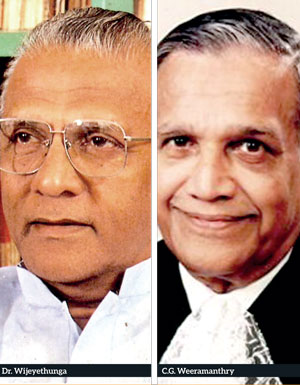
Therefore (unlike the Western oriented –so call- modern constitutions) in our historical (unwritten) constitution Sovereignty of the people passed to the King/State through Maha Sangha in a semi-circle path, while maintaining a Triangle of Accountability in between.
The King relied on the approval of Bikkus/Maha Sangha and the consent of the People. Bikkus/Maha Sangha were maintained by the people and protected and fostered by the King. The People in turn depended on the King for their protection, peace, prosperity and governance and on Bikkus/Maha Sangha for Spiritual guidance and upliftment. This triangle of accountability inter-locks them with strong mutual commitments.
What assured the stability of our country and society for over 2500 years? It was nothing but the application of Buddhist principles of good governance by the Kings and administrators
In such a system the people had constant control over the State (King) and had every right to participate in the decision making process. King and the people were constantly advised by Maha Sangha with their knowledge and wisdom. Maha Sangha, being an independent sub-society practising detachment, could conveniently execute their social responsibility without material expectations. People, neither required waiting until the expiration of a specific time to change the King, nor had any reason to protest or be rebellious for their needs, as they had a ready-made channel to communicate their requirements to the King. King/State was duty bound to obey and comply with such requirements. Further, Buddhist principles of good governance did not permit the King to disregard the needs of the people. But, whenever the people found reasons to take back the powers entrusted upon the King, they could easily reverse the earlier process with the intervention of Maha Sangha. This reverse process too was constitutional.
Buddha Sasana
Buddhist principles of governance were (are) functional on the foundation of Buddha Sasana. The Supreme Court (in SC Determination 1/94 (1994) held; The expression ‘Buddha Sasana’ is wider than ‘Buddhism’ and includes the entire establishment together with objects and places of religious practices and worship of Buddhists”. Hence the term Buddha Sasana could be further extended to include Maha Sangha, archaeological sites, villages, lands and properties feeding Buddhist temples and Viharas. Therefore the Buddha Sasana includes both tangible and intangible features.
For over 2500 years Buddha Sasana has been established throughout the entire territory. Therefore it is mandatory for the country to be under the authority of one supreme central Government in order to give full effect to Article 9; i.e. the Country should be a Unitary State. Further, this constitutional responsibility compels the State to protect the territory and assure the prosperity of every citizen (not only of Buddhists) of the Country, without which the protection and fostering of Buddha Sasana would not be practical.
Therefore every citizen of such a State would equally be benefited by this unique system of government. According to historians, our civilization had (still has) an inbuilt social mechanism whereby the people of different ethnicities, races, classes, religions etc., merged into one community by leaving behind their respective differences. It was a system of harmonization or unification, (which is opposed to the alien concept of reconciliation”). Therefore there was (and still is) no room or reason for communal conflicts. This mechanism prevented our country from segmentation or separation and assured the unity and solidarity of the people for over thousands of years. Therefore, purported the inter-communal conflicts and differences promulgated by racist separatists/politicians are mere fabrications artificially implanted in the hearts of our people with ulterior and vicious political motives.
Our Kings saved the unitary State by uniting the people. For this they used the simple method of Eksesath Kireema/ Ekachathra Kireema”. This means calling the people to group under one umbrella. In the constitutional sense, this term is different from Unitary (State)”, which represents, a Central Supreme Legislature and a Central Government with concentrated executive powers exercisable over the entire country. Unitary State is a concept created by law (constitution) taking the territory as the basis. Eka-Chchathra, on the other hand, refers to a unitary State created by the people with their solidarity and accepting the leadership of one King, State or Government. Our Kings established a Unitary State, not by the force of law, but with the free will of the people uniting with each other irrespective of their religion, caste, race or ethnic origin etc. (this is also another aspect of the theory of social contract; bond between citizens).
As Weeramathri observes, However elaborate or simple, Third Word societies thus afforded a central place for the group concept, without which they could neither be understood or administered…what follows (from this examination) is the lack of appropriateness of Western concepts of individual freedom adopted without adaptation to their Third World setting”.
The authors of the interim report and the sub-committee reports seem to have completely ignored the thinking, traditions, historically established constitutional principles and practices of the very civilization (comprising of Sinhalese, Tamils, Muslims and observers/followers of all religions) that they claim to be making a new constitution for. Therefore, they have messed up the fundamentals. This patent procedural failure shall lead to total rejection of the new constitution or any other similar constitutional amendments.
In my work on this subject (Budusasuna ha Viyawasthava-Desarasa publications) I have further dealt with the nature, scope and the application of Article 9. It assures a stable and a united/ indivisible society and serves equally (without discrimination) the persons of all religions and ethnicities. Article 9 alone forms its own system of government with unique features that cannot be found in any other constitution in the world. It stands above the other Articles in the Constitution and binds the Sate unconditionally. Therefore, the State is bound to give effect to the order of Maha Sangha to terminate the ongoing constitution making process as – obviously- that process has been driven on the wrong track from the very inception.
Unfortunately we have not yet realized the value and the uniqueness of Article 9. Instead of removal, it is high time to look into ways to make it a fully functional provision in the Constitution.
For over 2500 years Buddha Sasana has been established throughout the entire territory. Therefore it is mandatory for the country to be under the authority of one supreme central Government in order to give full effect to Article 9; i.e. the Country should be a Unitary State.
Further, this constitutional responsibility compels the State to protect the territory and assure the prosperity of every citizen (not only of Buddhists) of the Country, without which the protection and fostering of Buddha Sasana would not be practical.
Therefore every citizen of such a State would equally be benefited by this unique system of government.
According to historians, our civilization had (still has) an inbuilt social mechanism whereby the people of different ethnicities, races, classes, religions etc., merged into one community by leaving behind their respective differences. It was a system of harmonization or unification, (which is opposed to the alien concept of reconciliation”).
Therefore there was (and still is) no room or reason for communal conflicts. This mechanism prevented our country from segmentation or separation and assured the unity and solidarity of the people for over thousands of years.
Therefore, purported the inter-communal conflicts and differences promulgated by racist separatists/politicians are mere fabrications artificially implanted in the hearts of our people with ulterior and vicious political motives.
Our Kings saved the unitary State by uniting the people. For this they used the simple method of Eksesath Kireema/ Ekachathra Kireema”. This means calling the people to group under one umbrella. In the constitutional sense, this term is different from Unitary (State)”, which represents, a Central Supreme Legislature and a Central Government with concentrated executive powers exercisable over the entire country. Unitary State is a concept created by law (constitution) taking the territory as the basis. Eka-Chchathra, on the other hand, refers to a unitary State created by the people with their solidarity and accepting the leadership of one King, State or Government.
Our Kings established a Unitary State, not by the force of law, but with the free will of the people uniting with each other irrespective of their religion, caste, race or ethnic origin etc. (this is also another aspect of the theory of social contract; bond between citizens).
As Weeramathri observes, However elaborate or simple, Third Word societies thus afforded a central place for the group concept, without which they could neither be understood or administered…what follows (from this examination) is the lack of appropriateness of Western concepts of individual freedom adopted without adaptation to their Third World setting”.
The authors of the interim report and the sub-committee reports seem to have completely ignored the thinking, traditions, historically established constitutional principles and practices of the very civilization (comprising of Sinhalese, Tamils, Muslims and observers/followers of all religions) that they claim to be making a new constitution for.
Therefore, they have messed up the fundamentals. This patent procedural failure shall lead to total rejection of the new constitution or any other similar constitutional amendments.
Unfortunately we have not yet realized the value and the uniqueness of Article 9. Instead of removal, it is high time to look into ways to make it a fully functional provision in the Constitution.
In my work on this subject (Budusasuna ha Viyawasthava-Desarasa publications) I have further dealt with the nature, scope and the application of Article 9.
It assures a stable and a united/ indivisible society and serves equally (without discrimination) the persons of all religions and ethnicities. Article 9 alone forms its own system of government with unique features that cannot be found in any other constitution in the world. It stands above the other Articles in the Constitution and binds the Sate unconditionally.
Therefore, the State is bound to give effect to the order of Maha Sangha to terminate the ongoing constitution making process as – obviously- that process has been driven on the wrong track from the very inception.
Unfortunately we have not yet realized the value and the uniqueness of Article 9. Instead of removal, it is high time to look into ways to make it a fully functional provision in the Constitution.
” What’s now being exposed is the mafia behind it “
November 21st, 2017By Hafeel Farisz Courtesy The Daily Mirror
- Relationships of this sort are found in white collar criminal gangs
- It was clear that they were on the side of Aloysius during the process
- The replacement of MP Velu Kumar by Sujeewa Senasinghe shows it was all organised
- I didn’t go to ask them if the phone calls were from their wives or from Arjun Aloysius, nor did we tell them to leave their phones outside when walking into deliberations
- In fact I had to leave the Committee in protest at how they conducted themselves.
- The Bond scandal is symbol of a failed system
- The attempt to derail the COPE report had few stages
- Tell me, what exactly is there to hide now?
- Now what has surfaced is the fact that these actions weren’t done in isolation. Rather they were actions which were committed by an organised group
- As we see now, the workings were wheels within wheels and all this was organised. They were hell-bent on scaling down everything that was to come out of it, but thankfully they could not do so
- You would remember how the Auditor General was abused

Committee on Public Enterprise (COPE) Chairman Sunil Handunnetti in an interview with the said that the revelations of COPE members in constant contact with Perpetual Treasuries owner Arjun Aloysius was evidence of a mafia” type organised crime ring. Following are excerpts of the interview done with Handunnetti.
QAs the Chairman of COPE, which investigated into the Bond Scam, what is your take on the recent revelations of phone calls between members of your committee and Arjun Aloyius?
I’m not surprised at all, really. If you look at the behaviour throughout the process and how they attempted to stall the process it was evident which side they were on. The only thing that has been revealed now is the evidence given regarding the side they were on throughout the process. The actions were clear and the evidence substantiates what was happening all along.
 QYou seem to be only focusing on the times that they were in contact which is during the period when the committee conducted hearings. These are times during which there is actual evidence of the contacts going above and beyond the times of COPE hearings. For instance, Sujeewa Senasinghe had been in touch 227 times out of which he was in touch only 63 times during the COPE hearings. Dayasiri Jayasekara was in touch 18 times out of which two were related to COPE hearings. Did these people explain their relationship with Arjun Aloysius to you at any point?
None of them indicated of having any such relationship with the rest of the COPE members. What really is important here isn’t the number of times they had spoken to each other. What’s of real importance is what they had been discussing. During that investigation, which side they were on is the real question. Were they on the side of parliament or were they on Arjuna Mahendran’s side? These people were COPE members and are in parliament as representatives of the people. They aren’t in parliament because they were appointed by some individual right? The Mandate was that of the people.
If anyone has any doubt as to where these people stood during the process, you must read the COPE report in which their representations are recorded verbatim. That is enough evidence to know how hard they tried to derail the entire process
QWhy this question was asked is because Dayasiri Jayasekara had admitted that he spoke to Aloysius twice and met him once, specifically going by what was publicized- which was that he was in contact twice during the time of the COPE hearings. What failed to receive much publicity was the fact that he had been in touch with Aloysius 18 times in total. What is your take on this?
Again what I insist on isn’t to focus on the number of calls. Instead the focus really should be on the the contents of what was discussed which is why I have asked the Speaker to get a report on what was spoken during these conversations. Then we will know for sure what was discussed with whom and by whom. I called for these facts to be tabled in parliament, in writing.
Q In the COPE you (All members) sat as judges throughout the entire issue. However what we witnessed was that many members were accused of collusion. This issue, conflict of interest, emerges due to the fact that they were known to each other or were in contact. How do you view this?
Well, if you remember right, you would know that I was the first person accused of conflict of interest by the Leader of the House Mr. Lakshman Kiriella. The grounds on which this accusation was made was the fact that I was the first to make the revelation regarding the scam. That was how they tried to portray the issue of conflict of interest. Now I would like to know what he and the rest have to say about these conflicts? I would really like to know what Kiriella has to say now about members from his party who have acted like an organised gang of criminals ?
The grounds on which this accusation was made was the fact that I was the first to make the revelation regarding the scam. That was how they tried to portray the issue of conflict of interest. Now I would like to know what he and the rest have to say about these conflicts?
QWhile the investigation was in progress, and while your deliberations were happening, did you feel like there was something larger going on? Did these people walk out in a suspicious manner to answer calls ?
The members who are appointed to the COPE are appointed by their respective parties right? So they are deemed to be responsible enough to sit on this committee. For example, your editor won’t be checking your phone calls would he? He would assume that you are a professional and as such you are responsible enough to be writing for the newspaper.
Similarly, I never checked on the phone calls received. I didn’t go to ask them if the phone calls were from their wives or from Arjun Aloysius, nor did we tell them to leave their phones outside when walking into deliberations. This is because there is a common trust which prevails upon anyone walking into these deliberations. I actually can’t ask these questions.
This question arises after these revelations right? But if you ask me on which side they clearly were during these deliberations it was crystal clear that they were on Arjun Aloysius’ side and did everything in their power to stop the report from being presented. In fact I had to leave the Committee in protest at how they conducted themselves. You would remember how the Auditor General was abused.
Now what has surfaced is the fact that these actions weren’t done in isolation. Rather they were actions which were committed by an organised group. Like for instance UNP Parliamentarian M. Velu Kumar had to resign and Senasinghe was appointed.
QI want to stop you there. The data that was presented shows that MP Sujeewa Senasinghe was in touch with Arjun Aloysius even during the time of the DEW Gunasekara committee. The contacts were established on July 7, 2015. It was thereafter that he was appointed to your committee, following the resignation of MP Velu Kumar, also from the UNP. In hindsight do you think that this was all planned?
We are able to know the difference between the sound of a drum and the sound of a door right? similarly, the fact that Senasinghe was appointed midway and the manner in which they all behaved, suggests clearly which side they were on. The attempt to derail the COPE report had few stages. The first was to stop the investigation from taking place. The second was to try and make a mockery of the investigation. Then came the attempt to stop the report. Thereafter they tried to make a mockery of the report itself. Finally when all attempts failed, the fact that they put ‘footnotes’ and the attempts made to absolve the wrongdoings highlight the different stages during which these people tried to scuttle the process.
If anyone has any doubt as to where these people stood during the process, you must read the COPE report in which their representations are recorded verbatim. That is enough evidence to know how hard they tried to derail the entire process.I have no doubt, but anyone who is in doubt must read the representations made by the persons, who have now been exposed, to have been in touch with Arjun Aloysius. That would make it clear as to what they were doing in the committee.
QNow you have called for the recordings to be provided. But we all know that giving such recordings are next to impossible due to the technicalities involved. In fact even Dayasiri Jayasekara has made the same call as you have and asked for the recordings to be tabled. Isn’t this a ruse to hide the entire thing behind the rhetoric of ‘give the recordings?
Tell me, what exactly is there to hide here? Everything is out in the open. The fact that there was a scam where its loss to this country can’t be calculated, the interest rates were affected because of this scam and that the the Central Bank and State Banks and the EPF suffered incalculable losses as a result is crystal clear as daylight. There is really nothing more to be exposed. What’s now being exposed is the mafia behind it. What else is there to hide when everything has now been exposed.
These sort of relationships are relationships which exist in criminal white collar gangs. Not in normal ethical industries and people. All of this is evidence that supports what we have said all along. This evidence substantiates what we really have been saying throughout this time
Q Arjuna Mahendran during his evidence said that he had no knowledge of a person by the name of Kasun Palisena, the CEO of Perpetual Treasuries, nor that he had intimate dealings with Saman Kumara, who was in the charge of the EPF, and Pathmanathan, a rather junior officer of the Public Debt Department. But now it transpires that he in fact was in constant contact with all of them during the period of the Bond issuance.
Once you open a sack and see what’s within, you don’t need to tap it again and feel what’s inside, do you? This sack is open. Mahendran was the Governor of the Central Bank. Why does he need to speak to brokers? In fact Palisena is the only broker he had spoken to during his entire reign. Why? the reason is crystal clear isn’t it? These sort of relationships are relationships which exist in criminal white collar gangs. Not in normal ethical industries and people. All of this is evidence that supports what we have said all along. This evidence substantiates what we really have been saying throughout this time.
Q Also about Karunanayake who during his evidence said that he only knew Arjun Aloysius as a family friend and that he had met him ‘occasionally’. It now transpires that he had been in touch over 350 times and his wife over 320 times during this period..
All I have to say is let us take Karunanayake’s testimony for a moment as true. Then he really must have some concern regarding the relationship between Aloysius and his wife. Isn’t that something he needs to worry about? The fact that she was in touch 320 times while he had admittedly not knowing Aloysius very well, is something a husband should be concerned about isn’t it?

QFinally Mr. Handuneththi how do you view this entire scam in terms of the capitalist economic system? The fact that people with a few computers and phones were able to amass such a large amount of wealth without adding or contributing to the manufacturing or production process. How do you analyse it?
Prior to that, I must say that I am proud to have been able to present the report to parliament despite the enormity of pressure applied to stop me from presenting the report. As we see now, the workings were wheels within wheels and all this was organised. They were hell-bent on scaling down everything that was to come out of it, but thankfully they could not do so. I wish to say that it was our report that gave rise to the Bond Commission. If it wasn’t for our report and the public outcry that followed, the commission would never have been appointed. It really was a victory for the people who oppose corruption. The dirt the people, who present themselves as Mr. Cleans, carry is now exposed and I am glad that I contributed to this expose.
Secondly and more importantly to your question on the system, what we are witnessing now is not free market capitalism. Rather a crony capitalism, in which brokers and dealers rob wealth. It’s the stage of daylight robbery. What we see is the personification of greed. Capitalism now doesn’t exist in the manufacturing process, rather it exists today in the capital itself; where the capital robs the capital. That is what has happened. The industrial capital is being robbed of the owner of the capital.
So to explain this further, what happens is the wealth taken in by Industrial Capital is first robbed by the Banks through the processes in place. It is that wealth thus taken in by banks that is being robbed by the brokers and the dealers. The entire bond scam is a symbol of the failure of this corrupt and dirty system.
Bond Commission and Parliamentary Privileges
November 21st, 2017By Ranga Jayasuriya Courtesy The Daily Mirror
Government parliamentarians and their peers in the joint opposition seem to agree at least on one thing; their opposition to the Attorney General’s Department for revealing secret telephone conversations among government members of the Committee on Public Enterprise (COPE) and Perpetual Treasuries Ltd. owner Arjun Aloysius. Since it is not about one missed call or two, but regular telephone conversations spanning over the period of COPE investigations into the Central Bank’s dodgy bond deal involving Perpetual Treasuries, this is a clear-cut case of conflict of interest and is possibly an effort to obstruct and manipulate the dealings of the parliamentary watchdog on public enterprises.
According to details revealed by the Attorney General’s Department last week, Mr Aloysius had spoken a total of 227 times to Minister Sujeewa Senasinghe, 18 times to Minister Dayasiri Jayasekara, 176 times to MP Harshana Rajakaruna and 73 time to MP Hector Appuhamy from January 2015.
Had some COPE members acted in good faith, those like MP Rajakaruna ought to have recused himself from COPE
Mr. Rajakaruna had been in contact with Aloysius since February 2015. There were a total of 176 calls between each other and 18 during the period of the COPE hearings. MP Appuhamy had taken and received 73 calls from mid-July 2016 to mid-June 2017 with a total of 23 calls during the period of COPE sittings. Minister Senesinghe who was appointed in the mid-way of the COPE investigations, had received and made 227 calls during the period July 4, 2015 to March 3, 2017.
In any other civilized country, revelations of this magnitude would have seen resignations of the accused MPs from the COPE and from Parliament. Instead, the government MPs are now accusing the Attorney General of violating their Parliamentary Privileges.
UNP MP Ashu Marasinghe was quoted as saying: As a country which hails democracy, we are of the view that telephone conversations of MPs should not be tapped or publicized in such a manner as it is a breach of their privileges. The Speaker has also agreed to look into the breach of privileges.”
Parliamentary privileges are part of law and not something that places parliamentarians above the law. Parliamentary privileges are meant to provide legal immunity from civil or criminal liability arising from statements made or actions taken, often within the grounds of Parliament, when carrying out their legislative duties. Whereas clandestine phone calls with Mr Aloysius, while his company was under investigation by COPE imply a greater deal of conflict of interest.
Parliamentary privileges does not provide blanket immunity. For instance, in the House of Commons and the House of Lords, (on which, Sri Lankan Parliamentary traditions and privileges are modelled) parliamentary privileges are overseen by the Committee on Standards and Privileges, which also has power to suspend (or even expel) members who are found to have breached rules.
In fact, the Code of Conduct of Parliamentarians in Sri Lanka which was passed last year by the current government also states: 7 (f) The Members shall declare any private interest or conflict of interests if any relating to their public duties and take necessary steps to resolve any conflict arising thereby in a way that the public interest is protected.”
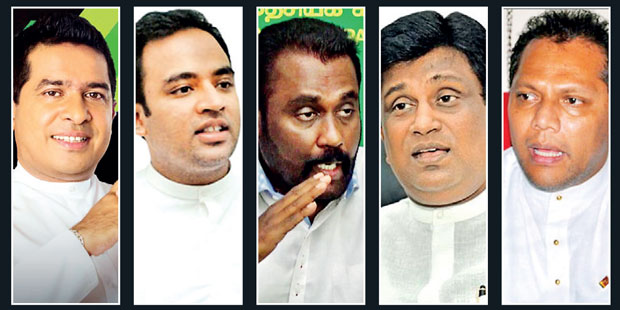
Had some COPE members acted in good faith, those like MP Rajakaruna ought to have recused himself from COPE in the first place, since he claims Mr Aloysius was his childhood friend, and many others could have revealed their phone conversations before Attorney General exposed them at the Bond Commission.
In a more nuanced take on things, this is not something where naïve MPs being duped to receive and make phone calls with an individual who is under investigation.
The Presidential Commission of Inquiry (PCoI) into the CB bond issue is a watermark of enhanced capabilities and the independence of Sri Lankan judiciary
The scandalous revelations should even be a good enough case for the President or the Speaker of Parliament to order an investigation to ascertain whether there had been a collusion between some members of the COPE and PTL — though such a measure would definitely cause further estrangement between the two main constituent partners of the Yahapalana government.
Rather than holding the faulty MPs responsible, some quarters of the government are trying to delegitimize the Attorney General’s Department. They have crooked bedfellows: Ex-president Mahinda Rajapaksa, who last week faulted the AG Department and claimed Sri Lanka has become a police state. That is rich coming from Mr. Rajapaksa who turned the Sri Lankan Police Service into a Medamulana Police and Sri Lanka’s judiciary to a Medamulana court. Mr Rajapaksa has reasons to worry about an assertive judiciary, because, that would mean an end to covert official protection against criminal liability of his past deeds.
The biggest danger to the independence of the judiciary in this country has, throughout the history,been politicians themselves
The Presidential Commission of Inquiry (PCoI) into the CB bond issue is a watermark of enhanced capabilities and the independence of Sri Lankan judiciary — though one would feel that a greater deal of freedom of action of the PCoI emanates from the President’s blessings. The competitive relationship between the SLFP and the UNP partners in the government also makes it hard to suppress the activities of the commission. Whatever its current limitations, the success of PCoI would set a precedent for the future and truly empower the judiciary.
The biggest danger to the independence of the judiciary in this country has, throughout the history,been politicians themselves.
If leaders can destroy institutions, they can also help empower them. The first step is to let independent institutions to exercise their constitutionally mandated independence. Second, they ought to be defended from retrograde influence and intimidation by the gutter. That could be from goons mobilized in exchange for a ‘buth packet’ and a bottle of booze.
Follow @RangaJayasuriya
on Twitter
Healing the Wounds of War
November 21st, 2017Ed Tick, Ph.D
In contrast to our modern situation, traditional and indigenous peoples had extensive spiritually and communally based warrior medicine, practices and lineages. They lived immersed in and part of nature and its processes, conceived of themselves not as independent agents but as members of interdependent communities, and stood in wonder before a living cosmos. They considered soul and spirit to be life forces that were essential to preserve and protect those most endangered by warfare and violence. Their guidance of warriors through the life cycle, interpretations and treatments of trauma, and orchestration of the return journey were spiritual, communal, nature-based and practical. And their guidance was extensive, specific and designed to bring spirit back into their warriors’ souls.
Let us explore some traditional interpretations of combat trauma that illustrate soul wounding and give direction for restoration. The Hopi people call trauma tsawana, meaning a state of mind that is in terror.” The Hopi name the condition directly; the mind and heart are frozen in the terror of traumatic experience as if it were happening in an eternal present. 
Since the traumatic wound is this terror, healing our war wounds is Qa tutsawanavu, living in a way not intimidated by terror. The warrior learns once again to live as King David when he rediscovered faith: I will fear no evil … ” Warriors learn to act with courage, as Hemingway said with grace under pressure,” or Colonel Henderson, with … the willingness to act in the face of fear.” The warriors’ spirits grow larger than their fears, confident they can master the ordeal and not be crippled by terror.
A Hopi woman soldier, Lori Piestewa (White Bear girl) was the first Native American to die in recent wars and believed to be the first Native American servicewoman killed in foreign wars. The daughter of a Vietnam veteran and granddaughter of a World War I vet, she was following both her people’s and the American warrior lineage. There is a long tradition of Hopi women taking part in raids and defending villages.” Caught in the same attack during which Jessica Lynch was captured, Lori drove her truck trying to get her battle buddies out of danger. She died without firing her weapon. Her friends and family increasingly opposed the war and were pleased that Lori did not harm anyone, ‘the Hopi way,’” her father proudly said.
The Lakota called trauma nagi napayape, meaning, the spirits leave him.” Trauma was that condition in which the spirits left the person so that the body feels like an empty shell. The worst cases of shock come not only from physical processes but also from seeing such horrors that the soul flees the body. Many warriors report such experiences. Art, a machine gunner at the siege of Khe Sanh, reported his soul’s flight during a firefight in vivid detail.
When the source of disorder is spirit loss, then healing can occur through restoration of spirit aided by community. Many cultures, Lakota and Vietnamese among them, practice community rituals for calling the souls and spirits back. In the Vietnamese countryside, a traditional belief holds that illness comes from one or more of the seven souls leaving the body.
Healing can occur when the village people gather to call the lost soul back or a shaman journeys to seek it. Reverend Jackson, who had served as a chaplain in Viet Nam, returned with us thirty-seven years later. He asked our group to surround him on his old battlefield where my heart went dead.” Together Americans and Vietnamese called for his soul to return. It was a clear, quiet and sun-drenched day. As we cried out together, lightning suddenly flashed and exploded on the mountaintop opposite.
Sri Lanka is an island nation south of India brutalized by a civil war from 1983 to 2009. Sri Lanka reports extensive traumatic suffering among its military and civilian populations. According to Dr. Ruwan M. Jayatunge, Sri Lanka has had much historical trauma from both natural and human disasters and cultural and religious traditions that provide protection against and tools to deal with it. Sri Lankan written history dates back more than 2,500 years. As written in the Mahavamsa, the history of Sri Lanka and one of the world’s oldest chronologies, the Battle of Vijithapura fought in 161 or 162 B.C. was massively destructive and deadly. The triumphant King Dutthagamani became severely depressed soon after the battle.
The Portuguese first invaded Sri Lanka in 1505. For the next 300 years the native population fought against the Portuguese, Dutch and British. King Seethawaka Rajasinghe entered the wars in 1560 at age sixteen. A courageous and effective warrior, he fought many battles and witnessed much suffering. He finally defeated the better-equipped and trained invaders, saving his country from becoming a colony. But after years of combat the king was exhausted and unquestionably suffered from battle fatigue. In later years he displayed outbursts of anger, irritability, deep mistrust, alienation, emotional numbing and various other PTSD-related symptoms …[The] King … is believed to have suffered from combat-related trauma.”
Dr. Jayatunge concludes that combat trauma has been known and manifested through several thousand years of Sri Lankan cultural history, was recorded in their literature as long ago as Homer and the Bible, demonstrably occurred in ancient as well as modern times, and though tragic also helped their people develop endurance and resilience through cultural and religious practices.
The Xhosa people of South Africa believe that a warrior leaves part of his soul on the battlefield with the souls of the fallen. The warrior cannot reclaim his own soul without making peace with the dead of both sides.To the Xhosa, Professor Brooke explains, Kanene (k-u-n-e-nn-y”) is the warrior’s insight into the depth and burden he carries, following him like a shadow reminding him of what he has done.” Healing occurs through direct community-based response to this burden. It entails being forgiven by both the living and the dead, including the enemy dead.
The Xhosa healing ceremony called Ukubula (Oo-koo-boo-la”) is a confessional telling of what you have done before the community. The community’s role is to tolerate the pain of listening, no matter how difficult. The community carries the burden and pain of what happened and the warrior is forgiven and healed from private suffering.” Professor Brooke points out that the Truth and Reconciliation Commission hearings in South Africa that helped the country heal from apartheid were national practices of ukubula. Ukubula highlights the critical role the community plays in listening and witnessing horrors without judgment and welcoming the trauma survivor back into community after confessional cleansing.
Also in southern Africa are the Shangaan, a Nguni people who are tribal cousins of the Xhosa and Zulu. They populate the areas in what are now Mozambique and the eastern border of South Africa. The Shangaan maintain extensive rituals for post-war trauma that affirms the intimate relationship between the slain, the slayer and surviving family members, all of whom become involved in community restoration.
Among the Shangaan,A man who kills another, even in war, must build a hut with the name of the dead. He must keep it maintained for the dead’s spirit. His own daughter is then married” to the deceased man. She must look after the hut as she matures. If she falls in love or wants to marry, then she and her father must ask permission from the dead enemy for her to be allowed to marry.
Shangaan practices demonstrate the lifelong intimacy that occurs as a result of taking a life, an intimacy many contemporary veterans feel but are at a loss to complete. Their practices also express, Brooke observes, a truth we see in our families every day. Daughters are imprisoned by their father’s wounds, unable to live their own lives until their fathers have been released by the spirits of the dead.” We heard this same lesson from Greece in Agamemnon’s sacrifice of his daughter in exchange for winds to sail his fleet to Troy.
In another corner of the planet are the Maori, who settled New Zealand about 800 years ago and are one of the oldest, fiercest, most successful warrior traditions. Maori spirituality and lives are shaped around their relationship with the Divine, the Creation, their tribes—iwis—and each other. Increasing mana or spiritual power, protecting tapu or sacred being, and service and devotion to the community are at the core of Maori culture.
For the Maori, primary to any healing is the healing of relationship based on a sense of sacred being, tapu. When there is violence, a wound or a crime, tapu becomes negative and must be set aright. Maori restoration rituals focus on healing relationships that have been harmed in order to cleanse and restore tapu.
Warfare was a way of life for the Maori. They believed that mana, spiritual power, prestige or influence, was given by the ancestors or attained through combat and that combat was sacred to the ancestors. They fought for mana, expressing a widespread ancient belief that the powers of a slain warrior could enter the victor.
The United Kingdom invaded New Zealand in 1845 and fought the Maori until 1872. Though the British have significantly influenced their culture and there is internal violence due to their troubled social status and warrior traditions, the Maori retain much pride, honor and influence because they were never defeated.
One aspect of Maori culture that has gained worldwide attention is the haka, their traditional war dance. Haka is a group dance with intense foot stomping and body movements accompanied by rhythmic shouting. Haka can be performed by women and children as well and can be used for many purposes—entertainment, to welcome dignitaries, before sporting events, to honor important events or achievements, and for funerals. War haka were specifically meant to intimidate enemies by showing warriors’ prowess and fierceness. Made famous by the New Zealand rugby league, haka are used for many purposes today. Each branch of the military service and every army unit has its own haka, performed by all members of the units no matter their ethnic backgrounds. Haka have thus been integrated from the Maori into mainstream and military New Zealand cultures and are used at military funerals as unit rituals for bidding farewell to fallen comrades.
Korea holds an ancient belief also applied with special attention in the military. It has similarities to tapu as a core spiritual property and individual and collective karma following us through life, shaping our fates.
In Korea, the word han, from the ancient Chinese, means the injustice that must be set right in the world. Those emotions arising from life’s injustices—resentment, sorrow, regret—originate from disturbed han. Most Korean people, especially the elderly, have long believed that retaining han will cause various traumatic wounds and disorders.
Jae-sung Chung was a first lieutenant in the Republic of Korea Army. He served as liaison officer attached to U.S. Army headquarters in Vietnam from 1970 to 1971. Jae explains, To maintain sound health, individuals must be free from such han as worry, anger, resentment, sorrow or regret. This applies to everyone, including the men and women in uniform.” Although people face different challenges, Koreans recognize that each person must be able to get rid of accumulated han. In the Korean military, soldiers are periodically educated about han by commanding officers and chaplains. On weekends ROK soldiers in military camps commonly attend church or temple to receive character guidance education by chaplains or Buddhist monks along with the respective religious service. In addition, soldiers are taught about han by their commanding officers through Troop Information and Education (TI&E).
Belief in and care of han is common in the South Korean military. Jae believes that the majority of soldiers will resolutely manage their spiritual attitude of han.” The military itself tries to set han right. Within the military Christian chaplains and Buddhist monks do their best to heal han.
During the Vietnam War, as a nearby Asian nation Korea felt a genuine and immediate threat. Thus Korean veterans felt more appreciated, justified in service and welcomed home than did American veterans. On the other hand, war inevitably disturbs han. In order to cleanse his han after service, Jae has used self-reflection, meditation and contemplation.
The spiritual principle declares that what was made wrong must be put right. Traditional cultures considered not just individuals but the cosmic order out of balance until the souls of the living and dead were reconciled and wounded psycho-spiritual and cultural patterns and relationships reconciled and restored.
These ancient beliefs have been carried into modern conflicts and used for resolving them after bloodshed, as in South Africa after apartheid. Soldier’s Heart co-director Kate Dahlstedt presented another example:
In Papua New Guinea a brutal civil war occurred from 1975?1998. It was set off by destructive environmental practices during 1960s Australian copper mining. It was then enflamed when local people rose up and the government manipulated the native population to resist the uprising. As a result, families, friends and clans were set against each other and 15,000?20,000 people died.
A cease-fire was declared in 1998. There was so much grief, loss, remorse from the extreme violence and bloodshed among traditional families and friends that the only way to rebuild and establish unity was through a reconciliation ceremony.” The local people spent three years discussing the crisis” and how to reconcile. They finally came together on the island’s northwest coast for a ceremony that included preparing special foods, wearing sacred garb, sharing losses and decorating the community with flowers to chase away negativity and attract sweetness.
The ritual consisted of dancing with arrows to symbolize the old conflict, then passing betel nuts as a gesture of peace. The people then passed a pig for roasting between former foes, joined hands and together touched a peace stone. They then lowered it into the ground, throwing their broken weapons over it. To these people, this ritual was irrevocable.
Individuals who had killed returned the reclaimed and purified bones of the slain to their families in carefully constructed coffins. Slayers publically apologized to families who had lost members, offered compensatory gifts, exchanged betel nuts again, and together buried the coffin in its final grave. The ritual thus is a rite of passage for both individuals and community, giving meaning to the harm caused, lifting heartache, providing restitution, creating new personal and collective identities and rebalancing the universal scales.”
From North America Nupkus Roger Shourds gives us a portrait of the warrior tradition as practiced by his Pend D’Oreille people:
When warriors went out the first time they sang Canvas Dance songs the night they were leaving and then all the warriors would leave during the night. They prayed and painted before going to protect themselves and their horses. New apprentice warriors were given tasks by the leader, such as going for water for the proven warriors. The leader noted if they performed their tasks with honor. If the novices performed well the leader would tell about them when the warriors returned, sang the Victory Song and reentered camp where the entire population gathered to hear the stories.
The leaders would tell how each warrior performed in battle, how many marks could be put on their coup sticks and how many eagle feathers they earned. Each warrior would plant his ceremonial stick or spear in the ground as his hand grasped the upright spear. Then he recounted the details of each deed, stating whom he had killed, wounded or counted coup on. He spoke slowly and plainly, wore only moccasins, breechcloth, necklace, armlets and headband. His body was painted yellow except the right leg below the calf, which was painted red, because of what he had done during the battle.
As each warrior recounted his deeds, sounds from the drum and cries from the crowd followed. The drum beat one, two, three or four times, depending on the importance of each warlike deed. If the action was great the drum beat four times. If small then the drum would be hit only once. At each pause, drumbeats and war cries were given as emphasis or applause. In the center of the arena was a pole in the ground with pegs sticking out like nails. While a warrior told of his deeds, members of his family hung blankets, shawls, necklaces, moccasins or beaded bags on the center pole. Money was gathered, tied in a scarf and hung on the pole. The gifts were distributed to the poor after he completed his story. The entire tribe sat and listened to all the stories until they were finished. Then the returned warriors would start special war dances until they could dance no more.
Our culture honored our warriors right after they returned and listened to each and every warrior tell their war stories. This fact along with the survival reasons we fought and killed assisted in eliminating any PTSD.
Ed Tick, Ph.D., is, a psychotherapist, poet and writer, educator, and overseas journey guide. He holds an M.A. in psychology from Goddard College and a Ph.D. in Communication from Rensselaer Polytechnic Institute. Tick is a clinical member and has held various officer positions with the American Academy of Psychotherapists and the American Holistic Medical Association, as well as many other professional organizations.
A practicing psychotherapist for more than 30 years, Tick specializes in extensive and innovative work with survivors of severe trauma and violence — particularly combat war veterans — sexual and Substance Abuse victims, those with severe mental and emotional disorders, men’s issues and deeply rooted psycho-spiritual healing. In all of his work, Tick applies his own innovative model of PTSD treatment based on worldwide research of spirituality, mythology and war/the warrior archetype, in order to develop a new, broadened and strengthened psycho-spiritual identity
Jayampathi/Sumanthiran to introduce ISGA as the new constitution
November 21st, 2017By: A.A.M.NIZAM – MATARA
Do we need a new constitution for the country and who wants it? Neither the ordinary Sinhala nor Tamil people nor people belonging to other communities ask for a new constitution. What all of them ask for is for a peaceful country in which they can live without fear and favour and without economical hardships.
The 1972 and the 1978 constitutions (difference between the two relates to the Executive Presidency and the electoral process) have served the country without any hindrance to anyone. It is obviously on the behest of some foreign elements (countries and organisations) and the Tamil diaspora that this government in collaboration with separatist Tamil elements (the dormant/sleeping and turncoat terrorists) attempts to bring in a tailor made new constitution.
The proposed Jayampathi/Sumanthiran constitution, however, will definitely be nothing other than a sugar coated version of the notorious Interim Self Government Authority” (ISGA) proposal made by the LTTE on 1st November, 2003 to Ranil Wickremasinghe’s UNP Government through Norwegian facilitation.
The abridged version of the preamble of this document states that bearing in mind that successive Governments of Sri Lanka have perpetrated persecution, discrimination, State violence and State-orchestrated violence against the Tamil People;
Noting that the Tamil people mandated their elected representatives to establish an independent sovereign, secular State for the Tamil people in the elections subsequent to the Vaddukoddai Resolution of 1976;
Determined to establish an interim self-governing authority for the NorthEast region and to provide for the urgent needs of the people of the NorthEast by formulating laws and policies and, effectively and expeditiously executing all resettlement, rehabilitation, reconstruction, and development in the NorthEast;
The Liberation Tigers of Tamil Eelam and the Government of Sri Lanka, hereby agree to the following provisions: The provisions of the proposal included:
An Interim Self-Governing Authority (ISGA) shall be established comprised of the eight districts namely: Amparai, Batticaloa, Jaffna, Kilinochchi, Mannar, Mullaitivu, Trincomalee and Vavuniya in the NorthEast.
The composition of the ISGA shall be, Members appointed by the LTTE, Members appointed by the Government of Sri Lanka and. Members appointed by the Muslim community in the NorthEast and there shall be an absolute majority of the LTTE appointees in the ISGA.
Free and fair election of members shall be held every five years in accordance with international democratic principles and standards under international observation.
The people of the NorthEast shall be accorded all rights as are provided under international human rights law. Every law, regulation, rule, order or decisions of the ISGA shal1 conform to internationally accepted standards of human rights protection.
No religion shall be given the foremost place in the NorthEast. It will be a Secular entity.
The ISGA shall ensure that there is no discrimination on grounds of religion, race, caste, national or regional origin, age or gender in the NorthEast.
The ISGA shall ensure that no bribery or corruption is permitted in or under its administration.
No law, regulation, rule, order or decision that confers a privilege or imposes a disability on any community, which is not conferred or imposed on any other community, shall be made concerning culture or religion.
The ISGA shall have plenary power for the governance of the NorthEast including powers in relation to resettlement, rehabilitation, reconstruction, and development, including improvement and upgrading of existing services and facilities, raising revenue including imposition of taxes, revenue, levies and duties, law and order, and over land.
Separate institutions for the administration of justice shall be established for the NorthEast, and judicial powers shall be vested in such institutions. The ISGA shall take appropriate measures to ensure the independence of the judges.
The ISGA shall prepare an annual budget.
There shall be a Financial Commission consisting of members appointed by the ISGA. This Commission shall make recommendations as to the amount out of the Consolidated Fund to be allocated to the NorthEast. The GOSL shall make its good faith efforts to implement the recommendation.
The ISGA will, giving due consideration to an equitable distribution, determine the use of funds placed at its disposal. These funds shall include the NorthEast General Fund, the NorthEast Reconstruction Fund (NERF) and the Special Fund.
The GOSL agrees that any and all of its expenditures in or for the NorthEast shall be subject to the control of the ISGA.
The NorthEast General Fund shall be under the control of ISGA and shall consist of:
The proceeds of all grants and loans made by the GOSL to the ISGA and the proceeds of all other loans made to the ISGA.
All allocations by the GOSL from agreements with states, institutions and/or other organizations earmarked for the NorthEast.
All other receipts of the ISGA, other than the funds specified below.
NorthEast Reconstruction Fund
The NERF shall continue to exist in its present form except that control over it will be transferred to the ISGA.
All grants given for the reconstruction of the NorthEast, will be received through the NERF. Utilization of resources from NERF will be directly determined and supervised by the ISGA.
Special Fund – All loans and any grants which cannot be channeled through the NERF for the specific purpose of RRRD will be received into the Special Fund. As in the case of other Funds, the ISGA shall control the Special Fund.
The ISGA shall have powers to borrow internally and externally, provide guarantees and indemnities, receive aid directly, and engage in or regulate internal and external trade.
The ISGA shall appoint an Auditor General.
All Funds referred to in this Agreement shall be operated, maintained and audited in accordance with internationally accepted accounting and auditing standards. The accounts will be audited by the Auditor General. The auditing of all moneys received from international sources shall be subjected to approval by an internationally-reputed firm appointed by the ISGA.
In the effective exercise of its legislative and executive powers, the ISGA may create District Committees to carry out administration in the districts and delegate to such Committees, such powers as the ISGA may determine. The Chairpersons of such committees shall be appointed by the ISGA from amongst its members in order to serve as a liaison between the ISGA and the Committee. The Chief Administrator of the ISGA shall appoint Principal Executive Officers in the districts, who shall also function as the Secretaries to the Committees. The Chief Administrator shall have the powers to suspend or terminate any such appointment.
The ISGA shall have direction and control over any and all administrative structures and personnel in the NorthEast
The ISGA may, at its discretion, create expert advisory committees in necessary areas. These areas will include but are not limited to Economic Affairs, Financial Affairs, Judicial Affairs, Resettlement and Rehabilitation Affairs, Development of Infrastructure, and Essential Services.
The ISGA shall have the power to alienate and determine the appropriate use of all land in the NorthEast that is not privately owned.
The ISGA shall appoint a Special Commission on Administration of Land to inquire into and report on the rights of dispossessed people over land and land subject to encroachment, notwithstanding the lapse of any time relating to prescription.
The occupation of land by the armed forces of the GOSL, and the denial to the rightful civilian owners of unfettered access to such land, is a violation of the norms of international law. Such land must be immediately vacated and restored to the possession of the previous owners. The GOSL must also compensate the owners for the past dispossession of their land.
The ISGA shall be responsible for the resettlement and rehabilitation of civilians and refugees in such lands.
The ISGA shall have control over the marine and offshore resources of the adjacent seas and the power to regulate access thereto.
The ISGA will have control over the natural resources in the NorthEast region. Existing agreements relating to any such natural resources will continue in force. The GOSL shall ensure that all monies due under such agreements are paid to the ISGA. Any future changes to such existing agreements should be made with the concurrence of the ISGA. Future agreements shall be entered into with the ISGA.
Upper riparian users of river systems have a duty to ensure that there is a fair, equitable and reasonable use of water resources by lower riparian users. The GOSL and the ISGA shall ensure that this internationally recognized principle is followed in the use of water resources.
All future agreements concerning matters under the jurisdiction of the ISGA shall be made with the ISGA. Existing agreements will continue, but the GOSL shall ensure that all proceeds under such agreements are paid to the ISGA. Any changes to such existing agreements should be made with the concurrence of the ISGA.
Where a dispute arises between the Parties to this Agreement as to its interpretation or implementation, and it cannot be resolved by any other means acceptable to the Parties including conciliation by the Royal Norwegian Government, there shall be an arbitration before a tribunal consisting of three members, two of whom shall be appointed by each Party. The third member, who shall be the Chairperson of the tribunal, shall be appointed jointly by the Parties concerned. In the event of any disagreement over the appointment of the Chairperson, the Parties shall ask the President of the International Court of Justice to appoint the Chairperson.
Undoubtedly the foregoing will be the ayampathy/Sumanthiran constitution that this government will attempt to impose and none of these conditions can be accepted. This is in another word granting of the illusory Eelam which megalomaniac Prabhakaran failed to achieve through 30 years of brutal war.
On 4th November, 2003 Mr. Lakshman Kadiragamar on behalf of the Sri Lanka Freedom Party issued a statement completely rejecting this Norwegian/LTTE proposal saying that the proposal lays the legal foundation for a future, separate, sovereign state and it clearly affect the sovereignty of the Republic of Sri Lanka and violate its Constitution.
Mr. Kadiragaamar emphasized that any final constitutional arrangement must preserve and protect the unity of our people and the unity and territorial integrity of the Republic of Sri Lanka. It must promote unity, not encourage division. The democratic structure of our polity must extend to the whole country. Democracy cannot be enjoyed by the people of the south and be denied to the people of the north and east. He said that there cannot be two governments in Sri Lanka; there can only be one. The SLFP has noted that in the LTTE’s proposals the expression “Republic of Sri Lanka” has never once been mentioned. This omission is not without significance.
He pointed out that Sri Lanka is referred to throughout the proposals as “an island,” as though it were merely a geographical entity consisting of a vacant space within which new contractual (not even constitutional) arrangements could be erected at will by two parties – the UNF government and the LTTE – without any recognition of the indisputable fact that there are many other legitimate stakeholders in the unity, territorial integrity and sovereignty of the Republic of Sri Lanka.
Rejecting the proposal completely Mr. Kadiragamat also gave a detailed analysis of the proposal and hence it is the prime duty of Sirisena and his lap dog SLFPers in the government to reject the Jayampathy/Sumanthiran constitution totally and vote against it..
The veteran journalist Mr. Iqbal Attas writing to Sunday Times pointed that the ISGA is clearly outside Sri Lanka’s constitution and Laws. He pointed out that the arrangements demanded will be without any Government control. Yet the rebels want funds from the Government, including those accruing from the North-East.
Mr. Attas also stressed that the LTTE want the armed forces immediately to vacate land in the North and East and allow civilian owners “unfettered access.” They also want compensation paid to these civilians for past dispossession. Conceding this demand in the northern Jaffna peninsula would make both the Palaly airbase, the only air link to the rest of the country, and the ports of Karainagar and Kankesanthurai vulnerable. Similarly, in Vavuniya, it will make the airstrip and a large military base totally vulnerable. The north-eastern China Bay airbase in Trincomalee would also be placed in a precarious position, he said.
ගිරුවායේ චානකගේ බැදුම්කර බරඅවි ප්රහාරයෙන් ‘සුජීවයි අනාගතේ’ චප්පචෝරු වෙයි..
November 21st, 2017බැදුම්කර මගඩිය සම්බන්දයෙන් චෝදනා එල්ල වී ඇති අර්ජුන් ඇලෝසියස් සමග විශලා දුරකතන ඇමතුම් ප්රමාණයක් ලබා ගත්තේ යයි හෙලිව සිටින රාජ්ය ඇමති සුජීව සේනසිංහට පාර්ලිමේන්තුවේදී ප්රබල විවේචනයකට ලක් වන්නට සිදු විය.
පාර්ලිමේන්තු මන්ත්රී ඩී.වී. චානක එක හුස්මටම ඇමති සේනසිංහට චෝදනා එල්ල කලේ කිසිවක් කීමට ඉඩක් නොතබමිනි.
එල්ල වන චෝදනාවන්ට රාජ්ය ඇමතිවරයා සුළ මැදිහත්වීම් කරන්නට උත්සාහ කලද මන්ත්රී චානකගේ දැඩි ප්රහාරය වලකන්නට හෝ බාධා කරන්නට ඒ ප්රමාණවත් නොවීය.
වෘතියෙන් නීතිඤයෙක් උවත් රාජ්ය ඇමති සුජීව සේනසිංහට අපරාධ විමර්ශනයක් කරන අතර චූදිකයෙක් හා සම්බන්දයක් පැවැත්වීම සදාචාරයට පටහැනිබවත් අවශ්යතාවයන්ගේ ගැටුමක් (Conflict of Interest) ඇත්වෙන බව නොතේරුනත් වෘතියෙන් නීතිඤයෙක් නොවන පාර්ලිමේන්තු මන්ත්රී ඩී.වී. චානකගේ පිලිතුර ඉතා ප්රසංසනීයයි. පාර්ලිමේන්තු මන්ත්රී ඩී.වී. චානක කී පරිදි කිසිම උසාවියක විනිසුරුට හෝ ජූරි සභාවේ සාමාජිකයින්ට චූදිකයෙක් හා සම්බන්දයක් පැවැත්වීම දඬුවම් පැමිණවිය හැකි වරදක් බව ඔහු ඉතා දක්ශලෙස පෙන්වා ඇත.
https://youtu.be/vHcH9vhAfWU
වීඩියෝව මෙතනින්…
: Central Bank Robbery : “We have nothing to hide – PM” : True – All has come out
November 21st, 2017“We have nothing to hide – PM” : Yes, True : Every things has come out.
(1st Nominated 3 goons to investigate the robbery by himself, blackmailed & framed the Junior UNP MPs to protect his corrupt acts, setup the UNP goons to messed with the COPE enquiry & .. : despite all , everything things has come out)
End of the Yahapalanaya and the Democracy.
What MR did (bring the goons by buses to courts or to the enquiry) Ranil W has done the same by bringing over 30 UNP goons but by officials vehicles.
Disgrace to Sri Lanka! Disgrace to the decent UNPers.
We have nothing to hide – PM
The Premier was speaking to reporters outside the Presidential Commission of Inquiry, probing the Central Bank treasury bond scam, after appearing before the commission this morning following a request made to testify.
Wickremesinghe stated that for the first time a Prime Minister appeared before a commission to make a statement.
He expressed gratitude to the Chairman of the commission for providing him with this opportunity and said that he was able to make clarifications with regard to many facts.
I was given the opportunity to explain about our economic policy, the damages caused to the country and many things,” he said.
Therefore I would like to specially state that myself, the chairman of our party, secretary and ministers came forward without any fears. We will take good governance forward because we have nothing to hide. Mistakes can happen, there can be shortcomings but we will continue with good governance.”
Wickremesinghe today became the first sitting Sri Lankan PM to testify before a commission. He was questioned for nearly an hour by the commission and the Attorney General, who participated in the session today on a special invite to lead the questioning.
A number of ministers representing the United National Party (UNP) were also present at the commission for the session today.
Questions raised by Shamindra Fernando Rupavahini video
November 21st, 2017“මහින්ද සමග එක්ව ඡන්දය ඉල්ලන්නේ නෑ.. සරමක් ඇදගෙන මට ඒක කරන්න පුළුවන්ද..’- ජනපති මෛත්රී කියයි…”
November 21st, 2017ඇම් ඩී පී දිසානායක විසිනි
තාප්ප කණුවෙ තනි කකුලෙන් හිටපු මට
කෝප්ප නැතුව පොල් කට්ටෙන් බීපු මට
ආප්ප කකා මහරජු ගොන් කරපු මට
හෙලුවෙන් වුනත් රජකම කලහැකිය මට
Environmental issue related to Hambanthota Industrial Zone
November 20th, 2017Dr. P. Attanayake.
I am writing to bring up an important environmental issue related to Hambanthota Industrial Zone. If this issue is not addressed now, it may result in serious ecological and human health problems in the near future.
As we all know, foreign companies will be setting up industries in the newly created Industrial Zone (IZ). Regardless of the industry, most of these facilities will be generating wastes that will be hazardous to the environment and human health. The area is currently farm land and not likely to contain any toxic substances in significant quantities (perhaps some fertilizers and herbicides may be present) in the soil, water and air. As we have seen in places such as Taiwan, Malaysia and Vietnam, computer chip manufacturing is likely to be one of the major industries in the IZ. Poor waste management at such facilities have resulted in environmental disasters in many places around the world. Silicon Valley in California, is a good example. The soil and water resources in many parts of the Silicon Valley are beyond cleanup. Cancer causing industrial solvents such as TCE, PCE are used extensively in these facilities and if discharged with no controls, they can be present in the soil and water for many decades. These contaminants are long lived and migrate in the environment for long distances. Once contaminated, cleaning up is almost impossible. Similarly, air pollution from these manufacturing facilities can travel long distances by air dispersion and affect health of the people down wind of the facilities
This is just one example. Waste from manufacturing facilities contains many other toxic chemicals that can have adverse effects on the environment and human health.
So here are some of the main issues:
- How can we measure the impacts of the industries on the environment?
- How can Sri Lanka protect its environment and people from the toxic chemicals that will be byproducts of the industries?
- How can we make sure the waste is handled properly and disposed of it properly without impacting our ecology and human health? .
To answer above questions, Sri Lanka must be proactive. We have a to act now, before any industry is established. First, environmental background conditions of the general area must be established. Then, when a manufacturing facility is proposed, a more industry specific background conditions should be established for the locale area. That will establish the background environmental conditions so that appropriate authorities can monitor and compare environmental conditions during operation of these facilities against the background to make sure no adverse effects occur. Second, a rigorous waste management practice should be established and implemented. The waste management must be industry specific, and the manufactures must identify the industrial chemicals used in their facilities, their quantities. They also must identify the type and the volume of waste generation and the plan for its disposal. These plans should be reviewed and approved by appropriate local authorities.
Shame on the politicians
November 20th, 2017Dr. Mareena Thaha Reffai,
After massive damage had been caused at Gintota, to people’s lives, property and morale, the Muslim politicians visiting the place, having meetings and expressing their views and promises is – to say the least – shameful.
Where were they when the problem was brewing, when the damage was being enacted by planned group of thugs from outstations? When the social media was giving details ball by ball, with live videos and audios, what were the politicians doing? Their phone numbers are regularly circulated by the social media as a long long list but how come none of them could be contacted during the crisis? It is not as if it happened in the dead of the night. And this is not the first or second time such co incidences” of the phones of all the politicians going non functional at times of crisis happened.
Having gone through Aluthgama crisis, and many more attacks on shops, places of worship and individuals, still the reactions of the politicians come always too late.
Why? Are they scared to face the mob? Are they powerless to wake up the powers that be? Or – Are they too part of the plan anyway? These are questions the people are asking – not unfairly.
Enough is enough. It’s time the politicians rise to the occasion as and when the calamity is happening. Not long later when the dust has settled. When a few lives are lost. When irreparable damage is done. It’s time every politician set up hot lines – preferably more then one at each ministry – to receive warnings when any trouble is brewing in any part of the country. It’s time the politicians give up their beauty sleep once in a blue moon to attend to the crisis BEFORE IT HAPPENS.
IT’S TIME PEOPLE DMEANDED THE POLITICIANS TO PROTECT AND SAVE THE PEOPLE WHO VOTED FOR THEM. After all, they did come to power by promising a better tomorrow. When is that tomorrow due?
Sent by:
Dr. Mareena Thaha Reffai,
23A, Auburn side, Dehiwela
Island in Dire Peril
November 20th, 2017IMRC Iriyagolle
Ayubowan,
We cannot allow India, any other country or any other force to dictate to us. The country must develop a strategy to destroy the enemies within first, the corrupt, destructive, selfish and sadistic politicians who have become ‘pawn brokers’ to remain in power by any means. The nation should consider rejecting demagogues as well.
Our ancient rich Buddhist cultural heritage, an ancient superior civilisation cannot be, should not be destroyed by hostile forces from within or without. The Sinhalese have portrayed self destructive traits. JVP launched an insurgency to kill the Sinhalese to combat this the United National Party(UNP) government unleashed forces to ‘kill the brutes’ as JR Jayawardena gave the orders to exterminate the JVP, all Sinhalese. The Buddhist Cultural Heritage was ignored.
Torture of the victims became an industry during this period (1987-1990) of UNP initiated savagery, Ranil Wickremasinghe one of the main perpetrators of this savagery has been rewarded, being appointed as the Prime Minister of this great island. The UNP and Ranil Wickremasinghe has not been held accountable for the atrocities committed. The UNP with the blessings of the Sinhalese majority is guilty of treason and continues to commit acts of treason without any hindrance from anybody in the practical sense.
The island is ‘pawned’, stripped of its Sovereignty, armed forces betrayed and the UNP carries on relentlessly to destroy the Sinhalese and the Buddhist Cultural Heritage. In the past there were punishers, snipers, armed forces, law enforcement agencies, and patriots to eliminate the enemy. Many politicians perceived to be traitors were assassinated. Today traitors thrive as the whole island is in their grip with the support and blessings of all communities.
The nation and the island is gifted to traitors, mass murderes, rapists, fraudsters and drug traffickers. The inertia, the inaction in the practical sense and the complacency of the Sinhalese is deplorable.
If there were strong, great, honourable, dynamic, visionary Sinhalese statesmen, political leaders as in the past no one, no country or the UN would dare to act against Sri Lanka. Recent history has shown how some Sinhalese jealous and selfish in the different spheres themselves rise up against the good and the great Sinhalese to destroy them. Whether in the political arena. social, religious or educational spheres society should punish and shun the destructors not reward them for there betrayal and treachery. Then there would be a chance for the survival of the Sinhalese, the sacred Buddhist Cultural Heritage and our sacred island.
Theruwan Saranai
IMRC Iriyagolle
Caesar’s wife,brave volunteers et al
November 20th, 2017Editorial Courtesy The Island
November 20, 2017, 9:26 pm
There are many Sri Lankans who evince a fetishistic interest in George Orwell’s immortal works. They may wonder whether the literary genius had a premonitory vision of the future of a tiny, teardrop-shaped island in the Indian Ocean, when he authored the dystopian, allegorical novella, The Animal Farm, in the early 1940s though it is popularly thought to be about the Stalinist Russia. For, the post-2015 situation in that resplendent isle, where ‘every prospect pleases’ and only politicians are vile, bears uncanny resemblance to the metaphorical representation of the turn of events in the aforesaid unputdownable book.
Having ousted the Rajapaksas, the yahapalana leaders vowed to restore the rule of law and ensure that everyone would be equal before the law al la the motto of The Animal Farm—‘All animals are equal’. But, today, the self-appointed liberators have emulated the ruling pigs in The Animal Farm, which, after savouring power for a while, proclaim, “All animals are equal but some animals are more equal than others.” They are no better than their predecessors!
Members of the Fourth Estate who covered yesterday’s proceedings of the presidential commission of inquiry probing the bond scams were pleasantly surprised to find a convivial ambience characteristic of a ladies’ tea party. Prime Minister Ranil Wickremesinghe was there to testify with his evidence led by Attorney General (AG) Jayantha Jayasuriya himself. One could hardly believe it was the same place where the likes of Saman Kumara et al had been grilled by the AG’s Department officials and the good commissioners alike on bond scams. We are reminded of the hospitable atmosphere in otherwise hostile court house, under the Rajapaksa government, when the then Defence Secretary Gotabhaya Rajapaksa once made a grand appearance.
Two former Presidents, to wit, Chandrika Kumaratunga and Mahinda Rajapaksa, have had the nasty experience of being hauled up before courts and special presidential commissions over what they did while in power. Many of the top guns of the Rajapaksa regime now have to appear before courts or commissions for having allegedly abused power and public property in their heyday.
What’s this world coming to when political leaders fail to be beyond reproach? A true leader worthy of the name must be above suspicion like Caesar’s wife.
When it comes to charges against the Joint Opposition firebrands, the yahapalana leaders promptly order arrests. But, when someone connected to the incumbent administration is found to be on the wrong side of the law, they opt for endless probes like the one into bond scams.
The government would have us believe that the PM appeared before the bond commission entirely of his own volition. But, it has only sought to make a virtue of necessity, we reckon.
We believe President Sirisena, too, owes an explanation to the public anent his executive action which prevented the submission of the COPE (Committee on Public Enterprises) report on the yahapalana government’s maiden bond scam in 2015 to Parliament. He should also explain why he baulked at sacking the then Central Bank Governor Arjuna Mahendran under a cloud before the August 2015 parliamentary election. Good governance consists in accountability and transparency among other things, doesn’t it?
It may be recalled that President Rajapaksa had a grand pratfall at the last presidential election because he was seen to be shielding the corrupt. Minister Rajitha Senaratne has gone on record as saying that he never accused Mahinda of corruption and it was those near and dear to the latter who were responsible for corrupt deals. This shows that any leader who protects the corrupt runs the risk of being punished at elections even if there are no specific, provable charges against him or her. No wonder the yahapalana leaders are scared of facing electoral contests!
As for the government propagandists’ claim that the PM volunteered to appear before the bond commission reminds us of an interesting yet apocryphal story. A group of lifesavers, upon the completion of a special training programme, asked the guests present on the occasion, whether anyone would kindly volunteer to jump into the deep water so that they could demonstrate their newly acquired skills. There was pin-drop silence around for a few moments and, then, suddenly, an elderly man, in a lounge suit, of all people, plunged into the icy cold water––slap bang. After he had been rescued and profusely praised for being a brave volunteer he was asked by a journalist what he got to say about his daring plunge. “Well,” the man fumed, gnashing his teeth, “if I find the rascal who pushed me into the water, I’ll beat him to a pulp.” So much for some volunteers and their heroics!
No policy decision to ask state banks to make lower bids at bond auctions PM testifies before bond probe commission
November 20th, 2017By Shamindra Ferdinando Courtesy The Island
November 20, 2017, 11:08 pm
Prime Minister Ranil Wickremesinghe yesterday said the government hadn’t taken any policy decision to instruct the state-owned banks to make bids at the treasury bond auctions at lower interest (yield) rates.
PM Wickremesinghe said so answering a question posed by Attorney General Jayantha Jayasuriya, PC, who led the Attorney General’s Department team assisting the Presidential Commission of Inquiry probing treasury bond scams involving the Central Bank of Sri Lanka and Perpetual Treasuries Pvt Ltd (PTL).
The commission comprises Supreme Court judges K. T. Chitrasiri (Chairman), P. S. Jayawardena and retired Deputy Auditor General K.Velupillai.
Asked whether the state banks had made bids at lower yield rates in accordance with a government policy decision, the Prime Minister emphatically denied having taken any such policy decision.
The chairmen and senior officials of three major state banks––the Bank of Ceylon, the People’s Bank and the National Savings Bank––early last month told the commission that on two occasions in 2016, they had received instructions from the then Finance Minister Ravi Karunanayake to make bids at the treasury bond auctions at lower interest (yield) rates.
At the commencement of the proceedings, Justice Chitrasiri said that the commission had requested AG Jayasuriya to lead his team of officers on the final day of the proceedings.
Justice Chitrasiri said that PM Wickremesinghe was there to make some clarifications with regard to the questions he had provided answers to by way of affidavits previously. He explained that the commission had received the PM’s responses to 28 questions first and 20 more questions sent to him later on.
Justice Chitrasiri emphasised that the question of compelling PM Wickremesinghe to appear before the commission had never arisen.
In answer to another query, the PM said the Banking Supervision Division had been weak and some non-banking finance institutions were on the verge of collapse.
The PM has, in his affidavits, denied having knowledge of the meetings the then FM Karunanayake had had with senior officials of the state banks.
Asked whether R. Paskaralingam had been present at those meetings, the PM said that, in his capacity as advisor to the PM, Paskaralingam had attended many meetings. He said that Paskaralingam didn’t report to him on a daily basis.
PM Wickremesinghe was also asked whether he was aware that Central Bank Governor Arjuna Mahendran’s son-in-law Arjun Aloysius being Chief Executive and a director of the primary dealer PTL. The PM said he had asked Governor Mahendran to ensure that the latter’s son-in-law did not get involved with the company and divested his shares. The PM said he had received repeated assurances from Governor Mahendran that his concerns would be addressed, but those promises hadn’t materialised.
The commission also sought further clarification from the PM as regards a controversial government decision to do away with direct placements and introduce public auction mechanism. The PM, while acknowledging that he had told Governor Mahendran to consider issuance of bonds through auctions, said that he had expected the Governor to follow the due process.
PM Wickremesinghe explained four telephone calls that had been received from Mahendran in late February with regard to the issuance of treasury bonds and perhaps some other matters. He quoted Governor Mahendran as having told him, ‘Don’t worry Rs. 10 bn have been raised at the auction’.
Answering query about changing of CBSL practice of raising funds by way of direct placements after the change of government in January 2015 to pave the way for the auction method and then reverting to the old system in July this year, Wickremesinghe said it was due to a role played by the US Treasury; a mix system had been adopted by Sri Lanka. He said the July 2017 change had been introduced following a thorough study though it hadn’t been the case in 2015.
Referring to Governor Mahendran’s involvement with W. M. Mendis, PM Wickremesinghe pointed out that former Governor’s (Ajith Nivard Cabraal’s) sister had been with Perpetual Treasuries during the previous administration.
The PM explained the circumstances under which he had appointed the three-member Pitipana Committee. He mentioned the first COPE Committee headed by the then MP D. E. W. Gunasekera.
Toxicity of heavy-metal toxins to earthworms and cattle.
November 20th, 2017By Chandre Dharmawardana
My article entitled Why do ‘Vanniye-Attho’ and NCP Farmers get CKDu while their cows don’t?”
produced several curious responses (Lanka Web, 17-11-2017) which fit in with the well-known way in which proponents of pseudoscience and conspiracy theories extend their claims when faced with the actual facts. Basically, they spin additional explanations that are unsupported by facts, but seemingly plausible at first sight.
The myth makers introduce these additional extensions to cover qualitative but poignant observations (e.g., that Kokku” flocking to eat earthworms is evidence of a healthy soil, or that cows too should be affected by the alleged toxins). They construct denials of established facts – a form of ostrich policy. The more detailed quantitative facts (e.g., results of chemical analysis) are ignored, i.e., another form of ostrich policy. Such patently incorrect extensions and denials need to be rebutted to ensure that they do not take a life of their own.
Some of the responses suggest that cows are unaffected by metal toxins because they have a different digestive system”, while it is claimed that the presence of earth worms is no indication of soil toxicity”. Another remarkable claim is that Cows with a very short lifespan and a very large body mass cannot be compared to humans”. These contravene the well known fact that toxicity tests are routinely effected using creatures with even shorter life spans like amoeba, fruit flies, rabbits, guinea pigs, and mice. In fact I referred to the important experiments on CKDu by Dr. Wasana, Dr. Bandarage and their team on mice, published in the world famous journal Nature in 2016.
Heavier humans and heavier animals eat more and accumulate more toxins. So the body mass is not directly a problem in specifying toxicities. The chronic toxicity of a substance is measured or quoted as a daily intake per kilogram of body weight and usually the extent of the scalability is also established in the experiments used to measure experiments.
It is well documented that arsenic (As), cadmium (Cd), lead (Pb), and mercury (Hg) among many other substances are the most toxic to humans, animals and birds. Even though As is not ‘heavy’ and not a proper metal, it is put together with Cd, Pb, and Hg for convenience are called heavy-metal” toxins. Even those who have not studied these materials in college courses (in toxicology or environmental science) can find information on them in the internet.
Of course, a lot of information on the internet tend to be partially or completely untrue. However, when it comes to matters of doom and gloom, it does not fail to report them. So, the toxicity of heavy metals to livestock is well recorded, and one may download technically specifications and discussions from the regulatory agencies of the European Union, Canada or Ireland, etc.. They are all very similar, and show that parts per million quantities of heavy-metal toxins can cause chronic diseases in livestock. Livestock include calves much smaller than humans, and they are very vulnerable to toxins. Even fully grown cows are far more sensitive to lead toxicity than are humans.
Within the above picture one may consider the following surprising claims made in response to my article.
(i) the cattle that feed on the grass and straw grown on soil containing toxins need not get sick because they have differences from humans”.
(ii) a first sign of the toxicity of the soil is the death of earthworms and other soil organisms, and the effect on birds and other predators who might feed on any remaining soil organisms. And yet, some have come forward to question even this. We will discuss these in greater detail below.
A third uncanny and utterly lame argument is that chronic diseases like CKDu did not exist prior to 1970, and hence it must be caused by the introduction of agrochemicals around 1970 to the Rajarata,causing its residents to get CKDu within a decade.
The latter question is often asked by those who come discuss CKDu without (a) realizing the difficulty in detecting and diagnosing CKDu in a patient. (b) The Agrochemicals have been introduce to the whole country, and NOT just to the Rajarata. It was the tea plantations and the Nuwara-Eliya vegetable gardens that first began to use agrochemicals. Farmers in low country areas (e.g. Agalawatte or Deniyaya) also have used (and continue to use) agrochemicals in much larger quantities than the paddy farmers in the Rajarata.
Prior to 1970, or even in the 1980s, there were no hospital procedures to detect CKDu in a patient. The modern tests, based on the value of the ratio of two proteins found in the blood (and also in urine) became available only in the 1990s, and that too in advanced University hospitals. Today it is routinely available. The first reports of CKDu, attributed to Dr. Ramachandran in some publications are tentative and unconfirmed, but more well confirmed detections were made later, by Nephrologists like Dr. Tilak Abesekera (Consultant Nephrologist, Kandy). The disease may exist in a patient with no outward signs until he is left with only the equivalent of less than half a kidney in good condition. Then various symptoms begin to set in and the patient degrades and dies very soon. Even today villagers only know of the illness when they come to the last stage and attribute it to various other causes like the delayed effect of snake bites, hornet attacks, the attack of an evil spirit like Mahasona”, or the wrath of `Daedimundi’ or `Kadawara’ (regional gods).
It should also be noted that until the coming of the Accelerated Mahaweli Program (AMP) came, people were living in thinly populated settlements where their water supply was the local river, canal or Wewa. People were not settled far away from agricultural canals and there was NO NEED for private HOUSEHOLD wells. According to the mainstream view (e.g., see the article by Dr. Tilak Abesekera, kidney specialist, Kandy, in the Daily News, 9-March-2017), it is the fluoride-rich hard water from these wells that cause CKDu which is listed among the many possible causes. Such house hold wells became necessary only with influx of more settlers under the AMP.
Chemical analysis of the well water confirm that the well water contains fluoride and hardness. Also, chemical analysis of the Mahaweli water up-stream and down stream (e.g., by Dr. Diyabalanage et al., University of Peradeniya, 2016) , as well as the water in the local irrigation canals and tanks do not show any heavy-metal toxin levels above the WHO specified values. It was such water that was (and is) consumed by the early settlers and those who live close to the irrigation network. It is confirmed that agrochemicals bring in excess phosphates and increase algae growth, but no increased metal toxins have been found by at least five independent research efforts. And yet, the anthropologist Amarasiri de Silva and the swedish student take it for granted that the environment is awash with agrochemical toxins and caused CKDu.
Let us take the responses in detail:
5 Responses to Why do `Vanniye-Attho’ and NCP Farmers get CKDu while their cows don’t?”
Senerath Says:
November 16th, 2017 at 3:21 pm
Digestive system of cows is not the same as humans ( we don’t eat grass, specially dried grass). Cows have a shorter life span. If humans get the decease after 10 years of exposure, by the time cow gets it, it is dead.
If we ate grass, we will be worse off, because leaves of plants like grass or paddy concentrate toxins that they suck up with the water during the lifetime of the plant. If the soil and water only contained three parts per billion of lead, or cadmium, the material accumulates in the plant and one may have100 times more amounts of toxin in the leaves. Once the leaves are consumed, and the toxin gets into the body, it finds its way to organs like the liver and ultimately to the kidney in the effort of the animal or human body to excrete it. But the toxin breaks up the epilayers of the kidney glomerulus and tubules, be it they of human or bovine. This begins to happen in even a few weeks as seen in experiments on mice who live only a few months. Even in a human, CKDu begins as soon as water or food containing toxic agents exceeding the maximum allowed limit given by, e.g., the WHO. So you don’t have to wait 10 years for the onset of CKDu. In 10 years a man, or a cow would have lost most of both kidneys and then the disease becomes manifest. But detecting CKDu earlier to that is difficult without lab facilities. In the case of cattle, it will be observed that calves affected by the diseases will not grow and have to be eliminated as there is no economically useful veterinary intervention available.
aloy Says:
November 17th, 2017 at 3:39 pm
Here is an expert who doesn’t understand the difference of life span between a cow and a human.
You don’t have to wait till the end of a human’s life or animal’s life for it to get CKDu. The cells in humans or mice or cows are very similar, and any given cell (irrespective of the source) gets affected by toxins at the same rate, right from the first day, gradually. Cows have a life span of about 20 years (i.e., shorter than human life span of about 70-80 years) and hence the effect of CKDu is seen in bovines sooner than in humans. Mice have an even shorter lifetime and so they are preferred for lab experiments.
There is a saying a that ‘kanna ona unama kabaragoyath thalagoya’. These are serious matters affecting lives of our farmers. They have been doing the farming for thousands of years without any problem. Suddenly CKDu appears.
I believe some people want to eliminate Sinhalas from Rajarata.
Conspiracy theory! A better conspiracy theory could be:
The government, by banning the herbicide known as glyphosate has ensured the death of modern agriculture not only in the Rajarata, but in most parts of the country. Once the farmers are bankrupt, the megalopolis planners and the multinationals like Dole can just buy up the land at fire-sale prices.
So why does CKDu appear ONLY in the Rajarata? Agrochemicals began to be used in the rest of the country even before the Rajarata, and much more intensely. There is no CKDu in Nuwara Eliya although their soils are full of agrochemical residues (phosphates). Same is true for, say, Jaffna peninsular soils, as shown by a recent study by the International Water Resources Board) . This is a result of decades of intensive farming (including during some Eelam-war years when smuggled fertilizers were allegedly available in plenty). Any explanation of CKDu must explain its specific geographic distribution.
Dilrook Says:
November 17th, 2017 at 6:11 pm
A very poor comparison on more than two counts.
Presence of worms in soil is no indication of lack of toxicity. Cows with a very short lifespan and a very large body mass cannot be compared to humans.
An ex cathedra statement is made that the presence of earthworms is no indication of lack of toxicity”. On the contrary, it is the accepted scientific position that As, Cd, Pb, Hg etc are deadly to earthworms and the presence of thriving earthworms is a sign of a healthy soil not containing such toxins; the amount of toxins in an earthworm’s body is directly proportional to that in the soil and toxifies the worm. See for instance, the report by Janssen et al. in the Journal of Environmental Toxicology and Chemistry, 1997, and the 2004 study by Lukkari et al published in Ecotoxicology and Environmental Safety.
As for the body mass, calves are less heavy than humans and their growth is atrophied if they feed on grass or fodder containing more than a few parts per million of metal toxins. Hence the livestock industry follows the appropriate maximum allowed limits specified by farm-regulatory organizations. Furthermore, such toxins imbibed by cattle can come into the human food cycle via meat and milk. Hence there are strict controls.
Senerath Says:
November 17th, 2017 at 7:02 pm
I seriously think LTTE and their supportes have poisoned waterways and Wevas of certain areas and are still doing it secretly. This cannot be ruled out.
This can be, and has been totally ruled by the analysis of water. It is also ruled out by the existence of fish and other aquatic life in the water.
But here we have a typical conspiracy theory. The more common conspiracy theory is that the agrochemical companies have bribed the vast majority of agricultural scientists, kidney specialists, chemistry professors, government civil servants etc., and hence they are falsely claiming that the agrochemicals are safe to use and are not the cause of CKDu. The rare maverick scientist (or sometimes a person with no scientific credentials) who makes statements in agreement with public beliefs becomes and an eco-hero and his message is internationalized through questionable websites like those of Dr.” Mercola.
People who drink water from Wewas (tanks) do NOT get CKDu as has now been established fairly well. Prof. Kamani Wanigasuriya of the SJP University medical faculty had already conjectured that the use of household wells may be linked to CKDU in an early research paper. The WHO-NSF study of CKDu in the Rajarata (published 2013, 2014) was the first to show that the irrigation water had no significant amounts of heavy metal toxins or pesticides by studying some 250 water samples.
Senevirath Says:
November 18th, 2017 at 11:36 am
අහෝ,, පනුවෝ සහ හරක් ද නරයන්ට සමානලු බොහෝ දෙනෙක් ලියු හෙයින් මේ ගැන වැඩිදුර නොලියමි
Worms, cattle and humans are all aggregates of cells like those of an amoeba, and hence these cells are extremely similar to each other. The metal toxins also act on cells in worms, mice, rabbits, cows, monkeys or humans by disrupting the epilayers of cells where the toxins accumulate; so they all get sick in the same manner. In addition, there are other pathways for toxification. For example, cadmium can replace the calcium in bones of humans or cows and form human or bovine versions of the itai-itai disease.
On Thursday, November 16, 2017, 3:26:40 PM EST, Chandre dharma-wardana <chandre.dharma@yahoo.ca> wrote:
Regarding Kidney disease among the Vanniye-Aththo.
Unfortunately, this author (Dr Amarasiri De Silva, an anthopologist) has not checked his facts and instead simply followed what a young Swedish Research student who had come to write a social studies thesis on Anthopology has said, ignoring the excellent work done by local scientists and medics.
Even for the correct word form for “sinhalese”, this author relies on the Swedish student, as to whether we should write it as “Singhalese”, or “Sinhalese”. English is not a phonetic languages. Even the Sidath Sangara (mdieval sinhalese grammar and literary style book) says that common usage dictates the “right usage”.
Same for the usage “Vanniyala-Aththo” where he follows the swede.
The attached note (included also as text below) may help in clarifying the issues).
——————————————————————————————————-
Why do `Vanniye-Attho’ and NCP Farmers get CKDu while their cows don’t?
Dr. Amarasiri de Silva (AS), a retired anthropologist, has made a provocative contribution (Island, 15-11-2017) on chronic kidney disease of unknown origin (CKDu) that goes counter to main-stream scientific discourse (e.g., by Dr. Tilak Abesekera, Consultant Nephrologist of the Kandy Hospital, see: Daily News, 9-3-2017), while strongly echoing the beliefs immensely popular with a section of the wider public. A young Swedish student named Wiveca Stegeborn (WS) who prepared a social-anthropology thesis on the Vanniye-Attho, i.e, Veddahs”, is his main source of information. We are told that the Vanni-Attho contracted CKDu when they joined the Mahaweli settlements, adopted urban foods, and became farmers using toxic agrochemicals”.
If AS and WS also imply that DDT and GMO seeds are being used, then we have some truly astounding claims in the article. AS pushes to extremes the seemingly credible public view of agrochemicals creating a toxic environment and causing chronic diseases. Accordingly, (i) the use of agrochemicals since the 1970s has poisoned the soil, the water and the diet; (ii) the NCP gets a `double whammy’ because the agrochemical runoff from the tea estates gets to the NCP via the Mahaweli irrigation system. The NCP farmers get chronic kidney disease (CKDu) in due course.
The present author held similar views prior to 2012. They had to be drastically modified during 2012 to 2014 when important field studies appeared. The first was the NSF-funded WHO study which medically bench-marked CKDu, and also showed that toxins in the soil, water and the diet were well below the maximum allowed limits (MALS) for toxicity and hence safe. There was no arsenic or glyphosate, as claimed by the Natha Deviyo” devotees linked to Dr. Jayasumana.
Dr. Sarath Amarasiri, a retired Director General of agriculture points out that when farmers tilled the land, vast flocks of egrets (Kokku”) follow the ploughs to eat the exposed earthworms and other bugs. If the soil had become toxic, it will not be teeming with organisms, and if they are toxic, the egrets should also get sick. Clearly, the NCP soil and water are not awash with toxins”.
The present writer used to ask, if the people in some NCP villages get sick, why not the cows? If it is a presence of cadmium and other agrochemicals in the rice, the cows get even more of it from the straw and the grass which also accumulate cadmium and other toxins. Today many scientists think that they understand these puzzles, and why some Rajarata villagers get CKDu while their cows don’t, while other villagers and their cows also don’t get CKDu!
Studies of the blood and urine of the patients showed that 97% of them had no significant traces of glyphosate, the most commonly used herbicide. A mild warning was raised in the WHO-NSF report about possibly elevated levels of cadmium in the diet, but this was also true of the diet used in the rest of the country that does not have CKDu. The traces of cadmium found in the rice are amply counteracted by the presence of other substances like zinc and selenium (just as is the case with cadmium-containing shell fish sold in Europe).
The lack of toxic agents in the soil and water were confirmed by independent research including a Japanese-Sri Lankan study led by Dr Nanayakkara. A National Water Board (NWB) study by Dr. Pathmakumara Jayasinghe showed that the canals, rivers and reservoirs in the NCP had clean water, and that expensive Reverse-Osmosis (RO) machines are cleaning” water which is already clean! The poor farmers, frightened by the threat of CKDU and toxins buy bottled RO water at Rs 2-3 per litre while Colombo gets water for pennies.
Dr AS has ignored the good work of the local medics and scientists. The NSF-WHO study, the Japanese study, the NWB study etc. , have been summarized in popular articles by Dr. Waidyanatha, Dr. Tilak Abesekera and others. The young Swedish student prepared her thesis on the Vanniye-Aettho, but not on the chemistry of the local environment.
Social anthropologists like AS and WS should study the two adjacent villages named Badulupura and Saaragama, both in Girandurukotte, with common life styles, food, and kinship. And yet Badulupura has CKDu, while Saaragama is healthy. The Badulupura residents who use their private well water get CKDu, while neighbouring Saarapura , being closer to the agricultural land, gets its water from irrigation canals or private wells connected to the groundwater of the paddy fields. Research groups like CERTKID of the Kandy Hospital and the University find that the consumption of water in isolated shallow household wells may be causing CKDu.
Peradeniya Chemists like Prof. Illeperuma, and Geologists like Professors Dissanayake, Chandrjith and others had noted that the endemic areas have hard water and a geology rich in fluoride. The present author and several colleagues argued (in a research paper) that Panabokke’s redox mechanism worked in the stagnant wells to progressively leach out fluorides and other mineral salts (known as Hofmeister-active salts) into the well water.
Hard water has dissolved magensium and calcium. If hard water containing fluorides were the cause of CKDu, one can immediately explain why the people in Badulupura got CKDu, and why those in Saaragama are healthy. We also understand why the cows don’t get CKDu. The cows do not drink water from wells, but drink surface water in canals and fields connected to the agricultural system. AS and SW claim agricultural water to be contaminated, where as it is not.
A milestone in CKDu research was the work of Dr. Wasana, Dr. Bandarage et al. of the IFS, Kandy. They fed HARD water containing fluoride to laboratory rats, and established a dose dependent causal relationship between damaged kidneys in the rats, the fluoride, and hard water. If the water was free of fluoride, or if the water was soft, no kidney damage! Both hardness and fluoride were simultaneously necessary. The present write provided evidence that the magnesium in hard water joined itself to the fluoride forming a pair. Magenisum is not toxic; but it synergistically augments the toxicity of fluoride. Independent experiments by Dr. Tammityagoda et al. (veterinary science) used water from endemic village wells and showed that mice fed on such water contracted CKDu, while mice given normal water remained healthy. These experiments, the geology of the endemic villages and the chemistry of the well water led most scientists to conclude that CKDu in the NCP is caused by consuming hard water containing fluoride. Professor Gamini Rajapaksa’s Moneragala studies confirmed these conclusions. Provision of cheap clean water by harvesting rain water has been launched.
Scientists have shown that farmers are using agrochemicals in excess, especially with the free market in 1977 cutting out the agriculture department’s control on agrochemicals. Such excessive use leads to algae blooms and environmental problems. The agriculture department has issued 25 booklets for the 25 districts, indicating where fertilizers are NOT needed, or how much is needed. Agrochemicals are used thorough out the country, and especially in the hill plantations. But no CKDu and other diseases attributed to agrochemicals have been detected. We now understand why some villagers get CKDu while their cows stay healthy, or why other villagers escape the illness. Fluoride and hard water are not found together in the hill country, or in Jaffna where there is heavy agrochemical usage, and so there is no CKDu in those areas.
Finally, let us look at the Swedish student’s views on the rural food culture, since they apply equally well to most of the country without CKDu.
(quote)… with time diabetes started to spread. It came with junk food, and with Cokes, Seven-Ups and Fantas … welfare coupons for sugar and white flour… The tea was no longer taken with honey or hackuru [Kithul jaggery], it was with refined sugar. …This is a common ailment among indigenous people introduced to a ‘western’ excessive food culture (end quote).
Honey and jaggery are nearly as bad as refined sugar. Sugar is 50% fructose and 50% glucose, while honey (i.e., bee’s vomit) contains 40% fructose, 30% glucose while the remaining 30% is water, pollen and bio-matter from the bee. Honey has some 31% more calories than sugar. The pollen can cause botulism especially in children younger than 12. Honey has similar effects as sugar on blood glucose levels, causing problem for diabetics, whether they are Vanniye-Attheo or not. The digestive tract absorbs fructose poorly, and the fructose end up in the liver, leading to metabolic problems including type-II diabetes. The American Diabetes Association regards palm sugars (e.g, Jaggery) to be no better than pure sugar.
The embrace of western food culture”, or the equally unhealthy Kalu dodol, Kaevum, athiraha, kiri-paeni, ala dosi” or baedum, ghee rice” etc by the Vanni-Aetto or anybody else reflects the lack of nutritional education in Sri Lanka. There were no courses on food science, environmental science etc., in any Sri Lankan university until the mid 1970s. The present writer, as a Professor of Chemistry and as a Vice Chancellor of the Vidyodaya (SJP) University worked to introduce them to the university curriculum. Course units in nutrition, health and environmental science are badly needed even in our schools.
Chandre Dharmawardana.
Resonance of the Massacre 1818-2018: Art Exhibition depicting Colonial Crimes of Portuguese, Dutch & British – November, 25,26,27
November 19th, 2017Shenali D Waduge
History cannot be kept hostage by lies or kept hidden because it exposes the perpetrators many whom project themselves as human rights angels expecting us to forgive and forget the crimes they committed as policy during 500 years of colonial rule. To depict the suffering inflicted by these foreign invaders upon our people 20 canvas paintings will be on public display at the Sri Sambuddhatva Jayanthi Hall from November 25-27th 2017 from 0900a.m. to 0730p.m. All parents & children are specially requested to attend and view the paintings that are accompanied by a historical summary to prove authenticity of the events that occurred.
When foreigners landed, inspired by their rulers entitling them to declare all non-Christian lands as Christian and engage in commerce and conversion of inhabitants of every country they stepped ashore in, our island became one of the many victims of colonial rule. Our people never expected the white colored men in unusual clothes to be cruel with murderous intent. The friendly smiles of welcome were returned with fire & fury until they took possession of the entire island and began dividing the people to their advantage and taught our people to be at loggerheads with each other, planting evil thoughts and evil motives. We are yet to recover from the seeds of hate and anger that colonial rulers planted to facilitate their rule. These problems have become unsolvable as these very colonial countries deem it their right to again interfere into our internal affairs in more sophisticated methods than what was adopted during colonial rule.
The art exhibition encapsulates some of the most horrific incidents by these 3 invading foreign occupiers. Accepting the white man’s word and the assurances given proved how naïve the natives were and the first attempt of the natives to win back their country from foreign rule was in 1817-1818. The struggle to regain the nation that was betrayed to the British in 1815 began in 1816 itself after realizing that the British had not honored the promises pledged in the Kandyan Convention. The response by the British was gruesome. Led by Governor Robert Brownrigg and applying the ‘Scorched Earth Policy’ orders were given to not even spare babies or nursing mothers. The specific orders were to destroy livelihood, homes, cattle & set fire to everything and kill anything moving. It is believed that some 10,000 Sinhalese were brutally murdered. The murders earned Brownrigg the name ‘Butcher of Uva-Wellassa’. The entire country-side became a lake of blood and no one was left to mourn or even count the dead.
In 2018 it will be 200 years since that brutal genocide one of many others that have gone unaccounted because the perpetrators are the one’s who have drafted present international laws making themselves immune from accountability hiding behind laws that they created for their own advantage. The injustices that Sinhalese suffered have thus gone ignored, unnoticed and unaccounted. But the very nations that are guilty of genocide as a policy today proudly preach accountability and justice. Do they have a moral right to do so? We think not. Yet how many of us know of these facts? When a country’s history is being removed from school syllabus it is denying the future generation the right to know the history of their birth nation. Simply because the bloodied past is an embarrassment to those that committed the act and to those that worship the perpetrators, it should not deny the facts from being known by all.
Resonance of the Massacre 1818-2018” is an art exhibition that will depict in 20 canvass paintings the cries of thousands of majority Sinhalese, native Tamils & Muslims who were assassinated brutally during colonial rule. The sorrow is something that all citizens shared.
They say a picture speaks a thousand words and the art exhibition organized by Sinhala Sangedama (Sinhalese Struggle) has attempted to do what no organization has by bringing to picture form the brutal acts of the 3 colonial rulers.
It is to commemorate how the colonial rulers ruled over local gluttonous Sinhala chiefs, and how Tamil & Muslim minorities exploited to weaken ancient Sinhale nation (present Sri Lanka). We must never forget that we are still trapped in the conspiratorial political reticulations of colonial jurisdication instead of fighting against or among us, ignoring the rea foe” says Dr. Chamila Liyanage, convenor of the Sinhala Sangedama and chief organizer of the exhibition.
The paintings will be accompanied by a historical summary citing sources to confirm authenticity.
What is poignant about the exhibition is that it is coming at a time when the very perpetrators are screaming accountability for crimes in Geneva & among diplomatic circles. Why are the crimes of these colonial rulers never investigated and asked to compensate for the war crimes, plunder and genocide?
The exhibition is open to the public from 25th, 26th & 27th November, 2017 at the Sri Sambuddhathwa Jayanthi Mandira (Level 3) from 0900a.m. to 0730p.m. Entrance Free. The organizers are planning to take the exhibition to other parts of the island too.
The organizers will be inviting Members of the Government, Opposition, Diplomatic Community, UN & associate bodies, Schools & Universities, researchers & media too.
Parents are asked to accompany their children and view the exhibition and read the background of each painting to realize what our ancestors had gone through under colonial rule for over 440 years.
Shenali D Waduge