Banning of Lanka e News: UNP – Sirisena feud out in the open

November 12th, 2017

Courtesy The Island


The banning of the Lanka e News website indicates a new development in the internal politics of the yahapalana coalition government. Lanka e News is foremost among the website that worked to bring Maithripala Sirisena into power. What distinguished Lanka e News from the other websites that also were on the offensive against the Rajapaksa government was that after the yahapalana government came into power it functioned almost like the party paper of the UNP whereas the other websites while being pro-yahapalana, may not have espoused the specific UNP cause in the same manner. Given the role that LeN played to get Maithripala Sirisena the chosen candidate of the UNP elected President, for Sirisena to order the banning of LeN is equivalent to Ranil Wickremesinghe banning the Sunday Leader after becoming Prime Minister in December 2001. LeN was not by any stretch of imagination a website that practiced ethical journalism. They never hesitated to personally vilify anyone who failed to toe their line.

This was a website that was plugging a political line. If a judge failed to deliver a judgement that was not to the liking of LeN, they would respond by talking about the sexual preferences of that judge. Mixing fact and fiction was also not a problem for LeN. On a positive note what could be said about LeN was that it displayed great energy. This was one website that was always updated daily sometimes several times a day with lengthy pieces that take a lot of work. While ethics were wanting or totally absent, the energy was certainly there and what LeN offered was a sustained attack on its enemies day after day, week after week and year after year. This was the factor which made LeN a valuable ally for the UNP. Given the fact that LeN has vilified everybody, there will be many people on both sides of the political divide exulting at this website being banned.

However it should be noted that LeN was the only yahapalana stakeholder that consistently stood to get the executive presidency abolished just as Sirisena pledged at the 2015 presidential elections. All other yahapalana stakeholders including the UNP itself retreated in the face of Sirisena’s refusal to relinquish his position. The NGOs that supported the yahapalana project changed their tune after the presidential elections and brought the prosecution of the Rajapaksas to the fore as the main project instead of the abolition of the executive presidency. Their attitude was that while the previous dictator was bad, the dictator they had made President was OK. Just last week, at a meeting held to commemorate Ven. Maduluwawe Sobitha thera, the abolition of the executive presidency was only mentioned in passing while the failure to prosecute the Rajapaksas for alleged corruption was the main topic of discussion as if that was the main pledge given at the last presidential elections.

LeN was refreshingly free of that kind of dishonesty and while of course making the usual demands that the Rajapaksas should be put in jail, LeN also consistently stood for the abolition of the executive presidency and was the yahapalana outfit that most often reminded Sirisena what he had pledged to do. What now seems to have happened to LeN is what happened earlier to parliamentarian Kumara Welgama. Some time ago, Welgama had attended an SLFP central committee meeting where speaker after speaker had spoken against the abolition of the executive presidency. Some fawning parliamentarians had said that the president himself wanted to abolish the executive president but that they were against any such move. Welgama alone had said that he agrees with the president and that it should be abolished. Thereafter he had not been invited to any meetings of the SLFP central committee! That seems to be what has happened to LeN as well. They seem to have reminded Sirisena of his main election pledge once too often.

Another reason for the banning of LeN is said to be the revelations it had been publishing about the purchase of a Russian warship by the government and the commissions that someone was going to collect. It was LeN that revealed that Navy commander Travis Sinniah was going to be sent on retirement because he had opposed the purchase of an old warship from Russia. The question raised by LeN was why did Sri Lanka need an old warship when there was no war? One would think that what Sri Lanka needed were smaller craft for coast guard duties. LeN obviously had touched a raw nerve with these revelations. It was also surprising that Sinniah who had been recently appointed Navy Commander had been given his marching orders so soon by a government that was anxiously promoting reconciliation between the ethnic groups. Sinniah was the first Tamil officer in a long while to head a branch of the armed forces and to send him on retirement so soon after his appointment leaves a bad taste in the mouth.

Sinniah is a Naval officer who had distinguished himself in the war against terrorism. He was one of the senior-most officers in the long range operation launched by the navy to destroy LTTE supply ships in international waters off Australia in 2007. His loyalty to the country while he was in service was unquestioned. After the war however he decided to retire voluntarily from the Navy and take up a job with the American Embassy in Colombo. A vacancy for a position that had to be filled by a local recruit with an armed forces background had opened up at the American Embassy and the then American Ambassdor Patricia Butenis had handpicked Sinniah for the job and she had even asked the then Defence Secretary Gotabhaya Rajapaksa to release Sinniah for the job. Had he remained in the navy, Sinniah would have been in line to be made Navy Commander in the natural course of things. But his voluntary retirement, and subsequent employment in the American Embassy disqualified him from being appointed navy commander. After having worked at the American Embassy in Colombo Sinniah migrated to Australia. When the government changed he was reinstated in the navy on the grounds that the previous government had hounded him out of the navy – which certainly was not the case.

If he wanted to come back to serve out his remaining period, perhaps there would have been nothing wrong in being taken back into the navy if he had not been an employee of the American Embassy. However since he had in fact worked at the American Embassy, he should never have been reinstated in the navy. An officer of Sinniah’s seniority would have to hold important positions in the navy. In fact after being reinstated, Sinniah’s first posting was as the Eastern Commander – one of the most important postings in the navy. He was in due course made navy commander and has the distinction of having occupied that position for the shortest time in the history of the Sri Lanka Navy. The question is, if he was only going to be commander of the navy for just a matter of weeks, why was he given that appointment at all? While it is true that he became navy commander with just weeks to go for retirement, once he was appointed to that post, one would think that he should have been allowed to hold that position for a few months at least, before being sent on retirement.

The manner in which this whole disreputable episode played out seems to indicate that LeN was right about the purchase of the ancient Russian warship. In any event, the banning of LeN has brought the feud between the UNP and Sirisena out into the open in a way that no one thought possible. LeN had done so much to bring Sirisena into power that no one thought it would be possible for Sirisena to turn on LeN despite any criticism they may aim at him. According to Colombo Telegraph, LeN had been getting a revenue of around Rs. 600,000 a month in advertising fees from the Lotteries Board and Sri Lanka Telecom which has also been stopped by Sirisena. We said last week that the UNP was far better off under the Rajapaksas than they are under Sirisena and we can now say that LeN was also far better off under the Rajapaksas than they are under Sirisena. The latter is a creation of LeN (and others as well) whereas the Rajapaksas were at least the enemy. It hurts more when your own creature turns against you than when the enemy turns on you.

The bond commission took backstage to the petrol crisis last week. But now with things limping back to normal and the final gazette notification necessary to kick off the local government elections having been issued, the undeclared war within the ruling coalition is due to recommence with Prime Minister Ranil Wickremesinghe scheduled to appear before the bond commission. Given the contents of Sirisena’s speech at the Ven. Sobitha commemoration meeting last week, it appears that the SLFP group is seeking to do the utmost damage to the UNP before the local government elections probably in the hope that a section of the yahapalana vote especially the floating vote will gravitate towards them.

2018 budget is a failed tax plan – Dinesh

November 12th, 2017

මේක අසාර්ථක අයවැය ගමනක්

Views of politicos on the budget (English)

November 12th, 2017

Views of politicos on the budget (English)

A budget designed to milk the people dry

November 12th, 2017

The third yahapalana budget was presented in parliament and there does not seem to be anything positive that can be said about it. It was the AFP Correspondent in this country who pointed out at the press briefing held afterwards by the Minister of Finance that the reduction in the tax for electric vehicles cannot be implemented on the ground because it applies only to new electric cars which are apparently not exported to Sri Lanka by their manufacturers because this country lacks the infrastructure to maintain them.  From the looks of it, the Minister and all the officials at that press conference seemed unaware of this matter and they promised to look into it. Whether this was genuine ignorance or another sleight of hand which this government is well known for, is a moot question. The present writer tends rather to the latter because increasing the revenue from the vehicle import tax was one of the cornerstones of this budget.

What the general public expected was a budget that provides people with some relief in view of the skyrocketing cost of living. Admittedly there were some pre-budget reductions in the price of some essentials although that would not amount to much in the big picture. What the people have got is a budget that will increase the financial burden on them even further. The most important part of the budget is its summary which appeared as Annexure IV in the budget speech. This table gives us a fair idea of how things will stand for the general public in the coming year. According to this document, the government intends increasing total government revenue from an estimated Rs. 1,997 billion in 2017 to Rs. 2,326 billion in 2018 – an year on year increase of Rs. 329 billion. Tax revenue is expected to increase from Rs. 1,749 billion in 2017 to Rs. 2,034 in 2018 an increase of Rs. 285 billion. During the previous government an increase of tax revenue by anything more than 100 billion would have been considered abnormal, excessive and punitive. When tax revenue estimates are increased, that means that somebody is going to have to fork out the money.

article_image

Minister of Finance Mangala Samaraweera

In that respect, this is a budget designed to milk the people dry.  The way the government is hoping to increase tax revenue is by increasing revenue from income tax from Rs. 308 billion in 2017 to Rs. 375 billion in 2018 an increase of Rs. 67 billion. Under the previous government that would be an amount by which the government would hope to increase total tax revenue year on year. However, the present government is seeking to increase revenue from income tax alone by that amount. It can be assumed thereby that the provisions of the new Inland Revenue Act are to be brought into full play next year in order to meet this target.

Apart from that huge increase in revenue from income tax, the government also hopes to increase revenue from indirect taxes on goods and services from an estimated Rs. 1,054 billion in 2017 to Rs.1,239 billion in 2018 – an increase of Rs. 185 billion. As in previous years, the perennial favourites are to provide the increased revenue from goods and services taxes. The first are of course the import duties payable on cars and motor vehicles which is expected to provide additional revenue of Rs. 25 billion, the widening of the VAT net is to rake in another 25 billion, the tax on mobile phone relay towers and on SMS advertising is to bring another Rs. 15 billion. The duty revision on liquor is expected to bring in Rs. 10 billion. The only new item among these trusted perennials is the proposed tax of 20 cents for every Rs. 1000 called the ‘debt repayment levy’ or the Medamulana tax which is expected to bring in Rs. 20 billion.

The taxes on sweetened beverages and raw material used for ethanol production, the excise duty on plastic resin, the carbon tax on motor vehicles, and the revision of government fees & charges are expected to bring in a further Rs 20 billion. Even if all these targets are met, the total increase projected will amount to only Rs. 110 billion with the remaining Rs. 75 billion having to come from the natural increase in revenue as the economy grows. However the economy has not been growing in such a manner as to enable an increase in revenue from the goods and services tax revenue equivalent to Rs. 75 billion. One gets the impression that these over-ambitious revenue targets have been given just to keep the IMF happy. The projected increase of tax revenue in 2018 in fact is equivalent to the increase (Rs. 285 billion) in tax revenue that took place in 2017 after the VAT hike of 2016. Total tax revenue increased from Rs. 1,464 billion in 2016 to an estimated Rs.  1,749 in 2017 following the wrenching increase in VAT and expansion of the VAT net that took place in 2016.

It can be seen that what is expected is a replication of that performance. This time however it won’t be so much the VAT revision as the new Inland Revenue Act that is supposed to provide the government with the revenue.  2018 is going to be another year of expropriation in revenue terms. The first such year was 2015, when the newly elected yahapalana government increased tax revenue from Rs. 1,050 billion in 2014 to Rs. 1,355 billion in 2015 an increase of over Rs. 300 billion.  This was however achieved with a slew of punitive exactions bordering of extortion like the super gains tax which was supposed to provide Rs. 50 billion, and the targeted levies on various companies in the telecommunications and alcohol production spheres. The increase of Rs. 285 billion in 2017 was achieved mainly by the increase in the VAT rate and expansion of its applicability. In both instances, the major leaps in revenue collection were achieved by also increasing perennial favourites like liquor taxes and telecommunications levies.

Next year, what we are most likely to see is the government working the new Inland Revenue Act for all they are worth, while exploiting the perennial favourites as usual. The signs therefore are that 2018 is going to cause as much if not more ‘tax stress’ as in 2016. VAT at least was an indirect tax. But in 2018, we are going to see the government actually dipping directly into people’s pockets to keep themselves going. Direct taxes always cause much more angst than indirect taxes.

A Critcal Analysis of UN Panel of Expert Report which says Sla killed 40,000 Civilians During the Last Stage of War

November 12th, 2017

Lt. Colonel (Retd) Athula Lankadeva RWP, RSP, USP, psc, MSc. Courtesy The Island

The Sunday Times of 29 Oct carried an article referring to Lord Naseby on demanding to remove the war crime tag from Sri Lanka. Lord Naseby researched classified documents to find that UN has fudged the casualty figure of 40,000 civilians killed during the last phase of warin Sri Lanka whereas it was a guess by the UN Panel of Experts (POE) better known as Darusman Commission. According to the classified documents filed by then British Defence Attaché in Colombo Lt. Col Anton Gash, the civilian killed from Feb 1 – 26 April 2009 is 6432. The figure could be higher with the civilian deaths occurred within next 3 weeks. However, the total civilian deaths are included civilians killed due to collateral damage during combat operations by the Armed Forces against LTTE, civilians killed intentionally by the LTTE by design and deaths of LTTE combatants dressed in civilian clothes.

Therefore, it is important to critically analyse UN POE report to find out the truth for the government to build on Lord Naseby’s revealing to counter UNHRC report.

UN POE Accepted That Civilians Were Killed By LTTE During Last Stage  of the War

The Executive Summary of the Darusman Report says that Around 330,000 persons were trapped in to an ever decreasing area, fleeing the shelling but kept hostage by the LTTE and Para 137 of the report says there could have been as many as 40,000 civilian deaths due to wide spread shelling by the government armed forces. I am not sure the source of 330,000 numbers and assume it should be the number of heads in Wanni Region for food requirement. If so the number includes LTTE cadreas well since Sri Lanka was the only country which fed terrorist while fighting them.

POE, Para 99 says that “from beginning in Feb, LTTE commenced a policy of shooting civilians who attempted to escape and to this end cadre took up positions where they could spot civilians who might try to breakout”. POE, Para 112 says that “Some LTTE cadre would let fleeing civilians through, but others opened fire on them with AK-47s, killing men, women and children alike. The IDPs who attempted escape desperately tried to run away and to reach Sri Lanka Army lines, carrying their children or luggage or dropping them in their panic. Some were killed on the spot. Some children and others were drowned in the lagoon. While it is not known precisely how many people died this way, the number was significant and rose as the armed conflict progressed” POE, Para 119 says “Some civilians tried to stage a mass breakout but were shot and shelled by the LTTE. Those who managed to escape were helped across by individual Army soldiers”.

Therefore, UN acknowledged that significant number of civilians were killed by LTTE.We can reasonably assumed that approximately 500 civilians were killed by LTTE. LTTE were holding civilians as a human shield and civilians wanted to escape to Army lines who helped them across the lagoon.

Authoritative Figures on Civilian Deaths

The following are civilian deaths figures given by authorised reports.

POE, Para 134 says that UN Country Team in a document which was never released publically estimated a total figure of 7,721 civilian killed from August 2008 up to 13 May 2009. The UN “Crisis Operation Group” which was formed to collect reliable information regarding civilian casualties took figures from Regional Directors of Health Services (RDHS) majority who were Tamil persons as the base line, Sri Lankan staff of UN who were deployed in Wanni again majority who were Tamil persons and NGOs deployed inside Vanni, the ICRC, religious authorities and other sources to cross check and verify the baseline. Therefore, the UN report should be 98% accurate.

The census department is run by professionals whose work can be evaluated and assessed by other professionals. Anyone disagree with the department numbers can conduct a technical evaluation by an expert on numbers and methods. Therefore, we can safely conclude that total deaths which includecivilians killed by LTTE, civilians killed due to Army artilleryand LTTE cadre killed dressed in civil clothing would count to 7,721(UN figure) or 7,934. (Dept of Census & Statistics) which helps to arrive at an average figure of 7,828.”Fatalities in terrorist violence in Sri Lanka 2002- 2015″ reports that 3,139 LTTE cadre were killed in 2009″(South-Asia-Terrorism-Portal, 2009). However, only 1,346 individual graves were identified by satellite imagery. Therefore, 1,793 (3,139 – 1,346) LTTE cadre who got killed may have posed as civilians.

Therefore, we can reached a reasonable conclusion that:

According to POE 290,000 have emerged from the conflict zone. My calculation varies by +0.3% only.

How Did POE Arrived at 40,000

POE, Para 133 explain the figure of 40,000; “Some have developed estimates based on the statistics of the injured and dead collected by the doctors. One estimate is that there were approximately 40,000 surgical procedures and 5,000amputations performed during the final phase. Depending on the ratio of injuries to deaths estimated at various times to be 1:2 or 1:3”

The ratio for Injuries to deaths is usually taken as 3:1 (and NOT 1:3 as assumed by POE). “The US casualties in Vietnam War was 153,303 injured and 58,209 killed”(Nese DeBruyne, 2015) in which the ratio is 3:1.

According to POE 290,000 have emerged from the conflict zone. The UN has arrived at the figure of 40,000 as civilians killed by subtracting the number emerged from estimated population in Wanni. (330,000 – 290,000 = 40,000).

Conclusion

The critical analysis of POE report shows that the civilians killed as a result of co-lateral damage is approximately 6,356 and not 40,000 as UN report fabricated. When an Army is fighting a war operating within civilian population and where civilians are killed it is a result incidental to the conduct of military operations. The New York Times in its 19 June publication says that the US led coalition air strikes have killed nearly 4,000 civilians in Syria. An average of 1,371 civilians killed per month in cross fire during the period of last 4 ½ months in a final stage of war is not a war crime.

Immediately following the May 2009 defeat of the LTTE, Germany led resolution at the UNHCR against Sri Lanka ultimately ended up with a counter resolution favourable to Sri Lanka commending the nation for eliminating terrorism. This resolution confirms that LTTE kept civilians as hostages against their will and that the Government liberated almost 300,000 citizens kept by the LTTE. Now it is up to the GOSL to build on Lord Naseby’s findings and to present with a force the matters in correct perspective to international community and save the dignity of Sri Lankan Armed Forces.

Mangala draws fire from docs Claim that beer is better than sweetened drinks

November 12th, 2017

By Shamindra Ferdinando Courtesy The Island

The Government Medical Officers Forum (GMOF) has accused Finance and Media Minister Mangala Samaraweera of deceiving the public in a bid to promote beer sales.

GMOF President Dr. Rukshan Bellana yesterday told The Island that they would soon request President Maithripala Sirisena not to allow anyone with vile aims to exploit the public. Dr. Bellana emphasized that there there was absolutely no basis for Minister Samaraweera’s claim that drinking beer was better than drinking sweetened soft drinks.

The GMOF has decided to take it up with President Sirisena following a meeting of its members on Saturday.

The GMOF spokesperson said that the yahapalana administration should be ashamed of an obvious project to promote beer by telling lies.

In response to a query raised by JVP MP Sunil Handunetti during the Minister Samaraweera’s speech in the second reading stage debate on Budget 2018 on Friday, the UNPer said: “In many countries, 80% of people who drink consume beer. Hard liquor consumers account for only a small percentage of drinkers. But, in our country it is the other way around. Around 84 percent of Sri Lankans who consume alcohol drank hard liquor. I do not see anything wrong with a person drinking beer. We have not imposed any tax on sugar. The tax is on the sugar content of the sweetened drinks”.

Dr. Bellana said they were certainly not worried about the government reducing the price of beer to encourage consumption. Responding to a query by The Island, Dr. Bellana said that if the yahapalana government policy was to promote beer it could do so without misleading the public. Dr. Bellana emphasized that contrary to Minister Samaraweera’s claim, sugar content in beer was high and the beer promotion could have disastrous impact on the population.

With approximately 20 per cent of the population suffering from diabetes and the health authorities struggling to contain the situation, beer promotion project could cause a serious health issue, Dr. Bellana said, warning of diabetes being doubled in 20 years.

The GMOF chief said that the country would become a laughing stock if an attempt was made to promote beer as a healthy drink.

The GMOF spokesperson said that drinking of hard liquor, beer as well as smoking shouldn’t be promoted by the government under any circumstances. According to him, alcohol consumption could never be reduced by promoting beer as the strategy could result in higher sales. It would be the responsibility of President Sirisena to take tangible measures to stop promoting beer sales on the basis it was healthier than sweetened soft drinks.

Dr. Bellana said that with vast majority of families struggling to make ends meet, it would be a crime to promote drinking and smoking. Referring to President Sirisena participating in a walk at the Galle Face on Sunday (Nov 12) to create awareness among the population, Dr. Bellana asserted that such exercises would be meaningless if his own government promoted beer sales in the guise of curbing sweetened soft drinks.

Dr. Bellana said that as the budget was the government’s policy statement, the Sirisena-Wickremesinghe administration owed the public an explanation as regards controversial bid to promote beer.

Will SLFP compete with JVP for 4th place at LG polls? Only a combined effort with UNP can save them

November 12th, 2017

K.K.S. Perera Courtesy The Daily Mirror

Six weeks before S. W. R. D. Bandaranaike’s SLFP gained power, US President Eisenhower, in a speech stated…,
If a political party does not have its foundation in the determination to advance a cause that is right and that is moral, then it is not a political party; it is merely a conspiracy to seize power.” –
Dwight D. Eisenhower,
March 6, 1956

Denying people local government elections for two and a half years was caused due to political expedience. The weakening of the UNP and SLFP unity and the rift between factions should end forthwith; it requires that the national unity be extended to cover the full length of term ending 2020. The SLFP and UNP are both preparing to slip back to their habitual positions as electoral opponents in the hunt for the other at any cost and dominate the power pushing the country back to its perilous state once again. Alienated and conflicting governance yields little or nothing for the nation. They need to work jointly and collectively as one unit, confer with and settle on together. Fighting elections as rivals and then coming together on governance is meaningless if not ridiculous.   
The long delay in holding the local government elections which are two and a half years overdue, can be attributed to the divisions within the SLFP. This will disadvantage the SLFP as against main rival the UNP. The cracks in the UNP-SLFP coalition are also leading to a lack of consistency in strategy and planning. It appears that the government is unable to step forward on the economic programme it has embarked on. President Sirisena appears not to have significant control over vital political pronouncements that the government was making including economy, foreign relations, sale/lease of national assets, and emerges to be in a state of being politically baffled. He laments that certain forces within the government are engaged in vilifying him for acting courageously on certain critical issues. It is obvious he is pointing a finger at powerful sections in the UNP. Instead of making public announcements, it would be more appropriate for him to summon the leader of the party and place all evidence of such defamatory tactics before him, rather than face counter accusations and comments like, ‘why is he not divulging the names of those who criticized him for appointing the commission to probe the CB bond issue?’, ‘is it an attempt to look more saintly than everybody else, or ‘don’t cry foul, you are supposed to put things in order.’


Fourth Place?

Why the fourth place and not the third? There is no fight for the third; it is a foregone conclusion that one of them would grab it effortlessly. Both the Maithri-led SLFP and the JVP are capable of winning the third in their strongholds without much effort; the real clash will be at places in the Southern and Western Provinces where the JVP usually score more than 6 to 8% votes at any election. In the JVP’s power pockets, the SLFP would secure the fourth and vice-versa.
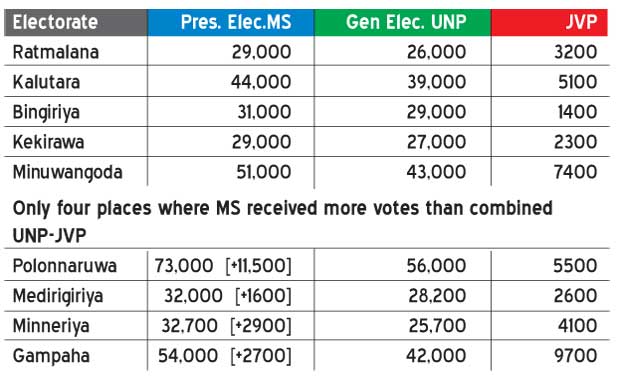
At the January 8 Presidential election, Common Opposition candidate scored largely helped by the solid 37% UNP and 5% JVP plus 8-10% floating votes that went overwhelmingly to Swan. While Maithri scored heavily in the North-East and other minority concentrated constituents, which again are the traditional UNP or minority party votes and certainly not of SLFP. If all those votes were left out Maithri’s SLFP could muster a pathetic 1 to 2 percent of the total as the statistics reveal on the outcome of the two elections held in 2015 January and August: even that meagre percentage was the 10-12% SLFP vote that he was able to muster in the Polonnaruwa District 20,000 approximately along with a little support from [about 3000 votes] he collected from Gampaha electorate in which his birth place Yagoda is situated. The situation may have changed marginally over the past three years in favour of The President. Surely, after three years of presidency and consolidation of party leadership by him, but talking to grassroots level SLFPer, there is only an insignificant shift. The large majority of the SLFP supporters are ‘eagerly waiting for an opportunity to teach a lesson to some who sold the party to the opponents’. All the SLFP stalwarts that supported Sirisena for personal reasons lost at the August election; should they be brought back into parliament though officially permitted but in an unconvinced way? Such action and his virtual failure to perform determinedly have badly diluted his authority as a leader. Clearly, he has exposed himself as a person provoked by political convenience.
A comparison of the voting patterns during the two polls held in 2015 is ample proof of the theory we have put forward in the above paragraph under –‘Fourth Place’
Rajitha Senaratne Formula the best for SLFP

The proud and prompt statements made by the two self-conceited General Secretaries of UPFA and SLFP in response to the trial-balloon message by Minister Senaratne is an unwise decision. Rajitha, is a veteran politician who possesses a proven ability, and had assessed the strengths and weaknesses of his party against JO’s stands in the area. He appears to be somewhat anxious over the chances and his thinking cannot be discarded as thrash. Minister Senaratne is a master strategist, shrewd political craftsman and tactician who can proudly claim to be fairly accurate in reading the pulse of the people.
His exemplary past record at forming alliances, new parties, changing parties, instigating cross over at the right moment, to remain with the winning side irrespective of who wins or who loses, is no secret. At a media briefing held recently, he, for the first time revealed that he did not follow Maithripala Sirisena but it was he who followed him when he prompted that historic cross-over exactly three years ago in November 2014. On the other hand, there is a strong hunger among the grass roots in the SLFP for a reconciliation between the two factions led by the President and ex-President. They think a united SLFP could easily defeat the UNP. If an accord is reached, they will be forced to drop corruption charges against the Rajapaksas and their cohorts.

“At the January 8 Presidential election, Common Opposition candidate scored largely helped by the solid 37% UNP and 5% JVP plus 8-10% floating votes that went overwhelmingly to Swan”

Gain power, retain power and not to lose it

The problems this nation faces today boils down to the persistent pursuit by the leaders and factions to gain power, retain power and not to lose it at any cost. The political culture has changed drastically; today, the success story is the ‘survival of the fittest’, ability to change and fit in to the circumstances, rather than attempting to change the circumstances.
The UNP, at the last general election was competent to come off as the superior of the two in a nation where a feasible third force is not in sight. Whether battle against fraud and corruption would be a certainty or just a set of slogans used in an election and ignored immediately, remains to be seen.
Warming up to fight it out?

If the two factions of the SLFP unite, the President will face a severe problem in taking policy decisions on controversial issues like action against corrupt men in the SLFP faction led by MR.
The President and the Prime Minister who have been together since Jan 8, 2015, are now warming up to fight it out between their two parties and the proposed third-party of the Rajapaksas.
If the UNP were to secure the majority of local government bodies, and the SLFP comes 3rd or 4th; can they sit together in the Cabinet and continue as a unity government for another two years? Worse what are they going to do at the Provincial Council elections that are due in the same year?
There was a common urge of the nation for a change at the end of 2014, not just a change of government but a regime change, a transformation in the ways and style of governance – the ways of governance, both at the national, local and provincial levels. The two leaders have a herculean task to perform as a united force more than to engage in election rivalry.
Let me quote from the farewell address of first President of the USA to conclude the article:-
Political parties may now and then answer popular ends, they are likely in the course of time and things, to become potent engines, by which cunning, ambitious, and unprincipled men will be enabled to subvert the power of the people and to usurp for themselves the reins of government, destroying afterwards the very engines which have lifted them to unjust dominion.” …GEORGE WASHINGTON — September 19, 1796.

Mahinda begins campaign in Anuradhapura (English)

November 12th, 2017

Mahinda begins campaign in Anuradhapura (English)

Racist Budget 2018: Taxing Sinhalese to Pay Tamils

November 12th, 2017

Dilrook Kannangara

Racism has a new abode in Sri Lanka – the budget. Mangala’s 2018 budget is all about taxing Sinhalese to pay Tamils. Budget proposes to ease the burden on war affected people” but it only proposes benefits for Tamils! Sinhalese and Muslims were also affected by the war but they get nothing. Tamils in Jaffna continue to occupy land of evicted Sinhalese since 1977 and evicted Muslims since 1990. This is new apartheid. Sinhala villagers in the North and the East are living under trying conditions.  They have been totally neglected. In addition tens of thousands of disabled Sinhala soldiers and their families continue to suffer the effects of war. They get no houses unlike Tamil war affected people including Tamil terrorists.

Considering the fact that almost all beer manufacturers in the island are Tamil owned businesses, the budget proposes to reduce the price of beer while increasing the price of soft drinks!

Further the government hopes to change the Paddy Lands Act and the Rent Act to drive out Sinhala people from towns and strengthen Tamil colonization of townships and cities outside the north and east. Tamils have already turned the north Tamil-only. No one else is allowed to live or do business in the entire northern province. Parts of Colombo is at risk of following this apartheid structure.

Car import tax changes are also done with a view to benefit Tamils at the expense of Sinhalese. Sri Lanka as a developing nation can ill-afford electric and hybrid vehicles. Eventual beneficiaries are Indian motor manufacturers and their local dealers.

This is the opposite of reconciliation. This is racism with dire consequences in time to come.

People outside the north and east must stop paying tax as it is a fraud on them. Instead they should keep that money with them to face the impending 2018 recession.

Will President Maithri ask Ranil to quit as PM?

November 11th, 2017

by Gagani Weerakoon Courtesy Ceylon Today

Clad in a carefully chosen blue and green tie, Finance and Media Minister Mangala Samaraweera entered the Chamber at 3.05p.m. on Thursday (9) to present Budget 2018, which was themed, ‘Blue-Green Budget; the Launch of Enterprise Sri Lanka’. “It is ‘Blue’ because we plan to integrate the full economic potential of ocean related activities in formulating the overall growth strategy. It is ‘Green’ because we build our economy on an environmentally sustainable development strategy. The ‘Enterprise Sri Lanka’ will reawaken the entrepreneurial spirit, coming from our ancient forefathers, enabling Sri Lanka to be a vibrant trading hub and encouraging all Sri Lankans to become co-owners of a country enriched,” he said.

Even though many expected the Government to come up with an ‘election budget’, the maiden Budget of Minister Samaraweera had focused mainly on policy implementations.

While many view the Budget 2018 as set of proposals that promises nothing major to anyone, yet implementing taxes for almost everything, there are some carefully drafted policy measures, which any other government would have otherwise not paid much attention to. For instance, it had paid attention to the trap of micro credit entities, where rural people, especially those in the North and the East, fall prey to.

Indebtedness in the rural sector targeted by exploitative microfinance schemes has become a serious issue. The small industries in the Northern Province have also not been able to revive due to both the lack of working capital and equity.

The Government will support, by way of the provision of grants and the introduction of a low interest loan scheme, to facilitate those indebted and to move out the debt trap through co-operative rural banks and the thrift and credit co-operative societies. This will be implemented on a pilot basis in the Northern and the North Central Provinces and Rs 1,000 million has been allocated in this regard.
The Budget 2018 was presented as it completed almost a week to the worst ever petrol crisis the country faced. A group of 19 Joint Opposition (JO) Parliamentarians, led by Kurunegala District MP and former President Mahinda Rajapaksa cycled to Parliament in protest against the crisis created by the petrol shortage.

The JO members, who started the bullock cart and cycle parade from the Polduwa Junction ahead of the Budget 2018, were however blocked by the Welikada Police and Parliament Police personnel at the main entrance at Jayanthipura.
Later, those who were on the bicycles were allowed to enter while the bullock-carts were not permitted.

Minutes before the Minister of Finance walked into the Chamber to present the Budget-2018 proposals, JO Leader MP Dinesh Gunawardena, raising a point of order, requested Speaker Karu Jayasuriya’s intervention in ensuring the privileges of the members.
“We are entitled to free access to the Parliament. But today personnel of the Welikada and Parliament Police obstructed us. We want you to investigate this,” he added.

Speaker Jayasuriya said that he was already informed about this by Rajapaksa earlier and would call for a full report on the incident.
Taking a dig at the whole incident, Finance Minister Samaraweera, during his budget speech, where he spoke about encouraging the use of green vehicles said “I think the JO clique has already opted to greener transportation. Unfortunately, their security personnel had to cycle back to where the luxury vehicles are parked.”

Decisive period ahead
While Budget 2018 plans on launching Enterprise Sri Lanka, which the Janatha Vimukthi Peramuna has already dubbed as ‘making Sri Lanka a private enterprise’ a real political shocker came from President Maithripala Sirisena on 8 November at the Ape Gama premises where the second death anniversary of Ven. Maduluwawe Sobitha Thera was held.

While noting there are many things that he cannot come out and say in public, President Sirisena did disclose that some Government members are using the media to attack him because he appointed a Commission to inquire into the Central Bank Bond issue.
Interestingly, Ape Gama at Battaramulla is also the place where President Sirisena- who was functioning at the time as the Health Minister of the President Mahinda Rajapaksa Government, gave the first signal that he will quit the Government.
On 21 November 2014, after handing over appointments to officials in the Health Ministry he said; ‘this may be my last state function’, amid widespread speculation that he might break ranks with the incumbent regime.

“Time solves a lot of things. This may be my last State function. People give power not to abuse it and make money. It’s given to serve the people. This power should never be abused. No one should be drunk with power,” he said.

Three years later, President Sirisena chose the same venue to spell out some of his major grievances. This was following Prof. Sarath Wijesooriya, who also played a major role in electing President Sirisena to power with other civil society activists in a hard hitting speech mentioned how after three years they are forced to get disillusioned with the high expectations of a dawning good governance.
“Some in the government blame me for appointing a Commission to inquire into the Central Bank misdeeds. These individuals are making a wrong analysis of me based on that. I am attacked by spending money on certain media institutions and by reserving pages in weekend newspapers. Some in the government are giving money to media entities operating from abroad to attack me. Why is this?… because, I appointed a Commission to look into the Central Bank matter. If Venerable Sobitha Thera was alive he would have approved of what I did. I did not appoint this Commission targeting anyone in the Government or targeting any MP or Minister,” he said.

President Sirisena also said that the people of this country know the situation regarding the Central Bank incident.
“At that time there was strong public opinion against the incident. There was a huge outcry irrespective of politics that there was a grave fraud that had taken place and asking for action to be taken on it and asking me to appoint a Presidential Commission. I did it.”
The Central Bank incident happened just three months after forming the government. Those responsible for this should be held responsible, he noted.

“The idea of a Common Candidate was among all of us since the first Presidential Election held in 1982. But no one was able to field a Common Candidate ever until 2015.

“It was because of the leadership and dedication of Ven. Sobitha Thera that the Common Candidate was able to win the Presidential Poll in 2015, bringing victory not only to him but to the concept as well. If and when we work for a Unity Government we all must be determined to dedicate ourselves to social justice, rule of the law and good governance. We also must not hesitate to punish any who are engaged in wrongdoings. No one can protest when action is taken against wrongdoers. Unfortunately, that is my main problem. My problem is action is not taken to punish wrongdoers. All members of the Cabinet are aware of what I have spoken in the Cabinet on these issues,” he added.

However, President Sirisena’s unexpected grouse seems to have provoked many in the UNP. While adding that he (Sirisena) never mentioned anything of the sort when they met him about two weeks ago, a group of UNP backbenchers are planning to seek an immediate appointment with the President to ‘get things sorted out’.

We need to know who these members of the government are who are responsible for throwing a spanner in the works, he hinted.
Informed sources said that President Sirisena has also indicated that he is contemplating requesting Prime Minister Wickremesinghe to step down from his post before facing the Presidential Commission of Inquiry.
According to them, the President would make the request in a bid to save the long prevailing ‘Mr Clean’ image of the Prime Minister and to set a precedent.

Prime Minister Wickremesinghe, who has already forwarded an affidavit providing answers to a questionnaire sent by the Commission, is expected to appear before the Commission on 20 November or a closer date.

The recent ‘cold relations’ developing between the President and the Prime Minister has however alerted many moderate politicians in Government and some reportedly have actually sought the intervention of former President Chandrika Kumaratunga, who is currently abroad.

According to sources, if President Sirisena is serious about his decision and yet would continue with the Unity Government, Finance Minister Samaraweera is having a good chance of being appointed as the Prime Minister. This however, will not be entertained by many SLFP seniors.

Meanwhile, a one-on-one meeting between President Sirisena and former President Rajapaksa has been scheduled to be held soon. The meeting has been scheduled as a result of continued dialogue between senior politicians from both camps reaching certain common ground on some issues. The two leaders will presumably not talk about working together for future
elections.

2018 අයවැය පාරිභෝගිකයා ගොනාට ඇන්දවූ අයවැයක්…

November 11th, 2017

lanka C news

2018 අයවැය පාරිභෝගිකයා ගොනාට ඇන්දවූ අයවැයක් බව පාරිභෝගික අයිතීන් සුරැකීමේ ජාතික ව්‍යාපාරය පවසයි.

මේ බව සදහන් කරමින් එම සංවිධානය විසින් නිකුත් කර ඇති නිවේදනය මෙසේය.

2018 අයවැය පාරිභෝගිකයා ගොනාට ඇන්දවූ අයවැයක්.

2018 නොවැම්බර් 09 දින මුදල් අමාත්‍යවරයා විසින් පාර්ලිමේන්තුවට ඉදිරිපත් කරන ලද අයවැය තනිකරම පාරිභෝගිකයා ගොනාට ඇන්ද වූ අයවැයක් ලෙස නම් කල හැක. ඊට හේතුව නම් කිසිදු ප්‍රායෝගික දැනුමක් නොමැති මහපොලවේ පය නොගහපු පිරිසක් විසින් එම අවවැය ලේඛණය රචනා කර තිබීමයි. බැලූ බැල්මට ඉතා රසවත් රචනාවක් ලෙස එය පෙනී ගියත් එහි රචකයන් ද අවසානයේ පඔ ගාලක පැටලී ඇති බව අපගේ අදහසයි.

අප විසින් එසේ පැවසීමට හේතු දැක්වීමක් කරන අතර අප මෙහිදී 2018 අයවැය පිළිබදව කතා කරන්නේ පාරිභෝගිකයාගේ පාර්ශවයෙන් බවද සිහිගන්වමි.

2018 නොවැම්බර් මස 08 වන තමන් ඉදිරිපත් කරන අයවැය පිළිබදව ඉගියක් පළකරන මුදල් ඇමතිවරයා  ප්‍රකාශ කරන්නේ බඩගින්නේ ඉන්නා පිරිසට බිලී පිත්තක් දීම තම අදහස බවයි. එහෙත් අය වැය ඉදිරිපත් කල පසු අපට පෙනී යන්නේ මුදල් ඇමතිවරයා චීනයේ හා ඉන්දියාවේ ඇම ගිල ඇති බවයි. 2018 අයවැය පිළිබදව දහසක් බලාපොරොත්තු තබාගත් පාරිභෝගිකයින් වන සැම එම සුන්වූ බලාපොරොත්තු සමග තවදුරටත් ජීවත්වීමට සිදුව ඇත.

අයවැය යෝජනා

16 හරිත ප්‍රතිපත්තිය මාකටින් කිරීම පරස්පරය වන අතර එයින් රජයේ දවල් මිගෙල් රෑ දනියෙල් ප්‍රතිපත්තිය මනාව පිළිබූමු වේ

මෙම විදුලි කාර් වල බැටරිය නැවත ආරෝපණය කරන්නේ ඩීසල් හා ගල් අගුරැ බලාගාර වලින් ලබා දෙන විදුලි බලයෙනි. පරිසර හිතකාමී බලාගාර සෑදීම සදහා කිසිදු වැඩ පිළිවෙළක් නොමැති රටක විදුලි කාර්   ප්‍රවර්ධනය කල පමණින් පරිසර හිතකාමී  හා පරිසරයට ආදරේ කරන රජයක් යැයි පැවසීය විහිලුවකි.

කෙරවලපිටියේ තාප බලාගාරය වසර තුනකින් ස්භාවික ගෑස් බලාගාරයක්  සදහා පරිවර්තනය කලවුවද  අදාල සමාගම එසේ නොකර තිබියදී නැවතත් කෙළවර පිටියේ යෝජිත ස්භාවික ගෑස් බලාගාරයක් ඉදි කිරීමට එම සමාගමට ලබා දුන්නේ ඇයි ද? හා ස්භාවික ගෑස් බලාගාර ඉදිකිරීමට මෙම රජය කියා නොකරන්නේ ඇයිද? යන්න අප අසන අතර Energy World International  සමාගම සදහා ස්භාවික ගෑස් බලාගිරයක් ඉදිකිරීම සදහා අමාත්‍ය මණ්ඩලය අනුමැතිය දී තිබියදී එම බලාගාරය ඉදිකිරීම සදහා රජය අවශ්‍ය කටයුතු නොකරන්නේ ඇයිද? යන්න හා එහිදී රජයේ හරිත ප්‍රතිපත්තිය ඇත්තේ කොහෙද? යන්නද? අපි ප්‍රශ්ණ කරමු.

විදුලි කාර් සූරිය බලයෙන් ආරෝපණය කිරීම සදහා   ආරෝපණ මධ්‍යස්ථාන පිහිටුවීමට වෙන්කරන ලද මුදල  මුදල රැපියල් මිලියන 5300 කි එම ගින් විදුලි ආරෝපණ මධ්‍යස්ථාන කීයක් පිහිටුවිය හැකිද?

17  විදුලි කාර් සදහා බදු අඩු කිරීම අමූලික බොරැවක් වන අතර එහි කිසිදු පදනමක් නොමැත.

ලියාපදිංචි නොකළ වාහන යන්න සදහන් කිරීම වැරදිවන අතර එය ඉංගීසි සටහනෙහි දක්වා ඇත්තේ බෑන්ඩ් නිව් ලෙසය. මෙරටට ආනයනය කරන ලද සෑම වාහනයක්ම ලියා පදිංචි නොකල ඒවාය. ඇත්තේ බෑන්ඩ් නිව් එනම් භාවිතා නොකල වාහන හා රීකන්ඩිෂන් එනම්  රටවල භාවිතා කල වාහනය.

මෙහි හාස්‍යජනක බව නම් බෑන්ඩ් නිව් වාහනයක හා රීකන්ඩිෂන් වාහනයක බදු ප්‍රතිශතයේ වෙනස 100% කි. විශේෂයෙන්ම ලංකාවට වැඩිපුරම ආනයනය කරන්නේ 50 KW <x< 100 Kw විදුලි කාර් රථ  වන අතර ඒවා රීකන්ඩිෂන් වාහන වේ. බෑන්ඩ් නිව් වාහන ආනයනය කරන්නේ නැති තරම්ය.

විශේෂයෙන්ම චීනය හා ඉන්දියාවෙන් ආනයනය කරනු ලබන විදුලි වාහන රීකන්ඩිෂන් වන අතර ජපානයෙන් ආනයනය කරන වාහන බෑන්ඩ් නිව් වාහනය.

2018 වසරේදී ඉන්දියාවෙන් බෑන්ඩ් නිව් විදුලි කාර් ආනයනය කිරීමට මෙරට සමාගමක් කටයුතු කිරීම නිසා මෙසේ රීකන්ඩිෂන් වාහන බදු අඩු කර ඇතැයි යන සැකය අප තුළ පැනනගී.

අනෙක් අතට බෑන්ඩ් නිව් විදුලි කාර් රථයක් මිලදී ගැනීමේදී විශාල මුදලක් වෙනත් රටකට ගෙවීමට සිදුවන අතර රීකන්ඩිෂන් වාහනයක් ආනයනය කිරීමේදී ගෙවිය යුතු මුදල අඩුව තිබියදී මුදල් ඇමතිවරයා රීකන්ඩිෂන් වාහන ආනයනය ප්‍රවර්ධනය කරන්නේ මන්ද?

සිංහල පිටපතෙහි මෙම බදු මුදල නිෂ්පාදන බදු ලෙස හදුන්වා තිබෙන අතර ඉංගීසි පිටපතෙහි ඇත්තේ එය Excise බදු ලෙසය.

129 – යහපාලන රජයේ මතට තිත ප්‍රතිපත්තියට පයින් ගසමින් දේශපාලකයින්ගේ හෙංචයියලාට සුරාබදු බලපත් ලබා දීම සදහා කල යෝජනාවක් වන අතර සමස්ත මහජනතාව මෙම යෝජනාවට විරැද්ධවිය යුතුය.

283- බී ලූණු අර්තාපල් පරිප්පු කරවල හාල් මැස්සන් සහ එළවලුතෙල් ආනයන බදු අඩු කිරීම.

2018 අයවැය මගින් අත්‍යවශ්‍ය භාණ්ඩ පිළිබදව ඇති එකම යෝජනාව මෙය වන අතර එම භාණ්ඩ සදහා ආනයන බදු අඩු කල පමණින් විකිණිය යුතු මිල තීරණය කරන්නේ කවුද? ආනයන කරැවන්ට පමණක් ඉන් ලාභ ලැබිය හැකි නමුත් පාරිභෝගිකයාට ඉන් ලැබෙන වාසිය කුමක් ද යන්න අප ප්‍රශ්ණ කරමු. නැතහොත් එම භාණ්ඩ විකිණිය යුතු උපරිම මිල කීයද?  එම මිලට භාණ්ඩ අලෙවි නොකරන වෙළදුන්ට දඩුවම් දෙන්නේ කුමන් නීතිය යටතේදැයි අප මුදල් ඇමතිවරයාගෙන් අසමු.

Vip’s flagrant behavior – Petrol crisis

November 11th, 2017

By Dr. Tilak S. Fernando Courtesy Ceylon Today

The precipitous petrol crisis in the country emerged, on 3 November, from rumours by word of mouth, while the line Minister and the Petroleum Development Resources Secretariat kept mum until the delinquency hit a crisis level, and the exasperated motorists started to go on a rampage. The Minister’s request to the public, ‘not to panic’ later, was akin to ‘shutting the stable door after the horse had bolted’.

Inferior petrol

The first official announcement indicated about a tanker full of inferior quality of petrol for IOC, having to be rejected. The petrol queues gradually extended, and people started to queue up for hours on end, when the Government announced to the public ‘not to panic’, stating 80 per cent of stocks of petrol was available, while the Indian Oil Company only controlled 20 per cent.

Fuel shortages take place, from time to time the world over, and if a single shipment of inferior quality of petrol was able to generate such a pandemonium in the country, it simply boils down to the fact that the Government does not have a cohesive policy!
There are ample examples of foreign governments coping up with such critical situations effectively. For instance, the UK Government managed to print out and issue books of coupons, through post offices, to the public, within 24 hours of a crisis involving a tanker driver strike, constraining the issuance of petrol to ‘x’ number of gallons per motorist.

Contrary to such measures, in Sri Lanka, the Government was exposed as being hopelessly inefficient, while the panicked, yet selfish motorists started to fill their tanks up to the brim level and took extra supplies too in cans, until a ban was imposed on issuing petrol into cans.

This, in turn, made the desperate motorist, who got stuck on the road, ‘out of the frying pan into the fire’ situation, having only two options left, that is, either to abandon the vehicle on the road and walk home or push the vehicle all the way to the nearest petrol station and join the miles long queue, without any assurance that he would be able to get petrol once he approached the forecourt! People have been queuing up in this manner, day after day, and to be advised when they reached the forecourt that all supplies had exhausted.

Hide and Seek

The game of hide and seek by the Government took place from 3 November to 8 November. The Government apologized to the public on 7 November, indicating, the crisis will continue until the end of the week”. However, the latest indications are that, this calamity is expected to end on 9 November, with the arrival of a tanker from Dubai carrying 40,000 metric tons. The million-dollar question that arises here is whether the citizens in this country have to depend all the time on the President to intervene personally, to iron out every miniscule dispute or problem?

There is no point in appointing Cabinet sub-committees to investigate once the damage is done. It is inevitable, therefore, for the citizenry to question, the purpose of having countless number of ministers, as puppets, and the public to spend millions on their upkeep out of direct and indirect taxes. By the same token, it is high time to suggest to the Yahapalanaya to at least forget the Yaha (moral) prefix from the Yahapalanaya and to at least concentrate on some Palanaya (governance) by eliminating the bickering and backbiting, by UNP and SLFP Ministers, with a view to get the country on track by eradicating nepotism and corruption, which are allowed to thrive shamelessly.

VIP Interference

During an interview on 7 November, with Malinda Seneviratne, writer and a political analyst, on News Line TV1, revelation of a VIP’s arrogant behaviour, at a Wariyapola petrol station came to light. A VIP’s vehicle had driven into the petrol station, with back up vehicles, assisted by the police. The ‘political thugs’ who were with the entourage, had thrown their weight about, ignoring the exasperated people in the queue for hours, and ordered pump attendants to fill the VIP’s limousine, while the Police looked on. A true citizen, happened to be Malinda’s friend, had observed this unjust incident, while he was stuck in the traffic jam. Immediately, he had stopped his car, walked straight up to the ‘political thugs’, while the VIP was hiding behind tinted glass shutters, and vociferously announced:

What you are doing here is completely wrong. You can kill me on the spot here, but remember that the gun you are using is mine too, I pay for it, I pay for your salary, so your master’s pay and all his allowances. I pay for your boss’s vehicle and this petrol as well. I pay for your children’s education, I do not know who is inside the vehicle, but for the last 70 years, if others, like your boss inside the car, had done what they were supposed to have done, then we would not have queues for petrol like this today“!

Having said so, this brave citizen had got into his car and driven off, while the shocked audience, and the stunned and stupefied VIP and his goons, looked aghast. This is what the President should try and put a stop to! Who needs an entourage of vehicles, when there is no terrorist war anymore!

The type of citizenship, required in achieving people’s justifications, needs to be effective, particularly in Sri Lanka’s pathetic record. Therefore, masses need to develop courage, have commitment, and possess an individual sense of responsibility towards themselves, their families and broadly towards fellow citizens.

tilakfernando@gmail.com

Why father and daughter failed in 1957 & 2000?

November 11th, 2017

 By K K S Perera Courtesy The Daily Mirror

  • The slightest doubt created in the minds of voters by the opposition could cause the people to vote against it in the referendum. 
  • -A Constitution of a nation has to be acceptable to all people despite of their differences, which is an enormous task.
  • What is important is to give adequate time for the people to learn and understand the proposals 
  • The real problem here is that the government is unable to contradict the JO’s claims

Constitutions and Missed Opportunities-

…The writer believes the true solution to the problem mentioned is contained in the federal system and these articles are intended as a General Introduction to the subject”.SWRD Bandaranaike- Ceylon Morning Leader May 19, 1926 [an extract from his six articles to the newspaper]  


In a strange development, when Bandaranaike proposed Federalism in 1926, James T Ratnam, his friend, and contemporary opposed the view.

However 31 years later, on November 7, 1957, exactly 60 years ago…, Prime Minister SWRD Bandaranaike introduced a motion in Parliament for the revision of the Constitution. When C. P. de Silva, Leader of the House moved that the item No 1. on the Order Paper be taken for discussion, the controversial C. Sunderalingam, MP for Vavuniya, raising a Point of Order protested. The Speaker over-ruled him. Next, Leader of Opposition Dr. N. M. Perera objected to taking it up for debate saying that the Opposition needs more time to discuss the issue of revising the Constitution.

The matter was then pressed to a division and passed by 39 votes to 18, paving the way for PM to move that, It is expedient that a joint Select Committee of the Senate and the house should be appointed to consider the revision of the Constitution, with the following matters—  
1. Establishment of a Republic

2. Guaranteeing of Fundamental Rights

3. Senate and Appointed members 

4. Public Service Commission and Judicial Service Commission  

Bandaranaike emphasised that in the present Constitution there was absolutely no provision for the guaranteeing of Fundamental Rights. The question of Federation would be considered by the Committee, he added.

Leslie Goonewardene MP for Panadura said there was a glaring undemocratic principle which was not there in the original Constitution on putting off of the appointment of the Delimitation Commission. He said a large number of voters of Indian Origin were deprived of their votes.


Unitary or Federal?

C. Vanniasingham-Kopay said on the last occasion SJV Chelvanayakam had referred to the nature of the Constitution whether Ceylon should have a Unitary form of Government or a Federal form and as the Prime Minister has given an assurance that this question would be looked into, he would not move an amendment.

C. Sunderalingam-Vavuniya-Moved an amendment (b) which stated, to examine and discuss proposals for the establishment of a fully autonomous Tamil State, federated or separated as determined by a referendum to comprise the Tamil Territory ceded to Britain in 1802, and for the restoration of a Kandyan State …(c) to submit a draft of a Bill for the creation and Constitution of one or more States of Ceylon.

People generally, mobilized by the politicians, who manipulate them in a climate of insecurity, and fear would respond emotionally to these arguments

SWRD Bandaranaike- you mislead D. S. Senanayake that is why we have this bad Constitution.
In a strange development, when Bandaranaike proposed Federalism in 1926, James T. Ratnam opposed the view. Since 1948 we have replaced the Constitution twice. The first in 1972 under Sirimavo Bandaranaike, who left the people out of the process.

The Parliament converting itself into a Constitutional Chamber that met outside the House of Representatives for formulating and drafting a new Constitution, the architect being Dr Colvin R de Silva. She made Sri Lanka a republic and scrapped the second chamber [Senate].

The next was in 1978, by J. R. Jayewardene with his own brother HW, and with no involvement of Parliamentarians either.  Then he amended it 16 times, not for the benefit of the country but for his own. Apart from the above two successful attempts which bulldozed its way forcing them on the people by means of the power of two-thirds and five-sixths, we also experienced two unsuccessful attempts by father, SWRD as described above 60 years ago and again in 2000 by daughter CBK.

Chandrika’s ‘Devolution Proposals’- Sri Lanka Constitution Bill August 7, 2000

CBK as President presented An act to repeal and replace the Constitution of the democratic socialist republic of Sri Lanka,”

In August 2000, after long and strenuous dialogue with all stakeholders. Professor G. L. Peiris, Minister of Constitutional Affairs devoted his energies, sweat, and toil along with Neelan Tiruchelvam [Who was eliminated by Prabhakaran for this ‘crime’] to compile this Constitution during a period of six years from June 1994. A unique feature of the draft was the creation of two vice presidential posts.
Clause 57. (1) There shall be two Vice-Presidents of the Republic of Sri Lanka.

(2) Every Vice-President shall be responsible to Parliament for the due execution and performance of the powers and functions of the office of Vice-President under the Constitution or other written law.
(3) The two Vice-Presidents shall be from different communities, each such community being different to the community of which the President is a member.

(4) Any citizen who is qualified to be an elector under the Constitution shall be qualified to be elected by Parliament as Vice-President.

The draft in 2000 spoke about a united country where maximum power was devolved. It was a brilliant effort by CBK in analysis and assessment. The UNP opposed it and did not give the seven votes required for a 2/3rd majority in Parliament accusing Prof G.L. Peiris of sneaking in a clause to extend CBK’s term by two years.

In reality, there was no such attempt; it contained a precise clause to do away with the Executive Presidency entirely, but at the end of her term in 2005. Was it that the UNP was not very keen on abolition, thinking that they could win it in 2005, or there were inclusions which the two parties did not agree upon.

Chandrika, in fact, made an alternative offer, that the Executive Presidency would end one year after the Constitution is adopted; that is in August 2001. The UNP members misbehaved inside the chamber which reminds us how the JO behaves today.  CBK presenting her draft said, Today is indeed an historic day. It is also a special day in the history of a great people, with a history of over thousands of years. Mr. Speaker this Constitution is designed to end the ethnic war which totally destroyed the lives of the people of this country. [UNPers started disruptions that continued until the end]

If the UNP members howl here today like a pack of jackals, it is a big question to me, Mr Speaker, as to how they can form a responsible Government in this country.” Dr. Jayampathy Wickramaratne who is the Secretary to the Interim Constitution Committee mentions this fact in his book on drafting Constitutions. Draft of a new Constitution died in Parliament due to political infighting.

Fundamental principles of democracy require reverence for rule of law, free, fair and timely elections, freedom of expression, protection of basic rights and freedoms, independent judiciary.

The Constitution or the basic/fundamental law of a nation can shape and influence generations to come.

The present legislator has an unprecedented number of alleged corrupt members on both sides of the divide. Worse, there are rejected ones among both too.

An introduction of a clause in the proposed new Constitution to prevent the Party Leaders from appointing voter rejected men to ‘represent people’ as done by the UNP, SLFP and the JVP disregarding the cries of a sovereign people,is vital.

Wijeyadasa Rajapakshe, PC, has queried the legality of the Constituent Assembly itself. He wrote several articles in newspapers, adding fuel to the fires already ignited by the JO 

Today there are many specialists in drafting Constitutions, they are skilled in interpreting every expression of the interim report presented to the Parliament. Of course, they have a right to express their views to help the determination of the people who could reject a new Constitution being endorsed, in spite of the authority of their genuine representatives and the rejects in the legislator.
The people are sovereign; they should have their say on these issues. It cannot and should not be left to the legislators alone. They should involve knowledgeable men and women from civil society. Keheliya Rambukwella who made a ‘valiant attempt’ to join his old party a couple of years ago thinks the US has arranged a new Constitution for us and the government is only trying to put it into operation.  Former Minister of Justice Wijeyadasa Rajapakshe, PC, has queried the legality of the Constituent Assembly itself. He wrote several articles in newspapers, adding fuel to the fires already ignited by the JO.

People generally, mobilized by the politicians, who manipulate them in a climate of insecurity, and fear would respond emotionally to these arguments. The slightest doubt created in the minds of voters by the opposition could cause the people to vote against it in the referendum.

What is important is to give adequate time for the people to learn and understand the proposals rather than blame the opponents condemning them for lying and misinforming the voter. If such an environment is created the voter will certainly take a well informed correct decision.

The real problem here is that the government is unable to contradict the JO’s claims by producing significant testimony to prove that there is no space for such circumstances in the report. Votes alone cannot and will not make laws acceptable; for laws cannot be measured in terms of votes.

A Constitution of a nation has to be acceptable to all people despite their differences, which is an enormous task. Hence the need is to act watchfully and diligently.
Government Pulling in Different Directions?

If the process is bungled, which appears to be the case—it will adversely affect reconciliation and national integration effort as well. The JVP and UNP want the Executive Presidency abolished; while Government’s other partner is for retention.

Unity Government is at odds on the question of reforms. The UNP and the SLFP are pulling in different directions on two crucial issues: Executive presidency and power devolution.  It must put its own house in order first and speak with one voice. Otherwise, people would think the rulers are a set of comedians only blaming others for blocking their efforts.

Budget panders to IMF whims and fancies: Joint Opposition

November 10th, 2017

Ajith Siriwardana and Yohan Perera Courtesy The Daily Mirror

Joint Opposition (JO) MP Bandula Gunawardene said the budget was sure to fail as in it the government was trying to increase foreign investments by relaxing laws for foreigners and imposing excessive taxes on the people.

This is a more liberal budget which would not offer any benefits to the people,” he said.

He said the finance minister could not present a budget beyond the conditions laid down by the International Monetary Fund (IMF) for a loan negotiated by former finance minister Ravi Karunanayake.

According to the agreement it is the IMF which decides the expenditure of the country for the next three years. The finance minister cannot present a budget beyond the policy framework given by the IMF,” he said.

Guilty by suspicion

November 10th, 2017

Editorial Courtesy The Island


The United Nations Human Rights Council (UNHRC) is apparently wasting its time and money on its campaign to have a hybrid war crimes tribunal set up in this country. For, UN expert and South African human rights lawyer, Yasmin Sooka, has already found the Sri Lankan troops guilty of war crimes!

A member of the UN panel of experts on Sri Lanka, Sooka has faulted multinational fizz drink giant, Coca Cola, for sponsoring a motoring event organised by the Sri Lanka Army in August. She has gone so far as to condemn, as war criminals, Maj. Gen. Shavendra Silva, other officers and men of the Gajaba Regiment, which played a key role in defeating the LTTE.

There have been allegations of war crimes against the Sri Lankan troops. War-winning Army Commander, Field Marshal Sarath Fonseka, himself, has accused his successor General Jagath Jayasuriya of having committed war crimes while the latter was serving under him in the Vanni. So, one may argue that foreigners cannot be faulted for levelling war crimes allegations against those who fought under Fonseka’s command. But, as a UN expert and former member of the Truth and Reconcilation Commission of South Africa, it behoves Sooka to act responsibly without letting her prejudices get the better of her.

Ironically, a Tiger who carried out a claymore mine attack on a crowded bus, killing 30 people and injuring many others in 2008 at Piliyandala, was sentenced to life imprisonment, close on the heels of Sooka’s letter to Coca Cola condemning Maj. Gen. Silva et al as war criminals. LTTE suspects currently in custody are lucky that Sri Lanka has not adopted the Sooka method in dealing with them. Else, all of them would have been sentenced before being tried!

President Maithripala Sirisena has declared once again that never will he allow any member of the military to be hauled up before a hybrid war crimes tribunal. One is intrigued. By co-sponsoring the US-crafted UNHRC resolution, his government has, to all intents and purposes, undertaken to conduct a war crimes probe with foreign participation.

So, the question is how President Sirisena can give a cast-iron guarantee that war crimes charges won’t be preferred against any member of the armed forces.

There is no way President Sirisena can say so confidently that he is in a position to prevent a war crimes probe unless he has got an assurance from the US and other western powers behind the UNHRC resolution at issue that they won’t pursue the matter. If so, why have they softened their stand on Sri Lanka, where, they insisted, war crimes had been committed? Is it because of the 2015 regime change, which paved the way for the advent of a pro-western dispensation? Have they subjugated their much-flaunted human rights concerns to their geo-political interests? Is it that they used war crimes allegations as a bludgeon against the pro-Chinese Rajapaksa regime?

Curiously, UN Special Rapporteur Pablo de Greiff, who was here recently, called upon the government to honour its Geneva commitments. Addressing the media, he told the government in no uncertain terms that it had to commence a war crimes probe. As we pointed out in a previous comment, he also warned that the case filed in Brazil against former Sri Lankan Ambassador to that country General (retd.) Jagath Jayasuriya was only the tip of the iceberg. The government’s failure to launch a war crimes probe would lead to more such efforts being made internationally, he warned. Overstepping his diplomatic limits, he went to the extent of taking exception to President Maithripala Sirisena’s much-publicised assurance that he will not allow ‘war heroes’ to be prosecuted for alleged war crimes. The government chose to take Greiff’s diplomatic excesses, as it were, lying down. Why? Is it running with the hare and hunting with the hounds?

The Ranil-Mangala budget and why SLFP must reject it

November 10th, 2017

By Dr. DAYAN JAYATILLEKA

Mangala Samaraweera clearly reveals that the guiding philosophy of his Budget and indeed of the government’s economic policy is manifestly not that of President Sirisena but rather that of Prime Minister Wickremesinghe when he says “Mr. Speaker…In line with Vision 2025…”

Mr. Samaraweera’s budget is filled with lies, half-truths, dangerous ideas and outrageously treacherous policy suggestions. Its guiding philosophy, just as that of the Government’s Constitutional proto-draft contained in the Interim Report, is that of nihilism. The two are part of the same project of a de-nationalizing Counter-Reformation.

It is a strategic policy intended to cause a tectonic shift in Sri Lanka’s economy and Sri Lanka’s very being and destiny. Its very philosophy intends and denotes a shift from autonomy to irretrievable dependency. It is intended to shift ownership, power, preferences and resources from national to foreign, from medium and small capital to big capital mainly foreign, from the working people including the middle classes to big capital, and from the peasantry to the comprador capitalists.

In other words, it is nothing less than an agenda to roll back all reforms and policies that built up a national capitalism and a national capitalist class (I mean Sri Lankan, not ‘nationalist’) from the early decades of the 20th century and accelerated through the post-independence decades. The Ranil-Mangala economic policy intends to destroy the very basis of such a national capitalism and a national capitalist class.

There is no coming back for this country from Mangala’s Budget if it goes through and is implemented– and fast track implementation is something Mangala is good at. The Ranil-Mangala policy has two main prongs. It targets the national economy and the Sri Lankan peasantry. For decades, dating from Independence but even before, in the days of the Ceylon National Congress in the expanding colonial legislature, under universal suffrage since 1931, the main thrust of Ceylonese economic policy has been the building of a strong Sri Lankan capitalist economy and protect the Sri Lankan peasantry. The Ranil-Mangala policy attempts to roll all that back.

Samaraweera opens his speech with a section entitled “Fast Tracking Liberalization”. He goes on to openly declare that “Mr. Speaker… Sri Lanka needs to liberalize and globalize.” While no sane economic voice today anywhere in the world is against globalization and for nativistic protectionism, no sane economic voice today anywhere in the world argues simplistically for a country to “liberalize and globalize”!”Fast-tracking”neoliberal globalization is precisely what Mangala Samaraweera is talking about.

Any literate politician knows that the problem is not about globalization as such, but about which model of globalization, and that another globalization which isn’t fast-tracked liberal globalization, is not merely possible but underway, with China and the East Asian (state-led) model in the vanguard.

The evidence is in on neoliberal globalization and its time has come and gone. While globalization remains valid and desirable, a certain model of globalization, i.e. neo-liberal globalization, is in crisis and has caused crisis. It is even blamed for the rise of extreme forms of nationalist, religious and cultural backlashes. However, it is precisely this outdated, widely discredited and dangerously de-stabilizing model that Ranil and Mangala seek to foist on us.

Quite apart from the paradigmatic and conceptual fallacy, Mangala plainly says: “Mr. Speaker, while we introduced an open economic policy regime in 1977, in the last decade we have lost momentum, with many of our laws remaining archaic and regressive.” Far from having lost momentum in the last decade, our economy was singled out in 2010 by the Singaporean Deputy Prime Minister (and Defense Minister) of that time as the fastest growing economy in Asia– the fastest growing economic zone in the world– with the solitary exception of China, which was growing faster.

Mangala lists the legislation which Ranil and he hope to gut, and it should be noted that almost all of them fall into the category of legislation passed by two SLFP-led, and more pointedly, Bandaranaike-led center-left coalition governments.

This is legislation that no UNP government chose or dared to touch, and in fact went on to build upon them because they had become part of Ceylon’s/Sri Lanka’s distinctive social democratic development model.

What Ranil and Mangala are trying to do is to scrap all the progressive legislation from 1956, and indeed post-Hartal 1953. This includes Philip Gunawardena’s Paddy Lands Act and Pieter Keuneman’s Rent Act.

“…For example; the Rent Act, No. 7 of 1972 which limits the ownership of houses and the rent to be charged requires amendments; Paddy Lands Act, No. 1 of 1958 and the Agricultural Lands Act, No. 42 of 1973 will be amended to allow the farming of alternate crops; the Shop and Office Employees Act, No. 15 of 1954 will be amended…”

Mangala hopes to tamper with prices and property rights. In his pre-Budget media briefing at which he announced a few modest price reductions he said that “in an open economy there is no place for price controls”.

That not only shows his economic philosophy it also shows how little he knows about economics in general and the Open Economy in particular. He should sit at the feet of Ronnie de Mel and learn why the JRJ-Ronnie model retained price controls. It did not affect the Open Economy at all—which clocked 8% growth in its first years. It was a very conscious choice made by JRJ and Ronnie not to do away with price controls, and to make any change gradualistically rather than as a Big Bang which subjects prices of basics to the vagaries of the market, including the global market. The reason was that JRJ had learned at his cost, just what could happen if food stuffs were not subject to price control—he was a political victim of the Hartal of August 1953. He was determined not to make that mistake again. Mangala plainly does not know the economic history and the history of economic policy-making in Sri Lanka.

This fallacy was echoed and extended in his budget:

“Mr. Speaker…In line with Vision 2025, we need to undertake bold reforms in factor markets in order to eliminate price distortions and restore property rights in accordance with market principles aiming at promoting faster and sustainable growth. Capital market reforms to capture its full potential are imperative for ensuring high growth over the medium-term and beyond. Without proper ownership of land and property, no country could achieve faster growth ensuring prosperity for all. In this context the country’s land and property ownership issues need a careful and urgent appraisal. Country’s labour demand against the constraints on labour supply requires a closer examination of all areas of the labour market including labour laws, to pave the way forward to harness the productive resources of the economy.”

There are four clear targets here. Firstly, prices, which we already discussed. Secondly, the various measures that made ownership more egalitarian, more national, and shifted it towards both the national middle classes and the poor. This is true of the peasantry/agriculture and lands and the urban poor and middle classes i.e. housing policies. Thirdly, labor laws, which Ranil and Mangala wish to alter, so that wages are no longer protected and the playing field is heavily tilted in favour of capital, especially big foreign capital. Though intrinsically desirable, his chatter about flexible hours for women workers is a disguise for commencing total deregulation of labour which in turn will drive down wages.

Fourthly, the capital market. The East Asian crisis of 1997 which Mahathir Mohamed’s unorthodox policies saved Malaysia from, clearly proved that opening up the capital markets means extreme vulnerability to market manipulation and “hot money flows”, which can suck out a country’s capital, de-capitalize a country, leaving it an empty shell. Ranil Wickremesinghe tried to introduce capital market liberalization in 2001-2003 but mercifully he was turfed out. Now Mangala and he are back at it!

The Ranil-Samaraweera model hopes to de-industrialize Sri Lanka and shift it to trading and commerce, rather than industrial and agricultural production as well as industrial production based upon agriculture (the Chinese lift-off strategy under Deng Hsiao Peng).

“Mr. Speaker …The dormant spirit of competitiveness must be reawakened to make Sri Lanka the trading and the commercial hub it deserves to be. The country needs to shift away from being more protectionist and inward-oriented. Sri Lanka’s border measures need to see a complete revamp through well-targeted and time-bound trade reforms promoting growth. Our over dependence on non-tradable drivers challenges growth in the coming decade.”

“We have tried many strategies including protecting local industries through tariffs. We have legislations that do not allow foreign investments in certain sectors. Perhaps, most of all, our complex labour laws and bureaucracy have unwittingly obstructed foreign enterprises from entering into the country, thereby, preventing the much needed competition for the local industries. Trade reforms are integral to national competitiveness. Let me say this, competition breeds success. It tests our limits and forces innovation. As such, let me assure our local private sector, our Government’s policy of entering into Free Trade Agreements (FTA) and the removals of para tariffs should not be viewed as a threat to our local industries. The para-tariffs applicable on the tariff lines which do not at present carry any Customs duties will be abolished within the next 3 years in keeping with our policy of liberalizing and globalizing.”

Even the Blue-Green economy is the equivalent of the central bank bond scam. An island must build up its shipping and push outward into the sea-lanes. Instead the Ranil-Mangala vision is merely to convert it into a port of call, and a place where ship building is not local (we built our own fast attack craft) but foreign owned. Note also that there is no mention that the “independent port regulator” will be totally national/local—it could very well have foreign involvement with grave national security and strategic consequences.

“The Sri Lanka Ports Authority Act, No. 51 of 1979 and the Merchants Shipping Act, No. 52 of 1971 will be amended to cater to the demands of the modern day logistics and marine industry. This will also ensure healthy competition, an independent Ports regulator will be introduced. Restrictions on the foreign ownership on the shipping and the freight forwarding agencies will be lifted. This will enable major international shipping lines and logistics operators to base their operations in Sri Lanka.”

“As I already mentioned, we will remove restrictions that limit the land ownership rights of listed companies with foreign ownership together with the restrictions on foreigners’ ability to purchase condominiums below the 4th floor.”

The Ranil-Mangala Budget is one of a completely, totally Open Economy; a wide-open economy, unregulated and unprotected. It is not the Open Economy strategy (JRJ-Ronnie-Premadasa) that is at fault but this crazy cowboy version of it; this is an Open Economy on crack or worse, Fentanyl. What this will achieve is the wrecking of a Sri Lankan industrial capitalist class and the development of a manufacturing base, which are the twin factors at the heart of the Malaysian, South Korean and East Asian miracle as a whole.

The Mangala Budget and the underlying Ranil-Mangala strategy completely change the goal and aim, the very project and path, of Sri Lanka’s bipartisan economic policy since Independence, from one of (national) development to (mere) growth. Overall what is intended is a shift to foreign ownership which will crowd out all the national social classes. It must be resisted tooth and nail. The SLFP must rebel against it.

කියුබාවට අත නොතබනු

November 10th, 2017

වෛද් රුවන් එම් ජයතුංග 

සෝවියට් සමාජවාදී ක්‍රමය යටතේ  1986  සිට ජීවත් වෙමින්  පෙරෙස්ත්‍රොයිකාවද ඉන් පසු සෝවියට් දේශයේ අසමෝධානයද මම සියැසින් දුටුවෙමි. සමාජවාදී ක්‍රමයේ ධනාත්මක මෙන්ම ඍණාත්මක පාර්ශවයන් ද අප පසක් කලෙමු.  

එකල වර්සෝ ගිවිසුමට සම්බන්ධ වූ සමාජවාදී රටවල්වූ පෝලන්තය , බල්ගේරියාව , රුමේනියාව , නැගෙනහිර ජර්මනිය යන රටවල් ගනනාවකද  මම සංචාරය කලෙමි. එසේම  සෝවියට් සමාජවාදී සමූහාණ්ඩු වූ රුසියාව , බිලොරෂියාව , යූක්‍රයීනය සහ මෝල්දෝවියාව  යන ජනරජ වලද සංචාරය කොට සමාජවාදී ජීවන රටාව අධ්‍යයනය කලෙමි. එහෙත් සමාජවාදී කියුබාවට යාමට මට නොහැකි වූ අතර අවසානයේදී එම භාග්‍ය උදා වන්නේ 2017 නොවැම්බර් මාසයේදීය​. 

අශ්වයන් ද ප්‍රවාහන සේවයේ එක් අංගයකි

1986 දී මම යූක්‍රයීනයේ හිමෙල්නීස්කි නගරයට ගිය අතර එම නගරයේදී මට බොහෝ කියුබානුවන් මුණ ගැසුනි. මේ හැර කියෙව් නගරයේදීද කියුබානු සිසුන් සමග අදහස් හුවමාරු කර ගැනීමේ අවකාශය මට ලැබුනේය​. තවද  ලොස් ඇන්ජලීස් සහ ටොරොන්ටෝ යන නගර වලදීද මට කියුබානුවන් හමුවී තිබේ. කෙසේ නමුත් කියුබාවට ගොස් කියුබානුවන් හමුවීමට ලැබීම විශේෂත්වයක් විය​. 

කියුබාව යනු ලෝකයේ සුවිශේෂ රටකි. 1492 වසරේ කොළම්බස් විසින් කියුබා දූපත සොයා ගන්නා ලදි.  කොළම්බස් පැමිනීමට පෙර ස්වදේශික ඉන්දියානුවන් (සිබෝනි ගෝත්‍රිකයන් ) කියුබාවේ සිටියද ඔවුන්ව ජන ඝාතනයට ලක් විය​. මේ නිසා කියුබාවේ ආදි වාසීන් සිටින්නේ ස්වල්ප ප්‍රමාණයකි.  ටයිනෝ භාෂාවෙන් කියුබාව යනු සාර භූමිය නම් වෙයි.  කියුබාවේ උක්ගස් , දුම්කොළ , කෝපි වගා කෙරේ.

කැරිබියන් දූපත් වලින් වැඩිම ජන ඝනත්වයක් ඇත්තේ කියුබාවේය​. කියුබාව ලෝකයේ විශාලත්වයෙන් 17 අගය දරණ දූපත වෙයි.  ජනගහනයෙන් 51% සුදු සහ කළු ජාතිකයන් ගෙන් සමිශ්‍රණව තිබෙන අතර 11% කළු අප්‍රිකානු සම්භවයකින් යුත් ජනයන් ද 37 % සුදු ස්පාඤ්ඤ සම්භවයකින් යුක්තය​.  අප්‍රිකානු ජනතාව පැවතගෙන එන්නේ හිටපු වහලුන් ගෙනි. නීත්‍යාණුකූලව කියුබාවේ වර්ගවාදයක් නැත​. එහෙත් අභ්‍යන්තරව දිවෙන කළු සුදු භේධ තිබෙන බව මා සමග කථා කල කියුබානුවෝ කීහ​. කියුබාවේ සාක්‍ෂරතාව 99.8% කි. ප්‍රාථමිකයේ සිට විශ්ව විද්‍යාලය දක්වා අධ්‍යාපනය රජය විසින් නොමිලේ දෙනු ලබයි.  

කියුබාවේ සමාජවාදී විප්ලවය සිදු වන්නේ 1959 දීය​. මුල් කාලයේදී තමා කොමියුනිස්ට්වාදියෙකු නොවන බව ප්‍රසිද්ධියේ කියූ ෆිදෙල් කැස්ත්‍රෝ පසුව ඇමරිකානු සම්බාධක නිසා සෝවියට් කඳවුරට හේත්තු විය​. ඇමරිකානු සහාය ලත් කියුබානු ප්‍රති විප්ලවවාදී කොටස් බේ ඔෆ් පිග්ස් හි පරාජය කිරීමත් සෝවියට් මිසයිල කියුබාවේ ස්ථානගත කිරීමත් නිසා ෆිදෙල් කැස්ත්‍රෝ ඇමරිකාවේ උදහසට ලක් විය​. එහෙත් කැස්ත්‍රෝ තම මරණය දක්වා ඇමරිකානු අධිරාජ්‍යවාදයට නොබියව මුහුණ දුන්නේය​. 

කියුබානු ආර්ථිකය ශක්තිය ලැබුවේ සෝවියට් දේශයෙනි. සෝවියට් දේශය කියුබාවට බොහෝ සහනාධාර දුන් අතර බොර තෙල් බැරල් එකක් විකිනුවේ කොපෙක් සුළු ගනනකටය​. එහෙත් පෙරෙස්ත්‍රොයිකාවත් සමග සෝවියට් දේශය වාෂ්ප වී යාමත් සමගම කියුබාවට තම දකුණු අත අහිමි වූවාක් මෙන් වූයේය​. මේ නිසා කියුබාවේ බොහෝ සමාජ ආර්ථික ප්‍රශ්න පැන නැග්ග අතර මේ දක්වා එකී සමාජ ආර්ථික ප්‍රශ්න කියුබානු සමාජය වෙලා ගෙන තිබේ. 

ස්ටාලින් සෝවියට් දේශයේ ඇති කරන ලද සමූහ ගොවිපළවල් ක්‍රමය විප්ලවයෙන් පසුව කියුබාවේද ක්‍රියාත්මක විය​. එහෙත් අකාර්‍යක්‍ෂම පරිපාලනය , ඥාති සංග්‍රහය , පොලිට් බියොරෝව තෘප්තියට පමුණුවන්නට ව්‍යාජ දත්ත සැපයීම​, පොදු අලස බව , වගකීම් විරහිත බව යනාදී කරුණු නිසා බොහෝ සමූහ ගොවිපළවල් බංකොලොත්වී තිබේ. සමහර සමූහ ගොවිපළවල් වල් බිහිවී ඇත​. සමහර ඉඩම් කැනේඩියානු , චීන සහ නෙදර්ලන්ත සමාගම් වලට බදු දී තිබේ. 

මා සංචාරය කල සමාජවාදී රටවල් අතුරින් දිළිඳුම රට කියුබාව කියා මට සිතේ. කියුබාවට බට මොහොතේ සිට දරිද්‍රතාව දැක ගත හැකි විය​. එසේම මුළු රටේ උග්‍ර පේන්ට් හිඟයක් තිබේදෝ කියා මට සිතුනි. ඒ මෙන්ද යත් බොහෝ රජයේ ගොඩනැගිලි මෙන්ම නිවාස තීන්ත බුරුසු වල පහස නොලබා ජරාවාසව​ දිස් විය​. එහෙත් සමහර ගොඩනැගිලි සහ හෝටල් අලංකාර ලෙස පින්තාරු කොට තිබූ බව කිව යුතුය​. 

මෙවැනි දිලින්දන්ද හවානාවේ හිඟ නැත 

මේ වන විට කියුබාවේ ආර්ථිකය යන්නේ රිම් එකෙනි. බොහෝ අත්‍යාවශ්‍ය භාණ්ඩ ජනතාවට බෙදා දෙන්නේ සලාක ක්‍රමයටය​. හාල් , බෝංචි ඇට , මස් , උයන තෙල් , සීනි , බිත්තර , හිඟයක් වෙළඳ පොලේ පවතින අතර මේ භාණ්ඩ බෙදා හරිනු ලබන්නේ කූපන් මගිනි. එහෙත් සලාකයට බෙදන මෙම ආහාර ද්‍රව්‍ය පවුලක යැපීමට ප්‍රමානවත් නොවන බව බොහෝ කියුබානුවෝ පවසති. අතිරේක ආහාර ඔවුන් වැඩි මිලට කළු කඩයෙන් මිලදී ගනිති. මේ සඳහා මුදල් අවශ්‍ය කෙරේ. ඒ නිසා ඔවුන් අතිරේක රැකියා වල යෙදෙති. උදාහරණයක් ලෙස භූගෝල විද්‍යා ගුරුවරියක වූ මේබල් සති අන්තයේ සංචාරකයන් සඳහා ගයිඩ් කෙනෙකු ලෙස සේවය කරන්නීය​. සමහර විශ්ව විද්‍යාල කථිකාචාර්‍යවරු රාජකාරී වේලාවෙන් පසු ටැක්සි එලවති. පාරේ හිඟාකෑ හිඟන්නන් කීප දෙනෙකුද මම දුටිමි. එසේම සංචාරකයන්ට පමණක් අතපෑ  දිලින්දන්ද හවානාවේ වූහ​. 

සාමාන්‍ය කියුබානුවෙකුගේ නිවසක් (හවානා) 

සංචාරකයන්ට හෝටල් වල ආහාර හිඟයක් නැත​. එහෙත් අප හෝටල් වලදී   සොසේජස් , කුකුල් මස් , හරක් මස් , රිබ්ස් , චීස් , යන ආහාර යහමින් කන විට කියුබානු වේටර් වරුන් සහ වේටර්වරියන් ගේ වේදනාකාරී දෙනෙත් මා දුටුවෙමි. තවද ආහාර බොහෝ සෙයින්  බෙදා ගෙන  නොකා ඉවත දමන සංචාරකයන් පොදුවේ කරන්නේ අපරාධයක් බව මා පසක් කලෙමි. මේ සංචාරකයන් ඉවත දමන බිත්තර , මස් හෝ සොසේජස් පවුලක සතියක සලාකය බව ඔවුන් නොදනිති.  මා සමග කතා කල එක් වේටර්වරියක් පැවසුවේ ඇය ජීවත් වන්නේ පස් හැවිරිදි පුතා සහ වියපත් වූ මව සමග බවයි. මවට විශ්‍රාම වැටුපක් ලැබේ. එහෙත් සලාකයට ලැබෙන ආහාර පවුලේ යැපීමට ප්‍රමාණවත් නැත​. මේ නිසා ඇය අසීරුවෙන් හෝ මුදල් සොයාගෙන කළු කඩයෙන් හාල් සහ මස් මිලදී ගෙන ළමයාගේ කුසගිනි නිවන්නීය​. 

හවානා වලදී මම සමුපකාර කීපයක් දුටුවෙමි. භාණ්ඩ හිඟ එම සමුපකාර මට සිහිපත් කලේ 1970 යුගයේ සමගි පෙරමුණ ආණ්ඩුව කාලයේ තිබූ සමුපකාරය​. ඒ කාලයේ  තිබූ එක් විහිළුවක් නම් බොහෝ සමූපකාර වල දොරවල් ගෙවී තිබුනේ මිනිසුන් සමූපකාරයේ දොර ලෙවකා කහට බීම නිසාය​. කියුබාවේ සමුපකාර වල දොරවල් නොගෙවී තිබුනද  මැළවී ගිය එළවලු සහ තම සළාකය ගැනීමට නොසන්සුන්ව පෝලිමේ සිටි මිනිසුන් දැකිය හැකි විය​. 

කියුබාවේ ආර්ථිකය පණ නල ගැට ගසාගෙන තිබෙන්නේ සංචාරක කර්මාන්තයෙනි. කියුබානු විප්ලවය තිබූ කාලයේ බොහෝ ග්‍රාම්‍ය විප්ලවවාදීන් එකල ඉතා හොඳ තත්වයේ තිබූ සංචාරක හෝටල් විනාශ කලහ​. ඒ ඇමරිකානු සංචාරකයන්ට විරෝධය පෑම සඳහාය​. සමහර පිරිස් පවුල් පිටින් පැමින හිල්ටන් බඳු හෝටල් වල කාමර අත්පත් කර ගත්හ​. විප්ලවයේ උණුසුම නිසා මේවා සමාජවාදී ක්‍රියා ලෙස අර්ථ දක්වන ලදි. එහෙත් සෝවියට් ආධාර ක්‍ෂයවී යාමත් සමගම සිදු කල මෝඩකම් අවබෝධ කර ගත් කියුබා රජය යලි සංචාරක හෝටල් අළුත්වැඩියා කොට ඒවා බටහිර සංචාරකයන්ට විවෘත කළහ​. සමාජවාදයේ නාමයෙන් හෝටල් වල ලැග සිටි පවුල් ඉවත් කොට යලි ඒවා ප්‍රකෘතිමත් කළහ​. දැන් මේ හෝටල් වල බටහිර සංචාරකයන් බොහෝ සෙයින් දැකිය හැකිය​.  වර්තමානයේ  සංචාරක කර්මාන්තය නිසා කෙලින් සහ වක්‍රව කියුබානුවන් මිලියන ගනනක් යැපෙති.  

පරණ කාර් අතර BMW එකක් 

කියුබාවේ සංචාරකයන් සඳහා විශේෂ මුදල් වර්ගයක් තිබේ. එය බිහි වන්නට ඇත්තේ එකල සමාජවාදී ලෝකයේ තිබූ අඩුපාඩු අධ්‍යනය කිරීමෙන් පසු විය හැකිය​.  සෝවියට් දේශය , පෝලන්තය ,නැගෙනහිර ජර්මනිය යන රට වල ඇමරිකානු ඩොලර් සහ බ්‍රිතාන්‍ය පවුම් ඉතා අගය කොට සලකන ලදි. මේ නිසා බටහිර සංචාරකයන් ගෙන එන ඩොලර් සහ පවුම් බැංකු වල නීති ගත අගයට වඩා දහ ගුණයක් පමණ ගෙවා මිලදී ගැනීමට ටැක්සි කරුවන් සහ ජාවාරම්කරුවන් පුරුදුව සිටියහ​. උදාහරණයක් ලෙස  එකල (1989) බටහිර ජර්මනියේ ඩොයිෂ් මාක්ස් පහක් නැගෙනහිර ජර්මානියේ කළු කඩයෙන් මාරු කල විට නැගෙනහිර ජර්මානු මුදල් බොහෝ ප්‍රමාණයක් ලැබුනි. මේ මුදලින් දෙතුන් දෙනෙකුට නැගෙනහිර ජර්මනියේ ඉතා හොඳ හෝටලයකින් දිවා ආහාරයක් ලබා ගත හැක​. එහෙත් එකල ඩොයිෂ් මාක්ස් පහකින් බටහිර ජර්මනියේ ලබා ගත හැකි වූයේ හොට් ඩෝග් එකක් සහ මිනරල් වතුර බෝතලයක් පමණි. මෙයාකාරයෙන් ඇමරිකානු ඩොලර් 50 සෝවියට් දේශයේ කළු කඩයෙන් මාරු කල සංචාරකයාට සෝවියට් දේශයේ ජ්‍යෙෂ්ඨ වෛද්‍යවරයෙකුගේ මාසික වැටුපට ආසන්න මුදලක් ලැබුණි.  මෙම ක්‍රමය කියුබාවේ බලධාරීන් අවබෝධ කර ගත් අතර එය වැලැක්වීම සඳහා සංචාරකයන් සඳහා පරිවර්ත්‍ය පෙසෝ නෝට්ටු හඳුන්වා දෙන ලදි. මෙම පරිවර්ත්‍ය පෙසෝ එකක් කැනේඩියානු ඩොලර් එකකට වඩා මිලෙන් අධිකය​. එනම් කැනේඩියානු ඩොලර් 100 සඳහා ගෙවන්නේ පරිවර්ත්‍ය පෙසෝ 78.66 පමණි. 

බොහෝ සංචාරකයන් පවසන පරිදි ඔවුන්ට කියුබාවේ විශාල මුදලක් වැය කිරීමට සිදු වෙයි.  එක් දිනක් සඳහා වාහනයක් කුලියට ගැනීමට ගිය ජර්මානු සංචාරකයෙකුට ඇමරිකානු ඩොලර් 105 ගෙවීමට සිදු විය​. එහෙත් ඇමරිකාවේ හෝ කැනඩාවේදී ආසන්න වශයෙන් ඩොලර් 25 – 30  ගෙවා වාහනයක් එක් දිනක් සඳහා කුලියට ගැනීමට හැකිය​. කියුබාවේදී කුරුම්බා ගෙඩියක් මිලදී ගැනීමට සංචාරකයෙකු කැනේඩියානු ඩොලර් දෙකක් ගෙවිය යුතුය​. මේ අනුව කියුබානු සංචාරක ව්‍යාපාරය විසින් බටහිර සංචාරකයන් ගේ දත් වහල්ලම ගලවා ගනියි. එහෙත් බටහිර සංචාරකයෝ කියුබාවට ඒම ප්‍රිය කරති. කියුබාව පියකරු රටකි. රට වටා වූ මුහුද කියුබාවට ආභරණයකි. 

සාමාන්‍යයෙන් කියුබානුවන් ඉතා සුහදශීලීය​. ඔවුන් එකිනෙකා සමගත් ඉතා සහයෝගයෙන් සාමුහික චින්තනයෙන් යුතුව වැඩ කරති. ඔවුන් නිතරම සිනහසෙමින් සිටිති. ස්පාඤ්ඤ සහ අප්‍රිකානු සංස්කෘති වලින් පෝෂණය වූ කියුබානුවන් සංගීතයට සහ නැටීමට ප්‍රිය කරති.  ශ්‍රී ලාංකික සමාජයේ දැඩි ලිංගික අසහනය සහ පර පීඩක මානසිකත්වය උඩුදුවා ඇත්තේ කියුබානුවන් මෙන්  සංගීතය  සහ නර්තනය  ශ්‍රී ලාංකිකයන් තුල හොඳින් අවශෝෂණය නොතිබීම නිසා බව ඇතැම් විට මට සිතේ. 

කියුබාවේ පාරවල් ඉතා පිරිසිදුය​. කුණු ඉවත් කිරීම ක්‍රමවත්ව කෙරේ. ඒ නිසා මැසි මදුරුවන් අවමය​. ඩෙංගු නිවාරණයේ ඔවුන් ලද සාර්ථකත්වය මේ පරිසරය පිරිසිදුව තබා ගැනීම මත ලද ජයග්‍රහණයකි. එහෙත් හවානා වලදී අපිරිසිදු මෙන්ම උතුරා ගිය කාණු තිබූ පාරවල් කීපයක් මම දුටුවෙමි. 

පාරේ වාහන එලවීම ඉතා විනීතය​. ලංකාවේ මෙන් ගාල කඩාගත් අවිනීත වාහන එලවීමක් කියුබාවේ නැත​. ලංකාවට සාපේක්‍ෂව වාහන පාරවල් වල ඉතා අඩුය​. බොහෝ වාහන 1940 ගනන් වල ඇමරිකානු පැරණි කාර් වන අතර මේවා තවමත් පාරවල් වල දිවීම කියුබානු මිකැනික්වරුන් ගේ දස්කම පෙන්වයි. ඇමරිකානු පැරණි කාර් වලට අමතරව සෝවියට් දේශයෙන් ගෙන්වන ලද ලාඩා , මොස්කවිච් , තවුරියා යන කාර් වර්ගද කමාස් වර්ගයේ සෝවියට් ට්‍රක්ද මම දුටුවෙමි. එසේම අතරින් පතර මර්සෙඩේස් බෙන්ස් සී ක්ලාස් වාහන කීපයක් සහ බී එම් ඩබ්ලිව් කීපයක් දුටුවෙමි. මේ වාහන ධනවත් කියුබානුවන් ගේ හෝ පක්‍ෂයේ බලවතුන් ගේ විය හැකිය​. සාමාන්‍ය ජනයා සඳහා බස් සේවයක් පවතියි. එහෙත් බස් ප්‍රමාණය අඩුය​. අශ්ව කරත්ත සහ බූරුවන් ගැට ගැසූ ප්‍රවාහන කරත්තද මම දුටුවෙමි. මේ ආදිකාලේ ප්‍රවාහන ක්‍රමද යොද ගෙන තිබෙන්නේ ඉන්ධන අර්බුධය නිසාය​. නමුත් සංචාරකයන් සඳහා ලක්‍ෂරි බස් තිබෙන අතර මේ බස් දෙස හෝල්ටිං ප්ලේස් වල සිටින කියුබානුවෝ ඉතා කෑදර දෙනෙතින් බලා සිටිති. 

කියුබාව වටා අගනා වෙරළ තීරයක් තිබේ. මේ වෙරළ ලංකාවේ මෙන් නොව ඉතා පිරිසිදුය​. එසේම සංචාරකයන් සඳහා ආරක්‍ෂිත රිසෝට් නමින් හඳුන්වන හෝටල් පද්ධති සහ වෙරළ තිබේ. මේ නිසා තංගල්ලේ ප්‍රාදේශීය  සභාවේ සභාපති කලාක් මෙන් සංචාරක හෝටලයකට කඩා වැද සංචාරකයෙකු ඝාතනය කොට ඔහුගේ පෙම්වතිය දූෂණය කිරීම වැනි සිද්ධීන් කියුබාවේ නොමැත​. මෙම ආරක්‍ෂිත රිසෝට් වලට සාමාන්‍ය මිනිසුන්ට යා නොහැක​. එසේම සංචාරකයන් ආරක්‍ෂිත රිසෝට් වලින් බැහැරට යාමද අධෙර්‍යමත් කොට තිබේ.  සංචාරකයන් ආරක්‍ෂිත රිසෝට් වලින් බැහැර නොයෑමේ එක් හේතුවක් නම් බටහිර රට වල පාස්පෝට් උදුරාගෙන දුවන  හෝ හොරකම් කරන කල්ලි කියුබාවේ සිටීමයි. මේ නිසා හවානා වල කරක් ගසන විට මම මගේ කැනේඩියානු පාස්පෝට් එක නිරන්තරයෙන්ම ඉදිරි කලිසම් සාක්කුවේ තබා ගත්තෙමි.  මේ හැර මා කුමන රටෙන් ද කියා ඇසූ විට කිව්වේ ඉන්දියාවෙන් කියාය​. ඉන්දියානු පාස්පෝට්  එතරම් ඩිමාන්ඩ් නොවූ නිසාදෝ මාව ජාවරම්කරුවන් ගේ දෙනෙත් වලට ලක් වූයේ නැත​. 

කියුබාවේද ජාවාරම්කරුවන් සිටිති. ඔවුන් පිට කොටුවේ අයියලා බඳුය​. සංචාරකයන් පසු පස ගොස් කුඩු , බඩු හෝ කොල්ලන් ඕනෑද කියා ඔවුන් අසති. සමහරු අසන්නේ කියුබානු සිගාර් හෙවත් සුරුට්ටු අවශ්‍යද කියාය​. සාමාන්‍යයෙන් ඉහල ප්‍රමිතියේ කොහීබා නම් වන කියුබානු සුරුට්ටුවක් මිලෙන් අධිකය​. එහෙත් මේ අයියලා නියමිත මිලෙන් 50 % අඩුවට කියුබානු සුරුට්ටු විකුනති. මේ සුරුට්ටු මැදට දමා තිබෙන්නේ වේලන ලද කෙසෙල් කොලය​. මේ බව නොදත් සංචාරකයන් කෙසෙල් කොල මැදට දමා ඔතන ලද කියුබානු සුරුට්ටු පෙට්ටි ගනන් ජාවාරම්කරුවන් ගෙන් මිලදී ගනිති. 

හවානා වලදී  මම කැනේඩියානු ඩොලර්  50 ගෙවා රියැදුරෙකු සමග පැරණි ඇමරිකානු Chevrolet වාහනයක් කුලියට ගෙන හවානා නගරයේ සුප්‍රකට ස්ථාන බැලීමට ගියෙමි. මේ ස්ථාන අතර රෙවලූෂන් ස්ක්වයා , ජෝන් ලෙනන් උද්‍යානය , හවානාවේ සුප්‍රකට සුසාන භූමිය​, පැරණි ස්පාඤ්ඤ බල කොටුව​, ක්‍රිස්තුස් ප්‍රතිමාව​, එර්නස්ට් හෙමිංවේ නිතර පැමිනි බාර් එක , ඇල් කැපොන් හවානා වලට පැමිනි විට රැඳී සිටි හෝටලය , බැටිස්ටාගේ හවානාහි මන්දිරය , හොසේ මාටි ස්මාරකය වැනි ස්ථාන වූහ​. සමහර ස්ථාන වල චේ ගුවේරාගේ විශාල ප්‍රමාණයේ චිත්‍ර දැකිය හැකි විය​. චේ ගුවේරාද කියුබාවට මුදල් සපයන එක් මාධ්‍යකි. චේ ගුවේරා ගේ ටී ෂර්ට් , කැප් සංචාරකයෝ මිලදී ගනිති. චේ ගුවේරා ගේ ටී ෂර්ට් එකක් සාමාන්‍යයෙන් කැනේඩියානු ඩොලර් 12 පමණ වෙයි. 

දේශීයව චේ ගුවේරා යනු තව දුරටත් තොරොම්බල් කල නොහැකි ප්‍රපංචයක් බව කියුබානු බලධාරීන් අවබෝධ කර ගෙන තිබේ. වර්තමාන කියුබානු තරුණ පරම්පරාවට චේ ගුවේරා හෝ කැස්ත්‍රෝගේ වීර ක්‍රියා අසනවාට වඩා අවශ්‍ය කුස පුරවා ගැනීම සහ අලංකාර ලෙස ඇඳුම් පැළඳුම් කිරීමය​. මා සමග විශ්ව විද්‍යාල සිසුන් දෙදෙනෙකු කතා කල අතර විශ්ව විද්‍යාල අධ්‍යාපනයෙන් පසු රැකියාවක් ලැබුනද එය යැපීමට ප්‍රමාණවත් නොවන බව ඔවුන් කීහ​. බැටිස්ටාගේ කාලයේ කියුබාව අන්වර්ථව හඳුන්වන ලද්දේ ඇමරිකානුවන් ගේ ගණිකා මඩම කියාය​. එකල ඩොලර් විසි පහකට ඇමරිකානුවන් සමග යාමට කියුබානු ගණිකාවන් සිටියහ​. එහෙත් වර්තමානයේ දරුවන් ගේ කුස පිරවීමට බිත්තර දහයකට නිදි වදින ගැහැණුන් සමාජවාදී කියුබාවේ හිඟ නැති බව කියුබාවට නිතර එක ආජේන්ටීනා ජාතික සංචාරකයෙකු මා සමග කීවේය​. 

තරුණයන් ගේ මානසිකත්වය රාවුල් කැස්ත්‍රෝ අවබෝධ කර ගෙන තිබේ. තව දුරටත් ඇමරිකානු අධිරාජ්‍යවාදී බිල්ලා පෙන්වා ජනතාව සන්සුන්ව තබා ගත නොහැකිය​. එසේම පොතේ ගුරු මාක්ස්වාදී න්‍යායන් ඔස්සේ ගොස් ආර්ථිකය තවත් අනා ගැනීමට ඔහු සූදානම් නැත​. රාවුල් කැස්ත්‍රෝ ප්‍රායෝගිකවාදියෙකි. දැන් කියුබානුවන්ට කුඩා ප්‍රමාණයේ ව්‍යාපාර ඇරඹිය හැක​. එසේම තම නිවෙස විකිනීමට හෝ කුලියට දීමට හැකිය​​. දැන් තරුණයන් අත ජංගම දුරකථන දක්නට තිබේ. ඉන්ටනෙට් සේවාවන් ද ඉබි ගමනින් කියුබානු සමාජයට එකතු වෙමින් පවතියි. සන්නිවේදන පහසුකම් නම් 1970 යුගයේ ලංකාවේ තිබූ තත්වය කියා මට සිතේ. වරක් කැනඩාවට දුරකථන ඇමතුමක් ඉල්ලා පැය භාගයක් බලාගෙන සිටීමට මට සිදු විය​. වයිෆයි පහසුකම් නම් රිසෝට් වල තවමත් නොමැත​. ලංකාවේ ඊනියා සමාජවාදීන් ලංකාව කියුබාවක් කිරීමට වෙර දරන අතර රාවුල් කැස්ත්‍රෝ  කියුබාව ලංකාවේ ආර්ථික ප්‍රතිපත්ති වලට සම කිරීමට වෙර දරණු බව පෙනේ. රාවුල් කැස්ත්‍රෝ  විදේශීය ආයෝජකයන්ට අත වනයි. ඔහු විදේශීය ආයෝජකයන්ව  ඉඹලා පිළිගනියි. 

කියුබාව ගැන කතා කිරීමේදී ඔවුන් ගේ වෛද්‍ය සේවාවන් ගැනද කතා කල යුතුය​. තුන්වන ලෝකයේ රටවල් වලට සාපේක්‍ෂව කියුබාවේ හොඳ වෛද්‍ය සේවයක් තිබේ. මම ප්‍රධාන පෙලේ රෝහල් කීපයක්ද ෆාමසි කීපයක්ද දුටුවෙමි. කියුබානු වෛද්‍යවරු ජනතාවට සමීපය​. ඔවුන්ට ඩියුටි ෆ්‍රී වාහන නැත​. ග්‍රාමීය ප්‍රදේශ වල වෛද්‍යවරු අසු පිටින් නිවෙස් වලට ගොස් රෝගීන් බලති. සියළු වෛද්‍ය සේවා නොමිලේය​. එහෙත් පිටරැටියන් මුදල් ගෙවා වෛද්‍ය සේවා ලබා ගැනීමට එති. ඇමරිකාවේ සිදු කරන කොස්මෙටික් ශල්‍යකර්මයක් 80% පමණ අඩු මුදලක් ගෙවා කියුබාවෙන් කර ගැනීමට සංචාරකයන් එති. එසේම නුදුරු කාලයේ මුදල් ගෙවා කියුබානු වෛද්‍ය විද්‍යාල වලින් වෛද්‍ය විද්‍යාව ඉගෙන ගැනීමට අන්තර් ජාතික සිසුන්ට හැකි වනු ඇත​. 

මා සමග හවානා හිදී දිවා ආහාරය ගත් මහාචාර්‍ය Lourdes Zumalacárregui කියුබානු ඇකඩමි ඔෆ් සයන්ස් හි සාමාජිකාවකි. එසේම කියුබානු කොමියුනිස්ට් පක්‍ෂයේ සාමාජිකාවකි. ෆිදෙල් කැස්ත්‍රෝගේ මිතුරියකි. ඇය බෙල්ජියමේද ස්පාඤ්ඤයේද විශ්ව විද්‍යාල වල ආරාධිත කථිකාචාර්‍යවරියකි. ඇය පැවසූ පරිදි ෆිදෙල් කැස්ත්‍රෝ හොඳ කථිකයෙකි. එහෙත් රාවුල් කැස්ත්‍රෝ තුල  කථා කිරීමේ දක්‍ෂතාව එතරම් නොමැත එහෙත් ඔහු නිහඞ වැඩකාරයෙකි. මහාචාර්‍ය Lourdes Zumalacárregui පවසන පරිදි කියුබානු සමාජය පරිවර්ථනය වෙමින් පවතියි.  එහෙත් මෙම පරිවර්ථනය කුමන දිශාවටද කියා තවමත් කිව නොහැක.

වෛද්‍ය රුවන් එම් ජයතුංග 

Sri Lankan stocks drop; telcos, banks drag after budget measures

November 10th, 2017

COLOMBO, Nov 10 (Reuters) – Sri Lankan shares fell on Friday, weighed down by declines in telecom and banking stocks after the island nation targeted both cash-rich sectors in its 2018 budget to boost revenue.

Sri Lanka imposed new taxes on motor vehicles, telecoms, banks and liquor in a bid to boost revenues in its 2018 budget outlined on Thursday, as the budget deficit for the current year slipped to 5.2 percent of the gross domestic product.

How many Tamils PAID to be TORTURED to get asylum in the UK?

November 10th, 2017

Shenali D Waduge

We are talking about sterling pounds 5000-6000 being paid to be burnt with cigarette butt ends and face other tortures to enable British doctors to verify health records and endorse the torture as being ‘recent’ and to imply the tortures/rape were committed by the Sri Lankan forces. The monetary aspect fattens the purses of those making a business out of torture-asylum and enables foreign governments to use these examples to politically target countries like Sri Lanka to facilitate interventionist roles. Is the UK authorities silent because they are well aware of their role in this? Does the UK authorities not mind UK tax payers having to eventually finance these ‘economic cum terrorist-linked’ refugees/asylum seekers who end up not only manipulating the UK social welfare systems but playing out the British public via notorious international rackets the LTTE and Diaspora elements are linked to?

The international tarnishing campaigns against Sri Lanka takes the form of reports, documentaries, films, panel discussions which are all funded by Foreign Governments through NGOs established for interventionist purposes.

The best example is the released report by Yasmin Soosa who was selected by Ban Ki Moon to be a member of his (not UN) Panel of Experts.

Yasmin Sooka’s report ‘An unfinished war: Torture and Sexual violence in Sri Lanka 2009-2014’ was a politically motivated report. In her own words she says we released the report in time before the Geneva Resolution because we wanted to influence the Geneva resolution”.

Yasmin Sooka’s report is politically and denies her any status as ‘independent’ because the ‘Unfinished war: Torture and Sexual Violence in Sri Lanka 2009-2014’ report is funded by the British Foreign Office through the Bar Human Rights Committee of England and Wales while Sooka’s other project partner ‘International Trust and Justice Project Sri Lanka’ is impossible to locate!

www.interventionism.info

Sooka’s report takes a sample of 40 ‘selected’ asylum seekers majority of whom the report says were ‘involved in active combat’ a feeble way to admit they were associated with the LTTE. The mystery remains with the non-disclosure of the witnesses, how they contacted the lawyers, no one knows who the lawyers are, no one knows who the medical experts are or even who the translators are – there is much always lost in translation given that these ‘victims’ in view of them seeking to remain in the UK have all the motives to invent stories and they make an excellent couple for those wanting to politically and diplomatically influence Sri Lanka!

When Sooka herself is an EU employee how can her report have any credibility?

Therefore, the Sooka report and its 40 ‘selected’ asylum seekers involved in ‘active combat’ leaves much to the imagination.

So does the BBC documentary ‘Sri Lanka’s unfinished war’. Notice how these same coterie of people are united in their usage of nomenclatures.

The story of the asylum seeker the BBC documentary presented by Frances Harrison introduced as ‘Nandani’ won her asylum in the UK.

The story has helped to uncover a sinister racket taking place in the UK and possibly elsewhere in all of the western destinations that Sri Lanka’s Tamils are seeking economic migrant status riding on the asylum ticket.

In the case of the UK the system for asylum/refugee is lax.

To apply as a refugee/asylum seek a person needs to leave their country and be unable to go back because of fear. Even a student or visitor arriving in the UK can apply if they think they are at risk of persecution when returning to their country. Asylum seekers are screened, they go through an asylum interview and a decision is given within 6 months.

With this process clear the avenues to manipulate the system are many and UK Tamil Diaspora have found ways to penetrate the system thus creating a profit making establishment for themselves which has worked well for the Western Governments ready to use these systems for their

Just like the Sooka report was released to influence the Geneva Resolution, the BBC documentary was released in November 2013 ahead of the Sri Lanka’s Commonwealth Summit. Sooka presented 40 cases, Frances Harrison presented 12 cases. Both reports were funded to focus on ‘Torture and rape’ as a new subject for intervention. Both reports aimed to show systematic and widespread rape existing in Sri Lanka and Nandani’s case was highlighted as the 1st post-conflict rape to come into public.

www.eyesrilanka.com

The lies of Nandani became exposed through an interview with Nandani’s mother. BBC’s and Frances Harrison’s heroine was in fact married to Uhan Padmarasa a pro-LTTE activist who had been sent by LTTE to the UK in 1995 and had been living there since. Nandani and Uhan had married in India in mid 2000 and her desire was to join him in the UK.

Thus she joins so many other women unable to join their spouses because either the spouse has a dubious record or there are fears that the true nature of who they are would get exposed at the asylum interview.

The next recourse is to seek legal counsel and there are agents and solicitors to provide ever ready services at a fee.

The question is how many Tamils spent sterling pounds 5000-6000 with additional sterling pounds 1500 as processing fees to gain asylum in the UK?

How many Tamils have sought assistance from the below featured solicitors?

  • How many Tamils have enduring physical scarring /tortures for a fee in order to foolishly think they can get asylum in the UK?
  • How many Tamils have been foolish to get their bodies burnt with cigarette butts, beaten with hot metal rods or cut and scarred to show physical torture?
  • How many Tamils have visited a location at 53 South End Lane, Brombley, SE6 3AB supposedly belonging to a Pirakash Gobalasingham who has close ties to internationally banned Tamil Rehabilitation Organization an LTTE front?
  • How many Tamils have been medically checked by British medical doctors and what is the guarantee that they are not involved in this scam and how many Tamils are willing to come forward and expose these crimes and expose these people making profits by physically scarring people who would do anything to get asylum in a Western country?

* How many Tamils as a result of these tortures are suffering adversely as a result inspite of actually gaining asylum. As for those who inspite of paying for their wounds could not secure asylum, how are they suffering with these wounds which will never leave them physically or mentally with the realization that they actually paid to get the wounds inflicted.

Does this not look like a ‘patterened’ and paid wound? How many other such ‘wounds’ have been paid for and used by NGOs/INGOs for their reports and by Foreign Governments to embarrass Sri Lanka???

The BBC Documentary shows a Dr. Allison Callaway who says she has examined over 200 cases of alleged torture from Sri Lanka in the past 5 years (after 2009). What is interesting is that she has examined Nandani and Dr. Callaway says she has 30 cigarette butt burns on her body including genital areas. When we now know that Nandani has been telling lies, matched with the realization that there is a paid racket on charging to inflict wounds on asylum seekers we need to seriously place Dr. Allison’s claim with the all-important question of how many other Tamil asylum seekers have gone through this torture.

This is the first in a new case study of asylum seekers actually paying to get wounds inflicted on them so as to facilitate their application for asylum.

This is a very dangerous scenario. If asylum seekers from across the globe also pays to get themselves tortured and thus NGOs take up their ‘cause’ and demand asylum from foreign governments what will this result in especially when the BBC report says that some rape cases had been given asylum even without verifying authenticity?

These cases that Sooka, BBC and Frances Harrison gives as examples are certainly not fake because there are bruises but these bruises are as a result of paying to get bruised and have no association with the party they accuse of committing the crime.

Thus Sooka, BBC and Frances Harrison have no right to accuse the Sri Lanka Armed Forces when there are places in the UK where asylum seekers have paid to get their wounds and thereafter apply for asylum on the claim that these ‘wounds’ and ‘tortures’ were recent and committed by the armed forces.

This case has to be legally taken up in the UK by honest lawyers and citizen-interest lobbies to insist that the solicitors, agents and any official in the UK party to this racket are exposed and legal action is taken against them.

What needs to be highlighted is

  • There is an international new racket that is charging asylum seekers for physical woundsthat would secure them asylum. The likelihood of this racket extending and existing in other countries and by other nationalities cannot be ruled out.
  • Reports/Documentaries/Panel Discussions/Books are being released close to international events and UN country-assessment sessions in order to influence countries against targeted countries. These reports/documentaries/panel discussions, books etc are all funded by foreign governments who fund NGOs and people in their payroll to compile the reports using as sources the very parties that the targeted nations are in conflict with.

This is a violation of ethics and morals and totally against how Governments, NGOs and even the legal fraternity are meant to function.

The systems need to be cleaned up and the UN Panel investigating Sri Lanka needs to clearly put all these lies and distortions into its report.

Shenali D Waduge

The darkest hour is just before the dawn – Part I

November 10th, 2017

By Rohana R. Wasala Courtesy The Island

Fiat justitia – ruat caelum! (Let justice be done though the skies fall!)

In May 2009, we ordinary Sri Lankans suddenly had everything before us, whereas for the previous thirty years, we had nothing before us.  Most of us had been inured to believe that  the separatist militants were invincible, and  we were filled with incredulity when they were defeated. It was  the best of times for  peace-loving patriotic Sri Lankans living everywhere, but it was the worst of times for their opponents. It was the season of Light for the former, but it was the season of Darkness for the latter. It was the spring of hope for those who believed their problems were over, but it was the winter of despair for those who thought otherwise.  However, the pendulum of power  swung (or was forced to swing) in the opposite direction in January 2015. The bleak present is so unlike that roseate period that ‘some of its noisiest critics insist on its being received, for good or for evil, in the superlative degree of comparison only’.  Yet, there are hopeful signs that the masses are awakening to the reality and the country is being recalled to life!, with apologies to Dickens.

As the saying goes, The darkest hour is just before the dawn”: Things can only get better when they could get no worse. We are in a situation today that reminds us of this inspiring piece of proverbial wisdom. It is probably the worst predicament we have been landed in since independence, though it is 75% self-inflicted, so soon after the brightest moment in that six decade transitional period. If ever a single national cause united the majority of all the different ethnic communities as a single Sri Lankan people within the last half a millennium, that happy moment occurred when separatist terrorism was militarily defeated in May 2009. But the results of that historic national achievement have been grievously squashed already. Hardly five years had passed since the end of terrorism before we were unexpectedly condemned  to a state of progressive topsy-turvydom, which today  has reached its nadir: economic dreams have been turned into nightmares; reconciliation and goodwill between communities into mutual suspicion and alienation; democracy into kakocracy (rule by the worst); sovereign independence into voluntary subjection to a ‘free sovereign states management’  version of geopolitics (on the analogy of ‘supply management economics’ given expression in the deliberate destruction of surplus food crops in certain capitalist societies where poor sections of the population may be starving), war heroes into terrorists, and vice versa, and many other similar tragic reversals. While imbeciles considered usable by the powerful are lionized, intelligent honest persons are ostracized; criminals are tolerated and even rewarded, efficient as well as patriotic local experts and professionals are replaced by imported non-national crooks, but peaceful protestors against wrong economic policies are set upon by paid thugs unleashed by criminal politicos with underworld links, and the victims of those attacks and their suspected leaders are put in prison, in a bid to stifle just opposition. (These general observations are based on information gathered from reliable internet media.) Indefinitely postponed elections mean denying the franchise of the people, thereby stifling the very life breath of democracy.

Amidst all this, the undeniable fact is emerging that Sri Lanka is being unjustly targeted by the Western powers, the so-called Tamil Diaspora parasitizing the global influence of those powers, our giant neighbour Big Brother India, the cynical Tamil National Alliance (TNA) pushing its hardly concealed separatist/federalist goal with an air of unprecedented eclat, all ganged up in pursuit of their diverse and disparate ends, making common cause, however, with each other for dismantling the unitary structure of Sri Lanka and for deposing Buddhism from its foremost place in the current constitution. It is the Buddhist religion that has given the unitary state its cohesive cultural identity since its beginning more than 2300 years ago. The aforementioned countries and groups want to achieve this twofold purpose through a forcibly imposed federalist constitution. Those patriotic Sri Lankans belonging to all communities (the overwhelming majority) who are unequivocally opposed to these designs  are hopeful that the powers that be will at least put on hold, if not abandon altogether, their conspiratorial constitution making scheme for the time being in response to the rising public outcry against it, which now has reached a crescendo.

The case against the introduction of a new constitution by the Yahapalana government has by now been well established by eminent constitutional lawyers, academics, professionals, members of the clergy of the main religions, secular intellectuals, veteran journalists and others who are knowledgeable and vocal about the subject. Its illegality, fraudulence, and the utter loss of public confidence in the sincerity of intentions on the part of its architects and promoters were authoritatively explained in an article by previous Justice and Buddhasasana minister Dr Wijedasa Rajapaksa MP recently serialized in The Island newspaper (on November 2,3, and 4, 2017). Public disapproval of what has been appropriately described as a constitutional death-trap has received an imprimatur in the form of the unanimous voice of the Maha Sangha of all Nikayas raised against it. The leading clergy of other religions have shown that they too support the stand taken by the monks in this regard. The Bar Association of Sri Lanka (BASL) expressed (as reported in The Island/October 24, 2017) its grave concern about proposed amendments to Articles 1 and 2 of the current constitution, and resolved to write to the government demanding precise and clear answers to a long list of questions including, for example, those about: the need/requirement for a new constitution, the fate of the unitary structure of the state, powers to be devolved, and the ability of the centre to later recall those powers if necessary, the future of the executive presidency, the status of the judiciary, and fundamental rights issues. Attorney at Law Lal Wijenayake , calling himself a proud member of the BASL (as reported in The Island/November 4, 2017), describes these questions of crucial importance as ‘a set of childish questions to the wrong party (the government)’. The few examples I have mentioned here prove that the questions that the BASL raised are not at all ‘childish’ questions. That inane statement alone is enough for us to guess the mindset of the minority of individuals who are behind this non-Sri Lankan-sponsored unconstitutional (illegal) constitution making program, though Wijenayake is speaking only in his capacity as an individual member of that professional body. His main grouse is that the meeting that produced the BASL statement of October 23rd was attended by only 46 out of the total Bar Council membership of 950. Is that important? The meeting on October 23rd was called in response to what was implicitly deemed by the BASL hierarchy a national emergency. The resolution was properly adopted at the Bar Council’s monthly meeting held on October 28th as Wijenayake himself admits in his ‘reply’ (as The Island calls it). (Note: Articles 1 and 2 of the existing constitution are:

  1. Sri Lanka (Ceylon) is a Free, Sovereign, Independent and Democratic Socialist Republic and shall be known as the Democratic Socialist Republic of Sri Lanka.
  2. The Republic of Sri Lanka is a Unitary State.)

No party or individual contesting the January 8th and August 17th elections had included a pledge to replace the existing constitution if elected to power. Besides, no party or alliance won an absolute majority of seats to form a government alone on the latter occasion. Hence the Yahapalana government has no mandate to address the same. The most formidable challenge to the unmandated new constitution making enterprise  comes from the Maha Sangha. This is not to the liking of the powers that be and certain madly intrusive, mercenary NGO outfits (which are actually the prime movers behind the questionable project). They are doing their damnedest to mislead domestic  public opinion, and international perceptions regarding this crucial issue, especially among misinformed and prejudiced non-Sri Lankan/alien functionaries (such as the recent visitor  Special Rapporteur Pablo de Greiff or the one before him Ben Emmerson) in the interventionist UN bodies who have little knowledge about our country in terms of its diverse communities, geography, demography, culture, or history.

A common criticism leveled against the Sangha offering to air their opinions before government leaders about the constitution making issue is that they have neither the authority nor the competence required to do so. But the reality is that they have the authority granted by hallowed tradition in this country where Buddhism has enjoyed supremacy over everything else since the very dawn of Lanka’s recorded history, and where  it is given the ‘foremost place’ in the 1978 constitution (that operates today). Just as the majority of the Sinhalese are Buddhists, the majority of Tamils are Hindus. Hindu Tamils have absolutely no issue with the idea of Buddhism being recognized as already occupying the foremost place in the state. Though they provide guidance to the ruler, the Maha Sangha play an apolitical role. A state where Buddhism is given the foremost place is effectively secular (if secular means a complete separation between the church and the state in governance). The monks intervene when there is reason to believe that the Buddhasasana, the Sinhalese race, and the country (all three of which they consider to be above politics and non-negotiable) are in jeopardy. They consider this to be their inescapable historic responsibility. They don’t care which person or party rules, so long as these three treasures are duly safeguarded. Foremost among them is the Buddha Sasanaya, because it is what renders the unitary state whole, in both senses of the word (complete, sound/healthy).

The Malwatte Mahanayake Thera was out of the country when the Karaka Sangha Sabhawas of the two Chapters of the Siyam Nikaya met at the Dalada  Maligawa and issued a statement calling on the government to stop the ongoing attempt at making a new constitution in view of the likely harmful consequences of such an exercise in the current situation (explained to them by impartial, non-political intellectuals, legal experts, and specialist doctors), and instead to bring in only such absolutely essential reforms as changing the electoral process, and also to focus on developmental work in order to relieve the suffering of the people. The Mahanayake Theras had directed the Anunayake Theras and the Karaka Sangha Sabhawa of Malwatte to deal with the matter jointly with the Asgiriya sector as per custom. Now, the Ven. Mahanayake Thera of the Asgiriya Chapter, who was in the country at the time, refrained from attending the meeting of the monks at the Maligawa, because he thought it was improper to do so in the absence of his Malwatte counterpart. Each Karaka Sangha Sabhawa has twenty members. So forty monks contributed to the deliberations before arriving at their final unanimous decision. They met at the historic Ran Ayudha Mandapaya of the Maligawa as they traditionally do. The Diyawadana Nilame, the lay custodian of the Maligawa, had no part to play in the matter, except perhaps having physical arrangements made for the purpose in the Maligawa premises. The Maha Sangha of the whole country approved of the stand of the Siyam Nikaya hierarchy. The democratic, and no less dignified conduct of the monks who announced their perfectly sound counsel regarding this aggressive constitution making project was in stark contrast to the cynically dismissive, inappropriate, authoritarian response it evoked among those who appear to be committed to support it. Ven. Professor Bellanwila Wimalarathana Thera says that the henchmen of the government have started a besmirching campaign in order to discredit the Maha Sangha and Buddhist institutions over this. A powerful government bigwig with a three-lettered name (in Sinhala characters) had asked (an acolyte, presumably) to ‘Smash this fellow at this opportune moment’ ‘moota me welawe gahaladapan’ (‘මූට මේ වෙලාවෙ ගහල දාපං’). The monk revealed that he was told by a powerful person in the government that although they insisted that there was not even a preliminary draft of the proposed constitution, a constitution has already been drafted. The monk knew the names of the two persons who wrote that document, but thought it inappropriate to divulge them just yet (Ada Derana TV news/October 28, 2017).

To be continued

Tamil demand for unfair and unreasonable power – due to Sinhala stupidity, complacency, ignorance and infighting

November 9th, 2017

Chanaka Bandarage

The British ruled Sri Lanka (then Ceylon) for 150 years. During that period both the Sinhalese and the Tamils lived as British subjects. There are no records that the Tamils like now were then demanding more power for themselves.

When Sri Lanka received independence in 1948, the British acknowledged that the North and the East are parts of the Sri Lankan state and never contemplated an India/Pakistan type partition to give the North to the Tamils (this was their unequivocal acknowledgement that Sri Lanka has always been a One Nation). The Tamils never made such a demand – that the North be given exclusively to them. Though they now make a loud claim that they want more power, the Tamils knew it was a futile attempt to demand special powers or a separate state from the British (in a letter dated 30 April 1964 to his Tamil friend C Suntharalingam, Lord Saulbury (Sri Lankan  government minister between 1931 and 1941, architect of the Ceylonese Constitution in 1944 and the Governor-General of Ceylon between 1949 and 1954) stated …. I do not believe that other federal or autonomous Tamil State will work. Federation is cumbersome and difficult to operate – and an autonomous Tamil State would not be viable.”

Historically, the Sinhalese have shown that they are brilliant in defending their land, culture and religion from various enemy powers. That is why powerful foreign invaders have been chased away by the Sinhalese to where they originally came from.

Most recently we defeated the most powerful terrorist outfit of the recent world, the LTTE.

Since about 275 BC we have been subjected to Tamilnadu invasions, commencing from Elara. We suffered terribly under Soli (සොලී), Pallava and Kalinga-Magha invasions. They caused enormous destruction to the country.  The Sinhalese civilizations in the North, North Central, Wayamba and Eastern provinces were decimated by these invading forces.

The irony is that we Sinhalese tend to show lethargy in safeguarding our existing rights and privileges. We tend to act only after something adverse had happened to us.  Until then we would act as if no harm would come to us. Any impending dangers, we consider them as  trivial and/or unimportant. Seldom would we take precautions before an adverse outcome. This is a marked contrast to how the West acts, especially the English speaking West. They plan and act well in advance, so when conflicts, calamities arrive, they are well prepared.

We tend to accommodate unfair requests made to us by mischievous forces.  We tend to blindly believe in false promises made to us by different elements.  Due to this, we often make our own downfall.

Sadly, we have   shown an inferiority complex to western cultures; and we tend to belittle our own rich Sinhalese, Buddhist culture. The whole world is amazed by our rich Sinhalese civilization (our hydraulic engineering technology was such that we were able to pump water to top of the Sigiriya rock), but, we underestimate and care less about our own marvels/achievements. In the recent past we deliberately omitted our rich history from our school history books.  To please some, we purposely distorted versions of our own history; for example, to say that we are not descendants of Vijaya and the Ramayanaya mythology is a truth (this allowed the separatists to claim that King Ravana was a Tamil and that he existed before Vijaya in Sri Lanka). Some of our leaders have publicly despised the country and the people. Even today when two upper middle class Sinhalese meet for the first time, they tend to talk to each other in  English.  There seems to be shame attached to talk in Sinhalese.

We have developed these bad habits due to the ‘brain washing’ of us by the British imperialists.  The British were adamant that after they left  the island there will be a band of ‘Kalu Suddos’ who will continue with their way of thinking and living. It is the ‘Kalu Suddos’ who dwell on class distinctions to garner unfair upper hand for themselves over others. They work against treating people based on merit. Most of the time these people are less patriotic.

We are well aware that there were Sinhalese, sometimes Sinhalese leaders, who connived with the Tamil Tigers. As a result our brave armed forces suffered.

In regards to overseas enemy forces, when we realise that we have been tricked by them, it had often been too late.  By then, we had paid a huge price for our mistakes.

This rationale applies to the current proposals to amend the Constitution.  The Sinhalese have still not understood the danger of giving Land and Police powers to the racist Northern Provincial Government. There are several other dangerous elements in the current proposals, but giving away these two powers is the most dangerous.

It is important to bear in mind that giving such important powers to the racist Northern Provincial Council would amount to assisting them in creating the Tamil Eelam. They are patiently waiting for that opportunity to arise.

Why should we knowingly participate in such a ‘suicidal’ act? Once the country is divided, unlike in the past, it will be impossible to claim it back (our sovereignty and territorial integrity).

These dangers have been well articulated in the writer’s recent articles published in this website.

Some of the ‘foolish’ past exercises by the Sinhalese are:

  • Gave away our land to the Portuguese

The king of Kotte, Dharma Parakramabahu (6th Parakramabahu), wanted to be too nice to the sea warrior Lorenzo De Almeida; he was extremely anxious to enter into a treaty with the Portuguese. Upon the Portuguese’s first arrival in the country, he immediately allowed them  to establish settlements in Colombo including erecting a Catholic chapel inside the Colombo Port, and he agreed to gift a large quantity of cinnamon every year to Portugal (about 200,000 pounds). The King gifted two tusked  calf elephants  to the Portuguese King.  To consume during their return voyage to Portugal, the King gave them large numbers of live fowl and fresh fruit that included bananas, mangoes, pineapple and king coconuts. (the king’s cabinet comprised of four of his brothers).

It is reported that Lorenzo De Almeida could not believe what they achieved in their first trip.  To celebrate, he ordered the firing of several rounds of ships’ artillery into the air. The Colombo residents were so terrified about the gunfire; it was for the first time they had experienced anything like that.  They fled their dwellings in large numbers and hid in bushlands.

The upshot of the King’s good gesture was that the Portuguese soon established power in parts of the country and ruled us for nearly 150 years.

The Portuguese during their reign burnt down Buddhist temples, pirivenas, and libraries and Catholicism was basically forcibly imposed upon the coastal  Buddhists. Lots of inducements were given to people who converted themselves from Buddhism to Catholicism; and to those who took  up Portuguese names.

  • Handed over the Kandyan kingdom to the British on a platter

Despite vehement attempts, for over 300 years, the Portuguese and the Dutch failed to conquer the Kandyan kingdom.

For closer to 20 years, hundreds of British troops sacrificed their lives in several of their unsuccessful attempts to capture the Kandyan kingdom. Each of their attempts was unsuccessful. But, in 1815,  the aristocratic Sinhala, Buddhist leaders of the Upcountry conspired with the British and brought down their own rule in Kandy. The foolish Sinhalese leaders thought that after removing the Thelengu King, the British would hand power to them. The British always had other ideas.

The Sinhala-British pact that was signed (the Kandyan Convention), the British did not respect/honour the document; one could say they  regarded it useless than the paper it was written on. When the Sinhalese realised the mistake and their foolish act, all was too late. We had to wait for a further 133 years to regain the freedom.

The Kandyan aristocrats did not seem to have the intelligence/wisdom to fathom that the British rule would be more torturous than that of the King’s. When they realised the real brutality of the British immediately after the pact, all was too late. Many thousands of innocent Sinhala Buddhists, notably in Wellassa (current Uva province), were massacred by the British from 1815 to 1818.  They even killed some of the aristocrats who helped them to capture power, including Weera Keppetipola, who was a signatory to the Kandyan Convention.  Keppetipola, albeit too late, led a spectacular rebellion against the British in 1818. When he had initial victories, he handed the captured British weaponry back to the British (this is something a military leader would never do). The British accepted their weapons back and used them to suppress the Sinhalese rebellion. Even the main aristocratic leader, Ehelepola, was captured and imprisoned in Mauritius by the British.

The British ruthlessly repulsed a 2nd Sinhalese rebellion spearheaded by Weera Puran Appu, in 1848 (the then Governor Viscount Torrington in a letter to Earl Grey, the Secretary of State for War and the Colonies in London dated 9 October 9 1849 stated I remind you of the last words of Puranappu. He held up his hands and said if there had been half a dozen such men as me to lead, there would not be a white man living in the Kandyan Province. This is true. If there had been such leaders, without doubt for a time we should have lost the country.”

  • The manner and way which the ‘Sinhala Only’ policy was enacted in 1956

Until 1956 the Tamils did not make major demands from the Sinhalese demanding more power etc. They knew they had no standing to make a claim for more power.

Until SWRD Bandaranaike crossed over from the UNP and formed the SLFP in 1952, the Sinhalese had only one main political party – the UNP (true there were minor parties like LSSP and CP, but they were insignificant).

The creation of the SLFP marked the beginning of the infighting between the Sinhala people– the continuous fights/killings between them – ‘the Green shirts’ and ‘the Blue shirts’.

As a result, the Sinhala vote was divided into two, favouring the minorities who reaped the benefits at elections.

In 1952, Bandaranike was already 53 years old.  An extremely ambitious man from an extremely powerful family (his father, Sir Solomon Bandaranaike, was the ‘Maha Mudliyar’ under the British. After the British Governor, he held the highest and most powerful position in the country).  Bandaranaike realised that he had no chance of becoming the Prime Minister if he stayed in the UNP. At that time DS Senananayake was well liked by the people and his son, Dudley (41), was groomed as the next Prime Minister.

In the 1956 general election SWRD Bandaranike exclusively used the ‘race card’ to come to power. He knew by causing a division in the Sinhala electorate, he could win the election; and so he did win.

Bandaranike’s main election promise was that he will make Sinhala the official language if he won power.

But, after he won the election, he ‘forgot’ his promise. When staunch protests were initiated by Sinhala nationalists, especially by the Buddhist monks,  Bandaranaike had no other alternative but to introduce legislation to legalise his ‘Sinhala Only’ policy. The Act was passed by a majority in the parliament in 1956. But, Bandaranaike could not live with his nationalist policy for too long.  The pressure put on him by SJV Chelvanayakam (Leader of the Illankai Tamil Arasu Kachchi) was too much, he signed the Bandaranike – Chelvanayakam pact (Banda – Chelva pact) in 1957. This gave equal status to both Sinhala and Tamil languages and covered a broad range of areas.  Effectively, what the two leaders consented was to have a federal administrative system in Sri Lanka.

The Banda – Chelva pact infuriated the Sinhala Buddhists.  When there were mass protests in the country against the pact and hundreds of Buddhist monks camped outside of Bandaranike’s Rosmead Place residence,  he went out of his house and met the monks and promised them that he will abrogate the Banda-Chelva pact.  He tore a document before the monks.

However, the Banda – Chelva pact resurfaced in 1959  and there were rumors that he was going to implement it.  On 26 September 1959 Ven Thalduwe Somarama (47) shot dead Bandaranaike. Some believe Somarama killed Bandaranike due to the latter’s ‘treacherous act’ and there is justification to hold this belief. After shooting Bandaranaike, Somarama  is alleged to have uttered the words  ‘රට, ජාතිය, ආගම’ (‘country, race and religion’) several times.  These were the words of an extreme nationalist.

It may perhaps be that Bandaranaike implemented the ‘Sinhala Only’ policy in good faith, but, he did it in such a hasty, insensitive  manner  without giving regard to the concerns of the minority. He had no idea how the minorities will accept and react to his most controversial policy.

When he realised that he had erred, he backtracked and promised federalism to Tamils. This was moving from one extreme, to another, within a short period of time.

Basically, it was a policy that bungled from the very beginning. For this, the country has paid a huge price.

As can be understood, the new policy infuriated the minorities. The hardest hit community was the Burghers. They had good positions before, they knew that they will have no future under the new policy and sought ways to leave the country. Many migrated to various European countries,  especially to Australia. Today, we have a very few Burghurs living in the country. The Bhoras, Parsis, Sinds and the few Jews who tremendously contributed to the country’s economy also left the country.

The Tamils began to think that they were being treated as 2nd class citizens by the Sinhalese. There was justification to that belief. Tamil leaders like Chelvanayakam and GG Ponnambalam who were waiting for mistakes to be caused by the Sinhalese leaders used the opportunity to their maximum advantage – to fight for their new demand, federalism.

The first Sinhala Tamil riots happened in 1958, under Bandaranaike’s watch.

The Muslims were also affected by the new policy, but like the Tamils they did not react to it aggressively.

  • Vadukoddai Resolution

We are today giving too much deference to a ‘Vadukoddai Resolution’ which was a Chelvanayakam gimmick. Any adult who lived in 1976 would say that such a Resolution was unheard of at that time. In 1976 we had the Nonaligned summit conference, the then Prime Minister Sirimavo Bandaranaike  would not have allowed Chelvanayakam to run amok during that time.

Chelvanayakam who was only an MP (leader of the TULF) at that time had no power to pass  a Resolution.  Such a Resolution has no legal validity in Sri Lanka. It is true Chelvanayakam met few people under a tree in Vadukoddai and discussed things – it is us, the Sinhalese including some patriots, who try to give enormous significance to this minor event.

Prabhakaran who was setting up his organisation to create a separate state shot dead Alfred Durraiappah, the Mayor Jaffna, in 1975 – before the Chelvanayakam’ s Resolution in 1976.

Chelvanayakam, born in Malaysia, was a shrewd, manipulative campaigner. Cunning to the core, he used the mistakes that the  Sinhalese leaders did to his maximum advantage – to work towards federalism and since 1976 to achieve a separate state. He died in 1977.

Chelvanayakam’ s  teaching to his subordinates  was ‘little now, more later’. This has been  practised by all democratically elected Tamil leaders, including the present Tamil leaders.

After 1956, the  mild mannered Sinhalese leaders did not know how to handle Chelvanayakam and the most aggressive Tamil leaders who followed him, most of them made most unfair demands.

But, the Sinhalese leaders were always very capable in suppressing the Sinhalese dissent, sometimes most ruthlessly and brutally (eg in 1971 and 1988 – 91). This trend in the South continues to this day.

  • Prabhakaran

In mid 1970s  and in early 1980s the Sri Lankan armed forces arrested Prabhakaran few times (at least on two occasions). It was our own leaders who allowed him to slip away to India. No serious attempts were made to demand his extradition to Sri Lanka. The price that the country paid for these foolish mistakes is enormous.

  • 1978 Constitution

This Constitution effectively gave  dictatorial type powers to the country’s head of state. Since 1978, the Office of the Executive President has grown up to become a gigantic establishment. It is a white elephant in its own right. Billions of rupees are allocated every year to maintain the Office.

There is a wrong perception among the populace that to curb future terrorism we must have an executive president in the country and there is no other solution . Mrs Sirimavo Bandaranike crushed the 1971 insurgency without having Presidential powers.

What Sri Lanka needs is a strong central government. The Current executive Presidency should be abolished and the position of a non -executive President should be created. He/she should be elected by the vote of the Parliament. The power to dismiss a provincial government should be vested with the non-executive President (not the Prime Minister), upon considering a report submitted to him/her by the Governor of the province in question. Appointment of Governors to the provinces must be made concurrently by the Prime Minister and the non-executive President.

Ideally, all the provincial councils should be abolished (repeal the 13th Amendment).  This is difficult now given that the Northern Provincial Council is created and well established. But, for a brave, intelligent and a visionary leader, this task is still possible. It is a matter of convincing the citizens, India and the international community as to why this must happen.

  • Re Amending the Constitution, the following must also be followed

+ Scrap the current preferential voting system and re-introduce the ‘one person one vote’ system (scrap the ‘Manapa’ system and allow each voter to elect their own Member of the Parliament based on Constituency)

+ Abolish the anti-democratic Chit MP system (National List)

+ Scrap the proposal to introduce a new Constitutional Court; the current powers of the Supreme Court should not be curtailed

+ Must not meddle with the current Chapter II, Article 9 of the Constitution that gives prominence to Buddhism (‘The Republic of Sri Lanka shall give to Buddhism the foremost place and accordingly it shall be the duty of the State to protect and foster the Buddha Sasana, while assuring to all religions the rights granted by Articles 10 and 14(1)(e).’).

+ Scrap any intention to hold a Referendum on the Constitutional proposals as the separatists will use the result to form a new country based on customary international law (eg. East Timor, South Sudan examples and now Catalonia).

  • 1983 riots

In 1983 the then government paid a blind eye allowing race riots against our Tamil brethren to spread.

Separatist Tamils capitalised and created a massive worldwide wrongful perception against the Sinhalese  – that they are mongrels who brutalise the innocent Tamils in Sri Lanka. The governments failed to clear their names from these most serious allegations.

In July 1983, it is the Sinhalese who rescued and helped Tamils. There is hardly a Sinhala family that did not sympathize and/or assisted the Tamils. But, we failed to ‘market’ the noble deeds of the Sinhalese. We allowed a bad perception to be created and spread.

In fact, it is the Sinhalese who invented the terminology – Black July’, now universally accepted as the term to refer the ‘massacre of innocent Tamils by the Sinhalese in 1983’. The Sinhalese continuously use the terminology giving it more legitimacy – that they butchered innocent Tamils, when what they actually did was rescuing the innocent Tamils from trouble. Greedy mobs consisted of Sinhalese, Tamil and Muslims robbed and looted Tamil shops and houses in various parts of the country.

We have not been successful in articulating to the world that since 1983 there were so many terrorism related incidents in Sri Lanka, including the killing of the country’s head of state, the Sinhalese did not harm a single Tamil over those incidents.

  • Vadamarachchi operation

In 1986 during Vadamarachchi operation we almost defeated the LTTE with Prabhakaran being cornered in his native Valvetithurai. But, the then leadership panicked due to a foreign government threat and disbanded  the entire operation, allowing Prabhakaran and his cohorts to escape.

  • 1987 pact

In 1987 the country signed the Indo Lanka Accord, a stupid move by the then leadership. Therein, we foolishly  acknowledged  that the North and East are traditional Tamil areas, and agreed to the merger of the North and the Eastern provinces. The merger was removed by the bold judgement of Sarath N Silva (the Chief Justice in 2006).

  • 2002 Ceasefire Agreement

This was a foolish exercise. The Agreement executed between the government and the LTTE was extremely detrimental to the country.  It threatened the country’s sovereignty and territorial integrity.

The fear is that some of the same architects are now involved in promoting the proposed amendments to the Constitution.

  • Failure to disband the 13th Amendment

When there were opportunities available to disband the provincial council system, especially in 2009 (soon after the war) and 2012, our leaderships failed to use those situations and disband them. The leaderships have failed to acknowledge that the useless provincial councils are huge white elephants that the country cannot afford to sustain.

It is clear that the country’s leaders want the provincial councils to stay and prosper. They can then nominate their family members and henchmen to run for the offices. The provincial councils are a good platform for corruptors who are eager to make money by hook or by crook.

Now, there is the attempt to  double the number of members of the Provincial Councils, Pradeshiya Sabhas and Municipal councils, without giving regard to the enormous costs that these changes would affect the country.

Sri Lanka has too many layers of governments; it is one the highest governed nations of the world.

  • Unfair criticism of Sri Lanka in regards to the last stages of the war

The then government failed to rebut the fabricated war crimes allegations that were made against Sri Lanka including the allegation that Sri Lanka killed 40,000 Tamil civilians during the last stages of the war. These allegations still stand and are alive. The government between 2007 – 2009 conducted the war so well and totally annihilated the Tamil Tiger terrorists, but it simply did not know how to handle/respond to the most unfair and adverse criticisms that were made against it by the West. One of the strangest things is as to why the then government failed to promptly respond to the serious, wrongful accusations made against it by the Darusman Report.

It is a fact that our armed forces did not indiscriminately kill innocent Tamil civilians.

What is difficult to fathom is why our governments are so scared to tell this truth to the whole world loudly and clearly.

According to the North’s grama sevaka reports, the 7,000 odd civilians who are recorded as dead during the last stages of the war period were those who died of natural reasons.

This writer’s organisation made initiatives to challenge the lies propagated by Channel 4 of the UK in foreign courts, they were not provided with the necessary evidential support that the government initially promised. We were basically left helpless after so much work was undertaken.

  • Release of the deadly LTTE cadres to the society, closing of military camps in the North and the East

After the war, governments in the name of reconciliation have released deadly ex terrorists to the society and have closed or reduced many military camps in the North and the East. Some of the tasks have been carried out recklessly. The fundamental responsibility of the governments is to provide protection to its innocent citizens and to ensure that a terrorist war that was just completed  would never emerge. The governments have not acted responsibly  in this matter.

We should not be surprised if majority of the military camps in the North are shut down in the foreseeable future.

What should have been done was to establish a Criminal Justice Commission to prosecute both ex tigers and errant military personnel (if any).  We are paying a huge price for this lapse.

  • TNA

Foolishly we continue to believe that the TNA is genuine when they say they want to live in One Sri Lanka. These leaders when overseas speak in a different language and tone. They talk against the country.  When overseas they espouse separation. They make fabricated claims that Tamils are being discriminated in Sri Lanka (this writer has confronted them in foreign western forums, the TNA leaders have then retracted). Even most recently, when Prince Al Hussein, head of OHCHR visited Sri Lanka, the TNA remonstrated to him that a separate entity should be created for them in the North and the East.

It seems we have forgotten that during the war years, it is the TNA that acted as the LTTE proxy in the parliament.

  • Sinhalese in the North

We have failed to allow the Sinhalese to live in the North and the East. The South has become extremely crowded with growing populations. In the City of Colombo the three major communities live almost in equal numbers now (it used to be about 70% Sinhala). Plenty of habitable land for all the people is located in the North and the East (1/3 of the country and 2/3  of the country’s sea coast).  But, the Sinhalese are denied of settling in those areas.  Even the traditional Sinhalese settlers (eg 2nd generation Tamil speaking Sinhalese of Jaffna) have not been allowed to resettle in the North and the East.

The Tamils live in all parts of the country. It is very discriminatory to disallow the Sinhalese from living in the North and the East.

The Sinhalese parliamentarians have kept silent on this most important issue.

Please refer to the writer’s recent articles about this, published in this website.

  • Sinhala Diaspora and the Sinhalese in the South

When Tamil diaspora in their thousands flock in western countries to promote their separatist cause, very few Sinhalese diaspora come to voice the Sinhala side of the story. Sinhalese living in the western world would flock in thousands to a Buddhist  temple for an event, but only a handful of them would attend a patriotic function. Most of the Sinhalese living in the West are not concerned about the importance of articulating the truth to the world.  For excuse they say they cannot sanction the actions of the Sri Lankan governments that are predominantly corrupt; this is not a good excuse to not come in support of one’s mother country. The Sinhalese living in the country seem disinterested about the proposals to amend the Constitution. There is very little discourse among them about the subject. It seems they are content that the war is now over and that they are safe from bombs. The fact that there is a real chance that a Tamil Eelam could be created as a result of the current proposals to amend the Constitution  has not yet invaded their psyche. This is a serious and a sad situation.

The writer is a Lawyer. srilankasupportgroup@bigpond.com

The current petrol crisis is only a precursor of far more disastrous things to come as the Indian grip gets tightened every second that passes.

November 9th, 2017

Dr. Sudath Gunasekara

9.11. 2017.

It may be noted that LIOC caters to only 16% of the Sri Lankan market, while the remaining 84% relies on CPC supplies. Thus, large shortages across the country can only be caused by disruption in supplies of CPC

We understand that a CPC petrol parcel, which was scheduled to reach Sri Lanka on 2 November 2017, has been delayed. While we are not aware of the reasons for this delay, such a disruption has led to shortages of petrol across the country, particularly given that CPC caters to 84% of the Sri Lankan market,” it said.

It you read carefully the above two paragraphs from the news release by IOC in the wake of the current crisis it becomes more than clear that IOC is putting the whole blame on the CPC for the present crisis whereas the rejection of the substandard Indian shipment was the main cause of this crisis. Who can say this is not a well calculated attempt firstly to go for ‘Spot Tenders’ to cash in against the crisis as it is the same Indian people who will supply the new load at a higher price and secondly, to make up a strong case for an increase in their quota with a long term plan of a complete taking over of the trade in to their hands, knowing very well that the present stupid Ranil government will readily agree in their submissive and naïve mentality of running to India for everything. The fact that the UNP government under Ranil had already agreed to lease out the Trinco oil Farm of 100 tanks on 850 acres to India when he was in power by accident for a short time in 2003 may have given the hope to Indian authorities.

Now look at the Trinco oil tanks complex. This is a manna left behind by the British (though it was bought for a tidy sum by the government) which all successive governments have miserably failed to make proper use of. Now this government is trying to sell them to India in spite of strong protests by the CPC and the people. If IOC with only 16 % of the trade can disrupt the distribution in this manner and arrogantly try to put the blame on the CPC, one can just imagine how they will cripple the whole economy and the day to day life of people in this country taking the whole nation as a bunch of helpless hostages. Only god will know what happen after that.

My question is why we don’t ask them to pack up immediately before they do more damage and gobble up the whole country. After all as they say it, they handle only 16% of petrol distribution just now and the rest is handled by the CPC it clearly shows the CPC has the capacity to handle this business in this country. The entire distribution network including the sheds, transport including the fleet of vehicles and train, the berth facilities at Colombo Port, Trinco Harbour and even Hambantota, the entire economic maritime zone are also Sri Lankan, the money paid for oil imported and the staff are Sri Lankans. If this is what they can do while they import and handle only 16 % of petrol, one can imagine how dangerous it would be if they are given a higher share, Trinco oil tanks and Harbour, berth facilities in Colombo harbour, Mattala Airport and Mannar –Trinco Super Highway as proposed by the Government. The last proposal will while provide connectivity between Trinco and Mannar and India  for strategic purposes will also permanently separate the North from the rest of this Island country and this road in future will serve as the Berlin wall  or Rather EELAM wall of Sri Lanka. If we allow Mattala Airport to be given to India next to the Harbour already given to China neither the Presdient, Ranil or any soul on earth will be able to stop the clashes between the two adversaries that could even lead to a war on our land between the two adversaries, the final outcome none of us can predict.

I am lost to understand the economics or any other justification as to why the Government of Sri Lanka decided to get India to participate in this trade at all if not its inefficiency and impotence. It is a pity that Ranil and President have forgotten that Mrs B even as a woman, had the guts and the vision to take over and nationalize the all-powerful American oil monopoly by Caltex and Mobil and set up the Ceylon Petroleum Corporation in 1962.   This means we have nearly sixty years of experience in running this industry and the service with our own refineries and distributary network and trained staff. Just to say that we don’t have the necessary expertise and resources to function the Trinco oil tanks and run the industry as Ranil has said is shear madness not worth to be uttered by a Prime Minister of a country. This alone clearly shows that he is utterly unfit to hold that position. What is more is these people have completely failed to understand the danger of handing over a subject like fuel storage and distribution to a foreign country that not only put the whole country in a very tricky position but it also be a potential threat to the security and independence of the country. One need to have only common sense that 100 oil tanks with a capacity of over 1.2 million gallons is an asset given by god. With oil, an expansionist enemy like India who handle it can set the whole country in fire in few minutes as the Indian Hanuma did it in the days of Ravana. It would be interesting to note that Hanuma also came from India. Without oil it can disrupt and cripple and destroy the whole economy and bring down the government in two or three days. It will stop all transport on road, rail and air and even industries, stop all government institutions functioning, keep the whole country in complete darkness and starving and stop the people breathing

The capacity of oil tanks in the Island is as follows

Trincommallee (1932) 1.2 million tons (each tank 12,000), Muturajawela (China built 50,000 tons) and Sapugaskanda original 1960, 35,000 bbl and 50,000 bbl present. The crucial issue is as to why the Government did not have a sufficient buffer stock at least for one moth, 90,000 m tons being the minimum requirements of 3000 MT per day to meet an emergency?.inister has said the available capacity is only 90,000. Why can’t the Government make use of the total capacity by commissioning all tanks at Trinco, Sapu and Muturajawela which is over 1.2 m. It is reported that the Trinco Oil Farm has the biggest storage capacity between Middle East and Singapore.  The authorities should surely know that we are not a petroleum producing country and furthermore we are an Island far away from petrol producing countries. They could have at least learnt from the wisdom of colonial British who built 101 huge Tanks in Trinco in 1932 who use it as the main fuel supplying centre for the whole of South Asia commanded by Mount Batten. This clearly shows the inefficiency and carelessness of the Government even in critical areas of governance and that directly and seriously affect the day to day life of its 20 million people. Isn’t this an unforgivable mega blunder that warrants the resignation of the whole Government or at least the Minister and Deputy Minister in charge of the subject? Shouldn’t the Chairman and the Head of procurement Division be sacked immediately at least now? This again is a glaring example of the Governments and the politicians not caring the needs of the people and their complete disregard to the problems of the masses. Deeply engrossed in power struggle they care only about themselves and their aggrandizement. What a shame for this parasitic bunch of Sri Lankan politicians? While they have bungled like this is it not funny for Nalin Bandara to openly say that Rajapaksas should be held for the present crisis. It reminds me of the famous story of Kekille Rajjuruvo’s verdict.

Therefore it is high time that at least now this government reassesses its foolish dealings with India and give up depending on India to save us and stop dangerous deals like ETCA, Mattala Airport and all other disasters like the mad ambulance service, large scale investment on roads housing, railways, air ports, harbours and industries especially provided to Tamil areas in the north and East and the Plantation area, lest we get completely gobbled up by the Indian whale after crippling the economy and the administration.

It is amazing how India has already invaded this Island nation with its political maneuverings (Eg training, funding and providing military know how and weapons etc to the LTTE, the 13th Amendment, the JR/Rajiv Accord, opening Consular Offices in Kandy, Hambantota and Jaffna  in addition to their Embassy in Colombo and interfering with our internal matters directly as well as through their Embassy and Consular Offices, trade, Industries, labour market, transport (Eg three wheelers, Lories, motorcars, busses, consumer market, textile, health sector through pharmaceutical and other innumerable tentacles like even TV advertisements to infiltrate and Indianize our social values  to name a  few. Why are they doing all these if they don’t have a hidden agenda behind? This is why I strongly oppose the unpatriotic and short sighted dealings of this Government with India

This scenario shows where this government is taking the country today. It is the bounden duty of the Buddhist Monks and all the patriotic citizens of this country to rise immediately against this disaster being committed by this mad Government under the mischievous manipulations of Ranil, the modern Do Juvan Dharmapala.

Oil Crisis – A display of Indian Hegemony over Sri Lanka. 

November 9th, 2017

By : A.A.M.NIZAM – MATARA

For the last few days people were suffering untold hardships due to non availability of petrol.  Many petrol sheds remained temporarily closed due to non-availability of stocks and very long queues were seen at almost all sheds but they too distributed restricted quantities.  A large number of three wheels and trucks came to a stand still and the poor drivers of these vehicles who depended on hire charges of these vehicles were without any income and even were compelled to pawn their valuables to feed their spouses and children.  When the people who really suffered were critical of the government for its short sighted policies and mismanagement infuriated President Sirisena speaking at a function on the 8th evening severely blamed the people asking whether it is he who distributes petrol to the Sheds, whether it is he who gives medicines in hospitals to blame him for the shortage of medicines, and whether it is he who admits children to schools to blame him when it becomes difficult to get a child admitted to a school? What we have to ask him is then why he remains as the President of the country if he cannot govern the country properly? Is it his responsibility only to enjoy the luxuries and accompany his wife and children on foreign jaunts?

This is not the first time that Sri Lanka faced a fuel crisis.  When Prime Minister Madam Sirimavo Bandaranaike nationalized the western monopoly of fuel distribution in the country and established the Ceylon Petroleum Corporation in 1962, the western countries including the twin evil United States and Britain imposed sanctions for fuel supply to Sri Lanka placing the country in a severe crisis situation.

At that time, due to her friendly relations with non-aligned countries, the President of Egypt Gamal Abdul Nasser diverted some of the oil shipments destined for his country to come to Sri Lanka enabling the country to come over the crisis and thereby defeat the western conspiracy against Mrs. Bandaranaike’s government.  This government claims that they have won over the whole western world and if that is so why any of these so-called friendly countries failed to rush at least one oil tanker to Sri Lanka to come over the present crisis?

The Island Editorial of 9th November fulfilling its journalistic obligations has made a hard hitting comment on the current oil crisis.  A relevant passage from the editorial is quoted herewith Minister Duminda Dissanayake has seen a conspiracy behind the prevailing petrol shortage. He who can, does: he who can’t, blames others, one may say with apologies to Bernard Shaw. Politicians who get into trouble see more devils than vast hell can hold!Who are the conspirators Minister Dissanayake is talking about? Most of the yahapalana ministers are those who conspired against the Rajapaksa government while being members of its Cabinet and brought it down. Given their track record, the question is whether they are hatching a plot to destabilise the present government as well. Old habits are said to die hard! If there has been a conspiracy as Minister Dissanayake claims, then, logically, the main conspirator must be Minister Arjuna Ranatunga himself. For, if he had maintained adequate stocks of fuel there wouldn’t have been a petrol shortage, which has incensed the public beyond measure. Any government in its proper senses does everything in its power to ameliorate people’s suffering and assuage public resentment. But, the present dispensation does not care two hoots about the ever increasing prices of essential commodities. Instead, it is busy finding ways and means of bringing down beer prices!”

Similar to the myopic and bullshit Dissanayake, the government Ministers and MPs have a penchant for blaming the former President Mr. Mahinda Rajapaksa and his government for all the ills and mismanagement of this government.   The UNP MP Nalin Bandara has stupidly said that the present oil crisis has resulted because of the mistakes of the Rajapakse government. The  twin jokers Rjitha and Dayasiri, addressing the weekly Cabinet media conference have blamed the Petroleum Ministry officials for creating an artificial shortage of petrol by releasing fuel stocks less than the normal requirement,  and have blamed the officials of sabotage and added  that it will be investigated by a Presidential Committee and those responsible will be punished.  The public servants have now become the scapegoats fo all the fallacy of the government Ministers, MPs and their cohorts.

The irate crowds in the petrol queues were intensively critical of the government and their criticisms included that Balaya bedanna kalin mey aanduwa petrol tika bedanna oney!”   
(Before this Government shares power, it must share the petrol!)”
, Indiyaawata ape depala wikunana eka wahaa navathwanu (stop sale of our properties to India), Veda beri Aanduwa wahaa gedera yanu (Inept government go home immediately), Munta chande deela api apema wala kapaa gaththaa (we dug our own graves by voting for these guys) and so on.

To register their protest over the inept government’s inability to redress the hardships being faced by the innocent people, mostly the daily wage earning three wheel and truck drivers due to non-availability of fuel, the former President Mr. Mahinda Rajapaksa and several other JO MPs arrived at the Parliament yesterday by riding bicycles. Another group of JO MPs led by the JO leader Mr. Dinesh Gunawardene arrived in bullock carts but the Parliament Police stopped them at the Parliament roundabout and prevented them going up to the Parliament building in their bullock carts.

A team of JO MPs led b Mr. Mahinda Rajapaksa riding to Parliament in bicycles in protest against non-availability of petrol.  

Meanwhile, the Indian puppet Ranil Wickremasinghe has absolved the LIOC from being responsible for the crisis.  Responding to accusations made by the Joint Opposition leader Mr. Dinesh Gunawardene that the petrol shortage would not have taken place if LIOC was not allowed to get involved in the fuel distribution of the country, Ranil has said that he could not agree with the criticism heaped on the Lanka Indian Oil Company (LIOC) for the crisis. He has said that the fuel supply was maintained to some extent during the recent strike action launched by petroleum workers, thanks to the LIOC. It must be remembered that the LIOC was created by Ranil during his previous regime breaking the oil sector monopoly held by the national oil company CEYPETCO by Madam Sirimavo Bandaranake’s government.

Countering the assertion made by Ranil Wickremaasinghe to protect the LIOC, the General Secretary of the Ceylon Petroleum Common Workers’ Union (CPCWU) D. G. Rajakaruna alleged that the IOC’s attempt to hold the CPC to ransom had failed with a fuel ship arriving from Dubai. He said that the IOC created an artificial fuel shortage by holding back a shipment of petrol in a bid to force the Ceylon Petroleum Corporation to accept its rejected substandard petrol consignment. He said that they believe the ship carrying IOC fuel had been waiting on the high seas in the hope that the CPC would be left with no alternative but to take delivery of its rejected petrol shipment. .Lashing out at the government for its plans to hand over the Trincomalee oil tank farm to India, Rajakaruna stressed that at present the IOC had only 20 percent of the local fuel market. He urged the government not to hand over the country’s fuel market to India or any other country.  At present LIOC is using 14 tanks of the 99 tank oil Farm.

Accordingly it seems that the whole crisis has been created because of this inept government’s poor planning and allowing the LIOC to hold CEYPETCO on ransom in respect of oil supplies.

Dr. Nalaka Godahewa, a commentator on current affairs said that the efficiency that the Government has so far demonstrated, in introducing various Bills to please the international community, is not seen in governing the country. He said that the vehicle ownership in the country has grown significantly.  Hence, the daily consumption of oil has increased resulting in the need for more storage to ensure uninterrupted supply. Planning these capacities is a basic expectation from those who are responsible for the supplies. In this case there are only two parties who have the authority to import oil into the country; the Petroleum Corporation and the Indian Oil Company. CEYPETCO lack sufficient storage facilities and the Trinco Oil Farm has been leased out to LIOC.  He said that steps should be taken to provide more storage facilities to CEYPETCO thwarting its dependence for supplies from LIOC.

This crisis is a clear demonstration of hegemonic India’s capability to hold this country under its iron boots and how dangerous it would be if Ranil Wickremasinghe’s vicious Indian slavish plans of  leasing the Mattala International Airport, signing the ETCA and allowing South Indian States to establish industrial zones in various parts of the country were implemented?

The current method of oil distribution dominated by LIOC is shown below:

Courtesy : Daily Mirror – 09.11.2017

(End)


Trans fat is considered by many doctors to be the worst type of fat you can eat

November 9th, 2017

Dr Hector Perera London

Unlike other dietary fats, trans fat also called trans-fatty acids both raises your LDL (“bad”) cholesterol and lowers your HDL (“good”) cholesterol. A diet laden with trans-fat increases your risk of heart disease, the leading killer of men and women. Here’s some information about trans-fat and how to avoid it. In a C=C double bond if there are two groups are on the same side of the C=C bond then they are on CIS arrangement. If the groups such as CHor even H atoms on the opposite side of the  C=C double bond then they are in TRANS position. They are the CIS and TRANS.

What is trans-fat?

Some meat and dairy products contain small amounts of naturally occurring trans fat. But most trans-fat is formed through an industrial process that adds hydrogen to vegetable oil, which causes the oil to become solid at room temperature.

Trans fats are artificially created by pumping hydrogen into liquid oil. Margarine is an example of a liquid oil that has hydrogenated oils added to it, making it a trans-fat. So do French fries. The potato, of course, does not contain trans fats. However, when they are fried in hydrogenated oils, they become soaked with them. That’s why you should only eat fries that are cooked in non-hydrogenated oils.

From the above, we can see that trans fats are not natural fats. They are manmade. When they get into your system they will alter your biochemistry. Ultimately this will change your metabolism. This can lead to diabetes resulting from obesity.

Trans fats will also lower your good (HDL) cholesterol and raise your bad (LDL) cholesterol. It also causes heart attacks and strokes. Trans fats even cause dementia and cancer. The first secret is to always read the label. The second is to be on the lookout for the word ‘hydrogenated’. You do not want that word on the label. Doing this one simple thing will upgrade your diet, improving the quality of the food you eat.

You will feel a whole lot better and you will be much healthier for removing trans fats from your diet.

Unsaturated fats are extremely good for us. Things like olive oil, vegetable oil, canola oil, avocado, and nuts are all good things to have in your diet. You can have 40-70 grams of unsaturated fats in your diet each day.

Coconut oil is one of the best oils for cooking

Coconut oil – bad for LDL cholesterol. But other long-chain saturated fatty acids, like the ones that make up most of the saturated fat in coconut, palm kernel, and palm oils (known as tropical oils), do in fact raise LDL cholesterol considerably. These saturated fats are called palmitic, myristic, and lauric acids.

Coconut oil is high in natural saturated fats

Saturated fats not only increase the healthy cholesterol (known as HDL cholesterol) in your body, but also help convert the LDL bad” cholesterol into good cholesterols. By increasing the HDL in the body, it helps promote heart health and lower the risk of heart disease.

It’s perfectly suitable for sautéing, baking, roasting, and even frying. Unrefined coconut oil has a strong coconutty” flavour and aroma, which is great to use in your recipes if you’re a fan of that profile. If not, go for the refined coconut oil, which is extremely neutral in both taste and aroma. Heat, along with light and oxygen, can destroy the beneficial fats in some oils. Polyunsaturated fats are the most fragile and are not recommended for cooking. Coconut oil, being mainly a saturated fat, is able to withstand higher temperatures than other oils, making it one of the best oils for cooking. No wonder all Sri Lankans use coconut oil for cooking and frying. Unlike any other saturated fats, coconut oil molecule is quite short compared to other fat molecules.

Saturated fat is not good for the heart. Examples are butter and cheese. You should consume saturated fat in moderation, with it making up around 7% of your diet. That’s about 14 grams for the average person, which equates to two tablespoons of butter or two slices of cheese. Most British TV chefs add plenty of butter in their cooking, perhaps they are unaware of the health point of views.

The first secret is to always read the label. The second is to be on the lookout for the word ‘hydrogenated’. You do not want that word on the label. Doing this one simple thing will upgrade your diet, improving the quality of the food you eat.

You will feel a whole lot better and you will be much healthier for removing trans fats from your diet.

Trans fats raise your bad (LDL) cholesterol levels and lower your good (HDL) cholesterol levels. Eating trans fats increases your risk of developing heart disease and stroke. It’s also associated with a higher risk of developing type 2 diabetes.

Trans fat in your food

Doughnuts, cookies, crackers, muffins, pies and cakes are examples of foods that may contain trans fat. Limit how frequently you eat them. The manufactured form of trans fat, known as partially hydrogenated oil, is found in a variety of food products, as mentioned above. Baked goods. Most cakes, cookies, pie crusts and crackers contain shortening, which is usually made from partially hydrogenated vegetable oil.

I wonder if the British TV chefs have any idea of these things. That is another point that British TV chefs are not applying any science in cooking. They just add lots of butter to hot cooking pans and virtually shower with the evaporating butter. I am sure you have seen the rest of their cooking. When the cooking pans are over heated, the thermal capacity transforms quickly transforms them into vapour.

Previous research has shown that trans fats, like saturated fats, also raise LDL (“bad”)-cholesterol levels. This suggests that trans fatty acids increase the risk of heart disease more than the intake of saturated fats. The major sources of trans fats in our diet are the ready-made baked goods and fried fast foods.

Hydrogenation, complete or partial, is a chemical process in which hydrogen is added to liquid oils to turn them into a solid form. Partially hydrogenated fat molecules have trans fats, and they may be the worst type of fat you can consume.

This partially hydrogenated oil is less likely to spoil, so foods made with it have a longer shelf life. Some restaurants use partially hydrogenated vegetable oil in their deep fryers, because it doesn’t have to be changed as often as do other oils.

Trans fat in your food

The manufactured form of trans fat, known as partially hydrogenated oil, is found in a variety of food products, including, baked goods. Most cakes, cookies, pie crusts and crackers contain shortening, which is usually made from partially hydrogenated vegetable oil. Ready-made frosting is another source of trans fat. Snacks such as potato, corn and tortilla chips often contain trans-fat. And while popcorn can be a healthy snack, many types of packaged or microwave popcorn use trans-fat to help cook or flavour the popcorn. Fried food. Foods that require deep frying — French fries, doughnuts and fried chicken can contain trans-fat from the oil used in the cooking process. Refrigerator dough. Products such as canned biscuits and cinnamon rolls often contain trans-fat, as do frozen pizza crusts.

However much we mentioned about the good and bad side of trans fats, most people ignore in their shopping and eating. They totally forget the health aspects once they enter a supermarket as the goods are laid out with attractive and discount prices. As mentioned above by eating certain foods in moderation would be better for your health. Your comments are welcomed perera6@hotmail.co.uk

Sobitha Thera’s just society; where are we? – EDITORIAL

November 9th, 2017

Courtesy The Daily Mirror

In this new millennium, the Buddhist prelate who made the most significant contribution towards the rebuilding of a just and fair society was Ven. Maduluwawe Sobitha Nayaka Thera whose second death anniversary was commemorated on Wednesday, at Ape Gama in Battaramulla, with President Maithripala Sirisena presiding. After the end of the war in 2009, when the Ven. Sobitha saw that politicians were abusing and misusing public funds on a large scale and good governance was deteriorating, the prelate began the National Movement for a Just Society. He stepped forward at that time with courage and conviction. His brave mission led to the dramatic events of November 2014 when the then Minister Maithripala Sirisena crossed over, formed an alliance with the UNP, other parties and 49 civic action groups to bring about the change of January 8, 2015. Speaking before the body of Ven. Sobitha Thera who was cremated at the Parliament grounds, President Sirisena pledged he would fulfil the principles proposed in the prelate’s manifesto for a just society. These include the abolition of the Executive Presidential system, the restoration of the rule of law and tough legal action against corrupt politicians, top officials and their lackeys along with effective measures for sustainable, eco-friendly and all inclusive economic development strategies. Similar proposals and principles were outlined in an agreement signed by the prelate and Prime Minister Ranil Wickremesinghe.

“The President vowed that even Yahapalanaya government ministers, MPs or others who allegedly indulged in bribery, corruption, frauds or other political crimes would be brought
to justice”

To what extent has progress been made towards achieving the objectives that the widely revered prelate lived and worked for? President Sirisena, speaking at the death anniversary commemoration on Wednesday reiterated his commitment to Ven. Sobitha’s principles for a just society though he honestly admitted that progress so far had been slow. The President pledged he would be taking tough action to bring to justice those who were corrupt. The President vowed that even Yahapalanaya government ministers, MPs or others who allegedly indulged in bribery, corruption, frauds or other political crimes would be brought to justice. He made special reference to the Central Bank bond issue where he has appointed a Presidential Commission to probe the allegations.The President hit out at some government members who were critical of his tough line on the Central Bank bond issue. Another important move was made on Wednesday. The new Justice Minister Thalatha Athukorala moved a bill in Parliament and got approval for the setting up of a special High Court to hear cases relating to bribery, corruption, fraud and crimes related to politics. The trials-at-bar by the three High Court judges are expected to expedite the legal process with cases being completed within months instead of years.

In Parliament yesterday Finance Minister Mangala Samaraweera presenting his Mangala budget proposals, outlined an economic policy that would focus on new technology, job oriented rural development mainly for the youth and other measures to bring about a just and fair society. But with corruption and double dealing taking place in most state sector institutions — the latest being the alleged manipulation or mismanagement that caused this week’s petrol crisis for millions of people — the vision 2025 goals would be difficult to reach if political leaders and all of us do not change our attitudes and ask what we could do for the country instead of what the country has done for us.

Former Justice Minister counters allegations, seeks joint Lanka-UK probe ‘Rape, torture of men’

November 9th, 2017

Former Justice Minister Dr. Wijeyadasa Rajapakse, MP, yesterday alleged that a fresh high profile attempt was being made to secure asylum for bogus refugees at the expense of Sri Lankan government.

President’s Counsel Rajapakse pointed out that the Sirisena-Wickremesinghe government was being targeted by those who had been engaged in the lucrative project to secure political asylum status for economic refugees.

Rajapakse made the revelation in response to The Island query regarding an exclusive AP report that dealt with alleged mass scale rape and extreme torture of men taken into custody during early 2016 to July this year. Rape had never been an issue during the war though there were some isolated cases, the UNPer said, recalling one-time US Secretary of State Hillary Clinton falsely accusing the Army of systematic rape.

article_image

Wijeyadasa

An irate Rajapakse emphasized that as he had held the justice ministry portfolio during the period under discussion he could categorically reject the allegations. The MP said that Ben Emmerson, UN Special Rapporteur on human rights and counter-terrorism, at the conclusion of his official visit in mid July lambasted Sri Lanka over human rights.

Pointing out that the AP had placed the number of Sri Lankan Tamils now seeking political asylum in Europe, including UK at 52, MP Rajapakse urged the government to seek clarification from relevant diplomatic missions as to the circumstances under which they secured visas.

Foreign Ministry spokesperson Mahishini Colonne yesterday told The Island that the FM had written to the AP in addition to the editor of New York Times.

Foreign Secretary Prasad Kariyawasam, in a letter addressed to NYT sought the assistance and cooperation of all relevant parties, including those outside the country as evidence was crucial for investigations. Kariyawasam emphasized that all cases of allegations would be investigated and action taken.

Rajapakse emphasized that the claim they had been badly ill-treated for trying to resurrect the LTTE was nothing but a joke and the Colombo diplomatic community was aware of the ground situation. The LTTE had been crushed once and for all in May 2009 and was certainly not in a position to cause trouble, the MP said, emphasizing there weren’t terrorist attacks on police or armed forces since the conclusion of the conflict.

At the time this edition went into press The Island hadn’t received British High Commission response to its query as regards those interviewed by AP in the UK receiving British visa here or entering through illegal means.

MP Rajapakse said that he wouldn’t have lost ministerial portfolio in August if he remained quiet in the face of unfair criticism by Emmerson.

The AP quoted South African human rights investigator Piers Pigou, who had interviewed torture survivors for the past 40 years in the world’s most dire countries, as having said: “the sheer scale of brutality is nothing like what he has heard before. The levels of sexual abuse being perpetuated in Sri Lanka by authorities are the most egregious and perverted that I’ve ever seen.”

MP Rajapakse pointed out that on the basis of interviews that had been conducted in the UK, the Criminal Investigation Department (CID) and the military were accused of rape and torture in custody.

The AP quoted the UN High Commissioner for Human Rights Zeid as having said that while the U.N. couldn’t confirm latest accusations until they launched an investigation, clearly the reports were horrifying and merit a much closer inspection from their part, especially if they occurred in 2016 and 2017.

The MP alleged that fresh allegations directed against Sri Lanka should be examined against the backdrop of Lord Naseby convincingly disputing in the House of Lords UN allegations pertaining to the massacre of over 40,000 civilians.

The former Justice Minister pointed out that a statement attributed to a 22-year-old person identified as Witness 205 during AP interview in July this year had revealed the absurdity of the allegations. Rajapakse said the boy had been 13 years of age at the time the Army brought the LTTE to its knees on the Vanni front.

The AP quoted the boy as having said: “I want the world to know what is happening in Sri Lanka. The war against Tamils hasn’t stopped.”

MP Rajapakse said that had they been really harassed they would have sought refuge in India. UNP Colombo District MP said that records available with authorities here and abroad would reveal that hardly anyone claiming threat to life sought protection in India.

The former minister explained specific measures taken by the government of Sri Lanka to block Sri Lankans leaving for Australia. Rajapakse emphasized whatever the problems, there were certainly no push factors for people to flee the country.

Wijeyadasa cites UK Appeal Court ruling to prove case of self-infliction by proxy

November 9th, 2017

Courtesy The Island

Former Justice Minister Dr. Wijeyadasa Rajapakse, PC, yesterday said the possibility of those who had been seeking political asylum in Europe inflicting injuries on themselves couldn’t be ruled out.

MP Rajapakse pointed out that the British media in April this year reported how a Sri Lankan asylum seeker had got himself tortured with hot iron rods to deceive British authorities. The asylum seeker had claimed five scars on his back were evidence of torture, MP Rajapakse said, adding that the Court of Appeal had ruled that the Sri Lankan probably consented to the torture as part of a ruse called ‘self-infliction by proxy’ or SIBP (SF)

Wijeyadasa challenges Wijesooriya to TV debate

November 9th, 2017

Courtesy The Island

Former Justice Minister Dr. Wijeyadasa Rajapakse, MP, PC has accused Convenor of National Movement for Social Justice (NMSJ) Prof. Sarath Wijesooriya and his colleagues of shielding those who had perpetrated frauds and corruption following the change of government in January 2015.

In a hard hitting statement issued yesterday, MP Rajapakse has said that NMSJ under the leadership given by the chief incumbent of Kotte Naga Viharaya Ven Maduluwawe Sobitha had paved the way for the then SLFP General Secretary Maithripala Sirisena to be the common candidate at the presidential poll and the UNP to form government following 2015 Aug parliamentary polls.

Rajapakshe has alleged that though about 30 NGO activists led by Prof. Wijesooriya had followed Ven. Sobitha none of them could get 50 supporters each and they, too, knew the ground realities.

MP Rajapakse said that once the UNP had to send its members to Hyde Park after the NGO grouping couldn’t attract at least 3,00 persons for a much publicised gathering.

article_image

Commenting on allegations levelled against him by Prof. Wijesooriya in respect of him (Rajapakse) protecting corrupt elements of the previous administration following the 2015 presidential polls, Rajapakshe has said he explained his duties and responsibilities as the Justice Minister at a meeting attended by the President, the PM, Ministers and senior officials. MP Rajapakse said that except Prof. Wijesooriya and his followers, the rest realised the actual situation.

Alleging that Prof. Wijesooriya and his associates had submitted a list of persons to be arrested at that meeting, MP Rajapakse claimed that they lacked courage to take on the minister in charge of the police and law enforcement authorities for not acting at their behest.

MP Rajapakse alleged that Prof. Wijesooriya hadn’t taken up his challenge for a live debate on television on issues raised by him. Instead of accepting the challenge, Prof. Wijesooriya had sent me messages through several persons, including UNP National List MP Prof Arsu Marasinghe requesting me not push for debate on television.

Referring to the second death anniversary commemorative event of Ven Sobitha this week, MP Rajapakse alleged that Prof. Wijesooriya, in his address made an attempt to portray him as anti-corruption leader.

MP Rajapakse pointed out the failure on the part of Prof. Wijesooriya and his associates to take a genuine stand against those responsible for the Central Bank of Sri Lanka -Perpetual Treasuries bond scams as well as their silence over privatization of national assets, including Hambantota harbour, Mattala air port and Trincomalee oil tanks and smuggling of massive stocks of narcotics.

MP Rajapakse regretted President Maithripala Sirisena had lost his remaining credibility by endorsing Prof. Wijesooriya’s speech severely critical of the President himself.

MP Rajapakse said that Prof. Wijesooriya and his associates couldn’t even attend the commemorative event held at Kotte Naga Viharaya where former President Mahinda Rajapaksa, Dinesh Gunawardena and Udaya Gammanpila were present. MP Rajapakse said that he was the only government representative at that event.

Prof. Wijesooriya and associates had to participate at an event organized at Ape Gama whereas the bona fide commemoration took place at Naga Viharaya with the participation of about 500 Buddhist monks, including Ven. Niyangoda Vijithasiri.

MP Rajapakse reiterated his challenge to Prof. Wijesooriya for a live television debate without further delay (SF)

UN’s Sooka attacks Shavendra, GR and 58 Div …seeks explanation how Coca Cola backed SLA event

November 9th, 2017

The military yesterday expressed shock and dismay at South African member of UNSG’s Panel of Experts (PoE) Yasmin Sooka calling the wartime General Officer Commanding (GoC) of the celebrated 58 Division Maj. Gen Shavendra Silva a notorious war criminal.

The PoE comprised former Attorney General of Indonesia Marzuki Darusman, Steven Ratner of the US and Sooka.

The military pointed out that such statement by a member of high profile UN team was part of their overall project meant to force implementation of Geneva Resolution 30/1 co-sponsored by Sri Lanka in Oct 2015.

The 58 Division marched from northwestern Mannar to the final battlegrounds across the Vanni and was credited with causing maximum losses on the enemy.

article_image

Shavendra

In a letter to Coca Cola Company, Sooka, in her present capacity as the Executive Director, International Truth and Justice Project (ITJP) criticized the US multinational for sponsoring Gajaba Supercoss 2017 held at Saliyapura, Anuradhapura in August.

Maj Gen. Silva, the current Adjutant General is the Colonel Commandant of the Gajaba Regiment.

Sooka faulted Coca Cola for supporting the event organised by the Gajaba Regiment, accusing it of being responsible for war crimes and human rights violations over the past several decades. Citing the OHCHR Investigation on Sri Lanka, Sooka sought an explanation from Coca Cola as to how the company financed an event organised by former GoC of the 58 Division blamed for war crimes.

The military pointed out those who had spearheaded the war against the LTTE and front line fighting formations were being relentlessly pursued on the basis of unsubstantiated UN allegations not proved in a court of law. Sources pointed out that POE report had been recently challenged in House of Lords and Geneva urged to revise the much touted Vanni death toll from 40,000 to 8,000.

Sources said so far the UN hadn’t disputed the claim made by Lord Naseby that of the 8,000 one fourth were LTTE cadres.

Sources pointed out that Sooka in an obvious bid to appease her sponsors had demanded Coca Cola to cease involvement with those SLA formations and officers allegedly implicated in war crimes, take disciplinary action against those responsible for the sponsorship and apologize to people affected by SLA actions during the conflict.

Earlier Australia denied Maj. Gen. Chagi Gallage also of the Gajaba Regiment a visa over UN allegations.

Sri Lankan stocks slip ahead of tax raising budget

November 9th, 2017

COLOMBO, Nov 9 (Reuters) – Sri Lankan shares closed lower on Thursday before the presentation of the national budget, where the South Asian island nation imposed new taxes on motor vehicles, telecoms, banks and liquor in a bid to boost revenues.

The budget deficit for the current year slipped to 5.2 percent of gross domestic product.

The Colombo stock index closed 0.47 percent weaker at 6,567.07, its lowest close since Sept. 15.

Turnover was 1.56 billion rupees ($10.16 million), more than this year’s average of around 952.4 million rupees.

Investors waited for the budget. Some expected measures negative to stocks. But we have not seen any such measures,” said Prashan Fernando, CEO at Acuity Stockbrokers.

Finance Minister Mangala Samaraweera on Wednesday announced tax concessions worth a monthly 1.5 billion rupees ($9.8 million) to reduce the cost of living and boost consumption.

Shares in Hatton National Bank lost 1.9 percent, while large cap Nestle Lanka Plc closed 1.2 percent weaker.

Foreign investors sold shares worth net 32.8 billion rupees in the session, but they have been net buyers of shares worth 18.1 billion rupees so far this year.


Copyright © 2026 LankaWeb.com. All Rights Reserved. Powered by Wordpress