Don’t fool people on a new constitution

October 12th, 2017

P.S. MAHAWATTE Colombo 05 Courtesy The Island


What we are witnessing today is what the government of Prime Minister Ranil Wickremesinghe could not achieve in 2002/2004. Signing of the Cease Fire Agreement (CFA) with LTTE’s Prabhakaran, without even the knowledge of either President Chandrika Kumaratunga (CBK) or parliament!

PM RW even took over the Defence Ministry with or without the consent of the Commander in Chief, President (CBK).

President Kumaratunga agreed to give the North to Prabhakaran for ten years to rule without an election, which Prabhakaran refused, probably because he had bigger ideas!

article_image

Hence, what made CBK to use her presidential power and dissolve parliament after two years of the UNP government? Was the decision Divine inspired, because the people gave their verdict by defeating the UNP government in 2004 as they did not approve of the CFA and the economic policy, which is more or less the same the yahapalana government is now attempting to pursue!

Fortuitously, RW got his job back as Prime Minister in January 2015 and the first action he took was to, on the pretext of removing Presidential powers, remove the President’s only real power of dissolving parliament after two years! Elephants do not easily forget! The PM is also looking to avoid all possible obstructions by depriving the democratic right of the people of even local elections! He may now be feeling free to continue with what he failed to achieve in 2002/2004!

The question now is do we need a new constitution and why? I can do no better than quote from a long analytical article by Prof. N.A. De S. Amaratunga in The Island of Sept 9, 2017

“The idea that the country needs a new constitution is a construct of the Tamil separatists and opportunist politicians who need the votes to come to power, and the imperialists and the regional hegemonic powers also in this game for geopolitical gains and strategic reasons”.

Dr. Dayan Jayatilleka has written several articles in The Island asking the same question “Do we need a new constitution”. So has Neville Ladduwahetty in several of his well reasoned articles pointing out the legal implications quoting chapter and verse!

It is said that you can take a horse to water, but you cannot make him drink it.

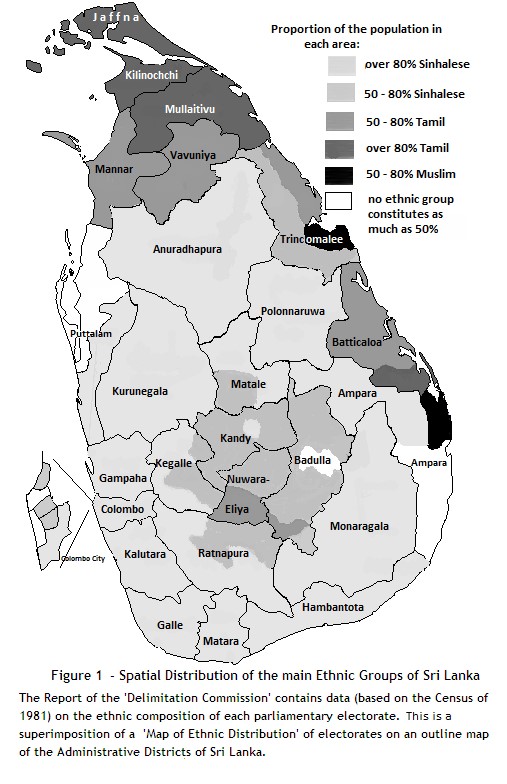
What is this reconciliation that this constitution can achieve? From what little I have observed is that the Batticloa Tamils and Muslims do not want to be governed by Jaffna. The upcountry Tamils are of the same view. The government will be causing more problems than achieving reconciliation.

se who are making a song and dance about the Rohingyas today, were completely silent when the LTTE chased out all Muslims from Jaffna with only the clothes they were wearing! It is the people in the South that looked after these unfortunate Muslim families!

What we need today is not a New Constitution but effective action to alleviate the real hardship the people are suffering from. You cannot fool the people with this constitution tomfoolery of reconciliation by juggling with words. We are a 95% literate population. You cannot fool them with oratory at schools and foundation laying functions!

P.S. MAHAWATTE

Colombo 05

Constitution making and yahapalana tricks

October 12th, 2017

By C. A. Chandraprema Courtesy The Island

Dr. Jayampathy Wickremaratne has been trying to allay anxieties of concerned citizens about the new constitution that he is involved in drafting. He claims that there will be a special constitutional provision against secession. What he is referring to is the following provision in the recently released interim report of the Steering Committee of the Constitutional Assembly:

“The President may, on the advice of the Prime Minister, where a situation has arisen in which a provincial administration is promoting armed rebellion or insurrection or engaging in an intentional violation of the Constitution which constitutes a clear and present danger to the territorial integrity and sovereignty of the Republic, by Proclamation – (a) Assume to the President, all or any of the functions of the administration of the Province and all or any of the powers vested in, or exercisable by, the Governor, the Chief Minister, the Board of Ministers or anybody or authority in the Province; and (b) Where it is necessary for the effectual exercise of the powers under subparagraph (a) of this paragraph, dissolve the Provincial Council. (c) The proclamation shall include reasons for the making of such proclamation. Such a Proclamation shall be subject to Parliamentary approval and be subject to judicial review.”

This is supposed to be the provision that will be Wickremaratne’s magic bullet to prevent separatism. Even the best educated members of society are unfamiliar with constitutional matters and if those drafting a new constitution are out to deceive the public, there is nothing to prevent them from doing it. One glaring example is the way they made the President responsible to Parliament through the 19th Amendment. After the 19th Amendment was promulgated, the yahapalana leaders claimed that earlier the President was a law unto himself and that it was the yahapalana government that had made the president responsible to Parliament. This was, in fact, even touted as one of the ways in which the powers of the presidency had been truncated and the institution made more ‘democratic’. This provision to make the president responsible to Parliament, which was brought in by the 19th Amendment as Article 33A of the Constitution is as follows:

“33A. The President shall be responsible to Parliament for the due exercise, performance and discharge of his powers, duties and functions under the Constitution and any written law, including the law for the time being relating to public security”

What the yahapalana constitution makers did not tell the public, however, was this supposedly new Article 33A had always been in the 1978 Constitution from the time J. R. Jayewardene promulgated it as Article 42 of the Constitution. The 19th Amendment was passed by Parliament on 28 April 2015. The old Article 42 which had been in the Constitution from 1978 till it was repealed on 28 April 2015 went as follows:

“42. The President shall be responsible to Parliament for the due exercise, performance and discharge of his powers, duties and functions under the Constitution and any written law, including the law for the time being relating to public security.”

The new Article 33A introduced by the 19th Amendment and the old article 42 are identical both in letter and sprit with not a word or a comma being different. Nobody with an iota of professional or academic probity would perpetrate such a fraud on the people. Never in the history of constitution-making in the world would such open chicanery have been practised on the voting public by an elected government. Constitutional Amendments are complex documents and not even a lawyer can be expected to notice immediately if some jiggery-pokery has taken place. The working assumption without which life would be impossible is that there will be no jiggery-pokery in the drafting of any law, especially constitutional amendments. Yet that is an assumption we are unable to operate on when it comes to the yahapalana government.

The safeguard which provides no protection

The deception that took place with regard to ‘making the President responsible to Parliament’ was just one example. With Dr. Wickremeratne saying that the new constitution will have an inbuilt safeguard against secession on the lines of the provision mentioned earlier, it becomes clear that another Article 42 style fraud is in the pipeline – the chicanery in this latter instance being worse than in the previous instance. From the time the provincial councils system was introduced to our Constitution through the 13th Amendment, there have been safeguards against any attempt at secession. In fact, the first Chief Minister of the merged North-eastern provincial Council did make a unilateral declaration of independence in 1989, but no secession took place. From that point until 2008 when the first Eastern Provincial Council was established, there was no functioning provincial council in the North and East.

The provisions against secession become important only when there are functioning provincial councils. In this respect, the existing Constitution has perfectly adequate safeguards to prevent secession in the form of Articles 154J, 154K, 154L and 154M. Under Article 154J, when the President is of the opinion that the security of Sri Lanka, or the maintenance of essential supplies and services is threatened or that there is a risk of war or external aggression or armed rebellion, and he makes a proclamation under the public security laws, he can give directions to the provincial Governors as to the manner in which they are to exercise their powers. Such a proclamation under the public security laws can be made before an actual situation arises if the President feels that there is the imminent risk of such an event taking place. When such a proclamation under the public security law is in operation in a province, the President may extend his capacity to give directions to the Governors on the exercise of their executive powers to any other province as well.

According to Article 154K, if the Governor or any Provincial Council has failed to comply with any directions given by the President in terms of Article 154J, the President may hold that a situation has arisen in which the administration of the Province cannot be carried on in accordance with the provisions of the Constitution. Under Article 154L, if the President comes to the conclusion in terms of Article 154K that a situation has arisen in which the administration of the Province cannot be carried on in accordance with the provisions of the Constitution, he may take over all or any of the functions of the administration of the Province including those of the Governor. The President may also declare that the powers of the Provincial Council shall be exercisable by Parliament. Such a proclamation by the President will have to be placed before Parliament within two weeks and if it is approved by Parliament will continue for a period of two months and it can be renewed once every two months for as long as a year if necessary.

Under Article 154M, when the President has made a proclamation under Article 154L to the effect that Parliament can exercise the powers of a provincial council, the Parliament can in turn confer on the President, the power to make statutes for that provincial council and to authorize the President to delegate that power to any other authority of his choosing. Readers will see that the safeguards offered by Articles 154J, 154K, 154L and 154M are much more comprehensive and far reaching than the proposed anti-secession provision for the new constitution. So, in the first instance, Wickremaratne is trying to short-change the people of Sri Lanka by bringing in a less comprehensive and less far reaching provision to cater to emergency situations than the provisions that exist in the present constitution.

Concealing the judicial review provision

There is also a vitally important matter that Dr. Wickremeratne has not revealed to the public about his much touted safeguard against secession. All proclamations and directions given under the anti-secession provision that he has proposed will be subject to judicial review – a factor which radically alters its effectiveness. Under Articles 154J and 154L of the present Constitution, the proclamations made and the directions given under the public security laws in relation to the provincial councils ‘shall be conclusive for all purposes and shall not be questioned in any Court or tribunal’. This makes for a radical difference. The additional safeguard given in Articles 154J and 154L of the present Constitution by declaring that proclamations made and directions given under those Articles, cannot be called into question by any court of law, gives the executive arm greater powers to deal resolutely with emergencies. An emergency is, by definition, a situation when normalcy does not prevail and extraordinary measures are required to restore normalcy. To enable the judicial review of a declaration of emergency is to hamper the very process of restoring normalcy. When there is an open rebellion in a province how feasible is it to subject the emergency measures being taken to contain that situation to court procedures with notices to appear before courts, hearings and stay orders etc.? That the supposed anti-secession provision presented by Wickremaratne is subject to judicial review is bad enough. But, it gets worse when one realises that this ‘judicial review’ that Wickremaratne speaks of is not by the Supreme Court, but by a special constitutional court proposed to be set up under the new Constitution. This constitutional court is to function outside the usual court structure and will not have judges but others – lawyers and ‘constitutional experts’ sitting on it – in other words, the NGO types controlling the constitution making process including Wickremaratne himself may end up sitting on this constitutional court which is supposed to review proclamations made and directions given under this much touted anti-secession provision.

It’s not difficult to imagine the attitude that this constitutional court will take towards the proclamations made and directions given under public security laws. A parallel process taking place under the yahapalana government is the move to repeal the Prevention of Terrorism Act and to render the public security laws in this country toothless. When one views Wickremeratne’s proposal to replace the provisions in Articles 154J, 154K, 154L and 154M with his emasculated anti-secession provision in the overall context of things, the sheer perfidy of the whole endeavour becomes clear.

AG’s Dept counsel goes surprisingly mum

October 11th, 2017

CourtesyThe Daily Mirror

The team of counsel of the Attorney General’s Department, who were led by Senior Additional Solicitor General Dappula De Livera today in an uncharacteristic manner said that they have no questions to ask from the three witnesses (Minister Kabir Hashim, Minister Malik Samarawickrama and former EPF dealer Saman Kumara) when the Commission invited to question them if necessary.

The Commission stated that Minister Minister of Public Enterprises development Kabir Hashim and Minister of Development Strategies and International Trade Malik Samarawickrama had been summoned by them and were not listed by the Attorney General’s Department.

After the conclusion of the Commission’s questioning, the Commission asked the Counsel of the Attorney General’s Department whether they have any questions to ask from the two ministers.

However, Additional Solicitor General Dappula De Livera said: We have no questions to ask”.

In the absence of Aloysius’ personal assistant Steve Samuel, former EPF dealer Saman Kumara was then called to give evidence. This witness was one of the witnesses that the Counsel of the Attorney General’s Department had earlier suggested to be summoned.

However, after the Conclusion of the Commission’s questioning the Counsel of the Attorney General’s Department again did not question Saman Kumara as well. (Shehan Chamika Silva)

An open appeal to all patriotic citizens. The Final Warning!

October 11th, 2017

Dr Sudath Gunasekara

11.10.2017.

Prevention of the presentation of the draft new Constitution on the 30th of this month to Parliament is the only way open to defeat this treachery and save this country and the Sinhala Buddhist Nation.

In the first place this Government has no mandate to go for a new Constitution. Therefore any move to present a draft new Constitution to Parliament on the 30th Oct with the expressed intention of getting it passed is illegal, unconstitutional and treacherous. Secondly it is crystal clear that this government is scheming to divide the country on ethnic lines, devalue the millennia old Sinhala Buddhist imprint that form the core of this Island nation and that had been the pride of our heritage.  That will also lead to the end of the Sinhala Nation and the Sinhala Buddhist civilization in this country. If this drat is allowed to be presented to Parliament this Government unpatriotic traitors will definitely get it passed by using all antics and gimmicks and bribes they have been resorting to during the past two years.                                                                                                                                                                                                                                   That is why I strongly call upon all patriotic citizens to immediately start doing everything possible under the sun to stop this being presented to Parliament on the 30th. That is the only way, as I see it, to defeat it. If the JO or any other party thinks they can defeat it in Parliament winning over few unscrupulous bulathkolakarayas presently with the Sirisena camp (who have become rank Kehelkolakarayas now) that will definitely end up as a wild dream and the passage of this Constitution is imminent and it will mark the beginning of this country and the Sinhala Buddhist Nation.

My above assumption is based on the following backdrop.

Questions  & Answer

1 Has this Government got a mandate from the people to go for a new Constitution Either on Jan 8th or August 17th 2015         No

2 Have the people asked for a new Constitution  No

3 Is the Parliament packed with defeated Candidates legally constituted? to go for a new Constitution     No

4 Are the appointments of Prime Minister and Leader of the Opposition done according to the procedure in the Constitution    No

5 Has the Government followed the democratic procedure in this process  No

6 Is a new Constitution the most important and critical issue in today’s governance     No

7 Has the Govt entrusted Constitution making to the best legal brains in Constitutional law or at least got one such person involved in the process       No

8 Has the Public Hearing committee embodied the representations made by the Majority 75 % Sinhalese in their Draft Report  No

9 Have they considered the history, traditions, customs and aspirations of the Sinhalese Majority   No

10 Does it (the Draft) guarantee the protection of the territorial integrity, sovereignty and the 2500 year norms and heritage of this nation and ensures future  peace and prosperity of Sri Lanka as a Nation   No

11 Have the Constitutional makers consulted the people who really matter in this process Like the eminent Buddhist Monks, historians, learned scholars on Constitutional law and the heritage of this country    NO

12 Have they followed an open, honest and transparent procedure in this process   NO

 If the answers to all these questions are NO then why a new Constitution at all

1 Is it done only to satisfy the anti-Sinhala and anti-Buddhist forces including the Western neo colonial powers, India and Tamil and Muslim minorities who have helped regime change in 2017 and put Maitree and Ranil  in power     Yes

2 Is it purely designed to carry out the vicious agenda of these forces to destroy the Sinhala Buddhist Civilization in this country     Yes

3 Is it designed to consolidate the power of the present Government in power with an eye on the next elections     Yes

4 Is it designed to divide this country on an ethnic basis as dreamt by the British from 1815 to convert it to a Federal State with One Independent Tamil Unit including North and Eastern provinces extending from Manar through Jaffna, Trinco, Batticalloa to Panama in the South East Comprising 1/3 of the total area of the country and 2/3 of the coastal belt and another India Tamil State Right at the centre of the Island comprising Central  Sabaragamuwa and Uva Provinces to take revenge from Kandyans who successfully resisted them for 310 years covering another 1/3 of the area o fthe country thus leaving only 1/3  of the country to be shared by Sinhalese, Tamil, Muslims and all other nations like Burghers, Malays as they call them

Thus this proposed new Constitution is definitely design to divide, dismantle and destroy this Island Nation of the Sinhalese Buddhists for the past 2600 years and make it an eternal battle ground of internal ethnic strife and a bone of contention of global power politics on economic and strategic issues in the Indian Ocean and finally resulting in the total disappearance of the Sinhala nation from the surface of this planet.

JR Jayawardhana forecasted this disappearance of the Sinhala nation in 1987, his nephew Ranil with the help of Chandrika , Maitripala Sirisena and their cohort is now trying to fix the last nail on the coffin of that once great and glorious Sinhala Buddhist civilization that embellished this world.

It is with this prophecy that I call upon all patriotic Sinhalese and especially Buddhists to wake up from their deep slumber, discard all your political, religious and dogmatic affiliations and fight tooth and nail as one nation under the Lion Flag to save your beloved Motherland and the great heritage, before it is completely destroyed and devoured by this bunch of treacherous politicians of the 21st century and gone forever.

Sinhalese are told that we don’t understand the demands of the Tamils, can someone please explain

October 11th, 2017

Shenali D Waduge

We are being repeatedly told by some ‘smart patriots’ that we don’t understand the demands of the Tamils. Who are these Tamils that ‘smart patriots’ are referring to – Tamil politicians, Tamil political parties, Tamil terrorists, Tamil Terrorist Diaspora groups, Tamil Nadu politicians, Tamil Nadu political parties, Tamil high castes, Tamil low castes or just ordinary Tamils. At the other end, who are the ‘smart Sinhalese’ who do understand the concern of the Tamils – are they dollar earning NGO heads, foreign government moles, politicians, academics & political analysts, businessmen thinking only of profit or the ordinary Sinhalese? While all Tamils cannot be lumped together, all Sinhalese cannot be done so too.

Let’s first take what we do understand

We do understand that the core problem is rooted in the divide and rule policies and germination of ideologies injected into the minds of a handful of people who have used them to stir trouble and make themselves socially and politically relevant and elevate themselves to champion this ‘cause’ they created.

To this scenario we can place all of the unjustified demands that have come ever since biased education system, privileges were afforded to the minorities purposely neglecting the majority since 1505. However, even while 10% of Sinhalese, Tamils & Muslims were privy to these special benefits 90% of others were not. Why does no one talk about this 90% rather than speak of what the 10% became denied after independence?

Another factor that we understand and continues to work on our mind is that there is a sequence of racist demands by Tamil political leaders covering unfair demands like 50-50 representation, the formation of ethno-racial political parties and the formation of ITAK in 1949 with the aim & objective of creating a Tamil state. We are also aware that across the Palk Strait in India, the Tamil Nadu leaders were also demanding a separate Tamil state. These factors cannot be ignored against any discussion on Tamil demands or Tamil concerns. At no time have we even questioned whether the bulk of the populace in Tamil Nadu, or Tamils in Sri Lanka wanted the demands made by these Tamil leaders except that they voted for them simply because they were Tamil.

What we cannot also remove from discussion is that armed militancy using Tamils began under patronage of India and South India and included a plethora of armed Tamil groups in which some of these ‘smart patriots’ served as Minister for whatever ‘adverturerism’ they may now claim!

What we also understand is that the Indian intervention in the form of the 13th amendment & provincial council system came as a solution to the supposed ‘ethnic’ problem. We are now into the 30th year and the 13a or the PC system has not solved but created more problems than we can now solve. Of course the smart patriots will jump to say that the entire 13a was not implemented and this is the reason for its failure. Had such been implemented we would not be having an island called Sri Lanka today and that is the reality that these smart patriots will have to wake up to whether they like it or not.

What we cannot also omit or neglect is to take stock of all the demands placed over the years by Tamil political parties like ITAK, TULF, armed militant groups including LTTE, EPRLF, LTTE diaspora groups, their resolutions in particular the Vaddukoddai Resolution, ITAK Resolutions as recent as 2013, demands placed by Tamil groups during the peace talks /cease fires like Thimpu Talks, demands for self-autonomy, Tamil Homeland, Internal Self-Determination, CFA, ISGA, PTOMs, etc and whatever new proposals are being made we need to first have official statements that all of these are null & void and are no longer being demanded. These demands have no basis for living in peaceful coexistence and have no basis for any claims of reconciliation.

What we also understand very well is that the present Tamil politicians in particular the TNA remain uninvestigated for LTTE links. Their present chants for re-merger are all aligned to the demands made by racist Tamil politicians and LTTE to carve out a separate autonomous state. The modus operandi has been to play the discrimination card and use well-oiled propaganda from LTTE’s illegal and legal international network to promote it. None of the validity of these discrimination claims have been challenged properly by Governments in power, the Opposition political parties, diplomats, academia, historians or even the media except a handful of patriotic people who have been challenging these claims over the years using the minimal communication modes at their disposal.

Another aspect that we understand very well that smart patriots tend to conveniently overlook by trying to plug events and solutions happening in foreign climes is the caste divisions among Tamils. Sir Ponnambalam Ramachandran considered the leader of Tamil elite objected to Tamil low castes being given voting rights in 1931 and even cobbled 79 village headman to plead against the decision with the British Governor. He even demanded separate carriages to low castes when the railway service started from Colombo to Jaffna. Let us also remind that when SWRD brought the Social Disabilities Act in 1957 the Tamil elite leaders went to the UK to object to low caste Tamils getting education. They were so petty that these Tamil children were forced to sit on the floor and study! Has that changed? Not at all recently even in the UK a group of people were working on institutionalizing caste once more! Even in Tamil Nadu (translated as State of Tamils) where official language is Tamil, culture is Tamil, 99% people are Tamil – 21% of its 72m are Dalit low caste untouchables. So what is this looking after our own talk! The Chief Minister of the Northern Province bragging about his people is reminded that the budget his PC demands is never spent and returns to the treasury while he’s doing tours speaking of discrimination the money allotted for development is not even used!

What we don’t understand is what is this discrimination singalong that is being chanted repeated and given oxygen even by smart patriots.

The Prime Minister recently declared that the new constitution is going to be the answer to the ethnic problem. What is the ethnic problem? We militarily defeated an internationally banned terrorist movement. Who says we suffer an ethic problem and if so what is it? Can we be given in plain language what this ethnic problem is?

The proposals to give autonomy to the North in the form of delegating or decentralizing or call it what you will cannot ignore that the North is just 1 province out of 9 provinces. What is going to be given to the North has to be given to the rest of the provinces which are not even asking for autonomy. Who in the North are asking – its only a group of people who have just over 500,000 votes and who are yet to be investigated for LTTE links. Should we accept their demands given these realities? Moreover, when over 50% of the Tamils are living outside of the North, how can giving ethno-religious autonomy to the North solve an ethnic problem when Tamils are living with the Sinhalese? What is this working around the 13a mumbo-jumbo? To whose whims and fancies or ideologies must the country commit to… numerically? Many Tamils are now coming out to say they don’t want a re-merger of the north and east, they don’t want or understand federalism or confederalism but they do want asbestos sheets to make homes, they do want their children to get education and earn a living, they do want to visit other parts of the country. How many among the Tamils share these sentiments? Well certainly more than the handful of TNA politicians and the smart patriots trying to throw fancy notions.

Yes, we Sinhalese cannot understand what is it that minorities claim to not have. A tour of Colombo will reveal how many Tamils own land, property, residential homes, flats/apartments, shops. Take a list of companies and see the many Tamils in senior roles. Take the Parliament and see the number of minorities being represented. Take the Government holidays to see how minorities enjoy their festivals and even stamps have been issued for their leaders. Go to Marine Drive and see the many luxury buses that go every day to the North from Colombo. Look at the number of kovils, mosques and churches that are coming up regularly and being developed. So what is it they don’t have. Are all Sinhalese rich, are all Sinhalese living affluent lives? Are all Sinhalese being treated specially by law? Count the number of Sinhalese in prison, go and see the poverty scales of Sinhalese … how unfair it is to be projecting a wrong version by even the smart patriots?

Where we are going wrong and we will continue to go wrong is by not identifying what the problem is and who are the problem causers. By giving rule to a bunch of people who have no concern for their own people, we are creating more troubles than we can fathom. All of the solutions being put on the table are to secure the political careers of a handful of politicians and power changing hands among them and the political pundits that promote these solutions.

We gained nominal independence in 1948 and became a republic in 1972 and since then throughout 45 years what have we really achieved? Where have we developed? Who has benefitted, how many have become rich, elevated from poor to middle class etc?

We don’t need solutions that empower politicians to further trample and dilute our freedoms and rights. The present proposals come in not identifying what the problem is – we can’t be creating constitutions only to satisfy a small number of a minority who are controversial figures and not investigated for their separatist intent. We cannot be plugging solutions that are being offered in other countries just because some smart patriots are quoting them to become champions of these initiatives in Sri Lanka.

If anyone says Sinhalese do not understand what the concerns of the Tamils are, we want to have these concerns placed in simple language first. We see no reason to be applying this that and the other when we don’t seem to know what is the problem, who is having the problem, why it is a problem to them and who says it is a big problem when in reality what they claim to be the problem or what people claim to be the solution maybe both wrong!

Reality is – ask a Sinhalese and he will have 101 problems, ask a Tamil or Muslim he will give the same …. can we give solutions to all of these 101 problems?

Therefore, we would like to have very clearly placed answers before we proceed any further with mumbo jumbo talk.

We are not smart patriots – we are practical patriots who will accept Facts & Evidence, therefore place the facts on the table.

Shenali D Waduge


SRI LANKA: ජාතික පොලිස් කොමිසමේ සභාපතිවරයා විසින් නිකුත් කොට ඇති පොදු පැමිණිලි විභාග කිරීම් සම්බන්ධයෙන් රීති හා ක්‍රියාපටිපාටිය, 2017- The Rules and Procedure (Public Complains Investigations, 2017)- පිළිබඳ කරුණු දැක්වීමක්

October 11th, 2017

A Statement by the Asian Human Rights Commission

ඉහතකී කෙටුම්පත සම්බන්ධයෙන් සිදුකරණු ලබන කරුනු දැක්වීමකි. ඉහත සඳහන් කෙටුම්පතේ රීතීන්ට අනුව ඕනෑම අගතියටපත් පුද්ගලයෙකුට හෝ එම පුද්ගලයෙකු විසින් බලය පැවරූ තැනැත්තෙකුට පොලිස් නිලධාරියෙකු හෝ පොලිස් සේවය විසින් ඔවුන්ගේ නිල කටයුතු වලදී සිදුවු කිරaනියාවක් සම්බන්ධයෙන් පොදු පැමිණිලි පරීක්ෂේණ අංශය වෙත පැමිණිල්ලක් ඉදිරිපත් කොට ඒ සඳහා සහන ඉල්ලා සිටිය හැකිය. මෙම අංශය පී සී අයි ඞී යනු වෙන් කෙටියෙන් හදුන්වනුු ලබයි.

  1. අපරාධ පිළිබඳව හා අපරාධ නොවන වැරදි පිළිබඳ පරීක්ෂදණ වෙන් වෙන්ව නොසැළකීම මගින් පොලිස් නිලධාරීන් විසින් කරණු ලබන අපරාධ වෙනත් රටවැසියන් විසින් කරන අපරාධ වලට වඩා අඩු මට්ටමකින් සැළකීම

ඉහත සඳහන් කෙටුම්පත පරීක්ෂාන කිරීමේ දී ඒ සම්බන්ධයෙන් ඉතා ගැටලූ සහගත තත්ත්වයන් ගණනාවක් පවතින බව පෙනීයයි. මෙම ගැටලූ පහත ස`දහන් ආකාරයෙන් දළ වශයෙන් සඳහන් කල හැකිය.

  1. පොලිස් නිලධාරින්ට විරුද්ධව ලැබෙන පැමිණිලි විවිධාකාර විය හැකිය. එම පැමිණිලිවලින් සමහරක් ලංකාවේ දැනට පවතින දණ්ඩ නීතියට අනුව අපරාධ යන ගණයට වැටේ. උදාහරණ වශයෙන් යම් තැනැත්තෙකුට වදහිංසා කිරීම 1994 අංක 22 දරන පනත යටතේ අපරාධයක් වශයෙන් නිර්වචනය කොට ඇත. එමෙන්ම පොලිස් ස්ථානයකදී සිදුවිය හැකි මිනිස් ඝාතන ද ලංකාවේ දණ්ඩ නීතිය යටතේ බරපතල අපරාධ ගණයට වැටේ. පොලිසිය විසින් පගා ගැනීම් හෝ වෙනත් ආකාරයක දූෂණ ලංකාවේ වංචාව හා දූෂණය යන ගණයට අයිතිවන අපරාධයන්ය. පොලිස් ස්ථානයක් තුළදී කාන්තාවක් සම්බන්ධයෙන් හෝ වෙනත් අයෙකු සම්බන්ධයෙන් ලිංගිකව කරන වැරදි ද ලංකාවේ නීතිය යටතේ අපරාධ වශයෙන් සළකණු ලබයි. මෙම අපරාධ සම්බන්ධයෙන් පරීක්ෂවණ පැවැත්වීම ලංකාවේ අපරාධ නඩු විධිවිධාන සංගරමෙමහයේ සඳහන් නීතියට අනුකූලව සිදුකල යුතු වේ. ජාතික පොලිස් කොමිෂන් සභාව විසින් ඉදිරිපත් කර ඇති නිර්දේශ සම්බන්ධයෙන් මතුවන පලමුවන ගැටලූව නම් යෝජිත පීසීඅයිඞී ඒකකයට ඉහත සඳහන් අපරාධ නඩු විධිවිධාන සංගරඅපරහයේ විධිවිධාන නොතකා හෝ ඒවාට පඨහැනිව සිය පරීක්ෂරණ කල හැකිද යන්නය. මෙය බරපතල ගැටලූවකි. මන්ද යත් අපරාධ සම්බන්ධයෙන් ලංකාවේ අපරාධ නඩු විධිවිධාන සංගරලිධහයට පිටින් කටයුතු කිරීමට පීසීඅයිඞී ඒකකයට හැකි නම් එයින් සිදුවිය හැකි බරපතල අගතිය වන්නේ පොලිස් නිලධාරීන් විසින් සිදුකරනු ලබන අපරාධ ලංකාවේ වෙනත් රටවැසියන් විසින් කරණු ලබන අපරාධ වලට වෙනස් ආකාරයකින් සලකා කටයුතු කිරීමේ හැකියාවක් නිර්මාණය වීමය. උදාහරණ වශයෙන් වදහිංසාවක් ලිංගික අපරාධයක් ඝාතනයක් හෝ වෙනත් අපරාධයක් සම්බන්ධයෙන් පීසීඅයිඞී ආයතනයට හුදෙක් සමථ මණ්ඩලයක ආකාරයට කරිු යාකරමින් එම අපරාධ පිළිබඳව පරීක්ෂරණ පැවැත්වීම යටපත් කර දැමිය හැකිය. එමෙන්ම එම අපරාධ හුදු සිවිල් පරින ශ්ණයන් සේ සළකා කටයුතු කිරීමට ද පීසීඅයිඞී ඒකකයට ඉඩකඩ ලැබේ. මේ මගින් රටේ නීතිය යටතේ අපරාධ යනුවෙන් සළකණු ලබන කරිය යා අපරාධ වශයෙන් නොසලකා වෙනත් ආකාරයකින් කටයුතු කිරීමේ හැකියාව නිර්මාණය වේ. අතීතයේ දී ඉහළ පෙලේ පොලිස් නිලධාරීන් විසින් සිදුකල පරීක්ෂවණ වලදීත් මෙසේ කටයුතු කොට බොහෝ අපරාධ පිළිබඳ පරීක්ෂුණ යටපත් කිරීම සම්බන්ධයෙන් දීර්ඝකාලීන ඉතිහාසයක් ඇත.

මෙය වළක්වාගත හැක්කේ යම් පුද්ගලයෙකු විසින් කරණු ලබන පැමිණිල්ලක් අපරාධ ගණයට වැටේනම් එය මුලින්ම අපරාධයක් සේ සළකා අපරාධ නඩු විධිවිධාන සංගරධිරහයේ පවතින නීතියට අනුව කටයුතු කිරීම සඳහා අදාල නිලධාරීන් විසින් අදාල නීතියට අනුව කටයුතු කල යුතුය. මේ අනුව පීසීීඅයිඞීය විසින් පරීක්ෂීණ පැවැත්විය යුතු වන්නේ පොලිස් නිලධාරීන් හෝ පොලීස් සේවය විසින් කරණු ලබන අපරාධ ගණනයට නොවැටෙන වැරදි සම්බන්ධයෙන් පමණක් පරීක්ෂමණ පවත්වා සහණ ලබාදීම පමණකි. ඉතා පැහැදිලිව අපරාධ ගණයට වැටෙන පැමිණිලි සම්බන්ධයෙන් පරීක්ෂයණ පැවැත්වීමේ බලය පීසීඅයිඞී ආයතනයට අදාල නොවන කටයුත්තක් සේ ස`දහන් කරමින් මෙම කෙටුම් පත සංශෝදනය කල යුතු ඇත. එසේ නොකල හොත් අදාල පීසීඅයිඞී පරීක්ෂවණ අපරාධ යටපත් කිරීම ස`දහා යොදවා ගැනීම තවදුරටත් කෙරීගෙන යෑමේ අවධානම බරපතල ලෙස පවතී.

  1. පැමිණිලි පිළිබඳ පරීක්ෂාණ හා එම පැමිණිලි පිළිබඳ තීන්දු එකම කණ්ඩායමක් විසින් කිරීම

වරදක් පිළිබඳව පරීක්ෂතණ පැවැත්වීම එකකි. කරණ ලද පරීක්ෂිණය මත සොයාගත් කරුණු මත අවසාන නිගමනයකට පැමිණිම වෙනත් කාර්යයකි. උදාහරණයක් වශයෙන් අපරාධ නීතිය සම්බන්ධයෙන් පරීක්ෂැණ කිරීම පොලීසියටත් ඒවා පිළිබ`දව නඩු පැවරීම නීතිපතිවරයාටත් ඒවා පිළිබඳව අවසාන නිගමනයක් කරා යෑම අධිකරණයටත් පැවරෙන වෙන වෙනම කාර්යයන් වේ. මෙසේ වෙනත් අවස්ථා වලදී වෙනස් ආකාරවලින් නිගමන වලට පැමිණිය යුතු අතර ඒ අවස්ථා අනුව එම කටයුත්තේ යෙදෙන පුද්ගලයන්ගේ ද සුදුසුකම් වෙනස් වේ. මෙම වෙනස පීසීඅයිඞී ඒකකය මගින් කෙරෙන පරීක්ෂදණ සම්බන්ධයෙන් කුමන ආකාරයකින් සිදුකරන්නේ ද යන්න පිළිබ`දව යෝජිත සංශෝදන වල කිසිම සඳහනක් කොට නැත.

සාමාන්යයයෙන් ජාතික පොලිස් කොමිසන් සභාව මෙතෙක් කර ඇති පරීක්ෂදණ දෙස බලන කල පෙනී යන්නේ ඒවා බොහෝ දුරට සිදුකරන්නේ පොලිසියේ ඉහළ තනතුරු දැරූ විශරා්යයමලත් පොලිස් නිලධාරීන් විසින් බවය. ඔවුන් මෙය බොහෝ දුරට කරන්නේ අදාල පරශර දේශවල සහකාර පොලිස් අධිකාරීවරයා වෙත පරීක්ෂලණ කාර්යය භාරදීම මගිනි. ඔහු විසින් ගන්නා නිගමන සනාථ කරමින් පොලිස් කොමිසම සිය තීන්දු පරයි කාශයට පත්කරයි. මෙය සාවද්යය කරිල යාදාමයකි. ඉහළ පොලිස් නිලධාරීන් තමන් යටතේ සිටිනා පොලිස් නිලධාරීන් සම්බන්ධයෙන් පරීක්ෂාණයක් කිරීමට අවශ්යර අපක්ෂිපාතීත්වය ඇත්තන් නොවේ. මේ නිසා එවැනි පරීක්ෂේණ වලින් මෙතෙක් කල් සිදුවී ඇත්තේ පැමිණිලි යටපත් කිරීම හෝ නැතහොත් පැමිණිල්ල පිළිබ`දව සමාදානයක් කිරීම ස`දහා පැමිණිලි කාරයාට බලපෑම් කිරීමය. පීසීඅයිඞී විමර්ශන ඉහත ස`දහන් වර්ගයේ ‘විමර්ශනවලින්’ වෙනස් වන්නේ කෙසේද? මෙය මෙම යෝජිත කෙටුම්පත මගින් ඉතා පැහැදිලිව පරමර කාශයට පත්කල යුතුව ඇත. පැමිණිලි පරීක්ෂාධ කිරීමේ අපක්ෂරපාතීත්වය ආරක්ෂා් වන්නේ කෙසේද යන්න පිළිබ`දව පැහැදිලිව පරලි කාශයට පත්කල යුතුව ඇත. එමෙන්ම කරන ලද පරීක්ෂාණය මත පදනම් වී ඉන්පසු අවධියේ කෙරෙන කටයුතු මොනවාද යන්නද පැහැදිලි කල යුතුය. එමෙන්ම මේවා කරන්නේ ඒවා කිරීමට කුමන සුදුසුකම් ඇති පුද්ගලයන් විසින්ද යන්නද පැහැදිලිව පර්ක කාශයට පත්කල යුතුය. එසේ නැතහොත් සිදුවන්නේ පරීක්ෂදණ කිරීමක් නොව, පරීක්ෂමණ යටපත් කිරීමක් පමණි.

  1. පොලිස් නිලධාරීන්ට විරුද්ධව කරන පැමිණිලි හා පොලිස් සේවය සම්බන්ධයෙන් කෙරෙන පැමිණිලි සම්බන්ධයෙන් අදාල පරීක්ෂනණ කෙරෙන්නේ කුමන ආකාරවලින්ද යන්න ද කෙටුම්පත තුළින් පරධව කාශයට පත්නොවේ. මෙය උදාහරණයකින් පැහැදිලි කල හැකිය. පොලිස් නිලධාරියෙකු විසින් යම් තැනැත්තෙකුට වදහිංසා කලාය යන්න එක් නිලධාරියෙකුට හෝ නිලධාරීන් කණ්ඩායමකට විරුද්ධව කරන පැමිණිල්ලකි. ලංකාවේ පොලිස් සේවය තුළ සහකාර පොලිස් අධිකාරීවරුන් වදහිංසාවට අනුබල දෙන ආකාරයෙන් කටයුතු කරනවාය යන්න, පොලිස් සේවය සම්බන්ධයෙන් කරණු ලබන පැමිණිල්ලකි. මේ දෙක සම්බන්ධයෙන් කරණු ලබන පරීක්ෂීණ හෝ විමර්ශණ එකම ආකාරයකින් කල හැක්කේ නැත. නිලධාරියෙකුට විරුද්ධව කෙරෙන පරීක්ෂ්ණ හා පොලිස් ආයතනය තුළ පවතින වැරදි පිළිබඳ කරණු ලබන පරීක්ෂීණ එකිනෙකට හාත්පසින්ම වෙනස් ඒවා වේ. ආයතනයට විරුද්ධව කරනු ලබන පරීක්ෂීණ ගැන විමර්ශණ සිදුකල යුතු වන්නේ එසේ කිරීම සඳහා සුදුසුකම් ඇති හා එසේ කිරීමේ දී අපක්ෂශපාතීව කරිස යා කරනවා ඇතැයි බලාපොරොත්තු විය හැකි අය මගින්ය. ආයතනයට විරුද්ධව කරන පැමිණිලි පරීක්ෂාර කිරීමේ දී ආයතන කරින යාකරන ආකාරය පිළිබඳ දැනීම සමාජ විද්යාපව පිළිබ`දව හා දේශපාලනමය විද්යා්වන් පිළිබඳ දැනීම මෙන්ම තුලනාත්මකව සමාජ පරාජ ශ්නයක් සාකච්චාවට භාජනය කල හැකි ආකාරයකින් කටයුතු කිරීමේ හැකියාව පැවතිය යුතුය. මේ පිළිබ`දව කිසියම්ම හෝ සැළකිල්ලක් යෝජිත කෙටුම්පත මගින් පරේක කාශයට පත්වී නැත.

ඉහත සඳහන් කර ඇත්තේ පැමිණිලි විභාග කිරීම සම්බන්ධයෙන් කරික යාපටිපාටිය ගැන සකස්කර ඇති කෙටුම්පතෙහි ඇති යම් මුලික අඩුපාඩුකම් පිළිබඳව කෙටි සටහනකි. මෙම කෙටුම් පත අප දන්නා තරමට සිංහලෙන් හෝ දෙමළෙන් පරිවර්ථනය කොට ඉදිරිපත් කොට නැත. මේ නිසාවටම මේ පිළිබඳව සාකච්චාවට සහභාගී වීමේ අවස්ථාව රටේ වැඩි කණ්ඩායමකට හිමි නොවේ. රටේ ඉතාමත්ම වැදගත් සංස්ථාවක් සම්බන්ධයෙන් ඉදිරිපත් කර ඇති මෙම කෙටුම්පත පිළිබඳව පළල් සාකච්චාවක් අවශ්යනවේ. එවැනි සාකච්චාවකට අදාලවන මූලික කරුණු සමහරක් පමණක් මෙම ලේඛණයේ සඳහන් වේ. සාකච්චා අවස්ථාවේ දී වඩා පුඵල් කරුණු දැක්වීමක් කිරීමට බලාපොරොත්තු වෙමි. රටේ සියලූ ජනතාවටත් විශේෂයෙන්ම සිවිල් සමාජයේ කරිි යාකාරී කණ්ඩායම් වලටත් මේ පිළිබඳව සාකච්චාව ස`දහා වැඩි කාලයක් අවශ්යෙ බව අපගේ මතයය.

යෝජිත කෙටුම්පතේ සඳහන් පරලය ධාන කරුණු

  1. ඉහත සඳහන් පැමිණිලි සම්බන්ධයෙන් විභාග කිරීම ජාතික පොලිස් කොමිසම විසින් හෝ එම කොමිසමේ ලේඛම් හෝ අධ්යෙක්ෂවකගේ නිරීක්ෂිණය යටතේ කරණු ලබයි. එසේ කරණු ලබන්නේ පී සී අයි ඞී ඒකකය මගින් හෝ එහි අතිරේක අධ්යබක්ෂනක හෝ පරා දේශීය නිලධාරියෙකු විසින් හෝ කොමිසන් සභාව විසින් පත්කරණු ලබන වෙනත් නිලධාරියෙකු විසින් කරණු ලබයි.
  2. මේ සඳහා එවා ඇති පැමිණිලි ලැබුණු බවට අදාල නිලධාරීන් විසින් එසේ ලැබී සතියක් ඇතුලත දී පැමිණිල්ල කල අයට දැනුම් දිය යුතුව ඇත.

ජාතික පොලිස් කොමිසම පැමිණිලි විභාග කිරීම පිළිබඳ කොමිසම සතු බලය මෙම පී සී අයි ඞී අංශය වෙත පවරා දෙනු ලබයි. ජාතික පොලිස් කොමිසම පරීක්ෂලණ පැවැත්වීම සඳහා ස්වාධීන පරීක්ෂසකයන්ට හෝ පරීක්ෂයණ කණ්ඩායම් වලට බලය පැවරිය හැකි අතර එසේ බලය පැවරූ තැනැත්තන් ඔවුන්ගේ පැමිණි පරීක්ෂාි කිරීම පීසීඅයිඞී අංශයේ අධීක්ෂසණය යටතේ කල යුතුය.

  1. ජාතික පොලිස් කොමිසම විසින් පීසීඅයිඞී අධ්යක්ෂ කවරයාට හෝ අදාල වෙනත් අයට පොලිස් නිලධාරීයෙකුට හෝ පොලිස් සේවයට විරුද්ධව කර ඇති පැමිණිලි පරීක්ෂාල කිරීම සඳහා ඕනෑම පොලිස් ස්ථානයකට ඇතුලූවී පරීක්ෂාව කොට අවශ්යැ පුද්ගලයන්ගෙන් පරේල ශ්න කිරීමටත් අදාල ලේඛණ පරීක්ෂාි කිරීමටත් බලය පැවරිය හැකිය. ඕනෑම තරාතිරමක පොලිස් නිලධාරියෙකු විසින්ම පීසීඅයිඞී අංශයේ පරීක්ෂවණ වලට සහයෝගය දැක්විය යුතු අතර යම් හේතුවක් නිසා පීසීඅයිඞී අංශය විසින් ඉල්ලා සිටින තොරතුරු ලබාදීමට නොහැකි තත්ත්වයක් ඇතොත් ඒ බව සති දෙකක් ඇතුලත දී දැනම් දිය යුතුය.
  2. ජාතික පොලිස් කොමිසන් සභාව හා පීසීඅයිඞී අංශය මගින් පැමිණිල්ලක් ලැබී මාස තුනක් ඇතුලත එම පැමිණිල්ල විභාග කර අවසන්කර ඒ පිළිබඳ නිර්දේශ මාස තුනක් ඇතුලත දී දැනුම් දීම සඳහා සියලූම පරරක යත්න දරනු ඇත. පැමිණිලිකරුට පැමිණිල්ල සම්බන්ධයෙන් විභාගයේ පරසි ගතිය දැනගැනීම සඳහා ඉල්ලීම් ඕනෑම අවස්ථාවක කල හැකි අතර ඒසඳහා එස් එම් එස්, ඊමේල්, ලිපි හෝ පුද්ගලිකව පැමිණ ඉල්ලාසිටීම් ආදිය කල හැකිය.
  3. පැමිණිල්ල පිළිබඳ පරීක්ෂ්ණයේ මුල් තීරණ සම්බන්ධයෙන් පැමිණිලිකරු සෑහීමකට පත්නොවේ නම් මේ පිළිබඳව නැවත පරීක්ෂාල කිරීමට ඉල්ලීමක් කල හැකිය. එසේ නැවත පරීක්ෂාය කිරීමේ දී කරණු ලබන තීන්දුව අවසාන තීන්දුව වේ.
  4. මෙම පරීක්ෂලණ සම්බන්ධයෙන් අනුගමනය කල යුතු ක්‍රියා පටිපාටිය සම්බන්ධව පැහැදිලි නිර්දේශයක් නැති අවස්ථාවක දී සුදුසු කරි් යාපටිපාටියක් කොමිසන් සභාව විසින් අනුගමනය කල හැකිය.
  5. අගතියට පත් පාර්ශවය වශයෙන් පොලිස් නිලධාරියෙකු හෝ පොලිස් සේවය විසින් කරණු ලබන කරිී යාවක වින්දිතයෙකු අදහස් කරණු ලබයි. ලබාදිය හැකි සහන සම්බන්ධයෙන් නීත්යාරනුකූලව ලබාදිය හැකි සහන ඇඟවේ.

# # #

The Asian Human Rights Commission (AHRC) works towards the radical rethinking and fundamental redesigning of justice institutions in order to protect and promote human rights in Asia. Established in 1984, the Hong Kong based organisation is a Laureate of the Right Livelihood Award, 2014. 

A Message for our Higher Education Institutes

October 10th, 2017

by Garvin Karunaratne( Ph.D. Michigan State University)

When my first book exposing the sinister actions of the IMF: Micro enterprise Development: A Strategy for Employment Creation and Poverty Alleviation in the Third World: The Way out of the IMF Stranglehold was published in 1997, a full half a decade before the Argentina Crisis of 2002, very few believed that the IMF was at fault. It was everyone’s contention that it was the corruption and the ineptitude of the leaders of the countries that had caused the disaster that befelled their economies. Then the IMF and the World Bank were held in high esteem and no one doubted any advice coming from these two institutions established by the United Nations to steer the countries towards financial stability and development. In the Fifties and Sixties I was neck deep involved in development activities as a senior member of the Administrative Service of Sri Lanka and in actuality, then, both the IMF and the World Bank played a developmental role. Then there was no doubt whatsoever of their sincerity of purpose.

It is sad that they changed course from being developmental to become the cause for the ruin of the Third World countries. They did this by imposing the Structural Adjustment Program on them.

In 1995, economists Walden Bello, Shea Cunningham and Bill Ram stated:

“Structural Adjustment has failed miserably in accomplishing what the World Bank and the IMF tech- nocrats said it would do: providing growth, stabilize the external accounts and reducing poverty…. The SAP policy was successful in making a net transfer of financial resources from the Third World to the commercial banks of the West, $178 billion between 1984 and 1990.” (Third World Opposing View Points)

The United Nations’ Human Development Report 1996 states:

“The stabilization measures of the IMF aimed at reducing both budget deficits and trade deficits and usually involved cutting public spending, reducing wages and increasing interest rates. Restoring growth, an objective on paper was rarely achieved in practice. Although these policies reduced deficits in some countries they often did so at the cost of inducing recession. In short they often balanced budgets by unbalancing peoples’ lives” (Human Development Report, 1996)

Through the imposition of Structural Adjustment Policies, the IMF and the World Bank succeeded in limiting the role of Governments to administer development programs. It policies of Free Trade, Free Import, liberalize foreign exchange, etc., actually restructured the economies to the benefit of the Superpowers. David Korten says of how the Superpowers snatched the debt crisis of 1982 to restructure the economies of the countries.

The US dominated World Bank and the IMF moved to restructure the economies of debt burdened Southern countries to open them for penetration by foreign corporations. The Structural Adjustment policies imposed, rolled back government involvement in economic life in support of domestic entrepreneurs, eliminated barriers to imports from the North, lifted restrictions on foreign investment and integrated southern economies more tightly into the northern dominated World Economy.”( Korten: When Corporations Rule the World, Berett Koheler, 2015

What we are seeing today is the full force of neocolonialism. In the words of Kwame Nukrumah, a great leader who had the foresight to sense what was happening: The essence of neocolonialism is that the State which is subject to it is in theory independent and has all the outward trappings of international sovereignty. In reality its economic system and thus its political policy is directed from outside.” (Neocolonialism) This book was published in 1965 and shortly afterwards in February 1966, Nukrumah was deposed. Nukrumah’s statement has come true because as stated by Jeffery Sachs:

By the start of the Twenty First Century Africa was poorer than in the late 1960s when the IMF and the World Bank had first arrived on the scene, with disease, population growth and environmental degradation spiraling out of control… IMF led austerity has frequently led to riots, coups and the collapse of pub- lic services.”(Sachs: End of Poverty)

Most of the Third World countries are today under the indirect control of the IMF. In fact the Minister of Finance in Ghana had admitted that they “we’re running the country but the budget is controlled by the donors.

What we are seeing today is that the sovereign countries of the Third World have been brought under the thumb of international institutions that are entirely directed by the Superpowers. As Jeremy Becher and Tim Costello have pointed out,

“International Economic Institutions like the IMF, and the World Bank, EU and GATT have developed powers formerly reserved for nation states. Conversely national governments have become less and less able to control their own economies.”

It has to be pointed out that critiques of the Structural Adjustment Program have dealt with particular aspects, but there has been no attempt to find a definite and complete solution. Even savants, specialists and Noble laureates like Joseph Stiglist and Jeffery Sachs offer no definite ideas as to how countries can get on their feet. They are good critiques, who fail to offer an alternative path. It is an easy task to critique but a forbidding task to offer a solution. Jeffery Sachs in working on the Structural Adjustment Programs in countries like Russia, Bolivia and Poland has only provided more loans to help the Governments to tide over difficulties. His “shock therapy” was to provide more loans that managed to halt the staggering inflation and the shortage of imported goods. Though on humanitarian grounds providing goods and arresting inflation is commendable, the countries had to face increasing debt and in facing the repayments they got into greater debt. This was no solution to the poverty, deprivation and the bankruptcy caused. It is ironical that both Stiglitz and Sachs once were on the payroll of the IMF, WB, and allied institutions to implement the dubious policies including the Structural Adjustment Program.

Many countries have tried hard to pay up the dues. As they were already indebted they had to seek further loans and raise foreign exchange on bonds, etc., to service the existing loans. They invariably fell further and further into debt.  This is the case of many African countries. In the case of Governments that have accepted liability and are attempting to comply with all the specifications of the SAP, agreeing to open up their economies more and more for foreign investment, the IMF has come up with the HIPC (Highly Impoverished Poor Countries Initiative) and MDRI(Multilateral  Debt Relief Initiative) by which the IMF treated their debt as cancelled. However this was done on the specific condition that the countries would open up their economies further for foreign investment as well as strictly following all the provisions of the SAP, which meant that although they started on a new sheet they inevitably fell into debt in a few years. For instance, Ghana which had its debt totally cancelled in 2005 became indebted to the extent of $28.5 billion by 2011. By 2015 Ghana was totally bankrupt. In short, both the HIPC as well as the MDRI does not offer any solution to the ills caused by the SAP.

What is important to realize is that though a small reprieve was given by the cancellation of debt the continuation of following the same policies of the SAP invariably led to the debt being built up again.

What is also of prime importance is to note that somehow the loans that are drawn are designed in a manner where the funds reaching the country on loan gets shunted back to the Donor Nations in the form of payments for consultancies, inspections, for expertise, liberal luxury imports, luxury travel, foreign education, etc. The funds thus get back to the Donor Community in a variety of ways and actually helps the economies of the Donor Countries. In fact John Perkins, working for a multinational that handled projects in collusion with the IMF and the World Bank has admitted to drafting Plans and Projects with fabricated and manipulated statistics which when implemented with loaned funds as aid, results in the funds being shunted back with profits to the Donor Countries in some form or other but leaving the country indebted to the extent of the loan. (Confessions of an Economic Hitman)

It is found necessary to take the bull by the horns and try to find an algorithm of policies that when adopted will enable the countries to get on their feet. In the annals of development history, there is only a single instance where a country emerged out of a financial crisis. In my words, “Malaysia was the first country to emerge out of  bankruptcy after the East Asia Financial Crisis of 1997 and this was achieved by following policies directly opposed to Structural Adjustment. This was done by strictly controlling the utilization of foreign exchange, relying more on the Public Sector and effectively controlling finances till development was achieved.” (Karunaratne; Success in Development). Malaysia effectively controlled foreign exchange. They even stopped foreign exchange allocations to students in foreign countries who had received allocations. This caused untold hardship and some students had to do menial work to subsist and some went back to Malaysia. However through strict controls the economy was brought back to stability.

An attempt has already been made by President Rafael Correa of Ecuador to stop servicing loans that were odious given for non-developmental purposes.

“Rafael Correa the President of Ecuador decided to default on its loans by claiming the loans as illegiti- mate and odious. He announced that his country would not be paying $30.6 million interest due on its 2012 global bonds after the Commission, appointed by him to look into odious loans, claimed that the debt had been illegally acquired by past administrations. The Commission revealed that traces of illegitimacy ran throughout much of the country’s $109 billion foreign debt load. In his words, ‘I could not permit continued payment of a debt that in any light is immoral and illegitimate.’”

In this case the method adopted by President Correa was to inquire into the basis of each loan, its purpose and to decide whether it was developmental or odious. It was found that the loans were odious and he declined payment. He was starting afresh, strictly controlling the economy and foreign exchange, leaving the old debt as odious and did not need to get paid.

The IMF has to admit that it sold a flawed economic system to the Third World countries in its Structural Adjustment Program (SAP). This has been proven again and again in respect of every country that has followed the SAP. The Research Papers in this compendium have proven beyond doubt the ridiculousness of the SAP which made the countries to live beyond their means, spending foreign exchange that they did not have and to meet the deficit with loans. The IMF also cannot refute the charge that in order to induce and encourage these countries to implement the SAP, the IMF gave loans with grace periods and low interest. This enticed the leaders in charge of the countries to accept the loans as they would not be burdened with the repayment, as they will not be in office by then. As shown repeatedly in this Compendium, the SAP contains the elements of an economic system that would lead the countries to become indebted in the process of servicing the loans as the loans were non developmental. This fact has been proved again and again in the writings of the United Nations and by the writings of researchers including Noble Laureates Professors Joseph Stiglitz and Jeffery Sachs.

The IMF has to admit defeat and has to agree to cancel all Third World debt in the manner in which the IMF has cancelled debt under the Heavily Indebted Poor Countries Initiative (HIPC) and similar measures. Simultaneously the IMF should actively build up an algorithm of policies that will if implemented get the Third World countries back on their feet to become self-reliant economies.

Many suggestions have been made in the Research Papers in this Compendium and the following is a summary. They are:

Countries should control their incoming foreign exchange. (According to the SAP, foreign exchange that comes in has been taken out of the control of the Countries)

The incoming foreign exchange is collected by the banks but its disposal has to be strictly controlled by the Central Bank of the Country on the following basis: allowing for essential imports and restricting the use for non essential tasks like foreign travel, foreign education, etc. Allocations for non essential items has to be allowed only when foreign exchange funds are available, and not supplemented by borrowing.

“Any country has to manage with its own resources. Foreign resources may be low but they have to be managed well to be spent on essentials and for investment purposes, not to be spent on unnecessary luxury imports and free foreign exchange allocations to the rich.” (Karunaratne: How the IMF Ruined SriLanka)

Countries should decide the exchange rate. Under the SAP and the concept of the Free Float, which is followed, the country has no right to fix the exchange rates. Instead, the exchange rate is supposed to be arrived at by the working of the law of supply and demand. However in actual practice it has been found that the banks that collect the foreign exchange hoard the currency they have collected and create a demand by not releasing it to the market, then they increased the price of the foreign exchange. As stated by Professor Steve Hanke when the Turkish Lira fell after its free float: “The only way is to abandon floating and install an orthodox curren cy board with a fixed exchange rate.”

Countries should not allow the devaluation of their currencies. This has to be avoided by development planning with effective Exchange Controls and ensuring that the foreign exchange intake can meet the demand. For this purpose exchange control is essential to ensure that the available foreign exchange is spent to get down essential goods and essential purposes as opposed to imports of luxury goods and allowing luxury travel, etc.

Countries should have two budgets, a foreign exchange budget dealing with the disposal of the incoming foreign exchange and a Separate Local Currency Budget to enable people to attend to local tasks that do not require foreign exchange. This dual budget system is nothing new. This was the method of national budgeting that was done in every Third World country since achieving independence till the IMF took over in the 1970s. This is very important when one considers the fact that in any development program, the foreign exchange requirement is only a small percentage of the total budget, which means that local currency can be used for most of the budgetary expenses. In many development programs, there is no foreign exchange requirement. On the contrary when a country does not have two separate budgets (foreign exchange budget and a local currency budget), no development work can be done because of the dearth of foreign funds.

Countries should commence development planning. Development Planning has to take into account the resources available and its potential for development. Development requires long term planning as well as short term planning. The Private Sector is not interested in long term planning because it takes long to recoup the investment and find a profit. The Private Sector always concentrates on short term investment like opening a Supermarket where a profit can be reached quickly even within six months. A country’s development requires long term planning, say for irrigation construction where the profit takes years to come in. In the case of crop development generally tree crops takes five years to come into bearing and some eight years to come to full bearing.

Countries should build up the commercial infrastructure of subsidies to enable producers to attend to commercial production as opposed to subsistence farming. Most countries of the Third World have populations that do not have the resources to invest. For instance, peasants have to be provided with agricultural loans to finance the cost of using high yielding varieties, fertilizer, irrigation pumps, etc. Premium prices have to be offered for their produce as otherwise they will not farm for an increased production. The countries have to develop agricultural loans, plans to buy the produce and establish cold stores to store and canneries to process the production. This commercial infrastructure to stimulate production has to be done by the Public Sector.

Countries should get away from the high interest policy. (The enforcement of high interest rates has killed the production base.) The SAP insists on a high interest rate. The interest should be at a reasonable level to enable entrepreneurs to get into production.

Countries should impose high tariffs on all goods that can be produced locally. This enables local production. Simultaneously there should be plans laid out to produce items locally: both in agriculture and industry. Follow import substitution as a policy and develop factories to make imported items locally. The concept followed is to get people working on manufacturing. Development to be on a dual basis by the Private Sector as well as the Public Sector. The SAP treats the Private Sector as the Engine of Growth. Even Professor Jeffery Sachs in his recent writings advocates action by the Public Sector to control and encourage activity by the Private Sector (The Price of Civilization). National Development is based on the principle of Service, while the Private Sector aim is to make a profit.

Cooperatives should be developed in competition with the Private Sector. The cooperatives will determine the cost of manufacture, keeping a small margin of profit. This will act as a deterrent to the Private Sector manufacturers keeping fantastic profits.

In developing industries, it is advisable to develop Community Cooperatives where the industries will be run by a combination of workers and community leaders because then the cooperative industry will remain within the community location. This will also enable stable development because the Private Sector as well as worker cooperatives can close down when their profits fail or are reduced. They can also move leaving their habitat for affluent pastures.

Countries should offer floor prices for all produce that is in demand and which is in short supply. This may amount to a subsidy. Countries should attend to have a direct or a cooperative mechanism to purchase vegetables and fruits in short supply and purchase around 10% of the production and offer the goods at reasonable prices in urban areas. This will effectively control inflation by ensuring that the Private Sector cannot keep a high margin of profit.

Countries should have Canneries in the producer areas to can produce. Canneries should also be established in towns to enable the produce that is not sold to be canned.

Countries should attend to imports of essential goods in competition with the Private Sector and sell the goods in Sales Outlets, keeping a low margin of profit, working in competition with the Private Sector to ensure that the Private Sector does not keep a high profit.

Countries should develop local industries.

Countries should attend to have development projects to offer employment to the people.

Imports have to be restricted.

Countries have to ensure that there is no poverty and deprivation among the people. This has to be done by enlisting the services of the people in industries and agricultural projects and not done by offering welfare payments for the unemployed. Countries should ensure that all essential goods are available at a reasonable rate to people.

Countries should ensure that there is work for all its citizens, in short there should be no unemployment.

In Vocational Training the concept of Training cum Creation of Enterprises has to be adopted. Vocational Training has been concentrated on in every country and the vast majority of the trained fail to find employment or to develop enterprises of their own. By fusing Vocational Training and Creation of Enterprises, any person who goes through vocational training can get guidance from the Vocational Training Center to establish an enterprise whilst in training. This was the criteria used in the Youth Self Employment Program of Bangladesh, designed and established by the author. This Program is the only successful employment program today, where beginning in 1982, by 2011 as much as two million youths were guided to establish commercially viable employment. It is a development program that has left its imprint on the sands of time.

In bringing about development specially in countries with large populations it is necessary to develop local institutions managed by the people where the people can discuss and debate the pros and cons of the tasks that have to be achieved and develop their abilities to attend to such tasks. This is in sharp contrast with the World Bank’s Training and Visit System of Agricultural Extension, enforced on the Third World countries since the Seventies which advises that Agricultural Officers should contact farmers direct and do not use the local institutions like cooperatives and rural development societies. The concept of extension officers contacting farmers direct is suitable for countries where there are few farmers and they have the wherewithal to work without institutional support. It is not suitable for countries where the number of farmers is legion. Working according to this dictate of the World Bank agricultural extension has effectively broken down simply because the officers do not use community groupings, like cooperatives and societies to contact the farmers. In the Comilla Program of Rural and reach full employment. This has also been the experience of the author when he implemented the Paddy Lands Act and attended to agricultural development in Sri Lanka before the World Bank Scheme was implemented. The development of peoples institutions like cooperatives is essential for development in any country where there are a large number of farmers. The provision of measures like agricultural loans to stimulate cultivation has to be organized through people’s institutions. There is no other way ahead.

In attending to extension work, concepts of Community Development and Non Formal Education have to be used to enable people to develop their abilities and capacities. In my words:

“To enable people to become partners in development it is necessary for community development and non formal education processes to be used in the planning and implementation of development pro- grams. This enabled the people to develop their abilities and capacities. As Professor Murray Ross said, ‘community development is the process by which the community identifies its needs and objectives, develop the will to work at the needs and objectives, finds the resources to deal with these needs and objectives, takes action to get them done and in doing so develop cooperative and collaborative attitudes and practices in the community’ (Ross 1967). It is through the use of Community Development techniques and Non Formal Education processes that people can develop their abilities and capacities and become self reliant.” (From Karunaratne: Success in Development)

It is necessary to get away from thinking that Foreign Investment is the key to development. Today foreign investment is being advocated by the IMF and the World Bank as the method by which the Third World countries can find foreign exchange. The countries are advised to open their resources for development by foreign investors who bring in their foreign investment and develop local resources. They work on tax havens and do not pay any taxes to the countries. In fact after their initial investment the investors get to a position where they sell water, power etc to local people and take away the profits forever. This is exploitation and not any form of investment that will enable a country to get on its feet. Foreign investment should be limited to areas where foreign expertise is needed for development and local expertise is not available. In respect of areas where local entrepreneurs can develop, locals should be offered tax havens and other subsidies for development. When local people bring about development their profits remain within the country, while foreign investors suck dry the countries and repatriate their incomes. They even curtail their ventures when they feel like and move to other countries where they find better returns.

It is sad to realize that though the Milton Friedman model of economics underlying the Structural Adjustment Program of the IMF has already brought about total economic disaster to most Third World countries, there is not a single seat of higher education- a university  that concentrates on the study of Friedman Economics. The universities in the Developed Countries greatly benefit from the Structural Adjustment Program in terms of enriching the Developed World at the expense of the Third World and also benefit from the droves of university students that come from the Third World. Though it is a drain on the foreign exchange of the Third World countries, this transfer of wealth happens to be the life line  that support the finances of  many universities in the Developed World. Some reputed universities in the UK  have been found to even reduce  the criteria requirements for admission of foreign students in an attempt to boost their income.  It is only a few individual professors like  Stiglitz, Sachs  and William Easterly  that attend to critique and that too in a disconnected manner  as perhaps they too do not want to topple the applecart that brings goodies to the Developed Countries.. The universities in the Third World  merely follow the universities of the Developed World. In the meantime  the Friedman Economics of Structural Adjustment  continues to decimate the Third World countries to the depths of indebtedness confining their billions of people to poverty and deprivation. It is time that a few universities of the Third World undertake  research and teaching the Friedman economics  and make a sincere attempt  to grapple with the problem  and find a solution. This is a sacred task that lies ahead.

( An extract from my book: How the IMF Sabotaged Third World Development( Kindle & Godages)

The Devolution Debate: Facts that should not be forgotten

October 10th, 2017

Author: G. H. Peiris

Several articles by Dr Dayan Jayatilleke published in The Island during the past few days indicate that he is very definitely the most articulate and, arguably, the most “intermestic” exponent of the notion of the ’13th Amendment’ (implemented more comprehensively than at present with all powers and functions referred to in its Ninth Schedule vested on Provincial Councils – PCs) being the constitutional via media that would ensure stability, good governance and interethnic harmony. Dr DJ is no doubt aware that, following the misguided curtailment of Presidential powers through the 19th Amendment of the Constitution in 2015, alongside the practice of foreign agents including diplomatic personnel  bypassing the Colombo government in their transactions with the ‘NorthernPC’ emerging an unofficial ‘convention’ in Sri Lanka’s external relations, his prescription would actually entail the creation of a more autonomous network of PCs than envisioned at the promulgation of the 13th Amendment thirty years ago.

The third instalment of Dr DJ’s recent discourse on this subject (The Island, 21 September) is adorned with the maxim “Fuggetaboutit” – borrowed from a display of machismo by a character in the Hollywood crime serial ‘Miami Vice’. Contextually the maxim is an initial thematic thrust intended to persuade the readership that the ‘Province verses District’ dispute should be forgotten about because “…it is no longer a legitimate subject for debate”.  But thereafter he proceeds to argue passionately on the side of province-based devolution, implicitly equating all other viewpoints as representing the cardinal sin of ‘unilateralism’. In an attempt replete with oracular assertions (woefully deficient in hard evidence) intended to reinforce his own submissions to this “illegitimate” debate, he makes a passing reference to the wisdom of Gautama the Buddha and Aristotle the Hellenic sage, and then broadcasts a haphazard scatter of mundane pronouncements and prescriptions by others such as  SWRD Bandaranaike’s “federal proposal” which was no more than a fledgling test-flight by a highly pedigreed young man in the late 1920s towards nationalist leadership; Joseph Stalin’s demented pronouncement on the existence of a “common culture” among the innumerable nationalities enslaved in the gigantic Russian Empire of his time; Fidel Castro’s supposedly profound thoughts on “healing the wounds” of unresolved ‘National Questions’ in Sri Lanka and, believe it or not, in the ‘African Horn’; JR Jayewardene’s disclosure to the Editor of ‘Lanka Guardian’ which the veteran journalist did not consider worthy of mention anywhere in that journal; and Vijaya Kumaratunga’s call (figuratively, no doubt) for “inter-communal marriage”. Quite hilarious – please re-read it and enjoy, unless you wish to “Fuggetaboutit”.

Following a brief interval thereafter The Island of 25 September carried what could well be Dr DJ’s first salvo at two of his critics in which there is an elaboration of his earlier reference to the well-known “Middle Path” enunciated in Buddha Dhamma, and a solemn exposition of the “Mervin Doctrine” (no toothless grins please, you old ‘College House’ fogies). Both these are intended to lead us along our maestro’s “Middle Path”, and to terrorise us with an apocalyptic spectre which any deviation from that path would ensue, specifically: “… ceaseless satyagrahas in the North and East …triggering a global media tsunami of denunciation, resulting in an Indo-US response against which China is too far away to defend us, should it be so inclined”. In responding to this exhibition of both multicultural erudition – a breath-taking range from Anguttara Nikaya to Peloponnesian Wars – as well as poignant filial devotion, should we, with all the gentility at our disposal, tiptoe away in respectful silence or, alternatively, shouldn’t we point out that the wisdom of remaining in the ‘Middle Path’, especially in political affairs, depends vitally on the destination to which the path leads and the nature of what lies beyond its lateral peripheries – i.e. the options? Shouldn’t we also whisper that even those with an elementary awareness of the history of our country do not need a sanctified “Mervin Doctrine” to appreciate, from contemporary geopolitical perspectives, the island’s locational hazards?

The late Mervin de Silva, we are aware, was a highly gifted journalists who (among other things) seldom lost his inimitable sense of humour, and an author of several erudite scholarly works on international affairs, especially of Southeast Asia – prescribed reading for a course I conducted in mid-career on ‘South and Southeast Asia’ at the University of Western Australia. Yet attempting, as Dr DJ has done, to underscore Sri Lanka’s geopolitical “helplessness” on the basis of what de Silva had written several decades ago, and highlight it as a criterion of decisive relevance to the current desultory but potentially disastrous exercises in constitutional reform is tantamount to a gross misrepresentation of  the geopolitical transformations that have occurred in the Indo-Pacific Region since that time  ̶  in particular, the emergence of China as a global superpower, and China’s increasingly formidable presence in the Indian Ocean maritime fringe and the Himalayan periphery of South Asia in the face of intense resentment especially on the part of the ephemeral Indo-US confluence of interests, and the salience of that transformation to the options available to Sri Lanka in the exercise of its rights of national self-determination.

In short, there is no need whatever to regard our country’s proximity to India as a karmic determinant that impels us to remain subservient to the constitutional demands made by (or backed by) the very forces – domestic and international – that had overtly or covertly nurtured the thirty-year Eelam War, and have persisted with their efforts to destabilize Sri Lanka after the battlefield defeat of the LTTE in 2009.

The last item in the list of extracts from the ‘Mervin Doctrine’ cited by Dr DJ states: Through effective de-centralisation of power and resources devolved to Provincial Councils it may be possible to head off the next threat … the devolution of power should be matched by new economic growth areas. In my view the relevance to this extract to the present debate stems mainly from the fact that even in Mervin de Silva’s capricious mind there was a distinct reservation regarding the capacity of province-based devolution to counteract the “next threat” (which presumably he perceived as a Delhi-led territorial dismemberment of Sri Lanka). Remember, this segment of his foresight was offered in 1993 by which time the ‘North-East Province’   ̶ a territorial entity of ‘regional’, rather than ‘provincial’ devolution based on the myth of an “exclusive, traditional, Tamil homeland” in Sri Lanka, epitomised in the LTTE banner and/or a component of a future state in the Indian federation no doubt as desired by Delhi. Further, despite the fiasco of unilateral declaration of independence by the elected Chief Minister, Vardaraja Peruma, of its short-lived PC, (no joke if a similar stunt is performed now – US, UK and India will probably rush to recognise Eelam as a ‘sovereign nation’) it had become more or less a permanent fixture, and remained as such for almost twenty years until a group of eminent lawyers persuaded the Supreme Court that its continued existence was unconstitutional. Mervin De Silva’s reservation appears to indicate that he was conscious of the risk which the devolutionary arrangement of the ’13th A’ entailed.

There was another doyen of comparable eminence in his profession, the late H. L. de Silva, whose perception of that risk is succinctly presented in the following passage (Sri Lanka: A Nation in Conflict – Threat to sovereignty, territorial integrity, democratic governance and peace, 2008): p. 122.)

“While being cognizant of the dangers of federalism in a political soil conducive to separatism it must not be assumed that there are no dangers in the grant of over generous measure of autonomy to peripheral units under a system of devolution, because devolution can in the long run contribute to the upsurge of centrifugal forces that eventually lead to secession and the breakup of the State. The introduction of devolution in the context of a political ethos that is prone to separatism must not be embarked upon recklessly without due care and caution.

That these nuggets of wisdom from the two De Silvas do not represent either ‘unilateralism’ from an ‘intermestic’ perspective or a rejection of devolution as a modality of power-sharing from ‘domestic’ perspectives is made evident by another fragment of the ‘Mervin Doctrine’ which Dr DJ has not cited verbatim but has glossed over with a hazy comment. That reads as follows:Does this (the aforementioned locational adjacency to India) mean that a small nation must necessarily be subservient to its big neighbour, that it cannot pursue a policy independent of its big neighbour, or even hostile to its neighbour? Not at all. It can. But it must recognize and be ready to face the consequences of such a hostile relationship. We have a perfect example in Cuba, with whom we can draw parallels (see, Colombo Telegraph of 23 June 2013). In my own chinthanaya, the much maligned Pakistan has also accomplished that against all odds for seven decades vis-à-vis its Kashmir policy (despite losing its absurd “Eastern Wing” in 1971), abandoning the US-led SEATO before it became defunct since 1977, and consolidating its strategic links beyond the mighty Karakorum Range. That Mahinda Rajapaksa achieved for Sri Lanka the “impossible” of liberating the ‘Northeast’ must also be placed at a similar plane.

Repeating the multifaceted case against adopting a Province-based devolution as provided for in the ’13thA’ has been so persuasively presented from diverse viewpoints by many erudite critics over several decades makes it unnecessary for me to embark on yet another of its reiteration here. What I think is more productive is to focus on certain prevailing misconceptions on the merits of district-based devolution, but subject to an overarching qualification based on my personal conviction that a tiny nation like Sri Lanka does not need a second tier of sub-national institutions of government between the Centre and the network of Local Government Institutions (the latter described in Ursula Hicks’ classic, Development from Below, as one of the best of its kind in the Less Developed Countries) in order to rectify prevailing deficiencies from perspectives of the ideals of consociational democracy and social justice. I am encouraged to make such an attempt as briefly as possible because of the faint silver-lining I see in the recent instalments of Dr DJ’s discourse – stemming ironically from his sustained campaign for the ‘Province’, resorting to patently absurd pronouncements such as: “The Steering Committee report also puts paid to the debate on the unit of devolution” and, implicitly an indication that there still remains an effort to revive the ‘District case’ which he finds it necessary to crush. I also have reason to wonder whether his incessant flow of wisdom during the past fortnight on the ‘Province vs. District’ issue is also aimed at suggesting to his readers that at least some of the eminent personalities who shared with him the recent ‘Eliya’ platform also share his views on a ’13thA plus’ reform. Or, is he trying to signal to the Yahalapana leaders that he really means no harm.

One of the most obvious merits of the District as the spatial unit of devolution is that it would serve as a far more effective system of facilitating the objectives of devolution than the Province in the context of the present spatial pattern of ethnicity in the island (as depicted in Figure 1). In this context what is of paramount relevance is that the majority of


Tamils and Muslims in Sri Lanka live outside the ‘North-East’; and since dispersal of political power is meant for the people rather than territory, devolution to provinces cannot result in a change in political entitlements of the majority in these two communities. The transfer of political power to Districts, on the other hand, has the potential of genuine political empowerment of a much larger share of their respective populations. Since such empowerment at district-level will not be seen as a serious threat to the territorial integrity of the nation, the need for overarching central control of the devolved powers and functions of district governments will be substantially reduced. Such an arrangement will also provide scope for an institutionalisation of effective inter-ethnic power-sharing at the Centre. In this sense, it is the District, rather than the Province that epitomises the ‘middle-path’ between  total abandonment of devolution to a sub-national network of intermediate institutions, and a further reinforcement of devolution in accordance with the ’13th A’ with the risks and uncertainties it entails.

A reform involving untrammelled devolution of all powers and functions on the provinces envisaged in the ’13th A’, quite apart from its probable effect of strengthening the centrifugal forces that have continued to pose a challenge to territorial integrity of Sri Lanka, will, in addition, result in total chaos in respect of the functions of government pertaining to ‘Law and Order’, and ‘Land and Land Settlement’ as stipulated in two of the Appendices attached to the ‘Provincial Council List’. The glib advocacy of the ’13thA’ without reference to this fact is, indeed, beyond the realm of sanity, for the reason that exact specification of the powers and functions to be devolved ought to be considered the foremost determinant of the spatial framework of a devolution. A careful study of the dispensations on ‘Law and Order’ and ‘Land and Land Settlement’ as stipulated in the Government Gazette of 20 November 1987 (pages 23 to 32), for instance, suggests that the Steering Committee had not even bothered to look at those segments of the ’13th A’, leave alone consider their implications and impact to the contemporary political realities in our country.

A sane reader of the section titled ‘Law and Order’ will undoubtedly see that, in the context of province-based devolution, some of the most arduous tasks such as preventive action against politicised mob violence in Metropolitan Colombo and its substantially urbanised hinterland, or the conduct of operations against organised crime in its spatially hazy underworld the tentacles of which extend from the metropolis well into rural areas in all parts of the island, will encounter bewildering confusions, especially in respect of coordination, chains of command and accountability, under the fragmentation of police manpower, functions and operational areas of authority. It also does not require expertise on this subject to realise the chaos that would ensue in the maintenance of law and order specially in unit such as the Eastern Province stretching as it does from Kokkilai to Kumana over a linear distance of some 180 miles, or the Northern Province, covering about 14% of the total area of the island, much of it providing forested hideouts for subversives and criminals, and fully exposed to irredentist infiltrations, being policed by a hierarchical structure headed by a DIG appointed to that post with the concurrence of a Chief Minister (who could be even more unreliable than the one we have at present), but accountable to both to a Colombo-based IGP, a national Police Commission and an Executive President in a ‘see no evil, hear no evil, speak no evil’ (but enjoy the perks of evil) mode. There is reason to speculate that in such a system the maintenance of law and order especially in the North and the East is likely to replicate that of several parts of the ‘Red Corridor’ of India stretching across the Deccan where, as studies conducted by scholars like Ajay Mehra on ‘People’s War Groups’ (a.k.a. ‘Naxalites’) indicate, there are well over 150 Districts out of India’s total of some 700 into which formal government penetrates only in the form of occasional paramilitary operations. Delhi’s ‘South Block’ bureaucrats who made it possible for the Parathasarathys, Bhandaris, Chidambarans, Venkateshwarans and Dixits to disregard, often with contempt, the submissions of their Sri Lankan counterparts like ACS Hameed, Gamini Dissanayake and Lalith Athulathmudali at negotiation forums probably wanted to create that kind of chaos in Sri Lanka.

The related landmark episodes were, first, JRJ’s conciliatory meeting with a less-than-cordial Indira Gandhi and the discussions he had with the aggressive diplomat Parathasarathy in November 1983 who, it is said, insisted on the Sri Lanka president abandoning his ‘District Development Councils’ scheme come what may. The tangible outcome of that encounter was the so-called ‘Annexure C’ which engraved the ‘Province’ as the TULF bottom-line for negotiation on ‘Land Powers’.

This happened, it should be recalled, in the aftermath of JRJ’s ‘Referendum’ blunder of December 1982 which, among other things, paved the way for a distinct anti-UNP transformation of electoral morphology, and the early signs of an economic downturn.  More importantly, it happened in the all-pervading gloom of the ‘1983 Black July’ of when it was known to those in Colombo’s corridors of power that certain TULF leaders were prodding Delhi to undertake a Bangladesh-type military intervention in Sri Lanka to “liberate” the island’s ‘Northeast’  ̶  a distinct Indira Gandhi option kept in storage until the suppression of the Khalistan challenge through her massive ‘Operation Blue Star’ of June 1984.

Thus, with Rajiv Gandhi succeeding his assassinated mother events moved swiftly. There was the ‘Delhi Accord’ of August 1985, followed by many other Indian intrusions intended to enforce the Indian will on the working out of the details of the Accord, with scant regard to the usual diplomatic niceties meant.  The ‘Political Parties Conference’ of April 1986 summoned by our lame-duck president in desperation about the intensifying tempo of insurrectionary violence in both the ‘North-East’ as well as the ‘South’, the participation in which was confined to the TULF leaders whose “boys” had already up-staged them as representatives of the northern Tamils (and probably earmarked them for future liquidation), and a few worthies of the “Old Left” whose trade-union base was virtually non-existent. The rejuvenated SLFP led a massive campaign of protest. The key leaders of the Muslim community remained noncommittal. Even stalwarts in the ranks of the ruling party like Premadasa, Athulathmudali, Gamini Dissanayake, Gamini Jayasuriya, Ranjit Atapattu and HM Mohammed either maintained low profile with some among them making no secret of their opposition. There was then the shocking Indian air-borne military intervention staged to foil the ‘Operation Liberation’ staged in Vadamarachchi in June 1987 – to JRJ, a shattering  indication that affable Rajiv had not abandoned Indira’s policy of supporting secessionism in Sri Lanka.

This is really how the infamous ‘Rajiv-JRJ Accord’ and the cancerous Provincial Council system was implanted. Having heard certain details from a few ex-Peradeniya officials who had to painfully witness these “negotiations” (one of my graduate students along with three in his support staff were incarcerated for aiding an attempt to forestall, as requested by Gamini Dissanayake, from ‘Annexure C’ specifications on land settlement under the Mahaveli Programme) I just cannot “Fuggetaboutit” – no way.

The fallacy of the notion that the Provincial Council system (with a supposedly interim merger of the Northern and Eastern provinces) was the outcome of an indigenous evolutionary process of compromise and consensus in mainstream politics could be grasped from the following portrayal by another illustrious De Silva – Professor K. M., a close and loyal associate of JRJ – of the ethos at the formalisation of this pernicious Accord on 29th July 1987.

“Even as the cabinet met on 27 July violence broke out in Colombo when the police broke up an opposition rally in one of the most crowded parts of the city. It soon spread into the suburbs and the main towns of the southwest of the island and developed into the worst anti-government riot in the island’s post-independence history… When Prime Minister Rajiv Gandhi arrived in the island on 29 July to sign the accord the security services and the police were still engaged in preventing the mobs from entering the city of Colombo intent on demonstrating their opposition to the accord. The situation in the country was very volatile at the time of signing of the accord, with news coming in of a dangerous mob making its way to Colombo on the Galle road through Moratuwa and the Dehiwala Bridge. There was every possibility that the government would have been overthrown and JR himself deposed. That explains why a request was made for Indian army personnel to take over from the Sri Lanka army in Jaffna; and above all, the sending of two Indian frigates to remain outside the Colombo harbour – placed very conspicuously – as a token of Indian commitment to protect the government, and available to evacuate JR and those who supported the accord just in case it became necessary to do so”.

In order to refute another fallacy that has even greater significance to current Sri Lankan constitutional affairs, I should draw the readers’ attention to the fact that Rajiv’s peace efforts, featured as they were by an ostentatious pretence of moving away from his late mother’s aggressively ‘imperious’ approach to dissention between Delhi and its peripheries both internal as well as external, entailed the signing of several ‘peace accords’ that turned out to be short-lived; and, contrary to what some of our pundits would like to make us believe, the Accord of 1987 does not have the status of an inviolable treaty of the type enforced by the victor on the vanquished in wars the world has witnessed over several centuries and that, in any event, it was India that failed to fulfil its Accord commitment to Sri Lanka and make it null and void.

If the Steering Committee has proposed the en bloc adoption of the ”13th A (why this is yet to be clarified through an official announcement is typical of the absurdly surreptitious constitutional reform procedures), it indicates a perfunctory approach towards its task. First of all, ‘Appendix II of the ‘Ninth Schedule’ titled ‘Land and Land Settlement’ makes it abundantly clear that the real architects of the ’13thA’ (bureaucrats of Delhi’s South Block) had a prejudiced and excessively narrow, perception of what powers and functions over ‘Land’ in Sri Lanka really entails. In confining their stipulations almost entirely to the distribution of state land among the rural poor, they appear to have been guided by: (a) the thoroughly discredited notion of the Northern and Eastern provinces of Sri Lanka constituting an exclusive ‘Traditional Tamil Homeland’, (b) a belief inculcated by the TULF of land settlement (the foremost development strategy in Sri Lanka from about the mid-1930s) being a government-sponsored process of Sinhalese encroachment of that homeland, and (c) a ready acceptance of the grievance of the TULF leadership that the ongoing Mahaveli Development Programme (MDP) will accelerate that ‘encroachment’, in disregard of the fact that ‘downstream’ agrarian development in areas earmarked by the ‘Mahaveli Authority’ for settlers selected from the Tamil and Muslim peasantry was being prevented by their own “boys”. Thus, in their haste to work out a response to the TULF demand on ‘land powers’ in the hope that Tamil terrorist groups could thus be appeased, they also overlooked the fact that the term ‘land’ is definitionally hazy and that the related constitutional specifications should encompass a wide spectrum of powers and functions of government stretching in their applicability from an international plane (as witnessed at the ‘nationalisation’ of plantations in 1975 and expected for the inflow of foreign investment in the ‘Singapore Model’ of the open economy), at the one extreme, to that of the individual citizen (as experienced in the employment of the Land Acquisition Act of 1950 or the Land Reform Law of 1972), at the other. They also paid scant regard to the fact that a fragmentation of authority over land could constitute could result in a political cum administrative mess for large-scale inter-provincial development projects such as the ‘Gal Oya Scheme’ of early independence and the ‘Mahaveli Development Programme’. The considerations stemming from these deficiencies of the ‘Appendix II’ appear to have been of no consequence to the relevant sub-committee (disgustingly including JO representation as well) or the pretended ‘constitutional law’ expertise that has gone into the compilation (as the snippets of information available to us) the Steering Committee Report. That is nothing compared to the shock of reading a national newspaper report on 30 September according to which the President of the Republic had not seen the Steering Committee Report supposedly submitted to parliament ten days earlier.

The other considerations pertaining to ‘Land Powers’ that ought to have been accorded careful consideration in the compilation of the Steering Committee report are (to state as briefly as possible) are: (a) that development programmes in Sri Lanka involving the harnessing of ecological resources of large areas such as the MDP and the earlier ‘Gal Oya Scheme’ were implemented under special statutory ‘Authorities’ vested with administrative powers that transgressed provincial and district boundaries; (b) that ‘Land’ powers should be designed to embrace a wide range of vital governmental concerns such as environmental conservation, solid waste disposal and control of atmospheric and hydraulic pollution, counteracting natural hazards including the impact of global warming that would result in acute regional water deficiencies and, as  Chandre Dharmawardena with his impeccable expertise has explained in a recent issue of The Island, territorial losses along the island’s maritime fringe; (c) that, as C. M. Madduma Bandara,  encapsulating long years of invaluable environmental research and his experience as the Chairman of a Land Commission of the late-1980s has insisted in several publications, the present provincial delimitation, a remnant of colonial administration finalised in 1898 designed mainly to set the stage for an explosive growth plantation enterprise in tea and rubber, is totally inappropriate from the viewpoint of contemporary land-based resource utilisation.

More generally the fact that Delhi’s bureaucrats who prepared the ‘position papers’ for the Indian ‘foreign affairs’ stalwarts who were engaged in Sri Lanka “negotiations” during that fateful episode paid scant regard to these considerations is no cause for surprise. The real surprise is that the present ‘Steering Committee’ appears to have remained oblivious to the sordid thirty-year record of Provincial Councils which indicates more than all else that, while their custodians have spared no pains in personal empowerment and aggrandisement, they have failed to make optimum use of the resources placed at their disposal by the Centre, had many lapses even in routine functions such as salary payments to their employees, created bloated administrative structures, intensified local-level electoral malpractices and at least sporadically contributed to the proliferation of politicised crime and, barring a very few exceptions, accomplished nothing for the benefit of the people that couldn’t have been done more efficiently and economically by agencies of the central government with due regard to prioritising the survival of Sri Lanka.

G.H. Peiris is Professor Emeritus of the University of Peradeniya, Sri Lanka

His recent research writings include Twilight of the Tigers (OUP, 2009), Political Conflict in South Asia (University of Peradeniya, 2014) and Sri Lanka: Land Policy for Sustainable Development (Visidunu, 2017) and Contemporary Buddhist-Muslim Relations in Sri Lanka, e-publication in Thuppahi and Lankaweb (2017).

Illicit Drugs a National Security Threat

October 10th, 2017

Press Release Institute of National Security Studies Sri Lanka

The Institute of National Security Studies Sri Lanka (INSSSL) held its Threat Lens on The Illicit Flow of Drugs and its Impact on Sri Lankan Youth” on October 3rd to coincide with World Temperance Day. The event was held at the Ministry of Defence in Colombo with the presence of key stakeholders including the clergy who are involved in the control of narcotics, experts from the medical profession and members of the armed forces of Sri Lanka.

Addressing the gathering, Director General of INSSSL Mr Asanga Abeyagoonasekera quoted from His Excellency the President Maithripala Sirisena’s recent speech at the United Nations General Assembly where he pledged: I underscore the need to implement a broader international response to the threat posed by drugs, and other intoxicants. As I see it, drug prevention and mitigation oriented programmes with a broad acceptance and consensus are the need of the day.” The Institute whose President is also His Excellency President Sirisena, advocates this view and considers the illicit flow of narcotics among Sri Lankan youth as a threat to national security.

To begin with, researchers of the Institute presented a comprehensive overview of the day’s theme with focus on the following areas: world context of illicit drug proliferation; threat landscape of Sri Lanka for the illicit flow of drugs; methods of trafficking; consumption patterns of drugs in Sri Lanka; initiatives taken by law enforcement to criminalize drugs; and the impact of drugs on youth in Sri Lanka. In this, they also addressed smuggling routes and methods of trafficking of narcotics into the country as well as the consumption patterns of drugs. The presentation also focused on success stories from Switzerland and Portugal that were shared in regard to the world context of illicit drug proliferation.

When considering the landscape of the illicit flow of drugs in Sri Lanka, the single most significant problem was seen as the trafficking of heroin from India for local consumption as Sri Lanka serves as a trans-shipment hub. It is significant that apart from Cannabis which is cultivated on a large scale in the provinces of eastern and southern Sri Lanka, all other drugs are imported, not locally produced. Numbers of drug related arrests have increased by 23% in 2015 when compared with the previous year and of the total drug related arrests, 32% was for heroin and 63% for cannabis. It is also a concern that most number of drug related arrests have been reported from the Western province (60%) where Colombo district contributed to 43% of the total.

The presentation also highlighted the legal aspect to counter this issue drawing from drug laws, local and international. In addition to the many internal legal mechanisms such as the Convention Against Illicit Traffic in Narcotic Drugs and Psychotropic Substances and the Sri Lanka National Policy for the Prevention and Control of Drug Abuse, Sri Lanka is a signatory to the three UN conventions on drug abuse and trafficking which are the Convention on Narcotic Drugs, 1961; Convention on Psychotropic Substances, 1971 and the Convention against Illicit Traffic in Narcotic Drugs and Psychotropic Substances, 1988. To counter this problem, there also exists regionally, South Asian Association for Regional Co-operation Convention Against Illicit Traffic in Narcotic Drugs and Psychotropic Substances.

Furthermore, It is a concern that the drug menace also contributes to related social and security issues such as money laundering, human trafficking and arms trafficking. To respond to these threats, measures have been adopted by the present government of Sri Lanka. The Presidential task force on drug prevention was established by President Sirisena in 2015 with the aims of reducing the use of Alcohol, Tobacco and other illegal drugs and thus reducing the negative consequences of using such substances. The task force was also created with the people’s wellbeing in mind in order to improve productivity and reduce poverty. The primary objective is decreasing the usage, transport and sale of Illegal Drugs by 80% by the year 2020. Further objectives are that of preventing newcomers from starting the usage of drugs; reducing the hazardous and harmful behaviours of current users; reducing the number of victims admitted to hospitals due to effects of usage of drugs; efficiently and correctly educating the public regarding direct and indirect harm caused by drugs.

Specifically, the impact of narcotics on youth is a disturbing factor with the highest number of users being those in their teens. It is In order to address this concern, several initiatives such as youth engagement activities, awareness programmes and workshops are being held nation-wide at present. As such, the free flow of drugs among youth results in increased crime, adversely affecting mental and physical health, academic performance, relationships and economic productivity.

Recommendations of INSSSL in this regard, were directed towards taking away the stigma of drugs and make a gateway for medical treatment available to all. A requirement for a United Nations institutional training that would assist in capacity building was also suggested while the government established Centre for Sharing Intelligence on Drug Trafficking being strengthened which will enable sharing of intelligence not only domestically but also regionally.

In the engaging and informative discussion that followed, experts in the area of anti-narcotics and law enforcement shared their views on best practices in drug prevention. In this regard, four steps to consider for drug prevention were how structurally capable the country is in dealing with the drug menace, the mindset of the leadership, law enforcement authorities and the public, challenges in technical and human resources in managing the issue and safeguarding the privacy of individuals. Herein, as much as the focus is on regional and global methods of trafficking there is still a need to address the internal factors and patterns of drug usage with a more coordinated approach, methodologies and techniques for its control. Also highlighted was the need to consider the transnational nature of this phenomenon with its high revenue aspect that at times overpowers even the rule of law.

Important proactive (prevention, detection) and reactive (investigation, persecution) measures employed in managing the issue were pointed out by law enforcement authorities. Dynamics of the prisons system where criminals forge links with youth contributing to the distribution of drugs and increased crime was an area suggested for future study.

As regards positive developments, it was noted that there has been a clear policy against the tobacco industry in the country which has resulted in the decline of consumers in recent years whilst the policy on alcohol remains ambivalent. It was suggested that INSSSL should link up wth presidential task force to create a comprehensive national policy.

In conclusion, it was suggested by those present that addressing the root causes for the use of drugs should be investigated and further researched. A loss of values resulting in the degradation of society has contributed to the escalation of this problem in recent times. Therefore, it is imperative to seek answers within religion, family and society.


Litro Gas Chairman arrested   News Item ….

October 10th, 2017

Dr Sarath Obeysekera  

Litro Gas Chairman Shalila Moonasinghe was arrested by the Criminal Investigations Department (CID) today in connection with the alleged transferring of USD 1.1 million from Far Eastern International Bank of Taiwan to his personal account in Sri Lanka, CID sources said.

2017-10-09 20:03:08

Can you imagine such people heading a prime GOBU which supplies an essential commodity to the people of Sri Lanka being appointed by the Minister in charge who was also shamed for Bond issue .And yet people may be thinking

What can we do?

Opposition also cannot throw stones from glass houses.

These people will get bailed and then travel abroad to stash the loot somewhere else?

Further investigations may reveal that all the purchase of Gas during last few years were carried out with extensive kick backs which is the reason for raising gas prices ?

With all the allegations against Premadasa ,he was much more decisive in taking action against culprits .I remember him sacking few chairmen running corporation with less than 24 hours notice.

Sri Lanka is becoming a country of  Ali baba and forty ( more than 40 appointed law makers  ) thieves !

Enough is enough …

Government headed by the President should pray at Thirupathi and ask for divine help to get rid of the culprits .

We citizens who voted for Yahaplanaya have to hide the head in the sand like Ostriches because we cannot face the society.

This may be just the tip of the iceberg ,and new CIABOS under a different regime may have to work day and night to catch thieves ?

Dr Sarath Obeysekera

Ex-CJ faults AG of misleading Parliament

October 10th, 2017

S.S.Selvanayagam Courtesy The Daily Mirror

Former Chief Justice Sarath N. Silva today told the Supreme Court that the Attorney General was guilty of misleading Parliament through his opinion on the amendments introduced to the Provincial Councils Amendment Bill during the committee stage of its passage.

Making submissions as a citizen of the country in support of his fundamental rights application in the Supreme Court, he said he was not challenging the Speaker’s endorsement but that of the Attorney General’s opinion.

He claimed that it had been done in secrecy and that the AG was guilty of misleading Parliament.

Mr. Silva was making his submissions to support the leave to proceed with his FR application before the SC Bench comprising Chief Justice Priyasath Dep, Justices B.P. Aluvihara and Nalin Perera.

He said at the third reading, the original Bill, which was passed at the second reading had been totally ignored and the purported enactments smuggled in at the Committee Stage were approved and thus the Bill passed at the third reading was not the Bill which was passed at the second reading.

Mr. Silva said the Parliament was the depository of the people’s legislative power and the Parliament an agent of the people.

He said the Bill should have been passed and endorsed according to the Constitution and Parliament Standing Orders of the Parliament and as such this particular Bill had not been duly passed.

Additional Solicitor General (ASG) Sanjay Rajaratnam appearing for the Attorney General raised three preliminary objections on the maintainability of Sarath N. Silva’s FR petition on the grounds of suppression of material facts, no jurisdiction and the Parliamentary Powers and Privileges Act.

He pointed out that the petition did not mention in the threshold caption under which article he was attending Court. He said if it was a FR petition he should seek administrative and executive relief but in his petition he was seeking a declaration from the Court that the Speaker was not empowered by law to certify this Bill, which was passed at the 2nd Reading by Parliament and that the Speaker was prevented by law from endorsing a certificate on such an amended Bill as having been duly passed in Parliament.

The ASG said the petitioner was challenging the validity of the certification by the Speaker and the legislative process.

He said the Bill was certified by the Speaker on September 22, 2017 and the petitioner filed his petition on September 28, 2017 so he has suppressed the material fact and pointed out that the intervenient petitioner M.A. Sumanthiran and the other intervenient petitioners had pleaded that they be heard before the granting of leave to proceed.

Mr. Sumanthiran in his submissions said the Supreme Court has no jurisdiction to hear or issue a determination on the said application.

He said this application could not be entertained as it was matter to do with Parliament where there was the parliamentary powers and privileges Act and cited and judgment delivered by a three-judge Bench one of whom was the then Chief Justice Sarath N. Silva.

In the judgment delivered on Monetary Law (Amendment) Act and Inland Revenue (Special Provisions) Bill, Mr. Sumanthiran said Citizen Silva in this petition, who was the then Chief Justice pronounced that the petitioners were bound by the preclusive Clause and could not invoke the jurisdiction of this Court in respect of the validity of the Acts of Parliament and that the petitioners were seeking to indirectly achieve the result by challenging the Bills which preceded the respective Acts of Parliament.

Mr. Sumanthiran said former Chief Justice had ruled that therefore the petitioners could not circumvent the preclusive Clause as contained in Article 80(3) in respect of the Acts of Parliament by seeking to challenge the validity of the provisions of the Bill which preceded those Acts of Parliament.

Court fixed for October 19 the hearing of further submissions by the intervenient petitioners.

Former Chief Justice Sarath Nanda Silva on September 28, 2017 filed a FR violation petition in the SC challenging the enactment of the Provincial Council Elections Amendment Bill.

The former CJ had named the Attorney General Jayantha Jayasuriya PC, Parliament Speaker Karu Jayasuriya and the Chairman and members of the Elections Commission as respondents charging that at the Committee Stage of enacting the Bill all the operative Clauses of the published Bill passed at the Second Reading of the Bill were deleted and an entirely new set of provisions had been introduced.

It appears that this is a total abuse of the legislative process and a negation of the Rule of Law,” the petitioner points out.

The former CJ claims that the AG conveniently washed his hands off from the proceedings at the Committee Stage and passed his responsibility to the Speaker who presided as the Chairman of the Committee.

The petitioner incriminated the Speaker of Parliament that the Bill published in the gazette and placed on Order Paper of the Parliament and passed by Parliament at the Second Reading was mutilated by the deletion of all the operative Clauses at Committee Stage and with copious additions and substantial amendments to the Principal Enactment. ()

නන්දා මාලිනී ගේ දෙබිඩි බව

October 10th, 2017

වෛද්‍ය රුවන් එම් ජයතුංග 

සමාජ පරිවර්තනයකට අත ගැසිය යුත්තේ එහි වගකීම් හිස දරාගෙනය , නන්දා / සුනිල් ආරියරත්න මේ වගකීම් දැරුවේ නැත. ධනාත්මක සමාජ පරිවර්තකයන් ලෙස බොබ් ඩිලන් , වික්ටර් හාරා , බොබ් මාලි , ව්ලැදිමීර් විසෝස්කි යන ගායකයන් ගේ සහ ලංකාවේ නන්දා මාලිනී ගේ දෙබිඩි පිළිවෙත  ගැන මීට වසර 5 කට පමණ පෙර මා විසින් Sunday Leader පුවත් පතට ලියූ ලිපියක් මේ ලින්කුවෙන් කියවන්න. 

http://www.thesundayleader.lk/2010/03/14/music-and-mission-%E2%80%93-bob-dylan-to-nanda-malani/

Music And Mission – Bob Dylan To Nanda Malani

By Dr. Ruwan M. Jayatunge

Bob Dylan and Nanda Malini

Music is a social force and unquestionably a powerful form of expression. Many elements of human existence are touched by music. Song has accompanied social movements, social justice and human freedom. Music can deeply affect the way that people think. Therefore, musicians can direct society with their musical ability, passion and sincerity.

Among the singers with a genuine passion for positive social stream, Bob Dylan plays a major role. American singer-songwriter and musician Bob Dylan made a deep impact in the 1960′s and his songs became the anthems for the civil rights and anti Vietnam War movement. He was called master poet, caustic social critic and intrepid, guiding spirit of the counter-culture generation.”

Beside Bob Dylan, a female icon that emerged in the ’60s was Joan Baez. As a musician and a singer Joan Baez stood for the ideals that she believed were correct. She protested at misleading government propaganda that clouded the nuclear proliferation, War on Vietnam and attacking of Civil Rights activists as Communist conspirators. Her song Birmingham Sunday was dedicated to the four little African American girls who were killed in the 1963 bombing of a Black church by the KKK (Ku Klux Klan). Joan Baez pioneered to establish the US branch of Amnesty International that brought awareness on human right violations in the United States. In 2003, she performed in San Francisco to protest against the US invasion of Iraq.

Although the world is not fully aware of the music and mission of Vladimir Vysotsky who began performing in the 1960s in the USSR, he was a talented as well as an outspoken artiste.  He was quite critical of the errors of the Communist regime. He highlighted bureaucracy that ruled the system, criticised the unfair privileges of the elite and objected to repression. He could be called the Russian Bob Dylan.  Although he was the living soul and conscience of his time, his songs were forbidden to be played and his poems went unpublished. Vysotsky’s songs were more profound and carried the message of love and truth. He openly fought against the hypocrisy and double standards. He was the voice of the silent generation of the Soviet Union. Today Vysotsky is considered as a cultural icon and a musician with a true  conscience.

Among the singers who stood by the people, Victor Jara was exceptional. Victor Jara made an extremely important influence on the music and culture of Chile becoming the best-known and most influential musical figures of Latin America. The songs of Victor Jara were filled with his thoughts on love for the simple people of Chile. Many of his songs attacked injustices in society and the dictatorship that crushed  human rights. His songs became the hope for the oppressed people of Chile.

Jara renounced money and comfortable lavish living that he could have achieved via his musical talents. He stood and sang for the people.  For his candid stand, Jara paid heavily. He was arrested and murdered during the 1973 Chilean coup, which was led by Augusto Pinochet. Although Jara is dead, he is still remembered by the millions of people around the world.

Like Victor Jara the Jamaican singer, Bob Marley almost experienced death when he faced an assassination attempt for his politically influential music. Bob Marley was a symbol of freedom for people who faced oppression and racial distress. Marley preached his music message of equality, anti racism, and freedom from oppression through an elegant reggae rhythm. His music and profound wisdom created songs with a deep philosophical sense. His stunning song on enslaved African soldiers who used to fight against Native Americans — Buffalo Soldiers became a worldwide hit that brought black identity.

Marley described the ways in which racial inequality can lead to war in his song War. The Redemption Song that was performed by Bob Marley spoke of slavery and oppression in Jamaica. In the Redemption Song he used an enriched phrase —- Emancipate yourselves from mental slavery, none but ourselves can free our minds, have no fear for atomic energy, cause none of them can stop the time.” The music and mission of Bob Marley was strongly and truly affiliated to the interest of the people.

When one talks about protest songs that enlighten the public about human freedom and injustice around them, some songs of the renowned Sri Lankan vocalist Nanda Malani can be mentioned. For instance, her song Rana Derane questions soldiers who fight people who call for justice. In this song, she pleads with the soldiers not to raise their weapons against these freedom fighters.

Nanda Malani sang the popular song Me Sinhala Upage Ratai (This Is Our Sinhala County) which was hailed by the nationalists. When Sri Lankan society absorbed  multiculturalism, she denounced her own song and refused to perform it in public. In the early ’80s, her songs were critical of the Open Economy that was introduced by  President J. R. Jayewardene in 1977. When the Premadasa regime violated human rights, she became the voice of the people. The young rebels of the south in 1980s embraced her protest songs. According to some classified reports, ultra left wing youth faced executions for singing her protest songs especially the song Yadamin Banda that glorified revolutionary activities. Hence, Nanda Malini made a reflective impact on people.

However, she was unable to give leadership and make her music a powerful social force that could be a strong voice for social justice since she did not believe in what she sang. Her music was dependent on the people’s requests. When they appealed for nationalism, she fulfilled the request with songs like Me Sinhala Apage Ratai. When the trend changed, she refused to perform it. When the trend was anti open economic system, her music changed accordingly despite the fact that she enjoyed the benefits of the market economy selling her music albums.

In the beginning of the terrorist activities in the north, the Jayewardene regime was reluctant to take stern measures. He preached Gandhian Avihinsa concepts and condemned the war actions of King Dutugemunu. Jayewardene  was criticised by the public heavily. In these disputed times Nanda Malani released her song Mugurak Avasi Thana (When a club is required, take a club to your hand) that gained immense popularity. The mindset of President Jayewardene drastically changed. He appointed Brigadier Tissa Weeratunga  to eradicate” terrorism in the north within six months. But the conflict aggravated and the rest is history.

Her song Yadamin Banda speaks of bravery and self-sacrifice when fighting social injustice.  However journalist and film critic Gunasiri Silva narrated the reactions of Nanda Malani and Professor Sunil Ariyaratne soon after the assassination of Vijaya Kumaratunga in the book Pihatu Pena. According to Gunasiri Silva, Nanda Malani and Professor Sunil Ariyaratne avoided him when he wanted to get a newspaper comment on Vijaya’s brutal killing. As Gunasiri Silva states Nanda Malani did not even answer his calls.

Nanda Malani could have been the symbol of freedom and social justice in Sri Lanka and she could have accomplished a worthwhile mission through her music like Dylan, Joan Baez and other outstanding charismatic singers who spoke against injustice with intellect, responsibility and without double standards. Unfortunately, Nanda Malani missed that opportunity.

Arjun Aloysius: The James Bond of bond business

October 10th, 2017

By Namini Wijedasa Courtesy The Sunday Times (LK)

Just three days after last year’s presidential election, someone predicted the Perpetual Treasuries Ltd (PTL) bond issue on an online website for stock market investors.

The man wrote on Sri Lanka Equity Forum:Perpetual Treasuries owned by Free Lanka Capital Holdings owners will mostly get a large amount of business volumes of Treasury Bills and Treasury Bonds business in new ‘Yahapalana Government’ of Maithripala-Ranil Regime since new Governor of Central Bank is tipped to be Free Lanka Capital’s driving force Arjun Aloysius’s father-in-law Arjuna Mahendran who is also the top Economic Advisor of Ranil Wickramasinghe [sic] since old times.”  

The new Cabinet had not even been sworn in. The prognosis for the new President and his Government was excellent. They had campaigned on a platform of good governance, meritocracy, transparency and freedom from corruption. There was every confidence that appointments to key positions would reflect those principles. Any suggestion of the sort ‘Business Basil’ made on Equity Forum seemed unwarranted, premature and wholly speculative.

But he was proved right at the Central Bank bond auction of late February 2015. The Government was not two months old when the storm broke. The allegation is that PTL benefited at the auction from a combination of insider information and a late decision to issue an unprecedented volume of bonds.

For those of us who knew how Perpetual did business, it didn’t come as a total shock,” said one investment management source. They were connected with pumping up stocks and dumping them at high prices on the Employees’ Provident Fund, which appeared to be a willing participant in this scheme. What shook us was that the new Government had also allowed what had happened at the bond auction.”

This article was researched over a period of several weeks. Many of those approached for information ran scared. One said that the subject was a time bomb” and that he wanted nothing to do with it. Some laughed when asked about Perpetual’s business practices.

Those who agreed to be interviewed asked to remain anonymous. Every one of them maintained that 33-year-old Mr Aloysius was well-connected, both with the previous administration and the incumbent Government. Finance Minister Ravi Karunanayake’s name came up frequently, although he himself denied any special relationship” with the young man.

The Sunday Times messaged Arjuna Mahendran with an offer to interview his son-in-law. He replied that it was unlikely Mr Aloysius would agree. A note sent again this week went unanswered. We also wrote to Mr Aloysius at an email address provided by his secretary. An employee replied that he will do his best to meet our request for an interview once he had spoken with Mr Aloysius.

Arjun is a dealmaker,” said an investment analyst. He gets things done by using contacts, forging alliances, or by other means. This is a man who was smart enough to install Ajith Nivard Cabraal’s sister in one of his companies while he (Cabraal) was Governor of the Central Bank.”

Siromi Wickramasinghe was a director of Perpetual Capital Holdings Ltd (PCHL), which is Perpetual Treasuries’ owning company, from December 2013-March 2015. It was alleged that PTL had gained undue advantage from this connection. In defence, Mrs Wickramasinghe said she had never been a director of Perpetual Treasuries Ltd or been involved in any transaction or bid made by that specific company.

Mr Aloysius’s camp also resorts to technicalities whenever the issue of conflict-of-interest is raised. He wasn’t a director of PTL when the controversial bond auction took place, it claims. This is true. He resigned on January 16, 2015, a week before Mr Mahendran was appointed CBSL Governor. But he has retained other positions in the Group and clearly his influence. Any separation of interests is only on paper.

Investment banker Arjuna Mahendran is the son of Charlie Mahendran, a retired Foreign Service diplomat who had joined the United National Party after returning from his last posting as Ambassador to China. When Ranil Wickremesinghe became Premier in 2001, the senior Mahendran went to New York as Sri Lanka’s Permanent Representative to the United Nations.

Arjuna, the son, was simultaneously made Chairman of the Board of Investment (BOI). And again, in January 2015, he was appointed CBSL Governor eleven days after the Sirsena-Wickremesinghe Cabinet was installed. The most well-intentioned warnings about glaring conflict of interest were ignored.

The wedding of Anjali Mahendran and Arjun Aloysius had taken place in 2012, one year before PTL was licensed as a primary dealer. The bride was Hindu; the groom’s family, staunchly Catholic. They even had the Borella All Saints church repainted in white at their cost for the marriage ceremony which was conducted by Joseph Spiteri, Apostolic Nuncio to Sri Lanka.

Arjun is the grandson of Kattar Aloysius, who started out as a dry fish exporter and ended up as one of the country’s most successful businessman. He founded the Free Lanka Group and was a significant shareholder in several companies at the time of his death in 2013. There is a website dedicated to the extended Kattar family which hails from South India. It shows that Kattar Aloysius, whom they call the patriarch, was much loved and respected.

The senior Aloysius was close to Ranasinghe Premadasa. However, a clear distinction must be drawn here between Kattar Aloysius and Aloysius Mudalali” whose real name was Samerasekara Mahamalika Aarachige (S M A) Aloysius and who had much deeper connections, including political, with Mr Premadasa. There was no business or family tie between Kattar Aloysius and Aloysius Mudalali.

A member of the late President’s administration said he (the administrator) first came to know the businessman in 1977, when Mr Premadasa became Prime Minister. Mr Aloysius had good public relations skills, was a great networker and would often assist Mr Premadasa for free, such as helping with food at certain functions or renovating a favourite bungalow in Yala.

He got up each morning at 4.30 and attended church,” this official said. He wouldn’t start the day without a swim. I liked him because he was religious, honest and likeable.”

The administrator felt the senior Aloysius would have been devastated at the recent turn of events. He also said the old man, towards the end of his life, had expressed disappointment about the direction in which some aspects of his business were being driven. His son Geoffrey Aloysius is Arjun’s father and remains a director of PTL. His other son, Godfrey, was also a director but resigned four weeks before the bond scandal.

The Kattar website (kept alive by various relatives scattered around the world, particularly Canada) records special moments in the lives of the extended family. It provides a window into a deeply devout and united Catholic clan that starts and ends every special occasion with prayer. Several of its members are Catholic priests and nuns. They meet frequently at Christenings, birthdays, memorials, funerals and weddings.

But the page that once published the photographs of Arjun and Anjali’s marriage has been removed. And they are notably absent from the site. In fact, neither Arjun nor Anjali have notable internet footprints. That latter’s Instagram account is private. Even photographs that were once available via a simple Google search are no longer to be seen.

This reticence has helped create an aura of secrecy around Mr Arjun Aloysius. Even at the height of the controversial pump-and-dump market operation in 2011-2012, neither he nor his company were openly identified by the regulator as being part of the well-connected stock market mafia”. Those it did name were prominent businessmen with public personas. Many had granted interviews, given speeches, attended functions, appeared on television and are widely documented on the internet.

By contrast, Mr Aloysius, then still in his twenties, has remained well under the radar. In 2012, he was selected to be a member of the Global Shapers Colombo Hub. At 27, he presented a glowing bio-data and appeared to be a young entrepreneur from Colombo who was doing really well, that understood the market as well as the business environment”.

He was to have attended the World Economic Forum with nine other young Sri Lankans. But this didn’t happen. He came for the first day, didn’t contribute and didn’t participate,” said someone closely associated with the event. He attended two meetings, said he didn’t want to be part of it and left. But he did have an amazing profile and was an emerging millionaire.”

He might write a cracker CV–we have not seen it–but Mr Aloysius played up in school. He was compelled to leave one international school prematurely because the principal found him a difficult prospect. He then had to quit the next international school he was enrolled in because that principal, too, thought him incorrigible”. He gained just two passes at the London GCE O/Levels in maths and English.

A close friend of his, when asked about Mr Aloysius, said he was a bit naughty in school at times, but so was I”. He called him ambitious, intelligent, a hard and diligent worker and not a thief”. I know that there are many people who have said stuff about him or who didn’t quite appreciate the way he went about things,” he said. But I think that as long as we act within the confines of the law, we should admire those who challenge the status quo and go about things in a different way.”

I think it’s important to always have a moral compass when we go about things,” he continued.” But people are in business for profit not for charity. So we have to see it in that way too.”

We know from the letters of demand Mr Aloysius recently sent two media companies that he holds a bachelor’s degree in business from the ‘Bond University’ in Australia (and, no, the irony was not lost on anyone). Online discussion boards about Australian universities say Bond, while it has greatly improved its reputation in recent years, had once been called the rich kid university”.

Mr Aloysius’s results at Bond are not known. In any case, academic achievement is not necessarily a fair parameter. At 21, he was made consultant to the Free Lanka Group. At 28, he was CEO of Perpetual Asset Management–as PCHL is still officially known–and Deputy Chairman of W M Mendis and Company as well as a board member of Housing Development Finance Corporation (HDFC).

Mr Aloysius had entered both Mendis and HDFC boards by virtue of Perpetual Capital acquiring large stakes in each. In May 2011, he became a director of HDFC as Perpetual was among the top five shareholders of the bank in which the National Housing Development Authority held the controlling stake. (Siromi Wickramasinghe was Chairperson at the time). The same year, Perpetual bought the controlling interest of Mendis for a reported one billion rupees or more.

Market sources say it was his grandfather that facilitated Mr Aloysius’s entry into the stock market, by either giving him some shares or access to the sale proceeds of those shares. It started out well. But Perpetual soon edged into murky territory. It started targeting a complicit EPF as a dumping ground for inflated shares.

Perpetual Capital and Perpetual Asset Management quietly joined a tiny posse that was helping to pump up the value of certain shares and unload them on to the EPF. Two of these were Ceylon Grain Elevators (GRAN) and Lanka Orix Leasing Company (LOLC). There was a sort of an insider ring being created with certain people within the EPF and the Central Bank,” said an authoritative source, strictly on condition of anonymity.

Harsha de Silva, then an opposition legislator, was among the first to point out that the EPF was investing in non-blue chip companies in a questionable manner. For instance, Perpetual acquired shares of GRAN for around 50-80 rupees each at the end of 2010. On March 3-4 the following year, EPF bought five million of these shares from Perpetual at Rs 205. The price then fell dramatically to original levels, slaying everyone else that had put money into GRAN after having observed it rise (artificially) in value.

Among those affected in a similar manner were some friends of Mr Aloysius. After helping to inflate orpump up” the prices, they lost millions when the share prices plummeted following his sales.

Some of these shares were taken up to 500% to sell to EPF,” said one stockbroker. Then the price crashed back to the original level.” Perpetual was playing this game in the stock market,” said another. Only when that bubble burst did they shift their attention to the bond market.”

Perpetual Asset Management employed a similar strategy to sell shares of LOLC to EPF and Bank of Ceylon. A study of historic stock market data, including daily price sheets and trading information, reveals much of the above. One stockbroker estimated that Perpetual made Rs 700-800 million profit from each or about Rs 1.5 billion from both.

Also in 2011, Perpetual Capital acquired a large stake in Lanka Ashok Leyland held by an investor named Saliya Perera. This longstanding shareholder had bought 27.8 percent of the company over a period of time. But he was in debt to a private bank.

Perpetual arranged with the bank to repossess a section of Mr Perera’s bloc. The bank force-sold around 12 percent of Saliya’s stake to Perpetual at a massive discount,” a stockbroker said. The share was trading at Rs. 3000 when Perpetual lapped it up at Rs. 1000, causing shockwaves in the industry.

The sale was carried out ostensibly to settle Mr Perera’s dues. But he confided to a friend that the bank had disposed of far more than necessary.

He said he was not someone who got angry,” his confidant told the Sunday Times. He also said greed was Satan and that those responsible will have to answer to God. He was taking deep breaths. He was sad about losing something he had collected for so many years.” Days later, Mr Perera—a bubbly, self-made man”—died of a heart attack. He was in his early 50s.

By now, Perpetual had substantial stakes in HDFC, Central Finance, Lanka Ashok Leyland, Bairaha Farms, LOLC, DIMO and CIC Holdings. As reported above, it also took control of liquor manufacturer W M Mendis and Co.

Those acquainted with Mr Arjun Aloysius say he spoke freely about how Perpetual had engineered the Leyland and Mendis acquisitions. But analysts also observe that he could have earned substantially more on the stock exchange had he sold Perpetual’s stakes in some companies when the respective share prices were peaking. Why, they ask, does he hold on to certain portfolios and divest of them when the market is down?

Looking at the numbers, this is how Perpetual Capital made losses on Bairaha which it sold in stages up to mid-2015,”said an investor who studies trends. I’m not entirely convinced that they are smart investors who do their research well.”

They made headlines in March 2011 with a 1.5 billion rupee stake in Central Finance (CFIN) under Perpetual Capital along with around 800 million rupees under Thurston Investments which is also theirs,” this investor said. They could have sold CFIN for double the money in May 2011, just a few months later. But, like with Bairaha, they chose to hold on.”

They had opportunity to sell CFIN for a decent profit until October that year and could have made at least 20 percent after August 2014,” he continued. Now it’s down again with little hope, it seems, of recovering.”

Perpetual made a lot of its money by establishing connections—one way or the other—and flogging certain shares at high prices. If you have connections, you can sell to anyone,” the investor said. You don’t need half a brain to do that. These are deals. If you know someone who knows someone, you can make it happen.”

The well-documented Central Bank bond issue gave Perpetual another windfall. In August 2016, the Group started buying National Development Bank (NDB) shares using two margin trading accounts: Waldock Mackenzie/Perpetual and Union Bank/Perpetual. They first collected small quantities, then expanded volumes gradually. The two main companies that hold NDB shares are Perpetual Equities and Perpetual Treasuries.

Recently, Union Bank/Perpetual Equities unloaded around 3.9 million NDB shares to Perpetual Equities through a private transfer. Then, Perpetual Equities sold 1.2 million of these shares to Perpetual Treasuries. Ultimately, they are unloading shares to Perpetual Treasuries,” an authoritative source said. The motive is not too clear. However, there is nothing illegal from the point of view of the capital market.”

Incidentally, Perpetual’s recent investment in NDB is already down by ten percent. They typically have a ‘deal’ portfolio that they flip to the EPF at multiples of the market price,” said a senior stockbroking source. And they have a separate strategic portfolio.”

Perpetual is now expanding still further. There is speculation that it wants to buy a stock brokerage (Religare Capital Markets has been mentioned). It is eyeing a television station. Journalists are already being recruited for a national newspaper project.

It is also open secret that Mr Aloysius has been helping to keep afloat a newspaper house which has been in financial difficulties for months on end. He even has an in-house representative, a General Manager named Mahesh Senanayake, who told editorial staff that his task was to protect his investor’s interests.

The money, around Rs 1 million a month, comes in via Perpetual Group advertisements. Employees recently went unpaid for two months after the money failed to come in. Around this time, stories related to the Committee on Public Enterprise’s (COPE) report on the bond issue were published. Some members of the Sinhala language edition went public on websites demanding Mr Aloysius to remunerate the staff. A million was invested again last month.

There is no sign of any action being taken against anyone regarding the 2015 bond scam. The consensus was that Mr Aloysius’s connections–through his father-in-law and of his own making–are too strong. One source related how he had hired a limousine for an influential Government minister in London last year, during an investment road show.

The minister wanted to eat Chinese food but the restaurant at the hotel wasn’t that great,” he narrated. So, Arjun Aloysius took the minister out to dinner in his limousine to China Town. That’s just the tip of the iceberg. He nurtures his relationships and was frequently seen with him during last year’s campaign for the parliamentary election.”

He has covered his bases, whatever the party,” agreed a senior political source. He is confident enough.”

Decision on constitution will change the fate of SL – Weerawansa

October 10th, 2017

By Sanchith Karunaratna  Courtesy adaderana

Leader of the National Freedom Front Wimal Weerawansa stated that the decision made by the people on the proposed constitutional amendments will change the fate of Sri Lanka.

Speaking to the media at Mattegoda, Wimal Weerawansa stated that the current government is in the process of formulating a constitution that is detrimental to the people of the country.

Meanwhile MP Dullas Alahapperuma stated that 20% of Sri Lankan parliamentarians were not able to secure their seats through public votes.

He further stated that Sri Lanka is the only country that appoints such individuals as Ministers.

Care needed to foolproof devolution

October 10th, 2017

Courtesy The Island


Since breaking the yoke of colonialism, Sri Lanka has shown an undue interest in ‘playing around’ with constitutions. With the exception of the 16 May 1972 constitution that officially proclaimed independence as a republic, such manoeuvres have been motivated by cynical political objectives portrayed as burning national need. It is widely agreed that the objective of the much despised 1978 edition was to help the personal need of J. R. Jayewardene to entrench himself as an autocratic executive president, making up for lost time in gaining political leadership. All similarly motivated subsequent amendments from the 17th to the 20th were portrayed to the country as urgently needed at the time. Such priority has never been assigned to finding solutions for the chronic failure of economic development.

article_image

Judging by the apparent early support of politicians of all hues to the idea, there is also the disturbing concern that at least some of the politicians may be delusionally believing in a new constitution as panacea for all national ills. After all, in 2000 during the height of the war, the then government thought a new constitution would have helped assuage the murderous LTTE. This time around, the expressed objectives are to end the executive presidency and, among other things, to enable a comprehensive political solution to the ethnic issue through devolution of power.

This deceitful history of both major political parties using the constitution as a means to political ends raises legitimate questions as regards the motives behind the current exercise. Noises being made by politicians of the ilk of cabinet spokesman Rajitha Senaratne about an alleged ‘mandate’ for a new constitution are typically stretching the truth to its limits: their promise to the electorate was limited to abolishing the executive presidency and more pressing issues than the executive presidency enabled their victory. Irrespective of its motives, the current project has given rise to its own bureaucracy and more importantly, a conduit for the NGO wallahs to help achieve the objectives of foreign forces that finance their operations.

In principle, a constitution provides an opportunity to a nation to document its aspirations and to reinvigorate the democratic process by putting the individual citizen back in control by defining the rights of citizens to free speech, assemble, and to vote etcetera by placing limits on the power of the executive through delegation of certain functions to the legislature and the judiciary. All that sounds rational and convincing until we find that our former masters have no constitution of the type they insist that we should implement!

British ‘Constitution’

The United Kingdom does not have a constitution in the form of a document that clearly sets out the structure of government and its relationship with its citizens. The UK, New Zealand and Israel stand out as the three countries that have stayed away from a documentary constitution. Typically, however, Britain would tell the world that despite not having a ‘codified’ constitution, they have what is known as an ‘unwritten constitution’ in the form of a set of common law, case law, historical documents, and Acts of Parliament. But an ‘unwritten constitution’ is an oxymoron not dissimilar to ‘found missing’!

The fact worth noting is that Britain built a global empire by ‘planting flags’ on lands around the world, in the name of a monarchy, without ever stopping to write a constitution. In fact, the monarchy needed protection from democracy of the citizenry, but obtained a degree of domestic consent by distributing the crumbs of the loot coming from the colonies.

The case for a written UK constitution has been debated for several decades, peaking with the reforms proposed by the former Prime Minister Gordon Brown in the wake of Tony Blair’s connivance with American neocons by sending British troops for the 2003 Iraq invasion. In the meantime, crucial matters such as the composition, powers and procedures of the two chambers of parliament and the territorial nature of the UK are determined by political decisions. The closest Britain ever came to codifying individuals’ basic rights was when the European Convention on Human Rights was given legal status with the implementation of the Human Rights Act 1998 in 2000.

Emulating New Zeland?

It is notable that Prime Minister Ranil Wickremesinghe, addressing the Association of SAARC Speakers and Parliamentarians has alluded to developing the constitution along the lines of the New Zealand system. This is surprising since New Zealand is another rare case of a country without a written constitution. It relies on some British laws incorporated in to New Zealand law by the Imperial Laws Application Act 1988. The Constitution Act 1986 is the principal formal statement of New Zealand’s constitutional arrangements. The Treaty of Waitangi signed in 1840 between the first colonisers and Maori clan chiefs, that enabled the British to establish a government in New Zealand, subject to allowing Maori the right to continue to exercise ‘absolute sovereignty’ is the closest thing to a constitution New Zealand has, and it is hard to see any relevance of the New Zealand model to Sri Lanka’s specific circumstances.

Concerns about the need for a hurried process towards a new constitution can best be demonstrated through a review of the Interim Report of the Steering Committee of the Constitutional Assembly. The report is supposed to be a rough draft of the views of the sub committees on the issues to be addressed. It is of concern that the current ‘rough draft’(that resembles a ‘dog’s breakfast’) is expected to lead to Sri Lanka’s new constitution by January 2018. There are great risks that the hurried process could lead to dangerous outcomes and the next government (to be elected if and when an election is held) will have to formulate a new constitution.

As per the report, the main aim of Sri Lanka’s constitution makers appears to be to ensure the unity and integrity of the country in the face of the threat of separatism. They seem to be relying on a ‘federal’ constitution with ‘maximum devolution to the provinces, within an ‘undivided and indivisible Sri Lanka’. Even a superficial glance reveals the obviously conflicting nature of these aims.

Removing central control

The drafters appear to be relying primarily on expanded devolution of powers to the provinces by removing the remaining few levers of any central control over the provinces. In the context of the aims expressed and the mechanisms proposed to achieve them an exploration of this key concept of devolution exposes the weaknesses of the proposed model. In short, the mechanisms of devolution proposed are of the kind that would be likely to escalate conflict in the future and the proposed safeguards against this possibility are nominal and not based on empirical experience in Sri Lanka or elsewhere.

Essentially, the report is founded on an expanded version of the 13th Amendment and some changes to the key components of the centre-periphery relationship. It shows lack of innovation on the part of the Committees that they have failed to look at the track record of the Indo-Sri Lanka Accord of 1987 (that was the desperate work of the virtually-challenged South Indian diplomat the late NJ Dixit) that gave rise to the Indian intervention and the 13th Amendment, including the fact that the rise of the LTTE coincided with its introduction. The partition of the country into tribally based provinces has only introduced a wasteful duplication of government administration, and the added disadvantage of introducing some provincial criminal element to national politics.

Contrary to the claims of ‘increased democracy’ delivered through the 13th Amendment limited electoral participation with only a little more than half the eligible voter population voting at the provincial council elections, the lack of enthusiasm on the part of the general public has been clear. The public’s response suggests that their aspirations go beyond the mere opportunity to cast a vote periodically, towards seeing effective poverty reduction policies and programs.

Divide-and-rule again

The push for devolution in Sri Lanka has its origins amongst the broader international forces with vested interests and our neighbour India, which could not offer any better solution to the ethnic issue that interests them. The neocons promote devolution as the latest ideologically based instrument for achieving the age-old colonial aim of ‘divide and rule’.The carving out of Kosovo from Serbia, Kurdistan from Northern Iraq, and South Sudan from Sudan was achieved through the agency of pro-imperialist separatists under the patronage of Western governments and Western-bankrolled NGOs operating under the bogus moralist cover of protecting human rights.

The neocon line of argument in favour of devolution is that spreading power among a wider array of actors helps mitigate ethnic conflict by compensating for historically centralised power structures that gave rise to grievances and violence, and that incorporating the aggrieved groups into the political process leads to national cohesion. All this sounds almost believable until a careful look is taken at the real causes of ethnic strife and real-life experience (what the pretentious call ‘empirical evidence’) relating to devolution in post-conflict societies. Experience the world over has been far-reaching adverse consequences of devolution rather than positive results. Devolution has an abysmal record in addressing the critical issues in post-conflict societies and its potential in Sri Lanka in terms of safeguarding ethnic interests within a prosperous, unified national framework is similarly non-existent.

It is also noteworthy that major western countries such as the US were formed through the diametrically opposite process of ‘centralising’ groups of colonies to create a ‘united’ nation, through the Philadelphia Commission. The European Union is an attempt to amalgamate disparate nations with little in common other than the colour of skin. But they advocate the reverse process of devolution they advocate for the developing world.

It needs to be recognised that the geographic, religious and linguistic differences among parties in conflict in countries around the world tend to hide the similarity of the underlying cause of anxieties over opportunities for education, health, employment. Academic research shows that countries with per capita incomes below USD 2,000 are eight times more likely to engage in intrastate conflict than countries with incomes above USD 4,000. Research also shows that, of the 55 civil wars in the world that reached a successful settlement since 1945, none had territorial decentralisation included as part of the settlement; the more observable tendency is towards increased centralisation as seen, for example, in Argentina, Nigeria, Pakistan, and Venezuela.

Devolution no solution

Devolution does not offer any means to address poverty during the life times of several generations if it does assist at all. The failure of devolution is caused by its natural tendency to accentuate differences between regions, foster citizen identification with ethnic or geographic groups rather than the state and embolden demands for particularised services by minority groups. It also encourages ethnic identification, accentuates inter-group differences, and fosters discrimination against local minorities such as cast groups.

The end result is ongoing disputes between the centre and the periphery, opening up divisions outside actors can readily exploit. Of particular risk are the countries where an ethnic group engaged in sectarian conflict has a support base just across the border or a large diaspora, a situation uniquely applicable to Sri Lanka.

Looking at the measures recommended to achieve increased devolution, the report wants to abolish the one existing safeguard of the Concurrent List that delineates the division of power between the centre and the provinces. It suggests a second chamber in parliament elected mostly by the provincial councils. Practical experience suggests that the proposed safeguards such as the inclusion of a clause against secession and specific statements to the effect that ‘No Provincial Council or other authority may declare any part of the territory of Sri Lanka to be a separate State …’ will be reduced to mere words in operational terms.

Solution worse than problem

In the final analysis, attempts to solve the ethnic problem through more ‘legislative’devolutionon the basis of presumed ‘local’, ‘regional’ or ‘national’ identity,would lead to the break-up of the wider Sri Lankan State, slowly but surely, by moving away from shared political institutions and laws. It will submit to separatist agendas.

While respecting local, regional or national social and cultural differences has the potential to help people to get along, history has shown that separatists are adept at using any powers at their disposal to accentuate differences and make reconciliation impossible in order to promote their long term goal of division. In order to deny them this opportunity, devolution needs to be seen as the Sri Lankan State power exercised by a subsidiary body, and needs to always involve a ‘cross-border’ element which seeks to bind all Sri Lankans in a common cause.

The emphasis needs to be on administrative devolution directly to the local councils through devolved provincial councils — rather than on legislative devolution— leaving the parliament as the representative of all Sri Lankans in ultimate control. It would help re-establish the centrality of the Sri Lanka context and to make the rest of the Sri Lankan population relevant to the North and the East.

The recommendation in the report to allow merger of the Northern and Eastern provinces to form a single Tamil-speaking ‘Tamil Homeland’ — defying the Sri Lankan Supreme Court decision of October 2006—subject to a referendum in the two provinces can best be identified as the ‘killer proposition’. In combination with other recommendations to reduce the powers of the Governor and to remove the Concurrent List will weaken the authority of the Center and disintegrate Sri Lanka, if implemented under a new constitution.

Looking for options under the current circumstances, it needs to be remembered that the current Sri Lankan government came to power in January 2015 with a mandate to abolish the executive presidency and reform the electoral system. It neither asked for nor received a mandate to introduce a new constitution that will radically change the country from a unitary to a federal state. The Interim Report is vague and avoids any reasoning on many important subjects. It even reintroduces the colonial name for Sri Lanka, Ceylon, which was abandoned in 1972.

There is a lack of honesty in the current constitution making process and the level of detail and complexity of the crucial concepts involved is beyond the grasp of most of the citizens it purports to protect.Their current level of understanding will make a national referendum not reflect the true acceptability of such significant changes. The change should be limited to abolishing of the executive presidency only if it is sorely needed.

Yahapalanaya govt has neither valid mandate nor credibility to draft a new constitution

October 10th, 2017

by Rev. Fr. Vimal Tirimanna, CSsR Courtesy The Island

Although there are more burning issues that deserve to be discussed in the public forum at the moment (such as the Bond Scam, the undemocratic postponement of the local and provincial Council elections,…etc.) local media as well as the local political arena seem to be dominated at the moment by the present government’s declared intention to draft a new Constitution. In almost all the discussions on this subject, however, the two crucial issues in this regard – whether the present Yahapalanaya government has a valid mandate to do so and whether they have at least the credibility to do so – have been swept under the carpet.To add insult to injury, very few civil and religious leaders of our country seem to be interested in this serious matter, namely, the need for a clear-cut mandate to draft a new Constitution and the credibility of the drafters to do so. In what follows, we intend to show that this government has neither of these.

1. The Legitimacy of the so-called “Mandate”

The present government leaders and their supporters keep on harping ad nauseum that they got a public mandate to draft a new Constitution. Ever since our National Independence in 1948, there had been two Constitutions that were promulgated by the governments of the two main political parties of our country: by the government of Prime Minister Sirimavo Bandaranaike of the SLFP in 1972, and by the government headed by President J.R.Jayawardena of the UNP, in 1978. Of course, both of them received clear/huge mandates to do so from the citizens of Sri Lanka at the general elections in 1970 and in 1977, respectively.

article_image

However, the current effort by the present government to make a new Constitution is totally different from the above two occasions of drafting a Constitution, in the sense that there has been no clear mandate given to those who are governing the country today, even to form a government, leave alone drafting a new Constitution! True, at the Presidential polls in January 2015, Maithripala Sirisena(who promised to change the Executive Presidency) was validly elected as President, but with a relatively thin margin. However, when one analyzes the last presidential election results, clearly his main vote base was in the north and east and among the minorities, elsewhere. This raises a question: did the majority [in ethnicity and in religion] vote for him and thus give him a clear-cut mandate for such an important task as creating a wholly new Constitution?Even if one grants (for the sake of building an argument) that President Sirisena got a mandate to do so from the Sri Lankan voting body as a whole (though with a very thin majority), let us not forget his election manifesto which read:

“I will not touch any Constitutional Articles that could be changed only with the approval of a referendum….Instead of present autocratic Executive Presidential System, I will introduce a Constitutional structure with an Executive that is allied to the Parliament through the Cabinet”

Any right thinking person would admit that a nation’s Constitution drafting necessarily needs the backing of all communities and groups, whether of majorities or of minorities of that nation. In our context, it means that both majorities and minorities with regard to race and religion need to be included. If those groups do not back such a drafting, or in other words, if the drafter does not have the backing of all those groups, there simply does not exist a mandate to do so. This is precisely the case with regard to the present hotch-potch government formed after the last General Elections held in August 2015.

At that election, no political party, or political front for that matter, obtained an absolute majority to form a government, with the two main political parties/fronts, the UNF led by Ranil Wickremesinghe and the UPFA led by Mahinda Rajapaksa (President Maithripala Sirisena, though he was the head of the UPFA did not campaign at all at that election), ending up with 106 and 95 seats respectively. Let’s not forget that these two political fronts/alliances were campaigning from two very different political platforms each bitterly opposed to the other, even with regard to making changes to the Constitution and even with regard to making a new Constitution as such. Although the UNF leader Wickremesinghe was campaigning for a coalition government of the UNF, the UPFA clearly stated that it was not going to join such a coalition. In fact, the then, Leader of the Opposition, Nimal Siripala de Silva (who was one of the leading campaigners for the UPFA) went on record saying publicly that the UPFA will never form any government with the UNP. It is in trusting those public utterances that the ordinary voter cast his/her vote for the political parties/fronts at the last general elections. However, just after the elections when some members of the UPFA (ignoring their own promises to those who voted for them, and also the good faith of those who voted for them) joined the UNF to form a government, it ended up not only in a political hotchpotch but it was also against the wishes of those respective groups of people who voted for each of them.To add further insult to the voters (and in the process to democracy), the so-called yahapalanaya leaders in order to muster the necessary number of seats in parliament to form a government, shamelessly decided to bring in candidates who were convincingly rejected by the voters through the back door to parliament, even making almost all of them ministers! So, can any rational and conscientious person (irrespective of his/her party politics) honestly say that the present yahapalanaya government received a “mandate” to form a government, leave alone drafting a new Constitution? The long and the short of all this is that the present government never got a people’s mandate as such to draft a new Constitution.

2. The Credibility of the Agents who claim to draft a new Constitution Today

The next question that arises is: who are the eligible/credible agents to draft a new Constitution? According to the prevailing Constitution which is binding on all citizens, any change to the basic tenets of the present Constitution has to be made with a two thirds majority of parliament and with a referendum of the citizens of Sri Lanka. However, if as the eloquent voices of the present government keep on haranguing, they are going to draft a new Constitution, come what may,what credibility have they to do so? Moreover, are they in line with what the Executive President himself vouched for in his election manifesto (cited above)? Or is it against his wishes that the so-called ‘unity government’ is getting set to formulate a new Constitution?

These vital questions become even more acute and revealing,if we consider the credibility of those who are clamouring for a new Constitution today. Let’s not forget that quite a few of the present government, including the Prime Minister, were among those who raised their hands to the JRJ Constitution in 1978, the very Constitution they now claim to be inadequate! Besides, with the political scenario that unfolded ever since the present rulers came to office, one wonders how democratically credible the drafters of this proposed Constitution would be. Let me cite just a few of those politically bizarre incidents that certainly killed the spirit of democracy in our country:

* The unceremonious appointment of Mr. Ranil Wickremesinghe as Prime Minister in January 2015 (immediately after the Presidential election) when his party had hardly 46 members in a parliament of 225 members while the incumbent Prime Minister was still enjoying the confidence of a vast majority in that parliament.

* The undemocratic appointment of defeated candidates, who are ‘yes’ men, to parliament through the back-door.

* The indefinite postponement of local and provincial government elections with never-ending flimsy and ridiculous reasons, thus, violating a fundamental right of the people, even against the spirit of the recent Supreme Court judgment in this regard.

* The never-ending threat of our present President that this government will continue in office till 2020 no matter what, implying thus, whether they have a majority or not in Parliament.

* The carefully selected prosecution only of those who are opposed to the present government.

* The untiring and shameless efforts of the present rulers to hush up the notorious Central Bank Bond scam.

* The sacking of any government minister who raises serious and democratic questions to do with truth and justice.

* The utterly undemocratic manner in which the Provincial Council Amendment Bill was recently rushed through parliament. What is the guarantee that the same government leaders would not do the same undemocratic bulldozing in the process of drafting and promulgating a new Constitution?

All these are clear indications that the sheer political survival is the main motive or the ‘motto’ of the present rulers!Thus, they also raise serious doubts about their real motives for a new Constitution and their credibility as drafters of a would-be new Constitution. Consequently, the unavoidable question is: Is the so-called “new Constitution” for the sake of the common good of our citizens or is it for the sole good of those who are now ruling the country?

Conclusion

Of course, with changing times, and with the needs of the society and its members, any set of rules needs to go through changes if such rules that govern the behaviour of those members are to be of any relevance. A Constitution of a country is no exception. As a matter of fact, in view of the many socio-political changes through which our Sri Lankan society has gone through(since the drafting of the present Constitution), one would rightly expect a new Constitution for Sri Lanka. The recent bitter experiences of violence (unleashed through LTTE terrorism and the war against them) that lasted for some three decades, the mockery of cross-overs by members in parliament since 1990’s (thus, betraying the trust placed in them by those voted them), the highly questionable proportionate type of voting in choosing peoples’ representatives, the abuse of Executive Presidency,…..etc., surely call for not only a re-thinking of our present Constitution, but also for a new Constitution. But the two crucial questions that need to be repeatedly asked: has the present government a clear-cut mandate from our citizens to do that? And does the present government enjoy the indispensable credibility as “agents” who would be drafting such a Constitution?

From what we enumerated above, the responses to both these vital questions are in the negative.As such, the present government does have neither a legitimate mandate nor the credibility (with regard to democracy) in drafting a new Constitution. The only way the government can have both a mandate and the necessary credibility to draft a new Constitution is to call a general election and muster a clear-cut majority rather than hoodwinking the people with their fairy tale arguments, for postponing all elections. A new Constitution should not be a façade to achieve the egoistic agendas of its drafters irrespective of what the citizens really desire at this moment through such a Constitution.

Is govt. serious about constitutional change?

October 10th, 2017

Courtesy The Island


A couple of weeks ago Prime Minister Ranil Wickremesinghe, tabled in Parliament the recommendations of the steering committee on constitutional reforms. Prior to that six committee reports had been tabled. It is good that all these documents in all three languages are now available on the web so that people who are interested in the subject can read them.

This article is not intended to be a comprehensive analysis of these reports though such an effort would be extremely important as they would be the basis of the future supreme law of the country. So far the discussion has revolved round two issues, namely. (1) Is this a unitary or federal constitution? (2) Will the changes introduced into the Article 9 of the present constitution water down the constitutional status of the Buddhism?

article_image

The subject that I intend to discuss in this article is, of course, linked to the first issue. However, the level and degree of devolution do not directly affect the basic argument of the present article. My intention is to examine the nexus between devolution and development. First, I shall discuss, at somewhat abstract level, the impact of devolved state structure on economic development. In the second part of the article, the relevant constitutional proposals would be examined in relation to the government economic perspective document, V2025 that was released sometime back at a big ceremony at the BMICH.

I should emphasise my definition of economic development closely follows Dudley Sears’s well-known definition of development based on (1) a reasonable rate of growth; and (2) the reduction of poverty, unemployment and inequality from its existing levels. I would add to the list a third element, the maintenance of ecological balance at a reasonable level.

Decentralized/devolved/federal state structure would impact on economic development in four ways. First, the setting up of a multiple tier state structure would invariably increase total government expenditure as new governmental units need staff recruitment, infrastructure, and payments and fringe benefits for newly added peoples’ representatives. As a well known public finance economist, Prof Ursula Hicks has pointed out ‘a single unitary constitution would almost certainly be cheaper to run’. However, the adoption of federal/quasi-federal/devolved state structure is a decision based primarily on non-economic considerations. Hence Prof Hicks adds: “The choice of a non-unitary constitution is evidence that the citizens of one area are not prepared to treat their co-citizens in another area entirely all fours with themselves, although at the same time they are willing to pool such fundamental public responsibilities as defence and external relations.”

The additional fiscal burden emanating from new state structures may be compensated at least partly by increasing governmental revenue if the provincial states are more effective in revenue collection than the central administration is. Similarly, the provincial governments may be cost-effective in case of programme implementation especially due to proximity factor.

Secondly, it has been generally agreed that matters ought to be handled by the smallest, lowest or least centralised competent authority so that needs and aspirations of respective communities will receive due respect in decision-making. In other words, decisions should be taken at a local level, if possible rather than by a central authority. This principle of subsidiarity allows peoples’ direct engagement in decision-making on subjects that affects their life. Thus, decision-making and responsibility go together.

Thirdly, as Vito Tanzi has argued, “a decentralised system can become a surrogate for competition, bringing to the public sector some of the allocative benefits that a competitive markets brings to the private sector”. It may have positive impact on economic development as people can compare different economic policies adopted by respective local administration.

Finally, Decentralized/devolved/federal state structure would help reduce regional economic disparities by minimising centre and urban bias in economic decision-making. However, to what extent these four principles would impact on economic development has to be examined by either analysing the performance of the existing provincial council system or looking at the place and importance given to the proposed state structures in the new economic plan. This requires not abstract theorising but the concrete analysis of the concrete situation.

Constitutional Proposals and V2025

Recently, the Sirisena-Wickremesinghe government has released its V2025 document, which outlines how the government proposes to manage the Sri Lankan economy in the next eight years (2018- 2015). It is interesting to note that this is the fourth economic perspective document in the last 32 months period. Similarly, the Prime Minister has tabled Steering Committee proposals on the new constitution. The proposed state structure in the new constitution would appear as in Figure 1. It appears there would be four or three tier state structure.

The Proposed State Structure

It is necessary to note that the Prime Minister is not only the chairman of the steering committee on constitutional proposals but also minister of economic development. However, there is no link at all between the two documents. In other words, how the proposed state structure is used in the implementation of the V2025 economic plan is not specified. The Chapter 2 of the V2025 does not list the non-devolution as a constraint of economic growth. New approach to growth is summarised in Chapter 4, in which the following legal reforms are proposed:

“We will introduce supportive legal reforms. In particular the new Inland Revenue Act, Foreign Exchange Act, Voluntary Disclosures of Income Act, State Land Bank Act, Anti Dumping Act, State Commercial Enterprises Act, Ports and Airports Act, Ruhunu Economic Development Corporation Act, Lands (Special Provisions) Act, Sustainable Development Act, Liability Management Act, and National Debt Office Act will considerably improve the business-friendly environment.”

No reference to the proposed state structure or how it will become a part of the “new approach to growth”. Once again Chapter 6 of the V2025 that entitles “strengthening the growth framework” does not have a reference as to how the intergovernmental relations will be part of this framework. The irony is it discusses private-public partnership but not the centre-provincial partnership. In Chapter 7, we find the following statement. “The government will establish major economic development zones such as Ruhuna & Wayamba and mega projects of urban development. Megapolis project”. It is very clear that there no link between these mega projects and the provincial councils. In other words, the same mechanism that existed under the last regime, enabling the centre to play the sole and critical role will remain unchanged. The words, Ruhuna & Wayamba, make it clear that the people who drafted V2025 did not have any idea about the constitutional proposals.

The only place where we can see a link between V2025 and the constitutional proposals is its reference to Grama Rajya. V2025 states:

“We will implement the Grama Rajya (GR) concept. GR is our proposal to address gaps in people’s participation in Government and development. GR will enable local communities to become stakeholders in the development of their community, and integrate local projects with mainstream development agendas. The main objectives of GR centre around the socioeconomic and cultural development of localities, social well-being, shared ownership of social economic goods, and alignment of local development with national development goals. GR will create a space in which people participation in Local Government can function within the country’s larger macroeconomic framework.

– We will create 2,500 units across Sri Lanka to operationalise GR. The creation of these units will consider factors such as economic convergence and viability, social cohesion, geographical layout, for the purpose of creating a citizen-demand driven mechanism.

– We will form a National Grama Rajya Commission (NGRC) and Regional Grama Rajya Committees (RGRC) to support, facilitate and regulate the operation of GRs. A General Body (GB) of representatives from areas under a GR will be formed including representatives from recognised organisations which have been in operation for more than three years and are acceptable to NGRC, among others.”

Besides this inconsistency between the economic plan and the proposed economic structure it can be said that V2025 is a weak document based on totally unrealistic foundation and flawed theoretical framework. However, what is equally clear is that it fails to understand the nexus between the state structure and the economic plan. This shows either total ignorance on the part of policy makers or their objectives to deceive people of all communities with broken promises.

This is the text of a talk delivered at the seminar organised by the Bar Association of Sri Lanka in Polonnaruwa and Matale on October 7 and 8. The writer, is a retired university teacher, can be contacted at sumane_l@yahoo.com

Crooks and fleas

October 10th, 2017

Editorial Courtesy The Island


Time was when this country was known the world over as ‘the Pearl of the Indian Ocean’ and ‘the Granary of the East’. No longer are such monikers used. Today, it has earned notoriety as a rogues’ paradise. Many thought the 2015 regime change would pave the way for a meritocracy. How mistaken they were! What we see at present is a mere extension of the same rotten kleptocracy which people were fed up with. The yahapalana grandees have apparently graduated from local bond rackets to international financial scams over two and a half years. They are fast learners! What we witness is the very antithesis of good governance. A fish is said to rot from the head down.

Chairman of the state-owned Litro Gas, Shalila Moonesinghe, has been arrested over an international financial scam. He is still a suspect and investigations are currently underway. He should not be prejudged. But, the fact remains that holier-than-thou yahapalana politicians and their officials who mercilessly vilify their opponents at every turn as thieves must be above suspicion. The very serious allegation against Moonesinghe has tarnished the country’s image further.

What has gone wrong? Those with right political connections don’t have to worry about being on the wrong side of the war under the present government as well. Even if they get caught, they can always get away by playing dumb. All they have to do is to tell their interrogators, “I can’t remember! Probes into rackets are adroitly stage-managed by the powers that be to ensure that when they reach crucial stages, cornered racketeers can remain silent without ratting on their political bosses. Choreographed confusion passes for presidential probes!

Nobody has been arrested over the Treasury bond scams which have caused colossal losses to some state banks and the Employees’ Provident Fund. There is irrefutable evidence to arraign the bond racketeers on charges of financial crimes and corruption. But, allegations against them are probed over and over again endlessly and, at this rate, the half-hearted investigations are likely to drag on till the cows come home. As the crooks responsible for the Central Bank bond rackets have been moving about freely other yahapalana cronies may have thought of going a step further and robbing foreign banks.

Meanwhile, people are struggling to make ends meet. Instead of providing relief to the public, the government treats them to various circuses with its big guns operating agricultural machines in the name of launching cultivation drives and receiving wide media coverage for their publicity stunts. In the run-up the last presidential election, promising to lead lives of great simplicity, the yahapalana leaders undertook to reduce government expenditure to a bare minimum and use the funds to be saved to rebuild the economy. Many thought this country would have a leader like former President of Uruguay, Jose Mujica, who became the poorest head of state in the world. But, today, information about the expenses of government leaders, living in clover, at the expense of the taxpayer is not revealed. The Appropriation Bill for 2018 presented to Parliament on Monday has given the lie to the yahapalana leaders’ claim of simple living; more funds have been allocated for the government big guns.

The current state of affairs and the plight of people remind us of an Aesopian fable. A fox gets stuck in a rocky cleft in a shallow stream and struggles to get out but in vain. A small animal, after making an abortive attempt to pull it out, offers to remove the fleas troubling it. The fox cries out in horror. It says the insects are full and cannot suck any more blood and if they are removed hundreds of other hungry bloodsuckers will feast on it.

Sri Lankans got rid of a swarm of bloated fleas in 2015 only to be troubled by another.

Sri Lanka attracts over 200,000 Chinese tourists this year

October 10th, 2017

Xinhua

COLOMBO — Over 200,000 Chinese tourists had arrived in Sri Lanka till September this year with over 18,000 arriving last month alone, statistics released by the Sri Lanka Tourism Ministry showed here Monday.

Over 1.5 million tourists have arrived in the country so far this year with the government recently announcing they were expecting to achieve a 2.5 million arrival target by the end of 2017.

India was the leading market with the largest number of tourist arrivals in September, followed by China and Britain. However with September falling under the off-peak season, total arrivals fell 2.3 percent to 145,077 compared to the same month last year, data from the tourism office showed.

Sri Lanka’s Tourism Minister John Amaratunga recently announced that arrivals were expected to increase, including from China, during the month-long Colombo International Shopping Festival which began on Oct 1.

He said the festival will provide world-class and internationally renowned original brands at competitive prices. The event will be held under the theme “One Island, One Big Mall.”

Sri Lanka’s government recently said it aims to double the number of tourists to 5 million per year by 2020 as part of a new tourist strategy to boost revenue to the South Asian island country.

According to the Central Bank, Sri Lanka has earned over $2 billion from tourism so far this year.

Trade facilitation reform in Sri Lanka can drive a change in culture

October 10th, 2017

BY MARCUS BARTLEY  Courtesy   Blogs World Bank

Two years ago, we started counting how many Sri Lankan agencies were involved in trade facilitation processes such as issuing permits and managing the movement of goods in and out of the country.  We counted at least 22 agencies in this assessment, and today, the Department of Commerce estimates that number at least 34 agencies are involved in issuing permits or publishing regulations that affect trade.

We know trade is critical to Sri Lanka’s future and that there are strong links between trade, economic growth and poverty reduction.

However, the trading community reports a lack of transparency, confusion around rules and regulations, poor coordination between various ministries and a dearth of critical infrastructure—you can see why trade has suffered in Sri Lanka.

When the World Bank evaluates a country’s performance in critical rankings like Doing Business, the ease of trading across borders is one of the benchmarks we consider. In this, and in other lists like the Logistics Performance Index, Sri Lanka is underperforming compared with its potential. Here, the average trade transaction involves over 30 different parties with different objectives, incentives, competence and constituencies they answer to, and up to 200 data elements, many of which are repeated multiple times. This environment constrains the growth of Sri Lanka’s private sector, especially SMEs.

But now for the good news. By ratifying the World Trade Organisation Trade Facilitation Agreement, Sri Lanka has signalled its determination to intensify reform efforts.

A major, positive step has been s the establishment of a National Trade Facilitation Committee (NTFC). A public-private body, it’s chaired by the Director General of Customs and co-chaired by the Director General of Commerce. Key players in the private sector are very actively involved. This is so encouraging to see. Our experience from working in many countries is that you need this kind of high-level commitment to a new trade facilitation regime, otherwise it simply won’t get off the ground.

The NTFC has big plans for Sri Lanka. One of the first major initiatives willbe a Trade Information Portal. Based on a World Bank toolkit that has been rolled out in a dozen countries, the portals will bring all the procedures that traders need to comply with to import or export, onto one website. The Portal will be in place by mid-2018. The second is a National Single Window. If the idea of the Portal is to have all the regulations in one place, the idea of the National Single Window is to have one transaction point between the trade community, the private sector and the Government. You can read more about them here.

Simply implementing these two measures could provide a significant boost to Sri Lanka’s economy. All countries benefit from trade facilitation reform but the impact is often the greatest in developing countries where costs are typically much higher than in OECD countries.

But, it’s not just the trading community that will experience the pay off. We have seen that one of the biggest benefits to come out of this reform process is actually how it drives a change in culture. Every government that successfully implemented these kinds of reforms, had to first commit to overhauling their internal systems and ways of operation.

In Sri Lanka, it would mean all those 34 agencies involved in publishing trade-related information would begin to cooperate more effectively. In keeping with the spirit of the country’s new Right to Information Act, they would have to build a relationship of transparency and accountability with the trading communities and businesses they interact with. Once there is clarity on regulations and the process itself, the government will have an opportunity to streamline the way it works, undoing unnecessary duplication of work while promoting efficiency and service delivery.

It’s clear that implementing these ambitious new reforms is going to be a major national project. It is a long-term commitment, and won’t happen overnight.  In the next few months, the World Bank will be developing a blue print with the Government for how the National Single Window will operate. It will be complete by next year, and within 18 months to two years after that, the National Single Window should be in place.

This process will demand a lot from all those involved, but if we think of where we are today— the lack of transparency, the complex regulations, the pressure that’s pushing firms towards informal sector in trade—we’ll be moving toward faster, fairer, and more predictable and transparent processing and clearance of imports and exports, all at lowest cost to the trading community. Small firms in particular will see the change. It’s a huge investment, not just of funds but of time and effort, but it could help Sri Lanka realise its potential as world-class trading hub. With its enviable location, resources, and people already in place, Sri Lanka has everything going for it.

“I am ready to answer the Auditor General” Kiriella

October 10th, 2017

By Ranjith Kumara Samarakone Courtesy  Ceylon Today

Minister of Higher Education and Highways, Lakshman Kiriella says, “Tamil parties did not get involved in preparing the ’71 Constitution. They did not join in ’78 either. It is now that they are joining in. In ’71 and ’78, the Constitution was prepared in secret. This is not how we are doing it now. We have allowed every party to join. Each party is submitting their ideas from Clause to Clause.”

Excerpts from the interview given to our sister paper Mawbima:

You have no regrets that you crossed over some time ago?

A: I have no regrets at all. The reason is because back then, we engaged in politics with Chandrika Bandaranaike. However, after her time, they did not make use of our education or intelligence. Ranil Wickremesinghe was a friend of mine at school. I held a discussion with him and then joined the United National Party (UNP).

There are accusations that you have the most number of advisors

A: It seems that some have forgotten that Mahinda had 190 advisors. I do not have advisors. They are officials in charge of projects that are being carried out by my ministry. It is to them that these incorrect titles have been given. Actually, there are 20 project officers.

The work at your ministry is subject to discussions at COPE. Isnt there some sort of a controversy?

A: No. COPE did not work according to Parliamentary Standing Orders. If the Auditor General has made an observation, COPE can carry out an investigation based on those observations. That is the Standing Order. It did not happen during the past two years. COPE asks any question they like, from members. They even inquire as to what party members write. COPE can only base their questions on observations. They cannot get involved in calculations. For example, how can they determine how much was spent on a bridge? They do not have the ability, skill or knowledge for that. They can act only on the Auditor General (AG)’s reports. I met the Speaker, AG and Sunil Handunnetti and all three of them mentioned this. We are ready to answer the Auditor General. However, we are not ready to answer to accusations based on gossip.

What you are trying to say indirectly, is that COPE does not have authority

A: No. No, I am not saying that. The Chairman of COPE is similar to a judge. But every day, he is providing interviews to newspapers regarding certain inquiries about COPE. He finds people guilty before hearing the case. I mentioned that too. He says that huge corruption has taken place in connection with the Southern Expressway. If the AG had made some observations and made a recommendation, we would have replied. They cannot ask questions on whatever they feel like. The questions they ask are what members of the JVP write for them.

Do you doubt COPE and its Chairman?

A: No. I do not doubt them. What I am saying is that they have no capacity for such evaluations. They have no skills. I repeat that if the AG questions us on our work during the past two years, we will provide answers. We will not reply to politically motivated complaints.

COPE is questioning alleged fraud on the Central Expressway Project?

A: That is a lie. It is a baseless story. It is clear that we work with transparency. This highway is one that is essential to the country. We tried to start the project in 2002, not recently. But the government was toppled. Mahinda Rajapaksa did not construct this in 2005. That is because he lost in Kandy. We measured 22,000 blocks of land. Even though the previous Government was in power for several years, they did not do an inch of work.

Let us first understand this problem. Although it is said that the Japanese Government is providing assistance for this, it is not the truth is it?

A: No. We are receiving a bank loan.

What is the interest rate?

A: It differs from bank to bank. The general rate is three per cent.

There are allegations that the interest is ten per cent?

A: No. That is not true. The other thing is that this loan is being paid back long term. This is a difficult expressway to build. There are tunnels in certain places. It is only a country like Japan that can build such roadways. The section from Kadawatha to Meerigama is being constructed by a Chinese company. The section from Meerigama to Kurunegala is being built by four local contractors.

Didnt JICA intervene to provide loans at very low rates of interest?

A: No. JICA did not get involved. It was when the Prime Minister visited Japan that this loan facility was received. There are accusations that there was some scandal about the awarding of tenders. This rumour is being spread by an organization that is upset that their associates were not awarded the tender.

Why are you giving this task to the Taisei Company?

A: When tenders were called for, it was the Taisei Company that bid at 159 billion dollars.

Didnt the Fujita Company also come forward?

A: It was like this. Taisei bid 159 billion dollars. There were two other Japanese companies bidding. Anyhow, the other companies did not turn up. So, the tender went to Taisei Company for 159 billion. However, since they did not provide the Bond, the tender was cancelled. We informed the Japanese Ambassador’s office. They said that both Taisei and Fujita will be there. Finally, neither of them came. Fujita gave a bid of 147 billion. But we had put in a specification that a company should have carried out a similar contract within the past five years. Since they did not fulfil that condition, it was rejected. Even though their bid was 147 billion, they had informed us unofficially that they were willing to reduce the amount to 134 billion. The Taisei Company got to know about it. Then they too said they will do the contract for 134 billion dollars.

Then how did Fujita get involved in one section?

A: That was a request made by the Japanese Government. They requested us to have Fujita Company as an extra contractor if we preferred Taisei. That is what happened.

There are accusations that there was an under the table deal here?

A: Not even a cent’s worth of fraud has taken place here. No tenders were called for any of the highways built by Mahinda. He awarded the contract to anyone he felt like. The other thing is, for corruption to occur the tender has to be awarded. The tender has not been awarded as yet. If it was said that when the highway was being built there was corruption, it could be believed. So, before that happens how can you talk about corruption?

The Japanese Government is not too satisfied with the Taisei Company. Once due to tender scandals, the Japanese Fair Trade Commission filed criminal accusations against this company too, didnt it?

A: No. The Japanese Government told us to get Fujita also involved in this. Japan has no objection to our having given this to Taisei.

There is an accusation that an extra 36 billion was used to extend bridges on the Southern Expressway

A: Those are completely false accusations. There is no report from the AG about it. If there is suspicion about such a thing, one could complain to the Bribery Commission. Actually it was first decided to construct this section in a valley area. However, it was later decided to construct it on pillars due to floods. So that costs something extra. Are you aware of the fact that a Monitoring Committee has been appointed to supervise the use of this money? None of them have said that this is wrong.

The President is saying that work is at a standstill in many places

A: He is talking about the work on the Kandy-Colombo Road in the Kadawatha area. I am the one who is keeping him updated on this. That road has been widened already. Now what remains to be done is to remove lamp posts, telephone poles and water.

Didnt the President speak about your ministry in an accusatory manner?

A: It was an internal discussion. I do not know who told the media about it.

What you are saying is that someone has engaged in some sort of game

A: I do not know. These are political games. However, the good things that were talked about on this occasion did not come out. The Kandy-Colombo Expressway was talked about in that manner. That did not appear in the media.

Meanwhile, it seems apparent that the Government has messed up many things

A: What are they?

Three ministers left the government

A: That is good governance.

The Government came into power saying a new constitution will be brought in. There is public opinion that shortcomings in the existing constitutions will be remedied

A: We always looked at things with suspicion. As a result, we attracted a number of crises. A thirty year war prevailed. In the fifties, Tamil people asked for their language to be used for official documents as well as for obtaining evidence from them in court. We did not even give into this. When other countries were developing, we engaged in war. Now the war has ended. Will we stay separate further? We will bring in a new Constitution which is acceptable to all.

“Tamil parties did not get involved in preparing the ’71 Constitution. They did not join in ’78 either. It is now that they are joining in. In ’71 and ’78, the Constitution was prepared in secret. This is not how we are doing it now. We have allowed every party to join. Each party is submitting their ideas from Clause to Clause.”

The Steering Committee interim report which the Prime Minister submitted to Parliament on 21 September was presented to the Chief Prelates. What was their reaction?

A: The Malwatte Chief Prelate accepted it. Similarly we explained it to the Asgiriya Chief Prelate, too. We have received a good response.

When the new Constitution is being drafted, will it be based on this Steering Committee report?

A: Most certainly, yes.

Can certain facts in it be changed?

A: Yes. However, we will prepare the draft with initial agreement. We will give it to the Supreme Court. If the Supreme Court says that we have to hold a referendum, we will do so. We will ask the people.

With the environment that is being created, can the Government win an election?

A: Even if we win or lose, we have to go to the people.

Although at first, everyone was in agreement regarding abolishing the Executive Presidency, now the Sri Lanka Freedom Party (SLFP) has taken a few steps backward, hasnt it?

A: We have to realize who has the people’s mandate. We have that. The SLFP did not receive a mandate. The people’s mandate was received to abolish the post of Executive President. The President’s view is the same. He is a leader who will give up power. It was to strengthen the government that the SLFP joined. They should honour the people’s mandate.

The opposition is saying that an attempt is being made to hand over the powers of the Central Government to Provincial Councils

A: The basis of this Constitution is the 13th Amendment. What is being done through this is further strengthening Provincial Councils. When the Donoughmore Commission was brought, Up-country Sinhalese said they wanted a separate region. Even the Low Country and North asked for that. However, that did not happen. Even when Soulbury came, the next generation of Up-country people said the same thing. Free India also devolved power. Today, India is protected. However, we did not devolve power. The Up-country people who approached Soulbury told him this. Those in the circle of power in Colombo did not allow that. If there was devolution of power then, today our country would have been a heaven.

Should matters such as religion and race be included in a Constitution?

A: There is nothing like that, in this. We consider everyone to be Sri Lankan citizens. However, we have not modified in any way the Clause regarding Buddhism. The other thing is that the concept of a unitary state is accepted even by the TNA. They say that they will agree to whatever the two main parties agree too. Some persons have caught on to the ideas of extremists such as Shivajilingam and Gajan Ponnambalam.

The government has completed two years now. Everywhere there are protests. What is the reason for these?

A: Now people are enjoying freedom. During the past era, there was no freedom for a protest or to even to talk about things. We do not hinder these things.

The worst situation among these protests is regarding your ministry?

A: No. It was the previous regime that introduced these things into our government. Consider the SAITM problem. It was the Mahinda government that commenced it. Everyone who is shouting out today did not even open their mouths then. Mahinda gave 600 million rupees towards it. These students were given scholarships. Now they take to the streets, shouting.

It is not Mahinda who is running the Government now. What are the solutions to the SAITM crisis being provided by this government?

A: There is a court verdict in favour of SAITM. If we close it down, the students will take us to court. Today, it has become a political issue.

Has SAITM been actually taken over by the government?

A: Ninety per cent ownership is for the government.

But then you are paying Neville Fernando too, arent you?

A: No. But when it is a Government hospital, salaries have to be paid. Those payments are being done.

Does Sri Lanka need private universities?

A: At present, hundreds of institutions in our country are sending students abroad for studies. According to information received from about 25 of these institutions, the country is losing seventeen million rupees.

SAITM has been blacklisted in several countries. The basic accusation is that, those with the least qualifications obtain a medical degree there

A: Students of SAITM say that they are ready to face any examination that is recommended by the Medical Council in order to show off their abilities. Those accusations are completely false. It is only 40% who come to Government universities based on marks. 60% is based on district level. So, students with three B’s from Colombo and Kandy cannot enter the Medical Faculty.

However, those with three S’s from Hambantota or Moneragala and Kilinochchi enter the Medical Faculty. This just shows that students with three S’s come to our universities too.

Doesnt the Ministry have the authority to inquire into problems of private universities and regulate those institutions?

A: Previously, there were institutions to carry out regulations. We are establishing an institution to regulate government universities as well as private higher education institutions in this country. These tasks are being carried out by our Deputy Minister. We will present it to Parliament very soon.


The March of Folly The dance of deceit

October 10th, 2017

By rajiva Wijesinha Ceylon Today Features

Amongst the more endearing explanations offered by Ranil’s friends for his involvement in the Bond Scam is that he was taken for a ride. The response then to the question why he defended Mahendran so vociferously is that Mahendran also was taken for a ride. Then the answer to the question why Mahendran went down to bully the Public Debt Department was that he was following instructions. I presume the same answer would have been given to the question why he insisted on appointments within the Bank that facilitated Arjun Aloysius having his wicked way with bond issues and the EPF.

The fact that Aloysius was Mahendran’s son-in-law is considered irrelevant it seems, in this account of why Mahendran acted as he did, to knowingly cause such a massive loss to the country. But even if one believes that all this was done under pressure, it is clear that we will not find out from him who applied the pressure since he can now employ the Aloysius stratagem of refusing to give evidence.

I believe the Commission set a bad precedent in permitting Aloysius to get away with this stratagem, given that it has no judicial authority and is a fact finding body only. But even if it is right in the stance it took, it does have a mechanism to promote justice by ordering Aloysius’ arrest on the basis of the information it already has. The case for this is strengthened by the fact that he has not just refused to testify, but was actively involved in suppressing evidence. And doing this would send a message to Mahendran that the Aloysius stratagem will hasten rather than delay judicial procedures.

But the Commission also has a wider responsibility, to find out who pushed Mahendran and Ranil to behave the way they did, on the friendly interpretation and who helped them to fulfil their dishonest desires on a more rational view. Fortunately the evidence, or rather a direction in which to search, has already been provided by Ranil himself. He declared in Parliament, in his infamous statement claiming that Parliamentarians were not capable of judging the issue, that Mahendran had acted in accordance with desires expressed by individuals who had unprecedentedly gone to the Bank to request vast amounts of money.

Amongst those individuals were two Cabinet Ministers who held office in the UNP. What Ranil did not say, is also significant. He omitted the fact that Malik Samarawickrema, the Chairman of the UNP, had accompanied the group that gave Mahendran an excuse. Fortunately Mahendran himself if I recollect aright, gave the game way in COPE in citing Malik too. It seems he thought that someone who held no executive office also had a role to play in dictating the financial policies and practices of the country – an understandable view given the massive financial obligations of the UNP at the time and the view that the interests of the country and the UNP were synonymous.

I must confess that it had not occurred to me before the evidence broke of Malik’s involvement that he was dishonest. My naiveté led, way back in November 2014, to my telling him that I hoped the UNP would not bring crooks like Tilak Marapana back if Sirisena won the Presidency. My reason for this is the allegations about contracts that had been prevalent when Marapana had been Defence Minister, combined with his culpability in trying to stop the search for weapons Chandrika had insisted on, when the Tigers were bringing loads of them in on his watch under cover of the Ceasefire Agreement (in the particular case I knew best, the Norwegian monitors had found weapons whereupon they were ordered to jump overboard and the Tigers on the shipblew themselves up along with the weapons).

Malik’s response was that I should not blame Marapana, there had been corruption but someone else had been responsible. Now, understanding better how his and Ranil’s sense of humour works, I suspect he was talking about himself. I may be wrong, but certainly, the son of Ivan Samarawickrema has nothing like his father’s integrity, just as Ranil has fallen far from the standards of Nalini Wijewardene and Cyril Wickremesinghe.

Ironically, in order to defend Ranil against the charge of dishonesty, his friends have to invoke ignorance. Given the massive amounts the country lost – far more that Aloysius made – the defence has to claim that he does not know about such financial matters. So, in effect his friends must put him in the same boat in which he placed the Members of Parliament that he declared would confuse Bank Bonds with James Bond or Brooke Bond.

A little learning then, is a very dangerous thing. The danger is compounded when those who know better or think more coherently are shoved aside, and decision making powers given to a bunch of jokers and crooks.

Was the same true when the Rajapaksas ruled? One thinks of Sajin Vas Goonewardene and shudders, but his authority was under the table as it were – though by 2014 the table was transparent and the President did not seem to care. But formal authority was in more respectable hands, and even Basil Rajapaksa actually delivered on development in a manner that Ranil, who has taken on his mantle, has failed to do.

By the time this article appears, we will know how soon this farce will be terminated. I write this early, since I shall be travelling, but if elections to Provincial Councils are held as required by the Constitution, and if President Sirisena realizes that his party and his legacy can only be saved by getting rid of the more obvious crooks, we can hope for a more balanced approach. But if the current polarization continues, the ever more frenzied dance of deceit, whoever the dancers, can only lead to the country, not the dancers, dying on its feet.

Will inform IMF, WB that Rs.792 bn unused: Bandula

October 10th, 2017

Lahiru Pothmulla Courtesy The Daily Mirror

The joint opposition said today it would inform the World Bank (WB), the International Monetary Fund (IMF) and the Asian Development Bank (ADB) next week about funds amounting to Rs.792 billion remaining unused from the 2016 Budgetary allocations.

JO MP Bandula Gunawardena said Rs.3,898 billion was allocated through the 2016 Appropriation Bill, but only Rs.3106 billion had been spent during that year.

A staggering Rs.792 billion has been left untouched. This is 20 per cent of the total amount allocated for 2016. When such a huge amount is left untouched, it means the amount of funds available for circulation will be drastically reduced. This leads to a striking disparity in the income of the people with little or no money to spend on essentials,” he told a news briefing.

The MP said the government could have built 30 more airports like Mattala or 80 more towers like the Lotus Tower with the unused funds if put to proper use.

The MP who is a member of the Committee on Public Finance, said the unused funds were revealed in a report he had requested from the Auditor General’s Department on the 2016 Budget expenditure.

None of the previous governments had used the entire amount allocated through a budget. But it is unusual to have as much as Rs.792 billion unused. If the IMF and the WB know about this, they would launch a separate investigation,” he said.

The MP said former finance minister Ravi Karunanayake was responsible for the economic crisis in the country and said he had manipulated numbers to mislead Parliament in 2015, 2016 and 2017.

Namal, five others remanded till Oct.16

October 10th, 2017

Courtesy The Daily Mirror

Parliamentarians Namal Rajapaksa, D.V. Chanaka, Prassanna Ranaweera and three others who were arrested this evening were remanded till October 16, police said.

They were arrested this evening by the Hambantota Police in connection with the recent protest in Hambantota, Police said.

They were summoned by the Hambantota Police to record a statement in connection with the incident this afternoon.

Western Provincial Councillor Upali Kodikara, Southern Provincial Councillors Sampath Athukorala and Major (Rtd.) Ajith Prasanna were among those arrested.

The protest was held last Friday against the leasing out of Mattala International Airport to India.

Banda-Chelva Pact: JR’s Kandy march for Sinhalese & a New Constitution

October 9th, 2017

Shenali D Waduge

Political opportunism and opportunist politics has been a curse to the country. Looking back we can only conclude that our politicians have failed the people and the nation with their opportunism and greed to remain in power at any cost. Sadly, another trait is that there are no lessons learnt and mistakes not repeated. We are entering another major misadventure and faux pas if we allow the passing of this new constitution. Leaving matters to the politicians alone has proved a futile and dangerous adventure. The people need to now rise and not allow the destruction of our island to continue.

It is very important to know the background to the incidents to understand the larger picture of things.

The UNP had been in power from 1947 lost elections in 1956 to the Mahajana Eksath Peramuna (MEP coalition) led by SLFP leader SWRD. UNP 9year reign came to an end and SWRD became the 4th Prime Minister of Sri Lanka in 1956. UNP had only 8 seats in Parliament. ITAK led by Chelvanayagam won 6 out of 9 seats in the North and 4 out of 7 seats in the East.

The 1956 election campaign was significant mainly because it was the first time that the election propaganda centred on reverse discrimination and concentrated on what the Sinhalese had been denied. That many did not wish to highlight the disadvantages and discriminations faced by the Sinhalese over 400 years was seen in the manner many have reacted to the enforcement of Sinhala as the official language.

The propaganda revolving around this Act completely ignores some ground realities.

  • How many are aware that just 10% of the Tamil minority were enjoying the best of jobs in the Government service even after independence?
  • How many knew that the language of administration was English throughout colonial rule and when power were transferred to the local elite (comprising Sinhala, Tamil & Muslims who were also educated in English) who comprised hardly 10% of the population. It was impossible for this 10% to run a country using only English (when 90% did not know English).
  • The most interesting thing is that S.W.R.D could not read or write Sinhala while it is quite possible Chelvanayagam suffered same in Tamil – both together were flogging communal politics to remain in power! So where was the sincerity for language by either party!
  • What gets purposely hidden is that Tamil never enjoyed official language status whereas Sinhalese was used prior to the foreign invasions since 1505. Therefore, in reversing the discrimination and reverting to the language used prior to foreign invasion no one should complain about.
  • The demand to reverse the discrimination was to restore the confiscated rights that Sinhalese had been denied for 443 years. Why are these realities never discussed?
  • Also omitted is the manner that ITAK carried out an anti-Sri campaign on 19 January 1957 tarring cars that bore vehicle number plates with ‘Sri’ and replacing with ‘Shree’. Counter campaigns started only AFTER the ITAK action! Cars would not have existed before colonial arrivals however, why didn’t Tamils object to the English letters on vehicles too using the same logic!
  • Also omitted from mention is how ITAK called for action against ministers visiting the northeast for official purposes. Cabinet Ministers Dahanayake, M Marikkar were attacked in Batticoloa, M P Siriwardena who went on a mail train to Jaffna had his path blocked by Amirthalingam’s youth!

The FP also called for a boycott of government ministers and deputy – ministers

This was the background behind the Official Language Act making Sinhala the official language in May 1956.

Tamils protested against the Sinhala Only Act with a satyagraha launched on 5 June 1956 at the Galle Face. These protests were nowhere near to the manner Tamils protested when the Social Disabilities Act was introduced in 1957 enabling low caste Tamils to gain education that they had been denied.

The background to this is also important because of the hype against Sinhala Only totally ignores the discrimination that Tamils were suffering under Tamils!

Sir P Ramanathan leader of the Tamil elite was also upholder of the caste system. When Donoughmore Commission wanted to grant universal franchise to all persons (male & female) above 21 years in 1931, he objected and even got 79 village headman to plead with the Governor of Ceylon to not give low castes the voting rights!

Sir P Ramanathan also demanded separate carriages to low castes when the railway service from Colombo to Jaffna was launched.

It was the Tamil Workers Association who opposed the caste-based differential seating & differential serving food at schools in 1930s. However, caste structure was such that Tamil low castes could not enjoy tea or food or even go to the temple or move about in public places as equals to Tamils. Not many are aware that on 21 October 1966 over a 1000 Tamil youth started a Mass Movement for the Eradication of Untouchability’.

There are two kinds of Tamils – the elite and the low castes. This saw minimal changes with the 1957 Social Disabilities Act brought by SWRD.

With the background to the Sinhala Only Act clear, shouldn’t everyone be asking why a supposed issue with language ended up with a Pact that promoted devolution? Incidentally, the Bandaranaike-Chelvanayagam Pact was signed on 26 July 1957 giving ‘Reasonable Use of Tamil as a working language’. Important to note that it was signed over a year after the Sinhala Only Act but immediately after the Social Disabilities Act which the Tamil elite including Chelvanayagam were against.

In short, Tamils opposed the removal of the caste structures far more than the Sinhala Only Act. This needs to be clearly and openly brought to the discussion table.

Political opportunism and opportunistic politics has ruined Sri Lanka’s progress. UNP opposed the Bandaranaike-Chelvanayagam Pact calling it a sell-out of the Sinhalese.

UNP tore Chandrika’s devolution package in 2000 inside Parliament and burnt it as everyone watched over television. This same party is now going further than SWRD or CBK by introducing a new constitution that devolves powers to the provinces that cannot be revoked or taken back! Is this not a sell-out of the Sinhalese given that this is the exact autonomy that the LTTE and racist Tamil leaders had been aspiring for in different language & mediums?

If SWRD was accused of playing the communal card to enter power wasn’t JR & UNP doing the same and this was the reality behind the march from Colombo to Kandy claiming that Bandaranaike was betraying the Sinhalese by signing the B-C devolution package creating Northern and Eastern Provinces Regional Councils (Regional Council Bill)

The insincerity behind the proposed march from Colombo to Kandy by the UNP in October 1957 eventually did not last 2 days. The initial plan to march to Anuradhapura was shelved claiming it was too long. Incidentally, the Mahanayake of the Malwatte Chapter was to assist by requesting people to assembly in Kandy on 8th October 1957 and to take a vow before the sacred tooth relic that the UNP would prevent the division of Sri Lanka.

The walk was led by JRJ, Dudley Senanayake, Ranasinghe Premadasa, Anandatissa de Alwis, Dr. M V P Pieris, M D Banda. Eventually from over 1000 of people the march ended up with just 100 people and the march was called off at Imbulgoda. The meeting in Kandy on 8th October which was a poya day went as planned. The attendance was poor. Though the walk was a failure, Bandaranaike abrogated the pact unilaterally.

Opportunist politics and political opportunists have destroyed unity amongst the communities.

According to C V Vivekananthan, Bandaranaike after returning from studies at Christ College, Oxford in 1925, formed a political party called Progressive National Party and advocated a Federal State instead of a Unitary one. Dr. T. James Rutnam was its General Secretary but Rutnam was against SWRD’s federal formula and supported an unitary state!

Advocating federalism in the 1920s, 1930s & 1940s it was decentralization advocating provincial council system and this changed to a different tune to come to power using the Pancha Maha Balavegaya Sanga-Veda-Guru-Govi-Kamkaru, [‘Budhist clergy, aryuvedic physicians, teachers, peasants & workers’ which brought him to power in 1956.

Was SWRD’s Indian ancestry the reason? Yasmin Gooneratne in Relative Merits: a Personal Memoir of the Bandaranaike Family of Sri Lanka’ traces his ancestry to Neela-Perumal an Indian officer migrating to Sri Lanka in 16th century serving the Kandyan kings. Neela Perumal was made high priest of the God Saman temple and given the name Nayaka Pandaram’ in 1454, the name became Pandara Nayake and the P was later substituted with B to make ‘Bandara Nayake’ which later became Bandaranayake. Pandarams are Brahmins in India & record keepers of the royal court.

Incidentally, the Bandaranaike-Chelvanayagam Pact promulgated Provision is to be made in the Bill to enable two or more regions to amalgamate even beyond provincial limit” wasn’t this what the Indo-Lanka Accord & 13a eventually implemented?

The Pact also included Further provision is to be made in the Bill for two or more regions to collaborate for specific purposes of common interests” notice these are the sentiments presently canvassed by Chief Minister Wigneswaran and the TNA all of which are components of confederal systems.

Another provision in the Pact was Provision is to be made for direct election of regional councilors” – another demand being incorporated into the new constitution!

Powers to be devolved in the Pact included regional councils should have powers over specified subjects including agriculture, co-operatives, lands and land development, colonization, education, health, industries and fisheries, housing and social services, electricity, water schemes and roads.” Others included regional councils shall have powers of taxation and borrowing”

Are these not the same as those TNA are demanding? How can citizens of a country colonize their own country?

If you take the BC Pact, Indo-Lanka Accord, the 13a, the PC Bill, regional councils proposed by Neelan and GL Pieris, the ISGA & PTOM demands against the present proposals you can see how similar the demands are but worded differently.

SWRD who initially promoted federalism in the 1920s gave a lame excuse in the 1950s that he had ‘changed his mind’. It is these petty foibles by politicians that have created unnecessary divisions in society and among people who have lived and want to live peacefully without nomenclatures and political ideologies thrown before them for the gain of politicians only.

As the nation braces a very vulnerable and uncertain future, the people need to seriously wake up and remove allegiances to political parties even politicians and realize the dangers at stake. Do we want to knowingly walk into a destable future? Are we opening doors to enemy traps, what are the outcomes of some of the detrimental proposals that have been put forward in the past but luckily rejected, if they are to be cunningly passed now? Should we knowing the hidden agendas agree to these proposals are just some of the thoughts that should now be working on everyone’s mind.

a society whose citizens refuse to see and investigate the facts, who refuse to believe that their government and their media will routinely lie to them and fabricate a reality contrary to verifiable facts, is a society that chooses and deserves the police state dictatorship is going to get Ian Williams Goddard

Shenali D Waduge

YAHAPALANA AND THE REPUBLIC OF CHINA Part 5

October 9th, 2017

KAMALIKA PIERIS

China is, at the moment, leading in the Big Power war. It is keeping India, Japan and US at bay. India tried to have a confrontation with China over the Doklam plateau in Bhutan in August 2017. After ten weeks, the Indian army pulled back from Doklam border, but the Chinese army remained. Chinese border troops will continue to be stationed in Doklam said China, firmly. Analysts observed that USA kept quiet about the matter and said nothing in support of India.

US warship USS John S McCain deliberately sailed close to the disputed Spratly Islands, claimed by China in August 2017.  It was engaging in a ‘freedom of navigation operation’, known as fonop”. China repeatedly told the ship to go away. ‘Please turn around, you are in our waters’ China said.  This ‘fonop’ was the third in the South China Sea carried out by the United States since President Donald Trump took office. It was far less assertive than an earlier one in May 2017 when the USS Dewey did a 90-minute zigzag within the 12- nautical-mile zone, said the media.

Vietnam had arranged a joint venture with Spain’s Repsol and Mubadala Development Company of the United Arab Emirates to engage in gas-drilling in a disputed area of the South China Sea.   Chinese authorities apparently threatened to attack Vietnamese military bases in the islands of Truong Sa (Spratly) if the drilling proceeded. General Fan Changlong, deputy chair of China’s Central Military Commission,  visited Madrid to complain of Repsol’s participation in the drilling of a maritime area claimed by China. Vietnam called off the venture, which was in its exclusive economic zone. This shows that even nations with a history of toughness are buckling under intense Chinese pressure, said the media.

China is watching the increasing influence of Japan in the Indian Ocean. In 2014 when the Japanese Prime Minister visited Sri Lanka a Chinese submarine berthed in Colombo port during the visit.   Japan and India saw it as a message to them about China’s influence over the government headed by President Mahinda Rajapaksa. China has also closely tracked the Japanese prime minister’s high-profile visit to India in 2017. We are closely following the Japanese PM’s visit to India, said China. The India-Japan joint statement  of 2017 refers to the two  countries jointly developing the northeastern states of India as part of India’s Act East policy and Japan’s Free and Open Indo Pacific Strategy.

China  immediately warned ‘third parties’ against meddling in its boundary dispute with India, specifically mentioning the Arunachal Pradesh sector in India’s northeast. This was in direct response to Indo-Japanese plans to invest in infrastructure projects in these northeastern states. The boundary of the India-China border has not been totally delimited and we have disputes in the eastern sector, meaning the border along Arunachal Pradesh. We are now trying to seek a solution that is acceptable to both sides, through negotiation. ‘Under such circumstances, we hope India and various parties should respect such aspects and any third party should not be involved in our efforts to solve disputes’, said China.

China is interested in maintaining its presence in the Indian Ocean region, particularly South Asia, because of the strategic, economic, and political importance of the region, noted Thilini Kahandawaarachchi. Though a Chinese naval base in Sri Lanka is far-fetched, Sri Lanka provides a strong foothold in the region and is a mid-point in the Indian Ocean where its vessels can refuel and crews can rest and recuperate.

China is aware of the tussle for Sri Lanka. At the ceremony to mark the 68 anniversary of the Founding of the Peoples Republic of China,    the Chinese ambassador called for an end to geopolitical competition in Sri Lanka. However, China had made a      request to send a submarine to dock in Colombo port just when Prime Minister Modi was due to visit Sri Lanka. China said the submarine needed to re-supply on its way to the Gulf of Aden. Sri Lanka refused permission for the submarine to dock in Colombo port during the Indian premier’s visit.

Chins is perfectly well aware that Yahapalana was planning to kick China out of Sri Lanka. Therefore, China never fails to recognize former President Mahinda Rajapakse. At the 68th anniversary of the founding of the Republic of China, held at the BMICH, Colombo, the chief guest was Rajitha Senaratne, but in the photo spread on Sunday Island  of 1.10.17  the central photo was of Mahinda Rajapaksa  posing with the Chinese ambassador. The supplement also carries a second photo of Mahinda Rajapaksa shaking hands with John Amaratunge   while Sarath Amunugama looks on. This gives the impression to the casual reader that the chief guest was Mahinda Rajapaksa!

It should not be forgotten that, when the government changed, Rajapaksa visited Beijing on the invitation of China, to explore ways and means of reaching a consensus on the Hambantota port.

China is establishing as many links as possible with Sri Lanka. The Chinese army participated in Cormorant strike 2017.  China provided more than 1300 scholarships in 2016 and in the first half of 2017, the number has exceeded 1500. A cultural progamme titled Colorful Sichuan,” was held in Colombo and Hambantota in June 2016.  Shandong Week was held in Colombo in August 2017. China is aware of anti Chinese propaganda and makes use of public appearances to contradict such utterances. At the OPA Annual sessions, 2017, an official from China Harbour Engineering Company stated firmly ‘not one square inch of Colombo Port City will belong to China’.

A Memorandum of Understanding was signed in Sri Lanka at the District Secretariat Moneragala, between the District Secretary of Moneragala and the Magistrate of the People’s Government of Jishan Country, for  establishing a sister-city relationship between Jishan,  in the Shanxi Province of China and Moneragala in the  Uva Province of Sri Lanka. Once Cabinet approval is given, sister city relations will be established in accordance with the principles in the Communiqué on the Establishment of Diplomatic Relations between China and Sri Lanka, said the Sri Lankan Embassy in Beijing.

Jishan region is the birth place of Fa Xian who visited Sri Lanka during the 5th Century to learn Buddhism .The 60 acre Jujube garden opened last year in Ven. Fa Xian’s home town was named China-Sri Lanka Friendship Jishan Jujube Orchard” to commemorate the cordial Buddhist relations between the two countries and to commemorate 60 years of diplomatic relations between China and Sri Lanka.

China is one of the largest donors to Sri Lanka, said the Chinese ambassador at a donation ceremony. Chinese assistance to Sri Lanka focuses on people’s livelihoods. In 2017 alone the total Chinese aid in the area of people’s livelihoods was around Rs. 23.68 billion. The health sector accounts for one-third of such donations every year. This includes Rs. 13 million to the Cancer Care Trust of Sri Lanka,  as well as the outpatient building of the National Hospital and the Kidney Disease Hospital in the North central province.

A well drilling project was launched in Welikanda, Polonnaruwa with Chinese assistance. The project will provide clean drinking water to hundreds of local villagers and improve their health conditions. China pointedly said that it hopes assistance from other foreign countries would also focus more on the Sri Lankan ordinary public instead of being used as a tool to interfere in Sri Lanka’s internal affairs.

China plans to donate US$100 million to Sri Lanka annually in 2018-2020  in order to enable it to be an information and telecommunication hub in South Asia, said the ambassador for China at Sri Lanka Broadband Forum, 2017. The offer was made when the Chinese President met Prime Minister Ranil Wickremesinghe in Beijing in 2016.

Sri Lanka is equally anxious to keep abreast of China. Pathfinder Foundation and Xinhua news agency of China signed an agreement to jointly publish ‘China Watch’ in Sri Lanka. Gothami Balika Vidyalaya, Colombo is one of the schools that teach Chinese. Gothami awarded certificates to those who had excelled.  

An International Conference on ‘China in South Asia/South Asia in China: OBOR and the Sri Lankan Experience’ was held in Colombo in 2017, conducted by the Regional Centre for Strategic Studies, Sri Lanka. This also indicates that Sri Lanka   wishes to keep up to date on what China is doing. To illustrate this, I present excerpts from the speech given at this conference by former diplomat Bernard Goonetilleke

Goonetilleke outlined in detail, the history of China’s economic links to Sri Lanka. As far as Sri Lanka is concerned, Chinese investment started to flow in to the country long before launching of the Belt & Road Initiative in 2013, he said. Such projects include, phase 1 of the Hambantota Port completed in August 2010 at a cost of 470 million dollars, phase 1 of the 1.3 billion dollars’ worth, 900 MW Lakvijaya (Norochcholai) coal power plant completed in March 2011, and the 741-million-dollar Southern Expressway to Galle, inaugurated in November 2011, Goonetilleke said.

However, one could fold these in to the Maritime Silk Road, as the remaining phases of those projects came in to operation in the post-2013 period. Although there is no clear list of projects under the Silk Road in Sri Lanka, the 27 agreements and MOUs signed during President Xi’s visit provide an insight, as they cover the Colombo Port City project, Hambantota Port Development project, extension of the Southern Expressway, operation and maintenance of Lakvijaya power station.

Former President Mahinda Rajapaksa announced Sri Lanka’s support for the BRI during his visit to Shanghai in May 2014 and the Asian Infrastructure Investment Bank (AIIB) during the historic visit of President Xi to Sri Lanka in September that year, continued Goonetilleke. Sri Lanka continued its support for the Chinese Belt & Road initiative even after the change of government in 2015, and this policy continues to date, continued Goonetilleke.

Both SLFP and UNP had good reasons to support the opportunity for infrastructure development presented by the Silk Road initiative. President Rajapaksa recognized China as an unwavering friend as demonstrated during the armed conflict. Chinese economic, political and military support helped Sri Lanka to meet security challenges during the conflict years. Following the end of the conflict, President Rajapaksa had no access to funds for urgently needed reconstruction work. To make the situation worse, Sri Lanka had to face a hostile group of western countries that accused the country of violating human rights, and dragged Sri Lanka to the Human Rights Council within weeks of successfully ending hostilities. Thus, relying on China for development needs was the only choice Sri Lanka had, immediately after the conflict period, said Goonetilleke.

Goonetileke then went on to say that China has reached a stage, where it must relocate production capacities by arranging for migration of surplus factories. The persistent demand for 15,000 acres of land in Hambantota for a Chinese industrial park should be understood in this context. China also faces increasing cost of production and wages, and the chronic excess industrial capacity, whether it is cement, steel and similar industrial productions. China now needs to find new markets for its technological products, so that the country could move on to the next stage of technology driven economy.

One example of Chinese drive for new technology is the development of the Chinese version of Japanese bullet trains that currently cruise at 300 km per hour, and China’s ability to outbid Japan to develop tracks, and provide rolling stock for the Jakarta-Bandung connection by providing a 4.5-billion-dollar loan covering app. 75% of project’s total cost.  Other clients targeted by China include Malaysia, Thailand and surprisingly India! China’s largest high-speed train manufacturer has already signed an agreement with India to establish a 63.4-million-dollar joint venture plant to manufacture and repair railway locomotive engines. Agreements to undertake two feasibility studies for Delhi-Nagpur and Delhi-Chennai high-speed railway connections were also signed last October, observed Goonetilleke.

The proposed Industrial Zone in Hambantota is important, said Goonetilleke, because a port needs goods to export, and the Chinese investments in the Industrial Zone will help to generate that volume. To reach its potential and reap the intended benefits of this port, it is important to implement long-term plans for Hambantota and not abandon it. That is where continued Chinese investments in Hambantota port makes sense.

The Sri Lankan government does not have the funds to develop it, no other global port operator is interested in developing it, and now there is a global Chinese port operator investing in it albeit for 99 years on terms largely favorable to them. For Sri Lanka, what better alternative is there? Speaking of China’s initial involvement in Hambantota, a senior Sri Lankan shipping professional says, “beggars are not choosers. We did not have the money or the expertise to develop a port. We had not built a port in the last 100 odd years… we could have bargained much better terms (with the Chinese investors) but at that particular time, we needed to see fast development.

No other country would be able to give some of the instruments that are required to build these infrastructure projects and the Chinese are very particular about timing and speed. That sums up yet another reason why Sri Lanka reached out to China for funding this port in the first place, continued Goonetilleke. While it is true that Sri Lanka did not have many options but to depend on Chinese loans and investments, there are also a number of factors such as non-interference, lack of conditionalities, China’s expertise and effectiveness in infrastructure development, and continued good relations that make China’s investments attractive.

The high interest rates, strict commercial conditions, and the alleged lack of respect for laws or the environment are some of the numerous drawbacks of Chinese financing and moreover, the lack of transparency in agreements with China has led to many controversies and alleged corruption. Now, add to all of that a 99-year foothold for China in Sri Lanka, and there is also the question what will China want next? However, despite the common perception that China is opportunistically using Sri Lanka and many other countries as pawns in their great game in the Indian Ocean, it is in fact the Sri Lankan governments that have sought Chinese loans and investments.

If our government plays its cards right, it is Sri Lanka that will eventually benefit from China’s investments. For that, it is important that the Sri Lankan government does what is needed to attract more FDI, develop an export economy, address issues of corruption and deliver on the promised good governance. Irrespective of whatever government is in power, it is also crucial to ensure that Sri Lanka does not become a playground for regional power struggles. Only time will tell whether that is too much to expect from our governments and its servants, concluded Goonetilleke.

China has decided to give itself a high profile in Sri Lanka. China celebrated the 60th anniversary of establishing diplomatic relations between the two nations and 65th anniversary of signing Rubber–Rice Pact between the two nations in February 2017 in grand style. There was a symphony concert by China National Symphony Orchestra and Symphony Orchestra of Sri Lanka, a Chinese Cultural Fair  at the Arcade, featuring performance, Chinese food and lantern exhibition,  a cultural performance by Jiangsu performance troupe Centre and the second Chinese Film Festival at the National Film Corporation.

In October 2017, China celebrated the 68th anniversary of the founding of the Republic of China. It is not usual to celebrate an odd figure like 68, but China has clearly decided not to wait till the 70th anniversary. Sunday Times ran a massive 11 page supplement celebrating the event. The material was obviously given by the Chinese embassy but this was not a publicity stunt. This is China speaking.  Therefore this supplement is important.

The supplement stated that China has made significant progress in quantum science and technology over the past year.  China’s work is at the command point of quantum science and technology and China has now moved from follower to leader in this subject. The world first quantum satellite has now been built by China. it was called Micius” after the 5 century BC Chinese philosopher who has been credited as the first person ever to conduct optical experiments. Chinese scientists had   completed work on Micius one year ahead of schedule.  This satellite was successfully sent into orbit in August 2016.

In addition, China has been the first to realize quantum key distribution from a satellite to the ground and ground to satellite quantum teleportation. This trio of quantum experiments will be central to any global space based quantum Internet of the future. China has thus helped advance research in practical quantum communications technologies and the study of space quantum physics and experimental verification of quantum gravity theories. Micius has helped in the construction of global quantum communications. These will also help in exploring basic laws in physics.

China has also built the world’s first quantum computing machine. This is still in a primitive form but it means that China now leads In the new wave of quantum computing.  There are two other advances too, at least for China. China is set to be the third global aviation giant after airbus and Boeing. It has created its first jumbo jet. The Sichuan –Tibet will be the world most challenging railway, described as a huge roller coaster built on geologically volatile areas.

The supplement also featured photos of China’s military parade of July 30 2017 in Beijing, to mark the 90th anniversary of the Peoples Liberation Army. The photos showed drones, tanks, planes, Marine Corps and special troops. The PLA has the confidence and capability to defeat all invading enemies, announced the supplement, adding, however,  that China’s armed forces are committed to peace.

The Sunday Times supplement included several pages devoted to improvements inside China. China had 97.5% rural population when it started its reforms over 30 years ago. Today over       70% have moved beyond poverty and Economist described China as ‘hero of the world poverty reduction efforts’. Many Chinese were relocated to urban areas, where they were given 50 sq meter apartments, access to training and at least one family member employed.

Today, Guizhou has selected 7654 villages, each with 50 households or less and poverty at 50%, to be relocated by 2020. The final poverty   eradication push   was not like the old one where it was done broadly, using surveys. Now all poor people are on file. for this nearly 2 million persons were employed to ascertain who was poor and who was not.  Then different policies were created for different areas. More than 195,000 first secretaries in impoverished village and 775,000 party cadres have been sent to assist  in this work. Further, corrupt officials are punished, environment impact audits are done and policies set up to improve people’s quality of life.

China’s successful poverty eradication campaign has drawn the attention of the world. In October 2016, officials from 15 developing countries including Malawi, Ghana and Kenya came to Beijing to attend a seminar on the subject. Uruguay and UNDP visited Yunnan province to see how poverty eradication was done. There are other changes too in China. China is going cashless. Even senior citizens in Beijing buy vegetable in the market with their smart phones. In the remote mountain villages in Central Chinas Hunan province one can buy a chicken or groceries by mobile phone.

The Sunday Times  supplement also carried a photographic section on Buddhism in China.  This section had photographs of the first Buddhist temple in China, the White Horse Temple Luoyang. Also photos of the Buddha tooth relic in Linguine Temple, Beijing, and caskets for Buddha finger bone relic unearthed in Famen Temple, Shanxi province. There were photographs of Zongfo temple  in Yunnan province,  Lignin temple in   Hangzhou city,  Hong temple in Shenzen,  Xian tong temple in  Shanxi province,  Huanzang temple  in  Sichuan province, and of course, Shaolin temple in Henan province. There were also  photos of the four well known Buddhist mountans in China, mount Jiuhua,  mount Putuo,  mount Emeri,  Mount Wutaif  and the grottos of Dunhuang,  Longmen,  Yungang   and   Maiji  Mountain .

Then the Sunday Times supplement  focused on Sri Lanka .There are three pages of photos of exchange and cooperation between China and Sri Lanka .They shows China’s gift of  office equipment to Parliament, Hambantota industrial Zone, nephrology hospital to  Polonnaruwa, goods for floods and landslides,  water bowsers to drought affected Polonnaruwa, deep well in Welikanda,  Colombo Port City,  head works for Kalu ganga reservoir, friendly visit of  Chinese naval fleet  in June, 2017 , Peace Ark naval ship,  1st Happy Chinese New year  cultural fair  in Colombo in February 2017,  students receiving Chinese government scholarships in 2017,  and the  new office building of China Cultural Centre opened in  August 2017.

The supplement also carried the speech made by the Chinese ambassador at the ceremony.. The ambassador in his speech listed the many donations made by China to Sri Lanka. He listed BMICH, Nelum Pokuna, Supreme Court complex Norochcholai, Colombo Katunayake expressway, southern expressways, A9 road, Mattala international airport, Hambantota port, Colombo south terminal and China-Sri Lanka   friendship villages. China helped built auditorium complex at Sri Lanka military academy too.

The ambassador then said, inter alia, China will always stand by Sri Lanka. ‘We are willing to maintain close high level exchanges’. There are huge economic complementarities and great cooperation potential between China and Sri Lanka. Sri Lanka’s plan to become a financing and logistic hub in the Indian Ocean is in line with China’s Maritime road.  China follows a policy of non interference in Sri Lanka’s  internal affairs.

China wishes to see mutual understanding and friendship between the two peoples.    Therefore affection between the two countries is important. China will continue to enhance people to people exchanges. China will encourage exchanges and cooperation between universities, think tanks, media and Buddhists of the two countries.  Government officials, business men, professionals, students and tourists are having more and more integrations, which will definitely enhance friendship in the years to come.  It is a new fashion in Sri Lanka to do business, travel and study in China.’

The ambassador said China will continue to encourage Chinese companies to invest in Sri Lanka, encourage airline companies to open more direct routes. China will support tourism exchanges between Sri Lanka and China. China ranks second in tourists arrivals since 2014. We believe that Sri Lanka and China will usher in a more beautiful and bright t future, the friendly cooperation between China and Sri Lanka will definitely bear more fruits and bring tangible benefits to the two peoples, he concluded.

This essay ends with a few select observations on Hambantota port project, as seen from the China side. The Chinese ambassador bluntly said at a media discussion at the end of September 2017, that the deal on Hambantota had not progressed beyond the initial Framework Agreement.  ‘No progress’ he said.

But at the same time, China observed that the much debated Hambantota port was due to become operational in November under the management of the China Merchant Port Holdings (CMPH) unlocking the country’s potential to be a global maritime centre. In the long run Hambantota has vast potential if it can be well planned and operated efficiently. The port is closer to major marine routes than Colombo port. We plan to turn the Hambantota port into a major hub connecting the neighboring countries as well as the rest of the world. That is the national vision of Sri Lanka and it is also our mission, said China Merchant Ports Holdings (CMPH).

China’s aim is to contribute to the future vision of Sri Lanka bringing new investment, new management methodology, and new technology. CMPH has considerable experience in implementing the Port, Park and City” models as at Shekon and Zhangzhou in China. Shekon, which was a mere fishing village 38 years ago, is today an industrial city. CMPH has also played a key role in the development of the Colombo International Container Terminal (CICT).

The Hambantota Port project is a project to develop a major industrial and service port with an attached industrial zone .the project will comprise three phases.  The first phase of the port project will provide bunkering, ship repair, ship building, and crew change facilities. There will be 10 berths in Phase 1 and 2, and quay length of up to 3,487 meters. The berths will be able to handle containers, bulk cargos, general cargos, RO-RO cargos and liquid bulk. Water depth alongside the quay and navigation channel is 17 meters, which makes Hambantota Port a deep-water port capable of handling super-mega vessels. Later phases will raise capacity of the port up to 20 million TEUs per year. When completed, it will be the biggest port constructed on land to date in the 21st century said CMPH

A business plan is being prepared by CMPH outlining its future activities including port services, a business incubator, integrated logistics and a vessel supply service to attract more international companies to the port. CMPH is to link up with an international firm like Sinopec or China Petroleum for the supply of oil to carry out bunkering at the port. It will also tie up with a local licensed company for bunkering operation. CMPH will have to spend at least USD 600-800 million or more to bring the port to operational level. CMPH called upon local investors to join the company to make the venture a success.

The Devolution Debate:  Facts that should not be forgotten

October 9th, 2017

By G. H. Peiris Courtesy The Island

Several articles by Dr. Dayan Jayatilleke published in The Island during the past few days indicate that he is very definitely the most articulate and, arguably, the most “intermestic” exponent of the notion of the ’13th Amendment’ (implemented more comprehensively than at present with all powers and functions referred to in its Ninth Schedule vested on Provincial Councils– PCs) being the constitutional via media that would ensure stability, good governance and interethnic harmony. Dr DJ is no doubt aware that, following the misguided curtailment of Presidential powers through the 19th Amendment of the Constitution in 2015, alongside the practice of foreign agents including diplomatic personnel bypassing the Colombo government in their transactions with the ‘Northern PC’ emerging an unofficial ‘convention’ in Sri Lanka’s external relations, his prescription would actually entail the creation of a more autonomous network of PCs than envisioned at the promulgation of the 13th Amendment thirty years ago.

The third instalment of Dr. DJ’s recent discourse on this subject (The Island, 21 September) is adorned with the maxim “Fugget aboutit” –borrowed from a display of machismo by a character in the Hollywood crime serial ‘Miami Vice’. Contextually the maxim is an initial thematic thrust intended to persuade the readership that the ‘Province verses District’ dispute should be forgotten about because “…it is no longer a legitimate subject for debate”. But thereafter he proceeds to argue passionately on the side of province-based devolution, implicitly equating all other viewpoints as representing the cardinal sin of ‘unilateralism’. In an attempt replete with oracular assertions (woefully deficient in hard evidence)intended to reinforce his own submissions to this “illegitimate” debate, he makes a passing reference to the wisdom of Gautama the Buddha and Aristotle the Hellenic sage, and then broadcasts a haphazard scatter of mundane pronouncements and prescriptions by others such as SWRD Bandaranaike’s “federal proposal” which was no more than a fledgling test-flight by a highly pedigreed young man in the late 1920s towards nationalist leadership; Joseph Stalin’s demented pronouncement on the existence of a “common culture” among the innumerable nationalities enslaved in the gigantic Russian Empire of his time; Fidel Castro’s supposedly profound thoughts on “healing the wounds” of unresolved’ National Questions’ in Sri Lanka and, believe it or not, in the ‘African Horn’; JR Jayewardene’s disclosure to the Editor of ‘Lanka Guardian’ which the veteran journalist did not consider worthy of mention anywhere in that journal; and Vijaya Kumaratunga’s call (figuratively, no doubt) for “inter-communal marriage”. Quite hilarious – please re-read it and enjoy, unless you wish to “Fugget about it”.

article_image

The signing of the Indo-Lanka Peace Accord in 1987

Following a brief interval thereafter The Island of 25 September carried what could well be Dr DJ’s first salvo at two of his critics in which there is an elaboration of his earlier reference to the well-known “Middle Path” enunciated in Buddha Dhamma, and a solemn exposition of the “Mervin Doctrine” (no toothless grins please, you old ‘College House ‘fogies). Both these are intended to lead us along his “Middle Path”, and to terrorise us with an apocalyptic spectre which any deviation from that path would ensue, specifically: “… ceaseless satyagrahas in the North and East …triggering a global media tsunami of denunciation, resulting in an Indo-US response against which China is too far away to defend us, should it be so inclined”. In responding to this exhibition of both multicultural erudition – a breath-taking range from Anguttara Nikaya to Peloponnesian Wars – as well as poignant filial devotion, should we, with all the gentility at our disposal, tiptoe away in respectful silence or, alternatively, shouldn’t we point out that the wisdom of remaining in the ‘Middle Path’, especially in political affairs, depends vitally on the destination to which the path leads and the nature of what lies beyond its lateral peripheries – i.e. the options? Shouldn’t we also whisper that even those with an elementary awareness of the history of our country do not need a sanctified “Mervyn Doctrine” to appreciate, from contemporary geopolitical perspectives, the island’s locational hazards?

The late Mervyn de Silva, we are aware, was a highly gifted journalists who (among other things) seldom lost his inimitable sense of humour, and an author of several erudite scholarly works on international affairs, especially of Southeast Asia. Yet attempting, as Dr DJ has done, to underscore Sri Lanka’s geopolitical “helplessness”on the basis of what de Silva had written several decades ago, and highlight it as a criterion of decisive relevance to the current desultory but potentially disastrous exercises in constitutional reform is tantamount to a gross misrepresentation of the geopolitical transformations that have occurred in the Indo-Pacific Region since that time ̶in particular, the emergence of China as a global superpower, and China’s increasingly formidable presence in the Indian Ocean maritime fringe and the Himalayan periphery of South Asia in the face of intense resentment especially on the part of the ephemeral Indo-US confluence of interests, and the salience of that transformation to the options available to Sri Lanka in the exercise of its rights of national self-determination.

In short, there is no need whatever to regard our country’s proximity to India as a karmic determinant that impels us to remain subservient to the constitutional demands made by (or backed by) the very forces – domestic and international – that had overtly or covertly nurtured the thirty-year Eelam War, and have persisted with their efforts to destabilize Sri Lanka after the battlefield defeat of the LTTE in 2009.

The last item in the list of extracts from the ‘Mervyn Doctrine’ cited by Dr DJ states: “Through effective de-centralisation of power and resources devolved to Provincial Councils it may be possible to head off the next threat … the devolution of power should be matched by new economic growth areas”. In my view the relevance to this extract to the present debate stems mainly from the fact that even in Mervyn de Silva’s capricious mind there was a distinct reservation regarding the capacity of province-based devolution to counteract the “next threat” (which presumably he perceived as a Delhi-led territorial dismemberment of Sri Lanka). Remember, this segment of his foresight was offered in 1993 by which time the ‘North-East Province’̶ a territorial entity of ‘regional’, rather than ‘provincial’ devolution based on the myth of an “exclusive, traditional, Tamil homeland” in Sri Lanka, epitomised in the LTTE banner and/or a component of a future state in the Indian federation no doubt as desired by Delhi. Further, despite the fiasco of unilateral declaration of independence by the elected Chief Minister, Vardaraja Perumal, of its short-lived PC,(no joke if a similar stunt is performed now – US, UK and India will probably rush to recognise Eelam as a ‘sovereign nation’) it had become more or less a permanent fixture, and remained as such for almost twenty years until a group of eminent lawyers persuaded the Supreme Court that its continued existence was unconstitutional. Mervyn De Silva’s reservation appears to indicate that he was conscious of the risk which the devolutionary arrangement of the ’13th A’ entailed.

There was another doyen of comparable eminence in his profession, the late H. L. de Silva, whose perception of that risk is succinctly presented in the following passage (Sri Lanka: A Nation in Conflict – Threat to sovereignty, territorial integrity, democratic governance and peace, 2008): p. 122.)

“While being cognizant of the dangers of federalism in a political soil conducive to separatism it must not be assumed that there are no dangers in the grant of over generous measure of autonomy to peripheral units under a system of devolution, because devolution can in the long run contribute to the upsurge of centrifugal forces that eventually lead to secession and the breakup of the State. The introduction of devolution in the context of a political ethos that is prone to separatism must not be embarked upon recklessly without due care and caution.

That these nuggets of wisdom from the two De Silva’s do not represent either ‘unilateralism ‘from an ‘intermestic’ perspective or a rejection of devolution as a modality of power-sharing from ‘domestic’ perspectives is made evident by another fragment of the ‘Mervyn Doctrine’ which Dr DJ has not cited verbatim but has glossed over with a hazy comment. That reads as follows: “Does this (the aforementioned locational adjacency to India) mean that a small nation must necessarily be subservient to its big neighbour, that it cannot pursue a policy independent of its big neighbour, or even hostile to its neighbour? Not at all. It can. But it must recognize and be ready to face the consequences of such a hostile relationship. We have a perfect example in Cuba, with whom we can draw parallels” (see, Colombo Telegraph of 23 June 2013). In my own chinthanaya, the much maligned Pakistan has also accomplished that against all odds for seven decades vis-à-vis its Kashmir policy (despite losing its absurd “Eastern Wing” in 1971),abandoning the US-led SEATObefore it became defunct since 1977, and consolidating its strategic linksbeyond the mighty Karakorum Range. That Mahinda Rajapaksa achieved for Sri Lanka the “impossible” of liberating the ‘Northeast’ must also be placed at a similar plane.

article_image

Repeating the multifaceted case against adopting a Province-based devolution as provided for in the ’13thA’ has been so persuasively presented from diverse viewpoints by many critics over several decadesmakes it unnecessary for me to embark on yet another of its reiteration here. Accordingly, what I think is more productive is to focus on certain prevailing misconceptions on the merits of district-based devolution, but subject to an overarching qualification based on my personal conviction that a tiny nation like Sri Lanka does not need a second tier of sub-national institutions of government between the Centre and the network of Local Government Institutions (the latter described in Ursula Hicks’ classic,Development from Below, as one of the best of its kind in the Less Developed Countries) in order to rectify prevailing deficiencies from perspectives of the ideals of consociational democracy and social justice.I am encouraged to make such an attempt,albeit as briefly as possible, because of the faint silver-lining I see in the most recent instalment of Dr DJ’s discourse – stemming ironically from his sustained campaign for the ‘Province’, resorting to patently absurd pronouncements such as: “The Steering Committee report also puts paid to the debate on the unit of devolution” and, implicitly an indication that there still remains an effort to revive the ‘District case’ which he finds it necessary to crush. I also have reason to wonder whether his incessant flow of wisdom during the past fortnighton the ‘Province vs. District’ issue is also aimed at suggesting to his readers that at least some of the eminent personalities who shared with him the recent ‘Eliya’ platform also share his viewson a ’13thA plus’ reform.

One of the most obvious merits of the District as the spatial unit of devolution is that it would serve as a far more effective system of facilitating the objectives of devolution than the Province in the context of the present spatial pattern of ethnicity in the island (as depicted in Figure 1).In this context what is of paramount relevance is that the majority of Tamils and Muslims in Sri Lanka live outside the ‘North-East’; and since dispersal of political power is meant for the people rather than territory, devolution to provinces cannot result in a change in political entitlements of the majority in these two communities. The transfer of political power to Districts, on the other hand, has the potential of genuine political empowerment of a far larger share of their respective populations. Since such empowerment at district-level will not be seen as a serious threat to the territorial integrity of the nation, the need for overarching central control of the devolved powers and functions of district governments will be substantially reduced. Such an arrangement will also provide scope for an institutionalisation of effective inter-ethnic power-sharing at the Centre. In this sense, it is the District, rather than the Province that epitomises the ‘middle-path’ between total abandonment of devolution to a sub-national network of intermediate institutions, and a further reinforcement of devolution in accordance with the ’13th A’ with the risks and uncertainties it entails.

A reform involving untrammelled devolution of all powers and functions on the provinces envisaged in the ’13th A’, quite apart from its probable effect of strengthening the centrifugal forces that have continued to pose a challenge to territorial integrity of Sri Lanka,will, in addition,result in total chaos in respect of the functions of government pertaining to ‘Law and Order’, and ‘Land and Land Settlement’ as stipulated in the three Appendices attached to the ‘Provincial Council List’.The glib advocacy of the ’13thA’ without reference to this fact is, indeed, beyond the realm of sanity, for the reason that exact specification of the powers and functions to be devolved ought to be considered the foremost determinant of the spatial framework of a devolution. A careful study of the dispensations on ‘Law and Order’ and ‘Land and Land Settlement’ as stipulated in the Government Gazette of 20 November 1987 (pages 23 to 32 of minute font), for instance, suggests that the Steering Committee had not even bothered to look at those segments of the ’13th A’, leave alone consider their implications and impact to the contemporary realities in our country.

A sane reader of the section titled’Law and Order’ will undoubtedly see that,in the context of province-based devolution, some of the most arduous tasks such as preventive action against politicised mob violencein Metropolitan Colombo and its substantially urbanised hinterland, or the conduct of operations against organised crime in its spatially hazy underworld the tentacles of which extend from the metropolis well into rural areas in all parts of the island, will encounter bewildering confusions,especially in respect of coordination, chains of command and accountability, under the fragmentation of police manpower, functions and operational areas of authority.It also does not require expertise on this subject to realise the chaos that would ensue in the maintenance of law and order specially in unit such as the Eastern Province stretching as it does from Kokkilai to Kumana over a linear distance of some 180 miles, or the Northern Province, covering about 14% of the total area of the island much of it providing forested hideouts for subversives and criminals,and fully exposed to irredentist infiltrations, being policed by a hierarchical structure headed by a DIG, appointed to that post with the concurrence of a Chief Minister (who could be even more unreliable than one we have at present), but accountable to both to a Colombo-based IGP and a national Police Commission. There is reason to speculate that in such a system the maintenance of law and order especially in the North and the East is likely to replicate that of several parts of the ‘Red Corridor’ of India stretching across the Deccan where, as studies conducted by scholars like Ajay Mehra on ‘People’s War Groups’ (a.k.a. ‘Naxalites’) indicate, there are well over 150 Districts out of India’s total of some 700into which formal government penetrates only in the form of occasional quasi-military operations. Delhi’s ‘South Block’ bureaucrats who made it possible for theParathasarathys, Bhandaris, Chidambarans, Venkateshwarans and Dixits to disregard, often with contempt, the submissions of their Sri Lankan counterparts like ACS Hameed, Gamini Dissanayake and Lalith Athulathmudali at negotiation forums probably wanted to create that kind of chaos in Sri Lanka.

The related landmark episodes were, first, JRJ’sconciliatory meeting with a less-than-cordial Indira Gandhi and the discussions he had with the aggressive diplomat Parathasarathy in November 1983 who, it is said, insisted on the Sri Lanka president abandoning his ‘District Development Councils’ scheme. The tangible outcome of that encounter was the so-called ‘Annexure C’ which engraved the ‘Province’ as the TULF bottom-line for negotiation.

This happened, it should be recalled, in the aftermath ofJRJ’s ‘Referendum’ blunder of December 1982 which, among other things, paved the way for a distinct transformation of the electoral morphology, and the early signs of an economic downturn. More importantly, it happened in the all-pervading gloom of the ‘1983 Black July’ of when it was known to those in Colombo’s corridors of power that certain TULF leaderswere prodding Delhito undertake a Bangladesh-type military intervention in Sri Lanka to “liberate” the island’s ‘Northeast’ ̶a distinct Indira Gandhioption kept in storage until the suppression of the Khalistan challenge through her massive ‘Operation Blue Star’ of June 1984.

With Rajiv Gandhi succeeding his assassinated mother, events moved swiftly. There was the ‘Delhi Accord’ of August 1985, followed by many other Indian intrusions with scant regard to the usual diplomatic nicetiesmeant to enforce the Indian will on the working out of the details of the Accord. The ‘Political Parties Conference’ of April 1986 summoned byour lame-duck president in desperation about the intensifying tempo of insurrectionary violence in both the ‘North-East’ as well as the ‘South’, the participation in which was confined to the TULF leaders whose “boys” had up-staged them(and probably earmarked them for future liquidation), and a few worthies of the “Old Left” whose trade-union base was virtually non-existent. The rejuvenated SLFP led a massive campaign of protest. The key leaders of the Muslim community remained noncommittal. Even stalwartsin the ranks of the ruling party like Premadasa, Athulathmudali, Gamini Dissanayake, Gamini Jayasuriya, Ranjit Atapattu and HM Mohammedeither maintained low profile or remained aloof making no secret of their opposition. There was then the shocking Indian air-borne military intervention staged tofoil the ‘Operation Liberation’ staged in Vadamarachchi in June 1987 – a devastating indication to JRJ that affable Rajiv had not abandoned Indira’s policy of supporting secessionism in Sri Lanka.

This is how the infamous ‘Rajiv-JRJ Accord’and the Provincial Council cancer was implanted. Having heard certain details from a few ex-Peradeniya officials who had to painfully witness the aforesaid”negotiations” (one of my graduate students, along with three others,were incarcerated for aiding a minor deviation, as requested by Gamini Dissanayake, from ‘Annexure C’ specifications on land settlement under the Mahaveli Programme), I just cannot “Fuggetaboutit” – no way.

The fallacy of the notion that the Provincial Council system (with a supposedly interim merger of the Northern and Eastern provinces) was the outcome of an indigenous evolutionary processof compromise and consensus in mainstream politics could be grasped fromthe following portrayal by another illustrious De Silva – Professor K. M., a close and loyal associate of JRJ – ofthe ethos at the formalisation of this pernicious Accord on 29th July 1987.

“Even as the cabinet met on 27 July violence broke out in Colombo when the police broke up an opposition rally in one of the most crowded parts of the city. It soon spread into the suburbs and the main towns of the southwest of the island and developed into the worst anti-government riot in the island’s post-independence history… When Prime Minister Rajiv Gandhi arrived in the island on 29 July to sign the accord the security services and the police were still engaged in preventing the mobs from entering the city of Colombo intent on demonstrating their opposition to the accord. The situation in the country was very volatile at the time of signing of the accord, with news coming in of a dangerous mob making its way to Colombo on the Galle road through Moratuwa and the Dehiwala Bridge. There was every possibility that the government would have been overthrown and JR himself deposed.

The fallacy of the notion that the Provincial Council system (with a supposedly interim merger of the Northern and Eastern provinces) was the outcome of an indigenous evolutionary process of compromise and consensus in mainstream politics could be grasped from the following portrayal by another illustrious De Silva – Professor K. M., a close and loyal associate of JRJ – of the ethos at the formalisation of this pernicious Accord on 29th July 1987.

“Even as the cabinet met on 27 July violence broke out in Colombo when the police broke up an opposition rally in one of the most crowded parts of the city. It soon spread into the suburbs and the main towns of the southwest of the island and developed into the worst anti-government riot in the island’s post-independence history… When Prime Minister Rajiv Gandhi arrived in the island on 29 July to sign the accord the security services and the police were still engaged in preventing the mobs from entering the city of Colombo intent on demonstrating their opposition to the accord. The situation in the country was very volatile at the time of signing of the accord, with news coming in of a dangerous mob making its way to Colombo on the Galle road through Moratuwa and the Dehiwala Bridge. There was every possibility that the government would have been overthrown and JR himself deposed. That explains why a request was made for Indian army personnel to take over from the Sri Lanka army in Jaffna; and above all, the sending of two Indian frigates to remain outside the Colombo harbour – placed very conspicuously – as a token of Indian commitment to protect the government, and available to evacuate JR and those who supported the accord just in case it became necessary to do so”.

In order to refute another fallacy that has even greater significance to current Sri Lankan constitutional affairs, I should draw the readers’ attention to the fact that Rajiv’s peace efforts, featured as they were by an ostentatious pretence of moving away from his late mother’s aggressively ‘imperious’ approach to dissention between Delhi and its peripheries both internal as well as external, entailed the signing of several ‘peace accords’ that turned out to be short-lived; and, contrary to what some of our pundits would like to make us believe, the Accord of 1987 does not have the status of an inviolable treaty of the type enforced by the victor on the vanquished in wars the world has witnessed over several centuries and that, in any event, it was India that failed to fulfil its Accord commitment to Sri Lanka and make it null and void.

If the Steering Committee has proposed the en bloc adoption of the ”13th A (why this is yet to be clarified through an official announcement is typical of the absurdly surreptitious constitutional reform procedures), it indicates a perfunctory approach towards its task. First of all, ‘Appendix II of the ‘Ninth Schedule’ titled ‘Land and Land Settlement’ makes it abundantly clear that the real architects of the ’13th A’ (bureaucrats of Delhi’s South Block) had a prejudiced and excessively narrow, perception of what powers and functions over ‘Land’ in Sri Lanka really entails. In confining their stipulations almost entirely to the distribution of state land among the rural poor, they appear to have been guided by: (a) the thoroughly discredited notion of the Northern and Eastern provinces of Sri Lanka constituting an exclusive ‘Traditional Tamil Homeland’, (b) a belief inculcated by the TULF of land settlement (the foremost development strategy in Sri Lanka from about the mid-1930s) being a government-sponsored process of Sinhalese encroachment of that homeland, and (c) a ready acceptance of the grievance of the TULF leadership that the ongoing Mahaveli Development Programme (MDP) will accelerate that ‘encroachment’, in disregard of the fact that ‘downstream’ agrarian development in areas earmarked by the ‘Mahaveli Authority’ for settlers selected from the Tamil and Muslim peasantry was being prevented by their own “boys”. Thus, in their haste to work out a response to the TULF demand on ‘land powers’ in the hope that Tamil terrorist groups could thus be appeased, they also overlooked the fact that the term ‘land’ is definitionally hazy and that the related constitutional specifications should encompass a wide spectrum of powers and functions of government stretching in their applicability from an international plane (as witnessed at the ‘nationalisation’ of plantations in 1975 and expected for the inflow of foreign investment in the ‘Singapore Model’ of the open economy), at the one extreme, to that of the individual citizen (as experienced in the employment of the Land Acquisition Act of 1950 or the Land Reform Law of 1972), at the other. They also paid scant regard to the fact that a fragmentation of authority over land could result in a political cum administrative mess for large-scale inter-provincial development projects such as the ‘Gal Oya Scheme’ of early independence and the ‘Mahaveli Development Programme’. The considerations stemming from these deficiencies of the ‘Appendix II’ appear to have been of no consequence to the relevant sub-committee (disgustingly including JO representation as well) or the pretended ‘constitutional law’ expertise that has gone into the compilation (as the snippets of information available to us) the Steering Committee Report. That is nothing compared to the shock of reading a national newspaper report on 30 September according to which the President of the Republic had not seen the Steering Committee Report supposedly submitted to parliament 10 days earlier.

The other considerations pertaining to ‘Land Powers’ that ought to have been accorded careful consideration in the compilation of the Steering Committee report are (to state as briefly as possible) are: (a) that development programmes in Sri Lanka involving the harnessing of ecological resources of large areas such as the MDP and the earlier ‘Gal Oya Scheme’ were implemented under special statutory ‘Authorities’ vested with administrative powers that transgressed provincial and district boundaries; (b) that ‘Land’ powers should be designed to embrace a wide range of vital governmental concerns such as environmental conservation, solid waste disposal and control of atmospheric and hydraulic pollution, counteracting natural hazards including the impact of global warming that would result in acute regional water deficiencies and, as Chandre Dharmawardena with his impeccable expertise has explained in a recent issue of The Island, territorial losses along the island’s maritime fringe; (c) that, as C. M. Madduma Bandara, encapsulating long years of invaluable environmental research and his experience as the Chairman of a Land Commission of the late-1980s has insisted in several publications, the present provincial delimitation, a remnant of colonial administration finalised in 1898 designed mainly to set the stage for an explosive growth plantation enterprise in tea and rubber, is totally inappropriate from the viewpoint of contemporary land-based resource utilisation.

More generally the fact that Delhi’s bureaucrats who prepared the ‘position papers’ for the Indian ‘foreign affairs’ stalwarts who were engaged in Sri Lanka “negotiations” during that fateful episode paid scant regard to these considerations is no cause for surprise. The real surprise is that the present ‘Steering Committee’ appears to have remained oblivious to the sordid thirty-year record of Provincial Councils which indicates more than all else that, while their custodians have spared no pains in personal empowerment and aggrandisement, they have failed to make optimum use of the resources placed at their disposal by the Centre, had many lapses even in routine functions such as salary payments to their employees, created bloated administrative structures, intensified local-level electoral malpractices and at least sporadically contributed to the proliferation of politicised crime and, barring a very few exceptions, accomplished nothing for the benefit of the people that couldn’t have been done more efficiently and economically by agencies of the central government with due regard to prioritising the survival of Sri Lanka.

(Concluded)

DISAPPOINTMENT ALONG LOC

October 9th, 2017

ALI SUKHANVER

Indian army’s unprovoked firing on innocent children, girls and old men and women living peacefully along the Line of Control seems a result of a feeling of loss, a sense of defeat or something like depression on the part of the Indian soldiers. On 6th of this October, as a result of unprovoked firing of the Indian forces, a civilian named Muhammad Raziq was martyred in village Balakot of Nikial Sector. He was just 22 years old. In the same incident 07 other civilians were seriously injured. A few days back, in another incident of the same type, the Indian army started unprovoked firing on civilian population residing in Rakhchikri sector, causing severe injuries to 3 civilians. Naib Subedar Nadeem embraced Shahadat and three other soldiers suffered injuries. When the Pakistan Army was evacuating the civilian population from the area, the coward Indian troops again started firing which took life of an innocent girl named Rubina. Pakistan Army had to give the Indian troops a strong and befitting response to this cruelty which resulted in the casualties of so many Indian soldiers. Naib Subedar Muhammad Nadeem shaheed was buried with full military honour in his native village Chah Ganja near Jhelum. Commander 10 Corps Lieutenant General Nadeem Raza also attended the burial ceremony of the shaheed and laid floral wreath on his grave. On the occasion the Corps Commander Lieutenant General Nadeem Raza said expressing his deep concern over this sad incident that the only restraint for Pakistan Army is the professional ethos and moral obligation, which bars it from responding in kind when Indian troops target innocent civilians, as same civilians, our own blood, reside on other side of the LoC.

Unprovoked firing on civilians for spreading harassment and a feeling of insecurity among the people living along the LoC on Pakistan’s side is the only target of the Indian forces deployed there. They think that with the help of such cowardly attempts they would succeed in crushing the demand of the Kashmiris for an independent homeland. It is a bitter reality that in spite of all such cruelties, India has not succeeded in pushing back the Kashmiris from their demand. Every day is observed as a black day in the Indian Occupied Kashmir. Kashmir freedom movement has become the deadliest nightmare for India.  Moreover this long standing conflicting issue is casting serious effects on regional peace and security too. It is something very strange that no one in India seems willing to resolve this issue which is gradually becoming a serious threat to the existence and federation of India. It would have been much better if instead of crushing the right of self-determination of the people of Kashmir, India had paid attention to the large number of separatist movements in different parts of the country. These separatist movements are result of poor economic policies, neglected social development, promotion of radical Hinduism, cruelly inhuman caste system and unjust pressure politics in the country. The worst example of separatist uprising is there in Tamil Nadu where separatist movements are challenging the federation of India. Thousands of the Tamil LTTE freedom fighters have formed an army of their own after being defeated by the Sri Lankan military in the Jaffna peninsula. People of Tamil Nadu State of India are providing these freedom fighters their full support and co-operation on account of common language and culture. Though they all share a common religion also but they say that ‘religion is not a binding force that can override other considerations, such as language, culture, ethnicity, people’s aspirations and an identity that entitles them to an independent existence’. But it is very unfortunate that Modi sarkar, instead of addressing the actual domestic problems and genuine grievances of people, is wasting all its vigor on blaming Pakistan and China for fueling these movements. Some analysts are of the opinion that Modi sarkar is misusing these blames as pretext for increasing the number of its armed troops in the states affected by the separatist movements. Mr. Modi must try to realize that weapons can destroy houses but not homes, bodies but not hearts, eyes but not dreams. No military pressure would prove useful in the Indian Occupied Kashmir or any of the states where separatist movements are uprising. We cannot compel anyone to love us, like us or live with us. India can occupy the valleys of Kashmir but not the people of Kashmir because they never wanted to be among the Indian nation, they want their own identity which is their basic human right; a right admitted by the UN also. Let us see when their dreams come true.

වයඹ පළාත් සෞඛ්‍ය ඇමතිතුමා විසින් තර්ජනය කිරීම

October 9th, 2017

ACGAMO Union. 

ජනමාධ්‍ය නිවේදනය

වයඹ පළාත් සෞඛ්‍ය ඇමතිතුමා විසින් තර්ජනය කිරීම සම්බන්ධව.

            වයඹ පළාත් ආයුර්වේද දෙපාර්තමේන්තුවේ කුරුණෑගල ආයුර්වේද මහා රෝහලේ සේවයේ නියුතු සාමාන්‍ය කම්කරු සේවිකාවක් පළාත් සෞඛ්‍ය ඇමතිතුමාගේ රැස්වීමකට සහභාගී නොවීම හේතුවෙන් හදිසියේ වාරියපොළ ආයුර්වේද රෝහලට ස්ථාන මාරුවක් ලබාදීම සම්බන්ධයෙන් මා විසින් එම සේවිකාව සමඟ ඊට අදාල කරුණු විමසා සිටින ලදි.

            එම විමසීම සම්බන්ධයෙන් උරණ වූ වයඹ පළාත් සෞඛ්‍ය ඇමතිවරයා 2017.10.03 දින ප.ව. 2.15 ට පමණ මාගේ දුරකථනයට කථා කොට බැණවැදී තර්ජනය කිරීම අප තරයේ පිළිතුල් සහගත ලෙස හෙළා දකින අතර එය මාණ්ඩලික ශ්‍රේණියේ වෛද්‍ය නිලධරයෙක් වන මා හට කරන ලද අවමන් සහගත සැළකිල්ලකි.

            වයඹ පළාත් ආයුර්වේද දෙපාර්තමේන්තුවේ සේවය කරන අප කිසිම සේවා තෘප්තියක් නොමැතිව සේවය කරනු ලබන්නේ වසර ගණනාවක සිට පළාත් ආයුර්වේද කොමසාරිස් ධූරයේ රාජකාරී ආවරණය කරනු ලබන සුදුසුකම් නොමැති නිලධාරීන් යටතේ වගකීමෙන් හා වගවීමකින් තොරව සිදුකරනු ලබන අදූරදර්ශී පරිපාලනය හේතුවෙනි.

            එවැනි ආයතනයක සේවය කරන වෛද්‍ය නිලධාරීන්ගෙන් ඵලදායී සේවයක් ලබා ගැනීමට නොහැක්කේ යහපාලනයේ මූලික අරමුණු වලට පටහැනිව යමින් ක‍්‍රියා කරන මෙවැනි ඇමතිවරුන්ගේ ක‍්‍රියා කලාපය හේතුවෙනි.

            මෙවැනි ප‍්‍රවණතාවයක් සේවාවේ ගරුත්වයට බරපතල ලෙස හානි ගෙන දෙන බැවින් එයට අප දැඩි විරෝධය ප‍්‍රකාශ කරන අතර තව දුරටත් එසේ වන්නේ නම් වෘත්තිය ක‍්‍රියා මාර්ග වල නියැලීමට පසුබිම නොවන බවය.

ස්තූතියි.


මෙයට,

වෛද් නිලධාරී

කේ.පී.ආර්.එස්. ගුණරත්න

රධාන ලේකම්

රාජ්ය ප්රවාහන සේවය ශක්තිමත් කර ශ්රී ලංගම සේවක අයිතීන් ලබාදීමට 2018 අයවැය තුළින් ශ්රී ලංගමයට රුපියල් මිලියන 31 000 ක් ලබාදෙන ලෙසත් එ් සඳහා මුදල් උපයා ගැනීම සඳහා අප සංගමය කරනු ලබන යෝජනා ක්රියාත්මක කරන ලෙසත් ඉල්ලා සිටීම

October 9th, 2017

All Ceylon Transport Workers Union

ජනමාධ් නිවේදනයයි.
ගරු මුදල්  අමාත්,
මංගල සමරවීර මැතිතුමා,
මුදල් හා රමසම්පාදන අමාත්යාංශය,
කොළඹ 01.

ගරු ඇමතිතුමනි,

රාජ් රවාහන සේවය ශක්තිමත් කර රී ලංගම සේවක අයිතීන් ලබාදීමට  2018 අයවැය තුළින් රී ලංගමයට රුපියල් මිලියන 31 000 ක් ලබාදෙන ලෙසත්  එ් සඳහා මුදල් උපයා ගැනීම සඳහා අප සංගමය කරනු ලබන යෝජනා රියාත්මක කරන ලෙසත් ඉල්ලා සිටීම

x          රජයේ සේවකයන්ගේ මූලික වැටුපට එකතු කර ඇති රු. 5000/= මුදල ශ‍්‍රී ලංගම සේවකයින්ගේ මුලික වැටුපට එකතුකිරීමට, 

x          පාරිතෝෂික මුදල් ගෙවීමට, 

x          අර්ථසාධක අරමුදල් ගෙවීමට, 

x          සේවක වැටුප් වැඩි කිරීමට, 

x          පාසල් ළමයි ඇතුළු වැඩකරන ජනතාවට සහන සැලසීමට, 

x          ශ‍්‍රී ලංගමය ආයතනවලට ගෙවිමට ඇති ණය මුදල් ගෙවීමට 

යන කරුණු සඳහා පුනරාවර්ථන වියදම් ද

x          නව බස්රථ ලබාගැනීමට, 

x          ශ‍්‍රී ලංගමයේ කාර්මික අංශයට නවීන තාක්ෂණ උපකරණ ලබාගැනීමට, 

x          දැනට අඩාල වී ඇති සේවක සුභසාධන ක‍්‍රියාවලිය වධිමත්ව පවත්වා ගැනීමට, 

x          සියලූම ඩිපෝ වැඩපලවල්, ආයතනල අළුත්වැඩියා කර සංවර්ධනය කිරීමට, 

x          කොටස් සහතික හිමියන්ට සාධාරණය ඉටු කිරීමට, 

x          පරිගණක තාක්ෂණය වැඩි කිරීමට 

යන ඉල්ලීම් ඉටු කිරීමට ප‍්‍රාග්ධන වියදම් ද ඇතුළුව පුනරාවර්ථන සහ ප‍්‍රාග්ධන වියදම් සඳහා  ශ‍්‍රී ලංගමයට රුපියල් මිලියන 31,000 ක මුදලක් 2018 අයවැය ලේඛනය තුළින් ලබාදෙන ලෙස අප සංගමය පළමුව ඔබතුමාගෙන් ඉල්ලා සිටින්නෙමු.

ඉහත දක්වන ලද පුනරාවර්ථන සහ ප‍්‍රාග්ධන වියදම් සඳහා මුදල් උපයා ගැනීමට අප සංගමය කරනු ලබන යෝජනා,

    x      ශ‍්‍රී ලංගම සෑම ඩිපෝවක් ම ස්ථාපිත කර ඇත්තේ ප‍්‍රධාන පාරට ආසන්නව ජනාකීර්ණ ස්ථානවල බැවින් සෑම දිස්ත‍්‍රික්කයකින් ම එක් ඩිපෝවක් බැගින් තෝරාගෙන එම ඩිපෝවේ ප‍්‍රධාන ඉන්ධනහලක් ස්ථාපිත කර ශ‍්‍රී ලංගම බස් රථවලට අමතරව බාහිර වාහනවලට ඉන්ධන අලෙවිකර විශාල ආදායමක් ලබාගැනීම සඳහා ක‍්‍රියා කිරීමට ඉන්ධනහලවල් ස්ථාපිත කිරීමට මූල්‍ය ප‍්‍රතිපාදන වෙන්කරන ලෙසත්,

x          එක් දිස්ත‍්‍රික්කයකින් එක ඩිපෝවක් තෝරාගෙන එම ඩිපෝව තුළ අමතර කොටස් ගබඩා කර ශ‍්‍රී ලංගම බස් රථවලට අමතරව බාහිර වාහනවලට ද අමතර කොටස් අලෙවි කිරිමෙන් විශාල ආදායමක් උපයා ගැනීමේ      ක‍්‍රමවේදයක් ක‍්‍රියාත්මක කිරීමට අවශ්‍ය මූල්‍ය ප‍්‍රතිපාදන වෙන්කරන ලෙසත්.

    x      සෑම  දිස්ත‍්‍රික්කයකින් ම එක් ඩිපෝවක් තෝරාගෙන එහි රියදුරු පුහුණු කිරිමේ පාසලක් ස්ථාපිත කර ශ‍්‍රී ලංගම සේවකයන්ට රියදුරු පුහුණුව ලබාදීමට අමතරව බාහිර පුද්ගලයන්හට රියදුරු පුහුණුව ලබාදී විශාල ආදායමක් උපයා ගැනීම සඳහා ක‍්‍රමවේදයක් සකස් කිරීමට අවශ්‍ය මූල්‍ය ප‍්‍රතිපාදන වෙන්කර දෙන ලෙසත්.

    x      සියලූම වාහනවලට ආදායම් බලපත‍්‍ර ලබාගැනීමට දුම් පරීක්ෂා කර යෝග්‍යතා සහතික නිකුත් කිරීමේ අයිතිය ශ‍්‍රී ලංගමයට පමණක් ලබාදී එ් තුළින් විශාල මුදලක් උපයා ගැනීමට හැකි අතර එම දුම් පරීක්ෂා කිරීමේ මධ්‍යස්ථාන ස්ථාපිත කිරීමට අවශ්‍ය මූල්‍ය ප‍්‍රතිපාදන වෙන්කරන ලෙසත්.

    x      දේශපාලන බලධාරීන් විසින් ශ‍්‍රී ලංගමයට ලබාදිය යුතු මුදල් ලබාගැනීම සඳහා කඩිනමින් විධිමත් ලෙස අධිකරණ ක‍්‍රියාමාර්ග ගන්නා ලෙසත්, අප සංගමය ඔබතුමාට යෝජනා කර සිටින්නෙමු.

ඉහත සඳහන් ඉල්ලීම් ක‍්‍රියාත්මක කිරීම තුළින් ශ‍්‍රී ලංගමයට විශාල මුදලක් උපයාගැනීමට හැකියාවක් ඇති බව අප සංගමය වගකීමකින් යුතුව ඔබතුමාට ප‍්‍රකාශ කර සිටින්නෙමු.

ස්තූතියි.

මෙයට – විශ්වාසී,

සේපාල ලියනගේ

ප‍්‍රධාන ලේකම්


Copyright © 2026 LankaWeb.com. All Rights Reserved. Powered by Wordpress