Junkets wrapped in secrecy

September 24th, 2017

Editorial Courtesy The Island

Monday, September 25th, 2017


Good governance consists in transparency and accountability among other things. Denial of anyone’s right to information is tantamount to a despicable attempt at throttling good governance, which the present regime has repackaged and is marketing aggressively as yahapalanaya. The Sirisena-Wickremesinghe government has made a mockery of its much-hyped commitment to right to information laws it introduced with much fanfare.

Joint Opposition (JO) MP Udaya Gammanpila complains that he has been trying to have a question answered in Parliament for more than one year but to no avail. He seeks information about President Maithripala Sirisena’s foreign tours, costs thereof etc. The government keeps asking for more time. He repeated the question in Parliament the other day, but got no answer.

Gammanpila’s question is certainly not devoid of politics. He, under the previous regime, did not dare open his mouth even for a tooth extraction, so to speak, let alone raise questions about the then President Mahinda Rajapaksa’s frequent junkets, which cost Citizen Perera an arm and a leg. That government earned notoriety for criminal waste of public funds. Planeloads of ministers and hangers-on of all sorts were taken and accommodated in posh hotels in expensive western capitals whenever President Rajapaksa went overseas. The debt-ridden national carrier had to suffer additional losses as it had to place its aircraft at the disposal of the junketing President. Sri Lanka became a joke internationally thanks to the Rajapaksa government’s profligacy. However, Gammanpila’s question must be answered because people have a right to know how much the current president’s foreign travel costs them.

President Sirisena, credit where credit’s due, has put an end to the practice of the Head of State taking SriLankan aircraft and keeping them idling in faraway countries till his return. But, needless to say his foreign travel also costs the taxpayer a lot. Some government politicians ‘go on pilgrimage’ to other countries to worship foreign gods and seek their blessings at our expense several times a year. Most yahapalana leaders are more airborne than ‘chairborne’ and the country gains little or nothing from their foreign tours. World leaders condescendingly pose for pictures with their developing world counterparts including our self-important politicians and flash 1000-watt smiles, which are made out to be proof of the latter’s international recognition. The total cost of ego-boosting junkets of all government worthies must be made known to the public

Questions raised by Opposition MPs went unanswered under the Rajapaksa government which became notorious for the arrogance of power. Some of its ministers obfuscated issues raised in Parliament by giving yanne-koheda-malle-pol (irrelevant) answers much to the chagrin of their opponents who are currently at the levers of power. The present dispensation which promised to make a difference, too, has manifestly succumbed to the arrogance of power. A long toke on the joint of power makes them take leave of their senses and live in a world of their own far removed from reality. Nay, savouring power is akin to chasing the dragon and a government full of greedy politicians stoop to any level or resort to anything to retain power and does not care a damn about people’s right to know.

Government politicians display a remarkable legerity and provide quick answers when the JVP asks questions in Parliament to embarrass their mutual political enemies in the JO. (These ‘soft-ball’ sessions smack of a kind of collusive relationship between the capitalist and socialist camps.) This kind of high octane performance is sadly lacking on the part of the JVP and the government as regards the need to provide the public with information about yahapalana politicians.

If questions about his overseas visits are not answered in Parliament, the onus is on President Sirisena to get his office to reveal the required information and allay the doubts in the minds of people that the government is all out to hide something from them anent the cost of his foreign travel.

අනාගමික කුමන්ත්‍රණ

September 24th, 2017

කතු වැකිය උපුටා ගැන්ම දිවයින

දෙමළ සන්ධානය අපූරු යෝජනාවක්‌ ඉදිරිපත් කර ඇත. ඒ රට අනාගමික කරන ලෙසයි. එසේම උතුර – නැගෙනහිර එක්‌කළ යුතු බවත් ඔවුහු යෝජනා කරති. නව ව්‍යවස්‌ථාවෙන්ද බුද්ධාගමට ප්‍රමුඛස්‌ථානය ලබා දෙන බව යහපාලන ආණ්‌ඩුව මොර දෙයි. එහෙත් අනෙක්‌ පැත්තෙන් නව ව්‍යවස්‌ථාවක්‌ ඉල්ලා හඬා වැටෙන දෙමළ ජාතික සන්ධානය රට අනාගමික කළ යුතු යෑයි පවසන්නේ කවර අභිප්‍රායකින් ද? දෙමළ සන්ධානයේ තක්‌කඩි යෝජනාවලට ලබා දිය යුතු පිළිතුර කුමක්‌ද? වසර දෙදහස්‌ පන්සියයක ඉතිහාසය වළදමා රට අනාගමික කිරීමට එකඟ විය හැක්‌කේ කවරෙකුටද? රණවිරු ජීවිත තිස්‌දහසක්‌ පුදකර ලබාගත් ජයග්‍රහණ ආපසු හැරවිය යුතුද? උතුර නැගෙනහිර යළි ඒකාබද්ධ කිරීම යනු 2009 මැයි මාසයේ සමස්‌ත ජාතියම ලැබූ ජයග්‍රහණ පාවාදීමක්‌ නොවන්නේද? නව ව්‍යවස්‌ථාව ගැන බොහෝ දෙනකු උනන්දුවෙන් පසුවන බව පෙනේ. එහෙත් මේ නව ව්‍යවස්‌ථාව මගින් රටට යහපත කෙසේ වෙතත් අයහපත නම් ළඟා කරන බව පැහැදිලිව ප්‍රකාශ කළ හැක. විපක්‍ෂනායකවරයා යෝජනා කරන්නේ අනාගමික රටක්‌ තුළ ෙµඩරල් ව්‍යවස්‌ථාවක්‌ ද?

බහුතර සිංහල බෞද්ධයා කොන් කිරීම සඳහා මේ නව ව්‍යවස්‌ථාව සම්පාදනය වන්නේ දැයි සැක සිතේ. සංහිඳියාව ඇතිවන්නේ රට අනාගමික කිරීමෙන්ද? මෙය තවත් මුළාවක්‌ද? වසර දහස්‌ ගණනක සිට මෙරට සංහිඳියාව සුරැකුනේ බෞද්ධ සංස්‌කෘතිය නිසාය. නමුත් බෞද්ධ සංස්‌කෘතියට ඇති පූජනීය ස්‌ථානය බිඳ හෙළීමට දෙමළ සංධානයට ඉඩ දිය යුතු ද? රට අනාගමික කිරීමෙන් සුළු ජනයාගේ දුක්‌ ගැනවිලිවලට සහායක්‌ ලැබෙයිද? කිසිසේත්ම නැත. මානව හිමිකම් කොමසාරිස්‌වරයා නම් ලංකාව අනාගමික රාජ්‍යයක්‌ බවට පරිවර්තනය වීම වඩා වැදගත් යෑයි සැලකිය හැක. නමුත් මෙරට බහුතර බෞද්ධයන් මෙන්ම හින්දු ජනතාව ද ඊනියා අනාගමික රාජ්‍යයට අකැමැතිය. අනාගමික රාජ්‍යයෙන් සිදුවන්නේ ආරක්‍ෂා වී ඇති ආගමික සංහිඳියාව ද විනාශ වී යැමය.

1972 ජනරජ ව්‍යවස්‌ථාවෙන් බුද්ධාගමට ප්‍රමුඛස්‌ථානය හිමි විය. ශ්‍රේෂ්ඨ බෞද්ධ නායිකාවක්‌ වූ හිටපු අගමැතිනි සිරිමාවෝ බණ්‌ඩාරනායක මහත්මිය මෙහි නායකත්වය ගත්තාය. බුද්ධාගමට හිමිවිය යුතු නියම ස්‌ථානය ඇය ව්‍යවස්‌ථාව මගින් ම සහතික කළාය. ඒ කාර්යය පිළිබඳ සමස්‌ත ජාතියම මේ උතුම් නායිකාවට ගරු බුහුමන් කළ යුතුය. එහෙත් අද සිදුවන්නේ කුමක්‌ද? ප්‍රමුඛස්‌ථානය බිඳ දැමීමේ බෞද්ධ විරෝධී කුමන්ත්‍රණය සිදුවන්නේ නව ව්‍යවස්‌ථාව හරහාද?

දෙමළ සන්ධානයට මෙරට ඉතිහාසය පුරාම බුද්ධාගමට ඇති ප්‍රමුඛතාව ගැන හිත් අමාරුකම් තිබෙන්නේ ද යන්න ප්‍රශ්නයකි. දෙමළ සන්ධානයේ හිතේ අමාරුකම් වේවා, කවර කනස්‌සලයක්‌ වේවා ඒ සියල්ල මැකී යන්නේ රට අනාගමික කිරීමෙන් ද? මෙය කවර විහිළුවක්‌ද? සම්බන්ධන්ට හෝ සුමන්තිරන්ට අවශ්‍ය පරිදි ඉතිහාසය වෙනස්‌ කළ යුතු නැත.

ජාත්‍යන්තර ප්‍රජාව ද ලංකාවේ නව ව්‍යවස්‌ථාව ගැන වඩා උනන්දුවකින් සිටී. එහෙත් මෙරට බහුතරයට නව ව්‍යවස්‌ථාව ගැන කිසිම උනන්දුවක්‌ නැත. ඔවුනට අවශ්‍ය ජීවන බර කුමන හෝ ක්‍රමයකින් අඩුවනු දැකීමය.

පොල්ගෙඩිය රුපියල් සියය වූ විට කුමන නව ව්‍යවස්‌ථාද?. එනිසාම රට අනාගමික කිරීමේ කූට උපායන් පරාජය කිරීම වැදගත් ය.

Sri Lanka: black-white rule and the temple

September 24th, 2017

C.  Wijeyawickrema

Black-whites vs. Monks

If we examine the history of Sri Lanka as a history of a clash between the black-white ruling class and the temple, it is not difficult to understand and explain why the country is in a big mess today. The mismanagement is complete and total from any angle one looks at, except for a class of black-whites who thrive at the expense of masses, manipulating the system that they have created after 1910 or so. Covering the period 1802-2017, I tried to study this history, and developed several essays printed in Sinhala on Lankaweb https://www.lankaweb.com/news/items/category/c-wijeyawickrema/  and the Sinhala Bauddhaya monthly newspaper. To give the reader a simplified idea, a black-white is one who embraces knowingly or unintentionally the superiority of Europe (Eurocentric thinking), and in the present context, one who supports the theory of 13-A.

While presenting some relevant features that I was able to glean from the exercise mentioned above, my focus in this essay is to provide an answer to the hair-splitting arguments made under a black-white paradigm, leading to balkanization of Sri Lanka, first attempted during 1995-2000, and now again in 2017, the death-trap result of a long scratching backs game played by the Sinhala (mostly Christian) and the Tamil (Christian) black-whites since 1923. The black-whites prevented the utilization of Sinhala Buddhist paradigm of sustainable development and community peace in the 1930s and 1940s based on the Buddhist Middle Path. It was inactive until 2000 when the late Ven. Soma resurrected it and again in May 2012 by the Bodu Bala Sena. The Asgiriya Declaration in July 2017, hopefully will save the country from a black-white turmoil. How and why the Dharmapala movement, and the Ven. Kalukondayawe Pragnasekera national movement of crime eradication and village reconstruction, got buried after the 1915 Buddhist-Islam clash, and nobodies becoming somebodies after the grant of universal suffrage in                    1931, which all the black-whites opposed except the labor leader A. E. Gunasighe, is a mystery in democracy.

Climax of a clash

In their historical accounts, western-educated locals did not reveal, how colonial and post-colonial black-whites killed, suppressed or derailed the temple-based paradigm of Buddhist politics aimed at modifying or abolishing the black-white paradigm of white man’s law (system of governance). This clash has now reached a catastrophic stage, requiring immediate intervention of the monks in the country to arrest and prevent the disintegration of the 2600-year old Sinhala Buddhist civilization of this island where Christians, Tamils and Muslims lived amicably, before black-whites ruined it with divide-and rule- partisan politics. Fortunately, the Asgiriya Karaka Sabha has already understood this historic, national mission.

Ironically, two opposing sides expressed this opinion recently, while a plan to balkanize Sri Lanka with a new constitution by a Marxist-half-Christian dollar-funded group is being implemented. On one side is H. L. Seneviratna of the work of king” fame, who is asking young intelligent monks to float a sanga revolution to correct the errors made by the monks of Sinhala Buddhism. For him the good society we had prior to 1956 was destroyed by these monks. The Bodu Bala Sena monk Ven. Galabodaatte Gnanasara, on the other hand ask for a sangayanava by the monks to sort it out and discuss the total mess the country is in. Even the yahapala monk, Ven. Dambara Amila is asking for a sangayanava. After 1960 all kinds of commission reports came out as a result of the clash between black-white ruling class and the temple, and a sangayanava has enough background material to commence its task.

Militant Buddhism

In the separatist chapter of this clash black-whites said, this war is not winnable,” and supported the 13-A death trap. This historical approach brought to light how Sri Lankan black-white politicians manipulated some inherent Sinhala Buddhist characteristics to deceive them, until after May 2012 the Bodu Bala Sena openly disclosed that the Sinhala Buddhists have no leader for them. The Tambiah formula of how can Buddhists kill,” is used by black-whites as a trick to silence Buddhist agitations against injustice. For example, Tisaranee Gunasekera says, Monk Virathu of 969 Movement in Burma is a Buddhist Ben Laden, without even a word about the threat to Buddhist way of life in Burma from Islamic invasions. Why did Buddhists in Burma change from compassion to kill?

Militant Buddhism is disciplined protest, against a system of political injustice, when all other options fail. It involves suffering and extreme sacrifice. This is not what JVP monks display about SAITM on roads or what some SLFP-JO monks tried at the Hambantota port complex or using the begging bowl to collect donations to pay a court-imposed fine for a crime. Partisan politics blind monks to take un-Buddhist decisions. Why Buddhists in Sri Lanka are becoming militant could be clearly understood from an examination of the history of the clash between black-whites and the monks. The general pattern emerging cannot be tainted by citing the behavior of this monk or that monk. I tried to classify this history into overlapping phases by themes, which in turn help in assessing current events in their historical context.

Balkanization of Sri Lanka

For example, consider the following events, all dancing around the 13-A dilemma. First was the jubilation of DBS Jeyaraj over the SC three-judge decision that federalism is not separatism, which I consider as both true and false statement. Then comes Dayan Jayatilaka, who has been the self-appointed step-father of the 13-A project in Sri Lanka, who has now parked his mid-life car in the SLFP garage, whitewashing 13-A as the settled middle path of SLFP politics. After what Wigneswaran did to him, despite having not one but, two Sinhala daughters-in law, Dayan no longer talks about Tamil moderates. It is a change from Tamil middle path to SLFP middle path.  Finally, Wigneswaran himself come to the picture after attending a presentation ceremony of a book written by one Kusal Perera. He badmouths that the Asgiriya Karaka Sabha rejected his federal formula. However, the best news item is from the public interest lawyer Nagananda Kodituwakku, who has come forward as a 2020 presidential candidate with clear declaration that he will abolish 13-A. He will be able to remove the Colebrooke artificial provincial boundary formula of 1832 and meaningfully empower Tamil, Muslim and Sinhala people at village-level with a Jana Sabha system, demarcated not based on race, religion or language as the corrupt politicians want, but with natural, ecological boundaries as in New Zealand.

Unlike the Malwatte Chief Priest, Asgiriya Chapter takes decisions as a group, the Buddhist way, and Wigneswaran failed to sell the 3-judge decision to Asgiriya monks. Thus, he brands Malwatte as humane and Asgiriya as arrogant. He was hurt like a wounded wild boar, and he concludes:

After all their arrogance is artificial. It is based on false beliefs, wrong presumptions and distorted perceptions. Once the truth is stated or is recognized they would return to their real fundamental Buddhistic base which is understanding and love, not hatred and suspiration.”

What could one expect from a guy who believes that there was Tamil genocide by the government since 1948 and that ancient Buddhist ruins in North and East were the work of Tamil Buddhists who later became Hindus. Can he cite a single instance of a Buddhist monk harming or inciting others to harm a Tamil, a Muslim or a Christian evangelist? There are volumes of documents written against the F solution since the days it was promoted by Ananadasangaari, but Mrs. Dayan J warns us that the silence of Asgiriya monks on Wigneswaran’s theory was a bad omen, especially, if his trip to Kandy was part of a grand design.

Federalism is Separatism

When Abraham Sumanthiran says give us what you cannot take back, we are reminded of Chelvanayagam’s little now and more later formula. Therefore, the question that an American asked from my friend in Texas becomes highly relevant, how can you unite by dividing?” The book knowledge of the 3-judges is correct, but they do not know the facts of geography and history. Yes, F is not S when different political units decide to become F for economic, security and other geopolitical reasons such as massive size as in USA. But in little Sri Lanka F is S because S is a movement that began as far back as in 1918. In 1923, Ponnambalam Arunachalam formed the Ceylon Tamil Association, the idea of a pan-Tamilian state- to keep alive and propagate throughout Ceylon, Southern India and the Tamil colonies, the union and solidarity of Tamilakam, the Tamil Land. The demand for a separate Tamil country in south India, a Dravidasthan, was the oxygen that kept this line of thinking alive.


Tamil and Sinhala black-whites

The temple history indicates clearly, how Christian-influenced Sinhala black-whites removed monks from the national independence movement, and how Buddhist Middle Path (reasonableness doctrine) was not followed in meeting the separatist challenge from a frustrated Christian Tamil leadership. This is an aspect that comes to light as a by-product of an examination of the conflict between black-whites and the monks. Today, when a former Christian Marxist Carlo Fonseka at the age 90+ says that if Ven. Maduluwave Sobhita was alive he would have used Buddhist approach to solve at least some of the problems in the country, a reasonable reaction would be to ask him where was he 20 or 30 years ago?

Dayan, another somewhat tamed or restrained black-white, was thinking of the golden mean of Aristotle when he talks about the SLFP middle path. For him a de-merged N & E is 13-A-, and a separated N & E with a new Senate is 13-A+. But he is silent about the land and police powers. Wigneswaran has proven already why land and police powers should be removed from 13-A. The Middle Path in Buddhism has an eight-fold yardstick which collectively determine what is the Middle Path on a given subject. Instead, Dayan’s is Eurocentric thinking based on some American professors’ formula of non-majoritarian solutions which sooner or later break countries into ethnic pieces. A Buddhist Middle Path is different from an Aristotle-type of mean because it should be a reasonable solution to Sinhala fears of balkanization of the nation. That Middle Path cuts across the 13-A separatist wall.

Stages of clash between black-whites vs. monks

  1. 1798-1873 – Buddhism = primitive idol worship
  2. 1840s-> Buddhism in death-bed
  3. 1880-1915->Olcott – Dharmapala period
  4. 1931-1948 – Donoughmore period; social service of Vidyodaya monks
  5. 1946-> political service of Vidyalankara monks
  6. 1956-1959 – Five Great Forces
  7. 1960-1978 – the Dark age
  8. 1978-2005 – The un-just Society
  9. 2000-2003 – Ven. Soma phenomenon
  10. 2004-2010-> Pirith Nuul outbreak
  11. 2012 May-> Bodu Bala Sena movement
  12. 2017 June 20 – Asgiriya Declaration, July 4th Asgiriya Notice

A classification of this nature is useful in understanding the vital role played by the temple in saving the Sinhala Buddhist society from extinction such as what had happened in India or Korea. The manipulation of some monks by politicians and the willingness of some monks to get manipulated by politicians came into operation after 1931. Black-whites who reverted back to Buddhism (the Donoughmore Buddhists) and who spoke broken Sinhala used the village monk as an agent to collect village votes. In a way, the late Ven. Maduluwave Sobhitha in 2014, and the pindapatha monks in 2017 fell into this same category. In this drama, black-whites target behavior they do not like, such as Christian Ranjan Ramanayaka calling monks MBW mudalalis, perhaps not knowing that the multi-billion-dollar tax-free mudalali in the world is the Pope.

The link below provides a detailed description of these historical phases.

https://www.lankaweb.com/news/items/2017/07/30/%e0%b6%85%e0%b7%83%e0%b7%8a%e0%b6%9c%e0%b7%92%e0%b6%bb%e0%b7%92-%e0%b7%80%e0%b7%92%e0%b6%b4%e0%b7%8a%e0%b6%bd%e0%b7%80%e0%b6%ba/

Some salient features gleaned from the historical stages mentioned above.

  1. Each stage had a monk or several monks who played a catalytic role.
  2. Such monks faced threat of assassination (Ven. Velivita Sri Saranankara Sangha Raja [1698-1778] was the first target in this era).
  3. Buddhist monks did not oppose Christian missionary work; instead they facilitated these pastors by hosting them (Juse Vaas was protected by temples from the Dutch).

4.The 1815 Convention was a fraud. Brownrigg had no intention of following it. The ruler secretly supported anti-Buddhist attacks by Christian pastors, and sabotaged the temple education system then in vogue.

5.The black-white class was an invention of McCaulay (Indian Education Minute of 1835). Governor North supported this idea of educating sons of local spies to serve as black-whites. This was officially implemented after Colebrooke’s recommendations in 1832, and Royal college, St Thomas college etc. started. When this was taking place Ven. Valane Siddhartha moved from Panadura to Ratmalana, and started Parama Dhammachethiya Pirivena in 1842. Pupils of this pirivena established Vidyodaya and Vidyalankara. The learned monks of these institutions saved Sri Lanka from relentless white and black-white assault.

  1. Olcott came in 1880 and he was considered a Bodhisatva. But whether the school education system he created helped the country in the long run is now in doubt. It was a copy of Christian education. Leadbetter was a Christian priest before he came to Ananda college, he left it and lived as a Christian priest.

7.The role played by monks in national affairs ended after Olcott’s interlude and the Buddhist Theosophical Society with English-speaking laymen eclipsed them. By 1911, the two-family model that the British used to facilitate civil control (Obeysekara- de Saram and Kumarasuriyar) had to be replaced by the new foreign educated sons of local black-whites. The 1915 Muslim-Sinhala clash paved way of a new crowd of nobodies to become somebodies in black-white politics. Anagarika Dharmapala understood this black-white phenomenon, but he was mercilessly attacked by new black-whites including D.B. Jayatilaka and D.S. Senanayaka aided and abetted by the white masters. What is happening to the monk Galabodaatte Gnanasara of BBS and to the Asgiriya monks today is reminiscent of what the establishment did then to Dharmapala.

  1. From 1910 to 1956 mostly Christian Sinhala black-whites and Christian Tamil black-whites handled and messed up affairs of the country. There was no place for monks in the system of politics. Instead the role played by the Vidyalankara monks in the 1940s was branded as work of political monks by the Sinhala black-whites.
  2. From 1933 onwards Vidyodaya monks led by Ven. Kalukondayawe Pragnasekara implemented a national plan for crime control and rural reconstruction in Ceylon, which became a successful model for the country but it was sabotaged by the white and black-white ruling class. To destroy this movement, black-whites tried to bring in religious factor and went to the extent of throwing mud balls at the young ASP supporting it, digging into his private life. He later married the daughter of the IGP. This sabotage was like what government ministers did to kill the Gami Diriya , villager-centered rural development program, operated free from partisan politics. Instead, a Divi Neguma monster was imposed.
  3. By 1956, the Olcott-influenced Sinhala Buddhist laymen were in such helpless situation, they went begging to Dudley Senanayaka to come to their rescue who in turn told them to go to SWRD. Previously, DSSenanayaka with the Section 29 of the constitution, sarcastically rebuked them stating there is no Fourth Refuge called Anduwa Saranam Gachchami.

From 1956-2002, what we saw was governments internally controlled by black-white Christians projecting to outside world a picture of implementation of a program of Sinhala Buddhist affirmative action. Removing Sunday weekend, making the two pirivenas universities, making Buddhism government’s foster child, creating a Buddhist ministry while removing history and geography from school curriculum, these were all fake, un-Buddhist action to cheat the masses, generating fodder for anti-Buddhist forces.

The silencing of Anagarika Dharmapala, sabotage of Vidyodaya monk Ven. Kalukondayawe’s program and branding of patriotic Vidyalankara monks as political monks, the use of robe in a coup to murder SWRD, all these had their negative affects until the rise of the Ven. Soma phenomenon in 2000. Then, in May 2012, Bodu Bala Sena came to point out how Sinhala Buddhist black-white politicians treat Sinhala Buddhists just the way some men treat their kind-hearted women.

From 2012-2017 Bodu Bala Sena monk Ven. Gnanasara became a target of attack for his Dharmapala method of exposing politicians’ game, and the government’s sinister attempts to kill the messenger came to an end with the Asgiriya Declaration in July 2017. The subject of this essay, the clash between black-whites and the temple has come to a climax now with Wigeswaran asking federal before the Asgiriya monks, Christian Marxist Dayan Jayatilaka promoting 13-A, and two ardent half-Christian Marxists Lal Wijenayaka and Jayampathi Wickremaratne re-submitting now the 1995-2000 CBK Sri Lanka balkanization plan with tit bits taken from the Tissa Vitharana APRC majority report of 2006. Asgiriya monks informed the government that there is no need for a new constitution at this time, but the government is not listening, most probably because of American pressure. Only clear voice against this propaganda comes from Nagananda Kodituwakku, who says he will abolish 13-A if he becomes the president.

Buddhist solution

Considering that the prevention of the country breaking into pieces is the most important issue today we need to understand how JRJ got struck with the 13-A death trap. He was in a helpless situation after USA betrayed him against Indian tactics, and in 1987 if he did not agree with Rajiv-Dixit plan, India would have occupied N-E Provinces and create a proto-Eelam. Instead of a N&E province, his decision to extend it to the entire country was a wise decision, if the black-whites who came after him understood that this was a design to remove 13-A, in future when circumstances changed.  In 1987 JRJ appointed a land commission which recommended in its report in 1990, to re-demarcate administrative boundaries on the basis of river basin regions. When president Sirisena said that the 9-province division was a colonial design, did he know about this report? Ecology, geography, hydrology, global warming, floods, landslides, droughts, sustainable development, all these compel countries big and small to take the river basin path of administrative units. New Zealand is the best example in this regard. The river basin approach allows demarcating units from GSN level to a province-level in size in harmony with nature.

Dayan Jayatilaka ignores this concept which means you cannot legislate against geography.” Instead, he fights with those who want district as the devolution unit on grounds that province is the territorial unit etched in Tamil psyche over the years displaying Tamil identity. This is based on what Kumar Ponnambalam once said, when confronted with the question, what are the problems limited to Tamils only, not faced by other communities.” He paused for a moment and said, Tamils have aspirations.”  Private wants and needs of a Tamil is different from politician-generated public demands otherwise known as aspirations, because such demands clash with aspirations of others. Turkey’s politicians have an aspiration to join EU, but French Catholic politicians have an aspiration to keep white Europe free of Islamic invasion. I try to mention the religion and Marxist connection of people because such people cannot fathom the justifiable fear of a Sihala Buddhist when we take the aspiration path.

Dayan thinks India would not allow Sri Lanka to disturb this set up. How did he forget that the 1995-2000 CBK package deal, resurrected now in 2017, make several inroads into this 9-province sacred cow, in order to make sure TNA demand (Neelan Thrichelvam’s desire then in 1997) for a contiguous mono ethnic monster is guaranteed?  The geographical distribution of Tamil population in Sri Lanka is like a scrambled egg. If we look at this distribution at electorate level we see several problem areas outside N&E, in addition to the capital city territory that the 2017 draft has identified.

For example, in three previous essays, Balkanization of Sri Lanka, Eelam and water wars and Sinhalayas getting pushed into the Golu muhuda, I used maps developed at the electorate level to demonstrate the complexity and the danger of using ethnicity as a method to carve out administrative units. Using 1977 electoral data, the latest available at that level, I identified 17 electorates with over 50% Tamil voters, 20 with 5-49% of Tamil voters and 120 with only 0.4-4.99 Tamil voters. This last category must be the locations that the Tissa Vitharana report suggested to create Tamil police stations to protect Tamils in Sinhala Villages (link to these maps are given below). Only with a small scale administrative unit, Tamils living in such areas could expect representation on a non-partisan basis0. The link to these maps is:

කළු සුද්දන් විසින් ලංකාව කැබලි කිරීම

When ethnicity, language or religion is used to identify political regions as Dayan is now adamantly promoting using the Indian threat, the slippery path has no end because people then start thinking about not on class lines but on caste faults as happened during JVP time in 1971 or Karuna faction in Batticaloa in 2004. The district-based proportional voting system is thriving on caste connections is not a secret.

Dayans are opening cans of worms with this ethnic province idea because apart from within province ethnic divisions, it is raising outside N&E issues of ethnic divisions. When you support ethnic division in one area you cannot oppose such divisions in another area. What is the solution to Kandyan Indian Tamil electorates? What about the Muslim demand for a Oluvil region? And other locations of Muslim concentration. Therefore, Fidel Castro cannot give solutions to our problems because even Dayan’s father apparently did not know our history and geography, just like SWRD and Dudley did not know it when signing pact with Chelvanayagam.

Instead of talking about the Buddhist Middle Path or the Lichchavi rule, that these black-whites and NGO dollar agents blurt out like parrots, the solution to create a sustainable society in Sri Lanka today is the path Ven. Kalukondayawe showed the nation during 1932-48. It was a joint effort by Sinhala-Tamil and Muslim people at village level with police and other civil officers behind it. Gami Diriya was an attempt to resurrect it, destroyed by politicians. Jana Sabha was another attempt thought about by Basil Rajapaksa before a monster called Divi Neguma jumped out creating a disaster.

Small scale is not a new idea. Small is beautiful and Buddhist economics People are concerned with things closer in space and nearer in time. Panchayat in India or our Gam Sabhava or tribal councils in Africa, North and South American continents maintained sustainable developments in their societies. Gam Sabhava was a unit based on the trinity of community-water tank-temple. Coming directly to our problems today if our grama seva niladhari units (GSNs) are demarcated to meet with natural, ecological, hydrological boundaries, a viable Jana Sabha unit system could come into existence instead of 14,000 arbitrary units we now have (this was only 4,000 before RPremadasa). These Jana Sabhas should be empowered to run local affairs of all sorts. This is the most meaningful devolution of powers where Tamil people dispersed or concentrated could be independent to achieve their private wants and needs, and public aspirations not in conflict with wants and needs of other communities.

In 1999, the report of the commission of inquiry on local government reforms (Abhayawardena Report), recommended going back to the old local government system with ward-based elections, abolishing the pradesheeya sabha thuggery. If this old local government system is rejuvenated with natural boundaries the concept of devolution and empowerment could be implemented through them. It is not the best like a GSN-level Jana Sabha system in identifying more minority-empowering natural units, but still better than a province-based unit which only create a local politician clique, exploiting Tamil ethnic cows. For example, would Tamil caste suppression vanish after a Dayan or Lal Wijenayaka solution?  After all, Chelvanayagam or GG Ponnambalam did not promote Tamil aspirations from Colombo. Tamil Nad fulfilled that task for Tamils in Sri Lanka or Malaysia. Similarly, an Abraham Sumanthiran, Wigneswaran, Sampanthan or Douglas Devananda is not going to be a Tamil hero preserving Tamil culture from a location in Sri Lanka because Tamil homeland is in Tamil Nad with an old rich Tamil Base.


For those who suggest European made non-majoritarian tools such as deputy PMs of Tamil and Muslim origin at the central government level, quota systems etc. a national entity formed by representatives from local Jana Sabhas is a better approach than an ethnicity enforcing germ of divided thinking at any level. As it is, minority politicians have a better deal individually and collectively than new deputy PM posts to be created, in protecting their turf. This is so obvious to the extent, that Sihala Buddhists feel that they do not have a leader for them.

Asgiriya monks, Nagananda Kodituwakku, organizers of Viyath Maga and Eliya, Bodu Bala Sena, Malinda Seneviratna, Madusha Ramanayaka, Gevindu Kumaratunga, Sarath Weerasekera, Anruddha Padeniya etc. and various other Sinhala Buddhist entities need to get together, and start an action program to remove 13-A and empower people at the Jana Sabha level. They must come under one umbrella if they want to prevent the country falling into an abyss. Except for a handful the 225 MPs in the parliament are not suitable or qualified to handle this threat. One aspect of a new snagayanava has to be cleaning the Sasanaya, the other prevention of balkanization of the country and the third, a systematic approach to come out of a century old results of mismanagement. For this a new generation of dedicated men and women free of partisan politics must develop a plan of action to win the confidence of people of Sri Lanka who are not black-whites. It is still not too late to undertake this task asking new questions, instead of not providing new answers to old problems.

(Since essays of this nature do not get printing space in English news media I will make sure that Dr. Dayan Jayatilaka gets and e-mail copy.)


Peoples Worst Enemy

September 24th, 2017

By Dr. Tilak S. Fernando

A young girl just over 16, whom the writer was sponsoring for her education at a private international school, decided to elope with an unemployed youth of 19 years of age last month, just ahead of her GCE (O/L) examination in December. This nonsensical act devastated all her parents’ ambitions and expectations. It makes us difficult to comprehend the mentality of the present day youths who get blinded by infatuation at such a tender age. It may be too late for her to realize her folly now, but certainly she has dug her own grave, influenced by two of her friends (girls) according to the principal of the international school, who had advised the girl’s mother on several occasions, when he came to know how she played truant.

The girl’s mother did not pay much attention to the school principal’s prior warnings and advice, but now she is heartbroken and repents in the absence of any sign of hope of her daughter’s whereabouts, despite lodging a police entry. In the meanwhile, the girl’s father is in uncontrollable rage. He had been building too many castles in the air about her ending up at university level and even beyond up to professional status. In his fury he has warned his wife not to accept the daughter, even if she were to end up at their doorstep at any moment. He considers his daughter to be ‘dead’ and, immediately upon hearing about the news of elope, wanted to give a ‘seventh day alms giving’ too, which is customary among Buddhists when a person dies! His wrath is so deep and harsh that he has warned his wife, with serious consequences, not to entertain the daughter in the event of her coming back. In his rage, he bundled up daughter’s books, clothes, and entire belongings into a sack and wanted to burn them!

This incident makes others to think about how to control anger and to bring about justice, peace, and fairness to each other in society, as the responsibility of creating enmity within human beings is dependent upon people themselves. Most people automatically react with anger upon hearing about various forms of misdeeds, torture to fellow human beings or reading about child molestations, rapes, and killings.

Types of anger

Parents get incensed and irritated when they see their children get up to deceit and shams. A small child’s attempts to touch a hot iron, for example, may cause any watching parent’s adrenalin to rise and react at times with anger. When someone cuts one off in traffic, the other driver’s blood pressure will rise up at rocket speed. Anger is normal and a healthy emotion by default and, for health reasons particularly, one has to deal with it in a positive way because uncontrollable anger can affect one’s health and relationships equally.

In the case of a parent’s anger mentioned earlier, having seen the small child’s attempt to touch a hot iron is mainly attributed to the parent’s reflex arc with love towards the child to protect the infant getting injured. On a different perspective, a tiny insignificant incident can make one angry, for instance, when a person gets frustrated in getting something done out of a government office without having to oil the palm of someone – no one can blame him for losing his temper.

If we were to speak about the current feelings about politicians associated with bribery and corruption in our country, the inference would be utter rage. In fact, the voters got rid of the previous regime on the premise of eradicating corruption, and elected a new administration called Yahapalanaya to see that justice and honour prevails. Having promised the voter to bring about just and fairness in governance, but hopelessly failing to honour their promises so far, except performing television dramatics to expose a few of the so-called perpetrators, people’s anger and frustration could be justified. A recent news item about a school principal who accepted a bribe of Rs 25,000 to admit a child to the school was found guilty, and a magistrate ordering her eight years of rigorous imprisonment as against politicians and ministers of the previous regime, who have cases pending for millions for playing out tax payers’ money, having only brought to the FCID and Courts and then released on bail takes the cake. The Central Bank Bond scam, proposed new Kandy expressway and extension to the southern expressway at present stand in front of the public eye as sore thumbs.

Dangers

When one becomes agitated one can easily become restless and frantic causing the person to come out with unnecessary and unwarranted statements, which one begins to regret only later. Also, not everyone who loses their temper treats and calls the other as his rival or enemy, but anger is one of the most devastating emotions which can ruin a relationship, break a longstanding friendship, capable of creating enemies. In some quarters anger is considered as a positive emotion to get what you want. Just by getting angry won’t cause others to change their attitudes always. Equally, it becomes impractical to make an attempt to change others through anger because an individual’s rage is extremely minute compared with the wrong doings and injustices of the world today. No matter what, therefore, getting stressed out through anger is certain to be harmful to a person’s heath.

Wrath can be divided into two groups, ‘justified’ or ‘unselfish’ anger and the ‘sinful’ type. For example, if a wife a gets irritated having noticed that her husband has used her shampoo to the last drop leaving her with nothing to wash her hair, it could be treated as momentary or justified anger. However, if a certain act is done purposely to irritate or hurt another person, it becomes the second-degree anger, which tends to drag on for hours, days and may be for years. That type of anger is converted into a sinful type.

Anger is a normal healthy emotion by default. It can run from a full range of a blameless sense of injustice to petty hatred, culminated in whims and fancies of taking revenge and cowing, prior to intensifying modes of hatred and physical violence, crime, and war.

Psychologists advise people to assess the level of the problem and take appropriate action to deal with the issues that crop up, but when someone gets angry, such theories are seen as irrational to follow because any kind of positive thinking is lost within the split second of an exploded situation, and the force of anger becomes too dynamic to overcome with any rational limitation. They also say “Your anger is all about you and you will never deal with it until you look inward to examine yourself.”

There are several recommended tips to get rid of one’s anger. One would be to go to a quiet place and breathe deeply until one is calm and relaxed. Even in Yoga practice, breathing is highly recommended to bring calmness. Listening to soothing music, use of a stress-relief toy (e.g. stress relief ball) is also recommended as anger relieving exercises. The main thing to remember is to refrain from senseless babbling and to collect one’s thoughts before speaking.

‘The sharpest sword is a word spoken in wrath’. – Gautama Buddha

tilakfernando@gmail.com

YAHAPALANA AND “WORLD WAR III” Part 1

September 24th, 2017

KAMALIKA PIERIS

‘An irresistible rising China is on course to collide with an immovable America,’ said Harvard scholar Graham Allison. When a rising power, in this case China, causes fear in an established power, in this case USA, the result is usually war, he said. He called this the ‘Thucydides Trap’ after some Greek war that took places ages ago.

China   is expected to become the sole world power within the next 10 or 20 years. This suits China. China is in no hurry. China thinks in a longer time frame than the United States observed Judith Shapiro. Den Xiaoping had advised China ‘hide our capacities and bide out time’. But US wants urgent action. US wants to prevent China’s rise  by crushing China in a war as soon as possible.

There are two locations where the US-China war could take place. One obvious location is the South China Sea, the other less obvious location, is the Indian Ocean. The Indian Ocean is   a region of utmost strategic importance to the US, said Tamara Kunanayagam,  particularly the Bay of Bengal, where China has its string of pearls   in Sri Lanka, Pakistan, Bangladesh, Burma and Sri Lanka.

However, US is poorly prepared to deal with China, observed Shapiro. The US lacks the   weapon strength and the money to challenge China militarily. Therefore the US plans to fight China in the Bay of Bengal using India and Japan with Singapore and Australia joining in if necessary. There was a U.S.-India-Japan ‘Malabar’ naval exercise in July 2017. This was our largest and most complex to date, involving over ten thousand personnel  and it is a signal to China that we are one, said the US. India, Japan, US and Singapore are driven by a common desire to curb China, observed Ladduwahetty.

Singapore and Australia have been close allies of the United States for a long time. India is a new ally. India had signed a landmark civilian nuclear cooperation deal with US in 2008  but was hesitant about a military alliance with the US, though the US was pressing it for years. The arrival of China into the Bay of Bengal decided the matter. In 2016, India and United States signed the Logistics Exchange Memorandum of Agreement, which permitted the use of each other’s land, air and naval bases for repair and resupply, a step toward building defense ties. India was declared a Major Defense Partner of the United States. However, the logistics agreement did not allow for U.S. bases in India. Analysts say that India would prefer an American base in Sri Lanka rather than inside India.


USA has had a security treaty with Japan since 1960 and US troops have been stationed in Japan for decades. In 2015 Japan passed legislation which permitted the Japanese military to operate overseas in support of its allies. In a joint statement made in February 2017, US and Japan confirmed their ‘unshakable U.S.-Japan Alliance’ for peace, prosperity and freedom in the Asia-Pacific region.  Japan did not pay much attention to the Indian Ocean till about 2000.  Now, observed Pathfinder Foundation, with China reaching out to South Asia, Japan, which is anti-China in the Pacific Ocean, is prepared to be anti-China in the Indian Ocean as well, to protect its energy supplies which come through the Indian Ocean to Japan. Japan has joined the US-India axis  against China in the Indian Ocean. Japan has now become a major naval power in the Indian Ocean with its Japanese Maritime Self Defence Forces (MSDF)  and participates in several naval and coast-guard exercises with India,  such as ‘JIMEX’.

Tamara Kunanayagam observed that Sri Lanka   today faces a determined United States, ready to coerce Sri Lanka to join the US in its confrontations with China in the Indian Ocean. US needs Sri Lanka to complete its defense ring around the Indian Ocean. Sri Lanka is important because of its strategic location in the Indian Ocean.  Sri Lanka has Trincomalee, but there is also another feature. Sri Lanka’s unique geographic position makes it a natural aircraft carrier as well.  Sri Lanka ‘s  location is the cause for the  convergence in Sri Lanka  of the five powers, China, India, USA, Japan and Singapore, observed  Ladduwahetty.The main military attraction in Sri Lanka is of course, Trincomalee. Trincomalee is one of Sri Lanka most valuable assets. Trincomalee is one of the largest deep water natural harbors in the world. It consists of approximately 2000 hectares of sea and 6000 hectares of land.  The entrance is four miles wide and five across.  The inner harbor which lies to the north covers about 12 sq miles and is securely enclosed by rocks and small islets.

A remarkable feature of this harbor is its great depth. It has an average depth of 25 m, which could accommodate even mega container ships carrying over 18,000 TEUs that requires a draught of 19 meters..  It has a submarine canyon with walls as high as 1350 cms and a depth of over 3350 meters.  This canyon is one of the 20 largest submarine canyons in the world.

Trincomalee harbor is very strategically located   in the Bay of Bengal. Trincomalee is a sheltered port unaffected by seasonal weather changes and tidal waves. Therefore it could ensure the safety of a whole fleet during the monsoon. Trincomalee is also ideal for nuclear submarines.  They can dive low in the inner harbor and effectively avoid radar and sonar detection.  This has political implications. A fleet so protected is in a position to dominate the Bay of Bengal and the eastern Indian Ocean and   the foreign power owning such a fleet was at an advantage. Currently, it has been observed that Trincomalee can comfortably accommodate the Seventh fleet of the US Navy.

US does not hide its desire to get into Trincomalee. US is working towards establishing  its bases in Trincomalee for its Seventh Fleet and was making Sri Lanka military vacate strategically important locations in the port,  said a news report of 2015.    Accordingly, Sampur navy base was vacated in 2015. The entire camp was removed and its 400 sailors sent to Boossa navy camp in Galle. The reason given was that Sampur was going to be used for resettlement.

The Rajapakse government had declared Sampur an industrial zone. Land was given to Sri Lanka Gateway Industries, a Singapore based concern,   for the development  of a  deepwater jetty, bulk commodities terminal , power generation plants, sugar industries, fertilizer industries,  transshipping coal and thermal coal, iron ore industries, oil and petrochemical industry, car manufacturing assembly plant and a host of other industries which would generate much employment.  It was a Cabinet approved project with the highest FDI ever in Sri Lanka’s history.

President Sirisena revoked this agreement and transferred 818 acres in Sampur to internally displaced persons. 825 displaced families were at that time living in temporary shelters in Sampur, he said. The media carried a photograph of Tamil leaders in verti and garlands at the ceremony. Land deeds in Sampur were subsequently given to 234 families.

The media continued its focus on USA and Trincomalee. The government has decided to allow Trincomalee to be a US base for the 7th fleet said a news report in 2016. Speculation is rife that the Trincomalee Harbor, a portion of the Colombo Port and many other key resources will go to India and the US, said Sumanasiri Liyanage in January 2017.  In May 2017 Vitarana said that an American Naval camp is to be set up in Trincomalee, with the Trincomalee harbor as the focal point. A bilateral agreement has been signed secretly to establish an American naval camp in Trincomalee.

Before taking Sri Lanka into war, the US has to somehow loosen China’s grip on Sri Lanka. It must stop China from building up a lasting partnership with Sri Lanka and also bring Colombo under the US sphere of influence. .Because India is so unpopular in Sri Lanka, the US has entrusted this task to Japan. In Oct 2015 Japan and Sri Lanka   signed a comprehensive partnership agreement. Japan will work with India on the Trincomalee port and also help in several major infrastructure projects including Light Rail and expressways.

Japan has openly expressed concern about China’s growing investment in Sri Lanka and its influence over the government in Colombo. China’s ‘development looking’ projects are in fact barely concealed tactics to increase its military abilities in the Indian Ocean. The new ports could be used as naval supply bases, said Japanese security expert Satoru Nagao, presently Research Fellow at the Sri Lanka Institute of National Security Studies (INSS).

China is not the only country that could help Sri Lanka, said Nagao. Japan could help fill the gap left by the Chinese. Closer ties to Japan and India would more than make up for any economic troubles caused by shunning the Chinese. Collaborative projects with them are preferable to accepting China’s support, which would create strategic difficulties. Therefore, under Japan-Sri Lanka-India cooperation, a win-win situation can be created,” he said. Also Japan can be the perfect mediator between India and Sri Lanka, concluded Nagao.

Japan wants Sri Lanka to be a member of US led alliance   and is taking action to push Sri Lanka in that direction.  A Japan- India- Sri Lanka partnership in the security domain would be valuable.  Sri Lanka can be the base for strategic maritime surveillance over the Indian Ocean. If Japan and India collaborate to establish a maritime communications network system in Sri Lanka that would serve the entire Indian Ocean, it would be easy for the three countries to know what is happening in the Indian Ocean.

Japan’s military links with Sri Lanka are not completely new. The rank order of foreign warships visiting the Port of Colombo from 2008 to 2017 was India 73, Japan 64 and China 26.  But under Yahapalana government Japan  has   established links with the Sri Lankan Navy and the Coast Guard. The  training squadron of the Japanese Maritime Self Defence Force (JMSDF) has been visiting the Port of Colombo and engaging in exercises with Sri Lanka Navy and Sri Lanka  Coast Guards. The last such visit was in October 2016 by MSDF ships Kashima, Setoyuki and Asagiri. The MSDF also participated in ‘Pacific Partnership 2017’, a multilateral exercise with the participation of military and non-military personnel from the USA, Australia and Sri Lanka. This is the first time this exercise was conducted in Sri Lanka. Japan has stationed a Defence Attaché in Colombo, to coordinate the visits of MSDF vessels

In 2016, Government of Japan granted 1,830 million Japanese Yen (approximately Rs. 2.4 billion) to the Government of Sri Lanka, for procurement of two 30-meter patrol vessels from Japan, including construction of vessels, sea transportation from Japan to Sri Lanka, and familiarization training for coast guard personnel. In 2017, on a loan from Japanese government, the SLCG also placed an order for construction of two 85-meter Offshore Patrol Vessels (OPV) with the Colombo Dockyard (Pvt.) Ltd. (CDL) to enhance its capabilities in deep sea surveillance.

Two arguments, which contradict each other, are used to bring the utterly  oblivious Sri Lanka into the future US-China war. The first Yahapalana argument was that Sri Lanka needs protection. We require international support to secure and strengthen our maritime boundary. The island’s surrounding seas are 27 times larger than the country itself, so it needs whatever aid it can get to police the area.

The second Yahapalana argument is quite the opposite. Sri Lanka has an important responsibility for regional security in addition to national security as the country is situated at an important strategic location in the international maritime route, said Yahapalana. Small nations such as Sri Lanka, with comparatively limited maritime resources also can become an integral element of maritime security in the region, said Minister Harsha de Silva. No single power or coalition will be able to maintain peace and stability on their own in the Indian Ocean hereafter.  No country is capable of handling the maritime security threats and challenges in isolation, anywhere, no matter how advanced and developed it might be, he said. Sri Lanka therefore has a strategic role to play in the Indian Ocean. we share responsibility in keeping its waters safe said  Prime Minister Ranil  Wickremesinghe .

We would like America to be a force in this part of the world,  said Dr. C. Raja Mohan, Director of Carnegie India. It would be good for South Asia if the United States were to maintain a presence in the Indian Ocean in the near future. But we cannot be sure that US will be always be with us. Therefore it is crucial that countries in the region take responsibility for maintaining peace in the region. There could be different combinations for this, such as India- Japan,   India-Japan-Sri Lanka or India-Sri Lanka- Maldives, concluded Raja Mohan.

It was the duty of the Sri Lanka navy to protect the entire Indian Ocean region without limiting its operation to the exclusive economic zone of Sri Lanka, said Prime Minister Ranil Wickremesinghe.  Critics pounced on this remark. This comment is cause for grave concern said Vitarana. Sri Lanka navy was been asked to protect the entire Indian ocean. Our navy cannot even protect us from the Indian fishermen. If Sri Lanka navy is to carry out this huge responsibility, then US ships will have to be berthed in Sri Lanka.   The US 7th fleet will come to Trincomalee.

Critics say that the Yahapalana government, described as a puppet regime, is a ‘fully pro-Washington regime’. Plans are afoot to set up a US base in Trincomalee harbor, said Tissa Vitarana in 2016. Very soon the US 7th fleet will be in our waters, he warned. A bilateral agreement in this regard has been signed secretly between Sri Lanka and America, he said in 2017. These growing military ties to the US are a threat to Sri Lanka.  If military cooperation of this nature continues, and an American military base   is set up in Sri Lanka ,  Sri Lanka would become a puppet country of the US like Philippine’s, concluded  Vitarana.  Sri Lanka’s military will be transformed from a force protecting Sri Lanka’s independence, sovereignty and territorial integrity to one defending US global interests. US interests will take precedence over the concerns of Sri Lanka.

Sri Lanka is a small nation, surrounded by much larger countries, all with economic and military power, greater than its own. It is essential that Sri Lanka maintain mutually beneficial economic and political ties with them, but Sri Lanka has to take utmost care to ensure that it does not enter in to asymmetrical agreements of long duration with a super power. The damage to national interests will be irreparable, said Anura Gunasekera. Once entrenched, the super power will not relinquish its hold, it will only ask for more. National interest will not be a consideration in their calculations. We have to bear in mind at all times that we do not have the wherewithal, to exert economic, political or military force to evict an undesirable occupant from our soil, warned Anura Gunasekera   (CONTINUED)

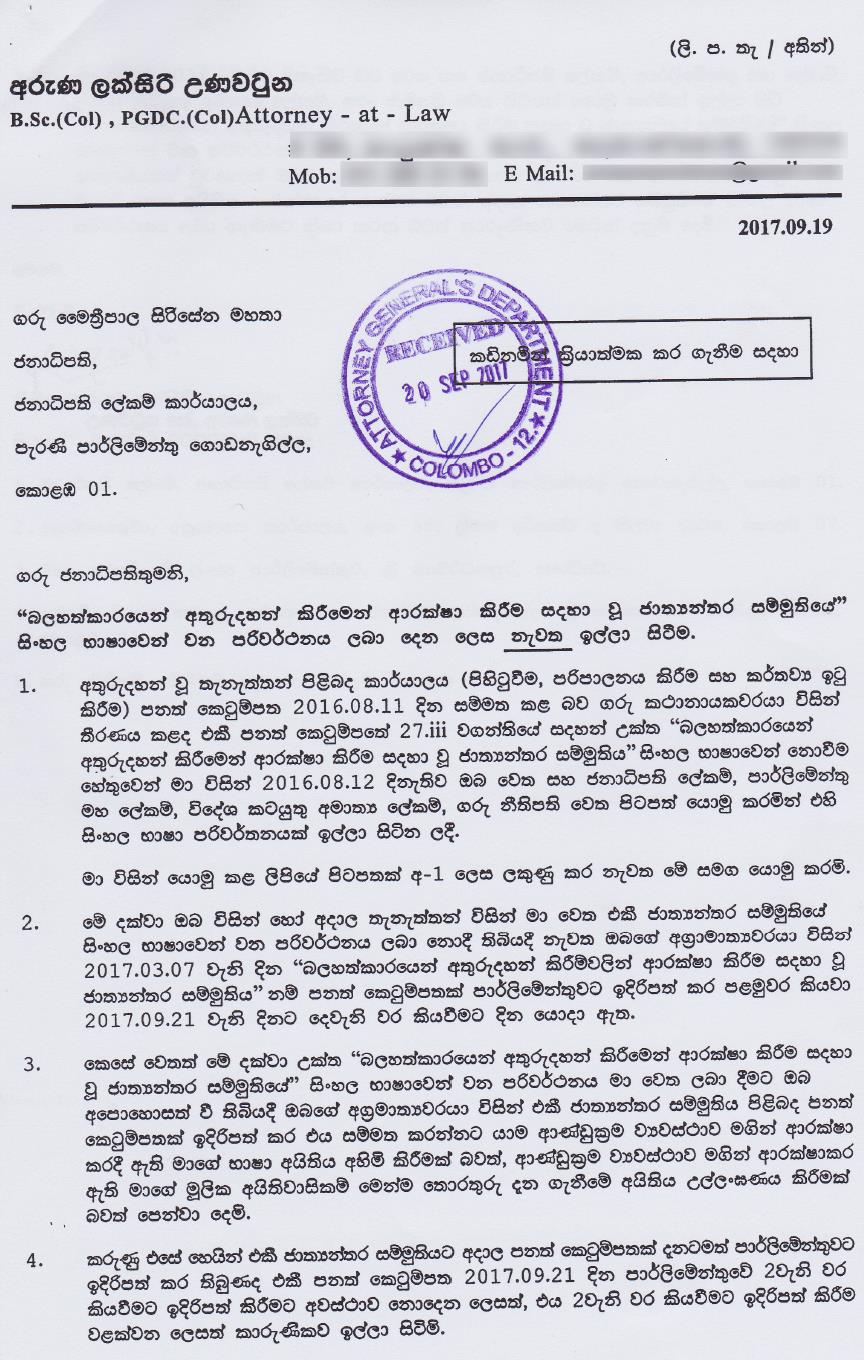
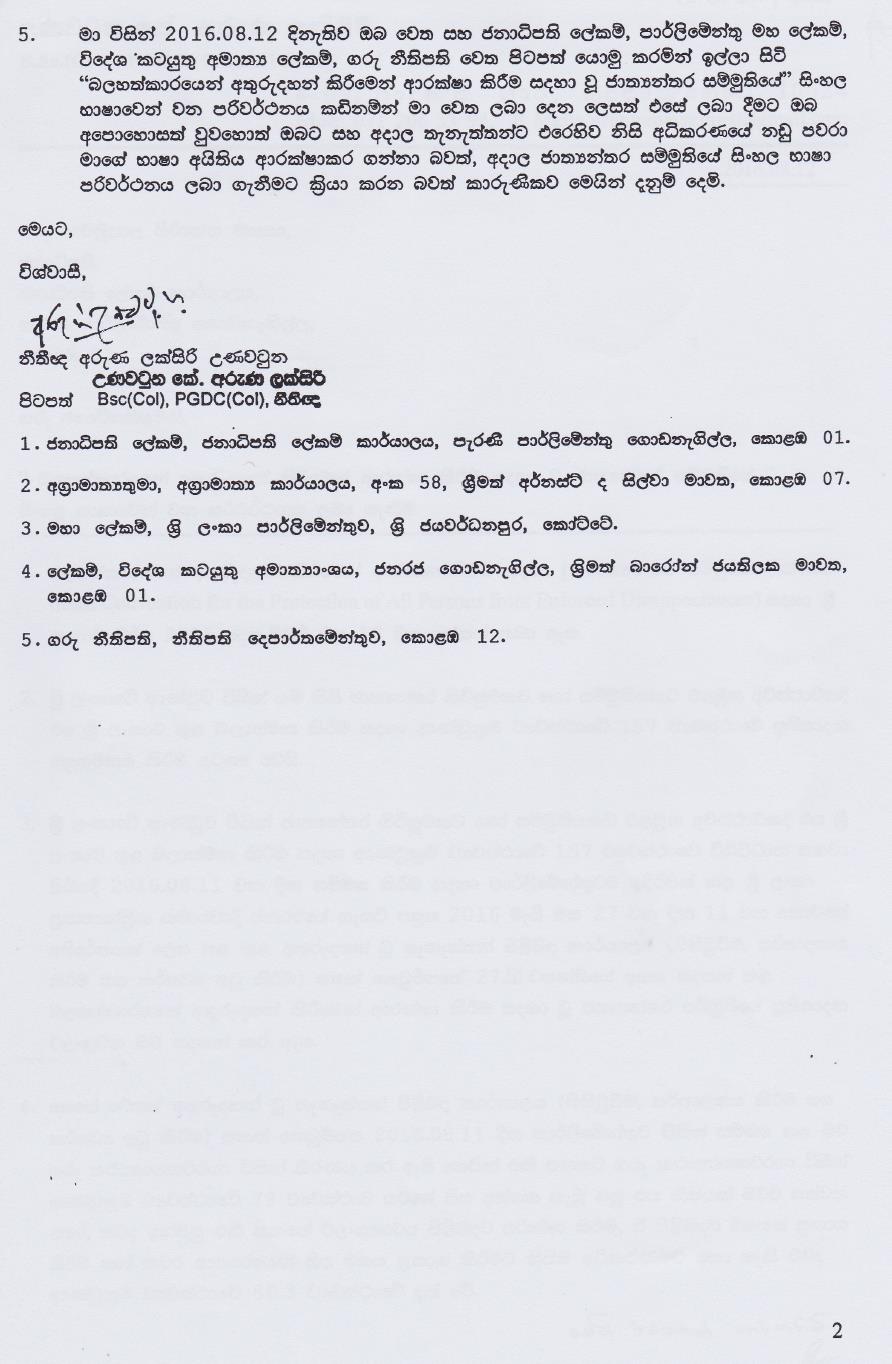
“ජාත්‍යන්තර සම්මුතිය” සිංහල භාෂාවෙන් ලබා නොදී නීති පැනවීමට යමින් මූලික අයිතිවාසිකම් කඩකිරීම සහ තොරතුරු දැනගැනීමේ අයිතිය අහිමි කිරීම සම්බන්ධව ජනාධිපතිට සහ අගමැතිවරයාට එරෙහිව නඩු පවරන බවට නීතීඥවරයෙක් දැනුම් දෙයි.

September 22nd, 2017

අරුන ලක්සිරි උනවටුන

 අගමැතිවරයා 2016 ජූනි මස 22 වැනි දින පාර්ලිමේන්තුවට ඉදිරිපත් කළ අතුරුදහන් වූ තැනැත්තන් පිළිබඳ කාර්යාලය (පිහිටුවීම,පරිපාලනය කිරීම සහ කර්තව්‍ය ඉටු කිරීම) පනත් කෙටුම්පතේ මෙම  බලහත්කාරයෙන් අතුරුදහන් කිරීමෙන් ආරක්ෂාකිරීම සඳහා වූ ජාත්‍යන්තර සම්මුතියේ (International Convention for the Protection of All Persons from Enforced Disappearances) ප්‍රතිපාදන ඇතුළත්වී තිබියදී එකී ජාත්‍යන්තර සම්මුතිය රාජ්‍යභාෂාවෙන් වන පිටපත් පාර්ලිමේන්තුවට ඉදිරිපත් නොකර 2016.08.11 වැනි දින එකී පනත සම්මත කරගෙන ඇත.

මේ දක්වා එකී ජාත්‍යන්තර සම්මුතිට රාජ්‍ය භාෂාවෙන් ලබා නොදී නැවත රනිල් වික්‍රමසිංහ අග්‍රාමාත්‍යවරයා 2017.03.07 වැනි දින බලහත්කාරයෙන් අතුරුදහන් කිරීම්වලින් ආරක්ෂා කිරීම සදහා ජාත්‍යන්තර සම්මුතිය” නම් පනත් කෙටුම්පතක් පාර්ලිමේන්තුවට ඉදිරිපත් කර පළමුවර කියවීම සිදුකර ඇති අතර එය 2017.09.21 වැනි දිනට දෙවැනි වර කියවීමට යොදා ඇත.

මෙය ආණ්ඩුක්‍රම ව්‍යවස්ථාව මගින් ආරක්ෂා කරදී ඇති භාෂා අයිතිය අහිමි කිරීමක් බවත්, ආණ්ඩුක්‍රම ව්‍යවස්ථාව මගින් තහවුරු කර ඇති මූලික අයිතිවාසිකම් මෙන්ම තොරතුරු දැන ගැනීමේ අයිතිය උල්ලංඝණයක් බවත් පෙන්වා දෙමින් එකී පනත් කෙටුම්පත 2017.09.21 දින පාර්ලිමේන්තුවේ 2වැනි

කියවීමට ඉදිරිපත් කිරීමට අවස්ථාව නො දෙන ලෙසත්, එය 2වැනි වර කියවීමට ඉදිරිපත් වළක්වන ලෙසත් ඉල්ලා සිටිමින් නීතීඥවරයෙක් විසින් ජනාධිපතිවරයාට ලිඛිතව දැනුම් දී ඇත.

එමෙන්ම බලහත්කාරයෙන් අතුරුදහන් කිරීමෙන් ආරක්ෂා කිරීම සදහා වූ ජාත්‍යන්තර සම්මුතියේ” සිංහල භාෂාවෙන් වන පරිවර්ථනය කඩිනම්න් ලබා දෙන ලෙසත් එසේ ලබා දීමට අපොහොසත් වුවහොත් අධිකරණයේ නඩු පවරා භාෂා අයිතිය ආරක්ෂාකර ගන්නා බවත්,  අදාල ජාත්‍යන්තර සම්මුතියේ සිංහල පරිවර්ථනය ලබා ගැනීමට ක්‍රියා කරන බවත් එකී ලිපියෙන් දැනුම් දෙමින්  ජනාධිපති මෛත්‍රීපාල සිරිසේන මහතාට, අග්‍රාමාත්‍ය රනිල් වික්‍රමසිංහ මහතාට,‍ ජනාධිපති ලේකම්වරයාට පාර්ලිමේන්තු මහලේකම්වරයාට, විදේශ කටයුතු අමාත්‍යාංශ ලේකම්වරයාට සහ නීතිපතිවරයාට දන්වා ඇත.

එකී ලිපිය පහත දැක්වේ.

ලුවීට හැටයි!

September 22nd, 2017

වරුණ චන්ද්‍රකීර්ති

ලුවී ඉපැදුණේ 1957 අවුරුද්දේ. ඒ, මාර්ග්ටයි මෝර්ටයි දාව. ලුවීට අයියලා දෙන්නෙකුත් හිටියා. ඒ අයියලා දෙන්නා තවමත් ඉන්නවා ද කියන එක නම් මේ ලේඛකයා දන්නේ නෑ. ඒත් ලුවී නම් අයියා කෙනෙක්. එයා තවමත් හිටපු විදිහට ම ඉන්නවා. ලුවී ගේ කැරැට්ටුව ඒ තරම් හොඳ නෑ. මහ නරක, අපිරිසිදු, තුට්ටු දෙකේ වැඩ කරන, ඉවරයක් නැතුව ලෙඩ බෝකරන හාදයෙක් විදිහට තමයි ලුවී ව හඳුන්වලා තියෙන්නේ. ලුවී බයයි කියලා පෙන්නන දේකුත් තියෙනවා. ඒත් ඒක බොරු රඟපෑමක් බව පැහැදිළියි. මොකද ඒ දේ දැකපු ගමන් ම යටිගිරියෙන් කෑගහගෙන පැනලා දිව්වාට ලුවී තවමත් යහතින් ඉන්නවා. දැන් ලුවීට හැටයි. ලුවී තමයි එයාලා ගේ කට්ටිය අතරින් වැඩි ම කාලයක් ජීවත්වෙලා ඉන්න කෙනා. ඉතින් එයා තවත් බොහෝ කාලයක් යහතින් වැජඹේවි.

ලුවීට හැටක් පිරිච්ච මේ අවුරුද්දේ අපේ වටපිටාව ගැනත් යමක් හිතන්න අපිට පුළුවන්. අපේ ආර්ථිකය විවෘතකරලා ගතවෙච්ච පහුගිය අවුරුදු හතළිහක කාලය ඇතුළේ සිද්දවෙච්ච වෙනස්කම් මෙච්චරයි කියලා කියන්න බෑ. ඒ වෙනස්කම් වෙලා තියෙන්නේ අපේ ආර්ථිකයේ, අපේ සමාජයේ, අපේ ජීවිතයේ විතරක් නෙවෙයි. අපි වටේ තියෙන පරිසරයත් සෑහෙන විදිහට වෙනස්වෙලා. අපිත් එක්ක හිටිය සමහරු මේ කාලය ඇතුළේ අපි ව දාලා ගිහිල්ලා. අපි නොදැන ම නන්නාඳුනන සමහරු අපේ ජීවිතවලට ඇතුළුවෙලා. ඒ ගැන ටිකක් හිතලා බලමු.

අපිත් එක්ක ඉන්න බෑ කියලා මුලින් ම යන්න ගියේ ගමේ කුඹුරුවල, ඇල දොළ දිය කදුරුවල හිටපු පොඩි පොඩි තිත්තයෝ, දණ්ඩි වගේ අය. රට නොදියුණු මුල් කාලේ ගමේ කොලු ගැටවු එක්ක පොල් කටු, ටින් බෙලෙක්ක ඇරගෙන ඇල දොළවල් ගානේ, කුඹුරේ වක්කඩවල් ගානේ කරක් ගගහා තිත්තයෝ, දණ්ඩි වගේ එවුන් එක්ක සෙල්ලම්කරපු විස්තර නම් කතා විදිහට මේ ලේඛකයාට දැන් වෙනත් අයත් එක්ක කියන්න පුළුවන්. ඒත් දැන් ඉන්න එවුන් ඔය කතා විශ්වාසකරන එකක් නෑ.

ඒ කාලේ අවුරුද්දේ සමහර මාසවල සමනලයෝ ලක්‍ෂ කෝටි ගණන් අපේ වතු හරහා පියාඹලා ගියා. වැඩි හරියක් ගියේ සුදු පාට එවුන්. ලා කහ පාට එවුනුත් නොසෑහෙන්න ඒ ගමනට සම්බන්ධවෙලා හිටියා. උන් ඔක්කොම සිරීපාදේ වඳින්න යන බවක් තමයි අපේ දෙමව්පියෝ අපිට කියලා දීලා තිබුණේ. ඒත් දැන් ඒකත් තව පරණ කතාවක් විතරයි. ඉඳලා හිටලා දැන් ඔය පොඩි සමනලයෙක් දෙන්නෙක් මිදුලේ මල් ගහක් වටේ කැරකුනාට උන්වත් දන්නේ නැතුව ඇති උන් ගේ නෑදෑයෝ ඉස්සර කාලේ කරපු ඒ වික්‍රම ගැන.

තව අපූරු වැඩක් අපේ ගම්වල මිනිස්සු ඒ කාලේ කළා. අපි ගෙවල් ඇතුළේ මොකක් හරි වැඩක් කර කර ඉන්න සමහර වෙලාවට ම්… …” කියලා එක දිගට ම මහා සද්දයක් ඇහෙන්න පටන්ගන්නවා. ගමන් මීයක්, ගමන් මීයක්” කියලා ඒ සද්දේ ඇහිච්ච ගමන් අපි හැමෝ ම වගේ කෑ ගහනවා. ඉතින් අපි වගේ පොඩි එවුන් කරන්නේ උදලු තලයකුයි යකඩයකුයි ඇරගෙන එළියට පැනලා ටාන්, ටාන්” කියන සද්දේ මතුවෙන විදිහට යකඩෙන් උදලු තලේට තඩිබාන එක. වත්තට උඩින් පියාඹාගෙන යන මී මැසි රංචුවට – ඒ කියන්නේ අර ගමන් මීයට; ඒ සද්දය දරාගන්න අමාරුයි. ඉතින් උන් කරන්නේ තමන් ගේ ගමන නවත්තලා වත්තේ තියෙන මොකක් හරි ගහකට පාත්වෙලා ගුලි ගැහෙන එක. ඉතින් ඒ කිට්ටුවෙන් පරණ කළයක් තිබ්බා ම හරි. එතකොට දවසක් දෙකක් යද්දී අර මී මැසි පොදිය ඒ කළයට රිංගගන්නවා. ඒක තමන් ගේ වාසස්ථානය බවට පත්කරගන්නවා. ඒත් දැන් ඒ විදිහට ගමන් මී යන බවක් පත්තරේකවත් දකින්න නෑ. දැන් ගෙවල්වල කළ ගෙඩි පාවිච්චියකුත් නෑ. ඉතින් ඒකත් තව එක්තරා පරණ කතාවක් විතරයි.

අවුරුදු කාලෙට ගම්වල කොල්ලෝ නැටුවේ කජු නාවර පෙරාගෙන. ගෙවල්වලට අඳින හැම ඇඳුමේ ම පවා කජු කිරි ගෑවෙන එක වළක්වන්න පුළුවන්කමක් තිබුණේ නෑ. මාර්තු අප්‍රේල් මාස දෙකට අපි එක කොල්ලෙක්ට පුළුවන් කජු විසිදාහක් විතර අහුලන්න. ඊට අමතර ව හොඳ ගහක කජු පුහුලන් කඩාගෙන කපලා ලුණු දාලා කන සිරිතකුත් තිබුණා. සමහර වෙලාවට සෙල්ලමට ගියා ම ඔය කැපිලි, ලුණු දැමිලි ගැන වදවෙන්නේ කවුද? ඊට අමතර ව සතියකට දෙතුන් වතාවක් මාළු කජු කපන වැඩේ දී අම්මාට උදව්කරන්න වෙනවා. අහුලපු වේලිච්ච කජු නම් ඕන ඕන කරන වෙලාවට සුද්දකරන්නේ පොල් අත්තක් උඩ දාලා පුළුස්සලා. ඒත් දැන් ඒ ඔක්කොම පරණ කතා. දැන් පොඩි එකෙක්ට පෙන්නන්නවත් කජු පුහුලමක් හැදෙන්නේ නෑ. මී මැස්සෝ එන්නේ නැති හින්දා කජු ගස් තරහාවෙලා වෙන්නත් පුළුවන්.

මේ ලේඛකයා ගේ ගෙදර වැට මායිමට වෙන්න මහ විශාල කොට්ට පුළුන් ගහක් තියෙනවා. ඒක අයිති අල්ලපු වත්තේ අයට. ඒ ගහෙන් දෙපැත්තට ම කරදර හින්දා ගහ කපලා අයින්කරන්න ඕන කියලා අල්ලපු ගෙදර අය එකඟවුනා. ඒත් ඒ දවස්වල ගහ පුරා ම කොට්ට පුළුන් හැදීගෙන එනවා. ඒ හින්දා, පුළුන් ටික කඩාගත්තාට පස්සේ ගහ කපලා දාන්නම් කියලා අල්ලපු ගෙදර අය කිව්වා. ඒත් දවස් දෙකක් තුනක් ගතවුනාට පස්සේ ගෙදර ගිය මේ ලේඛකයා දැක්කේ කොට්ට ගහේ එක පුළුන් ගෙඩියක්වත් නැති බවක්. ඒ මොකද කියලා මේ ලේඛකයා අහල පහළ කෙනෙක්ගෙන් ඇහුවා. වවුළෝ රංචුවක් ඇවිල්ලා මුළු ගහ ම සුද්දකරලා. මෙහෙම දෙයක් කවදාවත් අහළා නෑ. ඒත් දැන් ඉස්සර වගේ ගස් මුල වැටිලා කුණු වෙන තරමට වැල වරකා හැදෙන්නේ නෑ. ඉතින් වවුළන්ට කන්න ඉතිරිවෙලා තියෙන්නේ කොට්ට පුළුන් වගේ දේවල් විතරයි.

ඉස්සර කාලේ අපේ වතුපිටිවල අපිට කරදරයක් වෙලා තිබුණේ දනපතිනට්ටං, වල් ළුෑණු වගේ දේවල්. වතු සුද්දකරනවා කියන්නේ ඒවා කපලා කොටලා අයින්කරන එක. දැන් ඒවා නැත්තට ම නැතිවෙලා. ඒත් දැන් පාරවල් අයිනේ ගණසාරෙට මානා වගයක් හැදෙනවා. ඒ මානාවල නම කවුරුවත් දන්නේ නෑ. ඒවා බෝවෙන්න පටන් ඇරන් අවුරුදු විස්සකට වැඩි නෑ. මුලින් බෝවුණේ මහ පාරවල් අයිනේ. පස්සේ පස්සේ අතුරු පාරවල් දිගේ පැතිරෙන්න ගත්තා. ගිණිතියලා විනාශකළත් ආයෙත් පැලවෙනවා. මේවා අපේ ගම්වලට ආවේ කොහොම ද?

මේ ගැන හිතද්දී මතක්වෙන තව දෙයක් තමයි ඉපිල් ඉපිල්. මේ ලේඛකයා පහේ පංතියේ ඉගෙනගන්න කාලේ තමයි ඉස්කෝලේ ගුරුවරු ඉපිල් ඉපිල් ඇට හත අට ගානේ ළමයින්ට බෙදලාදුන්නේ. ඒක මහ පුදුමාකාර ප්‍රයෝජන තියෙන ගහක් කියලාත් ඒ ගුරුවරු අපිට කියලා දුන්නා. ඇට පැලකරන විදිහත් කියලා දුන්නා. මතක විදිහට ඒ ඇට (උණු?) වතුරේ පෙ‍ඟෙන්න දාලායි පැලකරන්න කිව්වේ. ඊට පස්සේ හැම අහුමුල්ලක ම ඉපිල් ඉපිල් පැලවෙන්න පටන්ගත්තා. කුරුල්ලෙක්ට කන්නවත් ගෙඩියක් ඒ ගස්වල හැදෙන්නේ නෑ. ඕන තරම් දර තියෙන අපිට ඒ ගස්වලින් දර ගන්න උවමනාවකුත් නෑ. ඉතින් දැන් තියෙන ලොකු ම ප්‍රශ්නේ තමයි ඒවා දුරින් දුරුකරලා දාන්නේ කොහොම ද කියන එක.

තිත්තයෝ, දණ්ඩියෝ, සමනල්ලු, මී මැස්සෝ අපෙන් ඈත්වෙලා ගියත් මීයෝ, කැරපොත්තෝ, මදුරුවෝ (ලුවී ගේ කට්ටිය) අපි ව දාලා ගියේ නෑ. අපේ තනි රකින්න වගේ උන් ගේ ගහනය තව තවත් වැඩිවෙලා. ඉස්සර අපිට හැදුනේ මැලේරියාව. ඒත් දැන් අවුරුදු විස්සක විතර ඉඳලා අපිට හැදෙන්නේ ඩෙංගු. අපේ කුඹුරුවල ගොයම් ලොකු මහත් කරගත්තත් ඒවාට ඉවරයක් නැතිව ලෙඩ. බෙහෙත් ගහන්නේ නැතුව ඒවා ගොඩගන්න බෑ. ඉස්සර වගේ කුඹුරුවල වල් නෙලන්න වදවෙන මිනිස්සුත් දැන් නෑ. බෙහෙතක් ගැහුවා ම හරි. ඒ බෙහෙතින් වල් මැරුණේ නැතිනම් තව මොකක් හරි බෙහෙතක් ගහනවා.

දවසක් ගිරිඋල්ලේ ඉඳලා නාරම්මලට යන බස් එකක දී මේ ලේඛකයාට මෙහෙම කතාවක් ඇහුනා. මේ සැරේ නම් කුඹුරේ හාල් කන්න බෑ. විකුණලා දාලා කඩෙන් තමයි හාල් ගන්න වෙන්නේ. කීඩෑවන්ට පුදුම විදිහටනේ බෙහෙත් ගැහුවේ.”

මේ කියපු කතාවල තේරුම මොකක්ද? මේවා එකකට එකක් සම්බන්ධ ද? එහෙම නැතුව නිකම් ම නිකම් බහුභූත කතා ද?

ඒ කොහොම වුනත් මේ ලේඛකයා දන්න තවත් දෙයක් තියෙනවා. ඒ අපි හැමෝ ම දන්න දෙයක්. අපේ ගෙවල්වල මීයෝ ඉන්නවා. අපි උන් ව වඳකරන්න කොච්චර නම් දේවල් කරනවා ද? මී උගුල් අටවනවා. බළල්ලු ඇතිකරනවා. කූඩුවලට මීයෝ අල්ලලා ඈතට ගිහිල්ලා දානවා. වස විස තියනවා. සමහර මිනිස්සු කොස්සෙන් ගහලාත් මීයෝ මරනවා. ගෙවල්වලට ගැරැඬි රිංගනවාට කැමැති මිනිස්සුත් ඉන්නවා. ඔය මොනවා නැතත් වත්ත පිටිය හොඳින් සුද්ද පවිත්‍රකරලා, ගෙවල් පිළිවෙලකට තියාගත්තාමත් මීයෝ අඩුවෙනවා. ඒ කියන්නේ මී කරදරය නැතිකරන්න පුළුවන් ක්‍රම ගොඩක් තියෙනවා. එක වැඩක් කරන්න මේ විදිහට ක්‍රම ගොඩක් තියෙන එක ලොකු දෙයක්. එක ක්‍රමයකින් බැරි නම් තව ක්‍රමයකින් අපිට මී ප්‍රශ්නෙට උත්තර හොයන්න පුළුවන්.

ඉතින් මේ විදිහට ම අපේ කුඹුරුවල ප්‍රශ්නත් විසඳගන්න අපිට බැරි ද? ඒකට හරියන්නේ වස විස පාවිච්චිකරන එක විතර ම ද? මේ වැඩේට ගැලපෙන දෙයක් අපේ අත්තලා මුත්තලාගෙන් අපිට ඉගෙනගන්න බැරි ද? දැන් මතුවෙලා තියෙන ඩෙංගු කරදරය ගැන හිතද්දි කුඹුරුවල ප්‍රශ්න මොනවා ද කියලා හිතෙනවා. ඩෙංගු මඩින්න අපිට කරන්න පුළුවන් තව දේවල් තියෙනවා ද? අපිට බැරි ද තව තවත් උපක්‍රම ගැන හිතන්න? එක වතාවක් පොල් වගාවට කුරුමිණියෙක් බෝවුනා ම ඒ වසංගතය අපි නැතිකළේ වස විස ගහලා නෙවෙයි.

ඒ කියන්නේ, වස විස ගහනවාට අමතර ව කරන්න පුළුවන් දේ තවත් තියෙනවා. අපි ඒ විදිහේ උපක්‍රම තව තවත් හොයමු. ඒවා ගැන පාඩම් අපි අපේ දරුවන්ටත් කියලා දෙමු.

වරුණ චන්ද්‍රකීර්ති 

‘Unit of Devolution: District or Province?’ – a response

September 22nd, 2017

Neville Ladduwahetty Courtesy The Island

Dr. Dayan Jayetilleka (Dr. DJ), in his article titled “Unit of devolution: District or Province?”(The Island, Sept. 20, 2017), has missed the essence of the difference between what I stated and what he claims as the “Sinhala nationalist’s preference for Districts to Provinces” as the primary unit of devolution.

I agree with Dr. DJ that devolving to the district, instead of the province, and ignoring the rest of what I had stated, is a non-starter. I went beyond, and it is what he missed out that makes all the difference.

The essence of what I stated was that while the district would be the best unit of devolution, in order to ensure territorial integrity, the legislative and executive powers should be shared at the center so that the sovereignty of the People could be exercised by the three major communities of Sri Lanka. What needs to be developed are the specific mechanisms of sharing power, at the centre, so that the communities are involved in the processes of governance.

The ongoing constitutional reform process is exploring all possible means to grant greater autonomy to the provinces. If, as Dr. DJ states: “It is true (that) a measure of autonomous power to a unit as large as a province does constitute a temptation to secede”, what imaginative formula does Dr. DJ suggest to prevent secession and sustain stability? It cannot be by constitutional safeguards alone because, as Dr. Colvin R. de Silva said in another context, it would be “a thin reed to lean on”. It is evident from the developments in Spain, and now Iraqi Kurdistan, both of which are moving towards independence and self-determination, despite their actions being declared illegal. The question is: What safeguards are there to ensure the sustainability of the territorial integrity of Sri Lanka with province as the unit of devolution? With all due respect, the provisions of constitutional amendment 13A within a unitary state, as advocated by Dr. DJ certainly cannot be the answer after 30 years of war and thousands dead, because that was the arrangement when the war started; if it was not acceptable then, how is it acceptable now?

If as Dr. DJ states that the solution is the right balance between “The two extremes of laissez-faire…and suffocating overprotection…similar to that of child-rearing”, it is very clear from all the evidence available that the Sri Lankan state has not been successful at “child-rearing”, and there is no guarantee that they would be any better in the future. Depending on such skills is also in my opinion too risky because as most parents know, despite all the care and nurturing given, no parent is in a position to guarantee how children would finally turn out. Could the territorial integrity be risked to such uncertainties? Therefore, we need to find a more durable arrangement to ensure territorial integrity while acknowledging the vulnerability of the province to separatism.

In the background of repeated claims of “Tamil nationhood with the right of self-determination” that have echoed over decades, a unit as large as the province would not stop only at tempting secession it would lead to secession. This is only one elephant in the room. The other is the destabilizing effect on India through separatist tendencies in Tamil Nadu. India may not be too concerned with possible threats to its territorial integrity because of assurances given by its military. Regardless of the capabilities of India’s military, secession in Sri Lanka would reverberate in Tamil Nadu with inevitable consequences on India’s stability and India would not want that to happen.

Therefore, as far as India is concerned, their one and only concern is stability in Sri Lanka. My opinion is that India is not too concerned how it is achieved as long as it is acceptable to the communities in Sri Lanka. The need therefore is for the leadership of the major communities to discuss what arrangements at the center would meet their aspirations while ensuring territorial integrity, bearing in mind that whatever the arrangements at the center, devolution has to be to a unit that guarantees territorial integrity because it is not only in Sri Lanka’s interest, but also in the interest of India. If Sri Lanka breaks up, India will unravel too.

In my article of September 19, I had suggested an arrangement for the center to share legislative and executive power. Such an arrangement could be supplemented by three Deputy Prime Ministers representing the three communities assigned to specific areas to assist the Prime Minister. This is simply the imaginations of one person. The need is for a workshop to explore as many options as possible to be presented to the leadership for them to arrive at an acceptable arrangement. Perhaps Dr. DJ could head such an exercise.

The fact that absolutely no attempt has been made thus far to explore an imaginative approach other than the hackneyed refrain of devolution to provinces, is disappointing.

Exclusive : බැදුම්කර මගඩි සල්ලි පෙරේදා පාර්ලිමේන්තුවේ විසිවේ” සුලු පක්ෂ නායකයන් ඇතුළු සමහරුන්ට මිලියන 100-300 දක්වා ලංසු..

September 22nd, 2017

 lanka C news

පෙරේදා පාර්ලිමේන්තුවේ දී පළාත් සභා සංශෝධන පනත් කෙටුම්පත සම්මත කරගැනීම සදහා අවශ්‍ය වූ 2/3 බලය ලබා ගැනීමට පාර්ලිමේන්තුවේ කෝටි ගණන් මුදල් හුවමාරැ වූ බව අන්තර්ජාල පුවත් අඩවි හා සමාජ ජාලාවල වාර්තා කර ඇත.

පනත සම්මතයට අවශ්‍ය වූ 2/3 ඡන්ද ප්‍රමාණයේ අඩුවිම නිසා එදින පාර්ලිමේන්තුවේ ඡුන්ද විමසීම බොහෝ වේලාවක් ප‍්‍රමාද වූ අතර වේලාව පියමං ගර ගැනීම සදහා ලයිස්තුවේ නොසිටි කථිකයන් පවා කතා පවත්වන්න වූ බව සදහන්ය.

එම කාලය තුලදී වහාම ක්‍රියාත්මක වු ආණ්ඩුවේ ප්‍රධාන පක්ෂ දෙකේ තිරය පිටිපස සිට මෙහෙයුම් කරන කිහිපදෙනෙකු තමන්ට අවශ්‍ය ඡන්ද ප්‍රමාණය එනම් මන්ත්‍රී 150 ක් දිනාගැනීමට අවශ්‍ය සෑම සැලසුමක් ම දියත් කර ඇති බවත් එහිදී සමහර පක්ෂ නායකයින් සහ මන්ත්‍රීවරුන්ගේ දුක් ගැනවිලි අතර කෝටි ගනන් මුදල් අවශ්‍ය බව ද දැන්වීමෙන් පසුව ඒ සඳහා අවශ්‍ය මුදල් බැදුම්කර මගඩියට සම්බන්ධ පාර්ශවයක් හරහා ලබාදීමට එකග කරවා ගෙන ඇතැයිද වාර්තාවන්හි දැක්වෙයි.

Exclusive : බැදුම්කර මගඩි සල්ලි පෙරේදා පාර්ලිමේන්තුවේ විසිවේ” සුලු පක්ෂ නායකයන් ඇතුළු සමහරුන්ට මිලියන 100-300 දක්වා ලංසු..

ඒ අනුව ඉහළම ලංසුව ලෙස මිලියන 300 ක් දක්වා සමහර පක්ෂ නායකයින්ට දීමට අවශ්‍ය කටයුතු යෙදා ඇති බවත් ඇමතිකම් දරන මන්ත්‍රීවරු සඳහා රුපියල් මිලියන 10 සිට 100 දක්වා ලංසු තැබීමට සිදු ව ඇති බවද් සදහන් වෙයි.

කෙසේ වෙතත් මෙහිදී එක් නියෝජ්‍ය අමාත්‍යවරයෙකු රුපියල් කෝටි ගනනකට තම ආත්මය පවා දීමට නොහැකි බව පවසමින් ඇමතිකම නැති වුනත් කමක් නැතැයි කියමින් කියමින් ඡන්දය නොදි සබා ගැබෙන් නික්ම යන බැව් නිරීක්ෂණය කොට ඇති බවද වැඩි දුරටත් දැක්වෙයි.

ගම්පහ දිස්ත්‍රික්කයේ නියෝජ්‍ය අමාත්‍යවරු දෙදෙනකු මෙම මෙහෙයුම් සඳහා කැපී පෙනිමෙන් එලිපිටම සමහර පාර්ශවයන් සඳහා මුදල් ලබාදීමට පෙලබීම් කල වග සමාජ ජලාවල නම් සහිතව විස්තර පල කර ඇත.

හදිසියේම එම පනතට කිසිසේත්ම අදාල නොවන සංශෝධණ ගෙන ආවේ පළාත් සභා මැතිවරණය කල් දැමීම සදහා ගෙන එනු ලැබූ 20 වැනි සංශෝධනයට ශ්‍රේෂ්ඨාධිකරණ විසින් ලබා දුන් තීන්දුව නිසා බවද පැවසෙයි.

The Delimitation mockery of Democracy

September 22nd, 2017

Courtesy The Island

The Supreme Court’s order on the proposed 20th Amendment to the Constitution was one that wholly supported the democratic rights of voters. It clearly stated that any move by the government to postpone the Provincial Council polls – even to have them all on a single day – should be approved by a 2/3rd majority in Parliament and also at a referendum, because it is a major constitutional change.

So what does the Government do?

The resulting action at the Diyawanna Chamber of Lawmakers was to play a crooked game of deceit, showing little respect for Hulftsdorp, and play its now masterly Game of Delimitation to hoodwink the people about its commitment to democracy and postpone the Provincial Council polls.

Delimitation is the buzzword of this alliance of these charlatan democrats – be they green or blue in political colouring – and they readily used the borderline game to delay the PC polls and go ahead with their charlatan support for democracy.

It was no surprise to hear what the Prime Minister and the Minister for Provincial Councils say about the time limit being given to the new Delimitation Committee to be appointed, to finish their work in four months. Have we not heard enough of earlier Delimitation Committees asking for more time, which could be a necessity; and do we also not know how the same Minister has blamed the delay in Local Government polls on the Delimitation Commissioners?
Three Provincial Councils –Sabaragamuwa, North Central, and Eastern, will finish their five-year terms by the end of this month and early next month. The elections to these could have been held in one or two months. But, that is not the democratic stuff this government wants. It is all for a Delimitation Delay. What a deceitful game of crooked politics they play with the votes of the people, while a pro-democratic order by the Supreme Court stares at them.

The Minister for Provincial Councils Faiszer Musthapha is certainly one who is very happy with Delimitation. This has been his catchword in delaying the holding of Local Government polls. It has now moved to Provincial Councils – what more can these votes fearing so-called democrats do, in the name of the 6.2 million democrats who helped elect Yahapalanaya, to help strengthen democracy by defeating an authoritarian regime?

Anyone in government who handles Provincial Councils knows when the next elections for each PC are due. What was preventing these persons, the minister, and other officers, as well as the Prime Minister, to begin the delimitation process much before this? Did they have to await the Supreme Court judgment on the 20th Amendment to realize the need for delimitation of PC boundaries? This is not poppycock; it is the revolting talk of crooked politics.

There is another piece of whimsy political stuff pushed ahead with this Delimitation Move to delay the PC polls. It is the mandatory requirement for 30 percent women candidates on nomination lists. No one would oppose this. But, could this amendment not have been brought earlier? What was the need for a delay? The necessities of democracy, such as the role of women in people’s representation, should not be manipulated to give a good image to those who are carrying on a larger game of cheating the people of their democratic right to vote.

The talk is big about democracy thriving today. Yes, we can see that the Supreme Court and other sections of the judiciary are not being manipulated, as it happened not so long ago. We are glad about today’s independence of the judiciary. But we certainly cannot be pleased when that same independence is not fully respected by the legislators, who use parliamentary trickery and political crookedness to take the people away from the democratic vote that Hulftsdorp recommended.

It must also be remembered that the two-thirds majority the government got, despite some of its members being abroad, and some of the JO not being present, came from the votes of persons who were defeated by the people in August 2015, but entered Parliament through the backdoor of the National List of the Defeated. That is the stuff of democracy at Diyawanna today. Those are the democrats who are wholly fearful of the voter, and will even cavort around a Supreme Court judgment, to make a mockery of democracy.

Delimitation is the voodoo word of the No Good Government or Yamapalanaya – the Devil’s Governance.

AG.’s Dept. counsel say they assist bond CoI free of charge ‘None seeks promotions or any other benefit’

September 22nd, 2017

Bond Scam Probe Courtesy The Island

Attorney General’s Department counsel assisting the Presidential Commission of Inquiry probing the bond scams yesterday deplored aspersions cast upon them by the senior counsel for former Central Bank Governor Arjuna Mahendran on Wednesday.

Following is the text of the Statement made by Counsel of the Attorney General’s Department, Additional Solicitor General Yasantha Kodagoda:

“On 20th September 2017, following Senior Additional Solicitor General Mr. Dappula De Livera, PC, having made an application for a brief adjournment of proceedings to commence the examination of Mr. Arjuna Mahendran, while initially objecting to the application and later diluting that submission, President’s Counsel Mr. Romesh De Silva made reference to the team of counsel from the Attorney General’s Department assisting the Commission, participating at the Commission “at the tax payers’ expense”. Ostensibly, Mr. De Silva made such a reference following instructions to do so from his client Mr. Arjuna Mahendran, and having received fees to make such an utterance.

“In view of the insinuation made against officers of the Attorney General’s Department assisting this Commission, that we are wasting tax payers’ money by moving for an adjournment of proceedings, it has now become necessary to place on record the manner in which the ten of us are utilizing tax payers’ money. We are compelled to make this statement due to a couple of other reasons as well, including an allegation that was made some time ago by another person, that officers of the Attorney General’s Department are working at this Commission in the manner we do, in anticipation of promotions.

Indeed we are conscious of the need to ensure that we as well as all other public functionaries who exist on public funds which includes money contributed by tax payers, perform our duties in a conscientious and transparent manner, and do not engage in any conduct that would amount to fraudulent misappropriation of public funds or an extravagant use thereof. We are also mindful of the need to ensure that, public funds are used in national interests and in the best interests of the public.

In fact, as public servants who are assisting this Commission in addition to most of our routine duties and responsibilities, we are entitled in terms of applicable circulars to receive an additional monthly allowance. However, all of us took a decision way back in March this year, to refrain from collecting that allowance to which we are entitled to. We believe that, such voluntary service to the nation is appropriate, particularly when assisting a Commission of Inquiry, which in our view is investigating and inquiring into what has now been revealed to be in our view, one of the largest financial scams, if not the largest financial scam, independent Sri Lanka has ever been victim to.

We have served this Commission to the best of our ability, and we believe that our services have resulted in this Commission unearthing shockingly wrongful, illegal and massively fraudulent activities which have resulted in loss to the exchequer of this country of unprecedented magnitude.

We wish to emphasize that our conduct throughout the inquiry proceedings of this Commission and in the conduct of investigations, have been guided by our resolve to assist this Commission to unearth the truth, the whole truth and nothing but the truth, and in national and public interest. It is a time consuming process, which we are engaging in.

We also wish to reiterate that, the application for a postponement of the examination of Mr. Arjuna Mahendran was made due to reasons beyond our control, in order to get fully prepared, and not for the purpose of enjoying luxuries at the expense of tax payers. We believe that, Your Honours the Honourable Commissioners who have most judiciously been hearing and considering the evidence led, those who have observed these proceedings objectively and on a daily basis, and the general public who have had the benefit of detailed reporting of these proceedings by the media, will finally judge us and determine whether we have wasted even a rupee of the tax payers’ money.

Thus, we wish to deplore the comment made by Mr. Romesh De Silva, remaining mindful of the fact that, he may have been prompted to say what he said on instructions, and fees paid by his client

‘ගිනස්‌ මඟුල්’

September 22nd, 2017

කතු වැකිය උපුටා ගැන්ම දිවයින

ශ්‍රී ලංකාව යනු වාර්තා තැබීමට උපන් ගෙයි හැකියාව ඇති රටකි. නමුත් රට හමුවෙහි ඇති බොහෝ වාර්තා දුටු විට අපට ඇතිවන්නේ සතුටට වඩා දුකකි. දිවිනසා ගැනීම්, හදිසි අනතුරු, ළමා අපචාර, ඩෙංගු, ණය බර, ලොකුම ඇමැති මණ්‌ඩලය ගැන ලෝක වාර්තා අතරට එක්‌ වූ නවතම වාර්තා වන්නේ ගිනස්‌ වාර්තාය. ලංකාවේ මිනිසුන්ට ගිනස්‌ වාර්තා තැබීමට ලොකු ‘උණක්‌’ ඇති බව රටේ සිදුවීම් දෙස බැලූ විට පෙනේ.

පසුගියදා ශ්‍රී ලංකාවේ අපූරු සිදුවීමක්‌ ගිනස්‌ වාර්තා පොතට එකතු විණි. එම වාර්තාව වූයේ ලෝකයේ දිගම සාරි පොට පැළඳි මනාලියයි. මෙම මනාලිය යුග දිවියට ඇතුළු වූයේ ගිනස්‌ වාර්තා පොත ද අලුත් කරමිනි. මෙම වාර්තාව තැබීම සඳහා මනාලිය පැළඳ සිටි සාරි පොටේ දිග මීටර් 4099 කි. ඒ සඳහා වැය වූ මුදල රුපියල් ලක්‍ෂ 27 ක්‌ පමණ බව පැවසේ. මෙම ක්‍රියාව නව යුවළගේ සිතූ මනාපයට සිදු වූ අතිශය පෞද්ගලික කාරණාවකි. නමුත් ඇත්තටම මේවා ගිනස්‌ වාර්තා නොව ‘පපඩම්’ වාර්තාය. මන්ද හෙට දිනයේ මෙම වාර්තාව කැඩීමට අවශ්‍ය වන්නේ රෙදි යාරයක්‌ පමණි. ඇතැම් විට මෙම තරුණ යුවළට ද ඊළඟ අවුරුද්දේ මෙම සාරියටම තව රෙදි යාර දෙක තුනක්‌ එකතු කර වාර්තාව අලුත් කළ හැක. එම නිසා මෙවැනි වාර්තාවලින් හෑල්ලුවට ලක්‌ වන්නේ ලංකාව නොව ගිනස්‌ වාර්තා පොතය.

මෙම ‘පපඩම්’ වාර්තාව, කතා නොකළ යුතු මාතෘකාවක්‌ වුවද අද අපට මේ පිළිබඳව කතා කිරීමට වැදගත් ප්‍රස්‌තුතයක්‌ ඉතිරිව තිබේ. ඒ මේ වාර්තාව තැබීම සඳහා මීටර් 4099 ක්‌ (කිලෝමීටර් 4) දිග සාරිපොට අල්ලාගෙන යැම සඳහා පාසල් දරුවන් 250 දෙනකු යොදා ගැනීමය. මෙම පාසල් දරුවන් ඉගෙනුම ලබන්නේ අලවතුගොඩ සරත් ඒකනායක පාසලේය. මෙය මධ්‍යම පළාත් මහ ඇමැති සරත් ඒකනායක මහතාගේ නම කොටා ඇති, ජනතාවගේ බදු මුදලින් ගොඩනැගූ පාසලකි. මෙම ‘ගිනස්‌ මංගල්‍යයට’ මහ ඇමැතිතුමා ද සහභාගි වී එතුමා ද පාසල් දරුවන්ට සාරි පොට ඇල්ලීමට උදව් කරනු ලබන ඡායාරූප මාධ්‍යවල පළ වී තිබිණි. පළාතේ මහ ඇමැතිතුමා ඉදිරියේ කුඩා පාසල් දැරිවියන් සාරි පොටවල් පටලවාගෙන මහ දවල්, මහ පාරේ ඇවිද යැම ගැන පළමුව ලැඡ්ජා විය යුත්තේ මහ ඇමැතිතුමාය. නමුත් ලංකාවේ කිසිදු දේශපාලනඥයකුට නැති ලැඡ්ජාවක්‌ මහ ඇමැතිතුමාට විතරක්‌ ඉතිරි වී තිබෙන්නට නොහැක.

මෙම ක්‍රිsයාව සම්බන්ධයෙන් දැනටත් පාසල් ගුරු සංගමය නිවේදනයක්‌ නිකුත් කර තිබේ. එම නිවේදනයේ දැක්‌වෙන්නේ මංගල උළෙලක මනාලියකගේ සාරි පොට උස්‌සාගෙන යැමට පාසල් දරුවන් යොදා ගැනීම වැරදි ක්‍රියාවක්‌ බවයි. ඇත්තටම මෙම නිවේදනය නිකුත් කළ යුතුව තිබුණේ අධ්‍යාපන අමාත්‍යාංශය මගිනි. නමුත් වැරදිලාවත් අධ්‍යාපන ඇමැතිවරයා මේ ගැන තවම ප්‍රකාශයක්‌ නිකුත් කොට නොමැත.

පාසල් දරුවන් මෙවැනි ප්‍රචාරකවාදී ක්‍රියාවන්ට යොදා ගන්නා පුද්ගලයන් අතර පෙරමුණේ සිටින්නේ දේශපාලනඥයන් ය. විදුහල්පතිවරුන් ද බලන්නේ දේශපාලනඥයන් සතුටු කර, නව තනතුරු ලබාගෙන තමන් වැඩියෙන් සතුටු වීමටය. මේ සියලු දෙනාගේ සතුටට අපේ කිසිදු ඉරිසියාවක්‌ නැත. නමුත් අපට ඇති අර්බුදය, ඔවුන්ගේ සතුට වෙනුවෙන් අසරණ පාසල් දරුවන් පාවිච්චි කිරීමය.

අද ලංකාවේ පාසල් දරුවන් අර්බුද රැසකට මුqහුණ දී සිටිති. නිල ඇඳුම්, පොත්පත්, පාවහන් ගැනීමට වත්කමක්‌ නොමැති ලක්‍ෂ ගණනක්‌ දරුවෝ අද පාසල් තුළ සිටිති. බොහෝ දරුවන් පාසල් පැමිණෙන්නේ බඩගින්නේය. ජනාධිපති ප්‍රේමදාස යුගයේ මෙන් මේ දරුවන්ට දැන් පාසලෙන් කිරි වීදුරුවක්‌ ලැබෙන්නේ නැත. රටට ඔරොත්තු නොදෙන ඇමැති මණ්‌ඩලයක්‌ නඩත්තු කරන අපට තවමත් මේ දරුවන්ට නොමිලේ ආහාර වේලක්‌ දීමට මුදලක්‌ වෙන්කර ගැනීමට නොහැකි වී තිබේ. තරගකාරී විභාග අධ්‍යාපන ක්‍රමය විසින් මේ දරුවන්ට ඉතිරි වී තිබූ එකම සම්පත වූ ‘නිදහස්‌ ද උදුරාගෙන අවසන්ය. රටේ දේශපාලනඥයන් තමන්ගේ දේශපාලන ව්‍යාපෘති සඳහා දක්‌කාගෙන යන්නේ මේ අසරණ දරුවන්වය. මෙම ක්‍රියාව එළඹෙන සඳුදා දිනයේ සිට නතර කළ යුතුය. දේශපාලනඥයන් වන්දනා කරන දරු පරපුරක්‌ බිහිකිරීමෙන් රටට අත්වන සෙතක්‌ නැත.

IS recruiting from India, Bangladesh and Sri Lanka

September 22nd, 2017

Sultan M Hali Courtesy The Pakistan Observer

PRIMA facie, the so-called Islamic State (IS or Daesh) is receiving a hammering in Syria and Iraq but fresh information has come to light that the terror mongers are engaged in a recruitment drive in India, Bangladesh and Sri Lanka using social media tools. According to PTI (Press Trust of India), IS chief recruiter in India, tech-savvy al-Hindi has been operating on facebook and other personal messenger services to contact, brainwash and recruit the youth from India, Bangladesh and Sri Lanka. The report elaborates that the IS or Daesh claims that an Indian suicide bomber killed a number of people in an attack in Raqqa, Syria, the de-facto capital of the terror group.

In a statement in Arabic via its Amaq propaganda agency, the IS identified the Indian bomber as Abu Yusuf al-Hindi, according to the SITE Intelligence Group, a US based monitoring firm. The terror group claimed killing and wounding a number” of what it described as Kurdistan Workers’ Party (PKK) apostates” in the suicide attack involving the Indian bomber. However, there was no confirmation about the IS claim by Indian agencies.

Al-Hindi was the fugitive chief recruiter for the IS in the Indian Subcontinent and was known as Mohammad Shafi Armar. He had many aliases like Chotte Maul” and Anjan Bhai”. The 30 year old was named as a Specially Designated Global Terrorist” by the USA in June, becoming the first Indian leader of the outfit against whom the US has imposed sanctions. An Interpol Red Corner notice was also pending against the bomber. Al-Hindi, a native of Bhatkal in Karnatka, was a leader and head recruiter in India for the Foreign Terrorist Organization and Specially Designated Global Terrorist group, according to the US State Department.

While announcing sanctions, the US State Department has said that al-Hindi cultivated a group of IS sympathizers who are involved in terrorist activities across India, such as plotting attacks, procuring weapons, and identifying locations for terrorist training camps. The master head hunter had escaped to Pakistan along with his elder brother after crackdown on Indian Mujahedeen cadres. There have been many reports of him having been dead in a drone attack or crackdown by the allied forces. However, every time, intelligence agencies began giving credence to such reports, his name or voice cropped up in intercepts, giving value to the information of his being hale and hearty.

Tech savvy al-Hindi has been operating on facebook and other social media to contact, brainwash and recruit young men from India, Bangladesh and Sri Lanka. His links to the IS were also the highlight of the interrogation of Yasin Bhatkal, who was arrested near the Nepal border in 2013. The Hezbollah used drones to strike the IS in Syria close to the border with Lebanon. India claims that the IS has no footprinton its soil but the activities of al-Hindi in India belie the Indian claim.

The US intelligence agency has done some remarkable tracking of Al-Qaeda and IS networks but sometimes the US gets it wrong. Recently, it prompted US public opinion builders in Afghanistan to commit one of the gravest mistakes by printing a leaflet having Taliban flag containing the Kalima-e-Tayyeba inscribed on the side of a dog being chased by a lion. In the image, the Taliban are depicted by the dog while the lion represents US-NATO forces. These leaflets have been dropped in the Parwan province of Afghanistan on September 5, 2017. Locals, who are opposed to the Taliban, have expressed their angst and displeasure over the Kalima being depicted on the back of a dog.

Since the Islamic teachings unite all Muslims, desecration of the words of the Quran is tantamount to blasphemy. Religious sentiments guide the average Afghan and they may put aside their animosity towards the Taliban to avenge the defilement of the Kalima by putting it on the back of a dog, which is considered unclean by Muslims. Even the Afghan Governor of Parwan declared the act as an unforgivable sin of the US.” Since the Afghans rely less on TV and newspapers, dropping propaganda leaflets from the air is a regular part of military operations, often used by US led forces in Afghanistan.

Afghans have been airing protests against such provocations in the past as well. In 2012, copies of burnt Quran were found by an Afghan sanitary worker in Bagram air base. Resultant protests throughout Afghanistan caused numerous deaths and injuries. Once again in 2012, images of US Marines urinating on slain bodies of Taliban bodies hurt the sentiments of Afghans and human rights activists around the world. Former Afghan President Hamid Karzai was especially critical of US night raids in Afghan homes, which demonstrated disrespect to the Afghan privacy and an invasion of their cultural norms.

Such provocations can only fuel the ill sentiment against the Afghan occupation forces by a large segment of Afghan society. President Trump needs to come up with an out of box solution where a regional approach receives priority. Grave faux pas of the nature of that committed on September 5 will not achieve the desired results but rather work to the detriment of the mission plan. While targeting the IS or al-Qaeda in Afghanistan, India, Bangladesh or Sri Lanka or even in Pakistan, the protagonists must be mindful of local sentiments and not turn a winning battle into a losing one.

India on the other hand, has been known to sponsor the Tehreek-i-Taliban Pakistan (TTP), who have wreaked havoc in Pakistan, much to the joy and cheering of Indians but India should remember that nurturing snakes like al-Hindi on its own soil, is likely to backfire because the same snakes can turn around to bite their hosts. The best option for India should be to join forces with Pakistan. Pakistan is the citadel of Islam and is fully capable of defending itself, not withstanding Indian machinations. Al-Qaeda was defeated, Tehreek-i-Taliban were routed out and the IS have no place here but if the menace is to be weeded out and its roots terminated, it would be prudent to execute a coordinated action to combat the evil and eradicate it.

—The writer is retired PAF Group Captain and a TV talk show host.
Email: sm_hali@yahoo.com

Sri Lankan government passes IMF-backed tax bill

September 22nd, 2017

By Kapila Fernando Courtesy The World Socialist Web Site
22 September 2019

The Sri Lankan parliament passed an amended Inland Revenue Bill on September 7, effectively implementing the dictates of the International Monetary Fund (IMF). The vote, originally scheduled for August 25, was delayed after the government, fearing opposition from the working class, was forced to make various cosmetic changes.

The new version will become law on October 1 and go into force next April. While it incorporates more than 100 amendments, some members of parliament complained they were not given all the proposed changes. The purpose of the legislation is to extract direct taxes from workers, self-employed” and small traders, while providing concessionary taxes for big business.

Under the previous version of the bill , non-resident s’ and residents ’ monthly income of 50,000 rupees ( $US328 ) was to be taxed at 4 percent , increasing up to 24 percent for those with a 250,000-rupee monthly income . The first threshold of the tax now has been raised to 100,000 rupees . M onthly interest in come of 125,000 rupees from pensioners ’ savings will be taxed. The previous propose d threshold was 100,000 rupees.

While t hese two changes were made to deflect opposition from workers , professionals and pensioners , o ther taxes impact ing on broader layers of the population remain. Pension funds above a lump sum of 2 million rupees , for example, will be subjected to taxes of between 5 to 10 percent , and taxes are imposed on those involved in drama, cinema and literature.

A low tax rate of 14 percent will be enjoyed by industries involved in agriculture, tourism, information technology and education and exports. Taxes on other business will be just 28 percent. This compares with India and Bangladesh, where the rates are 30 percent and 35 percent respectively.

Speaking to a big business gathering, State Minister of Finance Eran Wickramaratne boasted that Sri Lanka would have some of the lowest rates, even compared to other Asian countries.”

The government pushed through its new tax law in order to receive $US190 million, the third instalment of an IMF loan.

Speaking in the parliamentary debate, Finance Minister Mangala Samaraweera claimed that everyone over age of 18 will have a tax file according to the act but it doesn’t mean everyone will pay tax.” His reassurance is duplicitous, however, and implies that the government will target everyone” in future.

In fact, Wickramaratne explicitly told his business meeting that the government wants to widen the tax net and take money [levy taxes] from the people in proportion to their capacity to pay.” He continued: Each citizen and each corporate entity should contribute by paying taxes to help the government’s effort to provide essential and vital services in education, health, transport, agriculture, technology, research and development, etc.”

Wickramaratne’s claims are a fraud. Against the backdrop of deepening global economic turmoil, the government is slashing spending in all these sectors and cutting subsidies to the poor in an attempt to place the burden of Sri Lanka’s growing debt onto the back of workers.

The new taxes, which fall most heavily on the poor, are aimed at boosting corporate profit while slashing the country’s fiscal deficit to 3.5 percent of gross domestic product (GDP) as demanded by the IMF.

An IMF review on July 27 praised the government of President Maithripala Sirisena and Prime Minister Ranil Wickremesinghe, but noted high risks.” It demanded that the government speed up its economic reforms,” including the restructuring” and privatisation of state-owned enterprises (SOEs).

The main external downside risk is the resumption of capital outflows in response to a significant further strengthening of the US dollar and higher rates, or due to a weakening of the external position,” the review declared.

One reason for the capital outflow, the IMF said, was the government’s unproven commitment to exchange rate flexibility.” This is a reference to IMF concerns over the government intervening in the exchange market and selling dollar reserves to defend the rupee’s exchange rate.

Other risks included further delays in revenue mobilisation and SOE reforms” and the government’s large gross financing needs of which 40 percent is financed externally.”

The IMF has long demanded the restructuring of the Ceylon Electricity Board, the Petroleum Corporation, the ports and the Water Supply Board.

Successive governments, with muted support from the trade unions, have taken steps to privatise these state corporations by seeking to restructure them along the lines of Singapore’s Temasek state holding corporation” or wealth trust” model. Fearful of working-class resistance, these plans, however, have been delayed.

The IMF wants these reforms” to be expedited, along with energy pricing reforms”—i.e., increased fuel prices and electricity charges—in order to slash the debts of these corporations.

The international bank also warned that the public debt is expected to rise slightly to 85 percent of GDP in 2017 due to a still large fiscal deficit and exchange rate depreciation.” It cautioned the government over the increasing trade deficit, which rose to $4.2 billion during the first four months of this year. If this trend continues, this year’s trade deficit could exceed last year’s and hit the $10 billion mark.

Remittances of Sri Lankan employees abroad declined by 7.2 percent during the first half of this year, compared to the same time last year. War tensions in the Middle East, including Saudi Arabia-led moves against Qatar, have affected this income. Garment export earnings also declined by 5.32 percent. These are the country’s two main sources of foreign income.

Confronted with this escalating economic crisis and intensifying IMF demands, Colombo is preparing to deepen its attacks on the living and social rights of workers and the poor.

Cabinet ministers were recently briefed on budget allocations for 2018, which will be presented to parliament on November 9. The largest amount in the Appropriations Bill will be for the military. According to the Daily FT, the Ministry of Defence will receive 290 billion rupees (nearly $2 billion), a 6 billion-rupee increase from the last year’s allocation of 284 billion.

The increase in military expenditure is no accident. It is in line with the government’s determination to crush all resistance to its class war attacks.

Illegally-adopted Sri Lankan children could have ended up in Denmark

September 22nd, 2017

Courtesy CPH Post.dk

Upwards of 11,000 kids could have been sold illegally for adoption in Europe in the 1980s

4,000 illegally adopted Sri Lankan children ended up in the Netherlands (photo: Zembla)

A new Dutch documentary has revealed that thousands of Sri Lankan children may have been sold illegally for adoption in a number of countries in Europe, including Denmark, in the 1980s.

Up to 11,000 children are believed to have been sold. Some of the biological mothers were apparently told their children had died at birth.

Some 4,000 of the children ended up in the Netherlands, while others were sent to other European countries, such as Denmark, Sweden, Germany and the UK.

The Sri Lankan government has told Zembla, the Dutch company behind the documentary, that it will look into the allegations, as will the Dutch authorities. A DNA database will also be established to help the adopted children locate their biological mothers.

READ MORE: Forcible adoption cases on the increase in Denmark

Baby factories
According to Zembla, proof has been uncovered that documents were falsified by the adoption authority in Sri Lanka – including birth certificates, names and the identities of biological mothers.

Sri Lank temporarily banned adoptions in 1987 when a ‘baby factory’ was raided and 20 new-borns were found in the building.

According to reports at the time, women gave birth to the children in prison-like conditions surrounded by a wall that was three metres high.

Sri Lanka probes ‘longest saree’ wedding for using child labour

September 22nd, 2017

ASri Lankan couple is under investigation for deploying hundreds of school children to carry the train of the bride’s saree during a wedding ceremony, authorities said Friday.

About 250 students of a state-owned school carried the train of the two-mile long saree worn by the bride as she and the groom walked down a main road in the central district of Kandy on Thursday, local media reported.

Another 100 students served as flower girls at the wedding.

The students were from a school named after Central Province Chief Minister Sarath Ekanayaka who was a special guest at the wedding, according to media reports, which said the saree was the longest ever worn by a bride in Sri Lanka.

The National Child Protection Authority (NCPA) said it was probing the incident. “We have started an investigation,” NCPA Chairman Marini de Livera said.

“We are going all out because we don’t want this to become a trend.”

De Livera said deploying students for such ceremonies during school hours was against the law, with violators facing up to 10 years in prison.

“What they (the wedding party) did is a violation of child rights,” de Livera said. “Depriving children of education, risking their security and harming their dignity are criminal offences.”

Bride is investigated for using 250 children to carry her TWO MILE long saree during her wedding in Sri Lanka

September 22nd, 2017

By TARIQ TAHIR FOR MAILONLINE

  • Authorities said violators using students during school hours face 10 years jail
  • The saree is the longest ever worn by a bride in Sri Lanka 
  • Students were from school named after a local politician who attended wedding

A Sri Lankan couple are under investigation for using hundreds of school children to carry the train of the bride’s saree during a wedding ceremony.

About 250 students carried the train of the two-mile long saree worn by the bride, as she and the groom walked down a main road in the centre of the Kandy.

The National Child Protection Authority (NCPA) said using students for such ceremonies during school hours was against the law, with violators facing up to 10 years in prison.

The saree is the longest ever worn by a bride in Sri Lanka and another 100 students, from the state-owned school, served as flower girls at the wedding.

Sri Lanka's child protection authority has begun an investigation into the use of children to carry the saree's train

‘We have started an investigation. We are going all out because we don’t want this to become a trend,’ said NCPA Chairman Marini de Livera.

‘What they (the wedding party) did is a violation of child rights,’ de Livera said. ‘Depriving children of education, risking their security and harming their dignity are criminal offences.’

About 250 students of a state-owned school carried the train of the record breaking saree worn by the bride

About 250 students of a state-owned school carried the train of the record breaking saree worn by the bride


The need for a True Sinhala Buddhist Leader to rescue this country from the present mess and protect its 2600 year old Sinhala Buddhist civilization and heritage.

September 21st, 2017

Dr. Sudath Gunasekara Retired Ministry Secretary and Ex- President Sri Lanka Administrative Service 21.9.2017

 Part 11 (continued from 19.9.2017 Lankaweb)

The golden gateway to this Kingdom and its political stability, peace and prosperity lays nowhere else but in the unity of the Sinhala nation sans party politics, under one National banner as a new political force.

In order to reach this goal first we have to find a Strong Sinhala Buddhist leader who has the courage and guts to make the clarion call boldly and openly and say that ‘this is the land of the Sinhala Buddhist nation’ as it had been for the past 2600 years and it will remain so for millennia to come.

In order to qualify to be accepted and nominated for the leadership of this country the aspirant Leader must first openly declare and promises before the Sacred Tooth Relict in front of a supreme gathering of distinguished Mahasangha representing all the Districts led by the four Machanayaka Theras of the Three Nikayas that he will protect the Tooth Relict and the Sasana, the country, the Nation and uphold the Constitution of the Republic if he is selected end elected  as the President of the country and

1 First he must declare and affirms that He is a Sinhala Buddhist citizen of this country owes no allegiance to any other and promise that he will faithfully perform the duties and discharge the functions of the office of the President of this country in accordance with the Constitution of the country for the good and happiness of the people and protects the country, the nation and the Sasana, if he is selected and elected as the President of this country and relinquish his powers and position on his own immediately, if he fails to do so.

(He must also present his proposed Cabinet in person to the country and the Mahanayaka Theras at this gathering so that people will know before hand as the team to whom they are going to give power)

Thereafter

He should present his manifesto to the Mahasangha and vouch that he will undertake to implement his national plan.

Proposed draft of a national action Plan

1 Will declare this Country once again a Sinhala Buddhist Kingdom called Sinhale as it had been called for millennia up to 1815 and even the British did so up to 1948 by calling it Ceylon which also means the Land of the Sinhalese. Only in 1972 we adopted the word Sri Lanka officially replacing Ceylon, though it also had been used alongside with Sinhale for millennia.(However if the people agree we may continue to use the term Sri Lanka for International dealings as it is the word by which this country is known all over the world at present)

(The minorities who wish to continue as citizens of this country should accept this non-negotiable and in-alienable stark fact and agree to live amicably with the majority and they will also be required to declare that they will not demand to be recognized as separate nations or will never agitate for separation or claim for separate States within the sovereign territory of this Island nation as they have been doing for the past 71 years, both within this country and abroad. Those who violate these condition and who canvas against the Government in foreign forums should be dealt with for treason).

2 Will make Sinhala the official Language of this country

3 Declare Buddhism as the State Religion and established a Ministry of Buddhist Affairs directly under the Head of the State as it had been from the day it was introduced to this country in the 4th Century BC while guaranteeing the right to profess other religions with restrictions to manifest, propagate and teach as stipulated in 14 (e) in the present Constitution

4 Action will be taken to protect all archaeological and Buddhist heritage sites all over the Island and more particularly in the North and the East that have been destroyed by the LTTE and Muslims

5 Ban all ethnic or religious political parties and Ban all forms of communal segregation

6 Declare one Common law for the whole country for all communities as it is the case in all other countries and abolish Thesawalamei and Muslim law created by Portuguese, Dutch and British as separate laws for Tamils and Muslims to divide the nation that was governed by one law up to that time introduced Roman and Dutch law to Sinhalese only to destroy their customary laws.

7 Will Scrap the 1987 Rajiv/JR Accord

8 Abolish the 13th Amendment and the Provincial Councils including the very Provinces set up by the British to destroy the Sinhala Buddhists identity of this country and have one unitary (Ekiiya) Government for the whole country administered by 25 Districts, divided in to the Purana Tun Rata, headed by professional Public Servants assisted by an efficient and impartial Public Service to be governed  by a central Government operating from the capital

9 Have a Rajya Sabha of 150 MPP elected under former electorate system so that ech electorate will have an MP

10 The National list will be abolished

11 Set up a Uttara Mantri Mandalaya of not more than 35 eminent patriotic statesmen, one for each district and the rest appointed. The Uttara Mantri Mandalaya  is proposed as a mechanism of check and balances against the deficiencies of the Rajya Sabha.

  1. The native Village Council System will be restored to make Governance more democratic and meaningful in place of present Pradesiya Sabha at the Korala level as it had been before.

13 The present political system will be replaced with a cultured, educated, exemplary and patriotic set of politicians who consider service to people and the country as the hallmark of their noble mission.

14 Lay down minimum Wealth, education, integrity and character requirements for politicians

15 Formulate a strict code of ethics and conduct for politicians at all levels and it will legalized with recall provisions for errant MPP.

16 Will make permanent residence of at least 5 years within the electorate compulsory for candidates to to qualify for nomination.

17 Remove the adage Hon from all politicians.

18 limit the Cabinet to 15 including the Prime Minister

  1. Make a new Constitution based on history, culture and traditions of the country within six months after consulting all citizens of this country
  2. Ask Tamils and Muslims not to try to identify as separate nations in this country. Those who want to do so must go back to either India or Arabia

21 Retain the Executive Presidential System as it had been our tradition from the beginning of history, for 2600 years with safeguards to prevent the President becoming a dictator.

22 Change the electoral system, and see whether we can have a system of Govt without Political parties.  Create a new Political culture

23, One National Anthem in Sinhala,

  1. Govern the country according to Buddhist tenets say 10 Raja Dharma, Pansil and Satara Sangra Vastu.

25 Take a national census to identify true citizens and deport all illicit immigrants settled during Rajiv’s time in the North and East and thereafter

26 Ban Muslims marrying Sinhala women

27 Introduce strict legislation to protect our land and resources with a fool proof Land policy. No land or asset will be sold to foreign countries

28 Indian estate Tamil labourers who wish to be citizens of this country must integrate with the Sinhala nation in terms of the Nehru/Kotalawala Accord of 1954 as it had been done from the inception of history by all immigrants to this country

29 Grant citizenship only on the basis stipulated in the Nehru/Kotalawala Pact of 1954 as they have done in earlier and medieval times. Those who are not prepared to do so must leave to their countries of origin. This rule is being enforced even in Australia, Russia and North America.

30 Restore the Independence of the Judiciary and the Public Service to ensure good Governance and make meritocracy the whole mark of selection, appointment, promotion and placement.

  1. Scrap the present scheme of duty free vehicles to politicians and top rung Public servants

32 Stop all extravagant benefits and perks and privileges like pensions to politicians

33 All foreign assistance to any region, community or institution as it is presently done particularly by India to Tamils and by Arab countries to Muslims will be banned and all such aid that comes to the country only through the Treasury and spent though the State machinery

34 Scrap the Ministry of Upcountry Tamil Village and infrastructure Development

35 Set up a Ministry of Kandyan Peasantry Development to implement the Recommendations of the KPC Report of 1951 and launch a broad Village –Estate Integration programme for both the Kandyan Peasants and estate Tamils who will be qualified under Nehru/Kotalawala Agreement

36 Do away with the International school system and integrate them to the national education system making them compulsory to follow the policies of the national education system and make teaching of Sri Lankan history Buddhism and Sinahala language compulsory in all schools

37 Will a complete national renaissance programme like changing the vestiges of colonial place names, institutions, and even names of men and women. Restore the Temple based Social structure and education etc to make freedom and national identity complete

38 Stop selling national assets to foreign countries

39 Close down Diplomatic missions with hostile countries and will have diplomatic relations only with countries friendly to us

40 S et up a Supreme National Advisory Council composed of the four Mahanayaka Theras 3 religious dignitaries to represent the other three religions the Head of the Public Service, President of the Upper House and five other eminent and erudite monks recommended by the Mahanayaka Theros and the Attorney General

  1. Introduce a recall mechanism for errant MPP

42 Have by elections for all seats falling vacant by death, resignation or expulsion

43 Introduce capital punishments for robing and misuse of State funds

  1. Stop the present system of giving voted funds to MPP and all such funds will be disbursed through the Government machinery

45 Establish a National planning Council to under the umbrella of which all National Planning will be done

46 If I win the Presidential elections I will perform my swear in ceremony of new Office at the Sri Dalada Maiigawa in front of the Sacred Tooth and the Four Mahanayaka Theras and the Chief Justice of the country in keeping with the ancient tradition.

47 A National Planning Council in charge of overall Planning for all the Ministries

48 Uttaritara Advisory Council composed of the following 15 persons

1 The  Mahnayaka Theras  of the three Nikayas                                               4

2  Mahanayaka Theras of Kalyani,Rohana and Dambulu                                 3

3 Two Erudite Maha Theras nominated by the Four Mahanayaka Theras    2

4 Three religious dignitaries to represent Hindu. Catholic and Muslim         3

5 Attorney General                                                                                                  1

6 President Uttara Mantri Mandalaya                                                                 1

7 The chief Officer of the Public Service                                                              1

49 Will restore capital punishment

50 Will make legislation to confiscate property and impose capital punishment to politicians and Public servants who are found guilty of robing public money and misuse government property.

These are few random ideas that came to my mind only. I invite Readers to add their contribution to this list so that there could be a live debate on this issue.

Delaying provincial council elections The most irregular amendment of a bill in SL history

September 21st, 2017

Rajith Keerthi Tennakoon Executive Director/CaFFE

Issuing a press release Campaign for Free and Fair Elections (CaFFE) stated that the provincial council elections amendment bill, which was passed in Parliament on Wednesday, is the most irregular amendment of a bill in Sri Lankan history.

The bill which was passed, violating all accepted democratic norms, transparency and rule of law under the pretext of establishing a mixed electoral system.

  1. Supreme Court has the power to decide whether the referred Bill is in keeping with the basic law of the land which is the country’s constitution. The SC deemed the said Bill was not keeping with the constitution on 19 September, however the bill was ratified with a two-thirds majority through the backdoor. In the history of the parliament, such an incident has never taken place before.
  2. Certain clauses in the 13th amendment to the constitution will be affected by the bill. Thus this is the first such time that the constitution had been changed through a Bill.
  3. The bill also a violation of parliament Procedure. The submission of 31 page amendments to change a three page amendment further shows the danger posed by this Bill. Also there is no relevance between increasing female representation in provincial councils and the amendments made.
  4. MPs only saw the amendments to the bill on 20 September. No other citizen had access to the text of the amendments. Thus this was a bill that was not considered in the Supreme Court or was discussed among professionals/stakeholders.
  5. The Elections Commission officials only saw the bill on September 20 as well. Moreover no member of the Elections Commission or the legal officers of the commission were consulted. Even the infamous 2012 bill used the services of officials from the elections department.
  6. It’s against the principals of good governance to prepare and pass a draft bill without the consultation of citizens, CSOs and pressure groups.
  7. On the other hand this bill has concentrated the mixed electoral system into one that gives complete power to party leaders. The bill allows the party leaders to appoint 50% of representatives elected from a district. Moreover this allows the party leader to select all candidates who will be elected under the first past the post system.
  8. The ability to hold by elections is one of the main features of the first past the post system. Allowing the party secretary to fill the vacancies that can arise is extremely undemocratic. This can be used to make party membership slaves of the leadership and allows a small group to control the party.
  9. Those who will benefit most will be Muslim parties and estate sector political parties. In the long run this will strengthen regional or ethnic based parties and weaken the national political parties.
  10. This bill will also ensure unstable provincial councils where no party will have a stable hold of the power. This will be showcased more in Central and Eastern Provincial Councils.
  11. It is also strange that the JVP, had joined the UNP and the SLFP to pass a bill that has not been seen by anyone.
  12. AG, Legal Draftsman’s Department, general secretary of parliament, secretary to the PM, secretary to the ministry of provincial councils and its legal officer have all contributed to passing this bill against established process.
  13. The split between FPP and PR system has been changed to 50 – 50, instead of 60- 40, to get the support of Rauff Hakeem, Mano Ganesan and Rishad Bathiudeen. This makes a severe impact on the foundation of the bill and has created a system that will greatly benefit the populations they represent.
  14. MA Sumanthiran acted as the Chief theoretician of Prime Minister Wickremesinghe, instead of TNA leader.

What the future holds

The constitution is the supreme law of the land, the bill on provincial councils is secondary to it. Based on this a civil society organization is to file a case at the Supreme Court requesting it to direct the Elections Commission to call for nominations for the North Central, Eastern and Sabaragamuwa provinces.

Serious concerns

The government has established laws that will pave way to delay elections and to create a servile membership in political parties. And in a bid to get the bill passed with a 2/3 majority it has made alterations that will greatly benefit parties based on ethnicity.

The government also ignored the directives of the Supreme Court and violated democratic norms to get this bill passed. CaFFE warns that the consequences of this action will be dire and urges the government not to repeat such irregular actions.

Rajith Keerthi Tennakoon

Executive Director/CaFFE

September 21, 2017

පළාත් සභා මැතිවරණ පස්ස දොරෙන් කල් දැමීම ලංකා පාර්ලිමේන්තු ඉතිහාසයේ ‘වඩාත් ක්‍ර‍ම විරෝධී පනත් සංශෝධනය යි.  කැෆේ සංවිධානය කියයි

September 21st, 2017

පුවත්පත් නිවේදනය රජිත් කීර්ති තෙන්නකෝන් විධායක අධ්‍යක්ෂ/කැෆේ සංවිධානය   


ශ්‍රේෂ්ඨාධිකරණයේ මතය ඉවත දා, ආණ්ඩුක්‍ර‍ම ව්‍යවස්ථාව උල්ලංඝනය කරමින්, පාර්ලිමේන්තු කාර්ය පටිපාටිය හා සම්ප්‍ර‍දායන් උල්ලංඝනය කරමින් ඡන්ද කල් දැමීම සදහා  සිදු කළ පළාත් සභා ඡන්ද විමසීම් පනත සංශෝධනය කිරීම ‘ලංකා පාර්ලිමේන්තු ඉතිහාසයේ වඩාත් ක්‍ර‍ම විරෝධී පනත් සංශෝධනය‘ යි.

ප්‍ර‍ජාතන්ත්‍ර‍වාදී සමාජ ව්‍යවහාරයන්, විනිවිදභාවය, පාර්ලිමේන්තු සම්පාදනය හා නීතියේ ආධිපත්‍යයට ගරු කිරීම නෙසලකා පළාත් සභා පනත් කෙටුම්පත පාර්ලිමේන්තුවේ සම්මත කොට ගෙන ඇත්තේ දිගු කලක් සංවාදයට බදුන්වී තිබූ මිශ්‍ර‍ මැතිවරණ ක්‍ර‍මයේ විකාර රූපයක් ලෙසිනි.  

  1. රටේ නීතිය බවට පත්වන දැ ආණ්ඩුක්‍ර‍ම ව්‍යවස්ථාවට අනුකූල ද යන්න තීරණය කරනු යේ ශ්‍රේෂ්ඨාධිකරණය යි.    සැප්. 19 දින ලංකා ආණ්ඩුක්‍ර‍ම ව්‍යවස්ථාවට පටහැනි බව ශ්‍රේෂ්ඨාධිකරණය විසින් ප්‍ර‍කාශ කළ පනත් සංශෝධනයක් 2/3 ක ඡන්දයෙන් පස්සා දොරෙන් සම්මත කර ගැනීමට ලංකා පාර්ලිමේන්තුව කටයුතු කළේය. ශ්‍රී ලංකා පාර්ලිමේන්තු ඉතිහාසයේ මෙවැනි ක්‍ර‍ම විරෝධී අපකීර්තිමත් සිදුවීමක් මෙයට පෙර සිදුවී නැත.
  2. ලංකාවේ ආණ්ඩුක්‍ර‍ම ව්‍යවස්ථාවේ 13 වන ව්‍යවස්ථාවේ විධි විධාන මෙම පනත් සංශෝධනය මගින් වෙනසකට ලක් වේ.   ලංකා ඉතිහාසයේ පනතක් මගින් ආණ්ඩුක්‍ර‍ම ව්‍යවස්ථාවක් වෙනස් කළ එකම අවස්ථාව මෙයයි.
  3. මෙම පනත පාර්ලිමේන්තුවේ කාර්ය පටිපාටිය උල්ලංඝනය කිරිමකි. පිටු 3 ක සංශෝධනයක් සදහා පිටු 31 ක සංශෝධනය ඉදිරිපත් කිරීම ම මෙම පනතේ ඇති දුෂ්ඨ බව පෙන්වන්නකි.  අනෙක් අතට 30%  කාන්තා නියෝජනය තහවුරු කිරීම හා සංශෝධිත පනතේ වත්මන් අන්තර්ගතය මගින් රටේ මැතිවරණ ක්‍ර‍මයට සිදුකළ සංශෝධන අතර කිසිදු සම්බන්ධතාවක් නැත.
  4. පාර්ලිමේන්තු මන්ත්‍රීවරුන් මෙම සංශෝධන පළමු වරට දකින්නේ සැප්. 20 දින පාර්ලිමේන්තුවේ දී ය. එය ලංකාවේ වෙනත් කිසිදු පුරවැසියෙකුට දකින්නට නොලැබුණු සංශෝධනය කි.  එබැවින් එය ශ්‍රේෂ්ඨාධිකරණයේ, මහජන සංවාදයක දී හෝ අවම වශයෙන් මැතිවරණ කේෂ්ත්‍රයේ වෘත්තිකයින් අතර හෝ සාකච්ඡාවට බදුන් වීම වලක්වනු ලැබූ ‘රහස්‘ පනතකි.
  5. මැතිවරණ කොමිෂන් සභාව මෙම සංශෝධනය දකින්නේ සැප්. 20 දින සවස 2.30ට පමණය. මැතිවරණ කොමිෂන් සභා සාමාජිකයින්ට තබා අවම වශයෙන් මැතිවරණ කොමිසමේ නීති නිලධාරීන්ගේ දායකත්වය හෝ ලබා ගත්තේ නැත.  (2012 දී පළාත් සභා පනත සංශෝධනයේ දී රාත්‍රී 1 ට පවා මැතිවරණ දෙපාර්තමේන්තු නිලධාරීන්ගේ දායකත්වය ලබා ගැනීමට කටයුතු කළේය.)  
  6. පුරවැසියන්, සිවිල් සංවිධාන, බලපෑම් කණ්ඩායම් හි ගේ දායකත්වය, සහභාගීත්වය, නිරීක්ෂණය නොමැතිව පාර්ලිමේන්තුවේ පනත් කෙටුම්පත් සකස් කිරීම, සම්මත කිරීම ‘යහපාලන මුලධර්මයන්ට‘ පටහැනිය.
  7. අනෙක් අතට මෙම පළාත් සභා සංශෝධන මගින් සිදු කරන ඇත්තේ මේ රටට පොරොන්දු වූ ‘මිශ්‍ර‍ මැතිවරණ ක්‍ර‍මය‘ පුර්ණ පක්ෂ නායක ඒකාධීපතීත්වයකට ලක් කිරීමකි. දිස්ත්‍රික්කයක තේරී පත්වන අපේක්ෂකයින්ගෙන් 50% ක් පත් කිරීමේ බලය පක්ෂ නායකත්වයට ලැබේ.  අනෙක් අතට කේවල කොට්ඨාශ සදහා අපේක්ෂකයින් 100% ක් තේරීමේ බලය ද ඇත්තේ පක්ෂ නායකත්වයට ය.   
  8. කේවල කොට්ඨාශ සදහා අතුරු මැතිවරණ පැවැත්වීමට ඇති අවස්ථාව කොට්ඨාශ ක්‍ර‍මය හා බැදුණු පිළිගත් ව්‍යවහාරය යි. කේවල කොට්ඨාශයක් පුරප්පාඩු වූ විට එය පක්ෂ ලේකම් විසින් පුරවනු ලැබීය අතිශයින් ප්‍ර‍ජාතන්ත්‍ර‍ විරෝධීය.  පක්ෂ සාමාජිකයින් නායකත්වයේ වහලුන් බවට පත්වීම ද, සුපිරි කල්ලියකට පක්ෂයේ බලය රැක ගැනීමේ මෙවලමක් ලෙස ද එය භාවිත විය හැකිය.
  9. පළාත් සභා සංශෝධනය තුල පැහැදිලි දේශපාලන වාසිය ලැබෙන කණ්ඩායම් වන්නේ මුස්ලිම් පක්ෂ හා සුළු ජාතික නියෝජනයක් සහිත වතුකර ද්‍ර‍විඩ පක්ෂ ය. සැබවින්ම, මේ පනත දිගු කාලීනව ලංකාවේ ජාතික දේශපාලන පක්ෂ දියකර  සුළු ජාතික දේශපාලන පක්ෂ ශක්තිමත් කරනු ඇත්තේය.
  10. එක දේශපාලන පක්ෂයකට බහුතර බලය හිමි නොවන ‘අස්ථාවර පළාත් සභා‘ මෙම මැතිවරණ ක්‍ර‍මයේ අනිවාර්ය ප්‍ර‍තිඑලය වනු ඇත. නැගෙනහිර හා මධ්‍ය පළාත් සභාවන් හි එම තත්වය කැපී පෙනෙනු ඇත.
  11. අනෙක් අතට ජනතා විමුක්ති පෙරමුණ රටේ කිසිවෙකු දැක නැති ව්‍යවස්ථා විරෝධී, ක්‍ර‍ම විරෝධී, ඡන්ද ක්‍ර‍මයක් වෙනුවෙන් ඡන්ද කල් දැමීමට එජාපය හා ශ්‍රීලනිප සමග එක්වීම සුවිශේෂය.
  12. මෙම අනීතික කාර්ය සදහා නීතිපති, නීති කෙටුම්පත් සම්පාදක දෙපාර්තමේන්තුව, පාර්ලිමේන්තු මහ ලේකම්, අගමැති ලේකම්, පළාත් සභා හා පළාත් පාලන අමාත්‍යාංශයේ ලේකම්, එම අමාත්‍යාංශයේ නීති නිලධාරිනිය සෘජුව පිළිගත් කාර්ය පටිපාටියට පරිබාහිරව කටයුතු කර ඇත. එසේ නොකර ලෙස සිදු කළ ඉල්ලීම් ඉවත දමා ඇත.
  13. 2/3 ක බහුතරයක් ලබා ගැනීම සදහා රවුෆ් හකීම්, මනෝ ගනේෂන් හා රිෂාක් බදුර්දීන් යන පක්ෂ නායකයින්ගේ සහාය ලබා ගැනීම සදහා කේවල හා සමානුපාතික අනුපාතය 60% ට 40% සිට අවසන් මොහොතේ දී 50 ට 50 දක්වා වෙනස් කිරීම සිදු කර ඇත. එය මෙම පනතේ මුලික පදනමට දැවැන්ත බලපෑමක් එල්ල කර එම ප්‍ර‍ජාවන් නියෝජනය කරන කණ්ඩායම් වෙත අනාගතයේ දී ප්‍ර‍බල වාසි දායක පරිසරයක් නිර්මාණය කර ඇත.
  14. පනතට සෘජුව අදාළ නොවන නමුත් ඇන්ටන් බාලසිංහම් එල්ටීටීඊ නායක ප්‍ර‍භාකරන් ගේ න්‍යායාචාර්යවරයා ලෙස කටයුතු කළ අයුරින් පා.ම. සුමන්දිරන් මහතා ද්‍ර‍විඩ ජාතික සන්ධානයේ නායක සම්බන්ධන් මහතා ගේ නොව අගමැති වික්‍ර‍මසිංහ මහතා ගේ න්‍යායාචාර්යවරයා ලෙස කටයුතු කිරීම පළාත් සභා පනත් සංශෝධනයේ දී කැපී පෙනේ.

සිදුවිය හැක්කේ කුමක් ද?

ලංකාවේ උත්තරීතර නීතිය ආණ්ඩුක්‍ර‍ම ව්‍යවස්ථාව යි.  සංශෝධනය වූ පළාත් සභා පනත ද්විතීය වේ. මෙම තර්කය පෙරදැරිව ආණ්ඩුක්‍ර‍ම ව්‍යවස්ථා ප්‍ර‍කාරව ඔක්තෝබර් 2 දින ව්‍යවස්ථා ප්‍ර‍කාරව උතුරු මැද, නැගෙනහිර හා සබරගමුව පළාත් ඡන්ද විමසීම සදහා නාම යෝජනා කැදවන ලෙස මැතිවරණ කොමිසමට නියෝගයක් ලබා දෙන ලෙස ඉල්ලා ‘සිවිල් සංවිධානයක්‘ විසින් ශ්‍රේෂ්ඨාධිකරණයට පෙත්මක් ඉදිරිපත් කිරීම මේ වන විට සලකා බලමින් සිටී.   

අවධාරණය

පළාත් සභා පනතට පස්සා දොරොන් සංශෝධන ඉදිරිපත් කොට මැතිවරණ කල් දමා ගැනීම, පක්ෂ නායකත්වයට අවශ්‍ය පරිදි සභිකයින් ගෙන් බහුතරය තෝරා පත් කර ගැනීමට අවශ්‍ය සංශෝධන ඇති කර තිබේ. එමෙන්ම 2/3 ක බහුතරයක් පාර්ලිමේන්තුව තුල සපයා ගැනීමට ජාතිකත්වය මත පදනම් දේශපාලන පක්ෂ වෙත වාසිදායක තත්වයකට කේවල – සමානුපාතික නියෝජනය (ප්‍ර‍තිශතයක් ලෙස) වෙනස් කොට ඇත.

පළාත් සභා පනත් සංශෝධනය සදහා ශ්‍රේෂ්ඨාධිකරණයේ මතය නොතකා, පාර්ලිමේන්තු සම්පාදය හා ව්‍යවහාරය බිද දමා කටයුතු කර ඇති ඇත.  ලංකා පාර්ලිමේන්තු ඉතිහාසයේ මෙවැනි ප්‍ර‍ජාතන්ත්‍ර‍ විරෝධී කටයුත්තක් මෙයට පෙර කිසිදා සිදුව නැත.

පළාත් සභා පනත් කෙටුම්පත් සංශෝධනය සදහා භාවිත වූ පාර්ලිමේන්තු ව්‍යවහාරය ‘අතිශයින් බියකරු, බිහිසුණු ප්‍ර‍තිඑල ඇති කරන්නක් බවත්‘ මෙවැනි අත්තනෝමතික හා ප්‍ර‍ජාතන්ත්‍ර‍ විරෝධී සංශෝධන නැවත කිසිදා සිදු නොවිය යුතු  බවත් කැෆේ සංවිධාන අවධාරණය කරයි.

රජිත් කීර්ති තෙන්නකෝන්
විධායක අධ්‍යක්ෂ/කැෆේ සංවිධානය 
2017 සැප්තැම්බර් 21

We thank that birds have small brains…….Lesson to humans and rulers …….

September 21st, 2017

Dr Sarath Obeysekera

Analogue is as follows.

Either this bird was a reincarnation of an human who had done much sins and at the death bed last thought came into his mind may have been the reason why he was re born as a bird .

http://wallythekat.tripod.com/A_Pages/AA-Videos-YOU-Tube/Crow-Einstein.html

I am compelled to quote Dharmasoka

Concern for animals is attested back to the beginnings of Buddhist history. The first Buddhist monarch of India, Ashoka, includes in his Edicts an expression of concern for the number of animals that had been killed for his meals, and expresses an intention to put an end to this killing. He also includes animals with humans as the beneficiaries of his programs for obtaining medicinal plants, planting trees and digging wells. In his fifth Pillar Edict, Ashoka decrees the protection of a large number of animals that were not in common use as livestock; protects from slaughter young animals and mother animals still milking their young; protects forests from being burned, expressly to protect the animals living in them; and bans a number of other practices hurtful to animals. In this Ashoka was carrying out the advice to the Cakravartin king given in the Cakkavattisīhanāda-sutta (DN.26) that a good king should extend his protection not merely to different classes of people equally, but also to beasts and birds.”

One Saudi visitor who was travelling with me noted crows all over the country ,and asked me why we do not annihilate them like in Saudi Arabia .They ordered the citizens to kill all crows either by poisoning or by shooting .In Maldives they killed all the birds one time as their droppings was making rain water un usable .

What we should not do as humans is stop killing

This crow shown in the video may have been a intelligent Saudi who killed many crows ?

That concludes that many Mulsims who slaughter goats may be reborn as goats?

Dr Sarath Obeysekera

Knights, damsels and polls

September 21st, 2017

Editorial Courtesy The Island


It was reported a few moons ago that a swashbuckling village ruffian or chandiya, on seeing police come for him, had taken to his heels, got into a nearby house and hidden under a woman’s bed, only to be dragged out by his pursuers and bundled into a waiting paddy wagon. Asked why he had run away and hidden in a boudoir as it were, the chandiya with macho posturing tried to fool the investigators by claiming he had heard a woman cry for help and rushed in that direction. The yahapalana government has done something similar; it has taken cover behind women, unable to face elections.

The reason the government has given for amending the Provincial Council Elections Act, aimed at postponing PC polls, is the need for increasing the number of women on nomination lists up to at least 30 percent of candidates. If the yahapalana leaders had been so concerned about women, it shouldn’t have waited till the 20th Amendment Bill fell through to amend the PC polls laws to increase women’s representation. If the 20-A had passed muster with the apex court, the government would not have given two hoots about women. The yahapalana chandiyas remembered women because they were left with no other way of avoiding polls.

Let it be stressed that women deserve a much better deal. They account for more than one half of the population and, therefore, at least 50 percent of the seats in parliament and other elected bodies must be reserved for them; all political parties and independent groups contesting elections must be made to ensure that they field more women than men. Women must not settle for less; they must fight for their fair share of representation. They must also demand that the voting rights of Sri Lankan women slaving away in West Asia and other expat workers, be respected. Some countries have provided their citizens working overseas with facilities to exercise their franchise.

The government and its apologists boast that 6.2 million people voted for President Maithripala Sirisena and, therefore, they have the backing of more than 50 percent of voters for the yahapalana project. If so, there is no reason for them to fear a referendum; they should have been able to place the 20-A before the people.

Strangely, the international do-gooders worrying about democracy here have chosen to ignore the blatant violation of the people’s franchise. It was only the other day that a foreign dignitary stressed the need for safeguarding the LGBT (Lesbian Gay Bisexual and Transgender) rights; no mention was made of the postponement of elections! Do these foreigners think with their brains or some other part of their anatomy! The rights of LGBT persons must be protected; they must be able to live with dignity without any discrimination. But, shouldn’t the ‘global exporters of democracy’ get their priorities right and condemn the violation of the voting rights of Sri Lankans of all sexual orientations?

What the polls-fearing yahapalana grandees who put off electoral contests should realise is that they are making the same mistake as a heart patient who avoids medical tests. Elections must not be either postponed or advanced unnecessarily. The SLFP-led United Front government invited disaster by postponing a general election which was due in 1975 by two years. It faced an ignominious defeat in 1977 and the JRJ government secured a steamroller majority, which it abused in every conceivable manner. President Mahinda Rajapaksa advanced the last presidential election by about two years and had a grand pratfall and caused the collapse of another SLFP-led government. The late President J. R. Jayewardene replaced the 1982 general election with a heavily rigged referendum and paved the way for the second JVP uprising which plunged the country into a bloodbath.

Those who don’t learn from history are said to be doomed to repeat it.

Pre-1977 closed economy – Some benefits

September 21st, 2017

DR. JANAKA RATNASIRI Nawala


The recent correspondence on the above appearing in the Sunday Island of 17th and 10th of September prompted me to pen this piece. The recollection of the past emphasizing its negative aspects is fine, lest people forget this era of events which the younger generation is not even aware of. However, there is a positive aspect of it, too. It appears that the Sirimavo Bandaranaike regime’s decision to adopt such a harsh policy towards external expenditure was the result of the refusal of multi-lateral financial agencies to extend financial assistance to Sri Lanka to balance its budget for reasons best known to them. Hence, the government was compelled to take this decision to preserve whatever foreign exchange it had at its disposal, as it did not have any other option.

While the import of even essential goods such as food and medicine were highly restricted, all items considered non-essential and luxury were totally banned. These included motor vehicles for personal use, electrical and electronic items, computers, milk powder, clothing, and cameras etc. These restrictions caused a severe shortage of these items which were in demand among the people. The only way of acquiring such items at that time was to purchase them from people returning from abroad who brought them as personal belongings. It was a common sight in print media, then to see advertisements for them described as “just unpacked”.
article_image

Those who had the financial means saw an opportunity in this situation, which resulted in many of them, particularly the textile traders in Pettah, venturing into manufacture or assembly of such items as electrical fans, radio receivers, cables, refrigerators, electric lamps, bicycles and electrical accessories etc., which were in high demand.  But they had to surmount enormous difficulties in getting the necessary permits to import raw material and machinery, which were issued by committees manned by government bureaucrats. It was a case of imposing barriers and hurdles at every point rather than helping the nascent industries who were trying to get themselves established. Despite these barriers, some of them were successful in getting quality products into the market and a few still remain.The closed economy gave an impetus for the development of the local industry and it was indeed one its benefits.

Then came the 1977 government change, and under its policy of open economy, all restrictions on imports were removed. The market was flooded with all imported consumer goods, and with the Sri Lankan mentality of preferring imported items over the locally produced, it did not take too long for most local industries to vanish from the scene, except for a very few. Today, whatever foreign exchange earned through the exports of our produce, supplemented by remittances by our workforce in the Middle East is all spent on importing all kinds of consumer goods unrestricted. Motor vehicles of all makes and sizes, and most of them with full options, flooded the market as anyone having money could import them, not necessarily through a sole agent.

Travelling around the city in a SUV intended for off-road running and costing over 10 times that of an average motor car, is a symbol of affluence which our politicians love to show. Recently, a politician was heard over the electronic media saying that unless they have a SUV they cannot visit their electorates in the hill country. Anyone travelling around the city suburbs and even away from them can see thousands of unregistered vehicles displayed in vehicle sales centres awaiting buyers. Isn’t this an unwanted waste of foreign exchange?

The government, instead of making an attempt to manage the meagre foreign reserves wisely, itself goes on a buying spree importing fleets of most luxury vehicles for politicians, with no regard to the absence of money in the till. It is shameful of them to run around in luxury vehicles bought with borrowed money. The government can carry on with the policy of unrestricted expenditure because of the support given by foreign “friendly” governments and multilateral financial institutions, who readily advance loans to the government. When the government could not repay the capital and interests with the earnings, it is compelled to take more and more loans, finally ending up in such cases as the bond scam.

Had the post-1977 government, instead of swinging the economy from one extreme of a total closed system to the other extreme of a totally open economy, adopted a middle path, this predicament would not have arisen.  The closed economy helped in establishing many import-substituting industries meeting the needs of the society. These industries were carrying on with great difficulty because of the restrictions imposed on the import of raw material and machinery.  If these restrictions on raw materials and machinery were lifted altogether, while limiting the import of finished goods, especially those goods being manufactured locally, Sri Lanka’s economy would have been much different today.

Such a middle path policy would have helped in developing the local industry, bringing economic benefits to the country, provide more employment to people and create a new class of entrepreneurs. These industries could have been assisted to acquire modern technologies, upgrade their products and even look for export markets. But nothing of that sort happened because of the short-sighted policies of the government. Not only the politicians, but also the policy makers at the helm – Treasury, Finance Ministry and the Central Bank – who advice the politicians are equally responsible for this sad situation.

The open economy also resulted in the closure of several industries that the previous regime commenced with heavy investments using foreign loans. These include the ceramics, textiles, hardware, paper, plywood, fertilizer and paddy processing plants, where even the buildings were razed to the ground in some of them. Their machinery was sold for scrap or removed by politicians as happened with the paper factory at Embilipitiya. It is indeed a pity that these industries which commenced with great hope in the sixties and seventies had to face such a cruel fate. Political interference and mismanagement were also partly responsible for this situation.

It is not too late, even now, for the Government to rethink whether to keep the economy fully open, or keep it half open, leaving room for the local industries to develop. One need not return to the Bandaranaike era by choice, but a continuation of the present fully open economy policy, and extravagant expenditure, will certainly lead the country one day back to that era through necessity.

DR. JANAKA RATNASIRI

Nawala

Constitution framers divided over bid to change ‘unitary state’

September 21st, 2017

By Saman Indrajith Courtesy The Island


The Steering Committee, tasked with drafting a new constitution has raised the hackles of some of its members by proposing that the term, ‘unitary state’ be done away with.

The Steering Committee interim report submitted by Prime Minister Ranil Wickremesinghe to the Constitutional Assembly yesterday states that people in the south are scared of the term, ‘federal’ while the people in the North fear the word, ‘unitary.’

The report says: “The classical definition of the English term ‘unitary state’ has undergone change. In the United Kingdom, it is now possible for Northern Ireland and Scotland to move away from the union. Therefore the English term ‘unitary state’ will not be appropriate for Sri Lanka. The Sinhala term ‘aekiya raajyaya’ best describes an undivided and indivisible country. The Tamil language equivalent of this is ‘orumiththa nadu.’ In these circumstances, the following formulation may be considered: Sri Lanka [Ceylon] is a free, sovereign and independent republic which is an aekeiya rajyaya/orumiththa nadu means a state which is undivided and indivisible, and in which the power to amend the constitution, or to repeal and replace the constitution, shall remain within the parliament and people of Sri Lanka as provided in this constitution.”

The Joint Opposition, however, has objected to the proposal to abolish unitary status of Sri Lanka and demanded that the Article 2 of the 1978 Constitution which states ‘the Republic of Sri Lanka is a Unitary State’ should be kept as it is.

“We object to the proposed English and Tamil terms. The meaning of ‘Orumiththa nadu’ in Tamil is entirely different from the Sinhala term for ‘unitary state’. The meaning of ‘Orumiththa nadu’ carries the meaning ‘the country that is formed by amalgamation.’

“This is ample proof that this interim report has been drafted according to a separatist agenda, aimed at doing away with the unitary character of the state,” says the JO proposal signed by its parliamentary group and MEP leader Dinesh Gunwardena and MP Prasanna Ranatunga.

The SLFP proposal signed by Ministers Nimal Siripala de Silva, Susil Premajayantha and Dilan Perera, too, has opposed the proposal to abolish the unitary state.  It says, “Articles I and II of the constitution shall be maintained unchanged in their present form, i. e 01. Sri Lanka is a free, sovereign, independent and democratic socialist republic and shall be known as the Democratic Socialist Republic of Sri Lanka, 02. The Republic of Sri Lanka is a unitary state. In the Tamil language and the English language the word ‘unitary’ shall be used and shall carry the interpretation of the word of the Sinhala language.”

The JVP’s proposal signed by its leader Anura Kumara Dissanayake and MP Bimal Ratnayake has not included any suggestion pertaining to the unitary status of the country.

The TNA proposal signed by MPs R Sampanthan and MA Sumanthiran demands that Sri Lanka should be a union of provinces/states.

It says: “Sri Lanka shall be a federal state within the framework of a united/undivided and indivisible country. The Centre and Provinces/states shall exercise exclusive power in their areas of competence in accordance with the provisions of the constitution. Sri Lanka shall be a secular state…. The northern and eastern provinces shall constitute one province/state.”

The Jathika Hela Urumaya proposal, signed by its general secretary Minister Patali Champika Ranawaka, too, has demanded that Articles 1 and 2 of the present constitution guaranteeing the unitary status of the country remain unchanged.

The proposal submitted by the All Ceylon Makkal Congress’ leader Minister Rishad Bathiudeen has objected to the merging of provinces. The constitution shall not recognize the north and east as a single province. The ACMC demands that unitary status should remain unchanged.

A joint proposal signed by the SLMC leader Minister Rauff Hakim, Tamil Progressive Alliance leader Minister Mano Ganesan, EPDP leader Douglas Devananda demands that Sri Lanka should be known as United Republic of Sri Lanka. It shall be Sri Lanka Eksath Janarajaya in Sinhala language and Aikkiya Ilangi Kudiyarasau in Tamil.

කලින් පළාත්සභා, පළාත් පාලන ඡන්ද නොතිවුවේ කොටි ත‍්‍රස්තවාදින් නිසා.. දැන් ඡන්ද නැත්තේ යහපාලනය නිසා..- මහින්දගෙන් විදග්ග විවිරණයක්…

September 21st, 2017

 lanka C news

පළාත් සභා ඡන්ද විමසීම් සංශෝධන පනත් කෙටුම්පත ඊයේ දිනයේ පාර්ලිමේන්තුවේදී සම්මත කිරීම සම්බන්ධයෙන් අදහස් දක්වමින් හිටපු ජනාධිපති මහින්ද රාජපක්‍ෂ මහතා විසින් මාධ්‍ය නිවේදනයක් නිකුත් කර ඇත.

එම නිවේදනය පහතින් දැක්වෙයි.

පළාත් සභා ඡන්ද දින නියමයක් නොමැතිව කල් දැමීම

එක්සත් ජාතික පක්‍ෂයත්, එජාපයට සහයෝගය දක්වන ශ්‍රීලනිප කණ්ඩායමත්, දෙමළ ජාතික සන්ධානයත්, ජනතා විමුක්ති පෙරමුණත් යන යහපාලන කුමන්ත්‍රණකාර පාර්ශවයන් එකට එක්ව දින නියමයක් නොමැතිව පළාත් සභා ඡන්ද කල් දැමීම සඳහා පළාත් සභා ඡන්ද නීතිය වෙනස් කර ඇත. ඡන්ද නොපවත්වා, පවතින පළාත් සභා වල නිල කාලය දීර්ඝ කිරීම සඳහා ව්‍යවස්ථා සංශෝධනයක් ගෙන ඒමට ඔවුන් මුලින් උත්සාහ දැරුවද, එවන් ව්‍යවස්ථා සංශෝධනයක් සම්මත කිරීමට නම් ජනමත විචාරණයක්ද අවශ්‍ය වන බවට ශ්‍රේෂ්ඨාධිකරණය දුන් තීන්දුව නිසා එම උත්සාහය ව්‍යර්ථ විය. දැන් සුපුරුදු පරිදි වත්මන් පළාත් සභා වසර පහක ධූර කාලය සම්පූර්ණ කිරීමත් සමඟ ව්‍යවස්ථාවේ 154(ඉ) වගන්තිය ප්‍රකාරව ස්වයංක්‍රීයවම විසිරෙනු ඇත. ඉදිරි දින කිහිපය ඇතුළත සබරගමුව, උතුරුමැද හා නැගෙනහිර පළාත් සභා මේ අකාරයට අහෝසි වීමට නියමිතය. සෙසු පළාත් සභා 2018 හා 2019 අවුරුදු වල විවිධ අවස්ථා වලදී විසිරීමට නියමිතය.

පළාත් සභා වල විසිරයාම වැලැක්විය නොහැකි වුවද, පළාත් සභා ඡන්ද නීතියට ආණ්ඩුව විසින් කඩිමුඩියේ  හඳුන්වා දුන් වෙනස්කම් නිසා ඡන්ද කොට්ඨාශ සිමා නිර්ණය කළ යුතුය යන කාරණය පෙන්වමින් දින නියමයක් නොමැතිව සියළු පළාත් සභා වලට ඡන්ද පැවැත්වීම ප්‍රමාද කිරීමට ආණ්ඩුවට ඉඩ ප්‍රස්ථාව ලැබී ඇත. දැනට අවුරුදු දෙකහමාරකට වඩා වැඩි කාලයක් ප්‍රමාද වී ඇති පළාත් පාලන ඡන්ද කල්දැමීමටද ආණ්ඩුව භාවිතා කලේ මෙවැනිම උප්පරවැට්ටියකි. මේ ආණ්ඩුව ඡන්ද පැවැත්විම මඟහැරීම සඳහා රටේ නීති සම්පාදන ක්‍රියාවලිය ඔලුවෙන් සිටවා ඇත. පාර්ලිමේන්තුවේ කමිටු අවස්ථාවේදී පනත් කෙටුම්පතකට සංශෝධන ගෙන එන්නේ එම ලියවිල්ල සම්මත කිරීම සඳහා අවශ්‍ය වන සුළු තාක්‍ෂණික වෙනස්කම් කිරීමට පමණි. නමුත් පසුගිය දින වලදී ආණ්ඩුව වෙනත් කාරණා සඳහා ගෙන එනලද පනත් කෙටුම්පත් වලට කමිටු අවස්ථාවේදී සංශෝධන ගෙන එමින් පළාත් පාලන ඡන්ද ක්‍රමයේත් පළාත් සභා ඡන්ද ක්‍රමයේත් සම්පූර්ණ වෙනසක් ඇතිකරන ලදී.

රටේ නීති සම්පාදන ක්‍රියා පටිපාටිය මේ ආකාරයට අවභාවිතාවට ලක් වීම මීට පෙර කිසිදාක මේ රටේ සිදුවී නැත. පළාත් සභාවල කාන්තා නියෝජනය වැඩි කිරීමට යැයි කියමින් ගැසට් කර තිබුණු පිටු එකහමාරටත් අඩු පනත් කෙටුම්පතකට පාර්ලිමේන්තුවේ කාරක සභා අවස්ථාවේදී තව පිටු 31 ක සංශෝධන ගෙන එමින් ඔවුන් පළාත් සභා ඡන්ද ක්‍රමය වෙනස් කළේය. පළමු පළාත් සභා තුන ස්වයංක්‍රීයවම විසිරයාමට දින කීපයක් තිබියදී පළාත් සභා ඡන්ද ක්‍රමය වෙනස් කිරීමෙන් පෙනී යන්නේ ඡන්ද පැවැත්වීමෙන් වැලකී සිටීමට මේ ආණ්ඩුව ඕනෑම දෙයක් කිරීමට සූදානම් බවයි. සමානුපාතික ඡන්ද පදනම මත පත්වෙන පළාත් සභා මන්ත්‍රීවරුන්ගේ ගණන 40% සිට 50% දක්වා ඉහල දැමුවේ නැතිනම් මේ සංශෝධන වලට ඡන්දය දෙන්නේ නැතැයි ඇතැම් දේශපාලන පක්‍ෂ කියා සිටි විට, ආණ්ඩුව යමින් ගමන්ම එයද වෙනස් කළේය.

මීට දින කිහිපයකට පෙර පළාත් පාලන ඡන්ද ක්‍රමයේ ඇතිකරන ලද වෙනසට අනුව පළාත් පාලන ආයතන වලට සමානුපාතික පදනම යටතේ තේරී පත්වෙන මන්ත්‍රීවරුන්ගේ ප්‍රතිශතය 40% වේ. ඒ අනුව පළාත් පාලන ආයතන වලටත්, පළාත් සභා වලටත් නියෝජිතයන් තේරී පත්වීමේ ක්‍රමයන් අතර විෂමතාවයක් පැනනැගේ. ඡන්ද පැවැත්වීමෙන් වැලකී සිටීමේ වුවමනාව මත මැතිවරණ නීති වලට මේ වෙනස්කම් සිදු කරන්නේ කිසිදු මූලධර්මයක් මත හෝ ක්‍රමවේදයකට අනුව නොවේ. මේ අවිධිමත් වැඩපිළිවෙල නිසා අපේ රටේ මෙතෙක් පැවති නියෝජිත ප්‍රජාතන්ත්‍රවාදයද බරපතල අවදානමකට ලක් වී ඇත.

තව දින කිහිපයකින් පළමුවෙන්ම විසිරී යන පළාත් සභා තුන අතර නැගෙනහිර පළාත් සභාවද වෙයි. එය විසිරගිය පසු එම පළාතේ පළාත් සභාවක් හෝ පළාත් පාලන ආයතනයක් හෝ නොමැති තත්වයක් උද්ගත වනු ඇත. 2008දී උතුරේ යුද්ධය උච්චතම අවස්ථාවට පැමිණ තිබියදීත් මගේ ආණ්ඩුව මුලින්ම 2008 මාර්තු මාසයේදී නැගෙනහිර පළාතේ පළාත් පාලන ආයතන ඡන්දයත් ඉන්පසු 2008 මැයි මාසයේදී නැගෙනහිර පළාත් සභා ඡන්දයත් පැවැත්විය. මේ එම පළාත ත්‍රස්තවාදි ග්‍රහනයෙන් මුදවා ගැනීමෙන් පසු එම ප්‍රදේශයේ සාමාන්‍ය ජන ජීවිතය හා ප්‍රජාතන්ත්‍රවාදය ස්ථාපිත කිරීමට තිබුණු අවශ්‍යතාවය නිසාය. මීට දශකයකට පමණ ඉහතදී නැගෙනහිර පළාතේ පළාත් සභා හා පළාත් පාලන ආයතන නොතිබුනේ ත්‍රස්තවාදීන් නිසාය. දැන් නැගෙනහිර පළාතේ පමණක් නොව රටේ සෙසු ප්‍රදේශ වලද පළාත් පාලන ආයතන නැත්තේත් තිබෙන පළාත් සභා සියල්ල එකින් එක අහෝසි වීමට යන්නේත් යහපාලන ආණ්ඩුව නිසාය.

1988 – 89 කාලයේදී ජනතා විමුක්ති පෙරමුණ විසින් කරන ලද ඡන්ද තහනමෙන්වත්, දශක තුනක කොටි ත්‍රස්තවාදයෙන්වත් වත්මන් ආණ්ඩුව කර තිබෙන ආකාරයට ඡන්ද ක්‍රියාදාමය නවතා දැමීමක් සිදු නොවූ බවඅප කවුරුත් මෙනෙහි කළ යුතුය.පළාත් සභාවල නිල කාලය දිගු කිරීමට හෝ ඡන්දය කල් දැමීමට පාර්ලිමේන්තුවේ තුනෙන් දෙකේ බහුතරයට අමතරව ජනමත විචාරණයක්ද අවශ්‍ය වෙන බවට ශ්‍රේෂ්ඨාධිකරණය තීන්දුවක් දී තිබියදීත්, මේ ආකාරයට පස්සා දොරෙන් ඡන්ද නීතිය වෙනස් කර ඡන්දය නොපවත්වා සිටීමෙන් අධිකරණයද බරපතල ලෙස හෑල්ලුවට ලක් වෙන බවද නොකිවමනාය. ඊනියා යහපාලන කල්ලිය මේ රටේ ප්‍රජාතන්ත්‍රවාදී ආයතන සියල්ල විනාශ කිරීමට ගෙන යන මේ වැඩ පිළිවෙලට එරෙහිව ජනතාව සංවිධානය විය යුතුය.

මහින්ද රාජපක්‍ෂ
ශ්‍රී ලංකාවේ හිටපු ජනාධිපති

Govt. insults judiciary by introducing reforms through backdoor: MR

September 21st, 2017

Courtesy The Daily Mirror

Former president Mahinda Rajapaksa today said the government has openly insulted the judiciary and flouted the Constitution by introducing changes to the Provincial Councils Election Bill through the backdoor.

Issuing a statement, he said these changes have been made when the Supreme Court (SC) had given a clear ruling that the extension of the terms of the Provincial Councils (PCs) or a postponement of elections would require a referendum in addition to a two thirds majority in Parliament.

He said all provincial councils will stand automatically dissolved in terms of Article 154E of the Constitution as they complete their five year terms.

The Sabaragamauwa, North Central and Eastern provinces are to stand dissolved in a few days time. The other PCs will stand dissolved at various times in 2018 and 2019. Though the dissolution of the provincial councils will take place as scheduled, the latest changes to the provincial councils elections law will enable the government to indefinitely delay elections to the PCs on the excuse that constituencies need to be demarcated,” he said.

The full statement is as follows:

Indefinite postponement of the Provincial Council elections

The UNP, the SLFP faction allied to the UNP, the Tamil National Alliance, the JVP and other yahapalana conspirators acting in concert have introduced changes to the provincial councils elections  law in order to indefinitely postpone PC elections.

Even though they tried earlier to introduce a constitutional amendment to extend the terms of the existing provincial councils without holding elections, that move failed because the Supreme Court determined that such a constitutional amendment would require a referendum in addition to a two thirds majority in Parliament. Now all provincial councils will stand automatically dissolved in terms of Article 154E of the Constitution as they complete their five year terms. The Sabaragamauwa, North Central and Eastern provinces are to stand dissolved in a few days time. The other PCs will stand dissolved at various times in 2018 and 2019.

Though the dissolution of the provincial councils will take place as scheduled, the latest changes to the provincial councils elections law will enable the government to indefinitely delay elections to the PCs on the excuse that constituencies need to be demarcated. This was the same excuse this government used to postpone the elections to the local government bodies which have now been delayed by over two and a half years.

This government has stood the law making process on its head in their attempt to avoid holding elections. Amendments to Bills at the committee stage in Parliament are brought only to make minor technical changes to facilitate the passage of the Bill. But in the past few days, the government has used committee stage amendments (introduced to Bills brought for a completely different purpose) to change the system of election to local government institutions and the provincial councils.

Such gross abuse of the law making process has never before been experienced in this country. The government brought 31 pages of new amendments to completely change the PC elections system at the committee stage to a Bill less than one and a half pages in length introduced to increase women’s representation in the provincial councils.

The manner in which they changed the provincial councils election system with just days to go for the automatic dissolution of the first three provincial councils shows that they will do anything to avoid holding elections. When some political parties said that they will not vote for these amendments unless the proportion of representatives elected on the proportional representation principle are increased from 40% to 50%, the government agreed to that literally on the floor of the house.

However, when the government changed the system of election to local government bodies just days ago, the proportion of representatives elected on the proportional representation principle was fixed at 40%. Now there is a mismatch between the system of election to the local government bodies and the provincial councils. Changes are being made to the election laws without any guiding principles. These hasty and ad hoc changes to the election laws are placing the very edifice of representative democracy in this country in grave danger.

The Eastern Provincial Council will be among the first three PCs to stand dissolved. Thereafter there will be no elected local government bodies or a provincial council in the East. Back in 2008 with the war still raging in the Vanni, my government held elections to local government institutions in the East in March 2008 and followed up by holding the first election to the Eastern Provincial Council in May 2008 because it was vital to introduce democracy and normalcy to that region after liberating the province from the LTTE.

A little over a decade ago, there were no local government institutions or a provincial council functioning in the East because of the terrorists. Now there are no local government bodies in the East and elsewhere as well and the existing provincial councils are to go into oblivion one by one because of the yahapalana government.

Even the JVP’s ban on elections in 1988/89 and the LTTE’s terrorism over three decades was never able to bring the electoral process in this country to a complete halt the way the present government has.

This government has also openly insulted the judiciary and flouted the Constitution by introducing changes to the provincial councils election law through the back door when the Supreme Court had given a clear ruling that the extension of the terms of the provincial councils or a postponement of elections would require a referendum in addition to a two thirds majority in Parliament. The people should unite and organize to oppose this attempt to destroy the democratic institutions in this country.

Mahinda Rajapaksa

Former President of Sri Lanka

Former President condemns government efforts to ‘destroy democratic institutions’

September 21st, 2017

Former President Mahinda Rajapaksa has urged the people to unite and oppose the efforts rendered by the current government to destroy democratic institutions within Sri Lanka.

In a media release that was circulated today, the former President condemned the concerted efforts of the ‘yahapalana conspirators’ who made several changes to the Provincial Council’s Elections law in order to indefinitely postpone the PC elections. He cited the ruling of the Supreme Court which stated that a referendum and two thirds majority in parliament would be required to establish the proposed constitutional amendment brought forward by the government.

It was further stated that the government can delay PC elections event after they have been dissolved giving the excuse that constituents need to be demarcated clearly suppressing democracy within the system. The former President stated that government officials continuously postpone elections brining forward minor technicalities and amendments causing a severe delay for the elections.

Former President Mahinda Rajapaksa stated that he sees this as a gross abuse of the law making process and that the people should unite and oppose this attempt made to destroy democratic institutions within Sri Lanka.

The media release reads as follows,

                               MEDIA RELEASE

Indefinite postponement of the Provincial Council elections

The UNP, the SLFP faction allied to the UNP, the Tamil National Alliance, the JVP and other yahapalana conspirators acting in concert have introduced changes to the provincial councils elections law in order to indefinitely postpone PC elections. Even though they tried earlier to introduce a constitutional amendment to extend the terms of the existing provincial councils without holding elections, that move failed because the Supreme Court determined that such a constitutional amendment would require a referendum in addition to a two thirds majority in Parliament. Now all provincial councils will stand automatically dissolved in terms of Article 154E of the Constitution as they complete their five year terms. The Sabaragamauwa, North Central and Eastern provinces are to stand dissolved in a few days time. The other PCs will stand dissolved at various times in 2018 and 2019.

Though the dissolution of the provincial councils will take place as scheduled, the latest changes to the provincial councils elections law will enable the government to indefinitely delay elections to the PCs on the excuse that constituencies need to be demarcated. This was the same excuse this government used to postpone the elections to the local government bodies which have now been delayed by over two and a half years. This government has stood the law making process on its head in their attempt to avoid holding elections. Amendments to Bills at the committee stage in Parliament are brought only to make minor technical changes to facilitate the passage of the Bill. But in the past few days, the government has used committee stage amendments (introduced to Bills brought for a completely different purpose) to change the system of election to local government institutions and the provincial councils.

Such gross abuse of the law making process has never before been experienced in this country. The government brought 31 pages of new amendments to completely change the PC elections system at the committee stage to a Bill less than one and a half pages in length introduced to increase women’s representation in the provincial councils. The manner in which they changed the provincial councils election system with just days to go for the automatic dissolution of the first three provincial councils shows that they will do anything to avoid holding elections. When some political parties said that they will not vote for these amendments unless the proportion of representatives elected on the proportional representation principle are increased from 40% to 50%, the government agreed to that literally on the floor of the house.

However, when the government changed the system of election to local government bodies just days ago, the proportion of representatives elected on the proportional representation principle was fixed at 40%. Now there is a mismatch between the system of election to the local government bodies and the provincial councils. Changes are being made to the election laws without any guiding principles. These hasty and ad hoc changes to the election laws are placing the very edifice of representative democracy in this country in grave danger.

The Eastern Provincial Council will be among the first three PCs to stand dissolved. Thereafter there will be no elected local government bodies or a provincial council in the East. Back in 2008 with the war still raging in the Vanni, my government held elections to local government institutions in the East in March 2008 and followed up by holding the first election to the Eastern Provincial Council in May 2008 because it was vital to introduce democracy and normalcy to that region after liberating the province from the LTTE. A little over a decade ago, there were no local government institutions or a provincial council functioning in the East because of the terrorists. Now there are no local government bodies in the East and elsewhere as well and the existing provincial councils are to go into oblivion one by one because of the yahapalana government.

Even the JVP’s ban on elections in 1988/89 and the LTTE’s terrorism over three decades was never able to bring the electoral process in this country to a complete halt the way the present government has. This government has also openly insulted the judiciary and flouted the Constitution by introducing changes to the provincial councils election law through the back door when the Supreme Court had given a clear ruling that the extension of the terms of the provincial councils or a postponement of elections would require a referendum in addition to a two thirds majority in Parliament. The people should unite and organize to oppose this attempt to destroy the democratic institutions in this country.
Mahinda Rajapaksa
Former President of Sri Lanka

I will take legal action against ‘footnote’ accusations – Sujeewa Senasinghe

September 21st, 2017

BY Ranjith Kumara Samarakone Courtesy Veylon Today

State Minister of International Trade, Sujeewa Senasinghe says, ‘We spoke strongly about things like good governance and the independence of the judiciary. What these reflect is that our party is on the correct track. Even if it is difficult the masses should accept that.’

‘When our party is exemplary, other parties also will automatically become exemplary. It was always the United National Party that brought about change in this country,’ he noted.

Excerpts of the interview:

? In what areas did the Government fail, in the past two years?

A: If the work that is being done is speedily implemented, it will be nearly impossible to find instances where the Government went wrong.

? In two years of Government, three Ministers have lost their portfolios, and all three were UNP Ministers. It looks as if all accusations are levelled against UNP Ministers.

A: We spoke strongly about things like good governance and the independence of the Judiciary, what these reflect is that our Party is on the correct track. Even if it is difficult the masses should accept that.

When our Party is exemplary other parties will also automatically become exemplary. It was always the United National Party that brought about change in this country.

? However, the Party has to face these accusations?

A: It was a minor accusation against Tilak Marapana, and he resigned. The issue against Ravi Karunanayke was on a rental property and not an accusation of misappropriation. However, they resigned on the basis of decency. This is foreign to our people. Is this the kind of accusation the earlier regime faced, who resigned then? It is this Government that set the precedent.

? It is good to resign when there are allegations. However, if there was no cause there would be no allegations?

A: When work is being done there will be allegations. If no work is being done there will be no accusations also. However, there are massive corruption charges against members of the Joint Opposition. Who resigned then? Nobody.

? It seems as if, you, who shouted in a big way against the Mahinda Government is remaining silent in connection with the wrongs that are taking place in the present Government?

A: No, I do not shout outside, I talk about those issues within the Party and not for the whole country to know. It was I who spoke against Wijeyadasa Rajapakshe at the Working Committee meeting. It was I, together with Palitha Thera, who took the initiative to persuade Ravi Karunanayake to resign. It was I who first told Wijeyadasa Rajapakshe, during the time of the Avant Garde accusations, to resign. However, I am disciplined, and will not shout in public and behave like a gangster and try to gain points.

? You shouted inside and got rid of Wijeyadasa Rajapakshe?

A: I have no private grudge against him, however, I told the Working Committee of the UNP that due to his actions both the Government and the Party were being blamed. His work is not efficient, also he was being blamed on the Avant Garde issue too, which all resulted in his having to resign from the ministerial post.

? The Committee on Public Enterprise (COPE) Report was another issue which was much talked about. You were also among those of the Committee who were named “Footnote gang”.

A: I have decided to take legal action against that, I complained against those who published that news item. I have noneed to get houses from any one. I was born in a house with 10 rooms. We grew up in comfort from our young days.

? You wrote a book on the Treasury Bond issue, stating that there was no irregularity. There was a rumour on Social Media that you too had received a house.

A: I have no need to do politics to get houses and vehicles. I filed a defamation case for Rs 500 million against C. B. Ratnayake who told this story in public. He had mistakenly said it.

? Whatever you do, you are given a State Ministerial post, can you get any work done.

A: Initially I could not get any work done, however, now I can do something. In the Gazette notification the State Minister’s portfolio is defined as settling disputes of the Board of Investment and so forth. So there was nothing much to do!

? Why are the leaders not treating, Sujeewa, who made a big cry to topple the previous Government, properly?

A: Not only me. Many State Ministers and Deputy Ministers have this problem. This is not a UNP Government only, this is a different Government. We do not get everything we expect. However, I worked hard and we received funding from the World Trade Organization and Harvard University. I was given a leadership role in formulating export and economic policies. At the same time, I am striving to set up the Kalutara Trade Zone, in one year, it is task which takes six years. However, I will complete it in one year. I will work within my limited powers. The Prime Minister is clever, and he will identify the clever ones.

? Your leader whom you say has so much experience, why cant he identify the “doers”?

A: No. This was as soon as this Government came into power. It is not the person who is clever at speeches that is talented in work. The leader will identify the clever persons.

? However, didnt you expect to be a Cabinet Minister?

A: Everyone has expectations. I do my work in the manner I can. I did a lot of work during the Presidential Election. Even then I did not receive anything big. But I am doing something within my current portfolio. I will not ask for this or that from anyone I will continue with the work I am doing. It is for the leaders to make use of me. I didn’t come to grab positions, if they say I am not good enough and call for my resignation, I will resign.

? Recently Harsha De Silva said that he is disgusted with politics. Are you saying the same?

A: I will not say I am disgusted. If you are disgusted, you have to resign. If Harsha De Silva is disgusted he should resign and become an Economic Adviser. There is no point in just saying it over and over again.

? Recently media published a letter, sent by Ravi Karunanayake on a Government letterhead with the State emblem, to Parliamentarians of your Party, titled Raising the Rural Economy; did you also receive such a letter?

A: No, I did not receive.

? What do you think, does he have the right to send letters like that?

A: That is something you have to ask the leader.

? After a lapse of 20 years, the Party is in power and you have not been able to help Party supporters? Are the voters happy?

A: Sometimes they scold us. Those who visit us on Public Days sometimes find fault with us. In one way, their anger is also justified.

? It was the UNP who said that they are the Economic Oscars. That subject was with the Prime Minister. However, after two years the President established the National Economic Council. Finally the President had to intervene in this too?

A: The President is also interested in developing and improving the economy.

? Isnt this the subject of the Prime Minister?

A: Yes, if the Prime Minister overlooked something it will be noticed by the President. Is that bad? In the forthcoming years there will be a massive economic development. Various development projects have already been started. China has commenced developing the Hambantota Port. We will carry out work that will go beyond the giant development projects that were implemented during the J. R. Jayewardene era. The UNP won in 1977 but began the Mahaweli Project four years later.

? Though you say that, there are protests and strike everywhere. Isnt the Government sitting on a volcano?

A: It is easy and anyone can create non-existent problems. At the same time this Government established nine Commissions, established freedom. Most of those problems are ones that were created during the time of Mahinda Rajapaksa. Just look at the SAITM problem. It was something that began during Rajapaksa’s administration. Just because of that, can we just throw the students out? It is the same with Uma Oya and Mattala.

? Arent most of the things you told the people prior to coming to power now mere dreams?

A: Can’t you see that a lot of work is being carried out? Everything cannot be done overnight. In the future we will gradually provide what the people expect. This Government is still only two years old. On this journey we will speed up relief to the people.

? The Government is on a promise for a new Constitution. However, now the country has changed that stance to one of protests against a new Constitution.

A: Those are general things that happen. Countries such as Sri Lanka and India are like that. When Upali Wijewardena built the Fiat car everyone was opposed to it.

? A statement made by Minister Sarath Fonseka regarding Jagath Jayasuriya has become a big controversy these days?

A: The Rajapaksas are bringing Jagath Jayasuriya especially for this.

When he was captured and dragged by the neck and imprisoned no one spoke up. Anyhow we will stand up for him for his legitimate work in the Army.

? You have written a book, titled Eththa Neththa. You have attempted to convey through this book that the Treasury Bond transactions were not wrong. However, a lot of information have now been revealed…?

A: Yes. I did publish that book. I told the Presidential Commission several times to let me mention the opinion I have regarding that. However, I was not summoned. I told the members the same thing. Up to now I have not been summoned.

? If a fraud has taken place that book will become fiction?

A: I will stand by the facts in the book. I challenged everybody. No one accepted those challenges.

? Why is the Government intervening in sensitive issues like the pin keta and disabled soldiers and asking for trouble?

A: It is there. That is certain people have limited understanding on how to intervene in sensitive as well as non-sensitive issues. If there is no understanding of the situation then there can be problems.

? Tilak Marapana who resigned because of an accusation received a higher post. Can the same happen to Ravi?

A: It can happen. We have to wait and see.

? The back benchers of the United National Party engaged in a big revolution to get rid of Wijeyadasa Rajapakshe.

A: Yes, I provided the leadership for that.

? He was removed and a new Minister appointed. Can she be trusted?

A: She was appointed on a temporary basis. The Prime Minister will decide if she is to remain permanently in the post or not.

? Then, do you think you will get that post?

A: The President had told me that during a Cabinet reshuffle within the next two months that it will happen. However, I do not dream of such things.

Can LTTE proxy, the TNA dictate what goes into a new Sri Lankan Constitution?

September 20th, 2017

Shenali D Waduge

Everybody including Sri Lanka’s Parliament & the diplomatic community seem to be ignoring some ground realities. LTTE remains banned and TNA is a mouthpiece of the LTTE and often described as LTTE political proxy. If these are mere allegations, then the onus is on anyone in power to launch a Commission and investigate the TNA and remove all doubt. Until such time TNA cannot be dictating terms given that TNA received just 515,963 votes which is 4.62% of all votes cast in 2015 General Elections. The most baffling thing is how TNA leader has become the Opposition Leader in Sri Lanka’s Parliament! There can be no reconciliation when at the back of our minds the fact that TNA are linked to LTTE remains alive – it is a concern for not only the majority Sinhalese or minority Muslims but every Tamil that suffered, died and every Tamil child kidnapped and turned into LTTE child soldiers. All of TNA’s wailings and demands are not worth its water when it sat silent and was an accomplice to LTTE’s crimes over 30 years.

TNA and its leadership cannot pretend that the rest of the world are illiterate. There is enough evidence to prove beyond reasonable doubt of TNA’s links with LTTE. Guilt by association makes TNA culpable for much. LTTE’s terror was brutal and inhuman. No amount of complaints against the Sri Lankan Army can omit the murders, assassinations, bombs, suicides, anarchy for which LTTE was responsible upon not only Sinhalese and Muslims but Tamils too. Justice for the victims cannot be denied claiming LTTE leader and ground force is no more. A lot of people were helping and funding and promoting the LTTE. If the West can hound men over 90s because they were former Nazi’s why are they not going after the LTTE? Among those who helped were not only Tamils but Sinhalese, Muslims, Foreigners and even diplomats, UN personnel, NGOs, foreign governments too. None of these links cannot be ignored by going after the Sri Lanka Army only. Moreover, TNA cannot be allowed to dictate anything until it is cleared of any wrong doing. As things stand TNA is guilty by association and guilty due to collective responsibility for a host of no ordinary crimes. These are unlike the allegations thrown at the Sri Lankan Armed Forces. These have names of victims, footage of incidents and LTTE acknowledgement.

Here are a handful of examples of LTTE-TNA links

The most damning comes from the West itself wherein EU Election Observation Mission Chief Cushnahan released his EU report on 17 June 2004 establishing the LTTE-TNA alliance

Quote: Firstly, the LTTE intended that no other rival Tamil party (or Tamil candidate from the mainstream political alliances) to the TNA would be able to claim to represent Tamil interests. A chilling message to this effect was sent early in the campaign when a UNP candidate and an EPDP activist were murdered. Incidents such as this seriously restricted the right of the parties other than the TNA to campaign freely in the Northern and Eastern Districts. During the 2004 elections, the major incidences of violence was perpetrated by the LTTE, whereas at the earlier elections, the primary source of the violence (although not all), were the two largest political parties. Unquote

http://www.island.lk/index.php?page_cat=article-details&page=article-details&code_title=57713

The amendment to ITAK constitution in 2008 has a footnote endorsing the 1976 Vaddukoddai Resolution for separatism. ITAK is the main constituent party of the TNA alliance formed by LTTE in 2001.

TNA has no grounds to say it has nothing to do with the LTTE when its party manifestos’ on which it campaigned for elections declared LTTE was the ‘sole Tamil National Entity’ (2001 TNA manifesto) TNA goes on to say Accepting the LTTE’s leadership as the national leadership of ‘Tamil Eelam’ Tamils and the Liberation Tigers as the sole and authentic representative of the Tamil people, let us devote our full cooperation for the ideals of the Liberation Tigers’ struggle with honesty and steadfastness. Let us endeavour determinedly, collectively as one group, one nation, one country, transcending race and religious differences, under the leadership of the LTTE, for a life of liberty, honour and justice for the Tamil people.” (2004 TNA election manifesto)

DBS Jeyraj himself describes how TNA was formed by LTTE – http://dbsjeyaraj.com/dbsj/archives/31433

Letter to Indian PM – ‘Mr. Modi, TNA is a LTTE’s proxy’ – Anandasangareehttp://www.mfa.gov.lk/index.php/en/news-from-other-media/5352-mr-modi-tna-is-a-lttes-proxy-anandasangaree-

Should the Government revoke PTA as demanded by LTTE proxy TNA? 

Malin Abeytunge http://www.slguardian.org/2011/09/should-the-government-revoke-pta-as-demanded-by-ltte-proxy-tna/

TNA Still LTTE Proxy –  A. H. M. Azwer 

http://www.thesundayleader.lk/2013/12/15/tna-still-ltte-proxy-upfa-mp-a-h-m-azwer/

When the 8000 students who sat for the G.C.E(O/L) exam were taken away for compulsory training by the LTTE the TNA kept mum. Some of them are now dead” (2009 Anandasangaree)

Woo India: LTTE tells TNA MPs (2006) The advice was given by LTT’E Political Wing leader S. P. Thamilselvan at a meeting with TNA MPs in Kilinochchi.

http://www.sundaytimes.lk/040606/news/17.html

LTTE-TNA conference concludes: “Tamil people have no interest in SL Presidential elections” (2005)

TNA leaders to meet LTTE leadership in Killinochchi (2004) Mr. Sampanthan and former national list parliamentarian Mr.K.Thurairatnasingham will be leaving from Trincomalee to Killinochchi Tuesday morning to meet Mr.S.P.Thamilchelvan and other LTTE leaders regarding mapping out election strategy, TNA sources said.”

https://www.tamilnet.com/art.html?catid=13&artid=11238

TNA, LTTE meet on Interim Administration proposals (2003)

It was during the April 2004 election that, according to the PHW, the TNA presented itself for the first time as a proxy for the Liberation Tigers of Tamil Eelam (LTTE)” (UN Refugee website) http://www.refworld.org/docid/4f435cce2.html

There are plenty of links with TNA attending pro-LTTE fronts overseas and addressing LTTE sympathetic ‘refugees/asylum’ seekers and other Tamils who had managed to go overseas as economic migrants.

Following the regime change this are some of the statements made by the TNA

The racism of the TNA leaders have had little opposition even from members of Parliament. From Sambanthan to Wigneswaran to Sumanthiran and Sivajilingam there are no signs that the TNA relinquishes any of the demands that LTTE was propagating – bogus homeland, demand that Sinhalese cannot live in the North, removal of Buddhist structures/sites and artefacts, demands to withdraw the army, forbidding Tamils to marry Sinhalese are just some of the racism that regularly spews out of Wigneswaran’s mouth. These are besides the resolutions passed by the NPC some of which are violations of the penal code like claiming genocide when Tamil population figures are increasing which denies any genocide claims. https://www.lankaweb.com/news/items/2017/04/04/racism-of-chief-minister-wigneswaran/

Wigneswaran appears to forget he is just one of 9 other Chief Ministers in the 9 provinces of Sri Lanka – https://www.lankaweb.com/news/items/2013/09/30/c-v-wigneswaran-is-only-a-chief-minister-and-not-president-of-sri-lanka/comment-page-1/

Those who are drumming ‘reconciliation’ completely ignores the extent of racism by the TNA leaders that are infecting the minds of the Tamils too http://www.sinhalanet.net/racism-foundation-stone-of-tamil-nationalism-liberation-struggle

Further reading

How dare TNA and leadership be allowed to even make statements on enforced disappearances or war crimes when they are well aware of the crimes committed by the LTTE for which no TNA leader or even Wigneswaran opened their mouths to object. The meetings and discussions held with LTTE leadership inspite of Tamils living in fear, being kidnapped and turned into child soldiers deprives TNA leaders from claiming to want to take charge of the welfare of the Tamil people.

The audacity with which they come before Parliament and speak without any guilt is incomprehensible. Nonetheless, it is obvious that the TNA is fast becoming a nuisance to the Tamils themselves. The loss of elections at cooperative levels and the fact that TNA leaders are not getting the red carpet welcome by Tamils in the North is clear evidence that people are not going to put up with the TNA nonsense for too long. TNA are where they are because the LTTE gun gave them that power.

However, we must all demand that no constitution can take place, no new Acts can be passed or accepted by a government which refuses to launch a comprehensive Commission to investigated LTTE and TNA links. If TNA believes it to be clean there is nothing to worry. However, the people, the victims must have justice. These victims have names, have addresses and there are death certificates and for all their deaths TNA too stand guilty.

New laws cannot be brought and have these be made applicable to events in the past. However, under existing laws a Commission to investigate links of the TNA to LTTE is possible and a Presidential Commission needs to be appointed immediately and all TNA leaders brought before it and questioned.

Similarly, all those who have disappeared as a result of JVP, UNP (Batalanda) should also be investigated. Until and such times all these people who are guilty in the eyes of the public CANNOT and SHOULD NOT be allowed to determine what the citizens of this country should be given. These parties and individuals have not by their conduct served the nation or the citizens and they should have NO ROLE in any decision making in Sri Lanka leave alone decide what gets into a new constitution.

The People must rise and object until the TNA, JVP, IPKF or even UNP comes with a clean chit for their past crimes which have victims with death certificates not like the bogus figures the LTTE-TNA-Diaspora comes up with on a regular basis.

Shenali D Waduge

https://www.lankaweb.com/news/items/2013/03/23/commission-of-inquiry-on-indian-war-crimes-in-sri-lanka/

ශ්‍රී ලාංකේය දේශපාලන ඉතිහාසයේ කතන්දර පරිච්ඡේදය

September 20th, 2017

 තේජා ගොඩකන්දෙආරච්චි

ජනාධිපති මෛත්‍රීපාල සිරිසේනගේ වැඩිමහලු දියණිය වන චතුරිකා සිරිසේන විසින් රචනා කරන ලද ‘ජනාධිපති තාත්තා’ නම් කෘතිය පසුගියදා දොරට වැඩියේය. මීට සමගාමීව කතුවරිය විසින් පවත්වන ලද විද්‍යුත් හා මුද්‍රිත මාධ්‍යවල සම්මුඛ සාකච්ඡාවන් බොහෝ ගණනක්ද දක්නට ලැබිනි.

නවකතාව (ඈ කියන පරිදි එය ‘චරිතප්‍රධානයක්’ නොව නවකතාවක ස්වරූපයෙන් ලියැවුනකි) දොරට වැඩීමට දින දෙක තුනකට පෙර, චතුරිකා සිරිසේනගේ ඡායා රූ ගත කිරීමක් එනම් ෆොටෝ ෂූට් එකක්ද සිදුකර එම පින්තූර මාධ්‍ය වෙතට නිකුත්කර තිබිනි. එය මෙන්ම පොත දොරට වැඩීමේ උළෙලේ සියලු සංවිධාන කටයුතු සිදුකර තිබෙන්නේ ජනාධිපති මාධ්‍ය ඒකකය විසිනි. ජනාධිපති මාධ්‍ය ඒකකයට අයවැයෙන් වෙන්වන මුදල් කාගේද? 2017 වසර සඳහා වූ අයවැයේදී අධ්‍යාපනයට සහ සෞඛයට වෙන්කල පිරිවැය 50% ක ප්‍රමාණයකින් කප්පාදු කල බවත්, ජනාධිපති සහ අගමැති කාර්යාල සඳහා වූ පිරිවැය තුන් ගුණයකින් ඉහල නැංවූ අයුරු ඔබට සිහි විය යුතුය. මදි හරියට මෙම කෘතිය ‘ජනාධිපති පියෙකු පිලිබඳව දියණියක විසින් රචනා කරන ලද පළමු කෘතිය’ ලෙස ඉතිහාස ගත කරන්නටද ඔවුන් උත්සුක වූහ. හරිනම් කෘතියක් එලි දැක්වීමට පෙර ලේඛිකාව විසින් මහජන මුදලින් ෆොටෝ ෂූට් කර මෝස්තර සන්දර්ශනයක්ද පැවැත්වූ ප්‍රථම අවස්ථාව ලෙසද මෙය ඉතිහාස ගතවිය යුතුය.

චතුරිකාට අනුව නම් ඇගේ පියා ඉතාම සාමාන්‍ය ගොවි පවුලක ඉපිද, ජනාධිපතිකම දක්වා පැමිනි ඉතාම සරල මිනිසෙකි. මේ දරුවන් ජනාධිපති මැදුරේ එක රැයක් ගතකර නැත. තාත්තා තවමත් කන්නේ අම්මා අතින්ම උයා පිහා, කෙසෙල් කොලයේ ඔතා දෙන බත් එකයි. කෙසෙල් කොලයේ එතූ, මිල අධික වූ ‘ලම්ප් රයිස්’ නොහොත් සිංහලෙන් කියනවා නම් ‘බත් ගෙඩිය’ අනුභව කරන ලොකු ලොක්කන් ඕනෑ තරම් සිටිති. හැබැයි මෙතැන ඇති විශේෂය ඒ ලම්ප් රයිස් එක හැදෙන්නේ ජනාධිපති ආර්යාව අතින් වීමයි.

පොත නොකියවා මේ පොතේ අන්තර්ගත කරුණු ගැන අදහස් පල කිරීම අසීරුය. මා යම් කරුණු අහුලා ගත්තේ චතුරිකා සිරිසේනගේ කෘතිය පිලිබඳ සම්මුඛ පරීක්ෂණ එකක් නෑර කියවා බැලීමෙනි. ඒ කෙසේ වෙතත් එක දෙයක් කිව හැකිය. ජනාධිපති වුව, චතුරිකාට මෛත්‍රීපාල සිරිසේන යනු තාත්තාය. නමුත් ජනතාවට ඔහු රටේ නායකයා වුව, තවත් එක දේශපාලකයෙකු පමනි. තාත්තෙකු අතින් තීරණය වන දරුවෙකුගේ අනාගතය සහ, බලය හමුවේ ගිනිකණ වැටුනු නව යුගයේ දේශපාලකයෙකු අතින් තීරණය වන රටක අනාගතය අහසට පොලව මෙන් වෙනස්ය. එමෙන්ම තම දරුවන්ගේ ක්‍රියා පටිපාටිය, ජනාධිපතිවරයාට තාත්තෙකුගේ ඇසින් බැලූකල සාධාරණ විය හැකි නමුදු, සාමාන්‍ය ජනතාවට එසේ නොපෙනීම පුදුමයක් නොවේ. පොත එලි දැක්වීමට පෙර ජනාධිපති මාධ්‍ය ඒකකය විසින් කල චතුරිකාගේ ෆොටෝ ෂූට් එක මෙන්ම පොත දොරට වැඩීමේ උත්සවයද එවන් ක්‍රියා පටිපාටියක කැපී පෙනෙන අංගයන්ය. ජනාධිපති මාධ්‍ය ඒකකය හරහා මේ විගඩම්වලට වැයකලේ මහජන මුදල්ය. මේ මුදල් වැය කිරීම සඳහා ජනාධිපතිවරයාගේ අනුමැතියද අවශ්‍ය වන අතර, ඒ අනුව බලන කල දුව මෙන්ම තාත්තාද කියන තරම් සරල නැත. මෙවන් ප්‍රචාරයකට ජනාධිපති මාධ්‍ය ඒකකය හරහා මුදල් යෙදවීම තුල තම ප්‍රතිරූපය වෙනස්ම ආකාරයකට ගොඩ නගා ගැනීම උදෙසා ජනාධිපති සිරිසේන තුල වන කැමැත්ත පැහැදිලිව පෙනේ. මේ පෙත එලිදැක්වීමේ සිදුවීම් දෙස මතුපිටින් බලා අපට මෙසේ කතාකල හැකිය. නමුත් ඇතුලතින් මොන මොන කතන්දර ඇත්ද කියා කවුරු දනිත්ද?

2014 නොවැම්බරයේ ඔහු හිටපු ජනාධිපතිවරයා සමග එකට ආප්ප කා, එලියට බැස, පොදු අපේක්ෂකත්වය භාරගත් කරුණ ජනතාව දකිනුයේ චතුරිකා දකින ඇසින් නම් නොවේ. ඒ තුල ඔහු විසින් ශ්‍රී ලංකා නිදහස් පක්ෂය තුල ඇතිකල බෙදීම අදටත් ඉවරයක් නැත. මොකද්දෝ හේතුවකට මැතිවරණ කොමසාරිස්වරයා විසින් මැතිවරණ පැවැත්වීම දිනෙන් දින කල් දමන නිසා මිසෙක එක්සත් ජාතික පක්ෂය උඩ පැනගෙන මැතිවරණයට ලැහැස්ති වන්නේ කල දුටු කල වල ඉහ ගැන්මට බව මේ දුවට නොවැටහෙන්නේ ඇයි? මේ ජනාධිපති තාත්තාගේ ක්‍රියා කලාපය තුල ශ්‍රී ලාංකික දේශපාලනයම විහිලුවක් බවට පත්වූ අතර, හොරුන් නැති බංගස්තාන කරන බවට පාරම් බාමින් ජනතා කැමැත්ත තමන් වෙතට හරවා ගත්තෝය. ඊලඟට ඔවුන්ම පට්ට ගැසූ හොරුන්ගෙන්ම කොටසක් ඇමතිකම් වරදාන ප්‍රදානය කරමින් බිලී බා ගත්තේ තම බලය පවත්වා ගැනීම පිනිසය. ඒ අනුව ඔහු ශ්‍රී ලංකා නිදහස් පක්ෂය යලි පාස්සනු නොහැකි ලෙසින් කඩතොලු කලේය. ඔහු ඔය කියන තරම් සරල, සාධාරණ අයෙකු නම් තම ප්‍රතිවාදියා වන මහින්ද රාජපක්ෂගේ කැරැට්ටුව පතුරු අරින්නටත්, ඒ හා සමානවම හෝ ඊටත් වැඩි යහපාලන රජයේ වංචාකාරීන් කර උඩ තබා ගන්නටත් කටයුතු කරනුයේ කෙසේද? රවි කරුණානායකගේ නීල හොරකම් ඇස් පනාපිට ඔප්පු වී තිබියදීත් ‘ඔහු ජනතාවට ආදර්ශයකි’යි පවසනුයේ මෛත්‍රීපාල සිරිසේනගේ යහපාලන දීගයේ සම කොටස්කරුවා වන අගමැති රනිල් වික්‍රමසිංහය. මෙතැන ඇති එකම හේතුව බලයට ඇති නොසන්සිඳෙන ආසාවයි. දියණියට හෘද සාක්ෂිය කියා දෙයක් ඇති නම් මේ ගැන විවේචනයක් ඈ ලඟද තිබිය යුතුය.

 දුව පවසන පරිදි තාත්තා 71 කැරැල්ලට හසුව, සිරබත් කා, මාංචු පිටින්ම උසස් පෙලට ලියා ඇත. මේ කතාවල ඇත්ත නැත්ත දන්නේ තාත්තාම පමනි. මගේ මතකයේ හැටියට, තමා ශ්‍රීලනිප සාමාජිකත්වය ලබා ගත්තේ 1968 දී බව සෑම පක්ෂ සංවත්සර රැස්වීමකදීම ඔහු පවසයි. එසේ නම් ශ්‍රීලනිප රජයක් පවතිද්දී ඔහු ජවිපෙ සැකකරුවෙකු ලෙස මාස 15 ක් සිරගතවසිටියේ කෙසේද? ඔහු නිදහස ලැබූ වහාම අනුර බණ්ඩාරනායක සාමාජිකත්වය දැරූ සමස්ත ලංකා ශ්‍රී ලංකා නිදහස් පක්ෂ යොවුන් පෙරමුනේ ලේකම් තනතුරට පත්ව ඇත. එවන් තනතුරක් ලබාගැනීමටද අනිවාර්යයෙන්ම යම් දීඝර්‍ කාලීන පලපුරුද්දක් හා පක්ෂය තුල පිලිගැනීමක් තිබිය යුතුය. ලේඛණගතව ඇති ආකාරයට ඔහු පක්ෂ සාමාජිකත්වය ලබාගෙන ඇත්තේ 1978 දී ය.

චතුරිකාට අනුව ළමාවියේ සිටියත් ඈට 80 දශකය අග භාගයේදී ශ්‍රී ලංකාවේ සිදු වූ තරුණ නැගිටීම මතකයේ ඇත්තේ ඒ වන විට පියාගේ දේශපාලනයද යම් තත්වයක තිබූ බැවිනි. මෙය – දෙදෙනාම පෙනෙන ආකාරයට සම වයසේ නිසා – චතුර සේනාරත්නගේ මතකය බඳු නොවේවා කියා ප්‍රාර්ථනා කරමි. කෙසේ වුව දුවට ඒවා මතක ඇත්නම්, ඒ වනවිට වයස තිස් ගණන්වල පසුවූ පියාට (අද වනවිට මතකයේ යම් ආබාධයක් මතුව නැත්නම්) ඒ සිදුවීම් මතකයෙන් ගිලිහී යන්නට ක්‍රමයක් නැත. එකල පැවති එජාප රජයේ ක්‍රියාකාරකම්ද, බටලන්ද වධකාගාරය වැනි ඉතිහාසගත ජීවමාන අපායවල නිර්මාතෘන් ගැනද හොඳින් දන්නා ඔහු 2014 දී ඒ සා වැදගත් තීරණයක් ගෙන වරක් අප රට විසාලාවක් බවට පත්කල වුන්ගේම දෑතට භාර දුන්නේ බලය ඉදිරියේ තමා පෙනෙන තරම් සරල නොවන බව ඔප්පු කරමින් නොවේද?

අද පක්ෂයේ සභාපති ලෙස, සිරිමාවෝ බණ්ඩාරනායක පිලිරුවට මල්මාලා පලඳන විට ඇගේ ප්‍රජා අයිතිය අහෝසි කරන්නට තරම් දරදඬු වූයේ කවුද යන්න ඔහුට අමතකව ඇති සේ ය.

ඒ ජනාධිපතිවරණයට පෙර එවකට පාර්ලිමේන්තුවේ තුනෙන් දෙකක බලය හිමිව තිබූ එක්සත් ජනතා නිදහස් සන්ධානයේ කැමැත්ත පරිදි, ව්‍යවස්ථාව වෙනස් කරමින් තමන්ට තුන්වන වාරය සඳහාද බලය ඉල්ලීමට හිටපු ජනාධිපතිවරයා පෙලඹුන ආකාරය පමන ඉක්මවා යාමක් බවත්, කිසිසේත්ම සාධාරණීකරනය කල නොහැකි බවත් සැබෑවකි. නමුත් එයට විසඳුම ලෙස තමා බලයට පත්වූ විගස ව්‍යවස්ථාවට පිටින් ගොස් පාර්ලිමේන්තුවේ බහුතර බලයක් නොමැතිව සිටි එජාපයට බලය ලබාදී රනිල් වික්‍රමසිංහ ඇතුලු එජාපයේ මනදොල සැපිරීමද කිසිසේත් පිලිගත නොහැක. පලමු දින සියය කෙසේ වෙතත් 2015 අගෝස්තුවේ එළැඹුනු මහ මැතිවරණයේදී පක්ෂයක් ලෙස යම් භේද බින්නකම් අතහැර ශ්‍රීලනිපය ජයග්‍රහණය කරවීමට ඔහුට අවශ්‍යතාවයක් ඇති බවක් පෙනුනේ නැත.

ඔහු සතුව ඔයකියන තරමේ දේශපාලන බුද්ධියක් හා සංවිධාන ශක්තියක් වී නම් හිටපු ජනාධිපතිවරයාගේ තෙවන වර ඉල්ලීමේ අපේක්ෂාව පරදවාලන්නට කටයුතු නොකලේ ඇයි? මේ යෝජනාවට නොඅනුමානවම මොහුද අත ඔසවන්නට ඇත. මේ යෝජනාවේ ඇති හරි වැරැද්ද රාජපක්ෂ ජනාධිපතිවරයාට පහදා දෙන්නට කෙනෙකු සන්ධානයේ නොසිටි බව පැහැදිලිය. එසේ වූයේ බියකට වඩා කවුරුන් හෝ බලයේ සිටින කෙනා මුරුංගා අත්තේ තබා ඒ ඔස්සේ තම බඩ වඩා ගැනීම මේ මැති ඇමති ගොල්ලගේ එදත් අදත් ප්‍රතිපත්තිය වී ඇති බැවිනි.

මෑතකදී විජිත් විජිතමුණි සොයිසා ඇමතිවරයා පැවසූ පරිදි එකල ඔවුන්ට සිදුවී තිබුනේ හිටපු ජනාධිපතිවරයාගේ අධෝමුඛය සිඹ සිඹ ඉන්නටය. ඔහුට එසේ කරන්නට බලකලේ කවුද? ජනතාව නම් නොවේ. ඒ ඔහුගේම තෝරා ගැනීමයි. ඔහු කියන පරිදි ‘පුෂ්පෙට පොල්, මට වල්’. තමන් ලද ඇමතිකම ඔහුගේ තත්වයට මදි වූයේ එලෙසය. තමාට එසේ ඇමතිකම සම්බන්ධ මදි පුංචිකමක් දැනුනා නම්, ඉන් ජනතාවට වැඩක් කරන්නටද බැරි බව වැටහුනා නම්, ඔහුට පිට කොන්දක් ඇතියෙකු ලෙස ඉල්ලා අස්වන්නට තිබිනි. එසේ නොකර නායකයාගේ අධෝ මුඛය සිඹ සිඹ කල් යල් බැලූ ඔහු නායකයා පැරදුන පසු අනිත් පසට එකතු වූයේ එම ප්‍රතිපත්තියම ඉදිරියට ගෙන යන්නට මිස වෙන කුමකටද? චතුරිකාගේ ජනාධිපති තාත්තා, රනිල් තමාට අත්කර දුන් වාසනාවට කලගුණ සැලකුවේ, බලය සඳහා ඕනෑම අයෙකුගේ අධෝ මුඛය සිඹ සිඹ ඉන්නට සැදී පැහැදී සිටින, ජනතාව වෙතින් ප්‍රතික්ෂේප කෙරුනු මෙවන් පුස්සන් රැලක් ජාතික ලැයිස්තුවෙන් පාර්ලිමේන්තුවට කැඳවා ගනිමිනි.

ඇත්තෙන්ම සන්ධාන මන්ත්‍රීවරුන් කොටසක් විරුද්ධ වූයේ මොහු එජාපය සමග ඇරඹූ දීගයටය. 2015 අගෝස්තු මැතිවරණයේදී මෛත්‍රී පිලෙන් පතුරු ගැසුනේ මහින්ද පිල මිස එජාපය නොවේ. බලය ඇති තැනට එක් රොක් වනුයේ බලයේ රස වැටුනු බඩජාරියන්ම මිස වෙන කවුරුන්ද? තම පියා ජනාධිපති වේ යැයි සිහිනයක් තමාට කිසි දිනෙක නොවූ බව දුව පවසයි. දුවට තබා එවන් සිහිනයක් තාත්තාට වත් තිබෙන්නට නැත.ඉතින් එවන් අනපේක්ෂිත රජ පුටුවක තමාව හිඳවූ රනිල් වික්‍රමසිංහ ප්‍රමුඛ එජාප නඩයට කළගුණ සැලකීම ඔහුගේ න්‍යාය පත්‍රයේ අංක එක වනු ඇති බව නියතය. අද ඔහු මහින්ද හිතවාදීන් ලෙස සැලකෙන, ජනතා මනාපය වැඩිපුර ලබාගත් පිරිස එකිනෙකා කප්පාදු කරමින්, නෙරපා හරිමින් ගමන් කරන්නේ මේ න්‍යාය පත්‍රය ඔස්සේය. පක්ෂය තුල සිදු කෙරෙන මේ සෝදා පාලු ප්‍රතිසංවිධානයේ අරමුණ පැහැදිලිය. ඒ දෙවන වතාවටද බලය ලබා ගැනීම මිස අන් කවරක් නොවේ.

ජනාධිපති මැදුරේ රැයක් නොගෙව්වාට, ජනාධිපති දියණිය මිලදී ගත් අති සුඛෝපභෝගී නිවාස, ක්‍රිකට් ආයතනය ඇතුලුව රජයේ දැන්වීම් එකක් නෑර ලැබෙන ඇගේ දැන්වීම් ආයතනය ආදිය ජනතාවට රහසක් නොවේ. සරල ජනාධිපති තාත්තා හෙලිකොප්ටර්වලින් හෝ රථ දහය පහලව සහිත පෙරහරවලින් ගමන් යද්දී, මේ සරල මිනිසාගේ දියණියටද රාජ්‍ය උත්සවයන්හිදී සම්මතයට පිට යමින් රතු පලස එලනු ලබයි. පසුගිය දිනෙක වකුගඩු රෝගයට ප්‍රතිකාර ගන්නට ගිය මිනිසුන් දෙදෙනෙකු, අපරීක්ෂාකාරීව පැදවූ තම සුඛෝපභෝගී රියට යටකර මරාදැමූ බාප්පා, ඔවුන්ගේ ආදායමේ හැටියට කජු ඇට, කොස්ඇට ගණනට වැටෙන රුපියල් ලක්ෂයක් වැනි සොච්චම් මුදලකට අැප පිට මුදා හැරුනේ තම පියාගේ තනතුර හමුවේ නීතියද නැමෙන බව ඔප්පු වන කරවමින් චතුරිකාට නිකමට හෝ සිතුනාද?

පොතේ පිදුම මෙතෙක් සිටි ජනාධිපතිවරුන්ගේ දියණියන්ටය. ඉන් ඩී. බී. විජේතුංග ජනාධිපතිවරයාගේ දියණිය අද ජීවතුන් අතර නැත. සිටියත් වචනයේ පරිසමාප්ත අර්ථයෙන්ම සරල මිනිසෙකුගේ සරල දියණියකව සිටි ඈට නම් තාත්තාගේ පම්පෝරිය ගසා පොත් ලියා ඉතිහාස ගතවීමේ උණක් නොතිබෙන්නට ඇත. පොත දොරට වැඩීමේ උත්සවයට ජැන්ඩි පහට සැරසී පැමිනි ප්‍රේමදාස දියණියද පොතක් ලබා ගත්තාය. එදා ඒ අම්මලා දුවලා ඒ ජනාධිපති තාත්තාගේ බලතල භාවිතා කල හැටි අමතක නැති ජනතාවක්ද තවමත් ඇති බව නිසැකය. එමෙන්ම චතුරිකා සහ ඇගේ සොයුරු දහම්හට හෘද සාක්ෂියක් ඇතිනම්, තමන් කරන කියන දේ පිලිබඳව නියම අරුත තමන්ටම වැටහෙනු ඇත.

දුවගේ පොත දෙස ආදරයෙන් බලන පියා මෙන්ම, පියාව සතුටු කරනු වස් ඔහුගේ අධෝ මුඛය සිඹින්නට වුව සූදානම්ව සිටින හෙංචයියලාද මේ පොත දකිනු ඇත්තේ පියෙකු වෙනුවෙන් දුවකගේ සිතේ මතුවූ දයාබර හැඟුම් සමුදායක් ලෙසයි. එයද සැබෑවකි. එහෙත් මොවුනට අමතකව යන්නේ මේ මව් පිය දූ දරු ආදරය සියලු මනුෂ්‍ය ගණයාට පොදුය කියාය. එය රාජපක්ෂලාටද අදාලය.

නමුත් රාජපක්ෂලා වේවා, සිරිසේනලා වේවා තම මව් පිය දූ දරු සෙනෙහස නිසා තම දූ දරුවන්ගේ අපේක්ෂාවන්, ආශාවන් මුදුන්පත් කර ගැන්මට තම දේශපාලන බලයද, මහජන මුදල්ද යොදා ගන්නේ නම් එය ඉතාම අසාධාරණ වන්නේ, තමන් ලඟද දු සෙනෙහස උතුරා යන්නට තිබුනත් ඊට සවි ශක්තියක් නැති මව්පියන් ලක්ෂ ගණන් අප රටේ සිටින බැවිනි. මෙයට චතුරිකාගේ තොරතුරු තාක්ෂණ උපාධියද, නාමල්ගේ නීති උපාධියද, චතුරිකාගේ පොත් ලිවිල්ලද, නාමල්ගේ රගර් ගැහිල්ලද යන්න අදාල නොවේ. විශේෂ වරප්‍රසාද යන වචනය මින් එක අයෙකු සඳහා යෙදේ නම් එයම අනිත් අය වෙනුවෙන්ද පොදු යෙදුමක් වනු ඇත.

එබැවින් මහජන මුදල් යොදාගෙන වත්මන් ජනාධිපති දියණිය විසින් සිදුකරන මේ පීතෘ වන්දනය සහ ප්‍රතිරූප ගොඩනැගීම දෙස පසුගිය සමයේ දේශපාලන දරුවන්ගේ ක්‍රියාකාරකම්වලට වඩා වෙනස් විදියකට බැලුවොත් එය අනිකුත් දේශපාලන දූ දරුවනට කරන අසාධාරණයකි.

එහෙමය කියා එදා වූ වැරදිඅපට සුලුවෙන් තකන්නට බැරිවා මෙන්ම, මෙහෙමය කියා අද සිදුවන අවභාවිතාවන්ද සරලව බලා ඉවත ලිය නොහැකිය.


Copyright © 2026 LankaWeb.com. All Rights Reserved. Powered by Wordpress