The Buddha explains why animal sacrifice is useless and cruel

March 20th, 2026

by Professor Mahinda Palihawadana, Source: Info Lanka, Published on the Buddhist Channel

The Buddha was against animal sacrifice

https://www.buddhistchannel.tv/index.php?id=8,665,0,0,1,0

Colombo, Sri Lanka — The Buddha was against animal sacrifice. He had to be, for he was staunchly opposed to killing. Killing, not just human beings, but all beings without exception. He expressed the view that it was all beings (sabbe satta/ sabbe bhuutaa) that deserved our compassion.

During the time of the Buddha, many kinds of sacrifices were practised by Brahmins who were the priests of the Vedic religion professed by the upper castes of contemporary Indian society. The Buddha did not see any value in these sacrifices, primarily because they were entirely external rites. If one could speak of a ‘right sacrifice’, it had to be something that was internal or ?spiritual?.

“I lay no wood, Brahmin, for fire on altars
Only within burneth the fire I kindle”

– says the Buddha, mindful of the Brahmins? practice of tending a regular ‘sacred fire’ and pouring oblations into it for the various gods of the Vedic pantheon.

This however was only a relatively harmless, albeit in the eyes of the Buddha useless, activity. The Vedic priests also advocated and performed several types of cruel animal sacrifice such as:

“The sacrifices called the Horse, the Man,
The Peg-thrown Site, the Drink of Victory,
The Bolt Withdrawn – and all the mighty fuss-
Where divers goats and sheep and kine are slain”.

The Buddha rejected all these sacrifices in no uncertain terms. For example, when he was told of a ‘great sacrifice’ that the king of Kosala was about to perform, where 2500 cattle, goats and rams were to be immolated, he declared:

“Never do such a rite as that repair
The noble seers who walk the perfect way.”

And, in one of the Jataka stories (Bhuridatta), the future Buddha is reported to have said:

“If he who kills is counted innocent,
Let Brahmins Brahmins kill.
We see no cattle asking to be slain
That they may gain a new and better life;
Rather they go unwilling to their death
And in vain struggles yield their final breath.
To veil the post, the victim and the blow,
The Brahmins let their choicest rhetoric flow”.

Many times in his discourses the Buddha speaks of four kind of persons – those who (1) torture themselves, (2) torture others, (3) torture both self and others and (4) who do not torture themselves or others. The first are the strict ascetics and the second the butchers, trappers, fishers and robbers. It is however the third group that is of special interest in our context. It includes kings and powerful priests who, on such occasions as the opening of a public building, hold a great ritual, “with the sacrifice of many cattle, goats and rams, with wood-cutting and grass-strewing and with much bullying and hustling of servants and slaves, working in fear of chastisement.”

The Buddha does not approve of the conduct of these three classes. It is the last kind, who do not torture themselves or others, that he admires and they are none other than those who follow a compassionate ethic such as the one the Buddha himself advocated.

A particularly touching discourse of the Buddha on animal sacrifice comes in one of the most ancient Buddhist texts, the Sutta Nipata. Here in a discourse on the ethical conduct fit for a Brahmin (Brahmana-dhammika Sutta), the Buddha speaks respectfully of ancient Brahmins who spurned the taking of life and never allowed their religious rites to be tainted by the killing of animals. But corruption set in and they started the practice of animal sacrifice. When the knife was laid on the neck of cattle, the gods themselves cried out in horror of that crime of ingratitude and insensitivity perpetrated on an animal that was to humans such a faithful worker, such a sustainer of life.

In the piece known as the Discourse with Kutadanta we come across a king?s Brahmin counsellor who is preparing a great animal sacrifice, concerning the right procedures of which he consults the wisdom of the Buddha. T. W. Rhys Davids, the distinguished translator of this text, alerts us to the fact that this would be the last thing that an eminent Brahmin is likely to do – to seek the Buddha?s opinion on how to conduct a sacrifice. So he describes the discourse as a “deliberate fiction full of ironical humour”.

The Buddha tells Kutadanta of a worthy sacrifice held in ancient times under the guidance of a certain enlightened Brahmin counsellor. In this sacrifice no living thing is injured; all the labour is voluntary and the sacrifice is offered not only on behalf of the king, but of all the good.

The Buddha then tells Kutadanta of even better forms of sacrifice. In the course of this discourse, as Mrs C. A. F. Rhys Davids points out (Encyclopaedia of Religion and Ethics, article on Sacrifice/ Buddhist), the stations in the road to the good life – the perfect lay life and the perfect religious life – are set forth as so many degrees of sacrifice, each better than the other. Thus the highest sacrifice is that insight and wisdom which signifies the abandonment of the sense of self – i.e., the sacrifice of ego-centeredness.
It is not a matter for surprise that Buddhism along with Jainism, the other great religion of Ahimsa, as well as several sects of Hinduism, rejected animal sacrifice, although many other religions approved of it to some extent or another. The Buddha in fact was outspoken in his criticism of such entrenched features of the contemporary religious and social scene as sacrificial rituals and the caste system. (His ?detachment? was not indifference or withdrawal of judgement, as has been often misunderstood.

Consider his reply to Potaliya who told him that the best person was one who neither praised the praise-worthy nor blamed the blame-worthy: Far better is the person who speaks in dispraise of the unworthy and in praise of the worthy, saying in due time what is factual and truthful. Anguttara ii 100)

In the modern world, there is a powerful movement which seeks to reduce and eliminate the crimes that are perpetrated on animals and to introduce to the social ethic an element of justice to other sentient beings who share the planet with us humans.

This movement is all the more remarkable in that it reflects an attitudinal shift in the predominantly Christian West which is beginning to see the true nature of the moral evil that the abuse and exploitation of animals is. The fundamental thrust of this movement stems from the realisation that animals are like us when it comes to suffering pain and the prospect of the deprivation of life. It is this very sympathy with the suffering of animals and other sentient beings that is at the core of Buddhist compassion or loving kindness (mettaa). Says a verse in the Dhammapada, the most popular of Buddhist texts:

“All fear the rod
Of death are all scared.
(Understanding others) from one?s own example,
One should neither kill nor cause to kill.”

In the very next verse much the same is said with this addition: ‘For all is life dear’. Here in simple terms is the ?philosophy? behind the Buddhist ethic of Ahimsa: other living beings are like us; we should treat them the way we want to be treated ourselves. This is the spirit behind the first precept which enjoins us neither to kill, nor to encourage killing as clearly explained in the Dhammika Sutta. This is the spirit that prompts the Noble Eightfold Path to forbid the trade in flesh and engaging in fishing, hunting etc. for those who profess to follow that Path. It is the same spirit that projected an ideal of kingship in which the ruler provided defence and protection (rakkhavarana-guttim) not only to the different classes of the human population, but also to birds of the air and beasts of the land (miga-pakkhisu).

The natural corollary of such a teaching in modern parlance is that animals have the same right to life which we humans claim for ourselves. And it is the sensitivity to this right that made Emperor Asoka, whose life was abundantly inspired by the teachings of the Buddha, to promulgate, in the well known Rock Edict I: “Here no animal shall be killed or sacrificed”. This is an outstanding example of an ethical teaching being made the basis for a legal pronouncement. In a somewhat similar vein, as Senaka Weeraratna has pointed out in his paper “The Requirement for New Animal Welfare Legislation in Sri Lanka”, seven states and territories of the modern Republic of India have enacted statutes prohibiting animal sacrifice for the purpose of any religious worship or adoration.

Moreover, according to the Constitution of India, it is a fundamental duty of every citizen to have compassion for living creatures.

The tradition of royal decrees based on the ethic of respect for animal life was also followed in Sri Lanka prior to the advent of colonialism. Consider the MAAGHAATA (Do not kill) proclamations of five kings of Lanka from the first to the eighth century, beginning with Amandagamani Abhaya, which forbade the killing of any living being within the realm. King Vijayabahu I in the 11th century and Parakramabahu the Great in the 12th also made proclamations of protection of wildlife and fishes in the forests and lakes of Sri Lanka. Kirti Sri Nissankamalla, one of the kings who came after Parakramabahu, promulgated a remarkable decree, which he published in six of his famous inscriptions, forbidding the killing of all living beings in the irrigation lakes of the entire country. In his Anuradhapura inscription he decreed that no animals should be killed within seven leagues of the city and induced a certain group of hunters to desist from the trapping of birds. These few instances suffice to give us an idea of the pervasive influence of the Buddhist attitude to animal life in the social and legal history of Sri Lanka.

In conclusion, it is pertinent to ask what has post-independence Sri Lanka done to foster the Ahimsa ethic? Constitutionally and legally, nothing – as far as one can see. As for state intervention in favour of compassion towards animals, the record is equally barren. One among many examples will suffice to underscore this point.

A stark contrast to the respect for animal life shown throughout the history of this country is the present-day encouragement of inland fishing. There can be no doubt that it is the greatest threat to the fabric of the Ahimsa ethic which still prevails to a considerable extent among the village communities of Sri Lanka. The destruction of this ethic will undoubtedly facilitate the subversion of Buddhist values and the conversion of Buddhists to ideologies which are not averse to the killing of animals.

Recent events show that the Sangha hierarchy of Sri Lanka will be as guilty of complicity as the rest of us who stand as silent and helpless onlookers in the face of this onslaught on a humane and compassionate religious ethic which had stood the test of time for twenty five centuries.

Note:

Professor Mahinda Palihawadana was an outstanding Buddhist Scholar and dedicated vegetarian. He served as the President of the Sri Lanka Vegetarian Society for a long time. 

Professor Palihawadana was a living embodiment of the vision and mission of the Sri Lanka Vegetarian Society, representing years of promoting vegetarianism. Through numerous public talks and publications, he approached vegetarian advocacy with the same depth and scholarly rigor he brought to his academic research

He passed away on June 08, 2025

Stop Home Slaughter in Sri Lanka

The movement to

Stop Home Slaughter (and cattle slaughter more broadly) in Sri Lanka is a prominent animal rights campaign championed by activists including

Senaka Weeraratna

and supported by figures like

Mahinda Palihawadana

The campaign focuses on the ethical, spiritual, and legal implications of animal slaughter, particularly within the context of Sri Lanka’s Buddhist and Hindu heritage. 

Key Advocacy Points

  • Moral & Spiritual Grounds: Senaka Weeraratna argues that the “screams of dying animals” are a moral equivalent to human prayers and that justice should extend to all species. He advocates for the “Meatless Sri Lanka” ideal, rooted in the first precept of Buddhism—abstaining from taking life.
  • Legal Reform: Weeraratna has been a vocal critic of outdated animal welfare laws. He has lobbied for a comprehensive Animal Welfare Bill to replace the Prevention of Cruelty to Animals Ordinance of 1907.
  • National Ban on Cattle Slaughter: The movement saw a significant milestone when a proposal to ban cattle slaughter in Sri Lanka, submitted by then-PM Mahinda Rajapaksa, received cabinet approval in 2020.
  • Health and Nutrition: Supporters like Dr. Damayanthi Perera highlights the scientifically proven health benefits of vegetarianism as a secondary justification for ending slaughter practices. 

Prominent Figures

  • Senaka Weeraratna: A lawyer and animal rights advocate who has written extensively on the need to reinstate animal rights and stop the brutal treatment of livestock.
  • Mahinda Palihawadana: An academic and scholar (former Professor of Sanskrit) known for his contributions to Buddhist philosophy and ethics, often aligning with animal welfare causes in Sri Lanka. 

Would you like more details on the specific legislative progress of the Animal Welfare Bill or information on vegetarianism in Sri Lanka?


https://share.google/aimode/8JRI0OrN46n36wWBJ

Mahinda Wijesinghe pioneered the use of the Third Umpire but the South Africans obtained ICC recognition in a clear act of unfair play and discrimination against a Sri Lankan

March 20th, 2026

AI Overview

While Mahinda Wijesinghe of Sri Lanka is widely acknowledged as the person who conceptualized the third umpire, the system’s official debut is historically linked to South Africa.

Conceptual Origins vs. Official Implementation

  • Mahinda Wijesinghe’s Proposal (1982–1984): Wijesinghe first proposed the use of television cameras and a “walkie-talkie” link between on-field umpires and an off-field official in an article for The Island newspaper on October 11, 1982. His concept was formally forwarded by Sri Lanka Cricket to the International Cricket Council (ICC) and discussed at the 1984 ICC AGM.
  • Official Debut (1992): The system was first officially implemented in November 1992 during the India vs. South Africa Test series in Durban. Karl Liebenberg served as the first official third umpire, and Sachin Tendulkar became the first player dismissed using the technology. 

Recognition and Controversy

The perception of “unfairness” often stems from the delay in recognizing Wijesinghe’s role:

  • Delayed Credit: For years, credit for the “walkie-talkie” link was sometimes attributed to the Test and County Cricket Board (TCCB) or South Africa for their initiative in the 1992 series.
  • Official Acknowledgement: It was only after significant advocacy, including tributes from figures like Christopher Martin-Jenkins (who headlined a 1993 column “Sri Lanka the Third Umpire Pioneers”), that the ICC eventually recognized Wijesinghe as the concept’s rightful owner.
  • Broader Claims: Similar disputes exist regarding the Umpire Decision Review System (DRS). Another Sri Lankan, lawyer Senaka Weeraratne, has long sought recognition for pioneering the player referral concept in 1997. 

Source:  AI Overview

https://share.google/aimode/X1Ktb6EMU5SFQA55V

From Kalbasa to Kilowatts: Lessons from a Simpler, Tougher World in Soviet Russia

March 20th, 2026

By Sarath Obeysekera

There was a time when life did not come with apps, algorithms, or air-conditioned opinions. It came instead with cabbage.

Not metaphorical cabbage—but real, stubborn, Soviet cabbage. The kind you harvested yourself whether you were an engineering student, a future military officer, or a confused foreigner wondering how you ended up in a place called Orenburg fixing gas equipment in sub-zero winds.

The University of Life (with Compulsory Farming Minor)

In the days of the Soviet Union, education was not confined to lecture halls. If you didn’t go to university, you went to the military. If you went to university, you still learned military thinking. And regardless of your academic brilliance, at some point you were sent to a kolkhoz—a collective farm—to harvest cabbage, potatoes, or anything else that refused to grow politely on its own.

Imagine today’s students being told:

Before your degree, please report to Monaragala to harvest pumpkins.”

There would be protests on Instagram within minutes.

But back then, nobody protested. You just picked up the cabbage—and perhaps, unknowingly, a work ethic.

Language Lessons, Soviet Style

The Russians had a remarkable way with language. Their vocabulary could be… expressive. Words like blyad and pizda floated around like punctuation marks in a heated conversation.

Yet, the real genius was the supervisor who replaced all profanity with one magical word:

Pamidori!” (Tomatoes!)

Instead of shouting insults, he would roar:

Pamidori! Pamidori!”

And somehow, nobody was offended. Imagine if Sri Lankan traffic police adopted this:

Pamidori! Move your three-wheeler!”

Road rage would disappear overnight.

Cuisine of Champions (and Survivors)

Dinner was simple, predictable, and unforgettable:

  • Cabbage (again—inescapable)
  • Kalbasa (minced meat sausage, heroic in its greasiness)
  • Black bread (dense enough to stop a bullet—or at least a complaint)

And then came the real highlight: vodka.

Not your premium, imported, crystal-bottle variety. No. This was the legendary cheap spirit—sometimes whispered to be distilled from substances that may have once powered machinery.

At 3.62 rubles a bottle, it was less a drink and more a national institution.

To accompany it, there was zakuska—the noble chaser:

  • Salted fish
  • Pickled tomatoes
  • Gherkins that could wake the dead

And in true weekend spirit, there were adventures: catching land-based krevetki (crab-like creatures), boiling them over open fires, and consuming them with enthusiasm that defied hygiene standards.

Hardship Without Misery

Here is the surprising part: people were not miserable.

They worked hard, lived simply, and laughed loudly. There was a sense of shared struggle—an unspoken agreement that life was tough, but it was everyone’s tough.

Compare that to today, where comfort is abundant but contentment is scarce.

What Did We Learn?

Not communism. Not ideology. Not politics.

We learned:

  • Discipline without supervision
  • Skill through doing, not theorizing
  • Respect for labour—whether in a classroom or a cabbage field

And perhaps most importantly, we learned that happiness does not always come from comfort. Sometimes it comes from:

  • A shared meal
  • A bad joke shouted as Pamidori!”
  • A cold night made warm by camaraderie

A Thought for Today’s Sri Lanka

As Sri Lanka debates its future, with movements like the Janatha Vimukthi Peramuna and the National People’s Power offering frameworks and theories, one wonders:

Do we have the will to build character along with policy?

Because no system—capitalist, socialist, or otherwise—can succeed without a generation that knows how to work, endure, and laugh at hardship.

You cannot teach resilience in an air-conditioned lecture hall alone.

Sometimes, you need a cabbage field.


Final Reflection

From the frozen yards of Orenburg to the structured efficiency of Norway and the polished systems of the United Kingdom, the journey was not just geographic—it was educational.

But the most unforgettable classroom?

A Soviet lorry, a shouting supervisor, a bottle of cheap vodka, and a plate of cabbage.

Pamidori! What an education. 🍅

Dear allies of America, please don’t confuse our president with us

March 19th, 2026

Opinion by Robert Reich Courtesy The Guardian

Donald Trump is alone.

That’s different from the United States being alone.

We – that is, the vast majority of Americans who were against Trump’s war from the start, and who support Nato and the United Nations charter and the post-second world war system of alliances and rules – are not alone.

Most of the people of the United States stand with most democracies of the world.

Related: Trump wants to strongarm Nato into another Gulf war. Here’s why Europe must resist

When Trump’s call to America’s traditional allies for assistance clearing the strait of Hormuz was rebuffed by those allies, those allies didn’t rebuff the United States. They rebuffed the person in the Oval Office who didn’t even consult them before launching this war.

The French president, Emmanuel Macron, said his country will never take part in operations to open or liberate the strait of Hormuz in the current context”. (Trump responded, He’ll be out of office very soon.”) Canada’s foreign minister, Anita Anand, said that Canada was not consulted prior to the offensive operation” and has no intention of participating in” it. The British prime minister, Keir Starmer, has said the UK would not be drawn into the wider war”.Recommended video: Trump insists he’s not ‘putting troops anywhere’ in Middle East (Daily Mail)

So, like an angry five-year-old whose friends refuse to come to his party because he shouts at them and never shares his toys, Trump exploded: [W]e no longer ‘need,’ or desire, the NATO Countries’ assistance – WE NEVER DID! Likewise, Japan, Australia, or South Korea.” He added: In fact, speaking as President of the United States of America, by far the Most Powerful Country Anywhere in the World, WE DO NOT NEED THE HELP OF ANYONE!”

May I be so bold as to address myself to America’s allies and friends?

In point of fact, we the people of the United States do need your help.

We need your help fighting the global climate crisis.

We need your help heading off pandemics.

We need your help countering global criminal gangs that are trafficking people and dangerous drugs and weapons.

We need your help fighting global poverty, hunger and disease.

We need your help safeguarding freedom and democracy from authoritarian regimes intent on extinguishing freedom and democracy around the world.

It’s important that you, the citizens of other democracies, know that the vast majority of us – the people of the United States – are embarrassed and offended by the oaf who now occupies the highest office in the United States.

He does not speak for us. He is not making decisions based on our welfare, let alone the wellbeing of the rest of you. Please don’t confuse him with us.

We are trying our best to resist him, contain him, protest against him and remove him from office as quickly as we possibly can.

Thank you for your patience.

  • Robert Reich, a former US secretary of labor, is a professor of public policy emeritus at the University of California, Berkeley. He is a Guardian US columnist and his newsletter is at robertreich.substack.com. His new book, Coming Up Short: A Memoir of My America, is out now in the US and in the UK

US & India Prepare to Grab Hambantota Port Claiming It’s a Chinese Base

March 19th, 2026

e-Con e-News

Posted byee ink.Posted inUncategorizedTags:ChinageopoliticshistoryIndiaJaishankarpencepolitics

blog: eesrilanka.wordpress.com

Before you study the economics, study the economists!

e-Con e-News 08-14 March 2026

*

Indian Foreign Minister S Jaishankar recognized Hambantota

harbour as a Chinese military facility that underlined an

intimidating foreign military presence in the Indian Ocean

(see ee Focus, Jaishankar)

The Indian Foreign Minister’s response last week to a planted question by WION‘s Palki Sharma at Delhi’s Raisina Dialogue 2026, diverted to talking about a non-existent Chinese miltary base in Hambantota, to avoid answering more searing questions regarding India (and Sri Lanka’s) knowledge of the USA preparing to attack an Iranian ship in the sea nearby. So-called social media foggery then took over creating further useless fuss over the Sri Lanka Foreign Minister’s presumed inability to answer questions in clear English, diverting more from the Indian Foreign Minister’s outre assertions.

     The Indian government had been the first to be asked to invest in Hambantota harbor & airport, but had refused to help develop the southeast region, because they were prioritizing the arming and promotion of terrorism in Sri Lanka’s north and east at the time, especially to grab Trincomalee port. Sri Lanka’s foreign officials at (and after) the Raisina Dialogue 2026, did not challenge the Indian assertion about a foreign base. Instead media in Sri Lanka focused on the Lanka Foreign Minister’s English. The use of English, rather than speaking in our own language and using translators (as most independent countries do at international fora), is less an issue of linguistic prowess than appearing to be an attempt at furthering ‘strategic ambiguity’ in dealing with current challenges, more contentious than most foreign officials, Oxford-house-trained or not, have ever had to deal with.   

     The US submarine attack led to the mass killing and drowning of cadets (invited as guests to participate in an Indian-led ‘friendly’ international exercise in what India likes to call its backyard). The resulting ecological damage, has not even drawn the criticism of the numerous (US & EU-funded) environmental NGOs – the silence of these ecological lambs, who normally bleat loudly at the slightest slick of oil, is deafening; they who cry about coral reefs, birds & beasts (which get more publicity than our cultivators – see ee Agriculture).

     The renewed US-led colonization project has seen the USA blow up pipelines (Nordstream, etc.) and attempt to grab or hold on to ‘chokepoints’ (Sri Lanka, Diego Garcia, Red Sea, Persian Gulf, Malacca, South China Sea, Arctic Sea, Greenland, Panama, Venezuela/Trinidad, etc.) so as to prevent the wider industrialization of our world, let alone the modernization of China, Russia, Africa, and Sri Lanka. Their final dream (or nightmare) may be to grab the labor power and unified market of the now People’s Republic of China, and seek to return China to its pre-Liberation sick-man status.

*

The first illustrious personage to make the claim that Hambantota port was becoming a forward military base for the Chinese Navy was by US President Donald Trump’s first Vice President Mike Pence in 2018. This claim too came as a diversion, for it was made soon after media revealed that Sri Lanka had granted logistic hub status to the USA. To take ‘advantage of a growing naval partnership with Sri Lanka’, the US Navy had first operated the air logistic hub in late August 2018, when the USS Anchorage (LPD 23) visited Trincomalee to support the US Essex Amphibious Ready Group as it transited the western boundary of the 7th Fleet area of operations (See ee December 2018)

‘The Nimitz-class aircraft carrier USS John C Stennis (CVN 74) established the hub in Sri Lanka to receive support, supplies & services at sea. A C-2 Greyhound carrier onboard delivery aircraft accessed the hub’s strategic location before bringing supplies to the Stennis. ‘The primary purpose of the operation was to provide mission-critical supplies & services to USA Navy ships transiting through and operating in the Indian Ocean… The secondary purpose [was] to demonstrate the US Navy’s ability to establish a temporary logistics hub ashore where no enduring US Navy logistics footprint exists.’ The hub concept enabled the use of an airstrip and storage facilities to receive weapons and other materiel, and ‘move out in various directions in smaller shipments, allowing ships to continue operating at sea by receiving the right material at the right place & time’.

     The revelation about the USA’s ‘hub’ led to great political turmoil: then-President Maithripala Sirisena clashed with then-Premier Wickremasinghe’s attempt to privately partner with US ally, India, to run the East Container Terminal (ECT) of the Colombo harbour. The battle over ownership of the ECT led to the sacking of Wickremesinghe. It was unclear if the UNP had consulted President Sirisena about the setting up of the US logistic hub in Sri Lanka. Mahinda Rajapaksa, on Dec 16, 2018, warned of the possible implications to Sri Lanka by giving US access to Trincomalee and getting entangled in superpower rivalry. This was soon after Rajapaksa gave up the premiership to enable Sirisena to reappoint Wickremesinghe, as ordered by the Supreme Court.

     In March 2007, Sri Lanka had entered into Acquisition & Cross-Servicing Agreement (ACSA) with the USA. The then-Defence-Secretary Gotabhaya Rajapaksa and then-USA-Ambassador Robert Blake secretly signed the ACSA in Colombo. Left parties at the time condemned the ACSA, both in & outside parliament.

     The agreement, valid for 10 years, was meant to facilitate transfer and exchange of logistics supplies, support and re-fueling services. The ACSA was again officially extended in 2017, but this time, 10 times larger than the 2007 agreement, again secretly. The announcement of the US setting up of a logistic hub in Sri Lanka was meant to hint that this US agenda was proceeding. ACSA is to be re-signed in 2027, and the USA aims to use acquiescence to their war plans, as a precondition for the IMF bailing out the government again, in 2028. In the meantime, the IMF WB keep acting coy, with the Central Bank governor in tow, tail wagging, makes rosy forecasts, while demanding privatization of national resources, knowing their bosses in Washington could wage war anytime, to upend any such forecasts, destroying any such ‘restructuring’, and insisting we have to repay unpayable debts to Wall Street….

The refusal of the 2015-2019 Sirisena government to sign the accompanying SOFA (Status of Forces Agreement), which would allow US boots on Sri Lankan soil, nor to finalize the MCC (Millennium Challenge Corporation) to enable deeper economic penetration, led to his removal and repeated demonization as a rural rube in the English media.
     The Indo-Lanka Defence Forum 2018 edition (Vol 43: 2) dealt with Sri Lanka’s transformation into a global maritime hub, while protesting Chinese ships entering Sri Lanka’s ports – in particular, a submarine Colombo port call in 2014. The ILDF edition described the growing alliance between India & USA, listing major forces’ locations, military exercises & engagements coming under the US Pacific Command (USPACOM) – the USA’s oldest & largest military command. In 2018, the Trump administration renamed the Pacific Command as Indo-Pacific Command to supposedly signal India’s importance to the US military due to US intrusions into the South China Sea.
     The ILDF edition listed India & Sri Lanka as US allies along with Japan, South Korea, Australia, Vietnam, Singapore, the Philippines, Malaysia, Indonesia, Guam, Cambodia, Bangladesh, the Maldives, Thailand, Mongolia, Brunei, Timor-Leste, Tonga, & Mongolia. The one-time Indian High Commissioner in Colombo (1997-2000) and National Security Advisor (NSA) Shivshankar Menon’s memoirs Choices: Inside the Making of India’s Foreign Policy (Oct 2016) indicated that New Delhi (& the USA) wanted the Rajapakses out of power due to their friendly SL-China relations. Menon quipped that Sri Lanka is an ‘aircraft carrier, parked 14 miles off the Indian coast’.
     Ajit Doval, who succeeded Menon as NSA, demanded Gotabhaya Rajapaksa do away with major Chinese-funded operations including the Colombo Port City project. Sri Lanka is yet to inquire into the covert US funding to oust the Rajapakses, despite US Secretary of State John Kerry’s revelation that US$585mn was spent on projects in Nigeria, Myanmar & Sri Lanka to ‘restore democracy’.’ The April 2019 terrorist attacks, which India claimed to have been aware of in advance, were meant to be a warning….

*
‘If the Sinopec refinery was built & operated by now,
during this crisis, India, Pakistan, Bangladesh, Maldives
& Thailand will be buying petroleum products from
Sri Lanka rather than India. Call me a puppet, but my
opinions are always in national interest of Sri Lanka.’
– Yasiru Ranaraja, Director, Belt&Road Initiative (BRISL, 13 March 2026)

The first roadblock to the Hambantota Port project was placed by England’s P&O, for if Hambantota was developed as a major hub port it would pose a threat to Indian ports, like Mumbai’s Nhava Shiva developed by P&O and now competing with Colombo. England’s colonial Peninsular & Oriental Steam Navigation Co, has long controlled shipping in this country (now through their so-called ‘local’ conglomerates, Keells etc), and the role of sludge funders like US BlackRock (which has replaced Goldman Sachs in the anarcho-capitalist pandemonium). A New York Times article by Dharisha Bastians, with background research by Aneesha Guruge of the US NED-funded Verite Institute, provided an extremely biased account of Hambantota port, adding to the US government’s nightmare fantasy about China’s supposed maritime ‘String of Pearls’. Ironically, Hambantota was also claimed as a rival to the Vizhinjam Port, site of the recent nearby international naval exercises in Thiruvananthapuram, Kerala, after which the US submarine torpedoed Iran’s IRIS Dena.

     Hambantota lies close to one of the biggest trade routes in the world, the east-west main trade flow in the Indian Ocean. Hambantota historically as well as potentially, was & could be, an industrial hub, rebirthing the colonially devastated and underdeveloped southeast hinterland surrounding it. China Merchant Holdings holds a 70% stake in Hambantota port for 99 years, with the remaining shares in the hands of Sri Lanka. It should be noted: ‘Port terminals in New York & Long Beach are managed by Chinese companies. But people do not term Darwin & Long Beach as China’s colonies!’ The agreement between China & Sri Lanka on Hambantota port contains a clause that ‘strictly prohibits’ the Chinese from using the port for military purposes. Between 2009 & May 2018, 422 warships belonging to 27 navies across the world arrived in Lanka’s ports for operational, training & formal visits. India topped the regional list with 83 visits, while Japanese naval ships undertook 69 visits. Ranking way below them, China made 33 visits, Bangladesh had 29 visits, Russia 27, and Pakistan, 24 visits – (As for US & European visits? Not so closely tabulated, perhaps…)

     Ironically, the first practical Hambantota proposal came in a 2002 GoSL report, Regaining Sri Lanka: Vision & Strategy for Accelerated Development, with former PM Ranil Wickremesinghe’s pro-USA UNP in government, but failed to make headway. 23 years later, as the port advances, the Daily Mirror last year noted: ‘If a Chinese oil company comes here, they have higher technologies… Sinopec’s refinery in Sri Lanka places it in direct competition with India’s interests in expanding its role as an energy supplier… Sinopec, the leading Chinese petroleum company that has sought to invest in Sri Lanka, is facing obstacles in pressing ahead with implementation’ – of the Sinopec refinery in progress in Hambantota… It was meant to be part of a proposed major high-tech industrial zone for Sri Lanka’ – a future potential now under US and Indian threat, the threat of a good example!

*

• The long ongoing, blatant (yet mostly surreptitious) suppression of Sri Lanka’s attempts at modern industrialization, let alone the sabotage of our endeavors to attain energy self-sufficiency, have long been the earnest hankering of this newsletter eCon-eNews, which exists as a tribute to the work of SBD de Silva, as well as other industrial trailblazers such as Anagarika Dharmapala & DJ Wimalasurendra.

     As we approach our New Year (2570!), midst the US-led devastation of West Asia (& in the not-so-distant background, the open US strangulation of Cuba) Sri Lanka agonizes once again with the private & foreign control over supplies of energy, beseeching petroleum products from Russia & India (which has been ‘allowed’ by the USA to get oil again from Russia).

The Ceylon Electricity Board (CEB) is dead! – This week heard and saw the ‘auspicious’ headlines that 6 new ‘private’ companies have taken over ‘operations of Sri Lanka’s power utility’ (see ee Random Notes), a demand by the US government’s IMF, which no doubt will demand under the table, acquiescence to US corporate control. 

     The recently publicity given to the ability and attempts by US invaders to paralyze power supplies & networks (Venezuela, Cuba, Iran…), before military attack, makes us recall, how in 2023, with a ‘final draft of the new Electricity Act to go before Cabinet in June’, a government under the unelected President Ranil Wickremesinghe, announced:

US conglomerate General Electric Co (GE) would set up a modern

Distribution Control Centre for the Ceylon Electricity Board (CEB) –

‘a Consortium led by GE T&D India Ltd & GE Digital Services Europe

was contracted to establish a SCADA-supported Distribution Control

Centre for Western Province South. 1) A SCADA (Supervisory Control

& Data Acquisition) System is the heart of an ADMS (Advanced Distribution

Management System). A distribution SCADA system’s primary function is to

support distribution operations through telemetry, alarming, event recording,

& remote control of field equipment… Richardson Projects, as the local partner

of GE, is pleased… Richardson represents ‘a few of the world’s renowned brands,

including but not limited to Eaton – US Sediver – France, Polycab – India, Inael

– Spain, Elcon – Italy, Imefy – Spain, EPE – Malaysia, Hexing – China.

(see ee Industry, General Electric)

*

Electricity networks are highly complex and interconnected systems.

Decisions affecting generation, transmission and distribution cannot

be treated purely as administrative or commercial matters.” – ee Industry,

Restructuring the electricity sector must not

compromise grid stability, warns senior engineer

*

Just over 100 years ago, DJ Wimalasurendra had proposed a plan to generate our own energy security through ample hydropower (See ee, 01 Aug 2020, 05 Sep 2020, 19 Jul 2025). His plans were sabotaged by the English colonial government on behalf of what Wimalasurendra himself called the ‘big business’ of Shell & British Petroleum (BP), Boustead Bros & Whitehall Petroleum (now Pearson PLC, with a monopoly over textbooks & examinations etc). We should here recall that British Petroleum’s original name was the Anglo-Persian Oil Co (who along with the USA Rockefeller Exxon Co. have financed the coups and wars against Iran).

*

‘In a series of speeches made at the State Council,

especially during 1933-4, Wimalasurendra identified the

broad alliance that worked against the Hydroelectric Scheme.

He used different names at times to identify this alliance:

‘Big Business’, ‘Oil & Coal Combine’, ‘Almighty Oil Interests’,

‘Big Business & Alien Combines’, ‘Imperialistic Element’,

‘Big Business Element’, ‘Big Business Party’.

– BD Witharana, Negotiating Power & Constructing

the Nation: Engineering in Sri Lanka

*

‘During the advent of the 1st industrial revolution

Sri Lanka was mostly under the rule of European Colonisers.

In 1815, Sri Lanka was fully conquered by the English Empire.

In fact, at that time, the English industrial policy was to prohibit

any form of industrialisation in any of their colonies, & to use them

only as sources of raw material to fuel up industrialisation in England.

In colonies they built canals & railroads and used steam engines only

to transport raw materials from inner parts of colonies to the seaports.

They set up government institutions that facilitated the extraction of resources

& did not set up complete sets of institutions that were necessary for

industrialisation & promoting economic growth & development within

colonies. Thus, Sri Lanka missed the 1st industrial revolution.’

–       see ee Economists, HN Thenuwara: SL Should Regain

Missed Industrial Revolutions (cited by WA Wijewardena)

*

• The ancient Sinhala familiarity with money, as described by SBD de Silva, deviates from the idyllic picture of a primitive rustic society untainted by the base metal”. This ee Focus continues Chapter 8 of de Silva’s classic, The Political Economy of Underdevelopment. Highland Sinhalé, though under siege for centuries by European invasions, were supported by people outside their territory, especially Sabaragamuwa and Matara. de Silva notes the external trade of the kingdom of Sinhalé was based partly on cash, and notes the money hoards uncovered midst the English conquest. The Sabaragamuwa district, a part of highland Sinhalé and governed by Sinhala law, yet had ‘adopted many of the habits & customs’ of the maritime provinces, riddled as it was with ‘numerous Moor and Chetty traders’. Cinnamon was an important source of foreign currency, and Sinhala were employed to carry cinnamon. Arecanuts, pepper, coffee, cardamoms & wax were secretly traded with Colombo.

     There were several species of coin, and traders were savvy about the purchasing power of the different currencies. The Sinhala declined to accept the official exchange rate. The spy John D’Oyly, who kept abreast of economic dealings, as a sources of intrigue, observed that Sinhala traders were well aware that, ‘the true value of any coin is the quantity of commodities it will purchase’. Local produce was shipped abroad to the Maldives and to Europe, and wealth was amassed by the privileged strata. The wealth of the highland Sinhala upper class was mostly based on a ‘rentier income’, from a variety of landholdings, and tributary payments, usually in cash, made during the Sinhala New Year for the annual renewal of appointments & reappointments & disappointments. There were trading monopolies, and the exchange of expensive gifts. The Sinhala chiefs also made clandestine profits, misappropriating state funds & making improper exactions of money from subordinates, including from collaborators with the English, all carefully observed and used by the spy D’Oyly to compromise highland Sinhala officials in his coup d’etat of 1815…   

*

__________

Contents:

From Soviet Steel to Sri Lankan Shipyards

March 19th, 2026

By Sarath Obeysekera

I returned home after years abroad—hardened not by comfort, but by experience.

From the oil fields of Baku, to the frozen gas lines of Orenburg, to the disciplined industrial floors of Moscow, and further west into the offshore precision of Norway and refinery construction in the United Kingdom—the journey had been long, demanding, and deeply educational.

I had seen systems that worked.

I had seen men who respected steel, process, and discipline.

And then—I walked into a Sri Lankan dockyard. As a consultant hired by a original JVP stalwarts who came out of prison and vacant business manager 

The Shock of Reality under state control

It was not a workplace. It was a waiting room.

Workers in slippers.

Cigarettes in one hand, betel in the other.

Groups gathered—not around work, but around time.

Waiting.

Waiting for the lunch packet from the Port kitchen.

Waiting for the day to end.

Waiting, it seemed, for someone else to care.

The yard was cluttered. Tools scattered. Garbage in corners.

There was no urgency. No ownership. No system.

And I was asked to take over—without real authority.

The First Test: A Damaged Ship

The first challenge came quickly—a vessel with a damaged bulbous bow. A serious structural issue. Not cosmetic. Not optional.

This was not the place for guesswork.

I called the welding engineer—a man I had personally trained.

Give me the welding procedure,” I said.

He handed me a scrap of paper.

On it, written casually:

Welding rod size: 10 to 14.”

That was all.

No mention of:

  • Steel type
  • Heat treatment
  • Welding sequence
  • Pre-heating
  • Post-weld inspection
  • Non-destructive testing

Nothing.

This was not a procedure. This was a gamble.

Introducing a Wattoruwa”

That day, the dockyard saw its first real welding procedure.

A proper WPS—what the workers began calling a wattoruwa.”

We documented:

  • Material specifications
  • Joint preparation
  • Welding sequence
  • Preheat and interpass temperatures
  • Inspection methods

We brought in structure where there was none.

Not ISO 9000. Not international certification.

Just basic engineering discipline.

And it worked.

Resistance from Within

Change is never welcomed by those comfortable in disorder.

The local officers did not like me.

I was seen as:

  • Too strict
  • Too demanding
  • Too foreign-trained”

But I had seen what worked in the Soviet Union system and beyond.

I knew one thing:

Without discipline, there is no industry.

So I pushed.

Not gently—but firmly

Return as CEO: 1994 after another stint in a state corporation  as CEO

Years later, I returned—not as a consultant, but as CEO.

This time, I had authority.

But more importantly, I had unfinished work.

The transformation had begun earlier—but now it had to be completed.

And the first rule was simple:

Discipline Comes First

Before profits.

Before expansion.

Before modernization.

Discipline.

  • Workers report on time
  • Proper attire
  • Clean workspaces
  • Defined procedures
  • Accountability at every level

Because without discipline, even the best equipment fails.

With discipline, even limited resources can succeed.

A Lasting Legacy

Today, I am told that the dockyard still uses structured welding procedures.

If that is true, then one small wattoruwa” scribbled into existence has lived on.

Not as a document—but as a mindset.

Final Reflection

From cabbage fields in Orenburg to compressor factories and gas pipelines,and offshore yard in Stavsnger Norway  I learned that systems matter.

But more than systems—people must believe in them.

Sri Lanka does not lack intelligence.

It does not lack resources and guidance 

What it often lacks—is discipline.

And discipline is not taught in speeches.

It is enforced in yards, workshops, and daily work.That was my real job. Not managing ships—but rebuilding attitudes.

Belgian court sends ex-diplomat, 93, to trial over 1961 murder of Congo leader

March 19th, 2026

Jennifer Rankin in Brussels Courtesy The Guardian

Family of then PM, Patrice Lumumba, welcome decision to charge Étienne Davignon as ‘beginning of a reckoning’

Jennifer Rankin in BrusselsTue 17 Mar 2026 18.03 GMTShare

A former Belgian diplomat, 93, should stand trial over alleged complicity in the 1961 murder of Patrice Lumumba, the first prime minister of what was then the newly independent Congolese state, a Brussels court has ruled.

Étienne Davignon, the only person still alive among 10 Belgians the Lumumba family accuses of involvement in the killing, is charged with participation in war crimes.

The decision, which follows a surprise referral by the Brussels prosecutor last June, can be appealed against. Davignon, a former vice-president of the European Commission, has denied the charges.

In a statement the Lumumba family welcomed what they called a significant step: For our family, this is not the end of a long fight, it is the beginning of a reckoning that history has long demanded.”

Étienne Davignon pictured in 2018.

Yema Lumumba, a granddaughter of the assassinated leader, told reporters: The fact that all this time has passed does not mean it is done and we will never get to know the truth. It is also very important for the legal Belgian system to start confronting its own responsibilities regarding what happened during colonial times.”

The decision was also hailed by lawyers for the Lumumba family as setting a historic precedent in criminal justice for crimes allegedly committed under European colonial rule.

If the trial goes ahead, Davignon will be the first Belgian official to face justice over the assassination of Lumumba 65 years ago. In its decision, the court went beyond the prosecutor’s decision, extending the scope of the trial to cover Lumumba’s associates, Maurice Mpolo and Joseph Okito, who were murdered alongside him.

Davignon is accused of participating in war crimes on three counts, according to information provided by the court of first instance in Brussels:

  • The illegal transfer of Lumumba and his associates from Léopoldville (now Kinshasa) to Katanga.
  • The humiliating and degrading treatment” of the men.
  • Depriving them of a fair trial.

This is a historic decision,” Christophe Marchand, a lawyer for the family, said. This decision confirms that the passage of time cannot erase the legal responsibility for the gravest crimes.”

Lumumba, aged 35, was tortured and assassinated by firing squad in January 1961, alongside Okito and Mpolo, two other leading politicians. The murders were carried out by separatists in the Katanga region with the support of Belgian mercenaries.

Davignon had arrived in what was then Belgian Congo as a 28-year-old diplomatic intern on the eve of independence in 1960.

Davignon, who went on to numerous senior political and business roles, was not present for the hearing at the Palais de Justice in Brussels.

Johan Verbist, Davignon’s lawyer, told the Guardian that it was too soon to comment on the decision, but he would now analyse the possibilities for an appeal”.

Verbist rejected claims of war crimes at a hearing behind closed doors in January and argued that reasonable time to judge the case had passed, according to sources cited in Belgian media.

A 2001 parliamentary inquiry concluded that Belgian ministers bore a moral responsibility for the events that led to the Congolese leader’s gruesome death. Belgium returned a gold-capped tooth to the Lumumba family in 2022 that one of the Belgians involved in the killing had kept as a macabre souvenir.

Belgium’s then prime minister, Alexander De Croo, reiterated his country’s moral responsibility” for Lumumba’s murder at a ceremony to mark the return of the tooth.

Belgian ministers, diplomats, officials and officers had perhaps no intention to have Patrice Lumumba assassinated,” he said. No evidence has been found to support this.

But they should have realised that his transfer to Katanga put his life in danger. They should have warned, they should have refused any assistance in transferring Patrice Lumumba to the place where he would be executed. Instead they chose not to see … not to act.”

Lawyers for the Lumumba family believe that if there is no successful appeal a trial could begin in January 2027.

While there have been previous successful reparations claims against former colonial powers, experts who support the Lumumba family believe it will be the first-ever criminal trial against someone who acted for the state over a political murder.

Speaking to the Guardian in 2025, Marchand said the case was unusual among former colonial powers.

There are very few cases where a former colonial state accepts to address the colonial crimes and to consider that they have to be tried in that same colonial state, even if it’s a very long time after,” he said.

A 93-year-old former Belgian diplomat to stand trial for Patrice Lumumba’s murder

March 19th, 2026

The philosophy underlying Eid-ul-Fitr

March 19th, 2026

by A. Abdul Aziz

Hazrat Mirza Masroor Ahmad, Supreme Head of the world-wide Ahmadiyya Muslim Community in Islam, delivers Eid-Ul-Fitr Sermon today 20th March 2026  at ‘Masjid Mubarak’, Islamabad, Tilford, U.K. at 10.30 GMT (Sri Lankan Time 4 P.M.). It airs LIVE via MTA (Muslim TV Ahmadiyya International), having simultaneous translation in various languages including English, Arabic, Bengali, French and Tamil.

Eid-ul-Fitr – This religious celebration is observed on the day following the last day of fasting which is observed daily by all able-bodied Muslims from dawn till sunset throughout the Islamic month of Ramazan.

It is a day of much rejoicing and happiness especially by those fortunate persons who observed the fasts and reaped the spiritual fruits of this holy exercise in accordance with the directions of God in the Holy Quran.

Fasting has been prescribed in one form or another by all the revealed religions of the world. The Bible tells us that Prophet David declared ‘I humbled my soul with fasting’ (Psalms 35:13) and we read in the New Testament that ‘the disciples of Jesus and the Pharisees used to fast’ (Mark 2:18). We are also told that ‘Jesus fasted forty days and forty nights’ (Matthew 4:2).

One does not only feel happy on Eid-ul-Fitr because through exercising self-discipline one has successfully complied with the commandment of God to observe the fasts, but also on account of a feeling of spiritual exhilaration which glows within the heart and soul.

No doubt on Eid-ul-Fitr much pleasure is derived from wearing new clothes, meeting friends and relatives and eating specially prepared food. These are all ways of celebrating the occasion. The main event, of course, is the religious service when one offers prayers and listens to the inspirational address of the Imam on relevant matters concerning the significance of the occasion.

As the main purpose of fasting is to develop righteousness and self-purification (Quran 2:186) the most attractive garment one should be wearing is the one mentioned by God in the Holy Quran:

The raiment of righteousness – that is the best. (7:27)

The real food one should be enjoying is the spiritual nourishment acquired during the month of fasting.

Eid-ul-Fitr should remind one of many lessons learned from fasting and which, during the holy month of Ramazan, one should have endeavoured to keep in mind and to have practised.

One of them is the offering of one’s morning (Fajr) prayer before sunrise and also of the offering the efficacious pre-dawn prayer (Tahajjud) which is highly recommended. One realizes that it is not too difficult to arise early and offer these prayers at the proper time. If one can discipline oneself to do so during the month of fasting then it is not impossible to do so during the other months of the year also.

The purpose of taking medicine is to combat and cure an ailing condition and when it takes good effect one wants to maintain one’s improved condition. Likewise when one reduces weight after a course of dieting one wants to maintain one’s lower weight and similarly one wants to maintain one’s improved physical condition after completing a course of exercise.

After completion of the holy month of fasting one is able to gauge one’s improved spiritual condition as a result of one’s devotion, conduct, prayers and divine favours received during that period.

On Eid-ul-Fitr one should reflect one’s condition of spiritual improvement and resolve not to lose what one has gained but rather, not only to maintain it, but press forward to even higher spiritual development through righteous conduct, prayers and seeking the grace of God.

This is the spirit of Eid-ul-Fitr.

Sri Lankan Defence Delegation Engages in High Level Meetings in Japan

March 19th, 2026

MOD  Media Centre

A high level Sri Lankan defence delegation, headed by the Deputy Minister of Defence, Major General Aruna Jayasekara (Retd), commenced a two-day official visit in Japan to participate in the 2nd Japan–Sri Lanka Defence Dialogue. This important engagement reaffirms the long standing friendship and strategic cooperation between the two nations, particularly in the sphere of defence collaboration and maritime security.

The delegation held a number of high level bilateral meetings throughout its official visit to Japan. The Sri Lankan delegation was warmly received by senior officials of the Japanese Ministry of Foreign Affairs and Sri Lanka’s H.E. the Ambassador to Japan, Prof. Janak Kumarasinghe.

The Deputy Minister of Defence met with the Hon. State Minister for Foreign Affairs of Japan, Ms. Kunimitsu Ayano, on Tuesday (17 Mar) and outlined the government’s approach to defence reforms, emphasizing efforts to align national security priorities with public aspirations. The Japanese State Minister commended the Government of Sri Lanka’s commitment to promoting good governance, eradicating corruption, upholding the rule of law, and maintaining a rules based international order while adhering to its longstanding non aligned policy. Director level officials from the Japanese Ministry of Foreign Affairs also participated in the discussions.

In addition to the engagement with the State Minister for Foreign Affairs, Deputy Minister Maj. Gen. Jayasekara (Retd) held a high level meeting on the evening of 17 March with Japanese ministerial level dignitaries, further strengthening bilateral defence ties. The meeting was held with the Hon. State Minister of Defence, Mr. Miyazaki Masahisa, along with the Vice Minister of Defence for International Affairs, Mr. Kano Koji, and the Chief of Staff of the Japan Maritime Self Defense Force (JMSDF).

The productive discussions centered on enhancing high level defence cooperation, strengthening maritime security, and advancing capacity building initiatives for Sri Lanka’s defence sector. Matters discussed included cultural exchanges, the enduring friendship fostered through defence diplomacy, and the Official Security Assistance (OSA) program. Special emphasis was placed on joint efforts to combat transnational crimes at sea and develop the capabilities of the Sri Lanka Coast Guard.

The Commander of the Sri Lanka Navy and senior officials from the office of the Deputy Minister of Defence were also in attendance.

Invitation: Lanka Property Show 2026

March 19th, 2026

Lanka Property Web (Pvt) Ltd

As Sri Lanka’s flagship real estate event reaches its 10th edition, the Lanka Property Show 2026 marks an important milestone for the industry, bringing together key stakeholders, emerging opportunities, and timely conversations that shape the sector’s direction.

We cordially invite you to attend the Lanka Property Show 2026.

The exhibition brings together leading developers, residential and investment opportunities across Colombo and the suburbs, along with banks, legal advisors, and industry experts, creating a space for meaningful conversations and insights.

Event Details:
Date: 21st & 22nd March 2026
Time: 10:00 AM – 8:00 PM
Venue: Oak Room, Cinnamon Grand Hotel
Entry: Free

In addition, a series of panel discussions has been arranged, offering insights into key trends shaping the real estate sector. Your presence would be greatly valued, and you are welcome to share your perspectives or cover the discussions as you see fit.

Panel Discussions:
21st March 2026 | 11.00 AM
Sri Lanka in the Global Real Estate Map – Opportunities Beyond Borders

21st March 2026 | 4.00 PM
Meeting Tomorrow’s Housing Demand: How Demographics, Migration (Local), and Lifestyle Changes are Reshaping Real Estate Investment

22nd March 2026 | 11.00 AM
Ditva වලින් පසු ලංකාව – අනාගතයට සරිලන නිවාස ප්‍රමිතීන් සහ ප්‍රතිපත්ති

We look forward to welcoming you to this special edition.

You may secure your spot here: LPW.LK/events

British Airways announces Melbourne and Colombo in major winter 2026 expansion

March 19th, 2026

Courtesy Aeronews

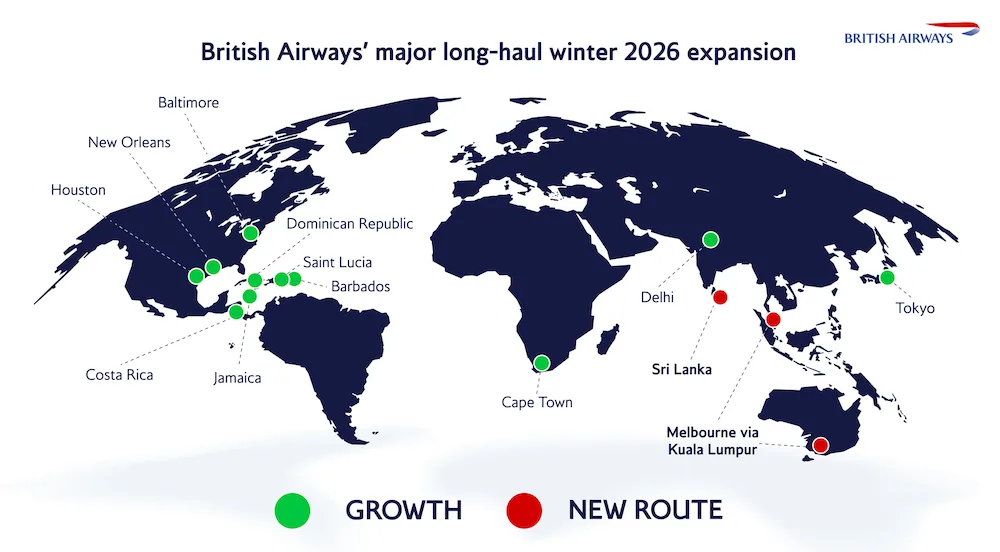
British Airways has announced a significant planned expansion to its network for winter 2026, with the addition of two new destinations, Melbourne in Australia and Colombo in Sri Lanka.  

Follow Aeronews on FacebookTwitterLinkedInBluesky and TikTok

In addition, the airline will be adding more flights for winter to Cape Town (South Africa), Haneda (Tokyo), Bridgetown (Barbados), Kingston (Jamaica) and San Jose (Costa Rica). The new schedule reflects a 9 per cent growth in British Airways’ long-haul route network, as the airline continues to invest in providing more choice for customers.

These planned new routes and frequency growth for winter 2026 is in addition to short-term capacity increases to destinations to meet customer demand, as a result of the situation in the Middle East. British Airways added seven extra return services to Bangkok and Singapore in the last week and will continue to review its schedule and add additional flights to destinations as needed.

Demand for travel continues to remain strong, and as customers look for alternative holiday destinations in the immediate term, British Airways Holidays has seen a rise in searches for popular destinations like Antigua and Gran Canaria, which have increased by 63% and 50% respectively.


Melbourne, Australia 

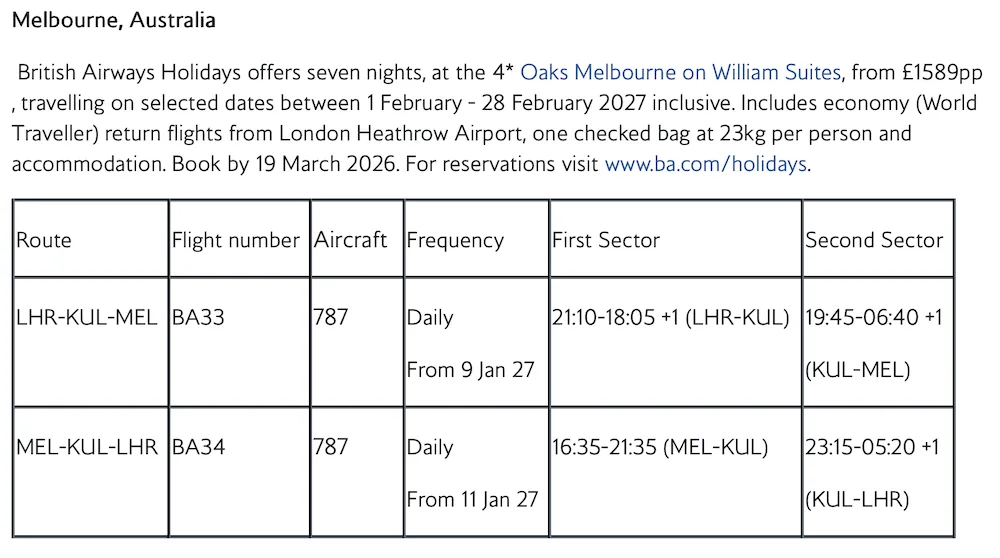
British Airways will commence flights to Melbourne in Australia from 9 January 2027, launching in time for the Australian Open and the Melbourne Grand Prix. Flights will operate year-round from London Heathrow, via Kuala Lumpur, on a daily basis.

Customers have a choice of 4 cabins – World Traveller (economy), World Traveller Plus (premium economy), Club World (business class) and First. Return fares start from £1,130 (including taxes and carrier fees) and are on sale from 17 March.


Colombo, Sri Lanka 

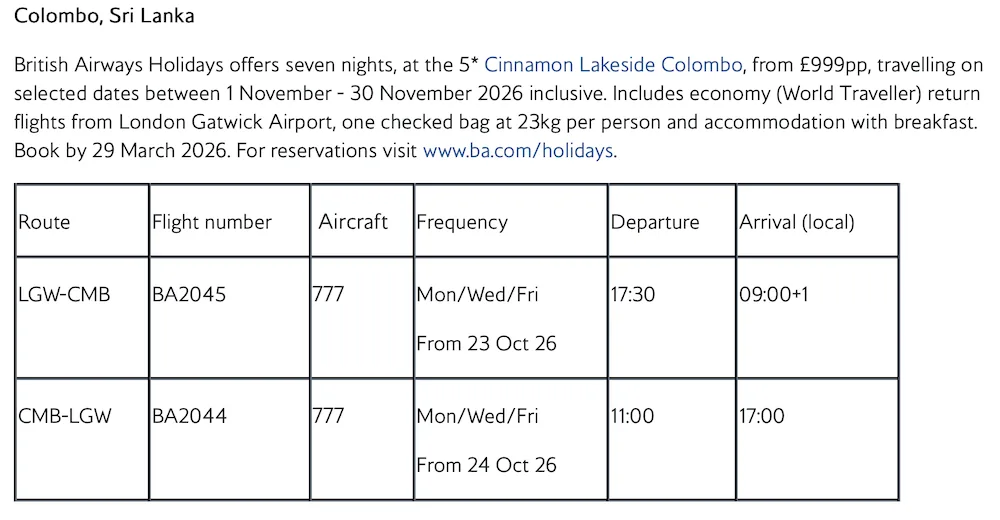
Launching on 23 October 2026, British Airways will fly three times per week from London Gatwick to Colombo, the vibrant gateway to Sri Lanka. The route will operate for the winter season only.

Customers have a choice of 3 cabins – World Traveller (economy), World Traveller Plus (premium economy) and Club World (business class). Return fares start from £620 (including taxes and carrier fees) and are on sale from 17 March.

Energy security: Time to move from rhetoric to action

March 19th, 2026

Courtesy The Daily Mirror

Energy security is a topic that has been discussed for years, if not decades. It is sensible for any government, policymakers and independent analysts to engage in it. Indeed, reams have been written on the subject. Still, rhetoric has not been translated into action here, and Sri Lanka remains highly vulnerable to external shocks.

With the Middle East war, triggered after the US-Israel attack on Iran, continuing to rage, Sri Lanka – which entirely imports its fuel requirements – feels the importance of energy security more than ever. Nevertheless, this is not the first time the issue has been felt acutely. It was experienced in the worst manner during the pandemic. Oil price surges have had a cascading effect on the local economy at different points in history.

Today, oil prices have spiked in the global market following disruptions in the Strait of Hormuz, the narrow sea lane responsible for the transfer of one-fifth of global oil production. Gulf nations have cut down production. The end result is a price hike that leaves the global economy reeling under its impact.

For Sri Lanka, the lack of refinery and storage facilities has been a longstanding concern. The development of the 99 tanks, built during World War II under British colonial rule, has been a focal point in ensuring the country’s energy security. Cabinet Spokesman and Health Minister Nalinda Jayatissa has emphasised that the Government has a clear and strategic vision for the development of Trincomalee’s energy infrastructure, a project initiated as far back as 2003.

Fourteen out of the 99-tank complex have been given to Indian Oil Corporation for use by Lanka IOC. Another 61 tanks are under a joint venture between the Ceylon Petroleum Corporation and Indian Oil Corporation, formed during the tenure of Gotabaya Rajapaksa. Earlier, Energy Minister Kumara Jayakodi said the Government was carrying out preliminary work in this regard.

Energy connectivity is, in fact, one of the pillars of the proposed Sri Lanka-India partnership. A tripartite agreement has been signed among India, Sri Lanka and the United Arab Emirates (UAE) for the laying of a multi-product pipeline between the two countries, with Trincomalee earmarked as a petroleum hub. Sri Lanka’s annual fuel requirement stands at 42.16 million barrels, while storage capacity is around 150,000 tonnes. Proponents of Sri Lanka-India connectivity argue that a pipeline enabling two-way fuel delivery would strengthen the country’s energy security. They point out that Sri Lanka’s annual requirement is only a tiny fraction of India’s consumption – equivalent to less than ten days of its needs.

This has been highlighted in the ‘Study Group Report on India-Sri Lanka Physical Connectivity’ by the Pathfinder Foundation, headed by former Sri Lanka’s High Commissioner to India, Milinda Moragoda.

It is time for the Government to move from rhetoric to action. The current rulers, when in Opposition, were vociferous critics of Indian involvement in the development of the Trincomalee oil tank farm. Now in office, they support the project. Setting aside politics, the merits of the project should be carefully considered.

Likewise, the Government made much fanfare about securing the single largest foreign direct investment (FDI) when it signed a memorandum of understanding with Chinese authorities for a refinery in the Hambantota district by Sinopec. The proposed investment marks one of the most significant FDIs in Sri Lanka’s recent history. It involves a US$ 3.7 billion oil refinery in Hambantota, envisioned as an export-oriented facility with a capacity of around 200,000 barrels per day. The project is expected to enhance Sri Lanka’s position along key global shipping routes while reducing its dependence on imported refined fuel. However, more than a year has passed since the MoU was signed, and the project has yet to get off the ground.

Both projects involving India and China are vital for Sri Lanka’s energy security. What is needed now is decisive government action to iron out any shortcomings.

At the same time, the Government should intensify its focus on developing the renewable energy sector. The world is increasingly reducing its dependence on fossil fuels, and the Middle East conflict will only heighten concerns about energy insecurity. Countries are likely to accelerate their shift towards renewable energy. Sri Lanka is well endowed with wind and solar resources – two key sources of renewable energy.

The Government must clear the bottlenecks that are throttling the development of the energy sector. This is not the time for mere talk, but for decisive action.

Sri Lanka among world’s least Happy Nations in 2026 report

March 19th, 2026

Courtesy The Daily Mirror

March 19 (Daily Mirror) – Sri Lanka has been ranked among the least happy countries in the latest World Happiness Report 2026, placing 134th out of 147 nations with a score of 4.0, highlighting ongoing concerns over the country’s overall well-being.

The report shows that Sri Lanka has slipped one place from its 133rd ranking in 2025, now standing alongside Ethiopia. The country also trails behind its South Asian neighbours, with India ranked 116th, Pakistan and Bangladesh positioned significantly higher.

The World Happiness Report 2026, released on Thursday (March 18), notes that social and economic challenges continue to weigh on nations placed in the lower tier, with Sri Lanka remaining among those struggling to improve public satisfaction and quality of life.

A key focus of this year’s report is the growing impact of social media on well-being, particularly among young people. The study, backed by the United Nations, found that excessive social media use is contributing to declining life satisfaction in many countries, prompting governments to consider regulatory measures.

At the top of the rankings, Finland retained its position as the world’s happiest country for the ninth consecutive year, followed by Iceland and Denmark. Costa Rica emerged as a standout performer, climbing to fourth place — the highest ever ranking achieved by a Latin American nation.

The report also highlighted a sharp decline in life satisfaction among people under 25 in countries such as the United States, Canada, Australia and New Zealand, attributing the trend largely to increased time spent on social media platforms. In contrast, young people in several other regions reported more positive outlooks on life.

US envoy Sergio Gor meets Dissanayake, pushes for stronger ties in Indian Ocean region

March 19th, 2026

Courtesy The Telegraph India

‘Discussions focused on strengthening bilateral ties and Sri Lanka’s position on the Middle East conflict and its challenges,’ the President’s Media Division (PMD) says in a post on X

The US Special Representative for South and Central Asia Sergio Gor and Sri Lanka President Anura Kumara Dissanayake on Thursday discussed strengthening of bilateral relations and the island nation’s position on the West Asia crisis.

The US Special envoys’ visit to Sri Lanka comes at a time when Sri Lanka came to be embroiled in the joint US-Israeli war against Iran since February 28.

Gor met with Dissanayake at the Presidential Secretariat as part of US efforts to safeguard vital sea lanes and secure ports, reinforce mutually beneficial trade and commercial ties, and advance a free, open, and prosperous Indo-Pacific for the benefit of both our peoples,” a release from the US Pacific Command said.

Gor and Dissanayake’s discussions focused on strengthening bilateral ties and Sri Lanka’s position on the Middle East conflict and its challenges,” the President’s Media Division (PMD) said in a post on X.

The US Special envoy will also travel to Maldives after Sri Lanka in the 5-day visit for high-level engagements focused on advancing cooperation in the Indian Ocean Region (IOR).

On March 4, the US torpedoed the Iranian frigate Iris Dena killing 84 sailors while 32 escaped. Two days later, a second Iranian vessel, Iris Bushehr, sought entry to Colombo port with 219 sailors.

Sri Lanka asked the vessel to be diverted to the eastern port of Trincomalee from its anchor outside the port here. A total of 204 of the sailors are now accommodated at the Naval facility near Colombo.

Except for the headline, this story has not been edited by The Telegraph Online staff and has been published from a syndicated feed.

Shawwal moon not sighted; Ramadan to complete 30 days

March 19th, 2026

Courtesy The Daily Mirror

Colombo, March 19 (Daily Mirror) – The crescent moon marking the beginning of the Islamic month of Shawwal was not sighted on Thursday (March 19), according to official announcements.

The Hilal Committee of the All Ceylon Jamiyyathul Ulama (ACJU), together with the Colombo Grand Mosque and the Department of Muslim Religious and Cultural Affairs, confirmed that no verified sightings were reported from across the country.

Accordingly, it was unanimously declared that the month of Ramadan 1447 Hijri will complete 30 days.

The new month of Shawwal will therefore commence on Saturday, March 21, 2026.

Ex-SriLankan CEO claims he was threatened to involve Mahinda and Namal’s names

March 19th, 2026

Courtesy The Daily Mirror

Colombo, March 19 (Daily Mirror) – Lawyers for former SriLankan Airlines CEO Kapila Chandrasena have released an affidavit stating that his earlier statement to the Commission to Investigate Allegations of Bribery or Corruption was obtained under alleged intimidation and he was threatened to include the names of former President Mahinda Rajapaksa and MP Namal Rajapaksa in his statement.

Earlier, the Commission to Investigate Allegations of Bribery or Corruption informed the Colombo Magistrate’s Court that Kapila Chandrasena had stated, in a statement to the Commission, that a sum of Rs. 60 million received as a bribe in the controversial 2016 Airbus transaction was handed over to then President Mahinda Rajapaksa.

The Commission to Investigate Allegations of Bribery or Corruption informed court that, according to the statement by the suspect, a sum of Rs. 60 million that he had received was allegedly paid in three instalments to former President Mahinda Rajapaksa, while a further sum of Rs. 20 million had been given to former Civil Aviation Minister Priyankara Jayaratne.

In the affidavit dated March 18, Chandrasena claimed that his statement to the Commission was not given voluntarily. He alleged that he was taken out of the recording room during questioning and threatened by officials, including the Director General of the Commission.

According to the affidavit, Kapila Chandrasena stated that any references in his statement to former President Mahinda Rajapaksa and MP Namal Rajapaksa, over their alleged influence, or any improper financial involvement in the SriLankan Airlines Airbus transaction, were not made voluntarily.

He claimed that such statements were obtained under intimidation and threats, alleging that officials, including the Director General of the Commission to Investigate Allegations of Bribery or Corruption, created a fear for his life and coerced him into making those claims.

Sri Lankan people need to stand with the suffering people of Iran and Israel, and support democracy and humanity – I

March 18th, 2026

By Rohana R. Wasala 

When you change the way you look at things, the things you look at change.

  • Max Planck (1918 Nobel Laureate in Physics, German physicist and pioneer of the Quantum Theory)

(Caveat: Please consider that mine is not meant to be the last word on the subject of this essay. – RRW)

 Chinese-Canadian Jiang Xueqin (aka Professor Jiang/PredictiveHistory) is a globally popular YouTuber equipped with a Yale University BA in English Literature. He is an educator, education reformer and writer based in Beijing, China. Professor Jiang is widely known for his astute geopolitical predictions. One of the latest of his vodcasts that I have viewed was uploaded March 3, 2026. In its first 3 days alone, it had been watched or listened to by over 5.75 million viewers (that is, by March 6, the day that I checked out Jiang’s ‘PredictiveHistory’ YouTube channel). The host introduced him as having made three significant predictions in 2024: 1) that (Donald) Trump would win (the US presidential election), 2) that he (as president) would start a war with Iran, and 3) that the US would lose that war, which would change the global order. As we know, the first two forecasts have already come true. And the third, which is of real global transitional significance, is apparently moving towards fulfillment. Jiang has added to the plausibility of his third forecast in this context in a more recent (seemingly autodubbed) video by claiming that the killing of the 86 year old Supreme Leader Ali Khamenei of the Islamic Republic of Iran along with his close family relatives has immensely empowered him as an Islamic martyr (of the Shiite sect), which will powerfully militate against an American victory over Iran. 

To ordinary observers, it appears that Iran’s success against America may also look possible, particularly in view of its strategic adoption of low-cost drone warfare designed to overwhelm the expensive air defenses mounted by the US-Israeli combine, the growing risk of regional (even global) escalation of the conflict, the increasing economic strain on energy checkpoints like the Strait of Hormuz (through which roughly 20% of the world’s petroleum passes), and Trump’s own infamously eccentric, unconventional, ‘strongman’ approach as the leader of the world’s only Superpower to the long simmering US-Iran confrontation (since 1979)  backed by his ingrained, careless, impulsive, unpredictable, highly narcissistic personality. But, if Jiang’s third prophecy in 2024 comes to pass, there won’t be anything in it for Iranians to celebrate unless the predicted Iranian success against America leads to the Iranian people’s liberation from the tight clutches of the despotic ruling mullah minority. 

According to the latest ‘Iran International’ reports, the brutal crackdown on domestic Iranian protesters emboldened by a catastrophic economic collapse and the attendant sharp depreciation of the Iranian Rial and soaring inflation has already killed an estimated 36,500 of them, including fresh young men and women still in their teens demanding democracy and freedom. That’s not a scenario that will favour an Iranian victory over America, which will mean a continuation of the hellish status quo. The Saturday March 14 bombardment of the Kharg island by America marked a dangerous escalation of the war with disastrous economic implications for Iran. President Trump boasted on his ‘Truth Social’ website that America had executed one of the most powerful bombing raids in the history of the Middle East, and totally obliterated every MILITARY target in Iran’s crown jewel, Kharg Island”. But the attack spared the Iranian oil export facilities on the small island which is vital to Iran’s economy since it is the central oil terminal through which 90% of the country’s oil exports are shipped to foreign destinations. Trump has threatened to hit the oil facilities if Iran continues to obstruct shipping in the Strait of Hormuz. He might even consider taking over the Kharg island if necessary, he warned. Iran has vowed retaliation.

Israeli prime minister Benjamin Netanyahu, for his part, expressed his determination to create conditions within Iran for Iranian people to topple the oppressive theocracy of the mullahs. Responding to media queries on Thursday March 12, 2026, an exhausted Netanyahu said: 

This is no longer the same Iran. This is no longer the same Middle East, or this is also not the same Israel. We are not waiting, we are initiating, attacking and we are doing so with a force the like of which has not been seen before. I have added another goal to create the conditions for the Iranian people to overthrow this terrible tyrannical regime. (However) to create conditions doesn’t guarantee that (this) will happen…..”. 

About two years ago, speaking at the opening ceremony for Holocaust Martyrs’ and Heroes’ Remembrance Day in Jerusalem on May 5, 2024 (seven months after the deadly coordinated attack by members of Hamas and affiliated Islamist groups on kibbutzim in southern Israel, which started the current conflict) stated: 

Today we again confront enemies bent on our destruction. I say to the leaders of the world, no amount of pressure, no decision by any international forum, will stop Israel from defending itself. As the prime minister of Israel, the one and only Jewish state, I pledge (to) you today from Jerusalem on this Holocaust Remembrance Day, if Israel is forced to stand alone, Israel will stand alone. But we know we are not alone, because countless decent people around the world support our just cause and I say to you, we will defeat our genocidal enemies”.  (‘Today we again confront enemies bent on….’ harks back to the 1941-1945 Nazi Holocaust of European Jews.)

IDF (Israel Defence Forces) army reservist and military journalist (presenter of the ‘Boots on the Ground’ program) Yair Pinto of TBNIsrael reported in a newsbreak headlined Israel Suffers Enormous Cost Exterminating Iran’s Terror Empire” on March 14, 2026:

Everyday since the beginning of the Lion’s Roar war or its American name Epic Fury, heavy explosions have been heard over Tehran in Iran. Every piece of the Revolutionary Guard’s infrastructure in Iran has been bombed. Two rounds of senior revolutionary guards have been eliminated and even the Supreme Leader of the Revolutionary Guard, the most important figure, was terminated in the first hours of the opening of this war, and the United States and Israel brought in all the heavy forces from the news (sic) and the most advanced fighter jets in the world including American B2 bombers and their companion in this arena the B1, and also the B52 and in addition a third aircraft carrier is on its way to the region and as we are speaking while two much larger aircraft carriers are already here in the    middle East and in the state of non-stop attacks day and night, not to mention American nuclear submarines, warships that look like they come out of a science fiction movie. This is including a firepower that is beyond the imagination ……. The United States and Israel are ……. dismantling layer after layer the systems that keep the (Islamic) Revolutionary Guard (Corps) standing. So if that is what is happening in the skies, at the sea, and on the ground, how much longer can the Revolutionary Guard (IRGC) in Iran hold on?”

Pete Hegseth is at present the head of the United States military. Sworn in as the Secretary of Defense under President Donald Trump on January 25, 2025, he is now called the Secretary of War. This is after the rebranding in September 2025 of the Department of Defense that he heads as the Department of War. The renaming of the defence department was meant to ‘emphasize military strength and resolve’. Secretary Of War Hegseth oversees all the United States Armed Forces. During a press briefing at the Pentagon on March 2, 2026, accompanied by the Chairman of the Joint Chiefs of Staff Gen. Dan Caine, Hegseth,  after inaugural remarks, said:

For 47 long years, the expansionist and Islamist regime in Tehran has waged a savage one-sided war against America. They didn’t always declare it openly, except for their constant chants of Death to America”; they did it through the blood of our people, car bombs in Beirut……… roadside bombs in Iraq and Afghanistan. …………………… We didn’t start this war, but under President Trump, we are finishing it. Their war on Americans has become our retribution against their Ayatollah and his death cult……”

Towards the end of his introductory address, Secretary Hegseth stated:

To the media outlets and political left screaming “endless wars,” stop. This is not Iraq. This is not endless. I was there for both. Our generation knows better and so does this President. He called the last 20 years of nation building wars dumb, and he’s right. This is the opposite.

This operation is a clear, devastating, decisive mission: destroy the missile threat, destroy the navy, no nukes. Israel has clear missions as well for which we are grateful, capable partners, as we’ve said since the beginning, capable partners are good partners, unlike so many of our traditional allies who wring their hands and clutch their pearls, hemming and hawing about the use of force.

America, regardless of what so-called international institutions say, is unleashing the most lethal and precise air power campaign in history. B-2s, fighters, drones, missiles, and of course classified effects. All on our terms with maximum authorities. No stupid rules of engagement, no nation-building quagmire, no democracy building exercise, no politically correct wars. We fight to win, and we don’t waste time or lives.

As the President warned, an effort of this scope will include casualties. War is hell and always will be. A grateful nation honors the four Americans we have lost thus far and those injured, the absolute best of America.

May we prosecute the remainder of this operation in a manner that honors them. No apologies, no hesitation, epic fury for them and the thousands of Americans before them taken too soon by Iranian radicals”. (Quoted from an official website of the US Department of War accessed March 15, 2026)

.Announcing the launch of Operation Epic Fury against Iran on February 28, President Donald Trump said, anticipating Hegseth’s charges against Iran’s Islamist hostility towards America: 

Our objective is to defend the American people by eliminating imminent threats from the Iranian regime, a vicious group of very hard, terrible people … .Its menacing activities directly endangered the United States, our troops, our bases overseas, and our allies throughout the world. For 47 years the Iranian regime has chanted ‘Death to America!’ and waged an unending campaign of bloodshed and mass murder, targeting the United States, our troops, and the innocent people in many many countries…..”. 

President Trump mentioned at random a number of examples of such atrocities including the (1979) violent takeover of the American embassy in Tehran holding dozens of hostages for 444 days. (This happened in November 1979. Young Anti-American Iranian militants were demanding the return for trial in Iran of the ousted Shah of Iran from the US where he was living in exile.) Trump remembered how in 1983 Iranian proxies (supposedly, an early iteration of Hizbullah) carried out the Marine barracks bombings (in Beirut, Lebanon) that killed 241 American military personnel; he also mentioned the attack on the (guided missile destroyer) USS Cole (by Al-Qaeda terrorists in the Yemeni port of Aden on October 12, 2000) that killed many (Actually, that attack left 17 sailors dead and 39 others injured).

Here President Trump was touching on the bloody history of 47 years of Iranian violence (not universally unprovoked, though) against America (1979-2026). The conflict has a religious appearance on the face of it (which, nevertheless, is also a most potent factor). But it is fuelled more by secular political, military and economic interests rather than by religious ideological differences. In fact, the America-Iran conflict at the regime level had had a near 30 year incubation period by 1979. In 1953, the democratically elected prime minister of Iran (1951-53) Mohammad Mosaddegh was overthrown by an American CIA and British M16-backed coup, making way for the Shah to be back on the throne. This was done by America with British support for nothing more exalted than the hunger for cheap oil, which even today seems to provide the fundamental driving force of the ongoing America-Israel joint campaign against Iran. The religion-based genocidal hatred of Iran’s current rulers and its proxies (Hamas, Hizbullah, etc) towards Israel and America gives moral legitimacy to that campaign in the eyes of the decent people around the world.

 It is ironic that the ‘great Satan’ (America) that toppled Iranian democracy in 1953 and installed the authoritarian Shah back in power is now, in partnership with ‘the little Satan’ (Israel), engineering a regime change involving a return to democracy and modernity free from rigid religious dominance over governance. While missile strikes on Tehran were going on (as shown in videos released by the US), Prime Minister Netanyahu declared (March 10) that they are ‘breaking the bones of the Iranian terror regime’. Be that as it may, there is more to this irony: Iran itself was once in a triangular strategic partnership with America and Israel! 

To be continued

An Indian Ocean Tragedy: Time to Close US-UK-France Military Bases, Decolonize and Stop War

March 18th, 2026

By Darini Rajasingham Senanayake*

InDepthNews2026-03-17

COLOMBO, Sri Lanka | 17 March 2026 (IDN) —The bodies of eighty-four Iranian sailors who died in a US torpedo attack in the seas of Sri Lanka were repatriated yesterday, 13 March 2026.  Describing the scene of the rescue of some of the sailors who survived the dastardly attack, the Sri Lanka Navy Commander Buddhika Sampath said that the boats that reached the location of the distress call on March 4 had observed only an oil slick.

In Washington, Donald Trump and his War Secretary had boasted that they had finished off the Iranian Navy. An American submarine sank an Iranian warship that thought it was ​safe in international waters,” U.S. Defense Secretary Pete Hegseth said at the Pentagon. Instead, it was sunk by a torpedo. Quiet death.”

We found people floating in the water and rescued them,” Sri Lankan Navy officer Sampath told reporters. Later on, we found upon inquiring that they belonged to the Iranian ship.”

The sunken IRIS Dena was unarmed, having just participated in the International Fleet Review in India’s Nagapatnam. Had the Colombo regime of President Anura Kumara Dissanayaka not delayed, like the Modi regime in India, in providing safe harbour to the IRIS Dena due to US pressure, the war crime would likely not have happened in the island’s maritime Exclusive Economic Zone.

Subsequently, a second Iranian Ship was given harbour in Sri Lanka, enabling the Colombo regime to play up its humanitarian role while citing UNCLOS and wearing a Mask of Neutrality.

Environmental Damage

A couple of days after the sinking of IRIS Dena, fishers and coastal communities in Hikkaduwa, Galle, and Unawatuna noticed a thick oil patch along the coast, impacting the island nation’s coastal economy, fisheries, and tourism. These are some of the most pristine coastal belts in the south of Sri Lanka, frequented by tourists throughout the year with a peak tourism season from December to March.

It is increasingly clear that a proper inquiry must be held into the sinking of the Iranian ship and response, as well as an environmental damage impact assessment. If responsible for environmental damage, the United States must pay reparations to Sri Lanka for harm caused to the fisheries’ livelihoods and the Tourist sector by the sinking of an unarmed Iranian ship in Sri Lanka’s maritime Exclusive Economic Zone. The new spiritual leader of Iran has stated that the US and Israel must pay reparations for the war they started.

The US is in the Atlantic and Pacific Oceans, and has no right to bring its environment-polluting war machine to the Indian Ocean. The US should return it war toys to the Atlantic Ocean and remove all its military bases from the Indian Ocean. So too are its NATO partners, the UK and France.

Peace Campaign needed

India, despite aspiring to lead the Global South, has failed to liberate the Indian Ocean from Euro-American neocolonialism and military bases, having fallen prey to Euro-American Imperialist Divide-and-Rule narratives and policies —fearing the Rise of China and the CIA’s String of Pearls”.

Hence, it is increasingly clear that small Indian Ocean littoral states and islands need a people’s Peace Campaign to demand the closure of US-UK-French neocolonial military bases and to demilitarise and decolonise the Indian Ocean Region.

The US war machine uses the huge Diego Garcia military base on the occupied Chagos Islands, not far from the Maldive Islands and Sri Lanka to stage attacks in it war of aggression on Iran and to wage hybrid economic warfare on Rising Asian and Indian Ocean countries, particularly South and Southeast Asia.

Geoengineering and weather warfare in the Indian Ocean and the use of Weather as a force Multiplier’ on emerging South and Southeast Asian countries to Make the Economy Scream” like the Ditwah Twister storms that hit Sri Lanka and Aceh, Indonesia last December are apparent at this time. Staged Environmental disasters are reminiscent of ‘Operation Popeye’ during the Vietnam War which gave rise to the Environmental Modification Technologies Treaty or the ENMOD treaty.

Previously, the 2004 Christmas/Boxing Day Earthquake and the Indian Ocean Tsunami destroyed coastal areas in the same countries of the Indian Ocean World. A pattern of ‘plausibly deniable’ hybrid economic warfare against emerging South and Southeast Asian economies in the Indian Ocean is apparent, also targeting China’s Maritime Silk Road and Belt and Road Initiative (BRI) for global trade and connectivity.

US-Israeli Aggression Spreading in the Indian Ocean

Once upon a time, the Indian Ocean was called a ‘British Lake’ or Pond, when ‘Britannia Ruled the Waves’. Now increasingly, Israelis have set up the Chabad Lubovitch ‘Spider web’ across Sri Lanka, which is front and centre of the Indian Ocean on the world’s busiest trade, energy and submarine Data cable route. So too, Israeli settlements have targeted the Indian Ocean world’s tourist hotspots in environmentally vulnerable coastal areas and mountain tops– also to stage ‘climate disasters’. Meanwhile, Israeli surfers claim they ‘own the waves’ in Arugam Bay on the East Coast of Sri Lanka!

The US-UK’s Occupation of the Chagos Islands, where there is a huge military base, Diego Garcia, which is located near the Maldives and Sri Lanka, was ruled illegal under international law by the International Court of Justice (ICJ) in February 2019.  

The Diego Garcia military base is not far from the place where a US Submarine attacked the Iranian Frigate ISIS Dena, killing 87 sailors and causing environmental damage in Sri Lanka’s Exclusive Economic Zone.

The US and its NATO partners have more than 800 military bases around the world– to stage regime change operations, kinetic and culture wars, hybrid economic and weather warfare, with Digital Surveillance to control populations, including Stalink. The military bases gather data and intelligence to surveil and control populations, and destabilize countries, economies and societies that refuse to tow the Globalist Agenda in order to maintain Independent and Sovereign policy making.

Although not an Indian Ocean country, France has claimed more than 10 per cent of the total Indian Ocean surface and a large portion of the seabed as its Exclusive Economic Zone (EEZ) under UNCLOS!!.[i]

France uses small islands it colonised centuries ago scattered in the Indian Ocean as military bases and to loot the region’s fisheries resources. France and Spain, with huge industrialised fisheries trawler fleets, along with Japan, Taiwan, and China, are the biggest Ocean Grabbers of the Indian Ocean fishery.

These industrialized Distant Water Fishing States deprive impoverished Indian Ocean littoral communities of their ocean resources, according to the Indian Ocean Tuna Commission (IOTC) Data. It is hence too that British, French and US military bases in the Indian Ocean should be shut down and the Indian Ocean decolonised to enable impoverished littoral communities to harvest their marine resources.

At this time, the US-Israeli war of aggression on Iran is spreading across the Indian Ocean World, which must be liberated from past and present US-UK-French military bases, occupation, and neocolonialism to end their exploitation of Indian Ocean fisheries and mineral resources.

The US, UK, French (NATO) war machine, which is highly environmentally polluting, must be expelled from the Indian Ocean and sent back to the Atlantic Ocean, where they belong. These imperialist and neocolonial countries have a terrible habit of waging war in other people’s lands and seas, causing massive environmental pollution.

Is it not time for the people of the Indian Ocean World, particularly small islands, to call for an end to US-UK-French neocolonial occupation, aggression and Hybrid Economic warfare against the Rise of Asian economies, particularly South and Southeast Asia, in what Singapore academic Kishore Mabubani termed ‘the Asian 21st Century’?

The Indian Ocean must be decolonised so that its rich resources may be sustainably harvested and used by Indian Ocean littoral countries and people, many of whom are dirt poor.

*Dr Darini Rajasingham-Senanayake is a social and medical anthropologist with expertise in international development and political-economic analysis. She was a member of the International Steering Group of the North-South Institute project: Southern Perspectives on Reform of the International Aid Architecture”. [IDN-InDepthNews]

Please listen to this presentation and share: The Indian Ocean as a Zone of Peace, free of Militarization https://www.youtube.com/watch?v=QqV44gItEQ4

[i] https://www.orfonline.org/expert-speak/india-and-france-in-the-indian-ocean

Published at INDepth News. https://indepthnews.net/an-indian-ocean-tragedy-time-to-close-us-uk-france-military-bases-decolonize-and-stop-war/

INDIA IS JOINED AT THE HIP WITH USA AND ISRAEL-

March 18th, 2026

Political Review

SHOULD SRI LANKA BLINDLY FOLLOW INDIA AS NPP SEEMS TO BE DOING PRESENTLY?

What made Modhi to rush to Israel on Feb 26th, just two days prior to joint offensive by USA and Israel on Iran?

Since 2024, Israel started investing more in India, with many defense companies establishing subsidiaries there. ….With those shifts to a mix of purchases and joint industrial long-term partnerships in defense production  (have sprung up)…, a spike in defense deals is expected ….. in 2026…..A variety of cyber, artificial intelligence, and even quantum joint ventures are also expected to be launched as part of Modi’s visit”  – Jerusalem Post.

Netanyahu had been crying wolf for over 30 years about Iran’s nuclear program, and finally on June 25th 2025, USA and Israel attacked Iran’s nuclear processing sites (Did USA join in under blackmail on Trump’s connections to Epstein?).

Since the above attack Iran went on an accelerated production program of missiles and drones. Israel with its excellent intelligence service Mossad, was quick to get to know that Iran was developing a formidable drone and missile program, and Netanyahu got cold feet. Longer it waits longer the danger …

As a result, since the June 2025 war Netanyahu visited Trump 4 times. In December, Netanyahu went to Mara-la-go to meet Trump. According to Alstair Crooke (the former British Diplomat and military analyst), Netanyahu told Trump, this time it is serious, it is not about (the false wolf) the nuclear program anymore. It concerns – the real wolf – Iran’s drone and missile program which is very advanced.

Netanyahu’s Position: If Iran is not attacked immediately, it will get extremely serious as the future unfolds. Trump was reluctant, he wanted to have a show of force – like bringing the aircraft carrier Abraham Lincoln from the far east and get Iranians to the negotiating table. Iranians complied and had serious negotiations in Oman, agreed to US terms on their nuclear program – NO NUCLEAR WEAPONS. Oman announced that there was a deal.

Netanyahu rushed to Washington again, and forced Trump to cancel the deal. Threatened that if USA did not join in with Israel to attack Iran, then Israel will go it alone. And asked, then what will USA do? If they did not, then Trumps govt will become very unpopular with the US people. With this arm twisting Israel coerced USA to join the war. This is why Marco Rubio, US Secretary of State said they were forced to this situation by Israel. Secretary of State Marco Rubio stated that the U.S. launched strikes against Iran because it knew Israel was planning a unilateral attack. Rubio argued that an Israeli strike would have “precipitated” an immediate Iranian retaliation against American forces in the region. He characterized the U.S. action as a “proactively defensive” move to prevent higher American casualties that would have occurred if the U.S. waited to “absorb a blow” before responding. 

It is against the above context that we need to figure out India’s (Modi’s) role in the present situation. It was after Netanyahu had forced Trump to agree to attack Iran on Feb 28th, that Modhi visited Israel on Feb 26th and addressed the Knesset.  Besides India being a long time member of the Quad, and had been procuring military hardware from USA and Israel, India had not been a supplier of these items in any significant way until 2025.

In the second week of February 2026, Modhi visited Trump. The outcome is for India to become a subcontractor in the manufacture of military hardware for USA and its allies. Here is the report: https://defensescoop.com/2025/02/14/trump-modi-announce-us-india-autonomous-systems-industry-alliance/

These are what the collaboration between Anduril USA and Mahindra of India are planning to produce:

In February 2025, Anduril Industries and the Mahindra Group announced a strategic partnership to co-develop and co-produce advanced autonomous systems for the Indian market. The collaboration focuses on three primary product categories: 

Mahindra

Key Product Areas

  • Autonomous Maritime Systems: The partnership aims to build fully self-driving submarines (Autonomous Underwater Vehicles or AUVs) designed for surveillance, security, and reconnaissance. These modular systems are intended for rapid deployment in littoral (coastal) and deep-water environments to improve real-time situational awareness.
  • AI-Enabled Counter-UAS (C-UAS) Technology: They are co-producing autonomous aerial systems specifically designed to detect and neutralize unauthorized drones. These technologies aim to protect against spying and attacks from unmanned aerial threats.
  • Command and Control (C2) Software: The joint venture will implement next-generation C2 software to streamline defense operations. A major component is the development of a Sensor Fusion Platform that integrates various sensor technologies into a flexible, open architecture, allowing for faster adoption of new technologies across security programs. 

Strategic Goals

This alliance is part of a broader effort to strengthen regional security in the Indo-Pacific through next-generation autonomous solutions. While Anduril provides the AI and autonomous software (likely based on its Lattice platform), Mahindra leverages its extensive engineering and manufacturing expertise within India. 

=======

Beyond the Anduril-Mahindra partnership, the United States and India have significantly expanded their military co-production through the Initiative on Critical and Emerging Technology (iCET) and the INDUS-X ecosystem. 

Key active and proposed collaborations include:

Major Platforms and Engines

  • GE F414 Jet Engines: GE Aerospace and Hindustan Aeronautics Limited (HAL) are finalizing a deal to jointly produce the F414 engine in India with an 80% transfer of technology. These engines will power India’s indigenous Tejas Mk2 and AMCA fighter jets.
  • Stryker Armoured Vehicles: The U.S. has approved a proposal for India to become the first global co-producer of the 8×8 Stryker combat vehicle. While trials in high-altitude regions like Ladakh faced some performance hurdles, talks for customized Indian variants continue.
  • MQ-9B Predator Drones: India is acquiring 31 MQ-9B drones (15 SeaGuardians and 16 SkyGuardians) from General Atomics for approximately $3.5–$4 billion. The deal includes the assembly of components in India and a partnership with Bharat Forge for global supply chain manufacturing. 

Strategic Frameworks

  • 10-Year Defense Framework (2025–2035): Signed in October 2025, this agreement serves as a cornerstone for regional stability, streamlining tech cooperation and information sharing.
  • Reciprocal Defense Procurement Agreement (RDPA): Both nations are working on an RDPA to simplify the procurement process for Indian defense firms buying supplies from the U.S. and vice-versa. 

Specialized Technology Partnerships

  • Maritime Systems: Boeing’s Liquid Robotics is collaborating with Indian firms to build uncrewed surface vehicles (USV) for enhanced maritime domain awareness.
  • Ammunition and Precision Arms: Recent approvals include the sale and potential support for Javelin anti-tank missiles and Excalibur precision artillery.
  • Maintenance Hubs: The U.S. Navy has signed maintenance and repair (MRO) agreements with Indian shipyards (like Larsen & Toubro and Mazagon Dock) to service U.S. ships in the Indo-Pacific. 

India’s Collaborations with Israel: Here is an interesting article to read:

https://www.jpost.com/israel-news/article-887915

The article ends with: However, by 2024, Israel had started investing more directly in India, with many defense companies establishing subsidiaries there.

With those shifts to a mix of purchases and joint industrial long-term partnerships in defense production, along with the conflicts in Israel and India, the spike in defense deals returned and is expected to crush the old records in 2026.

A variety of cyber, artificial intelligence, and even quantum joint ventures are also expected to be launched as part of Modi’s visit.

These indicate that India will not be an active participant in BRICS any longer.

====================================================================================

This makes us wonder why Anura decided not to participate in the BRICS conference in Russia, and the SCO conference in China. Was he under India’s dictates?

And here is something interesting:

USA assures that India can be their vassal to produce goods for them on the cheap, but have no illusions of becoming a superpower like China.
Read more at:
http://timesofindia.indiatimes.com/articleshow/129101184.cms?utm_source=contentofinterest&utm_medium=text&utm_campaign=cppst

From Crisis to Nation-Building: A Practical Path for Sri Lanka

March 18th, 2026

Dr Sarath Obeysekera

Sri Lanka today faces a moment of quiet urgency. Global conflicts, particularly in the Middle East, are likely to reverse labour flows that have sustained our economy for decades. Thousands of Sri Lankan workers—skilled, semi-skilled, and domestic—may return home within a short span of time. If unprepared, this will strain our economy. If managed wisely, it can transform our nation.

This is not a burden. It is an opportunity.

For years, Sri Lanka has depended heavily on foreign remittances while underutilising its own productive capacity. The return of experienced workers—welders, fabricators, marine technicians, caregivers, and disciplined labourers—presents a rare chance to redirect human capital toward national development.

A National Reconstruction Brigade

Sri Lanka should establish a voluntary, paid National Reconstruction Brigade (NRB). This is not forced labour, nor a revival of rigid ideological systems. Rather, it is a structured programme that channels available manpower into priority sectors: marine services, agriculture, fisheries, construction, and renewable energy.

Participants should include returning migrant workers, unemployed youth, and technical trainees, supported by retired professionals who can offer guidance and supervision. Such a programme would instill discipline, provide income, and create visible national assets.

Unlike the centrally controlled mobilisation seen in the former Soviet Union, Sri Lanka must adopt a modern, incentive-based approach that respects individual freedom while encouraging collective effort.

Port-Led Development: Unlocking Strategic Assets

Sri Lanka’s geographic advantage remains underexploited. Key ports such as Trincomalee, Galle, and Oluvil can serve as engines of growth if developed through transparent public-private partnerships.

Trincomalee, one of the finest natural harbours in the world, is ideal for industrial and energy-related activities. Galle can evolve into a regional hub for яхт services, repairs, and marine tourism. Oluvil, strategically located in the East, can be revitalised as a fisheries and coastal trade centre.

By clustering marine engineering, fabrication yards, and logistics services around these ports, Sri Lanka can generate employment while building export-oriented industries.

Negombo Lagoon: A Marine Opportunity

Closer to Colombo, Negombo Lagoon offers immense untapped potential. With proper planning, it can be transformed into a яхт marina, repair facility, and training centre for marine technicians. This would complement tourism while creating skilled employment aligned with global maritime demand.

Feeding the Nation: Reforming Fisheries

Sri Lanka must also prioritise food security. The fisheries sector, though rich in potential, suffers from fragmentation and inefficiency. Introducing fish collector vessels, cold storage systems, and cooperative ownership models can stabilise supply, reduce waste, and ensure fair income for fishermen.

A nation surrounded by the sea should never struggle to feed its people.

Learning from History

History offers powerful lessons. After World War II, countries like Germany and Japan rebuilt their economies through disciplined labour, industrial focus, and strong institutional frameworks. Their success was not driven by coercion, but by organisation, vision, and accountability.

Sri Lanka had a similar opportunity after the end of the civil conflict in 2009. That moment passed without full realisation. We must not repeat that mistake.

The Role of the Military

The Sri Lankan armed forces possess engineering capability, discipline, and organisational strength. They can support infrastructure development, disaster response, and training programmes. However, their role must remain supportive rather than dominant, ensuring that civilian economic activity continues to lead growth.

Avoiding the Pitfalls of Coercion

Calls for forced mobilisation—whether of transport workers, youth, or informal sector participants—may appear efficient in theory but often lead to inefficiency, resistance, and long-term damage. Similarly, the notion of a benevolent dictatorship” is fraught with risk; history shows that concentrated power rarely remains benevolent.

Sri Lanka must instead pursue disciplined democracy—firm leadership guided by transparency, accountability, and professional expertise.

A Structured National Effort

What is needed is a National Economic Council comprising experienced professionals, policymakers, and industry leaders to guide a 10-year development strategy. Clear targets, measurable outcomes, and incentive-based participation can align the nation toward common goals.

Conclusion

Sri Lanka does not lack talent or resilience. It lacks coordination and direction.

The return of migrant workers, combined with a structured national programme, can revitalise key sectors, strengthen food security, and reduce dependence on imports. This is a moment to convert uncertainty into progress.

At this stage in life, many experienced Sri Lankans may feel they have little to contribute physically. But their knowledge, guidance, and voice are invaluable. Nation-building is not only the work of the young—it is the responsibility of all generations.

If we act with clarity and purpose, Sri Lanka can emerge stronger from global instability—not as a victim of circumstance, but as a nation that chose to rebuild itself.

Regards

Dr Sarath Obeysekera

Iran shut down Israel’s only international airport in under two minutes

March 18th, 2026

Frum Report

Farewell, my departed classmates…. 

March 18th, 2026

Nava Thakuria

It was shocking and heart-breaking news even for an emotionless creature like me. Within a few days, we have lost at least three AECian friends because of  ailments. Their untimely demise was highlighted and  mourned in the whatsapp group (created for the 1985-90 batch of Assam Engineering College, under Gauhati University). I just became clueless how to address the emotional issue. Should I write an obituary (being a professional journalist, that’s an easy job for me), but it was too painful and difficult to pen any article about our classmates, with whom we stayed in a serene AEC campus in Jalukbari behind a hill to Gauhati University campus. We all arrived in the prestigious institutions with a lot of dreams and left the campus with commitments  to our family,  society and nation. My journey got deflected after the college days as I started working for an Assamese daily newspaper from Guwahati in far eastern Bharat/India. An accidental decision changed my entire working life till attaining the retirement age.

My  busy and cramped lifestyle (often turns unproductive!) shattered when the information about Jyotiprakash Kurmi’s sudden death flashed in the social media group.  Kurmi, a tall and handsome guy with decent attire, was my branch-mate and I remember our days from classrooms to mechanical workshops to numerous hostel 7 moments. We used to attend the classes where many acclaimed professors including our Principal sir (Dr Aparna K Padmapati) guided us to solve mechanical problems from the boring textbooks.  He was a rational student and always maintained with us as a soft spoken gentleman. Kurmi lost his battles with recently diagnosed kidney ailments. Days back, Kamal Das left this world after living with a prolonged post-accident disaster, where the smiling chap lost his usual brainstorm for months. Another companion Sugyan Dutta died after battling serious diseases a few months back. Even when it appeared that his days were numbered because of complicated health issues,  Sugyan  called me, but never described his painful moments. Rather he had a whole lot of complaints about my profession!

Years back, we lost two AECian classmates as  Sandeep Goel breathed his last after fighting severe sickness. He  was intelligent and  largely sober. Unlike me, Sandeep  used to speak when it became  necessary. A serious student who later improved himself as a successful professional and finally Sandeep grew as an adorable family man. Another depressing news within a week saddened us with the demise of Gunagovinda Buragohain. Guna was my hostel-mate and we faced initial troubled days on the college campus. A jolly man, Guna was so simple, well behaved and friendly in nature. I often recollect the memories of college days,  rushing to classes in the morning hours and reaching Sundarbari market for evening tea and snakes. Occasionally we went to discover Guwahati from different dimensions and very often we failed in our adventures, but Guna remains optimistic all the time.

Soon after leaving the college, I opted to work in a newspaper (my gratitude to AEC Professor Dr Surendra Nath Medhi and Natun Dainik’s founding editor Chandra Prasad Saikia). Our college-mate Pradip Medhi, who was looking for a good job at that time, used to meet me at the press club premises. He was critical and sometimes even abusive to me as I preferred a profession with no financial security. He always fantasized about his future days as a successful engineer. But a heart attack cut short his journey, which I came to know a little late. Meanwhile, we lost many AECian friends including Prabal Choudhury (a hard-hitting  debater), Uttam Kumar Roy (fantastic theatre actor and a creative director), Manju Borah (a fascinating friend), Swapan Kr Das (gentleman in a real sense), Bipul Sarma (humble and friendly in nature), Kamal Krishna Gupta (stood always stout & stable), Monilal Brahma (a man of thoughtful temperament), Imliakum Longkumar (popularly known as Akum), Parag J Baruah (introvert with a poetic mind), etc. Pranabjyoti Bordoloi, a leader of our batch, died in a fatal road accident during college days. My friends in Bajali College (now Bhattadev University) namely Jayanta Kr Das, Kailash Sarma and Manoranjan Talukdar also bid final farewell to us.

During high school days at Makhibaha in Nalbari district, we encountered the untimely demise of classmate Shiva Prasad Thakuria with visibly thick & black hairs, who was suffering from serious illness for some time. He was followed by a number of classmates from our locality in later part of life, who left for the heavenly abode too young. Srimati Barman (married an early age to a distant village), Gopal Seal (who worked for national armed forces), Bhupen Bhattacharya (an agri-engineer), Phatik Thakuria (another engineer), Mahesh Sarma (a popular footballer), Ranjit Pathak (a strongman among us), Dinesh Deka (police officer), Srimati Barman (lady with an open heart) and Dilip Deka (a practicing doctor Dilip was the first boy in classes and went missing nearly two decades back during the troubled days in western Assam) joined the list of departed souls.

I remember the day, when we received horrible news of losing a friend during my middle school days at Bhojkuchi, a typically isolated village in western Assam. Some of our friends were playing at the school playground when a white ambassador car arrived. We instantly followed the vehicle without knowing that one of our beloved childhood friends was lying inside it. Our classmate Prahlad Barman (whose handwriting was appreciated by everyone) suffered from some heart related ailments. Just before the seventh standard examination (at that time, it was the last exam in our school), he died in a Guwahati hospital.

For the last time we saw Prahlad, sleeping peacefully at the courtyard amidst heartbroken cries in sorrow by his mother and other relatives. Next day we had a condolence meeting at our school. Everyone wept while remembering him as a bright student with an amiable nature. Until then no photograph of Prahlad was available with his family. Later a close-up snap was arranged from a group photograph, where we all were present on the school campus, and was taken by Tihu-based legendary photographer Mahendra Barua just before Prahlad went for treatment in the city. Whenever I visit my village, I can feel his warm presence in that photograph and even hear his crispy voice. Goodbye my friends, till we meet again somewhere, sometime

From ‘Epic Fury’ To A Trap Of Trump’s Own Making: Finding The Way Out

March 18th, 2026

Dr. Alon Ben-Meir

Trump never tested serious, sustained diplomacy to resolve the wide-ranging, conflicting issues with Iran; instead, he defaulted to the illusion that enough bombs could end” a conflict that has spanned nearly five decades.

This war with Iran is a war of choice, and a reckless one at that. President Trump has floated a carousel of justifications—an imminent” threat, the need to destroy Iran’s missile stockpile and manufacturing capacity, to dismantle its nuclear program, to trigger regime change, to spark an uprising from within. Yet, weeks into a brutal conflict, his administration has still not articulated a clear, coherent objective commensurate with the risks and costs involved. That is not a strategy; it is improvisation with live ammunition.

A war of choice that should not have started Defenders of the war claim that Iran’s expanding missile arsenal, its accumulation of highly enriched uranium, and its network of proxies left the United States with no choice but to strike. They speak of an imminent threat in slow motion,” arguing that the alternative to war now is a far worse war later. But even if one accepts that Iran’s trajectory was deeply troubling, it does not follow that a maximalist air and naval campaign—decapitation strikes, broad attacks on infrastructure, and open-ended escalation—was the only or wisest option.

Miscalculating Iranian resistance, resilience, and war plans The miscalculation at the heart of this war is the belief that Iran would crumble quickly under shock and awe. Trump and Netanyahu appear to have badly underestimated Iran’s resilience, its capacity for asymmetric retaliation, and the depth of its preparation. Iran has done pretty much what its own doctrine and countless experts said it would do: fire missiles and drones at US bases and Israel, mobilize its axis of resistance” across the region, and move to close or heavily disrupt the Strait of Hormuz—putting global shipping and energy markets at risk.

Instead of a short, sharp epic fury,” we now face a grinding confrontation that has driven up oil prices, rattled global markets, and forced US and Israeli air defenses into high-intensity operations with no clear end in sight. Proponents of the war insist that Iran’s military capabilities are being badly degraded.” Perhaps. But degraded is not defeated, and a wounded adversary with intact asymmetric tools is often more dangerous, not less.

Netanyahu’s push vs Trump’s desire to end” the conflict Many observers blame Israeli Prime Minister Netanyahu for pushing Trump over the brink. For years, Netanyahu has championed a confrontational Iran policy, opposing past nuclear deals and casting the Islamic Republic as an existential threat to be confronted, not managed. His fingerprints are all over this crisis. Yet focusing solely on Netanyahu obscures Trump’s own agency and ambition. Aides describe the war as a historic chance to finally end” the Iran problem—to do what previous presidents would not.

This is a fantasy. You cannot bomb away a nation’s identity, trauma, sense of encirclement, or deterrent logic. The belief that decapitation strikes and infrastructure damage will yield a pliant, post revolutionary Iran ready to embrace US preferences lacks any historical foundation. Worse, leadership decapitation often empowers the most hardline factions, confirming their conviction that only missiles, proxies, and nuclear latency can keep the country safe.

No exit strategy and fraying coalition

Three weeks into the war, there is still no exit strategy. Trump appears politically and strategically trapped. He cannot point to a defined set of war aims achieved, yet he also cannot escalate indefinitely without risking a wider regional explosion or a surge of American casualties. Meanwhile, his pleas for an international naval coalition to keep the Strait of Hormuz open have been met with lukewarm responses. Key allies in Europe, Canada, and Australia have either refused to dispatch forces under US command or have limited their role to protecting their own shipping, explicitly stating they will not be drawn into a war they neither initiated nor were seriously consulted about.

End of war scenarios and mission accomplished”

This is the context in which we must consider the endgame. Broadly, several scenarios are debated: a prolonged air and naval campaign ending in a unilateral US declaration of victory”; a ceasefire mediated by regional and international actors; dangerous escalation into limited ground operations; or uncontrolled regional war involving multiple fronts. Of these, only a negotiated de escalation grounded in realistic objectives offers a path that avoids producing more instability than it resolves.

The United States needs an off ramp enabling Trump to claim success without demanding Iranian capitulation. A carefully crafted mission accomplished” narrative—asserting that Washington has severely degraded Iran’s military, missile production, and capacity to reconstitute its nuclear program—can provide that. But it must be paired with substance: a several-week cooling-off period with no new offensives, an end to triumphalist and humiliating rhetoric about Iran, and discreet back-channel contacts to explore conditions for resuming broader talks.

Cooling off period and avoiding humiliation The importance of tone is often dismissed as cosmetic. It is not. Iranian politics are saturated with memories of humiliation—foreign intervention in 1953, the brutal Iran–Iraq War, and decades of sanctions. Public gloating by American or Israeli leaders over killing Iran’s supreme leader or crushing” its armed forces will only narrow the space for any Iranian decision-maker to contemplate engagement.

We must all remember, national pride is not a luxury good in Tehran; it is a political necessity. If the United States wants Iran to show flexibility, it must allow Iranian leaders to tell their own public that they defended the nation’s honor and extracted concessions, not that they were forced to kneel.

Back channel contacts and multilateralizing talks Back channel diplomacy, facilitated by trusted intermediaries such as Oman or Qatar, is essential. Formal talks should not begin with crowds or media fanfare. Quiet exploration of parameters—red lines, sequencing, verification—must come first. Since Iran, for good reason, distrusts Trump after he withdrew from the JCPOA in 2018 and attacked Iran twice during negotiations (June last year and February this year), representatives acceptable to both sides—perhaps British and Saudi—should later join as observers. Invited by Washington, they would reassure Tehran that the US is bound to the process and signal to skeptics that the outcome is durable, not a fragile bilateral deal.

Professional negotiators and psychological understanding of Iran Just as important is who negotiates. Trump’s habit of sending personal loyalists and real estate fixers to handle enormously complex security dossiers is a recipe for spectacle, not success. Negotiating with Iran requires deep technical knowledge of nuclear and missile issues, sanctions architecture, and regional security dynamics, as well as a nuanced understanding of Iranian political psychology and factional dynamics. The United States should appoint first-rate diplomats and experts in international negotiations and conflict resolution, not family or business partners, to lead these extraordinarily sensitive talks.

Constrained but realistic US negotiating agenda Washington must narrow its demands to what is legitimate and achievable. A realistic package would aim to end Iran’s funding and operational support for proxies attacking US forces and destabilizing neighbors; roll back its 60 percent enriched uranium stockpile under a mutually agreed mechanism; and establish a new Israel Iran security framework in which Tehran halts direct and indirect threats against Israel, and Israel ceases threatening the Iranian regime.

In return, the US would recognize Iran’s right to a peaceful, strictly monitored civilian nuclear program; coordinate with key partners to lift nuclear related sanctions in phased steps tied to compliance; gradually unfreeze Iranian assets; pledge non interference in Iran’s internal politics; and move toward gradual normalization.

Critics will bristle. Iranian hardliners will resist limiting support for Hezbollah, Iraqi militias, and other axis of resistance” elements seen as essential to deterrence. Israeli leaders will argue that anything short of zero enrichment and missile dismantlement leaves an existential threat intact. American hawks will denounce sanctions relief or recognition of Iran’s nuclear rights as appeasement.

Yet the alternative to such a constrained bargain is no tidy victory, but an indefinite, simmering war—one that repeatedly ignites regional crises, keeps oil markets on edge, hardens Iran’s radicals, and erodes the US-Arab Gulf alliance system as partners recoil from Washington’s unilateral adventurism.

Anticipating Israeli attempts to sabotage a deal That is why the United States must also stop allowing its Iran policy to be effectively subcontracted to whoever sits in the prime minister’s office in Jerusalem. Yes, Israel has legitimate security concerns, and Iran must not be allowed to threaten Israel’s existence or use the Israeli–Palestinian conflict as a permanent lever of regional destabilization.

But it is not for Washington to conduct its foreign policy on Israel’s behalf. Furthermore, neither Israel nor the US should dictate who governs Iran. As long as Tehran refrains from threatening Israel and interfering in the Israeli–Palestinian arena, the United States should judge the Iranian government primarily by its behavior, not its ideology.

Iran is not going away. Neither is Israel. Nor is the durable reality of American strategic interests in the Middle East, or the universal desire—among Americans, Iranians, Israelis, and their neighbors—for a more stable and peaceful region. The war we are in now is a choice. Continuing it without a plausible political endgame is also a choice. So is building an off-ramp that trades maximalist fantasies for hard-nosed, enforceable peaceful coexistence.

The question is not whether that off-ramp is easy. It is whether we have the wisdom to take it before the alternatives become far worse.

____________ Dr. Alon Ben-Meir is a retired professor of international relations, most recently at the Center for Global Affairs at NYU. He taught courses on international negotiation and Middle Eastern studies

JR Jayewardene sought $1 million from Mossad for election campaign, document reveals

March 18th, 2026

Courtesy The Daily Mirror

Colombo, March 18 (Daily Mirror) – Declassified documents from Israel’s Foreign Ministry have revealed that former Sri Lankan President Junius Richard Jayewardene had requested $1 million from Israel’s intelligence agency Mossad to finance his election campaign in 1987.

According to cables dated August 6 and August 14, 1987, the request was made during a meeting with a Mossad representative, at a time when the Sri Lankan government was facing mounting pressure from Arab states and local opposition to shut down the Israeli Interests Section in Colombo.

The revelations were reported in an article by The Wire, based on partially declassified files from the Israel State Archives detailing relations between Sri Lanka and Israel during the mid-1980s.

Sri Lanka had severed diplomatic ties with Israel in 1970 under pressure from Arab nations. However, ties were partially restored in 1984 with the opening of an Israeli Interests Section at the U.S. Embassy in Colombo, amid the escalation of the island’s civil war. Documents indicate that Sri Lanka sought Israeli assistance to counter Tamil militancy.

By the late 1980s, Israel had supplied military equipment to Sri Lanka worth approximately $30 million. This included Dvora-class fast patrol boats, Mini-Uzi submachine guns, electronic fencing, communications systems, and ammunition. Israeli personnel also trained Sri Lankan military units and members of the President’s security detail.

Cables reveal that Israeli instructors, sometimes presented as agricultural advisers, were involved in training operations aimed at strengthening Sri Lankan forces, particularly in the north. Israeli officials believed such training could help local forces mount offensives in areas such as Jaffna.

The documents further show that Israeli assistance extended to the Special Task Force (STF), an elite police unit that had faced serious allegations of human rights abuses. Despite warnings from U.S. officials about the long-term consequences of supporting the STF, Israel continued its involvement, including training a newly formed VIP protection unit following an assassination attempt on the President in 1987.

While the cables confirm Jayewardene’s request for campaign funding, there is no evidence in the released documents that Israel provided the $1 million. However, Israeli officials acknowledged their strategic interest in his political survival, noting that a victory by the opposition could have led to the expulsion of Israeli representatives from Sri Lanka.

The files also highlight concerns among Israeli diplomats regarding Sri Lanka’s deteriorating human rights situation during the civil war, including reports of civilian casualties, enforced disappearances, and allegations of torture. Despite these concerns, Israel continued its military and intelligence assistance, viewing it as critical to maintaining bilateral relations.

The documents provide rare insight into the depth of cooperation between Sri Lanka and Israel during one of the most turbulent periods in the island’s history, as well as the geopolitical considerations that shaped those ties.

MID-EAST CRISIS AND ECONOMIC & SOCIAL IMPACT ON SRI LANKA

March 17th, 2026

By Raj Gonsalkorale

There is a time to play politics, a time to destabilize governments for political gain and a time to hide the truth from the people, again, for political gain. This is not that time as the consequences arising from the war in the Middle East is far too devastating for the global economy and therefore for Sri Lanka. The current behavior of the Opposition, and some trade unions is like the behavior of Ostriches with their heads in the sand. The under-performance of some Ministers makes matters worse for the country. It is time to take stock of the performance of some Ministers and make necessary changes so that the country could weather the impending storm with the least discomfort for the people. It is time to take stock of the country’s economic situation before the storm is upon us and take measures to avoid a social upheaval that might become inevitable if action is not taken now.

The article titled Strait of Hormuz closed by Iran: An economic Tsunami in the making for Sri Lanka?” (https://www.ft.lk/opinion/Strait-of-Hormuz-closure-An-economic-Tsunami-in-the-making-for-Sri-Lanka/14-789226) laid out the scenario facing Sri Lanka should the war in the Middle East were to continue for a prolonged period. Presently, it does not appear that the conflict will end soon, and all indications are that it will continue and it will cause irreparable damage to the global economy. Sri Lanka is not on a sound economic footing to weather the economic Tsunami although it was showing very positive signs of economic recovery in recent times. The economic fundamentals are flawed in Sri Lanka and successive governments that ruled the country since independence have not had a strategic economic vision for the country although various development projects were done. A strategic vison entails a sound economic footing where, the country borrows for investments that will yield good financial returns, and not for consumption, manages its service projects with its own funds, builds a net debt free economy with high foreign reserves, achieves a GDP growth and a high per capita income to retain its talent within the country and prepares the economic platform of the country to facilitate ongoing foreign and domestic investments. The bankruptcy in 2022 showed that Sri Lanka never had an economic vision to avoid that debacle. In order to achieve such a vision over time, a National Economic Governance Framework was suggested in the above article and it is reiterated in this one.

Sri Lanka as well as many other countries will face the negative consequences arising from the current war in the Middle East.  These will require immediate measures as well as long-term measures

  1. SUPPLY AND COST OF ENERGY (OIL, GAS, CRUDE OIL)

The closure of the Strait of Hormuz, and the impact on movement of supplies, impact on production of oil and gas itself in the mid-eastern countries that produce them, will result in shortages and major price hikes. This will have a cascading effect on the economies of many countries. Unless this conflict ends soon, and a solution found to whatever issue that precipitated this conflict, a new world order of shortages, inflation, price rises, increase in poverty, and food insecurity, and general civil unrest could eventuate.  Sri Lanka will undergo this downward transformation from a country just raising its head from bankruptcy to a lesser and greater degree depending on how the country prepares for these possible eventualities.

  • FOOD INSECURITY

Sri Lanka spends a considerable amount of money for food imports. These will get affected due to production slowing down in exporting countries, transportation challenges arising from fuel shortages and high prices of fuel, and the shortages of inorganic fertilizers both in the producing countries and even in Sri Lanka for what is grown locally. While assessing what is produced locally and its sufficiency, Sri Lanka will have to explore food imports from countries which are relatively less impacted by the Middle East Crisis. This will have to be done as a top priority activity

  • MEDICINE SHORTAGES

If the war in the Middle East continues and the global economic impact spreads, production of drugs by the pharmaceutical industry will get impacted. A significant number of pharmaceuticals are petroleum-based or utilize petrochemical derivatives as raw materials in their manufacturing process. Many common drugs, including aspirin, paracetamol (acetaminophen), and various antibiotics, are synthesized from petrochemicals like benzene and toluene. Transportation challenges will exacerbate the problem. Sri Lanka will have to take immediate measures to assess the availability and duration of what is available of at the least essential items and take steps to bring in additional stocks keeping in mind the expiry dates of the items.

  • IMPACT ON FOREIGN RESERVES, DEBT (BOTH FOREIGN AND LOCAL, REPAYMENTS OF DEBT EXPECTED TO COMMENCE IN 2028), REVENUE (EXPORTS, OVERSEAS REMITTANCES, AND LOCALLY GENERATED), CURRENCY EXCHANGE RATE (DEVALUATION MIGHT BECOME INEVITABLE)

These economic fundamentals could be seriously affected. Foreign reserves (currently USD 7.2 Billion), which is sufficient for about 3.5 months of imports, could dwindle if export income and overseas remittances decline, as they surely will, and this results in the country resorting to spending its reserves to fund imports. Considering an inevitable rise in inflation, and pressure on supply unless demand is arrested, economic impact on other countries, the Sri Lanka Rupee may have to be devalued to contain foreign exchange outflows and keep internal revenue at a level it can fund essential services without resorting to major borrowings.

  • IMMEDIATE AND SHORT-TERM MEASURES THAT MAY BE NEEDED TO SURVIVE THE ECONOMIC ONSLAUGHT

Inevitable measures that will be unpopular will have to be taken. Politically, the government will have a daunting task ahead to prepare for a likely situation they had no part in it. This is not how the Sri Lankan Opposition will see it and make use of it to do their best to destabilize the country, hoping to topple the government. The following broad suggestions are made

  1. The government will have to minimize the impact of the crisis on the most vulnerable.
  2. Expenditure on energy (oil and gas) will have to be reduced. Planned power cuts and fuel rationing for private motor vehicles may become necessary. Schooling days may need to be reduced to say 3 or 4 days a week, and office working days (physical presence) will need a similar reduction. This will result in a reduction in transport costs.
  3. A food security assessment will have to be carried out as a matter of urgency and necessary measures taken based on findings.
  4. Health service will have to be declared an essential service, and work to rule, work stoppages, and strikes, officially banned under emergency rule with harsh penalties imposed on those breaking rules.
  5. Exporters and foreign remittances given an incentive payment of 10-15 percent over the official exchange rate.
  6. All infrastructure projects to be temporarily halted, with intended expenditure transferred to an essential service reserve fund.
  7. LONG TERM SYSTEM CHANGES 

The fundamental premise here will be the need to strengthen the country’s economy and drive it towards greater self-reliance.

Essential components of this strengthening will be

  1. Increasing its net foreign reserves and foreign assets wealth up to or beyond its foreign debt.
  2. Increasing export revenue in sufficient amounts to meet the foreign reserves target mentioned at (a) above .
  3. Introducing mechanisms to increase its foreign assets wealth via mechanisms similar to the Singapore model, TEMASEK HOLDINGS (https://www.temasek.com.sg/en/index), and the GIC (Government of Singapore Investment Corporation)https://www.gic.com.sg/
  4. Increasing its manufacturing base to supply local demand as well as for exports.
  5. Increasing emphasis on preventive healthcare using nontraditional (non-Western) approaches like Ayurvedic and indigenous medical methodologies, and other practices like Yoga and similar practices that are focused on preventive health, rather than curative health which incurs a huge component of the national budget.
  6. Increasing food security with a combination of measures.
  7. Ensuring local recurrent expenditure is met with local revenue, with no borrowings, and project expenditure is also met as far as possible with local revenue and in partnership with long term debt (where necessary).
  8. All infrastructure projects to be assessed independently for their costs and benefits, prior to commencement.
  9. Energy self-sufficiency – Sri Lanka should work towards this and increase solar power, wind power and hydro power including mechanisms for reusing reservoir contained water as in the Snowy Mountains in Australia (see https://www.webuild-group.com.au/en/what-we-do/projects/snowy-mountains-hydro-electric-scheme/)

A NATIONAL ECONOMIC GOVERNNACE FRAMEWORK TO ADVANCE LONG TERM SYSTEM CHANGE

It is strongly recommended that long-term systems change measures noted above and other relevant ones, are included in a national economic governance framework supported by all political parties and approved by the national parliament as an abiding act of parliament that should be reviewed every five years with the participation of all political parties

While a National Economic Governance Framework is suggested as a long-term measure to mitigate similar issues arising in the future to a better degree, a challenge is thrown to the broad political establishment (the government and the Opposition)  to place the country before themselves, and organize themselves as a National Governance Committee to discuss, debate and collectively agree on urgent measures that are essential to minimize the impact of the current crisis on the general populace. In order to avoid any side taking political advantage of the dire global economic situation unfolding before everyone’s eyes, and its impact on Sri Lanka, one of the primary tasks of the committee would be to brief the community with one voice about the global situation, its impact on the country and why some essential measures are being taken. This is not the time to play politics.

ශ්‍රී ලංකාවේ සියලුම ක්‍රිකට් ලෝලීන්ට කරන ආයාචනයක්

March 17th, 2026

රොහාන් අබේගුණවර්ධන

1997 දී ඕස්ට්‍රේලියානු පත්‍රිකා වෙත ලිවීමෙන් මෙම ක්‍රමය මුලින්ම ආරම්භ කළ ශ්‍රී ලාංකික නීතිඥ සේනක වීරරත්න මහතාට නිසි ගෞරවයක් වශයෙන්, ශ්‍රී ලංකා ක්‍රිකට් (SLC) විසින් තීරණ සමාලෝචන පද්ධතිය (DRS) සේනක තීරණ සමාලෝචන පද්ධතිය (SDRS) ලෙස නැවත නම් කිරීම සඳහා ICC වෙත නියෝජනයන් ඉදිරිපත් කිරීමට කාලය පැමිණ තිබේ.

ඔහු The Australian හි කර්තෘ වෙත ලිපියක් යැවීමට පෙර, ක්‍රිකට් ක්‍රීඩාවේ හෝ වෙනත් ඕනෑම ක්‍රීඩාවක ක්‍රීඩක යොමු කිරීමක් යෝජනා කරන ප්‍රකාශිත ලිපියක් නොමැත”.
ලබා ගත හැකි සියලු සාක්ෂි නම්, සේනකගේ ලිපිය ක්‍රිකට් සඳහා යොමු කිරීමේ ක්‍රමයක් යෝජනා කළ පළමු අවස්ථාව බවයි. 1997 මාර්තු 25 වන දිනට පෙර, වෙනත් ක්‍රීඩා වල පවා එවැනි ක්‍රමයක් හෝ යාන්ත්‍රණයක් නොතිබූ බව පෙනේ.
 
මෙම යාන්ත්‍රණය අභියාචනාධිකරණ විනිසුරුවරයෙකු විසින් පහළ අධිකරණ තීන්දුවක් සමාලෝචනය කිරීමට සමාන වන අතර, නීතිඥයෙකු ලෙස, ක්‍රිකට් උද්යෝගිමත් සේනක වීරරත්න දිගු කලක් ක්‍රිකට් ලෝකය පුරා පාවෙමින් තිබූ විනිසුරු තීරණවලට එරෙහි විවේචන ජය ගැනීම සඳහා මෙම අදහස යෝජනා කළේය. ඇත්ත වශයෙන්ම, පැරණි දිනවල, ප්‍රශ්නකාරී තත්වයක් පැවති විට. විනිසුරුවරයෙකුගේ තීරණයක්, අසතුටින් සිටි ප්‍රේක්ෂකයින් "අම්පයර් හොරා" යනුවෙන් කෑ ගැසුවා, එහි තේරුම "අම්පයර්" යනු තක්කඩියෙකි. දැන්, ක්ෂේත්‍ර විනිසුරුවන්ට එරෙහිව එවැනි චෝදනා අසන්නට නොලැබේ, අවම වශයෙන් ජාත්‍යන්තර තරඟවලදී.
 
DRS හි ප්‍රධාන සාධකය වන "ක්‍රීඩක යොමු කිරීමේ" යාන්ත්‍රණයේ කර්තෘත්වයට සේනකගේ නීත්‍යානුකූල හිමිකම් පෑම පැහැදිලි කරන The Papare.com හි මෙම විෂය පිළිබඳව පළ වූ ලිපියක් කියවන ලෙස මම සියලුම ශ්‍රී ලාංකික ක්‍රිකට් ලෝලීන්ගෙන් ඉල්ලා සිටිමි. මම උපුටා දක්වන්නේ:
 
සාමාන්‍යයෙන්, සියලුම නව නිපැයුම් නිර්මාතෘගේ නම දරයි. වර්ෂාවෙන් බලපෑමට ලක් වූ එක්දින ජාත්‍යන්තර ක්‍රිකට් සම්බන්ධයෙන්, 'ඩක්වර්ත් සහ ලුවිස්' ක්‍රමය භාවිතා කරනු ලබන්නේ එය ඉංග්‍රීසි ජාතිකයන් දෙදෙනෙකු (ෆ්‍රෑන්ක් ඩක්වර්ත් සහ ටෝනි ලුවිස්) විසින් සකස් කරන ලද ක්‍රමයක් වන බැවිනි. DRS සම්බන්ධයෙන් එය එසේ නොවන්නේ ඇයි? 1997 මාර්තු තරම් ඈත අතීතයේ දී, ලොව ප්‍රථම වතාවට, ප්‍රමුඛ පෙළේ ජාත්‍යන්තර ක්‍රිකට් සඟරා සහ පුවත්පත්වල, DRS හි පදනම බවට පත් වූ ‘ක්‍රීඩක යොමු කිරීමේ’ යාන්ත්‍රණයේ අත්‍යවශ්‍ය අංග පිළිසිඳ ගත් සහ ලියා ප්‍රකාශයට පත් කළ මිනිසා සුදු ජාතිකයෙකු නොවන නිසාද? ශ්‍රී ලංකාවේ සේනක වීරරත්න ඔහුගේ සංකල්පය ක්‍රිකට් ක්‍රීඩාවට යොදා ගැනීමට පටන් ගත් දා සිට යුක්තිය වෙනුවෙන් සටන් කරමින් සිටී. ස්වාධීන තෙවන පාර්ශවීය බේරුම්කරුවෙකු විසින් අපක්ෂපාතී පරීක්ෂණයක් සහ නිසි විභාගයක් සඳහා ඔහුගේ ඉල්ලීම සලකා බලා නැත. 
 
ශ්‍රී ලංකාවේ ක්‍රිකට් ලෝලීන් ලෙස, අපි ශ්‍රී ලංකා ක්‍රිකට් (SLC) නිලධාරීන්ගෙන් සහ ක්‍රීඩා අමාත්‍යාංශයෙන් ඉල්ලා සිටින්නේ, සේනක වීරරත්නගේ සංකල්පය හඳුනාගෙන, එම යෙදුම සේනක තීරණ සමාලෝචන පද්ධතිය (SDRS) ලෙස නැවත නම් කිරීමට මැදිහත් වී ICC නියෝජනයක් ලබා දෙන ලෙසයි. එය ආරම්භක සේනකට පමණක් නොව, ශ්‍රී ලංකාවට ද මහත් ගෞරවයක් වනු ඇත.
 
රොහාන් අබේගුණවර්ධන
 

Capitalizing on the Real Estate Expansion: Lanka Property Show 2026 Sets the Stage for Sri Lanka’s Next Era of Growth

March 17th, 2026

Press Release – Lanka Property Show 2026

The Lanka Property Show 2026, Sri Lanka’s flagship real estate exhibition, is set to return for its 10th edition on 21st and 22nd March 2026, at the Oak Room, Cinnamon Grand Hotel, from 10:00 AM to 8:00 PM. Hosted by LankaPropertyWeb, the country’s leading online real estate platform, the event provides a unique opportunity for property buyers, investors, and enthusiasts to explore the nation’s most prestigious residential and commercial offerings,all under one roof.

The two-day event will feature over 30 apartment and housing projects across Colombo and its suburbs, with prices starting from LKR 28.3 million. Visitors can engage directly with developers, explore home financing options with leading banks, and access free legal advice from property law experts, ensuring a comprehensive and informed property experience.

A virtual edition will run alongside the physical event, offering live video calls, 3D virtual tours, and real-time chat, enabling participants to explore the showcase and engage with developers from anywhere.

This year’s Lanka Property Show will feature three expert panel discussions highlighting key trends shaping Sri Lanka’s property sector. Mr. Dhananath Fernando, CEO of Advocata Institute, will moderate Sri Lanka in the Global Real Estate Map – Opportunities Beyond Borders,” while Ms. Duruthu Edirimuni Chandrasekara, Assistant Business Editor at the Sunday Times, will lead Meeting Tomorrow’s Housing Demand: How Demographics, Domestic Migration, and Lifestyle Changes Are Reshaping the Real Estate Landscape.” Moderator – Prof. Janaka Fernando, Department of Business Economics, University of Sri Jayewardenepura, will moderate Ditva වලින් පසු ලංකාව – නිවාස නැවත ගොඩනැගීම, ජීවන රටා පිලිබඳ නැවත සිතා බැලීම.”

The Lanka Property Show 2026 continues to attract Sri Lanka’s most distinguished developers and service providers. Platinum Partners for this edition are Fairway Properties, John Keells Properties, Marina Square, and Global Housing. Gold Partners include Prime Residencies, Juniper, Alfred Residencies, Prime Lands, and DFCC Bank, while Silver Partners are Iconic Galaxy, Bhoomi, Odilia Residencies, Seylan Bank and Sampath Bank.

The event’s Official Banking Partner is Commercial Bank. Storm Media serves as the Official Outdoor Digital Advertising Partner, Derana as the Official Media Partner, and අරුණ and The Morning Money as the Official Print Media Partners. Colombo Coffee Company joins as the Coffee Partner, reflecting the event’s premier status in the local real estate landscape.

Daham Gunaratna, Managing Director of LankaPropertyWeb, emphasized the significance of the show: The Lanka Property Show 2026 brings together the nation’s leading developers, financial institutions, and property experts to provide a complete and insightful experience for buyers and investors. Whether you are looking to purchase a home, explore investment opportunities, or understand market trends, this edition offers something for everyone.”

With an impressive portfolio of projects, expert guidance, and engaging panel discussions, the Lanka Property Show 2026 is poised to be the most anticipated real estate event of the year.

For more information and registration, visit LPW.LK/events.

The Architects of the Modern Cricket Revolution 

March 17th, 2026

Source:  Chat GPT

Duckworth, Lewis, Stern Rule ( DLS) 

Senaka Weeraratna Rule (DRS)

The Duckworth-Lewis-Stern (DLS) method and the Decision Review System (DRS) are the two most significant technological innovations in modern cricket, respectively addressing rain interruptions and officiating accuracy. While the

DLS method is officially attributed to British and Australian statisticians, the DRS is increasingly associated with the pioneering conceptual work of Sri Lankan lawyer Senaka Weeraratna

The Duckworth-Lewis-Stern (DLS) Method

This mathematical system is used to calculate target scores in rain-affected limited-overs matches. 

  • Inventors: Originally developed by English statisticians Frank Duckworth and Tony Lewis (DL method) in 1997.
  • Evolution: In 2015, Australian academic Steven Stern updated the formula to reflect modern scoring rates, leading to its renaming as the DLS method.
  • Function: It uses the “resources” available to a team—a combination of overs remaining and wickets in hand—to determine a fair revised target for the team batting second. 

The Senaka Weeraratna Rule (DRS)

While the International Cricket Council (ICC) officially introduced the Decision Review System in 2008–2009, its origin is widely credited to a proposal by Senaka Weeraratna

  • The Concept: In 1997, Weeraratna first proposed a “Player Referral” system in a letter to The Australian newspaper.
  • Core Principles: His proposal included four key elements that define modern DRS:
    1. Allowing players to challenge an on-field decision.
    2. Routing appeals through the captain or the dismissed batsman.
    3. A review by the third umpire using technology.
    4. Limiting the number of unsuccessful appeals per innings to prevent delays.
  • Recognition: Despite his concept appearing 12 years before the official implementation of DRS, Weeraratna has yet to receive formal recognition from the ICC, though he is often referred to by commentators and historians as the “Father of DRS”
  • He is increasingly becoming a source of comfort and pride to Sri Lankan Cricket fans for his work in changing the fundamental rules of Cricket (‘Player Referral’ concept) and at a time when the current Sri Lankan Cricketers ( T20 Tournament ) are failing to keep up with the glories of the past eras of Cricket ( 1996 World Cup Victory).

Source:  Chat GPT

https://share.google/aimode/O3iy4Ekq4z8vpQAXE

Duckworth, Lewis and Senaka

March 17th, 2026

Senaka Weeraratna

https://share.google/aimode/nrLpaZ24GFbzqowTx

In the context of cricket,

Duckworth, Lewis, and Senaka refers to the two main systems used to ensure fairness in limited-overs matches: the Duckworth-Lewis (DLS) method for rain-affected games and the Senaka Weeraratna Rule, which is the conceptual foundation for the Decision Review System (DRS)

Key Figures and Their Contributions

  • Frank Duckworth and Tony Lewis: These English statisticians developed the Duckworth-Lewis (D/L) method (introduced in 1997 and adopted by the ICC in 1999). It uses a mathematical formula to recalculate target scores when matches are interrupted by weather, based on the “resources” (overs and wickets) available to each team. In 2014, it was renamed the Duckworth-Lewis-Stern (DLS) method after Australian statistician Steven Stern became its custodian.
  • Senaka Weeraratna: A Sri Lankan lawyer widely credited as the “father of DRS”. In 1997, he authored the concept of the Player Referral System, which allows players to challenge on-field umpiring decisions. While Duckworth and Lewis addressed weather interruptions, Weeraratna’s rule aimed to eliminate umpiring errors and enhance the integrity of the game. 

Comparison of Systems

Feature Duckworth-Lewis-Stern (DLS)Senaka Weeraratna Rule (DRS)
PurposeAdjusts targets in rain-affected matchesCorrects on-field umpiring errors
Core ConceptScoring resources (Overs and Wickets)Player-initiated decision referrals
FormatLimited-overs (ODIs and T20Is)All formats (Test, ODI, and T20I)
OriginsFrank Duckworth & Tony Lewis (1997)Senaka Weeraratna (1997)

Source: Chat GPT

  • …………………………………………………..

AI Overview

Frank Duckworth and Tony Lewis developed the DLS method to fairly adjust scores in rain-interrupted cricket matches. Senaka Weeraratna is a Sri Lankan lawyer who pioneered the player referral concept in 1997, which evolved into the Decision Review System (DRS), enabling players to challenge umpire decisions. 

Key Aspects of the Individuals:

  • Duckworth-Lewis-Stern (DLS) Method: Devised by English statisticians Frank Duckworth and Tony Lewis (later maintained by Steve Stern) following the 1992 World Cup. It calculates a new target for the team batting second based on remaining overs and wickets.
  • Senaka Weeraratna & DRS: Senaka Weeraratna proposed the “Player-Referral” concept in 1997, which challenged the finality of on-field umpire decisions. His concept is regarded as the foundation of the modern DRS, which is now universally used to review decisions, notes this article

Both innovations aim to enhance fairness, though they apply to different aspects of the game: one for weather interruptions (DLS) and the other for umpire errors (DRS).

This video explains the DLS method, a technique for recalculating scores in rain-affected matches:  

This Video explains the DRS Method

Watch “DRS, Snicko, Hot Spot, Hawkeye & Umpire’s call explained and Sri Lankan lawyer Senaka Weeraratna identified as the world’s first person to conceive and publish the concept of ‘ Player Referral” which is the true basis of the Umpire Decision Review System ( UDRS or DRS).

https://youtu.be/5tuTDJaS2ik?si=t4FRU4vvM7A43_NL

https://youtu.be/5tuTDJaS2ik

Watch “DRS, Snicko, Hot Spot, Hawkeye & Umpire’s call explained and Sri Lankan lawyer Senaka Weeraratna identified as the world’s first person to conceive and publish the concept of ‘ Player Referral” which is the true basis of the Umpire Decision Review System ( UDRS or DRS).

https://youtu.be/5tuTDJaS2ik?si=t4FRU4vvM7A43_NL

Please visit

https://youtu.be/5tuTDJaS2ik?si=j3lKkUcWkUw

The reference to Senàka Weeraratna is found at 2.40 minute in this video playback program. 

Senaka Weeraratna’s opinion has been published as a comment No.5 

Both the International Cricket Council (ICC ) and Sri Lanka Cricket (SLC) must respond to the points made in his comment, if they are to remain credible.

One of the most controversial and misunderstood aspects of Cricket is the use of the Umpire Decision Review System or DRS. Cricket has come a long way since India assimilated Science and Technology into the game which has redefined how it is played today. But many people are still unsure how DRS works, especially Umpire’s call. Pale Blue Thoughts looks at DRS, Snicko, Hot Spot, Hawk Eye and Umpire’s call in detail. 

If you watch and love cricket, this video is for you!

see also 

Duckworth, Lewis, and Senaka-by Rohan Abeygunawardena

https://www.sundaytimes.lk/210815/sports/duckworth-lewis-and-senaka-452374.html


Copyright © 2026 LankaWeb.com. All Rights Reserved. Powered by Wordpress