Aloysius asked to hand over personal electronic devices to bond commission

July 24th, 2017

By Roosindu Peris Courtesy Adaderana

UPDATE:(2.06PM) – Arjun Aloysius has handed over the requested electronic devices to the bond commission for investigation.

The Presidential Commission of Inquiry into Bond Issuance has instructed Arjun Aloysius to hand over his mobile phones, laptops and other communication devices used since 2015.

Ada Derana reporters reveal that the Criminal Investigations Department (CID) has requested Aloysius to hand over the devices today (24), to carry out investigations regarding the controversial issue regarding the inconsistencies in the treasury bonds of the Central Bank.

President Maithripala Sirisena has appointed a Presidential Commission of Inquiry to investigate and report on the Central Bank bond issue on the 27 of January 2017.

Since then, many ministers and former ministers, as well as officials from the Central Bank have been called forward to provide evidence at the commission.

Yahapalana white vans

July 24th, 2017

Editorial Courtesy The Island


The so-called ‘white van’ culture dates back to the late 1980s, when the J. R. Jayewardene government, troubled by southern terrorism, unleashed brutal force disproportionate to the threat and plunged the country into a bloodbath. It flourished under the Premadasa regime, which brought the JVP’s reign of terror to an end. Pro-ruling party death squads, at that time, used nondescript white vans which were so ubiquitous that they did not attract anyone’s attention, to abduct JVP suspects, who were taken to torture chambers, where they were done to death. ‘White vans’ became synonymous with the Rajapaksa government which ran them more efficiently than the ailing state-owned bus service! Those who thought the much-dreaded ‘white vans’ would go out of circulation following the advent of the yahapalana rule were mistaken.

An attempt by a ‘white van’ squad to abduct a protesting student leader who is at the forefront of a campaign against private medical education came a cropper last week due to stiff resistance offered by his fellow protesters. The white van gang beat a hasty retreat. Police Spokesman SP Ruwan Gunasekera, subsequently, claimed the responsibility for the incident; he said police had deployed plainclothesmen to arrest the student leader concerned and the van belonged to the Colombo Crime Division. Had the abduction gone as planned without a hitch police would have claimed no knowledge of it!

The Police Spokesman did not sound convincing at all. Police use uniformed personnel to beat up students in full view of the media and, therefore, there was no reason for them to deploy plainclothesmen to arrest the student leader concerned; they could even have sent the STF, which they unflinchingly deploy to crush undergrad protests if they had thought ordinary policemen were not equal to the task. Instead, a group was sent in a white van to instill fear in the protesting students.

The Police Spokesman has failed to convince even some government ministers, who have seen red. Finance Minister Mangala Samaraweera lost no time in tearing into the police over the ‘white van’ incident and calling upon the IGP to order a probe. State Minister of Defence Ruwan Wijewardene, also, told the media on Sunday that he thought police should have deployed uniformed officers with a warrant.

It has now become too embarrassing for the JVP to defend the yahapalana government. JVP MP Sunil Handunnetti has gone on record as saying that the Rajapaksa government used white vans at night and the incumbent administration is now using them in broad daylight. The Rathu Sahodarayas cannot absolve themselves of the responsibility for helping form the present government.

In a dramatic turn of events replete with irony, the Joint Opposition (JO) grandees have taken moral high ground as regards abductions and the suppression of people’s fundamental rights. They pretend that they ran the country very democratically with everyone’s rights respected. Some of them have even condemned the yahapalana government and called for an end to the use of ‘white vans’ to suppress political dissent. If the present regime had swallowed its pride and consulted the JO leaders on how to use ‘white vans’ effectively, it would have been able to carry out a perfect abduction last week! Not that the incumbent government is without abduction experts within its ranks but they have been out of action for so long that they need refresher courses.

Meanwhile, it is reported that police are planning to arrest all those who thwarted last week’s abduction. The yahapalana big guns and their lackeys in khakis must be descendants of the legendary bovine king, Kekille, who always hanged the accuser and let the accused off the hook!

“සයිටම් භීතිකාව” 

July 24th, 2017

රාඡේන්ද්‍ර අල්විස්‌ කැනඩාවේ සිට උපුටා ගැන්ම දිවයින

ලෝක සෞඛ්‍ය සංවිධානයේ සංඛ්‍යාලේඛන අනුව, වසර 2015 දී ශ්‍රී ලාංකිකයන්ගේ පොදු ජීවිතාපේක්‍ෂාව 74.95 විය. මේ තත්ත්වය වසරින් වසර ක්‍රමිකව දියුණුවට පත්වූ බව ද මේ සංඛ්‍යාලේඛන අනුව පෙනී යයි. එමෙන්ම මාතෘ හා ළදරු මරණ සංඛ්‍යාවද අපේ අසල්වාසී අග්නිදිග ආසියානු රටවලට වඩා බෙහෙවින් අඩුය. ශ්‍රී ලංකා සුව සේවාවේ මේ ගුණාත්මක තත්ත්වය ක්‍රමිකව වර්ධනයට පත්වූයේ අපේ රටේ මෑත භාගයේ සිටි සම්මානනීය හා ආදර්ශවත් වෛද්‍ය පරපුර නිසා බව ඔවුනට ගෞරව පිණිස කෘතවේදීත්වයෙන් යුතුව සඳහන් කළ යුතුය.

ඕනෑම වෘත්තියක සමාරම්භක තලය හෙවත් පදනම වන්නේ එරටෙහි ක්‍රියාත්මක වන අධ්‍යාපන පද්ධතියයි. එනිසා සෑම වෘත්තියකම මව්බිම සේ සැලකෙන මේ අධ්‍යාපන පද්ධතියෙහි අන්තර්ගත අපේක්‍ෂණයන් පිළිබඳ මනා අවබෝධයක්‌ ලබා ගැනීම කාටත් ප්‍රයෝජනවත් වේ. අධ්‍යාපන පද්ධතියක ඇතුළත්වන සියලු අපේක්‍ෂණයන් පිළිබඳව, බෙන්ජමින් බ්ලූම් ඇතුළු ප්‍රධාන පෙළේ අධ්‍යාපන විශේෂඥයන් පිරිසක්‌, වසර 1951 දී ඇමරිකාවේ, චිකාගෝ නගරයේ රැස්‌වී ශාස්‌ත්‍රීය වර්ගීකරණයක්‌ කර එය ප්‍රකාශයට පත්කරන ලදී. මේ විද්වත් පිරිස අධ්‍යාපන පද්ධතියක පවතින අරමුණු සියල්ල ක්‍ෂේත්‍ර තුනක්‌ යටතේ ගොනුකර දක්‌වන ලදී. ඒ විඤ්Æණ  ආවේදන  හා මනෝචාලක යනුවෙනි.

ඉහත දැක්‌වූ වර්ගීකරණයට අනුව කවර හෝ විෂයකට අදාළ හුදු දැනුම් සම්භාරය විඤ්Æණ ක්‌ෂේත්‍රයටත් සහකම්පනය, සහවේදනය, කරුණාව, දයාව, මෛත්‍රිය වැනි සාරධර්මයන් ආවේදන ක්‌ෂේත්‍රයටත්, අත්පා හා ඇස්‌ ආදිය සුරු ලෙස මෙහෙයවා කරන ක්‍රියාකාරකම් මනෝචාලක ක්‌ෂේත්‍රයටත් ඇතුළත් වන බව සරල ලෙස පෙන්වා දීමට පුළුවන.

මේ වර්ගීකරණය අනුව ශ්‍රී ලංකාවේ වත්මන් පරපුරෙහි වෛද්‍යවරු ආවේදන ක්‌ෂේත්‍රයෙහිදී බරපතළ දරිද්‍රතාවක්‌ දක්‌වන බව කනගාටුවෙන් වුවද සඳහන් කළ යුතුය. එහෙත් ඔවුන් විඤ්Æණ හා මනොචාලක ක්‌ෂේත්‍රයන්හිදී නම් උසස්‌ තලයක පසුවන බව යුක්‌තිය ඉටුකිරීම පිණිස මෙහිදී පැවසිය යුතුවේ. මේ වෛද්‍යවරුන් ආවේදන ක්‌ෂේත්‍රයෙහිදී දක්‌වන දුප්පත්කමේ වගකීමේ වැඩි ප්‍රතිශතයක්‌ භාරගත යුත්තේ, අධ්‍යාපන ලාභීන්ගේ ගුණ – නැණ ක්‌ෂේත්‍රයන් දෙකෙහිම සාමාන්තර දියුණුවක්‌ ඇතිවන පරිදි අධ්‍යාපන ප්‍රතිපත්ති සම්පාදනය කිරීමට අසමත් වූ පසුගිය වකවානුවේ සෑම රජයකම සිටි ගුණ – නැණ දෙකින්ම පිරිහී ගිය අමන දේශපාලකයන් විසිනි.

රටට වින කළ මේ දේශපාලකයන් විදේශිකයන්ගේ ඕනෑකම්වලට ගැලපෙන පරිදි, දුරදිග නොබලා, සාහිත්‍ය, කලා, ඉතිහාසය, ආගම් ඈ පාසල් විෂය මාලාවෙන් දිගට හරහට කප්පාදු කර දමන ලදී. මේ කප්පාදුවේ අනිටු විපාකයන් අද හැම පැත්තෙන්ම විඳීමට සිදුවී තිබෙන්නේ රටේ පොදු මහජනතාවටය. රටේ ඉතිහාසය ඉගෙනීමෙන් අප රැකගත යුතු අපේ උරුමය කුමක්‌දැයි හෙඳින් වටහා ගැනීමට හැකිවන අතර, සාහිත්‍ය, කලා, ආගම් නිසි ලෙස අධ්‍යයන කිරීමෙන් දයාව, කරුණාව, මෛත්‍රිය වැනි අතිමානුෂ සාරධර්මයන් ප්‍රගුණ කර ගැනුමට අවස්‌ථාව සැලසේ. වර්තමාන පරපුරේ වෛද්‍යවරුන්ගේ අසංවර හැසිරීම තම රටේ උරුමය හා සාරධර්ම හඳුනා නොගැනීම කදිමට පිළිබිඹු කරවන කැටපත් පවුරක්‌ බඳුය.

සයිටම් ආයතනය නීතිගත කිරීමේදී, සිසුන් බඳවා ගැනීමේදී හා ඔවුනට න්‍යායික හා ප්‍රායෝගික දැනුම ලබාදීමේදී පැහැදිලිsවම ඌනතා තිබෙන්නට ඇති බවට කිසිදු සැකයක්‌ නැත. එහෙත් දැන් සිදුවී ඇත්තේ මුදල් වියපැහැදම් කර, ඉතා වෙහෙස දරා ඉගෙන ගත්තාට පසු මේ වෛද්‍ය සිසුනට යන එන මං නැතිවීමය. මේ දරුවෝ ඒරොප්පෙ සිට ආවෝ නොවෙති. මේ අවස්‌ථාවේදී දැනට කළ යුත්තේ කවුරුත් නම්‍යශීලී වී මේ වෛද්‍ය සිසුන්ගේ අධ්‍යාපනයෙහි යම් ඌනතා වේ නම් ඒවා නිවැරැදි කර ගැනීමට නිසි ක්‍රමවේදයක්‌ සකසා ඔවුනට සාධාරණය ඉෂ්ට කිරීමය. ප්‍රමිතීන් ගැන කතා කරන්නට තිබුණේ මේ සියල්ල සිදුවීමට පෙරය. මෙය යුද්ධ නිමා වූවාට පසු ඔත්තු සෙවීම වැනි නිරර්ථක ක්‍රියාවකි.

ඉන්දියාව, නේපාලය, රුසියාව, චීනය, කියුබාව, අප්‍රිකාව වැනි රටවල වෛද්‍ය අධ්‍යාපනය ලබා එන ලාංකික සිසුනට නියමිත විභාගයකට (Aජඑ 16) පෙනී සිට සමත්වීමෙන් පසු රජයේ වෛද්‍යවරුන් ලෙස පත්වීම් ලබාදීමේ සාධාරණ ක්‍රමයක්‌ ලංකාවේ ක්‍රියාත්මක වේ. මේ රටවල වෛද්‍ය අධ්‍යාපනයේ ප්‍රමිතීන් නිසි ලෙස රැකී ඇතැයි අපි සිතමු. එහෙත් එහි යම් යම් ඌනතා තිබෙන්නට ද පුළුවන. රජයේ වෛද්‍යවරුන් මේ රටවල පවත්නා වෛද්‍ය අධ්‍යාපනයේ ප්‍රමිතීන් ගැන සොයා බැලීමක්‌ කර ඇති බවක්‌ අපි නොදනිමු. කරුණු එසේ නම් මේ දෙබිඩි ප්‍රතිපත්තියට මුවා වූ කිසියම් සැඟවුණු ෙච්තනාවක්‌ මොවුනට තිබේ යෑයි අපට සාධාරණ ලෙස සැක සිතේ.

ශ්‍රී ලංකාවේ වෛද්‍යවරු (එසේම බොහෝ උගතුන්ද) සිතා සිටින්නේ තමන් සිය අධ්‍යාපනය නොමිලයේ ලද බවයි. මෙය නිදහස්‌ අධ්‍යාපන සංකල්පය කනපිට හරවා වැරදි ලෙස තේරුම් ගැනීමකි. මේ උගතුන් කාහටත් අධ්‍යාපනය ලබා දීමෙහි ආර්ථික බර දරන ලද්දේ මෙරට අහිංසක ජනතාව විසිනි. පාර අතුගෑම්, කාණු කැපීම්, කිරි කැපීම්, දලු කැඩීම්, බස්‌ එලවීම් හා අරාබිකරයට ගොස්‌ බැල මෙහෙවර කිරීම් ආදියෙන් මේ රටේ අසරණ ජනතාව රජයට ගෙවූ බදු ආදිය නිසා මේ අධ්‍යාපන ලාභීන්ට ශීත කාමරවල හෝ විදුලිපංකා යට හෝ සිට හොඳ අධ්‍යාපනයක්‌ ලැබීමට අවස්‌ථාව සැලසිණි.

ඉහත කී අනගි අවස්‌ථාව තමනට ලබාදුන් ජනතාවට ප්‍රතිදාන වශයෙන් මේ වෛද්‍යවරු ඔවුනට ලබා දෙන්නේ කුමක්‌ද? තමනට හිතෙන හිතෙන දේ ලබා ගැනීමට බැරි වූ හැම අවස්‌ථාවකම මේ වෛද්‍යවරු කරන්නේ රෝගී වූ ජනතාව ප්‍රාණ ඇපකරුවන් සේ තබා වැඩ වර්ජනයෙහි යෙදීමය. මේ ක්‍රියාකලාපය දොස්‌තර කමට තබා අඩුම තරමින් හුදු මිනිස්‌ කමටවත් ගැලපේ දැයි වරක්‌ නොව දෙවරක්‌ සිතා බැලිය යුතුය.

ප්‍රමුඛතා පදනම මත වෛද්‍යවරුන්ගේ අවධානය යොමුවිය යුතු, වෛද්‍ය ක්‌ෂේත්‍රයේම ප්‍රශ්න රාශියක්‌ රට පුරාම ඉතිරී පැතිරී ගොස්‌ තිබේ. රජරට හා තදාසන්න ප්‍රදේශයන්හි ජනගහනයෙන් වැඩි කොටසක්‌ වකුගඩු රෝගීහුය. ඔවුනට බීම සඳහා සුදුසු, පිරිසිදු ජලය නොමැත. බොන ලද අපිරිසිදු වතුර ටික පවා රෝගී තත්ත්වය නිසා ශරීරයෙන් හරි හැටි පිටකර ගැනීමට ඔවුනට බැරිය. ඩෙංගු රෝගීන් ගෙන් රට පිරී තිබේ. ඔවුන්ගෙන් රෝහල් පිරී ඉතිරී ගොස්‌ය. සමහරු ඇඳන් යටය. එයින් සිදුවන මරණ සංඛ්‍යාව ද පුදුම එලවන සුලුය. කලකට පෙර ලංකාව සිය දිවි නසා ගැනීමෙන් ප්‍රථම ස්‌ථානය දිනාගෙන තිබිණි. දැනුදු වසරකට 4000 ක්‌ පමණ හෙවත් එක්‌ දිනකදී 11 දෙනෙකු පමණ දිවිතොරකර ගනිති. ඉහ ගිනි ගත්තා සේ මේ දැවෙන ප්‍රශ්නයට විසඳුම් සෙවිය යුත්තෝ මෙරට වෛද්‍යවරුන්ය.

මේ අතර, ඇතැම් වෛද්‍යවරු සුළු සංඛ්‍යාවකගේ හැසිරීම් රටාව පුqදුම එලවන සුලුය. කලකට පෙර, නිදහස්‌ වෙළෙඳ කලාපයේ කාන්තාවක්‌ තරුණ වෛද්‍යවරයකු විසින් දූෂණය කොට තට්‌ටු ගොඩනැඟිල්ලකින් බිමට දමා ඝාතනය කිරීමේ සිද්ධියක්‌ වාර්තා විය. ඇඹිලිපිටිය ප්‍රදේශයේ රෝහලක කනිටු වෛද්‍යවරයකු එහි සේවය කළ දෙටු වෛද්‍ය නිලධාරියාගේ නිවසේ වතුර ටැංකියට සුළු සේවකයකු ලවා වස දැමීමේ සිද්ධියක්‌ පුවත්පතක වාර්තා වී තිබිණි. එමගින් ඒ වෛද්‍යවරයා ඇතුළු එතුමාගේ මුළු දරු පවුලම අසාධ්‍ය ලෙස රෝගාතුර වූහ. මාතර ආරෝග්‍ය ශාලාවේ සීමාවාසික සේවයේ යෙදී සිටි වෛද්‍යවරයකුගේ වැරදි ප්‍රතිකාර නිසා රෝගීව සිටි නීති ශිෂ්‍යාවකගේ අත කපා දැමීමට සිදුවිය. කොළඹ ප්‍රදේශයේ රෝහලක සේවය කළ තරුණ වෛද්‍යවරයකු වැසිකිළියක කැමරාවක්‌ අටවා තරුණියන් සිරුරු කිස කරන ආකාරය පටිගත කිරීමක යෙදුණු බව අපි පුවත්පත්වල දුටුවෙමු. මෙවැනි දේ සිදුවන්නේ කලාතුරකින් බව සැබෑය. මේ දුර්ගුණ සමස්‌ත වෛද්‍ය ජනගහනය වෙතම සාමාන්‍යකරණය කළ නොහැකි බවද එලෙසින්ම සැබෑය. කුදු මහත් සෑම ප්‍රශ්නයක්‌ ගැනම පෙනී සිටින වෛද්‍ය නිලධාරීන්ගේ සංගමය මේවා ගැන ගොළුවත රැකීම යුක්‌ති යුක්‌ත නොවේ.

සුව සේවා ක්‌ෂේත්‍රයේදී, ඈත අතීතයේ සිටම, කිසිම රටකට නොදැවෙනි පෞඪ ඉතිහාසයක්‌ අප සතුව තිබේ. මේ ඓතිහාසික උරුමය රැක ගැනීම අප කාගේත් යුතුකම වන අතර වෙසෙසින්ම එය අප රටේ වෛද්‍යවරුන්ගේ යුතුකම බව අමුතුවෙන් කිව මනා නොවේ. ශ්‍රී ලංකාවේ සුවසේවා ඉතිහාසය, මහාවංශ වාර්තා අනුව ප්‍රාග් ඓතිහාසික යුගය දක්‌වා විහිදී යයි. නේවාසික ආරෝග්‍යාශාලා සංකල්පයේ නිර්මාතෘවරු අපේ පැරැණි රජ දරුවෝය. මේ බව බටහිර ඉතිහාසඥයෝ ද අවිවාදයෙන් පිළිගනිsති. පණ්‌ඩුකාභය රජතුමා සිය අගනුවර වූ අනුරාධපුරයෙහි මාතෘ නිවාස හා සුවපත් වෙමින් සිටි අය සඳහා ලැගුම් හල්ද ඉදිකළේය. දෙවැනි සේන රජතුමා විසින් (නව වැනි සියවසේදී පමණ) මිහින්තලයේ ගොඩනංවන ලද ආරෝග්‍ය ශාලාවක පුරාවිද්‍යාත්මක නටබුන් සොයාගෙන තිබේ. මෙය මුළු ලෝකයේම ප්‍රථම ආරෝග්‍ය ශාලාව ලෙස සැලකේ. දැහැමි නරපතියකු ලෙසත්, දක්‍ෂ වෛද්‍යවරයකු ලෙසත් බුද්ධදාස රජතුමාට ඉතිහාසයේ කීර්තිමත් ස්‌ථානයක්‌ හිමිවේ. එතුමා වෛද්‍යවරයකු, ශල්‍ය වෛද්‍යවරයකු, නාරිවේද හා ප්‍රසව විශේෂඥයකු හා පශු වෛද්‍යවරයකු ලෙස ඉතිහාසයෙහි මහත් සම්භාවනයක්‌ හිමිකර ගනී. එතුමා සැත්කමක්‌ කර බඩේ ගෙඩියක්‌ තිබූ නාගයකු සුවපත් කළ බවත්, ගැබ අවහිර වූ (චන්ඩාල) ස්‌ත්‍රියකගේ දරු ප්‍රසූතිය ශල්‍ය කර්මයකින් සිදුකළ බවත්, තමාට බැණ වැදුණු මානසික රෝගයකු ප්‍රතිකාර කර සුවපත් කළ බවත් ඉතිහාසයේ සඳහන්ය. එමතුද නොව එතුමා “සාරාර්ථ සංග්‍රහය” නම් වෛද්‍ය ග්‍රන්ථයක්‌ සම්පාදනය කළ බවද මහා වංශයේ සඳහන් වේ. චූලවංශයේ සඳහන් පරිදි හත් වැනි අග්බෝ රජතුමා දිවයිනේ පැවති ඖෂධ පැළෑටි සියල්ල පර්යේෂණයට භාජන කොට ඒවායේ ගුණාගුණ පිළිබඳව ලේඛනයක්‌ සැකසූ බව ඉතිහාසයේ සඳහන් වේ. මීට අමතරව අනුරාධපුර යුගයේ හමුවූ පුරාවිද්‍යාත්මක නටබුන් අතර සැත්කම් ආයුධ රාශියක්‌ම හමුවී තිබේ. මේ අපේ උරුමයයි.

ලෝක සෞඛ්‍ය සංවිධානයේ සංඛ්‍යාලේඛන අනුව, වසර 2015 දී ශ්‍රී ලාංකිකයන්ගේ පොදු ජීවිතාපේක්‍ෂාව (ඛසෙe eංචැජඑeබජහ) 74.95 විය. මේ තත්ත්වය වසරින් වසර ක්‍රමිකව දියුණුවට පත්වූ බව ද මේ සංඛ්‍යාලේඛන අනුව පෙනී යයි. එමෙන්ම මාතෘ හා ළදරු මරණ සංඛ්‍යාවද අපේ අසල්වාසී අග්නිදිග ආසියානු රටවලට වඩා බෙහෙවින් අඩුය. ශ්‍රී ලංකා සුව සේවාවේ මේ ගුණාත්මක තත්ත්වය ක්‍රමිකව වර්ධනයට පත්වූයේ අපේ රටේ මෑත භාගයේ සිටි සම්මානනීය හා ආදර්ශවත් වෛද්‍ය පරපුර නිසා බව ඔවුනට ගෞරව පිණිස කෘතවේදීත්වයෙන් යුතුව සඳහන් කළ යුතුය.

පෙරහැරේ යන්නවුන්ට එහි ඇති අඩුපාඩු නො පෙනේ. එහි අඩුපාඩු නොපෙනෙන්නේ පිටින් සිට එය නරඹන අයටය. එසේ අප දුටු ඌනතා මෙලෙස දක්‌වන්නේ ඔවුන් දොaෂ දර්ශනයට ලක්‌කරනු පිණිස නොව, නැවත හොඳින් සිතා බලා වෛද්‍ය වෘත්තියට අගෞරවයක්‌ නොවන පිණිස මේ යන අනිසි ගමන මග යළි නිසි ලෙස සකසා ගැනීමට යම් පමණකින් හෝ උපකාරයක්‌ වනු පිණිසය.

මුස්ලිම් පල්ලියට බෝම්බ ගැසු බව කියූ බොදු බලේ දෙදෙනා නිදොස් කොට නිදහස් කෙරේ.. බොරු චෝදනා කලාට පොලිසියට අධිකරණයෙන් කුණු බැණුම්..

July 24th, 2017

lanka C news

මහත් ආන්දෝලනයක් ඇති කරමින් ඉකුත් මැයි මස 21 දා අලුයම කාලයේදී කුරුණෑගල මල්ලවපිටිය මුස්ලිම් පල්ලියට පෙට්‍රල් බෝම්බ ප්‍රහාරයක් එල්ල කල බවට චෝදනා කරමින් මාධ්‍ය මගින් විශාල ප්‍රචාරයක් ගෙන ගිය අතර අසාඩ් සාලි වැනි පිරිස් මුස්ලිම් ජනතාව කුලප්පු කිරීමේ නින්දිත උත්සහයක ද යෙදුණා හ.

ඇති වු තත්ත්වය හමුවේ පොලිස් මාධ්‍ය ප්‍රකාශක පැවසුවේ මෙම බෝම්බ ප්‍රහාරය මුස්ලිම් පල්ලියට එල්ල කිරීම සම්බන්ධව ගලගොඩාඅත්තේ හිමිගේ බොදුබල සේනාවේ සමාජිකයින් දෙදෙනෙකු පොලිසිය විසින් අත් අඩංගුවට ගත් බවයි. ඒ සඳහා ඒ දිනවල මාධ්‍ය මගින් විශාල ප්‍රචාරයක් ලබා දුනි.

මුස්ලිම් පල්ලියට බෝම්බ ගැසු බව කියූ බොදු බලේ දෙදෙනා නිදොස් කොට නිදහස් කෙරේ.. බොරු චෝදනා කලාට පොලිසියට අධිකරණයෙන් කුණු බැණුම්..

එහෙත් අත් අඩංගුවට ගෙන මහේස්ත්‍රාත්වරයා වෙත ඉදිරිපත් කල එම සැකකාර තරුණයන් දෙදෙනා පොලිසිය විසින් ප්‍රමාණවත් සාක්ෂි ඉදිරිපත් නොකිරීම පසුගිය දා කුරුණෑගල මහේස්ත්‍රාත් විසින් නිසා නිදොස් කොට නිදහස් කර ඇත.

රස පරීක්ෂක ඇතුළු සියලු වාර්තා සැලකිල්ලට ගත් මහේස්ත්‍රාත්වරයා වැරදි නිගමනයන්ට එලබ මෙම සිද්ධියට කිසිදු සම්බන්ධයක් නැති තරුණියන්ව සැක පිට අත් අඩංගුවට ගැනීම පිලිබඳව පොලිසියට දැඩිලෙස අවවාදය කොට එම තරුණයන් දෙදෙනා නිදොස් කොට නිදහස් කර තිබේ

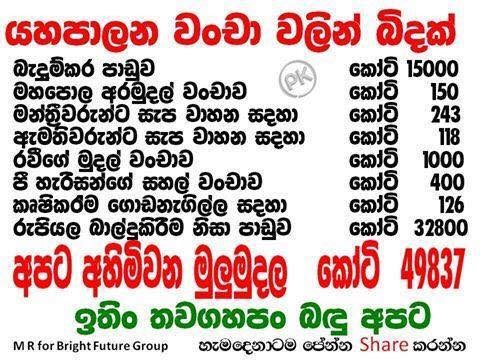
රෙදි පෝලිමක් එක දිගට ගැලවී වැටෙයි.. බැදුම්කර බෑණා ඇමති රවීට ලක්‍ෂ 14ක මාසික කුලියට ගෙයක් අරන් දීලා…

July 24th, 2017

lanka C news

මහ බැංකු බැදුම්කර මගඩියේ ප‍්‍රධාන චූදිතයෙක් වන පර්පෙච්චුවෙල් ට‍්‍රෂරීස් අධිපති අර්ජුන් ඇලෝෂියස් විසින් මුදල් ඇමති රවි කරුණානායකට කොළඹ පිහිටි අධි සුඛෝපබෝගී මහල් නිවාසයක් කුලී මුදල් ගෙවමින් ලබා දුන් බව බැදුම්කර මගඩිය සම්බන්දයෙන් පරීක්‍ෂා කරන ජනාධිපති කොමිසම හමුවේ හෙලි විය.

අදාල මහල් නිවාසය අයත් ව්‍යාපාරික කාන්තාව කොමිසම හමුවේ සාක්‍ෂි දෙමින් කියා සිටියේ ඇමති රවි කරුණානායකගේ බිරිදද එම නිවස පරික්ෂා කිරීම සදහා පැමිණි බවත් එහිදී ඇය දුන් දුරකථන ඇමතුමකින් අර්ජුන් ඇලෝෂියස්ද එහි වහා පැමිණි බවයි.

නිවසේ එක් මසක් සදහා කුලිය රුපියල් ලක්ෂ 14ක් බවත් ඇය එහිදී වැඩි දුරටත් හෙලි කලාය.

හිරු රූපවහිනිය සියළු විස්තර සහිතව මේ සම්බන්ධයෙන් විකාශණය කල ප‍්‍රවෘත්තිය මෙතනින්

https://youtu.be/XFafGcDPnEo

VISION OF MOVING TOWARDS THE FUTURE USING STRATEGIC PLANNING AND TACTICALLY GAINING OBJECTIVES

July 23rd, 2017

Kanthar Palany Balanathan

His Excellency Mr. Maithripala Sirisena
Executive President of SriLanka
Presidential Secretariat
Galle Face,

Colombo 1,

Sri Lanka

His Excellency the President of the DSR of SriLanka

VISION OF MOVING TOWARDS THE FUTURE USING STRATEGIC PLANNING AND TACTICALLY GAINING OBJECTIVES

The Importance of Perception in Politics

Perception is the whole kit and caboodle in politics. SriLankan politicians use their perceptive (deceitful) abilities to win the election and work for re-election during their tenure of office, like India. At least India is better in the development perspective, because they have advanced in Technology, however, retrograde on social standpoint. Well, could we assign the meaning of re-election task; as the MPs, direct their focus to collect whatever current assets required for their campaign for re-election, and/or maintain majority in the legislative assembly through indirect bribes and ploys. A typical example is the import of expensive cars for MPs. One UNP MP V. Maheswaran, god knows what this person does in governance. This person is a lazy opportunist politician who was approved a 30.5+ million Rupees car for import.

A top of the range Toyota Sahara can be purchased for Rs. 7 million on the duty-free permit and sold for Rs. 30 million. An MP is also entitled to a credit of up to US dollars 50,000 or Rs. 5.8 million from any bank to open a Letter of Credit if he or she wishes to import the vehicle. Ref: http://www.sundaytimes.lk/101226/News/nws_04.html

  1. Maheswaran, is an opportunist; what does this person do apart from appearing in the media having conversation. It is known that GOSL approves and grants funds to each of the MP, and Ministers. This amount is supposed to be spent for their electorate of the MP/Minister(s). With due respect, does the government maintain a dossier of development work done by these MPs / Minister(s)? Does the Auditor General’s department carry out an audit to check? What is the obligation of the MPs/Ministers, apart from flying overseas like seagulls. Even on technical matters, they take a flight, debarring the person who is responsible for the area of work.

Another politician is Ananthi who was sworn in as Minister of Women Affairs, Rehabilitation, Social Service, Cooperative, Food Supply and Distribution, Industries and Enterprise Promotion, in the Northern Provincial Council. The words of responsibility itself will confuse this woman. However, much we say, she is the wife of a former terrorist, LTTE. Her family was among terrorist group. Her sister was in the EPRLF group.

In a short text, the NPC is manned by former terrorist group, and/or terrorist allies, and/or secessionist lovers of Tamil Eelam, with no contextual knowledge in economics and political framework. What is Ananthi’s contribution to her electorate since she was elected? Apart from flying to the UN.

Many Councilors are temporarily marching on a political platform until they get a confirmed political pension by being an MP/Councilor/Minister.

HE, these are facts not words of punitive acts.

Government Accountability

The framework that form government accountability mechanism. (i) Political accountability mechanisms, (ii) Legal accountability mechanisms, (iii) Administrative accountability mechanisms.

Third world accountability has gone down the drain where, activities are concealed and not transparent. At the floor level, citizens have no time to focus on the activities of governance, as they must work for their living. It is the media that propagate all activities of the government. If the activities and management are not transparent, then it could be that people in that country live in a world of darkness. The country should have an effective and efficient media network.

Accountability”, in general, is answerability, liability and an expectation of provision of description and explanation. In governance, the accountability of the governing body is to the public and legislative bodies, and not to overseas companies, organisations or para terrorist forums.

Below an excerpt from the US Department of State.

Government accountability means that public officials – elected and un-elected – have an obligation to explain their decisions and actions to the citizens. Government accountability is achieved using a variety of mechanisms – political, legal and administrative – designed to prevent corruption and ensure that public officials remain answerable and accessible to the people they serve. In the absence of such mechanisms, corruption may thrive.”

It is regrettable that most of the MPs have no idea of Accountability due to lack of education, except some highly qualified personnel, who are only spending their time on unwanted separation, power and policing philosophy. They have an eager to meet people from the UN, USA, UK and foreign delegates. The outcome is nil and negative. This can be considered a megalomaniac, power-crazy, aspiration, of, not only the Tamil politicians however, among the GOSL members, from top to bottom.

Central Environmental Authority

Quote:

Prof. Dr. Lal Mervin Dharmasiri’ s message in the GOSL media: It is a great pleasure for me to forward Chairman’s message on behalf of the Central Environmental Authority on our future outlook. I am pleased that our mission is to ensure a clean and green environment by protecting and managing it through the service excellence inclusive of people, technology and our staff.

CEA has a Chairman, Director General, Deputy Minister, and staff. The site could be reached at: http://www.cea.lk/web/en. CEA has seven divisions, and with complement of staff.

The Central Environmental Authority (CEA) was established on 12th August 1981, under the provision of the National Environmental Act No 47 of 1980. The Ministry of Environment which was established in December 2001 has the overall responsibility in the affairs of the CEA with the objective of integrating environmental considerations into the development process of the country. The CEA was given wider regulatory powers under the National Environment (Amendment) Acts No: 56 of 1988 and No: 53 of 2000.

What importance has the Institution of Engineers-SriLanka given to the Engineering profession with respect to environmental protection?

NATIONAL ENVIRONMENTAL ACT, No. 47 OF 1980  L.D.B. 4/81.

REGULATIONS made by the Minister under Section 32 read with Section 23A and 23 B of the National Environmental Act,

No. 47 of 1980.

PATALI CHAMPIKA RANAWAKA,

Minister of Environment and Natural Resources

  1. No person shall, discharge, deposit or emit waste into the environment or carry on any prescribed activity determined by an Order made under Section 23A of the National Environmental Act, No. 47 of 1980 in circumstances which cause or are likely to cause pollution, or noise pollution, otherwise than –

(a) under the Authority of a license issued by the Central Environmental Authority (hereinafter referred to as the Authority”) ; and (b) in accordance with the such standards and criteria specified in Schedule I hereto, in respect of the specified industries.

REGULATIONS

  1. These Regulations may be cited as the National Environmental (Municipal Solid Waste) Regulations,

No. 1 of 2009.

  1. (1) No person shall—

(a) dump municipal solid waste along sides of any national highway;

(b) dump solid waste at any place other than places designated for such purpose by the relevant local

authority or any person or body of persons authorized by them in that behalf.

(2) Any person contravening the provisions of this regulation shall be guilty of an offence punishable

under Section 31 of the Act.

The Commissioner of Motor Traffic may for the purpose of these regulations, authorize any vehicle emission testing centre to be an accredited vehicle emission testing centre for the purpose of testing and certifying the vehicular exhaust emission levels of any motor vehicle.

Your Excellency,

The legislative assembly/parliament enacts acts/ bills to regulate and control pollution, forms a corporation/an authority with adequate complement of staff, with an executive DG. However, what is the outcome? SriLanka gets accumulated with garbage, rubbish and release of GHGs (Green House Gas). With due respect Sir, under the democratic socialist republican constitution every citizen/voter has the right to ask the following questions:

  1. What are the functions of the CEA staff?
  2. Has any of the staff go on inspection, or warm up office chairs?
  • Has any of the staff visited dump yards to assess the condition, risks posed threat to the environment?
  1. What administrative and practical workable methods are used to control pollution (Not theoretical talk)?
  2. Do CEA monitor garbage control?
  3. Do CEA have any methods to measure the extent and the quality of garbage dumped.
  • How much is GOSL paying salaries and wages to CEA staff?
  • Is the money paid to staff worth it?
  1. What is the annual budget for the salaries and wages?
  2. Are vehicles tested for flue gases; i.e. Sox, NOx, CO2 etc and measured?

The disposed waste can produce emissions of several greenhouse gases (GHGs). GHGs have an impact on global warming. Significant amount of Methane gas is produced from the breakdown of the organic matter in landfills. Some countries install gas fired generators in landfills.

Kallundai, is a place in Jaffna. On a four-mile run, the dump yard is full of hospital waste, human waste (human excreta), garbage, domestic waste etc. It’s is a coastal area, which could have been converted into a tourist spot, however, Tamil politicians and executives are keen on power and personal monetary relay, which makes them to live among garbage tips. It’s disgusting trait for Jaffna. The previous NPC minister Mr. Ayngaranesan, who proliferated that he has environmental qualification may not have understood the danger NPC posted to nearby villages and people of Kallundai. Jaffna may be a threat to the environment releasing GHGs.

SL had its result of infecting people with H1N1 virus and dengue flue. SriLanka is unable to keep the cities free from mosquitos. Matara Council, in the 50s, implemented a program of eradicating viruses against elephantiasis by periodical spray of insecticide / pesticide.

The question is: Is this a typical failure of the Central Environmental Authority, Institution of Engineers (Ceylon) or GOSL?

Oil Contamination

Sir, you are aware of automobile garages, carrying out business in all villages and cities around SriLanka. Car owners service their car at least once a year. During a service, the used oil is replaced with new or reclaimed oil. The garages fall within a category called microenterprises”.

Where do the mechanics store their old oil?

Do they throw them onto the ground or store them in a container?

If stored in containers, how do they dispose the old oil?

Are the garages registered with the Factories division?

Are these garage business units registered with the Tax Office?

Do they pay tax?

Has GOSL got a dossier of the business units?

Singapore Ministry of Manpower has classified car repair station as follows: Please visit http://www.mom.gov.sg/workplace-safety-and-health/factory-notification-and-registration/what-is-a-factory

Vehicle repair

Any premises where the construction, reconstruction or repair of locomotives, aircraft, vehicles or other plant used for transport purposes is carried on as ancillary to a transport undertaking or other industrial or commercial undertaking. This excludes premises used for housing locomotives, aircraft or vehicles where only cleaning, washing, running repairs or minor adjustments are carried out.

Sir, GOSL could address to make things right and automatic by bringing the garages under one administrative unit.

Option I

This could be under the AGA, liaising with the CEA for environmental checks. The Grama Niladhari division could prepare a dossier of all garages and submit to the AGA. The garage owners should make available a register of oil used, oil disposed safely and complying with the regulation, if any, and how they disposed the oil. Every microenterprise unit such as garage, shall hold a tax file number and pay the tax without failure. Well, it is a business unit and they should comply with the business regulation, law, and order.

Option II

Alternatively, If the garages are registered with the factories division of the DOL, the DOL have a dossier. The Inspector of Factories of that district, under the Department of Labor should carry out frequent inspection.

However, an authority should be responsible to collect the mode of old oil disposal annually. May be CEA, DOL, AGA?? GOSL should take disciplinary action against any business that violate the law.

Recently we are aware that cameras have been installed in some places. Law should be tightened, so that the police should be able to fine a person, if he disposes a banned item on the road or roadside.

What method is GOSL intend to take on flue gas emission from vehicles and factories?

Sir, Singapore is an example.

It is a polite request that as the executive president, you should visit places of risk and threat, and satisfy that the air is clean in the areas you visit and is risk free.

In 2014, during my visit to SL, we took a road called Wasilla Road”, in Dehiwala. The roadside canal was full of garbage. The area was full of Maldivian residents. Some have stayed permanently. When GOSL is carefree to let Maldivians into the country, why are we blaming about Muslims. Muslims have different sects and have their own differences. Wahabi”, Shiites”, Sonnies”. And they may be fighting each other. Why should the natives (Sinhale) who lived in SL for more than 2517 years suffer because of these internal quarrels? Has anyone got any answers? This has nothing to do with Democracy”. Democracy is by the people, of the people, and for the people. Not for illegal migrants. Will Saudi Arabia allow illegal SriLankans to stay there? Build Buddhist shrines? If corrective action is not taken, ISIS will walk into the country and our children will face the consequences.

The recent complain: businesses on eating house and hotels are dominated by Muslims. It was reported that they cook meat inI toilets, cook and supply dog meat, house lizard, worms to customers. It’s a devastating act and the GOSL should close such business units.

Buddhism in SriLanka

Prince Vijaya’s reign in SriLanka is traditionally dated to 543–505 BCE. According to the chronicles such as the Deepavamsa, Buddhism was introduced to SL in the third century (3) BCE. This was after the 3rd Buddhist council by Mahinda Bhikku, son of the Emperor Asoka, during the period of Davanampiya Tissa in Anuradhapura. The Northern inhabitants practiced Buddhism.

Kalinga Magha landed in Karainagar in 1215 AD with a large army of 24,000 Tamil and Malayali soldiers. He camped his soldiers in Karainagar and Vallipuram, and brought the Jaffna principality under his control. He ruled Jaffna till 1255. He is supposed to be from present-day Odisha and northern parts of Andhra Pradesh and Telangana. Ref Wikipedia.

Portuguese invaded SL in 1505 AD.

Dutch occupied SL in 1656 AD

British occupied in 1796 AD

Question of debating on whether Buddhism is the national religion or not is incomprehensible. It has been the national religion since 3rd century BCE. Most Buddhists changed their religion to Catholism after the entry of the Portuguese in SL. The reason may be by force or to get benefits from Portuguese. Such Catholics have no right to debate on Buddhism being the state religion. In the Tamil sector, majority of Tamils converted to Catholism during Portuguese period out of fear or for benefits. On Dutch and British entry, most Tamils converted to Protestants and Church of England. It is not an objection to people practicing any religion, however, Tamils who converted themselves to Christianity, they should ask this question: When did Christianity come into SL. What religion did your ancestors practice prior to the 16th century? Tamils should be more careful when they object to Buddhist Shrines construction in the N&E. Tamils commenced practicing Hinduism only after the 13th century AD. Buddha was born into a Hindu family. Buddha put forward his own philosophy to the people which became Buddhism. Therefore, Buddhism and Hinduism are married together, which the Tamil people should understand.

In Hindu temples pooja is conducted in Sanskrit

In Buddhist temples pooja is conducted in Pali

In Churches prayers were conducted in Latin.

A person commencing practicing Hinduism after 1600 years of Buddhism in SL (including the North) has no right to object to Buddhist temples constructed or Buddhism being practiced.

A person commencing practicing Catholism after 1800 years of Buddhism has no right to talk about Buddhism.

The photo bellows depicts what we Tamil do in foreign countries:

We break coconuts and block the road in UK. That’s democracy. However, No one should build Vihare in Jaffna. That’s also democracy in Tamil’s dictionary. Because everything the world has is different in the world of Tamils.

None has the right to object to following the constitution. It’s violation of Law and Order.

Office of Missing Persons OMP

Your excellency, Can Sambanthar or Mavai give an account of the following:

How many Tamils are drowned in the Indian/Atlantic/Pacific Ocean.

How many Tamils are surviving in Europe/ Latin Americas/ Pacific nations etc. under different names.

What is the proof that refugees did not give false names?

How are the partners and family getting adequate funds from overseas?

Does GOSL carry out checks on Money Transfer transactions to find out who is receiving funds and from where do they get the funds? Does GOSL reconcile these transactions? Does GOSL have an organization to check these transactions?

What answer can Sambanthar give with regards to the thousands and thousands of people who were murdered by the LTTE.

OMP- Has this organization being formed to inject money into the widows and orphans group OR siphon out for reelection campaign? Who will be monitoring and checking on the activities of the OMP?

Constitution

49% of the Tamils dwell outside the North & East. North being a dry land, Tamils have no hope of doing any business or work. As soon as they get a degree or qualification, they opt to jump to the South for greener pasture. Even the budgetary allocation allotted to the NPC, the NPC did not expend for any projects or development. NPC has no ambition of developing the North. What benefits does it give the republic by enacting another constitution? It’s only a waste of time. The politicians have wasted their time in talking about reconciliation and constitutional proposals. While the terrorist in SL and overseas are engaged in regrouping and fund raising. Are they being instigated to fight for separation?  Tamils in SL cannot uphold their view that they are not one pure race, but a mixture of various races from India, Cambodia, and Indonesia.

Sir, I quote from an article by Chula Goonasekera, A proposal for the new constitution”

Currently the most important foundation Sri Lanka needs is unity and trust amongst her people. To promote this, we need national acceptance of equal opportunity, human rights and diversity through legislation. Therefore, the proposed new constitution for Sri Lanka should protect and uphold human rights, accept diversity and promote true democracy. It is also prudent that students be protected from exploitation until the age of 21. This is specially to safeguard education in secondary schools and universities.

Parliament is not a place for hooligans but a house of honour for constructive argument, sound debate and agreement on the welfare of the Sri Lankan people

This is because students have become the bait and front line of various groups, exploiting their ignorance, honesty, vulnerability and poverty through a variety of sinister and cheap means including forced physical and mental activities designed to destroy our traditional national practices and family values.

Comments:  Whatever shortfall there is in the current constitution, it should be rectified and remedied via an amendment by act of parliament AND not by writing a new constitution for power sharing and creating divisional power play. Tamil power, Muslim Power and Sinhalese power which is ridiculous. The main theme should be to develop national acceptance of equal opportunity, human rights and diversity, accept diversity and promote true democracy. This can only be practiced through an amendment, law and order.

Do you have a section for caste politics, and if so, has there been anyone convicted of caste oppression?

I quote a paragraph from the submission by the Tamil Civil Society Forum: We define the National Question in Sri Lanka as the problem relating to the hierarchical nature of the Sri Lankan state at the helm of which is the Sinhala Buddhist nation. In this hierarchical state structure the other constituent nations and peoples of Sri Lanka are regarded as subservient peoples and nations to the dominant (Sinhala Buddhist) nation. The dominant nation has used the state, its constitutional and legal apparatus to preserve its dominant status. This we contend is the best explanation of the post-colonial constitution making efforts in the country and of constitutional praxis in post-colonial Ceylon/Sri Lanka. A solution to the National Question, will only come about through a radical and fundamental re-envisioning of the state on the basis of equality amongst the constituent nations and peoples of Sri Lanka. We firmly believe that a thin liberal conception of constitutionalism will not help resolve the problem. The National Question cannot be solved merely by guaranteeing individual rights, good governance and the rule of law. The National Question is about the right to self-determination of the different nations that constitute Sri Lanka including the Tamil Nation”.

TCSF express their views of hierarchical nature as the helm of the Sinhala Buddhist nation. It’s my view that this is total wrong and unacceptable. What’s the definition of hierarchical nature?  A hierarchical corporate culture is an organizational model based on clearly defined corporate levels and structures. Hierarchy is a type of organizational structure in which items are ranked according to levels of importance”.

It’s not based on Buddhist theory or Sinhala theory. Let’s take the NPC for example. It’s a hierarchical nature. One of the former armed group leader was fighting for a ministerial position in the NPC for his brother, and ultimately, he got what he wanted. It’s a vertical structural arrangement by which the NPC operates. A government cannot function on a lateral structure. All government operates on a vertical administrative structure.

The term constituent nations”. What is TCSF trying to tell the GOSL by the term Constituent Nations”. It is of the view that TCSF is pulling the people back to the separation theory. There aren’t any constituent nations. There is only one nation, which is SriLanka.

Definition of Nation”. A large body of people united by common descent, history, culture, or language, inhabiting a state or territory. There wasn’t any Tamil territory defined as in the North. Its inhabited by Muslims, Sinhalese, Malabar, Telugus, Karnataka, Cambodians, Indonesians, Aryans, Brahmins, Nagas, Wanniyas, Burgers, etc. Jaffna man is not from a common descent or do they have a common historical background. The caste differences are a proof of the different descent. Even the culture of the Jaffna people differs from village to village. Even the Tamil language spoken in the early 40s were different in Jaffna. The term Waligamam itself is Weligama”. Araly is ARALIYA”. With time, the language of Tamil copied from Tamil Nadu formed its shape of Tamil. Even Arumuganavalar” got his Tamil language education from Tamil Nadu. Therefore, to define a common descent and common historical background is twisting history.

Sir, a constitution is not the priority now. May be legislations to achieve peace, reconciliation and harmony etc is required. The priority is to reconcile the economy, control expenditure, promote sole trading, create sole trading businesses, promote self-technical business, provide assistance to sole traders, register all microenterprises with the GOSL, educate people on economy, integration, stop generating funds for re-election, stop bribery and corruption, promote and achieve the SRILANKAN” concept.

GOSL should have a vision and mission for safety, terrorism threat, education, job creation and stop SriLankans leaving SL. Promote SriLankans to return and build SL.

As at now our people can talk theory, but its impracticable theories. Let our politicians not talk about wasteful theories on constitution, but focus on building SriLanka and NOT constituent nations as there are no constituent nations in SL.

Thank you, Sir,

Yours Obediently

කන්දර් පලනි බාලනාදන්

Kanthar Palany Balanathan

Jathika Hela Urumaya and the Anti-Mahavamsa Movement in Sri Lanka -Part-II

July 23rd, 2017

C. Wijeyawickrema, LL.B., Ph.D.

(This essay was written 13 years ago, in support of the JHU when it was formed. Because of the failure of JHU to deliver what the late Ven. Soma envisaged, BBS came to agitate on behalf of disillusioned masses. After the Asgiriya Declaration on June 20, 2017 and the notice given on July 4th to the government, whether one likes it or not, a new era of conflict between the temple and the black-whites of Sri Lanka has arisen. This essay contains lots of facts that could help in understanding the path Asgiriya-led Buddhist revolt needs to take. The original long essay is divided into two parts).

The 1956 silent revolution and the American Civil War 1861-1865

The 1956-59 Wave was similar to what had happened in America after the Civil War. For about ten years former slaves enjoyed political power and human respect. But soon they came under white supremacy, lynching, KKK and separate public toilets that created a new kind of slavery until the civil rights movement of Martin Luther King Jr. in the 1960s (Lies My Teacher Told Me: everything your American history textbook got wrong, James W. Loewen, 1995). This was exactly what had happened to the Sinhala Buddhists. Some extremists sent SRI busses to Jaffna, JRJ became a target of the Imbulgoda hero (S D Bandaranayaka), English was neglected as a subject, state corporations became job avenues to party supporters, checks and balances in the constitution were removed, private constitutions came in to force and people like us who tried to serve the motherland left it for mental peace. A handful of families from Colombo 7, ruled and ruined the country, and today they are ready to divide the country so that they can rule the south portion and continue the same old game. The situation became a death trap with AJ Wilson-JRJ bahubootha vivasthava and the electoral system controlled by criminals and millionaires. In 1924 there was a Tamil demand to not allow the majority to have more than 50% of the parliament seats and AJ Wilson was able to deliver this, almost in 1978.

In this game Buddhism was the bait. Buddhist universities, Poya-pre Poya holidays, Buddhism in the constitutions, Bens cars to the two Kandy Mahanayakes, a Buddhism minister, Premadasa erecting huge chetiyas, Buddha statutes at every junction, starting viyaparas with a traditional visit to the Dalada Maligawa or the Siri Maha Bodhi, these are the baits. But just like Ananda Guruge copied the Peradeniya university act to create Vidyodaya and Vidyalankara, the foremost place to Buddhism gave to the world an impression that Sri Lanka has a government helping Buddhists at the expense of Christians. So not only Buddhists did not get any special help but they were branded as favored by the government. Buddhism ministry was the biggest insult to Buddhism. Now monks in remote temples had to beg for government funds from politicians. The temple problems are now documented and Christian NGOs buy this information from ministry officers to target financially troubled temple priests. Monks who do not want to go after the politicians do not get funds. Villagers are not willing to give even the small donations that they used to give, because they think now the government dole is taking care of the temple buildings. While Buddhism minister is busy Bamian Buddha is destroyed, despite warnings given to him one year in advance. Then the day of the destruction, Buddhist PM Wickremanayake went to see an Afghan man in Pakistan.

The Economic Mess

A Chemist who wished that he should have studied arts instead of science once told me that the British kept in their hands three functions during the Donoughmore period (Finance, Foreign Affairs, Public Service (including the judiciary) and the politicians since 1948 messed up these three areas. While government functions are inter-related one can isolate them for study purposes.

What are Sri Lanka’s economic problems which allowed Christian NGOs to come and play havoc? As a country under a nation of shop keepers Ceylon provided raw materials to London and received food and finish products from Liverpool. This was called an open economy. Like in other colonies the roads collected raw material like rubber or graphite (blood) and brought them to the Colombo port. Tea plantations cleared forests and the Mahaveli became brown with soil from erosion. Some governors tried to renovate irrigation tanks in the Raja Rata or resurrect the Gamsabawa. During the war time attempts were made to produce food locally or a few industries to produce consumer items difficult to import due to war hostilities. But otherwise Colombo-centered, Colombo paradigm controlled the country. At the time of 1948 or in 1931 the need was:

  1. diversification of economy

modern plantation sector but neglected peasant sectors

grow food crops and non-traditional export crops

develop an industrial sector (agriculture and industry are two legs of a country)

develop import substitution

new economic sectors-limited tourism sector, export of gems, flowers

  1. reduce the gap between Colombo and rural areas
  2. reduce the gap between the rich (Colombo) and the poor (rural/urban, just 10 miles out side Colombo)
  3. reduce the existence of two countries (English language (5%) vs Sinhala/Tamil language country (95%), two nations)
  4. reasonable and fair readjustment of the effects of the divide and rule colonial policy (minorities vs majority)
  5. wisdom in dealing with the separatist movement in the Tamilnad (Valvetithurai smugglers of goods and people)
  6. reasonable and fair readjustment of victimization of Buddhists by a Christian government.

In all these the black whites failed. JRJ had the last chance to correct all the mistakes of his class. People gave him the power. That is why some call him Sri Lanka’s kaputu bo tree. He destroyed everything he touched. His Mahaveli made the country a debtor for generations, while so many made millions in Swiss bank accounts. This person who said that CBK was a school girl, ended up as a puppy in the hands of an airplane pilot who enjoyed driving his car so fast that his security team cannot keep pace with. He insulted Indira in the company of the urine-drinking Moraji Desai, and finally he had to ask Dixit to provide him a ship in case he had to evacuate. His successor suffered from a fatal inferiority complex and died without a trace. People acted so inhumanly towards him that they lighted fire crackers after hearing his death. What remains of him now are the abandoned clock towers that he built all over the country.

The Ven. Soma Effect

Ven Soma was a symbol of the Sinhala educated Buddhist rural youths’ reaction to the black white political game. If 1971 and 1989 JVP clashes were violent reactions against the black white establishment, Ven. Soma’s was a non-violent Buddhist reaction. Just like Gandhi’s or Martin Luther King Jr. Ven. Soma’s movement won but he lost his life. Ven. Soma was a Paul Harris in brown color. Ven. Soma had no degree or pedigree. He was subjected to ridicule and discrimination when alive. This was the history of such people. Anagarika Dharmapala was attacked by so many that he left Ceylon wowing never to come back. Today everybody is a relative of Anagarika Dahrmapala. I remember Anil Moonasighe having a life size picture of him in the CTB office. Simon Bolivar who is worshipped now in South America had the same experience. He wanted to leave Venezuela for good. Ven. Soma lost his life in so human and a mysterious way. All we know as proven facts are that one of Lalith Kotalawala’s chief editors later joined Ven. Soma’s organization as its editor and that this editor’s brother, a crook, secretly arranged a Ph.D. donation for Ven. Soma. Apparently, the brother working for Ven. Soma did not know his brother in Leningrad was a Christian.

MaoTse-tung and Martin Luther King, Jr. created movements. Movements have its own lives and the creator becomes separate from the movement. The FBI of Edgar Hoover secretly recorded MLK’s bedroom sounds and Mao wanted a daily supply of virgin teenage girls. Ven. Soma as a pruthajana, swallowed a Ph.D. bait, just like Lalith Kotalawala got one from Epitawatte of Vidyodaya. Richard Pathirana got one too. Sarvodaya’s Ariyaratne and Ananda Tissa de Alwis both deserved one. But W. Dahanayake did not. To her credit CBK refuse an offer by a VC from Peradeniya. A graduate from a French university is called a doctor anyway, just like law graduates in the USA.

Ven. Soma became the hope of Sri Lankan villagers and the poor and the rural youth who die in politician-mismanaged war in the north. I wrote several essays supporting Ven. Soma as a presidential candidate, but I heard that the late Ven. Madihe Pannaseeha advised him not to. But a movement once created gathers its own momentum and Ven. Soma had no choice. This was what Ven. Madihe did not realize at that time. Ven. Soma was getting ready with a shadow cabinet. One JHU monk reported recently that Ven. Soma had told him that he was going to contest. Therefore, anybody objecting to JHU is objecting to the movement created by Ven. Soma. This is where Dr. Gunadasa Amarasekara, Nalin Silva and the PNM are in a dilemma.  Who is the genuine, reasonable and justifiable inheritor of Ven. Soma’s mantle?  CBK, with her GLP-Neelan package of federalism, MangalaS with the dust bin of history and sudu nelum? Or the JVP who got pirith nuul from the monks waiting for them on the roadside? As a person who was sympathetic with the JVP movement of 1971 (not with its leaders or the plans of killing the opponents), I think the NPM and JVP should work with CBK and come to an agreement with JHU on certain key issues such as de-merging N-E, junking the bahubootha constitution, going back to village councils and electorate-based parliamentary elections

JRJ electoral system removed the sovereignty of the people from people. It is a fake democracy. Sri Lanka must go back to the local government system resurrected in modern times by the British governors Gordon and Ward in the 1860s and 1870s. This was recommended by the Report of the Commission of Inquiry on Local Government Reforms, Sessional Paper No. 1 of 1999 [Abeyawardana Report]). Dinesh Gunawardena’s tinkering of this subject is an establishment approach of survival in cut-throat politics. Parliamentary electoral system was another death trap. Not only it took away sovereignty from people but it made the MP a robot, a puppet in the hands of officers nominated by the ruling class leaders. Any person with an iota of brain or dignity or dedication will not think of becoming an MP under this system. The JRJ system was a coup by the A J Wilson crowd. What Tamils did not get from the British, AJ Wilson got from JRJ. Quoted below Some incidents from history taken from the book, Communalism and language in the politics of Ceylon,” Robert Kearney (1967):

In the early 1920s an agreement was reached between the leaders of the Ceylon National Congress [black whites?] and the Tamil-leadership for a ratio of one Tamil for two Sinhalese representatives, which was the result produced by the 1924 constitution. Tamil pronouncements to the Donoughmore Commission appealed for the retention of this ratio, which with the representation of other minorities deprived the Sinhalese of an absolute majority in the legislative chamber. The commission [Donoughmore Report, pp. 92-93] rejected outright the idea of fixing   relative proportions of Sinhalese and Tamil legislative seats and proposed an essentially majoritarian scheme with territorial constituencies of approximately equal population…”  (P. 33). …The organization, founded by G. G. Ponnambalam, insisted on constitutional and statutory guarantees to protect the minorities against Sinhalese domination after independence. The Tamil Congress took up and championed a plan called by its advocates balanced representation” and popularly known as the fifty-fifty” scheme. The scheme, prompted in part by the creation of the pan-Sinhalese ministry [black whites?], would have limited the Sinhalese to half the seats in the legislature and reserved the remaining half for the minorities. It would have restricted by statute the members of any community who could serve in the Cabinet to less than half of the Cabinet’s membership. Thus, its advocates argued, no community would be in a position to impose its will on the others. The fifty-fifty” scheme was vigorously urged by the Tamil Congress…The Soulbury commission rejected the fifty-fifty” scheme. [Soulbury Report, pp. 66-67], (p. 37).”

I embedded [black whites] in the quote above, because black whites had no problem to this design then, and they have no problem with it now as who suffered then and now are the Sinhalese and their religion, Buddhism. In between, the black whites of the UNP, SLFP, LSSP and CP deprived a reasonable accommodation of minority rights within the unjust demands of the Christian-Tamil black whites of the Federal Party. No wonder not only Nanda Malini withdrew her song Me Sinhala Apage Ratai” from circulation, refused to sing it in London, but apologized for singing that song in the past! Fear for life or near sainthood? We know that NM and Colvin gave up fifty-fifty” after 40 years, because all the other minorities in Sri Lanka are majorities outside. The only land for the Sinhala Buddhists is Sri Lanka. When I type the word Sinhala” on my computer the word is not recognized even by the computer word dictionary! The White commissioners rejected the demand (long before 1956) because what if it were to apply to the English versus the Welch, Scottish or the Iris?  They rejected it because it was not workable. They rejected it because they new that a society cultivated in Buddhist principles will not ill-treat minorities. Chelvanayagam’s best friend was Jayatilake, the chief justice. When that class found that the two-nation division between English and Swabaha with which they had the control over the masses was about to lose control under the universal suffrage they concocted a language based two nation theory. So today, JRJ and AJ Wilson are in their graves after laying the foundation for the creation of a Tamil country which will be at border war with a south quadrant because the geography of this tiny island does not simply support such division by lawyers.

This is why JHU must come and change this system within and outside. Sri Lanka needs a people-based, people-designed, people constitution that will unite all the ethnic groups (against the black whites) within a unitary Sri Lanka with no separate ethnic enclaves.  If Nanda Malini is frightened or brainwashed so are the other so-called Sinhala Buddhist leaders. Sri Lanka must go back to the old electorate based system with proper safeguards for minority protection and run-off elections to ensure the requirement of 51% votes for the winner. JHU asked CBK for a meeting to discuss these urgent national issues but she delayed or ignored them. If SLFP-JVP is genuine in protecting Sri Lanka they must be able to recognize the Ven. Soma effect.  I think NPM and Nalin de Silva have no moral right to blame JHU for its decision to go it alone.

A Buddhist Political Science

Some black whites and some foreign NGOs think that they can get Prabakaran to wear a 3-piece suit. But they and the NPM accuse the JHU monks stating that the monks cannot become Tony Blairs or Ronnie de Mels. This is exactly what the masses do not want from the monks. Whether they get 5 seats or 15 seats or 25, what people want is JHU to act like acid on a sheet of iron. To corrode the sick 200-family exploitation system call Sri Lankan democracy of the UNP and the SLFP. These Christian dominated families brought the Sinhala Buddhist civilization of 2500 years to the brink of death. In modern political words JHU will derail the UNP-SLFP game within and outside the Parliament building. It is full of criminals, bribe takers and those who got rich by unethical deals. The country is pawned to the IMF and politicians have Swiss bank accounts. Sasanka cites his student’s statement, under the present conditions of corruption and lack of ethics, even if Lord Buddha was sent to our parliament, he too would have been corrupted.”  We disagree.

Ratnasiri Wickremanayake’s statement that the two parties utter lies and the party which utters bigger and better lies wins the election must be supplemented by the new phenomenon of a file maintained in a Colombo company office to blackmail politicians.” All have become ati kehel gilapu uguduwo. This blackmailing is no different from what JRJ did with MPs and SC judges with undated letters of resignation. The cancer has spread all over the body politic and JHU monks cannot be like those Tibetan monks who meditate outside in a cold night wearing wet robes and in a few minutes steam comes out of their robes. But in Sri Lanka a near miracle is not impossible.

An example from the Mahayana Buddhism could perhaps help Christians to understand (including Tambiah, GananathO and HLSenevi) why JHU could deliver. People are wondering in a hostile inhospitable and rugged environment—say an Arabia or Haiti or Afghanistan kind of physical environment— in search of salvation or the proverbial garden of Eden. The crowd includes Mahayanis as well as Heenayanis. After a hazardous climb of a mountain a heenayani discovers on the other side a land with flower gardens, water falls and fruit trees. He jumps in as he has found his personal salvation. Not knowing all of this a mahayani later discovers the same land. But instead of jumping in he stays on top of the mountain shouting and directing others wondering down about the Eden on the other side. The West thinks Dalai Lama is Buddhism. So, we could have a little bit of Mahayana in Sri Lanka! JHU cannot tell Muslims not to eat beef or Hindus not to eat pork. It cannot force Buddhist eggs on Buddhists. I think this is what people fear as possible theocracy. Before feeding a starving person with something, Buddhist laymen from Colombo homes cannot tell them to be vegetarians.

Just like the Buddhist Economics of Schmacher in the 1960s (was this not Gandhi said previously which Nehru did not follow), there is a body of texts called Buddhist Political Science. Politics is the art of compromise. The art and science (math) of getting maximum benefits out of otherwise limited resources. Perhaps this is why RPrema said that he can balance the budget on the other side of bus ticket! Largest happiness of the largest number of citizens (while not depriving basic human rights of every individual). This is the essence of Buddhism. When Friedrich Engels wrote in 1844 (The condition of the working class in England) about the situation that a pregnant woman had to come to work in the crammed factory full of cotton dust in the air and stay standing for 10-12 hours a day, and she worked like this until the day of delivery or the moment of delivery and then had to come back to work the day after the delivery, what would Buddha say about that system?

Was it not this art of compromise that is a central concept of Buddhism, the Middle Path? A cancer among politicians all over the world is the two-valued orientation—s/he is my friend or my enemy— , and not willing to have a multi-valued orientation— s/he is not my friend but he is not my enemy either, degrees of difference— in their daily practice of state craft (Language in Thought and Action, S. I. Hayakawa, 1939 [1990], page 112). The two-valued orientation creates dictatorships, the second democracies, and in Buddhism 2600 years ago the second value was enunciated and practiced by monks. An author comparing the lives of Jesus and Buddha asks a question why Jesus lived less than 2 years in to his public service whereas Buddha served for 45 years (Jesus and Buddha: the parallel sayings, Marcus Borg, 1997). Perhaps, Buddha did not have to face the power of a mighty Roman empire, but more importantly, he followed the art of persuasion, compromise and non-involvement. He did not tell the Indian kings or sitanans not to have harems, but he expressed the rule of celibacy for monks and the value of kamesu mechcha chara to the laity. He did not approve prostitution, but he did not reject them when they needed real help. Is there any other priest group in the world who can claim this kind of life time of training?

People who did not go to a village temple, who did not know the ABC of Buddhism have become experts after a few years of stay in a western country. This was what had happened to NM, Colvin, Leslie and Phillip in the late1930s. They did not try to work with Ven. Kalukondayawe Pannasekhara’s rural development and crime eradication movement of the 1930s-1940s. They worked separately in the Malaria eradication work. What Ven. K tried to do was a people’s economics program with village-level participation. Economics in this sense is inseparable from politics. He worked with Tamils as well as Muslims. The CCS crowd obstructed him. His supporter, the young ASP Osmond de Silva was finally transferred to the Police training school at Bambalapiya, the only place in police department where no farmer will come into contact with Osmond. What Vincent Subasinghe did in Sanda Lankawa was also Buddhist economics and Buddhist politics. What Wilmot Perera did in Horana was also Buddhist economics.

Sarvodaya movement began as a Buddhism-based self-help movement, but it later became a foreign fund-based white elephant. After 30 years of work how come villagers are still starving and embracing Christianity to survive? Ariyaratne’s book, the Power Pyramid and the Dharmic Cycle” (1988) is one of the best examples of how Buddhist economics and Buddhist politics mix in harmony for the benefit of people and the environment. Those who question how monks can guide on how to run a country should start with Ariyaratne’s book. We should borrow whatever is good from the West, but we should not become slaves to the West.

Nalin Swaris in his book, The Buddha’s Way to Human Liberation: a socio-historical approach (1999) tried to look at the East-West interdependence, and he was a mixture of Christianity and Buddhism.  The big mistake NM Perera did was he thought that his London School of Economics made him wiser than a learned Buddhist monk like Ven. Kalukondayawe. I have no doubt that the Greek ideas of democracy were influenced by ideas found in Buddhist India in the 5th century BCE. What the Lichchavi kings were doing was what UNO, WTO, EC and other are asking countries to do. The speaker of the house in England is an idea the Buddhist Sanga has. Colonial rulers destroyed the Sanga society as explained in Prins Gunasekera’s book, Vihara Neethi Vitthi” (1956). No other religion can claim the autonomy a Buddhist temple has from central control. This is what Montesquieu (M) said about the separation of powers. The new interpretation given to his doctrine, which is called M standing on his head, expects the distribution of sum total of power to as many units as possible, rather than three separate branches of power.

In Sri Lanka, Marxists tried since1943 (Gautama the Buddha and Karl Marx: a critique and comparative study of their systems of philosophy by S. N. B. Wijeyekoon [pseudonym Leuke] cited in Origins of Trotskyism in Ceylon” by G. J. Lerski, 1968, page 169) to show that Buddhism and Marxism have similarities. JRJ himself once wanted to create a Dharmista Samajayak.” One must read the late Professor Sarachchandra’s book, Dahrmista Samajayak” (1982) to understand JRJ’s role in destroying it! JRJ once changed his name to Jeewaka Ravindra and his son became a Buddhist priest for a short time. If at age 70, JRJ could pay lip service to the Dharmista concept why cannot a group of monks try to really implement it?

The following are concepts/examples/writings relating to a Buddhist political science:

  1. Buddhism and Human Rights, L. P. N. Perera, 1991
  2. Buddhism and International law, K. N. Jayatileka
  3. World Court decisions with Buddhist examples, Justice Weeramantry
  4. Birth control and Buddhism (in Buddhism, its religion and philosophy, W. S. Karunaratna, 1988)
  5. Putting Buddhism to Work, Shinichi Inoue, 1997
  6. What Would Buddha DO? 101 answers to life’s daily dilemmas, Franz Metcalf, 1999
  7. What Would Buddha Do at Work? 101 answers to workplace dilemmas, Franz Metcalf and B. J. Gallagher Hateley, 2001
  8. Inner Revolution, Life, Liberty and the Pursuit of Real Happiness, Robert Thurman, 1998

Putting Buddhists on the defensive

  1. J. Tambiah and his Boston group ask Buddhists (or monks?) a question, How come believers of a religion that preaches ahimsa kill?” How come Buddhists betray Buddhsim? Tambiah was in Thailand studying this 30 years ago and Gananath Obeyesekera is an expert on this subject. But Tambiah is deliberately fooling the international readers of his book by this question. Theravada Buddhists are a minority (50 million?) in the world. In Cambodia and Thailand they now eat rats and therefore, the number can be even smaller. Powerful and rich countries in the world are Christian or Islam and Islam has oil and cruel dictatorships. My Christian American professor friend has a small ranch where he rare cattle for sale as beef. He uses all possible strategies to maximize his profit margin. Can I tell him about my Buddhist nonviolence and ask him to grow corn or cotton instead of the violent killing of cattle? How come Tambiah, HLS and GO all forget this simple reality and hold only Buddhists to a high religious/moral standards? Mother Teresa sent a letter of support on behalf of Keeton who provided her planes to travel and lots of money. The California district attorney traced Keeton money trail and found some of the money that he stole from the retired and poor Americans went to Mother Teresa. He asked her to return this money, but got no reply. Boston archbishop finally resigned after hiding for so long the sex acts of his priests still the whole truth is not out.

Buddhism was wiped out from India by the Hindus and Muslims because Buddha did not teach how to use guns. As Nanda Malini sings one cannot take the navaguna vala to the battle filed. You take the sword and later when you have peace with no enemies coming to kill you then you get back to the navaguna vala. According to Tambiah there is no need to guard the Dalada Maligawa or the Siri Maha Bodi! Or are we forgetting that God’s standards are set by the human agency? Take for example the concept of self defense and three religious approaches.

  • If my life is threatened, I can kill the attacker – no legal liability, no sin (Christian, Jews, Islam believers?)
  • Even if my life is threatened, try to run away or die rather than killing the attacker – no legal liability no sin (Buddhists?)
  • Try to run away, avoid confrontation, be humane and humble (or escape even I have to kiss the a..) to avoid killing the attacker, but if I have no other choice then totally and completely annihilate the enemy (Bhagavad Geeta’s advice to Arjuna)

When Prabakaran kills only the Catholic archbishop of Colombo could say P is a humane person. Because, P helps Christianity and P wants to destroy Buddhism and Buddhists.

The society has become so corrupt over the past 25 or 40 years because of politicians. It will not be easy to introduce Metta, Karuna, Muditha and Upekka that soon. First you have to get rid of the guns and bombs in the hands of so many. The names of Vessantara and Siri Sangabo are used in Sri Lanka today in exactly the opposite way the meaning of those names described in the Jataka stories. For example, people today call a husband a vessantara, if his wife is sleeping with another man, knowingly or unknowingly to him. A siri sangabo is one who stupidly puts his neck out and gets it cut. Today there are no morals in the country. All running like mad dogs thinking the mirage they see is water.

Sri Lanka’s Future and the American People

If God created the world he was so generous toward what later became the USA. I am grateful to America for sending Colonel Olcott in the 1880s to help in the establishment of schools for us, the poor Sinhala Buddhists. American people are as innocent as the Sri Lankan people. American people are different from the American political establishment, run by two political parties. Ralph Nadar is fighting the same battle in America that the JHU has just started to fight in Sri Lanka. In Milinda Moragoda’s book written for him by a retired CCS, the American Senator John McCain admits so honestly that the American society can learn from what is happening in Sri Lanka. This senator was in a Vietnam prison and a survivor. American missionaries established schools in Jaffna as early as in the 1820s. They would never support forced or bribed religious conversions if they come to know about it.

The present habit of cowing people by political opportunist black whites is the problem. For example, what is the use of marching against the Pope’s visit in Colombo, when in Ratnapura resides the Pope’s cabinet minister in charge of propaganda with million of Vatican dollars?  Why not fast unto death before his church at Ratnapura, if that is a strategy. The Colombo marches by yellow-robbed monks shouting slogans was perceived as an act of religious extremists behaving like angry workers on strike. Also, what is the justification to shout at Chris Patten before his hotel, when he came to Sri Lanka at the invitation of the government of Sri Lanka?  This is why a real Buddhist Politics is needed. In a new era of preemptive strikes implemented by President Bush and Prime Minister Blair, a Buddhist government in Sri Lanka, could show to the world that criminal terrorism cannot be won by legal terrorism. The end of history that the western professors predicted with the fall of the Berlin wall was a western idea and not a Buddhist idea. The World Court judge Weeramantry has used a lot of Buddhist ideas in his court opinions.

This means there is a big information and communication gap. Hating America without knowing reality and truth is ignorance and stupid. So many things in America are bad and wrong just like the American style roofs that we embraced in the 1950s not knowing the carcinogenic effects of asbestos. But whether it is on morality or on war no country on earth can escape the good or the bad influence of USA. Rather than a love (privately) and hate (publicly) relationship, Sri Lankan leaders in the former SU, JVP, NPM, MEP and other nationalist writers or in the JHU need to use critical thinking and analysis. They should meet with the new ambassador who speaks and writes in Sinhala. He will also decide to wear a national dress.

It is important for the JHU to show to the world and America that it is morally wrong to divide Sri Lanka or pave way for a division via a federal panacea.  The geography, history, social and political realities do not support a federal system for this tiny island. If rather than shouting at America as an enemy they should use their brain and use persuasive arguments to convince them. All what the Tamils need to achieve their aspirations could be granted within a united, undivided island with no ethnic enclaves and no discrimination against the majority. If the American Congress thought so Sri Lanka would have been a divided country for some time by now. In the American Congressional Committee hearings, when all the others talk and submit documents against the Sinhala Buddhists (including even the Sri Lankan embassy) congressmen ask questions such as, if we have a black as our chief justice, how can we say there is genocide against blacks?”; If Hitler had Jews in his war cabinet how can Jews complain?” or where are the British, they created this mess by their divide and rule policy?”  In fact a congressman nominated JRJ and RajivG for a Noble Peace Prize! (Hearing before the subcommittee on Asian and Pacific affairs of the committee on foreign affairs, House of Representatives, 100 Congress, First session, August 6, 1987, page 1). Those who think of GL-Neelan Package, I think it was a package came from America. Those who think of Norwegian peace processors, I think it was a deal arranged by America. There are all kinds of Liam Foxes.

If sufficient time lapses, because the black whites in Sri Lanka have made it an antho jata bahi jata problem, ultimately Prabakaran will fail because he has no moral ground for the sustenance of a movement. In the Milinda Panna, there is an example of accidents.” The wound to the Buddha’s feet from a piece of a chip of rock came from the collision between the rock threw by Devadatta and the rock that met it, was described Bikku Nagasena as an accident (no volition). Similarly, Prabakaran is an accident came out of the slipper of Mrs. Amrithalingam then made of the last Sinhala skin (remember KMP Rajartane’s slippers?).  Already Karuna did what Mahattaya tried to do. Nelson Mandela showed the world what is high moral grounds, even when it came to the divorce case with his wife Vinnie. Gandhi and Martin Luther King, Jr. won because of the moral basis of their actions. When King was in a jail in Alabama, the Southern (white) Baptist priests wrote him a letter asking him to leave the South without creating turmoil. The reply that he sent is as historic as the famous Gettysburg address of Abram Lincoln. The south was so big and powerful compared to the north during the Civil War. But ultimately, the south lost because it had no moral basis. It had to ask the slaves to join the army to fight to protect slavery! RanilW, CBK and GLP should read some history books.

Perhaps, the best service that the Sri Lankan Buddhists offer to USA is the use of its seventh great force, to help USA to develop a new foreign policy that will make them the proud leader of the free world. American governments fell from one disaster to the next, because they operated via the eyes and ears of the local black whites (coconuts) in all the countries that they got into trouble. This was so with Din Diem, Marcos, the Shah of Iran, Sadam Hussein, Baby Doc (in Haiti), or Noriega (in Panama) now in an American jail. For example, if the American government tries to understand the Sri Lankan case from the point of view of the Sri Lankan American citizens, it would not ultimately become unpopular among the local masses. As it is the American embassy in Colombo relies on the local black whites within and outside the establishment.  How many Sinhala Buddhist are working in the embassy local staff? Why? Unlike the Cubans or Iranians in the USA, the Sri Lankan in USA are not waiting to go and establish an alternative government filled by exiles.  This is very different from the mind set of some expat Tamil groups who want to go as cabinet ministers of a Tamil kingdom although the sun god had no plans as such.

Sri Lanka’s Seventh Great Force and the Raja Rata Paradigm

Professor Malalasekera’s (who was married to an English woman; Ananada Coomaraswamy was married four times, each time to a European woman) reasonable requirements for Buddhists and CBK’s minimum requirements to develop Sri Lanka are what a group of Sri Lankans are concerned with. In 1956 Five Great Forces put the elephant belly up. Martin Wickremasinghe thought, it was the downfall of the Brahmin caste. He was so wrong here as well as in praising the communist Russia as a near-heaven. Even the best writer on earth could be dead wrong as actress Jane Fonda who sat on a Vietcong gun seat aimed at the American war planes to regret it later. Sir John by kicking M. S. Themis, the 1962 Coup with Sir John, Sir Oliver and Dudley S behind, and finally JRJ in 1978 with AJ Wilson behind proved that the black whites if at all were buried for only three years (1956-59), and they did not die. Now the villages which had the people power via the Pancha Maha Balavegaya are buried under the joke Pradesheeya Sabah and the villagers are divided between UNP versus SLFP under the new parliamentary election system based on a party list decided from Colombo, held on a district basis with a manape.

Ven. Soma overcame the first death trap of JRJ, the village-level unity, and before he overcame the second death trap, JRJ constitution and parliamentary election system, his life tragically ended. Sri Lanka’s Seventh Great Force thinks (as shown by two computer election polls with 40% support for JHU) that JHU is the rightful owner of Ven. Soma’s unfinished business. Sri Lanka’s sixth great force is the janitors and housemaids toiling under semi-slavery conditions shouldering one-third of Chocksy’s budget, yet not even the right to vote! The American Revolution was based on no vote no tax! If these people who sacrifice their human dignity for 100 dollars a month stop remittance for three months Chocksy and the budget will be on logs (kota uda) and the janitor would get a cabinet post for them.

The core of the seventh great force is the Sinhala Buddhist village boys and girls who went to Sri Lankan universities in the Sinhala medium and who now live in the West as professors, directors of research, medical doctors, scientists and engineers earning their positions after world-wide competition. Just like Ven. Soma they are a branch of the children of 56. Just like JHU they are for a just society in Sri Lanka. They did not have pastures in Sri Lanka like the children of black whites to look for greener pastures, but they left Sri Lanka in disgust of a corrupt political system of UNP and SLFP leadership. Unlike so many including the children of SWRD who could not pass the university entrance exam, they had their brain as their wealth. Even Nehru was so unhappy when Indira failed the exam that would have allowed her enter the London University (The world revolution of westernization: the twentieth century in global perspective T. H. Von Laue, 1987).

These people, who have a country of birth” and a country of choice”, are ready to serve their motherland, if they can be sure that their labor is not a gangata ini kapeemak (not throwing wood to the river).  Hundreds of them from so many countries already serve Sri Lanka in numerous ways as individuals and groups. Most of them are over 50 years of age and those who remained in Sri Lanka who are now retired or about to retire, which the black whites ruling class discard as excess based on IMF conditions could provide the backbone for a real regaining of Sri Lanka from the black whites of Sri Lanka. One branch of the Children of 56, took weapons against the black whites in 1971, but those who now vote for the JVP or all the JVP leaders are not Marxist killers. They have no other alternative of protest against the UNP and SLFP. No government in Sri Lanka can succeed without the power and spirit of the youth of Sri Lanka. The treatment of university students in Sri Lanka as inmates in a prison because the rich now send their children to the international school, a business machine, and then to affiliated foreign universities, must stop and their dignity, resources and a non-political academic climate must be restored. This begins with appointing academically qualified, respectable men as Vice Chancellors. A country which ill-treats and does not take care of its university students is doomed forever.

One advantage of the seventh great force is that they bring a synthesis of the east (village) and the west (highly paid white experts from the west). In other words they pass the have you stepped into a kamatha test” of RPremadasa that he had allegedly asked from appointees to important posts as most of them had the experience of passing a higher test of sleeping in a floor made out of a mixture of cow dung and clay.  When RPrema said he wants a bass and not an engineer, from the seventh great force he would have got two for one, because an engineer in the west is not one who sits in an office wearing a tie and white pants. They understand why the Colombo paradigm (kolambata kiri apata kakiri, system cited by GLP in his youth commission report), must be replaced by a new Raja Rata paradigm, to face new realities of geopolicts, globalism, economic and social justice and the mere survival. Local officers cannot fool them and they know both sides of the coin. Politicians cannot trick them and NGOs cannot bribe them. They cannot be accused as extremists of any view or side as they live in oceans of Christians and whites and they know the psyche of a minority. They (at least most of them) did not accept treatment of them as second class citizens. They understand why a medical doctor who has LRCP, FRCP etc. decides to take kashaya and arista from a village native physician who does not speak English when they get sick in their old age. This is the lesson Ven. Soma taught to the western-educated Colombo group of the UNP and SLFP by his death.

Along with the thousands of retired people whose talent and experience is wasted now by privatizations based on IMF-World Bank dictates, the seventh great force provides an answer to the lack of experience of JHU candidates. People did not vote for GLP or Lakshman Kadir to rule them. JRJ’s constitution allowed it. Once when Henry Ford was told that he was not an educated” person he said, Look at me, I may not have degrees, but I can get the best expert on any subject just by pushing a button on my table.” This is why the vinaya and lack of expertise objection that everybody is talking about is nothing but a story of a cat that did something on a rock?  Why cannot the Sri Lankan parliament have a break for lunch between 11-12 a.m. if Nancy Regan could decide what her husband, the most powerful man on earth, could or could not do at what time and what day based on astrology?

“Your reverence, I dreamed I saw rice cooking unevenly in a pot. Some was overcooked, some well-cooked and some still raw.”

“Don’t worry about this either,” said the holy man. “This dream foretells a time when all will be unwholesome, not like today! Kings will be unwholesome, and so will officials and ministers, priests and homemakers, city and country folks. Amazing as it may seem, this dream indicates a time when holy men will be unwholesome too! In addition, even the gods, tree spirits and fairies will be unwholesome and wicked!

“The winds will change quickly, sometimes blowing too hard and sometimes not at all. These winds will shake the heavenly homes of the sky gods. Therefore, in some places rains will cause floods, it will rain just right in some areas, and there will be terrible droughts in other places. It will be like rice in the cooking pot – some overcooked, some well-cooked, and some raw.

-King Pasenadi Kosol’s Tenth Dream, (India, 545 B.C.), (Source: www.Buddhanet.net)

March 13, 2004

සිහිබුද්ධියෙන් අසාගත යුතු කියමන්….

July 23rd, 2017

තේජා ගොඩකන්දෙආරච්චි

ශ්රී ලංකාවේ අද සිදුවන සිද්ධීන් දෙස බලනවිට එය හරියට පෙනෙන්නේ ජිග්සෝ ප්රෙහෙලිකාවක කොටස් පරිද්දෙනි. මේ කොටස් එකිනෙක නියම පරිදි ගලපාගෙන, නිම තැන තබා ගන්නේ නැතිව, අද රටේ නියම තත්වය පෙන්නුම් කරන චිත්රය සම්පූර්ණ නොවෙයි. එමෙන්ම මේ කැබලි වෙන වෙනම තිබෙනවාට වඩා, එක කැබැල්ලක් හෝ මග හැරුනොත් එම අඩුපාඩුව වඩාත් නෙතට ලක්වන මුත්, එක කැබැල්ලක් දෙස පමනක් බලා චිත්රය ගැන පැහැදිලි අදහසක්ද ලබාගත නොහැක. එබැවින් මෙම කැබලි ගලපාගෙන චිත්රය සම්පූර්ණ කිරීමට උත්සාහ නොකර මෙම කැබලි එකින් එක අතගාමින් සිටීමද පලක් නොවන කටයුත්තකි.

මෙම රූපය හදන්නට පටන් ගන්නේ කොතැනින්ද? පලමුව අද දින (එනම් ජුලි 22) පුරවැසි බලය නම් සිවිල් සංවිධාන එකමුතුව සමග අගමැතිවරයා පැවැත්වූ රැස්වීමේදී ඔහු පැවසූ සහ පුරවැසි බලය නියෝජිතයින් අසා සිටි කතාව මීට උචිතම ආරම්භයයි. එහි මේ රට පිලිබඳව හැදෙන චිත්රයේ බොහෝ කරුණු අඩංගු වන බැවිනි. අගමැතිවරයා පවසන පරිදි 2015 දී ඔවුන්ට ලැබුනේණය වගුරක්‘, ‘කුඩු කන්දක්සහහොර ගුහාවකි. තමන්ව බලයට ගෙන ඒමට කටයුතුකල සිවිල් සංවිධානවලට, තමන්ව විවේචනය කිරීමට වුව රජය විසින් අවස්ථාව දී ඇත. මේ නිසා රට තුල ප්රජාතන්ත්රවාදය රැකී තිබේ. තමන් මේ විවේචනවලට ඇහුම්කන් දෙන්නෙමු. දූෂණ, වංචාවලට එරෙහිව නීතිපති දෙපාර්තමේන්තුව හරහා කටයුතු කරගෙන යයි. බුද්ධාගමට ප්රමුඛස්ථානය දී ඇති අතර අනිත් ආගම් ඇදහීමේ නිදහසද ලබා දී ඇත.

මේ සියල්ල හිස වනමින් අනුමත කරමින් අසා සිටින පුරවැසි බලය නියෝජිතයන් පිටතට පැමින පවසන්නේ, අගමැතිවරයා විසින් මෙම වංචා, දූෂණ පිලිබඳ විභාග ඉක්මන් කිරීමට පියවර ගන්නා බව පැවසුවාය යන දියාරු ප්රකාශයයි. අතර ප්රසිද්ධ මාධ්යයන්හි පටිගත කිරීම්වලට හසු නොවූ, රූපය පමනක් ඇති දර්ශන කිහිපයක්ද වෙයි. සාකච්ඡාව අවසන්ව අනිත් සාමාජිකයන් පිටතට යන අතරවාරයේ ගාමිණී වියන්ගොඩ සහ අගමැති අතරත්, සමන් රත්නප්රිය සහ අගමැති අතරත් සිදුවන කසුකුසු කැමරාවට හසුවී ඇත.

මේ කසුකුසුවලදී හෝ එලිපිට සාකච්ඡාවන ඕනෑම කරුණකදී කියැවෙන ප්රධානම දෙයක් නම් දැන් රට තුල ප්රජාතන්ත්රවාදය ස්ථාපිතව ඇති බවයි. ජනතාව එලිපිට අරගල කරන්නේ එහෙයිනි. මෙය හරියට සෞඛ් ඇමති පවසන, ඩෙංගු පැතිරීම වැඩිවීම යනු සංවර්ධනය වේගවත් වීමේ නිර්ණායකයක්ය යන්නය යන කියමන බඳුය. උද්ඝෝෂණ, විවේචන හරහා ජනතාව පාරට බසින්නේ, රජයක පවත්නා ජනතා විරෝධී ප්රවනතාවන්ට එරෙහිවය. අද මෙතරම් විරෝධතා ඇතිවන්නේ මේ රජයද ගෙනයන ජනතා විරෝධී ප්රතිපත්ති නිසාය. එවන් විරෝධතාවනට පහර දෙන නිර්දය ආකාරයද අප දුටුවෙමු. නියම ප්රජාතන්ත්රවාදයක් ඇතිවී තිබේනම් මෙසේ   උද්ඝෝෂණ කිරීමට හේතු නොතිබිය යුතු හෝ අවම විය යුතුය. එමෙන්ම එම විරෝධතාවන්ට පහරදීම හෝ, උද්ඝෝෂණවලට එරෙහි අණ පනත් හෝ උසාවි නියෝගයන් ලබාගෙන ඒවා මර්ධනය කිරීමට උත්සාහ නොගෙන, මේ ජනතා ඉල්ලීම්වලට සාධාරණ විසඳුම් ලබා දෙන්නට කටයුතුකල යුතුය. නමුත් මේ රජය යටතේද එය එසේ සිදුවේද


ඊලඟ කාරණය නම් මෙවන් විරෝධතා ඇතිවන්නට ඉඩහැර, ඒවා වාර්තා කීරීමට මාධ්යයන්ට ඉඩහැරීමත් තුල රජයට ලැබෙන වාසිය නම්ඔන්න අපි ජනතාවට ඉඩදීල තියනව නිදහස අපට විරුද්ධව උද්ඝෝෂණ කරන්නයන පණිවුඩය ලෝකයාට ලබාදීමේ අවස්ථාවය. අදහස් ප්රකාශ කිරීමේ නිදහස ජනතාවට තිබිය යුතුවාක් මෙන්ම අදහස්වලට සවන්දීමේ සහ ඒවා සලකා බැලීමේ නැඹුරුව රජයක් වෙත තිබිය යුතුය. ප්රජාතන්ත්රවාදය ස්ථාපිත වීයැයි කිව හැක්කේ එවිටය.


එමෙන්ම ජනතාව හඬගා ඉල්ලන මෙම ඉල්ලීම්වල නියම මුහුණුවර ප්රජාතන්ත්රවාදයේ නාමයෙන් ලෝකයට ලැබෙනවාද? උදාහරණයක් ලෙස 2016 දෙසැම්බරයේදී සිදුවූ හම්බන්තොට වරාය පිලිබඳ සිදුවීම් ශ්රී ලංකාවේ තත්වය පිලිබඳව වූ සමහර ජාත්යන්තර වාර්තාවන්හි සඳහන් වන්නේ මාධ්යවේදියාට සිදුකල ප්රහාරය නොමැතිවය. එම පහරදීමේ සිද්ධිය සම්බන්ධව අගමැතිවරයා දැරූ ස්ථාවරය වසන් කිරීම මෙන්ම එම විරෝධතාවනට හේතු වූ කරුණු පිලිබඳ යතාර්ථයද ලොවෙන් වසන් කිරීමට මේ රජය උපායශීලී වූවාද? නැතිනම් මේ රජය ජාත්යන්තරය ඉදිරියේ දක්වන නියාලු ප්රතිපත්තිය නිසාත්, රාජපක්ෂ රජය කෙරෙහි ජාත්යන්තරය දැක්වූ පැහැදිලි විරෝධය නිසාත්, ජාත්යන්තරය තමන්ට වුවමනා කොටස පමනක් ගෙන රජය එම චෝදනාවලින් නිදහස් කලාද?


එක්සත් ජාතීන්ගේ සංගමයේ නියෝජ් ලේකම්වරයා ජනාධිපති හමුවී රටේ තත්වය ගැන පැසසූ බව මාධ් තුල කියැවෙයි. නමුත් සයිටම් විරෝධී ශිෂ් සංගමයේ කැඳවුම්කරු රයන් ජයලත් පැහැරගෙන යාමට මහ දවාලේ, ප්රසිද්ධියේ උත්සාහ කලේත්, පිලිබඳව එක්සත් ජාතීන්ගේ සංවිධානයට සහ ඇමෙරිකානු තනාපති කාර්යාලයට ලිඛිත ප්රකාශයන් භාර දුන්නේත් දින දෙකකට පෙරය. අගමැතිවරයා තමන් විසින් රට තුල සහතික කරන ලද මාධ් නිදහස ගැන කයිවාරු ගසන විට මාධ්යවේදීන්ට හම්බන්තොටදී නාවුක හමුදාපතිවරයා විසින්ද, වත්තලදී ජෝන් අමරතුංග අමාත්යවරයා විසින්ද එල්ලකල ශාරීරික සහ වාචික ප්රහාරද, අගමැති හා ජනාධිපති විසින් නම් ගම් සඳහන් කරමින් මාධ් ආයතනයන්ට සහ මාධ්යවේදීන්ට එල්ලකරන තර්ජනයන්ද පිලිබඳව පෙරලා විමසන්නට මේ සිවිල් සංවිධාන ක්රියාධරයන්ට අමතක වූ බව පෙනේ. හැර මාධ් හමුවලදී මාධ්යවේදීන් නගන ප්රශ්න තුලින් හෙලිදරව් වන ඔවුන් වටා ඇති සීමා මායිම් ගැන ඔවුන්ටම වැටහීමක් ඇතිදැයි පැහැදිලි නැත. එමෙන්ම මේ මාධ් හමුවීම්වලදී නැගෙන ප්රශ්නවලට රජයේ නියෝජිතයන් ලබාදෙන පිලිතුරු තුල බොහෝවිට ප්රශ්නයෙන් ලිස්සා යාම හෝ ඔවුන් තුල නැගෙන කෝපය පිලිබිඹු වෙයි. මෙතුල තමන් පෙලන ගැටලුවලට මේ දේශපාලකයන් ලඟ ඇති විසඳුම් පිලිබඳව ජනතාවට තොරතුරු දැන ගැනීමේ අයිතිය සීමාවේ නම් එතැන ඇති මාධ් නිදහස කුමක්දැයි අසමු


මීට ප්රථම සඳහන් වූ මාධ්යවේදීන්ට හෝ උද්ඝෝෂකයින්ට එල්ල වූ ප්රහාරයන්ට පසුබිම් වූ කරුණු දෙස බලන කල්හි රටේ ප්රජාතන්ත්රවාදය කෙතරම් දුරට රැකී ඇත්දැයි පැහැදිලි වේ. සයිටම් ආයතනය සම්බන්ධව රජය අනුගමනය කරන ක්රියා පිලිවෙතද, සයිටම්හි සභාපතිගේ චණ්ඩි කතාද, විශ්ව විද්යාල ශිෂ්යයන්ට පහර දුන් ආකාරයද, රටේ යම් හුදෙකලා සිදුවීම්වලදී පවා පොලිසිය හසුරවන ආකාරයද තුල පිලිබිඹු වන්නේ ජනතාව සතු ප්රජාතන්ත්රවාදී අයිතියට රජය පැත්තෙන් ලැබෙන ප්රතිචාරයයි. වෛද් ශිෂ් සංගමයේ රයන් ජයලත් පැහැර ගන්නට උත්සාහකල දා, ඊට පැය කිහිපයකට ප්රථම, ජපන් ආධාර මත ඉදිවූ ගල්ගමුවේ නව රෝහල විවෘත කරන්නට පැමිනි සෞඛ් ඇමති රාජිත සේනාරත්න කල කතාවෙහි, තමන් 2015 දී නව ජනාධිපතිවරයා පත්කර ගත්තේබෙල්ල දීලාබවද, තමන්ට එරෙහිව එන බලවේගවලට මෛත්රීයෙන්ම ප්රති ප්රහාර එල්ල කරන බවද සඳහන් විය. 80 දශකය අග භාගයේදී තමන්ට එරෙහි බලවේගයන්ට මෛත්රියෙන්ම ගසන හැටි ඔහු අපූරුවට පෙන්වූයේපීපල්ස් රෙවොලූෂන් රෙඩ් ආමිනොහොත්ප්රානැමති අර්ධ මිලිටරි කණ්ඩායමක් පිහිටුවාගෙන තරුණ තරුණියන් දඩයම් කිරීමෙනි. සමහරවිට දැන් වයසින් මෝරා ඇති නිසා ඔහුගේ කල්ක්රියාව මෛත්රියට හැරිලාවත්දැයි සිතුනත්, තමන් පරණ සතාම බව ඔප්පුකලේ එදිනම රයන්ව පැහැර ගැනීමට කල උත්සාහයෙනි. තමාගේ සිත්ගත් බාල වයස්කාර තරුණිය පැහැරගෙනවිත් අඹුකමට තබාගත් තම පුතාගේ ක්රියාකලාපය පවා අනුමතකල රාජිතට කොහොමත් මේ පැහැරගැනීම් අමුතු දේ නොවේ.

සිදුවීම වූයේ අද ඔහුගේ නිර්දය විවේචනයට ලක්වන පසුගිය රජය සමයේ ධීවර අමාත්යවරයාව සිටියදීය.


කෙසේ හෝ පසුගිය රජයේණය වගුරුඉහගෙන කෑ, ‘කුඩු කඳුමත, ‘හොර ගුහාතුල බඩ පිණුම් ගැසූ මිනිසුන්ම කොටසක් මෙසේ නව රජය පත්කර ගැනීමටද දායක වූ අතර, තවත් කොටසක් නව රජය පත්වූ පසු ඊට එකතු වූහ. එදා තිබූ කුඩු කඳුම අද එවරස්ට් කන්ද මෙන් වැඩෙමින් මේ වන විට ශ්රී ලංකාවද ලොව මත් ද්රව් ජාවාරමේ එක් ප්රධාන හුවමාරු මධ්යස්ථානයක් බවට පත්කර ඇත. දිවයින පුරා හිස එසවූ පාතාල ක්රියාකාරකම් අද වනවිට පාලනය කරගත නොහැකි තත්වයකට පැමින තිබේ. මෙම පාතාලයින් සහ දේශපාලකයින් අතර ඇති සම්බන්ධතාව අද ඊයේ නොවනාවල නිහාල්‘,’සොත්ති උපාලි‘,  ‘ගෝනවල සුනිල්වැනි උදවියගේ කාලයේ සිට පැවත ආයේය. අද රටේ සිදුවන හොඳ දෙයක සම්මානය පමනක් තමන්ගේ නමට බැර කරගෙන, නරක දේ ආරම්භක සමරු ඵලකය විවෘත කල තැනැත්තාගේ නමට බැර කරමින්, ‘අපි මේ ගෙවන්නෙ අහවලාගෙ පව්කියන දේශපාලන න්යායට අනුව නම් මේ පාතාලයේ භෞතීස්මයේ සම්මානය යා යුත්තේ 80 දශකයේදී මරණ දඬුවම නියමව සිටි ගෝනවල සුනිල්, විශේෂ ජනාධිපති සමාව යටතේ එලියට ගෙන ඔහුට සාම විනිසුරු පදවියක් පිරිනැමූ මෙන්ම මහාධිකරණ විනිසුරුවන්ට හූ කියවූ  ‘අහවලාටය‘.  දන්නෝ දනිති.


යාපනය අර්ධද්වීපය තුල හිස එසවූආවානම් පාතාල කල්ලියක ක්රියාකාරකම් මෙන්ම ජුලි 22 වන දා යාපනයේ මහාධිකරණ විනිසුරු එල්ලකර සිදුවූ වෙඩි තැබීමද, අද යාපනය පාලනය කරන්නේ කවුරුන්ද යන බවට සාක්ෂි දරයි. එක්තරා යුගයක එල්ටීටීයේ දරදඬු හස්තයේ පාලනය යට, දශක තුනක යුද්ධයකට මැදිව බැට කෑ උතුරේ ජනතාවට අද සිදුව ඇත්තේ පාතාල කල්ලියකට මැදිව අනාරක්ෂිතව දිවි ගෙවීමටය. රජයට අවංකවම සංහිඳියාවක් අවශ් නම් මේ පිලිබඳව කටයුතු කරනු විනා එම පාතාල කල්ලියේ වගකීමද හිටපු ආරක්ෂක ලේකම් වරයාගේ කරපිටට දමමින් සිටීමෙන් පලක් වේද? කෙසේ වුවද විජයකලා මහේස්වරන් ඇමතිවරිය කියන පරිදි එල්ටීටීඊ පාලන යුගයේ එම ජනතාව යම් අස්වැසිල්ලක සිටියා නම් අද එය අහිමිවී ඇත්නම්ද මේ ගැන වගකීම පශ්චාත් යුද සමයේ පාලන බලය දැරූ සියලු දෙනාටම පැවරෙනු ඇත.


හොර ගුහාගැනද කතා කරත් නම් නව රජය පත්වූ විගස, ඉතිහාස ගතවිය යුතු මහා වංචාවක් වන මහ බැකු බැඳුම්කර වංචාව ගැන මෙන්ම ඊට වගකිව යුත්තන් තනතුරු හා වරප්රසාදවලින් පුද දී මෙරටට රැගෙන ආවේ කවුද කියා ජනතාවට අමුතුවෙන් කිවයුතු නැත. පිරිසිදු පාලනයක් පතා නව රජයක් තෝරා පත් කරගත් ජනතාවට, බලයට පැනගත් විගස මෙසේ කොකා පෙන්නුවේ හොරකම යනු ශ්රී ලාංකික දේශපාලන සන්නාමය බව ඔප්පු කරමිනි. මහා මාර්ග ඇතුලු සියලුම අමාත්යංශවලින් දිනෙන් දින වාර්තා වන තොරතුරු මේ දූෂිත දේශපාලන ජිග්සෝවේ කැබලි මෙනි. ණය වගුරක් ගැන කතාකරන ගමන් රජයේ මැති ඇමතිවරුන්ට නිමක් නැති සුඛෝපභෝගී වාහනද, වෙනත් වරප්රසාද ලබා ගන්නට කිසිදු හිරිකිතයක් නොමැති අයුරින් මුදල් කඳු වෙන් කරන්නේ ජනතාව ජීවන වියදමේ බරින් මිරිකෙද්දීය. මේවා යලි යලිත් කතා කරන්නට දේවල් නොවන නමුදු, වගකිවයුත්තන්ගෙන් යලි යලිත් ප්රශ්න කරන්නට ඉඩක් නොමැති අතර අනිත් අතට ජනතාව මොනවා සිතා ගත්තත් ඔවුන්ට ගණනක් නොමැත. රටේ මේ පවතින ක්රමය හැඩගැසී ඇත්තේ අයුරිනි. ඉතින් මේවා පුරවැසියන් වෙනුවෙන් ප්රශ්න නොකර, අගමැති කියන සීතාම්බර පටයේ කතාන්දරයේ නව නිර්මාණය අසා සිට, කරබාගෙන එන මේ සිවිල් සංවිධාන සාමාජිකයන් සතුපුරවැසි බලය සීතාම්බර පටයේම තවත් එක අනුවාදයක් පමනක්මය


අතර ත්රිකුණාමළයේ වැවක් ප්රතිසංස්කරණයකල කෘෂිකර්මාන්තයට ශ්රී ලංකාව තුල ලබාදෙන්නට යන තැන ගැන කතා කරයි. වත්මන් කෘෂිකර්ම ඇමතිවරයාගේ පැටිකිරිය ගැන වෙනම කතාකල යුතුය. කෙසේ වුවද අස්වනු නෙලන කාලයට එය විකුණා ගන්නට නොහැකිව, ගබඩා කරන්නට ඉඩක් නැතිව, දෑසේ පිරුන කඳුලින් යුතුව අසරණවන වී ගොවීන්ද, එළවලු මලු පිටින් විසි කරන්නට සිදුවන එළවලු ගොවීන්ද, කිරි බිම දිගේ හලමින් විරෝධය පාන්නට සිදුවන කිරි ගොවීන්ද නොවිඳිනා දුක් විඳිති. හා සමාන්තරව සාමාන් ජනතාවට තම අතේ ඇති මුදලට තම මූලික ආහාර ටිකවත් සපයා ගැනීමට අසීරුය. වැව් ප්රතිසංස්කරණය කර ගොවීන්ට භාරදෙන ගමන් ජනාධිපතිවරයා පවසන්නේ තමන් තායිලන්තයෙන්, පකිස්ථානයෙන්, ඉන්දියාවෙන් සහල් ගෙන්වන ආකාරය ගැනය.


දිනපතා හෙලිදරව් වන වංචා, දූෂණ, පරිසර විනාශ කිරීම් සහ මේවාට ලැබෙන රාජ් අනුග්රහය කිසිසේත්ම රජය , මේ රජය කියා වෙනසක් නොමැති අතර කලින් කලට විවිධ මුහුණුවරින් ඒවා කරලියට එයි. දේශපාලකයන්ගේ පිල් මාරු නම් පෙර සිට අසන්නට ලැබුනත්, කොට්ඨාශ ක්රමය අනුව පාර්ලිමේන්තු එන්නට සිදුවූ යුගයක අදාල පිල් මාරුව ජනතාව ඉදිරියේ සාධාරණීකරනය කරන්නට පිල පැන්න තැනැත්තාට මෙන්ම, ඔහුව පිලිගන්නා පක්ෂයටද අභියෝගයක් තිබිනි. නමුත් අද පවතින ප්රජාතන්ත්රවාදය උඩ පාර්ලිමේන්තු නියෝජිතයෙකු ලෙස පත්වන්නට ජනතාවගේ මනාපයම අවශ් නොවේ. එමෙන්ම ඇමතිකමක් ලබාගන්නට දිනන පිලේම සිටිය යුතුය කියා නියමයක් නැත. අවශ් වන්නේ බලයේ සිටින නායකයාගේ මනාපය පමනි. මේ අර කියන ප්රජාතන්ත්රවාදයේ තවත් පැත්තක් වන අතර, ජනතා මනාපය සැහැල්ලුවට ලක්වන මෙවන් දේ කාගේ නිර්මාණද කියා කියන්නට අවශ් නොවේ. දිනෙන් දින කල් යන පලාත් පාලන මැතිවරණයෙන් පැවසෙන යතාර්ථය නම් තමන් ගැන තමන්ට විශ්වාසයක් නැති කමයි. තමන් පවසන තරම් මහ ලොකු සංවර්ධනයක් ඇති නම් මැතිවරණයකට යන්නට මෙතරම් බියක් දක්වන්නේ ඇයි?


රයන් ජයලත් පැහැර ගැනීමට තැත් කිරීම ගැන සරත් ෆොන්සේකා අපූරු සාධාරණීකරනය කිරීමක් කලේය. සුදු වෑන් තබා ගැනීම ගෝඨාභය රාජපක්ෂගේ පමනක් අයිතියක් නොවන බවය. මින් අපට වටහාගත හැකි කරුණු දෙකක් පවතී. එක්කෝ එකල චන්ද ගුණ්ඩුවක් ලෙස පාවිච්චි කලත්, සුදු වෑන් යනු අනිත් ඕනෑම පාටක වෑන් එකක් මෙන් සාමාන් එකක් විය යුතුය. නැතිනම් සුදු වෑන්ම යොදාගෙන කල විශේෂ කාර්යභාරය තමනුත් කරන්නට සූදානම් බවය.


දිනෙන් දින විවිධ සුලු පරිමාණයෙන් වුව පුවත් ලෙස ඉස්මතුවන ආර්ථික, සමාජීය, දේශපාලනික සහ පාරිසරික ගැටලු ජන ජීවිතයට අහිතකර ලෙස බලපාන්නේ අද නොව හෙටය. මීතොටමුල්ලේ කසල කන්ද කඩා වැටීම මෙන්ම අද වන විට සිදුවන ස්වභාවික ආපදා මීට උදාහරණ සේ දැක්විය හැක


ඉතින් මේ පුවත් තුල ගැබ්වන ඛේදනීය ප්රතිඵල එකින් එක ගලපා ගත්කල ශ්රී ලංකාවේ අනාගතය පිලිබඳ චිත්රය සම්පූර්ණ කරගත හැකිවනු ඇත.


එබැවින් මේ පුංචි පුවතක් වුව එතරම් අදාල නොවන සේ සලකා ඉවතලීම එතරම් නුවණට හුරු නොවන්නේ මේ බොහෝ දේ වැරදි දේශපාලන යාන්ත්රනයක් තුල ඇති කොටස් බැවිනි. දේශපාලනය යන විෂය කිසිවෙකුට තම ජීවිතයෙන් ගලවා ඉවත්කල නොහැකි නිසා ජනතාව ලෙස අපට ඇති අයිතිය නිවැරදිව භාවිතා කිරීමේ දැනුම අද පවතින කාලීනම අවශ්යතාවයයි.


කඩුව මොට ද?

July 23rd, 2017

වරුණ චන්ද්‍රකීර්ති

බෞද්ධයෝ බුද්ධ ප්‍රතිමා නෙලන්න පටන්ගත්තේ බුද්ධ පරිනිර්වාණයෙන් අවුරුදු හාර පන්සීයක් විතර ගතවුනාට පස්සේ. යවන (ග්‍රීක) බලයට යටත්වෙලා තිබුණු ඝාන්ධාරයේත් ඒ ආභාෂය ලැබුණු මථුරාවේත් තමයි මුලින් ම බුද්ධ රූප නෙළීම ආරම්භ වුනා කියලා කියන්නේ. හැබැයි මේ විදිහට බුද්ධ ප්‍රතිමා නෙළන්න කළිනුත් ඊට පස්සෙත් බුදුන්වහන්සේ නිරූපණය කරන්න විවිධ සංකේත භාවිතාකරන්න බෞද්ධයෝ පුරුදුවෙලා හිටියා. ඉතින් ධර්ම චක්‍රයත් බෝධි වෘක්‍ෂයත් සිරි පතුලත් වජ්‍රාසනයත් පාත්‍රයත් සිංහ රූපයත් තමයි ඒවා අතරින් වඩාත් ම ප්‍රචලිත‍ වෙලා තිබුණේ. මේ සංකේත අතර තියෙන සිංහ රූපය ගැන යමක් කියන්න ඕන.

සාම්ප්‍රදායික ව සිංහයාගෙන් සංකේතවත් කෙරෙන්නේ රාජකීයත්වයත් ශක්තියත් බලයත්. බුද්ධ දේශනාව බොහෝ විට සීහනාදයක් විදිහට හඳුන්වලා තියෙනවා. මහා සීහනාද සූත්‍රය, චූල සීහනාද සූත්‍රය, චක්කවත්ති සීහනාද සූත්‍රය, කස්සප සීහනාද සූත්‍රය, උදුම්බරික සීහනාද සූත්‍රය වගේ සූත්‍ර ගැන අපි හැමෝ ම වගේ අහලා තියෙනවා. මජ්ඣිම නිකායේ මූල පණ්ණාසකයේ සීහනාද වර්ගයක් ම තියෙනවා. බුද්ධ දේශනාවේ ශක්තිය හා බලය මේ නම්වලින් නිරූපණය කළා වෙන්න පුළුවන්. සාරානාත්වල අශෝක ස්ථම්භය මුදුනේ නෙලපු සිංහ රූප හතර තියෙන්නේ ධර්මචක්‍ර හතරටත් උඩින්. ධර්මචක්‍ර හතරත් ඒ මත නෙලා ඇති සිංහ රූප හතරත් පිහිටුවා ඇත්තේ පද්මාසනයක් මත්තේ. ධර්මචක්‍රයටත් උඩින් ඉන්න පුළුවන් සිංහයා කවුද? බුද්ධ රූපත් බෝධිසත්ව ප්‍රතිමාත් විතරයි බෞද්ධයන් විසින් පද්මාසනයක් මත නිර්මාණය කරන්නේ. ඉතින් සාරානාත්වල නිර්මාණය කරලා තියෙන මේ සිංහ රූප හතරින් සංකේතවත් වෙන්නේ ලෝකයේ සිව් දෙසට ම ඇහෙන විදිහට අප මහා බුදුරජාණන්වහන්සේ ධම්මචක්කප්පවත්ත සූත්‍රය දේශනා කොට වදාළ ආකාරය බවට සැකයක් නෑ ඉන්දියාව කියලා හදලා තියෙන රටේ රාජ්‍ය සංකේතය විදිහට 1950 අවුරුද්දේ ඉඳලා ම භාවිතා කෙරෙන්නේ මේ සාරානාත් සිංහ සංකේතය.

සිංහයා කියන්නේ ශාක්‍ය වංශයේ සංකේතය. විඩූඪහ රජ්ජුරුවෝ ශාක්‍යයන් සමූල ඝාතනය කරන්න පටන්ගත්තට පස්සේ ඒ අනතුරින් ගැලැවුණු අය විවිධ ප්‍රදේශවලට පලායන්න පටන්ගත්තා. ඒ විදිහට බේරුණු අයගෙන් සෑහෙන පිරිසක් අපේ රටටත් ආවා. තවත් පිරිසක් කාලිංගය වගේ ප්‍රදේශවල රැඳුණා. කැලෑ වැදිච්ච අයත් ඉන්න ඇති. ඉතින් සිංහබාහු කතාවෙන් කියැවෙන්නේ මේ විදිහට පලායන ශාක්‍යයෝ වංග (බෙංගාල) ජාතිකයෝත් එක්ක ඇතිකරගත්ත සහසම්බන්ධකම් වෙන්න පුළුවන්.

අපේ ජාතිය ඇරඹෙන්නේ සිංහයකුගෙන් කියලා අපි කියනවා. අපේ ජාතික කොඩියටත් සිංහ රූපය ඇතුළුවෙලා. නිකම් ම නිකම් සිංහ රූපයකුත් නෙවෙයි. අපිට ඉන්නේ කඩුවක් අතින් ගත්ත සිංහයෙක්. මොකක්ද මේ කඩුව?

අත් පා බැඳලා දාලා ඉන්න කෙනෙකුට ඒකෙන් නිදහසක් වෙන්න පුළුවන් ඒ විදිහට බැන්ද රැහැන් කපලා දාන්න පුළුවන් නම් විතරයි. බුද්ධාගමෙන් කියන විදිහට අපේ මනසත් විවිධ බැමිවලින් වෙලිලා තියෙන්නේ. අපි සංසාරයේ දුක් විඳින්නේ මේ බැමි හින්දා. ඉතින් මේ බැමි කපාදාන්න පුළුවන් නම් විතරයි අපිට අපි පතන උතුම් වූ නිවන අවබෝධ කරගන්න පුළුවන් වෙන්නේ. මේ බැමි කපන්න පුළුවන්වෙන්නේ ප්‍රඥාව නමැති කඩුවෙන්. කඩුව කියන්නේ ප්‍රඥාවේ සංකේතය. ඒකත් බෞද්ධයන් ගේ සංකේතයක්. උදාහරණයක් විදිහට කියනවා නම් ප්‍රඥාවට අධිපති මංජු ශ්‍රී බෝධිසත්වයන්වහන්සේට වඳින පුදින බෞද්ධයෝ උන්වහන්සේ අතටත් කඩුවක් දීලා තියෙනවා. ඒකෙන් නිරූපණය වෙන්නේ උන්වහන්සේ ගේ ප්‍රඥාව.

අපේ ජාතියේ සංකේතය කඩුවක් අතින් ගත්ත සිංහයෙක්. සිංහයාගෙන් නිරූපණය වෙන්නේ කවුද කියන එකත් කඩුවෙන් සංකේතවත් වෙන්නේ මොකක්ද කියන එකත් දැන් අපි දන්නවා. ගේබ්රියල් ගාර්සියා මාකේස් ගේ නිර්මාණවල, ෆ්‍රාන්ස් කෆ්කා ගේ නිර්මාණවල සංකේත කියවන අපේ සමහර අය සිංහ කොඩියේ ඉන්න සිංහයාව දකින්නේ තිරිසනෙක් විදිහට විතරයි. ඉතින් තිරිසනෙක් ඉන්න එක ම ජාතික කොඩිය තියෙන්නේ අපේ රටේ” වගේ කතා කියන අය අපි අතර ම ඉන්නවා. අපේ මිනිස්සු සෑහෙන ප්‍රමාණයක ගේ ප්‍රඥාව මොටවෙලා.

අහල පහළ සමහර ගෙවල්වල පරණ මොට්ටවෙච්ච කඩු තියෙනවා මේ ලේඛකයා දැකලා තියෙනවා. ඒ ඔහු කුඩා කාලයේ. ඒ කාලේ ඒ ගෙවල්වල හිටපු කොල්ලෝ ඒවා පාවිච්චි කළේ මාළු කොටන්න. මහ වැස්සට පඬුවස්නුවර පැත්තේ තැනිතලා බිම් යන්තමින් වතුරට යටවෙනවා. සාමාන්‍යයෙන් පොළොව මට්ටමෙන් අඟලක් දෙකක් උඩට වතුර රැ‍ඳෙනවා. ඒ වෙලාවට වැව්වල ඉන්න මාළු අඩි පාරවල් දිගේ උඩ අතට පීනාගෙන යනවා. ඉතින් ඒ අඩිපාරවල් අයිනේ මොට්ට කඩු තියාගෙන රැකගෙන ඉන්න කොල්ලෝ මාළු කොටනවා.

දැන් අපේ කට්ටියත් ඒ වගේ වැඩ තමයි කරන්නේ. මොකක් හරි වැස්සක් වහිනවා දැක්ක ගමන් ම මොට්ට වෙච්ච කඩු උස්සගෙන පාරට බහිනවා. කල්ප අවසානයේ වහින මුරුගසන් වරුසාවට තෙමිච්ච එවුන් වගේ අහුවෙච්ච අහුවෙච්ච එකාට කොටන්න පටන්ගන්නවා. ජාතිය දිනවන්න හදන්නේ, ශාසනේ රැකගන්න හදන්නේ එකිනෙකා කඩුවලින් කොටාගෙන. අපේ කට්ටිය වැඩියෙන් ම කැමැති තමන් ගේ ම එවුන්ට කොටන්න.

අපේ මිනිස්සු මූලික ව ම කඳුවුරු දෙකකට බෙදිලා ඉන්නේ. එක කට්ටියක් අවුරුදු දහස් ගණනක් තිස්සේ පැවැතගෙන එන අපේ සම්ප්‍රදාය අගය කරනවා. අපි ඒ අයට ජාතිකවාදී අදහස් තියෙන අය කියලා කියමු. අනෙක් පිරිස කැමැති අලුත් ලිබරල් අදහස්වලට. හැබැයි එහෙම කිව්වා කියලා සියයට සියයක් ජාතිකවාදී අයවත් සියයට සියයක් ලිබරල් අයවත් ඉන්නවා කියලා කියන්න බෑ. අපි හැමෝ ම ඔය අදහස් දෙවර්ගය ම අඩු වැඩි වශයෙන් පිළිගන්නවා. අපේ පිරිසක් ජාතිකවාදී අදහස්වලට බරයි. අනෙක් පිරිස ලිබරල් අදහස්වලට බරයි. ඉතින් අපේ රටේ තියෙන මූලික ම කා කොටාගැනිල්ල තියෙන්නේ මේ දෙපාර්ශ්වය අතර. ජාතිකවාදී අය ලිබරල් අයට කොටනවා. ලිබරල් අය ජාතිකවාදී අයට කොටනවා. ලිබරල් අදහස් පිළිගන්න අයට කොටන්නේ පරගැති දීන ලේබලය අලවලා. ජාතිකවාදී අදහස් පිළිගන්න අයට කොටන්නේ ජාතිවාදී ආගම්වාදී ලේබලය අලවලා.

ඒ අතර ඒ ඒ කඳවුරුවල ඉන්න එවුනුත් කා කොටාගන්නවා. මේ කා කොටාගැනල්ල වැඩියෙන් ම තියෙන්නේ ජාතිකවාදී අදහස් තියෙන අය අතර. තමන් කියන දේ අනිත් අය ඒ විදිහට ම පිළිගනියි කියලා හිතන එකත් මේ අවුල්වලට මුලක්. මිනිස්සු විවිධයි. ඉතින් ඒ ඒ අය යමක් තේරුම්ගන්න විදිහත් වෙනස්. ඒ හින්දා පොදු පුළුල් අරමුණක් වෙනුවෙන් එකතුවෙන මිනිස්සු අතර පොඩි පොඩි වෙනස්කම් තිබුණා කියලා කම්පාවෙන්න හොඳ නෑ. අතේ ඇඟිලි පහ එක වගේ නොවුනාට එකතු නොවුනොත් ඒවායේ ප්‍රයෝජනය ලබාගන්න බෑ. හැබැයි එකතුවෙනවා කියන්නේ ඇඟිලි පහ ම එක වගේ වෙනවා කියන එක නෙවෙයිනේ.

ඒ වගේ ම, එක පොදු අදහසක් විවිධ විදිහට කීමේ ප්‍රයෝජනයත් තේරුම්ගන්න ඕන. එහෙම වුනා ම තමයි විවිධ දැනුම් මට්ටම්වල ඉන්න, යමක් අවබෝධ කරගැනීමේ හැකියාවෙන් වෙනස් විශාල පිරිසකට ඒ අදහස ගෙනියන්න පුළුවන් වෙන්නේ. ගෝණිවලට පොල් එකතුකරනවා වගේ මිනිස්සු එකතුකරන්න බෑ. ඉතින් වැදගත් ම දේ තමයි පුළුවන් තරම් පුළුල් විදිහට හිතලා බොහොම ඉවසීමෙන් වැඩකරන්න යොමුවෙන එක.

අපේ අය අතර තියෙන තවත් රෝගයක් ගැන පෙර ලිපියකිනුත් කියලා තියෙනවා. ඒ තමයි හතුරුයි කියලා හඳුනාගන්න කෙනාට හරි බලවේගයට හරි එක එල්ලේ පහරදෙන්න පෙළැඹෙන එක. සමහර වෙලාවට හතුරන්ට කෙළින් ම පහර නො දී බෑ. ඒත් ඒ වැඩේ හැම වෙලාවේ ම කරන්න බෑ. කලිනුත් උදාහරණයක් විදිහට කිව්වා අපි කැරැම් ගහද්දි අනුගමනය කරන උපක්‍රම ගැන. අපි හැම ඉත්තාට ම එක එල්ලේ ගහන්නේ නෑ. සමහර වෙලාවට අපි එක ඉත්තෙක්ට ගහන්නේ වෙන ඉත්තෙක් වලට වැටෙන්න. තවත් සමහර වෙලාවට අපි අපේ ඉත්තෙක්ට ගහන්නේ ඒකා වල කටේ නවතින විදිහට. මහෞෂධ පඬිතුමාගෙන් පාඩම් ඉගෙනගෙන තිබුණත් දැන් ඉන්න අපේ සමහර අයට මේ වගේ උපක්‍රම ගැන වැටැහීමක් නෑ.

ඒත් අපේ හතුරෝ එහෙම නෑ. උන් දන්නවා එක එක සෙල්ලම් දාලා අපි ව දුර්වල කරන විධි. අපිව වට්ටන්න පුළුවන් යුද්ධවලින් විතරක් නෙවෙයි. ආර්ථික ව දුර්වල කරලාත් අපිව නැතිකරන්න පුළුවන්. ඒ වගේ වැඩකට කෙළින් ම ඇවිල්ලා අපි ව කොල්ලකන්න ඕනකමක් නෑ. අපි ලව්වා ම අපේ ආර්ථිකය වට්ටවන තැනට වැඩ සලස්වන්න ඒ අයට පුළුවන්. අපේ ආර්ථික කටයුතු අකාර්යක්‍ෂම රාජ්‍ය ආයතන පද්ධතියකට පවරලා තියෙන්නේ අපේ ම ඕනකමට. කුණු අස්කරන එක පවා ආණ්ඩුවට පවරලා උදේ හවස කාට හරි බැන බැන ඉන්න විතරයි අපි දන්නේ. මේ වගේ වැඩ ගැන උදාහරණ ගණනාවක් ම මේ ලිපි පෙළේ සඳහන් කළා.

එක මුදලාලි කෙනෙක් යටතේ තියෙන සයිටම් එක සමූහ අයිතියකට පත්කරන්න කළ යුතු දේ, බස් දුම්රිය සාමූහික ව පාලනය කරන්න කළ යුතු දේ, තැපැල් සේවයෙන් මිනිස්සුන්ට හම්බකරගන්න අවස්ථාවක් සළසාදෙන්න කළ යුතු දේ ගැන කිව්වා. ආණ්ඩුව කරගහගෙන ඉන්න වැඩ මිනිස්සු පවරගන්න ඕන විදිහත් පෙන්නලා දුන්නා. ඒත් අපේ අය කැමැති තව තවත් ආණ්ඩුව තරවෙනවා දකින්න. ඊට පස්සේ නහයෙන් අඬනවා මුස්ලිම් මිනිස්සු වැඩියෙන් ළමයි හදනවා කියලා. ඒ මිනිස්සු ළමයි හදන්නේ හදන දරුවන් ව පෝෂණය කරන මාර්ග පාදාගෙන ඉන්න හින්දා. ළමයි වැ‍ඩියෙන් හදන්න කිය කියා උදේ හවස සිංහල මිනිස්සුන්ට බණ කිව්වාට උන්ට කන්න දෙන්නේ කවුද? ආණ්ඩුවෙන් ද?

වරුණ චන්ද්‍රකීර්ති

JOINT OPPOSITION IS ON THE RIGHT TRACK

July 23rd, 2017

By M D P DISSANAYAKE

I am somewhat disappointed  by the article of Mr Charles C Perera’s article, JO in my view is on the right track of forming next government.  Less said is best.  Remember how Mr Sirisena played the game?  No one suspected his moves, no one tapped his phones, emails, no one knows even now how often he met Sambandan and Ranil prior to declaring his candidacy.  No one knows how much $$$ had been thrown around.  No one knows the secret documents signed, except Mr Tissa Attanayake’s revelation, which is increasingly become true.

I firmly believe, some JO members are talking too much, such as Prasanna Ranatunga, Kumara Welagama.  What do we need now:

  1. Prevention of replacement of current Constitution at any cost
  2. Prevention of Mano Ganeshan, Sambandan become Vice Presidents of Sri Lanka

iii.            Prevention of Hybrid Court to punish Rani Viruwo

The JO has worked extremely hard on these issues without much publicity.   Educating and convincing Malawatte, Asgiri, Ramanayya was not an easy task.   The silent partners of JO had worked on the issue of Constitution by providing all hard-core authoritative documents of the Government to the Maha Sanga.

This move by Maha Sanga was taken by surprise by the Government and the Tamil, Muslim mafia.  Move by the NFF of Wimal Weerawansa is also another surprise, in a Chess Game.

What is important at this critical moment is to ensure that all progress forces maintain unity, without being distracted by various strategies by the JO.

Trouble in Jaffna

July 23rd, 2017

Editorial Courtesy The Island


Disturbing news comes from the North. On Friday, a group of youth set upon a navy patrol who had taken into custody some suspects and a lorry for transporting sand illegally. The attackers took away the suspects and the vehicle, leaving several naval personnel injured. Navy Commander Vice Admiral Ravi Wijegunaratne rushed to the North to visit the victims. About a week back, police had opened fire on a truck, carrying sand when it ignored an order to stop. One person was killed and police came under a mob attack. On Saturday, an unidentified person shot two police personnel who were providing security to a senior judge, near the Nallur Kovil. One of the victims died.

One may argue that normalcy has returned to Jaffna in that an ever increasing crime rate is the new normal in this country. Prison and police personnel are gunned down. There have also been clashes between the military/police and civilians as evident from the incidents such as the Rathupaswala tragedy. It may, therefore, be argued that one should not expect the North and the East to be different from the rest of the country as regards the deterioration of the law and order situation. While this argument holds water to a considerable extent, the fact remains that, having beaten the cancer of terrorism, the country has to remain eternally vigilant and look out for any sign of the recurrence thereof if disaster is to be averted.

Police have, true to form, sought to obfuscate rather than clarify the Jaffna incident. They seem to have taken the public for a bunch of suckers. They lost no time in declaring that two suspects had been arrested, giving the impression that the men wanted for shooting the cops had been taken in. But, our inquiries revealed that the police had arrested two persons who happened to be at the scene of crime.

The fact that the judge concerned is hearing a high profile case led many people and a section of the media to believe that an attempt had been made on his life. But, the question is whether anyone who really wanted to harm the judicial officer would have waited to grab a weapon from a policeman to carry out an attack. A hit man would not have been so naïve as to shoot at police personnel instead of his target and flee without accomplishing his mission. One may recall how a group of professional hired guns followed High Court Judge Sarath Ambepitiya right up to his official residence before killing him and his security officer in 2004. There is reason to believe that the attacker involved in the Jaffna incident targeted police personnel though his motive is not known. That he was drunk, as police claim, does not lessen the severity of the incident.

Be that as it may, the assailant cannot be considered an ordinary person by any stretch of the imagination if his adeptness at handling firearms is anything to go by. He grabbed the police sergeant’s sidearm and fired more than a dozen rounds in next to no time without batting an eyelid. It is imperative that police trace the attacker and find out whether he has any links to the underworld or a terrorist outfit.

Not all seaquakes trigger killer tsunamis, but prudence requires that precautions be taken whenever they occur without anything being left to chance. Similarly, one should not rush to conclusions anent the Nallur incident. Investigations are still on. But, the need for the government, the military and the police to remain vigilant cannot be overemphasised. Most of all, politicians and their henchmen in khakis had better desist from advancing their political agendas or try to humour foreign dignitaries at the expense of the state intelligence officers.

What does UN Under-Secretary-General Feltman  have to do with our constitution?

July 23rd, 2017

by Sanja De Silva Jayatilleka Courtesy The Island


Jeffrey Feltman, the UN UnderSecretary-General for Political Affairs, heads the Department of Political Affairs at the United Nations in New York. The main role of the department according to its website is to prevent and resolve deadly conflict. It is also tasked with detecting potential crises and deploying mediators to the frontlines of conflicts. It contributes to UN efforts to promote peace and prevent conflict by coordinating UN electoral assistance. It also provides expertise on preventive diplomacy which is used for “peaceful resolution of tensions” and to “discourage the use of violence at critical moments”.

Now which of these duties was the Under Secretary General here in Sri Lanka to perform, and why? There is no situation of crisis or any warring parties between whom he has to intervene.According to the media, he is here not for any of the above but to assess the progress on our constitution making process. Why would a UN Secretary–General on Political Affairs look into our Constitution-making process?

article_image

The Constitution making process is solely and exclusively the responsibility of the legislature of the sovereign nation of Sri Lanka. It is to the legislators elected to Parliament by popular vote that we, the citizens, have given the responsibility of carrying out that duty on behalf of the sovereign people of Sri Lanka. And they should take as long as they feel is necessary to debate the issue and get it right.

How is it the responsibility of a UN official to monitor its progress? Sri Lanka is engaged in the most democratic of processes, of debate and discussion on its Constitution which embodies the sovereignty of this island. The UN institutions have absolutely no role to play in that process. The very notion impinges on Sri Lanka’s sovereignty.

According to The Island, “Feltman’s focus was certainly on the Constitution-making process now taking place in accordance with the Geneva resolution 30/1.” What has the Geneva Resolution got to do with an Undersecretary General who operates from New York? Has the Human Rights Council invited him to follow up? Unlikely, since the Council’s follow up is usually undertaken by the staff of the Office of the High Commissioner for Human Rights (OHCHR) and not at such a senior level as an Under Secretary General.

Resolution 30/1, in the relevant Operative Paragraph 16 says “Welcomes the commitment of the Government of Sri Lanka to a political settlement by taking the necessary Constitutional measures…” It doesn’t use the words “Requests” or “Urges”or similar wording, nor does it stipulate a time frame because it is outside the scope of the UN to do so. “Welcomes” shows that the Council approves, not dictates, and recognizes that it is process that Sri Lanka has to carry out according to its own laws. Therefore it is unclear as to the exact role that Under Secretary General Feltman is expected to play vis-à-vis our Constitution making process or its progress or the final decision of the ConstitutionalAssembly.

Did the UN Under-Secretary General think of it himself or did our government invite this UN official to evaluate our progress? And if so, on what basis did the either the UN USG or the Government do so, considering that the UN charter specifically prohibits interference in the internal affairs of a sovereign nation.

Or is it the case that the new Government is under the wrong impression that there is an entity which sits above the member states of the UN, a “supra national body”, made up of UN officials such as the Secretary General and his staff,the High Commissioner for Human Rights and the officials at the Hague and the ICC, civil society and international law experts, making up a World Government to which all the member states of the UN have ceded their sovereignty?

Or could it be that this Government has lost its authority and credibility, and thinks that parading various UN officials regularly in Colombo will impress the people of Sri Lanka and scare them into compliance with their particularConstitutional, ‘reconciliation’ and ‘reform’ agenda? Is it somehow regarded as useful pressure on those who oppose the Government’s view, or dissenting views within the Government itself, of how things should proceed?

This visit comes close on the heels of the visit of the UN Special Rapporteur Ben Emmerson, QC. An English-language daily newspaper reports that the view of “the Ministry”was that member states recommended standing invitations to all Special Rapporteurs at the Universal Periodic Review (UPR). Recommendations are not edicts. In 2008, France recommendedthat Sri Lanka should ratify the Rome Statue on the International Criminal Code. Sri Lanka rejected that recommendation. States undertake those recommendations at the UPR that they agree with and reject others. That is the procedure of the UPR process.

Minister Mangala Samaraweera, however, accepted the recommendations on standing invitations. In December 2015 he accepted standing invitations to ALL Special Procedures mandate holders, which the USA and several other countries have not.

Countries have a right and a duty to safeguard their own security and to make considered decisions as to the access they grant to officials. Access to certain places should have been negotiated by the SL Permanent Mission in Geneva on instruction from the Ministry, which should have consulted widely with all stakeholders, most crucially the Ministry of Defense and the Ministry of Justice (and not only that of Law and Order) before being finalized.

The Special Procedure Mandate Holders in their annual meeting decided that they should have free access to all parts of a country during their country visits and included it in their Terms of Reference. However, this is not a UN resolution and it is the responsibility of states to weigh in the balance its own security and other considerations before granting free access. In Geneva, Sri Lanka has negotiated the level of access for Special Rapporteurs before. They may wish for more, but they are not responsible for the peace and security of a country and therefore are not the ultimate arbiters of what it takes and what should be avoided to achievethese goals.

The UN has a valuable role to play in many areas and we expect our government to play an active role in it and to contribute to its improvement. However, the Government should not wave a grossly exaggerated notion of the UN as a big-stick to force an on-going democratic process of enormous significance to our country–that of considering the replacement or amendment of a Constitution– into a direction that it prefers. It has to do its own hard work of convincing the legislature and the courts of its position or abide by the view of the House as dictated by our Constitution.

The July 1983 Riots that Created a Collective Trauma

July 23rd, 2017

Dr Ruwan M Jayatunge M.D.

With Black July, dawned the era of gun culture, disappearances, child soldiers, collapse of rule of law and erosion of democracy. Within the first ten years of UNP rule from 1977, the draconian Constitution was further strengthened with 16 further constitutional amendments – with the two notorious 4th and 6th.”-Dew Gunasekara- General Secretary Communist Party of Sri Lanka

Race riot is a form of collective violence caused by hatred for one another of members of different races in the same community.  In the 20th Centaury alone there had been over 300 racial riots reported from most parts of the World. Among these   Denver Riots 1901, Toronto riots against Greeks in 1918, Brisbane riots 1942, Singapore riots in 1950, Dutschke Easter Riots in Germany 1968, May thirteenth race riots in Malaysia 1969 , Southall riots in England 1979, Black July in Sri Lanka 1983,  Los Angeles Riots 1992,  Tutsi massacres in Rwanda 1994, Anti Immigrant riots in Spain 2000  represent a huge proportions  of man made disasters.

Mukami McCrum of the Central Scotland Racial Equality Council defines racial violence as follows…..

The use of violence as a method of control and domination of those who are deemed to be inferior and powerless is practiced in many cultures, societies and countries of the world. Racial violence differs from other forms of violence in that the root causes are to do with assumption of superiority and dislike of other people who are deemed to be inferior because of their identity, ethnic origin, nationality, national origins or descent; and because of their appearance and physical characteristics such as colour, language and dress.  

Riots typically involve assaults, murders, vandalism and the destruction of private and public property. The Philosopher, historian and political economist Pierre-André Taguieff debates that racism and racial hatred is based on xenophobia and ethnocentrism (evaluate other cultures in terms of one’s own).  The distinction between one specific ethnic group and one outside that ethnic group gives rise to feelings of fear, hatred, and rejection. It is a primitive feeling, which came through the human evolution. One outside the ethnic group identifies as an alien and feelings of dangerousness and absolute possession projects onto the uncanny stranger.

From the Freudian perspective, there are fundamental tensions between civilization and the individual. Freud identifies aggression and killings as humankind’s primitive instincts. According to Freud, violence is deemed as the basis of human existence on two levels; the violence in the uninhibited instinct and the violence, which the culture practices against one another.

According to the Sociologist Noël A. Cazenave, racism is a highly organized system of ‘race’-based group privilege that operates at every level of society and is held together by a sophisticated ideology of color/’race’ supremacy.  Racial tensions frequently link with poverty, economic recessions and unemployment. Often riots are instigated by the extremist groups and they use mob elements to commit violence.

Psychologist Arnold Goldstein   defined a mob as a crowd acting under strong emotional conditions that often lead to violence or illegal acts.” He further explained that a riot is an instance of mob violence, with the destruction of property or looting, or violence against people.”  To Goldstein, mobs are the product of a process of evolution” and they are formed by people sharing the same conscious or unconscious needs. Psychologists have observed that riots develop a life of their own once they begin. The first stage of the riot is an attack on property and the riot then moves to attacks on people. As the riot grows and more people join in, the duration of the riot depends on the resistance met by rioters, their organization and leadership, the success” of their violence and the degree to which extant authorities send permissive signals encouraging continuance or vigorously intervene.” The riot may also spread to other areas, sometimes distant from the precipitating site, (The Psychology of the Wilmington Riot)

The Black July

In July 1983, communal violence erupted in Sri Lanka and between 400-3000 Tamils were killed (Frances Harrison BBC correspondent in Colombo). However, some claim that the number of people who got killed in 1983 were less than 500 and later these numbers were exaggerated by various agencies. But these numbers do not minimize the viciousness of the race riots of 1983. The Black July was a highly organized mob violence that had political backing. Following the conflict, more than 18,000 houses and numerous commercial establishments were destroyed. The property damage was estimated over $300 million US Dollars. More than 150,000 Tamils fled the island-seeking asylum in India, USA, Canada, UK and Australia.

In 1984 Paul Sieghart, the Chairman of the British Section of the International Commission of Jurists stated his views on Black July. He stated that   the Black July   was not a spontaneous upsurge of communal hatred among the Sinhala people. It was a series of deliberate acts, executed in accordance with a concerted plan, conceived and organized well in advance.

Tirunaveli ambush – The immediate catalyst for the racial riots 

On the 15th of October 1981, Tamil militants killed two soldiers of the Sri Lanka Army and from 1981 to 1983 July; nearly 35 members of the armed forces were killed in the North. The militants disrupted the civil administration.  Public transport was crippled due to setting CTB buses on fire. Banks were robed. The tension was rising in the South. The killing of 13 soldiers including the Second Lieutenant Vaas Gunewardene of the 1stbattalion of Sri Lanka Light Infantry at the Tirunaveli junction became an immediate catalyst for the racial riots.  Violence broke out in Borella and spread to other areas.

Political Hands behind the Black July

Some historians point out that the racial violence against Tamils in 1983 had a political backing or a politically sponsored program against Tamils. Some politicians facilitated unprecedented violence. According to Professor Rajan Hoole several weeks prior to the Black July the former Minister of Fisheries Mr. Festus Perera had mentioned to his supporters at the Browns Beach Hotel that let them wait a few weeks , they will learn a good lesson” which meant that   a mass attack against Tamil civilians would be launched soon. When the clashes broke out some cabinet ministers, local politicians, and their henchmen launched violent attacks against Tamil civilians openly. The perpetrators used voter lists containing home addresses to make precise attacks on the Tamil houses.

Violence against Tamil Students at the Peradeniya University in 1983 May

Nearly two months before the Black July Tamil students of the Peradeniya University were savagely assaulted by a group of Sinhalese students led by W.A.D.T. (Thulsie) Wickremasinghe and A. Ekanayake –   4th year science students from Arunachalam Hall and another group led by Dr. S. Gamage, a passed out dentist who was motivated by personal considerations. (Sri Lanka: The Arrogance of Power: Myths, Decadence and Murder – Rajan Hoole). The violence against the Tamil Students at the Peradeniya University could have had links with assaults and expulsion of the Sinhalese students from the Jaffna University by some radical Tamil students in early years. In 1976, the University Registrar Mr Wimal Sundara was beaten and chased out from the university by these radical groups. Although the university’s head, K Kailasapathy wanted to maintain the multiethnic character in the Jaffna University by 1978 most of the Sinhalese students of the Jaffna University were moved to other universities.

Weilkada Prison Massacre

On the 25th  of July 1983, prison riots  broke out and thirty-seven Tamil prisoners who were detained under the Prevention of Terrorism Act were murdered by the inmates. Within a few days, the second riot erupted and further 15 prisoners were killed. Following the riots Selvarajah Yogachandran, (Kuttimuni )   Thangathurai,  and Jegan  lost their lives.

Fr. Philip Anton Sinnarasa of St. John’s, Church Delft was arrested under the PTA and kept under detention at the Welikada Prison. He was one of the very few survivors of the 1983 Welikada prison massacre. He had published his experience in a web page – Remembering silenced voices Black July 83.

I remember that on the first day, the 25th, we were brought outside of our cell and we could see that the whole sky was in smoke. There were big riots taking place outside. We also heard that there was a lot of burning and killing going on.

That evening, we a heard a lot of screaming and crying. We quickly found out that there was an attack on the political prisoners in the Chapel section. All the Singhalese criminals were let out. They took whatever they could, and they were killing the Tamil prisoners. 35 people were massacred on this day.

…..Eventually the army came in and fired tear gas. It was a closed building, so we were also affected, but they were able to chase the criminals outside. The soldiers came in with guns to see whether we too had done anything. We were asked to kneel down. We didn’t know what was going to happen. We thought that they were going to just finish us off! Luckily, a high-ranking officer came and he ordered us all to leave.

Sepala Ekanayaka ’s  involvement in the Weilkada Prison Massacre

Sepala Ekanayaka earned the title to become the first Sri Lankan to hijack an aircraft. In 1982, Sepala Ekanayake hijacked an Alitalia aircraft with 300 passengers on board and he threatened to blow up the aircraft unless his demands were met.  His major request was to reunite with his Italian wife and his son Free Ekanayaka. After his demands were made, Sepala Ekanayaka came to Sri Lanka with his family. He received a hero’s welcome by the public. Sepala Ekanayaka could not enjoy his freedom with his family for a long time. After he returned to Sri Lanka Sepala was arrested and indicted.  He had to serve a prison term at the Welikada prison.

Professor Rajan Hoole the author of – Sri Lanka: The Arrogance of Power: Myths, Decadence and Murder indicates that Sepala Ekanayake was involved in prison riots.  When the Commandos entered the Welikad prison to prevent prisoners escaping Sepala Ekanayake went in front of Major Sunil Peris of the Commando Unit and showed him a human part, which could have been removed from a Tamil prisoner. The officer was horrified and assaulted Sepala Ekanayake. The detainee Prof Nithyanandan too had confirmed that he saw Sepala with the other inmates who attacked the Tamil prisoners. According to Professor Rajan Hoole, some jailors (Rogers Jayasekere, Samitharatne alias Samitha Rathgama) played a key role conspiring the massacre.

(Soon after the 1983, Weilkada Prison riots Sepala Ekanayake made a public statement and denied any participation of the measures. He was released in 1987. )

The media propaganda that ignited the racial conflict 

The  media played a crucial role in the 1983 riots. The local media fuelled the tensions between two groups. These newspapers used ethnic stereotyping and ethnic prejudices as well as dramatization of ethnic events to keep high emotions.

When the terrorism was emerging in the North some Sinhala newspapers  took a dramatic turn and started spreading  hateful words and racist propaganda. This may be a response to some Tamil newspapers that spread racially motivated emotions against the Sinhalese population. The newspapers of both sides attempted to influence public opinion through igniting racial hatred.

6 – 8 weeks before the Welikada prison massacre one article appeared in   a  Sunday newspaper that carried the title – Siragedara Balkana Maheshakyo (The Privileged who have a good time at the Prison) In this article the writer  had   heavily criticized the prison authorities for giving extra comforts to the Tamil prisoners who were detained under the PTA at the Weikada prison. This article could have made an impact on the Welikada prison massacre.

Media and Racial Violence- Example from Rwanda

How the media can control the minds of the people in a period with racial tension?  Allan Thompson gives a detailed account in his book Media and the Rwandan Genocide.

In March 1992, Radio Rwanda was first used in directly promoting the killing of Tutsi in a place called Bugesera, south of the national capital. On 3 March, the radio repeatedly broadcast a communiqué supposedly sent by a human rights group based in Nairobi warning that Hutu in Bugesera would be attacked by Tutsi. Local officials built on the radio announcement to convince Hutu that they needed to protect themselves by attacking first. Led by soldiers from a nearby military base, Hutu civilians, members of the Interahamwe, a militia attached to the MRND party, and local Hutu civilians attacked and killed hundreds of Tutsi (International Commission 1993: 13–14).

The role of the radio in inciting killing demonstrated the importance of controlling the media. Opposition parties, having proved their strength in massive street demonstrations, were able to push Habyarimana into conceding to them the right to participate in government and one of the ministries they wanted to control was a newly created ministry of information. In the new coalition government formed just after the Bugesera massacre, a member of one of the opposition parties was named to head this ministry. He gradually instituted policies meant to end the MRND monopoly on the media and to guarantee equal access to members of other political parties. Nahimana was removed as head of the information office and so lost control of the radio as well (Chrétien 1995: 61).

The Eye Witnesses  Accounts of the Black July

 Sanjeevan Selladurai

I was returning home from grade 5 scholarship exam on 1983 July 23rd. The day was horrible. Everywhere it looked clouded with smoke. I rushed  home around 12:30 p.m. and found everyone looking tense. Around 3:00 P.M, a mob of 50 people came to my home and started beating my brothers. My mother tried getting in front of them to protect them but still two of my elder brothers were beaten with wooden sticks. All the neighbors simply looked on and enjoyed the scene. Only one person named Kakka who was Sinhalese, came forward and talked for us. He asked the thugs to leave the place immediately.

I think we are all alive today because of that single person. Later, we were taken to his house and we were there for 3 days. Then, we decided to move to a refugee camp set up within the St. Lucia Church in Kotehena and then we went to Jaffna by a cargo ship called Lanka Kalyani. It took 3 days to reach KKS and we all were starving inside the ship without any food or water.

(Sanjeevan Selladurai  who is a Sri Lankan Canadian had published his experiences in the web page –  Remembering silenced voices Black July 83)

 A student who witnessed the events at Boralla and Maradana

It was a Monday morning and I was going to school. Our bus suddenly stopped in front of the AF Raymond’s building and we saw a vehicle that was burnt in the middle of the road. The driver stopped the bus and we all got down. I walked up to the Borella junction and saw many destroyed shops. The firefighters were trying to extinguish the BCC building that was on fire. I overheard someone was telling that the fire fighters saved a Tamil girl and her mother who were trapped on the top floor. 

I met some of my schoolmates there and we walked towards Maradana. Near Kupiyawattha Rd I saw Tamil wedding photographs thrown on the ground. We presumed that the looters had taken the photo album throwing the wedding photos. That was an awful thing to do, destroying wedding photographs – someone’s memorable event of life.

Maradana was full of flames. We climbed the Marada  overhead bridge to get a clear view. I saw the crowd assaulting a man probably a Tamil. He fell down and over 25 people assaulted him. There were several policemen on the street, but they did not pay any attention and controlled the traffic turning their back. 

A Resident at W.A Silva Mawatha -Wellawattha – The invisible Perpetrator

Several weeks before the 1983 July riots, I went to buy some food items at the nearby boutique. The shop owner who was a Tamil told me that a little while ago, he listened to the Kotihanda (the voice of the Tigers) and their boys are attacking the Army. He said this in a proud and daring voice to insult me.  I was so furious but speechless. When the riots stated after several weeks,  a group of mob came to our area and attacked Tamil shops. I went near one of the ringleaders, showed the boutique, and said in that boutique you will find a Tiger supporter, go and teach him a lesson” The mob went and attacked that boutique.  Within a few minutes, I could see the flames.

(The invisible perpetrator revealed this story  soon after the 83 communal riots)

 The Plight of Dr. Emerson

Dr Emerson was a respected Tamil dentist lived in Colpetty near the Liberty cinema. When the violence started the local gangs gave him an assurance that he would not be touched. However, Monday afternoon a group of mob from another area attacked his house. Although Dr. Emerson his wife and children escaped without any physical harm, their house was burnt.  The Emerson family came to Milagiriya and stayed in a relative’s house. In the evening, another group of thugs came to attack the relative’s house in Milagiriya.   A Sinhalese neighbor came forward and gave them shelter. Dr. Emerson’s young daughters and son were hidden inside  the Sinhala neighbor\s house until the mob went away. The kind neighbor gave rice and other dry rations to the Emersons. On the second day, Emerson Family went to a refugee camp. After a few months, the entire family got asylum in UK. After living in UK for several years, Dr. Emerson died in United Kingdom as a refugee.

The Story of a System Analyst

 A 28 year-old systems analyst, a Sri Lankan Tamil who wishes to remain unidentified, had an even ghastlier experience to relate: ‘That morning, we were having a meeting in the office when we heard the sounds of mob fury. We went out onto the balcony and what we witnessed was systematic looting and arson by a merciless mob. The leader had a voters’ list with him to identify Tamil houses. They would mark a Tamil house, forcibly enter, smash the furniture and window panes, drag the inmates out and kill them. Another passing mob would stop cars, extort petrol and set fire to what was left of the houses. I rushed home and told my parents we must leave. Hardly had I said that when we heard the next house being ransacked. We grabbed our passports and a change of clothes and rushed out. A Sinhalese swung at me with a spear. Luckily, a Sinhalese shopkeeper nearby stopped him by telling him we spoke Sinhalese and had done a lot of social work locally. It was like being born again when we got out of the country.’

 (from Tamil Nadu: Backlash” by S.H. Venkatramani. India Today. 31 August 1983, p.18)

The Tamil houses that were saved by the neighbors

When 1983 Communal riots erupted, Bambalapitya flats was the only community in Colombo, which was not affected. Sinhala dwellers of the flats protected their Tamil neighbors. Hence, not a single Tamil house was attacked. When a group of mob came to attack the Bambalapitya flats from the seaside  on the July 26, 1983 at about 3.30 pm,  a young man named Chamley Abysuriya and a group of Sinhala boys rushed to them and  said to them in Sinhala we are attacking here you guys go somewhere else so the mob believed them  and went towards Wellawatte. Soon the Sinhala youth of Bambalapitiya flats organized a vigilant service to protect the lives and property of their Tamil neighbours. Gamini Walgama who is a STF officer now gave the leadership to organize the day and night vigilance service. Up-to-date no one has admired the courage and leadership demonstrated by Chamley and Gamini Walgama on the 26th  of July 1983. 

Are you a Sinhalese? 

A group of mob were screening people to find Tamils in July 1983 and one person was stopped. The leader asked from the man   Are you a Sinhalese?” The man said yes , to verify the man’s identity further the mob leader asked the man to say Buddunta Wandina Gathawa Kiyanava – (tell me the stanza that you warship the Lord Buddha )  the man said the correct stanza and he was released.  Then the man asked from the mob leader Are you a Sinhalese?” The mob leader arrogantly answered  Yes. Then the man had asked from the leader Ok tell me the stanza that you say to the Lord Buddha when you offer him flowers.  The mob leader was thunderstruck he did not know the stanza.

(This incident was reported by the late Mr. Amitha Abesekara- the journalist Island Newspaper)

The Truth Commission

In 2001, the President Chandrika Kumaratunge appointed the Truth Commission under the chairmanship of the former Chief Justice, Mr. S Sharvananda and the commission made some recommendations. But unlike in South African Truth and Reconciliation committee the 1983 Truth Commission was unable to reach the hearts and minds of the general public and it could not make a deep impact in our society. The Truth Commission of Sri Lanka failed to promote national unity and reconciliation. The commission failed to achieve its goals.

The psychological effects of Black July

The Black July created a collective trauma among the Tamils that lasted for a long time. It was a  shock wave that gave a destructive domino effect. People encountered and witnessed horrific events beyond usual human experience. Many victims had faced NDE experiences that affected their psychological wellbeing. Some victims still suffer from the psychological repercussions of the Black July. Most of the victims lost the sense of trust. Some have deposited deep hatred and resentment towards Sinhalese people. Many youth joined the militant groups to retaliate. Some actively took part in anti-Sinhalese propaganda exhibiting deep-rooted prejudice.

Professor Rajan Hoole points out the anger and revulsion exhibited by some Tamil expatriates revealing the deep-rooted prejudice of   Fr Sinnarasa

Fr. Sinnarasa who escaped to India in September 1983 distanced himself from the LTTE for several years, but is now in North America campaigning for the LTTE in a spirit of blind hatred not different from that which moved the Cyril Mathews of July 1983. (Sri Lanka: The Arrogance of Power: Myths, Decadence and Murder – Rajan Hoole).

The experience of the racial riots 1983 made long-lasting negative impression on the minds of the victims, their family, community and society as a whole. The psychological scars of the Black July was passed on from person to person in the community and remembered by generations to come.  Therefore reconciliation and peace building has become utterly difficult.

How did the Sinhalese people react to the Black July? The majority of Sinhalese people did not approve such brutal attacks against the Tamil people and many risked their lives to save the Tamil neighbors. Many years after this tragic event, Sinhalese people are still trying to dis-associate with the Black July. These hurtful and guilty feelings were repressed to the collective Sinhalese unconscious and scheme of silence has been maintained. Many Sinhalese educated masses are reluctant to talk about the Black July. Some Sinhalese fractions argue that the Black July occurred due to the provocation by the Tamil minority and justify it with the mass violence such as Arantalawa massacre ,the Gongala Massacre,  Central Bank bombing etc  that were unleashed against the Sinhalese people  But these fractions do not understand one thing . That is one crime does not erase another.  This form of an eye for an eye does not represent the mainstream thinking.

Conclusion

The Black July 1983 created a collective trauma in Sri Lanka and it affected the country’s political, economical, social and moral structures. It escalated further violence distancing Sinhalese and Tamil people hindering the development and advancement of Sri Lanka. The racial violence of the 83 tarnished the image of Sri Lanka changing the course of the nation’s history. The Black July 1983 taught many bitter lessons to the Sri Lankans. Now the time has come to these two groups to rectify the past errors, think, and work for a common peaceful future.

ගිනිගත් නගරය

July 23rd, 2017

වෛද් රුවන් එම් ජයතුංග 

ග්‍රාමසේවක එන විට හේමපාල හිටියේ බුලත් කොරටුවේ ය. උදයම බුලත් වැල්වලට සාත්තු කිරීම දිනචරියාවේ අංගයක් කරගෙන සිටි හේමපාල ග්‍රාමසේවකගේ හදිසි පැමිණීම අපේක්ෂා නොකළේය. ග්‍රාමසේවකගේ මුහුණේ ඇති බැරෑරුම්කම දුටු ඔහුගේ සිතට අසුබ සිතිවිලි ගලා ආවේය.

ග්රාමසේවක මහත්තයා, මොකද උදේ පාන්දරම? “හේමපාල මුහුණින් වැගිරෙන දහඩිය ඇඟිලි දෙකෙන් සූරා දමමින් මේස් බැනියමේ පිස දමමින් ඇසීය

හේමපාලට කියන්න හදිසි පණිවිඩයක් තියෙනවා. කලබල වෙන්න එපා. “ග්රාමසේවක උපැස් යුගල අතට ගත්තේය. ” මට පොලීසියේ රාළහාමි කෙනෙක් පණිවිඩය ගෙනාවේ. ” ඔහු මොහොතක් නිහඬතාව රැක්කේය

පොලිසියේ රාළහාමි කෙනෙක් ” හේමපාල ග්රාමසේවකගේ වචන ප්රතිරාවය කළේ පොලීසිය සමඟ තමාට ඇති ගනුදෙනුව කුමක්ද යන්න සිතා ගැනීමට නොහැකිවය

ඔව්, යාපනෙන් පොලිස් මැසේජ් එකක් ඇවිල්ලා තියෙනවා. “

හේමපාලගේ අභ්‍යන්තරය බිඳ වැටුණාක් වැනි හැඟීමක් ඇතිවිය. ලොකු පුතා යාපනයට මාරුවී ගොස් මාස දෙකක් ගතවූවා පමණි.

කොල්ලාට කරදරයක්වත් වෙලාද? ” ඔහු තැවුණේය. “ඉතින් ග්රාමසේවක මහත්තයා කියන්නකෝ මොකක්ද පණිවිඩේ කියලා. “

හේමපාලට මේක කොහොම කියන්නද මං දන්නේ නැහැ. හේමපාලගේ පුතා ඊයේ බිම් බෝම්බයකට අහුවෙලා අන්ත්රා වෙලා. පොලීසියෙන් මට පණිවිඩය කියන්න කිව්වා. “

අකුණු පහරක් වැදුණා වැනි හැඟීමක් හේමපාලට ඇති විය. ඔහු වාරු නැතිවාක් මෙන් බිම ඉඳගත්තේය. හමුදාවට ගිය ලොකු පුතා අන්තරා වෙලා. ඔහු අත්දෙක හිසේ ගසා ගත්තේය.

මේක වෙන්න බැහැ. මේක වැරදීමක් ” ඔහු තොල් මතුලේය. ගිය සුමානේ පුතා ලියුමක් එවලා තිබුණා

එම ලියුමේ යාපනයේ සුලු සුලු කලබල තිබෙන බවත්, දැන් හමුදාව ප්‍රදේශය සන්සුන් කර පාළනය කරන බවත්, ලබන වාරයේ නිවාඩුවට ගෙදර එනවිට අනුරාධපුර වන්දනාවේ යාමට සූදානම්ව සිටින ලෙසටත් ලියා තිබුණි.

“මට හරිම කණගාටුයි හේමපාල, කොටි ඊයේ හමුදාවේ දහතුනක් මරා දාලා කියලයි ආරංචිය. මරණවල කටයුතු හමුදා ගෞරව සහිතව කොළඹ කනත්තේ කරනවලු. පවුලේ ඥාතීන්ට කොළඹ යන්න තමයි තියෙන්නේ. ” ග්‍රාමසේවක දුක්මසු හඬින් කීවේය.

හේමපාල තවමත් වාඩිවී එකම ඉරියව්වෙන් සිටියේය. කොල්ලා මැරිලා. දැන් ගෑණි පොළොවේ පස් කයි. අනේ කොල්ලට වෙච්ච දේ. වල දාන්ඩ ඉස්සර කොල්ලගේ මුහුණ බලාගන්ඩ ලැබෙයිද? දහසකුත් සිතිවිලි ඔහුගේ සිතට ගලා ගෙන ආවේය.

හේමපාල දැං යං මාත් එක්ක ගෙදර. පුතාගේ කෑම්ප් එකෙන් කට්ටිය දැන් එයි. කොළඹ යන්න ඇහැක් විදිය බලමු. ” ග්රාමසේවක හේමපාල වත්තන් කර ගත්තේය

තවරාණි විදුලි කේතලය අතට ගත්තේ තේ කෝප්පයක් රාජේෂ්ට සාදා දීමටය. වාහනයේ බොනට්ටුව ඇර වැඩකිරීම නිසා රාජේෂ්ගේ අත් වල මජං තැවරී තිබේ. තේ කෝප්පය දීමට ප්‍රථම ඔහුට අත සෝදා ගැනීමට කිව යුතුයැයි ඇයට සිතුණි. සදීපන් හා සුදර්ශනී තව පැය කිහිපයකින් පාසල නිමවී ගෙදර එනු ඇත. සදීපන් ගෙදරට ගොඩ වැදෙන්නේ බත් පිඟාන අපේක්ෂාවෙනි. කෑමෙන් පසු ඔහු බැට් එක අතට ගනියි. අසල්වැසි යහළුවන් සමඟ ක්‍රීඩාවට යන ඔහු යලි ගෙදර එන්නේ සවස කරුවල වැටුණාට පසුවය. සුදර්ශනී කෙළින්ම ඇගේ කාමරයට යන්නීය. ඇඟපත සෝදා ගන්නා ඇය ගෙදරට අඳින ගවුමකට මාරුවී පොතක් කියවීමට පටන් ගනියි. ඇය වැඩිපුරම කියවන්නේ ජේම්ස් හැඩ්ලිචේස්ගේ පොත්ය. දිවා ආහාරය සඳහා ඇයට කිහිප වතාවක් කථාකළ යුතුය. අඬගසන සෑම අවස්ථාවකදීම ඇය කියන්නේ තව විනාඩි පහකින් එන බවය.

දුරකථනය නාද වූ බැවින් රාජේෂ් දුරකථනය අතට ගත්තේය. දුරකථනයේ මජං නොගෑවෙනු පිණිස ඔහු රිසීවරය අල්ලා ගත්තේ ඇඟිලිතුඩු වලිනි. ඒ අතරතුර වාරයේ ඩ්‍රයිවර් ගේට්ටුව ඇරියේ වෑන් රථය ගරාජයට දැමීමටය. සිල්වා සාප්පුවේ සිට මෙතරම් කලින් ආවේ මන්දැයි තවරා‚ සිතුවාය. වෑන් රථය ගරාජයට දැමූ සිල්වා රාජේෂ් එනතෙක් ගෙයි දොරකඩට වී සිටියේය.

සිල්වාගේ බුලත්කෑම තවරාණිට අල්ලන්නේ නැත. ඒ නිසා තවරා‚ සිටින විට සිල්වා බුලත් නොකයි. එහෙත් රාජේෂ් සමඟ වාහනයේ යන විට සිල්වා බුලත් කනවා පමණක් නොව වරින් වර කවුළුවෙන් හිස එළියට දමා කෙළ ගසයි.

කාගෙන්ද කෝල් එක? ” තවරාණි ඇහුවේ කුතුහළයෙනි. එහෙත් රාජේෂ් පිළිතුරු නුදුන්නේය

ඔයාට පුළුවන්ද කාර් එකේ ගිහිල්ලා ළමයි දෙන්නව අරගෙන එන්න. මම සිල්වා එක්ක සාප්පුවට දුවලා එන්නං. ” රාජේෂ් කීවේ කලබලයෙනි

ඇයි, ඉස්කෝලේ ඇරෙන්න තව වේලාව තියනවනේ, ” තවරාණි මෙහිදී ඇසුවාය

කමක් නැහැ, ළමයි දෙන්නව ගේන්න. යාපනයේ කලබලලු. මෙහෙත් කලබල තියෙයිද දන්නේ නැහැ. හදිස්සියක් උනොත් සාප්පුවට කෝල් එකක් දෙන්න. මම යන්න ඉස්සර මිසිස් දේවරාජාට කියලා යන්නං” මෙසේ පවසා රාජේෂ් දෑත් සෝදා ගෙන සිල්වාට කථාකළේය. තවරාණිගේ සිතට දැණුනේ කරදර සහිත බවකි. මේ මොන කරදරද? ඇය සිතුවාය. සිත නිස්කලංකයේ තබා ගැනීමට අවකාශ නැති හැටි. ඇය ළමුන් දෙදෙනා ගෙන ඒම පිණිස සූදානම් වූවාය

පාර්වතීට කියන්න දොර වහගෙන ඉන්න කියලා. කාටවත් දොර අරින්න එපා කියන්න. ” රාජේෂ් කඩිනමින් කීවේය. වෑන් එක පණ ගැන්වූ සිල්වා විටක් කටේ දමා ගෙන රථය ගරාජයෙන් එළියට ගත්තේය. වෑන්රථය ගේට්ටුවෙන් එළියට ගත් වහාම ගේට්ටුව වැසූ රාජේෂ් අල්ලපු ගෙදර මිසිස් දේවරාජාගේ නිවසේ සීණුව නාද කළේය

******

හේමපාල කොළඹ කනත්තට පැමිණෙන විට හොඳටම හවස් වී තිබුණි. වැළපෙන බිරිඳ හා බාල දියණිය දකින විට ඔහුගේ හදවත කඩා වැටී නෙතග කඳුළින් පිරේ. එහෙත් සිත ධෛර්යවත් කරගත් ඔහු වික්‍රමරත්න රාළහාමි සමඟ කනත්තේ ප්‍රධාන දොරටුවෙන් පියමැන්නේය. විශ්‍රාමික පොළිස් කොස්තාපල්වරයෙකු වූ වික්‍රමරත්න රාළහාමි ඔවුන් සමග කොළඹ පැමිණීම හේමපාලට මහත් උපකාරයක් වූ බව සැබෑය. සිත කම්පනයට පත්වී ඇති නිසා ඔහු කථා කළේ අඩුවෙනි.

කනත්තේ බොහෝ පිරිසක් රැස්වී සිටියහ. මියගිය සෙබළුන්ගේ ඥාතීන්ගේ අදෝනා හඬ ඇසෙත්ම හේමපාලගේ නෙත්වල කඳුළු රඳවා ගැනීමට ඔහුට නොහැකි විය. ලේන්සුවෙන් කඳුළු පිසදා ගත් ඔහු වටපිට බැලීය. හේමපාල, තවම මිනී ගෙනල්ලා නැහැ” වික්‍රමරත්න රාළහාමි කීවේය.

මියගිය සොල්දාදුවන් හමුදා ගෞරව සහිතව මිහිදන් කිරීමට වලවල් කපා තිබුණ නමුත් තවමත් එක මිනී පෙට්ටියක්වත් ගෙනවිත් නැත. හමුදා නිළ ඇඳුම් ඇඳගත් භට පිරිස් සීරුවෙන් සිටියහ. ඒ අතර පොලිස් නිළධාරීන් සෙනග පාලනය කළහ. ෆයිල් කවරයක් අතින්ගත් හමුදා නිළධාරියෙක් මියගිය සෙබළුන්ගේ ඥාතීන්ට පෝරම කොළ වගයක් බෙදීය. ඒ අතරවාරයේ වික්‍රමරත්න රාළහාමි වෝකි ටෝකි යන්ත්‍රයක් අතැතිව සිටි පොලිස් නිළධාරියෙකුට කථාකළේ වැඩිමනත් තොරතුරු දැනගැනීම පිණිසය.

මිනී පෙට්ටි තවමත් ගෙන නොඒම පිළිබඳව රැස් කකා සිටි පිරිස නොසන්සුන් ස්වරයෙන් කතාකළහ. ඒ අතර ජාතික ඇදුමක් ඇඳගත් අයෙක් මැතිඇමතිවරු මෙම ස්ථානයට පැමිණීමට නියමිතව සිටියත් ඔවුන් කිසිවෙකු නොපැමිණීමට තීරණය කොට ඇති බව හඬ නගා පැවසීය. එවිට සෙනග අතරින් එකකු කෑගසා යමක් කීය.

හේමපාල මිනී ගේන තීරණය වෙනස් කරලා, අපිට රේමන්ඩ් එකට එන්නලු. එතනින් පුතාගේ මිනිය දෙයි. ගමට ගෙනියන්න. මෙතන කලබලයක් යන හැඩයි. අපි රේමන්ඩ් එකට යමු. ” වික්රමරත්න රාළහාමි හේමපාල අමතා කීය.

සෙනග අතරින් ඉදිරියට ආ කෙනෙක් උස් හඬින් කතා කළේය. ඝෝෂාව නිසා ඔහු කියූ දේ හේමපාලට ඇසුණේ අසම්පූර්ණවය.

පර බල්ලෝ, මුං සිංහල කොල්ලෝ කොටින්ට බිලි දීලා අපට කොල්ලන්ගේ මිනීවත් පෙන්නන්නේ නැහැල්ලු, අපිට කමක් නෑ, මිනී විකෘති කරලා තිබ්බත් අපිට අපේ කොල්ලන්ගේ ඇඟිල්ලක් හරි බලාගන්ඩ ඕනෑ. “

ඔහුගේ කථාවේ කොටසක් සවනට වැටීම නිසා හේමපාලගේ හිත කීරිවැටී ගියේය. මොනවා මුං පුතාගේ මිනිය විකෘති කරලද, ඔහු මහත්සේ තැවුණේය. අවසන් වතාවට පුතාගේ රත්තරන් මුහුණ දැකීමට තිබූ අවස්ථාවත් නැති කරපු හැඩයි. ඔහු කම්පිතව සිතුවේය.

හේමපාලගේ අත අල්ලාගත් වික්‍රමරත්න රාළහාමි සෙනග ඈත් මෑත් කරමින් කනත්තෙන් ඉවතට ඒමට උත්සාහ කළේය. ඔවුන් පසුපස හේමපාලගේ බිරිඳ හා දියණියද සිහිනෙන් ඇවිදින්නාක් මෙන් ආවෝය.

පර්වතයක් මෙන් උසැති, බඩ මහත, පොලිස් නිළධාරියෙකු සෙනග සන්සුන් කිරීමට උත්සාහ කළේ තම තර්ජනාත්මක ස්වරය හා නිළ ඇඳුමේ අධිකාරී බලය පෙන්වමිනි. අඩෝ, අපි මූව වලට දාමු, “ පිරිසක් පසුපස සිට කෑගැසූහ. ඒ සමගම ගල්මුල් ප්‍රහාරයක් ඇරඹූහ.

පිස්තෝලයක් අතින් ගත් චීවරධාරියෙක් ඉදිරියට ඉදිරියට පැමිණියේය. ඔහු සෙනගට විධාන දෙන්නාක් මෙන් කථාවක් කළේය. උඹලා සිංහ ලෙයක් ඇති, සිංහ සිතක් ඇති සිංහලයෝ. අපේ කොල්ලන් දහතුන්දෙනෙක් යාපනයේ මරා දාලා. උන්ගේ ඇස් පවා උගුල්ලලා. උඹලා තව මොනවද නිවටයෝ වගේ බලාගෙන ඉන්නේ. ආණ්ඩුවට කොටි මර්ධනය කරන්න බැරි නම් අපි හරි දෙමළ කොටි විනාශ කරමු

කනත්තේ කලබලය තීව්‍ර වෙමින් පැවතිණි. වික්‍රමරත්න රාළහාමි හේමපාල සමඟ රේමන්ඩ් මල් ශාලාවට පැමිණියේය.

*****

රෑ අටද පසුවූ නමුදු රාජේෂ් තවම නිවසට නොපැමිණීම තවරාණි ගේ සිතට බිය උපදවයි. දුරකථනය නාද වූ සෑම අවස්ථාවකම ඇය රිසීවරය අතට ගත්තේ රාජේෂ්ගේ කටහඬ ඇසීමේ අපේක්ෂාවෙනි. අවසන් වරට දුරකතනයෙන් කථාකළේ ජෙයප්‍රකාශ් ය.

කොළඹ කලබල ඇතිවී ඇති බවත්, දෙමළ ජාතීන්ට පහර දෙන බවත් ඔහු කීවේ සැලෙන හඬිනි. හැකි ඉක්මනට රක්ෂිත ස්ථානයකට යන ලෙස ඔහු උපදෙස් දුන්නේය. තැතිගත් ළමුන් දෙදෙනා නිදන කාමරයේ ඇඳයට රිංගූහ. සේවිකාව දොර අසල බිම වාඩි වී සිටිමින් බියෙන් ඉකි ගැසුවාය.

සාප්පුවේ දුරකථනය එක දිගට නාද වෙනවා මිසක කිසිවකු පිළිතුරු දෙන්නේ නැත. හදිසියේ දොරට යමෙකු තට්ටු කළේය. විදුලි පහන් නිවා කුඩා මේස ලාම්පුව පමණක් දල්වා තිබූ නිසා නිවසේ කිසිවකු නොසිටින බව ඇඟවීමට තවරාණිට අවශ්‍ය වූවාය. දොරට ගසන හඬ ඇසීමෙන් ළමුන් දෙදෙනා ගැහෙමින් ඇඳ යට ගුලිවී සිටියෝය. සේවිකාව බියෙන් ලතෝනි දුන්නාය. සේවිකාවගේ කෑගැසීම තවරාණිට බියක් මෙන්ම කෝපයක්ද ගෙන දුන්නේය.

පාර්වතී කටවහපං” ඇය තර්ජනාත්මක ස්වරයෙන් පහත් හඬින් සේවිකාට අණ දුන්නාය. දොරට ගැසීම නැවතුනේ නැත. “තවරාණි, තවරාණි, දොර අරින්න, මම මිසිස් දේවරාජා” එළියෙන් ඇසුණේ ගෑණු කටහඬකි. මිසිස් දේවරාජාගේ කටහඬ ඇසීම නිසා තවරාණිගේ බිය තාවකාලිකව පහ වූවාය. ඇය විදුලි පහන දල්වා දොර ඇරියාය

ආරංචිද? කොළඹ කලබල, මෙහේ ඉන්න එපා, යමු අපේ ගෙදර. ” මිසිස් දේවරාජා තවරාණිට කීවාය. “අනේ මිසිස් දේවරාජා, මම කොහොමද ගේ දාල එන්නේ. තාම රාජේෂ් ආවෙත් නැහැ. ” තවරාණිට ඇඬුම් ආවාය

“රාජේෂ් එයි, අද රෑ මෙතන ඉන්න එක හොඳ නැහැ. රස්තියාදුකාරයෝ ගෙවල් මංකොල්ල කනවලු, යං අපේ ගෙදර, ඉක්මණට බඩු පැක්කර ගන්න. ”

තවරාණි විශාල සූට්කේස් එකකට තම ස්වර්නාභරණ, ලියකියවිලි, මුදල් හා ඇඳුම් දමාගත්තේ කඩිනමිනි. පාර්වතී ඉක්මනට ළමයින්ගේ ඇඳුම් ගනිං. “ඇය සේවිකාවට විධාන කළාය. තැතිගෙන සිටි ළමයි හා පැටවුන් සේ තවරාණි අසල දැවටුණාය.

රෑට කාලවත් නැතිව ඇති නේද? මම ඉක්මනට මොනවා හරි හදන්නම්, ඉක්මන් කරලා යමු. දොර ජනෙල් හොඳට වහන්න. ” මිසිස් දේවරාජාද දොරගුඟ පරීක්ෂා කිරීමට උදව් වූවාය

******

සාප්පුවේ තිබුණු වටිනා භාණ්ඩ පෑලියගොඩ තම සිංහල මිතුරාගේ ගරාජයට ගෙන ගිය රාජේෂ් රියදුරා සමග බඩු බෑවේය. බඩු සියල්ල බා අවසන් කරන විට රෑ අට ද පසු වී තිබුණි. රාත්‍රියේ ගමන අවදානම් නිසා අද රාත්‍රියේ තමාගේ නිවසේ නැවතී හෙට යන ලෙස මිතුරා අයාචනා කළද තවරාණි හා ළමුන් දෙදෙනා තනිවම සිටින නිසා වහාම ගෙදර යායුතු බව රාජේෂ් තීරණය කළේය.

සිල්වා රියදුරු සුක්කානමේ සිටීම රාජේෂ්ගේ සිතට සහනයකි. සිල්වා වෑන් රථය පැදවූයේ විට සපමිනි. මරදාන දක්වා ඔවුන් කිසිදු ගැටළුවකට මුහුණ නොදී පැමිණියහ. තැනින් තැන පොළිස් නිළධාරීන් සිටියද කිසිවෙකු වාහනය නැවැත්වූයේ නැත.

වෑන් රථය බොරැල්ල මංසන්ධියට හරවන විට විශාල සෙනගක් පාරපුරා සිටීම නිසා සිල්වා වාහනයේ වේගය අඩු කළේය. පාර දෙපස ගිනිගන්නා වාහන කිහිපයකි. බීමතින් කඩු පොලු ගත් දාමරිකයන් සටන් පාඨ කියමින් වෑන් රථයට කිට්ටු වූහ.

සිල්වා වාහනය යළි හරවා ගැනීමට අසාර්ථක උත්සාහයක යෙදුණු නමුත්, පාර අයිනේ නවතා තිබූ බස්රථය නිසා ඔහුට ඒ සඳහා ඉඩක් නොවීය. ඒ අතරවාරයේ මැරයෝ වෑන ්රථය වට කළහ.

තමුසෙලා කවුද? සිංහලද? දෙමළද? ” කණ්ඩායමේ නායකයා යැයි සිතිය හැකි අයෙකු ප්රශ්න කෙළේය. ඔහුගේ අතේ රටබීම බෝතලයකි. ඔහු වතුර බොන්නාක් මෙන් බෝතලයේ තිබූ මත් පැන් කටේ හලා ගත්තේය. යකඩ පොලු, කඩු අතින් ගත් දාමරිකයන් වාහනයේ වටිනා යමක් තිබේද කියා කර පොවා බැලුවෝය

අපි සිංහල, ” සිල්වා තතනමින් පිළිතුරු දුන්නේය. “මහත්තයව ගෙදර බස්සවන්න යනවා. “

මෙයාද මහත්තයා, මහත්තයා සිංහලද? ” එක් මැරයෙක් ප්රශ්න කළේය. රාජේෂ් කිසිදු පිළිතුරක් නොදී බිම බලා ගත්තේය. “ඒයි මහත්තයා, තමුසෙ සිංහල ? කියනවා බලන්න මල් පූජා කරන ගාථාව. “

රාජේෂ් නළලින් වැගිරෙන දාඩිය කමීස අතේ පිසදා ගත්තේය. සිල්වා ගොත ගසමින් කතාකළේය.

මේ මහත්තයා සිංහල, අපිට යන්න දෙන්න. “

අඩෝ නාකියා, උඹ දෙමලුන්ට . . . . . . . . . දෙනවා නේද? මූ දෙමලෙක්. පේන්නේ නැද්ද මූණ බැලුවම. ” මැරයා තම අත තිබූ මුගුරෙන් වෑන් රථයේ වින්ඩ්ස්ක්රීන් එකට ගැසුවේය. එම පහරින් වීදුරු කෑලි සිල්වාගේ හා රාජේෂ්ගේ ඇඟ පුරාම වීදුරු වැස්සක් සේ වැටුණේය

ඒයි, මහත්තයා බැහැපං, නැත්තං වාහනේ ඇතුළට දාලා ගිනි තියනවා, “මැරයෝ මෙසේ කියමින් වෑන්රියේ දොර ඇර රාජේෂ්ව බිමට ඇද දැම්මෝය.”අනේ අපේ මහත්තයට ගහන්න එපා. ” සිල්වා දෑත් එක් කොට වැන්දේය.”අඩෝ නාකියා බැහැපන් උඹත් මැරුම් නොකා, ” මැර නායකයා සිල්වාගේ බෙල්ලෙන් අල්ලා බිමට දැම්මේය. අනතුරුව සුනඛයෙකුට පා පහරක් දෙන්නාක් මෙන් සිල්වාගේ පශ්චාත් ප්රදේශයට පා පහරක් එල්ල කළේය

මේ අතර මැර පිරිස වටවී රාජේෂ්ට පොලු වලින් පහර දුන්නේය. ලේ වලින් ඔහුගේ මුහුණ තෙත් විය. පහරවල් වලකාලීමට මෙන් ඔහු දුබල වූ දෑත් වලින් මුහුණ ආවරණය කර ගත්තේය. බිම වැතිරී සිටි සිල්වා රාජේෂ් දෙසට බඩගෑමට උත්සාහ කළේය. සෙනග වට වී සිටි නිසා ඔහු රාජේෂ් දුටුවේ නැත. මෝල් ගස් මෙන් ඉහළ යන පොලු ඔහු දිටීය. රාජේෂ්ගේ ශරීරයට ඒවා වැදෙන විට නැගෙන හඬ පමණක් ඔහුට ඇසුණේය. අනේ අපේ මහත්තයාසිල්වා තාර පොලවේ හිස ඇන ගත්තේය.

******

පසු දින දහවල් වනතෙක් රාජේෂ් පිළිබඳ තොරතුරක් නැති නිසා තවරාණි සිටියේ ඇඬූ කඳුළිනි. ළමයි දෙදෙනා ද මව සමග වරින්වර ඇඬූහ. ඔවුන් සැනසීමට උත්සුක වූ මිසිස් දේවරාජා රාජේෂ් ඇඟරි නීතිය නිසා කොහේ හෝ කොටු වී නිරුපද්‍රිතව ඇති බව පැවසුවේ තම සිතේ වූ සැකයට ද වංචා කරමිනි.

නෝනා, නෝනා, මෙහාට මිනිස්සු කට්ටියක් එනවා, ” පාර්වතී මුර ගෑවාය

මිසිස් දේවරාජා තවරාණි හා ළමුන් තම නිදන කාමරයට යවා දොරවසා කවුළුවෙන් කරපොවා බැලුවාය. මිනිසුන් සියයක් පමණ ඇයගේ මිදුලේ රැස් වී සිටිති. එක් මැදි වියේ පුද්ගලයෙකු දොරට තදින් තට්ටු කෙළේය. ගැඹුරු හුස්මක් ගත් මිසිස් දේවරාජා දොර ඇරියේ බිය නොපෙන්වමිනි.

“මොකද ඔහේලා මෙහේ කරන්නේ. ” ඇය උස්හඬින් ඇසුවාය. නෝනා, ගෙදර හංගගෙන ඉන්න දෙමෙල්ලු එළියට දාන්න. “ මැදිවියේ පුද්ගලයා ගොරෝසු හඬින් කීවේය. ඔහුගේ අතේ විශාල කඩුවකි. ඔහුගේ මුහුණේ ඇති කැපුම් කැළල නිසා ඔහුගේ මුහුණ තවත් බිහිසුණුව පෙණිනි.

මෙහේ ඇති දෙමලෙක් නැහැ, කරුණාකරලා යන්න. මම නැත්නම් පොලීසියට යනවා. “

නෝනා ඕන මළදානයකට යන්ඩ, ගෙදර හංගාගෙන ඉන්න දෙමෙල්ලු ටික එළියට දැම්මේ නැත්නම් අපි මේ ගෙදරත් ගිනි තියනවා. ” ඔහු පෙට්ට්රල් බූලියක් අතට ගත්තේය

රැස්ව සිටි පිරිස උද්දාමයෙන් ප්‍රීති ඝෝෂා කළහ. අසල්වැසියන්ද වට වී සිටියද කිසිම අයෙකු වචනයක්වත් කීවේ නැත. එහෙත් සෙනග පීරාගෙන මහළු භික්ෂුවක් හැරමිටි ගසමින් පැමිණියේය. භික්ෂුව දැකීමෙන් දේවරාජා මහත්මියට පළමුවෙන්ම පුදුමයක්ද, දෙවනුව සහනයක්ද දැනිනි. හන්දියේ පන්සලේ අසනීප ගතියෙන් සිටින ජිනාලංකාර  හාමුදුරුවෝ මෙතෙන්ට වැඩියෙ කොහොමද ඇය සිතුවාය.

මහළු භික්ෂුව ඉදිරියට පැමිණ සෙනගට කථා කළේ දුබල හඬකිනි.

උඹලා, මේ කරන්ට යන තිරිසන් වැඩේ මොකක්ද? කොටි ඉන්නේ යාපනේ, උඹලා මෙහේ ඉන්න අහිංසක දෙමළ මිනිස්සු මරණ එකේ තේරුමක් තියෙනවද? “

මෙහේ ඉන්න දෙමෙල්ලු තමයි හාමුදුරුවනේ, කොටින්ට සල්ලි යවන්නේ. “සෙනග අතර සිටි හැඩි දැඩි තරුණයකු කීවේය

භික්ෂුව ඔහු දෙස මොහොතක් බලා සිටියේය.

සල්ලි යවනව ඔහේ දැක්කද? දැක්ක නම් ගිනි තියපං. ” භික්ෂුව ඔහුට ඉඩ දෙන නියායෙන් පසෙකට විය. සෙනග නිහඬව සිටියා මිස කිසිවක් කීවේ නැත

උඹලා ඔය විඳින්නේ දදයක් කසලා ඇතිවෙන සහනය. ඒත් මතක තියා ගනිල්ලා මේවාට තව අවුරුදු ගණන් යනකං උඹලාට විඳවන්න වෙන බව. උඹලාට විතරක් නොවෙයි, උඹලගේ දරුවන්ටත්, අහක ඉන්න අපටත් විඳවන්න වෙයි. “

රැස්ව සිටි පිරිස හින් සීරුවේ ක්‍රමක්‍රමයෙන් විසිර ගියහ.

*****

තම පුතාගේ හත් දවසේ දානයෙන් පසු හේමපාල කොළඹ යුධ හමුදා මූලස්ථානයට පැමිණියේ පුතාගේ හිඟ වැටුප් හා දීමනා ලබාගත හැක්කේ කෙසේද යන්න දැනගැනීමටය.

මුළු නගරයම යකුන් නැටූ පිටියක් මෙන් විනාශ වී ගොසිනි. තැනින් තැන ගිනිගත් කඩසාප්පුය.

දින ගණනක් රෝහලේ නේවාසිකව නතරවී ප්‍රතිකාර ගැනීමෙන් පසු ටිකට් කපනලද සිල්වා අසීරුවෙන් තම හාම්පුතාගේ නිවසට පැමිණියේ ඔහුගේ දරු පවුල හමුවීමේ අපේක්ෂාවෙනි. දොර ජනෙල් වසා නිවසද පාළුවට ගොසින් තිබූ බැවින් සිල්වා අසල්වැසි නිවසට ගොස් මොවුන් පිලිබඳ තොරතුරු විමසීය.

සිල්වා මොකද වුණේ? ” හිසේ ප්ලාස්ටර් හා තවමත් අත එල්ලාගෙන සිටින රාජේෂ්ගේ රියදුරා දුටු දේවරාජා මහත්මිය ඇසුවාය. “නෝන, අහස පොළව නුහුලන අපරාධයක් වුණේ. මගේ ඇස් ඉස්සරහ රාජේෂ් මහත්තයට ගහල මැරුවා. උන් මටත් ගැහැව්වා. මම අමාරුවෙන් බඩගාගෙන මරදාන පැත්තට යනකොට පොලිස් ජීප් එකක් මාව ඉස්පිරිතාලයට ගිහින් දැම්මා. සුමානයක් විතර ඉස්පිරිතාලේ ඉඳලා අදයි ටිකට් කැපුවේ. කෝ තවරාණි නෝනයි, ළමයින් දෙන්නයි? “

දේවරාජා මහත්මිය සුසුමක් හෙලුවාය. රාජේෂ් මහත්තයාගේ මරණය ගැන තවරාණි නෝනා දැන ගත්තේ පොලීසියෙන් ඇවිල්ලා කිව්වමයි. උන් වෑන් එකත් පුච්චලා. පෙරේදා නෝනා ළමයි දෙන්නා සමඟ යාපනේ ගියා. ලබන මාසයේ කැනඩාවට යනවලු. ලංකාවේ ඉන්න එකක් නැහැ. “

මහළු රියදුරා තම දෑස් පියා ගත්තේය. හරි අපරාදයක් නේද වුණේ ? හොඳ ලස්සනට හිටපු පවුලක් මොහොතකින් විනාශ කරලා දැම්මා මේ අමනුස්සයෝ. මේවා බලන්න අපිත් ජීවත් උනානේ. “ ඔහු දෙනෙතින් වැගිරෙන කඳුළු පිසදමා ගත්තේය. මම යන්නං නෝනා, රෑ වෙන්න කලින් ගමේ යන්න ඕනෑ. “

රියදුරා පිටත් වීමෙන් පසු දේවරාජා මහත්මිය පාර අද්දරට ගියාය. ඈත මාර්ගයේ ගින්නෙන් විනාශ වූ ගෙවල් හා කඩසාප්පු ඇයගේ නෙතට ලක්විය.හරියට මහා ගිනිකන්දක් පිපුරුණා වගේ ඇය දිග හුස්මක් ගනිමින් තොල් මැතුරුවාය.

වෛද් රුවන් එම් ජයතුංග 

යාපනයේ ස්‌වාධීන රාජ්‍ය මිත්‍යාව -03 එදා මිෂනාරින් ඇටවූ උගුලට වර්තමානයේ බලෙන් අසුවීම හෙවත් යාපනයට ලන්දේසීන්  පැමිණීමේ කතාව

July 23rd, 2017

පියසිරි අමරකෝන්,ශ්‍රී ලංකා ගණකාධිකාරී සේවා සංගමයේ හිටපු සභාපති උපුටා ගැන්ම දිවයින

ප්‍රොතෙස්‌තන්ත්‍ර ආගමිකයෙකු නොවේනම් රැකියා, තනතුරු ලාභ නැත.
උඩරට රජුගේ අයිතියෙන් ලන්දේසීන්ට පැවරූ ප්‍රදේශ ගණනාවකි.

ඊළාම් ඉතිහාසයේ වංචාව ලන්දේසි යුගය ඇසුරින්

බොහෝ දෙමළ දේශපාලනඥයන් යාපනය ගැන කතා කිරීමේදී එහි ස්‌වාධීන රාජ්‍යයක්‌ තිබූ බව කියමින් දැඩි ලෙස සිංහල විරෝධී බවක්‌ ඉස්‌මතු කරති. මෙය ඇත්ත වශයෙන්ම මිෂනාරීන් විසින් බුදු දහම යටපත් කිරීමටත් උතුරු පළාතේ වෙනම ජාතියක්‌ ජීවත් වූ බෞද්ධ විරෝධී සමාජයක්‌ බව හුවා දැක්‌වීමටත් ඇටවූ උගුලක ප්‍රතිඵලයකි. සාමාන්‍යයෙන් සිංහල ඉතිහාසය තුළ දෙමළ ආක්‍රමණ විශාල සංඛ්‍යාවක්‌ ගැන සඳහන් වුවත් ඒ හැම ආක්‍රමණයකටම මුහුණ දෙමින් සිය ස්‌වාධීනත්වය රැක ගැනීමට සිංහල රජ පරපුර සමත් විය. ප්‍රබල යුරෝපීය අධිරාජ්‍ය තුනක්‌ සමඟ දිගු කාලීන අරගලයක යෙදෙමින් මහත් දුෂ්කරතා මැදින් ආ විරෝදා ඉතිහාසයක්‌ සිංහලයාට උරුමව ඇත. බොහෝ වෙහෙස දැරූවද මිෂනාරි ප්‍රයත්නය ගොදුරු වූයේ 5% ටත් අඩු සංඛ්‍යාවකි. එම නිසා සිංහල බෞද්ධ සමාජය දුර්වල කිරීමට සිංහල බෞද්ධයන්ට හතුරකු ලබා දීමට මිෂණාරීන් ඇටවූ උගුලින් ගැලවුණේ බිහිසුණු යුද්ධයකින් පසුවය. දැන් නැවත වුවමනාවෙන් එම උගුලට අසුවෙමින් සිටිමු.

මේ ලිපියේ අරමුණ ලන්දේසි යුගයේ අප උතුරේ යාපනය සමඟ පවත්වාගෙන ගිය සම්බන්ධතාවල ඇත්ත පාඨකයාට දැනගැනීමට සැලසීමයි. එමගින් දැනට නිර්මාණය වී ඇති විරසක බව තුරන් කිරීමට යම් පසු බිමක්‌ සැකසීමට උත්සාහ දැරීමයි. රටක්‌ දියුණු වීමට නම් ජාතීන් අතර සමඟිය පැවතිය යුතු වේ.

ලන්දේසි යුගයේ යාපනය පිළිබඳ සාකච්ඡා කිරීමේ දී සිංහල රජු සහ යාපනය වැසියන් අතර තිබූ හොඳ සම්බන්ධතාවය අනාවරණය වන අවස්‌ථා බොහෝය. මෙහි පළමු අත්දැකීම් 1658 ජුලි 23 වන දින ලන්දේසි යාපනය කොටුව අත්පත් කර ගත් පසු සිදු වූ කුමන්ත්‍රණයයි. යාපනය කොටුව යටත් කර ගැනීමෙන් පසු යටත් වූ පෘතුගීසි සොල්දාදුවන් සමහරක්‌ ලන්දේසි යටතේ තවදුරටත් සේවය කිරීමට එකඟ විය. දොන් ලුවිස්‌ ද මුදලිවරයකු වශයෙන් එලෙස සේවය කිරීමට බැඳුණි. දෙවන රාජසිංහ රජු ලන්දේසීන් රටට වැද්ද ගත් අතර ගිවිස ගත් පරිදි තමන් යටත් කරගත් බලකොටු රජුට භාරදීමේ පොරොන්දුව ඉටු නොවුණි. මේ නිසා රජු ලන්දේසි සමඟ අමනාපයකින් පසු විය.

ලන්දේසි යටතේ සේවය කළ ස්‌වදේශිකයන් මෙහෙයවා පෘතුගීසි භටයන්ද හවුල් කරගෙන (පෘතුගීසි භාෂාවෙන්) දේව මෙහෙය කරගෙන යන අතර මෙම කුමන්ත්‍රණයක්‌ දියත් කිරීමට නියමිතව තිබී ඇත. මේ අවස්‌ථාවේ කොරමැන්ඩල් වෙරළේ නාග පට්‌ටනම් බලකොටුව ආක්‍රමණය කිරීමට ආරක්‌ෂක භටයන් ගොස්‌ සිටින නිසා යාපනයේ ආරක්‌ෂාවට සිටියේ සුළු පිරිසකි. ඉන්ද බහුතරය පෘතුගීසි භටයන්ය. මේ දුර්වල අවස්‌ථාව මේ කුමන්ත්‍රණයට සුදුසුම වේලාවයි. කොටු දොරකඩ දේශනාව කරමින් සිටියදී එහි වූ උස්‌තැනක සිට පෘතුගීසි භටයන් මෙහෙයවා ආරක්‌ෂාවට සිටි අය ද ප්‍රධාන නිලධාරීන්ද වෙඩි තබා මරා දැමීමට කුමන්ත්‍රණකරුවන් සූදානම් කර තිබුණි. බැල්දියස්‌ සඳහන් කරන අන්දමට එය අපහසු කාර්යයක්‌ නොවන බව දක්‌නට තිබී ඇත. එහෙත් මැනුවල් අන්ද්‍රදි නමැති ලස්‌කිරිඤ්ඤ කපිතාන්ට පෘතුගීසී බටයන්ගේ හැසිරීම නිරීක්‍ෂණය කිරීමේ දී සැකයක්‌ පහල වී ඇත. වෙඩි තැබීමට තුවක්‌කු එල්ල කර ගෙන සිටි කුම්ත්‍රණකරුවන් වහා අල්ලාගෙන ඇත. එසේ අල්ලා ගත්තේ දින කිහිපයක්‌ මෙම සැක සහිත ප්‍රයත්නය නිරීක්‌ෂණය කිරීමෙනි. පසුව කරුණු වග විභාග කර වරදකරුවන්ට දඬුවම් නියම කෙරිණි. ඒවා ඉතා කෲර වද හිංසාවන්ය. කෙසේ වුවද මෙම සිද්ධියෙන් මරණයට පත් වූ මන්නාරමේ වැසියෙක්‌ ද දොන් ලුවිස්‌ පුත්ත තම්බි ද තවත් පෘතුගීසි භටයෙක්‌ ද රාජසිංහ රජුගේ අරමුණක්‌ ඉටු කිරීමට උත්සාහ කිරීමෙන් පෙනෙන්නේ උඩ රට රජු හා යාපනය වැසියා අතර තිබූ බැදීමයි. අද කතා කරන ජාති වාදයක්‌ එදා නොතිබූ බව පෙනේ. යාපනය වේදිකා ගත කරන ”පුත්ත තම්බි නාඩකම්” නම් නාඩගම ලියා ඇත්තේ මෙම සිද්ධිය පදනම් කරගෙනය. එහෙත් 1835 දී නාඩගම රචනා කිරීමේ දී ජාතිවාදී කොටස්‌ ඊට එකතු කර ඇත. නාඩගම කලා කරුවාගේ නිර්මාණය ඉංග්‍රීසි යුගයේ දී කල ජාතිවාදී නිර්මාණයකි.

ඊළඟට හමුවන්නේ 1675 දී යාපනයේ සිදු වූ කැරැල්ලයි. යාපනය යටත් කර ගත් පසු පැවති තෝම්බු සංශෝධනය කර බදු අය කිරීමේ නව පිළිවෙතක්‌ සකසා ඇත. එහි දී පෙරට වඩා අධික බදු අය කිරීමක්‌ සිදු වී ඇත. මේ දුෂ්කර බදු ගෙවීම වඩා අපහසු වුණේ එවක පැවති දරුණු නියඟය නිසා කෘෂිකාර්මික නිෂ්පාදන ඉතා දුර්වල වී ජන ජීවිතය දුක්‌බරව පැවති නිසාය. මේ හේතු කොටගෙන යාපනයේ ආරච්චිවරු කැරැල්ලක්‌ ඇති කරන ලදී. ලන්දේසීන් ඉතා දරුණු අන්දමින් කැරැල්ල මර්දනය කළ අතර ආරච්චිවරු වන්නියට පළා ගොස්‌ ඇත. එහිදී දෙවැනි රාජසිංහ රජුගේ ආධාර ඉල්ලූ අතර ඊට ප්‍රතිචාර වශයෙන් හත්කෝරලයේ (කුරුණෑගල) තෙන්නකෝන් දිසාවගේ නායකත්වයෙන් පැමිණි හමුදාවක්‌ වන්නියේ ලංදේසි බල මධ්‍යස්‌ථාන සියල්ලටම පහරදී ඇත. මේ ගැටුම්වල අවසානයේ ලන්දේසීන්ට ජය අත් විය. කැරලිකරුවන් යටත්වී ආපසු යාපනයට පැමිණ ඇත. යපානයේ වැසියන් පිළිබඳ උඩරට රජුගේ බැඳීම මේ සිද්ධියෙන් ද මැනවින් පැහැදිලි වේ.

යාපනයේ ඉතා දුප්පත් දුර්වල මිනිසුන් සිටි ප්‍රදේශයක්‌ ලෙස පෘතුගීසි ලේඛකයන් සඳහන් කරතත් ලංදේසි යටතේ දුම්කොළ වගාව දියුණු වීමත් සමඟම ඉතා සමෘද්ධිමත් ප්‍රදේශයක්‌ බවට පත්විය. මලබාර් වැසියන්ගේ පැමිණීමත් සමඟ ජනගහනය ද වැඩි විය. අලුත් වෙළෙඳ සමාජයක්‌ බිහි වූ අතර සමාජ නායකත්වය ඔවුන් අතට පත් විය. මේ නිසා ලන්දේසීන්ගේ බදු ආදායමද ඉහළ නැගුණි. සමාජ වෙනස්‌වීම් සලකා 1707 දී තේසවලාමේ නීතිය ලන්දේසීන් විසින් පනවන ලදී. යාපනයේ ඉඩම් දේපළ උරුමය පිළිබඳ වූ විශේෂ නීතියක්‌ ලෙස මෙය හැඳින්විය හැක. මේ නීතියට මලබාර් නීතිය යයිද කියනු ලැබේ. යාපනේ අලුත් ධනපති සමාජය වෙල්ලාල වංශික රදල දේශපාලන නායකත්වයට තල්ලු වූයේ ඉංග්‍රීසි යුගයේ මිෂනාරි අධ්‍යාපනය සමඟයි. ඊට ජාතිවාදයේ ගිනිදැල් එකතු කළේ චෙල්වනායගම්ය.

දුම්කොළ වගාවෙන් සමෘධිමත් වුවද ආගමික කාරණා වලදී ජනයා තලා පෙලා දැමීම ලන්දේසි ප්‍රතිපත්තිය විය. ප්‍රොතෙස්‌තන්ත්‍ර ආගමිකයකු නොවන්නේ නම් මුදලි තනතුරු, ගොවිබිම් හෝ රජයේ රැකියා කිසිවක්‌ නොලැබුණි. ලන්දේසීන්ට යටත් වූ වහාම කතෝලික පූජකයන්ට යාපනයට ඇතුළු වීම තහනම් කෙරිණි. 1658 සැප්තැම්බර් 19 වන දින ප්‍රසිද්ධ දැන්වීමක්‌ මගින් කතෝලික පූජකයන්ට රහසේ ඉන්නට ඉඩ පහසුකම් සලස්‌සන්නන් හට මරණීය දණ්‌ඩනය නියම කර තිබුණි. 1682 දී අනෙකුත් ආගම් වල උත්සව හා පෙරහැර තහනම් කරන ලදී. 1690 නත්තල් දා දේව පූජාවට රැසA වූ කතෝලික භක්‌තිකයින් අත්අඩංගුවට ගෙන කස පහර දී ඇත. මේ දුක්‌a පීඩාවන්ට ලක්‌ වූ කතෝලික භක්‌තිකයන් ගැන සොයා බැලීමට ජොසප් වාස්‌ පියතුමා යාචකයකුගේ වෙස්‌ ගෙන යාපනයට පැමිණ ගම්බිම් වල සංචාරය කර ඇත. එතුමා 1711 ජනවාරි 07 වැනි දින මහ නුවරදී ජීවිතක්‌ෂයට පත් වී ඇත. මේ ආගමික පීඩාකාරී වාතාවරණය මැද දෙවැනි රාජසිංහ රජු උඩ රට ගම්මාන දෙකක කතෝලික ජනයා පදිංචි කර විය. වහකෝට්‌ටේ ඉන් එකකි. තවද දෙවන රාජසිංහ රජු වරෙක මීගමුවේ ලංදේසි ප්‍රධානියාට දන්වන ලද්දේ “මේ දිවයිනේ කොතනක ජීවත් වුවත් කලු හම ඇති මිනිසුන් රජුගේ යටත් වැසියන් බවය. මේ ප්‍රකාශයේ අදහස රටේ මිනිසුන් වෙනුවෙන් ඉදිරිපත් වීමට රජුය ඇති අයිතියද අනෙක්‌ අතින් සිංහල වේවා, දෙමළ වේවා, මුස්‌ලිම් වේවා, ක්‍රිස්‌තු භක්‌තිකයකු වේවා, බෞද්ධ වේවා, හින්දු වේවා ඔවුන් සියල්ල රැකීමට රජු කටයුතු කරන බවයි.” එසේ නම් ලංකාවට ජාතිවාදය ගෙන ආවේ කවුද කවදාද යන්න යලි සිතා බැලිය යුතුය.

යාපනයේ ඉතිහාසය පිළිබඳව ඇති යාල්පාන වයිපවමාලේ ග්‍රන්ථය 1736 ලන්දේසි යුගයේ ලියූ බවත්, ඡේන් මැක්‌කාරේ නම් ආණ්‌ඩුකාරයාගේ ඇරයුමෙන් ලියූ බවත් එම පොතේ සඳහන් වේ. තවද, මැක්‌කාරේ යාපනයේ ආණ්‌ඩුකාරයා යෑයි සමහර ලේඛකයන් සඳහන් කරයි. එහෙත් මේ ආණ්‌ඩුකාරයා 1736 ජුනි 07 වැනි දින සිට 1736 ජුලි 23 දක්‌වා දවස්‌ 46ක රාජකාරි කාලය ඉටු කළේ කොළඹ දීය. ඔහු යාපනයේ ආණ්‌ඩුකාරයා යෑයි කීම වැරදිය. තවද මේ යුගයේ හින්දු ආගම තහනම් කර, හින්දු කෝවිල්වල උත්සව පෙරහැර තහනම් කර හින්දු භක්‌තිකයන් තලා පෙලා ඇති එවැනි අවධියක මයිල්වාකනම් නම් පුලවර්වරයකුට එබඳු පොතක්‌ ලිවීමට ඇරයුම් කලා යෑයි සිතිය හැකිද, එසේ කලත් එවැන්නක්‌ ඉටු කරයි ද. තවද, මේ යුගයේ දෙමළ හා ලන්දේසි බසින් මුද්‍රණය කළ හැකි මුද්‍රණාල තිබී ඇත. පරිවර්තකයන් ද සිට ඇත. එසේ තිබියදී දෙමළ බසින් තල් කොළ වල මෙවැනි පොතක්‌ ලිවීමට හේතුවක්‌ නැති බව යාපනයේ දෙමළ ලේඛකයකු විසින් පෙන්වා දී ඇත. එසේ වුවද මුද්‍රිත පිටු 58 න් යුක්‌ත ඉංග්‍රීසි පොත සී. බ්‍රිටෝ විසින් පරිවර්තනයක්‌ ලෙස 1879 දී මුද්‍රණය කර ඇත. එය පිළිගන්වා තිබුණේ පී. ඒ. ඩයික්‌ නැමති උතුරු පළාතේ රජු ලෙස හැඳින්වූ ඉංග්‍රීසි ආණ්‌ඩුවේ ඒජන්ත වෙතටයි. වයිපව මාලේ පොත කියවන්නෙකුට යාල්පානම් චරිත්‍රම් පොත ද කියවිය හැකි නම් වයිපව මාලේ චරිත්‍රම් පොතේ සංස්‌කරණයක්‌ බව පෙනේ. තවද ජෝන් එච්. මාර්ටින් නැමති දෙමළ ලේඛකයා නොට්‌ස්‌ ඔන් ජැෆ්නා (Notes On Jaffna)) නමැති පොතේ පරිශ්ඨය පුරාම ලියා ඇත්තේ වයිපවමාලේ 1736 ලියූ පොතක්‌ නොවන බවයි. එම නිසා එම ඉතිහාස පොත ලන්දේසි කාලයේ ලියූවා යන්න පිළිගැනීම අපහසුය. කයිලාස මාලය වයියපඩාල් වැනි පොත්වල ලියූ දෙයට තවත් ගෙතූ කතා එකතු කර ඉංග්‍රීසි යුගයේ දී මෙම පොත මගින් ජාතිවාදී ඉලක්‌කයක්‌ ගොඩනංවා ඇත.

1664 දී දෙවැනි රාජසිංහ රජුට විරුද්ධව කැරැල්ලක්‌ පැනනැගී අතර එම කැරැල්ල මෙහෙයවා ඇත්තේ යාපනයේ අවසාන රජුගේ දුවට හා බදුල්ලේ කුමරසිංහ කුමාරයට දාව උපන් අඹන්වෙල රාල විසින්ය. තවද 1766 පෙබරවාරි මස 18 වැනි දින උඩරට රජු හා ලන්දේසීන් අතර ගිවිසුමක්‌ ඇති කරන ලදී. මේ අනුව මුහුදුබඩ පළාත්වලින් ගව්වක්‌ ලන්දේසීන්ට පැවරුණි. මේ පැවරීමේ ගිවිසුම මඩකලපු දිස්‌ත්‍රික්‌කයේ වෘත්තාන්තය නැමති එස්‌. ඕ. කනගරත්නම් මහතා ලියූ පොතේ 17 වැනි පිටුවේ දැක්‌වෙන අතර ඒ අනුව යාපනේ, මන්නාරම, කල්පිටිය, ත්‍රිකුණාමලය හා මඩකලපුවද උඩරට රජුගේ අයිතියෙන් ලංදේසීන්ට පැවරී ඇත. ඉන් ද පෙනෙන්නේ යාපනේ ස්‌වාධීන රාජ්‍යයක කතාව පදනම් විරහිත බවයි.

උඩරට රජු හා ලන්දේසීන්ගේ ගිවිසුම අනුව මුහුදුබඩ පළාත්වල අයිතිය පැවරීමෙන් පසු ලන්දේසි ආණ්‌ඩුකාරයාගේ යටතේ පුත්තලම, කොළඹ හා කළුතර ද ගාල්ලේ අණ දෙන නිලධාරිය යටතේ ගාල්ල, මාතර හා හම්බන්තොට ද, යාපනේ ආණ්‌ඩුකාරයා යටතේ මන්නාරම යාපනය හා මඩකලපුව කුඹුක්‌කන් ඔය දක්‌වා පැවතී ඇත. ලන්දේසි ආණ්‌ඩුකාරයා හා මල්වත්තේ නායක හාමුදුරුවන් අතර 1769 දී පැවැත් වූ සාකච්ඡාවක්‌ පිළිබඳව Agricultural Commercial and Financial Interests of Ceylon යන පොතේ 451 වැනි පිටුවේ සඳහන් වේ. මෙවැනි වැදගත් සාකච්ඡාවකදී ඊළාම් රාජ්‍යයක්‌ පිළිබඳව කිසිම තැනක සාකච්ඡා කර නැත. එයින් පෙනෙන්නේ එවැන්නක්‌ පිළිබඳව ලන්දේසීන් පවා නොදැන සිටි බවයි.

බ්‍රොහියර්ගේ ලක්‌දිව පුරාතන වාරිමාර්ග නමින් මහවැලි කේන්ද්‍රය මගින් පල කළ පොතේ හයවන පරිච්ඡේදයේ නැගෙනහිර පළාත පිළිබඳව විස්‌තර ලිවීමේදී 51 වැනි පිටුවේ දැක්‌වෙන කොටසක්‌ අවසාන වශයෙන් මෙහි උපුටා දක්‌වමු. ”කරුණු මෙසේ පවතින අතර උතුරු දෙසින් මලබාර් ප්‍රධානීන් දකුණ බලා එන්න පටන්ගත්තු යෑයි ප්‍රයිඩම් ලියා තිබේ. මොවුනතුරෙන් කෙනෙක්‌ වන්නියා නම් තනතුරු නමක්‌ ආරූඪ කරගෙන මඩකලපු දිස්‌ත්‍රික්‌කය ආණ්‌ඩු කළේය. වැද්දන් විසින් ඔහු රටින් නෙරපනු ලදුව පොයින්ට්‌ පේදුරුවලට පසු බැස, මඳ කලක්‌ ගිය පසු මුක්‌කු ගොත්‍රයන් වූ නැව් හතක්‌ සමඟ ආපසුවිත් ඔවුන්ගේ සහායෙන් වැද්දන් පලවාහැර නැවත තමන්ගේ බලය පිහිටුවා ගත්තේය. කල්යාමේ දී මුක්‌කුවෝ කැරලි ගැසූහ. ඉන් පසු උඩරට රජු විසින් කැරැල්ල බිඳුවා ඔවුන් කීකරු කොට මුළු දිස්‌ත්‍රික්‌කයටම දිසාපති කෙනෙක්‌ පත් කරන ලදී. පුරාණ පදිංචි කාරයන්ගේ කොටසක්‌ නාඩු කාඩුවේ වාසය කොළෝය. පානම ඌවට යා කරන ලදී. ඉතිරි මුහුදුබඩ රට පත්තු හතකට බෙදා, මුක්‌කුවා ජාතියේ පවුල් හතක්‌ අතර එක්‌කෙනාට එක පත්තුව වැටෙන ලෙස බෙදාගත්තෝය. වැඩි කලක්‌ යන්නට මත්තේන් දෙමළු කණ්‌ඩායමක්‌ යාපනෙන් පැමිණ එහි ලැඟුම් ගත්තාහුය.”

මේ බ්‍රොහියර් ලියා ඇති ලන්දේසි යුගයේ නැගෙනහිර පළාතේ සිදු වීමක්‌ය. මේ අනුව දුම්කොළ වගාව යාපනයට පැමිණි මලබාරයන් නැගෙනහිරට පැමිණ ඇති බව පෙනේ. මේ කරුණු අනුව ඊලමේ ඉතිහාසය වංචාවක්‌ බව ලන්දේසි යුගය ඇසුරෙන් ද පෙනේ.

More tax on Sri Lankans by the Yahalapanaya – of course

July 23rd, 2017

වෛද්‍ය ශිෂ්‍ය රයන් ජයලත් පැහැරගැනීමට ආණ්ඩුව ගත් උත්සාහය බියසුල්ලන්ගේ හීන කි‍්‍රයාවක් 

July 23rd, 2017

ජනමාධ් නිවේදනයයි ජාතික භික්‍ෂු පෙරමුණ

පසුගිය 20 වැනි බ‍්‍රහස්පතින්දා සවස කොළඹ විද්වත් වෘත්තිකයින්ගේ සංගම් ශාලාවේ පැවති මාධ්‍ය හමුව අවසන වෛද්‍ය පීඨ ශිෂ්‍ය කි‍්‍රයාකාරී කමිටුවේ කැඳවුම්කරු රයන් ජයලත් මහතා ආණ්ඩුවේ මැරයින් විසින් පැහැර ගැනීමට ගත් උත්සාහය මුළු රටම දකින ලදි. මෙය ඉතාමත් නින්දාසහගත උත්සාහයක් බැවින් රයන් ජයලත් පැහැර ගැනීමට ආණ්ඩුව ගත් උත්සාහය බියසුල්ලන්ගේ හීන කි‍්‍රයාවක් ලෙස ජාතික භික්‍ෂු පෙරමුණ හෙළ දකින්නෙමු.

            මෛතී‍්‍ර, රනිල් ආණ්ඩුවත් රාජපක්‍ෂ ආණ්ඩුවත් මෙතෙක් තිබුණ සියලූ ආණ්ඩුත් ජනතා ගැටලූවලට උත්තර දෙනවා වෙනුවට තර්ජනය, මර්දනය, මරණය යන තුන්බිය ඇතිකළා මිස කළ අන් යමක් නැත. ඔවුන්ට සුදු වෑන් උවමනාවූයේ ඒ සඳහාය. එනමුත් ඔවුන්ගේ ඒ බියැන්වීම්වලින් වැනසුනේ ඔවුන්ම මිස අරගල කළ ජනතාව හෝ ඔවුන්ගේ උස් අරමුණු නොවේ.

            වෛද්‍ය විද්‍යාල පෞද්ගලීකරණය කිරීමේ කාර්්‍යයේදී රනිල් රාජිත නාමයන් ඉදිරියේ ඇත්තේ කලූ පැල්ලම් බව ජනතාවට හොඳින් මතක ඇත. ආණ්ඩුවට එකක් කඩතොළු වසා ගැනීමට සියක් කඩතොළු හදාගැනීමට සිදුවී ඇතිබව දැන් හොඳින් පෙන්නුම් කරමින් ඇත. මෛතී‍්‍ර රනිල් හවුල් ආණ්ඩුව මෙවැනි නිහීන කි‍්‍රයා සිදුකරමින් දිනෙන් දින ජනතාව සටනට කැඳවන්නේ නම් එය ආණ්ඩුවේ අවසානය ඉක්මන් කරගැනීමක් බව මතක තබාගත යුතුබව අපි අවධාරණය කරන්නෙමු. 

පූජ් වකමුල්ලේ උදිත හිමි

ලේකම් 

ජාතික භික්ෂු පෙරමුණ

South Vietnamese Buddhists initiate fall of dictator Diem, 1963

July 23rd, 2017

Zein Nakhoda,

Time Period:  8 May  1963 to  1 November 1963

Country:  Vietnam

Location City/State/Province: 

 Cities including Hue and Saigon in South Vietnam

The Diem regime, must (1) rescind the order against displaying the Buddhist flag; (2) permit Buddhists the same legal rights allowed to Catholics; (3) halt arbitrary arrests and intimidation of the Buddhists; (4) allow religious freedom; and (5) compensate the families of those killed and punish the perpetrators; goal later became the removal of President Diem from power

Following the collapse of French colonial administration in Vietnam in 1954, the country was temporarily divided, with Ho Chi Minh’s Democratic Republic of Vietnam in North Vietnam, and Emperor Bao Dai’s State of Vietnam in the South. The Geneva Conference peace agreement ending the French Indo-China war included a provision for nationwide elections in 1956. Soon after the country was divided, Ngo Dinh Diem had proclaimed himself president of South Vietnam by means of a fraudulent election.

In July 1955, President Diem rejected the nationwide elections that had been agreed upon. According to then-U.S. President Dwight Eisenhower, the U.S. backed this refusal of nationwide elections because it believed that the Vietnamese people in a free election would vote for Ho Chi Minh to be the new president. Faced with a divided country with a government in the South backed by the U.S. military, Vietnamese people began a new insurgency led by the National Liberation Front for South Vietnam (NLF), concentrated at first in rural areas.

By the early 1960s, Diem ruled South Vietnam with a largely Catholic-dominated government: Catholic positions included members of the ruling Ngo family, more than half of the National Assembly, and most landholders. Even though South Vietnam’s three to four million Buddhists made up nearly 80 percent of the population, they were discriminated against by the Catholic ruling elite.

On May 8, 1963, Buddhist followers in the city of Hue celebrated the Buddha’s 2,527th birthday. The day before, a deputy province chief invoked a previously ignored law that prohibited the display of religious flags, even though many Buddhist and Catholic flags had been flying for years. Police forcibly tore down flags, inciting waves of protest. On the morning of May 8, over 500 Buddhists marched and held a demonstration at the Tu Dam pagoda in opposition. The participants soon numbered over 3,000 and marched into downtown Hue, waving banners and calling for religious equality. Banners were written in English as well as Vietnamese to attract Western allies. Leading the Buddhists was a chief monk named Thich Tri Quang. The protesters soon found themselves surrounded by eight armored cars, civil guardsmen, and other armed security officials.

Tri Quang directed his people to meet outside the local radio station for a huge rally that evening. Thousands of Buddhists crowded around the radio station, demanding they broadcast a regularly scheduled religious service. In response, armed police and military forces from the Army of the Republic of Vietnam (ARVN) attempted to forcibly disperse the crowd. Stun weapons and fire-hoses were used. Ultimately, police and military fired shots into the crowd. Grenades exploded among the protesters. Eight were killed, including several children, and four were left severely wounded.

The next morning, government officials spoke to a gathering of almost 800 demonstrating youth. The Diem regime did not take responsibility for the violence, blaming the casualties on both NLF and Buddhist protesters themselves. In response, the youth marched around the old citadel section of Hue, chanting ‘Down with Catholicism’ and ‘Down with Diem government.’ A student banner welcomed martyrdom: ‘Please Kill Us!’

Tri Quang traveled throughout the country, urging fellow Buddhists to join the campaign for religious equality. He called on all Buddhists in central Vietnam to attend a mass funeral for the victims in Hue several days later.

Around 6,000 Buddhists attended a meeting at Tu Dam pagoda. The deputy province chief, ARVN troops and police hovered nearby. Again, banners depicted anti-government sentiments including ‘Kill us,’ ‘Buddhists and Catholics equal,’ and ‘Request stop of arrests and kidnapping.’ Tri Quang spoke to the crowd appealing to nonviolence and the power of martyrdom. The Diem regime did not heed the Buddhist’s warning, believing that the NLF was the true source of opposition and ignoring claims of religious discrimination. United States forces, present in Vietnam since 1950 as part of a Cold War containment strategy, also paid little attention to the Buddhist upheaval.

By May 13, Buddhist clergy in Hue had drafted a list of demands to give to government officials titled, ‘Manifesto of Vietnamese Buddhist Clergy and Faithful.’ It stated that the Diem regime, must (1) rescind the order against displaying their flag; (2) permit them the same legal rights allowed to Catholics; (3) halt arbitrary arrests and intimidation of the Buddhists; (4) allow them religious freedom; and (5) compensate the families of those killed and punish the perpetrators. Two days later the demands were presented to Diem, who paid them little attention.

The Buddhists intensified their pressure. They held a press conference at Xa Loi pagoda in Saigon. Here they distributed pamphlets compiling daily news items that kept followers enraged, and activated allies in both civilian and military groups. They also organized a series of hunger strikes and four weeks of memorial services to highlight their condition. Diem continued to denounce the protest efforts as a Vietcong plot. However, due to increasing worldwide attention and sympathy, it became difficult for the U.S. to support the Diem regime.

In Saigon on May 30, over 500 monks sat in the street in protest. Monks in Hue began a forty-eight hour hunger strike. On June 1, a large gathering of Buddhists gathered in Hue, marching onto the office of the province chief, who had promised a government response to the Buddhists’ demands. Others, totaling almost 10,000, gathered at Tu Dam pagoda. Police and paratroopers were close, armed with American army vehicles. Demonstrators dispersed without incident, continuing their hunger strike. The Kennedy administration in the U.S. urged Diem to negotiate with the Buddhists, but he refused.

On June 3, again in Saigon, about 500 Buddhist demonstrators met 300 troops who were standing by. After much shouting, the troops charged into the crowd with fixed bayonets, throwing tear-gas grenades. Later that evening, security forces scattered a crowd of 1,500 by emptying glass vials of brownish red liquid on the heads of praying Buddhists. While some accounts report casualties, at least sixty-seven of those exposed to the chemicals went to the hospital for treatment of blisters and respiratory problems.

On June 5, a negotiation meeting with Diem, Dinh Nhu (Diem’s brother), and a leading monk from Hue named Thich Thien Minh (Vice President of the Buddhist Association of the Central Region and a member of the Committee of General Association of Buddhists of Vietnam) showed progress toward satisfying the five Buddhist demands from mid-May.

On June 10, Buddhists at Tu Dam pagoda called off their fast and returned home. Police withdrew as well, creating the appearance of peace. However, that morning in downtown Saigon 500 monks and nuns gathered solemnly to watch Thich Quang Duc, a seventy-three-year-old monk from an outlying province, burn himself to death in protest, a practice called self-immolation. American members of the press were at the scene. Photographs and stories of the martyr awakened the world to the Buddhist crisis in Vietnam, which quickly became international news. The protest extended beyond religious equality and threatened the Diem regime itself. The U.S. administration for the first time was aware of the importance of the Buddhist crisis and questioned the de-escalation program it was initiating in South Vietnam.

A procession of about 400 monks carried Quang Duc’s body to Xa Loi pagoda, where almost 1,000 monks came to show respect. A large group of pro-Buddhist students rallied outside, hanging a banner that read ‘This Buddhist priest cremated himself for five items demanded of the government.’

The self-immolation of Quang Duc is cited as influencing the regime more than any other protest action. Out of nervousness, on June 11, police arrested thirty nuns and six monks for praying in the street outside the Xa Loi pagoda.

On June 14, a government committee agreed to meet with the monks. By midday they had come to an agreement on the most difficult of the five demands, that relating to the flags. But hope for further negotiation was crushed. On June 16, 250 Buddhist students among a large crowd charged remaining police forces, hurling rocks and retreating only when hit with tear gas, fire hoses, clubs, and shots fired in the air. The confrontation resulted in one death, with injuries sustained by both Buddhists and police.

After that incident, there were no disturbances leading up to or during the highly publicized funeral for the martyred monk, Quang Duc, on June 19.

All the while, the U.S. came to seriously doubt the ability of the Diem regime to defeat the National Liberation Front. And slowly, the Buddhist protest became a struggle against the regime itself. Tri Quang assumed a greater leadership role and claimed that he would not stop until the government fell. Discussion of a coup became more widespread. Soon, there were several coup groups, strategizing how to take advantage of the Buddhist crisis.

On July 16, over a hundred monks gathered in front of the U.S. embassy to encourage the U.S. to help persuade Diem to comply with the June 16 agreements. They claimed more human sacrifices would be necessitated if their demands were not met, putting pressure on the U.S. The demonstrators dispersed and began a two-day fast.

However, the next morning renewed demonstrations were violently repressed by police force. The police beat and arrested demonstrators and blocked the Giac Minh pagoda with barbed wire. U.S. support for Diem reduced further as American forces let Vietnamese generals know that they would not aid Diem in case of a coup.

Buddhist leaders tried to halt further suicides ‘unless necessary.’ However on August 15 a nun burned herself to death days after a young girl tried to cut off her hand as a sacrifice to
Buddha. The following day another monk immolated himself.

On August 21, heavily armed government forces raided Buddhist pagodas in the night. Diem had moments earlier proclaimed martial law. Special forces arrested over 1,400 monks and charged them with possessing weapons. At the Tu Dam pagoda, monks and nuns resisted with stones, sharp sticks, and clubs.

The U.S. attempted to remain hands-off, assessing whether the raids were signs of an anticipated coup. Diem’s repressive tactics not only further aggravated Vietnamese Buddhists, but also annoyed the U.S. government. The pagoda raids and their aftermath destroyed any remaining trust in the Saigon government. U.S. intelligence soon became complicit in several coup plots.

Diem tried to convey that the Buddhist crisis was solved and that remaining problems were attributable to the Vietcong. The regime lifted martial law on September 16, but its repressive Buddhist policies continued. With strengthened doubts, the U.S. focused on a partial withdrawal of troops, but remained open to a coup.

In early October, Buddhist monk Thich Quang Huong immolated himself in front of the Saigon Central Market, dousing himself with gasoline before setting himself afire. In other parts of the city, Buddhist employed propaganda grenades, which harmlessly exploded and released Buddhist flags. Hundreds of Buddhists demonstrated in Saigon, adding momentum for the coup.

On November 1, 1963, the ARVN generals launched their long-anticipated coup, during which Diem was arrested and later executed. Political instability followed in South Vietnam, as the country was ruled by a series of short-lived military regimes. With the insurgency gaining ground, the U.S. became increasingly engaged in ground operations, known as the Vietnam War. Buddhist resistance survived to confront Prime Minister Ky in the ‘Buddhist Crisis of 1966,’ where Tri Quang led a campaign of political protest and general strikes.

After many years of bloodshed, the U.S. withdrew many of its troops in the early 1970s but continued to support the Saigon government until Saigon was captured by North Vietnam in 1975. The next year, North and South Vietnam re-united to form the Socialist Republic of Vietnam.

http://nvdatabase.swarthmore.edu/content/south-vietnamese-buddhists-initiate-fall-dictator-diem-1963

Research Notes

Influences: 

This campaign influenced the Buddhist Crisis of 1966 (2).

Sources: 

Jones, Howard. Death of a Generation: How the Assassinations of Diem and JFK Prolonged the Vietnam War. Oxford: Oxford University Press, 2003. Print.

Shulimson, Jack, Lieutenant Colonel Leonard A. Blasiol, U.S. Marine Corps, Charles R. Smith, and Captain David A. Dawson, U.S. Marine Corps. U.S. Marines in Vietnam: The Defining Year 1968. eHistory, Ohio State University. History and Museums Division Headquarters, U.S. Marine Corps, Washington, D.C. Web. 18 Apr 2010. <http://ehistory.osu.edu/vietnam/books/1968/0164.cfm>.

“The 1966 Buddhist Crisis in South Vietnam.” HistoryNet.com. Weider History Group. Web. 18 Apr 2010. <http://www.historynet.com/the-1966-buddhist-crisis-in-south-vietnam.htm>.

Name of researcher, and date dd/mm/yyyy: 

Zein Nakhoda, 19/04/2010

White Van abductions of Yahapalana

July 23rd, 2017

 Please watch how the Police of Yahapalana who tried to abduct a student using a white van was caught red handed

https://www.facebook.com/FreeEducationSL/videos/1740143409349168/

Buddhist Institutions Should Contribute to Economic Upliftment of Buddhist Villages

July 23rd, 2017

By Anil Perera

Buddhist monks and activists are carrying out a campaign against threats to our religion and our culture by Muslim and Christian extremist groups. While the threats may be real or perceived, we have not taken any meaningful steps to counter that threat by helping impoverished Buddhist villagers. Christian and Muslim religious organisations help fellow Christians and Muslims with financial support when they are in need. But is there any Buddhist organisation in Sri Lanka contributing to economic upliftment of our villages?

Buddhist places of worship, especially the famous ones, earn a huge amount of money through donations and through charges levied on foreign visitors. The management of the income of these temples is carried out by the temples without any auditing or transparency. It is not a secret that only a part of this income is spent on the maintenance of the temples with the rest pocketed by the people managing the temples for their personal benefit.

This is a blatant violation of the second Buddhist percept – adinnadana veramani sikkapadam samadiyami. Use of income of temples for personal benefit of monks or lay custodians is nothing other than sacrilege and fraud.

If we use at least a part of the income of Buddhist religious places to help Buddhist villagers, not to  give them handouts, but to provide them with vocational training and also to give them micro loans for self-employment activities, then the money would be spent on helping our fellow Buddhists.

It is time that Buddhist temples take leadership to help the Buddhist population to become economically more powerful. The time and effort spent on campaigning against extremism by other religious groups are better spent on helping poor Buddhists to lift themselves up. Buddhists have the financial resources and organisational capabilities to do that. What is lacking is the leadership and the will to use our resources to help our fellow Buddhists.

Income and expenditure of all major Buddhist places of worship should be audited by an external Buddhist organisation. Any surplus income after the spending on the maintenance and upkeep of the place should be diverted to a Central Buddhist Fund managed by Buddhist monks and lay leaders who will decide on how to spend the money to uplift the poor Buddhist villages economically.

As the Buddha said in Sedaka Sutta, looking after others one looks after oneself. By looking after fellow Buddhists, we look after and protect Buddhism.

සතොස කොකේන් විමර්ශනයට පෙර ඇමති රිෂාක් බදුර්දීන් සතොස භාර අමත්‍ය ධූයෙන් ඉවත් කරන්න.  -ඇමති රිෂාක් බදුර්දීන් අමාත්‍යවරයාගේ බලපෑමෙන් තොරව ‘කොකේන් පරීක්ෂණ‘ පැවැත්වීමට ඉඩ හසර සැලසීම ‘ජනාධිපති – අගමැති‘ වගකීමකි.

July 23rd, 2017

පුවත්පත් නිවේදනය ශ්‍රී ලංකා මානව හිමිකම් කේන්ද්‍රය සහ කැෆේ සංවිධානය

ශ්‍රී ලංකාවේ මත්ද්‍ර‍ව්‍ය ජාවාරම දේශපාලන නායකත්වය හා සෘජුව බැදි පවතින බව ‘අන්තරායකර ඖෂධ පාලනය පිළිබද ජාතික මණ්ඩලය‘ විසින් අවස්ථා කිහිපයක දී හෙළි කොට ඇත.  එය දිගු කලක් පුරා අඛණ්ඩව දිවෙන සම්බන්ධතාවකි.

 අමාත්‍ය රිෂාක් බදුර්දීන් මහතා යටතේ පාලනය වන සතොස ආයතනයට ගෙන් වූ සීනි කන්ටේනරයක් තුල තිබී ‘කොකේන්‘ මත්ද්‍ර‍ව්‍ය විශාල ප්‍ර‍මාණයක් හමුවීම දේශපාලනඥයින් හා මත්ද්‍ර‍ව්‍ය ජාවාරම අතර ඇති සෘජු සම්බන්ධය තහවුරු කෙරෙන තවත් අවස්ථාවක් විය හැකිය.  මන්ද, 2017 පාර්ලිමේන්තු මැතිවරණ සමයේ දී මත්ද්‍ර‍ව්‍ය ජාවාරම හා සම්බන්ධ ලෙස අන්තරායකර ඖෂධ පාලක මණ්ඩලය විසින් ද ජනාධිපතිවරයාට  සහ අගමැතිවරයාට මෙම කරුණු වාර්තා කළ බව එහි හිටපු සභාපතිවරයා  හෙළි කළ තිබූ බැවිනි.

ධනයෙන් පමණක් නොව බලයෙන් ද විමර්ශන කටයුතු සදහා දේශපාලනඥයින් විසින් බලපෑම් සිදු කරනු ලබයි.  මත්ද්‍ර‍ව්‍ය ජාවාරම්කරුවන්ට ධනයෙන් කිසිදු අඩුවක් නොමැත.  ඔවුන්ට, ආරක්ෂාව සපයන දේශපාලනඥයින් විමර්ශන යට ගැසීමේ තීරණාත්මක සාධකය වේ.

අමාත්‍ය රිෂාක් බදුර්දීන් මහතා කර්මාන්ත අමාත්‍යවරයා ලෙස තබාගනිමින් සිදු කරන සතොස කොකේන් විමර්ශනය කිසිදු විශ්වසනීයත්වයකින් තොර හුදු ඇස්බැන්දුමක් පමණක් වනු ඇත. 

‘මතින් තොර රටක් සදහා වන රජයේ ප්‍ර‍චාරක ව්‍යාපාරය‘ යථාර්ථයක් බවට පත්වීමට නම් සතොස කොකේන් විමර්ශනයට පෙර අමාත්‍ය රිෂාක් බදුර්දීන් මහතා එම අමත්‍ය ධූයෙන් ඉවත් කර විමර්ශනය පැවැත්වීම අනිවාර්ය බව ශ්‍රී ලංකා මානව හිමිකම් කේන්ද්‍ර‍ය සහ කැෆේ සංවිධානය අවධාරණය කරයි.

මාධ්‍ය ඒකකය

ශ්‍රී ලංකා මානව හිමිකම් කේන්ද්‍රය සහ කැෆේ සංවිධානය

ඒකාබද්ධ විපක්‍ෂයේ දේශපාලනය

July 23rd, 2017

නලින් ද සිල්වා

ආණ්ඩුක්‍රම ව්‍යවස්ථා මණ්ඩලය පත් කර ගනු ලැබුයේ ඒ සඳහා පාර්ලිමේන්තුවේ ගෙනෙන ලද යෝජනා සම්මතයකින්. එහි ආරම්භයේ ම කියන්නේ ආණ්ඩුක්‍රම ව්‍යවස්ථාවක් සම්මත කර ගත යුතු බවට ශ්‍රී ලාංකික ජනතාව අතර පුළුල් එකඟතාවක් තිබුණු බව ය. මෙය පට්ටපල් බොරුවක්. ශ්‍රී ලාංකික ජනතාව අතර ඒ සම්බන්ධ එකඟතාවක් නැහැ. මහානායක හිමිවරුන්ගේ ප්‍රකාශයෙන් ද ඒ බව තහවුරු වෙනවා.

එහෙත් ඒකාබද්ධ විපක්‍ෂය නව ව්‍යවස්ථාවක් සම්පාදනය කිරීමේ කාර්යයට නිර්ලජ්ජිත ව ද්‍රෝහි ව සහභාගි වෙනවා. අද ඒකාබද්ධ විපක්‍ෂය ජාතිකත්වයෙන් ක්‍රමයෙන් කසිකබල් ව්‍යාජ සමාජවාදයකට මාරුවෙමින් පවතිනවා. ඔවුන් සයිටම් වෙනුවෙන් දක්වන විරුද්ධතාව ව්‍යවස්ථාව වෙනුවෙන් දක්වන්නේ නැහැ. එහි  ප්‍රකාශකවරු තමන් නොදන්නා වෙසක් උත්සව ගැන නිදහස් අධ්‍යාපනය ගැන මාධ්‍ය සාකච්ඡාවල බෙරිහන් දෙනවා. ඒකාබද්ධ විපක්‍ෂය ෆෙල්ට්මන් හමුවෙලා තමන් ඒකීයත්වය, බුද්ධාගමට ප්‍රමුඛස්ථානය දීම ගැන දරණ ස්ථාවරය දැන්වීම හොඳයි. ඒත් එය මදි.

රනිල් වචන හරඹයකින් අසම්මත ආකාරයකින් නව ව්‍යවස්ථාවක් සම්මත කර ගන්න හදනවා. ඒ සමස්ත ක්‍රියාවලියෙන් ම ඒකාබද්ධ විපක්‍ෂය ඉවත් වෙන්න ඕන. ඔය ව්‍යවස්ථා මණ්ඩලයෙ හිටියා කියලා කිසිම සෙතක් නැහැ. අනුකාරක කමිටු හයේ හිටිය කියලා මොනව ද ලැබුණෙ. තමන්ගෙ යෝජනා අනුකමිටු වාර්තාවල කොපමණ තිබුණ ද? අද ජා නි පෙ ව්‍යවස්ථා මණ්ඩලයෙන් අයින් වෙලා. දැන් ඒකට වලංගුබවක් නැහැ. ඒකාබද්ධ විපක්‍ෂය තවදුරටත් එහි රැඳී සිටින්නේ ඇයි? 

සම්බන්ධන්ලාට අවශ්‍ය වචන හරඹයකින් ඒකියබවත් බුද්ධාගමට ප්‍රමුඛස්ථානය දීමත් නැති කරන්න. ඔහු ඕස්ත්‍රේලියානු විදේශ ඇමතිවරිය හමුවෙලා නව ව්‍යවස්ථාව සම්පාදනය කිරීම කල් යන බවට පැමිණිලි කරලා. ඔහු සහ තවත් අය බටහිර ආධාර ඇතිව ව්‍යවස්ථාව සම්පාදනය කරනවා. ඒකාබද්ධ විපක්‍ෂය කුමක් දෝ හේතුවකට රනිල්ට නව ව්‍යවස්ථාවක් සම්පාදනය කිරීමට අනියමින් හවුල් වෙනවා. ඒකාබද්ධ විපක්‍ෂය වෙනුවෙන් පෙනී සිටන ජනමාධ්‍ය හා එහි නිවේදකයන් ව්‍යවස්ථාවට වඩා සයිටම් ආයතනයට තැන දෙනවා. මේ නිවේදකයන් වැඩ කරන්නෙ අයිතිකාරයන්ගෙ වුවමනාවට බව අපට හොඳහැටි වැටහෙනවා.

ව්‍යවස්ථා මණ්ඩලය පත් කර ගැනීමේ දී සම්මත වූ යෝජනාවේ පළමු වගන්තිය මෙහි පළවෙනවා. කලින් කී පරිදි යෝජනාවේ කුමක් සඳහන් වුවත් ජනතාව අතර ව්‍යවස්ථාවක් අවශ්‍ය බවට එකඟත්වයක් නැහැ. මේ බොරු යෝජනාවට ඒකාබද්ධ විපක්‍ෂය ඡන්දය දුන්නා! මෙහි සඳහන් වන්නේ මුළු පාර්ලිමේන්තුව ම සමන්විත වන පරිදි මන්ත්‍රීවරුන්ගේ (මන්ත්‍රිවරයන්ගේ – නීතිපති දෙපාර්තමේන්තුවේ සිංහල)  පූර්ණ කාරක සභාවක බලතල ඇති මණ්ඩලයක් පිහිටුවන බවයි. එය ස්ථාවර නියෝග යටතේ පත් කළ පූර්ණ කමිටුවක් නො වෙයි. එය පූර්ණ කමිටුවක බලතල ඇති මණ්ඩලයක්. පූර්ණ කමිටුවක් හා පූර්ණ කමිටුවක බලතල ඇති මණ්ඩලයක් අතර වෙනසක් තියෙනවා. මේ මණ්ඩලය පාර්ලිමේන්තු සභා ගැබේ රැස්වුණාට ස්ථාවර නියෝග යටතේ පත්කළ කමිටුවක් නො වෙයි. මෙය රනිල්ගේ හා බටහිරයන්ගේ උප්පරවැට්ටියක්.

ඒ මණ්ඩලය පාර්ලිමේන්තුව ම සමන්විත වන පරිදි පත් කළ මණ්ඩලයක්. එහි සාමාජිකත්වයෙන් ජා නි පෙ අස්වීම ඉතා වැදගත්. තවදුරටත් මේ මණ්ඩලයට වලංගුබවක් නැහැ. අර කවුදෝ නීතිඥ පඬියකු කියා තිබුණත් ඒ මණ්ඩලයෙන් අස්වීම නිසා ජා නි පෙ මන්ත්‍රීවරුන් ගෙදර යා යුතු නැහැ. මේ අවලංගු වූ මණ්ඩලයේ ඒකාබද්ධ විපක්‍ෂක්‍ෂය තවදුරටත් රැඳී ඉන්නේ ඔවුන්ට ඡන්දය දුන් අයගේවත් පොදුවේ භික්‍ෂූන් වහන්සේගේවත් වුවමනාවට නො වෙයි. එහෙනම් ඒ කාගේ වුවමනාවට ද කියලා අහන්න වෙනවා.  

ආණ්ඩුකම  ව්‍යවස්ථා මණ්ඩලය පත්කිරීම සඳහා යෝජනා සම්මතය.

ශී ලංකාවට ආණ්ඩුකම ව්‍යවස්ථාවක් සම්මත කර ගත යුතු යැයි ශී ලාංකික ජනතාව අතර පුළුල් එකඟතාවයක් ඇති හෙයින් ද 

ශී ලංකාව සඳහා ආණ්ඩුකම ව්‍යවස්ථාවක් සකස් කිරීම පිළිබඳව සලකා බලා ජනතාවෙග් අදහස් හා උපෙදස් ලබාගෙන ආණ්ඩුකම ව්‍යවස්ථාවේ   75 වන ව්‍යවස්ථාව යටෙත් ඒ වෙත පැවරී ඇති බලතල කියාත්මක කරමින් පාර්ලිමේන්තුව විසින් සලකා බලනු පිණිස ආණ්ඩුකම ව්‍යවස්ථා පනත් කෙටුම්පතක් සැකසීමේ  කාර්ය සඳහා සමස්ත පාර්ලිමේන්තුවම සමන්විත වන පරිදි සැදි පූර්ණ කාරක සභාවක බලතල ඇති හා පාර්ලිමේන්තු මන්තීවරයන්ගෙන් සමන්විතවන මෙහි මින් මතු ආණ්ඩුකම ව්‍යවස්ථා මණ්ඩලය” යනුවෙන් හඳුන්වනු ලබන පාර්ලිමේන්තු කාරක සභාවක් තිබිය යුතු යැයි, මෙම පාර්ලිමේන්තුව යෝජනා සම්මත කරයි.


නලින් ද සිල්වා

2017 ජූලි 22


Unbelievable! President does not know who gave permission!

July 23rd, 2017

President Maithripala Sirisena is reported to have asked at today’s Cabinet meeting as to who gave permission for UN Special Rapporteur on human rights and counter-terrorism Ben Emmerson to meet LTTE suspects in prison.

Mr. Emmerson who concluded his mission in Sri Lanka accused it of using torture against people detained under the Anti-terror Act and that its progress on human rights, reforms and justice remained woefully slow.

Justice Minister Wijeyadasa Rajapakshe criticized the UN official for with regard to the allegations he had levelled at the government.

It had been revealed that the Foreign Affairs Ministry had given permission for Mr. Emmerson to meet the LTTE detainees.

NFF proclaims UN official’s ‘ill-famed statement’ a violation of sovereignty

July 23rd, 2017

National Organizer of the National Freedom Front (NFF), Piyasiri Wijenayaka stated that no Sri Lankan citizen had asked UN Special Rapporteur Ben Emmerson or anyone else to probe into the dark, closed chapter of the terror-stricken of LTTE.”

Issuing a letter to the Office of the Permanent Mission of Sri Lanka to the UN, released to the media today (20), Piyasiri Wikenayaka made the declaration on behalf of the NFF, in response to a statement made by the UN Special Rapporteur, Ben Emmerson.

The NFF spokesperson elaborated that the mass media had reported that Emmerson, in a media conference held in Colombo on July 14, had stated that Sri Lanka had failed to comply with the promises made to the UN Human Rights Commission in 2015 and 2016, to the effect of investigating into the human rights violations during the LTTE insurrection.

He stated that the party vehemently” condemned Emerson’s statement with due despise”, on the grounds that it was an interference to the internal affairs of a sovereign country and a hypocritical utterance of a representative of the neo-imperialists.”

Wijenayaka pointed out that besides Russia, Sri Lanka was the only country that had succeeded in defeating a barbarous terrorist group” that claimed uncountable lives in a protracted war for thirty years.

Emmerson has very conveniently neglected the true human rights violations being continually practised all over the world and even in their own countries by their masters; i.e. USA and Britain and their allies, he said.

He then questioned as to why Emmerson and his superiors kept quiet on killings of suspects of recent terrorist attacks in USA, Britain, Germany and other western counties.

If those killings were reasonable and justifiable as the suspects appeared to be terrorists, why then, is Sri Lanka an exception? he pressed.

The obvious naked truth”, he said, was that Sri Lanka was being singled out and targeted as it was a small country that was not part of the Western Hemisphere and not inhabited by fair-skinned human beings.

He also declared that whilst a handful of International Non-Governmental Organizations (INGOs) and Non-Governmental Organizations (NGOs) may have aligned with Emmerson’s bloc, the general public had not.

What our people wholeheartedly need and wish is to forget that bloody history and march [towards] prosperity as a peaceful country,” he said, explaining that the present government was also attempting to work towards achieving this goal hailing down from the time of the Rajapaksa government.

“Turn your dirty, accusing fingers not toward us but towards your own countries, where the black people are beaten and killed on the streets in broad daylight just because they were born as blacks; where the anti-Semitism is the law of the day; where the unexpressed death warrant has been issued on Julius Asange, the founder of WikiLeaks, just because by publishing some documents he opened a window to the dark, ugly face of the true American State,” he retorted.

Upon concluding his letter, NFF National Organizer Piysiri Wijenayaka reiterated his party’s condemnation of the UN rapporteur’s ill-famed statement”, and called upon USA and their allies to take their “unholy hands” off our country, and asked that Sri Lanka be allowed to prosper peacefully as a sovereign nation.

JO stands for Unitary State, Supremacy of our Parliament & Security of the State and JO opposes the hunt of Our Heroic Soldiers – Dinesh Gunawardena informs Jeffrey Feltman

July 23rd, 2017

JO stands for ‘Unitary State, Supremacy of our Parliament & Security of the State’ and JO opposes the hunt of Our Heroic Soldiers”
– Dinesh Gunawardena informs Jeffrey Feltman

Sri Lanka is a Sovereign & Independent state working along as a UN member, and we have had very good relations in many fields. It is our Parliament that drafted and promulgated the first republican constitution in 1972 and the second in 1978. As Sri Lanka is a sovereign country the Joint Opposition does not support or appreciate any foreign dictates or formulas in our constitution making.

JO stands for ‘Unitary State, Supremacy of our Parliament, & Security of the State’, and on this basis our positions have been made very clear at every meeting in relation to the constitution and we shall not deviate from these key positions.

Sri Lanka faced separatism and terrorism for over 30 years during UNP, PA & UPFA regimes. It was after UN resolution on 9/11 that we defeated terrorism at the high Sacrifice of Our Heroic Forces. Therefore, JO opposes the hunt of Our Heroic Soldiers. Even in western countries too their soldiers have been protected.

There is a sever drought in North & North-Central Provinces. Food shortages across the country. Natural disasters such as floods & landslide across the country. Effects of Climate Change should be of interest to the UN.

JO stands for a peaceful and fruitful development that will benefit Sinhala, Tamil, Muslim, and all communities & citizens in our country. And I represent the Joint Opposition with 52 MPs, the largest group of MPs in the opposition.”

– Leader of the Joint Opposition
Hon Dinesh Gunawardena (MP)

Meeting with Jeffrey Feltman (United Nations Under-Secretary-General for Political Affairs) took place in Parliament on 2017.07.21 Chaired by Speaker Hon Karu Jayasuriya (MP), also attended by Leader of Opposition Hon R Sampanthan (MP), Hon Douglas Devananda (MP), Secretary General of Parliament, and Deputy Secretary General of Parliament.

https://www.facebook.com/Gunawardena.Dinesh/photos/a.441256906679.240045.312404236679/10154747927586680/?type=3&theater

Joint Opposition –What game are you playing ?

July 22nd, 2017

By Charles.S.Perera

The people have placed their trust in the Joint Opposition lead by Dinesh Goonewardhane .  There is a cry coming out of the heart of the people that the yahapalanaya hybrid government should not be allowed to write a new constitution for Sri Lanka. Does the Joint Opposition hear that cry or are they not giving both their ears to that cry allowing their other ears to listen to other calls ?

The leader of the Federation of National Organisations Dr. Gunadasa Amarasekara, has accused  Dinesh Goonewardene for writing secret letters to the Prime Minister Ranil Wickramasinghe with regard to problems that had arisen in the Constitution making  process.  If it is true  Dinesh Gunawardane has to make it clear why he is remaining in the Constitutional Assembly, along with a part of JO when there are problems known to him in the Constitution making process.

We know that  even his father late Philip Gunewardena the father of Socialism in Sri Lanka” during the end of his carrier preferred to remain in political power accepting in 1965 the Ministry of Industries and Fisheries in the National Government of Dudley Senanayake. We certainly do not believe  that Dinesh Gunawardene will follow suit, but people begin to question the reason why the rest of the JO under Dinesh Gunawardena continues to remain in the CA while  Wimal Weerawansa true to his principles withdrew his party’s participation in the CA.

It was a mistake of the JO from the very beginning to have participated in the Committees stage of the process leading to the writing  of a New Constitution. That is in addition to the mistake the JO made in the 1st instance in voting for the 19th Amendment. The 19 Amendment had specified  a period within which the Parliament cannot be dissolved. It is contrary to  democratic procedure as one has to put up with a government for its full term even if it is not productive, offensive to democracy and abuses the power of the government to destroy the country’s historical and cultural values as now it is being done by the so called Yayapalanaya  hybrid government in place.

It was perfectly in order that a New Constitution was promulgated  in 1972 to  declare Sri Lanka a Republic. Prior to that Sri Lanka had dominion status and had constitutions written by the Colonial Government. After that there was no reason to write new constitutions as the first Republican Constitution could have been Amended to adopt it to new political situations.

However , when J.R.Jayawardhane formed a government of UNP in 1977, he prepared a new constitution which was promulgated in 1978. However,  the 1978 Constitution with executive powers given to the President served its purpose in the process of the elimination of terrorism in Sri Lanka. That constitution is therefore worth keeping as the permanent Constitution of Sri Lanka allowing adjustment to meet any new unforeseen situation by passing Amendments.

Now a hybrid government with problems between the members of its constituent parties has decided to write a new Constitution.  There is no necessity to write a New Constitution to  a country each time a new government is formed by a different political party or a combined hybrid Government of several parties as in the case of the Present Government of the President Sirisena.

Each time a new Political party takes the reins of government the country remains the same it does not become any different from what it had been before,  therefore the new political party that is to form a new government should go on with the same old Constitution changing it if necessary by passing Amendments.

In Sri Lanka today after the formation of a hybrid government of several political parties, the political and social situations have drastically changed as the country is no more the country it was with a united people despite a majority community, and other minority communities.

The new government calling itself a yahapalanaya trying to introduce  power sharing” in a so called reconciliation process, when in fact there is no such power sharing necessary as all the communities- the majority and the minorities, enjoy  the same rights and priviledges, has placed Sri Lanka in a situation worse than it had been under terrorism.  The Majority Community in Sri Lanka- Sinhala enjoys no other rights and priviledges than those enjoyed by the minority Communities..

This myth of power sharing has been created  only by the political leaders of the Minority Communities. The Hybrid government of President Sirisena, unable to explain this truth to the minorities with whom they have come into agreements  of sharing political power in return for their votes,  have given in to the demands” of the Minority Communities to please the foreign countries, which stand with the Minorities to make the Majority weak and give into the absurdities” of the Minorities.

The writing of a  new Constitution is another such absurdity demanded by the Minorities , insisted by foreign countries and the United Nations Organisation with an eye to make the Constitution  Federal, so that it would help the Minorities later  to set up their own Communal Regions.

Under such a situation of a government weakened by foreign pressure on one hand ,  and  the fear on the other hand of loosing the minority votes at elections , allowing  this Ranil Sirisena hybrid Government to write a New Constitution would be a political suicide”. It will cause  irreparable damage to Sri Lanka which would by such a move loose its unitary status, its Communal unity, and menace its historical, cultural and religious values.

Therefore the Joint Opposition should take into consideration the inherent dangers of  writing a new Constitution by Sirisena-Ranil hybrid government at this decisive time of Sri Lanka’s history. The JO, should  therefore withdraw forthwith from all their responsibilities in this conspiracy to write  a New Government under pressure by foreign Governments and the UN,  and the threat of the minority Communities denying their votes  at future elections to  Sirisena –Ranil Combination.

The Joint Opposition to win back the people’s confidence and their support should act as one, and immediately withdraw from  the Constitutional Assembly. If not it should state its  reason for not leaving the Constitutional Assembly.

The interfering into Sri Lanka’s internal affairs by the UN by sending its representatives  Jeffrey Feltman  and Ben Emerson are questionable and goes beyond the UN’s role as specified in the UN Charter.

It is appreciated that the JO leader Dinesh Gunawardena raised objection to UN interference in Sri Lanka Constitution making process. Such protests are irrelevant  as long as the  Joint Opposition has not officially  withdrawn from the Constitutional Assembly and ceased all activities with regard to the Constitution making process.

If the Government calls for a referendum of the people the JO should be prepared to warn the people of the dangers in allowing the yahapalanaya government to write a new Constitution, and request the people  to vote against the writing a New Constitution at any referendum.

If the argument of the JO for remaining in the Constitutional Assembly is to vote against the Constitution,  now in draft form when presented for the approval by the CA, it would be no deterrent for the Yahapalanaya Government to claim that the New Constitution had been passed, even  without the vote of the JO, as the presence of the members of the JO in the Constitutional Assembly would give the Constitutional Assembly the legal right of an Assembly of Parliamentarians to pass the presented draft Constitution as a  valid document. This may open the Constitution to be contested as invalid later in a court of law, but by then lot of damage would have been done to the country.

The Jaffna District MP Devananda’s statement that the writing of a new constitution is not necessary if the whole of the 13Amendment is implemented  cannot be accepted, as the 13Amendment is the source of all the problems we have with the Tamils. The 13 Amendment should be withdrawn from the 1978 Constitution, and a new system of provincial governments should be set up to reflect the power of the people coming from the village level to the top.

වෙසක් මැයි ගිවිසුම දෙසැම්බර්

July 22nd, 2017

නලින් ද සිල්වා

පාර්ලිමේන්තු දේශපාලනය කියන්නෙ හැකිතාක් පිරිසක් හැකිතාක් රැවටීම. ඒ බලය ලබා ගැනීමට හා බලය රැක ගැනීමට. ජනමාධ්‍ය ද කරන්නේ එයමයි. ඔවුන්ගේ ජනප්‍රියතාව රැක ගැනීම හා වැඩි කර ගැනීම. ඊනියා විදවතුන්  ද වැඩි වෙනසක් නැහැ. ඒ අතින් බලන කල සියලු දෙනා ම දේශපාලනඥයන්. කිසිම විචාර බුද්ධියක් නැති පිරිසක් රැවටීම අපහසු දෙයක් නො වෙයි. විශේෂයෙන් ම සිංහල බෞද්ධයන් ඉන්නේ රැවටෙන්න බලාගෙන.

සයිටම් ගැන දොස්තරලා ඊනියා උගතුන් රවටන්න හදනවා. සයිටම් ප්‍රමිතිය වැඩි කිරීම සඳහා නෙවිල් ප්‍රනාන්දු රෝහල රජයට පවරා ගැනීමට හෝ රාජ්‍ය පෞද්ගලික බද්ධ ව්‍යවසායක් ලෙස පවත්වා ගෙන යා යුතු ය කියා යෝජනා වී තිබුණා. ඒ යෝජනා ගැන දන්න දොස්තරලා ඉන්නවා. ඔවුන් ඒ ගැන කියන්නේ නැහැ. කිසිවකු නොඉල්ලූ දෙයක් ආණ්ඩුව කර ඇතැයි කියන්නේ ජනයා රැවටීමට. අදාළ ගිවිසුම මා දැක නැහැ. ඒ ගිවිසුමට බැංකුව අත්සන් කර ඇත්තේ ඈයි ද යන්න තේරුම් ගන්න පුළුවන්. නෙවිල් ප්‍රනාන්දු බැංකුවෙන් ගත් ණය ගෙවන කම් ආණ්ඩුවට රෝහල සම්පූර්ණයෙන් පවරා ගන්න බැහැ. එහෙම කළොත් ආණ්ඩුවට බැංකු ණයත් ගෙවන්නට වේවි. අවුරුදු දහයකින් ණය ගෙවීමට නෙවිල් ප්‍රනාන්දු බැංකුව සමග එකඟතාවකට පත් වී තිබෙන බව පෙනෙන්න තියෙනවා.

පසුගිය දා අධි පෝය ගැන වාදයක් හට ගැනීමට ගියා. පෝය සකස් කරන්නේ ආණ්ඩුව නො වෙයි. ඇතැම් වාචාල මහදැනමුත්තන්ට අනුව වෙසක් ඉංගිරිසින්ගේ මැයි මාසයේ ම පැවැත්විය යුතුයි. රනිල් ඉරටු කොස්ස ගැන කියන ආකාරයට ම ඔවුන් මැයි මාසයේ කතාව කියනවා.  එකල කැලණිය විශ්වවිද්‍යාලයේ සිසුවියකු වූ චතුරිකා රසංජලී රූපසිංහ තම අවසාන වසරේ නිබන්ධය සඳහා අධි පෝය පිළිබඳ අධ්‍යයනයක් කළා. ඒ පිළිබඳ විස්තර මා පසු ලිපියක කියන්නම්. ඇගේ අධ්‍යයනයට අනුව මෙවර වෙසක් පෝය ලබන්නේ අප්‍රේල් අග. මැයි මාසයේ පෝය අධි පොසොන්. වෙසක් පෝය මැයි මාසයේ ම ලැබිය යුතු යැයි කියන්නේ පෝය ගැන කිසිම අවබෝධයක් නැතිව. මොවුන්ට සුද්දන්ගේ මැයි මාසය තමයි මිනුම් දණ්ඩ. කිසිම අධ්‍යනයක් නොකර වාචාල කතා කියන්නන්ට ජනමාධ්‍යයේ තැනක් ලැබෙනවා. මේ වාචාලයන් අතර ඊනියා ජාතිකවාදීන් ද ඉන්නවා. 

මෛත්‍රිපාල මේ දිනවල දෙසැම්බර මාසයේ සිදුවන්නේ යැයි කියන ගිවිසුම් අලුත් වැඩියාවක් ගැන කතා කරනවා. මේ ගිවිසුම මොකක් ද? ගිවිසුම අත්සන් කෙළේ කවුරුන් එකතු වී ද? දෙසැම්බර් මාසයේ අත්සන් කරන ලද ගිවිසුමක් ඇති. ඒ ගිවිසුම හැරෙන්න තවත් ගිවිසුම් ද ඇති. එහෙත් අපට මතක ගිවිසුමක් අත්සන් කෙළේ 2015 අගෝස්තු මාසයේ. මහා මැතිවරණය පැවැත්වූයේ 2015 අගෝස්තු මාසයේ මිස දෙසැම්බර් මාසයේ නො වෙයි.

දහනවවැනි සංශෝධනයෙන් පසු ඊනියා ජාතික ආණ්ඩුවකට පසුබිම සකස් කෙරුණා. මේ සංශෝධනයට දෙදෙනකු හැරෙන්න සංධානයේ සියලුම මන්ත්‍රීවරුන් කිසිම දැක්මක් නැතිව ඡන්දය දුන්නා. සරත් වීරසේකර සංශෝධනයට  විරුද්ධව ඡන්දය දුන් අතර ජානක බණ්ඩාර ඡන්දය දීමෙන් වැළකී සිටියා. දහනවවැනි සංශෝධනයට අනුව ඊනියා ජාතික ආණ්ඩුවක් කියන්නෙ එක් දේශපාලන පක්‍ෂයක් තවත් දේශපාලන පක්‍ෂයක් හෝ පක්‍ෂ හෝ සමග පිහිටුවන ආණ්ඩුවකට. ඊනියා ජාතික ආණ්ඩුවකට වැඩියෙන් ඇමතිවරුන් පත් කරන්න පුළුවන්.

2015 අගෝස්තු මැතිවරණයෙන් පසුව දහනවවැනි සංශෝධනයට අනුව එ ජා පෙරමුණ ශ්‍රී ල නි ප සමග එකතු වී ඊනියා ජාතික ආණ්ඩුවක් පිහිටෙව්වා. මේ ආණ්ඩුව නීත්‍යානුකූල නැහැ. පාර්ලිමේන්තුවේ නියෝජනය වන්නේ බුලත් කොළයෙන් තරග කළ සංධානය මිස ශ්‍රී ල නි පක්‍ෂය නො වෙයි. ශ්‍රී ල නි ප මධ්‍යම කාරක සභාවට, ඒ කාරක සභාව නීත්‍යානුකූල වුවත්, එ ජා පෙරමුණ සමග එක් වී ඊනියා ජාතික ආණ්ඩුවක් පිහිටුවන්න බැහැ. මේ බව මේ ලිපිවල කිහිප වාරයක් සඳහන් වී ඇති. අද කතානායක මහජන එක්සත් පෙරමුණට, ජාතික නිදහස් පෙරමුණට හා තවත් පක්‍ෂවලට පාර්ලිමේන්තුවේ වෙන ම පක්‍ෂ ලෙස කටයුතු කිරීමට ඉඩ නොදෙන්නේ පාර්ලිමේන්තුවේ නියෝජනය වන්නේ මහජන එක්සත් පෙරමුණ ආදී පක්‍ෂ නොව සංධානය බව කියමින්. ඒ අනුව ඊනියා ජාතික ආණ්ඩුවක් පිහිටුවිය යුතු ව තිබුණේ එ ජා පෙරමුණ හා සංධානය අතරයි. එහෙත් කතානායක ශ්‍රී ල නි පක්‍ෂයට එ ජා පෙරමුණ සමග ඊනියා ජාතික ආණ්ඩුවක් පිහිටුවීමට අවසර දීලා. මෙහෙම කතානායක කෙනකු ඉන්නවා නම් රනිල්ට මොනවා කරන්න බැරි ද?

කොහොමටත් වැරදියට හරි ජාතික ආණ්ඩුවක් පිහිටු වූයේ ශ්‍රී ල නි ප හා එ ජා පෙරමුණ අතර ගිවිසුමකින්. ඒ ගිවිසුම ඇති වුණේ 2015 අගෝස්තු මාසයේ. 2015 දෙසැම්බරයේත් ගිවිසුමක් ඇති වෙන්න ඇති. ගිවිසුම් සඳහා අවශ්‍ය වන්නේ කඩදාසි හා අත්සන් පමණයි.  එහෙත් ඊනියා ජාතික ආණ්ඩුවට වැදගත් වන්නේ ඒ අනෙක් ගිවිසුම් නොව 2015 අගෝස්තු ගිවිසුමයි. ඒ ගිවිසුම මේ අවුරුද්දේ අගෝස්තු මාසයෙන් අවසන් වෙනවා. ගිවිසුම අලුත් කරන්න පුළුවන්. මා නැහැ කියන්නේ නැහැ. එහෙත් ගිවිසුම  අගෝස්තු මස  අලුත් කළේ නැත්නම් ඊනියා ජාතික ආණ්ඩුව බිඳ වැටෙනවා. අඩුම තරමෙන් ඊනියා ශ්‍රී ල නි ප මන්ත්‍රීවරුන්ට ආණ්ඩුවෙන් ඉවත් වෙන්න පුළුවන්. ඔවුන්ට ඒ සඳහා වැරදියට හරි ශ්‍රී ල නි ප මධ්‍යම කාරක සභාව රැස්වන තුරු ඉන්න අවශ්‍ය නැහැ. කවුරු හරි තර්ක කරාවි ද දන්නෙ නැහැ වැරදියට පිහිටෙව්ව ආණ්ඩුවක් බිඳ වැටෙන්න විධියක් නැහැ කියලා! දුමින්ද දිසානායක 2020 තෙක් ආණ්ඩුව ගෙන යන්නෙ මොන තර්ක උපයෝගි කරගෙන ද කියලා අප දැනුවත් කරාවි ද?

අප කිසිවකුට අවශ්‍ය සියල්ල අධ්‍යයනය කරන්න බැහැ. ඒ සඳහා ඉඩක් නැහැ. ඒ නිසා අප බෙහෝ දේ ගැන නොදැනුවත්. දේශපාලනඥයන්, ජනමාධ්‍යකරුවන්, ඊනියා විද්වතුන් ඇතුළු සියල්ලන් මේ නොදැනුවත්කම ප්‍රයෝජනයට ගන්නවා. ගිවිසුම දෙසැම්බරයේ, වෙසක් සුද්දාගේ මැයි මාසයේ. සුද්දන් එන්න ඉස්සර වෙසක් පෝය මැයි මාසෙ ලැබුවෙ කොහොම ද කියලා පඬියකු පවසනවා ද?   විසිහතර අවුරුද්දක් වෙසක් උත්සව පවත්වපු ගැමුණු රජු ඒ සියල්ල පැවැත්තුවෙ මැයි මාසෙ ද? අපේ පඬියන් හා ජනයා ප්‍රශ්නයක මුලට යන්න දන්නේ නැහැ.  පඬියන් ජනයා රවටනවා.


නලින් ද සිල්වා

2017 ජූලි 21 

ඒකාබද්ධ විපක්‍ෂයේ බොරුව

July 22nd, 2017

නලින් ද සිල්වා

ජාතික නිදහස් පෙරමුණ ඊනියා ව්‍යවස්ථා (සම්පාදන) මණ්ඩලයෙන් අස්වෙලා. ඒ පිළිබඳ ලිපිය එහි මන්ත්‍රීවරුන් කතානායකට භාරදීලා. ඒ පිළිබඳ ව අපේ ප්‍රසාදය ජා නි පෙරමුණට හිමි විය යුතුයි. එහෙත් ඒකාබද්ධ විපක්‍ෂයේ ඉතිරි කණ්ඩායම් හා පක්‍ෂ ඒ ද්‍රෝහි මණ්ඩලයෙන් අස්වෙලා නැහැ. ඒ පිළිබඳ අපේ අප්‍රසාදය ඒ ඉතිරි කණ්ඩයම්වලට හා පක්‍ෂවලට හිමි වෙනවා. ඒ අය අප නොවෙයි මහානාහිමිවරුන් වහන්සේලා ප්‍රකාශ කර ඇති දෙයකටත් එකඟ නැහැ. එහෙත් ඔවුන් සමහර දෙනකු පෙනී සිටින්නේ ජාතික පක්‍ෂ ලෙස.

මේ ව්‍යවස්ථා මණ්ඩලය පත් කෙරුණේ නව ව්‍යවස්ථාවක් සම්පාදනය කිරීමට. බටහිරයන් මේ ආණ්ඩුව බලයට පත් කෙරුවේ ම සිංහල බෞද්ධ විරෝධී ව්‍යවස්ථාවක් සම්පාදනය කිරීමටත් රාජපක්‍ෂවරුන්ට හා රණවිරුවන්ට දඩයම් කිරීමටත්. එහෙත් නව ව්‍යවස්ථාවක් සම්පාදනය කිරීමට ආණ්ඩුවට ජනවරමක් ලැබුණේ නැහැ. 2015 ජනවාරි අටවැනි දා පැවැත්වූ ජනාධිපතිවරණයට ඉදිරිපත් වූ මෛත්‍රිපාල කියා සිටියේ ජනමත විචාරණයකට තුඩු නොදෙන ව්‍යවස්ථා සංශෝධන පමණක් ගෙනෙන බවයි. මහින්ද ව්‍යවස්ථා සම්පාදනයක් ගැන කතා කෙළේ නැහැ. එහෙම තිබිය දී නව ව්‍යවස්ථාවක් සම්පාදනය කිරීමට ජනාධිපතිවරණයේ දී ජනතාව ජනවරමක් දී ඇතැයි කියන්නේ කොහොමද?

ඉන්පසු 2015 අගෝස්තු මැතිවරණයට සංධානය ඉදිරිපත් වූයේ නව ව්‍යවස්ථාවක් සම්පාදනය කිරීමට ජනරමක් ඉල්ලා නො වෙයි. එ ජා පෙරමුණ පමණක් නව ව්‍යවස්ථාවක් සම්පාදනය කිරීම සඳහා ආණ්ඩු බලය ඉල්ලුවා. එහෙත් ඡන්දදායකයන් එ ජා පෙරමුණට ආසන 106ක් පමණයි ලබා දුන්නේ. එය පාර්ලිමේන්තුවේ බහුතරයකට වඩා අඩුයි. එ ජා පෙරමුණට ලැබුණු ඡන්ද ප්‍රතිශතය පනහට අඩුයි.  නව ව්‍යවස්ථාවක් සම්පාදනය කිරීමට පාර්ලිමේන්තු මැතිවරණයෙනුත් ජනවරමක් ලැබුණේ නැහැ.

එහෙත් ආණ්ඩුව නව ව්‍යවස්ථාවක් සම්පාදනය කිරීමට අසම්මත ආකාරයකින් කටයුතු ඇරඹුවා. නව ව්‍යවස්ථාවක් සම්පාදනය කිරීම හෝ ව්‍යවස්ථාව සංශෝධනය කිරීම හෝ කළ යුත්තේ පවතින දෙවැනි ජනරජ ව්‍යවස්ථාව හෙවත් ජේ ආර්ගේ ව්‍යවස්ථාවට අනුකූලවයි. එහි ව්‍යවස්ථා (සම්පාදන) මණ්ඩලයක් ගැන කියැවෙන්නේ නැහැ. එහෙත් රනිල් එවැනි මණ්ඩලයක් පිහිටෙව්වා. කාට හරි කියන්න පුළුවන් ජේ ආර්ගේ ව්‍යවස්ථාවේ එහෙම මණ්ඩලයක් පිහිටුවන්න බැහැ කියලා නැහැ කියලා. ඒත් ප්‍රශ්නය වන්නේ එහෙම මණ්ඩලයක් පිහිටුවන එකේ අරමුණ මොකක් ද කියලා.

අපට රනිල්ගේ හිත කියවන්න බැහැ. එහෙත් රනිල්ගේ දේශපාලනය හදාරා ඇති අයකුට ඔහුගේ අභිප්‍රායන් ගැන යමක් කියන්න පුළුවන්. හැරත් ඔහුට බටහිරින් උපදෙස් ලැබෙනවා. ඔහු ඉතිහාසය ගැන කියවලා තිබුණත් අලකේශ්වර ගැන කතා කළත් ඒ එකක්වත් ඔහුගේ හිතේ (ඇඟේ) නැහැ. ඔහුට සිංහල බෞද්ධ සංස්කෘතිය තේරෙන්නේ නැහැ. ඔහු ඉරටු තියෙන කොස්සක් ගැන කියන්නේ එබැවිනුයි. සිංහල බෞද්ධ සංස්කෘතියට පමණක් නොවෙයි කිසිම සංස්කෘතියකට පොත් කියවීමෙන් පමණක් ඇතුල් වෙන්න බැහැ. බටහිරයන්ට තියෙන ලොකුම ප්‍රශ්නයත් එයයි.

රනිල් අසම්මත ආකාරයකින් ව්‍යවස්ථාවක් සම්පාදනය කිරීමට යන බව පැහැදිලියි. ඔහු සමහරවිට පාර්ලිමේන්තුව ඉක්මවා යෑමට අදහස් කරනවා වෙන්න පුළුවන්. ඒ සඳහා ඔහු වැරදි උදාහරණයක් සපයමින් බණ්ඩාරනායක මැතිණිය 1972 ව්‍යවස්ථාව සම්පාදනය කෙළේ පාර්ලිමේන්තුවෙන් පිට බව කියන්නත් පුළුවන්. ඒත් එයට හේතුවක් තිබුණා. එදා අපට එංගලන්ත පාර්ලිමේන්තුවෙන් නිදහස් වීමේ අවශ්‍යතාව තිබුණා. අද රනිල්ට ඒ අවශ්‍යතාව නැහැ.

රනිල් මුළු පාර්ලිමේන්තුව ම ව්‍යවස්ථා මණ්ඩලයක් බවට පත් කර ගැනීමේ යෝජනාවක් සම්මත කර ගත්තා. එයට ඒකාබද්ධ විපක්‍ෂයත් ඡන්දය දුන්නා. එය අන්තිම මෝඩ වැඩක්. ව්‍යවස්ථා මණ්ඩලය රැස්වන්නේ පාර්ලිමේන්තුවේ ද පිට ද කියන එක වැදගත් නැහැ. රැස්වන්නේ පාර්ලිමේන්තුව නො වෙයි. ඒකාබද්ධ විපක්‍ෂයේ පඬියන් සතුටු වන්නේ තමන් රැස්වන්නේ පාර්ලිමේන්තුවේ කියමින්. එහි වැදගත් කමක් නැහැ.

ඒකාබද්ධ විපක්‍ෂය ව්‍යවස්ථා සම්පාදන ක්‍රියාවලියෙන් අස්විය යුතු ය කියන යෝජනාව කාලයක් තිස්සේ සාකච්ඡා වුණා. එයට ජනමාධ්‍යයේ නම් ප්‍රචාරයක් ලැබුණේ නැහැ. ජනමාධ්‍ය පඬියන්ට ඒ කාරණා වැදගත් නැහැ. ඔවුනුත් ක්‍රියා කරන්නේ යම් දේශපාලන න්‍යාය පත්‍රයකට එකඟවයි. මේ සාච්ඡාව ගැන මහින්ද නම් දැන සිටියා. එක් අවස්ථාවක පිරිසක් මහින්ද හමුවීමේ ප්‍රතිඵලයක් ලෙස ඒකාබද්ධ විපක්‍ෂය අනුකමිටු හයෙන් අස්වුණා. එහෙත් මෙහෙයුම් කමිටුවෙන් අස්වුණේ නැහැ.

අද වන විට මහානායක හාමුදුරුවරුන් ද නව ව්‍යවස්ථාවක් සම්පාදනය කිරීමට විරුද්ධත්වය ප්‍රකාශ කරලා. මා කලින් දවසක කියා ඇති පරිදි භික්‍ෂූන් වහන්සේ සම්ප්‍රදායට අනුව  සිංහල බෞද්ධ රාජ්‍යයේ එක් අංගයක්. ඩොයිලි ඒ සම්ප්‍රදාය කැඩූ නිසා ඒකාබද්ධ විපක්‍ෂයට  මහානායක හාමුදුරුවන්ගේ ප්‍රකාශය වැදගත් නැද්ද? එය වැදගත් වන්නේ කාට ද කියන ප්‍රශ්නය අසන්න වෙනවා. ඒකාබද්ධ විපක්‍ෂය තමන් පෙනී සිටින්නේ කා වෙනුවෙන් දැයි ප්‍රකාශ කරන්නේ නම් හොඳයි. එහි උපදේශකයන් හා තීරණ ගන්නා අය අතර ජාතිකත්වයට වඩා බොරු සමාජවාදය අගයන පිරිස් ඉන්නවා. ඒකාබද්ධ විපක්‍ෂය භික්‍ෂූන් වහන්සේට වඳිමින් ඩොයිලි අනුගමනය කරනවා.

ජා නි පෙ ව්‍යවස්ථා මණ්ඩලයෙන් අස්වීම නිසා දැන් ඒ මණ්ඩලය සියළු පාර්ලිමේන්තු මන්ත්‍රීවරුන්ගේ මණ්ඩලයක් වන්නේ නැහැ. කිසිවකුට කිසිම මන්ත්‍රීවරයකුට එහි සාමාජිකයකු වීමට කියා බල කරන්න බැහැ. එකි මණ්ඩලයෙන් අස් වූ පමණින් මන්ත්‍රීකම අහෝසි වන්නේත් නැහැ. ඒ මණ්ඩලය පිහිටෙව්වේ පාර්ලිමේන්තුවේ ගෙනෙන ලද යෝජනාවක් මගින්. එයට විරුද්ධවීමේ අයිතිය ඒකාබද්ධ විපක්‍ෂයට තිබුණා. එමෙන් ම මණ්ඩලය පිහිටුවා ගත් පසු එයින් අස්වීමේ අයිතිය ද ඕනෑම මන්ත්‍රීවරයකුට තියෙනවා. අස් වූ පමණින් මන්ත්‍රී ධුරය අහෝසි නොවුණත් මන්ත්‍රීවරුන් කිහිප දෙනකු අස්වීමෙන් පසු එය සියළු මන්ත්‍රීවරුන්ගේ මණ්ඩලයක් බවට පත්වන්නේ නැහැ. එහි වලංගු භාවයක් නැහැ.

රනිල්ට පාර්ලිමේන්තුව ඉක්මවා යැමට නම් සියළු ම්න්ත්‍රිවරුන්ගෙන් සමන්විත ඊනියා ව්‍යවස්ථා මණ්ඩලයක් අවශ්‍ය ව තිබුණා. දැන් එය නැහැ. ඒකාබද්ධ විපක්‍ෂයත් අස් වී නම් ඒ තවත් අගෙයි. එහෙත් ඒකාබද්ධ විපක්‍ෂය තොරතුරු දැන ගැනීමට කියමින් එකි මණ්ඩලයේ රැඳී සිටිනවා. තොරතුරු දැන ගැනීමට මණ්ඩලයේ රැඳී සිටින්න ඕන නැහැ. ඒකාබද්ධ විපක්‍ෂය අමාත්‍ය මණ්ඩල තොරතුරු ලබා ගන්නේ කෙසේ ද? ඒකාබද්ධ විපක්‍ෂයවත් පොහොට්ටු පක්‍ෂයවත් තවදුරටත් අපට බොරු කරන්න ඕන නැහැ.


නලින් ද සිල්වා

2017 ජූලි 20

Jathika Hela Urumaya and the Anti-Mahavamsa Movement in Sri Lanka

July 22nd, 2017

C. Wijeyawickrema, LL.B, Ph.D.

(This essay was written 13 years ago, in support of the JHU when it was formed. Because of the failure of JHU to deliver what the late Ven. Soma envisaged, BBS came to agitate on behalf of disillusioned masses. After the Asgiriya Declaration on June 20, 2017 and the notice given on July 4th to the government, whether one likes it or not, a new era of conflict between the temple and the black-whites of Sri Lanka has arisen. This essay contains lots of facts that could help in understanding the path Asgiriya-led Buddhist revolt needs to take. The original long essay is divided into two parts).

Part-I

The Buddhists wish—and quite rightly—that in this country where they form 70 percent of the population, Buddhism should be recognized as the predominant religion of the people. In the rest of the world, Ceylon is regarded as essentially a Buddhist country, and they want this claim established here as well…They will not be content to remain in the position of inferiority to which they have been reduced by 450 years of foreign occupation… They have no desire to make Buddhism the State religion—in spite of the cry raised by self-seeking politicians— but they want the State to help them rehabilitate themselves and undo some, at least, of the injustices perpetrated against them during the days of their subjection.”

(quoted from a speech by Professor Gunapala Malalasekera, President of ACBC reproduced in Times of Ceylon, January 15, 1956, and referenced on page 196 of the book, Ceylon: Dilemmas of a New Nation,”  by W. H. Wriggins, Princeton Univ. Press,1960)

Give me 20 good ministers and 1000 honest officers and I will develop this country”

President of Sri Lanka (January 2004)

Introduction

I agree with Dr. Nath Amarakoon that the JHU is the beginning of a liberation struggle (Divaina, March 10, 2004). I think it is an inevitable reaction to the anti-Mahavamsa movement and the need to have a Buddhist voice” (beachhead?) in a parliament of a country which has a constitution which states that it will give Buddhism a (the?) foremost place! JHU is a ray of hope against economic and social mismanagement of a beautiful island by a black white Christian-dominated ruling class which allowed NGOs to unethically convert the poor, who were kept poor by the ruling class itself. I also agree with the several advance warnings given to JHU by Malinda Seneviratne (Island, March 10). One does not have to agree 100% with the JSS declaration to support JHU. I think JHU decision to contest on April, 2nd, was a gift from the God Vishnu to Sri Lanka. I believe in the Mahavamsa story of the Lord Buddha requesting God Vishnu to take care” of Sri Lanka. No other country could have survived the betrayals by the UNP, SLFP, GLP, RanilW, RPrema, JRJ, CBK, AnuraB, MangalaS, Tilak Mara, and Milinda Mora or the stupid loss of the Elephant Pass, airport disaster, army not allowed to take tactical decision by political uncles, the killing of Denzil Kobbekaduwa or the Millennium safety house raid coup without divine intervention.

But first let me cut the cheese or pierce the veil of hypocrisy of at least some lay Buddhists. We must avoid politically correct words and say a spade a spade— No vahen horos. One cannot take medicine hiding it from the throat. Instead of asking the same old questions of vinaya we must ask new questions. Why is JHU contesting elections? Because, no layman or a woman or a team of laity, for that matter, could provide a voice for the Sinhala Buddhists. We thought either Dinesh Gunawardena or Mahinda Rajapakse or both of them together could or would do it. The JRJ electoral system, perhaps was too much for these two to handle or they have lot of past bad political baggage, the former from his father and the latter from his party. The fear of knock on the door in the middle of the night (Richard Zoysa syndrome) or black cats on the road in daylight (Ranjan Wijeratne syndrome) could be another reason for non-leadership. The rumor that some Colombo companies maintain a file on some politicians to blackmail them if they wonder beyond the perimeter permitted could be another reason. Some others think that they are safe because they changed their fence into a brick wall or raise the height of the existing wall. Those who have earned some status and comforts give the excuse that the country is beyond salvage. Ven. Soma did social work for 30 years, but he gradually evolved into a potential presidential candidate because he had to fill a vacuum. He told my friend before his death that he has nothing to fear as he has nothing to lose, no children, no wife to cry. JHU took this responsibility after his sudden departure. I challenge anybody to disprove facts in this paragraph. Perhaps the lay and monk hypocrites could learn an ethics lesson from the rationale behind decision of the Amarapura Sangha Sabha for its neutrality on the subject (Divaina, March 12).

Professor Nalin de Silva doubts whether one could accept the claim by JHU that the downfall of the sun god (Prabakaran) was influenced by JHU’s decision to contest at the general election. I have no doubt that it was one of the reasons and definitely the only reason for its timing. It was predicted by an Island news item as back as on May 3, 2002. (Island, March 8, 2004). Who knows if the Indian RAW or the American CIA or the Israel Mossad were behind it?  But one thing is clear. The CBK- RanilW-GLP crowds are puppets and prisoners in the hands of the king makers of the west (KMW). These local black whites go to KMWs with a begging bowl. The KMWs in turn are using the local black white agents to continue economic colonization via globalization, free market trade, privatization, World Bank, IMF, ADB and the EC of Chris Patten. The binding thread in all of this is the goal of the Pope enunciated during his visit to India (converting Asia to Christianity in the new millennium). His propaganda minister in charge of this project lives in Ratnapura who sits on top of Vatican millions.  Apparently, God Saman is sleeping! The intellectual backing for Pope’s declaration came form the book, The clash of civilizations and the remaking of world order,” by S. P. Huntington, 1997.

The war mudalalis who became the latest somebodies (read Vishaka Kumari  Jayawardena, Nobodies to Somebodies: The rise of the colonial bourgeoisie in Sri Lanka, 2000 ) by the war supply industry and the peace mudalalis who get money and trips from NGOs for writing essays, booklets and organizing seminars against the Sinhala Buddhist chauvinists (Paul Harris was a white-skin chauvinist who was deported from Sri Lanka by Anton Balasinham) are against JHU on vinaya” grounds. The two mahanayakes in Kandy also opposed the JHU path. In the 1860s-1880s, it was the southern and western coastal monks who protected Buddhists and Buddhism. The Kotte mahanayaka who has a Catholic as his chief dayaka (may be he changed a Catholic politicians into a Catholic Buddhist) is also against the JHU.

World History and Sri Lanka History

Some say the history of the humans is the history of water or energy use. Others say that the most significant human invention is the wheel or the screw (nail). Some others say that the idea of a corporate person is the invention that revolutionalized the world (How the west grew rich: the economic transformation of the industrial world, N.Rosenberg and L. E. Birdzell, 1986, p. 167). The physical equivalent of this is the human cloning in vogue in 2004. Enron and other corporate criminals prove to the world the power of this idea. Human concepts help us understand how the world works. We have to be able to see the forest as well as the trees. This is the holistic approach. Humans are different from animals because they have libraries. Human progress was possible because they tried to understand phenomena by classification and simplification: maintain order (entropy) from the tendency toward randomness (chaos).

The history of the world is a history of about 5% controlling the rest, 95-99%. This is true with regard to a village, town, province, country, continent or the world. When this class wanted spices and silk, and when the road was blocked by the Arabs, Columbus went looking for another route to India. Today when we think of globalization—when two ships cross the pacific, one taking wood from Minnesota to Japan, the other bringing tooth picks made out of that wood to USA— ( The case against the global economy: and for a turn toward the local, J. Mander and E. Goldsmith (eds.) 1996) it is nothing but the rich and the powerful getting what they want at the expense of anything, Sinharaja Forest, Basumati rice plants in India, herbal medicinal plants in Sri Lanka, Eppawala deposits, innocense of village girls lost for tourism or the moral responsibility of taking care of old parents. The new exploitation system has a dimension which is not new but aggressive and all encompassing. During the Korean War General Mc Arthur welcomed shiploads of Bibles to Japan and Korea, and after the collapse of the Berlin Wall USA groups shipped planeloads of Bibles and evangelical dollars. With a declaration by the Pope, that the goal for the 21st century is to convert Asia in to Christianity free trade NGOs came with paid Korean workers for conversions. History repeats. Vasco da Gama came with a sword (now dollars) in one hand and a Bible (now Korean Jehova’s witnesses) in the other!

The vehicle used to introduce and perpetuate this local-global control system operated by the ruling classes is the law. Laws passed by the rich and the powerful. It is illegal to do this or that means people are not allowed to obstruct or object to the norms and life styles of the rich in the West or the black whites in India or Sri Lanka. Very rarely the court system, as the legal police deviate from the task assigned to them to interpret the law.

A relative of mine who began his public service as a founding member of the rural (development) credit unit of the new People’s Bank who retired after 40 years of rural credit work with farmers in the country told me recently that the ruling class and local MPs work together in a system which is designed to keep the farmers just at the bare subsistence level so that the farmers are neither happy nor unhappy! A farmer who is inventive and industrious becomes a miss fit. Farmers learn quickly to follow the system and become dependents of the government dole. So, the rural credit given to them becomes a taxpayer liability for which governments will beg foreign aid. Remarkably, the local MP becomes the new feudal lord in the village because he can control the government dole.

In Ceylon, the 5% ruling minority was even less than 1%. About 200 families became translators and spies to the Dutch and the English and became mudaliyars. They were the ancestors of JRJ and CBK. Then after 1830, a new group of mudaliyars came with the money collected from arrack rent, starting with the Soysas of Moratuwa. Other new economic opportunities, construction work, government supply contracts, graphite, coffee, tea, rubber, coconut, Tobacco (Jaffna) added some more new families. Their children went to London and came as the educated” class. Poor people got drunk, arrack often adulterated, and the crown lands laws took villagers traditional chena lands so that the new class can buy them for criminally low prices. How can a villager in Kandyan village prove that he has the title as required by the new laws passed by whites and black whites in Colombo?

The so-called independence movement was a begging process to the white man to give the brown man a share in the government and in the CCS or a clerks’ job. This class always objected to giving any concessions to the masses whether it was free education, Vesak as a public holiday or the universal suffrage. It is amazing that the defenders of the masses were some white men such as the American, Olcott, the Burgher, Alfred Edward Buultjens (1865-1916), the Indian, Dr. P. M. Lisboa Pinto (1857-98), the Englishman former GA, W H. Freeman or the Donoughmore commissioner Dr. Drummond Shiels. The white government agents were the guardians of villagers. Local black whites joined with the colonial masters in the exploitation of labor, Indian coolies in the tea estates in semi-slavery condition or workers in the graphite mines. The proposal to import Irish labor was abandoned due to high shipping cost. It was amazing that no London newspaper spoke of Indian labor exploitation until the plantation were nationalized in the 1970s. A higher wage rate for workers was always resisted. Today these same rulers use the money remitted by housemaids and janitors working under semi-slavery conditions in Arab hot climates covering one-third of the budget revenue and to import luxury cars or to send children aboard. This kind of derogation of human dignity of the Sinhala Buddhist men and women from rural areas is no concern for the rich class.

As long as the masses were not involved in the picture the fight from time to time was between Christianity and Buddhism. But after 1924 when territorial, as opposed to ethnicity based nominations, became the new trend, especially after 1931, the ruling class became Buddhists” and created a new clash between the Sinhala and the Tamil. The aim of the ruling class was to stay in power copying the divide and rule policy the colonial masters applied to them previously. Today the Sinhala Buddhists are blamed as chauvinists by the very people who in the first place created an ethnic problem and planted this seed in the body politic. Sheer inefficiency, stupidity, deliberate sabotage, selfish family interests are the adjectives one can use to describe the behavior of the leaders of the UNP, SLFP, LSSP, CP, FP, TULF. Because of the corruption of the ruling class, rural and urban masses are in abject poverty and Christian NGOs are trying light cigarettes from their burning beards. Instead of catching fish one by one Korean-run Evangelists paid workers want to show more statistics for more bonus money, and they tried to empty the pond and take all the fish! The local MP was happy and kept a blind eye, as long as his voters got some money, bread and toys. But the entire system blew up.  It was not Ven. Soma’s death, but his funeral which rattled the system. A volcano has erupted after 25, 40 years of build up. As Marx so rightly said, everything solid melts in to thin air.” Just like cycles of production becomes desolate and ghost” towns or damaged polluted environment is the physical evidence of the inevitable melting process, the black white-based, Colombo-based system is melting (the Colombo paradigm).

And the JHU is the fire. When a politician came to Ven. Soma’s funeral wearing red blue or green color, people forced him to wear a white cloth. This is people power. Not a single pair of slippers lost or stolen. Volunteers gave food and drinks to thousands all wearing white cloth, a sea of peace and tranquility. This is people energy. A recent Christian convert distributed an ugly pamphlet, yet he could not disturb the peace. This is discipline and wisdom of the ordinary people. Compare this with covering the body of Mrs. B with a blue saari? One of the Kandy Mahanayakes said, this was a sign of end of Buddhism in SLFP, because Buddhists never cover a dead body of a woman with any color other than white. In the other world there are no political parties! The only other time people power or the power of youth was recorded was when Anuruddha Ratwatte told an agitated Prins Gunasekera, don’t worry, boys will take care of it.” The big rally and the meeting was to be held the next day but Prins G did not see any preparations even at the eleventh hour. The boys here were the JVP supporters who had the ability to distribute posters all over the island in one night. No government will succeed without this spirit and dedication of the ordinary people.

Bikku Nagasena and Sasanka Perera of the ICES

Of all kinds of crocodile tears shed (Wikremabahu- Sri Lanka will be a country of Idi Amin or pol pot [Island, March 5]; Tisaranee Gunasekera- The Saffron Slate will help Prabakaran to get his country soon [Lanka Academic, March 7]) the most unfortunate was by professor Sasanka who also works for the NGO-funded international center for ethnic studies. Sasanka objects to JHU based on what Bikku Nagasena told the King Milinda as recorded in an ancient Indian Buddhist text, the Milinda Panna.” He says that a Buddhist theocracy would come out of the path taken by JHU. He does not cite Ven. Rerukane Chandawimala or ven. Balangoda Ananda Maitriya, but goes to the heart” of ancient Buddhist texts, a kind of cutting pork on the body of the pig.”  This I consider as one approach used by the anti-Mahavansa intellectuals and it is time that we take this bull by the horns.” Fortunately, he did not quote from the Visuddi Magga!

Two years ago I obtained a copy of the Milinda Panna from the 75-year old chief priest of Walane Siri Siddhartharamaya, Panadura (established by Ven. Walane Siddhartha [1811-1868], who started Ratmalane Parama Dhamma Chetiya Pirivena, whose students later established the Vidyodaya [1873] and Vidyanlakara [1875] Pirivenas), and asked him to help me with several questions. The text states, that King Vessantara knew before-hand that his two children he donated to the beggar would soon be rescued by his father (children’s grandfather), and that he only created temporary pain” for his children! To me this was cheating at the highest spiritual level.”  The reply from the chief priest was, that the book (text) (written much later than the time Sasanka has assigned to it) had Mahayana influence and the aim of the text was to somehow win the debate (with the Greek-Bactrian king) and that logic is different from truth.” So many arguments used by Ven. Gunanada at the Panadura Waadaya (August 1873) were just arguments and was neither truth nor philosophy. For example, when the question of the forbidden tree” was raised, Ven. Gunananda retorted, so we heard when we were teenagers, …you can see it in between your legs if you bend down and look up.” New York City newspapers did not report this humor or rumor or logic. Even those American senatorial and presidential debates between Lincoln and Douglas started in 1858 had lot of logic (and not truth). Was it not logic which made it possible for Bahu and Vasu to sit with Ranil on stage?

Thus, when a Milinda asked a Nagasena, How come a Bodhisatva could create intentional pain to others?”—to his two children— the logical (politically correct) reply was that he knew it was going to be a purely temporary affair; it was logic and not truth or morals. The point is that Sasanka, (and Bahu also wrote about Buddhism and Marxism, Sunday Observer, December 28, 1997) if he read the text with a critical eye would have noticed the flaws in the text, and refrained from using this text as the Bible for his very unfortunate opinion. Is this a case of little learning is dangerous or something else? In my assessment either king Milinda was a fool to accept this answer or the writer who later penned this text somewhere in India was eyeing for professors like Sasanka.

When the academician Sasanka (as opposed to the politician Bahu) states that a Buddhist theocracy will be the result of the monk’s movement, he equates Ven. Ellawala Medahnanda with the Ayatolla Komenis of Iran or Iraq, Gadafi or Mullahs of Pakistan who issued edicts on Salman Rushdy’s head. This is fodder for Prbakaran’s propaganda machine!

Those who see Buddhism through a Buddharakkitha-Wimala glass or the two chief priests of Kandy or the Kotte priest who has a Catholic as his chief dayakaya, and those who are ignorant of the concepts of impermanence, Dukkha and the approach of Ehi Passiko in Buddhism could accuse monks of heresy or theocracy. Even Ven. Soma was an example of Anichcha.  In 2003 when a recent convert from Buddhism tells a Buddhist monk that he cannot enter the former’s office and pollute” God’s kingdom that is theocracy. In the 1950s-60s when we were not allowed to study Buddhism as a subject in Catholic public schools, but Catholic students went and kissed the ring of the Archbishop at prize-giving ceremonies, we did not realize that we were in a theocracy. When NGO-paid Christian workers get new converts to demolish and then urinate on broken pieces of Buddha statutes that is theocracy. Such acts are legal and receive police protection.

Sasanka also continues a new fashion discernible amongst a new generation of writers in Sri Lanka, that of citing retired Ceylon Civil Service men as the repository of wisdom and knowledge of Sri Lanka, a kind of old wine in old bottles. Premadasa’s Wijedasa was perhaps the only CCS man who wrote something useful in the tradition of Leonard Woolf, titled The Homeland Myth,” (1999) (Divaina, August 10, 2003). In a previous essay, the Christian writer C. A. Chandraprema, on the advice of Amara Hewa Madduma, a retired CCS, used Gurulugomi (In the foot-steps of Gurulugomi [Island, Jan 29, 2001]; Gurulugomi to the rescue [Island, April 13, 2001], as an authority to justify the re-enthronement of the English language in Sri Lanka led by Tara de Mel, who was an admirer of Fidel Castro’s educational system. The Forbes magazine reports that Castro has an estimated $ 150 million in assets. The not so young Milinda Moragoda’s book, written for him by the retired CCS M. D. D. Peiris is a classic example of what villagers call a pussa binda vage”, noise by two empty vessels. Bradman Weerakoon has become an expert on ancient Sri Lankan flags.

The Anti-Mahavamsa Movement

I consider Sasanka as the latest manifestation of the now-you-see-now-you-don’t, anti-Mahavamsa movement which started with the Portuguese looting and burning the Buddhist temples and pirivenas in Sri Lanka. Because there was an institution called the Buddhist temple protected the religion and the nation, the Portuguese, Dutch or the English could not do to Sri Lanka what Columbus and Cortez did to the Incas of Central America. The famous Banagala monk smuggled” books under the belly of an elephant to protect them from king Rajasinghe, gone mad because the monks refused to kiss his ring. This was not possible in the Philippine Islands when Bibles and evangelists came by shiploads in the 1940s because there were no monks or temples.  Even when Sri Lankan monks faced such decadence where they were called ganinnanse,” they kept the Buddhist texts preserved despite having concubines and children next to them. When authors write about the Irish or the Jews as preservers of civilization, Sri Lanka is a tiny island in the world where Theravada Buddhism is preserved in its pristine state. As Arthur C. Clark predicts Buddhism may be the only religion that would survive in an age of human cloning, and libraries will have Buddhist philosophy in bookshelves or on CD ROMs, but if Buddhism is wiped out from Sri Lanka like in India or Korea, then we will lose a 2500-year heritage.

In the 1960s a group of Marxist-bent Sri Lankan intellectuals removed history and geography (history is past geography) from the school curricula. A Marga (Mara) publication in 1998 suggested the removal of teaching about the king Dutugemunu from Buddhist pirivenas for young monks (Some Marxists called king Dutugemunu a fool of bricks” [for erecting the Ruwanweli Maha saaya]). These English language publications are mainly read by foreign embassies in Colombo, finance ministers and aid agencies in the West, and they have become fodder for the Tamil terrorists in their propagahttp://nation.lk/online/2017/07/22/lankans-unite-in-uk.htmlnda war. Most former FP MPs and Prabakaran are Christians. In 1979-80 Prbakakaran’s cousin was with me in Canada, and he once told me we do not want monks in yellow robes roaming in Jaffna and we do not want Wesak as a public holiday.”  When the Legislative Council debated the motion presented by a Hindu Tamil (P. Ramanathan) to make Wesak a public holiday in the colonial Ceylon, with the backing of an American Olcott, the Sinhala representative A. L. de Alwis, a Christian, opposed it. The Governor Gordon who was for the motion said he was embarrassed by de Alwis’ behavior. When the World Wesak Day was declared by the UN, the Sri Lankan representative de Saram, (a descendent of de Alwis?) gave a speech with wrong estimates of the number of Buddhists in the world.

Blame the Sinhala Buddhist paradigm of anthropology professors

In a landmark book, the electrical engineer turned sociologist Susantha Goonatilake opened our eyes to the nature and the level of anti-Mahavamsa activities taking place in the world scene operated by a group of professors scratching each others backs in the process (Anthropologizing Sri Lanka: A Eurocentric Misadventure, 2001). These professors developed a paradigm that could be called the Blame the Sinhala Buddhist” paradigm.  Sasanka takes this paradigm to its zenith. He becomes an agent of a Boston-Colombo axis. This group living in and around Boston once tricked the Massachusetts Legislature to pass a resolution: Massachusetts House Journal for 1979, page 977 reads: … Resolution memorializing the President and the Congress to protest and utilize the powers of their offices to rectify the gross injustices which have been inhumanely inflicted on the Tamils of Sri Lanka.” This was when Amirthalingam was the Leader of the Opposition. The son-in-law of SJV Chelvanayagam, A. J. Wilson (Christian) was a leader of this group and S. J Tambiah (Christian) of the Buddhism Betrayed fame must be still active. Heraliyawala Liyanage Seneviratne (HLS), dedicated his masterpiece, the Work of Kings, to Tambiah and Gananath Obeysekera (son of an ayurvedic physician from Galle).

I consider this group as naked professors” because they follow a strategy of not responding to the e-mails sent to them. For example, I asked Tambiah why he did not mention the 1958 JRJ march against concessions to Tamils or the 1962 Coup in his book while he mentioned the 1966 false coup attributed to a Buddhist monk. Similarly, I did not hear from Steven Kemper of Bates University (near Boston) who gave a certificate of exoneration to Tambiah’s Buddhism Betrayed because HLS, a Sinhala Buddhist, in his book the Work of Kings” had endorsed Tambiah’s thesis. Silence has become golden for them after the emperors heard that they have no clothe!

In the work of kings” (1999), HLS alleges that problems of Sri Lanka today, especially Tamil terrorism, was a result of the bad work” done by two monks, Ven. Yakkaduwe and Ven. Rahula. I asked HLS by e-mail, whether he gave an opportunity to Ven. Rahula to explain or answer his allegation because in his book HLS thanked Ven. Rahula for helping him with documents and ideas! I never heard from him. I asked this question especially because, I heard a story that Ven. Rahula told both Mrs. B and JRJ at a public meeting that the UNP and the SLFP ruined the country.

The history of this paradigm shows a cruel pattern of evolution based on back scratching and the kissing … For example, in step 4, step 1 is given side-support. In my view this book could be called the work of queens, because its aim is worse than the aim of the work of kings. In step 5, all the previous steps culminated with Ven. Walpola Rahula and Ven. Yakkaduwe Pragnarama as the fall guys:

1940s- King Dutugemunu a fool of bricks (some Marxists)

1960s- Tambiah, a Tamil Christian went to Thailand to study Theravada  Buddhism

1970- Obeyesekere’s Protestant Buddhism” idea   (step 1) Marga Inst of Godfrey G formed

1979- Fooling Massachusetts Legislature (Boston Cell)

1980- AJ Wilson – The Gaulist system in Asia

1985- Vishaka Kumari J – Ethnic and Class Conflicts in SL

1986- Tambiah – Sri Lanka Ethnic Fracticide

1988- Hellman-Rasanayagam..  Obeyesekere & Gombrich – Buddhism Transformed

(Buddhist Fundamentalism)       (step 2)

1992- Tambiah – Buddhism Betrayed         (step 3)

1997- D. Nesiah – (Tambiah’s student) – Discrimination

1998- Tessa B and CRde Silva – Buddhist Fundamentalism    (step 4)

Marga Booklet

1999- HL Seneviratna – the Work of Kings              (step 5)

2001- Steven Kemper –Book review of the work of kings

2002- G Obeysekera –Sri Lankan history belongs primarily

To Vadda

  • HLS Seminar on the topic Nationalist thought and identity politics: the Jatika Chintanaya movement of Sri Lanka and its antecedents,” given at The University of Texas, Austin (September 26)

2004- Sasanka Perera – Buddhist Theocracy                    (step 6)

2004- Wikremabahu and Idi Amin

2004- J Uyangoda, an elitist group of monks                   (step 6B)

(Daily Mirror, Feb 26)

In Sri Lanka, very few people escape from being accused as CIA agents. Sarvodaya and Marga Inst had this label. A Boston professor was once accused of being on the CIA payroll. For suggesting a change of SU’s name I was accused, of all the people, working as a RanilW agent. Fortunately for me the accuser later sent me a glowing praise. The evolving stages of the above paradigm were in line with the description of Sri Lanka’s ethnic issue by the western press as a Hindu-Buddhist religious war. Westerners who suffered from religious wars hate religious wars. While western reporters could be excused as biased or ignorant, that is not the case with farmers’ and ayurvedic physicians’ sons who are now anthropology professors. One-third of a Buddhist temple space is devoted to Hindi gods and goddesses. Anthropology professors and their white students who come to defend them (example: Caitrin Lynch (Bates University) who came to defend Tambiah’s Lie in June 22, 2002) should do field work on this interface.

The Black white paradigm (Mano-Malik discussions)

The alternative to this anthropology-history paradigm developed by the Boston-Colombo axis is the Black White paradigm—about 200 political families mismanaged and ruined Sri Lanka. This English-educated, western-trained-mostly Christian, Colombo-living Sinhala, Tamil and Muslim class of the rich and the powerful has lived within a radius of 2 miles of Colombo 7. The evidence for this paradigm comes from 3 books by Kumari Jayawardena [The Rise of the labour Movement in Ceylon, 1972; Ethnic and Class Conflicts in Sri Lanka, 1985; Nobodies to Somebodies: The rise of colonial bourgeoisie in Sri Lanka, 2000] and the marathon book on JRJ (1988) co-authored by K. M. de Silva, the head of ICES. In short, the British-worshiping political families first acted against Buddhist interests as they were all Christians. But after 1924, the former Christians began to get Buddhist” labels and concocted a new rift between Sinhalese and Tamils masses. For example, in 1958 UNP leader opposed giving reasonable use to the Tamil language; in 1968 SLFP-LSSP-CP leaders opposed it. I cannot understand how some remnants of LSSP now cite Colvin’s formula one language two countries, two languages one country” as gospel truth when Colvin himself opposed it as a mature politician in 1968? Ronnie de Mel is the best example of this black white paradigm, how the dowry rich and the powerful used the political system to thrive by deceiving people pretending that they are saviors of democracy.

Tambiah in Buddhsim Betrayed never mentions JR Jayawardena’s 1958 march against the Reasonable Use of Tamil Law, when even JRJ later admitted his selfish/destructive act. T also failed to mention the 1968 march by NM-Colvin-Leslie, when JRJ tried to implement what he marched against in 1958. Colvin who said two languages one country-one language two countries was not a Marxist but one from the 100 or so ruling families. In 1958, UNP of JRJ had 40% of the vote and he, not the Sinhala extremists who spoilt the cake. T mentioned the 1966 bogus coup where Dodampe Mudalali was killed by JRJ, but he never mentioned the real coup of 1962 by the Christian police and navy officers. Several high ranking Christian Tamils took part in this and it was averted because of a Sinhala Buddhist police officer, Stanley Senanayake, who refused to remove a government by illegal means. Why anthropology or history professors did not see this basic fact is beyond my comprehension.

Starting with G. C. Mendis, the history department of the University of Ceylon was Christian-dominated, and these historians, including K. M. de Silva (Michael Roberts, Leslie Gunawardena, Ronnie de Mel are all first class history honors graduates), never wrote even a paragraph stating that Sri Lanka’s problems are problems created by the black white class. Ironically, the first historian to research on this topic was a former American Peace Corp student from America who was stationed at Matale. In 1973, he submitted a doctoral dissertation titled, The transformation of a colonial elite: the mudaliyars of nineteenth century Ceylon” (Professor Patrick Peebles).  In his co-authored marathon biography on JRJ, K. M. de Silva reveals everything, including Dudley’s lying about the Christian Tamil Military Police officer coup in 1962, but never presents the fact that those coming from the Attygalle inheritance were the real culprits of Sri Lanka’s present agony. Philip Gunawardena once said this to John Kotalawala in the State Council and John hit Philip on the head in a cowardly manner.

The black white black hole

The creation process of black whites is like a black hole. The system sucks in people and some are victims with no choice. A government officer who came from Hambantota to Colombo, somehow buy even a postage stamp-size plot of land near Colombo to send his children to a Colombo school. If he does not get into the system he will suffer.  Nobodies must become somebodies, by taking bribes, leaking information or copying files to NGOs. An inferiority complex sets in and the new village boys in Colombo becomes worse that the boys born in Colombo 7. Thus, RanilW may not be as bad as a Banda from Mahiyangana after all. Children from a person from the Poramadulla Central or a minister who was in the JVP could act with a mind set to outsmart the children of say a justice minister came from the Royal College. When the old guard dies new people come with NGO money, cuts from privatization deals, arms trade etc. Thus, when old solid things melt, new solid things are created. Just imagine what had happened to R Prema. As a young man, as told by AnruaB in the parliament, he sold lavaria on the street. But he used to give talks at Sunday schools that my close relative in Kotte told me that young listeners went home and removed their trousers and came back wearing a national dress (white saron and shirt), which the American Ambassador Ashley Wills wore when he was given a farewell dinner by the President (Island, June 16, 2003). But what happened to this RPrema as a ruler and ultimately as the President? What a marvelous achievement to come from the street and become the president of the country. But the black hole sucked him in, madness set in and he vanished in to thin air.

While new families are added the children of the old are engaged in a character certificate business. Thus, Wickrema Weerasooriya writes about the services of his father to the Kandyan Peasantry Commission. But the peasants are starving! T. D. S. A. Dissanayaka writes about the Buddhist” coup of 1962 of his father. No coup participant was allowed take weapons with them! Arjuna Hulugalla wants to serve with a grassroots level political system. Charlie Mahendra’s son is busy with blaming the change to mother tongues. Pinto Moragoda’s son is writing books. I wonder what all these people have told their children about the JHU?

The Black Whites and Buddhism

Some time ago a Carlo (for villagers Karolis) asked two Dasas (Dharmadasa and Buddhadasa) to define who is a black white. Mexico provides an easy answer to this question. There some people are called coconuts, white inside and brown outside. When Macaulay described his idea of creating Brown Britains in India, in the 1830s, he was thinking exactly of Mexican coconuts. It was and is a frame of mind: A feeling of inferiority complex which made Bandaranayakes, Obeysekeras, Soysas, Jayawardenas, Muttu Kumaraswamys and Senenayakas to worship the white skin in 1848, 1915 or 1948 or Liam-Fox agreement, Norway worship or the myth of an international safety net of law book writer GLP in 2002. If colonialism was inevitable, I consider I was fortunate that my grand parents came under the British rather than the Portuguese, French or the Belgians. Gandhi once said that if not India he would live in London. Karl Marx’ tomb is safe in England without a single sentry to protect it. But if colonialism is continued right into 2004, it was not by actions of neither Lord Nelson nor the general Cecil Rhodes but because of the brain of Macaulay. He had such misunderstanding of Asian culture, because he asked, …who could deny that a single shelf of a good European library was worth the whole literature of India and Arabia.” (Macaulay: The Shaping of the Historian, John Clive, 1973, page 372).  But the Indian Penal Code that he developed (Ceylon Penal code was a copy of this) was evidence of his understanding with surgical precision the Indian and Sri Lankan mentality to convert them to a class of persons, Indian in blood and colour, but English in taste, in opinions, in morals, and in intellect. (page 376).”  Is this not why we invite Prince Charles or Chris Patten? Macaulay planted the seed in 1834.

On the advice of Sir Ivor Jennings, DSS, the first prime minister, who had a Christian wife, once said that there was no Buddhist precept of I Take Refuge of the Government [Aanduwa Saranam Gachchami].” Jennings was a white-white, but to a black white like DSS, Gunapala Malalasekera’s statement above was nothing but Greek. The irony of this advice was that those political families who ran the governments from 1948-2004, took political mileage (Refuge) out of Buddhism projecting themselves as baby god Vishnu’s. In March1946 when DSS came forward as the protector (owner) of Buddhism, Ven. Yakkaduwe Pragnarama told him bluntly, …Sir, you protect your varige (clan), and the Mahanayakes will protect Buddhism and we will protect Vidyalankara” (The Work of Kings, H. L. Seneviratne, page 140). The most recent black white trick is to start their vyapare (campaign) either at the Dalada Maligawa or the Sri Maha Bodhi, and rush back to Colombo 7 in the night. Are they prepared to move the capital of Sri Lanka to the Raja Rata, so that a presidential palace could be built not in a swamp in Kotte but above the Kala Wewa?

Buddhists never discriminated against other religions. Buddhists never objected to other religions unless and until their goodness and tolerance was abused. The Panadura Waadaya was due to a demand made by the Sinhala Christian priests. Buddhist temples did in remote Ceylon in the past gone to the extent of giving food and lodging to Catholic priests who went on circuit looking for new recruits (just imagine the ehi passiko power of confidence in this act. In a temple no dinner is served usually). The center of ancient Buddhist civilization, Anuradhapura, voted in 1931 for a white man (W H Freeman) as their first elected representative? And he came uncontested in 1936. The second general secretary of SLFP after Nimal Karunatileke, was a Catholic, W. J. C. Munasighe, nominated by a Buddhist priest? How many know that Kelaniya, a place Lord Buddha was said to have visited elected repeatedly a Catholic, R. S. Perera as its MP? In a by-election for the Rambukkana seat, people voted for a Christian Siva Obeysekera, instead of a professor of Buddhist Philosophy W. S. Karunaratne. Buddhist monks did not approach Dr. Ambedkar in India asking him to consider converting Dalits to Buddhism. He became a Buddhist following ehi passiko. When math professor Sunderalingam was playing havoc with the hari janas in Jaffna (some think these people were originally Sinhala), Buddhist monks did not try to go and convert them to Buddhism.

Except for Premadasa, and an accidental one or two, all of Sri Lanka’s PMs and Presidents either came from Christian families, had a Christian in the bedroom or in the house. Buddhist never worried about this until after the 2000, when it became so blatantly clear that the Christians have invaded the cabinet. Sinhala Buddhists were under minority control for 500 yrs, and during 1956-59, there was a three-year break. But it ended with death to its midwife, and we do not know who killed him. This is just like the death of the American President JFK. The 1962 Coup however gives an indication of what could have happened. One of the coup officers gave as a reason for his frustration SWRD’s order to him, Let them come in.” The officer was trying to prevent people rushing to the parliament chamber after the ape anduwa” victory in 1956. Another officer disliked the villagers telling the officer that the army jeeps are people’s property and not of the army officers. Sir John did the best by kicking M. S. Themis on the butt on the steps of the parliament building.

One Man’s crusade against a falling Cement Plant

July 22nd, 2017

By Dr. Tilak S. Fernando

A local Sunday paper, on 18 June 2017 carried an article on the (Galle) Ruhunu Cement Plant’s (RCP) Golden Anniversary, quoting several of the old employees’ memories and experiences from the time of its beginnings as a State-owned enterprise. RCP was initially set up under the Factories Act of Parliament in 1954; today under a private company name ‘INSEE’, it has become the manufacturer of premium brands of cement, which have the highest market share and the largest customer base in the South.

While going through my archives of old newspapers, I came across an editorial in a Sinhala newspaper of 31 May 1989, which focussed on the Ruhunu Cement Plant that was described as a State Corporation that has had an increase of 35 per cent in production due to the management-worker cooperation, unity and dedication, introduced by a new dynamic and young General Manager who devised and introduced new concepts of organizing ‘working committees’ formed out of the workforces that induced the progress as much as stimulated the workers, thereby improving worker attendance towards a mutual advantage.

The young General Manager referred to in that editorial was Ananda Karunarathne, who is known to the writer. Ananda having read the Sunday article headlined “INSEE Cement’s Ruhunu Cement Plant marks 50 years” was disturbed to detect unpardonable inaccuracies and omissions in the history of the cement plant. A foreign private company (INSEE) currently owns the Ruhunu Cement Plant.

History

The Sinhala editorial’s comments on the satisfactory progress, associated with its increase in production of the Ruhunu Cement, focused on the rare techniques adopted by the new General Manager. The article however managed to bring out Ananda’s nostalgic memories of the plant, from the time he was appointed as a Works Manager in1985. Since the Sunday article did not elaborate much of its history as much as he knew about it, before and after the privatization, Ananda Karunarathne decided to part with some of his personal experiences and knowledge, going back to 32 years, and contacted the writer to accomplish this task.

In 1980 Ananda Karunarathne joined the Sri Lanka Cement Company as a Grade 1 Mechanical Engineer. He was posted to Puttlam Cement Factory initially. Within four months of his appointment, he had to take over as the Quarry Manager at Aruwakkuru site, which was bordering Wilpattu 25 km away from the Puttlam Plant at Palavi. The sudden decision to transfer him, according to Karunarathne, was due to an abrupt management decision of the corporation, when the Quarry Manager decided to throw in the towel overnight, causing the plant to come to a standstill, and due to the unavailability of raw material (limestone) supplies quarried at Aruwakkuru.

The limestone is the key ingredient to make the clinker that is later milled and produced into cement. Ananda who had zero experience was exposed to the art of quarrying and faced a new challenge to find a solution when the quarry staff had declared that there was insufficient raw material for the plant. This became the biggest challenge Ananda had to face, but he resolved the problem to the entire satisfaction of the workings of the quarry and also ended up achieving the Fellowship of the Institute of Quarrying (FIQ) of Nottingham, United Kingdom. His efforts have made the Puttlam plant and the quarry operate up to date.

Brainchild

According to Ananda Karunarathne, the Ruhunu Cement Works (RCW) was the brainchild of Dr. Wijayananda Dahanayake, one time Sri Lanka’s Prime Minister, and a popular Parliamentarian who held numerous portfolios in the government. Ananda remembers W. Dhahanayake’s ambition to initiate the Galle Harbour project long years ago, as there was a dire need of a port to bring clinker to the plant. The Galle plant did not have the integration, as in the case of Puttlam Works, except for grinding and packing.

In Sri Lanka there are two integrated plants available for cement manufacture, one at Puttlam and the other in Kankasanturai (KKS), which was built in 1956. In the 1980s another plant was built at KKS but did not last long due to the Eelam war. So, currently, only the Puttlam Plant is operating as an integrated plant in Sri Lanka that too being 100 per cent owned by foreign nationals.

Prior to the transformation, Ceylon Cement Corporation was under the purview of the Ministry of Industries. When R. Premadasa was the Minister of Housing (during President J.R. Jayewardene’s era) he managed to get the corporation under his umbrella and turned a loss-making establishment into a profitable enterprise.

Sluggishness

The first thing he noticed, when Ananda took over the Ruhunu Cement works was the sluggishness of employees without any specific work to do. He then figured out the most important aspect of running a factory was to motivate and deploy the workforce towards productivity. He was also astonished to observe the entire plant in an exquisite slumber, while the surrounding environment around the plant that consisted of approximately 100 acres of land, part of which embraced a neglected coconut plantation with a heavy growth of weed and grass, had turned into a free haven for local folk to drive herds of cattle into the plant premises for feeding, without them having to spend a single cent on animal feeds.

As the first reaction, Ananda authorized the employees to allow cattle into the works premises on the premise that owners first had to pay Rs. 500 to the corporation (for which an official receipt was issued), plus having to pay Rs. 300 to the individual employees of the corporation for their efforts of tying the herd. In trying to eradicate such problems, several petitions against him reached the MP for Galle Dr. Dahanayake, who was the then Minister of Co-operatives. Minister Dahanayake, in his informal fashion, forwarded the petitions back to Ananda, with a footnote remark stating, “I see something is happening there.” When the problem was completely eliminated, it was found that a few of the employees themselves were responsible for driving the cattle into the plant area as a lucrative business.

Metal quarry

Ananda’s prime concern was to find ways and means of increasing the revenue at the Galle Plant. Once he was struck by the presence of some concrete sleepers in an abandoned area of the premises. It was later revealed that his predecessor had launched a project to produce concrete sleepers for the Ceylon Government Railways but had not been successful in convincing the CGR authorities. Simultaneously a sales representative advised him about a Japanese contractor’s interest in sourcing ¾ metal for the construction of a hospital in the Galle District, and the Japanese was willing to pay an advance of Rs 500,000 towards the contract. Ananda did not dilly dally, but immediately accepted an advance payment of Rs 500,000 to supply the requisite metal and issued an official receipt.

This made the sales representative hit the panic button thinking as to how on earth they could meet such a challenge? Ananda, as cool as a cucumber, pacified all those who were panic stricken and managed to accomplish the task and deliver the order on time, which managed to raise a few eyebrows of course, and the rest is history.

A decent area of the Galle Cement Plant was scattered with piles of concrete sleepers, concealed by overgrown weed, due to a decision taken by a former chairman of the corporation, under the Ministry of Industries, to make concrete sleepers with the idea of negotiating with the CGR to replace the existing wooden sleepers, but the CGR having rejected the offer on the basis they were not up to their specification. The worthy intentions of the previous chairman to make the idling workforce industrious had turned into a disaster having spent a good sum of money and resources, which only ended up littering the yard with concrete sleepers. In such a hullaballoo, the Ministry of Transport, by then, had entered into an agreement to set up a company in Sri Lanka with an Australian investor. This gave rise to a political battle between ministries, and a final decision was reached to discard the Australians by the CGR.


Political Ping-Pong game

The whole saga then became a highly political Ping-Pong game so that no one was willing to touch it, even with a barge pole. However, Ananda plucked up courage to seek an appointment with an extremely powerful Secretary, Mahinda Ilayapperuma to try and explain the situation. Beyond everyone’s conviction Ananda managed to persuade the Ministry Secretary, and he ordered the General Manager Railways to commence transportation of concrete sleepers to the railway yard from the Galle factory. The operation was complete within three weeks. In addition, Ananda received a cheque for Rs 2 million being the initial price quoted by the Ruhunu works with a commendation from the Secretary to the Ministry of Housing R. Paskaralingam, who happened to be the Chairman of the Cement Corporation concurrently.

Another eyesore was a quantify of 5,000 metric tons of clinker lying for nearly one year due to seepage, spreading over the yard at the plant premises. It is a well-known fact among experts that seawater (NaCl) is an archenemy for cement for expansion, but Ananda had a different opinion from that of the experts.

Since clinker had been in the open yard for quite a long period of time, subject to rain and wind, it had well and truly weather-beaten or crinkled. However, despite a lot of resistance and opposition from the laboratory staff, Ananda decided to experiment with it by studying its chemistry and grinding the residue.

tilakfernando@gmail.com

To be continued….  


Copyright © 2026 LankaWeb.com. All Rights Reserved. Powered by Wordpress