
The Enduring Impact of Tamil Separatism
March 30th, 2017Asoka Bandarage
In May 2009, the Sri Lankan military defeated the Liberation Tigers of Tamil Eelam (LTTE), a most lethal and well-organized terrorist group in the world,” which had fought for nearly thirty years to establish a separate Tamil state in Sri Lanka.1 Since that decisive victory in what was considered the longest-running conflict in Asia,” significant steps have been taken towards the reconciliation and integration of the Tamil minority into the country’s political system.2 Local government elections held in July 2011 brought the Tamil National Alliance into power in the Northern Province, which signified a return to democracy and normalcy in the north, as elections could not be conducted during the armed conflict.3 Despite possible dangers to national security, the current Sri Lankan government, which came into power in 2015, lifted the ban on Tamil separatist organizations, released imprisoned Tamil rebels charged with terrorist activities, and returned thousands of acres of land in the north and the east that the military confiscated during the thirty-year war.⁴
Members of the Tamil elite have taken important government positions, including Chief Justice and Governor of the Central Bank, notwithstanding ethical and legal controversies surrounding some of those appointments. A Tamil politician was appointed as the Leader of the Parliamentary Opposition, even though his Tamil National Alliance party won only sixteen seats as opposed to the fifty-one seats gained by the United People’s Freedom Alliance of the Sinhalese in the 2015 Parliamentary elections. In an effort to appease Tamil sentiments, Sri Lanka’s national anthem was sung in the minority Tamil language at the official Independence Day celebrations in 2016 for the first time since 1949.(5)
Regardless of such efforts, Tamil separatism has not been halted. Since the military defeat of the LTTE, a faction of the Tamil diaspora in the West has regrouped, forming new initiatives to carry on the separatist struggle through political means. In June 2009, a Transnational Government of Tamil Eelam” was inaugurated with New York-based attorney Visuvanathan Rudrakumaran, the international legal advisor to the LTTE, as its first prime minister. The Global Tamil Forum, a conglomerate” of pro-LTTE diaspora organizations, has renewed the call for the creation of an Autonomous Tamil Region” in the northern and eastern provinces through a rearrangement of Sri Lanka’s governance structures.”6 In Sri Lanka, the Northern Provincial Council, which is dominated by the Tamil National Alliance, has passed a resolution that the north and the east provinces should merge into one. A Northern Provincial Councilor (a relative of LTTE leader Velupillai Prabhakaran) has said that if constitutional reforms uphold the unitary state, we will not be in a position to accept it…there will not be any room for reconciliation and the country will split into four or five parts.”7
Internationally backed constitutional changes that focus merely on Tamil separatist interests overlook the interests of the Sinhala majority and the Muslim minority. By ignoring the island’s historical, demographic, and geopolitical evolution, they could reignite violent conflict, leading to ethnically based balkanization. The international community tends to see the Sri Lankan civil conflict simply as a case of Sinhala Buddhist majoritarian aggression and Tamil minority oppression. The various peace initiatives built upon this narrow perspective, such as the Indo-Sri Lanka Treaty imposed by India in 1987 and the peace initiative facilitated by Norway in 2002, sought to create a separate region for Tamils in the north of Sri Lanka. Given the marginalization of all groups opposed to separatism, those initiatives led to the intensification of the conflict and violence rather than to peace and conflict resolution.8 It is important, then, to develop a balanced historical and pluralist perspective and to consider the wisdom of international support for Tamil separatism, which threatens multiculturalism, peace, and stability in Sri Lanka and the South Asian region.
Evolution of Tamil Separatism
British colonial policies had differential impact on the diverse ethnic, religious, and caste groups. The colonial state’s grants-in-aid provided most of the Christian missionary schools to the Northern Province. As a result, the Vellala caste, dominant in the Jaffna Peninsula, gained disproportionate access to English language education,university science faculties, careers in the civil service, modern professions, and the trust of the colonial masters. The post-independence Sri Lankan government of the 1950s and 1960s introduced some language and university entrance policies to redress those ethnic, class, religious, and caste disparities established in the colonial era. The government has reversed those policies since then, and Tamil is now an official language, a status it does not have even in India where there is a much larger Tamil population.
When the shift towards electoral democracy beginning in 1921 first threatened the Vellala Tamil advantage, Ponnambalam Arunachalam, a Sri Lankan Tamil leader, turned to the idea of a pan-Tamilian state. At the inaugural meeting of the Ceylon Tamil League, he stated its objective: to keep alive and propagate…throughout Ceylon, Southern India and the Tamil colonies…the union and solidarity of ‘Tamilakam,’ the Tamil Land.”9 In 1949, one year after the island became independent from the British, the Malaysia-born Tamil politician S.J.V. Chelvanayakam formed the Tamil Federal Party. In the Tamil language, it carries a distinctly separatist connotation as Illankai Tamil Arasa Katchu (the Tamil State Party). Chelvanayakam saw federalism as a stepping stone to eventual secession, the motto of his approach being a little now, more later.”10 The traditional Tamil homeland” that has been invoked since the 1950s constitutes the Northern and Eastern Provinces, which the British carved out largely from the Sinhala Kandyan kingdom for administrative convenience. The Sinhala origin of place names and extensive historical evidence reveal the existence of Sinhala Buddhist settlement and culture throughout the northern and eastern regions;11 it did not constitute a unified Tamil political entity that has existed from the beginning of history.”12
The militant movement for the creation of a Dravidian state, Dravidasthan, in South India, encompassing Tamil Nadu, Mysore, Kerala, and Andhara, where Dravidian languages are spoken, goes back to the late British colonial period. Tamils in South India, however, were compelled to give up the formation of a nation-state in their own country when the Indian government adopted the draconian anti-secessionist constitutional amendment in 1963 following the Sino-Indian War.13 Then, in conjunction with policies introduced in Sri Lanka to redress grievances of the Sinhala majority, South Indian Tamil support for a surrogate” Tamil state in Sri Lanka expanded. The confluence of local and regional factors resulted in the armed conflict between the Sri Lankan state and Tamil militant groups in the mid-1970s, leading to the anti-Tamil pogrom of 1983. Increased terrorism and state violence followed.
Full Story
https://asianstudies.georgetown.edu/sites/asianstudies/files/documents/gjaa_3.2_bandarage.pdf
යහපාලකයින් ජිනීවා යෝජනාවට හිස නමා ඇත්තේ ජාතිද්රෝහි නිසයි
March 30th, 2017උපුටාගැණීම අදදෙරණ
March 30, 2017 12:24 pm
2015 ඔක්තෝම්බර් මස සම්මත කරගනු ලැබූ ජිනීවා යෝජනාව සම්පූර්ණයෙන්ම ක්රියාත්මක කිරීමට ශ්රී ලංකා රජය යළි වරක් ප්රතිඥා දී ඇති බව හිටපු ජනාධිපති මහින්ද රාජපක්ෂ මහතා පවසයි.
තමන් තුළ නෛසර්ගිකව ඇති ජාති ද්රෝහී ආකල්පය හේතුවෙන් මිස එවන් වාර්තාවක් පිළිගැනීමට යහපාලකයන්ට වෙනත් කිසිදු හේතුවක් නොවන බව හිටපු ජනාධිපතිවරයා නිවේදනයක් නිකුත් කරමින් කියා සිටියි.
එකී සම්පූර්ණ නිවේදනය මෙසේය.
පසුගිය සතියේ අවසන් වූ එක්සත් ජාතීන්ගේ මානව හිමිකම් කවුන්සිල සැසි වාරයේදී 2015 ඔක්තෝබර් මස ශ්රී ලංකාවේද සම අනුග්රාහකත්වය සහිතව සම්මත කර ගන්නා ලද යෝජනාව සම්පූර්ණයෙන්ම ක්රියාත්මක කිරීමට යහපාලන ආණ්ඩුව නැවතත් ප්රතිඥා දුන්නේය. මේ අනුව විදේශීය විනිසුරුවන්, පරිචෝදකයන් හා විමර්ශකයන් සහිත යුද අපරාධ අධිකරණයක් පිහිටුවීමටද, එවන් අධිකරණයක් ඉදිරියට ගෙන යාමට තරම් සාක්ෂි නොමැති නමුත් යුද අපරාධ සිදුකළ බවට සැක කෙරෙන ත්රිවිධ හමුදා නිලධාරීන් පරිපාලනමය ක්රියාදාමයකින් සේවයෙන් ඉවත් කිරීමටද, ත්රස්තවාදය වැළැක්වීමේ පනත ඉවත් කොට ඒ වෙනුවට බටහිර බලවතුන්ට පිළිගත හැකි නව නීතියක් ගෙන ඒමටද, ලංකාවේ රණවිරුවන්ට එරෙහිව පිහිටුවන යුද අපරාධ අධිකරණය ඇතුළු වෙනත් යාන්ත්රණයන් වලට බටහිර රටවලින් ඍජුවම මුදල් ලබා ගැනීමට ඉඩ දීමටද, ලංකාවේ ආණ්ඩුව නැවතත් එකඟ වී ඇත.
අපේ සන්නද්ධ හමුදා සාමාජිකයන්ට එරෙහිව නඩු ඇසීමට විදේශීය විනිශ්චයකාරවරුන් ගෙන්වන්නේ නැතැයි ජනාධිපතිවරයා සහ අගමැතිවරයා ලංකාවේ ජනතාවට පුන පුනා කීවද ජිනීවාහිදී ඔවුන් ගිය සතියේ දුන් ප්රතිඥාව ඊට හාත්පසින්ම වෙනස්ය.
2015 හා දැන් නැවතත් 2017 ලංකාවේ සම අනුග්රාහකත්වයද සහිතව ජිනීවාහිදී සම්මත කරගත් යෝජනාවල භයානකම අංගය වන්නේ 2015 සැප්තැම්බර් මාසයේදී එක්සත් ජාතීන්ගේ මානව හිමිකම් කොමසාරිස් කාර්යාලය විසින් මානව හිමිකම් කවුන්සිලයට ලංකාව සම්බන්ධයෙන් ඉදිරිපත් කරන ලද වාර්තාව කිසිදු ව්යතිරේකයක් නොමැතිව පිළිගෙන තිබීමයි. මෙකී වාර්තාවේ සිවිල් වැසියන් ඝාතනය කිරීම, වධ බන්ධන පැමිණවීම, ලිංගික අපරාධ, පැහැරගැනීම්, සිවිල් වැසියන්ට ආහාර හා බෙහෙත් නොලැබීමට සැලසීම ඇතුළු යුද අපරාධ චෝදනා අපේ ත්රිවිධ හමුදාවට එල්ල කොට තිබුණි. තමන් තුළ නෛසර්ගිකව ඇති ජාති ද්රෝහී ආකල්පය හේතුවෙන් මිස එවන් වාර්තාවක් පිළිගැනීමට යහපාලකයන්ට වෙනත් කිසිදු හේතුවක් නොවීය.
2010 දී එක්සත් ජාතීන්ගේ මහලේකම්වරයාද මේ ආකාරයටම ලංකාවට එරෙහිව විමර්ශනයක් ආරම්භ කොට එහි වාර්තාව 2011 අප්රේල් මාසයේදී එළි දක්වන ලදී. නමුත් මගේ ආණ්ඩුව ඒ වාර්තාව පිළිගැනීම එකහෙළාම ප්රතික්ෂේප කළේය. අද එවන් වාර්තාවක් තිබුණු බවක්වත් කිසිවෙකුට මතක නැත.
සාමාන්ය ක්රියා පටිපාටියට අනුව යම්කිසි රටක් සම්බන්ධයෙන් වාර්තා කිරීමට එක්සත් ජාතීනගේ මහලේකම්වරයාට විද්වත් මණ්ඩලයක් පත්කළ හැක්කේ එක්සත් ජාතීන්ගේ ආරක්ෂක මණ්ඩලයේ උපදෙස් මත පමණි. එවන් උපදේශයක් නොතිබුණද ඔබාමා ආණ්ඩුවේ බලපෑම මත බැන් කි මූන් විසින් ලංකාව සම්බන්ධයෙන් විද්වත් මණ්ඩලයක් පත් කිරීමෙන් එක්සත් ජාතීන්ගේ සංවිධානයේ අවුරුදු 70ක් මුළුල්ලේ පරිණාමය වූ ක්රියාපටිපාටිය උල්ලංඝණය විය. 2014 දී එක්සත් ජාතීන්ගේ මානව හිමිකම් කොමසාරිස් කාර්යාලය විසින් ලංකාවට එරෙහිව ආරම්භ කරන ලද විමර්ශනයද එවැනිම ක්රියාපටිපාටියෙන් පිට පිහිටුවන ලද විමර්ශනයක් විය. සාමාන්ය ක්රියාපටිපාටිය අනුව යම්කිසි රටක තත්ත්වය පිළිබඳ සොයා බැලීමට එක්සත් ජාතීන්ගේ මානව හිමිකම් කවුන්සිලය විසින් විමර්ශන කොමිසමක් පත් කරන්නේ නම් එම කොමිසමට සාමාජිකයන් නම් කරන්නේ මානව හිමිකම් කවුන්සිලයේ සභාපතිවරයාය. මේ සභාපතිවරයා මානව හිමිකම් කවුන්සිලයේ සාමාජික රටක තානාපතිවරයෙකි. නමුත් 2014 දී ලංකාව සම්බන්ධයෙන් විමර්ශනය කිරීමට මණ්ඩලයක් පත්කරන ලද්දේ මානව හිමිකම් කවුන්සිලයේ සභාපතිවරයා නොව එක්සත් ජාතීන්ගේ සංවිධානයේ දෙවන පෙළ නිලධාරියෙකු වන මානව හිමිකම් කොමසාරිස්වරයා විසිනි.
ඒ අනුව යහපාලන ආණ්ඩුව විසින් හිස් මුදුනින් පිළිගෙන තිබෙන මෙම එක්සත් ජාතීන්ගේ මානව හිමිකම් කොමාසාරිස් කාර්යාලයේ වාර්තාව එක්සත් ජාතීන්ගේ මානව හිමිකම් කවුන්සිලයේ පිළිගත් ක්රියාපටිපාටියට අනුව පිහිටුවනු ලැබූ විමර්ශන කොමිසමක වාර්තාවක් නොවේ. එපමණක්ද නොව මේ වාර්තාව සම්පාදනය කළ මානව හිමිකම් කොමසාරිස් කාර්යාලය බටහිර රටවල මුදල් මත යැපෙමින් බටහිර ජාතිකයන්ගේ අධිපත්ය යටතේ කටයුතු කිරීමට විරෝධය පාමින් සෑම වසරකම තුනෙන් දෙකකට වඩා වැඩි ඡන්දයෙන් මානව හිමිකම් කවුන්සිලය තුළම යෝජනා සම්මත කරනු ලැබේ. මානව හිමිකම් කොමසාරිස් කාර්යාලය ගැන මානව හිමිකම් කවුන්සිලයේ සාමාජික රටවල්ද සිටින්නේ මහා කලකිරීමකිනි. බටහිරට ගැතිවීම සම්බන්ධයෙන් සෑම වසරක් පාසාම මානව හිමිකම් කවුන්සිලයේම දෝෂදර්ශනයට ලක්වන ආයතනයක් විසින් සම්පාදනය කරන ලද වාර්තාවක් පිළිගැනීමට වත්මන් ආණ්ඩුවට කිසිදු සාධාරණ හේතුවක් නොවීය.
අපගේ සන්නද්ධ හමුදාවලට එරෙහිව විවිධ පාර්ශව විසින් එල්ල කරන චෝදනා වලට ප්රතිචාර දැක්වීම සඳහා ලංකාවට එරෙහිව එල්ල වෙන චෝදනා සහ ඉදිරිපත් කරන සාක්ෂි ගැන, යුද නීතිය පිළිබඳ ජාත්යන්තර විශාරදයින් වන ඩෙස්මන්ඩ් ද සිල්වා, රොඩ්නි ඩික්සන්, මහාචාර්ය ඩේවිඩ් ක්රේන්, ශ්රීමත් ජෙෆ්රි නයිස්, මහචාර්ය මයිකල් නිවුටන් සහ මේජර් ජෙනරාල් ජෝන් හෝම්ස් යන අය ගෙන් අපි ලිඛිත අදහස් දැක්වීමක් ඉල්ලා සිටි අතර, මේ විද්වතුන් හයදෙනාම අප වෙත දන්වා සිටියේ ලංකාවේ ත්රස්තවාදය මැඬලීමේදී පවතින ජාත්යන්තර යුද නීතිය කිසිසේත්ම උල්ලංඝණය වී නැති බවයි. යුද නීතිය පිළිබඳ ජාත්යයන්තර විද්වතුන් හයදෙනාගේම ලිපි එක්සත් ජාතීන්ගේ මානව හිමිකම් කවුන්සිලයට ඉදිරිපත් කිරීමට අපි සූදානම් වෙමින් සිටි අතරතුර 2015 ජනාධිපතිවරණයෙන් අප පරාජය විය. අලුතින් පත් වු ආණ්ඩුව ලංකාවේ කිසිදු යුද අපරාධයක් සිදු නොවු බවට මේ ජාත්යන්තර විද්වතුන් හයදෙනා ලබා දුන් ලිඛිත විශ්ලේෂණ සියල්ල යටපත් කරන ලදී. (නමුත් මේ විශ්ලේෂණ ද අයිලන්ඩ් පුවත්පත විසින් සම්පූර්ණයෙන්ම පල කරනු ලැබූ නිසා ඒවා දැන් ඕනෑම කෙනෙකුට කියවා බැලිය හැක.)
ලංකාවට බෙහෙවින්ම වාසිදායක වූ මේ ජාත්යන්තර විද්වතුන්ගේ ලිඛිත කරුණු දැක්වීම් සියල්ල යටපත් කිරීමෙන් පසු එක්සත් ජාතීන්ගේ මානව හිමිකම් කොමසාරිස් කාර්යාලය විසින් ලංකාවේ සියලු ආකාරයේ යුද අපරාධ සිදු වූ බවට චෝදනා කරමින් නිකුත් කරන ලද වාර්තාව කිසිදු විරෝධතාවයකින් හෝ සංශෝධනයකින් තොරව යහපාලන ආණ්ඩුව පිළිගත්තේය. වත්මන් පාලකයන් ජිනීවාහිදී රට, ජාතිය හා අපේ සන්නද්ධ හමුදා පාවාදුන්නේ ඒ ආකාරයටය.
Rajapaksa accuses govt of ‘treachery’ against armed forces
March 30th, 2017By Yusuf Ariff Courtesy Adaderana
March 30, 2017 12:22 pm
Former President Mahinda Rajapaksa says that though the President and Prime Minister have repeatedly stated that no foreign judges will be brought to try Sri Lanka’s armed forces, the pledge given in Geneva last week is exactly the opposite.
The most dangerous aspect of the UNHRC resolutions of 2015 and 2017 is that the Sri Lankan government has accepted without any reservations the report of the Office of the High Commissioner on Human Rights (OHCHR) of September 2015 which had accused the Sri Lankan government of a whole range of war crimes including indiscriminate killings of non-combatants, torture, rape, illegal detention, abduction and deprivation of humanitarian assistance.”
There was no compelling reason for the yahapalana government to have accepted the OHCHR report other than their own inherent anti-national attitude,” he said, in a statement today (30).
In 2010, the UN Secretary General commenced an inquiry against Sri Lanka and its report was published in April 2011.
Rajapaksa said that his government had resolutely refused to accept the 2011 report of the UN inquiry initiated by the Secretary General and that today, nobody even remembers that such a document existed.”
He said that UN Secretary General can appoint a panel of experts to advise him on a country only on the instructions of the UN Security Council.
Yet, under pressure from the Obama administration, Ban Ki Moon appointed a panel of experts to advice him about Sri Lanka without the sanction of the Security Council thus going against the practices in the UN that had evolved over seven decades.”
The former President said that the report of the OHCHR which has been accepted by the Sri Lankan government is not the report of a properly constituted UNHCR Commission of Inquiry.
Moreover the UNHRC itself passes resolutions each year (with a two thirds majority) against the OHCHR accusing it of being overly dependent on Western countries for funding and having too many Westerners on its staff, he said.
Thus the present government has accepted the report of an inquiry carried out by a body regularly accused of bias by the UNHRC itself.”
Rajapaksa accused the government of suppressing written opinions of international experts which were all in Sri Lanka’s favour and accepting without a murmur” the OHCHR report on Sri Lanka which accused us of committing every war crime imaginable.”
Now they have through two co-sponsored resolutions in the UNHRC, agreed to implement the recommendations in that biased and tainted” report, he said.
This is the extent of the outright treachery practiced by the yahapalana government against its own armed forces and people.”
Full Statement:
At the recently concluded session of the UN Human Rights Council (UNHRC), the yahapalana government pledged to implement in full the resolution they co-sponsored in October 2015. Thereby they renewed their earlier undertaking to establish a war crimes tribunal with foreign judges, prosecutors and investigators; to remove through an administrative process members of the armed forces suspected of war crimes even if there isn’t enough evidence to take them before a judicial inquiry; to repeal the Prevention of Terrorism Act and to replace it with a law acceptable to the Western powers; and to allow the war crimes tribunal and other mechanisms set up in Sri Lanka to obtain funding from overseas. Though the President and Prime Minister repeatedly say that no foreign judges will be brought to try our armed forces, the pledge given in Geneva last week is exactly the opposite.
The most dangerous aspect of the UNHRC resolutions of 2015 and 2017 is that the Sri Lankan government has accepted without any reservations the report of the Office of the High Commissioner on Human Rights (OHCHR) of September 2015 which had accused the Sri Lankan government of a whole range of war crimes including indiscriminate killings of non-combatants, torture, rape, illegal detention, abduction and deprivation of humanitarian assistance. There was no compelling reason for the yahapalana government to have accepted the OHCHR report other than their own inherent anti-national attitude. In 2010, the UN Secretary General commenced an inquiry against Sri Lanka and its report was published in April 2011. My government resolutely refused to accept that report and today, nobody even remembers that such a document existed.
The UN Secretary General can appoint a panel of experts to advise him on a country only on the instructions of the UN Security Council. Yet, under pressure from the Obama administration, Ban Ki Moon appointed a panel of experts to advice him about Sri Lanka without the sanction of the Security Council thus going against the practices in the UN that had evolved over seven decades. The investigation against Sri Lanka by the OHCHR which began in 2014 had similar issues of legitimacy. When the UNHRC appoints a Commission of Inquiry to go into the situation in a country, the members of the commission are appointed by the President of the UNHRC who is the ambassador of a member nation. But in the case of Sri Lanka the inquiry panel was appointed by the UN Human Rights Commissioner – a second tier UN official, not by the President of the UNHRC.
Thus this report of the OHCHR which the yahapalana government has accepted is not the report of a properly constituted UNHCR Commission of Inquiry. Moreover the UNHRC itself passes resolutions each year (with a two thirds majority) against the OHCHR accusing it of being overly dependent on Western countries for funding and having too many Westerners on its staff. Thus the present government has accepted the report of an inquiry carried out by a body regularly accused of bias by the UNHRC itself. In order to meet the allegations being made against our armed forces by various interested parties, my government commissioned six of the world’s foremost experts in the law of armed conflict, Sir Geoffrey Nice QC, Desmond de Silva QC, Rodney Dixon QC, Professor David M. Crane, Prof. Michael Newton and Maj. Gen. John Holmes to provide us with written opinions about the allegations and purported evidence against Sri Lanka.
All six experts wrote well reasoned analyses declaring unequivocally that no violations of the law of armed conflict had taken place in Sri Lanka. My government wanted to table these six reports before the UNHRC but we were voted out of power in January 2015. The new government deliberately suppressed all these documents. (However, these expert opinions were published in full by newspaper and they are in the public domain now for everyone to read.) After suppressing these written opinions of international experts which were all in Sri Lanka’s favour, the yahapalana government accepted without a murmur, the OHCHR report on Sri Lanka which accused us of committing every war crime imaginable. Now they have through two co-sponsored resolutions in the UNHRC, agreed to implement the recommendations in that biased and tainted report. This is the extent of the outright treachery practiced by the yahapalana government against its own armed forces and people.
– See more at: http://www.adaderana.lk/news/39915/rajapaksa-accuses-govt-of-treachery-against-armed-forces#sthash.rZInSLFo.dpuf
Weerawansa concludes hunger strike
March 30th, 2017By Roosindu Peris Courtesy Adaderana
March 30, 2017 10:47 am
National Freedom Front (NFF) leader MP Wimal Weerawansa has decided to end his hunger strike, according to MP Jayantha Samaraweera.
He ended his protest fast after 9 days by drinking a glass of milk due to the requests made by several Buddhist monks, Samaraweera told Ada Derana.
Weerawansa, who launched a hunger strike on March while in prison over the rejection of his bail applications, had been refusing food and was reportedly only drinking liquids.
He was admitted to the prisons hospital on March 26 due to his deteriorating health condition while he was transferred to the Colombo National Hospital yesterday (29).
Weerawansa was arrested and remanded on charges of misusing state-owned vehicles.
– See more at: http://www.adaderana.lk/news/39912/weerawansa-concludes-hunger-strike-#sthash.whiH0jiR.dpuf
Repercussion of short memories
March 30th, 2017S. Akurugoda
Answering a question by The Irida Divaina Journalist, Manoj Abeydeera, Former Defence Secretary Gotabhaya Rajapaksa has said that the mislead people of the country is responsible for the current pathetic situation prevailing in the country. He was blaming the country’s majority community, for believing the lies propagated by the opponents of their administration and forgetting the menace of terrorism within five years, especially those who live in and around Colombo. (http://www.divaina.com/2017/03/26/feature18.html) It is a well known fact that our majority community is often a community having short memories. They have forgotten, when casting their votes to defeat Mahinda Rajapaksa and to install the current regime, what the elite groups led by Ranil and Chandrika did when given power in the past.
Chandrika paved the way for foreigners to meddle with the internal affairs of the country ‘inviting’ the cunning LTTE ally Norwegians as facilitators and opened the gate for various foreign funded ‘bogus peace mafia groups’ to establish their pro-LTTE propaganda movements from Colombo and presented a devolution package granting powers exceeding that of the present Indian model. The Sri Lankan state functioned as an unofficial colony of the so-called donor countries during her period. Instead of helping the Sri Lankan government to eradicate terrorism, these donor countries, misled by Norwegians force the government to bow down to the conditions laid down by the terrorist group, since we were made economically dependent on those neo colonialists. She attempted to handover another devolution package under the name of ‘Tsunami Joint Mechanism’ during the latter part of her administration.
Now she has started from where she stopped by taking over the role of so-called ‘reconciliation’ and even proposing to pay compensation to the families of the dead terrorists.
Ranil, by being the favourite of international vested interest blindly signed a memorandum of understanding (the so-called CFA) with the terrorist leader arranged by the Norwegians, appointed so-called Co-Chairs’, demarcated ‘LTTE controlled areas,’ and virtually provided every facility to please the terrorists. By agreeing to safeguard an illegal document and thereby accepting illegal LTTE ‘controlled areas’ or ‘territories’, ‘police’, ‘armed forces’, ‘courts of law’ etc, for a period of 4 years under ‘no war – no peace’ situation, the government of Sri Lanka (both under Chandika and Ranil) gave an unprecedented recognition to the LTTE’s claim as the sole representative of the Tamil people and their so-called autonomy. He also made wild declarations openly accepting a federal solution without even having the decency to consult or to get the consensus of the other political parties before making such a declaration.
However, the LTTE continued its bloodshed and killed members of the government intelligence units, army informants and managed to take the lives of all those who were engaged in the ‘Deep Penetration Unit’ while building up their war capabilities, by leaps and bounds.
He too has started from where he stopped, preparing a federal constitution, cosponsoring a resolution with western masters (backed by pro-LTTE elements) in Geneva to establish various mechanisms to punish the country’s security forces, almost deactivating the military intelligence unit by arresting its members on various charges framed on political grounds, removing security camps in the north and east, making use of the law enforcing institutions and other questionable institutions such as FCID to harass political opponents while providing a blind eye to henchmen who openly violate the rules, norms and laws of the land in an unprecedented manner.
Thus the coming few months will be very crucial as the enemies of our nation and their paid agents will work overtime to achieve their goals by any means to fulfil the wishes of the separatist elements, to trap the ‘heroes’ who fought against terrorism and to bring the country into chaos leaving room for them to do fishing in troubled waters. Unless we are fully aware of what is going on and act wisely to defeat the sinister motives of those enemies, the peace, stability and progress of our country will be at stake.
ජිනීවාහිදී ශ්රී ලංකාවේ ප්රශ්න ජාත්යන්තරකරණය කළ ඩොලර් කාක්කෝ
March 30th, 2017කීර්ති වර්ණකුලසූරිය උපුටා ගැන්ම දිවයින
රියර් අද්මිරාල් සරත් වීරසේකර ජිනීවා මානව හිමිකම් සමුළුව අමතමින් ශ්රී ලංකාවේ ප්රශ්නය ජාත්යන්තරකරණය කළ බවට රාජ්ය නොවන සංවිධාන ක්රියාකාරිනියක් සහ රජයේ ඇමැතිවරයෙක් චෝදනා කර ඇත.
එහෙත් ශ්රී ලංකාව තුළ නැති අර්බුදයක් මවාපාමින් එම ජාත්යන්තරකරණය මෙහෙයුම දියත් කළ පිරිස අපි ජනතාවගේ දැනගැනීමට අනාවරණය කරන්නෙමු මේ එම පිරිසයි.
1. පාක්යසෝති සරවනමුත්තු
2. නිමල්කා ප්රනාන්දු
3. මන්නාරමේ සබමාලෙයි පියනම
4. ගජෙන්ද්රකුමාර් පොන්නම්බලම්
5. ආනන්දි සසිතරන්
6. එස්. කේ. සිවාජිලිංගම්
7. මැයි 17 සංවිධානයේ තිරුමාවලන් ගාන්ධි
8. හිටපු කැරළිකරුවකුවූ රංජිත් හෙන්නායක හෙවත් බඩල්ගම බර්ටිගේ බිරිය බාබරා ලොග්බිලර්
9. තමිල්නාඩුවේ රාම්දාස්
එහෙත් මොවුන් ජිනීවාහිදී රඟදැක්වූ නාටකය මෙරට ජනතාවට වසන් කරනු ලැබීය.
රජයේ සංහිඳියා බලකායේ වාර්තාව ගැන මානව හිමිකම් සමුළුවේදී රැස්වීමක් පැවැත්වූයේ පාක්යසෝති සරවමුත්තුයි.
එම වාර්තාව මානව හිමිකම් සමුළුව වෙත ගෙනයාමට ඔහුට කිසිදු හිමිකමක් නැත. එහෙත් ඔහු තම බලය භාවිත කරමින් එය මානව හිමිකම් කවුන්සිලයේ සමාන්තර රැස්වීමකදී ඇගයීමට ලක්කළේය.
අවසානයේදී මානව හිමිකම් කොමසාරිස්වරයා එම සංහිඳියා වාර්තාව ක්රියාත්මක කරන ලෙස ශ්රී ලංකා රජයට කියා සිටියේය.
මේ සංහිඳියා වාර්තාවේ මූලික නිර්දේශ තුනක් මෙසේයි.
1. කොටි අරගලයේදී විපතට පත්වූවන්ට රජය කණගාටුව පළකළයුතුයි.
2. කොටි සුසානභූමි යළි ස්ථාපිත කළ යුතුයි.
3. නිල ඇඳුමින් සැරසී කොටින්ගේ ඡායාරූප තම නිවාස වල තබාගැනීමට ඉඩදිය යුතුයි.
4. රැඳවුම්භාරයේ සිටින කොටි නිදහස් කළ යුතුයි.
පාක්යසෝතිලා මානව හිමිකම් කවුන්සිලයේ රැස්වීමකදී සාකච්ඡා කළේ මේ වාර්තාව ගැනයි. එහෙත් රජයේ කිසිදු ඇමැතිවරයකුගෙන් ඊට එරෙහිව හඬක් නැගුනේ නැත. මේ රාජ්ය නොවන සංවිධාන කල්ලිය මානව හිමිකම් කවුන්සිලයේදී දැඩි මාධ්ය මර්ධනයක් දියත් කළේ එම තොරතුරු ජනතාවට හෙලිදරව්වීම ව්යර්ථ කිරීමටය. මානව හිමිකම් පොරොන්දු ඉටුනොකිරීම ගැන පාක්යසෝති සහ නිමල්කා ප්රනාන්දු රජය විවේචනය කර ඉදිරි වසර දෙක තුළ අනිවාර්යයෙන්ම සංක්රාන්ති යුක්තිය ඉටුකළ යුතු බවට පවසනු ලැබීය. එහෙත් රජයේ බලධාරීන්ට ඒ බව වාර්තාවූයේ නැත. මේ එන්. ජී. ඕ. කල්ලිය වසර දෙකතුළ ඉටුකළයුතු බව පවසන්නේ හමුදාවට දඬුවම් කිරීමයි. එහෙත් මොවුන් කවුද? ඔවුන් මෙරට නීතියද? මොවුන් යෑපෙන්නේ විදේශ අරමුදල් මතය.
ඉන්පසු ගජෙන්ද්රකුමාර් පොන්නම්බලම්ගේ යාපනයේ මාධ්ය සංසදය සකස් කළ චිත්රපටයක්, මානව හිමිකම් කවුන්සිලයේ ශාලාවක පෙන්නුම්කර උතුර හමුදාකරණයට ලක්වී ඇති බව ජාත්යන්තර ප්රජාවට කියා සිටියේය.
එහිදී ගජෙන්ද්රකුමාර් පොන්නම්බලම් එම රැස්වීම පැවැත්වීමට තමිල්නාඩුවේ පසුපතිතායගම් ප්රංශ ඊලම් ද්රවිඩ සංගමයේ සහය ලබාගෙන තිබුණි.
මෙහිදී විමර්ශනයට ලක්කළ යුතු කාර්යයන් වන්නේ යාපනයේ මාධ්ය සංසදය හමුදාවට එරෙහිව චිත්රපටයක් නිපදවීමට තමිල්නාඩුවෙන් අරමුදල් ලබාගැනීමයි. මේ පසුබිම මැද මන්නාරමේ සබාමලෙයි පියනම කුමාරපුරම් ඝාතනය ජාත්යන්තරකරණය කළේය. ඒ සඳහා පැවැති රැස්වීමේදී ශ්රී ලංකාවේ අධිකරණය බරපතල ලෙස අවමානයට ලක්විය. එහෙත් ඊට එරෙහිව හඬක් නැගුනේ නැත.
උතුරින් ජිනීවා පැමිණි ඊලම් තවලම ශ්රී ලංකාවට එරෙහි අභූත චෝදනා එල්ල කරමින් එම චෝදනා ජාත්යන්තරකරණය කරනවා යයි බ්රිතාන්යයේ සිට පැමිණි මධ්යස්ථ ද්රවිඩ ජාතිකයකු අපට පැවසුවේ එබැවිනි. ශ්රී ලංකාවේ ආණ්ඩුවක් ප්රචණ්ඩ ක්රියාවලියන් පෙරලා දැමීමට උත්සාහ කර මෙරටින් ජර්මනියට පැන ගිය රංජිත් හෙන්නායක ලොහබිලර් හෙවත් බඩල්ගම බර්ටිද මානව හිමිකම් කවුන්සලයට පැමිණෙන අයුරු අපි දුටුවෙමු.
ඔහුගේ බිරිය වූ බාබරා ලොග්චිලර්ද ශ්රී ලංකාවට එරෙහිව හඬ නඟන අයුරු අනාවරණය විය.
මේ දීන ක්රියා වසන්කරලීම සඳහා දෙස් විදෙස් එන්ජීඕ කල්ලිය මාධ්ය මර්දනයක් දියත් කළත් එය අසාර්ථක විය.
මෙන්න අපේ ඡායාරූප ගන්නවෝ අපි කොළඹට ගියාම අපිව මරන්න යනවා යයි මේ අය මානව හිමිකම් කොමසාරිස්ට පැමිණිලි කළහ. ඊට පෙර මන්නාරමේ සබාමලෙයි පියනමද හින්දු කෝවිල් වනසා පන්සල් හදනවා යයි ඝෝෂා කළහ.
ජිනීවා මානව හිමිකම් කවුන්සිලය වෙත ඉදිරිපත්වී ඇත්තේ මෙවන් බොරු පැමිණිලිය.
කීර්ති වර්ණකුලසූරිය
තෑගී ලැබුන කඩුවේ වගතුග
March 30th, 2017ධර්මසිරි සෙනෙවිරත්න
පර සතුරන් දෙපලු කරන්නට ”’මට සිංහල කඩුවක් දෙව ”’ය් පොළොන්නරුවේ මහා පරාක්රම බාහු රජතුමා එදා කී හැටි ඉතිහාසය දන්නෝ දනිති.
රුසියාවේ පුටින්ද එය දන සිට ඇත .
කොය් කඩු වෙනුත් සතුරන් දෙපලු කල හැකි නමුත්සතුරු ප්රශ්නය ඉවරටම ඉවර කල හැක්කේ රටට ගැලපෙන, අපේ අතට හුරු ආයුධයෙන් බව පරාක්රම බාහු රජ තුමා දැන සිටියේය .
සිංහල කඩුවක්ම ඉල්ලුවේ සිංහල ක්රමයටම සිංහල රටේ ප්රශ්නය විසදන්නටය .
නොකියා කිව්වේ අපේදේ අපේ ක්රමයටම විසදිය යුතු බවය් .
යහපාලන රජයේ ජනාධිපති පොලොන්නරුවේ සිරිසේන විදේශීය ක්රමයට සිංහල රටේ ප්රශ්න විසඳීමට කරන ක්රියාව වැරදිබව රාජ තාන්ත්රික ලෙස සිරිසේනට කියාදීමට රුසියන් පුටින් අපේ පැරණි සිංහල කඩුවක් සිරිසේනට ප්රදානය කර ඇත .
එහෙත් සිරිසේනට එය මෝඩි ඇඳුම තරම්වත් වටිනා කමක් නැත .
පුටින් රුසියාව නැවත නංවන්නේ ජාතික වාදය මගිනි
පුටින් ට්රම්ප් ට උදව් කලෙත් ජාතික වාදය මගින් නැවත ඇමරිකාව නැංවිය හැකි බැවිනි .
එහෙත් ඉඟියෙන්වත් කෙලමෝලෙන් ඇනලවත්සිරාට නම් මේවා තෙරු කරවීමට සිරාවටම නොහැකිය.අත්මේස් නැතුව අතට අතදුන්න සුද්දී ගැනඇති කැක්කුම සිරිසේනට පුටින් ගැන නැත .
තමන් පාගාගෙන හිටපු උන් ගැන වහල්ලු බය පක්ෂ පාත කම් දක්වනවා තමය්
Will Wimal Weerawansa be the first political murder of Yahapalanaya regime?
March 29th, 2017Sudath Gunasekara 29.3.2017.
I am neither a lawyer nor a politician. I don’t belong to any political party either. Wimal is also neither a political enemy or a friend of mine. I have never met him or spoken to him on any day. I am only a concerned citizen who deeply worried about the life of this human being. I do not know whether he is a political prisoner or a convict to be put behind bars. As I see he is only a suspect of misappropriation of government vehicles. If someone decides to remand him for that, and not allow even bail, as a layman I think, then today almost all the Mpp should be behind bars. Because there is no politician in this country who has not misused government vehicles. Just look at the illicit, immoral and uncivilized plunder of billions of tax payers money under the Duty free vehicles from the day it was started. At least why the hell the YAhapalanaya Government as they call it doesn’t stop this highway robbery and recover the losses vale and on those vehicles and why don’t they stop enormous extravagance and perks of all sorts given to politicians for nothing. Just tell me what the service these fellows are doing to the country or the people other that fattening their own coffers and luxuries.
I have nothing against punishing anybody for misusing or misappropriating public property or abuse of authority. Bu it should be done in a more civilized manner. Justice must be done .There is no quarrel over it. But it must not only be done but as the say goes it must also seems to be done. In this case it appears it is not so.
Another question is as to why only this man is treated in this special way. Why is the Government not taking action even to question and arrest people who are involved in bigger frauds where there is enough evidence. Take for instance the case of Arjuna Mahendran Ex Governor CB. It is not few millions ,but hundreds and thousands of billions as the papers say. The public impression is the PM is protecting him. Isn’t that political duplicity and hypocrisy. Everybody talks about this .But no one take any action. Why is the million dollar question?
This man is only an accused. Under our law no one can be punished without proving his guilt with evidence until guilt is proved beyond all reasonable doubts, everyone is treated innocent. There is only a charge against this man. It is not yet taken up for serious trial either.
I am no layer a politician or a n enemy of Wimal. Also not a fried, I have never met him in my life or spoken to him even on a phone Therefore unlike political enemies or politicians who benefit by keeping him behind bars or even by killing him I not have an ax to grind, with him.
He is only asking for bail. I don’t think he has a grouse for taking action against him. So my question is why can’t be given bail when people with more serious charges are also given that facility.
This unfortunate situation raises few serious questions
Is there a hidden reason and a powerful political hand behind it. The general impression seems to be yes.
Majority think the PM Ranil is safeguarding him It may not be so. But certainly it is aa serious problem of good governance .
How independent are our courts in this selective discharge of justice.
If that is so then it is a very serious Other than the CB scam there are many more cases where obviously action is either not taken or deliberately delayed. Isn’t it hat this same predicament can befall on any and all who do not cooperate with the Government in power or who is apotential threat to the Government.
I am also not a person who is benefitted from his fiery speeches But only a man who is deeply concerned about the life of another useful man at least to some.
One must put himself in that position. Then only you will feel it.
Why doesn’t the government at least question and arrest people who have committed greater rand graver crimes like treason and those violating the 6th Amendment and asking for a separate State and conspire with foreign government to topple the Government, foreign agencies, for example men like Wigneswaran.
Everyone knows that the Yahpalanaya Government is angry with Wimal for going against them. Those who try to justify his not being given bail are his political enemies. This becomes more that evident when Anura Kumar Disanayaka says ‘Suffer the consequences now’ This is inhuman and savageous.
Overall in my view Wimal Weerawansa dram clearly shows the depth in to what the political culture in this country has fallen and to what extent it has deteriorated in recent byears.
It is high time that the patriotic and wiser men take over the sacred duty of Governance in to their hands.
Whatever said and done Mr President there is no excuse and escape for you and you Government if this man dies in prison for not giving bail.
With enmity towards none and charity to All!
ILLEGAL REGISTRATION OF TAMILS IN SINHLA DOMINATED ELECTORATES-FRAUDULENT VOTING BY TAMILS IN SINHALA ELECTORATES-WARNING TO JOINT OPPOSITION
March 29th, 2017By M D P DISSANAYAKE
Mr Ranil Wickremasinghe is a wicked politician. As far as I can remember, the first person who branded him as such was non other than Chandrika. On 13 July 2002, during her address to SLFP parlimentarians in Anuradhapura the President Chandrika said:
“it was possible that an attempt would be made on her life even at cabinet meetings but that she would take at least one minister with her if such an attempt was made.
The president said if any such attempt to kill her at the cabinet is made, she would jump on Prime Minister Ranil Wickremesinghe and bite his neck.
Kumaratunga went on to say, both J. R. Jayewardene and Ranil Wickremesinghe were Wijewardene’s and that Wijewardene’s were wicked, vindictive people and testimony to that was borne in Batalanda.” ( The Sunday Leader 14 July 2002 -volume 8 – Issue 52.)
Now both Chandrika and Ranil are mango friends. They won the Presidential Election through a well planned system of fraudulent manipulation of voting system. They repeated it in the General Election.
Mr Dilrook Kanangara and few others others have outlined how Ranil manipulated the Tamil voters to be able to vote in more than one electorate during voting. Tamil illegal immigrants registration continue in marginal seates, aimed at twisting the balance of power.
If Ranil decide to hold elections, whether Local .Provincial or Referendum, he is not going to hold ANY B election to lose. The Joint Opposition should not be over confident by the victories achieved in co-operative societies. The Joint Opposition instead should call for a full investigation into new voting registration, especially in Sinhala dominated marginal seats, since the last elections, with identifiable system of validation. The JO should not be distracted at this moment with any issues, but call for a comprehensive system audit of voter registration at the Election Commission.
There is no doubt that Ranil and his Think Tanks have developed and implemented these plans with the help of Sambandam, to win future elections during past few years.
ජී.අයි.ඞී. ධර්මසේකර ; හෞතිකවාදයේ සිට අධ්යාත්මික වාදය දක්වා ගිය දීර්ඝ ගමන
March 29th, 2017වෛද්ය රුවන් එම් ජයතුංගගේ 71 කැරැල්ල ආරම්භයේ සිට අවසානය දක්වා පුර්ණ සමාලෝචනයක් කෘතිය ඇසුරෙනි
ජී.අයි.ඞී. ධර්මසේකර එදා කස්ත්රෝ අනුගමනය කළේය. අද ඔහු අනුගමනය කරන්නේ අනගාරික ධර්මපාල තුමාගේ මාවතයි. හෞතිකවාදයේ සිට අධ්යාත්මික වාදය දක්වා ගිය දීර්ඝ ගමන ගැන අසා දැන ගැනීමට මම අනගාරික ධර්මසේකර හමු වීමට ඔහුගේ කළුතර අසපුවට ගියෙමි. මේ අනගාරික ධර්මසේකර කියන කතාවයි.
‘මම විශ්වවිද්යාලයෙන් පිට වූයේ 1966 අවුරුද්දේ. මම හදාරලා තිබ්බේ ආර්ථික විද්යාව, ඉතිහාසය, හා සිංහල යන විෂයන්. කුඩා කාලයේ සිටම අපිට දුෂ්කරතාවයන් තිබුනා තාත්තා මුදල් නාස්ති කලා. අම්මා තමයි පවුලේ බර කර ගැහුවෙ. මම කුඩා කාලයේ සිටම එළවළු වගා කලා. ඒ කරලා පවුලේ බර අඩු කරන්න උදව් උනා. මම ළමා ගොවියෙක්. උදැල්ල අතට ගන්න කොට මගේ වයස අවුරුදු 11යි. මම වගා කරලා එළවළු විකුණලා මුදල් අම්මාට දුන්නා. මේවගේ අසීරුවෙන් තමයි මම විශ්වවිද්යාල අධ්යාපනය නිම කලේ.
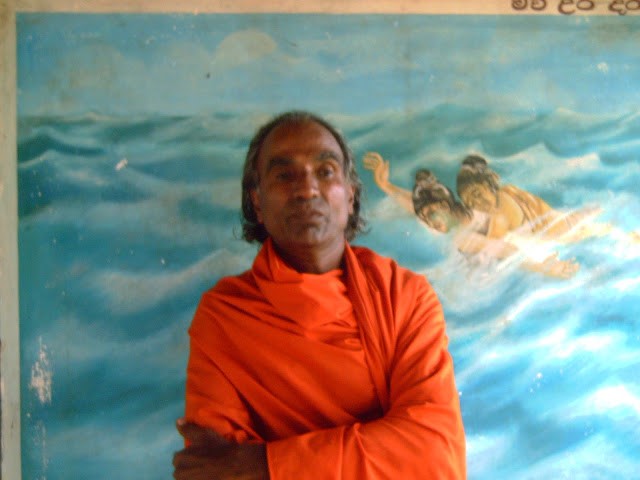
විශ්වවිද්යාල අධ්යාපනය නිම කරලා මම තාවකාලික ව ගුරු රැකියාවක් හොයා ගත්තා, සුනේත්රා දේවී පිරිවෙනේ. නැවතිලා හිටියේ බෝඩිමක. මට දේශපාලන කටයුතු පිළිබදව විශ්වවිද්යාලයේ ඉගෙනුම ලැබූ කාලයේ සිටම උනන්දුවක් තිබුනා. 1966 වෙන කොට අපි දේශපාලන කණ්ඩායමක් ගොඩ නගා ගෙන හිටියා. අපි ආකර්ශණය වෙලා හිටියේ ෆිදෙල් කස්ත්රෝගේ දේශපාලන ක්රම වේදයන් පිළිබඳව. මම, ජයකොඩි. ලාල් පරාක්රම, රුවන් පතිරණ, බලන්ගොඩ ජයසේකර. මේ කණ්ඩායමට හිටියා. එහෙත් සන්නද්ධ වීමක් මුල් කාලයේදී තිබුනෙත් නැහැ.
1967 මට විජේවීර මුණගැසුනා. ජයකොඩි හරහා වරක් විජේවීර ජයකොඩි එක්ක මගේ බෝඩිමට ආවා. අපි ? 10 සිට උදේ 4 වෙනකම් කථා කළා. මට හැඟුනා විජේවීරට යමක් කළ හැකි අයෙක් ලෙසට. ඔහු කෙරෙහි ගරුත්වයක් ඇති උනා. එදා විජේවීරකථා කලේ මොස්කව් වල වෛද්ය උපාධිය නිමකළ අයකු ලෙසට අපිට කොමියුනිස්්ට් පක්ෂය පිළිබඳව විශ්වාසය තිබුනේ නැති බව විජේවීර දැන ගෙන හිටියා. ඒ වාගේම 1966 අපි පිහිටවපු සමස්ත ලංකා උපාධිධාරි සංගමය ගැනත් විජේවීරට අවබෝධයක් තිබුනා. විජේවීර කිව්වා මට සැලැස්මක් තියනවා. එන්න මාත් එක්ක වැඩ කරන්න කියලා.
අපේ දෙවන සාකච්ඡාවට ඞී.ඒ. ගුණසේකර, පේ්රමපාල, ආවා. විජේවීර ගුණසේකර හරහා පෙන්නුවා එයාට කම්කරුවන්ගේ සහයෝගයකුත් තියනවා කියලා. මෙහෙම කථා කරලා 1967 මම තීරණය කලාවිජේවීර සමඟ එකතු වීමට.
විජේවීර ඉන්දියානු ව්යාප්තවාදය ගැන කථා කළා. උඩරට දෙමළ කම්කරුවා කන්ද උදළු ගානවා. පොළොව කිරිබත් ගෙඩිය වගේ පිම්බිලා වහින කොට පස් සේදීගෙන යනවා. තව අවුරුදු පහක් යනකොට උඩරට කඳු වල කලූගල් ඉතිරි වෙලා පස ජලාශ වලට සේදී යනවා. කියලා ප්රකාශ කලා. මේක අපේ ඇඟට වැදුනා. විජේවීරසැලලිහිණි සංදේශයේ කවි කීවා. එක කවියක සඳහන් වෙනවා කැළණි ගඟ නිල් පාටයි කියලා. අද කැළණි ගෙඟ් පාට සංසන්දනය කරන්න කිව්වා. ඒක මඩ පාටයි. මේක ගැන දොස්තර එස් .ඒ. වික්රමසිංහ ලියලා තිබුනත්, විජේවීර මේක උපහැරණ දාලා කිව්වාම හොඳට ඇඟට වදිනවා. විජේවීර ප්රකාශ කළා.
කඳුඋඩ ඉඳගෙන දෙමළ කම්කරුවන් ගල පෙරලූවොත් සිංහල ගම් චප්ප වෙනවා කියලා.
විජේවීර හමුදා ආණ්ඩුවක් ගැන අපිව බය කලා. කිව්වා ජේ. ආර්. භයානක මිනිහා. ඇමරිකන් 7 වෙනි නාවික හමුදාව ඉන්දීය සයුරේ. හමුදා කුමන්ත්රණයක් එනවා. ජේ. ආර්. ඩඞ්ලිව යටපත් කරගෙන නැගිටිනවා. ත්රීකුණාමල වරාය ඇමරිකාවට දෙනවා. මේ එක්කම මහා මර්ධනයක් එනවා. ප්රති විප්ලවය එන්න කලින් අපි එක රැුයින් බලය අල්ල ගන්න ඕනේ. ක්ෂණික ප්රහාර දීමක් එක්ක බලය අලල්ලා උදේ අපේ කොඩිය දාන්න ඕනේ. රජයේ ගොඩනැගිලිවල.
මේ සැලැස්ම අනුව අපි වැඩ කලා. පන්ති පැවැත්වූවා රට පුරාම. 1969 වෙන කොට සන්නද්ධ වෙන්න පටන් ගත්තා. විජේවීර මට කිව්වා කළුතර දිස්ත්රික් නායකයා වෙන්න. සිංහරාජයේ පුහුණුවීම් කරන්න, කළුතර සිංහ රෙජිමේන්තුවට පහර දෙන්න සූදානම් වෙන්න කියලා. අපේ මේ වෙනකොට හිටියා. 600ක් පමණ පිරිසක්.
1969 මැද විතර වෙනකොට විජේවීරයි මමයි අතර යම් යම් මත භේද ඇති වෙන්න පටන් ගත්තා. අපිව කපා දැමීමක් වගේ දෙයක් මම දැක්කා. අපිට කියුබන් ලයින් කාරයෝ කියලා ටික ටික කොන් කරනවා. ඒවගේම ප්රකාශ වෙලා තිබුනා ධර්මසේකරලා ඇතුලූ කට්ටිය ලෙඩ කාරයෝ කියලාත් මේ නිසා අපි විජේවීර හමුවෙන්න උත්සාහ කළා. මාස පහක් උත්සාහ කලත් හමුවෙන්න ලැබුනේ නැහැ.
පියතිලකව මුන ගැසුනා. මම කිව්වා අපට ලොකු මහත්තයා හමු වෙන්න ඕනෑ කියලා. පියතිලක කිව්වා ලොකු මහත්තයා, ඒ කියන්නේ විජේවීර හමුවෙන්න මේ දවස්වල අමාරුයි කිව්වා. මම ඇහුවා ලොකු මහත්තයා ඉන්නේ කොහේද කියලා. මට ඉන්න තැන කිව්වේ නැහැ. මෙහෙම බලලා අන්තිමට මම කිව්වා. ලොකු මහත්තයා එක්ක කතා කරන්න ලැබෙන්නේ නැත්නම් අපි වෙන්වෙලා යනවා කිව්වා. සුමාන දෙකක් ඇතුලත පියතිලක පැමිණියා. විජේවීර හමුවෙන්න දිනයක් අරගෙන. ඔහු කිව්වා බලන්ගොඩ බස් ස්ටෑන්ඞ් එකට හවස 5ට එන්න කියලා. අපි කට්ටිය විස්සක් විතර නියමිත දවසේ 4.30 වෙන කොට බලන්ගොඩ ස්ටෑන්ඞ් එකට ගියා. කට්ටිය දෙන්නා තුන්දෙනා කිව්ව හැටියට විසිරිලා හිටියේ. රෑ 7 වෙනකං හිටියා. විජේවීරආවේ නැහැ.
පියතිලක ආවා. මම ඇහුවා කෝ ලොකු මහත්තයා කියලා. පියතිලක කිව්වා ලොකු මහත්තයා අද හම්බවෙන්න බැහැ ලොකු මහත්තයා ඉන්නේ දුරක කිව්වා. මම ගත් කටට කිව්වා මම අද ආවේ ලොකු මහත්තයා හමු වෙන්න. මම ලොකු මහත්තයා හම්බවෙලයි යන්නේ කියලා. පියතිලක මහත්තයෝ මම ඕනෑම කතරගමක එන්නම් .ලොකු මහත්තයා හම්බ වෙන්න.
පියතිලක පුදුමයෙන් වගේ බැලූවා. මගෙන් ඇහුවා කොහොමද දන්නේ ලොකු මහත්තයා කතරගම ඉන්නේ කියලා. මට තේරුණා පියතිලකට ‘‘මම ඕනෑ කතරගමක’’ කිව්වහම මිනිහා හිතුවේ මම විජේවීර ඉන්න තැන දැනගෙනයි කතා කලේ කියලා. ඒ පාර අපි සූදානම් වුනා පියතිලකත් එක්ක කතරගමට යන්න. රෑ බසුත් නැහැ. අමාරුවෙන් ආපු බස් එකක වැල්ලවායට ගියා.
වැල්ලවායෙන් බහින කොට රෑ 2යි. කට්ටියට හොඳටම බඩගිනියි. අපි ? කඬේකට ගියා. 21 පිරිසක් දැකලා මුදලාලි ඇහුවා කොහේ යන කට්ටියක්ද කියලා. මම කිව්වා අපි වන්දනාවේ යනවා කියලා. අපි ආප්ප කන ගමන් කඬේ ගුවන් විදුලියේ යන පිරිත් ඇහැව්වා. මම කිව්වා පිරිත්හඬ ඉතා මධුරයි කියලා. පියතිලක ගත් කටටම කියාපි, පිරිත්වල මොන මධුරකමක්ද මේවා කියනකොට ලංකාවේ විප්ලවය කරන්න බැහැ. හණමිටි කිව්වා. මම පොඞ්ඩක් ආවේග ශීලී උනා. ‘පියතිලක මහත්තයෝ ඔයා කියන්නේ පිරිත් පොත වගේ අපේ උරුමයත් හණමිටි කියලද ’ ඇහුවා. පියතිලකත් අත්හැරියේ නැහැ. කියාපි ‘ ඕවා ගිනි තියලා දාන්න ඕනෑ.’ කියලා.
මට තරහා ගියා. අපි හයියෙන් වාද කරනවා. ඒ අස්සේ කඬේ මුදලාලිත් ආවා. ‘මහත්තයා මොකක්ද ගිනි තියන්න ඕනෑ’ පියතිලකගෙන් ඇහුවා. මට තේරුණා එන පොට හොඳ නැහැ කියලා. මුදලාලි අපි දෙන්නා විහිලූවක් කර ගත්තෙ මේ නිකං.’’ ඒක එහෙමද කියලා මුදලාලි ගියා. අපි බිල ගෙවලා යනකොට මුදලාලි පියතිලකව ඇහෙන් පෙන්නලා කියනවා ‘අර මහත්තයාට ඔළුව හොඳ නැහැ වගේ.’ මම සැක නොහිතන විදියට හිනාවෙලා උත්තර දුන්නා. ‘ඔව් ටිකක් එහෙමයි.’ කියලා.
අපි රෑ දෙගොඩහරියේ වාහනයක් එනකං ඉන්නවා.එතනත් අපි වාදේ. මම අන්තිමට පියතිලකට පැවසුවා ‘මට මේ කරුණ ගැනත් ප්රශ්නයක් තියනවා. මම මේක ලොකු මහත්තයට කියනවා’
අපි වාහනයක් බලාගෙන ඉන්න කොට ටිපර් එකක් ආවා. ටිපර් එකේ රියදුරාට මම අවශ්යතාවය කිව්වාම රියදුරා ඉල්ලූවා රුපියල ගානේ එක්කෙනාගෙන්. කතරගමට ගිහින් දාන්න. අපේ ඔක්කෝම විසි එක් දෙනෙක් ඉන්නවා. මම රුපියල් විසි එක එකතු කරලා ඩ්රයිවර්ට දෙන්න යනකොට පියතිලක කියනවා ‘රුපියල් 21 වැඩියි. රුපියල් 10 ඇති කියලා.’ මම සැර උනා. පියතිලක මම ඩ්රයිවර් එක්ක එකඟ වුනා. රුපියල ගානේ ගෙවන්න. ඔයාගේ සල්ලිත් මම දෙන්නම් දැන් ප්රශ්නයක් නැහැනේ. මම කිව්වා.
ඒ ටිපර් එක අපිව කතරගමට ගෙනිච්චා. කතරගම බැස්ස හැටියේම පියතිලක පොඩි පාර්සලයක් පෙන්නුවා. ‘ඩ්රයිවර් සල්ලි වැඩියෙන් ගත්තට හිලව්වෙන්න මම ටිපර් එකේ තිබුනු පාර්සලය හොරකම් කරා කියලා කිව්වා’
මට පියතිලක ගැන කේන්තියක් වගේම පිළිකුළකුත් ආවා. ‘‘ඒක මොන නීච වැඩක්ද.’’ මම කිව්වා ඒ පාර්සලේ තිබුනේ ටිපර් එකේ ක්ලීනර් ගේ කමිසයකුයි, සරමයි. මම පියතිලකට බැන්නා. ‘‘පියතිලක මහත්තයෝ මා ඕ සේතුං කියලා තියනවා ජනතාවගේ ඉඳිකටුවක්වත් තරම දෙයක් සොරෙන් ගැනීම විප්ලවවාදියෙකුට සුදුසු නැහැ කියලා.’’ පියතිලක කට වහ ගත්තා.
අපි විජේවීර හමුවෙන්න යනකොට විජේවීර ගැමියෙක් වගේ උඩුකය නිරුවත්ව කරට තුවායක් දාගෙන හිටියා. විජේවීර එහෙම ඉන්නවා දැක්කාම මට හිතුනේ මෙයා ගැමියන්ට කොච්චර සමානවද ඉන්නේ කියලා. මගේ තරහා ගතියත් නිවුනා.
මාව දැක්ක හැටියේ විජේවීර ඇහුවා ‘සේකර මහත්තයා මොනවද තියන ප්රශ්න’ කියලා. මම අපේ ප්රශ්න කිව්වා. අපේ ප්රශ්න තමයි. එක රැයකින් බලය අල්ලන්න බැරි වුනොත් කරන්නේ මොනවාද? බහු ජනතාව සංවිධානය කිරීමක් වෙන්නේ නැහැ. ඒක කල යුතුයි. විප්ලවයට පෙර යන කරුණ කීවා.
විජේවීර උත්තර දුන්නා. අපට වෙන විකල්ප නැහැ. ඇමරිකන් රූකඩ ආණ්ඩුව එන්න කලින් අපට බලය අල්ලන්න වෙනවා. කාලයක් නැහැ. මම පීයතිලක එක්ක වෙච්ච විවාදේ පිරිත් පොත, ජාතක කතා පොත ගිනි තියන්න ඕනෑ කියපු ප්රකාශය ගැන මොකද කියන්නේ කියලා මම ඇහුවා.
විජේවීර යළි පිළිතුරු දුන්නා. ‘සාහිත්ය සංස්කෘතිය ගැන කතා කරන වෙලාවක් නෙවෙයි මේක. ඒක බලය අල්ල ගත්තට පස්සේ මතුවන දෙයක් කියලා. අපි උදේ අටේ ඉඳන් රෑ 11 වෙන කං කතා කලා. අන්තිමේදී අපේ ප්රශ්නය විසඳුනා වගේ පෙනුනා.
ජයකොඩි ග්රනේඞ් එකක් හැඩයට හඳපු චීනච්චට්ටි කවරයක් විජේවීරට පෙන්නුවා. ඒක දැකලා විජේවීරගොඩාක් සතුටු උනා. මෙන්න මෙහෙම වැඩ කරන්න ඕන. පොඩි පොඩි මතභේද අත්හැරලා. ජයකොඩි සහෝදරයාගේ සන්නදධ වීමට සුදානම හොඳයි මේ විදිහට අපිට බෝම්බ හදන්න පුලූවන් යැයි විජේවීරකිව්වා.
මට එතනදී ගැටලූවක් ආවා. මේ වගේ කවරයක් තුලට පිපිරුම් ද්රව්ය දාන්නේ කෙසේද? ජයකොඩි පෙන්නුවේ කවරයක් විතරයි. මේක වැඩ කරයිද වගේ ප්රශ්න ඒත් එක ඇහුවේ නැහැ. මොකද මම කකුලෙන් අදින ප්රශ්න අහනවා කියලා හිතයි කියලා.
අපි ගැටළුවක් නැතුව විජේවීරගෙන් සමුගෙන ආවා. ආපසු දිස්ත්රික්කයට ඇවිත් වැඩ කරන කොට යළිත් කැපිලි අපිව අයින් කරලා කියලා තමයි රාවය යන්නේ.
මේ වෙන කොට මට උණ හැදිලා වමනේ යනවා. හොඳටම අමාරුයි. මාව රාගම රෝහලේ නැවැත්තුවා සේලයින් දුන්නා. මම පුරා දවස් 11ක් ඉස්පිරිතාලේ ගත කලා. ඥාණපාල කියන සහෝදරයා මාව බලන්න ආවා. ඇවිත් කිව්වා අපි සිංහරාජයේ ආයුධ සන්නද්ධව පුහුණු වෙනවා කියලා. පොලිසියට ඔත්තුවක් ගිහිල්ලා පොලිසිය එනවා සෝදිසි කරන්න කියලා කිව්වා.
මට හොඳටම උණ. ඇඟ් ශක්තිය බිංදුවක් වත් නැහැ. උණ විකාරයෙන් මට පේනවා පොලිසියට එනවා. මම ඇඳ එක්ක පාවෙලා යනවා. රෑ 2ට විතර මට පේනවා ඈතින් ඥානපාල මට අත වනනවා. මම අමාරුවෙන්ම නැගිට්ටා. වාට්ටුවේ මිසී නිදි. මම හිමීට වාට්ටුවෙන් පිටවෙලා මහ පාරට ආවා. ඥානපාල මගේ ඉදිරියෙන් යනවා. ඥානපාල කිව්වා පොලිසිය බස් ස්ටෑන්ඞ් එකේ අපි රේල් පාර දිගේ යමු කියලා. මම එකඟ වුනා. මම රේල් පාර දිගෙ යනවා. ඥානපාල ඉදිරියෙන් යනවා. ඒ එක්කම මහා ධාරානිපාත වර්ෂාවක් ආවා. මම හොඳට තෙමි තෙමී තෙත බරි වුනා.
මට පියවි සිහිය ආවා. ඥානපාල පේන්නවත් නැහැ. පිටිපස්සෙන් මොකක්දෝ එළියක් එනවා. මොහොතකදී මට තේරුණා මම ඉන්නේ රේල් පාර මැද කියලා. මම ඉවතට පැන්නා. ඇසිපිය හෙලන මොහොතකදී කෝච්චිය මාව පසු කරලා ගියා මම බේරුනේ කෙස් ගහෙන්.
මම ඥානපාලව දැක්කට ඒ හැබැයින්ම නෙවෙයි. උණ විකාරෙට ආපු මායාවක් මට යන්න තැනක් නැහැ. මම යළිත් රෝහලට ගියා. රෝහලේ පිරිස ඇවිස්සිලා. අමාරු උණ ලෙඩෙක් අතුරුදහන් වීම පිළිබඳව. මගෙන් ඇහුවා කොහේද ගියේ කියලා. මම කිව්වා. උණ විකාරෙන් මම ඇවිදගෙන ගියා. වැස්සට තෙමුනා ඒ නිසා ආවා කියලා. ඒ අය මගේ ඇඟ පිහිදාගන්න දීලා තෙත රෙදි ඉවත් කරලා අඳින්න බෙඞ් ෂීට් එකක් දුන්නා. හැබැයි උදේ වෙන කොට මගේ ලෙඬේ සනීපයි.
රෝහලෙන් ටිකට් කැපුවාම මම කුරුණෑගලට ගියා. කුරුණෑගල විල්බාවේ ෆැරැුන්සිස් හාමිගේ ගෙදර. කට්ටිය එක්ක දවස් තුනක් සාකච්ඡුා කළා. අපි එක්ක පනස් හතක් විතර හිටියා. ඒ සාකච්ඡුා වලින් 1970 මාර්තු වෙන කොට අපි අළුත් කන්ඩායමක් හැදුවා. මාතෘ භූමී ආරක්ෂක සංගමය කියලා.
1971 මාර්තු වලදී අපි තීරණය කළා වියට්නාමයේ ඇමරිකාව කරන ජන ඝාතන වලට විරෝධයක් ලෙසට කොළඹ ඇමරිකානු තානාපති කාර්යාලයට පැනලා පත්රිකා බෙදන්න. වීදුරු කඩන්න.
අපේ කට්ටිය ඇමරිකන් තානාපති කාර්යාලයට පැනලා මුරට හිටපු රාලහාමිලා දෙන්නව යටත් කර ගත්තා. බය කරන්න සද්දේ විතරක් තියන පිපිරුම් හානි නැති බෝම්බ 2 ක් ගැහුවා. ඇමරිකානු කොඩිය බිමට බාලා ගිනි තියන්න. කෙනෙක් කොඩි ගහට නැග්ගා. නගින්න අමාරුයි. ලිස්සලා යලි පහලට එනවා. ග්රීස් ගහේ නගිනවා වාගේ.
ප්රහාරයට තිබුනු කාලය විනාඩි 3 යි. කාලය ගියොත් පොලිසිය වට කරනවා. පිරිස ඇමරිකානු තානාපති කාර්යාලයේ අසල තිබුනු වාහන 7ක් විතර කොඩිගහ ළඟට ගෙනල්ලා වාහනවලට ගිණි තිබ්බා. ඒ ගිණි ජාලාව එක්ක කොඩියත් පිච්චුනා.
කට්ටිය විසිරී යද්දී අයි.පී. කරුණාරත්න අහම්බෙන් එතනට ඇවිල්ලා.එයා එනකොට කොල්ලූපිටිය පොලිසියේ රාලහාමිලා දෙන්නෙක් අත උස්සගෙන ඉන්නවා දැකලා. මෙතන්ට පැන්නා. කළබලය දැකලා සාක්ෂියට කෙනෙක්ව අල්ලා ගෙන ජීප් එකට දා ගන්න ගියා. කණ්ඩායමේ හිටපු එදිරිසිංහ සාක්ෂිකාරයා බේරා ගන්න ගියා. අයි.පී.කරුණාරත්න දැඩිව සාක්ෂිකාරයා අල්ලා ගෙන හිටපු නිසා ඔහු ගන්න අමාරු උනා. ඒ නිසා බැරිම තැන එදිරිසිංහ අයි.පී. කරුණාරත්නට පිහියෙන් ඇන්නා. අයි.පී.කරුණාරත්න මළා.
මේ අස්සේ මේ සිද්ධියට ආපු කලින් සිවුරු ඇරපු කෙනෙක් පොලිසියට අහු උනා. ඒක උනේ මෙහෙමයි.
ඇමරිකානු තානාපති කාර්යාල ප්රහාරය ගැන කට්ටිය විද්යාලංකාරේ බෝඩිමක සැලසුම් කර කර ඉන්න කොට මේ මෑතකදී සිවුරු ඇරලා හිටපු කෙනා ආවා. මිනිහා දොර ලඟ හිටපු නිසා සැලසුම අහගෙන හිටියාදෝ කියන සැකයක් ඇති උනා. ඇත්තෙන්ම මිනිහා ආවේ සැලසුම් කට්ටියේ කෙනෙක්ව හමුවෙන්න. පිරිස මේ පුද්ගලයා ව කාමරයේ හිරකරලා ප්රහාරයට යන්න හදන කොට මිනිහාව දන්න යාළුවා කිව්වා මූ හොඳ එකෙක්. අපේ වැඬේට මූවත් ගමු කියලා. පැට්්රල් බෝතලයක් අතට දුන්නා.
මේ මිනිහත් පිරිස එක්ක තානාපති කාර්යාලයට ගියා. ඒත් මොනවත් නොකර බලාගෙන හිටියා. පිරිස පහර දීලා විසිරිලා යනකොටත් මේ මෝඩ මනුස්සයා පැට්රල් බෝතලය අතේ තියාගෙන වාහන ගිනි ගන්නවා බලා ගෙන ඉඳලා. පොලීසිය එනකන් මිනිහා එතන. එයාගේ මාර්ගයෙන් පොලිසිය තොරතුරු ලබා ගත්තා.
මට අයි.පී. කරුණාරත්නගේ මරණය ගැන කනගාටුයි. ඒක ඛේදවාචකයක්. මම එදිරිසිංහට කිව්වා. ‘එදිරි, මේක සිදු නොවිය යුතු දෙයක්. අපි සැලසුම් කළේ වීදුරු කඩලා කොඩිය ගිනි තියන්න විතරයි. එදිරිසිංහ කිව්වා එයාටත් වෙන විකල්පයක් තිබ්බේ නැති බව.
මේ ප්රහාරය විජේවීර දැක්කේ එයාලාගේ ප්රහාරයට විරුද්ධව කරපු කඩාකප්පල්කාරී ක්රියාවක් හැටියට. ඒත් මට එහෙම දෙයක් කරන්න අවශ්යතාවක් තිබුනේ නැහැ.
( අනගාරික ධර්මසේකර පවසන පරිදි මෙම ප්රහාරයට අනුගාමිකයන්ගේ ඉල්ලීම පරිදි ඔහු සහභාගී නොවීය. 1971 අපේ්රල් මාසයේ දිනමිණ පුවත්පතේ පොලිස් නිලධරියා මරා දැමීම නිසා සැකපිට ඇන්තනී ක්ෂේවියර් යන පුද්ගලයකු අත් අඩංගුවට ගෙන ඇති බවට පුවතක් පල විය – කතෘ)
1971 අපේ්රල් 5 දා ප්රහාරයේ දී මම හිටියේ ගමේ. ප්රහාරය ගැන මම දැන ගෙන හිටියේ නැහැ. 6 දා පොලිසියෙන් මාව අල්ලන්න පැන්නා. මම සැඟවුනා. මෙහෙම අවුරුදු 2 විතර සැඟවිලා හිටියා. බෙන්තර, ඉඳුරුව ප්රදේශ වල අපේ ව්යාපාරයට මුදල් හොයන්න මම ඔක්කම්පිටියට ගියා.
මැණික් ගරන්න. එහෙම ගිහිල්ලා ඉන්න කොට 1973 අපේ්රල් 18 වෙනිදා පොලිසියෙන් මාව අත්අඩංගුවට ගත්තා. පොලිසියෙන් එනකොට මම හොඳටම නිදි. පොලිසිය මට මාංචු නින්දෙන්ම දාලා. තමයි නැගිට්ටෙව්වේ. මාව ගෙනිච්චා සී.අයි.ඞී. එකේ 4 වන තට්ටුවට. පහර දුන්නා. කිව්වා අපි දන්නවා උඹ ජේ.වී.පී. නොවෙයි කියලා. ඒත් උඹ තවත් කැරැුල්ලකට කැස කවනවා. ඒ නිසා අපි උඹව හඳිසි නීතිය යටතේ රඳවා ගන්නවා.
මගෙන් කට උත්තර ගන්න හමුදා මූලස්ථානයට ගෙනිච්චා. මගෙන් කට උත්තර ගත්තේ ඩෙන්සිල් කොබ්බෑකඩුව මහත්තයා. මගේ තුවාල දැකලා යුධ හමුදා රෝහලේදී මට ප්රතිකාර ලබා දුන්නා. කොබ්බෑකඩුව මහත්තයා මට කියනවා ඔයාව අත්අඩංගුවට ගන්න මම 1972 මාලේවන වටකරා. 1110 භට පිරිසක් සමඟ. ඔයා අපේ ඇස් වහලා පැන්නා. ඔයාගේ දක්ෂකම ගැන මම අගය කරනවා. ඒත් මේ විදිහට. අපේ සිංහල කොල්ලෝ කැරලි ගහලා මැරිලා යනවාට මට දුකයි.
මාව මිලිටරි පොලිසියේ මාසයක් තියා ගත්තා. මෙහෙම හදිසි නීතිය යටතේ අවුරුදු හතරක් මාව මහර සහ මැගසින් බන්ධනාගාරවල රඳවා ගෙන හිටියා. හිරේදී සමහර ජේ. වී. පී. සාමාජිකයෝ මට ගහන්නත් ආවා. නන්දන මාරසිංහ මාව දැකලා ඇහුවා ‘අපි ඔක්කොම දැන් එකට හිරේ. ඔහෙලා අපිට තාම සී.අයි.ඒ. කාරයෝ කියනවද?’ කියලා.
මට හිරේදී කිහිප වතාවක් විජේවීර මුහුණට මුහුණ හමු උනත් විජේවීර මගේ මුහුණවත් බැලූවේ නැහැ. වරක් අපි බන්ධනාගාර ඩිස්පැන්සරියේ එක ලඟ හිටියත් එයා මාත් එක්ක කථාවට ආවේ නැහැ.
මමයි, විජේවීරයි අතර මත ගැටුම් තිබුනා. වරක් මගේ පොතක් මුද්රණය වෙන කොට මුද්රණාලයට කඩා වැදිලා පොත් පවා ගිනි තිබ්බා. 88 භීෂණ කාලයේ මව ඝාතනය කරන්නත් උත්සාහ කළා. විජේවීර තුළ තිබුණා මතවාදී ආඥදායක තත්වයක්. තවත් විප්ලවවාදී මතයකට ඉඩ දුන්නේ නැහැ. ඔහු 1970 යුගයේ කෘර චරිතයක් නොවෙයි 1988 විතර, වෙනකොට බලකාමය නිසා ඔහු වෙනස් වෙන්න ඇති.
විජේවීර මත්පැන්, විරෝධියෙක්.විජේවීර නිසා තරුණයන්ට දස දහස් ගණනක් මත්පැන් බීම නැවැත්තුවා. මේ ගැන කවුරුවත්ම කථාකරලා නැහැ. ඔහු තුළ හොඳ නරක දෙකම තිබුනා.
විජේවීර හා මා අතර භේදය උත්සන්න කළේ දෙවන පෙළ නායකයකු වූ සනත් බොරළුකැටිය හා ලොකු අතුල. එහෙත් දැන් මම ඒ අතීතය දෙස බලන්නේ වඩාත් උපේක්ෂාවෙන්. ඒ කාලයේ ඒ අයට ඒ පිළිබඳව තදබල අවශ්යතාවක් තියෙන්න ඇති. උප නායකත්වයට ඒකට දොස් කියන්න බැහැ.
1970 වේදී මම අනාවැකියක් කිව්වා. ඉතා ඉක්මණින් මේ රටේ විජේවීරගෙ මූලිකත්වයෙන් ලේ වැගිරීමක් වෙනවා. තරුණයන් බිලි දීමක් වෙනවා. කියලා. රොසැන්ටල් කියන පුද්ගලයා විජේවීර ඝාතනය කරන්න උත්සාහ කලා. කියන එක හා ඔහු බිත්තර වෙළෙන්දෙකු ලෙස වෙස්වෙලාගෙන විජේවීර හෙව්වා කියන එක පිළිබඳව යම් සත්යයක් තියෙන්න පුළුවන්. රොසැන්ටල් කිරිබත්ගොඩ ප්රදේශයේ තරුණයෙක්.
1969 දී මා තුළ අදහසක් තිබුණා 1975 දී විතර ලංකාවේ කැරැුල්ලක් ඇතිකරන්න බහුජන පදනමක් සහිතව. ඒත් 1971 කැරැුල්ල අවිධිමත්ව අයථා කාලයේදී ආවා එතකොට සමගි පෙරමුණු රජය ජනප්රියයි. මගේ ඒ අදහස 1977 දී ක්ෂය උනා.
බන්ධනාගාරයේ දී මම බෞද්ධ දර්ශනය පිළිබඳව හැදෑරුවා. ත්රිපිටකය කියෙව්වා. මට මතකයි මම පොඩි කාලේ 2500 බුද්ධ ජයන්තියට සිල් ගත්තා. යළි මා තුල බුද්ධ ධර්මය කෙරෙහි ඇල්මක් ඇති වෙන්න පටන් ගත්තා. ඒක අධ්යාත්මික විප්ලවයක් ලෙස හඳුන්වන්නට පුලූවන්.
මට විජේවීර හෝ ජේ.වී.පී. එක සමඟ වෛරයක් නැහැ. මම දැන් ප්රචන්ඩ අරගලය, අවිආයුධ, අත්හැරපු කෙනෙක්. මම දැන් බෞද්ධ දර්ශනය අනුව වෙන ගමනක් යනවා. 1999 වර්ෂයේ මම අනගාරික වුනා. දැන් මම විශ්වාස කරන්නේ ආධ්යාත්මික විප්ලවයක් ගැන පමණයි.
අධ්යාත්මික ශක්තිය පිළිබඳව දැන් මට විශ්වාසයි. ආයුධ බලයට වඩා 2004 සුනාමියේදී මම ජීවිතේ ගලවා ගත්තේ මෙම ශක්තියෙන් කියා හිතනවා. ‘දේශපාලන අරමුණු මුදුන්පත් කර ගැනීම සඳහා ආයුධ අතට ගැනීම නොකල යුතුය.’ කියන මතයේ මම ඉන්නේ. විදේශ ආක්රමණයක් ආවොත් මිසක අභ්යන්තර දේශපාලන කටයුතු වලදී ආයුධ අතට ගැනීම කිසි සේත්ම අනුමත කරන්න බැහැ.
(වෛද්ය රුවන් එම් ජයතුංගගේ 71 කැරැල්ල ආරම්භයේ සිට අවසානය දක්වා පුර්ණ සමාලෝචනයක් කෘතිය ඇසුරෙනි )
Ahmadiyya Founder’s Day Celebration in Colombo – A sign of Religious Harmony
March 29th, 2017by A. Abdul Aziz. AHMADIYYA MUSLIM JAMA’AT – SRI LANKA
In my journey to serve the humanity with you all, a day will come, I will join with you to say prayer in this Mosque – Mr. Siriyanandha of Siriyanandha Foundation remarks.
The Ahmadiyya Founder’s Day celebration was held in Colombo recently (26 March, 2017) at Baithul Hamd premises with the participation of members of other faiths. Members from non-ahmadi Muslims, Buddhism and Christianity attended the event which was organized by Colombo Chapter of Ahmadiyya Muslim Community in Islam.
The event started with the Holy Qur’an recitation followed by Urdu Nazm (poem), composed by Hazrat Mirza Ghulam Ahmad, Founder of the Ahmadiyya Muslim Community and Promised Messiah (a.s.) on the Existence of God and his intense connection with Him.
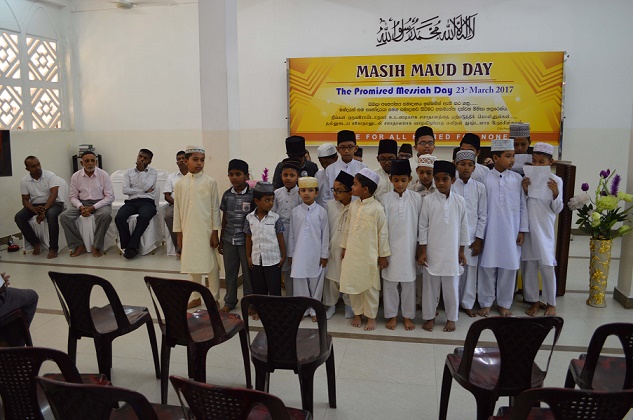
In his address, National President Mr. A.H. Nasir Ahmad highlighted the advent of Promised Messiah in an era when the Christianity to dominate Islam in the Indian sub- continent.
Chief Missionary A.B. Musthaq Ahmad introducing Ahmadiyya Community and stressed the importance of accepting it, based on the teachings of Holy Prophet of Islam Muhammad (PBUH). He also quoted the address of Ahmadiyya Supreme Head His Holiness Hazrat Mirza Masroor Ahmad in Japan during his last visit.
Mr. Siriyanandha of Siriyanandaha Foundation and Chief Officer of Public Library Colombo in his address recalled the launching of Holy Qur’an Sinhala Translation in 2015 and said this day this Holy Book being read out by Rev. Buddhist Monks and others thus creates religious harmony and making understand to others what Islam teaches. In my journey to serve the humanity with you all, a day will come, I will join with you to say prayer in this Mosque, he added.
Fr. Priyantha and a non-ahmadi Muslim also addressed the event in which Government officials also attended. Mr. Priyantha was gifted the copy of Holy Qur’an Sinhala Translation.
Large number of Ahmadi men women and children attended the event that concludes with silent prayer.
සරත් වීරසේකරගේ ජිනීවා තනි සටනට ජනපති මෛත්රීගේ විරෝධය.. ප්රසිද්ධියේ විරෝධය දක්වයි..[Video]
March 29th, 2017ලංකා සී නිවුස්
සිවිල් ආරක්ෂක බලකායේ හිටපු ප්රධානී අද්මිරාල් සරත් වීරසේකර මහතා ජිනීවා වෙත ගොස් පල කරන ලද අදහස් එතරම් හොද දෙයක් නොවන බව ජනාධිපති මෛත්රීපාල සිරිසේන මහතා සදහන් කරයි.
කුරුනෑගල ආරක්ෂක සේවා විදුහලේදී පැවති උත්සවයක් අමතමින් ජනාධිපතිවරයා මේ අදහස් පල කලේය.
විත්තිකරුවෙකු නොවී විත්තියේ වාචිකයක් ලබා දීම ගැලපෙන දෙයක් නොවන බවද ජනාධිපතිවරයා එහිදී කියා සිටියේය.
ගොළු මුහුදට තල්ලුවෙන සිංහලයින්
March 28th, 2017චන්ද්රසිරි විජයවික්රම, LL.B.,Ph.D.
ලංකාව නමැති ඉඩම් කෑල්ලේ දෙමළ ජනයා ව්යාප්තවී ඇති ආකාරය පෙන්වන පහත දැක්වෙන සිතියම් වැදගත් වන්නේ රටේ ඉතිහාසය හා භූගෝල විද්යාව ගැන නොදන්නා දේශපාලකයින්, භාෂාව අනුව රට බෙදීමට යාම කෙතරම් අඥාන ක්රියාවක්ද යන්න වටහා ගැනීම සඳහාය. ලංකාවේ සුළු ජන වර්ග මහජාතිය සමඟ මිශ්රව ඇත්තේ හරියට බිත්තර කීපයක් ඔම්ලට් සඳහා කළවම් කරා වගේය. විග්නේශ්වරන් උතුරේ මහ ඇමති ලඟදී කිව් පරිදි 1948 සිට සිංහල ආණ්ඩු දෙමළ ජන සංහාරයක් කරගෙන යනවා නම් මේ සිතියම්වලින් පේන අන්දමට දෙමළ ජනයා සිංහල ප්රදේශවල සීසීකඩවී විසිරී ජීවත්වන්නේ කෙසේද?
ලංකාව ටැමිල්නාඩ් කොටසක් නොවී බේරුණේ මුහුදින් ලැබුණ ආරක්ෂාව නිසාය. එය එංගලන්තය නැපෝලියන්ගෙන් හා හිට්ලර්ගෙන් බේරුණා වැනිමය (එංගලන්තයේ වත්මන් රජවරුන්ට තාමත් ඇත්තේ ජර්මන් ලේය). එහෙත් ටැමිල්නාඩ් වලට යකඩ පාලමක් හා කොන්ක්රීට් බිංගෙයක් දාන්නට ප්ලෑන්කරණ අයද ලංකාවේ සිටී. මෙසේ වුනොත් දැනට හොරෙන් ලංකාවට එන ටැමිල්නාඩ් ජනයා වැල නොකැඩී ගලා එනු නිසැකය. උතුරට පොලිස් බලතල දුන්නොත් ඔවුන්ට පොලිස් ආරක්ෂාවද ලැබෙනු ඇත. මේ අය රට ඇතුලේ සිංහල මායිම් ප්රදේශ වලට සංක්රමණය වනු ඇත්තේ තේසවලම් නීතිය අනුව යාපන ප්රදේශවල ඉඩම් නැති නිසාය. මායිම් ගම්මානවල ගෙවල් හා ජලය සඳහා ගැටුම් හටගනු ඇත. සිංහල මිනිසා ක්රමයෙන් ගොළු මුහුදට තල්ලුවෙනු ඇත.
13 වන සංශොධනය මොන තරම් භයානක මර උඟුලක්ද කියා පෙනීයන්නේ ඊලම් නායකයින් කියන දෙමළ ජන වර්ගයාගේ අභිලාශ (ඇස්පිරේෂන්ස්) ශාක්ෂාත් කර ගැනීම සඳහා උතුර හා නැඟෙනහිර දෙමළ නිජබිම් ලෙස වෙන්කර ගත් පසු, අනිත් පලාත් හතේ ඉන්නා දෙමළ ජනයා ඊළම නම් ඒ නිජ බිමට මිස ලංකාවට ලැදියාවක් නොදක්වන නිසාය. අනිත් අතට ඊළම් පාලකයින් මේ දකුණේ ඉන්නා දමිළයින්ව නොයෙක් ආකාරයට උසි ගන්නනවා නිසැකය. සිංහල පලාත් වල ජනයා බලවත් ආතතියකට පත්වීමත්, කෑලි හතකට බෙදුණු සිංහල ආණ්ඩු බලවත් හිසරදවලට අසුවී අසරණවීමත් සිදුවනු නියතය. ලෝකයේ වෙනත් රටවලට අත්වූයේද මෙවැනි ඉරණමකි. උතුරට පොල් රා ගෙන්න එපා, බුදු පිලිම හදන්න එපා, දෙමළ ජනයා සිංහලයින් කසාද බඳින්න එපා, උතුර-නැඟෙනහිර එකතු කරන්න ඕනෑ යන කතා තව තවත් උග්රවී ඉන් සිංහලයා කුලප්පු වනවිට, මෙම දෙවන හා තුන්වන සිතියම්වල රතුපාටින් පෙනෙන දෙමළ ජනයාට 13 සංශොධනය දුන් විසඳුම කුමක් වේවිද?
මෙම සිතියම් පහ පිළියෙල කලේ A Statistical Survey of Elections to the Legislatures of Sri Lanka 1911-1977”, G. P. S. H. De Silva (1979) යන පොතේ ඇති, 1976 සීමා නිර්ණායක කොමිසම් වාර්තාවේ සඳහන් ලංකාවේ ඒ වනවිට තිබුණු මැතිවරණ චන්ද කොට්ඨාශ 157තේ චන්දදායකයින්ගේ (වෝටර්ස්) ජනවර්ගය හා ආගම පිළිඹඳ ප්රතිශත දත්ත වලින් ය (යම් ගෙදරක චන්ද දායකයින් එක්කෙනෙක් හෝ දෙන්නෙකුට අමතරව තව ළමයි දෙන්නෙක් හෝ තුන්දෙනෙක් හෝ ඊට වඩාද සිටිය හැකිය). 1976 වඩ්ඩුකොඩ්ඩෙයි ඊළම් ප්රකාශණය කාලයේ සංඛ්යා මේ සිතියම් වලින් පෙන්වයි. වඩා මෑත ජාතිය, භාෂාව හා ආගම පිළිඹඳ ජන සංඛ්යා විස්තර ලබා ගැනීමට නැත. 2015 දත්ත තිබේ නම් මේ සිතියම්වල රතුපාට ප්රදේශ මීට වඩා පැතිරී තිබෙන්නට ඉඩ ඇත. යම් භූගෝල විද්යාත්මක සිද්ධි දාමයක සත්යය, යථාර්ථය දැනගැනීමට මහජනයාට අයිතියක් තිබිය යුතුය.
යම් චන්ද කොට්ඨාශයක දෙමළ ජන ප්රතිශතය (චන්ද දායකයින්)ලෙස ලංකා දෙමළ හා ඉන්දියන් දෙමළ යන දෙකොටසම එකතුකර යොදා ගන්නා ලදී. අනිත් අතට සිංහල ප්රතිශතය සැදීමේදී ගනු ලැබුවේ සිංහල බෞද්ධ යන කොටස පමණය. සිංහල ක්රිස්තියානීන් ඉන් ඉවත් කරන ලදී. මෙසේ කළේ යම් චන්ද කොට්ඨාශයකදී දෙමළ අයට වැඩිම වාසියත්, සිංහල අයට අඩුම වාසියත් ලබාදීමටය.
මේ අනුව 1977 දී දෙමළ අය සියේට 50 ට වැඩි මැතිවරන කොට්ඨාශ 17 ක් විය. සියේට 5-49 දක්වා ආසන 20 ක් විය. ආසන 120 කම සිටියේ සියේට 0.4 -4.99 දක්වාය. තිස්ස විතාරණ මැජෝරිටි වාර්තාව (APRC- 2006) දෙමළ පොලිස් ස්ථාන පිහිටුවන්නට යෝජනා කළේ මේ ආසන 120 තුල විය යුතුය.
පලවෙනි සිතියම- දෙමළ ජනයා (චන්ද දායකයින්) සියේට 50 හෝ ඊට වැඩි
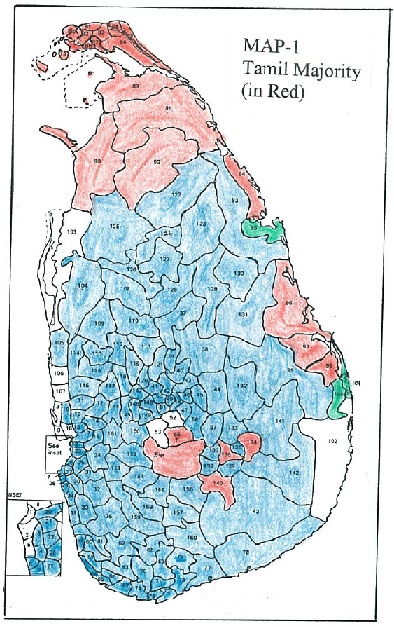 මේ සිතියමෙන් පෙන්වන්නේ 1977 දී සියේට පනහක් හෝ ඊට වඩා දෙමළ (රතුපාට), මුස්ලිම් (කොළපාට) හෝ සිංහල (නිල්පාට) ජනයා (චන්ද දායකයින්) සිටි චන්ද කොට්ඨාශය. මේ අනුව කිසිම ජන වර්ගයක් බහුතර නොවන චන්ද කොට්ඨාශ ඇත්තේ 12 ක් පමණය. ඒවා නම් පුත්තලම, වෙන්නප්පුව, නාත්තන්ඩිය, මීගමුව, ජaaැල, වත්තල, ගම්පොළ, නාවලපිටිය, කොළඹ උතුර, කොළඹ මැද, කොළඹ බටහිර හා පොතුවිල් ය. දෙමළ ජනයාට මුස්ලිම් ජනයා එක් කළොත් පුත්තලම, මැද කොළඹ හා නාවලපිටිය සියේට පනහකට වඩා සුළු ජාතීන් ඉන්නා චන්ද කොට්ඨාශ බවට පෙරළේ.
දෙවැනි සිතියම- දෙමළ ජනයා (චන්ද දායකයින්) සියේට 11-49 අතරවන
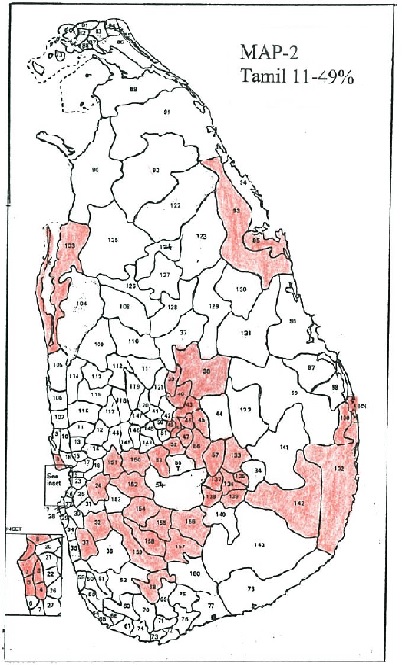 මෙම සිතියම පලවෙනි සිතියමේ හිස්තැන් පුරවන ආකාරයේ සිතියමක් වැනිය. පලවෙනි සිතියමේ ඇති හිස් තැන් (සුදුපාට) සෑහෙන තරමේ දෙමළ ජනයා සිටින චන්ද කොට්ඨාශ වන බව මින් පෙනී යයි. ඒවා බෞද්ධ හා දෙමළ ප්රදේශ අතර මැද ඇති සංක්රමණ කලාපයක් බව පෙනේ. ලංකාවේ ඊළම් රටක් බිහිවුනොත් මෙම කලාපය නිරන්තර වාර්ගික ගැටුම් ඇතිවන කලාපයක් වනු නිසැකය.
තුන්වන සිතියම- දෙමළ ජනයා (චන්ද දායකයින්) සියේට 1-10 අතරවන
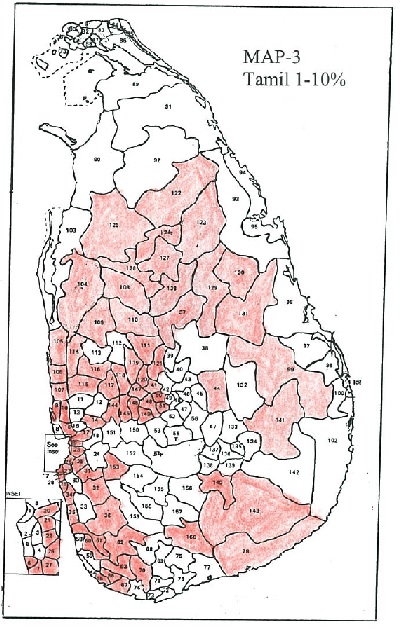 මෙම සිතියමෙන් පෙන්වන්නේ සුළු ප්රමාණයෙන් දෙමළ ජනයා ජීවත්වන චන්ද කොට්ඨාශය. තිස්ස විතාරණ මැජෝරිටි වාර්තාව කොමිසම (APRC, 2006) විසින් දෙමළ පොලිස් ස්ථාන පිහිටුවීමට හෝ දෙමළ පොලිස් භටයින් තැබීමට යෝජනා කළේ මේ චන්ද කොට්ඨාශවලය. එහෙත් 1983 දී හෝ ඊට පෙර හෝ පසුව හෝ මේ ප්රදේශවල දෙමළ ජනයාට හිරිහැර සිදුවී නැත. ආනන්ද සංගාරී මහතා කියා සිටියේ සිංහල ගම්වලදී දෙමළ ජනයාට කරදර නොවූ බවය.
හතරවන සිතියම- ක්රිස්තියානි බලපෑම
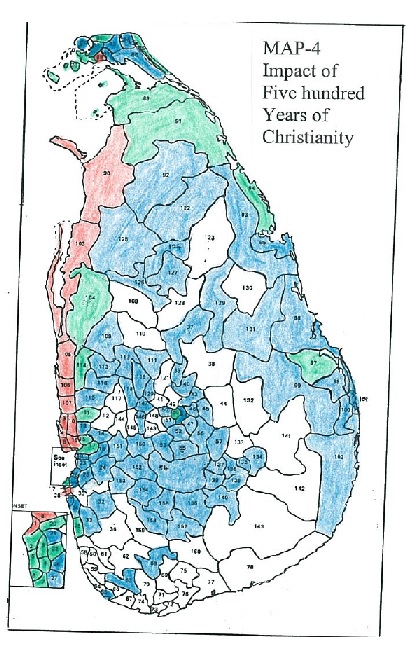 මේ සිතියමෙන් පෙන්වන්නේ ලංකාවේ බයිබල් බෙල්ට් එකය. ක්රිස්තියානීන් සියේට 30 කට වඩා ඉන්නා (රතුපාට), සියේට 10-29 අතර ඉන්නා (කොලපාට) හා සියේට 1-9 අතර ඉන්නා (නිල්පාට) චන්ද කොට්ඨාශ මෙහි පෙන්වා ඇත. සියේට 1 ට වඩා අඩු පිරිස් (සුදුපාට) රට පුරා විසිරී ඇත. පසුගිය අවුරුදු සීය තුල කිසිම පල්ලියකට පහරදීමක් සිදුවී නැත. අශීලාචාර අන්යාගමීකරණය 1977 න් පසු වැඩිවී මිනිස් බැටළු ලවා බුදු පිළිම පොළොවේ ගසා කුඩුකරවා ඒවාට මුත්රා කරවීමේ ක්රියා එළිවීමත් සමඟ තත්වය වෙනස් විය.
පස්වන සිතියම- බෞද්ධ සුළුතරය සියේට 1-5
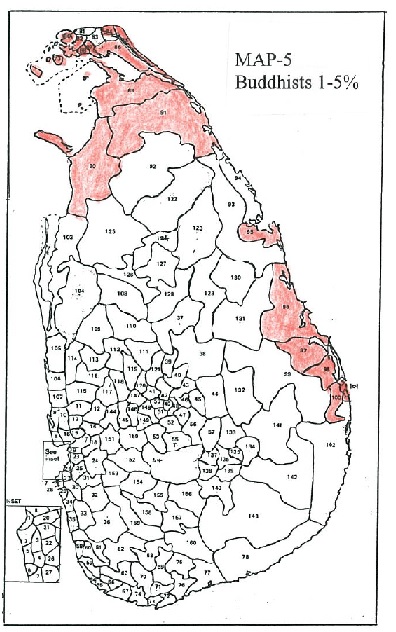 මෙවැනි මැතිවරණ කොට්ඨාශ 19 ක් ඇත. මෙම බෞද්ධ සුළු ජන කොටසට තිස්ස විතාරණ මැජෝරිටි වාර්තාවෙන් (APRC- 2006) කිසි සහනයක් යෝජනා කර තිබුණේ නැත. මේ ප්රදේශ වල ඇති බෞද්ධ පුරාවිද්යා ස්ථානවලට සිදුකරණ හානිය වැළැක්වීමට 2016 අග සිට පොලිස් රැකවල් දැමීම තිස්ස විතාරණ වාර්තාව සිංහල ගම්වල දෙමළ පොලිස් භටයින් තැබීමට කල යෝජනාව සිහිකරවයි. එහෙත් මිනිසුන් ආරක්ෂා කිරීමත්, නටබුන් මුරකිරීමත් එකිනෙකට වෙනස් ක්රියාදාම දෙකකි.
ප්රාදේශීය ලේකම් කොට්ඨාශ අනුව මුස්ලිම් ජන ව්යාප්තිය පෙන්වන සිතියමක්ද මේ සමඟ ඇත්තේ එයද මෙම මාතෘකාවට අදාළ වන නිසාය. මෙය ලබාගත්තේ වෙබ් අඩවියකිනි. ආගම අනුව නොව දෙමළ භාෂාව කතාකරණ අය වශයෙන් ප්රභාකරන්ට පෙර හා පසුව ඊළම් නායකයින් මුස්ලිම් ජනයා ඇමතුවේ/අමතන්නේ රතුපාටින් පෙන්වන සිතියම් වලට මේ මුස්ලිම් සිතියමද එකතු කර ගැනීමෙන් ලබාගත හැකි දේශපාලන වාසිය නිසාය. මේ සිතියම් වලින් පෙනී යන්නේ සිංහල, දෙමළ හා මුස්ලිම් ජනයා 1505 ට පෙරත් 1815 ට පෙරත් සහජීවනයෙන් ජීවත්වූ ආකාරයට ඉදිරියේදීද ජීවත්වීම සඳහා අවශ්ය 13 සංශොධන මර උඟුල නොව ගම් මට්ටමෙන් මහජනයාට බලය පවරන, භාෂාව හා ආගම අනුව නොව ස්වාභාවික (ජලය) මායිම් අනුව සැදූ පක්ෂ දේශපාලනයෙන් තොර ජන සභා ක්රමයක් බවය. මේ වනාහී තමන්ගේ එදිනෙදා අවශ්ය කටයුතු පාලනය කර ගැනීමේ බලය කුඩා භූමි ප්රමාණයේ ඒකක උපරිම සංඛ්යාවකට හිමිකර දීම නමැති සම්මුති ප්රජාතන්ත්රවාදයය.
Govt. wasted $4.3 billion – Bandula
March 28th, 2017Courtesy Adaderana
MP Bandula Guawardana stated that the current government had wasted over $4.3 billion to prevent the Lankan rupee from depreciating, during a press conference held earlier today (28). He further added that although the current finance minister promised to bring the buying price of the dollar down to Rs.130 within a week, it is still at Rs.154. Bandula elaborated by saying that the money used to bring the buying price of the dollar down come from the selling foreign currency reserves to the money market. He concluded by stating that if the government hadn’t wasted $4.3 billion on preventing the rupee from depreciating, then the country wouldn’t have had to sell the Hambantota harbor for Rs. 65 billion.
– See more at: http://www.adaderana.lk/news/39882/govt-wasted-43-billion-bandula-#sthash.jG8951Lo.dpuf
A little book summarizing “How the IMF sabotaged third world development”.
March 28th, 2017Reviewed By Professor Chandre Dharmawardana, Ottawa, Canada.
Dr. Gavin Karunaratne, a seasoned administrator and Economist trained at the University of Michigan. He has presented to the reading public a little book of 60 pages, where he takes up cudgels against the International Monetary Fund. The story is told using his newspaper articles and editorial comments going back to almost two decades and racing up to modern times. The story begins in the era of the Ranil-Chandrika cohabitation era when Prof. Sachs, Director of the UN Millennium Project and a stalwart of the IMF visited Sri Lanka in 2003. Other western emissaries are taken up in other chapters, in the context of economic crises of various third world countries, and how the advise of these emissaries led to the enslavement of those countries to western capitalism and forces of globalization.
An attractive feature of Dr. Karunaratne’s book is that it gives a quick summary of the scope and scale of IMF action in so many third world nations. Today in Sri Lanka, the politicians in power are in lockstep with the thinking of global capitalism and the IMF. The politicians in the opposition may be ready to vociferously attack the IMF, but they too, when in power, went to the IMF with the begging bowl in hand. And yet, there is a substratum of thinking public who understand the perils of courting the IMF too closely. The rise of Brexit and Trump in recent times have unleashed movements against the very global capitalist forces that are behind the IMF.
Dr. Karunaratne’s book is not aimed at the specialist reader who will look for graphs and tables of data. Instead, it is addressed directly to the layman, without the jargon. I can recommend Dr. Karunaratne’s book to those readers who are looking for a rapid but lucid discussion of the policies of the IMF, and how they are detrimental to our sovereignty as well as to our economic well-being where the discussion is directly oriented to Sri Lanka’s concerns.
Dr. Kaurunaratne is a Peradeniya graduate who had entered the Sri Lankan Administrative Service in the Fifties when it was open only to the best, and still had the exclusive aura of the old British Civil Service. He worked in many administrative and developmental capacities; and as the Government Agent of the Matara district in the early 1970s. His subsequent Ph. D work at the Michigan State University in Rural Development made him learn much from the Comilla Programme of Rural Development. He is a regular writer on matters of national interest.
The books is available to readers at Amazon.com, via the URL:
https://www.amazon.com/How-Sabotaged-Third-World-Development-ebook/dp/B01MG9EF4Y
Eliminating dengue menace – the DDT approach
March 28th, 2017Professor Chandre Dharmawardana Canada.
March 27, 2017, 8:46 pm
Dr. K. Rajendra, writing to the Sunday Island, 26th March, makes some very important points on how to detect and deal with Dengue fever. I wish to engage on one of his comments and state how Dengue can in fact be completely eliminated rapidly, and in an environmentally safe and inexpensive manner.
Dr. Rajendra mentions that “In the old days there were major epidemics of smallpox, malaria and polio. Despite not having all the facilities that the present generation has – like transport, communication and modern technology these illnesses were totally eradicated”. The difference between the “old days”, and the present era is that the views of experts are rejected by ignorant politicians, and the correct programs are nullified by self-appointed “green-heroes”, usually from the leisured and “genteel” upper classes who want to “return to traditional knowledge”, and who have taken up the fight “for a Toxin-free nation” or litigate for “environmental justice,” inspired by similar militants in California or Switzerland.
The malaria epidemic is now forgotten history. But during its height it brought the country to its knees. There were patients piling up too fast for even the hospitals to cope with. Today, this is happening with Dengue in Trincomalee, a major city in ancient times, then known as Gokanna, but now relegated to being a mere “out-station”. How did Sri Lanka fight Malaria in the early 1950s? It approved the use of DDT and used it effectively to get rid of the mosquito with no toxin-free messiahs to nullify the program. At the time, in the 1950s, the hazards of DDT-overuse, especially in agriculture were not understood. Its excessive use, especially in the US cotton belt and in Californian fruit farms, led to environmental effects that were ably publicized by Rachel Carson in her famous book, “Silent Spring”. Rachel Carson’s book became the manifesto of the 1960’s “Green revolution” in California.
Currently, cleaning-up breeding places, spraying, creating a dense fog of insecticide etc, are used to fight Dengue in Sri Lanka. DEET, Prallethrin, Allethrin, etc, and chemical coils are also used to eliminate the mosquito. However, this needs to be done almost daily in rainy, monsoon-ridden countries like Sri Lanka – a battle that one cannot win. DDT is the much less dangerous, far less toxic alternative that was used successfully in the 1940s-1950s to successfully eliminate Malaria. While Carson’s plea had much validity, DDT was wrongly indicted by ideological zealots. The US Environmental Protection Agency (EPA) held two years of hearings, and in 1972 completely absolved it, reporting that “DDT if correctly used is not carcinogenic, mutagenic or teratogenic to man. (http://www.21stcenturysciencetech.com/Articles%202007/ddt_hearing.pdf).
Nevertheless, Richard Nixon, one of the most corrupt US politicians who ran for office banned it to secure the California “Green” vote. Since then, US agencies and NGOs refuse any money to public-health organizations that attempt to use DDT for pest control. The net effect has been millions of deaths in Africa and in the tropical belt due to Malaria, Dengue, Yellow fever and similar diseases, as exposed in a National Geographic article that dared to criticize US policy on DDT. Many self-styled “ecologists” and “green activists”, nurtured on internet myths, simply assume that DDT is a deadly substance and have little knowledge of its nature. Western fascist organizations and NGOs that have called for the culling of populations in the “third-world” from fears of immigration, have always espoused the ban on DDT. Very few western countries do research on vaccines against malaria or Dengue. These anti-third-world attitudes, as well as the ideology of pseudo-eco-heroism are the misbegotten ideologies that have prevented the control of mosquito-driven diseases in the tropics. Interestingly, a Singapore pharmaceutical company, Norvatis, and a team involving a Sri Lankan scientist, has actually taken the lead in the effort to find a drug to combat Dengue.
It was the studies at the Institute Pasteur in Paris that confirmed the efficacy and relative non-toxicity of DDT compared to other alternatives for the control of mosquitoes. The WHO in 2006 lifted its ban on the domestic use of DDT, so that it can be sprayed INSIDE homes. DDT does not kill mosquitoes, but mosquitoes of every variety are strongly repelled by DDT and leave the area.
So, the control of Dengue in Sri Lanka is very simple. Spray a tiny amount of DDT inside homes once every six months. All you need are three drops of DDT for every one-hundred million drops of spray. Nothing is sprayed outside, beyond the periphery of the house. Malaysia has proposed such a plan of action in regard to its dengue problem.
Indeed, the use of DDT as an agricultural insecticide is totally indefensible, and the Indian practice is totally reprehensible, while in Sri Lanka we have gone to the other extreme and banned even the very innocuous glyphosate. Thanks to the power of our “green lobby”, we are the only country in the world that has banned this herbicide. Our green pundits will point out that DDT degrades only very slowly in the ecosystem, while ignoring the stench of Meethotamulle and not even seeing the totally indestructible and ubiquitious plastic litter. The green-heroes will fight against parts per million of arsenic or cadmium allegedly found in “imported fertilizers” while breathing in Diesel fumes in congested city traffic. These fighters of environmental justice see no problem with streets and homes with particulate dust levels 300-3000 times higher than the WHO standards, but are ready to go to the Hague to protest against environmental concerns, while motor vehicles with leaded gasoline still run on Sri Lanka’s roads. They are ready to “ban chemical fertilizers and go organic” and create a toxin-free nation in three years, while approving coal-fired power generators and re-approving them with other suppliers for higher kick-backs. The elite classes living in their air conditioned homes in Colombo 7 imagine that they are in California, forget the reality of Meethotamulla and the Diesel-fume filled streets, and try to establish environmental norms suitable for California before getting the basics right, and before eliminating the Dengue mosquito, the blue flies, cockroaches and mice that swarm around the butcher shops and markets of the country, or fix the sewers that overflow at every rainfall.
So, I am sure Dr. Rajendra will agree that the best strategy is the prevention of Dengue. The way to prevent Dengue is to follow the WHO guidelines of 2006 and approve the domestic use of DDT in Sri Lanka. In six months Dengue will be relegated to the history books.
Professor Chandre Dharmawardana
Canada.
එම්. ජී. නන්දිසිරි ගමගේ සහ 71 කැරැල්ල අත්දැකීම්
March 28th, 2017වෛද්ය රුවන් එම් ජයතුංගගේ 71 කැරැල්ල ආරම්භයේ සිට අවසානය දක්වා පුර්ණ සමාලෝචනයක් කෘතිය ඇසුරෙනි
අතීත කැරලිකරුවන් සොයා ගිය ගමනේදි මට තවත් සුවිශේෂ පුද්ගලයෙකු මුණ ගැසුනි. ඔහු නමින් එම්. ජී. නන්දිසිරි ගමගේ හෙවත් පේරාදේණිය නන්දේයි. නන්දසිරි ගමගේ 1969 දී එම්.අයි.එෆ්. 5 භූමි භාගයේ විශේෂ ඒකකයට අයත් මෝටර් රථවල අංක ලියා ගනිමින් සිටියදී එම්.අයි.එෆ්. 5 විසින් ඔහු අත් අඩංගුවට ගන්න ලදි. දැනට ශි්ර ලංකාවේ කාන්තාවන්ගේ සංවර්ධන සේවා සමූපකාර සමිතියේ සාමාන්යධිකාරි වන නන්දසිරි ගමගේ මහතා අතීත මතකයන් ගැන කලේ මෙලෙසයි.
‘මම විජේවීරගේ දේශපාලන ව්යාපරයට ඇදී ආවේ 1967 අග භාගයේදි. එතකොට මම පේරාදෙණිය විශ්ව විද්යාලයේ පළමු වසරේ අධ්යන සිසුවෙක්. මම හැදෑරුවේ සිංහල, ඉතිහාසය ආර්ථික විද්යාව යන විෂයන්. මම ශ්රී ලංකා කොමියුනිස්ට් පක්ෂයේ මොස්කව් පිලේ කලක් හිටියා. මට විජේවිරව හඳුන්වලා දුන්නේ කේ . සමරජීව හෙවත් බොගා සමරේ. මීට කලින් විජේවීරව ඉඩම් සංවර්ධන වෘත්තිය සමිතියේ දී හමුවෙලා තිබුනත් හොදින් කථා බස් කිරීමේ අවස්ථාව ලැබුනේ එදා. විජේවීර සමඟ කතා බස් කලාම මට ගොඩාක් පැහැදීමක් ඇති උනා. මට ඇතිවුණා අපේ විමුක්තිදායකයා හමු උනා වගේ හැඟීමක්.
මම එකඟ උනා පන්ති වලට සහභාගී වීමට. මම මහරගම තිබ්බ දේශපාලන පන්තියකට සහභාගී උනා. විජේවීර, පේ්රමපාල, තමයි පන්ති කලේ. නිමල් මහරගේ සුසිල් වික්රමත් වරින් වර ආවා. පන්තියට සහභාගි වූ රුවන් පතිරණ පන්තිය වෙලාවේ කක්කුස්සියේ සිගරට් බීලා අසු උනා මතකයි.
1968 විතර විජේවීර අපට තව පන්තියක් කලා පේරාදෙණිය උද්භිද උද්යානයේ ගඟ කිට්ටුව ලොකු ගහක් යට. පිරිස 20 විතර ඉන්න ඇති. ගම සිරා, බොගා සමරේ, පොඩි දිසා. ලොකු දිසා, බෝල සමරේ, එහෙමත් මේ පන්තියට සහභාගී උනා. මෙහෙම වැඩ කරගෙන යනකොට මට හිතුනා පූර්ණකාලිනයෙකු වෙන්න. මම විශ්ව විද්යාල අධ්යාපනය අත ඇරලා පූර්ණකාලිනයෙකු බවට පත් උනා. ඒ කාලයේ බොහෝ පිරිස් විශ්වවිද්යාල අධ්යාපනය අතහැරලා ව්යාපාරයේ පූර්නකාලිනයෝ බවට පත් වෙලා හිටියේ.
මමත් පන්ති පැවැත්තුවා වාරියපොල එහෙම. ඒකට වාරියපොල කරු ආවා. කරවනැල්ලේ විජේවීර සමග දවස් 2 පන්තියක් කළා. මේ පන්තියට පිරිස එකතු කලේ ඥානතිලක. විජේවීර බොහොම නිදිමරලා හිටියේ. පන්තිය කරගෙන යනකොට නින්ද ගියා. අඩ නින්දේ වුවත් පන්තිය විජේවීර කලා. විජේවීර මට ගොඩාක් සමීප උනා. මේ කාලේ විජේවීර යසෝමා සමග පේ්රම සබඳතාවක් ඇති කර ගන්න හදනවා. කොටා පාරේ පාක් එකේ බංකුවක මාත් එක්ක වාඩි වෙලා විජේවීර මෙ ගැන මාත් එක්ක කථා කරලා තියනවා.
දවසක් ඞී. ඒ. ගුණසේකරලාගේ ගෙදර රැස්වීමක් තිබ්බා ඒකට විජේවීර ආවා. විජේවීර ඉබි මස් කන්න කැමතියි කියලා උයන්න ඉබ්බෙක් බාල්දියක දාලා තිබුනා. දවල් වෙන කොට නිමල් මහරගේ මාව කුස්සියට අරගෙන ගියා. මට කිව්වා ලොකු මහත්තයට කෑමක් දෙන්න මේ බාල්දියේ ඉන්න ඉබ්බා මරන්න කිව්වා. මට ඒකට තරහක් පිලිකුලක් ආවා. මම කිව්වා සහෝදරයා මම ආවේ පවතින සමාජ ක්රමය වෙනස් කරන්න මිසක් ඉබ්බෝ මරන්න නෙවෙයි කියලා. ගුනසේකර එයාගේ බිරිද සුමනක්කට කියලා වතුර එකක් උණු කෙරෙව්වා. ඒ වතුර එක නටන කොට ගුණසේකර උණු වතුර ඉබ්බා හිටපු බාල්දියට දැම්මා ඉබ්බා අමුතු සද්දයකින් කෑ ගහන්න ගත්තා. එතකොට සුමනක්කා මොන කරුමයක්ද මනුස්සයෝ මේ කරන්නෙ කියලා ගුනසේකරට බැන වැදුනා. ඊට පස්සේ මහරගේ ඉබ්බාව මිදුලට ගෙනියලා පොරවෙන් පලලා උයන්න දුන්නා.
මම දැක්කේ විජේවීර තුල කුලවාදය යොදා ගැනීම හා කෙටවීම. මේ නිසා අර මුලින් දැනුනු ගරුත්වය ක්රම ක්රමයෙන් අඩු උනා. ධර්මසේකර ගැන විජේවීර තුල පැහැදීමක් තිබුනේ නැහැ. ධර්මසේකර විජේවීරට අවනතයි. යටිකූට්ටු වැඩ නැහැ. ධර්මසේකරගේ පන්ති වල ජනප්රියතාව තිබ්බා. ඒ වගේම ඔහු හදවතට වදින්න කථා කරනවා. ඒ නිසා ධර්මසේකරට ඇති ඉල්ලූම වැඩියි. ධර්මසේකර ඉහල යයි කියන බය නිසා අන්තිමට ධර්මසේකර කපා දාන තැනට ආවා.
මේ වාගේම තමයි සරත් විජේසිංහ ගැන තිබු බිය. සරත් දක්ෂ ජනප්රිය නායකයෙක්. එයා කලේ දේශපාලන විද්යාව, ඉතා දීප්තිමත් සිසුවෙක්. කෑගල්ලේ පරගම්මන පැත්තේ කෙනෙක්. සරත්ට අඟහිඟකම් තිබුනා. අමාරුවෙන් තමයි අධ්යාපනය කරගෙන ගියේ. ඔහු තුල යහපත් ගති ගුණ තිබුනා. සරත් යාළු වෙලා හිටියේ මගේ බැච් එකේ ගෑණු ළමයෙක් එක්ක. මට මතක හැටියට එයාගේ නම විටිලිල්. සරත් නැවතිලා හිටියේ විජේවර්ධන ශාලාවේ. පොඩි දිසා. බෝල සමරේ කොණ්ඩසිංහ කට්ටිය එක්ක තමයි සරත් ගැවසුනේ. සරත් විජේසිංහට විජේවීර අත්රිකමණය කිරීමේ අවශ්යතාව තිබුනේ නැහැ. සරත්ගෙ මරණය අත්වැරැුද්දක් නිසා සිදුවුනා. ඒ මරණය ආරංචි උනාම මට බොහෝම කණගාටුවක් දැනුනා.
1970 මැද වෙන කොට මාවත් ධර්මසේකරලාගේ ගොඩට දාලා අයින් කරලා තිබුනේ. ඒ නිසා ව්යාපාරේ සන්නද්ධවීම් ගැන හෝ අපේ්රල් 5 පහරදීම ගැන ම දැන හිටියේ නැහැ. මට 73 පෙබරවාරි වල වැලිකඩ පොලිසියට එන්න කියලා පණිවිඩයක් තිබ්බා මම ගියා ගියාම කිව්වා තමුසේ ජේ.වී.පී. එකත් එක්ක නැති බව අපි දන්නවා. නමුත් ව්යාපාරය ප්රතිසංවිධානය කරන්න තමුසෙ උදව් කරනවාද කියලා. මම උත්තර දුන්නා මගේ එහෙම සම්බන්ධයක් නැහැ කියලා.
1971 දී බොගා සමරේ පැපොල හැදිලා මාව හම්බවෙන්න පැමිණියා. මම බොගා සමරේව වැල්ලවත්තෙ ගෙදරක නැවැත්තුවා. ගාමිනි බාස් අපේ ගෙදර ආවා ඇවිල්ලා පක්ෂය ප්රතිසංවිධානය ගැන කිව්වා. ජුලියට්ට වෙඩි වැදිලා ගෙනාවම මම කෝට්ටේ වෙද මහත්තයෙක් අල්ලලා දුන්නා. වෙදමහත්තයාගේ ගෙදර තියාගෙන ප්රතිකාර කළා. මේ වෙදමහත්තයාගේ තෙල ඉතා හොඳයි. මේක විල්පත්තුවට පවා යැව්වා.
ඉහත කාරනා කොහොම හරි පොලිසිය දැනගෙන තිබුනා. ගාමිණී බාස් අපේ ගෙදරදි පක්ෂ ප්රතිසංවිධානය කිරීම ගැන කට උත්තරයක් දීතිබුනු නිසා මාවත් රඳවාගත්තා. මම සී.අයි.ඩි. එකේදි ගාමිණී බාස් ඉදිරිිපිටදි මේක ඇහුවා. ගාමිණී බාස් ඔක්කෝම වමාරනවා. මම කිව්වා පක්ෂ ප්රතිසංවිධානය ගැන කතා කලාට මම ඊට එකඟත්වයක් දුන්නේ නැහැ කියලා.
එදා අපි සියළුදෙනා රඳවලා හිටියේ එකම සෙල් එකේ. මට පුදුම තරහක් ආවා. ගාමිණී බාස් එක්ක. මම රැු නැගිටලා අපට පොරවන්න දෙන රෙදි රෙට්ටුවෙන් ගාමිනි බාස්ගේ බෙල්ල තද කරලා මරන්න හැදුවා. සෝමසිරි කුමානායක මාව වැලැක්කුවා. මම අද සතුටුවෙනුවා මගෙ අතින් මිනියක් මැරීමට නොසිදුවීම ගැන.
සී.අයි.ඞී. එකේ දී විජේවීර දීලා තිබ්බ කට උත්තරය අපට පෙන්නුවා ඒක විශාල පොතක් වගේ. අපි එකට කිව්වා පන්සිය පනස් ජාතකය කියලා. ඒකේ මම ගැනත් සඳහන් වෙලා තිබුනා. අපේ රහසිගත හමුවීම් ගැන පවා ඒකේ තිබුණා.
මගේ කට උත්තර ගන්නකොට මට වැඩිය පහර දුන්නේ නැහැ. ඒත් මම දැක්කා ඉතා අමානුෂිකව කළු රංජිත්ට, රුවන් පතිරණනට ගහනවා. ඒක බලන්නට පවා දරුණුයි. කුලියාපිටියේ ප්රනන්ද කියලා කෙනෙක් හිටියා. මෙයාට බැටන් වලින් ගහන කොට ප්රනන්ද බිම වාඩි වෙලා භාවනා යෝගියෙක් වගේ ඇස් දෙක වහගෙන හිටියා එයාට දිගටම ගැහුවා ප්රනන්ද කිසිම ප්රතිචාරයක් නැතිව ධ්යානයකට සම වැදිලා වගේ ඉන්නවා. ටික වෙලාවකින් සී.අයි.ඞී. නිලධාරින් ගැහිල්ල නැවැත්තුවා. ඒ අයටත් පුදුමයි, බයයි මේ දර්ශනය ගැන.
දවසක ලෝක විනාශය ගැන පත්තරේ ලිපියක් තියනවා දැකලා සී.අයි.ඞී. එකේ මහත්වරු අනේ ලෝක විනාශය උනොත් මලා තමයි කිය කියා ඉන්න කොට ප්රනන්ද කියනවා ලෝක විනාසේ උනොත් මහත්තයලා අමාරුවෙන් එකතු කරන කට උත්තරත් විනාශ වෙයි නේද කියලා.
මාව රඳවලා තිබ්බා වීරවිල, මීගමුව වගේ සිර කඳවුරු වල. වීරවිල එලිමහන් සිර කඳවුරේ දී කටුගස්තොට රණවන ගමේ උපාලි එක්ක මම කථා කලා. මම එක සිද්ධියක් එයාට කිව්වා. මම විජේවීර එක්ක වැඩ කරන කාලේ වලපනේ මන්ත්රී ටී. බී. එම්. හේරත්ගේ මල්ලී වලපනේ ඉස්කෝලෙක උගන්වනවා. මම විජේවීර සහෝදරයාගෙන් ඇහුවා මම මෙයාට කොක්ක ගහන්නද කියලා. විජේවීර කිව්වා සහෝදරයා බය නැතිව කොක්ක ගහන්න ජේ.ආර්. ගේ පුතාටත් අපි කොක්ක ගහලා තියෙන්නේ කියලා. මේ කතාවට මට පුදුම හිතුනා අපිට කියලා තිබ්බේ ජේ.ආර්. ගේ මිරිස්සේ ගෙදර සිට දියාර්ගෝ ගාෂියා කඳවුරට රේඩියෝ සබඳතා තියනවා. ජේ. ආර්. හෙවත් යැංකි ඩිකී ලඟදීම හමුදා ආන්ඩුවක් පිහිටවනවා. එහෙම කියලා. එහෙම එකේ ජේ.ආර්. ගේ පුතා අපේ ව්යාපාරයේ ඉන්නවා කියන එක මට අදහන්නත් බැරි උනා.මම යළිත් විජේවීරගෙන් ඇහුවා ජේ.ආර්. ගේ පුතාද? පස්සේ විජේවීර පිලිතුරු දුන්නා පුතෙක් වෙන කෙනෙක් කියලා. රණවන උපාලිත් මට කිව්වා විජේවීර ඒ කථාව එයාලටත් කියා තියන වග මට අද වෙන තුරු ඒ කථාවේ තේරුම හිතා ගන්න බැහැ.
මට විරුද්ධ චෝදනා නැති නිසා මාව 1973 දි නිදහස් කළා. රැුඩිකල් දේශපාලනයට සම්බන්ධ වීම නිසා මට විශ්ව විද්යාල අධ්යාපනය කර ගන්න බැරි උනා. ස්ථාවර භාවයත් නැති උනා. ඒ පිළිබඳව යම් කණගාටුවක් තියනවා. ඒත් මම දැන් කරන සේවය ගැන තෘප්තිමත්. මම කාන්තා බැංකුවක් හැදුවා. දේශපාලන ව්යාපාරයේ හිටපු එක මිනිසුන් එක්ක වැඩ කරන්න සංවිධාන කටයුතු කරන්න යම් උපකාරයක් උනා. ඒ නිසා මගේ 1971 ශ්රමය සම්පූර්ණයෙන්ම අහක ගියේ නැහැ.
දේශපාලනය ගැන මම බලන්නේ වඩාත් පුළුල්ව. ධනේෂ්වර ක්රමයට උත්තරයක් ලෙස මාක්ස්වාදය අපි දොහොත් මුදුන් දීලා පිලිගත්තා. මාක්ස්වාදී අත්හදාබැලීම් තුළ විශාල අඩුපාඩු නරක වැරදි තියනවා. ධනේශ්වර ක්රමය ඇටමිදුලූ දක්වා දිරාපත් වෙලා. ඒක යම් කාලෙක කඩා වැටෙයි. වර්තමාන සමාජ ආර්ථික ගැටළු වලට මාක්ස්වාදය තුළ පිළිතුරු නැහැ. මේ අනුව මේ අර්ථ ක්රම දෙකට යල් පැනලා. අපිට අවශ්ය ජනතාවාදි සංවාදාත්මක පිවිසුමක් හරහා සමාජ ආර්ථික ප්රශ්න වලට පිළිතුරු සොයා ගැනීමට.
71 කැරැල්ල තුල ජනතාවාදී බවක් තිබුනේ නැහැ. මම හොඳ කථාවක් කියන්නම්. අපි වීරවිල එලිමහන් කඳවුරේ රඳවලා සිටියදි දත් අමාරු හැදුනම දෙබරවැව පාසලේ දන්ත චිකිත්සක අංශයට ගෙනියනවා. කීප දෙනෙක් සැලසුම් කලා දත් බලන්න ගෙනියනකොට පනින්න. මේ අය ඉතා සාර්ථකව දෙබර වැව දන්ත චිකිත්සක අංශයට යනකොට අතරමගදි පැන්නා. ඒත් වැඩි දුරක් යන්න ලැබුනේ නැහැ ගම්මු මේ අය අල්ලලා යළි පොලිසියට භාර දුන්නා. 71 කැරැුල්ල ජනතාවාදි කැරැල්ලක් උනා නම් දෙබරවැව ගම්මු එහෙම කැරලිකරුවන් රජයේ පොලිසියට පාවලා දෙන්නේ නැහැ. මේක කටුක සත්යයක්.
(වෛද්ය රුවන් එම් ජයතුංගගේ 71 කැරැල්ල ආරම්භයේ සිට අවසානය දක්වා පුර්ණ සමාලෝචනයක් කෘතිය ඇසුරෙනි )
Are tourism authorities wearing blinkers
March 28th, 2017By Dr. Tilak S. Fernando
A British citizen (born to Sri Lankan parents) living in Switzerland spent three weeks in his paternal roots recently. His experience has been a mixture of attentiveness, excitement, and fascination and at times hilarious with a few repulsive, disturbing and irritating experiences.
At Zurich airport, Emirates Airlines did not permit him to board the plane, despite having a valid entry visa (obtained on line). The airline’s refusal was based on the fact that his British passport’s validity was five days short of six months!
The problem compounded when the visitor arguing on the basis that he had paid and obtained a valid visa from Sri Lankan authorities. Airline desperately phoned the immigration authorities in Colombo, the first immigration official refused point blank to allow him to visit Sri Lanka. Further justifications by the passenger made Swiss officials to contact the Controller of Immigration direct, who authorized the passenger to embark the plane. This goes to show the hassle tourists have to undergo, having paid US$30 for the visa, due to some officials’ incompetence.
Immigration counters
His second experience at immigration counters in Colombo was in a long queue that put him off when there were umpteen numbers of immigration counters but minus the officers on duty. He had to play ‘musical chairs’ by jumping from one queue to another in an attempt to get out fast! There were no pens for the convenience of tourists to complete their embarkation cards. Air passengers usually do not carry pens during flights to avoid ink leaking on to their clothes due to pressure in the cabin.
If Sri Lanka expects an exodus of tourist arrivals, there should be some orderly manner to deal with immigration activities without making the visitors inconvenienced and irritated as the airport authorities are fully aware of flight arrivals and, as a matter of fact, planes do not land every three minutes as in Western airports.
Glum expressions
The visitor detected the immigration officers’ faces to be grouchy, which is a common complaint not only from foreigners but from locals as well. Do they have to give passengers the impression that they are confronting criminal investigation officers? This question was posed to the BIA General Manager and subsequently to the Deputy Director of Customs at the Airports during the ‘Pethikada’ programme on Sirasa TV programme. Both officials while acknowledging the complaint maintained that the immigration officers might be fatigued having to work 24/7. Surely flights from Katunayake airport do not land or take off every three minutes in Sri Lanka like at Heathrow airport in London. Where do we hear that anyone works 24/7 in an establishment in Sri Lanka continuously? Does it cost them anything at all to be polite to passengers?
This particular visitor found motorists in Sri Lanka taking a suicidal approach at every turn of their steering wheel. He was shocked, seeing people doing a tango in the middle of the Zebra crossings on roads to avoid flimsy frames of metal of three wheelers coming at speed and hitting pedestrians; Pedestrians give hand signals or plead for their dear lives, halfway through yellow crossings, for the mere fear for their lives.
Sri Lanka made quite a difference to him coming from clean Switzerland and was shocked to see the garbage menace as a health hazard and nauseating. Public transport was an area he voluntarily avoided. Apart from the dangerous aspect of travelling in tuk tucks, he was disgusted with the way taxi drivers swindle foreigners, despite meter operation. He detected three wheelers, even with meters, having a variation in meter readings for the same distance.
Cab service
Naturally, tourists will seek for a reliable cab service when they arrive in Sri Lanka and safety remains their first priority. The major problem here is the general tendency of taxi drivers to rip off ‘foreign looking faces’. Most of the reputed taxi service providers offer a web booking system, which can be used to book a taxi and enjoy their stay in Sri Lanka. Such reputable cab companies are operating in Sri Lanka currently. He found at the end using one or two such companies, where he did not have to part with cash to the driver, instead all charges were debited to his credit card.
Although almost all the cab companies use GPS facilities, the worst problem he experienced was that majority of the drivers could not speak understandable English; so much so, his English to the drivers and drivers’ Sinhala to him became Greek!
Another major disaster was that he found one of such reputed company drivers substituting a driver from Kandy as a replacement, who did not speak English or knew Colombo roads at all. This was immediately reported to the company as the visitor had to use his Google map to direct the driver to get to his destination in the dead of night.
Driver‘s credentials
The first priority of a foreigner to Sri Lanka remains his safety in hiring a cab. Foreigners generally do not like to hire taxis at streets, if they could help, without being sure of the driver’s credentials and his driving skills. In such a scenario when a reputed company sends a driver, and if the driver plays havoc, then surely the company has to take the full responsibility.
He was taken by surprise when he visited Yala he had to cough out Rs 3,000 for an entrance ticket, despite having a Sinhala name, whilst his Sri Lankan “cousins” had to pay only Rs 60. Fair enough he thought, if the tourist industry needs money, but at least the payment should compensate with the facilities!. To his horror he found toilets to be disgusting and repulsive – no toilet paper, filthy and some of the sanitary ware were broken.
If there are separate and high charges for tourists he was under the impression that the authorities should have two types of toilets – similar to CGR suggestions at railway stations exclusively for the use of tourists. One could imagine the amount of publicity Sri Lanka can earn by word of mouth when tourists who experience such nastiness and when they return to their countries. All the experiences, made this Sri Lankan-British very sad about the image of Sri Lanka when the country is portraying to the visitors as a Paradise Island.
tilakfernando@gmail.com
Disappointed Jaffna citizens protest
March 28th, 2017Dr Sarath Obeysekera
A mass protest was held in Jaffna at 3 p.m. yesterday against Tamil Nadu politicians Thol. Thiruvmavalavan, T. Velmurugan and Y. Gopalaswamy, who prevented the superstar of Tamil cinema, Rajinikanth, visiting Jaffna to hand-over the keys of 150 houses, built by Lyca, (a private firm based in London) to homeless people who had been affected by the separatist war.”
Head lines in the newspapers these days is about the South Indian Actor who has been invited to hand over houses built by a telecom company owned by a Sri Lanka Tamil.
It is good that diaspora is now trying to help the needy in the North,Recently a Canadian team of diaspora members have also visited Sri Lanka with proposals to promote investments in the North.
I keep wondering why the promoters wanted to Invite an actor form Tamil Nadu when in Sri Lanka we have a popular national hero called Muthiah Muralidaran to grace occasion as he may be as popular as Rajnikanth ,but in a different field .
Dr Sarath Obeysekera
Another Indian threat: India’s Foreign Minister Sushma Swaraj threatens Sri Lanka
March 27th, 2017Shenali D Waduge
Every time a Chinese high-powered delegation arrives in Sri Lanka, India throws a salvo – Our aim is to protect the interests of Tamils in Sri Lanka. You can achieve this through two means, by either doing it forcefully or through persuasion”. Sushma Swaraj goes on to say that Sri Lanka war crimes is a cause of pain and anguish for India. Firstly, it is good for India to remember that if Tamils are citizens of Sri Lanka it is the Sri Lankan Government that must protect the interests of those Tamil citizens and not India. India must look after the interests of Tamils living in India. Next, India needs to be reminded about the pain and anguish Sri Lanka has suffered because of India for 3 decades. India is again reminded that Tamil armed militancy was birthed by none other than India. India even provided logistics, training and even funded that militancy. The 1987 Indo-Lanka Accord was another intervention Sri Lanka was forced to sign that forced Sri Lanka’s constitution to be amended to incorporate the provincial council system and the merger of two provinces which India had been eyeing as a means to annex Sri Lanka incrementally using the Tamil card as guise.
While India refused to supply arms to Sri Lanka to defeat the LTTE, India claims it backed Sri Lanka to defeat the LTTE. So says Nitin Gokhale’s book Sri Lanka, From War to Peace”. Why should a superpower like India be scared of LTTE & LTTE Tamil Diaspora to openly sell arms to a friendly neighbour trying to defeat terrorists (that India created) that India had to quietly gift’ offshore patrol vessels. Pakistan and China were not fearful of the LTTE.
Another book by retired Indian diplomat Shiva Shankar Menon admits India’s role in Sri Lanka’s conflict. The extended version was seen when India thought the need to dislodge Mahinda Rajapakse’s government and install the present government which was tasked to India’s National Security Advisor Ajit Doval and RAW’s Colombo head Ilango. A classic case of regime change engineered via elections primarily because of China’s development initiatives and China’s closeness to Sri Lanka co-opted the role of the West in that diabolical agenda. Three months after the election win the Indian Premier arrived in Sri Lanka. This prompted Liu Zongyi, a researcher from the Shanghai Institute for International Studies to say Modi included in his Sri Lanka trip the city of Jaffna in the Tamil-majority Northern province, which in fact shows India’s interference in the country’s internal affairs”.
Chu Yin, an associate professor at the University of International Relations echoed India’s interference “China has no intention to offend India, and the program is good for Sri Lanka’s economic development. But if India has a problem with the program and oppresses its neighbour, it only shows that it is interfering in other countries’ domestic affairs,” Apparently the Hambantota Port development was initially offered to India before it was offered to China. Another classic case of India crying over spoilt milk!
Obviously India does not want any of India’s neighbors to prosper or develop other than using the sub-standard handouts India decides to dole out if and only if the neighbors behave as obedient servants of India. If not the economic blockade Nepal suffered and the meddling in its constitution drafted is what is in store. All of India’s SAARC neighbors will have plenty of Indian interference examples to give. In the 21st century, does India seriously expect countries to follow such orders and refuse to accept opportunities for development that would raise the living standards of these countries and their people as well as improve global trade economics?
The list of incursions and interferences in Sri Lanka are many triggered by numerous local entities on Indian payroll as agents peddling Indian intervention.
A recent debate on Sri Lanka’s constitution had MP Sumanthiran and Attorney Wigneswaran silently nodding approval for foreign intervention. Tamil leaders are eternally promoting the need to implement the 13th amendment in full simply to keep India happy. Should we call ourselves a sovereign country if we have to please other countries at the cost of our national sovereignty?
There is a history to India’s incursions, interventions and interferences. There have been 17 invasions by South Indians on Sri Lanka, most of these invasions ended up destroying historical Sinhala Buddhist sites in the North and forcing Sinhala settlements to move southwards.
Why would India celebrate the 1000th anniversary of an ancient Tamil King (Rajendra Chola 1) who was the first to make conquests overseas? His father King Raja Raja Cholan captured Anuradhapura resulting in King Mahinda fleeing to Ruhuna and captured by the Cholas and taken prisoner to India where he died. What is interesting is the attempt by the RSS to ascribe Hindu identity to the Tamil king.
It was timed amidst the constant Indian fishermen headache with thousands of Indian bottom trawlers invading Sri Lanka’s maritime waters to steal Sri Lanka’s fish and then making diplomatic noise whenever these fishermen are arrested! Where is the anguish by India and Sushma Swaraj regarding the loss of livelihood to the Northern Sri Lankan Tamils when Indian fishermen steal the fish that belong to Sri Lanka’s territorial waters?
Sushma Swaraj please refer India’s former Union Law Minister and advocate Ram Jethmalani said that the Liberation Tigers of Tamil Eelam (LTTE) was created by former Prime Minister Indira Gandhi for the protection of Indian interests. They were trained by our own agency RAW. When the Chinese and the Pakistanis were establishing their power in Sri Lanka, Indira wanted some force inside Sri Lanka to safeguard our Indian interests,” Alfred Duraiappah the Tamil Mayor of Jaffna was killed by Prabakaran probably using an Indian bullet. Scores of Tamil policemen, public officials, principals killed were by the 35 militant groups India trained clandestinely in India (LTTE were using 6 camps in India by 1986)
Eelam self-determination borrowed from quest launched initially in Tamil Nadu. Tamil leaders from both countries have been peddling pseudo-historical interpretations to justify that 76million Tamils should have a separate homeland. You cannot solve issues that have no historical legitimacy but bursting with propaganda and lies.
India kept an initial control over the armed militants. RAW chief Gauri Shankar Bajpai had admitted that Colonel Kittu (Sathasivam Krishnakumar), the LTTE commander, was India’s mole in the militant outfit. LTTE’s Deputy Mahaththaya was also an Indian agent and that ended his life. Thereafter, LTTE became adopted by global geopolitics and Tamil ethnic minority card became the battering ram used by the West, its NGO missionaries and West’s judiciary the UN. Sumanthian and the role of Catholic priests – Father Emmanuel, Bishop Rayappu Joseph in the Eelam sing song will reveal the global nature of the Eelam quest. How inclusive of ‘Tamils’ this interest is will be found out when Tamils face the fate that befell those who now suffer in independent Kosovo and independent South Sudan. They have neither independence nor self-sufficiency!
Didn’t India feel pain and anguish for the Indian Peace Keeping Force soldiers who were killed by the LTTE. Some 2000 soldiers had to wait 30 years for a remembrance stone to be erected for them. When the Indian PM arrived for the SAARC summit in 2008, unveiling of the war memorial was not in the Indian’s Prime Minister’s itinerary.
Didn’t Sushma Swaraj feel pain and anguish for the 3000 Tamil women that the Indian soldiers raped? Why has India not conducted an investigation against these crimes which we hear are taking place even in Kashmir?
Does India not feel pain and anguish for the many civilians LTTE killed including Tamils and an unknown number of Tamil children kidnapped and turned into LTTE child soldiers? Were the fate of these Tamils not as important to India as the LTTE for which India is speaking on behalf?
If the UNHRC resolutions had the nod of approval by India, it also clearly meant that the 2002 Ceasefire Agreement that officially gave territory to LTTE also had India’s consent. It proved beyond doubt that to India the killing of Rajiv Gandhi by LTTE, politically meant nothing and India continued to use LTTE to leverage political advantage of Sri Lanka. India voted against Sri Lanka at the UNHRC in 2009, 2012, 2013 and 2015 but voted against the UNHRC resolution in 2014 given the international investigative scope fearing it would internationalize the Kashmiri issue.
The Tamil” card has been beneficial to India. Using ‘Interest for Tamils’ India has been able to open consulates in North Sri Lanka and even Hambantota. Indian illegal immigration has recently been highlighted by Sultan M Hali who says writes Indian Tamil are being infiltrated as visitors and refugees and being provided with Sri Lankan passports with the help of Indian Consulate General, Jaffna. Reportedly, an amount of $6,000/- is paid to Sri Lankan authorities for obtaining Sri Lankan Identity Card and passport.” This is quite a serious development. India is attempting to change the demography of Sri Lanka while eventually displacing Sri Lankan Tamils by increasing Indian Tamils in North Sri Lanka. Obviously the Sri Lankan Tamils have not reviewed the dangerous repercussions of this.
Is India’s interest in Sri Lanka due to the fact that 35% of LTTE’s cadres were in fact Indian? Is this why India is building homes and infrastructure in North Sri Lanka and promoting Indian cinema artists to open these structures. A November 2003 report by P K Balachandran to the Hindustan Times claims that Tamilselvan, Prabakaran’s right hand man had confirmed this including the fact that Prabakaran’s personal bodyguards were also Indian because he trusted them more than the Sri Lankan Tamils! Now that is very interesting given that Prabalaran was supposed to want to create an eelam for his Sri Lankan Tamils!!! If he was referring to the Indian Origin Tamils it would mean the estate Tamils whom the colonials imported from India to work on the plantations and whom were all low caste including Prabakaran and virtually all of his fighting cadres.
Just as India enjoys playing the ‘Tamil’ card, the Vellala high castes are using it to regain and remain supreme over all Tamils. The racism continues in the diatribe of Wigneswaran and Sambanthan depict this while the mouthpiece of Sumanthiran echoes how the Western evangelical factor has entered the Eelam scene with the West also using the minority ethnic Tamil card for its geopolitical agendas.
Not only did India create the LTTE, India created Tamil racism that has become a cancer without medication.
If Prabakaran, the entity that India created went against India, it means India’s untrustworthiness was detected by Prabakaran and it is enough reason for Tamils themselves to wake up to realities that they are being used by all including the Tamil politicians on both sides of the Palk Straits.
Shenali D Waduge
http://www.island.lk/2003/11/11/news06.html 35% of our fighters are Tamils of Indian origin: LTTE (by PK Balachanddran)
https://www.wsws.org/en/articles/2017/02/10/slin-f10.html – Shiv Shankar Menon admits India’s role
The history of UNP’s deceptions, betrayals and oppressions Part V
March 27th, 2017By : A.A.M.NIZAM – MATARA
The evil trio the United States, Britain and the hegemonic India pumped in millions of Dollars, Euros and Indian rupees to finance their malicious plan to depose Mr. Mahinda Rajapaksa’s populist regime. The Tamil diaspora which was eagerly waiting for an opportunity to take vengeance from President Mahinda Rajapaksa for dhattering their Eelam dream by vanquishing the LTTE terrorists also cheerfully volunteered with funds and other resources joined the evil trio to promote the plan.
Accordingly, clandestine negotiations were held between the UNP, the TNA and the Tamil diaspora on the role to be played by them to achieve their goal, and these talks ended in Singapore in December 2012 with a secret tripartite agreement signed by the antagonist of the Sinhala nation Mangala Samaraweera on behalf of the UNP, M.A.Sumanthiran, the devoted separatist on behalf of the TNA and an unnamed representative of the Global Tamil Forum on behalf of the Tamil diaspora.
A scenario was created in Sri Lanka saying that Sri Lanka does not need an Executive Presidential system and a common candidate should be fielded in the next presidential election to urge the people to vote for the abolition of the Executive Presidential System. Ven. Maduluwawe Sobhita Thero spearheaded this campaign and Rathana Thero and the Jathika Hela Urumaya extensively supported this move. Several newly formed groups nurtured by foreign capital went into widespread action by holding regular news conferences, TV interviews and publishing media articles and media releases promoting the new campaign in the pretext of abolishing the Executive Presidential system with the hidden and prime objective of deposing Mahinda Rajapaksa regime.
In the mean time the old hag Chandrika who has a perpetual animosity towards Mr. Mahinda Rajapakse due to a comment he made in Matara about her at a SLFP pocket meeting saying that she was the ‘bitch’ who destroyed the SLFP and because of the ceaseless jealousy she had against Mr. Mahinda Rajapaksa for vanquishing the terrorist menace and liberating the country and for implementing a huge number of development projects that had never been dreamt of implementing in this country by the previous leaders including her. Following her first visit to India after the new government came into power this old hag told the Indian media that she took the responsibility of finding a common candidate and she had a very difficult task in this connection because most of the Ministers, MPs and members of the SLFP were either thieves or murderers. She said that she was successful in getting the consent of Maithripala Sirisena to come forward as the common candidate and added that all her conversations with and persuasion of Sirisena were carried out through Viber technology in order to prevent any leakage of the plan until the desired moment.
Meanwhile, the spiteful UNP having a history of telling blatant lies, misleading the people and giving false promises spread an enormous amount of misinformation, canards, fictions and fabricated stories against President Mahinda Rajapaksa, his brothers, sons, some selected Ministers of the Mahinda Rajapaksa government, certain MPs and even against certain high ranking government officials. Assistance of certain Buddhist monks, clerics and leaders of organisations belonging to other religions and minority communities were also obtained to foster divisions in the country and launch an anti-Mahinda campaign.
Their concocted stories included that Mr. Mahinda Rajapksa has stolen government funds amounting to around 18 Million U.S. Dollars and deposited that money in foreign banks (alleged by Mr. Mangala Samaraweera), Mahinda Rajapakse children have golden horses, Rajapakse children have brought several highly expensive Lambogini vehicles, they fly to Nuwara Eliya to receive training in horse riding, Namal Rajapakse has a deposit of several million dollars in a Bank in Dubai, Yoshita Rajapaksa has tortured and killed Wasim Thajudeen over a love affair, Mahinda Rajapakse has hidden several million rupees worth of Gold in certain lands in Weeraketiya and in Colombo, Mahinda Rajapaksa has received huge commissions from the contractors of Southern and Katunayake Expressways, Port City project, Hambantota Harbour project, Mattala Airport project, Lotus Tower project and from all the other ongoing and completed projects. They said that the cost for the construction of a kilometre of the Expressway built by Mahinda Rajapakse was so high and it could have been built cheaper even by using gold as construction material. They also said that Mahinda Rajapaksa was responsible for creating religious strife and communal disturbances in the country.
These canards were mainly centred on President Mahinda Rajapakse and his children because they wanted mainly to project him as a great criminal duping the nation, a communalist determined to suppress minorities and a rogue swindling the wealth of the country.
While these activities were going on they also clandestinely prepared the election manifesto and a programme called ‘100 days programme’ to be presented by the so-called common candidate, and the Tamil diaspora mustered TNA and the IOTs on the need to vote en bloc for the so-called common candidate. The JVP handsomely rewarded by the trio of conspirators and the Tamil diaspora as disclosed by the late Mr. Somawansa Amerasinghe also carried out an extensive campaign to make their hooligans to vote against Mr. Mahinda Rajapaksa and for a change of government. They too spread many canards about Mr. Mahinda Rajapakse to mislead the Sinhala voters.
Only the UNP, JVP, TNA, and leaders of other gangs were aware beforehand that Maithripala Sirisena was destined to come forward as the common candidate. Accordingly, on the night of 21st November 2014, the turncoat Maithripapa Sirisena went to the Temple Trees and had an egg hoppers dinner with the President but gave no indication of his plans for the next day. Prior to this egg hoppers dinner there were rumours in the media circles about his intended crossover and he denied all such rumours.
Demonstrating his shameless and spineless character Sirisena called for a media conference on the 22nd morning and announced that he was coming forward as the common candidate and the UNP leader Mr. Ranil Wickremasinghe will be made the Prime Minister in the new government as a reward for his dedicated efforts to change the Rajapaksa regime. Those who were functioning till that time as SLFPers, the double agents such as Rajitha Senaratne, Duminda Dissanayake, M.K.D.S. Gunawardene, and national list MP Rajiva Wijesinghe associated Sirisena at this notorious media conference. At this media conference Sirisena’s so-called manifesto and the 100 days programme were also released and just ponder how it could be possible to release these document even within a period of 24 hours.
Subsequently, many other Ministers and MPs in the government, who were recipients of handsome rewards of foreign funds also joined the Sirisena band wagon and some others were canvassed to switch over promising that they will be paid handsome rewards indicating that such rewards were waiting for them in Singapore. Several Ministers and MPs accepting these offers went to Singapore and joined the Sirisena band wagon immediately upon their return and I remember that MP Faizer Mustafa was one of them. If they claim that this offer of rewards was false why they had to go to Singapore all of a sudden and express allegiance to Sirisena immediately upon their return? I was told by certain people that it was the infamous Arjun Mahendran who handled these transactions in Singapore.
The election was closely contested with Sirisena receiving 6.2 million votes and Mr. Mahinda Rajapakse receiving 5.8 million votes. The 6.2 million votes cast for Sirisena included approximately 400,000 votes of JVP which made the difference between the two candidates. The election clearly proved that the majority in the South voted against the change of government and after 2 years of misrule and non performance by the government it has become very hard to find a person in the South who had voted for the government.
Sirisena keeps on telling lies, fairy tales, Ranil keeps on giving all sorts of promises, and the people continue to suffer unbearable hardships and even unable to feed their children while government Ministers get super luxury vehicles and all forms of other perks and privileges. Two years have passed with the development of the country at a standstill, agricultural production drastically reduced and the threat of a looming food crisis haunting the country. Experts predict that the people will be forced to eat jack and croton leaves very soon. During the last 2 years the inept government has carried out only a witch hunt on Mr. Mahinda Rajapaksa and his family members, on members and supporters of the joint opposition and against some Buddhist monks such as Ven. Uduwe Dhammaloka thero with fictitious and bizarre allegations. Immediately after the government came into power
Ranil Wickunanasinghe and some other UNP leaders boasted that foreign investors would now come in queues to Sri Lanka and invest in all sorts of projects, but what actually happened was despite Ranil Wickunanasinghe and Ravi Karunanayake visiting several western countries and begging for foreign investments many of those who had already invested in our share market have withdrawn their funds due to uncertainty in the local stock market and making it to collapse. The one million jobs promised for our youth have become another promise identical to the infamous gold bracelet promise. Drug trafficking and underworld killings which were unheard of under Defence secretary Gotabhaya Rajapaksa have become rampant.
Alas, what a disaster that has befallen on a country that was marching towards becoming the wonder nation of Asia recording continuous economic growths of over 7% for several years!
(concluded)
I want all Sinhala Patriots to read the following Vituperative and malicious bogus accusation
March 27th, 2017Dr Sudath Gunasekara President Mahanuwara Sinhala Bauddha Puravesiyange Sanvidhanaya
I want all Sinhala Patriots to read the following Vituperative and malicious bogus accusation made against the President and Muradevata band of revere Buddhist monks and the patriotic environmentalists organizations by a Muslim fanatic by the name Hilmy Ahamed
Dr Sudath Gunasekara President Mahanuwara Sinhala Bauddha Puravesiyange Sanvidhanaya
28.3.2017
The Political Hypocrisy Of President Maithripala Sirisena – Muslim IDPs Tossed Out
Kamal Rajapakse
—– Original Message —–
From: Kamal Rajapakse
Subject: The Political Hypocrisy Of President Maithripala Sirisena – Muslim IDPs Tossed Out
The Political Hypocrisy Of President Maithripala Sirisena – Muslim IDPs Tossed Out
By Hilmy Ahamed –
President Sirisena in his total betrayal of the Muslims did just that with one stroke of his pen from Moscow on 24th March, 2017, when he signed the gazette notification declaring Mavillu, Weppal, Karadikkuli, Marichchikadi and Vilaththikulam forests as Mawillu Forest Reserve under 3A of the Forest Conservation Ordinance. He satisfies his ego and is pampering to extremist Buddhists by taking over Muslim agricultural lands, which have belonged to them for generations.
Rishard Bathiudeen, the current Minster of Industry and Commerce and leader of the All Ceylon Makkal Congress crossed over with his party members in November 2014 to the Opposition and supported Maithripala Sirisena as the common candidate of the Opposition at the Presidential Elections in January 2015. His crossover was with two Parliamentarians, 4 Provincial Council Members, 63 Pradeshiya Sabha members, totaling 69 elected representatives. No other member crossing over brought in so many elected representatives to the common opposition against Mahinda Rajapaksa
Its time for Rishard Bathiudeen and other Muslim political leaders to rethink their support for Yahapalanaya, without sticking to their selfish motives of perks and privileges. They should econsider their support for Yahapalanaya, not because the IDPs who are being discriminated against are Muslim, but the injustice meted out to a group of innocent Sri Lankan citizens. I also remind here that these people were ousted from their homes as they refused to join the LTTE in their cause, and stood for one Sri Lanka. No other community who was not part of the warring factions had to pay such a heavy price.
1901 Old-deed
Rishard had one simple request- that a Government elected under Maithripala Sirisena would ensure the right of his people to return to their former lands and to treat the Northern Muslims as equal citizens in the Northern resettlement process.
The brutal terrorist force of Velupillai Prabhaharan, the fascist leader of the Liberation Tigers of Thamil Eelam (LTTE), forcibly evicted the entire Muslim population of the North in 1990 in the biggest ethnic cleansing exercise in Sri Lanka. Some were given 24 hours to leave while the others had just two hours. They left minus all their assets, cash, and wealth as they were allowed to take with them just Rs. 500.
They trekked through jungle, took risks with tiny boats in the mighty ocean, and walked hundreds of kilometers to reach safety in Puttlam and other parts of Southern Sri Lanka. They have been languishing in refugee camps for over 25 years with dreams of returning to their former homes and lands. To this day, the Government has treated them as a FORGOTTEN PEOPLE”.
The Muslims were forced to abandon their lands with their eviction in 1990 and there was obvious jungle growth in the 25 years of their displacement. The LTTE and the Army which occupied thousands of acres of farm land did not allow the Muslims to go to their lands until the end of the war in 2009. With the resettlement of the entire 300,000 Tamil Internally Displaced Population by 2013, the Government under Basil Rajapaksa’s Presidential Task force for Northern Development started allocating 1/2 acre of land to the Muslim IDPs. The local government officials in the districts undertook this task, fulfilling all necessary Government criteria for resettlement, but no infrastructure or other support was provided to them. Some benevolent Sri Lankan Muslims and a foundation from Qatar build some houses, but there were no schools, health facilities, or transport provided by the State.
Extremist Buddhists, with the jubilation of winning the war in 2009 started targeting the Muslims. They started with Halal food, attacking their businesses and the resettlement of the Muslim IDPs. They found a willing ally in Mahinda Rajapaksa with his deep-rooted racism and hatred of the Muslims when he lost the Presidential elections.
The Buddhist extremists led by some monks started a campaign along with some Environmentalists to halt the resettlement or allocating the former Muslim lands back to them. Now, they have found a new ally in Maithripala Sirisena.
The forest reserve controversy started with the prospect of a humiliating defeat at the 2012 Provincial Council Elections, upsetting the then President Mahinda Rajapaksa and his fascist regime. They foresaw the damning defeat of the Sinhala backed politics in the North to the Tamil United Liberation Front (TULF) led Tamil National Alliance (TNA). Due to this, with a single stroke of Anura Priyadhashana Yapa’s pen, thousands of acres of Northern arable lands were declared as forest reserves or watershed areas. This included thousands of Muslim lands in the Mannar District in the Musali South. This was mainly done to prevent the Northern Provincial council having jurisdiction over vast tracks of arable land.
While the President has declared Muslim lands as a forest reserve with the stroke of his pen, there has been organized colonization along the Wilpattu Reserve on the Welioya road by Sinhalese from Hambantota and families of armed forces personnel. The following are the available statistics for the Sinhala settlements:1
Veratenna – 520 families
- Bogaswewa 1- 500 families
- Bogaswewa 2 -560 families
- Namalgama – 470 families
- Senaleenigama – 450 families
- Nandamitragama -360 families
There are no protests or challenges by the Environmentalists or the President for clearing thousands of acres of virgin forestland for the resettlement of the above. None of these settlers are from the area. These 2860 families who have been settled in these new townships have been provided with three acres of land each compared to the half an acre for the Muslims. From where did the land for these settlers come? Large extents of jungle and forest reservations have been cleared and handed over for their resettlement, grants and allowances disbursed, and all other facilities including schooling have been provided by the State. Neither land kacheries were held nor deforestation undertaken with proper approvals. It is also alleged that the Army built the houses for these alien settlers from Hambantota, Suriyawewa and elsewhere. Further, over 500 acres of these lands has been taken over by the Navy and are planting cashew nuts. Derana TV’s Health camp of 25th March 2017 (Manushath Derena) showed visuals of a large road built across this virgin forest territory. The highly developed infrastructure including schools, hospitals etc., in the once virgin forest is evidence of the destruction that was caused to this land by Sinhala settlers from the southern most part of the country. Our Environmentalist President, the racist Buddhist monks and the terror Environmental organizations are blind to these developments.
There are 21 Muslims in the current Parliament. The Muslim community expects them to act without compromising the land rights of these Forgotten people.
https://www.colombotelegraph.com/index.php/the-political-hy
Congratulations to Mr President Maitripala Sirisena.
At last, President Sirisena has taken a bold and correct decision on a matter of national importance and has demonstrated his powers as the Executive President of this country. Whether it is due to conviction or compulsion by patriotic national forces relentlessly campaigning over the past few years or both, this decision though lately taken is highly commendable. The whole nation, whether you are Muslim, Sinhala or Tamil who love this country and the national heritage of Wilpattu should appreciate and fully endorses the patriotic and bolls decision taken by him on this issue. This I endorse as a historic decision taken by any politician in recent time. Once again I congratulate him for this decision. Even the animals, birds and the inanimate trees and creepers of not only Wilpattu but the whole country must be overjoyed and celebrating this event. Thank you Mr President. Thank you, all the patriotic national movement headed by Buddhist priests, environmentalists and nature lovers of our motherland for rescuing this national heritage that had been protected by our ancestors from the first man on this land and vandalized by Muslim racists and even foreign Muslims as news papers had reported encroachers forcibly settled on Wilpattu land by Rishard Badurdeen the crook.
Nevertheless in the first place
1 The authorities must ensure that this decision is implemented immediately and to the letter without being victims of pressure and money from local or international Muslim forces, as already expressed by Hilmy Ahamed in this article
Secondly the whole nation headed by the patriotic movements and nature lovers who struggled day and night without any sleep to save this precious national heritage, the media and the forest department should be vigilant in seeing the proper implementation of this Presidential Order to the very letter immediately. I am making this warning as a citizen who know how even Presidential directives are honoured in this country these days. Patriotic Organizations, nature lovers. The media relentlessly fought for this cause and most of all the President himself must be extremely ale and careful against these greedy and arrogant Muslim communalists and even politicians of all parties who are interested only in votes, including international –human rights vultures who want to destroy this land of the Sinhalese.
In the first place these people are not IDPs True they were chase out from the north But Badurdeen or any other person has no right to settle them in Wilpattu destroying the natural reserve. If they were IDPs then they should be resettled back in their original places without getting the to encroach on national reserves by force using political clout. I strongly protest Hilmy Ahamad’s unwelcome comment on our patriotic Buddhist monks. This man must understand in the first place that this is the land of the Sinhala Buddhist . It’s civilization was found by them and not these Muslims like Ahamad who landed here for trade from time to time. If they want to remain in this land they should learn firs of all to respect Buddhist monks who are the architects of our civilization. I strongly protest and deplore him for repeatedly using the words The Buddhist extremists”. He must openly unconditionally apologize the whole nation though the same media for humiliating the guardian deities of our nation.
This mans article is clearly designed to ignite hatred against Sinhala Buddhists and create communal tension for which he should be punished like in Arab countries. This man also calles settlers form the south aliens. Then what is the word we should use to call these immigrants of yesterday like the writer. He also should understand that we don’t have to take permission fro Muslims to settle our people in any place we like in this Home land of ours.
Now look at the way this man called MR a Sinhala racist. And the President sarcastically Environmentalist President”, and the nature lovers error Environmental organizations”
Finally he appeal to the Muslim MPP in that monkey cage called Parliament and all Muslims to revolt against this gazette and the Government.
The fault for this unfortunate situation in this country where the tail wag the dog is entirely with all the Sinhala politicians who have deplorably failed to restore the prestige of the Sinhala people they lost for the British in1815.
Look at this idiotic statement by a man called a Chief Minister in the Tamilandu State of India
March 27th, 2017Dr Sudath Gunasekara
Home States Tamil Nadu reports
Tamil Nadu CM Palaniswami urges Modi for measures on ‘war-footing’ as 12 more fishermen detained in Sri Lanka
By Express News Service | Published: 27th March 2017 02:42 AM |
Last Updated: 27th March 2017 02:42 AM | A+A A- |
CHENNAI: Urging Prime Minister Narendra Modi to take up the issue of detention of fishermen and impounding of their boats at the ‘highest diplomatic level’ with Sri Lanka, Chief Minister Edappadi K Palaniswami on Sunday sought early action for a permanent solution to the problem and long-term diversification measures on a ‘war footing’.
In the wake of 12 fishermen from Jagathapattinam and Kottaipattinam in Pudukottai district apprehended by the Sri Lankan Navy in the early hours of Sunday, Palaniswami shot off yet another letter to the Indian Prime Minister seeking his immediate intervention to get the fishermen and their boats released.
I reiterate that the issue of apprehension of our fishermen and release of their boats be taken up at the highest diplomatic level and the Government of India take necessary steps to ensure the safety and security of our fishermen,” Palaniswami urged. He also sought the Prime Minister to send a firm, clear, unequivocal and unambiguous message to Sri Lanka to put an end to the arrest of fishermen. The livelihood of the fishermen should be protected.
The Chief Minister referred to the meetings the Tamil Nadu Fisheries Minister and fishermen representatives had with External Affairs Minister recently. The most recent act of the Sri Lankan Navy again created ‘anxiety’ and ‘unrest’ in the minds of our fishermen and vitiates the atmosphere of hope which was generated as a result of these meetings,” he stated.
Reminding the Prime Minister over a memorandum he had submitted seeking Rs 1,650 crore financial package for improving the socio-economic status of fisher folk, the Chief Minister appealed to Modi to sanction the sum at the earliest. Early action on reaching a permanent solution and long term diversification measures must be taken on a war footing,” he said.
Look at this idiotic statement by a man called a Chief Minister in the Tamilandu State of India
Instead of making this kind of vituperative, provoking and idiotic statements to the press for cheap popularity why can’t he tell his fishermen not to cross our boarders to poach in Sri Lankan seas and confine to legitimate fishing within Indian waters only. The answer for this vexed problem is as simple as that. Not only India but Sri Lanka also must tell Sri Lanka fishermen to do the same without creating unnecessary problems to both countries politically as well as economically. His mad statement clearly shows the quality and the general mentality of the Indian politicians, not second to our own at home.
Going by the language used and the tone Palaniswamy appears to think Indian fishermen have a legitimate right to poach in others waters. He should understand that is wrong and amount to illegal fishing that is punishable with a bullet in the head as it is simple piracy. He does not seems to know that, Sri Lanka and India are two separate independent countries enjoying full sovereignty. India may be big .But it has no right to fish in others waters whether it is Sri Lanka, Maldives, Bangladesh or PakistanThe Minister should feel ashamed of his silly statement. Fishing in others waters is not like sleeping with someone else’s woman Mr Minister with her consent.
More over Sri Lanka is not a colony of India. This is the same mentality he perhaps inherits from his ancestors who thought the same way for thousands of years as they regularly invaded this little Island playing havoc causing enormous destruction throughout history with no results. Therefore before he resorts to issuing vituperate, provocative and silly statements like this that create unnecessary problems both for Sri Lanka as well as India and pester Indian Prime Minister who has to look after the problems of over a billion people he should first tame his own people in Tamilnadu. Why can’t he ask them to not to cross boarders and confine themselves to fishing or doing any other thing within Indian waters only. The permanent solution to this vexed problem is as simple as that, if the authorities of both countries strictly adhere to that policy without beating about the bush. Let us be pragmatic and realistic Mr Minister. You should not speak to the gallery to get cheap popularity and rouse and set uneducated poor, Tamilnadu people against Sri Lanka as you predecessor a typical South Indian film actress Jaylalith did until her death with this kind of speeches which will not take you anywhere other than eternal misery and doom to both parties.
We know the only solution you want is for Tamilnadu fishermen to poach freely in Lankan waters with impunity and later extend that right to all Indians. Thereafter you may also tell us you want to settle Tamilnadu people in Sri Lanka as you have serious problems of landlessness, over population and poverty there. Mr Minister please think as to how you would react if we make such a idiotic statement and ask you to permit Sri Lankan fishermen to fish in Indian waters as they are poor and no other way to live. Will you agree even on humanitarian grounds?
The Sri Lankan Minister also should give clear and direct orders to his fishermen not to cross the boarders and try to fish there. Instead they can go up to the Sothern pole
Also he should tell the Sri Lankan Navy to shoot those who violate instructions at sight whether they come from Tamilnadu or Timbuktu. It is as simple as that. Also as the Cabinet Minister he should tell the Indian Cheap Minister to mind his business and also ask him to give a clear message to his fishermen as to what they should do and not do keeping in mind the repercussions if they violate the law.
Although even for MOdi Tamilnadu votes are important in this vicious political game, as an intelligent man, I don’t think he will be that foolish to declare war on this issue Sri Lanka or on its fishermen as Chief Minister wants..
Mr Minister as much as you are concerned about your people we are also deeply concerned about the flight of our fishermen, particularly the northern Tamils and billions of rupees you people rob and deprive our economy. Had you been on this side of the shore I am sure you would have made the same request from the President of this country. Isn’t it.
Just in retrospect look at how long this ugly tussle has been dragging on due to lack of understanding and clear policy on the part of both countries. This clearly shows the inefficiency and inability of politicians on both sides and the lack of honest and sincere vision on both sides.
I suggest that first Sri Lanka Minister of Fisheries issue a strong directive and a warning to ourfishermen not to cross borders and confine fishing in our waters only and instruct the Sri Lankan navy to shoot all illicit Indian poaches trying to poach within our boundaries..
Similarly pass this message to Indian authorities in Delhi through proper channels and diplomatically tell the South Indian Chief Minister to behave and talk as a responsible man and not to behave like a sea pirate and a bull in a china shop.
I think that will be the only solution to this eternal problem.
Will we ever learn?
March 27th, 2017by Garvin Karunaratne, Ph.D. Centre for Global Poverty Alleviation, London
I am reproducing a paper written and published one and a half decades ago which shows that we have never learned from our. mistakes. I highlight the fact that even at this late hour when our economy is in tatters, our leaders will concentrate on building up our economy, learning from our past mistakes.
Sovereignty goes out of the window
by Garvin Karunaratne, Ph.D.
Centre for Global Poverty Alleviation, London
September 11, 2001 has made a large difference in the American people. Many are the vehicles that carry the American flag. The slogan: Proud to be an American. is everywhere. Patriotic banners are all over the country. Speak to an American- most of them are charged with patriotism. The national anthem and the national flag are the emblems of sovereignty of any country.
I can remember one of Sri Lanka’s ambassadors mentioning to me years ago, of a function he had attended where the American Ambassador was due to unfurl the American flag. The cord had broken and the flag had been taken over by the wind. The Ambassador had taken to his heels, darting over chairs, pushing away people in the august gathering chasing behind the flag. He had leaped into the air and grabbed the American flag as it fell. That was the veneration that the American Ambassador showed to the national flag.
I can recall the numerous occasions when I, as Additional Government Agent at Kegalla had stood to attention aside .Mr Dudley Senanayake, the Prime Minister, when our national flag was unfolded and when our national anthem was sung. In our days we did not have a national flag hoisted on our tables, but to a man we officers were charged with patriotism to serve Mother Lanka. In the Eighties, when I visited my colleagues in their offices, I noticed a national flag on every staff officer’s table.
That is history now in Sri Lanka. The newspapers have recently revealed that we have compromised both the national flag as well as the national anthem at international functions. Is it not sad that that our sovereignty has gone through the window.
History
Tissa Devendra has recently brought to our notice that the teaching of history has been stopped in our schools from the Seventies. Is it not surprising to have people who do not know their own history. Take the USA, anyone who wants to become a US citizen has to learn the 200 years of US history. It is essential that history, with an emphasis on the 2,500 years of Sri Lankan history should be compulsory in schools. Moreover at the University level every student should have to follow and pass a course on Sri Lankan history.
Our economic sovereignty has also already been sold to the World Bank and the IMF. Our economy is being run by them since 1977 when Sri Lanka embraced freemarket economics ,the cornerstone of the Structural Adjustment Programme. In 1977 Sri Lanka was indebted only to the extent of $ 750 million. By the time the United National Party lost in the 1994 polls, after playing poodle to the World Bank’s freemarket economics for a period of 17 years, our indebtedness increased to $ 9405 million. We accepted loans from the World Bank and foreign sources to run our economy. The advice these two ‘development’institutions provided in the Structural Adjustment Programme was simply to get money on loans and to liberalize the economy- to allow foreign exchange to anyone, import anything, deregulate, offer tax holidays and provide free infrastructure to foreigners for investment, charge taxes from local private erntrepreneurs, jack up interest rates (till they become too high for local entrepreneurs to engage in business and compete with foreign companies that can get interest at very low rates), and when the tax base of income the country has is automatically eroded due to following these negative policies, then sell the paying assets (privatization) to meet the budget deficit.
Naturally in this process, there is no money- both local as well as foreign to meet the expenses and the country ends up being overly indebted and bankrupt. The PA Government of 1995 too was compelled to follow the Structural Adjustment Programme, because it inherited a foreign indebtedness, which meant that the country had to bow down to the dictates of the World Bank and the IMF. (More details of the Structural Adjustment plunder can be found in my book “Microenterprise Development‰€| The Way Out of the World Bank and IMF Stranglehold’, Sarasavi, 1997)
On foreign indebtedness it is important to realize that the foreign indebtedness increases with devaluation, because the indebtedness is calculated in foreign currency and more and more rupees have to be found to meet the commitment because the rupee is being constantly devalued.
Selling Assets
From 1977 Sri Lanka sold its assets one by one. We privatized our state assets- sold them to foreigners giving them tax free regimes to attract them to bring in foreign exchange and ‘-nvest’. We called it investment and were made to think that these investors would develop our assets and leave us a share. In actuality the meagre investment that came in was meant to create wealth that they took away.
Take Prima, the food milling giant that calls the shots in our food security. At first, Prima was accorded the right to mill all our wheat requirements that we bought and handed over to them. They were paid for it and also got all the wheat bran. When the contract ended during the PA Regime, the Government gave them the sole right to import the wheat as well as to distribute it within the entire country- all this for a one off payment which was fed to the budget deficit. The profits created ended with Singaporean shareholders. Recently there were shortages of flour because Prima is alleged to have sold flour to the Maldives and failed to maintain reserve stocks in Sri Lanka. When I was in charge of Districts, the task of maintaining stocks was in the sole charge of a gazetted officer- the Assistant Food Controler, who would have been decapitated mercilessly, if there was a shortage. I too would have been decapitated for not supervising his duties.
Milling flour is not a difficult process. A few of us in the Agrarian Services Department acquired a specialism in paddy milling. The private sector in Sri Lanka to a man contributed by establishing rice mills and milling our paddy within two to three years. Then the entire profit remained in Sri Lanka and the millers paid income tax. I can myself vouch for the fact that rice of high quality was milled by them and that they made good profits. Today instead of putting the Sri Lankan private sector to the milling of wheat into flour we are currently getting some Middle East entrepreneurs- also on a tax holiday to establish a massive flour mill purely because we need some dollars to fund the budget defict to meet our endless luxury imports and luxury expenses for the elite.
Privatization
What has the privatization of assets achieved for Sri Lanka? It has eroded our incomes because we privatized paying assets. Recently the Insurance Corporation which earned as profit a billion rupees last year was privatized to find funds for the budget deficit. Go back and the last two decades is full of many such assets that were given away. Now the Ministry of Finance is crying out aloud that it has no income to meet the expenses. Who is responsible? The World Bank and the IMF in the first place and secondly our politicians who failed to understand that by selling our paying assets, we would come to a situation that our revenues would reduce.
Privatization has enabled our economic assets to pass onto the hands of foreigners- Telecommunications in the hands of foreign multinationals- Nippon, Bell etc, Flour to Prima from Singapore. What happened to the National Development Bank- I can recall how President Jayawardena praised it to the sky telling of how the NDB will create development. This asset was sacrificed. When essential services are privatized it is our sovereignty that is sold away. Kelani Tyres was an emblem of our economic sovereignty. The Government sold it to a local entrepreneur who in turn sold it to Ceat, an Indian multinational. When in the UK., the Rootes Group (that made the famous Hillman, Humber Hawk cars) was sold off to the Peugeot Company , it was thought that the Peugeot technology will develop the Hillman cars. Today the Hillman, Humber are no more and the Peugot has reigned supreme. What happened when we sold off Air Lanka? The profits ended in the Emirates and they made decisions that were not in our interests like closing the AirLanka sales offices in European countries, which was a blow to our tourist industry.
The only instance I know of where privatization has been used to develop the economy on a definite basis is from Myanmar. The only hotel at Chaitiyo, a prime place of veneration to tourists has been privatized to a Myanmar citizen for an annual payment, on the basis that he can develop the trade for ten years. At the end of this period it is again privatized to the highest bidder. The profits stay within Myanmar. Comparatively what happened to graphite in Sri lanka?. Bogala Graphite, a family business was at first, nationalized. Then with the privatization craze it ended in the arms of a German multinational. Sri Lanka that can boast of having the best graphite in the world can continue to buy all its pencils from as far as Japan and Europe. Even the State of California lost its sovereignty over electricity and was compelled to re-purchase the power distribution from the companies that were found to have been unnecessarily jacking up the prices to the consumer. Sri Lanka knows of Shell and gas prices- now it is Rs 560 a jar that two years ago was around half that price.
What many of our specialists do not realize is that privatization is the method by which our assets are offered for plunder by foreign multinationals.
Take the Bank of Ceylon and the People’s Bank. They have alone played a silent role in the development of the country. The People’s Bank took banking to the common man. Compare their charges with the foreign banks and they are easily the cheapest. Of course they are saddled with loans due to political meddling. Why wont the Government get hold of the rogue officials of the banks that authorized the dud loans? They can and should be held responsible.
These top officials should not have taken orders from the politicians. Once I had to record the statement of former Prime Minister Dr W. Dahanayake because an Assistant Director who had authorized foreign exchange to a large industrialist from funds earmarked for small industrialists said that it was given on the orders of Dr Dahanayake, the then Minister. The Assistant Director, a senior officer with over 30 years service was dismissed.
Many do not understand the implications of privatizing the national banks. These two banks alone have been the bulwark for the foreign value of our Rupee. The foreign banks have been hoarding the foreign exchange that comes into their grasp when remittances come in foreign money and they have after the free float used that money to bid the dollar upwards, as happened in January 2001, when a large payment had to be made by a State Bank for oil purchases. The foreign funds in both national banks was insufficient and the State Bank had to purchase foreign currency from the foreign banks. Then these foreign banks had increased their bid on the dollars they held, which sent the dollar from Rs 85 to over Rs. 100 and the pound to over Rs. 150. Before the free float the Central Bank decided the buying and selling rates but after the free float the banks are in sole charge.
The Central Bank did not have the nerve to question the foreign banks when they manipulated the value of our Rupee and only decided that thenceforth when a large bill has to be paid in foreign exchange they would do forward hedging, but they have now suspended Pramuka Bank from banking functions for a far smaller irregularity. If our Central Bank has ceded its right to handle the foreign exchange that comes into the country why do we need a Central Bank? What is banking or finance other than handling our foreign exchange, the prime factor in any economy. Will our Central Bank ever regain its sovereignty?
The World Bank and the IMF want the State Banks out of the scene because then the sky will be the limit for devaluation. Let us not forget that devaluation is the chief method by which the prices of our imports are automatically discounted, resulting in increased profits for foreign multinationals and even enabling developed countries to reduce their inflation. Western developed countries have achieved a no-inflation economy by imposing devaluation on the Third World.
Today the Sri Lankan economy is in severe straits. Recently it was said that we do not have the money in revenues to meet the commitments- that of paying our debts and of funding the salaries of the public sector. Our revenues have been dwindling because we privatized our paying assets and granted tax havens to foreigners and to influential locals and also because we neglected our production. Today the Trade Minister is trying to import coconuts. The subsidies for agricultural produce have today been cut to the bone. In the case of paddy and coconut, both are not profitable. In coconut the only method that people have found is to reap the harvest. If they apply fertilizer they incurr a loss. Therefore there is no plan to maximize production. I had to travel from Kelaniya as far as Walpita to obtain good saplings. The closer depots never had stocks. All they had was heads of damsels drinking tea, reading newspapers and chatting endless. Norman Gunatileke showed us the way to plant potatoes but four decades later we are yet importing potatoes. I myself got a bumper crop in 1965 when I worked in Nuwara Eliya. Paddy farming is no longer profitable as the inputs are well beyond the reach of the farmer and labour costs are high. In all cases the Government must prepare a cost of production, with a reasonable amount for the farmer’s labour and provide subsidies. The Ministry of Agriculture is silent on this. The current developments in agriculture tell me that we are moving towards a famine.
Our 2001 Budget was easily a IMF budget hitting hard at the poor, and enabling the rich and foreigners. to benefit from tax reductions. The 2002 Budget has continued beating the poor and helping the rich. The rich have found their taxation reduced from 35% to 30%. The budget hopes that foreign investors and the rich in Sri Lanka will spur production. Instead what we need is a budget that will enlist the active support of everyone- the farmer, the small industrialist too for national development. They will be better partners in development than the foreigners.
Who is responsible for all this? In the Fifties and the Sixties the responsibility could be placed firmly on the administrators. I am aware that then the politicians called the administrators and questioned them as to what had to be done to bring about development. Then the administrators were accepted as specialists. In the Seventies began the system where the administrators were effectively brought under the politicians and those who could not obey had to leave. This is due to the Westminister political system that was foisted on Third World countries, which meant the creation of a cadre of politicians who not only passed legislation but also had executive powers in administering the countries. This cadre of politicians were concerned about their own welfare and perks as opposed to serving the people. They passed legislation that they would be entitled to 90% of their salary as pension with five years’ service, while an administrator had to work for 30 years to earn around 50% of their salary as pension.
Today the perks include an Indian safari jeep at discounted prices. It is also alleged that this cadre of politicians can be bought over by a different political party and the price of betrayal in the 2001 defection is given as Rs. 30 million a head.(DailyNews, Editorial, Oct12,2001)Today a small country like Sri Lanka has to bear the cost of 63 Ministries, purely to keep the leading members of parliament within the Government in power. Currently the Government proposes to increase the number to 73. In my days, with the division of governance to around 24 ministries, it was difficult to attend to development work. Now with 73 Ministries we have come to a situation where no development work can ever be done. The safari jeep offer is only one of the perks that are offered to keep this pack happy within the fold.. The promises held to the people at the general election to reduce the cost of living of the people is all forgotten. At the elections the motto was to serve the people. Once elected the motto changes to one of self interest
The World Bank and the IMF collude in this by their Structural Adjustment Programme which means that the people of the country can be suppressed by reduction of subsidies and welfare budgets. All the provisions of the SAP aim at providing riches to the rich and the cadre of politicians are within the rich category. The plundering of assets by the multinationals is possible because this cadre of politicians pass legislation approving it.
It is sad that politics has come to this situation in almost every Third World country. Every country is caught in a catch 22 situation. One corrupt and self seeking government is overturned only to be succeeded by another government that comprises self seeking politicians that eventually become corrupt. There are bright stars- the Kadiragamas in all political parties, but they are too few in number. It is no surprise that one-party systems and military governments emerge. To be fair by politicians in Sri Lanka, I can vouch for the fact that the politicians at least till 1973, the year I left the Administrative Service were not corrupt. However some powerful politicians wanted their stooges exempt from disciplinary action and any administrator that did not comply was moved out. The fact that they were not corrupt then indicates that there is room to uproot corruption.
Since the early Seventies two major changes took place. In the early Seventies a member of parliament could easily afford to live with one’s salary. After 1977 the increases in the cost of living meant that their salaries could not meet their living expenses. This situation which applies to all public servants too, was caused by our following the IMF Structural Adjustment Programme which meant that we gave up local production and self sufficiency as a policy and instead freed imports, which caused the price levels of goods to be equal to those of Developed countries, while the salaries were stagnant. It was a situation of Third World salaries and First World prices. Secondly a member of parliament did not then have to find millions to spend for a general election.
Gone are the days of the Sixties when former Premier Dahanayake strapped a loud hailer to his shoulder and addressed public meetings. Calculate the cost of running a general election today, the cost of purchasing and maintaining a safari jeep and the cost of living- this would be far more than the total emoluments that a member of parliament can draw. Thus corruption in some form is written into the legislature today. We are not alone in this. Former U.S. Vice President Al Gore is battling to find $ 3 million merely to step into the primaries. If democracy is to be saved we have to find a way to get politics out of money peddling. This cannot be done in the American heartland but I am certain that it can be done in SriLanka. The salaries that are drawn should enable the people to live with dignity without having to beg, borrow or steal.
I never studied politics as a subject at University, but I have been a keen observer of the political systems in the five countries where I have studied and lived. My dealings as well as skirmishes have been with Heads of States, Ministers as well as with fellow students and common people. All countries have their own defects.. In the USA in the 2000 presidential election the victory was secured by stopping the counting of votes. In the UK the Prime Minister has no mandate to play poodle to the USA, but does so. In Bangladesh and Pakistan the army interferes with the politicians when they become corrupt and become self seeking. In Bangladesh the army does not shoot at unarmed people when they clamour to get out of their poverty. In none of these has sovereignty been sacrificed like in Sri Lanka.
Many blame President Jayawardena for the division of powers in the current Constitution. Few realize that it is the separation of powers and the checks and balances in the Constitution that has saved our sovereignty so far.
Is it not time that those responsible for following retrogressive policies that are not in the national interest- that have led to our indebtedness are held to book. Currently there is a talk that the Oslo Aid may find as much as $ 3 billion. Who will have to pay the interest and the capital? Will it not be prudent to limit Aid only to productive activity, where the Aid will create production? Then the productivity created will enable the repayments. This could be a litmus test that should be insisted upon. Is it a correct policy to sell off a national asset for a one off payment which is to be spent to meet the budget deficit. What right has the IMF to dictate to any country to sell off its national assets. What right has the politicians who have been elected for a short term of six years to sell any national asset, an asset that can usher in development and riches for even a century or more. Thanks to the Supreme Court we yet have our asset of Eppawela phosphate with us. It is the prime duty of the politicians to develop these assets; they do not have the right to sell them.
If democracy is to succeed it is necessary to get the democratic process out of the clutches of self seeking politicians. In any country the intelligentia lies cornered within a number of categories- one category is the politicians. Equally important are the other categories- the academic faculty of educational institutions, the legal profession, the doctors, the engineers, the administrators, the journalists, and the private entrepreneurs. It is only a political system that will include the best brains- the luminaries in any country from all these categories that can function in the interests of the country. If a country is to prosper the best brains have to be brought into governance. May I suggest that a future constitution should have around 50% or less elected on an area basis and the rest filled from the other categories- any one well known can be nominated by trade unions, university faculty, associations of engineers, administrators, doctors, lawyers, journalists etc for election by national polling and their services harnessed for the supreme task of the governance of the country.
A better alternative is to limit the area based politicians to 25%. Then the vast majority- 75% nominated for a parliamentary election will be from among the employed or self employed so that this category will have a wealth of experience and need not have to work out policies in parliament in a self-seeking manner to continue in parliament. Such a system may also do away with the party system, which is divisive. The party system ensures that the people are divided into two warring groups.
There is war in parliament as well as in the country. Working on building tanks and anicuts, culverts, bridges, addressing meetings of cooperative societies, rural development societies , development councils has been my lot in the administrative service for 18 long years. In all this I have seen the people divided- the government finds the money and builds a culvert only to be broken overnight by the people of the opposition. In the June 1960 parliamentary election, while I handled the election count as Assistant Returning Officer, Dr N.M.Perera observing that the former Prime Minister Mr Senanayake’s pile of votes was low remarked that he hoped that somehow Mr Senanayake would win his way to parliament. They were thick friends., who agreed to disagree on policies- amicable to the extreme. In the meantime, their supporters were in confrontation, knifing themselves and I was called out as I happened to know some community leaders. It was a difficult task to bring about peace. The party system does not work even in the democratic heartland of the USA or the UK. The party system should be scrapped and the former Sri Lankan State Council system of enlisting every elected representative to handle development work would be a better ideal.
My opinions are aimed at fundamental changes , which are found necessary to bolster a failing and decrepit system of governance. It is interesting to note that in Bangladesh, all parliamentary elections are held under a caretaker government during election time, a move which is admirable. This move which in my days in Bangladesh-1982-1983 was deemed fanciful has come to stay today, which indicates that changes in the system of governance suggested by me may sometimes be considered.
It is my humble opinion that till such a system is achieved, democracy lies doomed.
Today Sri Lanka is fast disintegrating into a situation of warlords like Somalia, a country that has not had a central government for close upon a decade. Once Somalia was a country that had agricultural and dairy production. Self sufficiency was sacrificed for imports and Aid flowed from the USA and later from the Soviets at low interest. It was easier to import and eat than produce and the easy Aid helped the politicians to ruin the production base. With the downfall of the USSR, US Aid was reduced and then it was too late to resuscitate the lost production. Today Somalia is a lost country.
Let that not be the lot for Sri Lanka. Though today we have lost our economic sovereignty, we can regain it. However the path does not lie through fixing Free Trade Agreements and arranging Lines of Credit. Who has to pay for the Credit?. Our industrialists yet make the finest of soaps. The path lies in banning the import of soap and developing our soap further. We have an industrialist who in the Sixties made rice hullers and polishers to compete with the Japanese. We need not import any more paddy milling and polishing machinery. We did produce Crayons of high quality in Deniyaya- a highly successful Development Councils Project- till it was closed down in 1978.
We were almost self sufficient in paddy in the early Eighties, till the rot set in. Our Minister for Irrigation should be thanked for concentrating on dredging our tanks. We have to get down to increase production and the way to achieve this is through the activation of the small industries and the rural development agricultural base. We have to argue with the IMF and point out to them that there is not a single country in the entire world that has succeeded under their Structural Adjustment Programme. Their Programme has to be changed. The answer does not lie through privatisation, selling our paying assets to meet the budget deficit. Instead it lies in handling the foreign exchange and directing the foreign exchange to be spent to spur development, not to spur luxury living by the elite. We have to develop a system of governance that is conducive to development.
Ranil’s reckless radicalism Is green the new red?
March 27th, 2017By Dr. Dayan Jayatilleka Courtesy The Island
Mao Zedong once famously chided a group of young loyalists, saying, “You say you want to make a revolution, but you don’t know where the bourgeoisie is! The bourgeoisie is in the party!” Similarly, I have long wanted to see an “anti-systemic” movement and struggle (to use my old professor, the iconic Immanuel Wallerstein’s concept) but have not known where the most “anti-systemic” element is, in this country. That is until now. But I have change
I have had an epiphany. It has dawned on me that the most radical political leader in the country is not Kumara Gunaratnam or KD Lal Kantha, but Ranil Wickremesinghe, and the most dangerously radical political party is not the Frontline Socialist Party (FSP) or the Janatha Vimukthi Peramuna (JVP) but the United National Party (UNP). Is green the new red?
There isn’t a single thing that the three divided streams of the once united JVP propose—and I refer to Anura Kumara’s JVP, Kumar Gunaratnam’s FSP and Wimal Weerawansa’s NFF—that comes even close to wreaking the havoc that the UNP’s present political practices and policy postures are about to inflict upon stability and the System. I’m not joking.
As the song went, “what’s it all about, Alfie?” It’s about retro chic, really. It’s like miniskirts are back in fashion. The UNP’s old behaviour is back on display.
The rhetoric and practices of the UNP leadership show that it is preparing for a showdown with the student movement and the trade union movement led variously by the Frontline Socialists and the JVP.
This preparation for confrontation all around the compass takes place in a context rather different from the 1980s, though—and it is the context that renders the outcome more inevitably incendiary than in the 1980s. At that time the economy was growing fast, all factions of the ruling elite (JR, Lalith, Gamini, Premadasa) had developmental ideas and initiatives, employment was rapidly generated, the place was generally prosperous though war-torn, and political stability assured by the new, presidential Constitution. Today, none of those plus factors are present, while their opposites are.
In an incredible imitation of the past, the PM and his UNP are reviving student radicalism on a mass scale. In the first years of the Jayewardene administration, Wijeweera, the JVP and the university student movement under the latter’s control were quite well-behaved. The trouble started in Kelaniya when UNP goons attacked students, the latter hit back; a goon died and the present PM was at the time a UNP chieftain in Kelaniya.
Then in 1980 Ranil followed up in his capacity of Minister of Education, with a typically bright idea: the White Paper on Education. The student movement rose out of the universities on to the streets, and the repression –including abductions to Sirikotha, baton charging by mounted Police and lethal shooting in 1984—turned the student movement into something like Daenerys’ dragons in ‘Game of Thrones’. Now Mr. Wickremesinghe is back, the UNP is back postponing scheduled elections and it’s “déjà vu all over again”.
As for the stability necessary for a propitious climate of investment, foreign and domestic, nothing is quite as tricky as removing your existing Constitution and replacing it with a whole new one which requires a referendum, and you don’t have a two thirds majority of your own while your own coalition partners are fighting a rear guard action against the entire idea!
The UNP’s present foreign policy is also a throwback to its grand follies of the 1980s which were savagely criticized at the time by Mervyn de Silva. Reading his words, one finds oneself on a time machine, except that the time is now and the “grand illusions” (as he called them) of yesteryear are those which govern our external relations today.
“… The elite presented other bizarre exhibitions of helplessness, bewilderment and naiveté that were soon to be imitated by the middle class intelligentsia. Various theories were put forward like “the Pakistanis are sure to help us…”, “the Marines will come…”, “for God’s sake give them Trinco”, and finally, “the Chinese are bound to come…”
…The island’s nodal position in the Indian ocean and of course Trincomalee, nourished the comforting conviction that Sri Lanka was the hub of the universe, and we ourselves a coveted prize that major external powers (external to the region) with their substantial global and regional interests, will only be too eager to pacify even at the risk of their demonstrably larger interests.
Trinco, the Indian Ocean, the Indo-Soviet Treaty, the Afghanistan crisis, the Gulf War—chanted our middle class intelligentsia. Their innermost thoughts of security, their confident and cherished assumptions of timely rescue and ultimate salvation, voiced with a rowdy exhibitionism by the new exponents of “real” foreign policy and new look nonalignment a la Kirkpatrick, have now been revealed as naive assumptions. These were yesterday’s grand illusions.” (Mervyn de Silva, Sri Lanka’s Ethnic Problem, Center for Society and Religion, October 1984)
As PM in 2001-2004, Mr. Wickremesinghe’s policies of appeasement were the cause and catalyst of a huge Sinhala nationalist backlash which drove the SLFP, JVP and JHU together and carried Mahinda Rajapaksa to the top. I have little doubt that, come the elections of 2019-2020, Mr. Wickremesinghe’s present stint will have resulted in yet another grateful Rajapaksa beneficiary, albeit one who is more ‘Putinist’ than his illustrious predecessor and elder sibling.
The TULF demands the Leader of the Opposition to take immediate action on the following crucial matters.
March 27th, 2017V.Anandasangaree Secretary General – TULFTamil United Liberation Front
I am in full agreement with Hon.R.Sampanthan Leader of the Opposition, that the Tamils have reached their limits of tolerance, but not now. It happened long ago. They are now forced to come to a decision to demand your resignation from the office of the Leader of the opposition, which office you had been using to defend the Government, much against the wish of the people, not only the Tamils but people of all ethnic groups. Most of the problems that you have enumerated in your statement, such as release of lands, the detention of Tamil Political prisoners, grievances of the families of the missing persons etc, could have been solved long ago, if you really wanted it. Please take a piece of paper, write out your resignation from the office of the Leader of the opposition and keep it with you, with the threat of sending it, if solutions are not found for these problems within a period of two weeks. Please don’t forget that people have now started condemning you and burning your effigies. I warn you that if you don’t move fast, they will soon demand the resignation of all ITAK MPs from Parliament or in the alternative, to withdraw your support to the Government. I leave it at this and wish to tell you in advance, that very soon I will come out with many justifiable reasons to demand your quitting politics. Every right thinking person, whichever ethnic group he or she may belong to, will not hesitate to back your demand, for the release of all lands taken over by the forces, during the last 30 years. Whichever camp that existed before the armed struggle started, could be retained with the minimum number of personnel required to run the camp.
With regard to the missing persons, I should say that those who have lost trace of their kith and kin deserve all sympathy. In the villages, even now, weeping and wailing for their dear ones can be heard from houses, where people had gone missing.
The next demand is with regard to the unauthorized detention of several youths, for very long periods. This cannot be tolerated anymore. I have with me copies of letters sent to Madam Chandrika Bandaranayake Kumarathunga more than 12 years back when she was the President of Sri Lanka, requesting their release. At-least now you will realize the vicious
intention of the government ignoring the demand for their release, by people from all section of the public, political parties like JVP, people like retired army Commandar Sarath Fonseka and many religious leaders including Buddies Monks . Please demand their release with immediate effect, since I am very suspicious of the possibility of the government using their detention as a trump card for a specific purpose. Do you at-least now realize how foolishly you had made a demand, to try both parties for war crimes, without realizing that the recruits by the LTTE were all under compulsion, with no right to question why.
These are matters that cannot be postponed. You should bring pressure on the government to start work on it, without any further delay. The other burning issue today is the problem faced by the unemployed graduates. The striking graduates can be satisfied, if government takes necessary steps without delay for the recruitment of these graduates in various fields. The easiest and quick way to grant relief is by filling all vacancies in the teaching profession. Please take this advice seriously and act accordingly.
V.Anandasangaree
Secretary General – TULF
Sri Lanka’s First Ever Public Open Mosque Day Held
March 27th, 2017Sri Lanka News
The Visit My Mosque Program, a unique interfaith initiative involving opening up mosques for visitors of other faiths was held at Akbar Mosque in Colombo on 26th of March, 2017. The public ‘Open Mosque Day’ was the first of its kind and was an immense success with nearly 100 visitors participating to learn about Islam and the role of mosques. Visitors were also offered free calligraphy of their names in beautiful Arabic script and traditional Muslim foods among other things.

Asiff Hussein, Vice President, Outreach, Centre for Islamic Studies, which organized the program in association with the Trustees of Akbar Mosque, said that the event was the first of its kind in Sri Lanka and follows the example of the Prophet Muhammad (Peace Be Upon Him) who hosted a delegation of Christians from Najran in his mosque in Medina. He added that they planned to have similar events in the near future.
THE REPUBLIC OF CHINA AND CONTEMPORARY SRI LANKA Part 1
March 27th, 2017KAMALIKA PIERIS
REVISED 27.3.17, 17.3.19
Sri Lanka has had cordial links with China from ancient times. The Sinhala kings had continuous diplomatic links with the Chinese emperors, from Anuradhapura times to the medieval period. In the post independence period too, there were good relations between the two countries. The Peoples Republic of China was established in October 1, 1949 and Sri Lanka recognised it soon after on January 6, 1950. Then came the Ceylon-China trade agreement of 1952, known as the ‘Rubber – Rice pact’. J.B.Kelegama said that this Pact was undoubtedly the most useful trade agreement negotiated by Sri Lanka and one of the most successful and durable trade agreements in the world, having been in operation for thirty years.
Rohan de Soysa recalls that his father Terence de Soysa had with the help of a consortium bought C.W. Mackie & Co in 1946 or so, the first major British company to be Ceylonised. He had come to office one morning and found a telex on his desk from a Hong Kong agent offering to pay more than the market price if he would ship rubber to China. The other rubber producing countries were refusing to do so. Ceylon also was a friend of America so my father was in a quandary.”
Having ascertained it was not a joke; he met Prime Minister D.S. Senanayake, and asked him what action to take as China was at war with America in Korea. D.S. had asked him, is it good for our country?” Upon being told it was very good, D.S. told him to go ahead. After making the first shipment, my father called a meeting of all the rubber shippers, and informed them of the situation. He proposed to divide the shipments among all of them according to their percentage of shipments abroad in the previous year, reserving a slightly higher percentage for Mackie & Co, to which all agreed. This was the foundation stone of the Rubber-Rice pact” concluded Rohan.
In the 1950s there was a rice shortage in Sri Lanka. The price of rice in the world market was high and Sri Lanka, then Ceylon, did not have the money to buy. Sri Lanka was facing a serious foreign exchange crisis at the time too. The rubber boom had ended with the Korean War and the rubber price had crashed. ‘Communist’ China was also having its own troubles. UN had imposed a resolution prohibiting countries like Malaya exporting their natural rubber to China.
R.G. Senanayake, Minister of Trade and Commerce found that China was willing to sell rice to Sri Lanka in exchange for rubber. This was probably conveyed through Susanta de Fonseka, Ceylon’s ambassador to Burma. Susanta de Fonseka has been sent to Beijing in 1952 by Prime Minister D.S.Senanayake on an ‘important diplomatic assignment ‘which, we are told led to the Rubber-Rice pact. ’ Fonseka led the second delegation and was part of the first delegation to Beijing to discuss the agreement.
The two officers who accompanied Senanayake to China, M.F .de S Jayaratne, Permanent Secretary and C.E.P. Jayasuriya, Director of Commerce, had told Kelegama that Senanayake must be given the full credit for negotiating this Pact and that possibly no one else could have done it. Senanayake told Parliament that political ideologies need not stand in the way of trade. He said that China was a country of 500 million people with a unified and cohesive government. It is bound to be a major factor in world trade [someday]. He was anticipating the emergence of China as a world power. He also pointed out that Sri Lanka had tried for four years to negotiate a loan of 50 million dollars from USA and failed.
The Sri Lanka China Friendship Association said that it too had played a role in the Rubber Rice Pact. A Sri Lanka – China Friendship Union was set up during the latter part of 1950. This was revived in 1952 as China- Sri Lanka Friendship Association. With the support of the Ceylon Trade Union Federation and the Ceylon Communist Party, the Association started a campaign to persuade the Government to enter into a trade agreement with China. They were supported by several Buddhist monks, Udakendawela Saranankara, Narawala Dhammaratana, Bambarande Siri Sivali, Nattandiya Pannalankara, and B. Narada. The Association held public meetings and wrote articles to the papers. Udakendawala Saranankara published a special issue of his very popular magazine ‘Nawalokaya’ asking for a rubber rice pact. (Daily News 10.7.12. supplement p 26).
The Pact came into force in 1953. This was the first trade agreement that China had signed with a country outside the socialist bloc, observed analysts. China agreed to pay a premium price for rubber well over the world market price. China bought rubber at Rs 1.74 per pound when the average world market price was Rs 1.05 per lb. China also paid the handling charges for the rubber in Colombo. China supplied rice at Rs 720 per ton, well below the market price. In Sri Lanka, Senanayake reserved the export of rubber to China and the import of rice to Ceylon, exclusively for Ceylonese traders. The foreign traders, particularly the British managed agency houses strongly objected.
China was a generous trade partner. On one occasion when China could not provide rice, it had sent rice purchased from Burma, at the price paid to Burma. ‘Not a cent more though they were entitled to add value.’ From 1958 to 1968 China gave a grant of Rs 125 million to meet part of the cost of rubber replanting. Thousands of acres of uneconomic rubber land were replanted thereby revitalising our rubber industry, said Kelegama.
‘China was large minded and forthright in their dealings, said Senanayake in Parliament. There was no bargaining and haggling on small points. Kelegama who had participated in later dealings with China agreed. China bought our rubber at a premium even when other countries were prepared to sell for less, during the long period of this agreement, he said. Sri Lanka therefore had an assured market for its rubber and an assured source of supply for her rice and this helped insure her from the vagaries of the world market.
This Pact was heavily opposed by some members of Parliament, including J.R. Jayewardene, Minister of Finance. Newspapers virulently opposed to any dealings with Communist China joined in. This opposition is given in detail in S.P. Amarasingham’s ‘Rice and Rubber, the story of China- Ceylon trade ‘.
The Pact was greeted with considerable dismay in the US. USA promptly cut off aid to Sri Lanka, under its rule of not giving aid to countries that sold strategic materials to communist countries. USA also stopped the sale of its sulphur fungicide, needed by Sri Lanka rubber plantations. Sri Lanka came under great pressure. But the Pact was not abrogated. This showed, said Kelegama, Sri Lanka’s independent attitude to external relations and her capacity to withstand pressure from western powers. The Pact was renewed every five years, in 1958, 1962, 1967, 1972 and 1977. It was wound up thereafter as it was no longer needed.
Bandu de Silva, of the Foreign Service, recalled that attempts were made by certain parties in Colombo to sabotage the Pact when it came up for renewal in 1957. The prominent name was J.R. Jayewardene. Secret communications sent by the Ceylonese delegation to Colombo appeared in the Colombo press and it was suspected that the source was “Yankee Dickie”.
In the meantime, Ceylon’s ambassador Wilmot Perera it appears had advised the Chinese not to pay the premium charge of five US cents per pound as handling charges for the rubber. Negotiations nearly broke down because of this, but China offered foreign aid in place of the premium, despite China not being in a position to such aid. Sri Lanka then asked for railway wagons, but China did not rush to provide them. In 1967 Sri Lanka had wanted to join ASEAN, but the Pact was an obstacle. Prime Minister Dudley Senanayake decided to renew the pact and forget ASEAN.
Sri Lanka has long since forgotten this Pact, but, fortunately for Sri Lanka, China has not. China remains forever grateful to Sri Lanka for giving it rubber when other countries, particularly Malaysia had refused to do so. Sri Lanka signed the rubber rice agreement with China in 1952 rejecting strong opposition by US. A grateful China has remained Sri Lanka’s most dependable and valuable ally thereafter, noted analysts. In 1964 when N.M. Perera, Minister of Finance asked China for money, China said it had no money to give but ‘when China becomes a fully developed rich country we will gave you all you need’.
There is a recurring pattern in China- Sri Lanka relations. Relations deteriorated whenever there was a UNP regime. At the Bandung conference, 1955, the brief encounter between Chou en Lai and Sir John was not at all friendly. Relations with China were good whenever SLFP was in power.
In 1957, Prime Minister S.W.R.D. Bandaranaike established full diplomatic relations with China. Wilmot Perera, who had accepted the ambassadorship for a brief period to please SWRD, established good relations with Chairman Mao, Prime Minister Chou en Lai and other leaders. He had good relations with Vice President Liu Shao Chi, vice Premier Marshal Ho Lugn, Muo Mo Jo who was a leading cultural figure at the time and Pen Zhen who had much influence in the Communist Party. Chou en Lai and Ho Lung were guests when Perera gave a dinner in honor of a visiting LSSP delegation.
Chou en Lai visited Sri Lanka in 1957 itself, followed soon after by the Beijing Opera. Chou en Lai had special regard for small countries and had asked the Beijing Foreign Language Institute to study the languages of small countries. China sent persons to the University of Ceylon at Peradeniya, to learn Sinhala and Sinhala was introduced as subject at Beijing. Subsequently, a Sinhala department was created in the University of Shanghai and a Sinhala broadcasting service was started at Beijing.
Madame Soong Ching Ling vice chairman of Republic of China came and gave a talk at Sri Palee, Horana on February 1962. N .Q. Dias, then Permanent Secretary of Defense and Foreign affairs had foreseen the need to seek out China as a countervailing power against India, said Neville Jayaweera. He sent Mrs. Bandaranaike on a goodwill mission to China in 1964. She played the role of effective mediator whenever friction arose between China and India and both countries accepted her mediation. When Sri Lanka nationalized oil, World Bank and USA cut off aid, China stepped in. In May 1964 China went to the extent of waiving all the interest on all loans given to Sri Lanka.
In 1986, President Li Xiannian paid a visit. Chinese Premier Li Peng visited in 1990 and offered Rs 375 million in economic assistance. Chinese Premier Zhu Rongji paid a three-day official visit to Sri Lanka in 1996. The two sides agreed to further develop friendly and cooperative relations and signed an agreement on economic and technological cooperation.
Chinese Premier Wen Jiabao visited in 2005 and the ‘China-Sri Lanka All-round Cooperation Partnership of Sincere Mutual Support and Ever-lasting Friendship’ was signed. In 2007, President Mahinda Rajapaksa went to China and 8 bilateral agreements were signed. Several high level delegations from China visited Sri Lanka thereafter. Most Ven. Shri Cheng president of the Buddhist Association of China led a 100 member Buddhist delegation to Sri Lanka at the invitation of the Dalada Maligawa officials in 2007.
On May 2013, Rajapaksa paid a four-day state visit to China at the invitation of Chinese President Xi Jinping. The relationship between the two countries was upgraded to ‘China-Sri Lanka Strategic Cooperative Partnership of Sincere Mutual Support and Ever-lasting Friendship.’ In May 2014, Xi met Rajapaksa in Shanghai on the sidelines of a summit of the Conference on Interaction and Confidence Building Measures in Asia.
Sri Lanka supported China in international issues. In 1971 Sri Lanka co-sponsored the resolution to restore China’s legitimate seat at the UN. Sri Lanka also supported China’s entry into World Trade Organization in 2001 and the candidacy of Margaret Chang as Director General of World Health Organization in 2006. Sri Lanka has throughout supported China’s ‘One China” policy on Taiwan, as well as Chinese policy on Tibet. China appreciated this. Only China condemned India when India violated Sri Lanka air space in 1987. China had always supported Sri Lanka at UN and UNHRC.
The positive benefits of this Ceylon-China agreement exceeded expectation, observed Kelegama. In addition to trade, China gave grants and interest free loans. China gifted the textile mills at Veyangoda and Pugoda, helped the Gin Ganga scheme, restoration of Abhayagiri Dagoba and renovated the Supreme Court complex. The Bandaranaike Memorial Conference Hall (1973) was an outright gift. China said it wanted to give Sri Lanka a gift and Prime Minister Sirimavo Bandaranaike asked for a conference hall.
It was China that helped Sri Lanka to enter into a shipping service, said analysts. Sri Lanka found it difficult to acquire its own fleet of vessels due to foreign exchange problems. China helped by providing two ships backed by an interest free loan with a five year grace period. I was not able to obtain any further information on this, including dates and names of ships.
China also boosted financial aid to Sri Lanka, as western countries reduced their contributions. China’s aid to Sri Lanka jumped from a few million dollars in 2005 to almost 1 billion Dollars in 2008 replacing Japan as the biggest foreign donor. By comparison the USA gave USD 7.4 millions and Britain just GBP 1.25 million. Saman Kelegama said in 2007 that China is among the first ten donors to Sri Lanka. ADB and JAIC and WB are the first three. No other county could match the level of assistance China has provided to Sri Lanka.
China gave military equipment in huge quantities for the Eelam War, including aircraft, T56 assault rifles, RPGs, naval vessels, vehicles including wheeled workshops, and armour. They were sold to us at very nominal price barely covering the cost of production. In April 2007 Sri Lanka signed a classified USD 37.6 million deal to buy Chinese ammunitions and ordnance for its army and navy according to Janes Defence Weekly. China gave Sri Lanka, apparently free of charge, six F7 jet fighters, according to Stockholm International Peace Research Institute.
China congratulated Sri Lanka on its success in defeating the LTTE and reiterated China’s support towards maintaining her independence, territorial integrity and sovereignty. China has also provided crucial diplomatic support in the UN Security Council blocking efforts to put Sri Lanka on the Human Rights agenda. China critiqued India’s parippu drop.
After the War, President Rajapaksa turned to China for assistance as most western countries were also doing. China responded and help fund the economic revival of Sri Lanka., China funded Mattala airport, Hambantota port, Moragahakanda reservoir, Norochcholai power plant, and many trunk roads. Sri Lanka’s modern road complex with super highways were possible due mainly to China. China also gave a 1.2.billion US dollar soft loan for housing and township construction. It carried 2% interest with further concessions in form of interest free construction period and a five year grace period in which only the interest on the loan can be paid. There is a further period of 20 years during which the loan can be paid off. Observers noted that China has never pushed a debtor to the edge of the cliff or bankruptcy, unlike those who relied on noncommercial borrowings from the west.
Sri Lanka was made a dialogue partner of Shanghai Cooperation Organisation (SCO) in 2009. The SCO was founded in 2001 in Shanghai by China, Russia, Kazakhstan, Kyrgyz Republic, Tajikistan, and Uzbekistan to deal with threats of terrorism, separatism and extremism. It is a security body with ‘real military dimensions’. This puts Sri Lanka under the umbrella of China and Russia. Although it is not spelled out, under article 14 of the SCO charter a dialogue partner can request protection and defensive aid under such as relationship, said former diplomat K. Godage.
The relationship between Sri Lanka and China is a unique one. It is friendship and cooperation of 2 countries of unequal size and power said analysts. China- Sri Lanka is a model relationship for relations between big power and small countries.
China has pointed out the advantages of this relationship. Western countries when they provide assistance to develop countries, attach some critical considerations to the assistance without considering whether these conditions are suitable for stability or welfare. China’s assistance on the other hand is consistent with the needs of the Sri Lanka people, said China.
China stresses humanitarian aspects rather than the western approach of rights. China is interested in promoting a harmonious world. The idea of harmony is at the core of China culture, as in Confucius. And that includes harmonious foreign relations. Chinese policy towards regional cooperation never seeks dominance in a regional context. This is a principle of its foreign policy. China emphasis equality in cooperation in a regional context. (continued)
සරත් ෆොන්සේකා මහින්දට ස්තුතිවන්ත විය යුතුයි
March 27th, 2017නලින් ද සිල්වා
බුද්ධි අංශ නිලධාරීන් අත් අඩංගුවට ගැනීම රාජ්යාරක්ෂාවට ප්රශ්නයක් වෙනවා. චන්ද්රකාට නම් අත් අඩංගුවට ගැනීම වරදක් නො වෙයි. ඇය ඔවුන් වරදකරුවන් ලෙස සලකනවා විය හැකියි. අප මතක තබා ගත යුත්තක් නම් මෙතෙක් මේ කිසිවකු ලංකාවේ උසාවියක දී වරදකරුවන් වී නොමැති බවයි. බුද්ධි අංශ නිලධාරීන් අත් අඩංගුවට ගැනීම පිළිබඳ සතුටු වන්නේ කවුරුන් ද යන්න සොයා බැලුවහොත් පැහැදිලි වනු ඇත්තේ ඒ පිරිස කිසියම් ආකාරයකින් නමුත් සිංහල විරෝධීන් වන බවයි. බුද්ධි අංශ නිලධාරීන් අත් අඩංගුවට ගැනීමට අවශ්ය වන්නේ ද සිංහල විරෝධීන්ටයි.
ආණ්ඩුව මොනවා කිව්වත් මේ නිලධාරීන් අත් අඩංගුවට ගන්නේ අවසාන වශයෙන් ගෝඨාභය හා මහින්ද රාජපක්ෂ අත් අඩංගුවට ගැනීමටයි. ලොවේ දරුණුම ත්රස්තවාදී සංවිධානය කිරීම වෙනුවෙන් ලැබෙන තෑග්ග හිරගෙය වීමට පුළුවන්. මේ ත්රස්තවාදී සංවිධානය පිටුපස බටහිර රටවල් හා ඉන්දියාව සිටි බව අපට අමතක කරන්න බැහැ. රජීව් ගාන්ධි ඝාතනයෙන් පසු ඉන්දියාව කොටි සංවිධානය පරාජය කිරීමට විරුද්ධ නොවූ බව ඇත්ත. එහෙත් මුල දී ඉන්දියාව කොටි සංවිධානයට හා වෙනත් දෙමළ ජාතිවාදී ත්රස්තවාදී සංවිධානවලට අවි පුහුණුව ලබා දුන්නා.
අද බුද්ධි අංශ නිලධාරීන් අත් අඩංගුවට ගැනීම යුක්තියුක්ත කරන චන්ද්රිකා එදා විජය කුමාරතුංග සමග චෙන්නායි හි කොටි ගුබ්බෑයම්වලට රිංගුවා. ඇගේ සතුරන් කවුද මිතුරන් කවුද යන්න ඉතා පැහැදිලියි. ඒ ගැන අටුවා ටීකා අවශ්ය නැහැ. අපි ඉතා සරල ප්රශ්නයක් අසමු. බුද්ධි අංශ නිලධාරීන්ගේ සේවය නොමැතිව අපට කොටි පැරදවිය හැකිව තිබුණා ද? බුද්ධි අංශයත් අනෙක් හමුදා අංශ මෙන් ම පැවතියේ එකල හමුදාපති සරත් ෆොන්සේකා යටතේ. බුද්ධි අංශ නිලධාරීන්ද අවසාන වශයෙන් එකල අණ ලබා ගත්තේ හමුදාපතිගෙන්. ඊනියා යුද්ධාපරාධ සිදු වී ඇත්නම් ඒවාහි ප්රධාන වගකිව යුත්තා සරත් ෆොන්සේකා.
සරත් ෆොන්සේකා මානුෂික මෙහෙයුම්වල අවසාන සති කිහිපයෙහි ක්රියා කර ඇති ආකාරයට සෙවීමට කොමිසමක් පත් කළ යුතු යැයි අප කියන්නේ නැහැ. ඊනියා යුද්ධාපරාධ ගැන කතා කරන සිංහල විරෝධී සිවල් සාමාජිකයන් ඊනියා මානව අයිතිවාසිකම් අයිතිකරුවන් දෙමළ ජාතිවාදීන් සරත් ෆොන්සේකා ඉලක්ක කර නොගෙන ගෝඨාභය රාජපක්ෂ හා අවසානයේ දී මහින්ද ඉලක්ක කර ගන්නේ ඇයි ද යන ප්රශ්නය මතුවෙනවා. අද කුමක් කීවත් එදා ලසන්ත වික්රමතුංග ඝාතනය ගැන රනිල් චෝදනා කෙළේ සරත් ෆොන්සේකාටයි. එක්නැලිගොඩ ඝාතනය සම්බන්ධයෙන් චෝදනා එල්ල වූයේ කාහට දැයි චම්පක ඇතුළු ජාතික හෙළ උරුමයේ අය දන්නවා. රතන හිමියන්ගේ ඊනියා ස්වාධීනත්වය ගැන ජාතික හෙළ උරුමය ගත් තීරණය කුමක් ද? සිංහලයන්ට ද්රෝහි වූ ජාතික හෙළ උරුමය විවිධ රඟපෑම් හා බයිලා මගින් නැවත කරළියට ඒමට දඟලනවා. ඔවුන් ස්වාධීන වී හෝ නොවී හෝ කටයුතු කරන්නේ රණ විරුවන් දඩයම් කරන රනිල්ගේ හා සුමන්තිරන්ගේ් සිංහල විරෝධී ආණ්ඩුවකයි.
මානව අයිතිවාසිකම් සින්දුව වෙනත් තනුවකින් ගායනය කරන්න පටන් ගත්තේ නන්දිකඩාල් ජයග්රහණයෙන් පසුවයි. බටහිරයන්ගේ කීමට අවනත ව ප්රභාකරන් නිදහස් කෙළේ නම් මේ එක මානව අයිතිවාසිකම් කඩකිරීමක්වත් නැහැ. බටහිර ආසියාවේ සිවිල් වැසියන් ඝාතනය කරන බටහිර ගුවන් හමුදා හා වෙනත් ප්රහාර ගැන මානව අයිතිවාසිකම් අයිතිකරු හුසේන් නිහඬයි. බටහිරයන් කරන මානව අයිතිවාසිකම් කඩකිරීම් සෙවීමට රුසියන් චීන කියුබන් උතුරු කොරියානු කොමිසමක් පත් කරමු ද? නන්දිකඩාල් ජයග්රහණයෙන් පසු යම් හේතුවක් නිසා සරත් ෆොන්සේකා ඒ සරත්ගේ සිට මේ සරත්ට රුපාන්තරකරණයකට භාජනය වුණා. ඔහු එක්සත් රාජ්යවල කළ සංචාරයකින් පසුව ඔහුට විරුද්ධව තිබූ මානව අයිතිවාසිකම් කඩ කිරීම් චෝදනා අස්කර ගනු ලැබුවා. ඔහුට විරුද්ධව එරට ප්රාන්ත අධිකරණයක පවරා තිබූ නඩුවෙන් ඔහු නිදහස් වූයේ කෙසේ ද? බටහිර රටවල මුදලින් යැපෙමින් බටහිරයන් වෙනුවෙන් සිංහලයන්ට හා රණවිරුවන්ට විරුද්ධව උද්ඝෝෂණය කරන විසිරුණු දෙමළ ජනයා සරත් ෆොන්සේකාට විරුද්ධව දැන් කිසිවක් නොකියන්නේ ඇයි? එකල ඊනියා යුද්ධාපරාධ සිදු වී නම් ඒ සියල්ලට ම හමුදාපති ලෙස සරත් ෆොන්සේකා වග කිව යුතුයි. ඔහුට ඒ වග කීමෙන් බේරීමට බැහැ.
සරත් ෆොන්සේකා තමන්ට සිර දඬුවමක් දුන්නේ යැයි මහින්ද සමග බද්ධ වෛරයකින් පෙළෙනවා. එහෙත් එහි ආරම්භය කුමක් දැයි ඔහුට අමතකයි. නන්දිකඩාල් ජයග්රහණයෙන් පසු දවසක ඔහු සති අන්ත සන්ඩේ ලීඩර් ඉංගිරිසි පුවත්පතේ ෆ්රෙඩ්ර්කා ජෑන්ස්ට සුදු කොඩි කතාවක් කිවුවා. ඔහු කියා සිටියේ සුදු කොඩි රැගෙන පැමිණි වාමදේවන් නඩේසන් ඇතුළු කිහිප දෙනකුට ගෝඨාභායගේ අණින් වෙඩිතැබූ බව ඔහු සමග කවුදෝ ජනමාධ්යවේදියකු පැවසූ බවයි. ඒ ජනමාධ්යවේදියා කවුදැයි සරත් ෆොන්සේකා කීවේ නැහැ. මේ ප්රකාශය ඔහු අම්බලනගොඩ දී හා රත්නපුරෙ දී රැස්වීම්වලත් කළා. මේ ඉතා දරුණු චෝදනාවක්.
2010 පැවති ජනාධිපතිවරණ රැස්වීම්වල දී අප ප්රකාශ කෙළේ මේ ප්රකාශ සම්බන්ධයෙන් සරත් ෆොන්සේකා අත් අඩංගුවට ගෙන පරීක්ෂණයක් පැවැත්විය යුතු බවයි. එහෙත් මහින්ද ඔහු අත් අඩංගුවට ගැනීමට කිසිවක් කෙළේ නැහැ. මා හිතන්නේ මහින්ද ජනාධිපතිවරණයේ තම ප්රතිවාදියා වූ සරත් ෆොන්සේකා අත් අඩංගුවට ගැනීමට කටයුතු කිරීමට ඉදිරිපත් නොවූ බවයි. යම් අයුරකින් එදා සරත් ෆොන්සේකා පොලීසියෙන් අත් අඩංගුවට ගැණිනි නම් බටහිර ලෝකයත් මැතිවරණ කොමසාරිස් වීරයාත් සිවල් සමාජ කාරයනුත් සියලු සිංහල විරෝධීනුත් ඊනියා ප්රජාතන්ත්රවාදය වෙනුවෙන් මහින්දට විරුද්ධව අත්වැල් බැඳ ගන්නට තිබුණා තම ප්රතිවාදියා සිරභාරයට ගත්තේ ය කියා. සරත් ෆෝන්සේකා කිසිම බාධාවකින් තොරව ජනාධිපතිවරණයට සහභාගි වුණා. සිංහලයන්ගෙන් බහුතරය ඔහු ප්රතික්ෂෙප කළා. එහෙත් දෙමළ ජාතික සංධානයේ හා බටහිර විසිරුණු දෙමළ ජනයාගේ මෙහෙයවීමෙන් ඔහුට දෙමළ ජනයාගේ ඡන්ද නම් ලැබුණා. සරත් ෆොන්සේකා හිටපු හමුදාපතිවරයාව සිංහලයන් ප්රතික්ෂෙප කෙළේ ඇයි?
සරත් ෆොන්සේකා අවසානයේ දී අත් අඩංගුවට ගනු ලැබුයේ ජනාධිපතිවරණයෙන් පසුවයි. ඔහු අධිකරණයෙන් වරදකරු කරනු ලැබුවා. ඔහු කළ වරදේ බරපතළකම ගැන හමුදාවටවත් සිංහලයන්ටවත් තවම අවබෝධයක් නැහැ. සරත් ෆොන්සේකා තමන් සිරබත් කෑම ගැන මහින්දට චෝදනා නොකර කළ යුත්තේ මහින්දට ස්තුතිවන්ත වීමයි. ජනාධිපතිවරණය කාලයෙහි දී ඔහු අත්අඩංගුවට ගැණුනේ නැහැ. එය ඊනියා ප්රජාතන්ත්රවාදය රැකීමක් බව බටහිරයන්ට හා ඔවුන්ගේ බැළයා වූ හුසේන් කුමරුට වුවත් පිළිගැනීමට සිදුවෙනවා. සුදු කොඩි රැගෙන ආ අයට ගෝඨාභයගේ අණින් වෙඩි තැබූ බව තමන්ට කී ජනමාධ්යවේදියා කවුදැයි සරත් ෆොන්සේකා අදවත් කියනවා ද?