Open Letter to President Donald Trump of the USA

February 19th, 2017

Ramanie de Zoysa

Mailed to:
1). Attention Mr Donald Trump, the President of the United States
The White House
1600 Pennsylvania Avenue NW
Washington, DC 20500

Copy to:
Mr Donald Trump, C/O The Trump Organization, 725 Fifth Avenue, New York, NY 10022.Dear President,

The True Face of Tamils for Trump & the Islamic colonisation of the East

I write to you as a citizen of Sri Lanka with the specific purpose of informing you of the horrendous history of the ‘new friends’ that are rushing your way, ‘Tamils for Trump’, bearing the gift of blood stained money. This group, having wreaked havoc in Sri Lanka through terrorism for the last three decades and having been well and truly beaten militarily by the  Sri Lankan forces are now seeking your help to grab a piece of land from Sri Lanka to form a country for global Tamils. I hope to provide you with a succinct but comprehensive account of what Tamil terrorism is.

Secondly I wish to draw your attention to the Islamic invasion of Asian countries – specifically the Buddhist countries such as Sri Lanka, Thailand, Burma (Myanmar). All three countries are going through the ferocious invasion tactics funded by oil rich middle eastern counties – today my essay will focus specifically on the destruction of a thousands of year old virgin rain forests in Sri Lanka to create Wahabi colonies. These colonies are funded by Middle Eastern NGOs and the projects are carried on with impunity by the Islamic members of Parliament in Sri Lanka, under the patronage of certain corrupt Sri Lankan politicians that are easily bought with NGO money.

As the Commander of the world’s most powerful Army, we believe you must be alerted to these events.

First of all, let me offer you my heartfelt congratulations on your election as President of the United States. Your election is the first wave of the nationalistic forces to come ashore; the nationalistic forces that are defeating the corrupt, dishonest, ‘self-interest above all else’ political classes all over the world who are using political correctness as a façade to defend their anti-national life styles.  Kudos to the great American people for using their franchise wisely to protect their country, the United States. We hope this momentum will continue to sweep clean Europe as well. The world has had enough of bungling by corrupt or stupid (or both) politicians who are destroying native cultures through the importation of illegals either through misguided political correctness or simple greed to stay in power through the fringe minority vote blocks.

Tamil terrorism

A vile group of terrorists, called Liberation Tigers of Tamil Eelaam (LTTE”) terrorised Sri Lanka for the past three decades; this was the creation of the global Tamil diaspora. LTTE was the creator of the ‘suicide bomber’ concept which has been carefully studied and adopted now by the Islamic terrorists.  Having defeated in their ‘Tamils for Obama’ and ‘Tamils for Hillary” campaigns that dished out blood money to the respective election campaigns to elect suitable personalities to the most powerful posts in the world to facilitate  the perpetuation of regimes that supported their violent land grabbing ideologies, this particular group has now morphed into a group called Tamils for Trump”.

I see it as my bounden duty to introduce you to this group and as succinctly as possible to inform you of who exactly these wolves in sheep’s clothing are.

Tamils for Hillary made sizable donations to Mrs Clinton to defeat you in the last US Presidential election campaign.  You can see for yourself the fervor with which they wanted Hillary Clinton to come to power if you google key words such as man- breaking coconuts- elect Clinton” etc. Tamils, most of whom believe in a certain version of the Hindu religion, practice the smashing of coconuts on a rock surface to curse an opponent and/ or to invite celestial blessings for their own cause. In the events I am referring to, YOU were the opponent Tamils were seeking to destroy.

The major Sri Lankan daily newspapers also carried such stories:

https://www.dailynews.lk/2016/11/05/local/98185?page=2361
Tamils will dash 1,008 coconuts to bless Clinton | Page 2362 | Daily ..
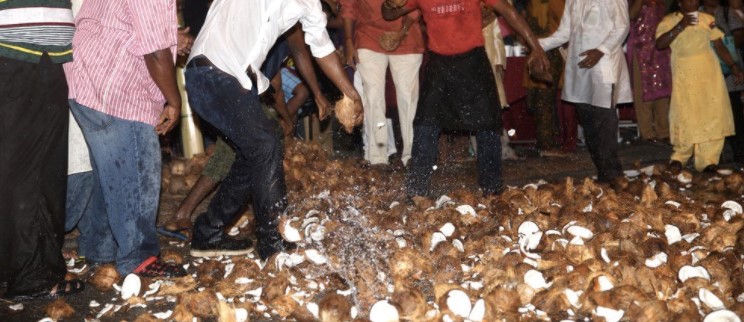
The idea of violently smashing the coconut on the rock is inviting their gods to destroy the enemy likewise- smash into a thousand pieces.

Another Sri Lankan daily, Ada Derana carried the same story which was copied by international press including that of India.

Tamil group to break over 1000 coconuts to bless Hillary

November 5, 2016  11:21 am

A group of Sri Lankan Tamils in Jaffna will break over 1,000 coconuts and light as many candles to bless Hillary Clinton, saying the Democratic presidential candidate’s win would be important for the future of the minority community.

We will break 1,008 coconuts on November 8 to bless her ahead of the US election. We expect her to win the election,” M K Shivajilingam, a Tamil National Alliance (TNA) member of the Tamil-controlled northern provincial council, said yesterday.

The event will take place in Jaffna’s historic Kandsamy Kovil in Nallur. There will also be lighting of 1,008 candles at the Jaffna Cathedral, he said.

Tamils in Sri Lanka believe they can find political solution only with the intervention of the US and Hillary’s win would be important for the future of the minority community in Sri Lanka, Shivajilingam said.

The Obama administration has extended its support to the reconciliation efforts promised by President Maithripala Sirisena to Tamils.

– See more at: http://www.adaderana.lk/news/37707/tamil-group-to-break-over-1000-coconuts-to-bless-hillary#sthash.I9wMIVuc.dpuf

https://www.onlanka.com/…/tamil-group-to-break-over-1000-coconuts-to-bless-hillar

Here, you were the ‘enemy’ they were wishing to smash; Hillary Clinton was their messiah on whom they lavished money for favours such as pulling strings to force the Sri Lankan government to disestablish Sri Lanka and carve out a separate ethnically pure country for the Tamils carving out over one third of the land and two thirds of the coast line.

Background

Tamils are native to the southern part of India- they are currently home in a province called Tamil Nadu in India. Tamil Nadu in the Tamil vernacular means Tamil country. At present there are over 75 million Tamils in their home territory in India. Tamil Nadu is and has been throughout modern history, over-populated and poverty-stricken, exporting unskilled labour to the rest of the world. The corrupt Tamil Nadu politicians let the masses live in poverty and enrich themselves, diverting the displeased local peoples’ attention from the day to day problems, to Sri Lanka. Sri Lanka, as you know, is a small island located to the south of South India. At no time in the known history of the earth, has Sri Lanka been any part of India either geographically or administratively.  However, the Tamil Nadu politicians lead their uneducated masses to believe that Sri Lanka should be part of the Tamil empire and that it is the loss of this empire that is the cause of all ills affecting the Tamils.

Throughout thousands of years Sri Lanka was ruled by Sinhala kings. In the recent history, specifically during the 1700s, Sri Lanka became a colony of the Dutch. The Dutch colonials brought over shiploads of aliens from Tamil Nadu to Sri Lanka to work as ‘labourers’ aka slaves, in their experimental tobacco growing fields in the newly acquired territory. The tobacco plantations were a failure, however, these Tamil labourers stayed on in Sri Lanka preferring the relative comfortable life in Sri Lanka to the abject poverty at home.

As a result of wars that were fought in Europe, the Dutch who were the losers passed on the colony of Sri Lanka to the victors, the British. British people imported another batch of Tamils from India to work in their tea plantations during their colonial reign of 150 years from 1815 that ended in 1948 when the British handed back to country to its natives.

This is how Sri Lanka inherited part of the Indian Tamil ‘problem’. For centuries Tamils of India have yearned for a separate country of their own – in the 1920s and 30s there was vehement agitation in India by Indian Tamils who denigrated India as being ‘Hindia’; based on the accusation that India is dominated by Hindi speakers, and themselves who are Tamil speakers were discriminated against. – This separatist movement was very evident even towards the time of India’s independence from the British in 1947. Tamils were also buoyed by the cessation of the two Pakistans (now Pakistan and Bangladesh (formerly East Pakistan)) from India. Their demand was that Tamils should be granted cessation from India to form an ethnically pure Tamil country. India was having none of that; and the cessation movement was kept ruthlessly persecuted and almost crushed through government agencies such as RAW and the Indian armed forces. However, the sentiment remained under the ashes of Tamil aspirations, waiting for opportunities.

India’s independence was followed by Sri Lanka’s independence from the British. The Tamil illegals brought over by the Dutch and the British carried on with their allegiance to their motherland in Tamil Nadu in India even though by now for a few generations they have been living comfortably in Sri Lanka. It had been by now evident to the Tamil cessationists that fighting against India that had strong military and intelligence capabilities was always going to be impossible; so, they searched for an alternative ‘easier’ solution.  Sri Lanka fitted the bill.

Tamils in India, Sri Lanka and in the global context formed Tamil think tanks and turned their nation building dream towards Sri Lanka. India saw that this was a golden opportunity to hand over its unwanted baby called the Tamil nationalistic agenda, to the unsuspecting Sri Lanka which at that time had zero border control and an army of less than 3000 with hardly any weaponry to defend the country with.

The sea between the top of Sri Lanka and the southern tip of India is, unfortunately, a comfortable swimming distance. The border control was non-existent at the time of Sri Lanka’s independence to such an extent that Tamils living in the northern tip of Sri Lanka had a habit of taking a fishing boat or a dinghy after dinner to the southern tip of India, to watch a Tamil movie in India and return home by bedtime. There were small boats full of Tamils from India that were plying freely between  the Indian coastline and Sri Lanka illegally, bringing sarees and other trinkets to sell in all parts of Sri Lanka.  After centuries of mismanagement under naïve, impotent and corrupt successive administrations in Colombo, Sri Lanka acquired a massive number of illegals freely arriving in Sri Lanka from poverty stricken south India- especially from Tamil Nadu. As mentioned before this, the Tamils imported by colonials and the illegals remained to form a ‘hostile community’ within Sri Lanka, like a cancer; comfortably nestled in any part of Sri Lanka with complete accommodation and friendship from the mostly Buddhist Sinhala natives but always wishing ill-will and the destruction of the country.  I am sure you understand the way this type of hostile communities behave in countries, including yours- intimidating and disrespecting the natives and the culture of the land, and wishing nothing but ill upon the country that they are feeding from.

The tacit sponsorship of the Indian government and agencies such as RAW extended to the LTTE in the 1920s grew in size and largesse to complete weapons training, free weaponry and even free uniforms  provided by the Indian government in the late 1970s headed by leaders such as late Indira Ghandhi and later her son Rajiv Ghandhi.

Much to the Tamils’ consternation, by the 1920s there were Muslims who had recently arrived in Sri Lanka from the southern and western coasts of India, acquiring land and spreading rapidly into to the country. Thus by 1972, Sri Lanka was ready to face the brunt of hatred, encroachment and attack from two aggressive alien ethnic minorities who used the inept, corrupt administrations that Sri Lanka had since independence from the British, as an invitation to party.

Muslims making their way into Sri Lanka in the areas claimed by Tamils were also the objects of Tamil hatred and ethnic cleansing efforts. Having come from the southern coastal areas of India the Muslims were also Tamil speakers but they refused to convert and disperse amongst the Tamils; and, hence bore the brunt of Tamil violence.

LTTE started being led by worldwide Tamil elites who saw it as the weapon of choice to see their Tamil country (Eelaam”) dream through. Several Malaysian Tamils such as LTTE ‘theoretician’ late Anton Balasingham and several Colombo based Tamil politicians were now heading the LTTE while being domiciled in western nations such as England, Canada, US and Europe.

The LTTE was ready to carve Sri Lanka by 1983. Tamils domiciled in the western democracies sent in funds and sourced weapons for the LTTE. Some of the Tamil diaspora who participated in these activities had not even been to Sri Lanka; but they  and those that were of Sri Lankan birth and received a free education in Sri Lanka, sent back ship loads of arms to the LTTE insurgents kill and maim innocents of Sri Lanka. Once fully trained and equipped by treacherous India, the LTTE launched a full scale war against the Colombo government in July 1983 demanding a separate country called Tamil Eelaam” carving out over 1/3 of land and 2/3 of the northern and eastern coastline of Sri Lanka, exclusively for the Tamil race. To support this claim the newly formed guerrilla group carried out heinous acts of ethnic cleansing, wiping out the native Sinhala people from large areas of the North and parts of the East.  Please Google kent farm massacre” and dollar farm massacre” for just two of these atrocities.

As mentioned earlier, Tamil terrorists invented the suicide bomber to the world. The 30 year old Tamil terrorist war in Sri Lanka saw thousands of innocent civilians slaughtered in bus bombs, train bombs, suicide attacks and by the early 2000s the Tamil terrorists were ready with killer submarines and aircraft for the final takeover. You can Google on the air borne attack of Colombo metropolis towards the last years of LTTE war around 2008-9.

Europe and Britain, Canada and the US, laden with large Tamil constituents in their countries and the incumbent politicians there wanting to stay in power through the votes of these fringe groups, exerted tremendous pressure on the Sri Lankan government to de-militarise itself and weaken the state armed forces and enter into endless bouts of ‘negotiations’ with the Tamil terrorists organised by them in Western capitals. These events were openly used by the LTTE to buy better able arms and re-group whenever the going got tough for them.

Foreign and local media were openly batting for the Tamil terror refusing even to apply the term ‘terrorist’ to these killers, instead referring to them as Tamil ‘separatists’ or cadres or some such nebulous term, and reporting on their atrocities always with the white-washing phrase ‘who are fighting for a separate stating discrimination by the majority Sinhalese-‘ the eternal justification for the criminality! Media institutions such BBC proliferated with Tamil news anchors much like how media has an abundance of Islamic news-anchors today, giving their personal ‘touch’ to the reporting opportunities the so-called war in Sri Lanka provided then with. Human rights industry came out of the wood work crying out in anguish for the Tamil terrorists and their multitude of un-uniformed foot cadres in civilian clothing who died, injured or ‘disappeared’ according to their relatives. No tear was ever shed for the native Sinhala victims who ranged from infants to pregnant women and Buddhist priests. The human rights industry (yes, they are working for profit) urged the powerful Western countries such as the US and Britain to pressurize and vilify the Sri Lankan government for continuing with military action fighting against terror created by the once illegal minority.  Most of the country’ s administrative infrastructure was destroyed and the economy was ruined.

Finally Sri Lanka was lucky to have a President with a backbone, much like you. President Mahinda Rajapakse swept into power by popular vote with a firm mandate from the fed-up people of Sri Lanka to wipe out the Tamil terrorists and put paid to the blood flow and mayhem.  President Rajapakse ably supported by his Defence Secretary and brother Gotabhaya Rajapakse who himself fought as a soldier for decades, did just that. They strengthened the Armed forces, acquired the necessary armaments, naval and airborne war capabilities from several friendly countries and decimated the LTTE militarily, ending the blood flow of 30 years, on 19 May 2009.

Towards that last week or two of the end of the bloodshed we saw amazingly cowardly attempts by Western governments – specially Britain and Europe – to stop the military action and let off the LTTE top hierarchy who could then flee to the West and come back refreshed for war another day. David Cameron and Bernard Kouchner and the then Canadian Premier Harper were among the Western giants  who wanted to come rushing into Sri Lanka to intimidate the Sri Lankan administration to free the then cornered LTTE top brass, in May 2009. Sri Lanka denied them visas, and their threats and reprimands were shunned by Foreign Secretary Rajapaksa. Within days the military leader of LTTE, Velupillai Prabhakaran, an illegal immigrant from India to Sri Lanka himself, was killed and the country was liberated from 30 years of ruthless terror.

This sent the foreign politicians, so-called ‘human rights’ organisations and the global media into a tizz of rage. Instead of celebrating the liberation of Sri Lankan civilians, including the Tamil community that was the feeder community whom the LTTE used as a human shield in the last phase of war, these three groups started hounding the Sri Lankan government and the military accusing them of war crimes and ‘disappearance’ of Tamils. Some of the ‘disappeared’ Tamils have been found in Western countries where they ran to and which gave them asylum. Canada is home to the largest group of Tamils outside of India and perhaps Sri Lanka, some of who form a cancer to that society forming gangs, living on welfare and engaging in street violence.

It is in this context that the United Nations has been hounding Sri Lanka every year with a fresh call for sanctions against Sri Lanka. United Nations High Commissioner for Human Rights, Zeid Ra’ad al Hussein – himself an Islamic from the middle east where the daily breach of human rights and the practice of misogyny is the norm, recently told the media that a war crimes inquiry was imperative for Sri Lanka as ‘atrocities were committed during the last stages of war by the Sri Lankan government’.  Your predecessor Mr Barrak Hussein Obama continued with this harassment of Sri Lanka, sending emissaries such as Samantha Powers, Hillary Clinton, Nisha Biswal et al, whom you have quite rightly put out of jobs recently, (Thank you!) to intimidate and wrest concessions, release, compensation from the Sri Lankan Government for Tamil criminals serving prison terms or in rehabilitation in Sri Lanka. These civil servants of not only the US (including your opposing candidate Hillary Clinton) but also from England, Europe and Canada influenced or even rigged the last Presidential election in Sri Lanka and have now installed a puppet government in Sri Lanka under the Presidency of Maithreepala Sirisena (a traitor who jumped from the Rajapakse government on the promise of the President’s job)  who in turn appointed Premier Ranil Wickreasinghe (who lost the 29 consecutive elections before his appointment as Premier). Through the new puppet government the detractors of Sri Lanka have imprisoned many of our war heroes and one heroic soldier, Sunil Ratnayake is now on death row for allegedly killing Tamil civilians” based solely on the ‘evidence’ of a hard-core Tamil LTTE supporter arriving from London at State expense to give ‘evidence’.

I will be very happy to provide you with any further information on the Tamil atrocities, lies, fraud and pretensions as and when required.

My respectful request is for you to shun Tamils for Trump and any Tamil group by any other name that may approach you for favours. Secondly, my humble request is for you to veto the UN resolutions that seek to punish Sri Lanka year in year out for getting rid of the terrorist group that the US State Department aptly labelled ‘the most ruthless terrorist group in the world’.

The second issue I want to bring to your attention is the Islamic invasion of the Asian countries, with specific reference to Sri Lanka.

Sri Lanka, again through its inept border control, lack of wisdom and corrupt politicians has allowed the Wahhabi invasion of its country. Halal certification has been installed to rake in millions of rupees to the coffers of jihad, mosques have outnumbered the Buddhist places of worship as well as the Christian churches, Sharia banking has been installed, Quasi ‘courts’ are over-riding the rule of law applicable to other citizens, Burkhas are the norm which are worn at exams and other places where proper identification and security is paramount leading to fraud and security breaches. Buddhist places of worship and Buddhist heritage sites are being ‘shared’ forcefully by the Islamics by forcefully erecting Islamic shrines in these places, where the native Sinhala people have been pushed out through fear and violence thousands of years old heritage sites are razed to the ground and Islamic colonies erected, roads are being blocked for impromptu ‘prayers’, ‘prayer rooms’ are being demanded at public places such as universities and airports, young non-Muslim women are ‘groomed’, sexually violated and then converted. In fact what is happening in Britain, Europe and Canada and US (in that order) is happening in Asia, particularly in Sri Lanka.

Through this letter I wish to draw your specific attention to the creation of Islamic colonies in the thousands of year old virgin rain forests in Sri Lanka which are also native to rare flora and fauna. The colonies are funded by NGOs, mainly from Qatar. When Islamic NGOs in their websites gloat about the ‘charity’ work worth thousands of dollars they do in poor countries such as Sri Lanka, what they really mean is that they are creating Islamic colonies in those countries. For, as you know, according to the Quran, Muslim charity is strictly limited to the Muslims. They are perhaps getting ready for the eventuality when their oil wells in the Middle East run out. Whatever the motivation is, their modus operandi all over the world is the same

Indonesia, a 100% Buddhist country just 50 years ago is now over 80% Muslim. Maldives, a 100% Buddhist country around about the same time is now 100% Muslim.  There is a huge hue and cry about the ‘poor Rohingya Muslims’ being harassed in Bruma (Myanmar)- I’ll provide you with a good account of exactly what is happening in Burma in a separate letter. In short, ‘the name ‘Rohigya’ has been created by the illegal Bangladeshi Muslim invaders pouring into Burma through that un-protected border to play the victim card. They have created a ‘brand’ that the naive, gullible and the politically correct morons can readily identify with and shed tears over.

The Sri Lankan government in its stupidity appointed a radical Muslim, Rishard Badiuddeen as a Minister of Rehabilitation after the Rajapakse government cleared the country of Tamil terrorism. Badiuddeen  has already created many Islamic ‘Wahabi’ colonies in the cleared areas installing not only Muslims of Sri Lankan birth but also various illegal aliens from Afghanistan, Pakistan and beyond. In the Eastern province, which has now been fully colonised replete with road signs in Arabic and date-tree lined streets, non-Muslims are viciously attacked and foreign non-Islamic tourists are shunned. The Muslim and Tamil dominated provincial councils continue to victimize the Sinhala natives from these areas in order to chase them out of their habitats.

Wilpattu is just one of the ‘protected’ heritage rain forests and animal sanctuaries that are being demolished and Islamic aliens are being installed.  Animals have lost habitat and their access to water has been lost causing them to die in their thousands. The letter of the Quran is the law in these areas and burkas are the norm.  No other citizen is permitted in these newly colonised areas where rule of law is afraid to go. It is estimated that at least 17,000 acres of land has so far been converted. As right from the start, the NGOs bribed our lame politicians on both sides, the government and the opposition keeps silent about these outrages. Please read more information in the following sites:

https://www.facebook.com/protectvilpattu/?hc_ref=NEWSFEED&fref=nf

http://www.ProtectSriLanka.org

Please also see the on-line petition at the following URL. I cordially invite you to place your valuable signature to this petition.

https://www.change.org/p/stop-deforestation-in-wilpattu-forest-complex?utm_medium=email&utm_source=notification&utm_campaign=signature_receipt&share_context=signature_receipt&recruiter=38506281

What I am respectfully hoping to do is to inform you of the full extent of the ‘problem’ of Islam with its outlook on non-believers, women and the ‘divine’ edict to spread the faith by force or cunning. You have seen wisely and chosen the correct path. Quran and its Sharia ‘law’ need to be banned in every self-respecting country unless and until the followers get together and reform the vile ideology. The hate-filled, violent, misogynistic rhetoric sets it apart from any other religion. It is important that you are presented with the full picture so that you recognise this as a global problem, not just a regional issue. There are so many apologists for various heinous ideologies today either thorough ignorance or through monetary beneficence; and, this fringe cries the loudest. In fact this fringe drowns the voices of the peaceful majority who are at worst, silent. I know you will walk your path gallantly and will not be swayed into the wilderness of misguided political correctness. We have our hopes pinned on you, Mr President!

Yours faithfully

Ramanie de Zoysa

This letter has been posted to the above two addresses.
ඒකකයක් රු. 16 ට විකුණන්න පුද්ගලික ඩීසල් විදුලිය රු. 30 ට ගන්න සුදානම් විදුලිබල හා පුණර්ජනනීය බලශක්ති අමාත්‍යාංශය වසරේ මංකොල්ලයට සුදානම්

February 19th, 2017

කීර්ති තෙන්නකෝන්/උපදේශක දුෂණ විරෝධී පෙරමුණ

විදුලිබල මණ්ඩලය පාරිභෝගිකයාට රු. 16 ක සාමාන්‍ය අගයකට විකුණන ලබන විදුලි ඒකකයක් රු. 29 – 30 දක්වා මුදලකට පුද්ගලික ඩීසල් විදුලි ජනනය මගින් ලබා ගැනීම පෙබරවාරි මස මුල් සතියේ දී ආරම්භ කොට ඇත.  ඒ අනුව, පුද්ගලික අංශයෙන් මිලදී ගනු ලබන එක් විදුලි ඒකකයක් මගින් විදුලිබල මණ්ඩලයට රු. 14 ක් ශුද්ධ පාඩුවක් සිදුවන බව උපදේශක කීර්ති තෙන්නකෝන් මහතා පවසයි. 

ශ්‍රී ලංකා විදුලිබල මණ්ඩලයේ නිලධාරීන් හා විදුලබ අමාත්‍යාංශයේ ඉහළ නිලධාරීන් ගේ මෙහෙයවීමෙන් සිදුවන මෙම ක්‍රියාවලිය ‘විදුලි ඉංජිනේරු මාෆියාව’ ලෙසින් සාමාන්‍ය ව්‍යවහාරයේ දී හැදින්වේ.  හිටපු අමාත්‍ය අනුරුද්ධ රත්වත්ත මහතා ගේ යුගයේ ඇරඹි මෙම ව්‍යවහාරය යහපාලන රජය බලයට පත්වීමෙන් පසුව නවතා දමන ලදී. 

අන්ත දුෂිත ටෙන්ඩර් මගඩියක් ලෙසින් සිදු කළ ජෙනරේටර් මිලදී ගැනීමකින් මෙවර නව වටයකින් අරඹා ඇති ඩීසල් විදුලි මාෆියාව මෙගා වෝට් 60 ක විදුලි ජනනය යන්ත්‍රයක් මගින් උද්පාදනය කරන විදුලිය මිලදී ගැනීම සදහා පමණක් රුපියල් මිලියන 6100 ක මුදලක් මාස 6 ක් වැය කරනු ඇත.  අදාල මිලදී ගැනීමට ජාත්‍යන්තර මිලදී ගැනීම් සිදු කරන ලෙස කැබිනට් මණ්ඩලය තීරණය කර තිබිය දී, කැබිනට් අනුමැතිය ලැබීමට පෙර අදාල ජෙනරේටරය පවා මිලදී ගෙන තිබුණි. 

එයට අමතරව හිටපු විදුලිබල අමාත්‍ය චම්පික රණවක මහතා විසින් නවතා දමනු ලැබූ පුත්තලම හා ඇඹිලිපිටිය මෙගා වෝට් 100 බලාගාර 2 ද,  මාතර, සපුගස්ගන්ද හා හොරණ මෙගාවෝට් 20 බැගින් වන බලාගාර 3 ද ඉදිරි සති කිහිපයේ දී නැවත අරඹනු ඇත. ඒ අනුව, යහපාලනය විසින් නවතා දමා තිබූ මොගා වෝට් 260 ක් එක් විදුලි ඒකකයට රු. 14 ක පාඩුවකට විදුලිබල මණ්ඩලය විසින් මිලදී ගනු ඇත.

මේ අනුව ඉදිරි මාස 6 ක කාලය තුල විදුලිබල මණ්ඩලයේ ලේකම් සුරේන් බටගොඩ සහ විදුලිබල මණ්ඩලයේ ඉංජිනේරු මාෆියාව විසින් සැලසුම් කොට ඇති මිලදී ගැනීමේ මුළු වටිනාකම රුපියල් බිලියන 35 ඉක්මවනු ඇත.  ඒ අනුව, විදුලි බිල වැඩි කිරීම හෝ බදු වැඩි කිරීම හැර වෙනත් විකල්පයක් රජයට නොමැතිවනු ඇත.

ශ්‍රී ලංකා මහ බැංකුව විසින් සිදු කළ තක්සේරුවක් අනුව පුද්ගලික අංශයෙන් නැවත ඩීසල් විදුලි මිලදී ගැනීම ඇරඹීමත් සමගම මෙරටට ආනයනය කළ යුතු ඩීසල් සදහා වැයවන විදේශ විනිමය හේතුවෙන් රටට මිලියන 650 ක අතිරේක ආර්ථික බරක් දැරීමට සිදුවනු ඇත.

දුෂණ විරෝධී පෙරමුණ අවස්ථා ගණනාවක දී විදුලිබල අමාත්‍යාංශයේ  ගල්අගුරු හා ඩීසල් විදුලි ජනනය පිළිබද දුෂණ ජනාධිපතිවරයා ගේ අවධානයට යොමු කරනු ලැබූ නමුත් මේ දක්වා  දුෂිත විදුලි මාෆියාවට එරෙහිව කිසිදු පියවරක් ජනාධිපතිවරා විසින් ගෙන නැත. ගල්අගුරු හා ඩීසල් විදුලි මාෆියාව  බැදුම්කර වංචාවට පමණක් දැනට දෙවනි වේ.

කීර්ති තෙන්නකෝන්/උපදේශක

දුෂණ විරෝධී පෙරමුණ

2017 පෙබරවාරි 19

Cruelty of Humans in Pictures (Some readers may find photos upsetting)

February 19th, 2017

Shenali Waduge

You end up considering faith in humanity no sooner you view these horrific photos of the cruelty that exists in people towards sentient beings who cannot speak. The perpetrators are people of all walks of life – academics, teachers, pregnant mothers, housewives, clergy, law enforcement officers, children, fathers, politicians ….

These photos cover just a handful of cruel acts by them upon innocent animals. How can people tie fireworks to the mouths of animals and watch the agonizing cries of an animal frightened and in pain?

How can people starve their own pet or keep them outside in horrid weather conditions?

How can people even think of chopping off an animals limbs & paws?

These cruel intentions carried out with such malicious hates forces us to take a step back and ask ourselves exactly what is the development we can boast of in a modern society?

If we cannot show compassion and empathy to an animal that bares no grouse against us, what is the satisfaction we get from hurting it?

These people are so sadistic that their cruelty is paraded by taking photos and posing with the animal they have hurt and posting these on social media. There are some parents that are showing cruelty to animals infront of their own children, there are others who sacrifice animals in front of their children too… this starts a vicious circle wherein the innocent child is made to feel that killing or hurting an animal is not wrong and is the accepted norm and so we end up never seeing an end to cruelty by mankind. Its time we stop.

Its time we rise against these inhuman acts and begin to shower compassion to all humans and in particular to animals.​

https://drive.google.com/file/d/0B3T7XeJrIqCiSHBCdHh1UGktdnM/view


CID’s Nelsonian eye

February 19th, 2017

Editorial The Island

The CID has woken up like Rip Van Winkle. It has arrested three military intelligence personnel including a major over the abduction of the then Associate Editor of The Nation newspaper, Keith Noyahr, way back in May 2008. The suspects have been remanded. We have been urging the CID, all these years, to seek the assistance of Noyahr, who fled to Australia with his family following his abduction, to nab those responsible for harming journalists because he is the only scribe to have suffered at the hands of his abductors for hours and returned alive.

The CID action, albeit belated, is welcome. But, there is much more to be done. Above all, the government must refrain from playing politics with this vital issue. It has mastered the art of keeping suspects behind bars indefinitely until they crack and agree to collaborate with it to frame its rivals as is public knowledge.

Noyahr’s adductors obviously had nothing personal against him; they only carried out someone else’s order. The task before the CID, which has, thankfully, risen from a politically induced slumber, is to find out who ordered the abduction at issue. A major attached to the Directorate of Military Intelligence is not equal to the task of carrying out a high-profile abduction on his own without orders from his superiors; he is as helpless as an unarmed reserve constable facing a mob of government goons. It may be recalled that in September 2012 the then powerful minister Mervyn Silva’s son, Malaka, assaulted a military intelligence officer of the rank of major at a Colombo nightclub. The hapless officer took it all lying down and his assailants even stripped him of his service revolver.

A few weeks after Noyahr’s abduction, the then Chief Opposition Whip (UNP), Joseph Michael Perera, making a special statement in Parliament on attacks on journalists and media institutions, claimed that they were carried out by a ‘special team’ controlled by the then Army Commander Lt. Gen. Sarath Fonseka himself. He called upon the Rajapaksa government to arrest the offenders immediately. The UNP, currently ensconced in power, is in a position to arrest all those involved in the aforesaid unit. Will the CID continue to turn its Nelsonian eye on Perera’s statement for political reasons?

Were the three military personnel, currently being held on remand, over Noyahr’s abduction, members of Fonseka’s special unit? The UNP owes the public an answer.

Now that the CID has arrested some of the suspected abductors of Noyahr, it must record a statement from former Chief Opposition Whip Perera on his ‘revelation’ in Parliament. If there is any legal barrier for police to question a former MP on what he has said in Parliament, it is incumbent upon Perera or the UNP to make a suo motu statement on that very serious allegation against Fonseka and the army. He would not have made such an allegation without irrefutable evidence to substantiate it. He must either reveal the information in his possession or admit that he misled Parliament and the public at the behest of his party.

In January 2009, Sunday Leader Editor Lasantha Wickrematunga was assassinated and an attempt made on the life of Rivira Editor Upali Tennakoon. But, about ten months later, the UNP embarked on a campaign to elevate General Fonseka, it had flayed for harming journalists, to the position of the Commander in Chief or, in other words, it threw in its lot with him in the 2010 presidential race, but in vain. Even some of Noyahr’s Nation colleagues and bosses had no qualms about backing Fonseka to the hilt as the UNP-led Opposition’s presidential candidate! The UNP, after recapturing power in 2015, went so far as to promote General Fonseka to the rank of Field Marshall, appoint him, following his defeat at the last general election, to Parliament via the National List and make him a Cabinet Minister.

A thorough, impartial investigation into the abduction and torture of Noyahr is called for. That is the only way the government, in a politico-economic mire of its own making, can give the lie to the claim being made in some quarters that it is trying to use probes into attacks on journalists to preclude some of those responsible for defeating terrorism from entering the next presidential fray. But, anyone who expects the government to refrain from manipulating investigations is being as optimistic as those who believe that eating croton and jak leaves is a solution to a food crisis or the bond thieves will be brought to justice.

Irregular appointment of HC judge threatens judiciary’s independence – MR

February 19th, 2017

By Ada Derana Staff Courtesy AdaDerana

February 19, 2017  02:29 pm

 It is essential to abide by the accepted practice in making judicial appointments so as to safeguard the independence of the judiciary, former President Mahinda Rajapaksa said.

Issuing a statement on Sunday he alleged that this is a government that started off by terrorising the entire judiciary by sacking the then Chief Justice with just a chit from the President’s Office with the connivance of certain office bearers of the BASL.

Full statement: The Judicial Services Association of Sri Lanka has strongly objected to the appointment of Mr Ramanathan Kannan a lawyer practicing at the private bar in Batticaloa, as a High Court Judge. The accepted practice in this country is that virtually all the judges serving on the Supreme Court, Court of Appeal and High Court are promoted to those positions through the ranks of the judicial service or to a lesser extent, the Attorney General’s Department. This system of promotion based on seniority and merit is one of the pillars on which the independence of the judiciary rests. On very rare occasions past governments have appointed eminent members of the private bar as Supreme Court judges. Former CJ Neville Samarakoon and Justice Mark Fernando came into the Supreme Court in that manner. In the nine years that I was President, I appointed only one Supreme Court judge from the private bar. No members of the private bar were appointed to either the Court of Appeal or the High Court by my government.

Minister of Justice Wijedasa Rajapakshe had informed the Judicial Services Association that a certain political party had on an earlier occasion requested of him that Mr Ramanathan Kannan be appointed to the High Court – a request he had turned down. The appointment of a judge on a recommendation made by a political party would have struck at the very foundations of judicial independence. Mr Kannan has been appointed to the High Court over the heads of dozens of senior members of the judiciary and officials of the Attorney General’s Department. The Judicial Services Association has pointed out that if the need was to appoint a Tamil speaking judge for the North and East, the District Judge of Vavuniya D.L.A.Manaf would have been the most qualified candidate. Nobody would have objected if a Tamil speaking candidate of suitable seniority and competence had been selected for this position from within the judicial service or the AG’s Department.

The Judicial Services Commission had told the Judicial Services Association that they recommended Mr Kannan’s appointment at a request made by the President following representations made to him by the Bar Association of Sri Lanka. The President also said at a public gathering that he had made this appointment on a request made by the BASL. However, the Secretary of the Bar Association of Sri Lanka has informed the Judicial Services Association that they had not made any such recommendation. Therefore this request has come only from certain individuals in the BASL. In any case, the Bar Association of Sri Lanka has no constitutional, legal or moral right to make recommendations for the appointment of judges.  If the private bar is given the power to recommend the appointment of judges, that would corrupt the entire legal system with judges being dependent on the lawyers appearing before them for promotions and appointments.

Some office bearers of the Bar Association played a major role in toppling my government in 2015 and the yahapalana authorities have been trying to reward them by giving them the power to appoint judges despite the damage that this will do to the entire legal system. The reason why Mr Kannan was made a High Court judge over the heads of many dozens of serving judicial officers and Senior State Counsel in the AG’s Department is also obviously to reward a certain political party that provided a block vote to get the President elected. The message that this sends out to the judiciary is that what counts is not one’s competence or probity as a judge but one’s political connections.

This is a government that started off by terrorising the entire judiciary by sacking the then Chief Justice with just a chit from the President’s Office with the connivance of certain office bearers of the BASL. The previous President of the Bar Association was given a plum political appointment by this government as a reward for his services. The constitution and the standing orders of parliament have a procedure to remove judges with charges being presented, hearings held, reports tabled in parliament and finally a vote taken in the supreme legislature. The actual power to remove judges of the superior courts rests with the legislature, not the executive.

But in a demonstration of what this government was capable of, Chief Justice Mohan Peiris was simply chased out of office through executive fiat. Having started in that manner, it is not surprising that this government is now making judicial appointments on recommendations from their political allies.

Everyone in this country knows that the Bar Association is politicised in a way no other professional body in this country is – whether it be that of engineers, doctors, architects, planters, public administrators, or accountants. The press had reported of a group within the BASL which controlled among other things the foreign funding that the BASL received.

From what now transpires, it is this political group within the BASL and not the BASL itself that had made this recommendation to appoint a person described as a political party nominee to the High Court. Being a lawyer myself, I wish to call upon the legal fraternity to take resolute action to end the politicisation of the Bar Association of Sri Lanka and most importantly, to get the President to reverse the decision to appoint Mr Ramanathan Kannan to the High Court as requested by the Judicial Services Association of Sri Lanka. It is essential to abide by the accepted practice in making judicial appointments so as to safeguard the independence of the judiciary.

– See more at: http://www.adaderana.lk/news/39189/irregular-appointment-of-hc-judge-threatens-judiciarys-independence-mr#sthash.bfOowgmq.dpuf

Irregular appointment of High Court judge threatens independence of the Judiciary

February 19th, 2017

Mahinda Rajapaksa Former President of Sri Lanka

The Judicial Services Association of Sri Lanka has strongly objected to the appointment of Mr Ramanathan Kannan a lawyer practicing at the private bar in Batticaloa, as a High Court Judge. The accepted practice in this country is that virtually all the judges serving on the Supreme Court, Court of Appeal and High Court are promoted to those positions through the ranks of the judicial service or to a lesser extent, the Attorney General’s Department. This system of promotion based on seniority and merit is one of the pillars on which the independence of the judiciary rests. On very rare occasions past governments have appointed eminent members of the private bar as Supreme Court judges. Former CJ Neville Samarakoon and Justice Mark Fernando came into the Supreme Court in that manner. In the nine years that I was President, I appointed only one Supreme Court judge from the private bar. No members of the private bar were appointed to either the Court of Appeal or the High Court by my government.

Minister of Justice Wijedasa Rajapakshe had informed the Judicial Services Association that a certain political party had on an earlier occasion requested of him that Mr Ramanathan Kannan be appointed to the High Court – a request he had turned down. The appointment of a judge on a recommendation made by a political party would have struck at the very foundations of judicial independence. Mr Kannan has been appointed to the High Court over the heads of dozens of senior members of the judiciary and officials of the Attorney General’s Department. The Judicial Services Association has pointed out that if the need was to appoint a Tamil speaking judge for the North and East, the District Judge of Vavuniya D.L.A.Manaf would have been the most qualified candidate. Nobody would have objected if a Tamil speaking candidate of suitable seniority and competence had been selected for this position from within the judicial service or the AG’s Department.

The Judicial Services Commission had told the Judicial Services Association that they recommended Mr Kannan’s appointment at a request made by the President following representations made to him by the Bar Association of Sri Lanka. The President also said at a public gathering that he had made this appointment on a request made by the BASL. However, the Secretary of the Bar Association of Sri Lanka has informed the Judicial Services Association that they had not made any such recommendation. Therefore this request has come only from certain individuals in the BASL. In any case, the Bar Association of Sri Lanka has no constitutional, legal or moral right to make recommendations for the appointment of judges.  If the private bar is given the power to recommend the appointment of judges, that would corrupt the entire legal system with judges being dependent on the lawyers appearing before them for promotions and appointments.

Some office bearers of the Bar Association played a major role in toppling my government in 2015 and the yahapalana authorities have been trying to reward them by giving them the power to appoint judges despite the damage that this will do to the entire legal system. The reason why Mr Kannan was made a High Court judge over the heads of many dozens of serving judicial officers and Senior State Counsel in the AG’s Department is also obviously to reward a certain political party that provided a block vote to get the President elected. The message that this sends out to the judiciary is that what counts is not one’s competence or probity as a judge but one’s political connections.

This is a government that started off by terrorising the entire judiciary by sacking the then Chief Justice with just a chit from the President’s Office with the connivance of certain office bearers of the BASL. The previous President of the Bar Association was given a plum political appointment by this government as a reward for his services. The constitution and the standing orders of parliament have a procedure to remove judges with charges being presented, hearings held, reports tabled in parliament and finally a vote taken in the supreme legislature. The actual power to remove judges of the superior courts rests with the legislature, not the executive. But in a demonstration of what this government was capable of, Chief Justice Mohan Peiris was simply chased out of office through executive fiat. Having started in that manner, it is not surprising that this government is now making judicial appointments on recommendations from their political allies.

Everyone in this country knows that the Bar Association is politicised in a way no other professional body in this country is – whether it be that of engineers, doctors, architects, planters, public administrators, or accountants. The press had reported of a group within the BASL which controlled among other things the foreign funding that the BASL received. From what now transpires, it is this political group within the BASL and not the BASL itself that had made this recommendation to appoint a person described as a political party nominee to the High Court. Being a lawyer myself, I wish to call upon the legal fraternity to take resolute action to end the politicisation of the Bar Association of Sri Lanka and most importantly, to get the President to reverse the decision to appoint Mr Ramanathan Kannan to the High Court as requested by the Judicial Services Association of Sri Lanka. It is essential to abide by the accepted practice in making judicial appointments so as to safeguard the independence of the judiciary.

Mahinda Rajapaksa

Former President of Sri Lanka

තුණ්ඩුවකින් අග්‍රවිනිශ්චයකාරවරයා නෙරපා හැර මුලු අධිකරණ පද්ධතියම මහත් භීෂණයකට ලක්කළ සිරිසේනගේ කෙරුවාව

February 19th, 2017

LNW SPYඋපුටා ගැන්ම ලංකා නිවුස් වෙබ්

February 19, 2017

 මේ ආණ්ඩුව 2015 දී වැඩ ඇල්ලුවේ ජනාධිපති කාර්යාලයෙන් නිකුත් කල තුණ්ඩුවකින් එවක සිටි අග්‍රවිනිශ්චයකාරවරයා නෙරපා හැර මුලු අධිකරණ පද්ධතියම මහත් භීෂණයකට ලක් කිරීමෙනි. මේ සම්බන්ධයෙන් ඉටුකල සේවාවන් වෙනුවෙන් අලුත් ආණ්ඩුව ශ්‍රී ලංකා නීතීඥ සංගමයේ හිටපු සභාපතිවරයාට ඉතා ආකර්ශනීය දේශපාලන පත්වීමක්ද ලබා දුන් බව නිවේදනයක් නිකුත් කරමින් හිටපු ජනාධිපති මහින්ද රාජපක්ෂ මහතා පවසනවා.ශ්‍රී ලංකා අධිකරණ සේවා සංගමය ඉල්ලා ඇති පරිදි රාමනාදන් කන්නන් මහතා මහාධිකරණ විනිශ්චයකාරවරයකු හැටියට පත්කිරිම ජනාධිපතිවරයා ලවා අවලංගු කරවා ගැනීමටද නීතීඥ ප්‍රජාව කටයුතු කල යුතු බවයි එම නිවේදනයෙන් වැඩිදුරටත් ඉල්ලා ඇත්තේ.
පිළිගත් ක්‍රමවේදයෙන් පිට මහාධිකරණ විනිශ්චයකාරවරයෙකු පත් කිරීම අධිකරණයේ ස්වාධිනත්වයට තර්ජණයකි

මඩකලපුවේ නීතීඥයකු වශයෙන් කටයුතු කල රාමනාදන් කන්නන් මහතා ජනාධිපතිවරයා විසින් මහාධිකරණ විනිශ්චයකාරවරයෙකු හැටියට පත් කිරීම ගැන අධිකරණ සේවා සංගමය දැඩි විරෝධය පල කොට ඇත. මේ රටේ පිළිගත් ක්‍රමවේදය වන්නේ ශ්‍රේෂ්ඨාධිකරණයේ, අභියාචනාධිකරණයේ හා මහාධිකරණයේ විනිශ්චයකාරවරුන් සියලු දෙනාම පාහේ එක්කෝ අධිකරන සේවය තුළින්ම නැතිනම් නීතිපති දෙපාර්තමේන්තුව තුළින් පත් කිරීමයි. මේ ආකාරයට ජ්‍යෙෂ්ඨත්වය හා සුදුසුකම් මත විනිශ්චයකාරවරුන් පත් කිරීම අධිකරණයේ ස්වාධිනත්වය රඳා පවතින එක් ප්‍රධාන කුළුනක් වෙයි. ඉතාමත්ම කලාතුරකින් කීර්තිමත් පුද්ගලික නීතීඥයන්ද ශ්‍රේෂ්ඨාධිකරණයට පත්වීම් ලබයි. හිටපු අගවිනිසුරු නෙවිල් සමරකෝන්, හිටපු විනිසුරු මාර්ක් ප්‍රනාන්දු ඒ ආකාරයට ශ්‍රේෂ්ඨාධිකරණයට පත්වුණු අය වේ. මා ජනාධිපතිව සිටි අවුරුදු 09 තුළ පුද්ගලික නීතීඥයන් අතරින් ශ්‍රේෂ්ඨාධිකරණයට පත් කලේ එක් අයකු පමනි. මගේ ආණ්ඩුව සමයේ අභියාචනාධිකරණයට හෝ මහාධිකරණයට එකම පුද්ගලික නීතීඥයෙකු වත් පත්කොට නැත.

අධිකරණ සේවා සංගමය අධිකරණ ඇමති විජේදාස රාජපක්‍ෂ මහතාගෙන් මේ ගැන විමසූ විට ඇමතිවරයා ඔවුන්ට කියා ඇත්තේ මීට කලින් අවස්ථාවකදී රාමනාදන් කන්නන් මහතා මහාධිකරණයට පත්කරන්නැයි එක්තරා දේශපාලන පක්‍ෂයක් ඔහුගෙන් ඉල්ලීම් කල බවත් ඔහු එයට එකඟ නොවූ බවත්ය. දේශපාලන පක්‍ෂයක නිර්දේශයක් මත විනිශ්චයකාරවරයෙකු පත්කලේ නම් අධිකරණයේ ස්වාධිනත්වයේ මුලු පදනමම දෙදරා යනු ඇත. කන්නන් මහතා මහාධිකරණයට පත්කර තිබෙන්නේ අධිකරණ සේවයේ අවුරුදු 16 කට වඩා අත්දැකීම් ඇති විනිශ්චයකාරවරුන් හා නීතිපති දේපාර්තමේන්තුවේ ද ජ්‍යෙෂ්ඨ නිලධාරීන් නොසලකා හරිමිනි. මෙතනදී අවශ්‍යතාවය තිබුණේ උතුරු නැගෙනහිර පලාත් සඳහා දෙමළ කතාකරන විනිශ්චයකාරවරයෙකු පත් කිරිම නම් ඒ සඳහා සුදුසුම පුද්ගලයා වවුනියා දිසා විනිසුරු ඩී.එල්.ඒ.මනාස් මහතා බව අධිකරණ සේවා සංගමය පෙන්වාදී ඇත. අධිකරණ සේවය නැතිනම් නිතිපති දෙපාර්තමේන්තුව තුලින් දෙමළ කතාකරන පුද්ගලයෙකු මේ තනතුර සඳහා තොරාගනු ලැබුවේ නම් කිසිවෙකු එයට එරෙහි වන්නේ නැති බව පැහැදිලිය.

මේ පත්වීම  ගැන අධිකරණ සේවා කොමිසමෙන් කල විමසීමකදී අධිකරණ සේවා සංගමයට දැනගන්නට ලැබී ඇත්තේ ශ්‍රී ලංකා නීතීඥ සංගමයේ ඉල්ලීම පරිදි ජනාධිපතිවරයා අධිකරණ සේවා කොමිසමට කරන ලද ඉල්ලීමක් මත මේ පත්වීමට අදාල නිරදේශය ලබා දුන් බවයි. තමා මේ පත්වීම කලේ ශ්‍රී ලංකා නීතීඥ සංගමයේ ඉල්ලීමක් මත බව ජනාධිපතිවරයාද ප්‍රසිද්ධයේ ප්‍රකාශ කොට ඇත. නමුත් නීතීඥ සංගමයේ ලේකම් වරයා අධිකරන සේවා සංගමයට දන්වා ඇත්තේ ඔවුන්ගේ සංගමයෙන් මෙවැනි කිසිඳු නිර්දේශයක් කර නැති බවයි. ඒ අනුව පෙනී යන්නේ මේ ඉල්ලීම නීතීඥ සංගමයේ ඇතැම් පුද්ගලයන් විසින් පමණක් සිදුකර ඇති බවයි. ඒ කෙසේ වෙතත් ශ්‍රී ලංකා නීතීඥ සංගමයට විනිශ්චයකාරවරුන්ගේ පත්වීම් සම්බන්ධයෙන් නිර්දේශ දීමට ව්‍යවස්ථාමය, නීතිමය හෝ සදාචාරාත්මක අයිතියක් නැත. විනිශ්චයකාරවරුන් පත් කිරීමේ බලය පුද්ගලික නීතීඥයන්ට ලබාදුනහොත් එයින් මුලු නීති ක්‍ෂේත්‍රයම මහා දූෂණයකට ලක්වනු ඇත. විනිශ්චයකාරවරුන්ට පත්වීම් හා උසස්වීම් ලබාගැනීමට තමා ඉදිරියේ නඩුවලට පෙනී සිටින නීතීඥයන් මත රඳා පැවතීමට සිදුවුවහොත් ඇතිවෙන තත්වය කුමක්දැයි ඕනෑම කෙනෙකුට සිතාගත හැක.

නීතීඥ සංගමයේ ඇතැම් නිලධාරීන් 2015 දී මගේ ආන්ඩුව පෙරලීමට ප්‍රමුඛ කාර්ය භාර්යයක් කල නිසා යහපාලන බලධාරීන් තුටු පඩුරක් වශයෙන් ඔවුන්ට විනිශ්චයකාරවරුන් පත් කිරිමට බලයක් ලබාදිමට උත්සාහ කරමින් සිටි. මෙයින් මුලු නීති ක්‍ෂේත්‍රයටම සිදුවන හානිය ගැන ආණ්ඩුව කිසිදු තැකීමක් කරන්නේ නැත. දැනට සේවයේ නියුතු විනිශ්චයකාරවරුන් හා නීතිපති දෙපාර්තමේන්තුවේ ජ්‍යෙෂ්ඨ රාජ්‍ය නීතීඥයන් සියලු දෙනාම නොසලකා හැර කන්නන් මහතාට මෙම මහාධිකරණ පත්විම ලබාදී ඇත්තේද වත්මන් ජනාධිපතිවරයාට ඡන්ද කුට්ටි ලබාදුන් පක්‍ෂයක් සතුටු කිරිමට බව ඉතා පැහැදිලිය. මෙයින් අධිකරණ නිලධාරීන්ට යන පණිවුඩය වන්නේ පත්වීම් හා උසස්විම් ලබා ගැනීමට අවශ්‍ය වන්නේ සුදුසුකම්, හැකියාවන් හෝ අවංක සේවය නොව දේශපාලන සම්බන්ධතා පමණක් බවයි.

මේ ආණ්ඩුව 2015 දී වැඩ ඇල්ලුවේ ජනාධිපති කාර්යාලයෙන් නිකුත් කල තුණ්ඩුවකින් එවක සිටි අග්‍රවිනිශ්චයකාරවරයා නෙරපා හැර මුලු අධිකරණ පද්ධතියම මහත් භීෂණයකට ලක් කිරීමෙනි. මේ සම්බන්ධයෙන් ඉටුකල සේවාවන් වෙනුවෙන් අලුත් ආණ්ඩුව ශ්‍රී ලංකා නීතීඥ සංගමයේ හිටපු සභාපතිවරයාට ඉතා ආකර්ශනීය දේශපාලන පත්වීමක්ද ලබා දුන්නේය. අපේ ව්‍යවස්ථාවට හා පාර්ලිමේන්තුවේ ස්ථාවර නියෝග වලට අනුව ඉහල උසාවිවල විනිශ්චයකාරවරුන් ඉවත් කිරිමට ක්‍රියා පිටිපාටියක් ඇත. ඒ අනුව චෝදනා ගොනු කිරීම, ඒවා විමර්ශණය කිරීම, පාර්ලමේන්තුව තුළ ඒ සම්බන්ධයෙන් වාර්තාවක් සභාගත කිරීම හා පාර්ලිමේන්තුවේ ඡන්දයක් ගැනීමද කල යුතු වෙයි. ඉහල උසාවිවල විනිශ්චයකාරවරුන් ඉවත් කිරීමේ සැබෑ බලය ඇත්තේ විධායකයට නොව ව්‍යවස්ථාදායකයටය. නමුත් මේ ආණ්ඩුවේ තරම කෙබඳුදැයි ප්‍රදර්ශනය කරමින් ඒ සියලුම ක්‍රියාපටිපාටි නොසලකා අග්‍රවිනිශ්චයකාර මොහාන් පීරිස් මහතා විධායකයේ තුන්ඩුවකින් සිය ධූරයෙන් නෙරපා හරිනු ලැබීය. මෙවැනි ක්‍රියාවකින් වැඩ ආරම්භ කල ආණ්ඩුව තමන්ට හිතවත් දේශපාලන පක්‍ෂ වල නිර්දේශ මත දැන් විනිශ්චයකාරවරුන්ද පත් කිරීම ගැන පුදුම විය යුතු නැත.

මේ රටේ සෙසු සියලුම වෘත්තීමය සංවිධාන  වලට වඩා, එනම් ඉංජිනේරුවරුන්, වෛද්‍යවරුන්, වාස්තු විද්‍යාඥයින්, වැවිලි කරුවන්, පරිපාලන නිලධාරීන් හා ගණකාධිකාරීවරුන්ගේ සංගම් වලට වඩා ඉතාමත්ම දරුණු ලෙස ශ්‍රී ලංකා නීතීඥ සංගමය දේශපාලනීකරණයට ලක් වි ඇති බව කවුරුත් දනී. නීතීඥ සංගමයට ලැබෙන විදේශීය මුදල් ඇතුලු දේ පාලනය කරන එම සංගමය තුළ සිටින එක්තරා කණ්ඩායමක් ගැන මාධ්‍යයේ වාර්තා පලවි තිබුණි. දැන් පෙනෙන්නට තිබෙන ආකාරයට දේශපාලන පක්‍ෂයක හිතවතකු බව කියවෙන පුද්ගලයෙකු මහාධිකරණ විනිශ්චයකාරවරයෙකු හැටියට පත්කල යුතු යැයි නිර්දේශ කොට තිබෙන්නේ ශ්‍රී ලංකා නීතීඥ සංගමයම නොව එය තුළ සිටින මේ දේශපාලන කණ්ඩායම බව පැහැදිලිය. මමද නීතීඥයෙකු වෙමි. මා මේ අවස්තාවේදී නීතීඥ ප්‍රජාවගෙන් ඉල්ලා සිටිනනේ ශ්‍රී ලංකා නීතීඥ සංගමයේ මේ දේශපාලනීකරණය අවසන් කිරීමට අධිෂ්ඨානශීලීව පියවර ගන්නා ලෙසයි.

එමෙන්ම ශ්‍රී ලංකා අධිකරණ සේවා සංගමය ඉල්ලා ඇති පරිදි රාමනාදන් කන්නන් මහතා මහාධිකරණ විනිශ්චයකාරවරයකු හැටියට පත්කිරිම ජනාධිපතිවරයා ලවා අවලංගු කරවා ගැනීමටද නීතීඥ ප්‍රජාව කටයුතු කල යුතුය.  මෙවැනි පත්වීම් කිරීමේදී පිළිගත් ක්‍රමවේදය පිළිපැදීම අධිකරණයේ ස්වාධිනත්වය රැකීමට අත්‍යවශ්‍ය සාධකයකි.

මහින්ද රාජපක්‍ෂ

හිටපු ජනාධිපති


හමුදා බුද්ධි අංශ කැළඹේ… CID පච මල්ල යළිත් අවලමේ …. රනිල්ගෙන් ශානි අබේසේකරට තෑගි

February 19th, 2017

සටහන – තිත්ත සූකිරී LNW SPY  උපුටා ගැන්ම ලංකා නිවුස් වෙබ්

යුද පුවත් වාර්තාකරුවකු ලෙස කටයුතු කළ මාධ්‍යවේදී කීත් නොයාර් මහතා පැහැරගෙන ගොස් පහර දී තුවාල සිදුකරන ලදැයි කියන සිද්ධියට අදාළව සිද්ධියෙන් වසර 09 කට පසු අත්අඩංගුවට ගන්නා ලද යුද හමුදා මේජර්වරයකු ඇතුළු යුද සෙබළුන් පස්දෙනෙකු ලබන 23 වැනිදා දක්වා රිමාන්ඩ් භාරයේ රඳවා තැබීමට ගල්කිස්ස මහේස්ත්‍රාත්වරයා නියම කර ඇත. පහර දුන් අය සොයා දඩුවමි දිය යුතුය. එහි තර්කයක් නොමැත.

මෙම සිදුවිමට සැකපිට අත්අඩංගුවට ගෙන ඇත්තේ හමුදා බුද්ධි අංශ නිළධාරින්ය. පුදුමයට කරුණ නම් මාධ්‍යවේදී කීත් නොයාර් මහතා විසින් කිසිදු ලිපියක් බුද්ධි අංශයට විරුද්ධව පළ කොට නොමැත. ඔහු විසින් වාර්තා කළ කිසිදු ලිපියක යුධ හමුදාව විවෙචනය කරමින් පළකිරිමක් සිදු කර නොමැත. එසේ නම් කීත් නොයාර් සමග සැබැවින්ම ප්‍රශ්ණයක් ඇත්තේ කා හට දැයි විශ්ලේෂණය කළ යුතුය.

මේ සම්බන්ධයෙන් තවමත් එවකට කොළඹ ආරක්ෂාව භාරව සිටි ප්‍රධානින්ගෙන් ප්‍රකාශයක් හෝ සටහන් කර ගෙන නොමැත.

විවිධ ජවනිකා හරහා මේ සිදු කරන්නේ හමුදා බුද්ධි අංශ ප්‍රථිසංස්කරණය කිරිම හෝ විසුරුවා හැරිම යන ජිනිවා ප්‍රථිසංස්කරණ යෝජනාවල කරුණුය. රටක බුද්ධි අංශයක් පිළිබදව තිරණ ගැනිමට ජාත්‍යන්තර සංවිධානයකට ඇති අයිතිය කුමක්ද ?

මේවා ක්‍රියාත්මක කිරිම සදහා ජාත්‍යන්තරයෙන් ලැබෙන මුදල් හා වරප්‍රසාද අදාල පුද්ගලයන්ට දොළපදේණි ලෙස ලැබේ.

බුද්ධි අංශ යනු රටක කොදු නාරටියයි. විවිධ චෝදනා මවාපාමින් බුද්ධි අංශ නිළධාරින් අත්අඩංගුවට ගනිමින් සිදු කරන්නේ දැනට සේවය කරන බුද්ධි අංශ නිළධාරින්ට රාජකාරි නොකරන ලෙස අනියමින් කරන බළපෑමකි. මේ හේතුවෙන් බුද්ධි අංශ සාමාජිකයින්ගේ මානසික මටිටම මෙන්ම මුලු මහත් ආයතනයේම පරිහානියට පත්වෙමින් සිටියි. ජාත්‍යන්තරයට අවශ්‍යවන්නේද මෙයයි.

මේ ක්‍රියාදාමය හරහා සිදු වන බරපතළ ක්‍රියාදාමය නම් බුද්ධි අංශ තොරතුරුකරුවන්ගේ නාමලේඛණය විමර්ෂණ පදනමින් විස්තර ලබා ගැනිමට අධිකරණය පාවාදි ඒ හරහා රහස්‍ය තොරතුරු ලබා ගැනිමයි. අත්අඩංගුවට ගත් නිළධාරින්ට ඇප ලබාදිමට අපරාධ පරික්ෂණ දෙපාර්තමේන්තුව විරුද්ධවිම හේතුවෙන් කිසිදු පදනමක් නොමැතිව ඔවුන්ට දිගු කාලයක් රක්ෂිත බන්ධනාගාර ගත විමට සිදු වේ.

උසාවියකින් වරදකරුවෙකු නොකර අපරාධ පරික්ෂණ දෙපාර්තමේන්තුවේ බමුණන් එම නිළධාරින් අත්අඩංගුවට ගැනිමට යාමේදි ප්‍රදේශය පුරා මිනිමරුවන් යැයි පවසමින් චරිත ඝාතනය කරමින් සිදු කරයි. මේ හරහා සිදු කරනුයේ වර්තමානයේ හමුදා බුද්ධි අංශතුළ සේවය කරන නිළධාරින් හට ඉල්ලා අස්ව යාමට තරම් පීඩනයක් එල්ල කිරිමයි.

නමුත් මෙම ජවනිකාවල රගපාන අපරාධ පරික්ෂණ දෙපාර්තමේන්තුවේ නිළධාරිගේ වෙස් මූණු ජනතාව ඉදිරියේ මේවන විට ගැලවි ගොස් හමාරය. මෙය සිදු කරනුයේ අපරාධ පරික්ෂණ දෙපාර්තමේන්තුවේ යහපාලන උසස්විම් ලබා ගත් පුද්ගලයින්ගේ දොළපදේණිවලට හිළවි වශයෙන් අශිලිචාර ක්‍රියාදාමයක යෙදි සිටි. ඉදිරියේදි කටු සූප්පු කරන බල්ලන් විසින් එයට සහය දිම සදහා විවිධ කුමන්ත්‍රණ සදහා තවත් බුද්ධි අංශ නිළධාරින් අත්අඩංගුවට ගැනිම සදහා මාන බලමින් සිටියි.

හමුදාව ජනතාව තුල ලබාගෙන ඇති ප්‍රසාදය විනාශකිරිමට යහපාලුවන් ගන්නා උත්සහය සිංහ සෙයියාවෙන් සිටින නිළධාරින් ඉදිරියේ පහසු නොවුණු ඇත. මේ වන විට ත්‍රිවිධ හමුදාව තුළම වත්මන් රජයට අප්‍රසාදයක් ගොඩනැගෙමින් පවති. ‍

මේ සිදුවෙම්න් පවතින්නේ බොරු චෝදනා හරහා ඊළග පාවාදිමට අවශ්‍ය පසුබිම සාදා ගැනිමේ කටයුතුය. හමුදාවේ අභිප්‍රායත් මේ සිදුවිම් වලට දායක වු සැබෑ වරදකරුවන් අත්අඩංගුවට ගැනිමය. සැබෑ වරදකරුවා සොයා ගන්නවා වෙනුවට සිදු කෙරෙනුයේ රටේ තිබෙන ප්‍රබලම බුද්ධි අංශ අඩපණ කිරිමය.

සෑම දෙනාම අවිවාදයෙන් යුතුව පිළිගන්නා කරුණු නම් යහපාලන ආණ්ඩුව පත්විමත් සමග රට සෑම අංශයේම අරාජිකත්වයට පත්ව ඇති බවයි.

මේ වන විට විදෙස් බුද්ධි අංශ කණ්ඩායම් ලංකාව තුළ පිණුම් ගසමින් කිසිදු බාධාවකින් තොරව තම න්‍යාය පත්‍රයට අනුව කටයුතු කරමින් සිටියි.

අපරාධ පරික්ෂණ දෙපාර්තමේන්තුවේ අලුත්ම නාඩගම නම් අත්අඩංගුවට ගන්නාවත් සමගම පුද්ගලයින් වැරුදිකරුවන් කරමින් සමාජය පුරා මතයක් ගොඩනැගිමය. එම ජවනිකා වල ඉතිරි කොටස රාජ්‍ය මාධ්‍ය නාටකයක් සේ දිගහරිමින් අත්වැල් සපයයි.

යහපාලන අපරාධ පරික්ෂණ දෙපාර්තමේන්තුව අත්අඩංගුවට ගත් පුද්ගලයන්ගේ බිරින්දෑවරුන්ට තර්ජනය කරමින් වරද පිළිගන්නා ලෙස අයුතු බලපෑම් සිදුකර ඇති බව ප්‍රසිද්ධ රහසකි.

ජේමිස් බොන්ඩිලා ලෙස රගපාන CID ජොකර්ලා ලසන්ත වික්‍රමතුංග ඝාතනය සැකපිට අත්අඩංගුවට ගත් බුද්ධි අංශ නිළධාරියාද දිගු කාලයක් සාක්ෂි රහිතව බන්ධනාගාර ගත කරවමින් අත්අඩංගුවට ගෙන ඇත්තේ නියම මිනිමරුවා බව ලොවට පෙන්වමින් සිටි නාටකය පුස්සක් බවට පත් කරමිනි.

පාර්ලිමේන්තු මන්ත්‍රී රවිරාජ් නඩරාජා ඝාතනය වෙනුවෙන් අත්අඩංගුවට ගෙන සිටි බුද්ධි අංශ නිළධාරින්ද බොරු චෝදනා එල්ල කරමින් දිගු කාලයක් බන්ධනාගාර ගත කර සිටි අතර නඩුව අවසානයේ ජුරියේ ඒකමතික තිරණය අනුව නිදොස් කොට නිදහස් කෙරුණි.

මීට පෙරාතුව රනිල් පාලනයේ CID ජෝකර්ලා සිදුකල මිලේනියමි සිටි පාවාදිමේ සැබෑ තතු ද රටට හෙළිදරව් විමෙන් CID නිරුවත හෙළිවිණි. ලසන්ත වික්‍රමතුංග ඝාතන සිදුවිමේදි කෝප්‍රල් වරයෙකුට මෙතරම් දෙයක් කිරිමට හැකි නම් එවකට හමුදාපතිව සිටි මෙකල වෙලේ විදානේ නොහොත් පොන්නසේකා වගකිව යුතු නොවේද ?

එසේ නොවන්නේ නම් මොවුන් පවසන ආකාරයට එවකට හිටපු හමුදාපතිව සිටි මෙකල වෙලේ විදානේ නොහොත් පොන්නසේකා නපුන්සකයෙකි.

මාධ්‍යවේදි කීත් නොයාර්ට පහර දිම සම්බන්ධයෙන් කිසිදු පදනමකින් තොරව හමුදා බුද්ධි අංශ කරන චෝදනා මෙහෙය වන්නේ පටු දේශපාලන අරමුණු වෙනුවෙන් යැයි මොනවට පැහැදිලි වෙයි.

යහපාලකයන් රටට තිබෙන සැබෑ තර්ජන හදුනා ගන්නවා වෙනුවට තම ‍පෞද්ගලික අභිමතාර්ත සදහා ජාත්‍යන්තර කොන්ත්‍රාත්තු වෙනුවෙන් කටයුතු සිදු කරමින් සිටියි. එහි වන්දි ගෙවිමට සිදුවන්නේ රටේ සාමාන්‍ය ජනතාවටය.

දශක 3ක් තිස්සේ ශ්‍රී ලංකා මාතාව පෙළුනු යුද්ධයෙන් තම ජිවිතය පරදුවට තබා ජයග්‍රහණය කල රණවිරුවන් හට බොරු චෝදනා එල්ල කරමින් දඩයම් කිරිමේ මෙහෙයුමක් වර්තමානයේ දක්නට ලැඛෙන අතර හුදෙක් මෙය එක්සත් ජාතින්ගේ මානව හිමිකමි සැසිවාරය පැවැත්වෙන කාල වකවානුවේ බහුලව දක්නට ලැබේ.

බෙදුම්වාදි කොටි ත්‍රස්ථවාදයෙන් මේ රට ගලවා ගැනිමට ජිවිත අවදානම ගෙන නායකත්වය දුන් රණවිරුවන් දඩයම් කිරිමට පටන්ගෙන ඇති මෙවන් වකවානුවක ප්‍රභාකරන්ලා හා එකට අසුන් ගෙන බෙදුම්වාදී දේශපාලනය කල අය හා පොංගු තමිල් උත්සවය සංවිධානය කල අය අද නිදැල්ලේ සිටින අතර ජාත්‍යන්තර යුධ අපරාධ අධිකරණය හරහා ශ්‍රී ලංකා රණවිරුවන් දඩුවම් දෙන්නට වෑයම් කල බටහිර අධිරාජ්‍යයවාදින් අද එය මෙරට අධිකරණ උපයොගි කරගනිමින් දඩුවම් දෙන අයුරු දක්නට ලැබීම ඇසට කදුළක් උනන්නට හේතුවක් විය.

රට ත්‍රස්තවාදින්ගෙන් මුදවා ගෙන රට තුල සමකාමි වාතාවරණයක් ගොඩනැගිමට ඔවුන් කල කැප කිරිම මේ රටේ මිනිසුන්ට අමතක නැත. අද මෙම රණවිරුවන්ට දඩුවම් දිමට සැබෑ උවමනාව ඇත්තේ කොටි සංවිධායේ ශේෂව ඇති කොටස් වලට හා දෙමළ ඩයස්පෝරාවට මෙන්ම මේ රටට හතුරුකම් කරන බටහිර බලවේගයන්ට හා යහපාලකයන්ට පමණි.

එයට මේ රටේ ජනතාව කිසිවිටකත් ඉඩනොතබනු ඇත.

අවසාන වශයෙන් කිමට ඇත්තේ රටේ ජනතාව තවමත් රණවිරුවන් සමගය. ජනතාවගේ එකම බලාපොරොත්තුවත් රණවිරුවන්ය

අද අපගේ නිහඩතාවය නිසා මතු පරපුරට භායානක අනාගතයකට මුහුණ දීමට සිදුවන බව නොඅනුමානය.තවත් බලා සිටිය හැකිද?

සටහන – තිත්ත සූකිරී

WITHDRAWAL OF JOINT OPPOSITION FROM SUB COMMITTEE ON DRAFT CONSTITUTION

February 19th, 2017

By M D P DISSANAYAKE

We welcome the decision of the JO for withdrawing from the participation of the drafting process of the new constitution in Sri Lanka.  In the first place, the JO should not have taken part at all from the inception as the Government is planning to stich a draft that is contrary to the wishes of the majority Sri Lankans.

The Government is working with ulterior motives with the backing of United Nations and Western Allies and Indians to appease them to destroy the prominence vested in the current constitution for Buddhism.  Destroying Buddhism has been the long term plan of the Westerners, as they feel no radical changes planned by them cannot be carried out due the power of Buddhist clergy.

The JO must now work harder than before to strengthen the wishes of the people at the grass root levels.  The formation of Sri Lanka Podu Jana Peramuna was one of the long term steps taken in this regard.

Still JO has not been able to explain the dangers of the intended purpose of the draft constitution to the masses.  Wimal Weerawansa has done a great job in this regard to his credit, one of the main reasons for silencing him.  But we need more fire power within the JO, who can put forward analytical presentation, step by step, to the general public.

As has been predicted, we all hope that 2017 will be end of this miserable Government of Sri Lanka.

The Uncle Syndrome

February 19th, 2017

By Dr. Tilak S. Fernando Courtesy Ceylon Today

An interesting comment made by J. Appaswamy on 18 January 2017 in the Ceylon Today, ‘Letters to the editor’ column under the title  ‘The Uncle Syndrome: Can someone enlighten me?‘ intrigued me, as I too have experienced this type of display in our modern society since returning from the UK, after living in London for over three decades. I quite agree with him when he mentioned it is common only among the Sinhala community, ‘but not among the Tamil, Muslim or Burgher communities’ (no racial bias)!

Brothers and sisters of parents are called ‘Uncle‘ or ‘Aunt‘ in English. But in Sinhala usage these terms vary as Loku Thaththa and Bappa. Aunts are referred to as Loku Amma and Punchi Amma, irrespective of the fact that they are either older or younger to you. Their children are addressed as cousins in English, but in Sinhala Aiya or Sahodaraya, which has an altogether different connotation with the socialist term ‘Sahodaraya’. This indeed is a very intricate topic, as in some societies the word ‘Uncle’ or ‘Aunt’ is used as a title of respect for elders, even among friends, neighbours and acquaintances or even total strangers in a form of kinship.

The late Wijeyananda Dahanayake, the Sri Lankan politician and once Prime Minister was fondly addressed as ‘Bunis mama’ when he introduced free buns to schoolchildren as the country’s Minister of Education. Prime Minister Sir John Kotelawela invited school children to his Kandawela Estate and encouraged the young to call him Mama (uncle) to dispel the fictitious horrors about him as an ‘ogre,’ a myth created by some media wallahs stating that ‘When got up like a giant (yodaya) after consuming a dozen of egg hoppers for breakfast people surrounding him fall to the ground!’ When divorced mothers remarry, their new husbands would like the children of the previous marriage to call them ‘Uncle‘ to rid of the emotional anxieties, as neither they are their mother’s enemy nor does he take the role of the father.

Difference

In Sri Lanka it varies vastly, when an ordinary person addresses a retired doctor, professor, lecturer or other highly acclaimed person as ‘uncle.‘ Naturally, some people tend to get offended and feel insulted in such situations. This is what the present generation has transformed into unfortunately. It could well be that the addresser may not intend any insult, but does it habitually as a form of respect rather than using the Sinhala words, ‘Thamuse’, ‘Oy’ or ‘Me Unnehe,’ which tend to sound a bit crude.

The writer once experienced this ‘uncle syndrome’ in vigorous pursuit during a flight from London to Colombo via Dubai. A lot of Sri Lankan passengers embarked the plane at Dubai. They were ‘immigrant workers’ returning home. Seated in front of the writer was a Sri Lankan, an ex- British Royal Air Force (voluntary) officer travelling to Colombo. Naturally his ego had been bloated after being commissioned to work in Belfast as a ‘British soldier’ during IRA troubles in Ireland

Lessons learnt

This could be where the problem lies. Lessons learnt by the writer after settling down in Sri Lanka is that one needs to adjust to changed current behavioural patterns in our modern society before thinking of stepping into an argument with a third party. On the other hand, it is quite possible such statements come out innocently and habitually without meaning any insults to the addressee. The best would be to adjust oneself to move with the times and be part of society as the saying goes, ‘If you can’t make them join ’em’.

When someone’s ego gets hurt only one tends to fly off the handle. So, the best remedy would be to ignore such situations, if at all possible, and to practise self-assurance by composing oneself. After all, it would be impossible to mend a whole society when it has warped and corrupted to the hilt.

For those who have the experience of living in the West, it does not affect very much. I guess, whatever one’s social position is in the UK everyone is addressed by his first name irrespective of one’s position. It is a sign of modesty, but not in Sri Lanka where we still tend to have fragmented residue out of old colonial attitudes. One thing though, when our Ministers go to London, they freely mix with party members, friends and expat colleagues. They make use of their hospitality and generosity while in London, but once they get back to base will they be free and accommodative? Expatriates should be so lucky even to contact such Ministers over the telephone, leave alone any reciprocity.

Opinionated attitudes

As far as the ‘uncle syndrome’ is concerned, I personally believe that the problem lies within our own opinionated attitudes. Therefore, in order to adjust ourselves to the current changes in the Sri Lankan modern attitudes and behavioural patterns, one needs to think before one leaps. Strangely enough, everyone today leads a highly stressful life.

The French ‘Sangfroid’ is the word to evade such situations, which means you are calm and collected in stressful situations.

tilakfernando@gmail.com

Psycho-Trauma Prior to the Soviet Era

February 19th, 2017

Dr Ruwan M Jayatunge 

Like in most other countries the Russian history was written in blood. For generations the Russian people faced ample amount of traumatic events that were beyond the range of the normal human experience.

In Russia, before the 18th century, the people demonstrating psychological disorders were housed in religious communities. Under Peter the Great, the State began to regulate the lives of people with physical and mental disabilities, particularly in connection with military service. Under Catherine II, the construction of asylums for the insane started but families preferred to take care of their loved ones themselves. The structure of support constituted by the community was however eroded in the 19th century by settlement in cities. It is in this context that psychiatry emerged in the 18th and 19th centuries. Russian psychiatry’s path to legitimacy was closely linked to service to the State, while in the United States; psychiatry was oriented toward the patient as an individual and found it hard to adjust to the conditions of war. (Kozlowski, 2013).

The Czar’s Russia was full of economic and social upheavals. War, famine and internal conflicts impacted people dreadfully. The Czar Ivan the Terrible (1530-1584) ruled the country with an unstable mind. His alcohol addiction, deep suspicion, anger outbursts, emotional anesthesia and paranoia affected his rational judgment. During the reign of Ivan the Terrible people were subjected to incarceration, torture and death.

Peter the Great (Peter Alekseyevich Romanov) was one of the great leaders of Russia who ruled the Russian Empire from 1682 until 1725. Peter the Great, often known as the Tsar Reformer, initiated a program of modernization and Westernization that affected the lives of all his subjects. He founded a new capital, St. Petersburg, which became a symbol of cultural change, and a navy, which signaled Russia’s emergence as a maritime power. He also reinforced the old institutions of serfdom and autocracy (Hughes, 2000).  Peter took sturdy measures against rebels and conspirators while ruling his Empire. He was famous for his anger outbursts and sometimes executing prisoners by himself.  The Emperor tortured many prisoners at the Peter and Paul Fortress in St. Petersburg. Peter’s own son Alexei Petrovich Romanov too became a victim under his repression.

The political and diplomatic consequences of the 1877-8 Russo-Turkish War had significant effects on both the domestic politics of Russian and Ottoman Empires and on European diplomacy. Leaving its political outcomes aside, the war had a considerable impact on the civilian population of Balkan Peninsula. (Pinar Ore- Immediate Effects ofthe 1877-1878 Russo-Ottoman   War on the Muslims of Bulgaria) The Soviet Historian V. I. Buganove reports series of combat related distressing reactions (acute stress reactions as well as dissociative aphonia) among some of the Russian soldiers during the 1681 Russo- Turkish War (Jayatunge, 2014).

Napoleon Bonaparte invaded Russia in 1812. His Grand Army consisted of over 500,000 men. Napoleon’s strategy was to engage the Russian army quickly and crush it. The Russian  strategy, begun by Prince Barclay de Tolly and continued by  Field Marshall Mikhail Kutuzov, was to avoid major conflict and to retreat in advance of Napoleon’s army destroying crops and villages as the Russian army withdrew (Ahearn, 2005). The French invasion caused a significant number of human casualties. The 1812 War brought collective anxiety among the Russian people.  In the Battle of Battle of Borodino – a single day battle the Grand Army lost approximately 35, 000 soldiers: 52,000 Russian troops perished in the battlefield.

Many Russian novelists captured the collective traumas experienced by the citizens. Feodor Dostoevsky, Leo Tolstoy and Maxim Gorky extensively wrote about human suffering in their own society.

Dostoevsky was involved in the revolutionary activities and was arrested by the Czar’s Police. He was subjected to mock execution and then later exiled to Siberia. In Siberia Dostoevsky witnessed unspeakable human anguish. These traumatic experiences caused colossal personality changes in him. He became a compulsive gambler and also suffered seizures (psychogenic fits following pathological dissociation?).

In Brothers Karamazov Dostoevsky wrote: I believe like a child that suffering will be healed and made up for, that all the humiliating absurdity of human contradictions will vanish like a pitiful mirage, like the despicable fabrication of the impotent and infinitely small Euclidean mind of man, that in the world’s finale, at the moment of eternal harmony, something so precious will come to pass that it will suffice for all hearts, for the comforting of all resentments, for the atonement of all the crimes of humanity, for all the blood that they’ve shed; that it will make it not only possible to forgive but to justify all that has happened.”

Maxim Gorky witnessed immense poverty, injustice, hate and brutalization in the Czar’s Russian society. Gorky’s novel Mother” was a testimony that narrated the socio economic hardships experienced by the Russian working class.

Leo Tolstoy served as an Officer during the Crimean War in 1853. He saw the horrors of the war and became emotionally troubled. These traumatic events transformed him. In the later years he publicly preached against wars. Tolstoy believed that spiritual clarity would help the Russian people to heal emotional wounds.

In the Czar’s Russia ethnic clashes were occurring repeatedly. In addition massive violence had been conducted against the Jewish people. Anti-Jewish pogroms created collective traumas among the Russian Jewish population. In 1791, under Catherine the Great, Jews were largely restricted to the Pale of Settlement. The May Laws, enacted in 1882 under Alexander III, promoted further discrimination. Russia’s anti-Semitic pogroms, sporadic during the 1800s, were particularly bloody under Nicholas II in 1903-1906, and were apparently directed against the Jews by the imperial authorities (Brustein, 2003).  In 1905 Anti-Jewish Violence erupted in Odessa. The Jewish newspaper Voskhod reported that over 800 were killed and another several thousand were wounded following these events (Weinberg, 1992).

Alleged political party nominee in High Court

February 19th, 2017

by C.A.Chandraprema Courtesy The Island

  • Judicial Services Assn. issues ultimatum to BASL
  • BASL split and in a bind
  • JSA seeks reversal of controvercial appointment

Just two Sundays ago, this columnist wrote in in an article titled  “Magistrate sacked on allegations of political involvement” that  a newly recruited Magistrate D.M.A.I. Dissanayake had been sacked by the Judicial Services Commission (JSC) on allegations of political involvement. When called before the JSC, Dissanayke had been shown three photographs of him and Minister Susil Premajayantha with another lawyer outside the Kaduwela court on the day that former minister Basil Rajapaksa was first remanded, another photograph of a gathering of lawyers with MR and Dissanayake shown apparently talking to one another and a printout of a facebook post of a survey with a photograph of MR and the caption in Sinhala “Are you in favour of MR coming back to rule the country that he built and the yahapalakayas destroyed?” which he was supposed to have shared on facebook.

Dissanayke had explained that his senior Anil de Silva had appeared for Basil Rajapaksa and that was why he was seen outside the Kaduwela court with minister Susil Premajayantha who also appeared as a lawyer for BR.  The other photo had been taken at a gathering of lawyers called by MR in April 2013. To the query about the facebook survey, he had answered that as a private lawyer after 2010, he may have shared or even commented on posts coming into his facebook account. He had also been asked whether he had distributed leaflets against former Chief Justice Shirani Bandaranayake which he had denied. The letter of dismissal issued to Dissnayake by the JSC stated that the facts revealed at the interview and the materials on his personal face book account proved that he was actively engaged in politics.

The newly sacked Magistrate Dissanayake had been a court interpreter and then a registrar and later had become an attorney at law. He had sat for the exam to recruit Magistrates among 400 other applicants and had come first in Sri Lanka in the Sinhala medium. According to the letter of dismissal issued, Dissanayake has been sacked for two reasons – firstly for engaging in active politics and secondly for unethical conduct during the period he held the post of Court Interpreter from 23.05.2001 to 14.02.2011. This second accusation against Dissanayake was that he had been accepting santhosams from lawyers to shift the file from the top of the pile to the bottom of the pile and vice versa to help lawyers to appear for their cases.

D.M.A.I.Dissanayake was not formally charged or found guilty of any of the reasons that the JSC gave for his removal from the position of Magistrate nor was a proper examination of evidence held. The JSC is entitled to dismiss judicial officers in that manner because judges have not only to be above board but also appear to be above board and the mere whiff of any irregularity or wrongdoing or political involvement would suffice to dismiss a judge as being unsuitable for the post. Even in the superior courts, the impeachment process is not a punishment but a means of removing a person deemed unfit to be a judge. There were various charges made against former Chief Justice Shirani Bandaranayake relating to the accumulation of unexplained wealth and non disclosure of certain deposits in her mandatory assets declarations.

Highly irregular appointment

However the simple conflict of interest that arose with her being the Chief Justice and President of the Judicial Services Commission having the power of transfer, disciplinary control and dismissal over the magistrate who was trying her husband on financial impropriety charges filed by the Bribery Commission alone was enough to impeach her. Thus from the top to the bottom of the hierarchy in the judiciary, judges should not only be above board but also seen to be so. Ironically, around the same time that the Judicial Services Commission summarily dismissed the newly recruited Magistrate D.M.A.I. Dissanayake, they had recommended the appointment of one Ramanathan Kannan, a lawyer practicing at the private bar in Batticaloa as a High Court Judge.

According to Article 111 (2)(a) of the Sri Lanka constitution, High Court judges are appointed by the President after consulting the Attorney General and on the recommendations of the Judicial Services Commission. It so turns out that President Sirisena had made this appointment after receiving the required recommendation from the Judicial Services Commission. On February 6, 2017, The Mt Lavinia Magistrate M.M.M. Mihal who functions as the Secretary of the Judicial Services Association (JSA) wrote a six page letter to the President stating that he is writing this letter on the basis of the unanimous decision arrived at by the Executive Committee of the Judicial Services Commission which met on February 3, 2017 at the Colombo District Court premises.  The latter further stated that:

* They had come to know on January 31, 2017 that Mr Ramanathan Kannan who served on the unofficial bar in Batticaloa had been appointed a High Court judge and was to be sworn in on February 1, 2017 and expressed surprise at this because the President had pledged not to make such appointments.

*The Judicial Services Association had not been informed of this appointment.

* Members of the JSA met the Chief Justice on February 1, 2017 to inquire whether the Judicial Services Commission had made a recommendation to make this appointment in terms of Article 111(2) of the constitution and were informed that on a request made by the Bar Association to the President, the President had asked the Judicial Services Commission to make the recommendation and they had done so after consulting the Attorney General.

*Thereafter, the JSA had inquired from the Bar Association of Sri Lanka whether any such request had been made by them to the President. The Secretary of the BASL Amal Randeniya had informed the JSA that the BASL had not made any recommendation that Mr Ramanathan Kannan be appointed as a High Court Judge and that no such resolution had been passed by the executive council of the BASL either.

* The JSA made inquiries from Minister of Justice Wijedasa Rajapakshe who said that he knows nothing about this appointment and that some time ago, a certain political paty had wanted this person appointed to the High Court but that he had not acceded to that request.

*Therefore it is clear that neither the BASL nor the Minister of Justice had made recommendations to make this appointment and that some individual or group of individuals had misled the President and the Chief Justice.

*The JSA learns that Ramanathan Kannan was sworn in as a High Court judge on February 1, 2017.

*This Ramanathan Kannan became an Attorney at Law in 1997 and in 2004 he had applied for the position of Magistrate and presented himself for an interview but on failing the interview, he had not been appointed as a Magistrate. Of the Magistrates who were appointed in 2004, the one with the highest marks is now 40th in the list awaiting promotion to the High Court. The president should consider how reasonable it is to appoint a lawyer who failed to get appointed as a Magistrate to the High Court over the heads of all the others on the list.

*If the requirement was that a Tamil speaking judge had to be appointed for the North and East, the Vavuniya District Judge A.L.M.Manaf would have been the most qualified candidate.

*Therefore it is the considered opinion of the Judicial Services Association that this appointment is wrong in terms of law, and the hitherto established practice.

*If as Minister of Justice Wijedasa Rajapakshe states, a political party had requested the appointment fo Mr Ramanathan Kannan to the High Court, it then follows that this appointment has been made for political reasons and appointing a person with political connections as a High Court judge will endanger the independence of the judiciary.

* This decision can be reversed in terms of Article 111(2)(b) which gives the President the power to remove Judges of the High Court on a recommendation by the Judicial Services Commission.

In an ironic twist, Ranjith Keerthi Tennakoon of the Sri Lanka Centre for Human Rights and Research, who had been one of those at the forefront of petitioning the Judicial Services Commission to sack the newly appointed Magistrate D.M.A.I. Dissanayake was singing a very different tune with regard to Ramanathan Kannan. In addition to the charge that Dissanayake had been involved in politics for a long time, Tennakoon tried to make out that Dissanayake had given a false address in his application. For someone who considered even an address stated on an application to be a major issue, he seems to be oddly unperturbed by Kannan’s appointment. Tennakoon blandly said that on inquiries made they had found that this appointment has been made according to a written request made by the President of the Bar Association and that it had received the Attorney Generals assent and had been recommended by the Chief Justice and therefore appeared to be above board.

JSA throws down the gauntlet

In the meantime the Secretary of the Bar Association has been telling journalists who call him that the executive committee of the BASL had never made any recommendation that Mr Ramanathan Kannan be made a High Court judge. President Maithripala Sirisena too has been at pains to point out that he had not made an arbitrary decision in this regard. Addressing the ‘National Law Conference 2017’ at Galle Face Hotel in Colombo he stated that this appointment was made following a written request made by the Bar Association of Sri Lanka (BASL).

The Judicial Services Association had written to the Bar Association on February 6, 2017 telling them that the Chief Justice had informed them that Mr Ramanthan Kannan who had been practicing at the unofficial bar had been appointed as a High Court judge at an earnest request of the Bar Association addressed to the President which had then been communicated to the Judicial Services Commission and the latter had acceded to this request. The Judicial Services Association had stated that appointing a lawyer practicing at the unofficial bar over the heads of many senior judges who had been serving for more than 16 years was a case of overlooking the rights of the entire subordinate judiciary and a thing that has not happened in recent history.

Therefore the JSA informed the BASL that if they had intervened to get this appointment made, the members of the lower judiciary will no longer be able to work amicably together with the BASL and therefore members of the JSA will refrain from functioning as presiding officers at the BASL elections to be held on February 21, 2017 (next Tuesday). The JSA stated that they had subsequently heard that the BASL had not recommended that appointment but that they were going on the basis of what the Chief Justice had told them. The JSA stated that they were willing to reconsider their decision not to participate in the BASL elections a) if the BASL officially confirms that they did not make this recommendation to appoint a High Court judge b) if someone had used the name of the BASL to make this recommendation that they inform the President and the Judicial Services Commission of this and c) that the BASL make a formal request that this decision be reversed and this High Court judge dismissed from service immediately.

Once again on February 6, 2017, the Judicial Service Association of Sri Lanka wrote to the Chief Justice and the Judicial Service Commission stating that on January 31, 2017, several judicial officers around the country had queried the Judicial Service Association regarding the rumor going around judicial circles about the appointment of a lawyer from the unofficial bar directly as a High Court Judge and requested the Association to verify the said news and to take immediate steps to safeguard the interests of the officers of the minor judiciary.

Prez, CJ misled by ‘elements’ in BASL

Members of Judicial Service Association had met the Chief Justice on the morning of February 1, 2017, to verify the said news and to inform him of the concerns of the judicial officers of minor judiciary. At this meeting the Chief Justice had informed the JSA that this appointment had been made at a request made by the President due to representations made by the unofficial bar. On learning of the involvement of the Bar Association several members of the Judicial Service Association requested the convening of an emergency Executive Committee meeting urgently. As requested by members, the Exco meeting of the Judicial Service Association was held on February 3, 2017.

At the said meeting, the executive committee came to be aware that neither the Bar Council nor the Executive Committee of the Sri Lanka Bar Association has taken a decision in this regard. The Judicial Service Association has verified the said information from Sri Lanka Bar Association and it was confirmed that Sri Lanka Bar Association has never taken such decision. It was clear from the information received, that some elements in the Sri Lanka Bar Association have misled the President and the Chief Justice. Since it was disclosed that the name of the Sri Lanka Bar Association has been misused in this instance by some elements, the Executive Committee of the Judicial Service Association has decided to convey its displeasure and disapproval to Sri Lanka Bar Association in this regard and to request Sri Lanka Bar Association to inform its stance in this regard and to take necessary steps to rectify the situation.

Since it has transpired that the due recommendations were obtained by some elements by misleading and misrepresenting facts to the Chief Justice, the Executive Committee of the Judicial Service Association has decided to request the Chief Justice and other members of the Judicial Service Commission to reconsider the recommendation to appoint Mr. Ramanathan Kannan as High Court Judge. Further the Judicial Service Association has requested the JSC to recommend the removal of the said officer to His Excellency the President in terms of Article 111(2)(b) of the Constitution, since the said appointment was made on the misrepresentation of facts.

Readers will note that what appears to be pivotal in this whole episode is the recommendation of the Bar Association of Sri Lanka or someone in the BASL that Ramanathan Kannan be appointed a High Court judge. Someone in the BASL had urged the President to make this appointment and the president in turn had requested the Judicial Services Commission to make the recommendation. The question that arises is under what law is the Bar Association making recommendations for the appointment of judges? What is frightening is that both the President and the Chief Justice seems to think that the BASL is the body that should be making recommendations for the appointment of judges and they are willing to go along with that – they have in fact gone along with that in the appointment of Ramanathan Kannan to the High Court.

If the judges of this country are going to be dependent on the lawyers appearing before them for appointment and promotion, they will be compelled to keep influential legal practitioners happy by giving them the verdicts that they want and it will lead to unimaginable corruption in the judiciary. It is only after the yahapalana government came into power that the Bar Association began playing such a role. They earned their spurs by helping the government to oust the then Chief Justice Mohan Peiris and from that point onwards the BASL has been arrogating to themselves powers over the judiciary.

When the first draft of the 19th Amendment came out, it contained a provision that the Constitutional Council would have to consult the Chief Justice and the Bar Association in making appointments to the Supreme Court and the Court of Appeal. This was shot down by the Joint Opposition. Now once again, the Subcommittee on the Judiciary of the Constitutional Assembly has put forward proposals to give the Bar Association a role in the appointment of judges to the superior courts. However there is at this moment no provision in the law to enable the Bar Association to make such recommendations. Yet the President and the Chief Justice seem to be working on the premise that there was.

BASL split?

What is strange is that fact that neither the chief justice nor the Judicial Services Commission seems to be concerned about the abuses that could take place when members of the private bar are given power over the appointment of judges. Ramanathan Kannan was the first judge to be appointed on the recommendations of the Bar Association and even in this first instance, the abuses that could take place have become apparent. In the first instance, it was not the Bar Association but the President of the Bar Association acting alone, without the sanction of the Bar Association’s decision making bodies who had recommended the appointment of Ramanathan Kannan. Yet it was taken by the President and the Chief Justice as a decision made by the BASL.

Moreover the person who has been appointed has according to what the Minister of Justice had told the Judges, been recommended for appointment to the High Court by a certain political party. The Bar Association itself is a highly politicized body with a UNP parliamentarian once functioning as its President. The next President of the BASL played a major role in the regime change project of 2015 and was given a top political appointment the moment the government changed. So it’s not surprising that the first judge recommended by the Bar Association for appointment as a High Court Judge is also now said to be the nominee of a political party. We have no reason to think that the Minister of Justice was lying to the Judicial Services Association when he said that this individual had been recommended by a political party on an earlier occasion. When the Judicial Services Association revealed that Justice Minister Wijedasa Rajapakshe had told them that a political party had recommended to him that Mr Ramanathan Kannan be appointed a high court judge, suspicion naturally centred on the Tamil National Alliance. However a TNA spokesman speaking to The Island denied that they had been promoting Mr Ramanathan Kannan’s elevation to high judicial office.

No political party other than the Joint Opposition has taken up this matter of the gravest importance. All other parties with representation in parliament other than the Joint Opposition are partners in the yahapalana coalition so perhaps it was not surprising that only the Joint Opposition took this matter up. The other political parties in the yahapalana coalition would naturally keep quiet because they too could get their nominees appointed to the judiciary by the same means. The judiciary will then become like the independent commissions that were set up by the 19th  Amendment – organizations that provide jobs for their supporters. So it is not surprising that only the Joint Opposition took this matter up by holding a press conference on Thursday at its Battaramulla office.

Professor G.L.Peiris and several lawyers of the Joint Opposition spoke in support of the views expressed by the Judicial Services Association in the three letters mentioned in this column which are now in the public domain. The government in power may not have much of an interest in protecting the independence of the judiciary, but the opposition always does. The point that the Chief Justice and the Judicial Services Commission will have to ponder is, if they sacked a newly recruited magistrate D.M.A.I. Dissanayake on the grounds that he was politically active based on two photographs and a facebook post, on what grounds are they to allow Ramanathan Kannan who has been described by no less than the Minister of Justice as a person who was recommended for judicial appointment by a certain political party to remain in service?

සරත් වීරසේකර ජීනිවා යයි

February 18th, 2017

කීර්ති වර්ණකුලසුරිය උපුටා ගැන්ම දිවයින

කොටි සංවිධානය සිදු කළ යුධ අපරාධ 340 කට අදාළ තොරතුරු ජිනීවාහි සිටින එක්‌සත් ජාතීන්ගේ ඇමරිකානු නව තානාපතිනි නිකී හේලි සහ මානව හිමිකම් කවුන්සිලය හමුවේ ඉදිරිපත් කිරීමට හිටපු නාවික හමුදා මාණ්‌ඩලික ප්‍රධානී රියර් අද්මිරාල් සරත් වීරසේකර මහතා ජිනීවා බලා යනු ඇත.

ඔහුට මෙරට ජ්‍යෙෂ්ඨ නීතිවේදීන් දෙදෙනකුද සම්බන්ධ වේ. ජිනීවා මානව හිමිකම් සමුළුව හමුවේ කොටි යුද අපරාධ හෙළි කරන මුල් අවස්‌ථාව මෙයයි.

මෙයට පෙර කිසිදු රජයක්‌ කොටි යුද අපරාධ ගැන සවිස්‌තර තොරතුරු ඉදිරිපත් කර නැත.

එහෙත් ඊළම් ඩයස්‌පෝරාව ශ්‍රී ලංකා හමුදාව යුද අපරාධ සිදු කළ බව පවසමින් මානව හිමිකම් කවුන්සිලයට සාවද්‍ය තොරතුරු යොමු කර තිබේ.

ශ්‍රී ලංකා රජය ඉටු කළ යුතු කාර්යයක්‌ හිටපු ආරක්‍ෂක හමුදා නිලධාරියකු විසින් ජාත්‍යන්තර ප්‍රජාව හමුවේ යොමු කරන ප්‍රථම අවස්‌ථාව මෙයයි.

CBK’s remarks on ‘war widows’ irk military

February 18th, 2017

BY GAGANI WEERAKOON

President Maithripala Sirisena instructed officials to provide an allowance of Rs 10,000 per month for all farmers who are affected by the prevailing dry weather and also instructed relevant authorities to appoint a committee comprising District Secretaries, Grama Niladharis and Samurdhi Officials to collect comprehensive information on affected families.

After getting the relevant information, this allowance will be given from next month till the Yala season begins.

This was decided on and instructions issued when he met relevant Heads of Departments, to review the effects of drought on the farming sector in the country, at the President’s Official Residence last Thursday (16).

A large number of complaints have been received from the public regarding land reclamation to the President; thus he told officials to take prompt action in this regard. “Those officials who cannot fulfil their duties in a proper manner should resign from their respective posts,” a somewhat angry President warned officials.

All preparations have been made to provide subsidized rice to the drought affected families in the near future and the President requested officials to fulfil their duties in this regard in a proper manner by distributing the subsidized rice equally, focusing their attention on the accurate data.

President Sirisena emphasized that it is essential to pay attention to water standards when providing drinking water. The President apprised the officials to use buses to transport people when they travel far away for bathing.

Amongst other instructions he gave to the officials, were setting up of emergency power generating machines in areas like Pallekele, Hambantota, Kurunegala and Galle as an alternative to a future power crisis and the importance of educating the public through media and internet regarding the efficient electricity consumption. The President said that the Treasury will be provided with the necessary financing for the continuous supply of electricity.

Attention has been drawn to repairing tube wells in the rural areas, development of the agricultural wells, growing paddy in abandoned paddy fields in the wet zones with the assistance of the local government authorities. Ministers Anura Priyadarshana Yapa, Rajitha Senaratne, Ravi Karunanayake, Ranjith Siyambalapitiya, Duminda Disanayake, Faizser Musthapha, Ministry Secretaries including Secretary to the President, P.B. Abeykoon and several other officials also attended this meeting.

RTI and barriers

With the gazette notification issued on rules and regulations of the Right to Information (RTI) Act, Sri Lanka has reached third best place in the RTI global ranking with Mexico and Serbia being in the first and second places

Simultaneously, Sri Lanka becomes the best in South Asia, bypassing India, according to Canadian-based RTI watch-dog Centre for Law and Democracy (CLD).

“Countries often go up a few points on the RTI rating when they adopt rules and regulations. But this is an impressive jump up for a country which already had a very strong score, so both the minister and the commission deserve to be congratulated for their good work,” CLD’s Executive Director Toby Mendel was quoted in its website www.law-democracy.org.

When the Bill was unanimously adopted in Parliament last August, Sri Lanka was in the seventh place of global ranking and then dropped into the ninth place. However, the new regulations of the Act have added ten more points to Sri Lanka which brought it to the third best place in its global ranking.

The rules and regulations were gazetted in early February by the minister in concurrence with the RTI Commission in Sri Lanka.
The implementation of the Act was commenced on 3 February and countrywide public authorities had received more than 300 RTI applications on the first working day of the week.

Meanwhile, the assigning of 1,800 Information Officers under the RTI Act and the launch of RTI web portal took place under the patronage of President Sirisena at Temple Trees where he declared that he is the only President who declared assets to the country.

“If the politicians and the government officers assigned with their tasks fulfil their responsibility with openness no problem will arise. That example should come from the top”, he said.

There was no demand for me to submit my assets declaration. But I did it in the last two years,” he added.

The President recalled that he exposed his asset declaration to journalists, after submitting it to the Elections Commissioner as the Common Candidate.

“The people of this country elected this government on 8 January 2015 to change a government which exceeded the limits of fraud, corruption and irregularity. The people elected the new government not to act like the former government. The allegations against the former government should not be directed to the new government,” he pointed out.

“When the programme to build the country is progessing the cordiality and the cooperation of the politicians and the government officers is important. It is a strong chain that is needed to build the country,” the President further said.

“The politicians and government officers should get rid of the unholy culture they have been used to. They should fulfil their responsibility for the country with transparency,” he declared.

“Today there are many protests on roads in Colombo. They are misusing the democratic freedom in the country. The government took action to give the service pension to the disabled war heroes who did not complete 12 years. This benefit hasn’t been given to them in the history of this country. Even when the government has done it, another group is protesting on the road,” the President said.

The website for the Right to Information www.rti.gov.lk was launched by the President on this occasion.

He, however, added that when the Right to Information Bill was gazetted in February, an NGO sent letters to the Prime Minister and him on that day itself requesting them to declare their assets.

The President noted that NGOs should act within their limits and work in accordance with the subject area within their purview.

It is in this backdrop that doubts arise whether the RTI would bear any fruit at society level despite being in top three in global rankings. The presence of RTI Act itself is not adequate as long as the public do not utilize it in seeking information and the bureaucracy in furnishing information. As a country which practised not giving information under the guise of ‘being too sensitive’ or ‘threat to national security’ for more than three decades, it is a necessity that the public actively taking part in putting the RTI Act to maximum use with a positive approach to overcome long prevailing socio-political cultures.

Army denies CBKs charge

Tamil women who survived Sri Lanka’s civil war now face widespread sexual exploitation by officials in their own community as well as from the Army, the head of an ethnic reconciliation body said on Wednesday.

Former President Chandrika Kumaratunga, the Chairperson of the Office for National Unity and Reconciliation, said women who were widowed during the 26-year conflict were among the victims of abuse by officials who frequently demand sexual favours just to carry out routine paperwork.

“There is a lot of sexual abuse still going on by officials, even Tamil officials and even at lower levels, the Grama Nildaris (Village Headmen),” AFP quoted her as being told to Sri Lanka’s Foreign Correspondents’ Association.

“Even to sign a document, they abuse the women and of course some people in the (armed) forces continue to commit sexual abuse,” she said.

“We feel that when women have livelihoods, they will be empowered…they feel safer and they don’t have to be exploited,” she has said.

Kumaratunga said many women had been traumatized as a result of the sexual abuse and needed psychological support, but the authorities lacked qualified experts to treat them.

“We cannot bring counsellors from abroad because they won’t know the language,” she said.

However, the remarks by the former Head of State seems to have irked the military personnel with Sri Lanka Army categorically denying the allegations levelled against them.

“The Army Headquarters has noted with dismay a recent statement, alleged to have been made by the head of an ethnic reconciliation body on sexual exploitation and abuses of Tamil women by the Army in the post- war scenario. The Army categorically denies the same as a baseless allegation,” a statement issued by the SL Army read.

Director Media, Brigadier Roshan Seneviratne said that in 2010, civil administration was firmly established in the North and the Army withdrew from all forms of civil administration.

“Since then, the Army has not been involved in administration concerning civilians, the question of sexual exploitation and abuses, during the said process does not hence arise. Regrettably, the author of this statement has made unsubstantiated and baseless assertions without specifying any incident of sexual exploitation or abuse,” he remarked.

The statement issued by the Army also stated: “The Army wishes to place on record that it has a Zero Tolerance Policy on sexual abuses as evidenced in Premawathi Manamperi case in 1971, Krishanthi Kumaraswamy case and Rajini Vellayudunpillai case that took place during the period 1995-2005. In all these instances, the Army fully cooperated with the Civil Court cases, against the accused soldiers who were on trial, resulting in death penalty.

In line with this principle, the Army always takes stern action on Army personnel, against whom ex-facie cases have been filed and discharged summarily from the Army despite acquittal/pending action in Civil Courts. It shall continue to pursue this policy.”

They were of the opinion that at a time when the government is genuinely committed to the Rule of Law and Reconciliation,baseless assertions of this nature would only jeopardize the reconciliation process.

SAITM still brewing

With Sri Lanka Medical Council planning to challenge the ruling of the Court of Appeal in the Supreme Court and with National Trade Union Centre threatening to cripple the country by bringing masses to streets the brewing matter of SAITM is expected to be continued in the week to come as well.

President Sirisena who met university student association representatives last week, requested all Student Associations from State Universities not to engage in activities which would disrupt their education, till solutions were provided if there is any issue, as the government is currently negotiating with all relevant parties to provide a satisfactory solution to every party regarding private medical colleges.

During the meeting, the representatives of University Student Associations came out their proposals in detail, to take into consideration when providing a solution to this issue.

The President further said that the government will take steps to solve this issue in the future after referring the opinions of each and every party, including Student Associations, Deans, Sri Lanka Medical Council, University Grants Commission as well as SAITM.

The representative of University Student Associations pointed out that even though they raised their voices against this private medical college during the previous regime, they did not draw their attention regarding this issue and the representative further stated that they expect the present government will provide a just solution to this issue to further strengthen free education in this country.

අර්ජුන් මහේන්ද්‍රන් අපිටත් කැළලක් – සිංගප්පූරුව කියයි

February 18th, 2017

උපුටා ගැන්ම නෙත් News

සිංගප්පූරු ජාතිකයෙකු වන ශ‍්‍රී ලංකා මහ බැංකුවේ හිටපු අධිපති අර්ජුන් මහේන්ද්‍රන්ගේ කි‍්‍රයා පිළිවෙත සිය රටට කැළලක් බව සිංගප්පූරුවේ අභ්‍යන්තර කටයුතු අමාත්‍ය කේ. ෂන්මුගම් ප‍්‍රකාශ කර තිබෙනවා.

ඒ, හිටපු ජනාධිපති මහින්ද රාජපක්ෂ මහතා සමග පැවති පෞද්ගලික හමුවකදීයි.

උතුරු පළාත් ප‍්‍රධාන අමාත්‍ය සී.වී. විග්නේෂ්වරන්ගේ හැසිරීම සම්බන්ධයෙන් ද ගැටලුකාරී තත්ත්වයක් පවතින බවයි සිංගප්පූරු අභ්‍යන්තර කටයුතු අමාත්‍යවරයා මෙම හමුවේදී ප‍්‍රකාශ කර ඇත්තේ.

හිටපු ජනාධිපති මහින්ද රාජපක්ෂ මහතා පෞද්ගලික සංචාරයක් සඳහා සිංගප්පූරුව බලා පිටත්ව ගියේ ඉකුත් 13 වැනිදායි. ඊයේ (18) රාත‍්‍රියේ ඔහු යළි දිවයිනට පැමිණියා.

සිංගප්පූරු අභ්‍යන්තර කටයුතු අමාත්‍යවරයාගේ පෞද්ගලික ආරාධනයක් අනුව ඔහු ලබාදුන් විශේෂ දිවා භෝජන සංග‍්‍රහයකට මහින්ද රාජපක්ෂ මහතා සහභාගි වුණේ ඉකුත් 17 වැනිදායි. එහිදී සිංගප්පූරු අභ්‍යන්තර කටයුතු අමාත්‍යවරයා මෙම අදහස් පළකර තිබෙනවා. ඔහු මීට පෙර සිංගප්පූරුවේ විදේශ කටයුතු අමාත්‍යවරයා ලෙස ද කටයුතු කළා. 

BJP weighing up ‘political split’ in Rajapaksa camp?

February 18th, 2017

Courtesy The Daily Mirror

Even as Sri Lanka’s former President Mahinda Rajapaksa angles for a political comeback, New Delhi appears to be weighing up possible political shifts in the island, including a split in the Rajapaksa camp, the Hindu reported.

On February 10, BJP national general secretary Ram Madhav, known to be Prime Minister Narendra Modi’s point man on Sri Lanka, met President Maithripala Sirisena and PM Ranil Wickremesinghe in Colombo, a week before Foreign Secretary S. Jaishankar’s scheduled official visit.Mr. Madhav also met a few other key political actors,

The Hindu learns, and reportedly discussed political options that might neutralise” former strongman Rajapaksa. Confirming that he met the President and the Prime Minister to discuss bilateral issues and a forthcoming Indian Ocean conference in the island, Mr. Madhav, when contacted in New Delhi, said the [other] allegations are false”.

While he categorically denied having discussed the former first family in any of his meetings, political sources in Colombo told The Hindu that the BJP’s key strategist seemed to explore the possibility of Gotabaya Rajapaksa decamping from Mahinda Rajapaksa in return for high political office.

One of Sri Lanka’s most controversial figures and brother of the ex-President, Mr. Gotabaya was prominent in the leadership to defeat the LTTE, playing a key role as Secretary to the Ministry of Defence and Urban Development.
Currently facing corruption charges for allegedly transferring state-owned weapons to a private firm, causing a loss of nearly $75 million to the country, he has been a staunch critic of the government’s reconciliation strategy.

While Mr. Madhav’s reported enquiries about him have raised eyebrows in political circles, its timing is also significant.

Two years after coming to power, Sri Lanka’s national unity government — formed by the Sri Lanka Freedom Party (SLFP) that President Sirisena leads and its rival United National Party with PM Wickremesinghe at the helm — is pulling apart.

Amid mounting criticism over the government’s delay in delivering its key election promises, coupled with looming corruption charges, the government is facing another immediate task for its survival — managing the ex-President, who leads a faction of the SLFP. This political grouping is challenging virtually every move of the government as a joint opposition” in Parliament.

Meanwhile, Mr. Rajapaksa has become increasingly vocal in his criticism of India. Observing that New Delhi has been mouse-like” on the current government’s China policy, while it objected to his, the former President has accused India of plotting his defeat in the January 2015 elections.

Even as Colombo tries to iron out issues with Beijing on a massive port and investment zone being built with Chinese assistance, Mr. Rajapaksa went to China in late 2016 on an invitation from the government.

At the same time, Colombo-New Delhi ties improved visibly with Mr. Modi’s visit to the neighbouring country in 2015, the first bilateral visit by an Indian Prime Minister in nearly three decades.

India and Sri Lanka are currently negotiating a trade deal and exploring partnerships in the strategically crucial eastern city of Trincomalee, in addition to collaborating on development projects. Mr. Madhav is a frequent visitor to Colombo and a known emissary of Mr. Modi. Foreign Secretary Mr. Jaishankar, who arrives on Saturday for a two-day visit, will meet the Sri Lankan President, Prime Minister and other key political actors.

– See more at: http://www.dailymirror.lk/article/BJP-weighing-up-political-split-in-Rajapaksa-camp–124067.html#sthash.auP1EgvH.dpuf

Sri Lanka fears balance of payments under pressure

February 18th, 2017

Courtesy The Gulf Today

COLOMBO: Sri Lanka could face balance-of-payments pressure due to foreign outflows from government securities, a government document showed, even as the island nation is in the process of raising up to $2.5 billion from foreign borrowing.

The central bank is aiming to tap the international market for up to $1 billion through a syndicated loan and up to $1.5 billion via a sovereign bond.

A document submitted by the Finance Ministry this week for the approval of the sovereign bond said a possible US rate hike, exchange rate volatility, and rising domestic interest rates could induce foreigners to sell government securities prematurely to minimise any capital losses”.

The total net foreign outflow from the government securities in 2016 was $324.3 million, while offshore investors have sold a net 22 billion rupees ($146 million) worth of securities in January alone, the document seen by Reuters showed.

If this continues expected level of foreign investment in T-bills and T-bonds would not be materialised,” it said. As a result, foreign investment in T-bonds and T-bills is expected to be further withdrawn by foreign investors in 2017, creating pressure on the balance of payments by a net foreign currency outflow.”

Finance Minister Ravi Karunanayake said the foreign outflow was mainly due to sell off by a single US-based foreign fund.

The Finance Ministry has said the economy has recovered after facing BOP and debt crisis in 2015 with $1.5 billion loan from the International Monetary Fund (IMF) approved last year.

රාජපක්ෂ පාර්ශවයේ බෙදීමක් සිදුවෙයිද? ඉන්දියාව අවධානයෙන්!

February 18th, 2017

උපුටාගැණීම අදදෙරණ

February 18, 2017  01:27 pm

ශ්‍රී ලංකාවේ හිටපු ජනාධිපති මහින්ද රාජපක්ෂ මහතා නැවත දේශපාලනයට පැමිණීමට සැරසීමත් සමඟින් ශ්‍රී ලංකාවේ දේශපාලික වශයෙන් වෙනස්කම් රැසක් සිදු විය හැකි බවත්, ඒ සම්බන්ධයෙන් ඉන්දීය රජය දැඩි අවධානයකින් පසුවන බවත්, ඉන්දීය මාධ්‍ය වාර්තා කරයි.

ද හින්දු පුවත්පත උපුටා දක්වමින් පෙන්වා දෙන්නේ රාජපක්ෂ මහතාගේ නැවත දේශපාලනයට පැමිණීමත් සමඟින් ශ්‍රී ලංකාවේ දේශපාලන වටපිටාවේ වෙනස්කම් රැසක් මෙන්ම බෙදීම් රැසක්ද සිදුවිය හැකි බවට සැක පළ කළ හැකි බවයි.

වර්තමානයේ ශ්‍රී ලංකාවේ දේශපාලන තත්ත්වයන් හා සිද්ධීන් සැළකිල්ලට ගෙන නිරීක්ෂණය කිරීමේදී මේ තත්ත්වය පැහැදිලිවන බවද ද හින්දු පුවත්පත පෙන්වා දෙයි.

එමෙන්ම ඒ සමඟින් මහින්ද රාජපක්ෂ මහතා වටා ඇති දේශපාලනික පාර්ශවයන් අතර බෙදීම් සිදු විය හැකි බවත් ඒ සම්බන්ධයෙන්ද ඉන්දීය රජය දැඩි අවධානයකින් පසුවන බව  ඔවුන් සඳහන් කර තිබේ.

පසුගිය දා භාරතීය ජනතා පක්ෂයේ ජාතික මහ ලේකම් රාම් මාධව්, ඉන්දීය අගමැති නරේන්ද්‍ර මෝඩි මහතා, අග්‍රමාත්‍ය රනිල් වික්‍රමසිංහ මහතා සහ ජනාධිපති මෛත්‍රීපාල සිරිසේන මහතා හමුවූ අවස්ථාවේදී මේ සම්බන්ධයෙන් සාකච්ඡා කළ බවද සඳහන්ය.

අවස්ථාවේදී ඉන්දියාව හා ශ්‍රී ලංකාව අතර ද්විපාර්ශවික කරුණු සහ දිවයින තුළ පැවත්වීමට නියමිත ඉදිරි ඉන්දීය සාගර සමුළුව සම්බන්ධයෙන්ද  සාකච්ඡා කර තිබේ.

Army refutes allegations of sexual exploitation

February 18th, 2017

Courtesy Adaderana

February 19, 2017  12:05 am

Sri Lanka Army (SLA) today denied the allegations made by former President Chandrika Kumaratunga that the country’s Tamil war widows continue to face widespread sexual exploitation by members of the armed forces.

The Army Headquarters has noted with dismay a recent statement, alleged to have been made by the head of an ethnic reconciliation body on sexual exploitation and abuses of Tamil women by the Army in the post war scenario.”

The Army categorically denies the same as a baseless allegation,” the Army Media Division said in a statement.

In 2010, civil administration was firmly established in the North and the Army withdrew from all forms of civil administration, it said.

Since then, the Army has not been involved in administration concerning civilians, and the question of sexual exploitation and abuses during the said process does not hence arise, the statement added.

Regrettably, the author of this statement has made unsubstantiated and baseless assertions without specifying any incident of sexual exploitation or abuse.”

The statement added:

The Army wishes to place on record that it has a Zero Tolerance Policy on sexual abuses as evidenced in Premawathi Manamperi case in 1971, Krishanthi Kumaraswamy case and Rajini Vellaydunpillai case that took place during the period 1995-2005. In all these instances, the Army fully cooperated with the civil court cases against the accused who were on trial, resulting in death penalty.”

In line with this principle, the Army always takes stern action on Army personnel against whom ex facie cases have been and discharged summarily from the Army despite acquittal/pending action in civil courts. It shall continue to pursue this policy.”

At a time when the Government is genuinely committed to the Rule of Law and Reconciliation, baseless assertions of this nature would only jeopardize the reconciliation process.”

– See more at: http://www.adaderana.lk/news/39181/army-refutes-allegations-of-sexual-exploitation#sthash.4PVFLnTt.dpuf

President admits severe criticism of recent HC appointment justified …reveals how he gave in to BASL’s rejected request

February 17th, 2017

by Shamindra Ferdinando Courtesy The Island

Former Law Professor G.L. Peiris yesterday said that the yahapalana government owed an explanation to the public regarding the controversial appointment of Ramanathan Kannan as a High Court judge.

Kannan functions as HC judge of Civil Appellate Court, Jaffna. Matale-born Kannan of the private bar in Batticaloa received his appointment early this month. Kannan had served the Attorney General’s Department for a decade before moving to Batticaloa, where he enjoyed a lucrative practice.

Prof. Peiris pointed out that no less a person than President Maithripala Sirisena on Feb 15 had confirmed that a delegation of the Bar Association of Sri Lanka (BASL) headed by its President Geoffrey Alagaratnam, PC urged him to make the appointment.

The former External Affairs Minister pointed out that the BASL had absolutely no role whatsoever in respect of such an appointment made outside the deserving membership of the Judicial Service Association (JSA).

A simmering dispute has erupted ahead of BASL elections scheduled for next week.

“The BASL’s role in this regard is not only indefensible but also unconstitutional,” Prof. Peiris told The Island. Responding to a query, Prof Peiris said: “In fact, Article 111 (2) of the Constitution is explicit about the role the Judicial Service Commission (JSC) as well as that of the President in respect of appointment of judges of the High Court. There is absolutely no scope for BASL in this regard.”

Prof. Peiris said President Sirisena couldn’t have made the revelation at a better place than the inauguration of the National Law Week 2017 at the Galle Face Hotel.

In accordance with the Constitution, the President could appoint judges of the High Court on the recommendations of the JSC made in consultation with the Attorney General, Prof. Peiris said. The High Court judges were subject to the President’s disciplinary control also on the recommendation of the JSC, Prof. Peiris said, asserting that the BASL couldn’t justify its role in what the former minister called a sordid affair.

President Maithripala Sirisena had underscored the BASL’s role in Kannan’s appointment, Prof. Peiris said, appreciating the President’s decision to come clean on the vexed matter.

Having discussed matters pertaining to the judiciary, the President explained the circumstances leading to the contentious appointment. Having regretted that his statement could hurt some, President said that he was being accused of wrongdoing in respect of the appointment of the High Court judge. President Sirisena said some institutions in the judicial field had made representations to him whereas the social media, too, dealt with the issue, extensively. Recalling that Chief Justice K. Sripavan and he assumed office at the same time in January 2015, President Sirisena said that so far 21 judges had received appointments.

The President declared that he had rejected BASL request for the High Court appointment though it was made against the backdrop of dearth of Tamil speaking judges. The President said that he instructed Presidential Secretary to inform the BASL regarding his decision. The President reiterated that unilateral decisions wouldn’t be taken under any circumstances on the basis of requests made by organizations, such as the BASL or individuals.

The gathering was told how a BASL delegation led by its President had met President Sirisena soon after he turned down the organisation’s request. The President quoted the delegation as having urged him not to disregard the request made on behalf of the BASL. The President further said that the delegation had wanted him somehow to make the appointment. Acknowledging that he had given in to the BASL plea, the President said that the appointment was made following consultations with the highest institutions dealing with such matters.

Denying his personal responsibility, the President acknowledged that criticism directed at the recent appointment was justified. The criticism should be examined against the backdrop of the new High Court judge receiving an appointment in the area he served as a lawyer.

Reiterating his commitment to transparency, President Sirisena said that the 19th Amendment to the Constitution deprived him of some executive powers. Pointing out that those powers had been vested in parliament as well as independent commissions, President Sirisena assured that the remaining executive powers wouldn’t be abused.

Admitting that he, too, had been severely criticized over the appointment, President Sirisena said that he was determined that judicial matters should be dealt honestly in a transparent manner.

Prof. Peiris explained that the BASL comprising practicing lawyers in private bar had been constitutionally prevented in intervening in the matter of appointments as well as disciplinary control of judges.

The former Minister suggested that perhaps the President should review the matter again.

Meanwhile, civil society activist Rajith Keerthi Tennakoon yesterday told The Island that yahapalana rulers couldn’t afford to cause such crisis in the judiciary. Alleging that the previous Rajapaksa administration had caused irreparable damage to the judiciary, Tennakoon said that it would be the responsibility of the Chief Justice, Attorney General, President of BASL and the JSC to explain the circumstances under which the High Court appointment was made. Tennakoon emphasized that the above mentioned officials couldn’t ignore President Sirisena’s explosive revelation.

Tennakoon, in a statement issued on Feb 12, 2017 said the BASL President had written to President on behalf of attorney-at-law Kannan and the said appointment was made in consultation/recommendation of the CJ, AG and JSC.

Legal sources pointed out that President Sirisena’s statement made three days after Tennakoon’s press release had sent shock waves through the judiciary. Sources said that obviously those who had pushed for the appointment never envisaged the President discussing the matter at the inauguration of the National Law Week.

Doctors, Medical students… Members Only

February 17th, 2017
 Once upon a time in Sri Lanka youngsters aspired to become doctors because they wanted to help people. But today all this appears to have changed. It seems that a good many of them simply want to help themselves. And now a segment of them appears determined to stomp on anyone else hoping to enter the medical profession.
The chronicle of the opposition to a private medical school has gone on unabated for too long now. It is not as though the country’s medical sector has become an overcrowded profession. On the contrary, the country is experiencing a dearth of doctors. Medicine is different today and so are many of its practitioners.

Patients need competent doctors. High quality doctors make the care of their patients their first concern. It takes years of study and hard work before you are qualified to work as a medical practitioner and even then you will be continuously learning throughout your career. But in this neck of the woods it seems that however committed and qualified you are it’s a darn tough proposition to even enter a state medical university. That is because we have too few teaching hospitals to churn out potential medical professionals and no room to accommodate some of the brightest prospects among them.

In the case of Sri Lanka, university entrance is not selected entirely on merit but based on a district quota system which leads to discriminatory consequences. For instance, even if a student from a district considered ‘developed’ such as Colombo, Galle or Kandy achieves ‘A’ or ‘B’ passes he or she can be rejected from entering a government medical faculty. On the flip there have been cases of students sitting the ‘A’ Level exam from Nuwara Eliya, Badulla, Anuradhapura and Polonnaruwa Districts, with ‘C’ or ‘S’ passes entering State medical faculties. Some of them are currently working as doctors in the country simply because they sat the entrance exam from ‘underprivileged’ areas.

The upshot of it is that the authorities are unable to provide higher education to all the students who successfully complete their Advanced Level exam. While 3000 are entering the universities for a host of general degrees, there are a further some 70,000 unable to enter them and showing signs of growing frustration. From a practicable and fair perspective, the solution to this problem is quite simple. The opportunities for tertiary education in every field should be expanded in every possible way. But one supposes that would take an interminable time in coming, particularly because of the prospect of the colossal investment involved in infrastructure, equipment and competent training personnel.

So for now the best those aspiring to becoming medical professionals could do – including many with excellent grades – is to pursue their tertiary medical studies at private institutions overseas – at prohibitive expense to their parents as well as draining the nation’s coffers of valuable foreign exchange. The only slim chance for those students locked out of entering a state medical institution – instead of pursuing their dream overseas – is to enter the South Asian Institute of Technology and Medicine (SAITM), which at present is the only such fee-levying private institution authorised to award MBBS degrees.

But SAITM has been given a rough roller-coaster ride from several quarters since its inception to have its MBBS degrees validated by the Sri Lanka Medical Council (SLMC).  The SLMC is a statutory body established for the purpose of protecting healthcare-seekers by ensuring the maintenance of academic and professional standards, discipline and ethical practice by health professionals who are registered with it.

The SLMC contends that SAITM has not met the required standards to grant it the authority to award medical degrees. It asserts that SAITM lacks facilities for clinical training, but in the same breath objects to SAITM students obtaining their training from government hospitals.  Why?  The hostility was aggravated further after a recent Appeal Court ruling supporting the registration of its students. Two days later, on February 2 a protest was held by the Medical Faculty Student Activists Committee  in Colombo. Police fired tear gas and water cannons to disperse the protesters who were opposing the court order issued on January 31. Students belonging to eight medical faculties then decided to boycott studies as a protest against the Court ruling which permits the SLMC to provisionally register SAITM’s MBBS graduates. Then on February 3 government doctors  across the country launched a trade union action opposing the efforts to disperse the protest.

The courts have also observed that the SLMC – supposedly an impartial body – used double standards in judging SAITM and the Kotelawela Defence Academy, the latter a state military school is authorized to confer MBBS degrees from its inception. From both a practical  and ethical perspective the SLMA could not be faulted on insisting that medical groves of learning must maintain the best traditions and foremost qualities of excellence in both their intake of students, as well as to providing them with adequate facilities for training.

No right-thinking person would disagree that the highest standards should be maintained in medical education because once they qualify, doctors deal with patients’ lives. But wouldn’t  it seem logical that not only SAITM but all state medical faculties too should be subjected to the same scrupulous scrutiny?

Why not establish an independent body such as a commission of inquiry to make a comprehensive probe into the quality of amenities and services not only of SAITM but also all other state medical faculties, particularly those at the more recently established ones such as Anuradhapura and Batticaloa? And pray, by what yardstick is the quality of tutelage and facilities of these institutions to be judged? Besides, as far as medical ethics are concerned, we hope they are not determined by the capricious and egoistic behaviour being displayed of late by the state medical officers’ trade union which appears to go against all the tenets of the sacred Hippocratic Oath.

Yes, it’s time to take the Government Medical Officers Association, (GMOA) to task for backing the protest to the hilt and going to the extent of staging a strike. Meanwhile, the recent four-hour doctors’ strike crippled hospital OPDs and clinics in country wide government medical hospitals. The GMOA has earned the dubious distinction of holding the nation to ransom on self-centred issues that affect the lifestyles of its members while leaving their patients to suffer in the process. There have been recent instances where they have left the suffering sick in the lurch for demands such as more elite schools for their children and also free vehicle permits.

The state university students who benefit from taxpayers’ money through free education are being egged on by all kinds of political opportunists to protest against the SAITM medical degree.  The Inter University Students’ Federation (IUSF) said this week the six months’ suspension on admitting students to SAITM would not make any difference and vowed to launch a countrywide protest campaign from Friday.

Its convener Lahiru Weerasekara told a media briefing that they would continue their struggle until SAITM is abolished completely. We quote him verbatim: We oppose these proposals and will not let up in our struggle to safeguard free education. SAITM should be abolished immediately. Our fight is not against standards but against the privatisation of free education.” Strong and fighting words that obviously smack of more than a mere tinge of jealousy and fear that they would be upstaged by private university scholars. But for some strange reason all these political orchestrated protests have totally ignored the scores of other degree conferring programmes offered by various private educational institutions. Again could someone enlighten us as to why only the private medical degree programme is seen as a threat to free education?

Besides, the SAITM  medical faculty is not the only discipline housed in its campus. It also has Engineering, Management, ICT and Media faculties. It is a composite of four faculties, where the main faculty is Medicine with more than 1,000 thousand students. SAITM has all the requisites a university needs to function well. In comparison to state universities, SAITM boasts of facilities of a very high standard. Recently, SAITM students shattered the false notion – espoused by its denouncers to create a sense of class envy – claiming that they all hailed from super-rich families. Not so, say the majority of students, who assert that they come from middle class families and their parents work hard to pay the cost of education. It is worth to point out SAITM also provided Rs.500 million worth of scholarship for deserving students.

Obviously we are shackled by a sick system of education particularly in the medical sphere. There is an entrenched medical mafia hellbent on keeping its privileged status quo intact. The entire issue could be resolved in a civilized manner if not, for the greed, envy and fear that their lucrative careers will be overshadowed by the students of private medical institutions.

No one denies the fact that not all members of the present medical fraternity are scalpel happy mercenaries whose main objective is ‘moolah’. Mercifully for this nation there are still several extraordinarily gifted medical personnel who attend to your medical needs with a captivating bedside manner in the best traditions of the noble profession.

As for the many clinical new specialists who exploit the sick and suffering and appear to know more about organic chemistry than human interaction while raking in the shekels we say: Physician, heal thyself!

රනිල් ජවිපෙට සල්ලි දුන්නා.. මිලියන ගනන් දුන් හැටි සාක්‍ෂී සහිතව ඔප්පු කරන්න සූදානම්..

February 17th, 2017

ලංකා සී නිවුස්

එජාප නායක රනිල් වික‍්‍රමසිංහ විසින් ලබා දුන් මුදල් තමන් විසින් ජනතා විමුක්ති පෙරමුණට ලබා දුන් බවට පාර්ලිමේන්තු මන්ත‍්‍රී චතුර සේනාරත්න සදහන් කරයි.මෙම ප‍්‍රකාශය සම්බන්ධයෙන් ගමන් ලෙයින් සහතික කිරීමට වුවද සූදානම් යයිද ඔහු කියයි.

ජවිපෙට ලබා දුන් මිලියන දෙක-තුන ඉතා පොඩි ගණන් බවත් ඊට වඩා ඉතා වැඩි මුදලක් එම පක්‍ෂයට අවස්ථා ගණනාවකදී ලබා දී ඇති බව තමන් හඬ පට සහිතව ඔප්පු කිරීමටද සූදානම් යයි ඔහු සදහන් කරයි.

ඒකාබද්ධ විපක්ෂය රට බෙදන ව්‍යවස්ථා අනු කමිටු වාර්ථා 6 ට පයින් ගසයි…

February 17th, 2017

කතෘ:යුතුකම     2/16/2017   

ඒකාබද්ධ විපක්ෂය විසින් ව්‍යවස්ථා සංශෝධනය සඳහා පත් කළ ව්‍යවස්ථා සම්පාදක අනු කමිටු වාර්ථා 6 සම්පූර්ණයෙන්ම ප්‍රතික්ෂේප කිරිමට තීරණය කර තිබේ.
රට බෙදන දිශාවට අවශ්‍ය මග විවර කරන අනු කමිටු වාර්ථා 6 සම්පූර්ණයෙන් ප්‍රතික්ෂේප කරමින් ඒ අනුකමිටු නියෝජනය කළ ඒකාබද්ධ විපක්ෂය නියෝජනය කළ සියළු මන්ත්‍රීවරුන් ඉල්ලා අස් වීමට තීරණය කළ බව දැන් පැවැත්වෙන ඒකාබද්ධ විපක්ෂ මාධ්‍ය හමුවේදී හෙළි කෙරිණ.
මේ අනුව ඒකාබද්ද විපක්‍ෂය නියෝජනය කරන මන්ත‍්‍රීවරුන් වන
වාසුදේව නානායක්කාර, කෙහෙළිය රඹුක්වැල්ල, බන්ධුල ගුණවර්ධන, පවිත්‍රා වන්නිආරච්චි, විදුර වික්‍රමනායක, තාරක බාලසූරිය යන සියළු දෙනා ව්‍යවස්ථා සම්පාදක අනුකමිටුවලින් ඉල්ලා අස්වීමට තීරණය කර තිබේ.
යුතුකම සංවාද කවය විසින් “ෆෙඩරල් සංහිඳියාවේ නිරුවත” මැයෙන් අනු කමිටු වාර්ථා 6 හරහා රට බෙදීමේ සැලසුම සකස් වෙමින් ඇති බව හෙළි කරමින් පසුගිය දෙසැම්බර් මස 19 වන දින පැවැත්වූ සම්මන්ත්‍රණයේදී පළ වූ අදහස්..මේක NGO කාරයන් හදන අමු ජාතිවාදී ව්‍යවස්ථාවක් – ජනාධිපති නීතීඥ මනෝහර ද සිල්වා

රට බෙදා අවුල් ජාලයක් කරන ව්‍යවස්ථා යෝජනා මෙන්න – ගෙවිඳු කුමාරතුංග

යුතුකම සංවාද කවය

ගෝටා කලකිරේ.. ජනාධිපතිවරණයට ඉදිරිපත් වීම සැක සහිතයි..

February 17th, 2017

ලංකා සී නිවුස්

තමන් කලකිරීමෙන් සිටින බව හිටපු ආරක්‍ෂක ලේකම් ගෝටාභය රාජපක්‍ෂ මහතා පවසයි.

සදහිරු සෑයේ නිධන් වස්තු තැන්පත් කිරීම සම්බන්ධයෙන් ප‍්‍රශ්න කිරීම සදහා FCID කැදවූ අවස්ථාවේ එහි සිටි මාධ්‍යවේදීන් අමතමින් ඔහු මේ බව කියා සිටියේය.

මීළග ජනාධිපතිවරණට එන්නේද කියා තමන්ගේ අදහසක් නැති බවද ඔහු සදහන් කලේය.

අධිකරණයෙන් තවත් නියෝගයක්

February 17th, 2017

උපුටාගැණීම අදදෙරණ

හම්බන්තොට වරාය චීන සමාගමකට ලබා දීමට විරුද්ධත්වය පළ කරමින් ගොණු කළ නඩුව අවසන් වන තෙක් ගිවිසුමකට එළඹීම නවත්වන ලෙස අධිකරණයේ නියෝගයක් ලබා දී ඇති බව පාර්ලිමේන්තු මන්තී‍්‍ර වාසුදේව නානායක්කාර මහතා පවසනවා. 

අද නාරාහේන්පිට අභයාරාමයේ පැවති මාධ්‍ය හමුවකදී මන්ත‍්‍රීවරයා මේ බව සදහන් කළා.
මේ සම්බන්ධයෙන් අතුරු නියෝගයක් ද ඉල්ලා ඇති බව නානායක්කාර මහතා පැවසීය.

Glory days of Gazette Heroes

February 17th, 2017

By Lucien Rajakarunanayake Courtesy The Island

Has the price of rice come down in the market?

Why what makes you think it will come down?

Why…because the prices have been gazetted, that’s why.

You had better think a lot more about the power or impact of the gazette.

Then what will happen to the National Heroes Declaration that will be gazetted soon?

Nothing much, it will remain in the gazette…that’s all.

But what about Veera Keppetipola – Monaravila Keppetipola Dissawe – will he not be recognized as a true National Hero?

C’mon, what makes you think there is the need for a Gazette to declare him a National Hero?

Well, that is the plan, isn’t it?

article_image

That may be the plan of those who are trying to get glory for themselves through the bravery and heroism of others. But just remember this. Who began the Gazette?

Well, the British, who else?

That’s right…the British colonial rulers. Keppetipola Dissawe was gazetted as a traitor by the British 199 years ago. Do you think that gazette made us think of him as a traitor?

No, no. He has always been our Veera Keppetipola.

There you are.  Has he become a bigger hero after that gazette notice was recently rescinded by our President?

No, he remains Veera Keppetipola, as he always was.

Well, do you think he will become a much bigger hero – Jathika Maha Veera Keppetipola, with the new National Heroes Declaration to be announced soon?

Not likely. We will continue to remember him as Veera Keppetipola, and that’s how he will always be in our hearts and minds.

Talking of gazettes and other official declarations and notifications, it looks like we will soon have many more national heroes to honour and remember.

What makes you think so?

Don’t you know? The families of all the 16 others whose names were in that “traitor gazette’ by the British in 1818, since rescinded, are also calling for recognition.

You mean we will soon have new families and generations of national heroes?

Looks like it… it could be even more than that…many more descendants of those who fought in the Uva Rebellion are calling for recognition.

Do you think we will soon have an Uva Hall of Glory?

Quite possible the way things are moving – but there will also be a call for a Kandyan Hall of Glory, too.  Surely you can’t leave the glory to Uva alone, although the big battles were fought there…could you?

Shall we do a turn…and talk of all those who were the victims of the British brutality following the Uva Rebellion.

Well, why not…

I have read one writer who says that “most writers, who write to commemorate the Uva Rebellion, forget the ordinary commoners who joined the aristocrat in the rebellion. To be fair to their descendants, who live to-date, mentioned must be made to those heroes as well. They were Madulle Aruma, Nindegama Dinga and Paliya Maha Duraya, Badulla Kiri Naida and Ganitha, Diyakele Pinhele and Helegiri Menikrala etc…”

There you are that’s many more heroes to remember.

But there is even more. Here’s what Herbert White, a British Government Agent wrote after the rebellion in the Compendium of the Uva Journal…”If thousands died in the battlefield, they were all brave fighters… If 4/5 of the remaining population after the rebellion is considered as children and the old, the damage done is unlimited. Not only the lives of people, but all their belongings have been devastated. I doubt when Uva can recover from this catastrophe”.

C’mon… you must not get so serious … that was nearly two centuries ago.

Do you think the new Declaration of National Heroes will consider all these people who were killed, and suffered in the rebellion?

Well, why not. It is so simple… Issue a Gazette Notification, stating that the descendants of all those fighters and victims of battle or British brutality will be recognized as National Heroes. It is so simple.  Don’t forget. We are living in the Age of the Gazette.

There is another angle to this too.

Well, what is that?

Will there be another gazette notification declaring all those prominent persons in the then Kandyan Kingdom, who bent down and supported the British rulers as traitors, unlike Keppetipola and several others such as Madugalle and Pilimatalawe, would be declared traitors with retrospective effect?

The problem is that we may run short of paper for the gazettes.

SLMC to appeal against SAITM verdict to SC

February 17th, 2017

by Dilanthi Jayamanne Courtesy The Island

The Sri Lanka Medical Council (SLMC) yesterday decided to appeal against the Appeal Court decision on the Malabe private medical college-SAITM (South Asian Institute of Technology and Medicine) issue to the Supreme Court within the next 42 days.

A senior spokesman for the SLMC said that after deliberations which lasted over three hours, the Council had decided to appeal against the Court of Appeal judgement which called for it to give provisional registration to medical graduates of the SAITM.

The Appeal Court directed the SLMC end of last month to give provisional registration to medical students passing out from SAITM. The decision was the result of a writ petition filed by an MBBS graduate as the SLMC refused to register a batch of medical graduates who had passed out from  the Private Medical College in Malabe last year.

Appeal Court President Justice Vijith Malalgoda presided over the bench that issued the judgment on January 31. The bench also comprised Justice S Thurairajah.

China ‘Silk Road’ project in Sri Lanka delayed amid protests over scheme, sources say

February 17th, 2017

Courtesy South China Morning Post

Beijing wants issues surrounding port and industrial zone scheme resolved before deal is finalised, according to sources familiar with the matter

China will delay a planned US$1.1 billion investment in a port on its modern-day Silk Road” until Sri Lanka clears legal and political obstacles to a related project, sources familiar with the talks said, piling more pressure on the island nation.

Heavily indebted Sri Lanka needs the money, but payment for China’s interests in Hambantota port could be delayed by several weeks or months, the sources added.

After signing an agreement last December, state-run China Merchants Port Holdings had been expected to buy an 80 per cent stake in the southern port before an initial target date of January 7.

Beijing also has a separate understanding with Colombo to develop a 15,000-acre industrial zone in the same area, a deal that Sri Lanka was hoping to finalise later.

But Colombo’s plans to sell the stake and acquire land for the industrial zone have run into stiff domestic opposition, backed by trade unions and former President Mahinda Rajapaksa.

  A legislator close to Rajapaksa is also challenging the government’s plans in court.

Now Beijing has linked the signing of the port deal with an agreement to develop the industrial zone, saying it would hold off on both until Colombo resolved domestic issues, officials on both sides of the talks said.

China has said that when they start the port, they want the land also,” Sri Lankan Finance Minister Ravi Karunanayake said, although he added that China had not made it a precondition.

Yi Xianliang, Chinese ambassador to Sri Lanka, said the two deals were related.

If we just have the port and no industrial zone, what is the use of the port? So you must have the port and you must have the industrial zone,” he said.

A source familiar with China’s thinking said it may wait until May when Sri Lankan Prime Minister Ranil Wickremesinghe visits Beijing, to sign both deals.

The Chinese foreign ministry did not respond to a request for comment.

The previously unreported setback for Sri Lanka suggests Beijing is digging in its heels as it negotiates its global One Belt, One Road” initiative to open up new land and sea routes for Chinese goods.

President Maithripala Sirisena is struggling to contain popular opposition to land acquisition for the huge Chinese industrial zone, including from Rajapaksa, who remains an influential opposition legislator.

The deal for the port development and industrial zone has also been challenged in court, which means it is stuck at least until the next hearing on March 3.

Asked whether the agreement would be delayed until the court had ruled, Yi, the Chinese ambassador, said: Oh yes. We will follow the rule of law. We have the patience to wait.”

Rajapaksa’s role, the court case and violent protests by people afraid they could be evicted from their land underlined how Beijing does not always get its own way even in countries that badly need investment.

Sri Lanka wants Chinese money to help alleviate its debt burden; the government had expected to have the proceeds from the stake sale within six months of signing the agreement before January 7.

Sri Lanka has been under pressure from the International Monetary Fund to cut its deficit, shore up foreign exchange reserves and increase tax revenues as part of a US$1.5 billion loan agreement struck in 2016.

At least part of the money from the port deal would have gone toward paying down some of the more expensive loans on the government’s books, some of which are from China, a senior Sri Lankan government official said.

Hambantota port and a nearby airport were built from 2008 by the Rajapaksa government with the help of US$1.7 billion in Chinese loans.

When Sirisena unseated Rajapaksa in an upset victory in 2015, he froze all Chinese investments, alleging unfair dealings by his predecessor.

Sirisena eventually negotiated a new deal with the Chinese government that involved the stake sale and further plans for the Chinese to develop an industrial zone.

The Chinese government expects to invest about US$5 billion to develop the area within three to five years. Sirisena also agreed to give land to the Chinese on a 99-year lease.

The terms did not go down well with port trade unions, which have asked the government to reduce the Chinese stake to 65 per cent and lease period to 50 years.

Hundreds of protesters clashed with police in January when a demonstration against the planned industrial zone turned violent.

Sri Lanka to lose Google loon project

February 17th, 2017

Xinhua News

COLOMBO, Feb. 16 (Xinhua) — Sri Lanka is to lose the Google Project Loon as the company was looking for other options, a minister said here on Thursday.

Harin Fernando, Minister of Telecommunication and Digital Infrastructure, told a news conference that there was a delay on the part of the International Telecommunication Union (ITU).

Project Loon is an innovation by Google and is a network of balloons travelling on the edge of space, designed to extend internet connectivity to people in rural and remote areas worldwide.

“Sri Lanka will lose the opportunity unfortunately. I briefed both the president and the prime minister about it,” he told a news conference here in Colombo.

The project proposal was handed over to the Sri Lankan authorities in 2015. A Memorandum of Understanding was signed with the Google Company the same year.

Sri Lanka port project faces delay

February 17th, 2017

The News

COLOMBO: China will delay a planned $1.1 billion investment in a port on its modern-day “Silk Road” until Sri Lanka clears legal and political obstacles to a related project, sources familiar with the talks said, piling more pressure on the island nation.

Heavily indebted Sri Lanka needs the money, but payment for China´s interests in Hambantota port could be held up by several weeks or months, the sources added.

After signing an agreement last December, state-run China Merchants Port Holdings had been expected to buy an 80 percent stake in the southern port before an initial target date of Jan. 7. Beijing also has a separate understanding with Colombo to develop a 15,000-acre industrial zone in the same area, a deal that Sri Lanka was hoping to finalize later.

But Colombo´s plans to sell the stake and acquire land for the industrial zone have run into stiff domestic opposition, backed by trade unions and former President Mahinda Rajapaksa. A legislator close to Rajapaksa is also challenging the government´s plans in court.

Now Beijing has linked the signing of the port deal with an agreement to develop the industrial zone, saying it would hold off on both until Colombo resolved domestic issues, officials on both sides of the talks said.

“China has said that when they start the port, they want the land also,” Sri Lankan Finance Minister Ravi Karunanayake said, although he added that China had not made it a precondition.

Yi Xianliang, Chinese ambassador to Sri Lanka, said the two deals were related. “If we just have the port and no industrial zone, what is the use of the port? So you must have the port and you must have the industrial zone,” he said.


Copyright © 2026 LankaWeb.com. All Rights Reserved. Powered by Wordpress