Portion of bond scam money already sent to Singapore – GL

November 8th, 2016

බැඳුම්කර සල්ලි සිංගප්පූරුවට යවනවා – කොළඹින් ඉඩම් ගන්නවා

බැඳුම්කර ගනුදෙනුවෙන් උපයා ගත් මුදල් පර්පචුවල් සාමගම විසින් සිංගප්පූරුවට යැවීමට පියවර ගෙන ඇතැයි වාර්තා වූ බව හිටපු
අමාත්‍ය මහචාර්ය ජී.එල් පීරිස් මහතා පවසයි.

Lanka’s day of shame

November 8th, 2016

Editorial Courtesy The Island

Perhaps, no other country in the world has ill-treated its disabled service and police personnel in a more shameful and despicable manner than Sri Lanka. It was with shock and dismay that we watched the police using water cannon and tear gas to disperse a protest march conducted by a group of disabled soldiers and policemen who were denied pensions because they had retired due to permanent injuries before completing the stipulated periods in service. A hunger strike had preceded their march.

What those in power have apparently forgotten is that the country is free from terrorism today because the military, police and the Civil Defence Force personnel fought the LTTE risking their life and limb and many of them lost their arms, legs and eyes in the line of duty. The government must do whatever it takes to grant the justifiable demands of those who suffered disabilities at the hands of terrorists without provoking them into staging street protests.

It is being claimed in some quarters that on Monday police targeted the politically-motivated, able-bodied troublemakers and unfortunately the disabled protesters were also affected in the process. Water cannon have no crosshairs as is common knowledge. There is no way the riot police can target political elements mingling with disabled protesters. They also used water cannon and tear gas indiscriminately, knowing well that disabled persons including retired policemen would be the worst affected. Anyone who claims that the police targeted political activists has taken the public for suckers.

Some defence bigwigs are among those who claim that there was a political hand behind Monday’s protest. The manner in which the issue was handled smacks of a sinister political move; the circumstances that led to the protest march make one wonder whether someone deliberately allowed the situation to get out of hand, while President Maithripala Sirisena was out of the country. The march could have been nipped in the bud if a high ranking defence official had cared to meet the protesters while they were engaged in a fast and given them a written assurance that they would be given pensions. After all, that was what the President had ordered and the Defence Ministry did in the end.

No protest is devoid of politics in this country. There have been instances where protesters got killed due to the involvement of political parties in workers’ agitations. The death of a free trade zone employee due to police shooting during a protest against the Rajapaksa government’s efforts to introduce a private sector pension scheme is a case in point. The then rulers blamed the JVP for instigating the workers. Politics and protests are inseparable. There is reason to believe that necessary conditions were created for the pension issue to evolve into a march and for tear gas and water cannon to be used on disabled soldiers and policemen who tried to enter the Presidential Secretariat. The end result was that President Sirisena incurred public opprobrium.

President Sirisena has publicly complained of being kept in the dark anent certain actions of vital state institutions including the police. His consternation is understandable. The public holds him responsible for everything bad the government does because he was instrumental in last year’s regime change and paving the way for the formation of the present administration.

President Chandrika Kumaratunga found herself in a similar predicament from 2001 to 2004. She was not informed of even the ceasefire agreement between the UNF government and the LTTE before it was inked.

It will be a mistake for President Sirisena to join others in flaying the Opposition activists for Monday’s incident without ascertaining how the unfortunate incident came about even after he had taken action to solve the issue and finding out who was responsible for that.

China defends envoy’s comments over Chinese loans

November 8th, 2016

Adaderana

November 8, 2016  06:13 pm  

 China today defended comments by its ambassador to Sri Lanka over criticism against high interest rates charged on Chinese loans to the country, saying he had only clarified some misunderstandings and misleading remarks” on bilateral cooperation.

The Chinese Ambassador to Sri Lanka exchanged views with friends from the media on China-Sri Lanka relations and the status quo of bilateral cooperation and clarified some misunderstandings and misleading remarks regarding China-Sri Lanka cooperation at a seminar,” Chinese Foreign Ministry spokesman Lu Kang said.

The candid exchange of views on relevant cooperation between China and Sri Lanka is conducive to the sound development of bilateral mutually beneficial cooperation as they are good friends that trust and help each other,” Kang said, in a written response to PTI on a question over reports about the controversy stirred up by Chinese envoy to Sri Lanka Yi Xianliang’s remarks.

Reports from Colombo said that Sri Lanka may summon Yi to convey Colombo’s displeasure over his remarks.

Yi reportedly refuted criticism that China has granted hefty loans to Sri Lanka during the previous Mahinda Rajapaksa government with higher interest rates and asked why Sri Lanka always turns to China if the interest is high as claimed by some Sri Lankan ministers.

Yi was quoted as saying that China has regular, or fixed interest ratio of two per cent for any developing country and not only for Sri Lanka.

If you don’t like this one, why you come again, to talk with me about another one,” he asked reportedly referring to criticism from Sri Lanka’s Finance Minister Ravi Karunanayake who said Chinese loans carried higher interest rates.

Responding to Yi’s comments Karunanayake said If he says they have not given loans with interest more than two percent we are happy – because then we have only have to pay two per cent then”.

The reports said besides defending Chinese loans, Yi also criticised the slow progress of some Chinese-funded projects.

The Chinese do not get involved in local politics and will work with the government in power. The Chinese firms have not bribed Sri Lankans to do business in the country,” he said last week adding that China has no hidden agenda in Sri Lanka and conducts its affairs with the government in an open and transparent manner”.

Commenting on the suspension of work in the port city project in Colombo after the government of President Maithripala Sirisena came to power to investigate the irregularities, Yi said this had caused a loss of USD 140 million to the Chinese company involved.

The work on the USD 1.4 billion project was subsequently resumed after the new government renegotiated the terms.

Source: PTI

-Agencies

– See more at: http://adaderana.lk/news/37757/china-defends-envoys-comments-over-chinese-loans#sthash.pRUmfCRB.dpuf

චීනය මහින්ද කැදවයි.. මහින්ද වහා චීනයට යයි..

November 8th, 2016

 lanka C news | ලංකා සී නිවුස්

චීනය මහින්ද කැදවයි.. මහින්ද වහා චීනයට යයි..

මහජන චීන රජය විසින් හිටපු ජනාධිපති මහින්ද රාජපක්ෂ මහතා එරට සංචාරයක යෙදන ලෙස නිල ආරාධනයක් සිදු කර තිබේ.

ඒ අනුව හිටපු ජනාධිපතිවරයා මේ මස 23දා චීන සංචාරයක යෙදෙන බව ඔහුගේ ප‍්‍රකාශකයෙක් පැවසීය.

මෙම සංචාරයේදී චීන රජයේ ප‍්‍රධානීන් මෙන්ම දේශපාලන පක්‍ෂ නායකයන්, එරට වෙසෙන ශ්‍රී ලාංකිකයන් හමුවීමටද නියමිතය.

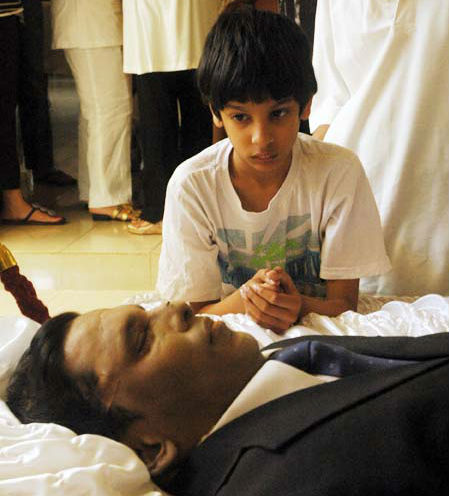
සුවසේ නිදන්න මපියාණනි

November 8th, 2016

වෛද්‍ය රුවන් එම් ජයතුංග 

lasantha2
නිදන්න පියාණනි නිදන්න
සුවසේ නිදන්න මපියාණනි
ඔබ යළි කිසි දිනෙක අවදි නොවන බව මම දනිමි
මම ඔබ එන තෙක් බලා සිටියෙමි
එහෙත් ඔබ නාවේය
ඔබ  මා හැර දමා යන්නට ගොසිනි
යළි කිසි දින අප හමු නොවනු ඇත
මිනී පෙට්ටියේ පියන වැසූ පසු
ඔබ මට සාදාකාලික මතකයක් පමණි

Federal experts in sub-committee: Threat to SL’s unitary nature

November 8th, 2016

Courtesy The Daily Mirror

PHU General Secretary and MP Udaya Gammanpila yesterday claimed there would be a risk to the unitary nature of Sri Lanka because of the intervention of federal experts in the proposed new constitution based on the resolution approved in Parliament on March 9.

Mr. Gammanpila said the proposals in sub-committee report on the Central Government and Provincial Councils had proved that there was a conspiracy to include federalism in the proposed new constitution.

The government has repeatedly stressed that it would not compromise on the unitary nature of Sri Lanka. But the situation has changed with there being none to speak up on the unitary state in the sub-committee though there are several federal experts in it,” he said.

The MP said this would lead to the setting up of a Constitutional Assembly based on racism.

He said according to the sub-committee reports the police powers were to be devolved to the provincial councils.

The central government should retain police powers,” the MP said and warned that if there were to be a war in Sri Lanka in the future, it would be between the Army and and the Police in Northern Province.

He said the sub-committee report proposes to hand over ownership of the lands in the Northern Province to Chief Minister C.V. Wigneswaran who is currently on a mission to expel Sinhalese from the Northern Province.

Giving powers to the provincial councils will mean supporting Mr. Wigneswaran. It is evident from his actions that he is racially motivated,” the MP said.

Meanwhile, he invited patriots to refrain from voting for the proposed new constitution in a referendum. (Kalathma Jayawardhane)


– See more at: http://www.dailymirror.lk/article/Federal-experts-in-sub-committee-Threat-to-SL-s-unitary-nature-118865.html#sthash.u5ccG6CW.dpuf

Sri Lanaka’s foray into the maritime security industry Floating armoury controversy – Part I

November 8th, 2016

Though much has been said and written in the past two years about the opaque operations of Avant Garde Maritime Services, most people know little or nothing of what it was all about – a classic case of a controversy creating more confusion than enlightenment. In this article, The Island staffer C. A. Chandraprema traces how Sri Lanka got drawn into the murky world of maritime security and the roles the Rajapaksa government and the private sector played in the operation.

In 2006 as the war intensified, the Defence Ministry set up Rakna Lanka Ltd, a fully government owned limited liability company to provide security services to important government installations and institutions such as the Mahaweli dams and the Petroleum Corporation etc. Made up entirely of ex-armed forces personnel this special security service was meant to eliminate the need to deploy army and police personnel to guard infrastructure and to release them for duties in the war zone. Rakna Lanka provided security services to 49 government institutions during and after the war. While Sri Lanka remained preoccupied with the war, a new development that took place in the Indian Ocean region was the rise of piracy off the coast of Somalia.

article_image

In December 2008 the UN Security Council issued Resolution No: 1851 expressing grave concern at the dramatic increase in the incidents of piracy off the coast of Somalia and noted that these attacks had expanded over a wide area in the Indian Ocean. The resolution called upon all states to take part actively in the fight against piracy. The Contact Group on Piracy off the Coast of Somalia was created on 14 January 2009. When this threat first manifested itself, the shipping companies expected the navies in the region to protect their vessels. However even the combined strength of all the navies in the region was not able to guarantee the security of shipping in the Indian ocean and ships started carrying armed security guards. By May 2009, the United States Coast Guard had issued a directive to all US-flagged ships sailing around the Horn of Africa to have armed guards.

The UK was an early leader in deploying armed ‘sea marshals’ on board merchant shipping in the Indian ocean. The British House of Commons Foreign Affairs Committee in a report on ‘Piracy off the coast of Somalia’ observed that the UK sits at the centre of the global shipping trade and aside from direct shipping interests, the maritime sector constitutes a major component of the UK insurance, banking and legal sectors and a very large proportion of ships travelling in the Indian ocean are insured in the UK, and that therefore piracy was very much a British problem. They further observed that ‘the evidence in support of using private armed security guards is compelling and that ship owners should be allowed to protect their ships and crew by employing private armed security guards’.

A British dominated industry

Noting that over 50% of the armed security on board ships is provided by UK nationals or foreign companies run by UK nationals, the House of Commons Foreign Affairs Committee concluded that “… the Government should take a more proactive approach to facilitate an effective and safe legal regime for the carriage and use of weapons for the purposes of deterring piracy. We recommend that the Government actively engage with port and coastal states surrounding Somalia to establish an agreement on the carriage and transfer of weapons by private armed guards so that they can be securely removed from vessels once they have exited the high risk area”.

One of the countries that the British government (through their High Commissioner in Colombo) and the maritime security industry approached very early on in this regard was Sri Lanka, which at their request began storing the weapons of private maritime security companies at the navy armoury in Galle from December 2009 onwards. The first weapons stored in this manner were those of sea marshals on board a ship belonging to the Norwegian shipping conglomerate, Wilhelmsen Company. Galle, being located just outside the high risk area in the Indian Ocean soon became a hub for private maritime security personnel to embark and disembark from ships.

When the sea marshals of these foreign private maritime security companies were to arrive in Galle, the local agent of the relevant maritime security company would inform the Defence Ministry and obtain the necessary clearance for the storage of the weapons. When the ship nears Galle, the local agent would go to the ship in a hired boat along with a navy representative, who would make sure that the sea marshals were disembarking from the ship mentioned in the documents and they would all return to the Galle harbour, where the navy would help the foreign sea marshals through Customs. Then their weapons would be deposited in the navy armoury and the local agent would take the sea marshals to Katunayake and send them home by plane. Every such transfer was approved separately by the Defence Ministry. When embarking on ships for duty, the process would be reversed. All the international maritime security companies operating in the Indian Ocean soon had agents in Sri Lanka to look after their sea marshals. The navy earned an itemised fee per day for storing the weapons and equipment such as the body armour of private maritime security companies.

At this early stage, none of the numerous land based security companies in Sri Lanka was involved in the maritime security industry. The ‘maritime security companies’ in Sri Lanka were actually shipping companies acting as the agents for foreign maritime security companies and didn’t have security personnel and weapons in Sri Lanka. As the maritime security industry burgeoned, in July 2010, several foreign private maritime security companies led by Protect Risk Management Solutions Ltd and Varic Security Offshore suggested to Rakna Lanka that they should hire out armed sea marshals to be deployed on ships. The private maritime security companies were attracted to Rakana Lanka because it was a government owned enterprise operating under the Ministry of Defence and all its guards were ex- service personnel well trained in handling firearms and fully vetted by the authorities.

Furthermore, the weapons used by Rakna Lanka belonged to the government of Sri Lanka and there were no problems about the legality of those weapons. The Maritime Security arm of Rakna Lanka was established in March 2011 and they became the first land based security company in Sri Lanka to have a maritime security arm. However, Rakna Lanka depended on the foreign maritime security companies to bring business to them. When the latter makes a request for sea marshals, Rakna Lanka provided the men and weapons and obtained a fee for their services based on a written agreement. On 19 March 2011 Rakna Lanka provided its first on board security team to Inter Ocean Services Ltd to deploy onboard MV Emerald.

IMO formulates industry guidelines

In the meantime, the International Maritime Organisation had formulated regulations for private maritime security companies and sea marshals. On 16 September 2011, the Maritime Security Committee of the IMO issued Circular No: 1408 giving its recommendations to member states on the use of privately contracted armed security personnel on board ships where they said:

“The use of privately contracted armed security personnel on ships is a very recent and still evolving development. Existing national legislation, policies and procedures may not have been developed taking into account or to cater for the various scenarios related to the embarkation or disembarkation of privately contracted sea marshals or their firearms. Member Governments, should have in place policies and procedures to facilitate the movement of privately contracted sea marshals and of their firearms … The recommendations contained in this document are not intended in any manner to override or otherwise interfere with the national legislation of a State. However, at the same time, they recognize the concerns and interests of the owners of ships navigating through the high risk area.”

On 25 May 2012, the IMO Maritime Security Committee Issued Circular No: 1405 laying down guidelines to ship owners on the use of privately contracted armed security personnel on board ships. This circular sought to advise ship owners on the criteria to be applied when selecting private maritime security companies to provide security for their ships. They were advised to check on the registration of the security company, its ownership, its annual accounts and bank references, the extent of its insurance cover, the experience of its senior management etc. The private security companies were also required to produce evidence of actual maritime security experience as against land based security, and proof of the legal possession of firearms etc.

On the same day the IMO Maritime Security Committee issued circular No: 1443 to private maritime security companies stressing that they needed to perform thorough checks on the criminal background, history of employment, military background, physical and mental fitness, drug and alcohol abuse, competence in the use of firearms etc when recruiting sea marshals. The private maritime security company also had to ensure that the sea marshals it recruited had adequate training to carry out their duties. Sri Lanka had joined the IMO (a UN body) in 1972 and its directives constitute a part of Sri Lanka’s international obligations. By 2011, there were more than two dozen companies (mainly shipping companies) in Sri Lanka acting as the Sri Lankan agents of international maritime security companies. On 13 September 2011, Avant Garde Maritime Services became the twenty fifth private maritime security company to register with Rakna Lanka to obtain the services of sea marshals.

Avant Garde hits the ground running

At that time Avant Garde was one of the largest land based private security firms in the country and had done an extensive study of the maritime security industry before entering it. No other private land based security company in Sri Lanka had entered the maritime security industry by that time. In 2011, As they signed up with Rakna Lanka, Avant Garde hit the ground running by signing a separate agreement to provide sea marshals for fishing vessels in the Indian ocean – a business that they had on their own canvassed and brought to Sri Lanka.

None of the foreign maritime security companies that had agents in Sri Lanka were involved in this niche business. The difference between an ordinary sea marshal and a fishing trawler sea marshal was that the latter had to spend more than six months at a time on board the trawler. Rakna Lanka sea marshals were reluctant to take up these jobs and Avant Garde looked for recruits on their own who were then vetted, registered and provided with weapons and equipment on hire by Rakna Lanka. At this early stage, Avant Garde established several ‘forward operational bases’ along the coast of Africa and in the Middle East, to look after their fishing trawler sea marshals.

The way sea marshals were hired out to the numerous clients Rakna Lanka had was either to send the full complement of three or four guards with weapons and equipment or to hire out just three or four assault rifles and equipment accompanied by a Rakna Lanka sea marshal who would look after the weapons given on hire. These weapons would then be used by the foreign sea marshals of the private maritime security company with the Rakna Lanka custodian also functioning as a member of the security team. Handing the weapons back to Rakna Lanka was the responsibility of the respective private maritime security company. Rakna Lanka kept a cash deposit against losses and damages for weapons and ammunition issued in this manner. Each such deployment would be approved by a specially designated Additional Secretary of the Defence Ministry.

In Sri Lanka, many land based private security companies had authorisation to use firearms. The licence for the firearms was granted to the owner or director of the security firm (who had to be a retired armed forces or police officer above a certain rank) and he would assign the weapons to his guards who would have the necessary police clearances and a ‘watcher’s permit’ issued by the District Secretariat. In similar fashion, Rakna Lanka had authorisation from the Defence Ministry to own firearms which could be assigned to their guards. On occasions when foreign sea marshals of private maritime security companies used Rakna Lanka firearms on ships, the regulations that applied were firstly, the legal clearance and registration of that private maritime company in an IMO member country as per the IMO directives, secondly the registration of those foreign sea marshals in an IMO member country in accordance with their domestic laws and the guidelines of the IMO, and certification of their competence to bear arms and thirdly, the internationally binding agreement the private maritime security company had with Rakna Lanka.

The Baltic and International Maritime Council or BIMCO – the world’s largest ship owners’ association has stated in a Security Advisory that the onus was on the ship owners to check the licences of the weapons used by the private maritime security companies they chose. If the latter are hiring their weapons and equipment from third parties, the ship owner have to ensure that those weapons have the required licences and permits issued by state authorities so as not to be in violation of Clause 10 of GUARDCON – the standard contract entered into between ship owners and private maritime security companies for the deployment of sea marshals.

Rakna Lanka had an armoury located in the BMICH premises under police supervision for its sea marshals using the Colombo port and another armoury in the Galle navy camp for those using the Galle harbour. According to UN Security Council document No: S/2012/544 of 13 July 2012, the Security Council considered the question of the lack of oversight by an international regulatory authority over the weapons used by private maritime security organisations and said that this loophole enabled some private maritime security companies to use illegal or unregistered weapons which could be obtained cheaply from dealers in Yemen and Egypt. In this context, the Security Council observed that weapons could be officially leased from certain Governments such as Sri Lanka, Djibouti, and Comoros and that that was an option ‘when strictly regulated, probably provided the greatest degree of oversight’.

Hiccups in UNSC endorsed system

However, renting out weapons and equipment even to well recognised maritime security companies did not go well at first. This was a matter that came to the notice of the UN Security Council as well. They stated in document No: S/2012/544 that in 2011, the Sri Lankan Government reportedly lost track of a large number of government-owned weapons that it had rented out to various private maritime security companies. (These were subsequently recovered by Avant Garde on behalf of Rakna Lanka.) In one case, three T-56 assault rifles leased to the UK-registered company Marine Risk Management were taken on board a Finnish ship at Galle on route to Gibraltar and when the Rakna Lanka custodian accompanying the weapons flew back to Sri Lanka from Gibraltar, the UK company had failed to send back the weapons and they were found only after the ship reached its next port of call in Poland.

As a solution to this problem of weapons being misplaced, a ‘closed network’ system was devised by Rakna Lanka in collaboration with Avant Garde by expanding their network of forward operational bases to eight in such locations as the Seychelles, Maldives, South Africa, Mauritius, Djibouti, Kenya, Tanzania and Oman and also by establishing land based armouries in Muscat, Dar Es Salam, Mauritius and Durban (run by the police or army in those countries) as well as two floating armouries in the Red sea and Gulf of Oman to handle the weapons of Rakna Lanka sea marshals ending their tours at that end of the high risk zone. This created a closed system where Rakna Lanka weapons, equipment and sea marshals embarked or disembarked from anywhere in the high risk zone of the Indian ocean would be collected and looked after by this network without the likelihood of any weapons being misplaced.

This operation became the most comprehensive maritime security system in the Indian Ocean and no foreign maritime security company could match it. The investment in the floating armouries, land based armouries and the ‘forward operations bases’ on the other side of the Indian Ocean were all done by Avant Garde without Rakna Lanka or the Sri Lankan government investing any money. The international marketing aspect of the operation was also handled by Avant Garde. Rakna Lanka was from the beginning dependent on the private maritime security companies to bring business to them. The partnership between Rakna Lanka and Avant Garde took the maritime security industry in the Indian Ocean to new level.

(To be continued tomorrow)

Jaffna

November 8th, 2016


https://youtu.be/BUU83s2Z1II

එක වදනයි.. ආබාධිත රණවිරු ප‍්‍රහාරය ගැන පස්වැනි සේනාධිනායකයා තරු පෙනෙන්න කියයි.. [Video]

November 8th, 2016

ලංකා සී නිවුස්

එක වදනයි.. ආබාධිත රණවිරු ප‍්‍රහාරය ගැන පස්වැනි සේනාධිනායකයා තරු පෙනෙන්න කියයි.. [Video]

ඊයේ දින පොලීසිය විසින් අබාධිත රණවිරුවන්ට කදුළු ගෑස් හා අධිපීඩන ජල ප‍්‍රහාරයක් එල්ල කිරීම සම්බන්ධයෙන් හිටපු ජනාධිපති මහින්ද රාජපක්‍ෂ මහතා අදහස් පල කරයි.

කොළඹ පැවති උත්සව සභාවක් අතරතුරදී මාධ්‍යවේදීන් වෙත ඔහු මෙසේ කියා සිටියේය.

What Happened – Sunil Handunnetti

November 8th, 2016

‘‘අද දෙරණ මොකද වුණේ වැඩසටහන හා සම්බන්ධ වෙමින් සුනිල් හඳුන්නෙත්ති මහතා කෝප් කමිටු වාර්තාව ගැන අදහස් පළ කළ කරයි.

Hold impartial inquiry on bond scam

November 8th, 2016

Resignation has been demanded because the Central Bank technically came under the purview of the Prime Minister and he had given relevant instructions to the bank with regard to the bond issue They point out that even after the bond scam the Prime Minister was not in favour of removing Mahendran from the post, but it was President Maithripala Sirisena who finally prevented his reappointment by nominating Indrajith Coomaraswamy to the post of Central Bank Governor.

Following the recommendations of the Parliamentary Committee On Public Enterprises (COPE) the Prime Minister, however, referred the committee’s report to the Attorney General for legal action. It is in this context that the joint opposition has threatened to organize countrywide protests demanding the Premier’s resignation.

One thing that is relevant here is that ours is not a country where politicians have ever set examples in the past by resigning from their positions whenever some major allegations were levelled against them. The other point is, if Ranil Wickremesinghe resigns at this juncture will it resolve all our problems?  At least will it be the end of all corruption in the country?

On the contrary it will be the beginning of a new political crisis in the country especially at a time the new government is trying to put the economy on the right track with some clear vision for the future.

The advantages of such a resignation and the ensuing political uncertainty will go to corrupt politicians who are already being investigated and those who are already indicted and have little choice other than making every effort to topple this administration.

Meanwhile President Maithripala Sirisena has publicly stated that he came to power with the promise of good governance and therefore his responsibility is not only to punish those who have done wrong things in the past but also to prevent recurrence of such things under his own administration.

The President is still the head of the state and head of the executive and has all the powers to ensure an independent investigation into this matter and punish those who are responsible. He has made it clear that he is determined to obtain an impartial verdict through the country’s legal system.

So what is necessary is to rely on the assurances given by the President and our own legal system and to carefully watch the manner in which the investigations are conducted and not to create political chaos by having public campaigns demanding resignations or change of administration.

India scraps 500 and 1,000 rupee bank notes overnight

November 8th, 2016

 Courtesy BBC

Indian Prime Minister Narendra Modi has announced that the existing 500 and 1,000 rupee banknotes will be withdrawn from the financial system overnight.

The surprise move is part of a crackdown on corruption and illegal cash holdings, he said in a nationwide address on television.

Black money and corruption are the biggest obstacles in eradicating poverty,” he said.

New 500 and 2,000 rupee denomination notes will be issued to replace them.

The move is designed to lock out money that is unaccounted for and may have been acquired corruptly, or be being withheld from the tax authorities.

It is seen as the boldest move by any Indian government to clampdown on tax evaders.

Banks have been told to exchange existing high denomination rupee notes over the next 50 days.

The 500 and 1,000 rupees notes are extremely common in India.

Airports, railway stations and hospitals will accept the notes until 11 November.

People will be able to exchange their money at banks between 10 November and 30 December.

Mr Modi’s ruling Bharatiya Janata Party came into power in 2014 promising to bring billions of dollars of black market money into the country’s financial system.

The announcement comes just over a month after the government raised nearly $10bn through a tax amnesty for Indians to declare hidden income and assets.

Ukraine International Launches Scheduled Flights to Colombo

November 8th, 2016

Source: Ukraine International

On Saturday, November 5, 2016, Ukraine International Airlines will start operating non-stop scheduled flights between Kiev and Colombo. The capital of Sri Lanka will become the fourth destination of the UIA long-haul route network.

UIA offers passengers to take advantage of non-stop scheduled double weekly services between Kiev and Colombo. The flights will be operated throughout the year on modern Boeing 767-300 aircraft with three-class cabin configuration – Business Class, Premium Economy Class, and Economy Class.

For UIA, the launch of a new long-haul flight is a long-awaited and landmark event enabling us to provide passengers with even more travel opportunities, – noted Evgeniya Satska, UIA Corporate Press Secretary. – Winter is a perfect time for connecting Ukraine with Sri Lanka, the island of eternal summer. We hope our clients will be actively taking advantage of our new offer, especially since, once aboard, they will enjoy traditional Ukrainian hospitality and a vast selection of services including increased free baggage allowance, free onboard meals, etc. Tickets to Colombo are available on UIA website, at UIA ticket offices, as well as in travel agencies.

Moreover, UIA considers a possibility to increase the Kiev – Colombo frequency up to three weekly flights.


Awaken oh Sri Lanka! Awaken! Thou Art Being Deflowered and Colonised (Part One)

November 7th, 2016

By Gandara John

Briefing potential foreign investors in Colombo recently, RW had reportedly given an assurance to the investors that the Megapolis Zones, which the government is proposing to set up and in which they have been invited to invest, will be sanitized of Sri Lankan Law.

RW had assured the investors that a new type of Courts, Primary Courts and Appeal Courts applying British Law, would replace the Sri Lankan Court Houses in these zones.

The Megapolis (or Megalopolis) project of this government has been described as the setting up of a chain of Mega City States, adjacent to each other, along the seaboard of the island.

Under the Megapolis concept, Sri Lanka would be ceding her land to foreigners in all the Megapolis provinces, with the purchase and ownership of land by foreigners being made legally possible

At present, only a mere 17 % of the land of the country is privately owned while 83% of the land is government owned. In other words, the people of this country collectively own 83% of the land.

The present laws do NOT permit foreigners to buy or own land.

Besides jettisoning Sri Lanka’s laws in the proposed Megapolis provinces, also being abandoned are the Rights of Individuals now guaranteed by the State (such as establishing Trade Unions, freedom to join Trade Unions, minimum wages, employment benefits etc), Judicial infrastructure and overview (such as Sri Lanka’s Courts, Judges, Lawyers etc) and Sri Lanka’s Administrative infrastructure.

In short, Sri Lanka under the Megapolis Project is proposing to renounce its Sovereignty over the entire Seaboard of the island.

Expressed differently, the rich of this country are selling off the island’s Maritime Provinces to US Corporates, and entrenching US Colonialism in the country’s rimland; it is akin to Dutch Colonialism of the 17th Century in the Maritime Provinces of Ceylon.

The Megapolis concept is a US concept primarily geared to shore up US Corporates that will be at the vanguard of the US offensive to colonize Asia and Africa.

The US, using proxy terrorists, failed thirty miserable years in its attempt to fracture the Sovereign State of Sri Lanka. In 2009 the global hegemonist was decisively defeated when the Sri Lankan people and her Army decimated the terrorist leadership on the banks of Nandikadal.

Like the al-Nusrah Front, the Boko Haram, the USIS, the al-Qa’ida and many others, the LTTE is just one of the many terror groups sponsored by the US; these are the ‘foreign legion’ of the US, fighting proxy wars on its behalf in countries where the US prefers to operate inconspicuously, ‘without putting boots on the ground’.

During Sri Lanka’s major hostage crisis, the US and its allies tried desperately hard to prevent Sri Lanka rescuing the hostages taken captive by the terrorists. It was an unbending Sri Lankan political leadership, reflecting the strong will of the people that resisted all these efforts.

The US and its allies in a knee jerk reaction committed themselves to, physically attempt rescuing the terrorists (the hostage takers), a dastardly war crime by any yardstick.

Ignominiously defeated by the Sri Lankan Army, the US and its allies were perforce compelled to change tactics; they retreated from an ‘offensive war’ to a cowardly ‘siege war’ (of embargos etc, including GSP plus).

Siege warfare is one of the oldest forms of warfare in human history. It is indefensible in civilized society, even during a state of war, considering the deadly impact a siege has on the civilian population especially children. This is yet another war crime perpetrated by the US and its allies on Sri Lanka.

Sri Lanka needs to notice the UN, the ICC and other relevant global organisations about the war crimes committed by the US and its allies against the people of Sri Lanka and pursue action against these war criminals.

Terrorism has been a significant feature of the late 20th and early 21st Centuries. It is a prime instrument used by the US to challenge, weaken and finally destroy Sovereign Westphalian States in Africa and Asia. By so doing, the US destroys the Sovereignty (or independence) of the people of those States and gerrymanders the world to a shape that facilitates the governance of its avowed ‘One – World’ Empire.

Having failed miserably to fracture the State of Sri Lanka the US conspired to change the political leadership, at the helm of the country, which had been its bête noir; it is a type of exercise the global bully regularly indulges in, changing democratically elected Governments and replacing them with despots of its choice; this, it vaingloriously describes as ‘regime change’.

Billions of dollars were pumped in through NGOs, Foundations, Electronic and Print media,  Mosques, Evangelical churches and the like for the Presidential Election, much of which was spent on facilitating and enriching the cross overs.

Involved in this murky activity was CBK whose seeming mental instability is reflected in her appearance, choleric emotion and conduct. Wallowing lavishly in her bog of ill fame, she prides herself in acting as a gofer to that notorious ‘Club Madrid’, playing peon between the local players and the US.

What the US failed to achieve during its 30 year shadowy war, it succeeded, partially at least, in that flawed Presidential election of 2015; it got rid of the political leadership that had been a hindrance to US objectives.

Working in cahoots with the US at that Presidential Election was its regional ally, India.

Dangling a ‘China’ carrot to bait India was not really necessary to motivate Modi.

Narendra Modi has for long been a votary of the US. In 1999, whilst ostensibly yet a political lightweight, the BJP turned to Modi, to entrust him with a crucial mission; he was instructed to proceed to Washington and use his connections to persuade the US to pressurise Pakistan to withdraw its troops from the Himalayan heights and extricate India from an intractable nuclear predicament.

This was at the height of the Kargil conflict and at a time when Pakistan was the closest ally of the US in the region and enjoying a special military relationship with it.

The relations between India and the US were frosty at the time.

Modi achieved the ‘impossible’; US forced Pakistan to withdraw from the Kargil heights.

Thus began Delhi’s special relationship with the US. By 2005 US had a comprehensive and long term bi lateral Security arrangement with India; India became the most important military partner of the US in the region.

Prior to the Kargil conflict US influence in India was mostly concentrated in the State of Tamil Nadu.

As in Jaffna, the American missionaries had set up schools, hospitals and churches in Tamil Nadu; they ran 2300 schools, 150 colleges and 104 hospitals such as Kodaikanal College, Vellore Medical College, Vellore Hospital and Bethesda Hospital to name a few.

Tamil Nadians dominated the Indian bureaucracy, the Judiciary, the Foreign Service and the Intelligence services; US influence over these Indian State organisations and Agencies was extremely strong.

R N Kao, a close confidante of Indira Gandhi, was the founder of the RAW; he had a cozy relationship with Bush (Senior) of the US.

Kao’s handpicked Intelligence operatives, many of whom were from Tamil Nadu, were trained by the CIA and the MOSSAD. The RAW worked closely with these two spy agencies.

It was during the time of Indira Gandhi that the RAW established military camps for the Tamil terrorists in Tamil Nadu. The terrorists were provided arms, combat training and safe haven by the RAW. Subsequently they were sent for advanced training to Israel and to George Habash’s PFLP.

It is perhaps pertinent that Kao was the personal security advisor to Indira Gandhi and subsequently to Rajiv Gandhi; his assignment as security advisor outlasted the assassinations of both mother and son; Intelligence, it would appear, had eluded India’s pro Western spy chief on both these occasions.

Ban Polygamy in Sri Lanka

November 7th, 2016

Shenali D Waduge 

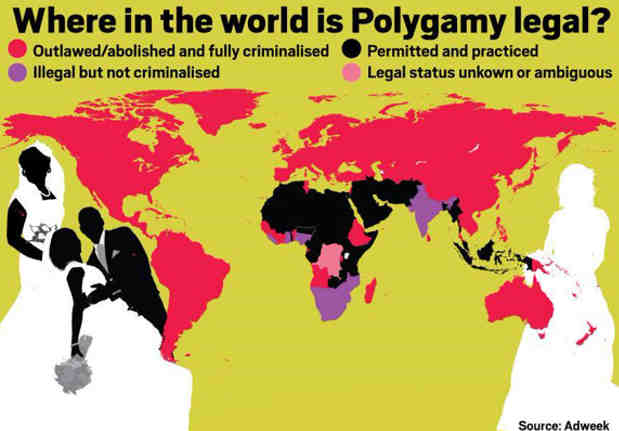
India’s Supreme Court in February 2015 following the Government of India petitioning it has delivered its verdict completely banning polygamy in India. Although Muslim personal law permits men to have four wives, the Supreme Court of India has ruled that a Muslim’s fundamental right to practice Islam did not include practicing polygamy. The Constitution will protect the Muslim faith but not practices when all Muslims do not practice it. India has 150million Muslim. Sri Lanka has 1.6million. A parallel justice, judicial system, parallel laws cannot prevail in a country where citizens have to be treated as equals and given equal rights.

shenali07111606a

The Indian Supreme Court judgement delivered by Justices T S Thakur and A K Goel gave these key messages

  • What was protected under Article 25 (right to practice and propagate any religion) was the religious faith and not a practice which may run counter to public order, health or morality. Polygamy was not integral part of religion and monogramy was a reform within the power of the State under Article 25)”
  • Equality as per India’s constitution deems that these rights don’t permit Muslims to have multiple wives.

It is nothing that anyone can raise objection to. As per 1961 Indian census only 5.78% Indian Muslims actually practiced polygamy.

At a moral level if a man cannot bear to see his wife with another man, the same should apply to a woman who wouldn’t like to share her man with another woman.

At a financial level how can a man look after 4 women equally?

shenali07111605a

At a political level polygamy will result in major demographic change where the likelihood of Muslim minority becoming a Muslim majority by increasing population is an aspect that cannot be ignored.

The other argument is that non-Muslims have begun converting to Islam for the simple reason of keeping 4 women legally. Bollywood star Dharmendra marrying Hema Malini inspite of being married and then denying converting is a case in point.

Although the Indian Constitution allowed Muslims to regulate their own laws governing matters such as marriage, divorce, inheritance the decision taken by the GOI against polygamy has been on the grounds that polygamy and triple talaq impacts a woman’s status and her right to live with confidence and dignity – arguments that no one can dispute.

The view held was that India professing to be a secular democracy cannot deny equal status and dignity by allowing polygamy. Moreover, the arguments also remind that even theocratic Muslim states were Islam is State religion have also undergone reforms. As such talaq is banned in more than 20 countries including Pakistan and Bangladesh.

What is noteworthy is that Muslim women in India too had petitioned the Supreme Court to ban triple talaq even going to say it was against Islamic law and was discriminatory. So we have a situation where even Muslims are not in agreement to these Islamic practices a handful are demanding.

shenali07111604a

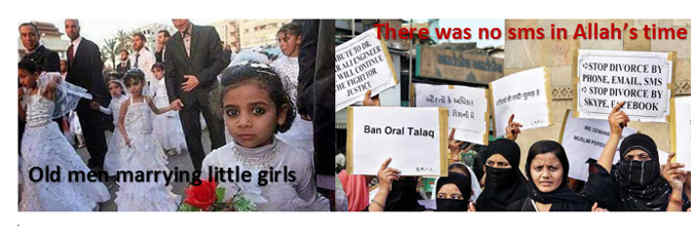
According to Bharatiya Muslim Mahila Aandolan, an organization defending Muslim womens rights, Muslim men have exercise triple talaq over phone, by email and even sms.

Another women’s group Muslim Women’s Quest for Equality filing an affidavit called for Sharia courts to be banned in India again citing inequality and violation of human rights. All slogans that the West cannot object to by siding with the Muslim demands just to score brownie points and create dissent!

The MWQE is even advocating to completely ban organizations like All India Muslim Personal Law Board to save the country and Indian Muslims from the clamp of fundamentalists/activists”. This is the same dangerous scenario taking root in Sri Lanka.

The AIMPLB’s argument is strange indeed. They claim that polygamy is a ‘social need’ and a ‘blessing’ and that a lawful second wife was better than a mistress!

If 150m Indian Muslims all married and had 4 wives each this would make the Muslim population jump to 600million! However we know all Muslims do not practice polygamy and that does not make them any less Muslim!

Interestingly the National Shoora Council of Sri Lanka is echoing the same arguments as the All India Muslim Personal Law Board.

Quoting its 4 November press release:

  • interfering with the freedom to practice one’s religion which has been guaranteed by the Constitution”
  • The Muslim Personal Law has been a right enjoyed by the Muslims since pre-colonial times” (Muslims had no rights before or even during colonial rule as they were regarded as aliens with no land rights)
  • We strongly urge the yahapalana government not to ignore the pleas of the Muslim community who played a significant role in the transformation of 8th January 2015” (in other words ‘since we helped form the government we cannot be ignored’)

http://876r.blogspot.com/2016/11/sltj-minimum-age-for-marriage-not.html

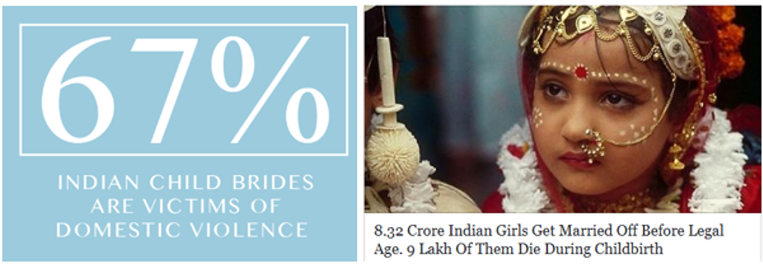
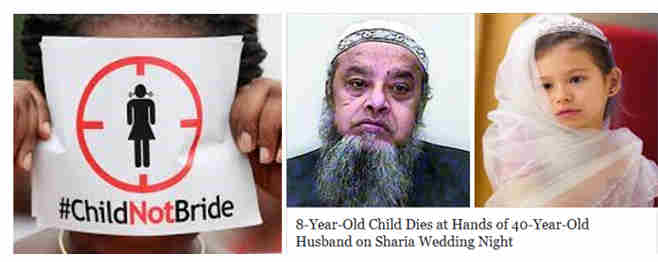
When minorities demand rights they cannot demand exclusive rights for themselves. Especially when the ‘rights’ they demand directly raise other social issues – childrens rights to education being denied when forced to marry and bear children, complications at child birth, nutrition. Marrying more than one wife cannot become bigamy for one lot of people and for another small group it cannot become a ‘right’. Violation of Children’s Charter of the UN when small children become sexual toys of men old enough to be their fathers. Some cases of children dying from perverse sex is cited. No girl should be deprived of her childhood, her heath, her education, her aspirations.

Sri Lanka’s penal code defines bigamy in Section 362B punished with imprisonment upto 7 years and liable to a fine.

http://www.ceylontoday.lk/print20160321CT20160630.php?id=2192

Annually 50million children below age of 15 are married off (UNICEF)

Unicef study from 2000 to 2008 found that more than 43 per cent of women in Afghanistan were married under age, some before puberty. In Nigeria nearly half of all girls are married before they turn 15. In Saudi girls as young as 13 years are married out to men more than 25 years their senior. In Yemen more than half of girls are married before they attain their puberty.

The 10 countries with the highest rates of child marriage are: Niger, 75 per cent; Chad and Central African Republic, 68 per cent; Bangladesh, 66 per cent; Guinea, 63 per cent; Mozambique, 56 per cent; Mali, 55 per cent; Burkina Faso and South Sudan, 52 per cent; and Malawi, 50 per cent.

None of these countries can claim high living standards. Literacy is low, productivity is low, poverty is high. Gender equality statistics are clearly visible – http://www.telegraph.co.uk/travel/maps-and-graphics/mapped-the-best-and-worst-countries-for-gender-equality/

shenali07111601a

http://www.girlsnotbrides.org/where-does-it-happen/

Sri Lanka should not enter such a category knowingly. Living in the 21st century to even advocate child marriage is a global shame.

shenali07111602a

http://www.israelvideonetwork.com/do-not-stop-sharing-this-until-every-person-who-cares-about-children-sees-it/

http://www.terrorscoop.com/child-rape-part-culture-says-islamic-preacher-denmark/ Child rape is part of our culture says Islamic preacher in Denmark.

The Indian Supreme Court verdict is an excellent foundation to argue Sri Lanka’s case against polygamy.

While the arguments against child marriage is equally quite clear.

Neither polygamy or child marriage is part of Islamic faith. It is a practice no different to the burqa and the current attire Muslims are wearing. This was the argument used by the French authorities when the burqa was banned. Of France’s 5million Muslims the police research revealed that only 1900 Muslims wore the burqa. https://www.theguardian.com/world/2014/jul/01/france-burqa-ban-upheld-human-rights-court It is advised that Sri Lanka carry out a similar research.

We are living in modern times not the cave age. Yet, countries still practice bizarre anti-women laws still. Sudanese Muslim women will get lashes if they wear trousers, the Council of Islamic Ideology in Pakistan has proposed a wife-beating bill, it is legal to sexually assault one’s wife if she is over 14 in Bahamas and 13 in Singapore! In Lebanon a man can kidnap a woman and rape but if he marries her he is not prosecuted, in Egypt a man will get a lenient punishment for murder of a wife if he catches her in the act of adultery, in Cameron and Guinea men decide where their wives work, in Saudi Arabia women cannot drive – Sri Lanka should not want to belong into this category.

If anyone wants to practice such ancient and feudal acts it is best that they migrate to nations that are practicing them and not ride on minority religious rights to demand inappropriate practices to exist.

shenali07111603a

Sri Lanka must use the legal arguments that paved the way for the Indian Supreme Court to ban polygamy in India to also ban it in Sri Lanka and also ensure that child marriages are also banned. In the same manner the new Muslim attire that is not Islamic but a new cultural practice route via Saudi Wahhabi mosques and having Western imperial objectives linked to it must also be denounced and legal actions taken.

You cannot have parallel legal systems existing when the core theme is equality for all before the law. Judicial systems cannot change per religious practices though anyone wishing to live according to the strictest practices of Islam should and are welcome to live in majority Muslim states where these are state law (States which do not afford other religions the same rights).

The Government of Sri Lanka for political mileage and cheap votes cannot be unfair by the populace in dilly dallying with matters that will affect the demography and the cultural landscape of the country.

Polygamy must be banned – Child marriage must be banned and no new cultures can become religious rights.

Shenali D Waduge

තවුහිද් ජමාන්ට කණ පැලෙන්න මොහොමඞ් සජාන් කියයි..

November 7th, 2016

ලංකා සී නිවුස්

තවුහිද් ජමාන් සංවිධානය විසින් දිගින් දිගටම සිදු කරන  ජාතිවාදී ක‍්‍රියාකාරකම්වලට එරෙහිව මුස්ලිම් තරුණයෙකු වන මොහොමඞ් සජාන් විසින් දැඩි ලෙස ප‍්‍රතිචාර දක්වයි.

Aborting the hard won peace to placate the implacable – III

November 7th, 2016

By Rohana R. Wasala

Continued from Saturday November 5th, 2016

Touching on the economic aspect of the current Sri Lankan problems, Draper quotes prime minister Ranil Wickremasinghe as saying: It’s a history of missed opportunities”. We are told that here Wickremasinghe was referring to the unfulfilled economic potential of the country” during the Rajapaksa administration. He has told Draper that Rajapaksa’s agriculture-based model purported to be populist, but wasn’t really giving anything to the people, and was really meant to consolidate family rule”. Such assertions are contrary to available evidence. Economic growth which recorded a high 6-7% during the Rajapaksa administration has fallen to around 5-4% over the past twenty-one months.

Draper falsely maintains that Rajapaksa escalated the war against the Tigers. The truth is that like all his predecessors, he exhausted all peaceful approaches to come to a settlement with the Tigers. But they remained intransigent. So, Rajapaksa did what any responsible ruler would do to overcome rebellion against the state. Had Draper been better informed about Sri Lanka’s internal conflict, he won’t have made the following irresponsible comment about how the Sri Lanka army ended the war:

By mid-May 2009 they had slaughtered the last remnants of the Tamil Tigers along with trapped civilians. The war was over. In the end as many as 100,000 people have been killed”.

Isn’t this statement meant to have incriminatory implications against the Sri Lanka army, as required by the West and the Tamil diaspora, which are hell-bent on wreaking vengeance on the patriotic Sri Lankan leaders who defeated terrorism? To assert that that the army ‘slaughtered’ the remaining ‘Tamil Tigers along with trapped civilians’ is an utter falsehood. Those Tigers died in face-to-face combat. The unambiguous implication of the sentence ‘As many as 100,000 people have been killed’ is that the number refers to ‘the last remnants of the Tamil Tigers’ and the ‘trapped civilians’. (The allegation implicit here calls to mind Ban Ki Moon’s unwarranted comparison of the situation in Sri Lanka to the Rwandan and Sebrenica genocides.)There is a deliberate mix-up here, which only the very few sufficiently well informed among the target readers can be expected to correctly sort out. (Actually, 100,000 was the estimated total number of people killed over the 30 year long conflict, including civilians killed in LTTE bombings and massacres, and other terrorist attacks, and security personnel killed in action.) Why should the army kill the ‘trapped’ civilians? What benefit did they achieve by doing that? The army actually rescued 295,000 Tamil civilians held hostage by the LTTE as human shields, accommodated them as soon as possible, under the then prevailing difficult conditions, in livable camps, and looked after them until they could be resettled in their own lands. As much as 90% of the land acquired for security purposes was returned to the original owners by the previous government. Most of the demining of the land heavily mined by the LTTE (495,000 anti-personnel mines, 4900 landmines) was done by the army, leaving only a smaller portion of the job to be done by foreign NGO demining crews (contrary to what Draper implies). About 12,000 surrendered and captured young LTTE cadres were rehabilitated and returned to their parents; there were 530 LTTE child conscripts among them. Only about 200 hardcore cadres, charged with criminal offences including mass murders, burnings, abductions, etc are being held in prison until due legal processes deal with them. Draper’s claim that the government held ‘Tamil political activists’ indefinitely without charges is another big lie. There are no political prisoners (people held on the grounds of their political views) among them.

This is how Draper tries to justify Western intervention in our internal affairs:

Rajapaksa’s tyranny-of-the-majority vision for Sri Lanka was not sitting well with the international community. In 2010 the European Union halted the country’s benefits from certain sustainable-development and good-governance incentives on human rights grounds. Dissatisfied with the Rajapaksa Administration’s halfhearted war crimes investigation, the UN Human Rights Council commissioned one of its own in 2014. Under a withering spotlight, Sri Lanka seemed on the brink of yet another disappearing act”.

There has never been  any tyranny of the majority in this country. By the time the armed separatist terrorism was defeated, naturally, Rajapaksa had emerged as the most popular national political leader of the country who provided the most acceptable leadership to all the communities. Though this was good for the country, it was not looked upon with favour by the so-called ‘international community’. Correspondingly, for local politicians of rival political ideologies, Rajapaksa became a most hated figure because he represented a huge roadblock to their personal political ambitions. No wonder, Rajapaksa became a common target of these two camps.

Draper sees continued  army presence in the North at a reasonable level ( which is an absolute necessity in view of the still precarious security situation there) as ‘occupation’. If we apply his logic, we can’t station the army anywhere in the country without having it ‘occupy’ the land! But Draper’s skewed logic is apparent in the following completely untrue comment:

But the military—which until the 2015 election was headed by Rajapaksa’s brother Gotabaya—has been slow to respond to the new administration and continues to occupy some of the roughly 12,000 acres that it confiscated during the war”.

He advertises a similarly biased view of the constructive way the army was used under the earlier administration for kick-starting long disrupted development in the region (as a temporary measure) as done in the south as well (e.g., for urban development). In this connection, he shares the ignorant unreasonable attitude of the 46-year-old woman quoted in the following passage:

We have no confidence that we’ll get our land back,” said a 46-year-old Tamil woman who has lived in a squalid camp since the army seized her land in 1990. They’ve built a hotel on my property. They’re earning revenue there. Are you telling me they’ll just hand it back over to us?”

Draper is careful to connect the absurd ‘White Van’ abductions story (which used to be prevalent in  the south as well) to the missing persons issue by quoting another Tamil woman:

I lost my husband eight years ago. He was abducted in a white van.”

The writer completes his story (meant, no doubt, to be illustrative regarding the missing persons problem) about the 34 year unnamed Tamil woman by saying that she did not find her husband in the prison where she was hopeful she’d find him.

Draper refers to the extremely biased September 2015 UN document about (uncommitted, as we Sri Lankans know) war crimes document which, he says, cites ‘years of denials and cover-ups” on the part of the Rajapaksa regime.’ In the same context, he refers to what most rational Sri Lankans condemn as thoughtless betrayal of the country by the yahapalana regime: By not protesting the findings, the new government implicitly signaled it was ready to confront the truth”.

He says that Ranil Wickremasinghe told him, We will get a second chance – we’re already working on it”.  The PM acknowledged (to Draper) that it was crucial that an earnest attempt to make Tamils feel like part of a new Sri Lanka. They just want to lead a normal life like everyone else” according to Draper. No one would dispute these sentiments. Contrary to what Draper probably implies here (i.e., that Ranil’s words embody a revelation of something not appreciated before by others), that is what every Sri Lankan leader at the helm from the formidable D.S. Senanayake first premier of independent Ceylon (Sri Lanka)  down to the current incumbent Ranil-Maithri duo.

Since this article has become more than twice as long as I intended it to be, I don’t want even to  touch on the other fallacious arguments (about such things as alleged majoritarian tyranny, Buddhist fundamentalist extremism, etc.) that Draper advances in support of the ‘international’ persecution of my long suffering country or the ruining of the national peace achieved, at the cost of so much blood and tears, in 2009 with the defeat of armed terrorism. But the conclusion of his article which wraps up his grand theme must needs be attended to. A few days before meeting with the prime minister, Draper says, he had seen the fisherman’s wife in Jaffna. She had a photograph of 168 Tamil prisoners at a penitentiary somewhere near Colombo (all of them looked like men from Mannar to her) published in a newspaper; the men had their eyes blacked out, but she was able to spot her husband in that photograph. But when she located the prison and looked for her husband, he was not there, nor were there any of the men from Mannar she had seen in the photograph. (I am deeply suspicious of the authenticity of this story, for reasons that any careful reader of Draper could see; it sounds like a convenient fiction. But, be that as it may be.)

When he subsequently met with the PM, he asked the latter if the men were being held in secret detention in sites guarded by the military”. The PM replied that he had been told by the military that there are no such places.

Meaning …” (?)

They’re all dead,” he said.

Robert Draper concludes his essay with these words:

In June the Sri Lankan government acknowledged that more than 65,000 people have been reported missing since 1994. It also announced plans to create an office to investigate the disappearances and to issue certificates of absence” to families of the missing so they can collect benefits and, hopefully, move on with their lives. Assuming it does so, perhaps Sri Lanka will also move forward—consigning its ghosts to memory.”

I need not comment on this, because its implications are clear to my informed readers. Incidentally, before concluding, I think I should make a passing reference to the remarks of UN Special Rapporteur on Minority Issues Rita Izsak Ndiaye, who was in Sri Lanka recently on a 10-day visit. Like journalist Robert Draper in the National Geographic, she also made certain egregious comments on Sri Lanka’s alleged ethnic problem, betraying her abysmal ignorance about our country’s history, culture, and current politics. She has suggested that a fully empowered independent commission for minority issues be included in the (proposed) constitutional reforms to implement mandates and foster relations between communities (as if there is a serious ethnic problem in the country – RRW). More shockingly, she identifies alleged ‘Sinhala-Buddhist majoritarian leadership as the main cause of minority grievances and the country’s civil war, and referred to the primacy given to Buddhism in the constitution ‘could lead to further suppression of and discrimination against minority religions and communities’! But there is absolutely no  religious or racial discrimination in our country which would justify such a censorious judgment against it. For the ‘international community’ to get poor Sri Lanka harangued and harassed by the Drapers and the Ndiayes of the world is adding insult to injury.

Concluded

Kuveni’s curse still holds sway

November 7th, 2016

By Dr. Tilak S. Fernando Ceylon Today Publication on 7 Nov.2016 

Despite the Joint Opposition (JO) of Sri Lanka Parliament is making an enormous ruckus from the day the Value Added Tax (VAT) problem emerged from the Yahapalana Budget, and subsequently making a hue and cry on the amended (VAT) Bill to the extent of invoking the wrath of gods on the current regime by dashing coconuts at Sri Maha Kali Amman Kovil in Modara, while some of their supporters visited the famous Seenigama Devale on the South-West coast in Hikkaduwa.

Seenigama Devalaya, which is dedicated to the Devol Deviyo,(god Devol), is well known to protect the local fishermen in the area, who go fishing in the deep sea. Seemingly it has become popular for some people to visit it and make vows based on sinister activities for the sole purpose of cursing their enemies with vindictive and spiteful mindsets. Some people visit the devale to bring curses on a foe and the process is called Miris Ambaranna (to grind chilies).

kuvenia

Despite all such melodrama, on 26 October 2016 the Value Added Tax (Amendment) Bill was passed in Parliament with a majority of 66 votes and 65 MPs boycotted the voting session. The battle between the two camps was one blaming the other – the JO maintaining that “the Yahapalanaya (good governance) has become a ‘Yamapalanaya’ (hellish control), where the poor people are taxed to the hilt, whereas the government on its part maintaining that VAT increase was compulsory to get out of the “debt-ridden economy due to wastage of money by the previous government on superfluous projects.”

However, on the brighter side, several consumer items necessary for day-to-day living of the populace have been exempted from the amended bill, along with certain other areas such as health related issues, surgical services, transport, bakery products, life insurance and mobile phones.

              Traditions and sacraments

Traditions and sacraments in the Sri Lankan society go back over 2,500 years, coming down the generations. The culture, which is very much alive in the rural villages, has derived not from the teachings of orthodox Buddhism, but what is known as folk Buddhism, which is a fusion of Yakka and other primitive animism.

The worship of various forms of gods takes place according to Hindu mythology. The goddesses, idols and devils have become the Sri Lankan conception. The dogmas were created by the fears ingrained initially in the local mentality from the time when Yakkhas held sway over the island, when the community harboured awesome fears with infectious diseases or natural catastrophes believed to be ascribed to the wrath of a variety of gods, who had to be pacified to achieve succor.

Origins

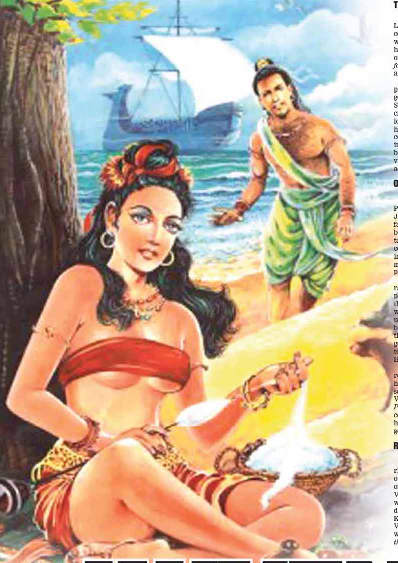
Kuveni, the Yakkini Princess, the consort of Prince Vijaya, had two children, a son named Jivahatta and a daughter named Disala. The familiar legend portrays how King Vijaya betrayed Kuveni’s oath by giving her up and taking a princess from Madhura as his queen consort. When Vijaya announced his intentions to Kuveni about his prospective marriage to the Princess Pandiya, Kuveni pleaded with Vijaya thus:

Oh, I helped thee to rout the Yakkhas and raised thee to be King of this isle, and pledging thy truth. Oh King, thou made me thy spouse. Did’st not thou then know that I was of the Yakka race loving thee with unquenchable love, and living in such love, I bore thee two children. Husband mine, can thou now leave me and love another? The gentle rays of the full-orbed moon seem now to be the blaze of a red-hot iron ball. Alas! How can I soothe my heart?”

Vijaya ignored her compassionate pleas and resolved to marry the Madhura princess of his own choice. Upon his betrayal, Kuveni scorned him with words of wrath and cursed Vijaya. “Vijaya should not have listened to his Purohitas (advisers), but to his own conscience and made the woman who helped him to win the throne of Lanka”, the fable goes on.

Royal lineage

Kuveni’s curse is believed to have gushed right down the royal lineage and has overflowed to each and every nook and corner of Sri Lanka over the decades. At first, Vijaya’s successor, Prince Panduvasudeva, was afflicted with an incurable, deadly disease and his illness was directly linked to Kuveni’s curse of Lanka in repudiation of Vijaya having had breached his oath. This was the time when Kohomba Kankariya, a thovil (ritual) was performed, to cure the King.

There are other fables in Sri Lanka to indicate that Gajaman Nona who killed her own son, born out of her first marriage, to satiate her husband’s murderous desires, was also the tragic episode of Mariakade Hamine is recorded as Kuveni being reincarnated as Mariakade Hamine in the 20th century, due to a man’s vengeance, thus brought forward the curse Kuveni scorned on Vijaya’s own betrayal to her.

It is thus, assumed that the infidelity of Vijaya followed the inevitable curse not only on Vijaya, but the country as a whole and descendants of all Hela People alike. Therefore, the myth has been cemented in the theory that when Kuveni cursed Lanka and Vijaya, the curse has taken a firm root well and truly.

Modern parliamentarians

This becomes clear when observing the behaviour of some of the modern parliamentarians in Sri Lanka, probably conforming and confirming the fact that there is no relief from the curse still. Evidently, why are Sri Lankans not united? Why are they always hell bent on doing harm to one-another, and at times racially and religiously instead of helping each other? Is it not because of such behaviour that a new word called Sanhidiyawa has come to play a major role in all political and social activities today?

It is also mentioned in this manifested allegory that when Vijaya deserted Kuveni with her children, a leopard cub (tiger) took refuge on her lap at the time she cursed him. The emergence of the ‘Tiger’ movement of the LTTE was once regarded as an extension of Kuveni’s curse on Sri Lanka, which lasted for three decades.

When Liberation Tigers of Tamil Eelam (LTTE) activities were at their peak, it was suggested by someone that the tiger cub that jumped onto Kuveni’s lap, followed by Dividosa (curse of the Tiger) was a direct result of Kuveni’s curse on Vijaya and the country. As such, no more Kohomba Kankariya type exorcism could expel the long seated effects of Kuveni’s curse that had befallen on the country in the form of LTTE terrorism and the only remedy to get rid of the curse would be to engage a modern type of an exorcist, in the form of a Defence Secretary, to perform a completely different type of thovil which, at long last, made Gotabaya Rajapaksa as the modern-day exorcist who performed a successful thovil, with the help of the three armed forces and eradicated the curse on 19 May 2009 by declaring that “The war with Tamil Tigers was over and the Sri Lankan Army had managed to kill the chief of the LTTE Velupillai Prabhakaran”.

Terrorist war

Once the terrorist war was won and Sri Lanka became the cynosure of the world for eliminating a ruthless terrorist war, which no other country could achieve such a success over terrorism, the Army Commander, who fought terrorism and executed his military strategies to win the war had to be incarcerated and confined to a prison ‘uniform’ and treated far less than a human inside a tiny room with open drain infested with rats running the perimeter of the room, risking rabies while sleeping on the floor. If this was not part of Kuveni’s curse, what else could it be?

Many regarded such inhumane actions by the previous regime as Kuveni’s curse being compounded and extended further. Satan certainly seemed to have won the spiritual battle as evil effects were to become infectious when the ruling elites of the previous regime enjoyed super luxury lives while the common folk were blinded by slogans of “winning the war” and vilifying more and more with debauched activities of corruption and manipulating their power in the belief that there is no tomorrow or another world.

On 8 January 2015 another miracle took place where people were made to believe that at long last it was the end of Kuveni’s curse and peace and prosperity, devoid of corruption and clean living, would pave the way for a better tomorrow. A mixture of two political parties formed a new union what was known as Yahapalanaya (good governance) with the sole aim of a better and a cleaner political climate in the country. Alas! people have been made despondent over and over again where a bag of spoilt eggs in the combined basket appear to be doing a repetition, which some say, even go far beyond their predecessors.

Melodrama

The whole scenario has turned into a big issue, where melodrama of big wigs of the previous regime, including the some of members of the Forces, who fought the war, including the Defence Secretary, are being called to appear before the FCID and various other commissions on various allegations. Some even suggest that it could be even retribution boomeranging on some who held authoritative positions and abused their power and force, which is a continuation of the Kuveni’s curse.

Whether it is Kuveni’s curse or Satan playing havoc, Sri Lanka is certainly heading towards a gloomy and uncertain area. Today, even those elected as politicians to serve the public have forgotten why they have been elected. Their main ambition appears to be seeking only a luxurious type lifestyle. The very politicians who went to the extent of dashing coconuts at Maha Kali Kovils were deaf and dumb when Parliament discussed granting of duty free cars to the lot.

They would not utter a word when their pay increases were discussed in Parliament (except the odd MP who genuinely thought about the country and people); they seem to be more worried about the colour of the microphones inside Parliament and want those to be changed to go with the interior décor. But they fail to think about the voter who sent them to the august assembly. The latest being they want to go for digital TVs inside Parliament, which of course is going to cost a lot of money and perhaps commissions to someone’s pocket. Why on earth, all these at extra expense out of the poor populace in the country?

Many politicians seem to have lost their direction today without any religion. One day they end up in a Kovil, on another day in a Temple with a tray of flowers. After all, none of these religious abodes function or aid for the sake of politicians! Unless it is to escape from their own guilty conscience.

As many people have suggested before the Budget Bill reading, about dashing coconuts to invoke the wrath of gods and devils, it certainly would have been a waste of time and resources. Everybody knows that coconuts are expensive in the market. As someone suggested they could have had some delicious pol sambol instead of wasting time and money in that manner. After all, looking at what goes on politically in Sri Lanka one could say at present we are in a real mess.

tilakfernando@gmail.com

“THE UNITED NATIONS CONVENTION ON DIPLOMATIC RELATIONS   OF   1961    AND THE IMPACT ON DIPLOMATIC RELATIONS/FOREIGN POLICY DUE TO  THE RIFT BETWEEN THE CHINESE AMBASSADOR AND THE SRI LANKAN FINANCE MINISTER”

November 7th, 2016

Sarath Wijesinghe – Former Ambassador to UAE and Israel

 Convention on Diplomatic Relations

The convention of Diplomatic Relations was ratified on 4th April 1961 at the United Nations to streamline the powers and functions of the diplomatic missions and relations in the world family of states. Any member of the U N family, small or powerful are obliged to follow the convention based on customary international law in setting up-, functioning diplomatic missions and maintaining diplomatic relations among member states. Diplomatic Missions are set up, Ambassadors are appointed and the powers functions privileges and working procedures of the host and receiving countries are set out based on the UN convention and customary international law with great care and detail.

Sri Lanka maintained diplomatic relations with the rest of the world from 1948 successfully maintaining friendly relations as an active member of the United Nations. Sri Lanka maintained diplomatic, friendly, and trade relations with China through religious cultural and trade bonds developed over thousands of years with interactions on voyages of traders’ exchange of knowledge of cultural and religious dignitaries, writers, and researchers via the famous silk route. Sri Lanka is one of the first countries to recognize China when she needed international support to consolidate the position in the world family.  China is ever grateful to Sri Lanka for that political gesture as a friend in need in the world family. She is a friend in need assisted Sri Lanka on clamping down terrorism when the western world and India looked the other way.

Large Economic Power

According to Robert Peston- (IMF reports) USA has lost the title of the largest economy to China’s 17.6 trillion – the economy 50 years ago war economy trailing behind the other countries. China has  invested heavily in the world amounting  1.3 trillion and in the USA 125 billion between 2005 to 2016 indicating how powerful China is and the leading economic giant growing faster as the leading and controlling economic global power. China has invested in Africa, Middle East and even in Israel on innovations, technology, dairy and agriculture. The most significant Trade Pact Sri Lanka entered into with China  was the Rice/Rubber pact of 1952 initially  for five years and in operation for 30 long years despite opposition from Sri Lanka and outside showing the closeness of Sri Lanka keeping a  soft corner  for Sri Lanka. China continued to help Sri Lanka until and invested heavily on the infrastructure, harbour, airport and other developments in Sri Lanka including the Port City Project at the cost of 1.5 billion, the largest direct investment ever. She has already invested $409 million and intends to invest $ 5 billion in the next 3to 5 years. Therefore it is on our interest to maintain the traditional friendly bonds with China a close friend and the future economic power heavily invested in USA EU and the worldwide with miraculous economic growth.

Port City Project

After the change of the regime in Sri Lanka, the Port City Project initiated by the previous government was suspended/terminated with the loss of one million per day for one and half years with the full loss of 140 million, until the Sri Lankan Government renegotiated with new terms and conditions giving more and more concessions to China for the losses incurred. Controversial environment issue with the environmental concerns on Port City Project was resolved with no changes in the project except direct and indirect reparations for the loss of 140 million. Based on the new terms China will be given greater autonomy to the Port City as a separate independent  entity separated from the jurisdiction of Sri Lanka giving freedom for free port/tax city, separate laws as Dubai, Singapore and similar commercial hubs. 15000 acres of land and 80% of the stalk on Hambantota and 50 square kilometre land in the south will be given to China at initial stages until mega projects such as Mega police is started. Nowhere in the world Ports, are Harbours and Airports are sold as it is family silver and places of National Security. Sri Lanka may be desperate to offer incentives to attract Chinese banks and companies. It is the duty of Sri Lanka to strengthen the friendly diplomatic relations with China for further assistance when even the west including USA and UK are seeking financial assistance from China.

Difficulty to take beck something given internationally

It is not easy or possible to take back something given especially from a major economic world power growing to be the main economic world giant. Sri Lanka is neither forceful nor powerful or knowledgeable in the world commercial and international law arena and affairs including international arbitrations. When India forced Sri Lanka on the Indo Sri Lanka Accord violating customary international law not a single Nation came forward to the rescue of Sri Lanka due to the strength of powerful India- the regional power of South Asia. Therefore it is safer to be cautious and think hard and long politically and diplomatically before leap into hot water in the international arena in matters concerning the future of Sri Lanka and Sri Lankans long term.

Mandate of the Ambassador and the Finance Minister

Under the 1961 Convention it is the mandate of the Ambassador of the sending country is to look after the political Trade and Economic interests with the host country with no confrontation and interference of the internal affairs however powerful the sending country is. The confrontation initiated both by Minister Hon. Ravi Karunanayaka’s comments on the dispute of the interest (2%) of the Chinese loans and investments, answers/statements at an interview and a press conference by the Chinese Ambassador His Excellency XI XiangIang are undiplomatic and not in conformity with good governance, foreign policy, and international relations Sri Lanka developed with great care and hard work with China and other friendly countries.

Disputed Statements

Finance Minister’s statement undermining the gesture of the Chinese Government and Banks giving loans at 2%, and that he is the Finance Minister of Sri Lanka and not China with comments on bribery and corruption has irked the Chines Ambassador -the sole representative with authority to speak on behalf of the sending country who has responded (Obviously with the approval/consent of the Chinese government the repeated public statements), with the comments expecting Sri Lanka to show gratitude. It is reported that the Sri Lankan Foreign Minister will be taking steps to seek clarification from the Ambassador on public comments made on the verbal confrontation. This confrontation will have drastic effects on future relations and Chine investments in Sri Lanka.

Way Forward

This is a dispute that should never have taken place as both parties have gone out of their previews of duties and responsibilities thrust on them by both friendly countries. Minister should have been careful not to make repeated remarks on a friendly economic giant – a world power and a member of the Security Council backed Sri Lanka during the difficult time politically and economically. When the West and USA with NGOs and INGOs looked the other way when Sri Lanka was in need of help, China came forward to assist Sri Lanka. It is unbecoming of a responsible Finance Minister to cast remarks as wires crossed”, by statements made on behalf of Sri Lanka and Sri Lankans. Ambassador should have been more careful and diplomatic to take up such matters with the Executive and the Foreign Ministry of the host country and get the Foreign Ministers involved direct on the controversy which is the correct procedure. Sri Lanka should be extremely careful in maintaining closer bonds and relations with the traditional close friend in need who has invested heavily in Sri Lanka and planning to invest more on unprecedented large scale  FDI and other projects countrywide with agreements binding under international law.  It is the duty of the Sri Lankan governance to bring about an amicable settlement to end the confrontation to avoid short and long term disasters on economy and international/diplomatic relations.

Writer can be contacted on sarath7@hotmail.co.uk

The Farce of a Fake Tigress – The author has written this book after extensive research no doubt, but unfortunately with stolen identities and stolen narratives.

November 7th, 2016

by Arun Ambalavanar

The memoir penned by Niromi de Soyza calls herself a Tamil Tigress published by Allen & Unwin in Australia seems to be a fake. A critical reading of the book establishes that the author is a foreigner to the subject the Tamil Tigers and the landscape (Jaffna peninsula and the adjacent the Wanni jungles)

The author writing under the pseudonym Niromi de Soyza does not reveal her true identity. She claims that she joined the Liberation Tigers of Tamil Eelam (LTTE) in 1987 when she was barely 17 years of age and had been a Tamil tigress for nearly a year. Born in Kandy to a Jaffna Tamil Christian father and an upcountry Hindu Tamil mother she was supposedly sent to Jaffna when she was 9 years old to stay with her paternal grandmother and her mother and her little sister followed her a few months later. In 1988 she left the movement, continued her secondary education in an exclusive private high school in India and later moved to Sydney as a tertiary student, she further claims. The memoir is purportedly an account of her life from 1978 to her parting with the LTTE in 1988.

What however raises doubts of her credibility is the innumerable factual errors that the memoir contains.

tamiltigress

To just list a few:She mentions an engineering faculty in Jaffna University. To this day Jaffna university has no Engineering faculty.(See Pg 177)

She implies the senior Tiger leader Bashir Kaka was a Muslim. Actually he is a Hindu and the name Bashir Kaka is only his nom de guerre. (Pg112)

She claims that as untrained and unarmed women she and her friend were sent to the frontline watch-post around Jaffna fort. (pages 94-105) She writes that even before her military training began, as would-be trainees they were given cyanide capsules and firearms. (Pg 115) LTTE practices have been well-documented over the years and there is no evidence that such practices existed in the LTTE. The LTTE was known to hand over firearms to its cadres only after physical training and cyanide capsules were given only after cadets completed the training.

She writes TELO and PLOTE were ‘banned’ at the same time (Pg 48-49) Actually TELO was ‘banned’ in 1986 April and PLOTE months later. She also contradicts soon after in pages 50 and 51.

She writes about the murder of St.John’s principal Anandarajan” (Pg39-40). His real name is Anandarajah. For foreigners this may appear a minor mistake. This difference in Jaffna is of much significance and no local would commit such a mistake.

The very first paragraph of the very first chapter of the book opens thus: The air was sweetly pungent with the smell of ripening bananas and palmyrah fruit.” She experienced this in 1987 two days before Christmas. Palmyrah fruit is available in Jaffna only in the Tamil venil kalam (Summer: June-July). Not in December which is the rainy season.

Narrative is like an accent. A ‘fake’ accent can be detected by natives and so also a ‘fake’ narrative. Niromi de Soyza characterises herself and a few of her Tiger friends as enlightened and critical of the Tigers’ policies and practices at times when they were still members of the LTTE. This is, to say the least, unrealistic. If they were enlightened in their late teens, as they claim they would have resisted joining a strictly fascist movement. The Tigers too would have been quick to detect their ‘enlightenment’ and kept them at bay. Tiger indoctrination, peer pressure, and internal spying and monitoring mechanisms of the movement would have kept them single-minded.

According to the book, while on military duty in the Jaffna University Niromi and her colleague witness the brutal torture of a suspected Tamil spy by the Tiger Deputy Mahathaya. Then Niromi’s colleague is described as being condemning of this. (Pg 174-5)

It has been made known that when a group of Tigers, including Pulendran and Kumarappa were detained in Palaly, it was Mahathaya and Anton Balasingham who visited them and secretly handed them fresh cyanide capsules. But in this book Niromy’s boyfriend”, Roshan is supposed to have performed the task. Then Niromy discusses and analyzes as to whether it was a case of forced suicide by Prabhakaran. Such discussions and scenarios are impossible in the LTTE and can only have been written to appeal to an international readership.

Indeed Niromy’s encounters and meetings with Tiger supremo Prabhakaran strike as singularly false. There is no account for Prabhakaran staying on after the failed aerial raid by the IPKF on the Jaffna University. Yet, insists that Prabhakaran and his entourage continued their sharp shooting exercise on the premises. (Pg180)

The assertion that in mid-1987 Prabhakaran on a visit to Niromy’s training base invited the female cadres to join as ‘black tigers’ (Suicide bombers) and introduced one of his body guards as a black tiger, lacks conviction. It seems unlikely as Tigers were yet to test their female combat units in actual battle-field during the period. As a conservative, Prabhakaran had no high opinion of women’s combative abilities then.

Prabhakaran personally delivering money to Niromy to purchase female Tiger clothes in a low security house soon after the war started with IPKF is extremely doubtful and even laughable (Pg167). Prabahakaran was an excellent manager who efficiently delegated tasks to proper departments. It is inconceivable to think that he would do something as described when his security was at great risk.

Prabhakaran was known for his reticence. He was indeed conscious of his weak male voice. His oratory skills were known to be poor and he very rarely gave speeches. Niromy however constructs Prabhakaran opposite to this as one who visited the new recruits and trainees regularly and often talked at length of his intentions, and expressed his anger.

Neither is the story line very convincing. It is doubtful if any decent Jaffna man would leave his up country wife alone in Jaffna knowing well that she would be harshly treated by the racist Jaffnaites. Niromy’s father did not immediately return to Jaffna from Dubai when informed his elder female child had joined the Tigers. Surprising indeed!

On two occasions author mentions that some junior Tiger units were involved in looting shops. Tiger leadership in order to maintain a strict discipline in their cadres never allowed these practices. (There is also the question: ‘Why should they loot in small scale while their leadership extorted Tamils in much larger scales?’)

The author has written about the LTTE’s ritual oath. She did not experience” the deadly departing ritual. When a Tamil Tiger’s notice to leave the movement is approved he/she is taken to a lonely place by the group leader and warned that if he ever joined any other militant group or started a new group or informed about Tigers to the enemies the highest punishment of the LTTE the death sentence will be delivered. Understood?”
There are more slips. Roshan her boyfriend sends her first aid kit and sandwiches. (Pg.180). Sandwich is alien to Jaffna cuisine. Bakeries do not produce sandwich bread. Few times ‘sugary tea’ is mentioned. Of course, it may be sugary for the foreigners but not for the locals.

Niromy’s use of the language also exposes her lack of familiarity with the milieu. In Jaffna vernacular, the word or term equivalent to boyfriend did not exist in the mid eighties. Words like lover, my man, my person, love, my woman were familiar but not ‘boyfriend’. However, the writer uses the word ‘boyfriend’ numerous times. Thileepan when handing over firearms to the new recruits supposedly told them: Treat them like your boyfriends” (Pg 116). In reality Thileepan would not have used this language as the practice was not encouraged by the Jaffna society and the LTTE outfit as both were puritanical.

She goes to extraordinary levels to identify with the locals by providing Tiger slangs like Thahadu, Thundu . The most used popular swear words in Jaffna vernacular are cunt and son/s of a cunt.(Poondai, poondaimakan, poondaimakkal) But she sprinkles the narrative with the words ‘fuck’ and ‘motherfucker’ which are not common Jaffna swear words.

She mentions fig trees (pg251) lantana bushes (Pgs 229,233). These are generic names (genus) and not the specific name. In the subcontinent the word used is banyan not fig. Fig in Sri Lankan English implies only the biblical/Mediterranean fig. Lantana is not native of Jaffna and does not exist.

She uses the words ‘brick’ a few times. Brick stones are very rare in Jaffna and the building block used instead is concrete stone. There is no mention of ‘concrete’ however.

In the photos section not a single photo of Niromi de Soyza is provided. The sketch claimed as drawn by Murali could have been a simple fake. In one photo Niromi’s sister and her father are seen in front of their brick house. Niromi claims it was her house in Jaffna in 1985. I dispute the authenticity. Brick houses are almost non-existent in Jaffna. The hat worn by her father is foreign to Jaffna. It is highly unlikely that this picture was taken in Jaffna.

The author has written this book after extensive research no doubt, but unfortunately with stolen identities and stolen narratives. Numerous books are being and have been published on Tamil Tigers. In addition, vast amount of information on the LTTE is available on the web. Since the book is written two years after the demise of the LTTE, she seems to have ample time and easy access to former female tigresses under Sri Lankan custody whose narratives she seems to have adopted as her own.

The author could well release her real identity, so her association with LTTE can be checked.

That the book is based on contemporary research becomes clear from the following:

She writes that the LTTE fought the Indian Army (IA) the world’s second largest army (Pg165). Actually in 1987-1989 IA was world’s fourth largest Army. Now since the breakup of USSR, IA is categorized as the second largest Army.

She writes that people from Mannar trace their ancestry to East Africa. A very wild claim, perhaps from too much of research.

මනෝ විද්‍යාත්මක උපදේශනය සහ මනෝ ප්‍රතිකාරය – ශ්‍රී ලාංකික සහ උතුරු ඇමරිකානු අත්දැකීම්

November 7th, 2016

වෛද්‍ය රුවන් එම් ජයතුංග 

මනෝ විද්‍යාත්මක උපදේශනය වෛද්‍ය ප්‍රතිකරයේදී අවශ්‍ය කෙරෙන ඉතා වැදගත් සාධකයකි. මධ්‍යකාලීන වෛද්‍යවරයෙකු වූ අවිසෙන්නා රෝගීන් උදෙසා මුලින්ම වචනයත් දෙවනුව බෙහෙත් පැලෑටියත් තෙවැනුව ශල්‍ය සැතත් භාවිතා කරන ලෙස කීවේය. එසේම සිග්මන් ෆ්‍රොයිඩ් , කාල් යුං , ඇල්බට් එලිස්, මාටින් සෙලිග්මාන් යන මනෝ විද්‍යාඥයන් වෛද්‍ය ප්‍රතිකාරයේදී  Talking Therapy හෙවත් භාෂණ  ප්‍රතිකාරයේ වැදගත්කම අවධාරණය කරන ලදි. කෙසේ නමුත් ලංකාවේ වෛද්‍ය ප්‍රතිකාර වලදී භාෂණ ප්‍රතිකාරය / උපදේශනය යොදා ගන්නේ ඉතා අවම අයුරිනි. මෙය ඉතා ගැටළු සහගත තත්වයකි.  රෝගී සත්කාරයේ අඩුවකි. 

ලංකාවේ වෛද්‍යවරයෙකු ලෙස සේවය කරන කාලයේදී දිවි නසා ගැනීමට තැත් කොට රෝහල් ගතවූ රෝගීන් බොහෝ දෙනෙකු කිසිම උපදේශනයක් නොලබන බවත් ඔවුන් ලබන්නේ ඖෂධ ප්‍රතිකාර පමණක් බවත් මම දුටුවෙමි. සමහර අවස්ථා වලදී වස පානය කොට රෝහල් ගතවී ඖෂධ ප්‍රතිකාර ලැබ සුව වී ඉන් පසු යලිත් වරක් දිවි හානි කර ගැනීම සඳහා වස බී රෝහලට එන රෝගීන් මේ කාලයේදී මා විසින් දුටු බව කිව යුතුය. මෙම රෝගීන් සඳහා ක්‍රමවත් උපදේශ සේවාවක් රෝහල් තුල තිබුනේ නම් මෙම ව්‍යසන වලක්වා ගැනීමටත් ප්‍රතිකාර සඳහා වියදම් කෙරෙන මුදල් අවම කර ගැනීමට හැකිවන බවත් මගේ සිත කීවේය. 

manovida

වරක් මාතලේ රෝහලේදී කකුල කපා දැමීමට නියමිතව සිටි රෝගියෙකුට එම නරක පුවත සන්නිවේදනය කරනු ලැබුවේ මෙසේය. ” හෙට ඔහේගෙ කකුල කපනවා අද රෑ දහයෙන් පස්සේ මොකුත් කන්න බොන්න එපා” එපමණකි. මෙය සන්නිවේදනය කලේ කවරෙක්ද කියා මගෙන් නොඅසන්න. එම කෙටි වදන් ඇසීමෙන් පසු රෝගියා වැළපුනු අයුරු මට තවමත් මතකය. එහෙත් ඔහුගේ පීඩනය අඩු කිරීමට උපදේශන සේවාවක් රෝහලේ නොවීය. 

ශල්‍යකර්ම සඳහා නියමිත රෝගීන් තුල බරපතල ක්ලමථයක් වර්ධනය වේ. සමහර විට ශල්‍යකර්මය කරන දිනයේදී ඔවුන් ගේ රුධිර පීඩනය ඉහල ගොස් ඇතැම් විට ශල්‍යකර්මයද  කල් දැමීමට සිදුවූ අවස්ථා තිබේ. මෙකී රෝගීන් මෙන්ම  බරපතල රෝගාබාධ වලින් පෙලෙන රෝගීන් , ඝර්භිනී සංකූලතා ඇති රෝගීන් ,සුරාධූර්ත්වය නිසා රෝහල් ගත වන රෝගීන් යනාදී වශයෙන් විවිධ රෝගාබාධ වලින් පෙලෙන පුද්ගලයන් අපගේ රෝහල් තුලදී කිසිදු මනෝ විද්‍යාත්මක උපදේශනයක් නොලබන අයුරු මම  ප්‍රත්‍යක්‍ෂ කලෙමි. 

ලංකාවේ වෛද්‍යවරු බොහෝ දෙනෙකු රෝගීන් සමග ප්‍රතිකාරාත්මක සන්නිවේදනයේ නොයෙදෙන බව රෝගීහු බොහෝ දෙනෙකු පැමිණිලි කරති. මෙය අසත්‍යක් නොවේ. බාහිර රෝගී අංශයේ සේවය කල කාලයේදී  රෝගීන් ගේ මුහුණවත් නොබලා ඔවුන් ගේ රෝගී විස්තර නොඅසා බෙහෙත් තුංඩු ලියූ දොස්තර මහත්තුරු දොස්තර නෝනලා මම දැක තිබේ. එසේම සමහර වෛද්‍යවරුන් ගෙන් බෙහෙත් ගැනීමට පෙර ඔවුන් සමග යෙදෙන ප්‍රතිකාරාත්මක සන්නිවේදනයෙන් රෝගීන් ගේ රෝගාබාධ තත්ව ඒ හා බැඳි ක්ලමථයන් අවම වී ගිය බව රෝගීන් කියනුද මම අසා තිබේ. 

ප්‍රතිකාරාත්මක සන්නිවේදනයෙන් රෝගීන්ට සුව ලැබූ අවස්ථාවන් ගැන විශේෂඥ කායික වෛද්‍ය සුනිල් සෙනෙවිරත්න මහතා විසින් සිදු කරන ලද නිරීක්‍ෂණ පිලිබඳව ලිපියක් මම කියවූයෙමි. එය මට විශාල අවලෝකනයක් ගෙන දුන්නේය. 

වෛද්‍ය ප්‍රතිකාරයේදී රෝගීන්ට උපදේශනය නොලැබීම බලවත් අඩුපාඩුවකි. මෙම අඩුපාඩුව වලකනු වස් 1999 වසරේදී මම විශේෂඥ ශල්‍ය වෛද්‍ය ඩී.ඩබ් වීරසූරිය මහතා සමග එක්වී  උතුරු කොලඹ මහ රෝහලේදී  එතුමාගේ වාට්ටුවේදී රෝගීන්ට මනෝ විද්‍යාත්මක උපදේශනය ලබා දුන්නෙමි. අප මනෝ විද්‍යාත්මක උපදේශන ප්‍රතිකාර ලබා දුන් ප්‍රථම රෝගියා වූයේ දුම්රියකට අසුවී පාදය අහිමි වූ නව යොවුන් වියේ සිසුවෙකුටය.  උපදේශන ප්‍රතිකාර මගින් රෝගියාගේ රෝගී තත්වය අවම වී යාම මෙන්ම සුව වීම වේගවත් වන බව අප නිරීක්‍ෂණය කලෙමු. කෙසේ නමුත් මෙවැනි මනෝ විද්‍යාත්මක උපදේශන ක්‍රමවේදයක අවශ්‍යාතාවය හඳුනා නොගත් උතුරු කොලඹ මහ රෝහලේ රෝහල් බලධාරීන් මෙම ප්‍රතිකාර ක්‍රමය රෝහලේ ප්‍රචලිත කිරීමට සහයක් නොදුන්හ. එම නිසා අපගේ වෑයම උපන් ගෙයිම මිය යන ලදි 

 2002 වසරේදී විශේෂඥ මනෝ වෛද්‍ය නීල් ප්‍රනාන්දු මහතා සමග එක්වී මම කොලඹ යුද හමුදා රෝහලේ මනෝ විද්‍යාත්මක උපදේශන ප්‍රතිකාර මධ්‍යස්ථානයක් ආරම්භ කලෙමි. උපදේශන මනෝ ප්‍රතිකාරයන් වෛද්‍ය ප්‍රතිකාර සමග මුහු කිරීම මගින් රෝගීන් ගේ ප්‍රතිකාරාත්මක ගුණත්වය ඉහල ගිය අයුරු පැහැදිලිවම දැක ගැනීමට හැකි විය. මේ නිසා මෙම මධ්‍යස්ථානය දිනෙන් දින ජනප්‍රිය වූ අතර යුද හමුදා රෝහලේ විශේෂඥ  වෛද්‍යවරු වූ වෛද්‍ය නිමල්කා ආරියරත්න , වෛද්‍ය මොරීන් විජේවර්ධන , වෛද්‍ය එස් එස් ජයරත්න , වෛද්‍ය එම් මුතුමාල , වෛද්‍ය තිස්ස විජේරත්න , වෛද්‍ය එස් ඩී කරුණාරත්න, වෛද්‍ය සංජීව මුණසිංහ යන මහත්ම මහත්මීන්  අපට රෝගීන් යොමු කලහ. පසු කාලීනව ජාතික රෝහලේ මෙන්ම අනෙකුත් ප්‍රධාන රෝහල් වලින්ද මනෝ විද්‍යාත්මක ප්‍රතිකාර උදෙසා සොල්දාදුවන් මෙම ඒකකයට යොමු කෙරිනි. 

මෙම කාලයේදී මනෝ විද්‍යාත්මක උපදේශනය රෝහල් වල වඩාත් ප්‍රචලිත කිරීම සඳහා මම පොත් කිහිපයක් ලියුවෙමි. ඒ අතර මනෝ විද්‍යාත්මක උපදේශනය (විජේසූරිය ග්‍රන්ථ කේන්ද්‍රය) ප්‍රතිකාරාත්මක උපදේශනය (විජේසූරිය ග්‍රන්ථ කේන්ද්‍රය) උපදේශනය සහ මනෝ ප්‍රතිකාරය ( සරසවි ප්‍රකාශකයෝ) . The Text Book of Psychological Counselling (සර්වෝදය  විශ්ව ලේඛා ප්‍රකාශකයෝ ) ප්‍රධාන වේ. 

2004 සුනාමි ව්‍යසනයේදී කොලඹ යුද හමුදා රෝහලේ මනෝ විද්‍යාත්මක උපදේශන ප්‍රතිකාර මධ්‍යස්ථානය විශේශ කාර්‍යභාරයක් කරන ලදි .  සුනාමි ව්‍යසනය නිසා මානසික  ගැටළු වලට ලක්වූ සොල්දාදුවන් විශාල ප්‍රමානයකට මෙම උපදේශන ප්‍රතිකාර මධ්‍යස්ථානය මගින් ප්‍රතිකාර ලබා ගැනීමට හැකි විය. මනෝ ප්‍රතිකාර අතර ලංකාවට අලුතින් හඳුන්වා දුන් EMDR ප්‍රතිකාරයද මෙම මධ්‍යස්ථානයේ දී රෝගීන් උදෙසා යොදා ගන්නා ලදි. 

කොලඹ යුද හමුදා රෝහලේ වසර හතරක් පමණ ඉතා සාර්ථකව ක්‍රියාත්මක වූ මනෝ විද්‍යාත්මක උපදේශන ප්‍රතිකාර මධ්‍යස්ථානය  ඉරිසියාව සහ කුහක කම හිසට ගැසූ එක් අණදෙන නිලධාරියෙකු විසින් බොහෝ බාධා පමුණුවා අවසානයේදී එය වසා දමන ලදි. මේ අකටයුත්තට එදිරිව රාවය පුවත්පතේ තිඹිරියාගම බණ්ඩාර මෙන්ම සන්ඩේ ඔබ්සවර් පුවත් පතේ මාධ්‍යවේදීන් උද්ඝෝෂණය කල මුත් වගකිව යුත්තෝ අඳ ගොළු බිහිරි වෙමින් සොල්දාදුවන්  රැසකට සෙත සැලසූ  උපදේශන ප්‍රතිකාර මධ්‍යථානය යළි විවෘත කිරීම සඳහා ඉදිරිපත් නොවූහ. 
 මින් අධෛර්‍යමත් නොවූ මමත් විශේෂඥ මනෝ වෛද්‍ය නීල් ප්‍රනාන්දු මහතාත් එවකට සෞඛ්‍යය අමාත්‍යාංශයේ මානසික සෞඛ්‍යය  අධ්‍යක්‍ෂිකා වූ වෛද්‍ය හිරන්තී ද සිල්වා මහත්මියගේ උපකාරයෙන්  මානසික වෛද්‍ය නිලධාරීන් සඳහා උපදේශන පුහුණුව ලබා දුන්නෙමු. මේ කාලයේදී අප දිවි නසා ගැනීමේ චර්‍යාව සහ උපදේශනය / විශාදය සහ උපදේශන ප්‍රතිකාරය යන පොත් දෙක ලියා තිබූ අතර  එම පොත් භාවිතයෙන් අප පුහුණුව කරගෙන ගියෙමු. එසේම වෛද්‍යවරුන් සඳහා උපදේශන පුහුණුව  ලබා දීම මගින් දිවි නසා ගැනීම වැනි ගැටළු සඳහා රෝහල් මට්ටමින් උපදේශන ප්‍රතිකාර ලබා දීමට අපට හැකි විය. එසේම බොහෝ ප්‍රධාන රෝහල් වල අප විසින් උපදේශන පුහුණුව ලැබූ වෛද්‍යවරු  සේවය කලහ. මේ නිසා රෝහල් මට්ටමින් ප්‍රගතියක් අත්පත් කර ගැනීමට අප සමත් වූයෙමු. 
එහෙත් විශේෂඥ මනෝ වෛද්‍ය නීල් ප්‍රනාන්දු මහතා විශ්‍රාම යාමෙන් පසු සහ මා විදේශගත වීමෙන් පසු මෙම වැඩ පිලිවෙල අඩාල වූ බව මට දැනගන්නට ලැබුනි.  එය ශ්‍රී ලංකාව වැනි රටවල දක්නට ලැබෙන තත්වයකි. එය තුන්වන ලෝකයේ මනෝභාවයයි. කෙසේ නමුත් අළුත් පරම්පරාවේ දුර දක්නා නුවන ඇති යම් වෛද්‍යවරයෙකු විසින් අප විසින් පැළ කරන ලද මෙම ගස තවත් පෝෂණය කොට එහි එල ජනතාවට ලබා දීමට ක්‍රියා කරනු ඇතැයි මම බලාපොරොත්තු වෙමි. එය ජාතික අවශ්‍යාතාවයකි. 

ශ්‍රී ලංකාවේ වෛද්‍ය ප්‍රතිකාර ක්‍රමය තුල මනෝ විද්‍යාත්මක උපදේශනය ප්‍රචලිත  කිරීමේලා අප පුරෝගාමීන් වූයෙමු. එහෙත්  මේ සියල්ල අප කලේ  බොහෝ බාධක , බෙලි කැපිලි , ඉරිසියා ප්‍රහාර , කුහකකම් වලට මුහුණ දෙමිනි. 

මානසික සෞඛ්‍යය අධ්‍යක්‍ෂකවරියගේ නිර්දේශයෙන් වරක් මහරගම පිළිකා රෝහලේ උපදේශන මධ්‍යස්ථානයක් ආරම්භ කිරීමට අප තැත් කල නමුදු එවකට පිළිකා රෝහලේ සිටි අධ්‍යක්‍ෂකවරයා ඊට නිසි අනුග්‍රහයක් දැක්වූයේ නැත. පසු කාලයක මෙම පුද්ගලයා පිළිකා රෝහලට එතරින් ලැබුනු මුදල් ආධාර තමාගේ නමින් බැංකුවක තැන්පත් කිරීම සඳහා චෝදනා ලැබ වැඩ තහනමට ලක් විය. තම තමන් ගේ පුද්ගලික න්‍යය පත්‍රයන් තිබූ නිලධාරීන් සමගද අපට අරගල කිරීමට සිදු විය. 

තවද  මනෝ විද්‍යාත්මක උපදේශනය ව්‍යාපාරයක් කර ගනිමින් ව්‍යාජ මනෝ විද්‍යා සුදුසුකම් පෙන්වමින් ජනතාව රැවටූ සක්විතීන්ලාද අපට එරෙහිව අවි ගත්තේ අපගේ ක්‍රියාවලිය නිසා ඔවුන් ගේ බඩට පහර වැදුනු බැවිනි. මෙවැනි එක් වංචාකාරයෙකු ගැන බ්ලොග්  රචක අජිත් පැරකුම් ජයසිංහ මහතා සටහනක් තබා තිබේ. එය මෙතැනින් කියවිය හැක. http://www.w3lanka.com/2010/07/prof-ds-ranawaka-and-sri-lanka-national.html

එක් පුද්ගලයෙකු තමා මනෝ විද්‍යඥයෙකු බවට හඳුන්වා දෙමින්  තමන්ට මනෝ විද්‍යාත්මක උපදේශනය පිලිබඳව MICP , FICP යන උපාධි තිබෙන බව පවසා පුන්‍යායතනයක් ලෙස ලියාපදිංචි කරන ලද ආයතනයක් හරහා  උපදේශන ඩිප්ලෝමා සහ උපාධි විකිනීම ආරම්භ කරන ලද අතර පසුව හෙලි වූයේ මෙම MICP , FICP උපාධි සියල්ලම බොරු සහතික බවය. එහෙත් මෙම පුන්‍යායතනයෙන්  ඩිප්ලෝමා සහ උපාධි මිලට ගත් බොහෝ දෙනෙකු මනෝ විද්‍යා උපදේශක යන බෝඩ් එක ගසාගෙන මානසික සෞඛ්‍යය  පනත උල්ලංඝනය කරමින් මානසික රෝගීන්ට ප්‍රතිකාර කරති. එසේම රට පුරා සිටින හොර දොස්තරලා බොහෝ දෙනෙකු ප්‍රතිකාර ආවරණය සඳහා මෙම පුන්‍යායතනයේ ඩිප්ලෝමා සහ උපාධි යොදා ගනිති. 

එසේම තවත් පුද්ගලයෙක් තමා යුද හමුදාවේ සහ ගුවන් හමුදාවේ බාහිර මනෝ විද්‍යඥයෙකු බවට පුවත් පත් වල දැන්වීම් පළ කරමින් මිනිසුන් මුලා කොට ප්‍රතිකාර කලේය. මෙම පුද්ගලයා  විසින් කරන එම ක්‍රියාව ගැන  එවකට යුද හමුදා පොලිසියේ උසස් නිලධාරියෙකු වූ ජෙනරාල් අසෝක තෝරදෙනිය මහතා  විසින් ප්‍රශ්න කරන ලදින් ඔහු මෙම දැන්වීම් පළ කිරීම නවතා දමන ලදි. 

වත්තල ප්‍රදේශයේ සිටි තවත් පුද්ගලයෙකු තමන්ට මනෝ විද්‍යාවට ඇමරිකාවේ විශ්ව විද්‍යාලයකින් ආචාර්‍ය උපාධියක් තිබෙන බව කියා රෝගීන්ට ප්‍රතිකාර කිරීමටත් , උපදේශන ඩිප්ලෝමා සහ උපාධි විකිනීමටත් මෙන්ම බොරු සහතික කොතලාවල ආරක්‍ෂක විශ්ව විද්‍යාලයට පෙන්වා මනෝ විද්‍යා දේශකයෙකු ලෙසටද සේවය කලේය. පසුව කල සොයා බැලීමකදී හෙලි වූයේ මෙම  ආචාර්‍ය උපාධිය ව්‍යාජ එකක් බවය. 

වර්තමානයේ සමහර පුද්ගලයන්  ඉන්දියාවේ පෙට්ටි කඩ වැනි නාමික විශ්ව විද්‍යාල මගින් මෙන්ම අන්තර්ජාලයේ තිබෙන නාමික විශ්ව විද්‍යාල හරහා මනෝ විද්‍යා ආචාර්‍ය උපාධි මිලට ගෙන මනෝ විද්‍යාඥ / මනෝ උපදේශක ලේබල් යොදාගෙන රෝගීන්ට ප්‍රතිකාර කරති. මේ අකටයුතු අදාල ප්‍රදේශ වල සෞඛ්‍යය වෛද්‍ය නිලධාරීන් සොයා බැලිය යුතු නමුදු මේ වන විට ලංකාව පුරා 45,000 ආසන්න හොර දොස්තරලා තම ජාවාරම්  සාර්ථකව කරගෙන යති. 

මෙලෙස හොර දොස්තරලා / හොර වෙද්දු / එලොවින් ආ ජීවකයන් / කට්ටඞියන් ලාංකික සමාජය තුල  විශාල වශයෙන් පැතිරීම සඳහා වෛද්‍යවරුන් ගේ සන්නිවේදන ඌනතාද බලපෑ බව මම විශ්වාස කරමි. සුදුසුකම් ලත් වෛද්‍යවරුන් ගෙන් නිසි  භාෂණ ප්‍රතිකාරයන් නොලබන රෝගීන් බොහෝ විට කරන්නේ මේ ප්‍රයෝගකාරයන් වෙත ගොස් මුදල් මෙන්ම සෞඛ්‍යයද අහිමි කර ගනිති. තවද මෙම කූටයන් ගේ විවිධ අතවර වලට පත්වූ කාන්තාවන් ද හිඟ නැත. 

වර්තමානයේ මම උතුරු ඇමරිකාවේ මනෝ විද්‍යාත්මක උපදේශනය සහ මනෝ ප්‍රතිකාර කිරීමේ ක්‍රමවේදය ගැන අධ්‍යනය කරමි. මෙම රටවල උපදේශනය සහ මනෝ ප්‍රතිකාර ඉතා දියුණු අතර රෝගීන්ට නිසි උපදේශනය ලබා දීම වෛද්‍යවරුන් ගේ කාර්‍යභාරයකි. උපදේශනය මෙන්ම භාෂණ ප්‍රතිකාර , පරිපූර්ණ රෝගී සන්නිවේදනය  මෙම රට වල වෛද්‍ය පීඨ වල වෛද්‍ය සිසුන්ට උගන්වනු ලැබේ. එබැවින් ඉතා හොඳ සන්නිවේදනයක් වෛද්‍යවරයා සහ රෝගියා අතර තිබේ. 

නිසි අධ්‍යාපනයකින් සහ පුහුණුවකින් තොරව  උපදේශනය සහ මනෝ ප්‍රතිකාර කිරීම මේ කලාපයේ නීති විරෝධී ක්‍රියාවකි.  උපදේශනය සහ මනෝ ප්‍රතිකාර සඳහා සුදුසුකම් ලෙස පිලිගත් විශ්ව විද්‍යාලයකින් මනෝ විද්‍යාව සඳහා උපාධියක් තිබිය යුතු අතර සායනික පුහුණුවද තිබිය යුතුය. මේ හැර ඔවුන් The College of Psychotherapists  හි ලියාපදිංචි විය යුතුය. එසේම එම ලියාපදිංචිය සඳහා පසුබිම් සෝදිසි බොහොමයක් කරනු ලැබේ. 

මා හට කැනඩාවේ උපදේශනය සහ මනෝ ප්‍රතිකාර සඳහා ලියාපදිංචිය ලබා ගැනීමට සායනික පැය දහසකට අධික කාලයක් කැනඩාවේ මනෝ වෛද්‍යවරයන් / මනෝ විද්‍යාඥයන්  ගේ අධීක්‍ෂණය යටතේ වැඩ කිරීමට සිදු විය.  මා පිලිබඳව  ඔවුන් ගේ නිරීක්‍ෂණ , නිර්දේශ  ලබා ගන්නා ලදි. අධ්‍යාපන සහතික පරීක්‍ෂාවෙන් සහ  අධීක්‍ෂක වෘත්තිකයන් ගේ නිර්දේශ සහ නිරීක්‍ෂණ වලින් පසුව මට ලියාපදිංචිය ලබා ගත හැකි විය. 

උපදේශනය සහ මනෝ ප්‍රතිකාර සඳහා ලියාපදිංචිය ලබා ගැනීමෙන් පසුව වාර්ශිකව ප්‍රගතිය පෙන්විය යුතුය. එසේම අදාල වෘත්තිකයන් ගේ ක්‍රියාකලාපය The College of Psychotherapists විසින් නිරීක්‍ෂණය කරති. යම්කිසි ආචාර ධර්ම කඩ කිරීමක් සිදු වේ නම් විමර්ශනයක් පවත්වා වරදකරු නම් ලියාපදිංචිය අවලංගු කොට එය ඔවුන් ගේ වෙබ් පිටුවේ නම ගම සහිතව පළ කරති. මේ නිසා ලංකාවේ මෙන් ව්‍යාජ සුදුසුකම් යොදා ගනිමින් උපදේශනය හෝ මනෝ ප්‍රතිකාරයන් කිරීමට උතුරු ඇමරිකාවේ ඉඩක් නැත. එසේ කර හසු වන්නන්ට සිර දඞුවම් නියම වේ. මෙවැනි දියුණු ක්‍රමවේදයක් ලංකාවේ ඇතිවනු දැකීම මාගේ එක් සිහිනයකි. 

මනෝ විද්‍යාත්මක උපදේශනය වෛද්‍ය ප්‍රතිකරයේදී අවශ්‍ය කෙරෙන ඉතා වැදගත් සාධකයක් වූවද බොහෝ කාලයක් පුරා එය ලංකාවේ රෝහල් පද්ධතිය තුල නිසි පරිදි භාවිතා නොකෙරුනි. මනෝ විද්‍යාත්මක උපදේශනය වෛද්‍ය ප්‍රතිකරයේදී භාවිතා කිරීම මගින් රෝගීන්ට ගුණාත්මක ප්‍රතිකාරයක් ලබා දිය හැකිය. තවද  රෝග නිවාරණයේදී මෙන්ම රෝග මගින් ඇති කෙරෙන සංකූලතා අවම කර ගත  ගැනීමට උපදේශනය යොදා ගත හැක. මනෝ විද්‍යාත්මක උපදේශනය ප්‍රතිකාරාත්මක ක්‍රමවේදයක් ලෙස රෝහල් තුල භාවිතා කිරීම මගින් රෝගීන් සඳහා යන වියදම් අවම කර ගත හැකි වීමද වාසියකි. එම නිසා මේ පිලිබඳව අපගේ සෞඛ්‍යය බලධාරීන් විසින් අවධානය යොමු කරන්නේ නම් මැනවි.

වෛද්‍ය රුවන් එම් ජයතුංග 

ඇහැළේපොල අදිකාරම් තුමා සෙවූ සිංහලේ අ‍‌‌භිමානය සොයාගත් වගයි

November 7th, 2016

සුදර්ශන රම්බන්ඩාර ගරු ලේකම් සිංහලේ බෞද්ධ ඡන්ද පදනම

එදා බ්‍රිතාන්‍යයයන් විසින් මුරිසි දිවයිනට පිටුවහල් කළ ඇහැළේපොල අදිකාරම් තුමා සිරිත් පරිදි සවස් කාළයේ දෙඅත පිටුපසට බැඳගෙන බිමට නැමුණු හිසින් ඒ මේ අත සක්මන් කරනු දුටු රැකවලට සිටි ප්‍රංශ ජාතික සුද්දා උපහාසයට මෙන් ඇසුවේ ‘ඇයි අදිකාරම් මෙතන වැටී නැතිවූ යමක් සොයනවාද?’ යන්නය. ඊට අදිකාරම්ගේ ක්ෂණික පිළිතුර වූයේ ‘ඔව් මිත්‍රයා මම සොයන්නේ අපට නැතිවුණු සිංහලේ අභිමානයයි’ යන්නය. මේ කථාව අපට දැනගන්නට සැලැස්වූ ප්‍රංස ජාතික රැකවලාට අපි කෘතඤ විය යුතු වෙමු.

කළගුණ නොදත් කපටි සුද්දා විශ්වාස කර උදව් ගැනීමට ගොස් තම දරුපවුලත්, උපන් රටත් අහිමිව අමාරුවේ වැටුණු ඇහැළේපොල අදිකාරම් තුමා සමහරු ජාති ද්‍රෝහියකු ලෙසද  හදුන්වති.

නමුත් සිංහලේ වූ වඩුග රජ පරපුර වෙනුවට නැවත නියම සිංහල බෞද්ධ රජ පරපුරක් බිහිකරගෙන සිංහලේ අභිමානය යථා පරිදි නගා සිටුවීමට ඔහුගේ අභිලාශයක් වූ බව ඔහුගේ ක්‍රියාකලාපයෙන් ද එදා මුරිසි දිවයිනේ සිද්ධියෙන් ද මතු කර ගත හැක. නොඑසේ නම් එතුමාට නැතිවූ අභිමානයක් ගැන පසුතැවිලි වීමට කිසිම වුවමනාවක් නැත.

ඇහැළේපොල අදිකාරම් තුමා පිළිබඳ දැනට වසර 180 කට ඉහතදී සිදුවූ සිද්ධියෙන් එවකට පරාධීන ජාතියක්ව සිටින අපට ඉතා වැදගත් පණිවිඩයක් ලැබුණබව කිවහැක. එනම් අප සැම විසින් සිංහලේ අභිමානය වහා සොයා දරාගතයුතු” බවය. එසේ අප සැම විසින් සිංහලේ අභිමානය සොයා දරාගතහොත් පරගැතිබවින් මිදී එකමුතුව ක්‍රියා කර නැවතත් නිදහස්, නිවහල්, ශ‍්‍රේෂ්ඨ ජාතියක් වශයෙන් ලොව නැගී සිටීමට හැකියාව අපට ඇත. සුද්දාගෙන් නිදහස ලබා 68 වසරක් ගත වු අද දවසේදීවත් අපි එතුමාගේ පණිවිඩයෙන් කියවෙන අභිමානය සොයා දරා ගත්තාදැයි විමසා බලමු.

දේශයක් හෝ ජාතියක් පිළිබඳව අභිමානවත් වීමට හැකිවීම ඵම දේශයේ හෝ ජාතියේ නිවහල් භාවයට, දියුණුවට පමණක් නොව මානව සංහතියේ ද දියුණුවට විශාල පිටුවහලක් වේ. යම් ජාතියක් පිළිබඳව අභිමානයක් ඇතිවීමට එම ජාතියට අගය කළ හැකි ඉතිහාසයක් සහ ජීවමාන සංස්කෘතියක් තිබිය යුතුය. සිංහලයාට එවැනි දීර්ඝ ඉතිහාසයක් සාක්ෂි සහ සාධක සහිතව හිමිව තිබේ. එසේම සජීවී දීර්ඝ බෞද්ධ සංස්කෘතියක්ද හිමිය. අභිමානය ඇතිවීමට නම් මේවා හදාරමින් අගය කරමින් විමසිය යුතුය. එසේ වුයේ නම්  නිදහස් නිවහල් රටක ජීවත්වන සිංහලයා තම ජාතිය පිළිබඳව අභිමානවත් විය යුතුය. නමුත් අද යම් අවුලක් ඇති බව පෙනේ.

අද අපේ අභිමානයේ තරම

සිංහල බෞද්ධ රට වශයෙන් හැදින්විය හැකි, හැදින්විය යුතු මෙරට 80 දශකයේ සිට බහු ජාතික, බහු ආගමික රටක් වශයෙන් පාලකයන් විසින්ම නම්කරන විට බහුතර සිංහලයාට ඊට විරුද්ධ වන්නට නොහැකිවීමෙන්ම සිංහලේ ජනතාවගේ අභිමානයේ පිරිහුණු තරම පෙන්නුම් කරයි.

අපේ පාලකයන්ගේ අභිමානයේ අද දක්වා වූ පිරිහීම ඔවුන් අපේ රණවිරුන්ට දක්වන ප්‍රතිචාර ඔස්සේ දැකගත හැක. අපට උපදෙස් දෙන ඇමරිකාව, බ්‍රිතාන්‍යය ආදී රටවල් පවා තම රණ විරුවන්ට එරෙහිව තම නීතිය ක්‍රියාත්මක නොකරන අවස්ථාවක ඒ රටවල් සැනසීම සදහා ජාතිවාදී, බෙදුම්වාදී ම්ලේඡ්ඡ දෙමළ ත්‍රස්තවාදය ගෙන ගිය තිස් අවුරුදු යුද්ධය දිවිපුදා ජයගෙන රටටම සාමය උදාකළ සිංහලේ රණ විරුවන්ට එරෙහිව නීතිය යොදවන්නට පාලකයෝ පෙළ ගැසී සිටිති. රණ විරුවන්ගේ ඔද තෙද බිඳ ඇත. අනිත් අතට ලෝකයේ නිවහල් රටක් කිසිදා තම ජනතා බහුතරයේ අභිලාෂයන් සහ ඕනෑඑපාකම් අමතක කොට සුළු ජනවර්ගයක හෝ සුළු ආගමික පිරිසකගේ අභිලාෂයන් සහ ඕනෑඑපාකම් ඉටුකිරීමට බැඳී නැති බව ඈත මෙන්ම මෑත අතීතයේ ලෝක සිදුවීම් තුලින් මනාව ඔප්පුවේ. එමෙන්ම නිවහල් රටක් කිසිදා අනෙකුත් රටවල  නීති රීති සහ ඕනෑඑපාකම් වලට යටත් වීමට බැඳී නැති බවද අද බලවත් යයි කියාගන්නා රටවල ක්‍රියාකලාපය ඔස්සේම තේරුම් ගත යුතුය. නමුත් අප රට තුල සිදුවන්නේ ඒ සිදුවිය නොයුතු දේමය.

රට තුල ජීවත්වන අනෙකුත් ජන වාර්ගිකයන්ට අන්‍යාගමිකයන්ට සෙත සලසන ඔවුන්ගේ නායකයින් සිටියත් සිංහල බෞද්ධයන්ට සිටින්නේ පක්ෂ දේශපාලනයෙන් බෙදුණු, බලලෝභය නිසා අසිංහලයින්ට වූ පොරොන්දු ඉටුකරමින්, වරදාන දෙමින් එම අනෙකුත් ජන වර්ගයන්ටම සෙත සලසන නායකයින්ය. සිංහල ජනතාව තම රටට පාලකයින් පත්කරගන්නේ කුමන අරමුණකින්ද, කුමන සෙතක් තම ජාතියට ලබාගැනීමටද යන්නට පිළිතුරක් කිසිවෙකුට දියහැකිද?

සිංහල බෞද්ධයන් විශාල පිරිසකට අද යම් තරමකින් ජාතිය පිළිබද අභිමානයක් තිබුනද අප සිංහල ජාතිය මුහුණපා සිටින අභියෝග ජයගැනීමට එයට හැකියාවක් නැතිබව පැහැදිළිව පෙනේ.

මේ තරමට නිහීන වූ සිංහල ජාතිය නගාසිටුවීමටනම් සිංහල දේශපාලකයන්ටත්, ඔවුන් තම ඡන්දයෙන් පත්කරගන්නා සිංහලේ ජනතාවටත් අපට හිමි අභිමානය ලබාදීම අද නොපමාව කළ යුතු ප්‍රධාන කටයුත්ත සේ සැළකිය යුතුව ඇත. එවිට අභිමානවත්වූ සිංහල ජාතිය සමගිමත් වී ශක්තිමත් වී දියුණුවීමෙන් අන් සුලු ජනවර්ගයන් සමග ඇති සහජීවනය ද රටේ සාමය ද වර්ධනය වනවා ඇත. අපට හිමි අභිමානය නැවත ලබාගතහොත් අපට විසදිය යුතුව ඇති බරපතල ජාතික හෝ ජනවාර්ගික ප්‍රශ්න තිබේ නම් ඒවා මොනවාද යන්න තේරුම් ගැනීමත් ඒවාට දියයුතු විසදුම් මොනවාද යන්නත් සොයා බැලීමටත් අවස්ථාවක් උදාවෙනවා ඇත.

සිංහලේ අභිමානය නැවතත් මතුකර ගැනීම

සිංහලේ අභිමානය නැවත අප තුල මතු කර ගැනීමට අවශ්‍ය පාඩම් අපට අන් කිසිවෙකුගෙන් නොව අපේ ඉතිහාසය තුලින්ම ලැබේ. වැටී සිටින සිංහලයාගේ අභිමානය නගා සිටුවීමට අතීතයේ තරුණ ගැමුණු කුමාරයාද, පසු කලෙක අනගාරික ධර්මපාල තුමාද මෑත කාලයේ පූජ්‍ය ගංගොඩවිල සෝම හිමියන් ද ආදී අපේ ජාතික වීරයන් ක්‍රියා කළ ප්‍රශංසනීය ආකාරය විමසිය යුතුය.

මෙම කාර්යයේ බැරෑරුම් බව තේරුම් ගැනීමට සිංහලයා එම වීරයන්ට දැක්වූ ප්‍රතිචාරයන්ද විමසීම වටී. ගැමුණු කුමාරයා සිංහලේ රාජ්‍යය ලබාගැනීමට කළ යුද්ධයේදී දිවි පරදුවට තබා පෙරට ආ එඩිතර සිංහලයා පිරිහී ගොස් ධර්මපාල තුමාට මේ දිවයින එපාවන තැනට කටයුතු කළේය. සුද්දා යටතේ ඒ දක්වා පිරිහී ගිය සිංහලයා නිදහසින් පසුව පූජ්‍ය සෝම හිමියන්ගෙන් යම් තරමකට අභිමානවත් වූවේය. උන්වහන්සේට දීර්ඝ ගමනක් යාමට තිබුණි. නමුත් ජාතියේ අවාසනාවටදෝ යම් පිරිසක් උපක්‍රමශීලීව උන්වහන්සේ අපවත් කළේ හරි හැටි පිළිගතහැකි මරණ පරීක්ෂණයක්වත් සිංහලයාගෙන් නොලැබෙන පරිදිය. අද අභිමානවත් සිංහලයාගේ අංක එකේ ආරක්ෂක කටයුත්ත වී ඇත්තේ අභිමානයෙන් තොරවූ පරගැති සිංහලයන්ගෙන්ම ප්‍රවේසම් වීමය.

ඇහැළේපොල අදිකාරම් තුමා ජාතික වීරයෙකු නොවූවත් එතුමාගේ පණිවිඩයෙන් කියන්නේ  අපට අපේ අභිමානය නැවත සොයා දරා ගන්නට යන්නයි. නමුත් අපි ඊට අනුව මේ දක්වාම  බුද්ධිමත්ව ක්‍රියාත්මක නොවු බව නම් ඉතා පැහැදිළිය. දැන් අප මේ ගතකරන්නේ නැවතත් අපේ අභිමානය සොයා දරා ගතයුතු අන්තිම මොහොතේය. නැතිනම් අප සැම සිංහල ජාතියේ මළගමට සුදානම් වීම යෙහෙකි. සිංහල ජාතිය ලෝකයේ වඳවී යන ජාතීන් අතර සයවැනි තැන ගන්නා බවක් පළවේ.  අනෙකුත් සුලුජනවර්ගිකයන්ටත්, විදේශිකයන්ටත් අවනතවීම හැර අපට වෙන කිසිවක් කරකියා ගත නොහැකි දවස ක්‍රමයෙන් ළඟදීම උදාවුවිට සිදුවන්නේ ඇහැළේපොල අදිකාරම් තුමාට මෙන් සිංහල ජාතියේ අභිමානය නැතිවීම ගැන ලත වෙමින් සුසුම්ලෑමට පමණි. ඇහැළේපොල අදිකාරම් තුමාගේ පණිවිඩය අවධාරණය කර දැන්වත් අපි අපේ අභිමානය සොයා ගනිමු.

ජාතියක් වශයෙන් ඉතිහාසය සහ සංස්කෘතිය ඔස්සේ සිංහලයාගේ අභිමානයට සාධක සහ  සාක්‌ෂි රාවණා පුරාණයෙන්ද ඔබ්බට ගමන් කරණවා ඇත. එවැනි අභිමානයක් ලොව තවත් ජාතීන් කීපයකට පමණක් හිමිව ඇත. නමුත් සිංහලයාට තවමත් අයිතිව පවතින සුවිශේෂී වූ අභිමානයක් ද ඇත්තේය. එවැන්නක් අපට ඇත්දැයි කෙනෙකු විමතියට පත්වනු ඇත. මෙම අභිමානය ගැන දැනගැනීමේත්, එය වටහා ගැනීමේත්, එය රැක ගැනීමේත් ඕනෑකම සෑම සිංහලයකු තුලම විය යුතුය.

අපට විශේෂිත වූ අභිමානයත් ඒ නිසාම අපට හිමිවන ප්‍රෞඩත්වයත් පිළිබඳව විමසීමේදී අප ඉතිහාසයේ විශේෂ සිදුවීම් සොයා බැලිය යුතුය. එම සිදුවීම් මතුපිටින් නොව ගැඹුරින්ම  විමසිය යුතුය. අද බොහෝ ගිහි පැවිදි වියතුන් ඉතිහාසය සහ සංස්කෘතිය ඔස්සේ අපේ අභිමානය වෙත ජාතිය යොමු කරවීමට ඉදිරිපත්වීම දැකීම සතුටට කරුණකි.

මහින්දාගමනය – අපට බුදු සසුන ලැබීම

මෙහිදී මුලින්ම අපට සිංහලේ ඉතිහාසයේ හැරවුම් ලක්ෂ්‍යයක් වන මහින්දාගමනය ඉතා විශේෂිතය. මිනිසාගේ සිතීමේ නිදහසට, ගුණවත්කමට, නැණවත්කමට මෙන්ම ප්‍රඥාවටද මුල් තැන දෙන බුදු දහම, බුදු සසුන සිංහලේට ලැබුනේ මහින්දාගමනයෙනි.

මිහිඳු හිමියන් ඇසූ අඹ ප්‍රශ්නය, ඥාති ප්‍රශ්නය ලොව වාර්තාවන මුල්ම බුද්ධි පරීක්ෂණය වන බව ප්‍රකට කරුණකි. නමුත් අභිඤ්ඤාලාභී රහත් උතුමකුවන මිහිඳු හිමියන්ට දෙවනපෑතිස් රජුගේ බුද්ධිය සහ හැකියාව මැන බැලීමට මෙවන් ප්‍රශ්න කිරීමක් සැබැවින්ම අවශ්‍යව තිබිය නොහැක. උන්වහන්සේ මහළු මුටසීව රජතුමාගේ ඇවෑමෙන් දෙවනපෑතිස් රජ දවස උදාවනතුරු මෙම ගමනට කල් ගත්තේද ඔහු ගැන හොඳින් දැන සිට සැලසුම් සහිතවමය.

එසේ නම් මෙම ප්‍රශ්න කිරීමේ අරමුණ කවරේද? මෙහිදී සිදුවූයේ තමාගෙන් මෙවැනි බුද්ධිමත්බව පිරික්සන ප්‍රශ්න අසන ආගන්තුක මිහිඳු හිමියන්ගේද එම ප්‍රශ්න වලට සාර්ථක පිළිතුරු සපයන තමාගේද බුද්ධිය කොතරම් ඉහල දැයි රජතුමාට මැනවින් අවබෝධ වීමයි.

මේ නිසාම මිහිඳු හිමියන් රැගෙන ආ ප්‍රඥාව උපදවන ශ‍්‍රේෂ්ඨ බුදු දහම අවිවාදයෙන් පිළිගැනීමත් එය රට තුල පැතිරවීමටත් සියලු රාජ්‍ය අනුග්‍රහය දෙමින් ඉදිරිපත්වීමත් සිදුවිය. රජතුමාගේ මෙම තීරණය රට වැසියාගේද තීරණය විය. රාජ්‍ය අනුග්‍රය ලත් බුදු දහම ටික කාළයකදීම ව්‍යාප්ත වී සිංහල භික්ෂු භික්ෂුණී, උපාසක උපාසිකාවන් ඇතුලු සිව්වනක් පිරිසද, මගඵල ලාභීන්ද බිහිවීමෙන් රජතුමාගේ තීරණය නිවැරදි බවත් ප්‍රඥාවන්ත දහමක් වූ බුදු දහම ලැබීම රටවැසියාගේ බුද්ධි මහිමයත්, පුණ්‍ය මහිමයත් මොනවට විදහා දක්වයි.

ආගම් අතර බුදුදහමේ ශ‍්‍රේෂ්ඨත්ත්වය පිළිබඳ පවතින සත්‍යය කිසිවිට වසාලිය නොහැක. ජිනීවා නගරයේ පිහිටා ඇති අධ්‍යාත්මය සහ ආගම් ප්‍රවර්ධන සංවිධානය (ICARUS) විසින් 2009 වර්ෂයේදී, බුදු දහම ලෝකයේ හොඳම ආගම ලෙස, එම සංවිධානය විසින් පළකරනු ලබන පුවත්පතේ සදහන් කර ඇත. මේ ස්ථානය හිමිවුයේ අද ලෝකයේ තිබෙන ප්‍රධාන ආගම් 37ක් අතුරින් වන අතර, වෙනත් ආගම් නියෝජනය කළ පිරිස් වලද වැඩි චන්දය බුදුදහම වෙනුවෙන් ලබමිනි.

අපට මෙය කිසිසේත්ම පුදුමයට කරුණක් නම් නොවේ. පුදුමය නම් පරදේශින් නිසා බුදුදහම අත්හැරිය සිංහලයන්ටත්, අවුරුදු 250ක පමණ කාලයක සිට බෞද්ධයන් සමඟම ජීවත්වන වෙනත් ආගම අදහන මෙරට සුලුජාතින්ටත්, මුස්ලිම් ආදී අන්‍යාගමිකයන්ටත් නිදහසේ විමසීමට, සිතීමට මෙරටේ මෙතරම් නිදහස තිබියදීත් බුදුදහමේ වටිනාකම තවමත් නොතේරීමයි.

සිංහල ද්වීපයට සුවිශේෂ තැනක්

බුදු දහම යනු ලොව ඇති තතු නොදැනීම නිසා මතුවන බිය හා සැක මැඩීමට ඇතිකරගන්නා කල්පිත මැවුම්කාර විශ්වාසයක් මත පදනම් වූවක් නොව නිවැරදි දැකීම නිසා ඇතිවන අවබෝධය මත පිළිගත හැකි ලොව ඇති තතු සත්‍ය ලෙස පෙන්වාදෙන, එමගින් ප්‍රඥාව මතුකරදෙන දහමකි. එවන් බුදු දහමින් හික්මණු, ගුණවත් හා නැණවත් වූ ධාර්මික ජාතියක් බවට සිංහලේ පත්වූයේ මහින්දාගමනයත් සමඟය. එපමණක් නොව බුදු දහම සුරක්ෂිතව චිරාත් කාළයක් (වසර පන්දහසක් යයිද කියැවේ) පවතින්නේ අප සිංහල ද්වීපයේ බවද අප දැනගන්නේ මිහිඳු හිමියන් ඇතුලු ගරුතර සංඝරත්නයෙනි. ඉන්දියාවේ ධර්මාශෝක අධිරාජ්‍යයා තම ධර්ම ප්‍රචාරයේදී සිංහල ද්වීපයට සුවිශේෂ තැනක් ලබාදුන්නේද ඒසා දීර්ඝ කාලයක් බුදුදහම සුරක්ෂිතව පවත්වාගෙන යන්නේ සිංහලේ වැසියන් බැවිනි.

‘සිංහල දීපය’ උතුම් සංඝරත්නය හමුවේ සම්බුද්ධ ශාසනයට නම වතාවක් පූජාකිරීම

මීලඟට අප ඉතිහාසයේ සුවිශේෂී සිද්ධීන් ලෙස සැලකිය යුතු අවස්ථා කීපයක් ඇත. එම අවස්ථාවන් ගණනින් නවයකි. එහිදී සිදුවුයේ බුදු දහම සුරක්ෂිතව පවතින්නේ මෙම දිවයිනේ බව දන්නා අපේ රජවරු කීපදෙනෙක් ඔවුන්ගේ අල්පේඡ්ඡතාව, නිහතමානී බව, සද්ධාවන්ත බව, ත්‍යාගශීලී බව, සහ ශ්‍රේෂ්ඨ පූජා බුද්ධිය විදහා දක්වමින් වරින් වර නම වතාවක්ම මෙම ‘සිංහල දීපය’ උතුම් සංඝරත්නය හමුවේ සම්බුද්ධ ශාසනයට පූජා කිරීමය. ඒ සෑම වාරයකදීම ගරුතර සංඝරත්නය මෙම දිවයින සහිත රාජ්‍යය නැවත නැවතත් රජතුමාට භාර කළේ ශාසනය වෙනුවෙන් ආරක්ෂා කරගෙන පාලනය කරගෙන යාමටය. මෙහි විස්තර වංශ කථා වලත්, ධර්ම ග්‍රන්ථ වලත්, ජනප්‍රවාදයේත් සඳහන්වේ.

සෑම සිංහලයෙක්ම රට, ජාතිය, ආගම පමණක් නොව තමාගේත් අනාගත පැවැත්ම උදෙසා මෙම ඓතිහාසික අවස්ථා කීපය හැදෑරීම යෙහෙකි. සිංහලේ නම්වූ අප දේශයේත්, සිංහල ජාතියේත්, සම්බුද්ධ ශාසනයේත් ආරක්ෂාව සහ පැවැත්ම වෙනුවෙන් අප සැම දෙනාම මෙම අවස්ථාවන් සියල්ල සමස්ථයක් ලෙස ගෙන තරයේම අවධාරණය කළයුතුය. මීට වඩා ආරක්ෂාවක්, පිහිටක්, සරණක් අපට නැත්තේය.

බුදු සුසුනේ පැවැත්ම වෙනුවෙන් රජතුමා රටේ භාරකාරත්වය දැරීම

මෙම පූජා කිරීම් වලට අනතුරුව සිදුවූයේ බුදු සුසුනේ පැවැත්ම සදහා රජතුමා රටේ අයිතියක් වෙනුවට භාරකාරත්වය දැරීම පමණි. රජතුමා සංඝරත්නයේ අවවාද අනුශාසනා ද අනුව රාජ්‍ය විචාරීම කළේ ය. රජු රට රැක්කේම පාලනය කළේම බුද්ධ ශාසනය වෙනුවෙනි. බුද්ධ ශාසනය රැකීමේ වගකීමත් ඒ සඳහාම රට රැකීමේත්, පාලනය කිරීමේත් අයිතිවාසිකම රජුට ලැබෙන්නෙ මේ ආකාරයෙනි. විටින් විට මෙය නව වතාවක්ම මෙසේ සිදුවීමෙන් ඉතා පිරිසිදු ලෙස, ස්ථිරසාර ලෙසම මෙම සමස්ත දිවයිනම බුදු සසුනට පූජා කළ පුණ්‍ය භුමියක් බවට පත්වන්නේය. අප රටට ධර්ම ද්වීපය” යන විරුදාවලිය ලැබීමටත් ගෞතම බුද්ධ රාජ්‍යය” සහ බුදුන්ගේ දේශය” යනුවෙන් හැඳින්වීමටත් සුදුසු වන්නේ එහෙයිනි.

සිංහලේ රජුට රට රැකීමේ මෙම අයිතිවාසිකම ලොව අපටම විශේෂිත වූවක් බව මෙයින් හඳුනාගත යුතුය. සිංහලේ රජු නැති කළ මෙම භාරකාරත්වයේ අයිතිවාසිකම ලැබෙන්නේ මුලු මහත් සිංහල ජාතියටය. මෙම අයිතිවාසිකමට අභියෝග කිරීමට මිහිපිට කිසිවෙකුටත් නොහැකිය. මේ අනුව මෙරට වාසී සියලුම ජනතාව මෙම ඵෛතිහාසික සත්‍යය නොබියව එකහෙලා පිළිගත යුතුය. ඒ ගැන කතාකළ යුතුය. නොදන්නා කෙනෙකුට පැහැදිලිකරදිය යුතුය.  සිංහල ජාතිය සතු මෙම දිවයිනේ භාරකාරත්වයට විරුද්ධ වන්නකු වේ නම් ඒ පරගැතියෙකු හෝ උන්මත්තකයෙකු විය යුතුය. නැත්නම් ආත්ම ගරුත්වය මුදලකට විකුණුනු ජාති බ්‍රෂ්ටයකු වියහැක.

සිංහලයාට ලැබුණු විශේෂ අභිමානය

සම්බුද්ධ ශාසනය රැකීමට ද ඒ වෙනුවෙන් මේ දිවයිනෙහි භාරකාරත්වය දරමින් එය රැක පාලනය කිරීමේ ශුද්ධ වූ අයිතිවාසිකම, වගකීම සහ යුතුකම දැරීමට ද ලැබීම ජාතියක් වශයෙන් සිංහලයාට විශේෂ අභිමානයක්” ගෙනදෙන්නකි. නුතන ව්‍යවස්ථා සම්පාදනයේදී යොදාගන්නා ජනතා පරමාධිපත්‍ය” අවුරුදු දෙදහසකටත් පෙර ඉතා ගෞරවනීය අන්දමින් සිංහලයාට හිමිවන්නේ ඉහතකී අයිතිවාසිකම සහ වගකීම” මහින්දාගමනට අනතුරුව සිට අපට දරන්නට ලැබීමෙනි.  අද රටත්, සිංහල බෞද්ධයාත් මුහුණපා සිටින කෙනහිලි, ගැටළු, ප්‍රශ්න සහ  අභියෝග සියල්ල ජයගැනීමට අප යොදා ගත යුත්තේ මෙම සත්‍යයයි. අප අවබෝධයෙන් යුක්තවම වහා දරාගත යුත්තේ මෙම  විශේෂ අභිමානයයි.

පරමසත්‍යයට, ප්‍රඥාවට මුල්තැන දෙන ලෝක සත්ත්වයාට උතුම් නිවන සාදා දෙන ශ‍්‍රේෂ්ඨ බුද්ධශාසනය වසර පන්දහසක් කල් සුරැකීමට ඇති අයිතිවාසිකම, වගකීම සහ යුතුකම දැරීමෙන් ලැබුණු මෙම විශේෂ අභිමානය නිසා සිංහලයා අන්තවාදී වීමක් හෝ ජාතිවාදීවීමක් හෝ ආගම්වාදීවීමක් හෝ නොවන බව  බුද්ධියෙන් විමසා දතහැක.

ජාතියේ මුරදේවතාවූන් වන ගරුතර සංඝරත්නයේ කාර්ය භාරය

අපේ අභිමානය මෙසේ අවුරුදු 180 ටත් වඩා ගතවී සොයා ගනිද්දී සිංහල බෞද්ධයාගේ අභිමානය දන්නා නමුත් ඉතා නිහඬව, නිහතමානීව එදා මෙන්ම අදත් වගකීමෙන් දරාගෙන තම යුතුකම, වගකීම ඉටු කරමින් ඒ සඳහා සිංහල බෞද්ධයා පොළඹවන ඉතා ශ‍්‍රේෂ්ඨ පිරිසක් මෙම සිංහලේ වැඩ වාසය කරති. අවසර, ඒ අපේ ගරුතර සංඝරත්නයයි.

නම වතාවක්ම බුදුසසුනට පූජා කළ සිංහල දිවීපයේ අයිතිය සසුන වෙනුවෙන් ගරුතර සංඝරත්නය දැරිය යුතු වුවද එදා පිට පිට නව වතාවක්ම නැවත නැවතත් සිංහලේ රජු වෙත රැක පාලනය කිරීමට භාර කළ උන්වහන්සේලා කිසි විටකත් තම යුතුකම හා වගකීම ඉටුකරනු මිස අයිතිවාසිකමක් ගැන කථා නොකළහ. ඒ පිළිබඳ අදටත් කථා නොකරති. තම ජාතිය සතු අභිමානයක් හෝ වැදගත්කමක් ගැන නොදන්නා ජනතාවකට මෙම අයිතිවාසිකම ගැන කෙලින් කථා කළා නම් අප ඊනියා සිංහල බෞද්ධ පිරිස උන්වහන්සේලා උන්මත්තකයින් පිරිසක් යයි හංවඩු ගසනු නොඅනුමානය. කෙසේ වුවද සම්බුදු සසුන වෙනුවෙන් මෙම අයිතිවාසිකම අදටත් දරණුයේ උන්වහන්සේලාමය. මෙම ලිපියේ ඉහත කළ විස්තරය අනුව එය ඉතා පැහැදිලිය යයි සිතමි.

බුදු සසුනට පිදූ මේ පින් බිම විදේශ ආක්‍රමණයන්ට ගොදුරු වූ හැම විටකමත්, රට අරාජික වූ හැම විටකමත් සුදුස්සන් ඉදිරිපත් කොට, උනන්දු කොට නැවත මුදාගෙන රට භාරදී ආරක්ෂා කිරීමට පෙරමුණ ගත්තේද නිරතුරු අනුශාසනා කළේද අප ගරුතර සංඝරත්නයයි. උන්වහන්සේගේ මේ කැප කිරීම ඉතිහාසය තුලින්ද වර්තමාන භික්ෂුවගේ අභීත ක්‍රියාකාරිත්වය තුලින්ද විදහා දක්වා ඇත්තාහ. උන්වහන්සේලා අප ජාතියේ මුර දේවතාවන් වහන්සේලා වන්නේ එහෙයිනි.

මෑත අතීතයේදී අති පූජ්‍ය මඩිහේ පඤ්ඤාසීහ නාහිමියන්, පූජ්‍ය සෝම හිමියන් ආදී අපවත්වූ හිමිවරු රට, ජාතිය සහ ආගම වෙනුවෙන් කළ සේවාව සහ නිකුත්කළ ප්‍රකාශන බෙහෙවින් උදාරය.

ජාතික සංඝ සම්මේලනය සංවිධානයකර 2003 මාර්තු 22 දින විහාරමහා දේවී උද්‍යානයේ පැවැත්වූ මහා සංඝ සමුලුවේ දී එහි සභාපති ධුරන්දර පුරාවිද්‍යා චක්‍රවර්ති පූජ්‍ය එල්ලාවල මේධානන්ද හිමියන් පැවසුවේ නම වාරයක් බුදු රජුන්ට පූජා කළ රට ආරක්ෂා කිරීම සඳහා සංඝරත්නය පෙරමුණ ගත යුතුය යන්නය.” මෙහිදී ජාතික සංඝ සම්මේලනය ඉදිරිපත්කල බෞද්ධ රාජ්‍යයක් උදෙසා වන සංඝ ආඥාවද එහි අඩංගු යෝජනා හතද ඉදිරියේදී එලි දක්වන නව ව්‍යවස්ථාවට ඇතුලු කිරීමට අප ජාතික සංඝ සම්මේලනය කටයුතු කරණු ඇතැයි සිතමු.

එසේම 2016 ජුනි 23 දා ‘යුතුකම සංවාද කවය’ විසින් කොළඔ මහජන පුස්තකාල ශ්‍රවණාගාරයේ පැවති ‘පෙඩරල් සංහිඳියාව’ නම්වූ සම්මන්ත්‍රණයේදී පූජ්‍ය ඇල්ලේ ගුණවංහ හිමියන් වැදගත් ප්‍රකාශයක් කළෝය. එනම්, රටේ අයිතිකාරයන් වශයෙන් සිටිය යුතු හාමුදුරුවරු අද බෝඩින්කාරයෝ වෙලා” යනුවෙනි. එහිදීත් උන්වහන්සේ ඉතා නිහතමානීව තමන් රටේ අයිතිකාරයින් වන්නේ කෙසේද යන්න ප්‍රකාශ නොකිරීමට ප්‍රවේසම් වූහ. නමුත් අප බුද්ධිමත් නම් සිංහල බෞද්ධයන් වශයෙන් උන්වහන්සේගේ ප්‍රකාශය තේරුම් ගැනීමට පොහොසත් විය යුතුය. එය එසේ වූවා ද?

පසුගිය සැප්තැම්බර් මස මහනුවරදී පැවති අනගාරික ධර්මපාල තුමාගේ ගුණසමරුවකදී අග්ග මහා පණ්ඩිත පූජ්‍ය අලුත්ගම ධම්මානන්ද හිමියන් පැවසුවේ සිංහල ජාතිය අවදි නොවුනහොත් විසදිය නොහැකි බරපතල අර්බුදයක් ඉදිරියේදී මතුවිය හැකි බවය”.  පූජ්‍ය බෙංගමුවේ නාලක හිමියන් පසුගියදා දිවයින පුවත්පතට ලිපියක් ලියමින් සිංහලයිනි සමගි වව්,
ජාතික සමගියට පදනම දමව්” යනුවෙන් විශේෂයෙන්ම පක්ෂ භේදයෙන් බෙදුණු සිංහලයාගේ   සමගියට වැදගත් උපදෙස් පළකළහ.

පූජ්‍ය කැටවල හේමාලෝක හිමියෝ බුදුසසුන රැකීමට නම් සිංහල ජාතිය රැකගත යුතුයයි ද, ඒ සදහා වැඩි වැඩියෙන් දරුවන් හැදියයුතුය” යයිද මෑතදී දේශනාකළහ. එසේම වරින් වර ජාතියට පණ පොවන්නට උත්සාහවන අනෙකුත් සියලුම හිමිවරුන්ට ද ජාතියේ ප්‍රණාමය පිදේ.

මෙසේ වරින් වර සිංහලයා සතු වගකීම, යුතුකම සහ අයිතිවාසිකම සිහිකර දෙන ගරුතර සංඝරත්නය, බොදුබල සේනාව, සිහල රාවය, රාවණා බලය, යුතුකම සංවාද කවය, සිංහලේ ජාතික සංවිධානය ආදී වූ මෙහි නම් සදහන් කළ සහ නොකළ විවිධ සංවිධාන හරහා පෙරමුණ ගනිමින්, ලිපි ලේඛන, මාධ්‍ය රැස්වීම්, සාකච්චා, සම්මන්ත්‍රණ ජනරැලි, විරෝධතා ව්‍යාපාර පමණක් නොව අන්තර්ජාල හා සමාජ වෙබ් අඩවි වැනි විද්‍යුත් මාධ්‍ය ඔස්සේ  තම කැප කිරීම මනාව ඉටුකරණ විටදී එය තේරුම්ගෙන අගය කරනු, අනුමත කරනු මිස උන්වහන්සේලා පිටුපස සිටින්නේ කවුදෑයි පටු දේශපාලන දෘෂ්ටියෙන් විපරම් කිරීම අභිමානවත් සිංහලයෙකුට කිසිසේත්ම නොවටී. අද ජාතිය පත්ව සිටින බරපතල තත්ත්වය හෝ ජාතියේ අභිමානය ගැන   හෝ නොදන්නාවුත් නැතහොත් නොසලකන්නාවුත් අප සමහර බෞද්ධයන් අපට විනකරන සුලුජනවාර්ගික පිරිස්වල පැත්තම ගනිමින් ගරු ස්වාමීන්වහන්සේලාගේ වාග් විලාශයත්, සමහරවිට ශිලයත් විවේචනය කරමින් උන්වහන්සේලාගේ කැපවීම අවතක්සේරු කිරීමත්, තම වගකීමෙන් මඟහැරීමත් යොදාගැනීම කනගාටුවට කරුණකි. තමා අකමැති පණිවිඩය ගෙන ආ පමණින් පණිවිඩකරුවා මැරිය නොයුතුය” යයි කියමනක් ඇත. (Do not kill the messenger)

අප විසින් සොයාබැලිය යුත්තේ උන්වහන්සේලා පෙරටු කරගෙන සිටින උතුම් අභිමතාර්ථයන් දෙසය. එසේම උන්වහන්සේලාගේ අනුශාසනා ඔස්සේ ක්‍රියාත්මක වියයුත්තේ සසුන රැකීමේ වගකීම දරණ සිංහල බෞද්ධ ජනතාව වන ගිහි අපය.

මෙහිදී ගරුතර සංඝයාවහන්සේලාගේ කාර්ය භාරය වන්නේ තමන්වහන්සේලා සතු සිංහලේ අයිතිය පැහැදිළි කර ගැනීම ද, උන්වහන්සේලා වෙනුවෙන් රටේ භාරකාරිත්වය දරමින් රට රැක පාලනය කිරීමේ අයිතිය සහ වගකීම සිංහල ජාතිය සතු බව ජනතාවට පැහැදිළිකර දීම ද, සිංහල ජාතිය වෙනුවෙන් රට භාරගෙන රැක පාලනය කරන පාලකයින් ශාසනයේ චිරස්ථිතිය වෙනුවෙන් එය හරි හැටි කරගෙනයාමට අවශ්‍ය අවවාද අනුශාසනා කිරීම ද වේ. සිංහල ජාතියට අද අපේ සංඝයාවහන්සේලාගෙන් මෙම ජාතික මෙහෙවර අවශ්‍යම වෙලාවයි.

සිංහලේ වසන දෙමළ ආදී ජනවර්ගයන් ගේ සහ මුස්ලිම් ආදී අන්‍ය ආගමිකයන් ගේ භූමිකාව

මෙතෙක් අප කථා කළේ සිංහලයාත්, සිංහලයාගේ වගකීම, යුතුකම, අයිතිවාසිකම සහ  අභිමානය පිළිබඳවය. සිංහලයා සමග සහජීවනයෙන් ජීවත් විය යුතු දෙමළ ආදී ජනවර්ගයන් සහ මුස්ලිම් ආදී අන්‍ය ආගමිකයන් ගේ භූමිකාව ද අප අමතක කළ යුතු නොවේ. එමගින් සිංහලයා සතු මේ දිවයිනට ඇති භාරකාරත්වයට අභියෝග කරන ඔවුන්ගේ ඊනියා අභිලාෂයන්, ඉල්ලීම්, ද්වේශ සහගත ප්‍රකාශ, බලපෑම් සහ කෙනෙහිලි කොතරම් සාධාරණ ද, අසාධාරණ ද යන්නත්, අපේ අයිතිවාසිකම් වලට සහ අභිමානයට කොතරම් අනුකූලද නැත්නම් පටහැනිද කියා තේරුම් ගත හැකිය.

සිංහලේ වෙත නොයෙකුත් වකවානු වල පැමිණ අප රට මහා සංස්කෘතියට අනුගතව ජීවත් වන විදේශික ජාතීන් හෝ ජනවර්ගයන් අපි ආදරයෙන් අගය කළ යුතු වෙමු. එපමණක් නොව ඔවුන්ගෙන් වැඩි දෙනා සිංහල බෞද්ධ වී සිංහලේ අභිමානය දැරීමද අපට මහත් ධෛර්යයකි, ශක්තියකි. මෙහිදී අපට ටිබෙට් ජාතික පූජ්‍ය එස්. මහින්ද හිමියන් සිහිවේ. මෑත කාලීන පිරිස් අතර මහාචාර්ය නලින් ද සිල්වා මහතාණන් ඉතා ගෞරවයෙන් සිහිපත් කළ යුතු වෙමු.

අනිත් අතට සිංහලේ වෙත සේන්දුවී සිංහලේ මහ ජාතිය ගොඩ නැගූ සංස්කෘතියට අනුගත නොවී එහෙත් ඊට හානියක් හෝ බලපෑමක් නොවනලෙස තම භාෂාව, ආගම හා සංස්කෘතිය පවත්වාගෙන යන්නෙකුට ද කිසිදු අවහිරයක් සිංහලයාගෙන් සිදුවී නැත. එම පිරිස් විසින් මෙම දිවයිනට අදාල ඵෙතිහාසික පසුබිම දැන සිංහලේ අභිමානයට අවනතව ජීවත් වීමට නිදහස තිබේ. මෙවැනි නිදහසක් නොදියුණු යුගයකැයි සමහරු සිතන අතීතයේ සිට අප සිංහලයන් විසින් ඔවුන්ට දී තිබුන ද, දියුණු යයි කියන අද දින බොහෝ රටවල එවැනි නිදහසක් නැත. ඒ බව ඉස්ලාම් වාදී මැද පෙරදිග හා සමහර ආසියාතික රටවල මෙන්ම බටහිර ක්‍රිස්තියානි හා කතෝලික රටවලද තත්වය පරීක්ෂා කිරීමෙන් වටහා ගත යුතුය.

අප සහෝදර දෙමළ සහ මුස්ලිම් දෙපිරිස

ඈත අතීතයේ අප රටට පැමිණි ආක්‍රමණික ඉන්දියානුවන් ද මෑත අතීතයේ ඕලන්ද කාරයන්ගේ දුම්කොල වගාවට ගෙන ආ වෙල්ලාලයන් ද පසුව පාරවල් තැනීම ආදී කුලී වැඩට සුද්දා ගෙන ආ ඉන්දියානුවන් ද පසුව කල්ලතෝනි ද වශයෙන් පැමිණ සිංහලේ පදිංචිව සිටින දෙමළ කථා කරණ ජනවාර්ගිකයන් ගෙන් සුලු පිරිසක් හැර බහුතරය නියෝජනය කරණ දේශපාලකයින් එදා සුද්දාගෙන් 50% ට 50% ඉල්ලූ දා සිට අද දක්වාම සිටින්නේ දෙමළ ඊළමක් මේ සිංහලයෙන් වෙන්කර ගැනීමටය. එපමණක් නොව සුද්දාගේ වතුවල කම්කරු සේවයට ගෙන්වාගත් පිරිසෙන් නැවතුණු ඉන්දියානු දෙමළ යයි හඳුන්වන ජනවර්ගයද රටේ මධ්‍ය ප්‍රදේශයෙන් මලයනාඩුවක් වෙන්කර ගැනීමක් පිළිබඳව රාවයක් කලක සිට පවතී. මෙසේ අපේ දෙමළ සහෝදර පිරිස ක්‍රියාකරන්නේ ජාතිවාදීන් ලෙසය. ලොව කිසිම රටක් තම රටට පැමිණ පදිංචි වූ දමිළයන් පිරිසකගේ ඕනෑ එපා කමකට තම රටෙන් කොටසක් දෙමළ නිජ බිමක්” මෙසේ වෙන්කර දෙන්නට ඉදිරිපත් වන්නේද?

වෙළෙන්දන් ලෙස පැමිණ සිංහල ද්වීපයේ මුහුදුබඩ පදිංචිව සිටිමින් කුලු බඩු වෙළෙදාම කළ මුස්ලිමුන් විනාශකර ඔවුන් සතු එම වෙළෙදාම අත්කර ගන්නට සටන් කළේ පෘතුගීසීන්ය. පෘතුගීසීන් විසින් දිගට හරහට මුස්ලිමුන් මැරීමට පටන් ගන්නා ලදී. මෙහිදී පීඩාවට පත් මුස්ලිමුන් කන්ද උඩරට රජ කළ සෙනරත් රජුගේ ආරක්ෂාව පැතූහ. ඔවුන් කෙරෙහි අනුකම්පා කළ සෙනරත් රජු මොවුන්ට නැගෙනහිර ප්‍රදේශයේ පදිංචි වීමට අවසර දුන්නේ පරම්පරා දෙක තුනකින් බෞද්ධ වී සිංහලේ ජන ජීවිතයට අනුගත විය යුතුය” යන නියෝගය ද සමගය.

අද සිටින දේශපාලකයන් මෙන්ම එදා සෙනරත් රජතුමා ද නොදැන සිටි වැදගත් දෙයක් ඇත. එනම් මුස්ලිමුන් ඔවුන් අදහන කුරාණයට අනුව ලෙහෙසියෙන් වෙනත් සංස්කෘතියකට හෝ ආගමකට අනුගත නොවන පිරිසක් බවයි. රජුගේ අනුකම්පාව ලබා සිංහල බෞද්ධයා තුල තිබෙන කරුණාව, දයාව සහ සහජීවනය යටතේ පදංචි වූ මුසල්මානයා රජුගේ නියෝගය පිළිපැද්දේ නැති බවත් එදා සෙනරත් රජුට වූයේ බොරු පොරොන්දුවක් බවත් අද ඔවුන් කරණ ඉල්ලීම් වලින්ම පැහැදිළිය. ඔවුන් නැගෙනහිර ඓතිහාසික බෞද්ධ සිද්ධස්ථාන විනාශකරමින් මුස්ලිම් රටක්, පළාතක්, පරිපාලන දිස්ත්‍රික්කයක් ආදී වශයෙන් කරණ ආක්‍රමණශිලි ඉල්ලීම් වලට අනුව මුස්ලිම් නිජ බිමක්” ලෙස කොටසක් බුද්ධසාසනයට පිදූ මේ පින් බිමෙන් වෙන්කර දිය හැකිද? සවුදි අරාබියෙන් අපට පංසලක් හදා ගැනීමට පොඩි ඉඩමක් හෝ අවසරයක් හෝ තබා එවැන්නක් ගැන කථා කිරීමටවත් නිදහසක් තිබේද? ඔවුන් ක්‍රියාකරන්නේ නියම ආගම් වාදීන් ලෙසය.

අප සහෝදර දෙමළ සහ මුස්ලිම් දෙපිරිසම තමන්ට අයිති නැති පංගු ඉල්ලා සිටින්නේ ඔවුන්ගේ පදනම් විරහිත මිත්‍යා ඉතිහාස, මිත්‍යා වංශ, ප්‍රකාශන සහ සම්මුති වලින් කිසිදා අභියෝග කළ නොහැකි ඉතිහාසයක් ඇති, රජවරු පස්දෙනෙකු විසින් නම වාරයක්ම බුදු සසුනට පූජාකළ සිංහලයාගේ නිජ බිම” වූ මේ පුණ්‍ය භූමියෙනි. එබැවින් සිංහලයන් භාරකාරත්වය දරණ මේ දිවයිනේ අයිතිවාසිකමක් දෙමළ සහ මුස්ලිම් දෙපිරිසට නොලැබේ. සිංහල බෞද්ධයන්ගේ අභිමානය මෙන්ම අයිතිවාසිකම ද පිළිගෙන ඔවුන්ගේ අනුග්‍රහයට හා කරුණාවට පාත්‍රව සහජීවනයෙන් මේ දිවයිනේ වාසය කිරීමට හැකියාවක් ඔවුන්ට ඇති බව වසර 200 ට වැඩි මෑත ඉතිහාසය තුලින් ඔවුන් ඉගෙන ගත යුතුව තිබුණි. නැතහොත් ඔවුන්ට මේ ඉතිහාසය ඉගැන්විය යුතුව ඇත.

ඒ සදහා අද අප සමග එකට ජීවත්වන දෙමළ ජනවර්ගයද මුස්ලිම් ආගමිකයන්ද කළ කී දේ තව දුරටත් ඉතිහාසය සහ වර්තමානය තුලින් විමසා හඳුනාගෙන ඔවුන්ගේ ජාතිවාදී සහ ආගම්වාදී ඉල්ලීම්, ප්‍රකාශන සහ හැසිරීම් සිංහලයාගේ අයිතියට පටහැණිවනබව සහ අසාධාරණබව පැහැදිලිව අප විසින් ඔවුන්ට ඉදිරිපත්කල යුතුය. එපමණක් නොව කාටත් ඉතා පැහැදිළිව පෙනෙන ලෙසට අභිමානයකින් තොරව ක්‍රියාකරන පාලකයින් ගෙනයන වර්තමාන රජයට ද මෙම පැහැදිළි කිරීම අදාලය. සිංහලයාගේ ඉතිහාසය හරිහැටි මතක්කර ගැනීම  රටේ සියලුම පාලකයින්ගේ පැවැත්මට ද අදාලය. අද රජය විසින් සිංහලයා වෙත පමණක් පටවන්නට යන සංහිඳියාව සහජීවනය සහ වෙනුවෙන් තම කැපකිරීම හෝ නිශ්ශබ්දවීම කළ යුත්තේ කවුද යන්න හඳුනා ගැනීමටද එය ඉතා උපකාරී වේ.

මහාචාර්ය නලින් ද සිල්වා මහතාණන් හැමදාම අහන ප්‍රශ්නය නම් දෙමළ මිනිසාට දෙමළ වීම නිසා ඇතිවූ ප්‍රශ්නය හෝ අසාධාරණය කුමක් ද?” යන්නය. එස්. එල්. ගුණසේකර මහතා වරක් පාර්ලිමේන්තුවේදී මෙම ප්‍රශ්නයම ඇසූ විට ලැබුණා කියන එකම පිලිතුර දුන්නා කියන්නේ කුමාර් පොන්නම්බලම් මහතාය. ඔහු පෙන්වා දී ඇත්තේ රජයේ එක්තරා ආදායම් බදු පෝර්මයක් දෙමළ භාෂාවෙන් මුද්‍රණය කර නොතිබීම මෙම ප්‍රශ්නය සහ අසාධාරණ බවය. ත්‍රස්තවාදයකින් විසඳා ගත යුතු ප්‍රශ්ණයක් තිබුනේම නැති බව නොපෙනේද? එහෙත් නැති ප්‍රශ්නක් නිසා සිංහල තරුණ හමුදා භටයන් දස දහස් ගණනකගේ ජීවිත පුදමින්, ඊටත් වඩා ගණනක් සදාකාලික ආබාධිතයන් කරමින් ඊළාම් ත්‍රස්තවාදීන් ගෙන් මෙම පින් බිම බේරාගන්නට අපට සිදුවීය.

අප සිංහලේ ජාතික අභිමානය දැන්වත් හරිහැටි හඳුනා, දරාගෙන නොපමාව කටයුතු කලොත් ඉදිරියේදී ඊළාම් යුද්ධය වැනි අනවශ්‍ය ප්‍රශ්න නිසා ඇතිවියහැකි තවත් යුද්ධයකදී දිවිදෙන සිංහලේ තරුණයන් දස දහස් ගණනකගේ ජීවිත බේරාගැනීමට අපට හැකි වෙනවා ඇත.

සම්බුද්ධ සාසනය රැකීමට ඇති සිංහල අපේ වගකීම ඉටුනොවුවහොත් ප්‍රතිඵලය භයානකය

අපේ අභිමානය දරාගෙන සම්බුද්ධ සාසනය රැකීමට ඇති අපේ වගකීම මෙම අන්තිම මොහොතේ හෝ ඉටුනොවුවහොත් ප්‍රතිඵලය භයානකය. එවිට වන්නේ පෙර අපේ රජ දරුවන් විසින් සම්බුදු සසුනට පිදූ, අති උතුම් පූජනීය වස්තූන් දරණ සහ අති පූජනීය ස්ථාන පිහිටි මේ පුණ්‍ය භූමිය අනාථ කර ලෝකයට ණය කිරීමේ පාප කර්මයට සමස්ථ සිංහල ජාතියම දායක වීමය. මෙය බරපතල පාප කර්මයකි. පාලක දේශපාලකයන් ද ඔවුන් පත්කරගන්නට තම ඡන්ද බලය ලබා දුන්නාවූ ඡන්ද දායකයා ද ධර්ම ද්වීපය” නම්වු උත්තම පුණ්‍ය භූමියක ඉපිද කරන්නට හැකි ඉහලම පාප කර්මය තමා කරගත්තා වනු ඇත. මෙම කරුණ දේශපාලකයන් මෙන්ම ඡන්ද දායකයා ද තේරුම් ගැනීම මෙහිදී ඉතා වැදගත්ය. එවිට තම වරද වහා නිවැරදි කර ගැණිමට හැකිය. නැතහොත් මෙම ධර්ම ද්වීපයට තමා කළ අපරාධය මැරෙන මොහොතේ හෝ සිහිවී විපාක වශයෙන් භයානක අපා දුක් කල්ප ගණනක් ලබා දීමට නියමිතය.‍

බෙදුම්වාදී ත්‍රස්තවාදීන් හා තිස් වසරක් තිස්සේ කළ සටන දිනා ගැනීමේදී අප ජාතිය සතු අභිමානය දැන හෝ නොදැන ඊට නායකත්වය දුන් රාජ්‍ය පාලකයන් ද, ඒ සඳහා ඔවුන් උනන්දු කළ, බලපෑම් කළ සංඝරත්නය හා ජාති හිතෛෂී පිරිස් හා සංවිධාන ද සටන් කළ අභීත ත්‍රිවිධ හමුදා නිලධාරි හා භටපිරිස් ද ඉටු කළේ සැබවින්ම අප ජාතියේ වගකීම, යුතුකම ඉටු කිරීමය. එනම් අප අයිතිවාසිකම රැකීමය. ඒ වෙනුවෙන් රට ආරක්ෂාකර  ගැනීමය. අප දැරිය යුතු අභිමානය හරිහැටි හඳුනා දරාගතහොත් එවැනි යුද්ධමය තත්ත්වයක් නැවත ඇති නොවන ලෙස පරිසරය සකස්කර කරගත හැක.

තම අයිතිය, වගකීම වෙනුවෙන් අද අභිමානයෙන් නැගී සිටිය යුත්තේ සිංහල බෞද්ධයාය.

ඉහත සාකච්ඡා  කළ කරුණු කෙටිකොට දැක්වුවහොත් අද අප ජාතියක් වශයෙන් මුහුණපා  සිටින ප්‍රශ්න රාශියකට සාර්ථක පිළිතුරු සේවීමේදී  කළයුතු මුලික කටයුත්ත නම් සිංහලයාට හිමි අභිමානය සහ එහි ඓතිහාසික පසුබිම තේරුම් කර දී නැවත එම අභිමානය ලබාදීම බව පෙන්වාදිය හැක.

අභිමානවත් සිංහලයා බුද්ධිමත්ව, වගකීමෙන් යුක්තව ක්‍රියා කළ යුත්තේය. දැනට මේ රටේ පවතින ප්‍රජාතන්ත්‍රවාදය අනුව යමින් සිංහලයා තමන් සතු රට රැකීමේ, පාලනය කිරීමේ අයිතිය හා වගකීම සුදුසු පාලකයෙකුටම පැවරිය යුත්තේ තම ඡන්ද බලය යොදාගනිමින් රජයක් තෝරා ගැනීමෙනි. එසේ තෝරා ගන්නා රජයේ ප්‍රධානියා මෙන්ම අනෙකුත් නායකයින්ද ජාතියේ අභිමානය දරමින් රට රැකීමටත්, පාලනය කිරීමටත් සමත් උගත්, බුද්ධිමත්, චරිතවත්, අභීත, අවංක සත්පුරුෂ බෞද්ධ නායකයින්ම විය යුතුය. මෙම තෝරාගැනීම කල හැක්කේ සිංහලයා ජාතියක් වශයෙන් එකට එක්වී මිස දැනට පවතින සිංහලයා භේදකරන පක්ෂ දේශපාලනයකින් තොරවය.

එසේම සම්බුද්ධ ශාසනය රැකීමට ද ඒ වෙනුවෙන් මේ දිවයිනෙහි භාරකාරත්වය දරමින් එය රැක පාලනය කිරීමේ ශුද්ධ වූ අයිතිවාසිකම, වගකීම සහ යුතුකම අවුරුදු 2,000 කටත් පෙර සිට දරන්නේ සිංහල බෞද්ධයා බව අප සියලුම රට වාසීන්ටත්, සිංහලේ ගැන උනන්දුවන විදෙශිකයින්ටත් අවධාරණය කිරීමට ද  නොපමාව කළයුතු ඊළඟ කටයුත්තයි.

සිංහලයාගේ ඉවසීම නිවටකමක් ලෙස සලකමින් නැති ප්‍රශ්නවලට පිළිතුරු ඉල්ලන ජාතිවාදී සහ ආගම්වාදී සුලු ජනවාර්ගික පිරිස් වලට ද දිය යුතු එකම පිළිතුර ද සිංහලයාට හිමි අයිතිවාසිකම, වගකීම සහ අභිමානය ගැන මනාව තේරුම් කර දීමමය.

මෙම වැඩපිළිවෙල හරිහැටි ඉටුවුවහොත් මෙම සිංහල ද්වීපය නිදහස්, නිවහල් සහ සාමකාමී රටක් බවට පත්කරගෙන සිංහලයාට හිමි අයිතිවාසිකම සහ වගකීම ඉටුකරගෙන නිවී සැනසිල්ලේ දහමේ දැක්වෙන පරිදි විමුක්ති මාර්ගය සාදාගන්නටත් අනෙකුත් ලෝක වාසීන්ට එම මාර්ගය පහදා දෙන්නටත් අපට මෙන්ම අපේ දරුමුනුපුරන්ටත් හැකිවනු ඇත. මිනිසෙකු ව ඉපදීමේ වාසනාවෙන් ගතහැකි උතුම් ඵලය එය නොවේද?

සම්බුදුසසුන රැකගැණිමට අවශ්‍ය පරිසරය සකස්කර ගැණිම ඇත්තෙන්ම අපට කිසිසේත් කළ නොහැක්කක් නොවේ. බුද්ධශාසනය අවුරුදු පන්දහසක් කල් පවත්නේ උතුම් පූජා වස්තූන් දරන පුණ්‍ය භූමියක්‌වූ මෙම සිංහල ද්වීපයේ බවට බුදුරජානන්වහන්සේගේ ප්‍රාර්ථනාවත්, දේශනාවත්, ඒ සඳහා තුන්වරක් වූ උන්වහන්සේගේ මෙහි වැඩමවීමත් අනුව පෙනෙන්නේ කොපමණ බාධක ආවත් සිංහල බෞද්ධ අපට මෙය ඒකාන්තයෙන්ම කළ හැක්කක් බවයි. නමුත් එය ප්‍රාතිහාර්යකින් ඉටුවන්නේ නැත. ඒ සදහා අපේ වහ වහා ක්‍රියාත්මක වීමයි අවශ්‍යව ඇත්තේ.

මේ සියල්ල සඳහා අපට ඇති වටිනා කාළය වහ වහා ගෙවී යන බව මතක් කරමි. අද සිංහල ද්වීපයට ඇති තම අයිතිය පමණක් නොව සම්බුදුසසුන රැකගැණිමට ඇති වගකීම වෙනුවෙන් අභිමානයෙන් යුතුව නැගී සිටිය යුත්තේ තවමත් නිදා සිටින සිංහල බෞද්ධයාය.

ඔබ සැමට මේ සියල්ල සදහා සියලු ධෛර්යයත්, තෙරුවනේ ආශිර්වාදයත් ලැබේවා.


සුදර්ශන රම්බන්ඩාර

ගරු ලේකම්

2016 නොවැම්බර් 05 දින

සිංහලේ

බෞද්ධ ඡන්ද පදනම

(මෙම ලිපියට ඔබේ අදහස් එවන්න – Email: srambandara@ymail.com )


Shell Shock and the Russian Army

November 7th, 2016

Dr Ruwan M Jayatunge 

The British and the French military psychologists profoundly studied the impact of combat related PTSD (Shell Shock) during the World War One. Although the Russian Army fought in the Great War facing dreadful conditions sustaining a large number of battle casualties with Shell Shock such efforts were not put into practice. However without the support of the Russian Military the Great Russian Psychologists Ivan Pavlov may have studied the impact of war on human psyche.

The Russian Psychologist Vladimir   Bekhterev conducted several studies on war trauma. He saw severe emotional problems among the Russian combatants who took part in 1904 -1905 Russo Japanese War. He identified lack of motivation, cognitive problems, hallucinations, dissociative reactions (which he called hysteria) and fear induced distressing behaviors among the Russian Soldiers who participated in the World War One. Vladimir Bekhterev   served as a professor and director of the clinic for mental and nervous illnesses at the Military Medical Academy in St. Petersburg until his sudden and mysterious death in 1927. After his death, his name and works were deleted completely from the textbooks and scientific literature by Stalin’s orders (Lerner et al., 2005).

During the World War Two the Russian Psychologist Alexander Romanovich Luria intensively studied the impacts of traumatic brain injuries. Between   1939-1945, Luria was in charge of a base neurosurgical hospital in the village of Kisegach in the South Urals, which enabled him to obtain an enormous collection of data that was later used in the development of the theory and practice of Russian neuropsychology (Kostyanaya, 2013). Indisputably Alexander Luria may have seen some of the PTSD reactions (known as the Combat Fatigue during the WW2 in the Western medical literature) of the Red Army soldiers. According to the Red Army WW2 records a large number of soldiers with combat stress reactions were punished for cowardice. A significant number of Russian soldiers faced death squads or sent to Shtrafnoi (penalty) Battalion units where they had to fight without ranks under the NKVD guards. Most of the combatants of the Shtrafnoi Battalions never returned home.

Bolshevik ideology was going to affect the entire Soviet society including military psychiatry, which started to use its jargon. The words of the psychiatrist Osipov in 1934 are quoted by Wanke: “Above all, the mental faculties of the soldier of the Red Army, his political consciousness of a sustainable class will allow him to triumph over psychotic reactions”. Even though in 1941 psychiatric departments appeared in hospitals, Stalin’s purges restricted the organisational development of the psychiatric system in Russia.  It is in this context that the topic of individual trauma disappeared from public debate in the Soviet Union. Although the 1930s saw famine, purges, followed by the Great Patriotic War, during which the “panekers” or broadcasters of panic were shot, pain and emotions had no place in this new model of society; the return of the war left no room for anything else but the heroism of tales of war and patriotic songs the only authorized events. Personal weakness was banished. No opportunity whatsoever to complain about individual suffering, no victimization was possible (Kozlowski, 2013).

From the WW1 to the Soviet Afghan War (1979- 1989) the Soviet Officials never published data about traumatic combat reactions that were experienced by the Soviet soldiers. Equally the officials did not provide any data related to the psychological casualties of the Stalinist repression. As indicated by Healey (2014) in Russia, physicians specializing in medicine of the mind had to cope with rapid and radical changes of legal and institutional forms, and sometimes, of the state itself. The abuses of Soviet psychiatry under Stalin and more intensively after his death in the 1960s–80s remain under-researched and key archives are still classified (Healey, 2014).

The History of PTSD

November 7th, 2016

Dr Ruwan M Jayatunge

PTSD is a relatively newly defined disorder with an old history and historical medical literature reveal clinical symptoms similar to post traumatic stress disorder dating back to the Egyptian civilization.  In 1900 BC, an Egyptian physician eloquently described hysterical reactions of a patient after traumatic experience. These reports became one of the first medical textbooks ever when published in 1990 B.C. (Figley, C.R., 1993).

PTSD Described in the Holy Bible

The Book of Job in the Holy Bible is a heartbreaking story of human trauma.  Job was subjected to extreme suffering, los of material possessions and psychological anguish.  Job’s s story describes the nature of emotional suffering.

This Biblical story has a great importance in human response to trauma. Carl Jung in his 1952 book Answer to Job analyzed the psychological components associated with the book of Job. Jung was on the view that Job’s story as a landmark development in the “divine drama.

As Dan Mathewson postulates Job, deals with the trauma of suffering, attempts to come to terms with a collapsed moral and theological world, and eventually re-connects the broken pieces of his world into a new moral universe. (Dan Mathewson – Death and Survival in the Book of Job Desymbolization and Traumatic Experience).

Job was deeply shattered by the trauma fell upon him. He desolately expresses self-pity and troubled by the intrusions. He feels hopeless and his mental agony is similar to one who suffers from PTSD. Probably the biblical character Job meets the criteria for PTSD.

In their research article   The Book of Job: Implications for construct validity of posttraumatic stress disorder diagnostic criteria  Clifford Haughn Quincy (College, Massachusetts, USA ) and       John C. Gonsiorek     ( Department of Psychology, Argosy University/Twin Cities, Minnesota, USA )  argue that there is a  high ratings of congruence between descriptions of Job’s reactions and symptoms of PTSD described in DSM-IV-TR.

The book of Job is a great acknowledgment of human trauma and resilience. The main essence of the book of Job is in spite of trauma, pain and disappointments in life, there are reasons to celebrate the human existence.

War Trauma described in the Mahabharata

Mahabharata, an epic tale in Indian mythology originally written by Sage Ved Vyas in Sanskrut.  Mahabharata illustrates the Great War of Mahabharat between the Pandavas and the Kauravas happened in 3139 BC. Although many believed, that Mahabharata was a fable the archeological discovery of the  ancient city of Dwaraka, situated on the extreme West Coast of Indian territory by Dr. S.B. Rao, Emeritus Scientist of the National Institute of Oceanography provided  credence to the legend of Krishna and the Mahabharata war. The great epic Mahabharata describes vivid combat stress reactions exhibited by the ancient worriers.

The horrendous combat events described in  Mahabharata (translated by Dr P.V Vartak)

On the 14th day of the Mahabharat War, i.e., on 30th October a similar phenomenon took place. Due to the October heat enhanced with the heat of the fire-weapons liberally used in the War, the ground became so hot that the layers of air near it were rarefied while the layers at the top were denser. Therefore the sun above the horizon ws reflected producing its image beneath. The Sun’s disc which was flattened into an ellipse by a general refraction was also joined to the brilliant streak of reflected image. The last tip of the Sun disppeared not below the true horizon, but some distance above it at the false hor- izon. Looking at it, Jayadratha came out and was killed. By that time, the same appeared on the true horizon. Naturally there was no refrac- tion because the light rays came parallel to the ground. This revisu- alized the Sun at the true horizon. Then the sun actually set, but the refraction projected the image above the horizon. The sun was thus visible for a short time, which then set again.

Combat Related PTSD Poetically Described by Homer

The Greek epic poet Homer was an artistically gifted oral poet who had the capacity to inspire human nature in dramatic terms.   Homer’s great epic Iliad, which was composed may be in 730 BC narrates a series of harrowing experiences of battle stresses that were experienced by the ancient Hellenic combatants.   In depicting the world of the warriors in the Iliad, Homer pays special attention to the objects of war and human relations in extreme situations.

Iliad offers a glimpse of battle stress and human capacity to resist such trauma. Despite the beautiful objects and environments for their aesthetic value, Iliad expresses the ironies of war. Homer recounts the horrors of war using various expressions such as smell of blood and sweat of slaughter and earth soaked in blood etc. Hence, Homer articulates that there is no glory in the slaughter.

Iliad may be the most complete single metaphor for the deadly perils of warfare. Homer tells how the warriors in motion on the battlefield and their obsession of terror that creates a destructive enterprise of war. Homer analytically describes the rage of Achilles the warrior thus.

Sing me, goddess, of the anger
of Achilles, son of Peleus,
bane that brought to the Achaeans
countless woes, and hurled to Hades
countless mighty hero spirits,
left to dogs and birds their carrion,
and the will of Zeus accomplished.
Sing from when they first made quarrel,
Agamemnon, king of peoples,
and the noble-born Achilles.

(Translation by John Porter)

Achilles was utterly overwhelmed with grief when he heard the death of his friend   Patroklos.  Patroklos went to the battlefield wearing     Achilles’s armor to fight the Trojan prince Hector. Patroklos was killed in the fight. His body was mutilated and put to vultures to eat.  Iliad describes Achilles’s   survival guilt as an outcry.

I would die here and now, in that I could not save my comrade. He has fallen far from home, and in his hour of need, my hand was not there to help him. What is there for me? Return to my own land I shall not, and I have brought no saving neither to Patroklos nor to my other comrades of whom so many have been slain by mighty Hektor; I stay here by my ships a bootless burden upon the earth. Iliad 18.97

Battle scenes and human suffering occupy much of the Iliad. When exposed to combat atmosphere soldiers have feelings that become more intense and unpredictable. They may include responses that are re-awakened or amplified. Homer proficiently articulates such responses.  In Iliad, some combatants go in to extreme confusion and experience the feelings of insecurity. Their reactions are similar to modern-day combat related PTSD.

The Iliad epitomizes another tragedy of war. The agony of war widows which roofed with physical and mental trauma.  The page of Iliad echoes the woe and afflict of the Trojan women. Homer expounds their snivel and helplessness comprehensively. Trojan women have become the ultimate symbol of a man made disaster.

Homer’s Iliad is a universal affirmation of combat trauma and poetically recites how human psyche reacts to extreme situations.  Based on  its artistic qualities and deep analysis of human relations in a time of war, Iliad represents a great epic and a human melodrama.

PTSD in Buddhist Jathaka Stories

According to archaeological and literary evidence the Jataka stories were compiled in the period, the 3rd Century B.C. to the 5th Century A.D. The Khuddaka Nikaya contains 550 stories the Buddha told of his previous lifetimes as an aspiring Bodhisatta. According to Professor Rhys Davids Jataka stories are one of the oldest fables. The Jataka stories deeply analyse the human mind. It contains a profound psychological content. The renowned Sri Lankan writer Martin Wickramasinghe once said Psychoanalysis was not initiated by Freud but by the Jataka storyteller.

In the Jataka stories there are numerous characters who have displayed hysteria type of reactions. For instance in the Maranabheruka Jathaka one monk shows anxiety based reactions that is similar to modern day PTSD. This monk displays extreme fear, hyper-arousal, avoidance, frightful mental pictures (flashbacks?) and emotional anesthesia.

Shakespearian Work and PTSD 

The eminent English poet and playwright William Shakespeare created many characters that appear to be afflicted by psychological and psychiatric disorders. Shakespeare had an exclusive ability to grasp the dynamics of the human mind and fathom the dysfunctions of the human psyche. Indeed Shakespeare was very comprehensible in his descriptions of various psychological and psychiatric symptoms. Shakespeare’s influence on psychopathology was immeasurable. Many of Shakespeare’s lead characters seem to be having mental disorders and even psychoses.

Shakespeare’s play of Macbeth probably written sometime between 1603 and 1607 reveals a misfortune filled with guilt, emotional overwhelming, nightmares, hallucinations, disturbing reminiscences. Macbeth was a Scottish Army General who wanted to rise to nobility and to become the king of Scotland. To fulfill his ambition he was pushed to kill the king Duncan by his ambitious wife. Macbeth murders his king Duncan while Duncan is a guest at their castle.  After the murder, Macbeth and his wife become emotionally unstable. Lady Macbeth she sleepwalks (a form of dissociation that is evident in trauma) She continuously washes and wrings her hands in an attempt to make it clean (OCD type of behavior that could be co morbid with PTSD). Her nights were full of disturbances and she becomes hypervigilant. Following distressing mental condition, Lady Macbeth commits suicide.

Samuel Pepys’s Diary describes PTSD reactions after the Great Fire

Samuel Pepys a Member of the Parliament kept a detailed private diary described the aftermath of the Great Fire of London, which occurred in 1666. Samuel Pepys vividly wrote about the emotional reactions of the survivors who manifested nightmares and intrusive thoughts about the calamity.

Pepys Diary Entry, September 2 1666

Some of our maids sitting up late last night to get things ready against our feast today, Jane called up about three in the morning, to tell us of a great fire they saw in the City. So I rose, and slipped on my night-gown and went to her window, and thought it to be on the back side of Mark Lane at the farthest; but, being unused to such fires as followed, I thought it far enough off, and so went to bed again, and to sleep. . . . By and by Jane comes and tells me that she hears that above 300 houses have been burned down tonight by the fire we saw, and that it is now burning down all Fish Street, by London Bridge. So I made myself ready presently, and walked to the Tower; and there got up upon one of the high places, . . .and there I did see the houses at the end of the bridge all on fire, and an infinite great fire on this and the other side . . . of the bridge. . . .

So down [I went], with my heart full of trouble, to the Lieutenant of the Tower, who tells me that it began this morning in the King’s baker’s house in Pudding Lane, and that it hath burned St. Magnus’s Church and most part of Fish Street already. So I rode down to the waterside, . . . and there saw a lamentable fire. . . . Everybody endeavouring to remove their goods, and flinging into the river or bringing them into lighters that lay off; poor people staying in their houses as long as till the very fire touched them, and then running into boats, or clambering from one pair of stairs by the waterside to another. And among other things, the poor pigeons, I perceive, were loth to leave their houses, but hovered about the windows and balconies, till they some of them burned their wings and fell down.

Having stayed, and in an hour’s time seen the fire rage every way, and nobody to my sight endeavouring to quench it, . . . I [went next] to Whitehall (with a gentleman with me, who desired to go off from the Tower to see the fire in my boat); and there up to the King’s closet in the Chapel, where people came about me, and I did give them an account [that]dismayed them all, and the word was carried into the King. so I was called for, and did tell the King and Duke of York what I saw; and that unless His Majesty did command houses to be pulled down, nothing could stop the fire. They seemed much troubled, and the King commanded me to go to my Lord Mayor from him, and command him to spare no houses. . . .

Although Samuel Pepys survived the Great Fire of London without any physical damage, his emotions were inundated. He wrote about his fires, sleep disturbances, fear feelings, intrusive memories and that haunted him for a long time.

PTSD victims of Russo Turkish War

During 1676 to 1681 series of military conflicts occurred between Russian and Ottoman Empires. Professor V.I Buganov – a renowned Soviet Historian described unusual events that occurred during the war between the Turkish troops and the forces of the Peter the Great. According to Baranov’s historical recollections, some soldiers lost their voices (became aphonic as a result of hysteria type dissociative reaction). Some manifested fear feelings and became insane (stress related behavior following Acute Stress Disorder?).

Railway Hysteria

In 1800, a condition called Railway Hysteria / Railway Spine that bore a remarkable resemblance to modern day PTSD. The sufferers of Railway Hysteria / Railway Spine showed anxiety and somatoform symptoms after facing catastrophic railway accidents. Railway spine was a nineteenth-century diagnosis for the post-traumatic symptoms.  A large numbers of casualties reported on Britain’s Victorian railways between the 1840s and the 1860s. The Medical experts regarded ‘Railway as a condition produced by a jolted and shaken spinal cord to one of traumatically-induced mental and nervous collapse fraught with implications of hysteria, neurasthenia and degeneration.

Neurasthenia

In 1869, the neurologist George Beard called a group of symptoms neurasthenia that was appeared in Beard’s Neurasthenia As a Cause of Inebriety (1879)     characterized by chronic fatigue and weakness, loss of memory, and generalized aches and pains, formerly thought to result from exhaustion of the nervous system.

Soldier’s Heart

In 1876 US Civil War Physician Dr Mandez Da Costa introduced the term Soldier’s Heart which illustrated the physical and emotional symptoms displayed by the Civil War veterans. These symptoms included startle responses, hyper vigilance,  dyspnea, palpitation, chest pain, fatigue, faintness and heart arrhythmias.  Soldiers Heart or Da Costa’s syndrome is considered the manifestation of an anxiety disorder and treatment is primarily behavioral, involving modifications to lifestyle and daily exertion.

Pierre   Janet on Trauma

In 1889, Pierre Janet published L”Automatisme Psychologique, his first work to deal with how the mind processes traumatic experiences. Pierre  Janet coined the word ‘dissociation and explained the effects of dissociation of the traumatic memories and their return as fragmentary reliving experiences

Effort Syndrome

Effort Syndrome was introduced in 1900. This condition was characterized by chest pain; dizziness; fatigue; palpitations; cold, moist hands; and sighing respiration. The condition is often associated with soldiers in combat but occurs also in other individuals. The pain often mimics angina pectoris but is more closely connected to anxiety states and occurs after rather than during exercise.

Chronic Fatigue Syndrome (introduced in 1900)

Chronic fatigue syndrome (CFS) is a complicated disorder characterized by extreme fatigue that may worsen with physical or mental activity, but doesn’t improve with rest. Although there are many theories about what causes this condition — ranging from viral infections to psychological stress

Jean-Martin Charcot

In 1901 the Parisian clinical neurologist Jean-Martin Charcot better known as “the founder of modern neurology” described traumatic memories as parasites of the mind.  He formulated a comprehensive, neurogenic model of ‘the great neurosis’. For Charcot, hysteria was strictly a dysfunction of the central nervous system. In Charcot’s view, traumatic hysteria and male hysteria were identical. Charcot acknowledged the relevance of psychological traumas, dissociated from the patient’s consciousness, in determining the nature of its symptoms. Jean-Martin Charcot’s views immensely affected Sigmund Freud’s early theory of hysteria and the notion of psychical trauma.

Sigmund Freud and Traumatic Neurosis

Sigmund Freud used the term Traumatic Neurosis that resembles the present day PTSD. The term traumatic neurosis designates a psycho-pathological state characterized by various disturbances arising soon or long after an intense emotional shock. Freud specifically wrote about effects of traumatic memories and traumatic shock.

In Freud’s words, “The symptomatic picture presented by traumatic neurosis approaches that of hysteria in the wealth of its similar motor symptoms, but surpasses it as a rule in its strongly marked signs of subjective  ailment   . . . , as well as in the evidence it gives of a far more general enfeeblement and disturbance of the mental capacities” (1920g, p. 12).

Freud’s understanding of trauma was well represented in his works mainly in Mourning & Melancholia (1917), Beyond the Pleasure Principle (1920), and Symptoms, Inhibitions & Anxiety (1926). Freud assumed that the negative emotional energy associated with traumatic memories   unconsciously converted into the somatic manifestations of hysteria. Freud’s lectures in 1917–1918 eloquently described the broad clinical picture of PTSD.

In one of his famous lectures- Fixation upon trauma / the unconscious which was conducted in America Freud states thus…..

The closest analogy to this behavior in our nervous patients is provided by the forms of illness recently made so common by the war – the so-called traumatic neurosis. Of courses, similar cases have occurred before the war, after railway accidents and other terrifying experiences involving danger to life. The traumatic neurosis are not fundamentally the same as those which occur spontaneously…..

….. The traumatic neurosis demonstrates very clearly that a fixation to the moment of the traumatic occurrence lies at their root. These patients regularly produce the traumatic situation in their dreams, in case showing attacks of a hysterical type in which analysis is possible; it appears that the attack constitutes a complete reproduction of this situation. It is as though these persons had not yet been able to deal adequately with the situation, as if this task were still actually before them unaccomplished. 

In 1910 Freud stated that hysterical patients suffer from intrusive reminiscences. There are many suggestive evidence  to prove that Sigmund Freud knew the spacious clinical picture of PTSD.

Shell shock

By 1918, British Military Doctors identified a group of symptoms included tiredness, irritability, giddiness, lack of concentration and headaches among the soldiers who fought in the World War one. A British Pathologist Col Fredrick Mott coined the term Shell Shock and he considered shell shock as an organic condition produced by miniature hemorrhages of the brain. Between 1914 and 1918, the British Army identified 80,000 men as suffering from shell shock. Shell shock was generally seen as a sign of emotional weakness or cowardice.

Wilfred Owen was a Captain of the British Army and   witnessed the atrocities of WW 1 first hand. He wrote his famous anti-war poem  “Dulce et Decorum Est” while  receiving treatment for shell shock in Craiglockart.

Bent double, like old beggars under sacks,
Knock-kneed, coughing like hags, we cursed through sludge,
Till on the haunting flares we turned our backs
And towards our distant rest began to trudge.
Men marched asleep. Many had lost their boots
But limped on, blood-shod. All went lame; all blind;
Drunk with fatigue; deaf even to the hoots
Of tired, outstripped  Five-Nines that dropped behind.

Gas! Gas! Quick, boys! –  An ecstasy of fumbling,
Fitting the clumsy helmets just in time;
But someone still was yelling out and stumbling,
And flound’ring like a man in fire or lime . . .
Dim, through the misty panes and thick green light,
As under a green sea, I saw him drowning.
In all my dreams, before my helpless sight,
He plunges at me, guttering,  choking, drowning.

Combat Fatigue

The World War 2 was the global military conflict, which began in 1939, and 110 million persons were mobilized for military services. In 1939, the term Combat Fatigue was introduced to describe the combat trauma reactions that occurred during the WW2.  Combat Fatigue was characterized by   hypersensitivity to stimuli such as noises, movements, and light accompanied by overactive responses that include involuntary defensive jerking or jumping, easy irritability progressing even to acts of violence, and sleep disturbances including battle dreams, nightmares, and inability to fall asleep.

Following a battle in WWII, 17% were afflicted with acute PTSD. A longitudinal study of Harvard University alumni found 56% of World War II veterans who experienced heavy combat were chronically ill or dead by age 65 (Lee, Vaillant, Torrey & Elder, 1995).

1952 DSM 1 – Neurotic Reaction (Stress Response Syndrome)

The Diagnostic and Statistical Manual of Mental Disorders (DSM 1) was published in 1952 by the American Psychiatric Association and provided new diagnostic criteria for Neurotic Reaction (Stress Response Syndrome).

1968 DSM 2 Transient Situational Disturbance

Transient Situational Disturbance defined as a form of maladaptive reactions to identifiable psychosocial stressors occurring within a short time after onset of the stressor. They are manifested by either impairment in social or occupational functioning or by symptoms (depression, anxiety, etc.) that are in excess of a normal and expected reaction to the stressor.

1980 DSM 3 PTSD

In 1980, the American Psychiatric Association added PTSD to the third edition of its Diagnostic and Statistical Manual of Mental Disorders (DSM-III) nosologic classification scheme. In its initial DSM-III formulation, a traumatic event was conceptualized as a catastrophic stressor that was outside the range of usual human experience.

In 1993 WHO recognizes PTSD as a Separate Diagnostic Entity

The International Statistical Classification of Diseases and Related Health Problems 10th Revision (ICD-10) is a coding of diseases and signs, symptoms, abnormal findings, complaints, social circumstances and external causes of injury or diseases, as classified by the World Health Organization  (WHO).ICD-10 was endorsed by the Forty-third World Health Assembly in May 1990 and came into use in WHO Member States. The ICD is the international standard diagnostic classification for all general epidemiological, many health management purposes and clinical use.

1994 DSM 4

The Diagnostic and Statistical Manual of Mental Disorders- Fourth Edition (American Psychiatric Association, 1994) defines PTSD as a constellation of symptoms and behaviors that includes three core clusters. Re-experience the trauma in the form of intrusive thoughts, dreams and images, avoidance of thoughts or reminders of the trauma, together with emotional numbing and withdrawal and signs of increased central and autonomic arousal.

Please see the You tube presentation on PTSD

The link

http://www.youtube.com/watch?v=FyJ-md4gdXk

හොලොකෝස්ට් හෙවත් වාර්ගික සමූලඝාතනය

November 7th, 2016

වෛද්‍ය රුවන් එම් ජයතුංග විසින් ලියන ලද Lanka Daily News පුවත් පතේ පළවූ Reflecting Holocaust ලිපියේ සිංහල අනුවාදය. පරිවර්තනය සුරංග ලියනගේ

 හොලොකෝස්ට් යනු යුරෝපයේ සියලුම යුදෙව්වන් සමූල ඝාතනය කිරීමේ උත්සාහයේ ප්‍රතිඑලයයි. වාර්ගිකත්වය පදනම් කරගත් මෙම ජන සංහාරය සැලැස්ම මගින් 1941 සිට 1945 දක්වා කාලය තුළ දරුවන් මිලියන දෙකක් සහ මිලියන පහක් වන වෙනත් අය ඇතුළුව යුදෙව්වන් මිලියන හයකට වඩා ඝාතනය කරන ලදී. හොලොකෝස්ට් ඉහළ චිත්තවේගය මත ඇතිවූ අහඹු ලෙස මෙහෙයවූ ම්ලේච්ඡත්වයක් වූයේ නැත. එය ක්‍රමාණුකූලව  සහ සූක්ෂමව වසර ගණනාවක් තුළ සැලසුම් කරන ලදී. බලෙන් සේවයේ යෙදවීමට හා ගෑස් කුටීරවලට යැවීමට සිටි ගොදුරු සඳහා නාසින් විසින් රැඳවුම් කඳවුරු ඉදි කරන ලදී.
වර්ෂ 1933 දී හිට්ලර් බලයට පැමිණියේය. ඔහු බලය පැහැර ගත්තේ නැත. හිට්ලර්, ජර්මානු ජනතාවගේ ඡන්දයෙන් තෝරා පත් කරගන්නා ලදී. එම යුගයේ දී බොහෝ ජර්මානුවන් විසින් හිට්ලර් ජර්මනියේ ගැලවුම්කාරයා ලෙස සලකන ලදී. හිට්ලර්ගේ සිතෙහි, වාර්ගික සනීපාරක්ෂාව ගැන බලපෑමක් තිබුනි. ඔහුගේ දේශන ඉතා  ජනප්‍රිය  වූ අතර ජනතාව වාර්ගික ශ්රේෂ්ඨත්වය පිළිබඳ ඔහුගේ න්‍යාමයට යහපත් ලෙස ප්‍රතිචාර  දැක්වීය. හිට්ලර්ගේ මේන් කාම්ෆ් ( Mein Kampf )පොත ජර්මනියේ ජනප්‍රිය සහ අගය කොට සැලකූ පොත් අතරින් එකක් බවට පත්විය. ආර්යයන්ගේ ශ්රේෂ්ඨත්වයට විශේෂයෙන් යුදෙව් ජාතියෙන් තර්ජනය ඇති බව හිට්ලර් විශ්වාස කළේය. බොහෝ ජර්මන් ජනතාව අවිවාදයෙන්ම මෙම අදහස පිළිගත්හ. සිය ආධාරකරුවන්ගේ ද්වේශය සහ වෛරී සහගත හැඟීම් ඇවිස්සීමේ හිට්ලර්ගේ හැකියාව ඔවුන්ගේ සාහසික වැරදිවලට බොහෝවිට හේතුවිය. හොලොකෝස්ට් ඔහුගේ ප්රිචණ්ඩත්වයේ, ත්‍රස්තවාදයේ හා කෲරත්වය අද්විතීය කූඨප්රාප්තිය විය.
වසර 12 ක් පුරා ජර්මනිය නාසි පක්ෂය විසින් පාලනය කරන ලද අතර විපක්ෂයට යහතින් සිටීමට ඉඩක් නොලැබිණි. කිසිවෙකු හිට්ලර් අභියෝග කිරීමට තරම් එඩිතර නොවීය. බියපත්වූ සමාජයට සිතාගත නොහැකි අණකිරීම් වලට කීකරු වීමට බල කෙරිනි. හිට්ලර්ගේ යුදෙව් ජනතාව සමූලඝාතනය කිරීමේ ව්යාරපාරය ජර්මානු ජනතාවගෙන් සඟවන ලදී. සාමාන්යය ජර්මානු ජනතාව රැඳවුම් කඳවුරු තුළ සිදු වූ බිහිසුනු දේ ගැන කිසිවක් දැන නොසිටියහ. ජර්මනියේ හෝ අත්පත් කරගත් ප්‍රදේශ වල  කිසිදු ආකාරයකින් යුදෙව්වන් සමූල ඝාතනයක් නොවන බව නාසි ප්‍රචාරක අමාත්ය් ජෝසෆ් ගොබෙල්ස් නිරන්තරයෙන් වාර්තා කළේය. පාලක නාසි යකඩ හස්තය නොතකා ඔස්කාර් ෂින්ඩ්ලර් වැනි ජර්මානු මානව හිතවාදීන් යුදෙව්වන් 12,000කගේ ජීවිත බේරා ගැනීමට උදව් කළහ.
 
හිට්ලර් බලයට පැමිණෙන විට 500,000 කට අධික යුදෙව්වන් ප්‍රමාණයක් ජර්මනියේ ජීවත් වූහ . ඔවුන් ජර්මනියට අනුගතව සිටි අතර සෙසු ජනතාව සමග ප්‍රබල ගැටුම් කිසිවක් ඇති කර නොගත්හ. නව නාසි තන්ත්‍රයේ  යුදෙව් විරෝධි ප්‍රචාරණය  මගින් ජනවාර්ගික සමගිය වෙනස් කරන ලදී. 1938 නොවැම්බර් 9 වැනිදා නාසින් විසින් ජර්මානු යුදෙව්වන්ට එරෙහිව  ක්රිස්ටල්නැෂ් – Kristallnacht (පළිඟු රාත්රිය) නොහොත් “බිඳුනු වීදුරුවේ රාත්රිය” නමින් හැඳින්වෙන ප්‍රහාර  රැල්ලක් මුදාහරින ලදී. නාසි යොවුන් කණ්ඩායම් අවට යුදෙව් ව්යාපාරික ස්ථාන සහ නිවෙස්වල ජනේල බිඳිමින්, යුදෙව් පල්ලි ගිනිතබමින් සහ කොල්ලකමින් හැසිරුණහ. හොලෝකෝස්ට්හි නාසි ප්‍රචණ්ඩත්ව  කූටප්රාප්තියේ ආරම්භය ලෙස ඉතිහාසඥයන් විසින් සලකන, ජර්මානු යුදෙව්වන්ට එල්ල වූ ප්‍රහාරය වන ක්‍රිස්ටල්නැෂ් හි ප්‍රධාන මොළකරු  වූයේ ජෝෂප් ගොබෙල්ස්ය.
අවසන් විසඳුම 
අවසන් විසඳුම වූයේ ජර්මනියේ හා අත්පත් කරගත් ප්රෙදේශවල යුදෙව්වන් සමූලඝාතනය කිරීමේ නාසි ජර්මනියේ සැලැස්ම ය.  එම අවසාන විසඳුම 1933 සිට 1941 අතර කාලයේදී ක්රියාවට නැංවිනි. හෙන්රිච් හිම්ලර් සහ ඇඩොල්ෆ් අයික්මාන් සැලැස්මේ ප්රනධාන මොළකරුවන් වූහ. 
යුදෙව් කටයුතු උපකාරක සැලසුම සහ හොලොකෝස්ට් ක්රි‍යාත්මක කිරීමට වගකිවයුතු පුද්ගලයා වූයේ ඇඩොල්ෆ් අයික්මාන්ය. නාසීන් යුරෝපයේ යුදෙව් ජනගහනය සමූලඝාතනය කිරීමට තීරණය කළහ. නාසි ඝාතන කඳවුරු වෙත යොමු කිරීමට යුරෝපයේ අත්පත් කරගත් ප්‍රදේශ වල සිටි මිලියන ගණනක් වූ යුදෙව්වන් හඳුනාගැනීම, එක් රැස්කිරීම සහ  ප්‍රවාහනය  සම්බන්ධීකරණය කිරීම සඳහා අයික්මාන්ව පත් කරන ලදී. SS ප්‍රධානී හිම්ලර් යුදෙව්වන් මිලියන හයක් ඇතුළු මිලියන 11 ක ජනගහනයක්, ඝාතනය කල මහා විනාශයේ භාරකරු විය.
ඇඩොල්ෆ් හිට්ලර් ප්රනසිද්ධියේ බොහෝ අවස්ථාවල දී යුදෙව්වන් සමූල ඝාතනය  ප්‍රකාශ  කළේය. බටහිර බලවතුන් සමඟ කටයුතු කරන විට, ප්‍රාණ ඇපකරුවන් වශයෙන් යුදෙව්වන් භාවිතා කරන බවට හිට්ලර් තර්ජනය කලේ ය.
“යුද්ධය ආරම්භයේදී, හෝ යුද්ධය පවතිද්දී මිනිසුන්ගෙන් මෙම යුදෙව් දූෂිතයන් 12,000 හෝ 15,000 ක් හුස්ම හිරකරන වායුවේ ගිල්වූයේ නම්….මිලියන ගණනක සොල්දාදුවන්ගේ කැපකිරීම නිෂ්ඵල වී නැත” යනුවෙන් හිට්ලර් මේන් කාම්ෆ් හි ලිවීය. 
 
යුදෙව්වන් ක්ර්මානුකූළව සමූලඝාතනය කිරීම ආරම්භයේ දී, නාසීන් ජංගම ඝාතක කල්ලි යොදා ගත්තේය. 1941 සැප්තැම්බරයේ දී, නාසීන් විසින් පුද්ගලයින් කණ්ඩායම් පටවා අගුළු දමා කාබන් මොනොක්සයිඩ් මගින් හුස්ම හිරකිරීමට ගෑස් යොදන වෑන් සහ ට්‍රක්  රථ යොදාගත්හ. 1941 අග දී,  ක්‍රියාත්මක  කිරීම ආරම්භ කරන ලද පළමු ඝාතන කඳවුර වන, චෙල්ම්නෝහි වැඩ නිම වන තුරු මෙම වෑන් රථ භාවිතා කරන ලදී. 
නාසීන් විසින් අත්පත් කරගත් රටවල කඳවුරු 15,000 ක් පිහිටුවන ලදී. මෙම සමූල ඝාතන කඳවුරු තුළ ගොදුරුවූවන්ගේ සිරුරුවල අඩංගුව තිබූ මේදය භාවිතයෙන් වානිජ වශයෙන් සබන් නිෂ්පාදනය කිරීමටද උත්සාහ දරා තිබුණි. විශාලතම ඝාතන කඳවුර වූයේ අවුෂ්විට්ස්ය. සිරකරුවන් විශාල සංඛ්‍යාවක්  හාමතින්, ඝාතන, රෝග, වධ හිංසා, හා සාපරාධී වෛද්‍ය පර්යේෂණවල ප්‍රතිඑල  ලෙස මිය ගියහ. මිලියන හතරක ජනතාවක් අවුෂ්විට්ස් දී ඝාතනය කරන ලදී.
1933 දී, යුරෝපයේ යුදෙව්වන් මිලියන නවයකට ආසන්න සංඛ්‍යාවක් සිටියහ. 1945 වන විට, නාසින් විසින් එම සංඛ්‍යාව මිලියන තුනකට පමණ අඩු කර තිබුණි. රැඳවුම් කඳවුරුවල තත්වයන්  බිහිසුනු විය. මුදවාගැනීමේදී ඉතිරිවූවන් පිළිබඳ බ්‍රිතාන්‍ය  හමුදා නිළධාරියකු වන කර්නල් ජෙරල්ඩ් ඩ්රැසපර් පහත පරිදි ආවර්ජනය කළේය: 
“වැරහැලි ඔතාගත්, සාගින්න සහ ටයිපස් උණ නිසා යන්තම් චලනය වීමට පමණක් හැකි මිනිසුන් සහ ගැහැණුන් සෑම ආකාරයකම අපිරිසිදුකමින් සහ පහත් තත්වයන්ගෙන් ඔවුන්ගේ පිදුරු ඇඳන්වල වැතිර සිටියහ. මරණය සහ මියයාම යහපත් කල නොහැකි විය. මිනිසුන් සහ ගැහැණුන් ඇවිදින විට මැරී ඇදවැටුනහ”
හොලෝකෝස්ට් ප්‍රතික්ෂේප කිරීම
හොලෝකෝස්ට් ප්‍රතික්ෂේප කිරීම යනු යුදෙව්වන්ට එරෙහි නාසි ජන සංහාරයේ ස්ථාපිත ඉතිහාසය ප්‍රතික්ෂේප කිරීම හෝ අවප්‍රමාණ කිරීම  යුදෙව් විරෝධී ප්‍රචාරක ව්‍යාපාරයන්ය. හොලොකෝස්ට්හි මානව පිරිවැය අවම කිරීම සහ දෘෂ්ටිවාදාත්මක සහ වර්ගවාදී න්‍යාය පත්‍රයක කොටසක් ලෙස ඓතිහාසික සාක්ෂි හිතාමතා වෙනස් කිරීම සම්බන්ධයෙන් යුදෙව් සංවිධාන විසින් යුදෙව් සංහාරය ප්රතික්ෂේප කරන්නන්ට දෝෂාරෝපණය කරනු ලැබේ. 
ඊශ්රායලය, ප්රංශය, ජර්මනිය සහ ඔස්ට්රියාව ඇතුළු රටවල්වල දී, “යුදෙව් සංහාරය ප්‍රතික්ෂේප  කිරීම” නීතියට එරෙහිය. යමෙක් යුදෙව් සංහාරය ප්රතික්ෂේප කරන්නේද හෙතෙම හොලෝකෝස්ට් අපරාධයේ කොටස්කරුවකු වන්නේ යැයි හොලෝකෝස්ට් වෙතින් දිවි ගලවාගත් අයෙක් වරක් ප්රකාශ කළේය.”
හොලෝකෝස්ට් හි  මානසික බලපෑම
 
හොලෝකෝස්ටය යුදෙව් ජනතාවට කේවල සහ සාමූහික යන ආකාර දෙකින්ම බලපෑවේය. දිවිගලවාගත් අය ව්‍යසනකාරී මානසික ආතති තත්වයන්ට සහ සමාජය සමග ඒකාබද්ධ වීමේදී ගැළපුම් දුෂ්කරතා වලට මුහුණ දුන්හ. ඔවුන් බිය, මග හැරීම, වරදකාරීත්වය, කණගාටුව  හා කාංසාව හැඟීම නිසා යටපත් වී යන ලදී. බොහෝ දිවි ගළවාගත් අය උකටලී බව හා බලාපොරොත්තු රහිත බව පෙන්වීය. ඔවුන්ගේ දෙවන පරම්පරාව ද යම් දුරකට පීඩාවට පත් විය. සාමූහික කම්පනය යුදෙව් විරෝධය හා විවිධ ආකාරයේ වධ හිංසා වලට උත්සන්න සංවේදීතාව හා සම්බන්ධ විය.
හොලොකෝස්ටය යුදෙව් ජනතාවගේ ආකෘතිය සහ ඔවුන්ගේ දේශපාලන දර්ශනය වෙනස් කළේය. දෙවන ලෝක යුද්ධයේ හොලෝකෝස්ටය යුදෙව් ඩයස්පෝරාව එක්සත් කළ අතර පීඩාවට ලක් වූ යුදෙව්වන් මුහුණ පා සිටින අවාසනාවන්ත තත්ත්වය පිළිබඳව ජාත්යන්තර අවධානය යොමු කළේය. හොලොකෝස්ටය හා ඊශ්රායෙල් රාජ්ය පිහිටුවීම අතර පවතින සම්බන්ධය ගැන කිසිම සැකයක් නොමැත.
ඊශ්රායලය හා පලස්තිනය අතර ගැටුමට ඓතිහාසික මූලයන් මෙන්ම හොලෝකෝස්ට්හි බලපෑම්ද තිබේ. පලස්තීන ජනතාවට එරෙහි ඊශ්රායලයේ කෲරත්වය ප්රක්ෂේපණය හෝ අනෙක් අයට අපහසු හැඟීම් ඇතිකිරීම ලෙස හැඳින්වෙන වැඩවසම් ආරක්ෂණ යාන්ත්රණයක් ලෙස සමහරු දකිති. වර්තමානයේ ගාසා තීරය ස්පාඤ්ඤ සිවිල් යුද්ධයේ ගුවර්නිකාව බවට පත්වී ඇත.
හොලොකෝස්ටයේ වැදගත්කම වන්නේ එය පසුගිය වසර දහසක් හෝ ඊට වැඩි කාලයක් තුළ මනුෂ්යත්වයට එරෙහිව සිදුවූ වෛරයේ හා ම්ලේච්ඡත්වයේ උච්චතම ක්රියාව බවය. මිනිසාට ඉටු කළ හැකි දේ කුමක්දැයි සනාථ කළ මනුෂ්ය ස්වභාවයේ මිලේච්ඡ කොටස හොලෝකෝස්ටය මගින් පෙන්වයි. හොලෝකෝස්ටය මිනිස් ප්‍රහේලිකාවක් නියෝජනය කරයි. අන්තවාදීන් රැළකට ශිෂ්ඨ සමාජයක් ඝාතන භූමියක් බවට පත්කළ හැකි ආකාරය පිළිබඳ පාඩමක් එමගින් මනුෂ්ය වර්ගයකට ඉගැන්වීය.
වෛද්‍ය රුවන් එම් ජයතුංග විසින් ලියන ලද Lanka Daily News පුවත් පතේ පළවූ Reflecting Holocaust ලිපියේ සිංහල අනුවාදය. පරිවර්තනය සුරංග ලියනගේ

Of that Chinaman

November 7th, 2016

Editorial -The Island

Chinese Ambassador in Colombo Yi Xianliang threw cautious diplomacy to the wind last week when he, addressing the media, countered a well-publicised allegation that his country had provided loans to Sri Lanka at extremely high interest rates. He may not have taken up that issue without the blessings of Beijing. Having defended his country passionately he bowled a Chinaman, which hit the government’s middle stump, so to speak; he rhetorically asked why Colombo should ask for Chinese loans if they were so expensive! Finance Minister Ravi Karunanayake sought to pooh-pooh the Chinese envoy’s contention the other day; it was all rhetoric and he did not sound convincing at all.

Some government worthies have taken umbrage at the Chinese ambassador’s comments. They are reported to have demanded that the Foreign Ministry summon him forthwith. Their contention is that he should have taken up those issues with the government without going public. But, Xianliang, being a keen Sri Lanka watcher, may have thought that since the Sirisena-Wickremesinghe government did not utter a word in protest when its western counterparts overstepped their diplomatic limits to comment on human rights situation here and accountability issues he should be able to defend his country vis-à-vis serious allegations. He, unlike other diplomats, confined his comments to the Chinese loans Sri Lanka had drawn and other such matters concerning the two countries. Therefore. before summoning him to the Foreign Ministry let the government be urged to tell the public whether it has asked for or already obtained Chinese loans at the same interest rates as the Rajapaksa administration. Has it drawn loans from non-Chinese sources at higher interest rates as claimed in some quarters? How much has it got from the countries which were supportive of the 2015 regime change and are full of praise for its leaders?

Some of those currently in power were members of the JRJ regime when the late Indian High Commissioner J. N. Dixit rode roughshod over the Old Fox and blatantly interfered in Sri Lanka’s internal affairs. He enjoyed unbridled freedom to act like a viceroy and was instrumental in foisting the 13th Amendment on this country, having gone so far as to defend the LTTE and facilitate the rescue of Prabhakaran in 1987. Even today some western diplomats are critical of Sri Lanka’s human rights situation etc. None of the ruling party grandees take exception to their remarks which are oftentimes snide.

Far be it from us to tell the government whether to summon the Chinese envoy or not. But, if it does, it ought to mete out the same treatment to all diplomats who comment on internal affairs of this country. The ambassador of a friendly nation which has always stood by this country should not be singled out for bashing.

The government which goes out of its way to appease some foreign powers had better desist from antagonising this country’s traditional allies. It should not repeat the blunders the UNP-led UNF administration made way back in the early 2000s. Hard pressed for cash, that regime naively pinned its hopes on a collective of countries –the US, the EU, Norway and Japan—which banded together as the Tokyo Co-Chairs to control the then ‘peace process’ by offering a USD 4.5 bn aid package, which was tied to progress to be made in talks between the government and the LTTE. The UNF administration compromised national security, appeased the LTTE and reduced itself to a slave of the western bloc in the hope that it would be given enough aid to tide it over. It waited for Godot!

The UNF government blundered on military, economic and political fronts and, as a result, lost elections for 11 years consecutively thereafter until 2015. The current administration, too, won’t get anything tangible by way of aid from its western masters and, therefore. should be wary of antagonising China.

The Sirisena-Wickremesinghe government had better stop harassing China, which deserves to be treated with respect as a longstanding, trustworthy friend of Sri Lanka.

Freddie Mercury – The Dostoyevsky Of Rock Music

November 7th, 2016

Dr Ruwan M Jayatunge 

Freddie Mercury emerged as a popular singer when Elvis, Mick Jagger, Ian Gillan, John Lennon, Barry Gibb, Mike Love etc dominated the music world. When he entered the Rock Music Industry, it was not multicultural and the Anglo American media giants predominantly controlled it.  During that era,   a non-WASP (White Anglo-Saxon Protestants)   had no chance to become a rock star.  Although prolonged and laborious work of black American musicians like Chuck Barry, Little Richards, Ray Charles, and Quincy Jones had made some progress and opened some doors in early sixties and early seventies the rock music industry was highly exclusive.
Freddie Mercury was the first major rock star who had an Asian origin.  Regardless of his origin, Freddie conquered the music world and became the best of the best. His vocal prowess and flamboyant performances were incomprehensible. Freddy will be remembered as a talented vocalist of any generation. He could sing anything from hard rock to opera, from blues to metal. He was an artist with many talents. Freddie Mercury was an accomplished pianist, lyricist, stage performer and a composer.
 
When I’m dead, I want to be remembered as a musician of some worth and substance.
 Freddie Mercury
Freddie’s songs conveyed deep philosophical and psychological messages. He sang about his inner solitude and sometimes his dual individuality and the emotional divergences. He thought that his Indian, origin obstructed him to become a great star and he changed his real name Farookh Bulsara in to a numinous pseudonym. As Salman Rushdie once stated Freddie Mercury deliberately concealed his identity and became a nowhere man from nowhere land. Freddie Mercury had a lifetime struggle to establish his identity. He had a cast of thousands and a man with thousand faces. Describing himself in an interview Freddie stated Deep down inside I am a very emotional person, a person of real extremes, and often that’s destructive to myself and others.”
 
Freddy Mercury had a problem with his appearance. Freddie was not happy with his dental esthetics.  He was extremely troubled by his protruding teeth. Freddy Mercury knew that in the music industry a lot of emphasis placed on body weight, size, and appearance. Therefore he grew mustache in order to hide the overbite.  When he laughed in public Freddy took extra efforts to cover his teeth with the hand. He himself admitted that it was affecting his appearance. In an interview he once stated
  I don’t like the way my teeth protrude. I’m going to have them done, but I just haven’t had the time. Apart from that- I’m perfect.
Freddie Mercury’s biographers say that he did not want to correct his teeth, because he feared that the timbre of his voice would have been affected by the OMF Surgery. To overcome his negative self image Freddy presented himself as a Prince or a King sometimes wearing a crown on the stage. His sex addiction could have had a link with this negative self-picture.
Following words come with a melody when Freddy sang the Princes of The Universe
I am immortal
I have inside me blood of kings
I have no rival
No man can be my equal
Take me to the future of you all
 I’m a man that will go far
Fly the moon and reach for the stars
With my sword and head held high
Got to pass the test first time, yeah
I know that people talk about me
I hear it every day
But I can prove them wrong ’cause I’m right first time
His songs carried underlying meanings and Mercury’s allusions to his own controversial life. Freddie Mercury was a follower of a religion named Zoroastrianism that is one of the world’s oldest and most exclusive religions founded by the prophet Zoroaster in 600 B.C. His songs touched the mysticism of religion to magic and some theological terms from Zoroastrianism.
Freddie Mercury was the lead singer of the rock band Queen and he was the driving force behind the group. With Freddy, the rock band Queen composed songs that drew inspiration from many different genres of music and they achieved a gigantic success. He gave the band a distinctive characteristic of music and the vocal harmonies. His singing was inimitable and exceptional. No one could sing like Freddy Mercury and to give a first-rate stage performance. Even today, Freddie is still regarded as the most excellent male vocalist who made a deep impact on his fans.
His songs had most diverse kind of lyrics and it was a mixture of music, ideas and philosophies of Rene Descartes Jean Jack Russo, Goethe, Friedrich Nietzsche, Jean Paul Sartre, Albert Camus, Wolfgang Amadeus Mozart, Little Richard and  Jimi Hendrix. Most of his songs were inspired by magic and fantasy. But he spoke of deep philosophy through  his music.
In the song, My fairy King Freddie Mercury comes with a classic prose and poetry that narrates a fantasy land. Although the situation imagined and it does not correspond with reality, it expresses the desire and aims of the singer to detach from the realism.
In the land where horses born with eagle wings
And honey bees have lost their stings
There’s singing forever to you
Lions den with fallow deer
And rivers made from wines so clear
Flow on and on forever
Dragons fly like sparrows thru’ the air
And baby lambs where Samson dares
To go on  
In 1984, Mercury made his music video ‘I Want to Break Free’ that was an outcry and emotional catharsis.  In this video Mercury dresses as a woman but keeps his moustache, which symbolizes his identity predicament,   isolation and ostracism despite the preservation of masculinity. Freddie Mercury kept a mystique about his image. Mercury once said of himself: When I’m performing I’m an extrovert, yet inside I’m a completely different man.
 
I Want to Break Free corresponds to Freddy’s masculine and feminine personalities.  Inside him, there were distinctive anima and animus. (Psychologist Carl Jung postulates that each individual has both masculine and feminine components of the psyche. For a male, the feminine component is the anima, and for a female, it is the animus. The Anima and Animus are deeply rooted subconscious Archetypal symbols, which fundamentally are identical on a collective level). In the early days of his musical career, Freddy dressed like a transsexual – someone like Boy George.   Freddie Mercury publicly spoke of his sexuality and admitted that he was a bisexual.
Freddie Mercury s elation could be notified in the hit song The Show Must Go On, where he recounts his inner feelings. 
My soul is painted like the wings of butterflies
Fairy tales of yesterday will grow but never die
I can fly, my friends”
 Freddie’s dual personality was captured in the song Great Pretender.  This is a form Jungian explanation of the persona -The Relations between the Ego and the Unconscious” (1928)   Two Essays on Analytical Psychology by Carl Jung.  Jung describes the persona as a complicated system of relations between individual consciousness and society, fittingly enough a kind of mask, designed on the one hand to make a definite impression upon others, and, on the other, to conceal the true nature of the individual. Freddie Mercury  summarized the Jungian words thus.
Oh yes, I’m the great pretender
Just laughing and gay like a clown
I seem to be what I’m not you see
I’m wearing my heart like a crown
Pretending that you’re still around
In the early days Freddy’s mother Jer Bulsara was not happy about her son’s interest towards music and she saw Freddy’s song writing as a waste of time.   He was sent to a boarding school in Mumbai and Freddy was homesick.   When Freddie was 16, the family moved to Britain and he pursued his life long career as a musician. In his song Mother love Freddy talked about maternal affection hence.
I don’t want to sleep with you
I don’t need the passion too
I don’t want a stormy affair
To make me feel my life is heading somewhere
All I want is the comfort and care
Just to know that my woman gives me sweet – Mother love
Freddie’s unrivaled song living on my own gives a picture of a desperado opposing the Victorian society. Freddy always became a controversial character who acted on his fantasies and instincts. In addition, he openly challenged the hypocrisy of the Victorian society. He was the modern day Oscar Wild who faced harsh remarks of the tabloid newspapers. He described his passion and emotional soreness in graceful lyrics. His disheartening song Living on my own is a living testimony of Freddy’s emotional twinge.  
Sometimes I feel I’m gonna break down and cry
Nowhere to go nothing to do with my time
I get lonely so lonely living on my own
Sometimes I feel I’m always walking too fast
And everything is coming down on me down on me
I go crazy oh so crazy living on my own
Freddie Mercury’s powerful ballad Who Wants to Live Forever was the soundtrack to the motion picture Highlander directed by Russell Mulcahy and staring Christopher Lambert depicting the fictional character Connor MacLeod. In this song- Who Wants to Live Forever Freddie’s voice reverberates in a high falsetto and creates a magnificent melody registering his phonetic abilities perpetually.  Who Wants to Live Forever made Freddy as the   best singer of all time. He was well known for his powerful vocal competency and was able to roar through a metal tune.
There’s no chance for us
It’s all decided for us
This world has only one sweet moment set aside for us
Who wants to live forever
Who dares to love forever
When love must die
His musical hit Bohemian Rhapsody carried a numerous metaphors and symbolism that transformed the band into a global phenomenon. Bohemian Rhapsody” song was written by Freddy Mercury which had no chorus but consisted of   six sections: introduction, ballad, guitar solo, opera, rock and outro. Bohemian Rhapsody could be considered as an enigmatic philosophical song that was not decoded completely. Up-to-date Bohemian Rhapsody remains a puzzle.  This song has fatalistic lyrics. Some argue that Bohemian Rhapsody echoes Mercury’s personal traumas reveling the complexity of his inner mind. This song represents a self-explanatory portion of Freddy. Perhaps Bohemian Rhapsody could be the musical version of Albert Camus’s novel The Stranger.
Albert Camus’s novel The Stranger involves a complex character named Meursault. For Camus, life has no rational meaning or order. As Albert Camus stated, the nakedness of man faced with the absurd was highlighted in his novel. Meursault’s philosophy of absurdism, atheism, determinism, nihilism, and stoicism are well marked in Bohemian Rhapsody. Bohemian Rhapsody divulges a life and attitude, which possess no rational order.
Bohemian Rhapsody begins with the powerful vocals of Freddy, which describes the clashes between his inner fantasies and realities. He was born in Zanzibar to an Indian Parsi Family and raised in England. He was exposed to three different cultures and in each culture; his biopersona (biological component of his personality) was suppressed creating a colossal guilt in him.  The society that he lived expected him to live an artificial life less then his expectations. Mercury felt trapped and found no escape.
Is this the real life
Is this just fantasy
Caught in a landslide
No escape from reality
Open your eyes
Look up to the skies and see
I’m just a poor boy, I need no sympathy
Because I’m easy come, easy go,
Little high, little low
Anyway the wind blows, doesn’t really matter to me – to me
In the second part Freddy talks about a murder which could be treated as a metaphor. Metaphor and allegory were powerful literary and conceptual tools which often used by him to create melody, rhythm and philosophy. Like Meursault he reaches self-knowledge by committing a murder.
Mama, just killed a man,
Put a gun against his head,
Pulled my trigger, now he’s dead,
Mama, life had just begun,
But now I’ve gone and thrown it all away
Mama, ooo,
Didn’t mean to make you cry
If I’m not back again this time tomorrow
Carry on, carry on, as if nothing really matters
In the third section, Freddy talks about his destitution and hidden death wish contrary to his insensible desire to live. In Bohemian Rhapsody Camus’s philosophy of the absurd is written in every line.
The imaginary character of Albert Camus’s novel The Stranger – Meursault was a social deviant. He was an absurd man. The struggle to find meaning where none exists is what Camus calls, the absurd.  The absurd man will not commit suicide and he wants to live, without renouncing any of his incongruous hopes. The doomed character recounts in Bohemian Rhapsody reminds a nihilistic man that was narrated in Camus’s novel The Stranger.
Too late, my time has come,
Sends shivers down my spine
Body’s aching all the time,
Goodbye everybody – I’ve got to go –
Gotta leave you all behind and face the truth
Mama, ooo –
I don’t want to die,
I sometimes wish I’d never been born at all –
The Opera Section begins with a powerful  vocal presentation. Freddy Mercury uses the name of a fictional character – Scaramouch that was created by Rafael Sabatini.
I see a little silhouetto of a man,
Scaramouch, scaramouch will you do the Fandango
Thunderbolt and Lightning – very very frightening me-
Gallileo, Gallileo,
Gallileo, gallileo,
Gallileo Figaro – Magnifico –
I’m just a poor boy nobody loves me
He’s just a poor boy froma poor family
Spare him his life from this monstrosity
Easy come, easy go – will you let me go
In the subsequent part, the singer utters a name Bismillah which means the God. It is a poetic phrase translated as in the name of the God, most gracious and most compassionate.
Bismillah! No, – we will not let you go – let him go –
Bismillah! We will not let you go – Let him go
Will not let you go – Let me go
No, no, no, no, no, no, no-
Mama mia, mama mia, mama mia let me go –
Beelzebub has a devil put aside for me, for me, for me.
The final part of the song is the rock section. In this branch Freddy’s emotional struggle and apathy is emphasized. However, he is ready to accept the consequences.
So you think you can stone me and spit in my eye
So you think you can love me and leave me to die
Oh Baby – Can’t do this to me Baby
Just gotta get out- just gotta get right outta here – 
Nothing really matters
Anyone can see
Nothing really matters, nothing really matters – to me
In Bohemian Rhapsody the meaninglessness of all endeavors are emphasized in the final line.  According to the theory of Absurdism that was introduced by the French Algerian philosopher Albert Camus there is a fundamental disharmony that arises out of the co-presence of man and the universe. Man has a desire for order, meaning, and purpose in life, but the universe is indifferent and meaningless; the Absurd arises out of this conflict. Meursault was always aware of the meaninglessness of all endeavors in his life so as the nihilistic man of the Bohemian Rhapsody.
Freddie Mercury and the rock band Queen were revolutionary. In 1980, they preformed in South Africa ignoring the United Nations Cultural boycott. Although the members of the rock band Queen were widely criticized, they might have contributed something positive for the South African apartheid system to change. Similarly,  in 1986, they performed in Budapest. It was the period when the Communist block was about to disintegrate and the Eastern Europeans were embracing the Western type of Democracy.
Freddie Mercury could be regarded as the Fyodor Dostoyevsky of Rock Music who painted rock music with philosophy, fantasy and psychology. He sang about the inner human psyche and human freedom. The talented artist, accomplished musician and legendary showman Freddy Mercury died on the 24th of November 1991 at the age of 45. He lived a relatively a short life, but he made a profound impact on music and culture

The POWs of the Eelam War

November 7th, 2016

Dr Ruwan M Jayatunge   

Abstract: This article discusses the psychosocial problems experienced by the POWs of the Eelam War. The Eelam War in Sri Lanka continued for nearly three decades. The rebel group that is known as the Liberation Tigers of Tamil Eelam fought against the Sri Lankan armed forces. The LTTE captured a significant number of servicemen during the armed conflict and most of them were executed disregarding the Geneva Convention. The remaining POWs were handed over to the Sri Lankan Government by the International Committee of the Red Cross. Although the survived POWs are free men today a large numbers are experiencing numerous psychological and physical ailments as a result of the war captivity. The descriptions of clinical cases are provided. These POWs need culturally congruent psychological /psychiatric treatment including holistic psychosocial rehabilitation.
pow

Key Words :  Eelam War , POWs , PTSD , DESNOS ,

The Eelam War in Sri Lanka has caused numerous physical and mental health ailments among the survivors. The POWs suffered extreme conditions. During the armed conflict the LTTE (the Liberation Tigers of Tamil Eelam) captured a considerable number of servicemen from the Sri Lanka Army, Sri Lanka Navy and the Sri Lanka Police Service. Most of the captees were executed by the LTTE. Nonetheless a very small number of POWs managed to escape from captivity. The remaining prisoners of war (POWs) were freed after the interventions by the International Committee of the Red Cross (ICRC) and returned them to the Sri Lankan Government. Although the POWs found their freedom most of them live with psychological scars. They have rigorous impairments in emotional social and physical functioning.

To become a POW in a war is a horrendous experience.  Prisoner of war (POW) captivity can involve the most extreme trauma perpetrated by humans ( Neria  et al., 1998; Hourani &  Hilton, 2002).Throughout human history, those captured in war have presented their captors with the basic choice between immediate execution, immediate release, or continuing custody – holding them in custody pending their release or other disposition (Hickman, 2008). Starvation and the diseases and stresses of imprisonment could impact the POWs immensely. Debilitating events could leave either more frail or more robust survivors, depending on the extent of scarring and mortality selection. The majority of empirical analyses find more frail survivors (Costa, 2012).

The article 4 of the Third Geneva Convention protects captured military personnel from cruel treatment. One of the main provisions of the convention makes it illegal to torture prisoners and states that a prisoner can only be required to give their name date of birth, rank and service number (Third Geneva Convention of 1949). However the POWs of the Eelam War experienced mental and physical torture under their captivity. The harsh treatment of former prisoners of the Eelam War resulted in severe mental and physical health problems.

Though medical consequences of war attract attention, the health consequences of the prisoner-of-war (POW) experience are poorly researched and appreciated (Robson et al., 2009). In this context psychosocial health of the former prisoners of the Eelam War widely misunderstood and under researched.  The long-term psychological and psychiatric sequelae of the POWs of the Eelam War are unknown. Having suffered catastrophic war trauma these victims experience a wide range of psychosocial problems. Psychopathology and psychiatric diagnoses have found among them. Although they need long term care, symptoms of suspiciousness, isolation and detachment prevent them seeking mental health support services.

According to Ursano and colleagues (1981) POWs experience a profound degree of stress during their captivity. The POWs are at risk for developing PTSD (Friedman et al., 1994). After repatriation POWs can develop physical and psychological disorders due to sickness, nutritional deficit, past physical and mental trauma and readjustment problems. The severity of captivity and the presence or absence of social supports during and after the POW experience play major roles in the recovery or illness that may occur after repatriation (Ursano & Rundell, 1990).

The POWs Under the LTTE Custody

The LTTE had a number of prison camps in Devipuram,  Thunnukai Mullaivaikkal , Vallipunam Udyarkattu (Victor Base 1) in Northern Sri Lanka. These prisons were heavily-fortified prison complexes. According to the University Teachers for Human Rights Jaffna (UTHR) in early 1990s between 3000 to 4000 Tamil prisoners were held in Thunnukai detention camp by the LTTE (UTHR Chapter 3 :The Tortured community).

The LTTE did not provide accurate information about the captured servicemen and often they were killed after brief interrogations and these victims later fell into the MIA (missing in action) category. In 1990 the LTTE killed nearly 600 police officers in the Vinayagapuram and Trincomalee jungles after their surrender to the rebels.

The LTTE held a number of POWs for many years in secret locations without giving any information to the International Committee of the Red Cross or to the Sri Lankan authorities. During the 2002 Ceasefire Agreement the LTTE Northern leader Theepan (Velayuthapillai Bhagheerathakumar ) informed the Sri Lankan authorities that they had no more prisoners of war. However some of the ex-POWs affirmed that the LTTE held prisoners of war in secret locations in 2002 and after.

According to Silva (2000) in the latter stages of the Eelam War as many as 1,400 men were detained in the LTTE-controlled Vanni area of northern Sri Lanka. In 2009 The Sri Lanka Army 59 Division troops were able to rescue 7 servicemen held captive by the LTTE at Vellamullaivaikkal detention center. By the end of the War in 2009 the LTTE killed a large number of Tamil prisoners including the POWs who were held at the Devipuram prison.

In 2010 the Sri Lanka Police recovered bodies of 26 Sri Lankan soldiers executed by the LTTE in Kilinochchi District. They were taken as prisoners of war by the vanquished rebel group and kept for years before they were executed.  These soldiers had been imprisoned at the Victor Base Prison at Vallipuram in Mullaitivu for more than three years (Ministry of Defence Sri Lanka). The LTTE kept some POWs to bargain with the Sri Lankan Government and their information had been sent to the International Committee of the Red Cross. Nonetheless the POWs were not treated according to the third Geneva Convention and they were kept in deplorable conditions.

The POWs of the Eelam War experienced severe form of stresses under the captivity and they suffered physical torture, humiliation, confinement, boredom and mock executions. Most of the surviving POWs show positive symptomatology of depression and anxiety related disorders. Their psychosocial wellbeing is relentlessly compromised by the effects of past traumas and guilt. In addition these victims are affected by the DDD Syndrome (that consists of debility, dependency and dread) that had been described by Faber, Harlow and West in 1957.

Commander Ajith Kumara Boyagoda

The senior-most officer in LTTE custody was Commander Ajith Kumara Boyagoda. Commander Boyagoda joined the Navy on September 1974. He was commissioned as a Captain on March 8, 1997. He was the commanding officer of the SLNS “Sagarawardena”-330-tonne large gun boat of the Sri Lanka Navy. The ship had a crew of 42 officers and men. On the 20th September 1994 the ship was attacked by a large group of LTTE boats with suicide crafts in the high seas of Thalpadu in Mannar. Following the attack the ship began to sink. Only 18 people survived including its captain Commander Boyagoda. He became a POW on the 20th September 1994 and was detained for eight years. According to Commander Boyagoda he was well treated by the LTTE except at the beginning when he was kept in solitary confinement. In 2000 he launched a hunger strike demanding family members to visit him. Commander Boyagoda was released in 2002. He is now serving as a Managing Director in a private company.

Private U.S.R.Jayakumara

U.S.R.Jayakumara was a soldier attached to the 3rd Gajaba Regiment of the Sri Lanka Army. He became a POW when the LTTE attacked the Sri Lankan Army and naval base at Pooneryn in 1993. He was held in several locations in the jungle along with other prisoners of war. They were all chained together using a welding machine. It was a painful procedure and all prisoners sustained burn injuries. The wounds were not treated and it became infected. The anguish was unbearable. The captors shifted the POWs around from place to place in the North. They were kept in areas such as Nallur, Kodikamam, Mirisuvil, Periyamadu   Manthikai and Puthukudiyiruppu with no facilities. The POWs were transported in a cruel manner. They were packed tightly kept chained and handcuffed during the journey. Sometimes they were forced to march in the jungle. According to Jayakumara it was a tormenting period and they suffered from mental anguish and bad quality of food. Most of the time they were given pittu and brinjal curry to eat and finally they went on a hunger strike demanding favourable prison conditions. Private Jayakumara had to spend nearly nine years in the LTTE prisons and it became a prolonged interpersonal trauma for him. Finally he was released in 2002 after the interventions by the ICRC.


Private S.H. Gunawardena  

Soldier Gunawardena served in the third Battalion, Gajaba Regiment of the Sri Lanka Army. He was captured in 1993 in the Pooneryn attack. He was first pronounced MIA (missing in action) and then reported KIA (killed in action). His family was informed about his death and they held a funeral ceremony. Eventually the family came to know that Gunawardena was alive and detained by the LTTE. The family made frantic efforts to see him. Each time the requests were declined by the LTTE leaders. Private Gunawardene spent more than eight agonizing years as a POW in conditions of extreme privation.

Private D. K. Hemapala

Private D. K. Hemapala of the third Battalion Gajaba Regiment of the Sri Lanka Army became a POW in 1993 during the Pooneryn attack. His physical health deteriorated rapidly due to maltreatment and callous prison conditions. He died during the captivity in 1998. Private Hemapala was 45 years old.

Lance Corporal P

Lance Corporal P was captured by the LTTE in 1993 and endured the next five and half years in prisoner of war camps. He was deeply traumatized and his psychological wounds were a direct result of his being in the LTTE prison camp. He is a casualty of war, strained by the emotions that had haunted since 1993. When he came home guilt and anger and helplessness built up. He struggled with depression and malignant anxiety.

Lance Corporal P joined the Sri Lanka Army in 1991 as a signalman. After his basic training he was sent to the operational area. In 1993 he was posted to Welioya Senapura Camp. In the same year the LTTE attacked the camp and overran it killing a large number of soldiers. Lance Corporal P was captured alive by the enemy. During the attack he witnessed the killing of his   superior officer. The officer was killed with a mammoty.  After killing the officer his eyes were taken out. Lance Corporal P witnessed this shocking incident with fear and horror. He was then taken to one of the LTTE camps and stripped naked. A group of LTTE child soldiers severely assaulted him with cables and batons.  The beating went for nearly a half hour. He was in pain and bleeding from the ear. One of the leaders came and stopped the beating and gave him water. He was handcuffed and put in a cell. He slept on the damp floor.

The following day Lance Corporal P was taken for questioning. It went for several days. During the interrogations he was savagely beaten, electrocuted and constantly questioned to get classified radio signal codes used by the Sri Lanka Army Signal Corps (SLASC). The interrogators mistakenly identified Corporal P as an officer of the SLASC. When the interrogators could not obtain any vital information from Corporal P, he was subjected to solitary confinement.

For nearly seven months he was kept in solitary confinement with sensory deprivation. After spending a few weeks in the dark small prison cell Corporal P lost his sense of time and orientation. His biological clock became disrupted. After seven months he had disorientation, hallucinations and affective disturbances. After the solitary confinement he was subjected to systematic physical and mental torture.  Several times he was taken to slaughter grounds for mock executions. On one occasion a Tamil prisoner who belonged to a different rebel group (EPRLF) was shot in front of his eyes.

According to Lance Corporal P the guards were extremely brutal in their handling of prisoners of war. Interrogators as well as the prison guards administered beatings and torture frequently. He was handcuffed for interminable periods and kept in painful positions. He was not able to resist torture without cooperating with his captors. He was subjected to psychological manipulation and blackmail. Following the long term repressive conditions, the torture and degradation under which Corporal P suffered resulted PTSD.  Lance Corporal P had to spend nearly five agonizing years as a POW under the LTTE custody.

He was released in 1998 with the intervention of the International Red Cross. When he came home he could not feel happiness. His emotions were numbed and he had immense fear that the LTTE would capture him again. He had deep suspicion, intrusions, flashbacks, nightmares and suicidal ideation.

In 2000 he was diagnosed as having full blown symptoms of PTSD. Over the years his anxiety disorder has been developed in to a malignant level.  He has numerous DESNOS (Disorders of Extreme Stress Not Otherwise Specified) related symptoms including affect dysregulation, suicidal preoccupation, amnesia, severe guilt and shame, inability to trust people, somatization, hopelessness and despair. In 2005 Lance Corporal P was medically discharged from the Sri Lanka Army following his psychological disability.

Private SXJ

Private SXJ served in the Sri Lanka Sinha Regiment and unexpectedly became a POW during the Operation Riviresa (Operation Sun-rays) in 1995. His captors kept him in a temporary camp along with other prisoners.  This transitory camp was controlled by a LTTE regional leader and it was used as a supply camp. From this camp food, ammunition and medical supplies were sent to the front line.  

According to Private SXJ there were nearly twenty POWs and they were used as conscript labourers to build bunkers. In this prison camp Private SXJ noticed that some POWs were subjected to forced blood draw by the LTTE. The blood was then transfused to the wounded LTTE cadres. After the blood was forcefully drawn the POWs were not given any nourishing supplements. The victims looked extremely weak and exhausted. They had no energy even to stand up. The victims were lying on the floor helplessly.

The POWs were constantly guarded by armed members of the LTTE. There were a number of female cadres and sometimes they did the guard duty. The day time the POWs laboured to build bunkers using heavy Palmyra logs. The prisoners were under fed and constantly beaten. They were tired and exhausted. At night the POWs were kept in a large bunker that was converted in to a prison cell.

The LTTE temporary camp persistently came under fire by the Sri Lankan forces. During an air attack the guards ran for cover. Hence Private SXJ had a chance to escape. He ran deep in to the thick jungle. Some guards fired at him but he escaped without any injury.

Several days he crawled in the jungle. He ate tree leaves and grass to survive. On the third day of his escape Private SXJ met several wood cutters in the jungle and they helped him to come to a remote village. The home guards who defended the village from the LTTE attacks took him to the nearest Army camp.  There he was given food and water then he was hospitalised. Although Private SXJ spent a few weeks under the LTTE captivity he was intensely terrified and suffered an acute stress reaction.

Constable HXC

Constable HXC was one of the captees of the Sri Lanka Police who had spent excruciating period as a POW. He was kept in an awful prison condition along with other POWs. They were subjected to physical and mental torture. Their food rations were irregular and sometimes they were intentionally given rotten food. Many prison inmates suffered from dysentery and skin infections.

According to Constable HXC one of the LTTE prison guards who spoke Sinhala fluently tortured them relentlessly. Sometimes he used to sing Sinhala songs and tortured the POWs. The POWs became extremely frighten when they heard his singing voice. He was released in 2002 during the ceasefire agreement between the Sri Lankan Government and the LTTE. Although Constable HXC is a free man today he has numerous psychological and physical symptoms. He left the Police department and now working as a security guard in a private firm.

Lance Corporal U

Lance Corporal U became a POW in July 1991 during the operation Balawegaya (Operation Power force) one of the largest amphibious operations conducted by the Sri Lankan armed forces. He was wounded during the battle and captured by the enemy. Until his release in March 1995 he was subjected to inhuman treatment. He struggled with depression and anger. He had always been angry at his captors. He was beaten a number of times and threatened to be killed

Lance Corporal U was deprived of sanitation, light and proper medical treatment. He was kept in a small cell with 40 other prisoners. They had no enough space and practically every prisoner suffered skin infections. The sick and wounded were left in their own excrement for many days. Some days they were given rotten food and while they were having meals the guards used to disturb them with loud noises etc. They were not allowed to take showers for months. Finally they decided to go on a hunger strike. After continuous interventions by the ICRC the LTTE agreed to release him with a group of other prisoners.

After coming home Lance Corporal U reported back to his unit. Gradually his sleeping pattern and the appetite started to change. He felt more alienated. He had loss of interest and pleasure in daily activities, multiple somatic complaints, loss of libido and had repeated thoughts to commit suicide. He was diagnosed with Depressive Disorder. Although he was treated with medication (anti depressants) his condition was aggravating. He was troubled by intrusive memories, emotional numbing, nightmares, startling reactions and avoidance of reminders. In 2003 he was diagnosed with PTSD. Lance Corporal U was treated with EMDR and his symptoms had been reduced to a significant level. Today he is almost symptoms free and leading a productive life.

Mr. N

Mr. N – a civilian worked as a cook in the Poonareen Camp. When the LTTE attacked the Poonareen camp in 1993, 241 soldiers, including 8 officers, were killed in the fighting. Nearly 200 combatants were captured alive. (The plight of these captives is still unknown. The Military Authorities believe that these POWs had been murdered by the LTTE)

When the LTTE cadres advanced towards his sector Mr N hid inside the building complex and later found by them. He was beaten vigorously and threatened to be killed on the spot. They put a gun to his head and threatened to pull the trigger.Mr. N was in extreme fear. He was mistakenly identified as an officer of the Sri Lanka Army and he was transported to one of the LTTE base camps. For a long period the LTTE believed that Mr. N was an officer in disguise.  Therefore he was subjected to numerous physical and mental torture to extract crucial information. Finally the Red Cross intervened and established his correct identity.

For nearly nine and half years, he lived his life a prisoner under the LTTE. He was homesick and practically every day prayed for his freedom.  For a long time he lived with uncertainty without knowing what his future would be.  When the Sri Lanka Air Force attacked the LTTE camps, their guards used to ill-treat them severely. Mr N’s condition significantly improved when he met another POW – Capt Boyagoda from the Sri Lanka Navy. Capt Boyagoda gave him courage and strength to face the callous conditions. Along with the other POWs, he spent the time discussing their release and writing letters to home via the ICRC.

He was released on the 30th of September 2002. After his release, he gradually developed stress related physical symptoms such as headaches, backaches which did not subside to painkillers. He was unable to sleep. At nights, he was awake and thinking of the past. He often had melancholic feelings, and troubled by emotional anaesthesia.  He could not feel the happiness of becoming a free man. His emotions were dead. Mr. N was losing the will to live. Several times, he planned to commit suicide.  Finally he was able to receive counselling, medication and psycho social support that improved his condition.

Sailor P.K.I. Pitiyakumbura

Sailor P.K.I. Pitiyakumbura of the Sri Lanka Navy became a POW in November 2006 when his Navy Dvora attacked by the Sea Tigers in the Point Pedro seas. He was kept in different LTTE Sea Tiger bases under brutal conditions. He spent almost two and a half years as a prisoner of war. He was rescued by the Sri Lanka Army 59 Division troops in Vellamullaivaikkal area in 2009.

The LTTE Interrogators and the Prison Guards

Most of the ex POWs concur that the LTTE Interrogators and prison guards were unsympathetic towards them and treated inhumanly. They often acted on impulses- hate and prejudice. Most of them derived sadistic satisfaction torturing prisoners. According to the statements given by the ex POWs when a prisoner screamed in pain the torturers intensified the torturous method that they inflicted on him.

Interrogators used numerous physical and psychological torture methods to extract information. They questioned the prisoner for long hours depriving him of sleep. During the interrogations if they found any discrepancies in the POW’s statement he was severely beaten, electrocuted or subjected to extreme mental torture.

The POWs were often beaten with rods. Beatings sometimes continued for several hours. When a prisoner is tied with a rope by hands and feet behind the back helplessly lying on the ground, he was beaten by a group of guards. They used to beat him with wooden poles or PVC pipes. They continued beating until the prisoner loses consciousness Some POWs succumbed to death.

Cutting the body with sharp razors was another punishment that had been used by the tormentors. Multiple superficial cuts were made on the prisoner’s body and then he is thrown in to a cell. The victim bleeds for a long time and suffers dehydration. He is not given water for several days.  Mostly the victims lose consciousness inside the prison cell. After a few days the body becomes swollen due to infection. Only a very few survived after this mode of torture.

According to some of the POW s the interrogators used Chili powder that is made from the plant   Capsicum annuum to torture prisoners. Chili powder was applied on prisoner’s sensitive bodily areas such as eyes, anal cavity and in foreskin.  It gave the victim an unbearable burning sensation. The pain lasted for several days. Sometimes the prisoners were forced to inhale Chili smoke.

Torturing the POWs with electric shocks had been reported. Electrodes were placed in the oral cavity or other sensitive parts of the body and then non lethal electrical shock had been released by using a portable generator.  The victims often suffered convulsions and lost consciousness.  In addition heated iron wires were used to burn the prisoners. These torturous methods caused severe disfigurements.

POWs with severe bodily scars and disfigurements were never released and later killed by the prison guards. Their bodies were burnt with sugar in order to incinerate the skeletal parts.

In spite of all these negative reports some of the POWs agree that there were kind LTTE cadres who treated the POWs in a humane way. When Lance Corporal P was severely beaten and left in handcuffs in his prison cell out of compassion one guard brought him water.  Lance Corporal U revealed that when he was given rotten food by hardcore members some guards secretly gave food to him from their rations. When there were no senior cadres some taught him Tamil and spoke with him ordinary things in life.  Mr N states that some of the LTTE cadres spoke with him nicely sometimes revealing their love affairs etc.

Psycho Social Problems Experienced by the POWs   

Psychosocial problems, such as behavioural, emotional, and occupational problems, are highly prevalent among the POWs. For many ex POWs being a prisoner of war often means that one’s life has changed sometimes beyond repair. Some of them suffered permanent psychological damages as a result of torture and degradation. Many are still hounded by their past memories of the LTTE torture chambers. They are at special risk for reduced physical and emotional well-being.

POWs are torture victims. Torture profoundly disrupts the senses and personality (Reyes, 2007). It can cause severe form of psycho-trauma. The symptomatology associated with torture trauma will vary with respect to learned patterns of coping and the particular ethnic, political, and spiritual perspectives through which an individual views the experience. It must be interpreted accordingly, in terms of both the culture of origin and the relocation setting, when formulating therapeutic interventions (Gorman, 2001).

The tortured POWs are impacted by traumatic reminiscences. They relive their past traumas. The repeated recollection of traumatic memories is a central component of the phenomenological response to traumatic events (McFarlane, 2010).   When traumatic events occur, by definition they are frequently beyond the victim’s control. In addition, certain inadequate coping responses are frequently present as victims attempt to take charge of their lives in the aftermath (Flannery, 1999). Antonovsky (1979) indicate that sustaining an important commitment in life is enhanced by a sense of coherence of the world.

The POWs with their past traumatic experiences perceive that the world is unsafe and unpredictable. They lose the sense of coherence of the world. They have profound sense of alienation and loneliness.  It   erodes the ability to make and maintain healthy attachments.     It has been noticed that a significant number of POWs have disconnected from the social support networks. Their social environment is rigorously fragmented. The internalized disorders that they suffer have caused lack of strong bonds to societal institutions and weaken the community and social ties. It impairs their ability to function as member of the society.   The POWs diagnosed with PTSD found with trauma-related anger and hostility. Anger directed against the self or others is always a central problem in the lives of people who have been violated and this is itself a repetitive re-enactment of real events from the past. (van der Kolk, 1989).

They have intense perception of their perpetrators. Some have preoccupation with hurting perpetrator and planed revenge. Often they displace their anger and frustration on family members. Many have the feeling of being permanently damaged and wasted.   Averse life experiences and maladjusted cognitive and behavioural processes have caused wide-ranging psycho social problems among the ex POWs.  Although human spirit is resilient many POWs of the Eelam war found it difficult to re adjust to the post war Sri Lankan society.   Returned prisoners of war were not treated as war heroes. Majority of them left the military or the police service. Their long term torture and degradation have never been examined appropriately and majority of them did not receive proper rehabilitation and health benefits.

Shame and Guilt

War captivity situation become deleterious even for the core self of the person ( Urlić et al., 2009).  It can cause severe Psychological distress making the POW more dysfunctional.

The POWs have higher level of shame and guilt. Shame is the most personal and private of all feelings (Rustomjee , 2009) and  according to Gilbert (2003) Shame experiences can cause significant threat to the (social) self. Often the POWs maintain persistent traumatic silences.  It has become a disconnecting experience for them. Shameful feelings are at the very basis of the psycho traumatised -persons’ withdrawal, depression, suicidal attempts, and even psychotic answer (Urlić et al., 2009).

A POW evidently becomes an instrument of his tormentors. For the perpetrators torture becomes an expression of hate and prejudice. The violence inflicted on prisoners of war by its personnel as the product of indoctrination in brutality which is decomposed as blind obedience to authority, abuse of subordinates by superiors, and  extreme differences in social status (Brown,1998). As reported by the former POWs of the Eelam War the members of the Tiger Organization Security Intelligence Service (TOSIS) used vicious physical and psychological methods to extract information from them.

The LTTE used proficient psychological methods to break the morale of the combatants. Sometimes psychological manipulation was used as a key method.  Following isolation and psychological anguish often the captees established traumatic bonding with their captors. Some of the POWs had to collaborate with the enemy due to high pressure but many resisted.

The POWs were held in contempt by their captors. They underwent humiliation. Some guards frequently used derogatory remarks. Sometimes the guards used to urinate on the detainees. When the LTTE lost their cadres in a battle the guards became exceptionally brutal.

The POWs were disconnected from the outside world and they felt that they were abandoned by the military. They lived in an extreme world of darkness. Frequently they were displayed as proof of victory and subjected to ideological indoctrination. The POWs were allowed to take showers once or twice a month. Hence sanitation became a huge problem. Many of them suffered from skin rashes like scabies. There was no privacy in their prison cells. They had no toilets except poorly covered toilet buckets infested with flies. POWs had to use the toilets in front of all the others. Sometimes they were stripped naked and searched by the guards.

Water supply was limited and they were only given a small amount of water per day. The food was unpalatable and also given in very small quantities.  There was no scope for their biological needs. Most of the POWs were in their young age and the desire for sexual contact was suppressed under these traumatic circumstances. However some of the ex-POWs later revealed that sometimes at nights they used to engage in masturbation. According to the ex-POWs the erotic feelings gave some self soothing effect and it temporarily helped them to forget their suffering.

The POWs had little choices when they lived under their captors. They were monitored round the clock and had no time to rest, relax or recuperate. Anxiety, boredom, confusion impacted them daily basis. Shame and guilt repeatedly became excruciating. Sometimes the interrogators deliberately used very young child soldiers (as young as 12 – 15 years old) to beat the POWs. They were beaten with clubs. For senior non-commissioned officers it became a shameful episode.

Many trauma survivors believe that their choices during the traumatic event were unjustified, even though their actions during the event might have been the best choice at the time. Also some trauma survivors may believe that their actions violated their own standards of right and wrong, due to negative outcomes, even if their actions at the time were consistent with their moral standards (Bratton, 2010).

Shame and guilt affected the POWs in greater degrees. When an individual experiences both distress and a feeling of responsibility for causing the traumatic event he is significantly troubled by guilt (Kubany & Manke ,1995).Guilt may intensify or complicate trauma (Nader et al., 1990).

According to Alexander McFarlane Professor of Psychiatry at the University of Adelaide (Personal communication, 2014) traumatic stress fundamentally disrupts psychobiology that has long lasting effects, particularly for individuals such as POWS. This impact is also very much about the idea of being captured, defeated and compromised. These impacts are not about biology but about shame. This then has a biological consequence through the constant reminders it brings.

After coming home some of the former prisoners of the Eelam War still fight back shame and guilt. They have negative self-appraisals following the failure to fulfill their military obligation and ended up as a POW. Some have guilt that they had to collaborate with the enemy under the extreme conditions. Most of the traumatic memories are associated with the experience of trauma-related guilt. Some are confronted with ethical and moral challenges.

The Compulsion to Repeat the Trauma 

Clinical research indicates a tendency to compulsive repetitions of traumatic experiences (Horowitz, 1975). Many individuals re-create and repetitively relive the trauma in their present lives (Horowitz, 1976; Levy, 1998).  As indicated by Levy (1998) trauma survivors may also be drawn to establish relationships that are similar to past significant relationships because there is comfort in familiarity. Trauma can be repeated on behavioural, emotional, physiologic, and neuroendocrinologic levels. Repetition on these different levels causes a large variety of individual and social suffering.    (van der Kolk, 1989). Compulsive repetition of trauma affects the survivor’s psycho social well being.

As indicated by Cowls & Galloway (2009) people who have had traumatic life experiences may connect with work in an unhealthy way.  It corrodes their functionality further. According to Miller (1994) the process of trauma reenactment is cyclical and includes thoughts, feelings, and behaviour that can be interpreted at any point in the cycle.

At one point the cycle could be interpreted as feelings of rage, shame, or fear causing an individual to inflict self-harm. At another juncture, it could be interpreted that self-harming causes disgust that results in further punishment, or finally, it could be interpreted that when an interpersonal relationship becomes too intimate the individual feels compelled to detach through self-harming behaviours. The self-abuse cycle serves to protect the trauma survivor as it keeps others at a distance (Trippany et al , 2006).

In behavioural re-enactment of the trauma, the self may play the role of either victim or victimizer.  (van der Kolk, 1989). The occurrence of reenactments of past trauma has been found among a number of former POWs of the Eelam War. Often they play the role of victim and face daily activities with a learned helplessness. Many survivors have compulsion to repeat elements of the traumatic events. Some of the former POWs of the Eelam War have joined the security firms or work as personal bodyguards handling weapons and exposing themselves to a vulnerable atmosphere.

Suicidal Ideation 

According to numerous studies suicidal behaviour has been found to relate to trauma exposure. War captivity is one of the most severe human-inflicted traumatic experiences with wide and substantial long-term negative effects with suicidal tendencies (Zerach, Levi-Belz & Solomon, 2013). Researchers believe that suicidal ideation among the ex-POWs connected with posttraumatic stress disorder (PTSD) that they suffer. According to Calabrese and colleagues (2011) soldiers with PTSD were at increased risk for suicidality. Past traumatic memories could impact the victim’s present condition negatively. Memories of abuse and trauma also may be encoded at the explicit, autobiographical level.

Autobiographical memories and negative cognitions can be triggered by similar stimuli in the environment which in turn, then activate negative emotional responses associated with the memory (Myers, 2002).

In addition to memories of abuse and trauma many former prisoners of war hugely impacted by self-blame and guilt. Combat guilt could be one of the significant predictors of both suicide attempts and preoccupation with suicide suggesting that guilt may be an important mediator (Hendin & Haas, 1991; Maguen & Litz, 2012). Miller, Martin, & Spiro (1989) indicate of a   study among former WW I1 prisoners of war and it was found that 57% of POWs imprisoned by the Japanese harboured suicidal thoughts and that 7% of POWs under the Germans had attempted suicide.

PTSD is frequently comorbid with major depressive disorder, and when the two disorders co-occur, the risk for suicidal behavior is enhanced (Oquendo et al., 2013).  Combat veterans diagnosed with major depressive disorder and comorbid posttraumatic stress disorder have a risk for suicidality. Researching the risk for suicidal behaviors associated with PTSD, depression, and their comorbidity in the U.S. Army,  Ramsawh and colleagues (2014) found that suicidality has independent associations with both PTSD and depression. Suicidal behaviour can be considered within the spectrum of risk-taking behaviours (Ortin et al., 2012).

A number of risk-taking behaviours have been found among the ex POWs of the Eelam War. Some of them used to take unnecessary risks while crossing the busy streets.  Some were found with working in life threatening jobs. Addictive disorders are important risk factors for suicide. Indirect self-destructive behaviours such as severe alcohol or drug abuse with long term suicidal intentions were detected among some of the POWs.

Traumatic over-arousal has been identified as one of the triggering factors. Traumatic over-arousal may arise from inner affective deluge with minimal external stimulation and it could trigger suicidal ideation. Suicidal crises are often marked by repetitions (flashbacks) of these affects as they were originally endured in  past traumatic experiences. Further, recurrent overwhelming suicidal states may retraumatize the victims (Maltsberger et al., 2011).


POWs and Physical Health

There is longstanding interest in the effects of stress on health, due to the strain that it places on the adaptive capacity of individuals, which thereby leads to an increased risk of disease. (McFarlane, 2010). POWs were found with significant health problems.  Different physical illnesses are prevalent among the Sri Lankan ex-POWs. These physical ailments were resulted by physical beatings and detrimental prison conditions. They often complain of headaches, joint pains, muscle pains, fatigability, dyspepsia and lack of energy.

Defrin and colleagues (2013) highlight that torture survivors suffer from high rates of chronic pain and hypersensitivity in the previously injured regions. In addition they indicate that torture appears to induce generalized dysfunctional pain modulation that may underlie the intense chronic pain experienced by torture survivors’ decades after torture.

Among former WWII POWs, risk of cardiovascular disease is related to having PTSD (Kang, 2006). A number of studies have suggested that PTSD has a direct relationship with the risk of developing hypertension (McFarlane, 2010). Systemic diseases such as Hypertension and Diabetes Mellitus were found in ex POWs in Sri Lanka. Persistent health problems have affected their day today activities.

Hunt et al., (2008) of the view that conditions of captivity and health concerns or emotional distress during captivity may contribute to long-term adverse health outcomes as measured by later life disabilities in individuals incarcerated as POWs. Creasey and colleagues (1999) found that Prisoner of War during World War II was associated with a higher prevalence of chronic disease and diminished functional performance in later life. They hypothesized that POW experience played a part in premature, abnormal, or unsuccessful aging in some individuals.

Researches indicate that ex – POWs have high mortality rates. Dent and colleagues (1989) found that mortality rates of the former Australian POWs due to disease or accidents are higher than in general population.

The long-term health consequences of the POWs have been researched in numerous armed conflicts around the world. Hunt and colleagues (2008) found that significant associations between later life disability and POW experiences. Conditions of captivity and health concerns or emotional distress during captivity may contribute to long-term adverse health outcomes.

Meziab et al (2014) indicate that POW status and PTSD increase risk of dementia in an independent, additive manner in older veterans.

Although physical health of the POWs of the Eelam war remains under-researched area physical health decline among the POWs of the Eelam War has been observed in a number of cases.   Longitudinal studies would be needed to investigate the health effects of the ex POWs in Sri Lanka.

Impact on Mental Health 

Physical and psychological torture inflicted to the POWs has an atrocious impact on their mental health. Most empirical research indicates that the psychological impact of trauma suffered by war captives is severe and persistent (Hourani, 2002).  Many psychiatric signs, symptoms, and defense mechanisms have been reported by POWs retrospectively during debriefings (Ursano & Rundell, 1990).

Captives suffer from some mental or behavioural disorders even after freedom that can limit conformity of them to society and their social roles ( Najafi et al., 2007). The ex POWs often have the feelings of being trapped and un-empowered. van der Kolk et  al,  (1996) indicate that traumatized persons with posttraumatic conditions have become “stuck” on the trauma and its sequelae. Following psychological entrapment they show signs of confused thought processes with disorientation. The ex-POWs continue to feel entrapped by their PTSD symptoms that tie them to their captivity memories while still experiencing foreshorten future, even years after the war ( Zerach,  et al, 2013).

As reported by Eberly and Engdahl (1991) American former prisoners of war had moderately elevated lifetime prevalence rates of depressive disorders and greatly elevated rates of posttraumatic stress disorder (PTSD). The degree of stress caused by these experiences depends on the physical conditions, the psychological experience, degree of maltreatment, interpersonal issues, and the individual and cultural appraisal of events (Biderman, 1967;  Ursano & Rundell,  1990).

Solomon and collagues (1994) assessed the long-term impact of war captivity and combat stress reaction on rates of posttraumatic stress disorder (PTSD) in Israeli veterans of the 1973 Yom Kippur war and found that small but significant proportions of the POWs and veterans with combat stress reaction were still suffering from PTSD almost two decades after the war. Kluznik , Speed,  VanValkenburg &  McGraw (1986) found a lifetime PTSD rate of 67%   In a group of American POWs. These disorders have the same prevalence in captives of all countries (Boehnlein et al., 2007).  The POW s of the Eelam War underwent torture in extreme proportions.

The LTTE regularly used solitary confinement to psychologically break down the captured servicemen. Hence they could extract vital information about the internal configuration of the military camps, artillery gun positions, troop movements etc from the captives. Although the solitary confinement was a popular method of the perpetrators it caused huge mental health consequences among the POWs. As indicated by Grassian (2006) solitary confinement that is the confinement of a prisoner alone in a cell for all, or nearly all, of the day with minimal environmental stimulation and minimal opportunity for social interaction can cause severe psychiatric harm.  As a result of the physical and psychological torture the POWs of the Eelam War suffer from symptoms, disability, and maladjustments. War captivity is a recognized pathogenic agent for both posttraumatic stress disorder (PTSD) symptoms and disorder of extreme stress not otherwise specified (DESNOS) symptoms, also known as Complex PTSD (Zerach et al., 2013).

Complex traumas are implicated in attachment orientations and PTSD symptoms even many years after captivity (Solomon, 2008). Some of the Sri Lankan POWs show positive symptomatology of DESNOS or Complex Post Traumatic Stress Disorder (C-PTSD) that was described by Dr. Judith Herman in 1992.  According to Herman (1992) Complex post-traumatic stress disorder (C-PTSD) is a psychological injury that results from protracted exposure to prolonged social and/or interpersonal trauma in the context of either captivity or entrapment that result in the lack or loss of control, helplessness, and deformations of identity and sense of self. The Eelam war ended in 2009 and most of the ex POWs are now reaching their middle age.  Research data indicate that aging veterans experience mental health concerns. Rintamaki and colleagues (2009)   found Traumatic memories and clinical levels of PTSD persist for WWII POWs as long as 65 years after their captivity in World War II prisoners of war. Aging ex-POWs who develop psychiatric symptomatology should be considered a high-risk group entering a high-risk period in the life cycle. It is important to monitor ex-POWs and provide them with appropriate medical and psychological treatment as they age (Solomon et al., 2013).

Alcohol and Substance Abuse among the POWs Making the transition from prison cell to home had been a severely overwhelming experience for most of the POWs. The POWs returning home have high rates of alcohol and substance abuse.  The ex-POWs consume alcohol and other substances to suppress traumatic war-related memories, escape flashbacks and to achieve a combat nightmare-free sleep. However Alcohol and Substance Abuse have become a risk factor for morbidity and mortality. In their 30-year follow-up of American prisoners of war (POWs) of World War II and the Korean conflict Page et al (2000) found evidence of increased cirrhosis mortality.   Alcohol and drug addiction denotes individual risk factors in war trauma.  About 84% of those suffering from PTSD may have comorbid conditions including alcohol or drug abuse (Javidi & Yadollahie , 2012).

A study done with a group of Vietnam veterans McFall and colleagues (1992) found that reexperiencing and avoidance/numbing components of PTSD were more strongly associated with drug abuse and    physiological arousal symptoms of PTSD were more highly correlated with alcohol abuse. Alcohol and Substance Abuse have been reported among some of the Sri Lankan ex POWs. Binge and hazardous drinking and cannabis abuse have become a significant health related problem. Alcohol and Substance abuse frequently co-morbid with posttraumatic stress disorder (PTSD) that is experienced by the POWs. Nevertheless associations between alcohol and other substance abuse problems and post-traumatic stress disorder among the Sri Lankan POWs remain understudied.

Marital Problems

War has deleterious effects on both ex-POWs and their wives (Solomon et al., 2009). POWs experience higher levels of marital problems. Previous exposure to combat trauma could impactfamily dynamics negatively.  The effect of imprisonment and release on family members and the family system itself can be profound and enduring or minor and transient (Ursano & Rundell, 1990).

According to Dekel (2007) the wives of POWs reported significantly higher levels of distress and growth than did the wives of the controls. Dekel & Solomon (2006) state that PTSD is related to decrease marital satisfaction, increased verbal aggression, and heightened sexual dissatisfaction among former POWs. They emphasize that marital problems of former POWs are more related to PTSD than to their captivity.

Zerach and colleagues (2010) investigated the marital problems of ex-POWs of the Yom Kippur War and found an association between the traumatized ex-POW’s capacity for intimacy and both their sexual satisfaction and dyadic adjustment. O’Donnell and colleagues (2006) examined the relationship among posttraumatic stress disorder, depression, and intimate partner relationship aggression in a community sample of World War II male military former prisoners of war. According to the researchers sixty percent of these POWs reported verbal aggression in their marriages, and 12% endorsed physical aggression.

War captivity on parenting has been discussed among numerous ex – POW groups. Zerach and colleagues (2012) found lower levels of positive parenting in ex-POWs.      A significant numbers of the ex POWs of the Eelam War experience intra-familial conflicts. They experience numbing of emotions, loss of libido, erectile dysfunctions and difficulty in modulating sexual behaviour. The social and emotional deficits associated with their past trauma often contribute to marital problems. Relationship difficulties, domestic violence, problems with emotional intimacy, distressed relationships in the community have been observed. When family violence intensifies children often become victims. Often they witness inter-parental violence which has a strong detrimental impact on them. Catani et al (2008) found a relationship between war violence and violent behaviour inflicted on children in their families in Sri Lanka.

Treatment Measures

The Sri Lankan armed conflict lasted for thirty years. On average Sri Lankan POWs spent five to nine years under captivity. According to Andersen (1975) typical Vietnam POW being in captivity about six or seven years and their period of confinement was considerably longer than that of the prisoners of World War II and the Korean War. This highlights the magnitude of psycho trauma experienced by the Sri Lankan ex POWs.

The ex POWs remain as a highly vulnerable group. They suffer from a large array of physical and psychological symptoms that has links with the POW experience. According to Ursano & Rundell,(1990) the prisoner of war experience is greatly influenced by the environmental and socio-cultural factors of the particular captivity setting. Therefore their trauma has to be understood by psychological, social, cultural, and spiritual levels.

War captivity has pronounced independent effects on current depression and PTSD among the ex POWs of the Eelam War. Psychiatric and psychosomatic morbidity play an important part in their treatment schedule.

Turnbull (1992) states that debriefing after initial release from captivity is considered as a standard treatment. After the preliminary stage complete assessment has to be done and appropriate treatment should be provided.

Medication treatments can be effective in PTSD acting to reduce its core symptoms, and should be considered as major part of the treatment (Stein et al., 2000). The treatment of PTSD focuses on cognitive behavioural therapy and the use of selective serotonin reuptake inhibitors (McFarlane, 2010). According to Baldwin (2006) the serotonin-noradrenaline reuptake inhibitors (SNRI), venlafaxine, milnacipran and duloxetine are efficacious in relieving anxiety symptoms within depression, and some have proven efficacy in certain anxiety disorders. Emilien and colleagues (2000) state that Tricyclic antidepressants are generally thought to be effective in alleviating symptoms, including nightmares, depression, sleep disorders and startle reactions.

Psychotherapy is an essential part in the treatment plan.  According to Mendes et al (2008) CBT, exposure therapy and cognitive therapy are effective in the treatment of PTSD. Foa and colleagues (2009) highlight the efficacy of EMDR in treating PTSD. EMDR has been successfully used to treat a number of Sri Lankan ex POWs diagnosed with PTSD and Depression. (Jayatunge, 2008).

Treating the ex POWs with complex PTSD or DESNOS (disorder of extreme stress not otherwise specified) could be challenging. Exposure to recurring and extreme stressors and extensive toll of war captivity has made these victims a psychologically fragile group. Their symptoms such as emotional dysregulation, altered self-perception, modulation of anger pathological dissociation, inability to trust, deep suspicion, avoidance and sense of betrayal could deter the therapeutic outcome.

As indicated by Luxenberg , Spinazzola and van der Kolk  (2001) DESNOS has persistent biological, emotional, interpersonal, and social components that all must be assessed and addressed in treatment.Recognizing DESNOS in traumatized groups is important for conducting therapeutic interventions (Nemcic-Moro et al., 2011).  Ford and colleagues (2005) describe a three-phase sequential integrative model for the psychotherapy of complex posttraumatic self-dysregulation: Phase 1 (alliance formation and stabilization), Phase 2 (trauma processing), and Phase 3 (functional reintegration). As they indicate technical precautions designed to maximize safety, trauma processing, and reintegration.

Maxfield (2014) denotes that EMDR can be used to treat complex PTSD. According to Korn & Leeds (2002) Forgash & Copeley (2008) and   Korn (2009) EMDR can be clinically applied in cases of complex PTSD.

Rehabilitation and providing social support help in long term recovery of the POWs. Several studies suggest that the older, more educated, married, less-combat-experienced New Zealand Vietnam War POWs who received post-release social support faired better than their counterparts (Vincent et al., 1994; Page et al., 1991; Hourani et al., 2002). Dent et al (1987) and Venn and colleagues (1991) point out that factors such as employment and higher socioeconomic status may be protective against depression among former POWs.

The Psychosocial rehabilitation of the war affected Sri Lankan combat veterans is significantly crucial (Jayatunge, 2014). The ex-POWs need appropriate psychosocial rehabilitation and support.Psychosocial Rehabilitation practices help them re-establish normal roles in the community, independence and their reintegration into community life.

  Restoring Posttraumatic Growth 

Although traumatic events jeopardize physical and psychological equilibrium giving rise to a wide range of physical and mental health complications an alternative perspective proposes that trauma has a salutogenic effect (Tedeschi & Calhoun, 2004; Dekel et al, 2012). Sometimes aftermath of trauma opens a new line of thinking about trauma’s effects (Keidar , 2013).  It could    pose significant challenges to individuals’ way of understanding the world and their place in it (Tedeshi et al., 2004). This insight could be used as a potential Posttraumatic growth. Restoring Posttraumatic growth in ex POWs is tremendously important and it is therapeutic for them.  Individuals can develop a positive outlook and further experience positive psychological changes in the wake of traumatic events (Tedeschi et al., 2004; Dekel et al, 2012).


Dekel and colleagues (2012) of the view that individuals experiencing PTSD, particularly when it is enduring, have the potential for positive psychological change. Tedeschi and Calhoun (1995) hypothesized that positive psychological changes can occur following a potentially traumatic event as post traumatic growth and it can be allied with increased character strengths. They further state that post traumatic growth could be directed towards improved relationships with others, openness to new possibilities, and greater appreciation of life, enhanced personal strength, and spiritual development.Posttraumatic growth is not simply a return to baseline from a period of suffering; instead it is an experience of improvement that for some persons is deeply meaningful (Tedeshi & Calhoun, 2004).

 Conclusion 

The POWs of the Eelam War have become an under-studied population. Although they experience severe psychological and psychiatric problems a very few studies to date have examined psychological sequelae of the ex POWs.  The POWs of the Eelam War were exposed to prolonged and repetitive traumas. It has caused serious psychological consequences among them. Torture and imprisonment have left these victims permanently scarred. They remain as a chronically traumatized population. They experience a wide variety of physical and psychological symptoms which impact their functionality and psychosocial wellbeing. In addition these survivors encounter   adjustment difficulties to civilian life. Many of the ex POWs have a lower health-related quality of life.

A large number of ex POWs continue to show the positive symptomatology of   PTSD and Depression. Some POWs have symptoms characteristic of DESNOS (disorder of extreme stress not otherwise specified). They need trauma-focused psychological treatment. Some of the Sri Lankan POWs treated with medication (anti depressants), CBT and EMDR showed significant symptom release. Regrettably mistrust sense of betrayal, trauma reminders and triggers, alienation and a sense of foreshortened future have distanced many victims from the support services. Their mental health needs are often not being met. Therefore an effective treatment programs should be provided to these victims. They need culturally congruent psychological /psychiatric treatment including holistic psychosocial rehabilitation. Special health care is recommended to address the problems of ex POWs. The health care system should actively seek the survivors and provide support. In addition it is important to assess current and long-term psychological and psychiatric sequelae of war trauma of the POWs of the Eelam War.

Personal Communications

1)      Professor Sharon Dekel Tel-Aviv University. Instructor in Psychology Harvard Medical School · Department of Psychiatry

2)      Dr. Louise Maxfield, Psychologist, EMDRIA Approved Consultant, London Health Sciences Centre London, ON, Canada

3)      Professor Alexander McFarlane -Director of the Centre for Traumatic Stress Studies, Professor of Psychiatry The University of Adelaide

Acknowledgements

1)      Dr. Neil J Fernando – Former Consultant Psychiatrist of the Sri Lanka Army

2)      Dr. Andrew P . Levin- Adult and Forensic Psychiatry 141 North Central Avenue Hartsdale, NY

3)      Dr. Michael Odenwald -The University of Konstanz Germany

References

Andersen, R.S.(1975). Operation homecoming: psychological observations of repatriated Vietnam prisoners of war.Psychiatry.38 (1):65-74.

Antonovsky, A. (1979). Health, stress, and coping. San Francisco: Jossey-Bass.

Baldwin, D.S.(2006).Serotonin noradrenaline reuptake inhibitors: A new generation of treatment for anxiety disorders.Int J Psychiatry Clin Pract.10 Suppl 2:12-5. doi: 10.1080/13651500600637056.

Biderman, A.D. (1967).Life and death in extreme captivity situations. In: Appley MH, Trumbull R, eds. Psychological Stress: Issues in Research. New York: Appleton-Century-Crofts. 242–277.

Boehnlein JK,  Kinzie JD, Ben R,  et  al. (1985).  One year  follow  up  study  of  PTSD  among campaign concentration Camps. Am J Psychiatry. 142(8):956‐9.

Bratton, K.L. (2010).    Shame, Guilt, Anger, and Seeking Psychological Treatment among a Trauma Exposed Population .Retrieved from: https://www.myptsd.com/c/gallery/-pdf/1-106.pdf

Brown, R.L. (1998).Kenpeitai: Japan’s Dreaded Military Police Somerset, England: Sutton. pp. 9-10.

Calabrese, J.R., Prescott, M., Tamburrino, M., Liberzon, I,. Slembarski, R., Goldmann, E., Shirley, E., Fine, T., Goto, T., Wilson, K., Ganocy, S., Chan, P., Serrano, M.B., Sizemore, J., Galea, S. (2011).PTSD comorbidity and suicidal ideation associated with PTSD within the Ohio Army National Guard.Clin Psychiatry.1072-8. doi: 10.4088/JCP.11m06956.

Catani ,C., Jacob, N., Schauer, E., Kohila, M., Neuner, F.(2008).Family violence, war, and natural disasters: a study of the effect of extreme stress on children’s mental health in Sri Lanka. BMC Psychiatry. 2;8:33. doi: 10.1186/1471-244X-8-33.

Costa, D.L.(2012). Scarring and Mortality Selection Among Civil War POWs: A Long-Term Mortality, Morbidity and Socioeconomic Follow-Up. Demography.  49(4): 1185–1206. doi:  10.1007/s13524-012-0125-9.

Cowls, J., Galloway, E.(2009). Understanding how traumatic re-enactment impacts the workplace: assisting clients’ successful return to work.Work.33 (4):401-11. doi: 10.3233/WOR-2009-0889.

Creasey, H ., Sulway, M.R., Dent, O., Broe, G.A., Jorm, A., Tennant, C.(1999).Is experience as a prisoner of war a risk factor for accelerated age-related illness and disability? J Am Geriatr Soc. 47(1):60-4.

Defrin,R.,   Ginzburg,K.,    Mikulincer,M.,    Solomon, Z. (2013).The long-term impact of tissue injury on pain processing and modulation: A study on ex-prisoners of war who underwent torture. European Journal of Pain. DOI: 10.1002/j.1532-2149.2013.00394.

Dekel, R., Solomon, Z.(2006). Marital relations among former prisoners of war: contribution of posttraumatic stress disorder, aggression, and sexual satisfaction. Fam Psychol. 20(4):709-12.

Dekel, R.(2007).Posttraumatic distress and growth among wives of prisoners of war: the contribution of husbands’ posttraumatic stress disorder and wives’ own attachments. Am J Orthopsychiatry.  77(3):419-26.

Dekel, S., Ein-Dor, T., & Solomon, Z. (2012). Posttraumatic growth and posttraumatic distress: A longitudinal study. Psychological Trauma: Theory, Research, Practice and Policy, 4, 94-101.

Dent, O., Tennant, C.C., Goulston, K..J.(1987). Precursors of depression in World War II veterans 40 years after the war. Nerv Ment Dis. 175(8):486-90.

Dent, O.F., Richardson, B., Wilson, S, (1989).  Postwar mortality among Australian World War II prisoners of the Japanese.   Med J Australia.150(7):378‐82.

Eberly, R.E.,    Engdahl, B.E.(1991). Prevalence of Somatic and Psychiatric Disorders Among Former Prisoners of War. Hosp Community Psychiatry.42 (8):807-13.

Emilien, C., Penasse, G., Charles, D., Martin, L., Lasseaux, A., Waltregny G.(2000).Post-traumatic stress disorder: Hypotheses from clinical neuropsychology and psychopharmacology research. Int J Psychiatry Clin Pract.4(1):3-18.

Farber, L.E., Harlow, H.F., West, L.J.  (1957). ‘Brainwashing, Conditioning and D.D.D.’ Sbciometry 20, 271-283.

Flannery,R.B. (1999).Psychological Trauma and Posttraumatic Stress Disorder: A Review. Retrieved from http://www.ncccism.com/upload/psychological%20trauma%20and%20posttraumatic%20stress%20disorder.pdf

Foa, E., Keane, T., Friedman, M., & Cohen, J. (2009). Effective treatments for PTSD: Practice guidelines from the international society for traumatic stress studies. New York: Guilford.

Ford, J.D., Courtois, C.A., Steele, K., Hart, O.v., Nijenhuis, E.R.(2005).Treatment of complex posttraumatic self-dysregulation. J Trauma Stress.  18(5):437-47.

Forgash, C., & Copeley, M. (Eds.). (2008). Healing the heart of trauma and dissociation with EMDR and ego state therapy . New York: Springer.

Friedman, M.J., Schnurr, P.P., McDonagh-Coyle, A.(1994). Post-traumatic stress disorder in the military veteran. Psychiatr Clin North Am. 17(2):265-77.

Geneva Convention, Geneva Convention Relative to the Treatment of Prisoners of

War. Geneva, 12 August 1949, Article 85.  Retrieved from

http://www.icrc.org/ihl.nsf/FULL/375?OpenDocument

Gilbert, P. (2003). Evolution, social roles and the differences in shame and guilt. Social Research, 70, 1205–1230.

Gorman, W. (2001). Refugee Survivors of Torture: Trauma and Treatment Professional Psychology: Research and Practice. Vol 3232. No. 5, 443-451

Grassian, S. (2006).Psychiatric Effects of Solitary Confinement. Madrid v. Gomez, 889F.Supp.1146 .

Hendin, H., & Haas, A. P. (1991). Suicide and guilt as manifestations of PTSD in Vietnam combat veterans. American Journal of Psychiatry, 148, 586-591.

Herman, J.L. (1992). Trauma and recovery. New York: Basic Books.

Hickman, J.(2008).What is a Prisoner of War For ? Scientia Militaria, South African Journal of Military Studies, Vol 36.doi: 10.5787/36-2-50.

Horowitz, M.J.  (1975).Intrusive and Repetitive Thoughts After Experimental Stress A Summary. Arch Gen Psychiatry. 32(11):1457-1463. oi:10.1001/archpsyc.1975.01760290125015.

Horowitz, M.J. (1976). Stress Response Syndrome. Northvale, NJ, Jason Aronson.

Hourani, L.L., Hilton, S.M. (2002).The Long-Term Psychiatric Sequelae of the Prisoner of War Experience: Findings From Operation Homecoming Vietnam Veterans. Retrieved from file:///C:/Users/rjayatunge/Downloads/ADA419718.pdf

Hunt, S.C., Orsborn, M., Checkoway, H., Biggs, M.L., McFall, M., Takaro, T.K. (2008).Later life disability status following incarceration as a prisoner of war.Mil Med.173(7):613-8.

Javidi, H., Yadollahie, M.(2012). Post-traumatic Stress Disorder.Int J Occup Environ Med. 3(1):2-9.

Jayatunge, R. (2008) . EMDR Sri Lanka experience: (Psychological trauma management through EMDR in Sri Lanka , Sarasavi Publishers Colombo.

Jayatunge, R.M. (2014). Shell Shock to Palali Syndrome. Sarasavi Publishers . Colombo.

Kang, H.K., Bullman, T.A., Taylor, J.W.(2006). Risk of selected cardiovascular diseases and posttraumatic stress disorder among former World War II prisoners of war.Ann Epidemiol. 16(5):381-6.

Keidar, M. (2013).  Conceptualization of Post Traumatic Growth in the Work of Expert Trauma Therapists .Retrieved from https://digital.lib.washington.edu/researchworks/bitstream/handle/1773/23355/Keidar_washington_0250O_11866.pdf?sequence=1

Kluznik, J.C., Speed, N., VanValkenburg, C., McGraw, R. (1986). Forty-year follow-up of United States prisoners of war. Am J Psychiatry.143:1443–1446.

Korn, D. L. (2009). EMDR and the treatment of complex PTSD: A review. Journal of EMDR Practice and Research, 3(4), 264-278. doi:10.1891/1933-3196.3.4.264.

Kubany, E. S.,  Manke, F. P. (1995). Cognitive therapy for trauma-related guilt:  Conceptual bases and treatment outlines. Cognitive and Behavioral Practice, 2, 27-61.

LevyM. S. (1998). A helpful way to conceptualize and understand reenactments. journal of Psychotherapy Practice and Research, 7, 227—235.

Luxenberg, T., Spinazzola, J., and van der Kolk, B.A. (2001). Directions in Psychiatry, 21, pp.373-393. Long Island City, NY: The Hatherleigh Company, Ltd.

Maguen, S., Litz, B.,(2012). Moral injury in veterans of war. PTSD Res Quart.23(1):1-6. – See more at: http://www.psychiatrictimes.com/articles/reactivation-ptsd-symptoms-resulting-sandy-hook-media-exposure/page/0/2#sthash.jNdeIIvy.dpuf

Maltsberger, J.T., Goldblatt, M.J., Ronningstam, E., Weinberg, I., Schechter, M. (2011).Traumatic subjective experiences invite suicide.J Am Acad Psychoanal Dyn Psychiatry. 39(4):671-93. doi: 10.1521/jaap.2011.39.4.671.

McFall ,M.E., Mackay, P.W., Donovan, D.M. (1992).Combat-related posttraumatic stress disorder and severity of substance abuse in Vietnam veterans. J Stud Alcohol.53(4):357-63.

McFarlane, A.C.(2010).The long-term costs of traumatic stress: intertwined physical and psychological consequences. World Psychiatry. 9:3–10.

Mendes, D.D., Mello, M.F., Ventura, P., Passarela Cde, M, Mari Jde, J.(2008).A systematic review on the effectiveness of cognitive behavioral therapy for posttraumatic stress disorder.Int J Psychiatry Med. 38(3):241-59.

Meziab, O., Kirby, K.A., Williams, B., Yaffe, K., Byers, A.L., Barnes, D.E. (2014). Prisoner of war status, posttraumatic stress disorder, and dementia in older veterans. Alzheimers Dement. 2014 Jun;10(3S):S236-S241. doi: 10.1016/j.jalz.2014.04.004.

Miller, D. (1994). Women who hurt themselves: A book of hope and understanding. New York: Basic Books.

Miller, T W., Martin, W., & Spiro K. (1989). Traumatic stress disorder: Diagnostic and clinical issues in former prisoners of war. Comprehensive fsychiatry, 30, 139-148.

Ministry of Defence: Tamil Tigers executed and burnt Sri Lankan soldiers taken as prisoners of war: 2010(Ministry of Defence and Urban Development Website). Retrieved fromhttp://www.defence.lk/new.asp?fname=20101126_01

Myers, J.E.B.,  Berliner, L., Briere, L., Hendrix ,C.T.,  Reid, T .,Jenny C. (2002).Treating adult survivors of severe childhood abuse and neglect: Further development of an integrative model.

Nader, K., Pynoos, R., Fairbanks, L., Frederick, C. (1990). Children’s PTSD reactions one year after a sniper attack at their school. American Journal of Psychiatry. 147: 1526-1530.

Najafi, M., Akochkian,S., Nikyar, H.R. (2007).Being Child of prisoners of war: The Case of Mental  Health Status. Iran J Pediatr.Vol 18 ( No 2), Pp: 154-158.

Nemcic-Moro, I., Franciskovic, T., Britvic, D., Klaric, M., Zecevic, I.(2011). Disorder of extreme stress not otherwise specified (DESNOS) in Croatian war veterans with posttraumatic stress disorder: case–control study. Croat Med J.52(4):505-12.

Neria, Y., Solomon, Z., Dekel R. (1998). An eighteen-year follow-up study of Israeli prisoners of war and combat veterans. JNerv Ment Dis. 186:174-182.

O’Donnell, C., Cook, J.M., Thompson, R., Riley, K., Neria, Y.(2006).Verbal and physical aggression in World War II former prisoners of war: role of posttraumatic stress disorder and depression.J Trauma Stress.19(6):859-66.

Ortin, A., Lake, A.M., Kleinman, M., Gould, M.S. (2012). Sensation seeking as risk factor for suicidal ideation and suicide attempts in adolescence .J Affect Disord. ;143(1-3):214-22. doi: 10.1016/j.jad.2012.05.058.

Oquendo, M.A., Friend, J.M., Halberstam, B., Brodsky, B.S., Burke A.K., Grunebaum, M.F., Malone, K.M., Mann, J.J.(2013). Association of comorbid posttraumatic stress disorder and major depression with greater risk for suicidal behavior.Am J Psychiatry. 580-2.

Page, W.F., Engdahl, .BE, Eberly, R.E. (1999). Prevalence and correlates of depressive symptoms among former prisoners of war. J Nerv Ment Dis. 179:670-677.


Page, W.F., Miller, R.N (2000).Cirrhosis mortality among former American prisoners of war of World War II and the Korean conflict: results of a 50-year follow-up. Mil Med.165(10):781-5.

Ramsawh, H.J., Fullerton, C.S., Mash, H.B., Ng, T.H., Kessler,R.C., Stein, M.B., Ursano, R.J.(2014).Risk for suicidal behaviors associated with PTSD, depression, and their comorbidity in the U.S. Army.J Affect Disord.161:116-22. doi: 10.1016/j.jad.2014.03.016.

Reyes, H. (2007)The worst scars are in the mind: psychological torture. International Review of the Red Cross, No. 867.

Rintamaki, L.S., Weaver, F.M., Elbaum, P.L., Klama, E.N., Miskevics, S.A. (2009). Persistence of traumatic memories in World War II prisoners of war.J Am Geriatr Soc. 2009 Dec;57(12):2257-62. doi: 10.1111/j.1532-5415.2009.02608.x

Robson, D. , Welch, E., Beeching, N.J., Gill, G.V (2009).Consequences of captivity: health effects of far East imprisonment in World War II.QJM. 02(2):87-96. doi: 10.1093/qjmed/hcn137.

Rustomjee, S. (2009).The Solitude and Agony of Unbearable Shame. Group Analysis 42(2):143-155.

Solomon, Z., Dekel, R., Zerach, G., Horesh, D. (2009). Differentiation of the self and posttraumatic symptomatology among ex-POWs and their wives. J Marital Fam Ther.35(1):60-73. doi: 10.1111/j.1752-0606.2008.00102.x.

Stein, D.J., Zungu-Dirwayi, N., van Der Linden, G.J., Seedat, S.(2000).Pharmacotherapy for posttraumatic stress disorder. Cochrane Database Syst Rev.(4):CD002795.

Silva, V.(2000). Sri Lankan prisoners of war undertake hunger strike for release. Retrieved from http://www.wsws.org/en/articles/2000/04/sri-a08.html

Solomon ,Z. , Neria, Y., Ohry, A., Waysman, M., Ginzburg, K.(1994). PTSD among Israeli former prisoners of war and soldiers with combat stress reaction: a longitudinal study.Am J Psychiatry. 1994 Apr;151(4):554-9.

Solomon, Z., Dekel, R., Mikulincer, M(2008).Complex trauma of war captivity: a prospective study of attachment and post-traumatic stress disorder. Psychol Med.38 (10):1427-34. doi: 10.1017/S0033291708002808.

Solomon, Z., Greene, T., Ein-Dor, T., Zerach, G., Benyamini, Y., Ohry A. (2013).   The long-term implications of war captivity for mortality and health .J Behav Med.

Tedeshi, R.G., Calhoun, L.G. (2004). Posttraumatic Growth: Conceptual Foundation and Empirical Evidence. Philadelphia, PA: Lawrence Erlbaum Associates.

Tedeschi, R. G., Calhoun, L. G. (1995). Trauma and transformation: Growing in the aftermath of suffering. Thousand Oaks, CA: Sage.

The APSAC handbook on child maltreatment, 2 nd Edition. Newbury Park, CA: Sage Publications.

Trippany, R. L., Helm, H.M., & Simpson, L. (2006). Trauma reenactment: Rethinking borderline personality disorder  when diagnosing sexual abuse survivors. Journal of Mental Health Counseling, 28(2), 95-111.

Turnbull, G. (1992). Debriefing British POW’s after the Gulf War and released hostages from Lebanon. WVF International Socio-Medical Information Center Newsletter.4:4–16.

Urlić, I., Strkalj-Ivezić, S., John, N.(2009).Trauma, shame and psychotic depression experienced by ex-POWs after release. Psychiatr Danub.21 Suppl 1:81-7.

Ursano, R.J., Boydstun, J.A, Wheatley, R.D.(1981). Psychiatric illness in U.S. Air Force Viet Nam prisoners of war: a five-year follow-up.Am J Psychiatry. 138(3):310-4.

Ursano, R.J., Rundell, J.R.(1990). The prisoner of war.Mil Med.155 (4):176-80.

van der Kolk, B. (1989). The Compulsion to Repeat the Trauma: Re-enactment, revictimization, and masochism. Psychiatric Clinics of North America, 12, (2), 389-41.

van der Kolk, B. A., McFarlane, A. C., Weisaeth, L(1996). Traumatic Stress: The Effects of Overwhelming Experience on Mind, Body and Society.  New York: Guildford.

Venn, A.J., Guest, C.S. (1991). Chronic morbidity of former prisoners of war and other Australian  veterans. MedJAust.  155:705-707,710-712.

Vincent, C., Chamberlain, K., Long, N. (1994).Mental and physical health status in a community  sample of New Zealand Vietnam War veterans. Aust J Public Health. 18:58-62.

Zerach, G., Anat, B.D., Solomon, .Z, Heruti, R.(2010). Posttraumatic symptoms, marital intimacy, dyadic adjustment, and sexual satisfaction among ex-prisoners of war. J Sex Med. 7(8):2739-49. doi: 10.1111/j.1743-6109.2010.01784.x.

Zerach, G., Greene, T., Ein-Dor, T., Solomon, Z. (2012). The relationship between posttraumatic stress disorder symptoms and paternal parenting of adult children among ex-prisoners of war: a longitudinal study.J Fam Psychol.  26(2):274-84. doi: 10.1037/a0027159.

Zerach, G., Levi-Belz, Y., Solomon, Z.(2013). Trajectories of suicidal ideation and posttraumatic stress symptoms among former prisoners of war:A 17-year longitudinal study. Journal of psychiatric research.DOI:10.1016/j.jpsychires.2013.11.003.

Zerach, G., Solomon, Z.(2013).The relations between posttraumatic stress disorder symptoms and disorder of extreme stress (not otherwise specified) symptoms following war captivity. Isr J Psychiatry Relat Sci.50(3):148-55.

Pathography and autopathography: The case of Nikolai Gogol (1809–1852)

November 7th, 2016

By Dr. Rami Bou Khalil   and Dr Ruwan M Jayatunge 

Born in the Ukraine, Gogol published his sardonic tale ‘Diary of a Madman’ in 1834, in which he described the inner psychic conflict of the person named Axenty Poprishchin. It has been speculated that this short story contains one of the earliest descriptions of schizophrenia.1 In 1842, he wrote about pathologic hoarding in Plyushkin, a fictional Russian hoarder who appeared in his novel ‘Dead Souls’. At school, Gogol himself was called ‘mysterious dwarf’ by his peers and he lacked the ability to build and maintain satisfactory interpersonal relationships with them. Many authors considered that he suffered from a mood disorder.2,3 In the latter part of his life, Gogol presented a religious delusion and his delusional thinking had a great social and professional impact. According to an eyewitness, Gogol experienced hallucinations and often reacted violently. He became paranoid and burned all his manuscripts, including the second part of ‘Dead Souls’. In his final days, he refused his meals and starved himself to death, leaving numerous novels and short stories that had great impact on Dostoevsky and Tolstoy.
gogol
A pathography can be defined as ‘the study of the effects of an illness on the writer’s (or other artist’s) life or art, or the effects of an artist’s life and personality development on his creative work’.4 Many pathographists in the history of art and literature can be included in this category including Ernest Hemingway, Vincent Van Gogh and Francis Scott Fitzgerald. However, the concept of autopathography is a more recent conceptualization of literary and artistic works in which autopathographists describe their own suffering from a serious, chronic or incurable medical condition with the aim of (1) destigmatizing the illness, (2) helping other patients to accept their situation, (3) earning money and gaining empathy, and (4) educating and criticizing carers and society.5,6 Accordingly, Nikolai Gogol is a pathographist who wrote many stories while being affected by a severe mental disorder. However, at the same time, he might be considered as one of the first autopathographists in history since, on one hand, many similarities can be found between Gogol’s biography and pathography and, on the other hand, Gogol’s mental disorder might have prevented him from acquiring insight into his own psychiatric symptoms and therefore he might have written of his own suffering without meaning to do so.
 References and notes
  1. ↵Altschuler EL  One of the oldest cases of schizophrenia in Gogol’s Diary of a Madman. BMJ 2001; 323: 1475–1477.
  2. ↵Janka  ZArtistic creativity and bipolar mood disorder. Orvosi Hetilap 2004;145: 1709–1718.
  3. ↵Upthegrove R On Nikolai Gogol’s Diary of a Madman – reflection. British Journal of Psychiatry 2014; 204: 156–156.
  4. ↵Campbell RJ  Campbell’s psychiatric dictionary, 6th ed. Oxford: Oxford University Press, 1989.
  5. ↵Aronson JK Autopathography: the patient’s tale. BMJ 2000; 321: 1599–1602
  6. ↵Moran ST  Autopathography and depression: describing the ‘despair beyond despair’. Journal of Medical Humanities 2006; 27: 79–91
Dr. Rami Bou Khalil 
Rami Bou Khalil born in Kfarhouneh, Lebanon, in 1980. Graduated from medical school at Saint Joseph University, Lebanon, in 2006. Graduated in general psychiatry from Saint Joseph University, Lebanon, in 2011. Holder of a partial specialization degrees in general psychiatry from Paris-Diderot University, France, in 2009 and from Louvain’s Catholic University, Belgium, in 2011. Holder of several university degrees in cognitive behavioral therapy (Saint Joseph University, Lebanon, in 2008), psycho-oncology (Paris-Descartes University, France, in 2009), organic and psychiatric comorbidities (Pierre and Marie Curie University, France, in 2009) and addiction (Saint Joseph University, Lebanon, in 2010). First year of master in biomedical sciences from Saint Joseph Unievrsity. First year of Euro-mediterranean interuniversity master in biotechnology and neurosciences. Psychiatrist at the department of psychiatry at Saint Joseph University and at the Psychiatric Hospital of the Cross, Lebanon. Author of several book publications in English and in French in the domains of clinical psychiatry, neurosciences and psychopharmacology.

Secret World of US Election: Julian Assange talks to John Pilger

November 7th, 2016

Whistleblower Julian Assange has given one of his most incendiary interviews ever in a John Pilger Special, courtesy of Dartmouth Films, in which he summarizes what can be gleaned from the tens of thousands of Clinton emails released by WikiLeaks this year.

https://youtu.be/_sbT3_9dJY4


Copyright © 2026 LankaWeb.com. All Rights Reserved. Powered by Wordpress