Dr Dayan Jayatilleka on Victory Day
October 9th, 2016Dr Dayan Jayatilleka on Victory Day
https://youtu.be/Av-xaXxS4Rg
|
|
 |
https://youtu.be/Av-xaXxS4Rg
https://youtu.be/9aqIwJ_uGU4
ප්රේම සම්බන්ධයක් මත පුද්ගලික පළිගැනීමක් – බෝම්බ කථාව පට්ටපල් බොරුවක්.
අතුරුගිරියේ පොලීසිය විසින් අර්ජුන් ගමගේ නැමැත්තා අත්අඩංගුවට ගැනීමට යාම හා එහි දී ඇති වූ වෙඩි තැබීම පිළිබද ජනමාධ්යය වෙත ඉදිරිපත් කොට ඇති තොරුතුරු බහුතරයක් සත්යයන් තොර බව කැෆේ සහ ශ්රී ලංකා මානව හිමිකම් කේන්ද්රයේ විධායක අධ්යක්ෂ කීර්ති තෙන්නකෝන් මහතා නිවේදනයක් නිකුත් කරමින් පවසයි.
අතුරුගිය පොලීසිය කරුණු වාර්තා කොට ඇති අන්දමට සහ ජනමාධ්ය වෙත ලබා දී ඇති තොරතුරු අනුව ද අර්ජුන් නැමැත්තා අත්අඩංගුව ගැනීමට යාමේ දී පොලීසියට අත් බෝම්බ ප්රහාරයක් එල්ල කිරීමට තැත් කර ඇත. එහි දී පොලීසිය විසින් වෙඩි තැබීමක් සිදු කොට ඇත. අතුරුගිරිය පොලීසියට ජනමාධ්ය වෙත ලබා දී ඇති තොරතුරු අනුව මොහු පාතාල සාමාජිකයෙකි. වරෙන්තුකරුවෙකි. සැගවී සිටින පුද්ගලයෙකි.
නමුත් මෙම කතාවේ පතාලයට සම්බන්ධ බව, අත්බෝම්බ ප්රහාරය ඇතුළු කරුණු අතිශයින් සාවද්ය වේ. අතුරුගිරිය පොලීසිය විසින් තොරතුරු ගොතා ඉදිරිපත් කරන බවත් ඒ පිළිබද විමර්ශනයක් සිදු කරන ලෙසත් අප ගේ සංවිධාන උසස් පොලිස් නිලධාරීන් වෙත කරුණු ඉදිරිපත් කොට ඇත. නීතිඥ අජිත් ප්රසන්න මහතා විසින් ද මේ පිළිබද තොරුතුරු උසස් පොලිස් නිලධාරීන් වෙත මෙවැනිම කරුණු දැක්වීමක් සිදු කොට ඇත.
අප වෙත ලැබී ඇති තොරතුරු අනුව, වසය අවුරුදු 21 ක් වන මෙම තරුණයා කුඩා කළ (අවු 13-14 දී) ‘පරිවාස නිවාස‘ ගත කොට සිටි නමුත් ඉන් පසුව සාමාන්ය ජීවිතයක් ගත කොට ඇත. මෙම තරුණයා ගේ ප්රේම සම්බන්ධතාවයක් හේතුවෙන් බෝම්බ ප්රහාරයක් හා සම්බන්ධ කථාව ගොඩ නගා ඇත.
මේ වන විට වෙඩි ප්රහාරයෙන් තුවාල ලැබූ අර්ජන් ගමගේ තුවාල සදහා ප්රතිකාර ලබයි.
මේ පිළිබද පොලිස් දෙපාර්තමේන්තුවේ ඉහළ නිලධාරීන් වෙත පැමිණිලි කිරීමෙන් මේ වන විට විධිමත් විමර්ශනයක් මිරිහාන පොලීස් ඒකකය විසින් සිදු කරනු ලබයි. අද පෙරවරුවේ නීතිඥ අජිත් ප්රසන්න (0773373418) අතුළු කණ්ඩායමක් එයට සහභාගි විය. කීර්ති තෙන්නකෝන් මහතා විසින් සිදු කරන ලද පැමිණිල්ලට අදාළ සිදුවීමට විමර්ශනය සදහා ක්ෂණිකව මැදිහත්වීම පිළිබද ශ්රී ලංකා මානව හිමිකම් කේන්ද්රෙය් සහ කැෆේ සංවිධානය මේ පිළිබද අපගේ ස්තුතිය පොලිස් දෙපාර්තමේන්තුව වෙත පල කරයි.
පොලිස් සේවයේ බලය අයථා පරිහරණයන් සම්බන්ධයෙන් කටයුතු කිරීමට ඉහළ නිලධාරීන් දක්වන මැදිහත්වීම ලංකා පොලිස් සේවය ප්රතිසංස්කරණය කිරීමට පිටුවහලක් වනු ඇති බව අපගේ විශ්වාසයයි.
කීර්ති තෙන්නකෝන්
විධායක අධ්යක්ෂ/ශ්රී ලංකා මානව හිමිකම් කේන්ද්රය
2016 ඔක්තෝබර් මස 08 වැනිදා සෙනසුරාදා
Abstract: This study investigates the prevalence and severity of posttraumatic stress symptoms in a sample of soldiers of the Sri Lanka Army. The study was conducted from August 2002 to March 2006. Eight hundred and twenty four (824) Sri Lankan Army servicemen of the infantry and services units who were referred to the Psychiatric ward Military Hospital Colombo were screened for combat related PTSD. The DSM- 4 was used to diagnose and determine the probable prevalence rate of posttraumatic stress symptoms. According to the results 56 combatants were found with full symptoms of PTSD and 6 combatants with partial PTSD.
Key Words: PTSD, Sri Lankan Combatants, Eelam War, Combat Trauma
Objectives: To examine the combat related PTSD symptoms of the soldiers who fought in the armed conflict in Sri Lanka.
Introduction: Sri Lanka, a country that was seen at the time of independence from Britain in 1948 as a first potential case of development success in the third world, surprisingly transformed subsequently into a state of political conflict and consequent armed struggles (Abeyratne, 2002). The armed conflict in Sri Lanka had many root causes. It was a conflict between the state security forces and Liberation Tigers of Tamil Ealam (LTTE).
The Sri Lanka Army engaged in prolonged military conflict against the armed separatists of the Northern Sri Lanka. The conflict started in 1981 with the killing of two members of the Sri Lanka Army by the rebels. In the early stages the conflict emerged as guerrilla attacks and later evolved into a proxy war. The armed conflict which continued until 2009 came to be known as the Eelam War. Following the armed conflict nearly 26, 0000 soldiers died and a large numbers became physically and psychologically disabled.
When the militants intensified their attacks on military and civil targets, the Sri Lanka Army deployed its entire bayonet strength for more than 25 years. During the critical period of the Eelam War the Sri Lankan military launched nearly 20 major military operations against the rebels starting from 1987 to 2009. Over 100, 000 members of the Sri Lanka Army had been directly or indirectly exposed to combat events during the Eelam War. They were exposed to hostile battle conditions and many soldiers underwent traumatic combat events outside the range of usual human experience.
In 2009 May the Sri Lankan government declared that the country had won the war against the armed militants. Although the armed forces were able to gain a decisive victory it came with a huge social cost. The Eelam war affected the psychosocial health of the combatants and civilians. Significant numbers are still impacted by combat trauma.
Methodology: This study was conducted by the Visiting Psychiatrist of the Sri Lanka Army with the permission of the Medical Advisor of the Sri Lanka Army Medical Corps. From August 2002 to March 2006, eight hundred and twenty four (824) Sri Lankan Army servicemen of the infantry and services units who were referred to the Psychiatric ward Military Hospital Colombo were screened for combat related PTSD. This study was done while the soldiers were still on active duty.
The study sample consisted of servicemen referred to the Psychiatric Unit Military Hospital Colombo. Mainly the referrals were done by the medical officers of the OPD, Consultants in the Medical and Surgical units, Palaly Military Hospital, Victory Army Hospital Anuradhapura and other military treatment centers. The affected combatants had behavioral problems, psychosomatic ailments, depression and anxiety related symptoms, self-harm, attempted suicides, alcohol and substance abuse, and misconduct stress behaviors. The sample consisted of 824 (male = 806, female = 18) combatants of the Sri Lanka Army.
Client safety guidelines were observed during the study and informed consent was obtained and the methods used ensured participants’ anonymity. These soldiers were administered the PTSD Check List based on the Diagnostic and Statistical Manual of Mental Disorders (American Psychiatric Association, 2000) with a structured face to face interview. This schedule was designed from similar trauma questionnaires used elsewhere in the world to detect PTSD.
Results
Study results among the Sri Lanka Army soldiers and officers were as follows:
PTSD rate was 6.7% following analysis of questionnaire from 824 combatants.
|
PTSD |
No | |
| Full criteria | 56 | |
| Partial | 6 |
Exposure to combat was significantly greater among those who were deployed in the North and East of Sri Lanka. The percentage of study subjects whose responses met the screening criteria for major depression, generalized anxiety, or PTSD was significantly higher after serving in the above mentioned areas.
Among the 824 Sri Lankan combatants 135 (16.38%) were diagnosed with Adjustment Disorder, 129 (15.65%) were diagnosed with Depressive Disorder, 78 (9.46%) were diagnosed with Psychiatric illnesses such as Schizophrenia, Bipolar Affective Disorder and Acute Transient Psychotic Disorder, 65 (7.88%) were with Somatoform Disorder, 89 (10.8%) with Dissociative Disorder, 27 (3.27%) with Traumatic Brain Injury and 29 (3.51%) with Alcohol Abuse and Dependence and Substance Abuse Disorder.
The combatants with full-blown symptoms of PTSD were found with following associations:
| Those who have served in the operational areas (for more than 3 years) | 45 | |
| Sustained grievous injuries – | 15 | |
| Sustained none grievous injuries – | 22 | |
| Witnessed Killing- | 49 | |
| Past attempted suicides- | 17 | |
| Experienced childhood trauma | 30 |
Results suggest that exposure to active combat may be responsible for stress reactions such as PTSD among the combatants.
Discussion:
Posttraumatic stress syndrome (PTSD) was recognised as an unique diagnostic category in the Diagnostic and statistical manual (DSM-III) following the recognition of the clinical picture in Vietnamese war veterans (Dadic-Hero et al., 2009). Although the Sri Lankan armed conflict began in early 1980s for a long period PTSD was not recognized as a debilitating disorder that could affect soldiers (Jayatunge, 2014).
This is the first combat related PTSD study in Sri Lanka and it provides an initial overview of the existing psychosocial problems among the combatants who participated in the Eelam War. The significance of this study is that it was done when most of the combatants were still on active duty.
During the study structured interviews were conducted in Sinhalese language and every combatant’s military deployment history was assessed. In some cases their commanding officers were contacted and family members too interviewed. In addition cultural aspects of trauma were taken in to consideration.
PTSD is widely prevalent in the military community because of the frequency and type of trauma seen in the combat zone (Romanoff, 2006). Clancy et al (2006) found that age, greater combat exposure, and pre-military and post-military traumas are associated with increased PTSD symptomatology. The Sri Lankan combatants had prolonged combat exposure longer than the World War 2, Vietnam, Korean and Gulf War veterans. Following prolonged traumatic combat exposure a large number of soldiers sustained PTSD and other trauma-related mental health ailments. Some of the PTSD conditions are still undiagnosed.
Combat exposure can change the psychological makeup of soldiers. Military personnel exposed to war-zone trauma are at risk for developing PTSD (Friedman et al., 1994). Collie and colleagues (2006) assume that approximately 30% of people who have been in war zones develop PTSD. Combatants struggle with depression, PTSD, traumatic brain injury, and substance abuse (Kane et al., 2013). As indicated by Gaylord (2006) combat veterans are at risk for experiencing the negative effects of deployment. The findings of the current study specify that among the combatants with PTSD 80.35% had served in the combat zone for more than three years. The duration of combat exposure had been a risk factor.
Ehring and colleagues (2014) indicate that Posttraumatic stress disorder is highly prevalent in adult survivors of childhood sexual and/or physical abuse. Early childhood adversities such as physical and sexual abuse, emotional neglect, parental loss, etc., are major risk factors for the development of a range of psychiatric disorders in adulthood, including posttraumatic stress disorder (Anda et al., 2006; Burri et al., 2013). According to the current study 53.57 % of soldiers with PTSD had experienced adverse childhood traumas such as physical and sexual abuse, neglect and maternal and paternal deprivation.
The National Vietnam Veterans Readjustment Study, conducted 1986-88 found that lifetime prevalence of PTSD among Vietnam veterans was 31% for men and 27% for women. Current prevalence was 15% and 9% respectively. (Department of Veterans Affairs, 2007).The rates of PTSD among veterans of Iraq and Afghanistan are conservatively estimated to be 11% and 18%, respectively, and suspected to be underreported (Hoge et al., 2004 ; Nacasch et al., 2010).
The current PTSD study among the Sri Lankan combatants shows a low PTSD prevalence rate (6.7%) compared to Vietnam, Iraq and Afghanistan veterans. There could be several factors including cultural and religious factors which acted as buffers and protected the combatants from the development of PTSD. However this sample was not randomly selected and it was a presented sample that was refereed for treatment and psychological evaluations. Therefore this study may not reflect the actual picture of combat trauma in the Sri Lanka Army. The actual PTSD numbers may be high. According to rough assumptions PTSD rate among the soldiers of the Sri Lanka Army could be 12 % – 16 %.
In this study six soldiers were found with partial PTSD. Within the literature on PTSD, individuals who fail to satisfy diagnostic criteria yet report notable symptomatology have been termed as experiencing partial PTSD ( Kulka, Schlenger, & Fairbank, 1990; Gudmundsdottir & Beck , 2004). According to Stein and colleagues (1997) patients with partial PTSD lack one or two of the three required avoidance or numbing symptoms, and/or one of two required hyperarousal symptoms. Breslau, Lucia and Davis (2004) state that PTSD identifies the most severe trauma victims, who are markedly distinguishable from victims with subthreshold PTSD. However Dickstein et al (2013) highlight that subthreshold posttraumatic stress disorder symptomatology is associated with increased risk for psychological and functional impairment, including increased risk for suicidal ideation. Six of the Sri Lankan soldiers with partial PTSD had significant functional impairments such as marital and parenting problems and impairments in quality of life and functioning.
The war affected Sri Lankan soldiers face a number of psychosocial problems. Pearrow and Cosgrove (2009) indicated that veterans’ exposure to heightened levels of stress resulting from combat and associated threatening and catastrophic events can markedly disrupt their functioning, not only while on the front lines but also upon their reentry into civilian life. With regard to Sri Lankan soldiers with PTSD the investigators found the same outcome. The Sri Lankan combatants with PTSD were found to be affected by numerous work related and other psycho social dysfunctions. Domestic violence, Alcohol and substance abuse, attempted suicides and self harms, disciplinary infractions were found among them. Combat trauma symptoms impacted their marital, vocational, and social function.
The individuals with PTSD frequently suffer from other comorbid psychiatric disorders, such as depression, other anxiety disorders, and alcohol or substance abuse/dependence (Friedman et al., 1994). Comorbid disorders have an adverse impact on the prognosis and treatment of individuals with PTSD (Abram et al., 2013). Data from epidemiologic surveys indicate that the vast majority of individuals with PTSD meet criteria for at least one other psychiatric disorder, and a substantial percentage have 3 or more other psychiatric diagnoses (Brady, 2000). Sri Lankan combatants with PTSD were found have other comorbid psychiatric disorders such as Depression, Substance Abuse Disorder and sometimes Psychosis.
The main treatments for PTSD are psychotherapy and medication. Recent guidelines suggest that psychotherapy should be initiated as a first-line treatment for PTSD ((National Collaborating Centre for Mental Health, 2005). The most commonly used medications have been antidepressants, and specifically SSRIs (Davidson, 2000; Davidson & Connor, 1999; Cukor et al., 2009). Spinazzola, Blaustein and van der Kolk (2005) identify prolonged exposure (PE), cognitive processing therapy, cognitive restructuring, and eye-movement desensitization and reprocessing (EMDR) as some of the leading interventions for PTSD.
In Sri Lanka the combatants with PTSD are treated with drug therapy (anti depressants, mood stabilizers, anti psychotics, pain killers etc.) psychotherapy (CBT, EMDR, Rogerian therapy) and traditional healing methods. Drug therapy helps to minimize acute PTSD symptoms and normalize sleep. Rogerian Person Centred Therapy allows the combatants to release their bottled up negative emotions. Cognitive Behavior Therapy has helped the combatants to improve their social functioning. In 2005 eighteen Sri Lankan combatants were treated with EMDR and twelve of them showed significant clinical improvement after 5-6 sessions of EMDR.
Among the traditional therapies Thovilaya has been identified as a conventional healing method. It is a form of psychodrama geared to heal the patient as well as his environment. Spiritual therapy also plays a vital role in treating soldiers with combat trauma. Spiritual therapy especially Buddhist psychotherapy helps the war victims to find meaning and achieve post traumatic growth.
In Sri Lanka a large number of ex combatants transited to civil society without any prier screening process. Many of them have readjustment problems. Psychosocial rehabilitation of the war veterans have been recognized as a crucial component in Sri Lanka. A range of social, educational, occupational, behavioral and cognitive interventions would be needed to address the needs of the combatants who were affected by the war.
Conclusion
This study investigated the extent of posttraumatic stress disorder (PTSD) among the soldiers of the Sri Lanka Army who fought in the Eelam War. The findings indicate that combat related PTSD is becoming one of the critical mental health problems among soldiers in Sri Lanka. The affected combatants with war trauma experience problems in their living, working, learning, and social environments. War trauma has drastically impacted their mental health and long-term functioning. Effective measures have to be implemented to heal combat trauma in Sri Lanka. In addition further studies are needed to systematically assess the magnitude of combat trauma among the combatants and provide them appropriate psychosocial treatment.
Acknowledgments
1) Dr. Neil Fernando -The former Consultant Psychiatrist of the Sri Lanka Army
2) Gen (Dr) Dudley Perera – The former Medical Advisor -Sri Lanka Army Medical Corps
3) Gen (Dr) Sanjeewa Munasinghe – Colonel Commandant of Sri Lanka Army Medical Corps
References
Abeyratne, S. (2002). Economic Roots of Political Conflict: The Case of Sri Lanka. Retrieved from https://crawford.anu.edu.au/acde/asarc/pdf/papers/2002/WP2002_03.pdf
Abram K. M., Teplin L. A., King D. C., Longworth S. L., Emanuel K. M., Romero E. G., Olson, N. D. (2013). PTSD, trauma, and comorbid psychiatric disorders in detained youth. Retrieved from http://www.ojjdp.gov/pubs/239603.pdf
Abeyratne, S. (2002). Economic Roots of Political Conflict: The Case of Sri Lanka. Retrieved from https://crawford.anu.edu.au/acde/asarc/pdf/papers/2002/WP2002_03.pdf
Anda RF, Felitti VJ, Bremner JD, Walker JD, Whitfield C, et al. (2006) The enduring effects of abuse and related adverse experiences in childhood. A convergence of evidence from neurobiology and epidemiology. Eur Arch Psychiatry Clin Neurosci 256: 174–86.
Brady, K.T., Killeen, T.K., Brewerton, T., Lucerini, S. (2000). Comorbidity of psychiatric disorders and posttraumatic stress disorder. J Clin Psychiatry:61 Suppl 7:22-32.
Breslau, N., Lucia, V.C., Davis, G.C.(2004). Partial PTSD versus full PTSD: an empirical examination of associated impairment. Psychol Med. 34(7):1205-14.
Burri A, Maercker A, Krammer S, Simmen-Janevska K (2013) Childhood Trauma and PTSD Symptoms Increase the Risk of Cognitive Impairment in a Sample of Former Indentured Child Laborers in Old Age. PLoS ONE 8(2): e57826. doi:10.1371/journal.pone.0057826.
Clancy, C.P,. Graybeal, A., Tompson, W.P., Badgett, K.S., Feldman, M.E., Calhoun, P.S, Erkanli ,A., Hertzberg, M.A., Beckham, J.C.(2006). Lifetime trauma exposure in veterans with military-related posttraumatic stress disorder: association with current symptomatology. J Clin Psychiatry. 67(9):1346-53.
Collie, K., Backos, A., Malchiodi, C.,Spiegel, D. (2006). Art therapy for combat-related PTSD: Recommendations for research and practice. Art Therapy: Journal of the American Art Therapy Association, 23(4) pp. 157-164.
Cukor, J., Spitalnick, J., Difede, J.A., Rizzo, A., & Rothbaum, B.O. (2009). Emerging treatments for PTSD. Clinical Psychology Review, 29(8), 715-726.
Dadic-Hero , E. , Toric , I. , Ruzic , K. , Medved , P. & Graovac , M . (2009) . Comorbidity –A troublesome factor in PTSD treatment . Psychiatria Danubina, 21, 420 – 424.
Davidson, J. R., & Connor, K. M. (1999). Management of posttraumatic stress disorder: Diagnostic and therapeutic issues. Journal of Clinical Psychiatry, 60(Suppl 18), 33−38.
Davidson, J. R. (2000). Pharmacotherapy of posttraumatic stress disorder: Treatment options, long-term follow-up, and predictors of outcome.Journal of Clinical Psychiatry, 61(Suppl 5), 52−56 discussion 57–59.
Dickstein, B. D., Walter, K. H., Schumm, J. A. and Chard, K. M. (2013), Comparing Response to Cognitive Processing Therapy in Military Veterans With Subthreshold and Threshold Posttraumatic Stress Disorder. J. Traum. Stress, 26: 703–709.
Ehring T, Welboren R2, Morina N, Wicherts JM, Freitag J, Emmelkamp PM. (2014).Meta-analysis of psychological treatments for posttraumatic stress disorder in adult survivors of childhood abuse.Clin Psychol Rev.34(8):645-657.
Friedman, M.J., Schnurr, P.P., McDonagh-Coyle, A. (1994). Post-traumatic stress disorder in the military veteran. Psychiatr Clin North Am. 17(2):265-77.
Gaylord KM.(2006).The psychosocial effects of combat: the frequently unseen injury.Crit Care Nurs Clin North Am. 18(3):349-57.
Gudmundsdottir, B., Beck , J.G. (2004). Behaviour Research and Therapy 42. 1367–1375.
Hoge, C. W., Castro, C. A., Messer, S. C., McGurk, D., Cotting, D. I., & Koffman, R. L. (2004)
Combat duty in Iraq and Afghanistan, mental health problems, and barriers to care. New
England Journal of Medicine, 351(1), 13–22.
Jayatunge , R.M. (2013). Shell Shock to Palali Syndrome- PTSD Sri Lankan Experience. Sarasavi Publishers. Colombo.
Nacasch, N., Foa, E.B., Huppert, J.D., Tzur, D., Fostick, L., Dinstein, Y., Polliack, M., Zohar, J.(2010). Prolonged Exposure Therapy for Combat- and Terror-Related Posttraumatic Stress Disorder: A Randomized Control Comparison With Treatment as Usual. Journal of Clinical Psychiatry .71(0):1-7.
National Collaborating Centre for Mental Health. (2005). Post-traumatic stress disorder: The management of PTSD in adults and children in primary and secondary care. London (UK): National Institute for Clinical Excellence (NICE).
Pearrow, M., Cosgrove, L. (2009). The aftermath of combat-related PTSD: Toward an
understanding of transgenerational trauma. Communication Disorders Quarterly, 30(2),
77-82.
Romanoff ,M.R.(2006). Assessing military veterans for posttraumatic stress disorder: a guide for primary care clinicians. J Am Acad Nurse Pract.18(9):409-13.
Semage, S.N., Sivayogan, S., Forbes, D., O’Donnell, M., Monaragala, R.M., Lockwood, E., Dunt, D. (2013). Cross-cultural and factorial validity of PTSD check list-military version (PCL-M) in Sinhalese language. Eur J Psychotraumatol. doi: 10.3402/ejpt.v4i0.19707.
Stein, M. B., Walker, J. R., Hazen, A. L., & Forde, D. R. (1997). Full and partial Posttraumatic Stress Disorder: Findings from a community survey. American Journal of Psychiatry, 155, 1114–1119.
මේ රටේ බහුතරයකට ඕනෙ වුණේ නයිට් ක්ල්බ් යන, ගහමරා ගන්නා පුතකුගේ තාත්තා කෙනෙකු ජනපති කරවන වෙනසක්ද?
– ජානිපෙ නායක, විමල් වීරවංශ

2015 ජනවාරි 08 වැනිදා මේ රටේ බහුතරයකට උවමනා වූයේ ‘නයිට් කල්බ් යන, ගහ මරා ගන්නා පුතකුගේ තාත්තා කෙනෙකු’ ජනපති කරවන වෙනසක්ද? යනුවෙන් ජාතික නිදහස් පෙරමුණේ නායක, පාර්ලිමේන්තු මන්ත්රී විමල් වීරවංශ මහතා ප්රශ්නකර සිටියේය.
ලංකා සී නිවුස්
ඊයේ අළුයම දෙකට පමණ කොම්පඤ්ඤවීදියේ සමාජ ශාලාවකට කඩා පැන පහර දීම සම්බන්ධයෙන් පොලීසිය වෙත කට උත්තර දෙකක් ලැබී.
එසේ පහර දුන් පිරිස අතර මෙරට ප්රබලම දේශපාලන පුතාද සිටි බව අදාල කට උත්තරවල සදහන් බවද වාර්තා වෙයි.
මෙසේ කට උත්තර ලබා දී ඇත්තේ සමාජ ශාලාවේ හිමිකරු හා පහර කෑමට ලක් වූ ආරක්ෂකයායි.
කෙසේ වෙතත් මේ දක්වා විත්තිකරුවන්ගෙන් ප්රකාශයක් ලබා ගත් බවක් වාර්තා නොවෙයි.
ඊයේ (08) රත්නපුර නගරයේදී ‘අරගලයට පණ පොවන නව ජනතා බලවේගය’ යන තේමාව යටතේ පැවැති මහා ජනතා රැලිය අමතමින් ඒ මහතා මෙසේ පැවසීය.
එහිදී වැඩි දුරටත් අදහස් දැක්වූ වීරවංශ මහතා මෙසේ ද සඳහන් කර සිටියේය.
එදා 2015 පෙබරවාරි 18 වැනිදා ආරම්භ කරපු ‘මහින්ද සුළඟ’ තුන්වැනි වතාවට පැවැති ස්ථානය තමයි මේ රත්නපුරය. අද දෙවැනි වතාවටත් ලක්ෂ සංඛ්යාත ජනතාවක් මේ රත්නපුරයේ රොද බැඳගෙන සිටිනවා, ‘සිරිසේන-වික්රමසිංහ හවුල දැන් ඉතිං ගෙදර පලයල්ලා’ කියන පණිවිඩය ලබා දීමට. මෙතැන සිටින පොලිස් නිලධාරිනුත් සියලු වැඩ නවත්තලා රැස්වීමේ කතාවලට සවන් දෙන බවයි පෙනෙන්නේ. ඔවුන්ට මේ හවුල බලයට ආවාම මෝටර් සයිකල් නොමිලේ දෙනවා කිව්වා. කලින් ආණ්ඩුව අය කළ රු.50,000.00 ආයෙත් දෙනවා කිව්වා. උසස්වීම් නිසි ආකාරයට දෙනවා කිව්වා. නමුත් අද ඒ එකක්වත් මේ හවුල ඉටුකර නැහැ. ඒ නිසා අද පොලිස් නිලධාරී මහත්වරුන්ටත් තිබෙන්නේ මේ ආණ්ඩුව ගෙදර යවන සටනට එක්වීම පමණයි.
1815 උඩරට ගිවිසුම අත්සන් කරලා සුද්දාට රට පාවා දුන්නාම ජාතිය ඉදිරියේ නිර්මාණය වූ සටනම තමයි 2015 ජනවාරි 08 වැනිදා මේ පරගැති හවුල බලයට ආවාම නිර්මාණය වූයේත්. අද ‘ජාඩියට – මූඩිය’වගේ පරගැති පාලකයෝ දෙන්නෙක් මේ රටේ ඉන්නවා. එක්කෙනෙක් හිටං. අනෙක් කෙනා හුටං. මේ ජෝඩුව අපේ ජාතිය මහදවල් විනාශ කරමින් යනවා. බටහිර න්යාය පත්රයක් කරේ තියාගෙන අද වික්රමසිංහ අගමැතිතුමා රට පාලනය කරනවා, සිරිසේන ජනාධිපතිතුමා පත්තරයක් බලලා කලබල වෙනවා
.
මේකෙත් නැහැ – ඒකෙත් නැහැ
ඒත් මෙහේ පත්තරවල හැම දෙයක්ම පළ වෙන්නේ නැහැනේ. ජනාධිපති සිරිසේන මහත්තයා, කෘෂිකර්ම අමාත්යවරයා ලෙස සිටියදී ‘ගහපු ගැහිල්ලක්’ ඕස්ටේ්රලියාවේ ජාතික පුවත්පත්වල පමණක් නොවෙයි, රූපවාහිනී නාලිකා ගණනාවක විකාශය වුණා. මේ රටේ නම් කිසිම රූපවාහිනී නාලිකාවක ඒ ප්රවෘත්තිය විකාශය වුණේ නැහැ.(රූපවාහිනී චැනල් ලෝගෝ පෙනවමින් පවසයි) බැරි වෙලාවත් මේ ‘ඕරලියානු ගැහිල්ල’ ඇතුලේ මහින්ද රාජපක්ෂ මැතිතුමාගේ හෝ රාජපක්ෂ කෙනෙකුගේ නමක් තිබුණානම් ඒ ප්රවෘත්තිය මේ නාලිකා සියල්ලේම විකාශය වෙනවා.
‘දහම් කොලුවාට මදනයා නැඟපු හැටි’
මේ රටේ ඇතැම් මාධ්ය නාමල් රාජපක්ෂලාට විරුද්ධව නොයෙකුත් චෝදනා වරගන්වා ඉදිරිපත් කළා. විවිධ තර්ක ඔස්සේ විවිධ චෝදනා ගෙන ආවා. ‘එහෙම නම් පුළුවන් නම්, මේකත් දාන්න’ කියලා මම මේ රටේ මාධ්යවලට අභියෝග කරනවා එහෙම කළාට දාන්නේ නම් නැහැ. නමුත් සමාජ ඡාලා මාධ්යවලවත් යාවිනේ අනේ හාමුදුරුවනේ සමාවෙලා. මේ දහම් කොලුවාගේ නම වෙනස් කරලා සංඝ ආඥාවක් නිකුත් කරන්න. බුදුන්, දහම්, සඟුන් තමයි අපට තිබෙන තෙරුවන. මේයා නිසා ඒකත් වැනසෙනවා. දහම් ගිහින් තිබෙනවා ටවුන්හෝල්වල තිබෙන ‘ක්ලික්’ නැමති නයිට් ක්ලබ් එකට, ජනාධිපති ආරක්ෂක අංශයේ ආරක්ෂාව සහිතව. ජනාධිපති ලේකම් කාර්යාලයට අයත් ජිප් රථයක තමයි ගිහින් තිබුණේ. පළමු වතාවේ ගිහින් ඇතුළු වෙන්න ඇහුවා. ‘පොඞ්ඩක් ඉන්න කියා’ පිළිතුරක් ලැබී තිබුණා. ‘පස්සේ එන්නම්’ කියලා ඒ වතාවේ ගිහින් ආපසු ඇවිත් ක්ලබ් එකේ සියලු වීදුරු බින්දා. එක සේවකයකුට පහර දී තිබෙනවා. ඒ සේවකයා කොළඹ මහ රෝහලේ හදිසි අනතුරු වාට්ටුවේ ප්රතිකාර ලබනවා. ඒ පහර කෑමෙන් රෝගී වූ ඒ නයිට් ක්ල්බ් සේවකයාට දැන් ජනාධිපති ආරක්ෂක අංශයෙන් ආරක්ෂාව ලබාදී තිබෙනවා. බලාපොරොත්තු වූණේ මේ වෙනස නේද? නාමල් රාජපක්ෂලා, නයිට් ක්ලබ් ගිහින් මරා ගත්තේ නැහැ. මේ රටේ බහුතරයකට ‘නයිට් ක්ල්බ් යන, ගහගන්න, මරා ගන්න පුතකුගේ තාත්තා කෙනෙක් ජනාධිපති කරවන වෙනසක් ඕනෙ වුණා. ඒ වෙනස 2015 ජනවාරි 08 වැනිදා සිදු වුණා.
‘මාස 16ක ගුවන් ගමන් වියදම කෝටි 16ක්’
දවසින් දවස මේ පාලකයෝ දෙන්නා රට අගාධයට අරගෙන යනවා. 7%කට පැවැති ආර්ථික වර්ධන වේගය අද 2.5%ක් දක්වා පල්ලම් බස්සලා තිබෙන්නේ. මේ රට මේ විදියට වැටෙන්න ඕනෙ රටක් නොවෙයි. මේ පොළොව 65,000ක් දිවි පුදලා, අතපය අහිමිකර ගෙන රැකගත්තු පොළොවක්. ඒ නිසා මේ කාලකන්නි පාලකයන්ට මේ පොළවත් එක්ක සෙල්ලම් කරන්න ඉඩ දෙන්න අපි කාටවත් අයිතියක් නැහැ. අපේ උදය ගම්මන්පිල මන්ත්රීතුමා අගමැතිවරයාගෙන් විමසා තිබුණා ‘මේ ආණ්ඩුවේ මැති ඇමතිවරුන්ගේ ගුවන් ගමන් වියදම් පිළිබඳ ප්රශ්නයක්. මේ ප්රශ්නයට පිළිතුරු නොදී මඟ හැරපු මේ ආණ්ඩුව පසුගිය පාර්ලිමේන්තු සතියේදි බැරිම තැන ඊට පිළිතුරු දුන්නා. ඒ අනුව ගෙවී ගිය මාස 16ක කාලයට මේ ආණ්ඩුවේ මැති ඇමතිවරුන්ගේ ගුවන් ගමන් වියදම හෙළිදරව් වුණා. ඒ මුදල කොමපමණද? රුපියල් විසි කෝටි දාහතර ලක්ෂයයි. මාස 16ට ඒ ගණන නම්, මාසයකට කීයද? එක්කෝටි විසිපන්ලක්ෂ අසූහත්දහස් පන්සියයයි. දවසකට හාරලක්ෂ දාහතරදහස් හත්සිය අසූතුනයි. කොයි වෙලාවේ බැලුවත් මේ උන්දැලා ටික උඩ ඉන්නේ. ‘ඇමති උඩ – මහජන ධනයෙන් ගෙවනු ලැබේ මිල’ ඒකයි සිද්ධ වුණු වෙනස.
පුතා නයිට් ක්ල්බ් ගිහිල් වීදුරු බිඳින කොට ජනාධිපති තාත්තා හැට හැත්තෑවක් අරන් එක්සත් ජාතින්ගේ මහා මණ්ඩලයට යනවා. ‘හිටං ඒ ගණන ගෙන ගියාට ‘හුටං’ ඉන්දියාවට ගෙන ගියපු ගණන නම් මම දන්නේ නැහැ. අගමැතිතුමා ඉන්දියාවට ගිහින් කියන දේවල්වලට මට ‘විලි ලැජ්ජාවේ – සන්තෝෂේ’ බැහැ. මේ අවුරුද්ද අවසන් වෙන්න කලින් එට්කා ගිවිසුම අත්සන් කරනවා. දකුණු ඉන්දියාවත් එක්ක එකතු වෙලා මේ රට ස්විට්සර්ලන්තය වගේ එකක් කරනවා’ කියලයි හුටං කීවේ. එහෙනම් ‘ස්විස්ටර්ලන්තය’ කියන එකේ සිංහල තේරුම ‘සුඩානය’ කියන එකද? රනිල් වික්රමසිංහ මහත්තයා ඉන්දියාවට ගිහින් මෝඩි අගමැතිතුමාට පොරොන්දු වෙලා එතුමාගේ නම තමන්ට දමා ගන්න. (සභාවේ සිනා)
‘මව් පොළව බිලිගන්න එට්කා එනවා’
එට්කා කියන්නේ මේ රටේ ආර්ථිකයේ ඉතිරි වෙලා තියෙන ‘හුස්ම ටිකත්, මරලා දමන වැඩක්. ඉන්දියාවෙන් අපි ඓතිහාසිකව වෙන් වුණු හින්දා තමයි වෙනම ජාතියක්, වෙනම අනන්යතාවයක් සහිතව මේ පොළොව හැමදාම නැගිට්ටේ. මේ හදන්නේ සියවස් ගණනාවක් රැකගත්තු ඒ අනන්යතාව බිලිදෙන්න. එක පැත්තකින් දනුෂ්කොඩිවල සිට මන්නාරමට ‘හනුමන් පාලම’ හදන්න සූදානම් වෙනවා. පසුගියදා ඉන්දියාවට ගියපු වෙලාවේ අගමැති රනිල් වික්රමසිංහ මහත්තයා ඉන්දියානු ප්රවාහන ඇමතිවරයා මුණ ගැහිලා තිබෙනවා. ඔහු එහිදී පවසා තිබෙනවා ‘අපි මන්නාරමේ ඉදලා කුරුණෑගලට, අනුරාධපුරයට හා කොළඹට එන්න තිබෙන පාරවල් ටික හදලා දෙන්නම්’ කියලා. දකුණු ඉන්දියාව සහ උතුරු – නැගෙනහිර භෞතිකව යා කරන්නයි මේ අය හදන්නේ. ඒ සමඟම එට්කා ගිවිසුම ගහපුවාම ඉන්දියානුවන්ට මේ රටේ රස්සාවලට, ව්යාපාරවලට එන්න අවසරය ලැබෙනවා. ඉන්දියාවේ කල්ලතෝනි ඔක්කොම ඇවිත් ඒ සමඟම මෙහි පදිංචි වෙනවා. මේ සිදුවන්නේ උතුරු – නැගෙනහිරත් එකතු කරලා ‘Greater Tamil Nadu’ හදන එකයි. ඒකයි මෙතැන ක්රියාත්මක වන්නේ. එදා මුණ්මුඩ චෝල මණ්ඩලම් තමයි ‘Greater Tamil Nadu’ ලෙස පැමිණෙන්නේ . එට්කා ගිවිසුම ගහන අපරාධයට ඉඩ දීලා අපි ජාතියක් ලෙස අතපය බැඳගෙන බලා හිටියොත් අපට ඒ සාපයෙන් මිදෙන්න කවදාවත් ඉඩ ලැබෙන්නේ නැහැ.
‘රනිල් හාමු අනුර මල්ලට කිවේ කුමක්ද?’
මම දැක්කා ‘එයාර් පෝට්’ එකේ මුහුණ හෝදන්න තියෙන සින්ක් එකකින් ඉන්දියානුවෙක් තමන්ගේ කකුල් හෝදනවා. පාර් මළපහ කරන, බස් රථයේ යන විට අනෙක් වැඬේ කරන, මේ රැකියා විරහිත ඉන්දියානුවන්ට මේ රටට එන්න ඉඩ දුන්නොත් අපට ඉන්න හිටින්න වෙන රටක් හොයාගන්න වෙනවා. මේ සිදුවෙමින් තිබෙන්නේ අපේ ඓතිහාසික අනන්යතාවය උදුරාගනිමින් ඉන්දියානු ව්යාප්තවාදයේ හිස එසවීමයි. අද තියෙන්නේ ‘ඒකට ඉඩ දෙනවාද, නැද්ද?‘ කියන සටන. කෝ අද රෝහණ විජේවීර සහෝදරයාගේ ‘ඉන්දියානු ව්යාප්තවාදය’ පංතිය උගන්වපු මගේ පරණ පක්ෂයේ අලුත් නායකයෝ ටික? මේක ඉන්දියානු ව්යාප්තවාදය මහදවල් සිදුවන වෙලාවක්. පුංචි අම්මාපල්ලා කෝ අද මේ ජවිපෙ නායකයෝ ටික? රනිල් ‘හාමු’ අනුර ‘මල්ලිට’ නිශ්ශබ්දව ඉන්න කියලා. අද ඒ මහා පාවාදීම සිදු වෙමින් පවතිනවා.
අනෙක් පැත්තෙන් අද මේ ආණ්ඩුව බටහිර කොන්ත්රාත්තුව ඉටු කරමින් ඉන්නවා. රණවිරුවන් බිල්ලට ගන්නවා. අල්ලස් කොමිසමේ ‘රනිල්ගේ සුරතලිය’ හිටපු ආරක්ෂක ලේකම් ගෝඨාභය රාජපක්ෂ ඇතුළු හිටපු නාවික හමුදාපතිවරුන් තිදෙනකුට එරෙහිව නඩු දමලා උසාවියට ගෙන්වනවා. මේ රට බේරාගත් වීරයන්හිරේ දාන්නයි කුරුමානම් අල්ලන්නේ. ඒ විදියට රණවිරුවන්, මහා සඟරුවන. හිරේට දානවා. එතැනින් නතර නොවී අද කතරගම දේවාලේ අලියත් හිරේට දානවා. මේ අයට මේ කරන අපරාධවලට වස් වදිනවා. අපි මේ ආණ්ඩුවට කියනවා. ‘සත්ව හිංසාව ගැන ඔය තරම්ම දුකනම් ගෙවල්වල බල්ලෝ හදන එකටත් විරුද්ධ වෙන්න’ කියලා. මේ දේවල් ගැඹුරෙන් තේරුම් ගන්න. මේ ගහන්නේ මේ රටේ ඓතිහාසික පදනමට. සුද්දාවත් එදා මේ ඓතිහාසික පදනමට මේ විදියට ගැහුවේ නැහැ. ගැහුවා නම් ගැහුවේ හෙමිහිට. මේ ‘සිරිසේන – වික්රමසිංහ ද්රෝහී රැල’ අද මේ විදියට තදින් ගහන්නේ මේ රටේ ඓතිහාසික පදනමට බව ඉතා හොඳන් තේරුම් ගන්න.
‘සිරිසේන හිතලා හිතලා හිතලා කියපු ඇත්ත’
සිරිසේන ජනාධිපතිතුමා හිතලා හිතලා බොහොම අමාරුවෙන් කීවා ‘ඇත්තක්’ නෙළුම් පොකුණ හදන්න මුල්ගල් තැබුවේ චබකු නෝනය ඒ මුල්ගල මහින්ද රාජපක්ෂ මහත්තයාගේ කාලයේ ගැලෙව්වාය’ කියලා. බලපුවාම නෙළුම් පොකුණේ චන්ද්රිකා නෝනා තැබූ මුග්ල එසේම ඇත. කවුරුන් හෝ සිරිසේන ජනාධිපතිතුමා අන්දා ඇත. නැත්තම් එයා ඇඳගෙන ඇත. මේවා අපි කිව්වාට මාධ්යවල යන්නේ නැහැ. ඒක තමයි අද තිබෙන ‘තරු පහේ’ මාධ්ය නිදහස. මේ විදියට පච වපුරලා, වෛරය වපුරලා,දේශපාලන දඩයමෙන් මේ රට ඉදිරියට ගෙන යන්න බැහැ.
‘අපේ සටන නවත්තන්න බැහැ’
දැන් කොයි වෙලාවේ බැලුවත් ඒකාබද්ධ විපක්ෂයේ නායකයන් සහ ඔවුන්ගේ පවුල්වල අය හිරේ ඉන්නවා. මේ වන කොට අපේ පක්ෂයේ නියෝජ්ය නායක, පාර්ලිමේන්තු මන්ත්රී ජයන්ත සමරවීර සහෝදරයා, ලොහාන් මන්ත්රීතුමාගේ සහෝදරයා වගේම මගේ සහෝදරයාත් ඉන්නේ හිරගෙදර. මේ විදියට දේශපාලන දඩයමෙන් අපේ සටන නතර කරන්න බැහැ. 1815 සුද්දාට යටත් වුණාට පසුව නැගිටපු මහජනයාගේ සටන පරද්දන්න බැරි වුණා වගේ, ‘ජාතියේ නූතන නිදහස් අරගලය නුඹලාගේ ඔය දඩයමෙන් නතර කරන්න බැහැ’ කියලා. අපි මේ රත්නපුර ඓතිහාසික වේදිකාවේ සිට සඵථ කරනවා. මහින්ද රාජපක්ෂ මැතිතුමාට ගහන්න, ගහන්න, එතමා තවතවත් සුවඳවත් වෙනවා. ‘බටලන්දේ වධකයින්ගේ හවුල පරාජය කරන දිනය වැඩි ඈතක නොවෙයි කියන එකත් අපි මේ මොහොතේදි කියා සිටිනවා.
උතුරේ දෙමළ ජනතාව ඇති වූ සාමාකාමී වටපිටාව ඇතුළේ අන්තවාදය පිටු දැකලා හෙමිහිට නැගිටින්න පටන් ගත්තා නමුත් 2015 ජනවාරි 08 වැනිදා සිරිසෙන – වික්රමසිංහ හවුල බලයට ආවාට පසුව යළි අන්තවාදී කල්ලිවලට ඉඩකඩ හදලා දුන්නා දෙමළ ජන සමාජය තුළ අන්තවාදය වපුරන්න. දෙමළ අන්තවාදයට බැහැ උතුරේ දෙමළ සමාජයට සැබෑ සහජීවනය දෙන්න. සිංහල, දෙමළ, මුස්ලිම් සකල සහජීවනය හැදෙන්නේ එක අන්තවාදයකට උදව් කිරීමෙන් නොවෙයි. මේ ආණ්ඩුව කරන්නේ දෙමළ අන්තවාදයට උඩගෙඩි දීලා උතුරේ දෙමළ සමාජයේ ප්රජාතන්ත්රවාදී බලවේගත් පොඩිපට්ටම් කරලා මහ සඟරුවනට පය තැබීමට බැරි, බුදු පිළිම පැවැති බවට වූ ඓතිහාසික සටහන් මකා දමන පොළොවක් බවට උතුර පත් කරන්නයි. එතැනටයි අද මේ රට ඇදගෙන යන්නේ.
ඒ නිසා මේ මව් පොළොව ඔබේ හදවත වැළදගෙන ඉල්ලා සිටිනවා ‘මේ රට වෙනුවෙන් පෙරමුණ ගන්න. මේ ද්රෝහී ආණ්ඩුව පන්නන සටනට පාරට බහින්න. එට්කා ගිවිසුම අත්සන් කිරීමට එරෙහි සටනට එකතු වෙන්න’ කියලා.
ඒ අතරේ ‘ඒකීය ලේබල් ටික’ එහෙමම තියෙද්දි දෙමළ බෙදුම්වාදීන්ට ඕනෙ කරන ‘මදය’සහිත ෆෙඩරල් ව්යවස්ථාවක් ගෙන ඒමට මේ ආණ්ඩුව සැරසෙනවා. දෙමළ බෙදුම්වාදයට අවශ්ය කරන ප්රාන්ත පාලනයට, ස්වයං පාලනයට ඉඩ කඩ හදලා දෙන ව්යවස්ථාවකටයි මේ විදියට පාර කැපෙන්නේ. මේ සියලු සටන්වලට ඔබ සැමගේ තීරණාත්මක මැදිහත්වීම මේ මොහොතේ අවශ්යයි. මේ හොර හවුල දැන් ඡන්ද තියන්නේ නැහැ. සමුපකාර ඡන්ද ප්රතිඵලය දැකලා මේ අයගේ බඩ බුරුල් වෙලා. ජනමත විචාරණය, පළාත් පාලන ඡන්දය ආවොත් එතැනින් හරි, ඡන්ද නොආවොත් පාරට බැහැලා හරි මේ හොරිකඩ හවුල ගෙදර යැවීමට පෙරමුණ ගනිමු! රොද බැඳ ගනිමු”
අනුරුද්ධ බණ්ඩාර රණවාරණ
මාධ්ය ලේකම්,
ජාතික නිදහස් පෙරමුණ
https://youtu.be/En7E5mJwvb0?t=9502
https://youtu.be/En7E5mJwvb0?t=10546
Prior to providing my thoughts, I need to define the parameters within which these recommendations are made.
3.The expenses would include government expenditures on current goods and services (consumption) and investment expenditures (infrastructure) and transfer payments(unemployment and retirement benefits) and debt servicing among others.
Contents Page
Foreword 1
Principles of the Budgeting Process 1
(1) How do you raise Finance and use it intelligently 3
(2) Other Policy Avenues to raise income and reduce spending 6
(3) Policy on Small and Medium Business 9
(4) Social Welfare Policies 17
(5) Health Sector Policies 17
(6) Education Sector Policies 18
(7) Management of the Public Sector 21
(8) Infrastructure Development 23
(9) Policy Improvements in Trade and Industry 27
(10) Food security & Environment Friendly Initiatives 28
(11) Housing 29
(12) Foreign Exchange inputs 34
Foreword
Prior to providing my thoughts, I need to define the parameters within which these recommendations are made.
3.The expenses would include government expenditures on current goods and services (consumption) and investment expenditures (infrastructure) and transfer payments(unemployment and retirement benefits) and debt servicing among others.
The principles of the budgeting process(I presume present budget planners are using a similar framework)
(a) Need to identify broad goals of development strategy for the country. For this to take place it is imperative that all parties in government, especially the two premier parties (UNP and SLFP) agree on a common policy platform, on programs and strategies for the core areas, notwithstanding which party is in control at any one time .
These sectors are Health, Education, Social Services, Agriculture, Industry, infrastructure and State and Private business. No matter what party comes into power the core areas need to be the same to avoid all the failures and disasters of the last 60 years
(b At the outset, in developing a free budget estimate devoid of financial limitations, the principle Rule of three need to be followed i.e., Essential, Desirable and Dispensable(EDD).
(c) Thereafter, initially develop a free budget estimate encompassing all the development goals of the Government under each ministry including those already in progress, following the rule of three(EDD).
(d) Once the free budget estimates are made, identify the monies available and trim the activities to meet with expected income using EDD.
(e) Under each heading specify activities to achieve the required goals
(f) Establish a time line in weeks, months and years to complete each activity.
(g) Identify the manpower and man days needed to each activity area and costs of same
(h) Estimate total costs of each activity area
(i) Identify final outputs, goals and ripple effect of each activity
(j) Identify the linkages between Ministries on each activity to prevent repetition and similarity so as not to waste resources
(k) Identify against each activity the finances needed and how they are to be met i.e., finances already available from previous funds, the portion the government will provide, loans and grants which could be garnered, aid money etc., among others.
(l) Prepare a performance appraisal grid for each activity (bar charts), showing level of completion, financial resources used, manpower and raw material usage to show weekly, monthly and quarterly progress as per original estimates based on above, adjustments could be made to keep the projects on track
NOTE: I am sure all of these planning tools may already be in use or something similar. However I encourage the professionals who are involved in the budgetary process to refer a manual termed “A framework for improved state and local budgeting” written by the National Advisory Council on State and Local budgeting of USA (available on the internet)
(1) How do you find the finance and spend it?
There are three aspects to this question (a) the methods of finding the finances (b) control of the expenditure (especially waste and leakages) and (c)cost benefit analysis of existing structure so as to either eliminate or reduce waste and inefficiency
(a) The method of finding the finances
One main source that all governments resort to is the tax avenue
Tax revenue in a country serves as life blood for the government. For example, in developing countries the tax revenue ratio (the ratio between average revenue and gross domestic product) fall far below that of developed countries. While currently, that ratio in developed countries is over 35%. In developing countries, this ratio is below 15% and in Sri Lanka below 12%.
Development aid and tax income provides financial resources to a country to finance the Public Sector expenditure. However, plans based on tax income are undermined due to tax avoidance and tax evasion.
Tax avoidance which is a tax reduction by legal means can be defined as the activity of tax payers
who find different ways to lessen or eliminate their tax liability so as to reduce their actual legal income, without violating the law.
Tax evasion on the other hand is the nonpayment of tax liabilities. This is the activity of taxpayers, a premeditated infringement of law for the purpose of escaping tax payments that has been introduced legally by the tax authority. This is criminal in nature. Tax evasion is present in Sri Lanka on a large scale by individuals, corporations and trusts and by those in the informal economy of small and medium businesses, trade establishments, tourist trade, professionals, individual income earners, as well as, thousands of suppliers of professional services. The problem is further compounded by the absence of tax files among the majority of citizens in Sri Lanka.
Every citizen in Sri Lanka s should strive to strengthen one’s society. It is their public duty to make tax payment, as taxes are the major source of income for government and the government uses this money to provide services to the general public, in areas, such as, defense and security services, public utilities, healthcare, education, social welfare, poor relief, transportation, roads etc.
According to official records less than 2 % of the population are tax payers out of a total population of 22 million people. Obviously, there must be several reasons for non-payment of tax. The main issue is not alone tax avoidance but the inability to bring all citizens under a tax umbrella.
(b)Recommendations on ways to increase tax revenue
Issues
Target groups
( * though government sector salaries are tax exempt their private wealth which include lands, houses, rents and other income such as, gifts, dowries, windfall wins need to be taxed.
It does not matter whether they are presently non tax payers but like the national Identity Card they need to have a tax number and as they increase their income will qualify for taxes.
The fact that they have to declare every year on a computerized tax return or by mail makes them answerable in a legal sense as well as in a psychological sense to refrain from tax avoidance. If proved contrary, to their non taxable income answer, they will have to face legal strictures.
How can you bring individuals under the tax umbrella?
1.Obtain from the Registrar of Companies all company registrations and make it obligatory for all new companies registered to obtain a tax file.
3.Keep a tab on the political parties and their spending on processions, meetings, transport for protests and meetings etc.
(* at present many consultants /specialists/GPs demand cash and give no valid receipts. Make it obligatory for all specialists, consultants to give a valid receipt that can be filed by the customer as a valid tax off every year)
( make them give valid receipts which can be filed by individuals for percentage exemption* from their individual tax returns. which will necessitate all individuals or corporate entities who pay for services from these professionals to provide receipts. This will create an instant back up check to tax authorities)
(* Possible future tax exemptions are a possible double edged sword as this will pressurize all service suppliers to give a valid receipt for receiving income and for all those who pay for such service to insist on a receipt as they would get a tax benefit)
I am certain that this scenario will increase the tax base by circa 500%. Today with computerization creating 20 million tax files is no big deal nor is it a big deal to have software to monitor same. I am not aware how the tax department is organized countrywide but recommend that that tax offices should be established in every district if it is not the case now.
(2)Other policy avenues that will create income/reduce expenditure to the government and/ or save wasteful expenditure
(a)Import Restrictions.
All these suggestions cannot be done in the 2017 budget but mention could be made based on a time frame as plans for the future.
Import restrictions and import substitution would be key factors. At present considerable amount of non-essential items are imported to the country. First the need is there to identify goods into three categories, i.e. essential , partly essential and non- essential (the definitions are time bound)
(b) Repositioning Industrial and Agricultural Base
(i)Heavy industry : At present not much of heavy industry remain ( Companies such as Colombo Commercial company, Walker and Sons, Walker and Grieg, Bonars, Browns group, comes to mind)
An example of utter waste in heavy industry area is the vehicle import policy. The administration does not consider the long term repercussions of bringing in various models of vehicles for which they have to import millions of items as spare parts.
Solution is in the long term, e.g., identifying like India did, to assemble one make and model of a small car ( already being done), a medium size car and a larger saloon. Two long and short wheel base Vans Strive for joint investment with foreign participation to establish assembling factories. Excess over the Sri Lanka market can be exported to other third world countries. Several novel permutations and combinations could make the vehicles look different so as to satisfy customer choice, though the basic structure such as the chassis frame, differential, engine block etc would be the same,
The upshot of such a decision would be that you could over period trim imports of spares for older cars and the locally assembled cars would function with a much lesser stock holding of spares ( A project proposal can be submitted)and considerable amount of spares for the locally assembled vehicles could be manufactured locally. The ripple effect is that feeder industries will be set up by small firms to supply components over time (such a model can be seen in South Korea with Hyundai and other car manufactures)
Initially a moratorium on new and old car imports for 10 years to be introduced in the budget to initiate above proposal. Savings will be in millions while income generation among local assemblers and component manufacturers will create income redistribution in the country.
(ii) Light Engineering :
Our country needs a light engineering base from basic tools and machines to sophisticated technology. Basic would be for example, carpenter/mason tools, locks etc., a sophisticated would be for example medical and dental instruments . A survey and evaluations to be carried out on likely areas
Initial entry would be technology transfer of total industrial units based on relocation from foreign countries together with buy back guarantees of manufactured items, like China has done over the last two decades( see also section on foreign investment ).
This would eliminate the need to import selected goods and the benefit would be finding new markets after feeding the local demand. New markets will open with the establishment of new trade pacts with India ,Singapore, Pakistan, New Zealand and other selected countries
(iii)Intelligence industry
Both electronics and information technology industry is the need of the hour. Initially it would be for example, assembly of selected electronic goods such as computers with buy back arrangements of supply over Lankan needs. In case of information technology a whole gamut of possibilities are open. Initially systems to cater to generation Z* Scientific knowledge, technology knowhow and innovation need to be the key drivers in the new education system which will cater to the new generation and bring in an educated work force.
The result here would be import substitution of many items that are imported presently and the distinct possibility of exporting goods to other third world countries and export of software ( presently done in a small scale).
Such industrial expansion with core industrial complexes in the South, East, North and West will create an economic expansion, income redistribution, employment creation, export oriented economy, an intelligent work force and political and economic stability in all parts of the country.
(* please refer to Dr Chandra Embuldeniya “Fourth Industrial Revolution, Sunday Business Times September 18th 2016)
(iv)Value added Agriculture
Background: At present the there is considerable waste in the field of Agriculture both in absence of planned agricultural pursuits, not utilizing examples from other counties . not having a solid comprehensive plan for agriculture, paucity of directed education facilities, and the absence of awareness supported by intensive encouragement by the government . One such case is in paddy farming. Hence the example given below:-
A possible way forward is Block farming. Basically amalgamating paddy lands into 100 acre blocks. With a large stakeholder providing the management and administration and having a certain portion of shares in the company for their financial investment, while every small holder farmer/ owner who subscribes, pledging their land to the company to be issued shares on land value. The benefit to the farmer is many fold, (i) holds ownership of land as shareholder of the company (ii) receives share of the profit(iii)obtains permanent employment in the paddy estate with a daily wage for their r labor.
The overall benefits will be, (i) intelligent use of mechanized agriculture,(ii)water conservation,(iii) efficient harvesting ( iv) intelligent use and control of fertilizer and pest control (v) prevention of vermin attack and spoilage (vi) efficient storage,(vii)the up gradation of farmer livelihoods(viii)improved scientific agriculture, (ix) income generating short crops during the two off season), (x) benefit to the farmer through elimination of lost time due to ill health, paucity of cash in finding funds for seed paddy, fertilizer, storage, water and farm implements etc., (xi) growing of better varieties for export, among others
Refer also to existing studies available at the Central Bank and other Agriculture Research units and the Department of Agriculture on wastage in harvesting and transport, vermin/rodent attacks on harvested paddy etc. The perennial loss of cultivable best paddy lands .According to Dr A. Tennekoon’s research ( Central Bank), around 33% of the best land is not cultivated due to the ‘Thatumaru’ system which waste cultivable land on ownership boundaries (Niyaras)
In addition numerous studies are available on other added value agriculture such as fruits, lentils, vegetable and flower seeds for export, cut flowers, spices among others, Refer especially a study carried out by Arthur D little of USA and the Sri Lanka Government in 1984.
(3) Small and Medium Business strategy model*
There is no definitive policy and plan for small and medium industry development in the country. a comprehensive policy has never been designed and implemented . A policy with legal teeth should be introduced after a evaluation of the following needs areas. They are, Access to: Physical Infrastructure, Financial services, Technology and Technical services, Raw materials, Business information and advice, Markets and a Solid legal base
The following concept presented is applicable to all would be entrepreneurs in any district in Sri Lanka . It can also be specially directed to displaced youth in the North and the east
Background
Assumptions (applicable to the North and East only)
The target group we are considering at present, probably,
Options available to uplift the target group to become useful and contributory citizens to society
Where (a) is concerned the process will be slow and no acceleration is possible as it concerns the whole country where there is considerable under employment and un-employment. Therefore job vacancies will occur only when development of the North and East progresses. However we need to conduct career training before they become employable
In the case of option (b) there may perhaps be more acceleration of job prospects for some as the private sector opens up more manufacturing and sales areas in these regions. This again will take considerable time as target group members require basic training before being employed
The most viable option therefore is, (c) as most of the target group have low levels of skills training, low levels of basic education, low exposure into the world of business.
However, the above deficiencies could be overcome as there are successful programs from Asia and rest of the world in the fields of motivation, awareness creation and exposure to rapid learning methods in skills training and entrepreneurship.
Such programs need to be well integrated with all the stakeholders playing symmetrical roles. That is the government sector( GS), the private sector( PS) and the local and international establishments (L &I), They in unison need to work together to create a stable environment by sharing roles that are necessary to make the ongoing program a part of a national effort of reintegration, reconstruction and development . This would consist of, for example , creating a level playing field ( GS) , access to, business services( PS)), information networks(GS,PS, L&I) , industrial and agricultural extension,( GS, PS L&I) establishment of manufacturing and production demonstration centers, ( GS<PS<L&I) hands on training and instruction centers (GS,PS,L&I), raw material banks (GS,PS) marketing , distribution and sales outlets( GS,PS, L&I) and of course funding to undertake these programs
It is necessary to reiterate before we go further that such a program needs
Items C and D are self explanatory
With regard to (a) there are Sri Lankan experts available with both local and international experience.
In the case of (b) a glance at the following view of target participants may be pertinent so as to select aspirants from the group into specific training programmers.
It must be borne in mind that humans have different capabilities and therefore there need to be programs to cater to different types. A few examples are given here for clarification of types of humans and suitable programs
Types of Humans (categorization done based on my own observations and therefore not exclusive)
For them the program needs to offer skills trainings in specific fields such as administration, clerical and technical fields etc. For this group Entrepreneur development could be offered in the future
4, Survival artistes are those who are less educated and less endowed in skills and knowledge and find no choice other than to employ themselves in some micro business to survive.egs are street vendors, street entertainers, and micro food processors. They too fall into our target group and entrepreneur training is a must and will make them ply their micro businesses more efficiently.
FACETS OF ENTREPRENEURSHIP
Entrepreneur training programs create, awareness among the aspirants about themselves, the external world they operate their business, their internal strengths through self analysis, enthusiasm build up, task orientation, knowledge building and self motivation.
It is pertinent to note at the beginning that Entrepreneurship is not a fallback position when no other job prospects are available but it is a career by itself, second to none
The reason why there is a high failure rate is due to the false assumption of development personal who assumed that if a person is trained for 15 to 20 days in all aspects of management, production, finance and marketing and selling that they will venture into successful enterprise. This is far from the truth and is a menu for disaster .
The training really provides a sense of direction and creates awareness provides guidelines on every aspect of business. The real test comes when they try to commence their business and thereafter. Therefore the critical factor for success is to sustain their initial enthusiasm through a process of continuous support services, this is called industrial and agricultural and service extension.
These support services comprise of
(a) Access to physical infrastructure: such as, access to land, buildings, warehousing, roads, sales outlets, utilities etc through the form of industrial estates, business hives, business cocoons etc.
(b) Access to financial services: such as advice, financial feasibility studies, cash flow management, tax benefits, bridging loans, leasing finance, hire purchase finance, short and long term loans etc
© Access to technology and technical services: such as, processing techniques, environment friendly production, appropriate machinery, production processors, quality manufacture, design, shape and color, etc
(d) Access to raw materials, such as raw material banks, special imports, reservations, bulk buying etc.,
(e) Access to business information and advice: such as, information on markets, pricing, raw materials, design, packaging, quality, government rules and regulations, business laws, taxes etc
(f) Access to Markets: such as, schemes of twining big business with micro and small business, foster parenting, easy entry into government supply, entry to government tenders, subcontracting exchanges etc
(g) Access to Training: such as, financial management, production management, sales, quality control, packaging ,product design, market research , reverse engineering, stores management, among others
(h) Access to a solid Legal base: such as, special law that define Micro, Small, Medium and Large companies, laws on tender break up so that small firms can compete, laws on special purchase of small business products by the Government, Laws on location ,special tax benefits, pay back periods on loans, special interest rates among others
Selection of trainees
They are tested selection methodologies based on ones’ orientation and entrepreneur ability
Some examples of selection parameters: select groups from similar backgrounds, knowledge levels, age groups, educational levels, skill levels. These are done through one to one and group interviews, observation and visit to family backgrounds and environment, intelligent and skills tests etc.
Examples of group orientations for selection are,
Training models
There are many training models to choose from. Most of them have been pilot tested in Sri Lanka and abroad. Whatever the model, a key factor to look for is that the training is done using andragogical or adult teaching methods which comprise of, role play, interactive group work, simulation methods, competitive groups, case study etc which simulate real life situations.
The process of training itself is well documented. It begins with expectation indexes, leveling, brain storms, micro and macro screening, interactive games on market research, production, financial management ,costing ,raw material sourcing, reverse engineering, packaging, negotiating, setting prices, market research, marketing , advertising, development of project profiles and presentation of business plans to a final panel, using the techniques learned through this sequential training program and requesting the financial intermediary for seed capital based on this business plan.
Post training support.
Already discussed above such as government policy support in the form of incentives, simplified legal and regulatory frameworks, and others mentioned above
The Future
Provided a decision is made that what is described is a probable path to follow, a project proposal will have to be developed for Government, private sector and donor funding
Funding could be sourced from
The world bank, USAID (USA) GTZ, (Germany) , British aid (UK) ,SIDA ( Sweden) DANIDA ,(Denmark) NORAD (Norway) Dutch Aid, CIDA,IDRC {Canada)and many foundations, among others
Government rehabilitation and development funds, Commercial and development banks who deals with small business and micro finance
Large private sector corporations
Chambers and Associations
Foundations and trusts
Individual benefactors
Sample Project proposal
The Objective:
Creating income generation and employment opportunities for youth, unemployed and under employed, retirees form employment and returnees from the middle east, displaced people around the country rehabilitated EX LTTE cadres
Activities to achieve objective
Costs
To be calculated based on detail needs for activities including manpower needs
Manpower requirements
To be calculated depending on the sequence of activities
Time frames
To be decided upon
Outputs:
Creation of new business units, self employed people, group production and processing, creation of wealth in the countryside and redistribution of income.
OUTCOMES
Ripple effect of new income generation in depressed areas resulting in
Monitoring and evaluation
Objectively verifiable indicators to be established with time sequences for verification and control
————————————————————————————————————————–
, *The writer as Chief Advisor with a team of multi skilled South African specialists developed the model for Small and Medium Industry development for South Africa under The Mandela Government. The findings were given a legal base through Parliament, institutionalized and activated on the ground. It became a model to be followed in other African countries as well as some other countries in Asia. The report, findings and activities are available with the author
(4) Social Welfare
(i)Free Education See under assisted education (Page 9 )
(ii)Free Health see under Health care initiatives( Page 9)
(iii)Samurdhi.
This program as presently run needs improvement. The selection of the beneficiaries by Samurdhi officers (both men and women) nominated from the area alone is bound to cause favoritism. The need is to devise a system where the real needy benefits. Perhaps appointing religious leaders in the districts to select the beneficiaries may reduce corruption.
(iv) Free transport see under infrastructure initiatives( Page 16)
(5) Health Care Policy
(a) Healthcare vs. Assisted health care
Comparative costs: Today a pound of bread is Rs.54, a cigaretteRs.35,Malupaan’ is Rs.40, yoghurt Rs.30 ice-cream tub Rs.40, apple is Rs.50, orange is Rs. 45, a packet of rice from Rs.100 to Rs.150.(all consumed by lower and middle income earners)
With such a payments structure, the health budget to the State will be reduced considerably . The practice of making patients pay for medication in Government Hospitals is already in existent, though informally done at present, where patients are requested to bring injection syringes, antiseptic creams and lotions etc from outside pharmacies.
(b) Private medical schools to be endorsed as long as all regulations are met. This will ease government spending on medical education and additional spending on free medical education
(6)Education Policy
(a)Free Education vs. Assisted Education.
Free education has been in existent over the last 70 years. Let us take a serious view on this issue. University education( degree) in humanities costs on average around Rs.400,000 and medicine over Rs. 600,000.
One initiative is to provide free education up to A level. All university entrants to qualify for assisted education where a graduate in any discipline is made to pay 50% of the cost of education over a 15 year period. Payment only to commence once they are gainfully employed. This is practiced in most countries. Payment to be staggered over a 15 year period. Another option Initially is that the first 25% of students who scores highest will have bursaries to cover 50% of the cost.
Part of the savings will be for university upkeep, upgrades and as higher salaries to university professors and Lecturers.
(b) A concept to change the whole educational infrastructure
Background: The total educational structure needs to be reviewed. The school and university locations have been over the years established on an ad hoc basis. It is time now to develop a national comprehensive plan to reorganize and upgrade the system, based on population( student) patterns. For example, when Singapore re planned the system in 1991, they carried out a comprehensive survey on systems elsewhere in 12 leading countries .
Proposal
Students who do not obtain the grades to qualify for university education or prefer a technical education option could apply to these colleges. They too can study in their home environment.
,apothecary, computers, among others
Students who excel from other schools grade 5 exam in the provinces to be given placement in the Provincial “Royal Colleges” ( to be named after benefactor*)
How do you find the Finances
(i) Billionaires, Millionaires, Philanthropists, Family Foundations, like their names to be written in perpetuity. Develop an enticement program where a contribution of over a specific figure will permit them to endow , their family name to the institute they financially sponsor, such as, the nine Provincial Technical colleges and the top nine Provincial schools apart from a family member being elected to the Board of the school.
Possible /Probable candidates to source funds(.Names taken from the Sri Lanka Millionaire List)
Messes : Dammika Perera, Sohli and Rusi Captain ,Harry Jayewardene, Ashok Pathirage, M Wegapitiya, Ali Yaseen, HiranCooray, Abbas Akberally, Manik Pereira, H KDharmadasa, Osman Kassim, A R Pandithge, Ken Balendra , P wickremasinghe, Ishara Silva, J C and M M Page, SenaYaddehige, RM Nanayakkara, G C Wickremasinghe, Ajith Devasundera, SumalPerera Amaleen Brothers, among another 50 or so likely benefactors
(ii)obtain German aid( GTZ) for the Gymnasiums
(iii) obtain aid from Denmark( DANIDA) Canada (CIDA), Sweden (SIDA) Norway (NORAD), Finland (FINNIDA) for the 9 technical colleges again they can have their country name as the name of the technical college as they all support technical education
(iv) obtain aid from UK (British aid), USA (USAID) for the Nine Provincial schools up gradation system and the English learning initiative
(v) There are over 1000 foundations in the USA and Europe who have in their Mission and goals to upgrade social and educational welfare in developing countries. A concerted effort to be made to tap such avenues.
(vi) There are other foundations and philanthropists in Europe, Japan ( Sasakawa foundation comes to mind) where aid and grants can be tapped if a concerted team effort from a task force is set in place.
(c)Concept to bring English as a language of education countrywide
Background : India at the time of independence kept English as the medium of education initially for a period of 15 years with the proviso Hindi to be introduced as the language of learning. However 60 years and over since independence, English still reigns as the language of learning in India. South Africa has 11 ethnic languages but kept English as the language of learning . The Sinhala only policy left most of the Sinhalese population in the countryside bereft of an English education while their town cousins in the middle and upper middle class got the opportunity to learn English. Thus the same class structure of good English speaking, broken English speaking and non English speaking remains to date. Sri Lanka needs to strategize on what should be the best alternative as a medium of learning in educational institutes
The points to ponder are
If this is the case why go against the grain and become backward in knowledge access.
Sinhalese and Tamil are already classed as National languages they should continue to remain so and students still could study subjects such as history, civics, religion in either Sinhalese or Tamil if they wish to do so.
However for the future of our country’s youth, living in a global village the subjects mainly in the technical and engineering areas, medicine, science etc should be in English.
(i)We begin with a survey of needs to achieve this goal. First the teachers, then the facilities countrywide, finances required and time span for completion ,
(ii)Once a plan has been drawn, we will be able access aid in terms of teachers from the executive service corps of UK, USA, American field services, retired executives and civil servants, expatriate retirees, social service organizations, other likeminded English speaking citizens
( 7)Management of the Public Sector
(i) All State Corporations.
No business anywhere in the world continues year after year on government grants except in very special cases a few strategic industries .
It is important to delve back to recent history why the corporations were established.
In 1946 on the eve of the dissolution of the state council the executive committee presented a review of industrial policy.
This report laid down some practical lines of policy for the future, It outlined the framework for an industrial policy to deal with the post war situation Industries were demarcated as Basic industrial sector under state ownership and a non basic industrial sector under private ownership. Basic industries were to be those of strategic importance for development requiring large capital outlay such as iron and steel, cement ,power, heavy chemicals ,textiles and pharmaceuticals. Their final proposal was that the factories established by the government should be formed into corporations with both government and private capital.
In 1952 a commission was appointed to examine the usefulness of a number of commercial undertakings run exclusively with state funds. This report recommended that state undertakings especially in the field of industry, if they were to be commercially viable should be transferred to corporate bodies, joint stock companies or to cooperative establishments ( Gunesekera-De Zoysa report Sessional paper XIX of 1953).
After 63years we are at the same juncture, i.e, looking for options on State Sector Corporations i.e., what to do with the loss making Corporations ?We have to, in providing solutions to wastage of government funds, take due cognizance that Corporations have become a Political issue. Since they became fiefdoms of individual ministers as fund raisers for political campaigns, employment exchanges for their relatives and friends and job banks for their supporters.
Option one is to convert them into joint stock companies. Government sector assets converted to shares and private sector participation with shareholder funding through the stock exchange .The current employees being given stock options so that malingering of employees is eliminated.( (no government assets are privatized.)
The CEO to be a professional with management, planning, administrative, financial and human resource skills. To be contractual on a 3 year basis with automatic three year extensions based on performance. No more appointments by the Minister but by a professional Recruiting Board specially appointed .Age to be between 45 to 60 years( This age factor will eliminate old retired people put to pasture as Corporation heads to while away their sunshine years doing very little).
All future staff to be recruited on their experience, qualifications. The present staff to be evaluated on job specifications and those who are unsuitable to be either retained ,given golden handshakes, or put into a excess pool and found alternative employment for example , in their home districts with the introduction of industrial complexes and zones
The Board of Directors to comprise of professionals . depending on the corporate mission of the Corporation. Eminent persons such as, retired corporate specialists , accountants ,economists business leaders, architects, engineers educators, HR specialists. medical professionals, and Senior government officials from the Treasury, Central Bank, Commercial banks, and the Administrative service
Option two would be that all assets and shares belong to the government but the Corporation is managed by professional staff as in option one.
Option three would be to convert them into Cooperative establishments similar to those in Scandinavian countries
Option four to be those that are a burden and cannot be remodeled to either be divested or liquidated
Example: (i)Airline industry
Mihin Air to be liquidated. It was a loss making fiasco from the beginning and as the proverbial” dead turkey hanging onto the high flying Eagle”( Srllankan”) bringing it further down.
Sri Lankan thereafter to be restructured and offered as a joint venture to likely investors( presently being considered).
(8) Infrastructure Development.
(a) Toll Roads, Parking high-rises and new traffic systems and possible revenue earning proposals
Background :Almost all the vehicle owners have spent anything from a million rupees to 40 million in purchasing vehicles. Additionally they spend on , car detailing, accessories etc. The government is struggling and spending billions in skyways ,access roads etc . The point is if the import of vehicles continue these road also will be clogged. It is like the ” tail chasing the head”. The issue here is wastage of fuel, loss of professional man-hours due to blocked traffic, pollution, road rage and stress and road accident all of which cost money and considerable waste of resources
Solutions
(b) Relocation of Bus Terminals
Background: At present busses in cities at all hours careening on the roads create considerable chaos and hazards to commuters, pedestrians and other forms of transport.
The issues are(i) that the busses are too big for city roads and lock other vehicles (ii) race with each other ( being from different companies) to pick passengers.(iii) stop at their will to pick and drop passengers(iv) do not follow any road rules (v) delay other road users’, (vi) cause many accidents (vii) and have become a menace to all despite them doing a yeoman service to all bus commuters
Solution:
Plan long term to relocate all bus terminals in the centre of the city to the outskirts of every major’ in- road’ to the city and relocate them at places like Kelaniya .wattala, Homagama, kotte Ratmalana etc ( at all major inroads), All passengers travelling/coming from outstations to disembark and board specially established Town Bus shuttle Service plying to all sectors of the city. This shuttle bus company to be run by the CTB. All shuttle buses to be mini Buses( J 11) They will be All standee buses with only seating for pregnant mothers, mothers with infants, differently-able people, feeble senior citizens and clergy.
Such a relocation will eliminate all irregularities mentioned above.
(c) Triple/Dual carriageways Vs. Super Highways
The Government is planning a number of super highways similar to the Southern highway.
Is it necessary? Could an alternative suffice?
Consider options of a triple lane highway (either side) or dual lane highway (either side). There is also another option where a double lane either way expands into triple lane every 10 kilometers ( the extra lane only extends 1 to 2 km in distance for overtaking purposes)) ( examples found in South Africa and Malaysia))
I firmly believe that the cost of such a venture will be far less to that of a super highway. This proposed triple lane highways could partly use existing stretches of highway as well with ring roads to avoid towns .The triple /dual lane highway including a centre grass verge of around 3meters width, where trees will be planted. Each stretch of road to be say 30 kilometers and Toll to be charged. Restriction placed on shops, homesteads on either side.
(d) Economic and Social Facility Centers(ESFC)
Background: All Humans(Homo Sapiens) have a herd instinct and mentality. Hence they prefer to live in communities that support their core wants in the area of Basic. Secondary ,Social and Physiological needs. The Basic would be Food ,clothing and shelter. Secondary would be sense of security, peace of mind, and a good environment with schools, religious, and recreation facilities for their family. Social needs would be camaraderie, good communication, understanding, and belonging .Physiological needs would be Recognition, appreciation, love and respect.
The reason why ? Many government executives in the specific fields such as legal, police, medical, administrative officers ,teachers among others are reluctant to work outside the main cities due to the non fulfillment of the above needs. For e.g. housing is poor ,live in single rooms or tenements, absence of social intercourse, poor hygiene and utilities, and infrastructure. Absence of proper educational and recreational facilities for their children among others. Hence many of them maintain two residences, one in the city so as to educate their children. and the other a room near the work place in the countryside.
The outcome is that most travel down to the city on Fridays and return Sunday night which takes away two working days (Friday and Monday) Hence work efficiency is reduced to three days of the week. This creates stress and frustration in their lives.
The Solution: There is scant attention paid so far for planned growth of ESFCs. This would comprise of, processing factories( for adding value to agricultural products) Government administrative complex, housing for management and staff( both in the government and privatesector),recreationafacilities(clubhouse,gym,bastetball,volleyball swimming) , primary and secondary schools, daycare centre ,health centre , post office and police post etc. These to be located close to a major city or town in each district ( perhaps excluding western province)
The advantage of the ESFC scheme is multifaceted
(a) Farm produce can be converted into added value products . For e.g. Aseptic packaging centre in the complex can extract juices and hygienically pack same from fruits such as mangoes ,passion fruit, tomatoes ,wood apple, pineapple, oranges, among others which would bring an immediate income to the farmer devoid of fruit spoilage, middleman, low prices etc.
(b) Drying processor in the complex would enable farmers and growers to get their fruits dried models of such facilities are available in countries like Thailand, and Philippines This adds value to dried fruits, such as, papaya ,guava ,banana .tamarind, mangoes ,pineapple among others
(c) the combinations of added value benefits are many, such as, jams and cordials manufacture, milling different types of grains, processing by products from animal husbandry, among many others. The facility would sell processing time to farmers to process their goods(products)
(d) Due to availability of pleasant livable facilities as described above management and staff will not hesitate to be transferred to these locations nor will they need to keep two places of residences.
(e) In each Province, an ESFC coupled with a Top University, Technical College, Gymnasium career training and a Top School ( as mentioned under Education Policy) will create an enabling environment for both administrative staff as well as the farmers and producers in each district.
(9) Policy improvements in the area of trade and Investments
(i) Relocation of manufacturing units from foreign countries to Sri Lanka
Background:
Planners have been over the years have been trying hard to attract direct foreign investment (DFI)but has not been very successful. What many planners do not realize is that over 150 countries in the world are simultaneously competing with us to attract FDI s. There are certain ground rules that likely investors look for in moving their capital to a third country. Normally this is depicted in a format called the’ competitive diamonds’. What is fed into the model are, data such as, stable environment, economic stability, political stability, absence of internal wars, legal protection of investment , ease of doing business, international banks, friendly investment climate, existing foreign investments, forward and backward linkages in industry, non-political labor unions, among others,.
On the social side, they look for good housing, good restaurants, good healthcare and hospitals, good schools, among others. After the ethnic war ended the position of Sri Lanka has improved but still there is a long way to go. Investors look at the safety of their investment in the long term because any investment to reach their payback period take a couple of years .
The risk was minimal to the foreign investor, in terms of capital and the product according to their standards much cheaper to be produced in China or elsewhere. There was no risk as capital invested in the third country was minimal by the US or European relocation company. For example , The Chinese entrepreneurs raised finances through local banks based on the 10 to 15 year buy back guarantees of the finished product given by the US and European manufacturers.
(10) Food security and enriched environment
Background: Sri lanka is blessed with an ideal climate all year round in comparison to many arid and cold countries. However no formal attempt has been planned by the government to maximize this advantage.
The concept has been carried out informally and on special occasions like the world Tree planting day
The concept as a Government Policy initiative. to inculcate appreciation of the environment, soil conservation, attracting rain, improving air quality, recreation, food security, commercial timber, community harmony, among others
We have over 4000 kilometers of type A and Type B roads A directive to be given to every provincial government to organize tree planting on either side of the road at 10 meter intervals and at least 1 to 2 meters away from the edge of the road for road widening etc .It would amount to 800.000 trees. The trees to be chosen based on the premise that they provide a future benefit , e.g Food – such as ,Jack, Breadfruit, Coconut, Palmyra. Tamarind, Mango. Hardwoods- such as, Mahogany, Teak, Kumbuk. Ebony etc., Fuel and timber woods- such as, cypress, eucalyptus. Soft woods- such as, loonumidella, albizia for wood boxes and ceilings and Medicinal – such as ,Aralu Bulu Nelly, Khohomba ( neem)etc for preparation of auyrvedha medicines.
All schools in the country to be geared to first open plant nurseries ( albeit with the help of government agencies) for chosen plants. Every child be given a tree to plant and nurture during its growing years .Each school to be given 10 kilometers of road on either side of their school to be responsible. Outside this limit (the extra mileage of roads) to be taken up by, members of Temples ,Churches, Kovils, Mosques, and other civil society organizations which are to be requested to come forward
The same concept could be extended around every water reservoir (Tanks,) irrigation channels, rivers, among others.
(11) Housing options
NOT SO temporary HOUSING FOR THE homeless, depilated villages and displaced people
Background: In Sri Lanka and elsewhere housing to the poor and displaced has become a critical and perennial issue. This is especially true in the Sri Lankan situation due to natural disasters such as the Tsunami, the floods, landslides and perennial poverty and displaced people after the ethnic war. .
For example the efforts to provide houses after the Tsunami ran into many problems, such as cost escalations, houses built which were unfit for human habitation, financial scandals, etc.
The concept presented here is a permanent solution that is not only at a lesser cost but could be implemented speedily (almost immediately) and even building a million houses in a year will not be impossible
It is proposed this concept be tested by building one model village so that time efficiencies, cost benefits, time targets could be evaluated
It is scandalous to allow foreign firms to build low cost houses when we have a well established construction industry. The disadvantages are, that large sums of money will leave the country. Based on the economic maxim of ‘circulation of money’ , the local contractors will spend the monies in this country thereby creating a wave of spreading wealth within the country.
For example , in South Africa and some Latin American countries large tenders say 1000 units of low cost houses were broken up into 100 house units so that 10 local firms could be contracted based on a tender system. While the Government can provide the specification based on a model house
The Concept
If one is to ask the question how many American citizens live in temporary housing or trailer homes? The probable answer is anything between 10 to 15%. If you therefore examine a trailer home it is not much different to a converted 40 foot container converted into a home by opening out windows and doors cut and framed with extruded aluminum doors and windows
Container to a House
The concept given below is to utilize 40ft containers (used and to be discarded) converted into homes to overcome delays in construction and to reduce costs in building regular homes of bricks and mortar. Further while the proposed container home is 880sq ft in extent a regular home is around 500 sq ft.
A 40 ft container has dimensions of 40 ft (l)) x 8ft (b) x 10 ft (h). The floor area is 320 sqft (40 x 8)
Add a slanting roof with an overhang of 8ft on either side with coconut or Palmyra rafters This gives an additional sq footage of ( 560sq fat ( 7 x40 x 2) Therefore the total floor area increases to 880 sq ft.
The roof is to be thatched with woven coconut or Palmyra fronds. To prevent them from decomposing early the thatch is treated, first by immersing in a bath of wood preservative and thereafter dried and sprayed with a varnish. This will give a life span of over 15 to 20 years
House Facilities
The total physical area inclusive of roof awnings amount a total of 1008 sqft of which the house dimensions are 880 sq ft. Ideally the total plot could be 2000 to 4000 sq ft with the area around the house for vegetable and poultry/beehive and other income generation pursuits
The village
A village could be for example anything between 15 to 40 houses ( or any combination)
For example a village of 20 houses could be arranged with a street in the centre with 10 houses on each side of the street. This cuts cost as it facilitates water pipelines, waste water and rain water collection and effluent disposal in specific central tanks/pits.
Village communal facilities
Village shops
There could be any number of 20 ft. combinations of goods stores
Village services and facilities
(I)One 20 ft container will house an iron monger/black smith
(ii)Another (20 ft) will be a repair shop for bicycles, tractors
(iii)Another (40ft) will be a cool room to store village produce before being taken to the market (store to be on a payment basis for use of cubicles inside)
Issues/ Questions
Most containers I believe has an ordinary life span of say 10 years after which they are disposed of. If the President of the country appeals to the world shipping lines to donate old containers from all the shipping lines I firmly believe that we will acquire enough containers
There are many factors that will create a comfortable ambience. First there will be cadjan /Palmyra leaf roof over the container. The container section will have 8 windows and 5 doors if necessary. At the top end of the container there will ventilation holes to displace hot air . If need be the walls can be insulated with paddy straw between a wooden facing and the metal of the container
The costs of course will have to be calculated.
Projected cost areas
(ii) Roof rafters of coconut ,Palmira or wild wood
(iii) Thatching and preservatives
(iv) Flooring of brick or clay tiles or mud and wattle for the front and back areas
(v) Sanitary fittings and water pipes
(vi) Electrical fittings and wiring
(vii) Ply wood/chip board separators for rooms and outer perimeter walls
(viii) 8 posts treated of wild wood, coconut or palmyrah trunks to hold the roof with 4 posts in the back and 4 in front
Ix) Paint and other
(x) Concrete blocks to rest the container above ground
(xi) mud bricks for external walls
Advantages in comparison to a normal brick and mortar house
(12). Foreign exchange inputs
(Need a study to be done by a task force of professionals)
Background : Over the last 60 years if independence one perennial problem was how to harness floating foreign exchange outside the legal system.
Open up secured duty free/ duty reduced, complexes in about 4 to 5 cities around the country. All goods demarcated as luxury or non essentials ,this would include all that is available presently in airport duty to free shops as well to be made available ,
A novel concept is all vehicles ( vans, cars motorcycles ,water scooters, luxury boats , outboard motors, fishing trawlers , to mention only a few) be imported by these shop owners or by their local agents and paid in foreign currency . Likely buyers can place orders for goods through these shops on payment in foreign currency.
The Cost
Author
Dr. Anton Balasuriya is a Development Economist with extensive development experience in the Asia Pacific Region, Africa and Latin America. He has worked on several development projects in many related fields in 34 countries. A noteworthy sojourn was in South Africa where as Senior advisor to the Mandela Government he was responsible for developing the small micro medium enterprise template for the country, as well as establishing Government Capital budgeting templates and monitoring and evaluation systems,. In Uganda, he was Chief of Party for a project titled COMPETE which was designed to address Poverty Alleviation via competitiveness mechanisms for the Fisheries, Coffee & Cotton sectors.
Dr. Balasuriya worked as, a Senior Economist of the Central Bank of Sri Lanka , a Senior Manager of Unilever, Founding CEO of the Sri Lanka Business development Centre, before venturing overseas as CEO of Technonet Asia, Singapore, an international network of 13 Asian Pacific countries and thereafter participated and led several assignments principally in the Development Economics genre.
Dr. Balasuriya earned a BA Economics from Peradeniya, MSc in Economic Planning from the University of Stockholm and DBA and PhD from Edinburgh University with his thesis on Financial issues of small and medium firms.
He has served as a consultant to innumerable projects both in Sri Lanka & overseas and helped establish several development programs for local & foreign institutions and Governments.
DR.C. ANTON BALASURIYA
Contact details: Tel. +94 11 2584945Mobile: +94 779526530
E-mail: cabsmt@hotmail.com
හිටපු ජනාධිපති මහින්ද රාජපක්ෂ මහතාගේ ප්රධානත්වයෙන් අද දිනයේ රත්නපුරයේදී පැවැත්වෙන ඒකාබද්ද විපක්ෂයේ ජන රැළියේ සජීව විකාශණය මෙතනින්…
There are 72million Tamils living in Tamil Nadu, India. There are less than 2million Tamils living in Sri Lanka. Self-determination for Tamils started first in Tamil Nadu demanding a separate homeland and secession when the British were about to give independence to British created India and then the pillow of secessionism was passed on to Sri Lanka. Those demanding separatism using all types of words in circulation have been the Tamil political parties, LTTE, LTTE Diaspora in Sri Lanka while in India it originally started as a Dravidian movement then went on to We Tamil Movement for secession until it was passed on to Sri Lanka by the Indira Gandhi government. The question is can the same ethnic group using virtually the same demands claim 2 Homelands in two different countries? Isnt this creating an ugly precedence and likely to create chaos when the same ethnic groups in other parts of the world start demanding homelands citing they have been historically living in an area?
Let’s first look at the definition
Homeland
In short we shall connote Homeland to mean the country of one’s birth and from where one originates.
Self-determination
Self-determination originated during decolonization. Let us not forget that people and territories were divided or created by former colonial invaders/occupiers who with a pen created new territories and divided people as they deemed fit. If people were divided by tribes, culture, religion and ethnicity it was by the Western Christian colonials and it is these same nations who are now politically using the term to further carve out nations. Today the word has become a battering ram for political correctness and phony liberal experiments riding on people’s sentiments for geopolitical profits and political mileage. The plethora of opinions and notions have thrown the word into an open
Starting initially with demands for a Dravidian Federation by T M Parthasarathy combining Tamil Nadu, Kerala, Karnataka and Andhra Pradesh, the quest for self-determination became Tamil Nadu for Tamils in 1939 after the other states chose not to separate. Yet in 1940 Dravida Nadu Independence Movement was launched with a resolution and a map of the proposed Dravida Nadu. DM Dravidar Kazhagam was launched in 1944 promising to fight for a separate Tamil Nadu for which both Jinnah and Gandhi disagreed in 1947.
It was in 1949 December that the ITAK was formed in Ceylon calling for separate Tamil Nation in Sri Lanka.
In 1962 DMK went from house to house calling for a separate Tamil Homeland. However, separatism in Tamil Nadu was quelled with the 16th amendment in 1963. That did not stop the Tamil Nadu Liberation Army forming in the 1980s. It was in the late 1970s that the Indira Gandhi Government trained Sri Lankan Tamil youth clandestinely in Tamil Nadu and sent them under tutelage of Indian intelligence to carry out a guerilla warfare on ethnic lines against the Sri Lankan government. Prabakaran formed Tamil New Tigers in 1972 the same year that the Vaddukoddai Resolution calling for separatism in Sri Lanka. In 1975 Prabakaran killed a Tamil Mayor Alfred Duraiappah and then in 1976 May 5 Prabakaran re-named TNT as the LTTE.
Take a good look at the demands of the Tamil political parties, the LTTE, the other LTTE militant groups, the LTTE fronts operating from overseas and their demands are identical calling for separatism. The same separatism that Tamil Nadu was calling for – but in two different countries.
The similarities in the separatist chants by Tamil Nadu Tamils against Hindi India and Sri Lankan Tamils against Sinhalese in Sri Lanka is also noteworthy.
While Tamils opposed post-independent Hindi rule and Hindi domination, Ceylon Tamils opposed Sinhala rule as it reversed all the preferential treatment Tamils had been enjoying pre-independence as part of British divide and rule strategy.
While Tamil Nadu opposed the 16th amendment prohibiting separatism by the Indian Government the Tamil political parties also objected to the 6th amendment introduced by the Sri Lankan Government. Racist parties in both India and Sri Lanka won with landslide victories with the Sri Lankan Tamil party even becoming the Main Opposition Party.
The main difference in the two separatist calls is that Tamil Nadu separatism stems from the fact that there was no India until the British cobbled together independent territories and princely kingdoms to make one administrative unit called British occupied India and this is the basis of Tamil Nadu demand for separatism. In Sri Lanka’s case we are an island nation and it was under Sinhale kings until the advent of colonial invasion and occupation.
Tamil leaders in both countries claim they wish to look after ‘their people’ – however Dalits in Tamil Nadu are treated worse than slaves while the Tamil Northern province does not even spend the money they request to look after their province and instead enjoys going round the world complaining.
The other difference is that pre-independence Tamils were the bulk of indentured labor transported to all corners of the world to work on the plantations and were treated like shit by the British, however the minority Tamils in Sri Lanka later known as Ceylon Tamils since 1911 were given preferential treatment as part of British divide and rule policy.
Now we come to the problem
The crux of the problem is this – the same ethnic group cannot use terminologies in vogue and in the UN system to claim homeland for the same reason in two different countries. We are not saying that Tamils cannot demand a homeland what we are saying is that a Tamil homeland is where the original Tamils were born and it is certainly not in Sri Lanka’s North. The original quest for a Tamil Homeland began in Tamil Nadu, using the same demands it began later in Sri Lanka.
This will be the first time the same ethnic group is calling for homelands in two different countries for the same reasons. We wait to see the theories the UN and other local lackeys will come up with to get away with this lie. The same ethnic group cannot evolve in two different countries. This is no laughing matter. If allowed it will only create a precedence where the same ethnic groups will start demanding homelands in all parts of the world as well. The same ethnic group cannot have homelands in all parts of the world citing the same reasons!
Therefore, the Tamil homeland in Sri Lanka quest does not have historical basis in Sri Lanka it has no real argument either. To overcome this we now see the demands of a Greater Eelam comprising entire Tamil Nadu and North and Eastern parts of Sri Lanka. Is this the gameplan riding on lies?
Shenali D Waduge
Demand for Dravida Nadu – http://tamilnation.co/heritage/aryan_dravidian/dravidanadu.htm
October 6, 2016, 10:11 pm
Parliament was informed yesterday that the Prime Minister’s office had hired helicopters and other aircraft from January 10, 2015 to April 30 2016 at a cost of Rs. 123 million.
This was revealed by a statement tabled by the state Minister of Defence Ruwan Wijewardene in answer to a question raised by Joint Opposition MP Udaya Gammanpila.
The answer further revealed that the Prime Minister’s office had hired helicopters 35 times, during the aforementioned period, at a cost of Rs 123 million, which was paid to the Air Force by the Prime Minister’s office.
In addition, the Secretary to the Ministry of Foreign Affairs, too, had hired helicopters 16 times at a cost of Rs 12.9 million while Minister of Industry and Commerce Rishad Bathiudeen had hired helicopters 13 times for a fee of Rs 6.1 million.
Former President Mahinda Rajapaksa had hired helicopters 11 times paying Rs 5.2 million, while former President Chandrika Kumaranatunga had hired a helicopter once.
Ministers Vajira Abeywardana, Sagala Ratnayake and MP Wijeyakala Maheswarana had each hired helicopters once.
In total helicopters were hired 169 times by the state, private institutions, politicians and individuals during the specified period.
His Excellency Mr. Maithripala Sirisena
Executive President of the DSR of SriLanka
Presidential Secretariat
Galle Face,
Colombo 1,
Sri Lanka
Dear HE the President of the DSR of SriLanka
යහපාලනය සම්බන්ධයෙන්
This letter comes to you as a letter of appeal, for you to save and protect our beautiful mother Lanka from invaders. I am taking the liberty as a son of the soil of SriLanka to bring out to light, the truths and myth of the past and current events, by unpatriotic scrupulous politicians and leaders, of the past, and present. Politicians cannot hide truths forever, if not corrected, it may blast off with a mass revolution, which is what the west and India wants. The main problem of the SriLankan Sinhala sons of the soil is to look upwards and not downwards. They always obey and bow down to Tamils and Suththas (known as Pākehās in NZ), not knowing their strengths. There is no reason for Pakiasothy, Mahendran and Paskaralingham to be advisors to the government. Does this mean that there is no one from the Sinhala community to guide and provide direction to GOSL?
Your Excellency, a leader needs IQ>120, diplomacy, and ingenious originality talent, to protect and govern, and administer the nation. Sorry to state this Sir, our politicians are full of fervent to accumulate wealth and take vengeance against their opponents, which may throw some light, that they do not fit into a democratic stream of politics. What is happening now in SL is, holding the former regime to Ransome by the theme: Obey our orders and keep silent and do not enter for political leadership, if not FCID & JAIL, will embrace you”. Sir, it is a democratic country, everyone has the right to enter politics. Do you consider SriLanka, as a democratic country OR is it been driven using, megalomaniac, power-crazy Manipulative Democracy”.
The election in 2015 results are as follows:
| United People’s Freedom Alliance(UPFA) | 144 | |
| United National Party (UNP) | 60 | |
| Ilankai Tamil Arasu Kadchi (ITAK) | 14 | |
| Democratic National Alliance (DNA) | 7 |
ප්රජාතන්ත්රවාදය උල්ලංඝනය – Violation of democracy
Recently Admiral Dr. Sarath Weerasekara’s case was dismissed on grounds of the following section of the constitution:
Ministers and their subjects and functions.
(2) The President shall, on the advice of the Prime Minister, appoint from among the Members of Parliament, Ministers to be in charge of the Ministries so determined, and the Prime Minister shall, in tendering such advice, have regard to the need to ensure the representation of all the major communities in the Cabinet of Ministers.
(3) The Prime Minister may, at any time, change the assignment of subjects and functions and recommend to the President changes in the composition of the Cabinet of Ministers and such changes shall not affect the continuity of the Cabinet of Ministers, including the continuity of its responsibility to Parliament.
| Just to refresh your memory, I wish to draw your election manifesto of the 100 day work program. Your promise was: Sunday January 11, A Cabinet of not more than 25 members, including members of all political parties represented in Parliament, will be appointed with Leader of the Opposition Ranil Wickremasinghe as Prime Minister.
Firstly, the PM should have been appointed from the majority party in the house, secondly, the promise was violated to go beyond 25 ministers and appoint discreetly a large number of ministers. The Parliament now can be compared to a large Indian Dosa Kade with large number of waitpersons and chiefs. |
With due respect, being in the developed world, we feel that the parliament is like a Dosa Kade within a fish market (මාළු වෙළෙඳපොළ තුළ තියන තොස කඩේ වගේ). The rest is self-explanatory. This is what is called Discrete Manipulative Democracy”.
You as the President, have violated several promises given to the people. The country belongs to the people of SriLanka, not you, or Ranil Wickremasinghe. You have been appointed by the people to administer and run the government, for the people to have a better, sustainable, peaceful living. What does Buddha Dharma teaches Sir? Lord Buddha gave up his throne to serve the people, however, in SriLanka, people cling on to power to accumulate wealth. When we think of SriLankan parliament and the people, it is a laughing matter. For 39 years the GOSL was playing a drama with the LTTE, however, when Mahinda Rajapaksa eradicated LTTE, now you have joined with the fervent west to fix our military of war crimes. Isn’t that a joke Sir? Tony Blair and Bush should be charged of war crimes.
The poor people have been driven to the edge to make them shut their mouth, not raise any protest, not to talk against the government etc. Do you consider the country is in a state of absolute democracy with human rights? People have been shut in a cell like animals.
ජාතික ආන්ඩුව – National Government
You are aware that some of the congenitally imbecile Tamils drove a wedge between the Sinhalas and Tamils in 1948, just after independence. The wedge and the propaganda was driven by the incompetent lawyer SJV Chelvanayagam for reasons of jealousy of GG Ponnambalam being given a portfolio. Just his megalomaniac ego drove him to gather the Tamils on false propaganda against the Sinhalas. It is pertinent to ask a question. Why SJVC, and what have the Sinhalese done to the Tamils in 1948. Nothing. SJVC’s egoistic propaganda drove youngsters to take up arms, while majority of Tamils had free education and qualified as professionals. It is a mindset within the minds of the Vellala caste from the Ponnambalam circle. They found out that the Sinhala government did not hate any lower caste Tamils, but the lower caste Tamils were able to come up in life, which the Vellalas could not endure, because the Vellalas always wanted the lower caste Tamils to be under their thumb. This is the main reason why Elite Vellala Pandarams want separate administration.
The election gave 16 seats to Tamil National Alliance. In terms of national government constitution the majority and the opposite minor party should join hands to govern the country. It would have been appropriate if your SLFP/UPFA party invited Sambanthar & Co, to join and form a government, with RW become the leader of Opposition. That would have been quite diplomatic, politically effective, and would have paved the way for a reconciliation process. A couple of portfolios to TNA would have been effective. However, the parasites who live on collateral did not allow you to do that, presumably, which drove the wedge further deep. What you have now is not a NATIONAL GOVERNMENT, still an ethnically constituted government, in terms of your definition of National Government”. However, do not you think that a SLFP + TNA government would have been more effective, politically, than the present one? I am relating this concept in the context of the current situation of RW’s federalism.
Sir, please remember one thing; Tamils are an egoistic ethnic group constituted of different races. Even if you give 13++ or Federalism, they will not be satisfied. They will want their Tamil Eelam. After that they will try to swallow SriLanka with the help of Tamil Nadu. It is up to your government to strengthen the defense forces and place them in the North and East to protect the border and avoid the Federal structure.
දෙමල ජනයා අතර කුල ක්රමය-Caste System among Tamils
The caste system in North and East is considered the major human rights violation in human race. Such human rights violation does not exists anywhere in the world. Historically the Tamil people have been oppressed by the so called Vellalas, who are nothing but Farmers. Subsequently they changed the history, stating that Vellalas are land owners, which is nothing but cattle excreta. Did they pay for the land? They just come, invade and acquire, on invasion. The people in the North & East, historically were Sinhalas and natives. They were displaced and made low caste by these invaders. Same act was conducted in India. Who are the Brahmana? Are they natives of India? NO.
After Independence, the low caste people were able to acquire knowledge, get good education in a school, had freedom of expression and all what a human being can have, through the Sinhala government. There were instances, when people talk against Vellalas, they were intimidated by the Federal Party goons. The low caste were not allowed to enter politics, they were man handled. Most of government jobs were given to FP supporters. FP members have a cunning system of saying one thing in the N&E, however, when in Colombo, in parliament they seem to deliberate a different thing, because they want jobs for their relations and supporters. The so called Vellalas are historically not Tamils, but Pallavars, from Karnataka. They were originally known as Gadambas”.
Within a federalism form of government, the Tamils are going to be treated like animals. The Vellalas will determine what jobs they have to do, whether they need education, knowledge etc. The extent of Human Rights Violation” will increase, and the state will enter another phase of instability, which will be a burden to the Center. There will be N&E to Sinhala state drift. The issues and problems will proliferate and explode within the N&E. The elites will say that it is democracy in the state. However, the Tamils will state that within SL, it is not democracy but oppression and discrimination. It is to be stated that most Tamils lag in certain human qualities, such as in the social sector, they lack courtesy, customer focus, customer satisfaction, pleasantness, openness, and good manners, however, they generally are rude to customers, in an office or in the trade sector. CVW is an example.proliferation escalation escalation escalation escalation escalation
It is up to the Sinhala to protect, and ensure that the Tamil low caste people are being treated with dignity, to which the answer is, NOT FEDERALISM, but as before, have one central government with the GAs.
ආර්ථික හා තාක්ෂණ සහයෝගිතා ගිවිසුම–Economic and Technology Cooperative Agreement
In this context, I wish to refer Kumari Jayawardhane’s book, titled, Ethnic and class conflicts in SriLanka. Section 2 para 2. Excerpts from the book:
At one period before and after the independence, no Sinhalas were able to walk into the Pettah market or have any trading outlet in Colombo area. Isn’t that HR violation? When sons of the soil (Sinhale) have been excluded, migrants from India and Sind’s have trade outlets, with one foot in SL and the other in India. It is a crime that the government encourage ETCA to allow Indians to walk in and conquer the trade sources with sub-standard value products and work practice. The government is there to protect the බූමිපුත්රයෝ, not eliminate their living standards and the race. When almost a million were brought from India by the British to work on the central highlands, no Sinhala leader raised his hand to object. Are there any Sinhale in India?
People can try to tell the government up to a point only. The government should not use its authority and power to override, and dance to the tune of the west to bring SriLanka to the knees of the west. ETCA (CEPA). Ref: https://www.yamu.lk/blog/ectacepa-faq. Government can give flimsy excuses and reasons, why it should carry on to implement the agreement.
The PM in 2002, did not seek people’s verdict to sign the CFA and the ISGA. The ISGA was a dam threat to the nation, and if it did proceed, it was an open approval for LTTE to establish their mushroom Tamil Eelam”, resulting SL to divide.
Further, if a federal form of government is setup in SL, it is paving the way for the N&E to establish Tamil Eelam”, and subsequently the whole of SL to be swallowed by the neighbor, you know who. Let the people in SL know the risks and threats of, Federalism” form of government in SL. It is a high threat to a small nation: economically, socially, technically, and the sovereignty held for several centuries will be buried under the carpet.
බටහිර උනන්දුව දක්වන ක්ෂෙත්ර-West Interest
Excellency, you have to study the events in the past as to what USA and UN did to small nations in Europe, South America, Africa and Asia. Today several countries have become beggars and their life on this planet has been destroyed, giving birth to new war, and struggles. What is the state of Libya, South Sudan and so on? Sir, please get your specialists to study and give you a report on global politics, west’s interest, and how they have destroyed small countries for them to control economically and politically. SriLanka having attained self-sufficient, economically and politically, solving the terrorist problem, will be absorbed into this stream of multi-directional oppressive platform, if not realized soon.
The Bond scam was another issue, and a major blow to SL.
Excellency, it is up to you to study, analyze, and realize the reality of the threat and risks prevailing as a result of PM’s move on unwarranted decisions, which will drive the country to lose its sovereignty.
There are Sinhala experts in SriLanka and Australia, who could provide you with top information for you to make a decision and propagate driver for the people to oppose PM’s moves please.
Tamils are congenitally imbecile to understand what will happen to them if USA moves into Trincomalee. Only reality will educate them.
It is an opinion that the Non-Vellalas will never ever agree for Federal form of government, and power vested in CVW or Sambanthar & Co, in SL.
Thank you
Kind regards,
I remain,
Yours Obediently
කන්තර් පි බාලනාතන්
ශ්රීලංකන් පුත්රයා
සිංහලයන් කම්මැලියන් වීමනිසා වතු වගාකටයුතු සඳහා ඉන්දියානුවන් ගෙන්වීමට සිදුවීයය් යනකියමන තවදුරටත් විමසා බැලියයුතු කරුණකි .සිංහලයන් වැවිලිකටයුතු සඳහාඅවශ්ය තරම් සොයාගත නොහැකිබවට බොහෝ වැවිලිකරුවන් හා නිලධාරීන් මැසිවිලිකියා ඇතත් සිංහලයන්ගේ නේවාසික ශ්රමබලකායක් ඇතිකිරීමට වතු හිමියෝඋත්සාහ දරානැත. . තමන්ට නිවාස ඇති, අනුන්ගෙන් බෙහෙත්හේත් හෝ ආහාරඅවශ්යනැති වතුඅවට පදිංචිවූ සිංහලයන් අවශ්යකාලයට පමණක් ගෙන්වා ගෙනවැඩ ගැනීම වතු හිමියන්ට වාසිදායකවිය . එහෙයින්එලෙසලාභය වැඩිකර ගැනීමට ඔවුහු උත්සාහ කළහ. . මෙහි තවත් පැත්තක් ඒ මර්සන් ටෙනන්ට් විසින්පෙන්වාදීඇත. .සේව්යයෙකු හෙවත් ස්වාමියෙකු තුල තිබියයුතු හොඳහිත වැවිලි කරුවන් තුල නොතිබීමත් කම්කරු ගිවිසුම් කඩකිරීමත් නිසි පරිදි වැටුප් නොගේවීමත් ශ්රමිකයන් වෙත කුරිරු වීමත් යනකරුණුද සිංහලයන් වතුවදට අකමැති වීමට හේතු සාධක වූ බව ටෙනන්ට් පෙන්වා දීඇත.
සමහර වැවිවිලිකරුවන් විසින් මෙය දකින ලද්දේ සිංහලයන්ගේ සම්ප්රදායික වටිනාකම් හා බැඳුනක් ලෙසය .”ලංකාවේ කෝපි වගාව” —සී ආර් රීග් පවසන්නේ මෙසේය. ”පාරම්පරික ඉඩම් ගැන උඩරැටියා තුල ඇත්තේ ඉමහත් බැඳීමකි. ගව්රවයකි. එනිසා තමආදායම සිව් ගුණයකින් වැඩි කර ගැනීමට හැකි වුවත් ඔහු සිය සංස්කෘතිය පාවානොදෙය් .එමෙන්ම ඔහුගේ ජාතිකාභිමානය ඉදිරියේ කුලී වැඩකිරීම ප්රතික්ෂේප වෙනවා පමණක් නොව එය වහල් කමක් ලෙසද සැලකෙය්. ආඥාවන්ට යටත් වීමත් බලකිරීම් වලට යටත්ව වැඩ කිරීමත් ඔවුන්ට කල් කදුරු මෙන් තිත්තය .”””(මෙය කේ.එම්. ද සිල්වා විසින් උපුටා දක්වාඇත.)
1866 නොවැම්බර් 26 දින ද කලම්බු ඔබ්සවර් හි පලවූ, හෙන්රි වෝඩ් ආණ්ඩුකාරයා විසින් බ්රතාන්යය ට යවන ලද ලිපියක මේ පිළිබඳව තවත් අදහස් දැක්වේ .”’ස්වදේශිකයන් එදිනෙදා සිය කාර්ය පටිපාටියෙන් බැහැර කරවා ස්ථිර කුලීකාරයන් කරවීමට නොහැක………..””” වී සහ පෝල් වගාකටයුතු වල ඔවුහු නිරත වෙති . කොන්ත්රාත් පදනමින් කැලෑ එලිකිරීමට ද ඔවුහු සුදානම්ය. එහෙත් වතුවල කුලීකරුවන් වීමට කැමති නැත..
1848දී එක වැවිලි කරුවෙක් මෙම උඩරටසිංහලයන් ගැන බ්රතාන්යයට මෙසේ ලියායවාඇත . රැල්ෆ් පීරිස් එයඋපුටාදක්වාඇත ””’මොවුන්ගේ ජීවන ක්රමයේ ඇති අති විශේෂ නිදහස් භාවය ගැන ඔබ පුදුම වනු ඇත . මේ ජන ගහනයෙන් අඩු වශයෙන් තුනෙන් දෙකක් වත් ඉංග්රීසින්ව තුට්ටුවකට වත් ගණන් නොගන්නා බව මම තරයේ විශ්වාසකරන අතර එය ඔබටසහතික කර කියමි..””’
1908දී සිංහලයෙකුගේ දිනක වැටුප ශත 33-75අතරවුවත් ඉන්දියානුවෙකුගෙන් ශත 33-37 ටවැඩගතහැකිවිය. උඩරටසිංහලයන් තුට්ටුදෙකට තම ශ්රමය පාවාදීමට කැමති නොවුහ. එහෙත්ඉන්දියාවෙ යනඑන මං නැතිවුද බ්රාහ්මණයන්ගේ වදහිංසාවට ලක්වුද
කම්කරුවන්ට සිංහලේ රටත් එහි දේශ ගුණයත් ලැබෙනමුදලත් දෙව්ලොව සැපසම්පත් හා සමානවිය.
——–
එදා සිංහලයෝ කුලීකාරයන්වීමට අකමැති ඉංග්රීසින්තුට්ටුවකටමායිම් නොකරන ජාතිකාභිමනනයෙන් යුතුයබව ඉහත දක්වාඇත.. එහෙත්අද සමහරු රට විනාශකරන NGO වක වුවත් කුලීකාරයන් වීමට පසුබට වන්නේ නැත. වර්තමාන ජාතිද්රෝහී සිංහලයිනි, විශේෂයෙන් රනිල්ප්රමුඛ එජාප යට චන්දයදුන් මිනිසුනි එදා ඔබේ මුතුමිත්තෝ හිතු පැතු හැටි මෙයින් වත් කියවාඉගෙනගන්න.. ඔවුන්වත්පාවාදී රටත් පාවානොදෙන්න හිතට ගන්න.
මතු සබැඳේ
The group of 16 scientists, from Canada, the United States, Denmark, Brazil and the United Kingdom and other countries, decisively concluded that glyphosate is unlikely to pose a carcinogenic risk to humans.”
The authors bluntly rejected the findings of an International Agency for Research on Cancer (IARC) panel, which decided in March 2015 that glyphosate is probably carcinogenic to humans.
IARC is a division of the World Health Organization and its report had massive implications for public policy around glyphosate, the active ingredient in Roundup herbicide.
This spring, the European Union came close to banning glyphosate. Several countries, such as France and the Netherlands, refused to support an extension of glyphosate’s registration in Europe.

Yet another study is refuting the idea that glyphosate causes cancer.
After months of bickering, the European Commission granted an 18-month, temporary approval for the herbicide.
In North America, the IARC decision energized environmental groups and organic advocates, which lobbied the U.S. government to test foods for glyphosate residues.
The U.S. Food and Drug Administration, which had not previously tested for glyphosate, relented in February and promised to monitor residues in corn, soybeans, milk, eggs and other food.
In response to the IARC report, Monsanto asked Intertek Scientific & Regulatory Consultancy to assemble four expert panels in the areas of exposure, epidemiology, cancer in experimental animals and genotoxicity, which is the study of cellular changes.
In the paper, which Monsanto funded but did not review before publication, the experts said:
The conclusions of the 16 member panel support the findings of agencies around the world. Health Canada, the European Food Safety Authority and a joint WHO and United Nations Food and Agriculture panel published similar scientific reviews in 2015 and 2016. All of the organizations reported that glyphosate is not carcinogenic for humans.
By F. William Engdah Courtesy Information Clearing HouseThe transfer of the geopolitical center of gravity to Eurasia is something the West will have to get used to October 07, 2016 “Information Clearing House” – “NEO” – I recently returned from a fascinating two week speaking tour in China. The occasion was the international premier of my newest book, One Belt, One Road–China and the New Eurasian Century. In the course of my visit I was invited by China’s Northwest University in Xi’an to give a lecture and seminar on the present global political and economic situation in the context of China’s New Economic Silk Road as the One Belt, One Road project is often called. What I’ve seen in my many visits to China, and have studied about the entirety of this enormously impressive international infrastructure project convinces me that a Eurasian Century at this point is unstoppable. The idiotic wars of the Washington war-hawks and their military industry–in Syria, in Ukraine, Libya, Iraq and now the South China Sea provocations against China–are not going to stop what is now clearly the most impressive and economically altering project in more than a century. The term American Century” was triumphantly proclaimed in a famous editorial in Life magazine in 1941 in the early phase of World War II, before the United States had even entered the war, to describe the system publisher Henry Luce saw dominating the postwar world after the fall of the rival British Empire. The American Century has lasted a mere seven decades if we date from the end of the war. Its record has been one of dismal failure on balance. The industrial base of the United States, the predominant leading industrial nation and leading scientific innovator, today is a hollowed, rotted shell with once-booming cities like Detroit or Philadelphia or Los Angeles now burned-out ghettos of unemployed and homeless. The Federal Debt of the United States, owing to the endless wars its Presidents engage in, as well as the fruitless bailouts of Wall Street banks and Government Sponsored Enterprises like Fannie Mae, is well over 103% of GDP at an astonishing $19.5 trillion, or more than $163,000 per taxpaying American and Washington is adding to the debt this year at near $600 billion. Countries like China and Russia are moving away from subsidizing that debt at a record pace. America’s economic basic infrastructure–bridges, sewer and water treatment plants, electric grid, railways, highways–have been neglected for more than four decades for a variety of reasons. The American Society of Civil Engineers recently estimated that gross domestic product will be reduced by $4 trillion between 2016 and 2025 because of lost business sales, rising costs and reduced incomes if the country continues to underinvest in its infrastructure. That is on top of the fact that they estimate the country at present urgently requires new infrastructure investment of $3.3 trillion by the coming decade just to renew. Yet US states and cities are not able to finance such an investment in the future in the present debt situation, nor is the debt-choked Federal Government, so long as a cartel of corrupt brain-dead Wall Street banks and financial funds hold America to ransom. This is the sunset for the American Century, a poorly disguised imperial experiment in hubris and arrogance by a gaggle of boring old patriarchs like David Rockefeller and his friends on Wall Street and in the military industry. It is the starkest contrast to what is going on to the east, across all Eurasia today. Flowing the Thought to Transform The Eurasian Century is the name I give to the economic emergence of the countries contiguous from China across Central Asia, Russia, Belarus, Iran and potentially Turkey. They are being integrally linked through the largest public infrastructure projects in modern history, in fact the most ambitious ever, largely concentrated on the 2013 initiative by Chinese President Xi Jinping called the One Belt, One Road initiative or OBOR. The project and its implications for Europe and the rest of the world economy have been so far greeted in the west with a stone silence that defies explanation. It’s been now three years that have transpired since then-new Chinese President Xi Jinping made one of his first foreign visits to Kazakhstan where he discussed the idea of building a vast, modern network of high-speed train lines crossing the vast Eurasian land space from the Pacific coast of China and Russia through Central Asia into Iran, into the states of the Eurasian Economic Union, principally Russia and potentially on to the select states of the European Union. That initial proposal was unveiled in detail last year by the National Development and Reform Commission (NDRC), China’s economic planning organization, and the ministries of Foreign Affairs and Commerce. It’s a useful point to look now more closely at what has transpired to date. It reveals most impressive developments, more because the development process is creative and organic. The great project is no simple blueprint made by the Central Committee of the Communist Party of China and then simply imposed, top down, across the so-far 60 countries of Eurasia and South East Asia. An international conference was recently held in Xi’an, origin of the ancient version of One Belt, One Road, namely the Silk Road. The purpose of the international gathering was to review what has so far taken place. It’s fascinating, notably, in the care that’s being taken by China to do it in a different way, as indications so far are, different from the way American Robber Barons like Cornelius Vanderbilt, E.H. Harriman, Jay Gould or Russell Sage built rail monopolies and deluded and defrauded investors with railroad monopolies more than a century ago. The seminar, titled the Belt and Road Initiative (BRI): Shared Memory and Common Development, on September 26th, brought together over 400 participants from more than 30 countries including government officials, universities, corporations, think tanks and media. A key role is being played by Renmin University of China’s Chongyang Institute for Financial Studies to identify progress and problems of the OBOR project. Their report in Xi’an presented principles underlying the OBOR international project: It adheres to the principles of the UN Charter; it is completely open for new participant nations to cooperate; it will follow market rules and seek mutual benefit of participating countries. Those are noble words. What’s more interesting is the flow process underway to realize such words and to build the mammoth game-changing infrastructure. Notably, China’s Xi Jinping decided to encourage input from sources other than the state central planning agency or the Communist Party for the complex OBOR. He encouraged creation of private and independent think-tanks to become a source of new creative ideas and approaches. Today there is a Chinese Think Tank Cooperation Alliance group coordinating efforts around OBOR headed by the dean of the Renmin University. In turn they partner with think tanks along the OBOR route including think tanks in Iran, Turkey, India, Nepal, Kazakhstan and other countries. There will be two main routes of the OBOR. On land there are several routes or corridors in work. The Initiative will focus on jointly building what is being called a new Eurasian Land Bridge from China via Kazakhstan on to Rotterdam. Other OBOR land rail corridors include developing China-Mongolia-Russia, China-Central Asia-West Asia, China-Pakistan, Bangladesh-China-India-Myanmar, and China-Indochina Peninsula economic corridors.v This is huge. It will build on international transport routes, relying on core cities along the OBOR route and using key economic industrial parks as cooperation platforms.” At sea, the Initiative will focus on jointly building smooth, secure and efficient transport routes connecting major sea ports along the Belt and Road” including modern upgraded super port construction that will link present China ports at Haikou and Fujian with Kuala Lumpur’s port in Malaysia at the Malacca Strait passage, Calcutta in India, Nairobi in Kenya and via the Suez Canal to Athens and beyond. Crucial is that land and sea parts of OBOR are seen as one whole circulatory system or flow of trade. The OBOR Initiative will link key Eurasian ports with interior rail and pipeline infrastructure in a way not before seen To date China has signed memoranda of understanding with 56 countries and regional organizations regarding OBOR. Since his initial proposal in 2013, President Xi Jinping has personally visited 37 countries to discuss implementation of OBOR. China Railway Group and China Communications Construction Company have signed contracts for key routes and ports in 26 countries. Power plants, electricity transmission facilities and oil and gas pipelines, covering 19 countries along the Belt and Road” in some 40 energy projects have begun. China Unicom, China Telecom and China Mobile are speeding up cross-border transmission projects in countries along the Belt and Road” to expand international telecommunication infrastructure. Already, taking the full sea and land routes of OBOR, some $3 trillion of China trade since June 2013 has flowed over the route, more than a quarter of China’s total trade volume. To date China has also invested more than $51 billion in the countries along the present OBOR route. The new land rail routes will greatly reduce transportation costs across Eurasia, enable formerly isolated regions to connect efficiently to sea and land markets and ignite tremendous new economic growth across Eurasia. The effects of the OBOR are already beginning to appear. Earlier this year an Iranian container ship arrived at Qinzhou Port in China with 978 containers from several countries along the 21st-Century Maritime Silk Road opening the first shipping route linking the Middle East and the Beibu Gulf or Gulf of Tonkin in Vietnamese. In February 2016 a container train with Chinese goods took only 14 days to complete the 5,900 mile (9,500km) journey from China’s eastern Zhejiang province through Kazakhstan and Turkmenistan. That was 30 days shorter than the sea voyage from Shanghai to the Iranian port of Bandar Abbas, according to the head of the Iranian railway company. China and Iran, now formally part of the OBOR, have targeted bilateral trade, none in US dollars by the way, to exceed $600 billion in the coming decade. China is presently in negotiations with 28 countries China is in talks with 28 countries including Russia, on high-speed rail projects, China’s train maker, China CNR reports. It includes a major joint China-Russia $15 billion high-speed Kazan to Moscow line. The 770 kilometers of track between Moscow and Russia’s Tatarstan capital, Kazan, will cut time for the journey from 12 hours now to just 3.5 hours. China has agreed to invest $6 billion in the project which would become a part of a $100 billion high-speed railway between Moscow and Beijing. Notably, for the new high-speed track being laid, China is developing a new generation of trains capable of reaching speeds of 400 kilometers per hour. And the new trains will solve the costly rail gauge switching problem between China rails and Russian. Trains in Russia run on a 1520mm track, compared to the narrower 1435mm track used in Europe and China. Jia Limin, the head of China’s high-speed rail innovation program told China Daily that, The train… will have wheels that can be adjusted to fit various gauges on other countries’ tracks, compared with trains now that need to have their wheels changed before entering foreignsystems.” Given its strategy of building thousands of kilometers of high-speed railways and developing its domestic Chinese rail sock manufacture as well as other rail technology, China today is the world’s leading producer of rail technology. Financing the moving Impressive is that China has secured capital commitment for the OBOR from various sources including the China Development Bank, Export-Import Bank of China, the China-initiated Asian Infrastructure Investment Bank, the BRICS New Development Bank and other sources including its Silk Road Fund to finance the huge undertaking. The Silk Road Fund has posted $40 billion to fund the OBOR projects. So far close to a quarter trillion US dollars of ready money and another half trillion in supranational institutional working capital is reasonably within reach. The Western doomsday reports of China’s economy going down the tubes are simply either self-serving propaganda of hedge funds or speculators or fed by lack of understanding of the profound transformation in the entire structure of not only China’s but all Eurasia’s economy through the One Belt One Road initiative. China is undergoing a major transformation from a cheap-labor screwdriver assembly nation to a high-value-added high-tech manufacturer. Geopolitical transformation The One Belt, One Road initiative of Xi Jinping and the Eurasian partners, especially Russia, also has strategic dimensions of major import. The construction of new infrastructure corridors spanning across the Eurasian landmass in the form of highways, railways, industrial parks, and oil and gas pipelines, OBOR is connecting for the first time in the modern era landlocked regions of hinterland China and Russia and Central Asia republics with the sea ports. Linking key Eurasian industrial hubs to ports with efficient transportation will revolutionize connectivity of hinterland industrial products and raw materials of every kind. The Russian and Eurasian lands, including China, contain perhaps the richest untapped concentration of every raw material known. The One Belt, One Road also includes oil and gas pipeline transportation corridors. In January 2015 the Myanmar-China Pipeline project, 2400 km long, was completed, linking Myanmar’s deep-water port of Kyaukphyu on Maday Island in the Bay of Bengal with Kunming in Yunnan province in southeast China near Myanmar’s border. It’s a joint project of the China Development Bank and Myanmar Foreign Investment Bank. The new pipeline allows China to import up to 400,000 barrels a day of Middle East oil over a route 1100 km shorter than the previous Malacca Strait sea route, reducing time to reach the large industrial hub city of Kunming by 30%, major economic gains, and avoiding the strategic chokepoint of the Malacca Strait where the US Navy’s Sixth Fleet dominates. Previously, 80% of Chinese oil and gas imports crossed the Malacca straits and were subject to US controls. Were the present escalating tensions between Washington and China over the South China Sea or other issues to escalate, China would be brought to her knees much like Japan prior to declaring war in 1941, when the USA embargoed her oil. A second pipeline brings natural gas from Qatar and Myanmar gas fields to China. The OBOR includes oil and gas pipelines that reduce time and distance to imports of Middle East oil and gas China will pay $53 billion to Myanmar in pipeline royalties over 30 years. They will also invest $25 million in schooling and other social development projects along the pipeline and 10% of the gas will stay in Burma. Mackinder Outflanked? The totality of the strategy behind Xi Jinping’s Eurasian One belt, One Road rail, sea and pipeline initiative, which is moving quietly and impressively forward, is transforming the world geopolitical map. In 1904 a British geographer, Sir Halford Mackinder, a fervid champion of the British Empire, unveiled a brilliant concept in a speech to the London Royal Geographical Society titled the Geographical Pivot of History. That essay has shaped both British and American global strategy of hegemony and domination to the present. It was complemented by US Admiral Alfred Thayer Mahan’s 1890 work, The Influence of Sea Power Upon History, which advocated sea power,” stating that nations with domination of the seas, as the British Empire or later the USA, would dominate the world. The One Belt, One Road, by linking all the contiguous land areas of Eurasia to the related network of strategic new or enlarged deep-water ports of OBOR’s Maritime Silk Road, has rendered US geopolitical strategy a devastating blow at a time the hegemony of America is failing as never in its short history. The Eurasian Century today is inevitable and unstoppable. Built on different principles of cooperation rather than domination, it just might offer a model for the bankrupt United States and the soon-bankrupt European Union, to build up true prosperity not based on looting and debt slavery. F. William Engdahl is strategic risk consultant and lecturer, he holds a degree in politics from Princeton University and is a best-selling author on oil and geopolitics, exclusively for the online magazine New Eastern Outlook.” |
Click for Spanish, German, Dutch, Danish, French, translation- Note- Translation may take a moment to load.
October 6, 2016, 9:15 pm
RECENT IMF REVIEW
The IMF Review Mission in September for the $ 1.5 Billion EFF to Sri Lanka (in seven semi-annual instalments) started as a love fest on a familiar note under a well-known mission leader, and some ten days later, ended on an undiplomatic tone, with unfamiliar mission leaders throwing the book at Sri Lanka, in an overt, uncharacteristic display of interference in domestic policy, and threatening to delay further payments if IMF diktats were not complied with in a timely manner.
The media reported at the outset of the mission that “the IMF admired the progress made in the right direction under the reform agenda … and expressed the hope that the Government would be able to achieve desired economic progress in the near future with the stimulation provided by that agenda”. Minister of Finance Ravi Karunanayake in turn thanked the IMF for its “timely assistance” although only $ 168 million had been actually received.
Some ten days later the IMF mission stressed to the Minister that any further delay in passing the VAT increase legislation could lead to the postponement of the second tranche (of another $ 168 million). The (new) mission chief was effectively dictating to the government by stating : “We want to see the VAT Amendment Bill to be submitted (sic) to Parliament…if it does not happen in a timely manner we might have to postpone the next review”.
The mission discussion also identified another area of disagreement between the IMF and the Government, with the IMF noting that they see the enhanced VAT level as a permanent revenue measure in contrast to the Government claim that the VAT increase to 15% was a temporary ploy, until other direct revenues came on stream. The IMF also expected the Government to revise its income tax structure in order to bring direct and indirect taxes into balance given that today it is in a 20%/80% ratio, respectively. Further divergences in judgement followed with the IMF estimating Sri Lanka’s GDP growth at 5% during 2016-17, disagreeing with the earlier 6.5% target of the Government.
Lastly, an unprecedented and undiplomatic measure of disrespect was shown to the Minister of Finance by this IMF mission arriving at the concluding meeting 45 minutes late, as highlighted in front page news, reportedly causing the Minister to “complain of IMF harassment”. This whole regrettable episode not only symbolized an unexpected attitude but also a rather uncommon IMF mission strategy, if it was one, which clearly contravenes long-established codes of conduct, viz. for IMF/World Bank staff to be diplomatic and very discreet in the confidential policy exchanges with the Government, and absolutely correct and courteous in interacting with government personages, which is well known conduct to both IMF and World Bank staff, in this writer’s three decade experience at the latter institution’s headquarters. To arrive so late for a mission wrap-up with the IMF’s Governor for a member country is unknown conduct in Washington D.C.
-ksn-1.jpg)
PROTOCOL RULES & CULTURAL QUIRKS
The failure to observe established rules of well known protocol and orders of official precedence in dealing with foreign officials on the part of governmental authorities result in the strong likelihood of the above-mentioned types of episodes taking place. In India, these rules are strictly observed, and it is this writer’s experience that IMF and World Bank mission staff at the operational level do not ever get to meet the Minister of Finance. Their mission work is strictly regulated and managed at Deputy Secretary level, while meetings for Department Heads from the international institutions are always arranged at Joint Secretary level. It is only the Heads of international institutions like IMF and World Bank, currently Christine Lagarde and Jim Yong Kim, respectively, who get to even call on the Minister of Finance, who is also Governor for the member country on the Boards of Governors running these institutions as their shareholders. In like manner, in Washington D.C. headquarters, the Minister of Finance will only relate to the same heads of institutions, and discuss any outstanding policy issues that the country may have with them. Unlike in Sri Lanka, in most Asian countries including India, negotiations with visiting operational mission staff will never take place at Ministerial level. Sri Lanka flouts these rules of protocol and diplomacy to the disadvantage of its officials, and it leaves very little or no space for these bureaucrats to interact as equals with the staff of international institutions, reducing their power and discretion in the process, and resulting in instances of potential disrespect to our Ministers, like the occasion reported above in daily newspapers.
International officials brought up in the Confucian cultures of China and the East Asian tiger economies, where everyone is very accustomed to march unquestionably and single-mindedly, being highly disciplined as nations mostly schooled under historic dictatorships, to the tune of a single drummer, who calls the shots; will have difficulty appreciating the inherently raucous democratic milieu of the South Asian polity; especially in a coalition regime in which historically opposing parties try to reach a difficult policy consensus, even at the very top, and where opinions diverge, and reaching agreement on issues among diverse opinions, affecting the large mass of the people take much longer than in some other Asian countries. This is a singular reason for such foreign nationals demonstrating impatience and imposing “the fierce urgency of now” in Sri Lanka’s present circumstances on a country that cannot cope with that exceptional level of crisis management in compliance with unreasonable deadlines carved in stone, over which the authorities do not even have complete control.
ECONOMIC PROGRESS
-ksn-2.jpg) The not-so-veiled threat extended by the IMF mission to a sovereign government, to suspend the grant of the second tranche of $ 168 million, assumes easy passage of amending legislation and approval by Parliament before November, and that it will not be subject to judicial review again. Such an assumption is quite unjustified; especially given the latest results of best efforts made by the Government over the past eighteen months to improve macroeconomic fundamentals, such as the fiscal deficit which is an obsession of the IMF, rate of inflation, balance of payments (BOP) deficit, foreign reserve position and local currency valuations, all recording improvements. The fiscal deficit has contracted significantly by an impressive 18% from the first half of 2015. Inflation is showing signs of a downturn by over !% to 4.5%. The one-year Treasury yield has declined impressively to over 10% in the primary market. The historically recurring increases in the BOP deficit seems largely in abeyance by mid-2016, following an overseas bond issue. Foreign reserves have stopped declining with prudent management of foreign exchange and depreciation in the value of the Rupee is also showing signs of greater stability. That said, all this is not to forecast that macro challenges do not remain on the immediate horizon including reduction of the budget deficit even more, the importance of increasing both export income and raising domestic revenue, and the difficult prospect of curtailing inflation as direct as well as indirect taxes rise with amending legislation when brought into effect. (Enterprise Ceylon Capital, October 2016).
The not-so-veiled threat extended by the IMF mission to a sovereign government, to suspend the grant of the second tranche of $ 168 million, assumes easy passage of amending legislation and approval by Parliament before November, and that it will not be subject to judicial review again. Such an assumption is quite unjustified; especially given the latest results of best efforts made by the Government over the past eighteen months to improve macroeconomic fundamentals, such as the fiscal deficit which is an obsession of the IMF, rate of inflation, balance of payments (BOP) deficit, foreign reserve position and local currency valuations, all recording improvements. The fiscal deficit has contracted significantly by an impressive 18% from the first half of 2015. Inflation is showing signs of a downturn by over !% to 4.5%. The one-year Treasury yield has declined impressively to over 10% in the primary market. The historically recurring increases in the BOP deficit seems largely in abeyance by mid-2016, following an overseas bond issue. Foreign reserves have stopped declining with prudent management of foreign exchange and depreciation in the value of the Rupee is also showing signs of greater stability. That said, all this is not to forecast that macro challenges do not remain on the immediate horizon including reduction of the budget deficit even more, the importance of increasing both export income and raising domestic revenue, and the difficult prospect of curtailing inflation as direct as well as indirect taxes rise with amending legislation when brought into effect. (Enterprise Ceylon Capital, October 2016).
ISSUES ARISING FROM IKF DIKTATS
VAT ISSUES. While the Government has no option but to increase revenue through higher indirect taxes, it does not help to enhance business confidence, because it adversely affects the already declining export sector whose inputs, including most raw materials, are imported and the finished product, already hurt by the depreciating rupee, becomes less competitive in export markets. Higher VAT will also mean a pull back in local consumer demand, again affecting economic growth
VAT is a good taxing tool in developed economies where payments and receipts are digitally or electronically documented and business accounts are routinely audited, so actual turnover is not in question, but of controversial value with small and medium enterprises in Sri Lanka, where business documentation is not always accurate, receipts are unreliable or nonexistent, and therefore, business volumes can be deliberately under-counted. Which goods are eligible for the increased VAT also seems undecided, as also the effective date from which higher VAT wiil be collected – attempts at giving retrospective effect to the legislation to May 2, may result, quite possibly, in further judicial review for the third time.
RETROSPECTIVE VAT IMPOSITION
A daily newspaper commented editorially on 30 September 2016 : “under the proposed VAT law amendments, retrospective legislation is included in the agenda…from 2 May 2016… such retrospective legislation would also apply in respect of the VAT threshold for business activities other than wholesale and retail sectors…such as services and manufacturing…with retrospective effect from 1 April, 2016”. The same editorial added that the Principal in charge of Tax and Regulatory Affairs at KPMG Sri Lanka, a globally reputed audit firm, has commented that such “retrospective legislation is bad in law”.
Similar comments have also been made in the relevant literature for a long time, that a tax can be made retroactive only when it does not thereby attach consequences that taxpayers could not have reasonably foreseen or expected, especially by the poor and middle class.
A December 2015 comment has recently appeared there that “such dishonest steps are taken by a government to undo some decision of a supreme or other high court, which the governing authorities do not like”. The confidence of good taxpayers or of the business community is shaken by such acts as retrospective tax legislation. It may also lead to foreign direct investment being diverted elsewhere due to the precedent that it establishes, which could be repeated in the future, and it may hinder the continuing stability of business activity, since it impairs and prejudicially affects existing rights and obligations under contracts already in force.
So, to pre-condition a second IMF tranche of what is effectively ‘dollar peanuts’ (given the massive foreign exchange requirements of our economy) and the attempt to effectively “blackmail” the authorities into jumping through all these hoops, not totally within the Government’s control, in such a public manner, to reach a preset tax target, is an unbelievable saga coming from a ‘last resort’ lending agency, committed primarily to relieve short-term BOP constraints of member countries.
Higher VAT will also mean a pull-back in local consumer demand, when higher retail prices are in force with the tax increase being passed on to consumers. In fact, some slowdown in growth had already been identified in 2016, which the IMF mission attributed to the drought and floods, but such a consequential slowdown in GDP growth was already forecast by the rating agencies as a result of this mandated VAT increase, even before the fact.
VAT ON TELECOM SERVICES
The imposition of higher VAT on telecommunication services, which are now enjoyed by a vast cross-section of the public countrywide, who are armed with cell phones, has already caused open controversy and criticism among civil society, businesses as well as sector experts. This indirect revenue tool also adversely affects greater penetration of the country by BroadBand services, an avowed objective of the Government, and is significantly an essential component in the country’s quest to move to a ‘knowledge’ economy, on the path to digitization and the introduction of ‘smart’ cities etc. A pull-back in demand and consequently in investment in these innovations is going to obstruct the country’s quest for the vaunted ‘lift-off’ in the Sri Lankan economy that the IMF forecast is the real objective of the economic reform agenda.
Since Sri Lanka enjoyed some of the world’s lowest data tariffs, BroadBand, leased-line and satellite connectivity were widely available, and ICT export revenues increased from $ 128 million in 2007 to $ 713 million in 2013, and are forecast to top $ 1 billion this year, the question arises whether increased VAT applicable to telecommunication services, including BroadBand, will seriously slow down the significant growth in ICT revenues, particularly exports, in Sri Lanka’s quest to remain a top global destination for business process outsourcing (BPO) and ICT. Therefore, broad applicability of increased VAT could again operate in reality as a double-edged sword inhibiting the forward march of export revenues and increasing the overall cost of living, with potentially serious political repercussions.
VAT ON HEALTH CARE SERVICES
In regard to the very principle of applying increased VAT on healthcare services, even though some specific items have been exempted in response to civil society protests, it has been pointed out that in the absence of a national health insurance scheme in Sri Lanka or social security payments for seniors, imposition of a steep 15% VAT on most healthcare services, and payable by those who are sick, in a country where the vast majority of patients are either working class or lower middle class, or are seniors in a fast aging population, none of them eligible for health or social insurance, but have no choice but to seek private healthcare facilities, is unconscionable and quite unjustifiable, especially when done on a IMF mandate to qualify for a few million dollars. The traumatic experience of indigent patients seeking treatment in unequipped public health facilities should be personally experienced to be believed.
It has also been pointed out that a 2014 Price, Waterhouse Coopers’ review found that 31 out of 32 OECD countries (the rich man’s club, whose member countries have health and social insurance) and 24 out of 25 African countries, either had a VAT exemption or a reduced rate of VAT on healthcare services. So, the question arises : Is it humane or fair to expect such poor or aging patients to subsidize the colossal financial losses of badly run state-owned enterprises (SOEs) like Sri Lankan Airlines, the Petroleum Corporation and one hundred other SOE’s, which have attracted the criticism of the IMF ? But as this writer commented in a previously published article on “Sri Lanka – The Case for a $ 3-4.5 Billion IMF/EFF” in The Island on 13 May, 2016, “but who in this cash-strapped, poor so-called Third World country, said to be in post-conflict transition, will take risky issue with the uncompromising staff of the Oracle of Delphi, since 1946 located on 19th Street N.W. in the U.S. capital ?
CONCLUSION
While the recent IMF review mission has publicly sought to make agreed timely legislation of increased VAT a significant enough issue to make or break the continuity of IMF/EFF’s $ 168 million (several) tranche instalments, in a seemingly narrowly focused dialogue with the Government which appears mainly to concentrate on improving the purely fiscal position in which the country finds itself, IMF authorities do not seem to publicly highlight the other structural issues which have to be addressed, also in a timely manner, if the originally stated overriding IMF objective of the current $ 1.5 Billion EFF operation, when it was approved earlier this year, is to “help the Government achieve ‘lift-off’ of the economy and fully tap Sri Lanka’s significant economic potential” during the 3-year period of its disbursement. These are summarized below, but their elaboration belongs in another place and at another time:
First, currently Sri Lanka’s sovereign foreign debt stands at near $ 50 Billion and annual debt service payments at about $ 5 Billion. Several prominent economists have commented that this high level of foreign debt is not sustainable, and concluded that the country is already in a debt trap. According to the U.K.-based Jubilee Debt Campaign (JDC), a global movement “demanding relief from the slavery of unjust debts”, countries like Sri Lanka with a foreign debt over 30% of GDP and debt service payments exceeding 15% of external revenue, have unsustainable foreign debt. JDC classifies Sri Lanka in a group of 22 countries already in a debt crisis, which include the Eurozone countries of GREECE, Portugal, Ireland, Spain and Cyprus, which have all at some point received the tender, loving care of IMF economic and financial panacea. See Sri Lanka – Avoiding the ‘Road to Greece’ in The Island of 13 June 2016. Sri Lanka should raise at the highest level at the IMF/World Bank Annual Meetings the question of restructuring its massive foreign debt, and stretching out periodic repayments to make them affordable, without waiting for last minute IMF intervention. See “Sri Lanka – Reliability of IMF’s Judgements and Program Efficacy” in The Island on 3-4 August 2016.
Second, comment is unavoidable on the IMF’s very controversial judgement that the 3-year reform program under the EFF which it outlined for the Government, narrowly focused mainly on fiscal issues, “will help the Government to achieve ‘lift off’ of the economy…”. For a middle income developing country at the lower ranges to achieve that kind of giant economic leap forward or ‘lift off’ to the next level of development, will require very much more planning, innovation, investment and structural change, than satisfaction of a few identified, mostly unpopular, policy reform measures, supported by a very modest $ 1.5 Billion EFF, doled out in $ 168 million tranche payments over a three-year period.
Third, given the rapid advances now taking place in the new technology revolution, with robotics and artificial intelligence replacing human thinking and even skilled labour, and sweeping the world from the western countries to China, Japan and India, and Sri Lanka’s own massive investment program in the planned ‘smart cities’ included in the Western Region Megapolis Project (WRMP), revolutionary structural changes are called for in education curricula, vocational training and technical education to prepare the work force to be able to cope with coming information and communication technology (ICT) developments – if a crisis later in employment is to be avoided. However, the authorities have not proceeded beyond the first World Bank-financed “e-Sri Lanka Project – an ICT Development Road Map”, already completed years ago, which has only created a satisfactory platform for further ICT development in Sri Lanka. No follow-up initiative has been taken by the Government to request further multilateral assistance. See “The New Technology Revolution – Impact on Sri Lanka” in The Island of 2-3 September 2016.
The Geneva and You meeting brought out some remarkable hidden truths out into the open. We thank the organisers and hope the series will continue.
Little or nothing have been discussed about these so far but they are at the heart of what the international community” demands from Sri Lanka. Understanding these is key to safeguard the nation and face the challenges wisely.
Love-the-Navy-Hate-the-Army
The West has been following this concept. While holding joint military exercises with the Sri Lanka Navy, selling (and donating) equipment to the navy during the war (and thereafter) and praising the navy for maintaining law and order in the seas, the West is witch-hunting against the army with war crimes allegations, forced reforms and demilitarisation demands. Why is this inconsistent approach? The reason given by speakers – the US considers the army to be more patriotic – is wrong. That is not the real reason. The real reason is the usefulness of the navy and the uselessness of the army for US hegemonic designs.
Since the end of the war, two US allies have donated four large warships to Sri Lanka. Two have been delivered by Australia while the two Japanese warships will be delivered soon. These are very valuable, far more capable than our existing fleet and dramatically increases the navy’s capabilities. During the war, USA donated warships and fast attack crafts (despite removing their guns) while pro-US Israel not just sold Dvora fast attack crafts but also gave us the license to manufacture them locally. USA shared intelligence on Tamils’ floating weapons warehouses allowing the navy to sink them thousands of kilometres away in the open seas. Sri Lanka navy maintains law and order of the seas within the Exclusive Economic Zone and beyond which is a huge benefit for USA and allies in defence and commercial shipping. Sri Lanka navy scored a rare victory against Sea Tigers (only sea going terrorists in the world) which is extremely valuable to the West as future terror domain will include the seas.
However, the West was not so generous or courteous towards the army. In fact, the army had no US support, suffered from US imposed weapons sale restrictions and was constantly harassed during the war. After the war, the West levelled war crimes allegations against the army only. As a peaceful nation, Sri Lankan army does not operate outside national boundaries and therefore not useful for USA. In late 2009, USA made a request to send the Sri Lankan army to Afghanistan, which was rightfully rejected. In addition, the army did most work in the extermination of Tamil terrorists. The army was on the wrong side of the law in 1971 and 1989 as well making it difficult for USA to team up with it. Further, the continuation of the army hinders another US interest – saving or reviving the LTTE (explained below).
Had Sri Lanka any clever leaders, this threat could have been turned into an opportunity by amalgamating the navy and the army. Many countries have done this with huge cost savings, operational efficiencies and better coordination. Certain military debacles during the war (including at least six failed attempts to take Elephant Pass by the army) should have been avoided if the two forces were one. Had the two forces been combined, the West cannot hunt down the army while hailing the navy. It will have to either accept the entirety or shed it all. Given the heavy US reliance on the naval wing, it would have been forced to accept the combined force. No war crimes allegations, demilitarisation demands and other restrictions would have affected the combined force.
In fact, due to operational requirements, it was proposed in 2008 but political leaders fearing the creation of a powerful combined force, denied it. Politicians even played politics with the two commanders to retain their own importance. This short-sighted approach drove a wedge between the army commander and the navy commander which later spiralled out of control when politicians took sides.
Why the West Doesn’t Trust Sinhalese as Much as Tamils in Geopolitics
A speaker at the event correctly identified this. It is not because of a fault of inherent mistrust against Sinhalese. It is stemming from history, community disposition and usefulness. Over 93% of Sinhalese are Buddhists. Impacted by the concepts of Middle Path and the constant questioning of right and wrong, they cannot be partnered with to advance hegemony. At one point their cooperation will fizzle out sensing sheer immoral acts done by the West to dominate the world. Worse, their fallout will happen at the most unwelcomed time when the West loses the moral high ground. However, over 98% of world Tamils are Hindus and in Hinduism hegemony and religion are interwoven. For instance, Mahabharata, Ramayana, Arthashastra and many other military-religious texts mix the two well. India is a living example of unbridled hegemony steamrolling towards regional domination without regard to any moral restrictions. As a result, the Hindu majority world Tamil community is more dependable for the West.
History also plays a huge role in shaping their preferences. Portuguese, Dutch and British invaders found South Indian language speakers and Africans to be loyal slaves. They were taken around the world. Close to a million of them were brought to Sri Lanka to work in tobacco, tea and other plantations. During colonial occupation, South Indians in both India and Sri Lanka offered little resistance compared to North Indians and Sinhalas. This demonstrated loyalty towards the West, places South Indians (including Tamils) ahead of the Sinhalese. It cannot be shaken off easily.
As the speaker correctly pointed out, despite having a pro-US government in Colombo, the West still goes clamping down on Sinhala rights and uplifting Tamil rights even to apartheid proportions. This was also evident in 1987 when Sri Lanka was completely pro-western and Soviet-backed India invaded the island nation. Nevertherless USA didn’t intervene.
There are other strange Western preferences too. Between Sunnis and Shiites, the West prefers the former. Between Serbs and Croats, the latter is preferred. Pakistanis are naturally preferred to Indians (despite other inconsistencies). Japanese are preferred to Koreans and the Chinese. Irish are preferred to the English and certain Latin Americans are preferred over the rest.
Why the West Finds LTTE Extremely Useful
The West wanted Sri Lanka to weaken the LTTE but not exterminate it. USA, UK, France and Norway combined forces to save the terrorists in 2009. USA even attempted to save terrorist leaders during the last stages of the war. It was scuttled by clever moves by the military. USA has a history of relying on terrorists. Examples include Afghanistan, Pakistan, Libya, Syria, Chechnya, etc. It is an easy way to achieve global hegemon without sacrificing own troops. These groups will stoop to any low and war crimes issues don’t bother them. Any terrorist group can become rebels and vice versa depending on their usefulness to the West. Ideologically LTTE is not Islamic or communist which makes it extremely appealing to USA. LTTE is supported by the large Tamil community in the West. Despite the UN resolution 1373 banning financial support to terrorists, the West allowed it. According to Jane’s Defence Weekly, over $300 million was remitted to the LTTE in 2005. However, if the West genuinely wanted, they could have stopped these. By selectively blocking or not blocking LTTE fund raising, the West will have an excellent lever to control it.
Disrupting Chinese shipping s another aim USA’s ‘China Containment’ strategy envisages. LTTE is the only terrorist group in the world to attack Chinese vessels. Around 2003, LTTE attacked and killed over a dozen Chinese nationals on board a fishing vessel. As LTTE had a capable sea going arm and just across LTTE’s sphere of operations lie a potential chokepoint of Chinese commercial shipping, USA could have used the LTTE to disrupt Chinese shipping.
Due to these reasons, the West must be weeping the extermination of the LTTE and out to punish the army.
Why the West Supports Tamil Eelam
As can be seen today, no amount of pro-western skewedness in Colombo can satisfy the West. Unable to trust Sinhalese in the long run and driven by insatiable global dominance desires, the West is after a more dependable ally. Will Sri Lanka allow its territory to be used by USA to attack Chinese, Indian or Pakistani interests? Not a chance. Will Sri Lanka allow the large-scale deployment of US troops and turn parts of the island nation into another Okinawa with all the associated horrors? No. Sri Lanka cannot allow its territory or the sea to be used for nuclear weapons deployment due to treaty commitments and morality. Sri Lanka cannot risk getting retaliatory attacks from US targets. For these reasons, Sri Lanka as it is, provides little or no use for USA which is actively looking for a replacement for Diego Garcia base. Tamil Eelam is the perfect solution. Nuclear weapons from Diego Garcia can be deployed in Tamil Eelam and its rulers will not object. Very thin population density, inability to sustain its weak economy without many industries and the need to retain its independence from a hostile Sri Lanka, Tamil Eelam will allow anything. As a new nation, its constitution and international commitments can be moulded by the West. It will host nuclear and other weapons and not be constrained by human rights laws. Presence of US troops will give it immunity against Sri Lanka to expand into the rest of the island.
Conclusion
It was not Mahinda’s alleged and highly broadcasted anti-west policy that determined the conduct of the West. In fact, Sri Lanka never left USA as the closest geopolitical ally since 1977 and largest buyer since 1990s. Even for medical purposes and raising their children Lankan leaders trust USA than Sri Lanka. However, the West has other plans; plans much larger than Sri Lanka. Entrapped into these plans, the island nation is at the receiving end. Although cleaver and bold moves could have given Lanka a better deal, the calibre of its leaders doesn’t help. The good news is the world economic and military dominance of the West is waning. In 1990, the West including allies controlled 64% of the world economy. By 2020, it will be just 39%. New superpowers emerge with their own interests not letting the West execute its grand strategy. These developments give hope and must be grasped early. Betting on a waning empire is absolute lunacy as a bold new world order awaits the brave.
ඉන්දියාව හා ශ්රී ලංකාව අතර එට්කා ගිවිසුම අත්සන් කිරීමට අගමැති රනිල් වික්රමසිංහ මහතා කියන පරිදි ඔහුට උවමනා ලෙස ඉඩ නොදෙන බව ශ්රි ලංකා නිදහස් පක්ෂය පවසයි.
එම පක්ෂ මාධ්ය ප්රකාශක ඇමති ඩිලාන් පෙරේරා මහතා මේ බව කියා සිටියේ කොළඹ පැවති මාධ්ය හමුවක් අමතමිනි.
භාණ්ඩ සම්බන්ධයෙන් විශාල ප්රශ්නයක් නැතත් වෘත්තිකයන් සම්බන්ධයේ කිසිදු එකගතාවක් ශ්රීලනිපයේ නැතැයිද ඔහු පැවසීය.
අගමැතිතුමන්ගේ ප්රකාශය අවසන් තීරණය නොව ඔහුගේ මතය බවද කී ඔහු මහ බැංකු අධිපතිවරයාගේ සිදුවීමේදී අගමැතිවරයා දැරූ මතය පරාජය වූ බවද සිහිපත් කලේය.
Demonstrating the Embassy’s support for the District of Columbia’s environmental and sustainability goals, Ambassador Prasad Kariyawasam joined over 62 Ambassadors and Embassy representatives on October 5 at the Embassy of Italy to sign the DC Sustainability Pledge.
The signing ceremony was organized by the DC Greening Embassies Forum in collaboration with the District of Columbia and the Embassy of Italy. The event was also attended by senior officials representing the White House, the U.S. State Department and the District of Columbia.
The DC Sustainability Pledge recognizes the collective commitment of Embassies and international institutions in the District of Columbia to support the District’s Sustainable DC” plan and its goal to make the District the greenest city in the United States.
The original pledge was signed in 2012 by almost 80 Embassies and other international institutions. The revised pledge, almost five years later, highlights the goals of the Paris Climate Change Agreement and renews the DC’s international community’s commitment to support the host city’s green goals.
The D.C. Greening Embassies Forum affords the diplomatic corps a platform to contribute to the District’s environmental efforts through, among other measures, sharing best practices, conducting training for embassy staff, supporting local sustainability events. The success of the diplomatic community in Washington DC through the DC Greening Embassies Forum has generated similar efforts by the diplomatic corps in Rome and Bangkok, which have launched matching forum chapters and pledges.
Read the DC Sustainability Pledge.
Embassy of Sri Lanka
Washington D.C.
October 6, 2016
Seoul, South Korea — The first Asian Buddhist Animal Rights Conference co-hosted by Dharma Voices for Animals (DVA) and Coexistence of Animal Rights on Earth (CARE) will be a single whole day event on September 30, 2016 and will be held at Hotel Skypark Kingstown, Dongdaemun in Seoul, South Korea immediately after the 28th World Fellowship of Buddhists Conference in the same city.
The keynote speaker will be a well-known Buddhist monk and animal advocate Venerable Master Hai Tao from Taiwan and he will be speaking on Compassion for All Beings. Other speakers include a Sri Lankan Buddhist veterinarian Dr. Chamith Nanayakkara who with his team have generously given free treatment to more than 50,000 animals and DVA President, Bob Isaacson who will speak on the Buddha’s Teachings on Sentient Beings and How We Can Live Kinder.
Topics to be dealt by the various speakers will also include implementing humane animal control methods, spaying and neutering of animals, animal experimentation, animal agriculture and plant-based nutrition.
There will be two workshops included in the conference: the first will be on Advancing the Cause of Animal Rights in the Buddhist Community and the other at the end will be Living Kinder and Eating Kinder – using what was learned at the Conference for the Welfare and Happiness of All Beings.
Lunch included in the conference will be entirely plant-based and no animal foods will be served.
This conference will be the world’s first Buddhist animal rights conference. Buddhists in increasing numbers are now engaging in animal advocacy and refraining from consuming animal foods because they want to go further with their practice of kindness and compassion which applies to all living beings and not just humans.
To them ethical and moral considerations in exploiting animals for food, skin, fur, experimentation and entertainment are equally important as religious philosophy. The organizers hope that this conference will be the starting point and plan to hold more in the coming years.
If you wish to support this conference, donations are welcomed:
https://donate.careanimalrights.org/seoul-south-korea/events/1st-asian-buddhist-animal-rights-conference/e92052
http://www.buddhistchannel.tv/index.php?id=6,12956,0,0,1,0#.V_XJgOV96Uk
Courtesy: Buddhist Channel
In places like Sri Lanka, one can get hold of plenty of fresh vegetables in local food fairs or at Pola”. They have these food fairs in nearly every town, usually once a week. Sunday food fairs are very popular and massive. Not only vegetables but dry fish as well are sold in these places. In a way this is just like a meeting place for some people. I found there is a one even in Buller’s road and sometimes they call Jatika Pola”. Now there are plenty of super markets where you find all these vegetables among other things.
Bitter melon good for type 2 diabetics
Bitter melon, or Goya, is commonly used for beneficial health reasons. Bitter melon is also referred to as bitter gourd, Karawila, or Balsam Pear. The melon has an extremely bitter taste, but it is a helpful food. Bitter melon is commonly added to stir-fry, or may be enjoyed stuffed. It may also be added to the diet as a supplement. In order to receive the full health benefits, find and cook the melon regularly.
Bitter melon is one of popular edible pod vegetable in many Asian countries. It is grown widely as a field crop as well as backyard vegetable and, in fact, is among the bitterest tasting of all culinary vegetables. In some places they cultivate different vegetables in paddy fields in some seasons. Since they produce in mass scales, they send lorry loads of these vegetables to cities such as Kandy and Colombo. The locally produced vegetables are usually sold in so called food fairs or in Pola”.
Medicinal and health benefits
Bitter melon is very low in calories, carrying just 17 calories per 100 g. Nevertheless, its pods are rich sources of phytonutrients like dietary fibre, minerals, vitamins and anti-oxidants.
Bitter melon notably contains phytol-nutrient, polypeptide-P, a plant insulin known to lower blood sugar levels. In addition, it composes hypoglycaemic agent called charantin. Charantin increases glucose uptake and glycogen synthesis inside the cells of liver, muscle and adipose tissue. Together, these compounds may have been thought to be responsible for blood sugar levels reduction in the treatment of type-2 diabetes.
Fresh pods are an excellent source of folates, carrying about 72 µg/100g (18% of RDA). Vitamin folate when taken by mothers during their early pregnancy time, would help reduce the incidence of neural tube defects in the new-born babies.
Fresh bitter melon is an excellent source of vitamin-C (100 g of raw pod provides 84 mg or about 140% of RDI). Vitamin-C is one of the powerful natural antioxidants which helps scavenge deleterious free radicals from the human body.
Further, it is an excellent source of health benefiting flavonoids such as ß-carotene, a-carotene, lutein, and zeaxanthin. It also contains a good amount of vitamin-A. Together, these compounds help act as protective scavengers against oxygen-derived free radicals and reactive oxygen species (ROS) that play a role in aging, cancers and various disease processes.
Bitter melon stimulates easy digestion and peristalsis of food through the bowel until it is excreted from the body. Thus, it helps in relieving indigestion and constipation problems.
In addition, it is a moderate source of B-complex vitamins such as niacin (vitamin B-3), pantothenic acid (vitamin B-5), pyridoxine (vitamin B-6) and minerals such as iron, zinc, potassium, manganese and magnesium.
Early laboratory tests suggest that certain phyto-chemical compounds in bitter melon might be effective in the treatment of HIV infection.
Here’s some sweet information you need to know about this bitter vegetable.
Type II Diabetes
Some studies have shown that bitter melon lowers blood sugar through increased metabolism of glucose. It is mentioned to drink one cup daily but personally I do not like to drink that way. As with any changes to your diet, be sure you consult your physician. Stop use if you’re experiencing abdominal pain, diarrhoea, or fever. Monitor blood sugar regularly and adjust medications as necessary, with the assistance of your doctor.
Other medical advantages
A kidney stone is an extremely painful medical condition. Bitter melon can be helpful in ridding the body of kidney stones through naturally breaking them down. Bitter melon reduces high acid that help produce painful kidney stones. Infuse bitter melon powder with water to create a healthful tea. This tea has a nutty flavour and, surprisingly, does not require sweetening.
Lower Cholesterol
Help lower dangerous cholesterol levels with bitter melon. Reducing cholesterol significantly reduces heart attack, heart disease, and stroke. The added benefit is that bitter melon is completely natural in working with the body to prevent these health risks. High cholesterol can only be diagnosed with a blood test.
Pancreatic Cancer
One of the most surprising health benefits of bitter melon is its anti-cancer properties. Bitter melon has been shown to disrupt the production of glucose, potentially inhibiting the growth of pancreatic cancer cells. Try these bitter melon juice recipes for a touch of variety and to reap the full health reward of this unusual melon. It is mentioned that bitter melon may also starve other cancerous cells in the liver, colon, breast, or prostate.
Skin benefits
Foods or drink taken from this melon benefit the skin. Taken regularly, bitter melon is said to have a glowing” effect on the skin and is helpful in treating acne, psoriasis, and eczema. Experience natural and soothing relief with bitter melon. Try bitter melon soup for relief of any of these skin conditions or for more beautiful skin. An added benefit is that bitter melon is a blood-purifying agent.
Weight Loss
As is common with most plants, bitter melon is extremely low in calories and very filling. Lose, or maintain a healthy weight, with bitter melon. Prepare stuffed bitter melon to enjoy this benefit. The same properties that aid against Type II Diabetes also assist in health weight loss and maintenance. The melon is very high in nutrients, which is another reason it’s so beneficial in weight loss.
Carbohydrate Digestion
This is a very important benefit for those who have Type II Diabetes. Carbohydrates turn to sugar, and bitter melon metabolizes the sugars. Faster metabolism of carbohydrates means that less fat is stored in the body which leads to weight loss, and healthy weight maintenance. Proper carbohydrate digestion also aids in muscle growth and development. A Bitter Melon Stir-Fry is just the ticket for the many benefits of bitter melon.
Vitamin-K Source
Vitamin-K contributes to bone health, blood-clotting, and is an anti-inflammatory. Those suffering from arthritis can experience lower pain and inflammation in the joints through increasing Vitamin-K.
No-fry Karela crispies are a delicious way to add Vitamin-K to your diet. The addition of bitter melon satisfies your body’s daily nutritional need for Vitamin-K. Also, the addition of bitter melon is a great source for dietary fibre.
Increased Immunity
A healthy immune system is vital for fending off potential infections and diseases. Add this delicious and easily prepared bitter melon stir fry for this added health benefit. Stop or prevent a cold instantly in its tracks while benefiting the digestive system. Prevent or curb food allergies, and get rid of yeast infections, naturally. An added bonus of bitter melon is relief of acid reflux and indigestion. There are other benefits of bitter melon or Karawila” but the ones I mentioned are just a few benefits. Your comments are welcomed perera6@hotmail.co.uk
මහාවංශය 78පරි- 28ගාථාව ”’ඉක්බිති හේ තෙමේ එක කලෙක සිංහල දුතයන් කැඳවා කියනුයේ මෙතැන් පටන්අපගේ රටට සිංහල දේශයෙන් නැව් නොඑවිය යුත්තාහ””(12සියවසේ ”රාමන්ය”’ දේශයේ අරිවර්දන රජුගේ ක්රියා කලාපය මෙයින්දැක්වේ”””)
76පරි-66ගා–”’පසුව භීමවික්රම ඇති සිංහලයෝ ක්රම උල්ලංඝනය කල නුවරට වැද ශාස්ත්රයෙන් කර්කෂවූ අරමණ හිමියාමරුහ”—–(පැරකුම්සමය-)
76පරි- 104ගා—එරට ප්රතිපාදනය කොට සොලීදෙශයෙන්ද පඬිරටින්ද ගන්නා ලද්දාවූ බොහෝ අසුන් හා මිනිසුන්ද ඇතුන්ද වහාසින්හල ද්වීපයට එවීය .–126ගාථාව— මෙසේ දවසින් දවස සිංහලයන් බල වැඩෙනකල කුලශේකරරජ…..”'(පැරකුම්සමය)
76පරි-150ගා-”’නැවත මහසෙන් පිරිවරා යුදටවන් කුලශේකර පරාක්රමපුරයවෙත අවුත් සිංහලයන්ගේ හිස්සිඳුම් කොට රාම්ශ්වරම් දෙවොලෙහි මෙවර මාගේ දේවපුජා ව වන්නේයය් ගර්ජනා කළේය”””
76පරි-166ගා–”’කුලශේකර රජතෙමේ සිංහලයන්ගේ මහාකන්ඝ ප්රහාරයට අවසරදෙන්ට සෙයින්…”’, 76පරි–235ගාථාව”’සිංහවික්රම ඇති ඒ සිංහලයෝ වීරශ්රී දේවියගේ මුවපියුම තුටුකරමින් දෙමලසෙන් බින්දහ”
අපේජාතිය සිංහලයය් කොතනකවත් සඳහන් නැතිබවත් එහෙත් අතීතයේදී දෙමල හා ම්ලේච්ච නම් කොටස් සිටි බවට සෙල්ලිලිපිවල ඇතැය් තර්ක කරමින් ලෙස්ලිගුනවර්දන කියන්නේ සිංහලජාතිය ඇතිවුයේ මෑතකබවය.එහෙත් මුළු ජාතියම සිංහලවුවිට තමන් සිංහලයය් ලියාතැබීමට සිංහලයන්ට අවශ්යනොවේ. ”’දුටුගැමුණුනම්සිංහලරජ’ විසින් කරවනලදී”’ හෝ”සිංහල ජාතික නාගාගේ ලෙන”’ ආදීවශයෙන් ලිවීමේ අවශ්යතාවක් නැත..එදා සිංහලජාතිය මුළු ජනගහනයෙන් සියයට දෙක තුනක් වුයේනම් එසේ ලිවීමට ඉඩතිබුණි..දමෙඩ හා මිලෙක විශේෂණ සහිතව ලිපි ඇත්තේ ඔවුන් සුළුතරයක් නිසා විශේෂයෙන් හැඳින්වීම අවශ්ය නිසය්.”’දමේඩ වණිජ”’ යනුවෙන් වර්ගයදක්වා ඇත.”””පැරණි බ්රාහ්මී ලිපි වල භාෂාව නවීන සිංහල භාෂාවේ මුලය වශයෙන් ලෙහෙසියෙ න් ම ඔප්පු කළ හැකි ඉන්දු ආර්ය භාෂාවක් වීමෙන් පෙනෙන්නේ ඒවායේ සඳහන් දායකයන් ඉන්දු ආර්ය වර්ගයට අයත්වූ බවය්. එහෙත් සිංහලයන් හැර වෙනත් අ ය දායකයන් වූවිට වර්ගය හඳුන්වන වීශෙශනයක් ඔවුන්ගේ නම්වලට මුලින් යොදනලද්දේය””’ යනුවෙන් ලංකා විශ්වවිද්යාලයේ ලංකා ඉතිහාසයේ දක්වා ඇත.
දෙමල වෙලේන්දා ගේ නම විසාකය.ඔහු භික්ෂුන්ට ගල්ගුහා පුජාකර ඇත.”තිස හා පුෂ(තිස්ස හාපුෂ්ය) වශයෙන් මිලේඛයන්ගෙ නම් ලිපිවල දැක්වේ. මිලේඛයෝ ආර්යයන් පැමිණීමට පෙර සිටි අ ය විය හැක. ඔවුනුත් ආර්යයොත් එකතුවුහ. මෙරටට ආ දෙමල වෙළෙන්දන්ද භික්ෂුන්ට දන්දීමෙන් පෙනෙන්නේ ඔවුන්ද පසුව සිංහලයන්ට අවශෝෂණය වන්නට ඇතිබවය්.
ලෙස්ලිගුනවර්දන වැනි අය අඟේ ඉඳගෙන කන කන්නට හදන වර්ගයේ අයගෙන් කෙනෙකි. වික්රමබාහු කරුනාරත්න වැනි අ ය ලෙස්ලිව වර්ණනාකරන්නේ දෙන්නාම එක වල්ලේ පො ල් නිසාය .දෙන්නාම සිංහලවිරෝධී මාක්ස් වාදීන්ය රුපවාහිනී වැඩ සටහනක දී ‘’නලින් ද සිල්වා දන්නා ඉතිහාසයක් නැහැ ඉතිහාසේ ඉගෙන ගන්න ඕනේ නම් ලෙස්ලි ගුනවර්දනගේ පොත් කි යවන්න ‘’’’’ යනුවෙන් වික්රමබාහු කිව්වේ එනිසය්
https://youtu.be/T5oiEfzpqKI
October 5, 2016, 12:00 pm
Alleging that a confidential investigation report in respect of operations undertaken by the Perpetual Treasuries Limited (PTL) pertaining to Central Bank bond scams in 2015 had been held up by an interested party, National Freedom Front (NFF) leader Wimal Weerawansa, MP, yesterday urged the Monetary Board of Sri Lanka to take up follow-up action without further delay.
Weerawansa said that the ‘on-site examination’ had been carried out by the Public Debt Department with a view to apprising the Monetary Board of Sri Lanka comprising Central Bank Governor Indrajit Coomaraswamy (Chairman), Treasury Secretary Dr. R.H.S. Samaratunga, Mrs M. Ramanathan, C.P.R. Perera and Nihan Fonseka.
The NFF leader vowed to pressure the government, both in and outside parliament over the delay in taking up the report finalised in Sept. 2016. Having examined various transactions, the investigators had made a series of recommendations, including a mandatory corporate governance code for Primary Dealers (PD). They had also recommended tough penalties among other measures, he said.

Bidding at off-market rates invariably caused escalation of government borrowings, the MP pointed out.
Weerawansa was addressing the media on behalf of the Joint Opposition (JO) at Dr. N.M. Perera Centre, Cotta Road, Borella. Former External Affairs Minister Prof. G.L. Peiris and LSSP Leader Prof. Tissa Vitharana flanked him.
The former JVPer said that the bond trader PTL had recorded a phenomenal post-tax profit of over Rs. 6 billion as at May 31, 2016 and was in the process of making unprecedented earnings at the expense of the national economy.
Demanding a thorough inquiry into the alleged bond scams, MP Weerawansa accused ‘Rathu Ali’ of turning a blind eye to what was going on.
Prof. Peiris pointed out that Perpetual Treasuries Limited had done even batter than the banking sector.
MP Weerawansa expressed grave doubts as regards the investigation undertaken by the parliamentary watchdog the Committee on Public Enterprises (COPE) into the alleged bond scams.
The NFF leader distributed copies of the confidential report among the media at the briefing.
Referring to a spate of investigations directed at those who had been opposed to the Sirisena-Wickremesinghe government, MP Weerawansa alleged the Financial Crimes Investigation Division (FCID), Criminal Investigations Department (CID) as well as the Commission to Investigate Allegations of Bribery or Corruption (CIABOC) had conveniently looked the other way, thereby denying a proper investigation into the alleged bond scams. Weerawansa pointed out that MP Mahinda Amaraweera, who had lodged the first complaint at the CIABOC regarding the alleged bond scams at the onset of the 100-day government today functioned as the General Secretary of the UPFA.
A senior spokesperson for the CIABOC told The Island that the alleged bond scams had been under investigation and there was absolutely no basis of MP Weerawansa’s allegations.
A smiling Weerawansa said that movies wouldn’t be made about Central Bank saga though a movie depicted infamous Rs 400,000 robbery. In an obvious reference to Director General of CIABOC Mrs Dilrukshi Wickremasinghe, MP Weerawansa alleged that she was only interested in them.
Quoting the report, Weerawansa said that the PTL had registered an unusually high growth rate during 2015/16. The Net Profit Before Tax (NPBT) had accounted for 83 per cent of standalone Primary Dealer’s NPBT as at Dec 31, 2915 and capital base grew by 375 per cent from Dec 31, 2914 to Dec 31, 2915, to a staggering Rs 11 bn, MP Weerawansa said.
The NFF leader pointed out that the Central Bank report had dealt with several critically important issues including excessive bidding at various auctions in spite of not having sufficient funding sources, controversial practice of bidding off-market rates, transactions at off-market rates with Employees Provident Fund (EPF), questionable banking sector transactions, extraordinary capital gains amounting to Rs 4,652.7 mn in April and May 2016 through trading treasury bonds etc.
Acknowledging investigations undertaken by the COPE as well as the Auditor General, the report had recommended to the Monetary Board setting up of an independent internal committee to pursue investigations into seven specific issues relating to PTL transactions. These included the utilization of Central Bank of Sri Lanka liquidity assistance vis a vis treasury bond acquisitions in the primary auctions and where there had been case of misuse of the available facilities.
The report also made a series of recommendations to the Bank Supervision Department and the ETF as well as issued directives to the Board of Directors of the PTL.
Owing to the controversial Treasury bond issue, interest rates in Sri Lanka have started to go up, former Minister Basil Rajapaksa says.
He expressed this view while speaking at a press conference held in Colombo this afternoon (06). He pointed out that interest rates have increased to 12.35 per cent from 6.2 per cent within a year after the new government came into the power.
This includes interest rates relating to housing loans, bank loans and gold pawning rates,” the former Minister added. He went on to say the controversial Treasury bond issue has resulted in a loss of Rs.5200 million annually as well.
Sri Lanka secured Rs.1600 millions in foreign investments mainly during the term of the former government, now it has decreased to Rs.900 millions,” he charged. – See more at: http://www.adaderana.lk/news/37286/basil-blames-treasury-bond-issue-for-interest-rate-hike#sthash.qcrNf9IL.dpuf
October 6, 2016 05:27 pm
The women in the country are prepared to dash coconuts next Wednesday in order to send the government packing, he said, adding, that the first of a series of such events will take place in Modara.
Addressing a ‘Joint Opposition’ press conference today (6), he invited women who identify grief very well” to come to Modara on that day and rally against the VAT hike, the increase in goods prices and the government’s actions.
The Ratnapura District MP said that while the public is suffering under the weight of taxes, Ministers in the government continue to live luxuriously.
He said that even though Provincial Council members have been told not to travel overseas, all the Ministers are going abroad every day and that rule does not apply to them.
– See more at: http://www.adaderana.lk/news/37287/jo-invites-women-to-dash-coconuts-against-govt-over-tax-burden#sthash.6Hlm1zQB.dpuf
Much has been said in the electronic media in particular over the past few days concerning the slandering, criticizing and threatening of judges in the online media on judgments delivered by them. Among them was the allegation that telephone lines of a judge who had given a dissenting judgment in a politically-sensitive case had been tapped and his email hacked. Even the Bar Association of Sri Lanka had taken the matter up with due seriousness and had even indicated their willingness to pursue legal action against the wrong doers.
One thing that we all should bear in our minds is that in a multi-judge bench any judge has a right to differ in his opinion for which he gives his reasons. That is the very reason why there are panels consisting of several judges where verdicts are given according to the majority opinion. The traditions have been part of our judicial system for centuries. Whether a judge is right or wrong is a matter of opinion and no outsider should have the authority go into that except a higher court in appeal.
As pointed out by the Bar Association, judges unlike politicians or other officials are not supposed to come out and defend themselves when they are attacked through the media. Like others, judges are also subject to all human frailties and there have been enough incidents both here and abroad where judges have even been removed or punished for wrong doings. But there is a well-established procedure for doing so without damaging the entire institution.
Merely opening the gates of the media to bring unsubstantiated and baseless allegations against the judges will only bring the entire judiciary into disrepute in the eyes of the ordinary people who often look up to the institution for relief whenever they are wronged. A free judiciary is an important element in a democracy and safeguarding the sanctity of that institution is a sacred duty of all the people.
මෛත්රීපාල සිරිසේන ජනාධිපති මල්ලි ටෙලිකොම් සභාපති කිරීමත් ඔහුගේ අය ආණ්ඩුවේ තැන් තැන්වලට දාපු එක ගැනත් අපිට විවේචනයක් තියෙනවා යයි ජාතික ආණ්ඩුවේ ක්රිඩා අමාත්ය දයාසිරි ජයසේකර පසුගිය සතිඅග ඉරිදා ලoකාදිපය සමඟ පැවති මුහුණට මුහුණ” සoවාදයේදි ප්රකාශ කරන ලදි.
රාජපක්ෂ පවුල් පාලනය ගැන කිය කියා ආපු අයම මේ ආණ්ඩුව යටතේ පවුල් පාලනය ගොඩනගනවා නම් කාටද කියන්නෙ? තමන්ගේ අයියලා මල්ලිලා දූලා පුතාල නෝනලා බෑනලා අමාත්යාංශයවලට රිoගවගෙන මේ සමහරු කරන්නේත් පවුල පාලනය තමයි, ඒකයි කියන්නෙ අපි මේකෙන් ගැලවමු” යන්න පවුල් පාලනය සම්බන්ධයෙන් අසන ලද පැනයන්ට පිලිතුරු දෙමින් දයාසිරි ජයසේකර පැවසීය.

පසුගියදා කොළඹ බණ්ඩාරනායක සම්මන්ත්රණ ශාලාවේ පැවති සිවිල් ආරක්ෂක දෙපාර්තමේන්තුවේ උත්සවයක් සඳහා ජනාධිපති මෛත්රීපාල සිරිසේනගේ දුව වන චතුරිකා සිරිසේන එම උත්සවයේ ප්රධාන අමුත්තා ලෙස සහභාගි වූ අතර ඇයගේ සැමියා එනම් ජනාධිපතිවරයාගේ බෑනා ආරක්ෂක අමාත්යාංශයේ මහජන සම්බන්ධතා ලේකම් ලෙස ජනාධිපති ආරක්ෂක අමාත්යාංශය භාර අමාත්යවරයා ලෙස ජනාධිපති විසින්ම පත්කොට ඇත.
තම පියා රටේ ජනාධිපතිව සිටියදි තම ස්වාමිපුර්ශයා ආරක්ෂක අමාත්යාංශයේ මහජන සම්බන්ධතා ලේකම් ලෙස සිටියදි, රටේ ජනාධිපති හෝ අග්රාමාත්යතුමා ප්රධාන අමුත්තා ලෙස සහභාගි විය යුතු ආරක්ෂක අමාත්යාංශයේ නිල උත්සවයකට ජනාධිපති දියණිය ලෙස සහභාගි වීමට ලැබීම සම්බන්ධයෙන්ද සමහර විට අමාත්ය දයාසිරි ජයසේකර ගේ කරුණු ඉදිරිපත් කිරීම ඉතා ඉහළින් ගැලපෙන ආකාරක් දක්නට ලැබිනි.
– FB black eagle

Retired High Court Judge, Maxwel Paranagama, Chairman of the Presidential ‘Commission on Missing Persons’ discussed its mandate, final report, recommendations and other related issues with Dailymirror.
Following are the excerpts of the interview:
Q: Could you please explain briefly the task former President Mahinda Rajapaksa entrusted upon you?
On August 15, 2013, former President of Sri Lanka, Mahinda Rajapaksa, established the Presidential Commission to investigate complaints regarding missing persons comprising of three members: former Judge Maxwell P. Paranagama (Chairman), Mano Ramanathan and Mrs. Suranjana Vidyaratne (‘Paranagama Commission’ or ‘PCICMP’). The Paranagama Commission has held public hearings in the North and East of Sri Lanka and has heard evidence in relation to approximately 6,400 complaints relating to what will hereinafter be referred to as its First Mandate.
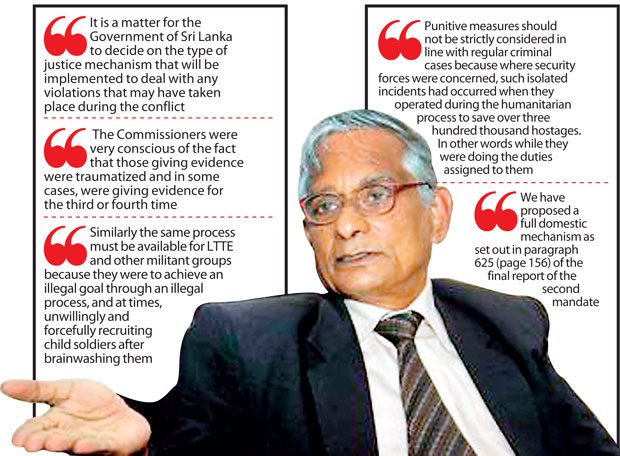
The scope of the Commission’s mandate was expanded by Gazette notification on July 15, 2014 to address the facts and circumstances surrounding civilian loss of life and the question of the responsibility of any individual, group or institution for violations of international law during the conflict that ended in May 2009. The expanded mandate will hereinafter be referred to as the Second Mandate. According to the terms of the Second Mandate, this Commission is tasked with inquiring into and reporting on the following matters that have been referred to in the report of the Lessons Learnt and Reconciliation Commission (LLRC).
In view of the heavy workload of the Paranagama Commission, and at its request for assistance in addressing the complex questions of international law raised by the Second Mandate, former President Rajapaksa appointed a legal Advisory Council to this Commission comprised of international legal experts.
President Maithripala Sirisena was elected as the new Sri Lankan President on January 8, 2015 and on February 5, 2015, the time frame for the First and Second Mandates of the Paranagama Commission was extended to July 15, 2016.
Q: Are you satisfied that the 5-member Commission chaired by you has accomplished the assignment to the satisfaction of you and the government?
The issue as to whether the Government is satisfied or not, is not a matterfor me to decide upon. As the Chairman and Member of the Committee, it was my duty to ensure that the assignment undertaken was conducted fairly and impartially. I am confident that the Commissioners and the staff that I worked with fulfilled this obligation.
Q: What was the response from the families of missing persons to the Commission’s inquiries?
It is a matter of profound sadness to me that a Civil Society Organization was critical of the Commission’s process and from day one sought to undermine the work of the Commission. The first criticism we heard was that the Tamil translation was inadequate. We did what we could to rectify this and it should not be forgotten that the majority of sittings took place in the North and the East of the country where many of our staff were Tamil-speaking. Inadequate Court/Tribunal translation is not a problem that was confined to our Commission but it can occur in any Court proceedings in Sri Lanka. As a retired High Court Judge, I am well aware of this.
A further criticism was that those who came forward to give evidence received undue attention from members of the security/intelligence Services. I must say had any specific incident relating to this allegation been brought to my attention, I would have taken immediate action against the perpetrators. Such incidents could of course happen even today in any criminal process. But I do feel there was a deliberate attempt to insinuate that the Commission was in some way complicit in such practices. Nothing could be further from the truth and I believe despite campaigns in the North by certain NGOs we found more and more Tamil civilian witnesses coming forward to give evidence.
The numbers reached to about 20,000 minus duplicates of around 4,800 by July 15, 2016, and I wish to vindicate my genuine beliefs that we did our utmost to take evidence impartially and sympathetically. The Commissioners were very conscious of the fact that those giving evidence were traumatized and in some cases, were giving evidence for the third or fourth time. It was as difficult for these individuals as it was for us.
Q: Are there any contributions by the Commission to clear Sri Lanka’s name from allegations of human rights violations during the final phase of the Humanitarian Operation?
It was no part of the Mandate to clear Sri Lanka’s name from allegations of human rights violations. It should be underlined that this Commission comprised of a number of High Court Judges and senior retired Civil Servants of all communities. To my knowledge, there has never been any personal attack on any individual Commissioners, and no doubt they were chosen on the basis of their flawless reputation and the impeccable character. It is my hope that the two Reports that we had delivered would contribute to both a deeper understanding of the very complex and difficult law that applied in the final stages of the armed conflict as well as give an overall picture of recommendations that could be made on the conflict as a whole. Although we delivered the very detailed Second Mandate Report on time in August 2015, due to understandable circumstances our First Mandate Report which encompassed a greater time frame could not be completed. Having said that we were able to provide detailed recommendations in both First and Second Mandate Reports which we hope the current Government will utilize and pass on to the incoming Office of Missing Persons (OMP).
Indeed, given that some witnesses have provided testimony on multiple occasions, we hope that the ability to provide Certificates of Absence would be a method of curtailing the necessity for the repetition of some evidence. Given that we have taken statements from 6,400 complainants that if the OMP can utilize this product efficiently, it could save huge costs and time.
Statements from 6,400 complainants have been recorded from 8 districts of North and East at 19 public sittings.
Q:The international community and the UNHRC insist that Sri Lanka initiates a credible domestic inquiry into alleged violations of the International Humanitarian Law (IHL) which reportedly took place in the final phase of the war. How could your inquiries throw some light on this so-called credible domestic inquiry?
It is a matter for the Government of Sri Lanka, not this Commission, to decide on the type of justice mechanism that would be implemented to deal with any violations that may have taken place during the conflict. However, the Commission, as I have already stated, conducted an extensive review of the legal framework that we believe was applicable to events during the period of the war. This can be found in Chapter 6 on page 62 to 98 of the second Mandate Report. In addition, we conducted an extensive examination of accountability mechanisms in other jurisdictions in Chapter 8 in the Second Mandate Report. It was our recommendation that a Special Crimes Division should be created within the Sri Lankan Court system and at paragraph 625 (page 156), the Commission’s recommendation was that a wholly domestic special Court with a parallel Truth and Reconciliation Commission might be an appropriate transitional justice solution. However, we did say that in the event of a purely domestic tribunal that it was the Commission’s view that there may be international technical assistance and observers.
Q: Former President Mahinda Rajapaksa appointed a group of eminent persons including an internationally-reputed expert on IHL, Sir Desmond de Silva QC. Have they been of any help for the Commission’s business?
Undoubtedly, the group of eminent persons was of great assistance to the Commission’s business. The Commission relied upon the legal expertise of the members of the Advisory Council, who had an unrivalled experience of international law practice before the ad hoc international tribunals created or sponsored by the United Nations. Indeed, this Commission expressly requested the assistance of international experts and is there been no shame in recognizing the fact that there may be lack of experience in the Sri Lankan jurisdiction of international humanitarian law practice? Amongst the experts we had international Prosecutors who had tried and investigated such cases, making judgments and decisions at the very highest level. Similarly, the military and military law experts we had were of world renown. Amongst them, was the former Commanding Officer of the UK’s Special Air Service, the most elite regiment in the British Army. This is not to say that we agreed on every point, but it is my belief as Chairman, that we benefited enormously from the experience of these individuals, although ultimately the Report was the product of the Commission’s deliberation.
Q: The Commission has reportedly received over 20,000 complaints. There is no doubt that conducting inquiries on all those complaints is a daunting task as it requires a huge volume of time, financial, material and human resources. How did you cope?
The Commission commenced its sittings in January 2014 and indeed, as you state, we received over 20,000 complaints. We were of course, funded by the Government of Sri Lanka and over time, I would like to think that we improved the evidence giving process for victims. As I have already stated, I accept that there were teething problems when sittings first commenced, but I do think that as time went on, the processes were improved as the translations improved and most importantly, victim confidence increased. I was only able to cope by the huge efforts of my dedicated staff and my fellow Commissioners, to whom I am eternally grateful.
Q: Have you proposed any punitive measures against those with prima facie cases which you may have come across during the inquiries?
We have proposed a full domestic mechanism as set out in paragraph 625 (page 156) of the final report of the second mandate. According to this process we have recommended that if any person charged with any crime denies so committing it, a criminal High Court should be available presided by our local judges for him to go through the legal process. The prosecution should be conducted by our Attorney General and investigations should be conducted by local expert investigators, at the same time if a person charged with a crime who wants to admit committing the crime stating under which circumstances the crime was committed, a truth and reconciliation committee must be established for him to obtain amnesty.
The amnesty may be an accountable amnesty, in other words an amnesty coupled with conditions such as withholding salary increments, promotions etc. This process must be available for LTTE and other militant groups involved in the conflict.
Punitive measures should not be strictly considered in line with regular criminal in cases because where security forces were concerned, such isolated incidents had occurred when they operated during the humanitarian process to save over 300,000 hostages. In other words, while they were doing the duties assigned to them.
Similarly the same process must be available for LTTE and other militant groups because they were to achieve an illegal goal through an illegal process, and at times, unwillingly and forcefully recruiting child soldiers after brainwashing them.
Q: What relief have you proposed in your final report to immediate family members of victims?
We have made recommendations in the interim reports of the first mandate and the final report in the second mandate that relief should be granted to the immediate family members of the victims. Briefly, counselling, granting adequate compensation for loss to family ranging up to Rs. 500,000 assistance to livelihood, assisting to dispose their products in agricultural activity, housing, release of agricultural land, providing information with regard to missing people, providing opportunities for interaction with all communities to release suspicion and insecurity, promote Sri Lankan identity among all communities, release of inmates from prisons with the advice of the Attorney General.
I believe grant of such relief may relieve the suffering of those families who are missing their loved ones. In dealing with offenders through the proposed domestic process as set out in the report may also be the base for reconciliation.
Q: You had no choice but to wind up all your activities after the passing of the Office of Missing Persons (OMP) Bill in Parliament on August 11 this year. But you have a heavy backlog of untouched inquiries on complaints or statements recorded by your commission. What is the fate of these complaints and statements and don’t you think the family members of missing persons would end up with broken hearts and hopelessness?
It is a matter for the Government to decide as to how they wish to proceed with the issue of missing persons. The processes required to uncover the truth of what happened are far from simple, and some of these investigations date back to the 1980s. I believe the Commission and the Government were at fault in not managing the expectations as to what could be achieved. With the limited funding that was available as I have stated above, I hope we have built some victim confidence and contributed to changing some of the narratives of events of the conflict. It is my hope that the improvements to this process by way of a creation of a permanent OMP that can issue certificates of absence would go a long way in providing some respite to bereaved families.
Q:There are many talks about engaging foreign Judges for a ‘credible domestic inquiry’ on war crimes that allegedly took place during the final phase of the humanitarian operation. Do you think our Judges are not capable or independent enough for such an inquiry?
Few of our Judges have served in international tribunals or as Commissioners in Truth and Reconciliation Commissions. Some of them have been internationally recognized. Although there may be a dearth of experience in both the local judiciary and the local bar in the area of law that applies in the context of conflict here, I do believe that our Judges are both capable and sufficiently independent to conduct such investigations and can perform their tasks successfully. Providing training from international experts could be considered useful.
I see there is no problem in having international experts for technical assistance and in advisory capacities to ensure local Judges and lawyers could conduct trials successfully. For transparency, foreign observers may be accommodated.
Q: Is it possible to use your inquiries and findings as a part of any future domestic inquiry proposed by the joint US-Sri Lanka resolution and passed on September 24, 2015 at the UNHRC sessions in Geneva?
Of course yes!
– See more at: http://www.dailymirror.lk/116944/Punitive-measures-not-to-be-strictly-considered-Maxwel-Paranagama#sthash.kpfB4KFu.dpuf
Co Vice President of the Sri Lanka Freedom Party (SLFP) Member of Parliament, Dullas Alahapperuma, accused the SLFPers in the government who are supporters of former President Chandrika Kumaratunga (CBK) of discriminating against the SLFPers in the Opposition. The SLFP group with the government is fragmented into two sub factions; CBK loyalists and President Sirisena loyalists, he explained.
Excerpts of the interview:
?. You have lived in the US. Whom do you support, Trump or Clinton? Who will be more beneficial to Sri Lanka; the JO has often claimed that the US is actively involved in internal matters of our country?
A. I have lived in the US as an international student attending the University of Iowa in the State of Iowa, so my American experience is limited to a student life. Whom will you support, would be a question relevant to an American citizen who has the ability to support one of them by casting his or her choice and to a special interest groups interested in funding either campaign. So that question does neither relate nor apply to me personally. And to think that American political culture is quite similar to the Sri Lankan political culture is laughable, especially when our policies constantly change not just with different governments, but also with every new minister who is in charge of a respective ministry. In the United States, the American system is bigger than any government headed by an elected President and it is practically impossible to deviate from the practised and proven existing American system that works, no matter how ideological that President may be. It may not be perfect but it works in the best interest of its citizens. You can take current President, Barack Obama, as the perfect example to justify what I just said.
He rode to power solely on the promise of delivering radical progressive changes, not to mention making ‘CHANGE’ as his campaign slogan. Eight years and nearly two presidential terms later, the country’s racial tensions are at an all-time high since the 1960’s civil rights movement. And at present, more African American citizens are becoming victims of excessive force used by law enforcement, averaging multiple fatalities than ever, in recent history. The irony is all this civil unrest related to African Americans is happening while the first African American President of the country’s history is in the White House. A sarcastic individual might say “yeah he brought change alright; a change for the worse, but a change nonetheless”.
I personally don’t believe any of them would make a case for substantial benefit for Sri Lanka, because both of them, if either of them is elected, would be more interested in continuing the existing foreign policy towards our country unless they find any American interest resting on our island. But in former Secretary of State, Hillary Clinton’s case, she was interested in Sri Lanka during her tenure as the leading diplomat of the US and recent documents disclosed by WikiLeaks stated her comments towards the end of the previous government’s battle against LTTE terrorism. While Donald Trump may be unpredictable, you can bet Hillary Clinton would have a personal interest in interfering in our country’s internal matters. And by the experience, so far we have had with the State Department, which she was an integral part of, we can expect the same or more American interference if she gets elected as President.
?. Foreign Minister Mangala Samaraweera reacted to a comment made by you with reference to the final speech delivered by the UN Secretary General Ban Ki-moon, at the UN Summit. Samaraweera responded to these claims whilst in New York. Perhaps, in doing so he defended Ban Ki-moon and raised a question about your comprehension of English; your thoughts on this?
A. A Secretary General Ban Ki-moon clearly said, “Genuine reconciliation would deepen on guarantying that all communities, both minorities and majorities alike, were included in building a new union.” When rebutting my comments on that statement Mangala Samaraweera tactfully quoted the statement partially by ending it with “Genuine reconciliation would deepen”. He wilfully refrained from completely quoting the statement by the Secretary General, because he very well knew that any Sri Lankan who cares for his motherland could read between the lines and get a clear idea of UN intentions delivered through Secretary General Ban Ki-moon.
I may lack the eloquent linguistic skills of Mangala Samaraweera, but I don’t have to be Norm Chomsky to identify the distinction between ‘Reunion’ and ‘New Union’.
Maybe his excessive knowledge of English must have led him to keep quiet, when the UN Secretary General compared Sri Lanka to Rwanda and Bosnia during his recent visit to our homeland.
?. Northern Province Chief Minister C.V. Wigneswaran made a statement criticizing the resettlement of Sinhalese and Muslims in the North. What is your opinion on this?
A. A person who is opposing a resettlement of any ethnic group in any part of the island is not standing on any moral grounds that a civilized society governed by democracy upholds. These are the Sinhalese and Muslims who were chased away by the LTTE and to oppose their right to return to their homeland could be similar to opposing Jews for returning to their homeland in Israel after the World War 11, which is inhumane.
?. ITAK is a constituent party of TNA which is heading the Opposition in Parliament. How will the JO counteract this debacle caused by Wigneswaran in the interest of all ethnicities in Sri Lanka?
A. While Chief Minister Wigneswaran is trying to plant seeds of separatism; we should commend other parties of the TNA lead by Sampanthan who doesn’t support this extremist notion. Joint Opposition believes in upholding every Sri Lankan citizen’s right to life, liberty and pursuit of happiness in any part of this island they desire, despite their ethnic differences. That is why the Joint Opposition mainly consisting of majority Sinhalese, always points out the need for the majority to win the minorities, rather than a single government or a specific party trying to do it for their benefit. Governments will change and party’s may win or lose, but ethnic harmony should stay intact, if we are to move forward as a unified nation.
?. Is it unethical for the Sri Lankan media to report on the above incident on grounds of incitement?
A. Of course it is, if they did that on the grounds you mentioned. But I don’t believe it was the case. This story was given the same treatment as their coverage of recent protests against SAITM and Medical officers’ demands for better schools for their children. I personally didn’t see any difference in any media coverage I witnessed regarding the controversial remarks by Chief Minister Wigneswaran. Only thing I noticed was the government going out of its way to conceal this news becoming public.
?. Recently a National Media Centre was established, headed by a former minister, Imtiaz Bakeer Markar. Tapping into your experience in matters pertaining to media, how do you view this move by the government to regulate information?
A. “I don’t trust Greeks, even when they bring presents” is a famous phrase derived out of Homer’s epic Iliad. Because the Trojan horse which entered the impenetrable gates of Troy, veiled as a blessing, ended up bringing the downfall of Troy. Imtiaz Bakeer Markar is a good friend of mine who also happens to be a distinguished student of my Alma Mater. I have no reservations about his straightforwardness or bona fides. He is known to be straight as an arrow. But this government led by the UNP has a history of meticulously controlling the media under the false pretence of regulating it. Bakeer Markar himself didn’t shy away from expressing his grievances about being unable to conduct his duties at his discretion, while he was a minister handling the Media portfolio, due to party influence. So you cannot blame me if I am suspicious about this National Media Centre initiated by a party with such a pedigree. I have no doubts about the credibility of the person who is in charge. But I have many doubts over how much control he will have under the influence of the UNP led government.
?. MP Gammanpila stated that you were not reappointed to the subcommittee pertaining to Constitutional Reform. Have you spoken to the Prime Minister about this?
A. MP Gammanpila and I came to a mutual agreement to switch our positions on two different committees. While they appointed MP Gammanpila to replace the position vacated by me in one committee, they conveniently neglected to appoint me to the position vacated by MP Gammanpila. I have spoken to Dinesh Gunawardena and the seniors of the JO. Following their advice, I have brought my case to the Deputy Speaker. This situation is a clear violation of my fundamental rights as a Parliamentarian and I expect to speak to the Prime Minister soon regarding this matter.
?. There are rumours that certain SLFP seniors who are with the government are discriminating the SLFPers who are with the JO. How true are these rumours?
A. At present SLFP is clearly divided into two groups. One group is representing the Opposition in Parliament while one group is representing the government. The SLFP group representing the government is also divided into two sub groups, one of which can be called the ‘CBK’ section. Followers of the ‘CBK’ inside the government are responsible for carrying out the discrimination against other SLFPers representing the Joint Opposition in Parliament.
?. There was an issue which took place on the Paada Yathra, where certain vehicles were seized by the government in the guise of misuse of public property. There were allegations that the Police violated the fundamental rights of certain people who attended another memorial event which coincided with the Paada Yathra. What really happened there?
A. It was the memorial day of one of SLFP’s most beloved General Secretary’s, Late Dharmasiri Senanayake. When participating in the Paada Yathra procession, by coincidence we met union leaders of the Ministry of Aviation, who were about to pay tribute in memory of our past general secretary. I myself as a vice President of the party merely accepted their invitation to place a garland on the statue of Dharmasiri Senanayake, in his honour. For the first time in over a century of the Police service in our country, we have an Inspector General who publicly announced and endorsed to bend the law to the maximum without breaking it, to carry out the government’s personal vendetta. I believe the ever unpopular local Police Department dug itself into a new low, when the IGP shamelessly expressed it. I couldn’t believe when those party supporters were arrested and remanded for basically honouring one of the stalwarts of the SLFP, while the party Chairman who constantly promises and pledges for the betterment of the party, is Head of State.
?. Slain journalist Lasantha Wickrematunge‘s body has been exhumed for further investigations. Many media institutions including certain politicians have been blaming the Rajapaksa Government. How do you view this controversy?
A. If you closely look at the Hansards, following the assassination of Lasantha Wickrematunge, you could easily find accusations made by the current Prime Minister, who at that time was the Leader of the Opposition. Baseless accusations were an integral part of the media bubble created by special interest media groups during the Rajapaksa administration and even long after it ended. Trying to fix an election on the eve of the election results, trying to declare martial law to stay in power or an enormous wealth that exceeds even Bill Gates’ which he inherited at the expense of the citizens, according to some opposed politicians were few amongst the endless barrage of accusations credited to President Rajapaksa. Inability to prove any of them has so far challenged the ever growing allegations and despite certain parties’ interest to continue with them, I believe eventually the public would be wary of them and soon come to terms with the truth.
Copyright © 2026 LankaWeb.com. All Rights Reserved. Powered by Wordpress