Will ETCA negotiations checkmate the opponents?

July 13th, 2016

By Dr. K.M. Wasantha Bandara Courtesy The Island

According to a news item published in The Island on 8th July, the government seems to have plotted the road map to finalize Economic and Technological Cooperation Agreement (ETCA), by 30th October this year. That was based on the consensus reached between the ministers of both countries in India. Just before that, the government of Sri Lanka appointed a high powered committee of 12 experts to justify ECTA in the context of threatened economic opportunities in Europe following Brexit. At the same time a consultative Committee was also appointed by the government to accommodate representatives of members of United Professional Movement who agitated for participatory approach towards formulation of National Trade Policy. But later it was revealed that the so called consultative committee is meant for “putting the house in order” parallel to the negotiation process and the policy framework to be formulated by another group of experts. However the Government Medical officers Association (GMOA) insists that they have proposed a National Commission to be setup to formulate the National Trade Policy and not just a committee of experts. Now the question that is raised in the minds of people with common sense is whether the government is genuinely trying to compromise with vast majority of professionals in the country or as usual, to change the game plan and hoodwink the masses. To find the answer we have to reflect back on the critical aspects of the negotiation process that took place so far since the new government came to power.

Initially the present government intended to start the process of negotiations for Comprehensive Economic Partnership Agreement (CEPA) from where the previous government gave up, owing to the protests by the local industrialists. At that point the Commerce Department of Sri Lanka, in collaboration with Indian counterpart and various other local and overseas advisors had prepared a detailed agreement consisting of 72 A4 pages, labeled as CEPA. As soon as the government declared its intentions, a cross section of professionals, academics and industrialists in the country started agitating against the move which prompted the government to change the game plan. Accordingly the name of the game was changed from CEPA to ETCA. It was obvious that the government was pretending to be responsive to the public outcry and trying to negotiate for a new agreement favorable to Sri Lanka. However the 72 page CEPA document was reduced to 12 pages and labeled as ETCA in which the details were omitted, the main clauses and the headings covering the trade on services were specifically retained.As such the deliberate attempt of the government was very well revealed and it was clear that they were not ready to re negotiate the core issue which is trade in services.

In response to the changes made by the government the opponents insisted that there is no difference as far as the effect is concerned between CEPA and ETCA. They further demanded the provision for trade in services, more specifically the fourth mode or the movement of natural persons to be excluded from the agreement. At that point a certain minister pretended to agree to that and another minister tried to compromise with the promise that movement of natural persons be limited to the fields of information technology and shipping related services. However the minister who is responsible for the international trade came out with another promise that the government would sign only a “Framework Agreement” to facilitate the final agreement at a future date. By which he implied that the government is genuinely trying to continue with the bargaining process until a favorable consensus is reached with India. He also very tactfully agreed with professional groups to initiate a process with the participation of opponents to formulate a trade policy, based on which the final agreement issaid to be re-negotiated.

However when the intellectual dialogue on the ETCFA (Framework Agreement) began to go in depth, it was revealed that the so called “framework” is more of a commitment than the CEPA. It was very well understood that the so called framework agreement is “The agreement” and once it is signed by political leaders, the other schedules and attachments shall be signed or endorsed by the officials.Extremely vague, unrestricted and open ended clauses were included in the framework agreement, making room for anything to be added after the agreement is signed. For example, chapter 4 (Article II) of ETCFA (Framework Agreement) states as “such an agreement shall include but not be limited to the following”. Not only that, ETCFA commits itself to reaffirm our obligations under the General Agreement on Trade-in Services (GATS) which is a multi lateral agreement facilitated by WTO. Under the sector specific and horizontal commitments of GATS, we have committed to open movement of natural persons subject to existing laws of Sri Lanka. As such we have agreed to allow any category of professional or manual workers without any restriction, whereas under the same clause, India has given detailed list of restrictions.

When this danger of having vague and open ended commitments in a form of a framework was highlighted, the government insisted that it has not yet committed itself and there is ample room to discuss further. It was also an indirect assurance that the government is ready to postpone the signing of framework agreement. As expected by some of those who participated in the discussions with the ministry the government was trying to justify the need to enter into a consensus or understanding over a “broad scope of framework” to facilitate a framework agreement on a future date once the negotiations are successful. Although the government pretended that it has engaged in a bargaining process with India it was obvious that the real bargaining took place with those opposed to the agreement and the concepts of so called “framework” and “broad scope” were just tools.

Now there is no doubt that the government is trying to sign a Memorandum of Understanding (MOU) or a joint statement based on the so called “broad scope”, while the negotiations and the bargaining process is carried forward. That MOU or the joint statement will definitely be a binding commitment from the part of Sri Lanka and be a part and parcel of the so called “framework” or final agreement. That is the type of game India played when Indo Lanka peace accord was forced on Sri Lanka.In the broad scope or the list of chapters to be included in the future agreement to be reached at a latter stage, only the 4th chapter is very specific and the rest is more or less conceptual. The chapter 4 deals with trade in services where it is specifically stated that the commitments by Sri Lanka shall be consistent with GATS article V, which is a much bigger commitment than what was committed in CEPA document. So now the intention of the government is very clear. The government in collaboration with India, is buying time until the opponents are dealt with and at the same time gives a firm assurance to India that it is committed to what India is demanding for the last 13 years. According to the said new item in The Island, High Comissioner of India Mr. Asala Weerakoon has said that both parties are looking at a broader scope to be agreed upon. It is obvious that India is worried only about trade in services, more specifically the 4th mode or the movement of natural persons. That is why only the 4th chapter or the clause on trade in service in the proposed broad scope is specific and the rest is more conceptual.

India has waited and been bargaining for 13 years to open the immigration gates for Indians to enter into Sri Lanka in mass scale on unrestricted work permits, instead of illegally engaging in “odd jobs” on tourist visa in limited numbers. That is why India is ready to spend up to 5 billion USD to build “Adams Bridge” to connect India by road and rail to Sri Lanka. Yet India has other well-known geopolitical interest that could be jeopardized if it fails in CEPA or ETCA. The Indian intelligence agency (RAW) knows very well the intensity of unprecedented opposition by professional groups against liberalizing trade-in services and that it cannot be curbed easily by the government. That seems to be the obvious reason as to why India is ready to support Sri Lanka in its hoodwinking game, which guarantees a binding commitment until the public outcry is dealt with and the framework agreement is signed as planned.

As such now those who have opted genuinely to enter into a partnership with the government in the negotiation process should recognize the trap that had been set for them. They should question the government as to why it has committed to reaffirm its commitments on trade-in services under GATS, instead of having more conceptual clauses like in other chapters in the so called broad scope. There is no doubt signing of a MOU or joint statement based on the “broad scope” that is offered will have a same binding effect as if framework agreement is signed. It is also very unlikely that government would appoint a commission to formulate National Trade Policy and entertain public comments for a long period. They will try their best to have a committee with a powerful member who would formulate a policy by “reverse order” to justify the conditions that are already agreed upon.

President Sirisena  snarls  at Sunday Divaina

July 12th, 2016

Ranjith Soysa

After reading the headline of Sunday Divaina of 10th July, the President Sirisena blasted the news paper for carrying the news item that War Crimes Investigation will commence in 9 months time and it will be with foreign judges.

The report outlined the relevant details and it was written by veteran defence columnist Keerthi Waranakulsuriya,It proceeded to discuss the key role played by

9 USA based retired judges who were hired by the TGTE to lobby UNHCR in Geneva and its head the Prince Seyd.Further, the report discussed that this decision will be followed up at the UNHRC ‘s session in March 2017 and the setting up of the hybrid courts will commence in February 2017. By September 2016 the the Truth Commission on the lines of South Africa’s Truth Commission will be formed.

It is indeed hypocritical for the President to have reprimanded the news paper for accurate reporting of Sri Lanka’s pathetic situation arising from the Government’s suicidal act of co-sponsoring the war crimes resolution against the country.

The Foreign Minister too had blasted this Defence columnist recently for having

exposed the minister in the company of top LTTE-Eelamists sympathizer lobbyists by publishing a number of photographs.

What Times! The fate of freedom of expression !!!

Ranjith Soysa

Will not allow foreign judges or courts to interfere: President දිවයින හෙලිදරවුවෙන් ජනපති කිපේ.. මහ සභාවක පත්තරේද පෙන්වා දෙහි කපයි.. [Video]

President Maithripala Sirisena today vowed that he would not allow any foreign court, judge or organization to interfere with the internal administration and judiciary in the country. Though various views are being expressed in various places regarding the bringing of foreign judges and establishing of foreign military courts to take action against the so called human rights violations during the period of war, I will not allow any national or international activity which challenges the freedom, independence and territorial integrity of the country” he said. The President was speaking at the 70th National Upasampada Vinayakarma (Higher Ordination) ceremony of the… -Full Story- (LankaWeb – 11/07/16)

SRI LANKA: Police harass entire family for complaining to DIG

July 12th, 2016

ASIAN HUMAN RIGHTS COMMISSION – URGENT APPEALS PROGRAMME Urgent Appeal Case: AHRC-UAC-083-2016

ISSUES: illegal arrest; detention; impunity; rule of law; justice
——————————————————

Dear friends,

The Asian Human Rights Commission (AHRC) has received information that Mrs. Maladeniyegedara Padma Irangani and her two sisters were all illegally arrested by the Katugastota police officers, in revenge for Padma complaining and seeking justice from the Deputy Inspector General of Kandy. After Padma complained about her husband’s illegal arrest, Padma and her two sisters were also arrested. This case illustrates the breakdown of the policing institution and the rule of law in Sri Lanka.

CASE NARRATIVE:

The Asian Human Rights Commission (AHRC) has received information that Mrs. Maladeniyegedara Padma Irangani (50) of No.104/1/B, Gohagoda Road, Katugastota in Kandy District was unlawfully arrested by police officers attached to the Katugastota Police Station.

Padma is married to Mr. B A Thilakaratne and they have a son aged five years. Padma works as a traffic warden at KCC, and her husband is a small businessman.

On March 23, there had been a dispute between Padma’s two brothers Laxman and Indika Gunawardena and their neighbours. Padma’s brothers were injured during the dispute, and were later admitted for medical treatment at the Kandy Teaching Hospital, Ward No. 17.

Neither Padma nor her husband were involved in the fight, and nor were they present at that time. However, on March 27, Padma’s husband was arrested at his residence at 104/1/B, Gohagoda Road by the Katugastota police officers, and brought to the Katugastota Police Station.

After Thilakaratne was arrested without any legal basis, Padma went to the office of the Deputy Inspector General of Police (DIG) at Kandy and made a complaint. She requested an impartial investigation into the incident and demanded justice for husband.

Thilakaratne was then produced before the Magistrate of Kandy on March 28 and released on bail with immediate effect. However, neither Thilakaratne nor Padma were aware about the charges filed against him by the police.

On April 7, Padma was summoned by the Officer-in-Charge (OIC) of the Katugastota Police Station. When she entered the station, the officer on duty informed her to go to the office of the OIC (Miscellaneous Branch). When she approached the OIC of the Miscellaneous Branch and respectfully questioned the reason for her call, the OIC questioned her on her complaint to the DIG. Padma explained the illegality of her husband’s arrest, and stated that it is her right to make a complaint to higher ranking officers and seek justice on behalf of her innocent husband. Padma observed that the officer was angry that she had made a complaint to a senior officer, and she feared that he was trying to take revenge.

Then the officer told that she would also be arrested and produced in court. Padma vehemently opposed such an attempt and repeatedly explained to the officer her innocence other than making a complaint to the DIG. Due to her explanations she was not arrested.

Then immediately she went to the DIG’s Office and made a complaint to the DIG regarding the attempt of the Katugastota police officers. In front of her, the DIG then called the Katugastota Police and warned them not to violate the rights of the victim.

After she left the DIG’s Office, she again received a message from the Katugastota Police Station summoning her at 2 p.m. of the same day. She was told that her statement was to be recorded.
Padma duly reported to the station, where she was kept waiting for several hours, before being told to come again the next day. Then Padma understood that she was being harassed for appealing to the DIG. Padma was further requested to come along with her two sisters and brothers.

When Padma went to the Katugastota Police Station on April 8, she was arrested along with her two sisters. At the time of arrest, they were not given any reason for their arrest. Then the officers produced them before the Magistrate of Kandy. She later learned the case which they were produced before the court was B/3282/16, but she still does not know the charges against her and her sisters. Then the Magistrate released all three on bail and postponed the case until 3 October 2016.

According to Padma, when her two brothers had their dispute with the neighbors, neither her nor her sisters were present. Her husband was also not there. None of them had anything to do with it, or had any other dispute. She claims that the police were biased and acted on the influence of the other party of the dispute.

Padma states that the fundamental rights of her, her husband Thilakaratne and her family members were violated by the police officers of Katugastota Police Station, and she demands justice.

SUGGESTED ACTION:

Please write to the authorities listed below expressing your concern about this case and requesting an immediate investigation into the allegations of illegal arrest, detention and filing fabricated charges by the police officers, and the prosecution of those proven to be responsible under the criminal law of the country. The officers involved must also be subjected to internal investigations for the breach of the orders of the department issued by the Police Department.

To support this case, please click here:

SAMPLE LETTER:

Dear ________,

SRI LANKA: Police harass entire family for complaining to DIG

Name of Victim: Mrs. Maladeniyegedara Padma Irangani (50) of No:104/1/B, Gohagoda Road, Katugastota in Kandy District
Alleged perpetrators: Officers attached to the Katugastota Police Station
Date of incident: 8 April 2016
Place of incident: Katugastota Police Division

According to the information I have received Mrs. Maladeniyegedara Padma Irangani (50) of No.104/1/B, Gohagoda Road, Katugastota in Kandy District was unlawfully arrested by police officers attached to the Katugastota Police Station.

Padma is married to Mr. B A Thilakaratne and they have a son aged five years. Padma works as a traffic warden at KCC, and her husband is a small businessman.

On March 23, there had been a dispute between Padma’s two brothers Laxman and Indika Gunawardena and their neighbours. Padma’s brothers were injured during the dispute, and were later admitted for medical treatment at the Kandy Teaching Hospital, Ward No. 17.

Neither Padma nor her husband were involved in the fight, and nor were they present at that time. However, on March 27, Padma’s husband was arrested at his residence at 104/1/B, Gohagoda Road by the Katugastota police officers, and brought to the Katugastota Police Station.

After Thilakaratne was arrested without any legal basis, Padma went to the office of the Deputy Inspector General of Police (DIG) at Kandy and made a complaint. She requested an impartial investigation into the incident and demanded justice for husband.

Thilakaratne was then produced before the Magistrate of Kandy on March 28 and released on bail with immediate effect. However, neither Thilakaratne nor Padma were aware about the charges filed against him by the police.

On April 7, Padma was summoned by the Officer-in-Charge (OIC) of the Katugastota Police Station. When she entered the station, the officer on duty informed her to go to the office of the OIC (Miscellaneous Branch). When she approached the OIC of the Miscellaneous Branch and respectfully questioned the reason for her call, the OIC questioned her on her complaint to the DIG. Padma explained the illegality of her husband’s arrest, and stated that it is her right to make a complaint to higher ranking officers and seek justice on behalf of her innocent husband. Padma observed that the officer was angry that she had made a complaint to a senior officer, and she feared that he was trying to take revenge.

Then the officer told that she would also be arrested and produced in court. Padma vehemently opposed such an attempt and repeatedly explained to the officer her innocence other than making a complaint to the DIG. Due to her explanations she was not arrested.

Then immediately she went to the DIG’s Office and made a complaint to the DIG regarding the attempt of the Katugastota police officers. In front of her, the DIG then called the Katugastota Police and warned them not to violate the rights of the victim.

After she left the DIG’s Office, she again received a message from the Katugastota Police Station summoning her at 2 p.m. of the same day. She was told that her statement was to be recorded.
Padma duly reported to the station, where she was kept waiting for several hours, before being told to come again the next day. Then Padma understood that she was being harassed for appealing to the DIG. Padma was further requested to come along with her two sisters and brothers.

When Padma went to the Katugastota Police Station on April 8, she was arrested along with her two sisters. At the time of arrest, they were not given any reason for their arrest. Then the officers produced them before the Magistrate of Kandy. She later learned the case which they were produced before the court was B/3282/16, but she still does not know the charges against her and her sisters. Then the Magistrate released all three on bail and postponed the case until 3 October 2016.

According to Padma, when her two brothers had their dispute with the neighbors, neither her nor her sisters were present. Her husband was also not there. None of them had anything to do with it, or had any other dispute. She claims that the police were biased and acted on the influence of the other party of the dispute.

Padma states that the fundamental rights of her, her husband Thilakaratne and her family members were violated by the police officers of Katugastota Police Station, and she demands justice.

I request the intervention of your good offices to ensure that the authorities listed below instigate an immediate investigation into the allegations of illegal arrest, detention and filing fabricated charges by the officers of the Katugastota Police Station. The officers involved must also be subjected to internal investigations for the breach of the orders of the Police Department.

Yours sincerely,

———————
PLEASE SEND YOUR LETTERS TO:

1. Mr. Pujith Jayasundara
Inspector General of Police
New Secretariat
Colombo 1
SRI LANKA
Fax: +94 11 2 440440 / 327877
E-mail: igp@police.lk

2. Mr. Jayantha Jayasooriya PC
Attorney General
Attorney General’s Department
Colombo 12
SRI LANKA
Fax: +94 11 2 436421
E-mail: ag@attorneygeneral.gov.lk

3. Secretary
National Police Commission
3rd Floor, Rotunda Towers
109 Galle Road
Colombo 03
SRI LANKA
Tel: +94 11 2 395310
Fax: +94 11 2 395867
E-mail: npcgen@sltnet.lk or polcom@sltnet.lk

4. Secretary
Human Rights Commission
No. 36, Kynsey Road
Colombo 8
SRI LANKA
Tel: +94 11 2 694 925 / 673 806
Fax: +94 11 2 694 924 / 696 470
E-mail: sechrc@sltnet.lk

Thank you.

Urgent Appeals Programme
Asian Human Rights Commission (ua@ahrc.asia)

VAT test for MS (Maithripala Sirisena)

July 12th, 2016

Editorial Courtesy The Island

President Maithripala Sirisena finds himself in an unenviable position. Having lost the backing of a sizeable section of the SLFP, he is now at the mercy of the UNP, which undermines his authority. He cannot assert himself and act according to the dictates of his conscience lest he should jeopardise the UNP-led government’s interests and run the risk of paving the way for a comeback of his arch rivals––the Rajapaksas. The VAT dilemma has worsened his predicament.

The VAT issue is likely to bring the President and the government on a collision course again. President Sirisena revealed in the run-up to the last parliamentary election that he had called for the removal of the then Central Bank Governor Arjuna Mahendran under a cloud over a bond scam. He came under pressure from many quarters to translate his words into action. He dithered on that issue for more than one year but had to act when the question of another term for Mahendran arose.

The Central Bank dispute almost ruined the political marriage of convenience between the UNP and the SLFP with President Sirisena and Prime Minister Ranil Wickremesinghe playing a game of chicken. But for the deus ex machina which came in the form of their agreement on a ‘compromise candidate’, the Central Bank drama would certainly have had a different ending.

The President made a public display of his abhorrence of the controversial VAT increase, a few moons ago. He did not mince his words when he condemned the tax hike, declaring as he did that the officials responsible for that would have to go home. But, nothing of the sort happened and he was left with egg on his face when the government went ahead with VAT and NBT hikes, much to the dismay of the hapless public and small-time traders who expected him to safeguard their interests.

Now that the Supreme Court has held that the tax revisions haven’t been effected properly, it will be interesting to see what President Sirisena will do. The apex court has given the government a choice between having the VAT and NBT increase suspended until the final determination of a petition filed by the Joint Opposition and obtaining parliamentary approval for the tax revision. An opportunity has presented itself for the President to make a meaningful intervention on behalf of the public and the traders staging street protests against the VAT and NBT hikes.

We are not short of government politicians who shed copious tears for the masses struggling to keep the wolf from the door. Some of them have sought to woo the resentful public by pretending to be averse to the VAT and NBT increases. They have so far been able to run with the hare and hunt with the hounds, but now they are in a quandary. They will have to back the tax amendment bill when it is put to the vote in Parliament or oppose it and incur the ire of the party leadership in the process.

The JVP is sure to make a great deal of political capital out of the tax increases by tapping public anger to shore up its crumbling image and gain political traction. The SLFP will be in a dilemma as its parliamentarians in the present Cabinet won’t be able to oppose the tax increases; nor can they toe the government line for fear of incurring the wrath of the public.

Will the President make good on his promise to ensure that the people are not further burdened with tax increases and order the SLFP MPs to vote against the tax revision bill. Will he make a U-turn and help the government secure the passage of the bill so that one main IMF condition for releasing the remaining tranches of its bail-out package will be satisfied? Or, will he allow the SLFP MPs to opt for a conscience vote so as to play it safe?

VAT තහනමෙන් පසු හැකිනම් කර බලන්න.. අත්දුටුවයි.. ප්‍රත්‍යක්‍ෂයි.. – විමල්ගෙන් ජනපතිට උපදෙසක්

July 12th, 2016

– අනුරුද්ධ බණ්ඩාර

තම සටන පාරිභෝගික ජනතාව මත නීතියට පටහැනිව ඇද හෙළන ලද අධික බදු බරෙන් ඔවුන් නිදහස්කර ගැනීමේ සටනක් පමණක් නොවූ බවත් එය පාර්ලිමේන්තුව සතු රාජ්‍ය මූල්‍ය පාලනය කිරිමේ බලය නොතකා හරිමින් වත්මන් ආණ්ඩුව යාමට සූදානම් වූ ගමනට එරෙහිව කළ සටනක් ද වූ බවත් ජාතික නිදහස් පෙරමුණේ නායක, පාර්ලිමේන්තු මන්ත්‍රී විමල් වීරවංශ මහතා පවසයි.

පිටකෝට්ටේ පිහිටි ජාතික නිදහස් පෙරමුණේ ප්‍රධාන කාර්යාලයේදී පැවැති මාධ්‍ය හමුවකදී ඒ මහතා මෙසේ පැවසීය.

එහිදී වැඩිදුරටත් අදහස් දැක්වූ විමල් වීරවංශ මහතා මෙසේ ද සඳහන් කළේය.

මේ වැට් බද්ද ගෙනාවේ 2002 දී එවකට පැවැති රනිල් වික්‍රමසිංහ මහතාගේ ආණ්ඩුවයි. එවකට මුදල් අමාත්‍යවරයා වූයේ නාරිමාන් චොක්සි මහතායි. එදා විපක්‍ෂයේ සිටි මංගල සමරවීර මහතා පාර්ලිමේන්තුවේදී එකී බද්ද හඳුන්වනු ලැබුවෙ ‘නරිමෑන්ගේ වැට් බද්ද’ ලෙස බව අපට මතකයි. එසේ එදා වැට් බද්ද මේ රටට හඳුන්වා දුන් පාලකයන් යළි බලයට පත් වෙලා තමන් හඳුන්වා දුන් වැට් බදු පනතට පටහැනිව ක්‍රියා කරනවා. නාරිමාන් චොක්සි මහතා එදා ඉදිරිපත්කර සම්මතකරගත් වැට් බදු පනතේ එම බද්ද අදාළ නොවන ක්‍ෂේත්‍ර පැහැදිලිව සඳහන්කර තිබුණා. ඒ වගේම එම පනතේ වැට් බද්ද අදාළ වන ක්‍ෂේත්‍රත් පැහැදිලිව ලැයිස්තුගත කොට තිබුණා. වැට් බදු අය කළ යුතු ප්‍රතිශත, පරාසයන්, සහ වැට් බදු අය කළ යුතු ක්‍ෂේත්‍ර වෙනස් වෙනවා නම් අදාළ පනත සංශෝධනය කළ යුතුව තිබුණා. විය යුතු පනත් සංශෝධනය සිදු නොකර, නීතියට පටහැනිව තමයි 2016 මැයි 02 වැනිදා සිට ඊයේ(11) ශ්‍රේෂ්ඨාධිකරණ අතුරු තහනම් නියෝගය ලැබෙන තෙක් මේ ආණ්ඩුව මේ රටේ ජනතාවගෙන් වැට් බදු අය කරනු ලැබුවේ. පෞද්ගලික සෞඛ්‍ය සේවා, අධ්‍යාපන සේවා, මසකට පිරිවැටුම ලක්‍ෂ 10කට වැඩි සිල්ලර වෙළඳාම ආදී වශයෙන් සෑම සියලු ක්‍ෂේත්‍රයකටම මේ ආණ්ඩුව මැයි 02 වැනිදා සිට අමතර බදු බරක් පැටවූවා.

ආණ්ඩුව මේ සියල්ල නීතියට පටහැනිව සිදු කළ බවට මනෝහර ද සිල්වා, කණිෂ්ක විතාරණ හා කපිල ගමගේ යන අපගේ නීතිඥ මැතිතුමන්ලා ශ්‍රේෂ්ඨෘධිකරණයට මනා ලෙස කරුණු ඉදිරිපත් කරනු ලැබුවා. රේගු බදු ආදී ඇතැම් බදු වර්ග වෙනස් කිරීමට පනත් සංශෝධනයක් අවශ්‍ය වන්නේ නැහැ. ඊට අදාළව ගැසට් නිවේදනයක් නිකුත්කර එයට මාස 03ක් ඇතුළත පාර්ලිමේන්තුවේ අනුමැතිය ලබාගත්තාම ප්‍රමාණවත්. නමුත් වැට් බදු පනත සහ ජාතිය ගොඩනැගීමේ බද්දට අදාළ පනත සංශෝධනය නොකර එම බදු ප්‍රතිශත, පරාස, ක්‍ෂේත්‍ර වෙනස් කරන්න බැරි විදිහටයි එම පනත් 02 හදා තිබෙන්නේ. අපි ශ්‍රේෂ්ඨාධිකරණයට කිව්වේ ‘මේක වැරදියි. නීතියට පටහැනියි. මේක මහජන මුදල් මංකොල්ලකෑමක්. මේක වළක්වන්න’ කියලයි.

‘මේක නීතිය කණපිට හැර වූ යහපාලනයක්’

මේ ආණ්ඩුව ‘යහපාලනය’ කියන වචනය ඉස්සරහට දැම්මාට වැඩ පටන් ගත්තේම නීතිය කණපිට හරවලානේ, බලයට ආපු ගමන්ම අගවිනිසුරු මොහාන් පීරිස් මහතාව ‘කණෙන් අල්ලලා’ එළියට දැම්මා. ජනාධිපතිවරයා අගවිනිසුරුවරයාට ලිපියක් යැව්වා ‘ඔබගේ තනතුර බලශූන්‍ය වේ.’ කියලා. ඒත් කිසිවකුගේවත් තනතුරක් බලශූන්‍ය කරන්න ජනාධිපතිවරයාට නෛතික බලයක් නැහැ. 2015 ජනවාරි 09 වැනිදා රටේ අගමැතිවරයකු සිටියදී තවත් අයකු අගමැති ලෙස දිවුරුම් දුන්නා. මේ ක්‍රියා දෙකම නීතියට පටහැනියි. 2015 දී පාර්ලිමේන්තුව අනුමත කරනු ලැබූ ණය ප්‍රමාණයට වඩා වැඩි ණය ප්‍රමාණයක් මේ ආණ්ඩුව ලබාගත්තා. මේ බව කියන්නේ අපි නොවෙයි, විගණකාධිපති වාර්තාව. ඒකත් මේ රටේ නීතීය කැඩීමක්. මේ රටේ මූල්‍ය පාලන බලය තිබෙන්නේ පාර්ලිමේන්තුවට, ව්‍යවස්ථාදායකයට. එසේ මූල්‍ය පාලන බලය තිබෙන නිසා තමයි, ‘ලබාගන්නා ණය ප්‍රමාණය පාර්ලිමේන්තුව විසින් අනුමත කළ යුතුයි.’ කියලා තිබෙන්නේ. පාර්ලිමේන්තුව අනුමත කළ ණය ප්‍රමාණයට වඩා ණය ප්‍රමාණයක් ගන්නවා නම් ඒක පාර්ලිමේන්තුව සතු මූල්‍ය පාලන බලය නෙතකා හැරීමක්. ඒ වගේම ඉහත කී පනත් දෙක සංශෝධනය නොකර වැට් සහ ජාතිය ගොඩනැගීමේ බදු වැඩි කිරීමත් පාර්ලිමේන්තුව සතු මූල්‍ය පාලන බලය තුට්ටු දෙකට දමලා මේ ආණ්ඩුව සිදුකළ නීතියට පටහැනි ක්‍රියාවක්. ‘අපට බලය තිබෙනවා. අපට පාර්ලිමේන්තුවේ අනුමැතිය උවමනා නැහැ. අපි ඕනෑ බද්දක් වැඩි කරනවා’ කියලයි මේ අෘණ්ඩුව කටයුතු කළේ. අපි එම නීතියට පටහැනි ක්‍රියාවයි අභියෝගයට ලක්කළේ.

‘අපි සටන් කළේ කුමකටද?’

අපේ සටන මේ රටේ පාරිභෝගීක ජනතාව මත නීතීයට පටහැනිව ඇද හෙළන ලද අධික බදු බරෙන් ඔවුන් නිදහස්කර ගැනීම සඳහා වූ සටනක් පමණක් නොවෙයි, අපේ සටන, රටේ මූලික නීතිය වූ ආණ්ඩුක්‍රම ව්‍යවස්ථාවෙන් පාර්ලිමේන්තුවට ලබාදී ඇති රාජ්‍ය මූල්‍ය පාලනය කිරිමේ බලය නොතකා හරිමින් මේ ආණ්ඩුව යන්න හැදූ ගමනට එරෙහිව කළ සටනක් ද වූ බවත් මේ අවස්ථාවේ සඳහන් කළ යුතුයි.

ශ්‍රේෂ්ඨාධිකරණය විසින් ලබාදුන් අතුරු තහනම් නියෝගය මගින් මේ අණ්ඩුවට ඉතා බරපතල සංඥාවක් ලැබී තිබෙනවා. ‘නීතියට පටහැනිව ඔබලා යම් ගමනක් යන්න හදනවා නම් අපි ඒකට ඉඩ තබන්නේ නැහැ’ කියන සංඥාවයි ආණ්ඩුවට ශ්‍රේෂ්ඨාධිකරණය විසින් ලබාදී තිබෙන්නේ. ශ්‍රේෂ්ඨාධිකරණය පවසා තිබෙන්නේ, ‘මේ පනත් දෙක සංශෝධනයකර නිසි පරිදි පාර්ලිමේන්තුවේ සම්මතකර ගත්තොත් මේ අතුරු තහනම් නියෝගය ඉවත් වෙනවා, එහෙම නැත්තම් නඩුව අසා අවසන් තීන්දුව ලබා දෙන තෙක් එය ක්‍රියාත්මක වෙනවා’ කියලයි.

ඊයේ(11) තමයි අපේ මූලික අයිතිවාසිකම් පෙත්සමට අදාළ අතුරු තහනම් නියෝගය ලබා දීමට නියමිතව තිබුණේ. ඒ නිසාම පසුගිය සිකුරාදා(08) වැට් බදු සංශෝධන පනත් කෙටුම්පතක් පාර්ලිමේන්තුවට පළමුවර කියැවීම සඳහා ඉදිරිපත්කර තිබෙනවා. අතුරු තහනම් නියෝගය ලබා දුන්නාට පසුව අග්‍රාමාත්‍ය කාර්යාලය නිවේදනයක් නිකුත් කරමින් කියනවා, ‘මේ පනත් කෙටුම්පත ජූලි මාසයේ අගභාගය වන විට දෙවනවර කියැවීමේ විවාදයට ගත හැකියි’ කියලා. අපි අධිකරණයට නොගියානම් මේ සංශෝධන පනත් කෙටුම්පත කඩිමුඩියේ එන්නේ නැහැ. මේ ආණ්ඩුවට අධිකරණය හමුවට ගිහිල්ලා දෙන්න උත්තරයක් නැහැ. ඒ නිසා නඩු දිනයේදී නිතිපති දෙපාර්තමේන්තුවේ නිලධාරීන්ට අධිකරණය හමුවේ පවසන්න පුළුවන් ‘යමක්’ කරන්න ඕනේ. ඒකයි පනත් සංශෝධනයට අදාළ පනත් කෙටුම්පතක් කඩිමුඩියේ ගෙනාවේ.

‘ජනපතිට විමල්ගෙන් පුංචි උපදෙසක්’

අපි කියනවා, ‘දැන් පාර්ලිමේන්තුවට අවස්ථාව තිබෙනවා, මේ පනත් කෙටුම්පතේ තිබෙන බදු ප්‍රතිශතය, බදු බලපාන පරාසය වැඩි නම් ඒවා අඩු කරන්න. මේ රටේ මහජනතාවට දැරිය හැකි ආකාරයට වෙනත් සංශෝධන ගෙන එන්න. එහෙම නැත්තම් මේ සංශෝධන සියල්ල සම්පූර්ණයෙන්ම ප්‍රතික්ෂේප කරන්න’ කියලා. දැන් මේ වැඬේ පාර්ලිමේන්තුව අතේ තිබෙන්නේ. අපි හිතනවා, ‘දැන් මෛත්‍රිපාල සිරිසේන ජනාධිපතිතුමාට කියමින් හිටපු දේ ඉටු කරන්න අවස්ථාවක් ලැබී තිබෙනවා’ කියලා. ‘වැට් බද්දෙන් ජනතාව පීඩාවට පත් වෙලා. ඒකෙන් ජනතාව මුදවා ගන්න ඕනේ’ කියලා ජනාධිපතිවරයාට අවංක චේතනාවක් තිබෙනවා නම් එතුමාට දැන් ශ්‍රී ලංකා නිදහස් පක්‍ෂයේ තමන්ගේ ගෝලබාලයෝ ලවා ඒ දේ ඉටු කරවා ගන්න පුළුවන්. ‘අපි ඡන්දය දෙන්නේ ජනතාවගේ පැත්තෙන් අපි ගෙන එන සංශෝධන ඇතුළත් කළොත් පමණයි, කියන ස්ථාවරය රනිල් වික්‍රමසිංහ පාර්ශ්වයට ඉදිරිපත් කරන්න’ කියලා තමන්ගේ මන්ත්‍රී කණ්ඩායමට කියුවොත් මෛත්‍රිපාල සිරිසේන ජනාධිපතිවරයාට තමන්ගේ අදහස ඉටුකර ගන්න පුළුවන් වේවි. අපි මේ දෙන්නේ එතුමාට පුංචි උපදෙසක්. හැකිනම් මේක කරලා බලන්න.‘අත්දුටුවයි! ප්‍රත්‍යක්‍ෂයි! හොඳ ප්‍රතිඵල ලබා දේවි’ කියලා අපි විශ්වාස කරනවා.

‘ව්‍යාපාරිකයන් පිරිසකට අයුතු ලාබයක් ලබාදුන්නා’

මුදල් ඇමති, මුදල් අමාත්‍යාංශයේ ලේකම් හා දේශීය ආදායම් කොමසාරිස් ජනරාල්වරිය ‘මේ බදු පැනවීම් නීතියට පටහැනියි’ කියලා දන්නේ නැද්ද? ඇමතිවරයාගේ බලපෑම අනුව මුදල් අමාත්‍යාංශයේ ලේකම් සහ දේශීය ආදායම් කොමසාරිස් ජනරාල්වරිය කටයුතු කළාද? කොහොම වුණත් අවසානයේදී මේ අය ව්‍යාපාරිකයන් පිරිසකට අයුතු ලාබයක් ලබා ගැනීමට ඉඩ හදලා දීලා තිබෙනවා. ව්‍යාපාරිකයන් රැස්කර ගත් මේ බදු ආදායම් තවම දේශිය ආදායම් දෙපාර්තමේන්තුවට ගෙවලා නැහැ. මහා පරිමාණ ව්‍යාපාරිකයන් මසකට වතාවක් සහ සුළු පරිමාණ ව්‍යාපාරිකයන් කාර්තුවකට වතාවක් තමයි බදු වාර්තාව ලබා දෙන්නේ. එහෙම වාර්තා ලබා ගත්තාට පසුවයි, අදාළ අය කිරිම් සිදු වන්නේ. මැයි 02 වැනිදා සිට ඊයේ වන තෙක් කිසිම ව්‍යාපාරිකයකු තමන් අය කළ බදු ආදායම් දේශීය ආදායම් දෙපාර්ත්මේන්තුවට බැර කරලා නැහැ. මහජනයාගෙන් එකතු කළ මේ මුදල් දුරකථන සමාගම්වල, රෝහල්වල හා වෙනත් ව්‍යාපාරික ස්ථානවල තිබෙනවා. මහජනයාගෙන් මේ ආණ්ඩුව මේ විදියට කොල්ලකාපු මුදල් ටික අඩුම ගණනේ ආණ්ඩුව ළඟවත් නොවෙයි තිබෙන්නේ, ව්‍යාපාරිකයන් රොත්තක් අතේ. ඒ සල්ලි ටිකට මොකද වෙන්නේ? ඒ සල්ලි ටික දැන් ආණ්ඩුව ආපසු අයකර ගන්නේ කොහොමද? අපි දන්නවා, මැයි 02 වැනිදා සිට වැට් බදු සඳහා ලියාපදිංචි නොවූ ආයතන පවා බදු අය කළා. මේ මගින් අයුතු ලාබයක් උපයන්න ව්‍යාපාරික පැළැන්තියකට ඉඩකඩ හදලා දීලා තිබෙනවා. මේකට වග කියන්න ඕනේ කවුද? මුදල් ඇමතිවරයා නොවෙයිද? මුදල් අමාත්‍යාංශයේ ලේකම්වරයාද? දේශීය ආදායම් කොමසාරිස් ජනරාල්වරියද? මේ කවුරුන් හෝ මේකට වගකිව යුතුයි. නීතියට පිටින් මහ දවාලේ ජනතාවගේ සල්ලි මංකොල්ල කෑවා, නමුත් අද වගකිව යුතු කෙනෙක් නැහැ. මේ අය කියනවා, ‘අපි පනතක් ගෙනල්ලා මේක ෂේප්කර ගන්නම්’ කියලා. අග්‍රාමාත්‍යවරයාගේ නිවේදනයේ තිබෙනවා. ‘අතුරු තහනම් නියෝගයෙන් රජයේ ආදායමට දැඩි බලපෑමක් නැහැ’ කියලා. අපි කියනවා ‘දැඩි බලපෑමක් නැත්නම් වික්‍රමසිංහ මහත්තයෝ මේ බදු වැඩි කිරීම අල්ලලා දානන්කෝ’ කියලා. මේ බදු වැඩි කිරීම නතර කිරීම දැඩි බලපෑමක් නොවෙයි නම් ඇයි මේ විදියට ජනතාවගේ ‘රීරිමාංශය’ හුරා කන්න හැදුවේ?

‘මේක කමයි වියරුව’

වැට් බද්දට එරෙහිව අතුරු තහනම් නියෝගය අපි ජනතාව වෙනුවෙන් ඊයේ(11) ලබා ගත්තා. අද(12) උදේ මගේ සහෝදරයා සරත් වීරවංශ පදිංචිව සිටින පානදුරේ නිවස FCIDයේ සහ පානදුර පොලීසියේ නිලධාරීන් විසින් වට කළා. මූල්‍ය අපරාධ විමර්ශනය පිළිබඳ නීතිවිරෝධී පොලිස් කොට්ඨාසය අද(12) මගේ සහෝදරයාට යම් ප්‍රකාශයක් ලබා ගැනීමට පැමිණෙන ලෙස දන්වා තිබුණා. ඔහුගේ කොදු ඇට පෙළේ ඇතිව තිබෙන යම් ආබාධයක් නිසා ඔහු රෝගාතුරවයි සිටින්නේ. ඔහු පත්තු බැඳීම් ඇතුළු දේශීය වෛද්‍ය ප්‍රතිකාර ලබමිනුයි ඉන්නේ. ඔහු දුරකථනය මගින් ඒ බව අදාළ නිලධාරීන්ට දැනුම්වත්කර තිබුණා. ඒ අනුව එම නිලධාරීන් අද වෙනුවට ලබන බදදා පැමිණෙන ලෙස අමතර දිනයක් ලබාදී තිබුණා. ඉන් අනතුරුව ඔහු අද උදේ නිවසේ ප්‍රතිකාර ලබමින් සිටියා. එසේ FCID නිලධාරීන් විසින්ම වෙනස් දිනයක් ලබා දී තිබියදී තමයි, අද(12) පාන්දර ඒ නිවස වට කරලා මේ රෝගාතුරව, පත්තු බැඳලා එක ඉරියව්වක ඉන්න බැරි මගේ සහෝදරයාව FCIDයට රැගෙන යන්න හැදුවේ. ඔහු එසේ යෑම ප්‍රතික්ෂේප කළා. යාමට නොහැකි බව ඒත්තු ගැන්වූවා. යන්න බැරි බව ඒ නිලධාරීන්ටත් අවසානයේදී පිළිගන්න වුණා. අන්තිමේදී මේ අය යන්න ගියා. මේ නිලධාරීන්ට ඉහළින් ආපු බලපෑම නිසා ඒ දෙය නොකර බැරි වෙන්න ඇති. මේක තමයි වියරුව. මේ ආණ්ඩුව වැට් බද්දට එරෙහිව අතුරු තහනම් නියෝගය එනකොට මොනවාට හරි පටලලා නාමල් රාජපජෂ මහතා අත්අඩංගුවට ගෙන හිරේ දැම්මා. අතුරු තහනම් නියෝගය ගන්න මූලික වූ අපට ගහන්න ක්‍රමයක් නැති හින්දා වෙන්න ඇති, අද උදේ සහෝදරයාව අත්අඩංගුවට ගන්න සොයා ගෙන ගියේ. අද මේ දඩයමට තමයි ජවිපෙ ‘රතු සහෝදරවරු’ සුදුහුණු ගාන්නේ.

‘අපේ සටන තීව්‍ර වෙද්දී පවුලේ සාමාජිකයන් එකිනෙකා බිල්ලට ගන්නවා’

මහජනයා වෙනුවෙන් අප දියත් කරන සටන තීව්‍ර වෙද්දී ආණ්ඩුවෙන් FCIDයට එන බලපෑම් වැඩි වෙලා අපේ පවුල්වල සාමාජිකයන් එකිනෙකා දඩයම් කරන බව ඉතා පැහැදිලියි. කලින් බිරිඳව අත්අඩංගුවට ගෙන හිරේ දැම්මා. අද ගියා වැඩිමහල් සහෝදරයා අත්අඩංගුවට ගන්න. මෙහෙම ගියොත් දරුවෝ, මුණුබුරන් දක්වා මේ දඩයම ව්‍යාප්ත වේවි.

අපි කියනවා සිරිසේන-වික්‍රමසිංහ ජෝඩුවේ ආණ්ඩුවට, ‘කවර මර්දනයක් ගෙන ආවත් අපි යටත් වෙන්නේ නැහැ. මේ රටත්, ජනතාවත් වෙනුවෙන් අපි අපේ වගකීම සහ යුතුකම අපේ ජීවිතයේ අන්තිම මොහොත දක්වා ඉටු කරනවා. ඒක තමුන්නාන්සේලාගේ බියගුළු, තුට්ටු දෙකේ, මර්දනකාරී ක්‍රියාදාමයන්වලින් ආපස්සට හරවන්න බැහැ’ කියලා.”

මෙම මාධ්‍ය හමුවට ජාතික නිදහස් පෙරමුණේ නියෝජ්‍ය සභාපති පාර්ලිමේන්තු මන්ත්‍රී වීරකුමාර දිසානායක සහ නියෝජ්‍ය ලේකම් නීතිඥ කපිල ගමගේ යන මහත්වරු ද එක්ව සිටියහ.

– අනුරුද්ධ බණ්ඩාර

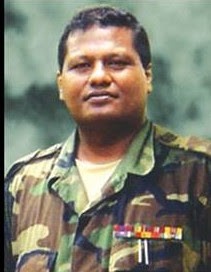
ලුතිනන් කර්නල් තුවාන් මීඩීන්

July 12th, 2016

වෛද් රුවන් එම් ජයතුංග 

ලුතිනන් කර්නල් තුවාන් මීඩීන් මට හමු වන්නේ 2003 වසරේදී ය​. එම වසරේදී යුද ආතතිය සහ සංග්‍රාම විඩාව පිලිබඳ දේශනයක් කිරීමට උතුරට ගිය අවස්ථාවකදී මට ඔහුව හමු විය​. එවකට ඔහු මේජර්වරයෙකු වූයේය​. තුවාන් මීඩීන් සේවය කලේ යුද හමුදා බුද්ධි අංශයේය​. ඔහු තුල ඉතා හොඳ දැණුමක් තිබුනේය​. එම නිසා අප සුභාශ් හෝටලයේදී සංවාදයේ යෙදුනෙමු.

මේ කාලයේ මම ප්‍රභාකරන් ගේ මානසික තත්වයන් පිලිබඳව පොතක් ලියමින් සිටියෙමි. ඒ නිසා මේජර් මීඩීන් ප්‍රභාකරන් සහ ඔහුගේ අභ්‍යන්තර කවය පිලිබඳ දැන සිටි කරුණු මෙම පොත ලිවීමේදී මට ඉතා ප්‍රයෝජනවත් විය​. ප්‍රභාකරන් ගේ කායාරක්‍ෂකයන් අතර උන්ඩ ප්‍රතිග්‍රාහකයන් තිදෙනෙකු සිටින බව ඔහු හෙලි කලේය​. මෙම තොරතුර උසස් හමුදා නිලධාරීන් පවා දැන සිටියේ නැත​.

thuan

2005 වසරේදී වරක් ඔහු මා සොයා කොලඹ හමුදා රෝහලට ආවේය​. මා විසින් මෝහන ප්‍රතිකාර මගින් සුව කරන ලද සංවර්තන ආබාධ ( Conversion Disorders ) තිබූ රෝගීන් කීප දෙනෙකු සමග ඔහු කතා කලේය​. එසේම මගේ මෝහන ප්‍රතිකාර සැසියක් ද ඔහු නිරීක්‍ෂණය කලේය​. තවද අත් අඩංගුවට ගත් කොටි සාමාජිකයන්ට පහර දී තොරතුරු ගන්නවා වෙනුවට මෝහනය කිරීමෙන් තොරතුරු ලබා ගත හැකිදැයි බැලීම ඔහුගේ අභිප්‍රාය විය​.

අවසන් වරට ඔහු මා හමුවූ දිනයේ ලුතිනන් කර්නල් තුවාන් මීඩීන් මට මෙසේ කීවේය ” තව ස්වල්ප දිනකින් ඔබට මාව ඝාතනය කලා කියා ආරංචි වෙයි. මගේ අවමංගල උත්සවයට පැමිණ වැතිර සිටින මා දෙස බලන්න​. මෘත ශරීරයක් ව වැතිර සිටින මේ මිනිසා බොහෝ රහස් දන්නේය​. ඒවා හෙලි කලහොත් බොහෝ දේශපාලකයන්  හමුදා නිලධාරීන් බලවත් අපහසුතාවට පත් වනු ඇත​. එම නිසා මම ඒ රහස් රැගෙන මගේ මිනී ව​ළට යමි. “

ඔහු මට මෙය කීවේ කොලඹ යුද හමුදා රෝහලේ මානසික රෝග වාට්ටුවේ මගේ ප්‍රතිකාර කාමරයේදීය​. මම ඔහුගේ මරණය පිලිබඳ කතාව බැරෑරුම්ව නොගත්තෙමි. නමුත් ඉන් සති කීපයකට පසුව ලුතිනන් කර්නල් තුවාන් මීඩීන් කොටින් ගේ බුද්ධි අංශය විසින් ඝාතනය කල බව මට ආරංචි විය​.

‘නාමල් වරදක් කර නෑ.. ක‍්‍රිෂ් සමාගම පැමිණිලි කර නෑ..’ – සම්පූර්ණ අධිකරණ වාර්තාව මෙන්න..

July 12th, 2016

නිමන්ති රණසිංහ/කවින්ද්‍යා පෙරේරා– රිවිර

 ඉන්දියානු සමාගමක් වූ ක්‍රිෂ් ලංකා පුද්ගලික සමාගමෙන් රුපියල් මිලියන 70ක් රගර් තරගාවලියක් සදහා ලබාගෙන එම මුදල් අවභාවිත කළායැයි කියන සිද්ධියකට අදාළව මූල්‍ය අපරාධ විමර්ශන කොට්ඨාශය විසින් අත්අඩංගුවට ගත් හම්බන්තොට දිස්ත්‍රික් පාර්ලිමේන්තු මන්ත්‍රී නාමල් රාජපක්ෂ මහතා ලබන 18 වැනිදා තෙක් රක්ෂිත බන්ධනාගාර ගත කරන ලෙස කොළඹ කොටුව මහෙස්ත්‍රාත් ලංකා ජයරත්න මෙනෙවිය නියෝග කළාය.

මෙම සිද්ධියට අදාළ ක්‍රිෂ් ලංකා සමාගම හෝ ප්‍රිමියර් සුපර් ස්පොර්ට්ස් සමාගමෙන් හෝ පැමිණිල්ලක් නොමැති අවස්ථාවක සැකකරුට ඇප ලබාදීමට හැකියාවක් තිබුණද, ප්‍රධාන සාක්ෂිකරුවන් කිහිප දෙනකුගේ සාක්ෂි ලබා ගත යුතුව ඇති බැවින් සාක්ෂිකරුවන්ට බලපෑම් එල්ල කළ හැකි යැයි නිගමනය කරමින් අධිකරණය සැකකරු එලෙස රක්ෂිත බන්ධනාගාර ගත කළේය.

අංක 259/9, කොස්වත්ත තලංගම ලිපිනයෙහි දූෂණ විරෝධී හඬ කමිටුවේ කැඳවුම්කරු වසන්ත සමරසිංහ මහතා විසින් ඉකුත් ජනවාරි මස 12 වැනි දින මූල්‍ය අපරාධ විමර්ශන කොට්ඨාසය වෙත කරන ලද පැමිණිල්ලකට අනුව මෙම සිද්ධිය අධිකරණය හමුවේ විභාග විය.

මෙම පැමිණිල්ල සම්බන්ධයෙන් 11 උදෑසන ප්‍රකාශයක් ලබා දීමට ගිය පාර්ලිමේන්තු මන්ත්‍රී නාමල් රාජපක්ෂ මහතා මූල්‍ය අපරාධ විමර්ශන කොට්ඨාසය විසින් අත්අඩංගුවට ගෙන අධිකරණය වෙත ඉදිරිපත් කරනු ලැබුවේ පස්වරු 3.00ට පමණය.

‘නාමල් වරදක් කර නෑ.. ක‍්‍රිෂ් සමාගම පැමිණිලි කර නෑ..’ – සම්පූර්ණ අධිකරණ වාර්තාව මෙන්න..

සිද්ධියට අදාළ වැඩිදුර වාර්තාවක් ද සමගින් අධිකරණයේ පෙනී සිටි මූල්‍ය අපරාධ විමර්ශන කොට්ඨාසයේ ප්‍ර.පො.ප. අනුර ප්‍රේමරත්න සමග උ.පො.ප. ලලිත් ශාන්ත යන නිලධාරීහු අධිකරණය වෙත කරුණු ඉදිරිපත් කළහ.

මූල්‍ය අපරාධ විමර්ශන කොට්ඨාසය : ස්වාමීනි, මෙම සිද්ධියට අදාළව 2016 ජනවාරි 12, 18 පෙබරවාරි 19 මාර්තු 03 යන දිනයන් හි ඉදිරිපත් කරන ලද වැඩිදුර වාර්තාවන්ට අමතරව මෙම දීර්ඝ විමර්ශනයෙන් පසු සැකකරුවකු ලෙස මහවෙල පාර කාල්ටන් තංගල්ල පදිංචි ලක්ෂ්මන් නාමල් රාජපක්ෂ යන අය අද දින අධිකරණය වෙත ඉදිරිපත් කරනු ලබනවා. මෙම විමර්ශනය මූල්‍ය අපරාධ විමර්ශන කොට්ඨාසයේ ඒකක අංක 7 මගින් සිදුකරනු ලැබුවා. කොළඹ කොටුව ක්‍රිෂ් ලංකා පුද්ගලික සමාගමේ රුපියල් මිලියන 70ක් රගර් තරගාවලියක් සඳහා ලබා ගෙන ප්‍රිමියර් ස්පෝට්ස් සමාගමේ නිමල් පෙරේරා මහතාගේ එච්.එස්.බී.සී. ගිණුම් අංකය ඉල්ලාගෙන එම ගිණුමට රුපියල් මිලියන 70ක් ගෙන්වා ගෙන එම මුදල් නැවතත් නිමල් පෙරේරා මහතා විසින් නාමල් රාජපක්ෂ මහතා වෙත ලබාදීමෙන් පසු 2013 මැයි හෝ ජුනි යන මාසයේ කාල්ටන් සෙවන් රග්බි තරගාවලිය සඳහා අදාළ කමිටුවට භාරදුන් බවට සැකකරු විසින් පවසා සිටියා. එම කමිටුව සම්බන්ධයෙන් විමර්ශනය කිරීමේදී රගර් සම්මේලනයෙන් ප්‍රකාශ සටහන් කළා. එම මුදල් අදාළ සංගමයට ලබාදුන්නේ නැති බව ඔවුන් සඳහන් කළා. මෙම සැකකරු විසින් එම මුදල් වියදම් කළ ආකාරය සම්බන්ධයෙන් වාර්තාවක් ඉදිරිපත් කිරීම මග හැරියා. අදත් එනකොට ගේන්න කිව්වා. අරගෙන ආවේ නෑ. ඊට අමතර ක්‍රිෂ් ලංකා සමාගමට ලිපියක් යවා තිබෙනවා එම මුදල ලැබුණ බවට. එසේම ඒවා වියදම් කළ බවට ඇමුණුමක්ද යවා තිබෙනවා. මෙය මුදල් විශුද්ධිකරණ පනත ප්‍රකාරව ගැනෙන වරදක්. 2016 ජනවාරි මාසයේ 13 දින අල් තමාන් නමැති බංග්ලාදේශ ජාතිකයකු විසින් ඔහුගේ ගිණුමට රුපියල් මිලිය 52ක් බැරකරගෙන එම ගිණුමෙන්ම රුපියල් මිලියන 50ක් මෙම සැකකරුගේ ගිණුමට බැර කරගෙන ඇති බවට සඳහන් කරනවා.

අධිකරණය : ඒ ගනුදෙනුව මොකක්ද? ඒ විදේශ ජාතිකයා කවුද?
පොලිසිය : 2013 මැයි හෝ ජුනි මෙම මුදල රුපියල් මිලියන 35ක් වශයෙන් දෙවතාවකදී නිමල් පෙරේරා යන අය විසින් ලබා දීලා තිබෙනවා. ඒක රග්බි තරගාවලියට නොගෙන අල් තමාන් නමැති බංග්ලාදේශ ජාතිකයකුගේ ගිණුමකට බැර කරලා ඒ ගිණුමෙන් ආපසු රුපියල් මිලියන 50ක් ලබාගෙන ඊට අමතරව රුපියල් මිලියන 50ක බැංකු අයිරාවක් ලබාගෙන. ඒකෙන් තමයි මෙම සැකකරු හෙලෝ කෝප් සමාගම මිලදී ගෙන තියෙන්නේ. මෙම බංග්ලාදේශ ජාතිකයා සොයා ගැනීමට නැහැ. අපි සොයාගන්න උත්සාහ ගන්නවා.

අධිකරණය : එය මෙරට සමාගමක්ද?
පොලිසිය : ඔව් ස්වාමීනි. ඒක මෙරට ආයෝජනයට ආපු ඉන්දියානු සමාගමක්. අක්කර 4.3ක භූමි ප්‍රමාණයක් අනූ නව අවුරුදු බද්දට අරගෙන විශාල සාප්පු සංකීර්ණයක් ඉදිකරන්නයි ඇවිත් ඉන්නේ. එම සමාගමේ ගුප්තා කියන අයගෙන් ලංකාවේ රගර් ක්‍රීඩාවට අනුග්‍රහය දක්වන්න කියලා තියෙද්දී තමයි රුපියල් මිලියන හැත්තෑවක් දීලා තිබෙන්නේ. එම මුදල නිමල් පෙරේරාගේ ගිණුමට තමයි බැරකරලා තිබෙන්නේ. පසුව ඒ නිමල් පෙරේරා යන අය ග්‍රෙගරි පාරේ පිහිටි සැකකරුගේ කාර්යාලයට දෙවතාවක් ගිහින් එම මුදල් අතටම දීලා තියෙනවා. සැකකරු කියන්නේ කමිටුවට දුන්නා කියලා. කමිටුවේ සාමාජිකයින්ගෙන් ප්‍රශ්න කළාම එයාලා කියන්නේ එහෙම මුදලක් දුන්නේ නෑ කියලා.
මෙහිදී සැකකරු වෙනුවෙන් අධිකරණයේ පෙනී සිටි ජනාධිපති නීතිඥ ජයන්ත වීරසිංහ මහතා : ස්වාමීනි, ඔය කියන කාරණාවලින් පැහැදිලිව පේනවා මුදල් දුන්නා කියන්නේ ක්‍රිෂ් කියන සමාගම. ක්‍රිෂ් සමාගමෙන් පැමිණිල්ලක් කරලා නෑ. රගර් කමිටුවත් පැමිණිල්ලක් කරලා නෑ. ඒක පැහැදිලියි. වසන්ත සමරසිංහ කියන්නේ දේශපාලන චරිතයක්. ඒකෙන්ම පැහැදිලිව පේනවා මේ මුදල ක්‍රිෂ් ආයතනය දුන්නා නම් 2013 ඉඳලා අද වෙනතුරු පැමිණිලි කර නෑ. මේ පරීක්ෂණයට මාස හතක් ගත වෙලා. අද වෙනකල් පැමිණිලිකාරයෙක් හොයා ගන්න බෑ. මගේ සේවාදායකයා මේ සම්බන්ධයෙන් දෙවතාවක් ඇවිත් කට උත්තර දීලා තියෙනවා.

අධිකරණය : ක්‍රිෂ් සමාගමෙන් කට උත්තර ගත්තාද?
පොලිසිය : ඔව් අරගෙන තිබෙනවා.
සැකකරු වෙනුවෙන් අධිකරණයේ පෙනී සිටි නීතිඥ සම්පත් මෙන්ඩිස් මහතා : ස්වාමීනි, මගේ සේවාදායකයා තරුණයි. ඔහු සහ අදාළ සමාගම අතර තිබුණ රැස්වීමකදී ඔහුගෙන් එම තැනැත්තා ඇහුවා මොනවද වෙන්න ඕන කියලා. එතකොට තමයි මගේ සේවාදායකයා කිව්වේ අපේ රටේ රගර් ක්‍රීඩාව නංවන්න උදව් කරන්න කියලා. නිමල් පෙරේරා කියන්නේ සිලෝන් ප්‍රිමියර් ස්පෝර්ට් සමාගමේ සභාපති. එතුමාගේ නමට තමයි සල්ලි දැම්මේ. 2010 නොවැම්බර් මස 10 තමයි නුවර කාල්ටන් රග්බි තරගාවලිය පැවැත්වුණේ. ඒකට සංගම් 10ක් සහභාගි වුණා. මේ සම්බන්ධයෙන් ක්‍රිෂ් ආයතනයෙන් පැමිණිල්ලක් නෑ. මිලියන 70ක ගිවිසුම ගැහුවේ වසන්ත සමරසිංහ එක්කවත් එෆ්.සී.අයි.ඩී. එකත් එක්ක නොවෙයි. මගේ සේවාදායකයාට කොළඹ මහෙස්ත්‍රාත් අධිකරණයේ අංක 3 අධිකරණයේත් නඩුවක් තිබෙනවා. සියලුම ලේඛන ඒකට අරන් තියෙන්නේ.අධිකරණය : ක්‍රිෂ් සමාගමේ ප්‍රකාශයෙන් මොනවද කිව්වේ?

පොලිසිය : ආර්.පී. ගුප්තා යන අය ප්‍රකාශ ලබාදීලා තිබෙනවා. ඒ අය ක්‍රීඩාවට ආසයි. ඒක දියුණු කරන්නයි දීලා තියෙන්නේ. ඒ අය දන්නෑ මේ සල්ලිවලට මොකද වුණේ කියලා. සල්ලිවලට මොකද කළේ කියලා ඒ අයට ඇමුණුමක් යවලා තියෙනවා.
ජනාධිපති නීතිඥ ජයන්ත වීරසිංහ මහතා : ස්වාමීනි මගේ සේවාදායකයා පාර්ලිමේන්තු මන්ත්‍රීවරයෙක්. අධිකරණය මග හරින්නේ නෑ. සාක්ෂිවලට කිසිසේත්ම බාධාවක් කරන්නේ නෑ. මහජන කැලඹීමක් වෙන්නේ නෑ. ඒ නිසා ඕනැම ඇප කොන්දේසියක් මත ඇප ලබා දෙන ලෙස ඉල්ලා සිටිනවා.

අධිකරණය : (පොලිසියෙන්) විමර්ශන තත්ත්වය කොහොමද?
පොලිසිය : විදේශිකයන් කිහිප දෙනකුගෙන් ප්‍රකාශ ගන්න තිබෙනවා. ඉන්දීය ජාතිකයින් වූ අමිත්, ආර්.සී. ගුප්තා, බංග්ලාදේශ ජාතිකයකු වූ අල් තමාන්, නවසීලන්ත ජාතිකයකු වූ ජෝර්ජ් ඩිම්කින් යන අයගෙන් ප්‍රකාශ ගන්න තිබෙනවා.

අධිකරණය : ඉදිරිපත් වූ සියලු කරුණු සලකා බලමි. මෙම සැකකරු මෙම මුදල් නිමල් යන අයගෙන් ලබාගත් බවට සාක්ෂි තිබෙනවා. සැකකරු ඒවා විධිමත් ආකාරයට රගර් ක්‍රීඩාව සඳහා යොදාගත් බවට සඳහන් කරලා තියෙනවා. අද දින වැඩිදුර වාර්තාවෙන් පෙනී යනවා මෙම සැකකරු වරදක් කර නැති බවට. එසේම, මෙම සිද්ධියට අදාළව ප්‍රිමියර් ස්පෝර්ට් සමාගමෙන් හෝ ක්‍රිෂ් ලංකා පුද්ගලික සමාගමෙන් හෝ පැමිණිල්ලක් ලැබී නොමැති අවස්ථාවක සැකකරු මුදල් භාවිත කළ ආකාරය සම්බන්ධයෙන් පැමිණිල්ල විග්‍රහ කර නැහැ. ප්‍රධානම සාධකය මෙම මුදල භාවිත කළේ කෙසේද යන්නයි. වැදගත් සාක්ෂි කිහිපයක් ලබා ගන්න තිබෙන බවට මූල්‍ය අපරාධ විමර්ශ කොට්ඨාසය කියනවා. ඒ සම්බන්ධයෙන් සාක්ෂිකරුවන්ට බලපෑම් කළ හැකි යැයි නිගමනය කරමින් සැකකරු සතියක කාලයක් රක්ෂිත බන්ධනාගාර ගත කරනු ලබනවා.

ඒ අනුව සැකකාර නාමල් රාජපක්ෂ මහතා ලබන 18 වැනිදා තෙක් රක්ෂිත බන්ධනාගාර ගත කළ මහෙස්ත්‍රාත්වරිය එදින තෙක් නඩුව කල් තැබීය.

ජනාධිපති නීතිඥ ජයන්ත වීරසිංහ, නීතිඥ ගනේෂ් ධර්මවර්ධන, නීතිඥ බුද්ධික ජයසිංහ, නීතිඥ කපිල ගමගේ, නීතිඥ ප්‍රියන්ත දෙනියාය, නීතිඥ උදය ගම්මන්පිල, නීතිඥ සිසිර ජයකොඩි, නීතිඥ සම්පත් මෙන්ඩිස්, නීතිඥ චමින්ද කුලරත්න, නීතිඥ ප්‍රේමනාත් fදාලවත්ත, නීතිඥ විකුම් බස්නායක, නීතිඥ රකිත අබේගුණවර්ධන, නීතිඥ ශාබ්දික වෙල්ලප්පුලි, නීතිඥ මහේෂ් අලහප්පෙරුම, නීතිඥ එන්. සන්නස්ගල, නීතිඥ නිලන්ත විජේසිංහ යන මහත්ම මහත්මීහු සැකකරු වෙනුවෙන් අධිකරණයේ පෙනී සිටිමින් කරුණු ඉදිරිපත් කළහ.සැකකාර නාමල් රාජපක්ෂ මහතා අධිකරණය වෙත රැගෙන එනු ලැබූ අවස්ථවේදී පාර්ලිමේන්තු මන්ත්‍රීවරුන් වූ බන්දුල ගුණවර්ධන, ගාමිණී ලොකුගේ, උදය ගම්මන්පිල, වීරකුමාර දිසානායක, දිනේෂ් ගුණවර්ධන, කුමාර වෙල්ගම, ජයන්ත සමරවීර, විමල් වීරවංශ, ජී.එල්. පීරිස්, ජොන්ස්ටන් ප්‍රනාන්දු යන මහත්වරුන් හා පළාත් සභා මන්ත්‍රී රොජර් සෙනෙවිරත්න මහතා ඇතුළු පිරිසක් සහභාගී වී සිටි අතර, යෝෂිත රාජපක්ෂ, රෝහිත රාජපක්ෂ යන මහත්වරුද අධිකරණ පරිශ්‍රයේ රැඳී සිටියහ.

නිමන්ති රණසිංහ/කවින්ද්‍යා පෙරේරා
– රිවිර

නව වැට් බදු සංශෝධනය සහ ජනතා විරෝධය

July 12th, 2016

සුරෝෂන ඉරංග උපුටාගැණීම අදදෙරණ

මෙවර කම්කරු දිනයේ උණුසුම පහව යාමටත් පෙරම කම්කරු ජනයාගේ සිට විවිධ ආදායම් මට්ටම්වල පසුවන පොදු ජනතාවගේ ජන ජීවිත කෙරෙහි සෘජු ලෙසම බලපාන වැට් බදු සංශෝධනයක් ආණ්ඩුව විසින් ක‍්‍රියාත්මක කර තිබේ. එය කම්කරු දිනය දා වැටුප් වැඩි කරන ලෙස ඉල්ලමින් සහ ජිවන මිල පහත හෙළන ලෙස හඬ නැගූ ජනතාව වෙත එල්ල කරන ලද මරු පහරක් හා සමාන විය. මේ සම්බන්ධව ආණ්ඩු පාර්ශවයෙන් කවර අදහස් පළ වුවත් මෙම සංශෝධනය පොදු ජනතාවට තදින්ම දැනෙන සංශෝධනයක් වූ බවට සැකයක් නැත. එනිසාම මෙම නව බදු පැනවූ දා පටන් වෙළෙඳ ප‍්‍රජාව ඇතුළු මහජනයා මේ පිළිබඳ සිය අප‍්‍රසාදය පළ කරමින් සිටියි. මෙම සංශෝධනය සිදු කර මාස දෙකක කාලයක් ඉක්ම ගොස් ඇතත් දිගින් දිගටම මෙම සංශෝධන කෙරෙහි එල්ලවන විරෝධතාවල වැඩි වීමක් මිස අඩු වීමක් පෙන්නුම් නොකෙරේ. එනිසා අද වන විට ආණ්ඩුවට මුහුණ දීමට සිදු වී ඇති මෙම වැට් බදු අර්බුදය සම්බන්ධව විශ්ලේෂණාත්මක පැහැදිලි කිරීමක් සිදු කිරීම වැදගත්ය.

බදු අයකිරීම ලෝක ඉතිහාසයේ ආණ්ඩු බිහිවූ දා සිටම ක‍්‍රියාත්මක වෙමින් පැවතියා වූ ක‍්‍රියාදාමයකි. විශේෂයෙන්ම ආණ්ඩුවලට තම ආදායම් සපයා ගැනීමේ මූලිකම ක‍්‍රමවේදය බවට මෙම බදු ක‍්‍රමය පත්ව තිබේ. එනිසා රාජ්‍ය පාලනය පිළිබඳව සැලකීමේ දී බදු අයකිරීම අනිවාර්ය අවශ්‍යතාවක් බවට පත්වේ. එනම් රටක පැවැත්ම උදෙසා බදු අයකිරීමට අනිවාර්යයෙන්ම කටයුතු කළ යුතුය. එහෙත් එසේ වූ පමණින් රටක ජනතාව පීඩාවට පත් කරමින් බදු අයකර ගැනීමට කටයුතු කිරීම සාධාරණ නොවන නමුත් රටක ආදායම් මට්ටම ඉහළ නංවා ගැනීම පිණිස එම ක‍්‍රියාවලිය අනුගමනය කිරීමට ආණ්ඩු පෙළඹේ. ඒ අනුව බදු අය කර ගැනීමේ යුක්ති සහගත හේතු ආණ්ඩු පාර්ශවයෙන් සැමවිටම ඉදිරිපත් වන අතර එයට ප‍්‍රතිවිරුද්ධව ජනතාව විරෝධය පළ කිරීම සෑම රාජ්‍යයකටම පොදු තත්වයකි.

වැට් බදු යනු ලෝකයේ රටවල් 140 ක භාවිත වන්නා වූ බදු ක‍්‍රමයකි. යුරෝපා රටවල එම ක‍්‍රමය වර්ෂ 1960 දී පමණ ආරම්භ වේ.  යුරෝපා රටවල මෙම බදු අය කිරීමේ ප‍්‍රතිශතය 20% ක් පමණ වන අතර අප‍්‍රිකා කලාපයේ එය 15% ක් පමණ වේ. පසුගිය දෙවසර තුළ ශ‍්‍රී ලංකාවේ වැට් බදු ක‍්‍රියාත්මක වීමේ ප‍්‍රතිශත සැලකූ කල 2014 වර්ෂයේ දී එය 12% ක් ව ක‍්‍රියාත්මක වූ අතර 2015 ජනවාරි මස 1 වන දා සිට එය 11% දක්වා අඩු කළ අතර මෙම වසරේ දී නැවත වැඩි වන්නේ එම බදු ප‍්‍රතිශතය වේ.

ඒ අනුව එකතු කළ අගය මත බද්ද හෙවත් වැට් බද්ද 11% සිට 15% දක්වා වැඩි කිරීම මෙම නව බදු සංශෝධනය යටතේ සිදුවිය. එසේම ජාතිය ගොඩ නැඟීමේ බද්දේ 2% ක් ව පැවති බදු අය කිරීමේ ප‍්‍රතිශතයේ වෙනසක් නොකර බදු නිදහස ලැබෙන ක්ෂේත‍්‍ර සංශෝධනය කර තිබේ. මෙම සංශෝධනය මඟින් ජලය, විදුලිය, සෞඛ්‍ය, අධ්‍යාපනය සහ අත්‍යවශ්‍ය භාණ්ඩ සඳහා බදු අයකිරීම සිදු නොකරන බව ආණ්ඩුව පවසයි. එහෙත් පෞද්ගලික අංශයේ සෞඛ්‍ය සේවා සඳහා මෙම බදු සංශෝධනය ක‍්‍රියාත්මක කරන බව ද ප‍්‍රකාශ කරයි. මෙම බදු සංශෝධනය අදාළ ක්ෂේත‍්‍ර ලෙස විදුලි සංදේශ සේවා, විදුලි සංදේශ සේවා සඳහා යොදා ගැනෙන යන්ත්‍රෝපකරණ, අධි තාක්ෂණ උපකරණ, විදුලි සංදේශ නියාමන කොමිසම මඟින් නිකුත් කරනු ලබන බලපත‍්‍ර, පෞද්ගලික සෞඛ්‍ය සේවා සැපයීම හා නිවාස සඳහා වන විශේෂ ව්‍යාපෘති සඳහා භාණ්ඩ හා සේවා සැපයීම හැර අනෙකුත් විශේෂ ව්‍යාපෘති සඳහා භාණ්ඩ හා සේවා සැපයීම අයත් වේ.

කෙසේ වුවත් වත්මන් ආණ්ඩුව විසින් මෙවර සිදු කරන ලද මෙම වැට් බදු සංශෝධනය රට තුළ ඉමහත් කැළඹීමක් නිර්මාණය කිරීමට සමත් වූ අතර මේ මොහොත දක්වාම ඒ සම්බන්ධව විරෝධතා ක‍්‍රියාත්මක වෙමින් පවතී. විශේෂයෙන්ම මෙම නව බදු සංශෝධනය සෘජුවම මෙරට වෙළෙඳ ප‍්‍රජාවගේ ආදායම  කෙරෙහි බලපා ඇති බැවින් මෙම සංශෝධනයට එරෙහිව ඔවුන්් ප‍්‍රබල විරෝධයක් දක්වමින් සිටියි. එසේම වෙළෙඳ ප‍්‍රජාවට මෙම නව බදු සංශෝධන අහිතකර අන්දමින් බලපෑම යනු සෘජුවම එම බලපෑම පාරිභෝගික ජනතාව වෙත එල්ල වන බලපෑමකි. මන්ද යත් වෙළෙඳ ප‍්‍රජාව ඔවුන්ගේ බදු ගෙවීම සඳහා අමතර ආදායම් උපයා ගැනීම පිණිස තම ගනුදෙනුකරුවන් මඟින් එම ආදායම් සපයා ගැනීමට කටයුතු කරන බැවිනි. එසේ සලකන කල සමාජයේ සෑම මට්ටමකම පුද්ගලයින්ට මෙම ඉහළ නංවන ලද බදු සංශෝධනය අනුව වියදම් දැරීමට අකමැත්තෙන් වුව ද සිදුවී තිබේ.

පසුගිය මහින්ද රාජපක්ෂ ජනාධිපතිවරයාගේ සමයේ දී ද තොග හා සිල්ලර වෙළෙඳාම සඳහා වැට් බදු පනවන දක්නට ලැබුණි. ඒ අනුව පළමුව කාර්තුවකට රුපියල් මිලියන 500 ක් හෝ ඊට වඩා වැඩි ආදායමක් සහිත තොග සහ සිල්ලර වෙළෙඳ ව්‍යාපාර සඳහා වැට් බදු පනවන ලදි. ඉන් පසු බදු සඳහා යටත් වන වටිනාකම රුපියල් මිලියන 250 දක්වා අඩු කරන ලදි. පසුව එය රුපියල් මිලියන 100 දක්වා පහත හෙළීමට පසුගිය රජය කටයුතු කළ අතර එම අගය අඩු නොවී පැවතුණි. එහෙත් නව වැට් බදු සංශෝධනය අනුව එය වසරකට මිලියන 1 දක්වා පහත හෙළා තිබේ. එනම් වාර්ෂික පිරිවැටුම රුපියල් මිලියන 12 ක් වන විට දෛනික පිරිවැටුම රුපියල් 33,000 ඉක්මවා යන සියලූ ව්‍යාපාරික ආයතන වැට් බදු ගෙවිය යුතු වේ. එසේම එම ව්‍යාපාරික ආයතන අලෙවි කරනු ලබන්නේ වැට් බද්දෙන් නිදහස් නොකළ භාණ්ඩ නම් මෙම තත්වය වඩාත් පීඩාකාරී ස්වරූපයට පත්වේ. ඒ අනුව මෙම සංශෝධිත බදු අගය සුළු හා මධ්‍ය පරිමාණ ව්‍යාපාරික ආයතන කෙරෙහි දැඩි බලපෑම් ඇති කරනු ලබන අතර එහි අවසාන ප‍්‍රතිඵලය වන්නේ ඒ සඳහා පාරිභෝගිකයාට වන්දි ගෙවන්නට සිදුවීමය.

තම ව්‍යාපාර කෙරෙහි මෙලෙස පැනවී ඇති  වැට් බද්දට විරෝධය පාමින් වෙළෙඳ ප‍්‍රජාව සිය කඩ සාප්පු වසා දමා තම අප‍්‍රසාදය පළ කිරීම මෙන්ම වැට් බදු ගෙවීම සඳහා ලියාපදිංචි නොවී සාමකාමී පා ගමන් පවත්වමින් විවිධ නගර පුරා ඔවුන් මෙම විරෝධය පළ කිරීමට කටයුතු කීරීම මේ දිනවල දක්නට ලැබේ. ඒ අනුව පසුගිය ජූනි මස 16 දින ගාල්ලේදී ද 17 වන දින මහරගමදී ද 22 වන දින ගම්පහ නගරයේදී සහ 23 වන දින මාතර නගරයේ දී ද විරෝධතා ක‍්‍රියාත්මක විය. තව ද 29 වන දින කැලණිය, කිරිබත්ගොඩ, කඩවත, කටුගස්තොට, බදුල්ල, බණ්ඩාරවෙල සහ අනුරාධපුරයේ ද මෙම විරෝධතා ව්‍යාපාර දක්නට ලැබුණි. තව ද සමස්ත ලංකා වෙළෙඳ සංගම් එකමුතුව නමින් නව සංවිධානයක් ගොඩනඟා එමඟින් දිවයිනේ සියලූ වෙළෙඳසැල් ඒකරාශි කර මුළු දිවයින පුරා එකම දිනක ව්‍යාපාරික ආයතන වසා දමා විරෝධතාවක් දැක්වීමට ඔවුන් සූදානම් වේ.

මෙම බදු සංශෝධනය විශේෂයෙන්ම පාරිභෝගිකයා කෙරෙහි ද අහිතකර අන්දමෙන් බලපා ඇති බව කිව හැකිය. එනම් පෞද්ගලික අංශයෙන් ලබා ගන්නා සෞඛ්‍ය සේවා සඳහා මෙම නව බදු ක‍්‍රමය ක‍්‍රියාත්මක වීම ඉන් ප‍්‍රධානය. මන්ද යත් නිදහස් සෞඛ්‍ය සේවයක් රට තුළ ක‍්‍රියාත්මක වුව ද පෞද්ගලික ආයතන මඟින් පවත්වාගෙන යනු ලබන සෞඛ්‍ය සේවාවන් සඳහා ද සැලකිය යුතු පිරිසක් යොමුවන බැවිනි. එනිසා මෙම වැට් බදු සංශෝධනයට මුවා වී ඇතැම් පෞද්ගලික සෞඛ්‍ය සේවා මධ්‍යස්ථාන රෝගීන්ගෙන් ඉහළ ගාස්තු අයකිරීමට කටයුතු කරන බවට ද චෝදනා එල්ල විය. කෙසේ වුවත් වඩාත් ගුණාත්මක සහ කාර්යක්ෂම නිදහස් සෞඛ්‍ය සේවයක් ජනතාවට ලබා දීමට අවශ්‍ය ක‍්‍රියාමාර්ග ගැනීම තුළ පෞද්ගලික සෞඛ්‍ය සේවා ආයතන සඳහා ජනතාව යොමු වීම අවම කළ හැකිය.

මෙම තත්වයට අමතරව විදුලි සංදේශ ගාස්තු සඳහා මෙම සංශෝධනය ක‍්‍රියාත්මක වීම ද ජන ජීවිත කෙරෙහි සෘජුවම බලපෑම් ඇති කරන සාධකයකි. ඒ අනුව මෙතෙක් පැවති 27.55% බද්දට අමතරව 17% ක බද්දක් දුරකථන ඇමතුම් සහ කෙටි පණිවිඩවලට මෙන්ම අන්තර්ජාල සේවාවලට ද පැනවේ. එමඟින් තම සන්නිවේදන අවශ්‍යතා සපුරා ගැනීමේ දී යම්කිසි සැලකිය යුතු අමතර වියදමක් මහජනතාවට දැරීමට සිදුවන බව පැහැදිලිය. විශේෂයෙන්ම දියුණු වෙම්න් පවතින වෙනත් රටවලට සාපේක්ෂව අප රට තුළ ජංගම දුරකථන සහ අන්තර්ජාලය භාවිතය ඉහළ මට්ටමක පැවතීම ඔස්සේ විදුලි සංදේශ අංශය සඳහා සිදුවූ මෙම නව බදු සංශෝධනය වඩාත් බලපෑම් සහගත වේ.

මෙම නව වැට් බදු සංශෝධනය මඟින් ආණ්ඩුව වාර්ෂිකව රුපියල් බිලියන 100 ක අමතර ආදායමක් අයකර ගැනීමට අපේක්ෂා කරයි. එය මෙරට දළ දේශීය නිෂ්පාදිතය මෙන් 0.75% ක ප‍්‍රමාණයක් වේ. තව ද ජාත්‍යන්තර මූල්‍ය අරමුදල විසින් 2020 වසර වන විට මෙරට බදු ආදායම දළ දේශීය නිෂ්පාදිතයෙන් 15% ක් දක්වා වැඩිකර ගත යුතු බව දන්වා තිබීම ද සැලකිය යුතු තත්වයකි. ඒ වර්තමානයේ රට ඉදිරියේ පවතින අධික ණය බර හමුවේ රටට පැවැත්මක් නොමැති බැවිනි. මෙම තත්වය 1990 දී 20% ක තත්වයෙන් පැවතී 2014 වසරේ දී එය 11.3% දක්වා පහත බැස තිබේ.

කෙසේ වුවත් මෙම සංශෝධනය හේතුවෙන් නොකඩවා විරෝධතා පැනනැඟීම තුළ වැට් බදු සංශෝධනය පිළිබඳ සාකච්ඡුාවක් ජූලි 04 වන දා ජනාධිපතිවරයා, අගමැතිවරයා ඇතුළු ඇමතිවරුන්ගේ සහභාගිත්වයෙන් පැවැත්වුවත් එය විසඳුමකින් තොරව අවසන් වී තිබේ. එසේම වැට් බදු සංශෝධනය පිළිබඳව වෙළෙඳ සංගම් නියෝජිතයින්ගේ අදහස් ලබා ගැනීමේ විශේෂ සාකච්ඡුාවක් ජනාධිපතිවරයාගේ ප‍්‍රධානත්වයෙන් වෙළෙඳ සංගම් නියෝජිතයින්ගේ සහභාගිත්වයෙන් පැවති අතර වැට් බදු පැනවීම සිදුවන ආකාරය පිළිබඳ මුදල් අමාත්‍ය රවී කරුණානායක මහතා විසින් පැහැදිලි කර තිබේ. ඉදිරියේදී මේ පිළිබඳව ආර්ථික විශේෂඥයින්, මන්ත‍්‍රීවරුන් සහ රාජ්‍ය නිලධාරීන් ඇතුළු සියලූ පාර්ශව සමඟ සාකච්ඡුා කිරීමට තමා බලාපොරොත්තු වන බව ජනාධිපතිවරයා පවසයි.

එමෙන්ම මෙම නව වැට් බදු සංශෝධනයත් සමඟ භාණ්ඩ 133 ක් සහ සේවා 21 ක් වැට් බද්දෙන් නිදහස් කිරීමට මුදල් අමාත්‍යාංශය පියවර ගෙන තිබේ. ඒ අනුව වී, සහල්, පාන්පිටි, පාන්, කිරිපිටි, ඖෂධ නිෂ්පාදන අමුද්‍රව්‍ය ආදීවූ භාණ්ඩ ගණනාවක් සහ නිර්දේශිත අධ්‍යාපන සේවා, පුස්තකාල සේවා, පොදු මගී ප‍්‍රවාහන සේවා හා අවමංගල්‍ය සේවා ඇතුළු සේවා වර්ග ගණනාවක් ද මෙම සංශෝධනයෙන් ඉවත් කර තිබේ.

මෙසේ සලකන කල මෙම නව වැට් බදු සංශෝධනය ව්‍යාපාරිකයින් සහ මහජනතාව සම්බන්ධයෙන් සැලකීමේ දී හිතකර නොවන බව පැවසිය හැකිය. එහෙත් වර්තමානයේ අප රට මුහුණ දී සිටින අධික ණය බර හමුවේ පවත්නා ආණ්ඩුවට ජනතාව මත බදු පනවන්නට සිදුවී තිබේ. කෙසේ වුවත් මෙම තත්වය ජනතාවට වඩාත් අහිතකර අන්දමින් බලපාන පරිදි ක‍්‍රියාත්මක කිරීම සාධාරණ නොවන අතර ඒ සඳහා ආණ්ඩුව සහ මහජනතාව නැමැති දෙපාර්ශවයම යම් තරමකට හෝ එකඟ වන අන්දමේ වැඩපිළිවෙලක් සකස් කිරීම වඩා උචිතය. එසේ නොවුණහොත් මෙම වැට් බදු සංශෝධනය හේතුවෙන් රට පුරා ව්‍යාප්ත වෙමින් පවතින විරෝධතා ව්‍යාපාර වඩා තීව‍්‍ර වීම තුළ එය බහු ජන විරෝධයක් බවට පත් වී යහපාලන ආණ්ඩුවට එරෙහිව නැගී සිටින බලවේගයක් බවට පත්වනු නියතය.

මේ අතර වැට් බදු ප්‍රතිශතය වැඩිකරමින් දේශීය ආදායම් බදු කොමසාරිස්වරයා විසින් නිකුත් කළ නියෝගය අත්හිටුවමින් ශ්‍රේෂ්ඨාධිකරණය විසින් නියෝගයක් නිකුත් කර තිබේ.සියයට 11ක්ව පැවැති වැට් බද්ධ සියයට 15 දක්වා වැඩිකිරීමට රජය පසුගියදා පියවර ගන්නා ලදී.ජාතික නිදහස් පෙරමුණේ නායක පාර්ලිමේන්තු මන්ත්‍රී  විමල් වීරවංශ මහතා විසින් ඉදිරිපත් කළ පෙත්සමක් සලකා බැලූ අගවිනිසුරු ප්‍රමුඛ ත්‍රිපුද්ගල විනිසුරු මඩුල්ල මෙම නියෝගය නිකුත් කළ බව වාර්තා වෙයි.පාර්ලිමේන්තුවේ අනුමැතියකින් තොරව අදාළ බදු සංශෝධන සිදුකිරීම පිළිගත නොහැකි බව  සඳහන් කර ඇති ශ්‍රේෂ්ඨාධිකරණය මෙම තහනම් නියෝගය පෙත්සම් විභාගය අවසන් වන තුරු බලපැවැත්වෙන බව  දැනුම් දී තිබේ.

මැති ඇමතිවරුන් 92ට සැප විඳින්න වාහන ගේන්න මිනිසුන්ගේ මෙම මුදල් යෙදවීමට කටයුතු කළ වත්මන් රජයට මෙම අතුරු නියෝගය වැදගත් අතුරු නියෝගයක් මෙන්ම ජනතාව ලැබූ විශාල ජයග්‍රහණයක් හා ප්‍රබල අස්වැසිල්ලක් බවද මොනවට පැහැදිලි වෙයි.

සුරෝෂන ඉරංග

පෙරදිගට ගමනක් – 22 -චන්ද්‍රභානු ගේ ගනුදෙනුව

July 11th, 2016

වරුණ චන්ද්‍රකීර්ති

ක්‍රිස්තු වර්ෂ 1236 දී දඹදෙණියේ රජ වූ සිරි පැරකුම්බා (දෙවැනි පැරකුම්බා) රජ්ජුරුවන් ගේ එකොළොස්වැනි අවුරුද්දේ දී අපි ද බෞද්ධයෝ වම්හ” කියා මායා කොට” චන්ද්‍රභානු කියන ජාවක රජෙක් අපේ රට ආක්‍රමණය කළා කියලා මහාවංශය කියනවා. මේ ගැන කරුණු තව තවත් බොහෝ පොත්වල සඳහන්. මේ චන්ද්‍රභානු කියන්නේ කවුද? දකුණු තායිලන්තයේ සුරත් ථානි පළාතේ චයියා දිස්ත්‍රික්කයෙන් ලැබිලා තියෙන සෙල්ලිපියක සඳහන් කරලා තියෙනවා තාම්‍රලිංගේශ්වර චන්ද්‍රභානු කියලා රජකෙනෙක් ගැන. ඒ සෙල්ලිපියේ දිනය ක්‍රිස්තු වර්ෂ 1230 වර්ෂයට අදාළ එකක්. මේ කියන තාම්‍රලිංගය ගැන අපේ මූලාශ්‍රවලත් සඳහන්. හත්‍ථවනගල්ල විහාරවංශයේ ඒකට කියන්නේ තම්බලිංග රට කියලා. ඒ ග්‍රන්ථයේ සිංහල පරිවර්තනයේ – ඒ කියන්නේ එළු අත්තගලු වංශයේ ඒ ප්‍රදේශය හඳුන්වලා තියෙන්නේ තමලිංගමුව කියලා. මේ තමලිංගමුව ගැන තව පොත්වලත් කරුණු තියෙනවා. දඹදෙණි අස්න කියනවා දෙවැනි පැරකුම්බා රජ්ජුරුවෝ විසින් තමලිංගමුවේ රජ්ජුරුවන් ව පරාජය කළා කියලා. පූජාවලියත්, දළදා පූජාවලියත් මේ තමලිංගමුව ගැන විස්තර කියනවා.

කුරුණෑගල යුගයේ දී ලියපු දළදා පූජාවලිය තමලිංගමුව ගැන කියන්නේ දළදාවහන්සේ සිංහලදේශයට වැඩමවන අවස්ථාවේ දී දන්ත කුමාරයාත් හේමමාලා කුමාරියත් නැව් නැංග නගරය ගැන විස්තරකරද්දී. ඒ කතාවේ හැටියට නම් තමලිංගමුව තියෙන්න ඕන කාලිංගය පැත්තේ. ඒත් චන්ද්‍රභානු ගේ තමලිංගමුව විදිහට හඳුනාගෙන තියෙන්නේ මෙයට පෙර ලිපියෙන් විස්තරකරපු සිරිධම්ම නගරය අගනුවර කරගත්ත රාජ්‍යය. හැබැයි සිරිධම්ම නගරයේ ඉතිහාසය කියන පළිඟු වාළුකා වංශකතාව” පවා යම් විදිහකට දළදා කතාව තමන් ගේ නගරයට සම්බන්ධකරනවා. ඒකෙන් කියන විදිහට දන්ත කුමාරයාත් හේමමාලා කුමරිය දළදාවහන්සේ සිංහලදේශයට වැඩම කරවලා, ආයෙත් නැව් නැගලා ගිහිල්ලා තියෙනවා. ඒ ගමන අවසානයේ ඔවුන් ගොඩබැහැපු තැන තමයි මුලින් ම සිරිධම්ම නගරය ගොඩනගලා තියෙන්නේ. ඒ කියන්නේ මලය අර්ධද්වීපයේ බටහිර වෙරළේ. ඒත් පස්සේ කාලෙක ඇතිවෙච්ච වසංගතයක් හින්දා ඒ නගරයේ රජ්ජුරුවෝ මිනිස්සුත් එක්ක දවස් හතක් නැගෙනහිර පැත්තට ගිහිල්ලා තියෙනවා. ඒකයි දැන් සිරිධම්ම නගරය මලය අර්ධද්වීපයේ නැගෙනහිර වෙරළේ තියෙන්න හේතුව.

අපි කිය කියා හිටියේ චන්ද්‍රභානු ගේ ආක්‍රමණය ගැන. ඔහු සිරිධම්ම නගරයේ ඉඳලා ආපු කෙනෙක් බව පැහැදිළියි. ඒ බව බොහෝ ඉතිහාසඥයන් විසිනුත් සනාථකරලා තියෙනවා. ඇත්තෙන් ම චන්ද්‍රභානු ආක්‍රමණ දෙකක් ම කළ බවකුත් කියනවා. මේ මනුස්සයා අපිත් බෞද්ධයෝ” කියාගෙන මේ තරම් දුරක් ගෙවාගෙන ආවේ ඇයි? දළදාවහන්සේ ලබාගන්නා අදහසින් ඔහු ආ බවක් තමයි අපේ වංශකතා කියන්නේ. ඒත් ඊට වෙනස් කතාවක් තායි මූලාශ්‍රවල සඳහන්. ඒ තමයි සිංහල බුදු පිළිමයේ කතාව. අපි මෙයට පෙර ලිපියෙන් කියපු රාම් කම් හැං රජතුමා බලයට ඇවිල්ලා තියෙන්නේ ක්‍රිස්තු වර්ෂ 1275 දී විතර. ඊට කලින් සුඛෝදය පාලනය කරලා තියෙන්නේ ඔහු ගේ පියා – ඒ කියන්නේ ශ්‍රී ඉන්ද්‍රාදිත්‍ය රජතුමා. එතුමා රජවෙලා තියෙන්නේ ක්‍රිස්තු වර්ෂ 1238 දී. ඔහු ව රෝචරාජ (ප්‍රා රුවාං) කියන ගෞරව නාමයෙනුත් හදුන්වනවා. රෝචරාජ කියන විරුද නාමයේ අර්ථය තමයි ජාතික වීරයා කියන එක.

බුදුන් පිරිනිවීමෙන් අවුරුදු එක්දහස් අටසියයක් ඉක්ම කල්හි හයසිය අටලොස් වැනි ශක වර්ෂයේ දී දඹදිව ගිනිකොණ දෙසැ පිහිටි සියම් රටේ සුඛෝදයනුවර රෝචරාජ නමැත්තෙක් රජය කරවීය” කියලා ජනකාලමාලිය කියන්නේ මේ ඉන්ද්‍රාදිත්‍ය රජතුමා ගැන. මේ රෝචරාජයා දස දහස් ගණනක සේනාවක් පිරිවරාගෙන සිරිධම්ම නගරයට ඇවිල්ලා ඒ නගරයේ ඉඳලා රට පාලනය කරපු සිරිධම්ම රජතුමා මුණගැහුනා කියලා ජිනකාලමාලිය තවදුරටත් කියනවා. ඒ විදිහට මුණගැහුණේ චන්ද්‍රභානු හරි ඔහු ගේ අනුප්‍රාප්තිකයා හරි බව පැහැදිළියි. පෙර ගමන් ගිහිල්ලා ආගන්තුකයා ව පිළිගත්ත චන්ද්‍රභානු ඔහුට සත්කාර කරලා තමන් අහලා තියෙන දෙයක් ගැන කරුණු කියනවා. ඒ විදිහට චන්ද්‍රභානු විස්තරකරලා තියෙන්නේ ලංකාවේ තියෙන බවට ඒ කාලේ ප්‍රසිද්ධවෙලා තිබුණු සිංහල බුද්ධ ප්‍රතිමාව ගැනත් ඒ පිළිමයේ ආශ්චර්යයන් ගැනත්. සිංහල පිළිමය ලබාගැනීමට කරන්න ඕන දේවල් ගැන දෙන්නා සාකච්ඡා කරලා තියෙනවා. ලංකාව දෙවිවරුන් විසින් රකින නිසා යුද්ධකරලා පිළිමය ලබාගැනීමේ අපහසුව ගැනත් චන්ද්‍රභානු කරුණු කියලා තියෙනවා. ඉක්බිති රජවරු දෙදෙනා එක් ව දූතයකු ලක්දිවට යැවූහ. එ සේ කොට රෝචරාජ සුඛෝදයට ගියේ ය. රාජ දූතයා සිංහලද්වීපයට ගොස් සිංහල රජුට ඒ ප්‍රවෘත්ති කීය. එය අසා රජ තෙමේ සත් දිනක් ඒ පිළිමයට පූජා පවත්වා රාජ දූතයාට බාරදුණි. රාජ දූතයා පිළිමය නැවක නංවාගෙන ගියේ ය.” කියලා ඊට පස්සේ සිදුවෙච්ච දේවල් ජිනකාලමාලිය කියනවා. ඒත් මේ දේ ඒ තරම් සරල විදිහට සිද්ද නොවුනු බව පැහැදිළියි. එහෙම නම් සිද්දවෙන්න ඇත්තේ මොකක්ද?

චන්ද්‍රභානු සිරිධම්ම නගරයේ රජවෙලා තියෙන්නේ ක්‍රිස්තු වර්ෂ 1230 දී විතර. සිරි පැරකුම්බා රජතුමා දඹදෙණියේ බලයට ඇවිල්ලා තියෙන්නේ ක්‍රිස්තු වර්ෂ 1236 දී. කලින් කියපු විදිහට ඉන්ද්‍රාදිත්‍ය රජතුමා සුඛෝදයේ බලයට ඇවිල්ලා තියෙන්නේ ක්‍රිස්තු වර්ෂ 1238 දී. අපිත් බෞද්ධයෝ” කියමින් දළදාවහන්සේත් පාත්‍ර ධාතුන්වහන්සේත් ගෙනියන්න හිතාගෙන චන්ද්‍රභානු මුල් වතාවට අපේ රට ආක්‍රමණය කරලා තියෙන්නේ ක්‍රිස්තු වර්ෂ 1247 දී. දෙවැනි වතාවට ආක්‍රමණය කරලා තියෙන්නේ ක්‍රිස්තු වර්ෂ 1262 දී. නච්චම්බු නම් වූ විෂ කොහොල් ගෙන සර්පසේනාවක් සේ ඒ ඒ තොටින් බැස ලක්දිව ගලා ගෙන ගිනි සෙණ ගිය මඟ දියසෙණ ගැසුවා සේ, ලක්දිව නැවත නසන්ට පටන් ගත් චන්ද්‍රභානු නම් රජහු හා ජාවක මහ සෙනග ද, අසුර යුද්ධ කරන්නා සේ, නො එක් යුද්ධ කරවා මරා, ලුහුබැඳ” ඒ ආක්‍රමණ අවසන් කරපු විදිහ පූජාවලිය විස්තරකරනවා. මේ ආක්‍රමණ දෙක ගැන ම මහාවංශයත් කරුණු කියනවා. ඉතින් තමන් ගේ අරමුණ බලහත්කාරයෙන් ඉටුකරගන්න බැරි බව චන්ද්‍රභානු තේරුම්ගත්ත බව පැහැදිළියි. ඔහුත් සුඛෝදයේ ඉන්ද්‍රාදිත්‍ය රජතුමාත් අතර ඇතිවෙච්ච සාකච්ඡාවේ අරමුණත්, ඒ අරමුණ වෙනුවෙන් ඔවුන් අනුගමනය කරපු උපායත් ඒ මාර්ගයෙන් තේරුම්ගන්න පුළුවන්. ඒ උපායෙන් ඔවුන් ලබාගෙන තියෙන්නේ දළදාවත් පාදාවත් නම් නෙවෙයි. සිංහල බුදු පිළිමය.

පූජාවලිය කියන විදිහට සිරිලක ඒකාතපත්‍ර කොට, දෙමළුන් විසින් නැසූ ලක්දිව පමුණු – පරපුර ව්‍යවස්ථාවට – තාපස ගණතැන් – පුගුල්තැන් – ආයතැන් – පිරිවෙන් තැන් – දස මේ තැන් පෙර සේ ම ව්‍යවස්ථා කරවා පළමු කොට රට බතින් සමෘද්ධ කරවා, දිළිඳු ව ගිය ලඞකාවාසීන් තමන් තමන් ගේ ධන ධාන්‍ය මෙතෙකැ යි නොදන්නා සේ ශ්‍රීවන්ත” කරවු පණ්ඩිත සිරි පැරකුම්බා රජතුමා ශාසනෝපකාරය පටන් ඇරන් තියෙනවා. ශාසනය ශුද්ධ කළ එතුමා නො එක් පඬුරු පාක්කුඩම් යවා” විදේශගත ව සිටි භික්‍ෂුන් සිංහලයට ගෙන්වා උභය ශාසනය ම” ඒ කියන්නේ ගම්වාසි පරපුරත් වනවාසි පරපුරත් ශක්තිමත්කරන්න කටයුතු කරලා තියෙනවා. මේ කටයුතුවල යෙදෙමින් ඉන්න කාලේ තමයි එතුමාට දැනගන්න ලැබිලා තියෙන්නේ තමලිංගමුවේ – ඒ කියන්නේ සිරධම්ම නගරයේ, වැඩවාසය කරපු ධර්මකීර්ති කියන මහා ස්ථවිරයන් ගැන. ඒ ගැන පූජාවලියේ තියෙන්නේ මෙහෙම කතාවක්. තව ද තමලිංගමුයෙහි වසන දොළොස් දහසක් භික්‍ෂූන් අතුරෙන් ධර්මකීර්ති නම් මහාස්‍ථවිරයන් සිඟා යන පෙරමඟ පියුම් පැනනැංග හ යි අසා දළදා වැඩූ ගඳ කලල් ආදී දහම් පඬුරු, රජ පඬුරු තමලිංගමු යවා ඔවුන් සිංහලයට වඩා ගෙන්වා බුදුන් රහතුන් දුටුවා සේ, මහත් වූ සත්කාර කොට, ඔවුන් දිවි පමණින් මහත් වූ පත්‍යය දානය දී මහ පින් රැස් කළ හ.” මේ ආරංචිය අපේ පරාක්‍රමබාහු රජතුමාට දීලා තියෙන්නේ අර රාජ දූතයා බව පැහැදිළියි. ඉතින් ඒ කතාව අහලා පැහැදුණු රජතුමා ඒ මහා ස්ථවිරයන්වහන්සේ වෙනුවෙන් සිංහල පිළිමය හුවමාරුකරගන්න එකඟවෙච්ච බවත් පැහැදිළියි. ඉතින් රජ තෙමේ සත් දිනක් පූජා පවත්වලා ඒ පිළිමය රාජ දූතයාට බාරදීලා තියෙනවා.

ජිනකාලමාලියෙන් කියන මේ සිංහල පිළිමය අතීතයේ සැඟවිච්ච එකක් නෙවෙයි. ඇත්තෙන් ම මේ ගැන ජිනකාලමාලියට අමතර ව සිහිංග බුද්ධ නිධාන” කියන පොතෙත් සඳහන්. ඒ පොත නම් තව ම සිංහලයට පෙරලලා නෑ. ඉංග්‍රීසි පරිවර්තනයක් නම් තියෙනවා. සිංහල බුද්ධ ප්‍රතිමාවේ මෑත කාලීන ස්වරූපය ගැන විස්තර සෑහෙන ප්‍රමාණයක් බෝයගම විමලසිරි නායක හාමුදුරුවන් ගේ තායිලන්ත බෞද්ධ සංස්කෘතිය පොතේ තියෙනවා. විවිධ බාධක මැද්දේ සිරිධම්මපුරයටත් එයින් පස්සේ සුඛෝදයටත් පිළිමය වඩම්මවලා තියෙනවා. ක්‍රිස්තු වර්ෂ 1347 දී සුඛෝදයේ සිහසුනට ආපු ලිද්‍යෙය ධම්මරාජ රජතුමා මේ පිළිමයට බොහෝ ම ඉහළින් ගරුසරු දක්වපු කෙනෙක්. ලිද්‍යෙය කියන්නේ කලින් කියපු රාම් කම් හැං රජතුමා ගේ මුණුපුරා. පස්සේ කාලෙක මේ සිංහල පිළිමය විෂ්ණුලෝකයටත් (පිට්සානුලොක් නගරයටත්), අයුධ්‍යයා (අයුත්තයා) නගරයටත්, ඊටත් පස්සේ වජිරාපාකාරපුරයටත් (කම්පැං පෙට් නගරයටත්) ගෙනියලා තියෙනවා. නබ්බිසිපුරයේ (චියැං මායි) රජවුනු කිලනා රජතුමාත්, චියැං රායි නගරයේ රජවුනු මහා බ්‍රහ්ම රජතුමාත් එකතුවෙලා මේ පිළිමය ලබාගන්න යුද්ධයකට සූදානම් වෙලා. ඒ වෙලාවේ සුගන්ධ කියන මහා ස්ථවිරයන්වහන්සේ මැදිහත් වෙලා තමයි සාමදානයෙන් ඒ ප්‍රතිමාව නබ්බිසිපුරයට – ඒ කියන්නේ චියැං මායි නගරයට ලබාදීලා තියෙන්නේ. ඊටත් පස්සේ සිංහල ප්‍රතිමාව චියැං රායි නගරයට ගෙනියලා ඒ සමාන තව ප්‍රතිමාවකුත් කරවලා තියෙනවා. ඒ කාලය තුළ තමයි සිංහල ප්‍රතිමාව තියන්න ම කියලා විහාරයක් චියැං මායි නගරයේ ඉදිකරලා, ඊටත් පස්සේ තමයි ඒ විහාරයේ ඒ ප්‍රතිමාව ස්ථීරව ම තැන්පත්කරලා තියෙන්නේ. සිංහලාරාමය – එහෙම නැතිනම් දැන් වට් ඵ්‍රා සිං කියලා හඳුන්වන්නේ ඒ විහාරය. මේ සිංහලාරාමය තමයි දැනටත් චියැං මායි නගරයේ තියෙන ප්‍රධානතම විහාරස්ථානය.

ඇත්තෙන් ම දැන් තායිලන්තයේ සිංහල නමින් හඳුන්වන ප්‍රතිමාවහන්සේ තුන් නමක් වැඩ ඉන්නවා. එක් ප්‍රතිමාවහන්සේ නමක් වැඩ ඉන්නේ උඩින් කියපු චියැං මායි නගරයේ තියෙන සිංහලාරාමයේ. අනෙක් ප්‍රතිමාවහන්සේ සිරිධම්ම නගරයේ – ඒ කියන්නේ නාකොන් සි තම්රට්වල තියෙන මහාධාතු විහාරයේ. තුන්වැනි ප්‍රතිමාවහන්සේ බැංකොක් නුවර ජාතික කෞතුකාගාරයේ. මේ ප්‍රතිමාවහන්සේලා තුන් නම ම අවුරුද්දකට වතාවක් එළියට වඩම්මවනවා. ඒ, සිංහල අපි අවුරුදු කන දවසට. ථෙරවාදී කලාපයේ අවුරුදු කෙළි ගැන වෙන ම කියන්න පුළුවන්.

චන්ද්‍රභානු – එහෙම නැතිනම් ඔහු ගේ අනුප්‍රාප්තිකයා මුල්වෙලා කරපු මේ ගනුදෙනුව හින්දා අපේ රටට ලැබුණේ ධර්මධර, විනයධර මහා බුද්ධ පුත්‍රයන්වහන්සේ නමක්. ඒ තමයි, මලිංගමුවෙන් වඩම්මවපු ධර්මකීර්ති මහා ස්ථවිරයන්වහන්සේ. මීට පෙර ලිපියෙන් කියපු විදිහට තායිලන්තයේ ලංකා වංශය පිහිටුවන්න රාම් කම් හැං රජ්ජුරුවන් ගේ කාලයේ මුල්වුනේ මේ ධර්මකීර්ති මහා ස්ථවිරයන්වහන්සේ ගේ ශිෂ්‍ය භික්‍ෂුන්වහන්සේ නමක්. කාලිංග මාඝයා ගේ කුරිරුකම් හින්දා බිඳවැටිලා තිබුණු ශාසනයට නැවත ජීවය දෙන්න උන්වහන්සේ මුල්වෙලා තියෙනවා. අපේ රටට වඩමවපු මහා ධර්මකීර්ති ස්ථවරයන්වහන්සේ වෙනුවෙන් විශේෂ ආවාසයක් කරවලා තියෙන්නේ පලාබත්ගල. වනවාසයේ සහ ගම්වාසයේ භික්‍ෂූන්වහන්සේලා මේ විහාරයේ දී උපසම්පදා කරවලා තියෙනවා. ඉතින් ඊට පස්සේ උදාවෙච්ච සියවස් තුන ඇතුළත මේ පලාබත්ගල වනවාසී භික්‍ෂු පරම්පරාවෙන් බිහිවුනු ස්ථවිරයන්වහන්සේලා තුන් නමක් ම මේ රටේ සංඝරාජයන්වහන්සේලා බවටත් පත්වෙලා තියෙනවා.

මේ ගනුදෙනුව හින්දා අපිට අයිතිවෙලා තිබුණු මහා බුද්ධ ප්‍රතිමාවක් පරදේශයකට අයිතිකරලා දුන්නා කියලා කාට හරි මැසිවිලි කියන්න පුළුවන්. ඒත් අපේ සම්ප්‍රදාය ඇතුළේ හැම දෙයක් ම කරලා තියෙන්නේ බුද්ධ ශාසනයේ චිරස්ථිතිය වෙනුවෙන්. කාලිංග මාඝයා ගේ කුරිරුකම් හින්දා බිඳ වැටිච්ච, අඩපණවෙච්ච ශාසනය නැවත පිළිවෙලකට ශක්තිමත් කරවන එක තමයි ඒ වෙද්දී පණ්ඩිත පැරකුම්බා රජ්ජුරුවන් ගේ එක ම අභිප්‍රායවෙලා තියෙන්නේ. ඉතින් ඒ වෙනුවෙන් කරන්න පුළුවන් හැම දෙයක් ම එතුමා කරලා තියෙනවා. ඒ කටයුතු අපි අගය කළ යුතුයි. ඒ විතරක් නෙවෙයි. ඇයි අපිට බැරි තායිලන්තයට අයිතිවෙලා තියෙන සිංහල ප්‍රතිමාව ගැන මෙහෙ ඉඳලා ආඩම්බර වෙන්න? ඒ වගේ ම ඇයි අපිට බැරි ඒ ප්‍රතිමාවේ ආකෘතියක් හදලා, ඒ වෙනුවෙන් විහාරයකුත් ඉදිකරලා මේ කතාව අපේ මිනිස්සුන් ගේ මනස ඇතුළේ තහවුරුකරන්න? එහෙම කළොත් මේ ප්‍රතමාව විතරක් නෙවෙයි, මේ ශාසනයත් අපිට ම අයිතියි කියලා අපේ අයට තේරුම් යාවි.

වරුණ චන්ද්‍රකීර්ති෴

අසූවේ ජුලි වර්ජනයට දැන් වසර 36 යි

July 11th, 2016

ධර්මන් වික්‍රමරත්න

ලාංකීය ඉතිහාසයේ ප්‍රථම වරට රාජ්‍ය සහ පෞද්ගලික අංශයේ සේවකයින් 40,356ක් ගෙදර යවා ලක්ෂ 3කට අධික දරු පවුල් අනාථවූ 1980 ජුලි මහා වැඩ වර්ජනය සිදුවී 2016 ජුලි 15 වැනිදාට වසර 36කි.

ධර්මිඨ සමාජයක් ඇති කරමු යන තේමාව යටතේ 1977 ජුලි 22වැනිදා පැවති මහ මැතිවරණයට තරඟ කල ජේ.ආර්. ජයවර්ධනගේ නායකත්වයෙන් යුත් එක්සත් ජාතික පක්ෂය එම පාර්ලිමේන්තු මැතිවරණයේදී ආසන 168න් ආසන 140ක් ලබා ගනිමින් විශිෂ්ඨ ජයක් ලබා ගත්තේය. දෙමළ ඊළාම් රාජ්‍යයක් වෙනුවෙන් තරඟකල දෙමළ එක්සත් විමුක්ති පෙරමුණ ආසන 18ක් ලබාගන්නා විට ශ්‍රිලනිපයට හිමි වූයේ ආසන 7ක් පමණි. ස්වාධීන මන්ත්‍රී හාරිස්පත්තුවේ විජේසිරි ශ්‍රිලනිපයට එක්වීමත් සමඟම එයට ආසන 8ක් බවට පත්විය. ආණ්ඩුක්‍රම ව්‍යවස්ථාව දෙවන සංශෝධනය 1977 ඔක්තෝබර් 4 වැනිදා තුනෙන් දෙකක ඡන්දයෙන් සම්මත කරගත් අගමැති ජේ.ආර්. ජයවර්ධන සියළු බලතල සමඟ විධායක ජනාධිපති බවට පත්විය.

dharman1107161සෝමපාලගේ අවමඟුල් පෙරහැර(ඉහළ), ජුනි 5 වැනිදා පැවති කෑම පැයේ පිකටින් ව්‍යාපාරයට එරෙහිව පොලිස් කැරළි මර්ධන භටයින්(පහළ)

දිනෙන් දින බඩුමිල ඉහළ යෑම නිසා වැඩකරන ජනතාව ඉහළ යන ජීවන වියදමට ඔරොත්තු දීම සඳහා මසකට රුපියල් 300කින් එනම් දිනකට රුපියල් 10කින් වැටුප් වැඩිකරන ලෙසද වැඩිවන සෑම ජීවන වියදම් දර්ශකයකට රුපියල් 5 බැගින් දීමනාවක් ගෙවන ලෙසද ඉල්ලා සිටියෝය. රජයේ සේවක නිවාඩු දින ගණන අඩුකිරීමට රජය තීරණය කලද වෘත්තීය සමිතිවල විරෝධතා හේතුවෙන් එම තීරණය හකුලා ගැනීමට සිදුවිය. එජාප ආණ්ඩුව හයෙන් පහක බලය උපයෝගිකර ගනිමින් විපක්ෂයේ දේශාපාලන පක්ෂ සහ වෘත්තීය සමිති මර්ධනය කරමින් පාලනය ගෙන ගියහ.

මේ පිළිබදව සාකච්ඡා කිරීමට වෘත්තීය සමිති 16කින් සමන්විත වෘත්තීය සමිති එක්සත් ක්‍රියාකාරි කමිටුව සෑම කේෂේත්‍රයකම නියෝජනය කරන වෘත්තීය සමිති නියෝජිතයින් 1,024ගේ සහභාගිත්වයෙන් 1980 මාර්තු 8 සහ 9 දිනයන්හි කොළඹ සුගතදාස ක්‍රීඩාංගනයේදී ජාතික සමුළුවක් පවත්වන ලදී. එහිදී තීරණය වූයේ රුපියල් 300කින් මාසික වැටුප් වැඩිකිරීම ඇතුළු ඉල්ලීම් දිනා ගැනීම සඳහා 1980 ජුනි 5 වැනිදා කෑම පැයේදී ජාතික විරෝධතා ව්‍යාපාරයක් පැවැත්විය යුතු බවය. මෙහිදී එජාප ආණ්ඩුවට අනුබද්ධිත ජාතික සේවක සංගමය සහ රාජ්‍ය සේවා ජාතික වෘත්තීය සමිති සම්මේලනයට අනුබද්ධ එජාප වෘත්තීය සමිති සිදුකලේ 1980 ජුනි 5 වැනිදා රජයට පක්ෂපාතිත්වය දක්වමින් රාජ්‍ය සහයෝගිතා දිනයක් ප්‍රකාශයට පත්කිරීමය.

dharman1107162ජුලි වර්ජකයින්ගේ ඉල්ලීම් දිනා ගැනීමේ සමරු රැළියක්.

රජයේ සහ පෞද්ගලික අංශයේ සේවකයෝ ලක්ෂ 4කට ආසන්න පිරිසක් 1980 ජුනි 5 වැනිදා තම ඉල්ලීම් ලබාගැනීම සදහා ආයතන ඉදිරිපිට පිකටින්, විරෝධතා, උද්ඝෝෂණ, රැස්වීම් පැවැත්වූ අතර ඒවාට පුළුල් සහභාගිත්වයක් සහිතව සටන්කාමි ස්වරූපයක් ගනු ලැබීය.  එජාප ආණ්ඩුවට හිතවාදී වෘත්තීය සමිති එදිනම එම මොහොතේදීම රජයට සහයෝගිතාවය දක්වමින් පිකටින් සහ උද්ඝෝෂණ පවත්වනු දක්නට ලැබිණි.

කොළඹ චිත්තම්පලම් ගාඩිනර් මාවතේ රජයේ සැපයුම් දෙපාර්තමේන්තුව ඉදිරිපිට පිකටින් ව්‍යාපාරයේ යෙදී සිටි වෘත්තීය සමිති සාමාජිකයින්ට මහජන බැංකුව සහ ලේක්හවුස් ආයතනය දෙසින් පැමිණි කණ්ඩායම් දෙකක් ගල්මුල්වලින් පහරදී බෝම්බ ප්‍රහාරයක්ද එල්ල කරන ලදී. මෙහිදී සැපයුම් දෙපාර්තමේන්තුවේ සේවකයෙකු වන එහි පොදු සේවක වෘත්තීය සමිති ශාඛාවේ දෙද්දුවගේ සෝමපාල මරුමුවට පත්විය.

සිද්ධිය සම්බන්ධයෙන් කොටුව පොලිසියේ සහකාර පොලිස් අධිකාරි එන්.අයි. රත්නායක විසින් පොලිස්පති ආනා සෙනෙවිරත්න වෙත ඉදිරිපත් කර තිබූ වාර්තාවේ මෙසේද සඳහන් විය. “ජුනි 5 වැනිදා 12.45 පැයට රජයේ සැපයුම් දෙපාර්තමේන්තුව ඉදිරිපිට 100කට අධික පිරිසක් උද්ඝෝෂණය කරමින් සිටියා. එහිදී කොම්පඥ්ඥ වීදිය දෙසින් පැමිණි 31ශ්‍රී 1111 දරණ ජිප්රියේ සිටි කණ්ඩායම ගල් සහ මුගුරු ගෙන පිකටින් කණ්ඩායමට පහර දුන්නා. පසුව පිපිරීම් හඬක් ඇසුනා. තුවාල ලබා සිටි 6 දෙනෙකු රෝහලට ඇතුලත් කලා. ජිප්රිය ස්ථානයෙන් ඉවත්ව ලේක්හවුස්හි ඉදිරිපිටින් යළි ගමන් ගත් අතර එහි ඉදිරිපස අසුනේ අගලවත්ත එජාපයේ පාර්ලිමේන්තු මන්ත්‍රී මෙරිල් කාරියවසම් වාඩිවී සිටිනු දක්නට ලැබුණා. මෙම සිද්ධියේදී එක් පුද්ගලයෙක් මිය ගියා.” පසුකාලයේ ජවිපෙ දෙවැනි කැරළි සමයේදී මෙරිල් කාරියවසම් දේශප්‍රේමී ජනතා ව්‍යාපාරය මගින් 1989 සැප්තැම්බර් මස ඝාතනයකර තිබුණේ මෙයට දඬුවමක් වශයෙන් බව ඔවුන්ගේ රණහඬ ගුවන්විදුලිය නිවේදනය කර තිබිණි.

dharman1107163සෝමපාල ඝාතනය වූ 1980 ජුනි 5වැනිදා විරෝධතා ව්‍යාපාරයට මැරයින් බෝම්බ සහ ගල්මුල් ප්‍රහාරයක් එල්ල කිරීමේ ප්‍රයත්නයේ එක් අවස්ථාවක්.

මෙම ඝාතනය වැඩකරන ජනතාවගේ සිත් සසල කරන්නක් විය. මුල්ඔය වර්ජනයේදී 1940 ජනවාරි 10වැනිදා මියගිය ගෝවින්දන්ට පසු 1953 හර්තාලයේ මියගිය සඟයන්ද ඇතුළත්ව 12 වැනියා ලෙස මියගියේ සෝමපාලය. නාරාහේන්පිට පදිංචි දෙදරු පියෙකුවූ සෝමපාල මිය‍ගියේ හෘදවස්තුව සහ පෙනහල්ල තැලීමද ඉළඇට කැඩීබිදී යාම නිසා බව අධිකරණ වෛද්‍ය නිළධාරිනි බී.එම්. කාරියවසම් සහ මහාචාර්ය එච්.ජේ. ප්‍රනාන්දු සඳහන් සිය අධිකරණ වෛද්‍ය පරික්ෂණ වාර්තාවේ සඳහන් කළෝය. සෝමපාලගේ පවුලේ අය වෙනුවෙන් බාල තම්පෝ, මංගල මුණසිංහ සහ පීටර් ජයසේකර යන අයගේ ඉල්ලීම පරිදි මරණය ගැන මහේස්ත්‍රාත් පරික්ෂණයක් පැවැත්වීමට හදිසි මරණ පරික්ෂකවරයා තීරණය කළේ සහකාර පොලිස් අධිකාරි සි. පී. ජයසූරියගේ විරෝධයද නොතකමිනි.

සෝමපාලගේ නිවසට ගිය විට දක්නට ලැබුණේ නිවස ඉතා කුඩා වූ බැවින් මෘත දේහය අසළ නිවසක තැම්පත් කර තිබූ බවය. සෝමපාලගේ දේහය අවසන් ගෞරවය සඳහා පසුව කොටුවේ පොදු සේවක වෘත්තීය සංගම් මූලස්ථානයේ තබන ලදී. ඔහුගේ අවමගුල සංවිධානය කළේ වෘත්තීය සමිති එක්සත් ක්‍රියාකාරි කමිටුව මගිනි. සාමාන්‍ය කම්කරුවෙකු වූ ඔහුට ගෞරව කිරීමට වරුවක නිවාඩු දමා සේවකයෝ දස දහස් ගණනින් පැමිණ සිටියහ. බොරැල්ල කනත්තේ පැවති අවමඟුලට 50,000කට අධික පිරිසක් එක්වූ අතර මඟ දෙපස ලක්ෂයකට ආසන්න පිරිසක් රැස්වී සිටි බව  ලියුම්කරුට දිස්විය. පසුකලෙක ත්‍රීමාවිතාරණගේ අවමඟුලට ලක්ෂයකට අධික පිරිසක් කනත්තට පැමිණ සිටි අතර ලලිත් ඇතුළත්මුදලිගේ අවමඟුලටද 50,000කට අධික පිරිසක් පැමිණි සිටි බවද මතකය.

dharman1107164ජුලි වර්ජන උද්ඝෝෂණයකදී  1980 අගොස්තු 8වැනිදා ‍අත්අඩංගුවට ගත් වාසුදේව නානායක්කාර ඇතුළු ක්‍රියාකාරිකයෙක් රිමාන්ඩ් බන්ධනාගාරයට ගෙනයන අවස්ථාව.

සෝමපාලගේ මරණය පිළිබදව මහේස්ත්‍රාත් විභාගය කොටුව ‍ඒකාබද්ධ මහේස්ත්‍රාත් සරත් ගුණතිලක ඉදිරියේ 1980 ජුනි මස 8 සිට අගෝස්තු 28 දක්වා කාලය තුළ පැවති අතර එහිදි ලබාදුන් විවෘත තීන්දුවේ සඳහන් වූයේ නීති විරෝධී පෙළපාලියකින් පැමිණි ප්‍රතිවාදී කණ්ඩායම කල ප්‍රචණ්ඩ ක්‍රියාවෙන් සෝමපාලගේ මරණය සිදුවී ඇති අතර ඔහුට තදබල ලෙස පහරදී ඇති බව පැහැදිලි බවය.

ඔහු‍ගේ අවමගුල් දිනයේ සහ ඇතිවූ සිද්ධීන් හේතුකොට ගෙන රත්මලාන දුම්රිය වැඩපොළේ සේවකයින් 12 දෙනෙකුගේ වැඩ 1980 ජුනි 12 වැනිදා තහනම් කරන ලදී. ඔවුන් සේවයට බඳවා ගන්නා මෙන් ඉල්ලමින් රත්මලාන දුම්රිය සේවකයෝ 1980 ජුලි 7වැනිදා වැඩ වර්ජනයක් ඇරඹූහ. ඔවුනට සහාය පළ කරමින් මරදාන දුම්රිය වැඩපොළේ අංක 18, 19, 26, 36 සහ 38 කම්හල්වල සේවකයෝ 1980 ජුලි 8 වැනිදා උදෑසන එම වර්ජනයට එක්වූහ. සේවකයින් 8,000කට ආසන්න මෙම වර්ජනයෙන් ජුලි 9වැනිදා වන විට දුම්රිය ධාවනය සම්පූර්ණයෙන්ම ඇණ හිටියේය.

වෘත්තිය සමිති එක්සත් ක්‍රියාකාරි කමිටුව 1980 ජුලි 11 වැනිදා රැස්වී රජයේ සහ පෞද්ගලික අංශයේ සේවකයින්ට රුපියල් 300ක ක්ෂණික වැටුප් වැඩිවීමක්ද, වැඩිවන සෑම ජීවන වියදම් දර්ශකයකටම රුපියල් 5ක දීමනාවක් ලබාදෙන ලෙසද වැඩ තහනම් කල සේවකයින්ට කොන්දේසි විරහිතව යළි රැකියා ලබාදෙන ලෙසද ආණ්ඩුවට දැනුම් දුන්නේය. එයට 1980 ජුලි 14 වැනිදාට ප්‍රථම ප්‍රතිචාරයක් නොදැක්වුවහොත් මහා වැඩ වර්ජනයක් ආරම්භ කල බවද ආණ්ඩුවට වෘත්තීය සමිති එක්සත් ක්‍රියාකාරි කමිටුව අවධාරණය කලහ. මේ වන විට දිවයින පුරා දුම්රිය ස්ථාන සහ දුම්රිය වැඩපොළවල සේවකයෝ 24,810ක් වර්ජනයට එක්වී සිටියහ.

dharman1107165ජුලි වර්ජනයෙන් රැකියා අහිමිවූ වර්ජකයෝ සහන ඉල්ලා පවත්වන ලද උද්ඝෝෂණ ව්‍යාපාරයක්.

එජාප ආණ්ඩුව නිවේදනයක් කරමින් වර්ජනය කළහොත් වර්ජකයින් සේවය අතහැර ගියා සේ සලකන බව නිවේදනය කළේය. ජනාධිපති ජේ.ආර්. ජයවර්ධනගේ ප්‍රධානත්වයෙන් 1980 ජුලි 15වැනිදා රැස්වූ ඇමති මණ්ඩලය 1980 ජුලි 16 දහවල් 12 සිට රටපුරා හදිසි නීතිය පනවන ලදී. ඒ අනුව දුම්රිය, ලංගම, තැපැල් සේවය, වරාය, අධ්‍යාපනය, රෝහල්, තෙල් බෙදා හැරීම අතවශ්‍ය සේවා බවට පත්කල අතර හදිසි නීති රෙගුලාසි යටතේ වැඩ වර්ජන නීති විරෝධී කරනු ලැබීය. රාජ්‍ය අමාතාංශයේ ලේකම් ආචාර්ය සරත් අමුණුගම ප්‍රවෘත්ති බලධාරියා ලෙස පත්කල අතර 1980 ජුලි 18වැනිදා සිට ප්‍රවෘත්ති පාලනයක්ද ක්‍රියාත්මක කරන ලදී. විපක්ෂයේ පුවත්පත් වූ ඇත්ත, සිරිලක, ජනදින මේ අනුව මුළුමනින්ම වාගේ වාරණයට ලක්වූ අතර ආණ්ඩුවේ මාධ්‍යයන් මගින් ඔවුනට හිතකර ප්‍රවෘත්ති පමණක් ප්‍රචාරය කරන ලදී. පාර්ලිමේන්තු විවාද වලදී වර්ජනය සම්බන්ධයෙන් මන්ත්‍රීවරුන් කරනු ලබන ප්‍රකාශද පාර්ලිමේන්තුවේ ප්‍රවෘත්ති පාලන කමිටුවට යොමුකල යුතු විය.  

ආණ්ඩුවේ නිවේදනයන් නොසලකා සෞඛ්‍ය සේවකයෝ ජුලි 15වැනිදාද රජයේ කාර්යාල සේවකයෝ, පළාත් පාලන සහ රජයේ ලිපිකරුවෝ ජුලි 17වැනිදාද ගුරුවරු ජුලි 20වැනිදාද 80 ජුලි මහා වැඩ වර්ජනයට එක්වූහ. ජවිපෙ නිල වශයෙන් වර්ජනයට සහභාගි නොවූවද විවෘතව වැඩකර අනාවරණය වූ පිරිස් වලට වර්ජනයට එක්වන ලෙසට දැනුම්දී තිබිණි. ජවිපෙ සමඟ සමාන්තරව සිටි රෝහණ විජේවීරගේ මස්සිනාවූ එච්.එන්. ප්‍රනාන්දු ප්‍රධාන ලේකම්ධූරය දැරූ ලංකා ගුරු සංගමය වර්ජනයට එක්වීමෙන් පසුව දෙකඩ විය. සමඟි පෙරමුණ ආණ්ඩුව යටතේ ඇතිවූ බැංකු සටනේදී මෙන් මෙම ජුලි වැඩ වර්ජනයේදීද බාල තම්පෝගේ නායකත්වයෙන් යුත් වෙළෙඳ සේවක සංගමය කර ඇරියේය. ලක්ෂයකට ආසන්න පිරිසක් වර්ජනයට එක්වී සිටි බැවින් ආණ්ඩුවේ පරිපාලන කටයුතු සහ එදිනෙදා සේවාවන්ද අඩපණ විය.

dharman1107166ජුලි වර්ජකයින්ගේ ඉල්ලීම් මැයි දින පෙළපාලිවල සටන් පාඨ බවට පත්වෙමින්.

එජාප ආණ්ඩුව වර්ජනයට එරෙහිව 1980 ජුලි 19වැනිදා රත්මලාන මැලිබන් හන්දියේදී සහ ජුලි 21 මරදාන ටවර් රඟහල ඉදිරිපිටදීද ජනාධිපති ජේ.ආර්. ජයවර්ධනගේ ප්‍රධානත්වයෙන් රැස්වීම් පැවැත්විණි. “රටේ දැන් පවත්නා නීතියෙන් ගැහැණියෙකු මිනිසෙකු කිරීම හැර වෙන ‍ඕනෑම දෙයක් කිරීමට විධායක ජනාධිපතිවරයා වශයෙන් තමාට බලය ඇතැයි” එජාප නායකයා කියා සිටියේ මරදානේ පැවති එම රැස්වීමකදීය.

ආණ්ඩුව මගින් වර්ජකයින්ට ජුලි මාසය සඳහා වැටුප් ගෙවීම අත්හිටුවන ලදී. රජයේ ආයතන සහ ගොඩනැගිලි තුළ පිහිටුවා තිබූ සියළු වෘත්තීය සමිති කාර්යාල වසා තබා ඒවාට සීල් තබන ලදී. ජුලි මස 23වැනිදාට ප්‍රථම සේවයට වාර්තා කිරීමේ කොන්දේසි සහිතව අවසාන අවස්ථාවක්ද ලබාදෙන ලදී. බොහෝ දෙනෙකු සර්පයින් දෂ්ඨ කිරීම, කම්මුල්ගාය, සරම්ප වැනි රෝග වැලදීම නිසා සේවයට පැමිණීමට නොහැකිවූ බවට අභියාචනා එක්කර යළි සේවයට එක්විය.

අගමැති රණසිංහ ප්‍රේමදාස 1980 ජුලි 24වැනිදා කියා සිටියේ එදිනට පසු වර්ජකයින් 40,356ක් සේවයට වාර්තා නොකල බැවින් සේවය අතහැර ගියා සේ රජය කල නිවේදනය ක්‍රියාත්මක කරන බවය. ආණ්ඩුවේ එජාප මන්ත්‍රීවරුන් මගින් එක් ආසනයකට රැකියා ඉල්ලුම්පත් 100 බැගින් ලබාගෙන රැකියා නැති අයගේ විස්තර ලබාගෙන ඔවුන් වර්ජිත සේවකයින් 40,356 වෙනුවට බදවා ගන්නා ලදී. එමෙන්ම 1980 ජුලි 22වැනිදා වන විට එසේ රැකියා බැංකුවේ ලියාපදිංචි වී සිටියදී රජයේ සහ සංස්ථාවලට බදවාගත් සේවක සංඛ්‍යාව 8,421කි. වර්ජිතයින්ගෙන් පුරප්පාඩුවූ සෙසු තනතුරු සදහාද සියළු දෙනා එජාප මන්ත්‍රීවරුන්ගේ ඉල්ලුම්පත් අනුව අගෝස්තු මස වන විට බඳවාගෙන නිමකර තිබිණි.

dharman1107167ජුලි වර්ජකයින්ගේ අයිතීන් වෙනුවෙන් නායකත්වය දුන් ජුලි වර්ජකයින්ගේ ඒකාබද්ධ සංවිධානයේ පී අමරදිවාකර(වමේ) සහ කොළඹ නාලන්දා විද්‍යාලයෙන් වර්ජනයට  එක්වූ එකම ගුරුවරයාවූ ලංකා ගුරු සංගමයේ ක්‍රියාකාරිකයෙකු වන ඩබ්ලිව් විතාන(දකුණේ)

මර්ධන නීති නොතකා වර්ජකයින්ට යළි රැකියා ලබාදෙන ලෙස ඉල්ලමින් 1980 අ‍ගෝස්තු 8 උදෑසන කොටුව දුම්රිය ස්ථානය අසළදී 10,000කට අධික පිරිසකගේ සහභාගිත්වයෙන් මහා සත්‍යග්‍රහයක් පැවැත්වූ අතර පෙළපාලියකින් ජනාධිපති මන්දිරයට ගමන් කරන්නට විය. මහ තැපැල්හල අසළදී බැටන් පහරදී එය විසුරුවා හරින ලදී. මෙහිදී වෘත්තීය සමිති නායකයින් වූ අළෙවි මවිලානා, වාසුදේව නානායක්කාර, ගුණසේන මහානාම, ඩී.අයි.ජී. ධර්මසේකර, ආචාර්ය වික්‍රමබාහු කරුණාරත්න ඇතුළු නායකයින් 12 දෙනෙක් අත්අඩංගුවට ගෙන දින 102ක් රිමාන්ඩ් බන්ධනාගාර ගත කෙරිණි. එයට අදාළ නඩුවක් 1980 අ‍ගෝස්තු 16වැනිදා අධිකරණයේදී ගොනු කළේය. ජුලි මහා වැඩ වර්ජනය 1980 අගෝස්තු 15වැනිදා වන විට මුළුමනින් මර්ධනය කිරීමට එජාප ආණ්ඩුව සමත්වීම නිසා අගොස්තු 15වැනිදා සිට හදිසි නීතිය සහ ප්‍රවෘත්ති පාලනය ඉවත් කරන ලදී.

ජුලි වැඩ වර්ජනයෙන් 40,356කගේ රැකියා අහිමිවූ අතර ඔවුන්ගේ යැපෙන්නන් ලක්ෂ 3කට අධික සංඛ්‍යාවක් අන්ත අසරණ තත්ත්වයට පත්විය. වර්ජිත සේවකයින් 138දෙනෙකු සිය දරු පවුල නඩත්තු කර ගැනීමට නොහැකිව සියදිවි හානිකර ගත්හ. දහස් සංඛ්‍යාතික සේවකයින්ගේ පවුල් කඩාකප්පල් විය. ඇතැමුන් මානසික රෝගීන් බවට පත්විය. දරුවන් අනාථ භාවයට පත්විය. උන්හිටි තැන් නැතිව අසරණභාවයට පත්වී යාචකයින් බවට පත්වූ ජුලි වර්ජකයින් සිය ගණනක් සිටි අතර ඉන් එක් අයෙකු බොරැල්ල උමං මාර්ග ප්‍රවේශය අසළදී සිඟමන් යදින අයුරු  2013 වසරේදී ජාතික පුවත්පතක විස්තර සමඟින් මුල් පිටුවේ ඡායාරූපයක්ද පලවිය. ඥාතීන්ගේ උදව්, උත්සාහය සහ ‍ධෛර්ය නිසා පොහොසත් වූ උදවියද අතලොස්සක් විය. බොහෝ දෙනා ජීවත්වීම සඳහා වෙන කලහැකි දෙයක් නොවූවෙන් පදික වෙළෙදුන්, රියදුරන්, කොන්දොස්තරවරුන් වැනි අවිධිමත් සේවා වෘත්තීන්හි නිරත වීමට සිදුවිය.

ජුලි වර්ජකයින් වෙනුවෙන් යළි හඬ නගමින් ඔවුන්ගේ ඉල්ලීම් දිනාගැනිම සදහා පසුකාලයේ පෙනී සිටියේ වර්ජනය කැඳවූ වෘත්තීය සමිති නොව ජුලි වර්ජකයින් වෙනුවෙන්ම බිහිවූ ජුලි වර්ජකයින්ගේ ඒකාබද්ධ සංවිධානය මගිනි. පී අමරදිවාකර එයට නායකත්වය දෙමින් අති සුවිශේෂි කාර්යභාරයක් අඛණ්ඩව ඉටුකල අතර ඒ සඳහා ශ්‍රී ලංකා මහජන පක්ෂයේ සභාපතිව සිටි ඔසී අබේගුණසේකර ගෙන් සිදුවූ මෙහෙය ඉමහත් බව එම සංවිධානය පවසයි. එමෙන්ම මන්ත්‍රී වාසුදේව නානායක්කාරද එදා සිට අද දක්වාම ජුලි වර්ජකයින් වෙනුවෙන් පෙනී සිටි බව එම සංවිධානය ප්‍රකාශකර තිබේ.

එහි ප්‍රතිඵලයක් වශයෙන් රජයේ සහ පළාත් පාලන සේවයේ ජුලි වර්ජකයින් සියළු දෙනාටම 1989දී පාරිතෝෂිකයක් සමඟ විශ්‍රාම වැටුප් අයිතියට හිමිකමද ලැබිණි. ජුලි වර්ජකයින් ජීවත්ව සිටින තාක්කල් මසකට රුපියල් 5,000ක දීමනාවක් ලබාදීමටද කටයුතු යෙදිණි. වර්ජකයින්ගේ වැන්දඹු බිරින්දෑවරුන්ටද එම සහනය දිය යුතු බවට යෝජනාවක් කැබිනට් මණ්ඩලයට ඉදිරිපත් විය. ලාංකීය කම්කරු ඉතිහාසයේ තීරණාත්මක අවස්ථාවක් ලෙස 80 ජුලි වර්ජනය හැදින්විය හැකිය.  පක්ෂ දේශපාලනයෙන් ඉවත්වි කම්කරු පන්තියට ස්වාධීන සංවිධාන ගොඩනඟා ගැනිමේ වැදගත්කම අසූවේ ජුලි මහා වැඩ වර්ජනයෙන් ගතහැකි ලොකුම පාඩම වේ.

ධර්මන් වික්‍රමරත්න

ejournalists@gmail.com


For Media inquiries please contact:

Dharman Wickremaratne

Senior Journalist & Political writer

434/4 Rukmal Place – Sri Jayawardenapura.

mob: 071-2733986  Tel: 011- 5234384    Fax: 071-9378668

Email: ejournalists@gmail.com    Skype: ejournalists

https://www.facebook.com/DharmanWickremaretne

http://www.dharman.lk/

http://www.srilankanwaterfalls.net/


සීමාවාසික වෛද්‍යවරයා

July 11th, 2016

වෛද් රුවන් එම් ජයතුංග 

සීමාවාසික වෛද්‍යවරු අනිවාර්‍යෙන් වසරක කාලයක් විශේෂඥ වෛද්‍යවරුන් දෙදෙනෙකු යටතේ වැඩ කල යුතුය​. මේ කාලය තුලදී නිවාඩු නැත​. සතියේ දින හත පුරාම රෝහල් සේවයේ යෙදිය යුතුය​. උදේ දවල් රාත්‍රී කාලයේ වාට්ටු වලට ගොස් රෝගීන් බැලිය යුතුය​. අසාධ්‍ය රෝගීන් පිලිබඳව ජ්‍යෙෂ්ඨ වෛද්‍ය නිලධාරියා දැණුවත් කල යුතුය​. රෝගීන් ගේ සියළු රසායනාගාරය පරියේෂණ වල ප්‍රතිඑල වාර්තා කල යුතුය​. මෙසේ වසරක් පුරා වැඩ කිරීමෙන් අණතුරුව විශේෂඥ වෛද්‍යවරුන් දෙදෙනා සීමාවාසික වෛද්‍යවරයා තනිවම වෛද්‍යවරයෙකු ලෙස රෝහලක වැඩ කිරීමට නිපුනත්වයක් ඇති බවට සහතික කරති. ඉන් පසුව  සීමාවාසික වෛද්‍යවරයා පශ්චාත් සීමාවාසික වෛද්‍යවරයෙකු හෙවත් ස්වාධීන වෛද්‍යවරයෙකු බවට පත් වේ.

යම් ලෙසක සීමාවාසික වෛද්‍යවරයා ගේ වැඩ සහ දැණුම සතුටුදායක නොමැති නම් ඔහුට හෝ ඇයට යළිත් සීමාවාසික පුහුණුව යළිත් කිරීමට සිදුවේ. සමහරක් විට ඔවුන් සීමාවාසික පුහුණුව අසමත් වීම නිසා වෛද්‍ය වෘත්තියෙන් හැලී යති. මේ නිසා සීමාවාසික පුහුණුව ඉතා තීරණාත්මක මෙන්ම ඉතා ආතති සහිත කාලයකි.

dosthara

මා සීමාවාසික පුහුණුව ලැබුවේ 1994 අප්‍රේල් සිට 1995 මැයි දක්වා කාලය අතර මාතලේ මූලික රෝහලේදීය​. සීමාවාසික පුහුණුව සඳහා  මාස හයක් ශල්‍ය වෛද්‍ය විශේෂඥ  එස් පී ං වෙල්ගම මහතා යටතේත් තවත් මාස හයක් විශේෂඥ  නාරි හා ප්‍රසව වෛද්‍ය ආනන්ද රණතුංග මහතා යටතේත් සේවය කිරීමට සිදු විය​. මේ කාලය ඇඟ බැඳි කාලයක් ලෙස නම් කලාට වරදක් නොමැත​. උදේ දහවල් සහ රාත්‍රී කාලයද අප ගත කලේ රෝහලේ වාට්ටු වලය​. සීමාවාසික පුහුණුව සඳහා නවක වෛද්‍යවරු දොලහක් පමණ සිටියෝය​. මොවුන් පේරාදෙනිය , යාපනය , කොළඹ වෛද්‍ය පීඨ වලින් ද රාගම පුද්ගලික විශ්ව විද්‍යාලයෙන් ද කියුබානු රුසියන් සහ බල්ගේරියාවෙන් වෛද්‍ය උපාධි ලද පිරිස් වූහ​.

මුල් කාලයේ වෛද්‍ය පීඨ උණ මෙන් අපි අරුන්ට වඩා උසස් යන මානසිකත්වයන් සමහරක් ක්‍රියා කලද කාලය ගත වෙත්ම සියළුම දෙනා සමගියෙන් සහෝදරත්වයෙන් ක්‍රියා කලහ​.

මාතලේ රෝහලේ සීමාවාසික වෛද්‍යවරුන් ගේ නිල නිවාසය අබලන්ව ගරා වැටී තිබුණි. වහින විට වහලද තෙමුනි. මේ නිසා අප සියළු දෙනා සමගිව රෝහලේ ඩී. එම් .ඕ හමුවී වහල අළුත්වැඩිය කල යුතු බව තරයේ කියා සිටියෙමු. අපගේ සමගි බලය නිසා මේ ඉල්ලීම ඉටු වන ලදි.

ඒ කාලයේ මාතලේ රෝහලේ වෛද්‍යවරු සිටියේ අඩු ප්‍රමාණයකි. මේ නිසා සීමාවාසික වෛද්‍යවරු දෙදෙනෙකුත් , ජ්‍යෙෂ්ඨ වෛද්‍ය නිලධාරියාත් , විශේෂඥ වෛද්‍යවරයාත්  එක් ඒකකයක  (නාරි හා ප්‍රසව , ශල්‍ය වෛද්‍ය , ළමා රෝග , කායික වෛද්‍ය යන ඒකක තිබුණි)  සේවය කලේය​. රෝගීන් ගේ ගනන නම් ඉතා විශාලය​. දිනෙකට රෝගීන් 60 -70 හෝ ඊටත් වඩා අධික ප්‍රමාණයක් අප බැළුවෙමු. එසේම නිතර රසායණාගාරයට , එක්ස් රේ අංශ වලට දුවමින් වැඩ කිරීමට අකමැති නිලධාරීන් සමග සන්ඩු වෙමින් අප රෝගීන් ගේ අන්වේෂණ පරීක්‍ෂණ ප්‍රතිඑල වාට්ටුවට ගෙන ආවේ විශේෂඥ වෛද්‍යවරයා රෝගීන් බලන වෙලාවට ඒවා තිබිය යුතු නිසාය​. පුද්ගලික සේවය හෝ අතිකාල අපේක්‍ෂාවෙන් රසායණාගාර නිලධාරීන් රෝගීන් ගේ පරීක්‍ෂණ සිතා මතා ප්‍රමාද කල විටද අප විශේෂඥ වෛද්‍යවරයා ගෙන් බැණුම් ඇසුවෙමු.

වාට්ටුවල සමහර හෙදියන් අප කෙරෙහි අනුකම්පා සහගතව ක්‍රියා කරමින්  වෙහෙසී සිටින අපට කෑම තේ ගෙනාවෝය​. එසේම අපගේ අතින් සිදුවන අතපසුවීම් විශේෂඥ වෛද්‍යවරයා ගෙන් වසන් කොට අපව ආරක්‍ෂා කලහ​. නමුත් සමහරක් අප සමග එලිපිටම යුද කලහ​. අප ගැන ගතු කීහ​. ඒවාද  මිනිස් ගති ගුණ බව අද දිනයේ මට සිතේ.

මේ කාලයේ හෙදියන් ගේ අකුරට වැඩ මෙන්ම වර්ජනද ආවෙන් අපට රෝගීන් ගේ ලේ ගැනීම මෙන්ම සේලයින් දීමද සිදු කිරීමට නියමිත විය​. මේ නිසා අපට කෑමට පවා කාලයක් නොවීය​.  බත් කටක් කත්ම කෝල් බෝයි කෝල් පොත අරගෙන එයි නැතහොත් ඉන්ටකොම් දුරකථනය නාද වෙයි. මේ නිසා අප කෑම පිඟාන කටට දෙකට කෑමට පුරුදු වූයෙමු.

සමහර හෙදියන් අපට බැස්තිය දීම සඳහා අනවතරේ රෑ දෙගොඩහරියේද රෝගියාට අසාධ්‍ය යැයි කියමින් බොරුවට අපට පණිවිඩ එවූහ​. සැමියා සමග පවුල් ප්‍රශ්න තිබූ එක් හෙදියක් ගර්භිනී මව්වරු ප්‍රසූත කල විට ගර්භාෂය සංකෝචනය වීමට දෙන එර්ගොමැට්‍රීන් ඖෂධය ශිරා ගත නොකර වැදෑමහ ගර්භාෂය තුල හිර වීමට ඉඩදී පසුව වැදෑමහ හිරවෙලා කියමින් අපව ගෙන්වා ගැනීමට පුරුදුව සිටියාය​. නමුත් මින් එක හොඳක් විය​. හෙද වර්ජන නිසා මම එන්නත් දෑස් වසාගෙන වූවද නියමිත ලෙස ශිරාවට ගැසීමේ ප්‍රවීණත්වය ලැබුවෙමි එසේම වැදෑමහ ගර්භාෂය තුල හිර වූ අවස්ථා වලදී සූක්‍ෂ්මාවධායී ලෙස ගර්භාෂය කණපිට නොහරවමින් වැදෑමහ එලියට ගැනීමේ දක්‍ෂතාව ලැබුවෙමි. මේ නිපුනත්වය පසු කාලයක ග්‍රාමීය රෝහලක සේවය කිරීමේදී මට මහත් සේ උපකාර විය​. එම නිසා එකී වධක හෙදියන්ට මා පසු කාලයක කෘතඥ වූයෙමි.

ගුණ යහපත් හෙදියෝ ඩොක්ට ගිහින් කාලා එන්න කියා යූනියන් උණ ඇඟට ගෙන තිබූ හෙදියන්ට හොරෙන් අපට කිරීමට නියමිතව තිබූ සේලයින් දීම වැනි කාර්‍ය කරති. අසනීප වූ විට කොත්තමල්ලි ගෙදරින් සදාගෙන ආ හෙදියෝද සිටි බම මට අමතක නැත​.

වාට්ටුවේ වැඩ මෙන්ම ශල්‍යාගාරයේ රෝගීන් ගේ ශල්‍යකර්ම සඳහා සහාය වීමට නියමිතව තිබුනි. ජ්‍යෙෂ්ඨ වෛද්‍ය නිලධාරියා ශල්‍යකර්ම කිරීමේදී අප ඔහුගේ සහායකයා වූයෙමු. සමහර විට විශේෂඥ වෛද්‍යවරයාට අමතරව ජ්‍යෙෂ්ඨ වෛද්‍ය නිලධාරියා ද අපගේ ඇඟට ආවෙන් ඔහුවද ශේප් කරගෙන නියමිත ලෙස අඩුපාඩුවකින් තොරව වැඩ කිරීමට අප පුරුදු වූයෙමු.

අසාධ්‍ය රෝගියෙකු ආවිට ඔහුව බලා මූලික ප්‍රතිකාර දී ඇඳ ඉහ පත සම්පූර්ණ කොට ඉන්වෙස්ටිගේෂන් වලට රුධිරය කුප්පි වලට ගෙන රුධිර සාම්පල් පරීක්‍ෂණයට ලේ බැංකුවට එක හුස්මට දිව ගොස් නියමිත ලේ වර්ගය ගෙන ඒ එන ගමන් රෝගියා ගැන ජ්‍යෙෂ්ඨ වෛද්‍ය නිලධාරියාට පවසා ශල්‍යාගාරය අමතා එයද රෝගියා වෙනුවෙන් වෙන් කොට රසායානාගාරයට හෝ එක්ස් රේ අංශයට ගොස්  පරීක්‍ෂණ වාර්තා ගෙන රෝගියාද රැගෙන ශල්‍යාගාරයට දුවන්නෙමු. ඉන් පසු ශල්‍යකර්මය කිරීමට ජ්‍යෙෂ්ඨ වෛද්‍ය නිලධාරියාට සහාය වන්නෙමු. ශල්‍යකර්මය අවසන් වීගෙන එන විට තවත් අසාධ්‍ය රෝගියෙකු ආ බව කියමින් වාට්ටුවෙන් පණිවිඩයක් එයි. යළිත් මෙම චක්‍රය නැවතත් සිදු වේ.

මෙලෙස වසරක් පමණ සීමාවාසික පුහුණුවේ යෙදෙන විට අප බොහෝ දෙනෙකුගේ බර අඩුව ගියේය​. එසේම යන්ත්‍රයක් ලෙස වැඩ කිරීමේ හැකියාවද අප ලැබුවෙමු.

සීමාවාසික පුහුණුව නිම කිරීමෙන් පසුව විශේෂඥ වෛද්‍යවරු අප එය සාර්ථකව නිම කල බව කියා සහතික කලහ​. ඉන් පසු අප ස්වාධීන වෛද්‍යවරු ලෙස පරිණත වූයෙමු.

වෛද් රුවන් එම් ජයතුංග 

SOLUTION FOR SAITEM STUDENTS

July 11th, 2016

Sarath Obeysekera

Minister who paved way for to establish SAITEM is conveniently keeping away from the problems faced by the students who are facing due to protests by the GMOA.

GMOA and the  students who may have had better qualifications in A level may not be happy to allow SIATEM qualified students to be given Internship assignments, but we have to mindful about the parents who have spent money to educate their children

I was having an early morning walk with an Ex minister of Higher education who ,was suggesting that GMOA should allow the current batch to practice as long as they are told to do Act 16 exams and provide registration exactly the way foreign graduate are allowed  to practice.

GMOA as a trade union can be an equity holder of the SAITEM which should be taken over by the government leaving minority shares to the current owners .( to be fair for the efforts they have put in)

Another option may be select next batches of students who just missed Z score by few points to enter SAITEM and the government provides loans like in UK to cover the fees after checking their payment capacity.

We spend our hard earned foreign currency to send students to study medicine abroad and never complain about the basic qualifications they had ,but allow them to practice after passing Act 16.Most of the people here do not even know the standard of education they are receiving .

After getting fee education quite a few migrate to other countries and we keep mum about the fact that they got the education from tax payers’ money.

In all the other fields of education like engineering ,nobody bothers to check the standard of education they receive ,but insist that they pass CEI exams to get the chartership.

Why can’t we adapt a similar practice vis a vis SAITEM students?


FRESH WAVE OF VIOLENCE IN BANGLADESH

July 11th, 2016

ALI SUKHANVER

‘The violence has shaken the whole country, as it appears to be the first attempt at a major attack directed entirely at Muslims,’ says CNN in a report on recent disturbance in Bangladesh. But fact of the matter is that whatever happened there in Bangladesh during the last few weeks is neither unpredicted nor unexpected; more than 23 innocent people were brutally pushed to the realm of death in Holey Artisan Bakery café incident and 3 people at a checkpoint when gunmen carrying bombs tried to attack the country’s biggest gathering for the Eid prayers. Some of the analysts are alleging the Muslim militant organizations for these incidents but it seems quite illogical to fix and frame Daesh and Al-Qaeda in every act of terrorism. The incidents in Bangladesh do not belong to that particular type of terrorism; they are simply a reaction against Hasina Wajid’s unjust and partial approach towards the religious segments of society. According to the media reports on Holey Artisan Bakery café incident, nine of the victims were Italian, seven were Japanese, one was from India, two were Bangladeshi and one was a U.S. citizen of Bangladeshi origin. Out of twenty, eleven of the victims were male and nine were female. Just after the Café Attack, different news channels were of the opinion that this ‘terrorist’ activity was a joint venture of Daesh and ISIS and as per routine some Indian news channels tried to ‘expose’ the involvement of Pakistan’s premier spy agency ISI in the matter but Dhaka’s Inspector General of Police Shahid-ul-Hoque simply rejected all these possibilities by telling the media that all the attackers in the deadly assault on Dhaka’s Holey Artisan Bakery café were Bangladeshi citizens and five of them were militants that police had tried to arrest previously. At the same time when we look at the ability of the security forces of Bangladesh regarding countering terrorism, we find them successfully eligible. According to the details of the firing episode in Sholakia, a place 100 Kms in northeast of the capital Dhaka, more than 300,000 people were taking part in mass prayers when the attack was launched. The attackers’ target was the congregation but the police very bravely stopped them from crossing the checkpoint which was set up about a kilometer from the gathering place. One of the attackers was killed and four others were taken into custody.

For the last many years, Bangladesh has been facing a very painful situation of conflict and confrontation between Hasina Wajid and the Islam-loving population of Bangladesh. Hasina is devotedly striving to introduce Bangladesh as a secular state to the world around whereas the religious forces there are not willing to give in before her illogical desire. This situation has given birth to various self-styled Islamic State groups or so-called offshoots of the al-Qaida network. Bangladesh has been reeling from a growing wave of attacks since the turn of the year, many of which have been claimed by the self-styled Islamic State group or an offshoot of the al-Qaida network however Sheikh Hasina’s has been consistently denying presence of any such groups but the present wave of violence does not support her denial. It is also a fact that inwardly Hasina would be happy over the situation because as a result of this present wave of violence she would get more opportunities of crushing the religious elements in the name of investigation. And above all she would get more chances of pleasing Mr. Modi and other Hindu extremists across the border. In short things are going to get worse for the religious people of Bangladesh and better for Modi-loving Sheikh Hasina. The religious people of Bangladesh must be prepared for more hangings in the name of ‘action against violence’. A lady who is so revengeful on those who opposed the partition of Pakistan on religious basis 45 years back would be harder on those who are protesting against secular trends in present day Bangladesh. In short Bangladesh is going to be converted into a bloody battle field very soon; moreover the Modi government shall take full benefit of the situation. The agents of R&AW shall become more active and shall add fuel to fire with their conspiracies.

We must not forget the reality that India has a very old desire of wiping off the identity of Bangladesh by merging it in India. In December 2015, a report was published in various Indian and Bangladeshi websites with the title, ‘India has a long term plan to annex Bangladesh in a way or other in future’. The report said, ‘India does have plans to annex different regions of Bangladesh in the near future and is augmenting its armed forces and paramilitary forces in the Bengal, Assam and Tripura to do just this. India is gathering strength in all such region so that one million Indian troops will soon be positioned to attack six points along the India-Bangladesh border to capture the desired parts of the Bangladesh territory including the Rangpur region, the Khulna region, the Sylhet region, the entire Chittagong region.’ Different pro-India Bangladeshi scholars have been raising a question since long; why can’t Bangladesh peacefully join India? They say that by doing so the economic problems of Bangladesh would get solved and also India will benefit a lot from the fertile lands of Bangladesh. So the game is on; Hasina is doing all her best to fulfill India’s dreams but at the same time the religious people of Bangladesh are determined that they would never let Modi become their new-father. Let us see what happens next.

Behind the Curtain – Death of a Renowned Social Worker

July 11th, 2016

By Afshain Afzal

American dual nationality holder and renowned social worker, Mr. Abdus Sattar Edhi died in a local hospital on 8 July 2016, after a prolonged illness and a lot of pain and discomfort for years. His funeral prayers were attended by Chief Minister Sind, Chief Minister Punjab, general public, and a large number of Pakistan Armed Forces personnel including all the three Forces’ chiefs. His dead body was brought from Mithadar to National Stadium, Karachi under Pakistan Navy escort and after funeral, his body was carried for burial at Mr. Edhi Village Sohrab Goth again under Pakistan Navy escort.   Mr. Edhi was was laid to rest at the Edhi Village in a grave he had dug for himself many years back, with an intention that people would come to his shrine and offer prayers. On the occasion Prime Minister Nawaz Sharif announced 9h July as a national day of mourning, Nishan-i-Imtiaz posthumously and a state funeral and termed his death as an irreparable loss for the people of Pakistan. The Prime Minister said though he wished to attend Mr. Edhi’s funeral in person, however his present position deprives him of the ability to do so.

Pakistan has also made a new history by giving 19 Gun Salute to Mr. Abdus Sattar Edhi as there is no such president in the past. In Pakistan a gun salute is used on occasions such as on the occasion of Independence Day, Pakistan Day, Defence Day and birthday of Holy Prophet Mohammad Alhe Salam (Sal Allah Ho Alhe Wasalam). It is also given when a foreign president or prime minister visits Pakistan. Late Mr. Edhi was very popular in India. He not only frequently visited India but was also awarded Peace and Harmony Award (Delhi) in 2001, Peace Award (Mumbai) in 2004, Peace Award (Hyderabad Deccan) in 2005 and Gandhi Peace Award (Delhi) in 2007. If we recall, a young undented girl reached Pakistani city of Lahore, apparently on train from India. She was found by police and sent to a state-run shelter. After sometime she was brought to a home run by the Mr. Edhi Foundation in early 2012. Mr. Ansar Burney joined hands with Mr. Edhi and went to India with photos and video of the girl to try and find her family but I couldn’t trace any leads.

Mr. Abdul Sattar Edhi was also awarded Shield of Honor by Pakistan Army for promoting the cause of social welfare service. Edhi played a significant role in Lal Masjid tragic incident. Although, it could be confirmed if he was really part of the delegation which carried out negotiation between the authorities and Maulana Abdul Rasheed Ghazi to avert bloodshed at the Lal Masjid-Jamia Hafsa compound, but Mr. Edhi did issue statements after the launch of pre-dawn ‘Operation Silence’ that he had knew from the first day that the obstinate ‘Maulvi’ would not listen. He disclosed that he was in the knowledge of the operation the army had asked him to prepare 400 white shrouds used for covering the dead. In an interview to Daily Dunya newspaper, Mr. Edhi said, At the time of Lal Masjid operation, I and my wife Bilqees Edhi were there and we had tried to convince Lal Masjid administration to avoid violence. But they just kept on saying Jihad, Jihad… And the result was obvious for this adamant approach.”

Late Mr. Edhi claims that PTI leader Imran Khan and few others, mostly military and intelligence officials, who were conspiring to overthrow Benazir Bhutto’s second government, wanted him to get involved. However, he declined as he never wanted to tarnish the credibility of his organisation by getting embroiled in something that obviously seemed quite disturbing. Late Mr. Edhi added that he was made to feel threatened enough to temporarily leave the country. It is important to mention here that Mr. Edhi and his family are not only American citizens but also frequently visit USA. In January 2008, US immigration officials and intelligence agencies interrogated Mr. Edhi at the Airport in New York for over eight hours, and seized his passport and other documents. Mr. Edhi disclosed that US immigration officials were suspicious over his frequent visits to US and fact that despite holding Green Card, he is not living in the US.

Several documentaries were also prepared on the work of Mr. Edhi including one directed by Tariq Bassam and Omar Mullick, titled These Birds Walk”. The documentary follows that Mr. Edhi discovered that many Pakistani women were killing their babies at birth, often because they were born outside marriage, where one new-born child was stoned to death outside a mosque on the orders of religious leaders.  So he placed a little cradle outside every Mr. Edhi Centre along with a sign that reads: Do not commit another sin: leave your baby in our care.” Mr. Edhi till 2013 saved 35,000 babies and found families for approximately half of them. To understand Mr. Edhi motives, we have to peep into his past.

Mr. Abdus Sattar Edhi was born in Bantwa, Gujarat, India. He adopted the profession of attracting people by performing acrobats in the street to make his both ends meet. His father was a poor person who was engaged in sale of cloth. He shifted to Pakistan much after partition in 1947 with a hope to make hay in the sun. However, in the initial years it was not very successful. His son Faisal Edhi in an interview revealed, He (Edhi) thought that this new Muslim nation would be a social welfare state but, when they got to Pakistan, he found it was the exact opposite”. After migration from India he managed to acquire a Hindu evacuee house and stated living there. Later he was adjusted in a Memon Dispensary in Mithadar.

In 1951 Mr. Edhi negotiated a small room where he opened a nursing maternity clinic. Interestingly, young Mr. Edhi, although had never done MBBS or any medical course but he along with his friends used to give lecture about maternity to young girls. It would surprise many that he visited many countries including Iran, Greece, Bulgaria and Yugoslavia.  Mr. Edhi had been proposing many midwives to marry him but this could never be materialized. Later, in later 40s he came across Bilquis who also joined the midwifery course. The love affair of Mr. Edhi and Bilquis continued for several years finally they married in 1966, when Mr. Edhi was 38 years. Presently, Mr. Edhi has four children from Bilquis.

There are many allegations on Abdus Sattar Edhi ranging from removal of human organs and later getting them killed in a terrorist activity, links with foreign governments, links with intelligence agencies, corruption in collection of charity money to transporting weapons in Edhi ambulances for terrorist activities. Whatever, the case may be, Mr. Edhi also did a lot of humanitarian work and served the poor. In one of his interviews, he pointed out that Pakistan is at a critical make-or-break stage, and if the system does not undergo a major overhaul, I am afraid that the country may even break up. Given the current conditions, it will take nothing short of a calculated, studied revolution to change things and save Pakistan. One wonders Pakistan is facing identity problem and probably same is the reason why we are directionless. The death of Mr. Edhi has proved that unfortunately Pakistani nation is divided and people are unable to differentiate between friends and enemies.  Nevertheless, there are high hopes that we would be able to implement ideology of Pakistan and our Constitution for better tomorrow. afshainafzal@yahoo.com

Unseen hand behind the move

July 11th, 2016

By Shivanthi Ranasinghe

A bad president is bad, as opposed to the system per se being bad, states Presidential Counsel Manohara de Silva. The Sirisena-Wickremesinghe Government came to power on the pledge of abolishing the Executive Presidency. Yet, since securing power, there is a marked reluctance to fulfil the pledge. However, they are not the first to hesitate. Presidents before also came to power from the platform of abolishing the executive presidential system and all baulked.

This brings the questions, why the Executive Presidency is seen as such a stinker, and what stops the reformists from scrapping the Executive Presidency and returning to a Cabinet form of government.

Weaknesses
“If you take the presidential forms of government,” he explains, “it works well. It all depends on how the system is formulated. There can be certain weaknesses in the present system, which you can certainly improve.
“The worst cases of anti-democratic and autocratic issues also cropped up in the Cabinet form of government that we had prior to 1978. An instance was when the Dawasa newspaper was sealed, and the Associated Newspapers of Ceylon Ltd (ANCL) was acquired, constraining the press freedom. Then when you take other freedoms, 20,000 youths were killed. Let’s put aside the bus companies and the tea estates that were nationalized on the grounds that they were the policies of the times and they were capitalist companies. But even Buhari, which is a small corner shop down Panchikawatta that sells biriyani was acquired.
“Even under a Cabinet form of government, leaders can also act in an arbitrarily autocratic manner. The same can prevail under a presidential system. The problem is not in the system we select, but by not having checks and balances to prevent abuse of power and not strengthening the judiciary to be independent.
“Actually, it is not that the judiciary that doesn’t have that strength, but you have to compel it to act fairly.
“I can’t see anything wrong with the presidential system, which is not to say that I’m in particular favour for what’s existing. There are certain weaknesses that need rectifying. But the weaknesses can exist in a Cabinet form of government too.”
However, he explains, the Executive Presidency has a crucial role to play in Sri Lanka. “Prior to the 1978 Constitution,” he continues, “we didn’t have an executive presidency. Till then, since Independence in 1948, it was a Cabinet form of government. However, the importance of the executive presidency came with the 1987 Indo-Lanka Accord, which incorporated the 13th Amendment (13A) to the Constitution.”
13th Amendment
The 13A decentralized power in favour of the provinces. The provinces existed since 1833, but administration functioned at district level – the second level of the administrative division, making provinces ceremonial. In 1987, the Rajiv Gandhi regime flexed its military muscle and forced the J.R. Jayewardene Government to amend the Constitution and devolve power to the provinces.
India acted in the guise of safeguarding the rights of the Tamil minority group of both Indian and Sri Lankan origin. In reality, however, Sri Lanka got caught between the power struggle of the cold war foes.
“When you study Constitution,” he continues, “and analyze its subsequent amendments, notably the 13th, 17th and the 19th, it can clearly be seen a nefarious hand at work to destabilize the country.
Board of ministers
“The 13A established a governing body in every province and installed a Cabinet. Of course, they didn’t call it a cabinet, but a board of ministers. The central government has a Cabinet. Then, the governing powers were categorized into three lists: powers that can be used by the central government, powers that can be used by the provincial government and powers that can be used by both. Now this is where the biggest threat to the country’s unitary status comes.
“When the 13A was introduced in 1987, a group of over 50 went to the Supreme Court, claiming that this is detrimental to the country. The Supreme Court upon examining the facts assured that the Executive President has the power to balance the Provincial Council (PC) powers. It was explained by the Supreme Court that if the PC Ministers took a wrong decision, the President has the power to override it. That vested power will not be touched by the Amendment.”
Indeed, when the Chief Minister of the merged North and Eastern Provinces, Annamalai Varadaraja Perumal moved a motion in the North Eastern PC and declared an independent Tamil Eelam in 1990, President Premadasa dissolved the PC and imposed direct rule on the province.
Executive powers
“It was not out of any love for us that the executive powers of the President were kept intact,” he explains. “It was to avoid a referendum that would otherwise be necessary. Politically, the government was not in a favourable position to go for a referendum. So, it was shown that the Executive Presidency is a deterrent for the PC to act arbitrarily.
“But by 8 January 2015, the voices to abolish the Executive Presidency were growing louder. In fact, even prominent Bhikkhus such as Ven. Maduluwawe Sobitha Thera opinionated that anyone who’s against the abolition of the Executive Presidency is a traitor.
“In reality however, abolishing the Executive Presidency is nothing more than a step towards the separatism movement that has been working even before G.G. Ponnambolam’s 50:50 demand from the Soulbury Commission. We have since seen the separatists’ progressive movement in the acts of Dudley-
Chelvanayakam, Bandaranaike-Chelvanayakam, Indo-Lanka Accord, the 13A, 17A and the 19A.
“What will happen if we abolish the Executive Presidency whilst keeping the 13A intact? We are simply removing the one person who has the power to stop PC Ministers from taking unjust decisions that might render an injustice to the people of the province. Removing that central figure is the main aim of the separatists.
Executive and legislative powers
“When we have devolved power to the provinces, what we have done is taken some of the executive and legislative powers of the government and given it to the provincial governments. When the executive powers are divided between provinces and the centre, the provinces can also misuse powers the same way the centre does.
“Now the allegation is that the President misuses his powers. But, when we devolved powers to the provinces, we didn’t ensure that the Provincial Government does not abuse its powers. To take a simple example, if we take the Northern or the Eastern Provinces, you will find the national majority becomes a regional minority in the provinces.
“Now the allegation made by Tamil politicians is that the so-called Sinhala majority governments are discriminating and treating the minorities badly. They claim, it is for that reason they want devolved powers.
Sinhala majority
“One needs to ask the question, if the Sinhala majority government which is discriminating the minorities is the problem, then what should be the answer. Is the solution, a Provincial Government, with the roles reversed with the majority becoming the minority? Will Tamils and Muslims be treated fairly by the provincial government?
“Whoever who comes to power can abuse it. If the intentions are pure, then the solution envisioned shouldn’t be to empower the provinces the same way the central government is empowered, but to see what the problem is and determine a solution to that problem.
“Right now, the Executive Presidency offers the checks and balances to ensure that the PC ministers do not act in an arbitrary or abusive manner, while giving the Governor the power to act on the instructions on the PC ministers.
Devolution of power
“Devolution of power is not a bad thing. A unitary Constitution can devolve power. But the central government must have control over the devolved power. If the central government has control over the devolved power, then it is a unitary state; if not, then it’s a federal state.
“The danger we are confronted here with is not the devolution of power, but power devolved in a manner that strengthens the provinces and weakens the central government.
“When the 19A was proposed, we were promised to scrap the executive presidential powers. But the 19A implemented has not touched the executive presidential powers. Why? To do so the government will have to go for a referendum. Then in the ensuing discussions, people will realize the danger of abolishing the Executive Presidency while the 13A is in force.
Another reason
“But there’s another reason why the executive presidential powers were not touched. The executive powers, if taken away from the President, must be delegated elsewhere. Who should be entrusted with these powers? You can’t just give them to the 225 members of Parliament. To govern a country, there must be a governing body. That means, we must again go back to a Cabinet form of government.
“However, there are many factions which are against such a government. Separatists belong to one such faction. The Cabinet is a body in the central government. So, the power will stay concentrated in the central government which the separatists don’t want.
“After coming to power on the pledge of abolishing executive presidency, the government cannot strengthen the Provincial Council instead. So, through the 19A, it was attempted to transfer the executive powers from the President to PM. However, the Supreme Court decided that while the executive powers are entrusted to the President, the PM cannot assume those powers. While the President holds the executive powers, the PM cannot instruct the President.
Constitutional Council
“Instead, they introduced the Constitutional Council (CC), which is worse than G.G. Ponnambalam’s demand for 50:50 representation. The CC is composed of 10 members. The Speaker heads the CC and he has no vote – only on the second round he can have the deciding vote. Therefore, nine out of ten have a vote. The majority of nine is five.
“This nine is composed of the PM and the Leader of the Opposition (LO), who are ex-officio members. The PM and the LO appoint five members. The President appoints one member and the tenth member is appointed by the minority parties. This means, the PM and LO have control of seven votes out of the nine.
“The President is appointed by the majority of the population of the country. The PM represents people of one district only and provided the LO is from a different district from the PM, will represent the people of again only one district. So, out of the 25 districts, at most between the PM and the LO, only two districts will be represented.
“In effect, what have we done through the CC? We have removed the powers of the President and given them to two representatives who at most are representing only two districts.
Critical decisions
“The CC is empowered to make some of the most critical decisions that affect the well-being of the country. For instance, it is the CC that decides who would be the Chief Justice, IGP, Auditor General, Supreme Court judges and so on.
“The 13A was directly imposed on us by India. But who is behind the 17A and 19A, demanding the abolition of Executive Presidency and bringing in a new Constitution? If we closely examine, we will see a dangerous nexus of international Non-Governmental Organizations and foreign elements which have either lured or duped some of our politicians into a trap of destroying our country.”

Mangala violated collective Cabinet responsibility: JO

July 11th, 2016

Yohan Perera and Kelum Bandara Courtesy  Adaderana

The joint opposition today urged President Maithripala Sirisena to take action against Foreign Affairs Minister Mangala Samaraweera whom it accused of violating the collective responsibility of the Cabinet.

Joint opposition MP Dinesh Gunawardane told a media briefing held at parliamentary complex that Mr Samaraweera had challenged the President through his recent statement that the non-inclusion of foreign judges in the judicial mechanism to probe human rights violations was an opinion expressed by the President.

President is the head of the government and therefore has the power to appoint the cabinet. He announced the stand of the government with regard to foreign judges. However, the Minister expressed a different opinion and therefore it is a violation of collective responsibility of the Cabinet,” he said.

MP Dallas Alhaperuma who spoke about the shadow cabinet said its purpose of was to monitor the work of the minister. Shadow cabinet is a common concept in politics but the shadow cabinet of ours is different as we will be monitoring the work of the ministers” he said.

MP Bandula Gunawardhane who revealed the latest plans of the joint opposition with regard to VAT said a petition will be filled in courts against the VAT Amendment Bill which was presented in Parliament by Finance Minister Ravi Karunanayake last morning.

“The government had actually bulldozed Parliament by increasing VAT even before the Bill was passed” he said. 

– See more at: http://www.dailymirror.lk/112220/Mangala-violated-collective-Cabinet-responsibility-JO#sthash.WzBC6gJg.dpuf

Sri Lanka’s extended fund facility with IMF: It’s mostly fiscal

July 11th, 2016

By Dushni Weerakoon


The often repeated pun on the IMF’s acronym satirically suggests that it prescribes a tighter fiscal policy, whatever an economy’s problem might be. Indeed, lower budget deficits and higher government revenues are central to Sri Lanka’s latest US$ 1.5 billion loan from the IMF. But, the economy’s booms and busts of recent years – including the current economic distress – go beyond merely the fiscal; much of it has manifested in the monetary and exchange rate policy spheres. It is hard, however, to get away from the argument that all roads lead back to the fiscal quandary; the frequent devaluation of the rupee for example, is a reflection in the monetary sphere of fundamental imbalances in the real economy – production, consumption, and investment. And fiscal policy is where the adjustments begin.

The imbalances besetting the Sri Lankan economy produces ‘twin deficits’: budget deficits that mean debt is piling up and current account deficits that indicate overriding reliance on foreign capital inflows. At the heart of it, the imbalances mean a) national expenditure exceeds national income; and b) production of tradable goods and services is inadequate. So long as foreigners are willing to finance the external current account deficit, the economy can muddle along. But, if there is a reversal of such flows, as happened in 2015 (that coincided with a sharp increase in fiscal imbalances), painful adjustments have to be made.

article_image

A current account deficit can be addressed by either cutting national expenditure or raising income. The latter cannot be increased sufficiently in the short term as GDP growth typically increases expenditures, and productivity improvements take time. Alternatively, governments can attempt to switch resources to produce more tradable goods and services. This calls for a depreciation of the currency. But, a nominal depreciation alone is insufficient; expenditures must also be reduced to keep domestic cost increases at bay, and ensure that a real depreciation of the currency takes place.

Sri Lanka’s IMF programme signed in June 2016 has built all these elements into its framework – fiscal tightening, a soft inflation target, and a flexible exchange rate regime. Within this framework, GDP growth is expected to remain at a modest 5 % in the medium term, while export earnings are forecast to grow steadily (Table 1). Clearly, imbalances are to be addressed in the short term by ‘switching resources’ (flexible exchange rate) rather than attempting to boost national income. See table 1

For a real depreciation of the currency to occur, expenditure (consumption or investment) must be reduced. Therefore, the government and/or private sector (firms and households) must curtail spending. This is being done by cuts in both current public spending as well as tax increases.

The government’s current expenditure is to reduce from 15.2 % of GDP in 2015 to 13.9 % in 2016. Generous relief measures offered in 2015 will take a cut in real rupee terms in 2016-17; household disposable incomes will drop as fiscal expenditures on public sector salaries and wages, expenditures on other civilian goods and services and transfers and subsidies (of which nearly 80 per cent go to households) are squeezed (Figure 1). On the revenue side too, households’ disposal incomes and firms’ profits will be impacted with projected increases in collection from VAT and income taxes (Table 2). Not surprisingly, the overall macroeconomic framework points to declining private savings as a share of GDP, while private investment stagnates at 21.9 % of GDP in the coming years (see Table 1).

Source: IMF, Staff Report for the 2016 Article IV Consultation.

While focusing on fiscal policy, the response of monetary authorities will also be critical to the question of who bears the cost of adjustment. If the rupee is not allowed to float freely, interest rates will rise, increasing the cost of credit to firms and households, and thereby reducing domestic expenditures. The prudent option is to allow the rupee to move freely on underlying economic fundamentals. Monetary policy can then be more stimulative to support growth, discouraging savings and encouraging borrowing (as the predicted savings-investment figures seem to suggest).

Overall though, there is little room to provide a fiscal and/or monetary policy stimulus to accelerate growth in the near term, evident by the IMFs modest 5 % medium term growth estimate. It will draw the usual criticism that fiscal austerity leads to a stagnant or shrinking economy, at least in the short run, and exacerbates debt burdens needlessly. However, there is no realistic alternative to fiscal tightening; Sri Lanka has pushed itself to a corner, dragging public finances down with low tax receipts and unaffordable spending sprees.

What the economy needs most today is a credible fiscal consolidation plan that will restore macroeconomic stability and investor confidence in the country. If the only means of getting there is inking an agreement with the IMF, then it is incumbent on the government to deliver on the terms swiftly. The loan amount, spread over three years, is relatively small. In the circumstances, Sri Lanka needs to act early and decisively to fully leverage the IMF deal as a confidence-restoring measure in its efforts to attract investment flows, both local and foreign.

The author, Dr. Dushni Weerakoon is the Deputy Director of the Institute of Policy Studies of Sri Lanka (IPS). To view the article online and comment, visit the IPS blog ‘Talking Economics’ – www.ips.lk/talkingeconomics

‘War crimes’, duplicity and rhetoric

July 11th, 2016

The Editorial Courtesy The Island

British Minister of State for the Foreign and Commonwealth Office, Hugo Swire, in his address to Parliament on Sri Lanka’s Human Rights situation on Thursday, reiterated there had to be an international element in the domestic mechanism for accountability. That was necessary, he said, to reassure the communities in Sri Lanka and to show the international community that it was a credible process. Doesn’t Swire think there should be an international probe into the atrocities against civilians during the Iraq war which was illegal according to the recently released Chilcot Report?

Anything done during an illegal war is illegal. So, the killing and maiming of hundreds of thousands of Iraqi civilians including children amount to heinous war crimes and Tony Blair as well as George Bush must be made to pay for them. The illegal invasion of Iraq was carried out years before the Vanni war here. Therefore, it is alleged accountability issues in Iraq that should be probed first of all; the chronological orders has to be followed.

No sooner had Swire called for international participation in the hybrid mechanism to be set up here than President Maithripala Sirisena stressed, at a public function, that he would never allow foreign judges. One is intrigued.

The UNHRC resolution co-sponsored by Sri Lanka in 2015 calls upon Colombo to establish a credible judicial process, ‘with the participation of Commonwealth and other foreign judges, defence lawyers and authorised prosecutors and investigators’, to go into the alleged rights abuses. In other words, the government, together with others, has called upon itself to facilitate the participation of foreign judges et al in the proposed war crimes probe. Foreign Minister Mangala Samaraweera has recently gone on record as saying that both the President and Prime Minister Ranil Wickremesinghe had gone through the UNHRC resolution with a fine-tooth comb before it was adopted by the UNHRC.

So, how can the government say it won’t allow foreign judges here? Has an amended resolution been passed in Geneva, unbeknownst to other stakeholders, so that Colombo can prevent the participation of foreign judges in the proposed war crimes probe? Or, have the architects of the resolution, such as the US, given a cast-iron guarantee that the Sirisena-Wickremesinghe government can act in contravention of the aforesaid resolution with impunity? But, that cannot be the case, we reckon. For, UN human rights chief Zeid Hussein, in his address to the recent UNHRC session said, making specific reference to Prime Minister Ranil Wickremesinghe’s statement at a meeting with the military top brass last May that there wouldn’t be international participation in a domestic Sri Lankan justice mechanism: “… international participation in the accountability mechanisms would be a necessary guarantee for the independence and impartiality of the process in the eyes of victims, as Sri Lanka’s judicial institutions currently lack the credibility needed to gain their trust. It is also important to keep in mind the magnitude and complexity of the international crimes alleged, which the OHCHR investigation found could amount to war crimes and crimes against humanity.”

Swire, too, has also said, reiterating his government’s commitment to the full implementation of UN resolution on Sri Lanka, the UK called for ‘international involvement’ in the prosecution of war crimes: “That is what we continue to stress with the government, with Ranil Wickremesinghe, the Prime Minister, with Mangala Samaraweera, the Foreign Minister, and through Prince Zeid.”

There are some questions that the government ought to answer as regards the issue of foreign participation in the proposed war crimes probe. TNA Spokesman M. A. Sumanthiran, MP, revealed at a Congress hearing in Washington last month that there was a tripartite agreement—with Sri Lankan government, the TNA and the US as parties thereto—on the participation of foreign judges. If his statement or what was reported thereof had been inaccurate then the TNA and/or the US should have denied it. They haven’t done so.

Will the government reveal to the public how it proposes to circumvent its own commitment, in the much-vaunted UNHRC resolution, to establishing ‘a credible judicial process, with the participation of Commonwealth and other foreign judges, defence lawyers and authorised prosecutors and investigators’? Mere rhetoric won’t do!

Central Bank’s strategy to beat post-Brexit blues- Negotiations for enhanced trade, investments

July 11th, 2016

By Chandani Jayatilleke Courtesy The Sunday Observer

Deputy Governor Dr. Nandalal Weerasinghe PICTURE: SHAN RUPPASARA

Brexit has already had some negative impact on the global financial markets and the global economy. But its full impact is yet to be felt with the policy changes and geopolitical decisions to be taken by the European Union and the United Kingdom. The UK is now negotiating with the EU for enhanced trade and investments with each other.

The Central Bank of Sri Lanka (CBSL) plays a key role on exchange rate policy, strategy in capital account liberalization, and monetary policy operations. Explaining these issues, Deputy Governor Dr. Nandalal Weerasinghe said central banks around the world have two key instruments to manage such difficult situations. These are exchange rates and interest rates. Central banks can allow exchange rates and interest rates to be flexible and adjust it so that the negative impact from Brexit can be minimized.” Interest rates are controlled to manage local demand. We can either reduce interest rates to boost domestic demand or if the domestic demand is high we can raise rates. Right now we are waiting to see more data to make a decision. We will continue the policy on exchange rates and interest rates we have been implementing over the past couple of months,” Dr. Weerasinghe said in an interview with the Business Observer. For Sri Lanka, the channels through which the impact of Brexit could transmit include reserve revaluation, trade and tourism with the UK and EU, remittances and investment flows from both and the policy responses to Brexit from other countries.

If the economies of the UK and the EU are going to slow down as a result of the vote for Brexit, the demand for goods and services in this region will also be lower which means Sri Lankan exporters would go through a tough time, with lower demand for their export products. This is a key area for consideration,” Dr. Weerasinghe said. Brexit resulted in the Sterling Pound falling to a 31-year record low. The depreciation of the Sterling Pound against the US dollar, if it persists, would lead to an increase in the Nominal Effective Exchange Rate (NEER) and Real Effective Exchange Rate (REER) as a higher weight is assigned for Sterling Pound, depending on Sri Lanka’s trade with the UK, when calculating the REER indices. If this trend continues, it could lead to a reduction in Sri Lanka’s export competitiveness resulting in an adverse impact on the trade balance, and thus on the external current account of Sri Lanka.

Table

The postponement of any monetary policy tightening by the US Federal Reserve will ease pressure on global interest rates applicable to emerging market economies such as Sri Lanka.

Meanwhile, the potential slowdown of the UK economy, as projected by the IMF, would reduce its imports, effecting Sri Lankan exports. The UK could possibly introduce a preferential tariff system like GSP on its own, which could minimize any adverse impact on Sri Lanka’s export performance.

Foreign exchange reserve

By end-April 2016, the Sterling Pound reserve holdings of the CBSL amounted to about 10 percent of total foreign reserves, the third largest in the currency composition of reserve assets. In reserve compilation, all foreign exchange assets are valued at mark-to-market basis in US dollar terms. Accordingly, a sharp depreciation of the Sterling Pound against the US dollar is likely to result in some valuation losses, which, in turn, would lead to a decline in the external reserves of the country.

However, the increase in gold prices could mitigate this impact to some extent. Following the Brexit vote, the price of gold surged to a two-year high reflecting the investors’ preference for the precious metal. If this trend continues, gold prices could continue to increase, Dr. Weerasinghe said.

Impact on capital flow

The volatility experienced with the Brexit is likely to impact international capital markets and affect borrowing costs. This could affect Sri Lanka when it accesses international markets to raise funds to bridge the savings-investment gap. Past experience shows that investors tend to follow a ‘wait and see approach’ and stay out of emerging markets such as Sri Lanka in times of volatility. Such investors tend to invest in safer assets such as gold and opt for safe haven currencies such as the US dollar, he said.

Impact on debt servicing with GBP loans

The outstanding amount of debt to be serviced in Sterling Pound as of end-April 2016 amounted to Sterling Pounds 54 million (equivalent to Rs. 11.3 billion). The sharp depreciation of the Sterling Pound against the US dollar may contribute to decrease the Sterling Pound denominated debt stock in rupee terms. However, the outstanding amount of debt in Sterling Pound only accounts for 0.3 percent of the total debt stock. Given that some imports and loan repayments are made in Sterling Pound, its depreciation could have a positive impact on Sri Lanka, similar to how the Japanese foreign debt component reduced due to a weakening yen in the past.

Impact on FDI Inflow from UK

Last year, the UK contributed around 2.5 percent of FDI inflows, down from around 22.7 percent in 2014. The FDI inflow from the UK from 2005-2015 were as follows:

Table 2

A possible slowdown in UK economic growth could result in a reduction in FDI inflow to Sri Lanka from the UK. This could reduce inflow to the financial account of the BOP of Sri Lanka. It appears that only the impact on garments and textiles is significant, since out of total exports to the UK, garments and textile exports averaged to 83 percent over the past three years. (See Table 2)

GSP Plus and apparel exports

Sri Lanka lost the GSP Plus concession of the EU where no tax was applied to garments and exports from Sri Lanka from 2010. As a result, at present, Sri Lanka only qualifies for the GSP scheme where an import duty of 9.6 percent is charged for garments exported to the EU and the UK.

The normal tax on imported garments (main HS code 61 and 62) in the UK is 12 percent. Therefore, there will be about a 2.4 percent difference between the normal tax and the GSP concessionary tax level.

Hence, the highest impact of Brexit will be on the countries that are currently enjoying zero tax rate under the GSP+ concession.

According to the UK Customs website, a VAT of 20 percent is charged on all garments and textile imports to the country irrespective of the fact whether they are under the GSP or not.

Sri Lanka already enjoys GSP (not GSP Plus) – under which we can still export certain goods and services to the whole of the EU at a relatively low tariff (not zero tariff),” said Dr. Weerasinghe.

However, it is also the time that Sri Lanka is seeking the GSP Plus facility again – to increase exports to the EU. If we get GSP Plus, our exporters will be able to export to the EU at zero tariff and get higher market access. But, the disadvantage is that even if the EU gives this facility, the same will not be available with the UK – because UK will no longer be an EU country.

Yet the UK is the biggest apparel importer for Sri Lanka, in the European region.” This will also affect other countries which have GSP or GSP plus such as Vietnam, Bangladesh and Pakistan. They too will have to renegotiate with the UK for preferential trade access. All these countries will be in the same position until the UK government offers fresh trade concessions to them. This could be an advantage for Sri Lanka if the UK treats all these countries equally. But if the UK considers those countries separately, because their level of income is different, they could be given special treatment or more concessions. Then we will be back to where we are now.

It is only after that process happens we will have better access to the market and if we are given GSP plus facility from the EU then we have a good case to submit, when it comes to negotiations with the UK. This is an important point the government should look into.”

(Tables 3 and 4 provide information on the trade between the UK and EU by Sri Lanka.)

Tourism and remittances

Table 3
Table 4

The UK and Europe are some of the largest tourism markets for Sri Lanka. Since the Brexit vote, their currencies have depreciated against the rupee and many other currencies, making travel to Sri Lanka a bit expensive. This means decreased tourist arrivals and lower spending, which affects total tourism earnings directly. Remittances from Sri Lankans working in Europe may get affected too. We have already seen a short-term impact.”

Importers may enjoy some benefits as goods and services in the UK and EU are going to be cheaper. For example – vehicles made in the UK and the EU could become cheaper and there could be a demand for European cars, which may give a new lease of life for our car importers.

If export earnings are going to be lower, our foreign exchange earnings would get affected. This means the deficit in trade and balance of payments could be higher than projected. This leads us to raise more funds to finance the current account deficit.

But in this uncertain global market situation, will we be able to raise finances from those markets at a reasonable cost? There could be a liquidity crunch as we saw in 2008/9 where global investors would invest only in safe assets – called ‘flight to safety’.

Investors who want to invest in emerging or frontier markets, would re-assess their risk and invest in the most safe assets such as US, German and UK government treasuries, or gold. That’s why we have seen the prices of gold and the US dollar moving up since the vote for Brexit.”

However, yields on the US, UK and German treasuries have come down. That’s because their prices went up because of increased demand from investors who are now moving their investments into these safe assets other investments around the world.

At the same time, demand for instruments of lower rated countries such as Sri Lanka is lower. If Sri Lanka wants to raise capital from global markets, the interest rates it pay could be higher. These rates will depend on the customer – be it government, bank or company. For instance, before the Brexit, the Sri Lankan government’s 10-year securities were traded in world markets at around 7.25% interest and after Brexit it went higher – which means if we go to the market now, we have to pay a higher price.”

When luck smiles on MPs

July 11th, 2016

Editorial Courtesy The Island

The media informs us people are resentful that they can hardly make ends meet. Life for them is a process of paying bills, which continue to get bloated due to tax increases, the latest being the VAT hike. Traders have been taking to the streets against the unconscionable tax increases. The government has been struggling to stop the VAT protests which are likely to snowball into a popular uprising unless nipped in the bud. It has apparently taken a leaf out of the Rajapaksas’ book; it claims the seemingly ceaseless wave of protests is due to a conspiracy.

The Supreme Court has issued an interim order suspending the VAT and Nation Building Tax increases. The government says it is confident that it can secure parliamentary approval for those tax hikes in keeping with the court order. People are left with no alternative but to dree their weird.

Meanwhile, it looks as though the government thought if it cannot keep more than twenty million people happy it should at least bring smiles to the lips of people’s representatives, numbering only 225 in Parliament. After all, parliamentarians are those who carry out the onerous task of exercising people’s legislative power and are even willing to lay down their lives for their voters. It was only the other day that a deputy minister tried to hang himself in a school in a bid to have some children admitted! Has such a thing happened anywhere else in the world? Look at the way they spend so much of dosh, fight risking life and limb in electoral contests and even shed blood so as to enter Parliament and serve the public.

The Joint Opposition politicians, for their part, is planning to hoof it all the way to Colombo from Kandy, demanding that people’s democratic rights be safeguarded and their economic burden lessened. Such is their love for the masses. Their government counterparts are all out to scuttle the march also for the sake of the people.

True, taxes on trishaws, cars etc have been jacked up and the ordinary people cannot afford them. The government needs money to run the country, we are told. People should appreciate the fact that the present administration like its predecessor is doing its damnedest to keep their beloved representatives happy.

It has been announced that all 225 MPs will get duty free car permits which come with unbelievably soft loans payable in ludicrously low installments. The government has been so considerate towards people’s representatives that it was not deterred by even the Salawa armoury blast and the resultant inferno from moving a supplementary estimate for Rs. 1,750 mn to buy luxury cars for ministers! Any other government would have been jolted into paying compensation to the victims as a national priority! But, the incumbent administration was bold enough to seek and obtain parliamentary approval for purchasing a fleet of flashy limousines for some ministers. If not for protests by the media the ministers concerned would have been moving about in those super luxury vehicles by now. It is only natural that the powers that be vent their spleens on the media at every turn; the press doesn’t allow it to go the whole hog and feather the nests of lawmakers!

Parliamentarians are on cloud nine. The government has solved almost all their problems. It has even attended to minor matters such as the unavailability of pork curry and golden syrup in the Parliament restaurant.

What about the problems the ordinary people are faced with?

The government seems to think they are crybabies and their grievances can be dealt with leisurely after the honourable parliamentarians are given super luxury vehicles. First things first! People richly deserve the governments of politicians by politicians for politicians they elect.

Blame for current economic crisis

July 11th, 2016

Observer Courtesy The Island


Newspapers report “PM flays Rajapaksas for leaving country bankrupt” and PM says “we took over a nation with a pillaged economy in its wake”. If the Yahapalanaya Government was so convinced, common sense surely required it when taking office to call for a period of austerity and simple living, while they put the bankrupt economy in order.

Instead the Yahapalanaya Government steered the economy straight to the rocks. First, it injected an enormous amount of cash into the hands of the public by way of increased salaries to government servants, reduced petroleum prices, and other financial “giveaways” including interest cuts. The Yahapalanaya Government had the choice of incentivizing the recipients to save the politically driven largesse by imposing prohibitive excise duties on luxury goods imports, including motor vehicles for, say a 18 month period, under the guise of sorting out the economic “mess” left by the Rajapaksa Government. Instead, the Government enabled the largesse to be spent immediately on luxury imports, notably motor vehicles, with relatively cheap credit. Consequently the fortuitous windfall of over $2 billion to the nation (2015 compared with 2014) because of the precipitous fall in world oil prices vanished, following payments for higher imports in 2015. If such imports had been curbed administratively, the deficit in balance of payments on current account would have narrowed significantly, national savings as a percentage of GDP risen, domestic economic activity boosted and servicing of foreign debt facilitated.

article_image

Second, the Chinese-funded Port City Project was halted by Government fiat. Thereby the prospect of swelling the currency reserves of the country by the inflow of $1.5 billion of Chinese money in 2015 and 2016 for work on the Project vanished at a stroke.

Third, Government economic management unsettled financial markets. $2 billion invested by foreigners in the securities and stock market during the Rajapaksa Government in 2014, exited with alacrity since the Yahapalanaya Government took office. Worse, the stock market indices have been falling, the currency depreciating with no end in sight, the annual migrant workers’ remittances stalling for the first time in years, the black market in currency booming and inflation bouncing upwards. What really takes the biscuit, however, is the fall in FDI since the Yahapalanaya Government took office.

In short, the Yahapalanaya Government`s obsession of pinning the blame on the Rajapaksa government for the current economic crisis does not stand up to scrutiny. It is time for the Yahapalanaya Government to recognize and learn from the mistakes made in managing the economy over the past 18 months.

Observer

Desist from actions to risk future of the country An Open Letter to UNP Members of COPE

July 11th, 2016

article_image

Please note that the memories of all the young professionals, the youth, the intelligent voters and civil society activists, who so actively canvassed for the 8th January 2015 regime change and in the General Elections that followed, are not short, nor fading. They presume that your memories too are neither short nor fading, impacted by arrogance of power after you were installed in the high seats of the legislature, or dictatorial directions of some in party leadership.

You were so agitated, when in the opposition then, when you witnessed:

1. A select committee of Parliament, act in haste, on the dictates of their leadership, and unfairly determine that the then Chief Justice was guilty and should be impeached

2. The pump and dump and other market manipulations in the stock market

3. The questionable hedging deal and overseas bond investments which caused heavy losses to the state

4. The Central Bank’s issue of long dated bonds to a leading foreign investor and within a few days reducing policy rates and yielding significant capital gains to the preferred foreign investor

5. When state property and state media were misused for electioneering

6. When state funds and promotional support of state entities were leveraged for egoistic and personal agendas /exploits and in advancing events of personal interest.

You will also recollect that transparency, good governance, rule of law, justice, anti corruption and waste control were the main platform themes of the Presidential and Parliamentary elections. Please recollect that even very recently, both the President and especially the Prime Minister, have reaffirmed their commitment to the above core values and committed to them being upheld in governance as an embedded part of their vision for Sri Lanka.

It is the fervent hope, of those who supported your election to office, that these recent memories and your own personal value commitments to uphold good governance, rule of law and eradicate corruption and waste from our governance systems, will be the guiding principles in your independent, professional and personal integrity, preserving decision making within the COPE Committee on the Bond issue.

Trust that your independence, professionalism and your core values will drive you to probe with an open mind; seek information; ask critical questions before you conclude your review; be aware that you are represented on the COPE Committee not to declare a verdict of ‘guilty‘ or ‘not guilty’ on the part of the Government, the former Governor, Deputy Governor in charge of Public Debt, nor even the Monetary Board, the relevant Primary Dealers, Traders of EPF and State Institutions and Banks . Your role is merely to satisfy whether the weighted evidence points to the essential need for the Committee to refer this issue to the relevant law enforcement agency, to investigate and determine whether a serious offense punishable under section 70 of the Sri Lankan Legislative Enactments dealing with Bribery and Corruption have taken place in respect of Bond issues of 27 February 2015, 29th March 2016 and 31st March 2016.

You are kindly reminded, that Civil Society members, satisfied by the prima facie evidence before them, have been demanding that a probe by an Independent and Competent Commission of Inquiry is essential to probe the purported Bond Scams of 2015 and 2016. They have also expressed a firm belief that the Bond Scams of 29th /31st March 2016 are unpardonable, unacceptable and cannot be condoned by any one in society with a just and fair mind, due to:

1. It being a mega serious financial crime;

2. It being a repeat of the Controversial Bond Scam of 27th February 2015;

3. It having been executed with more thought, crafty pre-planning and with no fear of the application of the rule of law;

4. It being executed with no concern for the consequential losses to the state, impact on the economy and the people and uncaring that many small holder retirement savings of common citizens have been appropriated towards the gain to the perpetrators;

5. It completely overlooked the “Trustee Accountability” commitments of the Government, Ministry of Labour, Central Bank and Employees Provident Fund Authority, in ensuring optimum best returns for the members of the Fund;

6. It being executed with arrogance of “being above the law and law enforcement”;

7. Purportedly having shared the knowledge with a few others to show commonality and that it is not a singular party led crime;

8. It being tainted by possible market manipulations by pre issue managed market signals e.g. Cancelled bond auctions in the period preceding the end March 2016 bond issues;

9. Strong appearance of a “joint enterprise crime” in association with traders of EPF, and possibly other dealers of state institutions;

10. Probably pre-arranging with Traders of EPF for low number of bids or bids most likely to be rejected;

11. Post-bond issue secondary market trades by EPF and state institutions, possibly being encouraged or facilitated towards being an associate in the crime, possibly supported by external inducements

12. Possible timing of issues to coincide with best opportunities to enhance gains to the perpetrators of the crime;

13. The Monetary Board announcements being timed to bring down market rates after winning bids have been awarded at high yield rates;

14. The long dated tenor of issues and decision to accept high interest offers in long dated bond categories;

15. The issue of long dated high yielding bonds being inconsistent with the commitment and expressed intent of the government to grow the economy strongly in the short to medium term and bring down inflation and interest rates in the medium term;

16. The change in auction system being unilaterally imposed by the Governor, without Monetary Board approval, merely on a decision and announcement by the Prime Minister, with no intellectual debate on validity, longer term implications and availability of better options even on introducing such a change;

17. Central Bank’s refusal to abide by the Constitutional provisions and the then pending enactment on the Right to Information ( both having been canvassed by the Government as high points of Good Governance of the Regime ) and failing to issue information transparently by hiding behind secrecy provisions of the Monetary Law.

18. The Central Bank Monetary Board Press Release of 2nd June accepting:

1. The need to hold pre-bid meetings and sharing of information better

2. The need to examine international best practices of vital importance, (being the same issues canvassed for in the Supreme Court petition by the undersigned with two other activists in 2015).

19. The Central Bank Monetary Press Release  of 2nd June accepting that there is a need for more active participation by the EPF, thus vindicating the allegation that it did not do so in the scam auctions;

20. The Governor in press interviews stating contrary to actual position that he and his dependents were cleared by the Supreme Court in 2015;

21. The Governor misrepresenting the position continuously that his son-in-law is not a director, whilst it is believed that he continues to be the effective shadow dealer behind Perpetual Treasuries;

22. The Governor ignoring the effective ownership control by his son-in-law of the Perpetual Group and failing to discharge obligations as per the Governance Code of the Central Bank, in relation to conflicts of interests and related party transactions;

23. The Governor failing to abide by the Code of Governance of the Central Bank in regard to Conflicts of Interests and Related Party transactions and actively participating in a leadership role and using his authority at the highest level of transaction sign off;

24. The Central Bank top management, including a Deputy Governor, being tarnished by the scam and appearing to have facilitated, covered up and approved knowingly that the awards were irregular and out of scope of best practices;

25. It being clear that the Dealer of the EPF may have a direct hand in the scam execution;

26. The information demand of the Auditor General being refused in the first instance.

I trust that the above facts will be a sketched in the back of your mind, when you consider the confusing signals and questions raised by the Leader of the House, guidelines and party directions issued by the leader and the chorus songs in the background sung by the “Hurrah Boys”, defending the position of the Governor on grounds that no scam has taken place and no loss has been suffered, and also that the Auditor General is erroneous in his judgment and further review by a new expert panel is necessary.

You must, therefore, immediately desist from any action that risks the future of this country; its future generations, as well as be cognizant of the current socio political economy; the image internationally of the country risked to be damaged permanently; and above all the impressions your voters will have of you next time round if you act outside your core values.

Chandra Jayaratne

cc. President; Prime Minister; Speaker; Leader of the House, Leader of Opposition: Chairman COPE

Interim order by SC suspends VAT increase-SC, “Order will not impact Govt.’s revenue collection” – PM , “VAT to remain at 11% until legislation passes” – Ravi –

July 11th, 2016

Adaderana

July 11, 2016  02:11 pm

The Supreme Court on Monday (11) issued an interim order to suspend the Value Added Tax (VAT) increase.
The Supreme Court issued the order after considering a petition filed seeking an order to revoke the decision to increase VAT.
The petition was filed by an attorney representing three persons including National Freedom Front leader Wimal Weerawansa.
The petition has sought an interim order preventing the relevant authorities from ordering the public to pay the VAT.  It has also argued that a Parliament approval is a must before the tax is increased.
The VAT was increased from 11% to 15% with effect from May 02, 2016. Several protests and hartals were also organised by the traders across the country including in Kiribathgoda, Kadawatha, Kelaniya, Anuradhapura, Badulla, Bandarawela and Katugastota over the past few days against the decision to increase VAT.

This interim order which was issued by the Supreme Court today (11) is not expected to have any adverse impact on the government’s revenue collection, Prime Minister Ranil Wickremesinghe says.

Issuing a statement, the Prime Minister asserted the revised rates of the Value Added Tax (VAT) and the Nation Building Tax (NBT) will be applicable with effect from 02 May 2016, since the VAT (Amendment) Bill has already been presented to the Parliament for the first reading on 08 July 2016.

The Supreme Court issued an interim order to suspend the Value Added Tax (VAT) increase this morning. Full statement: On 11 July 2016, the Supreme Court of the Democratic Socialist Republic of Sri Lanka has issued an interim order preventing the implementation of the recent revisions made to the Value Added Tax (VAT) and the Nation Building Tax (NBT) until the relevant legislation is passed by the Parliament.

This interim order is not expected to have any adverse impact on the government’s revenue collection. The VAT (Amendment) Bill has already been presented to the Parliament for the first reading on 08 July 2016, and the second reading is expected on 23 July 2016. The Unity government, which has a clear majority in the Parliament, expects the legislative process to be completed before the end of the month of July 2016. Thereafter, the revised rates will be applicable with effect from 02 May 2016.

The Value Added Tax (VAn at 11 % until until the relevant legislation is passed by the Parliament, Finance Minister Ravi Karunanayake said.

The observation wT) will remaias made at a press conference held in Colombo this afternoon (11).
The VAT will be increased to 15 % once the legislation is passed, according to Karunanayake.
The Supreme Court this morning issued an interim order to suspend the Value Added Tax (VAT) increase.

– See more at: http://adaderana.lk/news/36029/vat-to-remain-at-11-until-legislation-passes-ravi#sthash.c6GsnlhJ.dpuf- See more at: http://adaderana.lk/news.php?mode=beauti&nid=36026#sthash.Lzus5dFT.dpuf

Save the young people involved in the SAITM crisis

July 10th, 2016

By Rohana R. Wasala

It goes without saying that the lives (meaning the future) of the students of the South Asian Institute of Technology and Medicine (SAITM) at Malabe and of the students agitating against the private institution are infinitely more important than the government’s policy decisions on education or its own survival. If necessary, policy decisions can be changed according to the will of the majority in the country; the same holds true for the government itself. The future of the young people involuntarily caught up in the current crisis centring on the private medical college problem is too precious to be left any longer vulnerable to jeopardy at the hands of opportunistic politicians. I am not a stakeholder in this matter in any way; I am only speaking up for what I believe to be right and just, and to stand by the young students on both sides, though their positions are contradictory at the moment. As a private individual, I support private medical education for reasons explained in an old article I wrote to The Island almost five years ago reproduced below.

However, after reading in the newspapers recently that the current chairman of the Sri Lanka Medical  Council, Professor Carlo Fonseka, has threatened to resign from his post if provisional registration is granted for the medical graduates of SAITM to practice as doctors, I have begun to feel that there must be some serious problem here, because I unreservedly respect him as an honest person, and I trust his stance to be the right one on this occasion. Later I saw an online video clip of Professor Fonseka declaring that an investigation conducted by the SLMC revealed that SAITM is not suitable (uchita nae) for training medical practitioners. Though that conclusion can be accepted without question since the correct procedure is sure to have been followed without it being unduly influenced by vested interests. Yet, the important thing is that it should not be held against the students who have successfully followed the medical course conducted by SAITM.  They have done no wrong. They studied medicine there under qualified tutors most or at least some of whom must have been from the state universities. If there had been any deficit in the required facilities for study and opportunities for clinical training, it must have been addressed in time in collaboration with the then government which first allowed SAITM to function in the face of objections from misguided champions of free education. At least now the present government must devise some way to rescue these young doctors, who have trained at no cost to the government. Taking over SAITM by the government, as suggested by minister Rajitha Senaratne some time ago, is worth considering for the time being. At least a proper method to improve the quality of those medical graduates, if found wanting after examination, should be implemented with the participation of the relevant government authority. Professor Fonseka, seemingly, has not expressed any objection to private medical education itself as far as I can understand.

The GMOA is also against the private medical college. Their opinion must be accepted as well informed and founded on principles. Perhaps the problem is entwined with the controversial ETCA issue. Anyway, I for one, hope that people who are competent to do so will take a sound decision regarding whether the private medical college should be closed down or allowed to continue. It must also be considered whether the engineering graduates of this institute are facing similar problems of quality. The government should not treat the SAITM medical students as if they have forfeited their human rights by opting to study medicine privately after qualifying at the GCE AL to do so.

(Not all students who pass with enough marks at the AL to enter university to follow a course can be admitted to state universities because there aren’t enough vacancies to accommodate them all. Simply, Sri Lanka isn’t rich enough to afford that. That’s why selections have to be made.) The government must act immediately to address the grievances of the protesting students and others in a meaningful and responsible manner, without waiting until things spiral out of control.

Following is the article mentioned in the opening paragraph. It was published in The Island newspaper nearly five years ago (Friday 16th September, 2011):

Private medical colleges: a citizen’s point of view

By Rohana R. Wasala

When decisions about such nationally important matters as the setting up of private medical colleges are discussed, the issue should not be left entirely in the hands of politicians and trade unionists; for if it is, national interest usually runs the risk of being sacrificed for political advantage. The voice of the public whose welfare they struggle to serve must also be heard. I believe that many people tend to think the way I do about the proposed opening of private medical colleges in Colombo and other centres. Though I have no familiarity with medicine or medical education (and, in any case, this fact is irrelevant to my right as a concerned citizen to express an opinion, for what it’s worth, on the present problem), the controversy about establishing degree awarding medical institutions has intermittently engaged my attention over the past twenty-five years or so. In spite of the vagaries of the usually dithering official stand on the matter, like many others I have always been in support of the idea of having private medical colleges here in view of a number of obvious reasons, some of which I am setting forth below. Having said this, I acknowledge the right of others holding contrary views to dispute the proposed private medical colleges scheme, even though it looks as if the matter is already a fait accompli.

It’s a well known fact  that, in Sri Lanka, not all the students who successfully complete secondary school and thereby become eligible for higher education can find places in the state university system because of constraints due to scarcity of resources. Candidates for university are put through a rigorous selection process; a few are taken in while the majority are left in the lurch more or less. However, this statement must be qualified by the fact that things are somewhat  better now than before as a result of certain improvements introduced such as higher technical colleges under state initiative and private educational institutions affiliated to foreign universities, and also policy changes that allow students to study in a foreign university, which substantial numbers are now making use of. Admission to the more prestigious science and technology based faculties is even more competitive than admission to the humanities faculties. The district quota system initiated in the 1970’s enabled the better performing students of the underprivileged rural areas to have a share of the cake.Until the district quota concession came into operation entering the university to train as doctors and engineers remained an unrealisable dream for ambitious rural youth. However, when a certain proportion of the limited number of vacancies in the universities began to be reserved for them, a similar number of urban students performing equally well or often better (due to their ability to access better facilities) at the A/L  exam were deprived of their chances of getting into the university. Not all students who attend urban schools are from affluent families; neither are their rural counterparts all poor. The quota system is actually a rob Peter to pay Paul” strategy.

This is not to argue that the quota system should be scrapped. It must stay so long as the urban-rural disparity in the distribution of educational opportunity persists. At the same time it behoves the government to devise some way, within its policy framework, to help out not only those who are subject to the glaring anomaly just mentioned, but all secondary school graduates (successful AL students) who must perforce be left out of the state universities for lack of space.

We must appreciate the fact that over the years all governments from time to time have adopted compensatory measures such as establishing junior universities, polytechnics, advanced technical colleges, the Open University, etc on their own (i.e. on state initiative); and since the late 1970’s the changed economic policies have enabled private enterprise to invest in higher education in order to open avenues for students intent on following further studies, especially employment focused courses, and have helped them even to travel abroad for the same purpose if their parents can afford it.

For want of something better, ordinary people show their tacit acceptance of this setup, where education remains basically the responsibility of the state with private entrepreneurs being allowed to contribute to the process by supplementing its efforts; it is almost the case that no alternative is conceivable in the existing circumstances. Today along with free state education we have a parallel, but informal and unregulated private instruction system beginning at the pre-school level and continuing up to and including the tertiary in some subject areas. For all students, with rare exceptions, it is seemingly impossible to prepare for public exams, be they Grade Five Scholarship, or GCE O/L or A/L examinations, without the support of private tuition providers, which, needless to say, comes at a price for their poor parents.

The same sort of description would fit the health domain. Like education, health is a responsibility that the government cannot relinquish, and delegate entirely to the private sector. But we know that a flourishing private medical service exists catering to a fairly large clientele. It must also be admitted that in both areas state institutions still remain the sheet anchor for the common people. Private involvement in education and health is likely to increase rather than decrease. It will actually save the government a lot of money, which it can use not only to improve the free education and the free health services that it now provides, but also to channel them to those who most deserve them.

So, the argument that private medical colleges will pose a threat to free education is a myth. In addition to tuition centres mentioned above, there’s already a fast spreading ‘international’ school system which doesn’t come under the purview of the Ministry of Education. These schools cost the country dear in terms of foreign exchange, because they generally prepare students for foreign examinations, who will eventually enter foreign universities. Then, there are private schools, which nevertheless are subject to ministry supervision. If all this is not seen as  undermining free education, why should medical colleges be objected to on the grounds of such a threat?

Already thousands of our students go abroad every year to study in foreign universities. It is not only the children of the very rich who do this. Parents of modest  means sometimes mortgage or sell their property to find enough money to send their children for a decent education in a foreign university. There are many others who would like to do the same if only they could manage it. And it is not only for medical studies that students go abroad at great expense to the country; they prefer a foreign degree even in subject areas where there’s no dearth of study resources within the country. The truth is that many more would go overseas to qualify in such domains (as computer, business administration, hospitality, law, chemistry etc) if there aren’t so many recognized foreign universities affiliated private institutions in the country already.

What encourages students and parents to readily accept opportunities for private education, particularly at the higher levels either here or abroad at considerable expense, is the negative image of our universities that the prevalent  perceptions have created in the public mind with or without reason: these include the chronic inadequacy of student facilities and essential resources such as libraries, qualified tutorial staff, ancillary academic services, apparent indiscipline among students incited by opportunistic politicians, lack of a link between university courses and industry needs for human resources, and opportunity costs incurred due to disruptions, closures, postponed exams, student and staff boycotts while younger job seekers qualified in alternative ways grab whatever jobs are available, and so on and so forth. The upshot of all this is that people have by and large lost their trust in the local university system.

In this context private medical colleges will be seen as a boon in many ways. Among students who pass the AL but do not get selected to follow a course in medicine in the state universities there are those who would like to do so privately either here or abroad. Naturally, the establishment of private medical colleges locally will benefit them, by making medical education cheaper. It will also be accessible to more students. The vast amounts of foreign exchange currently spent on Sri Lankan students who travel to a foreign country to study medicine can be saved; the scramble for places in the state universities can be eased. Students who can afford it will join these colleges, thus leaving extra space for the more needy among the medical aspirants.

The charge that private medical education will cause a decline in standards is as spurious as the familiar claim that it is meant to privilege the dull children of rich parents. Standards do not depend on whether an institution is privately run or state run. In the case of medical education and practice (both public and private) quality assurance can be maintained through a statutory body set up for the purpose if the government is serious about it. The General Medical Council of the UK, for example, protects the public by ensuring proper professional standards. It sets and regulates standards in the undergraduate and postgraduate medical education and training as well as in the practice of medicine.

The country needs more of qualified professionals in the medical service. It is not only the rich who go to private practitioners. Even samurdi beneficiaries do. But how often do we hear about quacks fleecing the helpless public? Do all medical specialists think twice about their exorbitant charges when they see their not so rich clients stand for hours on end in queues cramped in their dingy underequipped ‘channel’ centres? Do the authorities care? Why don’t those who object to private medical colleges being set up talk about such problems? Is it not good if we have as many general physicians and specialist doctors as we need in order that patients can obtain required treatment at an affordable price? Why waste time talking about nonexistent threats to free education and professional standards, which are themselves as good as nonexistent, as far as we can see?

Will not allow foreign judges or courts to interfere: President දිවයින හෙලිදරවුවෙන් ජනපති කිපේ.. මහ සභාවක පත්තරේද පෙන්වා දෙහි කපයි.. [Video]

July 10th, 2016

President Maithripala Sirisena today vowed that he would not allow any foreign court, judge or organization to interfere with the internal administration and judiciary in the country.

Though various views are being expressed in various places regarding the bringing of foreign judges and establishing of foreign military courts to take action against the so called human rights violations during the period of war, I will not allow any national or international activity which challenges the freedom, independence and territorial integrity of the country” he said.

The President was speaking at the 70th National Upasampada Vinayakarma (Higher Ordination) ceremony of the Sri Lanka Ramanna Maha Nikaya, today at the Town Hall Playground in Panadura.

He pledged the Maha Sangha that he would not hesitate to act with regard to issues of the freedom and the independence of the motherland. It is the policy of the current government to act according to the advice and guidance of the venerable Maha Sangha in every activity related to the national security and other matters”, he said.

The President said he would be committed to protect the Sri Lankan society by respecting the proud history of the country as a Buddhist as well as the Head of State. He ensured the Maha Sangha that he would be dedicated to strengthen and nurture the esteemed place for Buddhism in the Constitution.

The Maha Nayake of the Sri Lanka Ramanna Maha Nikaya, Aggamaha Panditha, Most Ven. Napane Premasiri Thera, Most Ven. Doranagoda Vijithasena Anu Nayaka Thera, Most Ven. Varagoda Premarathana Thera, Prime Minister Ranil Wickremesinghe, Speaker Karu Jayasuriya and foreign diplomats participated in this occasion.

අද ඉරිදා දිනයේ දිවයින පුවත්පතේ පල කර ඇති ප‍්‍රධාන ශීර්ෂ පාඨය සම්බන්ධයෙන් ජනාධිපති මෛත‍්‍රීපාල සිරිසේන මහතා ඊයේ දිනයේ පේරාදෙණියේ පැවති උත්සවයකදී පුවත්පතද පෙන්වා සිය අදහස් ඉදිරිපත් කලේය.

දිවයින පුවපත්පත මුල් පුවත ලෙස වාර්ත කර තිබුනේ ‘යුධ අධිකරණය මාස නවමකින්’ කියාය.

ජනාධිපතිවරයා දැඩිව එම පුවත ප‍්‍රතික්‍ෂෙප කරමින් කියා සිටියේ තමන් ජනාධිපති ධුරයේ සිටිනා තාක් විදේශීය අධිකරණ හෝ විනිසුරුවරැන්ට මෙරට පරිපාලනයට අත පොවන්නට ඉඩ නොදෙන බවයි.

ජනාධිපතිවරයා දැඩිව එම පුවත ප‍්‍රතික්‍ෂෙප කරමින් කියා සිටියේ තමන් ජනාධිපති ධුරයේ සිටිනා තාක් විදේශීය අධිකරණ හෝ විනිසුරුවරැන්ට මෙරට පරිපාලනයට අත පොවන්නට ඉඩ නොදෙන බවයි.

jhgf

ඡායා…..මායා….!!

July 10th, 2016

වැට් බද්දට එරෙහිව සංවිධානය වන හර්තාල්ය. ආපදා වන්දි ඉල්ලමින් හඬ නඟන වින්දිත ජනතාවය. විවිධ හේතූන් මත කෙරෙන ශිෂ්‍ය අරගලය. ජීවන වියදමට සරිලන වැටුපක් ඉල්ලා සේවයෙන් ඉවත් වූ දුම්රිය හරස් ගේට්ටු මුරකරුවන්ය. ගාස්තු වැඩි කරන ලෙස ඉල්ලමින් වර්ජනයකට අරඅඳින පුද්ගලික බස් හිමියන්ය. තවත් විවිධාකාර ප්‍රශ්ණවලට පිලිතුරු ඉල්ලා දිනපතාම මාර්ග අවහිර කරමින් විරෝධතා දක්වන ජනතාවගෙන් අඩුවක් නොමැත.

මේ සියලු දේ නිසා දත කට පූට්ටු වූවාක් මෙන් සිටින අතරතුර, හදිසියේම සිනාසී විනෝද වන්නට අවස්ථාවක් රජයේ ඇමතිලාට ලැබිනි. ඒ, ඒකාබද්ධ විපක්ෂය විසින් ප්‍රකාශයට පත් කරන ලද ඡායා කැබිනට්ටුව පිලිබඳ කතාව නිසාය. මෙය එජාප මැති ඇමතිලාට මොන තරම් විශාල මාතෘකාවක් වීද යත්, පාරක් කාපට් කරන්නට මුල පුරන තැන හෝ වෙනත් කිසි සේත් අදාල නැති අවස්ථාවල පවා ප්‍රධාන මාතෘකාව වූයේ මේ ඡායා කැබිනට්ටුවයි. පාර්ලිමේන්තු රැස්වීමේදී අනුර දිසානායක ඇසූ ප්‍රශ්ණයකට පිලිතුර ලබා දෙන්නට අදාල ඇමති හෝ නියෝජ්‍ය ඇමති සභාවේ නොසිටිය අතර ‘කෝ හෙවනැලි ඇමතිවත් නැහැනේ’ කියා මහ හඬින් සිනාසුන ඔවුන් සැම, ඇමතිකම පමනක් බදාගෙන, අසන පැනයකට පිලිතුරක් දීම සඳහාවත් මැති සබය තුල රැඳී සිටීමට තරම්වත් උනන්දුවක් නැති ඇමතිවරුන්ගේ ප්‍රශ්ණය විහිලුවෙන්ම යට කර දැමූහ. හිරු ටීවී නාලිකාව ඔස්සේ විකාශය වූ ‘බලය’ වැඩ සටහනේදී, කුරුණෑගල සිට දුරකථන ඇමතුමක් ලබා දුන් පුද්ගලයෙක්, ඊට සහභාගි වී සිටි මාතර දිස්ත්‍රික් පාර්ලිමේන්තු මන්ත්‍රී නිරෝෂන් ප්‍රේමරත්න මහතාගෙන් විමසා සිටියේ ‘මොකක්ද ඔය ‘සිහින’ කැබිනට්ටුව? මේ වගේ දේවල් ගැන කියනකොට ලැජ්ජයි වගේ නේද?’ කියායි. මේ මෙවන් කතාබහ ඔස්සේ ඡායා කැබිනට්ටුව සම්බන්ධව ජනතාවට ලැබී තිබෙන අවබෝධයේ තරමයි. ඒ කතාකල පුද්ගලයාට අඩු තරමින් ඡායා සහ සිහින යන වචන අතර වෙනස ගැන වත් අවබෝධයක් නොමැති බව පෙනුනි.

එසේ අදහස් පලකල එජාප මැති ඇමතිවරුන්ගේ කතාබහ අතර ” ඡායා කැබිනට් එකෙත් තනතුරු බෙදා ගන්න රණ්ඩු වෙනවා”, “එතනත් රාජපක්ෂලා තුන් දෙනෙක් ඉන්නව”, මහින්ද රාජපක්ෂ ඒකාබද්ධ විපක්ෂයේ නායකය කිව්වට ඒකෙ තනතුරු එපා කියලා” “ඒ තනතුරු දීල තියෙන්නෙත් හොරුන්ටමයි” වැනි කියමන් ඇසිනි.

මෙසේ ඡායා කැබිනට්ටුවක් පිහිටුවා ඇත්තේ ශ්‍රී ලංකාවේ පමනක් නොවේ. වෙනත් ප්‍රජාතන්ත්‍රවාදී රටවල, විපක්ෂ පාර්ලිමේන්තු නියෝජිතයන් විසින් ඡායා ඇමති මණ්ඩලයක් පිහිටුවා ගැනීම ඉතාම සාමාන්‍ය දෙයකි. මන්ද ප්‍රජාතන්ත්‍රවාදී රටක පාර්ලිමේන්තු නියෝජිතයන් තේරී පත්වන්නේ මහජන ඡන්දයෙනි. ඡන්දය ප්‍රකාශ කිරීම තුල ඡන්ද දායකයා තමා කැමති පාර්ශ්වයේ අදහසට ඇති ස්ව කැමැත්ත සනාථ කරයි. මෙහිදී රාජ්‍ය බලය ලැබෙන කොටසට මෙන්ම අනිකුත් පක්ෂ වෙනුවෙන්ද ඡන්දය ප්‍රකාශ කරන පිරිසකුත් සිටිති. රජයේ කැබිනට් මණ්ඩලය නියෝජනය කරනුයේ බහුතර බලය හිමි වූ පක්ෂයේ අයයි. මීට වෙනස් වූ ප්‍රතිපත්තීන් අපේක්ෂාකල අනිකුත් පිරිස වෙනුවෙන් ද සාධාරණයක් ඉටු විය යුතුය. එමෙන්ම තමන්ට ඡන්දය දුන් අයට පමනක් නොව සමස්ත රටවැසි ජනතාවටම සේවය කිරීමට රජය බැඳී සිටියි.  ඒ බව සහතික කරනු වස්, සියලුම විපක්ෂ නියෝජිතයන්ට, සියලුම විෂයයන්ට අත පොවා අවුල් කරගනු වෙනුවට, ඒ ඒ විෂය සම්බන්ධව යම් නිපුණත්වයක් ඇති පිරිස ඇතුලත් කර ඡායා කැබිනට්ටුවක් ලෙස නම් කල විට,  -එය නිවැරදිව ක්‍රියාත්මක වන්නේ නම් – රජයේ අමාත්‍යංශ මගින් කෙරෙන කටයුතු අධීක්ෂණය කිරීම පහසුය. ඒ තුල රජය ගමන් කරන මාවත පොදු ජනතාවට හිතකර හා සාධාරණ එකක්ද යන්න වටහා ගැනීම වඩා සරලව සිදුකල හැක.

සාමාන්‍යයෙන් ප්‍රජාතන්ත්‍රවාදී ය කියූවත්, ශ්‍රී ලංකාවේ අමාත්‍යවරු වැඩ කරන පිලිවෙල ගැන විස්තර කරන්නට අමුතුවෙන් අටුවා ටීකා අවශ්‍ය නැත. මහ බැංකු අධිපති හෝ අග්‍ර විනිශ්චයකාර තැන පත් කිරීමේ සිට කොලොන්නාව තෙල් පිරිපහදුවට හෝ වරායට බඳවා ගන්නා සුලු සේවකයා දක්වා කටයුතු දේශපාලනීකරණය වී තිබේ. වරක් විශ්ව විද්‍යාල ආචාර්ය පදවියක් තම හිතවතෙකුට ලබා දීම සම්බන්ධව උසස් අධ්‍යාපන ඇමති ලක්ෂ්මන් කිරිඇල්ල ක්‍රියාකල ආකාරයත්, එදා ඔහු මාධ්‍ය සමග ඇතිකරගත් අප්‍රසන්න වචන හුවමාරුවේදී හෙලිදරව් වූ ඔහුගේ අභ්‍යන්තර ප්‍රකාශනයත් තවමත් ජනතාවගේ මතකයේ තිබෙනු ඇත. මෙසේ රැකියා දීම පමනක් නොව රටේ අනාගතයට බලපාන ගිවිසුම්, ව්‍යාපෘතීන්, ආඥා පනත් රජයක් යටතේ එලි දකින අතර මේවා සාධාරණීකරනය කරමින් පවත්වන දේශන තුලින් අහිංසක ජනතාව නොමග යවන අයුරු අපි නිතරම මාධ්‍ය තුලින් දකිමු. රජයේ කැබිනට් ප්‍රකාශකයකු සිටියද ඔහුගේ කාර්යයද තම කැබිනට් තීරණ සාධාරණීකරනය කිරීමය. පසුගිය දිනවල අපේ කැබිනට් ප්‍රකාශක රජිත සේනාරත්න සහ අධ්‍යාපන ඇමති අඛිල විරාජ් විසින්, ඒ දිනවල රටේ පැවති ආපදාමය තත්වය හෝ නොසලකමින් තම ඇමතිවරුන්  සුඛෝපභෝගී වාහන ඉල්ලීම සාධාරණීකරනය කිරීමට පියවර ගත් අයුරු මීට හොඳම නිදසුනයි.

එබැවින් අප රටට ඡායා කැබිනට්ටුවක් අවශ්‍යය. නිසි පරිදි ක්‍රියාත්මක වන ඡායා කැබිනෙට්ටුවක් තිබේ නම් ද, ඇමතිවරයා සාධාරණ නම් ද විපක්ෂයේ අදාල විෂය භාර අධීක්ෂක මන්ත්‍රීවරයාට රටට හා ජනතාවට බලපාන කරුණු ගැන ඇමතිවරයා සමග සාකච්ඡා කල හැක. ඒ තුල වඩාත් සාධාරණ වූ තීරණ වලට එලැඹීමේ අවස්ථාව රජයටද, එම තීන්දු වල ප්‍රතිඵල භුක්ති විඳීමේ අවස්ථාව ජනතාවට ද ලැබෙනු ඇත.

පාරක් කාපට් කරන්නට මුල්ගල තබන උත්සවයකදී, උසස් අධ්‍යාපන හා මහා මාර්ග ඇමති ලක්ෂ්මන් කිරිඇල්ල උපහාසයෙන් කතාකලේ ඡායා කැබිනෙට්ටුව ගැනය. මෙසේ තමා කරන කාර්යයට කිසි සේත් අදාල නැති කතාවක් පවත්වා, මුල් ගලද තබා, පුවරුවක් විවෘතකර යන ඔහුට තව ටික දවසකින් ඒ කාර්යය සම්පූර්ණ කලාද යන්න මතක් වනුවත් ඇතිදැයි සැක සහිතය. වරක් නියෝජ්‍ය ඇමති පාලිත තෙවරප්පෙරුම මාධ්‍ය ඔස්සේ පෙන්වූයේ මෙවන් හිස්, ආටෝපමය ඇරඹුම් වල අවසානයයි. ඒ අවසන ජනතාවට ලැබෙන බාල ප්‍රමිතියෙන් යුතු මාර්ගයි. නලින් බණ්ඩාර නම් එජාපයේ කුරුණෑගල දිස්ත්‍රික් පාර්ලිමේන්තු මන්ත්‍රීවරයා විසින් පාලිත තෙවරප්පෙරුම අත්අඩංගුවට ගැනීමේ සිද්ධිය උදාහරණයට ගනිමින්, තම රජය සාධාරණය ඉෂ්ඨ කිරීමට පසුබට නොවන බව පැවසීය. නමුත් ඒ සිද්ධියේදී මාස 6 ක් තිස්සේ පාසලක් නැතිව සිටි සිය දරුවන් පිලිබඳව දැවෙමින් කල් ගතකල ඒ මවුවරුන්ට අත් වූ ඉරණම හෝ ඒ සිද්ධිය සමග බැඳුනු අධ්‍යාපන ක්ෂේත්‍රයේ පවතින අක්‍රමිකතා තුල සමාජය ලක්වන අසාධාරණය ඔහුගේ කොල පැහැ දෘෂ්ඨියට ලක් වූයේ නැත. රාජගිරියේදී තරුණයකු අනතුරට ලක් කර පලා ගිය චම්පික රණවක ඇමතිවරයා, ඇසින් දුටු සාක්ෂි තිබියදීම නඩු නොඅසාම ගොඩ ගිය අයුරු හෝ තරුණයෙකු පැහැරගෙන චණ්ඩිකම් පෙන්වූ හිරුණිකා ප්‍රේමචන්ද්‍ර මන්ත්‍රීවරියට විනාඩි 20 න් ඇප ලැබුන අයුරු ඔහුට අමතකය.

ඡායා කැබිනෙට්ටුවට පත්ව ඇත්තේත් හොරු යයි පවසන අනෝමා ගමගේ ඇමතිවරියට, තම සැමියා වන දයා ගමගේ ඇමතිවරයා පානම ජනතාවගේ ඉඩම් කොල්ල කෑමට පිඹුරුපත් සකසනු නොපෙනේ. ‘රාජපක්ෂලා තුන් දෙනෙක් ඡායා ඇමති මණ්ඩලයේ ඉන්නවා යයි චෝදනා කරන ඔවුන්ට තම ඇමති මණ්ඩලයේ සිටින සැමියා – බිරිඳ නොපෙනේ. මැති සබයේ හෝ වෙනත් බල අධිකාරීන් තුල පෝෂණය වන ඥාති සම්බන්ධ කම් නොපෙනේ. ‘රජයක් පිහිටුවන්න අවශ්‍ය වූ වෙලාවෙ කලු සුදු බල බලා ඉන්න බැහැ’ කියාත්, ‘මත්ද්‍රව්‍ය ජාවාරම්වලට සම්බන්ධ දේශපාලකයින් තමා දන්නා මුත් රටට හෙලි නොකරන්නේ එසේ කලොත් රජය පවත්වාගෙන යා නොහැකි නිසා’ බවත් පවසන්නේ හොරකම, දූෂණය පිටු දකිනුවස් ඔවුන් විසින්ම පත්කරගත් ‘අතිගරු ‘ ජනාධිපති තුමාමය.

ඉතින් මේ ආකාරයේ  ඒක පාර්ශ්විකව හා ආත්මාර්ථකාමී සහ නිර්ලජ්ජිත ලෙස ප්‍රශ්ණ විසඳන්නට ක්‍රියා කරන දේශපාලන සංස්කෘතියකට ඡායා කැබිනට්ටුවක් අවශ්‍යමය. විශේෂයෙන් රජයේ පාර්ශ්වයෙන් මේ සිද්ධිය ගැන කතා කරන පටු හා පරිණත නොවූ දෘෂ්ඨිමය ස්වභාවය අනුව මෙවන් පිරිසක් වෙතින් ඉටුවන සාධාරණ වූ සේවයක් පිලිබඳව ජනතාවට විශ්වාසය තැබිය හැකිද? තම බටහිර මිත්‍ර සම්බන්ධතා ගැන මහ උජාරුවෙන් පවසන මොවුන්ට අඩු තරමින් ඒ මිත්‍රයන් තම ඡායා කැබිනට්ටු සමග ගණුදනෙු කරන ආකාරයවත් ඉගෙන ගන්නට බැරි හැටි !

2008 ඔක්තෝබර් 25 වන දා, එවකට විපක්ෂයේ කටයුතු කල එක්සත් ජාතික පක්ෂයද සාමාජිකයන් 37 දෙනෙකුගෙන් සමන්විත ඡායා කැබිනට්ටුවක් පිහිටුවනු ලැබීය. එහිදී ද විපක්ෂ නායක රනිල් වික්‍රමසිංහ, එජාප සභාපති රුක්මන් සේනානායක, මහ ලේකම් තිස්ස අත්තනායක සහ මාධ්‍ය ප්‍රධානී ලක්ෂ්මන් කිරිඇල්ල මෙහි තනතුරුවලින් ඉවත්ව සිටියහ. එදා එම ඡායා කැබිනට්ටුව පිහිටුවනු ලැබුයේ රටේ නිල විපක්ෂය වන එක්සත් ජාතික පක්ෂය යයි කෙනෙකුට තර්ක කල හැක. නමුත් වත්මන් නිල විපක්ෂය වන ද්‍රවිඪ ජාතික සන්ධානය කිසි සේත් රජයට විරුද්ධව ඡන්දය දුන් සමස්ත පොදු ජනතාව නියෝජනය නොකරයි. එදා මැයි මාසයේ සිදු වූ දරුණු ආපදා තත්වය තුල විපතට පත් ජනතාව ගැන වචනයකින්වත් ශෝකය ප්‍රකාශ නොකල ඔවුන් කොස්ගම සාලාව පිපිරීම සිදු වූ සැනින් වහා ඒ පිට දමමින් උතුරේ කඳවුරු ඉවත් කරන ලෙස ඉල්ලා සිටි ආකාරය ඊට හොඳම නිදසුනයි.2015 වසරේ මැතිවරණ දෙකෙහිදී ශ්‍රීලනිපය ට ඡන්දය ප්‍රකාශ කල ජනතාව අද සිටින්නේ අනාථවය. ඔවුන් කතිරය ගසා රජ ගෙදරට යැවූ පිරිසෙන් කොටසක් එජාපයේ බලය තහවුරු කරනට උර දුන් අතර, ජනතාව බහුතරයක් වෙතින් ප්‍රතික්ශේප වූවෝ තමන්ට ලැබුනු ඇමති වරදාන සහ වරප්‍රසාද පොදිත් සමගම පස්සා දොරින් පාර්ලිමේන්තුවට රිංගා ගත්තෝ, ඔවුන්ට ජනතා මනාපය හිමි නොවුන හේතුව තව දුරටත් ජනතාවට පසක් කරමින් රජයට එකතු වී රජයේ කුණු සෝදන කොන්ත්‍රාත්තුව ඉටු කරනට වූහ. ඒ තුල ශ්‍රීලනිප ඡන්දදායකයන් අපේක්ෂා භංගත්වයට පත් වූ බව නම් සිකුරුය. තමන්ගේ කතිරයෙන් පාර්ලිමේන්තුවට ගොඩවී, තම ප්‍රතිවාදීන් සවිමත් කරන්නට අතහිත දුන් පිරිසක්ද, නිල විපක්ෂය වශයෙන් රටේ පොදු ජනතාව ගැන සිතන්නටවත් නොවෙහෙසෙන පිරිසක්ද සිටින විට මේ ජනතාවට ඉතිරි වූ එකම අපේක්ෂාව නම් රජයට නොබැඳී වෙන්ව ක්‍රියාත්මක වන ඒකාබද්ධ විපක්ෂය පමනි.  එබැවින් මේ අවස්ථාවේ ඒකාබද්ධ විපක්ෂය ඡායා කැබිනට්ටුවක් පිහිටුවීමේ කිසිදු වරදක් නැත. රජයට මේ සම්බන්ධව කලබල වීම කිසි සේත් අනවශ්‍යය.මන්ද එජාපයට ත් මේ අත්දැකීම තිබෙන නිසා, ඡායා කැබිනට් ඇමතිකමක් ලැබුනද  ඇමති වැටුප් හා වරප්‍රසාද ද, රු. ලක්ෂ 300, 400 සැප වාහනද, කෝටි ගණන් මාසික කුලී ගෙවන අමාත්‍යංශ ගොඩනැගිලිද නොලැබෙන බව ඔවුනුත් දැනගත යුතුම කරුණකි.

ඒ අව් අස්සේ මෙසේ සිනාසෙන, විනෝද වන දෙස ජනතාව බලා සිටියදී, රු. කෝටි 118 ක් වැයකර ගෙන්වන්නට යොදාගෙන, ජනතා විරෝධය මැද කල් යැවුනු ඇමති ගනයාගේ සැප වාහන හොර රහසේම හම්බන්තොට වරායෙන් අපේ රටට ගොඩ බැස ඇති බවට පුවතක් ද පැතිර යයි.

ඒ වෙනුවට නැව් නගින්නටවත් මනුස්සකම මේ වෙනුවට අප රටේ ඉතිරිව ඇතිද? දශක හතරකට ආසන්නව වර්ධනය වෙමින් ආ ජරාජීර්ණ දේශපාලනය විසින් එවන් මනුස්සකම සුඟක්වත් ඉතිරි නොකර ගිලගෙන හමාරය.

බැඳුම්කර මගඩිය ගැන කට උත්තර නැතිවෙන වාර්තාවක් සිරස පෙන්වයි…

July 10th, 2016

ශ‍්‍රි ලංකා මහ බැංකුවේ බැඳුම්කර නිකුතුවේදී සිදුව ඇති බව කියන මුල්‍ය අක‍්‍රමිකතා සම්බන්ධයෙන් සිරස රූපවාහිනිය සිය ප‍්‍රවෘත්ති විකාශණය අතරතුර වාර්තාවක් ඉදිරිපත් කලේය.

PM trying to make way for foreign judges: GL

July 10th, 2016

Courtesy The Daily Mirror

In the wake of Prime Minister Ranil Wickremesinghe calling for the Speaker to overrule a Supreme Court ruling, former UPFA MP G.L. Peiris said it looked like an attempt to make way for the appointment of foreign judges to try war crimes against the armed forces.

In the Singarasa case the SC held that the judicial power of the Republic could only be exercised by courts and tribunals set up under the Constitution of Sri Lanka. Referring to this direction, Mr. Peiris said this power could not be alienated to others.

“That is contrary to both the law and the spirit of the Constitution. It is preposterous to use Parliament and the powers of the Speaker to overturn a judgment. That is a binding judicial ruling,” he said.

“This is sinister in view of the current controversy with regard to the appointment of foreign judges to try war crimes against armed forces.” Referring to the Paragraph nine of the report on Sri Lanka by the UN High Commissioner for Human Rights, Mr. Peiris said it advocated the involvement of international judicial personnel.

“This looks like entirely import attempt to pave the way to do something which is contrary to the Constitution of Sri Lanka, which is prohibited by the Supreme Court,” he said. (Kelum Bandara)

– See more at: http://www.dailymirror.lk/112221/PM-trying-to-make-way-for-foreign-judges-GL#sthash.xA9BgPsk.dpuf

මඩකලපු මංගලාරාම හිමයෝ ජනපතිගේ නමට කුළුගෙඩිගෙන් ගසා ඵලකකය ගලවා විසි කරයි.. පංච නින්දාවෙන් බැණ වදී.. [Video]

July 10th, 2016

lanka C news

ඵලකය කඩා දමන අවස්ථාවේ සුමනරතන හිමියන් විසින් දැඩි ආවේගශීලීව පංච නින්දාවෙන් බැණ වදින අයුරුද දක්නට ලැබින.

උන් වහන්සේ පවසන්නේ රටේ නායකයාට මඩකලපුව නගරයේ ඇති එකම බෞද්ධ විහාරස්ථානයට පැමිණීමට නොහැකි සමරු එලක පන්සලේ ගසාගෙන පලක් නැති බවයි.

මඩකලපු මංගලාරාම හිමයෝ ජනපතිගේ නමට කුළුගෙඩිගෙන් ගසා ඵලකකය ගලවා විසි කරයි.. පංච නින්දාවෙන් බැණ වදී.. [Video]

ඊයේ දිනයේ මඩකලපුවේ සංචාරයක නිරත වූ ජනාධිපති මෛත‍්‍රිපාල සිරිසේන මහතා මඩකලපුව මංගලාරාම විහාරස්ථායේ නව විහාර මන්දිරය විවෘත කිරීමට වෙලාවක් නැතැයි කියා පැමිණයේ නැති බව පවසමින් විහාරාධිපති පූජ්‍ය අම්පිටියේ සුමනරතන හිමියන් විසින් කුළුගෙඩියෙන් ගසා ජනපතිගේ නම සඳහන් සමරු ඵලකය ගලවා විසි කර ඇත.

ළුවක් නැති වගකීමක් නැති ජනාධිපතිවරයෙකුගේ නම තම පන්සලේ සමරු පලකයක කොටා තිබීම පලක් නැති නිසා එය ගලවා දැමුවේ යයිද උන් වහන්සේ කියා සිටිති.

34,836 Viewers

https://youtu.be/4PTAvNe1FE4

පැරිසියටත් ක්‍රිකට් උනුසුම

July 10th, 2016

එම් අජිත් පෙරේරා පැරිස් 

එකසත් ජාතික පක්ෂයේ පැරිස් සන්විදානය විසින් සිව් වන වරටත් පවත්වන සය සාමාජික සැහල්ලු පන්දු ක්‍රිකට් තරගාවලිය 2016 07 17 වන ඉරු දින දවස පුරා පැරිස් නගරයේ බගතලේ ක්‍රිඩාන්ගනයේදි පැවත්වේ.

ජයග්‍රාහි කණ්ඩායම් වලට කුසලාන සමග මුදල් ත්‍යාග පිරිනමනු ලැබේ.

පැරිසියට එලඹ ඇති වසන්ත කාලය අර්ථවත් කරමින් මෙම තරගාවලිය නරඹන් පිරිසට සන්ගිත ආස්වාදය සහ කුඩා දරුවන්ට විනෝද වැඩසටහන් සුදානම් කර ඇත.

මෙම තරගාවලියෙන් ලබන අදායමෙන් පසුගියදා ඇතිවු ගන් වතුරෙන් පිඩාවට පත් ශ්‍රි ලාන්කික ජනතාවට සහන සැපයිමට බලාපොරොත්තු වන බව එකසත් ජාතික පක්ෂ පැරිස් සන්විදානය අදහස් කරයි


Copyright © 2026 LankaWeb.com. All Rights Reserved. Powered by Wordpress