Bodu Bala Sena (BBS) and Sepal Amarasinghe – Part III

October 12th, 2022

C. Wijeyawickrema, LL.B., Ph.D.

Introduction

Bodu Bala Sena (BBS) is acting to discard the old map (Colombo black-white model).”

-An observation made in 2013, which became true with OC-OL report in 2022

As stated in Part-II, the essay below is resurrected for the benefit of people like Sepal who go for the Marxist path of system change by revolution. This was the difference between the two approaches of Gandhi and Mao Zedong. Gandhi and to some extent Mao believed in individual self-discipline which the late Buddhist philosophy Prof. W. S. Karnaratne described as internal and external revolution (සන්තානගත හා බාහිර විප්ලවය) within a human being. Metta-Karuna-Muditha-Upekka (මෙත්තා-කරුණා-මුදිතා-උපෙක්ඛා) as well as indulgence in material things such as desire for big cars, big houses, imported food etc. We in Sri Lanka has the Buddhist Middle Path, which all the anti-establishment YouTubers like Sepal neglect to understand. Comments to the essay are not removed to assess the essay in an objective fashion.

… ජනතා සහයෝගය (විභවය) උපයෝගී කරගැනීම සම්බන්ධයෙන් ගාන්ධිගේ හා මාවෝ ගේ ක්‍රියා පිලිවෙල ගැන අගනා විග්‍රහයක්, HOMO FABER: Technology and Culture in India, China, and the West from 1500 to the present day (1980) යන ඔහුගේ පොතේ C. A. Alvares විසින් ඉදිරිපත් කර ඇත (පිටු 195-199). ගාන්ධිට අවශ්‍යවූයේ කොන්ග්‍රස් පක්ෂය විසුරුවා හැර ග්‍රාමීය ප්‍රතිසංස්කරණ ව්‍යාපාරයක් ආරම්භ කිරීමටටය. ඔහු මානව සංවර්ධනය පිළිඹඳ බටහිර ක්‍රමවේදය (පැරඩයිම්) ප්‍රතික්ෂේප කලේය. නේරු හා රාජෙන්ද්‍ර ප්‍රසාද් (අගමැති හා ජනාධිපතී) ඇතුළු ප්‍රභූ පැලන්තිය (elite) එය අනුමත කලේ නැත. ලඟදීම තමන් මේ අයට විරුද්ධව  සිවිල් නීති කඩකිරීමේ ව්‍යාපාරයක් ආරම්භ කරණ බවට ගාන්ධි අනාවැකියක් පහල කලත්, ඊට පෙර ඔහුගේ ඝාතනය සිදුවිය. එසේ වුවත්, ගාන්ධිගේ මූලික අදහස් සර්වෝදය ව්‍යාපාරය (a rural reconstruction force) වශයෙන් පසුව (evolved) ක්‍රමයෙන් ගොඩනැඟුණේය. 1947 ට පසුව ඉන්දියාවේ ග්‍රාමීය සංවර්ධන නිල වැඩසටහන් මෙම ක්වෝමින්ටන් ක්‍රමයට සමාන විය…

ලියැන්ට වෙනස්ව, බටහිර ක්‍රමයට, නූතන විද්‍යාත්මක ග්‍රාමීය ගම් (modern ‘scientific’  rural villages) බිහිකිරීමට ඇමෙරිකාවේ අධ්‍යාපනය ලද ජිමි යෙන් වැන්නන් ක්‍රියාකලේය. ගාන්ධි මෙන් ලියැන්ට ද අවශ්‍යවූයේ බටහිරින් එන හානි වලක්වා ගනිමින්, චීන දාර්ශනිකයින්ගේ ප්‍රඥාව හා සංවිධානාත්මභාවයට අනුගතවන පරිදි නූතනවීමේ වාසි ලබා ගැනීමටය. ලමයින්ගේ මූලික අධ්‍යාපනයට-කෘෂිකර්මය, සාමාන්‍ය විද්‍යාව, සෞඛ්‍යය, ප්‍රජාචාරය, සදාචාරය හා උදෑසන භාවනා කිරීම පවා-ඇතුලත් කලේ ගාන්ධි අනුව යමින්ය…

ගාන්ධි මෙන් ඔහුද  සමූපාකාර සමිති හා භාරකාර අයිතිය යෝජනා කලේය. ලියැන් හා මාවෝ මිනිස් පරිසරයේ බලපෑම හා, ග්‍රාමීය හා ප්‍රඥා වර්ධනයේලා කිට්ටු සාමූහික සබඳතාවල ඇති කාර්යක්ෂමබව පිළිඹඳ කොන්ෆියුසිස් අදහස් වැළඳ ගත්තේය. ගාන්ධිද මේ  මතය පිළිගත්තේය.

මොවුන් තුන් දෙනාම (ගාන්ධි, ලියැන් හා මාවෝ) මිනිසාගේ  සන්තානගත පිරිසිදු බව (internal virtue), බාහිර දේශපාලන, මිලිටරි හා ආර්ථික  සාර්ථක භාවය සමඟ බැඳී ඇතිබව පිළිගත්තේය. ඔවුන්ට අනුව යහපත් සමාජයක් කරා ලඟාවිය හැක්කේ සමස්ත සමාජයේම සිදුවන අඛණ්ඩ පිරිසිදු පරිවර්තනයක් (continuous spiritual transformation) මඟින්ය. මෙය නිමක් නැති සදාචාරත්මක රංගනයකි. රටේ දේශපාලන හා ආර්ථික  නොදියුණු බව ජයගත හැක්කේත්, නාගරික තෙම්පරාදු (dehumanization of urban bourgeois society) සමාජයේ විකෘතිවීම  වලක්වා ගත හැක්කේත් එමඟින්ය. ආත්මාර්ථකාමී නිෂ්ඵල ආශා (selfish mundane desires) නිසා පරිත්‍යාගයේ වටිනාකම නැතිවී යා හැකිය. මිනිසාට සදාචාරත්මක (moral)  හේතු මත ඔහුගේ බාහිර ව්‍යාජ ආත්මාර්ථකාමී (material self-interest) කමෙන් නැවත නැවතත් ගැලවී යෑමේ හැකියාවක් තිබේ. මාවෝට අනුව ආත්ම පරිත්‍යාගයේ (self-sacrifice) අරමුණ ජාතික රාජ්‍යය හා එහි ජනතාවය. එහෙත් ගාන්ධිට හා ලියැන්ට අනුව පරිත්‍යාගය අවසානයම මිස වෙන අරමුණකට වාහනයක් නොවේ. එය ටාඕය. සමූහයේ  වාසිය ද්විතීයකය….

පොදු හික්මීමක් යටතේ (common ethic) චීනය පුබුදුවා ඒකග්‍රාහී කිරීමේ ලියැන්ගේ  අරමුණ ලබාගැනීමට මාවෝ අන්තිමේදී සමත්විය (කොන්ෆ්හියුසිස් වාදය ආගමක් නොවන ආගමක් යයි ලියැන් පැවසුවේය).සුළු පරිමාණ ග්‍රාමීය කර්මාන්ත, ලෝකල් ස්වයංශක්තිය, විදේශ අදහස් හා ආධාර වලින් නිදහස්වීම, කුඩා සමූහ වශයෙන් කටයුතු කිරීම හා ගොවියන් විසින්ම කෘෂිකර්මාන්තය නඟාලීම යන ලියැන්ගේ අදහස් මාවෝ විසින් උපයෝගීකර ගත්තේය. මාවෝ හා ගාන්ධි-ලියැන් අතර වෙනස නම්  විප්ලවීය (radical) ලෙස 1949 ට කලින් බලය හා දේපල නැවත බෙදා හැරීමට මාවෝ ක්‍රියා කිරීමය. ලෝන් මාච් එක යද්දීම බොහෝ ඉඩම් හිමියන් නැතිකර දමන ලදී. ගාන්ධිට එවැන්නක් කල නොහැකිවිය. චීන ජනයාට, ඔවුන්ගේ අතීත සූරාකෑමෙන් නිදහස්ව, අළුත් විප්ලවය සමඟ වැඩ කිරීමට සුදානමින් සිටියේ, විප්ලවය රැක ගැනීම ඔවුන්ගේ වගකීමක් වූ නිසාය.

මෙම දිග විස්තරය කොපි කලේ එහි ඇති කරුණු සමඟ ලංකාවේ කතාව සසඳා බැලීම උදෙසාය. අරගලයේ පැතුම් කර්නර් වැන්නන්ගේ අවධානය පිණිසය. අනාගාරික ධර්මපාලතුමාගේ අදහස්, කළුකොඳයාවේ හිමියන්ගේ ග්‍රාම ප්‍රතිසංස්කරණ ව්‍යාපාරය, වින්සන්ට් සුබසිංහගේ සඳලංකා සමූපාකර ව්‍යාපාරය, සර්වෝදය, පානදුරේ ආතර් වී දියෙස් විසින් රට පුරා කොස් ඇට බෙදීම මෙන්ම 1977 දී මහාචාර්ය W.S. කරුණාරත්න JR වෙනුවෙන් මැතිවරණ වේදිකාවේ කල සන්තානගත හා බාහිර විප්ලව කතා මේ ඉන්දියන්-චීන කතා වලට කෙතරම් කිට්ටුද කියා සිතේ. දශ ලක්ෂ 300 ක් පමණ ඉන්දියන් ජනයා අන්ත දරිද්‍රතාවයෙන් පෙලේ. ඇති නැති පරතරය, පරිසර දූෂණය කෙතරම්ද?

පිටට පෙනෙන චීනයේ නැගිටීම මිස ඇතුලතින් චීනය තුල වන කොටි වලිගයක් අල්ලාගත් වැනි අසීමිත සංවර්ධන ක්‍රියාවලිය ජනයාට කරණ විනාශය ඉදිරියේදී අනිසි විපාක ගෙන එනු නිසැකය. හොවැන්හෝ ගඟ මුහුදට වැටෙන්නේ ලෝකයේ වැඩිම විෂ පිළිකා කාරක අපද්‍රව්‍ය පිරි දිය කඩිත්තක් ලෙසය (National Geographic Special Issue, China: Inside the Dragon May 2008, pp.147-168). බටහිර අනුව යමින් චීනය හා ඉන්දියාව ලියැන් හෝ ගාන්ධිගේ පාරෙන් පිට පැන ඇත. කුඩා ලංකාව ගැන කුමණ කතාද? ජපානය මෙන් ගම රැක ගතයුතුය. ජන සභා මඟ ගතයුතුය. පක්ෂ දේශපාලකයා-නිලධාරියා-ngo  කාරයා/බිස්නස්කාරයා යන දුෂ්ඨ ත්‍රිකෝණයෙන් ගැලවිය යුතුය. සිස්ටම් චෙන්ජ් මිස රෙජීම් චේන්ජ් කුමන්ත්‍රණයට අසු නොවිය යුතුය…”

Source: ගෝල්පේස් අරගලය: ජන සභා පාලන ක්‍රමයකට <සිස්ටම් එක චේන්ජ් කිරීම> (විප්ලවයක් රහිත) විප්ලවයකිPart-II
Posted on June 21st, 2022

LankaWeb – ගෝල්පේස් අරගලය: ජන සභා පාලන ක්‍රමයකට (විප්ලවයක් රහිත) විප්ලවයකි – Part-II

===========================================

Bodu Bala Sena and LLRC (Buddhist self-reliance)
Posted on March 31st, 2013

C. Wijeyawickrema, LL.B., Ph.D.

Need for a new map of terrain

What empowers a Sinhala/Tamil medium graduate left Sri Lanka in frustration to become a professor, a scientist, or a research director for example, in USA facing world-wide competition? How was it possible for young men from poor Sri Lanka to win the world cup of cricket by team effort? What reasons were the behind the capacity of village girls and boys in Sri Lanka to end a thirty-year war in less than three years surprising the whole world? In each case the old map of terrain which was not real and not true was replaced or revised with a new map, new model. Since 1832 Sri Lanka used the Eurocentric-colonial map/model. Prior to that Sri Lanka had a map based on the trinity of village, tank and the temple guided by a philosophy set out in the Buddhist Jataka Stories, 550 of them. That model was based on truth and reality. In 2013 the Bodu Bala Sena (BBS) is acting to discard the old map (Colombo black-white model). We cannot escape from freedom and avoid challenge. We must be open to challenge.

Compare you-tube video clips of monks Dambara Amila, Bellanvila Wimalaratane and Baddegama Samitha with the monks Kirama Wimalajothi and Galabodaaththe Gnanasara. You can almost touch the pain the latter two monks undergo in their feeling of responsibility (Those who are genuine in their public service mission get angry and agitated like what we heard of the Anagarika Dharmapala). The former three are reading old unreal maps without any feelings, like those Marxists happened to be in front of Jetavanaramaya, Somawathiya or the Tissa weva. For them they are just brick and water. There is no national pride, no goose bumps. Meanwhile the types of Azath Salley sents secret SMS to mosques! 

Reasonableness Doctrine

In these times of our seeing the Buddhist King Pasenadi Kosol’s Sixteen Dreams in real life, Bodu Bala Sena (BBS) reminds one the idea known as the Pas Maha Balum. BBS is in the right place at the right time. If one surf the English medium websites like the anti-Sinhala Buddhist Colombo Telegraph and newspapers, what jumps out is venom and confusion against BBS. Those English-speaking local and foreign agents who refused to come before the LLRC then are the ones now in the forefront demanding the implementation of its report.  This same – this war is not winnable boat – people are so confused, they think that BBS is all about Taliban-based halal and pretend that they did not know or see the BBS website. Under colonial assault the first Buddhist Renaissance began shortly after the 1848 genocide culminating with an ideological victory at the Great Panadura Debate in 1873. The public cheating of Buddhists by partisan politics since 1948 deteriorated so badly with a crook and criminal system of governing that began after 1978, forcing the arrival of the Bodu Bala Sena Movement in 2012. The business of BBS is open discussion and debate, no lurking in the dark.

BBS is an idea based on the Middle Path doctrine in Buddhism. In ancient Greece and in China there was the idea of the Middle Way, but the Buddhist Middle Path goes along with the phenomenon of impermanence and the cyclical nature of life (not linear). Buddhism is simply the Four Noble Truths and the Eight-Fold Noble path (4NT+8NP).  This Middle Path is nothing but the reasonableness doctrine of the modern Western world.  For example, it was this reasonableness which allowed women to become Buddhist monks 2600 years ago. In modern politics or global geopolitics reasonableness is equated as moderates or compromise of give and take. Majorities and minorities compromise in modern representative capitalist democracies. Rights as well as duties, not escape from freedom! Because BBS is based on reasonableness doctrine it was ready to discuss openly the merit and demerit of Halal certification and the gonibilla full face cover. What is reasonable in Afghanistan or dessert sands of Arabia or in Paris or London may not be reasonable in the context of Sri Lankan history and geography. Thus, marijuana can be legal in Bangladesh but not whiskey. If Muslim MPs did not like to see pork served in the parliament canteen, was it reasonable to ban pork from 90% of others’ choice of almost free lunch that all the MPs are enjoying?

When the Bamian Buddha statutes were dynamited and later ancient Buddhist documents uncovered were burnt, Sri Lankan Buddhists could not do anything to prevent this destruction of world civilizational heritage. UNESCO failed. But when an ancient Buddhist ruin in the Eastern province was bulldozed and the archeology department officers ignore it saying it was a pile of dirt, was it reasonable for BBS to preach non-violence and keep hands folded?  It would be like accepting Stanly Tambiah’s stupid theory of ‘Why Buddhists kill?’ floated in his Buddhism betrayed book. This theory destroyed Buddhism in India, Afghanistan, Iran, Malaysia, the Maldives, the Philippines, Korea, and Indonesia. Buddhism will always be in books and computer disks, but Buddhist culture must be saved and protected. If taxpayer funded police cannot prevent assault on Buddhist institutions, then BBS must develop its own civilian police force based on non-violence but acting as thousands of eyes in the neighborhood. If the horse is not drinking water when it was taken to water, in these un-Buddhistic (abuddassa) times you must force it to drink. There is no doubt that thousands of retired people with valuable experience, skills, and talents, marginalized at present, will be a technical resource police of BBS, volunteering at the village level.

Monks in politics

Because politics has become such a dirty game in Sri Lanka — not only dirty politicians themselves say so, but even the Mother Teresa kind of a person like CBK has begun to say it lately– there is blind dislike of monks in politics. Since partisan politics has become a dirty profession, in Sri Lanka or in the USA, monks in party politics can get caught in corruption. BBS has declared that it will not support any political party, all 65 of them. The representative capitalist democratic system the modern world has is dirty and corrupt, but politics is after all a noble idea. Allocating limited resources, the most reasonable manner, resolving community and or ethnic conflicts in a reasonable manner, providing equality of opportunities to all, protecting valuable cultural heritage, preventing the tragedy of the commons such as public pollution, forest clearing, are all political acts. Buddhist literature is full of examples of why such politics is needed. The Buddha was a great public speaker. The Four Noble Truths and the Eight-Fold Noble Path is a balancing act between inner purification and outer discipline: spiritual versus material. There is no perfect world and there are no perfect people: saint and devil both reside in human mind. Was it DNA or was it the environment: nature versus nurture. The late professor W. S. Karunaratne said this as a UNP candidate in the 1960s referring to a Santhanagatha and a Bahira Viplavaya.

If the government is incapable of acting reasonably for whatever reasons, BBS has to come forward to save Sri Lanka from socio-economic malaise and international conspiracies to destabilize and break it into two as the second U.S. resolution of March 2013 plans to achieve in the long run. Since Sri Lanka is an island, enemies cannot destabilize it by cross border arms transfers. But spies and enemies within can capitalize governments’ unreasonable, inefficient and unwise behavior in handling domestic affairs, for example food supply, healthcare management or education.  Defence Secretary Gotabhaya Rajapaksa prepared a new map of military affairs and ended the war, but in all other sectors of domestic affairs the old map is not changed. When some ministries say they changed the old map, it is only a new road added to the same old road map. People, especially the Sinhala Buddhist people, who got marginalized by governmental wrong action or no action who gave the benefit of time for the government to change road maps finally came out embracing BBS as the solution.

Public cheating of Buddhists has gone beyond reasonable limits. A president who got elected because of the Buddhist vote, Buddhist ministry PMs, a constitution which says it gave something special to Buddhists had failed to implement a single item reported by the Buddhist Commission Report of ACBC, 2009. Instead, Buddha statutes are smashed and urinated on the broken pieces by unethical evangelist-Islam converters. Actually, Buddhist PM Ministry did severe damage by linking Sambuddha Jayanthi with the Inter-faith fake. In any other country such PM will be fired. Anti-Buddhist officers lead these politicians like cows. Even the Dambulla Cultural Triangle is run by non-Buddhist agents. Thus, the government, if it takes a realistic assessment of the current situation could benefit from the BBS Movement. Government imporoper action and inaction gave birth to BBS. It must get out of the two-valued orientation, if you are not my friend, then you must be my enemy syndrome. It must be able to penetrate the cage created for it by its own yes men, UNP and Marxist ministers, top level and lower-level officers busy in making a buck for their personal gain. Who can deny that there is no corruption triangle of evil, ‘politician, officer, NGO, operating at local, regional and national level? It is this triangle scared of BBS.

BBS and the LLRC Report

LLRC had the opportunity to be on par with two previous commissions, Colebrooke-Cameron (1832) and Donoughmore (1931), in its impact on the future of Sri Lanka. Unfortunately, it did not have the capacity or courage to escape from the Eurocentric Colombo paradigm.  It was less pain to read the old map rather than taking responsibility to design a new road map. Despite the fact that a new road map was presented to it as evidence, LLRC was willing to go only a politically correct (thinking to please Robert Blake) half way. Even in its desire to please everybody in the world other than the Sinhala Buddhists, LLRC could not escape from truth and reasonableness. It dismissed the existence of any ethnic homeland (Vadukkoddei, Oluvil declarations) in the island. This meant an indirect nullification of the 1987 Rajiv-JRJ agreement and the 13-A.  LLRC stated the need for devolution of power (8.212-8.226) clarifying further that devolution means empowerment of people by people-centric devolution (9.231) and by maximum possible devolution to the periphery especially at the grass roots level (8.225). Health, education, and agriculture for families should have received priority over roads and bridges involving major contracts and commissions.

If the officer with a golden brain that was entrusted by the president with the task of implementing LLRC recommendations was not still a Marga Institute agent, he would have utilized this opportunity to act on the language-blind, ecology-based, and geography-guided GSN-level action plan presented to LLRC (Plan A), because it was the alternative to replace 13-A. This monumental blunder intended or unintended has landed Sri Lanka in a mess, all those who want to divide Sri Lanka hammering at it. Only BBS can now provide oxygen to the Mahinda R Administration to come out of this mess as what is reasonable was rejected by the officer. Action Plan (Plan B). A Jayalath Jayawardena-John Amaratunga-Tilak Marapona linked UNP government is no alternative to a MahindaR administration, and Plan B is like trying to cure a cancer by feeding it. Plan B will lead to a Tamil Eelam. In this context elections for a NPC will be a new disastrous Plan C, paving way for a South Sudan in Sri Lanka. Whose brains are behind these? Ghosts of Dayan Jayatilekes in the government?

Spatial inequality

Plan A (language-blind, ecology-based administrative units) on the other hand is a plan based on reasonableness which concentrates on spatial inequality affecting the scrambled egg-like population map of Sri Lanka. Sinhala, Tamil, and Muslim masses equally suffer under capitalist corruption system now in operation in the country allowing certain selected crowds to thrive. Only a movement like BBS can cut through this utilizing Plan A which merges three paths (1) the Buddhist Middle Path, (2) the Bio-regional Path (geography-ecology) and (3) the Reasonableness (Doctrine) Path in western jurisprudence to create a people-based democratic society in Sri Lanka. Sri Lanka is now faced with three kinds of threats: (1) Separatist gimmicks of Tamil Nadu love and politics family clans controlling Delhi political puppets (2) Prabakaran remnants in New York, London etc. with Christian evangelical and corporate imperialist plans aimed at balkanization of India (3) Emerging new threat of Talibanization of the traditional Muslim community in Sri Lanka. Plan A will make Geneva USA second resolution a case of a dogs barking at a passing caravan. Like the Gota’s War, only BBS has the people power to make it happen.

Plan A rejects the new imperialist strategy called ‘meaningful devolution by way of unmajoritarian institutions. This method promoted by white Eurocentric writers like Donald Horowitz creates regional ethnic minority elites and slowly weakens the central governments in former colonies (it may take a decade or two or more), until a new Kosovo or South Sudan (or even a separate country of Scotland) is established splitting countries. Thus, the new policy of creating unmajoritarian institutions, sanitized version of the old divide and rule policy, providing ladders to separatist monkeys to carve out separate countries at each other’s throat.  Already, South Sudan started an internal war. No wonder Christian-Marxists like Dayan Jayatileke promotes this path calling it the Nye Soft Path! Dayan J has begun his new cold war against the Sinhala Buddhists.

Plan A is the real homegrown solution which offers a new kind of 13-A plus on the new map of terrain that BBS is now drawing. The real democracy of empowering people (not separatist party politicians) locally is not in Horowitz-Nye-DayanJ or Raliv Wijesinghe Eurocentric formula. This formula stops at regional ethnic politicians’ level, and it failed in Nigeria and Lebanon, two cases that Horowitz used to cite as success stories.  It is also interesting to note that in his writings Horowitz did not mention even once the concept of Panchayathi Raj Institutes in India based on consensus politics (God speaks in five, if five people agree, God is with them), not western party politics of throat-cutting competition. International expert Horowitz was clueless about the Sri Lankan Gamsabhava! Sri Lankan villagers are today divided so hopelessly due to green, blue, and red party politics.  Fortunately, LLRC did not buy the Horowitz path of devolution which would empower Tamil separatist TNA politicians. LLRC promoted meaningful empowerment of people at the village level to deal with social, economic, and spatial inequities prevalent in the island, but it did not propose a mechanism. For Example, Marxist Tissa Vitharana’s APC majority proposed a Tamil policeman in each Sinhala village! Plan A proposed a mechanism to escape from the death trap called 13-A.

Instead of asking how can we help Tamils and Muslims to achieve their aspirations, LLRC could have asked, Why most spatial units (districts, electorates, natural regions, villages or GSN units) in Sri Lanka are not developed, because poverty is not just a Tamil or Muslim problem. In that case LLRC could have focused on the issue of spatial rights or spatial justice. Tamils in villages are not asking group rights. They want water, rural roads, schools, more busses, railway line, radios, rural bridges, TVs, bicycles, and hospitals. When they have these basic human needs, they will copy Maslow’s hierarchy of needs and intelligently think on their own if an aspiration to have a separate Tamil country in Sri Lanka is viable, possible, or desirable. What is happening now is that Tamil and non-Tamil selfish separatist politicians, local and foreign, trying to manipulate innocent Tamils and Muslims villagers to satisfy their ulterior motives. Only BBS can prevent the government jumping into a domestic mess by holding NP elections.

Sri Lanka cannot expect any reasonable outcomes unless the electoral system is changed, and the public service is overhauled with performance evaluation and merit promotion installed.  Ordinary citizens have no place to go for normal/usual services. They have to either know somebody in an office or give a bribe to somebody in an office. Increasing numbers in the government service or increase in expenditure on government projects cannot erase the frustration people have about the moral and ethical decay taken place in the country.  If the head of unit is out shopping using office time can we expect the clerks of that unit to be at the desk or not on cell phone for hours?  Despite preaching by ministers this is reality and only BBS civil volunteer force can stop this with thousands of eyes.  How can we provide incentives to the public servants to serve better and how can we remove corrupt behavior with disincentives (carrot and stick) should be the number one priority.  The introduction of mandatory income/assets declaration by public servants open to citizen scrutiny; community service method of punishment for crimes against society such as bribery and corruption; removal of illegal weapons in the hands of people and the utilization of military for civilian construction purposes are matters that need attention for any serious progress.

Divineguma based on old map

All kinds of development work are taking place in Sri Lanka today.  But similar work of national magnitude was attempted in the past by Mrs. B, Dudley S, and R. Premadasa, respectively. How efficient and effective were they? Did officers act as yes men and women and deceive politicians?  Or were there systemic defects that even dedicated officers cannot succeed? Development work cannot be successful unless it improves the living standards of the local people impacted by it. That is the yardstick of progress. There are programs like Gami Diriya successfully empowering people marginalizing the politician-officer-NGO corruption trio. Divineguma will be a sitting duck to this evil axis. The funny thing is that Samurdhi officers were given the impression by politicians that the Samurdhi program was created to give jobs and pension rights to them, and not for the purpose of uplifting village life!! Unfortunately, Divineguma is a mega job security project. It is not people-decided village development. It is officer-imposed directions to plant vegetables and save money in the bank. BBS can help change Divineguma giving its control to people at village (GSN) level which was proposed to LLRC by Plan A. One need to remember that even the Sarvodaya which says it has 6000 villages in its bosom cannot submit an impact report.

Empowerment of people – Plan A

The problem in Sri Lanka is spatial inequality, not racial inequality (Teaching Tamil and Sinhala to school children will remove within ten years any opportunity Tamil or Muslim politicians now have in trying to manipulate Tamil-speaking people).  Since the government is a prisoner to Eurocentric thinking BBS can help the government to reconsider implementing the Jana Sabah concept based on polling station or GSN unit-level. Reminiscent of the Road Development Committees or Sanitary Boards during the early colonial times what Sri Lanka needs today is grass roots level non-political party entities elected to handle basic needs of people such as garbage disposal, road building and maintenance closer to home dwellings, basic health services, quality improvements in schools, prevention of soil erosion and environmental conservation and cooperative efforts to protect local farmers and producers from exploitation. Election of ten members per each entity and then one from such entity making an electorate level unit proceeding further up to the national level with whom the President of the country can have direct communication. This plan can be implemented by creating an office reporting directly to the president. A separate ministry or a department not needed.

This idea is not new (MagaNaguma and DiviNaguma are two programs on these lines). Several witnesses presented similar concepts for consideration by LLRC. But Plan A is the simplest and most effective way to monitor how big projects impact on local communities and to give people an opportunity to decide and control their day-to-day affairs. Each unit will prepare a land use map (plan) for their locality and monitor how government and NGO projects are implemented in their area. If a contractor is corrupt and doing sub-standard work local committee can prevent it. If schoolteachers are not teaching and promoting private tuition the local committee can interfere via parent-teacher associations or old schoolboys/girls association. Education ministers cannot solve these problems. If people are dumping garbage on to the road, local committee can act against them. There is no doubt that politicians of all shapes would not like this idea, but Sri Lanka cannot become a Singapore in economic development and cleanliness if local people are not linked with the governance structure.  At present there are no checks and balances to prevent political and official corruption rampant at the local (local government and GSN) level.  A citizen affected by inefficiency of a local government, district, provincial or central government officer must be able to go to the local non-political party committee for redress. 

Get people behind the government

The need to empower people at the grass root level is not just a political strategy to meet the external threat backed by local separatist agents.  It is a necessity to protect peoples’ democracy while promoting sustainable development. In the West, local level administration was done by counties and parishes for generations which are more recently supplemented by groundwater management districts, river basin management districts and more specific functional districts such as solid waste management districts. In New Zealand, a smaller country like Sri Lanka, all local administrative units are demarcated using river basins as boundaries.  Long before ‘think globally, act locally’ became a popular concept Sri Lankan society was guided since antiquity by a sustainable development-related trinity of village, water tank and the temple. Ironically, what a few enlightened, people-sympathetic, western professors are now prescribing to Sri Lanka and other countries are so like the principles enshrined in the concept of trinity of ancient Sri Lankan society.

Sustainable development via three merging paths

The Jana Sabha or Gam Sabha (or GSN unit level peoples committees) system can be justified utilizing three interrelated approaches. The Horowitz path (the infamous 13-A is an example of Horowitz path) can be easily dismissed as unwanted burdens (inviting snakes crawling yonder) placed on this tiny island nation by any one of these approaches. Presented as a model the three approaches (paths) are like the three sides of a triangle. The base of it is the moral and ethical foundation of a society. In the West, it is the Judo-Christian norms and values. In Sri Lanka this base has been Buddhism, Buddhist Jataka Stories. The sides of a smaller triangle inside the larger triangle indicate action, perception, and location. Location is also described as space consisting of places.  Inside this triangle at the center is the triangle of spatial inequality, a result of not following or abusing the three paths. By following them inequality and inequity could be erased allowing Sustainable development to take root. The close affinity that exists between law and geography on the one hand and between law and Buddhism on the other in their applied interface generating socio-economic processes creating spatial (geographical) patterns deserves scrutiny by all who genuinely wish for a prosperous Sri Lanka. Sri Lanka has laws in books, but no action!

The reasonableness doctrine in law and the Middle Path in Buddhism are like the two sides of a coin. What is reasonable has a geographical context; in some places people eat dog meat, in some other places stray dogs are not eliminated and the kinds and types of some activities of the Eight Fold Path are also influenced by the human and physical geography of an area.

Whether it is reasonable to think of separate homelands or demarcate language-based or religion-based spatial units considering the population geography of Tamils and Muslims in Sri Lanka becomes a legal as wells as a geographical issue that goes beyond separatist politics by non-Buddhists.  When ethnic distribution is like a scrambled egg is it not better to have smaller spatial units so that ethnicity pockets have an opportunity to have full local representation?  For example, in the Panadura electorate there are at least three Muslim pockets: Totawatta-Ambalanduwa, Sarikkammulla and Eluwila. A GSN unit-based division will allow Muslim majority units, which the Sinhala people in proximity will not consider as an ethnic threat, unless Islam extremists from overseas try to spoil them. Muslims will have to be reasonable in developing their group aspirations. Unlike India, Canada or Belgium, geography does not support language-based spatial divisions in Sri Lanka.

Western capitalist representative democracies love the doctrine of separation of powers to death as seen from the constitutional crisis in the USA today. However, it is now uncovered that Montesquieu did not suggest a strict separation of powers among the three branches of government. In fact now there are about five such branches. What he wanted was to distribute the sum-total of governmental power (including even some judicial power) to as many spatial/political units as possible. It was as if Montesquieu thought about our Gamsabha system or the sovereignty enjoyed by the village-level Buddhist temple chief monk, who is free from central control unlike the local Christian church. The Buddhist Republics in ancient India were like the Tribal Councils Native Americans later had in North America, which Benjamin Franklin wanted the fighting 13 states to follow. These ideas later influenced the western political science theories of governance.

Bioregional vision

Empowerment of people means giving people governmental power at the lowest possible spatial unit level. The American, Kirkpatrick Sale described this human scale in his book, Human Scale (1980). He says everything works best if it is at a scale (size) manageable by local people. This is akin to what we generally identify as grassroots politics. In a global village one thinks globally but acts locally. Or, as the former U.S House Speaker Tip O Neil once said all politics is local. Empowerment works best at the Small Is Beautiful scale. With global warming and local floods, droughts and landslides, massive development projects and environmental degradation, sustainable development at local level becomes a top priority.

A paradigm shift has taken place in (physical-economic) development from things to people as reflected in the increasing use of Participatory Rural Appraisals and people-centered methods of endogenous development‚  Local knowledge (local farmers and villagers) is more valuable than an agriculture or civil engineering graduate can learn from books. The value of this social capital is now recognized by the World Bank and other UN development-oriented agencies.  After fifty years of technocratic misadventure, in Sri Lanka these methods are now employed in irrigation settlements in the dry zone.

Spatial justice atlas

Empowerment of people at the local level is not just a political affair. It is a scientific endeavor. Each locally elected non-political party committee will base their work on a locally developed land use map. Each unit will have a graduate research assistant. Ironically, in the Vavuniya District such maps are already in use as a research tool. Tamil tigers had an elaborate land use planning system developed after CFA 2002.  Tamil officers are ahead of Sinhala officers in this regard. Most districts in the South now have data tables displayed at GSN unit level. Volunteer students from local high schools and their geography/biology teachers will no doubt take part in updating such maps available at the survey department.  This will help in identifying natural boundaries for the local unit. For example, such action could help to reduce 14,000 GSN units to a more reasonable number (it was only 4,000 in the late 1980s).

An ecologically demarcated local unit maps will lead to an ecologically demarcated electorate similar to the pre 1980 era. By converting land use data to data tables an atlas of spatial justice could be developed at the national level using local natural-ecological unit as the lowest spatial unit. An atlas of spatial justice will be the quarterly or annual report card of this monitoring process. It will be an ongoing system with feedback loops. In the 1940s, in the United Kingdom, the late geographer Dudley Stamp undertook a national land utilization survey with the help of public-school students. It was continued in the 1970s and 1990s.
The proposed spatial atlas of Sri Lanka will be an improvement of Dudley Stamp’s original idea interpreting the data from land use planning with issues of spatial injustice.

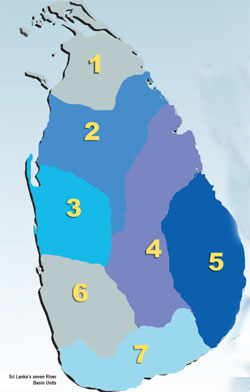
Since local level watersheds/basins have a hierarchical order of progressively increasing in area/size they can become a large River Basin Region at macro level. Seven such River Basin Regions could advantageously replace the present arbitrary nine provincial units: each with an ocean front and each with somewhat equal land area. If people are allowed to handle their basic affairs at GSN unit level, 70% of Sri Lanka’s present crises can be solved.

The map above first developed by the geography professor C.M. MaddumaBandara can be used as the goal of a country administered by language-blind political units. This is the only way to develop a Sri Lankan identity.  The Seven River Basins are: 1. Yalpanam, 2. Rajarata, 3. Dambadeni, 4. Mahaveli, 5. Deegavaapi, 6. Kelani, 7. Ruhunu (This map was published in Chapter 4, in Fifty years of Sri Lanka’s Independence: a socio-economic review, edited by A.V. de S. Indraratna, 1998, p.83).

Readers are encouraged to contact the writer at Cwije7@google.com

17 Responses to Bodu Bala Sena and LLRC (Buddhist self-reliance)”

  1. Sunil Vijayapala Says:
    March 31st, 2013 at 5:07 pm

bbs now should take a different turn – it should become a bit militant, not on the offensive but on the defensive. all able buddhist sinhala young men and women in bbs should take up to marshal arts purely to defend themselves from the thuggery of the present admistration (please ask jayantha liyanage if you don’t believe me). at every electorate bbs must have a branch with a group of young people taking up karate. this will be a deterence to any impending attacks by government supporters at protest rallies.
bbs as their direction is not inclined towards becoming a political party – should however definitely become a peoples movement and let the course takes it’s way – a leader will be born out of this peoples movement and the rest of the story will be written in the annuals of heladeepa.

I agree with Sunil BUT I suggest a different approach – EXPAND RAPIDLY within the army.

Once that is done NO SANE person will ever want to mess with BBS.

BBS was there during the war. MOST people have forgotten that. BBS did a lot of work to give blood to wounded soldiers, help at the hospitals, help in rehabilitation, console loved ones of soldiers, etc. BBS is not like those Arabic tape worms that landed in SL from hell for the bad karma of SL people.

lorenzo – brilliant idea. for a peoples movement to capture power in heladeepa, we need the armed forces. i was in anu and at bodhi when the army with all its reps.(flags) in various battalions, gathered and marched around the bodhi to invoke blessings, just before they went to war with tigers.
all these corrupt politicians in unp, slfp and jvp and predominantly the provincial council uneducated bastards should be wiped out just as we wiped out the tigers and the near future the wahaabis. for that to happen the only solution is a peoples movement as democratric means cannot achieve an authentic result in an election as intimidation will be at it’s maximium force. check with sjp.
we are not racists. we are against tigers(both in sl and india), wahaabis and hegemonic anglo saxons, who are hell bent to destroy our country. with these ponna hupocritical politicians around, we will be doomed, we will have no country to call our own as saudis, malaysians, english, italians, french etc. do, called a sinhala buddhist country.

Sinhalese Buddhists are still in the majority in Sri Lanka. We need to forget whatever differences there are and join hands with BBS. Then it will be possible non violently defeat the hidden agenda of the radical Islamists who wants to spread Sharia law, crazy Ivangalists who try to convert the poor Buddhists,NGOs and all others working against the Sinhalese Buddhists .

Whatever action the BBs takes to safeguard the Nation, that action must be essentially based on well informed, rational thinking and always non-violent. We propose that the BBS should become, among their other actions, a vast Think Tank for Sri Lanka to ensure security and prosperity for all.

Some Questions for the BBS :

* How would BBS address the Labor needs in the plantations sector, especially the tea sector ? Is Sri Lanka going to continue to depend on Tamil Labor living in line rooms built by the British ? These Tamils are called Indian Tamils” and listen to their leaders who are totally India controlled. Isn’t it high time they became Upcountry Tamils and not known as Indian Tamils ?
Isn’t it high time they integrated properly into mainstream life in Lanka and lived outside of the plantations ? Isn’t Mechanisation & Modernisation of the plantations the new way to go ?

* How is the BBS going to address the Illegal Migrant issue ? How did the army estimate of around 100,000 in the ltte Human Shield become 300,000 ? What is to become of these ‘extra’ people ?

* What is the future Language Policy for Lanka ? What do you propose we do to stop Lanka to becoming an appendage of Tamil Nadu through language and religion ?

* How does BBS propose handling the spread of Sharia Law in Lanka ? What prevails in Courts when one party is for Sharia and the other for the Law of Sri Lanka ?

* Isn’t it that when Sri Lanka is destabilised, local rule of law is disregarded and the ‘law of the jungle’ prevails ? Has BBs found out who destabilises Sri Lanka and for what reasons ?

There are many more Questions …..

Fran,

FIRST things first. There are immediate dangers that has to be sorted out first.

BBS will certainly come to those soon.

Sunil,

That way we can PROP UP Gota instead of Basil, Namal and MR who are all pro-Tamilian (NOT pro SL).

When Gota realizes BBS has infiltrated” the 300,000 strong MOSTLY Sinhala Buddhist troops who are now NEGLECTED, he will have to NEGOTIATE.

Army cannot have a trade union and they SILENTLY suffer problems – NO LAND despite saving millions of hectares of land, NO GOOD SCHOOLS for army kids but best free education to Tamilian kids, etc.

This kind of things happen in US, Israel, Japanese armies too.

LTTE and Al Qaeda will sh*t in their pants just to think of it.

Lorenzo,

BBS should do simultaneous projects. Delay is justice denied, and will result in intractable problems in the near future …

——————–

The article below is from today’s Lanka Page. I fail to understand what is ‘Aggressive’ about an Awareness Campaign the article below refers to. Also, haven’t the Sinhala people taken enough crap from the world ? it is high time the Sinhale defended themselves without harming others. It is always mostly the Sinhale who die in other peoples wars, about 98% who die are the Sinhala people, and they die to save the Nation. High time they brought about a ‘no more war’ situation in the country. All the recent wars were to save the Nation from ltte Tamil terrorists & Tamil Caste Wars exported to Sri Lanka from Tamil Nadu – other peoples wars !

Aggressive campaign by Sri Lanka’s extremist Buddhist group to create awareness on challenges to Buddhists
Mon, Apr 1, 2013, 09:40 pm SL Time, ColomboPage News Desk, Sri Lanka.

Apr 01, Colombo: The extremist Buddhist activist group emerging in Sri Lanka plans to carry out an aggressive awareness campaign on the challenges faced by the Buddhists in the country.

The Bodu Bala Sena (BBS) organization will organize monthly conferences in districts to make Buddhists aware of the challenges face by them and to advise on how to overcome these problems.

The organization will also set up youth bodies to educate the youth in the country.

BBS programme coordinator, Dilantha Vithanage, said the organization is looking at setting up an academic institution called the Bodu Bala Sena Vidyayathanaya.

He said the institution is to incorporate Buddhist leadership and attitudes with other disciplines such as management and information technology.

According to Vithanage, it is elements with ulterior motives that are trying to misrepresent the BBS as a force against the Muslims in the country.

Bodu Bala Sena’s hardline attitude towards other religions has drawn concern from moderate Sri Lankans who fear that a Taliban like group is in the formation if the government and the society fail to take action against the group”.

BBS should work WITH the armed forces, quite openly. What is there to hide ?
Does BBS have a hardline attitude towards other religions ? Wasn’t the Halal certification issue was resolved without violence ?
One People, One country with Peace dividends for all.

The writer of the LankaPage article sounds as though he/she is from a foreign hostile country, inimical to the mass of people of Lanka. Are we that divided ? why do we fear each other ?

  1. Lorenzo Says:
    April 1st, 2013 at 3:45 pm

Fran,

The word AGGRESSIVE is wrong. The correct word is ENERGETIC.

  1. Cerberus Says:
    April 1st, 2013 at 3:57 pm

Yes, Lorenzo, I do agree with you.

  1. Fran Diaz Says:
    April 1st, 2013 at 4:02 pm

Lorenzo,

Cerberus seems to have answered for me ! Thanks Cerberus.

The use of correct words is very important.

After WWII, all the people in every European country pulled together to get each country on its feet again, and wonderful growth happened for all in those countries. Similarly, all in Lanka must pull together for this country to shine again. Only happiness & wellbeing for all puts the cherry on the ‘cake of peace’ !

  1. Marco Says:
    April 2nd, 2013 at 11:21 am

For the benefit of Lankaweb stated policy of the democratization of information and opinions”
I somehow doubt this would be published.

Courtesy of Mr David Blacker

Our Moment of Destiny : From The Blacklight Arrow

I think every generation faces its own particular challenges; but the greatest and most defining ones are those of morality and courage. That moment, if missed, condemns that generation — and often many that follow — to a world far more unpleasant and evil than we would wish it to be. For many in the free world of the late 1930s, that moment came with the invasion of Poland and the bombing of Pearl Harbour. It was a moment when my grandfather’s generation had to decide if they would simply stand on the sidelines or go out and fight someone else’s cause. Fortunately for them, the choice was easy; their respective governments took the right fork, and millions of young men — my grandfather included — went out into the deserts, the jungles, and across the seas to ensure that tyranny and racism would not shape our world. For 1960s America, the moment of destiny was in fact a place — Vietnam — and a moral choice. America made its decision, albeit a little late for millions of Vietnamese.

But when that hour of destiny arrived thirty years ago in Sri Lanka, our parents’ generation failed us. For decades, they had watched as extremist rhetoric leveled at the Tamil community gave way to physical violence. They stood by as our constitution was changed to remove any protection the minorities had a right to under law. They were silent when the nation’s leadership was silent on the racism and hatred that was all around them. They did nothing when their elected politicians in fact helped instigate the violence that climaxed in the orgy of assault, murder, rape, and destruction now known as Black July. For thirty years we have wondered how our parents could have been so docile, so shortsighted, so wrong in their choices. We have watched our country torn apart by suicide bombers and child soldiers, by tanks and artillery. We have watched a hundred thousand die, because our parents didn’t say stop!”

Thirty years later, the clock is back at five minutes to midnight; racists are calling for violence, for this country to be only for Sinhalese Buddhists. They are calling for a tiny minority to change their lifestyles or leave; they are calling for their right to worship to be curbed. And they are threatening violence if their demands are not met. Our government is at best silent; at worst in collusion. Our police force is standing by while Muslims are attacked. There are no arrests. There is no condemnation. There is no justice.

The last time this happened, I was eleven years old; an uncomprehending child. I grew up to wonder why my father who could ride a motorcycle through a wall of fire to get me home that July, hadn’t been able to stop what was done to the Tamils and to my country. Was he scared? Didn’t he care? I ask the same questions from myself today. Why am I doing nothing as my country heads towards the flames again. I ask it of my friends — especially the Buddhists — my colleagues, my girlfriend. None of you are racists, I think. None of you believe that Muslims must be persecuted and harassed. Why are you not speaking out? Why are you not protesting? What will it take? Or is there nothing that will drive us out of our homes and on to the streets to brave the thugs and the tear gas, the water cannon and the bullets? Have we no fucking shame?

I feel ashamed right now; ashamed of my government; ashamed of my friends; ashamed of my country. More than anything, I am ashamed of myself. I have never felt this way about my country, and I never thought I would, but I feel it now. And I hate feeling this way. In the worst of the war, I told myself that it wasn’t my fault; that I hadn’t chosen this war to fight. But this is now. This is me. This is us. This is our country and our moment of destiny is here. Why are we doing nothing?

  1. aloy Says:
    April 2nd, 2013 at 2:05 pm

Marco,
You seem to look at SL from London through a Micro’ scope. You dont get the bigger picture; it is blured. We who live here can see what is happening. Go to any supermarket in Colombo. There will be atleast five gonibillas looking at us through a slit in their dress. Isnt this an insult and an aggression on all others?. Why this change all of a sudden. This is just one aspect among many. Cheating in exams and drug trade are two others. Every body should learn to co-exist respectfully and peacefully.

  1. Marco Says:
    April 4th, 2013 at 12:03 pm

Aloy
Thank you for your response.
Regrettably Lankaweb moderator thought fit not to publish my comment in response to yours for reasons i cannot fathom.
I spend 4-5 winter months a year in Sri Lanka overseeing my interest and over the years i have witnessed (among others) a noticeable increase in the Muslim garb in not only in supermarkets but well to do establishments.
It would be wrong to say i was intimidated by such garb and neither should you or any one else. I don’t believe its an insult or aggression unless of course you feel threaten or developed a complex of jealousy.
Its no secret the Muslim community in Sri Lanka with their business skills and acumen have closed a void and taken advantage whilst the rest have been sitting on their backsides and resting on been given on a plate.

Perhaps, you ought to explain yourself with facts on cheating in exams and drug trade.
I agree with your sentiments that all Sri Lankans should learn to co-exist respectfully and peacefully.

Ironically, i find it rather amusing that the 3 suspected Buddhist monks” resorted to the Burqa when escorted to the courts by the police.

  1. Lorenzo Says:
    April 4th, 2013 at 3:42 pm

I feel ashamed right now; ashamed of my government; ashamed of my friends; ashamed of my country. More than anything, I am ashamed of myself.”

You should be David Blacker (a pro-LTTE spy in the army who left the army when his dealings were revealed!!).

Why he doesn’t see the REAL RACISM of TNA and SLMC is anybody’s guess!!!

David Blacker had his blog during the war that ALWAYS said this war is UNWINNABLE. He USED his 2 years in the army to discredit the army.

After leaving the army he was bought over by NGOs. Now he is doing his job.

  1. aloy Says:
    April 4th, 2013 at 6:49 pm

Marco,
I was thinking of not commenting in this forum any more as I have started getting many unusual telephone calls and smss. Anyway I have to respond to your last comment.
I am sure Lankaweb used the correct judgement, looking at your previous comment where you got overly sentimental and even used words only roughians in UK use.
I cannot understand why you got so emotional. Even Sattelite who knew the tiger war very well as a onetime head of state told a sob story in public. She may have done that to get some advantage. Was it so in your case, too?.
As for exam cheating almost everybody in SL know minorities have been doing it for ages.
Thanks Marco.
පළාත් පාලන ඡන්දයේ අවුල මොකක්ද?  

October 12th, 2022

රජිත් කීර්ති තෙන්නකෝන් 

වත්මන් පළාත් පාලන ඡන්ද ක්‍රමය පිළිබඳ විවේචණ ගණනාවක් පසුගිය වසර 4 තුල මතු වූ අතර, එයට පිළියමක් ලෙස ඡන්ද ක්‍රමයේ සංශෝධන පිළිබඳ යෝජනා ඉදිරිපත් කිරීමට දිනේෂ් ගුණවර්ධන මහතා ගේ ප්‍රධානත්වයෙන් පාර්ලිමේන්තු තේරීම් කාරක සභාවක් පත් කරනු ලැබීය. එම කමිටුව සකස් කළ වාර්තාවට පාර්ලිමේන්තු කමිටුවේ සමාජිකයින්ගේ අනුමැතිය ලැබුණේ නැත. මැතිවරණ සංශෝධන නැවතුණේ එතනය.

දිනේෂ් ගුණවර්ධන අමාත්‍යවරයාගේ සභාපතීත්වයෙන් පත් වූ කමිටුවට සියළුම දේශපාලන පක්ෂ නියෝජනය කරන මන්ත්‍රීවරුන් ඇතුළත් විය.  මැතිවරණ පිළිබඳ විශේෂඥතාවයක් සහිත තාක්ෂණික කමිටුවක් පක්ෂ නියෝජනය කරමින් පත් විය. ඔවුන් හැදු ඡන්ද ක්‍රමය ගැන පසුගිිය මාර්තු මාසයේ මා ලියූ ලිපි දෙකක් පහතින් ඇත. නව ක්‍රමය ගැන අදහස් දක්වන්නට විපක්ෂ නායක කාර්යාලයේ රැස්වීම් දෙකකට මම ත්, ආචාර්ය සුජාතා ගමගේ මහත්මියත් සහභාගි වූවෙමු. (හිටපු මැතිවරණ කොමසාරිස් මහින්ද දේශප්‍රිය මහතා ද පාර්ලිමේන්තු කමිටුවේ දී මා සිටි ස්ථාවරයේ සිටි බව ආරංචි වූ නමුත්, ඔහු සිය අදහස ප්‍රසිද්ධියේ ප්‍රකාශ කළේ නැත.)  ඉන් පසු පාර්ලිමේන්තුවේ දී පක්ෂ නායක රැස්වීමක් පැවති අතර එහි දී යෝජිත නව ක්‍රමය නියෝජිත ප්‍රජාතන්ත්‍රවාදයට අහිතකර ලෙස බලපාන ආකාරය පෙන්වා දුනිමි.  පක්ෂ නායකයින් එයට එකඟ විය. ඔවුහු නව ඡන්ද ක්‍රමය පිළිබඳ යෝජනාව කමිටු අවස්ථාවේ දී ප්‍රතිකේෂප කළෝය.

මේ ක්‍රමය ප්‍රතික්ෂේප කිරීම වගේම නව ක්‍රමයක් සකස් කිරීමේ වැදගත්කම එදා මම පක්ෂ නායකයින් වෙත අවධාරණය කළෙමි.  අවසානාවකට එදා එය සිදු වූවේ නැත.  දැන් නැවත පළාත් පාලන ඡන්ද ක්‍රමයේ අර්බුදය සාකච්ඡාවට බදුන් වී ඇත.

වත්මන් පළාත් පාලන ඡන්ද ක්‍රමය ගැන මුලික විවේචනයට හේතුවන කරුණු මෙසේය.

1.       පළාත් පාලන සභික සංඛ්‍යාව 8711 ක් වැඩි බව සහ එය අවම වශයෙන් 4000 ක සීමාවට අඩු කළ යුතු බව.

2.       කාන්තා නියෝජනය පරාජිත දේශපාලන පක්ෂවල පැවැත්මට තර්ජනයක් වන අයුරින් සකස් වී ඇත. කාන්තා නියෝජනය පීඩනයක් ලෙස පරාජිත පක්ෂ මත පැටවෙන්නේය. පත්වන මන්ත්‍රී සංඛ්‍යාවෙන් 25% ක් (4000 න් 1000) ක් වත් කාන්තාවන්ට හිමිවන ක්‍රමය තවදුරටත් පවත්වාගනු ගත යුතුය. (අද කාන්තා නියෝජනය 25% ක් නොව 23.98% කි) එයින් බහුතරයක් පළාත් පාලන ආයතනයේ දෙවන හා තෙවන ස්ථානයන්ට පත් පක්ෂවලිනි.  ආණ්ඩු පක්ෂය මේ කාන්තා නියෝජිතයින්ට ප්‍රමාණවත් ප්‍රතිපාදන දුන්නේ නැත.  හඩක් නගන්නටවත් ඉඩක් දුන්නේ නැත. කාන්තා නියෝජනයේ අපේක්ෂිත ප්‍රතිඑල ලගා නොවනට එය ප්‍රබල හේතුවක් විය.

3.       2018 දී ඉවත් කළ තරුණ කෝටා නියෝජනය නැවත හදුන්වාදිය යුතුයි

4.       කොට්ඨාශ ක්‍රමය රැකගත යුතු අතර මනාප ක්‍රමයෙන් ඉවත්වීම අවශ්‍යය.

5.       ග්‍රාම නිලධාරි වසම් (14,022)  ගණනාවක් සුදුසු පරිදි එක්කොට කොට්ඨාශ සකස් විය යුතුය.

6.       කොට්ඨාශ ඇතුරු මැතිවරණ හදුන්වා දිය යුතුය.

7.       කොට්ඨාශ මන්ත්‍රීවරු දුෂණ, අක්‍රමිකතා ඇති විට, ජනතාවට සේවය නොකරන විට නැවත කැඳවීම සිදු කළ යුතුයි

8.       සභාවේ අය වැය පරාජයට පත් වුව ද, සභාපතිවරයා  ඉවත් නොකළ හැකි පරිසරය තවදුරටත් පවත්වා ගැනීම අවශ්‍ය ය.  ඉලක්කම් නොව, එකගත්වයෙන් පළාත් පාලනය සිදු වනු ඇත්තේ එවිටය.

9.       පාර්ලිමේන්තුව ජාතික සභා, ආංශික කාරක සභා ලෙසත්, රටම ජන සභා ලෙස බලය බෙදී යන ක්‍රමයක් සකස්වෙමින් ඇති බැවින් සභාපති සතු බලය ද කමිටු ක්‍රමයට (බලය බෙදීමේ ක්‍රමයට) යොමු කළ යුතුය. පලාත් පාලනයේ සභාපති ඒකාධිපතියෙකි.  රණසිංහ ප්‍රේමදාස ජනාධිපතිවරයා මේ ක්‍රමය හැදුවේ තනි මිනිහෙකුට පලාත් පාලන ආයතනයක් පවත්වා ගෙන යා හැකි ලෙසය. නමුත්, දැන් එය වෙනස් විය යුතුව ඇත.

10.   අංක 2 සිට 9 දක්වා කිසිවක් යථාර්ථයක් බවට පත්වන්නට නම් 8711 ක් වන සභික සංඛ්‍යාව 4000 ක් දක්වා අඩු විය යුතුය.  එයට සීමා නිර්ණයක් අවශ්‍යය. ජයලත් – රවී කමිටුවේ අත්දැකීම් අපට ඇත.  අශෝක පීරිස් කමිටුවේ දිස්ත්‍රික් රැස්වීම්වලට මම ද සහභාගී වී ඇත්තෙමි. අවශ්‍ය නම් සීමා නිර්ණය දිග්ගැස්සවිය හැකිය. ඉක්මනින් වාර්තා හදන හැටි එම කමිටුවේ සාමාජිකයෙකු වූ උපුල් කුමරප්පෙරුම මහතාට හොදින්ම දන්නේය. ප්‍රමාද කරන හැටි එම කමිටුවේ අනික් සාමාජිකයින්ගෙන් අසා දැනගත හැකිය.   මාස හතරකට අඩු කාලයකින් ද සීමා නිර්ණය කළ හැකි බව එවකට සභාපති තවලිංගම් මහතා ඔප්පු කළේය.  වත්මන් සීමානිර්ණය කොමිසමේ සභාපති මහින්ද දේශප්‍රිය මහතා එදා ජයලත්-රවී, අශෝක පීරිස් හා තවලිංගම් කමිටුවලට සාධනීය විවේචකයාය.   මැතිවරණ පමණක් නොව සීමා නිර්ණයේ ද කප්පිත්තෙකි.  තවලිංගම් මාස 4 න් කළ දෙය අවශ්‍ය නම් වත්මන් සභාපතිවරයාට මාස 3 න් කළ හැකි වනු ඇත. අනෙක් අතට, ඉහත කමිටු තුනටම වඩා ඩිජිටල් දත්ත, සිතියම් හා කේෂ්ත්‍ර අත්දැකීම් අතින් අප වසර 8 ක් පොහොසත්ය.  

ඉහත 1-9 යෝජනාවලට දේශපාලන පක්ෂ, සිවිල් සංවිධාන හා මැතිවරණ විශේෂඥයින්ගේ අවම එකඟතාවයක් ඇත. අවසනාවකට මේ ඉලක්ක ලගාකර ගත හැකි ඡන්ද ක්‍රමයක් හදාගන්නට එකඟවීමට අපට හැකි වී නැත. පාර්ලිමේන්තුව නියෝජනය කරන පක්ෂ තම කාලය, දැනුම හා සම්පත් එයට වෙන් කර නැත.

කමිටු අවස්ථාවේ දී පරාජයට පත් වූ මැතිවරණ ක්‍රමය ගැන දේශපාලන පක්ෂ තබා, මැතිවරණ නිරීක්ෂකයින් හෝ පළාත් පාලන සංසදයවත් සංවාදයක් ඇති කළේ නැත.  2023 දී මාර්තු පළාත් පාලන ආයතනයන්හි කාලය  අවසන්වීමට නියමිත බැවින් දැන් ප්‍රශ්නය නැවත කරළියට පැමිණ ඇත.  මේ ප්‍රශ්නය දැන් වසර 2 ක් කථා කර ඇත. සංවාද කර ඇත. කමිටු අවස්ථාවේ දී නව යෝජනවා පරාජය කළ නමුත්, කිසිවෙකුත් නව යෝජනා ඉදිරිපත් කළේ නැත.

පළාත් පාලනයේ සභික සංඛ්‍යාව, වියදම (පළාත් පාලන ආයතනයේ මුළු ආදායමෙන් විශාල පංගුවක් සභිකයින්ට වැටුප් හා දීමනා ගෙවීමට වැයවීම), තරුණ නියෝජනය අහිමි කිරීම, කාන්තා නියෝජනයේ පීඩනය පරාජිත පක්ෂ මත වැටීම, සභාපතිවරයාගේ අත්තනෝමතික බලතල විසඳිය යුතු ආණ්ඩුකරණයේ ගැටළු වෙති.  ඒවා ඉක්මනින් හෝ පමා වී හෝ කවදා හෝ කවුරුන් විසින් හෝ නිවැරදි කළ යුතුව ඇත.

පාර්ලිමේන්තු කමිටු විසින් යෝජනා කළ ඡන්ද ක්‍රමයේ අඩුපාඩු දක්වමින් මා විසින් නිකුත් කල නිවේදනය හා ප්‍රකාශ මෙහි අමුණා ඇත.  අවශ්‍ය අයෙකුට පාර්ලිමේන්තුවේ දී පක්ෂ නායකවරුන්ට ඉදිරිපත් කළ කරුණු ද ලබා දිය හැකිය. කමිටු අවස්ථාවේ යෝජිත ඡන්ද ප්‍රතිසංස්කරන පරාජය වූවේ ඇයි දැයි එයින් අවබෝධ වනු ඇත.   

https://www.facebook.com/Keerthi.tennakoon/posts/pfbid0YFopt2iXGJJoTEk3bZGcijj6J4WrtPirg57jnsoYSzmiJvzapZg4wi3XDUEnXUuMl
https://www.facebook.com/Keerthi.tennakoon/posts/pfbid0sA4QuePL5UqZNKedJoGnjDedYTeFxBTs9JQwkNRYERZgJJQt3zqiyn8wb9Y6omhjl

ජී.එල්.පීරිස් හා ඩලස් අලහප්පෙරුම ඡන්දය කල් දැමීමක් ගැන ඊයේ කතා කර ඇත.  කමිටු අවස්ථාවේ දී මාගේ ද දායකත්වය සහිතව විපක්ෂ විසින් පරාජය කළේ පෙහොට්ටුව ඉදිරිපත් කළ මේ සංශෝධන බව ඔවුන් දෙපලටම අමතක වී ඇත.

ප.ලි. — පළාත් පාලන ඡන්දය කල් දැමීමට මම විරුද්ධ වෙමි. එලෙසම, අවම වශයෙන් තරුණ නියෝජනය හෝ නොමැතිව, ඒකාධිපති සභාපති බලය සමඟ තවදුරටත් සභිකයින් 8711 ක් තවදුරටත් පවත්වාගත යාමට ද එදත්, අදත් මා විරුද්ධ වී ඇත. මාගේ වෙනස් නොවන ප්‍රතිප්තිය එයයි.

රජිත් කීර්ති තෙන්නකෝන් 

Aragalists and their proposals for “System Change”.

October 12th, 2022

By Chandre Dharmawardana      (chandre.dharma@yahoo.ca)

Although there is much talk of system change”, it is hard to find specifics of the new systems that are to be created. In the early seventies, Mahinda Wijesekera, the father of the present Minster for Power was a student leaders of the Vidyodaya University. As a key figure of the JVP, he told me that that they are fighting for a system change”. My critique of their plans got reported by Viranga (Nihal Ratnayake) in the Daily News. The campus faced student strikes with the demand that I withdraw my critique, considered reactionary and insulting. The five lessons of the JVP sufficed for the young revolutionaries to fall behind Wijeweera and cause mayhem.

Pathum Kerner, one of the Aragalists out on bail is a medical doctor, in his forties.  He contested the 2020 general elections as the leader of an unofficial Green political party, rejecting the existing corrupt political parties. More recently, his approach to system change” was presented in a U-Tube.

The rural farmers began the initial protests. They faced Gotabaya’s ban on agrochemicals that drastically reduced harvests and brought them bankruptcy. The eco-extremists of the Viyathmaga who triggered the ban believed that traditional agriculture and organic farming were healthier” and equally bountiful. Going organic” was the SYSTEM CHANGE that the eco-extremists had wanted. That the present methods of food production are unsustainable”, and that ”a different system” is needed, seem reasonable and had acceptance among the elite,  among politicians, and even among many scientists who gloss over the realities of feeding a world of 7-8 billion people. Many regard the switch to organics as an objective that should be achieved gradually”.  Pathum Kerner would have endorsed this policy in July 2020. The JVP also seems to support going fully organic” gradually.

The present writer has argued (in many publications) that even the gradual approach” is meaningful only if we let half the world population starve. Growing organic food for a niche market of elites and for export, while retaining fertilizer-based agriculture for feeding the world is the only scientifically valid model of agriculture that we have today. Modern approaches to agriculture using agro-chemicals are far friendlier to the environment than organic” models of agriculture.

The Yahapalanites under Sirisena, Ven. Ratana, Champika Ranawaka and others pushed to ban the pesticide Glyphosate, destroying the corn harvest and critically damaging the plantation sector.  This was not lesson enough for the eco-extremists of the Viyathmaga who influenced Gotabaya Rajapaksa.

The protests of farmers were soon overtaken by the protests of the middle class facing shortages of natural gas for cooking and fuel caused by the forex crisis that was expected in the wake of the Pandemic.   The Aragalaya gathering at Colombo’s Galle Face Green, fueled by the forex crises swelled, demanding Gotabaya’s resignation to make a radical system change”. It was not only a protest, but also a cultural carnival displaying a spontaneous creativity and gaiety nourished by the inputs of the leisured classes of Colombo. I was reminded of the fête de l’Humanité” that the French Communist party newspaper holds every September in Paris, since the 1930s, showcasing its many famous literary and artistic adherents.  The Aragalaya sent President Gotabaya into exile on July 10th but the goons of government and the violent side of the Aragala got exposed in the process.

 Although Ranil Wickremasinghe (RW) bemoaned the destruction of his valuable collection art, books and Buddhist sculptures in his house, he had no thoughts of preserving for posterity the spontaneous art of the Aragalaya. The public has clearly expressed its opposition to violence and counter-violence, destruction of MPs’ houses and ignored the August 9th Aragalaya call to regroup.  

Gotabaya called several leaders to ride the cusp of the crisis, but it was RW who captured the wave and shot up to become the new President. The Aragalaya and the public had rejected all political parties, corrupt to the core, and asked for a clean break. In contrast, the party leaders and political commentators have called for an all-party interim government (APIG)”. This did not happen even under daily suicide attacks by the LTTE, and so, how can cantankerous politicians come together heeding a largely peaceful Aragalaya?  An election under an APIG would have returned the same politicians conferring them a false façade of legitimacy.  The best option is indeed to carry on with RW and a skeleton government. But what a corrupt skeletons did RW gather? Why was it necessary for RW to appoint individuals with criminal records, men suspected of blatant bribery etc. to his cabinet? One of the reasons given by Premadasa against joining the government is the continuing stench of corruption in the RW government.

So, how does the Aralgalaya leaders, some out on bail, or any other new faces hope to change this entrenched system? They have some two and a half years to get organized and form new parties with new faces and write manifestos, while RW also has a chance to either prove his worth and his integrity, or to fall into the hands of criminals, financial wheeler dealers and old cronies.  Or, is RW already a prisoner of the Pohottuwa party?

Dr. Pathum Kerner (PK) has presented his proposals for system change in a U-tube video, https://www.youtube.com/watch?v=OTOXSCjmB0g  While the revolutionary youth of the 1970s under Wijeweera demanded full nationalization, PK proposes to go beyond JRJ towards a complete privatization” of the internally economy. Everyone complains of the large size of government. It runs most of the industries and services using 1.5-2 million to do the work of 0.5 million. PK makes the same complaint and speaks glowingly of Thatcher and Regan. He points to how the state sector is used   by politicians to give contracts and employment to their cronies. New business licenses are issued through patronage.  An arrack permit brings ten to twenty million rupees to the politician. The system” breeds corruption and cronyism.  PK alludes to the need for law and order, transparency, efficiency and shrinking the government — the standard neoliberal narrative since Margret Thatcher.

Neoliberal economies legalize” corruption by institutionalizing lobbying. Following Thatcher will need tough inhuman steps that only a government armed with draconian powers can carry out in culling out one million government employees.  Pathum Kerner refused to elaborate how he hopes to do this. A large part of the government business” is in providing health, education, security, infrastructure and public transport. PK avoids these inconvenient topics.

So the Aragalaya Right offers the usual free-market deregulation imposed under an iron hand a la Pathum Kerner, while the Aragalaya Left offers the usual socialist workbook to be imposed by the July 10th revolutionaries with their helmets, motor bicycles and incendiary devices?  

Culling a million workers to shrink government will cause economic collapse even if they go without a fight because removing a million consumers from the market will cause a market slump. A country facing economic collapse immediately needs MORE GOVERNMENT intervention and not less. The governments can buy stock in private companies and inject money. The claim that governments must sell off loss-making enterprises to come out of an economic crisis is inconsistent with macro-economic dynamics. When employment is terminated, the government must pay unemployment allowances to keep people solvent and ensure that their collective loss of buying power does not kill the market. The government can safely divest itself of profit-making businesses, but it has to restructure and re-invest in loss-making businesses, unless they are nonessential businesses that can be closed up. Issuing of licenses and permits should be tied to bank loans so that the liabilities of failed businesses or corrupt contracts become a bank liability.  Politicians should be barred from sponsoring projects and limit themselves to legislation. Strong executive powers are needed to enforce social stability during a crisis.

 Meanwhile, strategic sectors like energy and food must be re-organized (jointly with foreign entrepreneurs where needed) to exploit the special advantages that Sri Lanka has. The large potential in hydropower obtained by reducing evaporation, diesel from vegetable oils, biomass energy etc., can be developed with limited forex expenditure, unlike solar energy that needs forex in the initial stages. The food and plantation sectors too need forex but this is immediately recovered within the year with good margins when the products are exported.

STATEMENT BY PERADENIYA ARTS FACULTY TEACHERS’ ASSOCIATION (PAFTA)) regarding the current ragging issue.

October 12th, 2022

PERADENIYA ARTS FACULTY TEACHERS’ ASSOCIATION (PAFTA)

PERADENIYA ARTS FACULTY TEACHERS’ ASSOCIATION
(PAFTA)
Faculty of Arts, University of Peradeniya
Peradeniya 20400, Sri Lanka
President General Secretary Vice President Assistant Secretary Treasurer
Prof. A. Parakrama Dr. T. Kithsiri Prof. U. Abeyrathne Mr. A. Dharmarathne Dr. S. Dorabawila
Committee Members
Prof. A. Jayawickrama Prof. D. Karunanayake Dr. K. Thoradeniya Dr. S. Mantillake Mr. S. Premarathne

On September 14, 2022, a group of students studying law in the Faculty of Arts were assaulted
while they were dining in the canteen and were subsequently prevented from entering the canteen
premises. This is not an isolated incident. For years now, in the Faculty of Arts, a group identified
as Raggers”, through sheer force of might and intimidation, have denied students identified as
Anti-Raggers” entry to public spaces of the university, including canteens. Anti-Raggers” were
forced to find other inadequate spaces for their daily interaction and even to have their meals on
campus. The violent and intolerant culture of the rag in the universities is such that Anti-Raggers
are either prevented from residing in the halls of residence or hounded out of the halls of residence
through other means.

To return to the specific incident, on the 14th of September a group of students from the
Department of Law, who could find no other place, decided to have their midday meal in one of
the two main student canteens in the vicinity. This resulted in a faction of the Rag Group” to
assault these students, and to later barring the Law students’ entry into the canteen. On hearing
the commotion, the Dean of the Arts Faculty, along with other members of the staff, intervened
at this point. The Dean called a meeting representing all factions, in order to resolve the matter
amicably even at this stage. He also made it clear on that occasion that all public areas of the
University commonly accessed by students, were open to all students, with no exceptions at all.
However, promises made at this meeting were willfully broken within hours, resulting in further
violence against these Law students.

To end this spiraling cycle, the Dean, on the basis of the Faculty Board’s decision, asked for a
written assurance on the part of the two affected student groups and the student union, the official
representative body of the students, guaranteeing their commitment to free and open access to the
canteens and other common facilities to all. Initially, in the interest of protecting the anti-rag group,
on-site classes were converted to the online mode. However, after further discussion and clear
intransigence on the part of the union and its allies who alone of the three groups refused to
provide such a letter, it was decided that until such an assurance is made, all academic activities of
the Faculty of Arts should be suspended as such activities cannot be conducted in an environment
of violence and intimidation. To date, the Student Union has failed to provide such assurance.
Further, subsequent to the interventions made by the Dean, he became the target of threats and
intimidation made by some students led by the Student Union. An effigy of him was burnt near
the very canteen and he was publicly vilified at a much-publicised student union rally on the 15th
September.

Ragging has been the bane of the university system for decades. It is a violent, unjust,
undemocratic, and inhuman practice. As PAFTA, we have zero tolerance for the rag and all
related actions that perpetuate this practice. We are also particularly outraged at the intimidation
and threats levelled at the Dean by members of the Student Union. We are committed to
safeguarding the interests of all members of the university community, the safety and welfare of
our members and the safety of all students and others in the university community; upholding that
basic principle, we condemn these acts of intimidation unequivocally.

As teachers in the higher education system we have always demonstrated a firm commitment to
the functioning of the State University System. This system has nurtured all of us, and has
contributed greatly to the welfare of this country, in the economic, administrative, political and
cultural spheres. In condemning the undemocratic and violent practices of groups of students, we
only wish to make the state system better, more democratic and be in greater service to the larger
society. It is not, as has been implied elsewhere, particularly in media releases of the student union,
that we are a part of a conspiracy to undermine the state university system. In condemning the rag
and the violence of September 14 and 15, we can only improve the quality of education and the
well-being of the university system.

It has to be made crystal clear that we recognize the inalienable right of students to engage in
political activities and to work towards constructive social and systemic change. It is not our
intention and not in the public’s interest to use incidents related to the rag, including this incident
in particular, to undermine the people’s struggle of the past few months which is founded on the
call for greater democracy in the country. We condemn the actions of any group or political faction
that seeks to misuse the just struggle against the rag to gain cheap political mileage and to
undermine the greater democratic vision of the present political struggle against injustice.
In sum, we condemn the practice of ragging and require all students to commit to a university
environment in which everyone can learn with peace of mind; we condemn all practices of violence
and repression, and stand by all those who are unjustly treated in any system. Specifically, we trust
that the Student Union can assure us of their commitment to restoring normalcy and to a violencefree
environment in the Faculty, so that we can resume the conduct of lectures as soon as possible.
Prof. Arjuna Parakrama
President
Peradeniya Arts Faculty Teachers’ Association

A survival strategy amidst geopolitical rivalry

October 12th, 2022

by Neville Ladduwahetty Courtesy The Island

During the course of his address, as Chair of the 55th Annual meeting of the Asian Development Bank, Sri Lanka’s President, Ranil Wickremesinghe, said, As they say, in many of our countries, when the elephants fight, it is the grass that is crushed”. As far as Sri Lanka is concerned, its strategically significant location in the Indian Ocean makes it the turf for the rivalry between the QUAD made up of the United States, India, Japan and Australia on the one hand, and China on the other, to manifest itself. How Sri Lanka strategises its survival in such an environment is key not only to its immediate economic revival but also for all time.

The single most critical issue affecting Sri Lanka’s economic revival is debt, and therefore the need to restructure it. In this regard, the expectation is that the role played by the International Monetary Fund (IMF) backed up by the Extended Fund Facility of US$ 2.9 billion is expected to encourage the creditors to be more accommodative towards Sri Lanka, when addressing its debt crisis. This however is not an assured outcome. The President during his address announced the progress made with the IMF when he stated: Towards this end we have already undertaken major macroeconomic policy reform measures. I am pleased to inform you that we have now reached a Staff Level agreement with the International Monetary Fund on a four-year program supported by the Extended Fund Facility. The program is aligned with the commitment of the Government to implement an ambitious and comprehensive package of reforms that will help restore the sustainability of our public finances, addressing external imbalances, and restarting our growth engine through structural reforms and improvements in governance”.

The question addressed below is the need for Sri Lanka to explore alternative strategies in the event Sri Lanka fails to reach a common agreement with the creditors despite the Staff-Level Agreement reached with the IMF, and Sri Lanka is left to its own devices to get back on a sustainable track. For these reasons, it is imperative that Sri Lanka engage earnestly in an alternative exercise to be prepared to meet unexpected exigencies that could arise from geopolitical rivalries.

IMF CONDITIONALITIES

Presented below is a press release issued following the Staff-Level Agreement reached with the IMF team. Parts of the Key elements of the program” are highlighted to emphasise what it takes for Sri Lanka to comply with the 48-month arrangement under the Extended Fund Facility of about US $ 2.9 billion”

End-of-Mission press releases include statements of IMF staff teams that convey preliminary findings after a visit to a country. The views expressed in this statement are those of the IMF staff and do not necessarily represent the views of the IMF’s Executive Board. Based on the preliminary findings of this mission, staff will prepare a report that, subject to management approval, will be presented to the IMF’s Executive Board for discussion and decision.

IMF staff and the Sri Lankan authorities have reached a staff-level agreement to support Sri Lanka’s economic policies with a 48-month arrangement under the Extended Fund Facility (EFF) of about US$2.9 billion.

The objectives of Sri Lanka’s new Fund-supported program are to restore macroeconomic stability and debt sustainability, while safeguarding financial stability, protecting the vulnerable, and stepping up structural reforms to address corruption vulnerabilities and unlock Sri Lanka’s growth potential.

Debt relief from Sri Lanka’s creditors and additional financing from multilateral partners will be required to help ensure debt sustainability and close financing gaps. Financing assurances to restore debt sustainability from Sri Lanka’s official creditors and making a good faith effort to reach a collaborative agreement with private creditors are crucial before the IMF can provide financial support to Sri Lanka.

Key elements of the program (emphasis mine) are:

RAISING FISCAL REVENUE TO SUPPORT FISCAL CONSOLIDATION.

Starting from one of the lowest revenue levels in the world, the program will implement major tax reforms. THESE REFORMS INCLUDE MAKING PERSONAL INCOME TAX MORE PROGRESSIVE AND BROADENING THE TAX BASE FOR CORPORATE INCOME TAX AND VAT. The program aims to reach a primary surplus of 2.3 percent of GDP by 2025.

INTRODUCING COST-RECOVERY BASED PRICING FOR FUEL AND ELECTRICITY

to minimize fiscal risks arising from state-owned enterprises. The team welcomed the authorities’ already announced substantial revenue measures and energy pricing reforms;

MITIGATING THE IMPACT OF THE CURRENT CRISIS ON THE POOR AND VULNERABLE BY RAISING SOCIAL SPENDING,

and improving the coverage and targeting of social safety net programs;

RESTORING PRICE STABILITY

through data-driven monetary policy action, fiscal consolidation, phasing out monetary financing, and stronger central bank autonomy that allow pursuing a flexible inflation targeting regime. A NEW CENTRAL BANK ACT IS A CORNERSTONE OF THIS STRATEGY;

REBUILDING FOREIGN RESERVES THROUGH RESTORING A MARKET-DETERMINED AND FLEXIBLE EXCHANGE RATE,

supported by the comprehensive policy package under the program;

Safeguarding financial stability by ensuring a healthy and adequately capitalized banking system, and by upgrading financial sector safety nets and regulatory standards with a revised Banking Act; and

REDUCING CORRUPTION VULNERABILITIES THROUGH IMPROVING FISCAL TRANSPARENCY AND PUBLIC FINANCIAL MANAGEMENT, INTRODUCING A STRONGER ANTI-CORRUPTION LEGAL FRAMEWORK, AND CONDUCTING AN IN-DEPTH GOVERNANCE DIAGNOSTIC, SUPPORTED BY IMF TECHNICAL ASSISTANCE.

These Key Elements of the program were known to the government at the time the Staff-Level Agreements was reached. It must then mean that the Sri Lankan government has agreed to commit itself to fulfilling the undertakings specified above to receive about US$ 2.9 over 48 months to support its economic policies” notwithstanding the nature and range of its scope that amount to intrusion into the domestic affairs of a sovereign State. The other even more daunting challenge is reaching a common agreement on debt restructuring with countries such as Japan, India, China and private creditors. However, the fact that Sri Lanka is prepared to resolutely face such extreme challenges reflects the desperation Sri Lanka finds itself in at this juncture.

The question that arises and it is imperative that it is answered is: WHAT IF, after banking so heavily on support from the IMF for Sri Lanka’s economic revival, Sri Lank fails to meet the benchmarks and parameters set by the key elements” in the IMF program or fails to reach a common agreement for debt restructuring with the creditors? Since such a prospect cannot be ruled out in a background of geopolitical rivalries, it is imperative that Sri Lanka prepare itself by seriously exploring alternative options independent of support from the sources currently being pursued. If Sri Lanka does not explore alternative options. its economic revival program would be severely impacted, and Sri Lanka would then be left to its own devices to meet all challenges.

THE FOCUS of the SURVIVAL STRATEGY

One key area that would impact on Sri Lanka’s economic revival program is the cost of fuel oil. A Special Press Release dated June 13, 2021by the Cost of Living Committee chaired by the President states: Sri Lanka has become a country that not only spends a large amount of foreign exchange for fuel imports, but also a country where its transport services, power generation and the function of some of the factories are based on these imports. In 2019 alone, the foreign exchange spent on oil imports was US$ 3, 677 million”. However, with the reduction in international oil prices coupled with the ban on vehicle imports the cost of fuel imports was reduced to US$ 2,325″. DESPITE, SUCH FLUCTUATIONS, THE PRESS RELEASE STATES: THE EXPENDITURE FROM THE FOREIGN EXCHANGE EARNINGS FOR PETROLEUM IMPORTS WOULD BE AROUND US$ 4,000 MILLION. THIS AMOUNT IS CLOSE to 1/3 of the TOTAL FOREIGN EXCHANGE EARNED FROM THE EXPORTS… THE PRIVATE AND PUBLIC TRANSPORTATION ACCOUNTS FOR NEARLY 60%OF THE FUEL CONSUMPTION”.

With the introduction of the QR system for transport and the continued ban on vehicle imports together with the fact that the cost of importing fuel oil is highly dependent on global developments, a more realistic import bill for fuel oil could be assumed to be US$ 2,500 to 3,000 million annually. This means that Sri Lanka would need US$ 10, 000 to 12,000 million over a period of 4 years. Since the Extended Fund Facility of about 2.9 Billion proposed by the IMF pales in significance to meet the fuel oil needs of Sri Lanka, and because fuel oil is fundamental to the economic revival program, it is imperative that Sri Lanka explores fresh strategies to meet fuel oil needs without which there would not be an economic recovery.

The following are the hard realities:

The economy cannot revive without sustained supplies of fuel oil.

Sri Lanka does not have the foreign exchange to sustain importing its fuel oil needs.

The economy cannot revive if Sri Lanka has to live from ship load to ship load, or on negotiated credit lines.

The Strategy:

Therefore, Sri Lanka has to negotiate a government to government arrangement or one that is underwritten by governments where the payment for immediate fuel oil needs is deferred to a later date, until a Refinery is set up and functioning on the basis of a Joint Venture. Furthermore, such a Joint Venture would enable Sri Lanka to repay deferred commitments from Sri Lanka’s share of the proceeds from the Joint Venture.

Savings arising by deferring payment while the refinery is being set up could be used to repay outstanding debts.

The Refinery should be located in Trincomalee.

The Capacity of the Refinery should be to meet Sri Lanka’s needs with the excess being exported to Indian Ocean Rim (IOR) countries.

Sri Lanka’s equity to the Joint Venture could be part of the Tank Farm in Trincomalee, its Harbour and its strategic location for distribution of finished petroleum products.

Equity of the Partner is the Refinery and the steady supply of fuel oil.

THE URGENCY of the SITUATION REQUIRES THAT SRI LANKA EXPLORES THIS OPTION at the HIGHEST LEVEL — an OPTION that is REFLECTIVE of the CORE VALUE of SELF-RELIANCE.

CONCLUSION

The Staff-Level agreement that Sri Lanka has reached with the IMF backed up by an Extended Fund Facility of about US$ 2.9 billion is expected to boost the confidence of the creditors and encourage them to be accommodative towards Sri Lanka in their efforts to reach a common restructuring arrangement to address its debts. If such a positive outcome materializes, the prospects of an economic revival would be real. On the other hand, if outcomes of the negotiations do NOT turn out to be as encouraging as hoped for, it is imperative that Sri Lanka prepares itself beforehand with alternative strategies, one of which would be to earnestly explore arrangements at the highest level to secure its fuel oil needs on the basis proposed above, if it hopes to revive its economy. If by a stroke of unusual good fortune, the outcomes relating to restructuring and a Joint venture to secure Sri Lanka’s fuel oil needs are both positive, the economic revival would be that much faster.

Ahmadiyya Delegation Meets Hon. (Dr.) Bandula Gunawardena

October 12th, 2022

By A. Abdul Aziz – Chairman, Press & Media Desk, AMJSL.

A two member delegation from the Ahmadiyya Muslim Jama’at Sri Lanka (AMJSL) visited to Ministry of Mass Media  in Colombo on 11 October 2022. 

Ministry Officials welcomed the delegation and arranged to meet  Hon. Bandula Gunawardena, Minister of Mass Media.

Honorable Minister was very much delighted and respectfully accepted the Holy Qur’an Sinhala Translation and the Sinhala Translation of the book ‘Life of Muhammad (pbuh)’  –  and the bookWorld Crisis and the Pathway To Peace – A compilation of addresses in various Parliaments by Ahmadiyya Khalifa His Holiness Hazrat Mirza Masroor Ahmad.

අරගලය ක්‍රියාත්මක සමයේ මට රුපියල් ලක්ෂ හත අටක මුදලක් ආවා – දමිතා අබේරත්න (වීඩියෝ).

October 12th, 2022

උපුටා ගැන්ම  හිරු පුවත්

කොළඹ ගාලු මුවදොර පිටියේ ක්‍රියාත්මක වූ අරගලය සාමකාමී විරෝධතා ව්‍යාපාරය හා එක්ව සිටි සමයේ දී තමන්ට සමීප හිතවතුන්ගෙන් මුදල් ආධාර ලැබුණු බව ජනප්‍රිය රූපවාහිනී සහ චිත්‍රපට නිළි දමිතා අබේරත්න පවසනවා.

ඇය මේ බව පවසා සිටියේ, හිරු ප්‍රවෘත්ති සමඟ පැවැති විශේෂ සම්මුඛ සාකච්ඡාවක දී.

ඇය වැඩිදුරටත් පවසා සිටියේ, එම කාලසීමාව තුළ දී අයගේ සමීපතම සුබ පතන්නන් විසින් රුපියල් ලක්ෂ 7ක 8ක පමණ මුදලක් ලබා දුන් බව යි.

කෙසේ වෙතත් සමාජ මාධ්‍ය ඔස්සේ පැතිර යන බොහොමයක් ආරංචි සහ තොරතුරු අසත්‍ය බවත් තමන් හට මිලියන ගණනින් කිසිදු අවස්ථාවක මුදල් ලැබී නොමැති බවත් ඇය සඳහන් කළා.

එමෙන්ම මෙහි දී දමිතා අබේරත්න වැඩිදුරටත් කියා සිටියේ, මේ ආකාරයට තමන්ට චෝදනා එල්ල කරන කිසිවෙකු හෝ අරගලයට කිසිදු ආකාරයක ආධාරයක්, උපකාරයක් සිදු කළ අයවලුන් නොවන බව යි.

මාස ගණනාවක් පුරා කොළඹ ගාලු මුවදොර පිටියේ ක්‍රියාත්මක වූ අරගලය සාමකාමී විරෝධතා ව්‍යාපාරය පවත්වාගෙන යාම සඳහා මුදලින් මෙන්ම ද්‍රව්‍යවලින් ද ආධාර උපකාර කළ දෙස් විදෙස් බොහෝ පිරිසක් සිටි බවත් ඔවුන්ගේ ශක්තිය නොමැතිව අරගලය පවත්වාගෙන යාමේ හැකියාවක් නො තිබූ බවත් ඇය කියා සිටියා.

එමෙන්ම මෙහි දී සිය සැමියා දෙමළ ඩයස්පෝරාවට සම්බන්ධ බවට නැඟෙන චෝදනාවලට පිළිතුරු දුන් දමිතා අබේරත්න කියා සිටියේ, තමන් දමිළ ජාතිකයකු විවාහ කර ගත් සැණින් ඔහු දෙමළ ඩයස්පෝරාවට සම්බන්ධ හෝ ඔහු කොටියෙක් ලෙස හෝ හංවඩු ගසන්නේ, තමන් අරගලයේ ක්‍රියාකාරී සාමාජිකාවක ලෙස කටයුතු කිරීම නිසා ද යනුවෙන් ඇය ප්‍රශ්න කළා.

සිය සැමියාගේ පියා කේරළ ජාතිකයෙකු බවත් මව සිංහල බවත් වැඩි දුරටත් කියා සිටියි.

දමිතා අබේරත්න සඳහන් කළේ, ඔවුන්ගේ නිවාස 1983 කළු ජූලියේ දී ගිනි තබා විනාශ කළේ සිංහල මිනිසුන් විසින් බව යි.

එමෙන්ම සිය සැමියා මේ වේ වන විට වසර නවයකට වැඩි කාලයක් ශ්‍රී ලංකාවේ ජීවත් වන බවත් මින් පෙර කිසිදු අවස්ථාවක මේ ආකාරයේ චෝදනාවක් ඔහුට එල්ල නො වූ බවත් ඇය සඳහන් කළා.

මෙහි දී සමගි ජන බලවේගය පක්ෂය සමඟ එක්ව දේශපාලන ගමනක් යාමට ඇති සූදානම සම්බන්ධයෙන් සිදු කළ ප්‍රශ්න කිරීම්වලට පිළිතුරු දුන් දමිතා අබේරත්න කියා සිටියේ, පක්ෂ දේශපාලනය සඳහා එක්වීම සහමුලින්ම තමන්ගේ පෞද්ගලික තීරණයක් බවයි.

එය ගාලු මුවදොර ප්‍රකාශනය උල්ලංඝනය කිරීමක් හෝ වෙන යමක් නොවන බව ඇය සඳහන් කළා.

එමෙන්ම කිසිදු අවස්ථාවක සමගි ජන බලවේගය පක්ෂයෙන් තමන්ට දේශපාලනය කිරීම සඳහා ආරාධනාවක් නො ලැබුණු බවත් නමුත් එක්සත් ජාතික පක්ෂයෙන් සහ පොදුජන පෙරමුණෙන් තමන්ට ආරාධනා ලැබුණු බවත් ඇය සඳහන් කළා.

මෙහි දී රුපියල් කෝටි ගණනක මුදල් වංචාවකට සම්බන්ධ වී සිටින තිලිනි ප්‍රියමාලි නමැත්තිය හමුවේ මුදල් තැන්පත් කර ඇතැ යි සහ ඇයගෙන් මුදල් ලබාගෙන ඇතැයි යන චෝදනාව ට පිළිතුරු දෙමින් දමිතා කියා සිටියේ, කිසිදු අවස්ථාවක තමන් තිළිණි ප්‍රියමාලි හමුවේ කිසිදු මුදල් තැන්පතුවක් සිදු කර නොමැති බව යි.

සිය ඥාති පුත්‍රයෙකු අනතුරකට ලක් වී ඇති අවස්ථාවක ඇය ශෙරීන් කුමාරතුංගගේ නම භාවිත කරමින් තමන්ට දුරකථන ඇමතුමක් ලබා දුන් බවත් සිය ඥාති පුත්‍රයා කොළඹ ජාතික රෝහලෙන් ඉවත් කරගෙන ඔහු පෞද්ගලික රෝහලකට ඇතුළත් කරන ලෙසත් එම සියලු වියදම් තමන් බලා ගන්නා බවත් කියා සිටි බව ඇය සඳහන් කළා.

කෙසේ වෙතත් ඇයගේ එම යෝජනාව එම අවස්ථාවේදීම ප්‍රතික්ෂේප කළ බවයි දමිතා කියා සිටියේ.<br /><br />ඉන් අනතුරුව සිය නිවසට පැමිණි ඇය තමන්ගෙන් රුපියල් ලක්ෂ පහක මුදලක් ඉල්ලා සිටි බවත් එය සතියක් තුළ දෙගුණ කර දීමට තමන්ට හැකි බවත් ඇය කියා සිටි බවයි දමිතා අබේරත්න වැඩි දුරටත් සඳහන් කළේ.

කෙසේ වෙතත් මෙරට පවතින වාණිජ බැංකුවකට ලබාදිය නොහැකි පොළී මුදලක් ඇය ලබාදීමට පෙළැඹීම සම්බන්ධයෙන් තමන්ට ගැටළු තිබුණු බවයි මෙහිදී ඇය වැඩිදුරටත් කියා සිටියේ.

“අරගලයට මුදල් ලැබුණු හැටි දමිතා පළමුවරට හෙළිකරයි

Police advised to take steps to prevent using children as shields in demonstrations

October 12th, 2022

Courtesy Adaderana

President Ranil Wickremesinghe has said that using children as shields in demonstrations is a serious offence according to the law of the country and advised the Sri Lanka Police to take immediate measures to prevent the perpetuation of such conduct.

President Wickremesinghe issued these instructions during the special discussion held at the Presidential Secretariat this morning (Oct. 12) on the protection of children’s rights.

Highlighting sub-section 13 of Article 27 of the Constitution, The State shall promote with special care the interests of children and youth, so as to ensure their full development, physical, mental, moral, religious and social, and to protect them from exploitation and discrimination,” the President emphasized that protecting children is the prime responsibility of a government.

Steps were also taken to assign the responsibilities of child protection to the Sri Lanka Police and related government institutions.

The President upheld the need for an Act to protect children’s rights to prevent them from being used for sexual activities and protect their fundamental rights. He also advised the officials to discuss this issue with the Attorney General in order to take necessary steps in this regard.

The President drew attention to the detention of the children, who were among the people who were arrested for illegally migrating to India, and separated from their parents as a result. He said that this situation needs to be rectified immediately and arrangements made to return the children to their parents.

The President also requested special attention to be paid to the education of children in orphanages and protection of their rights and advised the officials to submit a report on those with special needs in such institutions.

President Wickremesinghe pointed out the need to provide formal training to those in charge of these children’s homes in order to avoid facing difficult situations.

Minister of State for Women and Children’s Affairs Geeta Kumarasinghe, President’s Secretary Saman Ekanayake and government officials of line institutions were present at this discussion.

-PMD

President instructs to celebrate 75th Independence Day in dignified manner

October 12th, 2022

Courtesy Adaderana

President Ranil Wickremesinghe instructed officials to celebrate the 75th Independence Day in a dignified manner that reflects national and religious unity.

Steps have been taken to celebrate the 75th Independence Day celebrations on the 04th of February 2023 at the Galle Face Green with all pomp and pageantry under the theme, Let’s stand together”.

A discussion on the organization of the 75th Independence Day commemoration was held under the chairmanship of President Ranil Wickremesinghe at the President’s Office this afternoon (12). The President issued these instructions during this discussion.

Numerous events and programs have been organized in conjunction with the Independence Day commemoration and a special cycling race, school tournament, historical and rare book exhibition are among the main features planned.

In addition, marking this special occasion, a housing project of 2000 houses has been planned in Colombo and Gampaha districts.

On the 04th and 05th of February, all national parks will be open to the public free of charge and a commemorative stamp will be issued in conjunction with the 75th Independence Day celebrations.

The organizing committee of the Independence Day celebrations comprises 10 sub-committees and an open invitation is extended to the public to witness the Independence Day celebrations. With the support of the armed forces, arrangements will be made to provide necessary facilities to the people participating in it.

Concurrently, the organization of various cultural, religious and social programs was also discussed based around all regional secretariats and district secretariats throughout the island.

Many rural programs such as Best Home Garden, Best Rural Revitalization Centre, Best Tree Planting Program etc. have been planned to be held concurrently with the National Independence Day celebrations.

The President also issued instructions to display the national flag and light up the buildings owned by all government institutions in the island on Independence Day.

Prime Minister Dinesh Gunawardena and Cabinet and State Ministers, United National Party Chairman MP Wajira Abeywardena, Senior Adviser on National Security and President’s Chief of Staff Sagala Ratnayake, Secretary to the President Saman Ekanayake, Secretary to the Ministry of Defence General Kamal Gunaratne (Rtd.), Chief of Defence Staff General Shavendra Silva and the Tri Forces Commanders, Inspector General of Police, Colombo Mayor Mrs. Rosy Senanayake and several others participated in the discussion.


-PMD

Key income tax changes proposed in Inland Revenue (Amendment) Bill

October 12th, 2022

Courtesy Adaderana

The draft Amendment Bill to revise the Inland Revenue Act was published in the government gazette on Tuesday (Oct. 11), proposing key changes to the income tax.

The gazette notification was issued by President Ranil Wickremesinghe in his capacity as the Minister of Finance, Economic Stabilization and National Policies to amend the Inland Revenue Act, No.24 of 2017.

According to the draft proposal, it has been decided to tax people based on different income-earning criteria.

The income tax payable by a person for the year of assessment commencing from April 01, 2022, is calculated separately for two periods of the year of assessment as the first six months and the second six months.

As such, the taxable sum from the income of a person for the first 06 months from April 01, 2022, to September 30, 2022, begins with people earning an annual income exceeding Rs. 1.5 million.

Thereby, a tax will not be charged from anyone with an annual income of Rs. 1.5 million or lower. Those who earn an annual income between Rs. 1.5 million and Rs. 3 million will be subject to a tax of Rs. 90,000 and 12% of the amount in excess of Rs. 1.5 million. In addition, people with an annual income above Rs. 3 million will be required to pay a tax of Rs. 270,000 and 18% of the amount in excess of Rs. 3 million.

Meanwhile, for the second 06 months from October 01, 2022, to March 31, 2023, it has been proposed not to impose a tax on people with an annual income not exceeding Rs. 250,000. All those with an annual income above Rs. 250,000 but not exceeding Rs. 500,000 will be required to pay a tax of Rs. 15,000 and 12% of the amount in excess of Rs. 250,000.

For those with an annual income over Rs. 500,000 and below Rs. 750,000 will be charged a tax of Rs. 45,000 and 18% of the amount in excess of Rs. 500,000. Further, people who earn more than Rs. 750,000 but do not exceed Rs. 1 million annually will be subject to a tax of Rs. 90,000 plus 24% of the amount in excess of Rs. 750,000.

For people with an annual income of over Rs. 1 million but not exceeding Rs. 1.25 million, a tax of Rs. 150,000 and 30% of the amount in excess of Rs. 1 million will be charged. If the annual income exceeds Rs. 1.25 million, the tax payable will be Rs. 225,000 plus 36% of the amount in excess of Rs. 1.25 million.

Meanwhile, the taxable income of a person for a year of assessment commencing from April 01, 2023, will be as follows:

• Income not exceeding Rs. 500,000 – Tax payable is 6% of the amount in excess of Rs. 0
• Income exceeding Rs. 500,000 but not exceeding Rs. 1 million – Tax payable is Rs. 30,000 plus 12% of the amount in excess of Rs. 500,000 
• Income exceeding Rs. 1 million but not exceeding Rs. 1.5 million – Tax payable is Rs. 90,000 plus 18% of the amount in excess of Rs. 1 million
• Income exceeding Rs. 1.5 million but not exceeding Rs. 2 million – Tax payable is Rs. 180,000 plus 24% of the amount in excess of Rs. 1.5 million
• Income exceeding Rs. 2 million but not exceeding Rs. 2.5 million – Tax payable is Rs. 300,000 plus 30% of the amount in excess of Rs. 2 million
• Income exceeding Rs. 2.5 million – Tax payable is Rs. 450,000 plus 36% of the amount in excess of Rs. Rs. 2.5 million 

The most notable feature of the draft proposal is the revision of the annual personal income tax subject to a tax-free threshold being reduced from Rs. 3 million to Rs. 1.2 million.

IMF cuts 2023 global growth forecast, says worst yet to come

October 12th, 2022

Courtesy Adaderana

The International Monetary Fund warned on Tuesday that colliding pressures from inflation, war-driven energy and food crises and sharply higher interest rates were pushing the world to the brink of recession and threatening financial market stability.

In gloomy reports issued at the start of the first in-person International Monetary Fund and World Bank annual meetings in three years, the IMF urged central banks to keep up their fight against inflation despite the pain caused by monetary tightening and the rise in the U.S. dollar to a two-decade high, the two main drivers of a recent bout of financial market volatility.

Cutting its 2023 global growth forecasts further, the IMF said in its World Economic Outlook that countries representing a third of world output could be in recession next year.

The three largest economies, the United States, China and the euro area, will continue to stall,” Pierre-Olivier Gourinchas, the IMF’s chief economist, said in a statement. In short, the worst is yet to come, and for many people, 2023 will feel like a recession.”

The IMF said Global GDP growth next year will slow to 2.7%, compared, down from its July forecast of 2.9%, as higher interest rates slow the U.S. economy, Europe struggles with spiking gas prices and China contends with continued COVID-19 lockdowns and a weakening property sector.

The global lender maintained its 2022 growth forecast at 3.2%, reflecting stronger-than-expected output in Europe but a weaker performance in the United States, after torrid 6.0% global growth last year as the COVID-19 pandemic eased.

Some key European economies will fall into technical recession” next year, including Germany and Italy, as energy price spikes and shortages slam output. China’s growth outlooks also were downgraded as it struggles with continued COVID-19 lockdowns and a weakening property sector, where a deeper downturn would slow growth further, the IMF said.

The growing economic pressures, coupled with tightening liquidity, stubborn inflation and lingering financial vulnerabilities, are increasing the risks of disorderly asset repricings and financial market contagions, the IMF said in its Global Financial Stability Report.

It’s difficult to think of a time where uncertainty was so high,” Tobias Adrian, the IMF’s monetary and capital markets director, told Reuters in an interview. We have to go back decades to see so much conflict in the world, and at the same time inflation is extremely high.”

Finance officials from the IMF’s 190 member countries this week are grappling with these uncertainties from differing economic positions in Washington, along with food and energy crises prompted by the war in Ukraine and other global challenges including massive clean energy financing needs.

The IMF said central bankers had a delicate balancing act to fight inflation without over-tightening, which could push the global economy into an unnecessarily severe recession” and heap economic pain on emerging markets that are seeing their currencies fall sharply against the dollar.

But Gourinchas said controlling inflation was the bigger priority and letting up too soon would undermine central banks’ hard-won credibility.”

What we are recommending is that central banks stay the course. Now that doesn’t mean that they should accelerate compared to what they’ve been doing,” Gourinchas said in a news conference, adding that it was a bit early” to shift course.

I think right now our advice is, ‘let’s make sure we see a decisive decline in inflation.’”

The IMF forecast that global headline consumer price inflation would peak at 9.5% in the third quarter of 2022, declining to 4.7% by the fourth quarter of 2023.

But the outlook could darken considerably if the world economy is hit by a plausible combination of shocks,” including a 30% spike in oil prices from current levels, the IMF said, pushing global growth down to 1.0% next year – a level associated with widely falling real incomes.

Other components of this downside scenario” include a steep drop-off in Chinese property sector investment, a sharp tightening of financial conditions brought on by emerging market currency depreciations and a continued overheating of labor markets that results in lower potential output.

The IMF put a 25% probability of global growth falling below 2% next year – a phenomenon that has occurred only five times since 1970 – and said there was more than a 10% chance of a global GDP contraction.


Source: Reuters

හදිසියේම එළියට ආ තිළිණි ප්‍රියමාලි සොයා ගිය තැන්…

October 12th, 2022

Adaderana

UNIVERSITY RAGGING IN SRI LANKA PROVES THAT EROTIC CRIMINALS ARE IN UNIVERSITIES

October 11th, 2022

BY EDWARD THEOPHILUS

Erotic crimes are punished by criminal law and the ragging in Universities of Sri Lanka could be investigated and punished as criminal offences. These barbaric activities are going on in universities despite controls and laws against these barbaric activities. When I entered a university in 1969, I was relegated to ragging which was the major cause of depression and the rag leaders were associated with Mr Mahinda Rajapaksa who was working in the university library.

University ragging is a criminal offence and these offenders should be criminally prosecuted and punished. Jail sentences for more than five years with rigorous imprisonment would be the appropriate punishment for these offenders. 

Call for a Statue to Commemorate Mrs Bandaranaike, the first Stateswoman Prime Minister in the world,

October 11th, 2022

Sudath Gunasekara

Today is the 22nd death anniversary of this illustrious daughter of mother Lanka. I am compelled to re-publish an article here again which was published on 30th Jan 2021 Lankaweb (First, published on the 14th, December 2010 in Lankaweb), since we have miserably failed as an ungrateful nation to fulfil this proposal, I made as far back as in 2010.

A Statue to Commemorate Mrs Bandaranaike, the first woman Prime Minister in the world, the most illustrious Lady and the greatest political leader of our time.

What a shame even not to have one such erected to commemorate this great of the nation lady in a suitable place even after 22 years of her death on 10th   October, in a country where we have hundreds of statues of colonial murderers and plunderers and even indentured labour leaders like Thondaman are exhibited in front of the Parliament. I propose that a statue of legendary daughter of Lanka be erected in front of the Parliament and other important places such as the Mahamaluwa in front of the Sri Dalada Maligava. Mahanuwara from where her ancestry hails.

The writer with Prime Minister Mrs Bandaranayaka at the Sri Lanka Handicraft Exhibition organized by him as the Deputy Director Small Industries for the Nonaligned Conference 1976

Everyone in the world knows that Mrs Sirimavo Bandaranayaike was the first woman Prime Minister in the world. No one can refute that. In that context she was the greatest and the most illustrious Lady ever born in this resplendent Island. I do not think anyone will disagree or quarrel with me for this statement. On account of that alone she has made history by creating a world record which any one will not be able to break on any day. It is irreversible forever. That alone makes her a national heroine who should be remembered and adored by all Sri Lankans forever irrespective of their politics.

 She became the Prime Minister on 21st July 1960 and carried forward the socio-cultural revolution launched by her late husband S.W.R.D in 1956. S.W.R.D’s untimely assassination within three years and five months robed him as well as the country of the historic role he was destined to play for mankind. Although the credit for that turning point in the history of our country goes to him it was Sirimavo who really took off the flight that crash landed with SWRD’s untimely death in September 1959. When she took over the reins of the nation’s leadership in 1960 it was like a wrecked and rudderless ship on high seas. No one thought she could steer it in the correct direction. As D.B. Dhanapala the veteran journalist of our time wrote in his book Among Those Present

No one thought she will do it, but today no one doubts that she had done it  better than any other man or woman”.

 I had the rare privilege of reading the Encyclopedia of Social Science at the University of Cambridge when I was doing my post graduate work in 1982 and you will be surprised to hear that in that book, she carries the longest and the most colourful account on any contemporary leader of this country. Then again when once I attended an International Film Festival in Czechoslovakia in May 1991 and I told the audience that I come from Sri Lanka this was how they reacted

Oh! you come from the Land of Bandaranaike. How is your Queen Sirimavo Bandaranaike”

 Remember at that time she was not even the leader of the opposition and she was at home deprived of even her civil rights in 1980 by the JRJ Government. Furthermore, she was the only Sri Lankan leader I think who had a wax statue in the famous Madame Tussauds Art Museum in Landon

I mentioned these three events just to tell my readers how this great Lady was regarded and respected by the outside world

 It is common knowledge how she spearheaded the social revolution that was set in motion in 1956 and how she put this Island in high heavens in the world map in the years that followed.  Everybody knows how she handled the Non-Aligned Conference in 1976. The 1972 Republican Constitution that made this Island nation an Independent Republic, Non-aligned Foreign policy, settling the Sino- Indian war in 1962, taming the Marxist giants like NM, Peter Khenaman, Colvin, Lesli, and Dr Wickramasinha (which even SWRD could not do), handling the 1962 coup and the JVP insurrections of 1971, historic Land reforms that limited private ownership to 50 acres and nationalization of Sterling plantations, laid the foundation for a national economy by introducing import substitution, Sirima- Sastri Pact and how she resolved the Kachchative issue and the Indo-China conflict as a mediator were shining jewels in her crown. Above all her dominating personality and character, simplicity, the captivating smile and the devotion to religion, like Viharamaha Devi, which has made her the ideal ”Symbol of a Sinhala Buddhist Mahopasika’ of our time, has elevated her above all others, both men and women, in contemporary society. Her period of governing also has gone down in history as the best period of Indo-Lanka relationship between India and Sri Lanka after King Devampiyatissa’s reign.

She became the Prime minister thrice in this country by popular vote and dominated and illuminated the political stage for 40 years which no one else had done. She set the rhythm for the emergence women leaders all over the world to be followed by all others like Indira Gandhi, Margaret Thatcher, Golda Meyer, Benazi Bhutto, Corazon Akino and Shia Kalida. Thereby she carved a permanent niche for all women the world over.

  Thus, she made history irreversible and created a legend unparalleled and thus became a legendary woman not only in Sri Lanka but in the whole world. The open question I am asking therefore from all politicians and more specifically those in power having come to power under the banner of Bandaranayaka policies as to why they have not erected at least one monument of this legendary Sinhala Buddhist uncrowned Queen in a suitable place in this country for the posterity to get inspired.

 But it is unfortunate and shameful too that we as a nation have not been able to recognize her role and show our gratefulness to this most uncommon and Great Lady even though 22 years have now passed after her death in October 2000. What a shame for a nation that boasts of a religious legacy which teaches us even to venerate a tree that helped Gautama Buddha to attain Supreme Enlightenment. Lord Buddha himself set this example for others to follow by paying respect to the Bo tree for seven days with Animisa lochana puja.

 Therefore, I call upon at least the present government to erect a statue near the Parliament to commemorate this great personality at least now, without further delay. Even Thondaman, an immigrant south Indian labour leader has a statue made for him, in front of the old Parliament, within few months of his death during President Chandrika Kumaratunga’s time. But even the daughter had forgotten to erect a statue for this great lady of Sri Lanka.

I hope at least some one will erect a statue to remember this Great Mother of Lanka at least before the next death anniversary in the most prominent and appropriate place, in the Kotte Parliamentary complex.

 She is the Daughter of Lanka” who should be honoured not only at the Parliament Complex but also in every village and town. As for me I regard her as the greatest stateswomen this country has ever produced. For me she is simply a Legend, unparalleled in the history of this country. Most women in this world shine on the achievements of their husbands or their children. But Sirimavo made history by being a leader on her own achievements.

I met her for the first time as the Prime Minister when I was only the Deputy Director of Small Industries in 1976. I organized the Handicrafts Exhibition for the 1976 Non-Aligned Conference for her full satisfaction and ever since I have had a very intimate and close relationship with her until her death in 2000. When I was Secretary to the Ministry of Technical education in 1994, one day she called me home and appointed me as her Ministry Secretary. That is how she remembered people.

 I am not a political fanatic as many people are in this country. But going by the Buddha’s noble word we must respect the one who is respect worthy, ‘Pujaca Pujaniyanam’ irrespective of their political colour, ethnicity or ideology.

 As I wrote in 1996 in the supplement issued on her 80th birth day, by the Ceylon Daily News (April 17th)

Chiseled on granite and embossed with golden letters the name of Sirimavo Bandaranaike will remain immortal as the most illustrious and celebrated daughter of mother Lanka as long as the sun and the moon shall last”.

 It is a tragedy that the whole nation has failed in its onerous duty by this great personality up to date. What an ungrateful bunch of people we are to have completely forgotten the mother of the Sri Lanka Freedom Party and the mother of the Nation as well? Above all the SLFP and all the politicians who enjoy the plums of political power gained under that banner should be ashamed for not doing their duty by this Great Lady for whom they owe so much for all what they enjoy today. Most of these men and women who are in power would have been unheard and unseen, if not for her sacrifices.

 If she did not consent to lead the party in 1960 after it had been ruined by people like Dahanayaka there would have been no SLFP at all for these people to enjoy the luxuries of political office. It is true that it was SWRD with his astute and unsurpassed statesmanship and his silver tongue, who founded the SLFP and brought it to power in 1956 under the banner of the MEP. But there would not have been a SLFP today if not for Mrs Bandaranaike who resurrected it in 1960 from the grave and built it up for forty long years under her able, magnetic and charismatic leadership, having lost everything including her husband who was gunned down by an assassin and even her civil rights for seven years robbed by her political rival JR in 1977 who feared her charismatic and populist leadership.

CONCEPT OF AN APPROACH TO ENCOURAGE EXPAT CONTRIBUTION TO SECURING AND IMPROVING FOREIGN RESERVES WITH EARNED FOREIGN CURRENCY ACCOUNTS AS NON-RESIDENT SRI LANKANS (With or without Dual Citizenship)

October 11th, 2022

Anjalika Silva – USA

I.                     Purpose: 

To examine all avenues available to find appropriate avenues to address the current foreign reserves crisis with the help of a ready resource of foreign earners as expats for a long-term relationship beneficial to the country and individuals who are a strength that has not been tapped while many possibilities have been overlooked or not explored.

II.                 Problem to address:

The current situation with foreign reserves of Sri Lanka is in dire straits. There are options that can be considered beyond borrowing with long term burden on Sri Lanka.  Borrowings for immediate relief with further plans for long term solutions is a need that must be considered for long term.

With the large expatriate population living and earning foreign currency income overseas in professions and even at middle level in stable employment overseas, enjoying disposable income that can be rewarded will benefit Sri Lanka if the right approach is taken.  Access to their participation under the appropriate checks and balances to win the confidence of expats will be of immense benefit to the country.  However, there are many factors to consider between countries, international regulations, and permissions.  The most critical condition is the confidence provided to investors with transparent, corruption free security of funds. The investor must be protected from corruption that plagues every level of transactions in the country.

Sri Lanka’s decision makers need to acquaint themselves with systems and processes in other countries beyond country-to-country macroeconomic solutions.  The Government must have links to various well-informed representatives of developed countries who can acquaint the government with systems in place that can factor into solutions for Sri Lanka.  Sri Lankan expat groups can provide sources to help the government if the control of their assets is totally in their hands and not in any way accessible to corrupt power sources.  This is easily done and is not to be considered rocket science or be stereotyped as avoidance excuses.  They do not encourage rules and regulations put into effect with lack of subject matter knowledge.

This document is written with respect to possibilities in the USA.  However, a modification of the recommendations made can be explored for other developed nations where Sri Lankan earners can be reached.

III.              Participants:

Participants can be retirees earning foreign currency pensions living overseas with or without dual citizenship and in addition it can consider younger citizens of Sri Lankan birth to park part of their savings in secure foreign currency accounts in Sri Lanka. Non retirees can also be considered based on the needs of working expats with foreign national status without dual citizenship being a deterrent in either case.

Offering benefits to younger Sri Lankan expats will benefit the country with a pool of qualified intellectuals among them who will be encouraged to contribute to informed decision making that is seriously lacking in Sri Lanka.  There is a perception that knowledge is not given importance and proper fact finding, data collection of this population does not take place.

It must be remembered that in the USA as is the case in most developed countries that do not experience shortfall in foreign reserves, the encouragement for savings accounts earning interest is very low.  For example, in the USA, it is 1% or less return on savings investment. Sri Lanka is at an advantage to attract expats with the attractive interest rates for rupees and a better and more competitive rate for foreign currency that offers a higher rate than they can receive in the US or any other country.

The low interest on savings investments may be attributed to the larger interest and dependence on investing in stock trading and in the case of employer offered retirement plans referred to as 401K plans that are incentives to reduce and defer lumpsum taxes paid on earnings by contributing to tax deferred plans for later years. However, these are volatile investments and Sri Lankan expats will accept anything with more stability if only the country does the thinking in those terms.  It is a disappointment that the creative thinking element is missing.

Also, all employees contribute to Social Security and Medicare in the US that are mandated by government throughout their working life.  At the end of 40 quarters or ten years of employment paying this tax, at age 62 or 65 any qualified employee gets a guaranteed pension that can be subsidized with employer retirement plans or other tax deferred tools available.  That part of tax deferred income that does not sit parked in savings can be worked out by the Government exploring international banks that can be permitted to park foreign currency of expat Sri Lankan Born account holders with other conditions as stipulated.

Current Status:  It must also be noted that currently, among foreign nationals of Sri Lankan origin, only those with dual citizenship can open NRFC accounts as it requires an NIC number after obtaining dual citizenship. Dual citizenship takes too long and is too cumbersome and expensive draining the enthusiasm of expats.  Instead of the lump sum one time, if they open the resident status without dual citizenship, they can receive continuous asset investment which does not happen with dual citizenship focused only on the individual for property ownership.  Holding dual citizenship is not an attraction to return to Sri Lanka and so far the government has not secured systems that win the confidence of expat investors.  The NIC card is not an automatic inclusion in the Dual Citizenship process, and it takes a further time interval extending longer than a year as reported by those who have tried.

 A very small population of Sri Lankans who had NIC prior to immigration and taking a foreign citizenship retained their bank credentials using their NIC number prior to converting to a foreign nationality.  For example, in the USA, a permanent resident of US status is retained for 5 years with a Sri Lanka Passport that could provide an NIC for holder prior to completion of 5 years as a PR and gaining US citizenship.  The need to have Dual citizenship for those who accepted US Citizenship cuts out a large portion of the immigrants from opening Non-Resident Foreign Currency Accounts (NRFC).  In such cases requiring dual citizenship acts as a deterrent that also serves no purpose without the NIC.  The large fee is also a deterrent that serves the country no purpose in a rupee fee.

Dual citizenship is not secure with some developed countries with their policy on immigration.  The power to validate, accept or recognize dual citizenship of those with a foreign nationality with another country can be reversed and the power to do so is in the hands of other powerful countries.  This results in the reluctance of some Sri Lankan born expats to get dual citizenship.  If Sri Lanka takes their power in their hands and permits foreign nations with Sri Lankan birth right to live indefinitely in Sri Lanka and finance their upkeep with foreign pensions, the benefit to the country will be immense.  Also, such liberty to move back without losing the hard earned foreign status will generate employment with care givers for seniors, enhance the demand for practical housing and have benefits on the fringes that no government is exploring.

IV.             Foreign Citizens and their Fears:

With the dual citizenship requirement to park foreign earnings in Sri Lanka, there is a remote possibility that prosperous countries may at some point ask for a single citizenship.  This has been expressed as a reluctance to take dual citizenship with Sri Lanka. An open Non-Resident Foreign National type of status with unlimited stay, spending foreign income pensions or transferring savings accounts parked in Sri Lanka is far more feasible.  Expats have many fears even donating to causes due to their inability to assume transparency.

However, pensions earned through Social Security at retirement in the USA, provides an advantage to recipients to enjoy a better standard of life overseas, as in this case in Sri Lanka. It is however insufficient to meet costs in the USA unless qualified concessions can be obtained, or other investments/assets are available.   The Social Security pension is a contributory pension that the US Government cannot restrict regardless of where the Sri Lankan born citizen with a US citizenship decides to live. This pension is owned by the citizen as it is a contributory pension.  This was confirmed by informed US authorities.  Even with direct deposit to US bank accounts, they can make electronic transfers from any location if Sri Lanka provides foreign currency accounts that are freely accessible.

It is now established that Sri Lankan immigrants to the US count four generations beyond the first-generation immigrants.  This keeps growing and not all generations will be Sri Lankan born but they can be provided some concessions if they have interest in parking savings in Sri Lanka.  This is a decision to be cleared by the government.

Expanding the above to non-Sri Lankan born foreign citizens with careful thought: 

Exploring the privilege of investing private foreign currency for non-SriLankan will also be worthy of exploration.  The attractive interest rates over the low rates in the United States will definitely attract investments with the appropriate checks and balances.

V.                 Conditions to be met:

The Government of Sri Lanka needs to visit these possibilities. Provide for a category of Sri Lankan born foreign citizens to choose to return under a different category while retaining foreign nationality with unlimited time to live in Sri Lanka using foreign currency income.    

The long processing and cumbersome dual citizenship may not be attractive to most people.  Those who try are frustrated by the process and it may not bring a return on their investment.   If they can retain their foreign nationality if they abide by the financial requirements of Sri Lanka and do not engage in money laundering or misuse of their privileges another category will certainly be of benefit all round. Savings income in Sri Lanka will be attractive for retirees to return.   

Such a category should be permitted to stay for indefinite periods if they are not dual citizens.  In the current situation, those without dual citizenship, born in Sri Lanka or of Sri Lankan Heritage can live only 6 months at a time using a 5-year multiple visas.  Those who wish to live longer periods in retirement should be given the choice to do so.

VI.             Government Intervention Required:

The role of the government should be to investigate possibilities, collect data and evaluate the interest among expat Sri Lankans to seek their ideas.  It must however be completely under the control of the account holder and the government assurances must be watertight before people part with their hard-earned savings in full or part for a higher interest rate if parked in Sri Lanka.  These are US Taxpayers, and the Government can negotiate taxation terms to avoid double taxation of foreign nationals who are liable for taxes in their foreign national countries.

The Government must create a well thought out category that is different to the stringent long-drawn-out process of dual citizenship that takes too long for people who need to bring their foreign earnings back to Sri Lanka. If relocating to Sri Lanka, expats cannot wait for delays.  The process should be speedy with no undue hardship for participants trying to help the country.  Appreciation is key.

The Government must also study the use of secured technologies adopted in the USA to provide autonomy to account holders. This is easily done if those who make decisions understand and follow the global trends today.

There is a considerable transfer of funds direct from US$ to rupees in donations and to families and this can be taken into consideration and encompassed in the system to count as legitimate foreign currency coming into the country.   The possibility for large scale money laundering must be plugged and addressed accordingly with close monitoring.

VII.          Participant Expectations:

As referred to above, accounts must be secure, accessible online from global locations, ownership secured with appropriate security and clearly defined taxation implications because US citizens are mandated to file annual tax returns.

It will be an avenue for tax accountants between the two countries to tie up a practice to facilitate tax payments on interest earned and reporting structure set up so that double taxation is prevented. In any case, Sri Lankan banks require foreign passport holders to report funds in rupee accounts in Sri Lanka.

VIII.      Engaging Pre-retired Foreign Currency Earners Overseas:

If the above category is permitted for retirees to park foreign currency accounts and earn higher interest in Sri Lanka, this can be extrapolated to provide the same opportunity for others who are pre-retirement, and their savings will serve to benefit Sri Lanka and the higher interest will help those who are building their resources.

IX.             A transparent system of transfer to dependents in Sri Lanka:

Many Sri Lankans living overseas provide charitable donations to Sri Lanka and help with financial support for family members.  All these transactions can be provided through a system that is quick and convenient for the donor and recipients. Electronic transfers, cyber security for accounts and all the services at the highest level should be available to users.

X.                 Encouraging Retirees to Return with Foreign Pensions:

The Government must make a close study of the locked foreign assets potential of Sri Lankan born retirees living in the USA and other countries and provide an easy method for them to return with assets in exchange for contributing to foreign reserves.

They should be given the right assurances by making sure their input and expectations are listened to and fulfilled.  This is better for the country than paying for loans and interest at taxpayer’s expense.  These are time sensitive and if the government is serious, they need to work on a plan right away and provide a project plan to those who are entrusted with implementation.  This cannot take on the face of the long-drawn-out dual citizenship that discourages most Sri Lankans from applying with long waits and the package of the NIC is another operation that impedes opening accounts with foreign currency.  This is a totally unproductive practice that is not at all beneficial to the country or the account holders.

With time, the benefits to individuals will be guaranteed with growing interest by depositors.  The key is an efficient, well-planned operation that is a lot to expect but a dire need.

XI.             Concessions to Patriotic Citizens helping Sri Lanka

As a note of appreciation for patriotic Sri Lankans of Foreign citizenship, a simplistic identification card provided by the government with their identity will be widely accepted. This is particularly as a courtesy card when those who visit Sri Lanka are treated with some courtesy that is lacking now.

Such a tool should be made known to immigration officers and front-line greeters of patriots who can report shabby treatment on entry to Sri Lanka.  Personal stories reveal experiences that have offended returning immigrants with their first encounters on entry.  With a card to distinguish those who help the country, this can be overcome.

Very little is done for those who live decades away from Sri Lanka but continue to serve their home country without reservations or rewards.  This has been ignored for decades and is a loss for the country. The opportunity to engage expats in productive ways that benefit them too will be appropriate to investigate.

Some concessions to live indefinite periods with foreign citizenship, enjoy the higher percentage interest on foreign currency savings accounts that can be opened on proving birth right is a simplistic beginning to an expanded advantage to Sri Lanka.

XII.          Brief SWOT Analysis

Strengths not utilized:  Well educated expats and skilled work force earning overseas not tapped into for the benefit of the country.

Weaknesses:  Lack of creative thinking in problem solving and the lack of strict systems with transparency not made available to participants who lack confidence.  Lack of knowledge about the systems in other countries and methods that can be used to benefit Sri Lanka.  Poor education, background knowledge and language inadequacies play a part.  Lack of commitment in providing efficient services.

Opportunities not used:  Expats are not provided comfortable and trusted systems with choices that benefit the country and meet their needs. Transparency and commitment to accurate and easy to access systems are not considered with input from the users.

Threats:  Those who bring politics into all aspects of changes that are beneficial to the country and focus on personal gain and corrupt practices with no accountability for the efficiency in expediting programs that clearly benefit the country.

වන්දි ගන්න අවුරුදු ගාණක් බලන් ඉන්න ක්‍රමය වෙනුවට නඩු නැති ව වන්දි ගෙවන ක්‍රමවේදයක් හදුන්වා දෙනවා

October 11th, 2022

Manusha Media

ජාතික වෘත්තීය සුරක්ෂිතතා හා සෞඛ්‍ය සතියේ සමාරම්භක සැසිය අමතමින් අමාත්‍ය මනුෂ නානායක්කාර කියයි.

දැඩි නීතිරීති පනවා හෝ වැඩබිමේ කම්කරුවාගේ සෞඛ්‍ය සහ සුරක්ෂිතතාව තහවුරු කරන බවත්, අනතුරක දී රක්ෂණ අරමුදලක් හරහා නඩු නොමැතිව වන්දි ලබා දීමේ ක්‍රමවේදයක් නිර්මාණය කරන බවත්, කම්කරු හා විදේශ රැකියා අමාත්‍ය මනුෂ නානායක්කාර මහතා පැවැසීය. ඒ අද (11) උදෑසන කොළඹ බණ්ඩාරනායක ජාත්‍යන්තර සම්මන්ත්‍රණ ශාලාවේ දී සමාරම්භ වූ ජාතික වෘත්තීය සුරක්ෂිතතා හා සෞඛ්‍ය සතියේ සමාරම්භක සැසිය අමතමිනි.

සෑම වසරක ම ඔක්තෝබර් දෙවන සතිය ජාතික වෘත්තීය සුරක්ෂිතතා හා සෞඛ්‍ය සතිය ලෙසින් කැබිනට් මණ්ඩලය විසින් ම ප්‍රකාශයට පත් කර ඇති බවත්, වැඩ කරන ජනතාවගේ වෘත්තීය සුරක්ෂිතතාව සහ සෞඛ්‍ය සම්බන්ධයෙන් ප්‍රමාණවත් අවධානයක් යොමු නොකරන්නේ නම් ආර්ථික ඵලදායීතාවයේ උපරිම ය ළගා කර ගත නොහැකි බවත් එහි දී ප්‍රකාශ කළ ඇමැතිවරයා, තවදුරටත් මෙසේ ද පවසා සිටියේ ය.

‘වෘත්තීය අනතුරු හා රෝග නිසා ලෝකය පුරාම සිදු වෙන මානව හා ආර්ථික පාඩුව අති විශාලයි. ජාත්‍යන්තර කම්කරු සංවිධානය තමන්ගේ දත්තවලින් පෙන්වා දෙන්නේ සෑම රටක ම දළ ජාතික නිෂ්පාදිතයෙන් සියයට හතරක් පමණ වෘත්තීය අනතුරු හා රෝග නිසා අපතේ යන බවයි.

අපේ රටේත් වෘත්තීය අනතුරුවලින් විතරක් හැම අවුරුද්දක ම වැඩ කරන මිනිස් දින ලක්ෂ පහකට වැඩි ප්‍රමාණයක් අපතේ යනවා. ඉදිකිරීම් ක්ෂේත්‍රයේ මරණීය අනතුරු විස්සකට වැඩි ප්‍රමාණයක් වාර්තා වෙනවා. මේ බොහෝ අනතුරු සිදු වෙන්නේ ඉහළ ස්ථානවල වැඩ කරද්දී නිසි සුරක්ෂිතතා ක්‍රියාමාර්ග අනුගමනය නොකිරීම නිසයි. මෙමගින් සිද්ද වෙන මානව හා ආර්ථික හානිය මූල්‍යමය වශයෙන් සැලකුවොත් ඉතා විශාලයි. ඒ නිසා තමයි වැඩකරන ජනතාවගේ වෘත්තීය සුරක්ෂිතතාව සහ සෞඛ්‍ය සම්බන්ධයෙන් නිසි අවධානයෙක් යොමු නොකර ආර්ථික ඵලදායීතාවයේ උපරිම මට්ටමට ළගා වෙන්න බැරි.

ඒ නිසා මේ සම්බන්ධයෙන් සමාජය නිසිලෙස දැනුම්වත් කිරීම අපට ඉතා ම වැදගත්. ලෝකයේ ඕනෑ ම වැඩබිමක් සිය සුරක්ෂිතතාව සම්බන්ධයෙන් ගත යුතු උපරිම පියවර අරගෙන තියෙනවා. නිසි ආරක්ෂිත ඇදුම්පැලදුම් නොමැති ව සාමාන්‍ය පුද්ගලයකුට  කර්මාන්ත ශාලාවකට ඇතුළු වීමට පවා හැකියාවක් නෑ. වැඩබිම සුරක්ෂිතතාවය පිළිබද වෘත්තිකයා වගේ ම අනෙක් ප්‍රජාවත් දැනුවත් ව ඉන්න ඕනෑ ඒ නිසයි. සුරක්ෂිත සහ සෞඛ්‍යාරක්ෂිත වැඩබිමක සංස්කෘතියක් බිහිවෙන්නේ එහෙම දැනුවත් වුණොත් විතරයි. කම්කරු අමාත්‍යංශය විදියට අපි එයට ජාතිකමය වටිනාකමක් දිය යුතුයි.

රටවල් දියුණු වෙද්දී වැඩි වැඩියෙන් නීතිරීතිවලට අනුගත වෙනවා. කලක් යද්දී නීති රීති නියාමනයක් නොවුණත් ජනතාව ඒවාට අනුගත ව ස්වයං ව කටයුතු කරනවා. ආරක්ෂිත හිස්වැස්මක් පැළදගෙන යතුරුපැදි ධාවනය කරන එක අපිත් මහා කරදරයක් කියලා හිතුව කාලයක් තිබුණා. නීති-රීති දැඩි කරලා පොලීසියෙන් දඩ ගහන්න ගත්තා ම හෙල්මට් එක දාගෙන යන්න පුරුදු වුණා. අද අපි පොලිසිය ඇල්ලුවත් නැතත් හෙල්මට් නැතිව යන්නේ නැති තැනට ඇවිත් ඉන්නවා. ඒ අපි අපේ ජීවිතේ ආරක්ෂාව ගැන හිතන නිසා.
ආරක්ෂාව කියන එක සමාජයක් තේරුම් ගන්නේ නැත්නම් ඒක නීතියක් විදියට ක්‍රියාත්මක කරන්න වෙනවා. ඒ නිසා තමයි අමාත්‍යංශය විදියට අපි කම්කරු නීතිය ක්‍රියාත්මක කරන්නේ. ජාත්‍යන්තරය නිරන්තරයෙන් මේ තත්ත්වය නිරීක්ෂණය කරනවා, අවධානයෙන් ඉන්නවා. රටක නිෂ්පාදනය හොද වුණාට මදි, එය නිපදවන කර්මාන්ත ශාලාවේ සේවකයාගේ සුරක්ෂිතතාව, ආරක්ෂාව සහ සෞඛ්‍ය පිළිබද සැලකිලිමත් විය යුතුයි. ජාත්‍යන්තරය කටයුතු කරන්නේ ඒ විදියටයි. රටක් විදියට ඉදිරියට යද්දී ජාත්‍යන්තර අවශ්‍යතාවන් සහ නිර්ණායක අනුව අවම මූලික නීතිරීති ටිකට හෝ අනුගත විය යුතුයි. එනිසා මේ මට්ටම දවසින් දවස ඉහළ නංවන්න අමාත්‍යංශය විදියට අපට දිය හැකි උපරිම දායකත්වය සපයනවා.

විදෙස් රැකියා අමාත්‍යංශය විදියට අපි දකින දේ තමයි රැකියාවන් සදහා අපේ අය පුහුණු කරන්න ටිකක් අමාරුයි කියන එක. වැඩි දෙනෙක්ට තියන අමාරුම දේ තමයි නියමිත පුහුණුව නියමිත පරිදි ලබා ගැනීම. එහෙම වුණා ම අපේ අය දන්නේ නෑ වැඩබිමක සිටිය යුත්තේ කොහොමද කියන එක. ඒකෙන් වෙන්නේ අනතුරුවලට මුහුණ පෑමට සිදුවීම. අපි නිසි පුහුණුවක් සහිත ව යොමු කළොත්, තමන්ගේ කාර්යය පමණක් නෙවෙයි, ආරක්ෂාව පිළිබදත් පුහුණුවක් සහිත ව යොමු කළොත්, ඒ පිරිස රැකියාගත කිරීමේ දී වැඩි අවස්ථාවක් ලබා ගන්න පුළුවන්. මෙහේ හෙල්මට් දාන්න බෑ කියන, ඕවරෝල් අදින්න බෑ කියන, ගල් බූට් දාන්න බෑ කියන සියලු දෙනා විදෙස් රැකියාවට ගියාට පස්සේ හරි අගේට ඒ දේවල් කරනවා. ඒ නිසා අපිත් එතනට යාමට අවශ්‍ය මානසිකත්වය නිර්මාණය කරන එකයි ප්‍රධාන වශයෙන් කළ යුත්තේ.

මේ සියල්ල අනතුරක් වෙන්න පෙර කළ යුතු දේවල්. අනතුරක් වළක්වා ගන්න, වැඩ බිමේ දී අනතුරක් සිදු නොවෙන්න කළ යුතු දේවල්. අමාත්‍යංශ ලේකම්වරයා, කම්කරු කොමසාරිස් ජෙනරාල්වරයා පුමුඛ දෙපාර්තමේන්තු නිලධාරීන් මේ වන විට ජාත්‍යන්තරයත් සමග සම්බන්ධ වෙමින්, ලෝක කම්කරු සංවිධානයේ සහයෝගය ඇති ව මේ සම්බන්ධයෙන් ඉතා ප්‍රශස්ත වැඩපිලිවෙලක් සකසමින් ඉන්නවා.

කම්කරුවකුට, වැඩ කරන සේවකයකුට යම් අනතුරක් වුණොත් එයට අදාළ වන්දිය ගන්න, වන්දි කොමසාරිස් කාර්යාලයට ගිහිල්ලා, නඩු දාලා, අවුරුදු ගාණක් බලන් ඉන්න ඕනෑ. ඇගිල්ලක්, අතක් කැඩුණු එකට විතරක් නෙවෙයි, ජීවිත හානියකටත් වන්දි ගන්න අවුරුදු ගාණක් දුක්විදින්න වෙලා තියෙනවා. ලැබෙන්නේ සොච්චම් මුදලක් විතරයි. රැකියාව අහිමි වුණොත් ඒකටත් නඩු කියන්න වෙනවා. අවුරුදු ගාණකට පස්සේ නඩු ගාස්තුත් නැතිව, බස් ගාස්තුත් නැති ව සොච්චමක් ලැබෙනවා. බැරි වෙලාවත් පූර්ණ දුබලතාවකට ලක් වුණොත් ජීවිතේ ඉදිරි කාලය ම අනාරක්ෂිතයි.

අපි රජයක් විදියට එවන් තත්ත්වයකට පත් වන සියලු දෙනා ම ආවරණය වෙන විදියට සමාජ ආරක්ෂණ දැලක් නිර්මාණය කරනවා. නඩු නොගිහින් වන්දි ගෙවන ක්‍රමවේදයක්, රක්ෂණ අරමුදලක් හරහා වන්දි ගෙවන වැඩපිළිවෙළක් නිර්මාණය කරන්න කටයුතු කරමින් ඉන්නවා‘.

කර්මාන්ත ශාලා සදහා සුරක්ෂිතතා අත්පොත් ප්‍රදානය කිරීම, සුරක්ෂිතතා පුහුණු වැඩසටහනේ සහතිකපත් ප්‍රදානය, මාර්ගගත ක්‍රමය ඔස්සේ කර්මාන්තශාලාවල සුරක්ෂිතතා කමිටු පිහිටුවීම හා ස්වං විගණන වාර්තා ලබා ගැනීම ද මෙහි දී සිදු කෙරුණි. කම්කරු හා විදේශ රැකියා ආර්. පී. ඒ. විමලවීර, කම්කරු කොමසාරිස් ජෙනරාල් නීතීඥ බී. කේ. ප්‍රභාත් චන්ද්‍රකීර්ති යන අය ද සභාව ඇමතූහ.

The report of the committee appointed to investigate the frequent fires in Modara Kajimawatte is handed over to the Prime Minister.

October 11th, 2022

Prime Minister’s Media Unit

The report containing the observations and recommendations of the Prime Minister’s Committee, which was appointed to investigate the cause of the frequent fires in Modara Kajimawatta houses, was handed over to Prime Minister Dinesh Gunawardena on 10-10-2020 at the Prime Minister’s Office, Colombo.

The co-chairmen of the committee, Member of Parliament Major Pradeep Udugoda and Colombo District Secretary Pradip Yasaratne were present on this occasion.

Within a short period of one and a half years, three fires were erupted in the Modara Kajimawatta estate houses and a large number of families were displaced.

The Prime Minister, who drew attention to this matter in the Colombo District Coordinating Committee, appointed this committee to investigate the cause of the fire and about the residents as well.

The co-chairman of the Colombo District Coordinating Committee Major Pradeep Udugoda and the Colombo District Secretary Mr. Pradip Yasaratne acted as the chairpersons of that committee while officials and institutions including the Colombo Municipal Commissioner, Government Analyst, Superintendent of Police, Colombo Divisional Secretary, Grama Niladhari and Disaster Management Center, Urban Development Authority, Housing Development Authority and all other relevant parties were appointed as members to the committee.

The committee that met last week investigated the ownership of the house, its current users, how the residents got there, the future measures to be taken and the reasons for the recent fires. The final report containing the observations and recommendations prepared accordingly was handed over to the Prime Minister.

Urban poverty triples in Sri Lanka amid enduring crisis  

October 11th, 2022

Meera Srinivasan Courtesy The Hindu

A woman sitting by the fireplace at meal time in a shanty in Colombo in Sri Lanka on October 5.World Bank flags need for higher social security in the island  

As Sri Lankans continue braving their worst economic crisis since Independence, urban poverty on the island has tripled in the last year, from 5% to 15 %, according to a recent World Bank report.    

Sri Lanka is experiencing its highest poverty rate since 2009 [when the civil war ended], and an erosion of the steady gains in welfare made between 2006 and 2019,” the Bank noted in its recent Sri Lanka Development Update titled ‘Protecting the poor and vulnerable in a time of crisis’, released earlier this month.  

While 80% of Sri Lanka’s poor still live in rural areas, the poverty rate in urban areas has tripled since 2021, and half the population in estate areas is currently living below the poverty line, it said, referring to Sri Lanka’s hill country that is home to the island’s historically-neglected Malaiyaha Tamils. About 1.5 lakh people, mostly women, from the million-strong community work in the tea estates, bringing in crucial foreign exchange to the country.  They live in dire conditions, in colonial era line rooms, and labour hard to be paid their hard-won LKR 1000 daily wage (roughly ₹ 225). 

Also read: Sri Lanka’s Malaiyaha Tamils living in inhumane, degrading conditions: U.N. expert

Across districts, Mullaitivu in the Tamil-majority Northern Province continues to be the poorest — 57 % poverty recorded in 2022 — followed by neighbouring Kilinochchi and Nuwara Eliya in the Central Province [hill country], the report said.  

The update comes while Sri Lanka struggles to cope with a harrowing economic crash, that forced the government to default on its $50 billion foreign debt in April. The following months witnessed enormous shortages of essentials, including food staples, fuel and medicines, as well as an unprecedented people’s uprising that ousted former President Gotabaya Rajapaksa. Backed by a parliamentary vote, senior politician Ranil Wickremesinghe was elected President in July. While essential supplies have since improved, with the government’s fuel rationing policy and repurposed World Bank funds, the fundamental macroeconomic problems remain.

Headline inflation increased to 69.8% in September 2022, while food inflation spiked to 94.9%. Amid frequent local media reports of hunger and starvation, resulting in a rise in school dropouts in some areas, the World Food Programme and the UN’s Food and Agriculture Organization have assessed that nearly a third of Sri Lanka’s 22 million population are food insecure since the crisis hit.  

Emphasising that national security is ensured not only with the military, but also through food and economic security, President Wickremesinghe has called for urgent measures”, his office said on Tuesday, following a review meeting of the government’s ‘National Food Security and Nutrition Assurance Programme’. His government, while facing growing public criticism over inadequate action and repression, is counting on a $2.9 billion package from the International Monetary Fund (IMF), that will be released only after Sri Lanka’s creditors commit to a debt restructuring programme.  

Social security in focus

As part of its recommendations, the World Bank has urged the government to increase financing for social assistance; come up with a social protection strategy, that includes an operational Welfare Benefits Board and a Social Registry, to enable effective targeting of social security programmes, given the addition of newly poor” families. It has also called for an increase in cash transfers, to account for the double-digit inflation.  

Meanwhile, rights watchdog Amnesty International, in a report on the current economic situation in Sri Lanka released on October 4, made a case for universal social security that sections in Sri Lanka have also sought.

Highlighting limitations to existing programmes in Sri Lanka, Amnesty, in the report titled ‘We are near total breakdown’ pointed to the lack of sufficient funding, inadequacy of the level of benefits, poor targeting, and the exclusion of a large proportion of people due to administrative inadequacies.” The targeting of benefits based on levels of poverty has been criticised by experts for arbitrariness, excluding people who should be covered, stigmatising effects, and higher administrative costs,” the report said.  

Two Australians arrested for bribing Sri Lankan officials for lucrative contracts

October 11th, 2022

Courtesy Adaderana

Two Australian men have been charged with bribing Sri Lankan officials to secure infrastructure contracts worth millions of dollars.

Australian police arrested the pair last month after a decade-long investigation spanning several countries.

The men, aged 67 and 71, worked for a company which has been accused of misconduct in South Asian countries.

They are yet to respond to the charges and will face court on Tuesday.

The Australian Federal Police (AFP) say the men arranged bribes of more than A$ 304,000 ($ 190,000, £ 172,000) to government officials between 2009 and 2016.

The bribes were allegedly made in the pursuit of two Sri Lankan projects – which police did not name – worth A$ 14m.

The charges follow an investigation into SMEC International Pty Ltd, an Australian-based engineering firm, which involved authorities from the US, Canada, India and elsewhere.

More arrests and charges are possible, the AFP said.

Corruption undermines fair competition and can have disastrous consequences for developing economies, global anti-poverty and development efforts,” Detective Supt Helen Schneider said.

Originally known as the Snowy Mountains Engineering Corporation, SMEC was formed in 1949 to build an iconic Australian infrastructure project. It has since grown to employ 5,400 staff in many countries.

In 2017, the World Bank temporarily barred SMEC and four subsidiaries in India, Bangladesh and Sri Lanka from bidding for any of its contracts.

The World Bank said it had discovered evidence linking the company to suspected inappropriate payments” in Sri Lanka and Bangladesh.

At the time, a spokesperson for SMEC said the allegations did not relate to any Australian projects, and that the company would continue to strengthen its corporate integrity compliance programmes.

Protests have erupted in Sri Lanka this year over corruption allegations and the country’s worst economic crisis in history.


Source: BBC

Bond scam: Charges against Mahendran, Aloysius & other accused dropped

October 11th, 2022

Courtesy Adaderana

Colombo High Court Trial-at-Bar has accepted that charges cannot be maintained under the Public Properties Act against former Governor of the Central Bank of Sri Lanka (CBSL), Arjun Mahendran, Perpetual Treasuries Ltd, Arjun Aloysius and the other defendants over the case on Treasury Bond auction of 27 February 2015.

The order was issued by a two-thirds majority of the three-member High Court bench which consisted of Justices Sanjeewa Morayas, Damith Thotawatta and Namal Balalle.

President’s office strikes at Bandula, says SL will remain ’middle income’

October 11th, 2022

Courtesy The Daily Mirror

Contradicting Cabinet Spokesman Bandula Gunawardane, President’s Media Division (PMD) said Sri Lanka will remain a middle-income country.

The PMD said in a statment that the government is pursuing a “reverse graduation” policy for a limited period of time.

Cabinet Spokesman Bandula Gunawardane told the weekly Cabinet briefing this morning that the cabinet of ministers had approved a proposal to downgraded Sri Lanka from a middle income to low income status.

The immediate rectification by the President’s Office seems to show a rift between the Cabinet of Ministers and President Ranil Wickremesinghe.

Sri Lanka seeks ‘low income country’ status; move to ease financial support

October 11th, 2022

Courtesy WION

The Sri Lankan cabinet has approved a proposal to downgrade the country’s status from a middle-income country to a low-income country. The cabinet spokesperson says Sri Lankan GDP is expected to decline further and that this step was being taken to unlock more financial support from international institutions.

Sri Lanka’s status to be downgraded to ‘low-income country’

October 11th, 2022

Courtesy Adaderana

The Cabinet of Ministers has granted approval for the proposal to downgrade Sri Lanka’s status from a ‘middle-income country’ to a ‘low-income country’, the Cabinet Spokesman says.

Joining the Cabinet press meeting held today, Minister Bandula Gunawardene stated that Sri Lanka was declared a middle-income country in accordance with international classification, adding that foreign loan assistance cannot be obtained under concessional conditions when a country is internationally recognized as a middle-income country.

This classification is done according to the per capita income of the country, the minister explained while emphasizing that Sri Lanka’s per capita income dropped in recently along with the economic downturn.

If we refer to the history, during the period of 56 years from 1948 to 2004, the average economic growth rate of our country was less than 5 percent for more than a century.”

At the time of the independence, the per capita income of the country was USD 120 and it took 56 years to reach USD 1,000 mark, he added.

Minister Bandula Gunawardena, who mentioned that especially with the end of the civil war and the conflicts in the northern and eastern parts of the country, economic activities were expanded to a larger extent, further stated that thereafter, there was an awakening in the mass production process.

As a result, by 2014, when the per capita income reached USD 3,827, Sri Lanka got out of the ‘low-income’ classification and joined the ‘middle-income’ status. In 2017, it was USD 4,074, in 2018 it decreased to USD 4,057 and in 2019 it further dropped to USD 3,848. In 2020, it was USD 3,695 and USD 3,815 in the year 2021.”

Since this per capita income is expected to continue to drop in 2022, the international organizations have informed the Minister of Finance that in order to facilitate the intervention of the international organizations in obtaining concessional loan assistance during this difficult time, the country should be classified as a ‘low-income country’ again, he explained further.

Ready to intervene at any time to ensure food, economic security – President

October 11th, 2022

Courtesy Adaderana

A country’s security is not only ensured militarily but is also secured through food and economic security, President Ranil Wickremesinghe has emphasized.

The President said this during the progress review meeting of the National Food Security and Nutrition Assurance Program held at the Presidential Secretariat last morning (11).

Emphasizing that urgent measures should be taken to provide the country with fuel and food, the President said that if necessary, he could intervene through state security regulations.

The President also noted that if the implementation of the food security and nutrition assurance program is hampered due to the collapse of the state machinery, he is ready to intervene at any moment to resolve these issues.

President Ranil Wickremesinghe also pointed out the need to modernize agriculture and enact legislation on food security through this program.

The multi-sectoral joint mechanism to empower rural economic revitalization centres to ensure food security and nutrition was recently implemented across the island under the theme No citizen should be allowed to starve due to the lack of food”, on the directives of President Ranil Wickremesinghe.

Also, the progress of the program at the district level was examined during this discussion and it was stated that rural economic revitalization committees have been established at the village level in all districts and programs have been initiated to ensure food security and nutrition.

Discussions also centred on the issues that could arise during the cultivation process in the relevant districts, while special attention was placed on the supply of fertilizer, land issues, unavailability of seeds and the crop damage caused by wild animals.

President Ranil Wickremesinghe stated that measures have been taken to solve these problems in consultation with the relevant institutions and instructed the authorities to expedite the process of resolving the issues that further remain to be resolved.

Having paid attention to the progress presented by the district secretaries about the implementation of the program in each district the President informed the officials to identify separately the crop cultivations done at the rural level to create food security and to identify the areas suffering from food shortages and submit a report on the matter immediately.

Based on this information, the President also directed the officials to implement a food bank and community kitchen programs to cover every district under the leadership of the District Secretaries.

Further, the President instructed the relevant departments to continue implementing this program until 2023, mustering the contribution of all the government officials, armed forces, civil defence force, government and non-governmental organizations, to ensure the nutritional needs of the people and to prepare for the world economic crisis that may occur in the future, through this programme.
The President further stated that after 03 weeks, a report on the progress of this program should be sent to the Cabinet every week.

Speaking at this discussion, Prime Minister Dinesh Gunawardena pointed out the need to speed up the provision of land for new cultivators and follow a formal system for it.

He also noted that the upcoming rainy season is conducive to cultivation and highlighted the importance of educating the people at the rural level on engaging in agricultural activities without delay.

Cabinet and State Ministers including Prime Minister Dinesh Gunawardena, Senior Advisor to the President on National Security and Chief Staff of the President Sagala Ratnayake, Secretary to the President Saman Ekanayake, Senior Advisor to the President on Food Safety Dr Suren Batagoda and government officials including Secretaries of the line Ministries and District Secretaries participated in this discussion.


-PMD

UNDP says 54 countries including Sri Lanka need immediate debt relief

October 11th, 2022

Courtesy Adaderana

The United Nations’ Development Programme (UNDP) joined on Tuesday the chorus of institutions and charities warning that a serious debt crisis is now taking hold in the poorest parts of the world.

In a new report, the UNDP estimated that 54 countries, accounting for more than half of the world’s poorest people, now needed immediate debt relief to avoid even more extreme poverty and give them a chance of dealing with climate change.

A serious debt crisis is unfolding across developing economies, and the likelihood of a worsening outlook is high,” the report published on Tuesday said.

The warning comes as the International Monetary Fund and World Bank hold meetings in Washington this week amid rising global recession worries and a crop of debt crises from Sri Lanka and Pakistan to Chad, Ethiopia and Zambia.

Achim Steiner, UNDP administrator, urged a string of measures, including writing off debt, offering wider relief to greater numbers of countries and even adding special clauses to bond contracts to provide breathing space during crises.

It is urgent for us to step up and find ways in which we can deal with these issues before they become at least less manageable and perhaps unmanageable,” he told reporters.

Without effective debt restructuring, poverty will rise and desperately needed investments in climate adaptation and mitigation will not happen.

The UNDP’s report also called for a recalibration of the G20-led Common Framework – the plan designed to help countries pushed into financial trouble by COVID-19 pandemic restructure debt. Only Chad, Ethiopia and Zambia have used it so far.

It is urgent for us to step up and find ways in which we can deal with these issues before they become at least less manageable and perhaps unmanageable,” he told reporters.

Without effective debt restructuring, poverty will rise and desperately needed investments in climate adaptation and mitigation will not happen.

The UNDP’s report also called for a recalibration of the G20-led Common Framework – the plan designed to help countries pushed into financial trouble by COVID-19 pandemic restructure debt. Only Chad, Ethiopia and Zambia have used it so far.

Its proposal was to expand the Common Framework’s eligibility so that all heavily indebted countries could utilise it rather just the 70 or so poorest countries, and for any debt payments to be automatically suspended during the process.

Both will act as an incentive for creditors to participate and to maintain a reasonable timeline, and it could also remove some of the hesitancy caused by rating fears for debtor countries,” the report said.

It also recommended creditors should have a legal duty to cooperate in good faith” in a Common Framework restructurings and that countries could offer to take eco-friendly measures to encourage creditors to write their down debt.

It makes a lot of sense,” the report said. Not only have these countries contributed the least to, but bear the highest cost of, climate change”.


Source: Reuters

Time to identify our friends and enemies

October 10th, 2022

Sangadasa Akurugoda

Sri Lanka is facing an unprecedented economic crisis, since independence, due to the depletion of foreign exchange reserves. Meanwhile, the Resolution against Sri Lanka titled ‘Promoting reconciliation, accountability and human rights in Sri Lanka’ was passed at the UNHCR few days ago.  The resolution against Sri Lanka, as usual, was proposed by a group of states comprising the so-called Core Group on Sri Lanka (UK, US, Canada Germany etc) and introduced by the UK Ambassador to UNHCR, Rita French. The countries voted for the resolution are well known pro-western countries while the counties voted against the resolution (especially China and Pakistan) are well known for supporting us whenever we are in trouble. 

At many times in our history, the sovereignty and independence of our motherland has been damaged due to foreign interference. We remember very well how separatist terrorism grew due to the intervention of India, Norway and same group   of the western countries (today appearing as ‘Core Group on Sri Lanka’}  in the most recent era and how it became a curse for the country for thirty years. Instead of helping the Sri Lankan government to eradicate terrorism the western countries then appeared as donor countries / Co-chairs ’ and almost forced the then government to bow down to the conditions laid down by the terrorist group, since we were made to dependent economically on those neo colonialists.  What would have been the situation in the country today, if the country continued to follow the CFA (Cease Fire Agreement) signed in 2002 and the P-TOMS (Post-Tsunami Operational Management Structure) signed 2005 as advised by the so-called Co-Chairs, instead of eradicating terrorism militarily under the right political leadership in 2009?   Thus the basic question is whether there is any difference between what these westerners were doing in the past and what they are doing now exploiting the country’s economic crisis.


Thus the eradication of terrorism militarily, no doubt, was of ‘grave concern’ to some countries (including those who trained and armed the racial groups at the very beginning), who are interested in maintaining their ‘superiority’ over the others. On the other hand, the eradication of terrorism also caused tremendous hardship to the political wings of the militarily eliminated LTTE, the TNA and the GTF, the politicians who signed pacts with the terrorist leader and promoted so-called political solutions for three decades, and the NGOs. They were exploring every possible political avenue, by any means necessary, to install a puppet regime to achieve their goals.

Apart from being in the midst of immense economic hardship, patriotic goals of the people who elected a President with a remarkable mandate of 6.9 million during the last Presidential election are also unexpectedly facing many obstacles and challenges. By hook or crook, the President elected by the people’s vote is no more and he was replaced by a Parliamentarian completely rejected by the people during the last Parliamentary election, but elected through Parliamentary votes!

 It is apparent now, that the country is moving fast towards its foreign policies prior to 1956 and moving away from the countries that helped us economically and politically in many ways since then. We were under foreign powers for centuries due to the acts of saboteurs and traitors. Throughout our history, invaders manipulate public opinion to retain power more than artilleries. Portuguese, Dutch and British invaders used the above weapons with the enormous support from power-hungry segments of society.

The West won the world not by superiority of its ideas or values or religion but rather by its superiority in applying organised violence. Westerners often forget this fact, non Westerners never do.‘ British Duplicity in ‘The PROTECTION OF HUMAN RIGHTS in Sri Lanka’ (http://archives.dailynews.lk/2013/04/04/fea01.asp ) The Uva Wellassa region where thousands of our forefathers laid down their lives for the liberation of the country from the clutches of British imperialism is one of the example in our history where the he British rulers massacred thousands of Sinhala youth and a mass exodus of people continued from the area as the irrigation tanks and the property of the people were destroyed by the British rulers after the 1818 rebellion.

Unless we are fully aware of what is going on, and act wisely to defeat the sinister motives of those enemies, the much awaited peace, stability and progress of our country, prior to last Presidential election, will be at stake.


අරගලයට ළමුන් ගෙනවිල්ලා හියුමන් ශීල්ඩ් එකක් ලෙස භාවිතා කරන එක

October 10th, 2022

Dr Ruwan M Jayatunge M.D.

අරගලයට ළමුන් ගෙනවිල්ලා හියුමන් ශීල්ඩ් එකක් ලෙස භාවිතා කරන එක වැරදියි. ඒක තමයි ප්‍රභාකරනුත් කලේ .

ලංකාවේ ළමා සොල්දාදුවන් මුලින්ම ඇති කලේ රෝහණ විජේවීර විසිනි. 1971 දී ළමා සොල්දාදුවන් හඳුන්වන ලද්දේ රතු ගැටවු ලෙසටය. 1971 කැරැල්ලේදී සමහර රතු ගැටවු නොහොත් ළමා සොල්දාදුවන් මිනිස් ඝාතන පවා කරන ලදි. 1988 / 1989 ජවිපෙ දෙවන කැරැල්ලේදීද ළමා සොල්දාදුවන් මගින් මිනී මැරවීම, බස් , රජයේ ගොඩනැගිලි ගිනි තැබ්බවීම කරවන ලදි. ළමා සොල්දාදුවන් බහුල වශයෙන් භාවිතා කරන ලද්දේ වේලුපිල්ලේ ප්‍රභාකරන් විසිනි. ඔහු බේබි බ්‍රිගේඩ් නම් ළමා සොල්දාදුවන් බළකායක් පිහිටුවන ලදි. ළමා සොල්දාදුවන් අත් විඳින ක්‍ෂිතමය යුද අත්දැකීම් නිසා ඔවුන් ගේ මනසට වන දුර්විපාක ගැන අළලා මනෝ වෛද්‍ය මහාචාර්‍ය දයා සෝමසුන්දරම් සමග මා විසින් ලියන ලිපියක් පහත දැක්වේ. මෙම පත්‍රිකාව මුලින්ම පළ වූයේ කේම්බ්‍රිජ් විශ්ව විද්‍යාලයේ මනෝ විද්‍යා ජර්නලයකය  Read;  https://www.cambridge.org/core/books/abs/essentials-of-global-mental-health/child-soldiers/C868557CA43324AB571DDF9E3DD54F06

Child soldiers (Chapter 23) - Essentials of Global Mental Health

CAMBRIDGE.ORG

රජයේ ඉඩම් ගොවීන්ට  වගා කිරීමට ලබා දීමේදී  කිසිම රජයේ  නිලධාරියෙකු එයට හරස් විය යුතු නැහැ.-අග්‍රාමාත්‍ය දිනේෂ් ගුණවර්ධන

October 10th, 2022

අග්‍රාමාත්‍ය මාධ්‍ය අංශය

රජයේ ඉඩම්  විවිධ චක්‍රලේඛප්‍රකාරව වගා කිරීම සඳහා ගම්වල ගොවීන්ට  ලබා දීමට  රජය නියෝග කර ඇති බැවින් කිසිම රජයේ  නිලධාරියෙකු එයට හරස් නොවිය යුතු බව අග්‍රාමාත්‍ය දිනේෂ් ගුණවර්ධන  මහතා අවධාරණය කරයි.
හෝමාගම කඳනවත්ත ප්‍රදේශයේ ගොවී, කාන්තා සංවිධාන සහ ස්වේච්චා සංවිධාන වෙත 2022.10.10 දිනේෂ් ගුණවර්ධන මහතා සහ යදාමිණී ගුණවර්ධන මහතාගේ  පාර්ලිමේන්තු විමධ්‍යගත අරමුදලෙන් භාණ්ඩ බෙදා දීමේ අවස්ථාවේදී  අග්‍රාමාත්‍යවරයා මේ බව සඳහන් කළේය.
එහිදී වැඩිදුරටත් අදහස් දැක්වූ අග්‍රාමාත්‍ය දිනේෂ් ගුණවර්ධන මහතා –
 අපි ආර්ථික වශයෙන් මුහුණ දෙන්නෙ ගැටලු සහගත කාලයකටයි. ඊට මුහුණ දීමට අප සියලු දෙනා අත්වැල් බැඳගෙන කටයුතු කළ යුතුයි. පළමුවෙන් තිබෙන සටන ආහාර අතින් ස්වයංපෝෂිත තත්වයන් ඇතිකර ගැනීමයි. ගමින් ගමට හැම දෙයක්ම නිෂ්පාදනය කරන්න බැරි උනත් රට ආහාර අතින් ස්වයංපෝෂිත භාවයට ගෙන එන්න ජීවත් වෙන අයගේ එකමුතුවට පුළුවන්කම තිබෙනවා.
මේ ප්‍රදේශ විශේෂයෙන් ගොවිතැන් බත් කරපු ප්‍රදේශ. විශාල භූමි භාගයන් එසේ කළේ නැති වුණත්  ප්‍රමාණික ව ඒ කටයුතුවලට එකතු වෙලා කාන්තා ගොවි සංවිධාන  සහ අනෙකුත්  ගොවි සංවිධාන විශාල උනන්දුවක් ඒ පිළිබඳව දැක්වූවා.ඒ ගැන රජය විශාල විශ්වාසයක් ඔබ කෙරෙහි තබා තිබෙනවා. ඒ විශ්වාසයට ලබාදිය හැකි සෑම සහයෝගයක් ම ලබා දීමට    රජය බැඳී සිටිනවා.ජාතික පුනර්ජීවනය සඳහා ගමින් ගමට වැඩසටහන ග්‍රාම සේවා කොට්ටාශ දහහතර දහස් දෙසීයක ක්‍රියාත්මක කෙරෙනවා. ලංකාවේ කෘෂි බෝග නිෂ්පාදනය ඒ සමගම විවිධ අත්කම් හා කුඩා කර්මාන්ත කරන අයට ශක්තිය දෙන්න අපි කටයුතු කළා. විශේෂයෙන් ගොවි  ජනතාව හා බැඳුණු සියලු  ජනතාවගෙන් අපි ඉල්ලා සිටින්නේ මේ කර්තව්‍යයට ඔබ සැමගේ සහයෝගය දිය හැකි ප්‍රමාණයන්ගෙන් දායක වෙන්න කියලා.
 මේ ප්‍රශ්නය අප ජය ගත යුතුමයි. ඒ ජයග්‍රහණ නිලධාරීන්ට තනියම ගන්න බැහැ. ජයග්‍රහණය කරන්න වෙන්නේ මහජන සංවිධාන සිවිල් සංවිධාන කාන්තා පාර්ශවය සියලු දෙනා එකතු වුණොත් පමණයි. මේ රටේ හොඳ භූමියක් තියෙනවා. ඕනම දෙයක් වැව්වොත් මාස හය හතකින් ඵලදාව නෙළා ගන්න පුළුවන්.
ඒ වෙනුවෙන් අපි උනන්දු වෙලා සහයෝගය දීලා අදාළ නිලධාරින්ට  සහාය වෙලා වෙලා කටයුතු කළ යුතුයි.
එහිදී අදහස් දැක්වූ පාර්ලිමේන්තු මන්ත්‍රී යදාමිණී ගුණවර්ධන මහතා –
කැළණිවැලි දුම්රිය මාර්ගය ඉලක්ක සහගත ලෙස වැඩි දියුනු කිරීම කළ යුතුයි. කැළණිවැලිය ප්‍රධාන දුම්රිය මාර්ගයක්. කැළණිවැලි දුම්රිය මාර්ගය මීට වඩා පහසුකම් සහිතව සකස් කරන්න අපිට පුළුවන් වුනොත් ලක්ෂ ගණන් වියදම් කරලා පිටරටින් ගෙන තෙල් ටිකට වැය කරන මුදල අපට ඉතුරු කරගන්න පුලුවන්. ඒක අනාගත පරපුර වෙනුවෙන්  ආයෝජනය කරන්නත් පුළුවන්.
මීට වසර දහයකට පෙර මෙම ප්‍රදේශයේ පිරිසුදු පානීය ජලය පිළිබඳ විශාල ප්‍රශ්නයක් තිබුණා. අග්‍රාමාත්‍ය දිනේෂ් ගුණවර්ධන මහතා නාගරික සංවර්ධන අමාත්‍යවරයා  හැටියට එදා  පිටිපන ප්‍රදේශයේ දැවැන්ත සංවර්ධන කාර්යයක් ආරම්භ කළා. එහිදී පාසල් ඇතුළු රජයේ ආයතන රාශියක් ගෙන්වා ලංකාවේ කේන්ද්‍රීය සංවර්ධන භූමියක් මේ ප්‍රදේශය අවට සංවිධානය කර එම ප්‍රදේශයට ඇදී එන මහ ජනතාවට අවශ්‍ය මූලික පහසුකම වූ පානීය ජල පහසුකම  පිළිබඳව අවධානය යොමු කළා.
   ලංකාවේ ප්‍රධානතම විශ්ව විද්‍යාලයක් වන පාලි හා බෞද්ධ විශ්ව විද්‍යාලය පිටිපන ප්‍රදේශයට ගෙන ආවා. පසුව හරිත විශ්වවිද්‍යාලය ඇතුළු විශ්වවිද්‍යාල පද්ධතියක් එදා මේ ප්‍රදේශයට ගෙන ඒමට අවශ්‍ය සැලසුම් සකස් වුණේත්  අග්‍රාමාත්‍යවරයා උසස් අධ්‍යාපන අමාත්‍යවරයා ලෙසයි.
 . කලටුවාව ලබුගම හරහා කොළඹට නල මගින් ජලය ගෙන ගියත් මේ ප්‍ර දේශවලට නල එළීමක් සිදුවුණේ නැහැ. අග්‍රාමාත්‍යවරයා එදා  ජල සම්පාදන අමාත්‍යවරයා හැටියට මීට අවුරුදු දහයකට පෙර ඉංජිනේරුවරුන්ට කිව්වා ඒ  නළ විදලා  මේ ප්‍රදේශයට  ජල නළ එලන්න කියලා. එහෙම තමයි ඔබේ ගෙවල් වලට නළ ජලය ලබා දුන්නේ. අද දහ පහළොස් ගුණයකින් මේ ඉඩම්වල වටිනාකම වැඩිවෙලා. ජල සම්පාදන අමාත්‍යවරයා හැටියට අග්‍රාමාත්‍යවරයා ඔබට ලබාදුන්නු විශාලතම දායාදය තමයි ඒ විදියට සෑම බිම් අඟලකම වටිනාකම දහ පහළොස් ගුණයකින් වැඩිකර දීම. ප්‍රදේශයේ ජනතාවට වෙනුවෙන් සිදුකළ ඒ සංවර්ධන ජයග්‍රහණයක්.
මෙම අවස්ථාවට හෝමාගම ප්‍රාදේශීය සභා මන්ත්‍රී වරුන් වන  විකුම් කිත්සිරි, කමල් චන්දන,  රංජිත් හේවාවසම් ඇතුළු  ස්වේච්ඡා සංවිදාන නියෝජිතයින්  සහභාගි වූහ.


ලලිත්  රෝහණ ලියනගේ
අග්‍රාමාත්‍ය මාධ්‍ය ලේකම්

ඡන්දයට සුදානම් ද? ප්‍රතිසංස්කරණ පරාද ද?

October 10th, 2022

රජිත් කීර්ති තෙන්නකෝන් හිටපු ආණ්ඩුකාර හා ප්‍රජා කටයුතු පිළිබඳ ජනාධිපති අධ්‍යක්ෂ ජෙනරාල් 

පොහොට්ටුවේ කළුතර රැළිය 22 වන ආණ්ඩුක්‍රම ව්‍යවස්ථා සංශෝධනයට ප්‍රතිචාර දැක්වීමකි.  22 සංශෝධනය විසින් ලංකාවේ පක්ෂ දේශපාලනය උණුසුම් කර ඇති ප්‍රමාණයේ පිළිබිඹුවකි.

පක්ෂ නායකවරුන් ගේ රැස්වීමේ දී 22 සංශෝධනයට කමිටු අවස්ථාවේ සංශෝධන ඉදිරිපත් කිරීම පිළිබඳ නීතිපතිවරයා සහ පාර්ලිමේන්තු මහ ලේකම්වරයා මත දෙකක් දැරුවෝය.  මෙවැන්නක් ගැන පාර්ලිමේන්තුවට පූර්වාදර්ශ තිබුණේ ද නැත. ශ්‍රේෂ්ඨාධිකරණ තීන්දුව හා නඩු සටහන් අනුව, වසර 2 ½ කින් ජනපතිවරයාට (රනිල්ට) පාර්ලිමේන්තුව විසිරුවා හැරිය බවත්, එය වෙනස් කිරීමට (වසර 4  ½ දක්වා වැඩි කිරීමට) නොහැකි බවත් නීතිපති හෙළි කළේය. පොහොට්ටුව, ඩලස් කණ්ඩායම, විමල් කණ්ඩායම, අනුර ප්‍රියදර්ශන කණ්ඩායමේ අභිලාශය වූවේ වසර 4 ක් හෝ වසර 4 ½ ක් යන තුරු ඡන්දය කල් දමා ගැනීම ය. තව මාස 6 කින්, ජනාධිපතිවරයාට තමන් කැමති ඕනෑම වෙළාවක පාර්ලිමේන්තුව විසිරුවා හැරිය හැකිය. 

සජබ හා ජවිපෙ සතුට

වහා මහා මැතිවරණයක් ඉල්ලන්නේ සජබ සහ ජවිපෙ යි. සජබට ඇත්තේ මන්ත්‍රී ධූර 38 කි. විපක්ෂයේ හවුල් පක්ෂ සමඟ ඡන්ද 49 යි.  පොහොට්ටුවේ සහ විමල්, ඩලස්, අනුර ප්‍රියදර්ශන, ශ්‍රීලනිප කණ්ඩායම්වල සහාය නැතිව පාර්ලිමේන්තුව විසිරුවා හැරීමේ යෝජනාවක් සම්මත කරන්නට විපක්ෂ නායක/ජ.වි.පෙ.ට  නොහැකිය.! දැන් විපක්ෂයේ ද ඉරණම ඇත්තේ ජනපති අතේය.

මාර්තුවල පාර්ලිමේන්තුව විසිරුවා හැරීමේ බලය ජනාධිපතිවරයාට ලැබීම ගැන පක්ෂ දෙකම සතුටුය.  සජබ බහුතරයකගේ මතය පක්ෂ දෙක එක්විය යුතු බවය.  ‘රනිල් එක්ක අපට ආණ්ඩු කළ හැකියි‘ ඔවුහු කියති.

ජනපති බලය අඩු කරන්නේ නැතුව වුවත් හෝ ඡන්දයකට යන්නට පවා ඔවුන් කැමති ය. අගමැති කැබිනට් මණ්ඩලය පත් කිරීමේ අද පවතින පරම බලය ජනපති රනිල් අත තිබිය දී පවා ඡන්දයට සජබ කැමතිය. ඒ නිසාම ඔවුන් දැන් රනිල් ජනාධිපතිවරයා දැඩි ලෙස විවේචනය කරන්නේ නැත. පාර්ලිමේන්තුවට ගෙන ආ රාජාසන කතාව, අයවැය, 22 සංශෝධනය වැනි කිසිදු යෝජනාවලට විරුද්ධ  වූවේ ද නැත. සාධනීය විවේචණයකින් ඔබ්බට යන්නේම නැත.  ආණ්ඩුව ලබාදුන් මුදල්, කෝපා ඇතුළු කමිටු සියල්ල නිතරඟයෙන් බාර ගත්තෝය.  තවම විපක්ෂයේ බව පෙන්වන්නට ‘කෝප් ඡන්දය‘ වැනි කෘතීම අවස්ථා නිර්මාණය කර පරාජය වන්නේය.

ද්‍රවිඩ ජාතික සන්ධානයේ සුමන්දිරන් සහ ශානක්‍යන් ගේ දැඩි විවේචන පවා අඩුවී ඇත.   ද්‍රවිඩ ජාතික සන්ධානයේ නිල මතය ආණ්ඩුවට ආර්ථික ප්‍රශ්නය විසඳන්නට ඉඩ දිය යුතු බවය.  ඡන්දයක් ඔවුන්ට ඕනෑ නැත. ඡන්දකට ගියත් ප්‍රශ්නයක් ද නැත.

ඡන්දයකට යාම ඩලස් (13), විමල් (13), අනුර ප්‍රියදර්ශන (6) ට මාර්තු මැතිවරණයක් අතිශයින් අවාසිදායක ය.  ප්‍රධාන පක්ෂ තුන (සජබ, එජාප, පොහොට්ටුව) සමඟ සන්ධාන ගත නොවන්නේ නම් ඔවුන්ට අනිවාර්යයෙන්ම ශ්‍රීලනිප සමඟ හෝ සන්ධාගතවීමට සිදුවන්නේ ය.  තනිව තරඟ කර දිස්ත්‍රික් ආසන ජය ගත නොහැකි බව රහසක් නොවේ.

අරගලය ඇරඹීමට පෙර ජවිපෙ ට තිබුණු කැමැත්ත රට පුරා ගිණි තැබීම් මාලාව සමඟ ආපහු හැරී ඇත.  නාගරිකයේ ඔවුන්ගේ ජයප්‍රියත්වය ඉහළය.  ජවිපෙ 2004 පාර්ලිමේන්තුවේ ආසන 31 ක් ලැබීය. පළාත් සභාවේ ආසන 81 ක් දිනුවේය.  ජවිපෙ – පෙරටුගාමී බෙදීම නිසා එදා ජවිපෙට තිබූ බලය අද තිබේද? නැත!

රත්නපුර, කළුතර, කුරුණෑගල, මොණරාගල, හම්බන්තොට, අනුරාධපුර, පොළොන්නරුව, මාතර, ගාල්ල පොහොට්ටුව සතු බලය අවතක්සේරු කළ නොහැකිය.  මාතලේ, මහනුවර, බදුල්ල, පුත්තලම, කෑගල්ල දිස්ත්‍රික්කවල සිංහල බහුතර ඡන්දදායකයින් සංඛ්‍යාවක් සිටින ආසන කිහිපයේ ද තත්වය එයම වේ.

ජවිපෙ හා පෙරටුගාමීන් ගේ බෙදීම ජවිපෙ හි පාර්ලිමේන්තු ආසන සංඛ්‍යාව සීමා කළේ යම් ලෙසක ද, 2020 දී එජාප – සජබ බෙදීම නිසා එයම සිදු විය. පාරම්පරික එජාප පාක්ෂිකයා ලක්ෂ 12 ක් ඡන්ද පොළට ගියේ නැත. සජබ ඉදිරි මැතිවරණයක දී තනි විශාලතම පක්ෂය විය හැකි යැයි ඔවුන් සිතන බව සන්දර්භයකදී වුව ද, සජබ ට පාර්ලිමේන්තුවේ සරළ බහුතරය (ආසන 113 ක්) පහසු නැති බව ඔවුහු දනිති.

මේ සියල්ල කියන්නේ මාස 6 කින් පසුව ඕනෑම මොහොතක එළැඹෙන මැතිවරණයක දී කිසිදු පක්ෂයකට බහුතර බලය හිමි නොවන බව ය.

තරුණ නියෝජනය කෝ?

වත්මන් පාර්ලිමේන්තුවේ තරුණ නියෝජනය 13% කි.  නවක මන්ත්‍රීවරුන් 79 ක් 2020 පාර්ලිමේන්තුවට ආවේය.  අවු. 25-30 මන්ත්‍රීවරුන් ඇත්තේ 5 ක් පමණී. ඡන්දයෙන් පත් වූ 196 න් 142 ක් ම වයස 60 ට අඩු නමුත්,  මිනිසුන්ට පෙනෙන්නේ මෙය නාකි පාර්ලිමේන්තුවක් ලෙස ය. වයස 80 ට වැඩි සම්බන්ධන්, වාසුදේව හා විග්නේෂ්වරන් ගැන හැමෝම කථා කරති. 70 ට වැඩි ජනපති, අගමැති, හිටපු ජනපති ගැන කතා කරති. නමුත්, කිසිවෙකුට තරුණයින් පාර්ලිමේන්තුවට ගෙනන ක්‍රමයක් ගැන අදහසක් හෝ වැඩපිළිවෙලක් නැත.

1981 දිස්ත්‍රික් සංවර්ධන සභාවෙන් රංජිත් මද්දුම බණ්ඩාර, ඉම්තියාස් බාකීර් මාකර්, මර්වින් ජේ කුරේ,  උපාලි පියසෝම, ජස්ටින් ගලප්පත්ති, ගුණපාල තිස්සකුට්ටිආරච්චි, සුරනිමල රාජපක්ෂ තරුණයින් පාර්ලිමේන්තු ආවේය.  තරුණ කෝටාව යටතේ පලාත් පාලනයෙන් දේශපාලන ඇරඹී මහින්ද අමරවීර,  නිශාන්ත පෙරේරා, සහන් ප්‍රදීප්, සම්පත් අතුකෝරල,  අජිත් රාජපක්ෂ, විරසුමන වීරසිංහ, අගලවත්ත මංජු, චාමර සම්පත් දසනායක, ශාන්ත බණ්ඩාර, අශෝක ප්‍රියන්ත ඇතුළු 20 කට වැඩි සංඛ්‍යාවක් පාර්ලිමේන්තු ආවෝය. තරුණ කෝටාව නොවන්නට මේ කිසිවෙකුත් පාර්ලිමේන්තු එන්නේ නැත. 

තරුණයින් හා කාන්තාවන්ට ඊලඟ ඡන්දයට පෙර දොර විවර කළ යුතුය. ආංශික අධීක්ෂණ කාරක සභා හෝ ජන සභා හෝ පළාත් පාලනය හරහා හෝ තරුණයින් දේශපාලනයට ගෙන්වා නොගන්නේ නම් ඊලඟ පාර්ලිමේන්තුවටත් ‘නාකි පාර්ලිමේන්තුව‘ යැයි බැන බැන සිටින්නට සිදු වනු ඇත.     

සජබ-එජාප වෙන්ව තරඟ කරන්නේ නම් එජාප පාක්ෂිකයින් ඡන්දපොළට එන්නේ නැත.  එජාප සුළු ජාතික ඡන්ද පදනම ද අද සජබට නැත. එය වක්‍රව පොහොට්ටුවට වාසි සහගත ලෙස පසුගිය ජනපතිවරණයේ ද, මහා මැතිවරණයේ ද හැසිරෙනු ලැබීය.  පළාත් පාලන ඡන්දයක බලය සජබ/එජාප කඳවුරට ගැනීමට නම් කුඩා පක්ෂ තමන්ට වටා ගොනු කර ගත යුතුය.    

ජවිපෙ කොයිබටද?

නාගරික මධ්‍ය පන්තිය ජවිපෙ ට යම් ආකර්ෂණයක් ඇතත් ඔවුන්ගේ ඡන්ද පදනම ගොවි, ධීවර, හා අව වරප්‍රසාදිත කණ්ඩායම් හි ආකර්ෂනය තවමත් ඔවුන්ට නැ.  2004 දී මෙන් පාර්ලිමේන්තු ආසන 41 ක්, පළාත් සභා ආසන 81 ක් ලබා ගැනීම පහසු නැත. පාර්ලිමේන්තුව වට කිරීමට ජනතාව කැඳවීම සහ මැයි 9 රට පුරා සිදු වූ ගිණි තැබීම්  ද,

දෙවන අරගලයට නායකත්වය දීමේ කතාව ද විසින් නාගරික මැද පන්තිය හේතු ඇතිව හෝ නැතිව ජවිපෙ න් තාවකාලිකව නමුත් දුරස්ථව ඇත. එජාප – සජබ බෙදීම සේම ජවිපෙ – පෙරටුගාමී බෙදීම ඔවුන්ගේ සංවිධාන ශක්තිය හා ජීව ගුණය පහත දමා ඇත.

ප්‍රතිසංස්කරණ ව්‍යාපාරය

ජනපති බලය අඩු කිරීම, ස්වාධීන කොමිෂන් සභා නැවත පිහිටුවීම, ප්‍රසම්පාදන කොමිෂන් සභාව පිහිටුවීම, නැතිව ඡන්දයකට යාම තුලින් යහපාලන සංකල්පය තුල බලාපොරොත්තු වූ තුලන හා සංවරණ ක්‍රියාව යථාර්ථයක් වන්නේ නැත. මේ වන විට සාධාරණ සමාජයක් සඳහා වූ ව්‍යාපාරය ඇතුළු සිවිල් සංවිධාන උත්සහ කරන්නේ පවතින අර්බුදය තුල ප්‍රතිසංස්කරණ දිනා ගැනීමට ය.

අතිශයින් පක්ෂග්‍රාහී වූ මේ මැතිවරණ කොමිසම, පොලිස් කොමිසම හා  රාජ්‍ය සේවා කොමිසම යටතේ ඡන්දයක යාමත් ඉන් පසුව ආණ්ඩු පිහිටුවීමත් අර්බුදකාරී වනු ඇති බව සිවිල් ක්‍රියාකාරිහු හොඳින්ම දනිති.  2018 දින 52 ආණ්ඩුවෙන් පසුව නැවත එජාප කැබිනට් මණ්ඩලය පත් කරන විට එවකට බලතල සීමා කර තිබූ මෛත්‍රිපාල සිරිසේන ජනාධිපතිතුමා සරත් ෆොන්සේකා, පාලිත රංගේ බණ්ඩාර මන්ත්‍රීවරුන්ට කිසිම අමාත්‍යාංශයක් දුන්නේ නැත. එවැනි තත්වයකට පත්වීමට කිසිදු සජබ මන්ත්‍රීවරයෙකු නැවත සුදානම් වන්නේ නැත. ආණ්ඩු පක්ෂය ද ජනාධිපතිවරයා සෘජුව විවේචනය නොකරන්නේ ඒ නිසාය.

නියමිත දිනට ඡන්දය පවත්වන්නේ නම් මහා මැතිවරණයකට තව වසර 3 ½ ක් තිබේ. ව්‍යවස්ථාවට අනුව තව මාස 6 කින් ජනාධිපතිවරයාට මහා මැතිවරණයක් කැඳවිය හැකිය. ඡන්දයක් ඉල්ලන කණ්ඩායමක් සිටී.  ඡන්දයකින් දිනන්නට බැරි කණ්ඩායමක් ද සිටී. ඒ සියල්ලම අතර  මිනිසුන් මිලියන 20 දැවැන්ත ජීවන අරගලයක නිරතව සිටී.  ඔවුන් අමතක කර දේශපාලනය කථා කිරීම විහිළුවකි.

රජිත් කීර්ති තෙන්නකෝන් හිටපු ආණ්ඩුකාර හා ප්‍රජා කටයුතු පිළිබඳ ජනාධිපති අධ්‍යක්ෂ ජෙනරාල් 

Sri Lanka’s Newest Airline FitsAir Flies to Dubai

October 10th, 2022

Courtesy Travel Radar

Earlier this week, Sri Lanka’s newest airline took to the skies on its inaugural international flight to Dubai. FitsAir, formerly known as ExpoAir, is Sri Lanka’s first and only private airline.

Passengers flying with FitsAir will now be able to board a flight to one of the world’s most cosmopolitan cities from Sri Lanka’s main airport, Colombo’s Bandaranaike International Airport. The inaugural flight, as documented above by the airline itself, happened on October 5th and will continue to operate at a frequency of three times a week.

The airline begins operations in the midst of an economical crisis in Sri Lanka. With a lack of fuel currently affecting the nation, the timing of Fitsair’s appearance in the aviation industry would seem to be one of misfortune. However, the airline is surprisingly optimistic about its future as it prepares to create a small hub in Jaffna Airport, located in northern Sri Lanka.

Fight for the Skies: Sri Lanka’s Newest Airline in Competition With Struggling Sri Lankan Airlines

Although only having a few days as an active airline, talks of competition between FitsAir and Sri Lankan Airlines are already in the air.

Things haven’t been looking too good for Sri Lanka’s flag carrier as in the past it has been forced to cut down on several routes due to the effects of the pandemic, and the current state of Sri Lanka’s economy led to the government partially selling the airline. This, along with a new, low-cost airline, could potentially lead to Sri Lankan Airlines’ fall from grace as FitsAir swoops into the scene.

As of now, FitsAir is flying with six aircraft in its fleet, but with plans to continue its flight expansion with more routes to more airports, it’s safe to say that the skies are looking clear for this promising airline.


Copyright © 2026 LankaWeb.com. All Rights Reserved. Powered by Wordpress