Minister for Human Rights Dr Shireen Mazari lights a candle during a vigil held in memory of the Sri Lankan factory manager who was lynched in Sialkot, Priyantha Kumara, in Islamabad on Saturday. — Online
ISLAMABAD: Minister for Religious Affairs Dr Noorul Haq Qadri on Saturday said collective efforts were needed by all segments of society, including media and religious leaders, to prevent tragedies like the lynching of a Sri Lankan factory manager in Sialkot.
The minister called for promotion of interfaith harmony to counter internal and external conspiracies against Pakistan.
He was speaking as chief guest along with Minister for Human Rights Dr Shireen Mazari at a Christmas party organised by the National Press Club (NPC).
The event was attended by a large number of members of the Christian community. A 50-pound Christmas cake was also cut at the event and gifts were distributed among children.
Mazari says Muslims, minorities will have to work to enhance country’s global prestige
Dr Qadri said Christmas was the day of happiness for all but the real happiness of the day can be attained when we abide by the preaching of Hazrat Isa (Jesus Christ).
Prophets spread teachings of love and forgiveness,” the minister said and added: The Sialkot tragedy has to be condemned at all levels.”
He said those who tortured and killed Priyantha Kumara in the name of faith had not done any service but violated the principals of Islam.
Dr Mazari said Muslims, Christian and other minorities will have to work together for the stability of Pakistan and the rise of the country’s global prestige.
She said human rights, religious tolerance and brotherhood were common among all religions. She slammed religious extremism and called for tolerance in the society.
Afzal Butt, former PFUJ president, said religious teachings have to be visible in practice by the followers.
This is a beautiful tradition of love and coherence that we have established in the NCP,” Mr Butt said.
He said it was the 17th Christmas celebrations at the NPC and as per the tradition Christian and other non-Muslim journalists participated in the events.
NPC President Shakeel Anjum and Secretary General Anwar Raza said the tradition should be taken as an example by other collective bodies.
They said members of the Hindu and Sikh communities had been offered by the NPC to celebrate Holi and Besakhi at the NPC along with Muslim and non-Muslim members of the club and their families.
Senator Talha Mehmood, Pakistan Hindu Council Chairman Ramesh Kumar Vankwani, CDA Trade Union General Secretary Chaudhry Yasin, Pastor Ansar Bhatti, social activist Albert David and others attended the event.
COLOMBO, Sri Lanka (AP) – Sri Lanka will require the showing of a COVID-19 vaccination certificate compulsory for entry to public places starting from Jan. 1, in a renewed attempt to prevent another spike in infections.
Tourism Minister Prasanna Ranatunga made the announcement Sunday in an abrupt switch from the gradual ending of restrictions put into place after the country was confronted with a third wave of COVID-19 infections in April caused by the Delta variant.
Ranatunga said health officials were drawing up arrangements on implementing the decisions, according to a government statement.
Since Sri Lanka lifted a six-week lockdown on Oct. 1, life has begun returning to normal, with the reopening of cinemas, restaurants and wedding parties. Restrictions put into place after the country was faced with a third wave of COVID-19 infections caused by the Delta variant in April have been gradually lifted.
However, police continue to enforce the wearing of face masks and maintenance of social distance in public places. Restrictions also remain on public transport and large-scale gatherings are discouraged.
COVID-19 cases surged in Sri Lanka in July and the country was placed under a conditional lockdown from Aug. 20 to Oct. 1. At the peak, daily infections rose to more than 3,000 with 200 or more deaths. New daily infections have since fallen to around 500 and deaths to less than 20.
Since Sri Lanka´s first COVID-19 patient was detected in March 2020, the country has recorded 578,439 confirmed cases and 14,720 deaths from the virus.
Prime Minister Mahinda Rajapaksa has promised to intervene in the problems of vegetable farmers and find a solution as soon as possible, says the Chairman of the All Ceylon Special Economic Centers Association Aruna Shantha Hettiarachchi.
The meeting was held at the Prime Minister’s official residence in Nuwara Eliya today.
The All Ceylon Dedicated Economic Centers Association has emphasized to Prime Minister Mahinda Rajapaksa that there may be a shortage of vegetables in the future due to the prevailing situation and that the shortage of vegetables can be prevented only if chemical fertilizers are provided.
However, he said vegetable prices in the market continued to rise and there could be a severe shortage of vegetables by May.
Meanwhile, consumers complain that there is no longer enough milk powder in the market.
State Ministry of Consumer Protection has directed the Consumer Affairs Authority to advise the Gas companies to supply domestic gas according to the Guidelines laid by the Court of Appeal, stated State Minister Lasantha Alagiyawanna.
The State Ministry of Consumer Protection has advised the Consumer Affairs Authority (CAA) to direct the country’s two largest LP gas suppliers – Litro and Laugfs, to distribute LP gas only as instructed by the Court of Appeal.
The Court of Appeal on Friday had directed Litro Gas Lanka Limited and Laugfs Gas PLC to only distribute LP gas cylinders that are in compliance with the standards approved by Sri Lanka Standards Institution (SLSI).
This order was issued by Appeals Court Judges Ruwan Fernando and Sampath Wijeratne when the writ application filed by public interest litigation activist Nagananda Kodituwakku was taken up.
During proceedings, the judge bench also ordered the two gas companies to recall the unused gas cylinders that have already been released to the market.
Further, Litro Gas Lanka and Laugfs Gas were directed to display a sticker on new batches of cylinders indicating the composition of LPG.
The Consumer Affairs Authority (CAA) was meanwhile ordered to take necessary steps to formulate a program for the recall and cash reimbursement of partially used cylinders in households.
The CAA informed the court that it has come to a decision to set the propane content of domestic LP gas 30 percent.
The Health Ministry reported that another 121 persons have tested positive for Covid-19 increasing today’s total count of new cases to 551.
Sri Lanka’s tally of confirmed COvid-19 positive cases climbs to 579,685 with this while 7,607 infected patients are currently undergoing treatment islandwide.#
The Director General of Health Services has confirmed another 18 coronavirus related deaths for December 18, increasing the death toll in the country due to the virus pandemic to 14,752.
The deaths reported today include 11 males and 07 female patients while two of them are between the ages 30 – 59. The remaining sixteen are in the age group of 60 years and above.
Sri Lanka seeks urgent help from India as its net foreign exchange reserves plunge to an all-time low of $1.2 billion, barely enough to pay for a month’s imports.
Even as Sri Lankan Parliament was debating the annual budget presented by Finance Minister Basil Rajapaksa, he flew off to New Delhi, for a two-day visit on 1 December, to seek urgent help from India to ward off an impending economic collapse of the country. This drew a sarcastic comment from former Prime Minister Ranil Wickremesinghe. Speaking in Parliament he said, We have had past Presidents, who have also served as finance ministers parallelly, but they have always attended the Budget debates. We have never seen finance ministers leaving the country while crucial public finance matters are discussed. Our finance minister went to India and came back. We don’t know if he went to beg from India as well.”
But Basil Rajapaksa had no other option but to seek urgent help from India as Sri Lanka’s net foreign exchange reserves have plunged to an all-time low of $1.2 billion, barely enough to pay for a month’s imports. The unprecedented shortage of essentials from oil to rice to cereals and medicines was making people restive. The Sri Lankan minister probably came with a lot of expectations, because India in the past had met such requests from Sri Lanka to meet not only critical requirements of food grains, medicines and petroleum resources, but also to assist in debt servicing.
In contrast to China, which of late has gone public to express its displeasure on some of the actions of Sri Lanka, India under Prime Minister Narendra Modi has never publicly aired its misgivings, even when the Rajapaksas had disregarded India’s sensitivities on critical issues affecting its interests. Instead, India chose to convey it through diplomatic channels.
The visiting Sri Lankan minister had two rounds of talks with his Indian counterpart, Nirmala Sitharaman, and External Affairs Minister S Jaishankar. He also met with the minister for petroleum and natural gas Hardeep Puri and the NSA Ajit Doval. But curiously, though Sri Lanka media had said he would be meeting Prime Minister Narendra Modi, such a meeting never took place. A charitable view of it could be, the Indian PM’s schedule loaded with international and domestic political engagements could not accommodate the meeting.
According to the SLHC press release on the visit, the two sides discussed four pillars for short- and medium-term cooperation”. However, in reality the four pillars of cooperation” are four streams of resuscitation” for Sri Lanka state. The four pillars are a mix of four packages for India’s financial support and investment. Urgent supply of food and health security ‘package’ on an extended line of credit takes priority perhaps to ward off food riots and the fall out of the COVID-19 pandemic. Energy security package for import of fuel from India on an extended line of credit comes next, as the country’s petroleum stocks are drying up. Perhaps, to make it attractive to India, it has been tagged with the dusting up of a long forgotten Indian offer for modernisation of Trincomalee tank farm. Facilitating Indian investments in different sectors in Sri Lanka figures last.
The SHC statement further added, It was agreed that modalities to realise these objectives would be finalised early, within a mutually agreed timeline. Minister Rajapaksa and ministers Sitharaman and Jaishankar agreed to open direct lines of communication and to be in direct and regular contact with each other in order to coordinate the above initiative.”
Shorn of such frills, Basil’s ‘Mission New Delhi’ could be described as work in progress”. In military terms familiar to the veteran President Rajapaksa, the mission status would be described as SNAFU — situation normal, all fouled up”. This is evident from the finance minister’s humble speech in parliament on his return from India.
In normal circumstances, the Rajapaksa government would have sought China’s help as in the past; it already owes China around $5 billion. But, of late, China has become a no-go area, after Sri Lanka reneged on organic fertiliser import deal worth over $48 million with China, when fertiliser samples were found to be contaminated with harmful pathogens. Now the disputed deal is facing arbitration proceedings in Singapore and Colombo. To add insult to injury, Sri Lanka imported liquid nitrogen fertiliser from India to tide over the shortages. The relations between the two countries appear to have worsened further after Sri Lanka appeared to be having second thoughts over developing hybrid energy systems in three northern islands of Sri Lanka by Sino Solar Hybrid Technology. The Chinese embassy in Colombo has tweeted that the projects have been suspended due to third-party intervention, presumably referring to India. India had expressed its concern at Chinese involvement in this project in locations barely 43 km from its coastline.
India can bail out Sri Lanka as in the past with currency swaps and exports of essential goods including petroleum. Even in the midst of the pandemic, India’s forex reserves have gone up from $ 478 billion last year to $577 billion this year, through some smart fiscal management.
So, India has the money, but does it have the inclination to come to the aid of Sri Lanka, particularly after Rajapaksas in power have repeatedly shown to favour China? Does India’s lack of readiness to immediately respond to Sri Lanka’s request show it is tired of being taken for granted by the island neighbour?
These are legitimate questions in the Indian mind, if we look at the past. Prime Minister Ranil Wickremesinghe signed a memorandum of understanding (MoU) with India during his visit to New Delhi in April 2017. Its focus was mainly on promoting time-bound projects in energy, infrastructure connectivity and port development structures with Indian assistance and investment in Colombo and Trincomalee areas as well as road segments mostly in Northern Province. The projects included a liquid natural gas (LNG) fired 500 MW power plant, an LNG terminal/floating storage re-gasification unit in Kerawalpitya, 50 MW solar power plant in Sampur, joint development of upper tank farm in Trincomalee, port, petroleum refinery and other industries in Trincomalee, and development of Mannar-Jaffna, Mannar-Trincomalee and Dambulla-Trincomalee expressways with Indian investment, among others.
India’s offer has been ignored in most of these projects, when they came up for consideration. Projects under this MoU, have now been offered piecemeal to others. Through this MoU, India hoped to team up with Japan to substantially contribute to the development of industries and infrastructure links in the North and East, which would have speeded up the regions to integrate with the rest of Sri Lanka.
The COVID-19 pandemic has almost killed the tourism industry, the country’s main foreign exchange earner. Chances of its revival look bleak with the appearance of Omicron mutant in the scene. Remittances from Sri Lankans working overseas have dwindled. When President Gotabaya Rajapaksa assumed office two years back, he inherited an economy already mauled by mismanagement by successive governments. Implementation of his own lofty ideas on food self-sufficiency through organic farming and clean energy, suited for normal times, has crippled agriculture production and tea industry adding to economic woes. Under these circumstances, China’s lack of interest in further investing in Sri Lanka is understandable. It has happened in Pakistan also.
PM Mahinda Rajapaksa has decided Prosperous Motherland that Overcomes Challenges” as the theme for the 74th Independence Day celebrations on 4 February 2022. To make it a reality, India’s helping hand is a must. To gain that Sri Lanka must perhaps show a little more sincerity and walk the extra mile.
The press release on Basil’s visit did not contain any reference to India’s political and national security concerns, which had figured during the visit of almost all Indian dignitaries to the island, from PM Narendra Modi to ministers of external affairs and defence chiefs. These include fulfilling the promises President Mahinda Rajapaksa made during the Eelam war to implement in full 13th Amendment of the constitution, as a part of achieving ethnic amity.
Seventeenth century Dutch philosopher Spinoza’s rather cynical statement big fish eat small fish with as much right as they have power” comes to mind when Sri Lanka finds itself in the middle of a big power contest in the Indian Ocean, now part of the Indo-Pacific strategic domain. This is more so after India and China are flexing their muscles, after their relations went south in 2020. It would be prudent for Sri Lanka to bear in mind when dealing with China. Under President Xi Jinping, China is more likely to expand its domain in Sri Lanka in the coming year. India is here, closer geographically, as part of the family of South Asian nations, more accessible in contrast to China. But India is showing signs it cannot be taken for granted, one can only hope Sri Lanka notices it.
The writer is a retired MI specialist on South Asia and terrorism and insurgency. He was the head of intelligence of the Indian Peace Keeping Force in Sri Lanka from 1987 to 1990. The views expressed are personal.
Latest CBSL data shows Sri Lanka’s GDP contracted by negative 1.9% in the last quarter (quarter 3) of 2021. However, the worst is yet to come when $1.5 billion has to be repaid in a month on top of existing problems. Another further $5.7 billion has to be settled next year in loan repayments and interest on them. This means 2022 will be a worse year than 2021 which is already the worst in history.
Sadly, economic problems are a precursor to military, terrorism, extremism related problems.
The sudden collapse of the northern economy post-1977 contributed heavily to radicalization of Tamil youth in the north.
Extremism thrived in Sri Lanka firstly among poorer sections in eastern Sri Lanka before spreading to richer sections leading to 4/21.
This is why national economic problems must be overcome as soon as possible.
So what is the way out?
IMF?
UNP/SJB love the IMF. Ever since the crisis broke out UNP/SJB has been clamoring to got to the IMF for a bail out. IMF can only postpone the problem, not resolve it. IMF is another lender, the lender of last resort! If Perkin’s Confessions of an Economic Hitman is anything to go by, the IMF solution is hardly a solution. Sri Lanka must avoid the IMF trap.
Many have forgotten the gas related problems have their roots in IMF dictated in the late 1990s. Sri Lanka sought IMF assistance in post Operation Riviresa (1995) reconstruction of the north. IMF was happy to help but imposed conditions. One of these was to recognize the private sector as the engine of economic growth which the CBK regime did. In order to make it meaningful, Lanka Gas had to be privatized. The rest is known.
Further, going to the IMF accepts bankruptcy and thereafter Sri Lanka will not be able to borrow from commercial lenders like the bond markets of Europe and USA. Since IMF conditions are not acceptable to them, bilateral lenders (like China, India, etc.) will be reluctant to lend too. That will perpetually tie Sri Lanka to the IMF!
India, China, etc.?
Another suggested approach is to borrow from India, China or any other and resettle existing loans. This too is not a solution. It only postpones the problem to the future. Both options come with geopolitical costs and the cost of interfering in domestic affairs.
This option too requires accepting bankruptcy which denies further loans from other lenders.
Default SLDBs and SLSBs?
Sri Lanka development and sovereign bonds are the bulk of Sri Lanka’s foreign loans accounting for 50%. They are commercial loans and carry very high market interest rates. Defaulting on these bonds is a clear winner. Of course, Sri Lanka will not be able to borrow from them thereafter. However, bilateral lenders will still lend to Sri Lanka. Unavailability of bond loans is a blessing in disguise as these easily obtained loans led to Sri Lankan politicians borrowing at will landing the country in a debt trap.
It will also bring sustainable economic discipline to Sri Lanka knowing they have to plan their finances. It can save Sri Lanka over $5.2 billion next year and over $30 billion in the next 5 years in repayments and interest. This massive saving is sufficient to propel Sri Lanka’s economy to a very strong recovery and build foreign reserves quickly.
Sadly, it will also affect foreign investors who relay on rating agencies. However, all rating agencies have already ranked Sri Lanka at the very bottom. Therefore, there is no additional impact of defaulting bond repayments.
Large Investments in Agriculture, Local Manufacturing, Food Security and Foreign Employment
The first thing Sri Lanka must do after overcoming from the crisis is to invest heavily in local food production and manufacturing. A dollar saved is a dollar earned. The default will save $5.2 billion in 2022 alone! That can be invested in these priority sectors. Foreign languages that create employment opportunities like Japanese, Korean, English and German must be taught to school children.
This will ensure Sri Lanka will never again fall into a foreign currency crisis again.
The new year will bring new hope. But it requires bold decisions from the government. Bold decisions are all about saving people and the nation from Shylock lenders. Remember, Sri Lanka is not the only country in debt ridden economic crisis. A number of developing countries face this dilemma.
The downgrade came a day after Sri Lanka reported a 1.5 percent contraction in the third quarter of this year as a foreign exchange crisis wrecked its recovery from the coronavirus pandemic.
Fitch said the downgrade reflected its view of an increased probability of a default event in coming months” as Sri Lanka’s foreign reserves slumped to $1.58 billion at the end of November.
We believe it will be difficult for the government to meet its external debt obligations in 2022 and 2023 in the absence of new external financing sources,” the agency said in a statement.
It noted Sri Lanka had to repay two international sovereign bonds of $500 million in January 2022 and $1.0 billion in July 2022 with little improvement in capital inflows into the nation of 21 million people.
Foreign-currency debt service payments, including principal and interest, for next year total $6.9 billion, or the equivalent of nearly 430 percent of the island’s official gross international reserves as of November 2021.
Cumulative foreign-currency debt service, including interest and principal, amounts to about $26 billion from 2022 through to 2026,” Fitch said.
The island’s tourism-dependent economy was hammered by the pandemic and authorities responded to falling foreign exchange reserves with a broad import ban, triggering shortages including food, fuel and medicines.
The crisis has spread to affect manufacturing and services and agriculture has also suffered badly due to a ban on agrochemical imports.
Sri Lanka’s economy had grown 12.3 percent in the second quarter but a third wave of infections that forced a 41-day curfew saw services and industries heavily affected, the statistics office said on Friday.
Its foreign reserves of $1.58 billion at the end of November compared with $7.5 billion when the government of President Gotabaya Rajapaksa took over two years ago.
Supermarkets have rationed staples such as milk powder, sugar, lentils, tinned fish and rice as commercial banks ran out of dollars to finance imports.
The central bank has been appealing for foreign currency, even loose change people may have after returning from overseas trips, as the government desperately looks for dollars.
The banking regulator has also warned it will freeze accounts of informal money changers who offer higher prices for hard currency than official exchange rates.
A bouquet of flowers to Dr Deshai Boteju for explaining the
LPG fiasco in Sri Lanka so clearly for all to understand. What is most strange
is that there is not a word from the Institution of Engineers, Sri Lanka on the
issue!
Throughout Sri Lanka major issues with LPG usage in domestic
environments cropped up almost overnight. The majority of these incidents came
to notice during November and December 2021
and continue to date.
Some of the causes of these explosions are blamed on the
following.
Change of gas composition from 30 % Propane /
70% Butane to 50% Propane / 50 % Butane
A little or no smelling agent – Ethyl Mercaptan
in the gas. Ethyl Mercaptan is what
makes propane gas smell. It’s an additive that is combined with liquefied
petroleum gas, or LPG, to alert users of a leak.
Gas cylinder attachments – the cylinder valve,
the Pressure Regulator, the hose used outside warranty period.
Typical recent Gas explosion incidents in Sri Lanka
It is incumbent on the Suppliers – Litro Gas and Laugf to
supply a safe product to the public, state clearly the constituents, include a
Safety Data Sheet and operating instructions in the vernacular. This should be
accompanied by safety instructions which include the type of attachments to be
used and their specifications. These include the gas pressure regulator, the
hose and the gas appliance such as cookers.
Safety instructions in a
typical LPG set up in Australia
Faulty LPG gas cylinder valve: ideally this should have a
pressure relief valve that can open to relieve excess pressure. This limit is normally
set to 2585 kPa – 25.85 Barg (375 psig). The gas cylinder maximum bursting
pressure limit is ~ 6895 kPa – 68.95 Barg(1000 psig). Typically, cylinders do
not burst under normal domestic circumstances. Many are seen to be leaking from
the valve, working well-outside their warranty period. The gas cylinder is a
pressure vessel inside which the gas exists in two phases – as a liquid and as
a gas at an equilibrium pressure which is equal to the Saturated Vapour
Pressure (SVP) of the gas at that temperature. This pressure is only dependent
on the outside temperature. As gas is released for use through the gas pressure
regulator, more liquid will boil off to produce more gas till the bottle
empties out. Till all the liquid is converted (evaporated) into gas the
cylinder will remain at the SVP of the gas. Once all the gas in the liquid
phase is over, the cylinder pressure will rapidly fall to atmospheric on use.
LPG cylinders are
typically filled to 80%, meaning 80% liquid and 20% vapour
The primary function
of an LPG gas regulator is to reduce the temperature dependent LPG gas bottle
pressures varying from 400kPa – 4 Barg (58 psig) -1200kPa – 12 Barg (174 psig) down
to the required 2.75kPa operating pressure for the gas appliances. Gas bottle
pressure varies with temperature but the LPG gas regulator must be able to
consistently maintain 2.75kPa (0.4 psig or 11 inches water column) .
(Australian Specs).
All propane and LP Gas applications
require the use of a regulator. Because pressures in propane tanks can
fluctuate significantly, regulators must be present to deliver a steady flow
pressure to downstream appliances. These regulators compensate for tank
pressures in excess of 200 psig – 1378 kPa and
commonly deliver 2.75 kPa (0.4 psig or 11 inches water column) for residential
applications. Propane regulators differ in size, delivery pressure and
adjustability but are uniform in their purpose to deliver a constant outlet
pressure for downstream requirements.
This diagram shows conditions
for propane gas pressure relevant to an ambient temperature of 1.7 deg C. This
will change to 11.2 bar at 35 deg C. However, the outlet pressure should remain
at 2.75 kPa or 11 inches water gauge for use in utensils such as cookers. This
is the function of a properly functioning Pressure Regulator. Most countries
that use 100% Propane see extreme temperature variations. These include –
Australia and the US.
Schematic diagram of a
Pressure Regulator
The ambient temperature in Sri Lanka varies from a minimum
around 15 deg C around Nuwaraeliya to a maximum of 35 deg C around Jaffna and
Batticaloa. Therefore the gas regulators in Sri Lanka should withstand
pressures of a maximum of 500 kPa (72.5 psig) corresponding to 35 deg C for 30%
Propane to 70% Butane mixture and 650 kPa ( 94.3 psig) corresponding to 35 deg C for 50%Propane and 50% Butane mixture.
The above-mentioned regulator for Australian Standards is
well within this range. It is reasonable to believe that the gas regulators
used in Sri Lanka even though may not be of good quality, but are manufactured
to the same specifications. The upper bound 1200 kPa (174 psig) caters well for
any pressure hikes well beyond the capacity of the gasses – even 100% Propane
with a saturated vapour pressure of 1100 kPa – 11 Barg ( 159.5 psig) at 35 deg
C.
On temperature variation alone – from 15 deg C to 35 deg C
the maximum pressure variation is from 240 kPa for the 30/70 mixture and 340 kPa for the 50/50 mixture at
15 deg C to 500 kPa and 650 kPa respectively at 35 deg C. This shows that the
pressure in the cylinder can rise from a minimum of 240 kPa to a maximum of 650
kPa on temperature variation alone, which is a 270 percent increase! However
the gas regulator is supposed to absorb this variation and deliver only gas at
2.75 kPa (0.4 psig or 11 inches water column) to the gas hose and through that to the
appliance.
In summary, what can be said at this point in time is:
Gas cylinder valves are old, leaky and working
outside their warranty period.
Increase in cylinder pressure due to change of
gas composition has led to cylinder
valves leaking and pressure regulator malfunctioning, allowing higher outlet
pressures at the user end – higher than 2.75 kPa.
Utensils malfunctioning due to increased
pressure leading to ‘poorly burnt gas’ and accumulation of leaked gas in poorly
ventilated areas in a household – mostly the kitchen. Propane is 1.5 times and
Butane 2.0 times heavier than air.
Explosions of accumulated gas in the presence of
a fire initiator such as opening or closing of an electrical switch, lighting a
match stick or even the use of a mobile phone device making static discharges
finally leading to an gas explosions.
Timely servicing and maintenance of all
attachments to a gas cylinder – the valve, the regulator, the pigtail hose and
the appliance itself is of paramount importance.
Signs of possible problems with a propane gas
regulator or appliance include lazy yellow or orange flames; a popping
noise when turning a gas burner off or on; flames floating above burner ports;
roaring noises from burners; flames at the burner air intake; flames spilling
out of the burner; and heavy deposits of soot …
(Most of the technical information above is from internet
sources)
The quality of the gas supply from overseas should carry an
internationally accepted product certificate issued by a certifying authority
such as SGS or similar. From what is seen it is quite apparent that the Sri
Lankan procurement services are ‘leaking like a sieves’open to abuse and
corruption. All major imports including gas, coal, sugar, rice etc etc seems to
lack transparency. New laws should be brought about to prevent such abuse.
Product certification – Whether the supply of gas is
as per the Sri Lankan specification can easily be verified before shipment by
an organisation such as the SGS. They supply a variety of services in the case
of dispute resorting to an organization such as SGS for independent
verification of products, services or practices. SGS certification is a
certificate or report issued by SGS for compliance or testing services
performed by SGS on a product or organization according to a country’s
standards, regulations or customer requirements. SGS is the abbreviation of
Societe Generale de Surveillance S.A., translated as “General Notary
Public”. SGS is the world’s leading inspection, verification, testing and
certification organization. It is a globally recognized benchmark for quality
and integrity. SGS is an internationally recognized inspection, accreditation,
testing and certification organization with more than 95,000 employees
worldwide, located in more than 2,400 branches and laboratories, forming a
global service network.
Litro Gas Lanka Limited, one of the largest liquefied petroleum gas suppliers in Sri Lanka, says unloading and distribution of LPG from a latest shipment is currently underway.
According to the chairman of the company, Mr. Theshara Jayasinghe, two more ships with LP gas, docked near the Kerawalapitiya Terminal, are awaiting the approval of Sri Lanka Standards Institute (SLSI) and Consumer Affairs Authority (CAA).
Joining Ada Derana’s BIG FOCUS program earlier today, the Litro chief stated that a total of three ships carrying LP gas have arrived in Sri Lanka.
One of these was given the go-ahead to unload the LP gas shipment following a spot check conducted yesterday, he added. It has the necessary facilities to meet the required level of ethyl mercaptan, Mr. Jayasinghe said adding that the remaining two ships are being inspected at present while the other is currently unloading its LPG consignment.
Litro Gas Lanka Limited has been given the nod to unload one of the two latest shipments of liquefied petroleum gas.
Earlier this week, the Consumer Affairs Authority (CAA) directed Litro Gas not to unload the latest shipment of LP gas as it does not comply with the SLSI standards.
Ada Derana had reported yesterday that the latest shipment of liquefied petroleum (LP) gas that had arrived in Colombo Port for Litro Gas, one of the main suppliers of LPG in Sri Lanka, does not comply with the required level of ethyl mercaptan.
Ethanethiol, commonly known as ethyl mercaptan, is added to natural gas as an odorant, usually in mixtures containing methane. It is what makes propane gas smell and is an additive that is combined with LPG to alert users of a leak.
After the ship recently docked at the Colombo Port, relevant authorities had tested the gas samples.
It was reported that the propane-butane ratio of the latest domestic gas shipment is in compliance with the standards.
However, Litro Gas was given the nod on Friday to unload one shipment of LPG.
It is reported that the government is focusing on a cabinet reshuffle early next year.
Sources stated that several top ministerial posts will be changed accordingly.
Meanwhile, political sources stated to the Hiru News team that the President had stated during a recent discussion that he was not happy with the way some ministers are currently acting.
Also, some ministers are of the opinion that a cabinet reshuffle is appropriate.
The daily count of COVID-19 cases confirmed in Sri Lanka moved to 695 today (December 18) as 187 more people were tested positive for the virus, the Epidemiology Unit said.
This brings the total number of confirmed cases of coronavirus reported in the country to 579,134.
As many as 547,182 recoveries and 14,734 deaths have been confirmed in Sri Lanka since the outbreak of the COVID-19 pandemic.
More than 17,200 active cases in total are currently under medical care, official figures showed.
The Director-General of Health Services has confirmed 14 more coronavirus-related deaths for December 17, increasing the death toll in the country due to the virus pandemic to 14,734.
According to the figures released by the Government Information Department, the deaths reported today include 09 males and 05 females.
Five of the patients are between the ages 30-59 years and the remaining 09 are in the age group of 60 years and above.
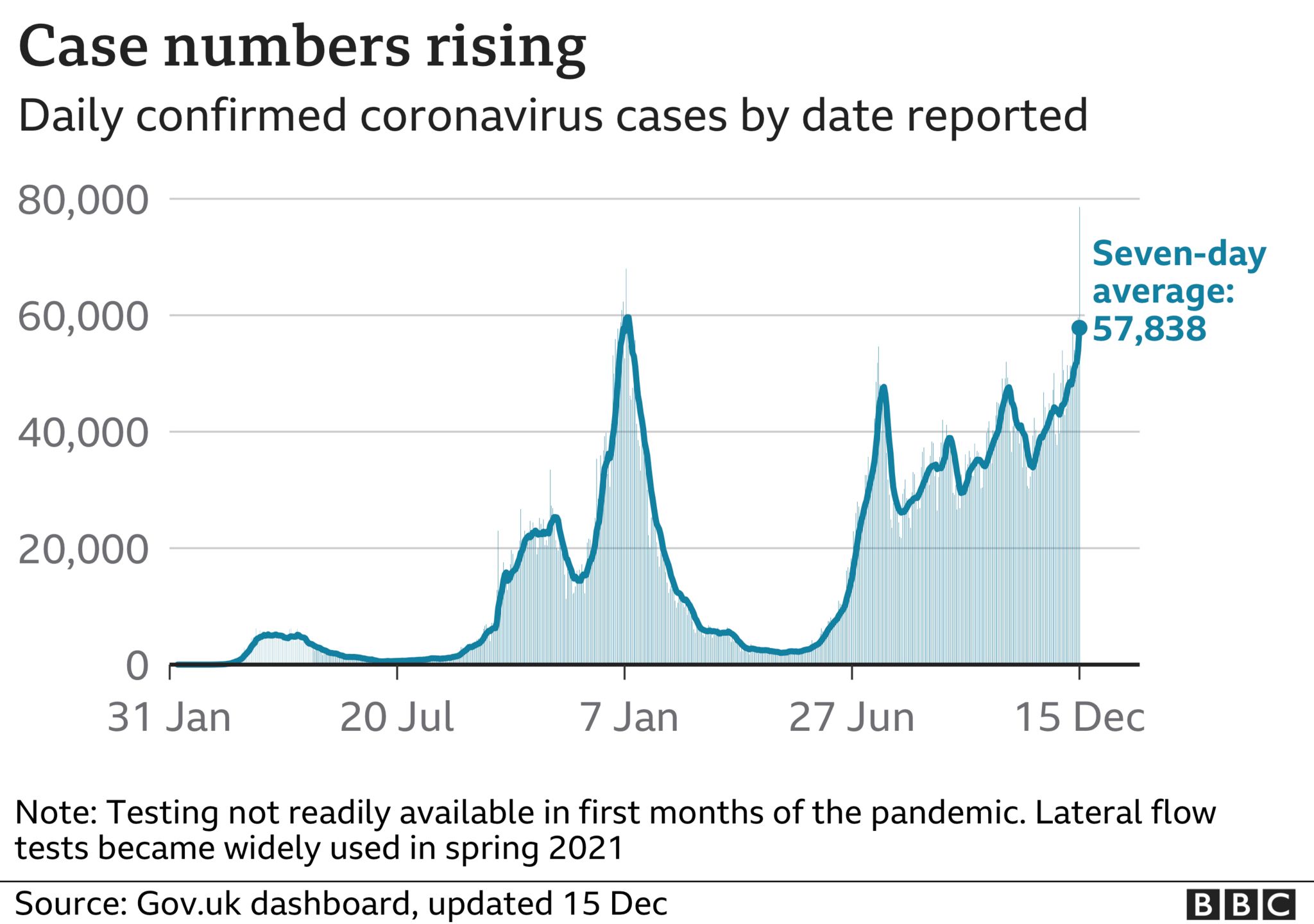
The UK has reported its highest number of daily infections since the pandemic began, and England’s chief medical officer has warned that more Covid records will be broken.
Speaking at a Downing Street news briefing, Prof Chris Whitty said the Omicron variant was moving at a phenomenal pace and that case numbers would continue to hit new highs over the coming weeks.
In that case, infections will reach a level that will exceed testing capacity. So why is it happening and what does it mean for the NHS? Here are three takeaways from a record day.
1. We’re seeing two epidemics at once
Omicron is spreading rapidly, but Delta is not disappearing. It means we have two variants circulating together. It is still early days, but it does appear to be different from what we have seen before when Alpha wiped out the original variant circulating in the UK and was then itself displaced by Delta.
This is likely to be because Omicron is able to get past some of the body’s defences built up by vaccination and previous infection. The two variants are not competing for the same people.
It means at the moment we have a fairly stable number of cases of Delta – as we have had pretty much since the summer.
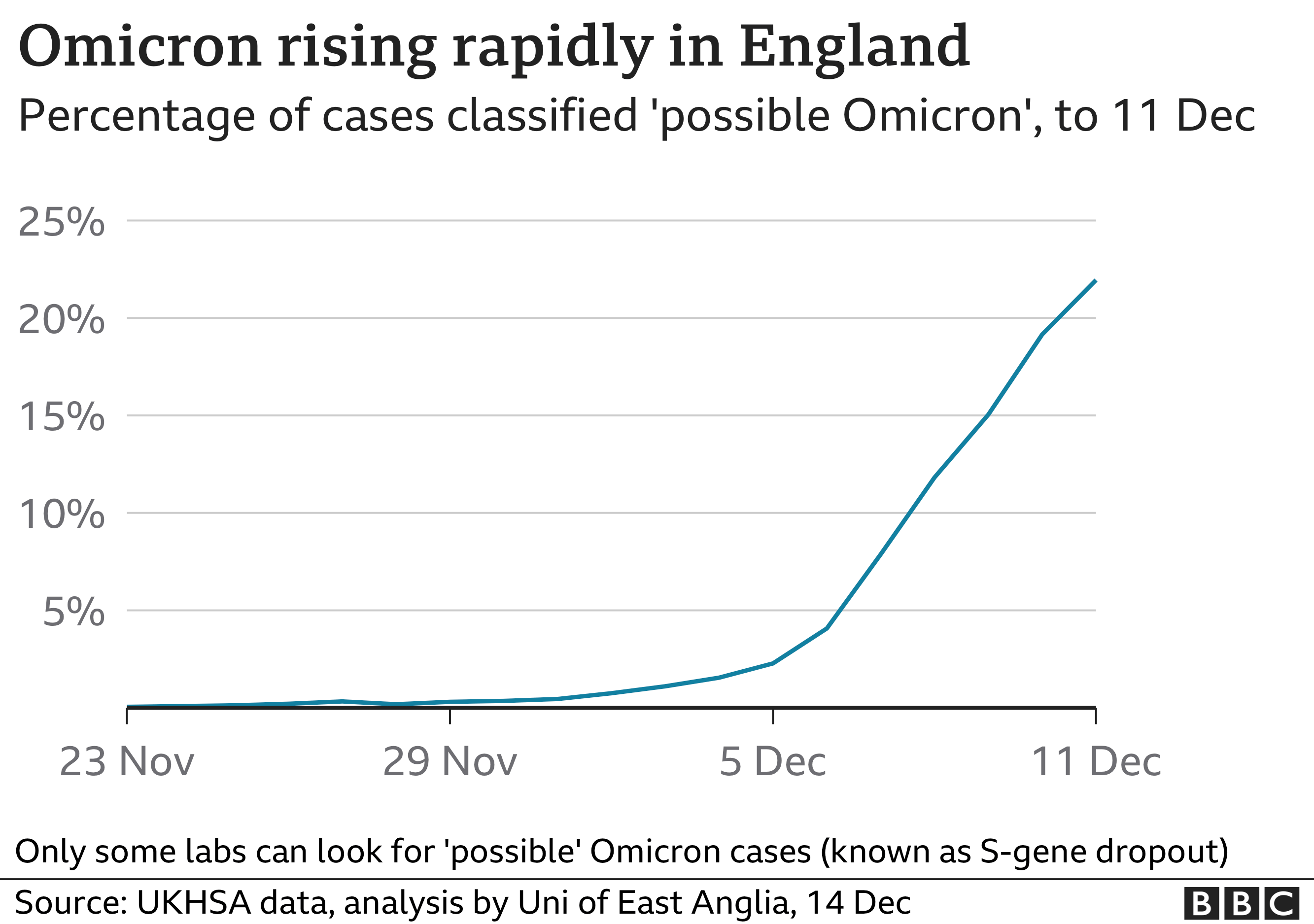
But Omicron cases are rising rapidly and driving the overall number of cases up. Latest data suggests about a quarter of cases are Omicron – that would mean around 20,000 of Wednesday’s reported 79,000 cases have been caused by the new variant.
It is quite possible these two variants will circulate together for a while, although the expectation is that Omicron will eventually displace Delta given how much immunity vaccination and our high levels of infection give against that variant.
2. Infections are rising at break-neck speed
Health officials have been saying for days that we should expect cases to surge.
And these are just the ones that come forward for testing – the true level of infections will be much higher.
Omicron cases are rising rapidly, probably now doubling every two days, so it was only a matter of time before a new high was set – although the lack of testing at the start of the pandemic means comparisons with that wave are difficult.
Expect new records to be set day after day as these numbers are only going to go up from here.
If the two-day doubling continues, by Christmas Day 640,000 Omicron infections would be being recorded and early in the new year the whole population will have been infected.
That said, the cases would never be spotted as testing capacity is limited to fewer than one million a day.
Clearly, however, that rate of growth will slow. There are already signs this has started happening in South Africa.
But not before we get to – in the words of UK Health Security chief Dr Jenny Harries – staggeringly high rates of infection.
3. The threat to the NHS is uncertain
What is not clear is what it means for serious illness.
There are suggestions Omicron is causing milder illness.
There is logic to that – reinfections or infections post vaccination are likely to be milder.
But if infections continue to rise as quickly as they are, that will push up hospital admissions.
Even if the severity of the virus is halved, as soon as the total number of infections double, hospitalisations will go up.
Left unchecked, with no extra restrictions than we have now, the peak will come quickly. How big it will be is uncertain.
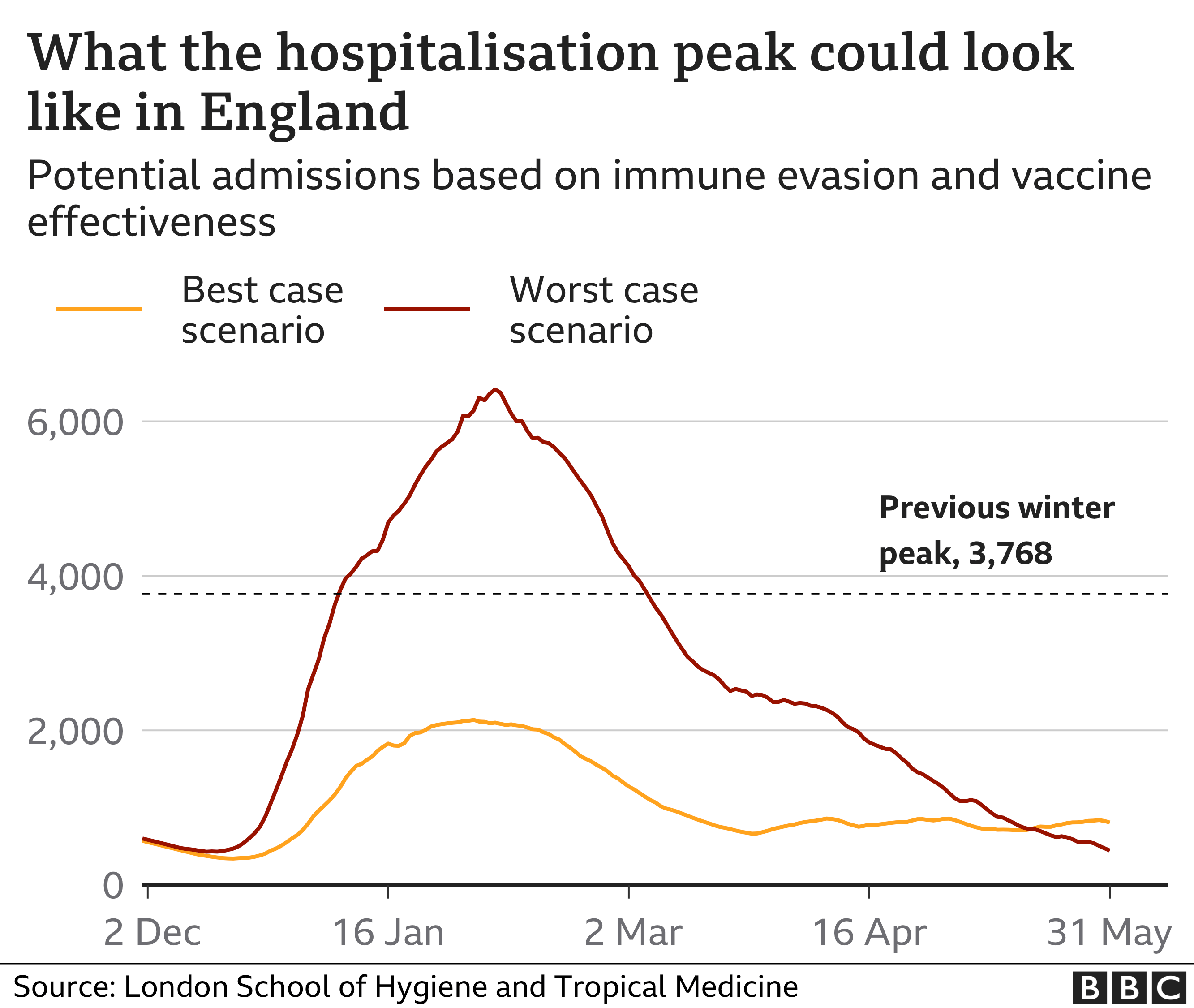
Modelling from the London School of Hygiene and Tropical Medicine has suggested that in a best-case scenario hospital admissions in England could peak at just over 2,000. But in a worst-case scenario they could exceed 6,000.
To put that into context, last winter it topped out at 3,700 a day after lockdown was introduced.
Privately ministers accept that if the numbers go past 2,000 a day, with no sign of them levelling off, the NHS would be at real risk.
But it is also worth keeping an eye on the total numbers in hospital – the time patients spend in hospital with Covid has been falling.
That means the same level of admissions now will not equate to the same pressure it did earlier in the pandemic.
So why no restrictions then?
Clearly as cases go up there will be more and more pressure to introduce restrictions, perhaps even a full lockdown.
That is understandable. But it is also important to remember restrictions don’t stop the epidemic – they just prolong it.
That can be used to buy time. Last winter the lockdown allowed the rollout of vaccines.
But with more than 80% of the most vulnerable boosted, the benefits of a lockdown are much lower this time.
The costs, however, are the same – perhaps greater considering what people have endured so far in terms of the harm to jobs, mental health and education.
What would change the equation significantly is if the NHS is going to be overwhelmed, which would deny people basic life-saving care.
Clearly the NHS is struggling, doctors are pointing out care is suffering, but the situation is very different from last winter when over a third of beds were occupied by Covid patients at one point. Today just 8% of beds are.
Colombo, Dec 17 (newsin.asia) – Spider-Man: No Way Home is already breaking records post-pandemic with immense response kicking in from cinema fans across Sri Lanka. The latest Marvel instalment, Spider-Man: No Way Home is one of the most anticipated films of the year, and fans eager to avoid spoilers are expected to arrive in droves to cinemas this weekend.
The ticket sales for the blockbuster movie opened two weeks in advance at SAVOY Cinemas. The movie lovers who were keen on a cinematic experience have started to storm the theatres with occupancy reaching full capacity. All shows are sold out days ahead of the release.
The movie is set to make its mark as the highest-grossing English blockbuster release in Sri Lanka ever since the pandemic,” said Sashini Kiriella Bandara – CEO, SAVOY Cinemas. Spider-man: No Way Home is recording phenomenal pre-sales across the world, even beating Avengers: Endgame in various markets for the sales record. It may be too early to assess the sales record in Sri Lanka considering how big Endgame was but we had our first taste of what may be coming ahead when most of the weekend shows were sold out in 24 hours.”
READ: A bold and spectacular movie from the get go. I went for the first show on opening day and I can safely say that the movie did not waste a single moment giving Spiderman fans exactly what they want.
The EAP Distribution circuit holds 28 theatres under its umbrella and the movie will be screened at Savoy 3D Cinema – Wellawatte equipped with real Dolby Atmos, Savoy Premier -Wellawatte, Savoy Premier – Rajagiriya, Cinemax – Ja Ela, Sinexpo – Kurunegala, Samantha – Dematagoda and many other theatres islandwide.
The SAVOY Cinemas operate under the right health & safety practices, maintaining standards to ensure the health & safety of our patrons. COVID-19 pandemic has accelerated and amplified ongoing shifts in consumers’ behaviour, pulling forward digital disruption and forging industry tipping points that wouldn’t have been reached for many years.
However, despite all of this it is fascinating to see the patrons back at the theatres and to truly see how passionate the market is in watching a movie on large screens and proper sounds – a true cinematic experience.
With high anticipation for the Jon Watts-directed film since the trailer debuted in November, critics and viewers rounded up their takes on Spider-Man: No Way Home, which many consider the best Spider-Man film yet.
A bold and spectacular movie from the get-go. I went for the first show on opening day and I can safely say that the movie did not waste a single moment giving Spiderman fans exactly what they want” said Fadil Feisal, one of the first to watch the movie in Sri Lanka.
A group led by Cabinet ministers Vasudeva Nanayakkara, Wimal Weerawansa and Udaya Gammanpila campaigning against the Yugadanavi deal is holding a public meeting today (14) at Eheliyagoda to step up pressure on the government to scrap the questionable deal.
The group launched its campaign on 29 October at the Solis Hall, Pita Kotte, where it vowed to oppose the agreement detrimental to the country. The SLFP, the second largest party in the government parliamentary group with 14 members, would be represented by its General Secretary Dayasiri Jayasekera, organisers of today’s event said.
Besides the three ministers and the SLFP General Secretary, six other lawmakers, namely Ven. Athureliye Rathana Thera, Prof. Tissa Vitharana, Tiran Alles, A. L. M. Athaulla, Asanga Navaratne and Gevindu Cumaratunga are scheduled to join the Eheliyagoda meeting at Suwinera Hall at 3 pm.
The Communist Party would be represented by its General Secretary Dr. G. Weerasinghe, organisers said, adding that altogether the group campaigning against Yugadanavi comprised over 25 lawmakers.
The focus of the high-profile campaign is on the Yugadanavi deal and the rising cost of living.
In spite of repeated SLPP warnings the group has refused to abandon its campaign.
Minister Udaya Gammanpila told The Island that they couldn’t keep quiet against the backdrop of an utterly corrupt agreement between Sri Lanka and the New York based New Fortress Energy Company. Attorney-at-law Gammanpila appreciated the media coverage received by those campaigning against the agreement finalized on Sept 17, 2021.
Minister Gammanpila asserted that no one could impede their protest campaign both in and outside Parliament.
The Eheliyagoda meeting would be the first major public gathering since JVP leader Anura Kumara Dissanayake tabled a copy of the Yugadanavi agreement in Parliament last Friday (10).
Pointing out that those who had been campaigning against Yugadanavi voted for the SLPP Budget 2022, the main Opposition SJB and the JVP yesterday reiterated that at least the ministers should quit the cabinet without further delay.
The Attorney General today (December 17) informed the Supreme Court that affidavits filed by three ministers with regard to the Fundamental Rights (FR) petitions challenging the Yugadanavi Power Plant agreement are unconstitutional.
The affidavits had been submitted by Ministers Vasudeva Nanayakkara, Wimal Weerawansa and Udaya Gammanpila.
The petitions were called before Supreme Court’s five-judge bench consisting of Chief Justice Jayantha Jayasuriya and Justices Buwaneka Aluvihare, Priyantha Jayawardena, Vijith Malalgoda and L.T.B. Dehideniya earlier today.
The FR petitions were put forward by the Archbishop of Colombo His Eminence Cardinal Malcolm Ranjith, Venerable Elle Gunawansa Thero, Samagi Jana Balawegaya, former parliamentarians of Janatha Vimukthi Peramuna (JVP), Sunil Handunnetti and Wasantha Samarasinghe and a group including Ven. Bengamuwe Nalaka Thero, Dr. Gunadasa Amarasekara and Dr. Wasantha Bandara.
The petitioners have challenged the decision taken by the Cabinet of Ministers to transfer shares in West Coast Power Limited (WCP) – the owner of the 310 MW Yugadanavi Power Plant to the US-based New Fortress Energy.
The New Fortress Energy, in a statement, recently said it will acquire a 40% ownership stake in the WCP and plans to develop a new liquefied natural gas (LNG) receiving, storage and regasification terminal located off the coast of Colombo.
The petitioners claimed that the government has not properly explained particulars of the deal even to the Cabinet of Ministers when. They also accused the government of failing to obtain the approval of the Parliament for signing the agreement in question and that the relevant share transfer process had not been carried out in accordance with a formal tender procedure.
Against this backdrop, MP Anura Kumara Dissanayake, on December 10, made a startling revelation in the House with regard to the much-disputed Yugadanavi agreement.
According to the JVP leader, the relevant deal was not signed with the United States-based New Fortress Energy Inc. but with another company affiliated to the New Fortress Energy, namely NFE Sri Lanka Power Holding LLC.
The daily count of COVID-19 cases confirmed in Sri Lanka moved to 715 today (December 17) as 177 more people were tested positive for the virus, the Epidemiology Unit said.
This brings the total number of confirmed cases of coronavirus reported in the country to 578,439.
As many as 546,839 recoveries and 14,720 deaths have been confirmed in Sri Lanka since the outbreak of the COVID-19 pandemic.
More than 16,800 active cases in total are currently under medical care, official figures showed.
The Director-General of Health Services has confirmed 22 more coronavirus-related deaths for December 16, increasing the death toll in the country due to the virus pandemic to 14,720.
According to the figures released by the Government Information Department, the deaths reported today include 15 males and 07 females.
Three of the patients are between the ages 30-59 years and the remaining 19 are in the age group of 60 years and above.