Caste and Education in the North

January 3rd, 2022

By Mahendran Thiruvarangan Courtesy The Island

The last Kuppi Talk article by Erandika de Silva discussed the disjuncture between the emphasis on standardisation and the absence of serious efforts to address the challenges facing students and teachers in the peripheries due to socio-economic inequalities. She drew insights from her own teaching experiences in the North to elaborate on this disjuncture. If uneven resource allocation and development, the civil war, the North’s isolation during the war years, protracted militarization and the ethno-nationalism of the state produce the North and its academic institutions as peripheral, caste and class-based inequalities within the North create peripheries within this periphery. Today’s article focuses on how caste-based inequalities make free education an uneven terrain in the North, and sheds light on the forms of caste-based discrimination observed in educational institutions in Jaffna in the past and present.

Casteism in Education

Recently, a Panchamar caste community—a collection of five caste-based communities subjected to systemic oppression and exploitation historically and forming a significant share of Jaffna’s population today—faced severe casteist violence at Vaddukoddai in Jaffna. One person from the community lost a finger as a result; houses and properties of the Panchamar were damaged; the community was psychologically traumatized. According to the community, this violence unfolded in a context of protracted, systematic caste-based oppression in various arenas including education. The members spoke of the discrimination their children face in examinations, sports and competitions in both the private and public schools in the village; the way teachers and administrators from the dominant Vellalar caste communities ignore the needs of their children; the economic deprivation amidst which they learn; and the stereotyping of their children as drug-peddlers, alcohol-addicts and sexual perverts by the school community and larger society.

Even as some academics, commentators and the Tamil media claim that caste is a thing of the past and that educational opportunities for Panchamar communities under the free education system have levelled social inequalities, Panchamar children, teachers and educational administrators in the North experience casteism in education on a daily basis.

A Casteist Past

Historically, the dominant Vellala community has had near total to significant control over education in the North. Though one is not sure where this story begins, the Tinnai Pallikkutams or Veranda Schools where education was imparted in the seventeenth, eighteenth and nineteenth centuries were not open to Panchamar children. Mark Balmforth’s research demonstrates that in the nineteenth century, even the American Ceylon Mission, which established many educational institutions in Jaffna systematically allowed the operation of caste privileges demanded by the few Veḷḷāḷar members of its churches and schools…” In Ilankaiyil Sathiyamum Athatkethirana Porattangalum (Casteism and Anti-Caste Struggles in Sri Lanka), Vehujanan and Ravana observe that many Saivite-Tamil schools established by the revivalist movements in the latter decades of the nineteenth-century refused to educate children from the Panchamar communities. In the twentieth-century, sections of these movements felt that accommodation of Panchamar in their schools was necessary but merely as a strategy to resist missionary schools. The authors note that a few Vellalar elite supported the establishment of Saivite schools for Panchamar children in places like Thevarayali in order to segregate them from Vellalar children.

Even as Jaffna was hailed as a high seat of learning in colonial Ceylon, the Panchamar suffered discrimination in education. Those who benefitted from colonial education were disproportionately Vellalar. This social group and their descendants later formed the (English) educated middle class in Jaffna that held administrative positions in the colonial state. The educational boom of this period did not lead to significant improvement in the lives of the Panchamar.

In the post-independence period, some Panchamar Christians were able to find free admission in some of the schools established by the missionaries. However, Panchamar among Hindus were unable to afford these schools. Even within Christian schools, children and teachers from the Panchamar communities faced marginalization. Administrative positions in these schools were generally held by Vellalar with a few exceptions.

Critical inquiries into this past are important because this long history of casteism has had multi-generational consequences in delaying and crippling the progress of the Panchamar. The caste power acquired by the Vellalar over the centuries first via accumulation of land and later via education have enabled them to preserve their dominance over others even today. Such exclusions in education are a key reason for the poverty prevalent among Panchamar at present.

Free Education and Its Limits

Free education and the nationalization of schools between the 1940s and 1960s increased the educational opportunities available for the Panchamar. However, Vellalar were relentless in preventing the Panchamar from benefitting from these policies. For instance, it took nearly fifteen years after its nationalization for a school in Puttur to open its portals to Panchamar children. Casteist forces attacked nationalized schools that tried to ensure equality in seating. Even today, alumni associations and school development societies of some state schools are dominated by the Vellalar, excluding the Panchamar from engaging with these institutions and shaping their activities.

Caste hierarchies continue to interfere in appointments, transfers and promotions that take place in the education sector. A few years ago, a candidate who satisfied all the requirements for Grade I principalship was not even called for interviews because she was a Panchamar. Dominant caste actors, while blaming the state as majoritarian, use the apparatuses of the state to keep the Panchamar under their control and impede their further mobility within the education sector.

Free education and the mobilities enabled by anti-caste resistance have led to the emergence of a small middle class within the Panchamar communities. However, a large number of Panchamar still face landlessness, lack of housing, unemployment and poverty today. Many of them work in the construction industry, as agricultural labourers or domestic workers. Their children tend to drop out of school to support their parents. The pandemic and the worsening economic crisis have had a disproportionate impact on their children’s education. Panchamar families find online education expensive and inaccessible. These worrying trends result chiefly from the absence of support systems within our free education system that cater to the specific needs of Panchamar children and other marginalized groups. They underline need to re-imagine free education from a homogenous system blind to the hierarchies of caste and class into a variegated terrain with additional mechanisms to address the challenges faced by deprived communities like the Panchamar.

Caste at the University

At the University of Jaffna, issues related to caste take a back seat in academic conversations. Although the academic community at the University gives prominence to Tamil nationalist aspirations and condemns the ongoing militarization of the North, open discussions about caste are hardly encouraged, barring a few occasions. A section of the academic community is warped in its view that discussing caste in public will cause disunity among Tamils.

The academia’s silence, its attempts to reduce caste to a sociological reality within flawed frameworks of multiculturalism and its refusal to recognize caste as one of the central ways in which power operates within and outside the classroom need to be challenged. As a center of higher education in the North, the University should give, within its social focus and research culture, a prominent place to caste and its workings and questions of social justice.

Quest for Justice

Despite longstanding discrimination on various fronts including education, the Panchamar continue to demand better access to education for their children. In 2019, landless Panchamar families from a camp for the war-displaced, told a land commission that they did not want to return to where they had lived previously and requested the state to allocate them lands in areas where they lived at the time so that their children could attend good schools. At Vaddukoddai, parents from the community affected in the recent caste violence are expressing their protest against the way their children are traumatized in school. The judicial victories achieved by professionals from the Panchamar castes, like the Principal applicant who faced discrimination, give the community hope and confidence to advance their struggles for justice. Their present-day struggles find inspiration and guidance from the anti-caste struggles of the past too.

It is high time the dominant caste communities introspected into the ways in which they have (ab)used the education system to preserve and multiply their privileges, and joined Panchamar and other caste groups in their quest for justice. It is also high time the state, instead of taking advantage of the caste-based fissures among the Tamils or framing caste as an internal problem of the Tamils, acknowledged its own failure in eliminating casteism in the education sector and introduced practices that can democratize free education in ways beneficial to the Panchamar and other historically disadvantaged communities in the North and elsewhere.

Mahendran Thiruvarangan is a Senior Lecturer attached to the Department of Linguistics & English at the University of Jaffna.

Kuppi is a politics and pedagogy happening on the margins of the lecture hall that parodies, subverts, and simultaneously reaffirms social hierarchies.

NEWS‘Maha season ruined, Yala will be a disaster’

January 3rd, 2022

By Shamindra Ferdinando Courtesy The Island

No agro-chemical imports yet, only fraction of liquid fertilizer received

The government lifted the ban on agro-chemical imports, well over a month ago, but the country is yet to receive much-needed fertiliser supplies.

The President’s Office on Nov. 22 announced the ending of the ban on agro-chemicals imports introduced on April 22, 2021.

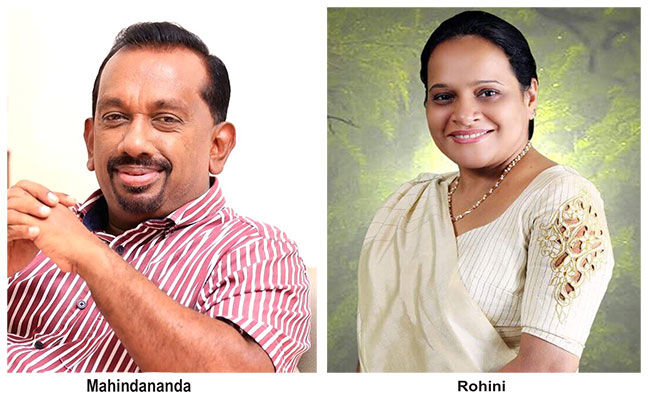
However, Samagi Jana Balavegaya (SJB) MP Rohini Kaviratne claims that though Agriculture Minister Mahindananda Aluthgamage assured the Parliament agro chemicals would be imported, so far the private sector hasn’t been given the approval.

Addressing a gathering at Rattota over the weekend, the former UNPer said that the farming community had been deprived of fertiliser as well as agro-chemicals.

Lawmaker Kaviratne alleged that Minister Aluthgamage sabotaged the move to resume agro-chemical imports by removing the Registrar of Pesticide Dr. J. A. Sumith. MP Kaviratne emphasized that the government owed an explanation over the top official’s removal. When contacted yesterday afternoon, Sumith declined to comment.

Minister Aluthgmage couldn’t be contacted because he was at a meeting. Earlier, Aluthgamae declared that the Registrar of Pesticide was removed in the wake of him lifting the ban on five pesticides, including glyphosate imposed seven years ago.

Lawmaker Kaviratne said that unless urgent measures were taken to import fertilizer and agro-chemicals, farmers wouldn’t be able to engage in cultivation in the early part of this year. The agriculture ministry seemed to be even unaware of the two cultivation seasons namely, Maha (September-March) and Yala (May-August), lawmaker Kaviratne said.

Responding to The Island queries, the lawmaker pointed out that the controversy over the rejected consignment of Chinese carbonic fertilizer and the subsequent decision to pay the supplier USD 6.7 mn distracted public attention from the real issue. MP Kaviratne emphasized that the issue at hand was the failure of the government to deliver the promised carbonic fertiliser needed for Maha thereby deprived them of both fertiliser of any kind and agro-chemicals as well. On the other hand, of 1.2 litres of liquid nano fertilizer ordered from India, a relatively small quantity had been received so far, the MP said, alleging that the Agriculture Ministry ruined the agro sector. About one mn litres of liquid fertiliser were yet to be delivered, well informed sources revealed.

The MP said that the Agriculture Ministry within one year had achieved the unthinkable. Asked to explain, she said that even during the war the farming community served the country at the risk of their lives. Regardless of sporadic terrorist attacks on paddy growing districts, the LTTE couldn’t dishearten them, the Matale District MP said. But the current dispensation had compelled the farmers to give up cultivation by depriving them of the basic necessities, the outspoken MP said.

The SJB spokesperson said that the Agriculture Department recently acknowledged that the yield in the major paddy growing districts of Anuradhapura and Polonnaruwa would be approximately 50 percent of the normal output whereas in the East only 1/3 of paddy land had been cultivated. The total output could be as low as half of previous years, MP Kaviratne said, urging the government to take stock of the situation, at least now.

With the country experiencing an unprecedented debt servicing problem, a sharp drop in paddy, vegetable and maize production could further aggravate the US Dollar crisis, the MP warned, warning the government to stop acting the goat.

MP Kaviratne said that the foolish SLPP administration had caused immeasurable damage to the national economy. The Opposition would raise the issue in Parliament once the new session commenced on January 18, she said.

President should bear responsibility for food crisis: Tilvin

January 3rd, 2022

Courtesy The Daily Mirror

While commenting on prevailing economic crisis and food scarcity were due to the ignorant decisions by the government, the Janatha Vikuthi Peramuna (JVP) said today the President should bear the entire responsibility for the food scarcity.

JVP General Secretary Tilvin Silva told a news conference that even though President Gotabaya Rajapaksa was trying to show that this was a natural crisis, this crisis was created by him.

“This is not a natural crisis. This has been caused by the ignorant actions of the government. Food scarcity threatens people. Prices of  vegetable skyrocketing. There is scarcity of rice. Rice had to be imported. But, the country faces a serious dollars crisis. Are all these due to natural causes? No, this is a man-made crisis which was created by the President. Agriculture is in deep crisis and had gone beyond redemption. Still for all, the government is not ready to rectify its mistakes. The government is trying to suppress this by removing officials. The President should take complete responsibility for this food crisis,” he said. 

He said the government’s tax policy had only benefited its crooked businessmen and that it was not a tax policy which helped the government to collect revenue.

“VAT was reduced. But, the benefit was passed down to their crooked   businessmen. People were not benefited. Tax on sugar and coconut oil was reduced, its benefit was also passed down to their cronies, not to the people,” he slammed. (Ajith Siriwardana)

Inflation hits double-digits in December rubbishing Central Bank’s transitory claims

January 3rd, 2022

Courtesy The Daily Mirror


  • Highest since January 2009; breaks country’s 12-year record of maintaining single-digit inflation
  • Food inflation tops 20%; monthly increase exceeds 5%
  • CB says a large component of inflation driven by supply side factors”

A gentle Christmas rally normally seen in prices every December turned into a blowout in December 2021, as inflation in Colombo soared to a 12-year high. 


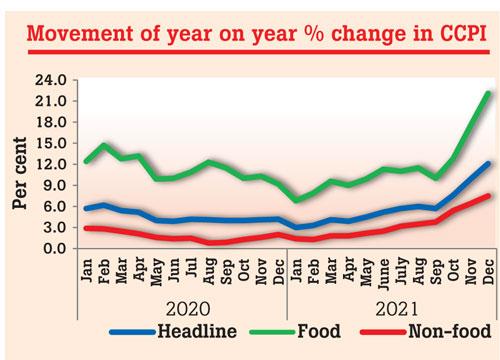
Consumer prices measured by the Colombo Consumer Price Index (CCPI) rose by 12.1 percent in the twelve months to December 2021, accelerating from 9.9 percent in November reflecting how pronounced and entrenched higher prices are in the economy, contrary to transitory claims made by the Central Bank for months. 


The Central Bank said, a large component of inflation is driven by supply side factors”, and said it expects to publish a detailed explanation in this regard shortly, showing its unease at the recent inflation readings. 

 The Central Bank repeatedly assured that headline inflation would be maintained between 4 to 6 percent until November when it acknowledged that there would be a deviation. 


The December inflation was the highest since January 2009 and it broke the country’s 12-year record of maintaining single-digit inflation. 


Meanwhile, prices rose by 2.7 percent in December from November levels, faster than the 2.6 percent increase in November, recording the fastest monthly increase in prices not seen for a long time. 


Food prices surged by 22.1 percent in the twelve months to December, accelerating from 17.5 percent recorded in the year through November, while on a monthly basis the food prices climbed 5.4 percent in December over 5.3 percent in November. 


Vegetable prices were the biggest contributor to food price inflation as prices were seen going through the roof lately, largely due to the rushed fertilizer policy of the government.


Meanwhile, prices of wheat flour and bread rose after wheat flour importers decided to increase prices. Further, prices of chicken, sea fish, eggs, coconuts, potatoes, and big onions recorded significant price increases during December over November. 


As Sri Lanka was coming out of a price control regime which proved a terrible failure, shelf prices were adjusting to the prices determined by the market forces ending months-long empty shelves. 


Milk powder importers last week raised their retail prices for the second time since October to reflect global prices and the weaker rupee, potentially ending the shortages, which inflicted much pain on people for months. 


Meanwhile, non-food inflation continued to gain pace as it rose by 7.5 percent in the twelve months to December, from 6.4 percent in November. The monthly prices also accelerated to 1.3 percent from 1.2 percent in November. 
Spending on restaurants and hotels had the biggest impact on non-food inflation during December reflecting more people venturing out with the easing of the virus concerns, while some went on holidays.


The transport sector also saw significant increase in prices due to the December 21 fuel price hike. 


Prices of alcoholic beverages & tobacco, clothing & footwear, household furniture, utilities and healthcare also rose in December.  


The so-called core prices measured barring the impact of food, energy and transport rose by 8.3 percent in December from 7.0 percent in November reflecting the underlying inflation in the economy. 

Record money printing in 2021 as Central Bank-held Treasury bill stock tops Rs.1.4tn

January 3rd, 2022

Courtesy The Daily Mirror

Among the records made last year—most of which didn’t necessarily bring in a sense of achievement—was the record phase at which money was printed, as the Central Bank, influenced by the Modern Monetary Theory (MMT), flooded the markets with liquidity to support the government bloat its fiscal deficit. 


As at the end of 2021, the Central Bank’s disclosed Treasury bill stock stood at Rs.1, 416.75 billion with overnight liquidity injections to the banking sector topping Rs.467.30 billion on December 31.


However, other reports suggested that the estimated Treasury bill stock by the Central Bank had topped Rs.1.9 trillion by December end from Rs.1.8 trillion estimated by the end of November as on November 25 a Central Bank official put the book value of the Treasury bill stock at Rs.1,767 billion on the previous day.  Going by the disclosed Treasury bill holdings, the Central Bank had printed money worth Rs.691.56 billion during 2021 after injecting Rs.650.27 billion in 2020 to provide liquidity to the markets to blunt the economic fallout coming from the pandemic and also to keep borrowing costs lower to support economic recovery. 


Treasury bill holdings by the Central Bank stood at Rs.78.01 billion on March 11, 2020 when the country reported its first local coronavirus case before the country came under lockdowns to contain the virus spread for two months. 


This unprecedented monetary stimulus generated multiple excesses in the economy by way of generating soaring prices, commodities shortages and massive crunch in foreign liquidity in the domestic market bringing the country closer to a foreign currency debt default, as such money hit the Balance of Payments by way of higher demand for imports. 


As a result, the Central Bank was forced to provide convertibility by way of issuing dollars from its reserves for such rupees to maintain the exchange rate. When foreign inflows ran dry the external reserves depleted and now stands barely sufficient to fund the country’s import bill, let alone meeting its thumping foreign loan commitments. 
Sri Lanka recorded its highest-ever 10-month BoP deficit of US$ 3.3 billion in October while its foreign currency reserves fell to the worrying level of US$ 1.6 billion in November, earning a rating downgrade by Fitch Ratings in December due to heightened concerns about a debt default in the months to follow. 

But the Central Bank last increased the external reserves to US$ 3.1 billion without disclosing the means of how it happened, drawing the wrath of many parties for engaging in window-dressing. 


As major global central banks have either have already started raising their interest rates or have indicated a series of rate hikes starting next April in response to soaring prices, Sri Lanka is left with little choice but to follow suit as investors tend pull out their funds from the emerging and developing markets to developed market treasuries which provide them with positive returns with little risk compared to markets with junk ratings. 

Basil back, now eying PM post?

January 3rd, 2022

Courtesy The Daily Mirror

In a major twist of events, Finance Minister Basil Rajapaksa who returned back to the country from the United States on January 1st morning, is internally campaigning to be appointed as the Prime Minister in the coming months, replacing his brother Mahinda Rajapaksa whilst also calling for an urgent cabinet reshuffle, the Daily Mirror learns.

Basil who took over as the Finance Minister recently, has been urging for a change in some ministries with a cabinet reshuffle now being planned as soon as possible. The Daily Mirror learns that at least six key ministries will change heads while some deputy ministers will be promoted as cabinet ministers.

Some state ministries will also be given more responsibilities while the departments coming under some state ministries will be changed. Political sources said that the administrative big wigs will also see a change in heads including the Secretary to the President, P.B. Jayasundara, whose resignation will come into effect from January 31. The Daily Mirror now learns that Jayasundara might accept an offer to be appointed as an advisor to Finance Minister Basil Rajapaksa once his term at the President’s office comes to an end.

The entire existing system will see a revamp in order to overcome the ongoing political and economic crises while internal campaigns are ongoing for Basil to take over as the Prime Minister in the coming months. Political sources said that some of the ministries will also have heads appointed who can work cordially with Basil as a part of the campaign. (JAMILA HUSAIN)

A Rs 229 billion economic relief package announced

January 3rd, 2022

Courtesy The Daily Mirror

The Government today announced a Rs 229 billion economic relief package which comprises a Rs 5000, salary hike for state workers, increasing of pensions, Samurdhi and special stimulus payment for home gardens.

Minister of Finance Basil Rajapaksa told a press conference that the cabinet today decided to grant an allowance of Rs.5000 for state workers while pensions will also be increased by Rs.5000.

In addition, allowance for the disabled soldiers will be increased by Rs 5000. The owners of private companies will be asked to increase salaries of their workers. A stimulus package was also announced for home gardens under which Rs.5000 will be paid for growing of crops in home gardens which is up to 20 perches and Rs 20,000 for those who own home gardens which extends from 20 perches to one acre.

We encourage the people to grow food crops in their home gardens in order to avoid a scarcity of food,” the Minister said.

The package also includes compensation for the farmers if their harvest is reduced. We anyway expect that the Maha harvest will be reduced by 30 percent to 40 percent and therefore farmers will be paid an extra Rs 25 per Kg of paddy,” he said.

In addition, 15 Kgs of wheat flour will be provided at Rs.80 a kilo for estate workers while medicine and essential food items will be exempted from tax.

The government was planning the relief package for the people who were hit by the pandemic even before the budget,” Mr. Rajapaksa said.

The Minister also announced that the cabinet decided to start dialogue with each donor country and agencies including IMF, WB and ADB.

A Minister dedicated to negotiations with each country and agency will be appointed shortly according to the Minister. Donor agencies have issued reports on Sri Lanka which comprises mix reactions on Sri Lanka’s performance.

Accordingly they have praised Sri Lanka’s COVID 19 vaccine programs while coming up with some criticism,” he said. (Yohan Perera)

Court order preventing payment for Chinese fertilizer shipment dissolved

January 3rd, 2022

Courtesy Adaderana

The Colombo Commercial High Court has dissolved the enjoining order preventing the payment on Letter of Credit to the Chinese company that shipped a disputed consignment of organic fertilizer to Sri Lanka, as all parties had agreed for a settlement. 

The court was expected to deliver its decision on extending or revoking the interim order when the petition filed by the Colombo Commercial Fertilizers Ltd. was taken up before Commercial High Court Judge Pradeep Hettiarachchi.

The Ceylon Fertilizer Company (CFC) had previously secured two enjoining orders from the Colombo Commercial High Court against Seawin Biotech, its local agent and the state-run People’s Bank, preventing the payment on Letter of Credit. 

The first court order against the Chinese firm in question was secured on October 23, blocking the People’s Bank from making any payment under a Letter of Credit opened in favour of the Chinese company.

During a previous proceeding, Additional Solicitor General Susantha Balapatabendi, who appeared on behalf of the CFC, told the court that China-based Qingdao Seawin Biotech Group Co., Ltd. had shipped a fertilizer consignment, which is a partial shipment worth more than a billion rupees that was procured through a tender process initiated by the Agriculture Ministry.

Although the said Chinese firm was required to ship sterile organic fertilizer under the tender contract, it had admitted in its shipping advice that the consignment may contain microorganisms, he had further told the court.

The National Plant Quarantine Services (NPQS), which tested the sample sent to them, had confirmed the presence of organisms, including certain types of harmful bacteria, the Additional Solicitor General had said, adding that, in this context, the Chinese firm in question had failed to complete the accepted terms of the tender.

As per the terms of the contracts, the payment for the controversial organic fertilizer shipment was slated to be made through a Letter of Credit established via the People’s Bank.

however, on December 14, the Sri Lankan government said it has decided to pay USD 6.7 million to the Chinese fertilizer company, on the advice of the Attorney General’s Department.

According to Agriculture Minister Mahindananda Aluthgamage, the payment includes the cash deposit of USD 5 million placed by the company.

The minister added that the company, China-based Qingdao Seawin Biotech Group, has been requested to re-manufacture the fertilizer to comply with the required standards. 

COVID: 365 new cases detected and another 18 COVID deaths in Sri Lanka

January 3rd, 2022

Courtesy Adaderana

The Ministry of Health reported that another 365 persons have tested positive for coronavirus today (03). 

This figure includes 06 persons who had arrived in the country from overseas.

Sri Lanka’s tally of confirmed cases of Covid-19 climbs to 588,300 with this while the number of infected patients currently undergoing treatment is 12,135.

The Director General of Health Services has confirmed another 18 coronavirus related deaths for January 02, increasing the death toll in the country to 15,037. 

This includes 11 males and 07 females while eleven victims are in the age group of 30-59 years.

The other seven are aged 60 years and above.

How to manage our foreign exchange in this time of Crisis

January 3rd, 2022

Garvin Karunaratne

Veteran administrator,  Sudat Gunasekera former Secretary to the Hon Prime Minister , has said in his Paper  What the Government should do to get rid of the present financial crisis ailing the country? in Lanka Web, 2/1/2022 what measures Sri Lanka has to take to get out of the financial  mess we are in. I  too think that his  suggestions are the only way  ahead. 

Let  us look at what happened to Turkey when Turkey allowed a free float of the Turkish Lira and  to other countries  when they  did what the IMF wanted it to do.

I quote from my book: How the IMF Ruined Sri Lanka & Alternative Programmes of Success;(Godages) 2006:

Over the period  ” 1983 to 2003, the devaluation of the Turkish Lira was  to the extent of 712,000%, the Ghanian Cedi to the extent of 275,000%  and the Nigerian Naira to the extent of 21,800%.”

“The Turkish Lira has been devalued 1715 times. and the Ghanian Cedi  663 times  in the period 1983 to 2005.”

” The Turkish Lira has dropped  in value from  Lira 336 to the pound sterling in 1983  to Lira 2,395,000 to the pound in 2003, marking  a devaluation of 712,000%. “

” I have travelled widely in Turkey in 2004 and have been struck with the abject poverty- the people have no purchasing power whatsoever with their earnings. Everything is available in the shops for the rich but the vast majority of people  do not have the purchasing power to buy  the necessities of life with their meager earnings. There are vast highways  with no vehicles in sight for hundreds of miles “

Actually went I visited Turkey in 2004, I had to empty one of my suitcases to carry the Lira I got when I cashed a few pounds.

The only way ahead to my thinking is to reject the IMF and go it alone as Governor Cabral opines, but follow the blue print of how we ran the country in the Dudley Senanayake days- 1965 to 1970. We were very strict. There was no foreign funds for any luxury items. No one was allowed dollars for foreign study. The only exception was a grant to Chandrika and her sister Sunetra and I had the occasion to ask the Prime Minister why he did give that grant. He replied  that this was the only request he had from a former Prime Minister and he felt like giving it.  Then as the Additional Government Agent at Kegalla one of my tasks was to meet the Prime Minister at Warakapola Rest House every Saturday and Sunday morning at eight and after some tea, we attended at least ten meetings arranged by us or by his supporters, I was with him from eight in the morning to around seven in the evening till he took off in his Humber Hawk back. and I had to answer all his questions.  There was never a question of meeting any villager who said that he was deprived the necessities of life.  Then  all essentials were bought with the meager dollars we had and there were no kero or milk food queues. The necessities were all imported and a rationing system was strictly enforced. For  foreign travel no dollars were issued whatsoever. Even to go on pilgrimage to Buddha Gaya one had to make an application to the Controller of Exchange of the Central Bank to plead and get it.

It was a strict control and I happened in 1970 to be the Deputy Director of Small Industry to give allocations to small industrialists. I thus speak through sheer experience.

Garvin Karunaratne

2/1/2022

Author of How the IMF Ruined Sri Lanka & Altenative Programmes of Success,  Godages, 2006

How the IMF Sabotages Third World Development, Godages, 2017

The rise of ‘Hoo Keliya’ by the people

January 3rd, 2022

Courtesy The Island

Crackers did burst, and rockets did fly with blasts. As the old year folded up, the fireworks continued. Were some of the louder blasts from gas cylinders? Who knows, with no legal action taken against those gas-blast dealers so far. The law can wait till they draw in all the crooked profits.

As the cracker and rocket blasts fade away, we are moving into a new sound of the public. It is the rise of the ‘Hoova’ time. We saw it first at Hambantota. Were the people giving the government politician a lesson on what people of power must expect in the coming months, and years.

It is the ‘Hoo Keliya’ that is rapidly sweeping the political landscape. Several politicians, of government strength and power have had to face the ‘Hoo Keliya” at supermarkets, busy junctions, and even when they tried returning to their electorates. Many of them are so sad at being hooted even when they did not join their fellow politicos to fly abroad for the festive season.

The long queues to get essential goods, such as gas, kerosene, and milk are the stuff of Rajapaksa governance. Such queues should certainly not lead to any hooting, even if you are spending a long time lined up for milk.

That is the stuff of Gotabaya Governance. No hooting. Just keep waiting. The Police will even be so kind as to get the trader involved to have two counters for the sale of ‘short supply’ goods. This will be the Mirihana – Gotabaya Thinking on handling the spreading of the queue system of Pohottuva politics.

A simple question to ask the Police that issued a statement explaining the Mirihana issue (hoo keliya carefully ignored), why they do not intervene to bring the Mirihana – Gotabaya Thinking to other places, too. Why don’t they tell the gas dealers at so many places to have two or even four counters open to shorten the queue?

Similarly, why don’t they move swiftly to shorten the many other queues for kerosene, and the milk powder for kids, too?

Will that need too many police personnel or is such thinking beyond the mind of a Senior DIG, so good at telling that it was not leaking gas cylinders, but bad cookers, which led to so many blasts and at least three deaths, too.

We are certainly moving to a whole new phase in the governance of Sri Lanka. The Prime Minister has to fly in a friend’s private plane to the Tirupati shrine in India to seek the blessings and miraculous action of one or more gods, to give divine power for Gota – Governance. Just forget that Sri Lanka remains a Sinhala Buddhist country, and be embraced to Hindu Divine politics.

Are there any other deities, spirits or even demons of power, who will help our economy to rise, and move away from the International Monetary Fund IMF? Do we have the blessings or curses of these spiritual forces to believe that our foreign reserves have risen to US$ 3.1 billion, as said by Central Bank Governor Cabraal?

Is it the force of spirits that makes Minister Vasudeva Nanayakkara ask why they should leave this government that they formed? Are the ears of Wimal Weerawansa, Udaya Gammanpila and Vasudeva Nanayakkara shut tight to the voice of President Gotabaya, that they should leave the Cabinet?

This Pohottuva government has certainly brought us through so much trouble in the last two years, as well as so much belief in sorcery, witchcraft and hoodoo oils and crooked cures for Covid 19. It has certainly earned the ‘Hoo Keliya’ from the people, the masses who are made to suffer, from bad to worse as each day passes.

The New Year that dawns today has certainly given cause for the ‘Hoo Keliya’ that is fast striking the power players of the Pohottuva.

Will we see a wider spread of this ‘Hoo Keliya’ as Gotabaya / Basil move on, cheating the people of all aspects of good governance?

This ‘Hoo Keliya’ is the sound of the New Year, and is moving on to be the roar of the people. Happy Hoo Keliya to you all!

#COVID-19 අවදානම තුල රා.ප.ච. 02/2021 (vi) චක්‍රලේඛය මගින් රජයේ සේවකයින්ට දී තිබූ සහන අහෝසි කිරීම සම්බන්ධවයි.

January 2nd, 2022

ලංකා ගුරු සේවා සංගමය.

ලේකම්,
රාජ්‍ය සේවා පළාත් සභා හා
පළාත් පාලන අමාත්‍යාංශය,
නිදහස් චතුරස්‍රය,
කොළඹ 07.

ලේකම්තුමනි,
 
#COVID-19
 අවදානම තුල රා... 02/2021 (vi) චක්‍රලේඛය මගින් ගර්භනී, වයස අවු. 01 අඩු දරුවන් සිටින හා විශේෂ රෝගාබාධවලින් පෙළෙන රජයේ සේවකයින්ට දී තිබූ සහන අහෝසි කිරීම සම්බන්ධවයි.

#COVID-19
අවදානම් තත්වයක් යටතේ රාජ්‍ය සේවයට වාර්තා කිරීමේදී සෞඛ්‍ය අධ්‍යක්‍ෂ ජනරාල්වරයාගේ නිර්දේශ මත 2021. 10. 01 දිනැතිව නිකුත් කළ අංක 02/2021 (v) චක්‍රලේඛය මගින් ගර්භනී, වයස අවුරුදු 01 අඩු දරුවන් සිටින හා විශේෂ රෝගාබාධවලින් පෙලෙන රජයේ සේවකයින්ට ලබා දී තිබූ සෞඛ්‍ය ආරක්‍ෂිත සහන 2021. 12. 30 දිනැති 02/2021 (vi) චක්‍රලේඛය මගින් අහෝසි කර දැමීම පිළිබඳව ලංකා ගුරුසේවා සංගමය ඔබගේ දැඩි අවධානය යොමු කරවමු,
 
02.
රාජ්‍ය සේවයේ 3 ලක්‍ෂයකට ආසන්න ගුරුවරුන්, විදුහල්පතිවරුන් මෙන්ම අනධ්‍යයන කාර්ය මණ්ඩල පාසල් තුල තම රාජකාරී කටයුතුවල නියැලීමේදී විශේෂයෙන් පන්ති කාමරයෙන් පන්ති කාමරයට යන ගුරුවරුන්ට සිසු දරුවන් විශාල ප්‍රමාණයක් සමග සමීපව කටයුතු කිරීමට සිදුවන අතර එහිදී ඔවුන්ට දැඩි අවදානමකට මුහුණ දීමට සිදුව ඇති බවද අප ඔබට අමුතුවෙන් පැහැදිලි කරදිය යුතු නැත. අදියර වශයෙන් පාසල් විවෘත කිරීම ආරම්භයේ සිටම පාසල්තුල #Covid ආසාධිතයින් වාර්තා වූ අතර මේ නිසා පන්ති කාමර වශයෙන් මෙන්ම පාසල් මට්ටමින්ද වසා දැමීම් 2021 පාසල් වාරය අවසන් වෙන තෙක්ම වාර්තා විය. මෙවැනි දත්තයන් අදාල තීරණ ගැනීමේදී කිසිසේත් සැලකිල්ලට ගෙන නොමැති බවත් අදාල ආයතන සමග සාකච්ඡා කර නොමැති බවත් මෙහිදී පැහැදිලි කරුණකි,
 
03.
රටතුල #Covid-19  වසංගතයෙහි අවදානමෙන් ඔමික්‍රෝන් වැනි විශේෂ ප්‍රභේදයක ව්‍යාප්තියෙහි අවදානමත් එසේ තිබියදී මෙවැනි සෞඛ්‍ය ආරක්‍ෂිත සහනයක් අහෝසි කරනුයේ සෞඛ්‍ය අධ්‍යක්‍ෂ ජනරාල්වරයාගේ නිර්දේශ මතද නැතිනම් එවැනි වගකීම් සහගත විද්‍යාත්මක ප්‍රවේශයකින් හෝ නිර්දේශයකින් තොරවද යන සාධාරණ සැකය අපට ඇත,
 
04.
එහෙයින් සමස්ත පාසල් පද්ධතිය තුල වසන්ගතයේ නව ප්‍රභේද විසින් තවදුරටත් ඇතිකර ඇති අවදානම් තත්වයන්ද සැලකිල්ලට ගෙන ගර්භනී ඇතුලූ සුවිශේෂී අවදානම් සහගත රජයේ සේවකයින්ට රා... අංක 02/2021 (v) මගින් ලබා දී තිබූ සෞඛ්‍ය ආරක්‍ෂිත සහන එලෙසම ලබා දීමට කටයුතු කරන ලෙසත් එසේ නොවන්නේ නම් තව දුරටත් රටෙහි පවතින වසංගතය තුල එම ජීවිතවල සම්පූර්ණ වගකීම ඍජුවම අදාල බලධාරීන් විසින් භාරගත යුතු බවත් ලංකා ගුරුසේවා සංගමය දැඩිව අවධාරණය කරමු.
 
ස්තූතියි.

මෙයට,
මහින්ද ජයසිංහ
ප්‍රධාන ලේකම්,
ලංකා ගුරු සේවා සංගමය.

How A Pakistani Newspaper ‘Pakistan Today’ Helps To Connect People Between Bangladesh And Pakistan

January 2nd, 2022

MD Pathik Hasan

Public diplomacy is also called people’s diplomacy. Public diplomacy between Pakistan and Bangladesh is very necessary to bolster the ties between two brotherly nations. It is the ‘Public Diplomacy’ which can bring the two countries under an umbrella. People to People contact can initiate to strengthen the ties melting the ice between two brotherly and neighboring states.

Where government-to-government diplomacy fails, public diplomacy is very effective there to strengthen the ties. People-to-people contact between the two countries can turn into a holistic diplomatic approach between two countries. Then, formal official diplomacy between the two governments is possible. People-to-people contact diplomacy between Pakistan and Bangladesh may be Cricket diplomacy, cultural exchange of people between two countries, communications amongst the authors, writers, professors, students, businesses, businessmen etc.

Communication between authors, professors, writers, the general public is a kind of public diplomacy. By this diplomatic approach, authors from both countries can contact each other. Media publications and outlets can play a strong role in this connection. For example, Bangladeshi writers didn’t write normally in Pakistani media outlets and vice versa. To some extent, there are some issues with that. But after a long time, some Bangladesh writers including me (of course new generation) starts to write in Pakistani media outlets. This time, we see a new trend of communication amongst the people between Pakistan and Bangladesh. They are sending their write-ups continuously to Pakistani media outlets. Basically, they want to establish relations with Pakistani authors, people through Pakistani media outlets. They are interested to build up a strong relationship with the other parts. Not only do they want to establish relations, bondage but also expressed their views on Pakistan. They are also interested to inform the Pakistani generation about Bangladesh. Won’t it be a good sign for strengthening the ties?

We want to know about Pakistani society, strengthen our ties and bondage with Pakistani people. We want to publish our write-ups in Pakistani media outlets on Bangladesh, Bangladesh-Pakistan ties, new generation’s thinking on Pakistan. We wanted to inform Pakistani people about modern Bangladesh. We tried to reach out to Pakistani people through Pakistani media outlets. Basically, we wanted to convey our messages to the Pakistani people. Isn’t it public diplomacy? One day, this type of Public Diplomacy can turn into formal state-level diplomacy.

Social media, print media have a great role to connect people with each other. Pakistani media outlets especially print media can and should play role in this regard. They should cooperate with Bangladeshi writers. They should show their interest to publish their write-ups in Pakistani media outlets. The publishers and editors of Pakistani media outlets should consider this with special attention.  

Basically, media can play a strong role in the case of public diplomacy. The owners, publishers, and editors of Pakistani media outlets should understand, think and consider this because this type of public diplomacy can normalize the bilateral ties between two states. One day, Pakistan and Bangladesh would be regional allies for ensuring their mutual interest. Bilateral business, trade, a cultural exchange may be smoothened.  

Pakistani media outlets such as ‘Pakistan Today’ can play a strong role to make public opinion to influence the policymakers of Pakistan for smoothing the strained ties between Bangladesh and Pakistan.

The Pakistan Today is a widely circulated English-language newspaper in Pakistan. Pakistan Today is a popular and liberal daily in Pakistan. Pakistan Today is a Pakistani English-language daily newspaper, published by Nawa Media Corporation from three Pakistani cities – Lahore, Punjab; Karachi, Sindh; and Islamabad, Islamabad Capital Territory. The newspaper was founded by its editor and publisher, senior journalist,former federal minister Arif Nizami, in 2010.

According to their media outlets, policymakers and decision-makers read the news publication regularly. Its hard-hitting insightful editorials and opinions are keenly followed by the government, lawmakers, diplomats, and business people alike.

Pakistan Today can play a very important role in strengthening the ties between Bangladesh and Pakistan through public diplomacy. It has been publishing some pertinent news, reports, articles related to Bangladesh-Pakistan relations. It has been publishing many write-ups regarding the current strained ties between Pakistan-Bangladesh and its solution.

Pakistan’s ‘Pakistan Today’ can play a strong role in this regard. Accordingly, Pakistan’s ‘Pakistan Today’ can and should play a very significant role to smooth the strained relations by influencing the policymakers, public through their heart-hitting write-ups in these such ways:

Pakistan Today can publish all kinds of news, reports, and editorials articles regarding Pakistan-Bangladesh brotherly ties to make a public opinion that pressurizes the policymakers in smoothing the bilateral relations.

It can publish satire. It can also publish poll opinions.

It can influence Pakistan’s civil society by publishing its nice write-ups.

Pakistan Today is a very fine and excellent newspaper in Pakistan. The accuracy, credibility, and acceptability of publications in ‘Pakistan Today’ are very high. So, it should create public opinion in favor of bolstering relations between Bangladesh and Pakistan.

The government of Pakistan, its decision-makers, and people know well about Pakistan Today. Thus, it is very easy for Pakistan Today to influence the policymakers and people of Pakistan to some extent the decision-makers.

Pakistan Today has started to publish the write-ups of Bangladeshi writes from August 01, 2021. That was the great decision of the decision-makers of the ‘Pakistan Today’. Now, many Bangladeshi writers are interested to write in Pakistani media outlets. But Pakistan Today has started this. They are continuing it. These types of activities will turn into people-to-people cooperation between the two states. People of both states will be able to know each other. Obstacles and barriers would remove.  Pakistan Today has already circulated much news, editorial, opinions on Pakistan-Bangladesh relations how to further strengthen the bilateral ties, people-to-people contact through public opinion such as:

1) Why Bangladesh should use CPEC? (August 01, 2021)

2) Why Bangladesh should use Gwadar port? (September 26, 2021)

3) Russia-Bangladesh Nuclear Cooperation provides benefits for Bangladesh

4) Don’t accuse Bangladesh

5) A golden chance for Pakistan

6) Chittagong-Ranong connectivity could boost SAARC-ASEAN trade if connected to Gwadar and Chabahar

7) Bangladesh needs Sri Lanka in Rohingya refugee crisis solution

8) Apology to Bangladesh could change the region’s current geopolitics

9)Myanmar and Bangladesh must strengthen ties

10)Strategic significance of the Bay of Bengal and Bangladesh’s ‘Balancing Capability’

11) Why and how Bangladesh is moving forward?

12) The international community must fulfill its responsibility to Bangladesh

13) Now the target should be a Security Council resolution?

14)CHT in Bangladesh towards peace and prosperity 

16)Bangladesh’s Assistance to Sri Lanka increases its image and prestige

17)The   Padma Bridge Proves Bangladeshi Economic Potential

18) Who will bear the financial burden of the Rohingya? 

20) The Message for South Asia

21) AUKUS- Are We Entering A New Cold War?

All are written by Bangladeshi writers. Good job Pakistan Today. You are doing very well to strengthen the ties between Pakistan and Bangladesh. We Bangladeshi people really appreciate the role of Pakistan Today in this regard.
As Bangladeshi, we always appreciate the role of ‘Pakistan Today’ regarding the ‘Media Coverage on the issue. Pakistan’s other media outlets can and should follow the footprint of the ‘Pakistan Today’. Pakistan Today has established a strong example for other media outlets. Their motive is very positive. One day, people of the two states can definitely benefit from the initiative taken by ‘Pakistan Today’.

We (Bangladeshi people) hope, Pakistan Today will continue it. One day, policymakers in this country will understand this.

The strained bilateral ties between Pakistan and Bangladesh would be resolved one day and the whole region will benefit from that.

We think that the role of Pakistan Today is very positive in this regard. It is on the right track. So, Pakistan Today has been playing a very significant role to create positive public opinion in this regard. They are trying to bring the people between Pakistan and Bangladesh under an umbrella. They took the great initiative. It is continuously publishing the write-ups, articles written by Bangladeshi writers to increase the people-to-people contact. One day, this people-to-people contact turn into government-to-government contact. The bilateral ties between the two states will be further strengthened. Bangladeshi citizens hope and appreciate the significant role of the Pakistan Today.

Important notice for travellers expecting to visit Sri Lanka

January 2nd, 2022

Courtesy NewsIn.Asia

Jan 2 (NewsWire) – The Sri Lanka Tourism Development Authority (SLTDA) has issued a notice to tourists who are who are expecting to travel to Sri Lanka.

In the notice issued SLTDA has urged potential travelers to Sri Lanka to beware of fake sites available online claiming to be travel and immigration agencies issuing Sri Lankan Visas.

It reiterates that eta.gov.lk/slvisa is the only official site for visa purposes in order to travel to Sri Lanka.

Sri Lanka has seen a significant increase in the number of tourist arrivals in December 2021, as the island nation looks to boost the tourism industry, which has been severely hampered due to the Covid Pandemic.

According to the SLTDA, a total of 69,941 tourists arrived in December from 1st to 26th, which is a 36% increase compared to November 2021.

Tags:Sri LankatravelTravellers

අද රටම අමාරුවේ.. කරන්න පුළුවන් අයට දැන් බාර දිය යුතුයි..- සුසිල්ගෙන් ප‍්‍රචණ්ඩ ප‍්‍රහාරයක්…

January 2nd, 2022

උපුටා ගැන්ම ලංකා සී නිව්ස්

කරන්න බැරි දේවල් කරන්න ගොස් අද රටම අමාරුවේ වැටී ඇති බව රාජ්‍ය අමාත්‍ය සුසිල් ප්‍රේමජයන්ත මහතා සඳහන් කරයි.

පොහොර නැති කළ පසු ගොවීන් ඵලදාව ගන්නේ කෙසේදැයි ඔහු ප්‍රශ්න කරයි.

අද ඇතිවී තිබෙන තත්වයට තීන්දු තීරණ ගත් අය වගකිව යුතුව ඇතැයිද ඔහු සඳහන් කලේය.

හරි තීන්දු තීරණ ගත් ගන්න තිබුණ ද දැන් ඒ සඳහා කාලය අවසන් වී ඇති බවත් හරි තීන්දු ගන්න දැන් සිදුවන්නේ වෙනත් පිරිසකට බවත් ඔහු කීය.

දෙල්කද පොළෙන් එළවළු මිලදී ගැනීම සඳහා පැමිණි අවස්ථාවේ මාධ්‍ය වෙත ඔහු මෙම අදහස් පළ කළේය.

මෙරටට සිදුවූ විදේශ ආක්‍රමණ අවස්ථාවලදීවත් මේ තරම් හානියක් කෘෂිකර්මයට සිදු නොවුනු බවද ඔහු පෙන්වා දුන්නේය.

කරන්න බැරි අය ඉවත්ව පුළුවන් අයට දැන් බාර දිය යුතු බවද එහිදී ඔහු තවදුරටත් සඳහන් කළේය.

ජනාධිපතිට හූ කියන වීඩියෝවක් Shere කලා කියා කාන්තාවක් CID ගෙන යයි…

January 2nd, 2022

උපුටා ගැන්ම ලංකා සී නිව්ස්

ජනාධිපතිවරයාට හූ තැබූ බව සදහන් සටහනක් සමාජ ජාලයක හුවමාරු කළේ යයි කාන්තාවක් අපරාධ පරීක්ෂණ දෙපාර්තමේන්තුවට කැඳවා ප්‍රශ්න කර තිබේ.

https://www.facebook.com/watch/?v=4704509742979570&t=2

තම ජංගම දුරකතනයේ දත්ත සියල්ල අපරාධ පරීක්‍ෂණ දෙපාර්තමේන්තු නිලධාරින් විසින් පිටපත් කර ගත් බවත් ඇය සදහන් කලාය.

ජනාධිපතිවරයාට අපහාස කිරීම බරපතල වරදක් බවත් ඉදිරියට එවන් දේ නොකරන ලෙසත් තමනට ඔවුන් අවවාද කල බවත් ඇය පැවසුවාය.

එම කාන්තාව මාධ්‍ය හමුවක් පවත්වා මේ බව කියා සිටියාය.

‘There is no money left’: Covid crisis leaves Sri Lanka on brink of bankruptcy

January 2nd, 2022

Minoli Soysa in Colombo and Hannah Ellis-Petersen in Delhi Courtesy Guardian

Half a million people have sunk into poverty since the pandemic struck, with rising costs forcing many to cut back on food

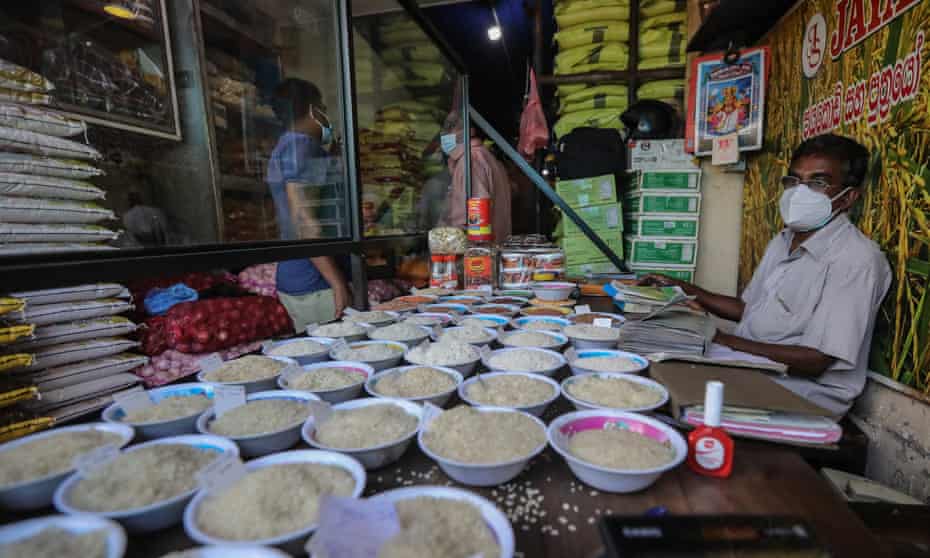
A rice wholesale trader awaits customers at his shop in Pettah, a commercial hub in Colombo, Sri Lanka.
A rice wholesaler plies his trade in Pettah, a commercial hub in Colombo, Sri Lanka. The military has been given power to control prices of food essentials, such as rice. Photograph: Chamila Karunarathne/EPA

Sri Lanka is facing a deepening financial and humanitarian crisis with fears it could go bankrupt in 2022 as inflation rises to record levels, food prices rocket and its coffers run dry.

The meltdown faced by the government, led by the strongman president Gotabaya Rajapaksa, is in part caused by the immediate impact of the Covid crisis and the loss of tourism but is compounded by high government spending and tax cuts eroding state revenues, vast debt repayments to China and foreign exchange reserves at their lowest levels in a decade. Inflation has meanwhile been spurred by the government printing money to pay off domestic loans and foreign bonds.

The World Bank estimates 500,000 people have fallen below the poverty line since the beginning of the pandemic, the equivalent of five years’ progress in fighting poverty.

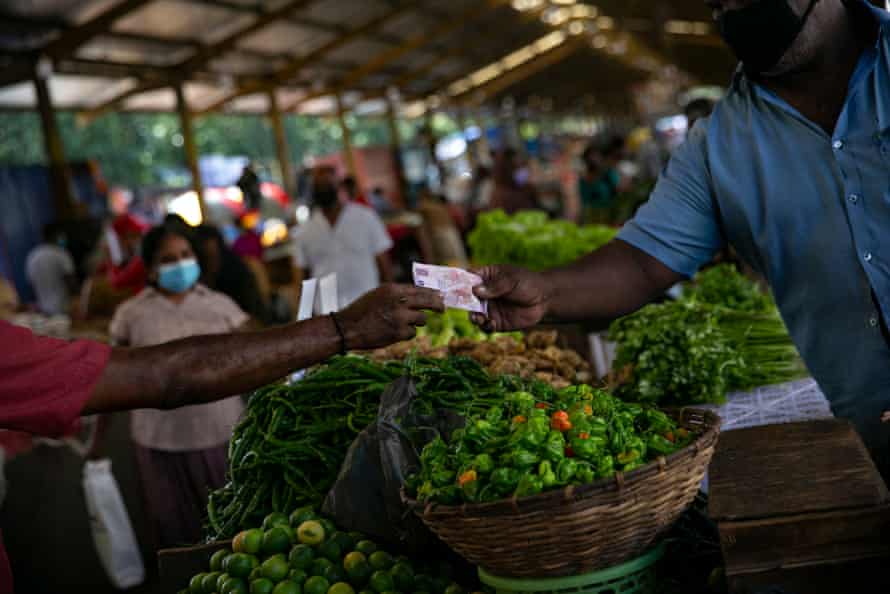
Inflation hit a record high of 11.1% in November and escalating prices have left those who were previously well off struggling to feed their families, while basic goods are now unaffordable for many. After Rajapaksa declared Sri Lanka to be in an economic emergency, the military was given power to ensure essential items, including rice and sugar, were sold at set government prices – but it has done little to ease people’s woes.

A man pays for vegetables at a market in Colombo.
A man pays for vegetables at a market in Colombo. Escalating prices have left those who were previously well off struggling to feed their families. Photograph: Allison Joyce/Getty Images

Anurudda Paranagama, a chauffeur in the capital, Colombo, took on a second job to pay for rising food costs and cover the loan on his car but it was not enough. It is very difficult for me to repay the loan. When I have to pay electricity and water bills and spend on food, there is no money left,” he said, adding that his family now eats two meals a day instead of three.Advertisement

He described how his village grocer was opening 1kg packets of milk powder and dividing it into packs of 100g because his customers could not afford the whole packet. We now buy 100g of beans when we used to buy 1kg for the week,” said Paranagama.

The loss of jobs and vital foreign revenue from tourism, which usually contributes more than 10% of GDP, has been substantial, with more than 200,000 people losing their livelihoods in the travel and tourism sectors, according to the World Travel and Tourism Council.

The situation has got so bad that long queues have formed at the passport office as one in four Sri Lankans, mostly the young and educated, say they want to leave the country. For older citizens, it is reminiscent of the early 1970s when import controls and low production at home caused severe shortages of basic commodities and caused long queues for bread, milk and rice.

A man working outdoors in Colombo
One of the most pressing problems for Sri Lanka is its huge foreign debt burden. Photograph: Vimukthi Embuldeniya/Pacific Press/Rex/Shutterstock

The former central bank deputy governor WA Wijewardena warned the struggles of ordinary people would exacerbate the financial crisis, which would in turn make life harder for them. When the economic crisis deepens beyond redemption, it is inevitable that the country will have a financial crisis too,” he said. Both will reduce food security by lowering production and failing to import due to foreign exchange scarcities. At that point, it will be a humanitarian crisis.”

One of the most pressing problems for Sri Lanka is its huge foreign debt burden, in particular to China. It owes China more than $5bn in debt and last year took an additional $1bn loan from Beijing to help with its acute financial crisis, which is being paid in instalments.Advertisement

In the next 12 months, in the government and private sector, Sri Lanka will be required to repay an estimated $7.3bn in domestic and foreign loans, including a $500m international sovereign bond repayment in January. However, as of November, available foreign currency reserves were just $1.6bn.

In an usual approach, government minister Ramesh Pathirana said they hoped to settle their past oil debts with Iran by paying them with tea, sending them $5m worth of tea every month in order to save much needed currency”.

The opposition MP and economist Harsha de Silva recently told parliament that foreign currency reserves would be -$437m by January next year, while the total foreign debt to service would be $4.8bn from February to October 2022. The nation will be totally bankrupt,” he said.

Central Bank Governor Ajith Nivard Cabraal made public assurances that Sri Lanka could pay off its debts seamlessly” but Wijewardena said the country was at substantial risk of defaulting on its repayments, which would have catastrophic economic consequences.

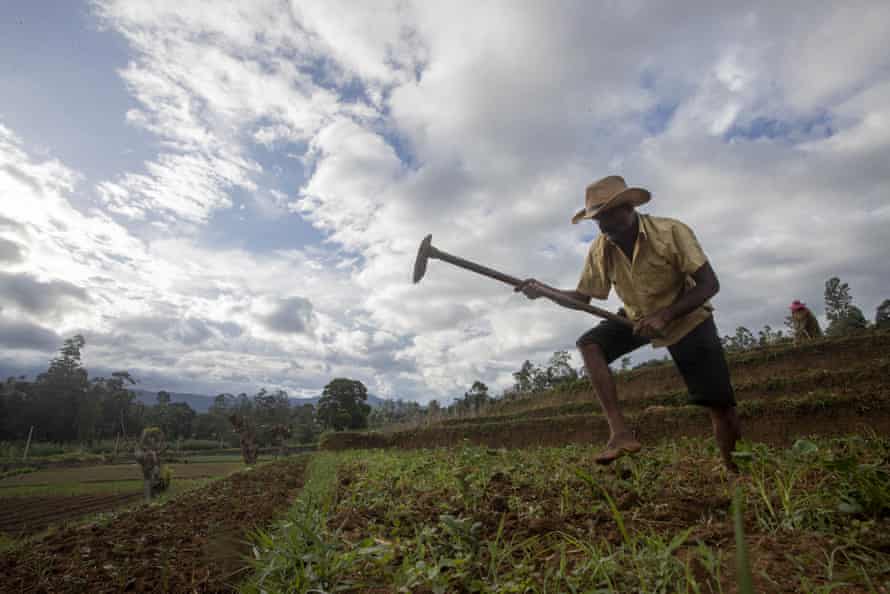
Meanwhile, Rajapaksa’s sudden decision in May to ban all fertiliser and pesticides and force farmers to go organic without warning has brought a formerly prosperous agricultural community to its knees as many farmers, who had become used to using – and often overusing – fertiliser and pesticides, were suddenly left without ways to produce healthy crops or combat weeds and insects. Many fearing a loss decided not to cultivate crops at all, adding to the food shortages in Sri Lanka.

A vegetable farmer removes weeds in his potato field in Keppetipola.
A government decision in May to ban all fertiliser and pesticides has forced farmers to go organic without warning. Photograph: Eranga Jayawardena/AP

The government made a dramatic U-turn in late October and farmers are now struggling to cover the high costs of imported fertiliser without help.

The costs of cultivating paddy [wheat] have gone up astronomically … The government has no money for fertiliser subsidies. Many of us farmers are reluctant to invest money because we don’t know if we will make any profit,” said one farmer, Ranjit Hulugalle.

In an attempt temporarily to ease the problems and stave off difficult and most likely unpopular policies, the government has resorted to temporary relief measures, such as credit lines to import foods, medicines and fuel from its neighbouring ally India, as well as currency swaps from India, China and Bangladesh and loans to purchase petroleum from Oman. However, these loans provide only short-term relief and have to be paid back quickly at high interest rates, adding to Sri Lanka’s debt load.

Anushka Shanuka, a personal trainer, was among those who used to have a comfortable life but now is struggling to get by. We can’t live the way we used to before the pandemic,” he said, saying the prices of vegetables had gone up by more than 50%.

The government promised to help us but nothing came, so we are just managing the best we can. I don’t know how much longer we can go on like this.”

US $ 5.5 million from Russia to WFP for projects in Sri Lanka.

January 2nd, 2022

Courtesy The Daily Mirror

Russia has transferred US $ 5.5 million for the World Food Programme (WFP) to implement projects related to nutrition at school levels, the Russian Embassy said .

The embassy said it had been done in line with the policy of strengthening cooperation with Sri Lanka in the interest of sustainable development .

The money was transferred on December 25, 2021.(Kelum Bandara)

Coronavirus: 339 new cases and 24 new COVID-19 related deaths reported in Sri Lanka

January 2nd, 2022

Courtesy Adaderana

The Health Ministry says that another 339 persons have tested positive for Covid-19 today (02).

This includes three persons who had arrived from overseas, according to the latest figures. 

The total number of coronavirus cases confirmed in the country rises to 587,935 with this while approximately 11,967 infected patients are currently undergoing treatment. 

Meanwhile the official death toll since the start of the pandemic surpassed 15,000 today after 24 more Covid-19 related deaths were confirmed.

Sri Lanka has registered 24 new COVID-19 related deaths for January 01, pushing the death toll since the start of the pandemic past 15000, data showed on Sunday. 

The Director General of Health Services has confirmed the Covid death figures for yesterday, which includes 20 males and 04 females.

Eleven of the patients were between the ages of 30-59 years while the other 13 were aged 60 years and above. 

This brings the total number of coronavirus related deaths in the country thus far to 15,019. 

What the Government should do to get rid of the present financial crisis ailing the country?

January 1st, 2022

Dr Sudath Gunasekara. Mahanuwara 30.9 2021

(A. republication) 2.1.2021

Fail Clipart Financial – Financial Crisis Icon – Free Transparent PNG Clipart Images DownloadFree Image Clipartmax

Definitely one doesn’t need to be a financial or an economic wizard or a John Keynes to un-mess this mess that has emerged as a direct result of mismanagement of the nation’s economy by all those who were in charge of Governance in this country, since 1977. What you need is only common sense and the guts to take a decision do it. Therefore the following set of proposals is listed here for the consideration and immediate action by the Government.”Lindata wetunu miniha linkatenma goda enta one’ is the most appropriate adage I can quote here. This mess is nothing but a collective mess created by our own politicians. Therefore the onerous of taking the full responsibility for this national crime as well as finding a suitable remedy for the malady, they themselves have jointly created, also falls definitely on all their heads, including those who are dead and gone to hell.

The present government must take these decisions immediately before the situation become worse that might lead even to a civil war against it, going by the way how things are already getting out of control around the country. A stitch in time saves nine. But in doing so I must warn the government that it has to completely forget about the vote fever, because it is your responsibility and unbounded duty by the nation at this critical time.

35 very important steps that have to be taken immediately to ease the present crisis.

1 Stop all extravagant and wasteful expenses of the government

2 Ban the import of all luxury and non-essential goods

3 Increase the prices of local products to encourage local production

4 Remove extra perks to all politicians and public Servants (It is said that 85% of national income is spent on maintaining politicians and public servants supposed to be the highest per-man ratio in the world)

5 Stop all state tamasas and useless political functions for image building and meetings of public servants to the bare minimum limiting them to the most essentials. 

6 Close down all Governors Offices and allow the Government Agents and Divisional AGAA andGrama Seva Niladharis to run the Administration and Coordination of development in their Districts, Divisions and Graama Niladhari Units

7 Close down the 9 Provincial Councils epidemic permanently now that they have ceased to function almost for the past 5 years without any disruption of day to day to governance of the country. Attaché public servants displaced as a result to suitable Government offices in the districts

    Use the PG buildings to house public offices presently housed on rented out buildings.

     And transfer the functions done by the PCC to the GAA’s and AGAA’s offices and the respective line Ministry sub-offices in the Districts so that the smooth delivery of services to people will continue uninterrupted.

8 Scrap all superfluous government institutions such as mushroom Ministries, Departments and statutory bodies created to provide jobs for supporters of politicians

9 Reduce the number of Ministers and Ministries to 15 and appoint a Minister and a Deputy under him to run each Ministry instead of having 70 different Ministries, 30 Cabinet and 40 State Ministers, (as if the Cabinet Ministers are not Ministers of the Sri Lankan State at present) in this small country just to provide employment for a set of unproductive Politicians at high cost just to keep them satisfied with no substantive contribution to the country but has only increased  duplication, waste, corruption, confusion, inefficiency and rivalry among them. This move will drastically reduce the number of wasteful institutions, excess officials, waste and corruption and also reduce hundreds of government institutions that waste billions of public funds with no substantive contribution to the country but making us a nation of beggars.

10 Close down all the Embassies and Consular Offices of smaller countries and ask the nearest Embassy to overlook them.

11 Close down all Pradeiya Sabhas (mere duplicates of Provincial Councils) and go back to the former VC system and allocate PS buildings to line departments working in the areas, and assign the present Members to their respective Village Council areas to work under the District Commissioners of Local Government

12 Stop payments for all officials for attending meetings, as they are only part of their official duties

13Limit the number of vehicles and personal staff to Ministers and Deputies including security

14 Withdraw official vehicles from all public officers and let all public servants to have their own vehicles to do their official travelling and pay a commuted allowance and mileage for travelling out of duty stations on official duties. Provide them with a loan to buy a vehicle like in the past for which the Govt need not provide drivers or fuel. It is interesting to note that even in America, whhic is supposed to be the richest country in the world no politician or public servant is given official vehicles, drivers or fuel and they have to pay even for parking in the parking lots.

15 Never renew the duty free Vehicle system to anybody including politicians and public servants. However the Government may have a system of duty free system of vehicles, machinery and raw material etc under strict and close supervision for agricultural and Industrial sector to promote development in those sectors.

16 Let the Public Servants run the Ministries under the general supervision of the respective Ministry Secretaries. Do away with the present practice of providing a band of personal staff that virtually run the Ministries today making it a mockery and a mere political party office killing the spirit and the essence of an impartial public service. Provide only a private Secretary.

17 Stop providing houses for Politicians in Colombo. Instead provide them with a common place, like in the past (Sravasti) for them to stay when they come to Colombo on duty for the 8 days they are expected to attend so that they will be compelled to live in their electorates for the rest of the month.

Transactions in Embassies

18 Get the Diplomats to attend to all government to Government business and cut down all unnecessary foreign travel for politicians except under very special situations

The need to have the Supply and Cadre Division in the Treasury reactivated and strictly complied with its rules and regulations

19 Get the Treasury to have fixed cadre for all Ministries and Government Departments and statutory bodies and corporations that should not be exceeded without the prior approval of the Treasury to expenditure under treasury control and to stop packing public institutions with unqualified political appointees

20 Remove all excess staff of all public institutions as early as possible after a quick survey by the Supply and Cadre Division.

21 Give all Government institutions daily, monthly and annual targets to ensure that every person does a quantum of work for the money he/she is paid and hold the heads of the Divisions responsible for running those institutions efficiently and profitably

Payment of fabulous salaries for certain public Sector employees

                                                                                                                                                                                                                                                                                                                                                                                                                                                                                          22 Stop all fabulous salary payments made to some people Like the Chairman of Air Lanka for example which was reported in the press few days ago as Rs 32 lahks a month.

Recovery of CB scan money

23Take immediate action to recover money robed from the CB and confiscate the properties of all found guilty in addition to other punishments under law.

24 Entrust Administration to professional public servants and stop politicians from meddling with day to day Administration of Government institutions and thereby disrupting smooth governance of the country.

25 Also close down Regional and Divisional offices of Government Departments and corporations etc opened in the recent past just to recruit more people to public Service as a fashion without considering the ramifications involved in public spending with no parallel improvement in the delivery of public services.

National Austerity Year

26 Declare a national Austerity year and Agricultural Production year and give top priority for self-sufficiency and export development in the agricultural sector.

Remove all duel citizens from Parliament

27 Remove all Ministers and MPP who are dual citizens both in the Govt and the opposition in Parliament immediately as they are persons with divided allegiance and keep those places vacant until a general election 

 Inquire in to assets of MPP in Parliament form 1977

28 Initiate actions to Identify Politicians who have been in Parliament from 1970 and investigate their assets at the time of joining and the present and confiscate all wealth proved had been illegally a)amazed and remove the civil right of those found guilty for life

Defeated Politicians holding public positions

29 Remove all defeated and ex-politicians holding appointments as Diplomatas, and any other post at Home like Chairmen of state institutions and replace them with professional men who can do those jobs to increase efficiency and profit.

The need for a vigorous national food Production Drive

30 Commence a vigorous National food Production Drive in the agricultural and livestock sectors with a full gear of the Government like loans, implements, fertilizer, guaranteed prices and extension services, storage and marketing facilities for domestic and export market with incentives like tax concessions to be followed up with a staggered import ban on all items on all Agricultural an dallied products.

Reduce the number of politicians and public servants in the country

31 I have found that the number of Politicians and public servants has undergone a tremendous increase since 1977 due to increasing the number of public institutions and multiplying administrative divisions like GS and Local Government units. As a result it has been reported that today there is one politician for every 3232 persons and one public servant for every 16 people in this country and 85 % of annual public revenue is spent on the upkeep of politicians and public servants. This I think is the highest figure for any country in the world. In addition to this curse, is the very high expenditure on social welfare, like health, education and public relief that has to be met with the balance 15 %. No wonder the country’s economy has fallen to this level.

Reduce the extremely high number of Public holidays for any country in the world as it we are living in the Aalakamandaava.

32 Reduce the extremely high number of Public holidays to internationally accepted average of 12 per year to increase the number of man days that could be gainfully used for development

For example you can use the following model

National Holidays

1April 13th and 14th Sinhala New Year day    2days

2 Vesak Poya                                                     2 days

3 Republic Day May 22                                     1 day

4 Poson Poya Jatika dinaya                              1 day

5 National heroes Day (has to be decided)   1 Day (May 9) LTTE Defeat

Optional Public Holidays. Sundays 12/ or the balance 10 Depoya Common to all   to be decided after discussion. This will make the total no of Public holidays  either  17 or 19  This will boost production in all sectors due to an increase in the number of working hours           

All other holidays presently declared as National Holidays like Christmass, Good Friday. Maha Sivaratri, Deepawali Thaipongal, Mohomads Birth Day, Hajji Festival, Ramasan Should be declared holidays only for the respective religious communities. This I think is the best arrangement any Government should make to protect the country’s Sinhala Buddhist identity.

33 Withdraw political rights from all public servants, other than the right to vote to bring back discipline and sanity to public service so that we can have an efficient and productive and disciplined loyal public service under strict supervision of the immediate supervisory officers.

34 Remove the 29 National list MPP from Parliament who are not elected by the people by a motion with the consensus of other parties pending Amendment to the Constitution.

35 Stop payment of bonuses and overtime in all institutions that don’t show a profit in their annual balance sheets and also make annual confidential reports compulsory in all Ministries, departments and statutory institutions

Important: I request some one knowledgeable and competent to calculate the net savings that would accrue to the Government under the implementation of each of these items, if they are implemented.

This is only a few important ideas that came to one man’s head at random. I invite readers to add any other important issue that comes to their mind to make the operation a fuller success.

                                 පාලකයින්ට ණුවන පහල වේවා!

                     මගේ රටත් ජාතියත් මේ අර්බුධයෙන් ගොඩ ඒවා

Learning from the Past: The Divisional Development Councils Programme Offers hope for our Economic Woes

January 1st, 2022

By Garvin Karunaratne 

 The experience of the Divisional Development Councils Programme(DDCP) of Sri Lanka(1970-1977) is currently of great importance in today’s situation of unemployment and also the inability to import goods due to the lack of foreign exchange.   This is because the DDCP is a programme that really creates employment. Further it is important to note that the DDCP was entirely implemented with local Rupees.  Foreign funds were only required to import dyes for the Crayon Project and the amount of dollars spent to import dyes saved a vast amount of dollars that would have had to be spent on importing crayons.  The DDCP is a blue print that can be immediately implemented almost entirely with existing staff and it can get into production mode within months.  

There are very few employment creation programmes in the world. What one can find are training programmes which provide training but do not include placing the trained in an income generating project, including guidance till the project- either on a self employed basis or a cooperative endeavour, is successful. The DDCP included all the elements of vocational training in an on the job manner and active intensive guidance, ending in the trainee becoming self employed or cooperatively employed in production. The key element is that success was judged in terms of commercial viability. 

Another important factor in assessing the DDCP lies in the fact that the DDCP created employment for the drop outs of the education system. In any country, the education system provides knowledge and training and those who are very successful enter the universities or institutes of higher addressing the current situtaion of unbemployment and education to attend to further studies. The next lot that get pass marks at secondary school, but fail to enter further studies enter the job market and find employment. Those who are not successful in the education system and who do not get pass marks are classified as the drop outs and they continue to do menial jobs or continue to be unemployed, scraping the barrel, for life. The DDCP dealt with. the youths who are in the third category- i.e. the drop outs and therein lies its greatness. 

Training on the job, ending in being fully occupied in a cooperative enterprise, or being self employed, in both cases being engaged in income generation activities is what the DDCP attended to. The fact that drop outs of the education system were concentrated on gives the DDCP a great place among development programmes. 

The DDCP was the flagship of the Sirimavo Government of Sri Lanka during the period 1970 to 1977. It had very wide and visionary aims in keeping with the Manifesto of the United Front that won the 1970 parliamentary election . It was ” to transform the administration thoroughly, make it more democratic and link it closely with the people” 

As stated by Dr N.M.Perera, the Hon. Minister of Finance, in the Budget Speech 1973: The main objective of this Programme is to create employment opportunities in the rural areas through small scale projects in agriculture, industry and the provision of infrastructural facilities, making use of the resources available locally: increase national production and involve the people in national development work.” 

The chief aim of the DDCP was to create employment for the youth. As stated in the 1970 Budget Speech it was ” to fulfill the aspirations of thousands of young men and women for whom life will lose all meaning unless they can find a useful place in our society.” 

In actuality the DDCP was a crash programme with the objective of creating 100,000 jobs within the first year of the new government.. It was a socialist government that took office in 1970 and in keeping with the aims of the Government as reflected in The Five Year Plan of 1970, the aim was to lay the foundation for a further advance towards a socialist society”. 

Professor H.A.de S. Gunasekera, the eminent professor of economics at the University of Peradeniya was handpicked to lead the programme and he was appointed as the Permanent Secretary to the Ministry of Plan Implementation. The main charge of the Ministry was the implementation of the DDCP. 

The DDCP got off to a grand start. The Ministry of Plan Implementation was specially created for the purpose of planning and implementing the DDCP. Great prominence was accorded to the Programme. Even a helicopter was placed at the disposal of Professor Gunesekera, for him to travel to the various Districts. This was the first time that an administrator was accorded this privilege. 

At the District level, the Government Agent, the head of the District was held responsible for this programme.  

A Divisional Development Council was established in each division and these Councils were chaired by the Divisional Revenue Officer, later renamed Assistant Government Agent. A number of Graduate Assistants were posted to each AGA area and there was a Graduate Assistant for each Council. The Graduate Assistants were recruited specially for this DDCP. This category was recruited from among unemployed graduates. 

Popular participation was foremost in the mind of the Government. As Peris and Nilaweera state 

” these councils were expected to enable popular participation in which the elected bodies of the village- the cooperative society, the cultivation committee, the village council could have a role in planning and coordinating the overall development of the area.” (Rural Poverty Alleviation in Sri Lanka, 1983) 

The Plan also included organizing agricultural, industrial, fisheries and other income generating projects and for obtaining the maximum participation of the people in the planning, operation and management of the projects. The Divisional Development Council was the method of eliciting the participation of the people in planning their own development. 

The monthly meetings of the Council were held regularly and were attended by all the officers at the divisional level, representatives of all village level bodies and also by officers from the district level. Thus it was a body that could attend to the total planning of all development tasks at the divisional and village level. 

Each Council was allocated Rs. 200,000.00 to be spent within the first two years. Of this, 35% was earmarked for agricultural projects. However specific approval had to be obtained for each project from the Ministry of Plan Implementation and the feasibility of each project was studied in great detail. Special grants were given amounting to 35% of the total cost including capital costs and working capital. For instance in the case of the Gohagoda Agricultural Project of the Kandy District, an average project, the capital cost was Rs. 65,000.00, the working capital Rs. 34,000.00 and the grant allowed was Rs. 32,000.00. By 1976, the penultimate year of this Programme, as much as Rs. 127 million had been spent on various projects. 

While it was hoped that the Councils would be a coordinating body for all development work it was also projected that each Council would have to initiate and manage special projects where youths would be offered employment. What was new in the DDCP was that new projects were to be approved where youths would be enlisted, trained and guided to be employed in income generating projects. 

In these projects, the youths were to work with community support where community leaders would help the enterprises. Earlier there were multipurpose cooperatives at the village level with an apex body- a cooperative union at the divisional level. What was new with the DDCP was the thrust of community cooperatives at economic development. Earlier the multi purpose cooperatives only attended to the distribution of essential food, the purchase of paddy, providing credit and supplies for agricultural pursuits. In addition there were industrial cooperatives established for making furniture and for crafts.  There were Power Looms established on a cooperative basis. 

The Achievement 

By 1972, the DDCP was implemented islandwide. By 1973, 590 Councils were fully established and these Councils had submitted 1900 projects proposals of which 900 projects were approved and special allocations of funds were made for their implementation. All these projects were planned from the grass root level. These projects comprised 341 agricultural projects, 512 industrial projects and 47 infrastructural projects. Nearly 2000 acres were brought under cultivation, 68 poultry projects with a bird population of 150,000 were established and this enabled 7904 persons to find employment at an expense of Rs. 4.2 million. Over the period 1970 to 1976, a total of Rs. 127 million was spent and 33,271 jobs were created. Some of these offered only part time engagement. 

The work of the Councils concentrated on developing these projects. The role of planning and coordinating the total development in the division gradually receded to the background and was ultimately forgotten. The Assistant Government Agent of the division already attended to the function of planning and coordinating all development work at the divisional level. He continued to do this work. Projects were planned and established in all districts. There was a duplication of work because many of the industrial projects approved for the Divisional Development Councils were in crafts, an area that also came under the Small Industries Department. There were a few non craft industries like ceramics. In agriculture, the thrust was at establishing cooperative farms and this was a new feature. The services of the Department of Agriculture was obtained for this purpose. In most agricultural and industrial projects the youth workers were able to draw good incomes. 

Of special mention is the Paper Making Project in Kotmale in the Nuwara Eliya District where paper and cardboard making was commenced using waste paper and straw. This was a success till it was closed down by the new Government of 1977 which ran down the working and the achievement of the DDCP purposely. 

In the Galle District progress was made in agricultural farms and in the manufacture of farm implements. The Baddegama Assistant Government Agent, Wilson Perera was provided with four Graduate Assistants and 12 Project Officers. The latter were officers with experience in the particular vocation whose services were sought and they had been seconded for service for the DDCP. Their task was to work with the cooperative workers on a participative basis, teaching youths the essential elements of entrepreneurship in producing and marketing the products. It was hoped that the youths would eventually acquire the ability and capacity to manage the cooperative industry or agricultural farm on their own on a commercially viable basis, when the Project Officer would leave them and revert to their own substantive post or be posted to lead another DDCP project. Thereafter the youths were expected to function on their own steam. 

The development work done in Baddegama Council area included establishing a cooperative farm with 60 youths . At the very inception a neglected old farm was taken over. Its factory was repaired and a part of it was converted into residential quarters, 12 acres of neglected rubber was rehabilitated and tapping commenced, 40 acres of neglected tea was rehabilitated, 20 acres of jungle land was cleared and coconut saplings planted, 50 acres of neglected paddy land was rehabilitated and brought under regular cultivation. In addition, in 1975, a housing scheme was launched for the cooperators. Similar farm projects were established in most Districts. 

The Baddegama Farm Project was a great success till it ran into political problems. The DDCP was a socialist concept and engineered by the Marxist group of Ministers of the Cabinet of Ministers. These included Dr N.M.Perera, the Minister of Finance. These Ministers left the Government in 1975 and thereafter less emphasis was Placed on this Programme. 

The DDCP was implemented islandwide but I will confine myself to detail what was achieved in my District, Matara, to illustrate what the SLFP and its ally the LSSP stood for.  

In the Matara District, where I was the Government Agent many projects were planned and implemented. The projects included garment making, batik dyeing, crafts, pre-stressed concrete, sewing industry projects etc. The sewing and craft projects were a replica of what was done by the Small industries Department. 

A Batic Dyeing Cum Sewing Project was initiated in Morawaka where employment was offered to twenty girls. Batic Dyeing Training was at that time not done by any State Department or institution and it continued to be within the private sector with a very high margin of profit. The Sewing and Batic Dyeing Unit was a great success. 

In agriculture in the Matara District, virgin crown land was identified, jungles cleared, the land graded and brought under cultivation. A number of farms were established and the cooperator youths drew good incomes by cultivating cassava, ginger and other crops for which there was a market demand. The youth cooperators were taught details of crop planning, preparation of the land for cultivation, planting, , crop care, harvesting and marketing. All of these aspects were taught on the job as they engaged in the various tasks. The entire approach was participatory as detailed earlier in the case of the Baddegama Council in the Galle District. The aim was to make the youths think and thereby enhance their ability and capacity to get to working on their own. This included training in the management of every aspect of their cooperative enterprise. 

The Councils in the coastal areas of Weligama, Matara and Dondra had submitted projects for making inboard fishing boats. It was difficult to obtain approval for these projects from the Fisheries Ministry, the one Ministry that should have been interested.. Two projects for Matara and Dondra Councils were approved with the greatest difficulty. The Boatyard for Matara was established in 1972 and manufactured twenty four, 30 ft inboard motor boats a year. This was the first cooperative boat building project in the entire island and the cooperator youths were taught full details on the job from the selection of timber, tracing the templates, seasoning timber, cutting and fitting the timber and fixing the engines etc. The trainees had been trained in carpentry and they learned the manufacture of the boats on the job. The boats were sold to fishermen in cooperatives. This Boatyard Project was ably handled by the Assistant Government Agent, Ran Ariyadasa and Kumarasiri, the Graduate Assistant. This industry was an acclaimed success till it was closed down in 1978 by the newly elected UNP Government which wanted to discredit the DDCP. 

Other important industrial units established included a Hand Made Paper Unit at Yatiyana, an industry that has survived to this day(2009), recycyling used paper from government offices. At Kekanadure, an industry making agricultural implements was established in a village which was traditionally associated with the industry. This industry exists till today(2009).At Talpawila training in pottery was imparted to youths and a pottery industry was successfully established.  A Pre-Stressed Concrete Factory was established at Talpawila which made concrete pipes and posts of all types. This industry exists and currently employs 40 youths. 

The Morawaka Council submitted a proposal to establish a Water Colour Paint making project, A Feasibility study was made by the Industrial Development Board at our request. The project was aimed at avoiding imports. There was no resource in the area for this industry other than labour, but that was the strategy used by Japan and Singapore in their industrial development. The Ministry of Plan Implementation rejected this application. Instead of import substitution type of projects the Ministry of Plan Implementation was advising us to concentrate on brick making, tile making and crafts- the areas where the Small Industries Department had made inroads with great success.. In the private sector there were plenty of tile and brick making factories. The Ministry was not interested in establishing any import-substitution type of industries. Though we had submitted various proposals for Import-substitution type of industry they were all thrown into the dustbin. I therefore decided to plan and establish a cooperative industry on my own. I was ably assisted by the Planning Officer Vetus Fernando, who happened to be a chemistry graduate and Chandra Silva a resourceful officer who was the District Land Officer. He was working on the DDC Projects in addition to his duties. A graduate trainee Dayananda Paliakkara was specially selected to handle this task. 

In my work as the Deputy Director of Small Industries I had approved many new industries to be established and I had directed all my officers that they should investigate when they go for inspections and be certain that the entrepreneur actually manufactured the product. On my inspections too I saw that the items were really produced. This was done because there were people who pretended to have industries in an attempt to secure allocations of foreign exchange, import and sell the goods in the market instead of engaging in production. I had approved an industry to make water colours and was familiar with the process of manufacture. According to my opinion crayons was allied to making water colours. I decided that this could be an area for action. At that time easily 90% of the country’s requirements were imported and if we succeeded we will be creating employment for the unemployed and at the same time cutting off imports. The import content of the ingredients was easily less than 20% and this looked ideal.. 

After we had done some initial experiments and was hopeful of success, we had to obtain the services of a laboratory. I spoke with Mr Ariyawamsa, the Principal of Rahula College, the premier educational institute in the District. I knew a number of science teachers at this College, who offered ideas. Mr. Ariyawamsa readily agreed to allow us to use the College science laboratory for experiments to find out the technical process for the manufacture of crayons. We were also helped by the Science Inspector Mr. Rajapaksa. I had heard about the working of the Land Grant system in the USA where the Universities offered their technical expertise to bring about national development. 

Pooling the knowledge of every scientist that was available, led by our Planning Officer,Vetus Fernando it did not take long to find out the exact proportions of each ingredient that had to be used and to arrive at the real process of manufacture. The process was gradually mastered, but the crayons were not firm enough and Vetus Fernando, the Planning Officer who happened to be a chemistry graduate of the University thought it best to obtain the help of the Chemistry Department of the University of Sri Lanka, from where he had graduated a few years earlier. Vetus spent a number of days beseeching and begging his professors but none of them were interested in offering any advice. 

If any one of the dons had to spare an hour or two to have a careful look, to think of how it could be solved and try a few experiments- that was all that was required. This was a situation where a Land Grant University like Michigan State would have taken on the mantle of development very willingly. But sad to say our Universities are more engrossed with training graduates rather than been concerned about the role they could play in the development of the country. We continued experiments at the Lab at Rahula College and mastered the art of making crayons in around a further month. 

Once the process of manufacture had been finalized I had to decide how we would proceed with the manufacture. It had to be a cooperative structure. Further it had to be done with a great deal of secrecy because I was not expected to be establishing new industries without the approval of the Ministry of Plan Implementation. Though as the Government Agent of the District I controlled vast funds; each vote had a definite remit which had to be meticulously adhered to in spending. Finally I decided to trust Mr Sumanapala Dahanayake, the Member of Parliament for Deniyaya, an electorate in my District. He was also the President of the Morawaka Cooperative Union and in that capacity he had access to the funds held in the Cooperative Union which we could use as capital for the necessary expenses. However he had no authority to use the funds for a new industry. This was a deadlock that had to be surmounted. 

As the Government Agent of the District I was gazetted as a Deputy Director for Cooperative Development. This had been done with the idea of the Government Agent supervising the Assistant Commissioner of Cooperatives and the work of the Cooperative Department in the District for the purpose of implementing the agricultural development programme. I usurped the full powers of a Deputy Director of Cooperatives and ordered the President of the Morawaka Cooperative Union to use funds available with the Coop Union and establish the industry and get down to manufacturing crayons.. Sumanapala Dahanayke the President of the Coop Union, the maverick he was, readily agreed and we got down to establish the industry. Twenty unemployment youths were recruited and the Coop Union purchased the necessary equipment. More youths were employed for packing and handling. 

The industry was established and we got down to the making of crayons; labels and boxes were hastily printed and crayons packets were produced to fill a large room. This was done very quickly, working day and night because secrecy was a prime necessity. It was a grand task where every one- officers and cooperators pitched in to work as a team- working day and night. If the Ministry of Plan Implementation got wind of the project they could stop it forthwith, hold an inquiry and punish me. The task was to establish the manufacturing unit, make good quality crayons and to show them to key Cabinet Ministers and get them involved so that they could stand up for me in case I ran into a  problem for acting on my own without Ministry approval. The Minister for Industries Mr T.B.Subasinghe was surprised when shown the crayons that were produced and readily agreed to open the sales. With that we felt safe. With the inauguration of the sales, the industry came to the open and the success in production and sales amply justified the fact that no Ministry approval had been obtained. The Ministry of Plan Implementation had to eat humble pie and finally the crayon factory, established without authority in a most clandestine manner, gained the full approval of the Government. Ultimately the Coop Crayon industry established by Sumanapala Dahanayake in his capacity as the Presidenbt of the Morawaka Cooperative Union produced around a tenth of the crayons that Sri Lanka required. became  the flagship industry of the DDCP. 

The only import item in the ingredients that went into the manufacture was dyes and at the initial stages we obtained dyes at black market prices from the open market. The Ministry of Industries was requested for an allocation, but they said that they had no foreign exchange to be allocated to cooperatives for this purpose. An year earlier as Deputy Director of Small Industries I was personally in charge of allocating foreign exchange for small industries and I could have given an allocation for any cooperative. The personnel in the Small Industries Department and the Ministry of Industries were not prepared to bend the rules for the sake of national development. Finally we had to beseech the Controller of Imports, Harry Guneratne. The Controller of Imports allocated funds for the import of crayons and readily agreed to my suggestion to allocate funds for the import of dyes and to reduce the allocation for imports accordingly. Guneratne had the capacity to understand that in a crayon the import constituent was only 5 to 10% and he was making a real saving in foreign exchange to the extent of 90%. The Minister of Trade, Mr T.B.Illangaratna, whose authority was sought, too readily agreed. He was surprised with the quality of the crayons and it ended with a request from him that we should commence a crayon factory in Colombo. We put off that request for the moment stating that we would do that after our crayon industry was fully established on a commercially sound footing. 

This crayon industry was a grand success which paid up the total outlay in the first six months of its operation. After I left the Administrative Service in April 1973, the industry continued under the able direction of the Government Agent of the District and Sumanapala Dahanayake the President of the Coop Union till 1977 when the new Government interfered. Any good industry established by the former government was anathema to the new Government and the new Government sent a Deputy Director of Cooperatives, N.T,Ariyaratne with specific instructions to find fault with this industry so that they could take action against Sumanapala Dahanayake, the President of the Coop Union, the earlier member of parliament, who had established the industry under my direction and had with the youth cooperators managed it in a commercially viable manner. Mr Ariyaratne had found the industry in proper order fully commercially viable and reported that the industry was an asset and this saved Mr. Dahanayake. 

However, the crayon industry had to close down due to the onslaught of imports under the free trade policies of the new Government. At its heyday from 1972 to 1977 this crayon industry did produce around a tenth of the crayon requirements of the country and it could easily have been developed to produce not only the country’s entire requirements but could have even be developed to build up an export trade. 

. In any country when a successful industry is established it should be closely supported and guarded in the national interest. Not so in Sri Lanka, when political rivalry raises its ugly head.. 

As stated earlier the Marxist Ministers led by Dr N.M.Perera leaving the Government in 1975 led to the Government de- emphasizing the DDCP. With the free market and liberalization policy followed by the new Government the death knell of the DDCP was sounded. In the Budget Speech of 1978, it is said that though as much as 2619 projects were approved, 666 projects never got off the ground and of the balance approximately 700 closed down by 1976, of the remaining 700 only 5% were found viable, and as much as 72% of the agricultural projects had failed. This was more a part of the tirade that the new Government had toward the DDCP flagship of the former Government. 

Strengths and Weaknesses 

Many are the weaknesses and the strengths of the DDCP. 

The weaknesses are many. As pointed out earlier, the Ministry of Plan Implementation was approving only traditional and craft type of industry and agricultural farms and was shy of approving new import substitution type of industry. Perhaps the Ministry was frightened to march into new areas of activity because any failure would reflect badly. Imports eat into our available foreign exchange and also cause our people to be unemployed. Concentrating on crafts and basic traditional industries amounted to duplicating the work done by the Small Industries Department that had been active earlier. The Ministry should have actually taken the forefront to plan and establish import substitution type of industries. 

Another weakness was that the Programme solely depended on worker cooperatives and left the private sector totally alone. If the private sector had been activated in addition, then it would have been a case of walking on two legs. 

The main weakness lies in the Parliamentary form of party political governance system where when a new political party comes into power it throws away all the programmes and policies of the earlier government irrespective of successes. In the process, the baby is also thrown away with the bath water. 

The Strengths lies in the few projects that were successful. These commercially viable ventures helped the national economy. Their production did save foreign exchange that would have been incurred in imports. The fact that employment was made available for the cooperative entrepreneurs is also of key importance. 

An additional strength was the educational process of building up the abilities and the capacities of the participants and making them self-reliant entrepreneurs, able to stand on their own feet. This was due to the strategies of community development and non formal education which we used. At that time administrators who worked in the Rural development Department and that included the Government Agents of the Districts and the Assistant Government Agents in charge of Divisions had come to follow community development strategies and principles. We administrators had not even known the word non formal education, but we thought it best that we work with the trainees in a truly participatory manner, so that they could learn on the job. 

In the planning and implementation of the DDCP the Ministry of Plan Implementation did not give us any instructions as to how we should adopt a participatory approach. However the officers under the Government Agent included those who had worked for long under the Rural Development Department which attended to rural development work with the participation of the people. This Rural Development Department was our counterpart to the Community Development Programme of India and many other Third World countries that were implemented in the Fifties. The Rural Development Department followed the principles of Community Development as enunciated by the United Nations; The term Community Development has come into international usage to connote the process by which the efforts of the people themselves are united with those of Governmental authorities to improve the economic , social and cultural conditions of communities, to integrate these communities into the life of the nation and to enable them to contribute fully to national progess. This complex of processes is then made up of two essential elements ”…”the participation of the people themselves in efforts to improve their level of living with as much reliance as possible on their own initiative and the provision of technical and other services in ways which encourage initiative self help and make them more effective.(United Nations, 1965) 

It so happened that the entire staff handling development in Sri Lanka at the District level came under the influence of the Community Development ideas and this included the Government Agents who were development hardened workers who had a great deal of experience. It did not need directions on how to handle the education aspect to officers that had attended to working with the people for decades. The result was that the staff handpicked for the planning and the implementation of the DDCP did use the community development participatory approach. 

This included non formal education ideas as defined by me later on: Non Formal Education comprises experiential education processes to which people as participants are spontaneously subjected to as they actively work on an individual basis or in any group endeavour, be it in a discussion in the decision making that takes place in a trade union or a cooperative. It is completely spontaneous and as the learner participates, thinks and conscientizes, weighs the pros and cons of a problem and arrives at decisions, knowing fully well the confrontations involved and as the participants cooperate to face the obstacles, get used to collaborative practices of mutual help in achieving the tasks then through these repeated educational experiences, their initiatives develop and they become responsible.(From Karunaratne: Non Formal education Theory & Practice at Comilla) 

This quote would encapsulate the educational methods used by us in educating the trainees in the on the job situation in the various agricultural farms and industrial projects. Details provided of the projects in the Baddegama electorate in the Galle District and the Matara District shows that educational strategies were used to effectively enable the trainees to whet their abilities and in that process they gained the ability to become self reliant entrepreneurs. 

This educational enhancement is the strength that should have been built upon in every development program. 

In the case of the DDC Programme projects, with an initial grant for the machinery and a paltry allowance till the entrepreneurs derive incomes, we paved the way for the unemployed youth of a country to become net contributors. In this process they march from being net consumers to become net contributors. They have also in the process developed their abilities and capacities to stand on their own feet. This is a strength that stands in good stead. 

In Projects, the manufacture of farm implements in Baddegama, , the manufacture of crayons at Deniyaya, the pre-stressed concrete industry at Matara, the making of paper products at Kotmale and Matara and a number of such industries were all well established and commercially viable. So were many textile and sewing industries. The good number of DDCP industries that have been successfully implemented even today(2009), defying the inroads of imports indicate the viability of the DDCP Projects and the underlying strategies. The main tenet was import substitution which is forbidden under the IMF rules of the Structural Adjustment Programme, Even today, three decades later, my blood boils when I see a packet of foreign crayons being sold in Sri Lanka. My mind travels back in nostalgia to the time when the crayon factory provided employment to scores of youths in making and packing crayons and in selling them island wide. 

. Establishing the crayon industry was easily the happiest task I had done in my eighteen years’ service to my Mothercountry. It was also the most dangerous task I had done because I was not authorized to establish a new industry without the specific approval of the Minstry of Plan Implementation. I had experience in handling small industries earlier and was certain that the venture would be a success. If it had failed I would have been demoted for certain but I was certain of success. Further I knew Dr N.M.Perera the Minister of Finance personally as he had been a member of parliament in the opposition in Kegalla District where I worked as the Additional Government Agent for two full years. He gauged my ability and I became one of his trusted lieutenants in the field of development. I was certain that he would have stood up for me if I fell into a scrape by attempting to do the impossible which other administrators would shrewdly avoid. 

The DDCP had all the elements of a great employment creation programme, which was lost partly due to defects in the Programme itself , due to administrative ineptitude and partly due to political rivalry. 

What should have happened is what did happen in Singapore. In the words of Michael Smith
The real clue to Singapore’s success has been a brave, consistent, government generated long term industrial strategy. Professor Tom Stonier sees that strategy as having worked in two stages, In the early Sixties the emphasis was on import substitution. The Government had high tariff protection to help industries that would reduce dependence on imports. In the second phase, the emphasis shifted to export oriented manufacture. (From Asia’s New Industrial World) Singapore has had a steady rule by a single government for decades and thus did not suffer from political party rivalry. 

Conclusion
The DDCP of 1970-1977 was a genuine attempt at brining about development. Its achievement and the strengths and weaknesses have already been dealt with at length. 

Though certain aspects of the DDCP, like the agricultural farms and industrial projects were a great success and could have been easily built upon, the DDCP came to an abrupt end due to the fact that the newly elected President Jayawardena’s Government wanted the DDCP, discredited, annihilated and closed down. It was necessary for the new Government to paint everything that the earlier government achieved as black as possible. This was to get political mileage. It is sad that development in the Third World countries does fall between two stools, whenever a new government is formed. 

Development requires a long standing effort where programmes get continuously reviewed and renewed where the dead wood is dropped and new vistas are commenced. In any programme the weaknesses have to be identified and annihilated while the strengths are further developed on. This ideal is not possible in the case of a country where at the hustings an entire government can be changed. This is inimical for development. Perhaps the method of elections to the US Congress offers a model where continuity can be hoped for. This is because it is only a third of its members that are elected annually. This newly elected one third of Congress members join the already elected two thirds and continue . Thus the development that has been achieved is not lost. 

.
The DDCP can stand comparison to many other development programmes both in Sri Lanka as well as overseas. 

The DDCP was  the last attempt  we had to create employment and thereby bring about production that the country needed.  Earlier, we had the Rural Development Programme of the Fifties, again the Janasaviya Programme, again The Paddy Lands Act and its cultivation committees. Political changes deprived the continued development of all these programmes. After 1977 we had none, except for the grandiose Mahaweli which actually deprived water to the Sinhala Minipe farmers. It is sad that since 1977 we have not had any real employment creation and poverty allleviation programme.  It may be a good idea to summon those veterans of the DDCP programme who are yet alive to deliberate and come up with a better programme than the DDCP which can bring about development today. Let me live in hope. 

Garvin Karunaratne 

Former GA Matara 

(written in 2009, submitted with a few changes to help the Economic Woes of today(2021)Author of  

How the IMF Ruined Sri Lanka & Alternative Programmes of Success, Godages, 2006 

How the IMF Sabotaged Third World Development (2017)

Sri Lanka-India-Bangladesh As A South Asian Triumvirate

January 1st, 2022

Jubeda Chowdhury

Bangladesh-India bilateral relations are a role model in the world in terms of relations among neighboring countries. They are deep and have evolved over time. India is seen as Bangladesh’s true friend.  

On December 6, 1971, India granted diplomatic recognition to Bangladesh as an independent and sovereign country. The same day, Bhutan recognized Bangladesh. India has stood by Bangladesh since the Liberation War started. It provided shelter and food to one crore refugees, training and arms to the freedom fighters and all assistance to the Bangladesh government-in-exile. After India’s recognition, Pakistan was quickly defeated in a joint offensive by the Mukti Bahini, the Bengali independence militia, and Indian forces on December 16. The date is very important for Bangladesh. 

This relationship has expanded in many different ways in a spirit of friendship, understanding and mutual respect. Under the visionary leaderships of Prime Ministers Narendra Modi of India and Sheikh Hasina of Bangladesh, the two countries have become partners in a “shonali adhyaya” (golden chapter).

Sri Lanka has a special place in Indian hearts, given the time-tested bonds, going back almost to the very beginning of recorded history in the subcontinent. Their relationship is built upon the strong foundations of a shared cultural and socio-economic heritage and extensive people-to-people interactions over millennia.

India and Sri Lanka enjoy a vibrant and growing economic and commercial partnership, which has witnessed considerable expansion over the years.

The entry into force of the India-Sri Lanka Free Trade Agreement (ISFTA) in 2000 contributed significantly towards the expansion of trade between the two countries.

Economic ties between the two nations also include a flourishing development partnership that encompasses areas such as infrastructure, connectivity, transportation, housing, health, livelihood and rehabilitation, education, and industrial development.

Trade

India has traditionally been among Sri Lanka’s largest trade partners and Sri Lanka remains among the largest trade partners of India in the SAARC.

In 2020, India was Sri Lanka’s 2nd largest trading partner with the bilateral merchandise trade amounting to about USD $ 3.6 billion.

Sri Lankan exports to India have increased substantially since 2000 when ISLFTA came into force and more than 60% of Sri Lanka’s total exports to India over the past few years have used the ISFTA benefits.

Interestingly, only about 5% of India’s total exports to Sri Lanka in the past few years have used the ISFTA provisions, thereby indicating their overall competitiveness in the Sri Lankan market.

Diplomatic relations between Sri Lanka and Bangladesh were formally established in 1972 and the Sri Lanka High Commission in Bangladesh was set up in June 1979.In addition to the Mission in Dhaka, an Honorary Consul functions from Chittagong. All Sri Lanka Heads of States and Governments since 1979 have made official visit to Bangladesh.

Building on the great traditional friendship the two nations are able to work closely through the Bay of Bengal Initiative for Multi-Sectoral Technical and Economic Cooperation (BIMSTEC) to unleash closer cooperation.

The diplomatic ties between Bangladesh and Sri Lanka have grown from strength to strength over the period through impressive cooperation in political, economic, cultural, educational and defense grounds.

Successive Governments in both countries have leveraged their persistent efforts for enhancing this relationship. What we observe, over the decades, both neighboring South Asian nations have undergone remarkable foreign policy changes and have immense scope to deepen this multifaceted close friendship to flourish.

Bangladesh celebrates the birth centenary of the Father of the Nation, Sheikh Mujibur Rahman, and 50 years of independence. This year is also the 50th year of Bangladesh-India diplomatic relations. On December 6, for the first time, Bangladesh and India celebrated ‘Friendship Day’ in 16 countries.

Foundation of ties

Sheikh Mujibur Rahman and Indira Gandhi laid the foundation of bilateral relations through a 25-year Friendship Treaty in 1972, which his daughter, Sheikh Hasina has consolidated and diversified. Bangladesh has become an important partner of India due to its ‘Neighbours first’ policy.

After the Treaty of Friendship, a trade agreement was signed in 1973 and the Mujib-Indira border agreement in 1974. After Mujibur Rahman’s assassination in 1975, social, political, economic and commercial relations between Bangladesh and India deteriorated. After 21 years, when the Awami League came to power, an atmosphere of trust and expectation was created again.  

This led to the historic Ganges water agreement. After Sheikh Hasina returned to power in 2009, bilateral relations again improved. Since Modi took power in 2014, the two Prime Ministers have taken relations to a new height. The seven-year-old enclave exchange, maritime demarcation and other unresolved issues began to be resolved. 

Sheikh Hasina has reiterated her commitment to further strengthen the mutual ties. The anniversary has given us an opportunity, she said, to think about the basis of the bilateral relations and the way forward. Now it is necessary to focus on connectivity, trade, business and communications among the people. 

In a tweet on Friendship Day, Modi said: Together we are remembering and celebrating 50 years of friendship. I look forward to continuing to work with … Sheikh Hasina to broaden and deepen our ties.”

A year-long programme has been chalked out to celebrate the 50th anniversary of diplomatic relations. Bangabandhu-Bapu digital exhibitions are being held in different cities of the two countries. The two leaders unveiled stamps commemorating Bangladesh-India friendship. Exchange of visits of veterans of war, inspection of ships, sports events, and cultural and other programmes are being organized.  

Milestone year 

This year will be significant for Bangladesh and India. Modi visited Dhaka on March 26-27. Indian President Ram Nath Kovind will decorate the closing ceremony of Victory Day. Sheikh Hasina may be the Chief Guest on India’s Republic Day.  

Revolutionary changes have been made in the communication system of the two countries to make the economy dynamic. Dhaka, Kolkata and Khulna-Kolkata passenger train services and rail services for transporting goods from Chilhati in Nilphamari to Haldibari and Dhaka-Siliguri in West Bengal and Dhaka-Kolkata, Dhaka-Agartala, Dhaka-Siliguri-Darjeeling bus services have been introduced. In March, the Prime Ministers inaugurated the Sabroom Bridge over the Feni river, which connects Ramgarh in Khagrachari to Tripura. With the 1.9 km bridge, new business doors have been opened.  

Under the Protocol on Inland Water Transit and Trade (PIWTT) agreement, there are plans to connect the Sonamuri-Daudkandi route of the Gumti river and the waterway from Dhulia-Godagari to Aricha on the Padma. Cargo transportation activities have been started from Chittagong port to Tripura. But some pending issues such as the Teesta water-sharing issue and killings on the border should be resolved as soon as possible.  

India will provide training and technical assistance to Bangladesh through military experts.  India was the first country to provide free vaccines to Bangladesh to battle Covid-19. Amid a shortage, an Oxygen Express entered Bangladesh with 180 tonnes of oxygen. 

Sheikh Mujibur Rahman had said on February 8, 1972 in Calcutta: India-Bangladesh friendship will remain intact forever. No power in the world can separate it. Occasionally some anti-independence, fundamentalist forces try to destroy the relations between the two countries. But their efforts will not succeed. Because the basis of Bangladesh-India friendly relations is trust and confidence. This relationship is written in the blood through the great liberation war.” 

Sri Lanka, India and Bangladesh can show the world how neighbouring countries can become all-weather friends.

වටේ උන් මොනව කියුවත් අහන මිනිහ සිහිබුද්ධියෙන් අහන්න ඕනනේ. හිටපු කෘෂිකර්ම ලේකම් Truth with Chamuditha

January 1st, 2022

මහින්ද තිරුපති ගිය ගුවන් යානයේ හිමිකරු මෙන්න…

January 1st, 2022

උපුටා ගැන්ම ලංකා සී නිව්ස්

රාජපක්ෂලාගේ සෑම චලනයක් ගැනම දැන් තියෙන්නේ දැඩි අවධානයකි. මේ රටේ දේශපාලන නායකයන්, ව්‍යාපාරිකයන් ඉන්දියාවේ තිරුපති ගිහින් තරාදියේ ඉඳගෙන තම බරට සරිලන පූජාවක් කළත් ඒ සියලු දෙනාට වඩා රාජපක්ෂලා තිරුපති ගියොත් හිතන්නට දෙයක් ප්‍රචාරයට දෙයක් ජනතාවට ලබා දෙති.

See the source image

ඒ අනුව ගිය සතියේ තිරුපති ගිය මහින්ද රාජපක්ෂත්, පවුලේ උදවියත් සමාජ මාධ්‍යවලට හොඳ කටගැස්මක් දී තිබේ. තිරුපති දෙවියන්ට භාරවීම බෞද්ධ නායකයකුට උචිතද, නැතිනම් රජයේ සල්ලිවලින් තිරුපති යාම ගැළපේද ආදී මාතෘකා පසුගිය වාරවල මේ වන්දනා ගමනේ යෙදී මහින්ද රාජපක්ෂ ඇවිස්සුවත් මෙවර අවුස්සා ඇත්තේ හාත්පසින් වෙනස් වූ කාරණාවකි. ඒ මහින්ද රාජපක්ෂ ගිය ජෙට් යානය කාගේද යන්නයි. මේ ගමන සංවිධානය කළේ කව්ද යන කාරණාවයි.

මේ ගමන එක්කරගෙන ගියේ කන්නා බව අරලියගහ මන්දිරයේ ආරංචි මාර්ග තහවුරු කරයි. ආණ්ඩුවෙන් සතයක්වත් වැය වී නැත. එහෙත් ඛන්නා දෙමළකු වීම නිසා දැන් හා හෝව තවත් වැඩිය. මහින්ද රාජපක්ෂව ජෙට් යානයකින් තිරුපති ගෙන ගිය කව්ද මේ ඛන්නා.

මේ ඛන්නා ගැන උතුරේ හෝ වතුකරයේ දෙමළ ජනතාවට වඩා දන්නේ කොළඹ ව්‍යාපාරික හා දේශපාලන පැලැන්තියය.

ඔහුව කන්නා කන්නා යැයි සිංහල ප්‍රභූන් කීවද ඔහුගේ නම ශබ්ද වන්නේ කනනාදන් කියාය. ජීව දත්ත වාර්තාවලට අනුව ඔහුගේ නම වේලුපිල්ලේ කනනාදන්ය. ඒ අනුව කොටි නායක ප්‍රභාකරන්ගේ නමට නම් වේළුපිල්ලේ කෑල්ල නිසා සබඳතාවක් තිබේ. එහෙත් වේළුපිල්ලේ කනනාදන් උපන්නේ උතුරේ වැල්වැටිතුරේ නොවේ. ඔහු උපන්නේ බණ්ඩාරවෙලය. පාසල් ගියේ බණ්ඩාරවෙල ශාන්ත තෝමසයටය.

අ.පො.ස. උසස් පෙළ දක්වා ශාන්ත තෝමස් විද්‍යාලයට ගිය කනනාදන් උසස් පෙළට විද්‍යා විෂයයන් හැදෑරුවේය. ඉන්පසු ගිණුම්කරණ පාඨමාලාවක් හැදෑරූ කනනාදන් හැටන් නැෂනල් බැංකුවේ රස්සාවට ගියේය.

බණ්ඩාරවෙල හැටන් නැෂනල් බැංකුවේ රස්සාව කරගෙන සිටියදී ඉන්දියන් පුවත්පතක වූ රැකියා ඇබෑර්තු දැන්වීමක් ගැන ඥාතියකු ඔහුගේ ඇස යොමු කළේ ය.

ඉන්දියානු පුවත්පතේ තිබුණ දැන්වීමේ වූයේ උගන්ඩාවේ තිබෙන ඉම්පීරියල් හෝටල් සමූහයේ ගිණුම්කරණ රැකියාවකට සේවකයන් බඳවා ගන්නා බවය. කනනාදන් උගන්ඩාවේ තිබෙන ඉම්පීරියල් හෝටලයේ ඇබෑර්තුවට අයැදුම් පත්‍රයක් දැමුවේය. සම්මුඛ පරීක්ෂණයට බොම්බෙට ගිය කනනාදන් ඉන් සමත්ව උගන්ඩාවේ ඉම්පීරියල් හෝටල් සමූහයේ රැකියාවට ගියේය. ඒ 1986 දීය. උගන්ඩාවේ ඉම්පීරියල් හෝටල් සමූහය තරුපහේ හෝටල් 12 කින් සමන්විත දැවැන්ත ව්‍යාපාරයකි. කනනාදන් ඉක්මනින්ම එහි ප්‍රධාන විධායක නිලධාරියා විය. එබඳු හෝටල් සමූහයක ප්‍රධාන විධායක නිලධාරියා වීම අප්‍රිකාවේ රාජ්‍ය නායකයන්, දේශපාලකයන්, ව්‍යවසායකයන් හා බැඳීම් ඇති කර ගැනීමට හොඳ හිණි පෙතකි.

උගණ්ඩාවේ ඉම්පීරියල් හෝටල් සමූහයේ ප්‍රධාන විධායක නිලධාරියා වූ කනනාදන් උගණ්ඩාවේ පුනර්ජනනීය විදුලිබල ව්‍යාපෘති සඳහා ආයෝජනය කළේය.

සුළං බලය, සූර්ය බලය හොඳින්ම තිබෙන අප්‍රිකානු රටවල විදුලි නිෂ්පාදනය ව්‍යාපෘති දෙවැනි වන්නේ රත්තරං කැණීමට පමණකි.

ඉතා ඉක්මනින් උගන්ඩාවේ දැවැන්ත ව්‍යවසායකයකු වූ කනනාදන් උගන්ඩා ජනාධිපති කගුහා මුසවෙනි සමග සමීප මිත්‍රත්වයක් ගොඩ නගා ගත්තේය. උගන්ඩාවේ දැවැන්ත ව්‍යවසායකයකු වූ කනනාදන්ව තම හිතවත් අප්‍රිකානු රටවල නායකයන්ටද කාගුහා ජනාධිපති හඳුන්වා දුන්නේය. ඒ උගන්ඩාවේ දැවැන්ත ආයෝජනයක් කර තිබෙන කනනාදන් ලවා ඒ ඒ රටවල පුනර්ජනනීය විදුලි ව්‍යාපෘතිවල ආයෝජනය කිරීමටය. ඒ සඳහා ඒ ගිය නිසා අප්‍රිකානු රටවල් ගණනාවක රාජ්‍ය නායකයෝ ඔහුගේ සමීප මිත්‍රයෝ වූහ.

2005 වෙද්දී කනනාදන් මහින්ද රාජපක්ෂගේ මිත්‍ර සමාගමයට එක් වන්නේය.

ලංකාවේ ආණ්ඩු නිතර සිතන්නේ යුරෝපා රටවල් සමග සබඳතා තර කර ගන්නය. භික්ෂූන් ධර්මය ප්‍රචාරයට යන්නේ යුරෝපයටය. කාන්තාවෝ රස්සා සොයන්නේ මැදපෙරදිගය. ශිෂ්‍යයෝ ඉගෙන ගන්න යන්නේ බටහිරටය.

ශ්‍රී ලාංකිකයන්ට අප්‍රිකානු රටවල් තියෙන්නේ ලෝක සිතියමේ පාඩම් ඉගෙන ගැනීමටය.

යුද්ධය අවසාන වී මානව හිමිකම් කොමිසම හමුවට යෑමට වූ විටය ලංකා ආණ්ඩුවට අප්‍රිකා රටවල් මතක් වූයේ. යුද්ධය අවසන් වූ පසු අප්‍රිකානු රටවල රාජ්‍යයන් සමග සබඳතා ඇති කර ගැනීමට මහින්දට වුවමනා විය. පළමු වතාවට උගන්ඩාව සමග තානාපති සබඳතා ඇති කර ගැනීමට මහින්දට මග පාදා දෙන්නට සිටියේ ඒ වන විට විසිපස් වසරක් පුරා උගන්ඩාවේ සිට අප්‍රිකානු රටවල් පුරා සබඳතා ගොඩනගා ගෙන සිටි කනනාදන්ය.

උගන්ඩාව සමග 2013 පළමු වරට රාජ්‍ය තාන්ත්‍රික සබඳතා ඇරඹූ මහින්ද එහි පළමු තානාපති කළේ කනනාදන්ය. 2014 පැවති ජිනීවා මානව හිමිකම් කමිටු රැස්වීම ලංකාවට අතිශය තීරණාත්මක විය. රටේ සිටි බොහෝ නිලධාරින්ට දේශපාලකයන්ට මානව හිමිකම් කවුන්සිලයේ සාමාජික රටවලට ගොස් රට වෙනුවෙන් කැන්වසින් කිරීමට සිදු විය. මේ වන විට උගන්ඩාව පදනම් කරගෙන ව්‍යාපාර කරමින් අප්‍රිකා රටවල රාජ්‍ය නායකයන් සමග සබඳතා ඇති කරගෙන සිටි ප්‍රධාන චරිතය කනනාදන්ය. උගන්ඩාව, ඉතියෝපියාව, කෙන්යාව, සෙනගල්, සුඩාන්, කැමරූන්, මොරිටානියා ආදී රටවල රාජ්‍ය නායකයන් හමු වීමට අවස්ථාව ලබාගත්තේ අප්‍රිකානු රටවල වසර 35 ක් ව්‍යාපාර කළ මේ ව්‍යාපාරිකයාය.

ජිනීවා මානව හිමිකම් සැසියේ ඡන්දය උගන්ඩාවෙන් ලබා ගැනීමට ගිය එවක ආරක්ෂක ලේකම් ගෝඨාභයව උගන්ඩා ජනාධිපති කාගුහා පිළිගත්තේ කනනාදන්ට ඇඟිල්ල දිගු කරමින් උඹලාට ඉන්න හොඳම දෙමළා නේද මේ කියා අසමිනි.

එවර පැවති ජිනීවා මානව හිමිකම් සැසියේදී ඉන්දියාවද ඡන්දය දුන්නේ ලංකාවට එරෙහිවය. එහෙත් මේ අප්‍රිකානු රටවල් අටෙන් පහකම ඡන්දය ප්‍රකාශ කිරීමෙන් වළක්වා ගන්නට ලංකාවට හැකි විය. ඒ සඳහා එරටවල නායකයන් හා සාකච්ඡා කිරීමට අවස්ථා ලබා ගන්නේ මේ වතු දෙමළ ව්‍යාපාරිකයාය. කෙන්යාව ඇතුළු රටවල් තුනක් යෝජනාවට එරෙහිව ඡන්දෙ දීමට පොලඹවා ගැනීමටද බලපෑවේ කනනාදන්ය.

කෙසේ වෙතත් යහපාලන ආණ්ඩුව පැමිණීමත් සමගම එවක විදේශ අමාත්‍යවරයා වූ මංගල සමරවීර උගන්ඩාවේ තානාපති කාර්යාලය වසා දැමුවේය. එයට හේතුව වූයේ එරට ඉඩිඅමීන් වැන්නකු අතීතයේ රාජ්‍ය විචාරීම බව මංගල කීවේය. එහෙත් සැබෑ හේතුව වූයේ අප්‍රිකානු රටවල ඡන්දය ලංකාවට එරෙහිව යෙදවූයේ උගන්ඩාව හරහා කනනාදන්ගේ බලපෑමෙන් සිදු කිරීමය. මංගල විදේශ ඇමැති ලෙස උගන්ඩා තානාපති කාර්යාලය වසා දැමූවත් රනිල් ඒ සම්බන්ධතා දිගු කර ගැනීමට උපායක් යෙදුවේය. රනිල් කනනාදන්ව උගන්ඩාවේ කොන්සල් ජනරාල්වරයකු වශයෙන් පත් කළේය. කනනාදන් එදා රනිල් දුන් තනතුර භාර ගත්තේ මහින්ද රාජපක්ෂගෙන් අසා අවසර ගෙනය.

2016 උගන්ඩාවේ ජනාධිපති තනතුරට යළි වතාවක් කාගුහා පත් වූ පසු එරට සංචාරයකට මහින්ද රාජපක්ෂට ආරාධනා කළේය. එවිට විපක්ෂ නායකවත් නොවූ නිකම්ම මන්ත්‍රිවරයෙක් වූ මහින්දට උගන්ඩාව ආරාධනා කළේ කනනාදන්ට අප්‍රිකා රටවල තිබූ බලය හා සබඳතාව නිසාය. වේළුපිල්ලේ කනිනාදන්ට අප්‍රිකානු රටවල පමණක් නොව වතිකානුවේද දොර ඇරේ.

අප්‍රිකානු රටවල් බහුතරයක් කතෝලිකය. කතෝලික රටවල අගරදගුරුවරු කෙලින්ම වතිකානුවන්ට වග කියයි. අප්‍රිකානු රටවල අගරදගුරු සමග සමීපව ඉන්නා කනනාදන් ඒ හරහා වතිකානුව සමගද සබඳතා පවත්වයි. ඒ නිසා කනනාදන්ට තියෙන්නේ අප්‍රිකානු රාජ්‍ය නායකයන්ට දිගු වූ පාප් වහන්ස්ගේ ආශීර්වාදය ලත් දෑත්ය.

වත්මන් ආණ්ඩුව බලයට පත් වහාම කනනාදන් කෙන්යාවේ තානාපති ලෙස පත් කර උගන්ඩාවේ කොන්සල් කාර්යාලයද කෙන්යා තානාපති කාර්යාලයට පැවරුවේය.

ඒ කනනාදන් අප්‍රිකාව, ලංකාවේ බොහෝ ව්‍යාපාරිකයන්ට ළං කළේ ය. ලංකාවේ පුනර්ජනනීය විදුලිබල ව්‍යාපෘති ඇති විදුලංකා, අක්බාර් බ්‍රදර්ස්, වී.එස්. හයිඩෝ මෙන්ම මාස් සමාගමටද අප්‍රිකානු රාජ්‍යයන්හි පුනර්ජනනීය විදුලි ව්‍යාපෘති ඇරඹීමට පාර පෙන්වා දුන්නේ කනනාදන්ය.

කනනාදන් උගන්ඩාවේ ව්‍යාපාර ඇරඹුවේ ඉන්දියානු ව්‍යවසායකයෝද අප්‍රිකානු රටවල නොයෙක් ව්‍යාපාරවල ආයෝජනය කරන්නට පටන් ගත් කාලයකය. වතු දෙමළ පවුලක උපන් කනනාදන් ද ඉන්දියාවේ මේ ආයෝජකයන් අතරද වෙනසක් නොවූ තරම්ය. ඒ නිසා ඉන්දියාවේ ඛනිජ ව්‍යාපාරයක යෙදෙන ඉන්දියානු ව්‍යාපාරිකයකුගේ ජෙට් යානයක් වෙන් කර ගැනීමට තමන්ට පුළුවන් වූ බව කනනාදන් කියයි.

ලංකාවේ බණ්ඩාරවෙල උපන් කනනාදන් වසර 30කට පෙර සිට උගන්ඩාවේ ජීවත් වුවත් දෙවියන් ඉන්නවා යැයි විශ්වාස කරන්නේ තිරුපතියේය. මහින්ද රාජපක්ෂව තිරුපති යෑමට පොලඹවා ගන්නේද කනනාදන්ය.

කනනාදන්ට කන්නා කියා අමතන්නේ සිංහල ප්‍රභූන්ය. කන්නා යනු ප්‍රේමවන්තයාය.

– Aruna

Sri Lanka food prices hit record highs as shortages bite

January 1st, 2022

Courtesy MailOnline

People queue outside a state-run supermarket to buy essentials in Colombo

People queue outside a state-run supermarket to buy essentials in Colombo

Sri Lanka’s food prices rose by a record 22.1 percent in December, official figures showed Saturday, as the country struggles to finance urgent imports to tackle an acute shortage of essentials.

The census and statistics department said food inflation hit an all-time high last month on a year-on-year basis since the Colombo Consumer Price Index (CCPI) was launched in 2013.

The price increases in December compared to a figure of 17.5 percent in November, the previous record, the department said.

It added that overall inflation was also at a record 12.01 percent in December, the highest since the CCPI index was launched.

President Gotabaya Rajapaksa in his New Year message expressed hope of reviving the cash-strapped economy but did not announce measures to address the crippling foreign exchange crisis.

“I am confident that the new year will provide an opportunity to further the steps taken by the government to pursue and overcome challenges and strengthen the people-centric economy,” he said.

International rating agencies have downgraded Sri Lanka and raised concerns about its ability to service its debt of $26 billion.

The latest inflation figures were released a day after the government increased the price of milk powder by 12.5 percent following a similar rise in fuel prices last month.

The island’s tourism-dependent economy has been hammered by the pandemic and the government was forced to impose a broad import ban to shore up foreign exchange reserves.

Supermarkets have for months been rationing milk powder, sugar, lentils and other essentials as commercial banks ran out of dollars to pay for imports.

A top agricultural official warned last month of an impending famine and asked the government to implement an orderly food rationing scheme to avoid such a scenario. He was fired within hours of making the appeal.

Food shortages have been worsened by the government’s ban on agrochemical imports, which was lifted in November after widespread crop failures and intense farmer protests.

Sri Lanka had foreign reserves of just $1.58 billion at the end of November, down from $7.5 billion when Rajapaksa took office in 2019.

This week the government drew down a $1.5 billion Chinese loan and claimed reserves had nearly doubled to $3.1 billion by the end of 2021.

The central bank has appealed for foreign currency — even loose change that people may have after returning from overseas trips.

Sri Lankan delegation to visit Pakistan

January 1st, 2022

Usman Hanif Courtesy The Express Tribune

Representatives from 40-50 firms will explore avenues of mutual cooperation, says envoy

KARACHI:

Sri Lankan trade minister will be visiting Pakistan on January 23 accompanied by representatives from 40 to 50 companies to explore avenues of cooperation and collaboration with the business community of Pakistan, revealed Consul General of Sri Lanka Jagath Abeywarna.

Addressing a meeting at the Karachi Chamber of Commerce and Industry (KCCI) on Thursday, the envoy stressed that the delegation would explore the possibility of enhancing trade and investment ties with Pakistani counterparts besides exploring avenues in the tourism sector.

Most Sri Lankan tourists, who regularly visit India and Nepal, are not much aware of the historical sites in Pakistan,” he said.

He sought the chamber’s cooperation in arranging business-to-business meetings during the visit of the delegation.

He termed exchange of trade delegations only way” to improve trade and investment ties between the two sides and advised KCCI to arrange a similar delegation to Sri Lanka.

He was of the view that there was a immense potential to uplift two-way trade and investment.

Pakistan has very strong pharmaceutical and textiles industries,” he said. Products from these segments can be exported to Sri Lanka as we import almost all types of pharmaceutical products and fabrics.”

He voiced hope that a huge number of Sri Lankan companies would participate in ‘My Karachi Exhibition’ which was scheduled to be held at Karachi Expo Centre from February 11 to 13, 2022.

On the occasion, KCCI President Muhammad Idrees assured the envoy that his chamber would welcome and facilitate the delegation during its forthcoming visit to Karachi by organising business-to-business meetings.

Read At least 50 arrested over lynching of Sri Lankan citizen: Punjab govt

Quoting statistics, he pointed out that the country’s exports to Sri Lanka stood at $324.7 million during the year 2020 while imports from Sri Lanka were recorded at $78.9 million, he added.

The actual trade potential is much higher than what the current statistics reveal and we are determined to tap it with join efforts and close coordination with the Sri Lankan side,” he emphasised.

Talking to The Express Tribune, Arif Habib Commodities CEO Ahsan Mehanti underlined that Sri Lanka was an important export market for agriculture and value-added products.

The economic relations and free trade agreement can prove to be beneficial for both countries give that trade between Pakistan and India is currently suspended,” he said, adding that both the countries were interested in expanding export of services. Furthermore, he emphasised that the two sides could practice barter trade to arrest currency depreciation.

Sri Lanka is one of those countries where Pakistan and Pakistanis are regarded highly,” said Centre for Peace and Development Initiatives (CPDI) CEO Mukhtar Ahmad Ali.

He was of the view that the government should take proactive steps to strengthen the bilateral relations in diverse sectors including education, health and sports besides enhancing people-to-people ties.

Talking about tourism, Pakistan Business Forum (PBF) Vice President Ahmad Jawad lamented that Sri Lankan tourists largely stayed away from Pakistan which might be due to lack of marketing and awareness”.

On the flip side, a huge number of Pakistani tourists visit Sri Lanka,” he underlined. There needs to be reciprocation in this regard.”

We need to market our agriculture products through roadshows and Sri Lankan authorities can help us in this regard,” he added.

Pakistan also had a huge export potential in textile products to Sri Lanka, Jawad underlined.

The Tangled Diplomacy Of Sri Lanka’s Currency Crisis – Analysis

January 1st, 2022

By Dushni Weerakoon* Courtesy Eurasia Review

Sri Lanka ends 2021 with foreign currency reserves in hand (US$1.6 billion) to support a month of imports. For much of the year, a shortage of dollars saw uncleared essential imports piling up at the Colombo port as domestic prices soared. Directions from the country’s central bank to maintain an artificially fixed rate have seen a parallel black market emerge, as businesses have struggled to find hard currency.

Added to this, mandated conversion of foreign currency earnings into Sri Lankan rupees is instilling fear that the country is heading swiftly towards both a currency and economic crisis.

The last time that reserves fell to such a perilous state was in February 2009 amid the global financial crisis, as Sri Lanka battled the final stages of a separatist war. Then too, there was a stubborn disinclination to approach the International Monetary Fund (IMF) and instead lobby friendly governments for help.

With the very same political leaders and policy advisors at the helm, Sri Lanka has spent much of this year in government-to-government negotiations. The similarities end there. Unlike in 2009, the country is staring down the barrel of foreign debt settlements to the tune of US$4.5 billion on average per annum in the foreseeable future. That harsh reality surely calls for a rethink and reset of economic strategising this time around.

The reluctance to sign on to an IMF agreement is perhaps understandable. The ‘conditions’ tied to a rescue package typically call for austerity that can have destabilising socio-political effects. While there might be a softening of conditions in a COVID-19 ravaged global economy, helping Sri Lanka to regain its creditworthiness — from its current non-investment grade — will involve some bitter medicine. For governments opposed to making themselves accountable to the IMF and surrendering policy autonomy, the alternative is to put forward credible policy measures to achieve similar end goals.

Sri Lanka has failed to do this so far. In setting the 2022 Budget, the Treasury missed an opportunity to look beyond one-off tax measures to finance fiscal gaps. Similarly, a central bank road map spelt out intended actions to bridge the immediate foreign currency gaps. Both policy documents lacked the necessary details to allay concerns about Sri Lanka’s solvency weaknesses. The government is still hedging its bets that government-to-government deals — involving swaps, credit lines, equity sales and foreign direct investment (FDI) — will come in time to avert a major crisis.

Sri Lanka approached its regional powerhouses — China and India — for swaps and other credit lines early on. In what appears to be a reciprocal gesture, laws to ease rules and regulations governing FDI for the China-backed Colombo Port City were fast-tracked. India’s Adani Group was given a 51 per cent stake to develop Colombo port’s west container terminal. Several overtures were made to Middle Eastern countries, especially for oil import credit lines. A US$3.6 billion deal with Oman is on hold though, following a request for an offshore block in the Mannar Basin for oil exploration in lieu of interest payments. In this mixed bag is yet another controversial agreement to transfer a 40 per cent government equity stake in a natural gas power plant to a US-backed firm. The latter deal has even pitted the ruling coalition partners against each other.

All told, drumming up alternative financing arrangements has not been without diplomatic headaches for the government. A consignment of Chinese fertiliser imports that were deemed to have not met acceptable standards provoked a sharp rebuke from its embassy in Colombo.

In the meantime, India has expressed concerns over what it sees as China’s growing footprint in northern Sri Lanka power projects, a region that has traditionally been a beneficiary of Indian assistance. Still, following a visit by Sri Lanka’s Finance Minister in December, India agreed to work out an economic relief package to be announced in January 2022. There too though, protracted negotiations on yet another controversial Indian investment developing oil tanks in Eastern Sri Lanka are high on the agenda.

The upshot is that Sri Lanka is negotiating for economic assistance from a weak position. Until the parties are satisfied, delays to announced credit pipelines have become routine. This uncertainty is taking a heavy toll on business confidence and the economy in general, and by association, on the government’s credibility. Whatever scope was available at the beginning of the year to spell out and implement a convincing policy path has all but dissipated. The result is that Sri Lanka enters a new year with a black cloud of uncertainty hanging over its economy.

The longer the delay on decisive policy action to restore Sri Lanka’s sovereign creditworthiness and debt serviceability, the more painful the adjustment path will be. Even if the government is successful in securing some short-term funds to meet its immediate foreign debt settlements, alongside a quickened pace of FDI inflows, the scale of imbalances suggests that building more effective policy strategies will require near-universal sacrifice from Sri Lankans in the year to come.

*About the author: Dushni Weerakoon is the Executive Director and Head of Macroeconomic Policy Research at the Institute of Policy Studies of Sri Lanka.

Source: This article is published by East Asia Forum and is part of an EAF special feature series on 2021 in review and the year ahead.

India will have direct say in 75 of Trinco oil tanks

January 1st, 2022

Courtesy Ceylon Today

India will have a direct say in as many as 75 of the oil tanks in Trincomalee, with 14 of them to be retained by the Indian Oil company on lease for another 50 years.

The Ceylon Petroleum Corporation will manage the remaining 24, energy minister Udaya Gammanpila said.

He spoke to the media today (31) where he claimed talks with India on the oil tanks farm to be a success and the outcome a ‘historic victory’ for Sri Lanka.

LIOC will jointly manage 61 of the oil tanks along with the newly-formed Trinco Petroleum Terminals Ltd., he added.

The new company has 51 per cent of its shares with the CPC and 49 pc with the LIOC.

The positions of the chairman and four out of the seven members of its director board will be held by the CPC,  Gammanpila said.

Its structure is such that it is audited by the auditor general and it could be summoned before the parliamentary committee on public enterprises (COPE), added the minister.

‘Highest ever export earnings from tea, rubber and cinnamon this year’

January 1st, 2022

Courtesy The Island

Exports of rubber, coconut, and cinnamon have generated US $ 4 billion in export earnings this year, Plantation Minister Dr. Ramesh Pathirana said.

This year is the golden year of the plantation industry despite some issues,” the minister said.

The Minister made this observation while participating in a function organized at the Apegama premises in Battaramulla to recognize the officers who have completed 25 years of service in the Tea Small Holdings Development Authority.

The Minister said the plantation industry and agriculture faced a severe crisis this year. Even at that moment, the crises have not been resolved. Those crises arose with the ban on fertilizer. But we have already found solutions to the problem. So, do not hesitate to get involved in the plantation industry. But, whatever the challenges, we are committed to making the tea industry a profitable industry next year. The Tea Small Holdings Development Authority has a special role to play in carrying out that task.

Despite the crisis, this year has been a golden year for the plantation industry. Nearly US $ 4 billion is expected to be earned from the export of rubber, coconut, and cinnamon this year. This will be the highest export earnings we receive the first time in history. Despite the potential for high export earnings from the tea industry, it was missed. But there is a potential to harvest about 305 million kilos of tea this year. We are ready to meet the problems that we have faced this year and face them in a new way next year as well. As a government, we are ready to provide maximum assistance for the purpose,” he said.

Minister Pathirana said that this year has been a year of high tea replanting. We are also ready to provide tea plants and compost fertilizer free of charge to anyone who wishes to grow tea. Now we need to go beyond traditional cultivation. Only then, we will be able to build a better plantation economy. A large number of people have already asked for tea plants. It is our responsibility to provide them with the necessary technical know-how and high-yielding tea plants.

The Government has given permission to import fertilizer again. Therefore, the country will receive sufficient fertilizer by February. But now the price of fertilizer in the world market has gone up. Due to this, a problem has arisen in our country regarding the price of fertilizer.

He said that as per the plans, discussions are already underway to give a higher price for the green leaf at a low-price next year.

State Minister of Company Establishment Reforms, Tea Estate Crops, Tea Factory Modernization, and Tea Export Diversification Kanaka Herath, Secretary to the Ministry of Plantation Ravindra Hewawitharana, Secretary to the State Ministry Tilakaratne Banda, Chairman of the Tea Small Holdings Development Authority Dr. Thushara Priyadarshana, and Chairman of the Sri Lanka Tea Board Jayampathi Molligoda were also present.

Govt. to lease out oil tank farm to LIOC for 50 years despite chance to take it over in two years: JVP

January 1st, 2022

Courtesy The Daily Mirror

The Janatha Vimukthi Peramuna (JVP) today alleged that the government was planning to lease out the Trincomalee oil tank farm to LIOC for another 50 years, albeit there is a chance to take over them by the government as the 20-year lease agreement with LIOC is to expire in two years’ time. 

Former JVP MP Dr. Nalinda Jayatissa told a news conference that a permit was issued to LIOC in 2004 to import, store and distribute fuel for 20 years and that it was to expire in two years’ time.

If this permit is not renewed, there will be no use for the LIOC to maintain these oil tanks. So, the government has a chance to take them over now. However, the Energy Minister instructed the CPC Chairman on December 20, 2021 to establish Trinco Petroleum Terminals Ltd. to develop the oil tank farm,” he said.

He said the LOIC had been using the oil tank farm without any lease agreement for the past 18 years and that there was an ongoing case in the Supreme Court that the LOIC had no legal rights to use the tanks.

The new Company which is formed with 49% shares to the LIOC will give legal bearing to the LIOC to use the oil tanks. Even though the government claims that no public property will be sold, all the assets which could be used for the development of the country are being sold to foreign companies,” he said.

Dr. Jayatissa said Sri Lanka does not have enough storage facilities to store fuel at the moment and that there was a need for proper storage facilities.

“Due to lack of storage facilities, diesel can be stored only for 19 days, petrol only for two weeks and super diesel only for 18 days. So, we need proper storage facilities. CPC employees point out that there should be at least 20 tanks to store fuel for a month and 53 tanks to store fuel for two months. 86 tanks can store fuel for three months. Then, we can store fuel when fuel prices come down in the world market. However, the government is planning to sell the oil tanks,” he charged.

He said they would join the trade union struggle to protect the oil tank farm as the oil tanks, ports and lands were needed for a future government to develop the country.(Ajith Siriwardana)


Copyright © 2026 LankaWeb.com. All Rights Reserved. Powered by Wordpress