n December 3, members of Pakistan’s hardline Islamist party Tehreek-e-Labbaik Pakistan attacked a garment factory in Sialkot in Punjab and brutally lynched a Sri Lankan national — one report said all the bones in his body were broken — before burning his body.
His alleged offence: Alleged blasphemy, a misdemeanour which Pakistani fundamentalists have used again and again to murder anyone accused of disrespecting Islam.
Priyantha Kumara, in his 40s, was working as the general manager of the factory in Sialkot district, some 100 km from Lahore.Sponsored
As pressure mounted on Imran Khan’s government to bring the guilty to quick justice, over 800 people have been booked under terrorism charges. 13 prime suspects are among 118 arrested so far in the horrific lynching.
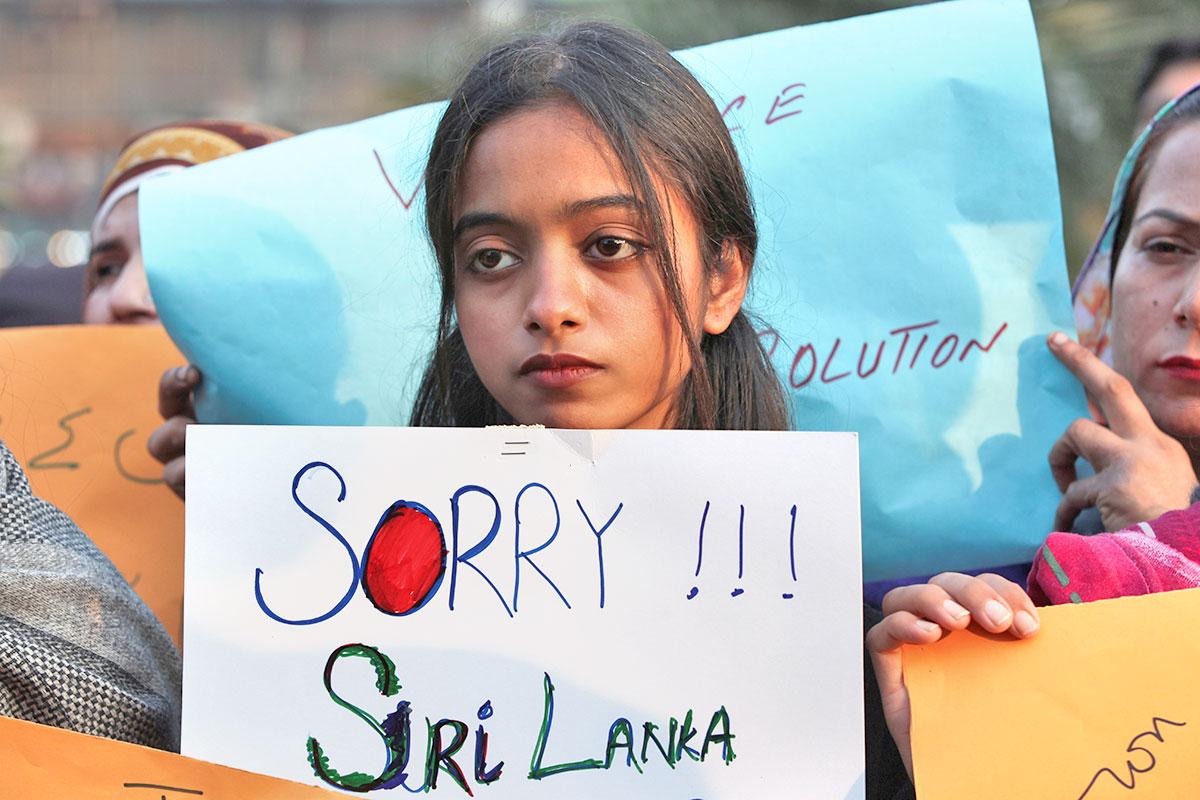
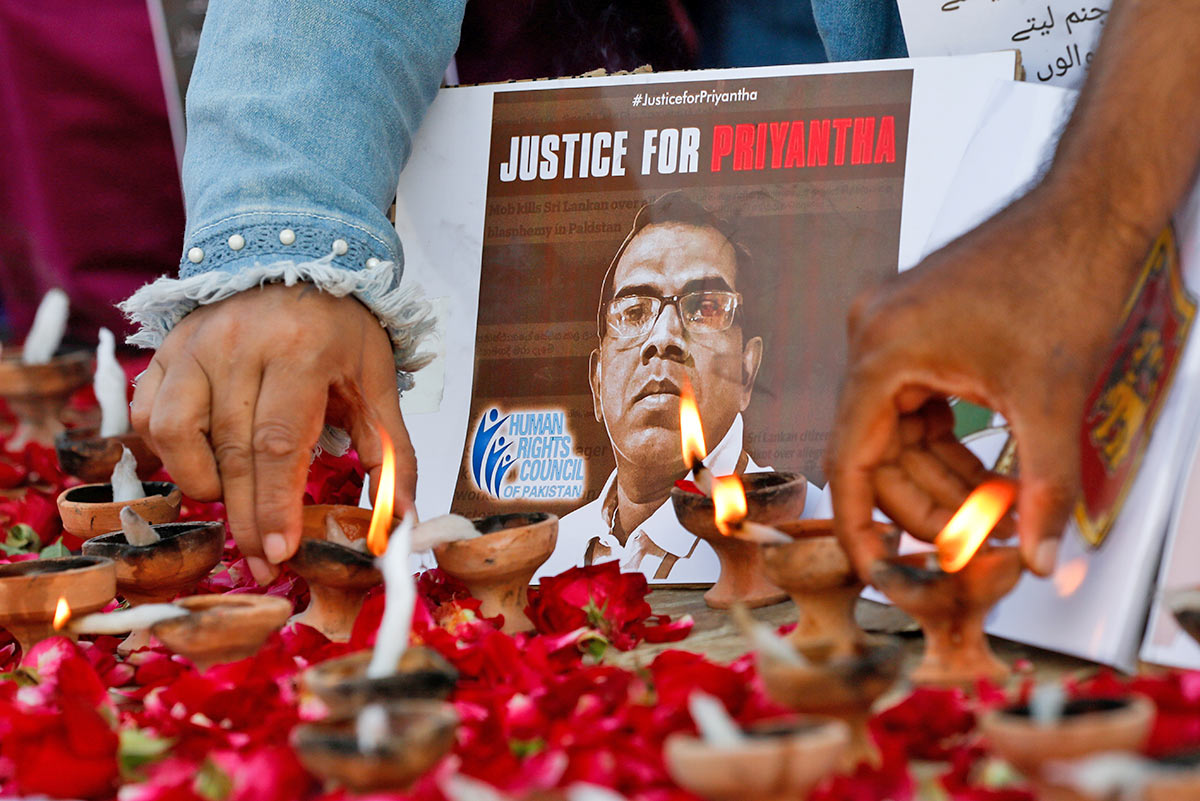
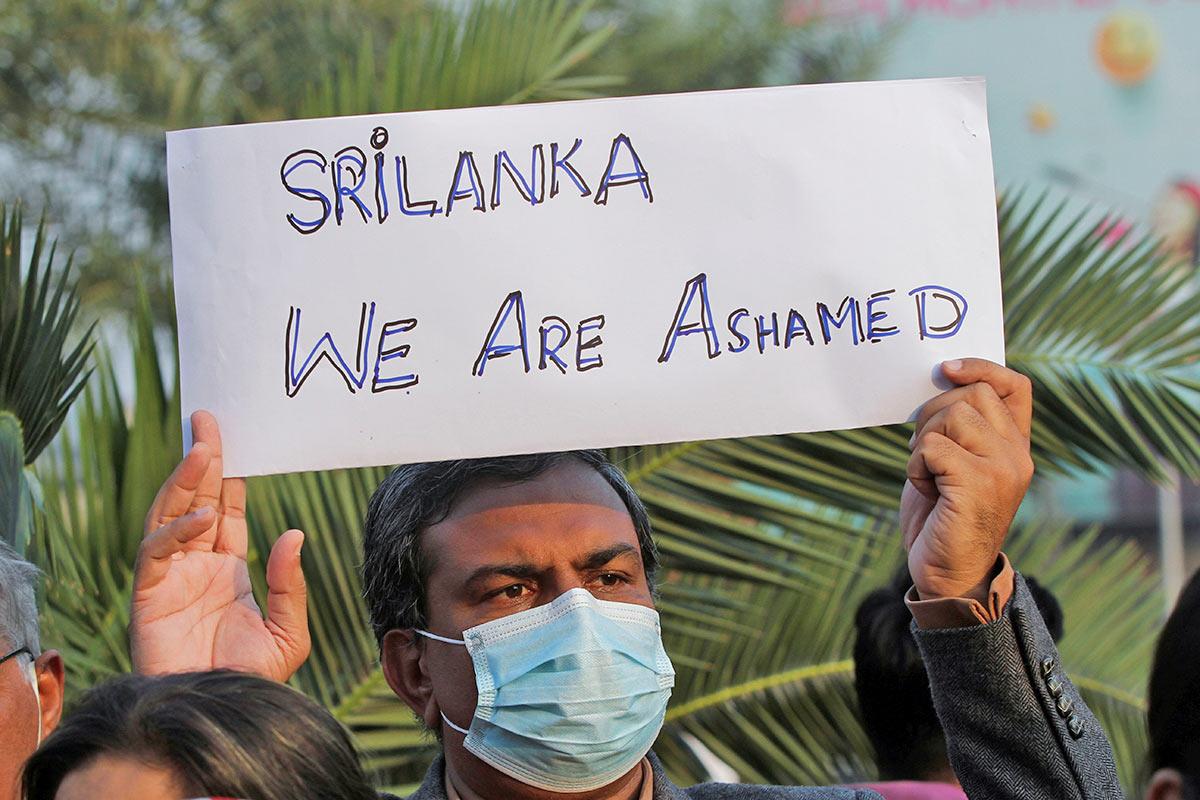
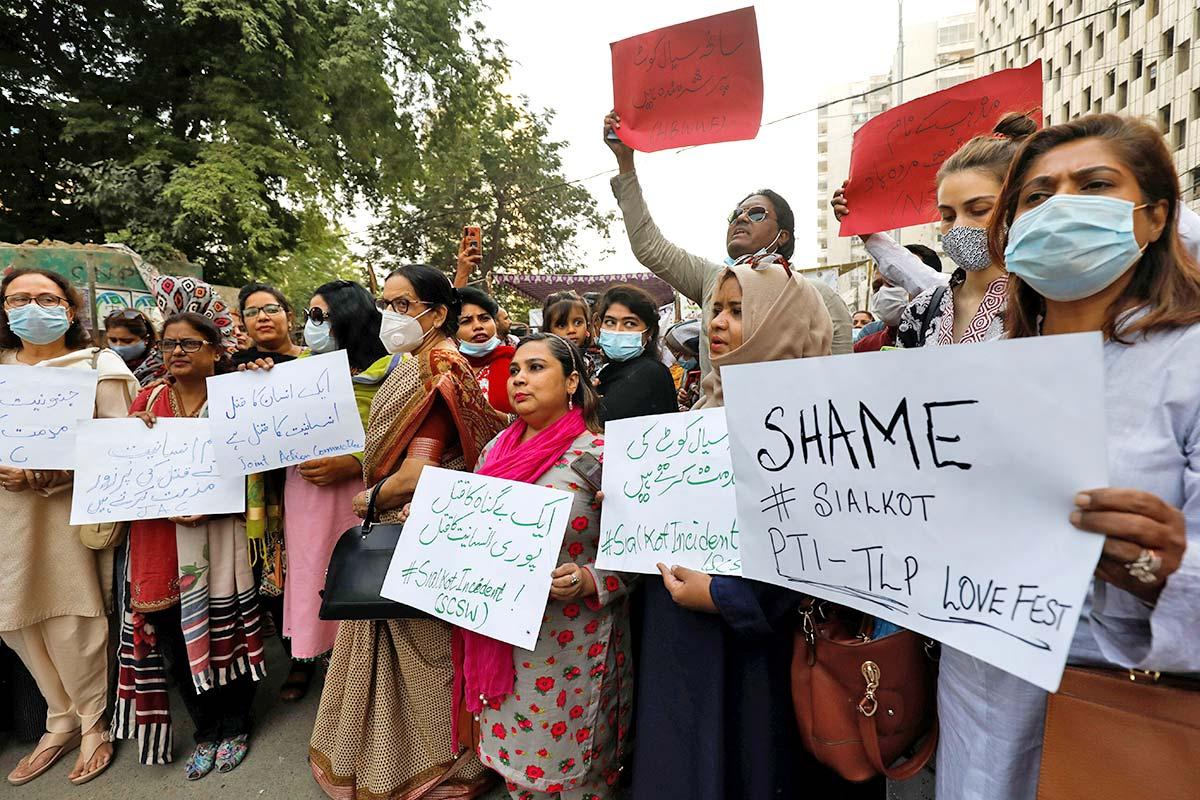
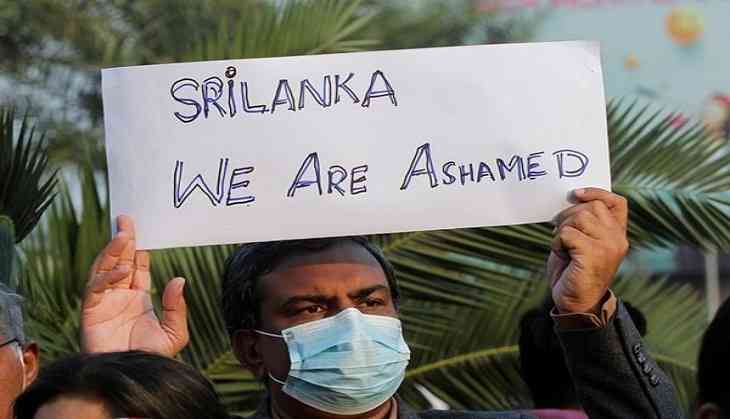
Please click on the images to view how members of Pakistani civil society apologised to Sri Lanka and its people for Mr Kumara’s horrific murder.
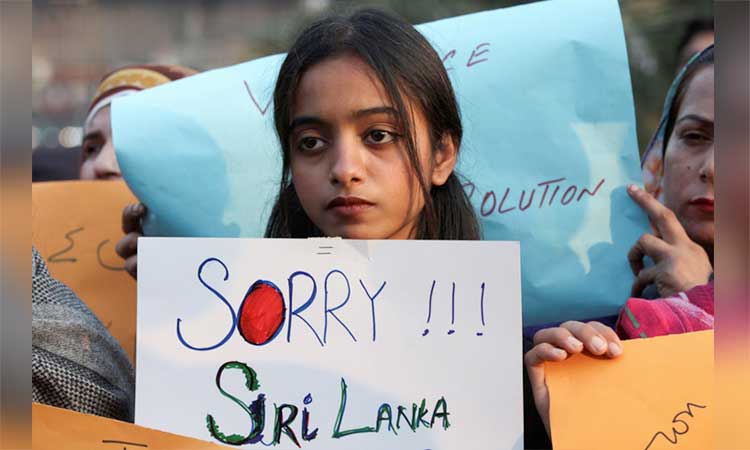
IMAGE: A girl carries a sign condemning the lynching during a protest in Lahore, December 4, 2021. Photograph: Mohsin Raza/Reuters
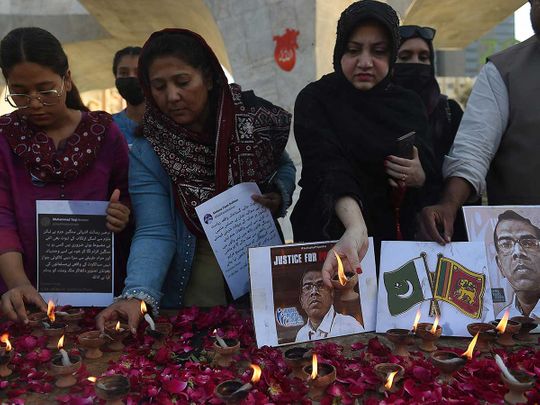
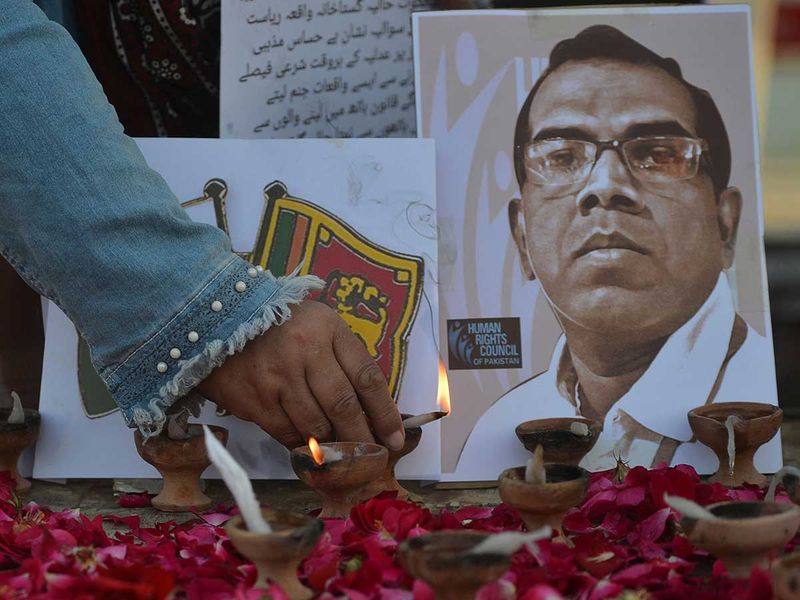
IMAGE: People light oil lamps next to laid roses before a portrait of Priyantha Kumara to express their condolences to Mr Kumara’s family and the people of Sri Lanka in Karachi, December 5, 2021. Photograph: Akhtar Soomro/Reuters
IMAGE: A protest against the lynching in Lahore, December 4, 2021. Photograph: Mohsin Raza/Reuters
IMAGE: People carry signs condemning the lynching in Karachi, December 4, 2021. Photograph: Akhtar Soomro/Reuters
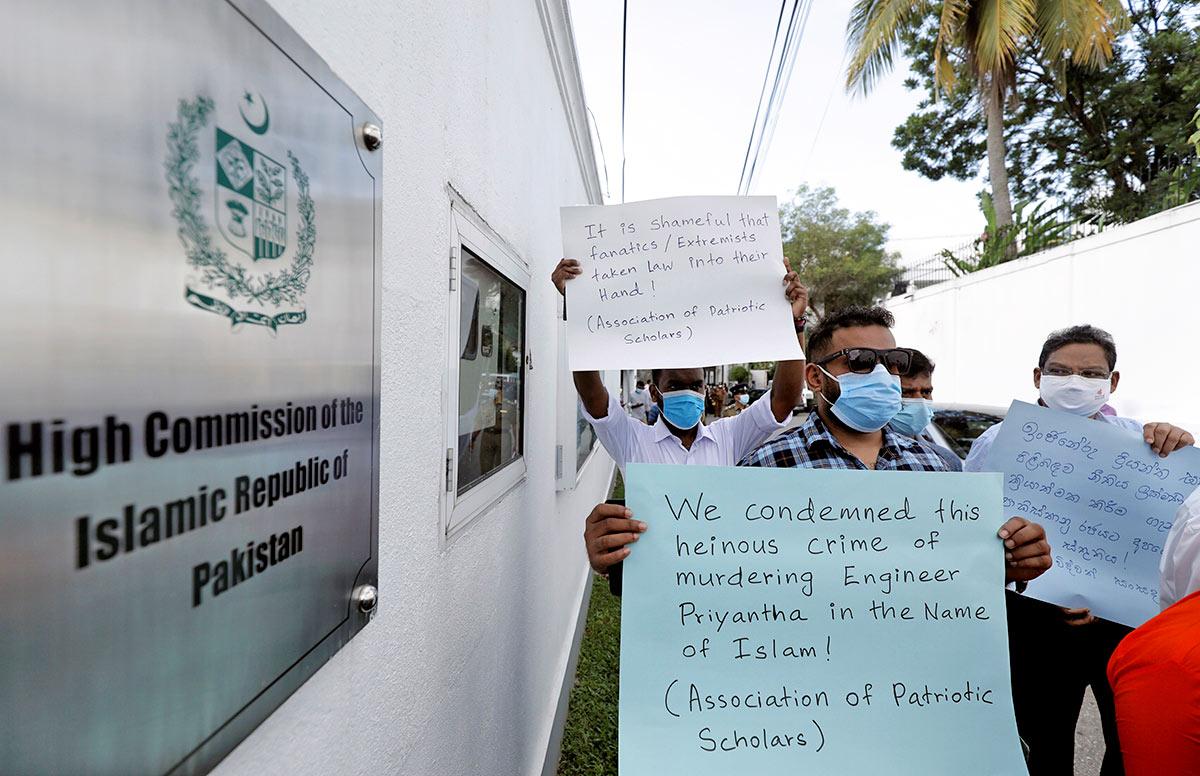
IMAGE: Members of the Association of Patriotic Scholars Group protest outside the Pakistan high commission in Colombo, December 6, 2021, against Priyantha Kumara’s brutal death. Photograph: Dinuka Liyanawatte/Reuters
At a time when millions worldwide are consumed with anger and despair over the barbaric lynching of a Sri Lankan national in Sialkot, Federal Minister Pervez Khattak has uttered words which can only be interpreted as a pathetic justification for murder.
Speaking to reporters, the defence minister, when asked to comment on the ghastly crime, said the killing was simply a result of young people being high on emotion and passion.
Indignant at the idea that the government is somehow responsible for creating an environment where such a horrific crime can happen, Mr Khattak downplayed the incident in words that can only be described as ignorant and dangerous.
Not only was he adamant that people refrain from characterising the Sialkot lynching as an incident that shows how society is headed towards destruction, he also appeared to believe that young people, when high on emotion, can kill in the name of religion.
He went so far as to indicate that he himself in his youth was emotional and ready to do anything, and that fights and even murders are a result of such a mentality.
Such a statement from a federal minister should come as a shock, but unfortunately, we are accustomed to our public officials being in denial about the realities of extremism and violence in the country. Mr Khattak’s remarks are deeply problematic.
They create an impression that such killings are somehow a ‘normal’ part of growing up in a country where religion can be used to justify crime.
Instead of asking the journalist who was quizzing him to change this mob mentality, it would have served the minister better to have recalled that, in fact, he is a member of government who actually has the power to influence large sections of the population.
It may be an alien idea to Mr Khattak, but he should have roundly condemned this incident and reflected on why our society has become so brutalised, instead of ascribing this heinous crime to youthful passions.
To read what Minister Pervez Khattak has said, refer to:https://ceylontoday.lk/news/diyawadana-murder-pakistan-defence-minister-lays-blame-elsewhere
An Extraordinary Gazette notification has been issued allowing the imports of organic and inorganic compounds, and phosphorous derivatives of fertilizers.
In addition, this communiqué has banned the import of Glyphosate.
The daily count of COVID-19 cases confirmed in Sri Lanka moved to 748 today (December 07) as 222 more people were tested positive for the virus, the Epidemiology Unit said.
This brings the total number of confirmed cases of coronavirus reported in the country to 569,171.
As many as 543,111 recoveries and 14,505 deaths have been confirmed in Sri Lanka since the COVID-19 outbreak.
More than 11,500 active cases in total are currently under medical care, official figures showed.
The Director-General of Health Services has confirmed 21 more coronavirus-related deaths for December 06, increasing the death toll in the country due to the virus pandemic to 14,505.
According to the figures released by the Govt. Information Department, the deaths reported today include 11 males and 10 females.
Five of the patients are between the ages 30-59 years while the remaining 16 are in the age group of 60 years and above.
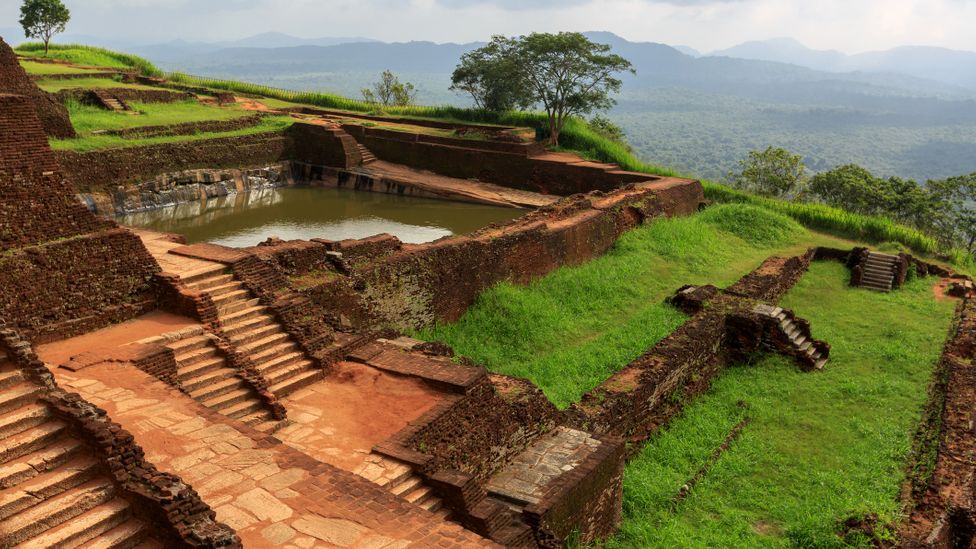
A complex masterpiece of irrigation engineering design, Sigiriya’s artfully designed water gardens required structural planning way ahead of its time.
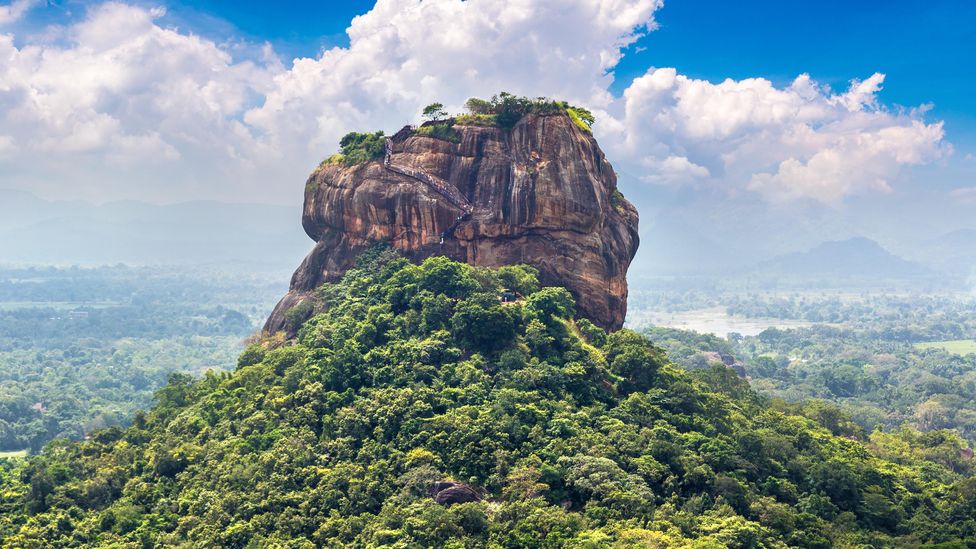
Orange sand particles twinkled in the sun as a lone motorbike kicked up dust in its wake. It was 09:30 on a bright Monday morning and the temperature was already creeping past 30C. A family of toque macaque monkeys swung from verdant tree branches and rolled playfully in the hot sand in front of us. But we barely took notice; we couldn’t take our eyes off the 200m-high monolith in the distance.
Sigiriya, an ancient rock fortress and former royal palace, is one of Sri Lanka’s most visited and best-known sights, attracting just more than one million visitors in 2019. But on this sunny day in May 2021, my partner and I were the only two people there.
Dating back to 477 AD, Sigiriya is considered one of South Asia’s best-preserved examples of urban planning and one of its most important archaeological sites. The elaborate palace and its towering construction on top of the rock, as well as its risqué artwork, resulted in its 1982 listing as a Unesco World Heritage Site. However, its ingenious garden and water systems at the foot of the rock are what make it a national treasure.
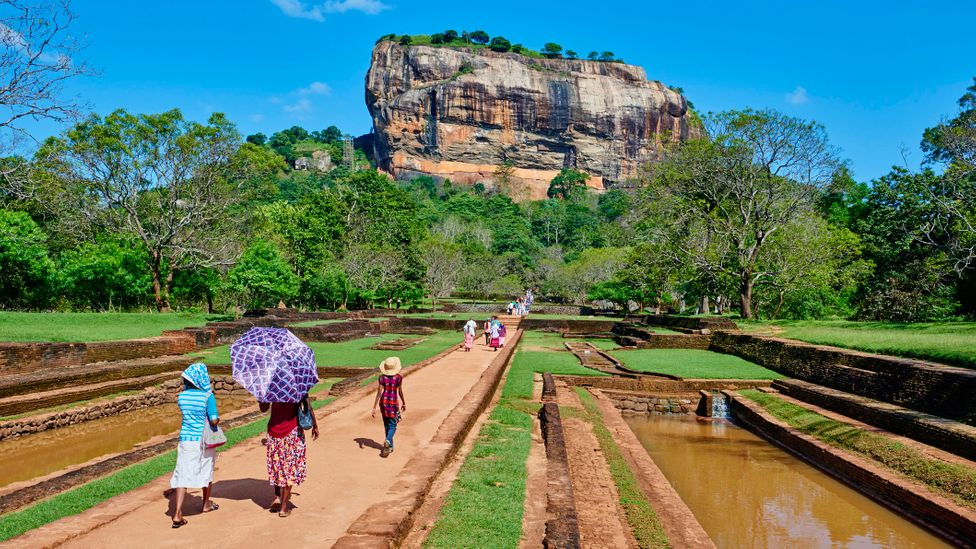
The gardens at Sigiriya are not only the best-preserved water gardens in South Asia but some of the oldest landscaped gardens in the world. Important guests in the 5th Century would have walked a path with the impressively designed water gardens on either side, serving as a grand entrance to the more than 1,200 steps leading up to the palace.
In his essay Sigiriya: City, Palace and Royal Gardens, Senake Bandaranayake, founding director of archaeology at Sigiriya, explained that the site is a brilliant combination of deliberate symmetry and asymmetry playing on both natural and geometric forms. “The gardens at Sigiriya consist of three distinct but interlinked sections: the symmetrical or geometrically planned water gardens; the asymmetrical or organic cave and boulder garden; the stepped or terraced garden circling the rock, the (miniature) water garden and the palace gardens on the summit of the rock,” he wrote.
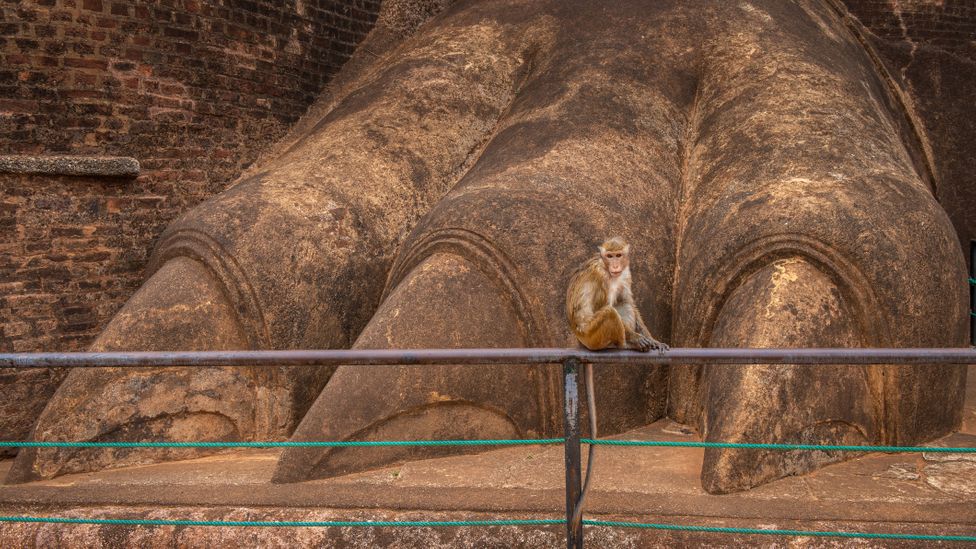
The 5th-Century palace was built to resemble a lion, with the paws flanking the main entrance (Credit: Boy_Anupong/Getty Images)
Within the gardens were artfully designed pools, fountains, streams and platforms that once held pavilions and performers. “For comparison, it would have looked similar to a modern luxury resort with beautiful gardens and swimming pools,” said Sumedha Chandradasa, a tour guide lecturer in Sri Lanka for more than 24 years.
Surprisingly, the detailed design of these gardens is not what’s most impressive; rather it’s how they work. These water systems are considered an engineering marvel due to the use of hydraulic power, underground tunnel systems and gravitational force that creates a visually spectacular system of pools and fountains still functioning almost 1,500 years later.
Some Sri Lankans still believe in ancient folklore that says all the water that fills the garden’s streams flows down from the pond at the top of the rock. In reality, the palatial complex’s water is sourced from a nearby reservoir, known locally as “tanks”. A series of underground conduit terracotta pipes use gravitational force and hydraulic pressure to send water from the Sigiriya tank (with a slightly higher elevation than the gardens) into the different pools, fountains and streams throughout the impeccably organised gardens.
However, some of the garden water does come from the top of Sigiriya. The pools at the top of the rock are filled with rainwater, and a series of drains cut into the rock connect to a large cistern, which feeds into the underground conduit system to help supply the gardens with water. “The total conception involves the knitting together of a number of hydraulic structures of varied scale and character in a single intricate network – a complex masterpiece of irrigation engineering design,” wrote Bandaranayake.
Bandaranayake also notes in his essay that during excavation, water conduits were found at different depths, likely to achieve varying water levels; something that required a masterful knowledge of physics and engineering.
Although the complex’s origins date to the 5th Century, the story of how it came to be seems more like a modern-day soap opera. Before Sigiriya, Sri Lanka’s royal capital was located in Anuradhapura, more than 70km to the north-west. A coup, led by King Dhatesena’s son from a non-royal consort, led to his bloody death and the scheming son, King Kasyapa, taking the throne.
Sigiriya is considered one of South Asia’s best-preserved examples of urban planning (Credit: Dmitry Malov/Getty Images)
Kasyapa moved the royal capital to Sigiriya, or “Simha-giri” which means “Lion Mountain”, and built a new palace on top of the rock. When approaching the stairs that lead to the top of the rock and the palace complex above, you see why. “The theory is, according to The Ancient Chronicles [Sri Lanka’s historical chronicles], that he built the palace to look like a squatting lion,” explained Jagath Weerasinghe, emeritus professor at the Postgraduate Institute of Archaeology and Sigiriya’s director of archaeology. “The lion paws are the main entrance that will take you to the top of the mountain.”
King Kasyapa ruled from there until 495 AD, when he abandoned it and the site became a Buddhist monastery.
A welcome effect of visiting during the pandemic meant my partner and I had the entire complex to ourselves for several hours. While the once-plastered-and polished finishings of the water gardens have disappeared with time, we could still see the brick foundation outlines of the pools, fountains and streams that fill with water during the rainy season.
One area, known as the “miniature water gardens” (not-so miniature; measuring 30m wide and 90m long), was split into five sections with several unique features including a snake-shaped stream that required structural planning way ahead of its time. “A striking feature is the use of these water-surrounds with pebbled or marbled floors, covered by shallow, slowly moving water. These, no doubt, served as a cooling device and at the same time had great aesthetic appeal, creating interesting visual and sound effects,” wrote Bandaranayake.
According to Weerasinghe, these miniature water gardens would have been best experienced at night, under the moonlight’s reflection on the shallow pools. “There are very romantic aspects to the royal precinct of Sigiriya,” he told me. While the miniature water gardens are no longer as spectacular as they would have been in the late 400s, the low water levels and platforms in the pond have led archaeologists to believe that they were used for musical performances – an incredibly thoughtful design feature for that period.
We kept walking along the grounds in front of the rock, through the miniature water gardens to its snake-shaped stream, which holds Sigiriya’s signature water fountains. They are made of limestone plates with symmetrical holes, and even after 1,500 years, still work during the yearly monsoon rains. “Below the fountain is a small chamber where the water pressurises, forcing the water to bubble up into the fountain about four or five inches when the water level is high,” Chandradasa explained.
Stone steps leading into the pools indicate that they would have been used for swimming (Credit: Pavel_klimenko/Getty Images)
Theorised to have been used by the royal family and Kasyapa’s consort of women, these fountains and pools, especially the large pond on top of Sigiriya, were designed as swimming pools to give relief from the hot South Asian sun, complete with stone steps leading down into the water.
But beyond their beauty and practicality, the water gardens had another purpose. “Kasyapa wanted to present water in a particular way,” said Weerasinghe. As well as being used for pleasure, they also sent a strong message of his power and ingenuity to anyone who doubted King Kasyapa, especially Mahavihara monks, who made up the most powerful monastery in Anuradhapura and were in favour of his father.
As well as being used for pleasure, they also sent a strong message of his power and ingenuity to anyone who doubted King Kasyapa
“When you look at this elaborate and very intriguing way of using water at the royal precinct of Sigiriya, he’s telling something to these people about his power,” Weerasinghe added.
Past the massive stone lion paws, at the end of more than 1,200 precarious steps up Sigiriya, our clothes were soaked with sweat and I struggled to catch my breath. We walked the ruins of the central palace and stumbled upon the summit’s large pool. A dip in it like the ancient royals once did would have been tempting, but no rain in weeks and no royal servants to maintain it meant murky bacteria lurked on the surface.
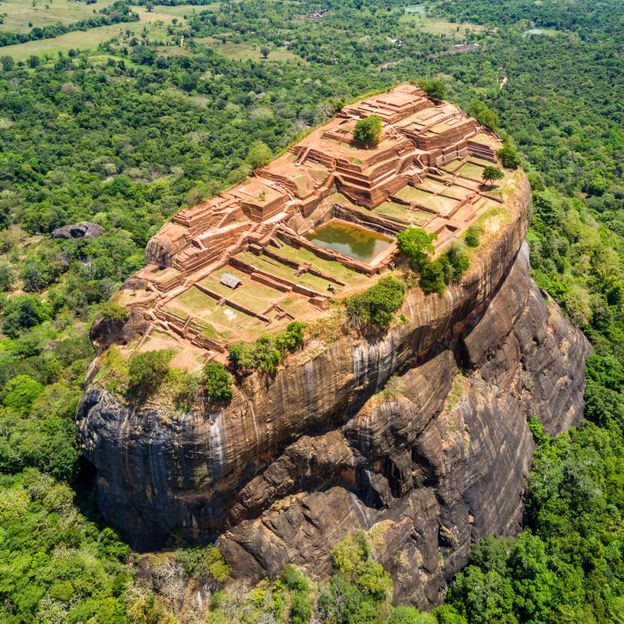
From high above, the water garden system below was clear, perfectly centred and impressively aligned. The views of the lush green jungle melding with the blue horizon seemed endless. It was an ideal place for a palace with gardens worthy of the powerful king who built it.
“Just imagine during the rainy season, there are clouds sitting on this hill,” said Weerasinghe. “Then, you are walking through this garden and you see this big pond with these water waves coming down and the fountains gushing water. Just imagine what kind of an experience that would be.”
Designed to impress, the long path to the palace was flanked with pools and fountains (Credit: Tuul & Bruno Morandi/Getty Images)
Ancient Engineering Marvels is a BBC Travel series that takes inspiration from unique architectural ideas or ingenious constructions built by past civilisations and cultures across the planet.
—
Join more than three million BBC Travel fans by liking us on Facebook, or follow us on Twitter and Instagram.
If you liked this story, sign up for the weekly bbc.com features newsletter called “The Essential List”. A handpicked selection of stories from BBC Future, Culture, Worklife and Travel, delivered to your inbox every Friday.
Bangladesh is a Southeast Asian
country geographically but South Asian culturally. Myanmar-Bangladesh is a
bordering country. On the other hand, Thailand and Myanmar are neighboring
countries. There is close historical-geographical proximity among Myanmar,
Thailand, and Bangladesh. Trilateral relations amongst these countries were
good. The three states could benefit hugely from Myanmar-Bangladesh
Ties.
But a little problem between
Bangladesh-Myanmar has become an obstacle. Seven and a half lakh Rohingya Muslims
have come to Bangladesh to take shelter to save their lives from the atrocities
of the Myanmar army in 2017. Bangladesh is trying to repatriate them to
Myanmar. But Myanmar doesn’t want to take back them.
Then four years have passed. After
that, the initiative was taken to return the Rohingyas but it did not happen.
The initial initiative failed. This Rohingya refugee problem has created a long
distance between Bangladesh and Myanmar. As a result, the distance between
South Asia and Southeast Asia has increased. But if this problem is resolved
diplomatically, the whole southeast Asian countries including Thailand and
South Asian countries would benefit economically, socially, and culturally.
Bangladesh wants Thailand’s
cooperation in Rohingya extradition. Bangladesh wants to speed up the plan
after the process was suspended due to a coronavirus infection. As a
neighboring and friendly country of Myanmar, Thailand can and should mediate
the problem for ensuring the greater interest of the region. If the problem is
solved, then greater regional interest would ensure.
Thailand would be able to connect
itself by road with the BCIM (Bangladesh-China-India-Myanmar) corridor. The
BCIM corridor will be connected with the east-west corridor and the north-south
corridor of Thailand. This will establish direct communication between
Bangladesh, Myanmar, and Thailand. Again, using this medium, Bangladesh will be
able to go directly to Malaysia, Laos, and Vietnam. On the other hand, Thailand
and Myanmar will be able to enter into South Asia, Central Asia.
Thailand wants to establish trade relations with
Bangladesh. Connecting Thailand with the Bangladesh-China-India-Myanmar
Economic Corridor or the BCIM Economic Road Corridor will increase trade
between the two countries. Myanmar-Bangladesh good relations is very needed for
ensuring this.
As the Rohingya crisis has become a
regional and international issue, Thailand as a regional state can play a
significant role in the peaceful repatriation of Rohingya citizens who have
been forcibly displaced by Myanmar and taken refuge in Bangladesh. If the
Rohingya problem is not resolved soon, it could be an obstacle to peace and
progress in the region. The longer the Rohingya crisis cannot be resolved, the
more likely it is that the issue could become a breeding ground for
fundamentalism, exploited and manipulated by terrorists.
For decades, Myanmar has gone
through extreme cruelty to the Rohingya. Never cared about the law. The
Rohingya problem is not new to Bangladesh. This problem, which started in 1978,
became apparent in August 2017. More than 1 million Rohingyas fled to
Bangladesh to save their lives when the Myanmar army launched a brutal
operation against the Rohingya ethnic group. Bangladesh is seeking the
intervention of the United States, the European Union, and the United Nations
as well as the regional alliance ASEAN for a lasting and acceptable solution to
the Rohingya problem. On the other hand, there are also some Rohingyas who are
living in Thailand. There is no data on the total number
of Rohingyas
in Thailand, but unconfirmed reports suggest there could be between 3,000 and
20,000.
However, Bangladesh is now facing serious
problems for this artificial crisis committed by Myanmar. Some
socio-economic threats are rising in Bangladesh. Bangladesh has given shelter to
Rohingyas for humanitarian reasons. But because of this humanity, the country
is now at risk. As a result, there is a danger of Rohingyas spreading all over
the country, there are also many challenges
The forest is being uprooted, they
are cutting down the mountains and destroying them. There are also long-term
economic risks Socio-economic and political problems may also be evident, and
security risks may increase. Illegal narcotics trade, human trafficking,
prostitution, terrorism in Rohingya camps are increasing in camps.
Source: Internet
Bangladesh and Myanmar signed an
agreement to repatriate the Rohingya to Myanmar within two years in 2017 and
2019 respectively. The Myanmar authority did not take back the Rohingyas
according to the agreement. It is true that they don’t want to repatriate
Rohingyas in Myanmar. Bangladesh raised the issue in every international forum.
Many countries have supported Bangladesh. But Myanmar has no respect the
international law and norms. Some mighty powers may have been behind the scene.
Bangladesh Prime Minister has raised
the issue at UNGA on September 25, 2021, to draw attention to solving the
Rohingya crisis. She has focused especially on the engagement of ASEAN leaders.
It is ASEAN that can solve the Rohingya refugee problem easily.
As an active member of ASEAN,
Thailand can help to resolve it. Thailand can be an honest mediator in this
regard. Thailand has very warm relations with both Myanmar and Bangladesh. Various countries and international
organizations have taken various measures to solve the Rohingya problem. Former
UN Secretary-General Ban Ki-moon has criticized Myanmar authorities for being
lax in repatriating displaced Rohingya. UN Secretary-General Antonio Guterres
has expressed deep concern over the ongoing Rohingya crisis. Yang Lee, the UN special
envoy for human rights in Myanmar, said all major countries in the world had a
responsibility to resolve the Rohingya crisis.
In this regard, Thailand can and
should play a very significant role to solve the crisis such ways:
1) Thailand can support Bangladesh at
every international forum such as at UNGA, regional conferences. They can vote
in favor of Bangladesh. They can raise the issue in BIMSTEC and ASEAN
platforms.
2) Thailand can negotiate with Myanmar
diplomatically and bilaterally. It has good bilateral relations with Myanmar
3) Thailand can engage with other
regional states to resolve the crisis.
4) Thailand’s Buddhist society can play
an effective role in this regard. The relations of Buddhists between Myanmar
and Thailand are well established. Thai Buddhists can do it very easily.
Buddhism is more related to the establishment of Peace and non-violence. Thai
Buddhists can play a significant role in this regard. They can exercise the
path shown by the founder of Buddhism, Gautama Buddha. Buddhists will be
recognized as the Avatar of human rights if the Buddhist community plays a role
in resolving the Rohingya crisis. It will ensure regional to some extent world
peace and communal harmony.
5) Thai businessmen can engage to some
extent. Because stability in the region (for both South Asia and Southeast
Asia) is very needed for investment.
Why
Thailand should Play role in resolving the regional problem?
1) This issue is a humanitarian issue.
Rohingyas are the son of Land in Rakhine in Myanmar. They have birthrights to
reside in Myanmar.
2) It is an issue of
Justice. According to Luther king, Junior “Injustice anywhere is a threat
to justice everywhere.” Myanmar authorities committed genocide. The perpetrators
should be under international legal jurisdiction.
3) It is the issue of the
region. The whole of South Asia and South East Asia may be volatile for this
issue. As a South Asian state, Thailand has some responsibilities.
4) Thailand has very good relations
with both Myanmar and Bangladesh.
5) Enhancing bilateral relations could contribute to the growth
of trade and investment relations with ASEAN and SAARC countries. This will
create an opportunity to serve greater regional interests.
6) Re-establishing
the Himalayan-South Asian connectivity can occur if political and diplomatic
solutions of Bangladesh-Myanmar strained ties can be found.
7) Bangladesh has been supporting Thailand at every
international forum. Now it is time and duty for Sri Lanka to stand in favor of
Bangladesh in her crisis moment. Thailand-Bangladesh
relations have the potential to further strengthen ties for regional and global
peace, progress, and prosperity.
8) For greater regional connectivity such as implementation of
BCIM, Asian High way project.
9) To create opportunities for Thai investors to access the
South Asian markets easily.
10) Rohingya
refugee crisis and internal crisis in Myanmar can be regional crises. Thailand
can be a sufferer. Terrorism, insurgent movement, illegal narcotics trade,
human trafficking are some concerning issues.
11) To
strengthen trilateral ties amongst Thailand, Myanmar, and Bangladesh for the
interest of the people.
However, Thailand is a
close friend of Bangladesh. Bangladesh has a long history of trade and cultural
ties with Thailand. Thailand has been cooperating with Bangladesh since
independence in 1971 under the leadership of the Father of the Nation
Bangabandhu Sheikh Mujibur Rahman. Thailand should consider these issues. Thailand should do
some things in favor of Bangladesh regarding Rohingya refugee repatriation to
Myanmar. Thailand can make Myanmar understand and agree in this regard.
Thailand can play a very significant
role in this regard. Thailand can mediate to bolster the strained relations
between Bangladesh-Myanmar. Thailand can play to repatriate the Rohingyas in
Rakhine in Myanmar. Thailand can easily resolve the problem because it has very
good relations with Myanmar.
However, as a well-wisher friend and
partner in the development process and trade, Bangladesh can expect cooperation
and support from Thailand regarding the repatriation of Rohingya refugees to
Myanmar. Bangladesh deserves it. So, Thailand should help, support
Bangladesh and mediate in resolving the crisis as soon as possible.
I
was very sad to hear of the passing of Douglas Wickremeratne in London on
December 01, 2021. He was in touch with me regularly by forwarding posts until
the last and I used to reciprocate.
He
has a huge claim for the gratitude of Sri Lanka and its patriotic people for
the stand he took soon after the civil unrest in July 1983, when he alone stood
up to fight the disinformation campaign of the country’s detractors in London.
His brave stand triggered others, primarily Sinhalese in many parts of the
world, to come out in support of national unity, territorial integrity, and an
undivided Sri Lanka. He gave leadership to this cause in an unblemished
manner.
Douglas acted as a de facto representative on behalf of the Sri Lanka
High Commission in London to combat increasing false allegations against the
country, the Army, and the Sinhala people engineered by the LTTE and their
supporters. The latter had planned these campaigns for a long time early and
the Govt. machinery including the Sri Lankan Embassies was caught off
guard.
Furthermore, the Sri Lanka High Commission in London as a matter of
protocol was required to obtain prior permission from the Foreign Ministry in
Colombo before responding to any sudden development, for example, a bomb
explosion. Its hands were tied. When permission was granted for the Sri Lanka
High Commission by the Foreign Ministry in Colombo to issue a
written statement authorized by the latter it was too late. The delay
had resulted in the stable door getting closed, and the horse bolting away.
Overseas Sri
Lankans’ Organization for National Unity (OSLONU)
Around
the same time, Sri Lankan expatriates in Melbourne formed the Overseas Sri
Lankans’ Organization for National Unity (OSLONU) at a public meeting held at the
University of Melbourne in September 1983 under the leadership of Professor
C.G. Weeramantry who was elected as the first President of OSLONU. He delivered a
brilliant oration on this occasion entitled ‘A Plea for National Unity and an
Undivided Sri Lanka’.
Dr.
Ranjith Hettiarachi and H.L.D. Mahindapala was elected as the Joint
Secretaries. Senaka Weeraratna served as Assistant Secretary jointly with
Astrid Edrisinha. Dr. Olga Mendis (Hony. Treasurer), and Soma Perera, Tony
Edrisinha, Chris Lawton, Eddie Gray, and Hanif Badurdeen, were elected as
Committee members. All of them were founder members.
It
grew into a sizable body to counter anti – Sri Lanka propaganda worldwide. Sri
Lanka newspapers carried statements of OSLONU regularly. Even Australian
academics at the University of Melbourne who attended the inaugural
sessions of OSLONU later commented that they have now realized that there
was another valid and highly tenable point of view contrary to what the LTTE
detractors were saying. OSLONU used to liaise constantly with Douglas
Wickremeratne.
Douglas
is an old Anandian. At Ananda College in 1953, he was a classmate of Indrajith
Malalasekera (son of Dr. G.P. Malalasekera), D.B. Nihalsinghe (filmmaker),
Ananda K. Wijetunga, Ranjith Rathnayake, Palitha Premasiri (Cricket Captain
1957), Neville Gajaweera, and Dr. Ranjith Hettiarachi.
Sinhala
Association in the UK
Douglas
was the founder of the Sinhala Sangamaya in London thereby ensuring that
Sinhala expatriates were able to maintain close cultural links with their
motherland. They organized cultural shows by bringing famed Musicians to London
on an annual basis including W.D. Amaradeva, Sinhala film shows, Vesak
festivities, Sinhala and Tamil New Year celebrations, and they funded the
dispatch of provisions to help villages in heavy rain-affected areas in Sri
Lanka and financed repairs to Ancient Water Tanks in the hinterland. The
Sinhala Sangamaya also invited Ven. Madihe Pannasiha Nayake Thera, Elle
Gunawansa Thera, Professor (Dr.) Nalin de Silva, and Minister Cyril Matthew,
among others to address gatherings in London.
Douglas represented the Sinhala Association in
the U.K. He bravely faced the country’s detractors in the west including LTTE
supporters on all T.V. and radio debates, and in turn, won the hearts of
the well-wishers of Sri Lanka in Britain and elsewhere.
World
Federation of Sri Lankans
Douglas was a founder member of the World Federation of Sri Lankans and a distinguished speaker at the inaugural sessions of the World Federation held in Toronto in 1984. Dr. Jeeva Ganepola ( New Jersey, USA) was elected as its First President. The Sri Lanka United National Association of Canada under the leadership of its President Tilak Wickremasinghe hosted this event.
The
Sinhala Sangamaya hosted the Second Convention in London in 1986 where Douglas
was duly elected as the second President of the World Federation. Several
distinguished speakers from Sri Lanka including Minister Lalith Athulathmudali,
Anura Bandaranaike (Leader of the Opposition), Earnst Corea, Dr. Jeeva Ganepola
(USA), H.L.D. Mahindapala (Australia), Dr. Walter Jayasinghe (USA),
and Walter Jayawardana (Los Angeles, USA) spoke at this
International Conference.
Sri
Lanka United National Association of Canada published the first ‘Overseas Sri
Lankan’ Journal which was distributed at the London Convention in 1986.
Even
the Govt. of Sri Lanka gave him high recognition and VIP treatment when he
visited Sri Lanka as the President of the World Federation at that time. The
interviews that Douglas gave to British TV Channels won him star status and a huge
following of admirers both within and outside Sri Lanka. He was the pride of
the nation as he was performing better than any of our diplomats stationed
overseas. In almost every conversation on the subject of civil riots in
Sri Lanka in the mid-eighties Douglas name invariably came up in admiration.
Prime
Minister R. Premadasa hosted a meeting at the Office of the Prime Minister in
Colombo in 1985 to gauge the views of the overseas-based Sri Lankans. Douglas
Wickremeratne, Dr. Ranjith Hettiarachi, Senaka Weeraratna, Dr. Jeeva Ganepola,
Jayantha Dhanapala were among those who attended this discussion.
The
Rupavahini conducted a TV Program in 1985 focused on the contributions that the
Overseas Sri Lankans were making to the cause of combating anti – Sri Lanka
propaganda. It had Douglas Wickremeratne, Dr. Ranjith Hettiarachi, and Senaka
Weeraratna as the participants. M.J. Perera, Civil Servant, was the Chairman of
the Rupavahini at that time.
In
January 1987 a meeting was held at the residence of Senaka Weeraratna in
Colombo and attended by visiting Sri Lankans to review the progress being made
in protecting the fair name of Sri Lanka internationally. Professor C.G.
Weeramantry, Douglas Wickremeratne, Mahinda Gunasekera, Hema Jinadasa, Senaka
Weeraratna, and a couple of others were present.
Douglas
is a real hero by any definition. He is an old Anandian with a firm commitment
to the ‘ Rata, Jathiya, Agama’ idea. The adage ‘ Come the hour, Come the
man’ was strikingly illustrated in the manner that Douglas Wickremeratne
stepped forward to defend Sri Lanka in the hallowed portals of elite British
institutions, Universities, and mainstream T.V. Channels. He scored debating
points convincingly in front of British TV audiences.
May
Sri Lanka find the strength to show remembrance and gratitude at a national
level to this great Patriot. A man with such a backbone and spine is a vital
need for the country more so today
He
deserves a commemorative postage stamp issued in his honour.
Police arrested 126 people, identifying some culprits from the selfies.6.12.21
A PERSON PLACES AN EARTH OIL LAMP IN KARACHI ON DEC 5 TO PAY TRIBUTE TO PRIYANTHA DIYAWADANAGE, THE LATE SRI LANKAN FACTORY MANAGER WHO WAS BEATEN TO DEATH AND SET ABLAZE BY A MOB WHO ACCUSED HIM OF BLASPHEMY IN SIALKOT, PAKISTAN. PHOTO: RIZWAN TABASSUM / AFP
A Sri Lankan man accused of blasphemy was lynched and his body set ablaze by workers he oversaw at a factory in the city of Sialkot in northeastern Pakistan.
Priyantha Diyawadanage, 48, the general manager at Rajco Industrustries, was targeted by the violent mob following rumors that he was tearing stickers bearing the name of the Prophet Muhammad. World News
On Friday, Dec 3, a few dozen workers began protesting outside the factory gates against Diyawadanage, accusing him of blasphemy. The crowd swelled to the hundreds as local residents began to join in, causing a traffic jam in the vicinity.
Fearing the mob, Diyawadanage rushed to the factory roof but was charged upon by throngs of people chanting anti-blasphemy slogans used by the fundamentalist political party Tehreek-e-Labbaik Pakistan (TLP). In a video, Diyawadanage could be seen clinging desperately to his colleague Malik Adnan, who was trying to shield him from the oncoming crowd.
Chilling videos circulating across social media show the crowd hurling Diyawadanage onto the ground, tearing off his clothes and ruthlessly beating him. The mob proceeded to torture Diyawadanage using stones and iron rods until he became motionless. The mob then set Diyawadanage on fire. In some videos, a few people are seen taking selfies with the corpse.
Due to the renovation of the factory building, some posters were taken off from the wall. They may have desecrated posters bearing the name of Prophet Muhammad. Maybe the manager was lynched because of that,” police assistant comissioner Murtaza Muhammad told the press.
Unfortunately, I can’t affirm or deny anything at the moment. The alibi used for murder is blasphemy but the cause of murder appears personal and targeted. The issue is being investigated,” he said. The province’s police chief also said that police were notified of the incident at 11:28 a.m. and reached the spot at 11:45 a.m.
SECURITY OFFICIALS GATHER NEAR THE PREMISES OF A FACTORY IN SIALKOT, PAKISTAN AFTER POLICE CONFIRMED THAT SRI LANKAN NATIONAL PRIYANTHA DIYAWADANAGE, A FACTORY MANAGER, WAS BEATEN TO DEATH AND SET ABLAZE BY A MOB ON DEC. 3. PHOTO: AFP
A police report has been registered against 900 people for the murder, which include charges of terrorism. Around 126 have been arrested so far. Police have revealed that 57 suspects have been identified through CCTV footage out of which 25 have been detained. Raids are underway to track down the remaining suspects. Police are also currently analysing data from 160 CCTV cameras along with cell phone videos, mobile data and phone logs.
Diyawadanage’s wife Nilushi Dissanayaka has denied the allegations of blasphemy against her husband. I totally reject reports that said my husband tore down posters in the factory. He was an innocent man,” she told the BBC.
Diyawadanage was reportedly a Christian. VICE World News could not immediately verify this.
He was very much aware of the living conditions in Pakistan. It is a Muslim country. He knew what he should not do there and that’s how he managed to work there for eleven years,” Dissanayaka said.
According to Adnan, who is set to receive the national Tamgha-i-Shujaat award for attempting to save Diyawadanage’s life, the stickers were being temporarily removed for a clean-up, which was part of factory protocol.
In response to the incident, Prime Minister Imran Khan tweeted: The horrific vigilante attack on a factory in Sialkot and the burning alive of a Sri Lankan manager is a day of shame for Pakistan. I am overseeing the investigations. Let there be no mistake: All those responsible will be punished with the full severity of the law.”
In a tweet, Sri Lankan Prime Minister Mahinda Rajapak said: Sri Lanka and her people are confident that Prime Minister Imran Khan will keep to his commitment to bring all those involved to justice.”World News
Khan’s special representative on religious harmony, Tahir Ashrafi, has said that police are investigating the case from various angles, including that some factory workers might have played a religious card to take revenge on the manager.”
Blasphemy is a highly contentious issue in Pakistan, and people accused under its blasphemy laws can be sentenced to death. Critics say false reports of blasphemy are rampant, and the law is often abused to settle personal issues with people from minority groups. Since 1990, around 77 people have been killed in vigilante mob attacks that stemmed from blasphemy allegations. While human rights activists have been calling for an end to the colonial-era blasphemy law, the TLP has succeeded in having the government keep it in place, through several violent protests since 2017.
Few other religious groups got the same type of media visibility that TLP got in its early days. If any other group behaved like TLP did they would be dealt harshly by the state, as has been the case with nationalist groups,” Freelance journalist and web developer Fahad Desmukh told VICE World News. But instead the government repeatedly negotiated and made compromises with the TLP, and despite later being banned were able to continue operating freely – even contesting elections and receiving well wishers from the government.”
PROTESTERS CARRY PLACARDS IN KARACHI ON DEC 4, AGAINST THE KILLING OF PRIYANTHA DIYAWADANAGE, A SRI LANKAN FACTORY MANAGER IN SIALKOT, PAKISTAN. PHOTO: RIZWAN TABASSUM / AFP
The TLP has denied any connection to the incident. While the incident is tragic, what’s equally sad is linking the TLP to it. We call for an independent and transparent investigation and those responsible to be arrested and exposed. When the rule of law prevails, no one will dare take the law into their hands,” a TLP spokesman told local press.
However, the mob was caught on camera using a blasphemy slogan that most Muslim scholars distance themselves from, but which the TLP uses and has popularized through viral internet videos.
There is an ecosystem through which these messages circulate – from speeches at rallies, to mainstream media, to bit-sized social media content savvily edited together with catchy music and slick graphics, to homes and schools, to sites of violence,” said Desmukh.
The episode has been widely condemned in Pakistan, with protests condemning the attack. Prominent religious scholars have denounced the lynching.
Diyawadanage’s body is expected to be returned to Sri Lanka on Dec 6.
A girl along with others carries a sign, condemning the lynching of the Sri Lankan manager of a garment factory after an attack on the factory in Sialkot, during a protest in Lahore. ReutersThe lynching of Sri Lankan national, Priyantha Kumara Diyawadana, a factory manager, by an enraged mob apparently provoked by blasphemy against Islam, has been a cause of anger and despair across Pakistan. Prime Minister Imran Khan called it ‘a day of shame’, and even far-right Tehreek-Labbaik-Pakistan (TLP) had condemned the act.
The lynching was dreadful because the mob pulled out the dead body of the victim and burned it, and even took selfies with the burning body. It is being revealed that the blasphemy charge was only a pretext, and that the workers were unhappy with the manager who was strict. This could very well be the case. But it makes the issue even more dangerous. Even lynching a man other than for religious reasons remains a heinous crime. The use blasphemy as a cover for the savage deed makes it explosive. It shows that religious extremists and miscreants are unholy partners in crime.
Pakistan rulers, including the army, and the influential sections of society, have always been seriously concerned with the rise of religious extremism in the country, and how it is undermining the political foundations of the country which is based on democracy and rule of law. Detractors of Pakistan may want to spread the message that the country carved out for Muslims in the Indian sub-continent in 1947 spreads the message of fanaticism. Historians and political analysts have shown that the Islamisation project ushered in by military ruler Zia-ul-Haq from 1978 to 1988 was not what Pakistan set out to be in 1947, and time and again political parties fought for a democratic set up and constitutional rule. It is believed that Prime Minister Khan’s Tehreek-e-Insaaf Party has flirted with Tehreek-e-Labbaik Party, but Mr Khan now in power has been compelled to deal with TLP and not give them the license to act as they like.
The rise of religious extremism is not peculiar to Pakistan, but in Pakistan political parties have sought to take advantage of religious sentiments to gain political mileage in the last quarter century and more. It has coincided with the political success of the Taliban in Afghanistan in 1996 and then again in 2021. The puritanical regime in Kabul has emboldened in indirect ways puritanical and fanatical elements in Pakistan. It has been a source of inspiration for Tehrik-e-Taliban Pakistan (TTP), which poses a direct challenge to civilian authority in the country.
The lynching of the Lankan national has put even the religious conservatives on guard because the realization has grown that these episodes of fanatical fury give a bad image to Pakistan in the world, while also projecting religion in a bad light. Prime Minister’s representative on religious harmony and religious scholar Tahir Ashrafi said, Police experts are investigating this case from various angles, including that some factory workers played a religious card to take revenge on the manager. Human rights activist Mehnaz Rehman said, He was killed on false charges of blasphemy.”
All the people who matter in Pakistan have come round to the view that the rage of religious fanatics cannot be condoned, and that it does not contribute to social stability. It would be necessary to sustain this sense of penitence in the country to send a clear message to the extremists in the country that people will not tolerate the misuse of religion for acts of terrorism and vandalism. Pakistan has been a hapless victim of terrorism within its own territory apart from the negative image that the country is epicentre of religion-based terrorism. That is why, Pakistan is under the purview of Financial Action Task Force (FATF) which keeps a watch on money-laundering and the financing of terrorism.
A man along with others carries a sign, condemning the lynching of the Sri Lankan manager of a garment factory after an attack on the factory in Sialkot, during a protest in Lahore, on Dec 4. — Reuters
WASHINGTON: The Sialkot tragedy will have a horrible impact on our efforts to promote Pakistan in the US Congress,” says Dr Rao Kamran Ali, who heads the Pakistani American Political Action Committee.
Wajid Hassan of the Pakistani American Congress fears that this incident will have a long-lasting effect. Every time we go and talk about Pakistan, they will ask about the Sialkot incident.”
Agha Hasnain, a Pakistani runner who has run 135 marathons in each of the 50 US states, says that whenever he gets a chance, he talks about Pakistan after an event. But now, it will be very difficult to do so. This is unbelievably bad news for Pakistan.”
President PTI Washington, DC Junaid (Johnny) Bashir says he is ‘devastated.’ We need to act now, arrest all those responsible and ensure that all of them are punished.”
Khawar Shamsul Hassan, a Pakistani American entrepreneur, agrees. It is the perceived and real absence of law and order and accountability that emboldens the extremists to do such things,” he says.
The incident has jolted the Pakistani American community like the Peshawar school tragedy did in 2014. From Los Angeles, California, to Baltimore, Maryland, Pakistani Americans have posted hundreds of thousands of messages on social media, expressing their grief, anger and fear.
They have turned the country into a madhouse,” says Bushra Ahmed of Baltimore. Who will bell this insane cat?” asks Ras Siddiqui of Sacramento, California.
Mr Hassan of the Pakistani American Congress, who is from Seattle, Washington, says his group has been lobbying for Pakistan for the last eight years. Every now and then, something happens that tarnishes the country’s image,” he says.
This indicates that we have no tolerance for religious minorities in Pakistan. It will have a negative impact on everything, from tourism to investment,” he adds. American lawmakers will be asking about it every time we go to discuss Pakistan with them.”
He thinks that it will also impede Pakistan’s effort to come off the FATF gray list and will be mentioned in international reports on religious intolerance as well.
Dr Khalid Abdullah of the Physicians for Social Responsibility NGO suggests reconsidering policies and laws that encourage such violence. Burning someone alive! No, people are not going to forget it anytime soon. We have crossed the limits of narrow-mindedness.”
Dr Ali of Pak Pac, who lives in Dallas, regrets the failure of the Pakistani state in curbing such activities. When something so horrible happens, something that is also evidence-based, it is difficult to deal with,” he says. TLP committed such atrocities before too. Then it made a truce. It went back to violence and made another pact with the authorities! How long will this continue?” he asks. This must stop.”
We are so ashamed! No word can describe our feeling,” says Mr Bashir of PTI, who lives in Virginia. Americans already have a bad image of Pakistan, and this makes it worse. The only way to deal with it is to give exemplary punishment to the perpetrators.”
Mr Hasnain, the runner from Virginia, says his daughter showed me the news and asked: ‘What’s happening in Pakistan?’ I said those are foolish people. But she, ‘that’s not an answer. Tell me how they let this happen?’”
Our state has backed down many times in the face of street power and that sends the wrong message. This must stop now,” says Mr. Hassan, the entrepreneur from Maryland.
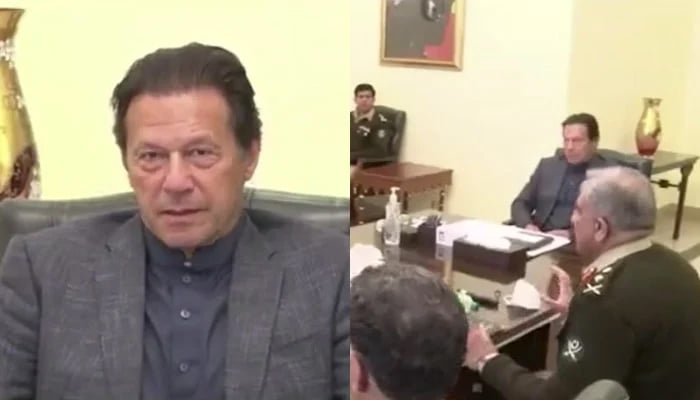
Prime Minister Imran Khan presides over a meeting on Monday called to review the overall security situation in the country. — Photo courtesy Prime Minister’s Office
Prime Minister Imran chaired a high-level meeting of the country’s civil and military leadership on Monday to review the overall security situation in Pakistan after the brutal mob lynching of a Sri Lankan national in Sialkot last week.
The meeting was attended by Chief of Army Staff General Qamar Jawed Bajwa, National Security Adviser Dr Moeed Yousuf, Information Minister Fawad Chaudhry, Interior Minister Sheikh Rashid Ahmed, Punjab Chief Minister Sardar Usman Buzdar and other senior military and civil officers.
According to a statement issued by the Prime Minister’s Office, the participants resolved to bring the perpetrators involved in the Sialkot lynching to justice.
A mob comprising hundreds of protestors, including the employees of a factory where Priyantha Kumara worked as a manager, had tortured him to death on Friday and later burnt his body over blasphemy allegations.
Subsequently, a first information report was registered against 900 workers of Rajco Industries, and scores of suspects have been arrested since then.
According to the the PMO, the participants of today’s security meeting were of the view that individuals and mobs could not be allowed to take the law into their hands and such incidents could not be tolerated.
The country’s civil and military leadership expressed serious concern over Kumara’s lynching, stressing the need for implementing a comprehensive strategy to curb such incidents and ensuring “strict punishment” for all the perpetrators, the PMO said.
It added that the participants also acknowledged the act of bravery by one of Kumara’s colleagues, Malik Adnan, who was seen confronting a group of angry men in an attempt to save the former in a video of the incident.
“Malik Adnan […] endangered his own life to save Priyantha Kumara,” the PMO’s statement said, adding that the participants of the meeting also conveyed their deepest condolences to the family of late Kumara.
Widespread condemnation
The condemnation of Kumara’s killing in today’s meeting was the latest expression of disapproval of the incident by the country’s leadership. The incident has drawn a strong reaction and widespread condemnation from across the country.
Hours after the incident was reported on Friday, Prime Minister Imran Khan had condemned the “horrific vigilante attack” on the Sri Lankan man, calling it “a day of shame for Pakistan”.
“Let there be no mistake all those responsible will be punished with full severity of the law,” he had tweeted.
Similar sentiments were expressed by President Arif Alvi, other politicians, diplomats and activists.
Amid countrywide outrage over the incident, Human Rights Minister Dr Shireen Mazari also said today that the government had decided to review the National Action Plan (NAP) on counter-terrorism in the wake of the brutal lynching of Kumara.
Speaking exclusively to Dawn.com, the minister rued the recurrence of such incidents and called for “strict government action”, terming it the “need of the hour”.
Govt expresses serious concern over cruel act of killing a Sri Lankan national in Sialkot, aims to bring perpetrators to justice
Prime Minister Imran Khan chairs a meeting to review overall security situation in the country in Islamabad on December 6, 2021. — PM Office
ISLAMABAD: The government on Monday decided to implement a comprehensive policy to control violence after a mob lynched a Sri Lankan national in Sialkot.
Last week, hundreds of people, including workers from the factory, had tortured the foreigner, Diyawadanage Don Nandasri Priyantha, to death and later burnt his body over blasphemy allegations.
According to a statement issued by the PM Office, the decision to implement the strategy came during a meeting chaired by Prime Minister Imran Khan in Islamabad, where the overall security situation in the country came under review.
“The meeting expressed serious concern over the cruel act of killing of Sri Lankan national Priyantha in Sialkot and expressed the resolve to bring the perpetrators to justice,” the statement read.
The participants of the meeting were of the view that individuals and mobs cannot be allowed to take the law into their hands and such incidents cannot be tolerated.
“Therefore, a comprehensive strategy shall be implemented to curb such incidents and strict punishments to all the perpetrators shall be ensured,” the statement said.
During the meeting, the participants praised the bravery and courage of Malik Adnan who endangered his own life to save Diyawadanage and conveyed deepest condolences to the family of the deceased.
The meeting was attended by Information Minister Fawad Chaudhry, Interior Minister Sheikh Rasheed Ahmed, Chief of Army Staff General Qamar Jawed Bajwa, National Security Advisor Dr Moeed Yousaf, Chief Minister Punjab Sardar Usman Buzdar, senior military and civil officers.
Remains sent off to Colombo
Earlier today, the remains of the factory manager were sent off to Colombo. Sri Lankan embassy officials arrived at the hospital to escort Priyantha’s body to the airport and laid flowers over it.
Priyantha’s last rites will be performed upon the arrival of his body in Sri Lanka.
Twenty-six suspects arrested in connection with the lynching of the Sri Lankan factory manager have been remanded into police custody.
The police presented the suspects before an anti-terrorism court earlier in the day and requested their remand for interrogation.
During the hearing, the names of the suspects were called out to mark their presence. All the suspects responded to their names except for one, named Shoaib alias Gonga (speech impaired).
The investigation officer informed the court that Shoaib is speech impaired.
The police requested the court to grant 15-day remand of the suspects for interrogation which the court accepted and ordered the investigation officer to present them on December 12.
So far, a total of 131 suspects have been arrested in connection with the Sialkot lynching case.
The incident
Priyantha, working as a manager at a private factory in Sialkot, was lynched on Friday by a mob after being accused of blasphemy.
The gruesome incident was dubbed by PM Imran Khan as “a day of shame for Pakistan”.
Workers of a garment industry, located on Sialkot’s Wazirabad Road, had alleged that the foreigner had committed blasphemy. He was subsequently lynched and his body set on fire.
The mob had also vandalised the factory and blocked traffic, according to the police.
The brutal murder drew widespread condemnation from senior government functionaries, including the prime minister and president, as well as the military’s top leadership, who promised to bring all those involved to the book.
The remains of Sri Lankan national Priyantha Kumara, who was lynched by a mob in Pakistan’s Punjab province, reached the island a short while ago.
The body was repatriated on Monday, even as Pakistani authorities arrested more suspects involved in the grisly incident that shocked people across the world.
The remains were airlifted by SriLankan Airlines flight UL 186 at 12.30 p.m. from Lahore and arrived at the BIA in Katunayake at 5.00 pm via UL 186 from Lahore (12.30 pm).
The remains will be handed over to his next of kin today (06) at the BIA, the foreign ministry said.
The wooden coffin has the words: Human remains of late Don Nandasri P Kumara Diyawadanage. From Lahore to Colombo”, transcribed on it.
A mob of over 800 men, including supporters of hardline Islamist party Tehreek-e-Labbaik Pakistan (TLP), attacked a garment factory and lynched its general manager Priyantha Kumara Diyawadanage and set him on fire over allegations of blasphemy on Friday last in Sialkot district, some 100 km from Lahore.
The officials of the Sri Lanka High Commission arrived here early Monday morning and the body was handed over to them at the Lahore airport by Punjab minorities minister Ijaz Alam. The body was transported on the Sri Lankan Airlines flight,” a Punjab government official told PTI.
Meanwhile, Punjab Police claimed to have arrested seven more prime suspects allegedly involved in the lynching of 49-year-old Kumara.
A total 131 suspects, including 26 main ones, have been arrested so far. The 26 prime suspects have played a key role in inciting the people, lynching Kumara and setting his body ablaze,” the Punjab Police said in a tweet on Monday.
Some 15 prime suspects were presented before the Anti-Terrorism Court Gujranwala on Monday where they were remanded in police custody for 15 days.
According to police, after brutally killing Kumara, the mob also wanted to kill the factory owner and set the building on fire.
The mob wanted to set on fire the entire factory after lynching Kumara. A group of charged workers headed towards the residence of the factory owner to kill him, but timely action by police prevented further violence,” Sialkot District Police Officer Omar Saeed said.
Earlier, narrating the sequence of the gruesome incident, Inspector General Police (Punjab) Rao Sardar Ali Khan had said: A mob of over 800 men gathered and attacked the factory at 10 am Friday after reports emerged that Kumara had torn a sticker/poster inscribed with Islamic verses and committed a blasphemy. They searched for him and found him on the rooftop. They dragged him, beat him severely and by 11.28 am, he was dead and the body was set on fire by the violent mob.”
Kumara was working as general manager in Rajko industries, which deals in sportswear, for the last seven years.
The horrific incident sparked outrage across Pakistan with all sections of the society condemning it and calling for the culprits to be punished.
According to the post-mortem report, nearly all bones of Kumara were broken and his body was 99 per cent burnt in the horrific lynching incident.
Kumara had gone to Pakistan in 2011 after he got a job as a mechanical engineer at an apparel factory in Faisalabad. After a year, he joined Sialkot’s Rajco Industries as its general manager and was the only Sri Lankan national working in the factory.
He is survived by his wife and two sons aged 14 and 9.
Litro Gas Lanka Limited has commenced the distribution of domestic LP gas cylinders, conforming to the requirements of the Consumer Affairs Authority (CAA).
The CAA said that the new stock of LP gas cylinders can be identified by the shrink bundling film of the gas cylinder valves (the polythene seal), which will carry a red logo on a white background (See the image above).
Following a discussion held yesterday with State Minister Lasantha Alagiyawanna, Litro Gas Lanka Limited and Laugfs Gas PLC, the two largest suppliers of LP Gas in Sri Lanka, had agreed to resume the supply of domestic LP gas, conforming to the guidelines of the Consumer Affairs Authority (CAA).
The Consumer Affairs Authority on December 04 gave its approval to release liquefied petroleum gas (LPG) to the market under three conditions.
A decision was taken to commence distribution of domestic gas with effect from yesterday (December 05) under the following three conditions:
01. Not releasing previously imported LP gas stocks to the market.
02. Adding Mercaptan (also known as methanethiol) to new stocks before they are released to the market, enabling the consumers to identify any leaks by its odorant.
03. Testing one per every 100 gas cylinders during the manufacturing process, serializing and producing them to the CAA.
Meanwhile incidents related to gas cylinders continue to be reported from various parts of the country.
The Health Ministry reported that another 173 persons have tested positive for Covid-19 today, increasing the daily count of new cases detected to 741.
The coronavirus cases confirmed today includes two returnees from overseas, according to the Epidemiology Unit of the ministry.
Sri Lanka’s total count of Covid-19 cases reported climbs to 568,423 with this while over 11,000 infected patients are currently undergoing treatment in the island.
The Director General of Health Services has confirmed another 23 coronavirus related deaths for November 05, raising the country’s death toll due to the Covid-19 pandemic to 14,484.
The deaths reported today include 15 males and 08 female patients while three of the deceased are between the ages 30-59 years. The remaining 20 victims are in the age group of 60 years and above.
I first met Douglas Wickremaratne somewhere in 1984/85 when we were searching
for a speaker for a debate on the ethnic problem to be held at the University
of Cambridge. I was then working in
Cambridge and we Professor Atula Ginige
and a few others were in charge of the
Sinhala side to make a presentation. We heard about Douglas and called on him
in London to invite him to speak on occasion. Douglas readily agreed and also suggested another
speaker Dr Cappie Kannangara, who was approached. Dr Cappie too readily agreed.
In the morning of
the day for the debate, It was a bad start as though Cappie came to Cambridge,
he had to get back as his brother in law Denzil Peries had suddenly died
at a restaurant meal. Denzil was the Editor of the South, a journal that had recently unearthed with photographic
evidence that Indira Gandhi, the Prime
Minister of India had established training camps for the LTTE cadres and this
had been given prominence in the Issues of The South. I had to step in place of Cappie and we were
worried as our team looked weak without
Dr Cappie.
However at the debate Douglas excelled in speaking. His
speech was organized well and full of facts all rattled from memory without a
scrap of paper. His was a store of knowledge of how the ethnic problem
commenced, full of historical detail of how facts had been misrepresented.
There was pin drop silence as he spoke. Douglas excelled in presenting facts-
it was a flow that kept listeners mesmerised.
In answering the questions raised,
Douglas was on the ball with specific details of the carnage caused by LTTE
attacks on unarmed civilians and even novice monks at Arantalawa. Douglas was
always the winner in arguments.
That occasion
brought us close together and whenever we wanted to discuss the ethnic
problem we in South London always invited Douglas, who always came dead on
time, at his expense.
There were occasions when he would telephone me in the
morning to join him in a few hours to be present in a Room at the Houses of
Parliament where members of parliament were being briefed by LTTE supporters. Douglas
as usual always won the day whenever he
spoke. He was then actually doing the task that should have been done by the High Commission for Sri Lanka which
was more in slumber than awake.
Douglas was in many years requested to be present at Geneva
at the UNHCR Sessions and I am aware that he accomplished himself creditably
well on all those occasions.
Douglas was a close admirer of Ven. Elle Gunawsansa Thera .
His life was an innings well done, a glorious service to
the Motherland he dearly loved. He dedicated his life for the country in every
respect.
My condolences are for his wife and children.
May life be short in Samsara for Douglas. It has to be so
for a personage who dedicated his time and energy, unreservedly, for the cause of his Motherland
Hyderabad, 5 December 2021: Indian Journalists Union
(IJU) expresses concern over the slapping of sedition charges against a
journalist from Assam’s Barak valley and urges the authority to withdraw the
case against Anirban Roy Choudhury.
The Silchar-based editor of digital outlet BarakBulletin
faces sedition charges over an editorial and the young scribe has been summoned
by the police to be present at Silchar Sadar police station on Monday morning,
following an FIR, lodged by Santanu
Sutradhar of All Assam Bengali Hindu Association.
It is shocking that the news portal editor has been
booked under sedition charges targeting his freedom of expression guaranteed by
our Constitution. There are other laws to deal with such issues, but no way it
should go with sedition,” said IJU president K. Sreenivas Reddy and secretary
general Balwinder Singh Jammu.
The complaint was filed on 1 December claiming that the
editorial comprised elements to hamper the cordial relationship between the
Bengali speaking residents of Barak valley and the Assamese community in
Brahmaputra valley of Assam. Considering the sensitivity of it, he protested
against the scribe’s public support to Pradip Dutta Roy, who is presently under
judicial custody.
Dutta Roy, the convenor of Barak Democratic Front, was
arrested on 27 November last following
his ultimatum to erase Assamese language from the hoardings put in Barak
valley. Mentionable is that even though Assamese is recognised as the official
language of Assam, there are provisions for using Bengali in Barak valley that
comprises three districts.
Members of Parliament (MP) have to serve
10 years hereafter to qualify for pension as opposed to five years at present.
(2022 Budget speech)
While welcoming that policy decision of
the Government who can say that this is not another election gundu to deceive
the people aimed at the proposed Provincial Council Elections? If the
Government was really honest and concerned about public good what it should do
is to abolished this joke immediately, particularly in view of the present hard
times the country is undergoing at the moment, as Canada had done it in 1995,
without continuing an unwanted bonanza to trap politicians cunningly used as
bait by party leaders, that blead the nation.
The Mike Harris government eliminated
MPPs’ pension plans following the 1995 provincial election. Even it is allowed
in exceptional cases like in Canada, a pension to a politician should be paid
only after 65 years in recognition of his /her distinguished service to the
nation when they are disabled to earn a living.
Why pay pensions to politicians at
all who volunteer and swear to serve the people at elections and on the
contrary rob and destroy the entire nation after they come to power. It is to
hoodwink
The Government in its Budget speech
has proposed that MPP will be eligible for a pension only after completing 10
years continuous service” This too in my view is not warranted and justified
at all, particularly in this country where they come to politics for unusual
power and amaze wealth and rob public assets and moneys in unproper ways. They
don’t even declare their assets before nomination or even after deliberately to
make room to justify their illegal earnings if someone questions their assets
afterwards. What is more ludicrous is their claim for a pension also in spite
of the enormous financial benefits and privileges they get from the day the get
elected compared with what the politicians in pre 1970 period got. For example,
an MP those days got only an allowance of 5oo Rupees, a Junio Minister Rs 750
and a Minister Rs 1000 a month. They also did not get official vehicles or any
other allowance or duty-free vehicle permits or official residences in Colombo or
other payments like attendance and other extra packages like special
allocations for their seats (in spite of the fact none of these people have and
electorate as they are only District MPP which has made representative
democracy a big fast)
My question is under these
circumstances why pay a pension at all to any politician in this country
Because paying a pension to any politician is contrary to all basic principles
related to the principle of paying pensions accepted all over the world.
Because the origin of the idea of paying a pension has begun in the world first
for people over 70 years in old age for the continuous service, they have
rendered to the nation who are disabled to make their living, as a mark of
gratitude for the devoted service they have rendered to the nation or the
company for life. Those days it was
public service and not self -service as it has come to stay today.
The man behind the initiative called
The Old Age and Disability Bill” was Otto von Bismarck. of the German Empire. Germany was thus the
first European country to establish a fully-fledged pensions system for workers
aged 70 or more. The limit was lowered to 65 in 1916.June.
In 1875, The American Express Co.
created the first private pension plan in the U.S. for the elderly and workers
with disabilities. Early pension benefits were designed to pay out a relatively
low percentage of the employee’s pay at retirement and were not designed to
replace the employee’s full final income.
In this country it was started by the
colonial Government to make a payment to their employees in their old age for
the dedicated service they had rendered to the Empire. Subsequently it was
extended to retired public servants who had completed 35 years of satisfactory
service in the public service. As such there was full justification for a man
or a woman who has devoted his or her service to the nation in her or his whole
life while debarring any other job while one is in engaged in public service as
his or her only income for living comes to an end the day, he/she retires. But
it should be noted that to get that benefit they had also to contribute a certain
percentage monthly from their salary for which the Government contributed a
certain percentage. Therefore, in fact they are paid from a reserve fund
maintained by the Government out of funds they have contributed throughout
their service. What is more is they have to complete 35 years of service to get
qualified to get that pension. When someone retires prematurely the pension is feezed
until he.she reaches the age of 55. This clearly shows that there is a very
sound rationale for paying a pension to a retired public servant and it is
fully justified both rationally and ethically.
Now let us
examine the rationale of paying a pension to a politician in this country. Paying
pensions to politicians in this country was started in 1977 by the JR Jayawardhana
Government. Curiously it was the first legal enactment of that so-called
Democratic Socialist Government of JR. passed by Act No 1 of his government as
a priority, as if it was the most burning public issue” his government had to
solve. Doesn’t this show the degree of concern and commitment our politicians
have towards the welfare of the people who elevate them to high position by
electing them with a 5/6th majority in 1977 hoping to get a better
deal than from the previous Government of Mrs Bandaranayaka.
What is more hilarious and despicable is this piece of
legislation marked the turning point in Sri Lankan political culture where the
interests of the politicians overtook those of the people.
in a country
that inherited a rich legacy of public good enshrined in the concept of the
Buddhist teaching Bahujana hitaaya Bahujana sukhaaya” (for the good of the many
and for their happiness at large) for 2500 years.
What is even more despicable is that it was awarded to
all politicians who complete 5 years service” irrespective of whether they
served the people or not. The funniest part of it was the payment of that
pension to his /her spouse after the death of the MP. Further his family will
get another pension or even more if his or her son or daughter had been
appointed as the Private Secretary, Public Relation Officer etc which has now
become a rule of the day.
the day, a tradition that had come to stay as a
political privilege. Payment of pensions under this scheme was made with
retrospective effect and it was payable even to politicians who served in the
State Council, if they were living at that time with arrears.
Only one man refused to accept this blood money in the
history of Parliament. He returned it to Speaker. The man mentioned here was my
good friend M.S. Themis the 3rd MP for Colombo Central in 1956.He
was the first person and perhaps the only man to return it. I know it for
certain as I was the one who prepared the covering letter to the Speaker.
This piece of legislation was also a complete
violation of the Pension minute which
nobody dared to challenge or even question up to date either in a court of law
or Parliament that is said to be the Supreme lawmaking body in the country.
Isn’t it interesting to note how our Law makers make laws and for whose benefit
they make them in this so-called supreme legislature of the country expected to
make laws for good governance for the good of the people and the good of the
country at large?
JR did not stop at that. He did
everything to enhance the fabulous benefit package to MPP with immediate effect.
He dramatically increased salaries, increase payments for attending Parliament,
official vehicles with duty free vehicle permits were also provided, which they
could sell in the open market and make a fabulous fortune. Official quarters in
Colombo were also given where as they had to be in Colombo only for 8 days a
month. Unlimited job permits for MPP to give employment for their party
supporters only, monopoly of tavern license, business permits and government
contracts, LRC land nationalized by Mrs B for a song and government Import
permits. The sky was the limit to such
privileges. Here I stop the list for brevity and lack of space. All this was
done to buy over the MPP to maintain the majority in Parliament to embellish
and consolidate his dictatorial position as the Executive President which
perhaps he thought is a lifetime job, but unfortunately not.
The same corrupt and highway robbery situation
still continues in incremental scale without being openly questioned or
challenged by anyone in the ‘People’s Parliament. So much so today the whole
system of governance in this country has become a veritable national liability.
JR also increased the number of MPP in
Parliament from 196 to 225 by introducing a thing called a National list to
provide a place in Parliament for their kith and kin and family friends as
backdoor MPP bypassing the elections and thus making Representative Parliament
a ”Non-representative thereby making representative democracy a big fast and a hilarious
joke. Instead of reducing it to 165 the previous number that would have save
billions for national development and reduced IMF and other foreign loans
thereby reducing the annual budget deficits and avoiding bankruptcy.
On the top of this JR also signed an
Agreement with Rajiv Ghandi completely handing over the North and East
comprising 1/3 of the land of the country and 2/3rd of the coastal
belt together with the maritime territory adjacent to it as the Traditional
Historical Homeland of the Tamil people completely forgetting the fact that the
only Traditional Historical Homeland of Tamil people on earth exists only in Tamilnadu
South India. (See Rajiv /JR Indo Lanka Accord of 29th July 1987 for
a full list of JR’S betrayal ) Thereby he committed an unpardonable criminal
offence against the Sinhala Buddhist nation by selling 1/3 of the homeland of
the Sinhala nation that had been their motherland from the inception of known
human history and also thereby making the way for annihilating the Sinhala
nation and the Mother land of the
Sinhala nation as he had once predicted in his public speeches where he said
the Sinhala nation will be extinct in
another 25 years. This Accord that conceded 1/3 of the land and 2/3rd
of the coastal belt with all its marine resources as the Historical Traditional
Home land of the Tamils of South India who were the eternal enemies of this
Sinhala nation, in short was the biggest betrayal by any politician in the
entire history of this Island Nation from the beginning of history. The only
relief is that this Accord as well as the !3th Amendment were illegally entered
in to under emergency by the blessing of the Gods, fortunately that could be
annulled at any moment by a patriotic leader blessed with a strong spine and
the courage to do it as it was an absolute travesty of history.
What was even more traitorous was the
Agreement to establish 9 Provincial Councils co-terminus with the British made
Provinces to divide the country in to nine independent governing units making
the way for the establishment of Future EELAM -the dream land of Prabhaharan to
erase the 2500-year-old Sinhala Kingdom from the surface of this earth. If the provisions
of the Provincial council are implemented to the letter that will be the
death-knell of territorial integrity and the Ekathchatra status of this
land nation
Each of these Provinces to be
governed by a Governor, a board of 5 Ministers headed by a Chief Minister and
an army of Provincial councilors of about 700 low grade politicians supported
by a some 14,000 Pradesiya Sabha (double the number that was there before.
Politically this system lead to quasi-Federal status leading to a Federal state
to begin with, with (1) a Tamilnadu comprising the North, East, Central,
Sabaragamuwa and Uva only for Tamils,( as it was once stated by A.J. Wilson the
Son-in-Law of Chelvanaayagam),amalgamated under the provisions in the Rajiv/JR Accord
for amalgamation 2 or more
Provinces comprising 2/3 of the area of the Island, a mono Tamil state and the
balance 1/3 for a multi racial community including Sinhalese, Tamils, Muslims
and all others, leading to a virtual pickle and an eternal battle ground of ethnic,
religious and social crises and a hotch-potch of International conflicts in
view of it’s strategic geo=political importance that will finally lead to the
extinction of the 2500 year old Sinhala
Buddhist civilization from the surface of this earth.
What is more depressing is already
this provincial council system has wasted trillions (Koti- Prakoti) of public
funds for the upkeep of these superfluous new political creations for nor
benefit to the country but benefited only the politicians, from 1987 to date .
It has been said that 85% of national tax collection is spent for the upkeep of
politicians and so-called public officials in this country leaving only 15 %
left for all other work concerning the country and 21millions citizens. I do
not propose to say a word about the lawlessness, corruption and international
debts to the tune of 56 billion US $ as at present dragging the country to the
bottom of abject poverty and bankruptcy converting this once proud nation and
second richest country in South East Asia second only to Japan by 1948, loans
even from Bangladesh and Maldives the latest.
This is the pathetic situation in to
which this proud and rich nation which gave Sterling loans even to the British
Empire in early 1950s has been put by our politicians who are supposed to have
ruled this Island nation from 1948 up to date and ruined by separatists Tamils
and Muslims with their Tamil and Muslim dream lands on this Land of the Sinhala
nation from the dawn of history.
And mind you it is to this kind of
politicians who have robbed the nation hook, line and sinker and also those who
continue to do the same game and jointly responsible for making this country a
debt ridden and begging country this peracetic and good for nothing governments
continue to give a fat pension extracting from the beggar’s bowl
In this back drop as for me, I
strongly oppose a single scent been given to any politician as a pension. In addition,
I also suggest that all extraordinary benefits like palatial official mansions
and all other benefits like official vehicles, security and all other extra benefits
be withdrawn forthwith before the masses march in thousands and forcibly take
over all these public assets as a protest against what they have done to this
country and the Sinhala nation over the past 73 years.
This includes all politicians including the
ex-Presidents and their rich widows. However, I am not against for paying a
pension to an honest politician like C W.W Kannangara who has devoted his
entire life for the service to the people and the country and who had done an
indelible and memorable service to the nation, after passing a resolution in
Parliament to that effect. That will definitely prevent self- seeking wealth
mongering people doing politics and limit it to men and women of outstanding character,
dignity and commitment to the service of people the noble wove of any honest
politician should be.
Finally I propose first, the immediate
abolition of the pension scheme to all politicians and second, appointment of a
powerful Presidential or a Public Commission to enquire in to the illicit and
illegitimate earnings of all politicians at all levels starting from 1977 up to
date and confiscate all illicitly earned assets proved, both at home and abroad
such as Pandora assets and credit all that wealth to the General Treasury
Account so that people will get back all their wealth robbed by politicians at
least from 1977 onwards so that all those who aspire to be politicians in
future in this country will begin with a new political vision opening the doors
to a new political culture setting a Sri Lankan model for the entire world and
once again restore the ancient glory of the Sinhala nation.
The people’s voice against the killing of George Floyd clearly shows that
the Blacks in United States are a great deal ahead in seeking the justice in
demanding the right to equality before the law…! *
[Aruna Laksiri Unawatuna (Attorney-at-Law)]
The ruling power of the British Crown in the United States was brought to an
end when the Declaration of Independence was pronounced in 1776 with the
American Revolutionary War (1775-1783). It was recognized as a free state by
the Treaty of Paris in 1783.
The racial laws for the weak and the powerful which were separately
introduced by the British for the countries that they governed; South Africa,
India, Sri Lanka and also United States including other countries as colonies.
Unlike the other British colonial countries, the United States was the only
nation in the world to disarm the British with an armed revolution but there
was a huge tragedy in its society because of the strong establishment of laws
for confirming racial discrimination and oppressing the oppressed which were
introduced by the British.
As a result, great personalities such as President Abraham Lincoln (1865)
and Nobel laureate Martin Luther King, Jr. (1968) sacrificed their lives to the
bullet, and the persistence of such assassinations expose the dark areas of the
rule of law in the United States.
Another such brutal murder which was committed by police officers in
Minneapolis, Minnesota, USA by torturing a black man named George Floyd (46) to
his death on May 25, 2020, has achieved to create a stir in public opinion in
all countries.
Although there have been many horrific murders all around the world, the
murder of the black man named George Floyd by depriving him of air for nearly 9
minutes, even after he begged for a breath reminds us especially of the
massacre of Jews by the Nazis using the gas chambers preventing them from
breathing during the 2nd World War, and it was clearly a cruel act against
humanity.
Although there are many protests in the United States of America and other
countries around the world for equality disregarding the white-black
discrimination while implementing legal actions regarding this cruel murder
which was done by preventing breathing, the nature of the protests of the
Blacks of the United States against the brutal murder of George Floyd proves us
that they are far more ahead than the people of other countries which had been
colonized by the British in demanding the right to equality before the law.
Unlike the people of former British colonies such as Indians and Sri
Lankans, Blacks in the United States are well-versed in English, so they have
the legal literacy to read the laws of the United States and the judgements of
its Supreme Court.
Therefore, without the operation of anyone else the Blacks in the United
States have the legal literacy to independently utilize the knowledge gained
through it and obtain a successful procedure against the legal discriminations
taken against them.Because of that strong legal power, Blacks in the United States
will have the opportunity to seek justice for George Floyd’s murder.
Unlike the Blacks in the United States, the Sinhalese who are the majority
of the Sri Lankans are a community who are neither free nor able to access
legal literacy. All necessary and important legal matters in Sri Lanka are
handled and decisions are made in English language which is used only by a
minority and not in Sinhala, the language of the majority. As a result, the
legal literacy of the Sinhala majority in Sri Lanka is very low and they do not
have the knowledge to act legally against the actions that the powerful people
take against them.
The Sinhalese in Sri Lanka do not know how to obtain freedom through legal
activities, unlike the Blacks in the United States can obtain freedom through
legal activities. While being ignorant of the law is not an excuse (Ignorantia
juris non excusat), the Sinhalese are not allowed to know the law.
Although the People’s Voice against George Floyd’s cruel murder testifies
that Blacks in the United States are far ahead in demanding equality before the
law, it cannot be said how much more time it will take for the majority of
Sinhalese in Sri Lanka to demand equality before the law.
* This is an English translation of an article written on June 7,
2020 about the strangulation of a black man named George Floyd in
Minnesota, USA, and the facts contained in that article are important to
resolve the recent murder of a Sri Lankan in Pakistan.
The Pakistani church leadership has condemned the killing and burning of the body of a Sri Lankan Christian by a Sialkot mob on Saturday.
As many as 124 people have been arrested in the lynching of a Sri Lankan export manager by dozens of factory workers in Sialkot.
The gruesome killing of Priyantha Kumara, who was working in a sports garments manufacturing factory as a general manager for the last 10 years, on blasphemy allegations had shocked and pained the entire country, said Church of Pakistan Moderator/President Bishop Dr Azad Marshall and Roman Catholic Archbishop of Lahore Sebastian Francis Shaw.
“Mr Kumara’s cold-blooded murder has left us all grieving. Our hearts and prayers go out to his family and to the Sri Lankan people on this great tragedy. As Pakistanis, our heads hang in shame,” they were quoted as saying by The Nation newspaper.
On Friday, a mob had tortured Diyawadana to death before burning his body in Sialkot over alleged blasphemy. The incident took place in the Wazirabad Road area.
Local media reports said the workers of private factories attacked the export manager of the factory Diyawadana and burnt his body after killing him, Dawn newspaper reported.
According to Bishop Marshall, the public outcry over the Sialkot incident showed that a huge majority of Pakistani citizens were opposed to growing extremism and intolerance in society.
Meanwhile, the National Commission on Human Rights (NCHR) has demanded a speedy and impartial probe into the lynching of Sri Lankan factory manager Priyantha Kumara Diyawadana in Sialkot.
“We, at the commission, are deeply perturbed by the brutal mob violence and blatant violation of human rights, especially against a guest in our country. It is unfortunate that the commission is issuing its very first introduction statement over such a horrific incident that has shaken the whole nation,” the statutory body was quoted as saying by Dawn newspaper.
PM Imran Khan assures Lankan President of strict action against culprits
Members of the Human Rights Council of Pakistan place oil lamps to pay tribute beside a photograph of late Sri Lankan factory manager Priyantha Kumara, in Karachi on December 5, 2021, after he was beaten to death and set ablaze by a mob who accused him of blasphemy.Image Credit: AFP
Islamabad: Two primary suspects, Farhan Idrees and his colleague Usman Rasheed, whom the Sri Lankan general manager of a factory in Sialkot city of Punjab province used to chide for poor output and indiscipline, incited their colleagues to lynch him over ‘blasphemy’, says an interim police report on the torture and murder of Priyantha Diyawadana Kumara.
They disliked 49-year old Priyantha Kumara, a textile engineer by qualification, for being strict in enforcing discipline.PauseUnmuteLoaded: 10.92%Fullscreen
Later, both of them also admitted in interviews with TV channels on the spot that they had killed the ‘blasphemer.’
Background
As per details, on December 3, Priyantha Kumara was dragged out of the factory onto the road, kicked, tortured and beaten to death with iron rods and sticks by hundreds of workers over blasphemy charges. Later, his body was set on fire by the mob.
According to details, Kumara had removed a poster of the erstwhile banned Tehreek-e-Labbaik Pakistan (TLP) from the outer wall of the factory ahead of a whitewash of the building.
A member of the Human Rights Council of Pakistan places an oil lamp to pay tribute to Sri Lankan factory manager Priyantha Kumara in Karachi on December 5, 2021, after he was beaten to death and set ablaze by a mob who accused him of blasphemy.Image Credit: AFP
This gave the disgruntled men an opportunity to settle scores with their boss and they circulated a rumour that he had committed blasphemy.
The incident drew international condemnation from around the world calling upon Prime Minister Imran Khan and his party’s government in Punjab to take strict action against the culprits.
Immediately after the murder of the factory manager in Sialkot, known as the industrial hub of the country, Prime Minister Imran Khan in a tweet had assured justice to the family of Priyantha Kumara saying he was personally monitoring the investigation.
PM Khan talks to Lankan President
In another tweet, PM Khan informed that he had spoken to Sri Lankan President Gotabaya Rajapaksa and conveyed our nation’s anger & shame to the people of Sri Lanka at the vigilante killing of Priyantha Diyawadana in Sialkot. I informed him 100+ ppl arrested & assured him they would be prosecuted with full severity of the law.”
Spoke to Sri Lankan President Gotabaya Rajapaksa today in UAE to convey our nation’s anger & shame to people of Sri Lanka at vigilante killing of Priyantha Diyawadana in Sialkot. I informed him 100+ ppl arrested & assured him they would be prosecuted with full severity of the law— Imran Khan (@ImranKhanPTI) December 4, 2021
More than 100, including primary suspects, detained
The Punjab police also arrested more than 100 factory workers including the two primary suspects accused of torturing Priyantha Kumara with the help of the closed-circuit TV cameras (CCTV) footage.
Six more people were arrested on Sunday for alleged involvement in the lynching of Priyantha Kumara.
The First Information Report (FIR) was registered against 900 workers of Rajco Industries on the application of Uggoki (Sialkot) Station House Officer (SHO) Armaghan Maqt under various sections of the Pakistan Penal Code (PPC) including the Anti-Terrorism Act (ATA).
According to the FIR the protesters had slapped, kicked, punched and hit Kumara with sticks in the SHO’s presence, and dragged him out of the factory on Wazirabad Road where he died.
Police helpless before the mob
The SHO said he was helpless in front of the mob owing to shortage of personnel.
According to District Police Officer (DPO) Omar Saeed Malik raids were still being carried out to arrest more suspects. More than 300 factory workers have been identified in the CCTV footage for involvement in the gory act and the police teams have been constituted to find them, he said.
A day earlier, Chief Minister of Punjab Buzdar had stated that the investigation was being taken forward in a scientific manner.
Nilushi Dissanayake (C) the wife of Sri Lankan factory manager Priyantha Kumara who was beaten to death and set ablaze by a mob in Pakistan, sits with friends and relatives at her residence in Ganemulla near Colombo on December 5, 2021.Image Credit: AFP
Wife seeks justice
Kumara’s grieving wife, Niroshi Dasaniyake, has pleaded with both Pakistani and Sri Lankan leaders for justice for her slain husband.
My husband was an innocent man. I found out from the news that after working abroad for so long he had been brutally murdered. I saw on the internet how inhuman the killing was. I appeal to the Sri Lankan president and the Pakistani prime minister and president to conduct a fair investigation so my husband and our two children get justice,” she said in a statement.
Kumara and his family had been living in Sialkot for the last seven years.