Policy say initial report of incident submitted to PM Imran; 112 suspects detained so far
SIALKOT:
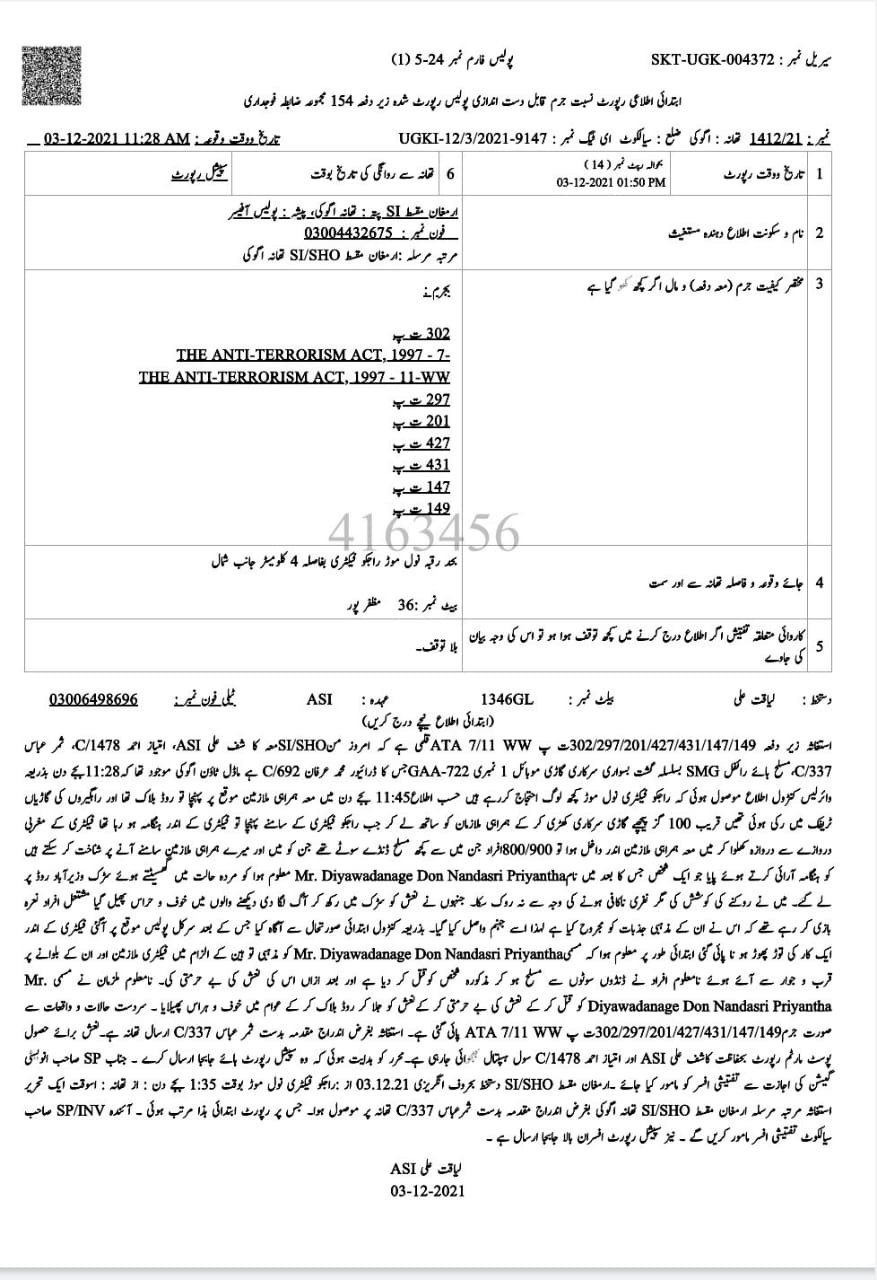
The police have arrested a prime suspect and booked at least 800 people under the Anti-Terrorism Act a day after a mob tortured a Sri Lankan man, employed as a manager in a factory on Wazirabad Road, Sialkot, to death and set his body on fire.
The police said Farhan Idrees, the key suspect, has been detained.
They said hundreds of people armed with sticks and batons were present inside the factory at the time of the murder of the foreign national, Priyantha Kumara.
After the murder, the mob dragged his body on the streets, the police said, adding that it failed to stop the crowd due to a lack of strength.
As per the initial investigation, the police said that the Sri Lanka citizen was killed over allegations of blasphemy. They added that they were investigating the matter from all angles.
Meanwhile, an initial report of the incident has been submitted to Prime Minister Imran Khan by the Punjab Police. As per the report, at least 112 suspects have been detained who were identified with the help of the factory managers. The provocateurs have been arrested as well.
A copy of the FIR available with The Express Tribune.
The detained suspects have been moved to unknown locations, they said, adding that investigation was still underway.
Separately, the body of the deceased has been handed over to the police after post-mortem for legal formalities.
In a statement, cleric Mufti Taqi Usmani condemned the killing of the foreign national over blasphemy allegations. He said blasphemy was a grave crime” but the evidence to prove the blasphemy charges must be beyond doubt.
The Sialkot incident has tarnished the image of Pakistan and Muslims across the world, he added.
He expressed concerns over the violent state of affairs in Pakistan, saying instead of using force, the government should table the matter before parliament to resolve such issues. He also urged the protesters to use peaceful means instead of destroying national properties and violence.
Lynched over ‘blasphemy’
The nation was shell-shocked and disgusted on Friday when a Sri Lankan national was brutally lynched and his body was set on fire by a mob in Sialkot. The sickening incident outraged the nation as the civil and military leaders denounced it as horrific” shameful” and extra-judicial vigilantism”.
President Arif Alvi said the vigilante attack has nothing to do with religion, while Prime Minister Imran Khan promised that those responsible will be punished with the full severity of the law”.
The gut-wrenching incident took place on Sialkot’s Wazirabad Road, where workers of private factories brutally lynched the Sri Lankan national.
Several gruesome video clips shared on social media showed a mob beating the victim while chanting slogans against blasphemy. Other clips showed his body set ablaze, as well as the overturned wreckage of what was said to be his car.
Many in the mob made no attempt to hide their identity and some took selfies in front of the burning corpse. The police claimed that the grisly incident took place inside the factory premises and there was no way of knowing about it before that time.
Outside the Sialkot Chamber of Commerce, people pay homage to Sri Lankan national Priyanatha Kumara who was lynched by a mob on Friday.
The preliminary postmortem of Sri Lankan national Priyantha Kumara reveals that he died of a severe blow to his head and most of his limb bone had been shattered before the body was set on fire.
The report and additional videos that surfaced on Saturday have revealed new details on the lynching. It emerged that at least one colleague tried to shield Priyanatha from the mob.
The body of Priyanatha has been moved to Lahore on the way to Islamabad, where it would be handed over to the Sri Lankan High Commission.
The Sri Lankan national was lynched by a mob of factory workers and others on Friday over alleged blasphemy allegations. He worked as exports manager at Rajco Industries’ unit located at Wazirabad Road.
Factory employees first killed him and then dragged his body out to set in on fire. The grisly events were recorded on mobile cameras.
Postmortem report
The postmortem report reveals the final moment of Priyanatha Kumara, who had been working in the country for over a decade.
According to the report, Priyantha’s skull received multiple hits and a severe blow then went deep into his brain causing the death.
The mob broke almost all of the limb bones, according to SAMAA TV.
About 99% of the tissues were damaged with burns and wounds. The body was burnt except for the lower legs.
Following the legal formalities and postmortem, the police have escorted the body to Lahore under security. The body will be handed over to Sri Lankan High Commission in Islamabad.
The Sri Lankan High Commission staff will accompany the body to Colombo, according to reports by the Sri Lankan media outlets.
The real cause of heated exchange
The mob had accused Priayanatha of blasphemy after he allegedly tore down some posters of a religious outfit pasted to the factory walls.
However, a police investigation on Saturday revealed that Priyanatha and workers had a heated exchange over another issue, SAMAA TV reported.
The report says that an inspection of the Rajco Industries by foreign companies was due and the deceased had ordered the complete overhaul and maintenance of the factory machines.
According to the police, the manager and workers first got into a heated argument at 10:00am on Friday that escalated to violence.
It says some of the workers had been fired for derelict.
Following the dispute, the workers staged a protest in the factory and alleged that Priyanatha Kumara has committed blasphemy.
The protest suspended the traffic in the area and the crowd gradually grew larger.
The report has been submitted Chief Minister Punjab Usman Buzdar.
Poice has obtained 12 hour CCTV footage recorded by 160 CCTV cameras in the factory.
Colleagues try to shield Priyanatha
Priyanatha Kumara went to the rooftop of the Rajco Industries factory to escape the mob. PHOTO SAMAA TV
New videos and reports emerged on Saturday suggesting that after the mob re-entered the factory following the protest on the road, Priyanatha run to the rooftop to save his life.
Videos show that mob surrounds him on the rooftop amid an array of solar panels.
At least one colleague tries to shield Priyanatha from the mob as the Sri Lankan national clings to his legs.
SAMAA TV‘s Shehzad Ali, who visited the factory on Saturday, says there were a few other factory workers who tried to protect their manager.
A BBC URDU report says at least four workers were proactively trying to rescue the manager. They had told him to flee to the rooftop, but the mob somehow detected him there.
The four were wounded during the scuffle.
The violent mob continues to attack saying the manager will not escape today.”
The man shielding the Sri Lankan national was later identified as Malik Adnan, the production manager at Rajco Industries.
They reportedly threw him down from the top.
His body was later dragged out of the factory to the main road and then set on fire.
The mob continued to record videos and take selfies with the burning corpse.
After the lynching, the mob vandalized the properties and cars outside the factory.
The attack has caused outrage in Pakistan and Prime Minister Imran Khan termed the lynching a day of shame for the country.
The Sialkot Chamber of Commerce and Industry paid homage to Priyanatha Kumara by lying flowers before his photo. It has condemned the horrible act and resolved to formulate policies to avoid any such incidents in future.”
At a press conference in Lahore, Punjab Inspector-General Rao Sardar Ali Khan briefed journalists and media on the investigations into the case. During the last 24 hours, we have conducted raids in over 200 areas of the city and arrested nearly 120 men,” IG Rao said.
Pakistan is the largest recipient of eye donations from Sri Lanka, having received at least 35,000 corneas since 1967, says Dr Niaz Brohi a leading ophthalmologist of the country.
He is a member of the Sri Lanka Eye Donation Society from Pakistan.
Ever since a mob lynched the Sri Lankan national Priyanatha Kumuara in Sialkot on Friday, Dr Brohi says he has been grief-stricken like many others in the country. We hang our heads in shame,” he says.
He has written to the Sri Lanka Eye Donation Society to offer condolence.
Brohi, a former head of the famous Spencer Eye Hospital in Karachi, has performed several cornea transplants so far.
Speaking to SAMAA Digital, he said Sri Lanka has donated 83,200 corneas to different countries in the world.
Brohi claims Pakistan is the largest recipient of Sri Lankan cornea donations having received 40% of them. Since 1967, the Sri Lanka Eye Donation Society has donated 35,000 eye corneas to Pakistan, he said.
In a shocking incident on Friday, angry supporters of Tehreek-e-Labbaik Pakistan lynched Priyantha Kumara Diyawadana over allegations of blasphemy
Over 800 people have been booked under terrorism charges while 13 prime suspects are among 118 arrested so far in the horrific lynching of a Sri Lankan national over allegations of blasphemy in Punjab province of Pakistan, a top police official said on Saturday, as pressure mounted on the government to bring the guilty to justice.
In a shocking incident on Friday, angry supporters of the hardline Islamist party Tehreek-e-Labbaik Pakistan (TLP) attacked a garment factory and lynched its general manager Priyantha Kumara Diyawadana before setting his body on fire over allegations of blasphemy. Advertisement
Diyawadana, who was in his 40s and hailed from Kandy city, was working as the general manager in the Rajko industries (dealing in garments and sportswear) in Sialkot district, some 100km from Lahore, for the last seven years.
Lankan anger
The Lankan parliament and Prime Minister Mahinda Rajapaksa on Saturday condemned the lynching and hoped that Prime Minister Imran Khan will keep his commitment to bring all those involved to justice and ensure the safety of the rest of the island nation’s expat workers. A preliminary report of the incident was shared with the media by Inspector General of Police (Punjab) Rao Sardar Ali Khan and the Punjab government spokesperson Hasaan Khawar here on Saturday.
The Central Bank of Sri Lanka (CBSL) has announced a series of benefits to ensure that more migrant workers send remittances to the island via official channels.
Speaking at a media briefing today (December 04), the CBSL Governor, Ajith Nivard Cabraal listed some of the benefits the bank hopes to introduce, such as insurance and pension schemes.
Apart from export earnings and tourism receipts, the foreign remittance inflow which is the hard-earned money of the Sri Lankan migrant workers plays a major role in strengthening the country’s economy.
In such a backdrop, the CBSL has observed a fall in foreign remittances over the past months, with USD 300 million in October alone.
The main suspicion is that people may be using unofficial and sometimes questionable channels to send money, bypassing proper mechanisms.
With this in mind, the CBSL established the Foreign Remittances Facilitation Department on November 03.
Today, it was announced that the bank is taking further measures to incentivize the migrant workers to use proper channels to send money.
Addressing the media briefing, Cabraal said: We will strengthen this sector in three areas. Firstly, we will facilitate the overseas travel of Sri Lankans. The number of people leaving the county for employment reduced over the past two years. The situation gradually started to become normal since the last month. That is why we saw a large congestion at the passport office and that’s the pressure build-up of two years.
We have taken steps to facilitate those travelling abroad, after discussions with the government and the passport office. We have created facilities for migrants to open accounts when leaving the country and send money via those accounts. The banking system is proving to be a strength for this purpose. We have taken steps to establish branches of banks at the passport office. The second one is that once arriving there, facilities are needed to send money to the island. There were certain issues when remitting money to Sri Lanka. Measures are put in place by the Central Bank and the country’s banks to improve facilities to overcome such issues.”
Cabraal also noted that the CBSL hopes to provide more benefits when the migrant workers send remittances. Accordingly, Rs. 10 above the rate will be paid this month to those who send remittance via official channels.
He further stated: Measures are being taken to introduce pension and insurance schemes for those who send money, by discussing with the Labour Department. We are also taking steps to increase the duty-free allowances for them. We expect to provide loan facilities to the dependents via the banks as well. Additionally, steps are taken by banks to provide benefits at their level.”
In this backdrop, the CBSL yesterday said it has received information that some Sri Lankan expatriates send remittances to their dependents on the island nation – knowingly or unknowingly – through various racketeers.
The CBSL noted that it is aware that there have been instances where certain brokers collect foreign currency from Sri Lankan employees in other countries and credit the accounts of their dependents in Sri Lankan Rupees by way of cash or transfers through the financial system.
The public may not be aware that they are committing offences punishable in terms of law for the violation of the provisions of the Prevention of Money Laundering Act, the CBSL said in a notice published on its official Facebook page.
Further, available information indicate that these transactions could be linked to drug trafficking and other illegal activities, it read further.
Accordingly, the CBSL informed all Sri Lankans residing abroad and their dependents not to fall victim to illegal operators.
They were also advised to ensure that they remit their foreign remittances to Sri Lanka only through banks and through financial institutions which are supervised by the CBSL or other international banks and financial institutions.
The Consumer Affairs Authority (CAA) today gave the nod to release liquefied petroleum gas (LPG)to the market under three conditions.
In a statement, the Authority’s chairman Major General (Rtd.) Shantha Dissanayake said the gas samples collected under the supervision of the committee appointed to monitor the two ships that imported LPG stocks along with Industrial Technology Institute, Sri Lanka Standards Institution and CAA, were referred to the laboratory of the Ceylon Petroleum Corporation (CPC) yesterday.
Accordingly, based on CPC’s test reports and the recommendations of the relevant technical committee, a decision was taken to commence distribution of domestic gas with effect from tomorrow (December 05) under the following three conditions:
01. Not releasing previously imported LP gas stocks to the market.
02. Adding Mercaptan (also known as methanethiol) to new stocks before they are released to the market, enabling the consumers to identify any leaks by its odorant.
03. Testing one per every 100 gas cylinders during the manufacturing process, serializing and producing them to the CAA.
The gas companies are required to make the technical committee aware of the fulfilment of these requirements before releasing the products to the market, in order to ensure quality.
The companies should allow the said committee to monitor the gas manufacturing process at any given moment, the statement noted.
The CAA further stated that ships carrying LP gas have anchored at the Colombo Port and that samples tested from all ships comply with the required standards.
The daily count of COVID-19 cases confirmed in Sri Lanka moved to 740 today (December 04) as 199 more people were tested positive for the virus, the Epidemiology Unit said.
This brings the total number of confirmed cases of coronavirus reported in the country to 566,936.
As many as 542,010 recoveries and 14,440 deaths have been confirmed in Sri Lanka since the COVID-19 outbreak.
More than 10,486 active cases in total are currently under medical care, official figures showed.
The Director-General of Health Services has confirmed 21 more coronavirus-related deaths for December 03, increasing the death toll in the country due to the virus pandemic to 14,440.
According to the figures released by the Govt. Information Department, the deaths reported today include 17 males and 04 females.
Six of the patients are between the ages 30-59 years while the remaining 15 are in the age group of 60 years and above.
The ‘experts’ – the politicians, the administrators, and the businessmen are trying to ‘rediscover the wheel’! A few days ago, we witnessed parliamentarians, administrators, and perhaps businessmen with vested interests in the ‘gas saga’ sitting together to find solutions for the gas explosions happening throughout Sri Lanka.
Is this the best coterie of ‘wise men’ who can come up with
solutions for what is happening? The country would have expected the
Institution of Engineers investigating almost now a month of Guy Fawkes ‘fire
works’ happening throughout the island.
Why not follow the best practices from the rest of the world
without ‘pussy footing’ around the problem? The ‘experts’ look like an assembly
of beggars trying to make porridge around a campfire, only a few having
anything worthwhile to contribute in terms of real experience!
From what has happened already the evidence for gas fires
and explosions point to the following:
Loss making Gas companies resorting dubious
business practices
Recently an abundance of leaking gas bottles
released to the users
Absence or near absence of added smelling agent
Collection of leaked gas confined spaces in
houses or other places of gas use – gas being heavier than air!
Presence of gas igniting mediums eg: unsafe
electrical wiring, electrical switches, mobile phones, simply match sticks used
for initiating gas ring fire for cooking or even hot surfaces left after
cooking initiating fires or explosions
All this is happening while the rest of the world is using
gas safely and happily without concern or untoward incident. Gas has been in
use for lighting, heating, transportation and power generating purposes for
nearly two centuries. Over the years the world has mastered how to obtain gas
from natural sources – ground based natural gas (methane) , or from petroleum
manufacturing – LPG (Propane, Butane etc) . They have also mastered how to
store, transport (over land, sea and air) and use gas safely in widely
different places and climes – in business, transportation, industry and in households.
Liquefied
petroleum gas (LPG or LP gas) is also referred to by its constituent names –
propane or butane. LPG are hydrocarbon fuel gases used for heating, cooking,
hot water and vehicles. Most countries have either 100% propane (Australia
& USA), an LPG gas mixture of 60:40 propane:butane (NZ & Belgium) or
percentage of propane and butane in LPG around 35:65 propane:butane LPG gas
mixture (India, Spain & Hungary). Thus, the much talked about ‘doctoring’
of the mixtures now in vogue among the ‘frogs of the Diyawanna Oya doesn’t seem
to have much traction in the science of gas mixtures technologically
speaking! PROBLEMS LIE ELSEWHERE TO BE
FOUND OUT BY REAL EXPERTS AND NOT BY THE PRETEND TO BE QUALIFIED, THE BARELY
QUALIFIED, THE RARELY QUALIFIED AND THE NOT QUALIFIED!
The safe and best practices have been used and are working well
elsewhere in the world with little danger to users. It is worthwhile to note
that behind every safety practise now in use, there are many of victims, some
still among the living with horrid tales to tell and others as dearly departed,
leaving only sad memories for those left behind to suffer not only their personal
loss but also the loss of entire livelihoods.
For safe practises, it is not only the dead and the injured
that are counted – ALSO THE ‘NEAR MISSES’! Every ‘NEAR MISS’ IS CONSIDERED
ALMOST AS A REAL INCIDENT FOR IT COULD HAVE GONE ONE WAY OR THE OTHER – MAIMED,
DEAD OR ‘ESCAPED WITHOUT INCIDENT’! So far in Sri Lanka the reported incidents
discounting fake news are only ‘near misses’! This is no cause to celebrate for
death was only inches away for those who escaped grave injury or death! Also in
Sri Lanka, it is not readily apparent that near misses are taken seriously enough
to give due recognition and consideration. This is unfortunate! Most left in
the category of God’s will, Good Luck or Good Karma!
In industry, it is usual when untoward incidents take place for
engineers to come together an analyse the cause of the incident and come up
with solutions to completely eradicate or if not find ways to mitigate the
possibility of such incident happening again. One such investigative method is
called a HAZOP ( Hazard and Operability)
study. During this investigation, simple questions are asked and
answered leading to intelligent insights and methodologies to improve the
process or mitigate danger to acceptable level where entire elimination of the
problem is not cost effective.
In the case of the above incidents, carrying out a simple
HAZOP involving the gas bottle, its accessories and the gas burning device study
would suffice. Each of the components should be studied asking relevant
questions.
Hazops
Can it happen? – leaks, fires, explosions
How do you know? – smell; gas hose connections damaged,
substandard; hissing noise or soap bubble test;
Does it matter? – If matters, can the leaks if any be
stopped, what regulatory measures should be implemented by law and by the
vendors? Role of the governmental safety watchdogs?
For the gas bottle: The design specifications of the gas
bottle – holding capacity litres, weight, maximum and all pressure limits of
the bottle, storage and handling methodologies;
LPG cylinder can blast if it is continuously kept exposed
to immense heat or fire. In houses, LPG cylinder will not just get blasted on
its own. first there will be a LPG leak from the O ring/ faulty regulator or
leaky cylinder (rare). then the gas will mix with air, form a combustible
mixture and when it comes in contact with a spark or naked flames, the gas
explodes. But then also LPG cylinder itself will not get blasted.” – Gautam
Das, Indian Oil Corporation.
The graph above shows how the bottle pressure varies according
to the ambient temperature, (the pressure within being simply a function of the
ambient temperature). All bottles are
normally designed to withstand 5 times or more pressure than what these gasses
in any combination of can generate within, 100% Propane being the highest. They
are normally equipped with a pressure relief valve in case the pressure goes
high due to temperature hikes.
For the gas mixture: what gases were used and their
properties, individually and in mixture. The effects of usage at different
proportions – the experiences worldwide. Most countries have either 100%
propane (Australia & USA), an LPG gas mixture of 60:40 propane:butane (NZ
& Belgium) or percentage of propane and butane in LPG around 35:65
propane:butane LPG gas mixture (India, Spain & Hungary).
From high pressure to low pressure at the user’s end: the accessories used – pressure relief valve
and pressure regulators etc, when replaced last, whether within the warranty
period?
For the gas utensil: domestic cooker mostly : what make, all
connectors including gas hose from the pressure regulator to the gas ring; how
old, within any warranty or not? whether maintained well?
However, in Sri Lanka they have to contend with dubious
business and political interests too in arriving at ‘solutions’! The situation
in Sri Lanka in regard to the ‘leaking gas bottles and blowing gas appliances’
should be understood in this context. Are we in Sri Lanka following the best
practices followed elsewhere in the world? If not where have we gone wrong? Do
we have to ‘rediscover’ the wheel in Sri Lanka or follow already well
established safety protocols in use elsewhere in the world without wasting much
needed capital?
I am very sad to hear of the passing of Douglas
Wickremeratne. He was in touch with me by forwarding posts until the last. I
used to reciprocate.
He has a huge claim for gratitude of Sri Lanka and it’s
patriotic people for the stand he took in 1983 when he alone stood up to fight
the disinformation campaign of the country’s detractors in London. His brave
stand triggered others to come out in support of national unity, territorial
integrity and an undivided Sri Lanka. He gave leadership to this cause
particularly among Overseas Sri Lankans.
In Melbourne, we formed the Overseas Sri Lankans’
Organization for National Unity (OSLONU) under the leadership of Professor C.G.
Weeramantry who was the first President of OSLONU. Dr. Ranjith Hettiarachi and
H.L.D. Mahindapala were the Joint Secretaries. It grew into a sizeable body to
counter anti – Sri Lanka propaganda world wide. We used to liaise constantly
with Douglas Wickremeratne. Even the Govt. of Sri Lanka gave him top
recognition and VIP treatment whenever he visited Sri Lanka at that time.
Because he was performing better than any of our diplomats stationed
overseas.
He is a real hero by any definition. He is an old Anandian
with a firm commitment to the ‘ Rata, Jathiya, Agama’. A person of great moral
courage.
He deserves a National Salute because such people are rare.
A man with a back bone and spine is not easy to find.
The adage ‘ Come the hour, Come the man’ is strikingly
illustrated in the manner of Douglas Wickremeratne stepping forward to defend
Sri Lanka in the hallowed portals of elite British institutions and
Universities, and convince others of the lesser heard side of the story.
May Sri Lanka and the Govt. of Sri Lanka find the strength
to show remembrance and gratitude at a public level to this great national
Hero.
May he attain the supreme bliss of Nirvana.
In sorrow
Senaka Weeraratna
Various Interviews dating from 1983 by Douglas Wickramaratne
Last week the writer
approached a local studio to get some photographs to get his passport renewed.
During the conversation with the photographer, he advised the writer about the
legal requirements of the Immigration office, which require both ears to be
visible in the photograph to renew his passport. He also informed the writer
that Muslim women, need not bother about exposing their ears in the photograph
because Muslim women are allowed to wear the Hijab covering their
head and chest, including their ears.
The friendly conversation
suddenly touched on a serious note. The disgruntled photographer advised the
writer about a mixture of laws in Sri Lanka, and how it applies to each section
of the community. He said because of the Election promises, the
Government is getting into an awkward situation due to failure of
adhering to such promises. He observed that the legal framework of Sri Lanka is
complex and a mixture of laws ranging from Roman, English, Dutch, South
Indian, and Old Ceylon Law.
Momentarily the writer
became thoroughly confused with such a lot of laws in Sri Lanka. To get it
clarified, the writer communicated with his friend in London, Douglas
Wickramaratne, who is well versed in Sri Lankan politics. Douglas
Wickramaratne( I received a sad news about Douglas
Wickramaratne died on 01-12-2021) dealt with a lot of
problems when Sri Lanka experienced a gruelling time with a separatist war for
thirty years against the LTTE. Douglas acted on behalf of the Sri Lanka High
Commission in London to counter all adverse exposures by the LTTE. Such false
propaganda spread internationally instantaneously.
The Sri Lanka Mission had
to obtain permission from the Foreign Ministry before commenting on any sudden
situation, such as a bomb explosion. When a response reached the Sri Lanka High
Commission from the Foreign Ministry in Colombo, the stable door was closed,
and the horse had already bolted. Douglas Wickramaratne was a patriot and
represented the Sinhala Association in the U.K. He bravely faced the LTTE supporters
on all T.V. and radio debates.
Douglas Wickramaratne
replied, attaching an email in Sinhala. The following is a translation done by
the writer, to the best of his ability.
” The President of Sri Lanka appointed a Commission
to investigate and report on the concept of One Nation and One Country. The
Professor
Nalin de Silva believes it is essential
to appoint Venerable Galagoda Aththe Gnanasara thera as Chairman of the
Presidential Commission. He cannot remember whether he has had any conversation
with the thera, but he has heard about his speeches. However, the Professor may
not agree with the Venerable’s ideology altogether, and disagrees with the Venerable’s associations with some personnel.
However, ‘The Professor believes that a Buddhist monk is the best solution
for the Presidential Commission. In this respect Ven. Gnanasara thera is the
most suitable official” he states.
Some people may object to
the monk’s appointment as Chairman of the Presidential Commission on a delicate
topic stating that the monk was penalised by Court“. The Professor
cannot recollect the incident properly, and thinks it was due to the monk’s
appalling behaviour inside the Courthouse. The Professor too has some
experience in dealing with Courts in Sri Lanka, from the Labour Courts up to
the Magistrate’s Courts. He is not aware how the Sri Lankan Courts operate.
However, the Professor believes that everyone must pay respect inside Courts.
The Sri Lankan Courts follow vital decisions made in accordance with the
Constitution that affects the Nation. To negate the Courts’ decisions is highly
thorny.
The professor Nalin de Silva believes, ‘if his memory serves right,
venerable Gnanasara thera expressed certain statements to Ekneligoda’s wife
inside the courts complex that was not acceptable to the Court.’ It should
be questioned from Ekneligoda’s wife whether she became popular only after the
disappearance of Ekneligoda? The Professor admits that he cannot comment on the
number of issues made by Sri Lankan Courts. He will not expand on that issue
further because he too will likely become a victim by criticising Court
procedures!
Sri Lanka follows a mixture
of British, Roman, and Dutch laws, Professor states. That is not
favourable to Sri Lanka. It is also not to say the existing laws are partisan.
It comes to his memory also about the ancient Ekneligoda Nilame, who
fought against the Sinhala Motion (Panatha). The Professor can
remember only one other Committee member, named Sumeda Weerawardene. Although
he was not a lawyer, he was knowledgeable about the legal profession. ‘Romans
did not invent Roman law’, he states. Even before
the Dutch conquered our land, Ceylon had a profession called Sirith
Lena. Currently, it is equivalent to the legal profession. The basis of
any law is dependent on the culture and tradition of a nation,” declares
the Professor.
The Dutch
The Dutch when in Ceylon
amended many laws, in addition to the Roman and Dutch law. They introduced
tobacco to Ceylon and brought the Tamil Vellala community to cultivate tobacco.
After the harvest, the Vellala community returned to their homeland in India.
The Dutch did not prevent them from returning. At that time, there existed a
Muslim (Thesawalimi) law in Jaffna. The Muslim Thesawalimi law
incorporates Kovils too. The Vellas established the Thesawalimi law.
Subsequently, the British
introduced the Thesawalimi law again and incorporated Roman and Dutch law into
British law. In addition, there exists a separate Muslim law in the country.
There is also a law called the Upcountry (Kandy – Udarata) law. The
British called the Upcountry (Udarata) law as the Sinhala law. During
that time, the Kings ruled the hill country. The British, naming it as
the upcountry law, made a muddle out of it. Nevertheless, we need to bear in
mind the Sinhala law includes various sections from the Nanayakkara kings.
The Professor believes
eminent scientists in the West believe in the explosion theory, but it is only
a belief. Any law depends on the country’s culture and tradition, but Sri
Lanka goes by British law, Roman and Dutch law. There is no such law
in existence without a national, religious, and cultural basis. The world
does not have any adverse laws—British science wraps around Greek Christian
philosophy, which is a blatant lie.”
‘One country one law’ means not to execute a mixture of English, Roman and Dutch law
on everything and everywhere. In England, there is no law about the Chinese
population. English culture encases British law. In Sri Lanka, what is required
is a law commensurate with different cultures. Insincere socialists will cry
out, saying an individual law applies to various sets of people. The Professor
challenges anyone to go to France and try to implement the Muslim law.
At this juncture, there is
an important feature we need to remind ourselves about. ‘The Agreement entered in 1815 promised the British and Dutch to rule
the country according to the Sinhala Law. Though it was agreed with the
Christian rulers, everyone failed to adhere
to this agreement. Though Sri Lanka achieved its Independence seventy-three
years ago, no one has yet concentrated on the 1815 Agreement. One cannot expect
this from either the Senanayake’s, J.R. Jayawardene, Ranasinghe Premadasa or
Ranil Wickremesinghe.’
The President appointed a
knowledgeable Buddhist monk as Chairman of the Presidential Committee to
investigate and report to him on all aspects that affect the society in
implementing the concept of ‘One Law, One Country’.
On
the Rohingya issue (repatriation), Nepal and Bangladesh can work together. Nepal
can play role in resolving Rohingya crisis. As a regional country, Nepal should
play in resolving the regional crisis. Rohingya refugee crisis is a regional
problem for both South Asia and Southeast Asia.
Nepal
and Bangladesh are two of South Asia’s closest friends and peace-loving
neighbors, their ties made closer by recent high-level state visits. President
of Bangladesh Abdul Hamid visited Nepal in 2019. Nepal’s President Bidya Devi
Bhandari likewise visited Bangladesh in 2021 as a guest on the birth centenary
of Father of the Nation Bangabandhu Sheikh Mujibur Rahman. So, they can work
together in resolving common regional challenges.
For
decades, Myanmar has gone through extreme cruelty to the Rohingya. Never cared
about the law. The Rohingya problem is not new to Bangladesh. This problem,
which started in 1978, became apparent in August 2017. More than 1 million
Rohingyas fled to Bangladesh to save their lives when the Myanmar army launched
a brutal operation against the Rohingya ethnic group. Bangladesh is seeking the
intervention of the United States, the European Union and the United Nations as
well as the regional alliance ASEAN for a lasting and acceptable solution to
the Rohingya problem.
According to data of Nepalese media
outlets, there are approximately 300 Rohingya living in Kathmandu, specifically
in the Kapan area; and reports state that around 600 more are scattered all
over Nepal However, the exact number of these asylum seekers is not known. (The
Rohingya in Nepal, Kathmandu Post, January 01, 2020) The
Rohingyas entered Nepal in the 1990s and mainly in 2012.
According
to Nepal Police, ‘some Stateless Rohingyas have been found entering Nepal via
Kakarbhitta border in eastern Nepal for the past few days. The incident came to
light after 14 Rohingya refugees, including some children, were found to have
entered Nepal and got apprehended when they arrived in Kathmandu on September
12. According to the Metropolitan Police Circle Bouddha, they entered Nepal
from the Rohingya refugee camp of Bangladesh via India through Kakarbhitta.
After entering Nepal, they arrived at the Rohingya refugee camp, Baluwakhani in
Kapan of Kathmandu. (Rohingya Refugees Continue To Enter Nepal Illegally,
Rising Daily Nepal, September 17, 2021)
On
the other hand, now Bangladesh is facing serious problems for this artificial
crisis committed by Myanmar. Some
socio-economic threats are rising in Bangladesh. Bangladesh
has given shelter to Rohingyas for humanitarian reasons. But because of this
humanity, the country is now at risk. As a result, there is a danger of
Rohingyas spreading all over the country, there are also many challenges
The
forest is being uprooted, they are cutting down the mountains and destroying
them. There are also long-term economic risks Socio-economic and political
problems may also be evident, and security risks may increase. Illegal narcotics
trade, human trafficking, prostitution, terrorism in Rohingya camps is
increasing in camps.
So,
it can say that Rohingya problem isn’t the problem only for Bangladesh but also
Nepal. Nepal should understand this. It’s times for both Bangladesh and Nepal
to work together to repatriate Rohingyas in Rakhine in Myanmar.
Bangladesh
and Myanmar signed an agreement to repatriate the Rohingya to Myanmar within
two years in 2017 and 2019 respectively. The Myanmar authority did not take
back the Rohingyas according to the agreement. It is true that they don’t want
to repatriate Rohingyas in Myanmar. Bangladesh raised the issue in every
international forum. Many countries have supported Bangladesh. But Myanmar has
no respect the international law and norms. Some mighty powers may have behind
the scene.
Bangladesh
Prime Minister has raised the issue at UNGA on September 25, 2021 to draw the
attention in solving the Rohingya crisis. She has focused specially on the
engagement of ASEAN leaders. It is ASEAN which can solve Rohingya refugee
problem easily.
As
a South Asian country and well trusted friends of Bangladesh, Nepal can help
Bangladesh to resolve it. Nepal can be mediator in this regard. Nepal has very
warm relations with both Myanmar and Bangladesh.
Image
source: Internet
Various
countries and international organizations have taken various measures to resolve
the Rohingya problem. Former UN Secretary-General Ban Ki-moon has criticized
Myanmar authorities for being lax in repatriating displaced Rohingya. UN
Secretary General Antonio Guterres has expressed deep concern over the ongoing
Rohingya crisis. Yang Lee, the UN special envoy for human rights in Myanmar,
said all major countries in the world had a responsibility to resolve the
Rohingya crisis.
In
this regard, Nepal can and should play very significant role to resolve the
crisis such ways:
Nepal
can support Bangladesh at every international forum such as at UNGA, regional
conference. It can vote in favor of Bangladesh. It can raise the issue in BIMSTEC
and SAARC platforms.
Nepal
can negotiate with Myanmar diplomatically and bilaterally. It has good bilateral
relations with Myanmar.
Nepal
can engage with others regional states to solve the crisis.
Nepal’s
Buddhist society can play an effective role in this regard. The relations of
Buddhists between Myanmar and Nepal are well established. Nepalese Buddhist can
do it very easily. Buddhism is more related to establishment of Peace and
non-violence. Sri Lankan Buddhists can play a significant role in this regard.
They can exercise the path shown by the founder of Buddhism, Gautama Buddha.
Buddhist will be recognized as the Avatar of human rights if Buddhist community
plays to role in solving Rohingya crisis. It will ensure the regional to some
extent World peace and communal harmony. Nepal’s Lumbini is the birth place of
Gautama Buddha. It is a holy place for all Buddhists around the world. Myanmar
Buddhists and government may have also respect for Nepal for this holy place. Nepal
can use this opportunity. Nepalese Buddhists, people and government should make
the Burmese Buddhists understand in this connection. Then, the people of Myanmar
can be motivated to pressurize the Myanmar government to repatriate Rohingyas
to their land. Bangladesh is also contributing to establishing a Buddhist
monastery in Nepal. ‘Bangladesh Finalizes Agreement to Build
Buddhist Monastery in Lumbini, Nepal’ was the headline of Hong
Kong-based Global Buddhist Door headline on October 11. Can anyone
imagine a Muslim country building a Buddhist monastery in Nepal, a religiously
Hindu country? All Buddhists around the world especially Burmese and Nepalese
Buddhist should realize this with special attention.
Nepalese
businessmen can engage themselves to some extent. Because stability in the
region is very needed for promoting investment and trade.
Why
should Nepal paly role to resolve the problem?
This
issue is a humanitarian issue. Rohingyas are the son of Land in Rakhine in
Myanmar. They have birth rights to reside in Myanmar.
It is an issue of Justice. According to
Luther king Junior “Injustice anywhere is a threat to
justice everywhere.” Myanmar authority committed genocide. The perpetrators
should be under international legal jurisdiction.
It is the issue of region. The whole South
Asia and South East Asia may be volatile for this issue. As a South Asian
state, Nepal has some responsibilities.
Nepal has bitter experience in case of the
dealing with Bhutanese refugees. Nepal knows this how the refugees can become a
burden and threat for a society to some extent the country. Bangladesh has been
suffering from the same problem. As a well-wisher friend, Nepal could
understand the Bangladesh’s sufferings in this regard. Thus, Nepal should do
something as per its capabilities.
Nepal
has very good relations with both Myanmar and Bangladesh.
Enhancing bilateral relations could
contribute to the growth of trade and investment relations with ASEAN and SAARC
countries. This will create an opportunity to serve grater regional interest.
Re-establishing the Himalayan-South Asian connectivity
can occur if political and diplomatic solutions of Bangladesh-Myanmar strained
ties can be found.
Normally, Bangladesh supports Nepal
at every common international forum. Now it is time and duty for Nepal to stand
by Bangladesh in her crisis moment.
However, Tourism, Covid-19, counter-terrorism, microfinance, exchange of
training expertise and education are some sectors in which Bangladesh and Nepal
can collaborate. Bangladesh faces a refugee problem after the massive influx of
Rohingya refugees into the country in 2017. Now Bangladesh wants to repatriate
them to Myanmar. Nepal should support Bangladesh at all international fora to
repatriate them peacefully. Such a gesture will not go unnoticed in Dhaka.
Nepal should consider this. Nepal should do somethings in
favor of Bangladesh regarding Rohingya refugee repatriation to Myanmar. Nepal
can make Myanmar understand and agree in this regard.
Nepal
can play a very significant role in this regard. Nepal can mediate to bolster
the strained relations between Bangladesh-Myanmar. Nepal can play to repatriate
the Rohingyas in Rakhine in Myanmar. Nepal can easily solve the problem because
it has a very good relations with Myanmar.
However,
as a well-wisher friend and partner in the development process and trade,
Bangladesh can expect cooperation and support of Nepal regarding the
repatriation of Rohingya refugees to Myanmar. Bangladesh deserves it. So,
Nepal should help, support Bangladesh and mediate in resolving the crisis as
soon as possible.
In the last five years or so, various initiatives
have been taken in bilateral and international forums to repatriate the
displaced Rohingyas or to resolve the crisis, but to no avail. The adoption of
a unanimous resolution for the first time in the Third Committee of the United
Nations on this issue on Wednesday is a beacon of hope in the current crisis.
The matter has been published in the media for a good reason. We have also seen
that Japan-Russia-China has expressed their views again after the adoption of
this proposal. They have explained their position despite being with the
proposal. It is important for us to observe their attitude in this regard. We
can claim that their previous position has changed a bit. Earlier, when such a
proposal was raised in the third committee of the UN, whatever their position,
this time they did not oppose it; Apparently a little positive. But the
question is – what is the real attitude of the displaced Rohingyas towards the
place we want to go to, the environment, or the favorable conditions for them
to be ensured in Rakhine?
The statement of the European Union in this regard is significant. They said
the unanimous resolution would play an important role in protecting the rights
of other minorities. In the adopted resolution, Myanmar has been informed about
many issues. There is no room for complacency in the Third Committee of the
United Nations. The General Assembly did not reflect the effectiveness of such
a proposal. The question may arise, the proposal of the past was not as
unanimous as this time. That is not unreasonable. But we see that many of the
people who are committed to us in resolving the Rohingya crisis have not acted
on their word. The UN General Assembly has already passed resolutions in this
regard in the Third Committee of the United Nations. But Myanmar did not follow
the prescribed path. The Third Committee deals with such proposals. It will now
go to the General Assembly again.
If the resolution is passed in the General Assembly session, then the Security
Council should also pass it – that is the goal now. we assume that since the
proposal has been unanimously adopted by the Third Committee, there will not be
any undesirable situation in the General Assembly session. But if Myanmar’s
attitude is not positive, it will remain an obstacle to resolving the crisis.
First, the Myanmar side needs to create a conducive environment for the
displaced Rohingya to return to their homeland. Second, multifaceted pressure
on them is essential. we can say that the way to create that pressure has
become a little easier. Various branches of the United Nations have also made
proposals in this regard. But Myanmar is not moving. At present, the military
government is directly in power there. Earlier they were indirect helpers.
In the last few months, we have not seen any activity of the present government
in this regard, which is different from the activities of the previous
government. Even so, owning one is still beyond the reach of the average
person. But this relief is not enough to resolve the current crisis. A major
solution could be found through the UN Security Council. The consensus of the
permanent members of the Security Council is crucial. The United States, the
United Kingdom is with us in this matter. China, Russia, Japan, France – these
countries need to take a clear stand on resolving the Rohingya crisis. But for
this, we need more vigorous and far-sighted diplomatic activities in the
context of new realities. We cannot say that the position of China and Russia
is in our favor. The desired outcome cannot be expected until others as
powerful as them pass a resolution in the UN Security Council unanimously.
If that happens, the pressure on Myanmar will be severe and Myanmar will be
forced to change its position. This requires the sincere initiative of many
parties. China, Japan, Russia – we need to strengthen our diplomatic relations
with these countries. Our economic relations with these countries are deep.
They are all our development partners. Several mega projects are being
implemented in the country with their financial support. If we can convince
them that this is putting pressure on Myanmar, then hopefully the way to
resolve the crisis will be smooth. Because Myanmar also has economic relations
with them. It is difficult to say how far Bangladesh has come in such a strong
position.
Now we need to work on a new framework for diplomacy to make all international
alliances and organizations more active. There is an opportunity to do more in
our existing relationship with Japan. With the economic relations that we have
with China, Japan, Russia, it cannot be said that we have succeeded in managing
the politically desired level. The constant goal of Bangladesh should be to
make the diplomatic process stronger and stronger. In this case, Bangladesh has
to work more bilaterally. This goal must be multilateral. If the positive
position of the member states in the Security Council can be confirmed, then
this will be a source of great hope for Bangladesh to change its position.
Bangladesh must continue to make every effort to strengthen our relationship
with all our friends and development partners.
It is important to increase the depth and foresight of diplomacy. For example,
the full support of 107 countries to the proposal of the Third Committee of the
United Nations is a testament to our diplomatic success. It is important to
increase the depth and foresight of diplomacy. For example, this time the full
support of 107 countries on the proposal of the Third Committee of the United
Nations is a testament to our diplomatic success. Many countries have abstained
or voted against such a proposal in the past. But this time around, the
exceptional incident will send a fresh message to Myanmar that their chances of
remaining steadfast in resolving the Rohingya crisis are diminishing. The
international community is now more positive than ever. There are many motives
on the part of Myanmar to prolong this issue. They may think that if the issue
is prolonged, the attention of the international community will be reduced. But
this time the incident has left a mark on their thinking. But Bangladesh should
not seek relief here. Even if it stops. We have to work hard to increase the
pressure on Myanmar as much as possible to resolve this crisis. We hope that
the fruits of Bangladesh’s continued efforts will be seen in the Security
Council as well.
Without questioning the honesty of the Government’s initiative to move away from the system of industrial agriculture in spite of the presence of some contrary evidence it is not difficult to reach a conclusion that the Government’s effort has ended with abject failure. Although many had anticipated the Finance Minister, Basil Rajapaksa, in his maiden Budget would have reversed the import ban on chemical agricultural inputs in the face of growing protest by the farmers and small scale tea estate owners, such a policy reversal had to wait until the committee stage of the Budget debate.
The Government has taken a 360 degree turn once again going back to the chemical agriculture input solution. No emphasis was placed on the following quote from the Budget Speech: Therefore, I propose to draft a Green Agricultural Development Act that protects the traditional knowledge of our farmers, safeguards their right to own lands and right to the distribution of water and ensures the participation of farmers in the decision-making process.” The private sector appears to be allowed to import chemical inputs and to sell them to the farmers following their own price formula.
In the current context in which the world market prices of urea has reached an alarming level, the question arises if the farmers can afford to buy them at market prices in the absence of a fertiliser subsidy. Hence, one may wonder that all the zigzags and reversals that the Ministry of Agriculture had performed in the last six months are oriented towards the abolition of the fertiliser subsidy that have been in operation since the early 1960s in varying ways by almost all the Governments.
The policy shift if it leads to a systemic shift from industrial agriculture to natural farming would definitely change the agrarian landscape of the island. However, there has been no consensus among the scientific community with regard to the impact of such a transition. The debate between the soil and agriculture scientists on the one hand and the medical practitioners on the other around the impact of the use of chemical inputs goes on with no sign of consensus.
Like in India, the majority of agricultural and soil scientists in Sri Lanka, especially those who are attached to the Sri Lankan university system, seem to reject the idea that agriculture without chemical inputs is possible. This is understandable since these specialists acquire their training and knowledge from the universities and research institutions that are designed to cater for the needs of multinational chemical companies. This is evident in that case of India where while the Central and some State Governments have taken measures to encourage natural farming methods, national institutions of agricultural scientists had vehemently opposed such a policy shift.
I am not a natural scientist so that I opt not to enter into this debate notwithstanding the fact the discussion would not produce a complete picture if it does not refer to the possible long-term reactions of chemical inputs in soil and agricultural products.The social scientists have much to offer on this debate since what matters most are the farmers.
Industrial agriculture balance sheet
The practices in Sri Lankan agriculture adopted after the Green Revolution are key elements of the system of industrial agriculture a presence of certain traditional practices notwithstanding.The system is based on the use of imported or commodified seeds, chemical fertiliser, pesticides and weedicides, the principle of monocrop, separation of crop from livestock and fisheries and the heavy use of labour-subsuming machinery. As a result, the yield has increased so is the total agricultural output, especially in paddy. That has been the positive aspect often cited in the debate.
Nonetheless, this balance sheet is not a neutral and objective observation. Nor is it a complete one. Drawing from his own experience on the left bank of the Walawe, Mahinda Siriwardene, a farmer who is one of the key leaders of the Walsapugala farmers protest, has shown that the net income of an average farmer who engages in paddy cultivation is Rs 675 per day. Of course, there may be spatial variations. Athula Disanayake of Eppawala has given figures relating to the cost of production in paddy farming and has revealed that the cultivation of one hectare of paddy in the North Central Province under the present condition may cost
Rs 300,000. If the average yield is between Rs 5,000 – 6,000 kilograms of rice, the cost of production of paddy would be Rs 60 a kilogram. It is important to note that some of the reproduction cost of farmer households is not included in this figure.
So, one may also ask if there is any use of continuing with industrial agriculture practices? We may ask the Opposition Parties: is the non-availability of chemical inputs the problem that farmers face or is there some other unfathomable involvement here? My conclusion is the problem that is at the centre of the agricultural crisis is this very mode of agriculture, namely, industrial agriculture. So, steps should be taken, through a system of mass education, to come out of this system that was introduced in the 1960s.
A different system of agriculture
Two agricultural practitioners cum agro-scientists from Japan and India have shown with empirical evidence that there is a different system of agriculture. The increasing world prices of urea have shown that agriculture would be a totally unprofitable and a costly business to our farmers as it was to Japanese farmers. Fukuoka writes: When the concept of commercial agriculture first appeared, I opposed it.
Commercial agriculture in Japan is not profitable for the farmer. Among merchants the rule is that if an article which originally costs a certain amount is further processed, an extra cost is added when the article is sold. But in Japanese agriculture it is not so straightforward. Fertiliser, feed, equipment, and chemicals are purchased at prices fixed abroad, and there is no telling what the actual cost per pound will be when these imported products are used.
It is completely up to the merchants. And with selling prices also fixed, the farmer’s income is at the mercy of forces beyond his control.” The Government put the farmers once again in the same situation where the monopoly in importing agricultural inputs is given to a private company. The solution to which is not to statize the import but to go for natural farming. Natural farming is less costly and no significant difference in yield. Of course, there may be a slight and insignificant reduction of yield in the first two kannas but in the long run it would be more profitable for the farming community and to the environ in which they live.
The response of the Opposition led by Samagi Jana Balavegaya, and the Janatha Vimukthi Peramuna to the decision to stop the import of chemical aagri-inputs and the policy reversal of the Government has demonstrated that politicians do not have a vision how the agriculture problem can be resolved. The problem lies with the extant agricultural mode of production and transforming it into a new mode of production is in the hands of the peasant community itself. No saviours coming from Colombo will resolve their problems.
The writer is a retired teacher of Political Economy at the University of Peradeniya. sumane_l@yahoo.com
When the ship ‘Hippo Spirit’ departed from China in September 2021 carrying 20,000 tonnes of organic fertiliser for Colombo as the first of several consignments totalling 99,000 tonnes of organic fertiliser nobody would have imagined something with the shipment would go so horribly wrong leading to a diplomatic tussle, a blacklisting of a bank and a group of unhappy farmers.
Later in October 2021, the ‘Hippo Spirit’ moved away from Colombo harbour and reportedly sailed to Hambantota port. Meanwhile Sri Lanka obtained Nano Nitrogen fertiliser from the Indian Farmers Fertilisers Cooperative Limited (IFFCO), which was flown in by two Indian Air Force C-17 Globemaster aircraft.
In this column, I have no intention of going into the merits or otherwise of these incidents but will instead share my co-brother’s experience with organic farming by avoiding chemical inputs that reduce soil biodiversity, avoid land degradation and curb chemical pollution. Compared to conventional farming, a lower cost of production and a higher price premium on farm products accompanied with health and environmental benefits on the face of it should actually be encouraging farmers to switch over to organic.
Organic farming uses fewer pesticides, reduces soil erosion, decreases nitrate leaching into both groundwater and surface water, aiding in recycling animal waste, but mineralisation is a problem. Unlike chemical Fertilisers that are already mineralised, nutrients are unmineralised and cannot be absorbed by the plants. Microbes are needed to break down organic matter and transform nutrients into a mineralised state.
Yet when microbes are added to the soil, pest and weed control is now required. Both compost and manure do add beneficial microbes along with organic matter to the soil but it is difficult to completely replace synthetic fertiliser. Only a tiny amount of nutrients ends up as food eaten by cattle and an even tinier part will go into their dung. How can using cow dung for soil rejuvenation replace the nutrients sucked out by growing crops?
Self-sufficient in food production today, nobody remembers India in the 1960s, when the situation was pretty bad with the risk of famine conditions in the background. Undeniably, India’s Green Revolution increased food production, alleviated extreme poverty and malnourishment helping feed millions of undernourished people lacking sufficient food to meet daily nutritional requirements. An increase in consumption of chemical fertilisers was the mainstay of the green revolution.
One frequently used fertiliser was the NPK fertiliser because of its ingredients: nitrogen (N), phosphorus (P), and potassium (K). Many farmers in India, like my co-brother, in his agricultural estate in South India, swear by the recommended level of NPK fertiliser and ensure their soil is rich with nutrients by trying to keep as close to the recommended benchmark as possible.
During and post the Green Revolution, it was chemical fertilisers that ensured food sufficiency and catered to the burgeoning population growth. Green Revolution crops became high yielding because they suck the maximum possible nutrients from the soil. This naturally depletes the soil and in the traditional low yielding pre Green Revolution era, farmers were required to keep the farm fallow regularly and recover some fertility. This lowered the grain production per acre requiring chemical Fertilisers to replenish soil nutrients. If the Green Revolution had not come to the rescue, foreign food aid and mass starvation would have been inevitable.
Conventional farming everywhere is going through a very tough phase, gradually becoming unviable. Farmers are getting into a vicious cycle of debt due to high production costs, high interest rates for credit, volatile market prices of crops, rising costs of fossil fuel based inputs, and the cost of private seeds. A new method, the Zero Budget Natural Farming (ZBNF – ZB means not requiring any purchased inputs , while NF refers to organic farming using nature and without chemicals ) is spreading fast to various states in India with wide success rates in the state of Karnataka where it first evolved when Subhash Palekar, a strong advocate of organic farming implemented ZBNF practices with the state farmers association, the Karnataka Rajya Raitha Sangha. Farming the ZBNF way, promises to end a reliance on loans, to cut production costs drastically and end the debt cycle for desperate farmers, resulting in reducing cultivation cost, enhancing yields, increasing incomes and reducing risks.
But there are voices of criticism against the ZBNF method as well. India’s experts from The Natural Academy of Agricultural Sciences, the country’s top body of farm scientists, calls ZBNF an ‘unproven’ technology that will not bring tangible gain to either farmers or consumers. Even Sri Lanka’s master tea maker Herman Gunaratne, one of 46 experts picked by President Rajapaksa to guide the organic revolution, fears that by going completely organic, the tea industry will lose 50 per cent of the crop, without getting a 50 per cent higher price.
Nevertheless today’s urban elite, concerned with their health and bothered about the environment do look out for new gastronomic experiences. This group is willing to pay higher prices for natural products if an improved product taste and nutritional value is guaranteed. Through natural farming they expect to benefit from food diversity, healthy products free of industrial pesticides, insecticides, fertilisers, chemical medications, hormones and growth-boosters that harm both humans and the soil. On the flip side, unfortunately, production volumes decrease, farming labour increases, frequent pest and weed control is now required and shelf life is shortened as natural organic food spoils faster in the absence of preservatives.
This is pushing organic farming to becoming a niche segment today. The rich are willing to pay fancy prices for organic products but the masses will continue to require food at lower prices, in turn needing chemical inputs for high yields. This will be the challenge for the future of organic agriculture, increasing yields, and reducing prices while meeting the challenges of an increasing world population. Fortunately there are several advantages addressed by organic farming, including environmental awareness, concerns with individual health and the absence of pesticide residue. In fact certain crops like legumes, peanuts and soybeans are able to fix their own nitrogen in the soil and are being grown organically free of chemicals.
A way forward is to withdraw the existing opposition to genetically modified organisms (GMO) crops. Via genetic engineering in the laboratory, crops are grown to be more nutritious, colourful, tastier, insect, and drought resistant, with a longer shelf life, engineered to fix their own nitrogen in the soil, like legumes can do in a natural state. However, if opposition to genetically modified crops continues, technology will have to evolve to break out of a small niche, not depress yields and not raise prices. My co-brother and other farmers in Sri Lanka and India know this very well. It’s consumers like us who need to grasp the reality.
Priyan R Naik is a columnist and a freelance journalist living in Bengaluru, India. He appears in the Deccan Herald, Hindustan Times, The Hindu, Hindu Business Line, Times of India, Navhind Times, Daily Star of Dhaka and on various on-line websites.
By Lakshman I. Keerthisinghe Courtesy Ceylon Today
Good Governance with good intentions is the hallmark of our Government. Implementation with integrity is our core passion” – Narendra Modi
Sri Lanka has backed down from its ambitious plans to become the world’s first completely organic farming Nation, reversing a ban on the import of chemical fertiliser. Earlier in May, President Gotabaya Rajapaksa imposed a total ban on agrochemicals, saying he wanted to make farming 100 per cent organic. Plantations Minister Ramesh Pathirana said the change was to help growers of Ceylon Tea, exports of which are $1.3B annually. Considering the fact that there has been a quality drop in tea that was produced in factories, the Government has taken the decision to import sulphate of ammonia,” Minister Pathirana told reporters in Colombo.
He said the import of chemical fertiliser would continue until the island was able to produce enough organic fertiliser for local agricultural needs. The Government policy had sparked anger among tea plantation owners and other farmers who warned that a lack of organic fertiliser and lower yields would lead to shortages. This risked compounding problems for the Government already facing an unprecedented shortage of foreign exchange to import fuel, food and medicines. Last week, the Government breached its own ban by importing 30,000 tonnes of potassium chloride from Lithuania, but called it ‘organic fertiliser.’ We are not a stubborn Government,” Government Spokesman Dullas Alahapperuma told reporters.We are sensitive to the needs of the people.”
This is indeed a wise decision made by the democratic policies of our leaders and should be greatly appreciated in the best interests of our motherland presently facing an economic debacle, which has been remedied to some extent by the recent Budget proposals which would permit a breathing space for Sri Lankan economy to revive.
Although organic farming is extremely beneficial compared to utilising harmful chemicals in agriculture steps have to be taken to methodically transform into organic farming without harming the present ailing economy of Sri Lanka. As agriculture experts state the soil is the biological filter that detoxifies the soil removing a large proportion of the poisons that have been added to the soil by people who throw such toxins in to the soil which protects the surface of our planet almost like a ‘living skin’.. Movement of living organisms within the soil is slow; the faster organisms like the worms are the giants of this world, tunneling through at a fairly rapid rate measured in centimetres per minute.
More common are the fungi, which move by growing through the soil at rates measured in centimetres per month, or the bacteria which have rates measured in centimetres per year. The estimates of the mass of living organisms in a fertile living soil are estimated at about 10,000 to 14,000 Kg per hectare. This is the key to agriculture that supported mankind for over millennia. A good soil with a mass of living microorganisms amounting to over 8,000 tons per hectare, represents an energetic input equivalent to about that supplied by twenty horses or twenty horsepower of energy, applied 24 hours a day. It is this energy spent on natural soil chemical transformations that supply the energy to maintain a healthy soil ecosystem.
In traditional farming systems, the addition of compost, green manure, cultured microorganisms etc., was used to enhance the natural fertility of a field. When high energy industrial chemicals are applied onto the soil, many species of biota are lost and its biomass gradually decreases. The huge mass and diversity of soil microorganisms is gradually reduced until finally, the natural productivity of the soil is lost through attrition and it cannot produce without a further input of industrial chemicals. The living soil has been lost and the farm has become addicted to the additional energy of industrial chemical in order to produce a crop.
The European Parliament, concerned about food safety and human health commissioned experts from several countries to review the possible health advantages of organic food and organic farming. Three long-term birth cohort studies in the U.S. suggest that pesticides are harming children’s brains. In these studies, researchers found that women’s exposure to pesticides during pregnancy, measured through urine samples, was associated with negative impacts on their children’s IQ and neurobehavioural development. Even in Sri Lanka some such adverse effects were suspected.
In conclusion, the President’s decision to listen to the complaints of the affected farming community and the adverse effects on a major export item of Sri Lanka ‘Ceylon Tea’ has been the turning point in this decision in the welfare of the nation. After an in depth study and increasing the stocks of sufficient organic fertiliser manufactured in Sri Lanka turning to organic farming in stages would be the most suitable strategy in this endeavour.
The writer is an Attorney-at-law with LL.B, LL.M and M.Phil.(Colombo)
It was mystifying to read Professor Kulasooriya’s article Don’t deride Sri Lankan scientists”, (Island, 29/11/2021) because it is not clear who has derided Sri Lankan scientists. By Sri Lankan” scientists, did he exclude expatriate Sri Lankan citizens, dual citizens and others as being fair game for derision?
For many decades Dr. Nalin de Silva has derided Sri Lankan scientists as well as science itself. The media perhaps allowed such misinformation with the oddity of a Science Dean” attacking science. I remember articles where Prof. Carlo Fonseka as well as Prof. Amaratunge were the unfair targets. Keerthi Tennakoon, Bodhi Dhanapala and I wrote to provide some balance.
Dr. Channa Jayasumana published a Sinhalese book titled Vakugadu Satana” where many scientists who pioneered research on chronic kidney disease of unknown aetiology were tar-brushed intolerably. A band of fringe scientists” alleged that the scientists of the Department of Agriculture (DOA) destroyed the use of traditional seeds”. Those involved in pesticides and agrochemicals were labeled as agents of international companies knowingly promoting poisons and pocketing commissions”.
If Professor Kulasooriya read any of my newspaper articles going back to decades, he will find that I had consistently defended the scientists working on topics on food, agriculture and environment, when it was fashionable for environmental militants” to attack not just local scientists, but the likes of Norman Borlaug.
I stated many a time that the rice breeders of Sri Lanka should be named national heroes. But the heroes of these zealots are the likes of Vandana Shiva, Dr”. Mercola or Stephanie Senaff. So, I am glad that Professor Kulasooriya has also at last come forward to defend local scientists.
However, what is not clear to me is who has derided” what set of scientists? Prof. Kulasooriya mentions a debate where a Chris Dharmakirti had responded to one of my articles. Nothing like that ever happened. Instead, I responded to a group email by Dharmakirti where I felt that he was unfairly rebuking local scientists, asking why they do not embrace various technologies that use soil microbes for enhancing soil fertility?
I quote one of Dharmakirti’s several rebukes directed at the DOA scientists:
A scientific paper published in peer reviewed journal as far back as 1987 (Nitrogen Fixation in some Rice Soils in Sri Lanka, published in the MIRCEN Journal of Applied Microbiology and Biotechnology), suggest the promotion of algae growth in the paddy field during the first 21 days of planting to obtain as much free nitrogen as possible. In fact, the paper states the following: ” In situ measurements of nitrogenase activities in some rice soils, representing three different agroclimatic zones of Sri Lanka, demonstrated that there is a great potential for nitrogen fixation in these paddy soils, provided that they are continuously flooded and that nitrogenous fertilis er levels are relatively low. Under such conditions cyanobacterial (blue-green algal) fixation predominates. In certain areas of the wet zone, with highly organic soils, cyanobacterial fixation could probably meet a great part of the N-fertiliser input recommended. Heterotrophic rhizosphere fixation may also be significant, especially in the dry zone.” Thus it begs the question once again why our Department of Agriculture does not make a concerted effort to utilise all available scientific knowledge and proven methods to reduce to application of artificial inputs by pursuing a natural input maximization strategy and then FILL THAT MISSING PERCENTAGE and not waste public money on EXCESSIVE application of UREA …
I responded that using microbial fertilisers is NOT YET a proven method. Even the paper quoted by Dharmakirti talks of great potential”. A 2016 review by Prof. Kulasooriya and Dr. Magana-arachchi (KMA) explicitly support my view.
So, I was DEFENDING the local DOA scientists (who cannot respond except through their ministry spokesman). Has Dharmakirti recently returned from the West and derided the local DOA scientists, and perhaps Dr. Kulasooriya is complaining about it? If so, Prof. Kulasooriya’s write up is completely misleading.
This gives an opportunity to ask WHY microbial enhancement of soil fertility does NOT have wider adoption.
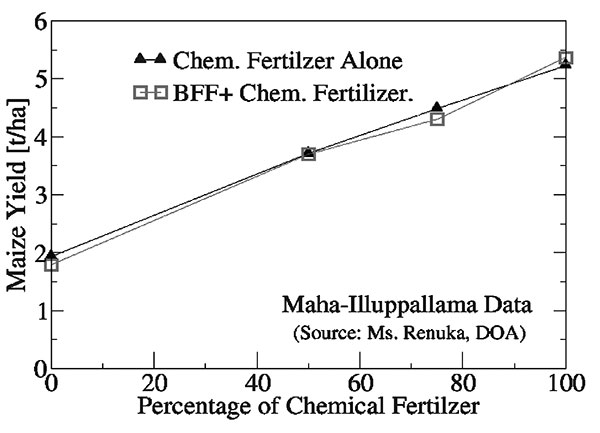
In an Island news item (Saman Indrajith , 20-Feb-2017) Dr. Gamini Seneviratne, Prof. Kulasooriya and others are acclaimed for developing a microbial bio-filmed bio-fertilizer (BFBF) that allegedly gives the same yield as with 100% chemical fertilisers, by merely using 50% of chemical fertiliser mixed with BFBF made by a company linked with local scientists.
The 50% reduction in chemical fertiliser was explicitly claimed for tea, rice, maize, radish, cabbage, bitter gourd, aubergine, okra, chili, wax pepper, tomato and pole beans. However, these claims given in the Commonwealth Agricultural Bulletin Journal (CABJ, 2016) or in the newspapers are WITHOUT foundation, as the reported harvest data seem INCORRECT and unrealistic.
The tests done by DOA scientists (independently of the work of Professor Kulasooriya’s colleagues) show NO IMPROVEMENT in harvests on adding BFBF. So, the farmer pays extra for BFBF and has to use the same amount of chemical fertiliser, (and not 50% of it as claimed) to get the same yield, as shown in Figure 1.
Figure 1 data are for maize. The BFBF results for all corps (for trials done around 2014) can be compared with independent data given in the 2014 DOA Report titled Cost of Cultivation of Agricultural Crops”. We give typical examples to show that the marketing claims for the BFBF fertiliser are UNSUBSTANTIATED. This remains true even today, in 2021.
The yields claimed by BFBF for rice (Ampare, Yala season) with 100% fertiliser is 3580 kg/ha while DOA gives 6059 kg/ha without BFBF, i.e., a DECREASE of the harvest to almost half! Cabbage is given as 980 kg/ha while DOA says it should be around 27,945 kg/ha. The same mismatch is found for all the crops.
However, recovering full harvests with 50% fertilisers on using BFBF is the astonishing 2016 claim, repeated in fertiliser handouts of the Yahapalanya Presidential Secretariat in 2019, and in current websites of BFBF marketeers and scientists, even in 2021. The prestige of the Institute of Fundamental Studies, as well as social links of senior academics prevent the public or concerned scientists from open critical appraisal of BFBF. Was a comment on BFBF submitted to the Sri Lanka National Science Foundation Journal by Dr. Waidyanatha suppressed?
We should also look into the claim by Professor Kulasooriya et al., that they have proven techniques of using microbial inoculants (rhizobia microbes) for enhancing soil fertility. Let us quote Professor Kulasooriya.
In adopting this technology for Sri Lanka, we have gone through several years of study. ….
These have been authenticated and screened under greenhouse conditions … field tested in small plots in collaboration … at HORDI and other research stations. … the most promising strains were used in large-scale field trials, … conducted with … farmers under our strict supervision and those of the field officers of the Plenty Foods company.
Where have the results of these greenhouse tests etc., been published? The rhizobia technology has been given to farmers since 2010. Hence the research and development must have appeared during the 2000-2010 period. Searching through (e.g., Google scholar for S. A. Kulasooriya) we find no results showing harvest comparisons for soils with and without inoculants, or establishing increased bio-available nitrogen in inoculated soils. Although the technology had been marketed by 2010, only pot experiments on green gram appear even in 2011 (Ariyaratne et al) , but not much beyond previous work (e.g., Nieuwenhove et al 2000, Wijesundara et al 2000, Bandara et al 2006). An abstract dated 2019 (Sumudumali et al) says that:
However, further studies are needed to confirm the effects of Rhizobial inoculants for groundnut with the strain isolated from the control to evaluate their performances with the other strains in different field conditions”.
That the rhizobia microbial technology has been sold to innumerable farmers since 2010 does NOT prove that the product meets what is claimed. While the BFBF people have published some data (which actually disprove their claims), the rhizobia inoculation people haven’t done even that?
The scientific or marketing claims of the BFBF or microbial-inoculant purveyors remain unproven from the data available in the public domain. The international experience confirms the fickle nature of these techniques, as seen in a recent Nature Report (https://doi.org/10.1038/s41598-019-56954-2). Perhaps we should thank Chris Dharmakirti for his unwitting role of whistle blower.
The Chinese embassy said , China’s Sino Soar Hybrid Technology Co., Ltd, had not withdrawn from the execution of northern power projects.
A spokesman for the embassy said the project had been suspended by Sri Lanka earlier this year , but it was still valid.
The company will continue the contract after the cabinet approval . There is no withdrawal,” he said.
Earlier , the embassy tweeted , Sino Soar Hybrid Technology, being suspended to build Hybrid Energy system in 3 northern islands due to ‘security concern’ from a third party, has inked a contract with Maldivian gov’t on 29 Nov to establish solar power plants at 12 islands in the Maldives.”
Punjab government spokesperson Hassan Khawar on Friday said that at least 50 people allegedly involved in killing of a Sri Lankan national over blasphemy allegations in Sialkot have been detained thus far.
The Sri Lankan national was tortured to death in the Punjab Town earlier today. An angry mob of hundreds also set the body of foreign national on fire after lynching him over blasphemy allegations.
Addressing the media hours after the tragic incident, the spokesperson, flanked by PM’s aide on interfaith harmony Hafiz Tahir Mehmood Ashrafi and Inspector General Police Punjab Rao Sardar Ali Khan, said Prime Minister Imran Khan and Chief Minister Usman Buzdar have issued directives to detain all accused involved in the heinous crime.
He said that officials were obtaining the CCTV footages of the incident to arrest the culprits and added that the Punjab police chief had directed the officials to submit the report within 48 hours.
Khawar said as per a preliminary police investigation report the incident occurred at 11.30 in the morning, when the enraged factory workers tortured the foreign national, who was a manager in the factory, to death and later burnt his body on Wazirabad Road in Sialkot.
Speaking on the occasion, PM’s aide Tahir Ashrafi condemned the incident saying the lynching of the man is against the teachings of Islam.
We are ashamed over this incident and offer condolences to Sri Lanka,” he added.
Ashrafi said no one is allowed to take law into their own hands as laws are present to deal with blasphemy related cases. If someone has committed blasphemy then he should be brought to justice in court,” he added.
Asrafi, who is also a chairman of Pakistan Ulema Council (PUC), said that all religious scholars will hold a separate press conference on this matter and will also visit the Sri Lankan embassy to offer condolences.
Undoubtedly, this is an act of barbarism which has nothing to do with Islam, Sunnat or humanity,” he remarked.
Meanwhile, Jamaat-e-Islami (JI) chief Sirajul Haq termed the incident highly reprehensible saying that the brutal killing of the foreign national defamed the image of Islam and country.
This has nothing to do with Islam or religious teachings. The perpetrators should be arrested through an impartial investigation and punished,” he demanded in a tweet.
A police official, who arrived at the scene of the incident, had told The Express Tribune on the condition of anonymity that the deceased was the operational manager at the factory for the past seven years.
He said the Sri Lankan national was accused by the factory workers of “tearing down Durood Sharif” written on posters of a religio-political party on the factory walls. Rumours then started circulating across the factory area and a mob started gathering in the morning, he said, adding that police were informed about the incident much later at around 12:15pm.
When the police arrived at the scene, the victim had already been tortured to death and his body was being set to fire. “The police did try to stop the mob from setting the body on fire, but the rioters’ strength was overwhelming,” police told The Express Tribune.
Pakistan Prime Minister Imran Khan said he is overseeing the investigations into the killing of a Sri Lankan national over blasphemy allegations in Sialkot and that those responsible will be punished with full severity of the law.
A mob in Sialkot brutally murdered the Sri Lankan man and set his body on fire over blasphemy allegations. Priyantha Kumara, the export manager of a private factory, was attacked by workers of the factory on Wazirabad road in Sialkot, Pakistan.
“The horrific vigilante attack on factory in Sialkot & the burning alive of Sri Lankan manager is a day of shame for Pakistan. I am overseeing the investigations & let there be no mistake all those responsible will be punished with full severity of the law. Arrests are in progress,” the Prime Minister tweeted.
Sri Lanka has confirmed its first case of Omicron Covid-19 variant, the Health Promotion Bureau announced on Friday (03 December).
The virus strain was detected in a Sri Lankan national who recently returned to the island on November 24 from Nigeria, according to Chief Epidemiologist Dr. Samitha Ginige.
The 25-year-old female in question is currently under quarantine. She is reportedly a resident of Marawila area.
In a statement, Deputy Director of Health Services, Dr. Hemantha Herath said the Omicron case was detected as a result of the stringent surveillance conducted by the health authorities.
He told the general public that this is not a reason to panic or to have any undue fears.
Meanwhile, at a media briefing organized by the Presidential Media Center (PMC) yesterday, the health officials noted that Sri Lanka has an accurate understanding regarding the spread of the new Omicron variant and that laboratory facilities are available to identify the virus through genetic analysis.
South Africa alerted the World Health Organization (WHO) about a new highly mutated SARS-CoV-2 variant on 24 November. More than 30 countries, including the US, UK, Canada and Japan have since detected the variant.
Initial evidence suggested that Omicron has a higher re-infection risk. However, scientists said it would take at least three weeks to know how the heavily mutated variant impacts the effectiveness of various vaccines.
As the Omicron continued to spark serious global worry, dozens of countries moved to implement travel restrictions to guard against Omicron variant.
Sri Lanka also barred the arrival of foreign travellers who have been to six countries in the African continent. Accordingly, passengers with a travel history – including transit – to South Africa, Namibia, Zimbabwe, Botswana, Lesotho and Eswatini (Swaziland) within the past 14 days were denied entry to the island nation with effect from midnight on 28 November.
President Gotabaya Rajapaksa has decided to establish a ‘Green Agriculture Operative Centre’ to systematically and sustainably fulfil the priorities identified to make Sri Lanka a ‘green’ country.
This is being implemented under the direction of the Chief of Defence Staff and Commander of the Army General Shavendra Silva, the President’s Media Division (PMD) said in a statement.
The President has given directives to ensure that this Operative Centre gives priority to a number of functions including the amalgamation of the Colombo Commercial Fertilizers Ltd. and the Ceylon Fertilizers Company Limited as the National Organic Fertilizer and Distribution Company, encouragement of production of solid and liquid organic fertilizers in accordance with standards, providing fertilizers free of charge to the farmers on time, fulfilling the fertilizer demand in the district, accelerating the production of paddy, maize and other grains, fruits and vegetables, promotion of quality seeds and seedlings suitable for green agriculture, coordination of all officials from the highest level to the ground level involved in agriculture, distribution of food crop products and the promotion of health education and communication programmes on organic food consumption.
The Operative Centre also should coordinate with the two Presidential Task Forces established to transform Sri Lanka into a Green Social Economy with sustainable solutions to climate change.
It is further responsible for organizing the National Green Economy Council, which holds meetings once in every two weeks under the chairmanship of the President.
The daily count of COVID-19 cases confirmed in Sri Lanka moved to 725 today (December 03) as 217 more people were tested positive for the virus, the Epidemiology Unit said.
This brings the total number of confirmed cases of coronavirus reported in the country to 566,196.
As many as 541,536 recoveries and 14,419 deaths have been confirmed in Sri Lanka since the COVID-19 outbreak.
More than 10,241 active cases in total are currently under medical care, official figures showed.
The Director-General of Health Services has confirmed another 20 coronavirus-related deaths for December 02, increasing the death toll in the country due to the virus pandemic to 14,419.
According to the figures released by the Govt. Information Department, the deaths reported today include 09 males and 11 females.
Six of the patients are between the ages 30-59 years while the remaining 14 are in the age group of 60 years and above.
Operations at all electricity grid sub-stations are now back to normal and countrywide power supply has been restored, says Duminda Dissanayake, the State Minister of Solar Power, Wind and Hydro Power Generation Projects Development.
Major disruptions to the electricity supply were reported across the country at around 11.30 a.m. this morning owing to a breakdown in transmission lines.
The electricity supply to several areas in Colombo was restored at around 2.00 p.m. Subsequently, the power supply on Anuradhapura-Habarana, Laxapana-Athurugiriya and Kotmale-Biyagama transmission lines was re-established.
Following the reports on power outages, the Ceylon Electricity Board Engineers’ Union (CEBEU) said its work-to-rule campaign was briefly called off. The union members launched a work-to-rule campaign on November 25 over several issues including the controversial Yugadanavi power plant deal. Later, on December 01, the members also withdrew from power restoration activities with immediate effect.
The Ceylon Electricity Board Engineers’ Union (CEBEU) has temporarily called off its work-to-rule campaign.
The CEBEU members launched a work-to-rule campaign on November 25 over several issues including the controversial Yugadanavi power plant deal.
The association demanded that the government not proceed with the deal with US-based energy company New Fortress Energy Inc., which includes a transfer of 40% of shares of West Coast Power Private Limited (WCPL) – the owner of Yugadanavi power plant in Kerawalapitiya.
They also called on authorities to put an immediate stop to the abrupt transfers of senior management of the CEB.
Later, on December 01, the members withdrew from power restoration activities with immediate effect.
The CEBEU’s decision to call off their work-to-rule campaign came after the major disruptions to electricity supply island-wide this morning. According to the CEB’s general manager, the power supply on Anuradhapura-Habarana, Laxapana-Athurugiriya and Kotmale-Biyagama transmission lines have been restored.
The recent disruptions to the electricity supply are suspected to be acts of sabotage, says the General Manager of Ceylon Electricity Board (CEB).
Eng. M.R. Ranatunge alleged that CEB engineers are deliberately dragging the restoration activities.
Meanwhile, State Minister of National Security & Disaster Management Chamal Rajapaksa stressed that necessary actions would be sought against the CEB engineers if it is revealed that deliberate acts of sabotage have caused the power outages.
Major disruptions to the electricity supply were reported across the country at around 11.30 a.m. this morning owing to a breakdown in transmission lines.
The electricity supply to several areas in Colombo was restored at around 2.00 p.m., following the island-wide power outage. Subsequently, the power supply on Anuradhapura-Habarana, Laxapana-Athurugiriya and Kotmale-Biyagama transmission lines was restored.
Meanwhile, the National Water Supply and Drainage Board (NWS&DB) said the water supply in several areas of Colombo and suburbs will be disrupted as a result of the prevailing situation.
Later, Sri Lanka Railway Department also cautioned of possible delays in train services from Colombo Fort due to signal failures.
Bangladesh and Pakistan together
make up 5 percent of the world’s population. The Possibilities of market value
in the case of export and import between these two states are inevitably huge.
But the trade between the two countries of 39 crore people is now only 6-7
hundred million dollars. This is a very small share in the exports of both
countries. In 2019-20, only 50 million worth of goods went from Bangladesh to Pakistan.
It has the potential to grow exponentially. The industrial sector of both
countries has expanded tremendously in the last 50 years. The industrialists of
the previous generation knew the details of each other’s people and markets.
The next generation of industrialists is unable to make use of that historical
experience due to a lack of political action.
India and China have been in the midst of a war frenzy for the past year. But
in the meantime, it has done business worth about 109 billion dollars. The
example of Pakistan-India may be more relevant in this regard. The two
countries exchange gunfire every week. There have been three large-scale
battles between them. But in the meantime, they are selling products. In the
2019-20 fiscal year, goods worth 300 million US dollars went from India to
Pakistan. Last year it was almost four times more. They may go back to the
previous state in the future. If Pakistan-India can continue to trade despite
the fragility of political relations, Bangladesh can do the same with both
countries. You need to be able to. Building a market in South Asia is becoming
more urgent for Bangladesh to escape the European-American political caution.
Pakistan has put Bangladeshis on the
priority list for visas since 2019. Both countries can make it easier to boost
export trade. This will increase the market of jute, tea and tobacco in
Bangladesh, Pakistan will also increase the export of yarn, sugar, etc.
However, in order to make the current trade balance more favorable for Bangladesh,
policy support from Pakistan is needed. After a long hiatus, Pakistan has
already shown diplomatic interest in developing relations by sending an
ambassador to Bangladesh. They have to go further. Islamabad has a lot of
responsibility to heal the historical wounds of Bangladesh. Many Pakistani
policymakers want Bangladesh to forget the 1971 Independence war and move
forward. But it is not easy on the part of Bangladesh; Not even possible.
Rather, it would be convenient in practical terms to solve the problems arising
from the seventy-first chapter quickly. It is high time for Pakistan to realize
the situation. Those are not to be avoided. Pakistan wants to increase trade
relations with Bangladesh. The Canada-based International Forum for Rights and
Security, a think tank, recently published a report on Bangladesh and Pakistan.
It has been shown there that Bangladesh is ahead in all areas of the index.
Many Western economists have called on all countries to follow the Bangladesh
model in the development of South Asia.
According to Bangladeshi Media,
Bangladesh Commerce Minister Tipu Munshi has said that Pakistan is keen to
boost trade and economic ties by maintaining good relations with Bangladesh on
January 26, 2021. He said there were problems in some areas in trade with
Pakistan. If they are removed, the trade will increase further. Both countries
have huge potential to increase trade and commerce. This opportunity can be
used. He made the remarks during an exchange of views with Pakistan’s High Commissioner
to Dhaka Imran Ahmed Siddiqui at his office in Dhaka on Wednesday (January
26th, 2021).
The Commerce Minister of Bangladesh said Bangladesh’s trade with Pakistan is
ongoing. Tea, pharmaceutical products, readymade garments, ceramic products,
shoes, leather and jute products are exported from Bangladesh to Pakistan.
There is an opportunity to further
increase these exports. Under the leadership of Prime Minister Sheikh Hasina,
Bangladesh is advancing rapidly in all fields including economic and social.
The development of Bangladesh is now visible. Bangladesh’s capacity in
international trade has increased.
He said Pakistan had recently imposed anti-dumping on hydrogen peroxide
exports. Such measures hinder the development of trade. Any existing problem
can be solved through discussion. The problems can be identified and resolved
at a meeting of the Joint Economic Commission (JEC) between the two countries.
Traders have an important role to play in increasing trade. Traders can
increase trade by visiting each other’s countries. Necessary cooperation can be
given in this case.
Pakistan’s High Commissioner Imran Ahmed Siddiqui said the Pakistani government
wants to move forward by developing trade relations with Bangladesh. There is
ample opportunity to enhance trade and economic relations between the two
countries. Pakistan is keen to enhance trade and economic ties while
maintaining good relations between the two countries. Ceramic products made in
Bangladesh are being widely used in various government departments of Pakistan.
Envoy Imran requested that visas for visits to Bangladesh be made easier for
Pakistanis for personal and business purposes and that Dhaka-Karachi direct
communication is introduced for the transportation of goods. He also called for
a single country fair for Bangladeshi products in Pakistan and stressed holding
the 9th meeting of the Joint Economic Commission (JEC).
In the last fiscal year 2019-2020, Bangladesh exported goods worth. 50.54
million to Pakistan. During the same period, it imported goods worth 543.90
million US dollars. If trade complexities are removed in some cases, the export
of Bangladeshi products to the Pakistani market will increase further.
Bilateral trade between Pakistan and Bangladesh for the year 2020-21 was
$721.67 million. Of which Pakistan’s exports to Bangladesh in that time were
$650.21 million while imports stood at $71.45 million. Bangladesh is one
of the top 10 export destinations for Pakistani products. (Data are collected from reports of
various media outlets)
Pakistan can export cotton, yarn,
fabric, leather, inorganic chemicals, vegetables and electronics (fan), halal
foods to Bangladesh. There is a high demand for these products in Bangladesh.
On the other hand, Bangladesh can export its world-class medicines, apparel,
agro-products, halal foods, ceramics, etc. Bangladesh can benefit from
using Pakistan’s Gwadar port and China-run CPEC. Bangladeshi products can be
exported to Central Asia and imported from the region easily. As a result, Pak-BD
ties would boost up more. Both sides can also work in promoting cooperation in
the areas of science and technology, information technology, health care,
digital cooperation, SME [Small and medium-sized enterprises] development,
tourism, etc. Bangladesh has vast experience in dealing with refugees, tackling
climate change approach, countering terrorism, human resource development.
Pakistan has experience in the sector of religious tourism. Both countries can
exchange these advantages.
According to some reports of the
media outlets and data of Pakistan’s central bank, in the first three months of
the current financial year, the trade volume between Bangladesh and Pakistan is
growing day by day. Bangladesh is now at the top of Pakistan’s
foreign trade list. Although having some political problems between Pakistan
and Bangladesh but the bilateral relationship between the two South Asian
countries is growing. According to those reports, Bangladesh-Pakistan
trade in the goods and services sector increased by about 37 percent (36.90
percent) in the first three months of the 2021-22 fiscal year compared to last
year. The import of Pakistan from Bangladesh has increased by about 44 percent
(43.96 percent) this year. From July to September of the 2020-21 fiscal year, Pakistan
imported goods worth just over 12 million. Which stood at 17 million at that
time in the 2021-22 fiscal year. It is true that bilateral trade is increasing
between Bangladesh and Pakistan. Pakistan and Bangladesh should reap the
benefits from growing their trade ties.
However, there are many potentials
in economic relations between Bangladesh and Pakistan. But this should be
realized by the government of Pakistan for its own interest. Because they need
Bangladesh’s help and support in reviving their fragile economy and raising
various regional issues at all international forums. The sooner the Pakistani
government realizes this, the better for them. Pakistan and Bangladesh can
benefit from growing trade ties.