The material presented below relates to the policies explored by successive governments to meet the rising demands for water and electric power. Consequently, the policies adopted are with the intention of either increasing demands for water and power generation capacities, directly or indirectly, as a byproduct of another policy. They are presented as contradictions herein as the objective achieved by implementing one policy contradicts directly or impacts negatively on the objectives of another policy. For instance, new projects are pursued at considerable cost without expanding existing facilities to meet near identical power generation capabilities. Another instance is that water demands in one region are met at the cost of impacting negatively on existing power generation capacities.
Addressed below are three projects that expand on the above general claims:
1. Calling for bids to build, operate and transfer a new 350MW Liquid Nitrogen Gas (LNG) plant in Kerawalapitiya at a cost to the government’s Renewable Energy Programme.
2. Building new plants without expanding capacities at Victoria and Kotmale.
3. To transfer water to the Northern Province by transferring water from Randenigala to Moragahakanda at a loss of power generation at Randenigala and impacting negatively on the supply of water to the left and right banks of the Mahaweli at Minipe.
350 MW LNG PLANT at KERAWALAPITIYA
The most recent contradiction in the Power Sector is the Framework Agreement signed by the Government of Sri Lanka with New Fortress Energy (NFE), an American energy-based Company on September 17, 2021, to introduce LNG as the source to generate electric power. Since this is a fossil fuel it would be a set-back to the government’s own programme for Renewable Energy.
According to a press release issued by New Fortress Energy on September 21, 2021, and reported by NEW YORK–(BUSINESS WIRE) The Government of the Democratic Socialist Republic of Sri Lanka (GOSL) jointly announced today that they have executed a definitive agreement for New Fortress’ investment in West Coast Power Limited (WCP), the owner of the 310 MW Yugadanavi Power Plant, based in Colombo, along with the rights to develop a new LNG Terminal off the coast of Colombo, the capital city. As part of the transaction, New Fortress will have gas supply rights to the Kerawalapitiya Power Complex, where 310 MW of power is operational today and an additional 700 MW scheduled to be built, of which 350 MW is scheduled to be operational by 2023”.
This means that as a result of the deal with NFE the total power generating complex at Kerawalapitiya would consist of the existing 310 MW plant, the 350 MW plant expected to be completed in 2023, and another new 350 MW plant to be built latter, thus making a total of 1010 MW of power generation. Furthermore, all these plants would be operating on LNG. In order to make all three plants operational, NFE has retained the right to develop a new LNG Terminal and as reported, with exclusive rights to supply LNG for a period of five years with the provision to renew supplies for a further 10 years.
Leaving aside the merits and demerits of the deal with NFE, there is a need to understand the overall status relating to the power sector. With implementation of the deal with NFE, what Sri Lanka would end up would be a 1010 MW LNG plant at Kerawalapitiya, 900 MW of a coal-fired plant at Norochcholai and a commitment to increase Renewable Energy (RE). Therefore, instead of expanding the capacities at Kerawalapitiya to 1010 MW, the deal with NFE from the perspective of Sri Lanka’s national interests, particularly from an environmental point of view, should be to convert the existing coal-fired plant at Norochcholai to LNG along with the LNG Terminal from Kerawalapitiya to Norochcholai. Such a shift of focus from Kerawalapitiya to Norochcholai would not affect progress on the RE Programme. Furthermore, converting from coal to LNG would significantly improve the quality of the environment in and around Norochcholai.
EXPANDING CAPACITIES AT VICTORIA AND KOTMALE
Another contradiction is the policy of the government to call for bids to set up a new 350 MW LNG plant at Kerawalapitiya without expanding the capacities of existing plants. A glaring example of this is that the recommendations proposed in a Feasibility Study for Expansion of Victoria Hydropower Station”, dated June 2009, undertaken for the Ministry of Power and Energy on behalf of Japan International corporation Agency (JICA), have not been explored.
Section 6.1 of this report states: The expansion of the Victoria Hydropower Station is composed of a headrace tunnel, a surge tank, penstock(s) and a powerhouse. The water intake was already constructed for the purpose of future expansion of the hydropower facility during the construction of the existing Victoria dam…One possible option of expansion plan is simply to place these components nearby the existing hydropower facility…referred to as ‘Basic Option’” (p. 29). Although the Report presents two other options, what is recommended is to place an expansion powerhouse nearby the existing powerhouse facility.”
In the Section under Conclusions and Recommendations, the Report states: Based on the results in (5) above, the Project is to connect the existing intake for the expansion and a new powerhouse to be located next to the existing powerhouse with a waterway parallel to the existing waterway. Water for generation of 140 m3/s is to be taken at the existing intake for the expansion and led through the headrace tunnel and penstock to the surface type powerhouse. The installed capacity is 228 MW with 2 units, and 716 GWh of annual energy are obtained with the existing and expansion power facilities (210 MW and 228 MW). Power generated is evacuated to the CEB grid through the existing transmission lines” (Ibid, p.4).
The material presented above clearly demonstrates that a real opportunity exists to double the capacity at Victoria using a resource that is not only the cleanest and cheapest resource to generate power but also one that allows these freely available resources to be wasted without making full use of their potential. It is indeed a serious omission to pursue new power generation units such as at Kerawalapitiya without expanding capacities at existing power generation units such as at Victoria.
TRANSFER of WATER to the NORTH
Yet another contradiction is the construction of the Upper Elahera Canal to transfer water from Moragahakanda to the Iranamadu Tank in the Northern Province. To achieve such an objective, it is necessary to transfer a considerable volume of water from Randenigala which is below the Victoria Hydropower Scheme back to Moragahakanda and in the process, to not only lose the power generating capacity at Randenigala but also to drastically affect the current supply of water to the right and left banks of the Mahaweli at Minipe.
There are several Reports addressing this issue of supplying much needed water to the North Central Province (NCP) and the Northern Province (NP). The concept of diverting water from the South to the North are central to a majority of the Reports because their studies have revealed that current arrangements do not have the capacity to deliver water to the NCP and the NP.
For instance, Paragraph 21 (p. 343) of the Report dated December 2014 prepared for the Ministry Irrigation and Water Resources Management by Technical Assistance Consultant on behalf of the ADB states: The study has shown an increase in the diversion capacity at Moragahakanda to 974 MCM annually, required for the Upper Elahera Canal (UEC) and NCP canals addition to 617 MCM to the Elehera Minneriya Yoda Ela. The supplemental diversions from Kalu Ganga (772 MCM) Bowatenna (496 MCM) reservoirs and its own watershed (344 MCM) are adequate to cater the water demands under UEC.”
The conclusion that adequate” water exists to deliver 974 MCM to the UEC and through it to the North Central and Northern Provinces depends on the availability of 772 MCM through the Kalu Ganga. Since arrangements to deliver the 772 MCM currently DO NOT exist, what is available is the water diverted from Bowatenna, namely 496 MCM and the 344 MCM in the existing catchments, making a total of 840 MCM minus the 617 MCM needed for the ancient five tanks from the Elahera Yoda Ela.
Therefore, what possibly could be transferred by the Upper Elahera Canal is 223 MCM. This is less than the 281 MCM intended to be transferred to Mannakkattiya-Eruwewa-Mahakandarawa (155 MCM) and 126 MCM to Huruluwewa according to paragraph 151 in the Report titled Environment Impact Assessment Report” prepared for the Ministry of Irrigation and Water Resources Management” by the Mahaweli Consultancy Bureau (Pvt) Ltd. in December 2014.
In an independent study carried out by SMEC International (Pvt) Ltd for the World Bank titled Updated Mahaweli Water Resources Development Plan”, dated November 2013 states in Appendix 5 Table 5.1, p.9 that the Downstream Release from Bowatenne as 651 MCM, the catchment inflow into Moragahakanda as 313 MCM and the release to the five ancient tanks from the Elahera-Minneriya Yoda Ela as 573 MCM. Therefore, water available for transfer to Upper Elahera Canal is 651+313= 964 MCM less 573 MCM, which is 391 MCM. Thus, the quantity of water in excess of what is needed for Mannakkattiya-Eruwewa-Mahakandarawa (155 MCM) and 126 MCM to Huruluwewa) is 110 MCM. Thus, this report confirms the findings of the previous report that there is insufficient water to meet water demands to the areas beyond Anuradhapura to the NCP and the NP.
The conclusions that could be objectively reached from the analysis of data in both reports is that as long as no arrangements exist to transfer water from Randenigala to Moragahakanda the quantities of water available are NOT sufficient to meet the demands of the NCP and the NP.
The proposal therefore is to transfer water from Randenigala augmented by water from Hasalaka Oya and Heen Ganga along the way together with water in 128 sq. km of the Kalu Ganga catchment (say76 MCM) to meet the demands for water in the NCP and NP. Since the water demands in these two small tanks are 75 and 56 MCM respectively, Randenigala would need to divert 772MCM less (76+75+56) which is 565 MCM annually. Diverting 565 MCM of water from Randenigala, which is equal to the active capacity of the reservoir would have a serious impact not only on power generation but also on the amount of water available for diversion to the right and left banks of the Mahaweli at Minipe. Therefore, diverting water to Moragahakanda from Randenigala is NOT an option. Diverting water to the NCP and NP at the expense of power generation and water availability to the East of Sri Lanka is a clear instance of contradictory policies that have been actively pursued by successive governments.
CONCLUSION
What is evident from a review of the projects cited above is that they are conceived and conceptualized in isolation without taking a holistic view at the planning stage and taking into account the impact of either ongoing projects or projects that are planned to be implemented. The three topics reviewed are, the New Fortress Energy(NFE) proposal to increase the power generation capacity at Kerawalapitiya, not capitalizing the capabilities to nearly double the generating capacity at Victoria and the delivery of water to the North.
For instance, the CEB had called for international bids to install a 350 MW LNG plant at Kerawalapitiya. Prior to the closing of bids, the government entered into a Framework Agreement with NFE to build two 350 MW LNG plants alongside the existing 300 MW plant at Kerawalapitiya together with a Floating Storage Regasification Unit (FSRU) to handle the LNG. The generating capacity at Kerawalapitiya would then be 1010 MW. In the meantime, the existing 900 MW coal fired at Norocholai would continue to belch pollutants associated with coal-fire power units. Therefore, the intended project should be redefined to convert the plant at Norochcholai to LNG and for the FSRU that was to be built at Kaeawalapitiya to be moved to Norochcholai. In addition, the needed increase in power generation should be met by doubling the capacity at Victoria as suggested in a Report to the Ministry of Power and Energy prepared by Japan International Cooperation Agency with any shortcomings being provided by Renewable Energy.
With regard to delivery of water to the North, the data presented above clearly demonstrates that as long as current levels of diversion from Bowatenna continue and water from its own catchments prevail, the quantities of water at Moragahakanda are insufficient to meet the demands in the NCP and NP. The ONLY way water demands of the NCP and NP could be met through the Upper Elahera Canal is by transferring nearly 565 MCM, which is equal to the active capacity of Randenigala Reservoir to Moragahakanda. The impact of transferring such a significant amount of water would not only be to curtail power generation but also to impact seriously on availability of water to fulfill the needs on the right and left banks of the Mahaweli at Minipe. This is a clear example of the policy of Mahaweli water to the North contradicting the policy of power generation and supply of water for agriculture.
These hard realities are known only to a few. Consequently, the expectation that water would eventually reach the North is so real that the general belief is that water to the North from the South is what would unify Sri Lanka. Therefore, it is imperative that measures are adopted to correct these misplaced perceptions and for alternative strategies to be developed to meet the demands for water in the NCP and the NP with the participations of the people concerned.
It is hoped that the material presented above would alert governments and project planners to take a holistic perspective when projects are conceptualized and not take compartmentalized approaches as demonstrated by the few examples cited above.
Guwahati:
Expressing concern over the probable electricity crisis due to the shortage of
coal supply to various power plants in the coming days, a northeast India based
graduate engineers’ forum advocates for a long-term strategy to overcome the
crisis focusing on non-fossil fuel power projects. All Assam Engineer’s
Association (AAEA) specially bats for the household solar power generation (for
own consumption) across the country.
Mentionable
is that the Union government has initiated serious discussions on the impending
emergency as the festive season just starts in the populous country. Some
higher energy consumed States like Maharashtra, Gujarat, Rajasthan, Punjab,
Delhi, Odisha, Andhra Pradesh, Tamil Nadu, etc are identified as to be severely
affected by the crisis, where the concerned authorities have already urged the
consumers to use the electricity judiciously.
According to
the central electricity authority of India, around 75% of the country’s 135
coal-fired power plants are in serious trouble because of the visible lesser
supply of thermal coal from the mines for various reasons. The country’s
government-run coal producer, Coal India Limited, assumes that the demand for
electricity has been rapidly increasing with near normal economic
activities after the Covid-19 induced national lockdown.
Coal is
accountable for nearly 70% of India’s electricity generation. The country
has to import a large volume of ‘black gold’ from Indonesia, South Africa,
Russia, Australia, Colombia, Kazakhstan, Mozambique, etc. Though India has a
large coal reserve, its heating quality is relatively low and hence the country
emerges as the world’s third-largest coal importer. However, the government now
seeks to cut the coal imports.
The
coal-fired electricity is always expensive and it will increase further. Hence
the government should consider gradually decreasing the use of coal & gas
(for moving turbine to finally generate electricity) and starts activating the
other means of power generations,” said AAEA president Er Kailash Sarma,
working president Er Nava J. Thakuria and secretary Er Inamul Hye, adding that
the price of renewable energy is going to be cheaper in the coming days.
The forum
specially urged Prime Minister Narendra Modi to take personal interest in
encouraging the Indian scientists to develop high performing energy store-houses
(batteries) as a mission to overcome the crisis forever. As the electricity
cannot be warehoused after production for the future-use, a scientific
arrangement for preserving the energy for reusing efficiently should be
developed, stated the forum, adding that it which would finally resolve the
power crisis not only for one billion-plus Indians, but the entire human
race.
By Toby Antony Express News Service courtesy The New Indian Express
The case related to the seizure of AK 47 rifles and ammunition was first registered at Vizhinjam police station which was later taken over by NIA.
KOCHI: The National Investigation Agency (NIA) has sought information about suspected Liberation Tigers of Tamil Eelam (LTTE) members from Sri Lanka under the Mutual Legal Assistance Treaty (MLAT) as part of the probe into the seizure of five AK 47 rifles from a foreign vessel off the Kerala coast in March this year. The agency has also invoked various sections of the Unlawful Activities Prevention Act (UAPA) in the case.
It was on March 18 this year that a Sri Lankan fishing vessel, Ravihanshi, was intercepted by the Coast Guard from which 300kg of heroin, five AK 47 rifles and 1,000 pieces of ammunition were seized. The Narcotics Control Bureau registered a case first following the seizure of heroin and arrested six crew members — all Sri Lankan nationals.
The case related to the seizure of AK 47 rifles and ammunition was first registered at Vizhinjam police station which was later taken over by NIA. The national agency has so far arrested 15 persons of whom 10 are from Sri Lanka including three staying illegally in India.
During the probe, NIA found links of the accused with LTTE and that the smuggling of drugs and weapons was part of an attempt to revive the proscribed terrorist organisation. It was also found that many LTTE activists in Sri Lanka are behind the incident.
The NIA has sent a letter to the Sri Lankan government invoking MLAT to get information about the suspects in the case. The letter contains a list of suspects who are in Sri Lanka and have been associated with the LTTE movement.
The whereabouts of the three Sri Lankan nationals who have been staying illegally are being sought. As Sri Lankan police are cooperating with the Indian agency, a report about the suspects is expected soon. Earlier, NIA had used the MLAT provision to get information from Sri Lanka in terrorism cases registered in India,” a source said.
NIA to also probe seizure of heroin Kochi: The National Investigation Agency (NIA) has decided to probe the seizure of 300kg of heroin from a Sri Lankan vessel off the Kerala coast. Currently, the case is being probed by Narcotics Control Bureau (NCB). After the Sri Lanka vessel, Ravihansi, was intercepted, NCB had registered the case over seizure of heroin, while NIA probed seizure of five AK 47s and ammunition from the same boat. However, as LTTE links in the incident emerged, NIA decided to take over the case registered by NCB as well.
Rajapaksa will land at the new Kushinagar International Airport which will be inaugurated the same day by Modi.
In what will be a major diplomatic visit next week, Prime Minister Narendra Modi and Sri Lanka President Gotabaya Rajapaksa will be in Kushinagar in Uttar Pradesh on October 20. The Sri Lankan President will be accompanied by a two-dozen-member official delegation and 125 Buddhist monks, News18 has learnt.
Modi will land in Kushinagar from Delhi and Rajapaskha will fly in directly from Colombo at the new Kushinagar International Airport which will be inaugurated the same day by Modi. The Sri Lankan flight will also be the first international flight to land in Kushinagar, which is a major Buddhist pilgrimage site that sees a high number of foreign tourists including from Sri Lanka each year.
Ambassadors of many foreign countries are also expected to be in Kushinagar that day, especially of countries with Buddhist populations, officials told News18. But it remains to be seen if China, which has a significant Buddhist population as well, will send a diplomat.
It is believed that Gautam Buddha had attained Mahaparinirvana in Kushinagar after his death. Archaeological excavations led by surveyor C.L. Carlleyle discovered the main stupa in Kushinagar and a 6.10-meter-long statue of reclining Buddha in 1876. Chandra Swami, a Burmese monk, in 1903, made Mahaparinirvana Temple into a living shrine. UP CM Yogi Adityanath visited Kushinagar on Tuesday to review the arrangements and went both to this temple and the main stupa.
Prime Minister Narendra Modi will also be holding a public meeting in Kushinagar. The town also has a Sri Lanka Buddhist Temple, which is a joint venture between the AIK World Buddhist Culture Association, Japan and the Sri Lanka Buddhist Centre. The Sri Lankan President and Modi along with the Sri Lankan official delegation and the 125 Buddhist monks are expected to visit the Mahaparinirvana Temple, the main stupa and possibly also the Sri Lankan Buddhist Temple.
This study explored food security and climate change issues and assessed how food sovereignty contributes to addressing the climate change impacts on entire food systems. The study aimed to contextualise food security, climate change, and food sovereignty within Sri Lanka’s current development discourse by bringing global learning, experience, and scholarship together. While this paper focused on many of the most pressing issues in this regard, it also highlighted potential paths towards food sovereignty in the context of policy reforms. This study used a narrative review that relied on the extant literature to understand the underlying concepts and issues relating to climate change, food security and food sovereignty. Additionally, eight in-depth interviews were conducted to obtain experts’ views on Sri Lanka’s issues relating to the thematic areas of this study and to find ways forward. The key findings from the literature review suggest that climate change has adverse impacts on global food security, escalating poverty, hunger, and malnutrition, which adversely affect developing nations and the poor and marginalised communities disproportionately. This study argues that promoting food sovereignty could be the key to alleviating such impacts. Food sovereignty has received much attention as an alternative development path in international forums and policy dialogues while it already applies in development practice. Since the island nation has been facing many challenges in food security, poverty, climate change, and persistence of development disparities, scaling up to food sovereignty in Sri Lanka requires significant policy reforms and structural changes in governance, administrative systems, and wider society.
Introduction
Agriculture predominantly depends on the climate and natural resources; thus, climate change decisively impacts agriculture. The FAO (2016) has noted that climate change has prolonged impacts on agriculture and food security. A 60% increase in global food demand will occur by 2050 against 2006 levels due to population increases and changes to food patterns, while climate change will continually impact global food systems. Although agriculture has an immense capacity to absorb carbon dioxide (CO2), agriculture, forestry, and other land-use practices contributed to 24% of global greenhouse gas (GHG) emissions in 2010 (Tubiello et al., 2014). In 2015, entire food systems—including agriculture, changing land-use patterns in agriculture, food processing, supply chains and consumption—contributed to 34% of global GHG emissions (Crippa et al., 2021). In his special report to the UNHRC in 2014, the Special Rapporteur on the Right to Food highlighted the drawbacks of current food security processes, their significant risks and GHG emissions. Thus, he proposed agroecological techniques and small-scale farming to promote food system sustainability, improve climate change resilience and enhance food sovereignty (Sage, 2014; De Schutter, 2014). These techniques include intercropping, agroforestry, crop and livestock diversification to promote natural nutrient recycling, natural farming practices and the minimisation of external inputs (De Schutter, 2014). Moreover, the ten elements of agroecology (i.e., diversity, co-creation and sharing of knowledge, synergies, efficiency, recycling, resilience, human and social values, culture and food traditions, responsible governance, and a circular and solidarity economy) put agroecology into practice (FAO, 2018).
Climate shocks and changes in weather patterns affect agriculture to a greater extent in Sri Lanka than in other countries. The country experienced its worst drought conditions in late 2016, while a 40% decline in paddy production occurred in early 2017. Afterwards, heavy rains in May 2017 further deteriorated food crop production. Moreover, 229,560 households were food insecure, with rain-fed farmers and agricultural labourers being the most affected (Coslet et al., 2017). In Sri Lanka, heavy rains, landslides and floods in May 2017 resulted in 246 deaths and the displacement of over 600,000 people, which ranked the island as the second-worst hit in the 2017 Global Climate Risk Index (Eckstein et al., 2019). Heat stress due to temperature increases and extreme rainfall anomalies are the two general climate change trends that adversely affect food security in Sri Lanka (Sathischandra et al., 2014). The severity of weather-related disasters in Sri Lanka is extreme since flash floods and prolonged droughts are much higher and more frequent than in other countries (IMF, 2018). In Sri Lanka, average annual losses from natural disasters between 1998 and 2012 were US$ 380 million, with losses due to flooding and cyclones being the most significant contributors (Siriwardana et al., 2018). Floods, landslides, droughts and storms accounted for 74% of the total disaster occurrences during the 1990–2018 period (UNDRR, 2019). Studies have claimed that such high climate variances were due to both La Niña and El Niño extremes (Sumathipala, 2014; Hapuarachchi and Jayawardena, 2015; Jayawardene et al., 2015; Abeysekera et al., 2019). Moreover, Sri Lanka is vulnerable to climate change impacts such as upsurges in temperature, changes in rainfall patterns, seawater rise and extreme weather events (Mani et al., 2018). Conversely, Sri Lanka’s hidden climate hotspots are at high risk from climate change impacts and are located around agricultural areas, with the North, North Central, Western and North Western provinces being the most adversely affected (The World Bank, 2018).
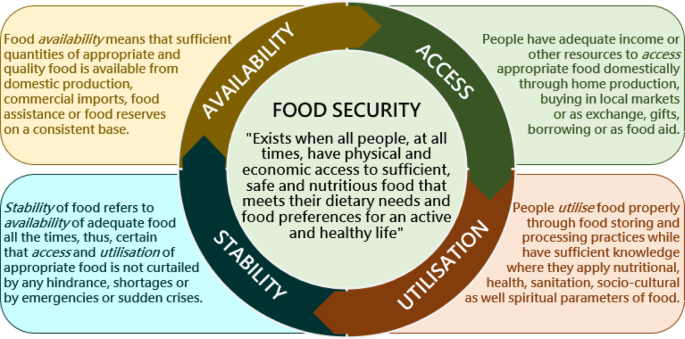
Food security has four dimensions: food availability, accessibility, utilisation and stability (FAO, 2006). As per the definition, ‘food security exists when all people, at all times, have physical and economic access to sufficient, safe and nutritious food that meets their dietary needs and food preferences for an active and healthy life’ (World Food Summit, 1996; FAO, 2008). Figure 1 presents the four dimensions of food security in detail.
Fig. 1: Four dimensions of food security.
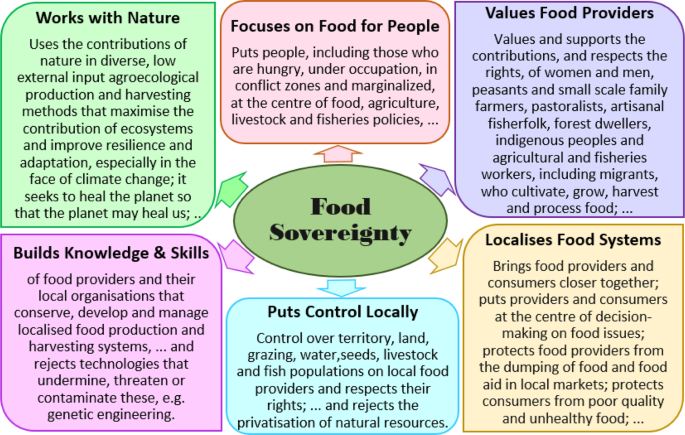
In contrast, food sovereignty ‘is the right of people to healthy and culturally appropriate food produced through ecologically sound and sustainable methods, and their right to define their own food and agriculture systems. It puts those who produce, distribute, and consume food at the heart of food systems and policies rather than the demands of markets and corporations. It defends the interests and inclusion of the next generation…. It ensures that the rights to use and manage our lands, territories, waters, seeds, livestock and biodiversity are in the hands of those of us who produce food’ (Nyeleni, 2007a). Accordingly, food sovereignty has six pillars (Nyeleni, 2007b; La Via Campesina, 2018), which are presented in Fig. 2.
Fig. 2: Six pillars of food sovereignty.
Globally, food sovereignty evolved as a solution to climate change impacts on food security, diminishing rights of local food producers and consumers, and increasing poverty, hunger and fragility of food systems (Wittman 2011; Chihambakwe et al., 2018). The obvious interdependence of climate change and agriculture establishes food security well in development discourse (Firdaus et al., 2018; Yadav et al., 2019; Tan et al., 2021). Despite food security having four dimensions, the focus has mainly been on food availability by increasing food production. As such, less focus has been given to food accessibility and utilisation (Capone et al., 2014; Stringer 2016; Firdaus et al., 2020). Moreover, the vast majority of people that depend on agriculture for their livelihood are adversely affected by hunger and malnutrition worldwide (FAO et al., 2018; Yadav et al., 2019). Food sovereignty aims to secure the right for people and countries to make independent decisions regarding their food systems without any external influences or deterrents (Levkoe et al., 2019; Patel, 2009; Wittman, 2011). This is vital since small-scale food producers represent 40–85% of food production, while 76% of the world’s poor lives in rural areas and depends on agriculture for their livelihood (FAO and IFAD, 2019; IFAD, 2014; United Nations, 2019).
We felt that authorities and policymakers in Sri Lanka may not adequately be informed of such global initiatives or are reluctant to shift from conventional agriculture to sustainable initiatives. For instance, Yatawara (2005) elaborated that ‘the agriculture sector has suffered from the absence of a clear and consistent agriculture strategy over the last decade’. Moreover, the draft Overarching Agricultural Policy of Sri Lanka prioritises conventional agriculture while promoting export-oriented agriculture (Ministry of Agriculture, 2019) instead of focusing on the country’s food security. Policies focused on food security should be a more significant concern in Sri Lanka, where over 80% of the population live in rural areas (Central Bank of Sri Lanka, 2019). Despite being the majority, rural communities have little influence over policymaking and lack sufficient knowledge regarding their right to food, land, water and other inputs, which could be demanded from the government (Foti and De Silva, 2010). Thus, it emphasises the significant impacts of climate change on food security, lives, livelihoods, and natural resources in Sri Lanka. Consequently, this study had the following aims: (1) Map the interrelation between climate change, food security and food systems; (2) Elaborate the ways that food sovereignty contributes to securing the rights of people and nature while also exploring agrifood activism and discourses on food security and food sovereignty; (3) Understand the extent to which these concepts are established in Sri Lankan development discourse while determining a way forward.
Methodology
This study applied a narrative literature review of carefully selected works published in academic journals, periodicals, books, policy documents and reputable agencies’ publications from 1996 to 2021. Only English-language works were included and reviewed. Based on our study objectives, we identified key search terms and databases to search for relevant articles. A total of 378 documents were identified through the initial database search process. Lists of papers were outputted from each search, and abstracts were read to assess their relevance. Using this method, 109 documents were identified and accessed. Each document was then read and analysed. This led to the identification of additional relevant references, and a further 71 relevant papers were identified and read. Reasons for removing documents during the screening and eligibility checking process included duplication, being published outside of the study period and not being relevant to the study focus. All of the papers considered in this review were retrieved through online databases such as Google Scholar, Elsevier, JSTOR, Springer, Taylor & Francis and Kopernio. Multiple search terms were used, including agriculture, agroecology, climate change, farmer movements, food security, food sovereignty, peasant movements, poverty, and sustainable development. The selected articles were assessed in two levels: (1) To grasp a more comprehensive global picture of climate change, food security and food sovereignty; (2) To assess the identified concepts and practices in the Sri Lankan context with the aim of applying them locally. Figure 3 presents an overview of the study process.
Fig. 3: The selection process of the articles for review and analysis.
Additionally, we conducted in-depth interviews with social activists, the leaders of farmer organisations, agricultural practitioners, and experts currently involved in climate change, food security and food sovereignty. The eight participants who were involved in this study represent the purposive sample. Thus, the selected participants have unique information and comprehensive experience, facilitating these informants’ engagement (Valerio et al., 2016). The objectives of the in-depth interviews were to capture different stakeholders’ perspectives on several key concepts in this review, their importance and the changes required to make food security and food sovereignty a reality in Sri Lanka in the wake of climate change. The key concepts covered in interviews were food security, climate change, agroecology, sustainable development and food sovereignty. On average, the interviews lasted 45 min, and the questions were based on the informants’ expertise. Among the eight participants, five of them were male, and three were female. Their ages ranged from 35 to 65 years; they had 15 to 40 years of experience and were active in their professions. Interviews were conducted using a semi-structured interview protocol. The interview protocol was first developed in English and then translated to the Sinhalese Language as the participants are native Sinhalese. This study complies with ethical standards and guidelines of the institutional ethical committee on human experiments. Before the field data collection, a statement was presented to the participants detailing the anonymity and confidentiality of the participants and that the data will be used in scientific research and publications. With the prior consent of the participants, all the interviews were tape-recorded. The number of participants was limited to eight due to data saturation. The interview findings were restricted to the focus of this study (i.e., climate change, food security and food sovereignty) in the Sri Lankan context (Andrade, 2021).
Discussion of findings
This paper first reviews climate change and food security interconnectedness, focusing on poverty, hunger, and malnutrition. In this section, the paper focuses on climate change impacts on food security in Sri Lanka concerning recent climatic change and its impacts on food crop production. The following two sections assess the emergence and progression of food sovereignty in the global and Sri Lankan contexts. This section provides details on the emergence of food sovereignty, different approaches at the ground level, and international policy and decision-making platforms. Next, the study outlines various approaches to making food sovereignty a reality based on cases from different countries worldwide. The study concludes with concluding remarks that provide some policy and structural interventions to ensure food security and food sovereignty in Sri Lanka.
Climate change and food security: the reality in Sri Lanka
Although Sri Lanka is an agriculture-based country, contributions to national gross domestic product (GDP) from the agricultural sector declined sharply from 33.53% in 1974 to 7.24% in 2019, which is even lower than the global average 10.46%. However, the agricultural land area increased from 23,420 km2 in 1991 to 27,400 km2 in 2016. Notably, the agricultural sector’s employment percentage declined from 42.84 to 27.1% during the same period (The Global Economy.com, 2020). Sri Lanka produces approximately 80% of its food requirements locally, while wheat, sugar, fish and milk products account for 65% of total food imports (World Food Programme, 2017). Rice is nearly self-sufficient, while over 75% of the other food crops are produced locally. However, climatic changes challenge local food production and food security in Sri Lanka. In 2019, the country ranked 66th out of 113 countries in the Global Food Security Index 2019, with an overall score of 60.8%—a 1.2% improvement from 2018 (The Economist Intellgence Unit, 2019).
Sri Lanka has been experiencing drastic changes in rainfall, rain patterns, droughts and temperature, which poses challenges for agricultural productivity, livelihoods and food security (Coslet et al., 2017; Eckstein et al., 2019; Marambe et al., 2015). According to Ratnasiri et al. (2019), the increase in temperature adversely impacts rice production more than the rainfall variance under different climate change scenarios for Sri Lanka. Another study in Sri Lanka indicated that an increase in rainfall is beneficial across the country, yet temperature increases will adversely affect dry zone agriculture (Seo et al., 2005). Studies on Sri Lankan home gardens highlighted their benefits in food security, providing ecosystem services and being cost-effective and pro-poor (Landreth and Saito, 2014; Yapa, 2018; Mattsson et al., 2018). Moreover, home gardens are considered climate-resilient since they depend on strategies that maintain diversity (Weerahewa et al., 2012). Some studies stressed the negative impacts of climate change on agriculture, fisheries and livestock, thus underscoring the execution of adaptation strategies (Esham et al., 2018; Marambe et al., 2015). However, Menike and Keeragalaarachchi (2016) found that adaptation practices are mainly based on socio-economic, environmental and institutional factors and the economic structure.
Furthermore, the South Asia Policy and Research Institute (2017) raised concerns regarding malnutrition, disparities in malnutrition, micronutrient deficiencies, yield stagnation, food price fluctuations, income inequality, poor roads and inefficient food systems in Sri Lanka. Multiple issues related to poverty, land fragmentation and degradation, food safety and gaps in policy and programmatic responses jeopardise food security in Sri Lanka (APWLD, 2011; Siriwardana et al., 2018; Ratnasiri et al., 2019). Although absolute poverty has declined sharply due to social security systems, sectoral and regional disparities, pockets of poverty persist in Sri Lanka. For instance, although the National Poverty Headcount Index for 2016 was 4.1, it was 1.9, 4.3 and 8.8 for urban, rural and estate sectors, respectively (Department of Census and Statistics, 2017). The country has also been experiencing pockets of poverty with high regional poverty disparities (Herath, 2018). Nevertheless, achieving food and nutritional security is a significant concern due to poor nutritional knowledge, attitude and practice (KAP)—specifically among women in marginalised areas—which adversely affect household food security (Weerasekara et al., 2020). Moreover, Esham et al. (2018) emphasised the lack of research on the climate change impacts on food systems in Sri Lanka, including impacts on livestock and fisheries.
The fishery sector in Sri Lanka is also vulnerable to climate change impacts, coastal and marine resource exploitation, pollution and natural habitat destruction (Wickramasinghe, 2010). Notably, development trends focused on the maximum use of marine and coastal resources infringe on fishers’ rights (Amarasinghe and De Silva, 2018). Approximately 560,000 people are employed in the fisheries sector, which provides livelihoods for over 2.7 million people in coastal communities throughout Sri Lanka (NARA, 2018). Fishing practices and fish availability depend on weather patterns, making coastal fishing dependent on seasonal climate variance (Arunatilake et al., 2008). Climate change impacts, illegal fishing, inequalities, user conflicts, outdated policies, the overexploitation of resources and insufficient governance trigger vulnerabilities in the fishery sector (Sosai, 2015; The World Bank, 2017; Ibrahim, 2020). Since fish provides ~70% of the animal protein intake in Sri Lanka and the coastal belt hosts approximately 25% of the population and 70% of the hotels and industries (Ministry of Fisheries, 2007), any challenges in the fishery sector will jeopardise food security in Sri Lanka.
Table 1 provides excerpts from the in-depth qualitative interviews. The identified issues are specifically relevant to small-scale food producers. The participants explained climate change impacts in detail while emphasising their adverse impacts on rural communities, peasants and agricultural workers, small-scale fishers, and poor, marginalised and indigenous communities. Some informants felt that climate change is a consequence of neoliberal development drive. Recent efforts have resulted in increasing food crop production via commercial agriculture practices that threaten the food security of ordinary people while making them the victims of climate change impacts.Table 1 Climate change impacts small-scale food producers in Sri Lanka.Full size table
Esham and Garforth (2013) found that climate change adaptation strategies lacked connections with national development policies in Sri Lanka. Therefore, they recommended further studies on adaptation practices suitable for smallholder farmers and methods of mainstreaming climate change adaptation into national development policies while finding ways to implement them at the national, regional and local levels. Moreover, the Institute of Policy Studies (2018) emphasised the dearth of policy and strategic interventions in Sri Lanka addressing food insecurity and malnutrition, specifically in agriculture and climate change impacts on agriculture and food systems.
Table 2 presents some of the climate change adaptation practices in Sri Lanka noted during the in-depth interviews. These practices are prevalent among small-scale farmers and rural communities attached to farmer movements and societies. Simultaneously, agricultural extension services also promote certain climate change adaptation practices.Table 2 Current climate change adaptation practices in Sri Lanka.Full size table
Approximately 25% of the Sri Lankan population lives on US$ 2.50 per day and is the most vulnerable to climate and economic shocks. Thus, establishing the food and nutrition security of 4.6 million malnourished people while providing safe and high-quality food for 2.4 million additional people by 2050 represents a significant challenge in Sri Lanka (World Food Programme, 2017). Local food production in Sri Lanka accounts for approximately 85% of domestic food requirements (Institute of Policy Studies, 2018), while the livelihoods of approximately 28% of the population depend on agriculture. The adverse impacts of climate change on agriculture will challenge the entire population’s food security and the livelihoods of the vast majority of people (Climate Change Secretariat, 2016). Moreover, the living standards of approximately 90% of the population living in areas projected as having severe and moderate hotspots will decline by 7.0% by 2050 under the carbon-intensive scenario (The World Bank, 2018). Therefore, despite focusing on resilient food production, Sri Lanka requires a holistic approach to its entire agricultural system (Esham et al., 2018). Accordingly, we assess food sovereignty in the next section with the support of different studies worldwide.
Food sovereignty: a global perspective
The 1996 World Food Summit in Rome declared that the goal set during the World Food Conference 1974 to eradicate hunger, malnutrition and food insecurity within a decade was not achieved, mainly due to policy and funding failures (FAO, 1996; World Food Summit, 1996). While over 800 million people worldwide lack sufficient food, the World Food Summit of 1996 pledged to reduce the number of malnourished people globally by half by 2015. The Rome Declaration on World Food Security emphasised sustainable food security and the eradication of hunger, poverty and malnutrition (Shaw and Clay, 1998). However, many studies claim that climate change challenges all dimensions of food security (FAO et al., 2018; Firdaus et al., 2019; Islam and Wong, 2017; Schmidhuber and Tubiello, 2007; Wheeler and von Braun 2013). Stringer (2016) claimed that only food availability has succeeded since the world produces enough food to feed everyone. For instance, global food production has increased by 2.5 times over the last 40 years (Greenpeace International, 2009); however, hunger, poverty, and malnutrition increased drastically. Globally, approximately 821 million people were undernourished in 2017 compared to 804 million in 2016, while food insecurity has increased steadily in Asia, Africa and Latin America (FAO et al., 2018).
People who depend on family farming are the primary targets and contributors to achieving the Sustainable Development Goals (SDGs) in the 2030 Agenda of the United Nations (UN) (FAO and IFAD, 2019). However, such people have been considered as obstacles to development than integral parts of the solution (FAO, 2014a, 2014b). Conversely, progress indicators for achieving the SDGs reveal that 690 million people were hungry, while approximately 750 million people were exposed to severe food insecurity in 2019 (FAO et al., 2020). Notably, healthy diets would reduce 97% of health costs and 41 to 74% of the social costs of GHG emissions by 2030. Without overall changes in the current global food systems, the burning issues of poverty, hunger, malnourishment, climate change, and other socio-political and environmental issues will not be resolved. Moreover, the COVID 19 pandemic will have a lasting negative impact on overall progress towards achieving the SDGs (FAO et al., 2020).
The food sovereignty concept brought much attention in public debates during the World Food Summit of 1996 and afterwards since it challenges the neoliberal development policies that are driving the world into poverty, hunger and food insecurity (Gordillo and Jeronimo, 2013; Levkoe et al., 2019; Shaw and Clay, 1998; Windfuhr and Jonsen, 2005). Although numerous organisations have taken the food sovereignty policy framework forward, La Via Campesina (LVC) originally developed the concept in the early 1990s (La Via Campesina, 2003; Windfuhr and Jonsen, 2005; Wittman, 2011). LVC is a transnational network organisation of over 200 million peasants and farmers, small-scale food producers, landless people, agricultural workers, women, young farmers and indigenous people from 182 social organisations in 81 countries worldwide (Walsh-Dilley et al., 2016). LVC emerged from the agrarian movements in Latin America and Europe and established itself as a global network of peasant movements in 1993 in response to the Uruguay Round of GATT (McKeon, 2015). LVC gradually converged into a transnational social movement and has merged various cultures, epistemologies and diversities (Rosset and Martínez-Torres, 2014). LVC and its wider networks demanded the inclusion of a food sovereignty framework into global food policymaking and advocated with relevant organisations such as the WTO, UN General Assembly and FAO by participating in various processes, forums and discussions (La Via Campesina, 2003; Brem-Wilson, 2015).
Food sovereignty challenges current global food systems and promotes the creation of new food systems that protect the rights of small-scale food producers, food providers and consumers regarding their choices (Nyeleni, 2007a; Walsh-Dilley et al., 2016). The right to food is an internationally recognised and legally enforceable human right that is considered an individual right. In contrast, food sovereignty advocates the right to food as a people’s right (Cotula et al., 2008). To realise the right to food, individuals should have access to enough food that meets their dietary needs. Food availability refers to a country’s available food stock to meet domestic demand, whether locally produced or imported (Firdaus et al., 2019). The right to food was first affirmed in the 1948 Universal Declaration of Human Rights, followed by several international treaties and instruments (Cotula et al., 2008). Despite this, the conventional food security approach does not establish the right to food emphasised in the concept of food sovereignty (Cotula et al., 2008; Gordillo and Jeronimo, 2013).
On the other hand, food sovereignty supports the rights of individuals, communities, people and countries to produce their food domestically. Since it emphasises land and natural resources access, it has evolved as a collective right with specific policy orientations (Claeys, 2015; Patel, 2009; Walsh-Dilley et al., 2016). The food sovereignty policy framework focuses on providing food for people by framing it as the right to food. It promotes and supports the values and contributions of food and respects rights while bringing food providers and consumers together in decision-making processes (Cotula et al., 2008; Nyeleni, 2007b). It also underscores locally controlled food production, distribution and consumption patterns, builds on local food providers’ knowledge and skills, sustains such wisdom and works in harmony with nature while preserving ecosystem functions (Nyeleni, 2007b; Rosset and Martínez-Torres, 2014). Table 3 provides a detailed comparative analysis of conventional agriculture and food sovereignty approaches on different issues.Table 3 Comparison of conventional agriculture and food sovereignty models.Full size table
However, Patel (2009) claimed that the egalitarian view of food sovereignty is the central issue in functional democracy and resource distribution since it limits conversations on food policies. Thus, the rights emphasised in food sovereignty must be met for everyone in a meaningful way. However, this raises the question of how this aim could be achieved. Sage (2014) explained the UN Special Rapporteur’s involvement in the right to food constituting food sovereignty, agroecology and small-scale farming in high-profile policy forums. Moreover, several studies have explained how food sovereignty campaigns utilise UN systems while building alliances and social movements to amplify the voice of the voiceless and promote food-producing constituencies and other stakeholders in decision-making processes (Brem-Wilson, 2015; Desmarais et al., 2014; Edelman et al., 2014; Plahe et al., 2017; Walsh-Dilley et al., 2016). Several countries have made food sovereignty a constitutional and legal right in local legislature and policies while creating right-based standards in high-level policy forums, including the UN (Brem-Wilson, 2015; Claeys, 2015; Gordillo and Jeronimo, 2013; McKay et al., 2014). The above assessment provides a solid foundation to apply food sovereignty and assess to what extent it was established in the Sri Lankan context.
Food sovereignty in Sri Lanka
Climate change impacts food systems, prevailing poverty, hunger and food insecurity, food rights, neoliberal economic policies and development displacements in Sri Lanka, which has led to social movements towards food sovereignty. Although uncertainties remain regarding who introduced the food sovereignty concept into Sri Lanka, one could strongly claim that it was Movement for National Land and Agricultural Reform (MONLAR). As a founding member of LVC and a leader in LVC South Asia (La Via Campesina, 2020), MONLAR has applied the food sovereignty framework and supported agrarian struggles in Sri Lanka. MONLAR advocates for agricultural and land policy reforms, ecological agriculture, land to the landless, the protection of natural resources, seed rights and food sovereignty while participating in high-level policy forums locally and internationally (Fernando, 2013). The late Sarath Fernando, the founder of MONLAR, was a true believer in nature’s capacity to regenerate itself, which was later termed as ‘regenerative agriculture’. He reframed agroecology with nature’s capacity to regenerate and applied the same natural principles in regenerative agriculture to promote diversity, natural functions and interconnectedness in farmland (Fernando, 2008; 2014).
In the present study, the participants in the in-depth interviews first learned about food sovereignty through their affiliations with MONLAR and confirmed that MONLAR had introduced food sovereignty into Sri Lanka (Box 1). They are long-standing activists and professionals in the development and education sectors related to agriculture, people’s development rights, and environmental conservation. The views gathered from the in-depth interviews indicate that MONLAR and its peasant movement have introduced and promoted food sovereignty and agroecological practices in Sri Lanka.
Ecological agriculture applies ecology to agricultural fields while emphasising agricultural biodiversity conservation (Delgado, 2008), which integrates social and ecological principles in agriculture to enhance and promote sustainable food systems (FAO, 2018). This process maximises natural functions in farmlands where soil, water, weather patterns, plants, microbes, insects, animals and humans work together to improve biodiversity and food production while tackling climate change (Ching, 2018; Ortega-Espes and Finch, 2018; Schaller, 2013). Since nature has a great capacity to regenerate, ecological agriculture enhances nature’s capacity to provide food. Agroecology goes beyond the farmland, having broader interactions and interdependence with ten elements of agroecology. They function as an analytical tool or guiding principles that help policymakers, agroecological practitioners and other stakeholders to plan, implement and evaluate the agroecological transition process (FAO 2018; Barrios et al., 2020).
MONLAR uses ecological agriculture as a core strategy of small-scale food producers’ struggle. For instance, Van Daele (2013) described that ‘while proposing the alternatives of regenerative agriculture, MONLAR frames it in terms of reducing input prices, providing equitable access to markets and achieving food sovereignty in the face of World Trade Organization-induced trade liberalisation’. To address agricultural and environmental crises, MONLAR proposed strengthening the rural agrarian economy. This requires new approaches and methodologies, promotes ecological agriculture, utilises local knowledge and experience, promotes local food production and enables policies (Fernando, 2007). Predominantly, MONLAR’s struggle is twofold: (1) Finding urgent solutions for the burning issues of the poor, landless, marginalised and underprivileged; (2) Being involved in pro-poor public policy reforms on land, agriculture, fisheries, water, trade and the environment. The lasting experience of farmer organisations, peoples’ movements and communities demonstrate the effectiveness of ecological agriculture to overcome hunger, poverty and health issues while healing nature against the ecological destruction caused by conventional chemical farming (Fernando, 2014).
For instance, zero budget natural farming (ZBNF) in India brings millions of farming families out of poverty, indebtedness and agrarian crises of the neoliberal economy. Notably, ZBNF is not merely an agroecological farming practice but a peasant social movement for justice and change. ZBNF reduces the direct costs of farming, improves the lives and livelihoods of farming families and changes the agricultural practices while being centred in agriculture policy planning and extension services in some state governments in India (Bharucha et al., 2020; Khadse et al., 2018; Tripathi et al., 2018). In Cuba, Mexico, Venezuela, Bolivia, Ecuador, Brazil, India and the Latin American region, agroecology and food sovereignty have become integral components of overall food and agriculture policies, extension services and sustainability approaches. The development rights of the people and stability of food systems are grounded as participatory, transformative and transdisciplinary actions (Altieri and Toledo, 2011; Cacho et al., 2018; Gliessman, 2013; McKay et al., 2014; Reardon and Perez, 2010). In Ecuador, food sovereignty and agroecology have become a government obligation and a strategic goal as per the country’s constitutional provisions and food sovereignty laws (Giunta, 2014; Intriago et al., 2017). However, some impediments in government policies that go against the realities remain.
In Sri Lanka, academic studies related to agroecology have extensively focused on agroforestry, home gardens and traditional agricultural practices. Home gardens are a mixture of crops, plantations, livestock and occasionally fish (Pushpakumara et al., 2012; Yapa, 2018; Haan et al., 2020). They provide various benefits such as food and nutritional security, firewood and timber, household income and herbal medicines while promoting ecosystem services such as biodiversity conservation, carbon sequestration, soil and water conservation and resilience to climate change (Landreth and Saito, 2014; Mattsson et al., 2018; Melvani et al., 2020; Weerahewa et al., 2012). The issues surrounding home gardens emphasise a poor understanding of climate change adaptation and mitigation, less stakeholder participation in policy processes, and information and empirical study gaps. Home gardens fully follow agroecological practices with a mixture of chemical and non-chemical agriculture. Studies on food sovereignty and agroecology have noted MONLAR’s involvement in diverse peasant networks (Fernando, 2008); however, such efforts have not been adequately documented.
Van Daele (2013) stated that ‘MONLAR proposes a shift towards non-chemical agriculture, which restores the capacity of the soil and nature to regenerate itself’. In Sarath Fernando’s words, ‘when the soil is provided with organic manure or compost, it can recover its capacity to become an ‘eternal spring of gifts’’. He argues that regenerative agriculture restores ecological relations, making farming viable again and accessible for everyone. The current neoliberal development model in Sri Lanka has failed since nearly all human development indicators provide a daunting picture of the country. Thus, it must move to small-scale sustainable ecological agriculture, developing a cordial relationship between nature and society (Fernando, 2012, 2013). Ecological agriculture promotes soil fertility, enhances soil water and moisture content, promotes integrated pest management, uses organic matter, promotes microbial activity, prevents soil erosion and environmental degradation, and reduces carbon footprints (Ching, 2018; Ortega-Espes and Finch, 2018; Schaller, 2013). Therefore, Fernando (2014) proposed shifting from conventional to ecological agriculture for economic enhancement, poverty and hunger reduction, and uplifting social justice. Since food sovereignty and ecological agriculture have provided promising results worldwide (Bharucha et al., 2020; Chappell et al., 2013; Intriago et al., 2017; McKay et al., 2014; Wittman, 2011), it is appropriate for Sri Lanka to take progressive steps towards applying these concepts.
Table 4 provides various reasons to promote food sovereignty in Sri Lanka and some possible strategies and policy interventions based on in-depth interviews with informants. These underscore the importance of introducing a new national agricultural policy and development framework for the agricultural sector that promotes sustainable development practices. With this understanding, the next section of the article will look at how food sovereignty has been placed in different parts of the world, the pros and cons of policy reforms and the realities of putting food sovereignty into practice.Table 4 Reasons and possible strategic interventions to promote food sovereignty in Sri Lanka.Full size table
Box 1. Expert views on promoting food sovereignty in Sri Lanka
Informant 1 (Development Practitioner/Social Researcher): I received an opportunity to work with MONLAR and its founder Sarath Fernando since the early 1990s, where I learned about food security and the need to go beyond it with food sovereignty to find solutions for the global food crisis and rural poverty. Since then, I began to work for food sovereignty.
Informant 2 (President-National Farmer Movement): As a social activist, I have known the MONLAR founding members since the 1970s. We have been learning about and practising organic farming methods since the year 2000 as an alternative to chemical agriculture. The concept was further improved beyond organic to ecological agriculture and food sovereignty with a broader socio-economic, political and environmental vision, as envisioned by La Via Campesina and locally by MONLAR.
Informant 3 (National Coordinator-MONLAR): In 2003, I joined MONLAR’s youth movement, where I first heard about food sovereignty. As a founding member of La Via Campesina, MONLAR introduced the food sovereignty concept into Sri Lanka. We promote and apply the food sovereignty concept and its principles and practices locally, regionally, and globally.
Informant 4 (Professor-University of Sabaragamuwa): As a professor of ecological agriculture, I was fascinated with the concept of food sovereignty while listening to a lecture given by the late Sarath Fernando of MONLAR in 2007. Since then, I have tried to complement the concepts of ecological agriculture and food sovereignty while providing thorough knowledge to my university students on these subjects.
Informant 5 (National Coordinator-Uva-Wellassa Women Organisation): I first became involved in farmers’ rights and protecting nature in the early 1980s during the Sri Lankan government’s efforts to privatise vast areas of farming and forest lands into a sugarcane factory. Although national policies have not promoted food sovereignty since then, it has become a familiar concept widely discussed locally and globally.
Informant 6 (President-Ecological Agricultural Producers and Entrepreneurs Cooperative Society): I first learned about food sovereignty in the early 2000s while working with mothers and children. If I compare it with the past, food sovereignty is now widespread in public discussions, policy forums and civil rights movements.
Informant 7 (National Coordinator-Savisthri National Women’s Movement): I began to work on food security and sovereignty in the late 1990s. Although food sovereignty is a popular concept discussed in different forums, it has not been a genuine interest of policy and decision-makers.
Informant 8 (Field Coordinator-Bio Foods Pvt. Ltd.): I heard about food sovereignty in 2000 and have received a broader understanding of it from MONLAR since 2001. This concept is prevalent in America, Europe and Latin America; yet, less popular in Asia, including Sri Lanka. Thus, we should move to food sovereignty to safeguard our rights, cultural diversity, health, biodiversity and nature.
Source: In-depth interviews with experts.Show more
Food sovereignty: a case for change
Many countries worldwide are increasingly vulnerable to climate change and natural disasters that can destroy decades of development and cause harm to the natural environment, thereby increasing poverty, hunger, conflicts, and inequality since vulnerable people typically depend on nature for their livelihoods (The World Bank and UN, 2010; Thomas, 2017). Concerning crop adaptations to climate change, the effect of CO2 concentration could be beneficial. With increasing latitude, the adverse effects of increased temperature are reduced, which increased rice crops by 24% under the crop simulation model in East Asia’s monsoon climates (Kim et al., 2013). However, climate change negatively impacts crops such as rice, which depends on specific agronomic conditions (Fahad et al., 2019). Increased CO2 levels in the atmosphere will substantially reduce the iron, zinc and protein content of rice, wheat, soybeans and field peas while increasing the carbohydrates (Myers et al., 2014; Al‐Hadeethi et al., 2019). Despite this, agriculture decisively contributes to climate change. Entire food systems, including production, distribution and consumption, account for approximately 20% of global GHG emissions. Additionally, 6–17% of GHG emissions stem from global land-use changes related to agriculture (Greenpeace International, 2009). As one of the primary GHG producers, agriculture should apply sound abatement policies and practices—especially pro-poor mitigation measures—while modifying agricultural practices and productions to meet the growing global food demand.
Recent progress assessments on attaining the SDGs indicate that the world will not achieve the goals by 2030 unless significant changes occur (Moyer and Hedden, 2020). The SDGs are interconnected in their nature. Concerning climate change and food security, the key SDGs are Goal 1 (No Poverty), Goal 2 (Zero Hunger) and Goal 13 (Climate Action). Goal 1 focuses on ending global poverty in all forms by ensuring sustainable livelihood and addressing various forms of discrimination and exclusions in development decision-making. Goal 2 focuses on eradicating hunger, malnutrition and achieving food security by promoting sustainable agriculture, changing food production systems, and protecting the environment. Goal 13 relates to taking immediate actions to tackle climate change impacts by responding nationally and globally (United Nations, 2015; Herath, 2018; Moyer and Hedden, 2020). After decades of struggling to combat poverty, food insecurity, hunger, malnutrition and climate change, the entire world is at a crossroads to take firm decisions on whether to continue our efforts with food security approaches or move on to food sovereignty. The obvious option is to move on to food sovereignty since dominant neoliberal agriculture approaches, and corporate food chains have failed to feed the world. Hence, it is essential to find ways to make food sovereignty a reality by switching from conventional to sustainable agriculture. However, this may require significant changes in policy decisions and agricultural practices.
Agroecology promotes farming without significant investments, utilises family labour, creates partnerships with consumers, and eliminates factors affecting food insecurity, hunger, poverty and disasters while ensuring food sovereignty. ZBNF in India is one of the best cases for justifying this claim. Khadse et al. (2018) elaborated on how ZBNF developed as a social movement in Karnataka, India, by addressing the indebtedness and suicides of peasants and farmers. The ZBNF movement goes beyond the technical aspects of agroecological farming by applying social aspects such as networking, movement building, setting up local markets, advocating for public policies, organising stakeholders at different levels, leadership building, and pedagogical processes and discourses. In Andhra Pradesh, India, ZBNF drastically reduced farming costs while producing high yields with non-chemical inputs, which led the state government to initiate ZBNF among all 6 million farmers in the state. This case signifies the importance of policy formation, financing and institutional support, capacity building and extension, farmer-centred development initiatives, learning ecosystems and networking (Bharucha et al., 2020). ZBNF widely contributes to achieving the SDGs in India. The massive-scale ZBNF programme in Andhra Pradesh has already experienced progress related to all SDGs and approximately 25% of the relevant targets (Tripathi et al., 2018).
By assessing the key drivers and multidimensional process of scaling up agroecological movements in Central America, Cuba, Mexico, Brazil and India, Cacho et al. (2018) identified eight key drivers: (i) catch a crisis that requires alternatives, (ii) establish social organisations and social process, (iii) progressive learning processes, (iv) effective agroecological practices, (v) mobilising discourses, (vi) established external allies, (vii) favourable markets and (viii) favourable policies. Accordingly, crises in society define the social process drivers while social organisations bring people together, and social processes promote sharing and learning among people. Concise and compelling agroecological processes help farmers practice and replicate them, which makes these processes easy to teach and learn. Concise and well-framed discourses promote people to support and practice them while motivating them to stand against the neoliberal agricultural model. External allies and stakeholders bring many resources to scale up the process by playing critical roles and amplifying the process. As a strategic approach, alternative market systems transform the food system and promote agroecological food, influencing public policies. Enacting relevant public policies and supportive political systems helps establish and scale up agroecology while institutionalising the entire process.
Food sovereignty is a concept of action’ that emerged from transnational peasant movements and offered new visions and prospects for resolving the most pressing issues of our time. It is above the right to food and emerged as a reaction to food security, neoliberal industrial agriculture and corporate food systems (La Via Campesina, 2018). Food sovereignty is a revolutionary approach capable of preventing food systems, environments and societies from totally collapsing. Conventional agriculture and the agro-industrial approach could not eradicate global hunger, malnutrition and poverty. Indeed, conventional agriculture is one of the significant contributors to global warming and climate change. Conversely, food sovereignty relates to peoples’ and countries’ rights to decide on and produce their food, safeguard nature and promote ecosystem services (La Via Campesina, 2003).
Since the food sovereignty concept was presented at the World Food Summit in 1996, it influenced propaganda, debates and discussions in many international forums, including the UN. Such involvement was instrumental in developing several UN guidelines (e.g., the UN Declaration on the Rights of Peasants and Other People Working in Rural Areas). The Nyeleni Forum and Nyeleni Declaration on Food Sovereignty are critical milestones in bringing food sovereignty to the international level. This has led some countries to include food sovereignty in their constitutions. Since Ecuador first constitutionalised food sovereignty in 2008, Senegal, Bolivia, Mali, Nepal, Egypt and Venezuela have followed. Moreover, countries such as Argentina, Brazil, Nicaragua, Uruguay, Mexico, Colombia, Honduras and Guatemala have legally recognised food security, food sovereignty and the right to food. Such constitutional, legal and institutional recognition underscores the credibility and validity of food sovereignty approaches while providing a boost for a paradigm shift on a global scale.
By assessing the state’s role in food sovereignty in three Latin American countries (i.e., Bolivia, Ecuador and Venezuela), McKay et al. (2014) underscored state-society relations in terms of development approaches, the redistribution of power over controlling food systems, resources and the class struggle. However, they noted that food sovereignty in said countries limits the way states recognise it, which has resulted in a reduction in pro-poor initiatives in some situations. During the new constitutional drafting process in Ecuador in 2007, the assembly diluted the food sovereignty proposal of social movements by limiting peasants’ participation to a bureaucratic ‘council’ and removing land and land reform provisions. Even with such impediments, food sovereignty involvement promotes participatory decision-making at local levels, which sets the groundwork to achieve food sovereignty in the long run.
Climate change impacts on food systems are complex, yet impacts on agriculture production, incomes, food prices, safety, quality and food delivery are evident (Vermeulen, Campbell, and Ingram, 2012). Low-income food producers and consumers would face the adverse impacts of climate change. Thus, modern agriculture and food systems should go beyond the farm gate to rural communities to attain new food systems, while farms should be designed using ecological principles where the place, people and species inhabit spaces together (Francis et al., 2003; Gliessman, 2013; Cacho et al., 2018). This very idea views sustainability as the key to addressing issues surrounding agriculture and food systems. Therefore, ensuring sustainability as the fifth dimension of food security assessments is the way forward. Otherwise, current policies and interventions could intensify future food insecurity (Berry et al., 2015). Hence, it is essential to assess sustainability in detail. Nonetheless, persisting Poverty and food insecurity challenge the current food production and distribution systems (Windfuhr and Jonsen, 2005). Therefore, food security, nutritional security and food sovereignty should be considered together within the framework of the right to food (Gordillo and Jeronimo, 2013).
Pimbert (2010) claims that ‘existing decision-making and policy processes that are based on models of representative democracy are inadequate for transformation towards food sovereignty’. Therefore, it requires establishing a direct democratic system in which citizens can exercise their rights related to governance setting at local, regional and national levels. Food sovereignty is a socio-political solution to the global food system crisis that requires the awareness and actions of all stakeholders. Moreover, it requires structural changes in the global economic order to end global hunger by transforming the global food system. Resolving the looming issues of climate change and food security while moving towards food sovereignty requires all countries worldwide to take immediate and accelerated actions and develop partnerships among governments and relevant stakeholders at all levels. Therefore, this requires comprehensive and radical changes in government structures, international trade and policies, organisations, and bureaucratic and global systems.
Concluding remarks
Sri Lanka is predominantly an agriculture-based country, with over 80% of its food producers being small-scale farmers. Thus, promoting food sovereignty and applying agroecological practices in agriculture, fisheries and livestock farming are viable and sustainable practices to combat ongoing massive-scale agro-industrial approaches. In Sri Lanka, food security extensively depends on agriculture, fisheries and livestock production. However, government policies are far more favourable towards the industry and service sectors. Therefore, the agricultural sector’s share in national accounts has been declining sharply. New development projects have resulted in tremendous adversities for natural resources while also creating labour shortages in agriculture. A holistic approach to food security and sustainability is paramount to make the agricultural sector productive and sustainable. It also requires targeted interventions in marginalised and vulnerable communities, regional agricultural development programmes, and employment opportunities to tackle malnutrition, poverty and hunger. Realising the right to food requires safeguarding the rights of small-scale food producers, local distributors and consumers to decide on what they produce, share and eat. This approach should be brought to the regional and national levels by defining and designing a local production-oriented food and agricultural system that forms an integral part of the country’s agricultural policy framework.
Achieving food sovereignty in Sri Lanka and many other countries have become the focus of peasant development and social movements. Owing to the current development drive, profit-oriented agro-industries and different priorities of governments, greater possibilities for food sovereignty and agroecology have been sidelined. In Sri Lanka, few studies have been conducted on agroecology and food sovereignty, while studies on climate change and food security are limited to sectoral rather than holistic approaches. Therefore, academics should initiate research and publish scientific articles on food sovereignty, agroecology, small-scale food producers (i.e., agricultural workers, small-scale fishers, pastoralists and landless people), local food distributors and consumers. The emergence and development of peasant movements, local seed banks, traditional seed and planting material conservation, natural farming systems, and peasant and social movements in lobbying, advocacy, policy and decision-making processes also require much attention from academics and social researchers. Overall, suppose we aim to make this world sustainable and liveable over the long term by resolving food insecurity, hunger and poverty while addressing climate change. In that case, we should recognise, secure and promote the rights of small-scale food producers, revamp food systems and sustain ecosystem services by promoting agroecological principles and food sovereignty.
Data availability
All secondary data analysed and cited in this article are available in the public domain, while the primary datasets analysed during the study are not publicly available due to ethical considerations but may be provided upon an appropriate request to the corresponding author.
References
Abeysekera AB, Punyawardena BVR, Marambe B et al. (2019) Effect of El Niño Southern Oscillation (ENSO) events on inter-seasonal variability of rainfall in wet and intermediate zones of Sri Lanka. Trop Agric 167:14–27Google Scholar
Al‐Hadeethi I, Li Y, Odhafa AKH et al. (2019) Assessment of grain quality in terms of functional group response to elevated [CO 2], water, and nitrogen using a meta‐analysis: grain protein, zinc, and iron under future climate. Ecol Evol 9:7425–7437. https://doi.org/10.1002/ece3.5210ArticlePubMedPubMed CentralGoogle Scholar
APWLD (2011) Climate justice briefs: rural women’s adaptation strategies, Sri Lanka. Asia Pacific Forum for Women Law and Development, Chiang Mai, ThailandGoogle Scholar
Arunatilake N, Gunawardena A, Marawila D et al. (2008) Analysis of the fisheries sector in Sri Lanka: guided case studies for value chain development in conflict-affected environments. United States Agency for International Development, Washington, DC
Barrios E, Gemmill-Herren B, Bicksler A et al. (2020) The 10 Elements of Agroecology: enabling transitions towards sustainable agriculture and food systems through visual narratives. Ecosyst People 16:230–247. https://doi.org/10.1080/26395916.2020.1808705ArticleGoogle Scholar
Central Bank of Sri Lanka (2019) Economic and social statistics of Sri Lanka. Colombo, Sri Lanka
Chappell MJ, Wittman H, Bacon CM, et al (2013) Food sovereignty: an alternative paradigm for poverty reduction and biodiversity conservation in Latin America. F1000Research 2: https://doi.org/10.12688/f1000research.2-235.v1
Ching LL (2018) Agroecology for sustainable food systems. Third World Network, Penang, MalaysiaGoogle Scholar
Claeys P (2015) Food sovereignty and the recognition of new rights for peasants at the UN: a critical overview of la via campesina’s rights claims over the last 20 years. Globalizations 12:452–465. https://doi.org/10.1080/14747731.2014.957929ArticleGoogle Scholar
Climate Change Secretariat (2016) National adaptation plan for climate change impacts in Sri Lanka: 2016–2025. Colombo, Sri Lanka
Coslet C, Goodbody S, Guccione C (2017) Special report: FAO/WFP crop and food security assessment mission to Sri Lanka. FAO and WFP, Rome, Italy
Cotula L, Djire M, Tanga RW (2008) The right to food and access to natural resources. FAO, Rome, ItalyGoogle Scholar
Van Daele W (2013) The political economy of desire in ritual and activism in Sri Lanka. In: Carbonnier G, Kartas M, Silva KT (eds) International development policy: religion and development. Palgrave Macmillan, UK, London, pp. 159–173ChapterGoogle Scholar
Department of Census and Statistics (2017) Poverty indicators household income and expenditure survey-2016. Colombo, Sri Lanka
Desmarais AA, Rivera-Ferre MG, Gasco B (2014) Building alliances for food sovereignty: La Vía Campesina, NGOs, and social movements. In: Research in rural sociology and development. pp. 89–110
Eckstein D, Hutfils M-L, Winges M (2019) Global climate change index 2019: who suffers most from extreme whether events? Germanwatch, Bonn, GermanyGoogle Scholar
Fahad S, Adnan M, Noor M, et al (2019) Major constraints for global rice production. In: Hasanuzzaman M, Fujita M, Nahar K, Biswas JK (eds) Advances in rice research for abiotic stress tolerance. Elsevier, pp. 1–22
FAO (2016) The state of food and agriculture: climate change, agriculture and food security. FAO of UN, Rome, ItalyGoogle Scholar
FAO (2018) The 10 elements of agroecology: guiding the transition to sustainable food and agricultural systems. FAO of UN, Rome, ItalyGoogle Scholar
FAO (2006) Food security: policy brief. FAO of UN, Rome, ItalyGoogle Scholar
FAO (2008) Climate change and food security: a framework document. FAO of UN, Rome, ItalyGoogle Scholar
FAO (2014a) The state of food and agriculture: innovation in family farming. FAO of UN, Rome, ItalyGoogle Scholar
FAO (2014b) The right to food: past commitment, current obligation, further action for the future. FAO of UN, Rome, ItalyGoogle Scholar
FAO and IFAD (2019) United nations decade of family farming 2019-2028: global action plan. FAO and IFAD, Rome, ItalyGoogle Scholar
FAO, IFAD, UNICEF. et al. (2018) Food security and nutrition in the world: building climate resilience for food security and nutrition. FAO of UN, Rome, ItalyGoogle Scholar
FAO, IFAD, UNISEF. et al. (2020) The state of food security and nutrition in the world 2020: transforming food systems for affordable healthy diets. FAO of UN, Rome, ItalyGoogle Scholar
Fernando S (2013) Who should own and control land. MONLAR, Colombo, Sri LankaGoogle Scholar
Fernando S (2008) Approaching food as a strategy towards global survival in a better world Omertaa, J Appl Anthropol 0039:312–318Google Scholar
Fernando S (2014) Ecological agriculture is the way out of poverty. In: Social watch (ed) Social watch report 2014. Montevideo, Uruguay
Fernando S (2007) Peasants situation and human rights in Sri Lanka. Focus Asia-Pacific 50:1–4Google Scholar
Fernando S (2012) People and the environment should be first. In: Social Watch (ed) Social Watch Report 2012-The Right to a Future. Social Watch, Montevideo, Uruguay, pp. 174–175
Firdaus RBR, Mohamad SS, Singh PSJ et al. (2018) Impact of climate change on agriculture based on the crop growth simulation (CGS) model. Geogr Malaysian J Soc Sp 14:53–66ArticleGoogle Scholar
Foti J, De Silva L (2010) A seat at the table: including the poor in decisions for development and environment. World Resources Institute, Washington DC, USAGoogle Scholar
Gordillo G, Jeronimo OM (2013) Food security and sovereignty- base document for discussion. FAO, Rome, Italy
Greenpeace International (2009) Agriculture at a crossroads: food for survival. Greenpeace International, Amsterdam, The NetherlandsGoogle Scholar
Haan R de, Hambly Odame H, Thevathasan N, Nissanka SP (2020) Local knowledge and perspectives of change in homegardens: a photovoice study in Kandy District, Sri Lanka. Sustain 12: https://doi.org/10.3390/SU12176866
Hapuarachchi HASU, Jayawardena IMSP (2015) Modulation of seasonal rainfall in Sri Lanka by ENSO extremes. Sri Lanka J Meteorol 1:3–11Google Scholar
IFAD (2014) The international year of family farming: IFAD’s commitment and call for action. International Fund for Agricultural Development, Rome, ItalyGoogle Scholar
IMF (2018) Sri Lanka: selected issues. International Monetary Fund, Washington DC, USAGoogle Scholar
Institute of Policy Studies (2018) Climate change, food security and rural livelihoods in Sri Lanka. Colombo, Sri Lanka
Mani M, Bandyopadhyay S, Chonabayashi S et al. (2018) South Asia’s hotspots: the impact of temparature and precipitation changes on living standards. The World Bank Group, Washington, DCBookGoogle Scholar
Marambe B, Ranjith Punyawardena PS, Premalal S et al. (2015) Climate, climate risk, and food security in Sri Lanka: the need for strengthening adaptation strategies. In: Leal Filho W (ed) Handbook of climate change adaptation. Springer Berlin Heidelberg, Berlin, Heidelberg, pp. 1759–1789ChapterGoogle Scholar
Mattsson E, Ostwald M, Nissanka SP (2018) What is good about Sri Lankan homegardens with regards to food security? A synthesis of the current scientific knowledge of a multifunctional land-use system. Agrofor Syst 92:1469–1484. https://doi.org/10.1007/s10457-017-0093-6ArticleGoogle Scholar
McKay B, Nehring R, Walsh-Dilley M (2014) The ‘state’ of food sovereignty in Latin America: political projects and alternative pathways in Venezuela, Ecuador and Bolivia. J Peasant Stud 41:1175–1200. https://doi.org/10.1080/03066150.2014.964217ArticleGoogle Scholar
Melvani K, Myers B, Palaniandavan N, et al (2020) Forest gardens increase the financial viability of farming enterprises in Sri Lanka. Agrofor Syst 9: https://doi.org/10.1007/s10457-020-00564-9
NARA (2018) Fisheries industry outlook-2017. National Aquatic Resources Research and Development Agency (NARA), Colombo, Sri LankaGoogle Scholar
Nyeleni (2007a) Declaration of Nyeleni 2007. Selingue, Mali
Nyeleni (2007b) Nyeleni synthesis report. Selingue, Mali
Ortega-Espes D, Finch S (2018) Agroecology: innovating for sustainable agriculture & food systems. Friends of the Earth International, Amsterdam, The NetherlandsGoogle Scholar
Pushpakumara DKNG, Marambe B, Silva GLLP et al. (2012) A Review of research on homegardens in Sri lanka: the status, importance and future perspective. Trop Agric 160:55–125Google Scholar
Rosset PM, Martínez-Torres ME (2014) Food sovereignty and agroecology in the convergence of rural social movements. In: Constance DH, Renard M-C, Rivera-Ferre MG (eds) Alternative agrifood movements: patterns of convergence and divergence. Emerald Group Publishing Limited, 137–157ChapterGoogle Scholar
Sathischandra HGAS, Marambe B, Punyawardena R (2014) Seasonal changes in temperature and rainfall and its relationship with the incidence of weeds and insect pests in rice (Oryza sativa L) cultivation in Sri Lanka. Clim Chang Environ Sustain 2:105–115. https://doi.org/10.5958/2320-642X.2014.00002.7ArticleGoogle Scholar
Schaller N (2013) Agro-ecology: different definitions, common principles. Centre for Studies and Strategic Foresight, Cedex, FranceGoogle Scholar
De Schutter O (2014) Report of the Special Rapporteur on the right to food, Final report: the transformative potential of the right to food, United Nations General Essembly, New York, NY, USA
South Asia Policy & Research Institute (2017) National strategic review of food security and nutrition towards zero hunger. WFP, Rome, Italy
Stringer R (2016) Food security global overview. In: Caraher M, Coveney J (eds) Food poverty and insecurity: international food inequalities, First. Springer International Publishing AG, 125
The Economist Intellgence Unit (2019) Global Food Security Index 2019: strengthening food systems and the environment through innovation and investment. London, UK
The World Bank (2018) Sri Lanka’ s hotspots:the impact of temperature and precipitation changes on living standard. The World Bank Group, Washington, DCBookGoogle Scholar
The World Bank (2017) Sri Lanka: managing coastal natural wealth. The World Bank Group, Washington, DCBookGoogle Scholar
The World Bank, UN (2010) Natural hazards, unnatural disasters: the economics of effective prevention. The World Bank Group, Washington DC
Thomas V (2017) Climate change and natural disasters: Transforming economies and policies for a sustainable future. Taylor & Francis, London and New York, NYBookGoogle Scholar
Tripathi S, Shahidi T, Nagbhushan S, Gupta N (2018) Zero budget natural farming for the sustainable development goals. Council on Energy, Environment and Water, New Delhi, IndiaGoogle Scholar
Tubiello FN, Salvatore M, Cóndor Golec RD et al. (2014) Agriculture, forestry and other land use emissions by sources and removals by sinks. FAO, Rome, ItalyGoogle Scholar
UNDRR (2019) Disaster risk reduction in Sri Lanka. United Nations Office for Disaster Risk Reduction, Bangkok, ThailandGoogle Scholar
United Nations (2015) Transforming our world: the 2030 agenda for sustainable development. United Nations general assembly, New York. NY, USAGoogle Scholar
Walsh-Dilley M, Wolford W, McCarthy J (2016) Rights for resilience: food sovereignty, power, and resilience in development practice. Ecol Soc 21 (1): https://doi.org/10.5751/ES-07981-210111
Weerahewa J, Pushpakumara G, Silva P, et al (2012) Are homegarden ecosystems resilient to climate change? An analysis of adaptation strategies of homegardens in Sri Lanka. APN Sci Bull 02: 22–27
Weerasekara PC, Withanachchi CR, Ginigaddara GAS, Ploeger A (2020) Food and nutrition-related knowledge, attitudes, and practices among reproductive-age women in marginalized areas in Sri Lanka. Int J Environ Res Public Health 17:3985. https://doi.org/10.3390/ijerph17113985ArticlePubMed CentralGoogle Scholar
Wickramasinghe D (2010) Coastal ecosystems and climate vulnerability in Sri Lanka. In: Shaw R, Pulhin JM, Jacqueline Pereira J (eds) Climate change adaptation and disaster risk reduction: an Asian perspective (community, environment and disaster risk management). Emerald Group Publishing Limited, Bingley, pp. 307–326Google Scholar
Windfuhr M, Jonsen J (2005) Food sovereignty: towards democracy in localized food systems, first edit. ITGD Publishing, Warwickshire, UKBookGoogle Scholar
Acknowledgement to ‘Ministry of Higher Education Malaysia for Fundamental Research Grant Scheme with Project Code: FRGS/1/2018/SS08/USM/02/5’. The authors of this article further acknowledge the contributions of Mr. Renuka Liyandeniya in field data collection.
Author information
Affiliations
School of Social Sciences, Universiti Sains Malaysia, Pulau Pinang, 11800, MalaysiaMahinda Senevi Gunaratne & R. B. Radin Firdaus
Department of Economics, Faculty of Arts, University of Peradeniya, Peradeniya, 20400, Sri LankaShamila Indika Rathnasooriya
Corresponding author
Correspondence to R. B. Radin Firdaus.
Ethics declarations
Competing interests
The authors declare no competing interests.
Ethical approval
This study was approved by the Human Research Ethics Committee of Universiti Sains Malaysia (USM/JEPeM/20080404).
Additional information
Publisher’s note Springer Nature remains neutral with regard to jurisdictional claims in published maps and institutional affiliations.
Rights and permissions
Open Access This article is licensed under a Creative Commons Attribution 4.0 International License, which permits use, sharing, adaptation, distribution and reproduction in any medium or format, as long as you give appropriate credit to the original author(s) and the source, provide a link to the Creative Commons license, and indicate if changes were made. The images or other third party material in this article are included in the article’s Creative Commons license, unless indicated otherwise in a credit line to the material. If material is not included in the article’s Creative Commons license and your intended use is not permitted by statutory regulation or exceeds the permitted use, you will need to obtain permission directly from the copyright holder. To view a copy of this license, visit http://creativecommons.org/licenses/by/4.0/.
Prime Minister Mahinda Rajapaksa, during a meeting with the representatives of teacher-principal trade unions, has agreed to increase the salaries in three instalments in two budget stages as a resolution to eliminate their salary anomalies.
The meeting was held at the Temple Trees this afternoon (October 12), the Prime Minister’s Office said in a statement.
Accordingly, first instalment of increment will be allowed in the 2022 budget and remaining two instalments will be incorporated in the 2023 budget starting from January that year.
The total number of people, who died of COVID-19 infection in Sri Lanka, moved up as 23 more fatalities were confirmed by the Director-General of Health Services on Monday (October 11).
The new development has pushed the official death toll from the virus outbreak in the country to 13,377.
Latest victims include 11 males and 12 females, the Department of Government Information said.
According to official data, 19 deaths were reported among elderly people aged above 60 years. In addition, 03 people aged between 30-59 years and one male below 30 years have also succumbed to the virus infection.
The Epidemiology Unit of the Health Ministry says 151 more people have tested positive for COVID-19 in Sri Lanka, moving the daily total of new cases to 671.
This brings the total number of confirmed cases of coronavirus reported in the country to 527,735.
As many as 490,800 recoveries and 13,377 deaths have been confirmed in Sri Lanka since the outbreak of the pandemic.
Official data showed that 23,558 active cases in total are currently under medical care.
This
is without prejudice to the honour and dignity of the thousands of our
dedicated teachers and doctors, nurses, and other members of the professions
mentioned here.
Teaching
is arguably the noblest of all professions. Religions were founded by ancient
sages who claimed to have discovered the ultimate truth about existence and
taught it to those who listened to them. Founders of religions and their
disciples who were also teachers are eternally remembered and revered by every
civilized human society (including the most primitive jungle-dwelling tribal
communities). I chose this example for teaching because religious teachers are
treated as the noblest of teachers, irrespective of whether or not their
teachings have a relevance to the ever growing modern scientific knowledge in
spite of secular science being the only mode of acquiring knowledge about
everything in the universe based on verifiable evidence. A teacher’s most basic
job is guiding their pupils in channeling their intellectual and physical energies
for the good of the society as well as themselves in a moral way (i.e., in a
socially, rather than individually, acceptable manner).
The
second most exalted profession is the medical profession. In our traditional
culture, there used to be, or maybe there still is, a saying which goes:
‘rajakama naettham vedakama’; this means that a physician’s work, as an ideally
desirable occupation, is only second to a king’s or a ruler’s. This is
the ruler was considered to be beyond comparison with others as the single
absolute power wielder. All politicians are either power seekers or power
holders, so they may be thought of as potential or actual rulers. Since they
are required to give general leadership to the whole community, the role of the
politician represents a unique task that involves intellectual and managerial
activity relating to the use of political power with the greatest
responsibility.
Professionals
belonging to all three categories (teachers, medical and paramedical personnel,
and politicians of both the governing and opposition parties) are being
currently tested by the most critical situation that Sri Lanka has so far
faced after the conclusion of the fratricidal civil war in 2009. It is a
contest between valueless power politics and defenceless humanity. How few of
our politicians understand that the Buddhist monks’ daily invocation ‘Raja
bhavatu dhammiko’ ‘May the ruler be righteous’ (the unanimous wish of the
general public) is about them?
Will
those teachers and medical people who seem to be mindless enough to have
allowed themselves to be their stooges ever realise that they are willingly or
unwillingly holding to ransom the two most helpless and most vulnerable
sections of the society (children and the sick) for the sake of promoting the
ant-inational and anti-government political agendas of a handful of former
yahapalana politicians who were so overwhelmingly rejected by the masses a
little over a year ago? Their cogently desired eviction from parliament was
delayed by the intervention of the Covid-19 pandemic, which enabled them to
commit the anti-social crime of staying on in parliament indefinitely after
being found to be unacceptable to the people as shown by the local government
election result of February 1918 and the November 2019 election of a new
executive president.
For
eight months after the inauguration of the new presidency and the formation of
a minority government pending the election of a new parliament, these rejected
politicoes did everything possible, amidst the Covid-19 created public health
emergency, to frustrate the progressive return to normalcy from the previous
dysfunctional yahapalana misadventure. They are now using the economic
hardships attendant upon the Corona crisis, intensified foreign power
interference in the country’s internal problems under the false pretext of
reconciliation and protection of human rights, and attempted expropriation of
its resources by the powers that be, to further blight the realization of the
‘Saubhagyaye Daekma’ or the ‘Vision of Prosperity’ of the Gotabaya
administration. Some political monks are adding to the mayhem. They have
revealed who or what they are, without a shred of decency. They are standing in
the nude before a public seething with anger.
Indian Foreign Secretary who was visiting Sri Lanka played the role of Devil’s Advocate perfectly, when he told the delegation of Tamil political leaders that they must ALL demand from the Sri Lankan government to restore the Provincial councils. He knows that the PCs were forced on Sri Lanka under the infamous Indo -Sri Lanka agreement which left a black mark in inter-state activities of independent Sri Lanka’s history. If one were to study the continuation of ‘Indian interference’ in domestic arena in Sri Lanka one should be able to remember the ” havoc caused to Sri Lanka in general and to the Tamils in Sri Lanka and to India itself “. One should recollect how India armed. trained and equipped to commit mass murder including Indian Prime Minister, Rajiv Sri Lanka’s President Premadasa and a number of ministers , Tamil leaders and thousands of Tamil, Muslim and Sinhalese civilians. Basically, the political instability in Sri Lanka was caused primarily by Indian interference through the misuse of Tamils and their ‘demands’ under the pretext of encouraging ‘reconciliation’ and democracy.
With such a gloomy story of covert and overt action plan of India to go off one’s head, nut, onion ,rocker about the PCs AGAIN when Sri Lanka is struggling to emerge out of covid epidemic is highly unethical and preposterous. Besides, India should know that the around 75% pf the people in Sri Lanka DO not want PCs India as a big power in the region should consider better and more positive policies to plant the seed pf confidence and genuine friendship of Sri Lanka rather than recreating the dog in the manger scenario.
Colombo, Oct 11 (NewsWire) – Sri Lanka has taken measures to acquire the services of PayPal to receive payments, the Central Bank of Sri Lanka said.
Deputy Governor of the Central Bank TMJYP Fernando said that the Government has reached out to PayPal’s regional offices in india, Singapore, and the US in this regard.
Currently only overseas payments can be made via PayPal. Sri Lanka can’t receive payments through PayPal.
The CBSL official further said the Government believes that it can obtain the said services soon.
She added that there are no obstacles on the part of Sri Lanka to acquire and provide the payment service.
Colombo, October 7 (Counterpoint): In his meeting with the visiting Indian Foreign Secretary, Harsh Vardhan Shringla, here on October 5, the Sri Lankan President Gotabaya Rajapaksa sought a return to the kind of bilateral relations that existed in the 1960s and 70s and sought India’s support for his wish to turn the Indian Ocean into a Zone of Peace.”
Indeed, in the 1960s and 1970s, the leaderships of the two countries saw eye to eye on many matters, both domestic and international, and a number of pacts were signed. Non-Alignment and world peace were living philosophies.
President Gotabaya’s plea for a Zone of Peace stemmed from a growing anxiety among Sri Lankans about their island-home becoming a theater of a conflict between China on the one hand, and a US-led coalition including India, on the other.
The formation of QUAD (an economic cum security alliance between the US, Japan, India and Australia), that is aimed at countering and containing China in the Indo-Pacific region, has aggravated fears of an armed conflict in the Indian Ocean. With the emergence of QUAD, the Indian Ocean has been linked with the Pacific Ocean to form a single security zone. Therefore, a Pacific war could become an Indian Ocean war. The formation of AUKUS involving the US, Australia and the UK, and the US decision to supply Australia with nuclear submarines have further increased the prospect of conflict with China in the entire Indo-Pacific region.
To allay fears in India that his Zone of Peace concept might weaken India’s preparedness to meet emerging threats to it from an increasingly assertive China, the Lankan President assured Shringla that India need not fear that Sri Lanka’s relations with China would be detrimental to India’s security. He assured that Sri Lanka would do nothing to jeopardize India’s security.
Earlier, India too had wanted the Indian Ocean to be a Zone of Peace, when it felt threatened by the docking of a Chinese submarine at the Colombo harbor. In December 2014, the visiting Indian National Security Advisor Ajit Doval told the ‘Galle Dialogue’, that countries in the region must go back to the 1971 UN General Assembly (UNGA) resolution, mooted by Sri Lanka, urging the declaration of the Indian Ocean as a Zone of Peace.
The Concept
It was in September 1970 that the then Sri Lankan Prime Minister Sirimavo Bandaranaike mooted the idea in her speech at the Non-Aligned Movement (NAM) Summit in Lusaka. It was reflected in the final declaration of the Lusaka summit. The immediate provocation was the establishment of a major US naval base in Diego Garcia. Later, in December 1971, the Indian Ocean Region saw US military intervention when the nuclear-powered carrier USS Enterprise sailed into the Bay of Bengal to thwart India’s military operation to create Bangladesh.
When Sirimavo raised the issue at the UNGA on 12 October 1971, she made the following proposals: 1) Warships and ships carrying war material would have the right of transit but they will not to be allowed to stop except for emergency reasons. 2) There should be a ban on naval manoeuvres, intelligence operations and naval tests. 3) All foreign military bases should be excluded from the littoral and hinterland States.
But the world’s powers felt that these proposals were simplistic, idealistic and naïve”. Their arguments were: 1) Implementation of such proposals would violate international law on the freedom of navigation on the high seas for all ships guaranteed by the 1958 Law of the Sea. 2) A group of States in any given region cannot establish a separate legal regime for the high seas. 3) The Indian Ocean is of concern not only to the littoral States but also to the entire international community. 4) Verification of intent of any warship would be difficult.
However, supporters of the resolution like Sri Lanka’s Ambassador Shirley Amarasinghe argued that the freedom of the high seas does not adequately serve the fundamental interests of all nations alike. It is clearly weighted in favor of the dominant user nations. US, UK and France strongly opposed the proposal. Some felt that the strategic space in the Indian Ocean will be monopolized by India.
Be that as it may, by Resolution 2832 (1971), the UNGA declared the Indian Ocean a Zone of Peace”. It called upon the great powers to enter into immediate consultations with the littoral States of the Indian Ocean, to halt further escalation and expansion of their military presence in the region. The declaration upheld the need to preserve the independence, sovereignty and territorial integrity of the States of the Indian Ocean Region (IOR) and sought to resolve political, economic and social issues affecting the region under conditions of peace and security.
The Indian Ocean
On 15 December 1972, UN Resolution 2992 (XXVII) was adopted. By this an Ad Hoc Committee of fifteen members was set up to study the implications of the Indian Ocean peace zone proposal. But, the Ad Hoc Committee came up with nothing. However, when the issue was brought before the UNGA in 1976 for a vote, the tally was 106 for, none against, and 26 abstaining. The US and the USSR abstained.
The US delegate said: ‘This resolution may affect the fundamental security interests not only of States compelled to maintain significant military preparedness but also of states that rely on the stability created by a political and military balance.” He also argued that the resolution was likely to pre-empt efforts to create a new regime of the Law of the Sea in as much as it proposed a special set of rules for a particular area, thus setting a dangerous precedent.
The Soviet delegate concurred saying: We reject the view that a group of States in a certain region can establish a legal regime for the high Seas in that region.”
However, by 1977, conditions had changed. In the UNGA vote on the issue, the Soviet Union was among 123 States that voted in favor of the resolution. The US voted against. The Soviets changed because of America’s naval expansion plans in Diego Garcia and the stationing of submarines such as Polaris and Poseidon.
The rise of China as a maritime power in the second decade of this century, changed the balance of power in the Indian Ocean Region (IOR) to the detriment of the Western powers and their allies. The tilt raised the hackles in Washington, New Delhi and Tokyo. India is already beefing up its naval presence in the IOR through engagements with the countries of the region especially the Maldives and Sri Lanka. The US has formed the QUAD with Australia, India and Japan, and the AUKUS with Australia and UK.
Pakistan is also flexing its naval muscles and its target is India. Since 2007, the Pakistan Navy had been conducting the Aman” Naval Exercises. In 2021, the Russian navy participated in it, raising its profile.
Although nations in the IOR recognize the need for international naval cooperation to prevent human trafficking, drug smuggling and terrorist movements, and are enthusiastic supporters of joint naval exercises to smash such criminal elements, they are also apprehensive about being dragged into armed conflicts between big powers jockeying for hegemony in the region. Hence the periodical call by Sri Lanka for the designation of the Indian Ocean as a Zone of Peace, however dim the prospect of its being effective. If Sirimavo Bandaranaike called for it in 1970-71 and campaigned for it vigorously, President Gotabaya Rajapaksa called for it twice, first in October 2020, and again in October 2021.
COLOMBO: Sri Lankan President Gotabaya Rajapaksa admitted his government is not delivering” as shortages persist of food, medicines and other essential items because of a dire foreign exchange squeeze. The people may have a sense of displeasure towards me and the government for not delivering as they expected,” Rajapaksa’s office quoted him as saying on Sunday.
I accept that. Not only me, but all ministers and Members of Parliament should accept it,” he told troops in a speech marking the 72nd anniversary of the military’s founding. A shortage of foreign currency has hindered the ability of the island nation of 21 million people to import goods, prompting the government to declare a state of emergency and impose rationing. On Friday, the government removed price restrictions on essential foods in a desperate bid to end hoarding of staples such as rice, sugar, lentils and milk powder.
Within hours of Rajapaksa’s remarks on Sunday, the government also announced an 85 percent hike in the price of liquified petroleum gas used in cooking stoves, starting yesterday. The prices of wheat flour and cement were also increased by nearly 10 percent. The state-run Petroleum Corporation said it was asking the government to substantially increase retail prices for all fuels to offset losses of $350 million in the first eight months of this year.
Private economists and international rating agencies say Sri Lanka’s economic woes predate the pandemic. Foreign reserves were $7.5 billion when Rajapaksa took office in November 2019 but had fallen to $2.5 billion by the end of September, raising concerns about Colombo’s ability to service its huge foreign debt.
Soon after coming to power, Rajapaksa slashed sales taxes by half and drastically reduced taxes on corporate profits and personal income, hoping it would boost investments and strengthen the economy. But instead Sri Lanka recorded its worst economic performance last year with a 3.6 percent contraction in output fuelled largely by the fallout from the pandemic on tourism. The government banned imports of non-essential goods, including vehicles, in March 2020 because of the currency shortages. – AFP
The most exotic or more distant destinations Romanians are looking for New Year’s Eve Egypt, Mexico, Peru, Panama, Costa Rica, Ecuador & Galapagos, South Africa, Sri Lanka, Morocco and Tunisia, say representatives of a travel agency, member of the National Association of Travel Agencies (ANAT) and International Air Transport Association (IATA), according to Agerpres. Among the most affordable New Year’s Eve deals are those in Paris (540 euros), Turkey – Cappadocia (680 euros) and Lebanon (940 euros), which are priced per person, including accommodation and transport.
As closer destinations, there are already many bookings for Turkey, Portugal, Albania, Georgia and Germany (especially Berlin), say DAL Travel representatives.
Romanians are generally looking for warm, sunny destinations with access to the sea or the ocean during the holidays. They also prefer ‘green’ destinations, less affected by the pandemic, especially when we talk about tours. Domestically, our tourists opt for premium 4- and 5-star locations, located in nature, mountain or rural areas, where traditions have been preserved. (…) Many tourists are vaccinated and do not encounter any additional problems when crossing borders, while non-vaccinated tourists are guided by the color constancy of the destination countries. In the case of Romania, both categories of tourists are booking, counting on the fact that we will most likely not go through a total or partial lockdown, as we did last winter”, say the tour operator representatives.
According to the quoted source, for Romania, the main premium holiday destinations are Poiana Brasov, Prahova Valley, Sibiu, Maramures, Bucovina and Paltinis.
Romanian tourists prefer to spend the Christmas period with their families, but if they still want to travel they opt for places in Romania, in hostels that offer traditional food and where they can enjoy local traditions. But on New Year’s Eve, they prefer exotic, warm, remote destinations. Based on registrations so far, we expect the winter season – especially for exotic destinations – to be busy. We are seeing a considerable increase in bookings compared to the same period last year,” says Daniela Nedelcu, DAL Travel general manager.
According to DAL Travel bookings, the top foreign destinations for New Year’s Eve are: Egypt, Panama – Costa Rica, Christmas & New Year’s cruise in the Caribbean, Lebanon, Sri Lanka, Tunisia, Turkey (Cappadocia), Central Asia – Uzbekistan, Mexico and South Africa.
Among the most affordable New Year’s Eve deals are, in terms of price per person, including accommodation and transport, those to Paris (€540), Turkey – Cappadocia (€680), Lebanon (€940), Albania (€980), Georgia (€1,180), Tunisia (€1,290), and Thailand – Phuket (€1,440).
For budget travelers, the most expensive New Year’s Eve on offer are for Tanzania and Zanzibar (€2,990), which include a safari, a Christmas and New Year’s cruise in the Caribbean (€2,910) and a program in Panama and Costa Rica (€2,895). Naturally, there are personalized, luxury offers which can cost considerably more, depending on the quality of the services,” the press release adds.
At the same time, Romanian tourists have started to prefer exotic and ‘green’ destinations. The DAL Travel portfolio includes the following new destinations: Pakistan, Togo – Benin – Ghana, Sudan, Iceland with the ‘hunt’ for the Aurora Borealis, Senegal – Gambia, Cuba, Red Sea Cruise – Saudi Arabia, Christmas Markets in Alsace, Christmas Markets in Germany, Caribbean Cruise: Christmas and New Year’s Eve, New Year’s Eve Central Asia: Uzbekistan, New Year’s Eve Georgia, New Year’s Eve Panama – Costa Rica, New Year’s Eve Las Vegas, Portugal – New Year’s Eve in the Azores.
Also, according to DAL Travel consultants, the top foreign destinations for the upcoming winter season (December – February) are: Egypt, Mexico, Mexico – Guatemala – Honduras, Sri Lanka, South Africa, Tanzania – Zanzibar, Panama – Costa Rica, Thailand – Phuket, Argentina – Brazil, USA, Azores, Turkey – Cappadocia, Albania, Morocco, Tunisia, Jordan, Georgia.
COLOMBO : Sri Lanka’s central bank said on Monday it will halt plans to buy back US$1.5 billion of its international sovereign bonds due for redemption next year because of a lack of interest from bond holders to sell at discounted prices.
This month, the central bank announced it would look to buy back international sovereign bonds (ISB) at discounted rates as part of a six-month road map to reduce short-term debt in a bid to boost investor confidence.
However, the bank said less than 5per cent of the US$500 million ISB that will mature in January was available for sale at the quoted discounted prices.
“It is clear that the large majority of ISB holders are not ready to part with the bonds unless prices are at par or closer to par. Hence, a buy-back initiative will also not result in any significant price or coupon benefit to the issuer,” the central bank said in a statement.
The island nation also has US$1 billion of bonds maturing in July with total debt repayment of about US$4.2 billion due in 2022.
“Lack of interest by investors to sell the bonds at discounted rates could be an investment decision to wait for a possible restructure of this debt, which an investor might consider likely to provide a higher return than selling it at the current discounted rates,” said Trisha Peries, head of economic research at Frontier Research.
Peries pointed out higher bond prices after a restructuring had been the norm for several countries including Barbados, Argentina, Ecuador, and Mongolia, and investors could be expecting a similar situation to play out in Sri Lanka.
Sri Lanka’s foreign exchange reserves stood at just US$2.58 billion at the end of September, while the rupee has depreciated 8.7per cent against the dollar this year.
Investors will now focus on the outcome of a monetary policy review due to be announced on Thursday, when the central bank is expected to raise rates yet again to curb inflation and help contain pressure on account of the external debt crisis.
The government is due to announce its budget on Nov. 12, which will also be crucial in determining the country’s fortunes in the short- to medium-term.
The foreign exchange crunch has triggered food shortages, with the government declaring a food emergency in August.
After weeks of wrangling with importers, government permission was granted over the weekend to increase prices on a slew of essential items including gas, cement, wheat flour, and milk powder.
“Most bond holders are Sri Lankan banks and since they know the terrain as insiders they are clearly a little bit more bullish than outside investors. So far, they are confident the government will pay up,” said ICRA’s head of research for Sri Lanka, Lalinda Sugathadasa.
A general view of the port facility at Hambantota on Feb. 10, 2015. (Lakruwan Wanniarachchi/AFP via Getty Images)
An American–Canadian enterprise is claiming that corrupt actors within a former Sri Lankan government fraudulently helped Chinese state affiliates to hijack its legitimate development rights and work products for a clean energy project at the Hambantota port.
Since last year, Sri Lankan national media has highlighted the controversy as the nation has incurred massive Chinese debts, even as revenue from the U.S.–Canadian project would have helped Sri Lanka service its debt to China.
In July 2020, Canadian-based developer Greenlink Global Consulting Inc. (Greenlink) filed $400 million in damage claims with the Sri Lanka attorney general. This case will be referred to a Sri Lankan court of law for decision.
Greenlink also is calling for the U.S. Congress to approve the Eagle Act, which it claims will facilitate justice in such international cases of corruption and further curb such dealings.
A graphic showing the potential of what a finished Hambantota port will look like is seen at a viewing deck on Nov. 15, 2018, in Hambantota, Sri Lanka. (Paula Bronstein/Getty Images)
Work for Naught
In 2009, Sri Lanka opened itself to foreign direct investment and invited foreign investors to do business in the Hambantota port. It subsequently started its first liquefied natural gas (LNG) power station under its flagship Lanka Aloka project near the Kerewalapitiya Yugadhanavi thermal power station, about six miles from the capital Colombo.
Greenlink was already involved along with its affiliates in waste-to-energy projects in the aerospace and defense sector, as well as in high-end tourism in Sri Lanka and the Maldives. It introduced Sithe Global Power Inc. (Sithe), a fully owned subsidiary of Blackstone Group, in response to the Lanka Aloka project.
Blackstone is one of the largest asset managers in the world and a leading global private equity firm, according to Ceylon Today, which first broke the story of Greenlink’s project purportedly being highjacked and has continued to investigate the claim.
After doing our due diligence on that [Lanka Aloka] project for about six to eight months, we abandoned the project due to economic reasons, as well as we found that the best location to do an LNG infrastructure project would be the location Hambantota,” Greenlink President G. Michael Fernando told The Epoch Times over the phone from Toronto.
At that time, state-owned Chinese affiliates were building the Hambantota port and it was underutilized and at the same time, it was the best location for us to do the LNG project given that the international shipping route is in close proximity to the Hambantota port,” he said.
Greenlink, thus backed by its feasibility studies from extensive work in Sri Lanka, brought forward a U.S.-backed investment valued at $1.4 billion called the Hambantota Energy Project (HEP). It submitted to the Sri Lanka Port Authority in May 2011 a conceptual proposal for HEP for a 25-year lease over 70 hectares (about 173 acres) of land bordering the port.
The HEP involved an import and regasification terminal for liquified natural gas and a cycle power plant for distribution to individual and industrial users along the coast. It was aiming to support 1,200MW of electric power to the national grid and particularly serve the tourism industry along Sri Lanka’s coast that contributes substantially to the country’s economy.
Sithe Global entered into an exclusive memorandum of understanding with the board of investment in Sri Lanka for this project. This is the Sri Lankan entity that encourages foreign direct investments. And this was recommended by the senior officials who are now in the current administration who are fully aware of this project,” said Fernando, adding that at the time, Sri Lanka’s current prime minister was the country’s president and the current finance minister was heading the board of investment.
And we had the American Embassy officials who witnessed the signing of this exclusive memorandum of understanding giving exclusivity to this LNG infrastructure project in Hambantota,” he said.
At this point, Sithe entered into a confidentiality and non-circumvention agreement” with two China state affiliates, China Harbour Engineering Co. Ltd. (CHEC) on Dec. 19, 2012, and with China Huanqiu Contracting & Engineering CORP (HQC) on Dec. 24, 2012, to develop the pipeline and the regasification plant.
Fernando claims that until 2015, there were delays due to waiting for energy reviews and policy decisions. After technical presentations to the Sri Lankan government, including a presentation to the country’s parliament in December 2015, officials from Sri Lanka’s Ministry of Power and Renewable Energy requested” Greenlink to bring the Canadian government into the project, to speed up the process.
So in February 2016, the Government of Canada through Canadian Commercial Cooperation (CCC), that is a crown agency of the Canadian government, informed the Ministry of Finance Secretary about their interest in pursuing this project,” said Fernando. He said that it was rare for Canada to offer the sovereign guarantee to a country for a project of this magnitude.
And then the government of Sri Lanka at that time, including the former president, as well as the former prime minister, Ranil Wickremesinghe, all were informed duly by the Canadian High Commissioner in Sri Lanka,” Fernando said.
The Epoch Times has a copy of a letter written by then-Canadian High Commissioner Shelley Whiting to Sri Lanka’s then-minister of finance, Ravi Karunnayake, on March 15, 2016, about CCC’s support for Greenlink. Fernando asserted that the high commission got a reply only after two months, and it lacked clarity.
A letter from Sri Lanka’s Board of Investment was written to Greenlink Global Consulting Inc informing them that the project approval is in the pipeline of projects awaiting approval, and a letter of intent is needed from the Ceylon Electricity Board. Greenlink alleged that due process was unnecessarily delayed while two former Ministers handed over the development rights of the Canadian government-backed Canadian consulting firm to China state-owned affiliates (Letter courtesy Greenlink Global Consulting Inc)
Project Hijacked
Fernando says that the former Sri Lankan government made Greenlink deliberately run from pillar to post despite such high-end communications, while it eventually gave the project along with Greenlink’s confidential feasibility” studies in May 2016 to the Chinese. Memoranda of understanding with the China affiliates were signed by Sri Lanka in July 2016.
And while we were proceeding with this process, two ministers of the Yahapalana government who were not in compliance went to China, handed over our project and feasibility studies to them. So the issue is when we approached former Prime Minister Ranil Wickremesinghe and his office, his secretary, and the advisors were in a panic mode, saying they were not informed about these internal agreements, that were signed between the state-owned Chinese affiliates and Sithe Global and the assignment of the project to Greenlink,” said Fernando.
He cited this as a lack of transparency on part of Sri Lanka’s former government, as the then-Canadian high commissioner in Sri Lanka had personally met with Prime Minister Ranil Wickramasinghe on the matter. Wickramasinghe’s personal assistant didn’t immediately respond to a request for comment regarding the controversy.
This project was definitely hijacked, deliberately, when one of the stakeholders like the Ministry of Power and Renewable Energy [MPE] was communicating with the Canadian High Commission, saying they want to proceed with this project,” Fernando said.
It’s hard to understand, he said, how the project could be given to China after a decade of green signals” to HEP.
The two other ministers, the minister of finance and the minister of international trade, were fully aware of this project. So why when one stakeholder and one minister of power and renewable energy are communicating with the Canadian government to go ahead with the project, why do they go at the same time in May to Beijing and hand over our project to them?
Basically, the studies they handed over were our studies, they were subcontracted by the terms of references,” said Fernando.
Sri Lanka leased an 85 percent stake in the port in July 2017 to the Chinese for 99 years.
Greenlink registered a formal complaint about the awarding of their project to the China affiliates in December 2017 through its lawyers with the then-Sri Lankan President Maithripala Sirisena and with the Ministry of Power and Renewable Energy, but no action was taken.
Ceylon Today reports that with Sirisena’s consent, Greenlink retained Sri Lankan counsel for a mediation process on the matter in December 2018 but the process was stalled because the China affiliates didn’t respond.
Sri Lanka’s Foreign Ministry and Finance Ministry and the two China state affiliates that signed the confidentiality and non-circumvention agreement with Sithe Global didn’t immediately respond to a request by The Epoch Times for clarification on the matter.
Correspondence between Sithe Global with China Harbor Engineering Company Ltd. in Colombo, Sri Lanka on Oct. 25, 2017. (Courtesy Greenlink)Correspondence between Sithe Global with China Huanqiu Contracting & Engineering Corp. in Beijing, PRC on Dec. 24, 2012. (Courtesy Greenlink)
America’s Eagle Act
Fernando said corrupt leaders in a country may encourage actors such as China to gain benefits by exploiting the leaders’ gaps. The Eagle Act that’s waiting to be passed in the U.S. Congress can address some of these issues and help bring a level playing field to international business, he said.
The Ensuring American Global Leadership and Engagement, or Eagle, Act, was introduced in May by Rep. Gregory W. Meeks, who is chairman of the House Committee on Foreign Affairs. It aims to counter the policy challenges posed by China.
The People’s Republic of China (PCR) increasingly seeks to undermine that rules-based order and challenge America’s place in it. We must leverage America’s true strengths and focus on the real challenges posed by the PRC,” Meeks said when introducing the proposal.
Fernando has pitched his hopes on the Eagle Act, and he wants Congress to approve the measure as soon as possible. He said he has been a victim of corruption that exists in international business institutions.
We cannot change other nations who want to exploit the weaknesses of each country. But the thing is, when we try to go after these corrupt politicians, leaders, it is really difficult. It’s a long process,” Fernando said.
Because at the moment, business is happening not on a level playing field. In other words, you would say, in a very improper manner! So this act would put the onus on leaders who do business which endangers the security of a particular region, through corrupt acts, so they can be prosecuted!”
Venus UpadhayayaREPORTERFollowVenus Upadhayaya reports on wide range of issues. Her area of expertise is in Indian and South Asian geopolitics. She has reported from the very volatile India-Pakistan border and has contributed to mainstream print media in India for about a decade. Community media, sustainable development, and leadership remain her key areas of interest.
Minister of Agriculture Mahindananda Aluthgamage said in Parliament recently that compost, bio-liquid fertilizer and potassium fertilizer would be provided prior to cultivation during the Maha season, scheduled to begin on October 15. The Minister said that stocks of Potassium fertilizer had arrived in Sri Lanka on October 5 and there were concerns regarding Nitrogen fertilizer, but it wouldn’t be a problem. This he said was because Nitrogen is given as an additional fertilizer. A spokesperson from the Ministry of Agriculture said that a group connected to this ministry was attempting to import Chinese organic fertilizer containing harmful microorganisms while importing the said stocks. The spokesman added that some individuals were trying to obtain a laboratory report from another country claiming that the harmful organic fertilizer is suitable for use.
It has been revealed that a test was conducted on the Chinese fertilizer stock only after it was loaded to the vessel. Plans have been made to bring down Chinse organic fertilizer together with other fertilizers.
The Ministry of Agriculture called for sealed bids from qualified suppliers to import 99000 metric tons of organic fertilizer. The tenders were closed on 28 July 28 and selected suppliers were announced on August 11. Qingdao Seawin Biotech Group Company receiving the tender. The general procedure to follow prior to forwarding a fertilizer tender is to have a sample of fertilizer from the qualified supplier tested. This is done with the objective of analyzing whether a certain stock of fertilizer meets the standards of the Fertilizer Secretariat of the Ministry of Agriculture and those of the Sri Lanka Standards Institute. The Chinese company has been given the tender without deciding on whether the fertilizer suits Sri Lanka, meets quality and suitability requirements without obtaining fertilizer samples. Several parties complain that the general procedure hasn’t been followed; hence favouring Chelinaa Capital Corporation Pvt Ltd, which is the local representative of the fertilizer manufacturing company. Honest officials of the Ministry of Agriculture do not voice against these happenings to keep their jobs. All this happens in a political background where the local company involved belongs to an individual who is a family friend of an official serving in the Prime Minister’s Office. The tender process has been carried out with the approval of the Cabinet,” he added.
The Fertilizer Secretariat handed over two samples of organic fertilizers to the National Plant Quarantine Service on August 31 for testing. It was confirmed that one sample contained in abundance Erwinia and Bacillus species and the other sample contained the Bacillus bacteria species. However the Ministry of Agriculture announced on September 14 that the news regarding the presence of microbes in Government imported chemical fertilizer was false and informed the public to use organic fertilizer without fear. Minister Aluthgamage said on September 17 that following a test conducted in an independent laboratory- named by the Sri Lanka Standards Institute- it was revealed that the imported fertilizer did not contain the said microorganisms and they were present instead in a fertilizer sample brought down unofficially by the department. However when testing another sample of Chinese organic fertilizer, which was brought down officially, the presence of harmful microbes was confirmed. The fertilizer contained several unrecognised bacteria species categorised as Gram positive and negative apart from Erwinia and Bacillus bacteria species. The report states that the fertilizer should not be brought down to the country for any reason.
By the time the test results were released the vessel containing the Chinese organic fertilizer had been ready to travel. The vessel was expected to reach Singapore on September 2 and later Sri Lanka within 3-4 days, the spokesperson of the Ministry of Agriculture confirmed. He said that the import of fertilizer was suspended temporarily after it was confirmed that harmful microorganisms were present in the fertilizer.
The following four satellite images are of the vessel named ‘Hippo Spirit’ which is carrying the controversial stock of chemical fertilizer meant to be offloaded in Sri Lanka
Colombo Commercial Fertilizers Ltd and Ceylon Fertilizer Company operate as the government party when importing and distributing fertilizer. The spokesperson said that plans have been made to import the harmful fertilizer somehow. The Chinese company has signed an agreement with the Colombo Commercial Fertilizers Ltd and Ceylon Fertilizer Companies acknowledging the requirement to have the certificate of the National Plant Quarantine Service prior to importation.
Despite that the fertilizer has been imported and this should be thoroughly investigated. Even though a sample was not tested prior to loading the fertilizer to the vessel, the Ministry of Agriculture has said that the general procedure to follow prior to importing anything has been followed in this regard. Yet the National Plant Quarantine Service confirms that the said procedure has not been followed. Samples were tested after the vessel was loaded and the testing was done through an institute recommended by Sri Lanka Standards Institute. These tests had not revealed all the information about harmful substances. The details in that report were sufficient to gant permission for the vessel to leave.
unhappy
However that procedure isn’t in accordance with the law practised in Sri Lanka when importing fertilizer. According to that law the test should be conducted in the country. The National Plant Quarantine Service test confirmed the presence of harmful microbes. The manufacturing company has informed the Government that they cannot accept the test reports and in turn requested to conduct a test through an independent institute; not connected to both countries. Fertilizer is imported under Cabinet approval after which a team is assigned to carry out the work. If by any chance the newly obtained international certificate confirms that there is no presence of harmful microorganisms the fertilizer will be brought to the country. The Chinese Ambassador to Sri Lanka had expressed his disapproval after the agriculture minister refused to accept the harmful organic fertilizer. Powerful Government officials are influencing officers at the Ministry of Agriculture and Agriculture Department, testing this Chinese fertilizer, to refrain from opposing the import of the said fertilizer. Several bigwigs are trying to obtain approval to import fertilizer claiming that the country will face a massive food crisis if there is no fertilizer for the forthcoming Maha season; making their requests to use the fertilizer even if there are microbes,” he added.
The government has not focused on the standards explained by Sri Lanka Standards Institute by SLS: 1704:2021 considering the international standards when importing fertilizer. The standards indicate that organic fertilizer should be without smell, is breakable and wet” -K. B. Goonarathne Former Director General of Agriculture
Former Director General of Agriculture K. B. Goonarathne said that the organic fertilizer manufacturing company in China is famous for supplying organic fertilizers to many countries. However the Sri Lankan representatives have tried to import waste organic fertilizer containing microbes to Sri Lanka. A sample test is conducted prior to giving fertilizer tenders to test the standard of fertilizer and this process has not been followed in this situation. The government has not focused on the standards explained by Sri Lanka Standards Institute by SLS: 1704:2021 considering the international standards when importing fertilizer. The standards indicate that organic fertilizer should be without smell, is breakable and wet. The ingredients used cannot contain prohibited or infectous substances and should be compatible with SLS 1324. Factory waste, human waste, municipal waste, clinical waste cannot be used as waste material. Organic fertilizer should not spread diseases. Properly sterilized animal waste can be used. Acidity, conductivity, percentage of sand and the amount of particles in ingredients which should be present in the production of organic fertilizer are clearly explained. The chemical requirement should be 5% nitrogen, 1% phosphate, 2% potassium, 0.5% magnesium and 15% carbonic carbon. Biuret and melamine (a type of urea) are indicated as added ingredients. The fertilizer should be free of any kind of microorganism. When it comes to poisonous materials, the amounts per kilogram are; cadmium 1.5 mg, chromium 50 mg, lead 30 mg, mercury 0.5 mg, arsenic 3 mg and nickel 40 mg per kg. There cannot be antibiotic waste, any organic waste, plastic waste or pesticides. Despite these standards being specified, the government is trying to import harmful Chinese organic fertilizers. There are plans to misplace agreements, cabinet approvals and tender reports related to the import of organic fertilizer; in the same way NMRA data were deleted.” he added.
‘Made specially for Sri Lanka’
Even though the manufacturing company supplies organic fertilizer to many countries it is sending Chinese wastes to Sri Lanka. They will be brought down under the label Manufactured specifically for Sri Lanka” – Nayanaka Ranwella Environmentalist
hat is imported as Chinese organic fertilizer is Chinese waste and wastes containing heavy metals. Even though the manufacturing company supplies organic fertilizer to many countries it is sending Chinese wastes to Sri Lanka. They will be brought down under the label Manufactured specifically for Sri Lanka”. These wastes from China, brought after deceiving the people, has landed agriculture in a crisis. A company producing high quality manufacturing fertilizer-specifically for Sri Lanka-raises suspicition. Plans are being made to import the fertilizer and officers of the Agriculture Department and the Ministry of Agriculture are influenced for the said purpose.” he added.
A Letter of Credit has been opened through a state bank to import the fertilizer stock and this sum will have to be paid to China whether the stock is brought or not because of the agreements made beforehand. The government is planning to import harmful fertilizer in that manner” -Anuradha Thennakoon Chairman of the All Island Farmers’ Collective
Chairman of the All Island Farmers’ Collective Anuradha Thennakoon said that plans have been made to import harmful fertilizer to Sri Lanka through other methods after changing laboratory reports and officers are manipulated to do so. A Letter of Credit has been opened through a state bank to import the fertilizer stock and this sum will have to be paid to China whether the stock is brought or not because of the agreements made beforehand. The government is planning to import harmful fertilizer in that manner.” he added.
Colombo Commercial Fertilizer Ltd General Director Dr. Jayantha Weerarathna said that the vessel containing Chinese fertilizer would not arrive and plans have been made to import Potassium and other fertilizers. Ceylon Fertilizer Company Chairman Janath Widanage said that the Chinese company requested to conduct another laboratory test on the fertilizer. On October 5 the satellite technology indicated that the vessel Hippo Spirit bringing fertilizer was anchored in China sea and it has remained there for 10 days since September 25. Baseless accusations were made that fertilizers were discreetly brought to the country on October 5 and 6. On October 10 a vessel carrying Potassium fertilizer will reach Colombo Port and the fertilizer will be distributed by October 12,” he added.
Even though a Letter of Credit was opened before importing fertilizer, there is no need to make payments unless the deal has been completed. I have informed the Chinese company about the low quality fertilizer and have requested for high quality fertilizer” – Dr. Ajantha de Silva Agriculture Department Director General
Agriculture Department Director General Dr. Ajantha de Silva said that any organic fertilizer containing microorganism cannot be brought to Sri Lanka. The Plant Protection Act does not provide for such import of fertilizer. Even though a Letter of Credit was opened before importing fertilizer, there is no need to make payments unless the deal has been completed. I have informed the Chinese company about the low quality fertilizer and have requested for high quality fertilizer. Any organic fertilizer brought to Sri Lanka is tested in a laboratory according to the Plant Protection Act and even if Chinese fertilizer is brought again that will be tested and there is no way fertilizer will be brought down without conducting tests. No officer in the Ministry of Agriculture or the Agriculture Department has been manipulated to permit import of fertilizer after samples were approved.” he added.
Ministry of Agriculture Secretary M.N Ranasinghe when asked whether officers in the Ministry of Agriculture and Agriculture Department are manipulated to obtain approval for harmful fertilizer and whether fertilizer would be imported again, responded by saying that he was at an urgent meeting. All efforts made to contact him later proved futile.
National Plant Quarantine Service Director Dr. Thushara Wikramasooriya said that there is no influence from higher officials and added that he was not aware of Chinese organic fertilizer and that their samples had failed the test. He said that he was only aware of fertilizer for which permits were issued.
This isn’t a problem between the two countries
If the fertilizer meets the standards we would import it. We will not import any fertilizer harmful to our plants”
Agriculture Minister Mahindananda Aluthgamage speaking to the Daily Mirror said that he did not receive any letter from the Chinese Embassy expressing disapproval. The Third Officer of the Chinese Embassy sent a letter asking for an explanation regarding this and we replied. This isn’t a problem between the two countries, but one about the quality of fertilizer,” the minister said. When asked about the vessel anchored in the China Sea he said that there is no such vessel and even inquired from us whether we had seen it.
Following are excerpts of an interview done with Aluthgamage.
Journalist – Satellite technology shows that Hippo Spirit is anchored in the China Sea. Minister: No, no, the vessel has returned. Journalist- But the satellites show the vessel. Minister: No, no that’s a lie. The company said that it will take back the vessel. Journalist- But isn’t Hippo Spirit still in the China Sea? Minister: I do not know about that. The company said the vessel would return. The vessel arrived at Singapore. It made its return journey. Journalist- Will Chinese fertilizer be brought after conducting the new test report? Minister: If the fertilizer meets the standards we would import it. We will not import any fertilizer harmful to our plants. Journalist- There are accusations that officers are manipulated to grant approval without questioning on the quality of fertilizer. Minister: No, no one is threatened. It is a lie. If the vessel has returned according to the Minister the satellite visuals should be unreal. However Ceylon Fertilizer Company President confirmed that the vessel is already anchored in the China Sea.
This article is written based on information collated through consultations that were submitted as a technical report recently to Gotabaya Rajapaksa and other relevant government authorities. The consultations were among those who had been interested in dam safety and directly involved in managing the Narrowly-Missed” breach and in the reconstruction of the Parakrama Samudraya bund after the Cyclone in 1978. They considered it appropriate in sharing concerns and acquired knowledge with the public at this crucial juncture of decision-making on the safety of the aging irrigation infrastructures in Sri Lanka.
The Parakrama Samudra Reservoir was built by King Parakrama Bahu during his reign (1153-1186 AD) and it has a reservoir capacity of 116,000 acre-feet, feeding approximately 25,000 acres of paddy cultivation. This reservoir has a bund 52 feet high and 10 miles long.
The study on Parakrama Samudra bund was undertaken owing to information and misinformation that had been widely shared and debated in the formal media, and especially in the social media, concerning Parakrama Samudra bund being proposed as a site to construct an 8-feet wide walking path. Further, it is noted that similar walking paths will be constructed on bunds of other reservoirs such as Kanthale, Udukirala Wewa, etc.
“It appears that ad hoc decisions have been taken for reasons unknown. The lack of laws and dam safety regulations in Sri Lanka could be one of the reasons for such ad hoc decisions taken by various individuals and organisations”
Cyclone in 1978
The 1978 Cyclone started with the onset of the storm formed on November 20, 1978 over the southwest Bay of Bengal. It intensified gradually, reaching Super Cyclonic Storm Status Category 4 Cyclone on November 23 with a gusty wind speed of 220 km/h. The 1978 Cyclone was the second strongest Super Cyclonic Storm to strike Sri Lanka’s Eastern Province since modern records began. The cyclone attained peak intensity on November 23, before making landfall in Batticaloa. The Eastern Province was heavily affected by the cyclone.
The cyclone had devastating impacts in Sri Lanka, killing about 915 people and an unaccounted number of cattle and other animals. An estimated more than one million people were affected, with over 250,000 buildings damaged, and one-fifth of Batticaloa’s fishing fleet destroyed. Nine of the eleven paddy stores were destroyed and 90% of the coconut plantation (about 28,000 acres) in the Batticaloa district were destroyed. Also, in Polonnaruwa District, the public and private infrastructure, paddy, and rice stored in Food Commissioners and Cooperatives, coconut cultivation, etc., were devastated.
Cyclone 1978 and Parakrama Samudra
The Cyclone reached the Parakrama Samudra bund at about 6:30 pm on November 23 and lasted till about 4:00 am on November 24. According to eyewitnesses, the height of the waves was 10 to 12 feet. Knowing the imminent catastrophic danger of overtopping leading to a breach of the bund, the Irrigation Engineer in charge of Polonnaruwa A. D. S. Gunawardana, the Government Agent Polonnaruwa Austin Fernando, and a few other officials on duty decided to be ready with a few bulldozers and retain them standby at strategic locations such as at the sluice and spillway, to breach the bund at these locations if the need arises.
The idea behind this decision was if the predicted overnight rainfall occurred and the anticipated inflow to Parakrama Samudra did really eventuate, the inflow would have been greater than the outflow with all 10 radial gates and the sluice gates kept open. Then there was a risk of overtopping and breaching the bund. Hence, an artificially introduced breach of the bund to discharge floods along the existing channels would prevent a haphazard catastrophic breach at an unknown and unwanted location, which could inundate the heavily populated downstream areas. Such an emergency rapid drawdown is the standard practice to prevent a dam breach. Fortunately, predicted overnight rainfall was low. However, the drawdown of the reservoir continued overnight. Following the overnight drawdown, about 2/3 of the 12-feet wide bund top road and a fair portion of the upstream shoulder were found to be slipped into the reservoir, leaving only about 1/3 of the bund top road intact. There were widespread such slips along the full length of the bund. The damaged areas were repaired with earth-fill and Ralapanawa reinstated as a short-term risk reduction measure. The upstream face of the Ralapanawa was not flattened to improve the safety margin (i.e., Factor of Safety) of the bund in case of future similar drawdowns as it was a long-term risk reduction measure to be implemented by the Government Authorities. Therefore, consideration should be given to implementing appropriate long-term risk reduction measures.
“Several long tension cracks, sealed with tar, are present on the bitumen surfaced bund top road as seen in videos of Sri Lanka media. Most of them are located along (parallel) the bund top road, thus increasing the risk of sliding failures similar to those that occurred during “
Walking Track Proposal
Based on information available to date, the proposed walking path will be constructed on the upstream side of the bitumen surfaced bund top road where there was a sliding failure during the 1978 cyclone and floods (See Figure 1).
Figure 1 – Typical section of the crest of the dam or bund showing the proposed walking path found in the social media, presented during the Webinar organized by the Institute of Engineers (Sri Lanka) and shown on Sri Lanka TV.
Several long tension cracks, sealed with tar, are present on the bitumen surfaced bund top road as seen in videos of Sri Lanka media. Most of them are located along (parallel) the bund top road, thus increasing the risk of sliding failures similar to those that occurred during the 1978 floods. Additional loads due to the construction of a walking path would widen and deepen those tension cracks, compromising the safety of the bund, which is not known. Therefore, it is the considered view that additional loading on top of the 1978 sliding mass for construction of the walking path would increase the risk of reactivating the 1978 slides during a future rapid drawdown, similar to in 1978.
It is understood and appreciated that the Irrigation Department is currently undertaking geotechnical investigations to assess the safety margin of the bund.
“the 1978 floods It is to be stressed that this stretch of land along the bund is a critical area to ensure the safety of the bund. Identification of dam safety features such as heaving the ground, cracks, wet areas, springs, seepage locations, etc., in this area, is critical”
The highest concern is dam-safety
Based on information available, it is understood that there is a period of 741-years (i.e., from 1159 to 1900), where the performance of the bund is not documented and unknown. However, it is reported that the bund was totally breached during the colonial era. According to R. L. Brohier, the bund and the reservoir were abandoned for more than a century.
Given that the population at risk in case of a dam break is extremely high, it appears that the consequence category of this bund is Extreme” as per the current international dam safety guidelines. Therefore, the proposed walking path at Parakrama Samudra cannot be compared to that of the Kurunegala Wewa, Boralesgamuwa Lake, etc., constructed along the reservoir rim, and the walking paths constructed around water bodies in the suburbs of Colombo.
It is understood that the Parakrama Samudra is formed by combining three reservoirs of unknown history. Therefore, the bund may have been raised in several stages during the 741-years associated with unknown performance.
It is not known whether dam safety-related defects of the bund such as slips or slides, cracks, animal burrows, sinkholes, soft areas, root bowls, zones of desiccation cracking, zones of residual shear strength because of historical failures, etc., were repaired to satisfactory standards, or not. The aging of dams constructed of earth and rockfill material is due to time-related changes in the properties of the materials of the structure and its foundation. As reported in a technical paper published in May 2010 by the United States Society of Dams, the aging or deterioration of embankment dams and their foundations are of concern. These concerns extend throughout the entire life of the dam until safe abandonment or demolition.
Recent interventions on dam-safety
Given the dam safety issues associated with this controversial walking path project, the Water Forum of the Institute of Engineers in Sri Lanka conducted a Webinar on September 9, 2021 on Usage of Inland Water Bodies for Recreation”. More than 280 personnel, mainly engineers, participated in this Webinar and raised over 100 questions related to the safety of the bund. Several questions were raised on fundamental errors and potential failure modes associated with the proposed walking path. It appears that ad hoc decisions have been taken for reasons unknown. The lack of laws and dam safety regulations in Sri Lanka could be one of the reasons for such ad hoc decisions taken by various individuals and organizations.
“Given that the population at risk in case of a dam break is extremely high, it appears that the consequence category of this bund is Extreme” as per the current international dam safety guidelines. Therefore, the proposed walking path at Parakrama Samudra cannot be compared to that of the Kurunegala Wewa, Boralesgamuwa Lake, etc.”
As far as dam safety regulations are concerned, India is well ahead of Sri Lanka. Even Ghana in Africa has introduced Dam Safety Regulations to ensure the safe design, construction, operation, and maintenance as well as decommissioning of dams.
Based on statistics of embankment dam failures and accidents, 48% of dam failures are related to overtopping and failures of appurtenant structures, and 46.5% are due to internal erosion. Due to the absence of an internal filter system in this bund, not only the slope instability, but the internal erosion is also likely to be a prominent potential failure mode.
It is understood that planning is underway to construct several fast-food outlets, toilet facilities (including a changing room”) at the toe of the bund, i.e., within the reservation area of the bund located immediately downstream of it. It is to be stressed that this stretch of land along the bund is a critical area to ensure the safety of the bund. Identification of dam safety features such as heaving the ground, cracks, wet areas, springs, seepage locations, etc., in this area, is critical. Digging of lavatory pits, trenches, etc., could intercept permeable layers in the foundation and may trigger backward erosion tunnels” leading to piping, which is a major failure mode in embankment dams (or, bunds). Excavations in this area could lead to sides of the downstream face of the bund, compromising its safety margin.
Should there be a need to improve the safety margin of the bund, additional stabilizing fills are to be constructed in this area over the downstream face of the existing bund. An access road along the downstream toe of the bund is an essential item for repairs and routine maintenance of the bund. Given the proximity to the dam, this reservation area should be used to stockpile materials to be used during dam emergencies such as filter sand, crushed rock, rockfill, etc., and movement of construction machinery for maintenance and repairs. This area is an integral part of the bund, hence should not be used for either permanent or temporary constructions. Therefore, consideration should be given to providing these facilities at an alternate suitable location, perhaps close to the Government Agent’s residence, or thereabouts.
Recommendations to maintain Dam safety
Based on dam safety concerns and consequences discussed, it is recommended that,
The crest of the bund is reserved for routine maintenance, including replacement of displaced Ralapanawa if necessary, placement of additional boulders if required, and for construction of temporary overtopping protection bund using ‘Sandbags”, as and when required.
The stretch between the Ralapanawa and bitumen road be reserved for the construction of a wave wall to meet the dam safety requirements of future hydrological reviews to be undertaken during the service life of the reservoir and bund.
A safe Load Capacity” be imposed on the bund top road, and arrangements are made to stop all heavy trucks plying on the bund top road as the bund has not been designed for such traffic loads.
The bund top road is completely closed for all traffic, say from 5:30 am to 7:30 am and then from 6:00 pm to 9:00 pm or as agreed by local authorities, in the preferred 2km long stretch, and then the existing bitumen surfaced bund top road to be used as the walking path (Alternatively, only the upstream-half of the bitumen surfaced bund top road to be used as the walking path while the downstream-half of the bitumen surfaced bund top road to be kept open for one-way light traffic only, subject to nominated maximum speed to ensure the safety of people using the walking path).
An alternative walking path (For example, in the reservoir rim), be investigated which will not compromise the safety of the dam.
The reservation area located immediately downstream of the bund is not used for developments that are been planned by the Urban Development Authority as this area is very sensitive to dam safety issues.
The reservation area located immediately downstream of the bund, which is an integral component of the dam, be a property of the Irrigation Department for inspection and monitoring of critical dam safety features, construction of a toe access road, construction of stabilizing fills if required, stockpiling of construction materials required during dam emergencies, etc.,
A potential failure modes analysis and Risk Assessment be undertaken in accordance with international dam safety standards.
A Design and Safety Review of the dam and appurtenant structures be undertaken in accordance with the international dam safety standards incorporating review of geotechnical parameters of the bund and foundation, hydrology, wave run-up, seismicity, flood handling capacity, reliability of gates and instrumentation, etc.,
Sufficient funds must be allocated to undertake Design and Safety Reviews of all Extreme” consequence category dams in Sri Lanka.
Sufficient funds must be allocated to routine maintenance of dams (Note: Depending on their nature, some maintenance items, if not addressed in a systematic and timely manner, may eventually become dam safety issues, eventually leading to failure of dams).
Early arrangements must be made to implement the recommendations of the Cabinet Memorandum No. 11-2020 dated October 26, 2020 on the Establishment of a Dam Safety Consultation Centre and a Dam Safety Regulatory Mechanism.
(The author can be contacted on email: bandula.kendaragama@gmail.com)
The Director General of Health Services has confirmed another 23 coronavirus related deaths in the country, increasing the death toll in the country due to the virus to 13,354.
According to the figures released by the Govt. Information Department, the deaths reported today include 11 males and 12 females.
Five of the victims are between the ages of 30-59 years while the remaining 18 are ages 60 years and above.
The Health Ministry says that another 191 persons have tested positive for Covid-19, increasing the daily count of new cases reported within today to 681.
This pushes the tally of coronavirus cases confirmed in the country thus far to 527,064.
33,211 patients infected with the virus are currently under medical care across the island while total recoveries is 480,499.
Colombo, Oct 10 (News 1st) – The Government of Sri Lanka recently lifted the control prices of several essential items in bid to put an end to people lining up for hours to purchase goods.
These items are Wheat Flour, Milk Powder, Cement and LP Gas.
On Friday (8), the Government also took measures to remove these items from the list of Specified Goods, further paving the way for importers to increase their prices for the local markets.
For several months, people have been lining up daily outside state businesses to purchase milk powder, rice, LP gas and other essential items.
In late September 2021, Rice Mill owners announced the new retail price for rice, following the government decision to lift control prices.
This move came after the government declared a state of emergency over the food shortages on August 31st and imposed rationing.
It forced farmers to sell their rice to a state agency and seized some from private warehouses.
A shortage of foreign currency caused by a pandemic recession has unleashed the shortages of food, medicines and other essential items for the island nation of 21 million people.
Central bank Governor Nivard Cabraal told reporters on Thursday that he had authorized some $50m to get the release of containers of milk powder blocked in Colombo port for the past three months.
As soon as the control prices were lifted, Milk Powder importers were first to increase their prices.
According to the revised prices, a packet of 1 kg of milk powder which was sold at Rs. 945 will be sold at Rs. 1,195.
The 400g milk powder packet which was sold at Rs. 380 will be now sold at Rs. 480.
One of the key players in the Sri Lankan LP Gas market, Laughs Gas said the price of Gas will also be increased.
Speaking to News 1st, the Chairman of Laughs Gas said, the revised prices will be announced within the next week.
When we inquired Litro Gas Ltd of a possible price increase, a spokesperson at Litro confirmed that a final decision regarding a price hike is yet to be taken.
Sri Lankan President Gotabaya Rajapaksa has instructed Trade Minister Dr. Bandula Gunawardena and State Minister of Cooperatives, Marketing Development and Consumer Protection Lasantha Alagiyawanna not to allow any shortages or unreasonable increases in market prices of essential commodities whose price controls have been removed.
The stocks of rice imported to Sri Lanka are due to be brought into the country on Sunday (10) and Minister of Trade Bandula Gunawardena said that a kilogram of rice will be provided to the general public at a price less than 100 rupees.
C.V.
Wigneswaran, the former Supreme Court judge, is the odd man out in Tamil
politics. The main characteristic that separates him from his rival Tamil
politicians is his chronic tendency to belittle and/or demonise the
Sinhala-Buddhists consistently in a desperate bid to elevate Tamil culture and
history to a superior status – a corrosive and deceitful tactic which is
detrimental to reconciliation, peace and communal harmony. In the absence of a
progressive, or constructive political agenda (as Chief Minister he failed to
contribute anything substantial to change the conditions of the Northern
Province) he pursues opportunistic politics based essentially on provocative
racist attacks on the Sinhala-Buddhists. His notable contribution to Tamil
politics as Chief Minister was to pass a resolution denigrating the
Sinhala-Buddhist leaders. Demonising the Sinhala-Buddhists has been his key
tool to score points over his Tamil rivals. This is the card he plays to
convince the Tamil electorate that he is superior to his Tamil rivals in
combatting the Sinhala-Buddhists whom he portrays as the enemy of the Tamils.
His relentless racist attacks are aimed primarily at proving that, after
Velupillai Prabhakaran, he is the next best bet to confront the
Sinhala-Buddhists, the enemy. So, he acts as Prabhakaran’s doppelganger bent on
continuing the ethnic war against the South ceaselessly.
If
Prabhakaran who led the most powerful militarised force of the Tamils mobilised
within Sri Lanka ended up as a miserable failure in Nandikadal what can the
cheap racist rants of Wigneswaran deliver to the Tamil people?
Nevertheless, he takes every opportunity that comes his way to devalue the
historical and cultural achievements of the Sinhala-Buddhists mostly with
pseudo historical claims and theoretical yarns. His latest attack on Prof.
G. L. Peiris’s speech delivered in Bologna, Italy, (Colombo
Telegraph, 20/9/21) is the latest anti-Sinhala-Buddhist diatribe
fired by him. Resorting to his habitual anti-Sinhala-Buddhist accusations, he
asks, inter alia, whether the Sinhalese can face their past. Like all
communities in Sri Lanka the Sinhala-Buddhists have their share of guilt, no
doubt, in exacerbating inter-ethnic relations. But before raising the calumnies
against the Sinhala-Buddhists, he must first ask whether he can face his own
past as a Tamil who had lived with the Sinhalese and benefited amply from it,
without any discrimination. His case stands out as a success story of
Sinhala-Tamil relations. It indicates the possibilities available for the
future when the Tamils join the Sinhalese for the good of each other. His
personal history runs parallel with that of the Tamil community : both (Tamil
community and Wigneswaran) have lived with the Sinhalese and benefited from
that historical experience. The histories of both prove that the best periods
in their lives were never greater than the time they spent with the Sinhalese.
For instance, what were his chances of being an independent judge, with freedom
to uphold the basic principles of law that govern civilised societies, in
Prabhakaran’s one-man quasi-state? Could he have survived in Prabhakaran’s
Eelam if he gave a dissenting judgment that went against the interests of the
Tamil Pol Pot? The Tamils suffered mostly under the Tamil leadership.
Historical evidence confirms this (more of this later) though the likes
of Wigneswaran find it embarrassing to acknowledge it.
What
he and his anti-Sinhala-Buddhist clones refuse to accept is that the crimes
committed by the Tamils against the fellow-Tamils throughout their history far
exceeds the crimes committed even by the Portuguese, the cruellest of foreign
invaders, who went all out to destroy the Hindu culture in Jaffna in the 17th century.
Neither the Sinhala nor the Muslim leaders had exercised their political power
to oppress and inflict so much of pain and suffering on their respective
communities as the Tamil leadership, right up to the time of Prabhakaran.
The culture of subhuman political violence began with Sankili marching down to
Mannar on the Christmas eve of 1544 and massacring 600 Tamil Catholics. He
chopped their heads off because they owed allegiance to the King of Portugal
and not to him. The intolerant cult of Tamils oppressing and killing
Tamils became the norm in Tamil politics after Sankili. It was revived and
continued with vigour by Velupillai Prabhakaran. He became the 20th century
avatar of the Sankili cult. He slaughtered every Tamil leader who had
contributed to the Tamil cause more than he ever did. For instance, Neelan
Tiruchelvam raised the profile of the Tamils internationally to a respectable
height. Prabhakaran dragged it down to the level of despicable terrorists
banned by the civilised world. S.C. Chandrahasan, son of the father of Tamil
separatism, S. J. V. Chelvanayakam, and V. Anandasanagaree, the veteran leader
of the Tamil United Liberation Front, are both on record saying that Velupillai
Prabhakaran killed more Tamils than all the others put together.
Anandasangareee argued that under Mrs. Sirimavo Bandaranaike they had the
democratic right to protest in Jaffna when she went to open the Jaffna
University. But under Prabhakaran he could not even step into Jaffna.
Velupillai Prabhakaran was the natural off-shoot of the Sankili
cult that darkened the history of Jaffna. Hate politics became the norm in the
peninsula in the wake of Sankili. The Tamil historian, Mylvakanam, writing at
the request of the Dutch Governor, Jan Maccra (1736) delineated the Sankili
cult of violence in detail. He wrote: By the force of their (Catholic priests)
preaching number of families embraced the Saththiya vetham at
Mannar. As soon as Sangkili (sic) heard of this conversion he put six hundred
persons to the sword without distinction of age or sex…….His insane fury longed
for more victims and he fell upon the Buddhists. The followers of
Buddhism were all Singhalese, and of them there were many in this kingdom. By
an order which he issued he expelled them beyond his limits and destroyed all
their numerous places of worship. They betook themselves to the Vannis and the
Kandiyan (sic) territories, and not one Singhalese remained behind nor ever returned
hither.” ( p. 33 – Yalpana Vaipava Malai, (YVM) edited by C.
Britto).
The Sankili cult that swamped Jaffna contains the insane fury”
of Tamil hate politics that excludes the other” on notions of racist or caste
superiority. Jaffna history is stained with the blood of the insane fury” of
the Sankili cult. First came the massacre of the Catholics. It was followed by
the ethnic cleansing of the Sinhala-Buddhists. Then came the expulsion of the
Muslims. In contrast, the Catholics and the Muslims who were persecuted by the
Dutch were given protection by the Sinhala kings in the South. In his account,
Mylvakanam records these events faithfully. The details of the Muslim expulsion
is graphic: After a time they (the Muslims) abandoned Usan and founded a new settlement
in Nallur, on and around the site of Kantha-Suvami-Kovil. The
Tamils viewed their presence with displeasure, as they thought that it might be
detrimental to the cause of their religion when the time should come for the
restoration of the temple. They tempted the Sonakar (Muslims) to leave the
place, with money and entreaties, which when they found unavailing, they had
recourse to a plan that proved effectual. They put a quantity of pig’s flesh
into the wells of the enemy by night. When the defilement was discovered the
Sonakar were in great distress of mind. They could neither drink the
water nor cook their meals with it, and they saw themselves driven to the
necessity of choosing between starvation on one hand and emigration on the
other. They chose the latter and sold their place for whatever money they could
get from the Tamils and retired to the east of Navanthurai.” (p.55 – YVM).
Prabhakaran, the born-again heir to the Sankili cult,
repeated this crime against the Muslims in 1990. On the morning of October 30,
1990, the Muslims were given two hours’ notice to quit Jaffna, leaving behind
their possessions or face death. The ethnically cleansed Muslim found refuge,
as usual, in the Sinhala South. The Tamil political culture never produced a humane,
democratic, liberal, pluralistic and tolerant culture in which the dignity of
all the Tamils – let alone the non-Tamils — was given its due place. As a
feudatory, as a colony of the imperial masters and finally as a proxy state of
the Vellalas in the post-Vadukoddai Resolution (1976) period the Tamils were
content to live under fascist rule as long as the rulers were Vellalas or their
proxies. The quasi one-man state of Prabhakaran was the proxy state of the
Vellalas. He made the Vellala dream of a separate state come true – at least as
a quasi-state for a brief period.
The Vellala leaders like Sampanthan, and Ponnambalam had no
qualms about paying pooja, on bended knees, to him because they knew in
their heart of hearts that it was the Vellala state which they could not
achieve under Vellala leadership. Realising that they had come to end of their
political tether in the democratic stream, the ageing Vellala leadership urged
the Tamil youth, in the Vadukoddai Resolution, (1976) – the prime
political manifesto of the Tamil Vellala leadership — to take up arms and
never cease until they achieve Eelam. The Vellala elite pinned their hopes on
the Tamil youth to wage the war against the Sinhalese. Prabhakaran came out of
that Resolution. The Vellalas backed him to the hilt to achieve what they could
not achieve with all their resources and political energy in the democratic
mainstream.
The ultimate beneficiary of Vellala separatism was Prabhakaran.
He went as far as he did essentially because he was sustained by the
Vellalas all the way. They financed him. They weaponised him. They
internationalised him. They white-washed him to the world as their liberator –
the most heinous killer of Tamils. They theorised and justified his obscene
barbarism. In turn, he lorded over them like the way the Vellalas lorded over
the dehumanised low-castes Tamils since the Dutch period. Ironically, the
more he eliminated the Vellala leadership the more they went
on their knees and worshipped him as their Surya Devan”. The demonic terrorist
leader, condemned and banned by the civilised world, was elevated to the
level of a demi-god by the Vellala Tamils because he was the last remaining
hope of the Vellalas.
Making a hero out of an internationally condemned
terrorist who violated every conceivable human right, including recruiting
under-aged children into his futile war, reflect the innate characteristic of
the Tamil political culture which wallows in the cult of Sankili
violence. Prabhakaranism is the ultimate manifestation of the violent Tamil
political culture: it is fascist, tyrannical, vindictive and subhuman.
Historical and ideological factors make Prahakaranism a natural
part of the Tamil political , culture. First, the violence unleashed
in the Eelam War” was not alien to the Jaffna political culture : it was
accepted as a continuation of the traditional Sankili cult that was directed at
eliminating the other”. The killing machine honed by Prabhakaran was
seen as a divine instrument to establish the first Tamil state. The leader in
command of that killing machine attained the divine status of a Surya Devan”.
The Vellala-directed Tamil diaspora, exhilarated and buoyed by the lethal power
of Prabhakaran, rushed to fill up the depleted war chest each time the
LTTE killing machine piled up corpses. The flow of foreign cash increased
exponentially with the number of killings which was read by the Tamil diaspora
as a positive sign of an invincible force marching forward decisively to
establish their elusive Eelam. Second, the vapid and colourless Jaffna
history lacks a towering hero who had glorified its past on an overwhelming
scale. Trite and pedestrian histories do not produce epic heroes. However, in
his early military successes, the Tamil diaspora saw Prabhakaran as the hero
they never had in their history. What is more, they viewed him as the first
Tamil with a potential to establish a state for the stateless 70 million Tamils
in the world. They lionised the Tiger because the big cat was pulling their political
chestnuts out of the Vellala fire. Or so they thought until Nandikadal.
Third, ideologically the Hindu culture sanctified militant
violence as a sacred duty. The violence debated in the Bhagavad
Gita is interpreted as an endorsement of militant violence. Fourth,
the cult of violence was sanctioned by the supreme guru of the Jaffna Tamil
Vellalas, Arumuka Navalar (1822 -1879). He recast Jaffna Hinduism and moulded
the Jaffna Saivite culture to elevate the Vellalas to the level of the
Brahmins. The low-grade Jaffna religious culture, unlike the classical
Hindu culture of India, had Hinduism without the Brahmins. Navalar
filled the vacuum by elevating the Vellalas to the level of the Brahmins. His
ideological impact on the peninsular Hindu culture is far greater than his
counterpart Angarika Dharmapala in the South. He wrote that it is duty of
Hindus to kill blasphemers and if they can’t then it is their duty to hire
someone else who can do it. (See p. 80 – The Bible Trembled, R.F.
Young and Bishop S. Jebanesan). Fifth, the Vellala ruling class/caste of Jaffna
survived and thrived, particularly in the post-Dutch period, on cultural
(Thesawalamai) and physical violence. Thesawalamai which legalised caste
slavery empowered the Vellala ruling caste to dehumanise and oppress the
low-caste Tamils. Besides, as the majority community owning the commanding
heights of the economy — land, temples, schools, government jobs — they
possessed the political clout to impose their political will on the
disempowered low-castes who were reduced to subhuman species.
For instance, the thurumbars, the lowest of the low-caste, were
denied even the right to walk in sunlight. Violence, including killings, became
the norm in the Vellala culture that ruled Jaffna with a fascist
iron-fist. Prof. Bryan Pfaffenberger of the Syracuse
University, USA, in his authoritative studies of the Jaffna caste system,
documented the misery of low-castes. In his essay on Political
Construction of Defensive Nationalism: The 1968 Temple Entry Crisis in Sri
Lanka he wrote: In Jaffna in the 1940s and 1950s, for
instance, minority Tamils were forbidden to enter or live near temples: to draw
water from the wells of high-caste families; to enter laundries, barber shops,
or taxis; to keep women in seclusion and protect them by enacting domestic
rituals; to wear shoes; to sit in bus seats; to attend school; to cover the
upper part of the body; to wear gold earrings; if male, to cut one’s hair; to
use umbrellas; to own a bicycle or car; to cremate the dead; or to convert to
Christianity or Buddhism.”
The British courts and administrative reports confirm the caste
violence that was delineated graphically in Kanal (Mirage) – a
rare novel that depicted the grim plight of the powerless, helpless low-castes.
It was written by K. Daniel, a thurumbar, in the eighties when the
Vellala leadership was chivvying the Tamil youth to take up arms, as stated in
their Vadukoddai Resolution, accusing the Sinhala community of discriminating
against the Tamils. These major factors explain why Jaffna failed to produce a
humane, democratic, liberal, pluralistic and tolerant culture. It is this
violent Tamil culture that denied justice, dignity and equality to the Tamils
by the Tamils throughout their history.
Obsessed
by notions of the caste purity and racist superiority the Tamil propagandists
refuse to face this dark side of the Vellala-driven Jaffna culture. Their
answer to this has been to divert attention away from their cruel culture
by accusing the Sinhala-Buddhists of discriminating against the Tamils. It
began with G. G. Ponnambalam when he launched his anti-Sinhala-Buddhist
campaign in the thirties, and ignited the first ethnic riots in Navalapitiya.
The standard ploy of the
Tamils was to pull the heart strings of the international community by posing
as a minority victimised by the majority. Playing this sympathy card
worked to gain political mileage. It was a clever move because it enabled them
to cover the fact that they were the most privileged community in Sri Lanka,
having inherited the benefits of the patronage of the British colonial masters.
Wigneswaran is a shining example of the privileges enjoyed by the the
Tamils suffering under the yoke of Sinhala hegemony” (Quote from his article on
Prof. Peiris). He knows, only too well, that without any discrimination or
victimisation he got a free education from the most elitist state school and
went through the usual loops until he ended up in the Supreme Court of the
Sinhala hegemonic state”. But it is their narrative of victimology that
has gained currency. It has become the orthodox explanation for the North-South
imbroglio. A narrative of victimology is easy to market because the tear-jerker
delivers a simple message packed with emotion, Of course, the sporadic ethnic
riots of the lunatic fringe of the provoked Sinhala-Buddhist community,
restoring the language 75% of the people replacing English, the language of the
colonial masters, the Indian Citizenship Act, relocating the Sinhalese in their
traditional lands in the dry zone, which the Tamils called colonisation”,
allegations of discrimination in providing government jobs are some of the key
issues raised by the Tamil lobby to label the Sinhala-Buddhists as
hegemonists”. It is this version of victimology that has gone down as
the orthodox political narrative. In common political folk lore the Sinhala
majority is blamed for discriminating against the Tamil minority. It is on this
narrative of victimology that the Tamil lobby goes round the world crying for
dignity, equality and justice – the fundamental rights that were denied by the
Tamil rulers to the oppressed Tamils throughout their history.
In summary, the Tamil lobby claims that the Tamils had not been
given a fair deal by the Sinhala majority. But do the facts substantiate their
claim? If the Tamils are ready to face their past, fairly and
objectively, they will agree that Wigneswaran, for instance, could not have got
anywhere near the outermost steps of the Supreme Court in Hulftsdorp if
the Tamil accusation was true. Yet, knowing that it is untrue, Wigneswaran
pretends to be a victim of the Sinhala state”. He rails against what he calls
the yoke of Sinhala hegemony”. Commenting on Professor G.
L. Peiris’s statement he wrote : He said in Bologna that ethnic or religious
political parties in a Country do great damage. He referred to Muslims and
Tamils in Sri Lanka saying they reached the pinnacle of political power and
authority as members of (so called) National Political Parties. He said So
there is no need for them to detach themselves from the national polity, to
segregate, to compartmentalize the national polity by the formation and the
emergence of political groupings that seem sectarian.”
Then he asks: Firstly to deal with Tamils in so called National
Political Parties. Have they been able to obtain reliefs to the Tamils
suffering under the yoke of Sinhala hegemony?” He has only to look in the
mirror to find the answer: a Tamil judge wearing a wig of the Sinhala
hegemonic state” staring back at him. But can he answer the Tamils who are
asking a similar question from him: How much relief did those in the Northern
Province get when he was Chief Minister? Each time he points a finger at
the Sinhala hegemonic state” he will discover that there are four pointing at
him. When he was on the bench was he not tied to the yoke of the Sinhala
state”? When he was yoked to Sinhala hegemonic state” as a judge of the Supreme
Court did he not pull the cart like a dumb bull without a moo? Also, when he
was sitting on the bench did he deliver Sinhala hegemonic” law or justice? His
debasing hypocrisy does not elevate him in the eyes of the cognoscenti. He must
come clean and accept the truth of his past (more of it next week) before
he decides to ask the Sinhalese whether they can face their past.
As the old saying goes, those who seek justice must come
with clean hands. How clean are Wigneswaran’s hands?