ERASING THE EELAM VICTORY Part 20 C6

June 22nd, 2021

KAMALIKA PIERIS

Sri Lanka first contributed to a UN peacekeeping mission in 1960, by deploying six peacekeepers in the Democratic Republic of Congo (MONUC). During Eelam war III, the UNP government decided to weaken the strength of the army fighting in the north, by sending troops on peacekeeping missions abroad. UK’s General Rose had advised the government to send Sri Lanka troops for UN assignments abroad, when he was invited to study Sri Lanka’s armed forces in 2002. The armed service commanders had no say in the matter. 

In 2004, Sri Lanka sent troops to the UN peace keeping forces in Haiti. These troops were not recalled when Eelam War IV started. Although many expected Lt. Gen. Fonseka to suspend the Haiti mission, he sustained the deployment much to the surprise of the UN. The army maintained over a battalion of troops in Haiti throughout the campaign. They continued in Haiti till the UN project ended in 2015.

Sri Lanka is one of the longest serving nations in the UN mission in Haiti. Their contribution was considered exceptional, their discipline and conduct was admired.  The Sri Lanka force won the UN Haiti medal in 2012.

In 2004, Sri Lanka sent troops to the UN peace keeping forces in Haiti. These troops were not recalled when Eelam War IV started. They continued in Haiti till the UN project ended in 2015. Sri Lanka is one of the longest serving nations in the UN mission in Haiti. Their contribution was considered exceptional, their discipline and conduct was admired.  The Sri Lanka force won the UN Haiti medal in 2012.

 Over the years, Sri Lankan troops have served in Ethiopia, Burundi, Central African Republic, Congo, Cote d’Ivore, Haiti, Lebanon, Liberia, South Sudan, Timor and Western Sahara. It was one of the highest Troop Contributing Countries (TCC) to the United Nations Peacekeeping Operations. In 2012, over 100 army officers and over 1000 soldiers were abroad  and their remittances are a significant addition to the national revenue. The three services rotated their overseas contingents twice a year.

The troops in Haiti and Lebanon were admired by those working alongside them. The Lebanon team was honored with medals. In South Sudan they were asked to build and operate a hospital. It was considered one of the fastest, well planned projects of the time. The hospital had 66 Sri Lanka army staff, including Sri Lanka army doctors. Services include medical specialists, operating theatre, intensive care unit, emergency departments, and outpatient department.  In 2015 Sri Lanka sent an air force contingent to South Sudan, for VIP transportation, food and equipment distribution, and   medical evacuation.

The Sri Lanka contingents have been recognized for their commitment, competence, and ability in all UN assignments. They were assigned the toughest areas during their missions and were been lauded for their splendid performance.  Within a short space of time they were able to make a positive impact on UN peacekeeping efforts. A UN peacekeeping training school was established in Kukule Ganga. It is recognized by the UN, said the authorities in 2015.

But things started to change when the Yahapalana puppet government came to power in 2015.In 2018 the UN called for the immediate repatriation of Lt. Col. Amunupure, Commander of Sri Lanka’s Peacekeeping force in Mali, because of his human rights background. The decision was reached following a review of the human rights background of the Commander, UN said.

Sri Lanka has rejected the allegations. This mission has been in Mali for the last nine months. We find it odd that such intimation has been received many months into the mission. This is Lt. Col. Amunupure’s second mission to Mali for which he was granted approval following a stringent vetting process. The Commander has not committed any crimes to warrant such an action .We will comply with repatriation in keeping with protocols. However, the Commander has not committed any crimes and the army is prepared to appeal, Sri Lanka said.”

Then in 2019, UN Department of Peace Operations (DPO) announced it will no longer accept non-essential Sri Lankan troops in peacekeeping missions. The reason for this unusual move, said Human Rights Watch, is that Sri Lanka’s newly appointed army chief, Gen. Shavendra Silva, faces credible allegations of war crimes.

In 2012, while serving as Sri Lanka’s deputy ambassador to the UN, Silva was removed from the UN Special Advisory Group on Peacekeeping Operations due to the allegations against him. Silva has also been accused of rights violations during security operations in southern Sri Lanka against the Sinhalese nationalist Janatha Vimukthi Peramuna (JVP) armed group in the late 1980s, explained HRW.

Sri Lanka President appointed Lt Gen Shavendra Silva, one of the leaders of the war against the LTTE, as the Army Commander   despite well-documented, credible allegations of his involvement in serious violations of international humanitarian and human rights law”. In light of this appointment, the UN Department of Peace Operations is therefore suspending future Sri Lankan army deployments except where suspension would expose U.N. operations to serious operational risk reported the media.

UN further stated that while Sri Lankan troops deployed with the United Nations Interim Force in Lebanon (UNIFIL) will not be replaced at the end of their mission. However, Sri Lankan army personnel could still be used in UN contingents where their presence is considered critical.

Sri Lanka pounced on this. Sri Lanka troops would not be used in locations where it was easier to serve but would be retained in   high threat locations, where the troops would face danger. This smacked of political discrimination, said Sri Lanka, bluntly.

Sri Lanka expressed its views at two levels. Kshenuke Senewiratne, Sri Lanka’s Permanent Representative to the UN in New York spoke out at the Legal Committee (Sixth Committee) of the UN General Assembly. Foreign Secretary Ravinatha Aryasinha leading the Sri Lanka delegation to the 74th UN General Assembly Session, September 2019 met with the head of Department of Peace Operations at the UN Headquarters in New York to discuss the matter.

Sri Lanka had much to say on the matter. Sri Lanka loudly objected to the UN decision to link peacekeeping to an internal appointment made by Sri Lanka relating to   Shavendra Silva. UN was thereby challenging the Head of State of a member country.

Also, there were no factually substantiated or proven allegations of human rights violations against Shavendra Silva. The Government of Sri Lanka disputes the credibility of the reports that carry these allegations, said Sri Lanka. The International Truth and Justice Project (ITJP) publication of January 2019 was a re-formulation of previously published flawed material. None of these reports can be used to establish the culpability of Lt. Gen. Silva. Individual criminal responsibility can only be determined by a Court of Law.

Sri Lanka also pointed out that the appointment of Lt. Gen. Silva as the Army Commander has nothing to do with the suitability of   peace keeping troops.  These troops are jointly vetted by UN and Sri Lanka. It is unfair to penalize these troops.  Troop adjustment decisions must not be taken unilaterally and they must not be based on   issues which have nothing to do with peacekeeping. Sri Lanka  asked the UN DPO to review its decision.

Sri Lanka has also commented on the questionable procedures” followed by the UN in this matter. This unilateral decision taken by the DPO   is violating the provisions of the Memorandum of Understanding. Further, since every area of peace keeping was rule based,  this could become a dangerous precedent. It must be speedily arrested”.

The MoU with the UNDPO clearly states that modalities for termination can be decided only after consultations between the parties. In this case there had been no discussion with Sri Lanka.  Instead, UN took a unilateral decision and the decision was conveyed to Sri Lanka, during a courtesy call by the Permanent Representative of Sri Lanka on the UN under Secretary General. This is inappropriate.

The name of the country whose peacekeepers would replace those of the Sri Lankan troops, was learnt by Sri Lanka’s Ambassador in Lebanon from the ambassador of that country, at a diplomatic reception.  Sri Lanka  also complained  in October 2019, that   it is  extremely regrettable that the Secretariat to date has failed for over a month to formally reply the written communications sent by Sri Lanka .

The UN did not completely remove Sri Lanka from peacekeeping. in  November 2020 The 7th contingent of the Sri Lanka Army Medical Corps (SLAMC), left for United Nations Peace-Keeping Mission in South Sudan’s Level-2 Hospital (UNMISS). ).

in 2020 delivering a written statement at the UN Security Council high-level open debate on “Peace Operations and Human Rights”, Sri Lanka said it remains fully committed to UN Peacekeeping and upholding human rights, and in this context has taken a number of measures to ensure that all Sri Lankan Peacekeepers are suitably trained and fully equipped with theoretical knowledge and practical application of all necessary functions of peacekeeping, including the promotion and protection of human rights.

The statement added that towards this end, a comprehensive package of education and training on relevant subjects are included in the pre-deployment training courses and continuity is maintained during the deployment by way of in-mission training, conducted in consultation with UN authorities.

In addition, human rights has been included as part of the training of security forces and police in Sri Lanka. The Human Rights Commission of Sri Lanka and the ICRC also conduct a number of training programmes for the Military and the Police on human rights and international humanitarian law.

At the Kotelawala Defence University, ,human rights is taught as an important component of the academic programme. The Human Rights Commission of Sri Lanka and the ICRC also conduct a number of training programmes for the Military and the Police on human rights and international humanitarian law.

It is observed that Peace Operations are becoming progressively complex in nature. Sri Lanka has endorsed the Kigali Principles on the Protection of Civilians. Having engaged in a humanitarian struggle with a terrorist organization that used human shields, suicide bombers and child soldiers, Sri Lanka’s armed forces and Police have been sharing expertise in handling difficult and complex terrains of the humanitarian engagement field in difficult areas of the world. ( Continued)
නොමිලේ ලබාදෙන overall kit කඩිනමින් ශීෂ්‍යයින් වෙත ලබා දීමට සියලු කටයුතු සූදානම්…

June 22nd, 2021

නිපුණතා සංවර්ධන වෘත්තීය අධ්‍යාපන පර්යේෂණ හා නව නිපැයුම් රාජ්‍ය අමාත්‍යාංශය

සෞභාගයේ දැක්ම කරා රට ගෙනයමින් නිපුණතා සංවර්ධන, වෘත්තීය  අධ්‍යාපන, පර්යේෂණ හා නවනිපැයුම් රාජ්‍ය අමාත්‍ය විශේෂඥ වෛද්‍ය  සීතා අරඹේපොල මහත්මියගේ මැදිහත්වීමෙන් අමාත්‍යාංශයට අනුබද්ධ වෘත්තීය අධ්‍යාපනය සපයන ආයතන වල කාර්මික අංශයේ අධ්‍යාපනයේ නිරත වන සෑම සිසු දරුවෙකුටම වැඩබිමේදී සුරක්ෂිතව තම ප්‍රායෝගික ක්‍රියාකාරම් වල නිරත වීම සඳහා ආරක්ෂිත ඇදුම් කට්ටලයක් (overall kit) නොමිලේ ලබා දීමට කටයුතු සිදු කෙරිණි.

මේ සදහා තිස් දහසක් පමණ අවශ්‍යව ඇති අතර ඒවා වඩාත් ප්‍රමිතියකින් හා උසස් තත්වයකින් මසා නිම කිරීම ශ්‍රී ලංකා යුධ හමුදාව විසින් සිදු කරනු ලබයි. මෙහි ප්‍රථම අදියර ලෙස ඉන් කොටසක් පසුගියදා  අමාත්‍යංශයට බාර දීම ශ්‍රී ලංකා යුධ හමුදාව විසින් සිදු කරන ලදී.

මාධ්‍ය ඒකකය

නිපුණතා සංවර්ධන වෘත්තීය අධ්‍යාපන පර්යේෂණ හා නව නිපැයුම් රාජ්‍ය අමාත්‍යාංශය

සන්නිවේදන පහසුකම් නැතිව ගස් ගල් උඩ නගින දරුවන්ට අමාත්‍ය නාමල් රාජපක්ෂ මහතාගෙන් සති දෙකකින් විසඳුමක්

June 22nd, 2021

තරුණ හා ක්‍රීඩා අමාත්‍යංශය

සන්නිවේදන පහසුකම් නොමැතිකමින් ගස් උඩ, ගල් උඩ නගින, වැව් තාවුල්ලට යන ගමේ දරුවන්ට එම දුෂ්කරතා මගහැරීම සඳහා සති දෙකක් ඇතුළත ග්‍රාමීය සන්නිවේදන පහසුකම් මධ්‍යස්ථාන පිහිටුවන බව තරුණ හා ක්‍රීඩා අමාත්‍ය සහ ඩිජිටල් හා ව්‍යවසාය සංවර්ධන රාජ්‍ය අමාත්‍ය නාමල් රාජපක්ෂ මහතා අද (21) දින පැවසීය.

රජයේ ප්‍රවෘත්ති දෙපාර්තමේන්තුවේ පැවති ප්‍රවෘත්ති සාකච්ඡාවකට එක්වෙමින් අමාත්‍ය නාමල් රාජපක්ෂ මහතා මේ බව අවධාරණය කළේය.

පාසලක්, මහින්දෝදය විද්‍යාගාරයක්, නැණසලක්, ආගමික ස්ථානයක්, ප්‍රජා ශාලවක් හෝ පුස්තකාලයක් හෝ පෞද්ගලික අංශයේ ධානපතියෙක් මැදිහත්ව ලබාදෙන මධ්‍යස්ථානයක් තුළ පරිගණක හෝ ටැබ් උපරිම 10ක් සහිතව මෙම ග්‍රාමීය සන්නිවේදන පහසුකම් මධ්‍යස්ථානය පිහිටුවීමට නියමිතය.

අදාළ මධ්‍යස්ථාන ඔස්සේ උදෑසන සිට සවස්වනතුරු e-තක්සලාව හරහා අධ්‍යාපනය හැදෑරීමේ අවකාශය දරුවන්ට ලබාදෙන බව කියා සිටි අමාත්‍ය නාමල් රාජපක්ෂ මහතා එම දරුවන්ගේ වැඩිදුර අධ්‍යාපනයට වියදම්වන දත්ත සඳහා වැයවන මුදල් රජය විසින් දරණ බව පැවසීය.

e-තක්සලාව මේ වනවිටත් සියයට සියයක් අන්තර්ජාල දත්ත ගාස්තුවලින් ඉවත්කර තිබෙන බව සඳහන් කළ අමාත්‍යවරයා, ලංකාවේ ඕනෑම තැනක සිටින දරුවෙකුට e-තක්සලාව ඔස්සේ කිසිම වියදමකින් තොරව නොමිලේ අධ්‍යාපනය ලැබීමේ හැකියාව ඇති බව පැවසීය.

ඒ අනුව පාසල් දරුවන්ගේ අධ්‍යාපනය වෙනුවෙන් සන්නිවේදන පහසුකම් සැපයීම සහ දුෂ්කරතා ඉවත්කිරීමේ කෙටි හා මධ්‍ය කාලීන සහ දිගු කාලීන වැඩපිළිවෙලක් අමාත්‍ය නාමල් රාජපක්ෂ මහතාගේ උපදෙස් පරිදි ක්‍රියාත්මක වේ.

වසර දෙකක් ඇතුළත රට පුරා සන්නිවේදන කුලුනු ලබාදීම යාවත්කාලීන කොට සියලුම සන්නිවේදන සැපයුම්කරුවන් සහ විදුලි සංදේශ නියාමන කොමිෂන් සභාව එකට එක්ව ඒකාබද්ධ ප්‍රවේශයකින් එක් ප්‍රතිඵලයක් ලබා ගැනීමට අපේක්ෂා කරන බව ද අමාත්‍ය නාමල් රාජපක්ෂ මහතා පැවසීය.

යාවත්කාලීන නොකිරීම නිසා ඇතිව තිබෙන රික්තක වලට ප්‍රධාන හේතුවක් වී ඇත්තේ කුලුනු ඉදිකිරීමට පසුගිය කාල සීමාව තුළ දී එක් එක් සමාගම්වල අවශ්‍යතාවයට අනුව පමණක් අවසර ලබා දී ඇති නිසා බව අමාත්‍යවරයා හෙළි කළේය.

2021 ජුනි මාසයේ සිට වීඩියෝ කොම්පරන්ස් පහසුකම e-තක්සලාව හරහා නොමිලේ ලබා දෙන බව අනාවරණය කළ අමාත්‍ය නාමල් රාජපක්ෂ මහතා ඉගෙනුම් කළමනාකරණ පද්ධතිය නැතිනම් ලර්නින් මැනේජ්මන්ට් සිස්ටම්  (LMS) ජුනි 25 වැනිදා සිට පාසල් 20කින් ආරම්භ කරන බව පැවසීය.

මීළඟ වසර 2ක ඇතුළත මෙරට පාසල් 10000කට වැඩි සංඛ්‍යාවක් 4G වලින් ආවරණය කිරීමට අදාළ අමාත්‍ය මණ්ඩල සංදේශය මේ වනවිට කෙටුම්පත් කර ඇති බව ද අමාත්‍ය නාමල් රාජපක්ෂ මහතා මෙහි දී හෙළි කළේය.

අමාත්‍ය නාමල් රාජපක්ෂ මහතා මෙසේ ද කීවේය.  

කොවිඩ් වසංගත තත්ත්වයත් සමඟ වසර 2කට ආසන්න කාලයක් දරුවන්ට පාසල් අහිමිවෙලා තියෙනවා. පළමු රැල්ලේ සිට අද වෙනකොට මාස කිහිපයක් හැර දරුවන්ට පාසල් අධ්‍යාපනය හදාරන්න අපහසුවෙලා තියෙනවා.

ඉතිං මේ අනුව තව කොතරම් කාලයක් මේ විධියට ගමන් කරන්න වේවි ද යන්න ගැන කිසිවෙකුටත් තක්සේරු කරන්න බැහැ. ඒ අනුව තමයි ගරු අධ්‍යාපන අමාත්‍යතුමා සමඟ සාකච්ඡා කරලා, අධ්‍යාපන අමාත්‍යංශයත් ඩිජිටල් තාක්ෂණ අමාත්‍යංශයත් එක්ව අතිගරු ජනාධිපතිතුමාගෙත් අග්‍රාමාත්‍යතුමාගෙත් උපදෙස් පරිදි මේ රටේ නව සාමාන්‍යට අනුකූලව තීන්දු තීරණ ගන්නෙ.

මෙහි දී ප්‍රධාන ගැටලුව තමයි සිග්නල් නැත්නම් ඩේටා ලබා ගැනීමට තිබෙන අපහසුතාවය. පසුගිය වසර ගණනාවක් කුලුනු ඉදිකිරීමේ දී ජාතික සැළැස්මකට අනුව ඒවා ඉදි නොකොට එක් එක් සමාගම්වල අවශ්‍යතාව මත කුලුනු ලබා දීම මේ ගැටලුවට හේතුවෙලා තිබෙනවා.

ඒ නිසා රටේ බොහෝ  ප්‍රදේශවල අන්තර්ජාල පහසුකම් ලබා ගැනීමේ දී රික්තකයක් ඇතිවෙලා තිබෙනවා. නැතිනම් ජංගම දුරකථනවලට පවා සන්නිවේදන පහසුකම් ලබා ගැනීමේ ගැටලු තිබෙනවා.

පළමුව අපි මේ කාරණය නිවැරදි කොට රටම ආවරණය වන පරිදි ජාතික සැලැස්මක් සමඟ සියලුම ආයතන ඒකාබද්ධව වැඩපිළිවෙලක් ක්‍රියාත්මක කරනවා

ගමට සන්නිවේදනය අතිගරු ජනාධිපති ගෝඨාභය රාජපක්ෂ මැතිතුමාගේ සංකල්පය අනුව අපි යාවත්කාලීන කිරීමේ වැඩසටහන දැනටමත් ආරම්භ කරලා තියෙනවා. අපේ ඉලක්කය වසර දෙකක් ඇතුළත මුළු ලංකාවෙම ඒ සන්නිවේදන කුලුනු ලබාදීම යාවත්කාලීන කොට ඒකාබද්ධ ප්‍රවේශයක් සියලුම සන්නිවේදන සැපයුම්කරුවන් සහ විදුලි සංදේශ නියාමන කොමිෂන් සභාව එකට එකතුවෙලා ක්‍රියාත්මක කිරීම.

එක වැඩපිළිවෙලක් ඔස්සේ එක ප්‍රතිඵලයක් ලබා ගැනීම තමයි අරමුණ. එහි ප්‍රවේශයක් විධියට මේ වනවිටත් රත්නපුර දිස්ත්‍රික්කයේ කුලුනු ඉදිකිරීම ආරම්භ කර තිබෙනවා. තව සති කිහිපයක් ඇතුළත කුරුණෑගල දිස්ත්‍රික්කයේ කුලුනු 49ක් ඉදිකරන්න අපි පටන් ගන්නවා.

මාතර ඇතුළු දිස්ත්‍රික්ක 10ක සිදුවන එවැනි යාවත්කාලීන කිරීම් උදෙසා කුලුනු ඉදිවෙනවා. ඒ තුළ රටේ බහුතරයක් ප්‍රදේශවලට පවතින සන්නිවේදන අපහසුතා විසඳාගැනීමට හැකිවෙතැයි අපේක්ෂා කරනවා.

දරුවන්ගේ අධ්‍යාපනය සම්බන්ධයෙන් කෙටි කාලීන විසඳුම තමයි රටේ සන්නිවේදන පහසුකම් නොමැති ග්‍රාමීය ප්‍රදේශ හඳුනාගෙන ඒ ප්‍රදේශවල සන්නිවේදන පහසුකම් ලැබෙන මධ්‍යස්ථාන පිහිටුවීම.

සති දෙකක් ඇතුළත ඒ තැන්වලට අවශ්‍ය පරිගණක හෝ ටැබ් උපරිම 10ක් ලබා දෙමින් උදෑසන සිට සවස්වරුව දක්වා e-තක්සලාව හරහා අධ්‍යාපනය හදාරන්න අවකාශය ලබා දෙනවා.

ඒ තුළ අපි විශ්වාස කරනවා ගමේ දරුවො අපි දකිනවා ගස් උඩ නගිනවා. වැව් තාවුල්ලට යනවා. ගල් උඩ නගිනවා. එහෙම කරන්න අවශ්‍ය නැහැ. අපි මේ හඳුනාගන්න මධ්‍යස්ථානවලට පැමිණීම තුළින් ඒ දරුවන්ට 4G පහසුකම අත්විඳිමින් අධ්‍යාපනය ලබා ගැනීමේ හැකියාව තිබෙනවා.

ඒ මධ්‍යස්ථානවලට දත්ත සඳහා යම් වියදමක් යනවා නම් එය අපි දරාගන්න බලාපොරොත්තුවෙනවා. ඒ තුළ පර්යේෂණ කාරණාවලට දරුවො පෙළඹෙනවා නම් ඒ මධ්‍යස්ථාන ප්‍රධානීන්ගේ අධීක්ෂණය ඔස්සේ අමතර දත්ත භාවිතා කළ හැකියි.

e-තක්සලාව මේ වනවිටත් නොමිලේ ලබා දෙන්න අප කටයුතු කරලා තියෙනවා. දළ වශයෙන් මිලියන හයකට අධික ප්‍රමාණයක් හිට්ස් දෛනිකව e-තක්සලාව ලැබෙනවා.

සන්නිවේදන ආයතන සමඟ සාකච්ඡා කරලා e-තක්සලාව සියයට සියයක් අන්තර්ජාල දත්ත ගාස්තුවලින් ඉවත්කර තිබෙනවා. ඒ තුළ අද ලංකාවේ ඕනෑම තැනක සිටන දරුවෙකුට e-තක්සලාව ඔස්සේ අධ්‍යාපනය හදාරන්න ඒ දරුවගෙ දෙමාපියන්ට මුදල් වැය වෙන්නෙ නැහැ.

මේ තුළ රටේ දරුවන්ට තම අධ්‍යාපනය සඳහා විශාල සහනයක් ලැබෙයි කියලා අපි විශ්වාස කරනවා.

e-තක්සලාව හරහා ප්‍රයිවට් වීඩියෝ කොම්පරන්ස් තාක්ෂණය පිළිබඳ දැනට සළකා බලමින් සිටිනවා.

 දැනට තිබෙන ප්‍රධානම ගැටලුවක් තමයි දරුවන් වීඩියෝ කොම්පරන්ස්වලින් අධ්‍යාපනය හදාරනවා නම් මුදල් වැයවීමක් වෙනවා. ඒ හින්දා තොරතුරු තාක්ෂණ ආයතනය සමඟ එක්ව අපි මේවනවිට වීඩියෝ තාක්ෂණ පහසුව  e-තක්සලාවට ගෙනවිත් තිබෙනවා.

අපි විශ්වාස කරනවා මේ මාසේ ඉඳන් ඒ වීඩියෝ කොම්පරන්ස් පහසුව e-තක්සලාව හරහා ලබා දෙන්න පුළුවන් කියලා.ඒ අනුව යම්කිසි හෙයකින් ගුරුවරයා හෝ දරුවට අධ්‍යාපනය හදාරන්න වීඩියෝ කොම්පරන්ස් හරහා ප්‍රවිශ්ට වීමට අවශ්‍ය නම් අපි e-තක්සලාව ඇතුළට අපේ වීඩියෝ කොම්පරන්ස් පැසිලිටි එක අනුයුක්ත කරනවා. ඒ තුළ දරුවන්ට ඩේටා හෝ දායකත්ව ගාස්තුවකින් තොරව වීඩියෝ කොම්පරන්සින් පහසුකම හරහා අධ්‍යාපනය ලබාගන්නත් අවකාශය ලැබෙනවා.

ඉගෙනුම් කළමනාකරණ පද්ධතිය නැතිනම් ලර්නින් මැනේජ්මන්ට් සිස්ටම්  (LMS) ක්‍රියාවලියත් මේ මාසේ 25 වැනිදා පාසල් 20කින් අපි ආරම්භ කරනවා.

ජූලි මාසේ 25 වෙනකොට පාසල් 200ක් ලර්නින් මැනේජ්මන්ට් සිස්ටම්  එක හරහා සම්බන්ධ කිරීමට නියමිතයි. ඒ තුළ ග්‍රාමීය පාසලක ඉඳලා රටේ ප්‍රසිද්ධයි කියන පාසලක ගුරුවරයෙකුගෙන් අධ්‍යාපනය හදාරන්න හැකිවෙනවා.

මීට අමතරව අපේ ඉලක්කය ලංකාවේ පාසල් 10000 කට වැඩි සංඛ්‍යාවක් මීළඟ වසර 2ක ඇතුළත 4G වලින් ආවරණය කරන්න. ඊට අදාළ අමාත්‍ය මණ්ඩල සංදේශය මේ වනවිට කෙටුම්පත් කරලා තියෙනවා යැයි අමාත්‍ය නාමල් රාජපක්ෂ මහතා පැවසීය.

මෙම අවස්ථාවට අධ්‍යාපන අමාත්‍ය මහාචාර්ය ජී.එල්.පීරිස්, ජනමාධ්‍ය අමාත්‍ය කෙහෙළිය රඹුක්වැල්ල, රාජ්‍ය අමාත්‍ය පියල් නිශාන්ත ද සිල්වා මහත්වරු සහ සූම් (Zoom) යෙදුම ඔස්සේ එක්වූ මාධ්‍යවේදී මහත්ම මහත්මීහු පිරිසක් එක්ව සිටියහ.

මාධ්‍ය ඒකකය

තරුණ හා ක්‍රීඩා අමාත්‍යංශය

බෞද්ධ ජනරජ ප්‍රවාදය – 23 වැනි කොටස – ස්ව-ශක්තියේ ප්‍රාග්ධනය

June 22nd, 2021

ආචාර්ය වරුණ චන්ද්‍රකීර්ති

මුදල් ඒ ස්වරූපයෙන් ම නිෂ්පාදන කාර්යයට දායක නොවන බැවිත් අර්ථ ශාස්ත්‍රය තුළ මූල්‍යමය ප්‍රාග්ධනය” හැඳින්වෙනුයේ උදාසීන නිෂ්පාදන සාධකයක් වශයෙනි. මෙම උදාසීන බව නැතිවන්නේ නිෂ්පාදන කාර්යය සඳහා අවශ්‍ය භාණ්ඩ මිල දී ගැනීමට එය යෙද වූ විට ය. ගොවිතැන් කටයුතු වෙනුවෙන් මිල දී ගත් ට්‍රැක්ටරයක් එම නිෂ්පාදනය සඳහා යොදාගනු ලබන ප්‍රාග්ධනයකි. කෙසේ වුව ද, මෙම මිල දී ගැනීම් බලගන්වන්නේ මුදල්වලිනි. එහෙයින් නිෂ්පාදන කාර්යයට අවශ්‍ය ප්‍රාග්ධන සම්පත් සපයාගැනීම උදෙසා මුදලෙහි නියෝජනය බැහැර කළ නො හැකි ය.

කෙසේ වුව ද, වේතන වශයෙන් විකල්ප සම්පත් භාවිතා කරන අවස්ථාවල දී මුදල් වැයකිරීමකින් තොරව නිෂ්පාදන කාර්යයට අවශ්‍ය යම් යම් ප්‍රාග්ධන භාණ්ඩ නිර්මාණය කරගත හැකි ය. එහෙයින් මුදල් යනු නිෂ්පාදන කාර්යය සඳහා නැතිවම බැරි අවශ්‍යතාවක් ලෙසින් සැළැකිය යුතු නොවේ. ඒ, මුදල් වැයකිරීමෙන් හෝ වෙනත් ක්‍රම මාර්ගවලින් හෝ ප්‍රාග්ධනය රැස් කරගැනීම කළ හැකි බැවිනි.

වර්තමානයේ බලවත් වී තිබෙන වෙළෙඳපොළ ක්‍රමය තුළ මුදලට මූලික තැනක් හිමි වී තිබේ. එහෙයින් නිෂ්පාදන කාර්යය සඳහා ද එහි අවශ්‍යතාව තව තවත් වැඩි වී තිබේ. මෙම වාතාවරණය තුළ අවශ්‍ය මූලික මූල්‍ය අවශ්‍යතා සපුරා නොගෙන නිෂ්පාදන කාර්යයෙහි නිරතවීම ඉතාමත් අසීරු ය.

මූල්‍යමය ප්‍රාග්ධනයට අමතරව ස්වභාවික, සමාජ, දැනුම හා බුද්ධිය, මානව, පොදු සහ පාරිසරික යන ස්වරූපවලින් ද නිෂ්පාදනයට දායකවන ප්‍රාග්ධන සම්පත් පවතින බැව් මෙහි දී අපි මතක තබාගත යුතු වෙමු. කෙසේ වුව ද, ප්‍රාග්ධනය ගැන සාකච්ඡා කෙරෙන මෙම ආරම්භ ලිපියෙන් මූල්‍යමය ප්‍රාග්ධනය කෙරෙහි පමණක් අපි අපගේ අවධානය යොමු කරමු.

යම් නිෂ්පාදන කාර්යයකට අවශ්‍ය මූලික මූල්‍යමය සම්පත් සපයාගැනීමට බැංකු ක්‍රමය (ණය) සහ කොටස් වෙළෙඳපොළ (කොටස් ආයෝජන) යොදා ගැනෙයි. ණය වෙනුවෙන් පොලිය ද කොටස් වෙනුවෙන් ලාභාංශ ද ගෙවීමට නිෂ්පාදකයා හට සිදුවෙයි. කෙසේ වුව ද, තමන්ගේ නිෂ්පාදන කාර්යයට අවශ්‍ය මූල්‍ය සම්පත් මෙම ක්‍රමවලින් සපයාගැනීම සෑම නිෂ්පාදකයකු හට ම පහසු කටයුත්තක් නොවේ. විශේෂයෙන් ම, බිම් මට්ටමේ සිටින නිෂ්පාදකයෝ නිරන්තරයෙන් ම මෙවැනි ගැටලුවලට මුහුණදෙති.

බැංකුවකින් ණයක් ලබාගැනීම උදෙසා සම්පූර්ණ කළ යුතු මූලික අවශ්‍යතා විශාල ප්‍රමාණයක් තිබේ. නිෂ්පාදන කාර්යයේ වැඩි පරිචයක් නැති බිම් මට්ටමේ සිටින නිෂ්පාදකයෝ මෙම සංකීර්ණ ක්‍රියාදාමය තුළින් ම හෙම්බත් වෙති. තව ද, එම ණය වෙනුවෙන් තැබිය යුතු ඇප සම්පත් එවැනි නිෂ්පාදකයන් සතු නොවේ. එහෙයින් නිෂ්පාදනය සඳහා ප්‍රමාණවත් ණය මුදලක් ලබාගැනීම එවැනි නිෂ්පාදකයන් හට ඉතාමත් අසීරු කටයුත්තකි. තව ද, කොටස් වෙළෙඳපොළ ක්‍රියාත්මක වන්නේ බිම් මට්ටමට ඉතාමත් ඈතින් පිහිටි තලයක ය. එහෙයින් එහි සේවය ලබාගැනීම බිම් මට්ටමේ නිෂ්පාදකයාට අදාළ නැති දෙයක් බවට පත් වී තිබේ.

මෙම ගැටලු විසඳාගත හැක්කේ කෙ ලෙසින් ද?

බිම් මට්ටමේ අවශ්‍යතා ඒ තලයේ දී ම විසඳාගැනීමට හැකි ක්‍රමවේද සකසාදීම මේ සඳහා ඇති හොඳ ම විසඳුම වේ.  බිම් මට්ටමේ කටයුතු සඳහා මෙම ප්‍රවාදයෙන් ගම් සභා සහ නාගරික සභා ක්‍රමයක් යෝජනා කර ඇති බැවින් එහි සහාය ලබාගෙන මෙම අවශ්‍යතාව සම්පූර්ණ කළ හැකි ය.

මූල්‍යමය ප්‍රාග්ධනය සැපයෙන්නේ අතිරික්ත සම්පත් ඇති තැනකින් හිඟ තැනකට සම්පත් ලබාදීමක ආකාරයෙනි. බිම් මට්ටමේ ඇති අතිරික්ත මූල්‍ය සම්පත් ඒ මට්ටමේ ම නිෂ්පාදන කාර්යයක් වෙනුවෙන් ලබාදිය හැකි ය. මෙම කාර්යය සිදුකළ හැකි මූලික ආකාර දෙකක් තිබේ. මූල්‍ය සම්පත් ඇති පාර්ශ්වය සහ හිඟ පාර්ශ්වය සෘජුවම සම්බන්ධ කරදීම ඒ සඳහා වන පළමු ක්‍රමයයි. බිම් මට්ටමේ ආයෝජන අරමුදලක් ඇතිකර ඒ හරහා ප්‍රාග්ධනය සැපැයීම දෙවැනි ක්‍රමයයි.

බිම් මට්ටමේ සිටින මූල්‍ය සම්පත් හිමියන් ඔවුන් ඇසුරෙහි සිදුවන නිෂ්පාදන කාර්යයන්ගේ කොටස් හිමියන් බවට පත්කිරීම සෘජු ආයෝජන සඳහා යොදාගත හැකි පහසුම මාර්ගයයි. ප්‍රාග්ධන සම්පාදකයින් සහ නිෂ්පාදකයා හොඳින් හඳුනන අය වීම නිසා එම සම්පත් භාවිතය සහ අදාළ ප්‍රතිලාභ ගෙවීම පිළිබඳ වගකීම ඉතා ඉහළ මට්ටමක පවතිනු ඇත. මෙම වගකීම හුදු ලේඛන මට්ටම ඉක්මවා ගිය එකකි. එයට අමතරව, අදාළ ආයෝජන සෘජුවම ලැබෙන හෙයින් එයට අදාළ පිරිවැය ද ඉතා පහළ මට්ටමක පවතියි. ග්‍රාමීය (නාගරික) මට්ටමේ ආයෝජන අරමුදලක් හරහා අදාළ පාර්ශ්ව දෙක සම්බන්ධ කරවීම අනෙක් වැඩපිළිවෙළයි. මේ සඳහා සුළු පිරිවැයක් දැරීමට සිදු වුව ද එහි විනිවිදභාවය ඉතා ඉහළ මට්ටමක පවතිනු ඇත්තේ ය. අනුගමනය කරනු ලබන ක්‍රමය කුමක් වුව ද එයට අදාළ සම්බන්ධීකරණ කටයුතු ගම් (නාගරික) සභාව විසින් සිදුකළ හැකි ය.

මෙම ක්‍රමය හරහා ගොඩ නැගෙන්නේ ස්ව-ශක්තියේ ආරම්භක ප්‍රාග්ධනයකි.

ආචාර්ය වරුණ චන්ද්‍රකීර්ති

Pathfinder Beyond the Box: A New Economic Vision for Post – COVID Sri Lanka Time to Take Stock?

June 22nd, 2021

 Pathfinder

The Pathfinder Foundation produced a Report Pathfinder Beyond the Box; a New Economic Vision for post-Covid Sri Lanka,” can read full text on https://bit.ly/3iSRx1L which was presented to senior policy makers and made available to the public in May 2020. 14 months on, it is time to take stock. The Report presented a policy matrix which identified issues and actions in the following areas: Social Empowerment and Safety Nets: Food Security and Agriculture; Macro-Economic Management; Trade and Investment; Infrastructure; Technology; Labour; Finance; and Policy Coordination.  Some of the recommendations in the Report seem aligned with government policy. However, the Pathfinder Foundation is of the view that there are other recommendations in the Report which merit consideration at this point.

COVID – 19 and its impact

Sri Lanka, like many countries, has been severely affected by both the medical and the economic consequences of the pandemic. The economic impact has been greatly amplified by the fact that the country entered the crisis with twin deficits (in the budget and in the current account of the balance of payments). This has placed Sri Lanka in a category alongside the most vulnerable countries, with very limited buffers to absorb the effects of external and/or domestic shocks – a predicament which is the result of very many years where politics consistently overwhelmed basic economic principles, particularly in relation to fiscal policy and exchange rate management.

 The third wave of the pandemic is posing more demanding health challenges. In addition, the economy has been brought to a precarious state. Disruption to economic activities has dealt a blow to the growth momentum. This is being compounded by severe dollar illiquidity. Inflation, particularly food inflation, is being elevated by supply constraints caused, inter alia, by import restrictions and the ban on chemical fertilisers and pesticides. When inflation is caused by supply constraints, it tends to be transitory, unless it persists to the point where it affects inflationary expectations.

 On the external front, gross official reserves have declined to the point where questions can be raised as to whether the country’s external debt servicing can be met while sustaining a level of imports which would meet the demand for essentials, like food and pharmaceuticals, as well as intermediate and investment goods required to support growth, employment and incomes.

Time for a policy re-set?

Has the time come to consider whether the current policy stance should be reviewed?  It includes, inter alia, yield-curve management in monetary policy; control of the exchange rate through moral suasion and administrative measures, including import restrictions; a low-tax regime at a time when it is proving to be problematic to get government revenue above 10% of GDP (peer countries collect 20% of GDP) while expenditure amounts to 19% -/20% of GDP; a reliance on SWAPs (bilateral government arrangements as well as expensive arrangements with private parties) which tend to be short term in nature and can contribute to elevating rather than containing rollover risk.  

 The effect of the combination of decades of weak economic management and the unprecedented adverse impact of the pandemic means that Sri Lanka does not have any easy options.  Managing the crisis with as little pain as possible needs to be the priority. 

The immediate priority is stabilizing the economy by: 1. Restoring fiscal sustainability in the medium term, primarily through revenue enhancement, and 2. Restoring debt sustainability by reprofiling debt servicing to a level which avoids severe compression of domestic absorption (investment plus consumption). 

Choosing the least painful path

If the priority is to limit the pain of the adjustment required to stabilize the economy and place it on a path of sustained growth and development, an arrangement with the IMF can facilitate a less painful blend of financing and adjustment.  It can increase confidence among creditors and investors, which in turn would address the current dollar illiquidity by unlocking a more diverse range of bilateral, multilateral and market-based financing sources.  Pain cannot be avoided. The challenge is to choose the least painful path.

‘කළුගලේ ඔළුව ගහගන්න සූදානම්.. කළුගල පුපුරා යාවි..’ – ගම්මන්පිල කියයි.. පොහොට්ටු ලේකම්ද හමුවේ..

June 22nd, 2021

උපුටා ගැන්ම ලංකා සී නිව්ස්

කළු ගලේ ඔළුව ගහ ගන්න එපා යැයි කතාවට කීවද තමන් ඇතුළු පිරිස හැමදාමත් කළේ කළු ගලේ ඔළුව ගසා ගැනීම බවත් නමුත් සිදු වූයේ හිස තුවාල වීම වෙනුවට කළු ගල් පුපුරා යාම බවත් බලශක්ති අමාත්‍ය නීතිඥ උදය ගම්මන්පිල මහතා ප්‍රකාශ කර සිටියේ ය.

ඒ මහතා මේ බව සඳහන් කර සිටියේ දෙරණ රූපවාහිනියේ විකාශනය වූ 360 දේශපාලන සංවාදය හා එක්වෙමිනි.

බලශක්ති අමාත්‍යවරයා මේ බව සඳහන් කර සිටියේ, සාගර කාරියවසම් මහතාගේ ලිපිය සහ විපක්ෂයේ විශ්වාසය භංග වැනි ක්‍රියා හේතුවෙන් ඔබ භීතියට පත්වී ඇද්දැයි වැඩසට මෙහෙය වූ සංඛ අමරජිත් විසින් ඇසූ ප්‍රශ්නයකට පිළිතුරු දෙමිනි.

2000 වසර වන විට කොටි ත්‍රස්තවාදය පැරදිය නොහැකි බවටත් ඔවුන්ගේ ඉල්ලීම් ලබා දී මේ ප්‍රශ්න විසඳිය යුතු බවටත් රටේ ජනතාවගෙන් 99%ක් පමණ විශ්වාස කරද්දී තමන් ඇතුළු පිරිස කොටි පරාජය කළ යුතු බවත් පරාජය කළ හැකි බවත් ජනතාවට පෙන්වා දෙමින් ඒ මතය සමාජගත කරවීමටත් අවසානයේ ජයග්‍රහණය කරවීමටත් කටයුතු කළ බව මෙහිදී බලශක්ති අමාත්‍යවරයා ප්‍රකාශකර සිටියේය. එමෙන්ම යහපාලන රජයට රටේ සියලුම දේශපාලන පක්ෂ සහ ලොව සියලු රටවල් ආශීර්වාද කරද්දී පවා එම රජයට එරෙහිව සටන් කර පරාජය කිරීමට හැකියාව ලැබුණු බව ද සිහිපත් කළේය.

සාගර කාරියවසම් මහතා මුහුණට මුහුණ හමුවූ අයුරු, ඉන්ධන මිල ස්ථායිකරණ අරමුදල ආදී කාලීන දේශපාලන කරුණු රැසක් ගැන මෙහිදී අමාත්‍යවරයා විසින් කරුණු දැක්වීය

Tender scam at Sports Ministry over gym equipment

June 22nd, 2021

Yohan Basura Courtesy The Daily Mirror

A serious issue has arisen in the Sports Ministry after tender procedures have been allegedly breached over the purchase of equipment for the Fitness Center (Gym) of the Department of Sports Development under the Ministry of Sports.

Both companies that submitted bids for this tender have deficiencies in the tender files and are preparing to purchase goods from the company that submitted the highest bids.

It has been further reported that the officials of the technical committee appointed for this purpose have also approved the purchase by the company which has submitted the highest bids.

One of the two companies has offered a price of Rs. 74 million while the other company has offered a price of Rs. 66 million. 

COVID: 71 more victims confirmed today

June 22nd, 2021

Courtesy Adaderana

The Director General of Health Services has confirmed 71 more COVID-19 related fatalities that have occurred yesterday (June 21).

The new development has pushed the official death toll due to the virus in Sri Lanka to 2,704.

According to the data released by the Department of Government Information, the new victims confirmed today include 38 females and 33 males.

One of them is aged below 30 years, thirteen are between 30-59 years and the remaining 57 are aged 60 and above.

Daily coronavirus cases count climbs to 2,071

June 22nd, 2021

Courtesy Adaderana

The Health Ministry says 751 more persons have tested positive for COVID-19 today (June 22) increasing the daily count of positive cases to 2,071.

All new cases reported within the day have been associated with the New Year cluster. 

This brings the tally of confirmed infections of coronavirus reported in the country so far to 243,891.

As many as 209,296 recoveries and 2,704 deaths have been confirmed in Sri Lanka since the outbreak of the pandemic last year.

According to official data, more than 31,000 active cases are currently under medical care at designated hospitals and treatment centres.

China bails out Republic of Congo with second debt restructure

June 22nd, 2021

Courtesy The South China Morning Post

  • Xi Jinping responds positively to direct appeal from his Brazzaville counterpart to renegotiate terms of US$2.4 billion loans
  • A renewed agreement with Chinese lenders will help the central African country unlock funding from the IMF

China has once again come to the rescue of the Republic of Congo, with President Xi Jinping agreeing to restructure the central African country’s US$2.4 billion worth of loans amid a debt crisis.

In a call with Xi on Monday, President Denis Sassou Nguesso asked China to restructure the loans, according to officials in Brazzaville. Finance Minister Rigobert Roger Andely told a media briefing Xi had approved the request and thanked him for this proposition”.

Andely said a team would be appointed with representatives from both sides to agree on the terms and conditions of the debt restructuring deal.

විමල්ට උදයට තව ගැහුවා මදි….

June 22nd, 2021

උපුටා ගැනීම – දිවයින 2021.06.22

උදය ගම්මන්පිල තෙල් මිල වැඩි කිරීමේ ප‍්‍රකාශය කළේ ජනාධිපති සහ අගමැති ඇතුළු ආණ්ඩුවේ ජ්‍යෙෂ්ඨයන් පිරිසක් සහභාගි වූ රැස්වීමක නිර්දේශය මතය. රැස්වීමෙන් එළියට පැමිණි ගම්මන්පිල තෙල් මිල වැඩි කරන බව ප‍්‍රකාශයට පත් කළේය. මේ අනුව අප පෙරද සඳහන් කරන ලද පරිදි උදය ගම්මන්පිල තෙල් මිල වැඩි කළේ සිය බිරිඳ, නැන්දම්මා සහ මාමණ්ඩිය සමග කුස්සියේදී පවත්වන ලද සාකච්ඡාවකින් පසුව නොව රාජ්‍යයේ ඉහළම ස්ථරයේ නියෝගය මත ය.

ඔහු පිටතට ඇවිත් ඒ බව කියන්නේ පණිවුඩකරුවකු ලෙස ය.

පණිවුඩකරුවාට වෙඩි තබන්නා හරකෙකි; බූරුවෙකි; පල් මෝඩයෙකි. (වෙනත් සුදුසු වචන ඇතොත් ආදේශ කරගත හැක) පණිවුඩකරුවා යනු කුලීකරුවෙකි.

ඔහුට වෙඩි තැබුවොත් පාඩු කිහිපයක් සිදුවෙයි.පළමුකොට කුලියට පණිවුඩය ගෙනා අසරණයා මිය යයි. දෙවනුව ඒ පණිවුඩයට පිළිතුර ඔහු අත ආපසු යැවීමට නොහැක.

තෙල් මිල වැඩිකරන පණිවුඩය ප‍්‍රකාශයට පත්කළ සැණින් පොහොට්ටුවේ ලේකම් සාගර කාරියවසම් වහාම තුවක්කුව ගෙන ගම්මන්පිලට වෙඩි තැබීය. එහෙත් එතැන වරදක් සිදුව තිබිණ. කාරියවසම් කොකා ගස්සා තිබුණේ තුවක්කුවේ කට තමා පැත්තට හරවා ගෙනය.

මේ සිද්ධියේදී උදය ගම්මන්පිලට කිසිදු ඩැමේජ් එකක් සිදු නොවූ අතර කාරියවසම්ට සිදුවූ ඩැමේජ් එක ඉතා විශාල විය. කාරියවසම් ට සිහිය එනවිට ඔහු සිටියේ සිද්ධ වූ දේ ගැන කිසිවක් කියා ගැනීමට බැරි කෝමා තත්ත්වයකය.

ඒ නිසා ඔහු මාධ්‍යවලින් සැඟවින. මාධ්‍යයකින් කතා කළවිට අදටත් එතුමා උත්තර නොදෙයි.

විමල් වීරවංශ පිළිබඳ කතාව ද මෙයට සමාන ය. ඒ කතාව කීමට කලින් පොහොට්ටුව ආණ්ඩුව බලයට ගෙන ඒම සඳහා ඔහු කළ මෙහෙවර ගැන ස්වල්පයක් මතක් කළ යුතුය.

පොහොට්ටුව බලයට ඒමේ වැඩපිළිවෙළ පටන් ගන්නේ යහපාලන ආණ්ඩු කාලයේදී නුගේගොඩ හංදියේදී පවත්වන ලද මහින්ද සුළඟ නමැති රැස්වීමෙනි.

ලංකා ඉතිහාසයේ නුගේගොඩට රැස් වූ වැඩිම සෙන`ග මහින්ද සුළඟට ආ සෙන`ග ය. විමල් වීරවංශ, උදය ගම්මන්පිල, දිනේෂ් ගුණවර්ධන, කුමාර වෙල්ගම, වාසුදේව නානායක්කාර යනාදීහු එය සංවිධාන කළහ.

ඒ වනවිට විමල් වීරවංශ සහ උදය ගම්මන්පිල යහපාලන ආණ්ඩුවේ රිමාන්ඞ් හිර ගෙදර සෑහෙන කාලයක් ගතකර එළියට ආවා පමණි.

එම ආණ්ඩුවේ පොලිස් මුලාදෑනීහු මතුගම පිහිටි කුමාර වෙල්ගමගේ පාරම්පරික ඉඩම්වලට ගොස් එක්ස්කැවේටර් යන්ත‍්‍ර යොදා සැක කටයුතු දෑ සෙවීම පිණිස එම ඉඩම් හාරමින් සිටියහ.

අප දන්නා පරිදි හාරන්නට තරම් ඉඩම් වාසු ට සහ දිනේෂ් ට නැත. එබැවින් ඒ දෙදෙනා බේරිණි.

මහින්ද සුළඟ පසු කාලයේදී කොතරම් බලවත් වීද යත් ආණ්ඩුවත් දිනවා ගෝඨාභය රාජපක්ෂත් ජනාධිපති කරලීමේ බැසිල් රාජපක්ෂ මෙහෙයුමේ ප‍්‍රමුඛ යාන්ත‍්‍රණය ලෙස ක‍්‍රියාත්මක විය.

ආණ්ඩුව පිහිටුවීමෙන් පසු එක්තරා දවසක පොහොට්ටු පක්ෂයේ නායකත්වය ගෝඨාභය රාජපක්ෂට ලබාදිය යුතු යැයි විමල් වීරවංශ කීවේය. උදය ගම්මන්පිල එය අනුමත කළේය.

ඒ සමගම සාගර කාරියවසම් විමල් වීරවංශට දෝෂාරෝපණය කරමින් නිවේදනයක් නිකුත් කළේය. විමල් ඊට දුන් උත්තරේ හැටියට සාගර කාරියවසම් අප වී නම් කරන්නේ ළිඳට පැනීමය.

එහෙත් දේශපාලන රොබෝවකු වන සාගර කාරියවසම් ක‍්‍රියාත්මක වන්නේ වෙනත් බලවේගවලට අවනතව ය. ඒ බලවේග ගැන මෙහිදී කතා කරනු නොලැබේ. මන්ද ඒ බලවේග ද මිනිසුන් වශයෙන් ගත්කල ඉතාම හොඳ මිනිස්සු වන නිසා ය.

කෙසේ හෝ වේවා උදය ගම්මන්පිල ඇමැතිකමින් ඉල්ලා අස්විය යුතුය යනුවෙන් සාගර කාරියවසම් නිකුත් කළ ලියවිල්ල තවමත් එසේම ය. එයින් හැෙඟන්නේ පොහොට්ටුව ප‍්‍රතිපත්තියක් වශයෙන් ඊට අවනත බවය.

පසුගියදා විමල් වීරවංශ යටතේ තිබූ ලංකා පොස්පේට් සමාගම කෘෂිකර්ම අමාත්‍යාංශය යටතට අනුයුක්ත කරන ලදී.මෙය මේ වෙලාවේදී කිරීම විමල්ගෙන් දේශපාලන පළුවක් ගලවාගැනීම හා සමාන ය.

විමල්, ලංකා පොස්ෆේට් සමාගම තමා යටතට ගන්නා විට එය පැවතියේ එතරම් ලාභ ලබන තත්ත්වයක නොවේ. එහෙත් කෙටි කාලයක් තුළ ඔහු එය රුපියල් කෝටි දහයක ලාභයක් දක්වා ගෙන ගියේය.

තවත් මෙවැනි කතාවක් කියමු. ඊස්ටන් පේපර් මිල්ස් නමැති සමාගමක් නැගෙනහිර පළාතේ වාලච්චේනායි ප‍්‍රදේශයේ තිබිණ. 1970 දී බලයට පත් වූ බණ්ඩාරනායක මැතිනියගේ ආණ්ඩුව මේ සමාගම නැගෙනහිර කඩදාසි සංයුක්ත මණ්ඩලය බවටත් ඊළඟට කඩදාසි සංස්ථාව බවටත් පත්කර රටට අවශ්‍ය කඩදාසිවලින් සියයට හැත්තෑවක් පමණ නිෂ්පාදනය කිරීමේ නියුක්ත විය.

මේ කියන කාලයේදී ශ‍්‍රී ලංකාව කිසිදු රටකට සත පහක් ණය නැත. ඉන්දියාව රුපියල් අසූ පන් ලක්ෂයක ණයක් ශ‍්‍රී ලංකාවෙන් ලබාගෙන එය ගෙවාගත නොහැකිව හිස කසමින් සිටියේය.

කඩදාසි සංස්ථාව කොතරම් සාර්ථක වීද යත් පත්තර අච්චු ගසන කඩදාසි රෝල් හැර රටේ සෙසු සියලූ කටයුතු සඳහා අවශ්‍ය කඩදාසි එහි නිපදවීමට හැකිවිය.

1977 දී නූතන ලංකාවේ ආර්ථික ගෘහ නිර්මාණ ශිල්පියා වූ ජේ. ආර්. ජයවර්ධන බලයට පැමිණ ටික කලකින් කඩදාසි සංස්ථාව බංකොලොත් විය.දශක දෙක තුනක ඇවෑමෙන් එම සංස්ථාවේ යන්ත‍්‍ර පරණ යකඩවලට විකිණීම සඳහා බ්‍රෝකර්ලාට පෙන්වනු ලැබීය.

වීරවංශ කර්මාන්ත ඇමැති වීමත් සමගම කඩදාසි සංස්ථාව නැවතත් නිෂ්පාදන කටයුතු පටන් ගත් අතර අද ඉතාම සාර්ථක ව්‍යාපෘතියක් ලෙස ක‍්‍රියාත්මක වෙමින් පවතී.

ඔහුට දෙන දෙවනි ෂොට් එක හැටියට කඩදාසි සංස්ථාව ගලවා එය කාන්තා කටයුතු අමාත්‍යාංශයට හෝ ජනමාධ්‍ය අමාත්‍යාංශයට අන්තර්ග‍්‍රහණය කළොත් පුදුම නොවන්න.

GMOA President Misleading the Public

June 21st, 2021

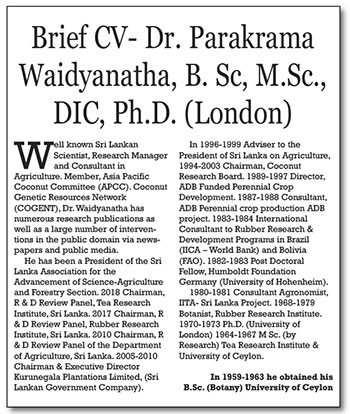
Dr. Parakrama Waidyanatha Courtesy The Island

Dr Anurudha Padeniya, President of the GMOA in a LankaCNews presentation overwhelmed this writer with trepidation and fear. What is his mission in public fear-mongering?

The title of his talk (in Sinhala) was Agrochemical which is a mass-exterminator” kills ten times more than Corona”. He claims that while the Corona has killed 500 patients per year, the Rajarata Chronic Kidney Disease of Unknown etiology (CKDu) kills ten times more. Incidentally, the etiology of the kidney disease is now known, and the ‘u’ from the acronym, should be removed. He confidently claims that CKD is caused by agrochemicals. Regrettably, he appears to know neither the research nor the statistics on the subject.

No evidence that the kidney disease is caused by agrochemicals

First, let me present a quick profile of the key research findings.

International Consultation on CKDu in Sri Lanka (2017) concluded that there was NO EVIDENCE that agrochemicals caused CKDu.

Dr. Padeniya is still in 2013, when a WHO study tentatively stated that CkDu patients secreted more trace amounts of cadmium, arsenic and some pesticide residues in their urine, compared to reference limits. However, the Report, for some unknown reason, did not reveal, as shown from subsequent analysis of the raw data, that there were two to four times more subjects in the non-CKD control” area (Hambantota) with HIGHER cadmium, arsenic and pesticide levels than in the CKD area.

A dramatic study compared two adjacent villages in Girandurukotte, namely, Badulupura”, on high ground where the people exclusively drank water from dug wells and Sarabhumi in the plain where the people drank water from the river, reservoir or wells dug close to their homes. The Baduluprua people contracted the disease, which affecting virtually none from Sarabhumi. Analysis of the water in the wells in the Badulupura and Sarabhumi revealed that the Badulupura water was hard and heavily contaminated with fluoride, a highly nephrotoxic chemical, while being FREE OF AGROCHEMICALS.

Further evidence for a role for fluoride in the disease is that CKD patients also often have dental fluorosis.

Several independent research groups also have shown that high fluoride and magnesium contents in the hard water of the wells (fed by regolith aquifers) were the causative agents of CKD.

Further, the Medical Faculty, University of Peradeniya and the Institute of Fundamental studies, showed that rats fed with fluoride containing hard water contracted the disease, but not those fed with tap water. This was independently confirmed by Dr. Thammitiyagoda et al using well water from an endemic area (Ceylon Medical Journal 2018).

University of Tokyo studies on input water (2020) used in reverse-osmosis units in Ginnoruwa also confirmed the link to fluoride and magnesium, and the absence of agrochemicals in the water.

Meanwhile, Badulupura households were provided roof-top tanks for harvesting rainwater. Consequently, with the drinking of rain water, the incidence of CKDu in the village DECLINED over the years.

Now people in the CKDu affected areas are aware of the etiological agent and avoid drinking well water. With all this evidence deleting the ‘u’ from CKDu is justifiable’

Fertilizer and pesticide consumption

Displaying a copy of the Dinamina”, Dr Padeniya uncritically claimed that Sri Lanka is the world’s highest consumer of agrochemicals as reported in that paper. Regrettably, He has rushed to the microphone without checking authentic sources.

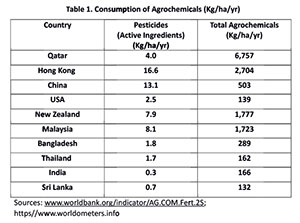
Table 1 gives the World Bank fertilizer and pesticide consumption figures of several countries which shows that Sri Lanka consumes the LEAST amount of agrochemicals in this part of the world, even below India. That is not all. As reported by the Department of Agriculture, from 2006, we have reduced the use of the most toxic, Class 1 and 2 pesticides by 98% and 29% respectively, and increased the least toxic ones of Class 3 and 4 by 91% and 41% respectively.

However, there is rampant overuse of agrochemicals resulting in the presence of phosphates and nitrogen in the runoff water. But, according to chemical analyses by Prof. Chandrajith et al., University of Peradeniya, no heavy metals above reference levels have been detected in the aquatic bodies, confirming the studies by University of Tokyo. So educating the farmers and misinformed gurus” like Dr. Padeniya is needed. I have, in my The Island article, May 19, 2021, already dealt with the need to educate the farmers for which strengthening the drastically run down agricultural extension service is a critical need.

Returning to old food habits and traditional varieties

The good doctor is recommending a return to old food habits and traditional rice varieties which, he claims, are more nutritious and healthy — another claim unsubstantiated by appropriate research.

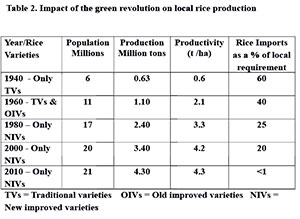
Together with Ven. Ratana and the ‘toxin-free agriculture’ group, during the Yahapalana regime, Dr. Padeniya claims planting traditional varieties (TVs) or rice which yield at best only 30-40% of that of the new improved varieties (NIVs); see Table 2. His claims that although low yielding, the TVs have high nutritious with health benefits. Sadly, he is not aware that, apart from very high yields some of the new varieties have much of those attributes. However, the staple food provides the calories, while the other nutrients are usually obtained from other foods.

If we go back to the TVs, as evident from Table 2, we need at least double the current extent of land under rice to feed the population. And where is the land? Norman Borlaug, Nobel Laureate and the Father of the Green Revolution, addressing the Nobel forum in 2000, reminded the environmentalists and other critics of the Green Revolution technologies, the likes of Dr Padeniya, that had the pre-green revolution of yields of the 1950s remained today the world would need three times more land to feed the population with far more disastrous environmental consequences than we have today with conventional farming.

Re-installing ‘sekkuvas’ in the villages for coconut oil production Another of Dr Padeni

ya’s half-baked recommendations is to make pure” coconut oil using sekkuwas” (stone mills worked by oxen), to stop palm oil consumption. Palm oil is the world’s number one vegetable oil with an over 40% global output; and over 50% inclusion in our food etc. It’s as safe as any other saturated fats, and many health benefits have been claimed for it. He is one of the key advisers to the government’s foolish move to ban palm oil and uproot existing oil palm cultivations. However, the palm oil import ban had to be lifted. No country has banned palm oil except Sri Lanka.

The ‘sekkuwa’ proposal is more pie in the sky” than going fully organic.” Besides, it carries the high risk of afflotoxin contamination. The villagers usually sun and air-dry the coconut kernel, thus inviting the fungus Aspergillus to produce afflotoxin. According to a Coconut Research Institute food expert, a ‘sekkuwa’ cannot be totally cleaned of bits of poonac, an ideal medium for Aspergillus growth.

Dr Padeniya often quotes the wise words of Hippocrates(460-370 BC), the father of medicine: ‘Let food be thy medicine and medicine be thy food’. And yet, Dr. Padeniya knows that even the best” food cannot save the world from viral epidemics. Did he not get his vaccine shots? Even if food were the only issue, the massive and increasing global population and the limited land and water, make conventional agriculture the only viable approach, while ever correcting its weaknesses. Organic farming experts like Adrian Mueller agree that its two percent output can never be increased to feed the world. It was abandoned in the 1850s when, even then, it failed to provide food to the increasing population globally.

Dr. Padeniya says we have been eating poison since 1950, but our life expectancy has steadily increased since then. It is far more appropriate in the current context of global agriculture for him to preach the wise words of the father of pharmacology, Bombastus Paracelsus, rather than those of Hippocrates: ‘ All substances are poisons, there is nothing which is not a poison. It is the dosage that differentiates poison and remedy’. The farmers need to judiciously use agrochemicals. Then the poison becomes remedy.

He would also do well to remember the wise words of Lord Buddha: ‘Speak only when you feel that your words are better than your silence.’

Dr Parakrama Waidyanatha

https://dh-web.org/people/CV-PWaidya.pdf

Case of decomposing government’s “Organic Country” Project

June 21st, 2021

Courtesy The Daily Mirror

Health Minister Pavithra Wanniarachchi was quoted telling parliament, Sri Lanka reports 230,000 new kidney and cancer patients annually due to use of chemical fertiliser and pesticides. Breaking down that number she had said 6,000 kidney patients annually and 54 cancer patients succumb daily to their tragic ailments. She had also told parliament medical experts have confirmed that these were due to use of chemical fertiliser and pesticides.
 That same day, June 7, referring to the ban on chemical agri-inputs, President Gotabaya Rajapaksa had told a meeting of district development committee chiefs; there can be no turning back. He was quoted by media telling the participants, though there are protests and opposition, even with difficulty good things for the people have to be done.


 Health Minister Wanniarachchi’s harangue was about justifying the total ban on chemical agri-inputs by President Gotabaya. She made a valiant effort to give new life to the overused and wasted slogan Food without poison”. Yet they have no clear source. Nor has any survey or research proved chemical fertiliser and pesticides are direct attributes for kidney ailments and cancer. What nevertheless needs attention is the President’s assurance, the total ban on all chemical agri-inputs will continue. All district development committees were asked to work on agriculture development with organic agri-inputs.


 The debate unfortunately has been reduced to immediate substitution of chemical fertiliser with compost or organic fertiliser. There in fact is no attention paid to the ban on chemical pesticides and weedicides. Weeding in both large plantations and smallholdings is a major issue that cannot be managed by employing labour. Issues related to this sudden change of agri policy entails many more problems making this change more complex and complicated than mere substitution of one with another. Though not considered in any discussion forum collection, scavenging and disposal of solid waste all around the country by local government bodies called Municipal Solid Waste” (MSW) provide the basis for going totally organic.

‘The President had told a meeting of district development committee chiefs; there can be no turning back. He was quoted by media telling the participants, though there are protests and opposition, even with difficulty good things for the people have to be done”

 Decision of the government to establish an organic fertiliser manufacturing centre in Anuradhapura was announced at the President’s meeting on June 7. Based on its success, that is to be replicated in all 29 Divisional Secretariat (DS) areas in the Anuradhapura and Polonnaruwa districts. The promise is to establish them before this year’s Maha Season, beginning September end through October.


 These fast-track projects for mass scale compost production would require greater volumes of solid waste. It is common sense that solid waste volumes cannot be arbitrarily increased for want of bigger volumes of compost. Composting was introduced in Sri Lanka in late 1980’s with this city based free market economy promoting heavy consumption among a growing urban middle-class that led to increased volumes of solid waste, municipalities and urban councils had to regularly and constantly collect and dispose. Disposal of waste in open dumps in neighbouring areas created more issues with unbearable stench, insects, crows and birds, reptiles and stray dogs frequenting them in growing numbers and with residents protesting. Composting was thus thought of as a remedy, integrated into government policy of reducing import of chemical fertiliser. To cut short a detailed story of composting in Sri Lanka, the initial effort in promoting households develop compost fertiliser with their kitchen and household waste through distribution of bins first by the CEA and then with private partnerships served little purpose. Commercialising of compost manufacture was thereafter undertaken by local government bodies and small-scale businesses. Slow progress in market expansion over years with efforts made to improve and increases floriculture and organic fruits and vegetables creating a new profitable niche market in urban society, demand for compost as organic fertiliser increased. This gave space for few medium level businesses as well.


 Within solid waste disposal and compost manufacturing, starter materials” are basically; (1) bio-degradable waste scavenged from MSW that include kitchen, household and garden waste, hospital, market and hotel waste (2) farm waste that include manure and poultry litter (3) crop residues and agricultural waste and then (4) slaughter-house waste.


 Most numbers related to solid waste generation and compost in Sri Lanka are arbitrary. Different sources provide different projections. During the few years 2015 and aftersolid waste collected before scavenging for re-use and recycling was calculated at 4.8 billion MT per year at an average. It should also be said, far worse than most services, collecting, scavenging, transporting and disposing of waste in Sri Lanka is not efficient and has no set standards and methods. The total waste collected therefore is about 60% to 70% of the generated volume. Only about 60% to 80% of it is biodegradable. There is also a significant difference between the composition of solid waste generated in heavy urban areas and largely rural areas, with seasonal changes too.


 Composting depends on none other than biodegradable waste in collected waste. In a co-authored research paper by two academics, one in Peradeniya University specialised in soil science and the other from the UN University in Dresden, Germany have inferred, Due to the push for recycling solid waste and a poor understanding of quality and safety concerns, many commercial-scale compost producers tend to use any biodegradable material that they can find conveniently in their composters. ….. Any biodegradable material could be composted. But if source materials and the composting process are not carefully regulated, whether the end product is going to meet the quality and safety standards cannot be guaranteed.” (Composting in Sri Lanka: Policies, Practices, Challenges and Emerging Concerns – Warshi S.Dandeniya and Serena Caucci).

“For whatever desperate reason, government’s intervention to turn the whole country organic by year end” would create an unattainable demand for compost”

 In another research an observation is, In addition to hazardous and biomedical waste such as batteries, small electronic appliances, and hospital waste that could release potentially harmful organic and inorganic contaminants to the compost, non-biodegradable materials like plastics, textile, and polythene are also present in large volumes in MSW” (Arachchi, K. H. M. – Present status of solid waste management and challenges for change. Colombo: National Solid Waste Management Programme in Sri Lanka.” – 2016.) 


 For whatever desperate reason, government’s intervention to turn the whole country organic by year end” would create an unattainable demand for compost. With no standards in collecting and scavenging, no mechanisms for regulating and the quality of the end product least considered, this new passion of the government for organic farming” would not secure even half the desired results. Both in terms of harvest and toxic-free” organic food.
 Reason being, while MSW is not properly scavenged for toxic waste, the second largest and more readily available poultry manure” used in composting, adds toxics never checked for. A research on poultry litter says, Non-standardised manure and improperly generated compost procedures are causes of public health concerns which have not been considered in the past and that are going behind the pathogen or heavy metal concentration. Poultry litter/manure is a source of antibiotic resistance determinants and, therefore, imposes a silent threat to environmental quality and health.” [E.M Herath, A.G.K.N. Palansooriya et al, An assessment of antibiotic resistant bacteria in poultry litter and agricultural soils in Kandy District, Sri Lanka”: Tropical Agricultural Research Journal, 27(4)] 


 Compost is therefore not safe though hyped as poison free”. Local government bodies that account for the total volume of MSW in compost manufacture do not have skilled labour, technology and infrastructure for proper scavenging and separation of toxic material. Nor have any plans been made for such improvement. Release of potentially harmful organic and inorganic contaminants to the compost” therefore in State sponsored accelerated expansion of market demandwould be a major issue, despite the promise for poison free food”.


 This raises two major issues for the government and for those who believe this to be the answer for our subsistence agriculture and food safety”. First is the question, can the government make available the minimum required compost within about three months for the N-C paddy farmer this Maha season? That seems impossible with a half-hearted MSW collecting network in a province that generates only about 10% of the total national volume of solid waste annually. The second is, with no serious and district level monitoring of compost manufacture paid any attention that anyway is not clean and never toxic free as popularly projected, can the government make certain the new frenzy for organic fertiliser would not give way for sub-standard products? That again is an impossible task with a corrupt and inefficient State apparatus sickeningly subservient to local politics. 
In short, compost or organic fertiliser is not a clean and effective substitute for chemical fertiliser though people are told to believe it is and, in this country, there is no capacity to produce a better cleaner” product with local government bodies not even thought of as the major stakeholder in compost manufacture in the campaign for a totally organic Sri Lanka” before year 2022. It is not a long wait anyway to see how the clean food – clean soil” campaign finally roots itself in society. NC province Maha season would sure be the harbinger.

Sri Lanka’s farmers: A fate worse than Pandemic!

June 21st, 2021

Courtesy The Daily Mirror

  • The President is effectively hollowing out 25% of the earnings of these already cash-strapped communities. His gamble is pushing a good part of Sri Lanka’s farmers, who are living on the fringes of poverty, back into abject poverty. This is a crime! To be blunt, this is a crime worse than white vans
  • Worst still, the ban was announced out of the blue, taking them by surprise in the height of the corona virus pandemic. Tea smallholders lament their harvest had plummeted to one third – from 900 kg per acre to 300 kg. Subsistent farmers point to emaciated pumpkin
  • Many countries that experienced a pandemic infused negative growth in 2020 are bound to bounce back. Some others, like Sri Lanka, which are still barely coping with, still have the opportunity to economic revival in the second half

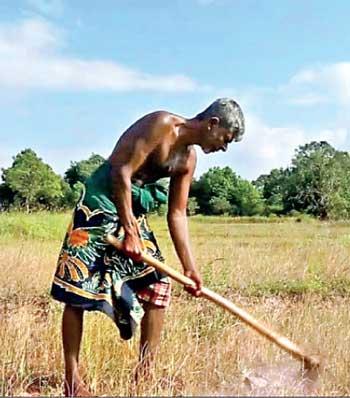
Farmers across this paradise isle are raging against a man-made disaster courtesy of a presidential directive. Holding placards in their starving paddy lands and hollowed out cash crops, they protest against a crippling shortage of fertilizer, the reason for that being a dimwitted presidential order to ban chemical fertilizer. Worst still, the ban was announced out of the blue, taking them by surprise in the height of the corona virus pandemic. Tea smallholders lament their harvest had plummeted to one third – from 900 kg per acre to 300 kg. Subsistent farmers point to emaciated pumpkin.


Their grievances fill the prime time news of television stations, even some, which are staunchly pro-government. They are not just sound bites, nor are personal tragedies. They are the tip of an iceberg of a major national calamity that would come to full force in a couple of months when the country faces a full-blown man-made food crisis for the first time in its history and an unprecedented rise in poverty in farming communities.  


If you are a dispassionate watcher of world affairs, you might guess that when a Third World country does things, no one else has not ever done, and is simply guided by guesswork, sans scientific logic, that doesn’t end well. Like the economic joke about a 100 dollar bill lying on the road, if something is so good, someone else has already picked it up – The bottom line is that if some things are too good to be true, they aren’t true.  


As for the Presidential ban on fertilizer, it is going to be a monumental disaster.  Consider the captive group on whom this experiment would be tried on. Sri Lanka’s farmers account for nearly 25% of the country’s workforce. They contribute barely 7.5% to the GDP. In other words, the low productivity per farmer means that they earn only 30% of the GDP per capita.  Sri Lanka’s GDP per capita in 2019 was US$ 3853 (World Bank). Put the dichotomy of the output and workforce of the agricultural sector, the average per capita income of a farmer would be US$ 1156. That would place them barely above the World Bank classification of a low-income country (US$ 1036 as of the year 2020). Effectively, Sri Lanka’s farmers are eking out a living on par with Sub Saharan Africa.
It is the very survival of these communities that President Gotabaya Rajapaksa is threatening with his ill-advised fertilizer ban. There is a near consensus among Agri scientists that the yield reduction of the organic fertilizer only crop cultivation is significant. According to well-documented research work, the mean yield reduction could vary from 19% to 25%.  When the existential conditions of Sri Lanka’s agricultural sector and other extraneous factors counted on, the fallout is likely to be much larger.


The President is effectively hollowing out 25% of the earnings of these already cash-strapped communities. His gamble is pushing a good part of Sri Lanka’s farmers, who are living on the fringes of poverty, back into abject poverty. This is a crime! To be blunt, this is a crime worse than white vans.


 Alongside the collective misery of farmers, there will be a national crisis due to the economic fallout of the substantial drop in export income from tea, rubber, and other cash crops, and a potential food crisis.
Many countries that experienced a pandemic infused negative growth in 2020 are bound to bounce back. Some others, like Sri Lanka, which are still barely coping with, still have the opportunity to economic revival in the second half. However, the self-inflicted agricultural crisis would mean, Sri Lanka would lose a minimum of 30% of the output of the agricultural sector.  This government has not just squandered economic revival, it has self-inflicted colossal damage, which no sane entity would do.


This is a sequel to my last week’s column where I argued against the folly of the fertilizer ban. But, farmers in Sri Lanka don’t read English newspapers. It is disheartening to see the extremely limited critical discourse on the impending fallout in the vernacular media. Much of that discourse, if any is sanitized or politicized. This is not a political problem. This is a looming national crisis.


Also, you have a freak show of sycophants defending a policy that is indefensible. Jokers have replaced the agri-scientists and agronomists in deciding and defending the policy. One such, Anuruddha Padeniya of the GMOA has all of sudden become the authority in agriculture. Sycophants are competing for brownie points from their political masters.


Equally disappointing is the absence of a coherently articulated opposition by the opposition parties. The Samagi Jana Balawegaya interlocutors seem to be at a loss of distinguishing crass reality and fiction of the fertilizer ban. Some speak out against the shortage of fertilizer but fail to tackle the policy that is the root of the problem. Some fellows seem to buy the skewed rationalization of health reasons.

 
A political opposition that is not capable of identifying the economic viability and tremendous social-economic cost of a demagogic policy is indeed a case in point of poverty in Sri Lankan politics, the very reason why Gotabaya Rajapaksa is now the President.


Mr. Rajapaksa himself is being overly callous; he is inflicting pain and misery upon his very constituency, the archetypical 6.9 million who voted him to power.  Funny thing though most of the farmers, who would go broke at the end of this farming season, thanks to Mr. Rajapaksa’s policy, are yet to blame him. They reproach the local officials for hoarding fertilizer or failing to provide them with the stuff on time, but fail to understand the root cause of the shortage.  Their ignorance in their small worlds is shielding President Rajapaksa from their scorn for the time being, just like the same conditions elected him to power. (This may sound like a condescending take, but, that is how the world of inequality functions).


However, this cloak of complacency cannot last forever and will shatter at some point in time.


But, why wait till this irrationality runs its full course?


Follow @RangaJayasuriya on Twitter 

Cabinet approval to import 100,000 metric tonnes of rice

June 21st, 2021

Courtesy Adaderana

The Cabinet of Ministers have approved a proposal to import 100,000 metric tonnes of rice to counter the unusual price increase of rice in the local market. 

The cabinet paper presented by Trade Minister Bandula Gunawardena for this purpose has been approved by the Cabinet.

Sri Lanka reports another 52 Covid-19 deaths

June 21st, 2021

Courtesy Adaderana

The Director General of Health Services today confirmed another 52 Covid-19 related deaths that had occurred on June 20. 

The latest deaths include 22 females and 30 males while one of the victims is a below the age of 30.

Ten are aged between 30-59 while the rest are 60 years and above. 

This pushes Sri Lanka’s death toll due to the virus to 2,633.

Over 2,000 coronavirus cases reported within today

June 21st, 2021

Courtesy Adaderana

The Health Ministry says that another 367 persons have tested positive for Covid-19 today increasing the daily count of positive cases to 2,098.

All new cases reported today are associated with the New Year cluster. 

This brings the tally of confirmed cases of coronavirus reported in the country so far to 241,820.

Presently a total of 31,952 patients infected with the virus are being treated at hospitals and treatment centres while total recoveries stands at 207,287.

ERASING THE EELAM VICTORY Part 20 C5

June 20th, 2021

KAMALIKA PIERIS

Several   countries   which are pro-Eelam have   prevented senior military officials of the Sri Lanka army, from attending prestigious foreign courses and receiving scholarships, citing unsubstantiated war crimes accusations.  Maj. Gen Jagath Dias was not allowed to join an ICRC project in Australia.  US refused to accommodate Maj. Gen. Sudantha Ranasinghe, on a programme as he commanded the elite 53 Division. The 53 Division had killed LTTE leader Prabhakaran.

The International Truth and Justice Project (ITJP) created dossiers of war crimes for the senior officers who led the final assault in Eelam War IV.  ITJP had dossiers on Shavendra Silva, Kamal Gunaratne, Jagath Jayasuriya and Jagath Dias. Shavendra Silva’s dossier had information on his four deputies in the 58 division as well.

Three retired service commanders, Air Chief Marshal Roshan Goonetileke, Admiral Tisara Samarasinghe and General Daya Ratnayake, called a special media briefing in Colombo at the Sri Lanka Foundation Institute in February 2019, to bring to public attention what they called a relentless campaign directed against some individuals in the army.

General Ratnayake said that they were seriously concerned about the ongoing operation targeting the military.  Since the change of government, in January 2015, 67 army officers and 637 other rankers had been investigated. The number of officers and other ranks (Army and Navy) arrested during this period was placed at 15 and 35, respectively. Seven Army and Navy personnel are currently in custody. One officer and one soldier have been sentenced to death. He said it was not the policy of the army to deliberately target civilians. The war winning military was being [unfairly] penalized.

 These retired service commanders expressed concern over the attempt to take wartime Navy Commander Admiral Wasantha Karannagoda into custody regarding some wartime disappearances (2007-2008). They praised the role played by Admiral Karannagoda during the conflict. Karannagoda changed the naval strategy in place at the time and had also taken action to destroy the floating LTTE arsenals on high seas.

Director of the State Intelligence Service (SIS) Maj. Gen. Suresh Sallay has sent a Letter of Demand to Executive Director of the International Truth and Justice Project (ITJP) Yasmin Sooka and the ITJP for making malicious allegations against him. The letter of demand states that on or about June 01, 2020, Yasmin Sooka, in her capacity as the Executive Director of the ITJP issued a press statement making various defamatory remarks against Major General Sallay. The press statement was published on the ITJP Sri Lanka’s website.

The Letter of Demand says the defamatory implications have resulted in parties with vested interests making attempts on the life of Maj. Gen. Sallay. The Letter mentions the numerous awards and achievements of Major General Sallay and the resultant tarnishing of this reputation.  He asks for Rs 1 million as damages. The Letter of Demand has also notified Sooka and the ITJP to cease and desist from issuing further defamatory remarks if they continue to do so, Sallay would take legal action, both Civil and or Criminal.

Lawyers representing Maj. Gen. Suresh Sallay also handed over a letter to UN office in Colombo complaining about a propaganda campaign carried out by Yasmin Sooka of the ‘Truth and Justice’ Project against  Sallay.

Major General Chagi Gallege, then Director General, Infantry  was refused a visa to visit his brother in Australia, due to ‘war crimes.’ Australia has found fault with Gallage for being in command of the 59 Division from May 7, 2009 to July 20, 2009   when it was engaged in the Vanni offensive. Australian High Commission stated that troops under his command certainly committed war crimes and crimes against humanity. There have never been specific allegations against Maj. Gen. Gallege before. Gallege has now retired from service, but the Australian ban remains.

The Australian Department of Immigration and Border Protection has extensively cited Report of the OHCHR (Office of the High Commissioner for Human Rights) on Sri Lanka (OISL) to turn down Gallege’s visa..Australia has cited a statement attributed to General Officer Commanding (GOC) 58 Division Maj. Gen. Shavendra Silva that unmanned aerial vehicles (UAVs) real time footage had been made available to ground commanders marking targets, to justify its decision. On the basis of Maj. Gen. Silva’s statement, Australia has alleged that Maj. Gen. Gallege had been aware of artillery strikes on third no fire zone.

.Australia has accused Maj. Gen. Gallege of planning, implementing and supporting war crimes and crimes against humanity. Australia also held him responsible as the serving officer for failing to prevent troops under his command from committing war crimes.

Sources pointed out that the decision to accuse Maj. Gen. Gallege of crimes against humanity meant that Australia believed that the Sri Lankan army carried out systematic attacks against Tamil civilians. The High Commission ignored the fact that none of the allegations had been proved in a court of law or at least thoroughly examined, said critics.

Chagi Gallage was in the forefront of the war against the LTTE.  He is acknowledged widely as a very good soldier. He is considered one of best strategists in the army. He discharged his duties on the battlefield with distinction.  He was a simple and humble officer, who did not throw his weight about  and   was liked by both officers and the ranks.

Gallage’s predicament did not receive the media attention it deserved.  Neither Parliament nor nationalist groups took up the matter. An ungrateful Sri Lanka never bothered to make representations on behalf of an officer who risked his life for his motherland on countless occasions as a frontline infantry officer, said analysts. They observed that while a legitimate army was being targeted for defeating the LTTE, the LTTE had been given safe haven in many parts of the world.  (Continued)

Sri Lanka defends move to build artificial reef

June 20th, 2021

Meera Srinivasan Courtesy The Hindu

It is not only the government that defended the move, but also Jaffna-based fisher cooperatives.

Days after Tamil Nadu fishermen protested Sri Lanka’s efforts to build an artificial reef off Delft island, west of Jaffna peninsula, authorities defended the move aimed at enhancing fish breeding”.

Last week, Sri Lanka’s Department of Fisheries and Aquatic Resources, with the assistance of Navy, launched a project, dropping around 20 discarded buses into the sea off Delft, as was earlier done in other parts of the island nation, including the eastern Trincomalee district, officials said.

Many countries, including India, have in the past created artificial reefs to facilitate fish spawning. Old train carriages were used in the US, for instance,” Cabinet Minister for Fisheries Douglas Devananda, who represents Jaffna district in parliament, told The Hindu. The move was backed by research undertaken by Sri Lanka’s National Aquatic Resources Research and Development Agency (NARA), he said.

By objecting to an initiative in Sri Lanka’s territorial waters, Tamil Nadu fisher leaders have only exposed themselves as parties interested in fishing illegally in the Palk Strait,” he said, referring to the long-persisting Palk Bay fisheries conflict.

Persisting problem

Scores of Tamil fishermen living in the war-affected northern and eastern districts of Sri Lanka have, for over a decade now, been protesting Tamil Nadu fishermen’s use of destructive bottom trawlers along their coast, severely impacting the marine ecosystem and their post-war livelihoods. Despite ongoing bilateral discussions and several rounds of talks between fishermen of both countries, Tamil Nadu fishermen are yet to meet northern Sri Lankan fishermen’s consistent demand that they stop bottom-trawling in their seas. On the other hand, Tamil Nadu fishermen have accused the Sri Lankan Navy of attacking and killing fishermen — allegations that the Sri Lankan side denies.

Meanwhile, members of the All Mechanised Boat Fishermen Association, held a protest in Rameswaram last week, urging Sri Lanka to stop dropping iron scrap” into the sea, since would affect” marine ecology in the Palk Strait, and also damage” their own boats and nets.

In a tweet indicating Sri Lanka sees its recent initiative also as a deterrent to bottom-trawling, State Minister of Fisheries Kanchana Wijesekera said while the artificial reef would boost fish spawning, it will also act as a shield against bottom line trawling conducted illegally by the #Indian Fishermen”.

It is not only the government that defended the move, but also Jaffna-based fisher cooperatives. This initiative is aimed at helping our livelihoods by increasing fish production, and that is why we have welcomed it. We condemn certain sections of fisher leaders in Tamil Nadu opposing the move,” said Annalingam Annarasa, leader of the federation of fisher cooperative societies in Jaffna.

SLPP eats humble pie over fuel price hike statement

June 20th, 2021

Courtesy The Daily Mirror

The statement put out by SLPP (Sri Lanka Podujana Peramuna)  General Secretary Sagara Kariyawasam, critical of Energy Minister Udaya Gammanpila over the latest fuel price hike, laid bare once again factions and frictions  in the government .


It is commonsense that the fuel price hikes cannot be enforced without sanction of the Finance Ministry. The subject ministry can make recommendations, but it is finally the collective decision of the government under usual circumstances. The recent spike of fuel prices to reflect increases in the world market is no exception to the rule.  It, however, added to the woes of people who are already battered by the pandemic-related restrictions in pursuit of their livelihood activities. A public outcry is naturally expected against the fuel price revision, a move having ripple effects in various sectors of the economy. 

“The Prime Minister is the leader of the SLPP.  In reality, its political activities are operated by its National Organizer Basil Rajapaksa. Therefore, the story in the rumour mills is that Mr. Kariyawasam worked out this statement at the behest of Basil Rajapaksa”

The SLPP is the governing party. Therefore, it would have been privy to circumstances that led to the upward revision of fuel prices. Still, Sagara Kariyawasam released this statement trying to blame the price revision solely on Minister Gammanpila.  The government came under severe criticism by the general public after the price hike which will result in the rise of cost of living at the end. Already, the prices of bakery products have gone up, and, so will be passenger transport fares. Mr. Kariyawasam, would have attempted to palm off the responsibility on one minister, absolving the government of it. The SLPP General Secretary, in his statement issued under the party’s letterhead said Minister Gammanpila’s approach only led to the government increasing the prices. 


Nevertheless, facts are facts.  It is the collective decision taken by the government through the cost of living committee chaired by President Gotabaya Rajapaksa and Prime Minister Mahinda Rajapaksa.  As such, the Minister had the valid points to counter Mr. Kariyawasam’s statement.  He did it with vigour at a press conference the very next day. Besides, he got a shot in the arm when the President’s Office also defended the fuel price revision.  The President’s Media Division (PMD) issued a press statement justifying the decision. The PMD said a spike was warranted by the present local and global
economic realities. 


No matter what, the blame game amply displays internecine warfare within the government. The SLPP has been at loggerheads with its minor allies such as Minister Gammanpila’s Pivithuru Hela Urumaya (PHU) and Industry Minister Wimal Weerawansa’s party for some time.  It turned out to be obvious particularly when the 20th Amendment to the Constitution was enacted last year.  In some instances, the leaders like Minister Weerawansa became of the subject of vilification and slander by the SLPP legislators, particularly the newcomers, both in and outside Parliament. The latest incident on the fuel price is just an amplification of strife between the SLPP and its allies.

“Samagi Jana Balawegaya (SJB), the main opposition, has responded to the situation by opting to move a no confidence motion against Minister Gammanpila. For the SJB, as a force opposed to the ruling side, have reasons for such a step”

The alliance partners have now formed into a group to muster collective strength to respond to the SLPP.  Eight such parties came out with a statement condemning Mr. Kariyawasam’s statement.  The Prime Minister is the leader of the SLPP.  In reality, its political activities are operated by its National Organizer Basil Rajapaksa. Therefore, the story in the rumour mills is that Mr. Kariyawasam worked out this statement at the behest of Basil Rajapaksa.  Senior SLPPers such as Agriculture   Minister Mahindananda Aluthgamage gave rise to such speculation. No one has yet denied such involvement of Mr. Basil Rajapaksa who is currently in the United States. Finally, the SLPP had to eat humble pie when it became established that Mr. Kariyawasam’s statement was unacceptable. 


At a press conference on Tuesday, State Minister Arundika Fernando extended an apology to Minister Gammanpila. It looks like that Mr. Kariyawasam is isolated with no one for his defence in the case.   
Now, Samagi Jana Balawegaya (SJB), the main opposition, has responded to the situation by opting to move a no confidence motion against Minister Gammanpila. For the SJB, as a force opposed to the ruling side, have reasons for such a step.   First, it can take the government to task both on the fuel price region during the debate on the no confidence motion once it is placed before Parliament. Likewise, the debate will afford the main opposition and others to mock at the government over its
internal squabbling.  

“The SLPP is the governing party. Therefore, it would have been privy to circumstances that led to the upward revision of fuel prices. Still, Sagara Kariyawasam released this statement trying to blame the price revision solely on Minister Gammanpila”

But, it is difficult to win the motion unseating the Minister from office since it is nowhere near the required majority. The opposition will raise tricky questions which the government will find it difficult to answer convincingly.  The SJB legislators will sneer at the government benchers during the course of the debate, for sure. 
However, despite differences among its own ranks, the government is not placed to allow the no confidence motion against one of its own   ministers being adopted by Parliament.  As such, the government will forget all differences and act for the defeat of the motion if it is put to a vote in the House. In that sense, it will be a factor that unifies the otherwise different of voices of the government. 

Conspiracy behind inaccurate COVID-19 figures?

June 20th, 2021

Sheain Fernandopulle Courtesy The Daily Mirror

The concerns have been raised to such an extent over the contradictory figures on COVID-19 deaths and cases in the country that medical experts claim that to be a conspiracy.

Government Medical Officers Association (GMOA) President Dr. Anurudda Padeniya voiced against the controversy over COVID-19 figures.

I say with responsibility that there is a conspiracy behind it. Data are not released by the Epidemiology Unit. Three officials are also behind it,” Dr. Padeniya stressed.

The Epidemiology Unit has been entrusted with six responsibilities such as surveillance, outbreak control, vaccination, clinical managed coordination, operational research and monitoring  and evaluation,” he said.

Dr. Padeniya expressed these views before President Gotabaya Rajapaksa at a recent COVID-19 Task Force meeting at the Presidential Secretariat.  

Meanwhile, when asked of this, Director General of Health Services Dr. Asela Gunawardena said it was not possible to conclude that there is a conspiracy behind this but there had been some issues with the figures.

In addition, the Daily Mirror at an earlier occasion noticed that there was a considerable gap between the figures on COVID-19 in the Health Ministry and Epidemiology Unit websites.

However, when we later inquired about this from Deputy Director General of Health Services Dr. Hemantha Herath said the Epidemiology Unit would look into the matter as the issue had occurred from their side.

Subsequently, the figures were rectified.

In such a situation, Chief Epidemiologist Dr Sudath Samaraweera was transferred to the Dengue Control Unit as its Director. 

Sri Lanka records 47 new COVID-related deaths

June 20th, 2021

Courtesy Adaderana

The Director General of Health Services has confirmed 47 more COVID-19 related deaths that have occurred yesterday (June 19).

This pushes the official death toll due to the virus in Sri Lanka to 2,581.

According to the data released by the Department of Government Information, the new fatalities confirmed today include 20 females and 27 males.

One of them is aged below 30 years, six are between 30-59 years and the remaining 40 are aged 60 years and above.

Coronavirus: 2,008 new infections confirmed within the day

June 20th, 2021

Courtesy Adaderana

Daily COVID-19 cases count hit 2,008 on Sunday (June 20) as 455 more people were tested positive for the virus in Sri Lanka.

Earlier this evening, the Department of Government Information confirmed 1,553 new cases associated with the New Year Cluster.

The new development brings the total number of confirmed cases of coronavirus reported in the country to 239,669.

As many as 201,389 recoveries and 2,581 deaths have been confirmed in Sri Lanka since the outbreak of the pandemic last year.

According to official data, more than 35,000 active cases are currently under medical care at designated hospitals and treatment centres.

ERASING THE EELAM VICTORY Part 20 C4

June 19th, 2021

KAMALIKA PIERIS

One way of erasing the Eelam victory is by declaring that the officers, who led the military campaigns, had committed war crimes.  Critics observed that army officers who led front line fighting formations in the Eelam war were relentlessly pursued on the basis of unsubstantiated war crime allegations, not proved in a court of law.  

On 19 May 2009, the Sri Lankan military effectively concluded its 26-year operation against the LTTE. The 58 Division of the Sri Lankan Army led by Brig. Shavendra Silva, 59 Division led by Brig. Prasanna de Silva and the 53 Division commanded by Gen. Kamal Gunaratne, after having boxed in the remaining LTTE cadres into a small area of territory near Nandikadal lagoon. The battle for the last patch of LTTE held territory was led by Brig. Shavendra Silva, one of the Gajaba Regiment veterans handpicked by Lt. Gen. Fonseka for the Vanni offensive.

Shavendra Silva commanded the celebrated formation that killed the most number of terrorists, recovered the most number of weapons and brought the large parts of western and eastern Vanni under government control, said  Major General Chagi Gallege.

Shavendra Silva refused to join the peacekeeping mission to Haiti, despite the financial benefit that would result, as he thought he should remain on the battlefield at the height of operations.    The offer of Haiti was   probably   made to remove this capable officer from the war campaign.

The 58 Division was Sri Lanka’s most successful fighting Division. It was not only the best, but the youngest Division which fought alongside eight other formations on the Vanni front paving the way to the final battle.

The 58 Division, formerly known as the Task Force I, played a significant role in eradicating the LTTE’s conventional fighting capability in the Vanni region. It fought its way from Mannar to Vellamullivaikkal -a distance of 201 kms. No other fighting formation had even come close to challenging the 58 Division’s record, though the battlefield success was due to the combined efforts of the armed forces, said Shamindra Ferdinando.

The 58 Division’s biggest achievement was the unprecedented operation at Anandapuram, where it killed over 600 LTTE cadres, including the most experienced LTTE commanders. The operation conducted together with 53 Division, helped hasten the collapse of the LTTE.

Shavendra Silva who led the 58 division became the main target of those prosecuting war crimes. Shavendra Silva was targeted as a ‘war criminal’ by the International Truth and Justice Project, Sri Lanka (ITJP) administered by the Foundation for Human Rights, South Africa, under the direction of Yasmin Sooka.

In 2017, Yasmin Sooka in her capacity as the Executive Director, ITJP wrote to Coca Cola Company critiquing it for sponsoring Gajaba Supercross 2017 held at Saliyapura, Anuradhapura in August that year. The Gajaba Regiment was responsible for war crimes and human rights violations over the past several decades and Shavendra Silva was its Commander. Sooka wanted to know why Coca Cola financed an event organized by this notorious war criminal.  

In 2019, ITJP released a defamatory 137-page dossier on Shavendra Silva, (Shavendra Silva chief of army staff, Sri Lanka .Dossier29 January 2019) containing data cobbled together from media reports. It is not a document that will be taken seriously in a court of law.

ITJP however is very proud of the document. This Dossier presents the most detailed body of evidence against any Sri Lankan military figure to date, said ITJP. It amalgamates photographs, contemporaneous SMS and witness testimony, including from insiders, with linkage evidence in the annexures, such as official Army releases which were deleted offline after the War to hide the truth, as well as relying on the findings of past UN investigative reports. It also presents a legal analysis of the evidence gathered, knowing that a more detailed examination would be needed to frame criminal charges.

             There is a tremendous amount of evidence in this dossier, meticulously collected by my team over many years, said Sooka. This dossier is just a fraction of the information we hold. Many successful cases at international tribunals and the International Criminal Court had less to work with. There is now no excuse for this man to remain as number two in the Sri Lanka Army: he must be suspended immediately and a criminal investigation instituted, she said.

ITJP said Shavendra Silva was arguably the most important frontline ground Commander in the 2008-9 War in Sri Lanka, in which war crimes were committed. There are reasonable grounds to believe that Major General Shavendra Silva committed war crimes either directly by ordering them or by failing to prevent his troops from committing them.

Given the evidence set out in this report and the findings by the OISL, Major General Shavendra Silva can and should face charges of war crimes of rape, torture and outrages upon personal dignity, as well as torture as a separate crime, committed by troops under his effective command and control. There are reasonable grounds to believe that he knew or had reasons to know about these crimes and even then failed to prevent the crimes from occurring and punish those responsible, said ITJP.

Silva commanded a large number of troops throughout the offensive in the north of the island he was instrumental in the attacks on all the strategic towns and villages in 2009. He was also personally present at the white flag surrender at the end of the War, when hundreds of Tamils disappeared in Army custody and others, including women and children, were subjected to summary execution, continued ITJP.

Shavendra Silva’s troops fought in almost every major battle during this phase – in Mannar, Pooneryn, Kilinochchi, Paranthan39, Tharmapuram, Vishwamadu, Thevipuram, Puthukkudiyiruppu (PTK), Iranapalai, Ananthapuram, Pokkanai, Putumattalan, Valayanmadam and finally Mullivaikkal. The UN report from 2015 also confirms the 58 Division’s presence in these locations.

Shavendra Silva’s troops were instrumental in the attacks on all the strategic towns and villages in 2009. He was also personally present at the surrenders at the end of the War, at which point hundreds of Tamils disappeared in Army custody and others, including women and children, were subjected to summary execution. 

The ITJP report also said the following:

  • Silva has never been held accountable for his role in crushing the Janatha Vimukthi Peramuna uprising” in the late eighties.
  • An insider witness reported that Silva was the officer who ordered attacks on Kilinochchi while there was still an international presence in the town. These attacks resulted in civilian casualties and extensive damage to the hospital and the UN compound
  • Based on the evidence set out in this report, the Sri Lanka Army was responsible for shelling the Kilinochchi Hospital and the UN base in town knowing that civilians were inside, which resulted in civilian casualties and damage to the UN buildings and the hospital.
  • The evidence in this report confirms that troops under the effective command of Major General Silva were involved in the military operations in Pokkanai
  • The MOD Situation Reports provide further corroboration that the 58 Division was directly involved in the military operation in PTK – a small town in the Vanni, spearheaded by Gajaba Regiment veteran Brig. Shavendra Silva.”
  • The OISL found reasonable grounds to believe the 58 Division was among units that repeatedly shelled Putumattalan Hospital
  • Similarly, as corroborated by the Sri Lanka Army MOD Situation Reports, in late April 2009 the 58 Division was involved in the military operation in Valayanmadam. The evidence gathered indicates that shelling, tanks and cluster munitions coming from the Sri Lanka Army side were used in the attack against Valayanmadam, including at the church
  • There are reasonable grounds to believe that Shavendra Silva’s troops were involved in attacks against the hospital and the church in Valayanmadam which resulted in the civilian casualties and damage to the church and the hospital.
  • The presence of the 58 Division in Mullivaikkal and surroundings, where daily intense bombardment by Sri Lanka Army artillery, the air force and navy was reported, has been further corroborated by MOD Situation Reports
  • Several LTTE members were shot dead in the ‘White Flag Case’ where they surrendered to his Division. Eye witnesses placed Silva on site and claim he even shook hands with the LTTE political wing leaders who surrendered on 18 May 2009, only to be summarily executed shortly thereafter.
  • The evidence demonstrates that troops under the effective control of Shavendra were present at the Wadduvakkal Bridge, where according to the available evidence, hundreds of surrendering LTTE military and political leaders and their families were subjected to summary execution and arbitrary detention, as well as enforced disappearance.
  • Shavendra Silva is quoted as having said: Our aim was not to gain ground but to have more kills.

In light of the above, there are reasonable grounds to believe that the 58 Division under the effective military command of Major General Shavendra Silva violated international humanitarian law by failing to distinguish between civilians and LTTE fighters as well as between civilian objects and military objectives said the Dossier.

The Dossier concludes by suggesting Sri Lanka should a) immediately suspend Shavendra Silva from service pending investigation. b) The Attorney General of Sri Lanka should immediately institute an investigation of the allegations of grave crimes made against Shavendra Silva with a view to prosecuting him.  c) UN Member States should either impose a travel/visa ban on Shavendra Silva or move to arrest him under universal jurisdiction if he enters their territory. He should not under any circumstances  be granted immunity  d). The United Nations should cease all peacekeeping deployment from Sri Lanka so long as its Army is overseen Shavendra Silva, who is one of the world’s worst alleged war criminals

Instead, Shavendra Silva was appointed as Sri Lanka’s Deputy Permanent Representative to UN, 2010-2015. Though the attempts at preventing Silva’s appointment to the UN failed, a consolation of some sorts was achieved when Silva was debarred from participating in meetings of the Special Advisory Group related to UN peace keeping missions of which he was a member representing the Asian group of countries said Global Tamil Forum.

The chairperson of the Group, Louise Frechette, a former UN Deputy Secretary General, informed Silva that his participation in the Group was ‘inappropriate’ and advised him to keep away from all ‘deliberations’ of the panel. A law suit was filed against Silva by the relatives of Tamil victims in the District Court of the Southern District of New York.

Silva returned to Sri Lanka at the end of his  term in the UN  and In January 2019 Silva was promoted to Chief of Staff of the Sri Lankan Army. In August 2019 he was appointed Commander of the Sri Lanka army.  The appointment was made because he was the senior most serving military officer and there are no proven allegations of human rights violations against him, the government explained. The appointment was one made by the Head of State and the government will not tolerate criticism, Sri Lanka said. Any criticism is unwarranted and unacceptable” .

But there was a chorus of disapproval from   several directions. There was opposition from   UN Secretary-General Antonio Gueterres, United Nations High Commissioner for Human Rights.  Michelle Bachelet   the European Union (EU), UN human rights experts including Bernard Duhaime, and Tae-Ung Baik  of the Working Group on Enforced or Involuntary Disappearances, and High Commission of Canada in Sri Lanka. They all said that Shavendra Silva should not have been given this appointment, given the allegations of grave human rights and humanitarian law violations against him.

Global Tamil Forum (GTF) urged UN Human Rights Council (UNHRC to take action in respect of wartime General Officer Commanding 58 Division Maj. Gen. Shavendra Silva receiving appointment as the Chief Staff of the Army.

Among all the Sri Lankan military officers implicated in war crimes, Silva is perhaps the most well-known. In many ways, he symbolized war crimes and committed by the Sri Lankan armed forces during the last stages of the war, said the GTF. The Tamil National Alliance also protested.

The International Truth and Justice Project (ITJP) has described Major General Shavendra Silva’s appointment to the post of Army Chief as a move which immensely” damages the country.The ITJP Executive Director Sooka also noted that the appointment could affect US assistance to Sri Lanka, since the Leahy Laws in the US, prohibits it to provide military assistance to foreign security units which violate human rights with impunity”.

Major General Silva of course is not alone in being promoted post-War –there is a pattern of rewarding, honoring and promoting alleged perpetrators, deploying them in prestigious UN jobs, as diplomats and in the former conflict areas to administer the very people they defeated. This is a text book case of impunity, ITJP said.

The United States Embassy in Colombo said The United States is deeply concerned by the appointment of Lt. General Shavendra Silva as Army Commander. The allegations of gross human rights violations against him, documented by the United Nations and other organizations, are serious and credible. This appointment undermines Sri Lanka’s international reputation

 US Ambassador to Sri Lanka, said It is only an articulation of our concerns” and should not be seen as interference in the affairs of another country or an attempt to dictate who should be appointed to key positions. “The allegations of gross human rights violations against Lt.Gen. Silva, documented by the United Nations and other organizations are serious and credible,” she noted.

In 2020, the USA showed its disapproval by prohibiting Silva and his family from entering USA. The New York Times noted that this  travel restriction  was the first significant international penalty to be imposed on a Sri Lankan official over atrocities committed during Eelam War IV. Human Rights Watch welcomed the travel restriction and urged the European Union and Britain to consider similar sanctions against Silva and others accused of wartime violations.

Government of Sri Lanka, for once, did not take this lying down. Foreign   Ministry asked USA to review its decision to impose travel restrictions on Shavendra and his immediate family. Sri Lanka ambassador to US said imposing a travel ban on Lt. Gen. Shavendra Silva based on allegations is regrettable and contrary to the principles of natural justice ” Even members of his family who have not been accused of any wrongdoing, have been subjected to a collective punishment reminiscent of the practice in medieval Europe.” .

Just as much as the U.S. is proud of the men and women of their armed forces, Sri Lanka is no different. We also have war heroes.  Sri Lanka’s proud security forces completed the task assigned to them by a democratically elected administration.

 “Lt. Gen. Silva was one of the senior military officials who contributed significantly to liberate Sri Lanka from terrorism over a decade ago, and it is disappointing that a foreign government should question the prerogative of a democratically elected President to call upon persons of proven expertise to hold key positions on national security related matters the Ministry said. Government of Sri Lanka  said it will  remain strongly engaged on this issue with the United States to have it review its decision.

In 2021 the International Truth and Justice Project (ITJP) said it had compiled a 50-page dossier on General Shavendra Silva, which it has submitted to the Sanctions Department of the UK’s Foreign, Commonwealth and Development Office. The Submission argues why Silva, who is Sri Lanka’s current Army Commander, should be designated under the United Kingdom’s Global Human Rights (GHR) Sanctions Regime established on 6 July 2020. . The Submission also looks at Silva’s alleged involvement in torture and sexual violence, including rape.

 We have an extensive archive of evidence on the final phase of the civil war in Sri Lanka, meticulously collected by international prosecutors and lawyers. The testimony of victims and witnesses – many now in the UK – was vital in informing this Submission, and making the linkages to Shavendra Silva and those under his command,” said Yasmin Sooka.

UK designation would be another significant step forward. 11 British parliamentarians had wanted to know, in Parliament, why the UK government had not applied sanctions against Sri Lankan military figures, including Shavendra Silva, who was named six times in this context.

Shavendra Silva denied all allegations of human rights violations. Everyone  knows the truth about these allegations. I will not personally respond to them. The Foreign Ministry will  do so, he said.

Government of Sri Lanka said, Sri Lanka has consistently refuted the credibility of the false and unsubstantiated allegations leveled against Lieutenant General Shavendra Silva, the present Commander of Sri Lanka Army and Actg. Chief of Defence Staff (CDS).

Sri Lanka considers that the continued arbitrary accusations made against Lt. Gen. Silva in OHCHR Reports and elsewhere, are unacceptable and a violation of the principles of natural justice. We also stress that there are no proven allegations against individuals on war crimes or crimes against humanity in the OISL report or in any subsequent official document. It is an injustice to deprive any serving or retired officer of the Sri Lankan security forces of their due rights. ( Continued)

ERASING THE EELAM VICTORY Part 20 C3

June 19th, 2021

KAMALIKA PIERIS

It is necessary to examine thoroughly the allegation that the government denied food and medicine to the Tamil population in Vanni during Eelam war IV. This is a lie, Sri Lanka never deprived the north of food and medicine, reported Shamindra Ferdinando. Even during the Vanni offensive they received supplies.

Never in the history of world has warfare had a government of any country provided food for thirty long years to people living in a territory that was controlled by the enemy, said Lt Col Anil Amarasekera.

As a party to the conflict the Government of Sri Lanka was not obliged to supply humanitarian aid in terms of food and supplies, though it did so, to areas under the control of the LTTE. This would sustain the conflict and be counter productive to the military objectives, observed Neville Ladduwahetty.

President Mahinda Rajapaksa had set up a Consultative Committee on Humanitarian Assistance (CCHA) in Oct 2006  to ensure essential supplies to the Northern Province.  This Committee decided on supplies to the LTTE held area. The CCHA consisted of government, diplomatic, NGO and INGO representatives. The Committee was chaired by the Minister of Disaster Management and Human Rights.

President Mahinda Rajapaksa  had included the following in CCHA:  the US (Ambassador Robert Blake), EU (Ambassador Julian Wilson), EU Representative (German Ambassador Jorgen Wert and UK High Commissioner Dominic Chicot), Japan (Kiyoshi Araki), UN (Frederick Lyons and Neil Buhner), UNHCR (Joanna Van Germen and Philippe Duhamel), UN Office for the Coordination of Humanitarian Affairs (Valentine Gatzinski, Zola Dowell), WHO (Dr. Agnostic Borra), WFP  (Taft Dick, Mohamed Salaheen and Adhnan Khan), Food and Agriculture Organization (Marc Bellemans), ILO (Tine Staermose), Country Security Advisor, UN Department of Safety and Security (Chris du Toit), European Community Humanitarian Office (David Verboom) and ICRC (Toon Vandenhove and Paul Castella). In addition to foreign representatives, CCHA accommodated Jeevan Thiagarajah and Firzan Hashim, both executive  directors of the Consortium of Humanitarian Agencies, to ensure   local participation, reported Shamindra.

 Gotabaya Rajapaksa, then Defence Secretary, said that no one had complained about shortage of food and other essential items. There were requests for zinc sheets, cement and iron.  CCHA minutes could confirm measures taken by the government to move required supplies overland and by sea. These minutes were available, verification could be made.   The minutes would also show that the UN and Western governments never complained about food and medicine shortage. ICRC also had clear records of the food and medicine the government sent in until the end of the war, noted Rajiva Wijesinha.

The Commissioner General of Essential Services had continued throughout the conflict to provide supplies in terms of the numbers agreed upon with the UN. A substantial amount of food and other essential supplies had been shipped to Puthumathalan, from February 10, 2009, to May 9, 2009, in accordance with a joint plan implemented by Sri Lanka and the international community. In addition the government had arranged to purchase vegetables  from farmers in the war area. Therefore there was more than enough food.

Supplies sent by the government were in accordance with the amounts specified by the UN. The Commissioner General of Essential Services had worked in   accordance with these figures, while also ensuring that extra medicines were sent. I have seen the medicines that were in the hospitals. Doctors who worked there, including those in the LTTE hospitals, told me they had adequate supplies including anesthetics, said Rajiva.  When Rajiva visited the north later on he found that there were stocks of unused medicine outside the hospitals.

There were deliberate obstructions to the supply of food. The senior UN official who had taken effective measures to store sufficient food stocks in the north was moved out and sent to Japan on a false pretext.

The Government was sending about 20 lorries each day with food, to the war zone, said Rajiva. LTTE had fired at these food convoys. LTTE also attacked two government   ships that had taken food to Jaffna. Bags of rice sent by the government were used by the LTTE to strengthen their bunkers in the NFZ,   said Anil Amarasekera. After the war we found unopened sacks of rice piled up, said Rajiva. 

Channel 4 said that there had been a deliberate denial of food. It  showed David Milliband claiming that only 60 tonnes of food was delivered to the  war zone between April 1st and 27th, 2009.  If so little food was sent in that period, then everyone would have been dead, observed Rajiva.

The Channel Four statement is incorrect, said Rajiva. Over 1,000,000 kilograms of food went through the ICRC into the war zone in April, 2009. There is a letter from the Commissioner General of Essential Services to the ICRC asking them to expedite delivery of the food he had got ready. That letter   mentions 1000 tonnes of food delivered in April.

Also, buffer stocks had been put in place. It is precisely because of this that so many of the displaced survived, and were able to make their way to safety. I myself saw bags of rice that had been used to make bunkers, which suggests that if there were shortages, it was not due to us, concluded Rajiva Wijesinha. (Continued)

Criminal complaint filed over Sri Lankan’s death at immigration facility

June 19th, 2021

Courtesy The Japan Today

NAGOYA

A criminal complaint has been filed with prosecutors over the death in March of a Sri Lankan woman who was being held at an immigration facility in Nagoya.

Masaki Hirata, a Nagoya City University scholar and supporter of Ratnayake Liyanage Wishma Sandamali, accused an unknown person of failing to provide appropriate medical services to the woman despite her deteriorating health, according to the complaint.

“As a citizen, I was heartbroken by the tragedy. I thought about what I could do to help and came up with lodging the complaint,” Hirata, an associate professor of international relations at the university, told a press conference on Friday.

Wishma, 33, died on March 6 after complaining of stomach pain and other symptoms from mid-January while being held at the Nagoya Regional Immigration Services Bureau in Aichi Prefecture.

The complaint also questioned the rejection of a support group’s request for the provisional release of Wishma so she could receive an intravenous infusion and other treatment.

Wishma, who came to Japan in 2017 on a student visa, was taken to the facility in Nagoya in August 2020 after it was found her visa had expired.

Critics have cited her death as evidence of the problems riddling Japan’s immigration and asylum system, particularly with regard to the indefinite detention of foreign nationals facing deportation.

Meanwhile, the Justice Ministry is yet to determine the cause of death and has turned down a request by Wishma’s family and supporters to release video footage showing her in the facility, citing security reasons.

Growing criticism over the alleged improper treatment of Wishma led the Japanese government to drop a bill for the revision of rules on how to accommodate foreigners facing deportation.© KYODO

ඔන්ලයින් (මාර්ගගත) අධ්‍යාපනය – විකල්පයකි

June 19th, 2021

ආචාර්ය රසන්ජලී අබේවික්‍රම විසිනි Courtesy The Island

අධ්‍යාපනය යනු කෙනෙකුගේ ජීවිතය වැඩිදියුණු කළ හැකි ආයුධයකි. එය සමාජයේ දැනුම ව්‍යාප්ත කිරීමට උපකාරී වන ඉතා වැදගත් මෙවලමක් වන අතර එය අධ්‍යාපනයේ වඩාත්ම කැපී පෙනෙන ප්‍රතිලාභයකි. තවද, එය දැනුම පරම්පරාවෙන් තවත් පරම්පරාවකට මාරු කරන මාධ්‍යයක් ලෙස ක්‍රියා කරයි.

රටක ආර්ථිකය සහ සමාජය නංවාලීමට අධ්‍යාපනය උපකාරී වේ; එබැවින් එය ජාතියක සංවර්ධනයේ සන්ධිස්ථානයකි. ජාතියක තරුණයින්ගේ පෞරුෂය හැඩගස්වන අතරම එය ජනතාවට දැනුම හා කුසලතා ලබා දෙයි. අධ්‍යාපනය සාමාන්‍යයෙන් ආර්ථික ධනය, සමාජ සමෘද්ධිය සහ දේශපාලන ස්ථාවරත්වය යන සමාජයේ පදනම ලෙස සැලකේ. ආර්ථික හා සමාජ තත්ත්වය රඳා පවතින්නේ පුද්ගල අධ්‍යාපනය මත වන අතර එය ජීවන තත්ත්වය කළමනාකරණය කිරීමේදී පුද්ගල හැකියාවන් සඳහා දායක වේ. අධ්‍යාපනයේ මූලික පරමාර්ථය වන්නේ ඔවුන් වැඩ සඳහා සූදානම් කිරීම සහ සුදුසුකම් ලබා ගැනීම, රටක ආර්ථිකය තුළ ඔවුන්ගේ කාර්යභාරය ඉටු කිරීම මෙන්ම සමාජයේ සාරධර්ම හා සදාචාරය ඉගැන්වීමෙන් මිනිසුන් සමාජයට ඒකාබද්ධ කිරීමයි.

දරුවෙකු සඳහා අධ්‍යාපනය නිවසින් ආරම්භ වේ. එය ජීවිත කාලය පුරාම සිදුවන ක්‍රියාවලියක් වන අතර පුද්ගලයෙකුගේ ජීවිතයේ ගුණාත්මකභාවය තීරණය කරයි. අධ්‍යාපනය කෙනෙකුගේ දැනුම සහ කුසලතා වැඩි දියුණු කරන අතර පෞරුෂය සහ ආකල්ප වර්ධනය කරයි. සමාජයේ සාමාජිකයන් ලෙස effectively ප ලදායී ලෙස සහභාගී වීමටත්, හවුල් වටිනාකම් සහ පොදු අනන්‍යතාවය වර්ධනය කිරීමට දායක වීමටත් අවශ්‍ය දැනුම හා කුසලතා සිසුන්ට තිබිය යුතුය.

COVID-19 වසංගතය තවමත් මිනිස් සංහතිය තුළ හොල්මන් කරමින් සිටින අතර එය තවත් මාස පහක් ඇතුළත වසර දෙකක භයානක ගමන අවසන් කරනු ඇත. එය මුළු ලෝකයම සහ ලොව පුරා සිටින සෑම දෙනාගේම ජීවිත වෙනස් කර ඇත. මෙම වෛරසයට අවම වශයෙන් එක් වරක්වත්, ආර්ථික, ශාරීරික හා මානසික වශයෙන් පීඩාවට පත් නොවූ කිසිවෙකු සිටිය නොහැක. මිනිසා අඟහරු ග්‍රහයා වෙත යාමට සැලසුම් කර ඇති අතර, මෙම ක්ෂුද්‍ර ජීවියා කාර්යබහුල වන්නේ පෘථිවියේ සිටින මිලියන ගණනකගේ ජීවිත බිලිගැනීමට සහ මිනිසාට හුස්ම ගැනීමේ නිදහස ඇතුළුව පෘථිවියේ තිබූ සියලු නිදහස උදුරා ගැනීමටය. එය සියලු අංශ හා වෙළඳාමට බලපා ඇති අතර අධ්‍යාපනය වඩාත්ම බලපෑමට ලක් වූ අංශයකි.

මෙම වෛරසය අධ්‍යාපනයට බලපා ඇති ක්‍රම කිහිපයක් තිබේ. දෙමව්පියන් දහස් ගණනකගේ ජීවනෝපායන් අහිමිවීම මූල්‍ය අර්බුදයකට හේතු වී ඇති අතර ඔවුන්ගේ දරුවන්ගේ අධ්‍යාපනය නාටකාකාර ලෙස බලපා ඇත. 2020 මාර්තු මාසයේ සිට බොහෝ කාලයක් පාසල් වසා දමා තිබුණි. අවම වශයෙන් මාස 1 සිට 2 දක්වා, මාස 15 කට වැඩි කාලයක් තිස්සේ අඛණ්ඩව පාසල් යාමට ළමයින්ට නොහැකි විය. සබැඳි අධ්‍යාපනයට මාරුවීම නිසා සම වයස් කණ්ඩායම් සහ ගුරුවරුන් සමඟ ශාරීරිකව සම්බන්ධ වීමට සම්පූර්ණයෙන්ම බාධා ඇති වන අතර, එහිදී ළමයින්ට එකිනෙකා හා ගුරුවරයා සමඟ පමණක් කෘතිමව පෙනෙන තිරයක් හරහා කථා කළ හැකිය. එය ප්‍රාථමික අන්තර්ක්‍රියා සහ මුල් ළමාවිය අධ්‍යාපනය ලබන ළමුන් සඳහා අත්‍යවශ්‍ය වන සැබෑ අන්තර්ක්‍රියාකාරිත්වය සපයන්නේ නැත.

සමහර ළමයින්ට අවම වශයෙන් අදාළ විද්‍යුත් උපකරණ සහ ජාල සම්බන්ධතා සඳහා ප්‍රවේශය ඇති බැවින් මාර්ගගත වේදිකා හරහා යම් දැනුමක් ලබා ගැනීමට තරම් වාසනාවන්ත වේ. කනගාටුවට කරුණ නම්, අඩු ආදායම්ලාභී පවුල්වල ළමයින්ට එවැනි පහසුකම් ලබා ගැනීමට තරම් වාසනාවන්ත නොවීමයි. 2021 වර්ෂය තුළ 1 ශ්‍රේණියේ සිටිය යුතු යැයි කියා සිටි සමහර ළමයින් තවමත් අවම වශයෙන් එක් දිනක්වත් පාසලට නොපැමිණි නමුත් 2022 ශ්‍රේණියේ 1 වන ශ්‍රේණියට ඇතුළත් කර ගැනීම සඳහා දැනටමත් අයදුම්පත් කැඳවා ඇති අතර, එයින් පෙන්නුම් කරන්නේ ඔවුන්ගේ මුල් කාලයේ සිට කොපමණ කාලයක්ද යන්නයි. ළමා අධ්‍යාපනය, නාස්ති වී ඇත. මුල් ළමාවිය අධ්‍යාපනය යනු ඉගෙනීමේ හා ලිවීමේ කුසලතා වර්ධනය කිරීම පමණක් නොව, සම වයස් කණ්ඩායම් සමඟ ක්‍රියාකාරකම්වල යෙදීමෙන් සමාජ සම්බන්ධතාවය සහ සමාජ සංවර්ධනය පිළිබඳව වන බැවින් මෙය ඔවුන් සියල්ලන්ටම අහිතකර ලෙස බලපානු ඇත.

අධ්‍යාපනය ඉගෙනීමේ සංජානන, සමාජ-චිත්තවේගීය හා චර්යාත්මක මානයන් වැඩි කළ යුතුය. කිසිවෙකු අතහැර දමා නැති, සැමට ඇතුළත් කළ හැකි හා සමානව ගුණාත්මක අධ්‍යාපනයක් සහතික කළ යුතුය. පවතින වසංගත තත්වය සමඟ මෙය අභියෝගාත්මක කාර්යයක් බවට පත්ව ඇත. මාර්ගගත අධ්‍යාපනය හොඳම විකල්පය නොවුනත්, මෙම පරම්පරාවේ ළමයින් සඳහා ඇති එකම විකල්පය එයයි. නමුත් ලැප්ටොප්, ඩෙස්ක්ටොප්, ස්මාර්ට් ෆෝන් සහ අන්තර්ජාල සම්බන්ධතා වලට ප්‍රවේශ වීම සම්බන්ධ බොහෝ ප්‍රායෝගික ගැටළු තිබේ. බොහෝ ප්‍රදේශවල ළමයින්ට අන්තර්ජාල සම්බන්ධතා ලබා ගැනීම සඳහා ගස් නැගීමට සිදුවේ. ළමයින්ට මාර්ගගත පන්ති පැවැත්වීම සඳහා ගස් මුදුන්වල පැල්පත් ඉදිකර ඇත. එමනිසා, දරුවන්ගේ අධ්‍යාපනය දිගටම කරගෙන යාම සඳහා වඩා හොඳ හා effective පලදායී ක්‍රම සොයා බැලිය යුතුය.

මේ මොහොතේ මාර්ගගත ඉගෙනීමේ ගැටලුව විසඳීම සඳහා වඩාත් way ප ලදායී ක්‍රමය වන්නේ ටෙලි නාට්‍ය, රූපවාහිනී වැඩසටහන් හෝ වෙනත් විනෝදාස්වාද වැඩසටහන් නැවත නැවත විකාශය කිරීම වෙනුවට උදේ හෝ දහවල් කාලයේදී අධ්‍යාපන වැඩසටහන් විකාශනය කිරීමයි. සියලුම ජාතික රූපවාහිනී නාලිකාවලට මේ සඳහා ක්‍රියා කළ හැකි නම්, එය මාර්ගගත අධ්‍යාපනය හා සම්බන්ධ ගැටළු වලට ප්‍රායෝගික විසඳුමක් ලබා දෙනු ඇත. මේ දිනවල සියලුම දරුවන් නිවසේ සිටින බැවින් එය ඔවුන්ව දැනුවත් කිරීම පමණක් නොව රූපවාහිනියේ නුසුදුසු අන්තර්ගතයන් නැරඹීම නිසා ඔවුන්ගේ මොළයේ වර්ධනයට සිදුවන හානිය අවම කිරීමද කාර්යක්ෂම ක්‍රමයකි. ගුවන්විදුලි මධ්‍යස්ථාන පවා මේ සඳහා උපකාර කළ හැකිය.

China, the most powerful country in the world under CPC leadership: Ranil

June 19th, 2021

YOHAN PERERA Courtesy The Daily Mirror

Former Prime Minister Ranil Wickremesinghe said that under the leadership of the Communist Party, China had become the most powerful country in the world economy today and it was important for Sri Lanka to understand how the development of the future cyber age applies to Sri Lanka and how it progresses.

Mr.wickremesinghe made this remark during a speech via zoom, held to celebrate the centenary of the Communist Party of China (CPC).

It is important for all of us to think of the development of the Chinese Communist Party when attempting to transform a non-industrial agricultural country into an industrialised country.the Chinese Communist Party started all these activities by recognising the reality of world development,” Mr. Wickremesinghe said.

We should appreciate the leadership given to China by the Chinese Communist Party. Under the leadership of the Chinese Communist Party, China has become the most powerful country in the world economy today. It is important for us to understand how the development of the future cyber age applies to Sri Lanka and how it progresses.the Chinese Communist Party,as a world power, has a great responsibility to lead China and ensure world peace,” he also said.

Mr.wickremesinghe also said,we all remember the past today. Sri Lanka and China launched the War of Independence against the imperialists in 1919.At that time we in Sri Lanka started the Ceylon National Congress”. China launched a campaign called May 04”. It was through that movement that the Chinese Communist Party was formed in 1921.

As the Chinese Communist Party celebrates its 100th anniversary, I take this opportunity to congratulate them on behalf of myself and the United National Party.the Republic of China should be commended for its efforts to eradicate poverty within their borders.

President Deng Xiaoping was one of the leaders who led the Chinese Communist Party to make China a world power.at that time,based on the Chinese experience, socialism unique to China was created.

The Chinese Communist Party pursued to this basic goal based on three main aims, to double the GDP from 1983 to 1990, quadruple the GDP from 1980 to 2000, and to give the people of the country a globally mediumsized per capita income by 2020.

That journey was taken forward by President Jian Jemin and President Hu Jintao.today, under President Xi Jinping, development has begun to ensure the greatness of the Chinese nation and action has been taken to provide a green economy.

The Belt and Road Initiative, in particular, creates a new economic framework that connects Asia,africa and Europe.this is the first time in the world that such an economic framework is emerging in Asia.

Chinese presence in SL could pose a threat, keeping close watch: Indian Navy

June 19th, 2021

Courtesy The Daily Mirror

With the Chinese Navy getting new port projects in Sri Lanka, a top Indian Navy officer said that it ‘could pose a threat’ to Indian interests in the region and there is a need to keep a close watch on such activities.

In an interview with ANI, Navy vice-chief vice-admiral G Ashok Kumar said the Indian Navy is very well prepared to secure the maritime boundaries of the country and there is no way anyone can surprise us.

“If you want to analyse whether it is a threat or not, it is a very difficult question. But the fact that when somebody is external to the region starts showing so much interest even though they might have rational reasons to do so as the majority of their energy sources pass through this region … Is it a logical thing for nations to do, yes? Could that pose a threat to us, it could. We just need to ensure that it is being closely watched,” he said on Friday, responding to a query on whether China’s getting hold of a new port in Sri Lanka could pose a threat to India.

Asked if the Indian Navy was keeping a close watch on such activities, he said, “Yes, on the entire region.”

The Chinese have been making inroads in Sri Lanka where they recently got a reclaimed port city near Colombo. Prior to that, they gained control over the Hambantota port which was built by them.

Responding to a query on whether the Chinese could surprise us through the sea route as they did along the northern waters last year, he said that after the 26/11 attack on Mumbai, India had taken a number of steps like installation of coastal security network and had enhanced surveillance capabilities.

“The chances of we getting surprised in the maritime domain to have reduced… we are much better prepared today than what we were a decade ago,” the vice-admiral said.

He said that the Indian Navy is a capability-driven force and more strength would be added to it in form of new assets in the near future.

Lanka Phosphate Company gazetted under Agriculture Ministry

June 19th, 2021

Courtesy Adaderana

President Gotabaya Rajapaksa has amended the functions, responsibilities and institutions coming under the purview of Industries Ministry and the Agriculture Ministry through a Gazette Extraordinary, effective from June 17.

The communiqué was published on Friday (June 18), amending the Gazette Extraordinary No. 2187/27 issued on August 09, 2020.

Thereby, Lanka Phosphate Company Ltd. which was previously under the purview of the Industries Ministry has been brought under the Agriculture Ministry.

As per the new gazette notification, the following institutions have been gazetted under the Industries Ministry:

1. Ceylon Industrial Development Board
2. Lanka Leyland Ltd.
3. Lanka Ashok Leyland Ltd.
4. National Paper Corporation Ltd.
5. Kahagolle Engineering Services Company Ltd. (KESCO)
6. Manthai Salt Ltd.
7. Elephant Pass Saltern
8. Centre of Excellence for Robotic Applications
9. Lanka Cement Ltd.
10. Sri Lanka Cement Corporation
11. Lanka Mineral Sands Company
12. Paranthan Chemicals Ltd.
13. Kahatagaha Graphite
14. Ceylon Ceramics Corporation (Brick and Tiles Division)
15. BCC (Pvt.) Limited
16. National Enterprise Development Authority

Meanwhile, the following four institutions were gazetted under the Agriculture Ministry:

1. Agriculture and Agrarian Insurance Board
2. Department of Agriculture
3. Janatha Estate Development Board
4. Lanka Phosphate Company Ltd.


Copyright © 2026 LankaWeb.com. All Rights Reserved. Powered by Wordpress