Chemical fertilizers are required for higher yields of paddy & tea’ – Prof. Buddhi Marambe

June 30th, 2021

Courtesy Hiru News

Buddhi Marambe, Senior Professor in the Department of Crop Science, Faculty of Agriculture, University of Peradeniya stated that it is not possible to get high yields from paddy and tea cultivations by applying only organic fertilizer.

Meanwhile, farmers in several parts of the country engaged in protests today (30) demanding the provision of fertilizer.

Meanwhile, farmers in several areas in the Kurunegala District, including Pannala and Kuliyapitiya, who have been cultivating using organic fertilizer, stated that they have obtained a successful harvest by using organic fertilizer for their crops.

වී සහ තේ වැඩි අස්වැන්නට රසායනික පොහොර අවශ්‍යයි – ජ්‍යෙෂ්ඨ මහාචාර්ය බුද්ධි මාරඹේ

June 30th, 2021

උපුටා ගැන්ම  හිරු පුවත්

කාබනික පොහොර පමණක් යෙදීමෙන් වී සහ තේ වගාවන් වලින් වැඩි අස්වනු ලබා ගැනීමට නොහැකි බව පේරාදෙණිය විශ්ව විද්‍යාලයේ කෘෂිකර්ම පිඨයේ භෝග විද්‍යා දෙපාර්තමේන්තුවේ ජ්‍යෙෂ්ඨ මහාචාර්ය බුද්ධි මාරඹේ ප්‍රකාශ කළා.

මේ අතර අදත් දිවයිනේ ප්‍රදේශ කිහිපයක ගොවින් පොහොර ලබා දෙන ලෙස ඉල්ලා උද්ඝෝෂණ වල නිරත වුණා.

මේ අතර, කුරුණෑගල දිස්ත්‍රික්කයේ පන්නල සහ කුලියාපිටිය ඇතුළු ප්‍රදේශ කිහිපයක කාබනික පොහොර යොදා ගනිමින් වගා කටයුතු සිදුකරන ගොවින් පවසන්නේ සිය වගාවන් සඳහා කාබනික පොහොර යොදා ගැනිමෙන් සාර්ථක අස්වැන්නක් ලැබි ඇති බවයි

Sri Lanka records 47 new COVID-related deaths

June 30th, 2021

Courtesy Adaderana

Sri Lanka has registered 47 more COVID-19 related fatalities confirmed by the Director General of Health Services on Saturday (June 29).

The new development has pushed the official death toll due to the virus in Sri Lanka to 3,077.

According to the data released by the Department of Government Information, the latest victims confirmed today include 31 females and 16 males.

One of the victims was aged below 30 years, 12 were between 30-59 years and the remaining 34 were aged 60 and above.

Daily coronavirus case tally moves to 1,786

June 30th, 2021

Courtesy Adaderana

The Epidemiology Unit of the Health Ministry reports that another 606 persons have tested positive for COVID-19 in Sri Lanka, moving the daily total of new cases to 1,786.

This brings the total number of confirmed cases of coronavirus reported in the country to 259,011.

As many as 225,952 recoveries and 3,077 deaths have been confirmed in Sri Lanka since the outbreak of the pandemic.

The Epidemiology Unit’s data showed that 29,606 active cases are currently under medical care.

රසායනික පොහොර තහනම සම්බන්ධයෙන් බලධාරීන්ගේ හතර බීරි කතාව

June 29th, 2021

කතුවැකිය අනුග්‍රහය ඩේලි මිරර් (google translation)

රසායනික පොහොර තහනම සම්බන්ධයෙන් බලධාරීන්ගේ සහ ගොවීන් අතර ඇති කෝලාහලය අපට මතක් කර දෙන්නේ සිංහල ජනකථාවක්වන හතර බීරි කතාව” හි සඳහන් පරිදි බිහිරි මිනිසෙකු තවත් බිහිරි මිනිසෙකුගෙන් ප්‍රශ්නයක් අසන අතර එම ප්‍රශ්නයට කිසිදු සම්බන්ධයක් නැති පිළිතුරක් ලබා දෙන අන්දමයි . රසායනික පොහොර ආනයනය කිරීම තහනම් කිරීමට රජය ගත් තීරණය ගොවීන්ට දැඩි ලෙස බලපා ඇති නමුත්, බලධාරීන් කාබනික පොහොරවල ඵලදායීතාවය පිළිබඳ දේශන පවත්වමින් සිටින අතර රට පුරා ගොවීන් තම භෝග සඳහා පොහොර – රසායනික හෝ කාබනික – ඉල්ලුම් කරයි.
සමහර විශේෂඥයන් වී, තේ සහ එළවළු වගාවන්හි කාබනික පොහොරවල කාර්යක්ෂමතාව පිළිබඳව සිය අදහස් ප්‍රකාශ කර තිබියදීත්, ගොවීන් රසායනික පොහොර සඳහා පමණක් අවධාරනය කරන බවක් නොපෙනේ; ඔවුන්ගේ උද්ගෝෂණ වලදී පැහැදිලි කර ඇති බෝග සඳහා ඕනෑම පොහොරක් ඉල්ලා සිටිති. කෙසේ වෙතත්, කාබනික පොහොරවල ඵලදායීතාවය සහ වාසි පිළිබඳව ගොවීන් දැනුවත් කිරීම සඳහා රජයේ මාධ්‍ය සහ රජයට සහයෝගය දක්වන මාධ්‍ය ඔවුන්ගේ ප්‍රවෘත්ති පත්‍රවල සැලකිය යුතු කොටසක් වෙන් කරයි.

ජනාධිපති ගෝඨාභය රාජපක්ෂ මහතා සිකුරාදා ජාතිය අමතමින් කියා සිටියේ රටේ වර්තමාන කෘෂිකර්මාන්තය කාබනික පොහොර මත පදනම් වූ එකක් බවට පරිවර්තනය කිරීමට තමා අධිෂ්ඨාන කරගෙන සිටින බවයි. ඔහු ඉරිදා මල්වත්තේ සහ අස්ගිරියේ පාර්ශ්වයවල මහානායකයන් හමුවීමට ගිය අවස්ථාවේදී එය නැවත නැවතත් මතක් කළේය. විරුද්ධ පක්ෂ ද පෙලපාලිවලට එක්වීම හෝ ඔවුන් සමහර ප්‍රදේශවල උද්ගෝෂණ සංවිධානය කිරීම නිසා දැන් ප්‍රශ්නය දේශපාලනික වී තිබේ. සමහර විට මෙය ආර්ථික වශයෙන් පීඩාවට පත්ව සිටියද ගොවීන් මෙම ගැටළුව සම්බන්ධයෙන් බෙදීමක හැකියාවක් පවතින බැවින් තත්වය වඩාත් නරක අතට හැරෙනු ඇත. රසායනික පොහොර ආනයනය සඳහා වූ හදිසි තහනම රටේ ආහාර නිෂ්පාදනයට දැඩි බලපෑමක් ඇති කරන බව පෙනේ. සහල් සහ එළවළු හිඟය සහ වෙළඳපොලේ මිල ඉහළ යාම හේතුවෙන් මාස කිහිපයකින් ජනතාවට දැනිය හැකිය.

වර්තමාන පොහොර විවාදයට අදාළ අදහස් හතර ආකාරයකින් උනන්දුවක් දක්වන පාර්ශ්වයන් ජනතාව අතර මුල්බැස ගොස් ඇති බව පෙනේ. කාබනික ගොවිතැන දෝෂ රහිත බවත් රසායනික පොහොර තහනම් කිරීමේ කාලය ද සුදුසු බවත් රජයේ මතයයි. විල්, ඇළ මාර්ග සහ භූගත ජලය දූෂණය වීමෙන් මිනිස් ජීවිතවලට සිදුවන අහිතකර ප්‍රතිවිපාක හේතු කොට ගෙන රසායනික පොහොර භාවිතය නැවැත්වීමේ පියවර රජයේ නායකයින් ආරක්ෂා කරන අතර සෞඛ්‍ය අංශයට වන බලපෑමෙන් කිසිදු ප්‍රතිලාභයක් නොලැබේ. අනෙක් අතට, ගොවීන් දැනටමත් වගාව ආරම්භ කර ඇති බැවින් පොහොර සොයා ගැනීමට මංමුලා සහගත වන අතර කාබනික පොහොරවල කාර්යක්ෂමතාව හෝ බලපෑම පිළිබඳව ඔවුන් සැලකිලිමත් හෝ දැනුවත් නැත. ඔවුන්ට අවශ්‍ය වන්නේ රසායනික හෝ කාබනික පොහොරය.

කාබනික පොහොර මත පදනම් වූ ගොවිතැන දිගු කාලීනව ආහාර සුරක්‍ෂිතතාවයට බලපානු ඇතැයි තර්ක කරන විශේෂඥයින් සිටින අතර රජයේ අරමුණු සඳහා සහය දක්වන නමුත් රසායනික පොහොර ආනයන තහනමේ වේලාව පිළිබඳව ඔවුන්ගේ වෙන්වූ අදහස් ඇති තවත් අය ද සිටිති. පළමු කණ්ඩායම තර්ක කරන්නේ ගොවීන් අද වන විට නිෂ්පාදන මට්ටම පවත්වා ගැනීම සඳහා රසායනික පොහොර හා පළිබෝධනාශක භාවිතය මත යැපෙන දෙමුහුන් ප්‍රභේද වගා කරන බවත් රසායනික පොහොර හා පළිබෝධනාශක තහනම් කිරීමත් සමඟ ශ්‍රී ලංකාවට ආහාර ද්‍රව්‍ය ආනයනය සඳහා විදේශ විනිමය වැය කිරීමට සිදුවනු ඇති බවයි.

රජය විසින් පත් කරන ලද කමිටුවක් ද දෙවන කණ්ඩායම නියෝජනය කරයි. රසායනික පොහොර ආනයනය තහනම් කිරීම අධීක්ෂණය කිරීමේ විශේෂශ කමිටුව ජනාධිපති ගෝඨාභය රාජපක්ෂ මහතාට නිර්දේශ කර ඇති අතර ප්‍රමාණවත් තරම් කාබනික පොහොර ප්‍රමාණයක් ලැබෙන තුරු තේ සහ රබර් අංශ සඳහා තහනමක් නොපැනවීමටත් එම කාලය වන තෙක් පොහොර සහනාධාරය අස්කර ගැනීම කල් දැමීමට වතුකරයේ අමාත්‍ය රොමේෂ් පතිරන පසුගිය මාසයේ සන්ඩේ ටයිම්ස් පුවත්පතට පැවසීය. . කාබනික පොහොර පිළිබඳ ආචාර්ය උපාධියක් ලබා ඇති ආචාර්ය හේමකුමාර නනායකකර මහතා උපුටා දක්වමින් එම ලිපියම කියා සිටියේ රජයේ තීරණය පිළිවෙලට තිබුණත් එවැනි ප්‍රතිපත්තිමය තීරණ කඩිනමින් ක්‍රියාත්මක කළ නොහැකි බවත් ක්‍රමයෙන් ක්‍රියාවලියක් අනුගමනය කළ යුතු බවත්ය. රට පුරා ගොවීන්ගේ උද්ගෝෂණවලින් පැහැදිලි වන නිසි සැලැස්මක් නොමැතිව පොහොර ආනයනය තහනම් කර ඇති බව නම් පැහැදිලිය. ඔවුන්ට කිසියම් පොහොරක් ලබා දුන්නේ නම්, පාරවල් දිගේ සහ ඔවුන්ගේ කුඹුරුවලින් පුවරු රැගෙන යාමේ කාලය ඔවුන් නාස්ති නොකරනු ඇත.

වත්මන් යල කන්නය සඳහා ප්‍රමාණවත් පොහොර ප්‍රමාණයක් ඇති බව කෘෂිකර්ම අමාත්‍ය මහින්දනන්ද අළුත්ගමගේ මහතා පසුගිය මාසයේ පැවසීය. දැන් ඔහු පවසන්නේ වෙළඳුන් රැස්කිරීමෙන් හිඟයක් ඇති කර ඇති බවයි. වෙළෙඳපොළ කළමනාකරණය කිරීමේ හැකියාව තිබිය යුතු බැවින් වෙළෙන්දන්ට දොස් පැවරීමෙන් රජයකට සමාව දිය නොහැක. සහල් මාෆියාව සහල් ගබඩා කර ඇති බව පවසමින් සහල් මෙට්‍රික් ටොන් 100,000 ක් ආනයනය කිරීමට රජය සැලසුම් කරයි. ආනයනය කිරීමට නියමිත සහල් කාබනික ගොවීන් විසින් නිෂ්පාදනය කරනු ලැබුවේ දැයි විපක්ෂ මන්ත්‍රීවරයකු ප්‍රශ්න කළ විට අළුත්ගමගේ කියා සිටියේ කාබනික ගොවිතැන වත්මන් යාල කන්නයට අදාළ නොවන බවයි. එසේ නම්, රජය විසින් නොමේරූ රසායනික පොහොර ආනයනය කිරීම තහනම් කළේ ඇයි?

Fertiliser tug-of-war left farmers in the lurch

June 29th, 2021

The Editorial Courtesy The Daily Mirror

The row between the authorities and the farmers over the ban on chemical fertilizer reminds us the Sinhala folktale Hathara Beeri Kathawa” in which a deaf man askes another deaf man a question to which the latter gives an answer which is nothing to do with the question. Here, farmers across the country demonstrate demanding fertilizer – chemical or organic – for their crops which have been severely affected by the government’s decision to ban import of chemical fertilizer, but the authorities deliver sermons on the effectiveness of organic fertilizer.
Despite some experts having expressed their reservations on the efficacy of organic fertilizer in paddy, tea, and vegetable cultivations, farmers do not seem to insist on chemical fertilizer alone; they demand any fertilizer for their crops which they have made it clear during their demonstrations. However, State media and media supportive of the government are allocating a considerable segment of their news bulletins to educate the farmers on the effectiveness and advantages of organic fertilizer. 


President Gotabaya Rajapaksa during his address to the nation on Friday said that he is determined to transform the current agriculture in the country into one based on organic fertilizer. He repeated it when he visited the Mahanayakes of the Malwatte and Asgiriya Chapters on Sunday.  And now the issue has become political as the opposition parties too are joining the demonstrations or they are organizing the agitations in some areas. Sometimes this might turn the situation worse as there is a possibility of farmers being divided over the issue, despite them being economically affected.  The sudden ban on chemical fertilizer import appears to have a drastic impact on the country’s food production which might be felt by the people in a few months, by way of shortage in rice and vegetables and a resultant price hike of them in the market. 


Four views related to the current fertilizer debate seem to have floated among the people by interested parties. The government seems to be of the view that organic farming is flawless and the timing of the chemical fertilizer ban is also appropriate. Leaders of the government defend the move to stop the use of chemical fertilizer on the grounds of the negative consequences to human lives through pollution of lakes, canals and the groundwater while the impact on the health sector outweighs any benefits.  On the other hand, farmers are desperate in finding fertilizer as they have already started cultivation and they are neither concerned nor aware of the efficacy or impact of organic fertilizer. They just need fertilizer, whether it is chemical or organic. 


There are experts who argue that farming based only on organic fertilizer will affect the food security in the long run while there are others who are supportive of the government’s objective but have their reservations on the timing of the chemical fertilizer import ban. The first group contends that farmers are today cultivating hybrid varieties which depend on the use of chemical fertilizers and pesticides to sustain the output levels and with the ban on chemical fertilizer and pesticides Sri Lanka will have to spend foreign exchange for importing food items.


A committee appointed by the government also represents the second group. Plantations Minister Romesh Pathirana told our sister paper the Sunday Times last month that the experts committee tasked with overseeing the ban on chemical fertilizer imports has recommended to President Gotabaya Rajapaksa not to impose the ban on the tea and rubber sectors until sufficient quantities of organic fertilizer were available and to defer the withdrawal of the fertilizer subsidy until such time. The same paper quoted Dr. Hemakumara Nanayakkara, who holds a doctorate in organic fertilizer as saying that although the Government’s decision was in order, such policy decisions could not be implemented hurriedly and there should be a gradual process followed. It is clear that the ban on fertilizer imports has been implemented without a proper plan which is evident by the farmers’ agitations across the country. If they had been provided with whatever fertilizer they wouldn’t have wasted their time in carrying placards along the roads and across their paddy fields. 


Agriculture Minister Mahindananda Aluthgamage said last month there is sufficient fertilizer for the current Yala season. And now he says traders have created a shortage by hoarding. A government cannot absolve itself by blaming traders, as it must be capable of managing the market. Claiming similarly that the rice mafia is hoarding rice, the government is planning to import 100,000 metric tons of rice. When an opposition MP questioned whether the rice that is to be imported was produced by the organic farmers, Aluthgamage said organic farming is not applicable to current Yala season. Then, why on earth the government banned imports of chemical fertilizer prematurely?


It is clear that there is an issue on the ground. It demands immediate action by the government in the light of the possible drastic drop in the local food production in the near future. This is evident by the country-wide farmers’ agitations which is not hallucination but real. 

Sri Lanka’s COVID-19 death toll exceeds 3,000

June 29th, 2021

Courtesy Adaderana

The Director-General of Health Services has confirmed 45 more COVID-19 related fatalities that have occurred yesterday (June 28).

The new development has pushed the official death toll due to the virus in Sri Lanka to 3,030.

According to the data released by the Department of Government Information, the new victims confirmed today include 24 females and 21 males.

One of them is aged below 30 years, twelve victims are between 30-59 years and the remaining 32 are aged 60 and above.

Sri Lanka registers 1,709 COVID cases within the day

June 29th, 2021

Courtesy Adaderana

The Health Ministry says 389 more people have tested positive for COVID-19 today (June 29) increasing the daily count of positive cases to 1,709.

All new cases reported within the day have been associated with the New Year cluster, which recorded a total of 249,828 virus infections since mid-April this year.

The new development brings Sri Lanka’s confirmed coronavirus cases tally to 257,217.

According to official data, as many as 223,471 patients who were infected with the virus have regained health so far. Meanwhile, the death toll now stands at 3,030.

More than 30,000 active cases are currently under medical care at designated hospitals and treatment centres.

Restrictions to control foreign exchange remittances outside Sri Lanka further extended

June 29th, 2021

Courtesy Adaderana

The Cabinet of Ministers approved the further extension of orders issued under the Foreign Exchange Act to control foreign exchange remittances outside the country.

Previously, orders were issued under Section 22 of the Foreign Exchange Act No. 12 of 2017 to suspend external remittances related to certain transactions, taking into account the possible negative impact on the country’s foreign reserves and foreign exchange market due to the Covid 19 epidemic. 

The orders expire on July 1, 2021, and the Central Bank of Sri Lanka said the order should be further implemented to minimize potential risk in the foreign exchange market and maintain the stability of the financial system. 

Accordingly, the Cabinet approved the proposal presented by Prime Minister in his capacity as the Minister of Finance to extend the orders issued under Section 22 of the Foreign Exchange Act No. 12 of 2017 imposing certain restrictions/prohibitions on foreign exchange remittances, for a period of further 06 months from 2nd July 2021.

Mix-and-match approach boosts immune response, COVID vaccine study finds

June 29th, 2021

Courtesy Adaderana

A mix-and-match approach to COVID vaccines – using different brands of jab for first and second doses – gives good protection against the pandemic virus, a UK study has found.

The Com-Cov trial looked at the efficacy of either two doses of Pfizer, two of AstraZeneca, or one of them followed by the other.

All combinations worked well, priming the immune system.

This knowledge could offer flexibility for vaccine rollout, say experts.

The trial results also hint that people who have already received two doses of AstraZeneca vaccine could have a stronger immune response if they were given a different jab as a booster if recommended in the autumn.

The UK’s deputy chief medical officer, Prof Jonathan Van-Tam, said there was no reason to change the current successful same dose vaccine schedules in the UK, however, given vaccines were in good supply and saving lives.

But he says it might be something to look at in the future: Mixing doses could provide us with even greater flexibility for a booster programme, while also supporting countries who have further to go with their vaccine rollouts, and who may be experiencing supply difficulties.”

Some countries are already using mixed doses. Spain and Germany are offering the Pfizer or Moderna mRNA vaccines as a second dose to younger people who have already received a first dose of the AstraZeneca vaccine, following concerns about rare but serious blood clots, rather than about efficacy.

Two doses are important to give the fullest protection and teach the body to make antibodies and T cells to block and kill COVID.

The Com-Cov study, which looked at giving the doses four weeks apart in 850 volunteers aged 50 and above, found:

• AZ followed by Pfizer induced higher antibodies and T cell responses than Pfizer followed by AZ

• Both of these mixes induced higher antibodies than two doses of AZ

• The highest antibody response was seen after two doses of Pfizer, and the highest T cell response from AZ followed by Pfizer

Lead investigator Prof Matthew Snape, from the University of Oxford, said the findings did not undermine the UK policy of giving people the same jab twice: We already know that both standard schedules are very effective against severe disease and hospitalisations, including against the Delta variant when given at eight to 12 weeks apart.”

He said the new results showed mixed dose schedules were also effective, even though the interval of four weeks studied was shorter than the eight to 12-week schedule most commonly used in the UK.

This longer interval is known to result in a better immune response,” he added.

Mixed dose trial results for a 12-week jab interval will be available next month.

Autumn booster dose?

Meanwhile, another pre-print study, which also came out on Monday, suggests a third dose of AZ vaccine, given more than six months after the second, boosts the immune system.

But experts say it is too early to know if people will need a booster dose this year ahead of winter. It is unclear yet how much immunity might wane over time.

Prof Paul Hunter from the University of East Anglia said: The big question at present is whether or not we will be being offered booster vaccines in the autumn. With the evidence available from this and other sources, I suspect that will be likely for those most at risk from the virus, either due to age or being clinically vulnerable.”

He suggested people who have had a first course of AstraZeneca might be offered the Pfizer vaccine in as a booster rather than a repeat AstraZeneca, while people who had a Pfizer first course may not need an autumn booster, based on the evidence from the Com-Cov trial.

Source: BBC
-Agencies

ERASING THE EELAM VICTORY Part 20 C 9A

June 28th, 2021

KAMALIKA PIERIS

The War crimes’ charge, with its wild claims of excessive deaths needed international support. Therefore Eelamists pushed for ‘impartial’ reports on Eelam War IV (2006-2009).The result was four reports which discussed the war crimes of Eelam War IV.

They are

  • Report of the Secretary-General’s Panel of Experts on Accountability in Sri   Lanka (Darusman  report), March 2011
  • the Commission of Inquiry on Lessons Learnt and Reconciliation, (LLRC report) November 2011
  • The Report on the second mandate of the Presidential Commission of Inquiry Into complaints of abductions and disappearances (Paranagama report) August 2015.
  • Report of the OHCHR Investigation on Sri Lanka (OISL report) September 2015.

LLRC REPORT.

The Commission of Inquiry on Lessons Learnt and Reconciliation (LRRC) was appointed by  President Mahinda Rajapaksa in May 2010. The report was completed in November 2011, published in December 2011, and tabled in   Parliament.

The LLRC was composed of eight members. *C. R. De Silva, PC (chairman)  Attorney General (2007–09), Solicitor General (1999–2007). * A. Rohan Perera, PC  former legal advisor to the Ministry of Foreign Affairs and  Chairman of the United Nations Ad Hoc Committee on Comprehensive Convention on International Terrorism and member of the International Law Commission.* Karunaratne Hangawatte, Professor of Criminal Justice at the Department of Criminal Justice, University of Nevada, Las Vegas and former consultant to the United Nations[ *Chandirapal Chanmugam, Secretary to the Treasury (1987–88).*Manohari Ramanathan ,former Deputy Legal Draftsman and former member of the Monetary Board of Sri Lanka *Maxwell Paranagama, former High Court Judge *M. T. M. Bafiq, Senior Attorney at law and member of the Human Rights Commission of Sri Lanka. and *H. M. G. S. Palihakkara, former Secretary, Ministry of Foreign Affairs and former Permanent Representative to the United Nations 2008-2009.

The commission was asked to inquire and report on the following matters that may have taken place during the period between 21st February 2002 and 19th May 2009, namely;

  • The facts and circumstances which led to the failure of the Ceasefire Agreement operationalized on 21st February 2002 and the sequence of events that followed thereafter up to the 19th of May 2009;
  •  Whether any person, group or institution directly or indirectly bear responsibility in this regard;
  • . The lessons we would learn from those events and their attendant concerns, in order to ensure that there will be no recurrence;
  •  The methodology whereby restitution to pay persons affected by those events or their dependants or their heirs, can be effected;
  •  The institutional, administrative and legislative measures which need to be taken in order to prevent any recurrence of such concerns in the future, and to promote further national unity and reconciliation among communities and; to make any such other recommendations with reference to any of the matters that have been inquired into under the terms of the Warrant.”

These terms of reference” call for comment. They imply that the Ceasefire Agreement, which created an embryo Eelam, was acceptable.   Also that the Government of Sri Lanka was wrong in waging war and must now pay reparation to the secessionists.  President Mahinda Rajapaksa should not have taken this position.  As President of Sri Lanka, he is expected to uphold the unity of the state.

The Eelam war was a  war of secession, between the legitimate government of Sri Lanka and a bogus ethnic group, (‘Ceylon Tamil’)   occupying a critical parcel of land (Trincomalee port, Pulmoddai sands, Mannar oil) and taking to arms with the support of a foreign country.  Such civil wars, based on international power politics have taken place in many countries. Eelam is part of this pattern.

Further, the Tamil demand for secession   was nothing new and the Eelam war should not have come as a surprise. The call for Eelam was made in the 1940s, soon after independence.  Tamil politicians created the Illankai Thamil Arasu Kadchi in 1949.” Illankai Thamil Arasu Kadchi” (ITAK) means ‘Tamil State Party of Sri Lanka ‘.

Therefore   in my view, the President should not have appointed the LLRC. Not only were the terms of reference faulty, but they were also too broad for one committee. The Commission did its best. It conducted hearings and issued a report of 388 pages.  The report was heavily criticized by the Tamil Separatist Movement and Sri Lanka does not   seem to have acted on it, either.

The International Crisis Group was one of the many NGOs that were highly critical of the LLRC report. The ICG is a   leading,   hyper- active, pro-Eelam NGO.

 ICG said, The LLRC’s conclusions are untenable for several reasons. First, it is obvious throughout the report that it considered only the materials the government chose to place before it. There was no independent assessment of the full scope of information in the government’s possession – including all communications with the UN, ICRC and sources in the conflict zone, as well as other evidence from government and international sources, such as uncensored satellite images and footage from the military’s unmanned drones. Similarly, the record before the LLRC is inadequate to draw conclusions ruling out unlawful attacks when there are thousands of witnesses who did not come forward, partly because of the lack of witness protection, and when there is no indication that the LLRC had physical access to the final war zone where most of the civilian casualties occurred. Those areas have been off limits to everyone but the military since the end of hostilities.”  (end of quote)

DARUSMAN REPORT.

The second, report, Report of the Secretary-General’s Panel of Experts on Accountability in Sri Lanka   is known at the ‘Darusman report’ or ‘PoE report’. The panel consisted of Marzuki Darusman, (Chairman) former Attorney General of Indonesia, Yasmin Sooka, High court judge, South Africa and Steven R. Ratner, Professor of Law, University of Michigan.

This Panel was asked to advise the   UN  Secretary General on’ the modalities, applicable international standards and comparative experience  relevant to the  fulfillment of the joint commitment to an accountability process having regard to the nature and scope of the alleged violations’. The Panel focused on the period between September 2008 and May 2009 in the Eelam War IV as this was the final military offensive.

The Panel was appointed by UN Secretary General Ban Ki-Moon in June 2010.  The Panel started investigation in September 2010 and the report appeared in   September 2011. It is a voluminous report of nearly 200 pages, said analysts. About 80 pages are appendices and the text is around 120 pages. The most important section is p 20-51 where the Panel looks at allegations of war crimes and human rights violations.

As soon as he received the report, the Secretary General sent it  on to the UN Human Rights Council and the UN Office of the High Commissioner for Human Rights . There, the report hit a snag. The report had not been authorized by the UNHRC or any other UN body.  UNHRC therefore refused to recognize it as a UN document and    did not give it a UN document number. The Darusman Report does not carry a UN document number.

Sri Lanka had   told the Secretary General,    well before he appointed the Panel,   that such a Panel could only be appointed with the approval of either the UN Security Council, UN General Assembly or the UN Human rights Council. Secretary General   took no notice.

There is clearly a compelling motivation for the Secretary General of the UN to go to such an extent in violating UN regulations, observed Neville Ladduwahetty.  This step had been taken, perhaps with the planned intent to serve the agenda of the member states on whose behalf the Secretary General was acting. The Secretary General is not going to take this step without some motivation.

Secretary General initially said the Panel was set up only to advise him and that it was not an investigative or even a fact finding body. However, the way the Panel set about it, makes it clear that this was an investigation all right, said Chandraprema. Allegations against the government are,  that it killed civilians through wide spread shelling,  shelled hospitals and other civilians objects,  denied humanitarian assistance  and  did not look after IDPs when the war  ended.

The main purpose of this Panel report was to legitimize the submissions made to the Panel by interested parties, observed Ladduwahetty. This data would be the groundwork for the next phase. That phase is unlikely to be through the Security Council, because   some of its members will use the veto.  So they will probably go thought the Human Rights Council in Geneva, he concluded.

UN Secretary General sent a copy of the Report to Sri Lanka. The Government of Sri Lanka   rejected the report, saying it was fundamentally flawed. But the Tamil Separatist Movement loved this report. It contained all the data and utterances that the Tamil Separatist Movement needed.

The Darusman Report became the basis of the ‘war crimes’ dances performed by the Tamil Separatist Movement. Its contents have been quoted over and over again. They were used in reports, declarations,  statements and also in Channel Four documentaries. The Darusman Report quickly became part of the modus operandi of the Eelam project.

For my discussion on the Darusman Report. see https://www.lankaweb.com/news/items/2018/04/15/the-darusman-report-part-1/

https://www.lankaweb.com/news/items/2018/04/16/the-darusman-report-part-2/ (continued)

බෞද්ධ ජනරජ ප්‍රවාදය – 24 වැනි කොටස – සංස්කෘතියෙන් ප්‍රාග්ධනය

June 28th, 2021

ආචාර්ය වරුණ චන්ද්‍රකීර්ති

මූල්‍යමය ප්‍රාග්ධනයට අමතරව ස්වභාවික, සමාජ, දැනුම හා බුද්ධිය, මානව, පොදු සහ පාරිසරික යන ස්වරූපවලින් ද නිෂ්පාදනයට දායකවන ප්‍රාග්ධන සම්පත් පවතින බැව් අපි දනිමු. ස්වභාවික ප්‍රාග්ධනය යනුවෙන් හැඳින්වෙනුයේ කිසියම් භූමියක පවතින ජීව – අජීව සියලු ස්වභාවික සම්පත්වල එකතුවයි. අදාළ භූමියෙහි වසන මිනිසුන්, අනෙකුත් සත්ත්වයින්, එහි පවතින ගහ කොළ, එයට අයත් භූගෝලීය, ජලජ සහ වායූ ගෝලීය සම්පත් සියල්ල මේ තුළට ගැනෙයි. ඒවා අතුරින් ආර්ථික කාර්යය සාධනයේ දී මිනිස් සම්පතට මූලිකත්වය ලැබෙයි.

මිනිස් සම්පත යනු තවත් එක් සත්ත්ව කොට්ඨාශයක් පමණක් නොවේ. මිනිසා යනු සංස්කෘතික සත්ත්වයෙකි. මිනිසාගේ මූලික සමාජ හැසිරීම්වලින් පවා ප්‍රාග්ධනයක් බිහිවෙයි. ඒ, සමාජ ප්‍රාග්ධනය ය. කාර්යක්‍ෂම අයුරින් තම ගැටලු හඳුනාගැනීම සහ අවශ්‍යතා සපුරාගැනීම වෙනුවෙන් යම් නිශ්චිත සමාජයක් ක්‍රියාකරනුයේ එහි වසන සහ ඒ තුළ එක් ව වැඩ කරන මිනිසුන් එකිනෙකා සමඟ පවත්වනු ලබන සබඳතා උපකාර කර ගනිමිනි. මෙම සබඳතා ඇසුරෙහි එම සමාජය විසින් සමාජ ප්‍රාග්ධනයක් නිර්මාණය කරනු ලබයි.

මෙම සබඳතා ජාලය අනිවාර්යයෙන් ම සංස්කෘතික නිමැවුමකි. අන්තර් – පුද්ගල සබඳතා, පොදු අනන්‍යතාවක් පිළිබඳව පවතින අදහස, විවිධ වූ දෑ සම්බන්ධයෙන් පවතින පොදු අවබෝධය, පොදුවේ පිළිගනු ලබන සමාජ – පුද්ගල හැසිරීම්, සමාජ – සංස්කෘතික ඇගැයීම්, අන්‍යොන්‍ය විශ්වාසය, සහයෝගිතාව සහ විරෝධතා පිළිබඳ හැඟීම යනාදී කරුණු ඔස්සේ මෙම සමාජ සබඳතා ජාලය ගෙතී තිබෙයි. මෙම එකඟතා පිළිබඳ පොදු පිළිගැනීම් පුළුල් වන තරමට අදාළ සමාජයේ කාර්යය සාධනය ද ඉහළ මට්ටමක පවතින්නේ ය.

විධිමත් සහ අවිධිමත් අයුරින් යම් සමාජයක් විසින් අත්පත් කරගනු ලැබූ සහ ලබන දැනුම සහ බුද්ධිය ද ආර්ථික කාර්යය සඳහා අත්‍යවශ්‍ය වේ. එය ද ප්‍රාග්ධනයකි. ඉහතින් විස්තර කළ ස්වභාවික, සමාජ සහ සංස්කෘතික සාධක නොසළකා රැස් කරනු ලබන දැනුම බොහෝ විට ආගන්තුක ස්වරූපයකින් පවතිනු ඇත්තේ ය. උක්ත මූලික සාධක පිළිබඳ මනා අවබෝධයකින් ඒවා සමඟ මෙම ආගන්තුක දැනුම සහ බුද්ධිය සීහුම් නොකරන තාක් කල් ඒවායින් අපේක්‍ෂිත අරමුණු සාක්‍ෂාත් කරගත නොහැකි වනු ඇත.

නව අදහස් ඉදිරිපත් කිරීමට සහ නව නිර්මාණ හඳුන්වාදීමට යම් සමාජයක් සතු හැකියාව ද ආර්ථික සාධනය උදෙසා අත්‍යවශ්‍ය වෙයි. එහෙයින්, එහි වසන මිනිසුන් තුළ ඒ අරභයා පවතින හැකියාව ද ප්‍රාග්ධනයක් ලෙසින් සැළකෙයි. නව අදහස් සහ නව නිර්මාණ බිහිවනුයේ තමන් ආශ්‍රිත පරිසරයෙහි සහ සමාජයෙහි ස්වභාවය සහ ගැටලු පිළිබඳව මිනිසුන් තුළ පවතින අවබෝධය ඇසුරිනි. එ මෙන් ම, එ ලෙසින් බිහිකරනු ලබන අදහස් සහ නිර්මාණවලට පුළුල් පිළිගැනීමක් ලැබෙනුයේ එවා අදාළ සමාජයට පිටස්තර ආකාරයෙන් (ආගන්තුක වශයෙන්) නො පවතින විට ය.

සමාජයක් සතු පොදු වත්කම්වල එකතුව ද එක්තරා ආකාරයක ප්‍රාග්ධනයකි. මහා මාර්ග, වරාය, ගුවන් තොටුපොළ, දුම්රිය මාර්ග, බස් රථ, දුම්රිය, ගුවන් යානා, නැව් යනාදිය ද; පාසල්, රෝහල්, පොලිසි, උසාවි, ආරක්‍ෂක හමුදා යනාදිය ද; පන්සල්, පල්ලි සහ සන්නිවේදන පහසුකම් යනාදිය ද මේ යටතට ගැනෙයි. සැබැවින් ම, මෙම ප්‍රාග්ධනය නිර්මාණය වනුයේ ඉහතින් කී ප්‍රාග්ධනයන්ගේ විවිධ වූ දායකත්වයෙනි.

මූල්‍යමය ප්‍රාග්ධනයට අමතරව තවත් විවිධ වූ ප්‍රාග්ධන සම්පත් පැවැතින බව ද ඒ සියල්ල එකිනෙක මත නිර්මාණය වූ සහ නිර්මාණය වන ඒවා බව ද අප හට දැන් පැහැදිළි ය. මේ සියල්ල පසුබිමෙහි පවතින සංස්කෘතික සාධක කෙරෙහි අපගේ අවධානය යොමු විය යුත්තේ එබැවිනි. මෙකී සෑම ප්‍රාග්ධනයක් ම සංස්කෘතික සාධක ඇසුරු කරගෙන උපදින ඒවා වෙයි.

කවර ආකාරයකින් වුව ද ප්‍රාග්ධනය යනු එක්රැස් කළ, එක්රැස් කෙරෙන දෙයකි. ඉහතින් විස්තර කළ ආකාරයට ඒ සඳහා තීරක දායකත්වයක් සංස්කෘතියෙන් සැපයෙයි. එහෙයින් මූල්‍යමය ප්‍රාග්ධනය වෙනුවෙන් පවා මෙම සංස්කෘතික සාධක ඇසුරු කරගත හැකිය.

බැංකු සහ කොටස් වෙළෙඳපොළ මාර්ගවලට අමතරව මූල්‍යමය ප්‍රාග්ධනය රැස් කරගැනීම උදෙසා සංස්කෘතික කරුණු ද සළකා බැලිය හැකි බව මේ අනුව අපට වැටහෙයි. ඇතැම් පොදු ප්‍රාග්ධන සම්පත් නිර්මාණය වී ඇත්තේ ම ඒවාට අදාළ සංස්කෘතික සාධක සක්‍රීයවීමෙනි. නිදසුනක් ලෙස අපට පන්සල් ගැන සිතා බැලිය හැකිය. බහුතරයක් විහාරස්ථාන ජනතාවගේ සාමූහික දායකත්වය මතින් ගොඩ නැගුණු ඒවා වෙයි. ඒවා ගොඩනැගීම වෙනුවෙන් මිනිසුන් එකතු කරනු ලැබ ඇත්තේ අදාළ සංස්කෘතික සාධක ගැන මනා අවබෝධයකිනි.

යම් යම් ආර්ථික අරමුණු සාධනය කරගැනීම උදෙසා අවශ්‍ය මූල්‍යමය ප්‍රාග්ධනය සම්පාදනය කරගැනීම ද මෙ ලෙසින් ම සිදු කළ හැකිය. ඒ, ආර්ථික කටයුතු සමඟ සංස්කෘතික සාධක සීහුම්කිරීමෙනි. මෙම කාර්යය සිදු කළ හැකි ආකාර පිළිබඳව අපි මී ළඟ ලිපියෙන් විමසමු.

ආචාර්ය වරුණ චන්ද්‍රකීර්ති

Swiss Humanitarian Assistance to Sri Lanka of More Than US$ 4 Million Handed Over to Prime Minister Rajapaksa

June 28th, 2021

Prime Minister’s Media Unit

The Ambassador of Switzerland to Sri Lanka Dominik Furgler called on Prime Minister Mahinda Rajapaksa this morning at Temple Trees to hand over medical supplies donated by the Government of Switzerland to Sri Lanka.

Commenting on the Swiss relief provided to South Asian countries to help fight the pandemic, including this donation to Sri Lanka, Swiss Foreign Minister Ignazio Cassis earlier had said, We can only end this pandemic together – international support is essential.”

Prime Minister Rajapaksa thanked the People of Switzerland for the generous donation and stressed the importance of continuing the already strong cooperation between the two countries.

The humanitarian assistance contained medical supplies amounting to more than US$ 4 million, including oxygen concentrators, ventilators and Antigen test kits, among other supplies, that would assist the Sri Lankan Government’s efforts in containing the COVID-19 pandemic.

The two delegations discussed the need to reactivate the Sri Lanka – Swiss Parliamentary Friendship Association (SLSPFA) and conduct programs between parliamentary members of both countries as has been successfully done in the past. Prime Minister Rajapaksa handed over that responsibility to the current SLSPFA Convener MP Premanath C. Dolawatta.

Ambassador Furgler also expressed to Prime Minister Rajapaksa his Government’s interest in assisting Sri Lanka enhance activities and services of the hospitality sector as the world hopes to revitalize tourism in the near future.

පොහොර ගැටලුව

June 28th, 2021

තිසර සමල් එප්පාවල 

කෘෂිකාර්මික කටයුතු සඳහා රසායනික පොහොර වෙනුවට කාබනික පොහොර භාවිතය ප්‍රචලිත කිරීමට රජය ගත් තීන්දුවට  දිගින් දිගටම ගොවීන්ගෙන් මතුවන විරෝධය හේතුවෙන් ඒ සඳහා ගත යුතු විසඳුම් පිලිබඳව අනුරාධපුර දිස්ත්‍රික්කයේ ගොවි නායකයින් සමඟ සාකච්ජාවක් රාජ්‍යය අමාත්‍යය දුමින්ද දිසානායක මහතාගේ ප්‍රධානත්වයෙන් පැවැත්විණි.

එහිදී ගොවි නායකයින්  පෙන්වා දුන්නේ වත්මන් රජයේ   තීරණයක් වන රසායනික පොහොර ගෙන්වීම සම්පූර්ණයෙන්ම  නවතා කාබනික පොහොර වලින් පමණක්ම ගොවිතැන් කිරීමට ගත් තීරණය හොඳ තීරණයක් වන  නමුත් එය එක්වරම ක්‍රියාත්මක කරනවා වෙනුවට ක්‍රමාණූකූලව සිදු කළ යුතු බවයි.

අනුරාධපුර පිහිටි අමාත්‍යවරයාගේ කාර්යාලයේදී  මෙම සාකච්ඡාව පැවති අතර ඒ සදහා අනුරාධපුර දිස්ත්‍රික්කයේ ගොවි සංවිධානය රැසක ගොවි නායකයින් සහභාගී වූහ.

වැඩිදුරටත් අදහස් දැක්වූ ගොවි නායකයින් එහිදී කියා සිටියේ,

අතිගරු ජනාධිපති ගෝඨාභය රාජපක්ෂ මැතිතුමන්ගේ සෞභාග්‍යයේ දැක්ම ප්‍රථිපත්ති ප්‍රකාශනයේ සඳහන් වෙලා තියෙන්නේ 100% ක් කාබනික වගාවට යොමු කරවන්නේ 2025 වන විට කියලා, ඒකට තව අවුරුදු 04 ක් තියෙනවා, මේ අවුරුදු 04 තුළ 25%  බැගින් රසායනික පොහොර භාවිතය අඩු කරලා, ඒ වසර 04 තුළ 100% ක් කාබනික වගාවට යොමු කිරීමට ගොවීන්ට පහසුකම් ලබා දෙන්න.වගාව තුළ බජිරි, ගොජිරි, බට දැල්ල, තප්පර කටු, තුනැස්ස, තුන්හිරිය වගේ ගොයමට අහිතකර වල් පැලෑටි විශාල වශයෙන් බෝ වෙනවා, මේවා මර්ධනයට කෘමි නාශක අවශ්‍යය වෙනවා, මේවා මර්ධනයට නොහැකි වුණොත් වගාව අත්හරින්න සිද්ධ වෙනවා. මෙම වල්නාශක ගොයමට අහිතකරයි කියලා අපි දන්නවා, ගොයම කහ වෙනවා මේවා ගැහුවම මේ ගොයමට නැවත පෝෂණය දෙන්නත් අපිට රසායනික පොහොර යොදන්න  අවශ්‍යය වෙනවා.

අපි කාබනික පොහොර  වලට එකඟයි,කාබනික පොහොර වගාවට අපි එන්න ඔ්න,අපේ මහ පොළව මැරිලා තියෙන්නේ,මේ මහපොළවේ ඉන්න අපේ මරණය ඉතා ලඟයි.මේ මැරිලා තියෙන මහ පොළවට කාබනික පොහොර එකතු කරලා,මේ මැරුණු මහ පොළවට පණ දීමේ වගකීම තියෙන්නේ ගොවියන්ට.ඒ සඳහා ගෝඨාභය රාජපක්ෂ මැතිතුමා මැදිහත් වීම පිළිබඳව අපි ස්තූතිවන්ත වෙනවා. හැබැයි ඒ ප්‍රථිපත්තිය එහෙම වෙනගමන් බීජ වර්ග වල ගැටලුවක් තියෙනවා,පොහොර මිටි 05 ක් හෙක්ටයාරයකට දැනට අපිට ලැබෙමින් තිබුණා, ඒකවත් අපිට ප්‍රමාණවත් නෑ, දැන් ඒ පොහොර ටිකත් නෑ.ඒක ගොවියට තද බල විදිහට වැදිලා තියෙනවා.මේක ගොවියාගේ ජීවිතය පිළිබඳ ප්‍රශ්නයක් වගේම රටේම ප්‍රශ්නයක්. බත් කනවාද? කටු අල කනවාද? නියඟලා කාලා මැරෙනවාද කියලා මේකෙන් තීන්දු වෙනවා. කාබනික පොහොර කරන්න කියලා දීපූ පොහොර බිලටවත් අපිට මේ සැරේ පොහොර ලැබුනේ නෑ,ඒක ප්‍රශ්නයක්, ලැබුණ මිනිහට ලැබුණා, නැති මිනිහට පොහොර ඇටයක්වත් නෑ, ගොවි නායකයෝ විදිහට අපිට ඉන්න නෑ, ගොවියෝ පොහොර ඉල්ලලා කරදර කරනවා.මේ කාබනික පොහොර වැඩේ අගේට කරන්න පුලුවන් මේකට මැදිහත් වෙන්න.මේ අනුරාධපුර වෙනසක් කරපු නායකයෙක්ගේ පුතෙක් හැටියට දුමින්ද ඇමතිතුමාගෙන් ඉල්ලන්නේ  මේකට මැදිහත් වෙන්න කියලා ඉල්ලනවා, මේ කෘෂි ආර්ථිකය කඩා වැටුනොත් මේ අනුරාධපුරයම මැලවෙනවා. කාබනික පොහොර අත්‍යවශ්‍යයි, අපි ඒකට විරුද්ධ නෑ යැයි පැවසීය.

වැඩිදුරටත් පැවසූ ගොවි නායකයින් කියා සිටියේ,

කාබනික වගාවට අවශ්‍යය පොහාර අපිට හදාගන්න පුළුවන්, හැබැයි ඒ සඳහා අදියර දෙකකින් වගේ ක්‍රියාත්මක විය යුතුයි කියන එකයි මගේ යෝජනාව,අතිගරු ජනාධිපතිතුමා කාබනික ගොවිතැනට ගොවියා යොමු කිරීමට ගත් තීන්දුව හොඳ චේතනාවෙන් ගත් තීන්දුවක්, වකුගඩු රෝගය වැනි රෝග වලට ප්‍රභලවම මේ රසායනික පොහොර බලපානවා,ඒ නිසා මේ රසායනික ද්‍රව්‍ය  නිසා කංකුන්, මුකුණුවැන්න. කිරිහැන්ද නෑ, ලියද්දට විතරක් නෙමෙයි, නියරටත් ගහනවා, පාරටත් ගහනවා රවුන්ඩ්අප්, ඒ නිසා මේවා පාලනය කළ යුතුයි. නියරේ, කෙත් ඇළවල් වල වල් මර්ධනයට ගොවි සංවිධාන සඳහා ඔබතුමා තණකොළ කපන යන්ත්‍ර ලබා දුන්නා.ඒ වගේ යටිතල පහසුකම් තව ලබා දෙන්න.ඒ වගේම රසායනික පොහොර එකවරම නවත්වන්නේ නැතිව අදියරෙන් අදියර කොටස් වශයෙන් අඩු කර කාබනික වගාවට අපි යොමු වෙමු.මේ කාබනික වගාව ප්‍රචලිත කිරීමත් සමඟ කූඨ වෙළදුන් රසායනික පොහොර වල මිළ, වල්නාශක, කෘමිනාශක වල මිල ඉතා සීඝ්‍රයෙන් ඉහළ දාලා තියෙනවා.දැන් ගොවියන්ට යන්න මගක් නෑ. අපි කියන්නේ කාබනික හා රසායනික පොහොර දෙකම එකට යා යුතුයි.අපිට අවුරුද්දකට කන්න දෙකයි වගා කරන්න තියෙන්නේ, ගොවිතැන අපේ වෘත්තිය, අපේ දරුවෝ කන්නේ බොන්නේ, පාසල් යන්නේ මේ ගොවිතැනෙන් ලැබෙන ආදායමෙන්, මේ ආදායම කඩා වැටුනොත් අපි ඉවරයි.පස ආරක්ෂා කරගන්න කාබනික වගාවට යන්න ඔ්න,එක පාරම මේකට ගිය එකයි මම දකින අඩුව,අවුරුදු දෙකක් අපිට දෙන්න  කන්න 04 ක් තියෙනවා,ඉදිරියට 25% මේ කන්නයේ කාබනික වගාව, ඊළඟ කන්නයේ 50% යි, ඊළඟ කන්නයේ 75% යි, ඊළඟ කන්නයේ 100% ක් කාබනික වගාවට අපි යොමු වෙන්නම්.අවුරුදු 02 න් අපි කාබනික වලට යමු.ඒ හරහාම බිත්තර වී වෙනස් විය යුතුයි.ඒ වගේම ගොවිජන සේවා මධ්‍යස්ථාන හරහා පොහොර, කෘමිනාශක හා වල් නාශක නිසි ප්‍රමිතයක් ඇතිව ලබා දෙන්න කටයුතු කරන්න. අපි කියන්නේ කාබනික පොහොර හා රසායනික පොහොර දෙකම එකට යමු කියලයි.අපි නිකං පොහොර ඉල්ලන්නේ නෑ, අපි කියන්නේ සල්ලි වලට පොහොර ගන්නම්, වෙළඳපලට ඒ රසායනික පොහොර නිකුත් කරන්න.අපි කාබනික පොහොර වලට විරුද්ධ නෑ, හැබැයි කොළඹ ඉඳන් මේ වගාවල් කරන හැටි කියන මහත්වරුන්ට කියනවා අපේ වගාවන්ට ඇවිත් ඔය කියනවා වගේ වල් නාශක නැතිව වල් අතින්  ගලවලා පෙන්වන්න කියලා. යැයි පැවසීය.

එහිදී අදහස් දැක්වූ රාජ්‍යය අමාත්‍යය දුමින්ද දිසානායක මහතා,

දැන් පොහොර ඇත්තට  නෑනේ, යූරියා 80% යි ගෙනත් තියෙන්නේ, 20% ක්ම ගෙනත් නෑ, මේ තීන්දුව එක්වරම ක්‍රියාත්මක වුණ නිසා පෞද්ගලික අංශය ගෙන ආ පොහොර ඒ අයම මිශ්‍ර කරලා අලෙවි කරනවා, ආණ්ඩුව කොච්චර කිව්වත් මේක නොදී ඒ අය ලාභයක් ලබන්න මේවා අලෙවි කරනවා.රට තුළ මේ කන්නයට අවශ්‍යය පොහොර තිබුණට ඒක ගොවියෝ ගාවත් නෑ,ඒක තියෙන අය ගොවියන්ට දෙන්න ලෑස්තිත් නෑ, පොහොර නැති එක එක කාරණයක් මේක දිගටම ක්‍රියාත්මක වුණොත් ඉස්සරහට මේක බලපාන්නේ කොහොමද කියන එක තව කාරණයක්. අපිට තියෙන ලොකු අවධානම ඉදිරියට මේක කර ගෙන යන්නේ කොහොමද කියන එකයි.

දැන් පොහොර නිර්දේශයේ තියෙන ප්‍රමාණයටත් වඩා අපේ ගොවිමහත්වරු පොහොර යොදනවා,අපේ විශ්වාසයක් තියෙනවා වැඩියෙන් පොහොර ගැහුවොත් වැඩියෙන් හැදෙයි කියලා.හැබැයි ගහට අවශ්‍ය ප්‍රමාණය විතරයි ගහ අවශෝෂණය කර ගන්නේ.මේ පොහොර ප්‍රශ්නයත් එක්ක බඩඉරගු වගාව අඩු වුණොත් සත්ව අහාර හිඟ වෙනවා, එක කුකුල් පැටව් හදන, කුකුල්ලු හදන ක්ෂ්‍රේත්‍රයට බලපානවා, මස් නැති වුණාම පෝෂණය අඩු වෙනවා.එහෙම වුණාම මේක ගොවි මහත්වරු ලක්ෂයකට බලපාන දෙයක් නෙමෙයි, සමස්ථ රටටම බලපාන ප්‍රශ්නයක්.

1977 ඉඳන් මේ වෙනකල් අපේ රටේ ගොවිමහත්වරු ගෙදර කෙනෙකුට වකුගඩු අමාරුව හැදුනත්,  වැඩියෙන් පොහොර දදා වැඩි අස්වැන්නක් ගන්න හිතුවත්,පරිභෝජනය නෙමෙයි බැලුවේ වෙළඳාමයි බැලුවේ. ගොවි තැන තමයි ගොවියාගේ ආදායම, වස විස නැති කෑමත් ඔ්න, ඉල්ලුමට සරිලන සැපයුමකුත් අවශ්‍යය වෙනවා. තිබුණ ආදායම ලබා ගන්නේ කොහොමද?  තිබුණ අස්වැන්න ලබා ගන්නේ කොහොමද කියන ගැටලුවට විසදුම් ලබා ගැනීමයි කළ යුත්තේ. මම ජනාධිපතිතුමන්ට මේ පිළිබඳ දැනුම්වත් කරන්නම්.මේ අවස්ථාවේ 100% ක් රසායනික පොහොර භාවිතය තහනම් කිරීම වෙනුවට ක්‍රමාණූකූළව මෙය අඩු කිරීම කළ යුතුයි කියන එක ගොවීන්ගේ යෝජනාව කියලා මම ජනාධිපතිතුමන්ව දැනුම්වත් කරන්නම්.

රජරට ගොවි නායකයෙක් ලෙස ගොවීන් මේ අවස්ථාවේ පත්ව ඇති ගැටලුව සම්බන්ධයෙන් ගොවින් සමඟ  ගැටලු හා විසදුම් සාකච්ජා කර විසදුම් ලබා දීමට පොරොන්දු වීම  සම්බන්ධයෙන් ගොවීන් එහිදී රාජ්‍යය අමාත්‍යය දුමින්ද දිසාානයක මහතාට ස්තූතිය පුද කළහ.

ලංකාවේ වනකරගත් පොහොර ප්‍රතිපත්තියෙන් ගොඩ ඒමට බංග්ලාදේශය මග පෙන්වයිද?

June 28th, 2021

පී.කේ.බාලචන්ද්‍රන් / Ceylon Today  (translation)

කොළඹ, ජූනි 28: දකුණු ආසියානු කලාපයේ කෘෂිකර්මාන්තය සාර්ථක කර ගත් බංග්ලාදේශය, පොහොර ප්‍රතිපත්තිය සඳහා ශ්‍රී ලංකාව අනුගමනය කළ යුතු ආදර්ශය විය හැකිය. කාබනික පොහොර භාවිතය ප්‍රවර්ධනය කරන අතරම රසායනික පොහොර භාවිතය නියාමනය කිරීමට බංග්ලාදේශය සමත් වී තිබේ. වෙනත් වචන වලින් කිවහොත්, කෘෂිකාර්මික නිෂ්පාදනය පහත වැටෙන්නේ නැති බව සහතික කරමින් පරිසරය ආරක්ෂා කිරීම සඳහා දෙකම යුක්තිසහගත ලෙස භාවිතා කිරීමට එය සැලසුම් කර ඇත.

විශාල ජනගහනයක් සිටියද, කෘෂිකාර්මික අංශ 13 න් ලෝකයේ හොඳම 10 දෙනා අතරට පැමිණීමට බංග්ලාදේශය සමත් වී තිබේ. එක්සත් ජනපද කෘෂිකර්ම දෙපාර්තමේන්තුවට අනුව, 2019-20 මුදල් වර්ෂයේදී බංග්ලාදේශය සහල් ටොන් මිලියන 35.3 ක් නිෂ්පාදනය කළ අතර එය ලොව සිව්වන ඉහළම නිෂ්පාදනයයි. එළවළු නිෂ්පාදනයේ තුන්වන ස්ථානයේ සිටින බංග්ලාදේශය වාර්ෂිකව ටොන් මිලියන 26.7 ක් නිෂ්පාදනය කරයි. එය දැන් අර්තාපල් නිෂ්පාදනයේ හයවන ස්ථානයේ සිටී (වසරකට ටොන් 965,000). වසරකට ටොන් මිලියන 2.4 ක් නිෂ්පාදනය කරන අඹ නිෂ්පාදනයේ බංග්ලාදේශය දැන් අටවන ස්ථානයේ සිටී.

රසායනික පොහොර හා පළිබෝධනාශක හා සම්බන්ධ පාරිසරික හා සෞඛ්‍ය උපද්‍රවයන් සැලකිල්ලට ගනිමින් කාබනික ගොවිතැන සඳහා ගොවීන් පෙළඹවීම සඳහා බංග්ලාදේශය දැඩි උත්සාහයක් ගෙන තිබේ. නමුත් Go Organic” ව්‍යාපාරය සැබවින්ම ආරම්භ වී නැත.

Orgprints.org හි ප්‍රකාශයට පත් කරන ලද කාබනික ගොවිතැන පිළිබඳ ආචාර්ය ෂෙයික් තන්වීර් හුසේන් විසින් කරන ලද අධ්‍යයනයකින් හෙළි වී ඇත්තේ කාබනික පොහොර ලබා ගැනීම ගොවිපල ප්‍රමාණය වැඩිවීම හා ගොවිතැන් තීව්‍රතාව සමඟ වේගවත් වී නොමැති බවයි. මෙයට හේතුව ඉහළ අස්වැන්නක් සහිත බීජ, රසායනික පොහොර සහ පළිබෝධනාශක වඩාත් පහසුවෙන් ලබා ගත හැකි වීමයි. ගොවීන් මේවා මිලදී ගැනීම සඳහා ණය භාවිතා කරයි” යැයි වෛද්‍ය හොසේන් පවසයි.

තවද, ඉඩම් නොමැති හා කුඩා වතු හිමියන් ගොවීන් කොටස් වගා කිරීම මත රඳා පවතින අතර එමඟින් රසායනික පොහොර හා පළිබෝධනාශක භාවිතා කිරීමෙන් ලැබෙන කෙටිකාලීන ප්‍රතිලාභ උපරිම කිරීමට ඔවුන්ට බල කෙරේ.

රසායනික පොහොර යුක්ති සහගත ලෙස භාවිතා කිරීම

මහනාස් ඉස්ලාම් සහ සබ්රින් බෙග් ඔවුන්ගේ පුවත්පතේ අසමතුලිත පොහොර භාවිතය අඩු කිරීම බංග්ලාදේශයේ ‘රීල් ඔෆ් මාපටැඟිල්ල’ උපදෙස් මගින් (www.povertyactionlab.org) පවසන්නේ රසායනික පොහොර යුක්තිසහගත ලෙස භාවිතා කරන විට ප්‍රයෝජනවත් වන බවයි. රසායනික පොහොර භාවිතයේ ප්‍රමාණය හා වේලාව පිළිබඳ මූලික පුහුණුව මඟින් අස්වැන්න අහිමි නොවී රසායනික පොහොර භාවිතය අඩුවී ඇති බව ඔවුහු තර්ක කරති.

ඇත්ත වශයෙන්ම, අස්වැන්න සුළු වශයෙන් ඉහළ ගොස් ඇති බව කතුවරුන් පෙන්වා දෙයි.

ඉස්ලාම් සහ බෙග් තවදුරටත් පවසන්නේ මෙම ප්‍රතිපල ද නිෂ්පාදන ක්‍රියාවලියේදී පසුකාලීනව පොහොර යෙදීම ප්‍රමාද කිරීමට ගොවීන් ගත් තීරණය නිසා රෝපණ චක්‍රයේ යූරියා අයදුම්පත් සඳහා වන ප්‍රතිලාභ මීට පෙර අඩු වූ බවයි. පොහොර අධික ලෙස භාවිතා කිරීම හෝ නියමිත වේලාවට ඒවා භාවිතා කිරීම විනාශකාරී විය හැකි බව ඔවුහු පෙන්වා දෙති.

නයිට්‍රජන් පොහොර යෙදිය යුත්තේ කවදාද යන්න පිළිබඳව ගොවීන්ට නිශ්චිත තොරතුරු සපයන නව්‍ය තාක්‍ෂණයන් පොහොර අධික ලෙස භාවිතා කිරීම සඳහා සරල විසඳුමක් ලබා දෙයි.

නයිට්රජන් මත පදනම් වූ පොහොරක් වන යූරියා බංග්ලාදේශයේ වැඩිපුරම භාවිතා කරන පොහොර වේ. අනෙකුත් පොහොර හා සසඳන විට යූරියා භාවිතා කිරීම විශේෂයෙන් අභියෝගාත්මක ය. නිෂ්පාදන ක්‍රියාවලියේ තීරණාත්මක අවස්ථාවන්හිදී නයිට්‍රජන් i නතාවයන්ට ප්‍රතිචාර දැක්වීමට යෙදුම්වල කාලය ඉතා වැදගත් වේ.”

ගොවීන්ට එහි කොළ වල වර්ණයෙන් බෝගයේ නයිට්‍රජන් අවශ්‍යතා හඳුනාගත හැකිය.

පර්යේෂකයන් විසින් පාලනය කරන ලද අත්හදා බැලීමේදී, වැඩසටහන් ගොවීන් වර්ග මීටර් හතළිහක භූමියකට සහල් අස්වැන්න කිලෝග්‍රෑම් 1.8 කින් වැඩි කළහ. සාමාන්‍ය බිම් කැබැල්ලක් ඇති ගොවීන් සඳහා, මෙයින් අදහස් කළේ ඇමරිකානු ඩොලර් 22.30 ක පමණ ආදායමක් ඉහළ යාමයි. සමස්ත පලදායිතාව වැඩිදියුණු වූ බවට සාක්ෂි ලෙස අස්වැන්න වැඩිවීම පර්යේෂකයන් අර්ථකථනය කරයි. ”

ගොවීන් පොහොර යෙදීම රෝපණ චක්‍රයේ යම් කාලයකට පොහොර යෙදීමෙන් ඉහළ ප්‍රතිලාභයක් ලබා ගත හැකි අතර එමඟින් සමස්ත පොහොර අඩු ප්‍රමාණයක් භාවිතා කිරීමට ඉඩ ඇති බව පැහැදිලි කළ හැකිය. සෘතු දෙකක් හෝ වැඩි ගණනක් යොදන විට මෙම වැඩසටහන ලාභදායී විය. ”

අස්වැන්නෙහි කිසිදු වෙනසක් සිදු නොවන්නේ නම්, මැදිහත්වීම සඳහා වැය කරන සෑම ඇමරිකානු ඩොලර් 1 ක්ම සෘතු දෙකකට වඩා යූරියා ඉතිරිකිරීම් හරහා ඇමරිකානු ඩොලර් 1.80 ක ප්‍රතිලාභයක් සහ සෘතු තුනකට වඩා ඇමරිකානු ඩොලර් 2.80 ක ප්‍රතිලාභයක් උපයා දෙනු ඇත” යනුවෙන් කතුවරුන් පෙන්වා දෙයි.

ශ්‍රී ලංකා සිදුවීම

ශ්‍රී ලංකාවේ තත්වය සම්බන්ධයෙන් ගත් කල, සෞඛ්‍යය හා පාරිසරික හේතූන් මෙන්ම පවතින ආර්ථික පසුබෑම හේතුවෙන් ඇති වූ දැඩි විදේශ විනිමය හිඟය ද සඳහන් කරමින් රජය රසායනික පොහොර ආනයනය කිරීම නවතා දමා තිබේ.

වෙනස් කිරීම හෝ මිශ්‍ර රසායනික-කාබනික පොහොර භාවිත ප්‍රතිපත්තියක් අනුගමනය කිරීම සඳහා පියවරෙන් පියවර” ප්‍රවේශයක් ලබා දෙන ලෙස විශේෂඥයින්ගේ ඉල්ලීම රජය ප්‍රතික්ෂේප කර තිබේ. එක රැයකින් සිදුවන වෙනසක් ක්‍රියාවට නැංවිය නොහැකි බවත්, වෙනස් කිරීම කෘෂිකර්මාන්තය පෝෂණය කරනවා වෙනුවට හානියක් වනු ඇති බවත් යන තර්කය එය නොසලකා හැර තිබේ.

විශේෂඥයින්ගේ නඩුව

ශ්‍රී ලංකා කෘෂිකාර්මික ආර්ථික විද්‍යා සංගමය (SLAEA) අනතුරු ඇඟවූයේ සම්පූර්ණ මාරුවකින් වී අස්වැන්න 25% කින් පහත වැටෙනු ඇති බවත් වී ගොවිතැනේ ලාභදායීතාවය 33% කින් අඩු කරන බවත්ය. පොල් අස්වැන්න අඩුවනු ඇත

Bangladesh could show the way out of Lanka’s muddled fertilizer policy

June 28th, 2021

By P.K.Balachandran/Ceylon Today Courtesy NewsIn.Asia

Colombo, June 28: Bangladesh, which has made a success of agriculture in the South Asian region, could be the model Sri Lanka should adopt for its fertilizer policy. To an appreciable extent Bangladesh has succeeded in regulating the use of chemical fertilizers while promoting the use of organic fertilizers. In other words, it has devised means to use both in a judicious manner to safeguard the environment while ensuring that agricultural production does not fall.    

Despite having a huge population, Bangladesh has managed to overcome all odds to be among the world’s top 10 in 13 agricultural sectors. According to the US Department of Agriculture, in the 2019-20 fiscal year, Bangladesh produced 35.3 million tonnes of rice, the fourth highest production in the world. Bangladesh ranks third in vegetable production, producing 26.7 million tonnes annually. It is now sixth in potato production (965,000 tonnes per annum ). Bangladesh now ranks eighth in mango production producing 2.4 million tonnes a year.

Subscribe to our Whatsapp channel for the latest updates on the news you need to know

Bangladesh has been making vigorous efforts to motivate farmers to use organic farming given the environmental and health hazards associated with chemical fertilizers and pesticides. But the Go Organic” movement has not really taken off.

A case study by Dr. Shaikh Tanveer Hossain on organic farming published in orgprints.org reveals that the availability of organic fertilizer has not kept pace with increases in farm area and farming intensity. This is because high yielding seeds, chemical fertilizers and pesticides are more easily available and farmers use credit to purchase these,” Dr.Hossain says.

Furthermore, landless and smallholder farmers depend on sharecropping, which forces them to maximize the short-term benefits accruing from using chemical fertilizers and pesticides, he adds. 

Judicious Use of Chemical Fertilizers 

Mahnaz Islam  and Sabrin Beg in their paper Reducing Imbalanced Fertilizer Use Through ‘Rule-Of-Thumb’ Instructions in Bangladesh (www.povertyactionlab.org) say that chemical fertilizers are useful and benign when used judiciously. They contend that basic training on the quantity and timing of chemical fertilizer use has brought about a decline in chemical fertilizer use without losing out on yield.

In fact, yields have increased marginally, the authors point out.

Islam and Beg further say that these results are also due to the farmers’ decision to delay the application of fertilizers until later in the production process because returns on urea application were lower earlier in the planting cycle. Over use of fertilizers or using them at the wrong time could be disastrous, they point out.

Innovative technologies, which provide farmers with plot-specific information on when to apply nitrogen fertilizers, offer a simple solution to fertilizer overuse,” they say.

Urea, a nitrogen-based fertilizer, is the most used fertilizer in Bangladesh. Compared to other fertilizers, urea is particularly challenging to use, because the timing of the applications is crucial to respond to nitrogen deficiencies at critical times in the production process.”

Farmers can identify the crop’s nitrogen requirements by the color of its leaves.

In the controlled experiment conducted by the researchers, program farmers increased their rice yield by about 1.8 kilograms per forty square meters of land. For farmers with an average plot holding, this meant an increase in revenue of about US$ 22.30. Researchers interpret the increases in yields as evidence that overall productivity improved.”

A possible explanation could be that farmers shifted fertilizer application to a period in the planting cycle where applying fertilizer had a high return, which allowed them to use less fertilizer overall. The program was cost-effective when applied over two or more seasons.”

And assuming no change in yield, every US$ 1 spent on the intervention would generate a return of US$ 1.80 through urea savings over two seasons and US$ 2.80 over three seasons,” the authors point out.

Sri Lankan Scenario

As far as the Sri Lankan scenario is concerned, the government has stopped the import of chemical fertilizers citing health and environmental reasons as well as the severe foreign exchange shortage created by the on-going economic downturn.  

The government has rejected experts’ pleas for a step by step” approach to the change-over or the adoption of a mixed chemical-organic fertilizer use policy. It has ignored the argument that an overnight change would be impossible to implement and that the change-over itself would hurt agriculture instead of fostering it.

Experts’ Case 

The Sri Lanka Agricultural Economics Association (SLAEA) had warned that a complete switch–over will result in a 25% fall in paddy yield and the profitability of paddy farming will be reduced by 33%. Coconut yield will be down by 30%. But a mixed conventional-organic system will increase paddy profitability by 16%.

A complete switch–over at this juncture will see tea productivity going down by 35%, and tea export will decline from 279 million kg to 181 million kg.

In their paper on the world organic farming scene in the journal Review of Resource Economics (October 2018), Eva-Marie Meemken and Matin Qaim of Gottingen  University, Germany have said that across all crops, the gap in the yield of organic agriculture ranges between 19 and 25%.

Organic fertilizers are found to be limited in nitrogen and phosphorus. The release of plant-available nitrogen from organic sources is slow and can often cannot keep up with the nitrogen demand during peak crop growth periods. Organic systems are also more susceptible to pest outbreaks because of the ban on the use of chemical pesticides.

Since chemical weedicide cannot be used in organic farming, weeding has to be done one manually. It is both labor-intensive and expensive.

Production costs in organic farming is higher. On an average, organic products are 50% more expensive than conventional products, the authors say. Therefore, the universal goal of giving the masses food security will not be achieved.

Organic Fertilizers Can Pollute 

Sri Lankan soil scientist Dr.Warshi S. Dandeniya and her collaborator Serene Caucci, say in their paper: Composting in Sri Lanka: Policies, Practices, Challenges, and Emerging Concerns (www.link.springer.com) that organic fertilizers are not as clean and non-polluting as claimed. They could also pollute the soil.

They point out that organic fertilizers commonly called ‘compost’ could  be carriers of potentially toxic trace elements.  The progressive accumulation of toxic trace elements such as lead and cadmium in soils has been reported in several studies where there has  been a long-term application of compost produced from Municipal Solid Waste (MSW).  Poultry litter/manure is a source of antibiotic resistance determinants and, therefore, imposes a silent threat to environmental quality and health. And night soil (human faeces) could also get mixed up with organic fertilizer,” the scientists say.

Generally the application of compost technology has not been very successful in Asian cities because segregation of ‘waste-at-source’ is poor in these cities, the authors say. The raw garbage here is full of contaminants such as heavy metals, glass, inert materials, and plant and animal pathogens. Larger scale composting plants receive a large volume of mixed waste with contaminants, the authors point out.

Therefore, the choice cannot be between chemical fertilizers and organic fertilizers as both have advantages and disadvantages. The answer lies in a judicious use of both and also a measured and scientific use of chemical fertilizers to get the maximum yield out of minimal use. 

Daily coronavirus case count moves to 1,850

June 28th, 2021

Courtesy Adaderana

The Health Ministry says 640 more people have tested positive for COVID-19 today (June 28) increasing the daily count of positive cases to 1,850.

Earlier this evening the ministry confirmed 1,210 more positive cases of novel coronavirus.

The new development brings Sri Lanka’s confirmed coronavirus cases tally to 255,508.

According to official data, as many as 221,249 patients who were infected with the virus have regained health so far. Meanwhile, the death toll now stands at 2,985.

More than 31,315 active cases are currently under medical care at designated hospitals and treatment centres.

Sri Lanka confirms 41 new COVID deaths

June 28th, 2021

Courtesy Adaderana

The Director-General of Health Services has confirmed 41 more COVID-19 related fatalities that have occurred yesterday (June 27).

The new development has pushed the official death toll due to the virus in Sri Lanka to 2,985.

According to the data released by the Department of Government Information, the new victims confirmed today include 17 females and 24 males.

Two of them are aged below 30 years, six victims are between 30-59 years and the remaining 33 are aged 60 and above.

ක්‍රීඩා වැරදි වැළැක්වීමට මහජනතාවට සමීප වන “ක්‍රීඩා වැරදි වැළැක්වීමේ විශේෂ විමර්ශන ඒකකය”

June 27th, 2021

තරුණ හා ක්‍රීඩා අමාත්‍යංශය

ක්‍රීඩා වැරදි, තරග පාවාදීම් හා තහනම් උත්තේජක භාවිතා කිරීම් වලින් තොර රටක් බවට පත් කිරීම සඳහා ශ්‍රී ලංකාව පසුගියදා සාධනීය පියවරයන් රැසක් ක්‍රියාත්මක කළේය.

ඒ අතර ක්‍රීඩා වැරදි වැළැක්වීමේ විශේෂ විමර්ශන ඒකකය” පිහිටුවීමට හැකිවීම ප්‍රධාන තැනක් ගනියි.  2019 අංක 24 දරණ ක්‍රීඩාවලට සම්බන්ධ වැරදි වැළැක්වීමේ පනත යටතේ සිදු වන වරදක් සම්බන්ධයෙන් විමර්ශන කළ හැකි බලතල සහිතව මෙම ආයතනය ස්ථාපිත වීම විශේෂිතය.

2020 පෙබරවාරි මස 11වැනි දින සුගතදාස ජාතික ක්‍රීඩා සංකීර්ණ ගෘහස්ථ ක්‍රීඩාගාරය අසළ පිහිටි කාර්යාලයක ස්ථාපිත වූ ක්‍රීඩා වැරදි වැළැක්වීමේ විශේෂ විමර්ශන ඒකකය” එහි අධ්‍යක්ෂ ජ්‍යෙෂ්ඨ පොලිස් අධිකාරි ජගත් ෆොන්සේකා මහතා යටතේ ක්‍රියාත්මකය.

ක්‍රීඩා ක්ෂේත්‍රයේ යම් වරදක් වෙතොත් මෙම විමර්ශන ඒකකය වෙත පැමිණිලි කිරිමට අවශ්‍ය නම් එම පැමිණිලි ක්‍රීඩා අමාත්‍යාංශ ලේකම්වරයාට හෝ ක්‍රීඩා අධ්‍යක්ෂ ජනරාල්වරයා වෙත ඉදිරිපත් කළ හැකිය.

තරුණ හා ක්‍රීඩා අමාත්‍ය ඩිජිටල් තාක්ෂණ ව්‍යවසාය සංවර්ධන රාජ්‍ය අමාත්‍ය නාමල් රාජපක්ෂ මහතාගේ උපදෙස් පරිදි මෙම විමර්ශන ඒකකයේ කටයුතු විධිමත්ව ජනතාවට සමීප කිරීමට පියවර ගෙන ඇත.

මෙම පනතෙහි අරමුණු සහ විධිවිධාන අනුව පහත පියවරයන් සඳහා අවස්ථාව තිබේ.

1. ක්‍රීඩාවල තරග පාවාදීම, දූෂණය, නීති විරෝධී මෙහෙයවීම් හා ඔට්ටු ඇල්ලීම වැළැක්වීම.

2. ක්‍රීඩාවල තරග පාවාදීම, දූෂණය, නිති විරෝධී මෙහෙයවීම් හා ඔට්ටු ඇල්ලීම හා සම්බන්ධ තොරතුරු හුවමාරු කර ගැනීම සඳහා සහ ක්‍රීඩාවල යහපත් පරිචයන් ප්‍රවර්ධනය කිරීම සඳහා ක්‍රීඩා සංවිධාන, නීතිය බලාත්මක කිරීමේ නියෝජිතායතන සහ ඔට්ටු මෙහෙයුම්කරුවන් අතර ජාතික හා අන්තර්ජාතික සහයෝගීතාවය ශක්තිමත් කිරීම.

3. ක්‍රීඩාවල තරග පාවාදීම, දූෂණය, නිති විරෝධී මෙහෙයවීම් හා ඔට්ටු ඇල්ලීම හා සම්බන්ධ ගැටලු පිළිබඳ දැනුම්වත්භාවය ප්‍රවර්ධනය කිරීම සහ ආශ්‍රිත පාර්ශවයන් අතර සම්බන්ධීකරණය වර්ධනය කිරීම පිණිස වැඩසටහන් පැවැත්වීම.

4. ජාතික ක්‍රීඩාවල අවංකභාවය ආරක්ෂා කිරිම සහ පවත්වාගෙන යාම.

5. ක්‍රීඩාවල තරග පාවාදීමට, දූෂණයට නීති විරෝධි ‍මෙහෙයවීමට සහ නීති විරෝධි ඔට්ටු ඇල්ලීමට එරෙහිව වූ වැළැක්වීමේ පියවර නීතිය බලාත්මක කිරීමේ නියෝජිතායතන සමග ඒකාබද්ධව හඳුන්වාදීම සහ ප්‍රවර්ධනය කිරීම

6. වෘත්තීය ක්‍රීඩකයින්ගේ කීර්ති නාමය සහ ජීවන වෘත්තිය ආරක්ෂා කිරීම

7. ක්‍රීඩාවල තරග පාවාදීමට, දූෂණයට නීති විරෝධි ‍මෙහෙයවීමට සහ නීති විරෝධි ඔට්ටු ඇල්ලීම යන වැරදි සම්බන්ධයෙන් විමර්ශන සිදු කිරීම සඳහා ස්වාධීන, අපක්ෂපාති විශේෂ විමර්ශන ඒකකයක් පත් කිරීම.

මෙහි දී ක්‍රීඩාවල තරග පාවාදීම, ක්‍රීඩා සම්බන්ධයෙන් ඔට්ටු ඇල්ලීම සහ එවන් වැරදි සදහා ආධාර අනුබලදීමේ චෝදනාවන් සදහා ගරු නීතිපතිතුමා විසින් මහධිකරණයේ නඩු පැවරිය යුතු ය.

එම වැරදි ඔප්පු වී වරදකරුවකු වුවහොත් ඒ වෙනුවෙන් රුපියල් මිලියන සියයකට වැඩි නොවන දඩයකට හෝ වසර දහයක් නොඉක්මවන කාලයක් සදහා බන්ධනාගාරගත කිරීමකට හෝ ඒ දඩය සහ බන්ධනාගාරගත කිරීම යන දඩුවම් දෙකටම යටත් විය යුතුය.

සෙසු චෝදනා යටතේ ගොනු කරන නඩු කටයුතු මහේස්ත්‍රාත් අධිකරණයකදී විභාග වන අතර, ඒ සඳහා වරදකරු කරනු ලැබීමේදී රුපියල් ලක්ෂ දෙකකට වැඩි නොවන දඩයකට හෝ අවුරුදු තුනක් නො ඉක්මවන කාලයක් සඳහා බන්ධනාගාරගත කිරීමකට හෝ ඒ දඩය සහ බන්ධනාගාරගත කිරීම යන දඬුවම් දෙකට ම හෝ යටත් විය යුතුය.

යම් පාර්ශවයක් සාවද්‍ය පැමිණිල්ලක් ඉදිරිපත් කළහොත් පනත අනුව ඔවුන් හට රුපියල් ලක්ෂයකට වැඩි නොවන දඩයක් හෝ වසර තුනක් නොයික්මවන කාලයක් සදහා සිර දඬුවමකට හෝ මෙම දඬුවම් දෙකටම යටත් කළ හැක.

මෙම පනත යටතේ ඇති වැරදි,  ඇප දිය නොහැකි වරදක් සේ සැලකේ.

මාධ්‍ය ඒකකය,

තරුණ හා ක්‍රීඩා අමාත්‍යංශය

ඩිජිටල් තාක්ෂණ හා ව්‍යවසාය සංවර්ධන රාජ්‍ය අමාත්‍යංශය

ඔලිම්පික් යන ශ්‍රී ලාංකේය ක්‍රීඩක ක්‍රීඩිකාවන්ට අමාත්‍ය නාමල් රාජපක්ෂ මහතාගේ උපදෙසින් ඉතිහාසයේ වැඩිම වටිනාකම හිමිවෙයි.

June 27th, 2021

තරුණ හා ක්‍රීඩා අමාත්‍යංශය

ජපානයේ ටෝකියෝ අගනුවර දී ලබන මස 23 වැනිදා ආරම්භ වන 2020 ඔලිම්පික් ක්‍රිඩා උළෙල නියෝජනය කරන ශ්‍රී ලාංකේය ක්‍රීඩික ක්‍රීඩිකාවන්ට ශ්‍රී ලංකා ඉතිහාසයේ වැඩිම වටිනාකම හිමිකර දීමට තරුණ හා ක්‍රීඩා අමාත්‍ය, ඩිජිටල් තාක්ෂණ ව්‍යවසාය සංවර්ධන රාජ්‍ය අමාත්‍ය නාමල් රාජපක්ෂ මහතා මූලිකත්වය ගෙන තිබේ.

ඒ අනුව ජපානයේ රැදී සිටින කාලසීමාව සදහා ශ්‍රි ලාංකේය ක්‍රීඩක ක්‍රීඩිකාවන්ට අමාත්‍ය නාමල් රාජපක්ෂ මහතාගේ උපදෙස් පරිදි ඇමරිකානු ඩොලර් 40ක දෛනික දීමනාවක් සහ ඇමරිකානු ඩොලර් 10,000ක විශේෂ දීමනාවක් දෙනු ඇත.

ඔලිම්පික් වරම් ලැබූ ශ්‍රී ලංකා ක්‍රීඩක ක්‍රීඩිකාවන් සඳහා ව්‍යාපාරික පංතියේ (Business Class) ගුවන් පහසුකම් සලසා දීමටත් පුහුණුකරුවන් හට අමරිකන් ඩොලර් 5000 ක් සමඟ ඇ.ඩොලර් 40 ක දෛනික දීමනාවක් ලබා දීමටත් අමාත්‍ය නාමල් රාජපක්ෂ මහතා උපදෙස් දී තිබේ.

ඒ අනුව මෙවර ඔලිම්පික් ක්‍රීඩා උළෙලේ ශ්‍රී ලංකා නියෝජනය වෙනුවෙන් තරුණ හා ක්‍රීඩා අමාත්‍යංශය යටතේ ක්‍රීඩා සංවර්ධන දෙපාර්තමේන්තුව රුපියල් මිලියන 38කට ආසන්න මුදලක් වැය කරයි.

ක්‍රීඩක ක්‍රීඩිකාවන් 09 දෙනෙකු, පුහුණුකරුවන් 10 දෙනෙකු සහ නිලධාරීන් 08 දෙනෙකු මෙවර ශ්‍රී ලංකාව නියෝජනය කරමින් ඔලිම්පික් උළෙලට එක්වනු ඇතැයි අපේක්ෂිතය.

වෙඩි තැබීම, තුරග තරග, ජිම්නාස්ටික්, බැඩ්මින්ටන්, ජූඩෝ යන ක්‍රීඩා ඉසව් වලින් ක්‍රීඩකයන් 05 දෙනෙකුත්, පිහිනුම් ඉසව්වෙන් ක්‍රීඩකයින් දෙදෙනෙකුත් ඇතුළුව ක්‍රීඩක ක්‍රීඩිකාවන් 07දෙනෙකු දැනටමත් ඔලිම්පික් නියෝජනයට වරම් ලබා ඇත.

එසේම මලල ක්‍රීඩා, බර ඉසිලීම යන ක්‍රීඩා ඉසව් වලින් තවත් ක්‍රීඩක ක්‍රීඩිකාවන් දෙදෙනෙකු ඔලිම්පික් උළෙලේ ශ්‍රී ලංකාව නියෝජනය කරනු ඇතැයි අමාත්‍ය නාමල් රාජපක්ෂ මහතා විශ්වාසය පළ කරයි.

ලොව පුරා ක්‍රීඩක ක්‍රීඩිකාවන් එකළොස් දහසක් පමණ මෙවර ඔලිම්පික් ක්‍රීඩා උළෙලට එක්වන අතර ඔවුහු ස්ථාන 42ක දී විවිධ තරග 33ක් සහ ඉසව් 339ක් වෙනුවෙන් තරග වදිති.

දැනට පවතින පවතින ගෝලීය කොවිඩ්-19 වසංගත තත්ත්වය මත මෙවර ඔලිම්පික් තරගාවලිය සදහා විශේෂ සෞඛ්‍යාරක්ෂිත ක්‍රමෝපායන් යොදා ගනු ඇත.

විශේෂ ආරාධිතයෙකු ලෙස ඔලිම්පික් සමාරම්භක උළෙලට එක්වන්නැයි ලැබුණ ආරාධනාව පිළිගත් අතර තමන් ඊට අදාළ වියදම් පෞද්ගලිකව විඳදරා ගන්නා බව අමාත්‍ය නාමල් රාජපක්ෂ මහතා පවසයි.

ක්‍රීඩක ක්‍රීඩිකාවන් උසස් මානසික මට්ටමින් තරගාවලියට සහභාගි කරවීමට අමාත්‍යතුමාගේ ප්‍රමුඛ අවධානය යොමු වී ඇති අතර ඊට අවශ්‍ය කටයුතු මේ වනවිටත් සූදානම් කර තිබේ.

2020 ටෝකියෝ ඔලිම්පික් තරගාවලිය සඳහා අමාත්‍යංශය යටතේ දැරීමට අපේක්ෂිත වියදම් ලේඛනය

2021 ජූලි 23 සිට අගෝස්තු 21 දක්වා ජපානයේ ටෝකියෝ නුවර පැවැත්වීමට නියමිත 2020 ඔලිම්පික් ක්‍රීඩා උළෙල සඳහා ශ්‍රී ලංකාව නියෝජනය කරමින් තරුණ හා ක්‍රීඩා අමාත්‍යාංශයෙන් පහත කණ්ඩායම සහභාගී වනු ඇතැයි අපේක්ෂා කෙරේ.

ප්‍රධාන කණ්ඩායම

ක්‍රීඩකයින්                                               09

පුහුණුකරුවන්                                         10

කණ්ඩායම් නිලධාරීන්                            08

                                                              27

ගෞරවනීය සහභාගීත්වය

ගරු. ක්‍රීඩා අමාත්‍යතුමා                                           01

ක්‍රීඩා අමාත්‍යාංශයේ ලේකම්                                  01

අධ්‍යක්ෂ ජනරාල්, ක්‍රීඩා දෙපාර්තමේන්තුව              01

                                                                            03

  1.  ගුවන් ගමන් සඳහා මලල ක්‍රීඩකයින් 6 දෙනෙකු සඳහා කොළඹ සිට ටෝකියෝ දක්වා යාමට සහ ආපසු පැමිණීමට ගුවන් ගමන් සඳහා වියදම් (ව්‍යාපාර පන්තිය)
  • කණ්ඩායමේ නිලධාරීන් දෙදෙනෙකු සඳහා කොළඹ සිට ටෝකියෝ දක්වා යාමට සහ ආපසු පැමිණීමට ගුවන් ගමන් සඳහා වියදම් (පිරිමැසුම්දායක පන්තියේ)
  • කණ්ඩායම් නිලධාරීන් 10 දෙනෙකු සඳහා කොළඹ සිට ටෝකියෝ දක්වා යාමට සහ ආපසු ඒමට ගුවන් ගමන් සඳහා වියදම් (පිරිමැසුම්දායක පන්තියේ)
  • පිහිනුම් ක්‍රීඩකයින් 01 ක් ඇමරිකා එක්සත් ජනපදයේ සිට ටෝකියෝ දක්වා ගුවන් ගමන් සදහා වියදම (ව්‍යාපාර පන්තිය)
  • පිහිනුම් ක්‍රීඩකයින් 01 ක් බැංකොක් සිට ටෝකියෝ දක්වා ගමන් කර ආපසු පැමිණීමේ ගුවන් ගමන් වියදම් (ව්‍යාපාර පන්තිය)
  • අශ්වාරෝහක ක්‍රීඩක ක්‍රීඩිකාවන් 01 සඳහා ජර්මනියේ සිට ටෝකියෝ දක්වා යාමට සහ ආපසු පැමිණීමට ගුවන් ගමන් වියදම් (ව්‍යාපාර පන්තිය)
  • කණ්ඩායම් නිලධාරීන් දෙදෙනෙකුට ජර්මනියේ සිට ටෝකියෝ දක්වා ගමන් කිරීම සහ ආපසු පැමිණීම සඳහා ගුවන් ගමන් (පිරිමැසුම්දායක පන්තිය)
  • රක්ෂණය ක්‍රීඩක ක්‍රීඩිකාවන් සහ නිලධාරීන් සඳහා රක්ෂණය ගමන් මලු සහ භාණ්ඩ හා අශ්ව රක්ෂණය අශ්වාරෝහකයට අදාළ වියදම් (අශ්වයාගේ ප්‍රවාහන හා රක්ෂණය)
  • ගිනි අවි, පතොරම්, කණ්ඩායම් ගමන් මලු සඳහා
  1. අමාත්‍යාංශ නිලධාරීන් සහ සෙසු නිළධාරීන්ගේ නවාතැන් පහසුකම්
  1. දෛනික දීමනා හා ඔලිම්පික් විශේෂ ගෙවීම්
  1. ක්‍රීඩක ක්‍රීඩිකාවන් සඳහා ඔලිම්පික් තේරීම සඳහා විශේෂ ගෙවීම් හා දෛනික දීමනාව
  1. පුහුණුකරුවන් සදහා විශේෂ ගෙවීම් හා දෛනික දිමනාව
  • ඇස්තමේන්තුගත මුළු වියදම රුපියල් මිලියන 38කට ආසන්න වේ.

මාධ්‍ය ඒකකය,

තරුණ හා ක්‍රීඩා අමාත්‍යංශය,

ඩිජිටල් තාක්ෂණ හා ව්‍යවසාය සංවර්ධන රාජ්‍ය අමාත්‍යංශය

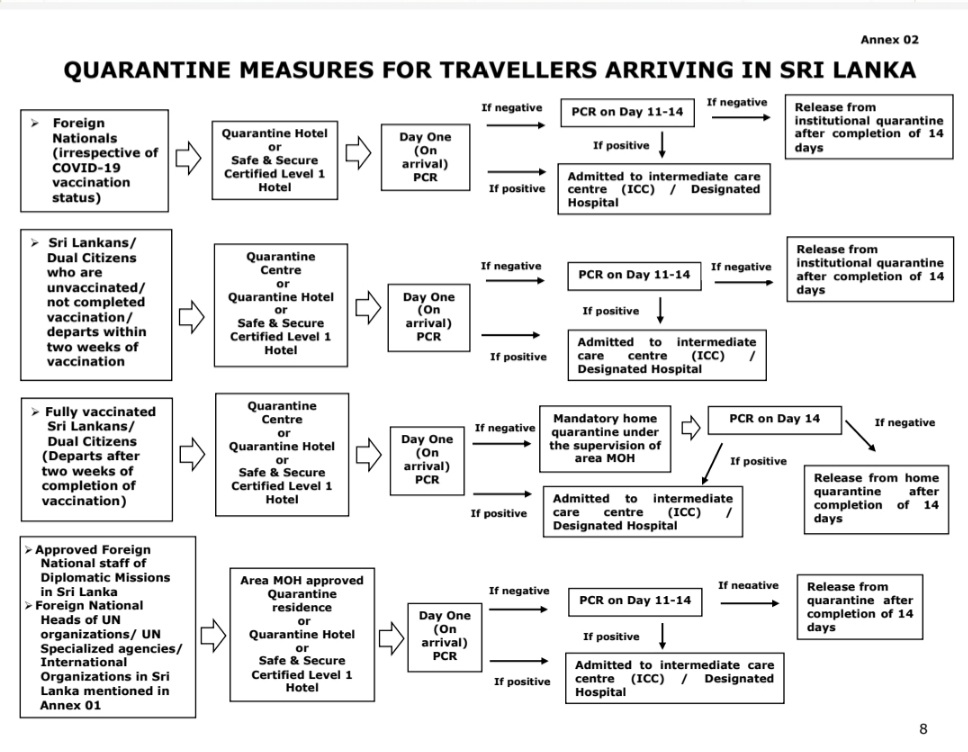
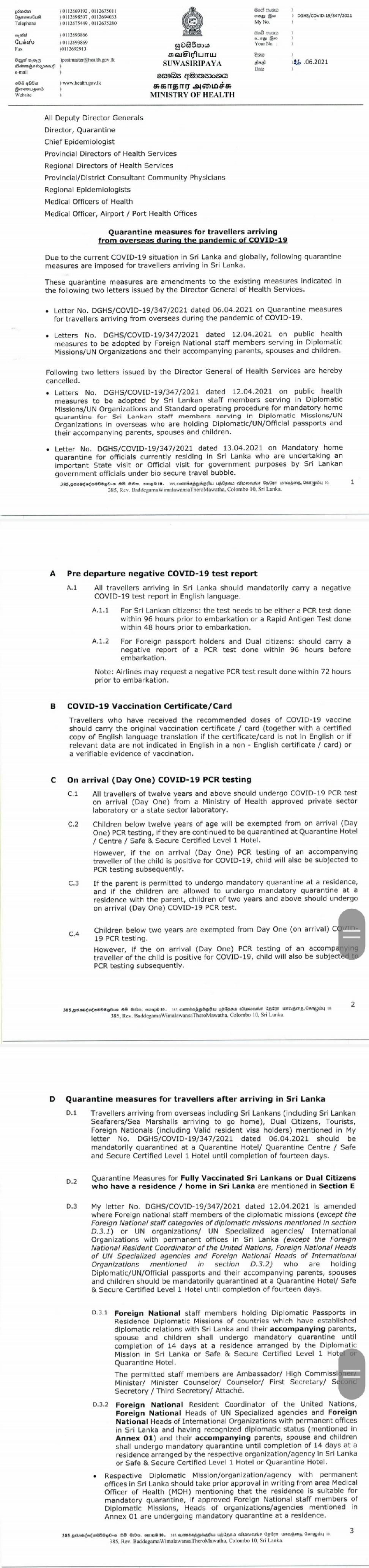
Updated quarantine guidelines issued for travelers arriving in Sri Lanka

June 27th, 2021

Courtesy NewsIn.Asia

Colombo, June 27 (NewsWire) – Sri Lanka’s Health Ministry has released an updated version of the quarantine guidelines for travelers arriving in Sri Lanka.

The new guidelines are effective from July 1st to July 31st.

Subscribe to our Whatsapp channel for the latest updates on the news you need to know

For similar articles, join our Whatsapp group for the latest updates. – click hereTags:Covid-19QuarantineSri Lankatravel

Lankan President tells Mahanayakes he will not go back on banning chemical fertilizers

June 27th, 2021

Courtesy NewsIn.Asia

Colombo, June 27: Sri Lankan President Gotabaya Rajapaksa has informed the highest Buddhist Council, the Maha Sangha, including the Asgiri Mahanayaka Thero, that he will not take back the decision to allow only organic. His aim is to endow a healthy future for the country, he told the religious leaders.

The President also assured that he will not allow any farmer to face inconveniences during the implementation of the program.

Due to the use of chemical fertilizers, farmers in many parts of the island suffer from many non-communicable diseases including kidney disease. The damage they have done to the environment is immense he added.

The government also spends more than US$ 400 million annually on chemical fertilizer imports. The President pointed out to the Maha Sangha that the use of organic fertilizer would enable the farmers to receive the funds that flow out to foreign companies when importing chemical fertilizers.

The President made these remarks when he called on the Maha Sangha including the Mahanayake Theros of the Asgiri Chapter on June 27.

President Rajapaksa said that prior to 2015 the country made tremendous progress in a short period of time as the government officials did not hesitate to take decisions. He pointed out that these officials had to face various difficulties during the previous government’s tenure, including imprisonment on false charges. Government officials are reluctant to take decisions and implement them for fear that they would be punished in the future for implementing development plans. Therefore, it is unfortunate that many activities in the country are being disrupted due to this unnecessary fear, the President said.

Most Ven. Warakagoda Sri Gnanarathana Thero, the Mahanayake of the Asgiri Chapter, commended the President for the program implemented to successfully face the Covid-19 pandemic.

The President briefed the Mahanayake Thero on the vaccination drive being carried out to control the Covid-19 pandemic. The Mahanayake Thero chanted Seth Pirith and blessed the President. The caretaker of the Muthiyangana Rajamaha Vihara Ven. Dr. Muruthdeniye Dhammarathana Thero was also present.

END

සිංහල බෞද්ද ව්‍යාපාරිකයන් විනාශ කරන කුමන්ත‍්‍රණයක්…- දයාසිරි

June 27th, 2021

උපුටා ගැන්ම ලංකා සී නිව්ස්

රසායනික පොහොර තහනම් කිරීමේ ක්‍රියාවලිය තුළ මෙරට දේශීය සහල් ව්‍යාපාරිකයන් විනාශ කිරීමේ කුමන්ත්‍රණයක් ක්‍රියාත්මක වන බව රාජ්‍ය අමාත්‍ය දයාසිරි ජයසේකර මහතා සඳහන් කරයි.

කෙනෙකුගේ දෙන්නෙකුගේ ඉල්ලීම අනුව රසායනික පොහොර තහනම් කිරීම මගින් රට තුළ තිබූ සහලින් ස්වයංපෝෂිත තත්ත්වය නැති වී යනු ඇත බවද ඒ මහතා පවසයි.

මේ හරහා සිදුවන්නේ සිංහල බෞද්ධ ව්‍යාපාරිකයන් විනාශ කිරීමේ වැඩපිළිවෙලක් බව පෙනී යන බවද ඔහු පෙන්වා දෙයි.

ඉදිරියේ දී තවදුරටත් සහල් හිගය උග්‍ර වනු ඇති බවත් මේ හරහා විදේශයෙන් සහල් ආනයනය කිරීමට සිදු වනු ඇති බවත් පැවසූ ඒ මහතා මෙමඟින් මෙරට සහල් ස්වයංපෝෂිත තත්ත්වය බිඳ වැටෙන බවද කියා සිටියේය.

කෙසේ නමුත් කාබනික පොහොර ව්‍යාපෘතියට විරුද්ධත්වයක් පල නොකරන නමුත් එය එක්වරම නොව ක්‍රමානුකූලව කළ යුතුව තිබූ දෙයක් බවද අමාත්‍යවරයාගේ අදහසයි.

Over 400 people from WP obtained AztraZeneca second dose in Galle: Inquiry reveals

June 27th, 2021

Courtesy The Daily Mirror

A probe has revealed that a total of 425 people from the Western Province had obtained the COVISHIELD second dose in Galle violating quarantine regulations on June 5 and 7, the Health authorities said.

A total of 632 individuals had received the second dose of the AstraZeneca vaccine in Galle on the relevant dates out of which 425 persons were from the Western province.

State Minister Channa Jayasuma earlier told in Parliament that an investigation would be carried out on the relevant incident after it was reported by media.

President says decision on organic fertilizer will not be reversed

June 27th, 2021

Courtesy Adaderana

President Gotabaya Rajapaksa has informed the Maha Sangha that he will not take back the decision to use organic fertilizer towards endowing a healthy future generation to the country, the President’s Media Division (PMD) said today.

Further, he has assured that he will not allow any farmer to face inconveniences during the implementation of the programme.

Due to the use of chemical fertilizers, farmers in many parts of the island suffer from many non- communicable diseases including kidney disease and the damage it has done to the environment is immense. The government also spends more than USD 400 million annually on chemical fertilizer imports, the PMD added.

The President has pointed out to the Maha Sangha that the use of organic fertilizer would enable the farmers to receive the funds that flow out to foreign companies when importing chemical fertilizers.

The President made these remarks calling on the Maha Sangha including the Mahanayake Theros of the Asgiri Chapter earlier today.

Prior to 2015, the country made tremendous progress in a short period of time as the government officials did not hesitate to take decisions, President Rajapaksa stated. Nevertheless, he pointed out that these officials had to face various difficulties during the previous government’s tenure, including imprisonment on false charges. The public officials are reluctant to take decisions and implement them for fear that they would be punished in the future for implementing development plans, he added.

Therefore, it is unfortunate that many activities in the country are being disrupted due to this unnecessary fear, the President said further.

Meanwhile, Most Venerable Warakagoda Sri Gnanarathana Thero, the Mahanayake of the Asgiri Chapter, commended the President for the programme implemented to successfully face the COVID-19 pandemic.

The President has briefed the Mahanayake Thero on the vaccination drive carried out to mitigate the virus outbreak.

He visited the Asgiri Gedige Rajamaha Vihara and paid a courtesy call on the Most Venerable Wedaruwe Upali Thero, the Anunayake of the Asgiri Chapter. The prelate, who praised the programme implemented by the President, invoked blessings on the President. Ven. Dr. Godagama Mangala Thero, senior Sangha Sabikmember of the Asgiri Chapter was also present at the occasion.

The President called on the Anunayake of the Asgiri Chapter Most Ven. Anamaduwe Dhammadassi Thero, the Registrar of the Asgiri Chapter Most Ven. Dr. Medagama Dhammananda Thero, the Deputy Registrar of the Asgiri Chapter Most Ven. Narampanawe Ananda Thero.

Meanwhile, Chief Incumbent Ven. Keppetiyagoda Siriwimala Nayaka Thero and other members of the Maha Sangha chanted Seth Pirith and invoked blessings on President Rajapaksa when he visited the Rajopawanarama Vihara in Gatambe.

Diyawadana Nilame Nilanga Dela and Buddhasasana Ministry Secretary Professor Kapila Gunawardana were also present at this event, the PMD added.

Daily COVID cases count hits 1,767

June 27th, 2021

Courtesy Adaderana

The Health Ministry says 522 more people have tested positive for COVID-19 today (June 27) increasing the daily count of positive cases to 1,767.

Earlier this evening the ministry confirmed 1,245 more positive cases of novel coronavirus.

All new cases reported within the day have been associated with the New Year cluster, which recorded a total of 245,747 virus infections since mid-April this year.

The new development brings Sri Lanka’s confirmed coronavirus cases tally to 253,518.

According to official data, as many as 218,998 patients who were infected with the virus have regained health so far. Meanwhile, the death toll now stands at 2,944.

More than 31,615 active cases are currently under medical care at designated hospitals and treatment centres.

COVID death toll up by 43 new fatalities

June 27th, 2021

Courtesy Adaderana

Sri Lanka has recorded 39 more COVID-19 related fatalities confirmed by the Director General of Health Services on Saturday (June 26).

The new development has pushed the official death toll due to the virus in Sri Lanka to 2,944.

According to the data released by the Department of Government Information, the new victims confirmed today include 12 females and 27 males.

One of the victims was aged below 30 years, 12 were between 30-59 years and the remaining 26 were aged 60 and above.

EPIDEMIC CONTROL AND SOCIAL DISTANCING

June 26th, 2021

BY EDWARD THEOPHILUS

Sri Lanka had been experienced the control of various human epidemics since its human history There are contrasting opinions on this matter.). All epidemics were in Sri Lanka had been controlled by the use of the most powerful technique, social distancing. The term has a different meaning in a practical situation and it should be adapted to an epidemic in which the actual nature was identified. Humans have specific wisdom and they use such wisdom to get out of an epidemic. The idea of social distancing naturally comes to each person when they were born. At the beginning of COVID-19, the public was instructed by Health Authorities to follow social distancing rules, health, and hygiene practices. In urban areas, social distancing is the most difficult role that makes many apprehensions in adhering to. The major reason is an excessive population in towns and the cultural habit of people and characteristics of people force them not to listen to instruction.

The excessive population has been created by ignoring population controls. Many factors that have been contributed to the increase in family members and religions discouraged family planning without logical reasons. The direct impact of over-population is the shortage of resources for people, especially land for housing, more people migrating to urban areas from rural areas, dividing lands into small pieces, fewer job opportunities in urban towns than the rural area, increase in need of transport facilities, a requirement of the location of education institutions in urban areas, and many other thousands of concussions. A large population has become an arduous factor in controlling the Covid pandemic and many people such as politicians, social activists, and religious guides are scared to talk about the truth as they will be unpopular among the public.

In the modern era, an additional issue has arisen with the increasing population that is relating to looking after elderly people. In Western countries, looking after elderly people or age care is an industry that provides many employment opportunities. Small age care business is in Sri Lanka, but value practice is children look after parents and it is not a business. It is observable a simple conflict of attitudes on age care in Sri Lanka and developed countries.

Developed countries use social integration as a strategy for the increase of employment opportunities in various ventures (sports, nightclubs, cinemas, dramas halls, party venues, restaurants, and many places) while attempting to give happiness to people, and social distancing treats against social integration for economic purposes and promotes business opportunities in service area. Not only in Sri Lanka but also people in other countries cry against social distance practices. It is observed that people in Sri Lanka manipulated minor issues and politicians jump into such situations and make the big pass on the issue. Mr. Gotabhaya Rajapaksa has explained the truth about the pandemic by his reason public address. He has a wonderful vision and mission. Covid it was not created by him and people think mistakenly, he handles it. It is wrong and blaming him for the global problem.

Disciplining has become a way of socialization and now, social distancing should be treated as a part of socialization. The major role of schools to train kids for socialization promoting values as parents have to take part in workplaces for earning money for living, and parents have less time to educate kids about socialization. Social distancing has become an essential part of controlling pandemics and people have relegated many obscure when social distance is effective.

Developed countries incorporated many aspects of disciplining kids, and the education in Sri Lanka and India failed to discipline people to understand issues and work consistently to the advice of authorities. This situation became the major reason to go covid out of control and the policymakers have not taken into consideration this side of epidemic control.

Historical information provides that Sri Lanka suffered from various epidemics, one of the major epidemics was smallpox that killed hierarchies of administration in the Kandyan kingdom.  Smallpox and all other epidemics were controlled by using the technique of social distance and in history, nobody went against social distancing practices, however, it shows now that people do not respect social distancing practice, and daily report of covid infection is going up and a considerable volume of people killed from the disease. 

Social distancing, general health, and hygiene practice, and value education are essential curriculum that should be educated in schools. Kids in Sri Lanka want to gain education to work overseas because they cannot find work in the country and young people have a mythical view that going overseas is the best option they have because opportunities in the country are less and when critically evaluate the idea it shows that those who have gone overseas are not spending a happy life because they achieved the wish and many use the achievement to make lies on a life of overseas.  

Australia, New Zealand, and many countries have successfully controlled the pandemic (1) population is lesser in those countries consistent with the land area, (2) people are disciplined and listen to authorities (3) governments quickly take action, politics did not become a barrier to implement instruction. It is showed that people were not disciplined in Sri Lanka, they broke social distance rule, health, and hygiene instruction.

In the policy development process, the government of Sri Lanka needs to stress the following areas.

  • People should be motivated to maintain one child for a family, and like in China, this rule should be successfully implemented. Religions and races are immaterial in this practice.
  • Sri Lanka should plan to reduce the population to 15.0 million in the country within the next 10 to 20 years without a racial and religious difference.

Large population in the world have created many problems, many economists look at this issue from market aspect but it creates many disadvantages. I can predict that if the population of Sri Lanka at the level of 1972 Covid will not spread like today.

ERASING THE EELAM VICTORY Part 20 C8 B

June 26th, 2021

KAMALIKA PIERIS

United Kingdom led a global offensive at the United Nations Human Rights Council (UNHRC) in Geneva to prosecute ‘war crimes’ against Sri Lankan soldiers. Critics are now going at UK for its own violation of human rights and they are starting with the British Empire. Jallianwallah Bagh massacre of 1919,   Peshawar massacre of 1930, Batang kali massacre in Malaysia and so on.

UK suppressed the Mau Mau rebellion in Kenya with great severity. 30,000 were massacred. There was torture. There were   concentration style camps. One million rebels were forcibly settled in heavily policed new villages where many died of starvation and illness, said critics.

The British conducted a ‘dirty war’ In Northern Ireland. British intelligence set up loyalist terror groups against the IRA. UK army carried out targeted assassinations on suspected IRA operatives. The campaign was directed by British intelligence.

Britain participated in the US-Iraq war, conducted without UN sanction. ICC investigated and found that that there is a reasonable basis to believe that members of the British armed forces committed the war crimes of willful killing, torture, inhuman/cruel treatment, outrages upon personal dignity, and rape and/or other forms of sexual violence in Iraq.

 UK soldiers in Iraq had committed crimes against detainees. There were hundreds of testimonies of allegations of torture.  There was brutality, cruelty and sadism, including sexual abuse and religious humiliation. There was deprivation of food and water.    They used brutal violence which at time resulted in the death of detainees while in custody. ICC found that the cause of some of this was military command failures.” The head of British army and former defense minister were among those named.

ICC laid out the findings of its preliminary examination in a 184-page report.  But in 2006, prosecutor of the International Criminal Court, Fatou Bensouda said she was dropping the preliminary investigation into alleged war crimes by British troops in Iraq, even though she found a reasonable basis to believe they committed atrocities.

There was little doubt that war crimes had been committed but the number of cases submitted were too low for investigation. The case would now be closed and no full-scale investigation would be launched. If fresh evidence emerged, she would reconsider her decision.

The ICC withdrawal was met with dismay. Human Rights Watch said this closing down of the UK inquiry will indicate the existence of double standards at the ICC, one approach for powerful state and another approach for the less powerful states.

A devastating 250 page dossier titled ‘The responsibility of UK officials for war crimes involving systematic detainee abuse in Iraq 2003-2008’ was presented to the ICC in 2014.  This was prepared by Public Interest Lawyers (PIL) and the European Centre for Constitutional and Human rights (ECCHR). It called for an investigation into the alleged war crimes of Britain.

ICC called the document a damaging dossier that draws on thousand of allegations of mistreatment amount to war crimes of torture, of cruel inhuman or degrading treatment. This ranged from hooding prisoners to electric shocks, threats to kill, sexual assault, threats of rape. The sheer scale and seriousness of the allegations passes the threshold to justify an investigation. British military commanders knew or should have known that forces under their control were committing or about to commit war crimes.

Since a lot more information has come to light, ICC   formally reopened its inquiry in 2014.  UK said that allegations are being investigated and there is no need for the ICC to get involved.

The UK has a lamentable record of failing to prosecute war crimes committed by its nationals overseas, said  Human Rights Watch.  UK government has repeatedly shown little interest in investigating and prosecuting atrocities committed abroad by British troops. There has just been one prosecution of UK forces for war crimes in Iraq and Afghanistan in the last 20 years.

The UK government has blatantly interfered in the military justice system to prevent investigations and prosecutions. Special Air Service soldiers have been charged   executing  33 civilians in Afghanistan in a series of raids in Helmand province in early 2011. One incident, involved the deaths of four men in one family. The case was investigated but there were no prosecutions.

The UK military has been accused of covering up credible evidence of war crimes by soldiers against civilians in Afghanistan and Iraq, according to leaks last year from two government-ordered inquiries, said critics. Phil Shiner, who investigated the Iraq issue was found guilty of misconduct and dishonesty and was struck off the register.

Britain is now getting worried that it may have to face war crimes charges in the near future. Therefore the government needed to take precautions. In 2020, it introduced Overseas Operations (Service Personnel and Veterans Bill, which subsequently was passed as Overseas Operations (Service Personnel and Veterans) Act, 2021.

This Act was intended to protect British soldiers from investigations for acts carried out in operations outside the British Islands, including peacekeeping operations and terrorist operations. A statute of limitations was set down. The Act said no charges may be laid after the lapse of five years from the date of the incident. Permission of the Attorney General must be obtained before any prosecution can be made.

The prosecutor must also  keep in mind the exceptional demands and stresses to which  soldiers are likely to be subject while deployed on overseas operations .Prosecutor must also take note of the likely impact of the  prosecution on the mental health of the accused. Prosecution must also take into account the limitations of recall, the ability of persons to remember events accurately.

This Bill was strongly opposed by the legal community in Britain. They were shocked at the inclusion of ‘heinous’ crimes in this evasive Bill. They saw this inclusion as a serious breach of Human Rights Law. TheHouse of Lords took note of this and when the Bill came to them, in Parliament, they saw to it that the following serious crimes, namely, sexual offences, torture, crimes against humanity, genocide and war crimes were removed from this Act.

The Bill included provisions which appeared to pervert natural justice. Lawyers objected to conferring an unprecedented statutory ‘presumption against prosecution’ on British troops in regard to ‘historic’ crimes. Such a quasi-statute of limitation” is unprecedented” in the criminal law. It will pervert justice they said.

Why does this Bill think that it is utterly exceptional for a British soldier to be prosecuted for offences committed when he was on an overseas operation,   critics asked. Why create a special category of defendant, members of the Armed Forces, and give them greater impunity for crimes.

We do not understand why cases should not be brought against this category of defendant where there is sufficient evidence of a crime having been committed and where it is in the public interest to prosecute. The fact that a person has been deployed on operations overseas is   irrelevant for prosecutions.

The clause regarding the mental state of the person to be charged gave rise to much sarcastic comment. The Bill suggests that a soldier whose judgment may be impaired, who lacks adequate self-control or whose mental health may have been affected should not be prosecuted, observed critics.

The Ministry of Defence should not be deploying service personnel in overseas operations if those individuals are unable to make sound judgments or have difficulty in exercising self-control. If a member of the Armed Forces develops an inability to make sound judgments or difficulty in exercising self-control whilst they are deployed in operations overseas, they should be promptly removed.

Armed Forces personnel are routinely called upon to make snap decisions in exceptionally difficult, often life-threatening, situations. This is what they are trained to do. Further, Armed Forces personnel are trained to use force and do not use force unjustifiably. They should not be permitted to use unjustified force and then get away with it.

Lawyers pointed out that this Act would damage the standing of the British armed forces because it is contrary to established legal norms, both domestic and international.  Also, it would give the impression that UK is unwilling or unable to investigate and prosecute for war crimes. The time period of five years given in the Act is near impossible to meet. If so, then British armed forces are at risk of being prosecuted under universal jurisdiction or before the International Criminal Court.  Lastly, the Bill goes against all international legal instruments. (Continued)

If Nicaragua could take US to international court & win – shouldn’t Sri Lanka do same to India?

June 26th, 2021

Shenali D Waduge

In April 1984 Nicaragua referred the US Government to the International Court of Justice claiming the US violated international law by supporting the Contras. The ICJ ruled in favor of Nicaragua in 1986 & demanded reparations be paid to Nicaragua. The US did not participate in the court proceedings. The US also blocked enforcement of the judgement & thus prevented giving compensation. India’s role and interference in Sri Lanka is well documented and one that demands Sri Lanka should officially put India’s interventions internationally – seek apology & reparations too.

The ICJ held that the US was

  • ‘in breach of its obligations under customary international law not to use force against another State’
  • not to intervene in its affairs”
  • not to violate its sovereignty”
  • not to interrupt peaceful maritime commerce”
  • in breach of its obligations under Article XiX of the Treaty of Friendship, Commerce & Navigation between the Parties signed in 1956.

The US intervention in Nicaragua goes back to early 1909s. Background reading on the Contras, Oliver North and various US administrations will reveal much.

The case in point & what Sri Lanka can take note of from the charges filed by Nicaragua against the US was that the US was recruiting, training, arming, equipping, financing, supplying and otherwise encouraging, supporting, aiding & directing military and paramilitary actions in and against Nicaragua” – was this not what India was doing to Sri Lanka via Tamil militant groups that India created. Jain Commission report even gives the locations of where India trained these Sri Lankan Tamil groups.

Nicaragua accuses US of violating international Treaty Obligations:

  • Article 2(4) of the UN Charter
  • Article 18 & 20 of the Charter of the Organization of American States
  • Article 8 of the Convention on the Rights & Duties of States
  • Article 1, 3 of the Convention concerning the Duties & Rights of States in the Event of Civil Strife
  • US breached customary international law by
  • Violating the sovereignty of Nicaragua – armed attacks against Nicaragua by air, land & sea, incursions into Nicaraguan territorial waters, aerial trespass into Nicaraguan airspace, direct & indirect coercions & intimidations
  • Using force & threat of force against Nicaragua
  • Intervening in internal affairs of Nicaragua
  • Infringing the freedom of the high seas & interrupting peaceful maritime commerce
  • Killing, wounding & kidnapping citizens of Nicargua

These allegations, immediately call to mind how India forced the signing of the Indo-Lanka Accord in 1987. A call to the Sri Lankan envoy in Delhi with a subtle threat to not take action, the violation of Sri Lanka’s air with the infamous parippu drop, carrying Prabakaran & family to India by helicopter, the many Sri Lankans raped & killed by Indian Peace Keepers, the violation to Sri Lanka’s marine bed using internationally banned bottom trawlers, the stealing of Sri Lanka’s fish, the illegal immigrants, the interference in Sri Lanka’s internal affairs – the list goes on.

What is noteworthy is that while the US put forward arguments against the judgement of the Court, the countries that sided with US did not challenge the Courts judgement, its findings or the merit of the case. Undoubtedly, all of India’s neighbors will side with Sri Lanka, as these countries have all been victims of India’s intervention too.

The judgement listed 291 points that US was involved in ‘unlawful use of force’ – how many points can Sri Lanka list of India’s interventions in Sri Lanka’s internal affairs using ‘unlawful use of force’?

We can recall the upteen times our officials had to virtually fly every week to Delhi to brief the Indians of the progress of Sri Lanka’s military/humanitarian cause in 2009.Why did Sri Lanka have to report to India, if we are a sovereign nation?

What is poignant is that the Court concluded that even though US made its objections, US was subject to the Court’s jurisdiction.

In November 1986, the UNGA passed a non-binding resolution (94-3 against – El Salvador, Israel & US) urging US to comply with the 27 June 1986 Court ruling.

Points that the judgement gave against US is relevant to India’s interference & interventions in Sri Lanka (past and present/ongoing)

The Court rejected US justification of collective self-defense – this is similar ot the eternal parroting by India justifying interference in Sri Lanka to maintain India’s security concerns! When by the very assistance to Sri Lankan Armed groups, India has virtually invited and opened its borders for its own balkanization by this act.

Just as the Court found US guilty of training, arming, equipping, financing & suppling the Contras against Nicaragua – India by its own self-admissions via Indian diplomats, Indian military personnel, Indian journalists etc self-confess to arming LTTE and other Sri Lankan armed groups since 1970s as documented even by foreign think tanks like Council of Foreign Relations. https://www.cfr.org/backgrounder/sri-lankan-conflict(India’s Role in the Conflict)

If US was found guilty of violating the principles of non-intervention, India has to be guilty of doing same. Not only did India train, arm, financially assist LTTE & other armed groups, India even exerted pressure to amend Sri Lanka’s constitution bringing the 13thamendment and creating the headache of Provincial Council system. India continues to use diplomatic force to demand full implementation of the clauses of this agreement which India wishes to turn to its political advantage.

India forced the signing of the Indo-Lanka Accord which rested on India committing to deliver 5key clauses – which India has failed to commit. This automatically places the Accord null & void. Under the principle of International Law ‘Pacta Sunt Servanda’ (agreements must be kept) both parties must execute their mutually agreed obligations in good faith. India breached its obligations under the Accord.

The Indo-Lanka Accord was signed on 29 July 1987 in Colombo under emergency while the 13thAmendment to Sri Lanka’s constitution was passed on 14 November 1987. There is no word in the Indo-Lanka Accord that mentions amending Sri Lanka’s Constitution. The Accord makes no mention of ‘devolution’ either. There is no mention of devolution in the exchange of letters between Indian PM Rajiv Gandhi or Sri Lankan President JR Jayawardena. Their letters & the Indo-Lanka Accord only speak of the North East provinces & a system for these 2 provinces only. How did 13thamendment come about? Given that 13a is now part of Sri Lanka’s constitution, India has no right to add, remove or amend any of its clauses!

India violated Sri Lanka’s airspace with the parippu drop. India threatened Sri Lanka if we took action against India’s interventions. India rescued a terrorist and flew him & family out of Sri Lanka to Delhi where Indian PM presented this terrorist with his own bullet proof vest! India armed 35 militant groups of which LTTE became supreme virtually killing off the other leaders. Indian peace keepers killed and raped Sri Lankans, documented by LTTE itself. India trained an armed group to be headed by their poodle Varatharaja Perumal (Tamil National Army) – isn’t it ironic TNA has become Tamil National Alliance parroting what India & West wants! The use of internationally banned bottom trawlers that ruin our marine bed, marine environment and livelihood of our fishermen is a violation of Sri Lanka’s territorial waters but a marine crime as well. The influx of illegal immigrants is also a topic that needs to be taken to the table. The manner that India uses Tamils as a guineapig to exert its political will is a factor that has resulted in unnecessary tensions amongst communities. The manner India has used its powers to exert its will culturally, economically via cheap goods and manipulation of trade agreements is also a topic to debate.

Sri Lanka cannot progress primarily as a result of India feeling that India must give the nod of approval for every internal decision any Sri Lankan government makes. Even the UNHRC Resolutions by West/EU bloc came only after India’s nod of approval as did the 2002 Norwegian brokered CFA.

Sri Lanka, can come up with 101 policy papers and templates, but none of these nicely documented colourful blueprints will see light of day, if our politicians and advisors run with these documents and expect a pat on the back from India before implementing or a cut and chop if India objects!

Look at the disaster of allocating key assets for development – how can we progress if we work on mathematics that claim – if we give x, we must give y even if y has no plans to do any development and wish to only embrace it and prevent it from developing. Isnt this going to be the story of Colombo’s Western Terminal?

Unfortunately, there are some in Sri Lanka who think because of the Buddhist link Sri Lanka must remain eternally grateful to India. Siddartha was born in Nepal. There was no India. India has a history of 74 years having been christened India” in 1947 by the colonial British amalgamating independent states & territories. India is making use of Buddhism as a soft tool to gain footprint in Asia as a political tool. However, some in in Sri Lanka think they must run to India and seek its approval without realizing Sri Lanka is a sovereign state capable of making its own decisions. If Cuba can stand up to the self-righteous global bully US, why can’t Sri Lanka do the same with India?

Nicaragua may not have got compensation but it won a moral victory and the example set by Nicaragua is certainly one that Sri Lanka should take against India. Whatever friendships Sri Lanka offers to India or however Sri Lankans and Indian people are close at personal levels, India’s political framework & intel are only interested in destabilizing Sri Lanka.

Shenali D Waduge


Copyright © 2026 LankaWeb.com. All Rights Reserved. Powered by Wordpress