The first woman to be appointed as a deputy inspector general of police was removed from office just six months later.
It was a moment worthy of celebration for women in Sri Lanka when Bimshani Jasin Arachchi was appointed as Sri Lanka’s first female deputy inspector general of police (DIG) in October, 2020. This victory was short-lived, however. Six months later Jasin Arachchi was removed from her duties by a three-bench panel of the Supreme Court of Justice.
This decision followed the filing of a fundamental rights petition by 33 male senior superintendents of police (SSPs), stating that the appointment of Bimshani Jasin Arachchi as the first woman DIG violated the standard procedures followed in the promotion of senior police officers. The petitioners claim that Jasin Arachchi’s appointment was irregular as the provisions that allow for the appointment of DIGs do not include the word woman.”
Many hold a false belief that women are incapable of succeeding to […] higher ranks of the police because we are unable to do what is perceived to be ‘male’ work…
My expectation on behalf of all women is that we get a fair opportunity to prove our worth. The same selection criteria, training standards and promotions should be applicable to women as those applicable to male counterparts. It is about time this country brings a change in the society. Regardless of the sector, women should not be deprived of earning [the] recognition they deserve.
Like her female colleagues, Jasin Arachchi was no stranger to strife in her ascent to higher ranks within the Sri Lanka police force. She had to fight when securing her promotion as an assistant superintendent of police (ASP) through a fundamental rights application in 2008.
In a guest column for the Daily Financial Times, Prabodhini Munasinghe Wickrematunga explains that due to the differentiation of male and female police cadres, women are only able to progress in their careers within the structure provided for the female cadres. Only a limited number of posts are allocated for higher ranks of women officers and if these female vacancies” are already filled, women have no option to apply for other vacancies arising in the same rank that are reserved for male officers.
Archives from the Sri Lanka Police note that in 2020, eight SSP positions were allocated for female officers while 162 positions were dedicated for male officers. Once these eight positions are filled, a woman is unable to apply for a vacancy arising in the remaining 162 SSP positions reserved for male cadres, even if she were equally or more qualified. This is further compounded by the fact that female officers’ career progression in the police force stops at the title of SSP, while male officers can continue to ascend the career ladder to ranks such as DIG, senior deputy inspector general (senior DIG), and inspector general of police (IGP) – the highest-ranking position within the police force.
This is symptomatic of systemic discrimination underpinned by strong patriarchal notions that diminish the abilities of women as officers in the police force. It is also a residual effect of women being accepted into the police only in 1952, 86 years after the establishment of the police force in Sri Lanka, which by then was a male-centric institution. Adding to this, Jasin Arachchi was appointed as the first female DIG 68 years after the establishment of the female police cadre, only to be stripped from her title a mere six months later. It comes as no surprise that the female cadre position had been created with the underlying motive of maintaining the balance of power in favor of men.ADVERTISEMENT
Such norms that govern the Sri Lanka police force are in direct violation of Article 12 (2) of the Constitution of Sri Lanka, which stipulates that No citizen shall be discriminated against on the grounds of race, religion, language, caste, sex, political opinion, place of birth or any such ground.”
Female police officers are at a huge disadvantage, as the vastly unequal allotment of high-ranking cadre positions allows junior male officers to rise above senior women. Due to the prevailing norm that a woman can only rise within the female cadre positions, they cannot apply for promotions to the ranks of DIG, senior DIG and IGP. The police force does not recognize qualified women officers to hold any rank in the simply as police officers, but instead, limit their career progression through disproportionate allocations made for female cadres. This also explains why the fundamental rights petition by the 33 male SSPs calls for the word woman” to be included in promotion regulations.
The key takeaway here is that the appointment of Bimshani Jasin Arachchi should not have been done through this problematic existing structure, which does not accept women as high-ranking officers. Instead, as described by Wickrematunga in her article, the existing regulations on promotions should be amended to facilitate both men and women on an equal playing field, by allowing male and female officers to apply for the same positions through merit-based criteria. Alternatively, the structure of the existing cadres could be revised to accommodate sufficient allocations by gazetting senior ranks within the female cadre allocation to be on par with those ranks within the male cadre.
Referring to the female cadres as an ornamental police force,” veteran journalist Namini Wijedasa underlines that none of the existing women SSPs is heading any special divisions, while no female chief inspector or inspector has been made officer-in-charge of a police station – an indication that the female cadre designation still limits women’s career trajectory in the police force so that men have more opportunities, less competition, and easier access to senior positions. Wijedasa reiterates that to date, there has been no significant effort to reorganize the existing hierarchies and institutional structures of the police.
Jasin Arachchi’s case has brought these irregularities and discriminatory practices to light. It caused an uproar in urban areas of Sri Lanka and has been condemned via a public statement issued by the National Forum Against Gender-Based Violence – a collective of 53 agencies representing the government, United Nations, national and international nongovernmental organizations, community-based organizations, and individual experts in the field.
In response, a recent communiqué issued by the police spokesperson stated that Jasin Arachchi will be reappointed as a DIG, although there has been no written confirmation to date. This speaks to a conundrum now faced by the Sri Lankan police on how to retain a qualified female DIG within the existing institutional mechanism, while accommodating other senior women police officers that remain stagnated at the SSP level.
More often than not, there is a definite lack of accountability sprinkled with denial when perusing the subject of women’s access to and opportunities for leadership. For instance, when questioned on Sri Lanka’s limited female representation in leadership, political commentators are quick to respond that the country has witnessed the leadership of a woman prime minister (also the world’s first woman PM), and a woman president, without really addressing the core issues that prohibit women from shattering that glass ceiling. What commentators conveniently forget to mention is that both former Prime Minister Sirimavo Bandaranaike and former President Chandrika Bandaranaike Kumaratunga came from the same family with deep-seated political roots. Both women also garnered the sympathy vote to some extent, having run for office after their spouses were assassinated while leading active political lives. Therefore, their success cannot be applied to the average woman aspiring to enter Sri Lanka’s political arena, as witnessed in the abysmally low percentage of women legislators in Sri Lanka’s present parliament (only 5.3 percent women legislators, or 12 out of a total 225 legislators).
Sri Lanka should take a clear look at amending archaic systems and structures that discriminate against women aspiring for power, not only in the police force, but also in other sectors such as subnational and national government, the tri-forces, the private sector, etc. As a country healing from a 30-year civil conflict, it is essential that these underlying discriminatory practices be addressed in a systemic and structural manner in order to productively engage half of the country’s population – i.e. women – in sustainable peacebuilding and development processes, with ample opportunities for meaningful leadership.AUTHORS
GUEST AUTHOR
Lihini Ratwatte
Lihini Ratwatte is a development practitioner based in Sri Lanka. She has a BA in International Studies, Communications and Gender Studies from Monash University; and a MA in Global Diplomacy from SOAS – University of London. Ratwatte writes on the nexus of gender, development, peacebuilding and security in the Asia-Pacific region. The opinions expressed in this article are her own and do not represent the views of any affiliated organization.
While wishing the members of the Venerable Maha Sangha and the Buddhist public, a blessed Vesak celebration, Archbishop of Colombo His Eminence Malcolm Cardinal Ranjith said that in these troubled times, when Covid-19 is afflicting our nation, it is important for us to think about our life options in the light of the teachings of the Lord Buddha.
In his Vesak message, the Cardinal said it was also important to live a life based on the spiritual principles of self- negation and dedication to the wellbeing of one another.
The full message:
On the occasion of the celebration of the threefold festivities of the Birth, Enlightment and the Death of the Lord Buddha, I write to express our most sincere and fraternal greetings to the Most Rev. Mahanayake Theros and the members of the Sangha as well as to all our Buddhist brothers and sisters in Sri Lanka.
The Lord Buddha who, troubled by the immense suffering his fellow human beings were seen to be facing, left all the comforts of his royal upbringing and engaged in a search for personal liberation from that suffering. After following several ways of searching for a meaning to life, he found it in the understanding of greed as the cause of all suffering, its true nature and the path to freedom, which leads one to Nirvana, a total state of bliss.
His preaching led to the acceptance of this path to emancipation by millions of human beings the world over. The Lord Buddha’s teaching has also been the foundational source of Sri Lanka’s culture and religiosity. It has influenced us too and continues to shape our national identity.
In these troubled times, when Covid-19 is afflicting our nation in a significant manner, it is important for us to think about our life options in the light of the teachings of the Lord Buddha and live a life based on the spiritual principles of self- negation and dedication to the wellbeing of one another.
I wish all our beloved fellow citizens, specifically the members of the Venerable Maha Sangha and the Buddhist public, a blessed Vesak celebration.
Sri Lanka’s COVID-19 death toll saw an uptick today (May 26) as Director-General of Health Services confirmed 29 more victims.
The latest fatalities have moved the country’s death toll to 1,298, according to official data.
Two of the deaths took place on May 26 and the remaining victims have succumbed to the virus infection between the period of May 20 – May 25, the Department of Government Information stated.
The deceased were identified as residents of Kalutara, Haliela, Mawathagama, Kurunegala, Galgamuwa, Minuwangoda, Maspotha, Kekunagolla, Polgahawela, Anguruwathota, Gonapola, Bulathsinhala, Nainamadama, Hapugasthalawa, Nawalapitiya, Raththota, Koswatta, Malwana, Mattakkuliya, Nawalapitiya, Colombo 14, Colombo 15, Valachchenai and Katuneriya areas.
The youngest among the latest victims was identified as a 20-year-old female who died of cardio pulmonary arrest followed by hypoxia and exacerbated by cardio pulmonary abnormalities and COVID-19 respiratory tract infection.
Acting Solicitor General Sanjay Rajaratnam has been sworn in before President Gotabaya Rajapaksa, as the 48th Attorney General of Sri Lanka.
The new Attorney General took oaths at the Presidential Secretariat in Colombo this evening (May 26), the President’s Media Division (PMD) said.
Rajaratnam, who served the Attorney General’s Department for the past 34 years, has held the posts of Senior State Counsel, Deputy Solicitor General, Additional Solicitor General and Senior Additional Solicitor General before being appointed as the Acting Solicitor General in 2019.
Educated at St. Peter’s College and Royal College in Colombo, Rajaratnam holds a Master of Laws from the Queen Mary University of London. He is also a Solicitor of England and Wales.
Rajaratnam was sworn in as a President’s Counsel in 2014, before then-President, PM Mahinda Rajapaksa.
With an extensive experience in civil law and criminal law, Rajaratnam has appeared in several notable cases as well.
Rajaratnam also served at the consultant of Financial Intelligence Unit of the Central Bank of Sri Lanka (CBSL). He is a member of Law Commission of Sri Lanka and the Council of Legal Education.
Sinovac, China’s other front-runner COVID-19 vaccine, will be manufactured in Sri Lanka, says State Minister of Production, Supply and Regulation of Pharmaceuticals Prof. Channa Jayasumana.
Developed by Beijing-based biopharmaceutical company ‘Sinovac’, the vaccine is officially named CoronaVac. It uses inactivated viral particles to create an immune response.
The Chinese Ambassador to Sri Lanka has confirmed that the government of China will sponsor the process, the State Minister said further. Several rounds of discussions we have held in this regard have been fruitful. We expect to manufacture the Sinovac vaccine in our country within the next two months, as a joint venture between the Sri Lankan and Chinese governments.”
Prof. Jayasumana said preliminary preparations on the process are currently under way at a factory in Kundasale.
Meanwhile, Sri Lanka today (May 26) received the second batch of Sinopharm coronavirus vaccine donated by the government of China. SriLankan Airlines flight UL-869 carrying 500,000 doses of vaccines had departed from Beijing on Tuesday and touched down at the Bandaranaike International Airport (BIA) in Katunayake early this morning.
The Chinese Ambassador officially handed over the vaccine consignment to Minister of Health Pavithra Wanniarachchi at the BIA.
State Minister Jayasumana, who joined the event, revealed that Sri Lanka is expecting 2 million more Sinopharm jabs within the next month as part of a purchase order placed by the State Pharmaceutical Corporation (SPC).
Toronto – May 25, 2021. Bill 104: Tamil Genocide Education Week
Act was passed in Ontario without fact checking and amid a huge line-up of
deputation requests to the Clerk of the committee by thousands of concerned Sri
Lankans of Canadian Origin. This Bill was released to the 3rd reading
without modification on the 5th of April and passed without debate from
the Ontario legislature on the 6th of May in an unprecedented move by the
Ontario Conservatives purely intended to pacify electoral votes for the
upcoming election.
The 2nd para of the new Law that praises Liberation Tigers of
Tamil Eelam (LTTE) as freedom fighters and GoSL as perpetrators,
states:
Genocide
is the deliberate and organized killing of a group or groups of people, with
the intention of destroying their identity as an ethnic, cultural or religious
group. Acts of genocide against the Tamils started in 1948 after Sri Lanka
gained its independence and were perpetrated through Sinhala-Buddhist
centric government policies, pogroms, land grabs and ethnic cleansing.
The bill does not contain any text that the GoSL have a right to defend
its citizens just as much Canadian forces would defend Canadians in the sight
of brutal terrorists. Many United nations reports highlight LTTE Tamil
Terrorists’ use of suicide squads and child soldiers to bring terror to all
parts of Sri Lanka.
Buddhist monks have been a constant target of the LTTE. One such instance was
the Aranthalawa massacre of 33 Buddhist monks, most of them young novice monks,
and four civilians by cadres of LTTE Tamil Tigers on June 2, 1987, close to the
village of Aranthalawa, in the Ampara District of Eastern Sri Lanka. In
recent news Buddhist monks were also the target of pro-ltte
elements.
The inference of Buddhists to be behind violence, is against the
5 Precepts of Buddhism to help people behave in a moral and ethical way.
My
child learns about how Buddhists caused violence and then goes to Dhamma school
to learn five precepts” claimed one parent who wished to
remained anonymous.Since the scope of the Bill is Education, which is a
provincial jurisdiction, all Ontario schools are now in scope to receive
materials in-line of this hate speech and radicalization.
Buddhism has one of the largest following in the world with
around 535 million people with China having the largest following with around
244.1 million, while Cambodia has the largest per country following of around
96.9% of population. Sri Lanka has a Buddhist population of around 70.2%.
There are political and court avenues to repeal the bill that is
causing much embarrassment to those who supported it openly. An MPP can present
a motion to repeal the Bill which then have to be passed from the house. With
the current money power of pro-LTTE diaspora, it is unlikely that the
politicians will turn an eye on the facts, as they are focused on re-election.
The other method is to bring the fight to court and let justice
prevail. Spokesman for Sri Lankan Canadian Action Coalition(SLCAC) stated that
a legal fund to collect funds to fight this Bill in court was launched as the
armed conflict was never accepted by the Federal government or the United
Nations along with a list of impingements in provincial and federal acts by
Bill 104. He stated the trajectory of the case ending up at Supreme court raises
more pressure on fundraising. Currently SLCAC is seeking support from
businesses and people from around the world to donate to the GoFundMe campaign to help fight the Bill
104 in court.
Sarath Wijesinghe President’s Counsel, former Ambassador to UAE and Israel, President Ambassador’s Forum
Unseen, unknown, uncontrolled ferocious virus in action
The above statement by H E the President is so important and crucial
when the country and the world is going through a most difficult patch in the
annuals of history on health crisis when some parts of the world ‘Human’ are
dying at an unprecedented rate. President’s statement should be properly
understood and interpreted as coming from a person struggling with other world
leaders to save the lives of the people dying of the unknown, unseen,
uncontrolled virus spreading freely unconcerned and with freedom to spread due
to the careless making of the human by default. Indeed there is a duty by all
citizens, including professionals, journalists, politicians including
governance and the opposition with critics and all concerned citizens to know
their limits duties and parameters until the end of the difficult period we
bound to achieve one day to come sooner or later based on our own acts and
behaviour. Still, we are not disciplined and not behaving properly. President
needs help from every segment of the society to win the war on the dreadful
virus spreading fast. Whilst one group is making all attempts to control the
pandemic and the impact on the human race, some attempt to take advantage of
the situation for personal political and professional uplift with the most
selfish motives. Undoubtedly the success of the major pandemic depends on the
joint efforts and operations in the most organized and scientific methods for
the end to be a success story-the ambitions of the majority and one wonders
whether some have different views with different agendas. We were successful in
the first wave, but messed up in two and three by our own making with the
number of deaths and countless and unimaginable disastrous consequences to the
community fearing of invasion of a wave similar to India, and the President is
trying the best with the group led by the political front and the able Army
Commander struggling hard with his team seeking a vision for the campaign and
it seems a vision is insight learning from previous mistakes In this most
serious and ferocious pandemic situation.
The assistance of the opposition and independent activist including the
media is an essential component reminding of the contributions made by the
traditional left opposition during the post war malaria and smallpox
situations, when the modern leftists and opposition is making irresponsible
statements with no constructive propositions, directions or guidelines to see
an end to the agony which is brewing so rapidly spreading the third wave faster
than expected. Media being the fourth pillar of democracy, has to be careful
when there is a national and international calamity on pandemic situations
citizens dying in India and many parts on the road and in front of hospitals
which we witness on television images with crying eyes and helplessness and
sadness cursing the cruel virus spreading fast. This is the time the media
should act and react with a sense of responsibility, avoiding exaggerations,
misrepresentations, and misreporting for personal and professional gains
breaking the accepted norms and policies of journalism, a noble profession the
journalists are engaged in. Having witnessed carefully, we find the most
journalists and some professionals are doubtful whether genuine and straight
forward to speak the truth to the world and the President may justified his
contention and it is time for them to change the stunt and themselves being
independent professionals answerable to the people and not to the President. In
the resolution of the crisis, the help of the journalist and the professionals
are imperative and it is time they change themselves in the side of the
country. The world is helpless to help others, when many parts of the
hemisphere have not received a single dose of vaccine. Are we not fortunate in
that sense being helped to a certain extent despite our foreign policy and
relations are not in the expected standard? The unseen and uncontrolled virus
is flourishing, attacking the world over. Today our death toll is 600 and in
India 300,000. It is indeed worrying.
Not satisfied with the way pandemic is fought but it is not the time to
change governance-‘give a chance’
We are not satisfied at all on the way the pandemic is fought, and many
steps taken by governance. But this is not the time to change governance or
resist the efforts by the professional and the dedicated health group wanting a
vision and scientific directions, as in Israel and the United Kingdom
successful today in combating the menace with minimum deaths and the pandemic
arrested. Fortunately, Army and forces are doing an excellent job with no
proper vision but following instructions to the last word. We come across
irresponsible voice cuts, statements, and advice by pseudo scientists, and
officers with conflicting and different views enjoying taking to media like
parrots criticizing and finding fault of any for publicity which is dangerous
and misleading. President’s statement above is prompted by a statement made by
some groups after having met the President at a crucial meeting giving
conflicting view to the media outside, proposing lock downs and other steps.
Groups and professionals must speak with one word –voice and should be
responsible to the nation at this difficult hour of danger. This applies to
media, who should be more careful and responsible in their dealings with the
dangerous Covid 19 and other situations at this difficult hour. Honestly, GMOA,
OPA, BASL, and other professional organization we had utmost faith has let us
down as mere hollow talk shops like to give voice cuts only. We presume it is
time for the President to take over rains without giving instructions and
getting things done via Army doing an excellent job in complying orders with no
proper vision and long-term scientific and planned strategy. Please learn from
our mistakes and the success stories of our dear friends.
Current situation
The current situation is not satisfactory with 44 deaths, 4000 new
cases, 1133 deaths all so far, 2959 positive cases missing and 30% unable to
find the origins, which is alarming with rough calculations and 10.000 hidden
unknown somewhere is a dangerous situation but a reality to bear and take notice
of, with forecast of deaths of 100 a day and one million cases soon if the
situation continues, which is frightening with 88000 detections in western
province alone. No doubt the situation has to be controlled and put to an end
without the loss of further losses of further human beings. Let us learn from
our mistakes and other countries that succeeded in the fight against the
pandemic. Let us take two countries known and close to us partially victorious
such as Israel and the United Kingdom, where the death toll have and the
pandemic situation have been highest and now under control. Sri Lanka is
hesitant to go for a full lockdown for obvious reasons understood as the
country is obviously unable to withstand the consequences. This is the time the
Unions, active and professional groups should come forward, learning from the
two examples we have shown proven the success story. We are so worried and
angry on the dead silence of the professional organizations such as OPA, BASL,
other professional bodies, leading Fat Cat companies forcing 400% profits, and
super rich with enormous undeclared wealth not realizing they must have a
country to earn and enjoy more if they wish to in future. Israel, with 839308
cases, and 6397 deaths in January 2021 is zero deaths, and UK, with 4460446 and
127716 deaths on 21-may, have no new cases or deaths. These are not miracles.
It is hard scientific and systemic explorations we should a follow, and to adopt
our own methods with variants according to our environment. It is time for the
country to be on a war footing like until the issue is completely resolved
consolidating efforts harnessing the efforts of all in one direction, with
professional and scientific methods. The situation around us is fast brewing
for the worst. Nepal,(8%V) Bangladesh,(2%V) India,(7%V) Malaysia, and Thailand
are in trouble without proper and sufficient vaccinations when only 7% Indian
population is vaccinated, and there is a 1000% rise of the infections in Sri
Lanka indicating the dangerous situation in the region when the virus do not
travel and transmitted via carrier showing the need to be careful and take
precautions ever increasing countrywide and worldwide. Our close friend the
Minister Health may be tired and exhausted and it is advisable it to be given
to a more professional and strategist – the outspoken Dr Sudarshani
Fernandopulle with a little bit of freedom. We are not in a part of the
governance nor holding any position/s, but concerned professionals love the
country equal to our life.
Towards a resolution
Resolution is possible if and when the proper and scientific methods are
applied listening to the genuine educated and experienced professionals. It is
time to revisit the foreign policy and relations with the world when we are
depending mostly on China always prepared to help us as a good friend even though
our policy is otherwise. Sri Lankan Prime Minister has had discussions with the
Chinese ‘’Ambassador Qi Zhenhong’’ who has agreed to donate 500,000 doses of ‘’Sinopharm’’
which is great as the success of Israel has been the vaccines and taking additional
measures simultaneously. Other measures are their innovations they are experts
on. Initially the death toll was high as they live long up to 100 average
pruned to be victims of Covid 19 easily. Years Therefore it is advisable to
concentrate on vaccinations initially and go back to basics which is easy to
practice when Lock down is difficult – but a necessity under the circumstances.
Now that the state has decided to go through the difficult process of lock down
instead of the slow process at the cost of economic downtown, which the country
may not be able to bear. Government must take steps to extract funds from the
extra rich and ‘’Fat Cat’’ companies to feed the poor with daily wages, and the
agriculture sector and definitely there will be no opposition from the public.
The attack on Virus must come from all sides. We must reactivate our
friendships with the world through the inactive and inefficient network of
Ambassadors most whom are not pushy and up to standard to deliver goods to the
nation, by activating them and get the support for more and more vaccines as
examples have proved that the vaccines are working. We do not think the vaccine
programme launched have been successful sufficient effectual and efficient at
all. It has not been done well, scientifically on time and it should have been
given to a person of the calibre of Dr Gunasena who appears to be doing an
excellent job or Professor Tissa Witharana – a world renowned scientist in this
area. President appear to an honest hardworking personality lacking a vision
for the war on Covid 19 in the absence of proper and genuine advisors and I
wish he reads articles of this nature written genuinely and impartially
expecting no benefits. We believe he spends more and more on Covid until full
eradiation which is possible if cards are played well. We also appreciate the
efforts made by the Prime Minister with seen and unforeseen constraints, in
trying to find funds from Chinese Government that has given a positive response
by giving 500,000 doses of ‘Sinopharm’ and substantial loans on low interests,
indicating the foreign relations play a pivot role in the process of resolution
of the pandemic crisis when many countries are without any assistance and
vaccination in sight. Vaccination programme should have been given to Professor
Tissa Witharana and Dr Sudarshani Fernandopulle to manage as she speaks sense
and acting professionally. It is still not too late to make changes. There are
promises to give us more vaccines the we must get the full use of the drugs as
it has been proved vaccine is a way out leering forum Israel and United
Kingdom.
Can we win the war?
Why not? Israel and UK has won by being innovative, scientist, and methodical
and why not we succeed in the war by following them while our own techniques.
We need funds to withstand lock downs and purchase vaccines. It is a good idea
to make our own vaccine with the help go China or Russia and give the
responsibility a person such as Professor ‘’Tissa Vitharana’’ world reputed
scientist on the subject. Israel is a friendly country of ours became a world
power and leaders on water, innovations, agriculture with a close friendship
with us with the nation’s inception 73 years ago. Two Prime Ministers met each
other in Israel ( when the writer was then Ambassador) on Sri Lankan Prime
Minister’s visit cementing existing relationships is a good foundation to
exchange knowledge and experiences of the leading innovators, for us to win the
war on Covid 19 until full eradication. The initial death toll of Israel and
the UK have been extremely high with almost zero today due to their hard work,
scientific approach and the proper strategy. It is time to mend fences with our
traditional friend the UK to seek assistance main on professional assistance
advice and directions based on their success. The writer happens to be in the
UK these days being quarantined at home, experiencing excellent treatment to
the citizen with utmost care and professionalism. The testing kit is sent home
by post, and every now and then health workers telephone you with advice,
assistance and help in kind if necessary. Your GP is constantly in touch and
the citizen is well looked after. Test kits are made in India as a household
item and there is no reason why we do not follow suit as this may go on for
some time. We are very sorry that the leader of the opposition and spouse has
contracted the deadly virus, fortunately in a mild form, which is not a good
example to others who should be careful and vigilant. We wish them and
colleagues full recovery urging the leaders of the country to be careful to
help others requesting them to be more responsible in making statements and
giving voice cuts to media on Cvid19 setting an example to media. In short,
this is a winnable war if we play the cards well, act carefully and
professionally harnessing all energy and efforts, leaving aside the political
and all other differences, for the betterment of the nation and the citizen in
need of our help, strength and guidance. Sarath7@hotmail.co.uk
By Prof.Kirthi Tennakone, National Institute of Fundamental Studies (ktenna@yahoo.co.uk )
Discussions on chemical fertilisers aroused by the belief they are harmful and degrade the environment worry farmers. The crux of the confusion appears to be that many have forgotten the science learnt in the eighth grade.
At school every kid learns that plants grow when green leaves assimilate carbon as carbon dioxide from the atmosphere and roots extract essential chemical elements in the form of compounds dissolved in water from soil. Both these processes utilise energy derived from sunlight. Plants synthesise; carbohydrates, proteins and fats – the crucial components of foods eaten by humans and animals.
Chemical elements the plants require in largest quantities derived from soil are nitrogen, phosphorus and potassium; denoted N, P and K. Plant growth and metabolism also utilise substantial quantities of sulfur (S), magnesium (Mg) and calcium (Ca). The elements N, P, K, S, Mg and Ca which plants obtain from the soil are termed macronutrients. Plants also need much smaller quantities of several other elements; notably; zinc (Zn), iron (Fe), manganese (Mn), copper (Cu) and boron (B); termed micronutrients.
What is a fertiliser?
Fertilisers are substances containing plant macro and micro nutrients in chemical constitutional forms that could be absorbed by roots.
In the sense of the above dentition; carbon is not a fertiliser, because plants harvest carbon from the atmosphere.
Being suppliers of macro and micro nutrients to plants; all fertilisers are intrinsically chemical in nature and non-chemical fertilisers does not exist. The plants synthesise food for everybody, utilising air, water and inorganic macro and micro nutrients, via a series of chemical reactions.
Chemical Fertilisers
Inorganic chemical fertilisers contain concentrated quantities of macro and micro plant nutrients, generally in optimally available chemical constitutions. Nitrogen in form of nitrates, ammonium salts or urea; phosphorus as phosphates of calcium, potassium or ammonium; potassium as sulfates, chlorides or phosphates and micronutrients as inorganic salts of respective elements. These are stable sources of essential elements, mixed in appropriate proportions. Unless excessively applied, chemical fertilisers are not toxic to plants or pose no serious threats to environment or human health. Above-mentioned chemical fertilisers in their exact and ideal compositions and applied optimally are economical, healthy and least damaging to the environment compared to alternatives. Environmental damages caused by fertiliser manufacturing processes has been minimised, but cannot be avoided completely.
Problems of Commercial Chemical Fertilisers
Some brands of commercial chemical fertilisers may be contaminated toxic heavy metals such as cadmium, arsenic and lead, as a result of their occurrence in the original precursor minerals or other substances used in the manufacturing process. Their presence can be easily detected by chemical analysis. The problem of heavy metal contamination pertains mostly to phosphate fertilizers; because some rock phosphates deposits used to produce more water-soluble fertilisers, naturally contain hazardous amounts of heavy metals. Arsenic could also be a contaminant of sulfuric acid used in beneficiation of rock phosphate (apatite) to increase the water solubility.
The other hurdles of chemical fertilisers arise as result of their excessive application- beyond amounts plants require. Excess nitrogenous and phosphate fertilisers pollute water and soil creating environmental and health issues.
Use of uncontaminated brands and educating farmers, resolve both these problems.
Fertiliser Manufacture
Until early 1930s world food production has been largely limited by availability of nitrogenous fertilisers – starvation, malnutrition and famines quite common. Nitrogenous manures used were plant and animal waste products often converted to compost and rarely naturally occurring nitrates.
Although nitrogen is abundant in the atmosphere; its chemical inertness prevents easy conversion into nitrates or ammonia. A process which does it (conversion to nitrates) once in a way is lightning – obviously insufficient to manage agriculture. Bacteria associated with leguminous plants also fix nitrogen, but insufficient to meet the demand.
The first person to fix nitrogen artificially was the British chemist Humphrey Davy. In 1807, he found small quantities of ammonia could be produced by electrolysis of nitrogen purged alkaline water.
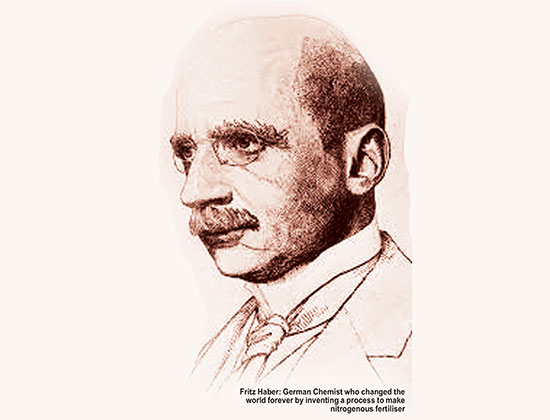
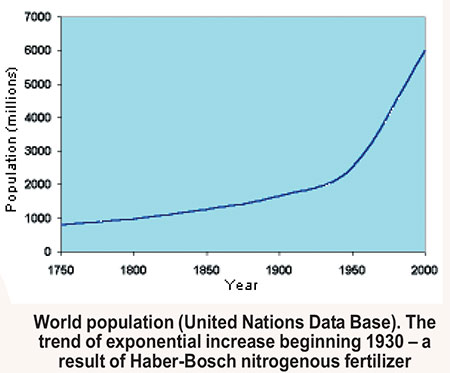
A major breakthrough by German Chemist Fritz Haber in 1807, changed the world forever. He found an efficient method of combining gaseous nitrogen and hydrogen to form ammonia activated by a catalyst. The process further improved by Carl Bosch, widely commercialised beginning 1930, provided the ample supplies of nitrogenous fertiliser, boosting agriculture and food production – greatly reducing premature deaths due to starvation and malnutrition. Demographic data clearly indicate, the trend of population expansion initiated by Haber-Bosch process (see figure above). World population limited by supply of food escalated exponentially; increasing from approximately 2 billion in 1930 to 7.7 billion today. The world can marginally sustain only about half of the present population without nitrogenous fertilisers synthesised via Haber-Bosch process. If this process was not invented; the glamorous comforts we have today and many of us would not be here.
It can be argued, the unprecedentedly aggressive COVID-19 pandemic is a consequence of the Haber –Bosch nitrogenous fertiliser production, because high population density happens to the main cause of virus propagation. Again, nitrogenous fertiliser based agriculture may irreversibly impair the environment. Can we curtail fertiliser production by Haber-Bosch process because of above reasons? Yes, but half of world’s population will faces the risk starvation and conflicts originating as result of food shortage would kill many more!
Green Revolution and Fertilisers
Haber-Bosch process opened the way for the green revolution the next step in the ladder of agricultural development. The main achievement of the green revolution initiated 1960s has been breeding high yielding varieties of crops. Cultivation of such crops using chemical fertilisers and agrochemicals, uplifted food production particularly in developing countries. These crops were bred and made to evolve under conditions of a good supply of plant nutrients applied as chemical fertilisers and their continuation require same treatment. They would not perform satisfactorily, when fed with inferior fertilisers.
Organic Fertilisers and Bio – fertilisers
Organic fertilisers sometimes erroneously referred to as carbon fertilisers use plant or animal derived materials as sources containing nutrients. In highlighting the term ‘carbon fertiliser’ the ignorant tend to believe that plants could consume carbon in soil and grow! Organic manures contain macro and micro plant nutrients, converted to inorganic forms by denaturing and bacterial decomposition. They have the advantage as soil conditioners and retainer of nutrients, owing to presence carbonaceous substances. Microorganisms present sometimes establish symbiotic relationship with plants. However, the concentration of nutrients per unit weight of organic fertilisers turns out to be orders of magnitude smaller than that of commercial chemical fertilisers. Consequently, their storage, packaging and transport are more cumbersome and costly. If based entirely of plant or animal derived materials; organic fertilisers remain largely uncontaminated with toxic heavy metals. Nevertheless, one need to be cautious in converting domestic and city refuse to compost. In addition to vegetable and animal derived waste; garbage invariably contains metallic objects, plastics, discarded batteries and pieces of electronic components. All these non-biological things in garbage contain heavy metals and other toxic substances. Processing of organic fertiliser also degrade the environment.
Bio-fertilisers means preparations containing microbes, claimed to promote plant growth when introduced to soil. Microbes are said to establish symbiotic relationship with the plant root system, enhancing nutrient absorption and may also fix nitrogen. An open question is whether an inoculum of microbes will proliferate and survive sufficiently long in every soil associating with different crops. The literature on the subject inclines more towards advertising products rather than analysis of experiments and field trials to determine the efficacy and reproducibility. Evidence doesn’t exist to the effect that bio-fertilisers could replace conventional chemical fertilisers and deliver yields adequate to feed the world population.
Another much advertised fashion is organic farming. The concept of the organic farming imply use of only naturally occurring materials as fertilisers and agrochemicals. Although the yields of organic farming rarely compare with conventional products they are claimed to be healthier and attract the affluent. Avoiding synthetic pesticides is definitely a merit. However, the claim that organic fruits and vegetables contain no toxic heavy metals couldn’t be always true. Organic farming permits use of rocks as fertiliser components and therefore apatite as a source of phosphorous. Some apatite ores are contaminated with heavy metals, including radioactive elements.
Hydroponics
Hydroponics refers to growing plants without soil in water enriched with macro and micro plant nutrients and illuminated by sunlight or electric lights. The method minimise fertiliser wastage almost completely avoiding their seeping to soil and affords using purest chemical fertilisers, entirely free of toxic contaminants. Even if purest chemical fertilisers are adopted to grow plants in soil; they would still take-up toxic components present in soil. The cumulative accumulation heavy metals and other toxins in our bodies as we get chronologically older, adversely interfere with our health – one of the causes of biological aging. Consuming hydroponically grown vegetables may enhance human longevity. Hydroponic agriculture has many other virtues including habitation in Moon or Mars. Unfortunately, every plant cannot be grown hydroponically. We need to exploit the potential of hydroponics.
Why we cannot abandon chemical fertilisers
Plants have existed on earth for billions year and fed humans and animals without being fertilised artificially. With the advancement of human civilisation and establishment settlement; humans began to grow preferred varieties of plants for food – birth of agriculture. The success of this effort; provided more food, increasing population further. Whenever societies encounter episodes population increase, demand for food also increase; compelling people to seek new avenues produce more food. The sequence of these events has now culminated with a global population of 7.7 billion fed by an agricultural system based high yielding crops, fertilised by effective and concentrated plant nutrients (chemical fertilisers).
If we suddenly abandon these optimised techniques and revert to older techniques (organic manure) which provided food for a much lesser population; there will be starvation, malnutrition and famines. We cannot avoid chemical fertilisers and continue to feed the existing population.
Invariably production and use of fertilisers cause some degradation of the environment. It is a consequence of an irrevocable dictum of nature, which state: The orderliness (betterment) in one sector of a closed system cannot be achieved without bringing disorder (impairment) to another sector of the same system and the disorder (impairment) incurred in the second system can be reversed only by obtaining necessary energy from an outside source.
Plants and animals have lived harmoniously on earth for billions of years without degrading the environment and any damages to the system restored by energy coming from the sun, now we are beginning to exceed the limits.
Text and Pix By Dinasena Ratugamage Courtesy The Island
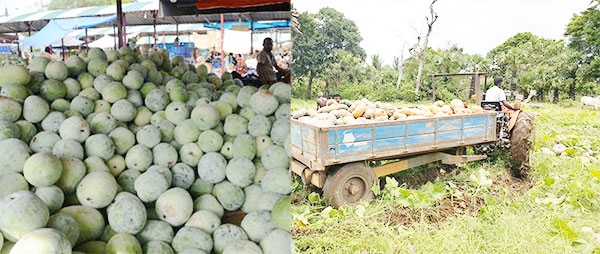
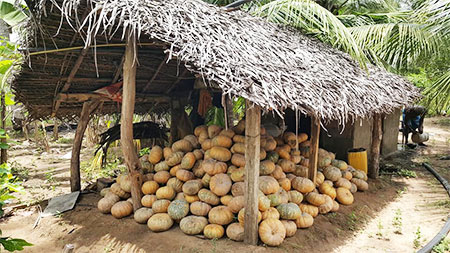
Ongoing lockdowns have dealt the pumpkin and ash pumpkin farmers in Kilinochchi a crippling blow; they are unable to sell their produce, says President of the Pooneryn Farmers’ Association S Arluananthan.
Stocks of pumpkin and ash pumpkin had been lying in sheds for over three weeks, but traders could not come to the fields to collect them, Arluananthan said. Although the farmers of Kilinochchi take their produce to Special Economic Zones in Dambulla and Thambuttegama a large number of their colleagues sell their produce to the traders coming from other areas, according to Arulananthan. The farmers were in a desperate situation as they could not sell a kilo of pumpkin or ash pumpkin even at Rs. 10 a kilo, the President of the Pooneryn Farmers’ Association said.
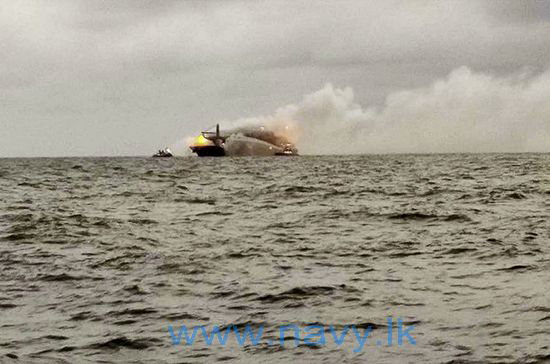
Colombo, May 25 (newsin.asia): India promptly responded to an emergency request by the Sri Lanka Navy and deployed multiple assets to douse the fire on MV X Press Pearl off Colombo on 25 May 2021.
The Indian High Commission said in a release that the assets sent included vessels Vaibhav, Vajra and Samudra Prehari of the Indian Coast Guard and the Tug Water Lilly by Director General, Shipping in addition to a Dornier aircraft for aerial reconnaissance.
The assistance of the Government of India for firefighting as well as pollution control was sought by Sri Lanka Navy at 1200 hrs on 25 May 2021. This came in the wake of an onboard explosion on 25 May 2021 on the Singapore-flagged MV X Press Pearl.
Immediately upon receiving the request, relevant authorities in India were alerted and assets were deployed expeditiously. While the Dornier aircraft reached Colombo at around 1600 hrs on 25 May 2021, the first Vessel would reach around 1900 hrs, the release said.
India has the tradition of being the first responder during crises in Sri Lanka. It may be recalled that a potentially huge oil spill was averted with assistance from India after MT New Diamond with 200,000 metric tons crude oil on board caught fire off Sri Lanka’s Eastern Coast in September 2020. Three Indian Naval Ships rushed with assistance following the floods in Sri Lanka in May 2017, the mission said.
According to The Maritime Executive, Sri Lankan authorities responded on May 20 to a distress call for container fire aboard a feeder containership reported to be carrying dangerous chemicals. The vessel was anchored outside the port of Colombo awaiting terminal space on a trip from the Middle East.
The 37,000 dwt vessel X-Press Pearl arrived off Colombo on May 19 and anchored approximately 9.5 nautical miles northwest of the harbor. She is loaded with 1,486 containers including 25 tons of Nitric Acid, a corrosive chemical used in the production of fertilizers, explosives, and for oxidizing metals. The cargo is also reported to include cosmetics and other potentially dangerous chemicals.
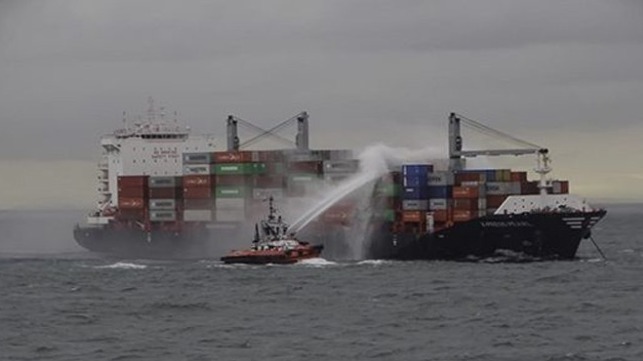
The Sri Lanka Navy dispatched two vessels and a fast boat to the scene of the fire. They were joined by a tug from the Sri Lanka Ports Authority. Pictures from the scene showed the tug spraying water on the fire, assisting the crew onboard in the firefight.
Fire spreading on MV X Press Pearl
Reports indicated that the fire had been brought under control, but the firefighters were standing by in case the fire reignited. Navy officials said that there remained hot spots aboard the vessel which could cause the fire to flare up.
The vessel’s 25-member crew includes Philippine, Chinese, Indian and Russian nationals. The vessel had left the Hazira port in India on May 15 and was on its way to Singapore via Colombo.
Sri Lankan authorities told Reuters that experts from the Netherlands and Belgium were surveying the ship. A special Dutch flight with vital equipment to contain the fire is now expected to reach Sri Lanka,” Sri Lanka’s shipping minister Rohitha Abeygunawardena said.
Sri Lankan Navy spokesman Capt. Indika de Silva said crew members and salvage and firefighting experts evacuated the ship after the explosion. Several containers also tumbled into the sea, he added.
Tug fights fire off Colombo harbour
Mis-declared Cargo?
According to The Maritime Executive, a team from the Sri Lanka Navy and Ports Authority which boarded the containership overnight to inspect the fire, suspected that the fire was caused by a chemical reaction or possibly mis-declared cargo. The smoke from the fire was in part due to the chemicals mixing with the rain and later the water from the tugboat.
The vessel has a crew of 25 aboard and the authorities reported that the crew was safe and had not experienced any injuries.
The 610-foot-long containership was recently commissioned after having been delivered to X-Press Feeders in February 2021. It is registered in Singapore and operates on the company’s Straits Middle East service traveling between Qatar and the UAE to India, Sri Lanka, Malaysia, and Singapore. The X-Press Pearl had departed Hazira, India on May 15 and was heading eastbound on the last leg of a voyage from the Middle East.
Second Fire in X-Press Feeders
This is the second reported fire in recent months aboard a vessel operated by X-Press Feeders. In September 2020, the Indian Coast Guard, provided assistance to the 10,600 dwt vessel X-Press Godavari, which was in an anchorage near the Indian city of Haldia when a fire also broke out in some of the 500 containers aboard the vessel.
Environmental Damage
Rohan Maskarola, CEO of the Colombo Shippers’ Council, said that he is worried about the environmental damage that the gutted and sunk ship loaded with chemicals, would cause.
Eight to nine containers had reportedly fallen into the sea and are drifting towards Negombo, North of Colombo,” he said. Negombo is a fishing center.
Asked if such disasters could be averted Maskarola said what could have been done could be ascertained only after a thorough inquiry. The captain and the crew, who are on shore, would be able to throw light.”
Colombo, May 25 (Xinhua): Sri Lanka on Tuesday said that floating toxic or poisonous material or packages from the burning and abandoned ship X-Press Pearl” may reach the shores of the country and warned people to stay away from beaches.
In a statement, Sri Lanka’s Marine Environment Protection Authority (MEPA) strictly warned people from touching or opening the packages or materials and requested them to contact the Sri Lanka Navy or the police upon the sight of any such items.
The container ship X-Press Pearl” registered under the flag of Singapore, was carrying 1,486 containers with 25 tons of nitric acid and several other chemicals and cosmetics from the port of Hazira, India on May 15, according to the Sri Lanka Navy.
The vessel sent out a distress call as it approached the Colombo Port on May 20, and soon caught fire, resulting in the Sri Lankan Navy dispatching vessels to bring the fire under control.
By Tuesday morning, eight cargo containers had fallen into the sea and the vessel was reported to be unstable, the MEPA said.
The Sri Lanka Navy said it had rescued 25 crew members from the ship. Two injured Indian nationals among the rescued had been hospitalized for treatment.
The distressed container ship had crew who are Philippine, Chinese, Indian and Russian nationals.
By Tuesday evening, the Sri Lanka Navy said the fire was now spreading to the quarterdeck. The fire was being exacerbated by strong winds due to changing weather conditions.
The navy further cautioned the fishing community to avoid the sea area where the vessel was burning.
The Sri Lanka Air Force (SLAF) said it had deployed Bell-212 helicopters to drop dry chemical powder on the X-Press Pearl to douse the fire.
While these operations were ongoing amid inclement weather, the MEPA urged citizens in capital Colombo to avoid going to the beaches and touching any floating objects in the water as they might be chemicals from the burning fire.
The MEPA has launched a probe to assess if there has been any environmental destruction due to the fire
The United States has clarified that there is no change in the terrorist threat level for Sri Lanka.
The US State Department had on Monday issued an updated travel advise on Sri Lanka telling Americans not to travel to Sri Lanka.
A part on terrorism was also in the advise raising fears that there was a terrorist threat to Sri Lanka
Do not travel to Sri Lanka due to COVID-19. Exercise increased caution in Sri Lanka due to terrorism,” the updated travel advise said.
However, the US Embassy in Sri Lanka said the travel advisory for Sri Lanka had been updated from Level 3 (reconsider travel) to Level 4 (do not travel) solely due to the prevailing COVID-19 situation in the country.
There is no change to the terrorist threat level,” the Embassy said.
The Centers for Disease Control and Prevention (CDC) in the US issued the Level 4 travel health notice for Sri Lanka due to COVID-19, indicating a very high level of COVID-19 in the country. (Easwaran Rutnam)
A former musician turned Buddhist monk, Bhante Sujato, an Australian, has taken up a mammoth task to translate and publish thousands of Buddhist texts known as Sutta (discourses of the Buddha) into many languages. Accompanied by Sri Lankan Kandyan dancers and drummers, he recently launched an Internet portal ‘Sutta Central’ to make the Buddha’s teachings available to the world free of charge.
The word Sutta derived from the ancient Indian language Pali in which the Buddha preached his dhamma (teachings) and its literature forms the backbone of the Buddhist teachings. The Suttas were originally transmitted orally, thus when the Suttas are chanted in the Pali language—which is very popular in the Theravada Buddhist tradition—they usually commence with the phrase evaṃ me sutaṃ,” meaning thus have I heard”.
< A former musician turned Buddhist monk, Bhante Sujato
In Suttas, Buddha talked about the abundance of love. Buddhism has compassion for the whole world. That is the abundance of Buddhist philosophy and anyone can come to Sutta Central and find something useful,” Bhante Sujato told an audience of about 150 Buddhists from different traditions at the launch of the portal in Sydney.
Sutta Central contains early Buddhist texts contained in the Tipiṭaka or Three Baskets”. The Tripitaka includes Sutta Pitaka (discourses of the Buddha), Vinaya Pitaka (discipline for the monks), and Abhidhamma Pitaka (psychological-philosophy of the teachings).
The Sutta Pitaka is a large collection of teachings attributed to the Buddha or his earliest disciples, who were teaching in India around 2500 years ago. They are regarded as sacred canon in all schools of Buddhism. Sutta Central hosts the texts in original languages, translations in modern languages, and extensive sets of parallels that show the relationship between them all.
I have been a voracious reader since I was a young boy,” Bhante Sujato told Lotus News in an interview. I wanted to read dhamma books (because I was told that) the real stuff on the dhamma was in the suttas and I wanted to read them,” he said. As soon as I started reading these I began to realize that this is where all (the teachings) comes from.”
Born as Anthony Best in Western Australia in 1966, he played with the post-punk Australian band Martha’s Vineyard in his youth. After backpacking to Thailand to find something different, he came across Buddhism at Wat Ram Poeng, a popular backpackers’ monastery in Bangkok. I went to Thailand to extend my horizons because I thought life here in Australia was getting a bit monotonous,” he recalls.
After a few more visits to Thailand and attending Buddhist retreats in forest monasteries, he became a monk in 1994, when he was ordained at Wat Pah Narachat in Ubon Ratchathani. He lived in Thailand for many years, before returning to Australia.
When asked, how he found life as a monk after being a musician in Australia, his response was interesting. Being a monk did not change my lifestyle that much as being a musician, in the sense that both circumstances I did not have money. Being a musician in Australia it is a struggle to make a living.”
For me, music was a voyage of discovery I had to learn about myself. Becoming a monk was also being curious,” he adds. When I learned the dhamma it was certainly much deeper than anything I have learned before…. So I realized there is a path where I needed to listen.”
Upon returning to Australia he spent several years at Bodhinyana Monastery in Western Australia that was founded by the respected Australian Buddhist monk Ajahn Brahm, before going on to found Santi Forest Monastery in 2003 where he served as its abbot. In 2012, Bhante Sujato turned it over to become a nun’s monastery, and he decided to concentrate on developing Sutta Central, which was in fact launched in 2005, but copyrights issues with Pali translations of the Sutta hindered its progress.
When we first started Sutra Central I had no experience with Internet (and) as we expanded the project we realized we are making connections with different Buddhist traditions so it became a vehicle for connection,” points out Bhante Sujato.
Buddha’s teachings have bound people together for such a long time through connections—through oral transmissions—until it was handwritten as ‘Tripitaka’ at the Aluvihara in Sri Lanka in the 1st century BCE. Thus the Suttas have been handwritten for almost 2000 years, printed for over 400 years, and it is now digitized in the past 30 years.
The launch of Sutta Central may well become a landmark event in the history of the dissemination of the dhamma, as every Sutta is now not only digitized but is gradually being available in different languages from the same source.
Bhante Sujato’s dedication to the project is such, that after being unable to secure copyright-free digital translations of the Pali Canon for Sutta Central, he moved to a remote island of Chimei, off the coast of Taiwan, to undertake the task of creating English translations of the nikayas (volumes of the Suttas), living there from 2015 to 2018. The Pali Sutta Piṭaka is divided into five main collections called nikāyas, that includes the longer versions called the Dīgha Nikāya and the shorter ones called Majjhima Nikāya (middle-length discourses), Saṃyutta Nikāya and Aṅguttara Nikāya (shorter texts). The translations of the latter nikayas in particular, have since been published on Sutta Central, and as free edition books.
Sutta Central has materials that have been translated into English not only from Pali but also from Tibetan, Chinese, and Sanskrit. From the Pali canon, these are Suttas taken from India to China usually around 400AD(CE) and translated into Chinese. These are in Sutta Central, I don’t speak ancient Chinese but translated by others. This is an ongoing project,” says Bhante Sujato. The translations are done by people, he points out, not by machines, such a Google Translate. Those (Google) translations don’t work,” he adds
In a virtual address at the portal launch in April, Bhante Sujato’s mentor Ajahn Brahm described Sutta Central as an easy way to learn what the Buddha taught. It’s wonderful to have the information clear and trustworthy,” he said. We need to inspire people to become good Buddhists by getting proper teachings.”
Bhante Sujato believes Sutta Central is a generational job” and it will be an ongoing project for some time. So far we have some translations in over 40 languages. There are certain language groups better represented than others like main Asian languages Hindi, Chinese, Sinhala, Thai, Burmese, Vietnamese, and European languages German, French, English, Spanish,” he points out. We don’t have many translations in Arabic and we don’t have any translations in Swahili or any other African languages. It will be wonderful if every person in the world could read the Suttas in their language.”
Bhante Sujato emphasizes that everything they do is free and they also make it available in iPad, apps and will soon make it available in books. A ‘Sutta Central Development Trust’ has been established to help raise funds for the ongoing activities to expand its offerings.
Bhante Sujato wants to point out a new addition to Sutta Central. In Sutta Central, we also read the Suttas for you. Especially for people who are visually impaired or anybody who wants to read the Suttas .. maybe when you are driving a car or so. It’s in English and expanding to other languages as well.”
Since of late, there has been a massive mud-slinging effort against me and my family carried out in an organised manner by a group of persons. At present, that group is claiming that my son Chatura Cabraal is employed by the Company which is carrying out the construction work of the Colombo Port City, thereby insinuating that I have supported the new Colombo Port City Commission Law, due to that connection”.
Chatura (35) is qualified engineer who has graduated from a US University in 2010, and has been employed by this Company since 2016. He secured this employment on his own merit, without any political or personal influence, and that is obvious by the fact that in 2016, we were in the Opposition. Similar to the current allegation, even previously, utterly false and vituperative allegations had been levelled against my children, claiming they had scolded officials at the airport, misbehaved on expressways, involved in fights, etc, but it has been proved beyond doubt that all those claims were blatantly false. Therefore, it is clear that such fake news had been a part of a greater plan to discredit me and my family, as well as distract and discourage me in carrying out my duties.
There is no doubt that Sri Lanka’s politics has degenerated in recent times, and personal attacks against a person’s family members is common place and fair game for certain persons. Nevertheless, any right-thinking person will agree that a parent’s subsequent position as a Minister should not be a disqualification for a grown-up son or daughter to continue in employment which he/she has secured before his/her parent assumed office as a Minister.
Finally, I wish to state that those who indulge in such falsehoods only display their pathetic political bankruptcy, and therefore I can only feel sorry for them.
The Cabinet approval was granted to award the contract for the construction of the elevated highway to Kelaniya New Bridge (NKB) via Rajagiriya connecting Outer Circular Highway at Athurugiriya to the China Harbour Engineering Company (CHEC), co-cabinet spokesman, Energy Minister Udaya Gammanpila said.
Addressing the weekly cabinet briefing at the Information Department, the Minister said the approval was granted to the CHEC to complete the project within three years.
“It has been given another 15 years to operate and earn their revenue. After 18 years, the company has to hand over the elevated highway to the Sri Lanka government, Minister Gammanpila said.
“The cabinet ministers decided to hand over the construction considering the company that takes the least amount of time to complete the project and the least period to recover their cost,” he said.
Accordingly, the most attractive bid was presented by the CHEC and therefore the cabinet ministers approved to hand over the construction,” the Minister added. (Chaturanga Samarawickrama)
Sri Lanka has registered 28 more victims of COVID-19, Director-General of Health Services confirmed on Tuesday (May 25).
The latest fatalities have moved the country’s death toll to 1,269, according to official data.
Five of the deaths took place on May 25 and the remaining victims have succumbed to the virus infection between the period of May 18 – May 24, the Department of Government Information stated.
Reportedly, 11 of them have been recorded as domestic deaths.
The deceased were identified as residents of Galle, Kalutara, Bulathsinhala, Unawatuna, Horana, Govinna, Galpatha, Hunnasgiriya, Maththaka, Wanchawala, Meepe, Matara, Ahangama, Veveldeniya, Ruwanwella, Meegahathenna, Agalawatta and Dehiattakandiya areas.
COVID pneumonia was recorded as the cause of death of majority of the victims. Some of them also suffered from diabetes, heart diseases, hypertension, sepsis and other complications.
Daily COVID-19 cases count moved to 2,728 on Tuesday (May 25) as 920 more people were tested positive for the virus in Sri Lanka.
This brings the total number of confirmed cases of coronavirus reported in the country to 169,900.
Government Information Department stated that 2,706 of the new cases reported today were associated with the New Year coronavirus cluster. Twenty-two others were identified as arrivals from foreign countries who are under quarantine.
As many as 141,175 recoveries and 1,269 deaths have been confirmed in Sri Lanka since the outbreak of the pandemic last year.
According to official data, up to 27,456 active cases are currently under medical care at designated hospitals and treatment centres.
An individual who was pushing a wheelbarrow filled with goods purchased from a supermarket has been taken into custody today (May 25) as he was not wearing a face mask in public.
The arrestee was identified as a resident of Darga Town in Aluthgama, DIG Ajith Rohana stated.
Legal action will be sought against the man in question on charge of violation of quarantine regulations, according to the police spokesperson.
Sri Lanka is expected to receive a stock of 500,000 doses of the Sinopharm COVID-19 vaccines donated by China, with the consignment likely to reach the island tonight (25).
Principal Advisor to the President, Lalith Weeratunga stated that the SriLankan Airlines flight carrying the stock of vaccines is expected to touch down at the Bandaranaike International Airport (BIA) in Katunayake around midnight today.
Flight UL-869 which is carrying the 500,000 vaccine doses had reportedly departed from Beijing at 19:45 and will arrive at BIA around midnight.
In March, Sri Lanka had received 600,000 doses of the Sinopharm vaccine as a donation from China.
Meanwhile the Cabinet of Ministers have approved a proposal to take necessary steps for the immediate purchase of 14 million doses of the China-manufactured Sinopharm vaccine and 01 million doses of the Oxford-AstraZeneca vaccine.
The Sri Lanka Grama Niladhari Association states that they will withdraw from their duties from midnight today (May 25).
Sumith Kodikara, President of the Association, said that the decision was taken in protest of the COVID-19 inoculation program.
Addressing the media, he said that while the vaccine drive was initially carried out in a systematic manner, it is now being implemented in violation of the priority lists.
The government says it has planned to vaccinate 60 to 70 percent of the country’s population against coronavirus by the end of 2021.
The Department of Government Information stated the need for the expedited supply of vaccines has been recognized as there is no other solution to control the COVID-19 pandemic other than inoculation.
Accordingly, the Cabinet of Ministers has granted the approval for a proposal to take necessary steps for the immediate purchase of 14 million doses of the China-manufactured Sinopharm vaccine and 01 million doses of AstraZeneca vaccine.
The proposal has been tabled at the Cabinet by Minister of Health Pavithra Wanniarachchi.