Sri Lanka witnessed 10 more COVID-19 related fatalities as the death toll climbed to 445, Director-General of Health Services confirmed today (February 21).
According to the Department of Government Information, all of the deceased were aged over 50 years.
Details of recent coronavirus victims are as follows:
01. A 74-year-old man from Kolonnawa area has died today while receiving treatment at the Homagama Base Hospital. He was transferred from Colombo National Hospital after testing positive for the virus. The cause of death was recorded as COVID pneumonia and complicated liver disease.
02. An 82-year-old woman from Wellawatte area died at the Homagama Base Hospital today. She had been transferred from Colombo South Teaching Hospital upon testing positive for the virus. The cause of death was cited as COVID pneumonia.
03. A 58-year-old woman died on February 16 at her home in Kalutara area. COVID-19 infection, blood poisoning, heart disease and acute diabetes were reported as the cause of death.
04. A 72-year-old woman who was living in Waskaduwa area died at her home on February 16. The cause of death was recorded as COVID-19 infection, blood poisoning and heart attack due to high blood pressure.
05. A 65-year-old man from Bibila area has died on February 19. He was moved to Kandy National Hospital from Monaragala District Hospital after testing positive for the virus. He suffered from brain hemorrhage and respiratory tract infection along with COVID-19 infection.
06. A 68-year-old man from Guruthalawa area, who tested positive for the virus at General Hospital in Badulla, was transferred to Mulleriyawa Base Hospital where he died yesterday (February 20). COVID pneumonia, heart disease, kidney disease and acute diabetes were recorded as the cause of death.
07. A 68-year-old man from Pitakotte area has died on admission to Colombo South Teaching Hospital on February 19. The cause of death was cited as wheezing and acute diabetes along with COVID-19 infection.
08. An 83-year-old man who was living in Kudagalgamuwa area died while receiving treatment at the Kurunegala Teaching Hospital on February 14. He has suffered from COVID-19 infection, blood poisoning due to an injury and kidney disease.
09. A 90-year-old man from Ratmalana area passed away yesterday (February 20) while receiving medical care at Pimbura Base Hospital. He was receiving treatment at Sri Jayewardenepura General Hospital when he tested positive for novel coronavirus. The cause of death was recorded as COVID pneumonia.
10. A 72-year-old man from Hatton area died yesterday (February 20) due to COVID-19 infection, acute diabetes, high blood pressure and brain cell death. He had been transferred from a private hospital in Colombo to National Institute of Infectious Diseases (NIID) after testing positive for novel coronavirus.
Sri Lanka registered 265 more positive cases of COVID-19 today (February 21) as total novel coronavirus infections reported within the day reached 519.
Department of Government Information says 495 of today’s cases are close contacts of earlier cases linked to the Peliyagoda cluster.
Twenty-three others were detected from the prison cluster. The remaining patient is an arrival from a foreign country.
New development has pushed the country’s confirmed COVID-19 cases count to 79,999.
According to COVID-19 figures, 5,265 active cases are still under medical care at selected hospitals and treatment centres.
Meanwhile, total recoveries reported in the country now stand at 74,299.
Sri Lanka has also witnessed 435 fatalities due to the outbreak of the pandemic.
Some held portfolios during the thick of LTTE terror. Some held portfolios that could have stopped LTTE terror. Some held portfolios but simply watched LTTE carnage in silent. All of them did nothing to end the suffering 20million populace suffered when LTTE bombed and committed acts of terror. All of them woke up only after LTTE was militarily defeated or on the verge of defeat and all of them are now demanding answers for how the war was fought completely erasing their inaction during LTTE terror. What are these desperados’ really up to? What should UN Member States read from these actions? When a UN that did nothing to stop terror suddenly comes out with the rule books AFTER the terror is over, it only showcases the UN system is being used to CREATE A PRECEDENCE with Sri Lanka as a guinea pig. The Third World must rally behind Sri Lanka not for anything else, but to safeguard their own nations from becoming target of UN bullies if their attempt to subjugate Sri Lanka into the UN succeeds.
The laws of war and justice was re-written according to geopolitical demands with 9/11. Thereafter, concepts, formulas and templates took the form of what suited powerful nations & their political agendas. So accountability, justice, human rights, democracy, freedoms etc came to be determined on what suited their agendas. The UN system and NGO network became the mechanisms used to fast forward these objectives.
Those who did nothing to stop Rwanda genocide – where actual dead bodies was seen to count cannot talk about any invisible genocide in Sri Lanka – where accusers have failed to present names of 40,000 dead.
Those who did nothing when the Libyan Leader was killed in front of the whole world and watched by the world’s most powerful nation whose officials simply laughed at his death – cannot talk about justice or accountability.
Those who after destroying Libya went on to destroy Syria, bombing a country to the stone age, with goal to dislodge its leader, cannot send petitions against Sri Lanka, if they simply sat in their official chair and did nothing against it using the powers of their office.
Those that watch the suffering of the Iraqi’s Afghans, Darfur, and those who know how ISIS, Boko Haram, Al Qaeda etc are funded and trained cannot just take Sri Lanka’s Armed Forces and demand their penalization and ridicule on the world stage.
Those who are watching Yemen’s humanitarian sorrow, the malnutrition children, the hungry adults and pass the buck because of the countries involved in it are too powerful have no moral right to be only pointing fingers at Sri Lanka because it is a small nation with weak leaders.
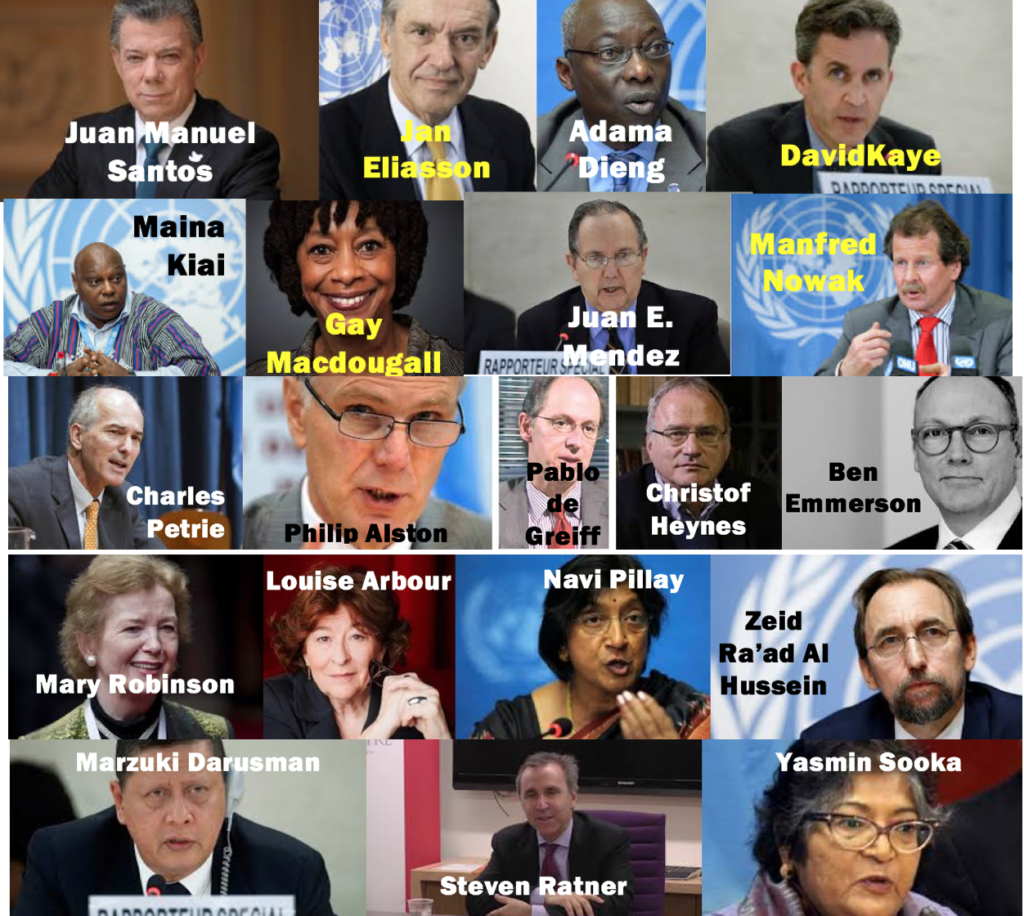
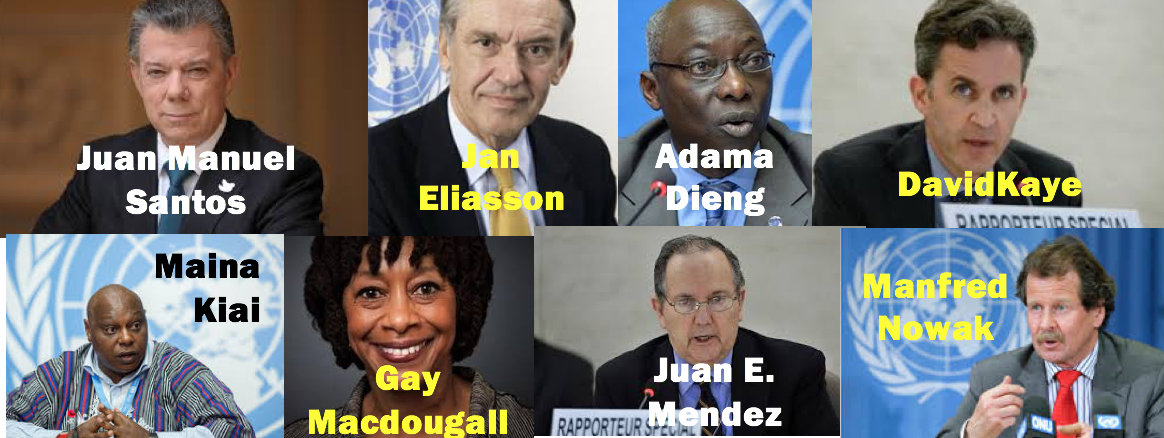
The EldersFormer President of ColombiaNobel Peace Prize Winner
2010 – 20182016
Former UNHRC heads
Name
Role / Member
Tenure
2. Mary Robinson
The EldersFormer President of IrelandFormer UNHRC Head
1990 – 19971997 – 2002
3. Louise Arbour
Former UNHRC Head
2004 – 2008
4. Navanethem Pillay
Former UNHRC Head
2008 – 2014
5. Zeid Ra’ad Al Hussein
Former UNHRC Head
2014 – 2018
Former Special Rapporteur mandate-holders
Name
Role / Member
Tenure
6. Charles Petrie
Former United Nations Assistant Secretary- General, Head, Secretary General’s Internal Review Panel on United Nation’s Actions in Sri Lanka
2012
7. Philip Alston
Former Special Rapporteur on extrajudicial, summary or arbitrary executions
2004 – 2010
8. Manfred Nowak
Former Special Rapporteur on torture & other cruel, inhuman and degrading treatment or punishment
2004 – 2010
9. Gay MacDougall
Former Special Rapporteur on minority issues
2005 – 2011
10. Jan Eliasson
Deputy Secretary General UN
2012 – 2016
11. Adama Dieng
Former Special Adviser to UNSG on the Prevention of Genocide
2012 – 2020
12. Christof Heyns
Former Special Rapporteur on extrajudicial, summary or arbitrary executions
2010 – 2016
13. Juan E. Mendez
Former Special Rapporteur on torture & other cruel, inhuman and degrading treatment or punishment
2010 – 2016
14. Ben Emmerson
Former Special Rapporteur on the promotion and protection of human rights and fundamental freedoms while countering terrorism
2011 – 2017
15. Maina Kiai
Former Special Rapporteur on the rights to freedom of peaceful assembly and of association
2011 – 2017
16. Pablo de Greiff
Former Special Rapporteur on the promotion of truth, justice, reparation, and guarantees of non-recurrence
2012-2018
17. David Kaye
Former Special Rapporteur on the promotion and protection of the right to freedom of opinion and expression
2014 – 2020
Privately commissioned Panel by UNSG
18. Marzuki Darusman 19. Steven Ratner 20. Yasmin Sooka
Secretary General’s Panel of Experts on Accountability in Sri Lanka
2010-2011
Juan Manuel Santos
Leader of Colombia from 2010-2018
Colombia’s conflict began in May 1964 between FARC rebels & Columbian Govt/Army and ended in 2016 the same time Juan Santos was awarded Nobel Peace Prize for bringing to end 50 years of conflict that claimed over 220,000 lives majority civilian and has displaced 5million (almost half being children) – between 1985 and 2012 creating worlds 2ndlargest IDPs.
By 2003, U.S. involvement in Colombia meant 40 U.S. agencies and 4,500 people, including contractors, working from U.S. Embassy in Bogota, the the largest U.S. embassy in the world.
First woman President of Ireland and former UN High Commissioner for Human Rights days before LTTE blew up MV Cordiality ship killing 5 Chinese crew members. What did she do against LTTE? Chair of The Elders, member of Club Madrid, Has links to Eric Solheim who appointed her Chairman of Development Assistance Committee in 2016. In December 1997 after her visit to Rwanda as UNHRC head the Rwandan govt accused her of ‘blatant distortions’ https://www.irishtimes.com/news/robinson-accused-of-distortions-1.135772
Louise Arbour
Appointed Chief Prosecutor for Rwanda & Yugoslavia. Her indictment of a sitting head – Serbian Leader Milosevic made history though he was exonerated of war crimes only after his controversial death in a prison. As UNHRC head she visited Sri Lanka in 2007 October. Since 2009 she was President of International Crisis Group. It was during her period as UNHRC head that LTTE increased recruitment of child soldiers and even assassinated Sri Lanka’s Foreign Minister – Lakshman Kadiragamar all during an internationally mediate cease fire agreement. What did she do to question LTTE accountability?
Navanethem Pillay
As an ethnic Tamil, it was only right that she recused herself from handing Sri Lanka, which she did not. Her statements foretell the biased nature of her actions against Sri Lanka during her tenure as UNHRC head. When she appears on Mullaiwaikkal Memorials distorting her on statements, this proves the case.
Violated Article 2.7 of UN Charter by interfering in domestic jurisdiction of Sri Lanka – asking to demilitarize and commenting on Sri Lanka’s judiciary.
Another report leaked like the Darusman Report, attempting to shed crocodile tears of UN failing to stop a non-existent carnage, whereas UN actually failed to bring peace to Sri Lanka over 30 years. Petrie should have written about the UN failure to stop LTTE terrorism. Petrie was a UN Official in Rwanda when UN simply abandoned Rwanda. Ironically, he was made UN envoy to Burma! Petrie also headed a Norwegian funded project Myanmar Peace Support Initiative”All hotspots for Western geopolitics!
Petrie resigned from the UN at the end of 2010 but in March 2012 appointed by Ban Ki Moon to do an internal review of UN’s action in Sri Lanka. This report was leaked probably because it was shedding crocodile tears about UN failing the civilians in the final phase without crying over UN failure over 30 years to prevent LTTE terror.
Philip Alston
Ban Ki Moon private panel included only one source for alleging ‘executions’by GoSL troops presented by C4 and Alston’s report attaching 3 technical expert reports – from an US forensic analyst Jeff Spiyack who says that there is no way to confirm solely from recordings the identity of the victims or shooters.
Manfred Nowak
Visited Sri Lanka 1 to 8 October 2007.
Gay MacDougall
American lawyer and Board Member of George Soros Open Society
This expert on genocide may like to redefine what genocide is as per political agenda. Where do you have mass murders in this modern era similar to the atrocities committed during colonial times?
Another UN official overstepping mandate & violating Article 2.7 of UN Charter – demanding repealing of PTA, release of hardcore LTTE, Emmerson defended Ramush Haradinaj, the former leader of the Kosovo Liberation Army.
Maina Kiai
a Kenyan lawyer and member of HRW since 2018 was also in Amnesty International in 2001. Regular recipient of letters from LTTE fronts
Also a member of the privately commissioned UNSG panel of experts and thereafter became the ‘comrade’ of LTTE fronts appearing at their events. Though paid by EU to look into affairs of South Africa/Africans she is preoccupied with Sri Lanka and its military. Her reports churned out for UN sessions are all without evidence and hype only.
Thus 20 personalities linked to the UN system have put aside all other conflicts, all other human rights or humanitarian issues and is only bothered about Sri Lanka. We want to know why? We want to know what propels them to be so obsessed with Sri Lanka ONLY AFTER they all watched Sri Lanka suffer 30 years of terrorism & DID NOTHING TO STOP LTTE TERROR?
How dare they talk about justice & accountability when they ignored 30 years people suffered under LTTE.
Out of the blue, when the Sri Lanka Armed Forces ended 30 years of terror, how dare they enter holding the rules of war when they chose to ignore all laws that LTTE flouted when they committed pre-meditated murder. They cannot simply brush 30years of terror aside and demand truth and justice for a period they wish to control and dictate to governments.
The fact that their very claim for 40,000 dead has fallen flat with their setting of the Missing Persons Commission which has not got any 40,000 dead names!
This looks nothing but a desperate attempt by UN officials (serving & former) to cover up their follies and biases. When they single out only Sri Lanka where not a bomb has gone off or LTTE suicide attempt occurring since LTTE defeat in May 2009, it baffles all of us as to why these officials are so obsessed with Sri Lanka. This needs serious attention. None of the allegations made have concrete evidence to prove anything beyond doubt.
What are they all up to?
Why are they using Sri Lanka to try to create a precedent?
This is why the third world UN membership should not allow such a precedence to be created using Sri Lanka as a guinea pig.
The increasing interventionist role of the UN and its agencies,
mainly the UN Human Rights Council (UNHRC), in the domestic affairs of Sri
Lanka, seen especially in the unwarranted excesses listed in the latest
Michelle Bachelet’s report, threatening, for instance, to report Sri Lanka to
ICJ, should come under unrelenting scrutiny to expose its (1) disproportionate
scrutiny and intervention in the domestic affairs particularly when M.
A. Sumanthiran says that progress has been made though not to their
satisfaction; (2) partisan selectivity manipulated by
pro-Tamil/LTTE agents abroad, including TNA, NGOs, INGOs, etc. (All these
players have been complicit in one form or another, by word or by deed,
in appeasing the Tamil Pol Pot killing his own people) and (3) politicisation to
appease the Big Brothers who are engaged in twisting the arm of Sri Lanka
to serve the urgent interests in combatting and containing
China.
So, when Michelle Bachelet, the UN High Commissioner for Human
Rights, pretend to be the moral high priestess supervising all that is not to
her liking on earth, she must be told in no uncertain terms that in burying the
UN Commission on Human Rights (UNCHR), the immediate predecessor to
UNHRC, Kofi Annan, the former Secretary-General, quite rightly pinpointed
that it was put six feet under because meddlesome interlopers like Bachelet overstepped
their mark and violated the three evils mentioned above. She must also be
reminded that the new UNHRC was established not for the likes
of Bachelets to go back to the rotten old ways of the buried UNCHR but to
hold the balance and steer human rights justly, even-handedly and
proportionately to achieve the long-term interests of the human rights of
all and not just those who are vindictively waging a war in Geneva to get
even with the Government of Sri Lanka (GOSL) for crushing Tamil terrorists
banned by the world.
Take the case of M.A. Sumanthiran, the current holy cow of
Tamil politics, manipulating with the American Ambassadress, Alaina B. Teplitz,
to fix Sri Lanka in the coming session of UNHRC on human rights principles. Not
so long ago he was on the other side, going on his bended to Velupillai
Prabhakaran. During that time, he no qualms in pledging his loyalty to him as
the supreme leader of the Tamils when he knew that he had killed more Tamils
than any other. To this day he has not apologised to the Tamil people for
collaborating with the Tamil Pol Pot and willingly being a part of his killing
machine. At least Adolf Eichmann had a rather tenuous excuse for being a part
of Hitler’s killing machine. He claimed that he was only a cog in the wheel of
the Nazi system and he had no choice. He said he was merely carrying out
orders. But Sumanthiram had a choice. There was no compulsion for him to be an
integral part of the Prabhakaran’s killing machine. He did it on his own,
voluntarily, agreeing to be a partner in war crimes and crimes against
humanity, particularly the crimes against his fellow Tamils.
For instance, did he once go with a Tamil parent to Tamil
Chelvam, to plead for the life of an abducted schoolgirl or school boy?
He is a lawyer. Did he ever file a case in the Prabhakaran’s court
complaining about the violation of the fundamental rights of Tamils in
his quasi-state? Did he go to the American Ambassador and put pressure on
him/her to protect the dignity, justice, equality and peace of the Tamils
denied by his sole representative of the Tamils”? Today, he says that
truth will set him free, quoting the Bible. True. So when will he liberate
himself from the web of lies in which he is trapped and walk as a free
man? Also, will the American Ambassadress hold the hand of Prabhakaran’s
partner in war crimes and crimes against humanity and escort him to Geneva for
him to pose as champion of human rights?
Both of them will find themselves quite at home because UNHRC is
built on lies, biases and frauds. John Bolton, the arch conservative, was right
when he said that US did not have sufficient confidence to be able to say that
HRC wold be better than its predecessor.” (p.56 – The United Nations
Human Rights Council, Rosa Freedman, Routledge). He added: If the UN
Secretariat building in New York lost ten storeys, it wouldn’t make a little
bit of difference.” (ibid – p. 156). In any case, the UN and its agencies have
been taken over from time to time by war criminals, liars, frauds, sex maniacs,
morally blind hypocrites, etc that one more going from Jaffna will not make
much of a difference to UN’s moral failure to be a universal instrument for
peace, justice and the security of imperilled man.
A quick glance at some facts will reveal why humanity
cannot depend on the UN as an instrument for the overall good of
man:
Fact 1: Between 1972 and 1981 the UN – the highest
instrumentality set up to protect human rights – was run by a war criminal:
Kurt Waldheim. As lieutenant in the Nazi killing machine he
operated in Greece where more than 60,000 were deported to Jewish death
camps. had no qualms. Waldheim served as Secretary – General for two terms. Is
this the institution that is now pointing a finger at Sri Lanka?
Fact 2: On February 5, 2005 Colin Powell, Secretary of
State for Bush, deliberately lied to the Security Council, saying that Iraq was
hiding weapons of mass destruction from inspectors and refusing to
disarm. The unpardonable immorality of the UN-sanctioned lies
diminishes the credibility of the UN making accusations against other
countries. In the case of Sri Lanka its worse. A case is constructed against
Sri Lanka by the three hand-picked characters sitting in New York and
collecting the evidence of accusers whose names will not be revealed for
the next thirty years. What credibility or justice will there be in a case
built out of anonymous accusers whose identity will not be revealed for
the next thirty years?
Fact 3: UN-sanctioned naval cordon thrown around Iraq killed 600,000
children and when Madeleine Albright, America’s State Secretary, was asked
whether the price was worth for achieving the aims of the West in Iraq she
replied that the price was worth it. This figure of 600,000 amounts to
more than all the children killed in Hiroshima. UNHRC is crying its heart out,
wringing its hands, on an unverified figure of 40,000 dead between September
2008 and May 2009. Leaving all other factors out, at least on the principle of
proportionality will Bachelet report Albright to the ICJ? She can do it because
there is no statute of limitation for crimes against humanity. Will she
do it?
Fact 4: Derek Halliday, former Assistant Secretary General of UN
in charge of Humanitarian Operation in Iraq said that the West is waging
a war through UN on the people of Iraq, with results that you do not expect to
see in a war fought under Geneva conventions. We are targeting civilians… its
monstrous situation for UN, for the Western world, for all who are part of some
democratic system and the implementation of economic sanctions”.
Halliday calls it genocide and believes when history books are written the
Security Council, the UN, Washington and London will be ’slaughtered’ for their
actions (British Medical Journal – March 11, 2000.
John Pilger’s documentary Paying the Price – the killing of the
children of Iraq.)
Fact 5 : Under UN Security Council Resolution 819 Srebrenica
enclave was declared a safe area by UN. The safety status was extended to
Sarajevo, Zepa Gorazde, Tuzla Bihac. All cities were placed under UN
peacekeeping units UNPROFOR. Member states who voted for it were for political
reasons not willing to take necessary steps to ensure the security of the safe
areas When the Muslims of Srebrenica were panicking fearing the imminent attacks
from Serbs the overall UN Commander rushed and assured the Muslims that they
are safe because they are under the protection of UN forces. The next day under
the very eyes of the of UN forces commanded by a Dutch unit 8,000 Muslim men
and boys were massacred in a pre-planned genocidal attack. Dutch state was
found liable in Dutch supreme court and the Hague district court of failing to
do enough to prevent more than 300 deaths. (Wikipedia).
In the Darusman report the GOSL is accused of firing into zones
declared as No Fire Zones. This is denied by the GOSL. But let’s assume that it
did happen. Unwittingly the Darusman report provides the answer. It says that
the LTTE placed military equipment where civilians were to provoke fire
from GOSL forces. GOSL forces did not rush into the No Fire Zone to launch a
genocidal attack under the blind eyes of the UN. It was reacting to provocative
fire from the LTTE. This is different from UN forces turning a blind eye to the
genocidal attack on Muslims who were in the UN protected Safe Zone.
If anything near to what happened in Srebrenica happened in the No fire Zone in
the last days of the 33-year-old war Ms. Bachelet’s would have danced by now
her politicised Cancan in Geneva without knickers.
The overall pattern emerging from her irate report indicates
that she in cahoots with the NGOs, anti-Sri Lankan Western powers who
overlook – and even defend – the violations of human rights of their
allies, the Tamil diaspora, India with its pinch-the-baby-and-rock-the-cradle
policy – all of which is taking UNHRC down the very same path that led to the
burial of UNCHR.
To understand the inexcusable immorality on which the whole
attack on Sri Lanka is based one has to look at the framework on which it
stands. Organised Tamil violence against the democratically elected began
officially when the Vellala elite declared war in the Vadukoddai Resolution on
May 14, 1976 urging the Tamil youth to take up arms and never rest until they
achieve Eelam. Since then they have financed it, mobilised cadres for it,
internationalised it, lobbied and raised funds for Tamil terrorism in
every available corner of earth for it, manufactured theories and excuses
for violations of human rights and crimes against humanity, glorified war
crimes, triumphantly hailed every killing and/or massacre that led to
territorial gains, demonised or eliminated any potential rivals including
the cream of Tamil elite, justified the suppression of all liberties that
denied the dignity, justice, liberty, and peace etc. This war ran for 33-years
with the backing of the Diaspora, local elite and even at time with the
support of India who never fails to profess eternal friendship with Sri Lanka.
It ended on May 19, 2009.
Now here comes the irony of ironies. In its infinite wisdom UN
pundits picks only eight months out of 33 years to accuse Sri Lanka in the main
of violating human rights and subjecting Sri Lanka only to disproportionate and
severe strictures and judgment of the UNHRC and UN. The unanswered – and even
the unasked — question why limit the judgment on a war of 33 years to the last
eight months only? On what logic? On what rationale? And who was it who drew up
the dates? For what reasons?
The dates were arbitrarily determined by the three UN zombies
sitting in New York for their convenience. They were not after serving
justice or peace, or human rights, or the truth. They were out to pick bits and
piece from wherever they could, stitch them together as credible evidence” and
hang Sri Lanka at the end of their rope. Apart from their personal convenience
there is a grand design behind it. It was the only way they could
eliminate all the other responsible actors in originating, causing, promoting,
financing, and directing a needless war and pin it exclusively on Sri
Lanka. It provided the rationale for the whole world to gang up against
Sri Lanka as the only culprit responsible for the 40,000 (a figure picked out
of the skies) that died in the last days of the war.
This arbitrary dating avoids (1) the key issue of crimes against
peace committed by the Tamil leadership under the Charter of the Nuremburg
Tribunal principle where they planned and conspired and made preparations for
waging a war of aggression – the principle under which the Nazi war criminals
were tried and sentenced – in passing the Vadukoddai Resolution on May
14, 1976 declaring war against the democratically elected government of Sri
Lanka; (2) the interventionist role of India which engaged in deliberately
pursuing a policy of aggression in recruiting, training, financing and
directing Tamil terrorist to destabilise a friendly neighbour violating
universally accepted international law ; (3) the guilt of Western nations which
provided safe havens for agents of Tamil terrorist to raise funds and
propagandize terrorism violating Resolution 1373 of the UN ; (d) war crimes and
crimes against humanity committed by the IPKF in massacring patients,
doctors, nurses in the Jaffna Hospital etc., (e) the issue of safe havens
given in Western countries to LTTE agents who had directly aided and abetted
the violations of human rights and been an active part of the killing
machine of Tamil terrorists (.e.g Adele Balasingham and V. Rudrakumaran, lawyer
of Prabhakaran) (f) the refusal to give information on LTTE agents hiding in
Western havens as refugees , thereby hampering the overall attempt to bring
justice and reconciliation based finding the truth, etc.
It is the responsibility of the Ms. Bachelet’s, if her office is
genuinely concerned about dealing with human rights issues to help the GOSL
with these issues instead of passing the buck to GOSL on every minor
issue. For instance, it is immoral for her to limit her investigations arbitrarily
only to the last eight months of a 33-year-old war. If truth finding is vital
for reconciliation and peace then revisiting the past – the entire length and
breadth – is imperative to arrive at a fair and reasonable judgment. If she
sits in Geneva like the Darusman zombies in New York and continues to pass
judgment impulsively, with eyes wide shut, is will be doing a disservice to the
reputation and viability of UNHRC. Even at this stage she has to take a
holistic view of the crisis and be fair by all parties.
UNHRC has been battered by all sides. It has been used mainly by
US to wipe its feet whenever it decides to get out or come in. Her task is to
lift the UNHRC to a new level of respectability and acceptability. Can
she do it? Can she make a difference? Her latest report indicates that
she has the capacity to act only like the monkey dancing to the organ grinders
behind her.
There is no great achievement in becoming a Dittohead to the
paymasters. Any mug could do it. It is Ms. Michelle Batchelet’s turn to write a
new chapter to the UNHRC. She should, for instance, go back to the
beginning and start from the Declaration of War by the Tamils against the
democratically elected state and see how it went all the way to Nandikadal. The
Declaration of War took place in Vadukoddai and though it’s a short
distance as the crow flies to Nandikadal where the war ended it took 33 years.
How fair is it, Madam, to judge a journey of 33 years with
the events of only last eight months, eh? Can it serve truth and justice?
Doesn’t it all come back the original sins of selectivity and
politicisation? You didn’t break through the glass ceiling just to follow in
the footsteps of the male chauvinists, did you Madam?
By Noor Nizam – Peace and Political Activist, Political Communication Researcher, SLFP/SLPP Stalwart, Member of Viyathmaga and Convener – “The Muslim Voice”, February 20th., 2021.
A visit by Hon.
Mahinda Rajapaksa to Islamabad in the near future, can pave the way for Pakistan’s engagement in Sri Lanka for
the betterment of both brotherly Nations.
Pakistan is
a good friend of Prime Minister Hon. Mahinda Rajapaksa, President Gotabaya
Rajapksa, Basil Rajapaksa and the Sinhalese Nation of Sri Lanka where
the minority communities had lived in “Peace and Harmony”, if not for
the problems the Minorities created themselves for political greed and
selfishness.
Sri Lankan majority community will never forget the UNSTINTING SUPPORT Pakistan gave Sri Lanka in the war against the most ruthless terrorist group the LTTE organization and to defeat the so-called Tamil Tigers. The communication between PM Imran Khan and HE. Mahinda Rajapaksa is much appreciated and welcome by the Muslims of Sri Lanka at this moment of history making in our “Maathruboomiya”. HE. Mahinda Rajapaksa should accept any invitation that maybe extended my PM Imran Khan during his official visit to PM Mahinda Rajapaksa to make an official vist to Pakistan (Islamabad) at the earliest. Pakistan investments should be encouraged and more trade between the two brotherly nations should prosper as a result of the new frienmdship extended, while we maint an Equilibrium in international relations with our neighbour India. Pakistan investments should be encouraged and more trade between the two brotherly nations should prosper as a result of the new friendship extended, while we maintain an Equilibrium in international relations with our neighbours. With regards to bilateral relations, this is the correct moment for Pakistan to extend all support and assistance to Sri Lanka to get through with the budened debt crisis that the country is facing presently.
Pakistan should also offer more educational scholarships
to Sri Lankans in educations,
especially in the technical trades and animal husbandry and designate more
experts in the field of Technical experts in agriculture and especially
in animal husbandry and
“Dairy Farming”. Pakistan should come forward to take over and “turn
around” the large “Dairy Farms” that the West, Australia and
NewZealand has dumped on Sri Lanka under the pretext of assisting to
increase milk production, but really sold thousands of cattle (milk cows) that
are NOT Acclimatized to the weather conditions of Sri Lanka.
They have been sold
to Sri Lanka at
large prices on strict country to country loans and fraudulent deals, one of
the causes of Sri Lanka’s present debt crisis. This is how the West
operate bilaterally to criple the economy of growing nations like Sri Lanka. Pakistan with a track record of having
developed the dairy indusrty to become one of the largest diary industrial
producers out beating even European countries with having the 3rd., largest
cattle breed in the world, should come
forward to assist Sri Lanka to
follow their foot-steps in the dairy industry. The Sahiwal and the Red Sindhi
breeds may suit Sri Lanka the best and Pakistan should try
to introduce these breeds to help Sri Lanka’s Dairy Industry. Unlike the production
systems in the developed countries, milk production systems in Pakistan represent smallholding with
subsistence- or market-oriented-level farming followed by peri-urban or
commercial-level farming. This can be an answer to failing Diary Indusrty
of Sri Lanka.
Sri Lanka governments
plans to import around 1 million milking cattle heads in the coming 4 years, it
has been revealed by the The
Task Force is responsible for reviving the economy and eradication of poverty
while paying special attention to the challenges posed and opportunities
emerged in Sri Lanka in the wake of COVID – 19 outbreak. This Task Force is
headed by the Former Minister Basil Rajapaksa.
Pakistan has
also to make sure that no undesirable persons enter Sri Lanka,
with the assistance of the Sri Lankan
security forces and the Immigration authorities and help Sri Lanka to
prevent the flow of drugs into Sri Lanka by nefarious characters operating
through Pakistan soil. While it
is very much appreciated taht HE. PM Imra Khan is visiting Sri Lanka on the
22nd., of February 2021 on a two day official visit, a visit by Hon. Mahinda
Rajapaksa to Islamabad in the near future, can pave the way for Pakistan’s engagement in Sri Lanka for
the betterment of both brotherly Nations.
The Minister of Education Professor G.L. Peiris states that the report of the Presidential Commission of Inquiry on the Easter Sunday Attack will be publicised.
He stated this at a press conference held in Colombo today (15),
The Minister of Education also acknowledged that the Archbishop of Colombo Cardinal Malcolm Ranjith has stated that he will seek international support if justice is not served, therefore a copy of the report will be submitted to him as well.
Colombo, February 20 (Daily Mirror) – Following complaints that several people who were not under the ‘vulnerable groups’ had received the Astra Zeneca vaccinations against COVID-19 in recent days, health officials at a meeting yesterday decided to get tough and strictly implement the programme according to the groups officially allocated.
A senior health official told the Daily Mirror yesterday that since the vaccination programme had opened out, especially to the vulnerable groups in the Western Province this week, several individuals who were not under the ‘vulnerable group’ had received the vaccination, eventually leaving out those who urgently require it.
Following these complaints, health officials have decided to implement the programme strictly from today and will begin to vaccinate those above the age of 60 years who are on the third priority list. Vaccination programmes will also begin among the workforce aged 30 to 60 as they are said to be the worst affected by the COVID-19 while the highest mortality rate was reported among those above the age of 60.
Meanwhile, health officials have insisted that despite being vaccinated, the transmission of the COVID-19 virus would not halt and people were urged to practice all health guidelines.
Officials said there was a possibility that a vaccinated person could contract the virus again but the vaccine would help develop the antibodies to fight the virus within.
Therefore we urge people to strictly adhere to the health guidelines even after being vaccinated and urge everyone to get vaccinated once the vaccines are available,” the official said. (Jamila Husain)
Those who don’t have even basic education shouldn’t be allowed to decide and act on the recommendations by the Presidential Commission of inquiries (PCoI) on Easter Sunday attacks, Archbishop of Colombo, His Eminence Cardinal Malcolm Ranjith said today.
Cardinal Ranjith who joined a protest staged by the Catholics of Katuwapitiya together with the clergy, said it is the Attorney General who should decide and act on the recommendations made by the Presidential commission.
“Those who have not got through the ordinary level exam cannot be allowed to make such decisions” the Cardinal said.
“The government should publish the PCoI report soon. We are suspicious as to why the government is reluctant to do so,” he added.
Cardinal Ranjith reiterated that he would have to seek the assistance of international institutions, if action is not taken against those who are responsible for the attack. (Yohan Perera)
Sri Lanka is prepared to face the Core Group’s resolution to be presented at the upcoming session of the United Nations Human Rights Council, says Minister of Foreign Affairs Dinesh Gunawardena.
His remarks came during the Ada Derana ‘Big Focus’ talk show earlier today (February 20).
Issuing a statement yesterday, the Core Group on Sri Lanka – consisting of UK, Canada, Germany, North Macedonia, Malawi, and Montenegro – revealed its plans to take forward a further resolution to promote reconciliation, accountability and human rights in the island nation.
They stressed that there is an ‘ongoing importance’ of addressing Sri Lanka in the Human Rights Council.
The Core Group reiterated that more needs to be done to address the ‘harmful legacies of war’ and build sustainable peace in Sri Lanka.
Meanwhile, the facts in favor of the resolution put forward by the High Commissioner for Human Rights can never be implemented in accordance with the Constitution of this country, said Minister Gunawardena.
He mentioned this with regard to the report published by the UN Human Rights Commissioner Michelle Bachelet in late January, calling for an International Criminal Court investigation into Sri Lanka’s Tamil separatist conflict and sanctions on military officials accused of war crimes.
Gunawardena pointed out that there can be no foreign judges in the courts of Sri Lanka.
Speaking on allies who would stand with Sri Lanka to oppose such a resolution, the Foreign Minister said, Forty-seven countries represent the Human Rights Council. Out of these 47, countries in Asia, Africa, and Latin America have given a very friendly response towards Sri Lanka. So far, the vast majority have exchanged views with us. However, we have not yet seen the final draft of this.”
A young woman, who attended classes conducted by the ringleader of Easter Sunday terror attacks in 2019 Zahran Hashim, has been taken into custody yesterday (February 19).
The 24-year-old was identified as a resident of Hingula in Mawanella, Police Spokesperson DIG Ajith Rohana said.
She was arrested in a joint raid carried out by the officers of Criminal Investigation Department (CID) and Terrorism Investigation Division (TID).
Police spokesperson said the TID had received information pertaining to Zahran Hashim’s training camps for women. Probing the matter further, TID officers on December 07 last year had arrested six women who had received such training.
Interrogations into the arrestees have revealed that another woman had attended the classes led by Zahran Hashim, he said further.
The suspect is currently held in the custody of the TID, according to reports.
By M D P DISSANAYAKE (FCMA-UK, CPA-Aust), CGMA, PhD)
The
President Gotabaya team has been on the job since September last year,
with a new Parliament. Their tasks, activities, funding and target time
lines have been gazetted and explained at length.
BEST
AND WORST PERFORMERS:
From
the public eye, apart from the President and Prime Minister, the Health
Minister Mrs Pavithra Devi Wanniarchchi handled an extremely difficult role,
continued her functions without a break, co-ordinating highly qualified
medical professional, without entering into arguments. She is a role
model, a well qualified lawyer, who was humble to listen and learn with
educated personnel in their specialised profession, without causing destructive
conflicts. Quite a unique Lady when compared with some Loose Cannons in
the Cabinet ( at least 3 of them) who simply provide headlines to
media on issues outside their assigned responsibilities. She has
proved her credentials as an Effective Leader to fit into much higher
ministerial roles in the near future.
HALF-YEARLY
PERFORMANCE EVALUATION:
The
President need to review the results of the tasks performed by all
cabinet and non-cabinet ministers. Matters should not be allowed for the
individual ministers or groups/camps to behave in the same way as they did
behave in the past. On the overall performances of the previous
Mahinda Cabinet, the positive results were produced by none other than Prime
Minister Mahinda Rajapakse, with his brothers Gotabaya and Basil. .
The lack of direct involvement of Mr Basil Rajapakse is impeding the progress,
whilst the absence of Effective Managers in the Cabinet causing heavy
workload for the President, a handful of indisciplined cabinet
ministers are creating mayhem at the top.
With
the exception of Mrs Pavithra Devi, there are no other cabinet ministers with
runs on the board, although there appears to be no lack of Cheer
Leaders!
The
Performance Evaluation and recommendations should best be handled by a team of
independent Management Consultants, to eliminate complaints of political
bias. The fees to be paid to the Management Consultants will be an
investment, the experts will identify strengths and weaknesses of the
team in making their recommendations.
GUTTER
POLITICS:
Many
coalition governments worldwide failed to deliver their commitments to the
public due to gutter politics of minor parties.
There is untested wisdom that minor parties played a pivotal role in bringing
the governments into power. The most recent cases in Sri Lanka, involving
(a) dual citizenship, (b) ECT agreement with India, (c) SLPP leadership etc.
were few examples. Their next direct conflict will arise when new draft
constitution is released. Basically, minor parties are eager to
increase their vote base, hence they attempt to portray that they are
king-makers. Some of the issues, such as SLPP Leadership is
none of their business. Appointing a minor party leader/Minister as
Media Spokesperson for Cabinet was a mistake and need to be corrected,
LEADERSHIP:
The
public is somewhat disappointed with the President Gotabaya as well. He
has been over cautious thus far, he need to come out
of the Shell and deliver the service the public is demanding. Not
everyone will like the President, but he must Lead and the public will throw
their support for changing Gutter Politics.
The
Prime Minister of Singapore has established four guidelines to evaluate the
performances of Ministers. They are:
a.
Abrupt
ministerial change
b.
A
good minister is pro-active and entrepreneurial
c.
Not
every minister is equal and they know it
d.
Ministers
answer for mistakes but it should be kept in perspective
e.
Not
all ministers will succeed
f.
Exists
have to be handled with dignity and decorum
In
outlining above guidelines, the PM Lee said: There is a doctrine, it is a
collective responsibility; all ministers are party to this. And all ministers
are held to account ultimately when we go to the next General Election and the
public is the final judge of the government’s record.”
The
Coalition Governments are here to stay, world-wide. Managing each partner is a
task of the Leader. The Leader must support each partner Logistically and
Financially to achieve the desired results. The Leader at frequent intervals
must demand Results from each partner in the coalition,
Whilst
retaining those who bring Constructive Conflicts to the table, the Leader must
cut deadwood consisting of groups creating Destructive Conflicts, at the
first available opportunity.
Unconfirmed
reports from India indicated that some people have expressed concern about the
news that the BJP is willing to be opened a branch in Sri Lanka, and how it
impacts politics in Sri Lanka may be an unexpected change of the nature of
political issues in Sri Lanka, and many people have different points of view
about the decision of the Bharathiya Janatha Party in India. The operating BJP
in Sri Lanka might be a problem for various community groups in Sri Lanka. The opening of a branch office in other
countries may be considered a democratic opportunity by many Western countries.
It is a normal adventure as in the UK, the USA, Canada, and other countries
where opened branch offices of political parties of other countries. For
example, some registered political parties in Sri Lanka maintain branch offices
in the UK. The way of operation usually
subject to the country’s intelligence operations and legal provisions, and if
the political party believes in democracy and its fundamental process is based
on democratic principles it may not be a matter to agitate against such a
decision.
What
is the legal aspect in Sri Lanka regarding the opening of an office of
BJP? The decision of BJP is subject to
the law of Sri Lanka and India cannot violate the law like Mr.Rajiv Gandi did
pawing dhal to Jaffna. If any organization wants to do politics in Sri Lanka it
needs political and legal clearance from Sri Lanka, as well as India. Such a
decision should be under the legal provisions (constitutional, legislative, and
judge-made) of Sri Lanka. The Commissioner of Election has legal authority and
has power to indicates if any political party wants to participate in an
election to elect representatives it needs legal clearance in which the process
needs to complete several conditions. For example, Mr.Gotabaya Rajapaksa, who
was an American citizen, had to get legal clearance before a contest in the
presidential election held in 2019. If BJP can accomplish such conditions it might
be able to register as a political party to operate in Sri Lanka.
In
the meantime, the Commissioner of Election has expressed his opinion that BJP
cannot do and Nepal has rejected the BJP intention, the unconfirmed news
reported about the BJP plan has published in print media in the region. News in
the Indian sub-continent is covered with the taste of sweet and savor, and this
news also may an exaggeration of manipulated opinion. People of Sri Lanka know
that a crow did vomit on a person who was resting under a tree, it may
publicize as thousand of crows were vomiting on the man. This is how
exaggerating a small incident in the Indian sub-continent.
The
most rigid condition for BJP is finding members who actively willing to
participate in the political process. Many Sri Lanka individuals without ethnic
differences participate in politics to gain personal advantages. India has
competitive politics and other political parties than BJP may willing to open
branches in Sri Lanka if it works well. As people fully aware, BJP is not a political
party that has been operating since the era of the State Council in Sri Lanka,
and if it is a truth that BJP wants to engage in active politics in Sri Lanka
it should begin the process now. During the July riots in 1983, Mrs. Indira
Gandi expressed that India concerns on issues of the Tamil Community in Sri
Lanka as this community has links to South Indian Tamils. Sinhala, Tamil, and
Muslim communities in Sri Lanka have links to India not only the basis of the
beginning of such communities but also the communities that share the Indian
cultural heritage and values.
What
is the constitution of the BJP and what are the conditions to be a member of
the BJP are other questions associate with the main question Sinhala people have no idea about these
points. The BJP would have investigated these issues before expressed its
willingness to operate or participate in politics, and my view is BJP wants to
be an unofficial organization to influence politics in Sri Lanka. The major
reason is, it may be a factor to attract Tamilnadu voters’ supports in the next
election.
Indian
political parties had been influenced in Sri Lanka since before independence
and to what extend BJP has been an agency in Sri Lanka needed considering many
documents. BJP was a part of the
Congress Party until Mr. Lal Bahadul Sastri’s death, and when Mrs. Indira Gandi
became the Chairperson of the Congress Party BJP germinated Indian soil
encompassing conservative politicians in India and SLFP in Sri Lanka associated
with the Congress Party and UNP indirectly associated with BJP. When Mr.Moraji Desai visited Sri Lanka in the
early 1970s, the personal conversation between Mr.Moraji Desai and Mr.J.R.
Jayawardane had gone to ears of the Indira Gandi who reacted to the
conversation was a public secret in Sri Lanka, and the origin of LTTE was
contributed by this story, was gossip in Sri Lanka.
When
BJP and the congress party working together many positive policy decisions were
made, the most remarkable action was the nationalization of foreign banks in
India. Regarding foreign policy, India aligned with the Soviet Union at that
time, and India also played a police role in the Indian ocean, and the transfer
of power from Congress to BJP changed the Indian policy toward Sri Lanka. The
fundamental friendship between India and Sri Lanka has not been changed despite
the savor experience encountered during the past several decades.
Why
BJP wants to engage in politics in Sri Lanka? It is a broader question that
needs to analyze from different points of view. When Mr.S.Thondaman was doing
politics he had a strong association with Indian politics. Political influence
and relationship between Indian and Sri Lanka had been at different levels and late
professor Paranavithana indicated that King Vijayabahu, who initiated the
Polonnaruva kingdom associated with Kalinga Desh in India, and King Parakrama
Bahu was a son of Princes Ratnavali and his father was an Indian Prince and
King Nissanka Malla was a Son-in-Law of King Parakrama Bahu.
The
relationship between India and Sri Lanka generated advantages as well as
disadvantages to Sri Lanka. The style of
BJP looking at Sri Lanka seems to be varied and the biggest advantage of BJP is
that it is against dividing Sri Lanka and the use of Sri Lanka as a base to
create problems in India. Norway and other European countries had a different
opinion and Mr.Rohana Wijeweera stated
in the 1970s that Ms. Jean Kerk Patrick stated in Trincomalee that the US had
an intention to divide India into four parts.
India
massively influenced Tamil Political Parties not only to Mr.Thondaman’s party
but also to other Tamil parties in North and East. The congress party influenced
Sinhala political parties. The
provincial council system introduced in the late 1980s was a clear reflection
that Indian attitudes and influences are working in Sri Lanka. India wants to use foreign aids to make
political influences on Sri Lanka, however, it has no economic power to pour a
massive sum of foreign money in Sri Lanka as in the way China is doing.
Another
significant point is if China wants to open a branch of the Chinese Communist Party
in line with BJP, the government of Sri Lanka should allow it if it opens to
BJP for playing politics in Sri Lanka. Politics in the Indian region is a
complicated mechanism that many people have difficulty to understanding and
many times playing politics is disgusted matter to many people. BJP has been
playing politics in Sri Lanka since the 1970s and the best example was the
presidential election in 2015.
Colombo, February 19 (newsin.asia): A three-day international conference on Buddhist Philosophy and its Role in Inculcating Values among Youth” concluded on February 19.Held in the virtual mode, the conference had participants from 29 countries including Sri Lanka.
It was organized in the virtual mode by the Indian Council for Cultural Relations and the Rajiv Gandhi National Institute of Youth Development. It was inaugurated by the Indian Minister of State for Youth Affairs & Sports, Minority Affairs Kiren Rijiju.
The objectives of the conference were to disseminate the core values of Buddhist philosophy, its culture and its relevance for instilling in the youth ethical and moral values.
In his inaugural address the Minister Rijiju said that by 2030, India will be amongst the youngest nations in the world and fostering national and time-honored values among its youth is one of the key priorities of youth development of India. Rijiju dwelt on the Three Universal Truths, Four Noble Truths, The Five Precepts and The Eightfold Paths of Buddhist philosophy and mentioned that this is the best foundation for world peace, for equitable use of natural resources, and for proper care of the environment.
The inaugural session was also addressed by Director General, ICCR and senior officials from the Ministry of Youth Affairs and Sports.
The inaugural session was followed by addresses by other distinguished persons, including Ven. Gathare Chandananda Thero of the Department of Pali and Buddhist Studies in University of Sri Jayewardenepura, Sri Lanka on the topic, Role of Buddhist Philosophy behind Positive Mental Health”. Ven. Thero is an eminent educationist. His address was appreciated by all participants.
The 2nd and 3rd days of the conference included addresses by other eminent persons on various topics related to Buddhism, including an address by Dr. Rajitha P. Kumara of the Department of Pali and Buddhist Studies at University of Kelaniya on ‘Early Buddhist Theory of Cognitive Development and its influence on the Individual’ and by Ven. Pusselle Wineetha Thero on ‘Influence of Buddhist philosophy among the Youth of Sri Lanka’.
The shared heritage of Buddhism is one of the strongest and most abiding links between India and Sri Lanka. In order to further deepen people-to-people linkages between our two countries in the sphere of Buddhism, Indian Prime Minister Narendra Modi announced, during the Virtual Bilateral Summit held in September 2020, India’s grant assistance of US$ 15 million for promotion of Buddhist ties in the two countries. Its utilization is being worked out in discussions with the Government of Sri Lanka and other relevant stakeholders, the Indian High Commission said in a release.
In January, under India’s neighbourhood first policy, Sri Lanka received 500,000 doses of free vaccines. They were administered as a priority to frontline health workers and members of the Armed forces.
Colombo:
Sri Lanka will purchase 10 million doses of Oxford-AstraZeneca vaccine from India, officials told news agency Press Trust of India.
In January, under India’s neighbourhood first policy, Sri Lanka received 500,000 doses of free vaccines. They were administered as a priority to frontline health workers and members of the Armed forces.
The State Pharmaceutical Corporation has signed the order with Serum Institute of India (SII) for 10 million doses, officials said. This agreement has been approved by the Attorney General on Monday.
Oxford-AstraZeneca’s Covishield is being manufactured by Pune-based Serum Institute. The SII has collaborated with Oxford University and pharmaceutical company AstraZeneca for making the vaccine.
Earlier this week, the vaccination was extended to the general public and MPs.
About 250,000 out of 500,000 Oxford-AstraZeneca Covishield vaccines have been administered so far, General Shavendra Silva, the Army chief who heads the COVID-19 prevention operations said on Friday.
He said, the WHO has assured Sri Lanka that it would provide vaccines for 20 per cent of the local population free of charge. He added that China and Russia had also agreed to donate vaccines to the local population.
The Indian Army and the Russian military have also agreed to provide a quantity of vaccines to the Sri Lankan military.
Sri Lanka has recorded 78,420 cases by last night with 71,000 of them having recovered. At least 430 deaths have been recorded since the outbreak in mid-March last year.
India is one of the world’s biggest drugmakers and an increasing number of countries have already approached it for procuring coronavirus vaccines.
India has sent consignments of domestically produced coronavirus vaccines under grant assistance to Bhutan, Maldives, Nepal, Bangladesh, Myanmar, Mauritius and Seychelles.PromotedListen to the latest songs, only on JioSaavn.com
It is also undertaking commercial supplies of the doses to a number of countries, including Saudi Arabia, South Africa, Brazil and Morocco.
peaking on the 73rd Independence Day of Sri Lanka on Feb. 4, President Gotabaya Rajapaksa observed: The foundation of our citizen-centric economic policy is that the true potential of the economy cannot be unleashed without economic freedom.”
He further noted that to achieve the government’s aims of eliminating poverty, providing equal opportunity for improvement of all citizens, and developing domestic businesses, we require a clean and efficient public service.”
Indeed, advancing economic freedom matters critically to Sri Lanka, a vital logistics and trade hub in the Indian Ocean and an important U.S. partner in the region that should not be overlooked.
According to The Heritage Foundation’s annual Index of Economic Freedom, Sri Lanka’s economic freedom score is 57.4, making its economy only the 112th freest in the latest edition of the index. The island economy is ranked just 24th among the 42 countries in the Asia-Pacific region, and its overall score is well below the regional and world averages.
Want to keep up with the 24/7 news cycle? Want to know the most important stories of the day for conservatives? Need news you can trust? Subscribe to The Daily Signal’s email newsletter. Learn more >>
Things may be changing, however. Over the past five years, the Sri Lankan economy has gradually moved toward a more urbanized economy built around manufacturing and services sectors. Still, the economy has been confined to the rank of mostly unfree” in the index, reflecting various institutional shortcomings that prevent Sri Lanka from fully realizing its economic potential.
Nine of Sri Lanka’s 12 index indicators are below global average levels, particularly in the pillars of the rule of law, regulatory efficiency, and market openness.
For economic freedom to expand, as Rajapaksa pointed out in his speech, the government will need to prioritize anticorruption efforts, reduce debt, and reform the judiciary to improve its independence and integrity, along with advancing policy reforms that will strengthen Sri Lanka’s economic competitiveness and independence.
That reform process will be a vital ingredient for further enhancing U.S.-Sri Lanka bilateral relations. In a rapidly evolving Indo-Pacific theater, Washington and Colombo both have a strategic interest in ensuring the country’s rapid and peaceful development.
Numerous U.S. companies—including Citibank, IBM, Oracle, Microsoft, Facebook, Google, Coke, Hilton, Visa, and Mastercard—have ongoing business in Sri Lanka. U.S. private equity firms have made investments in the local banking and health care sectors. In 2018, General Electric won a $48 million contract to supply a dozen locomotives for Sri Lanka’s state-run railways.
Also notable is that nearly half of Sri Lanka’s sovereign bonds are currently held by U.S.-based investors, including JPMorgan Chase and Citibank, major underwriters of the sovereign fund of Sri Lanka.
Meanwhile, the U.S. Overseas Private Investment Corp. has cumulatively invested $118 million in Sri Lanka, and currently has $20 million invested in various development projects.
Like the rest of the world, Sri Lanka must contend with economic uncertainty brought on by the pandemic, which is wider and more complex than past economic challenges.
Without elevated and reinforced economic reforms underpinned by decisive political will, Sri Lanka’s economic livelihood will remain confined by what amounts to self-imposed economic repression.
Undoubtedly, the U.S. cannot give Sri Lanka the political will needed to transform its economy in accordance with free-market principles.
Nevertheless, by getting involved at critical moments of policy dialogue and helping where possible with the implementation of reforms, Washington can ensure that its guidance and concerns are taken into account.
That should be an integral part of America’s meaningful engagement with Sir Lanka in the years ahead.
The World Health Organization (WHO) has agreed to increase the percentage of vaccines and most likely would provide at least 27% to us, Army Commander Gen. Shavendra Silva said today.
The WHO earlier assured Sri Lanka that it would provide vaccines for 20% of the local population free of charge.
In addition to it, China and Russia also agreed to donate vaccines to the local population.
Sri Lanka has also placed a purchase order of 18 million doses from India.
Moreover, Gen. Silva said the Indian Army and Russian military have agreed to provide a number of vaccines to their Sri Lankan counterparts.
Commenting on the vaccination drive, the Army chief said they will not depend on vaccines alone, but precautionary measures would be taken to control the virus.
He said the vaccination drive is being carried out specially in the areas and Grama Niladhari Divisions where the highest cases of infections are being reported.
Also, certain percentage of vaccines are also being given to those who engage in duties close to public such those engage in garbage collection, employees working in supermarkets, courts and port workers in addition to frontline workers.
He also said more than 23,000 such persons have been vaccinated on Thursday.
The Indian government had donated 500,000 Oxford–AstraZeneca Covishield vaccine to Sri Lanka last month and about 250,000 of those vaccines have been administered so far.
Meanwhile, he said more than 96,000 Sri Lankan citizens stranded overseas have been brought back to the country since the COVID-19 virus spread globally.
He said more than 92,000 Sri Lankans were brought by air, while approximately 4,000 Sri Lankans were also brought by sea.
Gen. Silva said 9,475 Sri Lankans are being quarantined at present at several quarantine centres.
He also said the government is repatriating at least 1,000 stranded Lankans daily to the country and more than 1,500 were to arrive from Kuwait, Italy, Qatar, UAE and Saudi Arabia yesterday. (Darshana Sanjeewa Balasuriya)
The Monetary Board has issued Rules as published in the Gazette Extraordinary No. 2215/39 dated 18.02.2021 in respect of receipt of export proceeds into Sri Lanka and conversion of such export proceeds into Sri Lanka Rupees.
Accordingly, following Rules are imposed with effect from 18 February 2021 until further notice.
1. Every exporter of goods shall: (i) receive the export proceeds in Sri Lanka in respect of all goods exported within hundred and eighty (180) days from the date of shipment, and (ii) forthwith submit all related documentary evidence on each and every receipt of export proceeds in respect of every export of goods made, to the respective Licensed Commercial Bank or the Licensed Specialized Bank (hereinafter referred to as Licensed bank”) that receives such proceeds in Sri Lanka.
2. Every exporter of goods shall, immediately upon the receipt of such export proceeds into Sri Lanka as required under this Rule, convert twenty five per centum (25%) from and out of the total of the said exports proceeds received in Sri Lanka into Sri Lanka Rupees, through a licensed bank.
3. The requirement of converting the aforesaid twenty five per centum (25%) from and out of the export proceeds received in Sri Lanka, shall continue, until any other percentage as may be determined by the Monetary Board, from time to time.
4. All licensed banks shall be required to mandatorily monitor, strictly, the receipts of exports proceeds in Sri Lanka within the period as stipulated and the conversion of such proceeds as required in this Rule, and shall maintain all documentary evidence relating or in connection thereto.
5. All licensed banks shall submit reports to the Director of the Foreign Exchange Department of the Central Bank of Sri Lanka as may be required from time to time and provide unencumbered access to the officers of the Central Bank of Sri Lanka as may be authorized by the Governor or the Deputy Governor, as the case may be, to inspect or examine the records maintained under the Rule, and to examine and review all actions taken by such licensed banks in securing full and strict compliance with these Rule.
6. This Rule shall apply in respect of all goods exported and where the hundred and eightieth (180th) date from the date of the shipment and exports proceeds received to Sri Lanka on any date after 18 February 2021.
7. These Rules shall come into force with effect from 18 February 2021.
8. For the avoidance of any doubt, and for the purposes of these Rules, ‘Export Proceeds’ shall include such proceeds required to be repatriated, into Sri Lanka, under and in terms of the Regulations made under Section 29 read with Section 7 of the Foreign Exchange Act, No. 12 of 2017, published in the Extraordinary Gazette No. 2145/49 of the Democratic Socialist Republic of Sri Lanka dated 17.10.2019.
President Gotabaya Rajapaksa has appointed a committee to study the report of the Presidential Commission of Inquiry on the Easter Sunday terror attacks and the report of the Sectoral Oversight Committee (SOC) on National Security.
The committee has been tasked with extensively studying the facts and recommendations of the two reports and to provide recommendations on how to act on them, the PMD said.
The six-member committee is chaired by Minister Chamal Rajapaksa and also includes ministers Johnston Fernando, Udaya Gammanpila, Ramesh Pathirana, Prasanna Ranatunga and Rohitha Abeygunawardena.
The President’s Media Division said that the reports of the Presidential Commission of Inquiry (PCoI) and the Sectoral Oversight Committee will be sent to the committee by the Presidential Secretariat.
Presidential Secretariat’s Director General (Legal) Hariguptha Rohanadeera has been appointed as the Secretary to the committee.
The committee has been instructed to present its report before March 15, 2021.
Sri Lanka registered 269 more positive cases of COVID-19 today (February 19) as total novel coronavirus infections reported within the day reached 517.
Department of Government Information says 506 of today’s cases are close contacts of earlier cases linked to the Peliyagoda cluster.
The remaining 11 were identified as arrivals from foreign countries.
The new development has pushed the country’s confirmed COVID-19 cases count to 78,937.
According to COVID-19 figures, 5,941 active cases are still under medical care at selected hospitals and treatment centres.
Meanwhile, total recoveries reported in the country now stand at 72,566.
Sri Lanka has also witnessed 430 fatalities due to the outbreak of the pandemic.
Sri Lanka reported 248 new infections of the novel coronavirus today (February 19), Army Commander General Shavendra Silva confirmed.
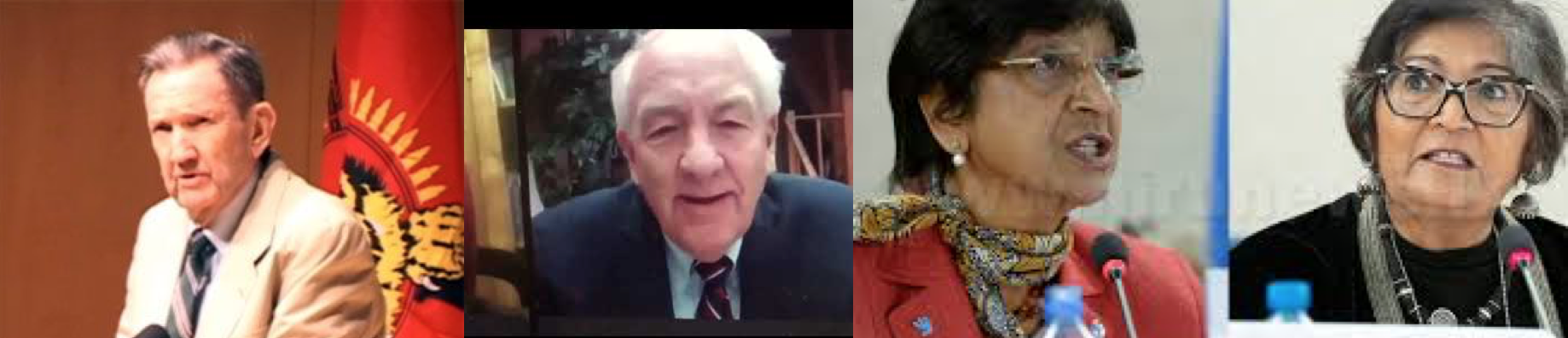
We have 4 international figures serving in the international ‘justice & world peace’ system now closely associated with the TGTE. Ramsey Clark’s association with LTTE goes back to 1996, Stephen Rapp after retiring is now buddy buddy with TGTE so much so that he remembers in 2021 the former Sri Lankan defense secretary and present President of Sri Lanka telling him that he killed surrendered LTTE leaders in 2009. I killed them, I killed them, I killed them” are supposed to be the lines Rapp was told and the 72year old lawyer remembers this only in 2021 (7 years later) Mind boggling as to what else he has forgotten! Better see a doctor for dementia! Then we have a EU employee who is supposed to be paid to look into South African affairs but is 24×7 preoccupied with Sri Lanka, for someone who has never travelled to Sri Lanka, what drives Yasmin Sooka’s focus on Sri Lanka is equally mind boggling. Then there is Navi Pillay former UNHRC head now appearing on Mullaivaikkal Memorials! The four examples, highlight a clear conflict of interest, as all four are clearly linked to a party to the conflict and certainly raises their bias.
Ramsey Clark was US Attorney General in 1967.
Ramsey Clark’s association with LTTE is a long one. The same year 1997 that US designated LTTE as a foreign terrorist organization, LTTE hired Ramsey Clark to defend LTTE. Ramsey Clark was a former Attorney General under President Carter. LTTE also hired Prof. Richard Falk (Princeton University) & Prof. David Cole (Georgetown University).
http://www.sundaytimes.lk/971109/taraki.html
https://www.sangam.org/NEWSEXTRA/Challenge.htm
The judgement was given in 1999 – United States replies that a court cannot make the determination the LTTE wants because recognizing foreign states is solely entrusted to the political branches, and the United States has not recognized the LTTE. Who is the sovereign, de jure or de facto, of a territory, is not a judicial, but a political question, the determination of which by the legislative and executive departments of any government conclusively binds the judges, as well as all other officers, citizens, and subjects of that government.” Jones v. United States, 137 U.S. 202, 212-13, 11 S.Ct. 80, 34 L.Ed. 691 (1890).
http://uniset.ca/other/cs5/182F3d17.html
In 2010, a year after LTTE defeat, Prabakaran’s legal advisor sets up TGTE and appoints himself its Prime Minister. This event held at New Yorks UN Plaza hotel was attended by former US Attorney General Ramsey Clark
In 2012, Ramsey Clark a former US Attorney General pays glowing tribute to Prabakaran
his achievements for the Tamil’s are legendary”
he took up arms to free the Tamils of Sri Lanka”
Prapakaran moved from military action to a difficult diplomatic cease fire, now approaching the beginning of its fourth year, in which he revealed skills as a statesman that equal his skills as a soldier”
Earning international support and with the solid backing of the Tamil population manifested in the April 2004 elections”(reconfirms TNA = LTTE)
Ramsey Clark even delivered TGTE organized Tamil National Day of Mourning inaugural lecture in New York on 18 May 2015 at the New York Country Lawyer’s Associaiton.
In October 2016 more retired international figures joined TGTE alongside Ramsey Clark. Justice K P Sivasubramaniam former Judge of the High Court of Madras India joined former US Attorney General Ramsey Clark to file a communication with the UNHR Committee against the 6thamendment of Sri Lanka’s Constitution as violating freedom of speech and conscience guaranteed under Articles 18 and 19 of the ICCPR.
Stephen Rapp – former United States Ambassador-at-Large for War Crimes Issues in the Office of Global Criminal Justice.
Stephen Rapp visited Sri Lanka in 2012 & made his 2ndvisit to Sri Lanka in 2014 in the backdrop of Navi Pillai, UK PM Cam and others on behalf of the UK headquartered Global Tamil Forum (GTF) demanding that Sri Lanka should be hauled up before an international war crimes tribunal.
In September 2015, JustSecurity interviewed Stephen Rapp and his words are interesting
any proposal be something that is developed in consultation with all of the communities in Sri Lanka. It cannot be something that is brought out and put into effect in order to just answer the mail from Geneva. It must answer Sri Lankans’ own need to actually deliver on accountability”
The co-sponsorship 30/1 resolution demanded Sri Lanka commit to setting up 4 institutions
Office of Missing Persons – DONE
Truth & Reconciliation Commission – DONE
Reparations Authority – DONE
Special Prosecutor’s Office & Special Court with international lawyers and judges – ON PIPELINE
Rapp declares that the GoSL has to give a specific time frame and benchmarks while the special prosecutor’s office (independent of the Attorney General) must be immediately established to gather evidence & build cases for the special international court by international lawyers, international investigators & staff.
Rapp also recommends amendment to Victim & Witness Protection Act in accordance with international standards.
The best part comes in Rapp’s recommendation of Sooka
I have great confidence in the ITJP which follows the highest standards of criminal justice and is led by Yasmin Sooka of South Africa”
Clearly this establishes cordial ties with Rapp-Sooka-ITJP
Then in March 2018 Rapp was in Geneva on invitation of TGTE to participate in TGTE side event facilitated by Manikavasagar of TGTE in Geneva titled How the international system has failed to provide accountability to mass atrocities: ongoing illegal detention, torture and sexual violence against Tamils in Sri Lanka” https://youtu.be/Pe3LBBUZpQE
On 22 May 2020 Stephen Rapp the ‘distinguished Fellow at the US Holocaust Memorial Museum’s Centre for Prevention of Genocide’ and Fellow at The Hague Institute for Global Justice addressed the TGTE Parliament (in the sky) where its PM is Prabakaran’s former legal advisor! Interesting why Rapp does not mention what Gotabaya is supposed to have told him in 2014!
Interestingly, an open letter was sent to Rapp by Warna Hettiarachchi in 2014 demanding why he is not investigating LTTE fronts- that question is answered years later and explains why Rapp cannot investigate entities that he is associating and is a special guest of. https://www.lankaweb.com/news/items/2014/01/09/letter-to-stephen-rapp/
So should we be surprised that Stephen Rapp appears on 21 February 2021 in a webinar organized by the Global Tamil Forum, the Canadian Tamil Congress, Sri Lanka Campaign for Peace & Justice& Centre for Human Rights & Global Justice.
The coterie of former international figures also speaking now linked to the pro-LTTE groups include former UN Assistant Secretary General Charles Petrie, former UN Special Rapporteur on Transitional Justice Pablo de Greiff.
Aligning with a group party against the GoSL & Armed Forces seriously impacts their credibility.
Rapp suddenly claims then Defense Secretary Gotabaya Rajapakse admitted to killing surrendered LTTE leaders in 2009
She is the former EU paid Executive Director of the Foundation for Human Rights in South Africa since 2001, within which she is separately operating an entity called International Truth & Justice Project (ITJP) EU is mum on how an EU funded South African NGO can operate a project on Sri Lanka. Whether EU is funding ITJP is also unclear! But ITJP churns out reports far more than any work done on South Africa. TGTE has awarded her the 1stNelson Mandela Memorial Award in 2017!
The ITJP initially said 40,000 dead and ended with 200,000 but ITJP only submitted a list of 351 missing to the Office of Missing Persons in June 2018. Why couldn’t ITJP and Sooka provide names of 40,000 or even 200,000 dead or missing?
The 2014 ITJP report was funded by the British Foreign Office through the Bar Human Rights Committee of England & Wales – of the 40 cases reported majority were former LTTE illegal combatants seeking asylum!
TGTE is also associated with the Sri Lanka Campaign for Peace & Justice– surprise surprise Sooka is on the Advisory Council where Board members also include Callum Macrae of Channel 4. A host of other former international players are also part of this set up. Excellent retirement scheme!
Thus in March 2014, Sooka as an Advisory Council member for the Sri Lanka Campaign for Peace & Justice led a petition joined by Desmond Tutu, R Sambanthan, Wigneswaran and 35 others to UNRC to set up a Commission of Inquiry against Sri Lanka.
Joining Yasmin Sooka is Navi Pillay – both from South Africa though Pillay is a lawyer of Tamil ethnic origin. Having retired, she appears on 20 May 2020 on a video message relayed to the world which has exposed her bias. She extensively quoted from a personally commissioned report that had no mandate from UNSC or UNGA and chose not to even table the personally commissioned Ban Ki Moon report in the UNHRC for Sri Lanka to formally respond. Thus the legality of OISL remains open. She has helped create a precedent where for the first time UN was investigating a conflict that had concluded. Her 2020 May speech shows her lack of sympathy for the Sinhalese & Muslims killed by LTTE and explains why she chose not to visit a single victim during her visit to Sri Lanka.
TGTE has hired the following as its legal advisors – Geoffrey Robertson QC– Consultant, Justice Shah, Richard Rogers, Marie Guirad, Heather Ryan, Peter Haynes QC.
Thus the LTTE kitty is doing wonders. Excellent means for post-retirement and time pass as well as be able to continue one’s self-importance internationally at the fate of innocent victims and countries. We can imagine how much they abused their office!
It would be good to do up a list of former international figures now associated with pro-separatist LTTE fronts.
The LTTE Diaspora are very much in action of late. This is nothing to be surprised. Every Geneva session their adrenalin gets pumped and LTTE kitty is put to use. Several videos are being relayed of girls and boys speaking with heavy foreign accents off a prepared script about Tamil Eelam. How do they propose to create that Eelam? By packing off another set of Tamil poor and low caste children into the Vanni jungles? Do these foreign living LTTE diaspora kids know how many such Tamil children lost their youth and were denied fundamental right to education? Are these foreign living kids so wicked that they want to outsource Eelam and send another set of kids to the jungles while they enjoy life living in the West and realizing their personal dreams? Why outsource Eelam to innocent Tamils, why don’t these kids go to the Vanni themselves and fight for Eelam?
Listening to these kids overseas you have to wonder what they know of the life that the Tamil child soldier went through.
Do these foreign-living Tamils reading scripts with heavy accents know that the Tamil Eelam they are demanding while living in Toronto, Texas, Tooting meant a sordid life for their counterparts back in Sri Lanka?
While these kids were happily living in foreign climes, going to play school, playgrounds and eating toffees – the Tamil child soldiers were kidnapped from their homes, the begging of their parents only meant gun shots scaring them back home, any child that fled the LTTE ‘orphanages’ were shot and killed, the only playground these kids knew were training ground that taught them how to shoot. The only sweets they bit were the cyanide capsule that spelled their death certificate if caught. So how do these foreign-living Tamils feel about the suffering of these Tamil child soldiers in the jungles of Vanni, with smelly clothes, hardly time to have a bath, wearing the same underwear for months, smelling of body odour never smelt a perfume or used a bar of soap in their little lives and never had the fortune to even enjoy a parent’s hug and kiss.
The only toy they held was the gun, the only playmates they had were the other child soldiers equally frightened and brainwashed into hating people they had never seen or known.
The foreign-living Tamils had the luxury of going to school, of taking part in prize giving’s, winning competitions, showing off their talents, singing, dancing and what not.
What did these Tamil children enjoy? The only prize giving they attended was the LTTE passing out parade where they shook hands with the mass murderer Prabakaran and was given a cyanide capsule and gun to kill. They had no opportunity to sing or dance or show off their talents. The only talent they could show off was their ability to kill and shoot people to death! Some of these children are today invalid without legs or hands. What a life that would have been for such a child.
Have the 9 girls featured in the video probably with foreign passports, probably not knowing a single town in North Sri Lanka or even where any of the LTTE camps were set up, thought of what life would have been like for teenage LTTE child soldiers in the jungles? Who stole their adolescence? Did they ever get to cut a cake for their birthday, did they have a teen party, did they ever go out for parties or watch a movie with friends or share girlish secrets? Just imagine the torment these young girls in tiger uniforms would have suffered? How many of them became sexual bait for male combatants living in bunkers for months where naturally the sexual desires would have taken the better of their orders! Why are these facts kept hidden? Even Thamilini’s book subtly brings out some of these facts which are nicely swept under the carpet.
Are these foregin-living teens not ashamed to come in public demanding Tamil Eelam which they simply want to outsource to another set of poor and low caste Tamils while they enjoy educating themselves and gaining lucrative employment overseas and enjoying the LTTE kitty which is ever expanding.
In May 2009 when LTTE was militarily defeated 11,644 LTTE combatants surrendered. They were all in civilian clothing. 4167 were married, 7375 were single, 122 were widowed and 594 were children above 12 and below 18.
These 594 LTTE child soldiers were given a Presidential Pardon and put through schools something the LTTE Diaspora would not even dream of doing. The GoSL gave them vocational training and guided them on taking a new path to the one they had been forced into by the LTTE and the LTTE diaspora. Gokulan became a singing sensation the whole country is fond of.
It is pathetic to watch LTTE Diaspora kids reading off scripts demanding Tamil Eelam living overseas and unlikely to ever come to a bogus Tamil Eelam. So what is this actual game the LTTE Diaspora are playing?
Do they need to keep alive Tamil Eelam to enable more Tamil asylum seekers & refugees to foreign country on the bogus ‘discrimination’ card?
Do they need to keep alive Tamil Eelam demand to continue the nexus of international rackets they operate which has been able to even buy off corrupt foreigners
Do they need to keep alive Tamil Eelam as this is what the western governments have asked of them as it enables them to use the UN system to pressure and carry out gun-boat diplomacy against Sri Lanka – or is it a combination of all above?
We would really like to know the real reason as these foreign demands are nothing that connects with what the Tamils in Sri Lanka want. With the ever reducing number of pro-LTTE protestors in Sri Lanka and decline in TNA following, the LTTE eelam quest is as good as dead now. All that Tamils living in Sri Lanka wish to do is to have their areas develop, to enable their children to go to school, university, get a good job, own a house & car, marry and start a family. The Tamils in Sri Lanka have far bigger issues than eelam to think of – these include the drug menace, drinking fathers, abusive fathers, rape by members of their own family – why don’t the LTTE diaspora kids do some initiatives to curb these headaches that the Tamils are suffering.
If LTTE diaspora kids really want to create a Tamil Eelam – put Rudrakumaran into a tiger suit, wear tiger kits themselves and go to the Vanni jungles and experience first-hand what the Tamil child soldiers suffered for 3 decades losing their entire youth!
Then come on Instagram and tell us whether it was really worthwhile!
The UNHRC Resolution,
30/1 – Promoting Reconciliation, Accountability and Human Rights in Sri Lanka,
was co-sponsored by the Sri Lankan Govt., after the regime change in January
2015. It is well known that the West, in particular, United States of America
(USA), had a key role in backing the regime change. The new Govt. of 2015 was a
coalition of minority parties and the right wing, United National Party (UNP).
The 30/1 co-sponsorship is known to be an appeasement for minor parties as well
as a payback for the Western support for regime change. Currently however, many
a brow is raised as to why the 30/1 Resolution had failed to achieve its
objectives. Although there are many reasons for this outcome, the following are
considered significant.
The lack of
objectivity of UNHRC when dealing with Sri Lankan allegations is an important
cause for its failure. The allegations were biased against the Sri Lankan
Govt., from day one of UNHRC involvement. It should be noted that the Darusman
Report, which formed the basis for the allegations, did record some of the LTTE
atrocities undertaken during the war. These included, taking thousands of
civilians as a human shield, point-blank shooting at civilians escaping the
conflict zone, firing from military equipment stored among civilians and
hospitals, using thousands of child soldiers, engaging women as suicide
bombers, having civilian combatants, etc. Despite these admissions, UNHRC saw
it fit to allege the terrorist carnage as the responsibility of Sri Lankan
armed forces and limit the investigations to the war-end mayhem. In addition,
the Govt.’s request to extend the coverage of the investigation for the entire
war period, as civilian massacres of all communities, during the 30-year war,
far exceeded the year-end toll; was ignored and fell on deaf ears. Although,
Darusman Report claimed there were credible allegations of serious violations
by armed forces, no evidence was presented for such allegations, giving rise to
speculations that the allegations were spurious and UNHRC was on a witch-hunt
against Sri Lankan Govt. In such circumstances it is not a surprise that UNHRC
resolution, was doomed to fail, from its commencement.
The issue was further
politicised by many Western member nations categorically supporting the 30/1
resolution, without any scrutiny, to be supportive of LTTE Diaspora domiciled
in their electorates for polling benefits. The unconditional support of the
West did encourage Tamil parties; in particular, front-end LTTE political
parties such as Tamil National Alliance (TNA) to not participate in
investigative commissions appointed by the Sri Lankan State but to cry foul at
every turn. This was also, demonstrated by the return of the development
appropriations for the Northern Provincial Council back to the Treasury,
without spending on the earmarked projects. In this way the ruling LTTE parties
were able to hoodwink the average Tamil constituents to believing that the Sri
Lankan Govt. is not providing for northern development and the only way out is
to call for a separate State. In fact with a view to the 46th session of
Geneva, there has been calls for referenda in the North for a separate State.
These activities demonstrate that the ultimate goal of LTTE Tamil parties is
not reconciliation or resolve war crimes but to set up a separate State with
Western assistance.
UNHRC’s bigoted
attitude to Sri Lanka has blinded them from comprehending the fact that Tamil
claims for a separate State with a 2/3 coastline for less than 12% of Tamils is
not only impractical but also unachievable due to demographic and ground
realities. Accommodating two states in a small island like Sri Lanka of 25,000
square miles, with the Northern State having allegiance to an emerging world power
of India, a country that trained Tamil terrorists, is no doubt a recipe for
eternal border surveillance and conflict. The non-LTTE Tamils, Muslims and the
majority Sinhalese would definitely want to avoid such a scenario at whatever
cost.
UNHRC, with its
prejudiced mind has to date, continuously refused to accept Sri Lankan
explanations for the inability to abide by the 30/1 Resolution. The saving of
300,000 Tamils from the LTTE human shield, re-settlement of refugees,
de-mining, rehabilitation of LTTE terrorists, the unprecedented northern
infra-structure development, the unconstitutionality of the co-sponsored
Resolution, the non approval of the 30/1 Resolution by the Cabinet or the
Parliament, Lord Nasby’s revelations in British parliament, lack of evidence of
alleged atrocities, were some of the explanations presented to substantiate
Govt. claims. These assertions, as usual, failed to receive any recognition
with UNHRC leadership. In fact, UNHRC has not seen the post war development in
Sri Lanka. Colombo has turned out be a good example of multi cultural living in
the world. Many ethnic groups live in peace and harmony, running their
businesses, participating in cultural and religious activities, without suicide
bombers or ethnic violence of any sort after the end of the terrorist war in
May 2009!
Also, UNHRC has failed
or not wanted to understand the recent changes that have taken place in the Sri
Lankan political settings. The overwhelming defeat of the 2015 govt. that
co-sponsored the Resolution by a 3/2 majority, did present is a rejection of
the 30/1 Resolution. In fact the current High Commissioner, Michelle Bachelet’s
report ‘Promoting reconciliation, accountability and human rights in Sri
Lanka’, was not a honourable presentation, as it did not even recognise the
Govt. withdrawal from the 30/1, at a previous session. It was a negative
political assessment of the initiatives of the new Govt., which is outside the
mandate of UNHRC.
It is
therefore, time for UNHRC to be practical and revisit 30/1 and present
evidence, underpinning the allegations of war crimes, so that a comprehensive
investigation can be undertaken to cover the entire 30 year war period, or
negotiate with the Sri Lankan Govt., taking into consideration the post war developments to move the country forward as an
undivided and a unified nation.