C. Wijeyawickrema USA
Can a dog’s tail straighten
by keeping it inside a piece of bamboo tree?
In America I see dog tails in all kinds of shapes due to human intervention.
In China and Japan there was a time that young girls were subjected to customary
‘feet-squeezing’ therapy to give them tiny,
beautiful feet. The recent press release by Professor Tissa Vtharana (TV) on
behalf of LSSP, reminded me the Sinhala proverb that one cannot make a dog’s
tail straight by placing it inside a bamboo block [even for a decade or two]. Impermanence
(change) is what we all see in the world, but TV and Wickremabahu K are perhaps
the only two Marxists who still live in the LSSP world of 1935-1964, blindly
following the Samathana theory, despite the fact SJVC meant by it a
Kosovo plan since 1949. In this affair, Nirmal Ranjith Devasiri, JVP-supporting
history professor, has understood the truth. He says the solution to the
so-called Tamil issue is, to give them what they ask, i.e., an Eelam!
There are mildlytamed
other supporters of an F solution such as Vasudeva, Dew Gunasekara, and so many
other older MPs hiding under the SLPP cloak, who survived only because of the
Gotabhaya Factor. I did not realize how serious was this steamroller effect of
Gota’s name, until I read an essay by KkS Perera in the Daily Mirror, on Jan.
5, with an eye-catching title: SLFP with its 1.5
per cent attempts Hara-kiri? -disband
it and join UNP.” Commenting on a new game by ex-president Sirisena
and Dayasiri Jayasekera, he says that in the two districts SLFP contested solo,
it got only 1.47% and 1.57% of valid votes cast in Nuwara-Eliya and Kalutara
respectively. People did not want to
forget what they did to the Sinhala nation via the Yahapalana illicit marriage.
So, if not for Gota and the SLPP cloak, SLFP could have faced the same RanilW
fate, except perhaps Sirisena, because of his competitive thirst to convert
Polonnaruwa to another Hambantota using all the funds he could muster. See what
had happened to Handunnetthi that every other black-white blog owner promoted
as a must MP in the parliament, when the general demand was to get rid of the
225 rascals.
Tissa V is not in a political Siberia today because of the generosity
of MahindaR then, and the SLPP-Gota factor now. His vote bank is miniscule. As APRC
chairman, he betrayed MR, and worked openly as well as secretly to promote
Chandrika’s balkanization scheme. His plan was rejected not because he had on
his lap a husband/wife team selected as members, but the Minority Report
prepared by the late H.L.de Silva and the Gomin Dayasiri-Manohara de Silva- G.H.
Peiris trio. Therefore, his recent statement, Tamil-speaking people, after
the defeat of the LTTE, see the Provincial Councils as an adequate sharing of
power, given some minor modifications that were acceptable to them at the APRC,
within a single unitary state,” (Island January 3, 2021), is mind-boggling,
to say the least.
Does he not realize even in the sunset days of his panchaskanda, that
what he considers as minor modifications which he suggested in 2006, such as stationing
a Tamil policeman in each Sinhala villages in the South etc., cannot give the
people of Sinhale, a guarantee that they are free of a balkanization trap, simply
because he now combines the two words, single with unitary (state) in his communique?
13-A is a one-way ticket to Eelam with a resting place called a union of
regions of the Chandrika-Orumittanadu type, or police or land powers of the
Dayan Jayatilaka kind. Wigneswaran is now talking about Shakespeare’s Ides of
March about to happen in Geneva in March, about a homeland blessed by five
Shiva Lingams brough to the island in pre-historic times! It is no longer a
simple Tamil homeland of SJVC type limited to NP and EP. It is now a theory to
catch the moon! Why is that this truth is not sinking in his brain if not in
his heart? His uncles perhaps, did not know the hard life Karl Marx’s wife went
through to feed her family. I think Marx would have become an ardent Buddhist
if he had an exposure to Buddhist literature. Why did Marxists in Ceylon did
not see the thin separation between Buddhist path and the theory presented by
Marx. Instead of the <Bangaveva> slogan?
Everybody is trying to veer the Romesh de Silva committee to follow
Chandrika’s 1995-2000 package deal. Previous committees including the LLRC has disappointed
the Sinhala people (see Senaka Weeraratna’s essay on the Lankaweb, on Jan. 4th
(LLRC Report – Betrayal of the victory of the security force in 2009). The
purpose of this essay is to remind the game TV and his Majority crowd played
then in 2006. The essay attached below is a record I made at that time, the facts
that I cannot remember now. However, after reading it, I tremble when I see how
wrong was Tissa then, and how grave the predicament Sinhale people are trapped
in, due to Sinhala black-white party politics. Of course, I will copy it to the
constitutional experts’ committee, because it has no time to peruse old
documents prepared consecutively by sets of black whites to trick people.
========================
This essay was written on April 2, 2007. It is long, but if it is
truncated its value is lost.
Vitharana proposal and the
separatist paradigm (1918-2007)
(I heard that a letter to
the Island editor on April 25, 1997 ended the then Package deals” of law
professor G. L. Peiris. I write this letter praying for an end to the APRC
proposal of minister Vitharana.)
Marxism and Malwatta
After two atapirikara-carrying
trips to Malwatta and Asgiriya temples, minister Vitharana, Chairman, APRC, has
given an outline of his power sharing mechanism” to a Daily News reporter
(Daily News, 3/30/2007). He had also spoken before the OPA on 3/27/2007,
especially on the devolution of water resources. The general secretary of LSSP
visiting Malwatta and Asgiriya is different from Anandasangaree or Karuna going
there. As part of their overall plan of peace and good governance, British
governors used the two Kandy Mahanayakes as cultural relicts. It was a strategy,
just like their accepting and promoting the caste system despite their Christian
religious beliefs. In the case of monarchy in London it has functioned as a symbol of
unity.
With no disrespect to the Venerable Mahanayake Theros, it must be
said that the revival and protection of the Buddhist way of life despite all hostile
acts against it, after 1815 and 1818, was carried out by coastal monks such as
Walane Sidhdhartha, Waskaduwe Subhuthi, Migettuwatte Gunananda and Hikkaduwe
Sumangala. Like in India or more recently in South Korea Buddhism would have
wiped out from Ceylon if not for the Sanga society in which Vidyalankara monks
played a key role at a later stage. The JHU and for example, Ven. Ellawala
Medhananda is the latest link of this chain via the late Ven. Soma. Thus, if
APRC chairman had an urge (itch) to obtain Buddhist views on his plan, he had
one in Colombo free of travel time. A trip to Kandy should not look like the trip JRJ and
RP made to the first wedding of Prince Charles.
In any case minister V’s words do not give the impression that he
had listened to the advice given to him by the Malwatte Mahanayake Thero. This
advice was reported in detail in the Island
newspaper on March 9, 2007. It also appears that minister V ignores public comments
such as Federalism and marriage” (Island, 12/12/2005, Island, 1/11/2006), you
cannot legislate against geography” (Island, 2/22/2006), Federal Marriages and
water wars” (www.defence.lk, 8/31/2006),
Language-blind regional development units” (Island, 10/25/2006), Anandasangaree
and God Vishnu” (Island, 1/3/2007) and A letter to a Tamil friend after 40
years!” (island, 1/25/2007). This is no surprise as APRC has even ignored 800
or so proposals it obtained by invitation from Janayas.”
Parity of status- history
repeats
During the period 1935-1964 Marxists preached two things: bangawewa (destroy) and sama thana. JVP copied this later in
1971 and 1988. Sama thana did more psychological damage as
villagers could not comprehend that the golden brains could possibly go wrong.
Facing generations of discrimination under the colonial rule, and never
treating Tamils or Muslims as second-class people, they could not think of any
justification that in their locality or region where 99.9% spoke Sinhala why
Tamil should be equally used (recognized). LSSP and CP never understood that
providing equality of opportunity is different from parity of status. JRJ’s Imbulgoda
march was against a Tamil Federal scheme. But villagers were confused as to why
Marxists became an appendage to the Tamil state party of Chelvanayagam. With
stories such as Marxists shouted at Sir D.B. calling him an abittaya (because he grew up in a temple
atmosphere as a child), and they called King Dutugemunu a gadol modaya (fool of bricks) Marxism became an engine on logs (kota uda). But they went on tours to
admire the pyramids!
With only an appointed, not voter elected position, minister V is
repeating history. He has taken upon his shoulders the baggage abandoned by G.
L. Peiris. In Buddhism no two persons are equal, and therefore, providing
equality of opportunity to its people by a government following western
democratic principles had no conflict within Buddhist society. It is the aspirations
of individual (in the sense of personal needs and wants) Tamil, Sinhala, and
Muslim, not the aspirations of IC, Tony Blair, the American ambassador or
Prabakaran that minister V should talk about. For that he does not have to
resurrect the Neelan-GL package.
Ven. Kalukondayawe Pannasekera
Thero and suriya mal viyaparaya
Ven. K started a village development and crime eradication movement
in the 1940s with Justice Akbar, ASP Osmond de Silva, and lots of Tamils. Ven.
K faced all kinds of obstruction from the colonial government and the CCS
crowd. At that time LSSP was also engaged in Malaria control work and suriya
mal selling. If Marxists were not blinded by the dogmas of Trotsky and Stalin,
they could have become little Ho Chi Minh/s in Ceylon, where nationalism and socialism
(not Marxism) worked hand in hand. Instead, the uncles of minister V, became
alienated from the villagers like water and oil. What V is doing today will
make him an anti-Mahinda Chinthanaya agent within the government.
F=U formula
If the Chairman of APRC thinks that the words federal and unitary
have lost their meanings over the passage of time,” then we need God Vishnu’s
help to help him. This is a lesson at grade 9 level Civics. The self-appointed
jack-of-all-trades Carlo Fonseka has recently pointed out at a book launching
why devolution (F not U) is needed for social order based on his analysis of
Buddhism’s three klesas” (lobha-dosa-moha)”
(Island, 3/25/2007). Thus, Carlo is a fellow Marxist available to V for a quick
lesson on Buddhism, only a phone call away. There is also a book by the law
professor Lakshman Marasinghe (the evolution of constitutional governance in Sri Lanka,
2006).
Did minister V explain his F=U formula to the Mahanayakes? F” is a
political marriage contract in modern politics. U” on the other hand is Buddhist
politics such as the King allowing persecuted coastal Catholics or Muslims to
live in his kingdom or temple priests in remote areas giving food and lodging
to Christian priests from Colombo or Galle who went on head
hunting trips. Could V think of any example from anywhere in the world where Sinhala,
Tamil, Buddhist, Hindu, Christian and Muslim people lived in harmony despite an
active separatist agitation since 1918? It was the Colombo ruling families who ruined this
harmony after 1931.
An F” marriage cannot work when one of the partners has a paramour.
The IC solution to Sri Lanka is
unique in that two parties living in one house is asked to go to two houses for
the happiness of both. Unfortunately, a marriage cannot be saved that way. Hence,
even Lakshman Kadiragamar was wrong in proposing an F” solution. An F”
solution based on language differences (as in India since 1956) is a slippery
path with no end in sight. Indian F” model is the best example. Indian army is
fighting against separatism all over India.
An F” creates two or more units which have some powers that cannot
be taken back from them permanently forever. The egg is scrambled. As the
asymmetrical package dealer G. L. Peiris once confessed, the F is a risky path,
once taken the egg cannot be unscrambled. F is like a roach motel- you see the
roach entering but no returning back. Unlike the notorious CFA 2002 or the
merger, F is a one-way path.,
Upatissa damanaya
Why did APRC ignore 800 or so people’s proposals? What is the reason
for a hurried solution? Where is the home-grown solution? Does minister V
believe in Buddhist economics discussed in Schumacher’s Small Is Beautiful
(1973) or in Buddhist politics? One example was Buddha’s advice to Ajathashatru,
the king of Magadha, when
the latter had a war plan to capture the Lichchavi kingdom of Koshala.
It was Buddhist democracy in 500 B.C. After all, the reasonableness doctrine,
compromise in modern democracy, is the Middle Path in Buddhism. Why cannot V use either the Nalagiri or Angulimala damanaya in dealing with Tony Blair, TNA or Prabakaran?
The Mahinda Chintanaya is nothing but an application of our
2500-year- old traditions of living in harmony with other human beings (be they
Helanic or Roman or Muslim traders, Tamil invaders or plantation coolies, Malay
soldiers or Portuguese who came with Bible and sword, Burghers and NGO
evangelists) which got twisted in the hands of Colombo black whites (since
1833) and Marxist preachers (since 1935). APRC or its expert committees do not
have people who read the Ummagga Jathakaya as high school students.
White man’s burden (1905-2007)
Why is minister V in a hurry? Is it because more and more time means
less and less time for the Prabakaran episode? The IC does not want a total
removal of the cancer of terrorism. They want a second Vadamarachchi in 2007.
They want him in a three-piece suit flanked by his western-educated children.
Why? Is there any connection to the theory of the White man’s burden of 1905?
Is there any influence from White evangelism of Blair or Bush as outlined by
the Polish Pope John Paul II when he visited India
in 1999 (evangelization of Asia)? Pope’s
propaganda cabinet minister with a grand budget has his office located in Ratnapura.
Or was it the clash of civilization” thesis of the Harvard professor Huntington (1993)?
Balkanization of Sri Lanka
is a short cut to India.
The world federation of Tamils wants a separate state, and Tamil Nad opposes
Hindia’s intrusions. In Trincomalee harbor even nuclear submarines could hide
in deep under sea troughs as revealed by the former CCS officer Neville
Jayaweera who is now running a Christian communications network from England.
So, there is great temptation all around that probably escapes from minister
V’s radar screen.
India is a
myth” – Indian National Congress (1885)
What does V know about the separatist paradigm in Tamil Nad and Sri Lanka?
It began in Tamil Nad in 1917 and one year later in 1918 it came to Ceylon.
In India the colonial master openly promoted separatism stating that India is
a myth.” They promoted a Pakistan.
In Tamil Nad separatism grew to the extent that even the Ramayanaya story was
changed making Ravana a Tamil king who fought against the evil doers of Rama
and Seetha (Adam and Eve?)! Prabakaran is thus a Ravana prince more than a new Chola
king with a cyanide pill on his neck. In the past it was Sivaji Ganeshan or MG
Ramachandran (born in Kandy)
who acted as Ravana in popular Tamil Nad movies. A former SP of NP recently
noted how Jaffna Tamil boys went in the morning by boats to Tamil Nad to see
opening afternoon show and return home in the night!
Minority-majority complex
Despite the total silence of Colombo NGO peace mudalalis with
western Ph.D.s and the Marga Institute, not to produce papers” on the impact
of the Tamil Nad separatist agenda on Sri Lanka, from 1917 to 2007, there
had been a continuous flowing of two parallel streams of separatism poisoning
each other. Thus, in 1949 SJV Chelvanayagam benefited from Tamil Nad’s
Dravidasthan movement.” In the late 1950s it was the anti-Hindi movement.”
When separatism was proscribed by the 16th constitutional amendment in 1963, it
came to the Kandyan areas in lock stock and barrel as the DMK threat and a Kallathoni
problem (Tennakoon Vimalananda, Dravida Munethra Kasagam Movement and the
future of the Sinhalayas, Anula Press, Colombo, 1970). In the 1980s separatism went back to India,
officially, with MGR and Indira Gandhi sponsoring it with surface to air
missiles. After the murder of Rajiv Gandhi in 1991 there was a set back but in an
era of coalition governments in Delhi, Tamil Nad voting block has become more
powerful than the power of Delhi to use or abuse the presidential rule to discipline
unruly regional politicians (Article 356).
Tamil Nadu time bomb
Tamil Nad is in such volatile state that Delhi is now surviving by
capitalizing on the rival demands of its present or former chief ministers to
arrest the other or to impose the presidential rule. At least two major caste
groups are demanding two separate states within Tamil Nad. It is only a matter of
time a future Prabakaran takes control of Tamil Nad politics which is driven by
sex scandals and family affairs. The common criminal Veerappan incident
(Saradeal or Robinson Crusoe) demonstrated how easily and quickly separatist
sentiments could be utilized to overthrow the corrupt and inefficient political
establishment in Tamil Nad. The Janatha Party leader Subramanium Swamy’s recent
book (Sri Lanka in crisis: India’s options, 2006; (Island, 3/21/2007) should be
an eye-opener to minister V.
Himalaya and Pidurutalagala
Does V provide an adequate mechanism to prevent secessionist attempts
under the geopolitical conditions mentioned above? He says there are two
safeguards: (1) the president can deploy the army and (2) he can dissolve the
province and take over the administration. Minister V must be kidding. Even
under the 13th amendment which is not an F but U condition according
to V or Carlo Fonseka or another law professor Lakshman Marasinghe (Daily
Mirror, 3/9/2007), the chief minister Vartharaja declared UDI and fled to
India. Where would be the IC if it happens again? Once minister V allowed the
province to do everything it needed to be on the separatist path, the province
will appeal to IC for help or justice. It will say the president is not allocating
sufficient volume of water from the Mahaveli River and the IC and UNO will
intervene. As Marx said people also suffer from the dead.
In the case of India
each state is a small fraction of the goliath. This is why comparing Indian F
and its article 356 with a Sri Lanka F is like comparing the Himalayas
with Pidurutalagala because both are mountains. Minister V must be more careful
than Anandasangaree.
Traditional Tamil homeland
– cart before the horse (1976-2007)
Does V reject the proposition that there is a traditional Tamil
homeland in the Eastern
Province? Is he willing
to make that rejection the foundation stone of his proposal? V should not first
get his scheme approved and say that the issue of re-merger will be discussed
later. Re-merger means acceptance of a homeland. Homeland theory is a colonial
western idea. This was what the Neelan-GL package wanted. Neelan went even
further and refused to accept the Pondicherry sub-model of the Indian F” model
because his homeland would then look like a moth-eaten patch of land with
Muslim and Sinhala Pondicherry units”. V will be putting the cart before the
horse if he does not clearly understand this issue. If V’s constitution is
silent on homelands now, and if later it comes up making a giant N-E unit, then
the Trincomalee state will be as big as the Colombo state. With Malayanadu in
between Colombo
army will be no match to Trinco power.
This is not a daydream of a Sinhala Buddhist Chauvinist. V does not
have to believe what the retired geography professor G. H. Peiris wrote in his
book (2006). He could read what the Scotman Paul Harris has written on the
subjects of Malayandu youth unrest and Oluvil Muslim radicals. If V accepts FP,
TULF, TNA and Anandasangaree versions of a homeland then V cannot stop
homelands for Muslims, Indian Tamils or Christians in Negombo or Tamils in
Wellawatte. He will get an F” grade from the IC crowd.
Discrimination against the
majority (1505-1931)
V says there are about 27 other countries which have veered away
from U status towards F states to prevent separation. Without a list of these
countries, one cannot comment on this point. In the Fiji
Islands or in Malaysia there were attempts of
separation. In the Fiji
case the army arrested the Indian-backed prime minister for anti-national work
against the native Fijians. In Sri Lanka Tamils and Muslims enjoy more rights
than any where else in the world. In Colombo, the richest are the Tamils and
Muslims. Thus, when Karuna says in 2007 or when the JVP said in 1971 or 1988
give us what Colombo gets” (kolambata
kiri apita kakiri –Youth Commission
Report, March,1990, p. xvii)) there is/was no ethnic discrimination.
Instead, the truth is that the Colombo class has been controlling 95% of the people,
which became worse under the globalization game and the 1978 Dharmista samajaya gimmick.
Section 29(4) of the Soulbury
Constitution did not allow the removal of five centuries of discrimination
against the majority community which is allowed and implemented in other
countries that faced similar situations where the majority was the victim. The
Shia majority in Iraq complained that the Sunni minority mistreated and killed
them. South Africa
had the same problem. In Russia, the party members were the minority who
exploited the majority citizens.
Macaulay’s grandchildren (1840s)
V says, if the minorities don’t get the power they need, the only
solution is separation.” Can V say that the majority got the power? Who got
power after 1931 or after 1833? A group of white-kissing Colombo families who
used Buddhist masks after 1931, got power. A group of Colombo Tamils who used the
language card to prevent the poor Tamil learning Sinhala, but gave Sinhala
private tuition to their children, got power. The question is would this
Colombo control change under V’s proposal? Rather than re-inventing the
Neelan-GL package, V should ask a set of new questions. He has become a
prisoner in trying to provide new answers to his old questions. Does he know
that by sheer mismanagement the Colombo
black whites ruined the country?
*1. they destroyed the structural
democracy of the island since the early 1960s, after the 1962 Coup (the
separation of powers doctrine started in 1802 when North was the governor, and
the rule of law);
2. JRJ killed territorial
democracy after 1978 with a bahubootha
Vyavastava,” electoral system that robbed people of their representative
democracy, and by demolishing the VC-TC local government system;
3. In the 1980s village level civil administration was politicalized
by increasing the number of GSN units from 4,000 to a mind-boggling 14,006
(each GSN unit has a GSN, Samurdhi Niladharee and a mid-wife);
4. A corruption trinity of AGA-local MP-NGO agent (Colombo peace
mudalalis or evangelists) now runs the show. Each AGA unit (there are 319 of
them) has between 100-150 officers excluding teachers;
5. the gap between Colombo and villages increased under
globalization and free trade;
6. the divide between Colombo rich and village poor widened after
1978;
Vakarai IDP welfare money stolen by corrupt officers!
Do we need a hurried devolution package, based on the same Neelan-GL
formula? Or should we take a holistic approach to handle this antho-jata-bahi-jatas meta-problems? The
V proposal in its present form will deliver an F” to a group of Tamil
politicians, but it will not solve the mismanagement problems of the average
person, Sinhala or Tamil. This is the aspiration issue that V should think of.
Not the aspirations of IC or Tony Blair.
In India under
the language-based state reorganization, a new tier of local/regional
politician class developed who began to challenge the Delhi political class. That brought an end to
the Congress Party control and created a sick Delhi center dependent on over 20 coalition
partners. Indian poverty is still a major problem and politicians at all levels
are thriving. Is this not what is happening in Sri Lanka after 1978? Macaulay’s grandchildren from all former
colonies flooded UN jobs just as white mayors in USA left the major cities leaving
them for black or Hispanic minorities. For an outsider, minorities are mayors
in all major US
cities! Who are the children going to the future world leaders’ summit in USA
(Daily News, 7/23/2006)? How many Sri Lankan village boys got scholarships to
Harvard or Oxford?
Just see how Sri Lanka’s
Sixth Great Force (janitors and housemaids in Arab countries) is treated by its
Colombo ruling
families? This is what minister V should consider as top priority not a
Prabakaran solution within 60 days.
Colebrook (1832) and Dixit
(1987)
V says Province is the devolution unit. Does he not accept that PC
is a white elephant, and unwanted burden on people and the economy? Is there
any scientific, ecological, social, or economic justification for this unit
other than Rajiv Gandhi and Dixit forcing it on JRJ, Sri Lanka’s kaputu bo tree? V is taking the path of least resistance to achieve
his goal of paving the way for a Tamil homeland. Why did Colebrook divide the
island into five?
Ayub Khan’s plan of
October 26, 1959
V has proposed a 100-family Jana Sabha (JS) unit (ward) below Gam
Sabha (GS). From GS comes Pradeshiya Sabha (PS). A GS will according to V cover
about 2/3 of one GSN unit. This is similar to what Ayub Khan proposed for Pakistan
which was similar to the Soviet people’s councils (Pakistan: old country/new
nation, Ian Stephens, Pelican, 1964, p. 314). The Ayub plan became too good to
be true and never implemented. He was talking of basic democracies” with units
of 800-1000 people. Instead of his own plan, if V decides to read the valuable
document of the Local Government Reforms Commission (Sessional Paper No. 1 of 1999,
the Abhayewardhana report) he would become an expert in grass-roots politics. A.T.
Ariayaratne’s 1988 book, The Power
Pyramid and the Dharmic Cycle” also gives a plan of action. Another source is Arjuna Hulugalla of the
CIMOGG who writes regularly with a unit plan leading to a District administration.
Trinity of gama-vawa
–dagaba
V has a golden opportunity to link the Gama Naguma project just
inaugurated under the Mahinda Chinthanaya with his mission as Chairman of APRC,
if he comes out of his parity of status prison. Tamils have a homeland in Tamil
Nad. Muslims have Mecca
and a billion muslims. Christians have Pope. Sinhala people and Sinhala
Buddhist have this tiny island, 15 million and the ocean. Trostsky or Vishaka
Kumari Jayawardena (queen of Marxism in Ceylon) did not know this. The 2500-year-old
civilization of Sri Lanka should really be a UNECO heritage site. Just think of
the biso kotuwa or the Dambulla hydraulic lamp? Rather than running with ghosts of SJV
Chelvanayagam or GG Ponnambalam, minister V should think of using his Marxist
energy to empower the Tamils, Sinhala and Muslim comrades at the trinity level,
because, the dagaba was kovil, mosque or church at the grass roots level. Let
aspirations grow at the family and village level. Do not promote language-based
separation. Instead create language-blind developmental units. If in a village
the majority happens to be Tamil let them work on their aspirations from house-hold
level upward to VC level. Several VCs can go to District level. Imposing a
Provincial level unit on them by a Colombo
group is not suitable in Sri Lankan case as there is the fear and danger of separation.
Make a trip to New Zealand
Because our trinity is tank (reservoir)-centered it fits very well
with the modern concept of river basin-based administrative units. New Zealand,
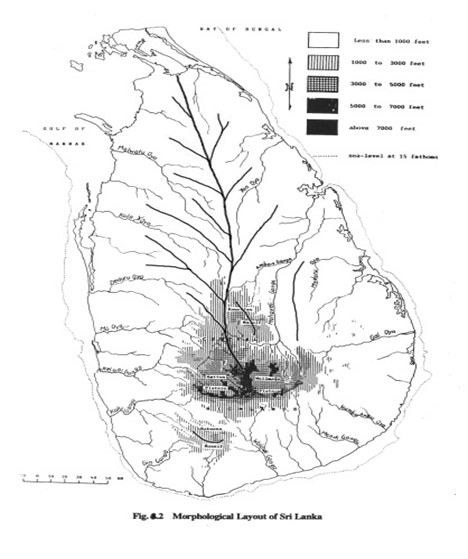
a tiny country like ours is using this concept. The geographer, Maddumabandara
has produced a river basin-based administrative system for Sri Lanka that V
should get his APRC and the expert lawyers to study. Because one cannot
legislate against geography, law in books cannot become law in action, if APRC
chairman acts like a Colebrook in 2007.
Move the capital city to
Raja Rata
While developing the Southern Provinces the APRC should think about
moving the administrative capital to a location within the triangle of
Anuradhapura-Vavuniya-Trincomalee on a 20-year plan. Let Tamil farmers in
Jaffna meet with Sinhala farmers in Hambantota by linking that capital with
Hambantota along the Mahaveli River by a railway line and a highway. By moving their
science and integration ministries to Raja Rata ASAP, the Marxists ministers
could win the hearts and minds of the janayas. This is what an APRC should
really be engaged in rather than re-dusting the old documents in Colombo houses.
C. Wijeyawickrema
USA


![A medical worker shows used bottles of COVID-19 vaccines during Bharat Biotech's Covaxin human trial after it was approved by the Indian Council of Medical Research, at Maharaja Agrasen Super Speciality Hospital in Jaipur, Rajasthan, India [File: Vishal Bhatnagar/NurPhoto via Getty Images]](https://www.aljazeera.com/wp-content/uploads/2021/01/GettyImages-1230196055.jpg?resize=770%2C513)