By Noor Nizam – Peace and Political Activist, Political Communication Researcher, SLPP Stalwart and Convener “The Muslim Voice” – June 26th., 2020.
This will ease the demand for University entrance/education in Sri
Lanka.
This is a great support Pakistan and
Prime Minister Imran Khan is offering to Prime Minister Mahinda Rajapaksa and
President Gotabaya Rajapaksa to ease the demand for University
entrance/education that many thousands of qualified AL students are bottled
necked and suffering without a place in the higher educational institutions in
Sri Lanka even though they are qualified.
At a time when Sri Lanka is trying
to bring about “CHANGES” in Social Justice, Economical Revival and
create a better knowledgeable Nation, this arrangement offered, will be a
strength of pillar to Sri Lanka, Insha Allah. I am sure that President Gotabaya
Rajapaksa and PM Mahinda Rajapaksa will put in place a “FAIR and JUST
SELECTION DUE PROCESS” for the selection of these students to be
recommended for these scholarships irrespective of PARTY POLITICS, COMMUNAL AND
RELIGIOUS BAIS and FREE from any LOBBYING POWER, Insha Allah.
“THE MUSLIM VOICE” wishes
that 50% of the scholarships should be made available to the women of all
communities represented, Insha Allah. “THE MUSLIM VOICE” wishes to
express their since thanks and gratitude to PM Imran Khan, The people of
Pakistan and the Government of Pakistan for this generous offer made.
Pakistan has always remained a true
friend of Sri Lanka since the independence of both our friendly Nations. They
proved it beyond expectation coming forward as the first Nation to support our
TRI-FORCES to eradicate the ruthless LTTE in May 2009.
A Special Note for the attention of
PM Imran Khan and the Government of Pakistan (Pakistan Higher Commissioner to
Sri Lanka) – PAKISTAN SHOULD OFFER 1000 MILKING COWS (TROPICALIZED
SHAIWAL BREED) THAT WILL SUIT BEST TO SRI LANKA’S DAIRY FARMING ON BILATERAL
AID ASSISTANCE TO REVIVE AND DEVELOP THE RURAL DAIRY FARMING AND BREEDING
INDUSTRY OF SRI LANKA TO MAKE SRI LANKA SELF SUFFICIENT IN LOCAL MILK
PRODUCTION.
“THE MUSLIM VOICE” has
been suggesting through it’s comments to Pakistan on this matter for many
months and hope that Pakistan Authorities will give some positive response to
this suggestion, Insha Allah. This will help former minister Basil Rajapaksa
and President Mahinda Rajapaksa to implement development of local agriculture
and animal husbandry, dairy farming and “RURAL ECONOMY as envisaged in the
election manifest – “VISTAS OF PROSPERITY AND SPLENDER” in 2019 and
now, Insha Allah.
People have voted me to build this country; we need to identify industries and entepreneurial businesses, and funded them during this time to bring back the economy”” -Hon: President Gotabhaya Rajapakse
None of the Sri Lankan leaders couldn’t build a country people wanted to have; President Gotabhaya is the only hope. Following media is an example which they used their platform to educate public on upcoming election.
When it comes to
development the Central Bank has the major role to play. But over the years
central has not done its national duty to move forward the country towards that
path by making creative solutions to our motherland. Now is the time to do it,
with the new leadership of the country. The leadership we have in our country
is unique and this moment is phenomenon because president’s leadership is
courageous as he is standing firm before the statements he made to public.
Public has built their trust on him than ever before. Central bank need to do
two things in this instance. National institution can show the pathway for
prosperity from the financial management and investing point of view. Secondly
they can make intelligent decisions on financial economic decisions on daily
basis towards that prosperity perspective. The simultaneous approach will
enhance objectives of financing stability of the country.Our medium and small
industries will be benefited by this approach. If central bank fail to invent
tools to rescue mid size entrepreneurs of the country it will have a ripple
effect to our economy and collapse the economy. So intervention of central bank
out of the box thinking is very important at this moment & develop the
economy of the country. They essential must introduce financial product
targeting our manufacturing and micro industries. Financing to import cars and
selling cars want help to develop the economy. It will help only to develop
individual people of the bank to move forward with promotions. That is not what
the president expect form the the people in the institution. Central bank has
the best intelligent financial expertise and this is the time to come out and
bring their expertise. Every individual has a role to play towards the vision
of the president.
The request by the
president prior week meeting with central bank officers was phenomenon.
President has every right to request that way, because he has been entrusted
with huge confidence by the public of this country. People voted the president
expecting that change, and that change is the voice of our deserving people of
this country. Enough is enough the time has come to put your
brains into work
and make use of it. There is no use of highly educated bankers of central bank
if you cannot make financial products suited to our small industries to and
agricultural sector. Most of the commercial banks make loans for well to do
business people and the bank make profits at the year end, but it will not
helpful to develop the country towards development of agricultural sector and
small industries. In my previous articles I have addressed that this is a time
for change: that change is a voice from the deserving people of this country.
My personal opinion as such the state employees are not using to this change
yet. But the president approach is the perfect voice, words, and behavior to
initiate that change. Sometimes he will have to lay off some of those employees
if they are not following the road map to prosperity vision.
Prosperity vision
is not another piece of broken promises which was brought to people by previous
Ranil and Maithree ruling to snatch the power of the country. They brought up
about number of set of promises and all of them targeted to deceive people and
snatch the power of the country. The last one was the funniest and once and for
all for the country. Which was brought up by Designer gay finance minister
Mangala Samaraweera , which was called Enterprise Sri Lanka”. The meaning was to sell entire
countries assets to private firms of locally and internationally and making the
country bankrupt. So we all aware this was the reality too place over a period
of time in this country. Our state sector public employees were not doing
anything creative, at that time. Thinking out of the box to bring our economy
towards progressive direction, wasn’t necessary, because the end result was
making the country poor and have some wealthy business people in the country.
President Gotabhaya
and previous leaders comparatively different in many ways. He has a clear laid
out plan for the development of the country. He is mobilizing state service and
resources towards it. His meetings with state service employees and visits
signifies symbolic encouragement towards objectives. This leadership we haven’t
had over a period of time. Today state service and state department aware to
perform otherwise they know they need to face consequences. President is
trustworthy, competent, committed, passionate, resilient, collaborative, and
honest. Usually in western countries these were called soft skills, but today
they are hard to earn skills and maintain. As I explained courageous leadership
of his conduct and behavior with above skills make him the very right leader to
our country.
Attorney General
Dappula de Livera has announced the prisons of the country, have become the
playgrounds of criminals and pointed out that the prison department lacked
honest and efficient officers. This is a serious comment made by top government
law officer in public, that the state prison officers are corrupted handling
drug dealers and prisons are safe heaven for them to continue their criminal
activities. The question is how can we find solutions for these activities and
implement law and order. Illegal activities have been in place at prison and
come to surface through media, then only public will aware of these type of
incidents. What can we expect from these criminals doers for the country; they
already have inflicted heavy damages to our children, public and younger
generation. We need to convict them in
courts in an expedite passion and must be given capital punishment.
Nobody will find bad about it. Human right organizations won’t find solutions
for the heavy social damage caused by these dangerous convicts to our younger
generation of the country. If a country need to be civilized and disciplined,
and to have law abiding people who in these circles need to act now. Again
towards prosperity vision” cannot achieve without sacrifices and dedicated
people.
Kabir Hashim the
former parliamentarian at Balaya Program” tried to convince public that
government is failed ruling and making in roads to a Military Junta rule. Mr.
Kabir must be a long standing politician for his people but finding faults that
way is not worth to a politician of a long standing. The people of Sri Lanka
very well aware how your group of people acted in the past in parliament.
People aware the drama you played in the previous Ranil regime. I must tell now
the country has a leadership. It is not only a leadership but courageous
leadership which means standing clear and firm in his vision and working
towards it every moment of his leadership.
Muhudu Maha
Viharaya is a national heritage of our country. According to ancient deeds
written down the land belong to temple must be allocated and preserved as a
national heritage. Some Moslem politicians want to change the historical
heritage by occupying lands of north and east for political gains, but please
don’t play games with Sri Lankan heritage. As you know over the years the
previous government did not do anything to preserve them. They encouraged the
vandalism of Buddhist statues and cultural heritage of our country. These
monuments and statues evident and they are cultural proofs our history. They
must be preserved and protected for the future. At the same time laws must
implemented preserved the integrity of them. It has to be common Tamil ancient
historical values and moslem, christianity as well.
The following
was appered in EU site regarding eligibility for GSP Plus. This is a serious
comment made by them .
Repealing
the Prevention of Terrorism Act (PTA) was a commitment made by Sri Lanka to the
European Union (EU) in the lead-up to SL’s readmission to GSP+ as well as to the
UNHRC in April 2019”
This is a
serious comment and this is the way they enter into our internal matters. This
is how western countries want to enter into our internal matters. I believe it
is totally unacceptable to sacrifice our national security and for economic
reasons. Mangala Samaraweera did this 4 years ago, in front of the world body
without the consent of the president or our parliament. He will suffer for all
his political career for that national crime.
People who can
make a contribution to our society; this is the time to come up by using of
their platform to message and transform for change. One simple example for that
as such the famous Janapriya” Comedy series. Most recent comedy is a wake up call and a message
strongly addressing the public to select the correct candidate in upcoming
election. This is plain and simple what everybody need to do make use of their
platform, people who can influence to make that change. Like wise people who
could make the difference please don’t be silent and
use your platform to message and educate public with creativity. Then only
change will take place and can hope for better. There is huge responsibility
for media. We had enough suffering in this country. Now it is the time to move
forward with the right courageous leadership and every single person bears the
responsibility doing individual part rather than focusing their rights in the
upcoming national election.
Former Cabinet Minister Milinda Moragoda has urged political parties to seriously consider the abolition of the monster Provincial Council system which has cost this country a great deal more than a pretty penny. Six of the existing nine PCs ended their terms in 2018 while the other three went out of office last year and Governors are ruling all provinces. The whole country has been privy to the public slanging match between the previous yahapalana administration and its successor on the non-holding of the PC elections on the due dates and the endless postponing of their polling dates. Nobody has missed the PCs; and their factual non-existence has meant nothing to anybody except those elected to them who enjoyed lavish pay and perks courtesy of the taxpayer.
According to Moragoda who has served in government from both sides of the political divide – the UNP and the SLFP – and narrowly lost the Colombo Mayoralty when he ran against Mr. AJM Muzzamil of the green party fairly recently, the Provincial Council system costs this country over 250 billion rupees annually. He has said in a statement which we run today that “there is little doubt that significant savings and improved efficiency can be achieved through the abolition of this dysfunctional mechanism.” Few will have anything contrary to say about this proposition. It is accepted fact that the majority of our people prefer to deal with the Central Government rather than the Provincial Councils and there is no good reason why we should continue with these elected bodies whose main purpose appears to only serve as stepping stones to Parliament for the political class. First local bodies, then Provincial Councils and finally Parliament appears to be upward route for many of our politicians.
The PCs were set up, or more accurately forced down our throat, by India as a means of solving the ethnic crisis that has for too long bedeviled this nation. There was never any demand for this unit of devolution from anywhere except the north, and to a lesser extent the east, which has long sought a degree of autonomy. But, to borrow the phrase of the late Mr. Lalith Athulathmudali, a star or even superstar of our contemporary political history, “you can’t give to Jaffna what you won’t give to Hambantota.” So the 13th Amendment to our Constitution which, underwritten by India, sought to end the civil war that dragged on for nearly 30 years by the device of what has proved to be a massive white elephant.
Who among us can forget the intrusion into our airspace by Mirage fighter jets of the Indian Air Force, escorting Hercules transport aircraft, for that infamous parippu drop in the north of our country? That was when our troops were on the verge of defeating the terrorist LTTE through Operation Vadmarachchi in May-June 1987. The signal from India was unmistakable. Either Sri Lanka abandons the military campaign to stamp out the Prabhakaran brand of terrorism or India would intervene militarily. President J.R. Jayewardene was forced to eat humble pie and Prime Minister Rajiv Gandhi, who flew here for the purpose, and he signed the infamous Indo-Lanka Agreement. This brought the so-called Indian Peace Keeping Force (IPKF) here to keep the LTTE in line. This they failed dismally to do and India lost 1,200 troops and spent several billions fighting what the foreign press often labeled as the “Tamil rebels”.
And so the Provincial Councils, targeting regional autonomy, came into being. Moragoda has said in his statement that while the intention was to create more provincial autonomy, the structure that was created “has proved to be superfluous, expensive, divisive and fraught with inefficiency.” He has argued that “given the increasing ethnic, religious and regional polarization in our society,” we desperately need a viable democratic framework to address these issues. The truth of what he has said was clearly proved at the last presidential election when the winner polled the majority of the Sinhala (Buddhist) majority while the loser polled the majority of the minorities. Moragoda has expressed his belief that the more effective way of achieving this intent would be the creation of an empowered Senate/Upper House that could address critical issues concerning religious, ethnic and regional diversities. This, of course, requires national debate and discussion but for the time being, a clear commitment by the contenders for the National Parliament that they favour the abolition of the PCs will be most valuable.
Although Moragoda is not a runner at the forthcoming parliamentary election, he is clearly influential in our body politic and is known to have assisted the Gotabaya Rajapaksa victory last November. He is also the founder of the Pathfinder Foundation, undoubtedly among the more efficient of our Think Tanks. If his statement running into just one page of concise and tightly-written argument, is adopted by our Political Establishment a most useful objective will be achieved. As an analyst said in a hoary vernacular idiom, setting up the PCs was like “giving ladders to jumping monkeys.” Whatever their stripe, the vast majority of our politicians are widely regarded as monkeys by many of our people.
Milinda Moragoda, Founder of the Pathfinder Foundation and former Cabinet Minister, called on political parties to clearly state their positions on the Provincial Council system in their policy platforms for the forthcoming general elections. He urges parties to consider repealing the 13th Amendment, thereby abolishing the Provincial Council system. Moragoda reiterated his earlier proposal that the Provincial Councils should be abolished and power be directly devolved to empowered and reconfigured local, urban and municipal councils, since these bodies operate closest to the citizenry, and are thus in a better position to address and solve community-level problems.
He argued, that although the original intent of the 13th amendment enacted in 1987 was to create more provincial autonomy in order to help address Sri Lanka’s ethnic problem,
instead this structure has proven to be superfluous, expensive, divisive, and fraught with inefficiency. He stated that given the increasing ethnic, religious and regional polarization in our society, it is important that a viable democratic framework to address these issues be established, and that a much more effective way to achieve this intent, would be the creation of an empowered Senate/Upper House, that could address critical issues concerning religious, ethnic, and regional diversity.
Moragoda pointed out that:
1. The nine provincial councils existing in Sri Lanka had been dissolved and have not been functioning, many for nearly two years:
Sabaragamuwa Province: 26 September 2018
Eastern Province: 30 September 2018
North Central Province: 01 October 2018
Central Province: 08 October 2018
Northwestern Province: 10 October 2018
Northern Province: 25 October 2018
Southern Province: 10 April 2019
Western Province: 21 April 2019
Uva Province: 08 September 2019
The population at large would be able to judge as to whether they have missed their presence during this period.
2. Finally, the Provincial Council system costs Sri Lanka over 250 billion rupees annually and there is little doubt that significant savings and improved efficiency can be achieved through their abolition this dysfunctional mechanism.
June 25, 2020 – The US Supreme Court in a landmark decision today voted in favor of the administration in its appeal against a lower court ruling that allowed a Sri Lankan the right to have a judge review the government’s handling of his asylum bid.
The justices ruled in favor of the Trump administration in its appeal of a lower court ruling that a Sri Lankan farmer named Vijayakumar Thuraissigiam had a right to have a judge review the government’s handling of his asylum bid. In essence, the Supreme Court ruling upholds existing law that asylum seekers who are turned down by immigration officials do not have a right to make their case to a judge.
The ruling written by conservative Justice Samuel Alito enhances the U.S. government’s ability to quickly deport illegal immigrants with limited judicial review and will impact thousands of asylum seekers. Sotomayor, Kagan dissented The ruling written by conservative Justice Samuel Alito enhances the U.S. government’s ability to quickly deport illegal immigrants with limited judicial review and will impact thousands of asylum seekers.
Justice Samuel Alito, found that limiting judicial scrutiny in this rapid deportation case, known as expedited removal, did not violate key safeguards of individual liberty in the U.S. Constitution.
The vote was 7 to 2. Justices Sonia Sotomayor and Elena Kagan dissented.
On February 17, 2017, Vijayakumar Thuraissigiam was apprehended by a US Customs and Border Protection officer at the southern U.S.-Mexico border four miles west of the San Ysidro, California, port of entry. He claimed he faced a credible fear of persecution” if returned to Sri Lanka and was referred to the United States Citizenship and Immigration Services (USCIS) to be interviewed. An asylum officer determined that he had not established a credible fear of persecution and a supervisor approved the decision.
Thuraissigiam then requested review by an immigration judge who affirmed the negative credible fear and returned the case to the Department of Homeland Security (DHS) for Thuraissigiam’s removal.
In January 2018, Thuraissigiam filed a habeas petition in federal district court, naming as respondents DHS, several of its constituent agencies, and individual agency officials. Thuraissigiam argued that his “expedited removal order violated his statutory, regulatory, and constitutional rights,” sought to vacate the order, and requested relief in the form of a “new, meaningful opportunity to apply for asylum and other relief from removal.”
Thuraissigiam alleged that in Sri Lanka he had been harassed for supporting a Tamil political candidate and that in 2007, he was “detained and beaten” by Sri Lankan army officers who warned him not to support the candidate. He further claimed that in 2014 when he continued to support the same candidate, government intelligence officers kidnapped, bound, and beat him while interrogating him about his political activities. Thuraissigiam alleged that he “was lowered into a well, simulating drowning, threatened with death, and then suffocated, causing him to lose consciousness.”
He said he had been savagely beaten in Sri Lanka by men who had blindfolded and abducted him and that he had spent 11 days in a hospital recovering from his injuries.
Couldn’t identify alleged assailants
While the asylum officer believed” Mr. Thuraissigiam, he rejected his request because he could not identify the assailants or definitively establish their motives.
Subsequently an immigration judge decided Thuraissigiam did not have a credible fear of persecution in Sri Lanka and the US Department of Homeland Seccurity (DHS) began expedited removal proceedings.
His case was then taken up by the American Civil Liberties Union (ACLU) on the basis that the current process where potential asylum seekers only get an administrative officer examining their case with no neutral federal judge is flawed and that Thuraissigiam has a right to have his case heard before a federal court.
Ninth Circuit Court ruling
In a win for Thuraissigiam and ACLU, the U.S. Court of Appeals for the Ninth Circuit ruled in March 2019 that asylum seekers are entitled to federal court review of their expedited removal orders.
However, in October, the Trump administration appealed to the Supreme Court to review the decision of the 9th Circuit Court of Appeals and the Court agreed to review the appeals court ruling that migrants targeted for quick deportation have the right to make their claims before a federal court.
Justice Alito in his opinion for the majority, rejected the lower court’s ruling that the Constitution guarantees a meaningful opportunity” for asylum seekers to make their case to a judge if they are turned down in an initial screening. Alito said the system set up by Congress weeds out patently meritless claims” and provides for quickly removing those making them. Most pass their initial screening, he noted, but those who do not have no additional recourse.
Responding to today’s ruling, ACLU attorney Lee Gelernt said in a press release: This ruling fails to live up to the Constitution’s bedrock principle that individuals deprived of their liberty have their day in court, and this includes asylum seekers. This decision means that some people facing flawed deportation orders can be forcibly removed with no judicial oversight, putting their lives in grave danger.”
Attorney General Dappula de Livera has returned 40 incomplete investigations files, pertaining to the suspects arrested in connection with the Easter Sunday terror attacks, to the Acting Inspector General of Police.
The Coordinating Officer of the Attorney General said the Acting IGP was also instructed to conclude the investigations properly.
The US Embassy in Sri Lanka says that no MCC grant monies were ever transferred to or spent by the Government of Sri Lanka under the proposed $480 million grant.
MCC-managed funding to support grant preparatory activities — nearly all of which have been canceled or indefinitely postponed pending the Government’s decision on whether to proceed with the grant — was made available under the same highly transparent and accountable procedures used to enable other US development work.” the embassy said issuing a statement.
The Millennium Challenge Corporation (MCC) – a USG development agency – again ranks #1 globally among bilateral donor agencies, it said.
MCC’s strong performance reflects its commitment to data transparency, fair & competitive procurements & rigorous monitoring & evaluation of poverty reducing programs,” the embassy tweeted.
The final report of the Experts Committee appointed to review the proposed Millennium Challenge Corporation (MCC) agreement was handed over to President Gotabaya Rajapaksa at the Presidential Secretariat yesterday (25).
The report will be placed before the public later.
The Committee had presented its recommendations following a 6-month long study after careful consideration of opinions, views and suggestions from various sectors of the society including experts, voluntary organizations, public entities and individuals.
Two stages of the MCC had been signed in 2017 and 2018, said the Chairman of the Committee Lalithasiri Gunaruwan, Professor of Economics of University of Colombo. Although USD 7.4 million and 2.6 million had been granted under the two stages, no accounts details are to be found anywhere, Prof. Gunaruwan said.
The Chairman pointed out that no multi-sectorial analysis had been conducted by the focal points of the then Government entrusted with the task of reviewing before the signing of the Compact.
Prof. Gunaruwan said that after the adoption of the project as an Act of Parliament, it would be a violation of the agreement to submit a counter-proposal or a resolution relating to it.
Any condition of the Compact can be amended by two representatives by a letter. Such an action amounts to a violation of the sovereignty of Parliament. It had created a situation where the Attorney General cannot represent the Government or go to Courts, the Chairman said.
The members of the Committee enlightened the President on the current status of countries which had implemented the MCC. They said the fate of these countries is tragic.
The Chairman Prof. Lalithasiri Gunaruwan commended the opportunity given by the President to compile an unbiased report without intervention of any external party, the PMD said.
After considering all these facts, the President directed the Secretary to the President to place the recommendations of the report before the public.
Following a Cabinet decision taken on December 18, 2019, the four-member Committee was appointed with effect from January 01st, 2020.
Former Secretary to the Ministry of Transport Dr. D. S. Jayaweera, President’s Counsel Justice Nihal Jayawardena and architect Nalaka Jayaweera are the other members.
The interim report of the Committee was handed over to the President on February 17th.
Chairman of the committee Professor Lalithasiri Gunarunwan had also presented the final report to Prime Minister Mahinda Rajapaksa at Temple Trees last evening (24).
The Prime Minister will table the final report at the next Cabinet meeting.
The committee was appointed with effect from January 01, based on a cabinet decision taken on December 18 last year, to conduct a comprehensive study on the agreement and make necessary recommendations to the government.
The government had previously decided to suspend the implementation of the previous government’s decision on signing the agreement until the committee reaches its conclusions.
Prime Minister Rajapaksa had tabled the interim report of the committee to the Cabinet of Ministers.
The Cabinet of Ministers had decided not to sign the Millennium Challenge Cooperation (MCC) in its present form based on the recommendations of the committee.
The committee of experts, in its interim report, concluded that the MCC agreement contains clauses that are not in agreement with the Constitution of Sri Lanka and are detrimental to the sovereignty of the country.
The government said it decided not to sign the agreement taking into consideration several facts concerning the MCC deal such as its obscure manner, inclusion of clauses that are against the country’s Constitution and are detrimental to its sovereignty, inclusion of clauses that can adversely affect national security and national, economic, social and cultural affairs and concerns that sprung up regarding the island nation’s sovereignty, independence and national security.
Leader of the Tamil United Freedom Front (TUFF) Vinayagamoorthy Muralitharan alias Karuna Amman, whose startling comment on the killing of Army soldiers sparked controversy, has made yet another revelation.
Joining ‘Mokada Wune’ programme on TV Derana, he said, late President Ranasinghe Premadasa, during his administration, had supplied weapons and funds to the LTTE and that he was the one who collected the supply.
Karuna Amman also noted that Samagi Jana Balawegaya (SJB) leader Sajith Premadasa is attempting to create a false image of him in the minds of Sinhalese people.
The former LTTE commander-turned-politician added that he never intended to underestimate the Sri Lanka Army in his statement.
In the meantime, the United Nations Human Rights Council (UNHRC), in a tweet concerning the controversial statement, said Karuna Amman should also be investigated for wholesale recruitment of child soldiers, a crime under international law.
The UN rights body also stressed that accountability should apply to everyone in Sri Lanka.
Four more persons have tested positive for COVID-19 as of 9.00 pm today (26), says the Ministry of Health.
These fresh cases of novel coronavirus have moved the tally to 2,014.
The Department of Government Information said these patients are arrivals from Pakistan, who are under quarantine at the facilities in Miyankulam (03) and Punanai (01).
Meanwhile, the total number of COVID-19 recoveries confirmed in Sri Lanka increased to 1,619 earlier today.
According to the Epidemiology Unit’s statistics, 384 active cases are currently under medical care at several hospitals across the country.
Eleven patients have succumbed to the virus to date.
In 2018, Yasmin Sooka representing International Truth & Justice Project administered through the EU funded Foundation for Human Rights South Africa submitted to The Office on Missing Persons (OMP) Sri Lanka, set up by an Act of Parliament, a list of 351 names of persons her entity claims are ‘enforced disappearances’ during the final phase of the conflict. The ITJP website however has a list of 425 names, none of whom are CIVILIANS but all of whom are either LTTE combatant or a member of a LTTE family (Mahaveer). This exposes Sooka based on her own report. The entire basis for claiming war crimes, crimes against humanity and genocide was based on the allegation that the Sri Lankan Army indiscriminately killed UNARMED CIVILIANS NOT ENGAGED IN ANY FORM OF HOSTILITIES. Returning fire in an armed conflict is allowed by rule of war as is the proportionality of collateral damage, all of which absolves the Sri Lanka Armed Forces of committing willful killing given that they brought to safety close to 300,000 Tamils at the sacrifice of thousands soldiers and over 1000 soldiers still remain missing, while engaged in battle with an armed terrorist movement even banned internationally. We all expected Sooka & ITJP to produce lists of civilians that they alleged the Sri Lankan Armed Forces had killed or made to disappear. Instead she is presenting over 400 LTTE combatants & their families. The Sri Lanka Armed Forces saved close to 300,000 Tamils including 12,000 LTTE among whom were 594 child soldiers. This speaks volumes and exposes Sooka & ITJP as a voice for not Tamil civilians but LTTE.
Total list of names = 425 (not 428 as there are duplicates)
Total male LTTE combatants = 321
Total female LTTE combatants = 71
Which means out of 425 named by Sooka 392 are LTTE male or female ‘missing’
Some of the females are wives of LTTE while some wives are also LTTE combatants or working in some administrative position within the LTTE Inc.
There are unfortunately 32 children mentioned in this report as missing – all from Mahaveer families where either father, mother or both are LTTE combatants. It was highly unlikely that they would have attempted to cross over to Government side but would have remained till the end and probably had no choice given that they had to follow orders.
LTTE FEMALE COMBATANTS
Of the 71 female combatants in the ITJP missing” list – all holding positions of importance
7 female combatants – Malathy Regiment holding rank of Lt. Col
1 female combatant – Commander of Malathy Regiment
1 female combatant – Commander of Women’s Lt. Col. Kutty Sri Motor Regiment.
1 female combatant – Deputy in charge of Women’s Development Organisation.
1 female combatant – Ex-Commander of Siruththai Regiment (married to a senior LTTE)
1 female combatant – Head of English college run by Father Francis.
1 female combatant – In Charge of the LTTE’s Women’s Head Office
1 female combatant – In charge of “Nithersanam” ( LTTE TV ) Women Unit
1 female combatant – In-charge of Women Development Organization.
1 female combatant – Lt Col Radha Anti Air Craft Regiment as a Map Section
1 female combatant – female helper of Father Francis (very interesting)
Can Yasmin Sooka/ITJP produce a list of CIVILIAN MISSING instead LTTE TERRORISTS
ITJP attached photos but only 2 female combatants were in LTTE uniform.
The rest were in casual clothing.
The oldest female combatant is born in 1963 – 36years
The youngest female combatant is 16years (3 such combatants)
All the disappeared are cited in 2009 except 1 where date is not mentioned. Location of disappearance is cited as
Mathalan – 1
Wadduwakkal –
Mullaiwakkal – 15
Nandikadal Lagoon – 4
PTK – 2
Omanthai – 1
Valayanmadam – 5
Vallipuram – 1
Another noteworthy feature that questions who these WITNESSES” making allegations are gets exposed by Sooka’s report itself.
One of the female combatants from the Sothiya brigade (photo wearing a LTTE uniform) is claimed to be missing by HER SISTER. Is she a LTTE female combatant too?
All of these witnesses had to have been directly or indirectly part of LTTE to have been able to recognize the LTTE combatants.
Other witnesses cited by ITJP are
112 – on 3 LTTE female combatants
127 – cites 1 child of LTTE family
129 – on 2 LTTE female combatants
185 – claims to have seen this female combatant standing in a line to cross the Wadduwakkal Bridge on 17 May 2009. That the witness says the female combatant was not with her husband reveals the witness was known to the female combatant.
191 – has identified Father Francis helper
60 & 191 – identified the LTTE combatant heading Father Francis school
There are some unimagineable comments in the ITJP report where ITJP claims families ‘personally handed over LTTE combatants to the Army” while there are letters” sent from one end of war zone to the other end as if some form of courier operation existed during the height of battle.
LTTE MALE COMBATANTS
ITJP reports cites 321 Male LTTE combatants
ITJP gives photos of 18 male combatants in LTTE uniform – the rest are identified as LTTE by their designations.
5 are personal body guards of Prabakaran / Col Ramesh
Head of Voice of Tiger
There are commanders of various LTTE regiments – ImranPandiyan, Radha, Col. Kitty Artillery unit, Charles Anthony Special regiment, Lt Col Kuttysri Mortar Regiment, Special Commander of the LTTE Sniper Regiment.
Top LTTE heading intelligence units, administrative units, LTTE engineering section, and financial units, LTTE student’s organisation. In-charge of vehicles, War Heroes’ Dept. In-charge of LTTE television services (TTN) In-charge of officers training college & in-charge of military science academy. Second in charge of Sea Tigers.
Internationally banned TRO representatives also
Tamil Eelam education dept, Tamil Eelam Jewellery business,
Deputy International Head of LTTE, military spokesperson for LTTE. Deputy Head of LTTE Police
You will be surprised at some of the other designations of these LTTE missing” that Sooka is shedding crocodile tears for.
The oldest LTTE is 1944 born & in charge of external audits for LTTE Financial Wing (65 years)
The youngest LTTE are 2 born in 1992 (just 17 years)
W46 claims to have seen 3 LTTE with Father Francis
W51 claims he saw 2 LTTE taken away after surrendering
W67 claims he was 14 LTTE put into a bus in Wadduwakkal but he also sees 1 LTTE in Omanthai on the same day!
W99 saw 9 LTTE surrender with Father Francis. Now why would Father Francis need to surrender?
W112 has seen 28 LTTE surrender with Father Francis and obviously knows much about the persons surrendering. We have to presume these ‘witnesses’ are themselves LTTE to be able to give such details to ITJP.
THE LTTE CHILDREN
Daughters 19
Photos are available of all
One girl is mentioned as being a day old baby but the photo given against her name is of a girl well over 1year – ITJP claims surrendered herself to the Army”
7 children’s birthdays are not given while the youngest is 2years and the eldest is 25years (Nadesan’s daughter)
ITJP claims all 19 disappeared on 18thMay 2009 from Wadduwakkal
Complaints have been filed for 5 of the 19.
Sons: 13
Photos are available of 12 sons except 1
ITJP claims one child disappeared on 21 April in Puthumathalan while all others are cited as 18 May from Wadduwakkal.
The oldest son is 14 years while the youngest is 3 years.
The OISL Case 2 (320) cites the son of a senior LTTE commander
There are in all 26 witnesses whose credibility has to be questioned while also wondering if they too were in Army custody, how they managed to escape. Are they actually real witnesses or are these stories being made up? How did they land up overseas & linked to Sooka?
Why is it that Sooka’s entity has not presented a single CIVILIAN ‘missing’? How can missing LTTE be accepted as ‘civilian’ missing for which OMP is being manipulated to give compensation to families.
Shouldn’t LTTE Inc that must be generating more than $500m annual profits be looking after the families of these fighters given that they fought for their bogus Eelam cause? Why should the Sri Lankan tax payers pay compensation to LTTE families when these LTTE women & men took up arms against the State. Compensating REAL civilians is a different issue but Sooka’s list of LTTE presented to the OMP cannot be accepted as civilian dead and the OMP cannot recommend any compensation to these LTTE families.
The Lessons Learnt & Reconciliation Commission Report of November 2011 declared 22,247 LTTE dead of which 11,812 had been identified by name. However, 10,435 LTTE dead had not been identified by the time LLRC report was released in November 2011.
Is this 10,435 LTTE dead included as ‘civilians’ in the OMP list of 18,586 (of which 5000 are Missing Sri Lankan Soldiers)
It is the task of Sri Lanka Defense Ministry to see if Sooka’s 425 LTTE ‘Missing” are in the 10,435 LTTE dead who have yet to be identified.
The international entities who have fallen prey to SOOKA & her ITJP reports must seriously question her on why she is presenting LTTE COMBATANTS as CIVILIANS.
What took place was a non-international armed conflict. LTTE were no angels. They were an armed group, they had hierarchical power structure and was in fact the world’s only terrorist organization that had a sea wing – air attack plus ran police, courts, educational outlets, stores, pharmacies (all from medicines confiscated by the govt) and even forestry departments!
Sooka and ITJP have no right to present terrorists as civilians. This is completely negating and demeaning the status given to civilians in an armed conflict.
All the tamashas regarding civilian dead is in reality tamashas for LTTE dead. What is taking place is revenge by LTTE remnants against vanquishing their terrorist colleagues.
Land is
the wealth of the country, the wealth of the people. 480 Million Dollars when
received, the lands will be privatized the government will be
landless. This, they say, is the mantra to alleviate poverty .
MCC has at the moment a
crash program for e registration, with US citizens working with diplomatic
immunity in 10 of our land registries . .The history of our lands, the
history of our country is being ingeniously erased with the entry of the
e-register, with a ;law already introduced by the World Bank
. The destruction of all ‘paper’ deeds and the control of the e-register,
without recording the history of ownership . The land is a number, the owner is
another number. In another 100 years people would have forgotten that the land
belonged to the Sri Lankans as all records in the e register is the present
owner .
e-register, being in
English will not be accessible to the majority of the Sri Lankans, who are not
savvy in English or computer literate. Getting
use to owning land with a 12 digit number is coming and its impact will be like
a Tsunami . –The 12 digits are made up of
i. First two digits to
identify the District.
ii. Next four digits to
identify the Village/ GN division in the District.
Hope the people understand that the
‘change’ was done in the prosperous nations with 3 decades of legal
research with local professors of law in charge of drafting statutes to suit
the local land owners. We have telescoped this project to a 5 years without
any local inputs: legal, professional and research. Is it not ironic
that USA has a recording system .Their ownership and history
is not erased .
Will the
land registries working only in Tamil and Sinhala be working only in
English
Will the
entire process be fully automated without any paper ?
Will the 200000 books recording the history of our
land ownership in 45 land registries be abandoned. Have the
authorities found a safe place to archive them ? Will
they be removed to another foreign museum
Will all
the poor who receive Government land be and their notaries be
conversant with the new laws and electronic systems
Who will
have the ability to put things right if there are viruses or cyber
attacks
When
Corona COVID 19 arrived we had competent Doctors, will we have competent
lawyers and IT specialists to counter cyber attack?
[ owners
will have no deeds ]
The
voters must study and be ready to own land in an
e era with the Land Information System already in place today
Question
to be asked ? Deeds are very important for poor land owners, they
and their notaries do not have computers and internet . How
did we repeal every law and institution and abolish the deeds .
How do countries such as USA , Netherlands and South Africa
have e registers with deeds ? They have not repealed all their laws to
introduce e registration.
Please
see Deputy Survey Generals request retain your deeds . He says
retain your deeds . He is correct , as the matter one day will be decided
by the Judiciary , until then it is advisable to retain deeds although the
section 53 Of Act 21 of 1998 permits to destroy the deeds that enter the owners
in the Electronic Register.
Over to
the voter study and be ready to own land with electronics with no deeds .
The law does not permit access to court either to save your lands from fraud .
Our lands are being set up for plunder. Only lawful orders have to be complied
with by public servants; any order against the law and the Constitution, the
public servants have a right and a duty to not comply
Here
is the e register
Owners please study the Land
Information System [LIS]”Plans of your land blocks would be registered in the
land registry with the owners’ name. Each block will get an identification
number of twelve digits and the owner would be able to view his ownership
through the computer using the 12 digit number,” No more deeds . New land law
to practice with LIS given The new statutes Act 21 of
1998 , Electronic Transactions Act 19 of 2006 Computer crimes Act 24 of 2007 and gazette 1886/58 -31st
October 2014 . Many more to come — look
out
The 12 digits
are made up of
i. First two digits to
identify the District.
ii. Next four digits to
identify the Village/ GN division in the District.
At last Sri Lanka seems to have got a
sensible CEO to run our national carrier which has been a huge burden to the
country. The clearest indication is the above action taken by the airline
according to a news item in the News First. He has also suspended the services
of non-essential staff in order to reduce the burden on the treasury, perhaps
temporarily.
Our country is situated in an
enviable position. This is the reason
some countries including India is trying hard to acquire these valuable assets
like ports and airport. This is another reason why the prez should appoint
achievers like this CEO to other strategic institution like CEB, ports etc.
Covid-19 pandemic has shown that our
land has some other attributes that we can market if handled properly. When we
look at the way Corona has affected our country in relation to many others, one
can easily see that it does not affect the community in anyway; it is only
those coming from overseas that are affected and not those living in the
country. We can easily attribute this to the local food, water etc . Perhaps
this may be one of the reasons there is a big demand for our vegetables,
chicken, fish etc these days. I am sure marketing these items to the world can be
promoted together with tourism without any additional expenditure.
If the Prez can have a good team like
this he can definitely make a difference in our country within a short time.
Provisions for
this so-called National list were introduced by amending Sec 62 of the1978
Constitution by the14th Amendment on 28.5.1988. Sec 62 of the 1978 Constitution
provides only for 196 MPP. This was an increase of 28 from 168 seats
representing 160 electorates in 1970.
After I year of
making the 1978 Constitution it was amended and 196 was increased to 225 by the
14th Amendment which states.
Artcle 62 of the 1978 Constitution is hereby
amended by the repeal of (1) of that article and the substitution of the
following paragraph therefore.
‘There shall be
a Parliament which shall consist of two hundred and twenty-five Members elected
in accordance with the provisions of the Constitution” (Note 225 elected).
Although it is said here, the 225 are elected, actually there were only 196
elected members. The balance 29 came through a new invention called the
National List introduced in article 8 of 14th Amendment. Under this Amendment
provision was made for the EC to appoint another 29 members to Parliament from
the lists submitted by the respective parties at the time of nominations going
by the number of votes polled by each party at the election. Since they were taken in only from lists
submitted outside the nomination list to contest elections by the parties and
they were never elected by the people at the election, it is not correct to say
all 225 were elected as stated in the 14th A. This was a willful violation of
the country’s Constitution enacted a year ago. Instead it would have been
better and more appropriate to have them called the 29 appointed members, thus
calling a spade a spade.
The said
amendment enacts by declaring that these 29 candidates submitted by political
parties at the time of handing over nominations for the election the CE shall
apportion them among the political parties or Independent groups in the same
proportion which the number of votes polled by each party enabling them to be members
of Parliament, although they were not physically elected by the people. This is
a fabricated lie. The process adopted here is a devious and mischievous attempt
by JR, only to give legitimacy to an illegitimate process designed by him to
enable the political parties to send their faithful to enter Parliament through
the back door bypassing the sovereignty of the people given to them to elect
their representatives. This is another dirty political trick by JR to increase
his power and consolidate his authority in the House as if the 196 elected by
the people is not enough to carry out the functions of the House. This was an increase of 57 members over the
1970 number and it constitutes the first additional burden imposed by JR on the
heads of the tax payers, with no benefit to the people at all. Accordingly the
introduction of the National list was malafide ipso facto.
If you look at the National Lists submitted by
various political parties this time you will find the ugliness of this system
and to what sad levels it has been brought to by self-seeking political party
leaders. This comment is particularly relevant to the SJBV list of Sajit led by
Tissa Attanayaka, who can never win a seat anywhere in the country at this
election. Added to this insult is Harin Fernando. Going back to the UNP list we
see John Amaratunga, at the top of the list as if he is the most important and
indispensable law maker who should be in Parliament of Sri Lanka. What a
miserable selection t0 head a list of a national party. The SLPP list appears
to be different this time.
One wonders as
to what contribution these jokers have made to public life in this country in
their long stay in politics other than making their own purses fat and
supporting their leaders in parliament to ruin the country over the years.
Unfortunately
this aspect has never being contested by anybody either inside or outside the
Parliament, except a brief comment by Chandani Kongaha made last week in Kandy.
Therefore it has opened the doors of the so-called August Assembly for
undesirable 29 more parasitic political henchmen to get in to Parliament,
thereby adding further burden to the tax payers, only for the benefit of
politicians, converting the government to be a government by the politicians,
for the politicians and of the politicians, fundamentally the opposite of what
democracy is supposed to be. The idea of a National list I think finds its
roots in the 6 Nominated MPP under the Soulbury Constitution and it continued
up to 1977 with mixed results, both positive and negative. Jennings made
provisions for it for a different purpose, invariably bona fide. That is to
find representation for those elements not represented in Parliament through
the elected. At the initial stages all appointed MPP were white men
.Subsequently it changed to trade union leaders and minority
representatives to woo their vote rather
that their capacity to improve the quality of law making.
The National
list of JR on the other hand was shrewdly and cunningly designed entirely for
accommodating their kith and kin and favorites who cannot come to Parliament
through elections, first in order to enable them to enjoy the luxuries of
political plums and second for party leaders to have a set of MPP reliable MPP
in Parliament to provide against a rainy day who will not be answerable for
recalling at subsequent elections or before even If they act against the public
will and also who will vote in favor of
any legislation presented by their party leaders as they depends entirely on
them for their political survival. These
backdoor intruders were heavily used by JR to bring in 16 Amendments to the
1978 Constitution within 2 years of its enactment, all passed for the benefit
of the UNP and broadly for politicians
only. Look at the enhanced benefits and
privileges like increased salaries and perks such as full pension benefits in 5
years that is passed on to their wives
as well, duty free vehicles, liquor bars, petrol sheds Government contracts and
other financial benefits like the DCB money, often misused, disbursed through
them in the Districts and so on.
President
Sirisena misused this provision in 2015 to get the number of his SLFP votes in
Parliament increased unconstitutionally and unethically by appointing even
those who were rejected by the people at the 2015 elections. Few cases in point
were S.B Disanayaka and Vijitamuni Zoysa. By doing so he not only violated the
Constitution but also murdered the fundamental principles of all democratic
values.
What is worse is
these henchmen are not answerable and responsible to the people but only to
their Party leaders who have put them there, made democracy a real joke and an
open mockery in this country. These law makers under these circumstances only
look after the interests of their leaders and their own. Under this situation
democracy needs to be redefined in a new context in this country where
universal franchise was granted even before the UK did it..
One can see
further deterioration with this parachute list when you look at the list of political
rejects submitted by the parties to fill I this time. Usually the names that
appear at the top of the lists depend solely and entirely on personal
considerations that has nothing to do with law making for the good of the
people. This reference applies particularly to the UNP and the Jana Bala Wegaya
of Sajit Premadasa.. The only way to prevent these nefarious elements coming to
Parliament is to not to cast a single vote to these parties in protest so that
these jokers will not find entry in to Parliament. Thereby the voters can do
a very big job to save democracy in this
country.
As for me I am
vehemently opposed to this undemocratic, anti-national and waste full national
list that serves no purpose at all to the country or the people but only breeds
corruption and erosion of democracy in this country. T
Therefore I
strongly recommend that the next Government scrap this nuisance at the first
opportunity it gets after the election under a new Constitution for this
country and also even the number of MPP in Parliament should be reduced to
about 150 so that we have a pruned Parliament affordable to the country instead
of having a white elephant Parliament, a virtual paradise for politicians, as
we have it today. I am sure such action on the part of the new Government will
tremendously increase its popularity among the masses for decades to come, as
they see that at last a people friendly government has emerged after 72 years
of independence and 205 years of repressive foreign colonial rule in this country.
The
Election Commission was back to the wall after the Supreme Court
decision. No doubt its members were disappointed. Now
the EC is ostensibly trying to curry favour the President.
The
Health Department Guidelines on the Covid19 to hold the elections were
discussed at length and agreed. The Covid 19 guidelines in a
country faced with a pandemic will not be an ever lasting
solution. For example, the State of Melbourne, which was
performing well 3 weeks ago, is now under the spot light.
This could happen in Sri Lanka as well.
The
EC would prefer the escalation of Covid19 within next 40
days. Therefore, it is now finding ways and means of exposing the
President by virtually forcing him to make directives that will
help their aims.
Last
time, the EC has asked the President to seek the Supreme Court
determinations on the recalling of the defunct Parliament.
That was none of their business. The President asked them to MYOB
(mind your own business).
Now
they are requesting the President to issue a Gazettte in
respect of the Health Guidelines issued by the Department of Health in
respect of the General Election.
If
a Gazette is issued as per existing guidelines, then due to unforeseen
circumstances where situation change for better or worse, the
EC will request to amend the Gazette.
For
example, some political parties are demanding to increase the number of
participants in political gatherings from 100 to 500. The EC
commission is more than likely to endorse the request, but will announce
that the Gazette must be amended to increase the maximum
stipulation from 100 to 500. This will be a never ending saga of
amending Gazettes, similar to actions of former President Maithreepala
Sirisena.
The
President has already thrown the previous request of the EC to seek
Supreme Court determination to WPB (waste paper basket).
JUST
AS MUCH AS EC is trying to make the job difficult for the President, the
President need to keep the untrustworthy institutions and its
personnel in the right place.
Some
atheists claim that this universe is in existence from ever and it will last
forever. If this universe is in existence from ever, then it must have infinite
source of power and energy, but we see that no material thing is infinite in
this universe. The temperature of Sun is falling down, even the earth is
cooling off. All the sources of energy in this universe are being consumed up
and exhausting.
So
the world is approaching to its end as was prophesied by all the religions. It
proves that the universe came into being a finite time ago and it also has a
definite end. We know from our whole life’s experience, that if we consider any
process, there are only two possibilities, that a process is either started by
some human beings, or it might be a result of some other process. If we move
back in this tree of processes which are a result of some other process,
ultimately we shall come across a process, which could not be attributed to any
other process. At that place, we are left with no other argument, except to
believe that it was started by some Super being. We refer to that super being
as ‘GOD’, some atheists call this Super Being by the name of ‘nature’. Actually
just giving a different name to this Super Being really does not make much
difference, they believe in GOD, and all they need is just a little fine
tuning.
The panel’s report submitted to President Gotabaya Rajapaksa will be thrown open to the public for comments
Dr, Lalthasiri Gunaruwan
Colombo, June 25 (newsin.asia): The final report of the Expert’s Committee appointed to review the proposed Millennium Challenge Corporation Compact (MCC) was handed over to President Gotabaya Rajapaksa at the Presidential Secretariat on Thursday.
Later the report will be placed before the public, the Presidential Media Division said.
The Committee has presented its recommendations following a six months long study after careful consideration of opinions, views and suggestions from various sectors of the society including experts, voluntary organizations, public entities and individuals.
Two stages of the MCC had been signed in 2017 and 2018 said the Chairman of the Committee Lalithasiri Gunaruwan Professor of Economics of University of Colombo. Although USD 7.4 million and 2.6 million had been granted under the two stages, no accounts details are to be found anywhere, Prof. Gunaruwan said.
The Chairman pointed out that no multi-sectorial analysis had been conducted by the focal points of the then Government entrusted with the task of reviewing before the signing of the Compact.
Prof. Gunaruwan said that after the adoption of the project as an Act of Parliament it would be a violation of the agreement to submit a counter-proposal or a resolution relating to it.
Any condition of the Compact can be amended by two representatives by a letter. Such an action amounts to a violation of the sovereignty of Parliament. It had created a situation where the Attorney General cannot represent the Government or go to Courts, the Chairman said.
The members of the Committee enlightened the President on the current status of countries which had implemented the MCC. They said the fate of these countries is tragic.
The Chairman Prof. Lalithasiri Gunaruwan commended the opportunity given by the President to compile an unbiased report without intervention of any external party.
After considering all these facts the President directed the Secretary to the President to place the recommendations of the report before the public.
Following a Cabinet decision taken on December 18, 2019, the four-member Committee was appointed with effect from January 01st, 2020. Former Secretary to the Ministry of Transport Dr. D. S. Jayaweera, President’s Counsel Justice Nihal Jayawardena and architect Nalaka Jayaweera are the other members.
The interim report of the Committee was handed over to the President on February 17th.
Ceylon’s Prime Minister Sirimavo Bandaranaike got together six non-aligned countries to help India and China end border clash
In the on-going Sino-Indian conflict over Galwan, no third country has taken serious steps to intervene. An off-the-cuff offer by US President Trump was politely rejected by both India and China, and Russia has said that no third country involvement is needed. But during the earlier more serious Sino-Indian conflict in 1962, six top non-aligned countries led by the then Sri Lankan Prime Minister Mrs. Sirimavo Bandaranaike, had taken the initiative to bring about a lasting ceasefire and enable the start of bilateral talks to end the border dispute.
That NAM move was made with the express consent of India and China. Both needed an excuse to end the hot war.
The six-member non-aligned group comprised Ceylon ( as SriLanka was known at that time), the United Arab Republic (which is Egypt now), Ghana, Indonesia, Burma (now Myanmar) and Cambodia.
In the Sino-Indian war, which broke out on October 20, 1962 and ended on November 21, 1962, the Chinese had seized the Chip Chap River Valley, Galwan Valley and Pangong Lake in Ladakh in the Western Sector bordering Sinkiang and Tibet. Tawang, Thagla Ridge, Dhola Pass (Che Dong for the Chinese) and Walong in India’s North East Frontier Agency (now called Arunachal Pradesh) had also been over-run. On their maps, the Chinese were showing 57,936 sq km of the North Eastern Frontier Agency and 19,312 sq km of Ladakh as being part of China.
China’s Proposal
While the fighting was going on, on October 24 and November 4, the Chinese Premier Chou-En-Lai proposed a three point peace plan. It envisaged a 20 km withdrawal by both sides from the Line of Actual Control (LAC); military disengagement; and talks between himself and Indian Prime Minister Nehru.
But Nehru rejected the offer and insisted that the withdrawal should be to positions held before 8 September, 1962 when the Chinese first attacked triggering a full scale war. Despite the distressing news from the front in which Indian troops were retreating, Nehru declared his intention to fight till the end.
We are taking all possible help from friendly countries and there is no limit at all for such help,” he said alluding to Western aid. Nehru’s lurch towards the West further irked China and Chou-En-Lai warned against the ‘internationalization’ of the border war.
Unilateral Ceasefire
However, on November 21, China unilaterally declared a ceasefire and said that it would withdraw its troops 20 km from the Line of Actual Control (LAC) by which it meant the LAC as of November, 7, 1959. But China stipulated that the Indians should not go up to the ‘illegal’ McMahon Line (the Sino-Indian border drawn by the British in 1914) in the Eastern Sector. The Indians should keep a clear 20 km distance from the line. India should also not reoccupy Walong, a major base in that sector, China said.
In the Western Sector, China said that India should withdraw 20 km and not try to get back to the Chip Chap River Valley, the Galwan River Valley and the Pangong Lake. India was told not to re-establish any of the 43 ‘strong points’ it had set up in the Western Sector prior to the war. Beijing said that Chinese troops would begin withdrawing from December 1 onwards, but would ‘hit back’ if the Indians failed to observe any of the stipulations.
Rejecting the humiliating conditions intoned in an arrogant way, Nehru declared that India did not propose to negotiate, unless the Chinese forces went back to the LAC which existed before September 8, 1962.
Nehru said: Events since 8 September, 1962, have completely shattered any hope that anyone would have entertained about settling the India-China differences peacefully in accordance with normal principles observed by all civilized governments. India would never submit, whatever the consequences, and however long and hard the struggle may be.”
The Chinese argued that if the September 8, 1962 line was accepted as the LAC, 6000 sq km of Chinese territory would be in Indian hands. However, on November 23, India ordered its troops not to take any provocative action,” even as it sought military aid from the US and UK.
Sirimavo’s Intervention
Meanwhile, alarmed by the unbridgeable gulf between the Indian and Chinese positions, and the possibility of resumption of hostilities leading to an expanded war involving the US and the West, Ceylon’s Prime Minister Sirimavo Bandaranaike called for an ‘informal’ meeting of Non-Aligned countries.
In letters sent to the UAR, Ghana, Burma, Cambodia and Indonesia, Sirimavo said: The grave international situation arising from the present state of the Sino-Indian Border Conflict, in my view, requires immediate and concerted attention to influence the Governments of India and China to avert the outbreak of a world war. I have been in communication with the Prime Ministers of India and China and I am aware that several other Prime Ministers of other non-aligned countries have made similar approaches, but it seems to me that individual efforts have not met with much success. It is therefore, extremely urgent that Heads of State/Prime Ministers of such non-aligned countries, as may be able to assist in influencing India and China should, if possible, meet and consult one another and decide upon an immediate joint appeal to India and China. I propose, therefore, for your urgent consideration, an immediate informal meeting of the Heads of State and Prime Ministers of UAR, Indonesia, Ghana, Burma, Cambodia and Ceylon, in the capital city of any one of these countries. If that is possible, I should be happy to suggest Colombo as the venue of such a meeting. I shall be glad to have your views if there are other non-aligned countries, who in your view, should be invited to such a meeting. I propose that the meeting should be held at the latest possible moment, and I suggest the first week of December. I shall be grateful to have an immediate reply.”
The UAR, Indonesia, Burma, Ghana and Cambodia, agreed to join a peace mission. The group of six agreed to meet in Colombo from December 10 to 12.
Colombo Proposals
On 12 December, 1962, the six-non-aligned group came out with the Colombo Conference Proposals (CCP): The CCP said that in the Western Sector (namely Ladakh), the Chinese military should go back by 20 km while India could keep its posts up to the LAC as of November 7, 1959. The demilitarized zone of 20 km created by Chinese military withdrawals will be administered by civilian posts of both China and India. With regard to the ‘Eastern Sector’, the Indian Forces can move up to the McMahon Line , except in two areas.
While India accepted the proposals in toto, China rejected them. On January 6, 1963, China said: Since the conflict occurred in both the Eastern and Western Sectors, the same principle of withdrawal should apply to all sectors. In no case should one side be called upon to withdraw, and the other side allowed to advance. If there should disengagement, this should be done all along the entire Sino-Indian Boundary and not just in one of the sectors.”
The Colombo proposals had allowed India to advance up to the McMahon Line, a line which China had not accepted as legitimate. It wanted the line to be renegotiated.
However, despite disagreement on the CCP, neither India nor China resumed hostilities. This was partly due to the threat of US involvement on the Indian side, and partly due to the moral pressure exerted on both China and India by the non-aligned group led by Mrs. Bandaranaike (The Citizen/Daily Express/newsin.asia)
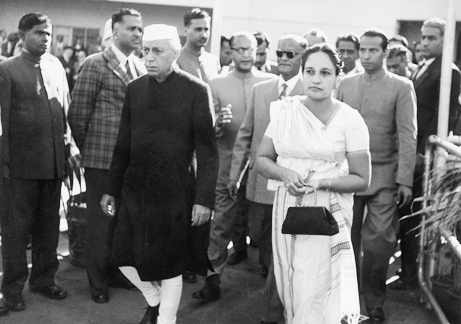
(The picture at the top shows Ceylonese Prime Minister Mrs.Sirimavo Bandaranaike with her Indian counterpart Jawaharlal Nehru)
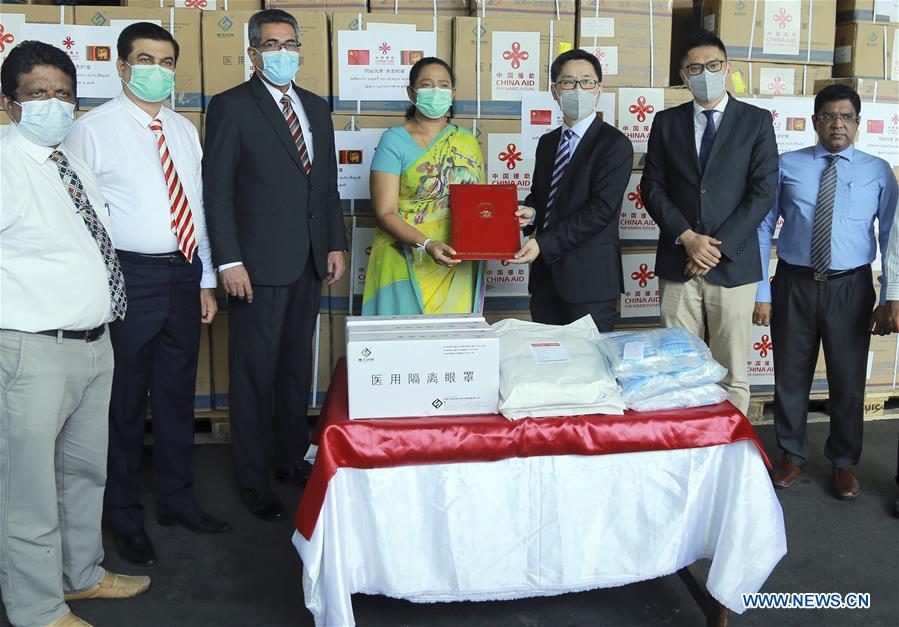
Hu Wei (3rd R), charge d’affaires of the Chinese Embassy to Sri Lanka, hands over the list of medical aid donated by China to Sri Lanka’s Minister of Health Pavithra Wanniarachchi (4th L) at a handover ceremony in Colombo, Sri Lanka, June 24, 2020. China on Wednesday donated its third batch of medical aid to Sri Lanka to help the country fight the COVID-19 virus which has to date infected over 2,000 people in the country and caused 11 deaths. (Photo by Ajith Perera/Xinhua)
COLOMBO, June 24 (Xinhua) — China on Wednesday donated its third batch of medical aid to Sri Lanka to help the country fight the COVID-19 virus which has to date infected over 2,000 people in the country and caused 11 deaths.
The medical aid, including 30,000 PCR testing kits, 30,000 disposable coveralls, 30,000 medical protective face masks, 600,000 surgical masks, and 30,000 medical goggles, was handed over by charge d’affaires of the Chinese Embassy to Sri Lanka Hu Wei to Sri Lanka’s Minister of Health Pavithra Wanniarachchi at a ceremony in capital Colombo.
“Today, it is my great pleasure and honor to hand over the latest batch of the Chinese government aid to our dear Sri Lankan friends which has become the main source for Sri Lanka to combat the pandemic,” Hu said.
In the fight against the COVID-19 pandemic, Sri Lanka and China have successfully brought the COVID-19 under control with three keys — leadership, disciplines and unity. No single country can win on its own and the most powerful weapons are not money, equipment, GDP, etc but it is solidarity and cooperation, said Hu.
On her part, Wanniarachchi recalled the two country’s friendship since ancient times.
“That is why when the Chinese government was facing the pandemic, Sri Lanka decided that it will offer all its strength and assistance to the Chinese government and its people,” the minister said.
She also thanked China for donating medical aid and equipment to Sri Lanka to fight the COVID-19 pandemic.
“Sri Lanka will never forget the assistance provided by China and the help we have received,” she added.
China has also provided 175,000 masks to students across the country and will provide another 100,000 masks to the Elections Commission for the public health safety during the country’s upcoming Parliamentary Elections. Enditem
Prof. Lalithasiri Gunaruwan, who headed a high level government inquiry into the proposed finalisation of Millennium Challenge Corporation (MCC) agreement yesterday (25) told President Gotabaya Rajapaksa that the previous yahapalana administration and the US had signed two agreements in 2017 and 2018 as regards two phases of the project. Prof. Gunaruwan said that though Sri Lanka received USD 7.4 and USD 2.6 mn in 2017 and 2018 respectively, the inquiry team couldn’t find any supporting documents.
The President’s Office spokesperson said that the report would be made available to the public.
The President’s Office quoted Prof. Gunaruwan as having said that the Land Commissioner was of the view the project couldn’t be implemented legally.
The meeting was also told that once the parliament approved the project, views contrary to the agreement or any other proposal would be considered a move against the original agreement. Referring to the contents of the proposed agreement, Prof. Gunaruwan pointed out that the AG would be denied the right to represent the government in court. The academic said that the proposed agreement violated the powers exercised by parliament.
The government inquiry team consisted of Prof. Gunaruwan, Dr. D. S. Jayaweera, Nihal Jayawardena, PC and architect Nalaka Jayaweera.
The committee yesterday handed over the final dozzier, having submitted an interim report on Feb 17, 2020.
According to the Finance Ministry during the previous administration, the project worth USD 480 mn had been approved by the Attorney General. (SF)
Journalist Christopher Kamalendran who as a part of an investigative report on clashes between rival mosques in the Beruwala area had met with Zahran Hashim where he conducted an interview with the Easter attacks ringleader back in 2009.
The journalist was called upon to provide his testimony on the details of the interview to the Presidential Commission of Inquiry probing the Easter attacks, yesterday (24).
He revealed that several T-56 assault rifles were seen stored on the office premises of the National Thowheed Jamaath where the interview was held. These weapons were apparently handed out by former Eastern Province Governor M. L. A. M. Hizbullah for the protection of the Muslim community during the conflict with the terror group LTTE, but had found their way into the hands of the extremist preacher and his cohorts.
When questioned as to when the weapons had been distributed, the journalist replied that they were handed out following an LTTE attack on a mosque in 1993.
He added that such distribution of weapons to at-risk communities had been carried out since the tenure of President Ranasinghe Premadasa.
Kamalendran revealed that Zahran Hashim’s group was responsible for the demolition of over 100 homes belonging to conventional Muslims during that time period.
However, during the interview, Zahran Hashim had categorically denied any involvement in the incidents.
The journalist added that when he brought the clashes up with the Eastern Province DIG Edwin Gunatilake, the DIG had stated that such clashes were commonplace between Muslim groups in the area.
Further, the DIG had stated that clashes were not issues that could be resolved by police intervention. He had added that due to the clashes being more political in nature, mere public servants were powerless to arbitrate.
The expert committee appointed to review the Millennium Challenge Corporation (MCC) agreement handed over its final report to President Gotabaya Rajapaksa today (25).
The report was handed over at the Presidential Secretariat in Colombo.
Chairman of the committee Professor Lalithasiri Gunarunwan had also presented the final report to Prime Minister Mahinda Rajapaksa at Temple Trees last evening (24).
The Prime Minister will table the final report at the next Cabinet meeting.
The committee was appointed with effect from January 01, based on a cabinet decision taken on December 18 last year, to conduct a comprehensive study on the agreement and make necessary recommendations to the government.
The government had previously decided to suspend the implementation of the previous government’s decision on signing the agreement until the committee reaches its conclusions.
The committee is chaired by Professor Lalithasiri Gunarunwan and comprises former Secretary of Transport Ministry D. S. Jayaweera, President’s Counsel Nihal Jayawardena and Civil Activist Nalaka Jayaweera.
The four-member committee had handed over its preliminary report to President Gotabaya Rajapaksa in February. Prime Minister Rajapaksa had tabled the interim report of the committee to the Cabinet of Ministers.
The Cabinet of Ministers had decided not to sign the Millennium Challenge Cooperation (MCC) in its present form based on the recommendations of the committee.
The committee of experts, in its interim report, concluded that the MCC agreement contains clauses that are not in agreement with the Constitution of Sri Lanka and are detrimental to the sovereignty of the country.
The government said it decided not to sign the agreement taking into consideration several facts concerning the MCC deal such as its obscure manner, inclusion of clauses that are against the country’s Constitution and are detrimental to its sovereignty, inclusion of clauses that can adversely affect national security and national, economic, social and cultural affairs and concerns that sprung up regarding the island nation’s sovereignty, independence and national security.
The 80th meeting of the Constitutional Council was held yesterday (24) under the patronage of its Chairman Karu Jayasuriya at the Speaker’s official residence.
Prime Minister Mahinda Rajapaksa, along with the members of the Constitutional Council, Bimal Ratnayake and Thalatha Athukora attended the meeting.
In addition, civil society representatives Javed Yousuf and Prof. Naganathan Selvakumaran, Secretary-General to the Constitutional Council and Secretary-General of the Parliament Dhammika Dasanayake as well as the Deputy Secretary General of Parliament Neil Iddawala were also present at the meeting.
Dr. Rani Jayamaha and Samantha Kumarasinghe who were nominated by the President Gotabaya Rajapaksha, to the Central Bank’s Monetary Board given the vacant position created due to the resignation of Nihal Fonseka and Dushni Weerakoon, were discussed and approved unanimously by the Constitutional Council.
The chairman of the Constitutional Council informed its members regarding the resignation of the former member Dr. Jayantha Dhanapala and commended him for his excellent service rendered to the Constitutional Council.
The Chairman of the Constitutional Council informed the members that actions would be taken in accordance with the provisions of the Constitution to fill this vacancy.
The nomination of Brigadier (Retired) P.P.J. Fernando for the vacancy created at the Office for Reparations was also discussed in the constitutional Council.
The attention of Constitutional Council was also drawn to the activities of the Election Commission and the Police Commission, the statement said.
Voters are encouraged to resolve the riddle posed by the facts given in the box below and forward their answers to gandarajohn@outlook.com to help forecast the future geopolitical direction of the country, after the forthcoming General Elections.
05 Nov 2018 – This was the original date set, for the MCC document to be signed behind the backs of the Sri Lankan people. Public outcry in the Island Nation against the MCC prevented the signing of the document despite US warnings that the money on offer will go back to the US coffers at the end of that year; this, the money going back to the Treasury, if not used, is a standard operating procedure in the management of US public funds.
21 Apr 2019- A series of bombs initiated by ISIS-affiliated terrorists – a terrorist group founded by Obama and Clinton – explode in Churches and Hotels in the Island on Easter day, killing hundreds of innocents. https://www.youtube.com/watch?v=mCHuZM_9qTk
24 Apr 2019 –Barely two days after the Easter massacre, Teplitz announces gleefully to a numbed Sri Lankan Nation that the MCC booty has been upped to 480M USD; she threatens the Government to sign the MCC document immediately or else lose the money forever. Opposition to the MCC by the people prevented the signing of the document.
15 Sep 2019 – Despite repeated American threats to Sri Lanka, the reluctant donee, to accept their Trojan ‘gift’, the MCC money does not go back to US revenue and the US continues to apply pressure on Sri Lanka to sign the MCC document. Jenner Edelman, the Country Director of the MCC, new at the time, tried to sweet-talk Sri Lanka to sign the document, losing her credibility in the process. She issued an ultimatum to the Government that if Sri Lanka does not sign the document by 17 Sep 2019, the money will go back to revenue. The people ‘V-fingered’ her ultimatum; the document remained unsigned and behold, the money on offer, for over one and a half years in breach of US regulations, did not go back to the US Treasury, making a mockery of their regulations and their toothless threats.
05 May 2020 – Teplitz pays MR a sudden visit, purportedly to help Sri Lanka fight the COVID virus. (The visit, to say the least, was ill-timed; it came at a time when Sri Lanka had already come to grips with the virus and contained fatalities to a single digit, while in America, thousands were literally dying daily on the streets, with a hundred thousand already dead and, at a time when Sri Lanka’s Medics had foiled Agent-Moragoda’s mischievous attempt at pushing Sri Lanka to follow the American strategy of acquiring immunity -for the fittest only – by creating a scenario that could infect the entire population with the virus and making acceptable and permissible, under this strategy of social murder, a million fatalities; a strategy aka herd-immunization). At this ill-timed meeting, Clintonphile Teplitz instructs MR to finalise the pending MCC project immediately after the pandemic is over. MR responds airily, ‘Find me a market for Personal Protective Equipment manufactured in Sri Lanka’.
06 May 2020 – US makes an announcement that it will make a commitment to give Sri Lanka, at some undefined moment of time in the future, a sum of USD 4.5 Million to fight the COVID virus.
07 May 2020 -Robert C. O’Brien, the US President’s National Security Adviser and Head of the White House National Security Council gave Gota a call and threatened him thus The long history of U.S-Sri Lanka cooperation and the strong bilateral relationship between the U.S. and Sri Lanka is an important part of a free and open Indo-Pacific region.” (Incidentally, the crux of the MCC message charges that Sri Lanka be handed over to the Americans, for the purpose of maintaining a ‘free and open Indo-Pacific region’). Translating O’Brien’s diplomatese the threat read, If Sri Lanka does not sign the MCC document, the US will consider it as an uncooperative and hostile act which will jeopardize US security interests in the Indo-Pacific region and will sour bi-lateral relations between the US and Sri Lanka. Therefore buddy, cut the crap, sign the MCC document, hand over the country to us, and don’t worry, we will look after you.” This threat came from the highest US political echelon.
***08 May 2020 – The US published the ‘Federal
Registry’ in which Gota’s name is recorded as having renounced his US
citizenship. (Gota’s US citizenship has been, for a long time, a thorn in
his side, with the US holding his US citizenship issue as a Damocles sword over
his political head.) Gota would surely have breathed a sigh of relief in
seeing his name in the Federal Register
The riddle: What did
Gota tell O’Brien?No, I will
not sign the MCC Agreement” or OK, I will sign the MCC Agreement; and by the
way, thanks for the favour”
Vinayagamurthi
Muralitharan alias Karuna Amman, the former LTTE Eastern Commander, has got in
to a difficult position with his recent utterances about the past encounters
with the Sri Lankan forces. Sections of the people in this country, including
the members of the Sanga are up in arms against this statement stating that it
is a statement inimical to our heroic forces who liberated the country, etc.
The
reality however, is that if you study these people who have made this an issue,
the majority of them are those who never supported the forces when they were
fighting the LTTE. As for the rest they are they are ignorant as to the enemy
the country is facing. The real
adversary of Sri Lanka is the LTTE Diaspora that is stationed abroad and they carrying
a war of attrition against the state of Sri Lanka through forums such as the
UNHRC even today. LTTE is only the
fighting wing of this diabolical separatist enemy that has devastated this
country for the past 40 years and thanks to the forces now we have overcome
that. Yet let us not be complacent because
we are yet to overcome the true forces of racialism.
Therefore
this fight however is far from over because the background necessary for a
cowboy like Prabhakaran to walk in to a war and perpetrate all that criminal
activity was created by the Tamil nationalism that haunted this country well
before independence. It is this Tamil nationalism that opposed the introduction
of universal franchise to this country in 1935. Tamil MP Waniayasingham
predicted in the 1960’s that a well- trained Tamil army of 5000 youth could
take over Sri Lanka and they proposed the floating of shipping company to bring
arms to the country. At that time the
Army Commander was Tamil, Anton Muthukumaru and so was the Secretary of
Defense. Chelvanayagam visited UK in 1962 and founded the Tamil Diaspora
stating that, ‘We need funds for the future struggle’. Chelvanayagam’s clarion
call to the Tamils was that, ‘the great Tamil nation should unite to prevent
the uneducated Sinhalese’ from taking over their country.
Those
who represent this line of action today, Tamil nationalism, are the likes of R Sambanthan,
MA Sumanthiran and V Vigneshwaran etc. who are commemorating the LTTE and
canvassing at world forums against our forces. Therefore in this midst what is
this madness of advocating action against Karuna? This issue has brought up
situation that will please these separatist to no end because Karuna is the
only prominent Tamil who has publicly eschewed separatism. He is on record stating
that the Tamils do not need a separate state and that they could live in
harmony with the Sinhalese. Has Sambanthan, Sumanthiran or Vigneshvaran made a
similar statement? They always maintain that the Tamils need a ‘political
solution’ and by that they mean separatism of powers that will eventually lead
to separate state. Therefore, this
situation where the state is trying to prosecute the one who betrayed the
‘Tamil cause’ as per the chauvinist, will be very welcome by the likes of
Sampanthan Sumanthiran and Vigneshvaran.
Karuna
is contesting the election and he has to address a polity that has been
brainwashed with ‘Tamil greatness’ for year by these chauvinist politicians starting
with SJV Chelvanayagam. Thus, he has to work on a thin line between this ‘Tamil
greatness’ and the need to reconcile with the ‘Sinhala state’ as the Tamils
have been made to call Sri Lanka.
The
other party that will be very happy with this news is the Tamil Diaspora that
is presently deploying everything within their means to defame the Lankan
state. We have to realize that this fight against separatism and
international-slur is a propaganda fight. In this fight Karuna could prove to
be an asset as he could be in possession of a sea of information as to the
parties that helped and nurtured the LTTE.
Sri
Lanka leaders have made a lot of mistakes in this fight against separatism and
that has dragged this country through a devastating war for 34 years and the
propaganda war however, is yet to be won. At least now the people in this country,
patriotic and otherwise, have to realize that this fight has to be fought with
brains and not with baser instincts.