RANJANGATE SCANDAL – සිංහලේ සංවිධානයෙන් චෝදනාවක්

January 25th, 2020

උපුටා ගැන්ම හිරු නිව්ස්

එක්සත් ජාතික පක්ෂ නායක රනිල් වික්‍රමසිංහ මහතා, රංජන් රාමනායක මන්ත්‍රීවරයාව යොදා ගනිමින් මෙරට ජනතාවට අධිකරණය පිළිබඳ විශ්වාසය බිඳවැට්ටවීමේ උත්සාහයක නිරතව ඇති බවට, නව සිංහල රාවය සංවිධානය චෝදනා කරනවා.

අද කොළඹ පැවති ප්‍රවෘත්ති සාකච්ඡාවකදී එහි මහලේකම්, පූජ්‍ය මාගල්කන්දේ සුදත්ත හිමි මේ අදහස් පළකළා

මේ අතර, සිංහල රාවය ජාතික සංවිධානය කොළඹ පැවැත්වූ ප්‍රවෘත්ති සාකච්ඡාවකදී පැවසුවේ, රංජන් රාමනායක මන්ත්‍රීවරයා පාර්ලිමේන්තු වරප්‍රසාද භාවිත කරමින් විවිධ පාර්ශ්වයන්ට අභූත චෝදනා එල්ල කරන බවයි.

RANJANGATE SCANDAL – රංජන් සමඟ දුරකථන සංවාදවල නිරත වූ විනිසුරු පද්මිණී රණවකට නීතිය ක්‍රියාත්මක වී නැතැයි චෝදනා

January 25th, 2020

උපුටා ගැන්ම හිරු නිව්ස්

රංජන් රාමනායක මන්ත්‍රීවරයා සමඟ දුරකථන සංවාදවල නිරත වූ විනිසුරු පද්මිණී රණවක මහත්මිය සම්බන්ධයෙන් මෙතෙක් නීතිය ක්‍රියාත්මක වී නොමැති බවට සිංහලේ සංවිධානය චෝදනා කරනවා.

එම සංවිධානයේ නියෝජිතයින් අද මැගසින් බන්ධනාගාරයට පැමිණි අවස්ථාවේ මාධ්‍යයට අදහස් දක්වමින් මෙම චෝදනාව සිදු කළා.

අධිකරණයට අපහාස කිරීමේ චෝදනාව යටතේ ඊයේ රක්ෂිත බන්ධනාගත කෙරුණු විශ්‍රාමික මේජර් අජිත් ප්‍රසන්නගේ සුවදුක් බැලීමට ජාතික සංවිධාන කිහිපයක නියෝජිතයින් අද මැගසින් බන්ධනාගාරයට පැමිණියා.

Alaina B Teplitz , do not make your diplomatic Accreditation a means to destroy a country for political advantage of the country you represent – USA.

January 24th, 2020

By Charles.S.Perera

Alaina B.Teplitz  you still have traces of genocidal traits you  inherited from your ancestors the Europeans who migrated to America about 600 years ago, and that is why you  have become a state slave to carry out  destructive plans of US State Department  as its Ambassador. You have no altruistic human qualities to evaluate the danger of the plans of USState Department to destroy Sri Lanka and untiringly work for separation of Communities in Sri Lanka, and make this beautiful country a military base of your country.

The proposed MCCC with Sri Lanka is a disaster.  Can you mention one developing country in the world which has benefited from any  Agreements it has signed with America.  To put it in another way America has not contributed  for the development of any developing country. They sign contracts which are beneficial to America  with little concern  to the country with which enters into such agreements.

There were people like you in the CIA , specially trained Agents  to put the minorities  against the majority in developing countries. Sri Lanka is not unaware of  such sinister American State plans  of putting minorities against the the  Sinhala majority and divide the communities to make the country weak and unstable to  facilitate drawing  benefits by such vulnerability. Teplitz; you are like an army  soldier taking orders from the  Commanders to shoot and eliminate the innocents and set up a system planned by your Commanders. You are like a bullet , which has know knowledge of what it does.

You know Teplitz the Indigenous Americans that consisted of 570 tribes  when the Europeans migrated to America had a history of over 15000 years.  Your immigrant ancestors brought with them viruses unknown to the indigenous American Indians who died in large numbers contaminated by these viruses. Some were killed in  armed attacks and burning down of their villages. They were massacred  using bacteria, viruses and toxin. They were dispossessed of their land, forcibly driven away into  settlements in  infertile hostile surroundings, where  they could neither cultivate nor hunt for  bisons for their food.  

In your infamous MCCC with Sri Lanka you have decide on an economic corridor from Colombo to Trincomalee and provided special  settlements  for the families who would be dispossessed of the land with your sinister  economic corridor which is to physically  divide the country  into two different land masses. And America is willing to pay 480 million Dollars just to cut the country  into two !

How much is Washington spending for the welfare of the indigenous American  Indian people and the  development of their settlements , and their culture ? Absolutely nothing is done for the welfare of the Indigenous Americans. They  are wilfully kept in poverty by the USA Government..
 https://www.forbes.com/sites/realspin/2014/03/13/5-ways-the-government-keeps-native-americans-in-poverty/#71381d5d2c27

 What has happened to them today. The black Americans descending from the innocent Africans imported into America as Slaves have developed into a  important Community. American State Department is more sympathetic and pay more attention even to the Tamil Diaspora settled in America, than to the  American Indians who escaped the  American genocide against their ancestors. The white immigrant Americans have a history of only about 200 year and  celebrate their independence  annually.

But the indigenous Americans are forgotten. Though the terrorist sympathizing Tamils who migrated to America are now recognised and for their sake USA State Department is doing all they can to set up a separate Tamil Eelam in Sri Lanka for them to have their holiday homes,  while the indigenous Americans are kept in the shadow for fear of their  emerging as a  force against  the immigrants Europeans who have usurped their rights to set up a government of their own .

That is how America evolved  in a country that does not belong to them and massacred and over powered its rightful owners, and now shamelessly speak of democracy and human rights. Though the immigrant Europeans did not use the same method the Nazis used in their genocide of the Jews, what the immigrant Europeans did to the Indigenous American Indians smell the same Nazis  genocide of Jews. But at leasts the Jews could fight back , not the poor American Indians.

Therefore, the present day Americans however much they try to wash off  the remaining stains of the blood of the innocent indigenous Americans they massacred  and left for dead and forgotten, with whatever washing powder of democracy and human rights, the stains  remain .  Every descendent of  those European Immigrants to America will forever carry with them those  deadly taints.  It is more visible amoung  the American diplomats acting as the Agents of the tainted ruling Class.

The American diplomats, CIA Agents are the  unfortunate carriers of this deadly virus which  politically and economically destroy the developing countries. The American history which is only about  200 years or so old has committed deadly sin  in developing countries far and near which had been seeking to be independent of the fearful tainted American Administration.

The  America State Department  got the CIA to assassinate  or ousted from office  in  various developing countries  the  political leaders who were introducing  people friendly political systems  into their countries. That was and is what America represents, a country  that keeps developing country poor and dependent on them.

That is what USA had always been doing in Sri Lanka. It has not carried out any development project for Sri Lanka though it constantly demands  entering into  agreements such as ACSA, SOFA or MCCC which are not at all what Sri Lanka or its people want.

America used  CIA agents to change regimes. In 1950 Jacob Arbenz President of Guatemala was ousted ,  Mossadeq Prime Minister of Iran was ousted , also in 1973 Salvadore Allende President of Chile was ousted leaving doubt about his suicide. In Congo, Lumumba was assassinated

Larry Devlin a former CIA Agents recounts in his memories how he was ordered to kill Patrice Lumumba of Congo. He says, In September 1960, Mr. Devlin received a cable advising him that he would get an important message from Joe from Paris.” The envoy turned out to be Sidney Gottlieb, the agency’s club-footed poisons expert, whom Mr. Devlin had met during operations to install listening devices overseas, and who would later become notorious for mind-control experiments using L.S.D.

Mr. Gottlieb said that the assassination had been approved by   President Eisenhower, but admitted that he had not seen the presidential orders. He explained that the poisons, including the spiked toothpaste, had been chosen to make the death appear to result from natural causes.” (http://www.nytimes.com/2008/02/24/world/africa/24congo.html?ref=patricelumumba)

However there were great Americans who had the courage and  good sense when  understanding how distasteful the American political system is resigned from their assignments, not wanting to be a part of American political mafia. John Perking was  one amoung such. He states his experience as an Economic hitman, who acted  as a development expert and proposed to developing countries projects that indebted them to American  Companies, and became poorer and politically unstable.

Alaina B.Teplitz, it is better be an ordinary altruistic  person true to one’s  convictions  than be a part of a capitalist political system which is bent  towards manipulating governments in poor developing countries for its own  political benefit , not caring what happens to the poor countries or their people.

Aliana B.Teplitz when you come to a country as a diplomat try to learn about the culture and the history of the country.  When your State Department instructs you to carry out activities, please try to understand whether in carrying out those instruction there would be a conflict with the country with its Culture and its relationship with other communities that have come from outside, settled in the country and have after generations of living together  absorbed into the  common fabric of a Nation. 

Your MCCC puts into danger these fundamental issues of Sri Lankan Nationhood, therefore it is not  suitable to be introduced into Sri Lanka. We also cannot have confidence  in American Army Soldiers with their Guns roaming the country at their will and pleasure.

Aliana B Teplitz you have perhaps heard of the Kill team that blew up and shot Afghan Civilians to collect their fingers as trophies.

(https://www.theguardian.com/world/2010/sep/09/us-soldiers-afghan-civilians-fingers)

What is the guarantee that such things will not happen in Sri Lanka with American Soldiers entering  the country  under the MCCC ? The American Soldiers with freedom to roam  about in  Sri Lanka may give into their deformed sexual desires and  kill or rape the civilians? 

These things have happened lead by American Soldiers at Staff Seargent level. According to investigators and legal documents, discussion of killing Afghan civilians began after the arrival of Staff Sergeant Calvin Gibbs at forward operating base Ramrod last November. Other soldiers told the army’s criminal investigation command that Gibbs boasted of the things he got away with while serving in Iraq and said how easy it would be to “toss a grenade at someone and kill them”.

Therefore,  Aliana B.Teplitz take courage and tell your bosses in the American State Department that they should stop their unnecessary interference with the government of Sri Lanka to insist entering into deplorable agreements,  and pass disastrous resolutions  at the UNHRC in Geneva based on an absolutely fallacious, and an unacceptable Darusman Report..

ERASING THE EELAM VICTORY Part 13 D

January 24th, 2020

KAMALIKA PIERIS

Revised 15.2.20

The Eelam war threw up many dedicated military leaders. The best known is the late General Denzil Kobbekaduwa followed by late Maj. Gen. Vijay Wimalaratne.

Kamal Gunaratne said of them ”I firstly pay tribute to the late General Denzil Kobbekaduwa, the most charismatic battle-field commander we had because he always understood the heartbeat of the soldier and put his life on the line to safeguard their interests before his own comfort at all times. The late Maj. Gen. Vijay Wimalaratne, my guru, who in my opinion was the most brilliant field commander we had because he knew the terrain we fought on, his adversary’s modus operandi, and above all knew and understood his men, always leading from the front. His creation, the Gajaba Regiment will always bear testimony to his great qualities of inspired leadership and dedicated service to the Corps, Army and Country.

I have selected just two other leaders, for this essay, the much admired Major General Chagie Gallage and the much remembered Col  Fazly Laphir. They are presented here, not only for their own  personal contribution but also as representatives of the fine work done by all who fought and won the Eelam war.

Biographical information on Chagie Gallage is not available in the public domain, except that he attended Ananda College. However, there is plenty of information about his work in the Sri Lanka army.

During most of his long and enduring military career, Chagie served either in an operational area or at a military training institute said, analysts.   He was in the forefront of the war against the LTTE. He played a decisive role in the final thrust against the LTTE terrorists in 2007-2009.

Chagie was the first choice of any senior military commander, to include in their team of field commanders for operations. Thus, Chagie was seen in almost all major combat operations in all fronts in the North and East from 1985 to 2009.  

Chagie as a young subaltern, in the mid-eighties, was a skillful and tactically sound combat fighter who operated along with his rifle company in many areas of the Jaffna Peninsula. His first independent command was to guard the Nagadeepa (Nainativu) island in 1986 with his platoon.

He played a key role in Operation Vadamarachchi and Operation Clean Sweep, the two military operations led by late Generals Kobbekaduwa and Wimalaratne to drive the terrorists out of the Jaffna peninsula in 1986.

 During Jaya Sikurui Chagie and the Sixth Gemunu Regiment were asked to take Puliyankulam. Chagie asked headquarters for a bulldozer, a backhoe and a few days time for rehearsals. This regiment had a reconnaissance platoon of well trained and highly motivated soldiers. They provided intelligence to Chagi who then did a mockup of the LTTE defense lay out, using the bulldozer and backhoe. Each soldier was made aware of his role and they took Puliyankulam straight away.

In Eelam war IV, Chagie’s leadership was instrumental in liberating the Southern part of the Eastern Province that included the LTTE stronghold Thoppigala. Chagie as a Brigadier commanded the Commando Brigade, which he moved into action against the LTTE in the Eastern Province in 2006.

 Then Chagie switched to the Wanni theatre with the beginning of operations in the Northern front in 2007. He raised the Task Force-1 there and launched it from Mannar front, along with Commando Brigade, (later upgraded as 58 Division). Chagie was away from battlefield for some time due to illness. He returned in 2009 to command the 59 Division in Mullaitivu. On completion of the campaign, Brigadier Chagie was promoted to Major General prematurely ahead of most of his peers, on merit.

Chagie is widely considered one of best strategists in the army. During an intense battle at Karadipokku in Kilinochchi, as Operation ‘Sathjaya’ was underway in 1996, the Army suffered heavy casualties and the battle was about to be lost. It is at this crucial moment that Chagie came in voluntarily without waiting for instructions from superiors, and led his elite Airmobile troops to fight gallantly and restored the situation.

Chagie was meticulous in his approach to an assignment.  He looked into the minute details of any assignment. That particularly is the reason for his success, said analysts. Also, Chagie is extremely innovative. He can devise things when the resources are scarce or unavailable.

Colonel Chagie was the Commandant of Army Training School in Maduru Oya in 2004.   He was instrumental in conceptualizing and forming the highly skilled ‘Special Infantry Operations Teams’ (SIOT) of the Army, together with Lt Col Ralph Nugera, realising a vision spelt out by the then Inspector of Infantry, Major General Sarath Fonseka. It was these SIO teams, which boosted the fighting capacity of the infantry and fought as vanguards of the advancing Army during Eelam War IV.

Chagie trained these special teams in special battle drill that eventually enabled the troops to successfully cross LTTE obstacles. One such obstacle was highly fortified LTTE fortifications built on ‘Ditch cum Bund’, commonly known as ‘DCB’ (a line of bunkers coupled with about 10 foot wide water obstacle in front of them). These obstacles severely hindered the movement of the advancing Army.

Chagie has always been popular among his comrades in the Army, among his batch mates, among old Anandians, among the motor-racing community of Sri Lanka, among his relatives and friends, said his admirers. He is one of the few officers of the Army who always commanded respect not only from his subordinates but also from his superiors and peers.  Chagie not only earned gallantry medals multiple times for his bravery in battle, but he also worked hard to get gallantry medals for his juniors too.

Major general Chagi Gallage was also very outspoken. He spoke out, angrily, when Mangala Samaraweera visited Jaffna in 2016 to launch a website for ethnic reconciliation. He was immediately transferred to a post which did not have command of troops.

A week after retirement, Gallage delivered his farewell speech at Saliyapura, Anuradhapura, on the eve of the 35th anniversary of the Gajaba Regiment, 2018. Gajaba Regiment is synonymous with Chagie Gallage, said analysts. Chagie’s contribution to the Gajaba Regiment has been outstanding. ”

Gallage began his farewell speech by referring to the gigantic role played by the Gajaba Regiment and the Army as a whole in the Eelam wars, reported Shamindra Ferdinando. He recalled the spearheading role played by the late Maj. Gen. Wijaya Wimalaratne in the shaping of the celebrated Gajaba Regiment in the ‘80s. Gallage declared Wimalaratne as the greatest infantryman in the Army. Gallage then   thanked Maj Gen Shavendra Silva, Colonel of the Gajaba regiment and the Adjutant General of the Army who had organized his farewell. He then went on to thank officers and men of the Gajaba Regiment.

Chagie thereafter said,  I have witnessed, the determined Commanders of this dignified force transform what was described as “Exhausted and a Losing Army” into a ‘Wining and a Victorious Army’.  To achieve this, Commanders at different levels worked together, to develop the overwhelming capability of our Army. An army, which especially during the final phase of the conflict, demonstrated such versatility and braveness all round.

Gallage named those who made that task possible. “Men like (Late) Maj Gen Vijaya Wimalaratne, (Late) Gen Denzil Kobbekaduwa, (Late) Maj Gen Janaka Perera, Col (rtd) Gotabaya Rajapaksa, Maj Gen Sathis Jayasundara, (Late) Maj Gen Gamini Gunasekara, Col (rtd) Nimal Ratnayake, Maj Gen (rtd) G.V. Chandrasiri, Maj Gen (rtd) Gamini Hettiarachchi, Brig (rtd) Nimal Jayasuriya, Lt Gen (rtd) Jagath Jayasuriya,  Gen (rtd) Seewali Wanigasekara, Lt Gen (rtd) Mendaka Samarasinghe, Maj Gen (rtd) Jagath Ramubukpotha, Lt Gen (rtd) Jagath Dias, Brig (rtd) Hiran Halangoda, Col (rtd) Jayavi Fernando, Maj Gen (rtd) Srinath Rajapakse, Brig (rtd) Bahar Morsath, Maj Gen (rtd) Lalith Daulagala, Brig (rtd) Roshan Silva, Late Col Shantha Wijesinghe, Maj Gen (rtd) Kamal Gunaratne, Maj Gen (rtd) Amal Karunasekara and Gen (rtd) Udaya Perera (who was my deputy Snr Subaltern) Maj Gen (rtd) Jagath Alwis  (who inspired me to join the Army) And last, but not the least, Field Marshall Sarath Fonseka (who led our forces as the Commander of the Army.

Gallege   then thanked Maj Gen Ralph Nugera, Maj Gen Aruna Wanniarachchi, Maj Gen Athula Kodippily and Col Mahendra Fernando and their magnificent ladies. They were my esteemed assets, as my deputies, facilitators and shadows, at times referees, in challenging tenures in combat and otherwise.

My highest regards also, said Chagie, to Special Task Force led by DIG (rtd) Chandrasiri Ranawana and DIG Ruwaiz Lathiff for their unstinted support and assistance beyond the call of duty. Chagie also thanked ‘our comrades in sister services Air Force and Navy for risking their lives, [to help us win the war.]’

He concluded his speech by thanking those engaged in the task of making a Healthy Army (Consultant Dr) Maj Gen Sanjeewa Munasinghe, (Consultant Dr) Brig Maurine Wijegunawardene, (Consultant Dr) Brig Nimalka Ariyaratne and (Consultant Dr) Col Roshan Monaragala.

 Col. Fazly Laphir (d.1996) was the Commanding Officer of the First Special Forces Regiment Colonel Laphir was one of the founding members of the  Sri Lanka Army Special Forces Regiment. He  played a key role in developing it into a formidable unit which specialized in  range of specialized operations. He played a crucial role in the growth of the SF from the very beginning.

When  Major Gamini Hettiarachhi was struggling to start the Special Forces regiment there were very few senior officers who supported him, said Kamal Gunaratne . His requests for  additional troops, weapons and equipment for operations  were met with lukewarm response from HQ,. But Fazly Laphir always gave him the strength and courage to continue. The two of them  considered the development  of the SF as their prime responsibility, over and above their personal lives, he said.

He was a very creative, committed and dedicated officer. He had a knack for details. Before he joined the SF he has served as an intelligence officer in Jaffna and was one of the best SF officers powered with his language skills and intelligence.

Col. Lafir was  close to us. He was keen in receiving results at every mission. He always insisted on and motivated us to destroy the LTTE. He wanted us to use what we learnt effectively in destroying the LTTE”,  they said.

As a true SF officer he went out looking for information and opportunities to start an operation and many he did on his own initiative,”  said one speaker, explaining about the luck Col. Lafir always had. It was known in the Special Forces that where ever he went he and his troops were able to destroy and cause damage to the enemy.”

Once Colonel Lafir disguised himself as a mudalali and we were his golayas (supporters) and went in search of LTTE cadres that were operating in Vavuniya and the suburbs. At times we went in lorries with cadjans or husks pretending as traders,” his subordinates recalled.

During the last stages of   the abortive 1990 Jaffna fort campaign meals were cooked at Mandativu and transported across Jaffna lagoon to the soldiers in the Fort. The task of transporting  was given to Fazly Laphir then  a major in the SF unit. The soldiers stood neck deep in water, forming a line across the lagoon and passed the food along. They had no cover at all , unlike on land. They were  sitting ducks for  LTTE . There were casualties but the food arrived. 

Colonel Fazly Lafir is one of the rare characters who is lovingly remembered not only by his family but also by all his colleagues, soldiers and even by new recruits who have never worked with him. To the entire SF Col. Lafir is the symbol of true leadership, dedication and courage. He was striking leader who gave priority to his soldiers welfare at all times. Men were willing to follow Colonel Laphir even at the risk of their lives, said his subordinates. 

In July 1996,  Mullaitivu Army Camp was attacked by LTTE . Rescue operation was launched to relieve the besieged base .Col. Lafir, who was the Commanding Officer of 1 SF, took the challenge without hesitation. He and his team were heli-dropped under heavy fire. Personally leading the attack under heavy fire, showing brilliance and courage.. Lafir was wounded by severe gunshot injuries, yet continued to lead his men until he was killed by shrapnel from a nearby explosion. His men recovered his body and transported it back in a SLAF helicopter that had landed the second batch of commandos.

His courageous act on that day to save the lives of 1500 comrades, he was awarded the Parama Weera Vibhushanaya”, the highest award for valour in Sri Lanka and posthumously promoted to the rank of Colonel.  The new auditorium at Diyatalawa Military Academy was named after Colonel Fazly Laphir  in 2014.

Major General Kamal Gunaratne, writing in his book Road to Nandikadal” had this to say about Fazly. He dedicated his life to the Army and he derived great satisfaction from the pursuit of and the elimination of terrorism. He was the Commanding Officer of the first regiment of the Special Forces (1SF) at the time he was called to serve in the rescue mission of Mullaitivu and undertook the task with passion, despite the lack of preparedness. He was the epitome of professionalism and courage, lending inspirational leadership to his beloved troops and ultimately sacrificed his life in an endeavour to rescue his comrades from the jaws of death”.We lost one of the greatest sons of Motherland that day.

The second Annual Lecture of the Institute of National Security Studies Sri Lanka (INSSSL) delivered by Brigadier HP Ranasinghe in 2019   was on Fazly Laphir. It was  titled Epic of a War Hero Colonel AF Laphir PWV RWP RSP”.

The speaker said, the occasion for this tribute is the 14th death anniversary of that hero, Colonel Azlam Fazly Laphir, He was posthumously awarded ‘Parama Weera Vibhushana Medal’ – the highest military honour in Sri Lanka for battle-field gallantry. He, it should be noted, is the senior most officer of the Sri Lanka army to be so honoured, and one of the very few commanding officers to die while leading his men in the battle-field.

From the very outset, his army career was featured by dedication, skill and exceptional overall competence. He was one of the pioneering officers in the first Gajaba Regiment. When Lt. Col. Vijaya Wimalaratne inaugurated the ‘Special forces squadrons’ scheme to counter the intensifying threat posed by the guerrilla war tactics of the LTTE, Fazly was appointed the officer in charge of the first such unit which had several skirmishes with the fledgling militant groups in the north among which the most successful was the operation in Ambuweli in 1983.

He was a founder member of the ‘Thirty-Five Gang’/’Combat Tracker Team’ formed in 1985. He was a member of the “Rapid Deployment Force” formed in the nineteen eighties. As a pioneer member of the First Regiment of the ‘Special Forces’, Fazly’s involvement extended to all its aspects including even the design of the cap, badge and the insignia. His reputation for physical courage earned him from his colleagues the affectionate nickname of “suicide express”.

 One of the memorable demonstrations of his willingness to risk his life against almost insurmountable odds is found in the annals of the rescue mission he took part in across the Jaffna lagoon to reach the troops besieged in Jaffna Fort.

 Over time, he acquired a mastery of the ‘military geography’ of Jaffna peninsula. This, according to well informed sources, turned out to be invaluable in the re-establishment of government control over that region in 1995. Meanwhile, he was also involved in strengthening the army camp at Mullaitivu which was mainly intended to control the LTTE smuggling operations along the north-east coast.

His fateful day came when the Sri Lanka army camp at Mullaitivu was surrounded by the terrorists on 18 July 1996. Mullaitivu was of strategic significance to the Tigers because of its central location along the north-eastern seaboard. Although a massive SL army garrison had been placed in its command area of 8.5 kms, the camp was vulnerable to enemy attack, being relatively isolated – the nearest main SL army camps being at Weli oya 35 kms to its south and Elephant Pass 55 kms to its north across hostile forested terrain. The Tiger forces surrounded the camp and started their attack at 1.30 a.m. An operation code-named “Thrivida Pahara” launched by the SL Army to defend Mullaitivu was severely handicapped by the fact that no reinforcements could be dispatched to Mullaitivu either by land or by the sea because of the impenetrable blockade by a larger number of Tiger battalions armed with heavy artillery and a large Sea Tiger force. It was in this situation of total despair that Lt.Col. Fazly Laphir volunteered to lead a “do-or-die” air-borne rescue mission manned by 275 combatants of the “Special Forces” under his command.

Fazly was stationed at that time at the Maduru Oya camp. From there he and his men were conveyed by helicopter via Trincomalee to Alampil (5kms south to the Mullaitivu base) around 4.30 p.m. on the same day. As expected, they encountered stiff resistance from the guerrilla forces. Earlier reinforcement operations by the Sri Lanka Air Force and the Navy had been thwarted, the resulting damage included damage to two helicopters and the gun-boat ‘SLN Ranaviru’ which was blown up with its entire crew of thirty-six.

 Some of the most fierce fighting of the entire ‘Eelam War’ were witnessed over the next few hours. Since helicopter landing on open beaches was excessively risky, Fazly and his troops had to descend to the ground along ropes amidst heavy firing. Both in the hazardous task of descending and re-grouping as well as in the deadly close-encounter combat against several thousands of well armed Tigers, Fazly is reported to have displayed such extraordinary leadership skills that his men persisted with their task, achieving a fairly degree of success and causing heavy losses to the LTTE forces. They advanced amidst fierce mortar fire but lost communication with the rear.

Fazly at their vanguard was fatally wounded by a shrapnel that pierced his brain in the morning of 19 July. Though receiving no medical care, he went on fighting until, later that morning, he succumbed to his injuries. His body was evacuated three days later.

This appreciation, focused as it is on Col. Fazly Laphir, does not imply that in the annals of the Eelam Wars his heroism was unique. There were others, probably of all ranks, who, in times of impending peril, acted with the same courage and commitment that Fazly showed at the battle of Mullaitivu. We moan the fact that many among them were not destined to enjoy with us the fruits of victory. The least we must therefore do is to accord to them an everlasting place in our collective memory, and, where appropriate, help the loved ones they have left behind. (Continued)

Misguided Tamils: A Threat to National Unity

January 24th, 2020

Dr. Daya Hewapathirane

History of the Tamil Community of Sri Lanka

The small communities of Tamils and Muslims living in Sri Lanka, amount to about 24% of the island’s total population with Tamils including Estate Tamils accounting for 15% and Muslims 09%. These communities are descendants of groups of individuals, exclusively males, who arrived in this island at different times in the past for various purposes, and later settled down among the indigenous Sinhala people. Tamils came from southern India and continue to observe the cultural traditions of their homeland which is Tamilnadu, where the Tamil culture including the Tamil language originated. Tamils in general, therefore are a settler community in the island with the rights and privileges enjoyed by the indigenous Sinhala people.  However, it is important to note that Tamils are indigenous to the Tamilnadu which is the birth-place of the Tamil culture and language. For all purposes, the national and cultural homeland of the Tamils is Tamilnadu. 

Tamils arrived in the Jaffna peninsula in the 16th century

Initially the Tamils came to the island as invaders and mercenaries. Since the 3rd century BCE, there were seventeen Tamil-speaking Dravidian invasions of the Sinhala kingdom when Anuradhapura and Polonnaruwa were the Sinhala royal capitals. These invasions were associated with extreme forms of violence and destruction. After defeat some Tamils fled to India while some remained in Sri Lanka with some settling down in the Jaffna peninsula. Historians H.W. Codrington, Fr. S.G. Perera, and Mudaliyar C. Rasanayagam mentions clearly that the Jaffna peninsula was peopled by the Sinhala Buddhist community before the sixteenth century. This is confirmed by archeological evidence of the remains of stupes and viharas in the peninsula, and by the large number of Tamilized Sinhala place names in the Jaffna peninsula and in the Northern Eastern region of the country where Tamils and Muslims predominate at present. In the 16the century and thereafter, for many years, the Sinhala Buddhist people in Jaffna lived together with Tamil immigrants from South India, in harmony. The famous Portuguese historian Fernao De Queyroz mentions in his book, that when the Portuguese arrived in the island in early 16th century, the Jaffna region was, like other 14 regions of the country at that time, managed by a sub-king, who paid tribute to the Sinhala King (or ‘Emperor’) in Kotte.  Some Tamils cite the Rama-Ravana story to claim that Tamils were in the island in ancient times. The eminent historian A.L. Basham has called this Ramayana story as bluff and has shown that the Ramayana is a work of fiction by Valmiki, who drew his plot and characters from the Dasaratha, Jataka and the Valahassa Jataka of the Buddhists. 

It is a fact that the Sinhala people, starting with their kings and leaders of the past, have been quite accommodative of the Tamils and others who made Sri Lanka their home. Although they came as invaders, mercenaries, merchants, illegal immigrants and so on, they were permitted to settle wherever they pleased and live according to their cultural norms without any harassment. They were/are permitted to move anywhere in the country, and be involved in whatever gainful employment they wished anywhere in our country. They were/are allowed to build their Tamil schools, Hindu kovils and conduct their religious and cultural activities just the way they did in their motherland – Tamilnadu.

Privileges During the British Colonial Period in Sri Lanka

During the British colonial period which started in the 18th century, under the British colonial policy of divide and rule”, massive favoritism was accorded by the British to Tamils, in return for the support of Tamils as quislings to crush Sinhala resistance to British occupation of the island. To serve their self-interests, the British policy set one community against the other. The British gave special privileges to the Tamil minority and those of the Christian faith. They included better opportunities for education, employment, and government services in general.  Tamils soon became a privileged community. To cite one example, in terms of the density of schools per unit area, the Jaffna district had the highest density. In 1870 there were only two Buddhist schools left in the country – in Panadura and Dodanduwa as against 805 Christian Schools. As a result, even in 1956, eight years after Independence, the Tamils, then a mere   11% of the population, held 75% of the jobs in the army and 65% of the jobs in the public service. 

All colonial powers of the island, acted on pure and absolute self-interest”. British occupation of Sri Lanka was one of sheer exploitation and devastation. Whatever benefits that were derived by local inhabitants were merely incidental to their exploitation of the country’s natural and human resources to reap enormous benefits for the British government. The vast changes that they brought about in almost all areas of life in the country, led to the disruption of the long-held culture, values, and way of life of local Sinhala Buddhists. Under the infamous Waste Lands Ordinance” of the British, commercial plantations of coffee, tea and rubber were established on lands expropriated from the rural Sinhala people, without compensation. The dispossessed Sinhala people were unwilling to work on the plantations and in the 19th century and thereafter, the British imported Tamil laborers from South India to work as labourers in plantations. These Tamils later became a new element in the demographic composition of the country. Most of these Tamil labourer community in the highlands of the island, stayed behind and most of them were accorded citizenship in later years after the country attained political independence.

Post- Independence Privileges

It is important to note, that even during the post-independence era, the Tamils have been permitted to move anywhere in the country, and be involved in whatever gainful employment they wished anywhere in our country. They were/are allowed to build their Tamil schools, Hindu kovils and conduct their religious and cultural activities just the way they did in their motherland – Tamilnadu. Tamils have been accorded official recognition by their representation in our national flag by means of the orange colour band; Tamil culture is recognized by the State and their major cultural days are public holidays; The Tamil language is officially recognized as a national language of the country; Hinduism the main religion of Tamils is recognized by the State and its religious days have been declared as national holidays.

Emergence of Tamil Racism, Extremism, and Separatism

In the 1950s and 60s, there were many South Indian Tamil films produced, directed and acted by extremist South Indian Tamils that were directly propagating Tamil racism and extremism. These films were imported to Sri Lanka and were popularly watched by Sri Lankan Tamils. The directors, script writers and movie stars of these crude films were well known Tamil extremists with political overtures. They soon became leading political figures in the Tamilnadu political scene, promoting the so-called Tamil cause and Tamil separatism. Among them were Karunaneedi, M.G. Ramachandran, Shivaji Ganeshan and the infamous Jayalalitha. The whole purpose of these low-budget films was to generate Tamil racism and a sense of Tamil superiority. These films were shown widely in Sri Lanka and were quite popular among the Tamils in Sri Lanka. The extreme racist attitudes that these films and the Tamil media helped to generate at that time, made  Tamils feel elevated and politically motivated to seek special privileges including separatism. The extremist Tamil attitude made them want to take control and began talking about Tamil nationalism, Tamil national struggle and Tamil homeland and so on. Some Tamil extremists resorted to dishonesty, falsehood, fabrications and deliberate misinterpretation and distortion of historic facts pertaining to Sri Lanka. Eventually they resorted to terrorism to establish themselves as a force to reckon with among the majority Sinhala people.

Undue Privileges as a Minority

Tamils – as a small minority community enjoy undue privileges that are not enjoyed by the majority Sinhala community in the country.  In fact, no other minority community in any major country in the world enjoys the privileges that the Sri Lankan Tamils enjoy. Today, and for many years in the past, more than half of the Tamil population of Sri Lanka lives among the Sinhala people in predominantly Sinhala areas in the Western, Southern, Central, and Eastern parts of the island. Here, they have their kovils and festivals, thoosa kades, their Tamil newspapers, magazines, videos, music audios, films and free to intermingle with others in their neighborhood without being harassed. 

Tamils have the opportunity of living and owning property including real estate anywhere in the country. About 31% of all privately-owned land in Sri Lanka belongs to the 12% Tamil population, compared to the Sinhala who own 51% of land although they are more than about 75% of the population. About 70% of the land, and 85% of the businesses, in the administrative and residential capital, Colombo, are owned by Tamils. The per capita income of Tamils is far greater than the indigenous Sinhala people (estimated to be twice that of the Sinhala) and the rate of unemployment of Tamils is half that of the Sinhala. More than 30% of professional and managerial jobs are held by this less than 12% minority.

Most Tamils are either businessmen or professionals and are dependent on the Sinhala people for their business and professional success. They earn their living using the Sinhala market, Sinhala clients or Sinhala people. Sinhala employers hire Tamils as employees. However, it is well evident that Tamil employers rarely if at all, employ Sinhala people in their establishments. Some of the largest wholesale and retail businesses in Colombo are owned and run by Tamils. Most jewelry establishments, travel agencies, telecommunications outlets are owned and operated by them. The rich Tamils in Colombo and other urban areas in Sinhala areas are owners of the high-priced property including land and houses and expensive vehicles. In fact, the children of these well-to-do urban Tamils attend leading schools in the country, including expensive international schools.    

No comparable minorities (including Indians, Pakistanis, Sinhalas, and Tamils etc. in the UK) in any major country have been given such preposterous benefits and opportunities, which are not rights but ridiculously high privileges. Since the privileges of one person can only be had at the expense of the rights of another, this shows that, in fact, it is the indigenous Sinhala’s 75% of the population, who are discriminated against.

Tamil Terrorism and its Subjugation   

Terror in its worst forms never known in our land was experienced during the invasion and rule of the Dravidian Kalinga Magha (and in more recent years under the Tamil terrorist Prabakaran). The crime-prone rule of Kalinga Magha prevailed for 21 years. The Tamil Pandyan and Tamil Nayakka intrusion into Sinhala royal families led to the Sinhala royalty going into disarray after the 13th century, and the eventual decline of the stability and magnanimity of the Sinhala Buddhist nation. 

During a good part of the past four decades, Tamil terrorists of the LTTE, took away from the indigenous Sinhala majority, what they valued and cherished most as a nation – their freedom and peaceful life. During this time, most Tamils living within and outside Sri Lanka were openly or discreetly supportive of terrorism and separatism propagated by the racist LTTE terrorists under Prabakaran, their ruthless leader. The overwhelming majority of Sri Lankan Tamils living overseas, were helping, both directly and indirectly, often using deceitful means to the Tamil terror movement in Sri Lanka thereby promoting gruesome, hideous, and horrifying terrorist activities against the nation, its Sinhala leaders, Bhikkhus, military and police personnel. They helped bomb and destroy reputed historically significant Buddhist monuments and sites in our country, and other public property of value and took action to disrepute and undermine the legitimately elected government of our country.

The Sinhala nation is eternally grateful to the Ranaviru Sinhala sons and daughters for eliminating from our nation, this treacherous racist terrorist menace in the year 2009. Sinhala leaders at the time understood that for the emancipation of our nation, there can be no compromise with terrorists and their cohorts both local and foreign. The territorial integrity and sovereignty of our motherland is of fundamental importance to us, and the nation is ever grateful to those who led our military forces to eradicate Tamil terrorism and for restoring our nation for the present and future generations. Thousands of true sons of the soil sacrificed their precious lives while serving in the military forces. The nation is grateful forever for the sacrifices they made to bring peace to our people

Our heroic military personnel who were making untold sacrifices to protect our people and the territorial integrity of our country were subject to extreme forms of indignity, insult, and disgrace by these Tamils, especially during the period of conflict, using most deceitful and dishonest accusations. Our illustrious national culture and our Buddhist Sangha community responsible for nurturing, promoting, and uplifting our outstanding national culture for some two thousand three hundred years, were subject to debase and disrespect by these treacherous Tamil racists and extremists. Buying over and using the international media and other means, these overseas Tamil extremists were involved openly in a widespread campaign, using the basest forms of falsehoods and blatant lies of unimaginable proportions, to demean, discredit and destroy the good image of our country

Many remnants of these ruthless LTTE terrorists, especially those living overseas, continue to subscribe to the vicious extremist attitudes of the defunct Tamil LTTE. They continue to propagate extreme forms of deceitful and divisive propaganda against Sri Lanka. They resort to dishonesty, deliberate misinterpretation and distortion of historic facts pertaining to our country. These are people who were, at one stage, actively involved in criminal activities and atrocities of the murderous LTTE. By such actions they display their treachery, deceit, and gruesome anti-national attitudes towards a nation that did much for their benefit.  

The Best of Both Worlds  

It is noteworthy, that throughout the period of conflict and thereafter, more than half the Tamil population of Sri Lanka were living in predominantly Sinhala areas, among the Sinhala people without any harassment.  Since the end of the conflict in 2009, the number living in Sinhala areas of the south have shown a striking increase. Most of them are either businessmen or professionals, some working for the government and others lucratively self-employed. The Sinhala people of the south have been their growing clientele and patrons. Most Tamil businesses are primarily dependent on the Sinhala market for their survival. In other words, they earn their living using Sinhala hospitality and Sinhala clients. However, despite this accommodative spirit of the Sinhala people, what is clear is the fact that the Tamil employers rarely employ Sinhala employees in their establishments.

Some of the largest wholesale and retail businesses in Colombo are owned and operated by Tamils. Most jewelry establishments, travel agencies, telecommunications outlets are owned and operated by them. The rich Tamils in Colombo and other urban areas in Sinhala areas are owners of high-valued property including land, houses, vehicles, and other luxuries. They are constantly involved international travel.  They have their religious and cultural organizations, their ‘kovils’ and related activities with no restrictions placed on them by the Sinhala community. The Sinhala community heavily patronizes the Tamil food outlets such as the ‘thoosa kade’. In addition, they have their Tamil newspapers, magazines, videos, music audios, films and are free to intermingle with others in Sinhala neighborhoods without being harassed. 

Threat to the National Unity and Territorial Integrity                                        

Some of the Tamil extremists either fail to understand or wish to overlook the true reasons for or circumstances surrounding the racist Tamil terrorist menace in our motherland.  It appears that Tamil extremists do not want to accept the fact that, all along, he biggest impediment to overall progress of our country and the well-deserved well-being of our people at large has been this savage Tamil extremism and terrorism.  It is well-known that it was this racist Tamil terrorism that has brutalized and stunted our nation during the past few decades.

From their attitude and actions, it is well evident that the Tamil community in the country has posed a threat to national unity and territorial integrity of the country. They have resorted to actions that undermine the way of life of other communities, and in a covert manner to democratic principles and rule of law of the country. They rarely if at all participate in national events. They do not participate in the singing of the National Anthem in public events. Recently a Tamil Minister who was the Chief Guest in a public function, refused to hoist the National flag. The polarization tendency and divisive spirit of the Tamil community is self-imposed and not because they are marginalized. The long-term implications of these separatist -extremist trends are highly undesirable for the unity and the maintenance of peace and stability in the country. One should not overlook the fact and take for granted the long-standing opportunity for peaceful cohabitation of different communities, provided by the traditional cultural foundation established by the Sinhala people of this nation.

The National Culture

All salient aspects of our national culture – tangible and intangible, either grew or evolved within the borders of our country. Sinhala language and literature originated in Sri Lanka. Sinhala language in fact is the most important defining element of our nation’s culture and heritage, from historic times. The Sinhala language grew out of
Indo-Aryan dialects and exists only in Sri Lanka and has its own distinguished literary tradition. Sinhala is one of the world’s oldest living languages.  There have been a wide range of languages in the world, particularly in Asia which lived and died without leaving
evidence of their existence, because they were never written down. This is not the case with the Sinhala language. All other languages used in Sri Lanka originated in other countries.  It is significant to note that the overwhelming majority of people of Sri Lanka are distinguished by their language – Sinhala, which even today has a strong unifying effect in our motherland helping to reinforce the solidarity of our people as a unique cultural entity in the world. Almost all place names of the country from historic times, are in the Sinhala language – in the North, South, East, West and Central regions.
Indigenous national sovereignty of a country is an inalienable right based on profound justice. Sovereign national rights of Sri Lanka rests with the Sinhala people who are indigenous to this country, forming its dominant majority community for over 2500 years. Sri Lanka is the only national sovereign motherland of the Sinhala people. Their culture, way of life and their Sinhala language originated and developed in Sri Lanka.

Conforming to National Cultural Norms and Values

The non-indigenous settler communities such as the Tamils and Muslims are expected to conform to the norms and values of the Sinhala Nation to which they belong today. They may have brought various ethnic, cultural, and religious customs, traditions, traits and values from their original nation and homelands where their cultures evolved and consolidated. They are free to maintain these cultural norms if they do not conflict with the norms and practices of the Sinhala Nation of which they are now a part. Once the non-indigenous persons become a part of the Sinhala Nation it not only becomes their national obligation, but more importantly, it is to their advantage to become a part of the nation by learning and understanding the norms of the Sinhala nation where they now belong, and where they have been accepted as non-indigenous nationals by the indigenous Sinhala people. When a foreigner or a person not indigenous to a country migrates into the country, and decides to make it his home, it is incumbent on that person to learn about the history, norms and traits of the new country and its people. The new immigrant is expected to acknowledge, subscribe to, and integrate into the new nation of which he now is a part. The same applies to all descendants of non-indigenous immigrants, who may have been born and raised in the new nation

National Rights and Individual Rights

Indigenous Sinhala nationals or the Sinhala people are the founders of the Sinhala or Hela Nation, and are entitled to special national rights. Important in this regard is the promotion, protection and preservation of their culture, language, social system, and values that characterize their Sinhala Nation.  Sinhala should be restored as the sole national and official language of the country.  Promotion and preservation of the Sinhala Buddhist culture as the national culture, should receive priority attention. It should be made a mandatory subject in the school curriculum.  The national anthem of the country is sung in the Sinhala language. The minority communities are not entitled to such special privileges, because the Sinhala nation was founded by the Sinhala people and is the legitimate home of the Sinhala people. Sinhale is not the home of other cultures and languages. These cultures and languages did not originate or evolve in this land unlike the case with the Sinhala culture and Sinhala language. Therefore, the cultures and languages of minority communities cannot and are not entitled legitimately to be accorded national or official recognition at par with the Sinhala culture and language. However, these communities are free to observe and preserve their cultural activities and their languages within their communities. As far as ordinary human rights are concerned, members of minority settler communities are entitled to the same human rights as those enjoyed by members of the mainstream Sinhala community.   

As a nation with a historic cultural tradition that extends to over 2200 years, where the founding principles have been freedom, compassion, tolerance, and accommodation of people of all faiths and ethnicities, it is necessary that the true patriots of Sinhale, the Sinhala nation, get to the forefront, mobilize themselves and take legitimate actions to protect and uphold these wholesome cultural traditions, and thereby reinforce the Sinhala nation – Sinhale.  All citizens of the country who subscribe to the Sinhale Nation and respect the cultural norms and values that characterize this nation, will find acceptance as members of the Sinhale nation, irrespective of their ethnic and religious affiliations and differences. The Sinhale Nation incorporates the tremendous cultural wealth of the Sinhala people recognized the world over for its richness and uniqueness. This should be preserved and promoted for posterity. Those who undermine the nation’s cultural heritage, sovereignty and territorial integrity are enemies of the nation and should be confronted and subdued forthwith, for the welfare of the nation.

Strengthen and Revitalize the Sinhala Nation

For the patriotic and caring nationals of this island, especially those of the Sinhala community, irrespective of their religious affiliations, there is one moral law that stands above everything else, and that is to do everything possible to strengthen their Sinhala Nation and to curb the efforts of anti-national elements both local and foreign, engaged in violating and undermining Sinhala Buddhist national interests. It was with such an attitude and approach that enabled our valiant Sinhala soldiers to wipe out anti-national, separatist Tamil terrorists who were hell-bent on destroying the integrity of this nation.  

The present generation of Sinhala nationals has a moral obligation to protect, preserve and promote the greatest of their inheritance, their unique nation, for the survival of their Buddhist cultural heritage and for the benefit of future generations. Concerned Sinhala nationals will under no circumstances allow the sovereignty, the distinct territorial integrity and the all-pervasive Sinhala Buddhist cultural character of the island be subject to any form of disarray or disintegration. They will not permit any force, internal or external, ethnic, or religious, to subjugate or undermine the integrity of the Sinhala Buddhist culture of this island nation.

Sinhala history is replete with valor and courage in battles against overly superior forces. The struggle against extremism and the looming division of this Sinhala island nation of ours demands our full national strength. Let all Sinhala nationalists rise to the occasion, forgetting for a moment their ‘other’ differences, and swear allegiance to the unity of this country by giving unswerving support to those commendable organizations that have emerged in recent times to save the nation from undesirable elements. The renewed loyalty that is fast emerging among the Sinhala nationals, particularly among the contemporary youth, is most encouraging.

Violation of Sovereignty and National Integrity 

In recent times, movements and organizations have sprung up under the initiative of some concerned Bhikkhus and members of the Sinhala community across the country, with an increasingly large following of the nation’s youth, to highlight and draw attention to the vital and pressing need for necessary action to restore, protect and uphold the legitimate national rights and privileges of the Sinhala people and the traditionally and constitutionally accorded foremost place to Buddhism, which in recent times appear to be subject to threats and challenges from both local and foreign sources. There is evidence of attempts both direct and indirect, overt, and covert, to undermine these legitimate rights and privileges by extremist elements, especially of the minority communities evidently with the involvement of extremist, racist, uncaring, and unpatriotic politicians with their own vested interests and ulterior motives. 

Sinhala nationals should not tolerate any individual or community who, whilst living in the Sinhala Nation and considering it their home, deliberately misusing such a privilege by scheming and adopting extreme means or contributing to such actions, in violation of the sovereignty and territorial integrity of this only nation of ours. This includes both direct and indirect efforts on the part of these extremist elements to carve out ethnic and religious enclaves within our country, merely because some of them had lived in specific places for extended periods of time. These extremist elements with self-serving attitudes and objectives should be considered as traitors or enemies of the nation and should be dealt with accordingly.

National Rights are not individuals rights, they are the collective rights of a Nation. Each Nation can exercise their National Rights only in their motherland where that nation’s indigenous culture originates. Non-indigenous ethnic minorities such as the Tamils living in the island are free to claim National Rights of the Tamil Nation only in Tamil Nadu – the motherland of the Tamil Nation, but NOT in Sri Lanka. To do so in this country or elsewhere, is to grossly violate the National Rights of other Nations. It is time the Tamils, Muslims, Moors and other members of minority communities understand this clearly, so that all can live peacefully and collectively enrich our lives in this glorious island nation of ours. The average Sinhala person has nothing against anyone who wishes to shed extremist feelings and joining them to build a nation that is peaceful and prosperous, a nation which shuns extremism and terrorism. The Sinhala people want all other communities to join them, just the way how minority communities are expected to do in other countries of the world, especially Canada, Australia, Norway, USA, and UK.  The Sinhala people want others who live among them to help build the country as one nation, a nation founded on the noble principles of non-violence, tolerance, compassion, where peaceful co-habitation has been the cornerstone from historic times. Forgiving and forgetting” has been the attitude of the Sinhala people, even to those who have harmed them repeatedly from historic times, because they know that eventually justice and truth will prevail.

Dr. Daya Hewapathirane

US funded MCC – silence on vital environmental issues

January 24th, 2020

By  Chandre Dharmawardana

(This article is  also to appeared in the Island Newspaper January 23, 2020)

The so-called  Millennium Challenge Compact (MCC)  of USA  proposes to grant nearly half a billion dollars to Sri Lanka’s development. Sri Lanka has already received  over  2.5 billion in Chinese aid, and this is a US initiative to counter China’s outreach. However, while Chinese aid  is much less intrusive, US aid is feared for a variety of reasons by many observers. In contrast, the Ranil-Sirisena government, an ally of the West  was ready to approve the MCC as well as other US proposals for the facilitation of visits by US troops into the island. A US-paid Sri Lankan ex-diplomat as  an adviser”, retained by the speaker Jayasuriya and  unprecedented in parliamentary practice clouded the issue further.  The MCC proposes, among other things, to improve infrastructure and simplify  recorded legal  land ownership making land easily marketable and usable  for development”. A strategic  example of MCC’s  infrastructure proposals included a  fast highway linking Colombo to Gokanna (Trincomalee), with
alleged special legal privileges to US troops.


Thamara Kunanayagam, an ex-diplomat critical of the West  viewed the  MCC to be incompatible with international law and Lanka’s sovereignty. Others claimed it  a direct land grab by the USA,  now evacuating its military base in Diago Gracia, and looking for rotating footholds  for its troops. Dr. Asoka Bandarage, a US-based academic sees it in continuity with previous colonial takeovers but seems less negative towards  it.  Many feared that outright rejection of the MCC may sour US-SL relations very adversely. Hence the  new  government under Gotabhaya Rajapaksa has appointed a committee to review the MCC grant, while  stating that  the parliament will not  ratify any agreements that are detrimental to the country”, without defining what is detrimental”.

Here we  focus on a number of vital issues that previous commentators had not touched.   Even if all political and  sovereignty issues were ironed out,   it does not mean that the proposed infrastructure and development” is going to be beneficial to Sri Lanka, as old-style development based on Chicago Economics of competition and opening up  to free markets” cannot be expected to help small countries like Sri Lanka.

So, as a learned committee is examining the “pros and cons” of the MCC,  changes to the existing MCC to make it useful to Sri Lanka may be possible.

Sri Lanka  has suffered  enormous onslaughts on its natural habitat due to several factors. (a) The rapid rise in population since the 1920s and particularly after world war II, and the conversion of land to housing. (b) The programs based on agricultural expansion, clearing of forests,   implementing massive irrigation schemes and resettling the southern demographic bulge in the recolonized” dry zone  freed from Malaria. While people have eloquently criticized  the conversion of the mountains to plantations  by the Colonials, this touched less than 2% of the land mass, while modern schemes, employing modern equipment and dynamite had pushed the forest cover in Sri Lanka down to 32%. or less.

Today, conflicts between wild life  and people, encroachment of marauding monkeys into habitations, rapid drop of pollinating insects like wild  bees and wasps  etc., are all too common. That they are a consequence of loss of natural habitat is rarely admitted. It is far easier to find some other excuse, say, argro-chemicals, underhand activities by  Tamil terrorists or Muslims with Arab funding, decline in morals and the consequent wrath of gods, are all simple explanations acceptable to the public and many politicians. They become the clarion call for taking control” and returning to the traditional pastoral way of life” to solve all problems. This picture involves the resurrection of the old Gama-Weva-Temple or Kovil” (GWT) concept, ignoring that GWT implies an enormous assault on  nature  and fails for today’s demographics.  

In stark contrast, and with equal error, the MCC wants to facilitate capitalist exploitation of the land where it is claimed that  living standards will go up as global investments flow in! The actual failure  of such policies is seen in Haiti and Nigeria!  

What will happen if ownership, be it private land, state land or  marine floor  where oil, gas or minerals are  suspected to be present, were  made available for sale to any investor”, with only the criteria of global capitalism (i.e., the bottom line of the share holder living in the Emirates, New York or Singapore) ?    

The committee looking into the MCC proposals must establish mechanisms to evaluate every sale of land  for its proposed use,  habitat encroachment, carbon footprint and so on. If land is acquired for biomass energy generation, such applications can be ecologically positive, while  building  tourist resorts and  tourist infrastructure like roads,  clubs, swimming pools etc., produce  unsustainable development”.  The rural population gets converted into waiters, cooks, drivers  and pimps serving the whims of the tourist. Checks and  balances are  needed.

If the MCC  facilitates  politicians who invoke the GWT concept to build  slews of match-box houses sprawling over an area where village thickets or pristine forests have  been  bulldozed, or where low-lying marshes and bogs have been drained, then legislation must be include to prevent such development”. Since land rights are distributed between the central government and local governments, over-arching legislation is needed to apply at every level. The best solution is to transfer approval of land transactions to a national authority if foreign investors are involved.

The infra-structure proposed by the MCC seems to favour  highways rather than fast electric trains geared to public transport.  The latter is  the most optimal developmental tool. Highways or trainways must have at least a kilometer of elevated track for every 10 km so that pedestrians, local traffic,  animals, insects, spores and even underground root systems can pass across. This ensures that fast highways do not divide the ecosystem, and animals have linked wilderness corridors of passage. This ensures not only ecological integrity, but also the socio-political integrity of the country.

The proposed Colombo-Gokanna highway will not be a veritable division of the country into  northern and southern sections if there are ecological underpasses for each 10km interval.  we already have a rail line connecting Colombo through Polgahawela, Maho and Galoya  to Gokanna. The new route should be developed along the old route, to run fast bullet trains”,  instead of opening up virgin land and adding to the incessant assault on  natural habitat. Such development programs” have  huge carbon foot prints and affect bio-diversity.  All this can be reduced if no new land is opened up.    

The MCC is  silent on the energy  bottleneck  asphyxiating Sri Lanka’s development. The  CEB mafia” is alleged  to be one factor. Even though the President  may have appointed Viyathmaga”, or Eliya” etc., it is no secret that government high ups rely on their personal confidantes who point the way to proceed”. How can we understand why the government is  likely to approve more coal power for  Sri Lanka? It is  committing  to a very costly long-haul  at a time when alternative energy sources have already become not only competitive, but cheaper and healthier  than fossil fuels.   The MCC, by pushing highway development, follows the traditional developmental template destined to  collapse due to lack of firm power. All developmental schemes must  integrate their milestones”  with the projected power generation milestones. The committee that is looking into the MCC must ask if this holistic essential has been addressed.


Unfortunately, most development programs” usually written WITHOUT  integration with energy policy are mere routes to create disaster. Disaster and collapse in small economies are attractive opportunities for global capitalism because  deep pockets  can purchase valuable assets at fire sale prices when disaster happens. The MCC will facilitate all that unless correctives are included.

බැදුම්කර වෛහාරික වාර්තාවේ පාඩුව ගණනය කිරීම පට්ටපල් බොරුවකි

January 24th, 2020

රජිත් කීර්ති තෙන්නකෝන්

1.       ‘‘වෛහාරික විගණන වාර්තාවේ පාඩුව ගණනය කිරීමේ ක්‍රමවේදය සම්පූර්ණයෙන්ම නොමග යවන සුළුය.  මෙය පට්ටපල් බොරුවකි.  පාඩුව පිළිබද ඉදිරිපත් කොට ඇති සංඛ්‍යා ලේඛන වැරදි ය.‘‘

2.       පාර්ලිමේන්තුව වෙත ලබාදී ඇති බැදුම්කර නිකුත් කිරීම පිළිබද වෛහාරික වාර්තාවේ ඇමුණුම් නැත.  ශ්‍රී ලංකා මහ බැංකුව විසින් මහජන මුදල් මංකොල්ල කෑමට ඉඩදීම පිළිබදවත්, එම මුදල් මංකොල්ලයට සම්බන්ධ පුද්ගලයින් කවුද? යන්නත් සෘජුව හදුණා ගැනීමට ජනතාවට ඇති හැකියාව එම නිසා අහිමි කොට ඇත. බැදුම්කර වංචා විමර්ශන ජනාධිපති කොමිෂන් සභා වාර්තාවේ වැදගත්ම තොරතුරු ද මෙලෙස භාගයක් සගවා (උදා- මන්ත්‍රීවරු 118/දුරකතන සංවාද වාර්තාව) ප්‍රසිද්ධියට පත් කරනු ලැබීය. අදටත් ඒ තොරතුරු රාජ්‍ය ලේඛනාරක්ෂක දෙපාර්තමේන්තුවේ ය.  එය වරදකි. 

3.       වෛහාරික විගණන වාර්තාවේ දත්ත හා සංඛා ලේඛන මත පදනම්ව රජයට සිදු වූ  පාඩුව ගැන ඉතාමත් නොමග යවන සුළු දත්ත හා සංඛා ලේඛන සංවිධානාත්මක ෆෙස් බුක් මගින් ද, දේශපාලනඥයින් විසින් ද ඉදිරිපත් කරනු ලබයි.  මෙය (අ) ෆුට් නෝට් දමා පාර්ලිමේන්තුවේ බැදුම්කර වාර්තාවේ හරය විනාශ කිරීම   (ආ) ඇමුණුම් සගවා ජනාධිපති කොමිෂන් සභා වාර්තාවේ හරය සැගවීම හා සමාන විනාශකාරී ක්‍රියාවකි.

4.       මම අවධාරණයෙන් පවසන්නේ ‘‘වෛහාරික විගණන වාර්තාවේ පාඩුව ගණනය කිරීමේ ක්‍රමවේදය සම්පූර්ණයෙන්ම නොමග යවන සුළුය.  මෙය පට්ටපල් බොරුවකි.  මේ වාර්තාවේ පාඩුව පිළිබද සංඛ්‍යා ලේඛන වැරදි ය.‘‘

5.       මේ සමග අමුණා ඇති වගුවට අදාළ උදාහරණයක් මෙසේය.  රජයට රු. බිලියන 10 ක පාඩුවක් සිදුව ඇති බව මෙයින් දැක්වේ.   එයින් ලාභය ලැබී ඇත්තේ කාට ද?   61% ක් සේවක අර්ථසාධක අරමුදලට ය.  ජාතික ඉතිරිකිරීමේ බැංකුව, ලංකා බැංකුවට 16% ක ආසන්න පංගුවකි. රජයට පාඩු කොට ඒ ලාභය ලැබී ඇත්තේ රාජ්‍ය ආයතනය  කිහිපයකට ය. එමගින් රජයට ශුද්ධ පාඩුවක් සිදුව නැත.   පුද්ගලික අංශයට මෙම ගණුදෙනුවෙන් ගොස් ඇත්තේ 4% ක කොටසක් පමණී.  (දැන් සිදුව ඇත්තේ රජයට පාඩු කොට, රාජ්‍ය ආයතන විසින්ම ආපසු ලාභයක් ලෙස ලාච්චුවට දා ගත් සංඛ්‍යාත්මක අගයක් ගැන) දේශපාලනික කෝණයන් දෙකකින් කථා කිරීම ය.  එමගින් මහ බැංකුව, ජනතාවගේ මුදල් සැබවින්ම කොල්ල කෑ පිරිස පිළිබද අවධානය ඉවත් කිරීමය.    

6.       ජනාධිපති කොමිෂන් වාර්තාව සේම, වෛහාරික වාර්තාවේ කොටස් ද ජනතාව නොමග යැවීම සදහාම මේ වන විට පාවිච්චි වෙමින් තිබේ. 

රජිත් කීර්ති තෙන්නකෝන්

බැදුම්කර මගඩිය ගැන වැඩිපුරම කථා කළ, වැඩිම තොරතුරු සහ ලේඛන ජනතාව වෙත ලබාදුන් පුරවැසියෙකු ලෙස වගකීමක් ලෙස සලකා පමණක් ලියා තබමි. 

19වන ව්‍යවස්ථා සංශෝධනය ඉංග්‍රීසියෙන් කළ කුමන්ත්‍රණයක්. එය තවමත් නීතියක් වී නෑ…! නීතිඥවරයෙක්ගෙන් ජනාධිපතිට ඉල්ලීමක්…..,

January 24th, 2020

නීතිඥ අරුණ ලක්සිරි උණවටුන

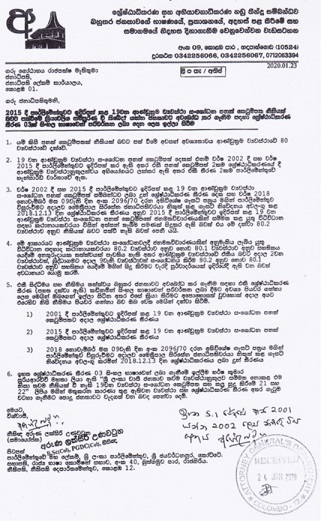
2015 දී පාර්ලිමේන්තුවට ඉදිරිපත් කළ 19වන ආණ්ඩුක්‍රම ව්‍යවස්ථා සංශෝධන පනත් කෙටුම්පත නීතියක් බවට පත්වීමේ ක්‍රියාවලිය සම්පූර්ණ වී තිබේද? අද ප්‍රබල සමාජ කතිකාවකි. ආචාර්ය වරැණ චනද්‍රකීර්ති සහ හර්ෂ කුමාර සූරියාඅරච්චි ඒ සම්බන්ධව වැදගත් නීති තර්ක ගෙනවිත් 19වන ව්‍යවස්ථා සංශෝධනය මේ දක්වා නීතියක් බවට පත්වී නැති බවට ශක්තිමත් නීති තර්ක ගෙනවිත් ඇත. 19වන ව්‍යවස්ථා සංශෝධනය ඉංග්‍රීසියෙන් කළ කුමන්ත්‍රණයක් බවත් එය තවමත් නීතියක් වී නැති අතර එය සනාථ කිරීම ශ්‍රේෂ්ඨාධිකරණ තීරණ 3ක් සිංහල භාෂාවෙන් පරිවර්තන ජනාධිපතිවරයාගෙන් ඉල්ලා සීටිමෙන් කළ හැකි බව කර්තෘගේ අදහස වන අතර ඒ සදහා ගෙන ඇති පියවර මේ ලිපියෙන් සාකච්ඡා කරනු ලැබේ.

යම් කිසි පනත් කෙටුම්පතක් නීතියක් බවට පත් වීමේ අවසන් අවශ්‍යතාවය ආණ්ඩුක්‍රම ව්‍යවස්ථාවේ  80 ව්‍යවස්ථාවේ දැක්වේ.

එය මෙසේ ය.

[80. (1) පාර්ලිමේන්තුව විසින් සම්මත කරන ලද පනත් කෙටුම්පතක් මත කථානායකවරයාගේ සහතිකය ඔහුගේ අත්සන ඇතිව සටහන් කරනු ලැබූ විට මේ ව්‍යවස්ථාවේ (2) වැනි අනු ව්‍යවස්ථාවේ විධිවිධානවලට යටත්ව එය නීතිය බවට පත් වන්නේ ය.

(2) යම්කිසි පනත් කෙටුම්පතක් හෝ යම්කිසි පනත් කෙටුම්පතක යම්කිසි විධිවිධානයක් හෝ ජනමත විචාරණයක් මගින් ජනතාවගේ අනුමතය සඳහා ඉදිරිපත් කිරීමට අපේක්ෂා කරන බව අමාත්‍ය මණ්ඩලය විසින් සහතික කර ඇත්තා වූ අවස්ථාවක හෝ, යම්කිසි පනත් කෙටුම්පතක් හෝ යම්කිසි පනත් කෙටුම්පතක යම්කිසි විධිවිධානයක් හෝ ජනමත විචාරණයක දී ජනතාව විසින් අනුමත කිරීම අවශ්‍ය බව ශ්‍රේෂ්ඨාධිකරණය විසින් තීරණය කර ඇත්තා වූ අවස්ථාවක හෝ යම්කිසි පනත් කෙටුම්පතක් 85 වැනි ව්‍යවස්ථාවේ (2) වැනි අනුව්‍යවස්ථාව යටතේ ජනමත විචාරණයක් මගින් ජනතාව වෙත ඉදිරිපත් කරන අවස්ථාවක, ඒ පනත් කෙටුම්පත හෝ ඒ විධිවිධානය ජනතාව විසින් ජනමත විචාරණයක දී 85 වැනි ව්‍යවස්ථාවේ (3) වැනි අනුව්‍යවස්ථාවට අනුකූලව අනුමත කර ඇති බව ජනාධිපතිවරයා විසින් සහතික කරනු ලැබූ විට පමණක් ඒ පනත් කෙටුම්පත හෝ ඒ පනත් කෙටුම්පතෙහි එකී විධිවිධානය හෝ නීතිය බවට පත් වන්නේ ය. එසේ අනුමත කරනු ලැබූ සෑම පනත් කෙටුම්පතක ම මෙහි පහත දැක්වෙන ආකෘතියෙහි වූ සහතිකයක්, ජනාධිපතිවරයා විසින් ස්වකීය අත්සන ඇතිව සටහන් කළ යුත්තේ ය:-

මේ පනත් කෙටුම්පත/විධිවිධානය ජනමත විචාරණයක දී (ජනතාව විසින් යථා පරිදි අනුමත කරන ලද බව මෙයින් සහතික කරමි.)

එවැනි සහතිකයක් ජනාධිපතිවරයා විසින් පනත් කෙටුම්පතක සටහන් කිරීම

(අ) ඒ පනත් කෙටුම්පත ජනතාව විසින් අනුමත කරන ලද ජනමත විචාරණයේ වලංගුභාවය අභියෝග කරන කිසි පෙත්සමක් ඉදිරිපත් කරනු නොලැබූ අවස්ථාවක, එවැනි ජනමත විචාරණයක වලංගුභාවය අභියෝග කරන පෙත්සමක් ඊට අදාළ නීතිය යටතේ ඉදිරිපත් කළ හැක්කේ යම් කාල සීමාවක් ඇතුළත ද ඒ කාල සීමාව ඉකුත් වීමෙන් පසුව ද ,

(ආ) ඒ පනත් කෙටුම්පත ජනතාව විසින් අනුමත කරන ලද්දේ යම් ජනමත විචාරණයක දී ද ඒ ජනමත විචාරණයේ වලංගුභාවය අභියෝග කරන පෙත්සමක් ඉදිරිපත් කරනු ලැබූ අවස්ථාවක, ඒ ජනමත විචාරණය වලංගු බවට ශ්‍රේෂ්ඨාධිකරණය විසින් තීරණය කරනු ලැබීමෙන් පසුව ද,

මිස, නොකළ යුත්තේ ය.

ඒ සෑම සහතිකයක් ම අවසානාත්මක හා තීරණාත්මක වන්නේ ය. ඒ සහතිකය පිළිබඳව කවර වූ හෝ අධිකරණයක දී ප්‍රශ්න නොකළ යුත්තේ ය.

(3) අවස්ථාචෝචිත පරිදී ජනාධිපතිවරයා ගේ හෝ කථානායකවරයාගේ සහතිකය පනත් කෙටුම්පතක් මත සටහන් කරනු ලැබූ පසු එම පනත් කෙටුම්පත නීතිය බවට පත් වන අවස්ථාවක ඒ පනතෙහි වලංගුභාවය පිළිබඳව පරීක්ෂා කිරීම, ඒ පිළිබඳව මතයක් ප්‍රකාශ කිරීම හෝ කවර වූ හෝ ආකාරයකින් ප්‍රශ්න කිරීම කිසිම අධිකරණයක් හෝ විනිශ්චය අධිකාරයක් හෝ විසින් නොකළ යුත්තේ ය. ]

එමෙන්ම 19 වන ආණ්ඩුක්‍රම ව්‍යවස්ථා සංශෝධන පනත් කෙටුම්පත් දෙකක් එනම් වර්ෂ 2002දී සහ 2015 දී පාර්ලිමේන්තුවට ඉදිරිපත් කර ඇති අතර එකී පනත් කෙටුම්පත් 2කම ශ්‍රේෂ්ඨාධිකරණයේ දී ආණ්ඩුක්‍රම ව්‍යවස්ථානුකූලත්වය අභියෝගයට ලක්කර ඇති අතර එකී තීරණ 2කම පාර්ලිමේන්තු හැන්සාර්ඩ් වාර්තාවේ ඇත.

වර්ෂ 2002 දී සහ 2015 දී පාර්ලිමේන්තුවට ඉදිරිපත් කළ 19 වන ආණ්ඩුක්‍රම ව්‍යවස්ථා සංශෝධන පනත් කෙටුම්පත් සම්බන්ධව ශ්‍රේෂ්ඨාධිකරණ තීරණ දෙකක් ලබා දී ඇත.

එමෙන්ම වර්ෂ 2018 නොවැම්බර් මස 09වැනි දින අංක 2096/70 දරන අතිවිශේෂ ගැසට් පත්‍රය මගින් පාර්ලිමේන්තුව විසුරුවීමට අදාලව මෛත්‍රීපාල සිරිසේන ජනාධිපතිවරයා නිකුත් කළ ගැසට් නිවේදනය අවලංගු කරමින් 2018.12.13 දින ශ්‍රේෂ්ඨාධිකරණ තීරණය අනුව 2015 දී පාර්ලිමේන්තුවට ඉදිරිපත් කළ 19 වන ආණ්ඩුක්‍රම ව්‍යවස්ථා සංශෝධන පනත් කෙටුම්පතේ ජනමතවිචාරණයකින් සම්මත කළ යුතු සඳහා කථානායකවරයා විසින් අත්සන් තැබීම පමණක් සිදුකර ඇති බවත් එය මේ දක්වා ව්යෙඅවස්ථාව අනුව නීතියක් බවට පත්වී නැති බවත් පෙනී යයි. සිංහල ජනතාවට මේ සම්බන්ධව අවබෝධය ලැබීමට නම් එකී ශ්‍රේෂ්ඨාධිකරණ තීරණ සිංහල භාෂාවෙන් ලබා ගත යුතුවේ. සිංහල භාෂාවෙන් මේ නඩු තීන්දු 3 ලබා ගැනීමට හැකියාව ලැබුණහොත් ජනතාවට සගවා අධිකරණයේ දී ඉංග්‍රීසියෙන් සිදුකරන සියලු ක්‍රියාවන් ජනතාවට නිරාවරණය වේ.

එනම් ආණ්ඩුක්‍රම ව්‍යවස්ථා සංශෝධනවල දී ජනමතවිචාරණයකින් අනුමැතිය ලැබිය යුතු විධිවිධාන සඳහාද කථානායකවරයා 80.2 ව්‍යවස්ථාව අනුව නොව 80.1 ව්‍යවස්ථාව අනුව සහතික කර ඇති බව ජනතාවට දැනගත හැකි වන්නේ මෙම නඩු තීන්දු සිංහල භාෂාවෙන් ලබා ගත් විටය.

මෙය වහා නිවැරදි කළ යුත්තේ මේ ආකාරයට ජනතාවට නොතේරෙන භාෂාවෙන් ආණ්ඩුක්‍රම ව්‍යවස්ථාවේ ඒකීය බවට අදාල 2වන ව්‍යවස්ථාව මෙන්ම බුද්ධාගමට අදාල 9වැනි ව්‍යස්ථාවත් සංශෝධනය කිරීම 80.2 ව්‍යවස්ථාව අනුව ජනාධිපතිවරයා විසින් නොව 80.1 ව්‍යවස්ථාව අනුව කථානායකවරයා විසින් සහතිකය යෙදීමේ පූර්වාදර්ශයක් ඇති විය හැකි හෙයිනි.

ඒ අනුව පසුගියදා ජනාධිපතිවරයා වෙත ඉල්ලීමක් කරමින්

  1. 2002 දී පාර්ලිමේන්තුවට ඉදිරිපත් කළ 19 වන ආණ්ඩුක්‍රම ව්‍යවස්ථා සංශෝධන පනත් කෙටුම්පතට අදාල ශ්‍රේෂ්ඨාධිකරණ තීරණය,
  • 2015 දී පාර්ලිමේන්තුවට ඉදිරිපත් කළ 19 වන ආණ්ඩුක්‍රම ව්‍යවස්ථා සංශෝධන පනත කෙටුම්පතට අදාල ශ්‍රේෂ්ඨාධිකරණ තීරණය,
  • 2018 නොවැම්බර් මස 09වැනි දින අංක 2096/70 දරන අතිවිශේෂ ගැසට් පත්‍රය මගින් පාර්ලිමේන්තුව විසුරුවීමට අදාලව මෛත්‍රීපාල සිරිසේන ජනාධිපතිවරයා නිකුත් කළ ගැසට් නිවේදනය අවලංගු කරමින් 2018.12.13 දින ශ්‍රේෂ්ඨාධිකරණය ලබා දුන් තීරණය ජනාධිපතිවරයා වෙතින් සිංහල භාෂාවෙන් ඉල්ලා ඇත.

මෙම ඉල්ලීමේ පිටපත් පාර්ලිමේන්තුවේ මහ ලේකම්, රාජ්‍ය භාෂා කොමිෂන් සභාව සහ නීතිපති වෙතද යොමු කර ඇත. (එකී ලිපිය මෙහි පහත දක්වා ඇත.)

මෙම නඩු තීන්දු 3 සිංහල භාෂාවෙන් කියවීමට ජනතාවට අවස්ථාව ලදහොත් ජනමතවිචාරණයකින් සම්මත කළ යුතු බවට 2002 දී ශ්‍රේෂ්ඨාධිකරණය තීරණය කර ඇති පාර්ලිමේන්තුය විසරවීමට අදාල ප්‍රතිපාදන සදහා 2015 ඉදිරිපත් කළ 19 වන ආණ්ඩුක්‍රම ව්‍යවස්ථා සංශෝධන පනත කෙටුම්පතට මේ දක්වා ජනතාවගේ අනුමැතිය ලබාගෙන නැති බවත්, එයට 80.1 ව්‍යවස්ථාව යටතේ කථානායක සහතිකය යෙදීම වැරදි බවත් එයට සහතිකය යෙදිය යුත්තේ 80.2 ව්‍යවස්ථාව යටතේ බවත් මැනවින් පැහැදිලි වේ.

එනම් 19වන ව්‍යවස්ථා සංශෝධනය ඉංග්‍රීසියෙන් කළ කුමන්ත්‍රණයක් බවත්, එය තවමත් නීතියක් වී නැති බවත් ජනතාවට අවබෝධවනු ඇති අතර මේ ව්‍යවස්ථා කුමන්ත්‍රණය කළ තැනැත්තන් අවසානයේ ජනතාවට නිරාවරණය වනු ඇත.

මේ දක්වා 19 වන ආණ්ඩුක්‍රම ව්‍යවස්ථා සංශෝධන පනත් කෙටුම්පත ව්‍යවස්ථාවේ 80.2 ව්‍යවස්ථාව අනුව නීතියක් වී නැති හෙයින් පනත් කෙටුම්පතක් ඉවත් කිරීමට පාර්ලිමේන්තුවේ 2/3ක් මන්ත්‍රී සංඛ්‍යාවක් අවශ්‍යය යන්න කිසිම පදනමක් නැති අදහසකි.

නීතිඥ අරුණ ලක්සිරි උණවටුන

arunaunawatuna@gmail.com

US official delivers Trump’s threatening message to Sri Lankan president

January 24th, 2020
By K. Ratnayake Courtesy World Socialist Web Site
20 January 2020

US Deputy Assistant Secretary of State for South and Central Asian Affairs Alice G. Wells delivered a letter from President Donald Trump to President Gotabhaya Rajapakse during a one-day trip to Sri Lanka last Wednesday. The letter, according to the media, emphasised the White House’s commitment and interest in furthering and deepening [its] partnership” with the island nation.

Wells held discussions with President Rajapakse and his brother, Prime Minister Mahinda Rajapakse, as well as Foreign Minister Dinesh Gunawardena, Tamil National Alliance chiefs R. Sambandan and M. A. Sumanthiran, and civil society” leaders. Wells was accompanied by Liza Curtis, the Senior Director for South and Central Asia on the US National Security Council and Aliana Teplitz, the US ambassador to Colombo.

Significantly, Wells’ trip—part of a nine-day South Asia tour—followed Chinese Foreign Minister Wang Yi’s two-day visit to Sri Lanka, which began last Monday. Russian Foreign Minister Sergey Lavrov was also in Colombo on Wednesday.

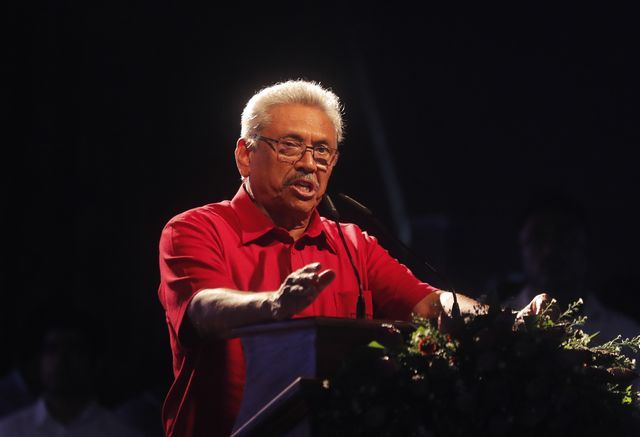
Gotabhaya Rajapakse (AP Photo)

These high-level visits underscore the increasing rivalry over influence in the Indian Ocean region, primarily between the US and India, Washington’s key ally in South Asia, on one hand, and China and Russia, on the other. Strategically-located, Sri Lanka straddles important Indian Ocean sea lanes. In its attempts to maintain world hegemony, the US is deepening its military buildup and trade war measures against China.

Washington’s concerns over Sri Lanka have deepened with Rajapaske’s election as president and his appointment of his brother, a former president, as prime minister. The US considers both men to be pro-China.

While the US previously backed Mahinda Rajapakse’s anti-democratic government and its brutal war against the separatist Liberation Tigers of Tamil Eelam (LTTE), Washington was hostile to Colombo’s close relations with China. In late 2014, Washington initiated a regime-change operation to remove Mahinda Rajapakse, who was ousted in the January 2015 elections and replaced by Maithripala Sirisena as a pro-US president.

Wells told the media that she discussed with Gotabhaya Rajapakse a wider and safer Indo-Pacific region [and] other issues of mutual interest.” The US wanted to strengthen ties by expanding cooperation on economy and trade, counter-terrorism, security, military-to-military engagements, transitional justice and human rights.” These are code-words to justify the increasing build-up of US military forces across the region.

According to media reports, Wells reiterated Washington’s opposition to Beijing’s influence in Sri Lanka. She voiced concerns about Chinese investments and denounced the Hambantota Port agreement as unsuccessful and an injustice to the Sri Lankan people.” In 2018, Sirisena’s government signed over Hambantota Port to a Chinese company in a 99-year lease as part of a deal to phase-out massive loans from Chinese banks for the facility’s construction.

Wells’ message from Trump was clear. Washington will not tolerate any weakening of the military and political relations it built-up over four years under Sirisena.

Wells praised increasing US-Sri Lanka military cooperation and hailed last year’s 18-ship US visit and the ever-closer integration of the Sri Lankan military into the US Pacific Command.

Washington is pushing for a renewal of the Status of Forces Agreement (SOFA) it secured with Sri Lanka in 1995, but with new provisions. The new clauses would permit American military bases and provide free access and immunity for all US forces operating in Sri Lanka. The Trump administration also wants Colombo to sign the Millennium Challenge Corporation (MCC) agreement, a US foreign policy aid deal.

During the recent presidential elections, Rajapakse’s Sri Lanka Podujana Peramuna criticised the MCC and SOFA in an attempt to capitalise on popular anti-imperialist sentiment. But once Rajapakse took office, he established a special body to assess the MCC’s merits and demerits.”

Wells thanked Rajapakse for setting up this review committee but asked for an early response to its findings. She said any concerns” about the SOFA could be discussed after the Sri Lankan parliamentary elections, due to be held in about four months.

The US, Wells warned, is Sri Lanka’s largest export market and this was a partnership beneficial to both the countries.” She told the media that she discussed Colombo’s commitment to the UN Human Rights Council, the return of land seized during the war with the LTTE, the provision of information to relatives of missing individuals, and concerns by Tamils and other minorities and opposition parties over accountability.

This is a thinly-veiled threat that numerous issues can be exploited to force Sri Lanka to toe the US line. The Obama administration cynically used human rights violations by Mahinda Rajapakse’s regime to pressure Colombo to distance itself from Beijing.

A day earlier, Chinese Foreign Minister Wang had met with the Sri Lankan president, telling him that Beijing’s attitude toward Sri Lanka had always been consistent and that China would continue to be a reliable” friend.

As Sri Lanka’s strategic partner, China will continue to stand by Sri Lanka’s interests,” Wang declared. We will not allow any outside influences to interfere with matters that are essentially internal concerns of Sri Lanka.” Wang did not name the outside influences,” but clearly was referring to the US and India, which are seeking to scuttle Colombo’s relations with China.

The Sri Lankan government, which faces massive debt repayments and a deepening economic crisis, is seeking international financial assistance, particularly from China.

President Rajapakse, who is due to visit China early next month, responded to Wang’s remarks by declaring that he was an admirer of President Xi Jinping” and followed his speeches and statements closely.”

Wang indicated that China would offer financial help, including the phasing-out of debt repayments, and meet with necessary parties that can help Sri Lanka in the areas of technology, tourism, infrastructure and other related fields.”

Russian Foreign Minister Lavrov met with Gunawardena, his counterpart, and voiced his readiness to strengthen relations with Sri Lanka. Lavrov said Russia would provide the Sri Lankan forces with all the weapons they need for security” and wanted to boost annual bilateral trade—currently $US400 million—to $700 million.

Russia, which also faces aggressive US military encirclement, last year held joint military exercises with China and Iran. The three countries are targets in Washington’s over-arching military strategy to dominate the oil-rich Middle East and Eurasia.

Amid these developments, India is engaged in strenuous efforts to keep Sri Lanka under its strategic dominance. Indian Foreign Minister S. Jaishankar visited Sri Lanka three days after Rajapakse’s election, and Rajapakse then visited New Delhi to meet with Prime Minister Narendra Modi.

Last week, Foreign Minister Gunawardena visited India to meet his counterpart and a business delegation. In early February, Prime Minister Mahinda Rajapakse is scheduled to visit India at Modi’s invitation.

Gotabhaya Rajapakse, who has rapidly elevated key military figures into his administration, demagogically claims that he will maintain a neutral foreign policy.” But under conditions of intensifying great power rivalry, the whole Indian sub-continent is being sucked into a geopolitical maelstrom and the danger of a catastrophic war between the nuclear-armed US and China.

Allahabad HC upholds ban on loudspeakers in mosques

January 24th, 2020

Courtesy: Outlook India

23 JANUARY 2020 

https://www.outlookindia.com/newsscroll/allahabad-hc-upholds-ban-on-loudspeakers-in-mosques/1715334

Prayagraj, Jan 23 (IANS) The Allahabad High Court has refused to quash an administrative order that banned the use of loudspeakers for ”azaan” at two mosques in Baddopur and Shahganj villages of Jaunpur district in Uttara Pradesh.

The court in its order on Wednesday stated that no religion advocates the use of loudspeakers for worship.

“No religion prescribes that prayers are required to be performed through voice amplifiers or by beating of drums… If there is such a practice, it should not adversely affect rights of the others, including that of not being disturbed,” said the division bench of Justice Pankaj Mittal and Justice V.C. Dixit.

The court dismissed the petition filed by one Masroor Ahmad and a fellow resident of Jaunpur.

The court cited a similar 2000 Supreme Court judgment — Church of God (Full Gospel) vs KKR Majestic Colony Welfare Association — where the apex court said that freedom to practice religion was subject to public order, morality and health.

The division bench also dismissed the petitioners” argument that using loudspeakers to call people to join in the ”namaaz” at specific times was an essential part of their religion.

“The fundamental right to religious freedom under Article 25(1) of the Constitution is not absolute. It is subject to Article 19(1)(a) (freedom of speech and expression), and thus both of them have to be read together,” the court pointed out.

The petitioners had submitted an application in March last year, seeking permission to use loudspeakers.

The circle officer of Shahganj had also said in his report submitted to the court that the areas in which these two mosques were located had a mixed population of Hindus and Muslims and allowing the use of amplifiers could lead to a law and order problem.

–IANS

Courtesy: Outlook India

ගොඩහේවා ප‍්‍රකට සමාගමකට දුන් තනි වචනය හෙලි වෙයි..

January 24th, 2020

උපුටා ගැන්ම ලංකාසීනිවුස්

ජනවාරි මස 22 දා පැවති කැළණිය විශ්වවිද්‍යාලයේ කළමණාකරන පීඨයේ 106වන උපාධි ප්‍රදාන උත්සවයට ප්‍රධාන ආරාධිතයා ලෙස සහභාගී වූයේ ආචාර්ය නාලක ගොඩහේවා මහතායි.

වරලත් ඉංජිනේරුවෙකු, වරලත් ගනකාධිකාරවරයෙකු හා වරලත් අලවිරුවෙකු යන අංශ තුනකම වෘත්තීය සුදුසුකම් ඇති ආචා රය නලක ගොඩහේවා ව්‍යාපාර කළමණාකරනය පිළිබඳ පශ්චාත් උපාධියත් , ආර්ථික විද්‍යාව පිලිබඳ ආචාර් ය උපාධියත් සපුරා ඇති දුලබ ගනයේ විද්වතෙකි.

පෞද්ගලික අංශයේ මෙන්ම රාජ්‍ය අංශයේ ආයතන ගනනාවක ප්‍රධානියා ලෙස සාර්ථ්ක ප්‍රතිපල පෙන්වා ඇති ආචාර්ය නාලක ගොඩහේවා උපාධිදාරී සිසුන් අමතා කල පහත දැක්වෙන දේශණය රැකියා වෙළඳපොලට පිවිසෙන තරුණ තරුණියන්ට ඉතා ප්‍රායෝගික අවවාද ‍මාලාවකින් සමන්විත වූවක්.

සියල්ලටම පෙර මම ඔබට සුබ පතනවා ඔබේ උපාධිය සාර්ථකව අවසන් කිරීම පිළිබඳව. ඔබ මේ ජයගෙන ඇත්තේ ජීවිතයේ ඉතා වටිනා කඩ ඉමක්.

ඔබව මේ තත්වයට ගෙන එන්නට ඔබේ දෙමව්පියන් විශාල කැපකිරීම කරන්නට ඇති. අද ඔවුන් ඔබ මේ ලබා ගත් ජයග්‍රගහණය ගැන බෙහෙවින් සතුටු වෙනවා . ඒ වගේම ඔබේ සහෝදර, සහෝදරියන් , නෑදෑ හිතමිතුරන් අද ඔබ සමඟ සතුට බෙදා ගන්නවා. ඔබේ ගුරුවරුන් ඔබ ගැන ආඩම්බර වෙනවා. සමාජය ඔබට සුබ පතනවා.

ඔබේ ජීවන ගමන මේ පටන් ගත්තා විතරයි. සමහර විට ඔබ මෙතෙක් ආ ගමන මෙන් 3 ගුණයක්වත් දිගු ගමනක් ඔබ ඉදිරියේ තිබෙනවා. මෙතැන් පටන් ඔබේ අරමුණු වෙනස් වෙනවා. ඔබේ අභියෝග වෙනස් වෙනවා. ඒ අභියෝග ජයගෙන, අරමුණ කරා යන්නේ කෙලෙසද කියා දැන් ඔබ සැලසුම් කල යුතුයි.

ජීවත් වීම සඳහා සෑම කෙනෙකුටම ආදායමක් අවශ්‍ය වෙනවා. ඔබ මෙතැන් පටන් ඔබේම ආදායම උපයා ගත යුතුයි. තව දුරටත් මව්පියන්ගෙන්, නෑදෑ හිතමිතුරන්ගෙන් හෝ රජයේ ආධාර වලින් යැපීම නතර කල යුතුයි. ඔබ වැඩිදුර අධ්‍යාපනයට යොමුවුනත් එය තමුන්ගේම කියා ආදායමක් උපයන ගමන් කරනවානම් තමා වඩා හොඳ.

යමෙකුට සමාජයට බරක් නොවී සාධාරණව ආදායම් උපයන්නට ක්‍රම කිහිපයක්ම තිබෙනවා. මා හිතනවා ඔබ ඒ ගැන දැනුවත් විය යුතුයි කියා. එය නොදන්නා කම නිසා තමයි සමහර උපාධිදාරීන් උපාධිය සම්පූර්ණ කොට වසර ගනනාවකට පසුත් රැකියා විරහිත උපාධිදාරීන් කියා ලේබලයක් තමුන්ම ගසාගෙන අනුන්ගේ පිහිට පතන්නේ.

ඔබ මෙතෙක් ලබා ගත් අධ්‍යාපන සුදුසුකම් හා ඔබේ කුසලතා හා පෞරෂය පදනම්ව ඔබට සමහරවිට රැකියාවක් සොයාගත හැකියි. රැකියාවකට ඉල්ලුම්පත්‍රයක් දමනා විට , සම්මුක පරීක්ෂණයකට මුහුන දෙන විට ඔබ ඔබව කෙතරම් දක්ෂ ලෙස ඉදිරිපත් කරගන්නවාද යන්න මත තමයි ඔබ කොතරම් ඉක්මනින් හා පහසුවෙන් රැකියාවක් ලබා ගන්නවාද යන්න තීරණය වන්නේ. එකම සුදුසු කම තිබුනත් උපාධිදාරින්ගෙන් කොටසකට රැකියා ලැබෙන්නටත් අන් අයට නොලැබෙන්නටත් හේතුව බොහෝ විට තමුන්ගේම තිබෙනා අඩු පාඩු නිසායි. ඒ ගැන සමාජයට හෝ රජයට දොස් කිමෙන් පලක් නැහැ. ඔබ කල යුත්තේ ඒ අඩුපාඩු මොනවාද කියා වටහාගෙන ඒවා නිවැරදි කර ගැනීමයි.

වර්ථමාන ගෝලීය ආර්ථිකය තුල තවත් කෙනෙකු යටතේ රැකියාවක් කරනවාට වඩා ස්වයං රැකියාවක් කිරීමේ අවස්ථාවක් තිබෙනා බවත් ඔබ මතක තබා ගත යුතුයි. එය සමහර විට ඔබේ කුසලතාවක් පදනම් කරගෙන කරන ස්වයං රැකියාවක් වන්නට පුලුවන්. සමහර විට එය ඔබ විශ්ව විද්‍යාලය තුල හෝ එයින් පරි බාහිරව ඉගනගත් දෙයක් මත පදනම්ව කරනා ස්වය්ං රැකියාවක් වන්නට පුලුවන්. සමහර විට වෙළඳ පොල තිබෙන විවිධ ආදායම් ඉපයීමේ අවස්ථා හඳුනාගෙන ඔබ විසින් ආරම්ඹ කරනා ස්වයං රැකියාවක් විය හැකියි. උදාහරනයක් ලෙස අද අන්තර්ජාලය හරහා විවිධ සේවා සපයමින් හොඳ ආදායමක් උපයන විශාල පිරිසක් රට තුල සිටිනවා. එය රැකියාවක් කොට මුල් කාලයේ ලැබිය හැකි ආදායමට වඩා බොහෝ ඉහල ආදායමක් විය හැකියි. ඒ වගේම වෘත්තීය දැනුම හා පුහුණුව ස්වයං රැකියාවක් හරහා ජීවිතය ගොඩ නංවා ගැනීමට මාර්ගයක් වෙන නිසා උපාධියෙන් ලද දැනුමට අමතරව යම් ක්ෂේත්‍රයක වෘත්තීය දැනුම ලබා ගන්නටත් ඔබට යොමු විය හැකියි.

කාර්මිකයන් කලාකරුවන්, මාධ්‍ය වේදීන්, පුද්ගලික පංති ගුරුවරුන්, තාක්ෂණික උපදේශකයන්, නීතිවේදීන්, ගෘහ නිර්මාන ශිල්පීන්, රූප ලාවණ්‍ය උපදේශකයින්, රක්ෂණ නියෝජිතයන් වැනි ස්වයංරැකියා අවස්ථා දහස් ගනනක් මේ රටේ තිබෙනවා.

ආදායම් ඉපයීමට මීලඟ අවස්ථාව වන්නේ තමුන්ගේම කියා ව්‍යාපාරයක් ආරම්බ කිරීමයි. අනුන්ගෙන් රැකියා ඉල්ලනවා වෙනුවට අනුන්ටත් රැකියා ලබා දෙන්නට එවිට පුලුවන්. ව්‍යාපාරිකයෙක් වීම ඉතා ගෞරවාන්විත වෘත්තියක්. මන්ද ව්‍යාපාරිකයා රටේ සංවර්ධනයට ඍජුවම දායක වන, ජනතාවට, රැකියා අවස්ථා උත්පාදනය කරන තැනැත්තෙක් නිසායි. වර්ථමානයේ රටේ ආර්ථිකයෙන් 50% කට පමන දායක වන්නේත්, රටේ රැකියාවලින් 70% පමන සපයන්නේත් ව්‍යාපාරිකයනුයි. ඔබට වෙළඳපොල තිබෙනා ව්‍යාපාරික අවස්තාවන් හඳුනාගන්නට පුලුවන්නම් පොඩියට හෝ ව්‍යාපාරයක් ආරම්බ කිරීමත් සලකා බලන්නට පුලුවන්. අද ඔබ රැකියාවකට ගියත් අත්දැකීම් ලබාගෙන, ආයෝජනය සඳහා යම් මුදලක් එකතු කරගත්තාට පසු අනාගතයේ දවසක හෝ තමන්ගේම කියා ව්‍යාපාරයක් ආරම්බ කරන්න කියා මම යෝජනා කරනවා.

අපේ රටේ ජනතාවගෙන් ව්‍යාපරිකයන් සිටින්නේ ඉතා සුලු ප්‍රතිශතයක්. එයට හේතුව අපේ අධ්‍යාපන ක්‍රමය තුල මෙන්ම සමාජය තුල ව්‍යවසායකත්වයට නිසි ගෞරවය ලබා දී නැති නිසායි. රාජ්‍ය ප්‍රතිපත්තියක් ලෙස දේශිය ව්‍යාපාරිකයන් ආරක්ෂා කිරීමට, ව්‍යවසායකත්වය දිරිමත් කිරීමටත් වත්මන් රජය බලාපොරොත්තු වෙනවා.

මා මේ කී ක්‍රම 3 පලවෙනි එකේ ඔබ අනුන් වෙන්වෙන් වැඩකරනවා, දෙවන්නේදී ඔබ ඔබ වෙනුවෙන් වැඩ කරනවා, තුන් වැන්නේදී, ඔබ අනුන්ගෙන් වැඩ ගන්නවා.

ආදායම් ඉපයීමට සිව් වන ක්‍රමයකුත් තිබෙනවා. ඔබ වෙනුවට වැඩ කරන්නට මුදල් යෙද වීම. එයට අප කියන්නේ ආයෝජනය කියායි.

උදාහරනයක් වශයෙන් කොටස් වෙලඳපොලේ සුලු මුදලක් ආයෝජනය කොට ප්‍රතිලාබයක් ගැනීම මෙම ක්‍රම වේදයට අයත් වෙනවා. කොටස් වෙළඳ පොල පමනක් නොවෙයි යමෙකුට මුදල් වලින් මුදල් හොයන්නට තිබෙන ක්‍රමවේදය. ඔබ සොයා බැලුවොත් තවත් ආයෝජන අවස්ථා රාශියක් හමු වේවි.

මම මේ ආදායම් උපයන ක්‍රම ගැන සඳහන් කලේ ඔබත් ඔබේ දෙමව්පියනුත් බොහෝදෙනක් මේ අවස්ථාවේ රැකියාවක් ගැන සිතමින් යම් ආකාරයකට බියට පත් වී සිටිනවා විය හැකි නිසායි. එසේ බිය වීමට අවශ්‍ය තාවක් නැහැ.

ඔබ සමහර විට අසා ඇති මට ඉංජිනේරු විද්‍යාව, ගණකාධිකරණය, අළවිකරනය යන වෘත්තීය සුදුසුකම් තුම තිබෙනා අතර ව්‍යාපාර කලමණාකරණය පිලිබඳා පශ්චාත් උපාධියකුත් ආර්ථික විද්‍යාව පිළිබඳ ආචාර්‍ය උපාධියකුත් තිබෙනවා. මම පෞදග්ලික අංශයේත් රාජ්‍ය අංශයේත්, ක්ෂේත්‍ර ගනනාවක, ආයතන ගනනාවක ඉහලම තනතුරු දරා ප්‍රතිපල පෙන්වූ පුද්ගලයෙක්.

නමුත් මීට වසර 30 කට පමන පෙර මමත් ඔබ වගේ නවක උපාධිදාරියෙක්. ඔබට වගේම මටත් අනාගතය ගැන පැහැදිලි අවභෝධයක් තිබුනේ නැහැ. නමුත් මා සතුව තිබුන එක් ගුණාංගයක් නිසා තමයි මට මෙතෙක් මගේ ගමන සාර්ථකව එන්නට පුල්වන් වුනේ. ඒ කුමක්ද කියා කියන්නට මම මගේ ජීවිතයේ පොඩි අත්දැකීමක් කියන්නම්.

මම මුලින්ම රැකියාව ලබා ගත්තේ බහුජාතික සමාගමක් වන යුනිලීවර් ආයතනයේ පුහුණු කලමනාකරුවෙක් වශයෙන්. ඒ කාලයේ එම ආයතනයට සුදුසුකම් ලබන්නට ඉතා අමාරුයි. මම එයට අයැදුම් කොට සම්මුක පරීක්ෂණ කිහිපයකට මුහුණ දී අවසාන සම්මුක පරීක්ෂනයට ගිය විට ආයතනයේ සභාපතිවරයා මගෙන් අපූරු ප්‍රශ්නයක් ඇහුවා. ඔහු එය ඇසුවේ ඉංග්‍රීසියෙන්

ඔහු ඇහුවා CAN YOU DESCRIBE YOUR CHARACTER IN ONE WORD කියා.

ඔබට ඔබේ චරිතය එක වචනයකින් විස්තර කරන්න පුලුවන්ද කියා

මම දුන්න උත්තරය CONFIDENT කියායි. එහි සිංහල තේරුම ඔබ දන්නව.

ඒ කියන්නේ ‘ආත්ම විශ්වාසය’ ඇති කියායි.

අයදුම් කරුවන් දහසකට අධික ප්‍රමානයකින් ඔවුන් මාව එදා තොරා ගත්තා. එදා පටන්මේ දක්වා මගේ ගමන එන්නට උපකාර වුනේ කිසි දෙයකට බැහැ නොකියන ආත්ම විශ්වාසයයි

ඒ නිසා මම ඔබටත් අද දෙන්නේ එකම එක අවවාදයයි. ඔබ ඔබ ගැන විශ්වාසය තබන්න, ආත්ම විශ්වාසය කියන්නේ එයයි.

නොපසුබට උත්සාහය තිබෙනවා නම් ජීවිතය ජය ගන්නට ඕනෑම අයෙකුට පුලුවන්. අවශ්‍ය වන්නේ ආත්ම විස්වාසය හා තැනට ඔබින තීරණ ගැනීමට හැකි කාලෝචිත ප්‍රඥ්ඥාව පමනයි.

– midia unit

RANJANGATE SCANDAL – විනිසුරු ගිහාන් පිලපිටිය අත්අඩංගුවට ගන්නවාට දැඩි විරෝධය.. විමල් නීතිපතිව පට්ටා පතුරු ගහයි.. [Video]

January 24th, 2020

lanka C news

මහාධිකරණ විනිසුරු ගිහාන් පිලපිටිය අත්අඩංගුවට ගැනීමට නියෝගයක් නිකුත් කිරීම සම්බන්ධයෙන් නීතිපති දප්පුල ලිවේරා මහතා ඉලක්ක කරමින් ජාතික නිදහස් පෙරමුණේ නායක ඇමැති විමල් වීරවංශ මහතා දැඩි විරෝධය එල්ල කරයි.

නීතිපති දප්පුල ද ලිවේරා මහතා විසින් එම තීන්දුව ගත්තේ කුමන පදනමක් මත දැයි ඇමතිවරයා පාර්ලිමේන්තුවේදී ප්‍රශ්න කළේය.

පාර්ලිමේන්තුවේදී ඔහු කියා සිටියේ ඊට වඩා බරපතල චෝදනා එල්ල වන විනිසුරුවන් කිහිපදෙනෙකු සම්බන්ධයෙන්ම රන්ජන් රාමනායක මන්ත්‍රීවරයා ගේ හඬ පටවලින් හෙලිව ඇති බවයි.

සැබැවින්ම මෙම ප්‍රශ්නයේ දී පැමිණිලිකරු වී ඇත්තේ ගිහාන් පිලපිටිය විනිසරු බවත් දැන් ඔහු විත්තිකරුවෙක් කර ඇති බවත් ඔහු කියා සිටියේය.

රන්ජන් රාමනායක මන්ත්‍රීවරයා විසින් කරණ ලද බලපෑම් සම්බන්ධයෙන් මහාධිකරණ විනිසුරුවරයා විසින් පැමිණිලි කර ඇති තත්ත්වයක් යටතේ කුමන පදනමකින් ඔහු අත්අඩංගුවට ගන්නැයි නියෝග කළේ දැයි මං ඇමැතිවරයා ප්‍රශ්න කළේය.

යහපාලනය විසින් විනාශ කරන ලද අධිකරණ පද්ධතිය රැක ගැනීමේ වගකීමක් ආණ්ඩුවට ඇති නිසා තමන් මෙම ප‍්‍රකාශය සිදු කරන බවද ඔහු තියා සිටියේය.

Sri Lanka’s former ruling party likely to split for parliamentary polls

January 24th, 2020

Courtesy NewsIn.Asia

UNP chooses Sajith as Presidential candidate unanimously and unconditionally

Colombo, Jan.24 – Sri Lanka’s former ruling United National Front (UNF) is on the verge of splitting up for the upcoming parliamentary elections which will be held in the country in April, with minority alliance members likely to contest under their own symbols due to the ongoing leadership battle between UNP Leader Ranil Wickremesinghe and Opposition Leader Sajith Premadasa.

Already, alliance partners such as the Tamil Progressive Alliance (TPA) has said that it will hold a meeting next Monday to discuss contesting under its own symbol, outside the UNF, in all 22 electoral districts in coalition with ‘like minded progressive and patriotic parties’ at the upcoming general elections, the Daily Mirror reported.

The TPA consists of the Democratic People’s Front, National Union of Workers and the Upcountry People’s Front.

The Daily Mirror said that other alliance partners such as the All Ceylon Muslim Congress (ACMC) led by Rishard Bathiudeen, Sri Lanka Muslim Congress (SLMC) led by Rauff Hakeem and Jathika Hela Urumaya (JHU) led by Champika Ranawaka have already expressed their dissatisfaction at the UNP’s internal battle and informed Sajith Premadasa that in the event Ranil Wickremesinghe refuses to step down from the leadership, they would contest as a separate alliance under Premadasa.

A senior UNP MP said that Wickremesinghe was unlikely to step down from the leadership post ‘anytime soon’ and talks are currently underway by the Sajith faction to contest the general election under a separate alliance.

SLMC Leader Rauff Hakeem said that his party had informed Sajith Premadasa that it would contest under one banner only if Sajith Premadasa leads a separate alliance in the event Wickremesinghe does not step down.

It is also learnt that the ACMC is looking at ‘several options’ before making its final decision.

Democratic People’s Front (DPF) Leader Mano Ganesan said the TPA was discussing going all alone in the upcoming elections while there were suggestions that the party should align with the TNA as well.

The main reason for us to consider these alternatives is the infighting within the UNP, the main coalition partner in UNF. We want a strong UNP, hence a strong UNF, but it looks as if some sections of the UNP are working in the interest of the government in a deal,” Ganesan said.

We do not interfere in the UNP leadership crisis, but we being a partner in the UNF, we cannot ignore it. There needs to be a reform in the UNP. There is a strong need for that. Sajith Premadasa and Karu Jayasuriya shall play lead roles to put the house in order along with Mr. Wickremesinghe. Let them decide who their leader is. But when such things are not happening we cannot just waste time but to look for alternate strategies,” Ganesan added.

Earlier this week, UNP MP Akila Viraj Kariyawasam said that a final decision over the leadership crisis was likely to be taken by Friday but several UNP MPs are of the view that it was unlikely a decision would be taken.

RANJANGATE SCANDAL – Wimal questions Judge Pilapitiya’s arrest

January 24th, 2020

Courtesy The Daily Mirror

Minister Wimal Weerawansa today blamed the Attorney General for wrongly requesting that Judge Gihan Pilapitiya be arrested.

Speaking during the condolence vote on the late MP Ranjith Soysa, Mr Weerawansa questioned why the AG has wanted Mr Pilapitiya arrested when he had refused to do what MP Ranjan Ramanayake had wanted him to do.

Mr Pilapitiya has complained against MP Ramanayke to the Judicial Service Commission and the police. How is it that the person who lodged a complaint was arrested,” he asked.

MP Wijedasa Rajapakshe also asked a similar question and called far an explanation of this act which was far from being fair.

He said the important fact is to determine as to who instructed MP Ramanayke to influence the judges. Mr Ramanayke is only a puppet and it is important to find out as to who is controlling him,” the MP said. (Yohan Perera and Ajith Siriwardana)

RANJANGATE SCANDAL – Speaker confirms no phone recordings were submitted by Ranjan

January 24th, 2020

Courtesy The Daily Mirror

Speaker Karu Jayasuriya today confirmed that UNP MP Ranjan Ramanayake had not handed over any CDs containing his phone conversations to Parliament.

Responding to a question raised by Government MP Nimal Lansa in Parliament, the Speaker said MP Ramanayake had handed over the CDs to the Secretary General of Parliament but had later reversed his decision. 

මාවනැල්ල බුදු පිළිම කැඩීමේ සිද්ධිය ගැන CIDය නිසි පරිදි ක්‍රියාත්මක නොවූ බව ජනපති කොමිසමේදී අනාවරණ වෙයි

January 24th, 2020

උපුටා ගැන්ම හිරු නිව්ස්

මාවනැල්ල බුදු පිළිම කැඩීමේ සිද්ධිය සම්බන්ධයෙන් විමර්ශන සිදු කිරීමේදී අපරාධ පරීක්ෂණ දෙපාර්තමේන්තුව නිසි පරිදි ක්‍රියාත්මක නොවූ බව පාස්කු ප්‍රහාරය පිළිබඳ සොයන ජනාධිපති විමර්ශන කොමිෂන් සභාව හමුවේ අද අනාවරණ වුණා.

ඒ එම කොමිසම හමුවේ එවක කෑගල්ල ප්‍රදේශය භාරව කටයුතු කළ සහකාර පොලිස් අධිකාරී ජගත් ගාමිණී තෙන්නකෝන් මහතා සාක්ෂි ලබාදුන් අවස්ථාවේදී.

පාස්කු ප්‍රහාරය පිළිබඳ සොයන ජනාධිපති කොමිෂන් සභාව ඊයේ අවසන් වරට ප්‍රශ්න කළේ, කෑගල්ල ප්‍රදේශය භාරව සිටි සහකාර පොලිස් අධිකාරී ජගත් ගාමිණී තෙන්නකෝන් මහතාගෙන්.

එහිදී නීතිපති දෙපාර්තමේන්තුව වෙනුවෙන් පෙනීසිටි රජයේ අධිනීතිඥ සුහර්ශි හේරත් මහත්මියගේ ප්‍රශ්න කිරීම් හමුවේ සහකාර පොලිස් අධිකාරීවරයා අනාවරණ කළේල මාවනැල්ල බුදුපිළිම කැඩීමේ සිද්ධීන් දෙක සම්බන්ධයෙන් අධිකරණයට බී වාර්තාවක් ඉදිරිපත් කර තිබුණ ද සැකකරුවන් නම්කර නොසිටි බවයි.

බුදුපිළිම කැඩීමේ සිද්ධිය සම්බන්ධයෙන් තමන් 2018 දෙසැම්බර් මස 26 වැනිදා පොලිස්පති පූජිත් ජයසුන්දර මහතා දැනුවත් කළ බවද සහකාර පොලිස් අධිකාරීවරයා ජනාධිපති කොමිසම හමුවේ හෙලිකළා.

ඔහු වැඩිදුරටත් පැවසුවේ පොලිස්පතිවරයා 2018-12-29 වැනි දින තමාට දුරකථනයෙන් අමතා එවක බස්නාහිර හිටපු ආණ්ඩුකාර අසාද් සාලි මහතාට කතා කරන ලෙසත්ල ඔහු සැකකරුවන් පිළිබඳ යම් තොරතුරක් ලබා දෙනු ඇති බවත් සඳහන් කළ බවයි.

පොලිස්පතිවරයා පැවසූ අන්දමට තමා අසාද් සාලි මහතාට දුරකථනයෙන් අමතා පොලිස්පතිවරයාගේ පණිවුඩය දැනුම්දුන් බව සහකාර පොලිස් අධිකාරීවරයා පැවසුවා.

එහිදී තම්සීන් නමැති මව්ලවිවරයෙක් හරහා සැකකරුවන් දෙදෙනෙකු ගෙනැවිත් භාරදීමට කටයුතු කරන බවට අසාද් සාලි මහතා පැවසූ බව සහකාර පොලිස් අධිකාරී තෙන්නකෝන් මහතා සඳහන් කළා.

අසාද් සාලි මහතා සඳහන් කළ ආකාරයට මව්ලවිවරයා හරහා සැකකරුවන් භාරදුන්නේදැයි කෙමිසම ප්‍රශ්න කළා.

සහකාර පොලිස් අධිකාරීවරයා පැවසුවේ සැකකරුවන් භාර නොදුන් බවයි.

එදිනම තමන් අසාද් සාලි මහතාට යලිත් දුරකථන ඇමතුමක් ලබාදී සැකකරුවන් භාර නොදුන් බව දැන් වූ බවත්, එහිදී අසාද් සාලි මහතා එම ඇමතුමට තුන්වන පාර්ශ්වයක් සම්බන්ධ කරගත් බවට, සැක සිතූ බැවින් තමා එම ඇමතුම විසන්ධි කළ බවත් ඔහු වැඩි දුරටත් සඳහන් කළා.

කොමිසම අද යලි රැස්වූ අවස්ථාවේදීද සහකාර පොලිස් අධිකාරී ජගත් ගාමිණී තෙන්නකෝන් මහතාගෙන් සාක්ෂි විමසීම සිදුකෙරුණා.

එහිදී අනාවරණ වුණේල මාවනැල්, බුදුපිළිම කැඩීමේ සිද්ධිය සම්බන්ධයෙන් සැකකරුවන් 13 දෙනෙකු අත්අඩංගුවට ගැනීමට කෑගල්ල සහ මාවනැල්ල පොලිස් ස්ථාන සමත්ව තිබූ බවයි.

>අනතුරුව එහි විමර්ශන කටයුතු අපරාධ පරීක්ෂණ දෙපාර්තමේන්තුව යටතට භාර දුන් නමුත් විමර්ශන සඳහා පැමිණ සිටියේ නිලධාරීන් තුන් දෙනෙකු හෝ හතර දෙනෙකුගෙන් සමන්විත කුඩා කණ්ඩායමක් බව සහකාර පොලිස් අධිකාරීවරයා සඳහන් කළා.

විමර්ශන අපරාධ පරීක්ෂණ දෙපාර්තමේන්තුවට භාරදුන් බවට තමා දැනුවත්ව නොසිටි බවද සහකාර පොලිස් අධිකාරීවරයා අනාවරණ කළා.

තවද සහකාර පොලිස් අධිකාරීවරයා කොමිසම හමුවේ අනාවරණ කළේ පොලිස් නිලධාරීන් විසින් අත්අඩංගුවට ගත් සැකකරුවන් 13 දෙනාට අමතරව පාස්කු ප්‍රහාරය සිදුවන තෙක්ම කිසිඳු සැකකරුවෙකු හෝ අත්අඩංගුවට ගැනීමට අපරාධ පරීක්ෂණ දෙපාර්තමේන්තුව අසමත් වූ බවයි.

අපරාධ පරීක්ෂණ දෙපාර්තමේන්තුව අත්අඩංගුවට ගත්තේ වනාතවිල්ලුව පුපුරණ ද්‍රව්‍ය සිද්ධියට සම්බන්ධ සැකකරුවන් දෙදෙනෙකු පමණක් බවත් ඉන් සැකකරුවන් දෙදෙනෙකු ද පාස්කු ප්‍රහාරයට පෙර නිදහස් කළ බවත් සහකාර පොලිස් අධිකාරීවරයා පැවසුවා.

RANJANGATE SCANDAL – ජොන්ස්ටන්ගේ නඩුව ගැන රංජන්ගේ චෝදනාවක් පැමිණිලිකාර පාර්ශ්වයේ සාක්ෂිකාරියක් ප්‍රතික්ෂේප කරයි

January 24th, 2020

උපුටා ගැන්ම හිරු නිව්ස්

තමන් මුදල් ලබාගෙන අමාත්‍ය ජොන්ස්ටන් ප්‍රනාන්දු මහතාට එරෙහිව විභාග වූ ලංකා සතොස නඩුවේදී තීන්දුවට බලපෑම් කළ බවට පාර්ලිමේන්තු මන්ත්‍රී රංජන් රාමනායක මහතා පාර්ලිමේන්තුවේදී සිදුකළ ප්‍රකාශය ප්‍රතික්ෂේප කරන බව එම නඩුවේ පැමිණිලිකාර පාර්ශ්වයේ සාක්ෂිකාරියක වූ ඈන් රොෂානි මහත්මිය පවසනවා.

ඇය මේ බව සඳහන් කළේ කුරුණෑගල අද පැවති ප්‍රවෘත්ති සාකච්ඡාවකදී.

2013 වසරේ පැවති වයඹ පළාත් සභා මැතිවරණ සමයේදී කුරුණෑගල ලංකා සතොස අලෙවිසල් තුනකින් රුපියල් මිලියන 5කට අධික භාණ්ඩ මිලදීගෙන මුදල් නොගෙවීමේ චෝදනාවට 2015 මැයි 5වැනි දින එවකට පාර්ලිමේන්තු මන්ත්‍රීවරයෙකු වූ ජොන්ස්ටන් ප්‍රනාන්දු මහතා පොලිස් මූල්‍ය අපරාධ කොට්ඨාසය මගින් අත්අඩංගුවට ගත්තා.

අනතුරුව රක්ෂිත බන්ධනාගාර ගතකර සිටි මන්ත්‍රීවරයා පසුව මැයි මස 28 වැනි දින ඇප මත මුදාහැරුණා.

මෙම නඩුව 2018 සැප්තැම්බර් 3 වැනිදා සිට කුරුණෑගල මහාධිකරණයේදී අඛණ්ඩව විභාග කළ අතර, එම වසරේ ඔක්තෝබර් 17 දින මන්ත්‍රීවරයා නිදොස්කොට නිදහස් කිරීමට මහාධිකරණය පියවර ගත්තා.

පාර්ලිමේන්තු මන්ත්‍රී රංජන් රාමනායක මෙම නඩුව සම්බන්ධයෙන්ද පසුගිය 21 වැනිදා පාර්ලිමේන්තුවේදී අදහසක් පළ කළා.

අදාළ චෝදනාව එල්ලවූ කුරුණෑගල – යන්තම්පලාව – ලංකා සතොස අලෙවිසැලේ වෙළෙඳ සේවිකා ඈන් රොෂානි මහත්මිය අද සිය නිවසේදී ප්‍රවෘත්ති සාකච්ඡාවක් පවත්වමින් පාර්ලිමේන්තු මන්ත්‍රී රංජන් රාමනායකගේ අ දහස් ප්‍රතික්ෂේප කළා.

RANJANGATE SCANDAL – සිංහලේ සංවිධානය සිරිකොතට

January 24th, 2020

උපුටා ගැන්ම හිරු නිව්ස්

පාර්ලිමේන්තු මන්ත්‍රී රංජන් රාමනායකගේ පක්ෂ සාමාජිකත්වය අත්හිටවූ බවට එක්සත් ජාතික පක්ෂය දිගින් දිගටම බොරු ප්‍රචාර ගෙනයමින් සිටින බව සිංහලේ ජාතික සංවිධානයේ ජාතික සංවිධායක ප්‍රදීප් සංජීව මහතා පවසනවා.

අද පෙරවරුවේ සිරිකොත පක්ෂ මූලස්ථානය වෙත පැමිණීමෙන් අනතුරුව මාධ්‍ය වෙත අදහස් දක්වමින් ඔහු මේ බව සදහන් කළා.

පාර්ලිමේන්තු මන්ත්‍රී රංජන් රාමනායකගේ පක්ෂ සාමාජිකත්වය අත්හිටු වීම සම්බන්ධ ලේඛන ඇත්නම් ඒවා ලබාදෙන ලෙස ඉල්ලා සිංහලේ ජාතික සංවිධානය අද එක්සත් ජාතික පක්ෂ සිරිකොත පක්ෂ මූලස්ථානය වෙත පැමිණියා.

එහිදී එක්සත් ජාතික පක්ෂ මහලේකම් අකිල විරාජ් කාරියවසම් මහතාගේ සම්බන්ධීකරණ ලේකම්වරයෙකු හා ප්‍රදීප් සංජීව මහතා අතර මෙලෙස සංවාදයක් සිදුව තිබෙනවා.

පාර්ලිමේන්තු මන්ත්‍රී රංජන් රාමනායක සහ හිරුණිකා ප්‍රේමචන්ද්‍රගේ පදනම් විරහිත ප්‍රකාශ සම්බන්ධයෙන් අදත් විවිධ පාර්ශ්ව අදහස් පළ කළා.

RANJANGATE SCANDAL – රංජන්ගේ ආන්දෝලනාත්මක හඬපට ගැන විවිධ අදහස්

January 24th, 2020

උපුටා ගැන්ම හිරු නිව්ස්

රංජන් රාමනායක මන්ත්‍රීවරයාගේ ආන්දෝලනාත්මක හඬපට සම්බන්ධයෙන් අදත් විවිධ පාර්ශ්ව අදහස් පළ කළා.

RANJANGATE SCANDAL – නීතිඥවරුන්ගෙන්, නීතිපතිට දින දෙකක්

January 24th, 2020

උපුටා ගැන්ම හිරු නිව්ස්

රන්ජන් රාමනායක වැනි පුද්ගලයින් නිසා හානි සිදුවූ අධිකරණ පද්ධතිය රැකගැනීමේ වගකීම රජය සතු බව අමාත්‍ය විමල් වීරවංශ අද පාර්ලිමේන්තුවේදී ප්‍රකාශ කළා.

මේ අතර, කතානායක කරූ ජයසූරිය අද සභාවට දැනුම් දුන්නේ තමන් සතු හඬපට සභාගත කරන බවට පාර්ලිමේන්තු මන්ත්‍රී රන්ජන් රාමනායක පසුගියදා පැවසුවද මෙතෙක් කිසිදු හඬ පටයක් ඔහු පාර්ලිමේන්තුවට ලබාදී නොමැති බවයි.

රන්ජන් රාමනායකගේ ආන්දෝලනාත්මක හඬපට සම්බන්ධයෙන් රාජ්‍ය අමාත්‍ය නිමල් ලන්සා යොමුකළ ප්‍රශ්නයකට පිළිතුරු ලබාදෙමින් කතානායකවරයා මේ බව සභාවට දැනුම් දුන්නා.

මේ අතර, වරෙන්තුවක් ලබාගෙන විනිසුරු ගිහාන් පිලපිටිය අත්අඩංගුවට ගන්නා ලෙස නීතිපතිවරයා පොලිසියට උපදෙස් ලබාදීම සම්බන්ධයෙන් අමාත්‍ය විමල් වීරවංශ සහ පාර්ලිමේන්තු මන්ත්‍රී විජේදාස රාජපක්ෂ අද පාර්ලිමේන්තුවේදී අදහස් පළ කළා.

මේ අතර, නීතිපතිවරයා, විනිසුරු ගිහාන් පිලපිටිය අත්අඩංගුවට ගැනීමට ලබාදුන් උපදෙසට විරෝධය පළ කරමින් කොළඹ නීති සංගමයද අද අලූත්කඩේ ප්‍රධාන මහේස්ත්‍රාත් අධිකරණය ඉදිරිපිට නිහඬ විරෝධතාවක නිරත වුණා.

එම අවස්ථාවට එක්වෙමින් අදහස් දැක්වූ නීතිඥ ගුණරත්න වන්නිනායක කියා සිටියේ නීතිපතිවරයාගේ එම තීරණය ඉවත් කර ගැනීමට දින දෙකක කාලයක් ලබා දෙන බවයි.

19ට තමනුත් විරුද්ධ බව හිටපු ජනපති මෛත්‍රීපාල කියයි

January 24th, 2020

උපුටා ගැන්ම හිරු නිව්ස්

19 වන ආණ්ඩුක්‍රම ව්‍යවස්ථා සංශෝධනය ගෙන ඒමට විශාල මෙහෙයක් දැරූ තමන් ද, අද වනවිට ඊට විරුද්ධ වන බව හිටපු ජනාධිපති මෛත්‍රීපාල සිරිසේන පවසනවා.

ඔහු මේ බව කියා සිටියේ පොළොන්නරුව – දියබෙදුම ප්‍රදේශයේ අද (24) පැවති උත්සවයකට එක්වෙමින්.

දේශපාලන පළිගැනීම් ගැන සෙවීමට පත් කළ ජනපති කොමිසමට තවත් කාර්යභාරයක්

January 24th, 2020

උපුටා ගැන්ම හිරු නිව්ස්

පසුගිය ආණ්ඩු සමයේ රාජ්‍ය නිලධාරීන්ට සිදුව ඇති දේශපාලන පළිගැනීම් පිළිබඳව සොයාබැලීමට පත් කළ ජනාධිපති පරීක්ෂණ කොමිසන් සභාව මගින් අපරාධ පරීක්ෂණ දෙපාර්තමේන්තුව සම්බන්ධයෙන්ද විමර්ශනය කළ යුතු බවට දන්වමින් ගැසට් නිවේදනයක් නිකුත් කර තිබෙනවා.

%E0%B6%AF%E0%B7%9A%E0%B7%81%E0%B6%B4%E0%B7%8F%E0%B6%BD%E0%B6%B1+%E0%B6%B4%E0%B7%85%E0%B7%92%E0%B6%9C%E0%B7%90%E0%B6%B1%E0%B7%93%E0%B6%B8%E0%B7%8A+%E0%B6%9C%E0%B7%90%E0%B6%B1+%E0%B7%83%E0%B7%99%E0%B7%80%E0%B7%93%E0%B6%B8%E0%B6%A7+%E0%B6%B4%E0%B6%AD%E0%B7%8A+%E0%B6%9A%E0%B7%85+%E0%B6%A2%E0%B6%B1%E0%B6%B4%E0%B6%AD%E0%B7%92+%E0%B6%9A%E0%B7%9C%E0%B6%B8%E0%B7%92%E0%B7%83%E0%B6%B8%E0%B6%A7+%E0%B6%AD%E0%B7%80%E0%B6%AD%E0%B7%8A+%E0%B6%9A%E0%B7%8F%E0%B6%BB%E0%B7%8A%E0%B6%BA%E0%B6%B7%E0%B7%8F%E0%B6%BB%E0%B6%BA%E0%B6%9A%E0%B7%8A

ඒ ජනාධිපති ලේකම්වරයා විසින්. මීට පෙර එම පරීක්ෂණ  කොමිසම පත් කිරීමේදී රාජ්‍ය නිලධාරීන්ට අල්ලස් හෝ දූෂණ කොමිසන් සභාව, ශ්‍රී ලංකා පොලීසිය, මුල්‍ය අපරාධ කොට්ඨාසය සහ පොලිස් විශේෂ විමර්ශන ඒකකය යන ආයතන හරහා අගතියක් සිදුව ඇත්දැයි සොයා බැලීමට නියම කර තිබුණා.

අදාළ ගැසට් නිවේදනයේ සඳහන් වන්නේ අපරාධ පරීක්ෂණ දෙපාර්තමේන්තුව මගින් ද රාජ්‍ය නිලධාරීන්ට යම් අගතියක් වී ඇත්නම් ඒ සම්බන්ධයෙන්ද මෙම කොමිසම් සභාව හරහා සොයා බලන ලෙසයි.

RANJANGATE SCANDAL – අධිකරණයට අපහාස කළ චෝදනාවකට නීතිඥ අජිත් ප්‍රසන්න රිමාන්ඩ්

January 24th, 2020

උපුටා ගැන්ම හිරු නිව්ස්

මාධ්‍ය හමුවකදී අධිකරණයට අපහාස කළ බවට වන චෝදනාවකට අදාළව මව්බිම වෙනුවෙන් රණවිරුවෝ සංවිධානයේ කැඳවුම්කරු විශ්‍රාමික මේජර් නීතිඥ අජිත් ප්‍රසන්න ලබන 7 වනදා දක්වා රක්ෂිත බන්ධනාගාර ගත කර තිබෙනවා.

ඒ ඔහු අද කොළඹ මහාධිකරණ විනිසුරු ධම්මික ගනේපොල හමුවට ඉදිරිපත් කිරීමෙන් අනතුරුවයි.

එහිදී අජිත් ප්‍රසන්නගේ මානසික වෛද්‍ය වාර්තාවක් කැඳවීමෙන් අනතුරුව චෝදනා ගොනුකිරීමට ද නියෝග කෙරුණා.<

අධිකරණ ක්‍රියාවලියක් සම්බන්ධයෙන් මාධ්‍ය හමුවකදී සිදුකළ ප්‍රකාශයක් පිළිබඳව නීතිපති දෙපාර්තමේන්තුව අජිත් ප්‍රසන්නට එරෙහිව නඩු පවරා තිබූ අතර, ඊට අදාළ නොතීසි නිකුත් කිරීමෙන් අනතුරුව අද ඔහු අධිකරණය හමුවේ පෙනී සිටියා.

අලිපැටවෙකු ළඟ තබා ගැනීමේ සිද්ධිය සම්බන්ධයෙන් වැඩ තහනමට ලක්ව සිටින හිටපු මහේස්ත්‍රාත් තිළිණ ගමගේ සම්බන්ධ, නඩුව මහාධිකරණ විනිසුරු ගිහාන් කුලතුංග හමුවේ විභාග කිරීම පිළිබඳව අජිත් ප්‍රසන්න මාධ්‍ය සාකච්ඡාවකදී දැක්වූ අදහස් මගින් අධිකරණයට අපහාස කළ බවටයි මෙහිදී චෝදනා එල්ල වී ඇත්තේ.

ඊට අදාළව රජයේ නියෝජ්‍ය සොලිසිටර් ජනරාල් දිලීප පීරිස් විසින් කොළඹ මහාධිකරණ විනිසුරු විකුම් කළුආරච්චි හමුවේ පසුගියදා කරුණු වාර්තා කළා.  

ඒ අනුව, අදාළ සිද්ධිය සම්බන්ධයෙන් අධිකරණ සංවිධාන පනතේ 18 වගන්තිය යටතේ පියවර ගැනීමට කටයුතු කරන බවත්, වැරදි පිළිබඳව අනාවරණය වුවහොත් එම පනත ප්‍රකාරව අවුරුදු 5 දක්වා බරපතල වැඩ සහිතව හෝ රහිතව බන්ධනාගාර ගත කිරීමට සිදුවන බවත්, රජයේ අධිනීතිඥවරයා අද අධිකරණයට කරුණු වාර්තා කර තිබෙනවා.

තමාට කුමන චෝදනාවක් සම්බන්ධයෙන් අධිකරණය වෙත ඉදිරිපත් වීමට නොතීසි නිකුත් කළේ දැයි නොදන්නා බවත්, තමාට උපදෙස් ලබා ගැනීම සඳහා නීතිඥ සහය අවශ්‍ය වන බවත්, එහිදී මව්බිම වෙනුවෙන් රණවිරුවෝ සංවිධානයේ කැඳවුම්කරු අජිත් ප්‍රසන්න අධිකරණය හමුවේ ප්‍රකාශ කළා.

ඒ අනුව, තමාට මෙම නඩුව සඳහා සූදානම් වීමට කාලය ලබා දෙන ලෙස ද ඒ සඳහා තමාට ඇප ලබා දෙන ලෙස ද, මේජර් අජිත් ප්‍රසන්න අධිකරණයෙන් ඉල්ලා සිටි බවයි අප අධිකරණ වාර්තාකරු සඳහන් කළේ

කෙසේ වෙතත්, එහිදී ඔහුට ඇප ලබා නොදුන් අතර, ලබන 7 වනදා දක්වා රක්ෂිත බන්ධනාගාර ගත කිරීමට නියෝග කෙරුණා.

RANJANGATE SCANDAL – රන්ජන්ගේ හඩ පට ඉරාජ්ට ලැබුණු විදිය- iraj Weerarathne

January 24th, 2020

Hari Creations

Intractability of the Tamil problem

January 23rd, 2020

Prof. N. A. de S. Amaratunga

To understand the nature of the Tamil problem and why it remains apparently unresolved one must examine its history and origin. It has its origin in Tamil separatism which dates back to 1930s. Tamil separatism is a Tamil construct. When independence for Ceylon was being considered by the British Raj as it was uneconomical to maintain their empire, the Tamil leaders petitioned the British Government requesting a separate state for the Tamils. A case had been prepared for this claim well in advance. Mudaliyar C. Rasanayagam in his book titled Ancient Jaffna” (1926) attempts to show that an independent kingdom existed in Jaffna before it was conquered by the Portuguese in 1619. This is a distortion of facts. Mudliyar Rasanayagam’s views on Tamil habitation in Sri Lanka have been proved to be baseless and less than a scholarly discourse of the matter by Prof.K.N.O.Dharmadasa (2007).  Prof.Indrapala Karthigesu’s research work had shown that there is no evidence of Tamil habitation in Sri Lanka before the 10th Century CE. If there were Tamil kings in Jaffna there should be inscriptions in Tamil but not a single has been found. On the contrary the earliest inscription found in Jaffna could be attributed to a Sinhala king, Parakramabahu II who ruled Jaffna from Polonnaruwa. 

The so called Tamil Kingdom was a creation of successive  invaders from South India and also Thailand and was for most of its existence a part of the Pandyan Empire in South India. This historical event was not any different from such other events in Sri Lanka caused by foreign invasions from South India and Europe. The so called Tamil Kingdom for long periods was part of a South Indian Dynasty. But so was the entire island of Sri Lanka when it was under British rule and considered part of the British Empire and perhaps also similarly part of Portuguese and Dutch Empires and also South Indian dynasties at different times in its history. Thus the so called Tamil Kingdom was only a result of foreign invasion and not a creation of ancient Tamil inhabitants. The so called Tamil Kingdom therefore does not qualify as a Kingdom of Tamils.

There had been thousands of such happenings in the history of the world but they do not lead to the the creation of a separate state or a nation.  There is no evidence of an ancient civilization built by ancient Tamils living in the North or anywhere else in the country. The kovils built by invaders cannot be considered as features of a civilization. Tamils have not built, nurtured and protected a civilization in Sri Lanka.  On the other hand there is evidence that Sinhalese built a civilization covering the entire Island including the North and the East. Unless a group of people occupying an area of land build, nurture and protect a civilization on that land they are not entitled to that land. This fact is of paramount importance when considering a solution to the so called Tamil problem.

In this context it is important to see how this issue is being pursued at present. Former Chief Minister Vigneshwaran has called for the creation of a Federal State for the Tamils and to substantiate his claim had made reference to the ancient Tamil Kingdom and he has said Mahawamsa is fiction.. TNA leader R Sampanthan speaking in the Parliament on the 8th January 2020 has drawn attention to the hitherto unresolved Tamil man’s problem (The Island, 10.01.2020). He has said 85% of Tamils have voted against Gotabaya Rajapakse which he says is an indication that their problem has not been addressed and that the Tamils have at every election repeatedly voiced the need for a solution to their problem. Since most of the economic, social, political and cultural needs of the Tamil community, in the Sri Lankan context, have been sorted out one wonders what other grievances could be bothering the Tamils. However, when one reads Sampanthan’s speech  one would understand that his problem is the nature of the state of Sri Lanka as defined  in the present constitution. What he wants obviously is to replace the word unitary” (Chapter 1 Clause 2) with the words united, undivided and indivisible”.  For in his speech he says Identity and security of the Tamil people needs to be addressed within the framework of a united, undivided and indivisible Sri Lanka”. He has pointedly avoided the word unitary” in his speech. United, undivided and indivisible” are the words that appear in the draft constitution presented to the parliament by the previous government. TNA leadership is believed to have played a big role in its drafting. These words place the single sovereignty concept in jeopardy.

The definition of the nature of the state is one of the more, if not the most, important clauses in a country’s constitution. The wording of the clause is of crucial importance for it will decide whether we are a single sovereign or of multiple sovereigns or whether there is freedom to secede or federate. The English word unitary” is not equivocal in this regard and so is the Sinhala word ekeeya”. On the other hand the word united” (eksath” in Sinhala”) could have a different connotation, it could mean several units have come together to form a whole eg. United States, United Kingdom which is not the case of Sri Lanka which had remained unitary in its long history. When ever its unitary state was disrupted due to internal strife or external invasion great kings had risen up to restore its sovereignty as one nation. Recently too in 2009 separatists were similarly defeated. Sinhala Buddhists have sacrificed their lives to preserve the country in its unitary state from very early times  and they will continue to do so when ever the need arises. For instance just before the presidential election Tamil parties proclaimed their demands which in effect was a recipe for federalism. In response Sinhala Buddhist consciousness came to the fore.  Sampanthan must understand the meaning of the phenomenon that more than 70% of Sinhala Buddhists voted to save the unitary state of the country to counter the 85% of his people’s votes caste against that sentiment. Thousands of people living abroad answered the nation’s call in its hour of need.

Sampanthan makes reference to statements ascribed to Mahinda Rajapakse to show that the latter was in agreement with the position taken up by the Tamil parties, India and the International Community. On the contrary what Rajapakse had said was that there could be maximum devolution without sacrificing the sovereignty”. In other words there has to be only one sovereign nation. This is not possible unless  the word unitary” is used to describe the nature of the state which denotes that sovereignty is reposed in a single elected institution. The attempt to manipulate the wording that defines the state is a dubious scheme to erode into the sovereignty of the nation.

What the Tamil leaders are interested in seems to be federalism, perhaps in different guise, based on ethnicity. Ethnic federalism or any other arrangement based on ethnicity that jeopardizes the unitary state or the single sovereign concept has not worked in countries where it has been tried. Failure is due to several reasons. Though the system is supposed to promote ethnic harmony it is found that very often the consciousness of ethnic identities hardens resulting in disharmony and conflict (Lovise Aaden 2009). Further the population distribution could be so complex that drawing boundaries on ethnic lines are difficult and often results in creating minorities within the demarcated area leading to further conflict (Mawdoni 2019). This is most likely to happen in Sri Lanka. In ethnic federal states everything is likely to be transformed into ethnic issues (Anderson, 2013). For example the appointment of officials in the police, the judiciary and other services would develop into ethnic issues. Moreover, ethnic federalism instead of promoting unity in diversity may encourage secession (Bergman 2011). Federation based on ethnicity has failed in several countries among which are; Soviet Union, Czechoslovakia, Yugoslavia, East-African Federation, Ethiopia-Eritrea, Malaya-Singapore (Anderson 2013).

TNA must realize that when  85% of Tamils vote for  federalism  70% of Sinhalese will counter that. This divide is a Tamil construct originating from their separatism which as mentioned dates back to the time before independence.

This situation will not change as long as the Tamil leadership stick to their guns and relentlessly pursue a separatist agenda. Their thirteen demands put forward just before the election was a revelation of their intent. If they persist with their deceptive methods to achieve their end Sinhala consciousness also will harden and communal harmony would be a distant dream. If the Tamil leadership is genuine in wanting to work with the new president what they should do is not give their people unrealistic promises that are unfair by other communities but help him to develop their areas and improve their living standards. They must also give up their parochial politics and work for the whole country like the president. 

Prof. N. A. de S. Amaratunga

“SINHA KODIYA” : THE NATIONAL FLAG

January 23rd, 2020

Dr. Daya Hewapathirane

It is time we revived and strengthened the movement to restore and reinstate our legitimate national flag, the ancient Sinha kodiya” (lion flag). The authentic National flag of the island consists of a yellow coloured lion representing the Sinhala ethnicity the mainstream community of the nation, holding a ‘kastane’ sword which is the national sword of the island in the past, on a dark red background, with four golden coloured ‘bo’ leaves symbolizing the four sublime states in Buddhism or ‘brahma-vihara’- Metta (loving-kindness), Karuna (compassion), Muditha (sympathetic joy) and Upekkha (equanimity).  

As the nation’s authentic traditional national flag, this popularly known Sinha-kodiya” was hoisted prominently at the historic occasion of the signing of the Udarata Givisuma (Kandyan Convention) in 1815, and also at the occasion of the formal granting of political independence to the country in 1948.

During the British rule of the country, the traditional lion flag was replaced by the Union Jack. The nation’s traditional lion flag that was hoisted at the Udarata Givisuma in 1815, was taken away to England by the British. In the early 20th century, this flag was recovered from the Royal Hospital at Chelsea where it had been stored. It was brought back to Ceylon in 1948 and was used at the ceremony granting political independence to the country, and was adopted as the country’s national flag.   

It was in 1953 on the initiative of the then UNP government headed by D.S. Senanayake, that action was taken to modify this authentic traditional lion flag, with the addition of green and orange colour bands to represent the minority communities. This basically was a politically motivated move which virtually destroyed the authenticity of this ancient national insignia. More changes were effected to the flag in 1972, further corrupting and shattering the wholeness and aesthetic value of this dignified and meaningful traditional ‘Sinha kodiya’. The addition of bands to represent minorities was redundant given the fact that all those who subscribe to the idea of a single nation, are necessarily represented in the traditional national flag. History of our country reveals vividly that a spirit of tolerance and accommodation of others irrespective of religious or other differences has been a common distinguishing characteristic of the people of this country from very early times.

According to the Mahavamsa, the national flag of the country, during the reign of Vijaya, the first king of the island was one with a prominent symbol of a lion. This was 2500 years ago in the 5th century BCE. Since that time, the lion symbol has played a significant role in the history of the country. It was used extensively by the kings that followed Vijaya. It is noteworthy that the flag used by King Dutugemunu (166 to 137 BCE) or more than 2000 years ago, and by subsequent rulers of the country,  prominently depicted the symbol of a lion carrying a sword. The most distinguishing feature in the national flag, emblems and other insignia of the country from historic times, has been the figure of the lion or ‘sinhaya’. This symbol signifies the national character of this island nation. A gold or yellow coloured symbol of a lion prominently depicted on a dark red background with yellow borders and four symbols of the Bo leaf at the four corners characterized the national flag. Green and orange colours were never used either in the national flag nor in any of the national or regional emblems and other insignia of the country.   

From ancient times, or for more than 2200 years, the identity and character of this island nation, have been based on Buddhist norms and principles. Iinspiration for all aspects of the island’s development – economic, cultural, social and spiritual was drawn from these Buddhist principles and values. Buddhist values essentially include non-violence, peaceful coexistence, compassion, tolerance, virtuous and simple lifestyle.   From ancient times, with the single exclusion of the European colonial period, the inspiration for all aspects of the island’s development- economic, cultural, social and spiritual was drawn from these social values.

It is time we discard the distorted and corrupt version of our rightful historic national flag. The green and orange colour bands should be removed from the flag so that the idea of a single unitary nation is reflected in the national flag. The changes made to our authentic ‘Sinha Kodiya” in 1953, is a form of destruction of one of our nation’s unique historical symbols, or in other words, one of our nation’s significant visual cultural insignia. monuments. No patriotic national of this country should tolerate such vandalism in a country that values its ancient cultural wealth which has given the country its unique identity as a nation. We should not further delay the resurrection of our traditional national lion flag. It is the most significant of the nation’s insignia. It is an essential step towards preserving our nation’s cultural heritage. Such action is required to protect our national heritage in order to enhance our pride and dignity as a nation, and to build unity, self-energy among the people of Sri Lanka. It is a relevant step given the unequivocal national cultural revitalization taking place in the country since the emergence in recent times of a forward-looking, strong patriotic national leadership.    

Dr. Daya Hewapathirane

Why secularism is good for Sri Lanka

January 23rd, 2020

By Rohana R. Wasala Courtesy The Island

Secularism and nationalism are two terms which are deliberately misdefined by internal and external destabilizing agents in various forms in the current political context in Sri Lanka for confusing and misleading the largely monolingual Sinhala or Tamil speaking electorate. Properly understood, secularism will be found to be quite compatible with the country’s accommodating religious background, which is predominantly Buddhist and Hindu. Similarly, these diabolical destabilizers and their mindless dupes attack the rising nationalism as something  reactionary that is not found in the West.

The purpose of such verbal misrepresentation is not far to seek: it is to suppress the emergence of a truly independent stable state where the majority and minority communities live together in peace and harmony as equal citizens while realizing their potential for achieving contentment and happiness in accordance with their different ethnic and cultural identities and worldviews, without having to experience any discrimination based on those differences. Such suppression seems to be the wish of the powers that be whose agendas prescribe a politically destabilized and economically disabled Sri Lanka. Here I will focus only on what secularism  means and why it need not cause any anxiety among Sri Lankans.

The word secularism is usually translated into Sinhala as ‘anaagamika’ (not concerned with religion, not having to do with religion), which is usually misunderstood by common people as meaning anti-religion, or rejective or dismissive of religious values. This, I think, is mainly because of the term’s novelty. Hypocritical anti-Sinhala Buddhist champions of sham reconciliation propagate this misconception. What the word actually means in the relevant (political) context does not involve a rejection of religious values or any hostility towards religion in the affairs of ordinary life. 

In terms of general dictionary definitions, secularism involves the rejection or exclusion of religion from social and political activities, or neutrality towards religion in these spheres, which is not a bad thing. But let’s go to the origins of secularism in the West. The idea of separation  between church and state” came to prominence in political discussion after its advent in a letter dated January 1, 1802, written by Thomas Jefferson (1743-1826), who was the principal author of the American Declaration of Independence of 1776 and the third president of the USA, among other things. It was addressed to the Danbury Baptist Association in Connecticut. The letter was later published in a Massachusetts newspaper. Jefferson was a steadfast advocate of democracy, republicanism, and individual rights and freedoms. He wrote thus in the above mentioned letter:

‘Believing with you that religion is a matter which lies solely between Man & his God, that he owes account to none other for his faith or his worship, that the legitimate powers of government reach actions only, & not opinions, I contemplate with sovereign reverence that act of the whole American people which declared that their legislature should “make no law respecting an establishment of religion, or prohibiting the free exercise thereof,” thus building a wall of separation between Church & State….’

The phrase ‘separation of church and state’ is actually a rewording from the First Amendment (1791) to the US Constitution. However, the idea behind separation between Church and State” did not originate with Jefferson. The credit for that goes to an Englishman who preceded him by nearly one and a half centuries, Roger Williams (1603-1683). Williams was a Puritan minister, theologian and writer. (Puritans were English Protestants who sought to free the Church of England from Roman Catholic influence and its practices.) He was the 9th president of the Colony of Rhode Island and the founder of Providence Plantations on the east coast of America. Williams supported religious freedom, separation of church and state, and fairness in transactions with American Indians. He was a pioneer abolitionist, who organized events urging the abolition of slavery in the American colonies. Roger Williams was expelled by the Puritan leadership from the Massachusetts Bay Colony for propagating new and dangerous ideas”. In Thomas Jefferson’s language we hear echoes of this earlier revolutionary politician who, in 1644, wrote of the time

‘When they [the Church] have opened a gap in the hedge or wall of separation between the garden of the church and the wilderness of the world, God hath ever broke down the wall itself, removed the Candlestick, etc., and made His Garden a wilderness as it is this day. And that therefore if He will ever please to restore His garden and paradise again, it must of necessity be walled in peculiarly unto Himself from the world, and all that be saved out of the world are to be transplanted out of the wilderness of the World’.

The term ‘secularism’ itself was coined by British writer George Jacob Holyoake (1817-1906), an agnostic, to describe his idea of a social order that is separate from religion. Like his predecessors in his line of thought, Roger Williams and Thomas Jefferson, George Holyoake did not actively dismiss or criticise religious belief, though he did so as a private person. Jefferson didn’t go that far in his secularism, but he was unorthodox in his religious beliefs and rejected such doctrines as that Jesus was the promised Messiah or that he was the incarnate Son of God. All these secularists accepted the moral code of Christianity, while refusing to mix government with religion. So, Jefferson’s attitude was that the government should be indifferent to the Church: religion should not be persecuted, nor specially protected. 

Holyoake’s following argument was compatible with Jefferson’s enunciations:

 ‘Secularism is not an argument against Christianity, it is one independent of it. It does not question the pretensions of Christianity; it advances others. Secularism does not say there is no light or guidance elsewhere, but maintains that there is light and guidance in secular truth, whose conditions and sanctions exist independently, and act forever. Secular knowledge is manifestly that kind of knowledge which is founded in this life, which relates to the conduct of this life, conduces to the welfare of this life, and is capable of being tested by the experience of this life.’

Holyoake also described secularism in more positive terms (in his 1896 publication ‘English Secularism’):

‘Secularism is a code of duty pertaining to this life, founded on considerations purely human, and intended mainly for those who find theology indefinite or inadequate, unreliable or unbelievable. Its essential principles are three: (1) The improvement of this life by material means. (2) That science is the available Providence of man. (3) That it is good to do good. Whether there be other good or not, the good of the present life is good, and it is good to seek that good.’ 

Professor Barry Kosmin of the Institute for the Study of Secularism in Society and Culture divides modern secularism into two types as hard and soft: Hard secularism considers ‘religious propositions to be epistemologically illegitimate, warranted neither by reason nor experience’; according to soft secularism ‘the attainment of absolute truth was impossible, and therefore skepticism and tolerance should be the principle and overriding values in the discussion of science and religion’. According to the Wikipedia as of January 11, 2020 (which is the source I consulted in developing my  argument up to this point and which is also the source of all the extracts given above), contemporary ethical debate in the West is predominantly secular; the work of well known moral philosophers like Derek Parfit and Peter Singer, and the whole field of bioethics (that is, ethics of medical and biological research) are described as clearly secular or non-religious. 

It is a fallacy to believe that secular states in the West are indifferent or hostile to religion. Former British PM David Cameron (2010-2016) took pride in claiming that the British are a Christian nation; he described what his government had done to support the Church. His predecessor Tony Blair was fanatical about his Christian faith. The Americans flaunt their faith even in their currency notes.Evangelical Lutheran Christianity was the state religion of Norway until a constitutional amendment in 2012; even after that, though, the state of Norway continues financial support to the Lutheran Church of Norway where Lutheran Christians form 69.9% the population, with non-affiliates, Muslims and Catholics accounting for 17.4%, 3.3%, and 3% respectively, according to 2018 figures. Though these avowedly secular states are, for the most part, protected by the enlightened principle of a ‘wall of separation between church and state’, they can’t exist in denial of their traditional religious culture that decides the moral standards of the ordinary society. 

The constitutional makers of the Yahapalanaya were determined to make Sri Lanka a ‘secular’ state by denying Buddhism the prominence given by Article 9 of the current constitution. They and the anti-national forces they represented held that giving special recognition to Buddhism was prejudicial to other religions. It was apparently because of that they supported secularism. But it is a known fact that the country’s  Buddhist cultural background is the best guarantor of the rights of other religions. Some others of the same bandwagon who pose as friends of the Buddhists, seem to take the opposite course: they oppose secularism deliberately misrepresenting it as a rejection of religion. But Buddhists don’t have to worry about secularism, because it is compatible with the soundest moral principles that can be worked out – science based secular ethics, which they can have no problem with. While this is true, the Buddhasasanaya itself needs to be protected from the destructive activities of religious extremists of other persuasions.

 This is why President Gotabhaya Rajapaksa, while opening the new session of parliament on January 3, 2020, was able to state confidently: (NB: He doesn’t say ‘the majority community’)

We must always respect the aspirations of the majority of the people. It is then that (the) sovereignty of the people will be safeguarded. In accordance with our Constitution I pledge that, during my term of office, I will always defend the unitary status of our country and protect and nurture the Buddha Sasana whilst safeguarding the rights of all citizens to practice a religion of their choice”.

Ranjagate scandal: What will it be its future impact?

January 23rd, 2020

Janaka Perera

Following are my personal observations of the ‘Ranjangate’ scandal.  Many years of media experience has taught me not be carried away by political prejudices on controversial issues like this no matter the leader/party I vote for at an election (I’ve always been a floating voter).

Never before in history has a scandal of this magnitude occurred in Sri Lanka. Thanks to modern technology now the whole country has come to know many matters hitherto unknown or little known not only about certain politicians but also officials and some members of the judiciary.  Some speculations have been almost confirmed.

But does the phone conversations so far exposed reveal the entire truth and the full background story?

Over 50 years ago the issues that dominated Sri Lanka’s political scene were mainly ideological – whether country would prosper via capitalism or socialism. Corruption was not a major factor though it did prevail but to a lesser extent.  It seldom or never drew attention during election campaigns.

But Ranjan’s phone recordings have fully substantiated the views intelligent, unbiased citizens have been holding for a long time. Their concern is that today corruption, fraud, blatant falsehoods and abuse of the law have overshadowed ideological and other issues, thus paving the way for external forces and their local agents to meddle in our internal affairs. 

So far the only irrefutable facts are (1) Ranjan has not denied recording the phone conversations (whether he did so to blackmail people or to hound crooks – as he claims – is irrelevant here) (2) the UNP has not denied he did so and has suspended his party membership and (3) those who spoke to him and those whom he phoned have not denied the conversations.

However what is the guarantee that some of the recordings, especially politically-related ones, have not been edited or doctored?

And what about the recordings so far not publicized? Do they contain ‘dynamite’ some politicians whether of the ruling party or Opposition do not want exposed?

Our politicians have been always trading accusations but hardly any of them are paragons of virtue, especially in recent years. Many have skeletons in their cupboards. How many of them have clean hands – despite their glib talking?

They always try to present a black and white picture – pretend that the only wrongdoers are their rivals. Yet the same politicos when in power do not hesitate to make deals with their opponents when it suits them or defect from one camp to the other. They are notorious for contradicting their own statements after such defections.

This is the reason why to date the real culprits responsible for crimes ranging from like those which occurred at Batalanda Housing complex, the murders of Lasantha Wickramatunga, Wasim Thajudeen and Ekneligda to the Central Bank Bond scam have never been brought to book and unlikely they will ever be. This is also the reason why no effective steps have been taken to marginalize Tamil separatism and Islamic extremism so far – even after 2009.  All that matters to most of our politicians are votes and more votes.

Needless to say Ranjan and some of his parliamentary colleagues do not belong to the educated class of politicians we saw in the decades past. Obviously Ranjan has used unethical, indecent language and made unsubstantiated claims BUT he certainly has opened a can of worms the effects of which no doubt will have an adverse impact on many in responsible positions including sections of the media.  They may be trying to cover their nudity with a fig leaf and might even attempt to stop a full probe on the phone conversation recordings. 

Not all citizens are fools to believe that the crooks and shady characters are only those who have been exposed in the audio recordings that were publicized.

The exposure of Ranjan’s recordings is likely to turn a new chapter in our political history. I won’t rule out the possibility that this scandal will be reflected in the results of the next Parliamentary Election one way or the other.

RANJANGATE SCANDAL – Chairman of HIRU Rayynor Silva challenges Ranjan and Hirunika not to hide behind parliament privileges and to make statements outside parliament if they can

January 23rd, 2020

Courtesy Hiru News

Hiding behind parliament privileges, MPs Ranjan and Hirunika made many baseless, false and absurd allegations including drug trafficking charges against HIRU Media Network and its chairman Rayynor Silva in parliament day before yesterday.

HIRU Media Network chairman, Mr.Rayynor Silva categorically and abhorrently refuted the unfounded statements made by Hirunika and Ranjan in Parliament.

Mr. Rayynor Silva also challenges Ranjan and Hirunika not to hide behind parliamentary privileges and become fake heroes but to have courage to make the same allegations outside parliament as no legal action can be taken against any defamatory and irresponsible statements of this nature when it is made in parliament due to parliamentary privileges.

However, he reiterates that if they have the backbone to make the same statements outside of parliament, and he will ensure stern legal action will be taken and also to be prepared to pay billions in damages.

Also letters of demand have been sent claiming 1 billion rupees each in compensation from the media channels who broadcast this irresponsible and fake statements of Hirunika and Ranjan.

Grammar Productions for BBC News – Who stole Burma’s Royal Ruby

January 23rd, 2020

Grammar Productions

When British soldiers conquered Burma in 1885, they gave the last king hours to pack. Many of his treasures – heirlooms from a millennium of monarchy- were seized and sent to Britain. But the most precious, an enormous ruby, disappeared. Who took it, and where is it now? Read the full story here –

https://www.bbc.co.uk/news/resources/idt-sh/who_stole_burmas_royal_ruby


Copyright © 2026 LankaWeb.com. All Rights Reserved. Powered by Wordpress