Rajitha Senaratne arrested

December 27th, 2019

Courtesy Ada Derana

Former Health Minister Rajitha Senaratne has been arrested by the Criminal Investigation Department (CID) a short while ago.

On 24th December, the Colombo Additional Magistrate issued a warrant to arrest the former Health Minister Rajitha Senaratne over the controversial white van” media briefing he had called last month.

However, officials of the Criminal Investigation Department (CID) were not able to arrest the former Health Minister despite arriving at both his residences in Colombo and Beruwala yesterday (26). It was then reported that Senaratne was admitted to the cardiovascular intensive care unit (CICU) of Lanka Hospitals in Narahenpita.

The two individuals, who” identified themselves as while van” drivers during this press conference led by the former Minister, were produced before the Colombo Chief Magistrate’s Court this morning. They were further remanded until January 06.

The parliamentarian had previously lodged two anticipatory bail applications with the Colombo Chief Magistrate, seeking the prevention of his arrest. The court had rejected the initial bail application and the second one was fixed to be taken up for hearing on the 30th of December.

In the meantime, lawyers representing the parliamentarian yesterday (26) filed a motion before the Colombo Magistrate’s Court this morning (26) to submit explanations for the recall of the arrest warrant on the MP, only to withdraw it later.

Magistrate orders to execute arrest warrant on Rajitha

December 27th, 2019

Yoshitha Perera Courtesy The Daily Mirror

Colombo Chief Magistrate Lanka Jayaratne today ordered the police to execute the arrest warrant issued on former minister Rajitha Senaratne over the ‘white van’ press conference.

The Magistrate made the order dismissing a request made by the counsel of the MP to withdraw the arrest warrant.
She also said the charges against the MP should be filed separately. 

Who masterminded Swiss local recruit ‘abduction’ story whether it happened or not

December 27th, 2019

Sri Lanka’s sleuths must conclude the investigation before Geneva sessions. Firstly, Sri Lanka must answer whether the abduction happened or not. Secondly, the Sri Lankan police must show if it didn’t happen the evidence to showcase this. Thirdly, if it did happen, Sri Lanka must arrest all those linked to & masterminds behind it. Fourthly, Sri Lankan police must also unearth the masterminds behind the fake abduction story and expose all involved and why.

If Garnier Barrister Francis/Sriyalatha Perera WAS ABDUCTED ……..we want to know

  • When she was abducted (date) (corresponding to date embassy claimed)
  • What time she was abducted (corresponding to time embassy claimed)
  • Where she was abducted (place corresponding to where she & embassy claimed)
  • By whom she was abducted (corresponding to what embassy & international media claimed)
  • If 5 men abducted her (claimed by international media) and have they been apprehended
  • If her phone was ‘unlocked’ and information taken (claimed by international media)
  • If she was sexually molested (claimed by embassy)
  • What type of vehicle abducted her (claimed by international media) has the vehicle been located
  • Have the international media releasing the news been asked for their statements
  • Has the Swiss embassy and Swiss Foreign Ministry also given statements accounting for the sources for their press releases?
  • If she was in ‘deteriorating health’ & required an air ambulance (claimed by embassy)
  • If she was asked ‘embassy-related information’ (claimed by embassy)

So in short we need to have the Sri Lankan authorities confirm if

  • All that the embassy claimed (BEFORE) Sri Lankan authorities questioned Sriyaltha Perera was true
  • All that the international media publicized (BEFORE) Sri Lankan authorities questioned Sriyalatha Perera was true
  • All that the Swiss Foreign Ministry press release issued on 27th November 2019 (BEFORE) Sri Lankan authorities questioned Sriyalatha Perera was true

Next we want to know if what Sriyaltha said (AFTER QUESTIONING BY POLICE) corroborated with all that the Swiss embassy, Swiss Foreign Ministry and International media reported.

If Sri Lankan sleuths conclude that

  • There was no abduction – it means all that the Swiss embassy claimed, all that the international media reported was NOT TRUE.
  • It is hUNLIKELY that neither the Swiss embassy nor the international media WILL APOLOGIZE for NOT TELLING THE TRUTH …. In all probability they will try to create another twist to the tale.

BUT, we must now be told or we must in the least start wondering

  • Why did the Swiss embassy take this version of ‘abduction’ for a length of time (they kept the woman inside the compound for virtually 13 days without producing her to personally file a statement with the police. It was only after the Colombo Magistrate gave a deadline and prevented her travel that the Swiss embassy produced her to file a complaint)
  • Who created the ‘abduction’ story – was it originally from Sriyalatha or anyone else? THIS IS THE MOST IMPORTANT QUESTION THAT NEEDS TO BE ANSWERED

Who created abduction story & Why?

  • If it was created by Sriyaltha – why? What was her reason?
  • If it was created by Swiss Embassy – why?
  • If it was created by International media – why?
  • Is there some other source who created this story? If so, WHO

There is no need to cite excuse of upsetting bilateral relations and hiding the truth. US strip-searched an Indian diplomat in the US in 2013 and Indo-US relations are on a roll now. There is no need to scare the Sri Lankan Government with these ‘upsetting bilateral relations’ stories.

Swiss FDFA is accusing Sri Lanka of not following due process, Sri Lanka must first put on record what the due process for any act of crime is – firstly the victim must make a formal complaint to the police & based on the statement given by the victim police begin investigations. Did the Swiss take the victim to record a statement? NO – they kept her inside the embassy compound for 13 days. It appears what the embassy said on behalf of her and what she says happened are two different versions. So naturally anyone will ask – WHO IS TELLING THE TRUTH? The Swiss embassy or Sriyalatha? So police need to get to the bottom of this too.

The Swiss FDFA is also accusing Sri Lanka of violating Sriyalatha’s human rights. If the law states that the victim must file complaint for the police to take action by virtue of Sriyaltha being a Sri Lankan national, it is the Swiss embassy that has violated her human rights for 13 days by keeping her inside the embassy compound. The Sri Lankan authorities have given Sriyaltha facilities not given to other Sri Lankan nationals (lawyer presence during CID interrogation) This is giving her special treatment over and above what other Sri Lankan nationals are given – isn’t this violating the human rights of other Sri Lankan nationals in prison? Swiss cannot ask for special human rights treatment for Sriyalatha while violating human rights of other Sri Lankan nations. By asking Sri Lanka to transfer her to a hospital when she is no deteriorating health condition is also seeking special privileges and causing a violation of human rights to others.

Certainly the presumption of innocence applies, what we are all concerned about is who is telling the truth or who is lying. This is what Sri Lanka as a nation demands conclusion over.

Whoever is behind this ‘abduction’ story if it happened or if it didn’t happen needs to be exposed.

Shenali D Waduge

https://menafn.com/1099472046/Alleged-abduction-of-Swiss-embassy-local-staffer-likely-to-be-taken-up-at-UNHRC

EELAM WAR SERIES 3: SRI LANKA’S ADMIRED INNOVATIONS IN WAR

December 27th, 2019

KAMALIKA PIERIS

The world watched with interest as Sri Lanka defeated the LTTE in the final Eelam War. Wall Street Journal announced ‘for all those who argue there no military solution for terrorism, we have two words: Sri Lanka’.  Washington Times editorial of 25.4.2009 said ‘Sri Lankans are winning; we should let them finish the job. Obama administration should mind its own business.’

Sri Lanka’s achievement was immediately recognized. Sri Lanka was unanimously granted Dialogue Partner status in the Shanghai Cooperation Organization in June 2009 .This is an important regional group, which pays special attention to terrorism and security. Its members are China, Russia, Kazakhstan, Kyrgyzstan, Tajikistan, and Uzbekistan. Dialogue Partner status is given to a state which shares its objectives and wishes to establish a partnership with the Organization. There was only one dialogue partner, Afghanistan, before the inclusion of Sri Lanka and Belarus. India, Pakistan, Mongolia and Iran have observer status. USA’s request for observer status was rejected.

Sri Lanka made several innovations in order to win the war.  The government started a website, “Defence.lk” in order to obtain public support for the war. This website was a great success. It became the most visited Sri Lanka website, with a daily average of 8 to 13 million hits. It provided hourly updates on the progress of the war.  ‘Defence.lk” was the subject of a MBA research project.

Sri Lanka devised a ‘unique arrangement’ to keep India briefed   on Eelam War IV .A team consisting of Defence Secretary, Secretary to President and Basil Rajapakse was formed, by passing the Foreign Ministry.  India was represented by its Foreign secretary, National security adviser and Defense secretary.  Gotabhaya Rajapakse said ‘We visited India many times, they came here and we discussed many issues. .Lines of communication were kept open at all times.  There was continuous dialogue   and the war continued unhindered’.  India is now considering using this model in its discussion with other nations.

The armed forces had to innovate if they wished to win the war. In 1983 Sri Lanka had created a Special Task Force (STF) of hand picked police officers with para military training.  STF is the only paramilitary organization in the world which   has police powers. STF officers were trained ‘jungle warfare techniques’ and handling infantry weapons. They were given special training in counter insurgency and counter terrorist operations. They could combat terrorism and insurgency with minimum casualties. The STF operated in teams of eight or less and could fight in a variety of situations such as built up areas, and close quarter battle. 

The STF was effective in Eelam war IV and the LTTE assassinated the head of its training school in order to halt its operations.  STF was mainly deployed in the eastern theatre. It destroyed 24 LTTE bases in Kanchikudichchi Aru jungle while the army went into Thoppigala. .This combined campaign continued till Thoppigala fell in 2007. In 2009, STF went after the LTTE in Yala and then took over the A9 road from Omanthai to Kanagarayakulam via Pulyankulam.  STF also protected the Sinhala villages around Kebethigollawa.  STF has been recognized internationally. It has trained military teams from Maldives and India.  It was one of the few agencies invited for security assessment duties at the Olympics at Beijing.

Starting in 2006, non-army service personnel were sent, after training, to hold territory taken by the army,  leaving the army free to go forward.   Air force was sent into the jungles, the navy to the coastal belt along Trincomalee.   STF took over the A9 road from Omanthai.  Civil Defence Force was sent to several places including Mavil Aru   and also to Nanthikadal lagoon to take over as the troops moved ahead.

 The main tactic used by the LTTE at sea was the ‘swarm attack’   of 20-25 boats with 5-6 suicide craft and sophisticated equipment. Each boat had about 15 persons, with each combatant donned in helmet, body amour and carrying a personal weapon. Swarms were used to attack isolated naval craft, to escort LTTE craft coming from deep sea carrying ammunitions, and also terrorists moving along the coastline. To counter this, the Navy decided to create its own ‘swarm’.

Navy engineers designed three types of small, high-speed, heavily armed inshore patrol craft, suitable for operations in different types of sea .These boats were built at Welisara where there were rudimentary facilities for boat building. 150 boats were manufactured in three years .It took just 8 days to complete and fully equip a single craft. Road engines were also used.  We manufactured these boats through day and night because we needed them quickly . They manufactured more than one hundred 23 feet long, fibre glass ‘Arrow’ boats, powered by Japanese 200 horsepower outboard motors.They were  equipped with weapons, including cannon and  automatic grenade launchers. The boats could operate in varying sea conditions.   ‘Arrow’   was very effective in shallow waters where Dvora could not go. There was also a 17 meter long command-cum- fighting boat. All boats were manned by highly trained sailors   from elite units, such as the Special Boat Squadron.

In 2007 the navy was able to launch a flotilla of Arrow” boats which outnumbered the LTTE boats. When LTTE launched 20 boats, the navy launched 40. It was ‘swarm against swarm’. The boats operated in groups of four. Squadrons consisting of 25-30 craft were kept at strategically important locations  Squadrons could be shifted from place to place in a very short time. They were combined when necessary and about 60 boats were   available for some battles. These boats used infantry tactics. They went in arrowhead formation or in three adjacent columns in single file so as to mask their numbers and increase the navy’s element of surprise.

Earlier there were long drawn out naval battles, some as long as 12 hours. But with the arrival of these small boats, the encounter became shorter.  In 2008 there were only three such encounters. The Sea Tiger capabilities declined dramatically with this.   They were not allowed to close in on valuable targets. Sri Lanka’s ‘Small Boats project’ was given an unprecedented 6 page write up in the prestigious ‘Jane’s Navy International” in March 2009. Jane’s International’s maritime reporterTim Fish noted that the western media had completely ignored this project.  He said that other navies should study the Sri Lanka Navy’s modus operandi, in particular its strategies for defeating a four-dimensional insurgent group, operating on land, air,   surface of the seas and underwater.

The Navy also created On Board Security Teams (OBST). These were deployed on merchant ships to provide security when the ships transited through dangerous waters. These well trained teams were an effective deterrent against terrorist attack.  Navy authorities said these teams could be used to combat modern day piracy. Recently, Sri Lanka’s Permanent Representative, Palitha Kohona pointed out to the UN Security Council, that the dense shipping lanes south of Sri Lanka had been free of any piracy in the past 28 years, despite heavy traffic. This was due to the On Board Security Teams.  They were a visible deterrent, they could react immediately to attacks. He said Sri Lanka was ready to share its expertise and personnel regarding the OBST with the rest of the world.

Had the govt ordered an all out war effort, ignoring civilian casualties, the war would have been over in February 2009. UN chief Ban Ki Moon had asked why they did not carryout an amphibious assault on the Mullativu beach to conclude the offensive, when he flew over the Vanni battlefield in the last stages of the war. Instead, in the final stages of the war, the President ordered a No Fire Zone, in the east where the LTTÉ was using the villagers as a massive human shield. . Air attacks were prohibited and army was ordered not to use heavy guns while LTTE continued to use them. The decision to create a No-fire Zone was Sri Lanka‘s own, innovative decision. International law did not demand this. This No-fire Zone is unique to Sri Lanka. Gotabhaya Rajapakse said that other countries should also follow its example. ( continued)

The Failure of Industries in Sri Lanka is the cause of its unemployment and poverty

December 27th, 2019

By Dr Garvin Karunaratne, formerly of the SLAS

Beautification of Sri Lanka

December 27th, 2019

By : A.A.M.NIZAM – MATARA

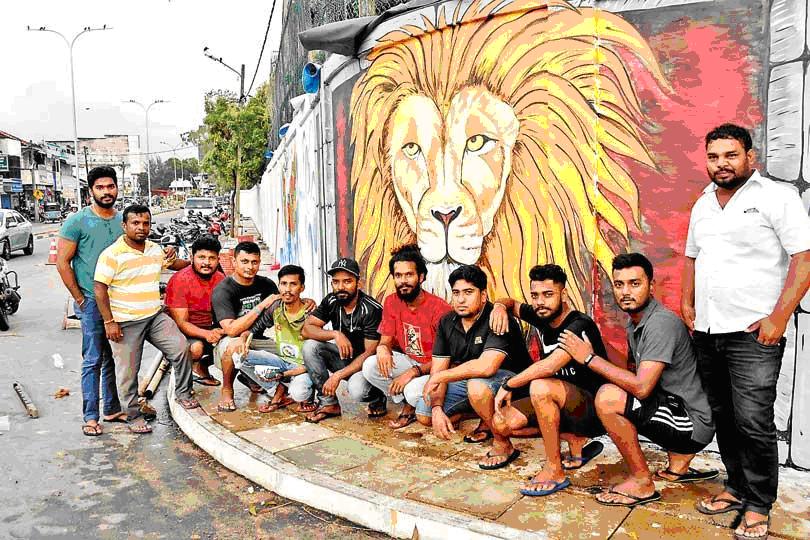
With the advent of GR government to power the jubilant youth of this country, heeding to the election campaign of Mr. Gotabhaya Rajapaka saying that ”you fulfil your responsibility and I will fulfil my responsibility” launched campaign of beautifying the old walls and towers covered with moss, dilapidated walls and betel chew spit walls with colourful, historically and culturally significant pictures.  This new wave I understand was started from Weeraketiya spread like a storm to all parts of the country and people belonging to all walks of life, all ages including school children, all ethnicity, (I say all ethnicity because there were TV pictures showing Muslim girls wearing Abaya and hijab were also participating in drawing the pictures) and even foreign tourists joined the trend.

This art popularly known as mural paintings or Graffiti art is not something new and alien to Sri Lanka.  It had been a tradition in Sri Lankan temples to make mural paintings on the underground chamber walls of Temples and during my schooling times I have seen such mural paintings at the underground chamber walls of the Veherahena Taemple in Matara and at kushtarajagala Temple in Weligama and understand that sch mural paintings are availab;e at the temples in Mulkirigala, Dambulla and many other temples.  These paintings mostly depict the Jathaka stories, Lord Buddha’s visits to Sri Lanka, arrival of Arahat Mihindu Thera to Sri Lanka and his meeting of the king Devanampiyatissa, and the arrival of Sagamitta Therani witjh the Sri Maha Bodhi sapling.  The the Sigiri Frescos is also a form of these arts and it has noe become a world heritage.  The dyes used for all these paintings had been home made with the sap extracted from various native herbs and plants.

The origin of this graffiti arts or mural paintings can be traced to pre-historic stone-age people who lived in caves and made imprints of their stone tools and the animals they hunted.  An article published in the Daily Mirror recently said thatalthough graffiti is considered to be an art form in the popular culture, it originated during the Paleolithic period and early civilizations made use of symbols carved on caves and other materials as means of communicating with one another.

As such Petroglyphs are considered to be the first form of graffiti which are created on a rock surface by incising, carving and abrading it. The article said that during World War II, ‘Kilroy was here’ was a graffiti phenomenon that flourished across the globe followed by the construction of the Berlin Wall which is a perfect example of modern graffiti and around the 1980s, graffiti was seen in many hip-hop tracks and it still has strong ties to this culture. Along with DJing, MCing and breaking, graffiti became a central part in hip-hop culture which could be traced back to Bronx in New York. From NYC graffiti art was then seen in London, Paris, Rome and many other countries. By the 20th century it had further advanced into a mode of communication between people. One of the 20th century artists that gained much popularity for his satirical work was Banksy. His street art and subversive epigrams combine dark humour with graffiti executed in a distinctive stenciling technique. It said that today graffiti art is one specialization in modern art and has taken its place in the popular culture and any artists use spray paints, stencils, stickers and new techniques for their creations.

Many people in sincere appreciation of what is being voluntarily done by our the youth devoid of politics giving meanings have identified these Activities with what Winston S. Churchill, the former British Prime1 Minister said tht A love for tradition has never weakened a nation, indeed it has strengthened nations in their hour of peril.”

Professor NAlin Abeysekara attached to the Faculty of Management Studies of the Open University in writing an article to the Daily Financial Times (Daily FT) has pointed out many incidents the youth volunteers carrying out other than mural paintings.  Theyinclude

  • Removal of posters, cleaning beaches and trying to keep the city clean and he says that they are enjoying their work despite gender, ethnicity or any other and heir smiles will tell us many positives for our future. 
  • A youth called Nalaka Senadeera has initiated a project of re-cultivating hundreds of acres of paddy fields in his village with a large number of young men and women supporting him.
  • Dulanjana Vithanage, a third-year student at the Department of Marketing Management, University of Sri Jayewardenepura has started to promote jack fruit in Sri Lanka (the jack tree is sometimes called bath gaha” or ‘rice tree’ by the Sinhalese).
  • A small trash bin is placed in some three-wheelers which had not seen before which the Professor says convey the message Please don’t throw garbage out. Keep them in the trash bin.” 

He says the above are one of the best indications that the common man in the country has changed drastically and in simple terms the people have overtaken politicians, which is a good sign for the country!

 In  conclusion of his article Prof. Abeysekera quotes from Rev. Dr. Martin LutherKing Jr. that One of the great liabilities of history is that all too many people fail to remain awake through great periods of social change. Every society has its protectors of status quo and its fraternities of the indifferent who are notorious for sleeping through revolutions. Today, our very survival depends on our ability to stay awake, to adjust to new ideas, to remain vigilant and to face the challenge of change”

Shown below are some of the wall paintings that can be seen in various parts of the country including Jaffna. Reports from the North said that the Sinhala and Tamil youth of the North also joined this trend.  It said that the Sinhala youth painted pictures depicting Sinhala cultural aspects at the Bus stand and other places while the Tamil youth painted pictures depicting Tamil cultural aspects.  The reports a;so said that Yoshitha Rajapaksa who was on a visit to the North with his wifw to worship at religious places also joined in the painting work.

Munasinghe. 

Youth from Batticaloa (COURTESY = Daily Mirror)

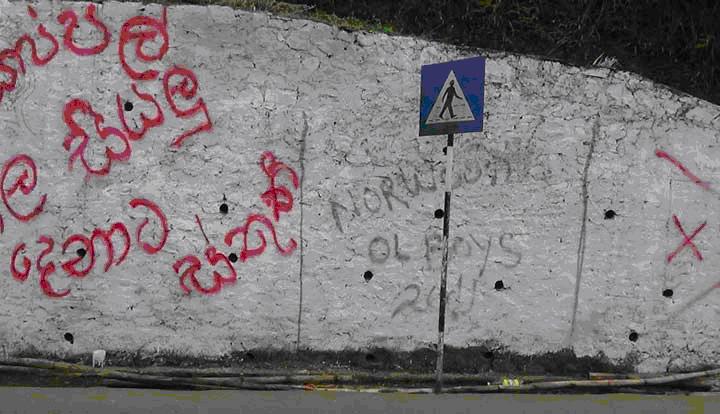
(Above picture shows that some racist hooligans in Norwood envious of the Mural painting programme have splashed some black oil on a wall cleaned for Mural paintings to prevent it taking place  – Courtesy – Lanka C News,lk)

While the new trend has been highly appreciated by almost all Sri Lankans with local paint manufacturing companies providing paint and brushes free of charge, neighbours providing meals and refreshments, and TV stations (not all) providing wide publicity some Tamil racist politicians who deserve to be banished from this country have come out with critical comments. 

The detestable Tamil racist alleged to be a descendant of a South Indian Kallathoni who invented the ‘white van’ story to discredit this country and who was a close ally of megalomaniac Prabhakaran has strongly criticised the programme and has said that drawing pictures relating to the war and war heroes will remind the Tamil youth about the repressions they had been subjected to by the Sri Lankan army and implies that our heroic army repressed people whereas in fact they rescued, fed and nursed nearly 300,000 innocent Tamil people who were being held by the Tiger terrorist as human shields.  This idiot should understand that the War Heroes represent the symbol that the people of this country would be admirably relished by the people of this country for several future generations.  It was these war heroes who were responsible for halting the people leaving the country with their kith and kin having lost hoprd for a future for them and were instrumental in building new hopes and stimulate the people to return to the country.

If this idiot cannot live in this country under the present setup it is better for him to go back to his motherland India or seek asylum anywhere else. This racist who day dream about creating a racist unit called Malai Nadu in the hill country areas was an insignificant character in the past and he had been elated to prominence by the UNP and he was even allowed to function as a spokesman on behalf of the UNP.  All patriotic voters in the UNP must make it a point not to vote for this racist and at the same time the media personnel should also shun all publicity to him. 

Prabhakaran’s cousin Sivajilingham has also criticised this programme saying that it will erase the cultural and religious prominence of the Tamil and Hindu people and hence it should not be carried out in Jaffna and in the North and his call has already been ignored by the Jaffna youth.

Role of diplomatic missions and the Swiss Saga

December 27th, 2019

JANAKI CHANDRARATNA Courtesy The Island

article_image

The international treaty known as the Vienna Convention on Diplomatic Relations of 1961 defines the code of practice for Diplomatic Missions. This treaty was based on principles of the UN Charter pertaining to the sovereignty of states, maintenance of peace and security and the promotion of friendly relations among nations.

Article 3 of the treaty explains the functions of diplomatic missions and they include to:

‘ a) Represent the sending State in the receiving State; b) Protect the interests of the sending State and its citizens in the receiving State; c) Negotiate with the govt. of the receiving State; d) Ascertain by lawful means conditions and developments in receiving State, and report thereon to the govt. of sending State; e) Promote friendly relations between the sending State and the receiving State, and develop their economic cultural and scientific relations’.

In order to fulfill the above functions, diplomatic missions are permitted to have diplomatic staff from the sending States subject to the approval of the receiving States. Diplomatic staff has diplomatic immunity from the local legal stipulations. Although Diplomatic Missions are able to supplement their staff numbers with local recruits, the diplomatic immunity provisions are not extended to local staff.

The alleged abduction case of Garnia Banister Francis, a local employee of the Swiss Embassy, is no doubt an embarrassment to both Sri Lankan and Swiss Governments and a speedy resolution is needed to avoid a potential diplomatic rift between the two countries. It is commendable that the Sri Lankan Govt. had taken timely action to inform the Swiss Mission that Garnia needed to be presented to the local legal system as per the Sri Lankan rule of law and the Vienna Convention provisions. However, a two-week delay was incurred by the Swiss Mission for Garnia to face the local Criminal Investigation Division (CID) for questioning in order to ascertain the veracity of her claims.

The said Garnia case however became murky after the preliminary investigations, as it was revealed that such an abduction had not taken place. The case became a Pandora’s box with so many unanswered questions as to why Garnia had made such claims to discredit the Sri Lankan Govt., whether anyone outside had instigated her to take this action and if so, for what purpose? The timing of the incident was also significant to the Sri Lankan Govt. as it was soon after the Presidential election, which gave a comprehensive victory to the incumbent President to run the country for the next 5 years.

There was finger pointing at several alleged stakeholders that may have had an interest in demonizing the current regime. Although the duty of care extended to Swiss Embassy employee was initially appreciated, the over enthusiasm of Embassy staff to airlift Garnia to safety to Switzerland, bypassing the local immigration processes, added an extra dimension to the case. Although the President’s observation that he does not believe in any Swiss involvement in the case did help to dowse the controversy temporarily, the potential allegation of a Swiss involvement is still fresh in the minds of Sri Lankan people. The decision of the Swiss Federal Council to send the former ambassador Jorg Frieden to Sri Lanka to resolve the controversy, perhaps because Ambassador Hanspeter Mock was too close to the incident, has given some hope for a speedy resolution. Yet the criticisms by the Swiss Federal Minister Ignazio Cassis of the Sri Lankan judicial process, in particular, the pretrial detention of Garnia despite her health conditions and the request to place her in a more conducive location such as a hospital, displays a lack of understanding of the Sri Lankan legal system. It is hoped that the Foreign Minister Gunawardena’s assurance that Sri Lanka has followed the due process in compliance with the national and international standards, and that medical investigations had cleared Garnia of any serious medical condition that necessitates her retention in a hospital, would allay the concerns of the Swiss Embassy.

It should be noted that Diplomatic Missions with many privileges are acceptable to any country, only if they comply with the Vienna treaty provisions and in particular, stay clear of local political matters. Sri Lanka has held such principled diplomatic relations for many years with hundreds of foreign nations until the last yahapalana regime. It is a well-known fact that the yahapalana regime was aided into governance in 2015 with Western support. During the yahapalana regime, the assistance of some western Diplomatic missions was actively sought to resolve political issues, in particular, during the aborted regime change in Oct. 2018. It appeared as if the govt. was incapable of dealing with the incident and the so called ‘independent’ Speaker of the House went to the extent of inviting Diplomats to witness the parliamentary meetings at the Sri Lankan Parliament premises, a feat possibly, not seen in any other sovereign State.

It stands to reason that Diplomatic Missions still believe that interference in local politics is acceptable in Sri Lanka, despite the recent change of the Presidency. They appear to have not noticed that there is a return to the ‘Rule of Law’ with the current President. The Diplomatic Missions may also not be aware of the new President’s policy of non-interference in the legal processes, and that it is difficult for local politicians to advise the judiciary on the places of detention for alleged offenders.

Sri Lankans are hopeful that the legal adjudication of Garnia case would satisfactorily resolve the Swiss diplomatic issue. It is also the hope that Diplomatic Missions would appreciate interference in local politics is not an option in Sri Lanka anymore with the current regime, if they are to enjoy the hospitality of Sri Lankan Govt., and continue with their mission roles as intended by the Vienna Convention.

JANAKI CHANDRARATNA

Colombo Law Faculty’s 1969 batch celebrates golden jubilee

December 26th, 2019

Senaka Weeraratna

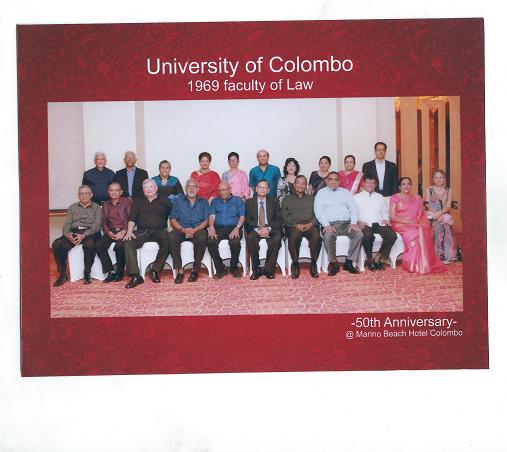
The Batch that entered the Faculty of Law, University of Ceylon, Colombo Campus, in 1969 commemorated 50 years of friendship and solidarity with light – hearted speeches, singing and musical interludes at the Marino Beach Hotel, Colombo 3, on December 14, 2019.

They came from various parts of the world for the function. Former teachers mingled with former students in a spirit of camaraderie and fellowship. Many took the opportunity to walk down memory lane and recall the days gone by with nostalgia.

Dr. Anil Vitarana, in his welcoming speech laid stress on the teaching imparted at the Law Faculty reminding everyone that ‘we are what we are ‘ mainly because of the education received therein. Now we must take steps to ensure that we give something back to the Law Faculty in return, out of gratitude and appreciation, he added.

Emeritus Professor (Dr.) M. Sornarajah, who had taught for nearly thirty years at the University of Singapore, recalled his days at the Colombo Law Faculty with fervor and paid tributes to some excellent teachers that are no more such as the pioneering Dean of the Law Faculty, Professor T. Nadaraja, Dr. C.F. Amerasinghe, Dr. Mark Cooray and Dr. Ranjit Amerasinghe (later a Judge of the Supreme Court), among others.

Dr. Palitha Kohona, former Ambassador to the UN, said that this was a stellar batch which had achieved tremendous success not only in Sri Lanka but around the world. Some had even been honoured by the Governments of the adopted country. We should celebrate their successes and achievements, he added.

Mr. Ikram Mohammed, P.C., said that the Law Faculty had grown from a small two room building in his time in the late 1960s to a very large complex with hundreds of students following a range of exciting and interesting subjects including electives, and the duration of studies for the L.LB. degree had been increased from three to four years. We should welcome these changes for the better, he stressed.

Both Dr. Srilal Perera and Ms. Dhammika Amukotuwa nee Dandeniya, in their speeches laid emphasis on the need for the Law Alumni to interact with the current Staff of the Colombo Law Faculty with a view to extending help in whatever way possible including funding scholarships to assist poor students and making arrangements for both lecturers and students to continue further studies in reputed Universities overseas.

Mr. Senaka Weeraratna, a former President of the Law Faculty Students’ Union, said that this was a special occasion for all those who had entered the Law Faculty in 1969 as fifty years have elapsed since then. He thanked all those who had contributed in some ways towards organizing this re-union of both batchmates and former lecturers, and said that a very special thank was due to Ms. Chandana Jayaweera Bandara for her commitment and dedication in almost singularly organizing an elaborate and memorable event.  

Photo Standing left to right:  Dr.Srilal Perera, Tiru Vallal, Ms. Nelun Tennekoon (nee Ramanayake), Ms. Jezima Haseeb (nee Mihlar),  Ms. Dhammika Amukotuwa (nee Dandeniya), Maithri Panagoda, Ms. Tara Wickramanayake (nee David), Ms. Indra Peiris (nee Fernando), Ms. Vasi Aruliah (nee Rajasingham) , Dr. Anil Vitarana
Photo Seated left to right:   Ifthikar Hassim, E.L. Basnayake, Desmond Jordan, Paul Ratnayake, Professor (Dr.) M. Sornarajah, Professor (Dr.) G.L. Peiris, Ikram Mohammed, Dr. Hiran Jayewardene, Senaka Weeraratna, Ms. Chandana Jayaweera Bandara (nee Rajapakse), Ms. Shirin Cabral. 
   see  also
https://www.pressreader.com/sri-lanka/sunday-times-sri-lanka/20191222/282364041581718

Kollupititya

December 26th, 2019

Some of this information was obtained from a book titled Colonial Kollupitiya and its environs by H.M.M. Herath.

There was a time when Kollupitiya was known as Baradeniya.

It was a beautiful rustic village with coconut  gardens and cinnamon trees that grew wild and narrow cart-tracks which connected the few villas and homes here with the rest of the country.   

For the purpose of postal services ‘Colombo 03’ consists of Kollupitiya.   

How Baradeniya became Kollupitiya 

The year was 1664 and the king was Rajasinghe II whose cruel acts embittered his subjects. Three Kandyan chiefs sought to slay the king and place his 12-year-old son on the throne.

One of the conspirators was Udanuwara Ambanwela Appuhamy. When the plot failed, the king had two of the rebel leaders beheaded. However, instead of executing Abanwela Appuhamy, the most feared of the rebels, he handed him over to the Dutch to undergo what he thought would be a more brutal torture.

Instead the Dutch set him free. Ambanwela Appuhamy took the Dutch name of Van Ry-cloff and built up a good relationship with the Dutch who gave him a large plot of land by the sea where he grew a coconut plantation which soon expanded over the ancestral farms of the natives who dared not complain.

They could only retaliate by calling the plantation Kolla-ke-pitiya meaning ‘Plundered land’.

Today, there is still an area in Kollupitiya that is called Polwatte.   

The footprints of Galle Face    Colombo 03 begins with Galle face south of Colombo Fort (Colombo 01). Originally a vast swamp, the Portuguese and Dutch used this piece of land as a strategic defense.

It was the British who developed the Green into a leisure ground. The 19th century paintings of John Deschamps, show the Galle-Face esplanade with a high road running through the centre of it. Added later was a promenade by the sea and a driveway bordering the lake where the Dutch Military cemetery was. Deschamps describes it as forming not only the principal exercising ground of the garrison, but also the general promenade of the inhabitants of Colombo and its vicinity. “On foot, on horseback, or in carriages, people flocked to this salubrious setting to inhale the delicious breeze which is almost always to be found by the sea side of this part of the Island”.

The Galle Face esplanade or Green was established by Governor Ward in 1859. An inscription reads “in the interest of the ladies and children of Colombo “.    Cricket, football and polo were played on the Green.

In 1829, horse racing was established under the auspices of Sir Edward Barnes. “Everyone enjoyed a day at the races: the vendors poured in from early noon, servants on leave spent their day there, as well as schoolboys who didn’t make it to school, palanquin carriages with shutters down and curtain drawn conveying Mohammedan ladies” and of course the European community”.

A circular race stand was built by subscription. Initially it was a building of brick, coated with a plaster of chunam. Its conical roof was covered with an excellent thatch of kehjan (woven coconut leaves). From here a view of the whole course could be obtained. The race-balls were held here, the upper room being cool and airy for dancing; card-tables were placed in the verandahs, whilst the lower portion formed a good supper-room. Subsequently the roof was tiled. By the 1870s it had become a more substantial building and was known as the Colombo Club.

This building still stands, even though maybe not in its original modest form, and is now the Crystal Ballroom of the Taj Samudra Hotel Colombo.    At one end of the green was the Galle Face Boarding House, forerunner of the present Galle Face Hotel, which was constructed in 1887.

Today the green has lost much in its extent but after a long period of neglect has recently been restored back to the chief leisure ground of modern Colombo for people of all walks of life.    A temple, a church, a school  Kollupitiya Walukarama Buddhist Temple is said to be the oldest temple in Colombo.

It was founded in the 1800s by Ven. Panditha Valane Sri Siddhahatta Maha Nayake Thera, who was also the founder member of the Maha Sangha Saba of the Siyam Nikaya of the Kotte Chapter. The land for the construction of the temple was donated by a famous indigenous medicine physician of Kollupitiya, Arnolis Silva.   

St. Andrew’ s Scots Kirk founded in 1842 as a Church of Scotland by Scots living in Ceylon, has today become the International Church in Colombo welcoming into its fellowship people of all nations and denominations of the Christian faith.   

Jinaraja Kanista Vidyalaya down Dharmakirthi Ramya Road dates back to 1898. Then named “Jinaraja Buddhist English School” this was the oldest Buddhist English mixed school in Colombo. This school was established for boys and girls of Colombo managed by the Buddhist Theosophical Society, Colombo under the guidance of Col. Henry Steele Olcott.   

A jeweller, a textile dealer, a baker, a grocer, an optician and a private hospital    Galle Face Court 1 was the first multi storey block of flats in Sri Lanka and the domed addition which followed as Galle Face Court 2 were both buildings that were initiated by the Macan Markar family as residential, business and real estate ventures. The dome housed an observatory.

The road here was renamed Sir Macan Markar Mawatha on account of the contribution of the Macan Markar family towards industry, business, trading and politics in Sri Lanka.    More famous were the Macan Markar family for their gem and jewellery trade, which had, among its clientele, several members of the British nobility and Royalty including His Majesty King Edward VII (1875) as Prince of Wales and His Majesty King George V (1901) as the Duke of Cornwall and York.

The world famous Cat’s Eye, weighing 105 Carats referred to as the Blue Giant of the Orient, a Blue Sapphire weighing 225 carats named the Wonder Star of Asia and a Star Sapphire weighing 225 carats are said to be in the possession of the firm.    Victory Silk Store was established in 1947 and is the oldest Textile shop in Kollupitiya.

The founder, C Parsram, was a highly honored and respected Sindhi who had come to settle permanently in Ceylon from India in 1914. Parsram was the founder of member of the Sindhi Merchants Association of Ceylon and also held the prestigious position of its Presidency many times. He was also responsible for the establishment of the Ceylon Sindhi Community Center at Kollupitiya.   

Perera & Sons originated with K. A. Charles Perera who came to Colombo from a village called Kodagoda near Galle. He arrived in Colombo in 1888, with only 50 cents. He began his career as a cook in colonial mansions and then joined the Grand Oriental Hotel as a kitchen helper where subsequently he took up the responsibility of the hotel’s bakery. Perera commenced his own bakery in 1902 by renting two houses at Steuart Place, Kollupitiya. Today Perera & Sons, are perhaps the largest bakers in the country.   

Albert Edirisinghe Opticians is the very first optical firm dealing in eye testing and manufacture of spectacles in Kollupitiya, established in 1949. Albert Edirisinghe, hailed from Galle and originally joined the business of William Pedris & Company in 1936 where he worked in the optical section of the firm gaining valuable experience. After serving for almost 13 years, he started his own enterprise, which is today a very successful optical company in the country.   

Durdans Hospital established in 1945 at Alfred Place, Kollupitiya, is one of the oldest private sector hospitals in the country. This was the home of Charles Pieris. It was begun as the Principal British Military Hospital in Sri Lanka.

Premasiri Stores originally limited to groceries, was established in 1952 by Premasiri a young entrepreneur. Within a short time, Premasiri Stores built up a regular clientele from among the local population and a sizeable foreign community of the area. They ventured into the direct imports of certain products to cater to the mixed clientele. A “Wine & Spirits” department was also added to the stores.   

Temple Trees – where the rich and famous lived   

The house and premises a little over six acres named the ‘De Brandery’, meaning the Distillery, is believed by some to have housed an excellent cellar, while others say the building was used to make spirits.    Many have been its famous occupants in the past. Frederick Baron Mylius (from 1805) a judge in the Ceylon Civil Service social reformer and anti-slavery activist, John Walbeoff (1830) head of the Cinnamon Department, George Winter who was a pioneer of sugar cultivation on a commercial scale and other enterprises in Ceylon like manufacturing coir rope and distilling arrack in Kalutara, C R Buller (1840) Government Agent of the Western Province, after whom Bullers Road (now Bauddhaloka Mawatha) was named, the Layard family, Dr Christopher Elliot (1848) the Principal Medical Officer in Ceylon who was also the proprietor and editor of the ‘Ceylon Observer’ English daily newspaper.

It was during the occupancy of J P Green (1856), that the De Brandery was renamed as ‘Temple Trees’, so called after the two gnarled old temple trees growing in the front yard.   

Temple Trees was purchased by the Government in November 1903, for the use of the Governor and other high ranking British government officials. After Independence was granted in 1948, it was declared the official residence of the Prime Minister.

Today, it is the official residence of the President of Sri Lanka.    A mini zoo, a cattle farm, and Weliganna watte   

A mini zoo had been in operation at “IXORA” Green Path. This was earlier owned by Hagen Bech who was the originator of the Dehiwela Zoo. The animals were later transferred to Dehiwela.   

A cattle farm, referred to as ‘Kiri Pattiya’, had been in operation down Palm Grove Avenue. It is said that milk was distributed free to the people from beneath a huge tamarind tree that stood in this area.   

Weli Ganna-watte (the garden where sand was taken from) was an area between the Kollupitiya Railway Station and Galle Face Hotel, to its North. It was a highly profitable illegal business and people used to come from all parts of Colombo to take away sea sand, using bullock carts.

There used to be organized gangs who demanded ‘kappan’ (protection money) from the carters in order to guarantee them safe passage with their sand.   

Thus is a brief description of what was Kollupitiya or Colombo 03. 

The Northeastern NE India remains safe for scribes

December 26th, 2019

by NJ Thakuria

As the year 2019 is approaching the finish line, India appears to improve its journo-murder index with only two casualties and the northeastern region (NE) with none this year. The world witnesses murders of nearly 50 scribes for journalistic works and India’s share has also gone lower considerably from six to two. On the other hand, NE has evaded any incident of journalist’s killing for the second consecutive year. Amazingly, all the neighbouring nations to the region (except Bangladesh) avoided scribe’s murder during the year.
Often described as a disturbed zone because of relentless violence engineered by armed separatist militants, NE (except Tripura) has avoided journo-murder incidents for many years. Tripura reported the murder of five media persons in 2013 and 2017, whereas Assam and Manipur witnessed the last killing of media persons (Dwijamani Nanao Singh from Imphal and Raihanul Nayum from Dhubri) in 2012. In contrast, central Indian States continue pouring news related to the murder of journalists.
Till the recent time, the region with a population of over 60 million was a breeding ground for insurgents fighting against New Delhi with demands ranging from self-rule to sovereignty. Surrounded by Nepal, Bhutan, Tibet (presently occupied by China), Myanmar, and Bangladesh, the region supports hundreds of newspapers, published in various languages like English, Assamese, Hindi, Bengali, Mizo, Bodo, Meitei, Karbi, Khasi etc and few news channels and portals to cater the need of dedicated audiences.
For Indian working journalists, the year 2017 can be identified as a deadliest year as 12 scribes (Hari Prakash, Brajesh Kumar Singh, Shyam Sharma, Kamlesh Jain, Surender Singh Rana, Gauri Lankesh, Shantanu Bhowmik, KJ Singh, Rajesh Mishra, Sudip Datta Bhaumik, Naveen Gupta and Rajesh Sheoran) were either murdered or killed in suspicious situations. Among the casualties, Tripura reported two incidents of journo-murder (Shantanu and Sudip Datta).
Massive protests erupted across the country against the killings of journalists, more precisely the murder of Ms Gauri in Bangaluru. The then Communist chief minister of Tripura, Manik Sarkar also personally joined in a protest rally at Agartala demanding justice over her murder. But pathetic news was waiting for him as a young reporter from his State (Shantanu Bhowmik) fall prey to a mob violence on 20 September. Later one more journalist’s murder (Sudip Datta Bhaumik on
21 November) by a policeman put Sarkar in an awkward position.
India as a whole witnessed the killings of nine journalists in 2019, but only two incidents of murders are understood as being related to journalism related causes. Andhra Pradesh based journalist K Satyanarayana and Madhya Pradesh based journalist Chakresh Jain faced the fate because of their performances as working journalists.
However, seven other cases are yet to be confirmed that they were targeted for media related activities.
Committed reporter Satyanarayana, who worked for Telugu daily ‘Andhra Jyothy’, was hacked to death by miscreants at Annavaram village of East Godavari district on the night of 15 October. Local scribes reported that Satyanarayana was targeted in an earlier occasion too
and he informed it to the local police. Jain, a freelance journalist
died of serious burn injuries on 19 June as he was involved in a quarrel with the assailant at Shahgarh locality.
Others who were killed this year include Jobanpreet Singh (Punjab’s online journalist was killed in police firings on 19 December), Vijay Gupta (Kanpur-based scribe shot dead by close relatives on 29 October), Radheyshyam Sharma (Kushinagar-based journalist murdered by his neighbours on 10 October), Ashish Dhiman (Saharanpur-based photojournalist shot dead along with his brother by neighbours on 18 August), Anand Narayan (news channel contributor of Mumbai murdered by miscreants on 4 June), Nityanand Pandey (magazine editor in Thane killed by an employee on 17 March).
Earlier, Kerala-based journalist K Muhammed Basheer lost his life as a running vehicle, driven by a senior government officer, mowed down him on 3 August. Bihar’s scribe Pradeep Mandal was targeted by miscreants on 28 July, but he survived luckily. He contributed a number of news items against the local liquor mafia for Dainik Jagaran and invited enmities from the goons. Meanwhile, a Guwahati based scribe named Naresh Mitra died on 9 December after sustaining head injuries in a mysterious accident.
While Mexico, Syria, Somalia, Iraq, etc tops the list of journo-murders, our neighbours Pakistan and Afghanistan remain ahead of everyone in South Asia as both the countries witnessed the murder of five journalists each in 2019. Conflict-riddled Pakistan reported the killing of Zafar Abbas, Mirza Waseem Baig, Muhammad Bilal Khan, Ali Sher Rajpar, and Malik Amanullah Khan for journalistic activities.
Afghanistan lost Jabid Noori, Nader Shah Sahebzadeh, Sultan Mohammad Khairkhah, Shafiq Aria, and Rahimullah Rahmani to assailants.
Various national and international media rights bodies including Paris-based Reporters Sans Frontiers (RSF), New York-based Committee to Protect Journalists (CPJ), Brussels-based International Federation of Journalists (IFJ) etc have come out with separate reports that sizable number of journalists were murdered in the world during 2019, which is the lowest death toll in 15 years. Media rights organizations believe that the decline in journo-murders may be attributed to some stabilities in various conflict zones.
Defining journalists as individuals who cover news or comment on public affairs in print, radio, television, online outlets etc, those organizations highlighted the last year’s toll of 95 casualties. They also stated that more scribes are seemingly self-censoring for fear of retaliations over their works, where the mainstream journalists have shown more restraints if not the online contributors.
They however continue demanding due probes and punishments to the culprits. Also maintained that incidents of abuse, assault-attacks and imprisonment of scribes by government forces, political goons, anti-social elements, etc continue everywhere as over 350 journalists were imprisoned in 2019, where China, Turkey, Egypt, Saudi Arabia, Iran, Vietnam, etc have maintained the lead.
The author is a media activist based in northeast India

PEPE ESCOBAR: You Say You Want a (Russian) Revolution?

December 26th, 2019

Consortiumnews

Rajitha’s magic

December 26th, 2019

Editorial Courtesy Island

Friday 27th December, 2019

UNF MP Dr. Rajitha Senaratne played a vanishing trick the other day. He had given the CID spooks the slip, our lead news item said yesterday. We thought the CID, which specialises in arresting suspects and interrogating them for hours on end, would be able to take Senaratne into custody in next to no time, after it had obtained a court order, but it was groping in the dark. Rajitha outfoxed it in style and had himself admitted to hospital, yesterday evening.

The CID was much more efficient under the previous dispensation, we reckon; it made a series of lightning arrests a few years ago. By the time the suspects who were mostly Opposition MPs realised what had happened they were inside what US President Donald Trump has called ‘paddy wagons’ on the way to courts, some of which were kept open till midnight. (Speaker Karu Jayasuriya has recently told the party leaders that MPs should not be arrested after nightfall!)

Curiously, Senaratne, who recently said he should not be arrested on account of his health condition, chose to disappear, instead of having himself admitted to hospital immediately.

The CID has sought to arrest Senaratne on the basis of statements by two suspects who made some serious confessions at a media briefing, which the then Minister Senaratne presided at, in the run-up to the 16 Nov. presidential election. They have been remanded. One of them claimed to have driven a White Van which transported abductees, who were fed to crocodiles in a tank, in Moneragala, after being tortured. The other one said he had transported a stock of gold seized from the LTTE to Colombo illegally.

The allegation that crocodiles had been fed with some victims of the White Van abductions reminds us of Jean Bedel Bokassa, who once proclaimed himself the Emperor of Central Africa and was accused of having schoolchildren and his political rivals killed and fed to his pet crocodiles. When such serious allegations are made in public, especially in the presence of a government minister, the image of the country suffers irreparably; they should have been investigated immediately after they were made. Why the UNF government did not do so is the question. It should, at least, have initiated a probe.

All those responsible for the White Van abductions must be brought to justice. Better late than never! Dr. Senaratne should have handed over the aforesaid suspects to the police when they were introduced to him instead of organising a media briefing for them to go public with their claims. The police personnel, who were present at that press conference, must be asked to explain why they did not arrest the suspects who admitted to having committed serious crimes. The police arrest suspects for far less serious offences, don’t they? Won’t they arrest a person if he happens to say, in their presence, that he has snatched a gold chain? They even arrest litterbugs and jaywalkers.

One may not care whether Senaratne is arrested or not, but one is concerned about the failure on the part of the police to trace him.

The present government came to power, promising to safeguard national security and ensure public safety by neutralising terrorist threats. This is an uphill task it cannot accomplish unless it has an efficient police force capable of tracking down evil elements hell bent on destroying innocent lives. During the war, the police gathered intelligence and prevented bomb attacks in the city by arresting terrorists together with bombs. What has become of the efficiency of the long arm of the law?

How can the police, who cannot at least trace an Opposition MP in hiding, in spite of an arrest warrant on him, be expected to track down elusive terrorists?

Russian foreign minister to visit Sri Lanka, India on January 14-15

December 26th, 2019

Courtesy TASS

On January 14, Sergei Lavrov will meet with Sri Lankan President Gotabaya Rajapaksa and Prime Minister Mahinda Rajapaksa, also planning to hold talks with Sri Lankan Foreign Minister Dinesh Gunawardena

MOSCOW, December 26. /TASS/. Russian Foreign Minister Sergey Lavrov will visit Sri Lanka and India on January 14-15, Russian Foreign Ministry Spokeswoman Maria Zakharova stated during Thursday’s briefing.

“On January 14-15, Russian Foreign Minister Sergey Lavrov will come to Sri Lanka and India on a working visit,” she noted.

According to her, on January 14, Lavrov will meet with Sri Lankan President Gotabaya Rajapaksa and Prime Minister Mahinda Rajapaksa, also planning to hold talks with Sri Lankan Foreign Minister Dinesh Gunawardena. “They plan to discuss the current state of relations between Russia and Sri Lanka, the prospects for promoting political dialogue, developing cooperation in the trade-economic, humanitarian and other spheres, as well as to discuss expanding the bilateral treaty and legal basis. Special attention will be paid to expanding cooperation within international organizations, namely within the UN and its specialized bodies,” the spokeswoman said.

The diplomat noted that on January 15, Lavrov would hold talks with his Indian colleague Subrahmanyam Jaishankar in New Delhi. “The foreign ministers will consider the current state and prospects of development of bilateral relations in light of the goals outlined on the outcomes of the XX Russian-Indian Summit that took place on September 4-5 in Vladivostok. They will also discuss the 2020 schedule of upcoming top-level political contacts. They plan to have a comprehensive exchange of opinions on regional and international issues,” she said. Zakharova added that the Russian top diplomat also plans to take part in the Raisina Dialogue conference set to take place in the Indian capital on January 14-16.

CID records statement from Rajitha

December 26th, 2019

Courtesy Ada Derana

UPDATE (10:58 pm): Officials of the Criminal Investigation Department (CID) are yet to record a statement from MP Rajitha Senaratne as the parliamentarian has been taken for a medical check-up.


Officials of the Criminal Investigation Department (CID) are currently recording a statement from Parliamentarian Rajitha Senaratne who was hospitalized earlier today (26).

MP Rajitha Senaratne was admitted to the Lanka Hospitals in Narahenpita earlier this evening.

On 24th December, the Colombo Additional Magistrate issued a warrant to arrest the former Health Minister Rajitha Senaratne over the controversial white van” media briefing he had called last month.

However, officials of the Criminal Investigation Department (CID) were not able to arrest the former Health Minister despite arriving at both his residences in Colombo and Beruwala.

Meanwhile, lawyers representing the parliamentarian filed a motion before the Colombo Magistrate’s Court this morning (26) to submit explanations for the recall of the arrest warrant on the MP, only to withdraw it later today.

Subsequently, a team of CID and Special Task Force (STF) personnel carried out a search at the parliamentarian’s residence in Colombo, today, to no avail.

A CID Team arrived at the Lanka Hospitals

December 26th, 2019

Courtesy Hiru News

A CID Team arrived at the Lanka Hospitals,Narahenpita where MP Rajitha Senarathna is Admitted at the CICU.

MP Rajitha Senaratne admitted to CICU at Lanka Hospital

December 26th, 2019

Courtesy Hiru News

MP Rajitha Senaratne admitted to CICU at Lanka Hospitals, Narahenpita

Is Sri Lanka’s Parliament Protecting Sri Lanka’s Land Sovereignty

December 25th, 2019

With regard to LAND there are critical factors Sri Lanka cannot afford to ignore any longer. We are into 72 years of ‘independence’ but still following colonial statutes and it is nothing we can be too proud about. It is essential to realize that these colonial statutes were drawn up by colonial invaders to suit their administration under which our natives were subservient. True, we gained adult suffrage and education but that too had ulterior motives in developing brown sahibs to continue colonial rule in new colonial form. Nonetheless, for a country to proudly stand up for sovereignty and territorial integrity, it must essential draft its own laws and regulations to suit its governance while of course conforming to ‘international standards’ but keeping national sovereignty respected by all & in tact. It is not simply a reversal or opposite of colonial laws that is required but reforming the laws to suit natives in their present living conditions.

Having understood the gist of this let us first look at the problems in hand

  1. Existing Colonial Statutes & Preservation of Land Registry Post independence?

Sri Lanka is still maintaining the 1863 land registry. It is now broken into 45 land registries which cover 9.5million blocks of Sri Lanka’s land area (State & Private) and scattered in different state buildings. Are these books in good condition? Have they got damaged? Is there a national policy that demands their maintenance?

These 45 land registry books are 156 years old. How many have thought of their wear & tear and need to preserve them or to ensure that they are not harmed? Have successive governments taken action to ensure every land registry is prevented from damage and harm and most importantly kept secured? None of these land registries have been completely digitalized. Imagine the state they are in.

However, there is the reconstruction statute and this provision must be used.

  • Foreigners doing Sri Lanka’s Land Research/Reports & Recommendations

World Bank & USAID have done more reports on Sri Lanka’s land than Sri Lanka has tasked its academics, students and ministry departments. It is based on their research and recommendations that funding is being requested by Sri Lanka or given. $5million was given by World Bank to digitalize Sri Lanka’s land deeds. Simply giving money is insufficient even World Bank concluded in its own 2001 report which deemed Sri Lanka not ready for digitalization. World Bank gave 15 to 25 years for Sri Lanka to increase tenure security for farmers and land holders, enable efficient land transactions, recover cost over long-term and land administration to be without political, social class or ethnic based. 20 years has passed and none of these objectives have been fulfilled.

This same 2001 World Bank report said the GOSL (RanilW’s Govt) now wants to transform the country’s land administration system from one based on deeds and documents permitting private use of State land to one based on registration of titles” (the 1998 Govt via Bim Saviya began to change deeds to titles and then the 2001 Govt wanted to change deeds to titles with no definition of private which could mean foreign private too)

While we appreciate the efforts of World Bank & USAID to research and publish reports on land in Sri Lanka we must also be mindful of the recommendations that come with the carrot of funding. Why does World Bank want to lift the land market restrictions? Is it to convert our agricultural land to grow some other crop. Sri Lanka has about 1m titles that restrict what can be done with land – why did the UNP Govt and World Bank wish to remove these restrictions and their studies showed that by amending articles in the Land Development Ordinance of 1935 they could do so. The World Bank Reports are well researched and seem to have even identified all the restrictions (State Land Ordinance 1949, Land Reform Law 1972, Land Grants (special provisions) 1979.

Recommendations for improvements to land law in Sri Lanka is based on foreign reports & by foreign research teams and recommendations are by foreigners on what they deem suitable for Sri Lanka. Will foreign recommended laws implemented secure and protect our intellectual property rights? 

  • Haphazard Decisions based on foreign funding – Changing entire law of the country?

BIM SAVIYA (transferring from Deed Registration to Title Registration)

Australian ‘Torrens System’ of title registration – Registration of Titles Act No. 21 of 1998, known as Bim Saviya which requires compulsory title registration.

In 1998 a sudden change in land took place probably due to funding associated with the proposal that changed Sri Lanka’s land law from deed system to title system. Whose decision was it to bring another foreign law into the colonial laws we were already complying with without much change?

How many are aware that this Act 21 of 1998 has taken away the rights of the Judiciary to adjudicate land frauds and the rights of the people to seek justice for land issues. In lieu of the judiciary a new title Commissioner of Title is created to adjudicate 9.5million blocks of land!

However, the Registrar of Lands says that 50% of Sri Lanka’s land deeds are fraudulent – in such a scenario without resolving this 50% of land cases via courts how correct is it to include fraudulent deeds into electronic form – denying the original owner the right to claim his/her land?

Let’s not forget the Empire State Building in US was ‘sold’ for $2b by a ‘Willie Sutton’ and deed was registered within 90minutes in US electronic register. The registration could be reversed because it was the Empire State Building but will the same happen to others?

Were the lawyers aware that the law of co-ownership and the law of prescription was removed at the Bill stage of Act 21 of 1998?

Have those who introduced Bim Saviya in 1998 thought about the consequences of taken away people’s deeds, where to store them, aspects of hacking and cyber crime when digitalizing records (no system is foul proof) at least with physical records, there are ways to make duplicate copies and keep for owners.

Section 33 of the Act judiciary is given no power to hear cases related to land ownership especially if the grantees ownership is affected by fraud. The grantee will have to seek compensation in lieu of his ownership. The judiciary cannot question the entries in the registry made by the Registrar General.

Under Act 21 a grantee under the new bill could not pass half share of the land  to his or her spouse or child to be a co-owner.

The banks cannot give them loans if the wife becomes a co-owner.  How can he obtain bank loans if a salaried family member was not joined as a co-owner 

Given the context of land issues and its association with colonial land statutes how far have successive governments spent on remedying the irregularities and bringing laws and outdated statutes to suit and conform with Sri Lanka’s laws as well as its Constitution?

ONLY Relief we have is the 7 day window to file FR in Supreme Court. Can lawyers afford to rely on the 7 days to study statutes & file complaint? Are the foreign lawyers not taking advantage of this?

  • Digitalizing Sri Lanka’s deeds & Land Registry

Digitalizing means reducing physical land registry. Ideally, it is good to have one large building to house all of the 45 land registries and the computer systems with the electronic land deeds with local technical and computer experts. In any emergency the referral option is available.

The Sri Lanka Survey Dept has developed a Land Information System & put each block of land into a 12 digit system.

Without passing the Land Bank Act which was part of the MCC pre-condition, a US outsourced company is now doing cadastral mapping across Sri Lanka. Why has it not been given to the Sri Lankan Survey Dept to do?

According to former Survey General who had been working for the department since 1978 – Rs.5000million had been spent from 2007 to 2018 ($28m)

In 2007 World Bank had given $5m to digitalize deeds

Sadly, only 200,000 of the 9.5m blocks of land has been digitalized from 1998-2019 into 10 land registries. So in 20 years we have digitalized only 200,000 blocks of land for the $5million given by World Bank excluding the maintenance & other costs.

Clearly, $67m allocation for land project by MCC is not enough.

MCC will have to wait 300 years in Sri Lanka to digitalize 9.5million blocks of land!

For any GPS, paperless digital translation to search land title with 12 digit unique number the first requirement is to ensure the Registry has the legal owners. What we have is a set of new systems which are half in operation without first addressing the most important element – who are the legal land owners and register them first to the computerized land registry. What good is a land registration system if we have not first addressed land identification issues?

  • Is Sri Lanka ready to digitalize land registry & deeds?

The most important part of the 2001 World Bank project was that World Bank identified Sri Lanka was NOT READY for any type of digitalization. The key issues are important for the team presently studying ONLY the MCC Agreement without looking at the larger and more critical land related issues the policy makers are ignoring.  

World Bank says Sri Lanka is NOT READY for any type of digitalization because

  1. Land settlement dept staff lacks skills in adjudication
  2. Organizational framework for title registries is not efficient, effective or sustainable
  3. No published results, workshops or stakeholder discussions have reviewed progress of ongoing titling activities
  4. Little coordination between survey & adjudication staff is wasting govt budgets
  5. 50% cases incomplete
  6. coverage limited to rural areas
  7. large-scale financing of systematic titling unlikely
  8. lack of modern and efficient survey & information technology in titling
  9. absence in involving private sector to supplement government capacity to speed up titling registration
  10. no motivation to carry out continuing land related policy reform dialogue
  11. human resource development essential for efficient long-term land titling program not addressed

Going Forward

There are millions of books in the land registry which are over 200 years old which nedd to be scanned for digitalization and archiving. What Sri Lanka lacks and what Sri Lanka’s government must invest in are digital engineers and train Sri Lankan citizens instead of having to outsource a nationally-important activity to foreigners – that too for an exorbitant payment often increasing if the terms and conditions are not finalized properly. External contractors shrewdly quote for a feature often hiding other required complimentary future features which are undertaken only if another fee is paid. If not, that project ends up gathering dust with only part work done. New features to be inserted over time have to be given to the same outsourced company as they keep all the passwords and back office access features.

Sadly, it has been foreign-funded international bodies who have been studying Sri Lanka’s land laws and customary practices and prepared extensive reports. World Bank and USAID have studied all of Sri Lanka’s land statutes. Have Sri Lanka’s land and legal fraternity as well as academia done the same and has successive governments funded these initiatives that should have been done locally.

World Bank & USAID spent time and money on reports but have been disappointed with the progress & have abandoned the recommendations. Ironically, it is making use of these misgivings that the MCC project team are now attempting to manipulate to their country’s geopolitical and trade advantage. MCC wants control over 11 land registries? Why? If MCC a US government body takes over these land registries & digitalizes them, only they are privy to the laws and back office. Sri Lanka will have no access without MCC approvals. Any government should regard this aspect a national security threat & risk. Land is the essence of a country’s sovereignty.

Mrs. Kirtimala Gunasekera suggested Sri Lanka adopts systems similar to India & Malaysia

  • biometric identification similar to the Bhoomi Project in India where 20m records of land ownership of 6.7m farmers in a state was computerized (with anti-hacking system)
  • Electronic land administration system in Malaysia is called e-Tanah – where land registry has a security system to prevent land fraud via thumb impression plus signature.

Saving Sri Lankas’ Land from impulsive legislative changes prompted by foreign funds is what Sri Lanka needs to be mindful of.

Shenali D Waduge

EELAM WAR SERIES 2: WHO PLANNED THE EELAM WAR?

December 25th, 2019

KAMALIKA PIERIS

After World War II ended in 1949, several countries got together to debate the issue of war. This gave them the opportunity to outlaw war and create agencies to settle future conflicts peacefully through negotiation. Instead of doing this, they ‘legalized’ warfare through the ‘Geneva conventions.’ Armies could shoot and kill each other These countries then enlarged the scope of lawful war to include wars within states (civil wars). They announced that ‘national-liberation-movements-fighting-against-alien-occupation-and-racist-regimes-in-the-exercise-of-their-right-of-self-determination’ were entitled to take arms and use force. This gave the green light to both genuine and bogus liberation movements.

The western powers saw civil war as a useful political tool for intervening in sovereign states, partitioning them and controlling the segment useful to them, such as the   east of Sri Lanka with access to the Bay of Bengal. These internal wars were therefore labeled ‘conflicts between sovereign states’, making the existing government an aggressor instead of the legitimate ruler. The ‘liberation movement’ was permitted to engage in terrorism.  Terrorists were ‘lawful combatants’. International law said terrorism was outside its scope and wriggled out of the issue.  Thanks to all this, rogue secessionist groups could now seize territory by force and get it recognized as a separate state in the UN, using ‘friendly countries’

It is now suspected that the Eelam war was not a home grown war. It was masterminded by outside forces. A group of Jaffna boys who had never left Jaffna and who did not know English styled themselves ‘Liberation Tigers’ and said they were seeking ‘self determination’ for their ‘nation’. They went to war with little training but somehow managed to get territory and hold it. How did they do it?

The LTTE did receive some sporadic training. India trained them in the 1980s. Norway had provided training at the Special Forces training camp in Rena on weapons tactics and military strategy (2003).  Norwegian ex -Special Forces had trained Sea tigers in underwater demolition in Thailand. Instruction on conducting the war could have come from abroad. The VSAT high frequency equipment acquired by the LTTE in 2002   could transmit voice, pictures, video without any interception from anybody.

But the main reason LTTE was able to defeat the army was because they had superior weapons and explosives. They had a continuous supply . of highly sophisticated weapons sent by a weapons procurement network operating from a foreign country.  They were able to procure armaments from all over the world and transfer them across borders without any difficulty.

LTTE had a formidable array of weapons, far superior to those owned by the Sri Lanka army. They had at least 30   pieces of heavy artillery. Also assault rifles, self loading rifles, light machine guns, sub- machine guns  rocket propelled grenades,  anti aircraft weapons, such as surface to air missiles and peddle guns. A four barreled air defense gun with a range of 2000 meters was found by the Sri Lanka army. This was a formidable acquisition and the army wanted to know where it came from.

LTTE was not a lawful army, therefore they smuggled in the weapons, including heavy items, by carrying out mid sea transfers, 200 nautical miles off Sri Lanka. They used special semi submersible submarines, capable of carrying 10 tons of equipment. Other items such as power generators also came in.  LTTE had a fleet of 50 ships, and was managing two dozen ships at any given time. Sri Lanka wanted the International Maritime Organization to investigate how the LTTE managed to operate this fleet when it was a proscribed organization.  They also wanted the countries which provided flags of convenience investigated.

Large hauls of arms was   recovered from Mullaitivu, Vakarai, Vishvamadu, Wellamulliwaikal beach, Panichchankerni jungle and Alanchipotha. Arms were also found in Kumana National Park. Troops found six boats laden with 996 kilos of explosives at Puthukkudiyiruppu,  1004 kilograms of C4 plastic explosives   at Mollikulam,  over 80 varieties of bombs at Iranamadu.

and two other stocks of explosives, elsewhere, weighing 2500 kilos and   3900 kilos. ‘The amount of weapons found is unbelievable,’ said the army ‘and much still remains to be recovered.  These could not have been only for Sri Lanka.’

There was a ‘navy’ containing fast attack craft   fitted with powerful outboard motors, radar and communication equipment. These had been smuggled in.  ‘Indumathi’, a 16 metre long wave rider class boat, had a mounted twin-barrel anti-aircraft weapon and multi purpose machine guns. LTTEalso had pedal type suicide boats  and stealth craft laden with explosives. They had also tried to mine the sea,  using limpet mines,  pressure mines  and closed circuit diving equipment   

Certain findings indicate that LTTE was preparing for a massive sea battle. Two huge torpedoes with launchers were recovered from Puthukudiyiruppu, ready to attack a ship. The navy wanted to know who purchased these and how were they brought into Sri Lanka? Under international law only governments can purchase torpedoes. Four submarines were found in an ultra secret factory there. Interpol was asked to find out how advanced equipment from Switzerland and Norway came to be fitted into these submarines. 

LTTE started an ‘air force’ of small, fixed wing aircraft.  ‘Air Tigers’ were added to ‘Sea Tigers ‘and ‘Sea Pigeons’. Three Czech built Zlin 143 planes came secretly from South Africa  These arrived by ship in knocked down condition and were brought ashore in   large trawlers. Of the seven airstrips built by the LTTE, Mullativu   could accommodate large aircraft. The military wanted to know where the heavy machinery needed for its construction had come from .

The Army Commander was asked on ‘Thulawa’ how did the LTTE acquire the knowledge to run this war? Were they helped by foreign countries and NGOs? This was a frequently asked question. His answer was ‘yes.’ Sri Lanka army said fforeign military experts had come in and provided training and advice on weapons. The heavily fortified defenses of deep ditches and strong bunds behind which the LTTE hid in Eelam war IV, could never have been constructed without external help. Ukrainian specialists came and trained LTTE in sea warfare. Japanese experts came, developed submersibles   and built a camouflaged tunnel for launching these in a high security zone in Puthukkudiyiruppu area. Sri Lanka Air force stated that foreigners came and trained the LTTE in using planes.  South African pilots are expert in night air raids  and its mercenaries could be easily hired as trainers.

It is suspected that NGOs, who had worked with LTTE, had helped in the war. Equipment belonged to Oxfam and Save the Children were found in a high tech satellite communication facility at Puthumathalan.  Troops found 20,000 litres of petrol in Iranamadu and Puthumathalan area   also a massive stock of diesel and kerosene oil in Dharmapuram, in plastic barrels which could hold 225 liters of fuel each. Only NGOs had the authority to transport fuel to LTTE areas.

Western countries had refused to help the government win the war. Britain had    refused to provide spare parts for army’s aging Saladin and Daimler armoured cars. US and NATO also refused. Army then bought Cadillac armored cars from USA. But USA did not provide the number agreed and only gave six, without the turret and gun,  ‘though we had paid for them.’  Britain provided ten 30 mm guns with 6000 rounds of ammunition but refused to deliver 2000 more rounds which had been agreed. Certain countries had not allowed aircraft carrying war items to fly over their airspace. The government had to search for a country which would ship the Bushmaster guns bought from Russia. Finally Poland agreed to allow the use of its port.

When it became clear that the government was going to win the war and the LTTE was going to lose, President Rajapakse came under heavy pressure from western powers, to suspend the offensive and resume ‘peace talks’ with the LTTE. When Kilinochchi was taken, (January, 2009) US, Norway, UK and France exerted pressure. India, UK, France wanted the war stopped in April 2009. There was also an appeal from Japan. These countries were trying to save the badly cornered LTTE.

USA has also worked behind the scenes to get the LTTE leadership to surrender to a third party. About two months before the final battle US had offered to evacuate the top LTTE leaders and their families. There were secret negotiations to take away Prabhakaran, Sea Tiger wing leader, Soosai, intelligence wing leader Pottu Amman and their families, numbering over 100. The US Pacific command sent a team of experts to look into this.  USA feared that if Prabhakaran was arrested by the government he would tell them how the west helped him in the war.

LTTE committed serious war crimes throughout out the Eelam wars. USA, UK, European Union, Japan   India and the UN did nothing to stop them and never censured their actions. However, according to a report filed by Times Online, the US military has used satellites to spy on Sri Lanka during the final stages of its battle against the LTTE. India too deployed air craft fitted with sophisticated equipment to monitor the war. US sought to justify its action on the ground that it was looking for evidence of war crimes.   ( CONTINUED)

Dear Mr. President, paddy farmers must be honored and given the highest recognition in the society

December 25th, 2019

Kudaligamage Geethanjana

Rajapakses, Geopolitics, ‘Eurocentric Developmentalism,’ and the western hegemony (Part 23)

ගරු ජනාධිපති තුමනි, අනාගතයේ යම් දිනෙක, මඩ සෝදාගත් අපගේ ගොවි තරුණයෙකුට  ඩෙනිමකින් සැරසී, කුඹුරේ සිට කෙලින්ම ක්රිකට් පිටියට ගොස්, අප ජාතික ක්රිකට් කණ්ඩායමේ සාමාජිකයෙකු ලෙස එංගලන්තයට එරෙහිව ටෙස්ට් තරඟයක් ක්රීඩා කිරීමට තරම්වූ පිළිගැනීමක් මෙරට ජන සමාජය තුල කුඹුරු ගොවිතැනට හිමිවූදා, අප සාර්ථක කෘෂිකාර්මික ප්රතිපත්තියක් ඇති කිරීම සඳහා අවශ් සමාජසංස්කෘතික  පසුබිමක් බිහි කර ඇතැයි සතුටු විය හැක.”

Dear Mr. President, the day when our young paddy farmer who cleaned himself off of mud and dressed in a denim jeans, and go directly from the paddy field to the cricket field as a member of our national cricket team to play a test match against England team, that would be the day we can happily confirm that we have been successful in creating appropriate socio-cultural background for socially sustainable agriculture in Sri Lanka.”

_______________________________________________________________________

The colonialism and its pet dogs Kolombians who maintained apartheid and segregated social conditions in Sri Lanka had used their brainwashing mechanism of colonial education to marginalize and continuously mock villagers and paddy farmers for so long, so the newer generations firmly have determined never to go into agriculture, especially into paddy farming. The young generation of the village Sri Lanka has said it aloud, GOODBYE!!!”

It seems iPhone and mamoty are not mutually complementary tools for our young generation. But computers along cannot feed a nation. Cold and belittling social condition toward people who occupy in agriculture is a unique issue in Sri Lanka uncommon in other parts in the world. This condition of social demeaning toward farmers is not common in Latin America or in Europe. Like any other profession, agriculture also gets its fair share of the labor force in every generation in those countries. So then what went wrong in Sri Lanka to have a different situation? Why is our young generation going away from agriculture? I personally knew some village fathers who firmly determined that they would never let their children go through the bitter experiences of marginalization that they had gone through as paddy farmers in the society. Every parent in the village sending their child into higher education in our universities intended to disconnect their child from the agrarian culture that they inherited for generations. They want to see a full stop. Therefore we must understand that one of the major challenges of paddy cultivation in Sri Lanka is a social issue that has created a severe labor shortage.

President Gotabhaya Rajapaksa rightfully avowed to the nation that his administration will put maximum effort to develop our agricultural economy to make us self sufficient in food production. Yes, it is a clever strategy considering our agriculture friendly rich soil and climatic conditions. All other negative conditions that had weakened the agricultural economy could be fixed, and all the problems could be resolved but one; the unappreciative social condition toward paddy cultivation needs to be addressed as our first priority if we truly need to resolve this issue.

The shortage of young labor has been felt in the agricultural sector for quite some time, especially for paddy farming. It is expected that Sri Lanka may have to import foreign labor for paddy farming within the next ten to twenty years; if paddy farming happened to exist at all in Sri Lanka without vanishing with no trace by that time.

Among many reasons, there is a very special political reason behind paddy cultivation for us to protect and preserve our agriculture especially paddy cultivation in Sri Lanka at any cost. As I have explained in the previous article, paddy cultivation is anthropological evidence of national heritage; a civilizational act. Paddy cultivation was the main dynamism that shaped the Sri Lankan culture into a unique culture among other cultures in Asia. Buddhism had assimilated into Sri Lankan culture only later on. Etymological studies of paddy farming culture prove that the activity was here in Sri Lanka for many millenniums beyond our knowledge of the history of the island; especially its related language and the Sinhala terminology it used are as old as the history of the paddy plant in Sri Lanka.

www.lankaweb.com/news/items/2019/12/22/the-etymology-of-sinhala-language-related-to-paddy-cultivation-in-sri-lanka-is-vital-anthropological-and-archaeological-evidence-of-the-history/

The Sinhala words used in the culture of paddy cultivation are the oldest words that are still in use in the Sinhala language. Since we haven’t found these words anywhere else, the ancientness or primordial character of the words used in paddy cultivation alone proves that Sinhalese people were living in this island and built their civilization for a long time from time immemorial. In addition to the language used in paddy cultivation related activities, the ethics, rituals, belief systems, folk arts, folklore, and folksongs are some of the indisputable attestations that prove that Sinhalese were inhabiting this land way before Buddhism introduced into the island nation.

It is the strong bondage between paddy cultivation and its related belief system that has left a splendid cultural heritage for the future generations of our nation. The reservoir, the stupa, the village and the Buddhist temple (වැවයි, දාගැබයි, ගමයි, පන්සලයි) is the moto and the slogan of Sri Lankan culture after Buddhism was introduced. They are the well-established edifying element of our cultural identity. The day paddy cultivation ends in the island will mark the day of the end of the distinctiveness of Sri Lankan culture. Thus the uniqueness of Sri Lankan culture will end. The oldest occupation of the Sinhalese will vanish. The magnificent ancient irrigation system will die without a valid purpose. The glorious past of the Sinhalese people will be a subject for the sixth-grade essays. Without this solid anthropological evidence to prove the authenticity of the information, the fighting against the global intellectual agenda of separatism will be ever more difficult. It will go very well with the separatist project because archaeological evidence is the enemy of separatism. In the end, the phrase ‘Sri Lankan civilization’ will be added to the list of lost civilizations and cultures of the world.

The intellectual project of separatism in Sri Lanka is a global issue, largely controlled, fantasized and financed by global actors. Watch the following video.

However, agriculture won’t be economically sustainable until we create a social condition for paddy farming and agriculture to be socially sustainable in Sri Lanka. Paddy farming will be in decline until we change the social attitude that had been edified by Kolombians and their colonial education to think that agriculture is for backward masses and plantation is for the more sophisticated and worldly-wise people. (colonial hubris) It was Kolombians who invented the word ‘Kultoor’ (the corrupt version of ‘culture’) to denigrate the village-based agricultural people and their social structures in the village implying village peasantry is uncultured or culturally backward. Kolombians sneered and vilified rural cultural and social norms and named them as ‘Govi Chinthanaya.’ So the new president may have to do a lot of work educating masses countering this condition to create a new normal through social understanding to attract the younger generation into paddy cultivation. We must establish the idea that food production as equally respectable as the production of high-tech products. We must begin a large scale social awareness program.

It might be economically helpful for poverty-ridden agricultural families to receive free fertilizer. However, we wouldn’t be able to develop sustainable agriculture in Sri Lanka just by distributing free fertilizer to farmers alone. We must radically change the social attitude toward agriculture. It is the shortage of manpower that has created a situation to abandon paddy cultivation in Sri Lanka, especially in the suburbs. It is a fundamental condition that we have to change the colonial education that has created the negativity toward agriculture while glorifying plantation, even though both are different forms of agriculture. It was the Kolombians called the farmers contemptuously ‘Goiyas, Gorakayas, Gam-Kabarayas, Madakariyas and Ambuda Karayas forcing the new generation to abandon agriculture to get out of the humiliation of being farmers and to get into other professions. We must change this culture and its social outlook. We must create a new culture to respect agriculture as a noble profession. We need to give an appreciative stipend to active paddy farmers. Then only the new generation will embrace agriculture as their profession. We need a revolution in our social outlooks.

Is it a realistic target to envision a change in the social outlook? I think yes. We must start the new culture of ‘honoring agriculture’ in schools. We must have a national week of glorification of paddy farming at all levels. The media must be briefed and requested to support the agriculture promoting drive of the government.

Paddy cultivation is not just another business venture like any other business to determine its fate based on profitability. It is much more than that. It is the main element in the highest order of shaping up the heritage of Sri Lanka. It must be protected and preserved reverently and wholeheartedly like next to the tooth relic. 

Is it possible to create this background when there is a very unreceptive denigrating social background created by Kolombian ideology against farmers in general and paddy farmers in particular? Yes, we can! Since the entire damage had been initiated by Kolombians and their despicable ideology, we must make the Kolombians undo and correct their mischiefs. We must address directly to the adherents of the Kolombian culture and its ideology. We must talk to the victims of this ideology; we must discuss in-person to the icons of the Kolombian culture such as leading cricket players, artists, English language announcers and actors, and actresses. We also can ask the help of Rev. Cardinal Malcolm Ranjith since Christianity is also a part of the Kolombian cultural iconography. We must appeal these layers of society to help save paddy farming in our country.

We must inaugurate state festivals, marking major rituals of paddy cultivation such as Aluth Sahal Mangalyaya,” and Vap Magula.” Being an example to the nation in such events, our president and entire parliament can get into the paddy field and get fully muddied to show the rest of the country that paddy farming is a noble task EVEN FOR KINGS, but not a task as many thought for Mudakariyas, Gam-Kabarayas, Ambuda-Karayas or Gorakayas. It must be a week of festivities with all schools and university participation. Iconic cricketers former and current, liks of Muralidaran,  and Malinga also can get into the paddy field and physically work in the field. Not just symbolically, but physically must work in the field to get the real feeling of this noble task.

Just visualize Kolombian iconic personalities like leading cricketers working in the paddy field and finishing the task of turning soil and fixing ‘Niyaras,’ by hand, fully muddied, for a few hours in front of television cameras once a year in this kind of festivals? What would be the message that would convey to the society at large, and particularly to the young generation of our country who have been discouraged by existing unfriendly social norms toward paddy farming? 

One major reason why the young generation to go away from paddy farming is that its incompatibility with the modern lifestyle that youngsters aspired to affiliate with. We must understand that our young men wouldn’t wear a loincloth (Ambudey) and work in the paddy field. They wouldn’t get into mud due to soiling the skin. These are pretty simple problems to remedy. We can modernize paddy cultivation introducing machinery and also we can change our way of working in the paddy fields by introducing gumboots and farming gloves like in other countries such as Japan and countries in East Asia. 

The day when our young farmer can clean the mud off of himself, and dressed in a sport jacket or a denim jeans and then go directly from the paddy field to the cricket field as a member of our national cricket team to play a test match against England team, then only we can tell that we have been successful in creating a background for sustainable agriculture in Sri Lanka.

අනාගතයේ යම් දිනෙක, අපගේ ගොවි තරුණයෙකුට  මඩ  සෝදාගෙන ඩෙනිමකින් සැරසී කුඹුරේ සිට කෙලින්ම ක්රිකට් පිටියට ගොස්, අප ජාතික ක්රිකට් කණ්ඩායමේ සාමාජිකයෙකු ලෙස එංගලන්තයට එරෙහිව ටෙස්ට් තරඟයක් ක්රීඩා කිරීමට තරම්වූ පිළිගැනීමක් මෙරට සමාජය තුල ගොවිතැනට හිමිවූදා, අප සාර්ථක කෘෂිකාර්මික ප්රතිපත්තියක් බිහි කර ඇතැයි සතුටු විය හැක.”


Did this country get any Independence from Britain in 1948? Some new thoughts on Independent Sri Lanka?

December 25th, 2019

Dr. Sudath Gunasekara 31.1. 2019.

Did this country get any Independence in 1948?   Are we an Independent country at all, at least after 70 years of so-called Independence? 

Independence in respect of any given country means the power for self-governing without control or authority of another country or an outside party.

 As history records we are supposed to have got independence from British rule in 1948. Now that the much hyped Independence Day celebrations (Jatika Day as the present Government calls it) is again around the corner for the 71st time, I posit this question very seriously to the whole nation. Has this country got any Independence in 1948 in the above self-governing context that is worthy of  such fanfare and wastage of public funds  Are we independent at all, at least now, after 71 years of so-called independence? The BOLD BIG answer, in my opinion, is NO, NOT AT All.

“Actual independence for the dominion of Ceylon came on February 4, 1948, when the constitution of 1947 went into effect. The constitution provided for a bicameral legislature with a popularly elected House of Representatives and a Senate that was partly nominated and partly elected indirectly by members of the House of Representatives. A Prime Minister and his cabinet, chosen from the largest political group in the legislature, held collective responsibility, for executive functions. The Governor-General, as head of state, represented the British monarch. In matters that the constitution failed to address, the conventions of the United Kingdom were observed.”as Wikipedia roecords it”

The Constitution referred to here is the Soulbury Constitution that was made in England by Ivor Jennings, for the Dominion of Ceylon as it was called then. A Dominion is described as a self-governing territory within the British Commonwealth of Nations. This clearly implies that Ceylon continued to be a part of the group of countries defined as the British Commonwealth of Nations that included Great Britain, Canada, India, Australia, New Zealand and few other Islands that were under the British as their colonies. It also implies that governance of these member countries is subjected to the conditions operative within that family of the Common Wealth headed by Britain, the chief player. Obviously it then imposes restrictions on the member states. There ends self-governing of all ex- colonies for all intent and purposes. Such is the true nature of Independence of all there countries.

Secondly, as stated above the Government of the so-called Independent Ceylon was fashioned under the Westminster model. The Soulbury Constitution provided the structural mechanism of Government and Governance that embodied all the checks and balances Britain needed to control governance of this Island. They retained the power to appoint the Governor General, as the representative of the King of England, thereby retaining executive power in their hands. Though the Prime Minster was appointed by the Governor, legislation was made in the name of the King of England. The appellate power of the Judiciary also was kept with the Privy Council. Katunayaka and Trincommallee air bases were retained under them. The defense and external affairs were kept with the King in terms of section 45 of the Constitution, which says ‘The Executive powers of the Island shall continue vested in His Majesty and may be exercised, on behalf of His Majesty, by the Governor General in accordance with the provisions of the Order and of any other law for the time being in force’. The prerogative powers of declaring war, making peace, sending Ambassadors or entering in to treaties were also kept with the King of England. But this country was called a free and Independent and our leaders accepted it as political independence

Nearly 600,000 acres of tea and rubber owned by Sterling companies were kept in the hands of white masters even after they left our shores. Official language of the country continued to be English. English continued to be the medium instruction above grade six in all schools.  Proceedings in courts also remained to be English where justice was dispensed to the local Sinhale in English and proceedings in Parliament where legislation for a newly independent country where the native language of the people was Sinhala at the time of ceding to the British in 1815. Transaction between the people and the State also continued to be conducted in English.

 Nearly 1.2 Million Indian indentured labourers brought by the British to work on British owned after 1840 were left behind without being either repatriated to India, as they were brought from there, or taking them back to UK as they were British citizens at that time, leaving behind a sad and dangerous legacy of enormous political, demographic, economic, social and cultural  consequences and an eternal cantankerous bone of contention  between Sri Lanka and India, thereby creating a serious headache for both countries that has led to political tension and uneasiness between the two neighboring countries forever and particularly for this country in areas like preserving’s its vital watersheds rights at the center of the country at the highest elevation and creating enormous demographic, political, economic, social, environmental and cultural problems and above all the question of the need to hand over legal vacant possession of the motherland for its original owners.

Moving on to the question of Independence, in reality, what Britain should have done was to completely hand over the entire country what they deceitfully annexed on 2nd March 1815 under the Kandyan Convention without any conditions in order to make Sri Lanka fully independent and allow the people of this country to decide as to how it should be run thereafter. The way how it was deceptively done as stated above clearly shows that it never happened. The constraints and limitations imposed were more than the concessions given. As I see it it is a big political fraud committed by Britain keeping all the, vital reins in its own hands to manipulate the destinies of this Island nation the way they want. As i see it it was only a crafty handing over of a colony to a set of  descendants of its former owners well trained by the British in all respects, to run it free of any expense for the British Empire, as thier accredited agents.

In becoming independent from foreign rule the first and foremost condition is getting back the territory the conqueror took over at the time of conquest. In our case the territory they took over in 1815 including the Maldives Islands. They returned only the main Island. Maldives Islands (90,000 sq. km) that were a longtime a protectorate of this country was not returned to us. The Ceylon (Constitution) Order in Council 1946 Part 1 (2) stated ‘Nothing in this Order shall extend to the Maldives Islands. The British kept it as one of their protectorates until they granted Independence to it as a separate Independent State on July 26th. 1965. Again we never regained the 600,000 acres of   old prime forest cover  in the central hill country, the Heartland of the Lankan nation that  provided the source for all its rivers in the Island, that decided the survival of the entire life system and the civilization of this Island nation throughout history.

Instead they left behind a sad legacy of vast stretches of physically degraded, unfirtile and unproductive tea lands with a turbulent foreign labour force of over 1.2 million South Indian workers on this soil, who were not citizens of this country at the time of British leaving the country. None of this 1.2 was there in 1815. All of them were brought by the British after 1840, partly to fight against the native Sinhalese who rose against the invader in the 1848 Matale uprising, but mainly to work in their coffee estates and later in tea plantations.  When left in 1948 our leaders should have demanded to hand over the land without their labour force. It is just like a tenant on rent taking his servants when he leaves the rented out house.  Instead the British left behind this sad legacy of 1.2 million exploited and poverty stricken  South Indian labourers who belonged to an entirely a different culture, speaking a different language and professing a different religion and culture completely different from that of the native Sinhalese. This stateless millions were left behind high and dry, right at the Heartland of the Island Nation, thereby creating a cantankerous demographic, political, social, economic and environmental problems for this country, for which the colonials alone are responsible. Led and manipulated by treacherous and extremist ethnic Tamil politicians, these Indians have become one of the biggest headaches this country faces today with wider ramifications including tense Indo- Sri Lankan relation caused by Indian intervention in all their affairs as if the central hill country of Sri Lanka is already a part of India, with the threat of creating a Malayanadu right at the center of the historical motherland of the Sinhala race for 2500 years. 

Furthermore we never got any of our rights what we lost in 1815for example on our language, religion, political institutions, social system or our heritage and were never restored to date. Sinhala was the official language of the country and Buddhism was the State religion before 1815. Sinhala was official language from 543 BC and Buddhism State religion from 307 BC. But they were never restored. Do we have at least a homemade Constitution even after 71 years of ‘Independence’? India did it within 3 years of Independence by declaring it as a sovereign Democratic Republic. Even as a Dominion India was completely free to shape its own policy, both domestic and foreign, unlike Sri Lanka. They even declared India An Independent Republic. In fact their Constitution making started even long before 1947. Presiding over the first meeting of the Constitution making its Chairman Dr Ambedkar said “No constitution will be workable which is not acceptable to the majority people. The time when you were to choose and India was to accept is gone, never return. Let the consent of the people not the accident of logic be the touchstone of our new Constitution’.

This was how India made its Constitution. But here at home our politicians got Ivo Jennings, a British lawyer to write the constitution for a free and Independent Sri Lanka. That is the difference between Indian Leaders and our leaders. No wonder Sri Lanka is like this even after 71 years.

Soulbury’s constitutional recommendations were largely those of the 1944 Board of Ministers’ draft, a document reflecting the influence of Senanayake and his main advisor, Sir Ivor Jennings, They were based mainly on the recommendations of the Colonia Secretary. The content was never discussed with the people. Therefore they had no say what so ever in the making of the Soulbury Constitution.             

Sri Lanka had to wait till 1972 for Sirimavo to declare it a Republic. Even the Republican Constitution 1972 was mainly based on the Westminster model. As such it was also not a people’s constitution of this country. Even after making it a Republic, Britain continued the game of interfering in our internal matters. Isn’t this country being run by the so-called international Community of the West and India to suit their agendas. Today we at times need to get the consent of India to permit even a foreign ship to enter our harbour as it had been demonstrated recently.  Interference by the Western block is more and serious now than ever before 1948 as we are tormented by almost all Western nations, whether they are in the West or East or North or South, where as we were governed only by the British at that time.  What is worse is all these countries also support the Tamils spread all over the world, whom they call Tamil Diaspora who had staged a brutal and savages 30 year war against this country to convert this country in to a Tamil Homeland called EELAM as they cannot have it in India, with a long term dream of destroying the Sinhala nation and Buddhism and their civilization in this country.

Did we have a single Sinhala political leader in the post 1948 period that could stand up against these external harassment and assert as a national leader who could lift up this country as a fully Independent, free, prosperous, self- sustained and vibrant nation. Look at India, Singapore, Japan, Korea and even Bangladesh where they stand today, though they were far behind us in 1948. Ambedkar, down to earth Indian intellectual, was the architect of the Indian Constitution where as in Sri Lanka it was Ivor Jennin’s a down to earth Englishman. That again is the difference between India and Sri Lanka.

So in this backdrop repeatedly I ask as to how one can say we are an independent nation. Apart from being an independent nation, have we at least restored the name of this country, Sinhale, in 1948 or even after 71 years up to date, as it was mentioned in the Kandyan Convention. Have our politicians been able to at least decide as to what our nation is. Restore ‘The Sinhala Buddhist nation’ they ceded to British in 1815 and able to restore the Sinhala Language as the State language. Instead the British handed over a Ceylon in 1948 as a multi-ethnic, multi -national and multi-religious society. They also introduced the concept of minority to Sri Lankan politics for the first time in the history of this country by introducing it under section 29 to the Constitution. These are all well calculated and well-designed conspiracies to divide the Lankan nation on various grounds and destroy it. First it divided the Sinhala people as Kandyans and Low Country and thereafter it divided the nation like an scrambled egg, that can never be unscramble thereafter.

 In short it was a constitution made by a British lawyer Jennings to suit their perpetual interests imposed on our people without getting their consent either. It was never a constitution people in this country wanted or they accepted. People were told that they got full independence from British rule by their leaders. That is all what they wanted. Nor did the people see the Constitution. As a people who were governed only by customs and traditions for millennia they never bothered about a constitution. They must have thought they are getting the pre 1815 status. So they were happy with that. The leaders on the other hand blindly accepted it as divine right coming from above for them to rule over the down trodden. This is exactly how the UNP Colombians led by RW think even today. They don’t understand the fact that this country is one village or at least a conglomeration of a number of villages and Colombo is not Sri Lanka. Like any other metropolis, as A.G. Frank and moving it towards the word core centers. On the other hand it also provides the gateway through its harbour and airports the door way that brings in all things harmful to our economy, culture and environment.

Isn’t it more than clear, from the above account that we have not got any independence in1948. I challenge all those constitutional experts who say we have got any independence in 1948. It is true that it has gone on record that on 4th Feb 1948 Britain gave independence to this country. It is also true that they gave a Parliament headed by a local Prime Minister (one of their own making) to make legislation. But a closer analysis of the Soulbury Constitution clearly shows that it was only a fake Independence or a big fraud. True they gave a Parliament to make legislation by locally elected legislators. But all legislations made in that Parliament were made in the name of the King and Queen of England up to 1972 until Sirimavo Bandarnayaka declared it an Independent Republic, after 24 years since 1948. In my opinion this country was given independence by the British Colonial Government only to make legislation and govern the way they wanted to perpetuate their colonial hegemony. In conclusion I say this in short is exactly what British wanted to do under the Soulbury Constitution. By retaining the Dominion status they further retained power to control the ex- colony as long as they want and the way they wished.  Probably they must have thought Sri Lanka is far more important from a strategic point of view in future global politics than even India in view of its strategic location in the middle of the Indian Ocean forming a pivotal position between the East and the West open to the vast expanses of the Indian Ocean extending up to the South Pole.

Soulbury Constitution the Pandora’s Box of Sri Lankan politics in post 1948 Sri Lanka.

Looking at the plethora of unmanageable problems like political instability, social confusion, ethnic tensions, the rise of the tyranny of minority politics,  serious and frustrating erosion of Sinhala Buddhist birth rights of the natives and the disintegrating tendencies of the Sri Lankan political map, splitting on minority issues brought about by the Soulbury Constitution,  I am compelled to conclude that the  Soulbury Constitution has become a veritable Pandora’s Box in post independent politics in Sri Lanka. Sec 29 (2) of the Constitution killed the millennia old privileges of the Sinhala Buddhist majority in this country by conferring undue and disproportional privileges on minority ethnic and religious groups, who were only intruders from time to time in history. This section that introduced a minority concept for the first time in the history of this country’s politics had completely ruined peaceful coexistence between Sinhala Buddhists majority and other ethnic groups. As such giving legal recognition to separate minority groups opened the doors for ethnic and religious tensions never existed before in this country.

I pity the rootless, brainless and visionless native leaders who embraced this so-called Independence package with open arms in 1948 (which I call “a veritable political Pandora’s Box” rather than a Constitution made in good faith and good intention for a country meant and designed for nation building) with pomp and glamour without realizing the inconsistencies’ and dangers hidden beneath this English trap.

If this country and its people have not got any independence in 1948 (in spite of some people including the fathers, sons and the nephews of the UNP denying it), then who has really got it. Obviously the happy recipients of ‘this birth day gift of somebody’ are the lucky pack of unscrupulous rogue politicians created by the Soulbury Constitution and party politics introduced by it who have destroyed this ‘Wonder in Asia’ to a level almost beyond recognition. Just like a gang of hungry jackals from the jungle that have invaded a poultry pen, they have destroyed this country with impunity, while the true owners of this country are in deep slumber, engrossed in Midsummer night dreams of freedom, prosperity and happiness of independence

In this backdrop what is there to celebrate annually in such high pomp and glamour at such enormous cost to the nation’s coffers. Isn’t it only a part and parcel of the mega fraud and deception of the masses by the rogue politicians annually staged to exhibit their naked vanity

 My final question is why try to commemorate a non-existing independence at such cost, causing enormous inconvenience to the people. This is nothing but shear madness on the part of politicians to exhibit their vanity and emptiness just to deceive the voters as they have been successful doing ever since 1948. Isn’t it better that we  as a nation either commemorate May 22 the Janraja Day or the 29th of May 2009 on which the Rapaksa Government liberated the motherland from the LTTE terrorists.

As for me I shall not raise a flag at my house to mark this fraudulent political freedom deceptively imposed on us by the accredited black-white agents in 1948. I will raise it only on the day this country gain full independence as the Sinhala Buddhist nation that was there on my motherland for 2358 years before 1815. I call upon all patriotic Sinhala sons and daughters of this country to join with me in this patriotic and noble resolve so that one day at least you will realize this dream in my name, as I want be living by the time this dream come true.

මේරටේ සැබෑ නිදහස්දිනයපැවැත්වියයුත්තේමැයිමස 22 දාමිසපෙබරවාරි 4 දානොවේ.

December 25th, 2019

ආචාර්ය සුදත් ගුණසේකර

25.12.2019.

මන්ද පලමුව 48 පෙබරවාරි 4 දා අපගේ මව්බිමට හා සින්හල ජාතියට පූර්ණ නිදහස නොලැබුනු නිසාය. දෙවනුව අර්ධවශයෙන් හෝ  මේ රටට කිසියම් දේශපාලන නිදහසක් ලැබුනේ 1972 මැයිමස ජනරජයක් වශයෙන් ප්රකාශකළ දා බැවිනි.1972 සිට 1977 දක්වාපුරාපස්වසරක්මරටේනිදහස්දිනසැමරුම්උත්සවයපැවැත්වූයේදමැයිමස 22 වනදිනය. eya hAdinvuuyeida janaraja dinaya vaSayen misa nidahas dinaya vaSayen novimada wAdagatya. 1972 dii janarajayak bavaTa patvuvada tawamat mei raTa pawatinneda  eseima ei tula kriyaatmaka vanneda brataanya yatat vijitayak men bAvin ei artakatanayada vadaat artaanvita yaida mama sitami.එබැවින් මේ රටේ නිදහස් දිනය venuvaTa apa sAmariya yuttei janaraja dinayayi mama sitami. eya kaLayutteida.මැයි මස 22 දා මිස ජෙන්නින්ගේ බිරිදගේ උපන් දිනය සිහිකිරීම සන්දහා සුද්දා විසින් අපේ  මෝඩ  බටහිර ගැති කලු සුද්ධන්ගේ හිස  මත පටවා ගිය පෙබරවාරි 4 වන  දිනය. පෙබරවාරි 4 වන දින නිදහස් දිනය සැමරීමෙන් බ්රිතාන්ය යටත් විජිත ගැතිභාවය තවදුරටත් අප පිලිගන්නා බව යළිත් තහවුරුවෙයි. එබැවින් දැන්වත් මෙ පර ගැති මානසිකත්වයෙන් මිදී නව ජනාධිපති වරයාගේ දේසප්රේමී චින්තනයට ගැලපෙන පරිදි මැයි මස 22 වනදිනම ජනරජ   දිනය සැමරීම වඩා උචිත බව මගේ අදහසයි.

ලබන පෙබරවාරි 4 දා ‘නිදහස් දින උළෙලේදී ජාතික ගීය සිංහලෙන් පමණයි” යන ප්රවුර්තිය මම දුටිමි. මේ වූ කළී  ගෝඨාභය රජයේ තවත් එක් වැදගත් දේශප්රේමි තීරනයක් වශයෙන් මම දකිමි..එසේ වුවද ජාතික ගීය සින්හලෙන් ගායනාකිරීමෙන් පමණක්  නිදහස සම්පුර්ණ නොවෙන බව පැහැදිළිව කිව යුතුය. මන්ද 1948 ෆෙබරවාරි 4 දා යටත්විජිත වාදීන්ගෙන් මේ රටට කිසිම නිදහසක් නොලැබුනා පමනක්  නොව අද වනතුරෘත් අපගේ මව්බිමට පුර්ණ නිදහසක් ලැබී නැති නිසාය. මා එසේ කියන්නේ ඇයි කියා පැහැදිලි කරගැනීමට  කරුනාකරමේ   සමගම ලන්කාවෙබ් හි පලවන

(Did this country get any Independence from Britain in 1948? Some new thoughts on Independence to Sri Lanka? Dr. Sudath Gunasekara යන ලිපිය බලන්න)

මේ ලිපියේ පෙන්වාදී ඇති කරුණු අනුව ශ්‍රි ලන්කාවේ නිදහස ගැන කතාකිරිමේදී 1948 මේ රටට නිදහසක් ලැබුනාය කීම  චේතිය රජුගේ ගනයේ මුසාවක් බව දැන්  සක්සුදක් සේ පැහැදිළිය. 1956 ජාතියක් හා රටක් වසයෙන් එක්තරා නිදහසක් ලැබුවද 1965 දී නැවතත් බලයට පත්වූ එක්සත් විජාතික පක්ශය” එම ජාතික පිබිදීම නැවතත් ආපසු හරවනු ලදුව 1972 වනතුරුම යලිත් ඒ පරගැති නිදහස්දිනයම සිරිත් පරිදි ජාතික ධනය කෝටි ගනනින් වැය කරමින් දේශපාලකයින්ගේ උජාරුව සහ පුරාජේරුව ප්‍රදර්ශනය කිරීම සන්දහා ඊනියා නිදහස් දිනය උතසවාකාරයෙන් පවත්වන ලදී.

මේ රට ඇත්තවශයෙන්ම අර්ධ වශයෙන් හෝ නිදහස් රාජ්යක් බවට පත්වූයේ 1972 මැයි මස 22 දින ජනරජයක්වූ දා සිට බව බහුතරයේ පිලිගැන්මයි. වසර 2500ක් පුරා මේ රටේ බුද්ධාගමට හිමිව තිබුණු තැනද නැවත ආපසු ලැබුනේ 1972 මැයි 22 දිනය. එතෙක් මේ ර රටේ නීති පැනවුයේ නයික ශ්‍රි බලපරාක්‍රමයෙන් විරාජමාන එන්ගලන්තයේ මහාරාජිනියගේ නමින්මය.  එසේම එන්ගලන්තයේ මහරැජිනගේ නියොiජිතයාවු අග්‍රආණ්ඩුකාරයා විධායකයේ නායකයාද වීය.  රටක් වශයෙන් අපි තවදුරටත් බ්රතාන්ය පොදුරාජ්ය මන්ඩලයේ සුවච කීකරු ගෝලයෙක්ම විය. එම තත්වය වෙනස්වූයේ 1972 මැයිමස 22 දිනය.  ඒ අනුව මේ රටේ ජාතික නිදහස්දිනය සැමරිය යුත්තේ සෑම වස්රකම මැයි මස 22 මිස ජෙනින්ගේ බිරිදගේ උපන්දින වු පෙබරවාරි 4 දින නොවෙන බව දැන්වත් අපේ දේශපාලකයින්ට නොතේරීම මොනතරම් අභාග්යක්ද.1972 සිට 1977 දක්වාවසර 5 ක්මජනරජදිනයවශයෙන්ජාතිකනිදහස්දිනයපැවැත්වුණුබවඅපිකවුරුත්දනිමු. එසේම 1977 දී නැවතත් බලයට පැමිණි බටහිර ගැති  ‘එක්සත් විජාතික පක්ශය” 1978 සිට යළිත් පෙබරවාරි 4 වන දිනම ජාතියේ නිදහස් දිනය සැමරීම ආරම්භ කරනලදී. 1994 දී ජනරජයේ මාතාව වූ සිරිමා බන්දාරනායක මැතිනියගේ අතිජාත දූහිතෲවරියක් වූ චන්ද්රිකා 1995 සිට ඇයගේ සුපුරුදු බටහිර ගැතිබව ප්රදර්ශනය කරමින් යලිත්  ජෙන්නින්ගේ බිරිදගේ උපන්දිනය සැමරීම සන්දහා  පෙබරවාරි 4 ම මේ ලන්කාවේ ඊනියා නිදහස් දිනය සැමරීම අරබන ලදී. 2005 දී ස්රී ලන්කා නිදහස් පක්ශය බලයට  පැමිණියද 2015 වන තුරුම පරන පුරුදු ආකාරයටම පෙබරවාරි 4 ම ඊනියා  නිදහස් දිනය  සමරණ ලදී. මහින්ද රාජපක්ශ ජනාධිපතිවරයා 2006 සිට සැබෑ නිදහස් දිනය මැයි මස 22 වශයෙන් ප්රකාශකලයුතුව තිබුනද දයිවයේ සරදමකට මෙන් එය එසේ  සිදු නොවින. 2015 දී චන්ද්රිකා-රනිල්-සිරිසෙන තුන් කට්ටළයේ මෙහෙයවීමෙන්  නැවතත් රාජ්ය බලය අත්පත්කරගත් එක්සත් විජාතික පක්ශය යලිත් නිදහස පෙබරවාරි 4 ටම ආපසු දක්කාගෙන යන ලදී. පසුගිය වසර හතරතුල නිදහසේ අභිමානය කොතරම් නොසැළකීමත් හා සෑල්ලුවට ලක්කෙලේද කිවහොත් ජනාධිපතිවරයාගේ නියෝගයෙන් ජාතික ගීය පවා දෙමලෙනුත් ගායනාකරන තැනට පල්ලන් බස්සවන ලදී. ඒ රනිල් – සිරිසේන- චන්ද්රිකා යන තිදෙනා ප්රවුඩ නිදහස  සැමරූ ආකාරයය. මෙහෙව් අය තමා රටේ ජාතික නායකයෝ වශයෙන් අපි පත්කර ගන්නේ. ඉතින් රටක් හැදෙන්නේ කෙසේද

1956 න් පසු ජනපති ගෝඨාභය රාජපක්ශගේ නායකත්වය යටතේ දැන් ලබා ඇත්තේ 1956 මෙන්ම 2005 තත් වයට වඩා ප්රබුද්ධ එසේම ප්රබල ජාතික පිබිදීමකි. පක්ශ දේශපාලනය සහ ආගම් භේධයකින් තොරව සින්හල ජාතිය මේ වන විට ඉතා ප්රභලව ගොනුවී ඇති බව උතුරු නැගෙනහිර සහ වතුකර දෙමල ජනතාව් හැර එකාවන්ව එක්වී ඇති සැටි චන්ද ප්රතිඵල දැක්වෙන සිතියමෙන් පැහැදිළිව පෙන්නුම් කෙරින.. මේ වූ කලී ප්රභල ජාතික පනිවිදයකි. එසේම ජාතියේ නිසි මන්ඝ දක්වන අඉතිහාසික හරවුම් ලක්shයකියි මම සිතමි.

කිතුවසින් 2020 දී ලන්කා රාජාවලියෙ සිළුමිණවූ දුතුගමුණු  මහ  රජුගේ ජන්මභූමියවන රුහුණු පුරයේ ජන්ම ලාභියකුවූ ගෝඨාභය රාජ්පක්ශ නම්වූ ලකිසුරු වරයකුගේ නව පාලනයක් යටතේ ස්රී ලන්කාවට යළිත් පූර්න නිදහස  ලබුණුබව සනිටුහන් කරමින් ගනුලැබූ අනේකවිධ ජාතිමාමක  තීරන අතර තවත් ඉතා වැදගත් සන්සිද්ධියක්  සනිටුහන් කරමින් 1977න් පසු අවසනාවන්ත වසර 48 කව පසු සියලු පරගැති බලවේග පරදවා ජාතියේ නිදහස් දිනය ලෙස ස්රී ලන්කාව ජනරජයක් වසයෙන් ප්රකාශ කෙරුනු වෙසක් මස  22 වන දින යලිත් ජාතියේ නිදහස් දිනය මහත් අභිමානයෙන් සමරා ඉරහද පවතිනාතුරු එම දිනය මේ රටේ ජනරජ දිනය වශයෙන් ස්ථාපිත කළ වග මෙසේ සටහන් කළෙමු කියා කීමට ලැබේවායි ප්‍රාර්ථනා කරමින් මේ කෙටි සටහන නිම කරමි.

Swiss Hoax exposed – Part II

December 25th, 2019

By : A.A.M.NIZAM – MATARA

The Sunday Island in its editorial said that it is now abundantly clear that neither Switzerland nor Sri Lanka want to escalate what followed the alleged abduction of a local employee of the Swiss Embassy in Colombo. President Gotabaya Rajapaksa went on public record saying that Switzerland did its duty by standing up for its employee while Sri Lanka did its duty by thoroughly investigating the complaint. But he was clear that there was no abduction according to the physical and technical evidence examined. In effect he was saying that the alleged victim’s story is untrue and she has been arrested and remanded and due process in the court will now follow. The embassy employee, on a court order, has been produced before a panel of specialist psychiatrists. Its finding has not yet been made public. This would, no doubt, be conveyed to the court which directed the examination possibly in the course of this week.


Developments both in Bern and in Colombo and public statements from their respective capitals indicates that neither party wishes to endanger hitherto cordial relations between the two countries. The editorial said that Switzerland has beefed up its diplomatic presence in Colombo by sending an experienced ambassador who was previously posted here to explore the possibilities of “clarifying” the incident. This can be interpreted as a perception by Bern that the matter, from their end, may not have been properly handled.

Extracts from the said editorial are given below in point form:

  • Clearly the embassy totally believed the version of the alleged ‘victim’ and acted accordingly with complaints lodged with the Prime Minister and elsewhere. That was why the woman concerned and her family were given refuge in the ambassador’s residence.
  • Other actions on the Swiss side included broaching the possibility of using an air ambulance to take her out of the country and skyped consultations with Swiss doctors. These are understandable in terms of the severity of the complaint which includes poking a barrel of a firearm into her mouth, opening her mobile phone and sexual molestation.
  • The question in everybody’s mind is that if a false complaint had been lodged, what was the motive of the person making such a complaint? Most people believe that possible asylum in Switzerland may be the intent. Given that Switzerland had recently granted asylum (or is looking at the possibility of doing so) to Chief Inspector Nishantha Silva, Head of the Organized Crime Division of the CID, who recently left the country ballasts this view.
  • The various Independent Commissions were appointed under the constitution to ensure proper merit based appointments, promotions etc. and obviously prevent victimisation. But there had been criticism that the Constitutional Council, headed by the Speaker, is skewed in favour of politicians.
  • Hopefully whatever differences there may be over the alleged abduction of the Swiss Embassy employee will be quickly sorted out in an absolutely transparent manner. President Rajapaksa says he’s the “victim” in this case due to the reference to a white van (actually a white car). But he has not compromised his independent stance on this matter with wild rhetoric.

The shameless prat fallen JVP (spoken in defense of the Swiss the Janatha Viparyasa Peramuna) has spoken in support of the Swiss allegations and Lal Kantha the booser who has been secluded by the people has justified the Swiss allegations.  Perhaps it may bner the story of a crab in a boiling water!

In the course of all these matters it has come to light that a son of notorious Nimalka Fernando functions as the political advisor to the Swiss Embassy in Colombo.  Nimalka is one of the pseudo Sri Lankan who is a staunch western, tiger terrorist and UNP servile foreign sustained NGO activist who had participated in several UNHRC sessions to promote and defend the LTTE terrorists.  She also made a concerted effort during the Mahinda Rajapaksa era, in association with the infamous Channel 4 to get Sri Lanka declared as a Failed State” by the Tyrant Western Nations (TWNs).  The UNP/TNA government of Ranil Wickrermasinghe rewarded her appointing her as a member of the Committee appointed to investigate the alleged grievances of the so-called missing persons, most of whom are in fact living in foreign countries.  With the son working as the political advisor to the Swiss Embassy it is obviously understandable that these anti-Sri Lankans frustrated and annoyed by the GR victory would obviously have been behind and steered the Swiss Hoax drama to defame and vilify the image of Sri Lanka. 

Many patriot minded Sri Lankans living in the country have urged the President through social media and media conferences not to take this Swiss Hoax lightly as it is the tip of an impending western, terrorist and reactionary plot to obstruct the government to implement its populist programmes, create religious and ethnic disharmony in the country and ultimately to topple the government and implant one of their stooges.  They have urged President Gotabhaya to familiarise with what had happened to Mohammed Mossadeg of Iran, Salvador Allende of Chile in the past and to Saddam Hussain of Iraq and Muammar Gaddafi of Libya recently and several other leaders. 


Sri Lankan Critics Fear a Crackdown Is Underway, and Some Flee

The above referenced New York Times article written by Maria Abi-Habib and Sameer Yasir and published on Nov. 27, 2019 and updated on Nov. 29, 2019 is purely based on hearsay accounts and devoid of true facts.  It says a Swiss Embassy employee was abducted and asked about asylum applications and investigators were banned from leaving just days after Gotabaya Rajapaksa was elected. Extracts from the lengthy article and comments appropriately in bold letters are presented below:

Gotabaya Rajapaksa, Sri Lanka’s newly elected president, center, greeting supporters after his swearing-in ceremony in Anuradhapura

Fears of a potential crackdown on critics of the newly returned Rajapaksa political dynasty in Sri Lanka are rising just days after the election, as officials and journalists who investigated the Rajapaksas for human rights abuses and corruption began trying to flee the country.

In a case that raised particular alarm, a Sri Lankan employee of the Swiss Embassy in Colombo was reportedly abducted on Monday by unidentified men and forced to hand over sensitive embassy information. Officials in Colombo said the men forced her to unlock her cellphone data, which contained information about Sri Lankans who have recently sought asylum in Switzerland, and the names of Sri Lankans who aided them as they fled the country because they feared for their safety after Gotabaya Rajapaksa won the presidency in elections this month.

On the same day, Mr. Rajapaksa imposed a blanket travel ban on more than 700 members of the Sri Lankan police unit that had been investigating the family. And other police officers raided a news outlet critical of the Rajapaksas and forced several journalists to hand their computers over for analysis, in what the police said was an investigation into accusations of hate speech. The news outlet referred was News Hub” a New Zealand website which seldom news about Sri Lanka.

In the abduction case, the diplomatic officials, who spoke on condition of anonymity because of security concerns, said the men held the embassy employee for several hours and then, before releasing her, threatened to kill her if she told anyone. The political columnists of the Island” and Sunday Times” have given detailed accounts of this hoax and these accounts are mentioned above.

It was not clear whether the men were connected to Mr. Rajapaksa or were acting of their own accord as supporters of the popular leader and his political dynasty.

A spokesman for the Swiss Foreign Ministry, Pierre-Alain Eltschinger, told The New York Times, We can confirm that a local employee of the embassy was detained against her will on the street and threatened at length by unidentified men in order to force her to disclose embassy-related information.”

Switzerland regards this incident as a very serious and unacceptable attack,” he said, adding that the Swiss government was demanding an immediate and complete investigation into the circumstances surrounding the incident.”

The Rajapaksa family had held power for a decade until 2015, when they were voted out of office. Their last few years in government were marked by frequent abductions of opponents, who were often bundled away into vans by men in civilian clothing, never to be seen again. This was a concocted allegation invented by the former Minister and LTTE megalomaniac leader Prabhakaran’s close ally Mano Ganeshan and this allegation was refuted as a false allegation by the government’s Minister of Parliamentary Affairs Gayantha Karunatilleke in the Parliament. 

Sandhya Eknaligoda, the wife of Prageeth Eknaligoda, a missing Sri Lankan journalist, outside the United Nations offices in Colombo in 2013.

There is a complaint filed with the CID by a retired General named Ajith Prasanna saying that the journalist was abducted and killed by the former Minister Patali Champika Ranawake for divulging in an article written by him to Lanka E News website detailing the horrendous sex tortures the former Minister had been carrying out against his wife Nirmala.

After a devastating terrorist attack by Islamist extremists killed hundreds of people in April, security concerns were thrust to the forefront of public consciousness, creating an opening for Mr. Rajapaksa and his family to gain in the elections.

Gotabaya Rajapaksa was defense secretary and his brother Mahinda was president during the crucial final phase of Sri Lanka’s long and deadly civil war. The Rajapaksas received wide credit within Sri Lanka for bringing the war to close..

Shortly after his election victory, President Rajapaksa appointed Mahinda as prime minister, keeping the country’s two most powerful political posts within the family. This is a calculated attempt to misguide the readers.  The election campaign of the Sri Lanka Podujana Peramuna (SLPP – an alliance of 17 political groups) was carried out promising that Gotabhaya will be President and Mahinda will be the Prime Minister and the voters fully mandated a rule by this combination.

Many diplomats had thought that Mr. Rajapaksa, who had handily won at the polls, would try to reconcile with his opponents. In a statement shortly after his victory, Mr. Rajapaksa had urged peace and unity.

We thought there would be a period of demonstrating benign intent,” said Paikiasothy Saravanamuttu, the executive director of the Colombo-based advocacy group, the Centre for Policy Alternatives. But this is a situation in which anyone who stands in their way, anyone who is critical of the government or the president, will be seen as the enemy. We are in slow descent into something very frightening.” This person who is a Tamil, and a staunch racist is a leading pro-Western and UNP activist sustained from western funds and has a gang of NGO personnel under him to extend servility to Tamil terrorists and the reactionary UNP.

On Sunday, the president raged against the investigations of him, his family and their allies, dismissing them as politically motivated.

The investigations’ focus was to put those who fought the war, the former navy commander, intelligence officials and me in prison,” he said in a speech to Buddhist monks. They forced officers to say my name and implicate me in investigations.”

That is not justice,” he added. That is not the rule of law.”

One case that may implicate Mr. Gotabaya had been set to begin on Wednesday, but was postponed until next month. It involves the 2010 disappearance of Prageeth Eknaligoda, a journalist and critic of the Rajapaksas. Government investigators said that a military intelligence unit abducted and likely killed him, and an army lieutenant colonel and six others who served under President Rajapaksa’s command when he was defense secretary have been indicted.  The true account of this matter was mentioned above together with the allegation of former Minister Ranawaka’s role to avenge publication of his sex crimes.

Mr. Eknaligoda’s wife, Sandya Eknaligoda, believes the trial will not go forward, and fears for her safety after a decade of accusing the Rajapaksas of abducting her husband. It was also alleged the former minister Ranawaka has given a large amount of money to Sandya Ekneligoda to continue with her allegations of Rajapaksas so that his involvement will get covered.

The infrastructure that had been built to support the investigations into the Rajapaksas and their allies has swiftly been unraveled over the last week. The Criminal Investigations Department, or C.I.D., which has been spearheading the inquiries, has been gutted, and its powers limited.

The head of the C.I.D. was reassigned last week to a junior position away from the capital, Colombo, officials said. And the lead detective on many of the cases, Nishantha Silva, fled to Switzerland on Sunday. National television channels on Tuesday displayed the photos of other detectives involved in the investigations, accusing them of corruption and treason, after they were stripped of their personal security.

A spokesman for the National Police Commission of Sri Lanka said they would decide in the next few weeks whether the investigations would continue.

Mr. Silva was the lead detective in several investigations into Sri Lanka’s military, when President Rajapaska served as defense secretary.

On Monday, Mr. Rajapaksa ordered a blanket ban on travel out of the country for all 704 C.I.D. officials, a move seen as an attempt to prevent other police officers from fleeing.

Some diplomats said Mr. Rajapaksa may be trying to take stock of the government he just took over. But, they added, they would be watching closely whether the travel ban is eventually lifted or whether the ban leads to the ranks of C.I.D. being purged.

Kamal Gunaratne, Sri Lanka’s newly appointed defense secretary, said Mr. Silva had broken the rules by not seeking approval from the government before leaving to Switzerland. He denied accusations that the new government intended to derail the cases against the Rajapaksas and their associates.

We are not going against anybody or any officer of the C.I.D. We are just following the rule of law,” Mr. Gunaratne said in a telephone interview. This is a democratic country. It is not a military rule, where dissent will be crushed.”

During the civil war, Mr. Gunaratne led a military unit that the United Nationsaccused of conducting summary executions of detained rebels. Mr. Gunaratne has denied the accusations. The western imperialists and the Tamil terrorists are envy of Mr. Gunaratne because it was the Army Division under him that shot and killed the terrorist leader Prabhakaran at Nandikadal, a lagoon area, and thereby put an end to the 30 years of aggressive war.

Sexual Perverts Are the New American Privileged Class

December 25th, 2019

PaulCraigRoberts.org

This site offers factual information and viewpoints that might be useful in arriving at an understanding of the events of our time. We believe that the information comes from reliable sources, but cannot guarantee the information to be free of mistakes and incorrect interpretations.

එක නීතියක් හැම දේශපාලන පක්ෂයකටම ඕනා නිසා මේ යෝජනාව පාර්ලිමේන්තු 2/3 සම්මත වෙනු ඇත.

December 25th, 2019

Dr Thsitha Wijemanne

ෂරියා විවාහ තහනම් කරන යෝජනාව පාර්ලිමේන්තුවට ඉදිරිපත් වේ. ඉස්ලාම් ෂරියා නීතියට අනුව සිදු කරනා බාලවයස් විවාහ තහනම් කිරීම
සඳහා වූ යෝජනාවක්  පාර්ලිමේන්තුවට ඉදිරිපත් කර තිබේ.පුද්ගලික
මන්ත්‍රී යෝජනාවක් ලෙස මෙම යෝජනාව ඉදිරිපත් කර ඇත්තේ 
පාර්ලිමේන්තු මන්ත්‍රිනී තුසිතා විජේමාන්න මහත්මිය විසිනි.

Dr Thsitha Wijemanne

WHERE IS THE BAD MOUTHED RAJITHA SENARATHNA?

December 25th, 2019

Stanley Perera Melbourne Australia.

 I remember my childhood days playing the game of HORA POLICE when to-day CID is looking for Rajitha Senarathna after the court issued an arrest warrant.  This dutt dostharaya with his loud mouth (kimbul kata) conniving with the rouge ambassador Mr. Mock and Siriyalatha published in the TV news media of an unbelievable story of crocodiles fed with people who were disappeared like a hero.  Immediately thereafter that Nidahan Hora the son of the president appeared and condemned the President Gotabhaya.  In that scenario the people were wise enough to put two and two to-gether and sensed the rat.  The CID has searched two houses to arrest minister kimbul kata.  Please search the temples  this fellow is hiding under a bed of one of those buddhistpriests who were present at the magistrate’s court.  If CID need a better clue check Mr. Mock’s residence without wasting a minute.  That dutt dostharaya will flee the country with a Swiss visa disguised as a buddhist monk changing the name too to join Nishantha Silva in Switzerland.  This is what you call kela kela de pala pala de or ditta damma vedaneeya akusala karmaya.  Mark my word  Rajitha Senarathna and his family will disappear with a Swiss visa to Switzerland where he stashed up all his wealth in Swiss Bank account with the help of rouge ambassador Mock.  No matter what the corrupt free loaders will thrive in luxury in rouge country where the rouges and crims and corrupt pollies the free loaders are hiding.  My dear President, don’t let these free loaders escape the law and the country.  When the law makers break the law punishment must be severe.  Otherwise they they keep doing it all the time like in the past during Wickremasinghe government.
My dear President, let me say a word or two about that daddy long legs.  Those rouges are now qued up to worship maha sanga and I am warning Wickremasinghe and Nidahan hora clan to leave our sacred monks alone withought harassing.  They have insulted aour buddhist priests and the buddhist country enough and more.

Stanley Perera Melbourne Australia. 

චම්පිකගේ අනතුර ගැන පොලිස් ලොක්කන් 7ක ගෙන් ප්‍රශ්න කරයි

December 25th, 2019

උපුටා ගැන්ම  මව්බිම

හිටපු අමාත්‍ය පාඨලී චම්පික රණවක විසින් 2016 වසරේදී රාජගිරියේදී අනතුරක් සිදුකොට පලා යෑම, සාක්ෂි වසන්  කිරීම යනාදී චෝදනා මත සිදුකෙරෙන විමර්ශනවලට අදාළව පොලිස් අධිකාරිවරයකුගෙන් සහ හිටපු පොලිස් ස්ථානාධිපතිවරුන් තිදෙනකු ඇතුළු පොලිස් නිලධාරීන් හත් දෙනකුගෙන් කොළඹ අපරාධ කොට්ඨාසය ප්‍රශ්න කර තිබේ. 

මෙලෙස ප්‍රශ්න කර ඇත්තේ එවක වැලිකඩ පොලිසිය භාරව කටයුතු කළ සහකාර පොලිස් අධිකාරිවරයකු වූ වර්තමාන පොලිස් අධිකාරි ධුරය හොබවන හේරත් ප්‍රියදර්ශන, එවක වැලිකඩ පොලිසියේ ස්ථානාධිපති වූ වර්තමාන සහකාර පොලිස් අධිකාරිවරයකු ලෙස කටයුතු කළ සුදත් අස්මඩල, එවක බොරැල්ල පොලිසියේ ස්ථානාධිපතිවරයා වූ වර්තමාන සහකාර පොලිස් අධිකාරිවරයකු වන ප්‍රගති ලක්මිණ අබේසිංහ, පාදුක්ක පොලිසියේ එවක ස්ථානාධිපති ධුරය හෙබවූ ප්‍රධාන පොලිස් පරීක්ෂක රොහාන් මහේෂ්, එවක වැලිකඩ පොලිසියේ රථවාහන අංශ ස්ථානාධිපති වූ පොලිස් පරීක්ෂක පෙරේරා සහ එහි රාජකාරි කළ පොලිස් කොස්තාපල්වරුන් දෙදෙනකුගෙන් මෙලෙස ප්‍රශ්න කර ඇත.

මෙම විමර්ශනයට අදාළව අධිකරණ නියෝග මත ඉදිරි දින කිහිපය ඇතුළත රක්ෂිත බන්ධනාගාර ගත කර සිටින පොලිස්පති පූජිත් ජයසුන්දරගෙන්ද ප්‍රශ්න කිරීමට නියමිතව තිබේ.

කොළඹ අපරාධ කොට්ඨාසයේ අධ්‍යක්ෂ පොලිස් අධිකාරි ජේ. නන්දනගේ අධික්ෂණය මත එහි ස්ථානාධිපති ප්‍රධාන පොලිස් පරීක්ෂක නෙවිල් ද සිල්වාගේ උපදෙස් මත මීට විමර්ශන සිදුකෙරේ.

Renowned Hindi author Ganga Prasad Vimal dies in road accident in Sri Lanka

December 25th, 2019

Courtesy PTI

The 80-year-old author was travelling along with his family in a van, which crashed into a container truck.

COLOMBO:  Renowned Hindi author Ganga Prasad Vimal and his two family members were killed in a road accident in southern Sri Lanka, police said on Wednesday.

The 80-year-old author was travelling along with his family in a van, which crashed into a container truck from behind on the Southern Expressway in Kurundugahahathapma area on Monday night, they said.

Vimal and two of his family members were killed on the spot while a local driver died on the way to hospital.

Two more persons sustained injuries. The van was heading towards Colombo from the southern port town of Galle when the accident took place, police said.

Born in 1939 in Uttarkashi, a Himalayan town in Uttarakhand, Vimal held key responsibilities in Jawaharlal Nehru University, Delhi University and Kendriya Hindi Sansthan, Agra.

He wrote more than one dozen poetry collections, short story collections and novels.

His last novel, Manushkhor, was published in 2013. He received several Hindi literary awards.Stay up to date on all the latest Nation news with The New Indian Express App. Download now(Get the news that matters from New Indian Express on WhatsApp. Click this link and hit ‘Click to Subscribe’. Follow the instructions after that.)

අනතුරක් සිදුකර පලායාම සම්බන්ධයෙන් යුද හමුදා සෙබළෙකු අත්අඩංගුවට

December 25th, 2019

මව්බිම දැන්

යතුරුපැදියක් පදවාගෙන ගොස් අනතුරක් සිදුකර පලායාම සම්බන්ධයෙන් යුද හමදා සෙබළෙකු අද (25) සවස සැකපිට අත්අඩංගුවට ගත්බව මින්නේරිය පොලීසිය කියයි.

හෙතෙම මින්නේරිය කාලතුවක්කු යුද හමුදා කඳවුරේ සේවය කරන අයෙකු බව අනාවරණයවී ඇත.

ඉකුත් 22වෙනි දින මින්නේරිය නගරයට නුදුරුවදී මාර්ගයේ පයින් ගමන් කරමින් සිටි පුද්ගලයෙකු යතුර පැදියක ගැටී ඉන්පසුව අසල තිබූ වාරිමාර්ග ඇලකට වැටී මිය ගොස් තිබුණි.

සිද්ධියෙන් මිය ගොස් ඇත්තේ වත්තේගෙදර  පේ‍්‍රමරත්න නැමැති 46 හැවිරිදි අයෙකු බව පොලීසිය පවසයි.ඒ සම්බන්ධයෙන් විමර්ශන සිදුකර අනතුර සිදුකල බව කියන සෙබළා සැකපිට අත් අඩංගුවට ගෙන තිබේ. 

පොලොන්නරුව අනුරාධ විශ්වනාත්

Govt. to propose amendments at the UNHRC sessions

December 25th, 2019

Sandun A Jayasekera Courtesy Daily Mirror

We will propose amendments to the UNHRC resolution 30/1 of October 1, 2015, co-sponsored by the US and Sri Lanka allegedly without the knowledge or the consent of the then president and the government, International Relations State Minister Susil Premajayantha said yesterday.

The next UNHRC sessions will be in March 2020.

He said the new government led by President Gotabaya Rajapaksa has already begun the diplomatic process to face the challenge expected when the 43rd UNHRC sessions are held next year.

The minster told a media conference that the US-SL sponsored resolution was adopted by the UNHRC at its 30th sessions on October 1, 2015, promoting, human rights, accountability and transitional justice.

But unfortunately there are a number of conditions in the resolution, Sri Lanka cannot accept as a sovereign and independent nation,” he said.

When this resolution was passed in 2015, neither the then Cabinet nor the then president Maithripala Sirisena were aware of the contents. It was later found that certain conditions of the resolution were detrimental to the sovereignty, the independence and dignity of the country,” the minister said.

He said a team of top officials representing the Attorney General’s Department, Ministry of Foreign Affairs and Prime Ministers office was reviewing the UNHRC resolution 30/1 with a view to sift the merits and demerits.

We have fulfilled 17 out of 20 conditions in the resolution. Sri Lanka has a new government with a new mandate. Therefore, we have every right to prevent any untoward impact on our nation from any quarter,” the minister said. “The alleged war crime charges and so-called hybrid courts contained in the 30/1 resolution have demoralized our armed forces. There is a school of thought that this loss of confidence among the intelligence arms of the armed forces led to the Easter Sunday massacre.”

He said some patriotic organizations and local NGOs helped the country by safeguarding the nation’s interests during the UNHRC sessions.

The Rajapaksa government will give its fullest support to these organizations to carry out their good work in the local and international forums,” he said. 

CID officers visit Rajitha’s houses in Colombo and Kalutara

December 25th, 2019

Courtesy Ada Derana

Officers of the Criminal Investigations Department (CID) have reportedly inspected UNP Parliamentarian Dr. Rajitha Senaratne’s residences in Colombo and Kalutara, in order to execute a warrant for the former minister’s arrest.

Over 24 hours have passed since the Colombo Magistrate’s Court issued a warrant for the arrest of Rajitha Senaratne in connection with the now infamous ‘white van’ press briefing, however the police are yet to place the MP under arrest.

Based on the instructions of the Attorney General, the CID had obtained an arrest warrant from the court, which had previously imposed an oversea travel ban on the former Health Minister. 

The two individuals who had participated in the ‘white van’ press conference along with Dr. Senaratne are currently in remand custody.

Officers of the CID today visited the MP’s residence in Colombo in order to execute the warrant, however they later left as Dr. Senaratne was not at home.

 Afterwards the team of CID officers inspected the MP’s house at Hettimulla, Beruwala also to no avail. 


Copyright © 2026 LankaWeb.com. All Rights Reserved. Powered by Wordpress