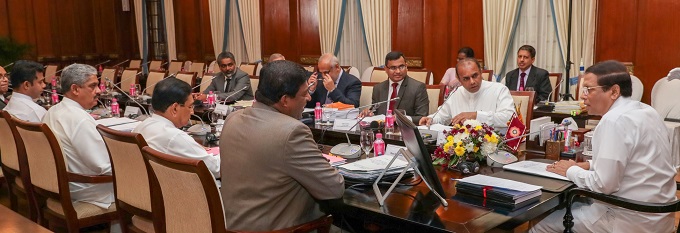
If recommending UNPers for RDA jobs wrong Kiriella ready to accept his mistake RDA suffers staggering loss of Rs 62.87M

September 24th, 2019

By Mirudhula Thambiah Courtesy Ceylon Today

According to the PCoI, the Road Development Authority (RDA) faced a staggering loss of Rs 62.87 million by recruiting staff and that the appointments had also violated Management Service Circulars.


Leader of the House, Minister Lakshman Kiriella told the Presidential Commission of Inquiry yesterday (24), that if recommending  UNP Members for recruitment to the RDA was wrong, he was ready to accept it.


He noted that the appointments were made at a time when there were many roads to be constructed in the Central Province.


He added, “I made recommendations to recruit certain UNP Members as Public Liaison Officers to avoid issues cropping up when constructing roads within the Central Province,” Kiriella said he made recommendations of people known to him and the RDA offered them jobs.


However, the Commissioners pointed out that the recruitment drive had caused a loss of Rs 62.87 million and that the appointments had violated Management Service Circulars.


Denying the allegation, the Minister added that if the Ministry had misappropriated such an amount, there should be an audit query and that he has made these recommendations according to RDA guidelines.

 “The RDA has the authority to appoint people to complete a certain task. These were no permanent recruitments, as after completing their task they could be removed from the position,” Kiriella said.


Minister Kiriella said, during former President Mahinda Rajapaksa’s regime, recruitments had been made in a similar manner and that he had followed the precedent during his term of office.

Cabinet grants approval to provide salaries to disabled soldiers for life

September 24th, 2019

Courtesy Ceylon Today

The Minister of Finance, Mangala Samaraweera has said today (24) that the Cabinet has granted approval to continue providing the last received salary to all disabled soldiers for lifetime.

Attempt to make deposit for Sajith Ajith turned away by EC

September 24th, 2019

By J.T. de Silva Courtesy Ceylon Today

Non-Cabinet Minister Ajith P. Perera, who had gone to the Election Commission to pay the cash deposit on behalf of UNP Deputy Leader Sajith Premadasa to contest the coming Presidential Poll, had been forced to return abruptly.


Sources from the Commission said, Perera had failed to furnish the letter of consent from the UNP General Secretary, which is a requirement when depositing cash for contestants from recognised political parties. This had prompted him to leave in haste.


These sources added, though Perera had met Chairman of the Commission Mahinda Deshapriya, he had been unable to make the cash deposit due to the want of the letter of consent from the Party General Secretary.

Before bowing out gracefully, if at all, will…? Ranil spare us another ‘Sirisenic faux pas’

September 23rd, 2019

By Shivanthi Ranasinghe Courtesy Ceylon Today

Last week an exhausted Sajith Premadasa, looking disenchanted and disheartened, sat with Mangala Samaraweera, Kabir Hashim and Malik Samarawickrema and addressed the media. He explained that he had requested in writing of Ranil Wickremesinghe to consider him as the 2019 Presidential Candidate. Premadasa, in almost every other statement emphasised that unlike other family-centric political parties that take closed door decisions, the UNP as a political party and a forerunner of the incumbent Government follows democratic principles and procedures.

If indeed the UNP as an established political party is embedded with democracy; then one has to wonder at the necessity for the press conference or for that matter, the letter. In it, Premadasa has, 

– expressed his own intentions to be a candidate;

– requested that if others are also interested to be nominated, then to follow the democratic procedures and make the selection.

Had the letter simply articulated Premadasa’s interest in being nominated, then, further comment is unwarranted. Yet Premadasa also wants, “an immediate meeting of both the parliamentary group and the working committee, as that’s the democratic way to go ahead”. The meeting between the parliamentary group and the working committee can be a consensus building meeting.

“If we can arrive at a consensus, there is no necessity to resort to any other procedure. Let there be a frank and transparent discussion within the parliamentary group and the working committee. Then all of us would be able to ascertain the plethora of opinions among the members of the parliamentary group and the working committee. If there is a consensus, then so be it.

“But if there is a diversity of opinions, we can adapt the greatest democratic principle and have a secret ballot.”

At the time of this press conference, declaration of the Presidential Election was imminent. Yet, one of Sri Lanka’s oldest democratic political parties was obviously not even close to deciding on the candidate to field. After all, fielding the candidate for the country’s highest office is not akin to appointing a class monitor. Therefore, Premadasa’s request should have taken place at least six months ago. The entire UNP camp should be by now grooming their candidate to victory and to holding the mantle thereafter without faltering.

This press conference was an obvious attempt to pressurising Wickremesinghe to take the due course specified in the letter. After all, this is an internal matter of the UNP and not something that the entire country needs to be involved.

Democratic strength

Mangala Samaraweera took great pains to refute that the UNP was in conflict over the matter. He claimed that the situation that has arisen, which he with his other partners thought fit to be brought to the attention of the media, is actually the strength of the UNP. He stated that the democracy in the Party is so strong that anyone can come forward as a candidate.

If that is indeed the case, the question arises for the need to request from Ranil Wickremesinghe to allow “a frank and transparent discussion within the parliamentary group and the working committee”, if such a mechanism already exists within the Party and is the norm of that Party’s practices.

Obviously, neither Premadasa who is UNP’s Deputy Leader, Kabir Hashim who was UNP’s former General Secretary, Malik Samarawickrema who until very recently was Ranil Wickremesinghe’s closest ally, nor Mangala Samaraweera who has a freehand to do as he pleases in the incumbent Government, believe that… “A frank and transparent discussion within the parliamentary group and the working committee” could exist within UNP without mounting public pressure on Wickremesinghe.

Reasons for Wickremesinghe’s reluctance to hand over the presidential candidature to anyone other than himself in the UNP are well known. He would rather support an outsider like the then General Sarath Fonseka or trust a man who was firmly established in the rivalry team like Maithripala Sirisena than support someone from the UNP. He will never risk losing Party leadership. It is as long as he is UNP’s Leader; he can either enjoy himself as the Premier or Opposition Leader.

Premadasa and his new found friends too know this fact very well. It will take much more than a mere letter to push Wickremesinghe to the democratic path. The Badulla, Matara, and Kurunegala rallies were actually to nudge Wickremesinghe.

Wickremesinghe would not have been fooled by the crowds. It would have been obvious to him that the Premadasa camp had borrowed a leaf from JVP and used the smallest grounds to erect the largest stages, and thereby creating a deliberate jamming of people. Yet, the intention was to create an illusion among people that Premadasa is very popular and use the people to pressurise Wickremesinghe to step down.

Demagoguery

It could well be the case that Premadasa has people’s support. However, this can only be proven by an election. In reality, size of rallies can be quite deceiving for voting and attending rallies are two very different things. However, to name a candidate based on the size of the crowds he attracts alone and not on his knowledge is not democracy – it is demagogy.

Most unfortunately, Sri Lanka’s politics have been marked with demagoguery than democracy. Demagoguery is when politicians appeal to popular desires and prejudices than rational reasoning. Premadasa’s pledges to provide free housing, free meals, and free clothes, are a classic example of demagoguery. During the entire question and answer session that followed the press statement, Premadasa’s adapted theme was to allow popular opinion decide the fate on issues than on any intelligent reflection

However for democracy to thrive, the need is not the greatest show of hands, but by the most knowledgeable on the subject. Premadasa’s stance on the Executive Presidency, as one reporter openly stated is ‘wish-washy’.

Executive Presidency is a very technical subject. One needs to have a fine understanding on how the Executive Presidency derives power and who derives power from the Executive Presidency. Can a layperson, especially one disinterested in politics, decide how to address the vacuum that would be created if the Executive Presidency is abolished? Could a layperson strategise to ensure that the ills of the Executive Presidency do not flow to the entity that inherits the executive powers?

Premadasa’s bluff

When Premadasa reminded the reporters that the Yahapalana Government drastically reduced the Executive President’s Powers, he did not address the confusion that arose with it. The chain of command is now broken. The Easter Sunday Massacres were a direct consequence of this division of power that has taken responsibility and accountability from everyone’s shoulders.

The reporters exposed Premadasa’s bluff when he was asked out of the five-year term, how long will he allocate to find people’s opinion and solutions for whatever bane people identify with the Executive Presidency. Premadasa’s hasty response was, “let’s focus on the candidature first.”

Another reporter asked Premadasa for his reasons to contest for the Executive Presidency if the powers of the position are reduced. His simple answer was to keep a certain family-centred political dynasty out of power.

Since the Yahapalana Government came to power

– half a million people have lost their livelihoods,

– terrorism is once again threatening our daily lives,

– human rights have been distorted to give credence to criminals and terrorists over the fundamental rights of the officers and men who ensure national security,

– economic indices are falling,

– free trade agreements with other countries are threatening to turn Sri Lanka into a garbage dump,

– our agrarian sector stands to lose their land to economic gift packages such as the MCC.

– separatists are demanding a new constitution that will effectively create nine semi-autonomous governments and a very weak central government.  

Yet, Premadasa’s sole objective is to prevent a certain political rival from coming to power. He claims that rival is driven by one family. It is questionable why Premadasa should take exception to family-driven governance, when his own wife had publicly pledged to personally solve the housing issue. At least the family he intends to obstruct will appoint their members to positions of responsibility and thus to accountability. Premadasa’s wife on the other hand intends to run State matters by dictating to her husband without taking responsibility or being held accountable.

When Maithripala Sirisena came out to contest in 2015, no one bothered to check his track-record. In his long political career, he had achieved zilch. As he once shamelessly declared our challenge now is to somehow return to where we were before Yahapalana Government. Sajith Premadasa too has been in politics for a very long time. His big achievement is creating unliveable houses. The parallel between Sirisena and Premadasa is uncanny – from their silly election promises to the people who are gravitating around them.

Wickremesinghe has not been a friend much less leader to Sri Lankan people. However, if his last act before bowing out is to spare us another Sirisena, he stands to be redeemed.

ranasingheshivanthi@gmail.com

Seven decades of UNP leadership feuds

September 23rd, 2019

By Sugeeswara Senadhira Courtesy Ceylon Today

“I do not intend on this occasion to indulge in any recrimination or personal bitterness. Political parties in Ceylon, both in the past and the present, had displayed a tendency not sufficiently to consult party organisations when important issues arose, the UNP was falling into the same tendency and in its best interest this should be remedied”. These were the prophetic words of S. W. R. D. Bandaranaike in his speech after resigning from United National Party to form the Sri Lanka Freedom Party seven decades ago.

Bandaranaike resigned from the UNP when he realised that first Prime Minister D. S. Senanayake did not have any intention of making him his successor. That was the first leadership struggle in the UNP, the national party which was just five years old.

Even after seventy years, the UNP has not remedied the wrong tendency Bandaranaike mentioned and the party is faced with a serious leadership feud, not merely between the leader (Ranil Wickremesinghe) and the deputy (Sajith Premadasa), but also with a third leader (Karu Jayasuriya) emerging as an alternative. 

Sinhala Maha Sabha 

With the emergence of UNP, which was formed by uniting D. S. Senanayake’s Ceylon National Congress, Bandaranaike’s Sinhala Maha Sabha and T. B. Jayah’s Muslim League, the new party expected to sweep the first general elections. But the UNP could win only 42 seats in the 95-member Parliament. However, DS could form a Government with the support of independent MPs as the powerful leftist parties could not come to a single platform.

Bandaranaike, thinking that DS was grooming Sir John Kotelawala as his successor, had met him and said, “Lionel (Sir John) my father (Solomon Dias Bandaranaike) is very old and is keen to see me as Prime Minister before he dies. You are a young man and can afford to stand down.” Quick-witted Sir John replied, “My mother too is old and would be very happy if she could see me as Prime Minister before she dies”. Subsequently Bandaranaike left the party to form the SLFP.

However, when DS died in 1951, there was a major leadership struggle between Sir John and Dudley Senanayake and the latter became the Prime Minister because Governor General Lord Soulbury invited Dudley to form the Government fulfilling a promise he had given to DS before he died.

There was a major leadership tussle between Sir John and Dudley and the former went on to publish a book titled ‘Premier Stakes’ giving out the deals behind the scene. However, Sir John finally joined Dudley’s Cabinet as Minister of Transport and Public Works. After Dudley resigned in 1953, John was the automatic choice for Premiership as the other senior leader J. R. Jayewardene, former Finance Minister, decided to wait patiently for his turn.

Mahajana Eksath Peramuna

Sir John, after losing to Bandaranaike’s SLFP-led Mahajana Eksath Peramuna in 1956, left for London, leaving the UNP in the hands of JR, who nurtured the party and rejuvenated it to be ready for future battles. Although JR was the man behind the UNP during difficult days, the party members did not want him as the leader of the party. When general elections were announced a few months after the assassination of Bandaranaike in 1959, the party leaders invited the retired Premier Dudley to take over the leadership of UNP once again. In 1960, Dudley became the Prime Minister of a minority UNP Government but after three months another election was held and the SLFP came back to power.

Although there was a cold war between Dudley and JR, the latter worked hard for the party and ensured its victory in 1965. Dudley became the Premier and JR was appointed State Minister (then equivalent to de facto Deputy Prime Minister). Two years later Dudley inducted his trusted junior, Ranasinghe Premadasa to the Cabinet to fortify his strength in the party and the Government. Dudley in his strategy to control JR utilised the capabilities of Premadasa to improve the UNP rural base, while JR was dependent on the urban elite.

However, after the UNP defeat in 1970, there were cracks in the party and this time it was Premadasa who openly revolted against Dudley, his mentor. Premadasa, without leaving the UNP, created a new force under the banner, ‘Purawesi Peramuna’ (Citizen’s Front). Ailing Dudley died in 1973 and JR gave an emotional speech at the funeral, that ended with ‘Good night, sweet prince, And flights of angels sing thee to thy rest!’ and went to Sirikotha, UNP Headquarters, to take full control of the party. Dudley’s nephew, Rukman Senanayake challenged JR for leadership, but JR easily wrested control and sacked Rukman from the party. Rukman formed a new party called, Dudley Peramuna but soon went into the political wilderness.

Lalith Athulathmudali 

Premadasa, a master strategist, joined forces with JR and the duo brought the UNP back to power in 1977. Prior to the general elections, JR held a party Executive Committee vote to elect a deputy leader. Two contestants, Premadasa received 122 votes and Gamini Dissanayake got 118. After becoming the Deputy Leader of UNP, Premadasa marked his time, although JR was obviously promoting Gamini and Lalith Athulathmudali as future leaders. There were in-fights between three of them as Lalith and Gamini considered each other as rivals too.

When JR finally named Premadasa as the Presidential candidate, both Lalith and Gamini put their full strength to get Premadasa elected President hoping to be the Prime Minister. However, Premadasa did not trust them and made D. B. Wijetunga, un-ambitious old UNP loyalist, as Prime Minister, taking everybody by surprise.

Infuriated Lalith and Gamini, throwing away their own differences, brought an impeachment motion against Premadasa after obtaining signatures of a sufficient number of UNP MPs. But Premadasa moved fast, prorogued Parliament and managed to get the UNP dissidents back to his fold and ousted Lalith and Gamini from the party.In this battle of giants, Ranil Wickremesinghe stood behind Premadasa, thus strengthening his place in the party.

After Premadsa’s assassination, Ranil supported Wijetunga to be the President and got himself appointed as Prime Minister. Meanwhile Gamini returned to the UNP, and wanted to be the Presidential Candidate in 1994. Ranil was initially reluctant, but finally gave in after realising that it was not easy to defeat the formidable challenger Chandrika Bandaranaike Kumaratunga.

After Gamini’s death, there was no challenge to Ranil and he managed to keep the UNP leadership despite the party’s losses at several elections. Today, his position is challenged by Premadasa’s son, Sajith. Meanwhile, Speaker Karu Jayasuriya has also entered the fray. With only two weeks to go for nominations for the 16 November election, the UNP leadership feud continues unabated, reminding the party loyalists that the advice of Bandaranaike seven decades ago is still valid.

End of SLFP and also UNP?

September 23rd, 2019

N.A.DE S. AMARATUNGA Courtesy The Island

article_image

We live at a time of unprecedented political turmoil and uncertainty. There is no visible government. The officials are probably running the country, and as there is no political direction the economy is gradually and perceptibly declining, making a huge impact on the lives of the poor people as all economic parameters indicate. Prime Minister is doing what he knows best, making more and more promises, and outdoing himself when compared to 2015. President is also doing what he knows best, trying to undermine friend and foe in a bid to survive. There seems to be an excess of acrimony, rivalry, and power hunger.

Due to these rivalries, acrimony, jealousy and power hunger, two of the major political parties that existed from the 1940’s are showing unmistakable signs of breaking up into factions and disappearing from the face of the earth. The UNP was formed of the leaders who collaborated and learnt from the European master and aped them in dress, manner and culture. They could not reach out to the common man and understand their economic and cultural needs. The SLFP was born to fill this void and look after the interests of the common poor people. “Sinhala Only” policy was meant to be only a rallying call and symbolic of the people’s needs, and not discriminatory towards the minorities. SLFP met with immediate success due to the resonance it struck with the inner feelings of the people, the “civilizational consciousness”. This vital character and identity of the SLFP was destroyed when it formed a union with the UNP, which from its inception was identified with foreign interests and culture, and formed the “yahapalana” government. It is not too late for the SLFP to correct its mistake at this opportune moment, but it seems to be thrashing about due to personal agenda, rivalry, petty jealousy and power hunger. If it misses this opportunity the SLFP would be in political wilderness.

The UNP also, almost fatally, damaged itself when it joined up with the SLFP in a marriage of convenience. The incompatibility has not only ruined the country in these last four and half years, but almost destroyed the two parties also. The policies of the SLFP have been taken over and preserved for the people by the SLPP. The remnants that remained in the government had made governance almost impossible and now it is in its last throes. Poor governance and economic decline have clearly impacted on the credibility of the UNP leadership, and what it could do at the critical eleventh hour is nothing but make promises. But the damage to the leadership is reflected in the mass defection of the loyalists, and their demand for a different nominee for the presidential election, resulting in a gross rupture of the party. If this crack is not repaired early the party will go to polls in a divided state risking a colossal defeat. But here too the power hunger, personal agenda, petty jealousy, acrimony created by the rebellion and future political stake may not allow room for compromise. If the rebellion succeeds it would be at huge cost and there is no guarantee that undermining tactics, reminiscent of what befell Kobbekaduwa, would not be resorted to by desperate people. Such is human nature infected with power hunger, acrimony and vendetta. If the rebellion within the UNP fails and the breakaway faction joins up with the SLFP, which is waiting to commit ‘hara-kiri”, it will be the demise of the UNP too.

Sri Lanka is at political crossroads and we may witness catastrophic political upheavals in the near future. But sometimes political catastrophe brings in its wake changes that are better for the people. Our people have relentlessly suffered untold misery due to political blunder, and personal vendetta among the politicians. They deserve a break from all this madness and pettiness, and a modicum of stability in their lives. So, it is good for the people let political parties breakup and disappear.

N.A.DE S. AMARATUNGA

Sajith is still living in 89 – Sudarshani

September 23rd, 2019

Courtesy Adaderana

Regardless of what the leadership of the Sri Lanka Freedom Party (SLFP) says, the village-level supporters are today with the Sri Lanka Podujana Permuna (SLPP) and its presidential candidate Gotabaya Rajapaksa, according to UPFA MP Sudarshani Fernandopulle.

Speaking during an event held in Katana, she said that the United National Party (UNP) is currently struggling unable to reach a decision regarding its presidential candidate. 

Some are saying its Ranil, some are saying Karu and some are saying Sajith,” she said, adding that the UNP does not have any leaders who are suitable for the year 2020. 

Sajith Premadasa is still living in the 1989 era, not in 2020,” she said.

Fernandopulle stated that none of them have presented programme for the country and that former Defence Secretary Gotabaya Rajapaksa has already presented his plans to take the country forward.

UNP crisis goes international

September 23rd, 2019

Courtesy Adaderana

Gota will appoint SPC when elected

September 23rd, 2019

By W.K.Prasad Manju Courtesy Ceylon Today

United People’s Freedom Alliance (UPFA) Ratnapura District Parliamentarian Vasudewa Nanayakkara told Ceylon Today that when Gotabaya Rajapaksa becomes the President, a Special Presidential Commission (SPC) will be appointed to look into all the cases filed by the present Government seeking political revenge.

This Commission will be appointed in a bid to serve justice to all those who were subjected to political revenge, and to reveal to the country the politicians and officials who caused these incidents of political revenge.

Nanayakkara further said that the leaders of the Joint Opposition (JO) have discussed this with the SLPP Presidential Candidate Gotabaya Rajapaksa.

He added, that looking into this issue will be conducted as a special programme.

The telephone conversation between former Director General of the Commission to Investigate Allegations of Bribery or Corruption (CIABOC), currently the  Solicitor General, Dilrukshi Dias Wickremasinghe and Nissanka Senadhipathi, will be useful in future activities of the proposed Presidential Commission, Nanayakkara opined. 

According to the telephone conversations of Dilrukshi Wickremasinghe, it is evident that all these cases were created to take political revenge, Nanayakkara added.

Abolishing Executive Presidency A pledge to fulfil TNA’s manifesto

September 23rd, 2019

By Canishka G. Witharana Courtesy Ceylon Today

On 17 September 2019, Speaker Karu Jayasuriya stated his goal as, “abolition of Executive Presidency.” 

Since 2015, two attempts have been made to abolish the Executive Presidency. The first attempt was via the 19th Amendment. In the original 19A Bill, the following clauses were proposed:

Clause 11 of 19A (Original) Bill;

42(1) There shall be a Cabinet of Ministers charged with the direction and control of the Government of the Republic.

43(3) The Prime Minister shall be the Head of the Cabinet of Ministers.

43(1) The Prime Minister shall determine the number of Ministers of the Cabinet of Ministers, and the Ministries and the assignment of subjects and functions to such Ministers. 

The second attempt was via the 20th Amendment proposed by the JVP. It was suggested to remove the word ‘Government’ from present Article 30. This would have resulted in the removal of the status of the President as the ‘Head of the Government.’ Both attempts were to remove or reduce the powers of the President, who is presently in control and charge of the Government. 19A blatantly sought to transfer such powers to the Prime Minister. 20A (of JVP) expressly tried to remove the powers of Government from the President.

However, in both instances, the Supreme Court held that “Clauses in the Bill relating to the removal or reduction of the executive power of the people which would be exercised by the President of the Republic would directly violate Article 3 of the Constitution, and that therefore they should be approved by the people at a referendum.”

Therefore, the office of the (Executive) President cannot be removed or his powers cannot be reduced or removed without obtaining a specific mandate from the people at a referendum. 

Office of the President

Why is the office of the President made so strong and solid? 

Constitutionally, the Executive power of the people, including the defence of Sri Lanka, shall be exercised by the President (Article 4(a)). The President is the Head of the State, Head of the Executive and of the Government. He is also the Commander-in-Chief of the Armed Forces (Art. 30).   

The people entrust their executive power in the President at the Presidential Election. Such power flows down from the President through the machinery of government, which comprises the Cabinet and the other officers in the State Administration. The Cabinet of Ministers is charged with the direction and control of the Government (Article 43(1)). Hence, the Prime Minister and the Cabinet of Ministers get their powers from the President. Secretaries of the Ministries and all officials in the State Administration function thereunder. 

The People expect the President to fulfil duties entrusted to him by the Constitution (Article 33(2)(1)(a)). The President is obliged to assure a stable government in a Unitary State. To achieve that, the machinery of Government should function without any failure on an “unbroken line of accountability and authority” that runs through the hierarchy of the Government. 

From 1987, (with the 13th Amendment) Provincial Councils (PCs) became part of our constitutional structure. 13A made drastic changes in the structure of government. PCs started to exercise legislative and executive functions within provinces. The line of executive authority, which starts from the President, runs to the provinces through the Governors appointed by the President. In the judgment on the 13th Amendment (1987) the Supreme Court observed as follows:

“The Governor is appointed by the President and holds office in accordance with Article 4(b) which provides that the executive power of the people shall be exercised by the President of the Republic, during the pleasure of the President (Article 154B(2)). The Governor derives his authority from the President and exercises the executive power vested in him as a delegate of the President. It is open to the President therefore by virtue of Article 4(b) of the Constitution to give directions and monitor the Governor’s exercise of this executive power vested in him. Although he is required by Article 154F(1) to exercise his functions in accordance with the advice of the Board of Ministers, this is subject to the qualification ‘except in so far as he is by or under the Constitution required to exercise his functions or any of them in his discretion.’ Under the Constitution, the Governor as a representative of the President is required to act in his discretion in accordance with the instructions and directions of the President. Article 154F(2) mandates that the Governor’s discretion shall be on the President’s directions and that the decision of the Governor as to what is in his discretion shall be final and not be called in question in any Court on the ground that he ought or ought not to have acted on his discretion. So long as the President retains the power to give directions to the Governor regarding the exercise of his executive functions, and the Governor is bound by such directions superseding the advice of the Board of Ministers and where the failure of the Governor or Provincial Council to comply with or give effect to any directions given to the Governor or such Council by the President under Chapter XVII of the Constitution will entitle the President to hold that a situation has arisen in which the administration of the Province cannot be carried on in accordance with the provisions of the Constitution and take over the functions and powers of the Provincial Council (Article 154K and 154L), there can be no gainsaying the fact that the President remains supreme or sovereign in the executive field and the Provincial Council is only a body subordinate to him.”

Their Lordships in the Supreme Court further held that:

“Each Provincial Council is an administrative unit duplicating more or less a Cabinet system of Government, a Provincial Council, and a Governor as its Head.”

Therefore, Provincial Councils derive their executive powers from the President. The simple question that arises is that, if executive powers and powers of Government were removed from the President, from where (what source) would the Governors and Board of Ministers in the Provinces get their executive powers and powers to run provincial administration?

Conflicting answers

Two conflicting answers may be suggested. Either the entire provincial councils system would collapse, for lacking of executive authority and power to run provincial administration. However, as long as the provisions incorporated into the Constitution by the 13th Amendment subsist, this reasoning would not be practical. 

The other possibility would be detrimental to the Unitary State structure of the Constitution. If the 13th Amendment continues to function with existing powers or is made fully functional (by further granting land and Police powers to PCs), then arises the question from what source of executive the Provincial Councils (Governors and Board of Ministers) would derive executive powers and powers to run the organs of government within provinces?

If executive powers do not flow from the Centre (President) then such powers should be derived directly from the people in the Province(s). This is a situation where the sovereignty of the people would be fragmented, alienated and separated both vertically and horizontally. Vertically, as people would be presumed to empower Governors and Chief Ministers in the Provinces directly with executive power, without channelling such power through the President. 

Horizontally, as people of each province would exercise their sovereignty separated from those in the other provinces. This situation would permit international elements, acting with ulterior motives, to set up separate States, to give a distorted picture to the world, of Sri Lanka, as a country, consisting of people distinct from each other at provincial levels. 

Right of self-determination

The constitutional structure demanded by the TNA claims right of self-determination. The following passages are extracted from the TNA manifesto published for the Northern Provincial Councils Elections (2013):

“The Tamil People are entitled to the right to self-determination…..

The TNA firmly believes that sovereignty lies with the people and not with the State. It is not the Government in Colombo that holds the right to govern the Tamil people, but the people themselves. In this regard, the Thirteenth Amendment to the Constitution of Sri Lanka is flawed, in that power is concentrated at the Centre and its Agent, the Governor…..”

Such mala fide slogans lead to nowhere, but to create disunity and segmentation among the people. Social and political calamity, resulted by such attempts, serve only national and international elements, seeking to destabilise the State and implement mechanisms to exploit the resources and the people of the country. 

Therefore, the (Executive) Presidency in the present Constitution cannot be abolished in isolation. Such abolition would transform the Unitary State into a Federal or Confederal State structure, and pave way for convenient cessation with international assistance. The Executive Presidency cannot be abolished without simultaneous abolition of PCs, or replacement of PCs with an alternative decentralisation mechanism, that would function within a Unitary State structure, by deriving executive authority from a source at the centre, where the executive power would be concentrated.   

About the writer: 

The writer is an Attorney-at-Law.

Aiyo Dilrukshi !!’What have you done ?

September 23rd, 2019

Dr Sarath obeysekera 

Last few days all the television channels are showing   

The next episode of the telegrams called 

Janapathi Warama

Just like the saying in Sinhala Fish gets into trouble because of it’s mouth 

She could not keep her mouth shut

It was also an amusing part of the drama,  is the way one time tough commander of the forces crying like a baby complaining about the hardships he had gone through

I felt like crying when he mentioned about his children who were mistreated in the school

But I was not feeling sorry for the Babie Doll 

Dr Sarath obeysekera 

ඇමති සජිත් පැය 7ක් ජනපති කොමිසමේ

September 23rd, 2019

උපුටා ගැන්ම  හිරු පුවත්

එක්සත් ජාතික පක්ෂයේ නියෝජ්‍ය නියෝජ්‍ය නායක අමාත්‍ය සජිත් ප්‍රේමදාස අද පැය 7 කට වැඩි කාලයක් 2015 – 2018 වසර වල රාජ්‍ය ආයතනවල දූෂණ වංචා සෙවීමට පත් කළ ජනාධිපති විමර්ශන කොමිෂන් සභාව හමුවේ පෙනී සිට ප්‍රකාශයක් ලබාදුන්නා.

ඒ,  නිවාස සංවර්ධන අධිකාරියට පසුගිය වසර 3 ක කාලය තුළ නිසි අනුමැතියකින් තොරව ප්‍රමාණය ඉක්මවා සේවකයින් බඳවා ගත් බවට එහි ශ්‍රී ලංකා නිදහස් වෘත්තිය සමිති සංගමය කළ පැමිණිල්ලට අදාළවයි.

https://youtu.be/msSK63xQq_8

/>එමෙන්ම පාසල් ළමයින්ට නිල ඇඳුම් වෙනුවට වවුචර් ලබාදිමේදී හා ටැබ් පරිගණක ලබාදීමේදී සිදුවූ බව කියන මූල්‍ය වංචාවකට අදාළ පැමිණිල්ල සම්බන්ධයෙන් ප්‍රකාශ ලබාදීම සඳහා අමාත්‍ය අකිල විරාජ් කාරියවසම් ද අද එම කොමිසම හමුවේ පෙනී සිටියා.

මේ අතර පිවිතුරු හෙළ උරුමය අද අල්ලස් කොමිසමට පැමිණිල්ලක් ඉදිරිපත් කළේ පාසල් ළමයින්ට ලබාදෙන ටැබ් පරිගණක සඳහා අවශ්‍ය ප්‍රමිති මට්ටම සැපිරීමට අපොහොසත්වූ සමාගමකට ඊට අදාළ ටෙන්ඩරය පිරිනමා ඇති බවට බවට චෝදනා කරමින්.

මේ අතර මොරටුව – සොයිසාපුර පිහිටි නිවාස සහ මාළිගාවත්ත ප්‍රදේශයේ පිහිටි කඩකාමර කිහිපයක් අමාත්‍ය සජිත් ප්‍රේමදාස සිය දේශපාලන හිතවතුන්ට ලබාදීමේ උත්සාහයක් ඇති බවට චෝදනා කරමින් නිවාස සංවර්ධන අධිකාරිය සුරැකීමේ ව්‍යාපාරය අද මැතිවරණ කොමිසම් සභාවට පැමිණිල්ලක් ඉදිරිපත් කළා.

දිල්රුක්ෂි ඩයස්ගේ වැඩ බැලීමට, අතිරේක සොලිසිටර් ජනරාල්වරයෙක්

September 23rd, 2019

උපුටා ගැන්ම  හිරු පුවත්

අල්ලස් කොමිසමේ හිටපු අධ්‍යක්‍ෂ ජනරාල්, සොලිසිටර් ජනරාල් දිල්රුක්ෂි ඩයස් වික්‍රමසිංහ සහ ඇවන්ගාඩ් සමාගමේ සභාපති නිශ්ශංක සේනාධිපති අතර සිදුවූ දුරකථන සංවාදය පිළිබඳව විමර්ශනයක් සිදුකරන ලෙස නීතිපතිවරයා අද රාජ්‍ය සේවා කොමිසන් සභාව වෙත දැනුම් දී තිබෙනවා.

එමෙන්ම, අදාළ දුරකථන සංවාදය පිළිබඳව පරීක්ෂණ ද ආරම්භ කළ බවයි නීතිපතිවරයාගේ සම්බන්ධීකරණ නිලධාරිනි රජයේ අධිනීතීඥ නිශාරා ජයරත්න ප්‍රකාශ කළේ.

https://youtu.be/0TvlilBLwtM

ඒ අනුව සිද්ධිය සම්බන්ධයෙන් මූලික පරීක්ෂණ පැවැත්වීම සඳහා විමර්ශකයෙකු පත් කිරීමට නියමිතයි.

මේ අතර, සොලිසිටර් ජනරාල් දිල්රුක්ෂි ඩයස් වික්‍රමසිංහ දැරූ නීතිපති දෙපාර්තමේන්තුවේ සිවිල් අංශයේ ප්‍රධානී තනතරේ වැඩ ආවරණය කිරීම සඳහා ජ්‍යෙෂ්ඨ අතිරේක සොලිසිටර් ජනරාල් සංජය රාජරත්න පත් කර තිබෙනවා.

මෙම දුරකථන සංවාදය ඇවන්ගාඩ් සමාගමේ සභාපති නිශ්ශංක සේනාධිපති පසුගිය දා සමාජ මාධ්‍යයට මුදා හැරියේ සිංගප්පූරු රෝහලක ප්‍රතිකාර ලබන අතරතුරයි.

කෙසේ වෙතත්, අදාළ දුරකථන සංවාදය සම්බන්ධයෙන් සොලිසිටර් ජනරාල් දිල්රුක්ෂි ඩයස් වික්‍රමසිංහ තම ෆේස්බුක් ගිණුමේ සටහනක් ද යොදමින් සඳහන් කළේ එය විකෘති කරන ලද්දක් බවයි.

දිල්රුක්ෂි ඩයස් ගැන අගමැතිගෙන් පැහැදිලි කිරීමක්

September 23rd, 2019

උපුටා ගැන්ම  හිරු පුවත්

අල්ලස් කොමිසමේ හිටපු අධ්‍යක්ෂ ජනරාල්, සොලිසිටර් ජනරාල් දිල්රුක්ෂි ඩයස් වික්‍රමසිංහ ශ්‍රේෂ්ඨාධිකරණ විනිසුරු තනතුරකට පත් කරන ලෙස ඉල්ලා තමන් කිසිදු අවස්ථාවක ලිපි යොමු කර නොමැති බව අග්‍රාමාත්‍ය රනිල් වික්‍රමසිංහ පවසනවා.

අග්‍රාමාත්‍යවරයා මේ බව සඳහන් කළේ අද විශේෂ ප්‍රකාශයක් සිදුකරමින්.

මේ අතර, සංචාරක ව්‍යාපාරය පිළිබදව සී.එන්.එන්. මාධ්‍යවේදී රිචඞ් ක්වෙස්ට් මෙහෙය වූ සම්මුඛ සාකච්ඡාවකට ද අග්‍රාමාත්‍යවරයා අද කොළඹ දී එක්වුණා

https://youtu.be/G_ap9XdSfLw

Phone-gate scandal

September 23rd, 2019

Editorial Courtesy The Island

Tuesday 24th September, 2019

The leaked telephone conversation between Solicitor General Dilrukshi Dias Wickramasinghe and Avant Garde Chairman Nissanka Senadipathi could not have come at a worse time for the government and the Commission to Investigate Allegations of Bribery or Corruption (CIABOC), which has embarked on a much-advertised campaign to raise public awareness of its five-year anti-corruption plan.

The leaked call refers to Dilrukshi’s action against Avant Garde, involved in the floating armoury controversy, while she was the Director General of the CIABOC. What one gathers therefrom is that the CIABOC actions were politically motivated. The critics of the anti-graft commission may claim they are justified in maintaining that the government has used the outfit to settle political scores.

The CIABOC has drawn heavy flak, under successive governments, for not taking action against politicians in power or for giving them kid glove treatment while cracking down on ordinary suspects. One of the main allegations against it is that it has not probed complaints against the heavyweights of the present dispensation. It continues to ignore calls for revealing the number of complaints it has received against government politicians and the progress in investigations thereinto, if any.

Unfortunately, the former CIABOC DG’s questionable conduct has allowed some Opposition politicians facing corruption charges to claim that they are victims of a political witch-hunt! The Joint Opposition (JO) has called for the resignation of all CIABOC members over the leaked telephone conversation, which, it says, is proof that they have not carried out their duties and functions impartially and independently. The Opposition worthies are elated that they have got hold of something to beat the government with, in the run-up to a crucial election. If only they had made a similar call for action while they were in power, for the allegations were made against the CIABOC, under the last government, as well.

President Sirisena has revealed that the government made an attempt to have Dilrukshi appointed as a Supreme Court judge, but he foiled it. He would have the public believe that he acted with foresight, but it is clear that he did so out of animosity. However, his action has stood the judiciary in good stead. If that appointment had come about, the reputation of the apex court would have been ruined by the leaked call.

Dilrukshi’s Facebook posts on the controversy make one wonder whether a minister had a hand in the leak. If so, the government may have been aware of the conversation she had with Senadipathi, when it requested the President to appoint her to the Supreme Court. The Opposition has been critical of Dilrukshi for her alleged links to the government. If this allegation is true, then why is it that a minister, of all people, is suspected to have recorded her conversation with Senadipathi? Politicians are notorious for having even their own friends spied on and using information so gathered against the latter if they fall out.

However, if a minister is responsible for the leak, at issue, then he has done something extremely counterproductive, whatever the reason for his action; the government, which claims to have rid the vital state institutions of political interference, has got exposed for meddling with anti-corruption investigations against its political opponents.

The 19th Amendment, which the government claims to be one of its biggest achievements, has manifestly failed to bring about the promised change. The Constitutional Council is packed with pro-government members. The Election Commission cannot safeguard the people’s franchise vis-a-vis politically-motivated polls postponements. The Delimitation Commission has become a big farce. There are numerous complaints against the Public Service Commission and the National Police Commission.

Attorney General Dappula de Livera has taken stern action against former Defence Secretary Hemasiri Fernando and IGP Pujith Jayasundera over the Easter Sunday carnage. How tough he will get with Solicitor General Wickramasinghe remains to be seen.

Ex-Agriculture Ministry Secretary tells PCoI that he was coerced into signing controversial lease agreement

September 23rd, 2019

By Rathindra Kuruwita Courtesy The Island

article_image

Former Secretary to the Ministry of Agriculture B. Wijeratne told the Presidential Commission of Inquiry (PCoI) probing corruption of the current administration that former minister of agriculture, Duminda Dissanayake had applied pressure on him to sign the lease agreement between the Agriculture Ministry and D.P. Jayasinghe Company to relocate the Ministry there.

Wijeratne who appeared before the PCoI also said that the Ministry had no desire to shift from the building. The decision to relocate the ministry, in 2016, was due to continuous pressure from the Parliament.

On September 21, 2015, Wickremesinghe presented a Cabinet paper stating that the Ministry of Agriculture should explore the possibility of relocating to the SP (Suhurupaya) Building. “This didn’t materialise,” Wijeratne said.

Although the Prime Minister then appointed a committee headed by Secretary to the PM Saman Ekanayake, Wijeratne said that he was never informed of that committee. The Committee found three privately owned buildings where the Ministry could relocate until the third stage of Sethsiripaya was completed.

“Later Ekanayake called me and said they found the D.P. Jayasinghe building. I visited the building with the Minister of Agriculture,” he said.

Wijeratne said that there were a number of issues with the building and that they realised that a lot of money would have to be spent on the building to make it suitable for a ministry.

When the witness was questioned as to why he didn’t send the final version of the agreement to the Attorney General, Wijeratne said that AG had made five observations and as per his understanding once those instructions were fulfilled; there was no need to send the agreement to the AG again.

“In previous letters from the AG’s Department always explicitly said to refer back to them. That wasn’t there in this letter. Also our legal officer had made a note saying that the AG’s department officials had informed her that there was no need to send the agreement back again. “

Last week former minister Dissanayake told the Presidential Commission Wijeratne verbally informed him that the Attorney General (AG) had granted approval for the lease agreement between the Ministry and D.P. Jayasinghe Company.

“I was very cautious. I always used the word clearance not approval.”

Chairman of the PCoI, retired Supreme Court judge, Upali Abeyratne said that it was Wijeratne’s responsibility to have sent the final draft of the agreement before signing it.

“We have detected a number of issues with the agreement and do you think that these could have been ironed out if you had sent the agreement to the AG?” Abeyratne asked.

“Yes, that’s possible,” the witness said.

Earlier this month Dissanayake told the PCoI that it was not fair for the Presidential Commission to question him on the controversial lease agreement signed between the Agriculture Ministry and D.P. Jayasinghe Company as all decisions on the transaction had been taken by Prime Minister Ranil Wickremesinghe.

However Prime Minister Ranil Wickremesinghe said last Monday (16) that sending the agreement to the Attorney General’s Department for approval was the responsibility of former Minister of Agriculture Duminda Dissanayake and that responsibility for Dissanayake’s action finally lay with the President.

It was also revealed in July that there was no termination clause in the lease agreement signed between the Ministry of Agriculture and D.P. Jayasinghe Company in 2016 on renting a building for the Ministry. The total value of the agreement was over Rs. 1.3 billion. The Ministry of Agriculture was to pay Rs. 21 million plus VAT and Nation Building Tax a month in the period between April 08, 2016 and April 07, 2019. From April 08.2019 to April 07, 2021 the Ministry was to pay Rs. 24.1 million plus VAT and Nation Building Tax a month. When the agreement was executed the Ministry paid Rs. 504 million to the lessor. This amount of funds was to be used during the last two years of the lease period to reduce Rs. 21 million from the monthly lease of Rs. 24.1 million.

Northern lawyers to boycott Court tomorrow

September 23rd, 2019

Courtesy Ceylon Today

Lawyers in the Northern Province have decided to boycott Court proceedings tomorrow (24) in protest over the defying of a Court order delivered by the Mullaitivu Magistrate, in connection with the last rites of Ven. Kolampe Medhalankra Thera and attack on Mullaitivu lawyer Sukash today (23).

Informed sources said that Mullaitivu Magistrate Lenin Kumar ordered that the Buddhist monk’s remains not be cremated at the disputed Neeravi Pillaiyar Temple premises but to perform the cremation at the beach side near the Temple.

However, the Court order was defied and a group of monks led by Ven. Galagodaaththe Gnanasara Thera and some of his followers had cremated the remains of the deceased monk at the prohibited site, informed sources said.

Attorney-at-Law Sukash, attached to the Mullaitivu Bar was attacked by an individual when he appealed to Gnanasara Thera to obey the Court order.

Following the incident in Mullaitivu, the lawyers from all areas of the Northern Province have decided to boycott their Court duties stating that Court order has been defied and the Magistrate’s directive has not been respected.

Furthermore, the Northern lawyers have also pointed out the attack carried out on lawyer Sukash of Mullaitivu.

The Court cases in the Northern Province are expected to come to a standstill tomorrow following the protest by the lawyers, sources said.

Mullaitivu lawyers have also planned to stage a demonstration today at the Mullaitivu Court premises, demanding action against those who had defied the Court order with regard to the cremation of the Buddhist monk, sources added.

SLPP wants Dilrukshi removed forthwith

September 23rd, 2019

Lahiru Pothmulla Courtesy The Daily Mirror

While stating that the controversial tele-conversation of Solicitor General Dilrukshi Dias Wickramasinghe was only part of a bigger picture, the Sri Lanka Podujana Peramuna (SLPP) yesterday called for her immediate removal pending an investigation.

SLPP Chairman Professor G.L. Peiris said the Solicitor General was not the entirety of the problem, but only a small part.

The telephone conversation shows the country’s legal system – which the Attorney General’s Department and others use to file cases – has been infiltrated by the most corrupt people. This didn’t start with Dilrukshi and will not end with her as well. She admitted to political influence of high-ups. She should reveal who they are. The most corrupt people operate and use the legal system today,” he told a news briefing held at the party head office.

Commenting on what Ms. Wickramasinghe said in the telephone conversation, Professor Peiris said she indicated she was even above Parliament.

She said she knows both how to make the law and break the law. In our country, it is only Parliament that has the authority to implement laws. Her comments show she is superior to Parliament. A Solicitor General has to perform a wide range of serious duties including overseeing cases involving extraditions. When a person of her ilk holds the post of Solicitor General, how can we place our trust in these duties? How can one ensure an accused like Arjuna Mahendran will be extradited? This is why she should be removed forthwith,” he said.

Prof. Peiris said a government of theirs would ensure legal action against all corrupt individuals and officials including Ms. Wickramasinghe.

The Avant-Garde case filed by the Bribery Commission in which Ms. Wickramasinghe served as Director-General shows the vindictive nature of the government. The Court of Appeal discharged Gotabaya Rajapaksa and other suspects from the Avant-Garde case. These were attempts targeted at Mr. Rajapaksa by individuals who cannot challenge him on a political platform,” he said. 

AG refers Dilrukshi-Nissanka phone conversation to PSC for inquiry

September 23rd, 2019

Courtesy Adaderana

The Attorney General has referred the matter of the controversial telephone conversation between the Solicitor General Dilrukshi Dias Wickremesinghe and Avant-Garde chairman Nissanka Senadhipathi to the Public Service Commission (PSC).

The AG’s Coordinating Officer Nishara Jayaratne says that the matter has been referred to the Public Service Commission for an inquirer to be appointed to conduct preliminary investigations on the matter.

The controversial telephone conversation recording supposedly between Avant-Garde Chairman Nissanka Senadhipathi and former Director General of the Bribery Commission, Solicitor General Dilrukshi Dias Wickremesinghe had recently been released through social media.

Taking to his Facebook account, Senadhipathi, who is currently receiving medical treatment in Singapore, released an audio clip of the telephone conversation which discussed the case filed against the Avant-Garde Maritime Services.

The female voice in the recording can be heard saying I know how to break the law and make the law.” She also expressed her regrets over filing the Avant-Garde case while blaming the country’s disorderly politics as the reason behind the case.

The former Bribery Commission chief, Dilrukshi Dias has so far not denied the phone conversation, however in a Facebook post she called on the Avant-Garde chairman to release the unedited version of the conversation to the public, while also alleging that he has distorted it.

She also refused to make an explanation on the conversation as she is not entitled to do so as a government servant.

The Solicitor General also challenged the Avant-Garde chairman to reveal as to which government minister he had made the phone call and for what purpose.

President Maithripala Sirisena, Prime Minister Ranil Wickremesingh and Justice Minister Thalatha Athukorale have also voices their opinions of the issue

PM responds to President’s accusations over Dilrukshi Dias

September 23rd, 2019

Courtesy Adaderana

Prime Minister Ranil Wickremesinghe today issued a special statement in response to the accusation leveled against him by the President, with regard to the former Director General of the Bribery Commission Dilrukshi Dias Wickramasinghe.

He stated that according to Sri Lanka’s Constitution, only the Chief Justice and the Attorney General have the authority to make recommendations to the President with regard to the appointment of Supreme Court judges. 

I have never done anything outside of the Constitution. There are Supreme Court decisions regarding those who act outside of the Constitution. I have not fallen to that level,” he said. 

The PM further states that he has not letters requesting to appoint Dilrukshi Dias Wickramasinghe or any other person for that matter to the position of Supreme Court Judge. 
  
Therefore the allegation that such a letter was sent are untrue. I reject that.”

The Prime Minister said that an inquiry should be carried out immediately with regard to the comments made by Dilrukshi Wickramasinghe and that for now the Attorney General has requested the Public Service Commission to investigate the matter.

Ranil Wickremesinghe stated that expediting that investigation is suitable and that then it will be possible to uncover as to which politicians had exerted pressure.

At the same time it will also confirm as to whether she has done anything illegal, he said.

The Premier further goes on to say that Dilrukshi Wickramasinghe has never served at Temple Trees at any point and that even the Anti-Corruption Committee was established outside the Temple Trees.

He said that Ananda Wijepala had served as its Director and that the Attorney General’s Department was represented at these committee meetings by Deputy Solicitor General Thusitha Mudalige.

Therefore I would kindly like to point out that what the President had said were devoid of truth.”

The PM added that he is unaware as to why the President has targeted him with allegations in this manner after the Presidential Elections was announced. 

Wickremesinghe said that if there are any accusations or doubts regarding him or any ministers, it is better to discuss them in the Cabinet meeting or inquire about them personally.

The Prime Minister said that it is his belief that expressing opinions in public instead is unsuitable for democratic governance. 

He further says that if allegations leveled against him hereafter, he would not personally intervene to respond every time such allegations are made.

Therefore he requested all parties involved to raise accusations if any at the right places as it is the Constitutional and democratic way to do things.  

The controversial telephone conversation recording supposedly between Avant-Garde Chairman Nissanka Senadhipathi and former Director General of the Bribery Commission, Solicitor General Dilrukshi Dias Wickremesinghe had recently been released through social media.

Taking to his Facebook account, Senadhipathi, who is currently receiving medical treatment in Singapore, released an audio clip of the telephone conversation which discussed the case filed against the Avant-Garde Maritime Services.

The female voice in the recording can be heard saying I know how to break the law and make the law.” She also expressed her regrets over filing the Avant-Garde case while blaming the country’s disorderly politics as the reason behind the case.

The former Bribery Commission chief, Dilrukshi Dias has so far not denied the phone conversation, however in a Facebook post she called on the Avant-Garde chairman to release the unedited version of the conversation to the public, while also alleging that he has distorted it.

She also refused to make an explanation on the conversation as she is not entitled to do so as a government servant.

The Solicitor General also challenged the Avant-Garde chairman to reveal as to which government minister he had made the phone call and for what purpose.

Final rites of Nayaru Temple chief prelate performed at temple premises despite court order

September 23rd, 2019

Adaderana

Industry concerned over increase in cheaper Sri Lanka pepper imports

September 23rd, 2019

By PK Krishnakumar Courtesy The Economic Times

This happened at a time when pepper prices in Sri Lanka crashed to $2,800 from $3,800 per tonne, while the MIP in India was $7,000 per tonne (Rs 500 per kg). 

ndia’s spice industry has raised concerns over increase in black pepper imports from Sri Lanka since August despite local prices in the neighbouring country falling below the minimum import price (MIP) fixed by the Indian government. 

According to the Kerala chapter of the Indian Pepper and Spice Traders, Growers, Planters Consortium, large volumes of Sri Lankan pepper started arriving from August. This happened at a time when pepper prices in Sri Lanka crashed to $2,800 from $3,800 per  .. 

Read more at:
//economictimes.indiatimes.com/articleshow/71254109.cms?utm_source=contentofinterest&utm_medium=text&utm_campaign=cppst

WORLD ROUTES 2019: Sri Lankan tourist traffic recovers after Easter attacks

September 23rd, 2019

Aviation Week Network

Sri Lanka’s airports have seen a dramatic recovery in traffic following a steep decline in demand caused by terrorist bombings in April.

Immediately after the Easter bombings of churches and hotels, inbound traffic was down by 25%-30% of previous levels, according to Sanjeewa Wijeratne, executive director of Sri Lanka’s Airport and Aviation Services. The slump lasted until about June, he said on the sidelines of the World Routes conference in Adelaide Sept. 22.

The recovery started slowly because many visitors took a wait and see” approach. Now, however, traffic has rebounded and flights are full” again, Wijeratne said. He predicts that by November, passenger numbers will have fully returned to their pre-April levels.

I think it’s a really speedy recovery, Wijeratne said. We all thought it would take two years to bounce back, but the recovery has been faster than expected.”

He cited Emirates and Qatar Airways as two examples of airlines that are seeing load factors climb back towards normal.

The Chinese and Japanese markets were particularly hard hit by demand declines because of concerns about security. However, two Chinese airlines that pulled out of the market–Air China and China Southern–have resumed service, Wijeratne said. Aeroflot also pulled its flight from Sri Lanka, but is expected to return this winter.ADVERTISING

Duty free and other retail spending at the main international airport in Colombo was severely affected. The airport allowed a rent discount of 35%-40% because of the drop in business, which in turn hurt the airport’s revenue. As well as the traffic drop, non-passengers were not allowed into the airport terminal as a temporary security measure. Those factors affected spending on everything from taxis to parking.

Adrian Schofield/Aviation Daily, adrian.schofield@informa.com

Tamil women visit St Sebastian Church, pay homage to Easter bombings victims

September 23rd, 2019

by Melani Manel Perera Courtesy asianews.it

The group came from Jaffna peninsula, torn by civil war for almost 30 years, to pray for the recovery of the wounded and harmony between religious communities. Sirisena accepts the bishops’ request and appoints an independent commission of inquiry.

Katuwapitiya (AsiaNews) – A group of Tamil women who survived the civil war in northern Sri Lanka paid tribute to the victims of the Easter bombings.

They visited the St Sebastian Church in Katuwapitiya, Negombo, on Saturday, five months to the day since terrorist attacks killed 263 people and wound more than 600.

It is really sad and unfortunate to see this long list of deceased people due to an inhuman act against a church, especially on a day so special for Christians (Easter),” they told AsiaNews. We feel sadness and shame for the inhumane people” who perpetrated the attacks.

The women came from the Diocese of Jaffna on a visit organised by Seth Sarana, the Caritas office in Colombo.

The group first gathered in front of the monument dedicated to the victims, then visited the sites devastated by the bomb and paused in front of the commemorative panel with pictures of the event.

“This is the first time we come south,” they said. We heard about the tragedy through the media, but only now did we understand what happened, seeing the church, the monument and the pictures.”

The Tamil women ​​prayed for those killed and for the numerous wounded still undergoing medical treatment. “We pray for all those who need inner strength and mental peace.”

Two women said they also prayed for harmony between the communities and for those who resent Muslims. “This is wrong because we cannot blame an entire community. We know who carried out the explosions. We need to correct people who have misconceptions about these incidents.”

“Let’s bow our heads to the names of the victims,” said Suganthy Mary, Pushpa Malar and Dharmanayagi. We wish a quick recovery for those who suffer from injuries and surgery. We pray for families who lost a relative in the explosions in churches and hotels.”

Meanwhile the inquiry continues into the attacks claimed by the Islamic State group, which the government blames on a local Islamic group.

Yesterday President Maithripala Sirisena appointed a five-member committee to investigate the terrorist warnings ignored by the country’s intelligence services. It includes two Appeal Court judges, two retired High Court judges and a retired administrator.

The decision fulfills a request made by the Catholic bishops of Sri Lanka to have an independent investigation. Previously, a three-member committee led to the arrest of the police chief and the former secretary to the Defence Ministry.

According to some experts, the goal of the new body is to strengthen relations with the Catholic minority, just a few weeks before the presidential elections of 16 November.

Tamil women visit St Sebastian Church

Tamil women visit St Sebastian Church

Tamil women visit St Sebastian Church

Tamil women visit St Sebastian Church

Tamil women visit St Sebastian Church

Tamil women visit St Sebastian Church

Tamil women visit St Sebastian Church

Tamil women visit St Sebastian Church

Tamil women visit St Sebastian Church

Tamil women visit St Sebastian Church

Leptospirosis affects more than 3,000 Sri Lankans in eight months

September 23rd, 2019

Courtesy Prensa Latina

Colombo, Sep 23 (Prensa Latina) The Sri Lankan Ministry of Health reported on Monday that about 3,317 patients infected with leptospirosis or rat fever were recorded during the eight months of 2019 in the country.
The highest number of cases was recorded in May, according to the Department of Epidemiology.

Leptospirosis, known as rat fever, is caused by a fast-moving bacterium of the genus Leptospira, which can infect humans who consume contaminated food and water.

Doctors state that rat fever is equivalent to a normal fever initially, but symptoms can worsen.

Specific symptoms of leptospirosis include fever, chills, red eyes, headaches and muscle pain, particularly in the lower back. 

Reasons behind appointment of Presidential panel to probe Easter Sunday attacks

September 22nd, 2019

By P.K.Balachandran Courtesy NewsIn.Asia

Reasons behind appointment of Presidential panel to probe Easter Sunday attacks

President Maithripala Sirisena later on Saturday night appointed a four-member Presidential Commission to probe the April 21 Easter Sunday attacks in which nine Lankan Jehadi bombers struck at three churches and three star hotels killing nearly 300 men, women and children, locals as well as foreigners.

This is the second panel to probe into the attacks, the first being a Parliamentary Select Committee (PSC) which ended its hearings last week. Its report is awaited.

According to a Extraordinary Gazette notification, issued on Saturday, the commission will be headed by Court of Appeal Judge Janak de Silva. The other members are Court of Appeal judge Nissanka Bandula Karunarathna and retired Court of Appeal judges Nihal Sunil Rajapaksa and Bandula Kumara Atapattu.

The commission has been entrusted to carry out an impartial and complete investigation on the April 21 bomb explosions and identify persons and organizations directly or indirectly connected to the terrorist attacks.

It has also been tasked with identifying officers and authorities who failed to anticipate that terrorist and extremist activities of this nature would take place within the country and those who failed to perform their duties and did not take proper action.

Post Bomb Riots

The other tasks of the panel are: identifying persons and organizations responsible for demonstrations, acts of sabotage and causing damage to property after the April 21st attacks; and recommending measures about rehabilitating and assisting persons affected, ensuring public safety and preventing recurrence of such incidents.

The commission is required to submit an interim report in three months, a subsequent interim reports in the next two months and the final report in six months.

W.M.M. Adikari, a retired Ministry Secretary, will serve as the Secretary of the commission.

Background

President Sirisena had been against the setting up of the Parliamentary Select Committee (PSC) and its open hearings because he believed that open hearings would compromise national security if what government officials and intelligence officers say are out in the public domain through the mass media.

Nevertheless, the PSC was appointed by the parliament Speaker Karu Jayasuriya going by the wishes of the ruling United National Party (UNP) headed by Prime Minister Ranil Wickremesinghe.

Wickremesinghe ,who had been at daggers drawn with President Sirisena for long, wanted to fix the responsibility for the blasts and the intelligence failure that caused it, on President Sirisena who was in charge of the military as Minister of Defense. It had been Wickremesinghe’s complaint that Sirisena had not been inviting him to meetings of the National Security Council (NSC) which is headed by the President.

When the PSC was constituted, the President’s party, Sri Lanka Freedom Party (SLFP), boycotted its proceedings. So did the Joint Opposition headed by the Sri Lanka Podujana Permuna (SLPP). In effect, the PSC became a committee of the UNP and its allies.

The President himself refused to testify before the PSC saying that its proceedings were mere drama”. When he did finally testify earlier in the week, he did so not in the parliament’s committee room but in his office outside parliament. He also barred the media from covering it.

However, the media came to learn that he had blamed Prime Minister Wickremesinghe for the lapses which enabled the bomb attacks. Sirisena said that he was opposed to the appointment of Pujith Jayasudara as the Inspector General Police and it was Wickremesinghe who insisted that Jayasundara be appointed.

On the Prime Minister’s charge that he was not being invited to NSC meetings, Sirisena said that he had invited him even though he was kept out when Chandrika Kumaratunga was President.

Be that as it may, the main reason for the appointment of these committees and commissions is to be able to put one’s opponents on the mat by pointing accusing fingers against them in full public view. The line of questioning indicated the political agendas of the various PSC members.

The new Presidential Commission is also likely to have the same political objectives given the politicization of public institutions in Sri Lanka.

Two Significant Departures

However, the Presidential Commission is to have a wider terms of reference which are politically significant. It is to identify persons and organizations responsible for demonstrations, acts of sabotage and causing damage to property after the April 21st attacks.

This is of the greatest importance to the Muslim minority which went through a horrendous experience after the blasts. Sinhala-Buddhist mobs burnt shops and destroyed properties of Muslims in Kurunegala district weeks after the blasts in what appeared to be planned attacks. The police looked the other way as the mobs were on a rampage.

A Muslim government doctor was accused of sterilizing more than 800 Sinhalese women in a bid to restrict the Sinhalese population. A university set up by a Muslim provincial Governor with Middle-Eastern funding was dubbed a Shariah University and forced to stop.

The Presidential Commission is also charged with recommending measures to rehabilitate and assist persons affected by the blasts and the subsequent rioting; ensuring public safety and preventing recurrence of such incidents.

Through this commission, President Sirisena is expecting to burnish his image as a fair-minded non-communal and non-partisan person with a penchant for the welfare of all in a country which is divided on communal and partisan lines. Its proceedings could help in his political career which he is reluctant to end.

Sri Lanka President forms five-member committee to probe Easter Sunday bombings

September 22nd, 2019

Courtesy The Hindu

Keeping vigil: A soldier stands guard in front of St. Anthony’s Shrine in Colombo on Friday, following a series of bomb blasts targeting churches and luxury hotels on Easter Sunday.

Keeping vigil: A soldier stands guard in front of St. Anthony’s Shrine in Colombo on Friday, following a series of bomb blasts targeting churches and luxury hotels on Easter Sunday.  MORE-INSri Lanka Easter bombings

The committee would comprise two appeal court judges, two retired high court judges and a retired administrator

Sri Lankan President Maithripala Sirisena has appointed a five-member committee to investigate allegations of intelligence inputs being ignored and related errors that led to the Easter Sunday bombings, killing over 258 people.

According to an extraordinary gazette notification on Saturday, the committee would comprise two appeal court judges, two retired high court judges and a retired administrator.

The panel will investigate allegations of disregarding of prior intelligence inputs on the Easter attacks and related errors which stopped authorities from taking preventive action.

On April 21, nine suicide bombers carried out a series of blasts that tore through three churches and as many high-end hotels in Sri Lanka’s capital Colombo, killing 258 people.ALSO READEaster bombings: new evidence points to lapses

The Islamic State claimed the attacks, but the government has blamed local Islamist extremist group National Thawheed Jamaath (NTJ) for the bombings.

The new five-member committee was constituted following local Catholic church Cardinal Malcolm Ranjith’s demand for an independent investigation.

Earlier, Mr. Sirisena had appointed a three-member panel to probe the attacks that led to the sacking and the arrest of the then police chief Pujith Jayasunderaand top defense ministry official Hemasiri Fernando.

Mr. Sirisena initially resisted a parliamentary probe and slammed its suggestion as an attempt to pin the blame on him for the attacks.

The constitution of the latest panel is being seen as a move to appease the Catholic minorities ahead of the November 16 presidential election.

It is not yet clear if Mr. Sirisena will contest the elections.

Cold calculation marks pre-election choices in Sri Lanka

September 22nd, 2019

By P.K.Balachandran Courtesy NewsIn.Asia

Colombo, September 22: Whatever the issue may be, a politician’s or a political party’s stand on it is determined by immediate political interests and not ideology, principles or long-standing commitments.

Cold calculation marks choices ahead of the November 16 Sri Lankan Presidential election. This has come out clearly in the stand taken by Lankan political leaders and political parties on the question of electoral alliances and issues like the abolition of the Executive Presidency (EP).

Abolition of the EP has been on the agenda of all Lankan political parties since 1995. Every candidate would pledge to abolish it if voted to power. But for one reason or the other, the promise would never be kept. However, come elections, the promise would be re-iterated and arguments mustered for the abolition of the EP.

But again, the promise would be broken because the office is so powerful that no occupant and his or her followers would want to give it up.

However, the opposition would not allow the incumbent to forget his or her pledge. Abolition of the EP would be raked up by the opposition to show the incumbent President as a power-hungry dictator misusing his powerful office. Abolition of the EP would be made an election issue the next time round.

Abolition of the EP was a key issue when the united opposition led by the United National Party (UNP) fought the January 2015 Presidential election with Maithripala Sirisena pitted against incumbent dictatorial President Mahinda Rajapaksa. The mass movement that this represented defeated Rajapaksa convincingly.

The Sirisena-Wickremesinghe government, which came into being after the election, did pass the 19 th.Amendment toning down the powers of the EP but did not abolish it.

This was ostensibly because full abolition would need a referendum to be conducted. But the real reason was that no party honestly wanted complete abolition. A country which holds elections for various bodies periodically could well have conducted a referendum. But political interest or hunger of power and the fascination for powerful offices got the better of the leaders as it always did in the past. The 19 th.Amendment allowed the EP to continue with minor tinkering.

Why This Time?

In the run-up to the November 16, 2019 Presidential election, abolition of the EP was not issue till quite recently. The main issues were the need for national security and an efficient and responsive government following the April 21 Jihadist bombings and the comprehensive failure of the UNP-led coalition government.

But Prime Minister and UNP Supremo Ranil Wickremesnghe brought up the issue of EP abolition when he found that it was becoming more and more difficult to stop Deputy party Leader Sajith Premadasa from getting the UNP’s nomination to contest the Lankan Presidency.

President Maithripala Sirisena, who heads the Sri Lanka Freedom Party (SLFP), also revived his interest in the abolition of the EP after he found that no other party would support his claim for a second term. He did not want the powerful EP to go into hands of Gotabaya Rajapaksa, brother of former President Mahinda Rajapaksa and the candidate of the Sri Lanka Podujana Peramuna (SLPP). Sirisena feared the Rajapaksas who he had abandoned to become the candidate of the joint opposition in the 2015 Presidential poll.

Sirisena told the public that they should not bother about the upcoming Presidential election because, after the election, the Executive Presidency would be abolished by a new parliament. The office to watch out for would be that of the Premier in a Westministerial parliamentary system, he said.

With the backing of President Sirisena, parliament Speaker Karu Jayasuriya and also M.A.Sumanthiran, a leading member of the Tamil National Alliance (TNA), Prime Minister Wickremesinghe suddenly proposed to the cabinet that the EP be abolished by a cabinet decision on that day.

This whipped up a storm in the meeting, with the majority of the Ministers from every alliance party rising in revolt. They said that a key issue like the abolition of the EP could not be taken up when the date for the Presidential election had already been announced. In their view, Wickremesinghe’s crafty plan was to postpone the Presidential election to thwart Sajith Premadasa’s bid to contest leaving him in the political limbo.

Only a few ministers supported Wickremesinghe. Embarrassed by the reaction, Wickremesinghe blamed it on President Sirisena who heads the cabinet.

Need To Win Main Factor

While all political parties, including the parties of the minorities, are pledged to abolish the EP, all now want their candidate to win the upcoming Presidential election. Even those in the UNP backing Sajith Premadasa have said that the first step towards any constitutional reform should be to win the coming election. They fear that any delay in holding the election might result in Sajith’s campaign losing steam. He has already stretched himself quite a lot, being on a campaign trail for a month already.

Moreover, Sajith is not exactly in favor of abolition. According to him there is yet no scientific survey” to say that the people want the EP to go. There is also a fear in Sajith’s camp that Gotabaya Rajapaksa’s strong commitment to retaining the EP will give the latter an edge in the election. It would enable Gotabaya to contrast his strong an pushy style with the lumbering style of the UNP-led incumbent government.

Minority Parties’ Interest

All minority parties except the Tamil National Alliance (TNA) are keen that Gotabaya Rajapaksa is defeated in the coming election as he is seen to be anti-Tamil and anti-Muslim. And in their view, the only man who can defeat Gotabaya is Sajith Premadasa of the UNP. In their view, Sajith has sufficient Sinhala-Buddhist votes. And in combination with the votes of the minority Tamils and Muslims, he should get the required 50% plus votes to win.

For the minorities there is no credible anti-Gotabaya candidate in the field other than Sajith. The Marxist Janatha Vimukthi Peramuna (JVP)’s Anura Kumara Dissanayaka has limited appeal. Therefore, all parties of the minorities have gravitated towards Sajith.

Additionally, minority parties, other than the TNA, need the support of a mainstream Sinhala Buddhist party to win seats in parliamentary elections as they are all located in Sinhala-Buddhist majority areas in South, Central and Western SriLanka. This is the reason why they are always in alliance with one or the other of the Sinhala-Buddhist parties like the SLFP and UNP (more UNP than SLFP though). This is the reason to back Sajith ,who in their view, is the most winnable Sinhala-Buddhist UNP candidate. Wickremesinghe, on the contrary, is devoid of these qualifications.

TNA Different Kettle Fish

The TNA, however, is a different kettle of fish. Having its base only in the Tamil-majority Northern and Eastern Provinces, the TNA has no need to align with any of the Sinhala-Buddhist national parties to secure seats in parliament. It is therefore free to pursue goals like abolition of the EP.

According to the TNA, abolition of the EP is in the Tamils’ interest and indeed in the interest of all parties, small and big.

Although the Executive President is directly elected, and no candidate can win without the votes of the minorities, the Tamils’ experience is that once elected, the Executive President ignores us given the powers of this office. But in a parliamentary system, executive power will be with the Prime Minister who is answerable to parliament, in which the minorities are well represented. No decision can be taken without a parliamentary nod and we the minorities will be able to play a vital role and that too continuously,” explained M.A.Sumanthiran MP and spokesman of the TNA.

Asked what the TNA proposes to do now that the bid to get the focus on to the issue the abolition of the EP has been scuttled, Sumanthiran said that the TNA will hold talks with all candidates to get the best deal for the Tamils of the North and East and the best deal will include abolition of the EP.

This is possible because votes of the North-Eastern Tamils are vital for the candidates in a close contest, he felt. And the forthcoming contest will be a very close one.

Dilrukshi should reveal who those politicians are – President

September 22nd, 2019

Courtesy Ceylon Today

Dilrukshi Dias must reveal to the country the ignoble politicians who instructed her to file cases in a wrong manner, President Maithripala said yesterday (21).


He was addressing the SLFP’s Matale District Convention held in Naula.
Speaking of the voice recording of the former Director General of the Bribery and Corruption Commission,……which is being circulated by media, the President opined that she left her position due to a statement made by him, when the former Commanders of the Tri-Forces were taken to Court without his knowledge.


Dilrukshi Dias worked at the Bribery and Corruption Commission from morning until 4 p.m., and after 6 p.m., she worked at the Anti-Corruption  Secretariat at Temple Trees, the President said, adding that the Prime Minister recently requested that Dias be appointed as a Supreme Court Judge.


The President stressed that his political principle always was that the Executive Presidency must be abolished, and that it was not him, but the Parliament that ignored it.


However, attempting to do that at this moment, when an election has been declared, is a joke, he added.


Speaking of the Prime Minister’s recent statement that the special Cabinet meeting on the abolition of the Executive Presidency, was held for the President’s need, the President emphasised that the Premier’s statement was inaccurate, and that the Cabinet meeting in question was held at the Prime Minister’s request.


Responding to reports that the meeting between him and the Parliament Select Committee probing the Easter Sunday attacks was not opened to the media at his request, the President stated that although he had made all arrangements to open the entire discussion to the media, the Parliament Select Committee requested him not do so.


Speaking at the event, the President further said, the Parliament Select Committee had requested for his opinions and suggestions concerning the Easter Sunday incident. He added that although the Attorney General had informed that he can act at his discretion, as a leader who respects democracy, he granted the opportunity to the Committee.


The President emphasised that he does not have anything to hide, and that he revealed to the Committee everything that is true.

දිල්රුක්ෂිට බලපෑම් කළ ඇමතිවරයා ගැන, මධ්‍යම පළාත් ආණ්ඩුකාරවරයා හෙළිදරව්වක

September 22nd, 2019

උපුටා ගැන්ම  හිරු පුවත්

අල්ලස් හෝ දූෂණ චෝදනා විමර්ශන කොමිෂන් සභාවේ හිටපු අධ්‍යක්ෂ ජනරාල් මෙන්ම, වත්මන් සොලිසිටර් ජනරාල් දිල්රුක්ෂි ඩයස් වික්‍රමසිංහට බලපෑම් කර ඇත්තේ අමාත්‍ය වජිර අබේවර්ධන බව මධ්‍යම පළාත් ආණ්ඩුකාර කීර්ති තෙන්නකෝන් අද හෙළිදරව්වක් සිදුකළා.

https://youtu.be/jfckD6wyWmI

ඒ, හැටන් ප්‍රදේශයේදී මාධ්‍ය වෙත අදහස් දක්වමින්.

මේ අතර, සොලිසිටර් ජනරාල් දිල්රුක්ෂි ඩයස් වික්‍රමසිංහ සහ ඇවන්ගාඞ් සභාපති නිශ්ශංක සේනාධිපති අතර, ඇති වු දුරකථන සංවාදය සම්බන්ධයෙන් අදත් දේශපාලනඥයින් විවිධ අදහස් පළ කර තිබුණා.


Copyright © 2026 LankaWeb.com. All Rights Reserved. Powered by Wordpress