Tourist numbers to Sri Lanka took a huge dip in the wake of the Easter Sunday bombings, but that didn’t stop these single mothers. Zinara Rathnayake visits Think Pink Sri Lanka, an inspiring new initiative that’s putting women in the driver’s seat.
A salty coastal breeze and the usual early hour scenes welcome me as I disembark the train at Hikkaduwa. Men in their office slacks and women in colorful sarees rush past me for a day’s work. I hop on a running tuk-tuk—my driver might be male but, where we’re going, we won’t need male tuk-tuk drivers.
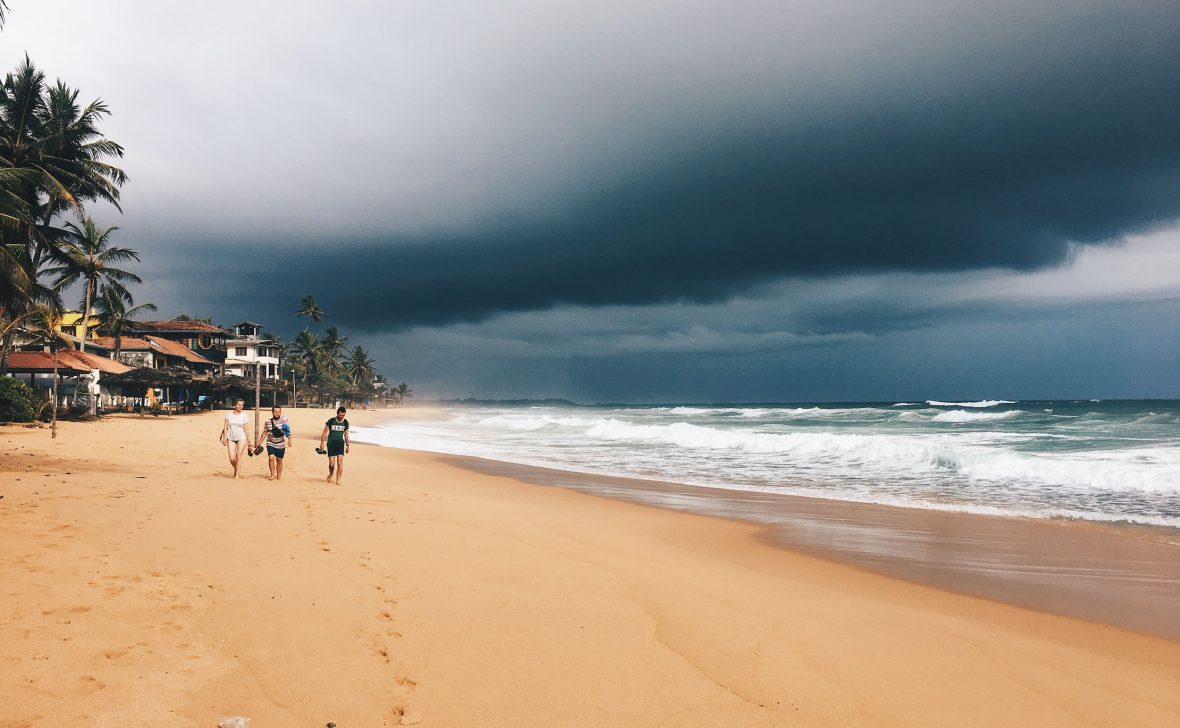
As we drive past the center of beach town Hikkaduwa, the rush hour buzz isn’t quite as buzzy as it used to be. Many breakfast shacks are closed for operation, and even the ones that are open have empty chairs outside. A few months ago, they’d be packed with travelers looking for a tomato, cheese and omelet roti served with lunu miris, a fiery onion relish. But the travelers aren’t here.
Prior to the Easter Sunday bombings, places like Hikkaduwa were full of tourists. Photo: Max Kukurudziak
The Easter Sunday bombings in April 2019 were a major blow to Sri Lanka’s tourism with traveler arrivals in May down 70 per cent compared to the previous year. A recent spate of media exposure—including being named as the world’s best island by Travel & Leisure—is helping improve the situation and the government has also taken several steps to boost tourism, such as free visas to visitors from 48 countries.
In July, over 100,000 foreigners visited the island, a healthy improvement from the 35,000 that visited in May. Nevertheless, it’s still a 50 per cent drop from the previous year.
I want to drive foreign travelers in my tuk-tuk,” says Nilani Priyangika. It will earn me a better income—there’s hardly anyone at the Galle Fort now.”
The 39-year-old single mother has been driving tuk-tuks for just a month—she took the job to offset the income she lost after the economic decline in the aftermath of the Easter Sunday attacks. I was an independent home-based tailor and had a contract with a few shops in Galle. But their business is low now, and they told me they no longer required me to work.”
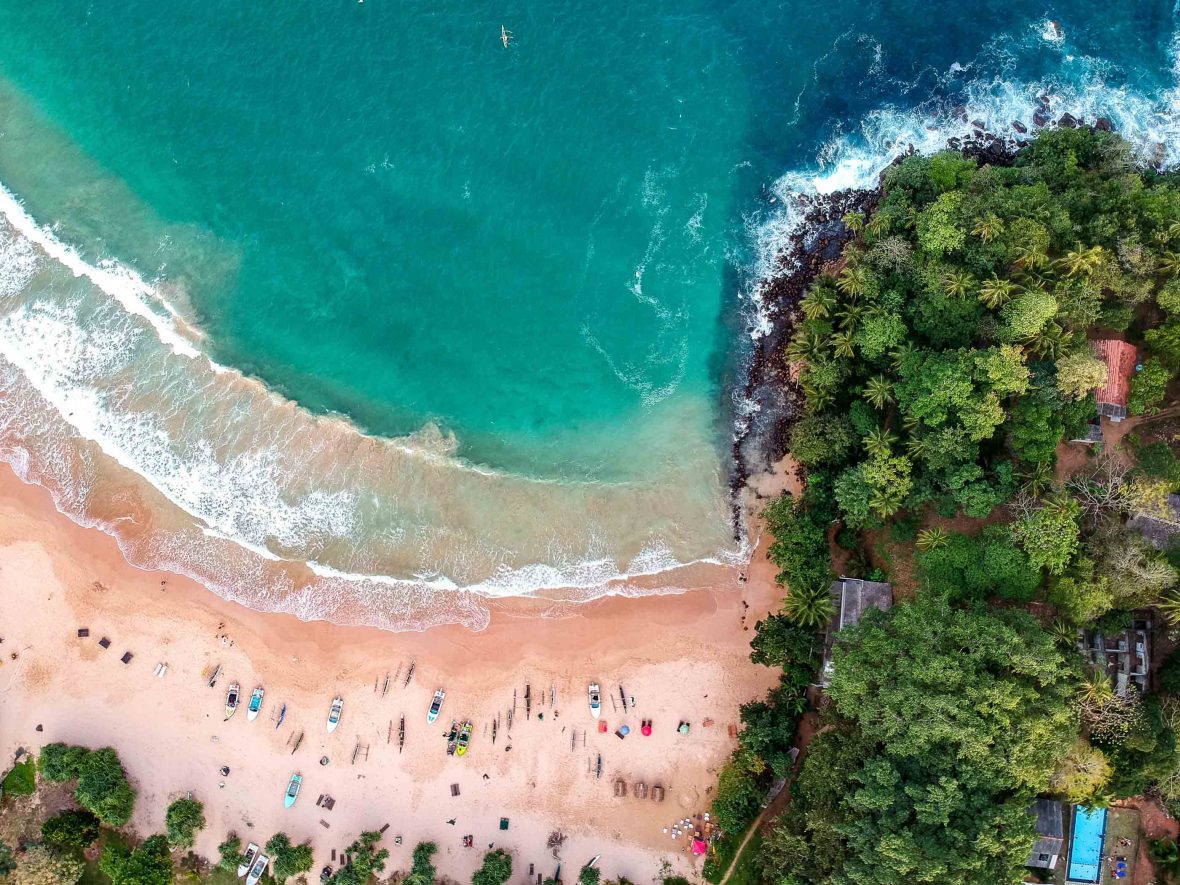
Initiatives by the government and being voted ‘world’s best island’ has helped boost tourism, but many people who previously benefited from the industry still need to supplement their income. Photo: Tomas Malik
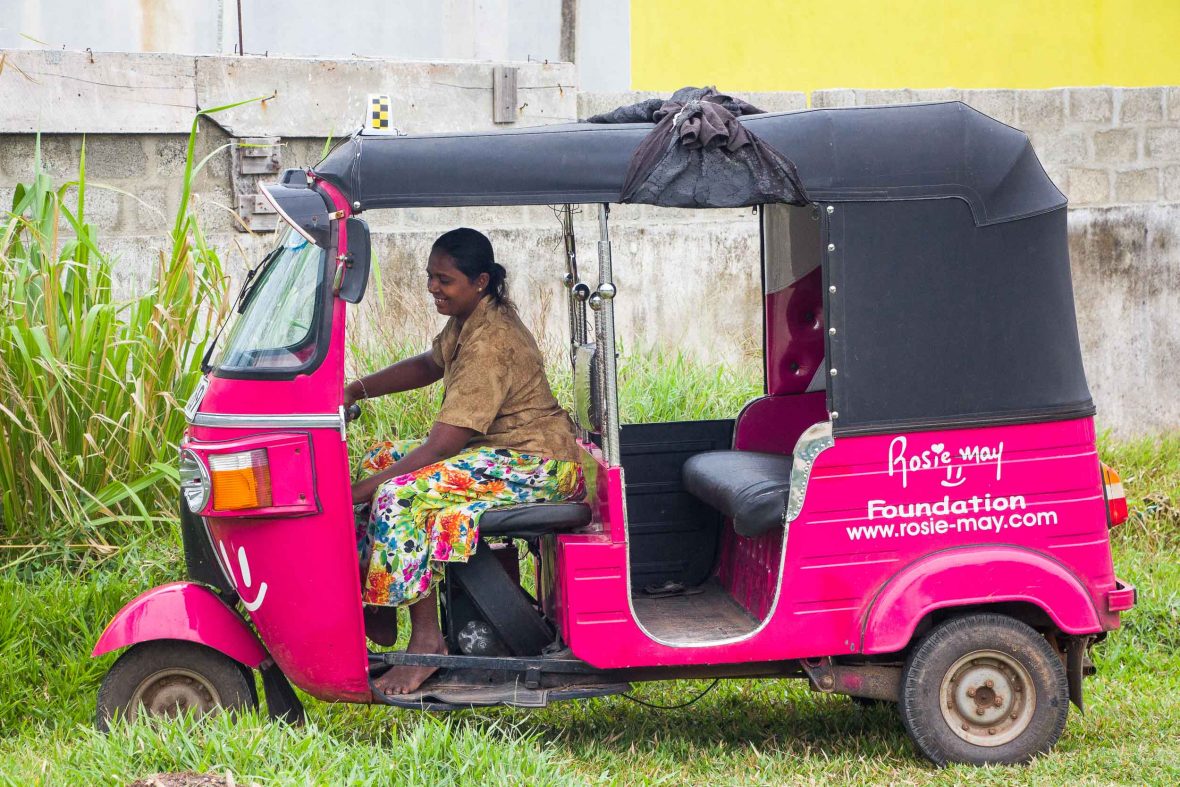
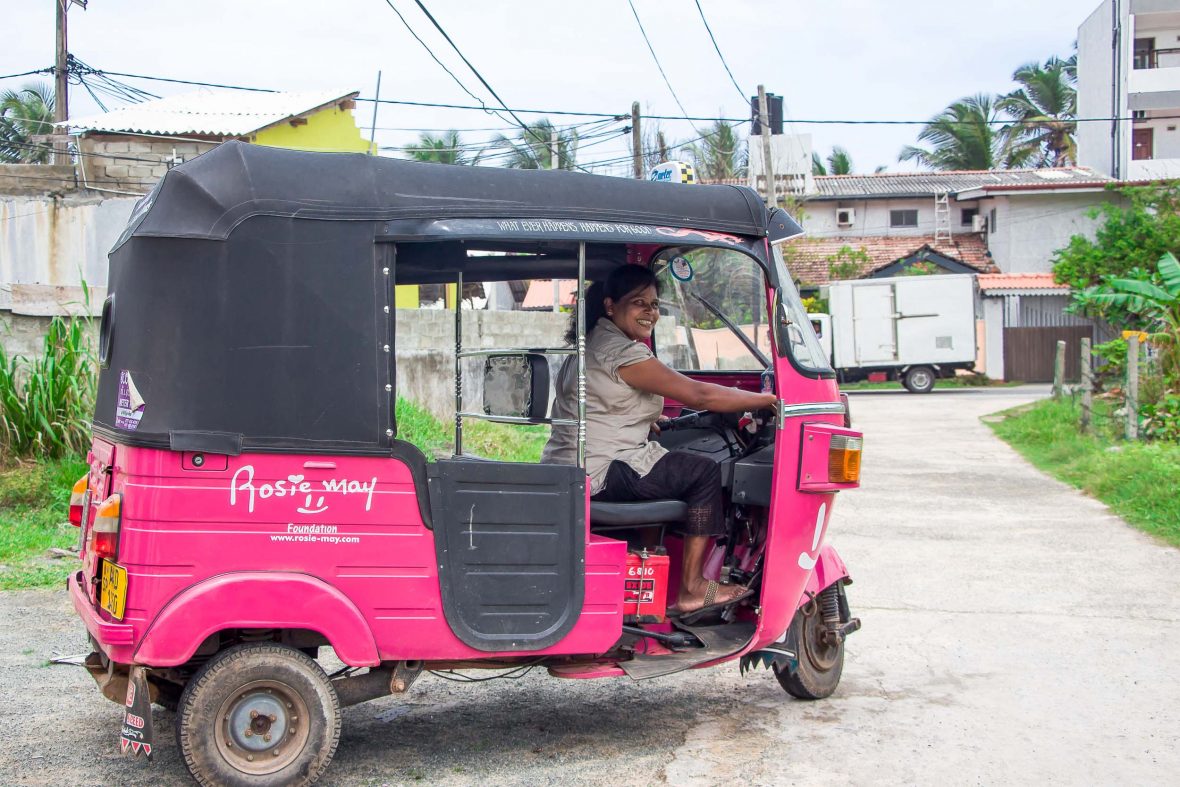
Nilani is part of the Think Pink Sri Lanka initiative, a women-only taxi service that was set up by the Rose May Foundation to help generate income for the women of Sri Lanka and Nepal. Now, as Nilani drives her tuk-tuk in the suburbs of Galle, southwestern Sri Lanka, she receives an income to sustain her family of three.
The foundation was set up by Mary and Graham Storrie, and named after their late daughter Rosie May, who was murdered at a Christmas party in Leicestershire, United Kingdom, in 2003. The organization’s aim is to protect, empower and educate at-risk children around the world.
I finally feel independent driving this tuk-tuk. As women, we shouldn’t be spending our lives within the four walls of our home.”
Jeganeshwaram
In her early 20s, Nilani lived in South Korea and worked in a junior-level record-keeping job, a job she loved and enjoyed”. But when she returned home for a visit, she discovered that her mother had already arranged her marriage with a man she didn’t know.
I couldn’t say no to my parents,” says Nilani as we talk at the Rosie May Foundation’s Sri Lanka office. A close-knit family structure and the socio-cultural norms in Sri Lanka expect daughters to be obedient to their parents—even when it comes to their choice of husband.
For Jega, her pink tuk-tuk has become her main source of income. Photo: Nathan Mahendra
A few years later, her husband abandoned her for another woman, and Nilani was left to raise her two sons on her own. If I talk about going back to work in South Korea or the Middle East, my eldest son begins to cry,” Nilani says. I’m both their mother and father.”
One of Nilani’s colleagues at Think Pink Sri Lanka, Jeganeshwaram, nicknamed Jega, shares a similar story. Her husband left her for another woman a decade ago, and the 42-year-old now raises her son on her own. I finally feel independent driving this tuk-tuk,” says Jega. As women, we shouldn’t be spending our lives within the four walls of our home.”
Tuk-tuks are a popular mode of transport in Sri Lanka, but a woman driver is still a rare sight—men comprise the vast majority of the 1.2 million auto-rickshaw drivers on the island.
Think Pink Sri Lanka is helping break these social norms. Jega, for example, has secured a number of regular customers, including a few families. She earns a healthy income to support her son’s education, and pay the monthly rent and fuel charges for the tuk-tuk. The rent goes towards the maintenance of the vehicle and paying off the training she initially received.
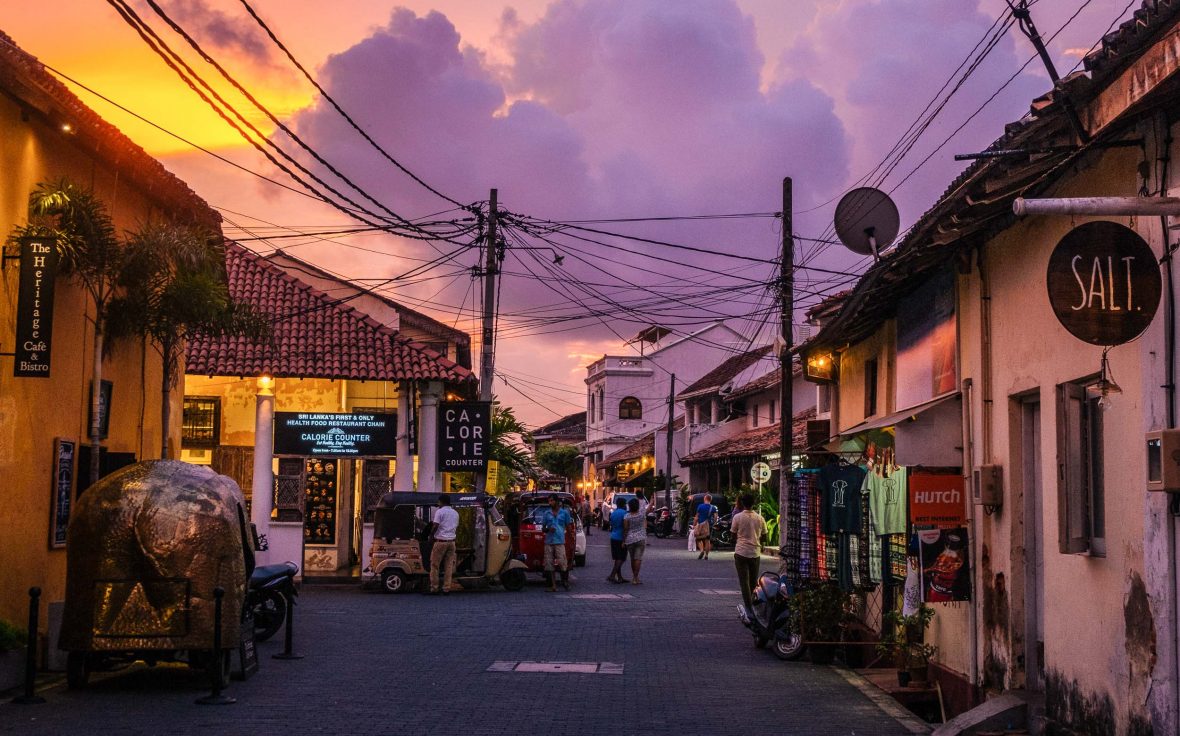
Sri Lankan society is typically dominated by males, and not all male tuk-tuk drivers are happy about having to compete with women for their fares. Photo: Chathura Inkika
There are currently five women driving their pink tuk-tuks on Sri Lanka’s southern roads, with four in training. We provide an intensive month-long training course for every driver,” says project manager Ramani Samarasinghe. In the first three months after their training, they don’t have to pay rent for their tuk-tuks. After that, we offer them a contract and renew it every six months.” A meter is hardwired to the tuk-tuk, which gives customers a lower price than what is usually being quoted by other tuk-tuks in the region.
Male drivers in the village do not like us driving tuk-tuks. They tease us when we drive, and one even asked me to lower my fares, and verbally harassed me for securing their hires.”
Jeganeshwaram
The United Nations Population Fund (UNFPA), reports that 90 per cent of Sri Lankan women are harassed on public transport and on the roads, and Think Pink’s drivers do not drive men or men in groups. Their customers comprise children, solo women and families. Mothers prefer to send their kids, especially daughters, with us over a male driver,” says Jega.
Deepika Priyadarshani drives her pink tuk-tuk to support her daughter’s education. Photo: Nathan Mahendra
While progress is being made, there’s still a long way to go in terms of the women of Think Pink being accepted in mainstream Sri Lankan society. Male drivers in the village do not like us driving tuk-tuks,” says Jega. They tease us when we drive, and one even asked me to lower my fares, and verbally harassed me for securing their hires.”
Ramani also tells me that a male driver asked her to stop the campaign because the men are losing their hires. Mothers feel it’s more trustworthy to send their kids with a female driver,” she says. We are women, driving for women.”
As Ramani and I talk, another driver pulls her pink tuk-tuk into the car park of the Rosie May Foundation office. When her husband died six years ago, Deepti Priyadarshani was left with no income. She worked many odd jobs, surviving on very little money.
I was a senior supervisor at a garment factory,” says the 53-year-old. I couldn’t work after my husband passed away—leaving my daughter alone at home wasn’t safe.”
As time passes, many in Sri Lanka’s tourism industry are looking forward to the tourists returning. Photo: Eddy Billard
Now, Deepti feels empowered by driving a tuk-tuk, which is still considered as man’s job. She uses her income to help support her daughter’s education, and supplements her wages by making tote bags and dresses for the volunteers who come to work at Rosie May.
Unfortunately, since the Easter Sunday attacks, those volunteer numbers have dipped along with the tourist numbers, and Deepti is still finding it difficult to make ends meet. Rosie May gave me a good income, but there aren’t many volunteers at the moment,” she says. It has become very hard to pay for my daughter’s A-Level tuition.”
Sri Lanka has always been favorite for travelers. And much of the country’s economy, both at the national and domestic level, is dependent on tourism. As time passes, there’s little doubt the tourists will return, and the women of the Think Pink Sri Lanka are looking forward to that day.
When tourism grows again, I hope I can talk to a few hotels and drive their guests in my tuk-tuk,” says Nilani, her eyes bright, wide and sparkling.
UNP Legal Secretary Nissanka Nanayakkara today said the candidate for the presidential election could be named only after the Election Commission notify the date to accept nominations for the election.
Mr. Nanayakkara issuing a statement said UNP’s constitution does not have provisions to name a candidate until such time election commission declares the presidential election.
Also, he said the candidate will be decided by a nomination board. The nomination Board will decide on the candidate and this decision will have to be ratified by the working committee of the party according to article 9(e) of the constitution,” he said.
This provision, he said, was introduced to the party’s constitution during the time of the late President J. R. Jayewardene.
Finance Minister Mangala Samaraweera, yesterday, said he saw nothing wrong in the conflict between two groups in the government over the presidential candidate to be named. He said so in response to a question, raised by The Island, at a hurriedly summoned press conference at the Finance Ministry.
Having compared the performance of the previous Rajapaksa administration (2005 Nov-2015 January) with the current dispensation, Samarawweera stressed that the economy was in a much better shape.
Asked by The Island why a section of the party felt the need to promote Deputy Leader of the UNP Sajith Premadasa as its presidential candidate at a time the situation was improving further primarily thanks to two key projects-Gamperaliya and Enterprise Sri Lanka as
claimed by the Finance Minister, an irate Samaraweera alleged a section of the media had what he called a slave mentality. Minister Samaraweera said that they were used to living in a country run by dictatorial rulers.
Having compared the internal battles for top leadership in political parties in the US and the UK with that of the situation in Sri Lanka, Minister Samaraweera said that there were several persons seeking nominations from the party to contest the presidential election. “There were no restrictions,” lawmaker Samaraweera said, describing the UNP as a modern democratic party.
The Minister said that discussion/disagreement among members of the UNP in this regard shouldn’t be considered a weakness under any circumstances.
Samaraweera declared that the country was now enjoying what he called seven-star democracy.
Responding to questions regarding UNP Secretary Akila Viraj Kariyawasam demanding explanation from State Ministers, Sujeewa Senasinghe and Ajith P. Perera for throwing their weight behind Premadasa, Minister Samaraweera initially questioned the veracity of the reports to that effect. When the media said that they had copies of Kariyawasam’s letters sent to Senasinghe and Perera, Minister Samaraweera said that no single individual could decide on disciplinary action and would be the prerogative of the decision making Working Committee.
The Matara District MP said that their party followed democratic principles and there weren’t slaves in the UNP.
Referring to a recent media reports, Minister Samaraweera pointed out that even Minister Daya Gamage was ready to take the presidential challenge.
When asked to reveal his position on those vying for nominations, Minister Samarawera declared Sajith Premadasa as the main contender on the basis that two-thirds of the UNP parliamentary group backed him (Premadasa)
Both Finance Minister Samaraweera and State Minister Eran Wickremaratne dismissed a spate of media questions regarding deepening political instability and chaos in the run-up to 2019 presidential election. State Minister Wickremaratne said that the government would definitely complete its full term.
Commenting on the progress in post-Easter Sunday recovery process, Minister Samaraweera said Sri Lanka had made much faster progress than some other countries affected by terrorist attacks.
Asked to comment on critical US statement on the appointment of newly promoted Lt. Gen. Shavendra Silva as the Commander of the Army Minister Samaraweera said that the UNF government was committed to assurances given to the international community as regards accountability issues.
Samaraweera reiterated the UNP’s strong commitment to the signing of an agreement with the US government’s Millennium Challenge Corporation (MCC) on a large scale five-year project meant to promote what the minister called inclusive economic growth.
The Minister said that he was in touch with the MCC. Describing the US readiness to accommodate Sri Lanka in the MCC project as a unique victory for the country, Minister Samaraweera claimed that originally the agreement was to be finalized in early 2004 during Ranil Wickremesinghe tenure as the Premier.
Claiming that following the change of government, the then President Mahinda Rajapaksa, too, had sought to finalize the MCC project, Minister Samaraweera said that the US had discontinued it in the wake extra judicial operations undertaken by that administration. Samaraweera acknowledged that he functioned as the foreign minister of that administration.
Samaraweera said that under the direction of Prime Minister Ranil Wickremesinghe he had resumed talks with the US in that regard following the change of government in 2015 January.
The move to finalise the MCC agreement on Dec 17, 2018 was disrupted due to the constitutional coup perpetrated in late Oct 2018. However by January 2019, the MCC project had been back on track, Minister Samaraweera said, acknowledging the absence of consensus between the UNP and President Maithripala Sirisena regarding the MCC compact.
Declaring that Sri Lanka should enter into the agreement with the US worth USD 480 mn, Minister Samaraweera vowed that it would be finalized by the new UNP government.
An agreement to sign a Memorandum of Understanding (MoU) has been reached between the two parties during the official meeting between the Sri Lanka Freedom Party (SLFP) and the Presidential candidate of the Sri Lanka Podujana Peramuna Gotabaya Rajapaksa.
The official talks between Gotabaya Rajapaksa and SLFP commenced at the official residence of the former Defense Secretary, this afternoon (29).
The meeting was attended by the General Secretary of SLFP MP Dayasiri Jayasekara, General Secretary of the United People’s Freedom Alliance (UPFA) MP Mahinda Amaraweera and SLFP Treasurer Lasantha Alagiyawanna.
At the meeting, the SLFP and UPFA representatives have agreed to sign an MoU with Rajapaksa on support for the presidential election.
Gotabhaya Rajapaksa has also drawn his attention to the proposals made by the SLFP to form an alliance.
SLFP representatives said they received a favorable response from Gotabhaya Rajapaksa.
However, it has also been agreed that certain points should be discussed again
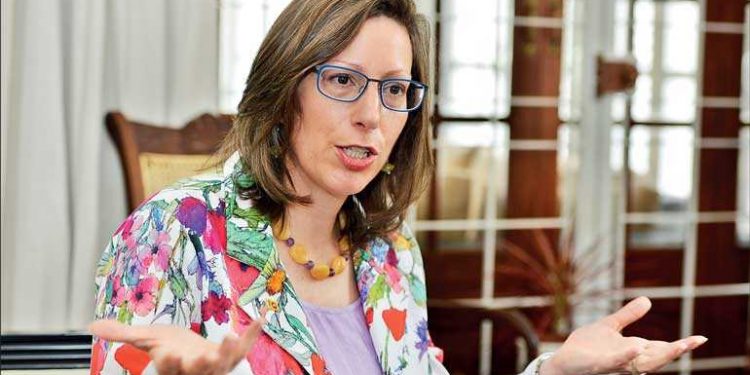
The Western World seems obsessed with the promotion of Lt. General Shavendra Silva as the Commander of the Sri Lanka Army. The US Ambassador here, Aliana Teplitz, came with the first charge against him, regarding allegations of gross human rights violations documented by the United Nations and other organizations that are serious and credible.
There is one thing that Ambassador Teplitz and the others from the UN, Canada and the EU too, must know. They are referring to ‘allegations’ against him, with no proof of guilt.
One hopes that these loud voices on behalf of justice and human rights know one simple reality with regard to the functioning of justice. Accusations and allegations are not proof of guilt. There have been many in this world against whom serious and grave allegations have been made, but who have been found not guilty of such offences.
The powers of the West are certainly free to make allegations, echoed by Ambassadors such as Aliana Teplitz. But, we here have much more stuff about leaders such as Donald Trump himself – that show their utter contempt and gross violations of human rights, to make the world shudder at what such action does to human decency.
Does the US Ambassador not know that President Trump unveiled new rules this week allowing the US authorities to detain immigrant families indefinitely, while asylum cases are judged. Does she not know of the many protests taking place among US citizens on detained children of asylum seekers being separated from their parents, and how much pain this is to both parents and children? This is certainly a glaring violation of Human Rights. It is against the very spirit of humanity. It is not an accusation or allegation – it is the naked truth known by protesting American citizens.
Does Ambassador Teplitz not know about the recent mass shooting this month at the Walmart store at El Paso, Texas, where 22 people were killed? Does she not know that the target of this killer were Hispanics? Does she also not know that this killer had posted a personal blog piece, just before the shooting, which virtually quoted President Trump about the ‘invasion’ by Hispanic asylum seeking immigrants? This is a reality of the respect for Human Rights and humanity itself by the US authorities.
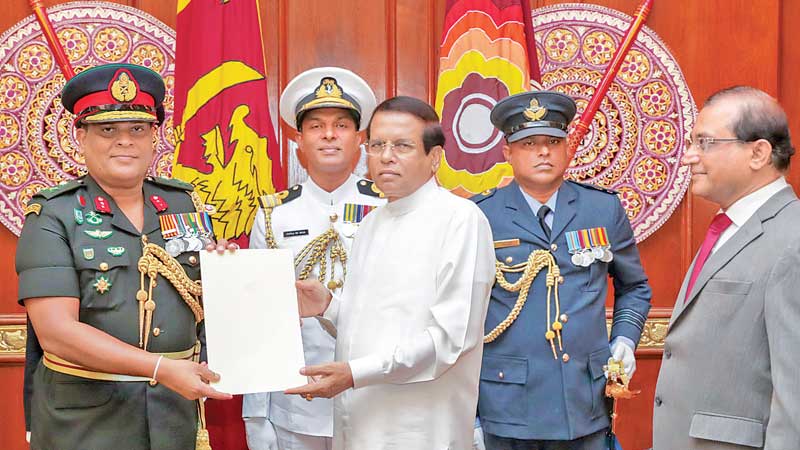
Gen.Shavendra Silva getting his appointment letter as Army Chief from President Maithripala Sirisena
The US Ambassador and others who are shouting loud about Army Commander Shavendra Silva should take their minds back to the killing of Saudi Arabian journalist, Jamal Khashoggi, then doing a column for The Washington Post, who was killed in Turkey by agents sent by the Saudi Crown Prince Mohammed bin Salman, who is strongly supported by President Donald Trump. Has the US State Department taken any action to cut down or reduce the arms sales to Saudi Arabia from the US, which President Trump boasts about?
Does the US Ambassador know nothing about all the deaths taking place in Yemen, with the Saudi-led alliance attacking the rebel forces in Yemen, and the humanitarian catastrophe caused by all the US arms supplied to Saudi Arabia?
What does the US Ambassador, who feels so bad about allegations and accusations against Gen. Shavendra Silva, know about the huge Human Rights violations by the US and the Trump Administration about Palestine and the Palestinian people. Does she not know how the cutting of US aid to the humanitarian project serving the Palestinian people, including education to Palestinian students has been a huge set back to humanitarian services there. Does she and the State Department she comes from know nothing about the gross violations of UN agreements about the Golan Heights which Trump supported acquisition by Israel? And also the violation of international agreements about the city of Jerusalem, in a possible two state solution sometime in the future?
The US Embassy in Colombo and its Ambassador must certainly be enjoying the divine links to President Donald Trump that were announced by none other than himself earlier this week.
What would a decent world think of his recent threat to release European ISIS prisoners back into their own countries?
Referring to his trade war with China, he suggests having the backing of a ‘higher power”, with suggestions of the deity: Looking up to the sky, with his palms open, and declaring: I am the chosen one!” Adding that: Somebody had to do it. So I am taking on China. I’m taking on China on trade. And you know what? We’re winning.”
So God is with this leader! And how would Christians, who are not some Evangelicals think of this? Is he to be an accused in the Divine Court of Justice? Will there be allegations of him trying to grab the powers of Divinity?
Ambassador Teplitz represents a country that is led by a President who has described many African countries as ‘shitholes”. She must remain glad in being a representative of such forces of human disgrace.
General Shavendra Silva remains the Army Commander of Sri Lanka. Yes, he is an accused person, but not found guilty; Very different to the US President Trump whose crookedness stands out as facts beyond the courts of decency, and now beyond the judgement of deities too.
The Sri Lankan government Tuesday inked an agreement with two energy companies from Norway and France to carry out a two-year oil and gas exploration exercise in the Eastern sea basin.
The tripartite agreement between the Government of Sri Lanka, France’s Total EP and Norway’s Equinor ASA for the exploration of oil and natural gas in the Ceylon Basin off the eastern coast was signed in Colombo.
Minister of Highways & Road Development and Petroleum Resources Development Kabir Hashim and officials of Total and Equinor signed the agreement at the Ministry.
The agreement will cover oil and gas exploration in two blocks identified as J5 and J6 in the eastern offshore region.
Speaking at the event Minister Hashim said Sri Lanka will be made an oil and natural gas producer by 2022. He said Sri Lanka has entered into a study agreement with Total and Equinor to explore two blocks JS-5 and JS-6, signed in 2016, for oil and natural gas.
Total has already surveyed 50,000 square kilometers on the East coast as part of a previous study and Equinor will have a 30 percent stake in the exploration as per the new agreement, according to the Minister. The Minister said the studies done so far and data from a previous seismic survey have reported very positive results that the JS-5 and JS-6 blocks have significant potential.
He said once the exploration work is completed, the next target is the production and distribution of oil or natural gas that was discovered and the government hopes to discuss with the two companies and going forward enter into an agreement for production and distribution.
The Minister said he believes that if the explorations were started next year, Sri Lanka will be a natural gas or oil producer by 2022.
When I noted the news item today about the participation of the Prime Minister of Sri Lanka in a Conference in Male. I thought of making the Prime Minister Aware that the ROAD MAP to develop BLUE ECONOMY should be one of the subjects to he should talk about at the event
Details below may be useful to the consultants to prepare a speech for the Prone Minister to highlight the necessity to develop BLUE ECONOMY in the Indian Ocean with active participation by India, Pakistan, Maldives and Seychelles Government (including the aspirants to become the President of Sri Lanka) is only talking about National Security, housing, agriculture and developing livestock, inland aquaculture, etc.
Does it seem that the concept of BLUE ECONOMY based on harnessing vast resources in the ocean surrounding our country is neglected?
As an example, emerging concept of the Blue Economy has been embraced by the Government of Seychelles and some other Caribbean Islands as a mechanism to realize sustainable economic development based, around an ocean-based economy.
The intention of these islands supported by Commonwealth is to implement the Blue Economy- concept at the national level as a framework to foster an integrated approach for sustainable development programmes.
This
is predominately so, as information that does exist focuses primarily on
land-based economic development or has a strong focus on conservation rather
than on the sustainable use of the investment in an ocean-based economy for
national benefit.
This roadmap will necessarily require the definition of short, medium and long-term actions across a broad range of sectors and will also require fundamental changes to the traditional institutional arrangements that exist to support the management of marine sectors and resources in Sri Lanka
A coordinated Government – approach will be a necessary condition for the successful implementation of the Blue Economy.
Sri Lankan Government in collaboration with other
neighbouring countriesshould establish a dedicated
agency to oversee completion and implementation for the Blue Economy
Roadmap.
However, while Sri Lanka and the Maldives have the existing capacity for some key sectors of the Blue Economy (e.g. fisheries and Nautical Tourism), it lacks the overarching policy and strategic expertise required to make this transition effectively.
As such, the Governments of Sri Lanka and the Maldives should seek the assistance of the Commonwealth Secretariat and the World Bank or ADB with the provision of a long-term in-country technical expert to assist the Governments to complete this transition effectively. In addition, up to two additional technical experts may be required on a short-term basis (6 months) to undertake specific technical activities that are expected to arise as the project progresses.
Goal
The project aims to assist the Government of Sri Lanka in developing and implementing a National Blue Economy Roadmap, the purpose being to establish a broad direction for future investment in and development of a sustainable ocean-based economy in our country.
The purpose of the specific request for long-term (and shorter-term) technical adviser(s), is to assist the Government of Sri Lanka to review, validate and implement the Roadmap and more importantly, to support Sri Lanka in its transition to a more integrated ocean-based economy.
Question is whether newly appointed Technocrats have any idea about the Blue Economy?
As an example a recent visit by Japanese Delegation initiated by the Prime Ministry’s office consisting of private companies has expressed willingness, to develop Fishery Industry.
Unfortunately, some advisors in the PM’s office are only promoting the implementation of Ice making Plants on Land to conserve fish caught in the deep ocean.
What our so-called experts have failed to understand is that 70% of the fish brought onshore is rotten because Sri Lanka has not developed a Mother Vessel Concept to collect fish as soon as they are caught, preserve them until they reach the shore.
Fishermen using Multiday fishing Vessels go to Ocean carrying few tons of Ice blocks to preserve fish. By the time they return after almost three weeks, ice is melted and fish is not even good for making Dry Fish!
Almost
all big fish you find in the market is not good for Human Consumption
When this delegation was taken to Dikovita Harbour (a grandiose western-style harbour facility built with foreign funding) during wee hours of the day by my team, they were aghast and disgusted to note that the fish unloaded in the morning by fishermen is not suitable for Human Consumption!
One polite young Japanese Lady murmured to us and asked: Is this fish for dogs or for making chicken feed?”
I took the liberty of calling PMs’ office and explained that the installation of Hybrid Ice Making plants of Japanese Technology on land is not what we need at this stage
We
need MOTHER VESSELS to be anchored in the Ocean with
Seawater Ice making Plants to collect the fish rather than waiting for
three weeks
Mother vessels are Stationery Self sustained ISLANDS in the ocean which cannot only provide Ice but Fuel and. Emergency Assistance to multi-day fishing vessels of 40 to 55 feet which hardly have Ice Making Plants on Board ( They do not even have generators on board but use batteries for night lights !) Impact
The
successful and sustainable implementation of the Blue Economy Strategic Roadmap
will ultimately deliver the following outcomes:
· Ocean
ecosystems and biodiversity recovered and protected.
· Increased
investment in existing ocean-based economic sectors including Nautical
Tourism
· New data and knowledge on the Sri Lankan ocean space available.
· marine-based aquaculture sector and marine biotechnology products and processes developed and implemented.
· Protective measures and greater use of surveillance and enforcement tools provide greater protection.
· Fisheries
and aquaculture management improved through equitable, non-subsidized and
sustainable practices.
· Utilization
of renewable energy from the ocean, ( i,e Harnessing Wave energy )
· Surveillance
of offshore waters strengthened through enhanced maritime domain awareness and
law enforcement. (The above is expected to contribute to the goals of the
Government of Sri Lanka
· Capacity
built and new research/data sectors developed.)
· Streamlined
implementation with an overarching system in place.
.
A broad range of relevant stakeholders and citizens will ultimately benefit from this intervention, including existing marine industry sectors, marine user groups, and local communities.
Outputs
Implementation of the accelerated blue economy program (like Mahaweli for Farmers)
· Comprehensive and strategic advice provided to the Minister and relevant stakeholders including the private Sector responsible for the Blue Economy.
· Relevant documentation e.g. policy papers, project management documents, project status, and evaluation documents prepared and submitted.
· Review
of the current Roadmap ( if any) including additional
improvement/amendments in the content leading to the validation of the Road
Map.
· Stakeholder
engagement and consultation facilitated as required, including the
establishment of stakeholder bodies.
· Strategies, focus areas, and projects for implementation of the Blue Economy Roadmap identified, approved and implemented.
· Resources
(financial, human capacity and technical) necessary to execute projects for
implementation of the Blue Economy Roadmap, identify, solicited and secured.
· Strategic partnerships between Sri Lanka and our neighbours such as the Maldives. India and Seychelles and relevant partners including, but not limited to: development agencies, private sector organizations, and marine research institutes, established and maintained.
· Consistent implementation of the Roadmap across government and its respective agencies, in particular, working closely with the Sri Lankan Ministry of Fisheries, Ministry of Environment, Ministry of Power and Energy and Ministry of Finance.
Blue
Economy roadmap and policy for Sri |Lanka should be promoted domestically,
regionally and internationally.
President Maithripala Sirisena has given instructions to the relevant authorities to expedite the investigations regarding the allegations of Central Bank bond scam.
The President further advised to promptly conduct investigations and to take actions against the wrongdoers and said that the delay in conducting investigations is a hindrance to deliver justice.
He made these remarks during a meeting held with the members of the Commission to Investigate Bond Scam and other officials at the President’s Office, today (28).
During this meeting it was revealed that at present 04 interim reports have been received and the remaining reports could be present in this December.
The officials pointed out that even though they have requested banks to provide documents for the last five years relating to money laundering, still banks had not provided this information and due to this, a difficulty has occurred to conduct further investigations.
The Attorney General’s Department has stated that cases have been filed against the defendants under the Penal Code considering those crimes as criminal offenses.
It was also stated that those evidences will be presented through affidavits before this December.
President Sirisena further said that to expedite this investigation, he will provide maximum support.
Secretary to the Ministry of Finance Dr. R.H.S. Samaratunga, the Governor of the Central Bank Dr. Indrajit Coomaraswamy, officials from the Attorney General’s Department, the acting Inspector General of Police, C. D. Wickremaratne, senior police officers and others participated in this meeting.
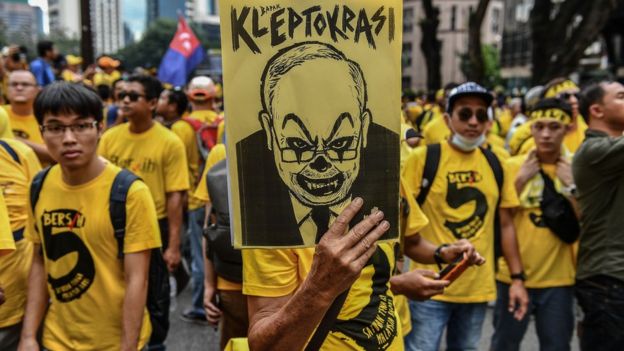
Media captionFormer Malaysian PM Najib Razak smiles as he arrives in court
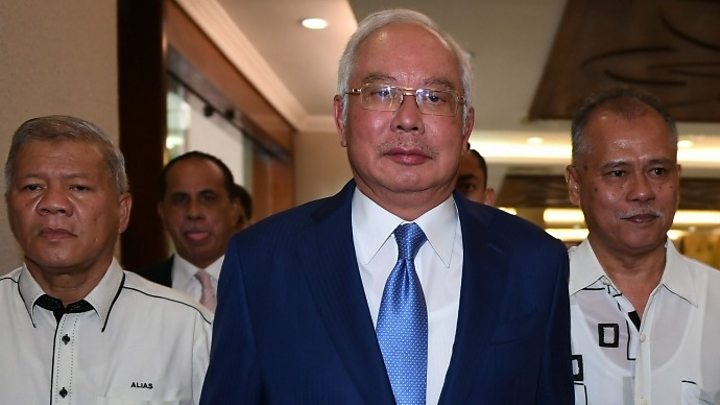
Former Malaysian Prime Minister Najib Razak has gone on trial again over an alleged multibillion-dollar fraud involving a government fund.
Mr Najib is facing several trials over the state investment fund 1MDB – this is the most significant covering 21 counts of money-laundering and four of abuse of power.
Prosecutors say he received and covered up illegal transfers of at least $550m (£448m) between 2011 and 2014.
Opening the trial on Wednesday, prosecutor Gopal Sri Ram accused Mr Najib of being a key player in the scandal.
“His objective was to enrich himself,” the prosecutor said, outlining how the money was allegedly funnelled to the former prime minister.
Image captionThe corruption allegations played a big part in Mr Najib’s 2018 election defeat
Mr Najib was cleared of all wrongdoing by Malaysian authorities while he was prime minister.
Nonetheless, the corruption allegations played a big part in his historic election defeat in 2018 – and the new government swiftly reopened investigations into 1MDB.
Mr Najib’s wife, Rosmah Mansor, is facing charges of money-laundering and tax evasion, to which she has pleaded not guilty.
No
amount of promises to guard Sri Lanka’s sovereignty can hold water if at
legislative & policy level changes are being drafted to suit a neo-liberal
agenda that aspires to transfer all state assets to foreign corporate hands and
turn locals to virtual slave citizens. This is the threat that Sri Lanka’s
politicians need to understand and identify. Sri Lanka cannot be a sovereign
nation if its wealth, natural resources, economic activities (ports, airports,
railways, roads etc) are controlled by foreign entities who decide what Sri
Lanka’s citizens get, at what price & in what quantity/quality and removes
any role of politicians at some point or the other. The changes being done is
to turn the State from protecting the People and National Assets/Resources to
protecting the Corporates & Countries that will soon own or control a
country’s people & resources. The ‘government’ will not be defending the
citizens but dominating/subjugating them.
Undeniably
the neo-conservative/liberal agenda is pro-West in particular pro-US hegemony
Their
agenda is based on perception that Africans & Asians are inferior to
Americans/Europeans. Concept of colonial White-Man’s Burden now masked as
neo-colonial liberalism. The kalu-suddas are accepted into ‘their’ society so
long as they can deliver what the white man demands of them. They are just paid
‘coolies’.
‘Civilizing’
is done via UN/INGO programs like ‘Responsibility to Protect’ ‘Reconciliation’
‘Multiculturalism’ etc.
People
are kept in check using mass surveillance, mass incarceration, open ended
warfare, debt curtailing their privacy on excuse of protecting citizens.
Think
tanks, media, paid journalists, civil society stooges are all tasked to
brainwash citizens with sugar-coated opinion to believe these entities are
working in our best interests.
Political sovereignty undermined
The
UNHRC resolutions was used to force Sri Lanka to make unfair & legally
questionable changes to penal code, constitution and demonize and weaken its
military and demoralize by allegations and imprisonment. Placed within this
context we wonder whether the Salawa ammunition storage was accidental?
Economic sovereignty undermined
Sri
Lanka’s policy is now controlled by US officials, IMF, World Bank, Western Aid
agencies, Western-corporate-backed think tanks, transnational corporations,
foreign financial firms, foreign consultancies and foreign legal experts,
foreign accountancy firms. This is the reality we will have to face.
They
have identified and mastered the art of manipulating the biggest weakness in
politicians to the detriment of the Nation & its people.
Sri
Lanka’s labor, wealth, natural resources, public institutions, State enterprises,
public utilities are being auctioned to foreigners by foreigners who have been
invited to do so by the State (perhaps the State is even paying these
foreigners for their ‘consultations’)
Privatization
Is
privatization a solution? State enterprises privatized between 1980-2009 had
performed worse than public enterprises. European cities are now reclaiming
public services from private sector.
A
2015 UNDP study declared there was no set model for efficiency – that meant
public, private or mixed enterprise model was no solution. How an entity was
managed efficiently and effectively was what mattered.
Neo-liberal Project
Originates
in the secret Mont Pelerin Society founded by Friedrich von Hayk & Milton
Friedman & Allan Waters in 1947. Hayek’s vision was outlined in his book
The Road to Serfdom in 1944. The book advocates
Elimination
constitutional nation-State & replaced with a supra National World
Government
Expanding US
hegemony beyond US & across international borders (free cross border
movement of goods, people and money)
States will not
be able to decide price of goods
States will have
no independent national legislation
States will have
no control over taxation
State will have
no power over its economy (deregulation & liberalization are all modus
operandi to achieve this goal)
State will not
control its national produce, national resources, national workforce, national
currency
Friedman
became Economic Advisor to US President Reagan, Waters was Chief Economic
Advisor to UK PM Margaret Thatcher. You can imagine the influence they would
have had on the leaders!
How Think Tanks / Universities &
Media are used to control the world
The
oligarchs have dumped millions into setting up think tanks, business schools, influencing
economic subject in universities to promoting neoliberal thinking – Heritage
Foundation, Hoover Institute, CATO Institute, American Enterprise Institute,
Centre for Policy Studies, Institute of Economic Affairs, Adam Smith Institute
(UK), Soros Foundation are just a handful of names.
These
entities are tasked to mask the real intent in language & ideas and present
as if the program is for the betterment of society.
Chile
became the launch pad for the 1st neoliberal program after
installing Pinochet with US backing. Mont Pelerin rolled out the project –
anyone who disagreed got shot! That was neoliberal democracy! IMF & World
Bank got their way. That was neoliberal economic transparency!
Media
was owned by the billionaires who owned & funded the think tanks and
universities. Media frames language to fool the masses on behalf of the secret
societies that rule them.
Shaping economic
policies by infiltrating their stooges into govt positions & controlling
the govt & its laws (placing policy planning network of advisors created
from the think tanks & business schools & paid media into government)
‘Experts’ creating
proposals that are in rosy language, gullible and are promoted by their
‘agents’ in media, journalists, social leaders/activists, political ‘analysts’,
business speakers etc – all who have a way of influencing the politicians &
their advisors
Holding fancy
conferences & seminars with full publicity with glitz and glamour to
present the notion to public that their proposals are best – note recent
seminar on MCC wherein moderator himself claims Sri Lanka was rejecting a gift horse!
Shifting power
from Public Institutions to Global Economic Institutes (statistics show how
wealth, resources, power of the Public has been transferred to foreign
corporates or local entities influenced or funded by foreign corporates) where national sovereignty is undermined by
corrupting politicians and claiming corrupt politicians and political system
must be replaced…
Oh yes, are we to replace corrupt
politicians with the entities that corrupted them so that they could be
eliminated and in place a system change of global transcorporate government
would be replaced?
Mont Pelerin Society Sri Lanka Members
PM Ranil
Prof.
Razeen Sally
Prof. Suri
Ratnapala
Atlas Network – Advocata Sri Lanka is a member
Is
part of US foreign policy and plays key role in destabilizing and regime
change.
Atlas
Network through its associate think tanks and NGOs discretely funded by US
State Dept and National Endowment for Democracy succeeded in
military coup
against Manuel Zelaya in Honduras,
toppling
Cristine Kirchner of Argentina using ‘corruption’ theme
supported
military against President Chavez in 2002
diverting public
anger against leading politicians in Brazil (similar to Sri Lanka)
The
connections are obvious – Dr. Judy Shelton, senior fellow at Atlas Network is
also advisor to President Trump & she chairs the NED.
Atlas
Network is mostly funded by Koch Foundation,
ExxonMobil, MasterCard, John Templeton, Donors Trust, and the American
government. In February 2019, Atlas via its associate Advocata held the Asia
Liberty Forum.
Is it a surprise that Atlas
Network wanted to repeal law that made voting compulsory & withdraw funding
to trade unions because people could ‘participate’ via FB, whatsap (free wifi
was obviously a ruse to subtly remove entities that were challenging oligarchs
with people’s support)
The effort to remove people’s
representatives and hand over governance and asset/wealth control into private
parties can be seen by the power some companies wield worldwide.
25 companies make more money than GDPs
of these 25 countries
Spotify
(Mauritania), Netflix (Malta), Tesla (Albania), Visa (Bosnia), El Corte Inglés
(Libya), Starbucks (Trinidad & Tobago), McDonalds (New Guinea), Mercadona
(Nepal), BBCA (Estonia), Inditex (Paraguay), Walt Disney (Bulgaria), Banco
Santander (Panama), Telefónica (Luxembourg), Johnson & Johnson (Ethiopia),
Microsoft (Slovakia), Nike (Cameroon), Coca Cola (Bolivia), Iberdrola (Ivory
Coast), Facebook (Serbia), Repsol (Lebanon), Alphabet, Google’s parent company
(Puerto Rico), Amazon (Kuwait), Apple (Portugal), Volkswagen (Chile), Walmart
(Belgium)
ICBC
(China) HSBC, Deutsch Bank, Credit Agricole Group, BNP Paribas, Mitsubishi,
Barclays, JP Morgan Chase, China Construction Bank Corp, Japan Post Bank
operate in just 6 countries and have a combined wealth of $21.1trillion –
enough to fund the US Govt for 7 years.
Companies
are becoming richer than countries and taking ownership of resources in
countries.
How
are companies taking ownership of resources in countries?
Influencing
political affairs of sovereign states indirectly through their governments or
NGOs or indirectly by employing government officials & getting
participating in national policy committees as well as making political
contributions and at times even bribing
UK/US
overthrew democratically elected Iran’s leader Mossadegh because he
nationalized oil and it affected US/UK oil companies, the United Fruit Company
and its exploitations in Latin America with US government assistance is another
example.
Advocata Institute
(part of Atlas Network founded by Mont
Pelerin Society member Anthony Fisher) – neoliberal think tank promoting free
market reforms.
Advocata
is also connected to both Mont Pelerin Society & US administration.
Advocata
Board Member Frank Lavin
Chairman
of Public Affairs Practice for Edelman Asia Pacific on behalf of companies
facing issues with various foreign governments
2005-2007
US Under Secretary for International Trade at US Dept of Commerce
2001-2005
US ambassador to Singapore (negotiated landmark US-Singapore FTA)
1987-1989
Director of the Office of Political Affairs in White House
Worked
in Hong Kong, Singapore for Cushman & Wakefield
Worked
for Bank of America & Citibank
Worked
for George Bush Snr & Ronald Reagan in the Dept of Commerce, Dept of State,
National Security Council & White House
Serves
on the Board of Directors of Globe Specialty Metals (worlds largest producer of
silicon metal alloys) Consistel (largest telecommunications firm in SouthEast
Asia), UOB Bank (Singapore), UTEX (Texas energy services firm)
Atlas
Network has been financing a variety of organizations that seek to influence
the public and promote capitalist ideas.
The
Asia Liberty Forum was co-hosted by the Advocata Institute and Atlas Network in
February 2019. Speakers were Dr. Nishan de Mel (Executive Director, Verite
Research) Ravi Ratnasabapathy (Resident Fellow, Advocata Institute), Suresh
Shah (Director, Carson Cumberbatch PLC), Thilan Wijesinghe (Chairman, National
Agency for PPPs) and Dr. Malathy Knight (Senior Economist).
Institute for Policy
Studies
Sri Lanka’s Economic Policy Think-Tank
established by Act of Parliament in 1988
Executive
Director – Dushni Weerakoon / Chairman Prof. Razeen Salley
How far
IPS is under influence of foreign funded think-tanks and foreign control can be
seen & questions how ‘independent’ these ‘government’ bodies are. What is
the point in a government think tank being ‘independent’ from government
institutions but dependent on western governments and donors for their funding?
How
‘independent’ is IPS if it is co-financed by the Dutch Govt & run by a
Resident Coordinator from Dutch Institute for Social Studies? DISS is funded by
the Dutch Govt to train intellectuals and policy makers from former Dutch
colonies!
How
‘independent’ is IPS’s OWN ‘Endowment Fund’ if Sri Lankan state does not know
its funding sources?
How
‘autonomous’ is IPS, Sri Lanka’s supposed to be economic think tank if its
donors are UK,, US Corporations, banks & equity funds (Hewlett
Foundation/Bill and Melinda Gates Foundation), Netherlands, Canada and Norway?
They do not give money free without some agenda!
IPS is
directly connected to Mont Pelerin Society via its member Prof. Razeen Salley
who is now IPS Chairman. Sally is Adjunct scholar of Cato Institute a
neoliberal think tank, he is founder director of Cato-related European Centre
for International Political Economy a neoconservative entity linked to CIA
connected Brookings Institution.
IPS
drafted Vision 2025 and organized the Sri Lanka Economic Forum in 2016 that
invited George Soros ‘colour revolution architect & his Open Society
Foundation to Sri Lanka. At this forum Ricardo Hausmann of the Harvard Centre
was directly associated with the PM’s office, the BOI and Ministry of
Development Strategy & International Trade. This same Harvard Teams’ did
the land privatization Bill.
Do we
need economic experts if the only solution they give is to sell public assets
and privatize all state owned enterprises. Any idiot can suggest this – do we
need economists & think-tanks for this?
The
Chairman of IPS Razeen Sally is 24×7 advocating selling State enterprises and
even suggested a deceitful strategy to handle country-wide opposition – first
partially privatize state enterprise by putting such into a holding company (SL
Airlines, Mihin Air, SLTB etc) and then gradually increase private sector
stakes & work towards complete private ownership. Sally’s proposition for
public utilities (petroleum, water, electricity etc) is to replace Board
members of the Public Utilities Commission with ‘independent directors’
obviously foreign ones! And how ‘independent are these foreigners one wonders!
Neoliberals holding Public &
Private positions in Sri Lanka since 2015
Prof.
Salley was made Senior Advisor to Finance Minister Samaraweera in July 2017.
Indrajit
Coomaraswamy present Central Bank Governor is also on board of the Institute of
Policy Studies
Dr. Sarath
Rajapatirana, Economic Advisor to the President is also on board of the
Institute of Policy Studies is a visiting scholar
of American Enterprise Institute a neoliberal think tank and had been working
for World Bank from 1975 to 1999.
M. I.
M. Rafeek – Secretary to
the Ministry of National Policies and Economic Affair (Ranil’s Ministry) is on
the board of Institute of Policy Studies
S S
Mudalige Director General National Planning Department is also on the Board of
IPS
In
April 2019 Eran Wickramaratne also took part in closed-door discussions at the
Heritage Foundation in Washington
Dr.
Arvind Subramanian, the Chief Economic Adviser of the Government of India was
keynote speaker at Sri Lanka Economic Summit 2017. Subramanian is also Senior
Fellow at the Peterson Institute for International Economics a neoliberal US
think tank.
Radhika
Coomaraswamy, sister of Governor Central Bank – Open Society Justice Initiative,
Member of the Board. Served as Chairperson of the Sri Lanka Human Rights Commission during
Ranil Wickremasinghe’s Govt in 2003 and then served again under his government
as Constitutional Council member in 2015.
Former
Foreign Minister Samaraweera addressed the Carnegie Endowment for International
Peace (US foreign affairs think tank) in February 2015, immediately after the
regime change in January 2015. Ambassador Prasad Kariyawasam embroiled in
controversy for his salary payment by US was also a speaker at the same think
tank in September 2015.
IPS & Advocata are both connected
to US Govt and Mont Pelerin Society
Advocata
was launched in May 2016 at the Lakshman Kadiragamar Institute together with a
report State of State Enterprises” (a report made before Advocata was created)
showcasing 55 state-owned enterprises making major losses between 2006-2015 and
recommended the Govt decide which to shut down, which to privatize and which
the govt should continue to keep. If a report emerged before Advocata was
created it should be no surprise when Advocata is quoted by Malik
Samarawickrema promoting far-reaching privatisation plans”
An interesting set of people make up
its Board
Fredrik Erixon – Director of the European Centre for
International Political Economy (ECIPE) think tank co-founded with Razeen Sally
in 2006. Erixon was an Adviser to the British government.
Nishan de Mel – Verite Research agents for promoting
MCC in Sri Lanka. He was Executive
Director of the International Centre for Ethnic Studies and the Sri Lanka
Foundation Institute.
Rohan Samarajeewa – LirnAsia
Prof Suri Ratnapala – member of Mont Pelerin Society,
appointed by PM Ranil himself a Mont Pelerin Member to advise the Steering
Committee chaired by the PM drafting a new Constitution
Advocata
is promoting privatization in Sri Lanka. Advocata proposed the privatization of
Sri Lankan Airlines. In June 2016 Cabinet approved PM’s proposal to hire US firm
McKinsey & Co for $2.3m to establish a Central Program Management Unit
inside Temple Trees to monitor projects under new Development (Special
Provisions) Bill. A foreign firm is paid to monitor Bills passed in Sri Lanka!
Advocata
in November 2016 recommended that the Sri Lanka Budget 2017 reactivate 987,000
acres in the Land Reform Commission. They categorized schools, government
ministries, military occupied buildings etc as ‘prime real estate’ and claimed
they ‘outweighed their economic value’ and wanted them shifted! So the hue
& cry to downsize the military is part of this larger objective! What
excuse will they give to remove schools? Is the decision to remove 25,000 slums
in Colombo City by 2020 part of this bigger objective? Will they soon remove residential
housing too?
When
Advocata recommends an ‘independent body free of political influence to
minimize corruption’ it means give it to ‘independent’ foreigners who will
bribe ministers to get what they want! This is just like Sri Lanka suddenly being
upgraded to ‘upper middle class’ country as MCC grants are given only to such
countries!
How can
a government give access to Sri Lanka’s land records to foreigners for them to
exploit and recommend to be sold to foreigners?
So we
are not surprised when the Central Bank outlined new laws and institutional
reforms to establish a land bank as part of a move to remove ‘archaic’ laws and
then arrives Prof. Hausmann Director of Harvard Centre. All these foreign
experts from neoliberal think tanks, economists etc claim to be knowing what is
good for Sri Lanka and interestingly enough they want Sri Lanka to privatize
ocean-related activities, shipping, statutory bodies, liberalize free trade and
investment, liberalize land sale, remove restrictions for foreign ownership
including in freight forwarding and shipping and all these are being plugged
into some rosy proposal known as Public-Private Partnership. While sugar-coated
fortunes and benefits are dished out to Sri Lankans no one is paying any
attention to the misfortune likely to come when everything we own fall into
foreign hands and when they decide what is to be given to us at what
rate/quantity, quality or whether we are to get anything at all and if not
whether we have any alternatives and what if those are also denied by these
foreigners if they own access to the entry and choke points into and out of Sri
Lanka?
Millennium Challenge Corporation:
MCC is
a US government body. Its head is the US Secretary of State. It has an ‘office’
inside Sri Lanka’s Prime Minister’s Office. Did the MCC draft the PM’s ‘Vision
2025’? Is Sri Lanka’s strategies formulated by the foreigners working inside
the PM’s office?
Why is
MCC grant covering only a few provinces and selected districts if it is for all
Sri Lankans? Why is MCC grant subject to conditions of privatizing all state
land? How is MCC evaluating Sri Lanka? Who is evaluating Sri Lanka? Who is
providing the data? How sovereign is Sri Lanka when all decisions are being drafted
& wetted by foreigners?
Clearly,
Sri Lanka’s governance & government has been infiltrated by foreigners and
stooges of these foreigners have been placed in prominent roles.
How
many in Sri Lanka have identified the enemy & understood the dangers? Should
we not be devising ways to overcome and nullify the damage they are doing?
Speaker Karu Jayasuriya is in an unenviable position. He is never free from stress. Last year, he had to fight quite a battle to thwart an attempt to topple the UNF government. What he faced in Parliament, in defending the beleaguered government, was nothing but terrorism. He even ran the risk of being harmed by some rowdies in the garb of UPFA MPs, who went on the rampage. But for his valiant efforts, his political enemies would have consolidated their power in Parliament. Ten months on, speculation is rife, in political circles, that a plot is being hatched to grab premiership again. It was reported that Speaker Jayasuriya had said he would resign in such an eventuality. He has denied the reports as baseless.
President Sirisena revealed, at a public rally, during last year’s political turmoil, following the abortive power grab, that he had offered the post of Prime Minister to Speaker Karu Jayariya and Minister Sajith Premadasa, before appointing former President Mahinda Rajapaksa thereto. Both Jayasuriya and Premadasa had turned down his offer, he said. A section of the media claimed, the other day, that he had made that offer again. He is known for highly unpredictable moves; whoever would have thought he would sack Prime Minister Ranil Wickremesinghe, appoint Rajapaksa PM, dissolve Parliament and call a general election, in quick succession?
There is no love lost between President Sirisena and PM Wickremesinghe, as is common knowledge. The former, however, is not ill-disposed towards the UNP, which he is willing to work with under a different PM. A formidable faction of the UNP has risen against PM Wickremesinghe, and is cranking up pressure on him to name Sajith the party’s presidential candidate. They have crossed the point of no return, and won’t baulk at anything to achieve their goal. President Sirisena feels let down by the Rajapaksas who have their own agenda and joined the SLPP officially. He, therefore, may not hesitate to do anything at the expense of the Rajapaksas and Wickremesinghe to manoeuvre out of the political mire he finds himself in. He might throw in his lot with someone who is opposed to the former ruling family and incumbent PM.
The President is aware that he will be reduced to a political nonentity if the SLPP wins the presidency; his lot will be far worse in case Wickremesinghe or someone close to the latter becomes the next President. He will stand to gain or be safe only if someone who is against both the Rajapaksas and Wickremesinghe becomes President, with his support. This seems to be his battle plan, which may have given rise to speculation that he might try to re-enact the October Drama, in Parliament, with a different cast and a new protagonist.
Having foiled an attempt by President Sirisena and former President Rajapaksa to wrest control of Parliament, last year, the UNF government bragged that it was strong enough to defend itself against its opponents bent on grabbing premiership; it warned them that it was also capable of going on the offensive and bringing them to their knees. Their boastful claim reminds us of a story about an armament manufacturer, who used to boast of the strength of his products to the point of queasiness; he once claimed that there was no spear, in the entire world, which could pierce his shields, and no one had ever manufactured a shield that his spears could not penetrate. A child who happened to pass by, casually, asked him what would happen if one of his spears was thrown at one of his shields. The question that the government should be asked is what would happen if an attempt was made by someone within its ranks to grab premiership.
What would the UNF constituents and the JVP do in such a situation? Most of all, how would the Speaker react? Anything is possible in politics, where nothing is so certain as the unexpected, especially when someone like Sirisena is at the helm.
The artificially sensationalized controversy within the UNP ranks about the authenticity of the party deputy leader Sajith Premadasa’s educational qualifications, in the twilight of its barely legitimate rule, is a strangely anticlimactic, but justly retributive, reversal of its unbroken mudslinging campaign against the Rajapaksas, whose democratic return to power they have been determined to forestall by hook or by crook.
The controversial 19th Amendment was primarily intended to keep them out of power for the foreseeable future. The calling into question of Premadasa’s academic attainments is actually much ado about nothing, provoked by the heated leadership tussle between two camps, within the party, the reactionary jaded old guard clinging to its hereditary ‘ownership’ of the party, and a relatively younger ginger group within its ranks; clamouring for a change of party leadership trying to make it less inimical to the rising nationalist spirit of the electorate. But it promoted pro-Premadasa propaganda as a negative marketing strategy by giving a little boost to his presidential nomination bid. Sajith is embattled on two fronts: He is embarked on a struggle for rising to party leadership, and he has started, at least at the individual level, his presidential campaign. While the second (which is actually premature because it is still uncertain whether the UNP will agree to his candidacy) is already a lost cause, in view of the dismal performance of the Yahapalana regime of which he has been a senior member; his success in the first is of vital importance for himself and for his party. But Premadasa, or his potential replacement who will come to lead the faction that is now loyal to him within the UNP, will have a historic role to play in the evolution of a stable two-party system of parliamentary democracy that will be safe from the undue minoritarian influence that is at present ruining the country. What is the thinking behind this man in the street opinion of mine?
There is a popular diversionary tactic used these days by the 2015 change makers and their propagandists, against those who are set to rescue the nation state from further destabilization and destruction. It is being adopted by the JVP and a handful of recent upstarts, like lawyer Nagananda, for their own purposes. This is to attribute the country’s current politically and economically ruinous situation, as well as its strategically exaggerated developmental backwardness over the past 70 years of independence, to a single alleged cause: what they identify as the ingrained corruption, lawlessness and general depravity of all the politicians who have been ruling, generally, as members of the two main political parties, the UNP and the SLFP taking turns. Significantly, these advocates of radical change avoid talking about the much more important causes of Sri Lanka’s worsening fate, such as the 30-year civil war and its poisonous aftermath, brazen foreign interference in its internal affairs that exploits it, and the related, recently introduced, Wahabist terrorism, to name just a few of those vital factors they overlook.
This indiscriminate attack on all past politicians, and all the current 225 MPs, plus the President, may look like gospel truth for the least informed few of the normally well informed millennial generation (18 – 40 year olds). It is a fallacious argument thought up and regularly peddled by the JVP for over 50 years now. The same specious reasoning has been picked up by a few others, equally innocent of a general knowledge about how parliamentary democracy has malfunctioned; particularly after the 1956 watershed, more due to other potent factors including the communalism of some minority politicians than to corruption, which itself remains rampant, at least partly, as a result of minority politicians having the upper hand in parliament due to the fact that MPs belonging to the two main national parties are divided on party lines.(However, Lalkantha, JVP’s politburo member and well known trade union leader, publicly admitted the hollowness of the aforementioned fossilized line of thought recently; he also advocated a halt to Mahinda bashing. Whether his opinion is shared by the rest of the JVP hierarchy is yet to be seen.)
All genuine attempts, made by consecutive governments for the restoration of full national independence in terms of governance, economic development, cultural resurgence, education through the medium of native languages, and so on, with a view to creating a truly egalitarian society where all communities are treated without discrimination of any form, have always met with limited success due to the few powerful communalists among minority politicians, failing to cooperate with the non-communalist majority politicians; often they have exploited the competition between the two main national parties, the UNP and the SLFP, to dictate policies in the parochial communalistic, rather than, the national interest. The virulence of minoritarianism in parliament is such that, assisted by other factors, it has indirectly reduced the SLFP to a mere wraithlike rump already, and it is leading the UNP (the current governing party) around by the nose. This reflects the parlous state of parliamentary democracy in Sri Lanka today, which has left the vast non-communalist minded ordinary citizens that form at least 95% of the population, virtually silenced and leaderless. The few communalists there are ruling the roost.
It is up to the two main parties to put an end to this anomaly immediately and to reverse the catastrophic course that Sri Lanka is being forced to take. Of these the almost dead SLFP (hence described as ‘wraithlike’ above) seems to have no future unless integrated with the newly formed SLPP; which now represents the ‘left of centre’ alternative to the ‘rightist’ UNP in the roughly two-party system that has evolved since independence. The fact that there are no significant differences between their respective political ideologies, except for the UNP’s westward leaning neoliberal economic policies and the SLFP’s (or its reincarnation the SLPP’s) relatively independent, urban rural balanced, development oriented, economic structure and its nationalist stance in domestic politics and diplomatic relations with other countries, is a factor that is conducive for democracy. At this critical hour, considering the ground realities, the SLPP, but not the UNP, is most likely to produce the national leader that the country needs.
Sri Lankans are not so mad as to want to undergo the Yahapalana experience a second time. The election bid of every possible UNP candidate will be inevitably undermined by the stigma of their association with the destructive Yahapalanaya. Premadasa, or any other UNP candidate, will not be a formidable challenge to the SLPP nominee. Pre-2015 Secretary of Defence Gotabaya Rajapaksa was officially announced as the SLPP’s presidential candidate at its first national convention held at the Sugathadasa indoor stadium in Colombo on August 11, 2019. The announcement was enthusiastically celebrated across the country, setting off crackers.
Meanwhile, it is a fact that the UNP sorely needs at least a leader, like the late Premadasa, for its survival, but Sajith is not capable of filling that vacancy; primarily because he lacks even the leadership qualities that his father possessed. I say this because, instead of trying to appeal to the people as a capable leader of the same mould as his father, he tries to impress them, mistaking them for a captive electorate mesmerised by the personal charisma that he imagines he has, by his haughtiness of manner, lack of empathy with others, and his apparent superiority complex. Sajith’s public persona, since the death of his father, has betrayed these personality deficits. Such a person is not fit to lead a political party, much less the country. Four and a half years of Yahapalanaya must have knocked some sense into the heads of the people who voted it into power in 2015.
However, I for one, think that Sajith P need not depend on his father’s name or fame alone to play the role that he is destined to play, as it were, but he’d better not dream of becoming president overnight. There is something more important for him to do before that as suggested at the beginning. It is up to him to correctly assess his importance or rather his current unimportance actually, to begin with; then, he needs to understand what that role is, and play it to the best of his ability, for his own good, and his party’s, and most importantly, for the good of the country in the long run. The historic role that I am suggesting for Sajith is to do with the preservation of the UNP as one of the two main parties in a successful two-party system (the other being the newly formed SLPP in place of the virtually obsolete SLFP), where bipartisan compromise, necessitated by national interest, obviates too much government dependence on communalist minority parties for the purpose of forming a stable government (The ground reality is that these communalist parties do not represent the vast majority of the ordinary members of the Tamil and Muslim minority communities, who are now with the Sinhalese majority). He must bide his time until he is able to claw his way up to the top of the party, and mark time until the SLPP restores the country to normality over the next few years. All peaceful patriotic Sri Lankans are patiently waiting for a democratic reversal of the catastrophic results of the foreign engineered regime change conspiracy of 2015. As for the SLPP, it should not take at face value any of the former Yahapalana worthies or their allies who now want to make common cause with them.
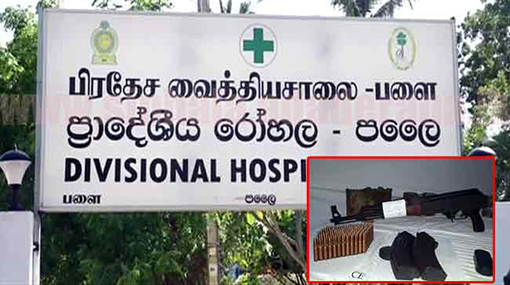
A search operation conducted by the Terrorist Investigation Division in the locality of Karandiya in Palai of Jaffna has led to the discovery of a concealed stash of explosives, firearms as well as various other weapons.
The operation was launched after information was obtained from the recently arrested Judicial Medical Officer (JMO) of the Palai Hospital, who is suspected of having terror links.
On the 18th of August, the JMO of Palai Hospital, Sinnayya Sivaruban, was arrested by the Army and handed over to the Terrorist Investigation Division (TID).
He was then detained by the Jaffna terrorist investigation unit for questioning.
Police media spokesperson said that during the interrogations, Sivaruban had revealed information on a concealed stash of weapons after which the search operation was launched.
The seize items included AK-47 firearm, two magazines, 11 hand grenades, 10kg of substance suspected to be explosives, 120 rounds of ammunition, a telephone and a multitude of other equipment.
Police media spokesperson said that a police team of the TID led by an ASP in the locality has been assigned to conduct further investigations on the incident.
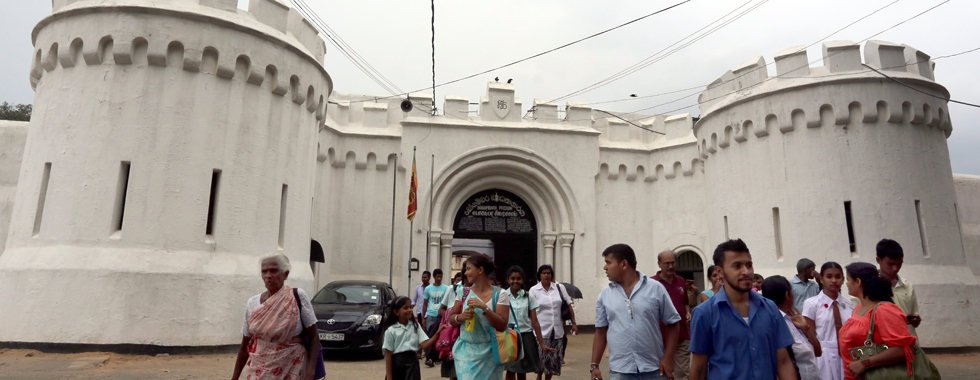
, August 27: As crime-rates keep falling in many parts of the world, prisons are being closed, with some of them being converted into hotels or tourist attractions.Violent crime rate has been falling in Sri Lanka too since the end of Eelam War IV in 2009.But that is not the reason for the government’s 2013 decision to abandon the iconic Bogambara Prison in Kandy.
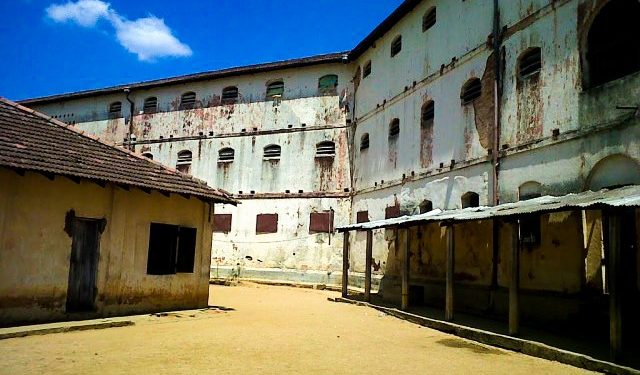
The Bogambara Prison was abandoned as part of the government’s plan to improve prison conditions by closing old and dilapidated ones located in the middle of towns and building modern ones outside the towns. The idea was to put the prime properties into good and productive use. It was under this scheme that the inmates of the Bogambara prison, built in 1876 were shifted to a new premises in Pallakele in 2013.Simultaneously, the then government led by President Mahinda Rajapaksa had a project to renovate colonial-era buildings and put them to contemporary commercial use. Colombo had many such building repaired and done up.
The Bogambara prison was handed over to President Rajapaksa in January 2014, and surely, his government would have undertaken rehabilitation, if he was not voted out of office in January 2015. The new government headed by Prime Minister Ranil Wickremesinghe had the same objective but had difficulty in meeting the expected cost which was US$ 7 to 10 million.In 2016, Minister Lakshman Kiriella suggested that the 382-cell Bogambara prison be converted into a luxury hotel. But this was vehemently opposed by the Mahanayakes of the Malwatte and Asgirya chapters of the Maha Sangha located in Kandy. It is reported that in a letter to President Maithripala Sirisena and Prime Minister Ranil Wickremesinghe, the Prelates suggested construction of a Kandyan cultural centre instead.
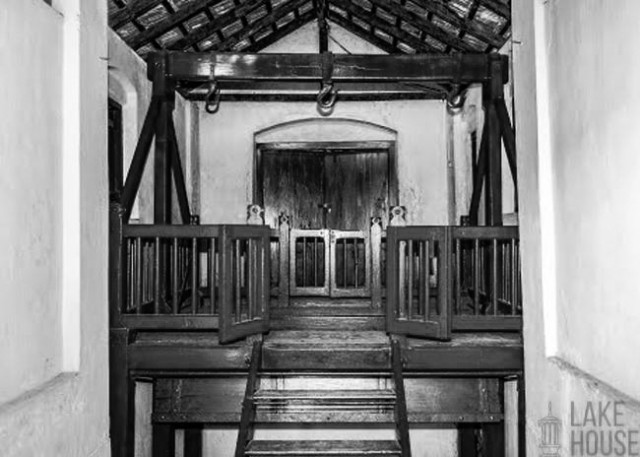
Gallows at Bogambara to execute three simultaneously
In the view of Dilip Susruta Samarasinghe, Director (Media) at the Board of Investment (BOI) which is trying to find foreign investors in the project, it will be difficult to convert the cells into hotel rooms. The walls are thick are difficult to break. The windows are tiny and right at the top. And most importantly, since it is a heritage site, the Archeology Department, which is a participant in the renovation project, will not allow any tampering with the structure, Samarasinghe explained.
However, following a global trend in which prisons are being turned into tourist destinations if they are of historical value, the government is pursuing the project with vigour. Prisons, like other historical sites, provide a unique window into a country’s political history, views on crime and punishment, and laws governing freedom and human rights. Each year, millions of people trickle through the shadowy halls of decommissioned prisons around the world to learn their grim histories,” says writer Gulnaz Khan.
For example in the Texas Prison Museum in Huntsville, United States, the infamous American electric chair” is displayed. In the Tuol Sleng prison cum torture chambers in the Cambodian capital city of Phnom Penh, one can see the tiny cells in which political prisoners were kept. The torture chambers and torture equipment are there for all to see. Bogambara Prison Project built in 1876 under the supervision of then Inspector General of Prisons N.R.Saunders, the Bogambara Prison was Sri Lanka’s second largest prison spanning 13 acres. Its 92,000-square foot main building has three floors.
Given the vast amount of land in its premises, and its location bang in the middle of Kandy town, the land is very valuable and could be very productively used, Samarasinghe pointed out. The first phase of the project was completed and inaugurated by Premier Wickremesinghe last week. It saw the development of the prison’s external lands at a cost of approximately Rs.125 million (US$ 705, 930). The second stage entails the development of the buildings at an estimated cost of Rs.750 million (US$ 4.2 million).
According to reports, the second phase envisages the development of a cultural centre, an open air theatre, studios for traditional arts and crafts, a tourist information centre, multi recreational areas and a shopping complex. Most importantly, there will be a museum displaying the prison’s history. Since Kandy is a UNESCO World Heritage City, the Department of Archaeology is also involved in the designing of the project. The walls of the Bogambara Prison are said to look like the Bastille prison in Paris.
The structures were built with brick, lime, and wood, not concrete. Its floors are made of teak. Being short of funds, the government hopes to raise funds from overseas which is why it is a BOI project.
Bogambara prison done up
Historic Place
The Bogambara Prison is a historical place. It was one of the two prisons in which hangings took place till capital punishment was stopped, de facto, in 1975. Between 1876 – 1975, 534 prisoners were hanged at Bogambara. The prison was known for its gallows on which three persons could hang together.
Many Sri Lankan national leaders were interned in Bogambara. Among them were Dr. Colvin R. de Silva and Philip Gunawardene, N.M.Perera, Mavai Senathirajah and Tamil poet Kasi Ananthan. But some of these claims are disputed by H.G.Darmadasa, who was Superintendent at Bogambara Prison in the 1970s and had retired as Commissioner General Prisons. Darmadasa told Sunday Times that Colvin de Siva and Philip Gunawardene were kept in the New Kandy Remand Prison now used by the Sinha Regiment of the Army.
The claim that the celebrated 19th Century Sri Lankan Robin Hood, Saradiel, was held in Bogambara could also be challenged as Saradiel was hanged in 1864 long before Bogambara Prison was commissioned. But these do not detract from the historical importance of the Bogambara prison. The prison has always been a tourist attraction, albeit from the outside. It is located in the very heart of Kandy. Its Bastille like ramparts had never failed to attract.
Even before the establishment of the Bogambara Prison, executions and hangings were taking place in the Bogambara grounds.The entire family of Ehelpola, a noble who had rebelled against King Sri Wickramarajasinghe, was executed there in 1814. First the two sons were beheaded. Then their mother was made to pound their heads, and finally, the mother and her daughters were tied to stones and sunk in the Bogambara lake. People were out raged but could do little. Ehelapola himself escaped as he was under British protection on the West coast.
After the British took over Kandy in 1815, they partially cleared the lake to build the Bogambara Prison. The gallows were shifted from the Hangman’s Hill to the newly built prison. It was on Hangman’s Hill that the Sri Lankan Robin Hood Saradiel was executed in 1864.
In 1818, chieftain Keppetipola, who had rebelled against the British in Uva, was beheaded on the Bogambara grounds. He wanted to be killed with one stroke, but the executioner failed. It was in the second attempt that the head was cut off. After his death, Keppetipola’s skull was taken to Britain and placed in the Phrenological Society of Edinburgh. Following the British withdrawal from Sri Lanka in 1948, Keppetipola was declared a national hero.
In 1954, his skull was brought to Sri Lanka and kept in the Keppetipola Memorial in Kandy. The Sri Lankan Robin Hood Saradiel was hanged on Hangman’s hill in 1864 which is now the Kandy Central Market. Prior to the shifting of the gallows into jails, beheading and hangings were done in public.
(The featured image at the top shows cells in the Bogambara prison in Kandy, Sri Lanka)
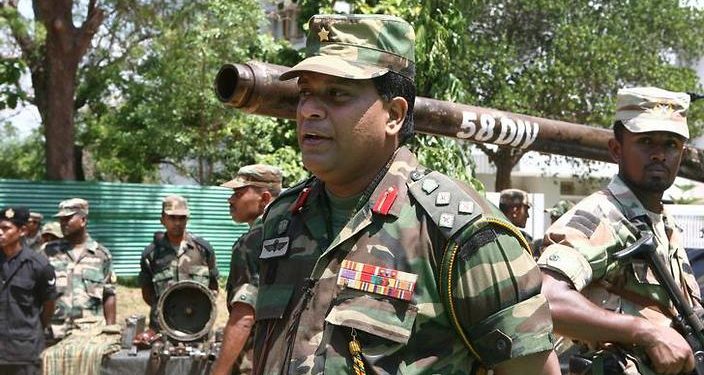
Colombo, August 27 (DailyFT): The Sri Lankan Army will seek to enhance its intelligence apparatus in the future, the newly-appointed Commander Lieutenant General Shavendra de Silva said on Monday.
Speaking to reporters for the first time since his appointment the Army Commander acknowledged the importance of enhancing Army intelligence to meet new national security challenges.
Intelligence is vital, we deploy our troops and conduct missions based on actionable intelligence,” he said, outlining plans to improve the efficiency of the military intelligence arm and ensure there is better synergy between intelligence stakeholders.
Our intelligence capabilities have always been good but we can improve,” he told the Daily FT, explaining that special attention needs to be paid to filling gaps in technology.
The Commander was addressing a press conference on the upcoming Colombo Defence Seminar 2019 and the Joint Military Training exercise Cormorant Strike which was held yesterday.
Concerns Over His Appointment
On the concerns expressed by human rights groups , the US and UN over his appointment, Gen.Silva said: There can be concerns, countries and individuals can have concerns. However, the President as the Commander-in-Chief appointed me as the Commander of the Army and I am sure he took into consideration all matters related to the appointment.”
Some members of the diplomatic community and UN had referred to alleged human rights violations that took place when he commanded troops during the last phase of the war in April-May 2019 .
Yes, there are allegations (of war crimes). Anyone can make allegations but we will go forward,” he said, pointing out there had been significant allegations regarding the Mannar mass graves but it was later proven beyond a doubt that there was no armed forces involvement.
Responding to a question about his role as the Commander of the Army and perceptions of the Army with regard to the Tamil community, Lt. Gen. Silva denied any bias for or against any community and emphasised that he leads the Army in the national interest.
As the Commander I am entrusted with the security of every community in Sri Lanka,” he said. He claimed that he treated all civilians equally and recalled his upbringing in the multi-ethnic township of Matale.
Declining to comment on the controversial US-Sri Lankan Status of Forces Agreement (SOFA) that could lead to foreign forces being deployed on Sri Lankan territory, the Army Commander noted it isa policy matter and therefore the decision lay with the Government.
Colombo Defence Seminar 2019 this week
The Colombo Defence Seminar 2019 will be held in Colombo for the ninth consecutive year at the end of this month.
The seminar will be held on 29-30 August. This year 27 foreign and local speakers will address the apex defence conference on the topic of ‘Evolving Military Excellence in the Contemporary Security Landscape’.
The two-day gathering of military and academic experts will see sessions on topics such as Asia-Pacific Security Landscape, New Faces of Global Terrorism, Impact of Autonomous Weapon Systems, Military Readiness and Disaster Management among others.
The Defence Seminar will be closely followed by the annual military training exercises next month.
Cormorant Strike – X 2019 Tri-forces military exercises will kick off on 3 September with the participation of 300 officers and over 2,400 soldiers, sailors and airmen. Held for the 10th consecutive year the exercise is planned to showcase Sri Lanka military experience and to act as a catalyst for capacity building of Special Operations Forces (SOF) of the three armed forces and to aid in formulating a framework for the employment of the Sri Lankan SOFs.
The exercise will mainly include Army Special Forces, Commandos, and members from the elite 53rd Airmobile Brigade, Navy Special Boat Squadron, Marines and Air Force Regiment Special Forces and other support formations.
Most of the operational exercises will take place on the East coast near Trincomalee and Minneriya. Some specialised segment of the exercises will take place around the island. 23 countries have been invited to be observers for this exercise.
Cormorant Strike – X 2019 will come to an end on 24 September at Kachchativu in Trincomalee.
Mahinda’s
message is to look at Lanka history, and he pointed out how EA Goonesinghe who
fought for universal suffrage for Sri Lanka was sent home after he won it from
the forces of Imperialism, and similarly, CWW Kannangara who fought for free
education was sent home by the same forces. He also reminded the young people
of what happened in 1971, and 1989, and he pointed out how ironic it is that
the ‘torturers and the tortured’ of that time have got together now! He
said the same forces that acted then are still acting now. He called on the
youth to not forget history and to look far ahead and not look short term. He
received a standing ovation.
Gota spoke to the youth of Lanka on how to move forward. He explained their short term plan and the long term plan. He too received a standing ovation.
Dr. Stephen Long, Los Angeles, California Courtesy The Island
After spending most of my adult life in Hawaii and then Southeast Asia, I returned to the US and settled in Los Angeles in 1998. About two weeks after my move a couple with whom I am very close invited me to an evening event at their amazing new art gallery on La Brea Avenue in Hollywood. The gallery specialized in museum-quality Asian and Buddhist art, and I wound up spending a lot of time there over the next few years.
Two or three weeks before my arrival in Los Angeles, my gallery-owner friends had met Ven. Walpola Piyananda. He was driving down La Brea and was startled to see a large seated Buddha statue in the display window facing the street. He told his driver to park the car and then he walked back for a closer look. My friend Cari, the co-owner, saw the orange-robed monk peering in her window and became very excited; she immediately stepped outside to invite him in. She guided him through their collection of Buddhist art and then asked him if he would come to an upcoming event and bless their gallery, friends, and customers. He agreed, of course, and his appearance that evening was the first of many over the years to come.
During the event I spent most of my time with Bhante Piyananda and the other monks he brought with him to participate in the blessing ceremony. As a Western Buddhist I had missed the company of monks since my move to the States, and it gave me great pleasure to be by their side and to get to know them; during the event I practically ignored everyone else just so I could spend more time with Cari’s special guests. At the end of the blessing ceremony, after the monks had tied pirith nool around the wrists of all hundred or so grateful guests, I escorted the monks to their car. While walking to his vehicle Bhante invited me to attend meditation at their temple that Friday night. I accepted and wound up spending the next twenty-plus years not only in Friday meditation, but in close association in many other ways with Dharma Vijaya Buddhist Vihara and their resident hamudurawos. This relationship turned out to be one of the most important in my life. After a while I was blessed by being asked to teach Sunday School for the temple teenagers, which turned into being my favorite weekly activity for the past twelve years, and counting.
I was also blessed by being able to get to know many members of the Sri Lankan expatriate community in Los Angeles – and by being able to get to know the beautiful country of Sri Lanka itself. Over the years I have visited Sri Lanka several times for extended periods, and I have forged many wonderful friendships with people there – as well as with Sri Lankan expats in the US. Over time I developed a very keen interest in Sri Lanka, which I consider to be one of my “adopted countries.” I have studied it (and its culture and politics) robustly. I have come to care deeply about Sri Lanka and its people, and have developed strong, protective feelings about that magical island and its well-being.
One of the expats I have had the pleasure to get to know is Gotabhaya Rajapaksa. He moved to the Los Angeles area a few years before I did, in 1991, after he retired from twenty years of service in the Sri Lankan military. I know there has been some talk about Gotabhaya “running away” from his home country, but from the way it was explained to me, nothing could have been farther from the truth. As I understand it, when Gotabhaya left Sri Lanka the Premadasa government was undergoing a “purge” of the military, and 600 Sri Lankan government policemen were killed when they were ordered to surrender to the LTTE and refused. It seems that if Gotabhaya hadn’t left when he did, his name might have been added to the list of names of slaughtered officers, many of whom he knew personally. Disillusioned as he undoubtedly was with the political climate at home, Gotabhaya never intended to stay away from Sri Lanka forever; he always knew that he would return to his birth country and serve the people when the time was right – way before his brother Mahinda was elected to the Executive Presidency.
When I met him he was working as a computer engineer in the IT department of Loyola Marymount University. He excelled in his work, and in the course of his tenure there he developed a broad and diversified cosmopolitan worldview. He had colleagues and friends that hailed from all backgrounds, races, and religions; Loyola University itself is a Jesuit and Marymount Roman Catholic institution that is named for Ignatius Loyola, a 17th Century Catholic saint. He became an unofficial ambassador for Sri Lanka, and his associates learned about his homeland from one who personified many of its best qualities.
When he lived in Southern California, Gotabhaya stayed in close contact with his Sri Lankan Buddhist roots, and he was a frequent visitor to Bhante Piyananda’s Dharma Vijaya temple on Crenshaw Boulevard. He was not only a visitor, he also served for a time on the temple’s Board of Directors. He actively participated in many of the temple’s activities: religious, community-based, cultural, and humanitarian.
In 1995 Gotabhaya gave Bhante Piyananda the idea to set up a scholarship program for medical students in Sri Lanka. He knew that there was a shortage of doctors back home, and that many of the medical students were in dire financial straits. Since its inception, over 100 medical students have benefited from this fund, and each one was and is given 5,000 rupees per month, which goes a long way even in these times to defray necessary expenses. I myself met a few of these students on a visit to Sri Lanka, and I am still close friends with one of them, Dr. Wikum Chathuranga, who is now married and practicing in his hometown of Ambalangoda. Wikum has told me many times how grateful he is to Bhante Piyananda and the scholarship fund for having helped him survive his impoverished years at Colombo University.
Gotabhaya also introduced the idea of providing academic scholarships to monks in Sri Lanka who sought to earn college degrees. Bhante Piyananda liked the idea and immediately went to the Southern California Vietnamese Buddhist community for help. This vibrant community’s generosity has funded 76 well-deserving monks so far – including my good friend Ven. Kalabululande Dhammajothi, an extremely hard-working monk at Dharma Vijaya who is currently working on his Master’s Degree at University of the West in East LA.
Recognizing the need for eye care in Sri Lanka – particularly for senior citizens – Bhante Piyananda established Vision Vijaya, a program that sends thousands of pairs of eye glasses to Sri Lanka every year. Bhante Piyananda enlisted the help of the local Lion’s Club chapter, and over time a great deal of money has been raised and free eyeglasses have been donated. I will never forget being at Sri Mahaviharaya in Pamankada one day when seniors were lined up in long queues throughout the temple to see the eye doctor and get free prescription glasses. Gotabhaya actively participated in this program while he was in Los Angeles – along with his wife Ayomi – and he was instrumental in raising a considerable amount of funds for the thrice-yearly drive that supported it.
Gotabhaya was also involved in the temple’s monthly “feed the homeless” project, and he personally went to skid row to offer food and interact with the homeless people in Downtown LA. It was there that he learned first-hand that many of the homeless were military veterans, and being a veteran himself, their plight touched his heart. This was where he came into contact with Post Traumatic Stress Syndrome, a psychological disorder that affects many returning war veterans in the US. He realized that PTSD was undoubtedly impacting the lives of many of the soldiers who were relentlessly fighting the merciless LTTE back home. He resolved that one day he would do something about Sri Lankan veterans with mental illness and PTSD – and he did.
When the tsunami struck Sri Lanka in 2004, Gotabhaya encouraged all of the monks in the US to collect funds to help the victims
. He personally collected US$25,000 from his colleagues at Loyola Marymount University, and he donated this money to Ven. Piyananda who was spearheading relief efforts. With the help of the money Gotabhaya raised, and funds our friends at the Hollywood Artists Alliance raised, Bhante Piyananda hauled in $250,000 and was able to build 37 new homes in the devastated Ambalangoda Galaboda Watta area. He took me to see these homes when they were completed, and I felt so proud of him, of Gotabhaya, and of all of those who supported the “Motherland” during its time of tragedy and great need.
In 2005 Gotabhaya returned to Sri Lanka to help with his brother’s presidential election campaign. When Mahinda won, he appointed Gotabhaya Secretary to the Ministry of Defence, and he tasked him with winning the war against the LTTE terrorists. Thanks to his “direct line” of communication with his brother the President, he was able to complete his task in only three years, something no one had been able to accomplish in nearly thirty years. His previous military and administrative experience had provided him with the discipline and organizational skills required to get the job done.
Because of my intense interest in Sri Lankan affairs, I kept up with the war and political news and started writing articles in support of the Government – and against the LTTE, which was well-funded by members of the Tamil Diaspora in Canada, the US, and other parts of the world. As an unpaid volunteer writer, at least 60 articles with my by-line were published in the Sri Lankan newspapers, in the Asian Tribune e-zine, and in other publications. My articles routinely attacked the well-connected lobbyist for the diaspora, Washington DC former Deputy Attorney General, Bruce Fein, and his group called “Tamils Against Genocide.” As a result, I was attacked back, and for a time it seemed that I was actually on the LTTE “hit list.” During this critical time, it seems that I was one of the only voices that championed the Rajapaksa Brothers and their war efforts in the international media.
When Ven. Piyananda and I visited Sri Lanka in 2006, not long after the presidential election, he and I both observed that the Government was getting massacred in the international press. Since “all wars are now fought in the media,” we saw the dangers facing Sri Lanka in the court of public opinion. We spent a few days writing a memo to President Rajapaksa about this subject, and we outlined various ways they could fight back in this critical aspect of warfare.
We went to see Gotabhaya and shared the memo with him; he completely agreed with our opinions, but was understandably too busy to get involved in this important task. He asked me to find someone who could effectively help tell the Government’s side of the story. I reached out to a friend in the media in New York City and asked for assistance, and within a few days I had three resumes’ from highly-qualified “spin doctors.” Since Gotabhaya was extremely busy running the war efforts, we presented the résumés to the Ministry of Foreign Affairs. We were told that, unfortunately, the money for an expense like that “wasn’t in the Government’s budget.”
This was the start of another great tragedy for Sri Lanka because the international media – with the help of Bruce Fein (reportedly paid $100,000 per month) and unlimited funds from the Tamil Diaspora – continued to viciously attack and ultimately defeat Sri Lanka on this important battlefront. The ripple effect in the West for this decision (e.g. the UNHRC in Geneva) continues to haunt the Sri Lankan Government to this day. After all, there was only so much I could do as the lone “journalist” who wrote and got his articles published on a very limited scale. I am quite sure that this situation will be addressed proactively in the next administration.
The reason I am mentioning this media aspect of the terrorist war is because I want the reader to understand the tremendous bias that was generated against Gotabhaya by the Tamil diaspora’s lobbying/disinformation campaign. It became a veritable “rumor mill,” with Bruce Fein and others spewing falsehoods about Gotabhaya and his execution of the war. Stories about atrocities committed by Government soldiers, Tamil genocide, racial revenge, and others were fabricated out of whole cloth by the terrorist campaign to discredit him and turn him into a monster. Not only do they not fit the profile of the man I know personally, none of these spurious allegations are true. Since I was in Sri Lanka at the very end of the war, I witnessed the compassion with which Gotabhaya and the armed forces conducted themselves during the final days. As always, please “consider the source” when evaluating the news that was reported in the international media about that first week of May, 2009.
When the war was almost over, in the fall of 2008, I wrote an article entitled, “Preparing for the Next Crisis: When the Troops Come Home.” In this article I warned of the dangers of winning the war and facing the prospect of thousands of soldiers trained in weaponry returning home with nothing to do and without any way to earn an income. Apparently this article got the attention of Gotabhaya because when the war ended in May of 2009 he created a program that kept the soldiers on the Government payroll. These soldiers became actively employed on various public works projects that included the rebuilding or restoration of approximately 1,000 places of worship on the island. He also made sure his soldiers received proper mental health care, and were properly treated for symptoms of PTSD.
Speaking of “public works projects,” Gotabhaya’s exposure to the beautiful communities of Southern California, such as Santa Monica, Pasadena, Pacific Palisades, Beverly Hills, and others, gave him many ideas for beautifying Colombo. When I visited the country after the war I couldn’t believe the difference in the city landscape. I was pleasantly surprised to see that it was clean, orderly, presentable, and ready to take its place in the “new Asia” that had emerged while Sri Lanka was left behind fighting its bloody civil war for 30 years. I was impressed by what Gotabhaya had accomplished, and disappointed when I visited the next time, which was well into the new administration. Suddenly it was if the city had relapsed into some terminal illness with no doctors at hand. It was dirty, foul, and the improvements that Gotabhaya had made had fallen into complete disarray. I am sure that when Gotabhaya wins the upcoming election he will put the same emphasis on beautification and return the city – improve the city – to meet 21st Century urban world standards.
Speaking of the “upcoming election,” and as someone from the “outside” who has been paying close attention to Sri Lanka for more than two decades, I give my whole support to Gotabhaya winning it; I truly believe that he is the most qualified individual to become the next president of my “adopted country” home. I hope the country’s voters will remember his many accomplishments – not just ending the terrorist war – and trust their vote to him. I know that many in the country think he persecuted the Tamils, has racial bias, has too heavy a hand, and lacks the diplomatic skills to navigate the troubled international waters. I heartily disagree with all of these opinions, and can say, from first-hand knowledge, that Gotabhaya will rise to the occasion and be an excellent president – for all the people of the land. He has the discipline; he has the managerial experience; he has the compassion; he’s the only one who can bring the fragmented elements of the country together; and he has a very clear vision for the future. The next time I visit Sri Lanka I look forward to personally congratulating Gotabhaya on his victory.
Youth are being forced to go begging for jobs from this regime and then get tear-gassed in return. However, no one today questions this regime as to what has become of its major promise to create one million jobs for youth, Opposition Leader Mahinda Rajapaksa, addressing the SLPP Youth Convention on 24 August, at the Nelum Pokuna Theatre, said.
His full speech verbatim is as follows:
“This youth convention is an important one. First is that when I am in front of you all, I feel that I am standing before the future of this nation. Today, looking at the issues discussed here we can comprehend as to what sort of a future this country has. When I stand before this convention I also tend to recall what happened in the past. My mind goes back to 1970 when I was elected to parliament as the youngest ever MP. Within one year after I was elected to parliament, the youth insurrection occurred. The main operation centre for these rebels was Vidyodhaya where I was employed as well. During that insurgency, several youth whom I had known were nabbed by the Police and the Army. Among the arrestees was one of the young MPs of our Government, the youthful Vasu. When they were apprehended by the Mirihana Police, in order to save them I had to wait, being seated on the staircase of Temple Trees. After that, I can remember the incidents that took place in 1989. From Embilipitiya up to Batalanda, there were several torture chambers. They searched to kill youths who had received higher
education in 1989. I can remember we went on protest demonstrations carrying the corpses of Wasantha and Prasanna who were killed in Tangalle in 1989. For the first time in history, the words human rights were brought to the public domain through the HR Committees that we formed in Tangalle. That was on behalf of scores of youths who were murdered.
Pada Yathra
When a Pada Yathra was launched from Colombo to Kataragama in 1992, the roads were drenched by the tears of mothers. These youth must remember that if the law had been enacted against the then leaders of the Government not a single leader of the current regime would be able to run this Government. They maintained a torture chamber in the University of Colombo as well. Today most of the Ministers of the current UNP regime were forced to experience various forms of harassment in that torture chamber. In addition, those who went searching for youth to kill them in those days, continue to serve as Ministers in the current regime. We who saved youth from those torture chambers are being harassed by these rulers. That is the nature of the current politics practised here. There was a civil war here for 30 years. Every cent that should have been spent on the country’s future was forced to be incurred for that war. Hence, no Government was able to either create jobs or carry out any economic
development during that period. Hundreds and thousands of youth in the North and South were prevented from leading decent lives due to the ravages of the war. Hence, the biggest service rendered by us to the youth of this nation is the ending of the war within a span of four years. Several generations of youth were saved due to the effective completion of the war. In addition, scores of youth who were
engaged in terror acts were successfully rehabilitated and they were afterwards released to the society within months of the end of the war. We have handed them over to the society for them to become better citizens.
I can remember when I addressed the nation in 2005 that I stressed that I will not allow the problems faced by us to be encountered by the future generation. In those days, the graduates were jobless. We took the task of providing jobs to such persons as one of the priorities of our Government. From 1948 up to 2005, only 700,000 had been employed as State sector workers. By 2015 we had been able to increase that amount to 1.5 million before we handed over that Government and went home. However, now again the problem of unemployed graduates has come to the fore. Nowadays one can see on television, youth being forced to go begging for jobs from this regime and then get tear-gassed in return. However, no one today questions this regime as to what has become of its major promise to create one million jobs for the youth. We had answers to questions faced by the youth in those days. As soon as I got the Ministry of Labour and Vocational Training I introduced the concept of a job to all who have the aptitude to the country. Providing only free education to youth is not sufficient. We were under the impression from those days that they should be given professional education. Their abilities have to be sharpened. We believed that a system of professional education has to be introduced to the country.
Ocean economy
We also thought about an ocean economy. Having formed a coastal preservation armed unit while protecting the shores we thought having unearthed the resources from the ocean to further improve the country’s economy. For the first time, an oceanic university was created. Just like the way one looks at the gem pits of Ratnapura, we have to look at the oceans as well. Having thought on those lines, we strived to provide a new life to the youth here. When we came to power in 2005, the country’s computer literacy stood at five per cent. We formed Nenasala centres everywhere. The country quickly moved to computer-related jobs. Today even applications are submitted for university entrances through the computer or online. Even youth in villages today are registered for campuses, thanks to the computer education that we introduced. At the time when we left home, we had managed to increase the computer literacy to 50 per cent from five per cent. However, show me at least one instance that this regime had improved a lot of the country’s youth during the past four years.
The computer literacy which we had improved since 2005 was used to send us home by this regime in 2015. The youth of today must, therefore, understand the current imbalance in the politics of this country. I must recall the late Anagarika Dharmapala. He had thought of the 21st century even during the 19th century when he lived. He not only saved Buddhagaya for the Buddhists of the world but rendered several noble services to this country as well. He was instrumental in the creation of Buddhist schools. Not only that, he also established 52 schools geared towards providing professional training for our students. He thought of providing professional training to children from the school age. To such an eminent person, certain people of this country disparaged him and forced him to leave this country for good.
He, in the end, passed away in India. After that, it was A. E. Gunasingha. It was Gunasingha who had fought tooth and nail to grant suffrage to Sri Lankans back in 1931. Before 1931 those who had suffrage were wealthy, affluent, and educated. However, he fought for the rights of all citizens here and demanded that suffrage should be granted for all and sundry sans any discrimination. Nevertheless, several leaders at the time were opposed to Gunasingha’s demand. However, Ceylon received the right to vote in 1931. What happened afterwards?
Gunasingha who fought valiantly to grant this right was sent home through the people’s franchise. After that, I recall CWW Kannangara. He tabled the Free Education Act in parliament aimed at granting the free education right to all citizens here. However, those who had stood against Dharmapala also rose up against Kannangara as well. They voted against the Act. However, the Act was passed due to the presence of progressive MPs both in the North and South. That was a historic triumph of this country. Nevertheless, at the next election, even Kannangara was defeated and he was sent home. The youth of today must learn these lessons from history. We waged the war and granted freedom for the people and those very people were utilised to send us home.
The voting rights that were given by us to the North-East after decades were utilised against us. The computer literacy and cell phone facilities that were improved by us were utilised against us. Not only that, the ports, airports and highways that were built by us were utilised against us. They say that the 8 January conspiracy was hatched while travelling on the highway. After that, they showed the highway and uttered lies against the Government. Due to the port that was built by us, this country will become a naval hub in Asia. Then whom will it affect? They did this to all who strived to develop this nation through domestic resources. The youth who are here preparing to take the helm of this country in the future must understand the deep reality of this political game. If we lose heart, not only us but even the country will be defeated.
You must remember that those who forced Dharmapala to leave this country having flung mud at him are still present in this society. Those who sent A E Gunasingha home who strove to introduce suffrage to this land are still present in this country. Now those who sent those people home are saying that youth must forgo politics. They have uttered that youth should not cast their votes. These people are determined to take away your right to vote. The behaviour of these forces must be understood through history.
These forces always misled the country’s youth. Hence, you must not look near but look far. You have to be farsighted if you intend to take the helm of this country. Hence, I would like to emphasise to the youth of this nation, always think twice about what you hear and what you see. Always learn from past history.”
SLPP’s Presidential candidate Gotabaya Rajapaksa, during the SLPP Youth Convention, held at Nelum Pokuna on 24 August, answered questions of youth who participated in the convention.
Excerpts:
There have been several issues that have emerged within the education sphere of Sri Lanka for youth. After the GCE O/L and GCE Advanced Level exams, scores of youths tend to face the issue of unemployment. Only 18 per cent tend to get qualified for University education. Even on that front though there are jobs in the sphere of science and technology jobs for others are limited.
What is the solution that you intend to give on this topic?
A: First of all, I convey my wishes to the SLPP Youth Convention. The 21st century has been described as a century geared towards knowledge. In the Asian economy, to such spheres as agriculture and fisheries, what is important is knowledge. If our youths are to march forward then they have to be armed with aspects such as knowledge, technology, talent, and aptitude, etc. We have to create youths who are capable of doing jobs in these fields. In the first two years, the facilities at universities, technology facilities have to be improved.
Our universities have to be brought in line with those in Asia. You need to formulate long-term national policies for this task. The youths who are capable of doing jobs that are created through the economy must be discovered through the education system. Also, as a short-term measure, the issues that are existent must be addressed as well. If the intake of students to campuses are to be increased, the infrastructure facilities at those institutions have to be improved. In addition, technical schools and industrial schools have also to be further developed. Towards that end, having roped in the private sector, an economy geared towards technology has to be introduced. Even for those who received education in the arts field, several jobs can be created in the management service sector through this. The best solution will be to give prominence to the field of education.
Though some may not be able to go to campuses even after passing Advanced Level, they will be able to go forward through technology rather than being left in the lurch. Recently I met a youth who was educated at my alma-mater, Ananda College, Colombo. He gave me valuable advice regarding social media here. I then inquired from him from which university he had learnt so much about this subject. He told me that he had failed his Advanced Level exam.
However, this young man happens to be the owner of a firm that pumps millions of dollars into this country. He is the owner of a firm that produces video games, releases it to the internet and earns revenue through it. This particular company is being run by him and one of his friends. They have gone very far on this front and now they even offer pieces of advice and instructions to other firms as well. They have learnt all this through the internet. I asked him what has to be done by our youths in villages if they were to be followed. He told me the Government should provide high-speed access.
He also told me to equip the young generation with knowledge of the English language. He informed me that if these two things are done, the sky will be the limit for the youth here. Do not be downcast or do not take a backward step. There are many opportunities for you out there. There is no limit for the distance that could be covered through technology. What is needed is for you to strive for it. Make an effort to fulfil your dreams. They must be provided with professional training and they should be allowed to go even higher in their chosen profession.
What are the solutions you envisage to give to the issue of the cost of living and education of estate sector people?
A: The tea industry is a valuable component of our economy. However, the future of the estate sector youth has to be borne in mind. The environment has to be created for them to lead decent lives in that sector. In order to further improve the quality of education, the infrastructure facilities have to be further developed. The youth of the estate sector has shown a tendency to move to the cities lately.
Instead of that, a system where they could earn an income in their sector has to be formed. Just like providing higher education, their income has to be improved through several measures. Through the limited land space, they have through technology and from agriculture, other income spheres could be unearthed. When we head towards Nuwara Eliya, we pass through several major towns. However, on a trip there, there is no development that could provide an income for those towns. Hence, we intend to focus on city or town development. Also, at the same time, there are several such towns that have to be developed. Afterwards, having introduced machine technology to the tea industry that field has to be made more beneficial to the country. In the tea industry more than the quantity the quality has to be improved. After having spoken to trade unionists, through a revenue-sharing system the income of youth engaged in the tea industry could be improved. Especially through education opportunities, these youth could be provided with the scope to obtain top employment opportunities.
You had rendered a sterling duty towards the ending of the war. After a decade, the bombs have again begun to explode. What are the measures you intend to take to rid the country from this extremist terrorism? In addition, this regime which came to power having promised to usher in good Governance failed miserably on that front. What are the measures you intend to take to usher in genuine good Governance?
A: This regime never gave a care about national security when in power. The intelligence units were crippled. If the intelligence reports are not received by the relevant bodies, it is impossible to face up to any impending calamity. The rulers of a country, have to always bear in mind the importance of national security. If a regime fails to give pride of place to this aspect the consequences of it will be terrible, to say the least. Every nation in this world gives pride of place to national security. If there is no security, the economy of that country, cannot be revived no matter how hard you strive for it.
The country will also be unstable. Hence the intelligence reports are extremely important. In this country, the units such as the SIS, Police and the TID and intelligence units of the armed forces were active. Back in 2005 each of these units which operated separately was merged by us and it paved the way for the successful completion of the war a few years later.
Even to maintain the current situation, the intelligence units have to be developed. Due to the collapse of the intelligence units, the receiving of information is lethargic. It is due to this reason that the 21 April Easter Sunday terror attacks took place. The intelligence units have to be revived and there are no two words to it. In addition, this regime tainted the concept of good Governance. Due to this reason, even the meanings of those words have now been twisted. The people gauge good Governance through the aspects such as whether there is national security, whether they could seek a decent job to sustain themselves amidst the steeply rising cost of living, whether a suitable school could be sought for their children, whether they could build a house commensurate with the income that they draw, etc. If these areas are not effectively covered the people will consider such a Government as a failed regime.
In addition, if the people have no opportunity to air their views to the Government of the day, then they should have the chance to elect a regime that could give air to their grievances. That is the democratic right of the people. If that right is violated then the concept of good Governance will never see the light of day.
There is a suggestion being spread around the country, that in the event of you being elected President, it will signal the death knell for democracy here?
A: That freedom was never taken away from the masses, during the time that I served as the Defence Secretary. If you take a look at the newspapers that were printed during the waning days of the war, you will realize the amount of flak that had been directed at the security forces. The franchise of the people is the most valuable component of democracy. During the Mahinda Rajapaksa era, the NPC was formed. As the Defence Secretary at the time, I worked a lot in the Northern Province.
We took measures to stage free and independent elections. As a result of those measures, the TNA won the election. One of the salient points of democracy is for polls to be staged on time. A Government under my watch will respect these basic values of democracy. Polls will never be postponed for any reason. The right to practice whatever faith of your choice, the freedom of media and the right to air views will be ensured. Mahinda Rajapaksa had always stood for media freedom here.
Hence, in a regime head by him, there will be no danger to the freedom of the media.
Ten years had elapsed since the end of the hostilities. The then Rajapaksa regime did a lot of work towards the development of the North-East. Nevertheless, he failed to win their votes at the last poll. Though the current regime has not done any work to those areas, they invariably tend to receive the votes from those people. How do you plan to tackle this issue?
A: The infrastructure facilities for the youth of these Provinces to lead decent lives were developed by the Rajapaksa regime. The train services were developed, Rail tracks were laid. Drinking water and electricity were provided. In addition, when we were planning to create jobs there we did not have sufficient time to implement those programmes.
The lives of these people have to be resuscitated akin to other provinces of this country. Hence I urge the youth to join hands with us instead of being tied to politicians who are not willing to shed traditions and customs and practice archaic systems.
You were instrumental in ushering a lot of improvement to Colombo. Instead of shanties, new houses were built. What plans do you have up your sleeve concerning the poor people here?
A: During my stint as the Secretary of the Urban Development Secretary the policy of the President was the creation of a suitable environment for the low-income families to lead decent lives in the metropolis.
Towards that end, we created an effective programme. Towards this programme, we not only incurred Government money but other measures as well. When building houses we paid attention to the roads, the areas where sports activities are held, pavements etc. We never evicted people forcibly.
However, the falsehoods that were created by our political rivals were taken to the people. They attempted to portray that we were striving to give prominence to our supporters. However, today people know the truth. We had planned to build 50,000 houses. Out of that number we had been able to construct 20,000. After this Government came to power, those houses were distributed. The private sector of Slave Island, the shanty dwellers and the UDA having joined forces we formulated a system to construct houses without any State expense.
Today, those houses are being distributed by this regime. Our intention is to further take this programme forward and to grant houses to those living in shanties and improve their livelihood. Also having received the support from the private sector to those in the middle-income group, to those beginning new lives and at a price that they could pay we intend to provide houses to them.
Sri Lanka Freedom Party (SLFP) members who attended the Sri Lanka Podujana Peramuna (SLPP) national conventions have not been invited to the SLFP Central Committee meeting, said SLFP General Secretary MP Dayasiri Jayasekara.
SLFP members including MPs Dilan Perera, Chandima Weerakkody and S. B. Dissanayake attended the first-ever national convention of the SLPP held on the 11th August at the Sugathadasa Indoor Stadium.
When Ada Derana inquired, MP Jayasekara stated that the relevant members have not been invited to the Central Committee which will be held today (26).
The SLFP Central Committee will commence under the patronage of Party Leader President Maithripala Sirisena at 07 pm tonight.
Meanwhile, the SLFP and SLPP are due to hold a meeting tomorrow (27).
If the Rubber-Rice Pact of 1952 sowed the seeds of good and enduring relations between China and Sri Lanka, the decision to build the Bandaranaike Memorial International Conference Hall (BMICH) with Chinese technical and financial help in 1964, cemented ties between the two countries.
The importance of these events lies in their historical context. The Rubfber-Rice pact was the result of a dire economic need in both countries. Lanka desperately needed rice to feed its population. The US was not willing to give Lanka a US$ 50 million loan to buy rice. The US was also not offering a fair price for Lankan rubber. Communist China badly needed rubber because the US had banned the sale of rubber, a strategic material, to Communist China.
The situation called for out of the box” thinking. Barter of Chinese rice for Sri Lankan rubber was suggested and accepted because it suited both countries. Lanka got rice at a cheaper price and got a higher price for its rubber. The deal lasted till 1982.
In 1964, both Lanka and China needed international linkages to assert their independence from the Western powers led by the US. During the Premiership of Mrs.Sirimavo Bandaranaike, Lanka had set itself free from the apron strings which had traditionally tied it to the West. Lanka was part of the anti-imperialist Non-Aligned Movement (NAM). Mrs. Bandaranaike wanted to be a pillar of NAM along with India, Indonesia, Egypt, Yugoslavia and Ghana. China needed to assert its independence and pursue its One China” policy against a hostile United States and get its due status in the UN.
To enable it to play its new-found international role, Lanka needed a large and modern international conference hall. China’s help was sought, and it was given free of charge. The result was the Bandaranaike Memorial International Conference Hall (BMICH) named after Mrs. Bandaranaike’s husband and former Prime Minister SWRD Bandaranaike, who had initiated the post-independence movement against domination by the West.
SWRD Bandaranaike, better known as Banda”, had become Prime Minister in 1956. In 1957, Chinese Prime Minister Zhou Enlai and Vice Premier He Long, visited Lanka. During the visit, Banda and Zhou Enlai jointly adopted the Five Principles of Co-existence and the Bandung Principles for the achievement of world peace and cooperation.
On February 4, 1957, Banda invited Zhou Enlai to be chief guest at the ninth Lankan Independence Day celebrations. According to a bilingual book on the BMICH entitled A Symbol of China-Sri Lankan Friendship” Zhou Enlai spoke in pouring rain which moved the audience”.
In February 1964, when Banda’s widow, Sirimavo Bandaranaike, was Prime Minister, China’s Vice Chairman, Song Qingling and Premier Zhou Enlai visited Lanka. It was during this visit that Mrs. Bandaranaike requested China to help build the BMICH. The request was granted, and China decided to gift the building citing Mrs. Bandaranaike’s steadfast fight against imperialism and colonialism.”
Mrs. Bandaranaike breaks the ground in a traditional way
Zhou’s Principles
The Chinese Ministry of Foreign Trade and Economic Cooperation assigned the work on BMICH to the Beijing Industrial Building Design Institute of the Ministry of Works. The design’s principles were enunciated by Premier Zhou Enlai himself.
His principles were: The building scale shall be appropriate for Sri Lanka’s conditions and requirements. It shall adapt to the tropical climate and reflect the local style. The internal facilities and equipment shall adopt modern technology.
The Building Design Institute sent a delegation to Lanka headed by its Vice President Yuan Jingshe and included Chief Architect Dai Nianci. The delegation was in Sri Lanka for four months, touring the entire country to see for itself local building styles, culture, customs and beliefs so that the BMICH accords with the culture, beliefs and styles of Lankans.
The delegation collected a large amount of basic data on the materials available, physical conditions and climate changes and finally produced a model to show. After inspecting the model carefully, Prime Minister Mrs. Bandaranaike said excitedly: I thank Prime Minister Zhou Enlai for sending us the highest gift. I thank the outstanding contributions the Chinese experts have made for the project. BMICH is a symbol of China-Sri Lanka friendship”.
Architect Dai Nianci, who had a deep understanding of Sri Lanka’s natural and human environment, proposed the classical practice of having a symmetrical, octagonal layout with a colonnade because this was not only elegant but stable. He suggested that the building be painted white which is favored in tropical architecture and is also favored by traditional Lankans. Due to the tropical climate, ventilation was every important and that was achieved by maximizing the use of natural ventilation.
Mrs.Bandaranaike inspecting work on the site
But notwithstanding intense preparations by the Chinese, it was only on November 24, 1970, that the Lankan government commenced work on the BMICH. Mrs.Bandaranaike broke the ground in the traditional way with a mammoty” to signify the start of construction. China had sent 400 technicians, 40 engineers and managers and 60 carpenters to do the work.
Both Zhou Enlai and Mrs. Bandaranaike were constantly monitoring the project with the latter visiting the site often. The Sri Lankan Chief Engineer of the project, Damodalingam, got along well with his Chinese counterparts and ensured perfect coordination between the Chinese and Sri Lankan personnel. This ensured that there were no serious accidents during the construction period of two years and five months.
Initially, language was a barrier and communication was through sign language. But before long, locals picked up some Chinese and the Chinese picked up some Sinhala.
On one occasion, a number of Chinese workers suffered from food poisoning. But as a measure of abundant precaution, government hospitalized all 200 workers. Given the shortage of hospital beds, local patients gave up their beds for the sake of the suffering Chinese.
It was not easy for workers from cold China to put up with the intense heat of Colombo. The BMICH construction site also had monkeys, snakes and mosquitoes. Once a monkey jumped on to the middle of the roof truss and lingered there for three days. Though no one was bitten by a snake, the Chinese embassy had on stand by a doctor with knowledge of local anti-snake drugs. But still snakes would interfere with the work or choose to visit workers while they were at lunch.
Workers would be woken up by ant bites, as ants were aplenty on the site. When local workers told the Chinese that ants are averse to the smell of ink (even from newspapers), the Chinese embassy started sending newspapers to the workers.
Since ceramic tile technology was not developed in the 1970s, each tile was chosen carefully to make the flooring smooth. Steps were taken to keep termites away.
On completion of the work, there was a fitting ceremony in which a stage play called Path to Brightness” written and directed by Chandrika Bandaranaike, daughter of Mrs.Bandaranaike and future Lankan President. The play was made into a film and was sent to Premier Zhou Enlai along with a model of the BMCH set with rubies. The model is now in the Asia Gift Pavilion at the National Museum in China.
Set in a land area of 13 hectares and with a floor of area of 32, 540 sq meters (in 2013), the BMICH is a grand, spacious and airy structure. Its vast open and verdant space makes it an ideal place for large and small conferences, public gatherings, shows and exhibitions.
The hall came in handy in 1976, when the fifth Non-Aligned Nations’ Summit was held in Colombo with 120 heads of government attending. The delegates told Mrs.Bandaranaike that the assembly hall was better than the halls in which previous summits were held. Mrs.Bandaranaike told the Chinese envoy that the summit would not have been such a huge success if it was not for the magnificent BMICH.