කාලය විසින් නිර්දේශිත පාලකයෙකු ගෙන් බලාපොරොත්තු විය යුත්තේ කුමක්ද?

August 18th, 2019

මතුගම සෙනෙවිරුවන්

             මෙම ලිපිය සමග ඇති සිතියම හොඳින් නිරීක්ෂණය කළහොත් වටහා ගැනීමට හැකි වන්නේ ලංකාවේ පළාත් කීපයක බෞද්ධ ජනගහනය ඉක්මවා වෙනත් ආගමිකයන්  ඉදිරියට පැමිණ ඇති ආකාරයයි. මේ සිතියම පළ වී තිබෙන්නේ 1915 වර්ෂයේ ජන ලේඛන කොමසාරිස් ඊ.බී.ඩෙන්හැම් ගේ පාලන වාර්තාව තුළයි.1815 වසරේ ලංකාවේ දේශපාලන බලය බ්‍රිතාන්‍ය කිරීටයට පවරා දීමෙන් පසු සියක් වසරක් තුළ ඔවුන් කළ කී හරිය මෙම සිතියමින් පැහැදිලිවේ. මෙතෙක් සංක්‍රමණිකයන් වශයෙන් සිටි දෙමළ මුස්ලිම් වර්ගයන්ට පුරවැසි කම දීම.ඔවුන් පාලනය කරලීමට නව නීති සැකසීම ඔවුන් වෙනුවෙන් භූමිය වෙන් කිරීම ආදී ක්‍රියාන්විතයන් එහි වෙයි. දැන් 2015 වසර ගෙවී ගොස් අවසන්ය. 1915 සිට තවත් වසර සියයක් ඉක්ම ගොසින්ය.අද මෙවැනි සිතියමක් සකස් කළහොත් සිංහල බෞද්ධ ජනගහනය ඉක්මවා ගිය පළාත් ගැන හොඳින් අවබෝධ කර ගතහැකි වනවා නොඅනුමානය.විශේෂයෙන්ම 2012 ජන සංගණන වාර්තාව තුළම මෙය පැහැදිලි කර ගත හැකිය. කාලය විසින් නාව පාලකයෙකු පිළිබඳ බලාපොරොත්තුවක් අප තුළ ජනිත කර තිබෙන්නේ මෙවැනි පසුබිමක් තුළය.

     1948 දී බ්‍රිතාන්‍ය කිරීටයෙන් අප යම් තරමක් නිදහස් වී 1972 දී ස්වාධින ජනරජයක් බවට පත් වූ පසුවත් මේ සෝදා පාලුව නිමා වී නොමැති බව එයින් පෙනේ.. අද කොළඹ නගර සභා සීමාවේ සිංහල ජනගහනය සියයට විසිහතර දක්වා අඩු වී තිබේ.අම්පාර හා ත්‍රිකුණාමලය නොමැති නම් සමස්ත නැගෙනහිර පළාතම සිංහලයන්ට අහිමි වනවා ඇත.ඩී.එස්.ජෝන් දෙදෙනාගේ ජනපදකරණය තුළින් යම් ප්‍රගතියක් මෙම පළාත් වල අත් පත් කරගෙන තිබුණද මේ තත්ත්වය තව කෙතෙක් දුර රඳවා ගබා ගත හැකි දැයි අවිනිශ්චිතය.සිංහල  බෞද්ධ පළාතක් ලෙසට තිබූ උඩරට පළාතෙන් නුවර එළිය දිස්ත්‍රික්කයක් ලෙසට කඩා දෙමළ ජනගහනයට අවශ්‍ය පහසුකම් සලසවා පුරවැසි කම් ප්‍රදානය කර ඇත.අද එහි දේශපාලන තීරකයෝ ඔවුන් වෙති.

        පසුගියදා එල්ල වූ පාස්කු ප්‍රහාරයෙන් පසු අන්තවාදී මුස්ලිම් දේශපාලනඥයන් ගේ ඉලක්ක පිළිබඳව සිංහල සමාජයට මනාව වැටහී යන්නට ඇතිවාට නිසැකය.විශේෂයෙන් රිෂාඩ් බද්යුදීන් හා හිස්බුල්ලා විසින් දියත් කරන ලද මුස්ලිම් ව්‍යාප්ත වාදය අද එක්සත්ජාතික පක්ෂයේ බල කඳුවුරුද ග්‍රහණය කරගැනීමට සමත්ව තිබේ.අනෙක් අතින් සුමන්තිරන්ලාගේ දෙමළ ජාතිවාදී බල ග්‍රහණය කොළඹ දේශපාලනය පමණක් නොව නිළධාරින් ඔස්සේද ක්‍රියාත්මක වෙමින් තිබේ.මෙ සියල්ල සාර්ථක ව ඉදිරියට ගෙන යෑමට අතහිත දෙන්නේ එදා බ්‍රිතාන්‍ය නම් අද ඇමරිකාවයි. ඔවුහු සිංහලයන් ශූන්‍ය කරලීමට අන්තිම තුරුම්පුවත් ගැසීමට කල් යල් බලමින් සිටී.

          සිංහලයන් මේ රටේ භූමිපුත්‍රයන් බව කියැවෙන්නේ එයට ඉතිහාසය නමැති ඔප්පුවක් තිබෙන බැවිනි. උතුරත් දකුණත් නැගෙනහිරත් බටහිරත්  තිබෙන ජීවමාන බෞද්ධ පුරාවස්තු අතර තිබෙන දාගැබ් කොරවක් ගල් බුදු පිළිම සහ සෙල් ලිපි වලින්  පමණක්ම සිංහල බෞද්ධ අයිතිය ලොවට හඬ ගා කිව හැකිය.වසර දෙසීයක් පමණ කාලයක සිට  මෙරටට පැමිණි සාක්‍රමණිකයන් වන දෙමළ සහ මුස්ලිම් ජන කොටස් විසින් මේ භූමිය අල්වා ගෙන සිංහලයන් ඉන් පළවා හැර දෙශපාලන බල ආධිපත්‍ය ඇති කරගෙන තිබේ.ඊනියා දෙමළ ප්‍රදේශ යනුවෙන් නම් කරමින් බණ්ඩාරනායක රජයේ සිංහල භාෂා පනතට සංශෝධන එක් කරමින් භූමිය පමණක් නොව උතුරේ භාෂා අයිතියද සිංහලයන් ගෙන් උදුරාගෙන තිබේ.අද වන විට උතුරේ තිබෙන බෞද්ධ පුරාවස්තු ඩෝසර කරමින් නිධන් වස්තු කොල්ල කමින් ඒ මත කෝවිල් ඉඳි කරගන්නට නීතියද අව භාවිත කරමින් පවතී.අවාසනාවකට වර්තමාන සංස්කෘතික ඇමතිවරයා යටතේ තිබෙන අමාත්‍යංශය මගින් උදාගම් හදන්නේ ද මේ පුරාවස්තු ඩෝසර කරමිනි.මේ අස්සේ සාෆි දොස්තර විසින් කළ ගර්භාෂ සංහාරය යටපත් කරලීමට දත් දොස්තරගේ සිට ඔවුන්ට රැකවල් දෙන යහපාලන කොන්දොස්තරලාගේ ද මහත්ම වෑයම වීතිබේ.නමුත් අර්ජුන් මහෙන්ද්‍රන් ලා  සහරාන් ලා සහ සාෆී ලාගේ කුමන්ත්‍රණය මෙහෙයවූ මහම ලොකු මොළ කරු මේ රටේ සිංහල බහුතර පක්ෂයක අසමසම නායකයෙකි.ව්‍යවස්ථා සම්පාදනය මගින් බෙදුම්වාදයට සුජාතබව දෙන්න වලිකන තක්කඩියෙකි.සුද්දා ලබා දුන් පක්ෂ දෙශපාලනය විසින් සිංහල ජනතාවට හිමිකර දුන් බරව කකුළ එයයි.

        දැන් මේ හොඳටම ඇති යැයි බොහෝ අයට සිතනවා නිසැකය.ඒ මන්ද පාර්ලිමේන්තුව ඇතුළු මුලු දේශපාලන ක්ෂේත්‍රයම ගන්දස්කාරයෙන් යුක්ත මීතොටමුල්ලක් වීමයි.කලකට පෙර කරුණාරත්න ජයසූරිය කතානායකට මහාසංඝ රත්නයෙන් සම්මාන  හිමි විය. .හඬින් චන්දය විමසා විශ්වාස භංගය ජයගත් කරු ජයසූරිය ඇමරිකන් තානාපති වරුන් ගේ ඕඩරයට නටන රූකඩයක් බව මේ කිසිවෙකුටත් අවබෝධ වී නැති ගානය.රනිල් ට විපක්ෂ නායකකමේ වත් එල්ලී සිටින්නට සිටින හොඳම අපේක්ෂකයා වන්නේ ඔහුයයි කල්පනාවක් මතුව තිබේ.දැන් සිංහල බෞද්ධ බහුතරය විකල්පයක් සොයමින් ඔල්වරසන් නගමින් සිටින කාල වාකවානුවයි.එදා කොටි ග්‍රහණය මැද්දේ යුදධය නිමා කරලීමට මහින්ද රාජපක්ෂ මහතාව ඉල්ලා සිටියේද ඒ ආකාරයෙනි. ඔහු යුද්ධය ශූර ලෙසට නිමා කලා පමණක් නොව ශක්තිමත් දේශපාලනයකට ඹුලාරම්භය ඇති කලේය( සයවන පරාක්‍රමබාහු යුගයෙන් පසු ). එහෙත් සිංහල බෞද්ධ අපේක්ෂාව ඉටු විණිද.ඒ අපේක්ෂාව මහින්ද සමග එකට සිට ඉටු කරනු ඇතැයි චම්පික රණවක කෙරෙහි මෙරට දේශප්‍රේමී සිංහලයන් දෑස් දල්වා බලා සිටියහ.අවසානයේ 2014 වන විට ඔහු මහින්ද අතහැර විජාතික කඳවුරට තුරුලු විය. ඒ යහපාලනය ලවා සිංහල අපේක්ෂාවන් දිනවීමට නොවේ. විජාතික පාලනයේ බලාපොරෙත්තු වඩාත් දක්ෂ අන්දමින් ඉටු කරලීමයි. මිලේනියම් චැලෙන්ජ් කෝපරේෂන් හරහා රට දෙකඩ කරවන ආරථික කොරිඩෝවේ දේශීය නියේජිතයා වන්නේ රනිල්ටත් වඩා චම්පික බවට අද තහවුරුවක් ලැබී තිබේ.1915 වැනි ඈත කාලයකදී ඩෙන්හැම් විසින් අපට පෙන්වා දුන් සත්‍යය එනම් සිංහලයා ක්‍රමයෙන් අන්‍ය ජන වර්ග වල දේශපාලනයෙන් කොටුවනවා යැයි යන සත්‍යය තෙරුම් ගෙන ඒ කටුක යථාර්ථය අභිබවමින් මොවුන්ට ඉදිරියට යන්නට බැරි වූයේ ඇයි.

         2019 වසර අග භාගයේ පවත් වාවිය යැයි විශ්වාස කරන ජනාධිපතිවරණයක්  ගැන සිහියෙන් එහි බලාපොරොත්තු දල්වා ගෙන අපේක්ෂකයන් තෝරන සිංහලයන්ට තමන්ගේ ඉරණම ගැන හන්කවිසියක් මතක් වී තිබේද. අපේක්ෂකයන් ගේ හොඳ  නරක දක්ෂතා ගැන අධිතක්සේරුවක සිටින සමාජයක් බැවින් සිංහල රට ගෙන යායුතු නිවරදි දිශානතිය ගැන තේරුමක් ගන්නට අවකාශයක් නොමැති බව පෙනේ.ගෝඪාභය රාජපක්ෂ ගේ ඇමරිකන් පුරවැසි බව ගැන කතා කරන පක්ෂවලට ලැදි සිංහලයන් ඔහුගේ භූමිපුත්‍ර අයිතිය ගැන කතා නොකරති.තමන් උපන් භූමිය වෙනුවෙන් තමන්ගේ ජාතිය වෙනුවෙන් ශාසනය වෙනුවෙන් වැඩ කරන්නා භූමිපුත්‍ර යෙකි.පෙර සඳහන් කළ පරිදිම ලංකාවේ හැම බිම් අඟලක්ම සිංහලයන් බහුතරයකගේ බලය ඇති තැන් බවට පත් විය යුතු බව ඉන් ගම්‍ය වේ.. මේ රටේ රණ විරුවන් දිවි පුදා හෝ ආබාධිත වී රට රැක ගත්තේ එවැනි අරමුණකින්ය.වසර දෙසීයක් තුළ සිංහල භූමි පුත්‍රයන්ට ස්වකීය මාතෘ භූමිය අහිමි කළ අණ පනත් රාශියක් ඇත. පළාත් සභා පනත වැනි බෙදුම්වාදී රේඛා ගැසූ පනත් ඇත. සහජීවනය හෝ සංහිඳියාව නාමයෙන් බෞද්ධ උරුමය සඳහා වැඩ කරන්නට සීමා පණවන අධිකරණමය නීති පද්ධතියක් ස්ථාපිතව තිබේ. මේවා ගැන සිහි බුද්ධියෙන් සිතන්නන් විරලය. සිතුවද එම සීමාවන් අතික්‍රමණය කරමින් සිංහල බෞද්ධ උරුමයන් ස්ථාපිත කරන්නට වෙහෙසෙන සත් පුරුෂයන් ද ඉතා විරලය.මෙම විරලතාවය නැති කොට ජාතිමාමකත්වයෙන් බහුලතාවය ඇති සිංහල ජනතාවක් රට තුළ ස්ථාපිත වුවහොත් ඉදිරියේ දී පත් වන නව ජනාධිපතිවරයාටද එසේ කරන්නට ශක්තියක් ලැබෙනවා නිසැකය.

           රටක් නැගිට්ටුවන්නට කළ යුත්තේ කුමක්දැයි ඇතිවන සංවාදයේ දී මෙරට ආර්ථික දිශානතිය මෙන්ම භූගොලීය සාධකයන්ද ඉතා වැදගත්ය. මේවාට අවශ්‍ය ශක්තිය ලබා දෙන්නේ සොබා දහමයි. සොබාදහමට ආශීර්වාද කරන සම්‍යක් දෘෂ්ඨික බලවේගයි. දළදා වහන්සේ මුල් කරගත් මෙරට සිංහල බෞද්ධ සංස්කෘතියයි. දෙමළ මුස්ලිම් සාංක්‍රමණිකයන්ට එදා රජ දවසදී ඌලියම් බදු ගෙවා සිංහලයන් ගේ සම්පත් භුක්ති විඳීමට මෙන්ම වෙළෙඳාමටද ඉඩ හසර තිබුණි.මහනුවර රාජධානියට ලුණු සැපයීමේ බද්ද ඔවුන්ට පැවරුණේ ඒ නිසාය.ගම් වදින ත්‍රස්තවාදී දෙමළුන් අල්වා මාවටුතොටින් පළවා හැරිය යුතු බවට සෙල් ලිපි කීපයකම අණ පනත් පනවා තිබුණි.මෙරට වාසය කරන විදේශිකයන් සිංහල සංස්කෘතිය යටතේ සිටිය යුතු බවට කෙරෙන ආඥාවන් එයයි.අද වන වට සිංහලයා පක්ෂ තුළට කොටු කර දෙමළ මුස්ලිම් ජාතිකත්වයක් ඔසවා තබා සිංහලයාට පහරන්නේ සුද්දන් පස්සේ යන කැනහිල්ලුය.අපගේ පැරණී සිරිත රකින්නට පවත්වා ගෙන යෑමට යම් පාලකයෙකු උත්සාහ කන්නේ නම් ඔහුට නිතැතින්ම ආරක්ෂාව මෙන්ම පින් මහිමයද උදාවන බව අතීත මහාවංශ උදාහරණ වලින් පෙන්වා දිය හැකිය. දුටු ගැමුණු කුමරු රජ දවස දිවයිනේ නන් දෙසින් තඹ රිදී පහළ වූ හැටි මතක් කරනු මැනවි.දිගාමඬුල්ල සශ්‍රීක වූ හැටි මතක් කරනු මැනවි. කාවන්තිස්ස දුටු ගැමුණු කලා මෙන් ධාතුසේන රජු ඉටුකලාමෙන් මාන කුමරු කලා මෙන් මහා විජයබාහු මහා පරාක්‍රමබාහු ගේ ජයග්‍රහණයන් මෙන් දෙවන සහ සයවන පරාක්‍රමබාහු කාලයේ සතුරාට නිසි පරිදි මුහුණ දුන්නා මෙන් පළමුවන විමලධර්ම සූරිය වැනි අසම සමව කාලය විසින් නිර්දේශිත රජවරු කලදේ අදටත් වලංගුය.ඒ මග ගැන්මට දැන් කාලයයි.

 මතුගම සෙනෙවිරුවන්

ගින්දර ආණ්ඩුවක් කවදා උදා වේවිද?

August 18th, 2019

සිතුම් රාජකරුණා 

ඒ ඒ විෂයන්හි වියත්, ස්වචින්තනයකින් යුත් ගුණවත් විෂය භාර ඇමතිලා සපිරි ගින්දර ආණ්ඩුවක 

දේශ-පාලනය නොකර, දේශ-මෙහෙකාරකමේ  යෙදෙන ‪එතෙර නාකි ඇලඩින්ලාගේ ශුද්ධ වූ බුමුතුරුණු කඳුලින් දෝවනය කරන අපේම තැලුණු පිච්ච මව්වරු යළි මෙහි වඩම්මවා ඒ අයට එකලාව සමෘද්ධ වීමට සමෘධිය  නොව, අත, හිත වගේම නිදහසේ පිබිදීමට සැලසුම් සපයා දෙන 

රටේ හෙට දින පිපෙන්නට කල් බලමින් සිටින චූටි   පොහොට්ටු වලට, කුජ ග්‍රහයා දෙස නෙත් යොමා සිටින දුරේක්ෂ කාච විවරයෙහිද  හෙළ බොදු හැදියාව කියූ , ගවයා ඇති සඳකඩ පහනේ නෙළුමෙහි ද රැඳි පින්නෙන් දිය දෙන 

 දැනට ලොව සම්පතක් කරගෙන ඇති අපේම වැඩ්ඩන් ගෙන්වා, කළකිරීම් පහකොට, රටේ සම්පත් පොළොවෙන් ඔසවා , ජේතවනය සේ උසට ජාතියේ  ‘සක්කෝ’ ගුණය නංවන 

දත් කුහර වන් රැස්වීම් වසන පිරවුම් ලෙස ජනයා නොසලකන, මිනිසාගේ ස්වෛරීයත්වයට ගරු කරන, ඔවුන් සමඟ වායු සමීකරණය නොකළ , බසයේදී , කෝච්චියේදී කොණ්ඩය අවුල් කරන, සමීකරණ නොවූ සරල වූ හුළඟ ආඝ්‍රහණය කරමින් ගමන් කරන ,ප්‍රභුත්වය සමාජ රෝගයක් ගණනට දමා ඒ ගැන ලජ්ජා වන, මාරයා විනිවිදින ආරක්ෂක භටයන් වෙනුවට, තම අවංක සේවයේ සුභ විපාක පළිහය පෙරමුණේ තබා දිවි ගෙවන 

සුඛෝපභෝගීත්වය නිසා, තමාට ජනතා දුක නොහැඟෙන ලෙස මුළු සර්වාංගයම නිර්වින්දනය වෙන  බව දැන, එය මුල් කැවුම සේ අහක ලන 

ජනතා ජීවයෙන් තැනූ ජාතික නිෂ්පාදන නංවන උපායන්හි   වැහුම් අරිද්දී, අනුන්ව දම්මවා තමාට පුදාගන්නවා වෙනුවට,  බුදුන්ට මල් පුදා, කැටපත් ඵලක වල අතිගරු නම් නොකොටා ශ්‍රී බුද්ධ වර්ෂය පමණක් දිලිසීමට සලසා දෙන   

කැමරාවන් ඇහැරීමට පෙර අඳුරු සීතල අළුයම පමණක් පන්සල් වඳින 

තම ආර්යාවන්, දරුවන් හා ඥාතීන් පළමු ආර්ය සත්‍යයෙන් කෘතීමව වසන් නොකෙරුන විදෙස් ආභාෂ උකහාගෙන මුත් බඩගැති පෙරාපරදිග යක්ෂයින්ගේ අමාශගත නොවී බේරෙන 

 නානාප්‍රකාර ආක්‍රමණික පිළිකා පළමු අවදියේම දැන හඳුනාගෙන මිලිටරි චිකිත්සා මාර්ගයෙන් මර්ධනය වෙන

නැවතත් ඡන්ද සමය ලං වූ විට, ජනතා සේවයෙන් හෙම්බත්ව, කෙසඟ වූ ඇමති තුමා,  ගෙයින් ගෙට යනවා තබා නැගිටගන්නවත් පණ නැතිව වැතිර හිඳිද්දී, පිරිපුන් ශරීර හෙබි ජනතාවම චාම් නිල නිවෙස් කරා විත් තුටු පඬුරු දී, ගුණ වයන

 දිනය කවදා උදා වේවිද?

~සිතුම් රාජකරුණා 

An Environmental policy statement is a MUST for every presidential candidate.

August 18th, 2019

By Chandre Dharmawardana

Today, even if you wish to dig a canal to provide water to rural people who are suffering from kidney disease owing to having consumed brackish well water contaminated with fluoride, an environmental impact statement is needed. Any major undertaking needs environmental impact statements. One of the reasons given for the cancellation of the port-city project by the Ranil-Maithree-Sampanthan Yahapalanaya government was that the construction of the port will destroy the marine ecosystem of the Western coast of Sri Lanka. Coal power plants approved by a previous regime were canceled and new LNG projects were commissioned, ostensibly for environmental reasons, but a dark underbelly of commissions and kickbacks were to be revealed later.

The essential Yahapalanite environmental policy turned out to be nothing but shaming and gutting anything done by the previous administration, be they good or bad, and restarting the same, or even more grandiose projects that were more likely to provide the new rulers and their henchmen with new commercial opportunities and short-term financial kickbacks enjoyed by the mercenary agents of the previous regime.  

The economic impact and the long-term political implications of such decisions are enormous, and hence it is imperative that each presidential candidate spells out his/her environmental policies.   What are the major environmental issues faced by the country?

The major environmental issues faced by the country.

These environmental  issues” are in fact dire threats that can extinguish millions of people within a few decades. Irrespective of whether a President under the 19th amendment has the same powers as before, he/she is the flag bearer of the administration, and he needs to state his environmental policies. Let us review the main environmental issues.

(I) Climate change due to global warming.

This is caused by the activities of a large population in the developing countries, as well as the high consumerism of the developed world even with a lower population. A single urban American or Londoner has a pollution footprint which is ten times that of a dry zone farmer.

Such environmental concerns need the over-arching reach of central governments, and indeed concerted action at a global level. The Paris accord and such accords must be a cornerstone of the policies of Presidential candidates.  An authority over-arching any provincial power devolution must exist to deal with environmental problems, as detailed in my article entitled A Tenth province or Coastal authority to deal with climate change – A must for a 21 st century constitution of Sri Lanka” (available at Researchgate:      DOI: 10.13140/RG.2.2.27092.30085, https://www.researchgate.net/publication/320258350_A_Tenth_province_or_Coastal_authority_to_deal_with_climate_change_A_must_for_a_21_st_century_constitution_of_Sri_Lanka).

The 13th amendment can become 13A, where the A” authorizes the central government to intervene on environmental and other concerns at a national level. Unfortunately, the TNA  who should be most concerned about the North and the East fails to comprehend that Eelam” will soon be below sea level.

While we must give credit to Mr. Gotabhaya Rajapaksa for mentioning the environment in his candidature address, he had not elaborated on concrete climate policy or how he plans to deal with the rise in sea level, a reality that you can see in the melting polar caps or sinking islands in Maldives or Fiji.

(II) Loss of habitat for flora and fauna

Human encroachment into every nook and corner is causing a catastrophic loss of biodiversity. Thus, while honey bee populations are soaring, wild bee populations are dropping fast. These  facts shows the main cause of the loss of bee and other populations is not agrochemicals, because excessive use of agrochemicals should harm honey bees as well, while their populations have actually increased even in areas where agrochemicals are extensively used (see review by Goulson et al in Science 2015, and my article in the Island 31st July 2018).

Mr. Sajith Premadasa, a potential presidential candidate of the UNP,  is well known to favor the environmentally catastrophic housing policies of his father. The old concept of Gama, Weva, and Temple” (village, tank and temple), with a small house for everyone is a favored paradigm of a certain sector of the leisured upper classes of Sri Lanka who want to go back” to the rural society depicted by, say, Robert Knox.   However, you cannot put  Humpty Dumpty back on the wall. Such a model, inherent in the Gam Udawa” concept of Premadasa Sr.  is possible even today ONLY IF  Sri Lanka’s population were still the same as in the early 19th century. Even then such models usually degenerate to the reality of Baddegama – Village in the Jungle- depicted by Leonard Wolfe. 

In today’s context, simple mathematical modeling  shows that creating the needed number of villages, tanks, houses etc., for 22 million would require the harnessing of every bit of arable land, converting the country into a veritable maze of concrete, asphalt, clusters of matchbox houses, and intensely eroded little bits of farmland covered by garbage mounds, short of water and power.

The only viable alternative is HIGH-DENSITY HOUSING (high-rise apartments)with as much land returned to nature as possible. Such land, returned to nature must be linked by green corridors that connect with each other and allow wildlife to migrate freely from one natural area to another. Animal underpasses to cross highways must be built, as already the practice in many Canadian Highways going through forest reserves. Highway expansion should be stopped and only public transport by electric trains should be encouraged.

Feeding the people has to also conserve habitat as much as possible. This means we maximize harvests out of a minimum of land. We go WELL  BEYOND what was possible with the green revolution”, and embrace the most modern farming approaches where fertilizers, pesticides and water and not released to the environment, but re-used in grow-towers which are essentially factory farms sealed from the environment. I have described these in  my article  entitled How a menaced humanity facing a threatened environment turns to ludicrous remedies -I” (Island,February 19, 2019) and  its  follow-up articles, e.g., in the Lanaka web, 26th February (https://www.lankaweb.com/news/items/2019/02/26/beyond-the-green-revolution-how-humanity-needs-cutting-edge-technology-to-save-itself/) entitled Beyond the Green Revolution; how humanity needs cutting-edge technology to save itself”.

The late President Premadasa, and those of earlier generations treated the environment as an infinite resource that we need not worry about. Indeed, the Bible says that God created nature for man to exploit! But how should one exploit nature?

The environmental destruction caused by the Gal Oya and Mahaweli programs were hundreds of times bigger than what the British did to the hill country forests in planting coffee and Tea. But Gal Oya and Mahaweli reflected the best engineering thinking of the time, which was already decades behind the best scientific thinking.  Although the Club of Rome had brought out its warnings in the 1970s, they were only a worry for the future, taken seriously mostly by academics. Furthermore, the dire warnings of the Club of Rome regarding our capacity to feed the world were resolved for those decades by ushering in the green revolution”,  and thus saving millions of lives.

Today, we need technologies going well beyond the green revolution. Instead, the Yahapalanaites deployed a Buddhist monk and his hangers-on to launch a program proposing to get Humpty Dumpty back on the job using ancient seeds, home-made compost and pesticides like Neem (kohomba). Little did they know that plants bio-accumulate even low levels of toxins occurring naturally in the soil and return them to the compost at a higher toxin level. When the army caterpillar”   attacked crops in a recent pestilence, it was reported (http://www.island.lk/index.php?page_cat=article-details&page=article-details&code_title=198417) that the monk, forgetting even the 1st precept claimed that he can destroy thousands of caterpillar and demonstrate the efficacy of old fashioned bio-pesticides”! Fortunately, the offer was rejected and modern technologies were used. Most weeds and insects have developed resistance to such bio-pesticides that were used by our ancestors. Even modern pesticides need continual reformulation as the buildup of resistance is an inevitable evolutionary process.

(III) Imminent threat to the food supply.

Loss of biodiversity causes an imminent threat to the food supply of the planet due to the rapid decline of wild bees, wasps and other pollinating insects who find less and less habitat available to them. The situation is already so critical in the UK that wild bees and other pollinating insects are imported from eastern Europe annually to provide pollinators for British agriculture! 

In Sri Lanka, every time farmland becomes unproductive”, the push to convert to housing or tourist resorts is great. The unproductive outcome is a result of outdated agricultural policies and the lack of a marketing system for the produce. Unfortunately, once the land is directed to housing or tourism, road infrastructure with its diesel and other polluting fossil fuel emissions,  plastic pollution, urban garbage, sub-micron particulate dust, etc., follow inexorably destroying the fragile ecosystems needed by bees, moths, wasps, and dragonflies. Their decline has direct and dire consequences to higher life forms and humans as well, as every living being is a part of the web of life, as explained even by the Buddha.

Although there are many so-called environmentalist” NGOs in Sri Lanka, usually manned usually by lawyers rather than scientists, they do little to collect the crucial field data needed for sensible ecological decisions. They uncritically believe that agrochemicals” are the main causes of may illnesses, the loss of biodiversity, and clutch at the straw of traditional agriculture as the environmentally proper solution”.

Prof. Siriweera of the Rajarata University has written about the precarious nature of food availability in Sri Lanka and its tank system in historic times when traditional agriculture was practiced. Even if traditional agriculture could sustain a small pastoral population, it cannot even marginally meet today’s needs. The world’s output of organic” agriculture remains below 2% and increasing it even by 10-fold is a challenge. Expanding organic agriculture will need more land, water, and manual labor than available on the planet. Composting adds to greenhouse gases and leads to phyto-accumulation of metal toxins unless great care is taken. Abandoning no-till agriculture and going back to manual methods will lead to extensive erosion of soils. 

If Sajith Premadasa or Gotabhaya Rajapaksa were to promise to demolish the matchbox houses of Gam Udaawa” and return those lands to nature, increase forest cover,  build high-rise residences that use solar power, twinned with adjacent grow towers built for providing food, then we can applaud their environmental programs. If the candidates agree to follow the best technological know-how rather than fall prey to ideologically motivated public-fear mongering Luddite NGOs, then we can again applaud them.

(IV) Rejection of fossil fuels.

A very serious threat to the ecosystem is posed by the continued acceptance of fossil fuels. Oil explorations in Sri Lanka’s oceans are an affront to common sense. Why invest in fossil fuels when the world is trying to phase them out owing to their negative effect on health, and on global warming?  Such explorations are inherently far more damaging to the marine ecosystem than the construction of a port city.

If oil and gas were found in, say, the Mannar basin, it will pose a long term environmental catastrophe and a serious threat to the nation’s sovereignty. Oil and gas extractions are inherently polluting and lead to periodic accidents and spills, even in the hands of highly experienced oil-producing countries.  It is the TNA which should protest loud and clear if it has the interests of the North and the East at heart. But then, the TNA is interested only in ethnic purity and not environmental purity!  Sri Lanka DOES NOT NEED oil and gas because she has more than enough solar and biomass energy potential. They are a source of firm power and not intermittent power.  I have discussed such alternative power sources for Sri Lanka in a series of articles,

 e.g., Clean, practical solutions to Sri Lanka’s energy crisis – I, Lanka Web 6-May-2019 

see  https://www.lankaweb.com/news/items/2019/05/06/clean-practical-solutions-to-sri-lankas-energy-crisis-i and subsequent articles:

23rd May,

https://www.lankaweb.com/news/items/2019/05/23/rebooting-agriculture-to-provide-clean-practical-solutions-to-sri-lankas-energy-crisis-ii/ entitled

Rebooting agriculture to provide clean, practical solutions to Sri Lanka’s energy crisis? II” and 16-June

  https://www.lankaweb.com/news/items/2019/06/16/the-rubber-industry-and-clean-practical-solutions-to-sri-lankas-energy-crisis-iii/, entitled

The rubber industry and clean practical solutions to Sri Lanka’s energy crisis? III.

In addition to the totally negative ecological effect of oil and gas exploitation, the country itself will be subjugated by powerful international oil companies backed by powerful countries. We see how oil-rich countries like Nigeria have become poorer and less independent with every gallon of oil extracted from its soil. 

So, we applaud any presidential candidate who will give a firm NO to fossil fuel usage and fuel exploration, with diesel, gasoline, etc., phased out within the next decade.

[The author is a scientist affiliated with the National Research Council of Canada, and researches on environmental problems, as well as on topics in quantum physics.]     

Fight to defeat!

August 18th, 2019

Lionel Rajapakse

JVP has announced their candidate for the upcoming presidential election.  Their choice is Anura Kumara Dissanyake. Obviously, it is going to be Sajith Premadasa from UNP.

Do either Anura Kumara or Sajith qualify to lead a country? No way!

Forget about the development. Forget about the economy. Forget about who is contesting from the other parties. Priority should be to defeat these two guys.

Yes, at some stage we should get rid of the old set of 225 + 1 . But this is the time to defeat the Anura and Sajith. So Let us get together and defeat these two at this stage and then think about an overall change in the Sri Lankan  politics.

Sometimes it is better to discard the worst, rather than selecting the best!

Lionel Rajapakse

මෙහෙමයි වුනේ – (පස්වැනි කොටස)

August 18th, 2019

ආචාර්ය වරුණ චන්ද්‍රකීර්ති

ගෙයක් හදනවා කියලා කියන්නේ හැම දෙයක් ම ලෑස්ති කරගෙන ඉවරවෙලා පටන් ගන්න කටයුත්තක් නෙවෙයි. ගෙදර හදන්න ඕන දේවල් ලෑස්ති කරගන්නවා කියලා කියන්නේ ම ගේ හදන්න පටන්ගත්තා කියන එකට. 1981 දී මැටියගනෙන් ඉඩමක් ඇරගෙන ඒකේ කාමර දෙකක පුංචි ගෙයක් හදාගෙන පදිංචියට ආපු එක තමයි අපේ ගේ හැදිල්ලේ ආරම්භය. කාලය ගත වෙද්දි මේ ගෙදරට පිටිපස්සෙන් තවත් කාමර දෙකක් එකතුවුනා. ඒ කාමර දෙක හැදුවේ හදලා තිබ්බ කාමර දෙකෙන් අඩි 12 ක් විතර ඈතට වෙන්න. ඒ වෙද්දි හදාගෙන යන ගෙදර ඉස්සරහ පස්සත් මාරුවෙලා තිබුණා. ඇත්තෙන් ම මේ ගැන මම කලින් කිව්වා.

1982 ජනාධිපතිවරණයෙන් පස්සේ මැටියගනේ ම පදිංචි වෙන්න ඕන කියලා අම්මයි තාත්තායි ගත්ත තීරණයත් එක්ක මේ ගෙදර හදන වැඩේ තරමක් පිළිවෙළක් වුනා. හරස්බැද්දේ නිපුනා මාමා අපේ ගෙදරට ආවා. නිපුනා මාමා තමයි විජේසේකර මහත්තයලාගේ වත්තේ තිබුණු ගල් තලාවේ ගල් කැඩුවේ. කටුවලින් විදලා බෝර දාලා ගල් කුට්ටි මතු කරන එකත් අපූරු හපන්කමක්. බෝරේ, බෝරේ” කියලා කෑ ගහලා නිපුනා මාමා වෙඩි නූල පත්තු කරනවා. අපි ඈතට වෙලා ඒ දිහා බලාගෙන ඉන්නවා. නිපුනා මාමාත් තරමක් ඈතට ගිහිල්ලා ගහකට මුවා වෙනවා. විනාඩියක් දෙකක් යද්දි මහා සද්දෙන් වෙඩිල්ල පත්තු වෙලා බොස්” ගාලා මහ ගල් කුට්ටියක් එළියට එනවා. පොඩි පොඩි ගල් කෑලී තරමක් ඈතට විසිරිලා යනවා.

ඊට පස්සේ නිපුනා මාමා කරන්නේ කුළු ගෙඩියෙන් ගහලා ඒ ගල් කුට්ටිය කෑලි කෑලිවලට කඩන එක. ඒ එක්කම අපි අපේ වැඩ පටන්ගන්නවා. කඩන කඩන ගල් කරෙන් ගෙනැල්ලා ගේ කිට්ටුවට දාන එක තමයි අපි කරන්නේ. ගල් වලේ ඉඳලා අපේ මිදුල ළඟට මීටර් දෙසීයක් විතර දුරයි. ඒ වෙද්දි මේ මීටර් කතාව පටන් ඇරගෙන අවුරුද්දක් දෙකක් ගතවෙලා. ඊට කලින් අපි දුර මැන්නේ අඩි, යාර, බඹ, දම්වැල්, පරලොම්, හැතැප්මවලින්. හතරේ පහේ ඉන්න කාලේ අපි පාඩම් කළේ අඟල් 12 ක් අඩි එකයි, අඩි 3 ක් යාර එකයි, යාර 2 ක් බඹ එකයි, බඹ 11 ක් දම්වැල් එකයි., දම්වැල් 10 ක් පරලොම් එකයි, පරලොම් 8 ක් හැතැප්ම එකයි කියලා. ඒත් 1980 විතර වෙද්දි මෙට්‍රික් ක්‍රමේ පාවිච්චියට ආවා. අවුන්ස, රාත්තල්, කාර්තු, හොණ්ඩර කතාවත් නැතිවෙන්න පටන්ගත්තා. ඒ වුනත් තවමත් අපිට අඟල්, අඩි තියෙනවා. ළිඳක් කපද්දි අපි තවමත් ගැඹුර මනින්නේ බඹ ගානට.

ඒකට කමක් නෑ. අපි මීටර්වලින් අපේ කතාව කියාගෙන යමු. මීටරයකුයි යාරයකුයි අතර මහ ලොකු වෙනසකුත් නෑනේ. ගල් වලේ ඉඳලා මීටර් දෙසීයක් විතර දුරට ගල් අදින එක ඒ තරම් ලේසි වැඩක් නෙවෙයි. කඩපු ගල්වල දාර මුවහත් හින්දා හිස් අතින් ඒවා උස්සන්නත් බෑ. ඉතින් අපි මේ වැඩේට පරණ තුවා ඔතලා ඇරගෙන ඒවායේ දවටලා ගල් ඉස්සුවා. හුඟක් වෙලාවට ගල් ඇද්දේ මගින් මගට. මීටර් පනහක් හැටක් දුරට ගලක් ගෙනැල්ලා ඒක එතන දානවා. ඊට පස්සේ ආපහු තව ගලක් ගෙනැල්ලා ඒකත් එතන දානවා. මේ විදිහට ගල් විසි පහක් විතර ගෙනාවට පස්සේ ඒවා ආයෙත් එතැන ඉඳලා අදිනවා.

ටික දවසක් යද්දි තාත්තා විල්බැරෝවක් ගෙනාවා. ඒකට ගල් ගෙඩි හත අටක් දාලා තනියෙන් ගේන්න බෑ. එහෙම වුනා ම කරන්නේ ඒක ඉස්සරහට ලණුවක් දාලා එක්කෙනෙක් ඒකෙන් අදින එක. අනිත් කෙනා විල්බැරෝව තල්ලු කරනවා. සමහර වෙලාවට සමබරතාව නැතිවෙලා විල්බැරෝව පෙරලෙනවා. ඉතින් අපි එකිනෙකාට දොස් කියාගන්නවා. ඒ කොහොම වුනත් ගල් අදින සෙල්ලම මහ ජොලි වැඩක්. දවස ගානේ ටික ටික ඇද්දාම මාසයක් හමාරක් යද්දි දන්නෙ ම නැතුව සෑහෙන ගල් ගොඩක් වත්තට ගෙනැල්ලා.

ගඩොල් කැපිල්ලත් මේ වගේ ම තමයි. ඉස්කෝලේ ඇරිලා ඇවිල්ලා හවස් වරුවේ හතර පහ වෙද්දි මැටි ගොඩක් අනනවා. සමහර වෙලාවට කරන්නේ ඒකට ඕන කරන පස් කපලා තියන එක විතරයි. ඊට පස්සේ අයියයි, ජයන්තයි, මමයි එකතු වෙලා මැටි ගොඩ අනනවා. මැටි අනපු ගමන් ගඩොල් කපන්න බෑ. ඒ මැටි ගොඩට දවසක් දෙකක් හොඳට පදම් වෙන්න දෙන්න ඕන. තාත්තා ගඩොල් අච්චු දෙකකුත් හදාගෙන ඇවිල්ලා තිබුණා. දෙවැනි දවසෙත් මැටි ගොඩක් අනනවා. ඒකත් අර විදිහට ම පොල් අතුවලින් වහලා පදම්වෙන්න තියලා තියනවා. තුන්වැනි හතරවැනි දවස වෙද්දි ගඩොල් කපන්න පටන් ගන්නවා. මේ විදිහට දවසක් පාසා ගඩොල් කැපි කැපී එකතු වෙද්දි, ඒවා වේල වේලා ගොඩ ගහද්දි ඇතිවෙන්නේ පුදුමාකාර සතුටක්.

අපි කැපුවේ ලොකු ප්‍රමාණයේ මෝඩ ගඩොල්. දැන් කාලේ කපලා පුච්චලා හදන මෝඩ ගඩොල්වලට වඩා ඒවා සෑහෙන්න ලොකුයි. දිගින් අඟල් දහයක් විතර ඇති. උසයි පළලයි අඟල් අට – අට විතර ඇති. ගණන් හිලව් හරියට මතක නෑ. මේ විදිහට ලොකුවට කපන මෝඩ ගඩොල් පුච්චන්නේ නෑ. ඒ හින්දා පෝරණු හැදිල්ලක් හරි ඒවා පිච්චිල්ලක් හරි සිද්දවුනේ නෑ.

ඔය අස්සේ ම මිනිස්සු දෙන්නෙක් ඇවිල්ලා වත්තේ තිබුණු පරණ පොල් ගස් කපලා ඒවා පලන්න පටන් ගත්තා. ඒකත් බලාගෙන ඉන්න පුළුවන් ලස්සන වැඩක්. බැටරි කෑලිවල මැද තියෙන කාබන් කූරු කුඩුකරලා ඒවා දිය කරපු වතුරෙන් තමයි පොල් කඳන්වල ඉරි ලකුණු කරන්නේ. ඒකට ගන්නේ ඒ කළු දියරේ පොඟවපු නූලක්. එක පැත්තකින් ඇණයක් ගහලා අනිත් පැත්තෙන් අදින නූල උස්සලා අත අරින්නේ අනිත් එක්කෙනා. එතකොට පොල් කඳ දිගේ ඉරි ඇ‍ඳෙනවා. ඊට පස්සේ පොරවෙන් තීරු තීරු හාරලා අයින් කරනවා. පස්සේ වෙන් කරගන්න පොල් පරාල වෑයෙන් සහිනවා. ඒ වෑයවල් හුඟක් මුවහත් හින්දා අපිට ඒවා අල්ලන්න දෙන්නේ නෑ.

කොහොම හරි මේ විදිහට පරාල, යට ලීත් ගොඩ ගැහෙන්න පටන්ගන්නවා. ඊට පස්සේ අපිට තවත් වැඩක් පැවරෙනවා. ඒ තමයි කපලා හදාගත්ත පරාල, යට ලීවල කළුතෙල් ගාන වැඩේ. තාත්තා බූලිවලට කළුතෙල් ගෙනැල්ලා තියනවා. අපි ඒවා භාජනවලට දාගෙන කපාගත්ත පොල් ලෙලිවලින් පරාල යට ලීවල ගානවා. මේ වැඩ ඉවරවෙද්දි හවසට ඇඟ පුරා ම කළුතෙල්. ඉතින් නාන්න කලින් ඒ කළු තෙල් පිහිදලා දාන්න ඕන. ඒ වැඩේට ගන්නේ පොල් කුඩු. ඒ විදිහට පොල් කුඩුවලින් අතුල්ලා ඇ‍ඟේ තියෙන කළු තෙල් පිහදාලා අපි නානවා.

ඔය මොන වැඩේ කළත් හවසට බුදුන් වඳින්න ඕන. මේක ඒ කාලේ හැම ගෙදර ම සිද්දවෙච්ච දෙයක්. මේ වෙද්දි නංගිටත් අවුරුදු අටක් නවයක් වෙලා. ඉතින් බුදුන් වඳින්න මල් කඩන්නේ නංගි. පස්සේ අපි හතර දෙනා ම – අයියායි, ජයන්තයි, මමයි, නංගියි; එකතුවෙලා මහ සද්දෙට ගාථා කියලා බුදුන් වඳිනවා. මුලින් ම පන්සිල් ඇරගෙන ඉතිපි සො, ස්වක්ඛාතො, සුපටිපන්නො ගාථා කියලා තෙරුවන් වඳිනවා. ඊට පස්සේ මල් පහන් පූජා කරනවා. ඊටත් පස්සේ දෙයියන්ට පිං දීලා නැගිටිනවා. අන්තිමට අම්මාටයි තාත්තාටයි වැන්දාම තමයි ඒ රාජකාරිය ඉවර වෙන්නේ. ඊට පස්සේ තමයි අපි ලාම්පු පත්තු කරන්නේ. කෑම මේසයට තියන ලාම්පුව ලොකු ගෝලාකාර චිමිනියක් තිබ්බ තරමක ලොකු එකක්. මේ ලාම්පුවල චිමිනි පිහදාලා, තෙල් තියෙනවා ද කියලා බලලා, තිර ගැන බලලා ලක ලෑස්ති කරගන්න එකත් අපිට ම පැවරිච්ච රාජකාරි තමයි.

කෑම මේසේ වටේ ඉඳගෙන තමයි අපි පාඩම් කරන්නේ. තාත්තා මේසේ දිග පැත්තකින් වාඩි වෙලා පොත්වල, ෆයිල්වල වැඩ කරනවා. අයියයි මමයි වාඩි වෙන්නේ මේසේ කොට පැති දෙකේ. අයියා පාඩම් කරන්නේ මහ සද්දෙට. එයා පාඩම් කළාම මට ඇති. අර කාට ද කියපු බණ අහගෙන ඉඳලා තව කවුද රහත් වුනා කිව්වා වගේ අයියා පාඩම් කරන ඒවා අහගෙන ඉඳලා මම ඒවා මතක තියා ගන්නවා. අපි දෙන්නා ම හිටියේ එක ම පන්තියේ. මේ ගැන මම මුලිනුත් කියලා තියෙනවානේ. මේ විදිහට පාඩම් කර කර ඉන්න සමහර වෙලාවට මට ඕන වෙනවා වැඩේ ටිකකට නවත්තන්න කියලා අයියාට කියන්න. ඒත් එහෙම කරන්නේ කොහොම ද? මනුස්සයා අයියානේ! ඉතින් එක දවසක් මම නවත්තන්න කිව්වාම අයියා නැවැත්තුවේ නෑ. මම අතේ තියෙන පැන්සලෙන් මිසයිල ප්‍රහාරයක් එල්ල කළේ අන්න ඒ වෙලාවේ. පැන්සල රවුමක් දෙකක් කැරකිලා පියඹලා ගිහිල්ලා අයියාගේ නළලේ පල්ලෙහාට වෙන්න වැදුණා. ඊට පස්සේ? ඒ ගැන කියන්න ඕන නෑ. සාක්‍ෂිකාරයාත්, නඩුකාරයාත් දෙන්නාම එක් කෙනෙක්. ඒ උත්තමයා වාඩිවෙලා හිටියේ මේසයේ දිග පැත්තේනේ!

ගේ හදන්න ඕන කරන හැම දෙයක් ම සූදානම් කරගත්තත් අත්තිවාරම් දාන්න, බිත්ති බඳින්න, වහළ ගහන්න පුළුවන්කමක් අපිට නෑ. අත්තිවාරම් දාන, බිත්ති බඳින වැඩේ භාරගත්තේ තාත්තාත් එක්ක වැඩ කරපු සාල්යාලේ වීරක්කොඩි සර්. අපි අත්වැඩ දුන්නා. අත්තිවාරම් කපන වැඩේ නම් අපි ම කළා. කොහොම කොහොම හරි දවසින් දවස ගෙදර බිත්ති ඉහළට නගිනවා දකිද්දි අපිට ඇතිවුනේ පුදුමාකාර මහා සතුටක්.

බිත්ති බැඳලා ඉවර වේගෙන එද්දි උළු ලොරිය ආවා. ඒත් ගෙදරට එන පාර වහලා තිබුණු හින්දා උළු බෑවේ සියාතු බණ්ඩා මහත්තයලාගේ වත්තේ. පැලවත්තේ පාරෙන් ඇවිල්ලා නාවැටිය හරහා ගියා ම තමයි සියාතු බණ්ඩා මහත්තයලාගේ ගෙදර හම්බවෙන්නේ. ඉතින් අපි එතැන ඉඳලා අපේ වත්තට කරෙන් උළු ඇද්දා. සාමාන්‍ය උළු කැට නම් තුන හතරක් එක වතාවකට ගේන්න පුළුවන්. ඒත් මුදුන් උළු කැට දෙක තුනකට වඩා එක සැරේ ගේන්න බෑ.

කොහොම කොහොම හරි ගෙදර බිත්ති බැඳලා ඉවරවුනා. ඊ ළඟට ඉතිරිවෙලා තිබුණේ වහල ගහන වැඩේ. ඒ වැඩේට තාත්තාත් එක්ක වැඩ කරපු ගුරුවරු හත් අට දෙනෙක් ම ආවා. වඩුවැඩ උගන්නපු නිමල් සර් තමයි ලොකු බාසුන්නැහේ. බිත්ති බැඳපු වීරක්කොඩි සර්ටත් ඒ වැඩ ගැන දැනුමක් තිබුණා. අපිට කරන්න නියම වුනේ ඕන කරන යට ලී, පරාල, රීප්ප, ඇණ ඉල්ලන ඉල්ලන වෙලාවට උඩට දෙන එක. මේ වැඩ කෙරෙද්දි අපිටත් රජ මගුල් වගේ තමයි. වැඩ කරන අයට දෙන්න ගේන හින්දා බනිස් වගේ දේවල් නිතර ම කන්න ලැබෙනවා. ඊට අමතරව අම්මා හැලප වගේ දේවලුත් හදනවා.

තාත්තාගේ යාළුවෝ ඉවරයක් නැතුව කියවනවා. ඊට පස්සේ හැම දෙනා ම මහ සද්දෙට හිනාවෙනවා. ඉවරයක් නෑ. ඒ අය කියන්නේ මොනවා ද කියන එක ගැන අපිට වගකුත් නෑ. ඒ කට්ටිය තමන් දන්න ඕපදූප තමයි කියන්න ඇත්තේ. ඒවා අපිට අදාළත් නෑ. ඒත් වහළ ගහපු ඒ දවස් දෙක තුන පුදුමාකාර ඉක්මනින් ගෙවිලා ගිය බව නම් මට හොඳට ම මතකයි. ඒත් අන්තිම දවසේ මට මහ අකරතැබ්බයක් වුනා. ඒ, මෙහෙම වැඩක්.

බිම තිබ්බ පොල් ලීයක් උස්සගෙන මම පස්සෙන් පස්සට ගියා. එහෙම ගිහිල්ලා මම අඩිය තියලා තියෙන්නේ ඇණයක් ගහලා උඩ බැලි අතට හැරිලා තිබුණු රීප්පයක් උඩට. පැත්තකට වෙන්න ඇනිච්ච ඒ ඇණේ කකුල පසාරු කරගෙන උඩට ආවා. ඉතින් කට්ටිය ම වටවෙලා මට සාත්තු කරන්න පටන්ගත්තා. ඒ කාරණේ ගැන වැඩි විස්තරයක් මට මතක නෑ. ඒත් ඊට පස්සේ හැම දා ම හවසට මහ ලොකු වෙනිවැල් ගැට කෝප්පයක් බොන්න සිද්දවුනු බව නම් මට හොඳට ම මතකයි. මේ විදිහට සති දෙකක් විතර වෙනිවැල් ගැට බීවාට පස්සේ මට ඒක වතුර බොන තරම් හුරු පුරුදු වැඩක් බවට පත්වුනා. වෙනිවැල්ගැටවල තිත්ත නැත්තට ම නැතිවෙලා ගියා!

වහළ ගැහුවාට පස්සේ පටන් ගත්තේ බිත්ති කපරාරු කිරිල්ල. මේ වැඩෙත් කරලා දුන්නේ වීරක්කොඩි සර්. පුංචියට කඩලා ගත්ත වළං කටු කෑලි තිය තියා ලඹ කරලා කරන කපරාරු කිරිල්ලේ ඒ තරම් බලන්න දෙයක් නෑ. සමහර වෙලාවට කපරාරු කරපු ඒවා පදාස පිටින් ගැලවිලා එද්දි නම් ඒක මළ වදයක් කියලා හිතෙනවා. ඒ කොහොම වුනත්, හුණු වතුරේ දැමිල්ල නම් බලන්න ම ඕන දෙයක්. හුණු වලක් හදලා ඒකට හුණු දාලා වතුර දාද්දි ඒක ගොජ ගොජ ගාලා නටනවා. ඒ දවස්වල මේක දිහා බලගෙන ඉන්න එක අපිට ලොකු විනෝදයක්.

මුළු ගෙදරට ම ඕන කරන ජනෙල් උළුවහු හැදුවේ හේරත් බාසුන්නැහේ. ඒ කාලේ වෙද්දි තාක්‍ෂණික විෂයය විදිහට මම ඉස්කෝලේ දී වඩුවැඩ ඉගෙන ගත්තත් ඒ දේවල්වල ඒ තරම් බලන්න දෙයක් නෑ කියලා තමයි මට හිතුනේ. ඉස්කෝලේ කියලා දුන්නේ මිටි, කියත් අල්ලන කෝණ මිසක් ඒවායින් වැඩ කරන විදිහ නෙවෙයි. වැඩ කරන්න කියලා දුන්නත් ඒවා කරන්න මම උනන්දු වෙන එකකුත් නෑ. හැබැයි පාඩම් කරලා ලියන්න තිබුණ හින්දා සාමාන්‍ය පෙළ විභාගයේ දී වඩුවැඩට විශිෂ්ට සාමාර්ථයක් ගන්නත් මට පුළුවන් වුනා. ඒක නම් වැඩිය කියන්න හොඳ කතාවක් නෙවෙයි.

කොහොම කොහොම හරි කාමර හතරක් තියෙන, විශාල සාලයක් තියෙන, කුස්සියක් – ගබඩා කාමරයක් තියෙන තරමක ලොකු ගෙයක් හදාගන්න අපිට පුළුවන් වුනා. ගේ හැදිල්ලට අපිත් අපිට පුළුවන් තරමින් දායක වුනා. ආපහු හැරිලා බලද්දි ඒ ගැන ඇති වෙන්නේ පුංචි ආඩම්බරයක්. පස්සේ කාලෙක මැටියගනේ ම පාරට කිට්ටුවෙන් ගෙයක් හදවද්දි ඒ වැඩේ අග මුල තේරුම් ගන්න තරම් දැනුමකුත් මම ලබාගෙන හිටියා. ඒ දැනුම ලැබුණේ අපේ මහ ගෙදර හදන්න දායකවෙච්ච එකෙන්. ඉතින් ආඩම්බර නො වී ඉන්නේ කොහොම ද?

මේ වෙද්දි ප්‍රේමදාස මහත්තයා උදාගම් ව්‍යාපාරය පටන් ඇරගෙන. ඒ වැඩේ ගැන මට නම් එච්චර පැහැදීමක් නෑ. ප්‍රේමදාස මහත්තයා ඒ වැඩේ කළේ පොඩි මිනිස්සු ගැන හිතලා කියන එක මම පිළිගන්නවා. නාගරික මිනිස්සුන්ට නම් මහල් නිවාස වගේ ඒවා හදලා ටිකෙන් ටික ගෙවන පදනමින් ඒවා ලබාදෙන එකේ වැරැද්දක් නෑ. ඒත් ගම්වල මිනිස්සුන්ට ඒ විදිහට ගෙවල් හදලා දෙන්න ඕන නෑ කියන එක තමයි මගේ අදහස. දැන් කාලේ සමහර මිනිස්සුත් එකතුවෙලා මේ විදිහට දුප්පත් මිනිස්සුන්ට ගෙවල් හදලා දෙනවා. ඒත් මම හිතන විදිහට අපේ හුඟක් මිනිස්සුන්ට පුළුවන් මහන්සි වෙලා ගෙයක් හදාගන්න. අඩු තරමින් ඒකට ඕන කරන මූලික වැඩ ටික හරි ඒ අයට කරගන්න පුළුවන්. අවුරුදු දහතුනක් දාහතරක් වෙච්ච පොඩි කාලේ අපිට පුළුවන් වුනා නම් මුළු ගෙදරට ම ඕන කරපු ගඩොල් තොගය කපාගන්න දැන් ඉන්න මහ මිනිස්සුන්ට ඒක කර ගන්න බැරි ඇයි?

1983 අග භාගයේ දී අපේ ගෙවල් කිට්ටුව තිබ්බ ජනාවාස ඉඩමේත් උදාගමක් හැදුවා. ඒකට නම තිබ්බේ කසුන්ගම” කියලා. මැටියගනේ හන්දියේ ඉඳලා පැලවත්ත හරහා මහරච්චිමුල්ලට යන පාරේ තමයි ඒ ගම තියෙන්නේ. ඒ ගමට කසුන්ගම” කියලා නම දැම්මේ ඒ කාලේ දඹදෙණියේ හිටිය මන්ත්‍රී යූ. බී. විජේකෝන්ගේ පුතාගේ නම කසුන්” වෙච්ච හේතුව හින්දා කියලයි මිනිස්සු කිව්වේ. ඒත් විජේකෝන් මහත්තයාගේ පුතා නිරෝෂන් විජේකෝන් කියලයි මම දන්නේ. අර පස්සේ කාලෙක බැඩ්මින්ටන් ශූරයෙක් වුනේ ඒ නිරෝෂන් තමයි.

ඒ උදාගම හදන්න කලින් ජනාවාස ඉඩමේ තිබ්බ ළිඳට තමයි අපි නාන්න යන්නේ. මහා ඉඩෝරයක් ආවේ නැති නම් ඒ ළිඳ උතුරලා යන තරමට ම ඒකේ වතුර තිබුණා. මිනිස්සු සිය ගණනින් ඒ ළි‍ඳේ නාන්න ආවා. බාල්දියකට අඩි දෙකක් විතර ලණු කෑල්ලක් ගැට ගහගෙන තමයි අපි ඒ ළිඳට නාන්න යන්නේ.

මැටියගනේ ඉඳලා පැලවත්ත පැත්තට යද්දි වම් අත පැත්තේ තිබුණ මහ ඉඩමේ තමයි මිනිස්සුන්ට ගෙවල් හදලා දුන්නේ. දකුණු පැත්තේ තිබුණු පොඩි ඉඩමේ පන්සලකුත් ප්‍රජා ශාලාවකුත් හැදුවා. මහ ඉඩමෙන් අක්කරේ අක්කරේ දීලා ගෙවල් හැත්තෑ දෙකක් හදලා දුන්නා. පාළුවට ඇරිලා ගිහිල්ලා තිබුණු ඉඩමක කොස්, පොල්, අඹ, කෙසෙල් වගේ ජාති වැවිලා සරුසාර වෙලා එනවා දකින්න කාලය ගත වෙද්දි අපිට පුළුවන් වුනා. ඒක වෙනම කතාවක්.

කසුන්ගම විවෘත කරන්න ප්‍රේමදාස මහත්තයා ආවා. ඒ වෙනුවෙන් මහ විශාල උත්සවයකුත් තිබ්බා. ඒත් ඒ ගැන වැඩි නිනව්වක් අපිට නෑ. හැබැයි ඊට පස්සේ පවත්වපු සංස්කෘතික සංදර්ශනය බලන්න නම් අපි හැමෝ ම ගියා. ඒ සංදර්ශනයේ දී එඩී ජූනියර් මහත්තයා ගෝවේ ගෑණු පරාදයි” කියන සිංදුව කිය කියා නටපු හැටි මට තාමත් මතකයි. අපේ වයසේ ළමයෙක් ගායනා කරපු මං පුංචි වෙළෙන්දා” කියන ගීතයත් ඒ කාලේ බොහොම ප්‍රසිද්ධ වෙලා තිබුණු එකක්. විනෝද සමයත් රඟ දැක්වුවා කියන එක තමයි මගේ මතකය.

උදාගම් ව්‍යාපාරය හින්දා ලංකාවේ ලොකු වෙනසක් වුනා කියලා මට හිතෙනවා. පරණ විදිහට ගෙවල් හදාගෙන හිටපු මිනිස්සුත් අලුත් විදිහට ගෙවල් හදන්න පටන් ගත්තා. ඉස්සර ගෙවල්වල වැසිකිළිය හැදුවේ ගෙදර ඉඳලා යාර දහයක් දොළහක් ඈතින්. අපේ ගම්වල හිටිය හොඳට යමක් කමක් තිබ්බ කෙනෙක්වත් ගේ ඇතුළේ වැසිකිළි හැදුවේ නෑ. දුප්පත් පොහොසත් භේදයක් නැතුව හැම කෙනෙක් ම බාල්දියකට වතුර පුරවාගෙන වැසිකිළියට යන්න පුරුදුවෙලා හිටියා. සෑහෙන කාලයක් ගුරු නිවාසවල ජීවත් වෙන්න ලැබිච්ච හින්දා පෝච්චි වැසිකිළි හදාගන්න පුරුද්දක් අපේ ගෙදර අයට තිබුණා. ඒත් ඒ කාලේ සමහර ගෙවල්වල ඇත්තට ම තිබ්බේ වචනයේ පරිසමාප්ත අර්ථයෙන් ම කක්කුස්සි! ඒවා ගැන හිතද්දිත් ඇ‍ඟේ හිරිගඩු පිපෙනවා. ඒ හින්දා ඒවා ගැන මොකුත් කියන්නේ නෑ.

අපේ පළාත්වල සමහර මිනිස්සු පරණ ගෙදරට ඉස්සරහින් අලුත් ගෙයක් හැදුවාට ඒකේ පදිංචියට ගියේ නෑ. පරණ පුරුදු විදිහට ම පරණ ගෙදරට වෙලා ඉන්න එක තමයි ඒ මිනිස්සු කළේ. ඇත්තට ම පරණ ගෙවල් ඇතුළේ එච්චර රස්නේ නෑ. ඒත් අලුත් විදිහට හදපු ගෙවල් එහෙම නෑ. ඒවා පෝරණු වගේ. ඒ පරණ ගෙවල්වල ජීවත්වෙච්ච වයසක පරම්පරාවල මිනිස්සු මිය පරලොව යන්න යන්න පරණ ගෙවලුත් මේ මහ පොළොවෙන් සමුගන්න පටන්ත්තා. දැන් අපි හැමෝට ම තියෙන්නේ අලුත් ගෙවල්. ඒත් මේ ගෙවල් දිහා බලද්දි මේක මහ අච්චාරුවක් කියලා මට හිතෙනවා. මේ මහ පොළොව උඩ තියෙන්න පුළුවන් හැම ස්ටයිල් එකක ම ගෙවල් අපේ මිනිස්සු හදලා. ඒත් ලංකාවේ ස්ටයිල් එකට හදපු එක ගෙයක්වත් දකින්න නෑ!

(කතාවේ ඉතිරි හරිය පස්සේ කියන්නම්)

ආචාර්ය වරුණ චන්ද්‍රකීර්ති

State of affairs in General Hospital ward 33 and Mortuary

August 18th, 2019

Dr. Sarath Obeysekera

This is a true story which can be vouched and also an open letter to the minister of health

About two weeks ago a patient who was my own uncle named K V Nihal Sumanadasa was admitted to ward 33 with severe internal bleeding and diarrhea, by his son who worked in Japan as advised by a local GP

On the day he was admitted he was continuously purging and bleeding and asked for help to go to the toilet

Neither doctors nor nurses have taken any action. He tried to walk himself and purged near the bed

Nurses were cursing  and an attendant mopped the area and did not bother to clean him

He asked for a new cloth or a sarong and they rudely refused

A neighboring patient gave him a sarong

His son came to see him and found that his father was dying 

He pleaded the nurses and the lady doctor and asked them to take him to ICU

They did not care 

His son tried to give him CPR by pressing the chest himself and he died within the day

He was asked to sign a paper when he was trying to take him to a private hospital before he died and he made some adverse remarks on the paper.

They were so angry and by force inserted some of their  remarks to cover themselves

The body was kept for almost a day for post-mortem

He had to wait in the mortuary and a low-level person who organises post-mortem told him that he needs a small gratuity.

Without knowing what he expected, his son gave him few hundred rupees to expedite the speedy post-Morton

The person has kept only 100 rs and returned balance  to and told him sir you will need this to pay others in mortuary”

His son told me brother, I did not know that if the bribery at this level is 100 I can imagine what they pay the Doctor who does the post Mortem”

The Country needs a complete makeover

Dr. Sarath Obeysekera

සැබෑ ටර්මිනේටර් හෙවත් කම්මුතු කරන්නා කවුද? මානව හිමිකම් කවුන්සිලයේ ජිනීවා යෝජනාව සඳහා සම අනුග‍්‍රහකත්වයෙන් ඉවත්වන ලෙස ගෝලීය ශ‍්‍රී ලංකා සංසදයේ විධායක සභාව ජනපතිවරණ අපේක්‍ෂක ගෝඨාභය රාජපක්‍ෂ ඇතුළු අනිකුත් අපේක්‍ෂකයන්ගෙන් ඉල්ලයි!

August 18th, 2019

උපුටා ගැන්ම දිවයින

araksha

⋆ මානව හිමිකම් කවුන්සිලයේ ජිනීවා යෝජනාව සඳහා සම අනුග‍්‍රහකත්වයෙන් ඉවත්වන ලෙස ගෝලීය ශ‍්‍රී ලංකා සංසදයේ විධායක සභාව ජනපතිවරණ අපේක්‍ෂක ගෝඨාභය රාජපක්‍ෂ ඇතුළු අනිකුත් අපේක්‍ෂකයන්ගෙන් ඉල්ලයි

 ⋆ ශ‍්‍රී ලංකා හමුදාවට යුද අපරාධ චෝදනා එල්ලවන ජිනීවා යෝජනාවේ නිර්මාතෘ ඇලිස් වෙල්ස් මෙරටට පැමිණෙයි

 ⋆ ප‍්‍රභාකරන් කම්මුතුකරුවෙක් නොවේද?

 ⋆ හිටපු ආරක්‍ෂක ලේකම්ට චෝදනාකරන ද්‍රවිඩ සන්ධාන මන්ත‍්‍රී ශ‍්‍රීධරන් කොටි ඝාතකයාවූ තිපන්ගේ මස්සිනායි

 ⋆ ජනපති අපේක්‍ෂක ලෙස හිටපු හමුදාපති සරත් ෆොන්සේකා නම් කරමු

 – කොටි ජාලයේ 11 වැනියා වූ කිරුබාකරන් රජයට උපදෙස් දෙයි


 ..මිතුරන් වේශයෙන් එන සතුරන්ගෙන් ප‍්‍රවේසම් විය යුතුයි..
 – රුසියානු ජනපති වැලඩමීර් පුටින්

අග්නිදිග ආසියානු කටයුතු සඳහා වූ ඇමරිකානු සහකාර රාජ්‍ය ලේකම්වරියවූ ඇලිස් වෙල්ස් මේ සතියේදී මෙරටට පැමිණියාය. ඇය මෙරටදී අගමැති සහ රාජ්‍ය නොවන සංවිධාන ප‍්‍රධානීන් මෙන්ම විපක්‍ෂ නායකයාද හමුවී සාකච්ඡා කළාය. එහෙත් ජනපති සහ ඇය අතර සාකච්ඡාවක් පැවැත්වුණේ නැත. මේ ඇලිස් වේල්ස් යනු ශ‍්‍රී ලංකා හමුදාවට යුද අපරාධ චෝදනා එල්ල කෙරෙන ජිනීවා යෝජනාවේ නිර්මාතෘවරියයි. එහෙත් මෙරට දේශපාලකයන් සිතන්නේ ඇය පාකිස්තානය සහ ඉන්දියාවේ සංචාරයක යෙදෙන ගමන් ශ‍්‍රී ලංකාවට පැමිණි බවයි.

 2017 සැප්තැම්බර් 9 දා ඇලිස් වේල්ස් ඇමරිකානු කොංග‍්‍රසය ඉදිරියේ මෙලෙස පැවැසුවාය.

 30/1 ජිනීවා යෝජනාව මුළුමනින්ම ක‍්‍රියාත්මක කිරීම සඳහා ඇමරිකාව සහ ශ‍්‍රී ලංකාව එක්ව කි‍්‍රයාකරන අතර ඉන් එම චෝදනා විමර්ශනය කිරීමේ විමර්ශන යාන්ත‍්‍රණයක් ස්ථාපිත කිරීමට සහ යුද අපරාධ චෝදනා 

 ගැන නඩු පැවරීමටද හැකිවෙනවා. මින් ඇය පෙන්නුම් කළේ ශ‍්‍රී ලංකාව සහ ඇමරිකාව එක්ව හයිබි‍්‍රඞ් අධිකරණ යාන්ත‍්‍රණයක් සඳහා විදේශ විනිසුරුවන් ගෙනඒමේ මෙහෙයුමයි.

 එසේම ඇය තවදුරටත් සඳහන් කළේ 30/1 ජිනීවා යෝජනාව ප‍්‍රකාර ව්‍යවස්ථානුකූල ප‍්‍රතිසංස්කරණය තුළින් ශ‍්‍රී ලංකාවේ පළාත්වලට විමධ්‍යගත බලය ලැබෙන බවයි. මේ හැර ත‍්‍රස්ත මර්දන පණත වෙනස් කිරීම අතුරුදන්වූවන්ගේ කාර්යාලය ස්ථාපිත කිරීමට කි‍්‍රයාකළ යුතු බවයි.

ඇලිස් වේල්ස් මෙවර ශ‍්‍රී ලංකාවට පැමිණියේ විපක්‍ෂය සිය ජනාධිපති අපේක්‍ෂකයා ලෙස හිටපු ආරක්‍ෂක ලේකම් ගෝඨාභය රාජපක්‍ෂ නම් කිරීමට තීන්දු කර තිබියදීය.

 එසේ නම් සනාථ වන්නේ ඇගේ ශ‍්‍රී ලංකා සංචාරයෙන් ඇමරිකාවේ අලූත්ම දේශපාලන කි‍්‍රයාව ආරම්භ වී ඇති බව නොවේද?

araksha2

ඇලිස් වේල්ස් ශ‍්‍රී ලංකාවට පැමිණීමට සති කීපයකට පෙර ඇමරිකානු සී” අයි. ඒ ඔත්තු සේවාවට සම්බන්ධ යූ එස් (USAID) ආයතනය මාධ්‍ය සංවර්ධන පාර්ශවකරුවෝ නමින් තවත් ව්‍යාපෘතියක් දියත් කරනු ලැබීය.

 මේ ව්‍යාපෘතිය හඳුන්වා දෙනු ලැබුවේ මාධ්‍ය පාර්ශව නගාසිටුවීම ඉන් සමබර සහ ඒකපාක්ෂික නොවන සහ ජනතාව උනන්දුවක් දක්වන කරුණු කි‍්‍රයාත්මක කිරීමට සහය වීම මුවාවෙනි.

 මෙහිදී නැගෙන බරපතල ප‍්‍රශ්නය ජනපතිවරණය සමීපව තිබියදී යූ. එස්. ඒඞ් ආයතනය මෙරට මාධ්‍ය 
 නගාසිටුවීමට ඉදිරිපත් වීමයි.

 2015 වසරේ මෙරට පැවැති ජනපතිවරණය සඳහා රාජ්‍ය නොවන සංවිධාන වලට අරමුදල් සපයනු ලැබුවේ මෙම යූ එස් ඒඞ් ආයතනයයි.

 එහෙත් ඇමෙරිකාව දැන් සිටම වැඩ පටන් අරගෙන ඇති බව විරුද්ධ පක්‍ෂයේ අවධානයට යොමුවී තිබේද?

 එසේම ඇමරිකානු සහකාර රාජ්‍ය ලේකම්වරිය වූ ඇලිස් වේල්ස් 2017 සැප්තැම්බර් මසද ශ‍්‍රී ලංකාවට පැමිණියාය. හිටපු ඇමරිකානු රාජ්‍ය ලේකම්වරිය වූ හිලරි ක්ලින්ටන් සමග සමීපව කටයුතු කළ ඇය දේශපාලන කටයුතු පිළිබඳ සහකාර ලේකම් විලියම් බර්න්ස් සමග එක්ව වන්නි මෙහෙයුමේ අවසන් අදියරේදී ශ‍්‍රී ලංකා යුද අපරාධ සිදුකළ බවට චෝදනා කරමින් ශ‍්‍රී ලංකා හමුදාව වගවීමේ කි‍්‍රයාදාමය සඳහා යොමු කළාය.

 එදා ඇමරිකානු රාජ්‍ය දෙපාර්තමේන්තුව විසින් ශ‍්‍රී ලංකාවට එරෙහිව දියත් කළ යුද අපරාධ චෝදනා සඳහා එක්සත් ජාතීන්ගේ කාර්යාලය සමග සම්බන්ධීකරණ කටයුතු මෙහෙයවනු ලැබුවේ මේ ද්‍රෝහී නිලධාරිනියයි. ශ‍්‍රී ලංකාව වන්නි මෙහෙයුමේදී මානුෂීය නීතිය උල්ලංඝණය කළ බවට පැවසුවේද වේල්ස්ය.

 2017 වසරේදී ඇලියා වේල්ස් ජෝර්දානයේ ඇමරිකානු තානාපතිනිය ලෙස සේවය කරද්දී එරට අභ්‍යන්තර කටයුතු වලට මැදිහත්වීම නිසා ජෝර්දාන් අබ්දුල්ලා රජුගේ විවේචනයට ලක්වූවාය.

 වහාම ඇයට ජෝර්දානයෙන් කැඳවන ලෙස අබ්දුල්ලා රජු කළ ඉල්ලීමට ජනාධිපති ට‍්‍රම්ප් එකඟ වූවාය.

 එහෙත් ඇලිස් වේල්ස් 2017 වසරේ මෙරටට පැමිණ එවකට මෙරට ඇමරිකානු තානාපති වූ අතුල් කෙශාප්” ද්‍රවිඩ සන්ධාන නායක ආර්. සම්බන්ධන් සහ අමාත්‍ය මනෝගනේෂන් සහ එන්. ජී. ඕ කල්ලිය සමග එක්වී විහාර මහා දේවී උද්‍යානයට ගොස් අතුරුදන්වූවන් වෙනුවෙන් ඉටිපන්දම් දැල්වූවාය.

 ඇමරිකානු හමුදා විසින් ඉරාක වැසියන් ලක්‍ෂයකට අධික සංඛ්‍යාවක් අතුරුදන්කර ඇති විටෙක ඇලිස් වේල්ස් මෙරට අතුරුදන්වූවන් වෙනුවෙන් ඉටිපන්දම් දැල්වීම විහිළුවක් නොවේද?

 මේ පසුබිම මැද හිලරි ක්ලින්ටන් ආධාරකාරියවූ ඇලිස් වේල්ස්ට මෙරට අභ්‍යන්තර කටයුතු වලට මැදිහත්වීමට ඇති අයිතිය කුමක්දැයි ප‍්‍රශ්න කිරීමට කිසිම රාජ්‍ය බලධාරියකු ඉදිරිපත් වූයේ නැත.

 එසේම මෙවර ඇය මෙරට එන්. ජී. ඕ ප‍්‍රධානීන් සමග පැවැත්වූ රහස් සාකච්ඡා ගැන විපක්‍ෂය දන්නේද?

ඇලිස් වේල්ස් මෙවර මෙරටට පැමිණියේ හිටපු ආරක්‍ෂක ලේකම් ජනපතිවරණයට ඉදිරිපත්වීම ගැන එන් ජී ඕ ප‍්‍රධානීන්ගේ වාර්තාවක් ලබාගැනීමටය. එහෙත් රටේ ජනතාවගේ තීන්දුව යනු පාක්‍යසෝනි සවරිමුත්තු” ජෙහාන් පෙරේරා” නිමල්කා ප‍්‍රනාන්දු” සුදර්ශන ගුණවර්ධන සහ එන් ජී ඕ ක‍්‍රියාකාරීන්ගේ තීරණය නොවේ.

 එසේම හිටපු ආරක්‍ෂක ලේකම් ගෝඨාභය රාජපක්‍ෂ ජනාධිපතිධුර අපේක්‍ෂකයා වීම නිසා සතුරු පාර්ශව දැඩි කෝපයට පත්වී ඇත. මේ සතුරු පාර්ශව අතර හිටපු කොටි 12000 ක් සහ එන් ජී ඕ කල්ලියද ජාත්‍යන්තරය සහ කොළඹ විදේශ තානාපති කාර්යාල සමග සබඳකම් පවත්වන විවිධ කි‍්‍රයාකාරින්ද විය. මේ නිසා හිටපු ආරක්‍ෂක ලේකම්වරයාට මරණීය තර්ජන එල්ල වී ඇත.

 1987 මැයි 28 දා පළමු ගජබා රෙජිමේන්තුවේ බපල් රියක් බෝම්බයකට ලක්වී මුළුමනින්ම විනාශ විය. එම බපල් රියේ ගෝඨාභය සිටි බවට ප‍්‍රචාරය වූවත් ඔහු එහි සිටියේ නැත.

 ඉන්පසු කොටි 2006 දෙසැම්බර් 1 දා කොල්ලූපිටියේ පිත්තල හන්දියේදී මරාගෙන මැරෙන බෝම්බකරුවකු 
 ගෝඨාභයගේ රියට කඩා වැදුනු අතර ඔහු එම ත‍්‍රස්ත ප‍්‍රහාරයෙන්ද ගැලවුනි

araksha3

මේ පිළිබඳ කොටි නිල වෙබ් අඩවිය පැවසුවේ ගෝඨාභය අනූනවයෙන් බේරුන බවයි. හිටපු ආරක්‍ෂක ලේකම්ව එරෙහිව එල්ලවූ මරාගෙන මැරෙන බෝම්බ ප‍්‍රහාරය ගැන හිටපු හමුදාපති සරත් ෆොන්සේකා පැවසුවේ එය ජනතාවගේ අනුකම්පාව දිනාගැනීමට දියත්වූ ඇතුලත වැඩක් බවයි. එහෙත් අනුකම්පාව හිමිකර ගනු සඳහා යමෙක් මරාගෙන මැරෙන බෝම්බකරුවන්ද යොදාගනු ඇතැයි කිවහැකිද?

 මෙවන් පසුබිමක් මැද ගෝඨාභය රාජපක්‍ෂ කොටි ඩයස්පෝරාවේ ඉලක්කය වී ඇත. කොටි ඩයස්පෝරාව සතුව ජිනීවා නුවර ඉහළම බැංකුවක ඩොලර් බිලියන 3 ක මුදලක් ඇති නිසා ඔවුන්ට කුලී ඝාතකයකු යෙදවීමේ ඉඩකඩ තිබේ.

 මෑතකදී ස්විස් කොටි නායක ජයපාලන් වෙල්ලයියා පැවසුවේ හිටපු ආරක්‍ෂක ලේකම්වරයා ඩයස්පෝරාවෙන් ගැලවෙන්නේ නැති බවයි.

 ස්විස්ටර්ලන්තය තුළ කොටි සංවිධානය තහනම් නැති නිසාත් ඕනෑම අවියක් මිලයට ගැනීමේ හැකියාවක් පවතින නිසාත් කොටි ඩයස්පෝරා කි‍්‍රයාකාරීහු අවස්ථාව එනතුරු බලාසිටියි.

 ත‍්‍රස්තවාදීන් තමන්ට එරෙහිවූ හමුදා නායකයන්ට සමාව නොදෙන බවට හොඳම නිදසුන ඉන්දීය හමුදාපතිව සිටි ජනරාල් අරුන් විද්‍යා 1986 අගෝස්තු 10 දා පූනේ නගරයේදී ඝාතනය වීමෙනි.

 විශ‍්‍රාම යාමෙන් පසු පූනේහි නිවසක පදිංචිව සිටි ජනරාල් විද්‍යා සිය රියදුරු සමග වෙළෙඳපල වෙත යන අවස්ථාවේ මගරැකසිටි සීක් ත‍්‍රස්තයන් තිදෙනකු ඔහුට වෙඩි තබා මරාදමනු ලැබීය.

 මෙයට හේතුවූයේ 1984 දී ඔහු කැලිස්තාන් ත‍්‍රස්තයන් අරක්ගෙන සිටි අම්රිත්සාර්හි රජදෙවොල මුදාගැනීමට ඔපරේෂන් බ්ලූස්ටාර් මෙහෙයුම දියත් කිරීමයි.

 එම ඝාතනය තමන් සිදුකළ බව කැලිස්තාන් කමාන්ඩෝ බලඇණි නැමැති ත‍්‍රස්ත කණ්ඩායම විසින් හෙළිකර තිබුණි.

 මෙම ඝාතනය සිදුකළ සුක්දේව් සිං සහ හරිජ්න්දර් සිං නැමැති ත‍්‍රස්තයන් දෙදෙනා අත්අඩංගුවට ගැනීමටත් පසු වරදකරුවන් වීම නිසා එල්ලා මරාදැමුනි.

 ඉන්පසු 2012 ලන්ඩන් නුවරදී ලූතිනන් ජනරාල් කුල්දිප් සිං සිය බිරිය සමග ලන්ඩන් නුවර වීදියක ගමන් කරද්දී සීක් ත‍්‍රස්තවාදී ආධාරකරුවන් සිව්දෙනෙක් ඔහුගේ බෙල්ල කපා මරාදැමීමට ගත් උත්සාහයද ව්‍යාර්ථ විය.

 78 හැවිරිදි වියේ පසුවූ කුල්දිප් සිංද ඔපරේෂන් බ්ලූස්ටාර් මෙහෙයුමට සහභාගිවූවෙකි.

ලන්ඩන් අධිකරණය ඉදිරියේදී මෙම ඝාතන සැලසුම හෙලිවූ අතර ලූතිනන් ජනරාල්වරයා පැවසුවේ එක් ත‍්‍රස්තයෙක් සිය උගුර පිහියකින් කපා දැමීම නිසා අධික ලෙස ලේ වහනය වූ බවයි. 2012 සැප්තැම්බර් 30 දා සිදුවූ මේ සිද්ධියට වගකිව යුතු මන්දිප් සිංහ” දිල් වාන් සිං” හරිජික් කවුරු සහ ඔර්ජින්දර් සිං අධිකරණය වෙත ඉදිරිපත් කළ අවස්ථාවේ සීක් ආධාරකරුවෝ හිටපු ලූතිනන් ජනරාල්වරයා යුද අපරාධකරුවකු බව දක්වමින් ඔහුට එරෙහිව කි‍්‍රයාකරන ලෙස ඉල්ලා සිටියහ. මෙම ඝාතන සැලසුමට සම්බන්ධ සීක් ත‍්‍රස්තයන්ට ලන්ඩන් අධිකරණය වසර 14 ක සිරදඬුවමක් නියම කරනු ලැබීය.

 මෙවන් පසුබිමක් මැද කොටි ඩයස්පෝරාව සිටින්නේ අවස්ථාව එනතුරු නොවේද? සහරාන් හෂීම් ප‍්‍රමුඛ අන්තවාදීන් කණ්ඩායම අවස්ථාව උදාවන තුරු බලාසිටි අතර අතිවිශාල ධනස්කන්ධයක් ඇති කොටි නිහඬව සිටිනු ඇතැයි කිවහැකිද?

 නිදහස් වූ කොටි 12000 අතර මරාගෙන මැරෙන බෝම්බකරුවන් කීදෙනෙක් සිටින්නේද යන්න මෙරට බුද්ධි අංශ නොදනී.

 මෙවන් පසුබිමක් මැද හිටපු ආරක්‍ෂක ලේකම්වරයා සංචාරය කළ කැළණිය” අනුරාධපුර” දඹුල්ල” මහනුවර වැනි ස්ථානවල ආරක්‍ෂක දුර්වලතා පැවැති බව සනාථ විය.

 හිටපු ඉන්දීය අගමැති අගමැති රජීව් ගාන්ධි තමිල්නාඩුවේ ශ‍්‍රීපෙරුම්මුදුර්හිදී ජනතාව අතරට යාමට සමානව හිටපු ආරක්‍ෂක ලේකම්වරයාද ජනතාව අතරට පිවිසියේය. එය බරපතල ආරක්‍ෂක දුර්වලතාවයකි. එවැනි අවස්ථා සතුරන් නිරීක්‍ෂණය නොකරනු ඇතැයි කිවහැකිද?

araksha4

සිංහලයන්ට සතියක් ගතවන විට සියළු දේ අමතක යයි පැවසුවේ කොටි නායක ප‍්‍රභාකරන්ය. මේ කියමන ඇස් පනාපිට තහවුරු වී ඇත්තේ හිටපු ආරක්‍ෂක ලේකම්ගේ සංචාර නිසාය.
 
 වරක් ඊශ‍්‍රායල් අගමැතිවූ එනුද් බරක් පැවසුවේ සතුරන් කොයි මොහොතේ හෝ ප‍්‍රහාර එල්ල කිරීමේ අවස්ථාව එනතුරු බලාසිටින බවත් අප පැය 24 පුරා නිරීක්‍ෂණය කරන්නේ නම් සතුරන්ගෙන් ගැලවිය හැකි බවයි.
 
 ජනරාල් ඩෙන්සිල් කොබ්බෑකඩුව සහ විජය කුමාරතුංග සතුරටන් බිලිවූ අතීතය සිහිපත් කරන්නේ නම් හිටපු ආරක්‍ෂක ලේකම්වෙත යොමුවී ඇති මාරාන්තික තර්ජනය පැහැදිලි වනු නියතය.
 
 මේ අතර හිටපු ආරක්‍ෂක ලේකම් ගෝඨාභය රාජපක්‍ෂ ජනපතිධුර අපේක්‍ෂාකයා ලෙස නම් කිරීමෙන් පසු මුදල් ඇමැති මංගල සමරවීර ඔහුට හඳුන්වනු ලැබුවේ ටර්මිනේටර් හෙවත් කම්මුතුකරන්නා යනුවෙනි.
 
 එහෙත් අද වනතුරු වේලූපිල්ලේ ප‍්‍රභාකරන්ව ටර්මිනේටර් යනුවෙන් හැඳින්වීමට කිසිදු දේශපාලකයෙක් කි‍්‍රයාකර නැත.
 
 2004 වසරේ සැප්තැම්බර් මස දිනෙක ප‍්‍රකට නළු ආර්නෝල්ඞ් ස්වාස්නෙජර් නිව්යෝර්ක්හි රිපබ්ලිකන් පක්‍ෂ සමුළුවේදී ජෝර්ජ් බුෂ් ජනපතිව හඳුන්වනු ලැබුවේ ත‍්‍රස්තවාදී කම්මුතුකරන්නා :ඔැරරදරසිඑ ඔැරපසබ්එදර) යනුවෙනි. නුඹ ත‍්‍රස්තවාදීන්ව පරාජය කලා යයි එම හොලිවුඞ් නළුවා ජෝර්ජ් බුෂ් ඇගයීමට ලක්කරමින් කියාසිටියේය. පසුව ටර්මිනේටර් චිත‍්‍රපටයේ නළුවා වූයේද ආර්නෝල්ඞ්ය. එසේනම් හිටපු ආරක්‍ෂක ලේකම්වරයා සිදුකළේද කොටි ත‍්‍රස්තවාදය වැනසීමයි. එහෙත් මේ බව බලලෝභි දේශපාලකයන්ට අමතක වී ඇත.
 
 මෙවන් පසුබිමක් මැද සැබෑ කම්මුතුකරන්නා කවුරුන්ද? ඒ සුප‍්‍රකට බටලන්ද වධකාගාරය මෙහෙයවූවන්ය. මේ වධකාගාරය ගැන විමර්ශනය කිරීමට පත්කළ ජනාධිපති කොමිසම හමුවේ අසූ දෙකක් සාක්‍ෂි දුන්හ එහි වාර්තාව පිටු 6780 කින් සමන්විත විය.
 
 බටලන්ද වධකාගාර සිද්ධියේ ප‍්‍රධාන චූදිතයා වූයේ කැලණිය හිටපු සහකාර පොලිස් අධිකාරි ඩග්ලස් පීරිස්ය. එහෙත් එවකට පැවැති රජය 1990 පෙබරවාරි මස ඔහුට වැටුප් වර්ධක දෙකක්ද දී තිබුණි. එහෙත් ඩග්ලස් පීරිස් එකවරම රටින් 
 
 පලාගිය බව වාර්තා විය. මෙම බටලන්ද ජනාධිපති කොමිසම හමුවේ එවකට සිටි දේශපාලකයකුටද චෝදනා එල්ලවී ඔහුගේ ප‍්‍රජා අයිතිය අහිමිකළ යුතු යයි නිර්දේශවිය. එහෙත් එම දේශපාලකයා මෙන්ම ඩග්ලස් පීරිස් නීතියේ රැහැනින් ගැලවුනි.
 
 මේ බටලන්ද වධකාගාරය ගැන බොහෝ දේශපාලකයන්ට අද අමතකවී තිබේ. පැහැරගෙන යාමට ලක්වූ තරුණයන් ගැන හැඬූ කඳුළින් යුක්තව කරුණු දැක්වීම සඳහා එදා මවුවරු දිවයින කාර්යාලයට පැමිණියහ. මේ කටුක අතීතය අපට අමතක නැත. මේ නිසා සැබෑ කම්මුතුකරුවන් හෙවත් ටර්මිනේටර්ලා කවුරුන්ද?
 
 1988 සිට 1990 දක්වා කාලය තුළ බටලන්ද වධකාගාරයේ සිදුවූ කම්මුතු කිරීමේ හෙවත් වනසා දැමීමේ මෙහෙයුම 1994 වසරේ බලයට පත්වූ පොදු පෙරමුණු රජය විසින් විමර්ශනයට ලක්කිරීමට කි‍්‍රයා කෙරුණි. මේ යටගිය අතීතය හෙලිවන අවස්ථාවේ ඩග්ලස් පීරිස් දැන් මෙරට සිටින බව එවකට සිටි පොලිස් නිලධාරීන් කීපදෙනෙක්ම අප වෙත අනාවරණය කරනු ලැබීය.
 
 මේ නිසා හිටපු ආරක්‍ෂක ලේකම්ට ටර්මිනේටර් යනුවෙන් අවමන් කරන දේශපාලකයන් වීදුරු ගෙවල් වල සිට ගල්ගසන බව පැහැදිලිය. මේ අතර ද්‍රවිඩ සන්ධාන මන්ත‍්‍රී එස් ශ‍්‍රීධරන් හිටපු ආරක්‍ෂක ලේකම් ගෝඨාභය රාජපක්‍ෂ ගැන මෙලෙස පවසා ඇත.
 
 ..ඔහු ඝාතනවල ස්වාමියායි. සුදු වෑන් වලින් පැහැර ගැනීමේ ස්වාමියායි. කිසිදු පැකිලීමකින් තොරව මම ඒ බව පවසන්නෙමි…
 
 එහෙත් මේ ශ‍්‍රීධරන් කවුද? ද්‍රවිඩයන් මෙන්ම සිංහලයන්ද සිය ගණනක් ඝාතනය කළ යාපනයේ කොටි හමුදා නායකයාවූ තිපන්ගේ සොහොයුරිය විවාහ වී සිටින්නේ ශ‍්‍රීධරන් සමගය.
 
 එසේ නම් ශ‍්‍රීධරන් ගැන කුමන කතාද?
 

araksha5

මේ අතර හිටපු නාවික හමුදාපති වසන්ත කරන්නාගොඩට ජනාධිපති විසින් උසස් වීමක් ලබාදීම 
 ගැන නීතිවේදිනියක් චෝදනා කරමින් එවන් උසස්වීම් දෙන ලෝකේ එකම රට මේ රට යයි පවසා ඇත.
 
 එසේ නම් ගල්ප් යුද්ධයේදී ඉරාක සෙබලූන් පණපිටින් වැල්ලේ යටකල ජනරාල් ස්ටාස්කෝපට ජනපති ජෝර්ජ් බුෂ් උසස් වීමක්දීම අමතකද?
 
 මේ අතර මීළඟ ජනපතිවරණය සඳහා තමා හිටපු හමුදාපති සරත් ෆොන්සේකා නිර්දේශ කරන බව කොටි ජාත්‍යන්තර ජාලයේ 11 වැනියාවූ වී කිරුබාහරන් නැමැති කොටි හිතවාදියා ප‍්‍රශ්න කර ඇත.
 
 වසර කීපයක් තිස්සේ ජිනීවා මානව හිමිකම් කවුන්සිලයේදී ශ‍්‍රී ලංකාවට හමුදාවට එරෙහිව යුද අපරාධ චෝදනා එල්ල කළ කිරුබාහරන් දැන් අසරණයකු බවට පත්වී තිබේ.
 
 මේ අතර ගෝලීය ශ‍්‍රී ලංකා සංසදයේ විධායක සභාව සිය යෝජනාවන් ජනපතිවරණ අපේක්‍ෂකයන්ට ඉදිරිපත් කර ඇත.
 
 පසුගිය බ‍්‍රහස්පතින්දා මේ යෝජනාවලිය ප‍්‍රකාශයට පත්විය.
 
 එහි ඇති ප‍්‍රධානතම යෝජනා මෙසේයි.
 
 ජාතික ආරක්‍ෂාවට බලපාන කිසිදු ප‍්‍රඥප්තියකට එකඟ නොවිය යුතුයි.
 
 අතුරුදන්වූවන්ගේ පණත හානි පූර්ණ පණත සහ සත්‍ය කොමිසම අහෝසි කළ යුතුයි.
 
 පෙඩරල් රාජ්‍යයක බිහිකිරීමට ඉඩනොදිය යුතු අතර ඒකීය රාජ්‍යයක් ඉවත්නොකළ යුතුයි.
 
 ශ‍්‍රී ලංකාවේ ෙසෙවරීභාවය උදෙසා සටන් කළ ජාතික වීරයන් ඉතිහාස පොතට ඇතුල් කළ යුතුයි.
 
 හම්බන්තොට වරාය” කොළඹ ජැටි සහ ති‍්‍රකුණාමලයේ තෙල් ටැංකි නැවත අත්පත්කරගත යුතුයි.
 
 යාපනයේ සිංහල විද්‍යාලය නැවත ස්ථාපිත කළ යුතුයි.
 
 ශ‍්‍රී ලංකා නාවික හමුදාවේ ශක්තිය තෙගුණ කළ යුතුයි.
 
 මෙවන් යෝජනාවලියක් මෙතෙක් කිසිදු සංවිධානයක් විසින් ඉදිරිපත් කර නැත.
 
 ගෝලීය ශ‍්‍රී ලංකා සංසදයේ මහලේකම් යසස් ධර්මදාස ව්‍යාපෘති ලේකම් අජන්ත පේ‍්‍රමරත්න සහ නේවාසික සම්බන්ධීකාරක නුවන් බෙල්ලන්තුඩාව” රනිල් ජයනෙත්ති යන මහත්වරු මෙම යෝජනාවලිය ඉදිරිපත් කර ඇත.

ගෝඨාභය ඇල්ලීමේ සාකච්ඡුා ඇරැඹේ

August 18th, 2019

සමන් ගමගේ උපුටා ගැන්ම දිවයින

gota


ශී‍්‍ර ලංකා පොදුජන පෙරමුණේ ජනාධිපතිවරණ අපේක්‍ෂක හිටපු ආරක්‍ෂක ලේකම් ගෝඨාභය රාජපක්‍ෂ මහතා අත්අඩංගුවට ගෙන සිරගත කිරීම සඳහා රජයේ ඉහළම නිල නිවසක් තුළදී අපරාධ පරීක්‍ෂණ දෙපාර්තමේන්තුවේ උසස් නිලධාරීන් දෙදෙනකු සහ ආණ්ඩුවේ ඉහළම දේශපාලනඥයන් තිදෙනකු අතර රහස් සාකච්ඡුාවක් පවත්වා තිබේ.
 
 මෙහිදී මාධ්‍යවේදී ලසන්ත වික‍්‍රමතුංග ඝාතනය, වසීම් තාජුඞීන් ඝාතනය හෝ ප‍්‍රගීත් එක්නැලිගොඩ අතුරුදන්වීම සිද්ධිය ආදී වශයෙන් පසුගිය කාලයේ විමර්ශන සිදු කළ එක් සිද්ධියකට හෝ ගෝඨාභය රාජපක්‍ෂ මහතා සම්බන්ධ කර අත්අඩංගුවට ගැනීමේ හැකියාවක් තිබේදැයි දේශපාලනඥයන් තිදෙනා රහස් පොලිස් නිලධාරීන්ගෙන් විමසීමක් කර ඇත.
 
 අදාළ සිද්ධීන් අතරින් කුමකට හෝ සම්බන්ධ කර වහාම ගෝඨාභය රාජපක්‍ෂ මහතා අත්අඩංගුවට ගෙන බන්ධනාගාරගත කිරීමට පියවර ගන්නා ලෙස දේශපාලනඥයන් තිදෙනා රහස් පොලිස් නිලධාරීන් දෙදෙනාට උපදෙස් දී තිබේ.
 
 යම් ආකාරයකින් ගැටලූවක් මතුවුවහොත් අදාළ රහස් පොලිස් නිලධාරීන් දෙදෙනාට සහ ඔවුන්ගේ පවුල්වල සාමාජිකයන්ට විදේශ රටක රැකවරණ ලබාදීමට පියවර ගන්නා බවද මෙහිදී දේශපාලනඥයන් තිදෙනා රහස් පොලිස් නිලධාරීන්ට පවසා ඇති අතර දැනටමත් ඒ සඳහා විදේශ රටවල් දෙකක් කැමැත්ත පළ කර ඇතැයිද සඳහන් කර ඇත.

Ranil still wields UNP might : Sajith could contest from Aruna’s party?

August 18th, 2019

Courtesy srilankamirror.com

UNP deputy leader – Sajith Premadasa has been informed through close associates that Ranil Wickremesinghe will not give the party candidacy to him, reports say.

A news report by the ‘Aruna’ newspaper states that if Mr. Premadasa wishs to contest the presidential election regardless as a separate candidate, he has the opportunity to do so by choosing Aruna de Soyza’s Democratic 
National Movement.

Preference for Karu

However, the UNP leader is quite fine about passing the candidacy to Karu Jayasuriya, reports say.

Meanwhile, the state-owned ‘Silumina’ newspaper reports that a group of prominent UNP figures and party seniors have urged Karu Jayasuriya to take initiative to gather all parties to assure a UNP victory at the upcoming presidential election.

Although there should be 96 members at the UNP Working Committee, the figure currently stands at 65 and also includes members of the 75-man strong parliamentary group.

However, the total of the UNP WC and the parliamentary group stand at 120.

From this figure, around 45 are of the opinion that Ranil Wickremesinghe should be named party candidate. Thirty-eight of these 45 members directly back Mr. Wickremesinghe while 07 others are in an in-between state, reports
add.

However, Sajith is only backed by 27 members with 22 of them offering direct support.

It is also noted that even though the 07 members who are in an in-between state will turn towards him, Sajith will still have just the support of 30 members in total.

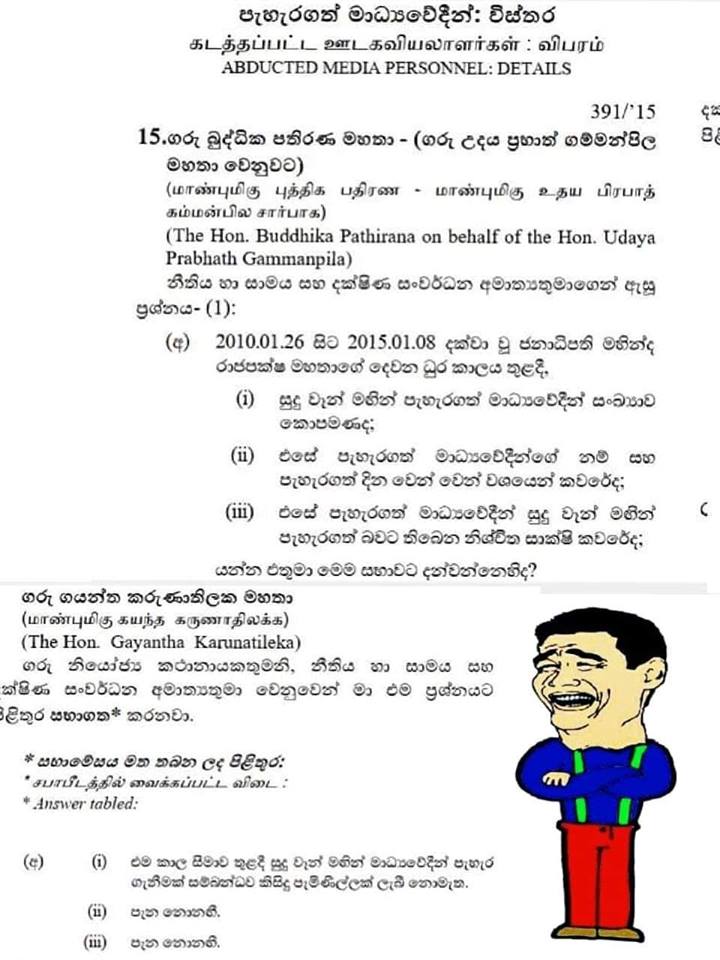
Alleged white-van abduction in the period 2010.01.26 to 2015.01.08

August 18th, 2019

FB

Please take note of the response in parliament by Gayantha Karunatilleke who was representing the Ministry of law and order to questions posed by Buddhika Pathirana on behalf of Udaya Gammampila on the number of Media personnel allegedly abducted in the period 2010.01.26 to 2015.01.08.

No photo description available.

The answer was None as the excerpt from the Hansard shows.

පුරවැසිභාවය ගෝඨාභය රාජපක්ෂ ස්ථීරවම ඉවත් කර ගත්තා – නාලක ගොඩහේවා

August 18th, 2019

උපුටා ගැන්ම  හිරු පුවත්

>ශ්‍රී ලංකා පොදුජන පෙරමුණ ප්‍රමුඛ ඒකාබද්ධ විපක්ෂයේ ජනාධිපති අපේක්ෂක ගෝඨාභය රාජපක්ෂ සිය ඇමරිකානු පුරවැසිභාවය ඉවත් කර ගැනීම ස්ථිර ලෙසම මේ වන විට සිදුකර අවසන් බව ආචාර්ය නාලක ගොඩහේවා ප්‍රකාශ කළා.

ඔහු මේ  බව කියා සිටියේ ජා – ඇල ප්‍රදේශයේ ඊයේ පැවති ජනහමුවකින් පසු මාධ්‍ය වෙත අදහස් දක්වමින්

Lanka offers to set up Regional Maritime Information Fusion Center

August 18th, 2019

Courtesy NewsIn.Asia

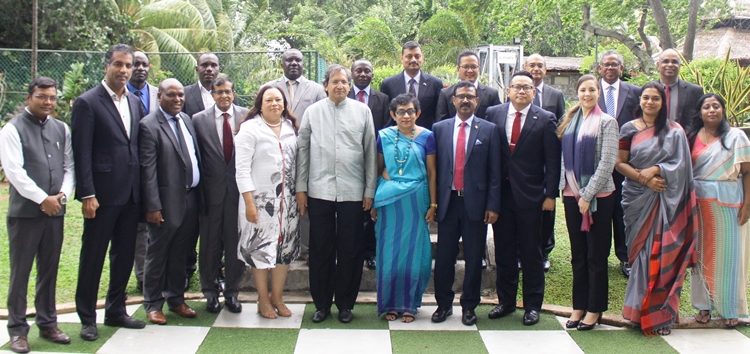
Colombo, August 18 (newsin.asia): In the first meeting of Indian Ocean Region Association (IORA)  Maritime Safety and Security (MSS) Working Group chaired by Sri Lanka and held in Colombo on August 8 and 9, Sri Lanka reiterated its interest in setting up a Regional Maritime Information Fusion Centre to complement similar centers in Madagascar and Singapore.

Further, Sri Lanka also offered to undertake to support member states in capacity building related to anti-piracy and SAR activities as well as engaging in research connected to specific MSS challenges, a Lankan Foreign Ministry release said.

Lanka offers to set up Regional Maritime Information Fusion Center

With the participation of 22 foreign delegates representing IORA member countries and representatives of the IORA Secretariat the working group finalized the work plan for action.

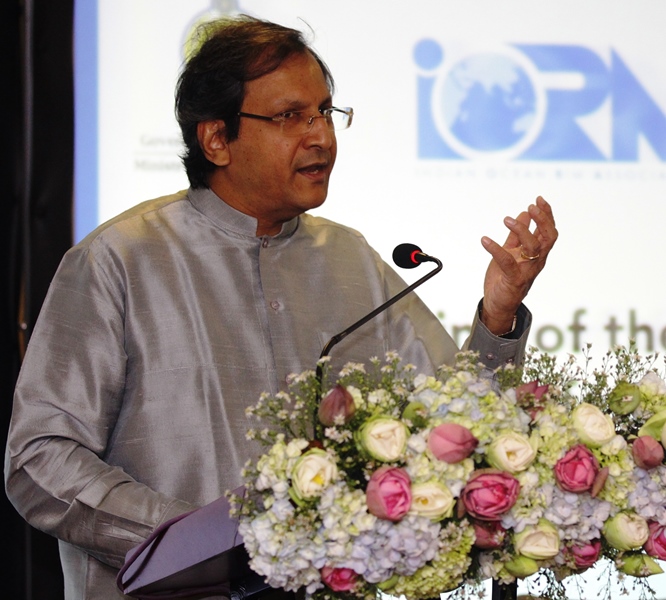
Inaugurating the meeting Foreign Secretary RavinathaAryasinharecalling Sri Lanka’s role in spearheading the Indian Ocean Peace Zone proposal in 1971, said at the time few recognized the importance of the concept. He said it was pleasing to note that times have changed. The Indian Ocean has today been acknowledged as one of the world’s busiest and most critical trade corridors, carrying two-thirds of global oil shipments and a third of bulk cargo and hosting the most critical Sea Lanes of Communication (SLOCs), directly impacting global trade and economy.

Sri Lanka as a country central to this region, while protecting its self-interest, is keen to ensure freedom of navigation and lines of communication, which were an essential prerequisite not only to maintaining regional security and stability, but is also crucial for the future prosperity of the region.

He said The Indian Ocean: Defining Our Future” multilateral diplomatic engagement hosted by Sri Lanka last year which brought together not only the Indian Ocean littoral states, but also its maritime users, was an expression of this commitment.

Sri Lankan Foreign Secretary Ravinatha Aryasinha

The meeting chaired by Director General of Ocean Affairs, Environment and Climate Change of the Ministry of Foreign Affairs, Hasanthi Urugodawatte Dissanayake, was an intense exercise to agree on a Work Plan on consensus basis of a 50-page document.

The Work Plan for an initial period of two years, was based on three over-arching objectives; 1. building the foundation for a collaborative IORA MSS Framework, 2. establishing an integrated policy approach on MSS, and 3. establishing a Coordinated Regional Vision for MSS in IORA to address existing and emerging issues.

Sri Lanka, as the Coordinating Country would take the lead in assessing progress of the implementation of the MSS Blue Print and the activities agreed upon under the Work Plan on MSS.

In the context of traditional and non-traditional threats connected to maritime safety and security and emerging new maritime architectures, particularly related to the Indian Ocean, a Panel Discussion moderated by Executive Director, Lakshman Kadirgamar Institute of International Relations and Strategic Studies, Dr. Ganeshan Wignaraja, on Emerging Scenarios Safety and Security in the Indian Ocean” was held.

Panelists included former Legal Advisor of the Ministry of Foreign Affairs of Sri Lanka and former Sri Lanka’s Permanent Representative to the United Nations, Dr. Rohan Perera, Deputy Chief of Staff and Director General Operations, Sri Lanka Navy, Rear Admiral N. P. S. Attygalle, and Head of Global Maritime Crime Programme, United Nations Office on Drug and Crimes, Mr. Alan Cole.

The event provided a forum for member states to discuss collective priorities in the spheres of maritime safety and security. It further gave an opportunity to build the foundation for a collaborative and integrated IORA Maritime Safety and Security framework based on the needs and priorities of member states.

Lanka re-launches Ramayana Trail to attract tourists from India

August 18th, 2019

Courtesy NewsIn.Asia

Kochi, August 18 (The New Indian Express/newsin.asia): To attract more tourists from India, the Sri Lankan government has re-launched a Ramayana tourism circuit, which will link all temples and caves in the country associated with the Hindu epic.

The initiative was presented by Sri Lanka Tourism Minister John Amaratunga at the Sri Lanka Tourism Roadshow held in Kochi.

Lanka re-launches Ramayana Trail to attract tourists from India

There was a Ramayana Trail” earlier in the 2000s but was discontinued because it was not properly organized. Only the places linked to the Ramayana were provided to those interested in book form. Interested tourists had to work out the itinerary on their own. If it was well thought out and if it had been backed up by adequate facilities for stay and travel, it would have been a money-spinner.

But traditionally, and even now, Sri Lanka is more interested in attracting high-spending tourists from the advanced countries than from India. Indian tourists are the single largest group in Sri Lanka but they are seen as low spenders and believed to stay for shorter periods. There is also an anti-Indian feeling in the travel trade which militates against making any special provisions to attract Indian travellers.

However, in Kochi, Amartunga said tourists from India visiting Sri Lanka will be provided with free visas. Also, Sri Lanka has introduced a 50% discount on hotel packages with effect from August 1 for Indian tourists and also brought down ground handling charges in airports.

According to the Minister, Sri Lanka today, has the highest number of concessions for its guests. Sri Lanka, for some time now, was not being considered by tourists from South India owing to internal problems. However, the situation has changed. Our country is now a safe destination,” he said.

The Minister said new policies which were being introduced were part of a larger plan to revive the tourism industry.

Since the Tamil Nadu government has also given the green signal to operate a ferry service to Rameshwaram in Tamil Nadu from Thalaimannar in Sri Lanka, Sri Lankan authorities will soon kick off the project.

The ferry service is expected to be launched by the end of this year after finalizing procedures with the Indian government.

Manavari temple, Ravana cave, Ashoka Vatika, Seetha Amman temple, Divurumpola, Ussangoda, Thiru Koneswaram temple, and Kathirkamam are part of the Ramayana circuit in Sri Lanka.

Felix Rodrigo, advisor to the Minister of Tourism delivered a presentation on Sri Lanka Tourism at the Roadshow while Sri Lanka Tourism Promotion Bureau Assistant Director Viranga Bandara introduced the features of Sri Lanka Tourism.

The event was organized by Federation of Indian Chambers of Commerce (FICCI) along with Sri Lankan Tourism Bureau and Spice Land Holidays Group.

The Indian government had also launched the Ramayana circuit in June this year and is one of the fifteen thematic circuits identified for development under Swadesh Darshan Scheme.

YAHAPALANA AND THE ECONOMY Part 14

August 16th, 2019

KAMALIKA PIERIS

DAIRY INDUSTRY.

Ministry of Rural Economic Development had imported high- yielding pregnant milch cows from Wellard Rural Exports Pvt. Ltd., Australia. They had arrived in November 2017. These cows were imported as part of an initiative by the Ministry of Rural Economic Development. The Ministry had ignored the warnings given by the Department of Animal Production and Health that cows from Australia carried highly contagious and deadly diseases.

3,030 of these cows were distributed to 46  middle-scale dairy farmers around the country. Investors paid Rs. 200,000 per cow and the government contributed Rs. 265,000.  The dairy farmers were told that these cows would produce 20 litres of milk a day on average. They were advised to get rid of the Sri Lankan animals they already had.

the Presidential Commission of Inquiry into the corruption of the Yahapalana government was told that these cows carried the deadly Bovine Viral Diarrhoea (BVD) virus infection, which was new to Sri Lanka  The cows also had fasciola hepatica (common liver fluke) a disease which had not been detected in Sri Lanka since 1973. Fasciola hepatica could affect humans as well.

These cows were in bad shape when they landed here, the dairy farmers said. A number of cows died, while a number of calves aborted or were stillborn. Dairy farmers had complained about the matter to the authorities. The farms had cows imported from New Zealand as well. These cows are in much better health.  the problem is with cows imported from Australia.”

They pointed out that BVD was known as the ‘dairy industry’s silent killer’ since cows carry BVD throughout their lives and infect others. In foreign countries, such animals are immediately killed. We also suggested that we follow similar procedures, but the government ignored the suggestion. The calves live in many of our farms. This is a threat to our dairy industry.

The government also failed to send the diseased cows back to the supplier. The Ministry was not prepared to ask Wellard to pay compensation nor was it prepared to obtain compensation from the Cabinet, complained to the farmers.

Many farmers testified that they were plagued by financial difficulties due to loans taken by them to take part in this government-subsidized scheme because the cows produce less milk than what was promised.

Kingsley Walter Senanayake, who had thrice won the award for the best milk farmer of Matale, yesterday, told the Presidential Commission of Inquiry  probing corruption in the current administration that he was plagued by financial difficulties due to loans taken by him to take part in this government-subsidized scheme to introduce high-yielding imported pregnant cows, in 2017. I took part in the project because of the assurances given by the Ministry but now I am in debt. I had never been in debt before.”

. “We were assured by the Ministry of Rural Economy, that the Ministry would ensure that the farmers received cattle feed at a concessionary rate of Rs. 40 a kilo and that steps would be taken to procure the milk produced at a higher price. However, we were never given subsidized cattle feed and I soon discovered that I was making a loss.” Senanayake said that he had bought 16 cows and six of them had died. 

Senanayake said that it cost him about Rs 30 to 35 to produce a litre of milk from local milch cows and it fetched about Rs. 65. “To maintain a local milch cow, on average, I spend about Rs. 350 a day and I can earn about Rs. 603 daily. For an imported cow given to me by the Ministry, I have to spend about R. 1,100 per day but I can make only about Rs. 1,088. This is when they produce the most amount of milk.” The imported milch cows consumed about 10 kilos of cattle feed a day and that alone costs over Rs. 600.

He had drawn a loan of Rs. 10 million from the Commercial Bank to finance the project and since the project had been a complete failure he had not been able to pay back the loan for eight months. The bank keeps telling me that it would sell the land I mortgaged as it wants to recover the loan.

Wellard Rural Exports Pvt. Ltd. Australia and its local agent Foresight had provided the plan for constructing cattle sheds to all farmers who took part in the project regardless of the climate and geography. “Wellard assured that they would provide medical facilities for two years. But these cows died between 8 and18 months and I feel that if they had responded on time when I complained, some of the cows could have been saved.

There have been five investigations into the matter.  First, the Ministry appointed a committee to evaluate the phase I of this cow scheme. That was not to inquire into the disease issue but to move on to phase II of the project. The committee met in January, February, and March and prepared the report. The team only visited six farms, out of 66, before preparing their report. On receiving the reports, the government then paid an advance to import another batch of 15,000 cows. 

Questioned by the Presidential Commission of Inquiry the chairman said did not possess any minutes of the meetings or a list of farms the committee had visited. The committee had visited six farms. He could remember the names of two owners. , but I can’t remember the names of the owners of other farms I visited’. He also said that he wasn’t sure how many cows he had observed.

This Committee told the Presidential Commission of Inquiry that they had found the cows to be weak, but they had not taken into consideration whether the animals suffered from serious diseases. When asked by the Commission about the possibility that the cows were weak because they were suffering from the disease the chairman said, “I don’t know. I don’t know about diseases. Checking diseases is not my specialty.”

The main problem according to the investigating committee, was the feed. “The main issue was food. Farmers thought they could give feed that they give to local cows. But these imported cows weigh about 400 kilos and need about 50 kilos of feed. Most farmers were not educated on the need to grow grass or to stock feed. We could see that the cows were not getting enough feed by looking at their bodies.

 The second issue with the cows,  said the committee,  was that farmers hadn’t done enough to place the cows in a climate similar to where they came from. He added that the sheds built for cows were not suitable.  However, they had been built according to a design provided by Foresight, Sri Lankan agent for Wellard.

The second investigation was by the government Veterinarians. They conducted their own inquiry and they too gave evidence before the Presidential committee. They, however, knew about disease and informed the Committee  “Our officers kept tabs on those animals and they found several cows with  BVD when they commenced investigations. Soon after they found live eggs of fasciola hepatica in cow dung. 

The Vet dept of the Ministry, made inquiries and It then emerged that the Chief Veterinarian Officer of Australia  had informed  his Director of Animal Production and Health  that the animals sent to Sri Lanka, were from a farm that had been free from BVD for one year, but on November 22, 2017, a lab report showed that 21 cows had been infected with BVD. they delayed sending the report to the Sri Lankan officials, Chief Animal Quarantine Officer, Sri Lanka got this report only on January 10, 2018, and Director – Livestock Planning and Economics saw this only two weeks later. 

The Vets said that it was clear that Wellard had been aware of the lab report before shipping the cows to Sri Lanka because they had removed the cows diagnosed with BVD from the shipment. However the cows which had been with them were sent. “It was the responsibility of Wellard to send Sri Lanka healthy cows.  The Ministry could have taken action. “Unfortunately nothing happened.” .

Further according to the relevant quarantine  Act,  every animal imported to Sri Lanka shall be subject to quarantine for a minimum period of thirty days. While usually they were held in one designated location, in this case, the cows were sent to various farms across the country, before the end of the quarantine period This kind of thing has never happened before”.

The third investigation came from Australia. A team of auditors from Export Finance Australia arrived in Sri Lanka in July 2019 to conduct an independent assessment at the farms that took in milch cows.  They selected 15 farms out of 67. The local dairy farmers said the Australian team had visited some farms and attempted to find fault with farming practices there.

Fourthly, the Presidential Commission of Inquiry investigating corruption in the current administration, announced in July 2019  that they will commence an inspection tour of farms which have got 3,030 substandard imported Australian cows from the government. They will also inquire into claims that the cows are suffering from Bovine Viral Diarrhoea (BVD), hitherto not found in Sri Lanka.

Lastly, Minister of Public Reform and Public Distribution Dr. Harsha de Silva dismissed allegations that the government had distributed 3,030 substandard imported Australian cows among 46 investors and dairy farmers in 2017. The Minister said, in July 2019, that he had visited several farms on his way to Sri Pada. He said he could not recall the names of the farms he visited, but on one farm, a farmer got nearly 40 litres of milk each per day from the cows imported from Australia”. But on some farms, the cows were in pretty bad shape. My conclusion is that farms that were able to maintain the cows properly, got bigger yields than those which were not properly maintained, he said.  ( CONTINUED)

Rise of family power and memories

August 16th, 2019

Lucien Rajakarunanayake Courtesy The Island

article_image

Sajith Premadasa, with his black T-shirt and huge Indian-politico garland at Badulla, is certainly making a massive pitch to be the UNP’s next candidate for the Presidential poll. His spread of villages and towns in the country has passed its 250th, and is racing ahead to keep alive his paternal memories of Gam Udava.

The Gam Udava politics and memories of his father are certainly good for his loud backers in the green bandwagon. But, there is certainly much of important human and political forgetfulness in the run up to grab the green party candidacy.

Democratic politics in this country runs back more than seven decades. It began in the mid-1930s with the election to the first State Council. Coming down through all these decades we see an increasing trend in forgetfulness in the seekers or hunters for national leadership, and their backers from political parties and families.

My memory of Premadasa’s father – President Ranasinghe Premadasa – brings back memories of journalistic colleague – Richard de Zoysa. Is it possible that Sajith P has forgotten or has no knowledge of that brutal killing of Richard de Zoysa, the outspoken journalist, dramatist and civil society activist? He was killed by the powerful and uniformed catchers of the Premadasa government dumped in the sea.

Such forgetfulness may be good in the politics of convenience, in the search for the green banner in presidential candidacy. But, it is a memory that remains with the people. We recall that the anti-Premadasa poster that went on the walls of the city, just before Richard was abducted and driven to his death, and seawater ditching.

Sajith P should also know (if he has forgotten or is ignorant of it) that Richard de Zoysa’s killing is what led to the forming of the Free Media Movement, which gave a lead in the fight to protect the lives and limbs of journalists during the Premadasa era of UNP government, and dirty green politics. Richard de was not the only victim of the deadly politics of the Premadasa reign, with catchwords about the power to the people, and the actuality of power to the crooked.

As Sajith Premadasa keeps opening more villages and towns, giving them the most puzzling names, it would do well for him to be reminded that the Gam Udava gimmick was disliked and rejected by the people, and how those Gam Udava places became abandoned localities in the rural neighbourhoods.

Forgetfulness may be helpful in the race for the green candidacy, but it would help to have some memories of how 600 policemen were killed by the Tiger Terrorist LTTE, during the reign of Ranasinghe Premadasa. Why were they asked to surrender to the LTTE? And, what about all that massive supply of weapons given to the LTTE, by the Sri Lanka government, supposedly to attack the Indian IPKF, but was in fact turned on this country’s own troops and people too by the LTTE? These are not memories that easily fade away, however much the current ‘Premadasa Putha Senakeliya’ – political carnival – moves on in the first major inner riot of the UNP.

Going back to those bloody Premadasa power days, and what followed, let us also not forget the role of Ranil Wickremesinghe, in his later position of power as PM, to prevent proper judicial punishment to the Richard de Zoysa killers. This is the trail of UNP contortion that Sajith Premadasa follows as the emerging voice of the greens.

Sajith P should also know one more thing about his current race in the village and town building. The huge monies spent on Samurdhi only show the increase in poverty in the country. The rise in new hamlets and town-lets with tiny homes is a scourge on nature in this country. Would two-storeyed housing units be rejected or hated by our people, and how much of greenery and forest would that preserve? Such thinking is not in the “Prema-Putha Buddhiya” thinking!

Forgetfulness is certainly not confined to the Green Parade. The Purple Parade, with Gotabaya in the lead, also raises deadly memories to us journalists, and to the public. Gotabaya has said he would go beyond the confines of power in his coming presidency, obviously supported by his Elder Brother Mahinda, who expects to be the powerful Executive Prime Minister – thanks to the 19th Amendment!

This certainly brings us memories of the still unresolved killing of Lasantha Wickrematunge, the murder of rugger player Wasim Thajudeen, the abducted and missing (believed dead) Prageeth Eknaligoda, the abducted and injured Keith Noyarh, and the many other journalists who were attacked and injured in the days when power was with the Rajapaksa Family, of which Gotabaya was a brother of action.

The new rise of Gotabaya, the man with the most case postponements, with several judicial recusals, is the new rise of Family Power or Pavul Balaya. We are fast-moving to the days of a new Sahodara Balaya – Brotherly Power, and not the old slogan of comradeship in the working class.

We have still to see how well Gotabaya and Sajith will carry out their campaigns of family memories and brotherly power. Sri Lanka is certainly looking with many worries at such anti-social and crooked memories.

Shock Doctrine in Sri Lanka

August 16th, 2019

By Lakshman I. Keerthisinghe Courtesy Ceylon Today

Sri Lanka enjoys a geographic position in the middle of very significant sea lanes and transit lanes that is an envy of many nations. The US acknowledges that, and we know we have a partner in Sri Lanka that shares our interests, making sure that those transit lanes and sky stay open for free navigation in this region and beyond. So we have a mutual interest, as do other nations who want free transit”Alaina B. Teplitz – American Ambassador

Recently during a Parliamentary debate the subject of ‘Shock Doctrine;’ emerged. The Shock Doctrine: The Rise of Disaster Capitalism is a 2007 book by the Canadian author and social activist Naomi Klein. In the book it is argued that neoliberal free market policies have risen to prominence in some developed countries because of a deliberate strategy of “shock therapy”. This strategy centres on the exploitation of national crises to push through controversial policies while citizens are too emotionally and physically distracted by disasters or upheavals to mount an effective resistance. The book suggests that some man-made events, such as the Iraq War, were undertaken with the intention of pushing through such unpopular policies in their wake. The use of “Shock and Awe” in the 2003 invasion of Iraq on the guise of searching for weapons of mass destruction which were never found and the subsequent occupation of Iraq, which Klein describes as the most comprehensive and full-scale implementation of the shock doctrine ever attempted.


In this backdrop, the proposed Status Of Forces Agreement (SOFA) to be signed between Sri Lanka and the United States relating to several matters including military training and cooperation is not inimical to the sovereignty of Sri Lanka in any way according to US Ambassador Alaina Teplitz, but many critics have opined that the said Agreement adversely affects the sovereignty of our motherland. The Agreement would have been already signed in its present form if not for the objection by President Sirisena which is very laudable indeed. Discussions are ongoing between the two countries about the Agreement and once the two countries reach agreement on it, it will be published on the internet. The US Ambassador expressed these sentiments when she called on the Malwatte Mahanayake Thera the Most Ven. Tibbotuwawe Sri Siddhartha Sumangala Mahanayake Thera and Asgiriya Mahanayake Thera Most Ven. Warakagoda Gnanarathana Mahanayake Thera at their Aramayas in Kandy.


 Meanwhile, the Archbishop of Colombo Malcolm Cardinal Ranjith has said that violent incidents in the country have created unrest between the Sinhalese and the Muslims, in the country including the 21st April massacre may have been to provoke the people to violence. “These forces are trying to create unrest in Sri Lanka to pave the way for international interference. Some forces are trying to provoke people and create religious unrest. The recent incident at Katuwapitiya is a perfect example of this. 

They are attempting to create unrest among the Sinhalese and the Muslims. I ask all Catholics not to raise their arms against Muslims as they are not behind these destructive efforts. It had been done by a group of individuals who had gone astray. They are backed by some international forces. We don’t have to harm innocent Muslims because of this group,” His Eminence stated.


In the recent past, including the 21st April massacre, several attempts have been made to provoke clashes between the Muslims and Sinhalese leading to a situation as described in the Shock Doctrine referred to above. When the country is in shock and turmoil, it facilitates these international powers to easily creep in and get what they desire by providing military assistance and finances.

Diplomatic immunity

It is to be noted that Status of Forces Agreement (SOFA) Sri Lanka is expected to sign with Washington, can bring US military operations into the country affecting Sri Lanka’s sovereignty and territorial integrity. The SOFA could provide US Department of Defence military and civilian personnel status equivalent to that of US Embassy administrative and technical staff under the Vienna Convention on Diplomatic Relations of 1961. Accordingly, US personnel are immune from criminal prosecution and are immune from civil and administrative jurisdiction except with respect to acts performed outside the course of their duties.


In conclusion the Carrot and Stick used by Washington is trade and economic assistance which China has so far failed to offer Sri Lanka. The question is whether recent unexpected communal and religious upheavals which may have caused havoc in the country are pre-planned to shock Sri Lanka in to subjugation forcing Sri Lanka to turn in to a US military base in the Indian Ocean region replacing Diego Garcia which the US has to hand over to Mauritius. Intelligence services in Sri Lanka should guard against probable application of ‘Shock Doctrine’ in Sri Lanka as elections draw near.

(The writer is an Attorney-at-Law with LLB, LLM,
MPhil. (Colombo)- keerthisinghel@yahoo.co.uk

A book worthy of a read by all Sri Lankans

August 16th, 2019

By Dr. Tilak S. Fernando Courtesy Ceylon Today

A new book titled, Tamil Tigers Debt to America authored by Daya Gamage, has been published by the Library of Congress (under control No. 2016913508) ISBN: 1537053485 and 13:9781537053486 respectively. The author is an old Trinitian who read Economics and European Political history at Peradeniya; subsequently became an academic at a U.S. University, prior to joining the  U.S. Federal Service.

Daya Gamage had worked with Dr. Robert K Bloggs, the most Senior Political Councillor, attached to the U.S. Embassy in Colombo from 1989 to 1993. Subsequently, Gamage read Law at the University of Colombo thus. making him an increasingly -authoritative source of legal analysis, attached to the U.S. Embassy in Colombo.

During his time with the U.S. Embassy in Colombo, working with Dr. Bloggs, they experienced the JVP insurrection in the South as well as the Tamil struggle in the North that formed into a militant rebel movement the LTTE, known as Tamil Tigers that became the most ruthless terrorist group in the world.  In Sri Lanka the LTTE carried out a policy of destruction by killing and maiming thousands of innocent people, including Buddhist Clergy, Senior Politicians ( both Sinhala and Tamil), detonating bombs indiscriminately and even mercilessly slaughtering infants and young children. On 16 May 2009, the Sri Lankan Government Forces decimated the entire LTTE organisation.

During this calamitous period Daya Gamage undertook field tours outside Colombo with senior officers of the Embassy and Foreign Service officials assigned to Colombo from Washington and Congressional Delegations. His subsequent solo, well-planned, tours in remote areas of the country to assemble ‘far-reaching socio-economic-political data for investigative-analytical reports, earned him recognition, in 1988, by the U.S. Department, as Sri Lanka’s diplomatic mission’s ‘political specialist’. Consequently, he received a coveted ‘Meritorious Honour Award for Superior Performance’.

The American Ambassador at the time commended Daya Gamage in his assessment as follows:

“The U.S. Mission has benefitted in many other ways from Mr.Gamage’s unusual initiative and resourcefulness. Information on political attitude probably would not have been forthcoming if he were travelling with an American Officer.”

During the terrorist war period, the influential political-diplomatic arm of the LTTE in the U.S., Ilankai Tamil Sangam carried an analysis in their website: http://www.sangam.org/2008/08/Stalingrad.php?uid=3046, defending the LTTE’s military  struggle of the Tamil Tigers, and identifying Gamage and his online daily newspaper Asian Tribune with four others, as obstacles  to the Tamil Struggle in Sri Lanka.

Upon retirement

Once Daya Gamage relinquished his duties at the U.S. Diplomatic Mission in Colombo, he managed to formulate his knowledge and experience about U.S. strategy and the LTTE’s contribution to America in a concise and unbiased form, by writing a book containing 577 pages (under copyright ©2016 Daya Gamage); ISBN: 1537053485 & ISBN 13:9781537053486 ,which can be ordered through Amazon Books ‘on line’.

Overview

In the introduction to his book, Gamage asserts to what extent the ‘Foreign Policy Strategies of the U.S.’ had been multifarious and the U.S. Agency for International Development (U.S. AID) had become an effective Foreign Policy Instrument of the State Department, Congress, and the White House. ‘In 2004, under George Bush Administration the Millennium Challenge Grant for the Third World nations was ‘selected’. “Occasionally, the U.S. seems to exercise its military supremacy to impose its Brand Rule of Law and Governance”.

Gamage discusses in his book how the “U.S. officials and bureaucrats in the Department of  Political Affairs collaborated to influence Sri Lanka in its governing structure”. The Sri Lankan Tamil Diaspora, he states, was impressively influential in building American perspective toward Sri Lanka during their struggle.

Tamil Tigers Debt to America examines Sri Lankan National issues that go beyond ethnicity, and records how Tamil nationalism emerged, since Ceylon gained Independence in 1948 and highlights the alarming danger signals from both Tamil and Sinhala nationalism.

Towards the end of 1970, the LTTE was able to charm the West, particularly the U.S. State Department. The book contains impressive and graphical accounts of the U.S. Foreign-Policy Adventurism and Sri Lanka’s Dilemma that run into detailed pages and setting out American Agenda from 1980 to 2016. This comprehensive ‘insider account’ is dealt with  by the author, who once worked in tandem with the American Dr. Robert K. Boggs of the U.S. Department of State and Tilak Samaranayake, who formerly worked for the U.S.AID.

IllU.S.trative output

In a graphical account Daya Gamage highlights some significant photographs covering the following: The ‘UN Correspondent for the Nation at the time Barbara  Crossette, who occasionally received ‘strange requests’ from  either editors in the “New York Times,’ and U.S. pro-LTTE sympathisers  to reflect on a farcical  account about how the Sri Lankan Intelligence Service operated  a torture  centre on the 4th floor of the Airport, which anyone who has visited the Airport knows to what extent this appears to be  fabricated; there is no fourth floor at the Katunayake Bandaranaike Airport!

Amongst  the graphical news with pictorial content, the author can be seen speaking to top brass of the U.S. hierarchy, Sri Lankan Government top officials and with the leaders of LTTE including  the Sri Lankan President at the time, Mahinda Rajapaksa in August 2007;  Prime Minister Ranil Wickremesinghe with the U.S. Deputy  Secretary of State, Richard Armitage, in Colombo in 2002; U.S. Congressman Danny Davis being greeted by the LTTE Police Chief  Nadasan in Kilinochchi in 2005; U.S. Assistant Secretary Robert Blake in 2010, with a delegation led by Rev.Fr. S. J. Emmanuel (Germany); Dr. Elias Jeyararajah, Mrs. Grace Williams (U.S.) and Suren Surendiran (UK); Also a photograph of the LTTE Leader Prabhakaran with Dr. Anton Balasingham, Visuanathan Rudrakumaran in 2007; a picture of Rajiv Gandhi with Prabhakaran and Anton Balasingham in1987; Norwegian peace negotiator Eric Solheim conferring with P. Tamilselvan in Kilinochchi; President Bush and Ranil Wickremesinghe in the White House on 5 November 2003, and so forth.

WikiLeaks cables

The book covers also a segment of the U.S. Embassy in Sri Lanka’s classified cables to Washington sent by Robert Blake (Ambassador at the time), which was disclosed by WikiLeaks giving  a glimpse of the endeavour by the U.S. to arrange a surrender of the LTTE cadre. The cable is highlighted in the book as follows:

Ambassador contacted senior GSL officials throughout the day, including Secretary of Defence Gotabaya Rajapaksa and Foreign Minister Bogollagama to urge acceptance of a mediated surrender of the remaining Tigers and maximum restraint on the part of the military to avoid further civilian casualties, particularly after the reports from the Bishop of Mannar of continued high number of civilians in the safe zone.

However, the author reveals how President Rajapaksa refused to accept mediated surrender on the grounds that the fighting was all but over, and troops had been instructed to accept anyone who wished to surrender.
In a separate chapter the author describes, ‘The American Agenda through FSO Eyes’, where it mentions about a Group of FSO having a meeting at the U.S. Embassy Office in Colombo, in 1990, to  exchange notes of significant developments in Sri Lanka’s political scenario.      

The book contains the author’s personal discU.S.sions with Schaffer about the American Agenda between 1980- 2016, and also an interesting interview with Ambassador Teresita. It further discusses the “deep rooted U.S. belief and the war with the Tamils, during Secretary of State John Kerry’s period and about the U.S. Policy Guide” and how “Sri Lanka engrossed in Ethnic warfare particularly about the self-rule Federal structure in the North and East”.

The book deals with areas on Sri Lanka’s diplomatic strategy and ambiguous U.S. reports: ‘How the Tamil diaspora filled the void; strategic communication and argues for the case for a new vision at the U.S. Embassy in Sri Lanka.  It also deals with the U.S. & Third World trust deficit;  about the Sri Lankan Diplomats in the United States in Deep Slumber and its Consequences; LTTE Influence in the International Community; How the Sri Lanka Mission slept on Ho use Resolution for eighteen months; ‘A Professional Strategy to Delegitimise Sri Lankan State;  Barbara Crossette’s Prophecy; Historic Evolution of the Homeland Concept and an Independent Tamil State;  how the United States  leans on Tamil Homeland; their secessionist demand for  Tamil Homeland with a question Why ?;  The Birth of the Secessionist concept; The U.S. Trajectory toward a war-crime allegation; The U.S. war reports on Sri Lanka; Ambiguous information; U.S. Department of Defence: The use of Human Shield; U.S. ‘Policy Design’ for Sri Lanka:  How the U.S.  imposed the
‘Carrot and Stick Policy on Sri Lanka in 2002 and 2015 including global experts’ scrutiny of war-crimes allegations and the final chapter discusses the International Humanitarian Law and it’s applicability to the LTTE’.
The book also exposes either ignored or unknown  gradations of the post 2009 developments in which Washington and the Tamil diaspora played, and even currently playing at present, that have  threatened Sri Lanka as a nation, her sovereignty and territorial integrity.

Washington’s softer attitude

The entire argument of the author of the Book Tamil Tigers’ debt to America is about an unbiased projection as to how Washington took a softer attitude towards the LTTE. It concludes stating, how during the final 3-4 weeks of the war when Washington saw the imminent defeat of the Tamil Tigers they were contemplating  to remove the hierarchy of the Tiger Leadership from the battle zone with the intention of  using the secessionist movement in a different form as a pressure group to effect changes in Sri Lanka.

One needs to read the entire book to get an idea of the U.S. strategy on Sri Lanka, which seems to prove some of the things said by Sri Lankan Parliamentarians, today. It would have been a jolly good reproduction of various sections of the book, as well as interesting reading,  if only the writer was  able to obtain Daya Gamage’s authority to do justice to his book through columns of  the ‘Ceylon Today’ newspaper, but all his efforts to reach Daya Gamage has been fruitless even after making written requests to the Library of Congress (where the book has been published under their control number : 2016913508) and also the writer having written to  the Create Space Independent Publishing Platform, North Charleston, South Carolina.

The writer will appreciate, in the circumstances, if anyone who knows about Daya Gamage’s contact details contacting the writer by email as below, as it is a book that must be read by every Sri Lankan.

tilakfernando@gmail.com

Presidential candidate Ranil faction agrees to name Sajith

August 16th, 2019

By W.K. Prasad Manju Courtesy Ceylon Today

Trying to reach a consensus on the existing UNP presidential candidate conundrum, conditions have been laid down by Ranil Wickremesinghe’s faction, who have agreed to name Deputy UNP Leader, Sajith Premadasa as the Presidential candidate, internal sources said. However, the Premadasa faction has still to respond.

It is reported that these conditions include keeping to the Party leadership, naming Wickremesinghe as the Prime Ministerial candidate and offering the General Secretary post of the proposed Democratic National Front (DNF) to a Leader of the UNP. In addition, Wickremesinghe’s name has been proposed as the Chairman of the DNF.

Meanwhile, the UNP leadership was to meet on 17 August at Minister Rajitha Senaratna’s residence to decide on the Presidential candidate.

A senior member of the UNP who is to participate in the meeting said though Party leaders agreed to certain amendments to the DNF but did not agree to others including handing over of the General Secretary post.

He further added that the final decision on the DNF Constitution, the date when it will be formed and the Presidential candidate will be named shortly.
Meanwhile, UNP Parliamentarian Wijepala Hettiarachchi said Wickremesinghe should be the Prime Ministerial candidate if Premadasa is named as the Presidential candidate. He further added that the majority were agreeable to the proposal which will be presented at the Parliamentary group meeting to be held soon.

China-Lanka Buddhist Association sets up water purification plant in remote Lankan village

August 16th, 2019

Courtesy NewsIn.Asia

Colombo, August 16 (Xinhua): The Sri Lanka China Buddhist Friendship Association together with the Chinese Embassy in Colombo,  have donated a drinking water purification plant to the   Moragollagama village, in Kurunegala, in Sri Lanka’s  North Western Province.

China-Lanka Buddhist Association sets up water purification plant in remote Lankan village

A statement from the Chinese Embassy on Thursday said that the water purification facility is the fourth such facility donated by the Chinese Embassy to a remote village in Sri Lanka.

Lankan village kids have a look at the water purification plant

Moragollagama consists of 150 families, most of whom are living below the poverty line. Due to the scarcity of pure water in the area, villagers have to walk 10 kilometres to get water for their daily needs.

The new water purification facility will offer pure water free of charge to the villagers.

The Minister of Buddha Sasana, Gamini Jayawickrama Perera, speaking at the launch ceremony thanked China for its assistance and said that the government is looking forward to further strengthening ties and cooperation between China and Sri Lanka.

(The featured image at the top shows Sri Lankan village kids enjoy a glass of pure water from the purifying plant donated by China. Photos are by Thusitha) 

India-Lanka Foundation invites research and educational project proposals

August 16th, 2019

Courtesy NewsIn.Asia

Colombo, August 16 (newsin.asia): The India – Sri Lanka Foundation (ISLF) invites research and other educational project proposals in the areas of Education, Art & Culture, Archaeological Studies, Agricultural Research, Science & Technology, Information Technology, Health, Development Studies, and Gender Studies.

Under the above thrust areas, proposals could be submitted for research projects and other educational activities at recognised institutions of learning located in India and in Sri Lanka, visits and exchanges involving students, scholars, academics, artists, professionals and performing artists, to participate in conference/seminar, symposia, art exhibition, film festival, cultural events and training workshops etc, publication of research works on India-Sri Lanka relations in the specified fields and translating literary works in Indian languages to Sri Lankan languages and publishing them, and vice-versa.

Individuals, institutions and groups are invited to submit proposals which would be considered during the next meeting of the Board of Directors of ISLF.

A duly filled application form which could be downloaded from the High Commission of India website (www.hcicolombo.gov.in) along with the proposal may be e-mailed or forwarded to our address given below to reach us before September 15th, 2019.

INDIA-SRI LANKA FOUNDATION

C/o. High Commission of India

36-38, Galle Road, Colombo 3

Phone: +94 11 2389924

E-mail:islfcolombo@gmail.com

Th ISLF was established by a Memorandum of Understanding between the governments of India and Sri Lanka in 1998 in order to foster India – Sri Lanka relations through the enhancement of economic, scientific, technical and cultural cooperation and to promote greater understanding between the people of the two countries.

Colombo’s property value to rocket following completion of mega project

August 16th, 2019

Courtesy NewsIn.Asia

Colombo, Aug. 15 – With the completion of a mega China-funded port city project in capital Colombo, property value here is expected to increase within six years, a leading property report said.

The report, titled Lanka Property Web, 2019, Real Estate Trend, said that with the completion of the Colombo Port City, business and residential areas in central Colombo will see a steep rise in property and rental values.

China’s Colombo Port City project gains acceptance among Lankans

Projects, including residential buildings, located around the Beira lake front are expected to double in value within the next six years while rental yields will also increase due to the need for affordable, convenient, contemporary living close to the Colombo Port City.

The reclaimed land project of the Colombo Port City aims to develop Colombo as one of the most livable cities in South Asia.

The mega Colombo Port City, being constructed close to the Colombo harbor, is one of Sri Lanka’s largest foreign direct investment.

Bangladesh High Commission in Lanka observed National Mourning Day by serving cancer patients

August 16th, 2019

Courtesy NewsIn.Asia

Colombo, August 16 (newsin.asia): The Bangladesh High Commission in Sri Lanka commemorated the National Mourning Day’ marking the 44th anniversary of the brutal assassination of the Father of the Nation Bangabandhu Sheikh Mujibur Rahman by serving cancer patients in Matara in the Southrn Sri Lanka and Anuradhapura in the North Central Province.

Bangladesh High Commission in Lanka observed National Mourning Day by serving cancer patients

In the morning of August 15, the National Flag of Bangladesh was hoisted at half-mast at the High Commission by High Commissioner M. Riaz Hamidullah. A minute’s silence was observed as a mark of respect to the Father of the Nation and the members of his family who were brutally killed on on August 15, 1975. Flowers were placed near the portrait of Sheikh Mujibur Rahman as the Holy Quran was recited.

Later, all members of the High Commission travelled to Matara, 160 kms away from Colombo, to join a special commemorative event organised with the *Cancer Care Association of Sri Lanka.

Food being served to cancer patients by the youth..

Bangabandhu Memorial Grant

High Commissioner Hamidullah handed over the first-ever ‘ Bangabandhu Memorial Grant ‘ to the Institute of Palliative Medicine for the round-the-year treatment and care of three Sri Lankan cancer patients.

This unique grant was instituted to underline the empathy and love the Bangabandhu had throughout his life for the distressed anywhere. In addition to making the contribution to the Cancer Care Association, the High Commission served cooked food for 16 cancer patients in Matara and another 23 cancer patients in Anuradhapura.

The High Commissioner also announced a special long-term arrangement with a leading Bangladeshi oncology pharma company under which the company Beacon” will offer cancer drugs free for every second drug purchased.

Dr Samadhi Rajapaksa, founder of the Institute and the Association, applauded the unique gestures from the people of Bangladesh.”

Unprecedented Massacre

Bangladesh High Commissioner Riaz Hamidullah speaking on Sheikh Mujibur Rahman and Bangla-Lanka cooperation in cancer care

Writing in The Daily Star, on the massacre that took place in Dhaka on August 15 ,2015, Abdul Mannan, Chairman of the Bangladesh University Grants Commission says: Political assassinations and military coups need long preparation, careful planning and execution. The involvement of a few insiders and the support of foreign powers make things easier. In cases where the victim is someone like the Father of the Nation, Bangabandhu Sheikh Mujibur Rahman, the task is more challenging. The killers of Bangabandhu planned meticulously and acted professionally. Unfortunately, to make things easier for the killers, Bangabandhu himself never believed any harm could be caused to him or his family. On a few occasions, some well-wishers of Bangabandhu tried to warn him, but he brushed their warnings aside, saying that his own people could never cause him any harm.

Khandaker Moshtaque, who was the Foreign Minister in Tajuddin’s cabinet in 1971 and the person who became the President after the killing of Bangabandhu onAugust 15, 1975, was a mole within Bangabandhu’s cabinet. Ironically, Moshtaque was one of Mujib’s most trusted lieutenants. At the height of the Liberation War, Moshtaque conspired against the war. In September, he tried to contact the US Consul General George Griffin in Calcutta through one Zahurul Qyum, an Awami League MP elect from Comilla. According to Henry Kissinger (The White House Years), Moshtaque sent a message that if the US could arrange for the release of Sheikh Mujib from Pakistani prison, he would try to convince the Mujibnagar government to call off the Liberation War and forge a federation with Pakistan. Griffin doubted Moshtaque’s credibility. Moshtaque, however, was kept in the good books of the US and later on was used very successfully by the conspirators to unseat and kill Sheikh Mujib. Griffin was declared persona non grata in India after this incident.

Bangabandhu Sheikh Mujibur Rahman and his family who were massacred by military officers

The main conspiracy to assassinate Bangabandhu was hatched inside Dhaka cantonment by pseudo freedom fighters like Khandaker Abdur Rashid (a close relative of Khandaker Moshtaque), Farookh Rahman, Shariful Hoque Dalim and others. All of them reported to the Mujibnagar government towards the end of the war, from October to November, claiming that they have defected from the Pakistani army. It is, however, clear now that they were actually the fifth columnists working in disguise for Pakistan. With them they found a few senior repatriates who were unhappy as their colleagues who participated in the Liberation War were given two years of seniority. General Zia, Deputy Chief of Army Staff, whose role during the war was always under scrutiny, was in the loop of the conspirators though Bangabandhu loved him as his own son. Zia was unhappy as he was not made the Army Chief immediately after liberation.

In March, Abdur Rashid and Farookh Rahman discussed their plan to overthrow Bangabandhu with Zia. He gave the green signal and said that as a senior officer he could not directly get involved with their plan, but if they wished, they could go ahead. Zia’s duty was to report this incident to his superiors but he never did that, as he wanted to be one of the beneficiaries of Mujib’s overthrow. Bangabandhu and a few senior Awami League leaders considered Zia to be very ambitious. A few months before the assassination of Bangabandhu, Zia was given a diplomatic posting either in East Germany or Belgium. Zia, however, managed to persuade Bangabandhu through some senior Awami League leaders to have the new assignment cancelled. He told Bangabandhu that his loyalty to him and the government was absolute and that he wanted to retire as a professional soldier. Bangabandhu trusted Zia and cancelled his new assignment.

US Role and Indian Warnings

The coup planners also had a covert connection with the US embassy in Dhaka. They established contact in the guise of purchasing arms. Christopher Hitchens, a British-American journalist and commentator, in his much publicised book The Trial of Henry Kissinger writes, In November 1974, on a brief face-saving tour of the region, Kissinger made an eight-hour stop in Bangladesh and had a three-minute press conference…. Within few weeks of his departure… a faction at the US embassy in Dacca began covertly meeting a group of Bangladeshi officers who were planning a coup against Mujib.” Among those the coup plotters contacted was Philip Cherry, the CIA Station Chief in Dhaka.

Quite a few responsible army officers tried to inform Mujib that a coup plot was being hatched to overthrow him which he never took seriously. He trusted his people but trusted them too much. Besides the confidants of Bangabandhu, others were also concerned about the possible coup in Bangladesh. RK Yadav, a former R&AW Officer of India, writes in his book Mission R&AW, R&AW was closely keeping tabs on all these developments in Bangladesh through its sources in various departments. R&AW received advance information of the conspiracy against Sheikh Mujibur Rahman which was hatched by some disgruntled junior officers in the units of artillery and cavalry. R.N. Kao (top R&AW Boss) personally informed the Indian Prime Minister Indira Gandhi… Kao personally went to Dacca in December 1974.

Assassins of Bangabandhu’s family

He met Sheikh Mujibur Rahman at the Bangabhavan and requested him to come out for a little stroll in the garden. When they were out of ear-shot, Kao conveyed to him the information which R&AW had received about the danger to his life. Sheikh Mujib was euphoric at that time and waving his arms said, ‘These are my own children, they will not harm me’.” In March 1975, Kao sent one of his trusted officers to Dhaka who gave exact details of the coup plot to Mujib and as usual, he ignored the warning. By any definition, Bangabandhu was totally indifferent about his security and he along with the nation had to pay a heavy price on the fateful night of August 1975.

Soon after Major Dalim broadcasted the news of the coup on August 15, 1975, several former military officers rushed to the radio station to pledge their support and services to the new regime, including Colonel Abu Taher, Colonel Akbar Hossain, Major Shahjahan Omar, Major Ziauddin, Major Rahmatullh and Captain Majed, writes the US based journalist B.Z. Khasru in his latest book The Bangladesh Military Coup and the CIA Link. Colonel Taher was later sentenced to death by Zia through a sham trial. Others tasted state power in some form or the other.

(The featured image at the top shows a cancer patient being mouth fed)

හිරු CIA අනාවරණයෙන් පසු කළබල වූ රාජ්‍ය නිලධාරීන්

August 16th, 2019

උපුටා ගැන්ම – හිරු පුවත්

මුතුරාජවෙල තෙත් බිම් කලාපයේ කඩොලාන විනාශයක් පිළිබඳව හිරු සී.අයි.ඒ. හරහා පසුගිය 14 වැනිදා අනාවරණයක් සිදුකළා. <br /><br />එම ප්‍රදේශයේ කළ හෙළි පෙහෙළි කිරීම් ගොවිජන සේවා දෙපාර්තමේන්තුව හා පොලිසිය ලබාදුන් උපදෙස් මත සිදුකළ බවයි ඉඩමේ හිමිකම වෙනුවෙන් පෙනී සිටි කාන්තාව වන සංරක්ෂණ දෙපාර්තමේන්තු නිලධාරීන් හමුවේ ප්‍රකාශ කළේ.

ශ්‍රී ලංකාව සතු වැදගත්ම නාගරික තෙත්බිම් කලාපය වන්නේ මුතුරාජවෙල තෙත් භූමියයි.

කොළඹ නගරයට වරින්වර ඇතිවන ගංවතුර තර්ජනය පාලනය කරනා මුතුරාජවෙල කඩොලාන පරිසරය පසුගියදා යෙදුනු රජයේ නිවාඩු දින කිහිපයේදී සංවිධානාත්මක පිරිසක් යාන්ත්‍රික කියත් උපයෝගී කරගෙන සුනුවිසුනු කරන බව අප හිරු සී.අයි.ඒ. හරහා හෙළි කළා.

අපගේ අනාවරණයත් සමග ගම්පහ අඩවි වන නිලධාරී කාර්යාලයේ නිලධාරීන් එම කඩොලාන විනාශය නිරීක්ෂණයට ඊයේ පැමිණියා.

ඒ වනවිටත් වටිනා කඩොලාන පරිසරයේ අක්කර ගණනාවක් වන සංහාරකයින් විසින් විනාශ කර අවසන්.

මෙම හෙළිපෙහෙළි කිරීම් සදහා අනුබල දුන් කාන්තාවක් වන නිලධාරීන් හමුවේ අදහස් දක්වද්දී වත්තල ප්‍රාදේශීය සභාවේ එක්සත් ජාතික පක්ෂ මන්ත්‍රී ආර්. විජයකුමාර් නම් මහතා පැමිණ ප්‍රකාශ කලේ දින 10 ක් තුල මෙම හෙළිකිරීම් සිදුකර අවසන් කිරීමට අවසර ලබාගෙන ඇති බවයි

යහපාලන පාර්ලිමේන්තුවට වසර 04 සම්පූර්ණ වෙයි.. මාස 06කින් විසිරුවා හැරීම ස්ථිරයි..

August 16th, 2019

ජයකාන්ත ලියනගේ  lanka C news

වත්මන් පාර්ලිමේන්තුවට අදාල මහ මැතිවරණය පවත්වා හෙටට (17) වසර 04 ක් සපිරේ. මෙරට අර්බුද රැසක් නිර්මාණය වූ පාර්ලිමේන්තුව ලෙසින් ඉතිහාසයට එක්වන මෙහි ජාතික ලැයිස්තුව පත් කිරීම සම්බන්ධයෙන් වූ සලකා බැලීමකි මේ.

සමානුපාතික ඡන්ද ක්‍රමය යටතේ ජාතික ලැයිස්තුව සැකසෙන්නේ මහජන ඡන්දයෙන් ජයග්‍රහණය කල නොහැකි, ජාතික වටිනානමක් ඇති පුරවැසියන්ගේ සේවය රටට ලබා ගැනීම සදහාය. ඔවුන් කිසි විටෙක මහජන සේවය සදහා තමන් තෝරා ගන්නැයි ඉල්ලමින් ජනතාව පසුපස යන්නන් නොව, ජනතාවට සේවය කරන්නැයි ඔවුන්ගෙන් ඉල්ලා සිටිය යුත්තේ මහජනතාවය.

සුවිශේෂී ඝනයේ වෘත්තියවේදීන්, මහා විද්‍යාඥයින්, ආර්ථිකයේ මහා සැලසුම්කරුවන් වැනි ජාතියේ මහා බුද්ධිමතුන්ගේ සේවය රටට ලබාගැනීම ජාතික ලැයිස්තුව සැකසීමේ අරමුණ විය. මෙවැනි බුද්ධිමතුන් මහජන සේවය පිණිස ජාතිය ඉල්ලා සිටින්නේද රටක් වශයෙනි. ඒ සදහා වූ ජාතියේ කැමැත්තේ ප්‍රමාණය, ඒ ඒ දේශපාලන පක්ෂ හෝ ස්වාධීන කණ්ඩායම් වෙත මහජනතාව ලබාදුන් කැමැත්තේ ප්‍රමාණය (ලබාගත් ඡන්ද ප්‍රමාණය) මත රදා පවතී.

ආණ්ඩුක්‍රම ව්‍යවස්ථාවෙන් සලසා දී ඇති ප්‍රතිපාදන යටතේ ජාතියේ බුද්ධිමතුන් විසිනවයකගේ (29) සේවය ජාතියට ලබා ගැනීමේ ඉඩ ප්‍රස්ථා පසුගිය මැතිවරණයේදී දේශපාලන පක්ෂ හතරකට (04) හිමි විය. ඒ, යහපාලනය සදහා වූ එක්සත් ජාතික පෙරමුණෙන් (එජාපෙ) 13 ක්, එක්සත් ජනතා නිදහස් සන්ධානයෙන් (එජනිස) 12 ක්, දෙමළ ජාතික සන්ධානයෙන් (ටීඑන්ඒ) 02 ක් හා ජනතා විමුක්ති පෙරමුණෙන් (ජවිපෙ) 02 ක් වශයෙනි. මෙම 29 දෙනා නම්කර වසර 04 ක් ඉක්ම යද්දී ඔවුන්ගෙන් ජාතික ලැයිස්තුව සැකසීමේ බලාපොරොත්තු වූ අරමුණු ඉටු වී තිබේ ද යන්න විමසා බැලීම මෙම ලිපියේ අරමුණ වේ. ලිපියේ අන්තර්ගතය තර්කානුකූලව ගොඩනැගීමේදී ඇතැම් දේශපාලන පක්ෂ හෝ පාර්ශවයන් ඉලක්ක වී තිබෙන බව මතුපිටින් පෙනුනත් සමස්ථ විග්‍රහයේදී යථාර්තය පැහැදිලි වන බව ලියුම්කරුගේ අදහසයි.

2015 අගෝස්තු 17 දින පැවති ශ්‍රී ලංකාවේ 15 වැනි පාර්ලිමේන්තු මැතිවරණයේදී ජාතික ලැයිස්තුව යටතේ එජනිස ට හිමි මන්ත්‍රී ආසන 12 සදහා මැතිවරණයට තරග කර පරාජයට පත් වූ 07 දෙනෙක් සහ ජාතික ලැයිස්තුවට නම්කර තිබූ 05 දෙනෙක් තෝරාගෙන තිබුණි. එජාප යටතේ මැතිවරණයට ඉදිරිපත්ව පරාජයට පත් වූවන් කිසිවෙක් ජාතික ලැයිස්තුවෙන් ඉදිරිපත් නොකිරීමට එම පක්ෂය කටයුතු කර තිබුණි. එක්සත් ජාතික පක්ෂයේ මහ ලේකම් (එවකට) කබීර් හෂීම් මහතා, පරාජිතයින් කිසිවෙක් සිය පක්ෂය යටතේ ජාතික ලැයිස්තුවෙන් ඉදිරිපත් නොකිරීමට තීරණය කර තිබෙන බව නිවේදනයක් නිකුත් කරමින්ද ප්‍රකාශ කළේය. එජාපයේ මෙම තීරණය පැසසිය යුතු මට්ටමේ ආදර්ශයක් වුවත් එජාපෙ යටතේ ආරම්භයේදී මුස්ලිම් මන්ත්‍රීවරයෙක් හා පසුව සරත් ෆොන්සේකා මහතාට පාර්ලිමේන්තු වරම් හිමිවන්නේ ජාතික ලැයිස්තුව යටතේය. ඒ වන විට සරත් ෆොන්සේකා මහතා, ප්‍රජාතන්ත්‍රවාදී පක්ෂය යටතේ මැතිවරණයට ඉදිරිපත්ව පරාජයට පත් ව සිටියේය. එජාපෙ යටතේ ජාතික ලැයිස්තුවෙන් පත්කර තිබූ එම් කේ ඩී එස් ගුණවර්ධන මහතාගේ අභාවය හේතුවෙන් හිස් වූ පාර්ලිමේන්තු අසුන සදහා සරත් ෆොන්සේකා මහතා පත් කර කර තිබුණි. එජාපෙ ජාතික ලැයිස්තුව, මේ වන අතුරලියේ රතන හිමියන් සහ කරු ජයසූරිය, මලික් සමරවික්‍රම, ඩී එම් ස්වාමිනාදන්, ජයම්පතී වික්‍රමරත්න, තිලක් මාරපන, ආශු මාරසිංහ, සරත් ෆොන්සේකා ඇතුළු 13 දෙනෙක් නියෝජනය කරයි. රතන හිමියන් මේ වන විට එක්සත් ජාතික පෙරමුණට හිතවාදී දේශපාලනයෙන් ඉවත්ව විපක්ෂය සමග කටයුතු කරමින් සිටී.

ජවිපෙ, පරාජිතයින් එක් අයෙක් සහ ජාතික ලැයිස්තුවට නම්කර සිටි එක් අයෙක් සිය පක්ෂයේ ජාතික ලැයිස්තු නියෝජනය ලෙස නම්කර තිබුණි. මාතර දිස්ත්‍රික්කයට ජවිපෙ යටතේ තරග කර පරාජයට පත් වූ සුනිල් හදුන්නෙත්ති මහතා සහ හිටපු විගනකාධිපතිවරයෙකු වූ සරත් චන්ද්‍ර මායාදුන්නේ මහතා එම දෙදෙනාය. සරත් මයාදුන්නේ මහතාගේ පත් කිරීම ජාතික ලැයිස්තුවේ අරමුණු සදහා වූ සාධනීය පිළියමක් වූ නමුත් කෙටි දිනකින් ඔහු ඉල්ලා අස්විය. එම පුරප්පාඩුවට පත් කරන ලද්දේ බිමල් රත්නායක මහතාය. දෙමළ ජාතික සන්ධානය, සිය පක්ෂයේ ජාතික ලැයිස්තු මන්ත්‍රී ධූර දෙක සදහා පත්කර ඇත්තේද පරාජිත අපේක්ෂකයින් දෙදෙනෙකි. ඒ ත්‍රිකුණාමලය දිස්ත්‍රික්කයේ කේ තුරෙයිරත්නසිංහම් මහතා සහ වන්නි දිස්ත්‍රික්කයේ ශාන්තී ශ්‍රී කාන්තරාජා මහතාය.

එජාපෙ ජාතික ලැයිස්තුව නම් කිරීමේදී ජාතික ලැයිස්තුවේ අරමුණු සම්පූර්ණයෙන්ම ඉටු වී නැතත් පරාජිතයන් නම් නොකිරීමෙන් (එක් අයෙක් හා සුළු පක්ෂ හැර) අවම වශයෙන් ජනතා කැමැත්තට විශාල වශයෙන් පිටු පා නැති බව හෝ පෙනී යයි. එජාපෙ, 13 දෙනෙක් අතරින් පරාජිතයින් නම්කර ඇත්තේ එක් අයෙක් පමණක් වීමද යම් සාදනීය ලක්ෂණයකි. එම් කේ ඩී එස් ගුණවර්ධන මහතාද සමග එජාපෙ ජාතික ලැයිස්තුවේ පරාජිතයින් කිසිවෙක් නොසිටි වකවානුවේ නිකුත් කල කබීර් හෂීම් මහතාගේ නිවේදනය මගින් පරාජිතයින් නම් නොකිරීම ඔහු පෙන්වා දී තිබුණේද යහපාලන අරමුණු ඉටුකිරීමක් ලෙසිනි.

යහපාලන කතිකාවත ඇතිකරන ලද්දේ මෛත්‍රීපාල සිරිසේන ජනාධිපතිවරයාගේ මැතිවරණ වේදිකාව තුලිනි. මහින්ද රාජපක්ෂ ජනාධිපතිවරයා පරාජය කර මෛත්‍රීපාල සිරිසේන මහතා ජනාධිපති තනතුරට පත්කල යුත්තේ රටේ යහපාලනය ඇති කිරීමට බවද එම වේදිකාවේ නිතර රැව් පිළිරැව් දුන්නේය. මේ වන විට මෛත්‍රීපාල සිරිසේන මහතා ජනාධිපති තනතුරට පත්ව වසර වසර 4 1/2 ක් ගතව තිබේ. මේ වන විට රටේ යහපාලනය ගොඩනැගී තිබේද යන්න විමසා බැලීම මෙම ලිපියේ අරමුණ නොවේ.

ජනාධිපති මෛත්‍රීපාල සිරිසේන මහතා, අද වන විට ශ්‍රිලනිපයේත් එජනිසංයේත් නායකයාය. එම සංවිධාන දෙකේම ලේකම්වරුන් ඉවත්කර ඔහු තමන්ට පක්ෂපාතී ලේකම්වරුන් දෙදෙනෙක් පත්කර ගෙන තිබේ. ශ්‍රිලනිපයේ මධ්‍යම කාරක සභාව හා එජනිසං විධායක සභාව හිතවත් අයගෙන් බහුතරය සම්පූර්ණ කරගෙන තිබේ. එජනිසං යේ ජාතික ලැයිස්තුව නම් කිරීමේදී පූර්ණ බලය සියතට ගත්තේද මේ මගිනි. නමුත් ජාතික ලැයිස්තුව නම් කිරීමේදී යහපාලන අරමුණු ඉටුකළේ එජාපෙ බව කබීර් හෂීම් මහතා කියයි. යහපාලන රජයට වසර හතරක් (04) සපිරෙද්දී වුවද මෙය බැහැර කල නොහැකි සත්‍යයකි.

එජනිසං ජාතික ලැයිස්තුවට නම්කල 29 දෙනා අතරින් ජාතික ලැයිස්තු මන්ත්‍රීවරුන් ලෙස පත්කර ඇත්තේ 05 දෙනෙකු පමණි. ඒ ඩිලාන් පෙරේරා, සරත් අමුණුගම, මලිත් ජයතිලක, ෆයිසර් මුස්තාපා, ඒ එච් එම් ෆවුසි යන පස් දෙනාය. ඩිලාන් පෙරේරා මහතා බදුල්ල දිස්ත්‍රික්කයට තරග කළේ නම් ඔහු ජයග්‍රහණය කිරීම හෝ ජයග්‍රහණය කළ තිදෙනාගෙන් අයෙකු පරාජය වීමට තිබූ ඉඩ බොහෝ වැඩිය. එම මැතිවරණයේදී බදුල්ල දිස්ත්‍රික්කයෙන් එජනිසංයට මන්ත්‍රී ආසන 04 ක් ලැබේවී යැයි සිතිය නොහැකිය. මෙම මැතිවරණයේදී චාමර සම්පත් දසනායක මහතා ජයග්‍රහණය කරන අතර ඔහු ඌව පළාත් සභාවේ ප්‍රධාන අමාත්‍ය ධූරය බාර ගැනීමත් සමග 04 වැනි ස්ථානයට මනාප ලබාගෙන සිටි ලක්ෂ්මන් සෙනෙවිරත්න මහතාට පාර්ලිමේන්තු මන්ත්‍රී ධූරය හිමි විය.

2010 අප්‍රේල් 08 දින පැවති පාර්ලිමේන්තු මැතිවරණයේදී මහනුවර දිස්ත්‍රික්කය ජයග්‍රහණය කරන ලද්දේ එජනිස විසිනි. එයින් එජනිස යට මන්ත්‍රී ආසන 07 ක් ලැබුණ අතර අප්‍රේල් 20 දින පැවති නාවලපිටිය මැතිවරණ කොට්ඨාශයේ ඡන්ද ප්‍රතිඵලය දිස්ත්‍රික් ප්‍රතිඵලයට එකතු වීමත් සමග මහනුවර දිස්ත්‍රික්කයේ එජනිස යේ මන්ත්‍රී ධූර සංඛ්‍යාව 08 දක්වා ඉහළ ගියේය. මෙම මැතිවරණයේදී සරත් අමුණුගම මහතා මනාප ඡන්ද 44478 ක් ලබා මහනුවර දිස්ත්‍රික්කයේ 08 වැනියා ලෙස පාර්ලිමේන්තු වරම් ලැබීය. පසුගිය පාර්ලිමේන්තු මැතිවරණයේදී මහනුවර දිස්ත්‍රික්කයෙන් එජනිසංය පරාජයට පත්වන අතර ඔවුන්ට හිමි වන්නේ මන්ත්‍රී ධූර 05 ක් පමණි. ඒ තුල හිටපු මන්ත්‍රීවරුන් වන එරික් වීරවර්ධන, එස් බී දිසානායක වැන්නන්ද පරාජයට පත් වේ. ෆයිසර් මුස්තාපා මහතාද මහනුවර හා කොළඹ දිස්ත්‍රික්ක නියෝජනය කරමින් දෙවරකදී ජයග්‍රහණය කර තිබුණි. ඒ එච් එම් ෆවුසි මහතාද මුල් යුගයේ ඉතා ජනප්‍රිය දේශපාලන චරිතයක් වුවත් 2010 මැතිවරණයෙන් පසු ඔහුට හිමි වූ ජේෂ්ඨ ඇමති ධූරයත් සමග යම් පසු බෑමකට ලක් විය. මේ අනුව ඩිලාන් පෙරේරා, සරත් අමුණුගම, ෆයිසර් මුස්තාපා හා ඒ එච් එම් ෆවුසි යන දේශපාලනඥයන් ජාතික ලැයිස්තුව නියෝජනය කිරීම නිවැරදි තීන්දුවක් බව පෙනේ. නමුත් මෙහිදී ජාතික ලැයිස්තුව නිර්මාණයේ අරමුණු යම් පමණකට හෝ ඉටු වී ඇත්තේ සරත් අමුණුගම මහතා ජාතික ලැයිස්තුව හරහා පාර්ලිමේන්තුවට පත් කිරීමෙන් පමණක් බව පෙනෙන්නට තිබේ. ඔහු අප රටේ සිටි පරිපාලන කේෂේත්‍රෙයේ දැවැන්තයෙක් බව අවිවාදිතය. ෆයිසර් මුස්තාපා මහතා ජනාධිපතිවරණ සමයේ මෛත්‍රීපාල සිරිසේන මහතාට සහය දැක්වීමට පැමිණි අයෙකු වීමද අමතක නොකල යුතුය.

මලිත් ජයතිලක මහතා ශ්‍රිලනිප දේශපාලනයේ තිරය පිටුපස සිටි දැවැන්ත චරිතයකි. මාධ්‍ය ලේකම්වරයෙකු ලෙසත් නිපුණතා සංවර්ධන අරමුදලේ සභාපතිවරයා ලෙසත් ඔහු ඩලස් අලහප්පෙරුම මහතා යටතේ වසර 05 ක පමණ කාලයක් කටයුතු කළේය. පසුගිය ජනාධිපතිවරණය මහින්ද රාජපක්ෂ මහතා පරදින බවට සංඛ්‍යා දත්ත ලේඛණ අනුව තහවුරු කල ඒ මහතා ජනාධිපතිවරණයට නොයන ලෙස විවිධ පුද්ගලයින් හමු වී මහින්ද රාජපක්ෂ මහතාට බලපෑම් කළේය. මේ තත්ත්වය තුලම ඔහුට මහින්ද රාජපක්ෂ මහතා හැර යෑමට සිදුවන අතර එහි ප්‍රතිඵලයක් ලෙස ඔහු වඩාත් ලං වූයේ මෛත්‍රීපාල සිරිසේන සෞඛ්‍යය ඇමතිවරයාටය. මෛත්‍රීපාල සිරිසේන මහතාට ජනාධිපතිවරණය තරග කිරීම වෙනුවෙන් වූ මනස සකසා ගැනීමට මලිත් ජයතිලක මහතාගේ සංඛ්‍යා ලේඛණ ද හේතු වූවා විය හැකිය. ඔහු ජනාධිපතිවරණයේදී කල කාර්යය භාරයද සුළුපටු නොවේ. මලිත් ජයතිලක මහතාට ජාතික ලැයිස්තු මන්ත්‍රී ධුරය පිරිණමන ලද්දේ ඊට කෘතගුණ සැලකීමක් වශයෙන්ය යන්නද මුසාවක් නොවේ.

එජනිස යට හිමි වූ ජාතික ලැයිස්තු මන්ත්‍රී දූර 12 අතරින් ඉතිරි 07 දෙනා නම් කරන ලද්දේ පරාජිතයින්ගෙනි. එජනිස යට මඩකලපුව දිස්ත්‍රික්කයෙන් කිසිදු මන්ත්‍රී ආසනයක් හිමි නොවූ අතර සන්ධාන ලැයිස්තුවේ ප්‍රථමයා බවට පත් වූයේ මනාප ඡන්ද 16593 ක් ලබාගත් එල් ඒ එම් හිස්බුල්ලා මහතාය. හිටපු පාර්ලිමේන්තු මන්ත්‍රී විනයාගමූර්ති මුරලිදරන් (කරුණා අම්මාන්) මහතා ශ්‍රිලනිපය නියෝජනය කරමින් මඩකලපුවෙන් තරග කිරීමට අවස්ථාව ඉල්ලා සිටියත් ඔහුට ජාතික ලැයිස්තුව ලබාදෙන බව පවසා මඩකලපුවෙන් නාම යෝජනා ලබා නොදීමට ශ්‍රිලනිපය ක්‍රියා කළේය. අවසානයේදී ඔහු ජාතික ලැයිස්තුවෙන්ද ඉවත්කර තිබූ අතර ඊට ප්‍රතිචාර දක්වමින් දමිළ ඡන්ද බෙදී නොයවා දෙමළ ජාතික සන්ධානයට ලබාදෙන ලෙස ඔහු දමිළ ජනතාවගෙන් ඉල්ලා සිටියේය. විනයාගමූර්ති මුරලිදරන් මහතා මඩකලපුවෙන් තරග කළේ නම් හෝ සන්ධානයේ ජාතික ලැයිස්තුව නියෝජනය කළේ නම් එජනිස යට මඩකලපුවෙන් මන්ත්‍රී ආසනයක් ලැබෙන්නට ඉඩ තිබුණි. ඔහු තරග කළේ නම් ඔහු ලබාගන්නා මනාප ප්‍රමාණය දිස්ත්‍රික්කයේ මුස්ලිම් නියෝජනය අභිබවා යාවී යන සැකය නිසා ඇති වූ මත ගැටුමක් හේතුවෙන් මුරලිදරන් මහතාට එජනිස ය යටතේ තරග කිරීමට අවස්ථාව අහිමි වූ බවට වූ ආරංචියද ලෙහෙසියෙන් බැහැර කල නොහැකිය. මෙම තත්ත්වය මත මඩකලපුවේ සන්ධාන නියෝජනය වෙනුවෙන් හිස්බුල්ලා මහතා පත්කල බව කියති. නමුත් ඔහු පසුව පාර්ලිමේන්තුවෙන් ඉවත්ව නැගෙනහිර ආණ්ඩුකාරවරයා වශයෙන් පත්ව අප්‍රේල් 21 පාස්කු ප්‍රහාරයත් සමග ජනතා බල කිරීම මත ආණ්ඩුකාර ධූරයෙන්ද ඉවත්ව සිටී.

හිස්බුල්ලා මහතා පාර්ලිමේන්තුවෙන් ඉවත් වීමත් සමග පුරප්පාඩු වූ ජාතික ලැයිස්තු මන්ත්‍රී ධූරය සදහා පත්කරන ලද්දේ කුරුණෑගල දිස්ත්‍රික්කය නියෝජනය කරමින් එජනිසං යටතේ තරග කොට පරාජයට පත්ව සිටි ශාන්ත බණ්ඩාර මහතාය. 2015 මැතිවරණයේදී කුරුණෑගල දිස්ත්‍රික්කයට එජනිසං යටතේ මන්‍ත්‍රී ආසන 08 ක් ලැබී තිබුණ අතර ශාන්ත බණ්ඩාර මහතා මනාප ඡන්ද 42829 ලබා ලැයිස්තුවේ 09 වැනි ස්ථානයට පත් විය. ලැයිස්තුවේ 08 වැනියා ලෙස මන්ත්‍රී ධූරය හිමිව තිබුණේ මනාප ඡන්ද 43020ක් ලැබූ තාරානාත් බස්නායක මහතාටය. මනාප ඡන්ද 54318 ක් සමග ලැයිස්තුවේ 06 වැනියා ලෙස ජයගෙන තිබූ සාලින්ද දිසානායක මහතාගේ හදිසි අභාවයත් සමග ලැයිස්තුවේ 09 වැනියා වන ශාන්ත බණ්ඩාර මහතාට කුරුණෑගල දිස්ත්‍රික් මන්ත්‍රී ධූරය හිමි වීමට ඇති නීත්‍යානුකූල ඉඩකඩත් සමග ශාන්ත බණ්ඩාර මහතා එය බලාපොරොත්තුවෙන් පසුගියදා ජාතික ලැයිස්තු මන්ත්‍රී ධූරයෙන්ද ඉවත් විය.

මෙම ලිපිය ලියන මොහොත වන විට ශාන්ත බණ්ඩාර මහතාගේ ඉවත් වීමත් සමග නැවතත් එජනිසංයේ ජාතික ලැයිස්තු මන්ත්‍රී ධූරයක් පුරප්පාඩු වී තිබේ. එජනිසංයේ ආරංචි මාර්ග අනුව පුරප්පාඩුවට පත් කිරිමට සැලසුම් කර ඇත්තේද 2015 පාර්ලිමේන්තු මැතිවරණයෙන් පරාජය වූ අයෙකි. ඒ මොනරාගල දිස්ත්‍රික්කයේ ජගත් පුෂ්ප කුමාර මහතාය. මැතිවරණයෙන් එජනිසංට මොණරාගල දිස්ත්‍රික්කයෙන් මන්ත්‍රී ධූර 03 ක් හිමි වූ අතර ජගත් පුෂ්ප කුමාර මහතා මනාප ඡන්ද 46863 ක් ලබා 04 වැනි ස්ථානයට පත්ව සිටියේය. මනාප ඡන්ද 38998 ක් ලබා ලැයිස්තුවේ 05 වැනි ස්ථානය හිමිකර ගෙන තිබූ විජිත් විජයමුණි සොයිසා මහතාද මේ වන විට එජනිසංයේ ජාතික ලැයිස්තු මන්ත්‍රී වරයෙකි.

යාපනය දිස්ත්‍රික්කයෙන් එජනිස යට මන්ත්‍රී ධූර හිමි වූයේ නැත. නමුත් දිස්ත්‍රික් ලැයිස්තුවේ ප්‍රථමයා වූයේ මනාප ඡන්ද 11120 ක් ලබාගත් අංගජන් රාමනාදන් මහතාය. ඒ මහතා ජාතික ලැයිස්තුව යටතේ පත්කර තිබෙන අතර එසේ කළේ යාපනයේ දමිළ නියෝජනය සදහා බව එජනිසංය කියයි. එජනිස යේ ජාතික ලැයිස්තුවෙන් පත්කල අනෙක් පරාජිතයින් 05 දෙනා වන්නේ මහනුවර එස් බී දිසානායක, කළුතර මහින්ද සමරසිංහ, කොළඹ තිලංග සුමතිපාල, මාතර ලක්ෂ්මන් යාපා අබේවර්ධන හා මොණරාගල ගාමිණී විජිත් විජයමුණි ද සොයිසා යන මහත්වරුන්ය. මෙම ජාතික ලැයිස්තු මන්ත්‍රීවරුන් අතරින් ලක්ෂ්මන් යාපා අබේවර්ධන මහතා මන්ත්‍රී ධූරයට වසර 03 ක් ඉක්මව යද්දී නැවත මහින්ද රාජපක්ෂ මහතා වෙත සමීපව ඇති අතර ඩිලාන් පෙරේරා, එස් බී දිසානායක, තිලංග සුමතිපාල යන මන්ත්‍රීවරුන් දෙපැත්තේ කකුල තබාගෙන සිටී. මෛත්‍රීපාල සිරිසේන මහතාට මේ වන විට ඉතිරි වී ඇත්තේ මහින්ද සමරසිංහ, සරත් අමුණුගම, මලිත් ජයතිලක යන මන්ත්‍රීවරුන් පමණක් වන අතර ගාමිණී විජිත් විජයමුණි ද සොයිසා, ෆයිසර් මුස්තාපා සහ ඒ එච් එම් ෆවුසි යන මහත්වරුන් එජාපයට එක් වී තිබේ. ජනාධිපතිවරණය ප්‍රකාශයට පත්කල පසු බොහෝ විට මහින්ද සමරසිංහ මහතාද, මෛත්‍රීපාල සිරිසේන ජනාධිපතිවරයාට අහිමි වීමට ඉඩ ඇත.

එජනිසය නියෝජනය කළ ප්‍රබල දේශපාලනඥයින් රැසක්ම පසුගිය මැතිවරණයේදී පරාජයට පත්විය. ඔවුන් අතර අනුරාධපුරයේ තිස්ස කරලියද්ද (37253), පොලොන්නරුවේ චන්ද්‍රසිරි සූරියආරච්චි (18325), මොණරාගල ජගත් පුෂ්ප කුමාර (46863), මාතලේ රෝහණ දිසානායක (58585) සහ නන්දිමිත්‍ර ඒකනායක (14971), මහනුවර එරික් වීරවර්ධන (41634), මාතර විජය දහනායක (24866) සහ හේමාල් ගුණසේකර (14934), කුරුණෑගල ශාන්ත බණ්ඩාර (42829) සහ ජයරත්න හේරත් (34035), ගාල්ල පියසේන ගමගේ (47248), පුත්තලම නියෝමාල් පෙරේරා (37417) සහ දයාශ්‍රිත තිසේරා (29383), ගම්පහ ෆීලික්ස් පෙරේරා (43476) සහ පණ්ඩු බණ්ඩාරනායක (42692) යන මහත්වරුන් ප්‍රධානය. මොවුන් සියළු දෙනාම යහපාලන ආණ්ඩුවේ දින සියය යටතේ අමාත්‍යධූර ලබාගෙන මෛත්‍රීපාල සිරිසේන ජනාධිපතිතුමාගේ දෑත් ශක්තිමත් කිරීමට ගිය අයවෙති. මෙයින් ගාල්ලේ පියසේන ගමගේ මහතාට නැවත මන්ත්‍රී ධුරය හිමි වූ අතර එසේ වූයේ ගාල්ලේ ඡන්ද දායකයින් 05 දෙනෙක් ගීතා කුමාරසිංහ මහත්මිය දිත්ත්ව පුරවැසිභාවය හිමි අයෙක් බවට අධිකරණයට ඉදිරිපත් කරන ලද ඡන්ද පෙත්සමක් තහවුරු වීම නිසාය. මෙම ඡන්ද දායකයින් 05 දෙනාම පියසේන ගමගේ මහතාගේ දේශපාලන ආධාරකරුවන් බවද කියති.

මේ සියළු පරාජිතයින් අතරින් මෛත්‍රීපාල සිරිසේන මහතා ජාතික ලැයිස්තුව හරහා පළමු වටයේ නැවත තෝරා ගන්නා ලද්දේ දකුණේ සිංහල සමාජයෙන් ඉහත කී 05 දෙනා පමණි. මෙම තෝරා ගැනීම මෛත්‍රීපාල සිරිසේන මහතා විසින් සාධාරණීකරනය කළේ තමාට සහය දැක්වීම මොවුන්ගේ පරාජයට හේතු වූ බව කියමිනි. පරාජිත අනික් පිරිස සදහන් කරන්නේද ඔවුන්ගේ පරාජයටද හේතුව මෛත්‍රීපාල සිරිසේන මහතාට සහය දැක්වීම බවයි. තමාට සහය දැක්වූ සියල්ලන්ටම අත් වූ ඉරණම සම්බන්ධයෙන් එක හැන්දෙන් නොබෙදීම පිළිබදව ජාතික ලැයිස්තුව අහිමි වූ පරාජිතයෝ බොහොමයක් පසුගිය කාලය මුළුල්ලේම කණස්සල්ලට පත්ව සිටීම මත පලමුව ශාන්ත බණ්ඩාර මහතාටත් දෙවෙනුව ජගත් පුෂ්ප කුමාර මහතාටත් මන්ත්‍රී ධූර ලබා දෙන බවද කියති. නමුත් මෙම පරාජිතයින්ගෙන් සැලකිය යුතු පිරිසක් ඊලග ජයග්‍රහණය වෙනුවෙන් මේ වන විටත් මහින්ද රාජපක්ෂ මහතා වෙත ඇදී ගොස් ඇති බවද රහසක් නොවේ. ඉතිරි පිරිස පිළිබදවද මේ මොහොතේ නිශ්චිත තීරණයකට එලඹීම අපහසුය.

එස් බී දිසානායක මහතා, පසුගිය මැතිවරණයේදී ලබාගෙන ඇත්තේ මනාප ඡන්ද 40209 ක් පමණි. ඔහුට හිමි වූයේ 07 වන ස්ථානයයි. මහනුවර දිස්ත්‍රික්කයෙන් එජනිස යට මන්ත්‍රීධූර 05 ක් හිමි වූ අතර 05 වන ස්ථානයට පත්ව ඇත්තේ කෙහෙලිය රඹුක්වැල්ල මහතාය. එස් බී දිසානායක මහතා සිටින්නේ කෙහෙලිය රඹුක්වැල්ල මහතාට වඩා මනාප ඡන්ද 25478 ක් පිටුපසිනි. මහින්ද සමරසිංහ මහතාට හිමි වූයේ මනාප ඡන්ද 37480 ක් පමණි. කළුතර දිස්ත්‍රික්කයෙන් සන්ධානයට මන්ත්‍රී ආසන 05 ක් හිමි වූ අතර 05 වන ස්ථානය ලබා ගත්තේ පියල් නිශාන්ත මහතාය. ඒ මහතා මනාප ඡන්ද 71428 ක් ලබාගත් අතර 08 වන ස්ථානය හිමි වූ මහින්ද සමරසිංහ මහතා ලබාගෙන තිබුණේ මනාප ඡන්ද 33948 ක් පමණි.  තිලංග සුමතිපාල මහතාට හිමි වූයේ කොළඹ දිස්ත්‍රික්කයේ 13 වන ස්ථානයයි. කොළඹින් සන්ධානයට මන්ත්‍රී ධූර 07 ක් හිමි වූ අතර හත් වන ස්ථානය ලබාගත් ගාමිණී ලොකුගේ මහතාට වඩා මනාප ඡන්ද 36717 ක් පිටුපසින් තිලංග සුමතිපාල මහතා සිටී. මාතරින් එජනිස යට මන්ත්‍රී ධුර 05 ක් හිමිවන විට ලක්ෂ්මන් යාපා අබේවර්ධන මහතා එම ලැයිස්තුවේ 06 වන ස්ථානයට පත්විය. 05 වන ස්ථානයේ සිටින චන්ද්‍රසිරි ගජධීර මහතාට වඩා මනාප ඡන්ද 5661 ක් පිටුපසින් ලක්ෂ්මන් යාපා මහතා සිටී.

මෙම මැතිවරණයේදී දිවයින පුරා දැවැන්ත ප්‍රසිද්ධියක් අත්කර ගත්තේ මොනරාගල ගාමිණී විජිත් විජයමුණි ද සොයිසා මහතාය. මහින්ද රාජපක්ෂ මහතාට එරෙහි එක් කණ්ඩායමක් මේ වන විට ශ්‍රී ලංකා නිදහස් පාක්ෂිකයා හදුන්වන්නේ අප්පච්චි මළෝ කල්ලිය වශයෙනි. මේ සදහා විජිතමුණි ද සොයිසා මහතා විසින් කරන ලද ප්‍රකාශයක් හේතු වී තිබේ. මොනරාගල දිස්ත්‍රික්කයෙන් එජනිස යට මන්ත්‍රී ආසන 03 ක් හිමිවන විට විජිතමුණි ද සොයිසා මහතාට හිමි වූයේ 05 වන ස්ථානයයි. 03 වන ස්ථානයේ සිටින පද්ම උදය ශාන්ත මහතාට වඩා මනාප ඡන්ද 18358 ක් පිටුපසින් විජිතමුණි ද සොයිසා මහතා සිටී.

ඡන්දය අර්ථ දක්වන්නේ කැමැත්ත යනුවෙනි. මෙය ජනතාවගේ කැමැත්ත යනුවෙන් ප්‍රකාශ කරන අවස්ථාද ඇත. මැතිවරණයක් පවත්වන්නේ ජනතාවගේ කැමැත්ත ලබා ගැනීම සදහාය. මැතිවරණයක් සදහා රජයේ වියදම් ලෙස පමණක් රුපියල් කෝටි ගණනක් වැයවන බව මැතිවරණ කොමසාරිස්වරයාගේ වාර්තාවලින් සනාථ වේ. අපේක්ෂකයින්ද කරන වියදම් සැලකූ විට මැතිවරණ වියදම රජයේ වියදම මෙන් පස් හය ගුණයකි. මෙවන් දැවැන්ත වියදමක් දරා පවත්වන මැතිවරණයකින් පසුව එයින් ජනතා කැමැත්ත ප්‍රදර්ශණය නොවන්නේ නම් ඒ සදහා දැරූ සමස්ථ වියදමම නාස්තියකි.

පාර්ලිමේන්තු මැතිවරණයේදී ජනතාව විසින් තෝරාගනු ලබන්නේ තමන් වෙනුවෙන් තීන්දු තීරණ ගත යුතු තමන්ගේ නියෝජිතයාය. ජනතාව වෙනුවෙන් තීන්දු ගන්නා ප්‍රතිපත්ති සම්පාදනය කරන පාර්ලිමේන්තුව නියෝජනය කරන්නේ මෙසේ තමන් තෝරා ගන්නා නියෝජිතයාය. තීන්දු තීරණ ගැනීමට සියළු මහජනතාවට පාර්ලිමේන්තුවට යා නොහැකි නිසා තමන් වෙනුවෙන් තීරණ ගැනීමට නියෝජිතයා තෝරා පාර්ලිමේන්තුවට යවනු ලබයි. පාර්ලිමේන්තු මන්ත්‍රීවරයා යනුවෙන් හදුන්වනු ලබන්නේ මෙසේ අප වෙනුවෙනු තීන්දු තීරණ ගැනීමට අප විසින් තෝරා යවන අපගේ නියෝජතයාය.

මැතිවරණයේ පරාජිතයින් යනු මහජනතාව වෙනුවෙන් තීන්දු තීරණ ගැනීමට නොසුදුස්සන් ලෙස මහජනතාව විසින් තහවුරු කල පුද්ගලයින්ය. මෙසේ නුසුදුස්සන් ලෙස මහජනතාව විසින් තීන්දු කල පුද්ගලයින් නැවතත් ජාතික ලැයිස්තුව හරහා මහජනතාව වෙනුවෙන් තීන්දු තීරණ ගැනීමට යොමු කිරිම ප්‍රජාතන්ත්‍රවාදයේ මලගම උදා කිරීමකි. අප වෙනුවෙන් තීන්දු තීරණ ගන්නා පුද්ගලයින් අපවගේ නොවුනහොත් ඔවුන් අපිව නියෝජනය නොකරන බව පොදු පිළිගැනීමයි. බොහෝ විට අපිව සැබෑ ලෙසම නියෝජනය කරන්නේ අපවගේ ජීවත්ව අයයි. අප බඩු ගන්නා කඩෙන් බඩු ගන්නා, අපගේ දරුවන් යවන පාසැලට තමන්ගේද දරුවන් යවන, අප ගමන් ගන්නා ප්‍රවාහන ක්‍රමය භාවිතා කරන පුද්ගලයින් සැබෑ ලෙසම අපිව නියෝජනය කරන්නේ යැයි සිතිය හැකිය. මහජනතාව එවැන්නන් පත් කිරීමට නොහැකි නම් අවම වශයෙන් ඊට ලගින් හෝ යන්නන් සිය නියෝජිතයින් ලෙස පත් කල යුතුය.

පරාජිතයින් ජාතික ලැයිස්තුවට නම් කිරීමේදී මෛත්‍රීපාල සිරිසේන මහතා ප්‍රකාශ කරන්නේ ඔවුන්ගේ පරාජයට හේතු වූයේ තමන්ට පක්ෂපාතී වීම බවයි. මහින්ද පාර්ශවයෙන් මොවුන් පරාජය කලයුතු යැයි කියූ බවක්ද කියති. පසුගිය මැතිවරණයට සාපේක්ෂව හොර ඡන්ද දැමීමක් හෝ මැතිවරණ අක්‍රමිකතා සිදුනොවූ බවද මැතිවරණ කොමසාරිස්වරයා ප්‍රකාශ කර ඇත. මැතිවරණයකදී තමන්ට ඡන්දය දෙන ලෙස ඉල්ලා සිටීම හෝ වෙනත් අයෙකුට ඡන්දය නොදෙන ලෙස ඉල්ලා සිටීම ප්‍රජාතන්ත්‍රවිරෝධී හෝ නීතී විරෝධී ක්‍රියාවක් නොවේ. එජනිස ය මැතිවරණ වේදිකාවේ එජාපයට, ජවිපෙට ඡන්දය නොදෙන ලෙස ඉල්ලා සිටීම මෙන්ම එජාපය, එජනිස යට ඡන්දය නොදෙන ලෙස ඉල්ලා සිටීම සුලඹ දෙයකි. පසුගිය ජනාධිපතිවරණයේදී ජවිපෙ, ඡන්දය දෙන්න යැයි කිසිවෙක් නම් නොකලත් මහින්ද රාජපක්ෂ මහතාට ඡන්දය නොදෙන ලෙස ඔවුන් ඉල්ලා සිටි බවද අමතක නොකල යුතුය.

එකම කණ්ඩායම තුල වුවත් තමන්ගේ සුදුසුකම් ප්‍රකාශ කර ඡන්දය ඉල්ලා සිටීමත් තවත් අයෙකුගේ නුසුදුසුකම් ප්‍රකාශ කර ඡන්දය ලබානොදෙන ලෙස ඉල්ලා සිටීමත් ප්‍රජාතන්ත්‍ර විරෝධි නැත. නිවැරදිම මහජන නියෝජිතයා  තෝරා ගැනීමට හැකි වන්නේද එවිටය. සියළු අදහස් කිරාමැන තීන්දුව ගන්නේ මහජනතාව වීම නිසාත් දේශපාලනඥයින් සෑම විටම මහජනතාව බුද්ධිමත් බව ප්‍රකාශ කරන නිසාත් යමෙකුට ඡන්දය දෙන්නට එපායැයි කවරෙක් හෝ කරන ප්‍රකාශයකින් හානියක්වන්නේ යැයි සිතිය නොහැකිය.  ඒ නිසාම මෛත්‍රී පාර්ශවයේ අපේක්ෂකයින් පරාජයට පත් වූයේ ඔවුන්ට ඡන්දය ලබානොදෙන ලෙස මහින්ද පාර්ශවය විසින් කරන ලද ඉල්ලීම නිසා යැයි මෛත්‍රීපාල සිරිසේන ජනාධිපතිතුමා විසින් කරන ලදැයි කියන ප්‍රකාශයද පිළිගත නොහැකිය.

මෛත්‍රීපාල සිරිසේන ජනාධිපතිතුමා, ජනාධිපතිධූරයට පත්වන්නේ රටේ යහපාලනය හා ප්‍රජාතන්ත්‍රවාදය ගොඩනගන බවට ප්‍රතිඥා දෙමිනි. එසේ නම් රටේ මහජනතාව පසුගිය පාර්ලිමේන්තු මැතිවරණයේදී ප්‍රජාතන්ත්‍රවාදීව ලබාදෙන ලද තීන්දුවක් නොඉවසා ප්‍රජාතන්ත්‍ර විරෝධීව කටයුතු කිරීම යහපාලනයට කොතරම් ගැලපේද යන්න ප්‍රජාතන්ත්‍රවාදය වෙනුවෙන් පෙනී සිටින්නන්ට නොපෙනීම කණගාටුදායකය. ජනාධිපතිවරයාගේ පාර්ශවයෙන් මෙය ප්‍රජාතන්ත්‍ර විරෝධි නොවන බවද ප්‍රකාශ කල හැකිය. ඒ මැතිවරණ පනත අනුව ජාතික ලැයිස්තුව නම් කිරීමේදී  ලැයිස්තුවේ සිටින අය හෝ පරාජිතයින් නම්කල හැකි නිසාය. මේ අනුව පනත ප්‍රජාතන්ත්‍රවාදී නැත යනුවෙන් තර්කයක් වුවද ඉදිරිපත් කල හැකිය.

නව පාර්ලිමේන්තුවේ පළමු කාර්යය, නව මැතිවරණ ක්‍රමයක් හදුන්වා දීම බව මැතිවරණයට පෙර කියවිණි. සමානුපාතික ඡන්ද ක්‍රමය ඉදිරියටත් පවතින්නේ නම් අවම වශයෙන් ජනතාව ප්‍රතික්ෂේප කල පුද්ගලයින් ජාතික ලැයිස්තුව හරහා නැවත පත් නොකිරීමට අවශ්‍ය නීතිමය පසුබිම හෝ සැකසිය යුතුය. වැඩිම පරාජිතයින් සංඛ්‍යාවක් (11) ජාතික ලැයිස්තුව හරහා මෙවර නම් කිරීම මෙම නීතිමය පසුබිම සැකසීමට වඩාත් මහෝපකාරී වේ. මෙයට එරෙහිව මහජන එක්සත් පෙරමුණේ වෘත්තීය සමිති නායකයෙකු වන සෝමවීර චන්ද්‍රසිරි මහතාද 2015 අගෝස්තු 25 බදාදා දින ශ්‍රේෂ්ඨාධිකරණයේදී මානව හිමිකම් නඩුවක් පැවරීමටද කටයුතු කළේය. පසුව සෝමවීර චන්ද්‍රසිරි මහතා මහජන එක්සත් පෙරමුණ අතහැර මෛත්‍රීපාල සිරිසේන ජනාධිපතිවරයාට සමීප වූ අතර මේ වන විට ඒ මහතා මිය ගොසිනි. වත්මන් දේශපාලන වාතාවරණය අනුව නව ව්‍යවස්ථාවක් හෝ මනාප ක්‍රමය වෙනස් කිරීමක් මේ ආණ්ඩුව තුලින් සිදු වෙතැයිද සිතිය නොහැකිය.

ජාතික ලැයිස්තුව සැකසෙන්නේ ජේ ආර් ජයවර්ධන මහතා විසින් 1978 දී සකස් කරන ලද දැනට පවතින ආණ්ඩුක්‍රම ව්‍යවස්ථාවත් සමගය. 1978 පාර්ලිමේන්තු මැතිවරණය පැවතියේ 72 ආණ්ඩුක්‍රම ව්‍යවස්ථාව අනුව කේවල ක්‍රමයට වන නිසාත් 1983 ජනාධිපතිවරණයෙන් පසුව ජනමත විචාරණයක් හරහා පාර්ලිමේන්තුවේ කාලය දීර්ඝ කර ගැනීම නිසාත් සැබෑ ලෙසම ජාතික ලැයිස්තුව ක්‍රියාවට නැගෙන්නේ 1989 පාර්ලිමේන්තු මැතිවරණයෙන් පසුවය. 1989.02.15 දින පැවති මෙම මැතිවරණයේදී ජාතික ලැයිස්තුව යටතේ එක්සත් ජාතික පක්ෂයට මන්ත්‍රී ආසන 15 ක්, ශ්‍රී ලංකා නිදහස් පක්ෂයට 09 ක්, ද්‍රවිඩ පෙරමුණ, මුස්ලිම් කොන්ග්‍රසය, එක්සත් සමාජවාදී පෙරමුණ, මහජන එක්සත් පෙරමුණ හා යාපනය ස්වාධීන කණ්ඩායම යන පක්ෂ වලට ආසන 01 බැගිනුත් හිමි විය. මෙම මැතිවරණයෙදී ශ්‍රිලනිපය විසින් නම්කරන ලද එක් ජාතික ලැයිස්තු මන්ත්‍රීවරයෙක් වූයේ මර්වින් සිල්වා මහතාය. ඔහු එවර මැතිවරණයෙන් හම්බන්තොට දිස්ත්‍රික්කයට තරගකොට පරාජයට පත් වූ අයෙකි. ඒ අනුව බලන කල පරාජිතයින් නම් කිරීම පළමුවෙන්ම ආරම්භ කර ඇත්තේද ශ්‍රිලනිපය විසිනි.

2000.10.10 දින පැවති මැතිවරණයේදී ජාතික ලැයිස්තුව යටතේ පොදුජන එක්සත් පෙරමුණට මන්ත්‍රී ආසන 13 ක්, එක්සත් ජාතික පක්ෂයට 12 ක්, ජනතා විමුක්ති පෙරමුණට 02 ක් මෙන්ම ජාතික සමගි පෙරමුණට හා සිහළ උරුමයට එක බැගිනුත් හිමි විය. මෙයින් ජනතා විමුක්ති පෙරමුණේ එක් මන්ත්‍රී ආසනයක් සදහා නම්කරන ලද්දේ අන්ජාන් උම්මා මහත්මිය වන අතර ඇය එම මැතිවරණයේදී ගම්පහ දිස්ත්‍රික්කයට තරග කොට පරාජයට පත්ව තිබුණි. 2001.12.05 පැවති මැතිවරණයේදීද ජනතා විමුක්ති පෙරමුණට ජාතික ලැයිස්තුවෙන් මන්ත්‍රී ආසන 02 ක් හිමි වූ අතර එවරද පරාජිත අපේක්ෂකයෙක් වූ එස් කේ සුබසිංහ මහතා ජාතික ලැයිස්තුවෙන් පත් කිරීමට ජවිපෙ ක්‍රියාකර තිබුණි.

ශ්‍රිලනිපය හා ජවිපෙ වෙනත් පක්ෂ රැසක්ද සමග එක්සත් ජනතා නිදහස් සන්ධානය ලෙස පළමුව තරග කරන ලද්දේ 2004 අප්‍රේල් 02 දින පැවති පාර්ලිමේන්තු මැතිවරණයේදීය. එයින් එජනිස යට ජාතික ලැයිස්තුව යටතේ මන්ත්‍රී ආසන 13 ක් එජාප යට 11 ක් දෙමළ සන්ධානයට හා හෙළ උරුමයට 02 බැගින් හා මුස්ලිම් කොන්ග්‍රසයට 01 ක් වශයෙන් හිමි විය. මෙහි එජනිසයේ ජාතික ලැයිස්තු එක් මන්ත්‍රී ආසනයක් ලැබුණේ මේරි ලුසිල්ඩා මහත්මියටයි. ඇය මර්වින් සිල්වා මහතාගේ බිරිද වූ අතර එම මැතිවරණයෙන් මර්වින් සිල්වා මහතා පරාජයට පත්ව සිටියාය. සතියකින් පමණ පසුව මේරි ලුසිල්ඩා මන්ත්‍රීතුමිය ඉල්ලා අස් වූ අතර හිස් වූ අසුනට පත් කෙරුණේ පරාජිත මර්වින් සිල්වා මහතාය. එම මැතිවරණයේදී මර්වින් සිල්වා මහතා ලබාගෙන තිබුණේ මනාප ඡන්ද 2236 ක් පමණි.

මෙම මැතිවරණයේ ප්‍රධාන පක්ෂ දෙකෙන් තවත් ජාතික ලැයිස්තු මන්ත්‍රී ධූරයන් දෙකක් හිමි වූයේ රත්නසිරි වික්‍රමනායක සහ විජේදාස රාජපක්ෂ යන මහත්වරුන්ටය. ඔවුන් එවර මැතිවරණයට තරග නොකල අතර ජාතික ලැයිස්තුවට හෝ නම්කර තිබුණේ නැත. රත්නසිරි වික්‍රමනායක මහතාට පාර්ලිමේන්තුවට පැමිණීමට ජනදාස පීරිස් මහතාට ඉල්ලා අස්වීමටද සිදුවිය. එයින් පසුව වැඩිම පරාජිතයින් පිරිසක් මන්ත්‍රීවරුන් ලෙස ජාතික ලැයිස්තුව හරහා පත් කෙරුණේ පසුගිය මැතිවරණයේදීය. එය සංඛ්‍යාත්මකව 11 කි. මෙම ක්‍රමයට තිත තැබීමට අවශ්‍ය සමාජ කතිකාවත නිරිමාණය කිරීම මෙම ලිපියේ අරමුණ වේ.

– ජයකාන්ත ලියනගේ

යෝජිත සේවා නියුක්ති පනත ඉල්ලා අස් කර ගන්නා ලෙස කරනු ලබන ඉල්ලීම

August 16th, 2019

වෘත්තීය සමිති සහ සිවිල් සංවිධාන

කෙටුම්පතකි
අතින් භාරදීම

2019 අගොස්තු මස වන දින.

රවින්ද්‍ර සමරවීර,
කම්කරු සහ වෘත්තීය සමිති අමාත්‍යතුමා
කම්කරු සහ වෘත්තීය සමිති අමාත්‍යංශය,
02 වන මහල,
කම්කරු මහ ලේකම් කාර්යාලය,
නාරාහේන්පිට,
කොළඹ 05.

ගරු අමාත්‍යතුමනි,

යෝජිත සේවා නියුක්ති පනත ඉල්ලා අස් කර ගන්නා ලෙස කරනු ලබන ඉල්ලීම

ඔබ අමාත්‍යංශය විසින් 2019 ජුලි මස 09 වන දින පවත්වන ලද කම්කරු උපදේශක සභාවට ඉදිරිපත් කරන ලද සේවා නියුක්ති පනතේ කෙටුම්පත එහි අඩංගුවන කම්කරු අයිතීන් බරපතල ලෙස කප්පාදු කිරීමේ නෛතික අවකාශ නිසාවෙන් එය වහා ඉල්ලා අස් කර ගැනීමට පියවර ගන්නා මෙන් ඔබගෙන් ඉල්ලා සිටීමට පහත අත්සන් කරන වෘත්තීය සමිති එAකමතිකව තිීරණය කළ බැව් මෙයින් දන්වා සිටින්නෙමු.

පුද්ගලික අංශයේ ලක‍ෂ 80 ක් පමණ වන සේවකයින්ගේ අවම සේවා කොන්දේසි නියමව ඇති පඩි පාලක සභා පනත, සාප්පු සහ කාර්යාල පනත, ප්‍රසූතිකාධාර පනත සහ ළමා හා තරුණ කාන්තාවන් සේවයේ යෙදවීමට බලපාන පනත යන පනත් අහෝසි කරන මෙම යෝජිත සේවා නියුක්ති පනත මගින් පැය 08 ක වැඩ දිනය අහෝසි කිරිම ඇතුලූ කම්කරුවන් මෙතෙක් බුක්ති විඳී නෛතිකව තහවුරු කර ඇති අයිතිවාසිකම් අහෝසි කරන්නකි. සේව්‍යා හා සේවකයා අතර එළැඹෙන සේවා නියුක්ති ගිවිසුම මගින් සේවා යෝජකයින් හට ඔවුන්ගේ අභිමතය පරිදි සේවා කොන්දේසි තීරණය කිරීමට ඉන් නෛතික අවසරයක් දෙන අතර එම සේවා කොන්දේසි සඳහා නීතිමය වලංගුතාවක් ලබා දීමටද පියවර ගෙන ඇත

මුලූ රටට පිලිලයක්ව ඇති zzමෑන් පවර්ZZ එAජන්සි සේවා මගින් සේවයේ යොදවන ඉතාමත් අශිලාචාර ක්‍රමවේදය නීත්‍යානුකූල කිරිමටද මෙම යෝජිත සේවා නියුක්ති පනත යොදා ගෙන ඇති අතර එමගින් සේවකයින්ගේ රැකියා සුරක‍ෂිතතාවය බලවත් තර්ජනයකට ලක් කරනු ඇත.

මෙම යෝජිත සේවා නියුක්ති පනත පුද්ගලික අංශයේ සේවකයින්ට පමණක් බලපාන්නක් ලෙස හැඳින් වුවද එහි දැක්වෙන අණ පනත් කි්‍රයාත්මක වුවහොත් එමගින් කිසිදු රැකවරණයක් නොමැති ශ්‍රම බලකායක් තහවුරු කෙරෙන බැවින් එය සමාජ ප්‍රශ්නයක් වනු ඇත. එලෙසින් එය රාජ්‍ය අංශයේ සේවකයින්ටද සමස්ත රටවැසියන්ටද අගතියක් වනු ඇතැයි අපි විශ්වාස කරන්නෙමු.

මෙම අගතිගාමී කෙටුම්පත සකස් කිරීමේදී, කම්කරු නීති සංශෝධනයකර ඉදිරිපත් කිරීමේ සිය`ඵම සම්ප්‍රදායන් බිඳිමින් ඇමෙරිකානු රාජ්‍ය ආයතනක්වන zzයූඑස්ඒඩ්ZZ ආයතනය සමග සංවර්ධන උපාමාර්ග හා විදේශ වෙළඳාම පිළිබඳ අමාත්‍යාංශය අත්සන් තැබූ ව්‍යාපෘතියක එක් කි්‍රයාකාරකමක් ලෙස ඇමෙරිකානු උපදේශන සේවා සමාගමක් වන zzකෙමොනික්ස් ඉන්ටනැෂනල් ඉන්කෝපරේෂන්ZZ සමාගමේ උපදේශන මත සිදුවූවක් බව අපි දනිමු. එවගේම ජාතික කම්කරු උපදේශක සභාවෙහි ඒ ගැන සාකච්ඡා වූයේද නැත. එනිසා සියලූ සම්මතයන්ට පිටින් සියල්ලන්ට අහිතකර මෙම යෝජිත සේවා නියුක්ති පනත කිසිදු සාකච්ඡාවකින් තොරව මුලූමනින් ඉවත්කරන ලෙස පහත අත්සන් කරන අප වෘත්තීය සමිති එAකමතිකව ඔබගෙන් ඉල්ලා සිටිමු.

ස්තූතියි.
මෙයට විශ්වාසී
අනු අංකය නම වෘත්තීය සමිතිය අත්සන

පිටපත් :-

  1. අතිගරු ජනාධිපතිතුමා
  2. ගරු අග්‍රාමාත්‍යතුමා
  3. ගරු විපක‍ෂනායකතුමා
  4. සියළු ජනමාධ්‍ය

IS has found footing in Sri Lanka, India: report

August 16th, 2019

Courtesy The Daily Mirror

India, Sri Lanka, Turkey and Afghanistan are among the countries where the Islamic State (IS) terror group has found a footing, as its influence has diminished drastically across its territory of origin in Iraq and Syria, the Hindustan Times reported on Friday quoting a leading conflict monitor.

According to data released by Armed Conflict Location and Event Data (ACLED), a US-based conflict monitoring and crisis mapping body, IS has this year regrouped and carried out more activity outside of West Asia than inside it for the first time,

The IS greeted its loss of territory in Iraq and Syria in 2018 with an expanded global presence in 2019,” said the ACLED report titled Branching Out: Islamic State’s Continued Expansion.

Through the first five months this year, the IS has placed unprecedented emphasis on its global operations… In his first video in five years (after the Sri Lanka Easter bombings in April), jihadist leader Abubakr al-Baghdadi focused largely on the group’s activity in South Asia, North, West and Central Asia,” it said.

Islamic State eyes India, Sri Lanka as next operational hub: report

August 16th, 2019

Courtesy DECCAN CHRONICLE

The monitor showed that the increase in its activity outside West Asia — mostly across South Asia and Africa– is drastic.

In recent times, IS has carried out more activities outside West Asia than inside and also restructured its group, under the directions of its leader Abubakr al-Baghdadi. (Photo: Representational /AFP)

 In recent times, IS has carried out more activities outside West Asia than inside and also restructured its group, under the directions of its leader Abubakr al-Baghdadi. (Photo: Representational /AFP)

New Delhi: India, Turkey, Afghanistan and Sri Lanka are among the countries where radical terror group Islamic State (IS) is eyeing to foot its influence as its hold in the territories of origin (Iran and Syria) is loosening drastically, Hindustan Times reported.

A US-based leading conflict monitor, Armed Conflict Location and Event Data (ACLED), has indicated that the radical outfit, in its first, had carried out more activities outside West Asia than inside and also restructured its group, under the directions of its leader Abubakr al-Baghdadi.

The IS greeted its loss of territory in Iraq and Syria in 2018 with expanded global presence in 2019,” said the ACLED report titled Branching Out: Islamic State’s Continued Expansion. Through the first five months this year, the IS has placed unprecedented emphasis on its global operations… In his first video in five years (after the Sri Lanka Easter bombings in April), Baghdadi focused largely on the group’s activity in South Asia, North, West and Central Asia.”

The report reflected that IS is active and proliferating in India, Afghanistan, Sri Lanka, Saudi Arabia, Turkey, DR Congo, Burkina Faso, Mali and Libya.

The monitor showed that the increase in its activity outside West Asia — mostly across South Asia and Africa– is drastic. In 2019, more that 60 per cent movements and exercises were carried out outside group’s origin-territory. In 2018, the activity outside West Asia was limited to 45 per cent and it was as low as 20 per cent in 2016 and 2017.

For the education of yahapalana minister Navin Dissanayaka

August 15th, 2019

C. Wijeyawickrema

When the country is getting ready to get rid of the death-trap and the white elephant called the 13th Amendment, that Rajiv Gandhi forced JRJ to swallow, and the governors are running the show without PCs, Navin Dissanayaka (ND) must be crazy to talk about police and land powers to PCs. This is now a dead issue with the death of Sumanthiran-Jayampathi-Lal Wijenayaka bogus constitution.

It is a waste of time to talk about the 13-A dilemma, but if ND expects to be a politician with meaningful ideas, and perhaps a quick action plan to help his father-in-law’s presidential election bid, he should avoid talking about things he does not know well, because it will be political suicide. TNA, Sumanthiran and Wigneswaran will be happy with his support for police powers etc., but the Tamil voters are not in their bags anymore.

In this connection I found an essay I wrote about 10 years ago, copied below for ND’s education. I hope somebody in Sri Lanka forward this essay to ND via e-mail.

https://www.lankaweb.com/news/items08/120908-3.html

Empowerment with language-blind spatial units

C. Wijeyawickrema, LL.B., Ph.D.

Kumar David vs. Victor Ivan

What is the difference between Kumar David (KD) and Victor Ivan (VI)? KD, like so many other “Tamil moderates” with whom he signs petitions, Colombo-Marxists on the APRC, Mano Ganeshan, Anandasangaaree and the UTHR (J) group led by Ratnajeevan Hoole is still blinded by the old separatist paradigm jointly developed by GG Ponnambalam and SJV Chelvanayagam. For about 70 years this paradigm dominated Colombo politics. VI, on the other hand, shows signs of realizing that a new paradigm has arrived on the political scene (Sunday Island, 9/7/2008). This language-blind new paradigm has shattered the Marxist-propagated (Stalin and LSSP) theory of a “national question.” Sri Lanka did not have a national question; Sri Lanka had a headache of class rivalry between elitist Colombo-living, mostly Christian, Tamil and Sinhala politicians. This is why KD is more concerned about the loss of a comrade!

Col. Karuna paradigm

Former village terrorist Col. Karuna dismantled the separatist paradigm that ruined Sri Lanka by just five words-Give us what Colombo gets. Karuna escaped death in 2004 and in 2006 at a TV interview revealed a gospel of truth. He accepted the former Chief Justice M. C. Sansoni’s advise “if the Tamils’ cry for separatism is given up, the two communities could solve their problems and continue to live in amity and dignity” (Sessional Paper No. 7 of 1980). He also silenced the 13A Plus or Classics supporters (Ref. Island, 8/11/2008) by stating that he does not think police power is needed to help Tamil villagers in the Eastern Province. Unlike the two or three Colombo ministers Karuna knew that the failure of PCs in the south was not because that they did not have police powers.
Karuna is the first major Tamil politician to derail the homeland in the EP theory of SJVC. Lakshman Kadiragamar, Neelan Thiruchelvam and even Jeyaraj Fernando-Pulle supported an “F” solution because they could not come out of the traditional Tamil homeland trap. Neelan was not willing to accept the Pondicherry sub-model within the Indian “F” model because it would have created a moth-eaten like holes of Sinhala and Muslim enclaves in the N-E homeland. Tamil aspirations, whatever was meant by that phrase by the late Kumar Ponnambalam from his Colombo home, can be achieved under the Karuna paradigm of language-blind spatial units.

Colombo paradigm

The Karuna paradigm is also a rejection of the Colombo paradigm. Karuna paradigm (2006) is nothing but a Tamil version of what JVP was demanding in 1971 and in 1988-89. The Colombo establishment impliedly accepted it by citing the kolambata kiri apita kakiri epithet in their Youth Commission Report, (March, 1990, p. xvii). Mostly Christian ruling families operating from Colombo did not want to decentralize power or to engage in rural development or diversification of the economy, a classic case of mismanagement in a former colony. The gap between the rich and the poor widened and the separation between Colombo and the villages increased. Even the open economy-based infra-structure built by the colonial master collapsed one by one due to neglect and stupidity. When black cats with suicide bombs started to follow them up on Colombo roads in the 1990s, the Colombo ruling class suddenly thought of “devolution packages.” In July 1975 Prabakaran had his first killing, Alfred Duraiyappa, the SLFP Mayor of Jaffna, but the Colombo minister of local government did not think of devolution. The biggest problem local governments faced since 1948 was the minister arbitrarily interfering with their functioning.

Devolution versus empowerment

“Devolution” is thus an arrangement between politicians to divide the pie or create new mini-pies. The Indian experience of this arrangement has been (1) further demands for more regional units (initial 14 states are now grown to 28 and at least another 35 are in the pipe line) (Federal India: a design for change, Rasheeduddin Khan, 1992) and (2) the taking of Delhi politicians as hostages by regional politicians (the phenomenon of coalitional politics). Indian devolution did not help the average Indian. The Indian-imposed devolution in Sri Lanka, known also as the PC white elephant, is not empowerment of Tamil, Sinhala or Muslim villagers. This devolution will allow the continuation of Colombo paradigm along with the separatist design of Tamil politicians who wants to be new kings and rulers of Tamil people. It will allow some Tamil politicians to attack any development work as another example of “Sinhalization.” PCs gave Sri Lanka a new set of corrupt politicians.

Empowerment and the Panchayathi Raj Institutes

In the modern world democracy operates through people’s representatives. This system has become a way of muddling through political corruption. Gandhi wanted to avoid this by giving power to people via the Panchayaths (go back to direct democracy of the Greek city states). It was derailed by an argument that with severe caste divisions at the village level, higher castes will take control of the Panchayaths and would further aggravate the oppression of disadvantaged people. Despite ten five-year plans and protective discrimination and capacity endowment (to help backward castes and tribes) the Indian constitutional framework failed to deliver the trinity of equality-liberty-fraternity to Indian masses. Therefore, after giving it step-motherly treatment for 40 years, the Indian ruling elites took a decision to resurrect the old Panchayath system in 1993 as Panchayathi Raj Institutions (constitutional amendments 73 and 74). Under the Mahinda Chinthanaya approach, a home-grown constitution is to be developed after the war is over. The SLFP proposal to APRC in April 2007 to empower people (not province-level devolution of power to a new set of politicians) at the Grama Rajya-level is an example of this approach which is in agreement with the new paradigm of Col. Karuna, ecology and geography of Sri Lanka.

Federalism is Sri Lanka’s death-trap

Whether one likes it or not 13A is the gateway to Eelam via the “F” solution. 13A is constitution-based racism imposed by India following its own history of communalistic 1935 Government of India Act and the 1956 linguistic demarcation of state boundaries. Sri Lanka should soon find its own home-grown solutions as there will be no market for separatism in Sri Lanka when Tamils and Sinhalese become fluent in both Tamil and Sinhala within the next 10-15 years. Even as a temporary mechanism13A must be clarified to indicate that there are no ethnic homelands in Sri Lanka. The 13A road with a Tamil homeland myth is a deadly road.
At least four dangers are inherent and embedded in the 13A. 

(1) 13A was an Indian recognition of the SJVC-separatist paradigm that ruined Sri Lanka and poisoned Sri Lankan minds for 70 years.

(2) 13A recognized a traditional Tamil homeland despite historical, geographical and archeological evidence against it; SJVC paradigm with a Tamil traditional homeland faced problems from the findings in Prof. K Indrapala’s doctoral thesis and as reported by Professor Michael Roberts his thesis was stolen from the London University library. But after forty years of archaeological field work Ven. Ellawala Medhananda Thero produced evidence contradictory to SJVC paradigm. The history of Sri Lanka and its North and East that he has painstakingly constructed (Our heritage of the North and East of Sri Lanka, 2003) is radically different from a Tamil rooted ethnic origin of its settlers. The scripts found on hundreds of rock caves that he was able to trace and record did not support a Tamil homeland theory. Some donors of these cave dwellings (to Buddhist priests) had Tamil names. If all donors at that time had a common Tamil origin, then all of them must have had Tamil names. These cave donations span from the 3rd century B.C to 5th century A.D. Under a Karuna paradigm there is no need to destroy these Buddhist archeological ruins (to remove evidence against a Tamil homeland) because they are not a threat to the empowerment of Tamil villagers.

(3) There is the world Tamil Federation eyeing for a quick Tamil country in Sri Lanka because it failed to get one in the Fiji Islands and knows that it is difficult to fight for a separate country in Tamil Nadu in the present political climate. 

(4) Separatism in Tamil Nadu is alive and thriving (a recent opinion poll showed 55% supporting Eelam in Sri Lanka (TamilNet, 8/2/2008). The demand to take back Kachchativu is a political sacred cow in this regard. Thus, if 13A is accepted as the path to ethnic nirvana in Sri Lanka, as agitated, there is no way to stop a NGO-INGO-IC-backed demand by a future Tamil politician on the necessity to create an ISGA or to take the final UDI path. 

Armed with police and land powers it is not difficult to start a protracted conflict with Colombo over any number of old issues or new issues. Any domestic rivalry between two Tamil political leaders in the Province can become an IC issue involving foreign agents with vested interests and hidden agenda taking sides. A river for Jaffna (Island, 8/31/2008) is a good example of the potential of shortage of Mahavali water becoming an issue that could be raised as an international-human rights dispute by a separatist-prone Tamil politician. Take the case of re-opening of the KKS cement factory. Cement dust falling on farmers’ vegetable plots was known for a long time in the past. But this will be considered a serious health hazard now in 2008. Quarrying limestone next to the factory doors which the cement chairman gave as a plus is actually a new hazard of seawater encroaching inland and polluting the groundwater table (TamilNet, 8/3/2008). Increasing links between Muslim radical groups in the EP and foreign Muslim groups or radical Tamil groups in the tea-growing area wanting to establish links with EP or NP are potential issues of conflict that Colombo politicians must not ignore.

Examples of federal dangers

Belgium, Scotland and South Ossetia/Abkhazia (Georgia) are three current examples that should open the eyes of Sri Lankan politicians on the need to promote and create language-blind village-level political units as vehicles for the empowerment of multi-ethnic communities. In Sri Lanka, over 50% of Tamils live in the South and there is the headache of Tamil Nadu Tamils supporting an Eelam in the island which they cannot get in South India. Scotland got what is comparable to 13A but the story is not over. It is perhaps only one election away from gaining independence as a separate country escaping from London’s control. The nationalist party which advocates separation is gaining rapidly at each election.

Belgium is a tiny federation to which NGOs organized several trips of Buddhist monks to see how “F” system works. Today it is the best example of how “F” has not worked even with a king. In 1830-31 it was created by the international powers as a political compromise in building one state out of two nationalities, Dutch-speaking Flanders and French-speaking Wallonia with Brussels as the capital. Now Flanders wants to separate from Wallonia because “every attempt to liberalize the Belgian economy and to reform the generous welfare system has been vetoed by the relatively poor Walloon socialists.” Flanders is no longer prepared to finance the ever increasing amount of Flemish subsidies which are flowing to Wallonia! If this happens then Wallonia will break into four or five smaller parts merging with other countries (i.e., France, Germany) or deciding to remain independent. Brussels itself will be a French-majority enclave linked with Wallonia by a land corridor. Such are the blessings of federating for 178 years!

Russian invasion of the Georgian held Russian-living region of South Ossetia (North Ossetia is already a Russian state) is an example of why India did not try to do a Bangladesh “solution” in Sri Lanka. Sri Lanka is an island. Georgia wanted to stop separatist work by minority Russians in SO. When it killed some Russians, Russia entered SO. India is in a dilemma with the Tamil homeland demand in Sri Lanka. If India accepts an Eelam then later Tamil Nadu itself will demand a separate country from India against “Hindia.” Other secessionist groups in India will also get a boost. What we see today is, present-day Indian politicians trying to deal with tomorrow and day after and not with what would happen in ten years. Sri Lanka cannot afford to follow this philosophy.

Trinity of gama – vawa – dagaba (village-tank-temple)

Instead of Indian or west-baked solutions APRC and people like Kumar David should look inward to Sri Lanka’s own history of language-blind ethnic harmony for a peace-filled future. Tamils have a homeland in Tamil Nad. Muslims have Mecca and a billion muslims. Christians have Pope. Sinhala people and Sinhala Buddhist have this tiny island, 15 million and the ocean. Tamils, Sinhala and Muslims can be empowered at the trinity level of kovil, temple and mosque -centered societal units. Aspirations can grow at the family and village levels. We should not promote aspirations with language-based spatial units. Instead create language-blind developmental units. If in a given village the majority happens to be Tamil let them work on their aspirations from house hold level upward to the Village Council level. Several VCs can go to District level. Imposing a Provincial level unit on them by a Colombo group is not suitable in Sri Lankan case as there is the fear and danger of separation. 
Because our trinity is tank-centered it fits very well with the modern concept of river basin-based administrative units. New Zealand, a tiny country like ours is using this concept. The geography professor C. M. Madduma Bandara has proposed Seven River Basin-based administrative region system for Sri Lanka that Kumar David and the APRC’s Colombo lawyers should study (Chapter 4 in Fifty years of Sri Lanka’s independence: a socio-economic review, edited by A.D.V. de S. Indraratna, 1998, p.83; Island, February 7, 2001). They are: 1. Yalpanam 2. Rajarata 3. Dambadeni 4. Mahaweli 5. Digavapi 6. Kelani and 7. Ruhunu. Sri Lanka has hundreds of smaller ecological regions. We must promote this geographic diversity accepting the truth that “one law for the lion and ox is oppression.”

Because, one cannot legislate against geography (Island, 2/22/2006), law in books cannot become law in action if APRC and its chairman act like a Colebrook in 2007 with the 9-province plan. Past attempts to develop Sri Lanka at village level failed because they were sabotaged by the Colombo class. F.R. Senanayake‘s efforts in this regard (mahajana sabhas) abruptly ended with his untimely death. In the 1940s Ven. Kalukondayave Pragnasekera Mahanayake Thero started a village development and crime eradication movement with Tamil and Muslim participation which was obstructed by the Colombo establishment. Hopefully, the Gama Naguma program under the Mahinda Chinthanaya will change Sri Lankan ethnic and economic landscape for good. The Local Government Reforms Commission (Sessional Paper No. 1 of 1999, the Abhayewardhana Report) recommended the resurrection of the local government system we had before 1978 but it was ignored until 2005. Kumar David needs to think of grass-roots politics rather than holding to the separatist tail of Tamil Nadu politics.

What is the solution?

Ideally speaking, as soon as Kilinochchi is liberated by the army the president needs to consider seriously the feasibility of moving the capital of Sri Lanka to the Raja Rata on a 15-20 year time frame rather than further aggravating the spatial problems found in the Colombo Region. Sri Lanka has the record of moving the capitol ten miles to a swamp creating flash flooding even in the Colombo Seven! Ministry by ministry, department by department, the government should relocate in the Raja Rata with a long-term plan. There is no better way to bring Sinhala and Tamil villagers together than the abandonment of the Colombo paradigm. No need to neglect essential developments in the Colombo harbor or Colombo roads or to doubt the geopolitical value of a new harbor in Hambantota and an alternative international airport near it. Sri Lanka should not forget the developing new frontier in the Raja Rata relative to South Indian developments but also the new needs of the Pacific century. Even in the U.S.A. its Pacific face is developing so rapidly compared to the 500 year-old Atlantic (European) face. Trincomalee is Sri Lanka’s jewel in the Pacific century. 
Sri Lanka requires two sets of actions: (1) a new constitution aimed at empowering people at the village-level, and (2) a civilian socio-economic development system aimed at eradicating corruption, poverty and social injustice. In this regard the President needs to consider taking the following actions:
Instruct the APRC and the Constitutional Affairs Ministry research staff to study the thousands of constitutional proposals they received by invitation and to publish a detailed analytical report. Why these proposals were totally ignored is problematic; 
Instruct APRC and its Chairman to study the Abhayawardena Local Government Report and use it as a basis for devolution of power to Village Councils;
Instruct the APRC and the Constitutional Affairs Ministry research staff to study the 99 point program of action proposed by the late Ven. K.P. in the 1940s;
Appoint a committee with a geographer as the leader to study how GSN (grama sevaka niladharee) boundaries could be modified to fit in with Village Council and ecological boundaries;
Instruct the Defence Secretary to study the feasibility of deploying the army personnel in civil defence and development work at the village-level; and
Make arrangements to formalize the services voluntarily offered by the Sri Lankans living abroad into a village-Expatriate services system. This is where Sri Lanka’s Seventh Great Force could become a valuable vehicle.

Sri Lanka’s Sixth great force is janitors and maids toiling in Arab countries. Its Seventh force consists mostly of those who went to universities in Sri Lanka in the swabasha medium and now living in western countries holding research, teaching and managerial positions. Most Tamils in this category are now forced to give money to Prabakaran’s killing machine and in future they would think of helping their villages in Jaffna or Vavuniya if an opportunity is given. 
The National Science Foundation was supposed to develop a project like this but time is ripe to create a separate governmental agency to coordinate this important concept. Those who are about to retire from their work are in a position to return and spend time in the villages providing help in different ways. Imagine the effect of a talent pool of 1000 expats working outside Colombo!

Buddhists and human rights

The Karuna paradigm is a Buddhist paradigm. Sri Lanka can have a language-blind empowerment system because Sinhala Buddhist majority in the island never discriminated against minorities. The reason for this was that unlike in God-based religions, in Buddhism life is cyclical and not linear. When life is considered linear there is no difference between a rice field and a cattle ranch. How to fatten the cattle to sell beef to get the maximum profit has no issues of morality behind it. There is no need to worry about the Eight Fold Path. Any sin can be erased by a week-end confession. All life including plants and trees are part of one interdependent system according to Buddhism. All life is also temporary. Impermanence is the common characteristic of all living phenomenon. Buddhism is also based on following the Middle Path. This is compromise or reasonableness in the democratic western world. Equality of all human beings was practiced in Buddhism in 5th Century B.C. by allowing women to become monks. Trees and rivers were protected in Buddhism just like the habits and customs in this regard that we find among the Native American Indians in America. 
In today’s world 99% of human rights agents are Christians because mass-scale human rights violations took place in the Christian Europe and Colonial empires. This is why R2P deals are suspected as a new face of global colonialism. In this regard the average Christian is as innocent as an average Buddhist. It was the privileged Christians living in Colombo who ruined Sri Lanka. The NGOs are dominated by these power-hungry, dollar-hunting Christian mudalalis. While in Jaffna Christian Prabakaran applied ethnic cleansing and destroyed Buddhist archeological sites after 1983, ethnic and religious minorities lived in harmony with Sinhala Buddhist in southern villages and towns for thousands of years. Kumar David is concerned with a loss of a comrade perhaps unaware of the universal brotherhood found in Buddhism. Unlike the historical religions based on faith, Buddhists never used swords to convert others. But what had happened to Buddhism in Tamil Nadu and in South Korea should not be allowed to happen in Sri Lanka.

Further readings available on the Internet on the Karuna paradigm:

“An alternative to the ‘Devolution’ dilemma: Move the capital to Rajarata.” (Island, April 21-24, 1998)
“Federalism and marriage” (Island, 12/12/2005, 1/11/2006)
“Racism paradigm versus the Colombo paradigm” (Island, 2/21/2006)
“You cannot legislate against geography” (Island, 2/22/2006)
“Federal Marriages and water wars” (Daily News, 9/13/2006; www.defence.lk, 9/7/2006)
“Language-blind regional development units” (Island, 10/25/2006) 
“Anandasangaree and God Vishnu” (Island, 1/3/2007) 
“A letter to a Tamil friend after 40 years!” (Island, 1/25/2007)
“The end of separatist agenda in Sri Lanka” (www.defence.lk, 3/7/2007)
“Mr. Anandasangaree’s latest plea: is it reasonable?” (Island, 9/24/2007)
“Professor Rajan Hoole’s human rights award” (Island, 10/16/2007)

පොඩි මිනිහට හිටියෙ දෙයියෝ විතරයි..

August 15th, 2019

FB

https://www.facebook.com/niroshan.Prem/videos/1349181515238157/UzpfSTM5NzE0MDMwMDQ0ODE1MToxMjYzODQ1NjE3MTEwOTQ0/

Follow money trail

August 15th, 2019

Editorial Courtesy The Island

Some polls monitors have called for a ceiling on election campaign expenditure. This, we hear in the run-up to elections like koha’s mating call during the Avurudu season. But nothing happens thereafter and the issue is forgotten. Politicians and moneybags carry on regardless, and corruption thrives.

The Election Commission (EC) takes pride in the fact that a wealthy candidate who spent more than Rs. 40 million at the last local government polls finds himself in hot water. He was not alone in throwing money around to get votes, but others are not facing legal action. Are they too big to be caught?

Will the EC explain why it has failed to figure out how much powerful government and Opposition politicians have spent on their election campaigns since 2010? How much did the two main presidential candidates spend on electioneering, in 2015?

The less said about the last government, the better! How much its leaders spent on their election campaigns is anybody’s guess. Those who dislodged it, promising to usher in good governance and expose corruption under the previous regime, are no better. They obviously outspent their predecessors, at the last general election. Before 2015, the Darley Road office of the SLFP was overflowing with funds; Sirikotha was so broke that it could hardly settle its electricity and telephone bills. But no sooner had the 2015 regime change occurred than the financial woes of Sirikotha disappeared. Where did all the money come from?

President Maithripala Sirisena and Prime Minister Ranil Wickremesinghe captured power, promising good governance, of which accountability and transparency are integral parts. Let these leaders be urged to reveal their campaign expenditure, in 2015 as well as last year, when they faced the local government elections, and how they raised funds for electioneering.

Sri Lankan politicians have mastered the art of bribing the people with public funds before elections. The previous government distributed roofing sheets, squatting pans, almanacs, sil redi an many other things among voters in the lead-up to the last presidential election. Some politicians and bureaucrats who followed orders from on high and allocated funds for those handouts are now in trouble. The current dispensation, too, has been bribing the people with concessionary loans, etc. at the expense of the public. The expansion of the Samurdhi scheme to include 600,000 more beneficiaries was also politically determined. New laws must be brought in to curb such practices.

The problem with undisclosed campaign funds is that they consist of black money. Big-time crooks have massive slush funds at their disposal to bankroll election campaigns of the candidates of their choice. They are so rich that they can even sponsor political parties. Funds for election campaigns here also come from external sources. Even drug dealers are believed to fund election campaigns. It may be recalled that, a few months ago, some MPs accused one another of having benefited from the largesse of drug baron Makandure Madush. The underworld boss is now in custody, and the police can ascertain the names of politicians and others he has helped financially, if they really care to do so. But it is highly unlikely that the government will allow a can of worms to be opened.

No campaign to cleanse the Augean stables that are Sri Lankan politics will reach fruition unless tough measures are adopted to control election campaign expenditure. And the money trail will have to be followed. This is not something that can be achieved by merely calling upon the politicians in power and their Opposition counterparts to legislate for a ceiling to be imposed on campaign expenditure. Sufficient pressure will have to be brought to bear on them to do so, and the campaigners may have to brave water cannon, teargas and baton charges in the process. Are they ready?


Copyright © 2026 LankaWeb.com. All Rights Reserved. Powered by Wordpress