India, Sri Lanka, Turkey and Afghanistan are among the countries where the Islamic State (IS) terror group has found a footing, as its influence has diminished drastically across its territory of origin in Iraq and Syria, the Hindustan Times reported on Friday quoting a leading conflict monitor.
According to data released by Armed Conflict Location and Event Data (ACLED), a US-based conflict monitoring and crisis mapping body, IS has this year regrouped and carried out more activity outside of West Asia than inside it for the first time,
The IS greeted its loss of territory in Iraq and Syria in 2018 with an expanded global presence in 2019,” said the ACLED report titled Branching Out: Islamic State’s Continued Expansion.
Through the first five months this year, the IS has placed unprecedented emphasis on its global operations… In his first video in five years (after the Sri Lanka Easter bombings in April), jihadist leader Abubakr al-Baghdadi focused largely on the group’s activity in South Asia, North, West and Central Asia,” it said.
The monitor showed that the increase in its activity outside West Asia — mostly across South Asia and Africa– is drastic.
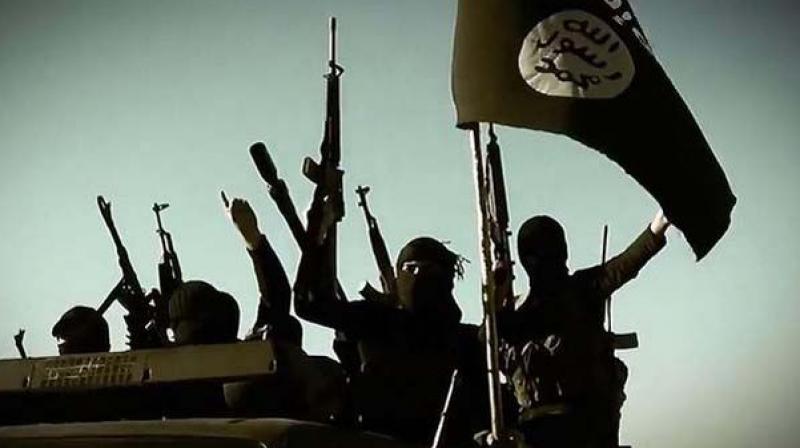
In recent times, IS has carried out more activities outside West Asia than inside and also restructured its group, under the directions of its leader Abubakr al-Baghdadi. (Photo: Representational /AFP)
New Delhi: India, Turkey, Afghanistan and Sri Lanka are among the countries where radical terror group Islamic State (IS) is eyeing to foot its influence as its hold in the territories of origin (Iran and Syria) is loosening drastically, Hindustan Times reported.
A US-based leading conflict monitor, Armed Conflict Location and Event Data (ACLED), has indicated that the radical outfit, in its first, had carried out more activities outside West Asia than inside and also restructured its group, under the directions of its leader Abubakr al-Baghdadi.
The IS greeted its loss of territory in Iraq and Syria in 2018 with expanded global presence in 2019,” said the ACLED report titled Branching Out: Islamic State’s Continued Expansion. Through the first five months this year, the IS has placed unprecedented emphasis on its global operations… In his first video in five years (after the Sri Lanka Easter bombings in April), Baghdadi focused largely on the group’s activity in South Asia, North, West and Central Asia.”
The report reflected that IS is active and proliferating in India, Afghanistan, Sri Lanka, Saudi Arabia, Turkey, DR Congo, Burkina Faso, Mali and Libya.
The monitor showed that the increase in its activity outside West Asia — mostly across South Asia and Africa– is drastic. In 2019, more that 60 per cent movements and exercises were carried out outside group’s origin-territory. In 2018, the activity outside West Asia was limited to 45 per cent and it was as low as 20 per cent in 2016 and 2017.
When the country is getting ready to get rid of the death-trap and
the white elephant called the 13th Amendment, that Rajiv Gandhi
forced JRJ to swallow, and the governors are running the show without PCs,
Navin Dissanayaka (ND) must be crazy to talk about police and land powers to
PCs. This is now a dead issue with the death of Sumanthiran-Jayampathi-Lal
Wijenayaka bogus constitution.
It is a waste of time to talk about the 13-A dilemma, but if ND
expects to be a politician with meaningful ideas, and perhaps a quick action
plan to help his father-in-law’s presidential election bid, he should avoid
talking about things he does not know well, because it will be political
suicide. TNA, Sumanthiran and Wigneswaran will be happy with his support for
police powers etc., but the Tamil voters are not in their bags anymore.
In this connection I found an essay I wrote about 10 years ago, copied below for ND’s education. I hope somebody in Sri Lanka forward this essay to ND via e-mail.
What is the difference between Kumar David (KD) and Victor Ivan (VI)? KD, like so many other “Tamil moderates” with whom he signs petitions, Colombo-Marxists on the APRC, Mano Ganeshan, Anandasangaaree and the UTHR (J) group led by Ratnajeevan Hoole is still blinded by the old separatist paradigm jointly developed by GG Ponnambalam and SJV Chelvanayagam. For about 70 years this paradigm dominated Colombo politics. VI, on the other hand, shows signs of realizing that a new paradigm has arrived on the political scene (Sunday Island, 9/7/2008). This language-blind new paradigm has shattered the Marxist-propagated (Stalin and LSSP) theory of a “national question.” Sri Lanka did not have a national question; Sri Lanka had a headache of class rivalry between elitist Colombo-living, mostly Christian, Tamil and Sinhala politicians. This is why KD is more concerned about the loss of a comrade!
Col. Karuna paradigm
Former village terrorist Col. Karuna dismantled the separatist paradigm that ruined Sri Lanka by just five words-Give us what Colombo gets. Karuna escaped death in 2004 and in 2006 at a TV interview revealed a gospel of truth. He accepted the former Chief Justice M. C. Sansoni’s advise “if the Tamils’ cry for separatism is given up, the two communities could solve their problems and continue to live in amity and dignity” (Sessional Paper No. 7 of 1980). He also silenced the 13A Plus or Classics supporters (Ref. Island, 8/11/2008) by stating that he does not think police power is needed to help Tamil villagers in the Eastern Province. Unlike the two or three Colombo ministers Karuna knew that the failure of PCs in the south was not because that they did not have police powers. Karuna is the first major Tamil politician to derail the homeland in the EP theory of SJVC. Lakshman Kadiragamar, Neelan Thiruchelvam and even Jeyaraj Fernando-Pulle supported an “F” solution because they could not come out of the traditional Tamil homeland trap. Neelan was not willing to accept the Pondicherry sub-model within the Indian “F” model because it would have created a moth-eaten like holes of Sinhala and Muslim enclaves in the N-E homeland. Tamil aspirations, whatever was meant by that phrase by the late Kumar Ponnambalam from his Colombo home, can be achieved under the Karuna paradigm of language-blind spatial units.
Colombo paradigm
The Karuna paradigm is also a rejection of the Colombo paradigm. Karuna paradigm (2006) is nothing but a Tamil version of what JVP was demanding in 1971 and in 1988-89. The Colombo establishment impliedly accepted it by citing the kolambata kiri apita kakiri epithet in their Youth Commission Report, (March, 1990, p. xvii). Mostly Christian ruling families operating from Colombo did not want to decentralize power or to engage in rural development or diversification of the economy, a classic case of mismanagement in a former colony. The gap between the rich and the poor widened and the separation between Colombo and the villages increased. Even the open economy-based infra-structure built by the colonial master collapsed one by one due to neglect and stupidity. When black cats with suicide bombs started to follow them up on Colombo roads in the 1990s, the Colombo ruling class suddenly thought of “devolution packages.” In July 1975 Prabakaran had his first killing, Alfred Duraiyappa, the SLFP Mayor of Jaffna, but the Colombo minister of local government did not think of devolution. The biggest problem local governments faced since 1948 was the minister arbitrarily interfering with their functioning.
Devolution versus empowerment
“Devolution” is thus an arrangement between politicians to divide the pie or create new mini-pies. The Indian experience of this arrangement has been (1) further demands for more regional units (initial 14 states are now grown to 28 and at least another 35 are in the pipe line) (Federal India: a design for change, Rasheeduddin Khan, 1992) and (2) the taking of Delhi politicians as hostages by regional politicians (the phenomenon of coalitional politics). Indian devolution did not help the average Indian. The Indian-imposed devolution in Sri Lanka, known also as the PC white elephant, is not empowerment of Tamil, Sinhala or Muslim villagers. This devolution will allow the continuation of Colombo paradigm along with the separatist design of Tamil politicians who wants to be new kings and rulers of Tamil people. It will allow some Tamil politicians to attack any development work as another example of “Sinhalization.” PCs gave Sri Lanka a new set of corrupt politicians.
Empowerment and the Panchayathi Raj Institutes
In the modern world democracy operates through people’s representatives. This system has become a way of muddling through political corruption. Gandhi wanted to avoid this by giving power to people via the Panchayaths (go back to direct democracy of the Greek city states). It was derailed by an argument that with severe caste divisions at the village level, higher castes will take control of the Panchayaths and would further aggravate the oppression of disadvantaged people. Despite ten five-year plans and protective discrimination and capacity endowment (to help backward castes and tribes) the Indian constitutional framework failed to deliver the trinity of equality-liberty-fraternity to Indian masses. Therefore, after giving it step-motherly treatment for 40 years, the Indian ruling elites took a decision to resurrect the old Panchayath system in 1993 as Panchayathi Raj Institutions (constitutional amendments 73 and 74). Under the Mahinda Chinthanaya approach, a home-grown constitution is to be developed after the war is over. The SLFP proposal to APRC in April 2007 to empower people (not province-level devolution of power to a new set of politicians) at the Grama Rajya-level is an example of this approach which is in agreement with the new paradigm of Col. Karuna, ecology and geography of Sri Lanka.
Federalism is Sri Lanka’s death-trap
Whether one likes it or not 13A is the gateway to Eelam via the “F” solution. 13A is constitution-based racism imposed by India following its own history of communalistic 1935 Government of India Act and the 1956 linguistic demarcation of state boundaries. Sri Lanka should soon find its own home-grown solutions as there will be no market for separatism in Sri Lanka when Tamils and Sinhalese become fluent in both Tamil and Sinhala within the next 10-15 years. Even as a temporary mechanism13A must be clarified to indicate that there are no ethnic homelands in Sri Lanka. The 13A road with a Tamil homeland myth is a deadly road. At least four dangers are inherent and embedded in the 13A.
(1) 13A was an Indian recognition of the SJVC-separatist paradigm that ruined Sri Lanka and poisoned Sri Lankan minds for 70 years.
(2) 13A recognized a traditional Tamil homeland despite historical, geographical and archeological evidence against it; SJVC paradigm with a Tamil traditional homeland faced problems from the findings in Prof. K Indrapala’s doctoral thesis and as reported by Professor Michael Roberts his thesis was stolen from the London University library. But after forty years of archaeological field work Ven. Ellawala Medhananda Thero produced evidence contradictory to SJVC paradigm. The history of Sri Lanka and its North and East that he has painstakingly constructed (Our heritage of the North and East of Sri Lanka, 2003) is radically different from a Tamil rooted ethnic origin of its settlers. The scripts found on hundreds of rock caves that he was able to trace and record did not support a Tamil homeland theory. Some donors of these cave dwellings (to Buddhist priests) had Tamil names. If all donors at that time had a common Tamil origin, then all of them must have had Tamil names. These cave donations span from the 3rd century B.C to 5th century A.D. Under a Karuna paradigm there is no need to destroy these Buddhist archeological ruins (to remove evidence against a Tamil homeland) because they are not a threat to the empowerment of Tamil villagers.
(3) There is the world Tamil Federation eyeing for a quick Tamil country in Sri Lanka because it failed to get one in the Fiji Islands and knows that it is difficult to fight for a separate country in Tamil Nadu in the present political climate.
(4) Separatism in Tamil Nadu is alive and thriving (a recent opinion poll showed 55% supporting Eelam in Sri Lanka (TamilNet, 8/2/2008). The demand to take back Kachchativu is a political sacred cow in this regard. Thus, if 13A is accepted as the path to ethnic nirvana in Sri Lanka, as agitated, there is no way to stop a NGO-INGO-IC-backed demand by a future Tamil politician on the necessity to create an ISGA or to take the final UDI path.
Armed with police and land powers it is not difficult to start a protracted conflict with Colombo over any number of old issues or new issues. Any domestic rivalry between two Tamil political leaders in the Province can become an IC issue involving foreign agents with vested interests and hidden agenda taking sides. A river for Jaffna (Island, 8/31/2008) is a good example of the potential of shortage of Mahavali water becoming an issue that could be raised as an international-human rights dispute by a separatist-prone Tamil politician. Take the case of re-opening of the KKS cement factory. Cement dust falling on farmers’ vegetable plots was known for a long time in the past. But this will be considered a serious health hazard now in 2008. Quarrying limestone next to the factory doors which the cement chairman gave as a plus is actually a new hazard of seawater encroaching inland and polluting the groundwater table (TamilNet, 8/3/2008). Increasing links between Muslim radical groups in the EP and foreign Muslim groups or radical Tamil groups in the tea-growing area wanting to establish links with EP or NP are potential issues of conflict that Colombo politicians must not ignore.
Examples of federal dangers
Belgium, Scotland and South Ossetia/Abkhazia (Georgia) are three current examples that should open the eyes of Sri Lankan politicians on the need to promote and create language-blind village-level political units as vehicles for the empowerment of multi-ethnic communities. In Sri Lanka, over 50% of Tamils live in the South and there is the headache of Tamil Nadu Tamils supporting an Eelam in the island which they cannot get in South India. Scotland got what is comparable to 13A but the story is not over. It is perhaps only one election away from gaining independence as a separate country escaping from London’s control. The nationalist party which advocates separation is gaining rapidly at each election.
Belgium is a tiny federation to which NGOs organized several trips of Buddhist monks to see how “F” system works. Today it is the best example of how “F” has not worked even with a king. In 1830-31 it was created by the international powers as a political compromise in building one state out of two nationalities, Dutch-speaking Flanders and French-speaking Wallonia with Brussels as the capital. Now Flanders wants to separate from Wallonia because “every attempt to liberalize the Belgian economy and to reform the generous welfare system has been vetoed by the relatively poor Walloon socialists.” Flanders is no longer prepared to finance the ever increasing amount of Flemish subsidies which are flowing to Wallonia! If this happens then Wallonia will break into four or five smaller parts merging with other countries (i.e., France, Germany) or deciding to remain independent. Brussels itself will be a French-majority enclave linked with Wallonia by a land corridor. Such are the blessings of federating for 178 years!
Russian invasion of the Georgian held Russian-living region of South Ossetia (North Ossetia is already a Russian state) is an example of why India did not try to do a Bangladesh “solution” in Sri Lanka. Sri Lanka is an island. Georgia wanted to stop separatist work by minority Russians in SO. When it killed some Russians, Russia entered SO. India is in a dilemma with the Tamil homeland demand in Sri Lanka. If India accepts an Eelam then later Tamil Nadu itself will demand a separate country from India against “Hindia.” Other secessionist groups in India will also get a boost. What we see today is, present-day Indian politicians trying to deal with tomorrow and day after and not with what would happen in ten years. Sri Lanka cannot afford to follow this philosophy.
Trinity of gama – vawa – dagaba (village-tank-temple)
Instead of Indian or west-baked solutions APRC and people like Kumar David should look inward to Sri Lanka’s own history of language-blind ethnic harmony for a peace-filled future. Tamils have a homeland in Tamil Nad. Muslims have Mecca and a billion muslims. Christians have Pope. Sinhala people and Sinhala Buddhist have this tiny island, 15 million and the ocean. Tamils, Sinhala and Muslims can be empowered at the trinity level of kovil, temple and mosque -centered societal units. Aspirations can grow at the family and village levels. We should not promote aspirations with language-based spatial units. Instead create language-blind developmental units. If in a given village the majority happens to be Tamil let them work on their aspirations from house hold level upward to the Village Council level. Several VCs can go to District level. Imposing a Provincial level unit on them by a Colombo group is not suitable in Sri Lankan case as there is the fear and danger of separation. Because our trinity is tank-centered it fits very well with the modern concept of river basin-based administrative units. New Zealand, a tiny country like ours is using this concept. The geography professor C. M. Madduma Bandara has proposed Seven River Basin-based administrative region system for Sri Lanka that Kumar David and the APRC’s Colombo lawyers should study (Chapter 4 in Fifty years of Sri Lanka’s independence: a socio-economic review, edited by A.D.V. de S. Indraratna, 1998, p.83; Island, February 7, 2001). They are: 1. Yalpanam 2. Rajarata 3. Dambadeni 4. Mahaweli 5. Digavapi 6. Kelani and 7. Ruhunu. Sri Lanka has hundreds of smaller ecological regions. We must promote this geographic diversity accepting the truth that “one law for the lion and ox is oppression.”
Because, one cannot legislate against geography (Island, 2/22/2006), law in books cannot become law in action if APRC and its chairman act like a Colebrook in 2007 with the 9-province plan. Past attempts to develop Sri Lanka at village level failed because they were sabotaged by the Colombo class. F.R. Senanayake‘s efforts in this regard (mahajana sabhas) abruptly ended with his untimely death. In the 1940s Ven. Kalukondayave Pragnasekera Mahanayake Thero started a village development and crime eradication movement with Tamil and Muslim participation which was obstructed by the Colombo establishment. Hopefully, the Gama Naguma program under the Mahinda Chinthanaya will change Sri Lankan ethnic and economic landscape for good. The Local Government Reforms Commission (Sessional Paper No. 1 of 1999, the Abhayewardhana Report) recommended the resurrection of the local government system we had before 1978 but it was ignored until 2005. Kumar David needs to think of grass-roots politics rather than holding to the separatist tail of Tamil Nadu politics.
What is the solution?
Ideally speaking, as soon as Kilinochchi is liberated by the army the president needs to consider seriously the feasibility of moving the capital of Sri Lanka to the Raja Rata on a 15-20 year time frame rather than further aggravating the spatial problems found in the Colombo Region. Sri Lanka has the record of moving the capitol ten miles to a swamp creating flash flooding even in the Colombo Seven! Ministry by ministry, department by department, the government should relocate in the Raja Rata with a long-term plan. There is no better way to bring Sinhala and Tamil villagers together than the abandonment of the Colombo paradigm. No need to neglect essential developments in the Colombo harbor or Colombo roads or to doubt the geopolitical value of a new harbor in Hambantota and an alternative international airport near it. Sri Lanka should not forget the developing new frontier in the Raja Rata relative to South Indian developments but also the new needs of the Pacific century. Even in the U.S.A. its Pacific face is developing so rapidly compared to the 500 year-old Atlantic (European) face. Trincomalee is Sri Lanka’s jewel in the Pacific century. Sri Lanka requires two sets of actions: (1) a new constitution aimed at empowering people at the village-level, and (2) a civilian socio-economic development system aimed at eradicating corruption, poverty and social injustice. In this regard the President needs to consider taking the following actions: Instruct the APRC and the Constitutional Affairs Ministry research staff to study the thousands of constitutional proposals they received by invitation and to publish a detailed analytical report. Why these proposals were totally ignored is problematic; Instruct APRC and its Chairman to study the Abhayawardena Local Government Report and use it as a basis for devolution of power to Village Councils; Instruct the APRC and the Constitutional Affairs Ministry research staff to study the 99 point program of action proposed by the late Ven. K.P. in the 1940s; Appoint a committee with a geographer as the leader to study how GSN (grama sevaka niladharee) boundaries could be modified to fit in with Village Council and ecological boundaries; Instruct the Defence Secretary to study the feasibility of deploying the army personnel in civil defence and development work at the village-level; and Make arrangements to formalize the services voluntarily offered by the Sri Lankans living abroad into a village-Expatriate services system. This is where Sri Lanka’s Seventh Great Force could become a valuable vehicle.
Sri Lanka’s Sixth great force is janitors and maids toiling in Arab countries. Its Seventh force consists mostly of those who went to universities in Sri Lanka in the swabasha medium and now living in western countries holding research, teaching and managerial positions. Most Tamils in this category are now forced to give money to Prabakaran’s killing machine and in future they would think of helping their villages in Jaffna or Vavuniya if an opportunity is given. The National Science Foundation was supposed to develop a project like this but time is ripe to create a separate governmental agency to coordinate this important concept. Those who are about to retire from their work are in a position to return and spend time in the villages providing help in different ways. Imagine the effect of a talent pool of 1000 expats working outside Colombo!
Buddhists and human rights
The Karuna paradigm is a Buddhist paradigm. Sri Lanka can have a language-blind empowerment system because Sinhala Buddhist majority in the island never discriminated against minorities. The reason for this was that unlike in God-based religions, in Buddhism life is cyclical and not linear. When life is considered linear there is no difference between a rice field and a cattle ranch. How to fatten the cattle to sell beef to get the maximum profit has no issues of morality behind it. There is no need to worry about the Eight Fold Path. Any sin can be erased by a week-end confession. All life including plants and trees are part of one interdependent system according to Buddhism. All life is also temporary. Impermanence is the common characteristic of all living phenomenon. Buddhism is also based on following the Middle Path. This is compromise or reasonableness in the democratic western world. Equality of all human beings was practiced in Buddhism in 5th Century B.C. by allowing women to become monks. Trees and rivers were protected in Buddhism just like the habits and customs in this regard that we find among the Native American Indians in America. In today’s world 99% of human rights agents are Christians because mass-scale human rights violations took place in the Christian Europe and Colonial empires. This is why R2P deals are suspected as a new face of global colonialism. In this regard the average Christian is as innocent as an average Buddhist. It was the privileged Christians living in Colombo who ruined Sri Lanka. The NGOs are dominated by these power-hungry, dollar-hunting Christian mudalalis. While in Jaffna Christian Prabakaran applied ethnic cleansing and destroyed Buddhist archeological sites after 1983, ethnic and religious minorities lived in harmony with Sinhala Buddhist in southern villages and towns for thousands of years. Kumar David is concerned with a loss of a comrade perhaps unaware of the universal brotherhood found in Buddhism. Unlike the historical religions based on faith, Buddhists never used swords to convert others. But what had happened to Buddhism in Tamil Nadu and in South Korea should not be allowed to happen in Sri Lanka.
Further readings available on the Internet on the Karuna paradigm:
“An alternative to the ‘Devolution’ dilemma: Move the capital to Rajarata.” (Island, April 21-24, 1998) “Federalism and marriage” (Island, 12/12/2005, 1/11/2006) “Racism paradigm versus the Colombo paradigm” (Island, 2/21/2006) “You cannot legislate against geography” (Island, 2/22/2006) “Federal Marriages and water wars” (Daily News, 9/13/2006; www.defence.lk, 9/7/2006) “Language-blind regional development units” (Island, 10/25/2006) “Anandasangaree and God Vishnu” (Island, 1/3/2007) “A letter to a Tamil friend after 40 years!” (Island, 1/25/2007) “The end of separatist agenda in Sri Lanka” (www.defence.lk, 3/7/2007) “Mr. Anandasangaree’s latest plea: is it reasonable?” (Island, 9/24/2007) “Professor Rajan Hoole’s human rights award” (Island, 10/16/2007)
Some polls monitors have called for a ceiling on election campaign expenditure. This, we hear in the run-up to elections like koha’s mating call during the Avurudu season. But nothing happens thereafter and the issue is forgotten. Politicians and moneybags carry on regardless, and corruption thrives.
The Election Commission (EC) takes pride in the fact that a wealthy candidate who spent more than Rs. 40 million at the last local government polls finds himself in hot water. He was not alone in throwing money around to get votes, but others are not facing legal action. Are they too big to be caught?
Will the EC explain why it has failed to figure out how much powerful government and Opposition politicians have spent on their election campaigns since 2010? How much did the two main presidential candidates spend on electioneering, in 2015?
The less said about the last government, the better! How much its leaders spent on their election campaigns is anybody’s guess. Those who dislodged it, promising to usher in good governance and expose corruption under the previous regime, are no better. They obviously outspent their predecessors, at the last general election. Before 2015, the Darley Road office of the SLFP was overflowing with funds; Sirikotha was so broke that it could hardly settle its electricity and telephone bills. But no sooner had the 2015 regime change occurred than the financial woes of Sirikotha disappeared. Where did all the money come from?
President Maithripala Sirisena and Prime Minister Ranil Wickremesinghe captured power, promising good governance, of which accountability and transparency are integral parts. Let these leaders be urged to reveal their campaign expenditure, in 2015 as well as last year, when they faced the local government elections, and how they raised funds for electioneering.
Sri Lankan politicians have mastered the art of bribing the people with public funds before elections. The previous government distributed roofing sheets, squatting pans, almanacs, sil redi an many other things among voters in the lead-up to the last presidential election. Some politicians and bureaucrats who followed orders from on high and allocated funds for those handouts are now in trouble. The current dispensation, too, has been bribing the people with concessionary loans, etc. at the expense of the public. The expansion of the Samurdhi scheme to include 600,000 more beneficiaries was also politically determined. New laws must be brought in to curb such practices.
The problem with undisclosed campaign funds is that they consist of black money. Big-time crooks have massive slush funds at their disposal to bankroll election campaigns of the candidates of their choice. They are so rich that they can even sponsor political parties. Funds for election campaigns here also come from external sources. Even drug dealers are believed to fund election campaigns. It may be recalled that, a few months ago, some MPs accused one another of having benefited from the largesse of drug baron Makandure Madush. The underworld boss is now in custody, and the police can ascertain the names of politicians and others he has helped financially, if they really care to do so. But it is highly unlikely that the government will allow a can of worms to be opened.
No campaign to cleanse the Augean stables that are Sri Lankan politics will reach fruition unless tough measures are adopted to control election campaign expenditure. And the money trail will have to be followed. This is not something that can be achieved by merely calling upon the politicians in power and their Opposition counterparts to legislate for a ceiling to be imposed on campaign expenditure. Sufficient pressure will have to be brought to bear on them to do so, and the campaigners may have to brave water cannon, teargas and baton charges in the process. Are they ready?
Former Chairman of SriLankan Airlines Ajith Dias, yesterday, made a statement on the decision to store paddy at the Mattala Airport in 2015, to the Police Unit attached to the Presidential Commission of Inquiry (PCoI) investigating corruption in the current administration.
Last month Dias was asked to appear before the CID unit attached to the Presidential Commission after it was revealed that in 2015. Dias sent a letter to Charitha Ratwatte, senior advisor to Prime Minister Ranil Wickremesinghe, on a UL letterhead, had stated that they were willing to allow the Paddy Marketing Board to use the airport to store paddy as requested by the government.
The PCoI wanted to find out who in the government had instructed Dias to authorise the use of the airport.
Police officers attached to the PCoI visited Mattala Airport, late last month, inspected the premises. They found that storing of paddy inside the buildings had caused damage estimated to be around Rs. 5 million.
The Paddy Marketing Board had paid Airport and Aviation Services Ltd Rs. 835,132 a month for storing paddy. The paddy was stored for six months.
The emaciated 70-year old elephant named ‘Tikiri’, whose photos were widely shared on social media for being walked in the Esala Perahera, was taken back to Kegalle yesterday (14).
The Secretary of Captive Elephant Owners’ Association of Sri Lanka Dharmasiri Karunaratne said the owner of ‘Tikiri’ had walked the elephant in the parade to fulfill a promise made to God Vishnu.
He stressed that ‘Tikiri’ is in a good health condition while refuting the backlash received from social media recently.
He also emphasized that this was not done with the intention of gaining money.
Save Elephant Foundation, set up by Thailand’s elephant whisperer” Lek Chailert, has shared the photos of ‘Tikiri’ that show every rib in her body and raw-looking skin on her trunk.
Subsequently, it was reported that the ‘Tikiri’ was removed from participating in the remaining parades of Dalada Perahera.
Gotabaya from SLPP is not the issue for the massive upheaval in the UNP
Political rebellion for a leadership change in the UNP became a growing issue with the fall of the UNP Government in 2003
Sajith was brought in for his father’s legacy and not for his political acumen
Sajith is no Rajapaksa to fight for a new comeback
Sunday in Colombo was Gotabaya’s day. Monday in Badulla was Sajith’s. Tuesday, it was reported, Ranil had his day with Sajith hurrying to meet his leader. Wednesday it was Poya for all to prove they are pious Sinhala Buddhists. All these days people became and for days to come they will become hoarse and agitated, cheering their pet candidate at every public appearance they make.
While Sajith is being hoisted by an unusually large ‘Ginger Group’ in the UNP to stake a claim for the presidential candidacy, Gotabaya for now is the officially declared candidate of the SLPP as decided by the Rajapaksa family. It is democracy” Rajapaksa style. Basil manages the party and invites brother Mahinda to takeover party leadership. To handover the party to Mahinda, a two-hour ceremony called a ‘party convention’ is held. After taking over party leadership, Mahinda announces his brother Gotabaya as the party presidential candidate. Everything is ‘official’ and unanimously-accepted and agreed; a clear sign of how decisions would be made in the future.
The UNP that too was happy with such decision-making in the past two decades has now run into a major roadblock. Exactly a week ago on August 9, Avantha Artigala summed up the total crisis in the UNP in his two-part single cartoon in the DM. One man” democracy has messed himself and ruined the entire dining table. Although one thought it was a neatly-dressed liberal who entered the leadership, everything in the dining room now needs to be cleaned and rubbished is what Avantha communicates. But that is not what Sajith Premadasa backers” are asking for. They want to sit at the dining table this time.
Senior Premadasa too had to fight his way to presidential candidacy over 30 years ago. His battle to reach the top was quite different. He was a determined young man who came into politics in 1954, contesting St. Sebastian’s Ward of the CMC from A.E Gunasinghe’s Labour Party (LP). His actual political career with a serious determination to become a national leader began with the UNP in 1956 and was nominated to contest Ruwanwella against N.M. Perera. From what the late Haleem Ishak, an SLFP parliamentarian who was also a Colombo Municipal Councillor in early ’60s told the writer, young Ranasinghe Premadasa was the only serious council member who was always punctual. He came well-prepared for council meetings with necessary explanations for issues collected from department heads. He, Haleem Ishak said, was the person who made the ‘Deputy Mayor’ post a strong and accepted one in the Colombo municipality. While leading his charitable organisation ‘Sucharitha Movement’ that kept him closely linked to the urban poor, Ranasinghe Premadasa in mid-’60s formed a civil organisation called ‘Puravesi Peramuna’ (Citizens’ Front) and chose a darker shade of yellow as it’s colour. He worked tirelessly to groom himself to reach the top rung of the UNP leadership then dominated by personalities like M.D.H. Jayawardene, Montague Jayawickrama, M.D. Banda, Jinadasa Niyathapala; all closely behind Dudley and JRJ right at the top. In the decade of 70, he had actually reached the top. He was chief opposition whip in the ’70 to ’77 Parliament, after Dudley Senanayake’s demise and when JRJ became the opposition leader. He was next to JRJ in the 1977 general election campaign and was the most popular platform speaker the UNP then had. His role in the election campaign made him virtually the second in command in the party and compelled JRJ to appoint him PM after JRJ in February 1978 lifted himself to the chair of the executive presidency. JRJ also groomed two new entrants to UNP politics as second-level leaders in his government. Both eminent lawyers and scholarly speakers, Gamini Dissanayake and Lalith Athulathmudali grew as national leaders with very important portfolios under them, handling them as seasoned politicians. When it came for President Jayawardene to leave politics and the party, UNP had three well-established national leaders in Premadasa, Gamini and Athulathmudali, all vying for presidential candidacy by 1988. With Gamini Dissanayake as a facilitator of the Indo-Lanka Agreement in July 1987, India perhaps favoured him to succeed JRJ. But with mass protests and the JVP insurgency against Provincial Councils (PC) established under the Indo-Lanka Agreement, Premadasa and Athulathmudali who opposed were closer to presidential candidacy than Gamini.
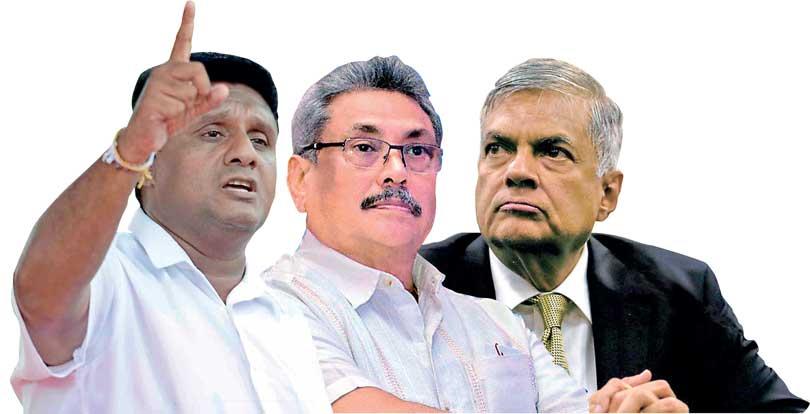
While Sajith is being hoisted by an unusually large ‘Ginger Group’ in the UNP to stake a claim for the presidential candidacy, Gotabaya for now is the officially declared candidate of the SLPP as decided by the Rajapaksa family. It is democracy” Rajapaksa style. Basil manages the party and invites brother Mahinda to takeover party leadership
As a political party that had always played a rabidly-Sinhala racist role, Premadasa had a definite edge over Athulathmudali who was seen as a liberal extension of President Jayawardene with a nationalist flavour. A homegrown leader, Premadasa with his long career in grounded politics that established him as a Sinhala nationalist leader outside even the UNP could not be ignored. It was his success in clinching the UNP presidential candidacy that later led to rivalries within the UNP leading to sacking of both Dissanayake and Athulathmudali from the party. Times are different, political leadership is different and the political scenario is different no doubt. UNP lost its most aggressive leader Ranasinghe Premadasa, the only President to be assassinated by the LTTE. It then lost a popular campaigner in Gamini Dissanayake, the only presidential candidate to be assassinated by the LTTE. Athulathmudali, assassinated while on a campaign stage, had his own political party. With all three formidable UNP leaders eliminated, Wickremesinghe became its leader by default and rules by a party Constitution that keeps him leader as long as he wishes.
For over 24 years, he succeeded keeping out a second-level leadership emerging that could qualify for leadership. Sajith was brought in for his father’s legacy and not for his political acumen. Guitar-strumming, easy-going Sajith in politics is not his ‘father’ in serious politics. Sajith was never the determined politician his father was. He never traversed the path his father did in achieving authority and leadership within the party and in national politics. He was just a Hambantota politician who could never bring more than two UNP MPs to Parliament including himself as one. His recognition within the party is his father’s legacy. He was not a major challenge to Ranil when young Turks like Dayasiri Jayasekera, Ravi Jayawardene, Maithri Gunaratne and Shiral Lakthilake were demanding a change in party leadership. All of them had to leave the grand-old party with Sajith backing out from the fray.
Political rebellion for a leadership change in the UNP became a growing issue with the fall of the UNP Government in 2003 after President Kumaratunge took over three major ministries. Perception within the party that Wickremesinghe cannot be positioned as a winning candidate was sealed after the 2005 presidential election, when the LTTE politically assassinated him by boycotting elections in Rajapaksa’s favour. The perception that Wickremesinghe cannot” made 17 leading parliamentarians led by Karu Jayasuriya to cross over to the Rajapaksa Government in early 2007. Most including Karu became Cabinet ministers. Before their crossover to the Rajapaksa Government famously explained by Karu as their responsibility to strengthen President Rajapaksa’s hand in winning the war, there were individual crossovers like P. Dayaratne, a long-time UNP loyalist from the Ampara District, the lone elephant from Badulla District Lakshman Seneviratne and the strongman in Kesbewa, Gamini Lokuge.
Two attempts at gaining political clout via a ‘Common Candidate’ for presidency failed miserably for Wickremesinghe. Although he was able to have the (in)famous 19A to keep a tottering government in place for four years, that 19A cannot make him win an election. Dilemma in the UNP is it has no leader to replace Wickremesinghe. Promoted by a lone TV channel, Sajith for some in the UNP is the only substitute with a parental legacy that can be ‘marketed.’ The added strength in pushing Sajith to the fore comes from political parties in the government also demanding a ‘winnable candidate’ in place of Wickremesinghe. The new alliance that was to be ushered in last week therefore had to be postponed indefinitely. With Mangala in the forefront, the new generation in the UNP has now decided on Sajith as their candidate with public rallies.
This open challenge in establishing Sajith as the UNP candidate has never in UNP history been this ugly and out in the open. This infighting created serious divisions in the UNP, reaching the electorates too. It does demoralise sections of the electorate. Fight for a new leadership gained new strength with the failure of the ‘Yahapalanaya’ Government. It proved the UNP cannot have a government of its own with ‘common’ candidate formula for presidency. ‘Yahapalanaya’ also proved Wickremesinghe is no Dudley Senanayake who in 1965 managed the popularly termed ‘Hath Havul’ (seven partners) government that ran the full five-year term with diverse and opposing politics in it.
This coming presidential election is therefore extremely-decisive for the UNP. It certainly is fighting a losing battle at elections though ‘dissidents’ would win their battle for a new leadership. Gotabaya from SLPP is therefore not the issue for this massive upheaval in the UNP. It is about winning a new face. About gaining new life. Sad part yet of this battle for a new face is that it looks a smaller and a weaker version of Gotabaya, though they speak the same political language of peace, democracy, equality, national security in a Sinhala Buddhist unitary State.” The UNP will therefore have to look for yet another leader after elections. Sajith is no Rajapaksa to fight for a new comeback.
A proposed Status of Forces Agreement with the the US is stirring up political controversy in Sri Lanka
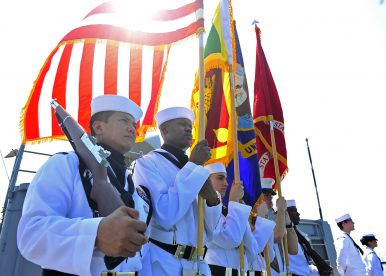
An honor guard made up of Sailors attached to the USS Blue Ridge (LCC 19) and a Marine attached to Fleet Antiterrorism Security Team Pacific display the colors as the ship arrives in Colombo, March 26, 2016.Image Credit: U.S. Navy photo by Mass Communication Specialist Seaman Timothy Hale
Two defense cooperation agreements between the United States and Sri Lanka, the already signed Acquisition and Cross-Servicing Agreement (ACSA) and the under-negotiation Status of Forces Agreement (SOFA), are triggering concern, criticism, and controversy in the Indian Ocean island.
Neither pact is new. SOFA was first signed in 1995. Apparently, the United States asked Sri Lanka for a new pact and sent a draft to the Sri Lankan Ministry of Foreign Affairs in August 2018.
The agreement under discussion appears aimed at streamlining clearance procedures for visiting U.S. military personnel,” Nilanthi Samaranayake, director of strategy and policy analysis at CNA, a non-profit research organization in the Washington area, told The Diplomat.Enjoying this article? Click here to subscribe for full access. Just $5 a month.
According to a leaked copy of the U.S. draft, which was reproduced in Sri Lanka’s Sunday Times on June 30, American security forces and civilian personnel of the U.S. Department of Defence (DoD), as well as U.S. contractors and their non-Sri Lankan employees who may be temporarily present in Sri Lanka in connection with ship visits, training, exercises, humanitarian activities, and other activities” will have privileges, exemptions, and immunities” equivalent to those accorded to administrative and technical staff of a diplomatic mission. They would be authorized to wear uniforms while performing official duties and to carry arms while on duty.” U.S. identification would be sufficient for their entry into and exit from Sri Lanka; that is, they would not need a Sri Lankan visa to enter the country. U.S. vessels, vehicles, and aircraft would be allowed to exit and move freely within the territory of Sri Lanka” and be free from boarding and inspection” by Sri Lankan security personnel. The United States also wants exemption from licenses, customs duties, taxes, and other charges within Sri Lanka.
A section of Sri Lankan analysts and some members of the opposition in Parliament have described the proposed SOFA as a very serious infringement on the country’s sovereignty.”
Located near the southern tip of India and to the southwest of the Bay of Bengal, Sri Lanka’s strategic significance stems from its location in the Indian Ocean. Just 6-10 nautical miles south of Sri Lanka runs the East-West shipping route, through which ply over 60,000 ships carrying two-thirds of the world’s oil and half of all container shipments. Additionally, Trincomalee in eastern Sri Lanka is among the finest natural harbors in the world.
It is not surprising, then, that Sri Lanka has emerged as a major battleground for influence between big powers. Given its proximity to India, Delhi considers Sri Lanka to be part of its sphere of influence and has opposed strategic rivals from expanding their influence in the island. Despite this, over the past decade, China’s presence in Sri Lanka has grown manifold. Beijing’s growing role in Sri Lanka — it has managed to secure a 99-year lease over Hambantota port, among other things — stems from its need to protect its economic and strategic interests in the Indian Ocean. As for the United States, its interest in Sri Lanka has mounted along with China’s growing clout in the island.
Additionally, a section of Sri Lankan analysts believe that should the U.S. lose its naval base in Diego Garcia, it will require an alternate base. That could be Sri Lanka.”
It is in this context that some of the opposition to ACSA and SOFA should be seen. This has led to apprehensions that these pacts could pave the way for a U.S. naval base in Sri Lanka, even turn the island into an an American military colony.”
Dismissing such allegations as blatant misinformation,” U.S. Ambassador to Sri Lanka Alaina B. Teplitz tweeted that there is no plan or intention to establish a U.S. base in Sri Lanka.” The Visiting Forces Agreement (VFA), as the Americans like to refer to SOFA (perhaps to make the American forces’ stay in Sri Lanka appear temporary), she said, aimed at facilitating bilateral cooperation and would fully respect the sovereignty of Sri Lanka.”
SOFA establishes the framework for U.S. military personnel visiting Sri Lanka at the invitation of the government, and is designed to address a number of red tape issues,” Teplitz said in a subsequent interview. Citing the example of the 2017 floods, when the Sri Lankan government sought American help, Teplitz said that relief supplies were delayed on account of bureaucratic red tape. The proposed pact, she said, would facilitate timely supply of such relief in future emergency situations.
Meanwhile, Sri Lankan Prime Minister Ranil Wickremesinghe told Parliament that SOFA was still under discussion and that his government would not sign an agreement that impacted the sovereignty of Sri Lanka.
However, Sri Lankans remain skeptical. Part of the problem is that there is little information in the public domain” on the agreements’ specifics.”
As John Gooneratne, a former ambassador in the Sri Lankan Ministry of Foreign Affairs, pointed out, although ACSA and SOFA have figured frequently in Sri Lanka’s mainstream and social media in recent months, there has not been talk about ACSA and SOFA’s” contents. Rather, it has been about using these pacts as a stick to beat up the government,” he told The Diplomat.
Fuelling suspicion over SOFA’s contents and implications for Sri Lanka is the surreptitious manner in which ACSA was renewed. First signed in 2007, ACSA expired on March 5, 2017 and was renewed on August 4, 2017.
Broadly, ACSA allows the United States and Sri Lanka to transfer and exchange logistics supplies, support, and refueling services, either in kind or at cost during peacekeeping missions, humanitarian operations, or joint exercises.
Critics point out that Sri Lankan officials were in an inordinate hurry to get ACSA renewed. It was rushed through Cabinet even before commanders of the armed forces could provide their views on the pact. If ACSA’s text was indeed harmless” and not a danger to the country,” as claimed by the then-Foreign Minister Mangala Samaraweera, why was the text of the pact kept secret? Besides, only a truncated Sinhala version of the original draft that was provided to members of Cabinet. Annexes were not included. Why was the full text kept away from them?
Although ACSA promises the United States and Sri Lanka reciprocal” rights, it is hard to ignore the fact that in effect it is an arrangement that benefits the U.S. far more than Sri Lanka. Unlike the United States, which has a heavy military presence in the Indian Ocean and is thus likely to seek Sri Lankan support, Sri Lanka, with its limited naval and military capacity, is hardly likely to require use of American military facilities.
Under fire for the secrecy surrounding the signing of ACSA, Wickremesinghe sought to reassure Parliament in June by saying that the 2017 ACSA is the same as that signed a decade ago. It was renewed without making changes to its contents,” he said.
However, the 2007 ACSA was eight pages long, unlike the 2017 pact which runs into 83 pages. While the 2007 document permits U.S. military vessels to anchor in Sri Lanka ports on a one-off” basis, the 2017 ACSA appears to be open-ended.”
The question is whether Sri Lanka’s long-term security and other interests will be served by signing these pacts with the United States. In the event of hostilities between the United States and China or Iran, SOFA would invariably draw Sri Lanka into a conflict where it may not want to take sides. After all, Colombo has no bilateral quarrels with Iran or China.
Proponents of SOFA and ACSA both in Sri Lanka and the United States would like to see the deals signed and sealed as soon as possible. This may not be easy, as there is strong opposition to the pacts in Sri Lanka. The Sri Lankan government itself is deeply divided on the matter. While the pro-U.S. Wickremesinghe and his United National Party would like to see SOFA signed swiftly, President Maithripala Sirisena, who heads the Sri Lanka Freedom Party (SLFP), has expressed his opposition to the defense pacts.
Interestingly, when ACSA was signed in 1995, the SLFP was in power, as it was when SOFA was signed in 2007. That provides the present government with the leeway to proceed with the pacts,” according to Gooneratne.
In a few months Sri Lanka will vote in presidential elections. So it is vote-catching time and into this [electoral] game has fallen ACSA and SOFA, Gooneratne says.
National security is expected to figure in the election campaigns of the candidates. Indeed, potential candidates and their parties are already articulating positions on ACSA and SOFA, with an eye on their vote base.
What position will Gotabhaya Rajapaksa, the Sri Lanka Podujana Peramuna’s candidate in the presidential election, take on ACSA and SOFA? It was Gotabhaya, then Sri Lanka’s defense secretary, who signed ACSA in 2007. The Rajapaksa family’s strong ties with the Chinese are well-known. Gotabhaya’s stand on ACSA and SOFA will be closely watched in Washington, Beijing, and New Delhi.
The likelihood of Sri Lanka and the United States reaching agreement on SOFA may seem bleak at the moment given the strong opposition to it.
However, as Samaranayake points out, proposed defense pacts with the U.S. tend to stir controversy initially. This happened with India, for instance, when the U.S. was pursuing pacts relating to logistics and communications. New Delhi eventually concluded these agreements,” she observes.
This could be the case with Sri Lanka as well, especially once the political campaigning is over.
Dr. Sudha Ramachandran is an independent journalist/researcher based in Bangalore, India. She writes on South Asian political and security issues.
The Sri Lanka Podujana Peramuna (SLPP) held its first national convention at the Sugathadasa Indoor Stadium on 11 August 2019. Undoubtedly, it was a colourful and splendid event. At the convention, two decisions of importance were announced. These decisions are Mahinda Rajapaksa (MR) would be the Leader of the SLPP and Gotabaya Rajapaksa (GR) will be the Presidential Candidate for 2020. Whatever I write below, there are two things to be praised.
The convention started on time and ended on time. In a country where none of us work on time, and all of us assume that a 10:00 meeting, would in fact begin at 10:30, this should be praised. The second thing was ‘no-frills’ talks both by Mahinda Rajapaksa and Gotabaya Rajapaksa. Nonetheless, none of these led us to conclude the political direction of the SLPP or its presidential candidate, GR. We have seen these two characteristics in the past, mainly amongst the extreme Right and the extreme Left politicians.
Since the SLPP has not yet disclosed its policy statement, it may be presumptuous to make a critique of the policy framework roughly outlined by GR in his talk. First, he defined himself, quoting General Cyril Ranatunga, as “a person who takes initiative over and above the normal call of duty.” Hence, he painted a portrait of himself as a ‘performer’ and promised that he would perform as the President, above and beyond the given limits and boundaries.
This reminded me of what Dr. Chris Edwards said in my presence, in response to a person who praised the then Chief Minister of the Wayamba Province, as an efficient performer. Chris said, “Yes he may be an efficient performer, so did Hitler.” Such a portrayal of an efficient performer might have been thought necessary today, as a large number of people in Sri Lanka call for a strong government that could respond to serious security lapses, as shown in the April Easter Sunday Attacks, killing around 300. Hence the SLPP may have prioritised stability and security in their policy agenda.
The importance of stability and security in today’s politics was also raised by one of aspirants to the presidential post, Sajith Premadasa, at the UNP rally in Badulla, almost repeating the words of GR. The high emphasis on security and stability by both candidates may raise eyebrows of the people, who stood for democracy and human rights in the 2015 Presidential Election.
Besides national sovereignty, security, stability and the maintenance of law and order, presidential candidates should focus on the economy that is in constant decline since 2015, the Prime Minister’s rhetoric on the economy notwithstanding. So, it is interesting and relevant to look at even briefly the SLPP’s economic programme for the next 10 years.
Economy 2020-2030
Introducing GR, MR said the SLPP presidential candidate and the Cabinet had a long-term perspective, so they were thinking of a 10-year plan. If we assume the UNF will field Sajith Premadasa (SP) as its candidate, the interesting thing to note is that both the SLPP and the UNF of SP see it would be necessary to deviate from the current economic policies of the Ranil Wickremesinghe-Mangala Samaraweera-led Government. As I have mentioned many a time, the economic policy package that was put into practice since 2015 has been a crude version of neoliberalism. It is true that since 1977 whatever the party/front was in the Government, the economic policies that were designed and implemented has had close affinity with the 20 points of the so-called Washington Consensus.
The Wickremesinghe-Samaraweera duo want to keep it that way, in spite of the fact that their economic fundamentalism has brought the first generalised crisis in Sri Lanka, since its independence. GR proposes to go back to the policies of 2005-2015, that depend heavily on State-sponsored and debt-based infrastructure development. During the MR regime, the reasonable high rate of growth was achieved by heavy public investment in infrastructure projects. Hence, highways, ports, multiple cities that go with beautification plan would be the main features of GR’s economic programme. If it is the case, there is a major lacuna as to how this infrastructure can be linked with industrial and agricultural development. Infrastructure is in itself not producing value.
It is not only in GR’s programme, but also in SP’s programme, these lacunae can be found. The writer of this column is not completely denying the possibility of capitalistic development in a country like Sri Lanka. A few countries have already shown it is possible. Economic development entails social, as well as technical dimensions. It needs surplus generated in production to be reinvested in the process of accumulation to make valorisation of the capital. In other words, surplus should be invested in order to make more and more surplus, as a constant and continuous process. Neoliberal pundits believe that by reinvigorating capital, labour and land markets throughout the country, everything would be hunky-dory. Since, 1977, every government tried hard to develop markets in all three spheres. The experience in East Asian Tigers, as well as now in China and Vietnam have shown development and growth do not follow this marketisation logic.
In spite of addressing some nationalistic issues, both the SLPP and the UNP of SP have not shown a clear path of economic development to the voters in 2020. It is pertinent to note that even after 40 years of dismal record under neoliberal policies, the two main parties have refused to learn lessons and to develop an alternative economic programme, leaving poor masses and working people completely disgruntled. The question posed to people in Sri Lanka in the 2020 Presidential Election is who can make ‘the failed policies’ workable, leaving no alternative or solution for the problems of the working people, and the marginalised section of the population, that is, numerically small Nations, women, LGBTIQ+.
About the writer: The writer is a retired teacher of Political Economy at the University of Peradeniya. E-mail: sumane_l@yahoo.com
The Attorney General has instructed the Acting IGP to expedite the conclusion of police investigations into several high-profile cases including the murders of Lasantha Wickramthunga and Wasim Thajudeen.
The cases include the assassination of journalist Lasantha Wickramathunga, the killing of 17 aid workers in 2006, the murder of Sri Lankan rugby player Wasim Thajudeen, the abduction of journalist Keith Noyahr, the abduction and disappearance of 11 Tamil youths.
The Attorney General had instructed the Acting IGP to conclude investigations into the cases without delay and to submit the completed filed to the AG’s Department for the filing of charges.
The decision of the Sri Lanka Freedom Party (SLFP) regarding the upcoming Presidential Election will be announced at the party’s convention on September 03, according to General Secretary of the United People’s Freedom Alliance (UPFA) Mahinda Amaraweera.
Speaking at a press briefing in Colombo today (15), the MP said that plans are underway to organize a grand ceremony for the Sri Lanka Freedom Party’s 68th Annual Convention.
He said that during the event on September 03, President Maithripala Sirisena is expected to provide an explanation of the party’s future programmes.
The UPFA General Secretary further said that they will never allow the SLFP to be weakened before another party.
Mahanayake of the Malwatte Chapter, Most Ven. Thibbatuwawe Sri Sumangala Thera said Gotabaya Rajapaksa has the potential and experience to tackle the prevailing national security issues in the country.
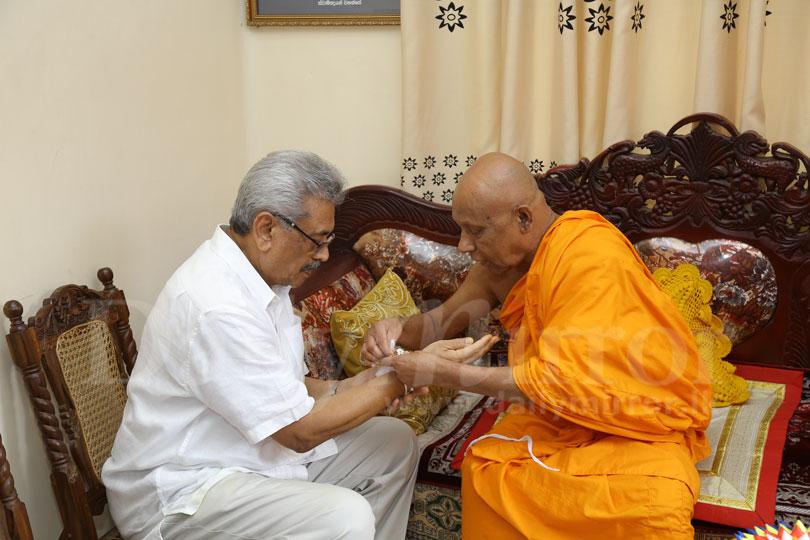
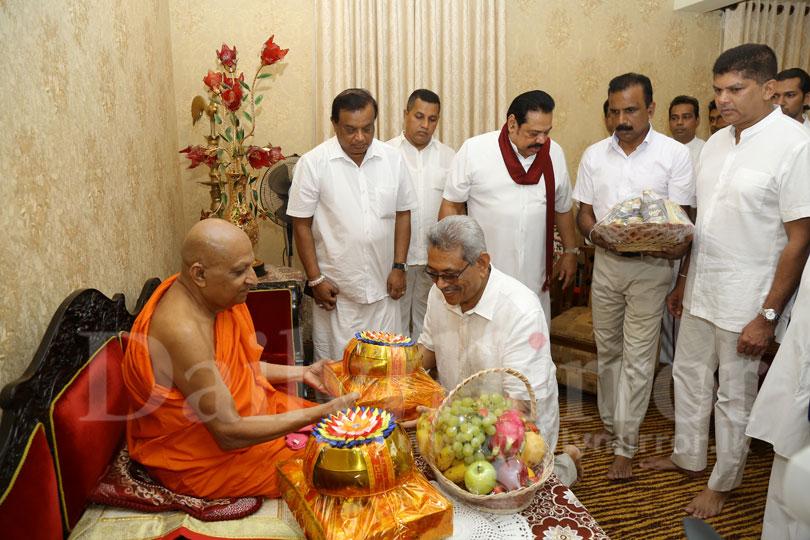
The Mahanayake Thera expressed these views when Sri Lanka Podujana Peramuna (SLPP) presidential candidate Gotabaya Rajapaksa visited him along with party leader Mahinda Rajapaksa after seeking blessings from the Sri Dalada Maligawa in Kandy today.
https://youtu.be/hs404mL_2aw
There is a problem with regard to national security and therefore it needs attention. You are the one who can tackle national security issues. You have the experience and potential in that area. We wholeheartedly bless you for coming forward to contest the Presidential election, the prelate added.
Sri Lanka Podujana Peramuna presidential candidate Gotabaya Rajapaksa along with Opposition Leader Mahinda Rajapaksa and MP Basil Rajapaksa visited the Temple of the Sacred Tooth in Kandy today (14).
A large crowd of Kandy public and several Joint Opposition members had organized a warm welcome for the Presidential hopeful Gotabaya Rajapaksa.
After paying homage to the Temple of the Tooth, he received the blessings of the Chief Prelates of the Asgiri and Malwatu chapters as well.
Later, he visited the Sri Thelwa Vinayagar Pulleyar Kovil in Katukele. He received the blessings of the Chief Guardian of the Kovil Swami Ramachandran Sri Krishnamurthi. He was joined by Opposition Leader Mahinda Rajapaksa as well.
Former Defense Secretary, then, visited the Meera Makkam Mosque with the Opposition Leader. The President of the mosque Hilahi Abdeen conducted a special ritual to invoke blessings on the two brothers.
Later in the day, Gotabhaya Rajapaksa visited the Gatambe Rajopavanarama Viharaya and had a cordial discussion with the Chief Incumbent of the Vihara, Ven. Kappetiyagoda Siriwimala Thero.
The Thero advised the Presidential Candidate stating, This is the last chance. If you miss this chance, the country, all of us, will be over”.
The formation of the United National Party (UNP) led alliance, Democratic National Front (DNF), is being further delayed, and as a result, nominating a Presidential candidate has also been postponed, sources said.
United National Front (UNF) leaders, on the night of 13 August, met at the Temple Trees to discuss matters in regard to expediting the formation of the DNF. However, according to a UNF source, the discussion had not led to any concrete agreement.
It is reported that the UNF had paid a great deal of attention to discuss the widespread opinion among UNF leaders regarding not nominating Presidential candidate until the DNF is formed.
The UNF source further said that another discussion will be held on 17 August at the Temple Trees, and the Party expects to arrive at a final decision regarding the formation of the DNF.
Meanwhile, Minister Mano Ganesan said that a Sub Committee was appointed to take a final decision regarding the forming of the new alliance and the committee will meet on 17 August.
The signing of the Memorandum of Understanding (MoU) on forming the new alliance and announcing the alliance’s Presidential candidate are scheduled to take place on the same day, after a final decision is made, he added.
UNP Deputy Leader and Minister Sajith Premadasa had also taken part in the discussion held at the Temple Trees.
The next two rallies of the islandwide series of rallies named ‘Sajith Enawa’ are scheduled to be held in the Matara and Matale Districts. According to State Minister Dilip Wedarachchi, the Southern Province rally will be organised targeting the Matara City, demanding that Premadasa be fielded as the UNP’s Presidential candidate.
The investigation into the complaint filed by Magalkanda Sudantha Thera against the officers of the Colombo Criminal Division who were caught in conversation with underworld leader Kanjipani Imran, has begun under the direction of the Western Province Senior Deputy Inspector General of Police (SDIG).
If the allegations are confirmed to be true, the SDIG has advised the National Police Commission to take maximum disciplinary action against the suspects
Parliamentarian Susil Premajayantha claimed that the Sri Lanka Freedom Party (SLFP) has joined the Sri Lanka Podujana Peramuna (SLPP) in campaigning for former Defence Secretary Gotabaya Rajapaksa in order to gain victory at the upcoming Presidential Election.
Addressing a Media briefing held today (14), he claimed that the SLFP has understood the policies put forward by the SLPP and has wisely chosen to accept the decision and support Gotabaya Rajapaksa.
He further said that MP Dayasiri Jayasekara is under a false impression that the Members of the SLFP have not positively accepted the Presidential candidate put forward by the SLPP while saying that Gotabaya Rajapaksa has received undeniable public acceptance which is evident through the public gatherings that took place to wish him following the announcement made by the SLPP.
By J.T. de Silva and W.K. Prasad Manju Courtesy Ceylon Today
A group of United National Party (UNP) Parliamentarians are attempting to select the Presidential candidate, by holding a secret election at the Working Committee, and in the Parliamentary Group Meetings.
Minister Gamini Jayawickrama Perera said that a document has been prepared by the MPs to request a secret election from Prime Minister Ranil Wickremesinghe.
He further added that Deputy Minister Nalin Bandara is making that document, and that he has refused to sign it.
There is a possibility of holding a secret election on 19 August at the MPs meeting. However, Wickremesinghe and Minister Sajith Premadasa should discuss about it and come to a decision, and if not a secret election should be held to solve the issue, he further added.
Meanwhile, a UNP backbencher said that a considerable number of United National Party (UNP) backbenchers are against the plan to hold a meeting at Dr. Rajitha Senaratne’s house on 20 August, to discuss the Presidential candidate and the proposed formation of the Democratic National Front (DNF).
He opined that Senaratne cannot be trusted, as he is against a candidate being put forward by the UNP. He added that Senaratne is expecting the General Secretary post of the proposed Front, and that a majority of UNPers were against it. He proposed that such a decisive discussion should be held at Temple Trees or Sirikotha, and the policies of the UNP should not be betrayed to pander to the needs of certain father and son combinations.