Chief of National Intelligence (CNI) DIG Sisira Mendis yesterday told the Special Parliamentary Select Committee (PSC), probing the Easter Sunday carnage, that though he briefed the then Defence Secretary Hemasiri Fernando on the impending terrorist attack, the National Security Council (NSC) had not met till the coordinated suicide bombings took place on April 21.
Mendis said that he had received information about the impending attacks the previous day from Nilantha Jayawardena, Director, State Intelligence Service (SIS).
Mendis said that Fernando had advised him to inform the IGP as the police should act on such information.
Mendis revealed that the warning of the attacks has not even been discussed at the regular intelligence coordinating meeting attended by Defence Secretary Fernando, Lt. Gen. Mahesh Senanayake, Air Marshal Kapila Jayampathy, Vice Admiral Piyal de Silva and IGP Pujitha Jayasundera.
Mendis said that he had informed the IGP in writing about the warning with a note emphasizing its importance.
According to him, the NSC last met on Feb 19, 2019 before the April 21 suicide bombings.
The live coverage provided to the proceedings were suspended suddenly before the lunch break. Acting PSC Chairman Dr. Jayampathy Wickremaratne described the suspension as a privilege issue.
Defence Secretary Gen Shantha Kottegoda, retired, yesterday told the Special Parliamentary Select Committee (PSC) probing the Easter Sunday carnage that the April 21 suicide bombings could have been averted had extremist organizations been proscribed on the basis of intelligence reports received in 2014.
President Maithripala Sirisena on April 21 appointed Kottegada as the Secretary to the Ministry of Defence in the wake of suicide bombings. One-time Army Chief succeeded Hemasiri Fernando.
The sittings continued till 4.15 pm in the Committee Room 1 of the Parliamentary Complex and journalists were allowed to cover them.
Gen. Kottegoda was the first witness to testify before the PSC.
The Committee is required to produce its report either within three months from its inaugural meeting or before the completion of the three months on a date set by the parliament. Its interim report is to be submitted within two weeks.
Speaker Karu Jayasuriya, on May 23, announced the members of the Special Select Committee, chaired by Deputy Speaker Ananda Kumarasinghe, appointed to probe and report on the coordinated terrorist attacks that took place on April 21.
The committee also includes Minister Rauff Hakeem, MP Field Marshal Sarath Fonseka, Minister Ravi Karunanayake, MP Ashu Marasinghe, MP Jayampathy Wickramaratne and MP M.A. Sumanthiran.
However, three PSC members including its Chairman Deputy Chairman Ananda Kumarasiri were out of the country. Dr. Rajitha Senaratne and TNA MP M A Sumanthiran were abroad. Dr. Jayampathy Wickremaratne chaired the PSC.
UNP MP Kavinda Jayawardena was also appointed as a committee member, but a day later he decided to step down from the committee.
Health Minister Dr. Rajitha Senaratne and JVP MP Nalinda Jayatissa were later appointed as committee members.
Gen Kottegoda asserted that 99 per cent of the threat was over though the situation couldn’t be tackled completely within two or three months.
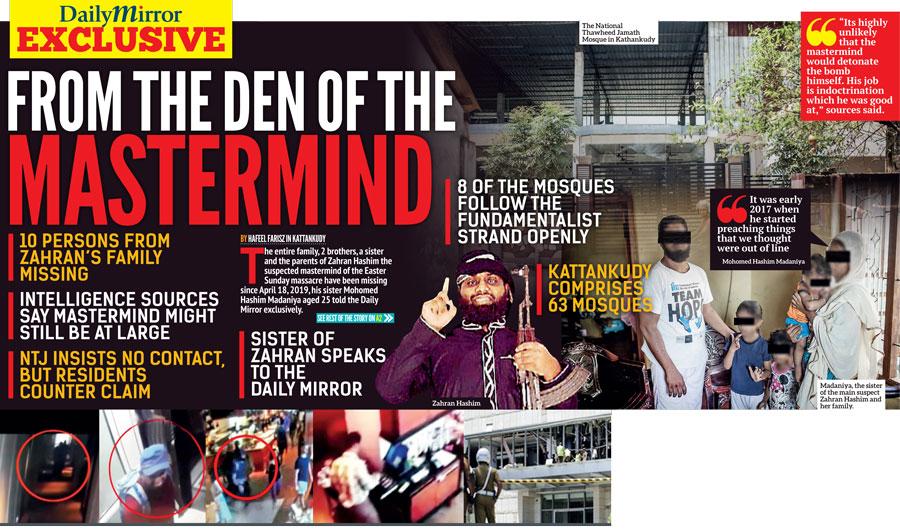
Field Marshal Fonseka said that DIG Nalaka de Silva of the terrorist Investigation Division (TID) had been engaged in investigations after having inquired into Zahran Hasim, one of the suicide bombers.
Gen Kottegoda said that he had not studied what Nalaka de Silva said. The arrest of such a person could be a problem, the witness said.
Field Marshal Fonseka said that following the arrest of de Silva, investigations had been affected.
The next session of the PSC is scheduled to be held from 3 to 9 pm on June 4.
The PSC decided to summon IGP Pujitha Jayasundera currently on compulsory leave, former Defence Secretary Hemasiri Fernando, DIG, CID, Ravi Seneviratne and Director, TID.
Claiming that the police failed to implement the law against those responsible for the Easter Sunday terror attacks, MP Wijeyadasa Rajapakshe had requested President Maithripala Sirisena to hand over investigations into the incident to an independent team comprising honest and trustworthy officials of the police department.
In a letter to the President, he said the Criminal Investigation Department (CID), had undertaken investigations into several incidents such as vandalising Buddhist statues and recovering explosives, but had neglected to report them to court.
The investigations into the incident of vandalising Buddhist statues in Mawanella, attacking a Hindu Kovil in Pothuhera, Alawwa and attacking a church in Penideniya have been handed over to the CID. On information received from the investigations, a training camp operated by terrorist Zahran was found in Wanathawilluwa and a stock of explosives recovered. The two suspects – Insaf Ahmed and Ilham Ahmed – who were the suicide bombers of Shangri-La and Cinnamon Grand hotels, were earlier arrested in connection with the Mawanella incident, but Minister Rishad Bathiudeen and Western Province Governor Azath Salley had forced the CID to release them. It was revealed that they were released as a result of undue political influence without them being produced in court. In case the matter had been taken up by the judiciary, then the attacks could have been averted,” he said.
Also, he said the CID failed to report to court the incident where two bomb-laden motorbikes were detonated on April 16 in Kattankudy.
Top officials of the CID should be held responsible for its irresponsibility and inactivity to prevent the terrorist attacks despite ample opportunities to do so. Justice cannot be expected by handing over investigations to the CID that acted short-sightedly on the devastation. Although it is the responsibility of the IGP and all OICs to report to the Magistrate’s Court soon after a criminal incident occurs, it is serious that they failed to take any action even after a month. On April 28, I complained to the OICs of Kollupitiya, Fort, Katana, Weralabada, Batticaloa and the Police Relief Centre on the incident but no action had been taken so far,” he said. (
Thilini de Silva and Ranjan Katugapola Courtesy The Daily Mirror
Inspector General of Police Pujith Jayasundara in a Fundamental Rights Petition filed before the Supreme Court today pleaded for an interim order preventing the President from dismissing him from office.
The Petition said that the order by the President to send Jayasundara on compulsory leave had violated his Fundamental Rights. The Petition urged the suspension of the order made by the President to send IGP Jayasundara on compulsory leave.
The Petition named the Acting IGP, members of the Constitutional Council, the Prime Minister and the Attorney General as respondents. )
Opposition MP Mahindananda Aluthgamage today said some vested parties; both local and international wanted to get the state of emergency lifted when the security situation has not yet been fully restored.
Addressing a news briefing held at the Opposition Leader’s office, the MP said the government had been pressurized by the western countries to lift the emergency.
At the most recent party leaders meeting, which held under the chair of Opposition Leader Mahinda Rajapaksa, we discussed as to how some ministers have urged the government to get the emergency law lifted. We can’t allow this when the security has not yet been fully restored,” he said.
While stating that they were not against the extension of emergency, the MP however said it was the duty of the government to get the extension passed in parliament. They brought it in parliament and it is their duty and responsibility to get it passed,” the MP said responding to criticisms as to why the Opposition was not keen on supporting the extension of emergency in parliament.
Our stance is that the emergency law should not be lifted. But it’s the government which should get it passed,” he reiterated.
The extension of emergency law was passed in the parliament with only 22 MPs voting for it. The eight TNA MPs voted against the extension.(
All Ceylon Islam Advisor Moulavi Alhaj Kaleel says when Zahran’s brother, Rilwan was making bombs, they informed the authorities.
Following are excerpts of the interview:
Moulavi will you tell us about your background?
A: I am an All Ceylon Islam Advisor. People in many areas know of me if you mention Kaleel Moulavi. The Muslim community across the country have come and met me to discuss any problem regarding the religion of Islam.
Are you someone who belongs to any organisation?
A: No, I am involved in religious affairs.
Are you connected to the Jamiyyathul Ulama Organisation?
A: No, I don’t let their politics rub off on me. We do work with political divisions too. That is done with the advice of the Jamiyyathul Ulama.
Who pays you for the work you do?
A: No one. I work voluntarily. I am doing social service for the country.
You are aware that our country went up in flames. The Sinhalese, Buddhists, Catholics, Tamils, Hindus, all those people faced a disaster. We do not know anything. How did Muslim extremists suddenly fall onto the heads of the people?
A: This is the question today. The entire world is shocked. Let me explain a bit. There are three types of Muslim devotees. I am saying this according to the book, the Quran. One is Mumin, those who live with great faith. They believe that profits, losses, happiness, and sadness happen according to the will of God. There is no point in embracing these since they are temporary. They believe that it is similar to a drop of dew on a blade of grass.
The other type is Muslim. They do what is convenient for them. They give up whatever they cannot do. If they cannot go to the mosque every day, they give that up. Prophet Muhammad (PBUH) said not to harm anyone by either your tongue or hands. They live, minding their own business. They are Muslim.
The third type is Munafiq. They act like Mumins and Muslims. They wear the hat and grow their beards. They have no faith at all in their minds. Prophet Muhammad (PBUH) engaged in war with Munafiq people. They are the ones who fanned the flames. Their objective always is how to attack all the time.
Are you trying to say that those who carried out the attacks were Munafiqs?
A: Sri Lankan citizens should be clear that those belonging to this type are the Munafiq terrorists. Their objective is to eradicate Islam.
The citizens of this country do not know those things. It is the Moulavis who know about these segregations. What we know is that these extremist bombers are of the Muslim religion only. We have not seen any segregation or any divisions among the Muslims in this country?
A: There are never ending clashes between us. I am a man who clashed with them. There were arguments between us all the time.
Did you know the extremist Zahran Hashim?
A: I knew Zahran Hashim very well. When he sees me somewhere, he flees. If he hears that I am somewhere, he does not sight the place. There were arguments between us inside mosques. There were times when we hit and clashed with each other.
We got to know about a Zahran after 21 April only. You said you knew about him. Why did you not hand him over to the law enforcement authorities?
A: They did not attack Christians, but the Muslims. These terrorists who killed 250 persons have gone after assassinating the characters of more than 2.5 million Muslim people. If, on a Friday they jumped into a mosque with bombs, people would have had compassion regarding Muslims. If we were attacked, assistance would have come from other countries as well. They attacked places where all Sinhalese, Tamils, and Christians gather together. The entire country fell out with us. They looked at us with squints in their eyes.
Zahran had gone all over the country to hold lectures. Not on his own, but having set up a separate organisation. We cannot accept the fact that Muslim Leaders did not know about these things?
A: It was not a religion, it was a revolution. The word Thowheed” is not a terrorist word. It means oneness. They put this word in order to catch the Muslims. We realized that.
We did not see this opposition among Muslims, you are targeting them with now, prior to the bomb blasts in Sri Lanka. It is after that incident that you are saying these things. We saw how the Thowheed organisations were tied to Islam?
A: We had small differences among us regarding observances. We raised our hands and wished. They did not raise their hands. We clashed regarding these observances and rituals. But when it came to suicide bombing, we shouted and took to the streets.
Where was this battle against National Thowheed Jamaath you are talking about held? When did you take to the streets?
A: In August 2017 at Kattankudy. The Mayor of Kattankudy, Aswer knows about it. When Zahran brought materials to manufacture bombs, we took to the streets. We said he was going to set fire to the country and that Zahran was a terrorist and he had to be cornered. We put up posters asking that he be taken into custody immediately. 1,500 men and women took to the streets. No one listened.
Are you saying that the overall Muslim people lined up in protest against them? We did not see anything of the sort?
A: They were not publicised properly. We never thought that these fellows will do something so bad. We did not realise that they would kill themselves while killing 250 others. We thought that bombs would be exploded here and there and something similar to that will take place. We did have a hint that they will do something. We immediately informed intelligence divisions, but they did not take any notice. They did not capture them. They thought ‘Thambiya’ let them kill each other.
The story you are relating is being said by other Muslims too. We informed authorities, but those responsible did not take any action. Whom did you inform that such a dangerous situation will arise?
A: We informed the NIB. When I went to meet the Mayor of Kattankudy, Aswer, an officer of the Intelligence Division was seated in a chair opposite me. We clearly explained this dangerous situation.
We are hearing all of this only after approximately 300 lives were destroyed. Can you prove that you informed the Sri Lanka Police about Zahran and others?
A: We informed Intelligence Divisions, but nothing happened.
Did you tell regional Muslim Leaders about this?
A: All regional Muslim Leaders were aware of what was going to happen.
But we got to know that bombs were being manufactured on a large scale, only in 2017. Then we took to the streets fearlessly. Previously, we were scared to do so.
When in 2017?
A: In the month of August in 2017. I can get the exact date from Mayor Aswer and give it to you.
There were Ministers and Deputy Ministers in the Eastern Province. Did you not inform Rauff Hakeem, Rishad Bathiudeen, and Hizbullah about this danger?
A: There was nothing to inform them about, all of them were aware of it. Had they not known, could we 1,500 take to the streets and protest? We engaged in the protests together with them.
What we want to know, is who the people are whom you informed?
A: I, finally told the FCID about this too.
The FCID is the Financial Crimes Investigation Division?
A: This was not a situation where we could watch and wait and we had to inform someone.
Can you give us the name of the officer who noted down your complaint?
A: Actually, I did not ask his name. I explained everything and gave a statement. I told them to kill them if they were seen anywhere.
Who is ‘this particular person’ your mention?
A: Zahran. It was said that the entire generation of Zahran’s could be destroyed. It was also said that he would be killed and the body dragged on to the road, so that the Police could take it away.
The respondent to this crime is the National Thowheed Jamaath Organisation. It was an organisation that was built among the Muslims.
What was the action taken against this organisation by Muslim Leaders?
A: There were only 24 suicide bombers. I am saying with responsibility that 12 died. 12 are in custody. There is no one remaining and all of them are finished.
Are you saying that there were 24 suicide bombers?
Were you not aware of the fact that training camps were being maintained in Kattankudy?
A: Why not, we did know! We went and told the Police.
Did you show them?
A: We told them earlier and asked them to come that we will capture them for the Police, we said. No one came.
Are you alleging that the Government did not fulfil their responsibilities?
A: The Government and authorities, did not do their duty. They waited until the bombs exploded, to attack.
What have you got to say about swords being found in mosques?
A: That is the work of terrorist members. They brought swords, left them at mosques, and showed everybody.
To cut whom were the swords brought?
A: The swords were brought to attack the Muslims. Our honour is finished.
Swords were found not only in Kattankudy. They were discovered at Kollupitiya and a mosque in Slave Island?
A: There are 1,700 mosques. There were swords only in three of them. There were 48 new swords which had been brought from a foreign country.
Why were they brought?
A: You have to ask them. Swords were brought to attack us.
Minister Haleem says they were brought to cut grass and for the protection of female children. Now, you are saying that they were brought to attack Muslims. What are these stories?
A: They are mad stories!
You say without a doubt that these swords were brought to kill Muslims?
A: Not to kill them, but to attack the Muslims. To get rid of Islam. They destroyed our good name.
Sinhala people thought that these swords were collected in mosques in order to attack them. That is why the entire country became agitated. You are saying something else?
A: We say with responsibility that these swords were brought to attack Muslims and Islam. We have never taken up arms and will never do so either, nor will we allow others to do so. There is nothing we can win by fighting with weapons. We enjoy everything and live in this country. Why should we fight?
What is the connection between the sword and Islam?
A: There is no connection at all. However, there are images of swords on the Saudi flag, that is all. We have nothing to do with swords.
Were Muslim Religious Leaders aware of the fact that Zahran and others were connected to ISIS?
A: We knew that they were making bombs and were going to detonate them and kill themselves. We did not know that Zahran had any connection with ISIS, though.
It was reported previously that a group from Galewela had gone to Syria for combat training. Had Muslim Leaders identified that the connection between these incidents and Zahran’s procedures?
A: We did not know anything about that.
There is much controversy in the country that Muslim politicians such as Rishad Bathiudeen and Hizbullah had contact with these extremists?
A: That was what Intelligence Divisions found out. Let them give a proper reply. Investigations will be carried out, and if they are involved, punishing them is a task for authorities.
It seems as if you are engaged avoiding something very slightly?
A: I am not avoiding anything. I have no connections whatsoever with politicians.
At the time when 1,500 people took to the streets in protest of extremists at Kattankudy, was Deputy Minister Hizbullah involved in it?
A: We are aware of their conspiracies. We do not engage in discussions with them. They could put us in trouble too. I know about politicians from the time of former Minister Ashraff. I have nothing to do with them.
You do associate politicians. You know government authorities. But, even while knowing about this destruction ahead of time, you failed to prevent it?
A: I informed the President and the Prime Minister in writing. I informed intelligence divisions.
Can you give us copies of those letters?
A: They were published in the newspapers. Details were given in the Media.
When did Rilwan, the brother of Zahran, suffer an injury to his hand when a bomb exploded?
A: In February 2019. Even then we informed authorities that bombs were being manufactured. Rilwan suffered injuries and went blind in one eye.
Did the Kattankudy Police know about this?
A: Yes, they knew very well. It was officer Kasthuri of the Police there. You can write down the name.
Didn’t they take any action?
A: I do not know what sort of influence was brought to bear on them. They just ate and drank and gave up on everything.
With whom did you say that they ate and drank?
A: I meant they just ate and drank and did not carry out any investigations and swallowed up everything.
Are you making this allegation about the Police?
A: Overall, all the authorities. Both ruling and opposition parties.
When Zahran’s younger brother Rilwan was injured in the bomb blast, where was he taken?
A: I do not know that. Finally, he died too. When the house was raided, he detonated a bomb at Saindamarudu. Three of our people who gave the tip-off were rewarded with 3 million rupees by the Government. We gave back that money to be used on behalf of those who suffered due to the bombs and their welfare activities.
When Zahran disappeared from Kattankudy, did you not try to find out what happened to him?
A: Why not! We informed authorities daily of the places he was in. We told the Police. Since they did not take any steps, this disaster occurred. That is why we feel sad. Now, they are accusing us.
Now the destruction has already taken place. Even though you say you informed everybody, even the Muslim Community could not prevent it from happening. As a newspaper we are questioning these things since we cannot allow such a disaster to strike our people ever again?
A: Nothing like this will ever happen from Muslim Society.
Parliamentarian Ven. Athuraliye Rathana Thera alleged that the transfer of Colombo Municipal Commissioner V.K.A. Anura took place due to the intervention of Western Province Governor, Azath Salley.
Addressing the Media in Rajagiriya today (29), he claimed that Anura has been told by Salley to extend the deadlines of tenders to operate meat shops in Colombo, even though deadlines have expired. Salley had sent a letter to Anura with regard to the extension of tenders and the latter had in turn replied to Salley saying that the extensions could not be done, and that such is against the due tender procedure,” he further alleged.
He also claimed that Anura had been advised to do the same on a number of occasions by Salley.
Anura too was present at the Media briefing, but did not make any statements, saying that he has been told not to make any statements regarding the transfer for legal reasons.
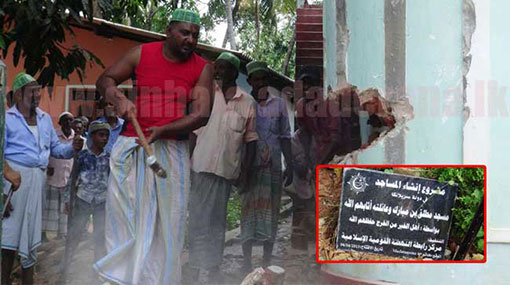
The Muslim community in Madatugama, Kekirawa has demolished a mosque belonging to the National Thowheed Jama’ath (NTJ), says Ada Derana correspondent.
The chief of the main mosque M.H.M. Akbar Khan stated that the mosque in question, funded by a foreign organization, was erected with the support of a resident in the village on a plot of land allotted to establish a library for children.
However, considering the situation prevailing in the country, the administrative committee of the main mosque in the village has decided that having another mosque in the village is uncalled for.
The plaque of the NTJ’s mosque, engraved with Arabic letters and purportedly bears the names of those who sponsored the establishment of the mosque, was also demolished by the villagers,
The Muslim villagers stated that they had maintained close relations with the Sinhalese neighbours for quite a long time and that the decision to demolish the mosque was unanimously approved by the Muslim community in the area.
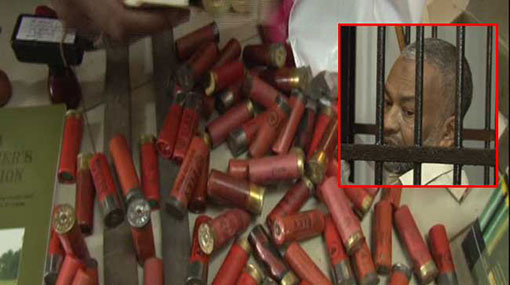
The Media Director of the Ministry of Finance Mohamed Ali Hassan, who was arrested today (29) over possession of 12-bore gun ammunition, has been released by the police following interrogations, Police Media Spokesperson SP Ruwan Gunasekara.
93 rounds of 12-bore gun ammunition were recovered this morning, from the outdoor space of his residence at Malwana area in Biyagama.
The Army and the Police had carried out a joint cordon and search in the area.
The security forces have managed to recover the haul from the upper part of the patio of his residence, according to the police.
The Finance Ministry’s media director was arrested on the spot for further questioning.
SP Gunasekara further stated that an Assistant Superintendent of Police had inspected the location extensively.
The police have sought the Attorney General’s advice on the incident.
It was reported that the said piece of land, where the ammunition was recovered, belongs to his father-in-law, who had been in possession of a licensed firearm.
Sixty-five more mothers who had their Caesarian surgeries under Dr. Mohamed Shafi of Kurunegala Hospital have filed complaints against the doctor today (28). Accordingly, 116 complaints have been received from mothers claiming that they had not conceived children following a Caesarian surgery by the doctor.
The mother who delivered through Caesarean surgeries under Dr. Mohamed Shafi submitted their complaints to the Kurunegala Teaching Hospital since this morning.
Fifty-one complaints against Dr. Mohamed Shafi were submitted to the hospitals yesterday (27).
Ten mothers who had been treated under the said doctor while he was serving at the Dambulla Base Hospital lodged their complaints at the Dambulla Police and the hospital, today.
The coordinating officer of the Kurunegala Teaching Hospital stated that mother from Dambulla area can submit their complaints against Dr. Shafi to the Kurunegala hospital as well.
Meanwhile, the Government Medical Officers’ Association (GMOA) has rejected the 6-member committee appointed by the Health Ministry to investigate the activities of Dr. Mohamed Shafi.
The doctors’ and nurses’ trade unions of the Kurunegala Hospital has informed the Hospital Director that they would not assist the committee appointed by the Health Ministry on their investigations against Dr. Shafi.
Parliamentarian S. B. Dissanayake states that the committee to investigate activities of Dr. Mohamed Shafi has been appointed by the Health Ministry to cover up the truth.
He says that although the relevant doctor is perceived by many to be a specialist on obstetrics and gynecology, he is not so. Instead, he is only a normal doctor with the title ‘Senior House Officer’, said Dissanayake.
Stating that there are over 50 complaints against the doctor, the MP said that he queried several senior surgeons in the country to learn that further pregnancies can easily be prevented by firmly pressing several points of the Fallopian Tube.
Therefore, Governor Asath Salley should not run his mouth without checking up on the facts, Dissanayaka further stated.
Kattankudy is a town in Batticoloa in Eastern Province of Sri Lanka
where only Muslims live. Why is multiculturalism & national integration
not applicable to Kattankudy? How is it that the nomenclatures of
multiculturalism, peaceful coexistence, secularism is applicable to all, other
than Muslim majority countries or in Muslim majority areas? How is it that
wherever and whenever an area becomes majority Muslim only extremist
fundamentalist and strict Islam prevails? It is visibly clear that wherever
minorities become a majority it is only their will that rules – their dress, their
culture, their religious practices, their habits is what prevails and all
others who want to live with them in harmony have to silently accept, not make
any fuss or shift to another town. Kattankudy is the example of what happens to
a town with only Muslims. Where minorities are a minority they demand on par
status & once on par they work towards becoming the majority using
surreptitious methods to influence politicians and local authorities. Incrementally,
Kattankudy cannot happen to other towns and it is time Sri Lanka’s leaders stop
compromising the historical ethos and heritage for votes, power and personal
handouts. The people of Kattankudy practice a culture foreign to the culture of
Sri Lanka even Muslims who wish to follow the heritage culture are under
pressure by those following a stricter & foreign form of Islam. This is
nothing that can be ignored in the face of increasing Jihadist terrorism
associated with this stricter form of Islam spreading to other parts of the
island influencing wherever Muslims are the majority.
How was Kattankudy created?
The Unionist Association of
Ceylon assisted the Delimitation Commission in the allocation of electorates to
the State Council under the Donoughmore Constitution when it decided to divide
the Eastern Province into 2 electorates. It was the Unionist Association’s
proposal that ended up creating Kattankudy. UAC President was SWRD Bandaranaike
& Vice President Sir Marcus Fernando.
Kattankudy is just 6sq.km of land
and inland water and has 18 grama niladari divisions for the 18 villages.
As per 2016 statistics, the
population of Kattankudy is just 47,603 (13,757 families)
Vote-bank politics discriminating majority giving unconstitutional
privileges to minority
The constitution is clear that all citizens must be treated equally. Before the law, every citizen must be given equal justice. There can be only one law for all.
However, politicians have diluted this. When the Proportional Representation system was introduced the initial cut off point for any party to qualify for parliamentary representation was 12.5% but Ranasinghe Premadasa reduced the cut-off point to 5% on a request made by M H M Ashraff of the SLMC before the 1988 elections. The reduction was with political intent and resulted in ethnic-based political parties with ethnic-based agendas to enter parliament and legislatively weaken & destabilize Sri Lanka incrementally to what it is today.
Not only are minorities accommodated by the mainstream political parties, but minorities representing ethnic-based political parties shrewdly align with the political parties to contest as an alliance and then demand a minority seat and a cabinet portfolio. The reduction of entry to Parliament from 12.5% to 5% is solely responsible for bringing to parliament MPs who are not representing the country or even the minority they claim to represent.
Where Muslims are majority – Muslim-Muslim conflict surfaces
Kattankudy though occupied by
only Muslims is not in total harmony. Rise in Sufi mysticism has resulted in
militant opposition in East – Kattankudy & Maruthamunai since 1980s.
In 2004 Sufi tombs and shrines
were destroyed and Sufi leaders had to flee province. In 2009, Sufi &
Towheed tensions arose in Beruwela. In Kattankudy Sufi leader Rauf Maulavi who
had formed the All Ceylon Islamic Spiritual Movement was declared an apostate
by the All Ceylon Jamiyatul Ulama in 1979 and Rauf was chased out of Kattankudy
in 2006 & in December the shrine of Sufi leader late Sheikh Abdullah
Payilvan (founder of Thareekatul Mufliheen) was attacked & his corpse
barred from burial in Kattankudy.
It was on 21 September 1982 that A H M Ashraff established the Sri Lana
Muslim Congress in Kattankudy (Batticoloa district) though he was from
Samanthurai (Ampara district)
Ironically Ashraff spoke at ITAK meetings in 1970s and was even present
at the Vaddukoddai Conference in May 1976 when the Vaddukoddai Resolution was
passed for a separate Tamil state.
Not surprisingly Ashraff formed the Muslim
United Liberation Front in 1977 on the same lines boasting that even if
Amirthalingam abandoned Eelam goal he (Ashraff) would not. Ashraff was MULF’s
legal advisor. MULF however did not win a single seat & Ashraff left MULF
to join SLFP in 1980 when TULF refused to accommodate Muslims to contest under
TULF banner.
When Muslims & Tamils showed such close allegiance why did Prabakaran ruthlessly and mercilessly attack Muslims inside the Kattankudy mosque in 1990. Could it not be that Prabakaran realized that Ashraff and Co were having larger plans for Eastern Province from the Tamil Eelam goal? Is it not because Rajiv Gandhi himself had other plans that he too was eliminated by Prabakaran!
An ‘alien image identity’ root
cause of disharmony & self-alienation by Muslims
It was during this period that a creation of a Muslim identity
resulted in wearing burka, hijab, beards, missionary campaigns, new mosques and
louder demands using their leverage in business and UN/Western human rights
nomenclatures. All these were part of fundamentalist POLITICAL ISLAM that drew
Muslims automatically because ‘Islam’ associated with it. No one questioned its
conflict with Sinhala majority culture or heritage.
It was in 2013 that Dr. Ameer Ali
highlighted the reality that Muslims were self-alienating themselves from the mainstream community because of a
new image problem. There can be no better example than Kattankudy to prove this.
Is the orthodox brand of imported Islam the cause of the alienation?
Dr. Ameer Ali says the new dress, new values and practices are the root cause and advises Muslimsto self-introspect & ask themselves whether they want to be Muslims of Sri Lanka or Muslims in Sri Lanka.
Dr. Ameer Ali takes Kattankudy to highlight
the self-alienation an area
of just 6sq.km has 58 mosques – planting of date palms in the middle of the
road to look like Arabia, halal slaughter, the black dress he says is alien to
Sri Lanka and has nothing to do with Islam. He confirms that women of the 1970s
wore saris. So why are women adopting this ‘confrontational image of Islam’
knowing that women did not dress in this manner earlier?
In short what it means is that anyone dressed in black attire, long fluffy beards, demanding shariah, marrying children, halal, ritual slaughter, expansion of Islamic territory (Islamization) etc are those practicing confrontational extremist Islam. It’s now upto the Muslims to remove this from society! Will they? is a question they must now answer.
Its Islam – but distortion of Islamic Scriptures
Why are
Muslims ‘misreading Islamic scriptures’ – who is at fault for teaching them
radicalized scriptures knowing this would result in extremism and conflict with
the majority community whilst isolation Muslims? Why are Muslims inviting these
radicals from Middle East to address and influence Muslims if Muslims are well
aware that these are the elements leading to disharmony? Muslims should know
which brand of Islam to follow but why are they following a militant form of
Islam?
Can Muslims counter these extremisms which are inherently part of Islam?
When new aspects
of self-alienation imported from Middle East funding radicalism in the East became
known the previous government was quick to set up 2 intelligence units to
monitor extremism though both units had been disbanded and the officers heading
them put into prison by the present government for reasons best known to them!
The extremism and the inability to integrate when towns become turned into Kattankudy is primarily due to the Islamic fundamentalism rooted in Wahhabi Islam (stricter Quran and Hadis) This different form of Islam is not only a threat to non-Muslims but to Muslims as well and Sufi’s will guarantee this.
EasterSunday
attacks was masterminded in Kattankudy. The hate for non-Muslims (though
historical) was encouraged because everyone in Kattankudy are Muslims and the
radical preachers of hate find the environment easy to brainwash against
non-Muslims. Same thing in practiced in North Sri Lanka by TNA & LTTE
against the Sinhalese. They don’t want Tamils mixing with the Sinhalese because
ordinary Tamils would discover TNA & LTTE had been lying about the
Sinhalese. Similarly these radical Muslims want all Muslims to hate
non-Muslims. Creating only Muslim cities only facilitates this hate. No ghetto
ethno-religious areas should be allowed. Kattankudy must be made multicultural
as a future national policy just as North Sri Lanka.
No Government should promote any Islam that
is not only dangerous to the country, the majority & the minorities as well
as Muslims not practicing this stricter form of Islam. It is because the
government has taken the side of Muslim leaders who are aligned to this
stricter form of Islam that has led to these Muslim politicians using State
power and patronage to advance their agendas at a national security risk to all
citizens of Sri Lanka.
Muslims
should be able to practice Islam but not Arabian culture or Arabian Islam and
this message must be clearly conveyed.
Many Muslims
are now openly saying that they wish to align to the Sinhala culture while following
their Islamic faith. We have no issues with this.
But, we have
an issue with the new identity that surrounds the stricter form of Islam that
includes Shariah, burka, long beards, marrying children, female genital
mutilation, halal, ritual animal slaughter, proliferation of mosques not built
like mosques, madrassas etc. Having identified these elements that are not
integrating and being the cause of confrontation Muslims must agree to denounce
& remove them.
Going forward Sri Lankan citizens must accept
One Law
must apply to all
Laws
must be equal to all – minorities need not have special laws if before the
Courts, everyone is treated equally.
Remove
ethno-religious political parties or return the parliamentary entry to 5% from
the 12.5% changed in 1988 as a political favor.
No
rejected politician should be taken into parliament or given State portfolios.
No
Government should allow mono-ethnic towns/cities as a National Policy
No Government
should allow the heritage culture of Sri Lanka to be replaced by foreign new
cultures
Remove
the Ministry of Reconciliation/ National Integration – it has served no purpose
Religious
Freedom to worship is a personal freedom & not institutional religious
rights to convert / new cultures are not religious rights
Strict
architectural laws that give rules & regulations for buildings
A
group of pro-active Indian and Sri Lankan Buddhists drawn from leading Buddhist
organizations had a series of discussions on the sidelines of the World
Buddhist Assembly gathering in Bangkok, Thailand (May 21 – 25, 2012) and
decided to establish an ‘Indo – Sri Lanka Buddhist Network’ to pursue a number
of preliminary aims and objectives that are beneficial to the cause of
consolidating and spreading Buddhism in both countries and other parts of the
world. It is anticipated that a more substantial organization would emerge with
the passage of time from these interactions.
The
preliminary aims and objectives of this Buddhist Network are as follows:
i)
To develop and strengthen warm and friendly ties between Buddhists in India and
Sri Lanka,
ii)
To collaborate in Projects leading to the promotion of peace and non – violence,
friendly relations and understanding between peoples of India and Sri Lanka
within a framework of Buddhist principles and shared past in a common Buddhist
civilization that influenced both countries, and
iii)
To work together in propagating and spreading Buddhism worldwide.
The
first of many Projects that are intended to be launched both in India and Sri
Lanka would be the convening of an International Conference in Colombo, Sri
Lanka before the end of 2012 on the topic:
•
‘ The contribution of Dr. B.R. Ambedkar to the revival and renaissance of
Buddhism in the 20th Century ’
Some
of the other intended Projects include –
•
The launch of an international public campaign calling on the Government of Sri
Lanka and other Governments in Buddhist Asia to issue commemorative postage
stamps in honour of Dr. B.R. Ambedkar as a token of appreciation of his immense
contributions to the revival of Buddhism in India
•
The preparation of a public memorandum calling on the promoters of the Nalanda
University Project to include Buddhists from India and Sri Lanka in the
decision making process of this Project, and
•
The formation of an Indo – Sri Lanka Buddhist Media network engaged in capacity
building and exchanges
Honourable Premier Doug Ford, Honourable Cabinet
Ministers, Honourable Leaders of the NDP and Liberal Party and Honourable Members of the Provincial
Legislature,
OBJECTION TO BILL 104: DO NOT PASS: REFER TO
COMMITTEE
I am
writing as a Canadian of Sri Lankan Sinhalese origin who has lived in this
province for the past 44 years to express our community’s strongest objection
to your even considering the subject Bill 104 presented by Mr. Vijay Thanigasalam,
MPP for Scarborough – Rouge Park on account of the following reasons:
1.It promotes false
information. There is no genocide involved;
2.It promotes division
among the Sri Lankan community in Canada. This country being a multi-cultural nation
with diverse communities should not promote legislation which creates strife
within communities.
3.This legislation has
been initiated by a Tamil MPP from the Conservative Party who along with other
Tamil expats that provided material
support and funding to the internationally designated terrorist group called
the Liberation Tigers of Tamil Eelam(LTTE) banned by 32 countries including
Canada, USA, UK, EU, India, Malaysia, etc., seeking to break up Sri Lanka and
set up a separate state in the north and east of the island. The LTTE launched
its so called final war of liberation in mid-2006, but was militarily defeated
by Sri Lanka’s armed forces on May 19, 2009. Now the pro-LTTE supporters in
Canada have launched a campaign ten years after the military conflict ended
fabricating charges of genocide against Sri Lanka to bring international
pressure to bear against that country, to achieve their aim of breaking up the
unitary state and realizing their objective of a separate state for Tamils
whose homeland proper is the State of Tamilnadu in Southern India where over 75
million Tamils live.
4.According to Article
VIII of the Genocide Convention, the only authority that is able to make a
finding of genocide is the United Nations, whilst disputes if any between the
contracting parties shall be decided by the International Court of Justice.
5.The Tamil civilians
were compelled to move with the retreating LTTE forces from the west coast to
their strongholds in the northeast coast around Mullaitivu to be exploited for
their labour, conscripted as fighters and form a human shield.
6.
The total number Tamil civilians bandied about by the pro-LTTE groups as
having been killed between January 1 and May 19, 2009 ranges from 70,000 to
140,000, whereas the UN Resident Representative’s office in Colombo reported
7,721 civilian deaths between August 2008 and May 13, 2009. The Government of
Sri Lanka conducted a census using Tamil teachers and public servants as
enumerators and arrived at a figure of 7,432 excluding those who had died of
natural causes, whilst the Tamilnet, a key propaganda arm of the LTTE reported
monthly deaths from January 1 to May 19, 2009, which added up to 7,398. Lord
Naseby of the British House of Lords obtained heavily redacted copies of
confidential reports sent by Col. Gash, the Military Attache at the British
High Commission in Colombo to the Foreign and Commonwealth Office in London,
where he reported a total of around 8,000 civilian deaths with 2,000 of that
number being killed by the LTTE to prevent these civilians hat formed a human
shield from fleeing their area of control. Contrary to what is claimed as genocidal attacks by the Sri Lankan
forces, the number of genuine civilians killed is unknown as none of the
published figures distinguishes between combatants, LTTE Auxiliary Forces
Personnel, and genuine non-combatant civilians. In fact, the UNSG’s panel on
Sri Lanka reported that a large number of LTTE fighters battled in civilian
attire blurring the distinction between fighting cadres and civilians.
The pro-LTTE groups
are relying on unsubstantiated numbers estimated by the UNSG’s three member
Panel on Accountability in Sri Lanka which included Marzuki Darussman, Steven
Ratner and the South African Tamil and propagandist for the LTTE Yasmin Sooka,
appointed for his personal guidance, that arrived at a number of 40,000
civilian deaths based on one sided information provided by expat Tamils which
they locked away for 20 years till 2031. They carried out their investigations
from New York and never visited Sri Lanka.
The other is the internal review conducted by Charles Petrie who
reviewed the UNSG’s Panel report and reports furnished by IGOS and INGOS who
were not in the war theatre after September 2008 arriving at a figure of 70,000
civilian deaths. Neither of these
reports had been sanctioned by the UNSC or the UNGA, and were conducted from
outside Sri Lanka.
Amnesty and HRW commissioned a report from the American Association for the Advancement of Science (AAAS) to determine the number killed after analysis of the high resolution satellite imagery of the final battleground, as the latter were only able to come up with a total of 1,346 burial spots in three burial sites within the Civilian Safety Zone (CSW), which detailed report is carried in their website under the title ‘Geospatial Technologies and Human Rights Project – High Resolution Satellite Imagery and the Conflict in Sri Lanka. As this report did not support the bogus numbers swirled around by LTTE propagandists, Amnesty and HRW did not proceed with their planned report to press for action against Sri Lanka.
The AAAS report was also able to identify some 65 or so craters which they determined had been made by Mortar Shells (not artillery) along the perimeter of the CSZ close to the Nandikadal Lagoon where the LTTE fighters were concentrated and close to the coast where the Sea Tigers operated. Even the buildings without roofs initially thought to have been targeted with artillery fire turned out to have been dismantled by the LTTE to cover their bunkers or hide their long range weapons, while the building walls remained undamaged.
Another
interesting statistic is the total number of injured persons among the Tamil
IDPs according to the ICRC responsible for ferrying them by land and sea for
medical attention was 18,439 which is lower than the 40,000 supposedly killed
during the last stages. Normally, the world’s average ratio injured (WIA) to
the number killed (KIA) is between 2-3 times the number killed, which means that
the number injured should have been 80,000 – 120,000. Can someone explain this
discrepancy other than determining that the high civilian death numbers being
quoted are bogus guesstimates.
7. The Justice Maxwell Paranagama Commission on Missing Persons in Sri Lanka was assisted by a team of international legal and military experts in matters relating to International Humanitarian Law (IHL) and War Crimes issues in respect of the military operations against the LTTE, where they concluded that the Sri Lankan forces had not violated IHL or committed war crimes. These experts were internationally recognized authorities, many of whom had served as legal advisers or prosecutors in the International Criminal Courts.
The team of experts was led by Right Honourable Sir Desmond de Silva, QC. (UK) who was Chairman of the Legal Advisory Council, together with Professor Sir Geoffrey Nice QC. (UK), Professor David M. Crane (USA), Mr. Rodney Dixon, QC. (UK/ South Africa), Professor Michael Newton (USA) Vanderbilt University, William Fenrick (Canada), Professor Nina Jorgensen of Harvard University, Mr. Paul K. Mylvaganam (UK) and Major General Sir John Holmes, DSO, OBE, MC (UK) former head of the British SAS.
8. The LTTE launched attacks on the other Tamil militant groups to gain ascendancy and later became the leading terrorist group employing suicide terrorism becoming the self-declared ‘Sole Representative’ of the Tamil community, even recognized as such by the Tamil National Alliance (TNA) elected to represent Tamils in the National Parliament. In order to establish their authority, the LTTE first carried out attacks on leading members of the Tamil community including political leaders, academics, intellectuals, police officers, and others deemed dissidents. Thereafter, the LTTE began to attack the apparatus of the state responsible for internal security, isolated military camps, assassination of political leaders including Ranasinghe Premadasa, President of Sri Lanka, Gamini Dissanayake, Presidential candidate, cabinet ministers, namely, Lalith Athulathmudali, C.V. Gooneratne, Jeyaraj Fernandopulle, T.Maheswaran, and attempted assassination of Chandrika Kumaratunge, President of Sri Lanka, Army Commander Sarath Fonseka and Defence Secretary Gotabhaya Rajapakse.
The LTTE dispatched a woman suicide bomber to assassinate Rajiv Gandhi, Prime Minister of India, and also killed Sri Lanka’s distinguished Minister of Foreign Affairs, the Hon. Lakshman Kadirgamar. They attacked remote rural villages in the north and east to ethnically cleanse the region and drive out the resident Sinhala population from areas claimed for their separate state. The LTTE also attacked economic targets such as the Central Bank, Petroleum Storage facilities, the International Airport at Katunayake destroying six commercial aircraft belonging to Sri Lankan Airlines, and regularly planted bombs in public transit, shopping malls, bus terminals, rail stations, killing large numbers of civilians making the population fearful of going about their normal business.
They even attacked the holy shrine of Buddhists
at the Sri Maha Bodhi in Anuradhapura killing about 140 including monks and lay
devotees who were engaged in meditation and other devotional activities. They
attacked a bus carrying 33 Buddhist monks who were proceeding on pilgrimage at
Aranthalawa using machine guns and machetes, and also bombed the Sri Dalada
Maligawa in Kandy which houses the Tooth Relic of the Buddha causing extensive
damage to this World Heritage Site recognized by UNESCO. They attacked Muslims
at prayer in Kattankudy killing nearly 180 worshippers inside their mosques.
9.
The LTTE started their so called final war of liberation
in earnest by shutting off the sluice gates at Mavil Aru in August 2006 during
the CFA by stopping the flow of drinking and irrigation water to 30,000 farmers
living downstream. The state responded militarily after a lapse of nearly 12
days to restore the water supply and thereafter took action to clear the eastern
province of LTTE forces followed by similar action along the northwest coast
regaining the territory usurped by the terror forces. Before long, the LTTE was
compelled to retreat into a narrow strip on the northeast coast at
Puthumathalan near the town of Mullaivu. The LTTE forces were completely
surrounded by the security forces which soon established a civilian safety zone
(CSW) within this strip to prevent any harm to the displaced civilians. The
LTTE moved their heavy artillery guns within the CSW and fired at the
surrounding state military. The army would check on the LTTE’s artillery
position and resort to retaliatory fire
after making sure that the civilians
were at a safe distance to minimize civilian casualties.
10. The
military successfully carried out a maneuver to split the CSW into two helping
nearly 120,000 civilians to escape to safety. The LTTE was offered several chances to surrender but
they did not pay any heed as they expected the international community led by
the USA to intervene in the ongoing battles and rescue them and obtain asylum
for them in an African country such as Eritrea from where they could continue
their separatist struggle in Sri Lanka. In fact, two 48 hour ceasefires were
put into effect by the Sri Lanka military in February and April 2009 to enable
the civilians to get out of harms way
and move into areas controlled by the army where they would be safe. However, regrettably the LTTE did not allow
any of the civilians to move out and even fired on those who attempted to flee
killing them, effectively blocking the safe removal of the civilians who were
being used as a human shield. Despite the attempts of the LTTE to put the lives
of the Tamil civilians in danger, the Sri Lankan Security Forces succeeded in eliminating
the Tamil Tiger leaders and remaining fighters and rescuing 295,873 Tamils
among whom were 11,800 former Tiger fighters in civilian attire that abandoned
the LTTE. They were housed in Welfare Camps, provided all meals, medical/
psychological care, education, vocational training, and resettled in their
former places of residence after clearing the land of 1.5 million landmines
laid by the LTTE to hamper the advance of the country’s armed forces. The
former Tiger cadres were enrolled in a rehabilitation program, given new life
skills that would enable them to lead independent lives and released to
society. ARE THESE ACTS OF GENOCIDE AGAINST THE TAMILS?
Please consider the above factual data and take action to reject Bill 104 which attempts to insert a series of falsehoods into the Canadian legal system thereby seriously affecting the integrity of our laws.
My apologies to parliamentarian Sarath Fonseka for misquoting him, by changing the term he used “kodivinaya” to “hooniyama”, and my thanks to B.S.Perera for pointing out this error on my part, in his piece ‘Bungling Politics’ (The Island, 22 May) wherein he also questions whether I am promoting a party or a person, which certainly is not my intention. In my defence may I point out, not being a believer of the occult, neither kodivinaya nor hooniyama mean much to me and are not too dissimilar. But one thing I know, and many will agree with me, is that by its’ ineptness and subservience bordering on treason, Yahapalanaya has become a curse.
“Worse, the President stands accused of having acted in violation of the Constitution. The Prime Minister and the Cabinet allegedly enter into international agreements without the President’s knowledge. Vital pacts the government signs with foreign powers are not presented to Parliament and thus the people in whom sovereignty is said to reside are kept in the dark.”
These are not my words; it is a revealing paragraph from the excellent editorial “Another Danger” (The Island, 22 May), which should wake up Sri Lankans with any modicum of patriotism. I am sure even Venerable Maduluwawe Sobitha Maha Thero, had he been alive today, would agree that this “Yamapalana” administration, parading as a “Yahapalanaya”, has become a curse on Sri Lanka. If rebirth is true and Venerable Sobitha is reborn in a place with visibility to the political bungling, surely, he would be shedding a few divine tears too! Unfolding events, on a daily basis, confirms the impotence of an administration held hostage by minority votes. To this end, they do not seem to mind interfering in the good work done by our police and the armed services, even.
Perapalanaya
I am interested in the present and now, rather than hark back on a “Perapalanaya”, which is an excellent diversionary tactic. Suffice it to say that ‘Perapalanaya’, though corrupt, handed over a country at peace to a ‘Yahapalanaya’ that sleep-walked into a terrorist disaster, on top of breaking records for corruption and cover-ups as well as destroying the image of the country. I am sure Arjun Mahendran is the happiest man on earth today, as the bond-scam has got submerged in the torrent of terrorism!
Rishad-gate
Interestingly, the latest gambit of the Minister Rishad Bathiuddin is to throw down the gauntlet to the President and the Prime Minister: he will resign if either of them requests him to do so. Otherwise, support him or the government will lose the vital support of him and his henchmen. I do not know what to call it; Hobson’s choice? Catch 22? Rishad’s Ruse?
Even if we agree with the government’s contention that the no-confidence motion on Minister Bathiuddin is nothing but an opposition attempt at mud-slinging, can we disregard the statement of the Army Commander? Afterall, Lt. Gen. Senanayake, who left Si Lanka just after the 2010 presidential election to return soon after the 2015 presidential election, is Army Commander because of the implicit trust of the Yahapalana administration. Further, he won admiration and gained public trust after the terrorist bomb-blast. His statement “I told the Minister to ring me in one and half years-time, as that is the period, I can hold a suspect for” is in utter contrast to the Minister’s explanation. Who does the public trust; the Minister or the army commander?
We were made to believe that the cornerstone of Yahapalanaya is good governance: after all, the term itself is a direct translation. Honouring this concept, is it too much to expect either the President or the Prime Minister, preferably both, to request the Minister to step aside, if any honour is left in him, while accusations levelled against him are investigated? Sorry, if any honour is left in him, the honourable minister would have stepped aside on his own volition. Do our two leaders display a lack of courage or complete deficiency of statecraft? Can the pubic be hood-winked by a select committee?
Venerable Gananasara
The battered President can derive some comfort from the support extended by Brigadier Ranjan de Silva who, in a piece titled “To Be Fair” (The Island, 22 May), states:
“His decision not to pardon Gnanasara Thero on Vesak Day, resisting pressure from politicians and dusseela Buddhist monks is statesmanlike. Media reported that former Ministers Wijeyadasa Rajapaksa and Thilanga Sumathipala had called for the release of Gnanasara Thero.
Dr Rajapaksa must be aware that Gnanasara Thero was jailed for contempt of court. The Thero aspires to be a leader of the people. If this is the example he sets as a leader, how will his followers behave vis-a-vis the country’s court system? Already the courts system is functioning under tremendous pressure to dispense justice without fear or favour. Dr Rajapaksa is also an attorney at law.”
Poor Brigadier must be disappointed at the President’s statesmanlike attitude evaporating like a dew-drop struck with the first ray of the rising sun! ‘Hopeless’ politicians like Wijedasa Rajapaksa and dussela monks have succeeded; Venerable Gnanasara is released!! I do hope the venerable monk will behave with dignity, not insulting the saffron-robe he adorns.
It is a pity that the Brigadier fails to understand, had the Yahapalanaya heeded the warnings of Dr Rajapaksa, delivered in the most diplomatic way in the parliament, and Venerable Gnanasara, delivered in a way most of us objected to, we would not be in the current predicament. By the way, the ever-talkative Dr Rajitha Senaratna, who repudiated Dr Rajapaksa, based on his claimed close connections with Muslims of the four-corners of the country, and reassured that there will be no Islamist terrorists attacks, seems to be resting his vocal chords! Why cannot he tender an apology, at least? Pretty obvious, he has no sense of shame.
I have no problem, at all, with the jailing Venerable Gananasara but also feel that the Presidential pardon is justified. Let me explain. I have been regularly expressing concern about the bad behaviour of some Buddhist monks but have not gone to the extent of castigating any pleading for compassion as dussela Buddhist monks, as the Brigadier had done. In my article “Men in Robes” (The Island, 14 October 2017) I wrote:
“Unfortunately, the actions of men in robes in the guise of Buddhist monks have been troubling me for some time. I do not expect Buddhist monks to be perfect; after all they are human and can have faults but I cannot condone conduct that is totally un-Buddhist. The behaviour of some Bhikkhus of BBS leaves me startled. Though I was initially against Buddhist monks engaging in political activity, after reading Venerable Walpola Rahula’s thought provoking and inspirational book, ‘Bhikshuwage Urumaya’ (Monk’s Heritage) I have changed my mind. As long as Bhikkhus indulge in politics for the common good, not for personal benefits, it is totally acceptable. After all, if not for their political activity where would we be today? If not for the campaign led by Bhikkhu’s like Venerable Rahula, we would not have had free education and, in all likelihood, I would not be writing this; would have died some time ago as a retired teacher or clerk.”
Crime and punishment – proportionality
What concerns me is the length of the sentence passed on Venerable Gnanasara. Being a lawyer, Dr Rajapaksa probably realised this too. I am sure he would have been greatly embarrassed when lawyers who destroyed property in Colombo courts, shown to the whole nation on television, continued to practice unhindered, whereas a 19-year sentence to be served in 6 years, was passed on a Buddhist monk for contempt of court. Intrigued, I too made inquiries from luminaries of the legal profession and was told that this the longest sentence, ever passed, for contempt of court in Sri Lankan legal history, which goes against the well-established principle of proportionality. Where were the human rights activists? Did any of them move a finger to protest at the undue harshness of the sentence? Maybe, they thought he deserved it, considering his ‘bad behaviour’! But we do not punish for overall bad behaviour, punishment being only for the crime under consideration.
If bad behaviour is to be punished, should not Mr C.V. Vigneswaran, former governor, too be jailed? Inflammatory statements he made, insulting the Sinhala race, made me wonder how such a racist warmed the benches of our supreme court.
Ranil’s reawakening
UNP strategy of a blood-bath, probably following JRJ’s lead of 1983, having failed to evoke a backlash from Sinhala Buddhists, in spite of Lakshan Kiriella’s kela-pattare, Mangala and Thalatha’s loose-talk among many other things, Ranil is announcing a series of measures: ‘Sharia’ University will be taken over; all Madrasas will be under the Education Ministry, not Muslim Religious Affairs Ministry; name-boards will be only in the three official languages; etc., etc. Looks as if Yahapalana blindness has had a miraculous cure. Congratulations, Ranil! May I wish you the courage to stop shielding terrorist supporters and make Sri Lanka one country, under one law!
It was John Milton who said “Every cloud has a silver lining”. Maybe, some good has come out of this terrible act of terrorism!
The 18-year-old is making a difference in the lives of local Sri Lankan childrenBy ELIZABETH LEONARD May 28, 2019 11:00 AM
Paris Brosnan is doing his part to help raise awareness about childhood hunger in Sri Lanka.
A burgeoning filmmaker, the 18-year-old son of Pierce and Keely Shaye Brosnan recently traveled to Sri Lanka to document firsthand how one program is making a huge difference in the lives of both local children and on the region’s economy.
Travelling to Sri Lanka was an amazing opportunity for a young filmmaker,” says Paris, who captured in a short film and in photographs the ongoing work being done in the South Asian island country by the UN World Food Programme (WFP).
With crucial support from Clarins and FEED, a social impact-driven brand founded by Lauren Bush Lauren, WFP is delivering nutritious food to Sri Lankan school-aged children.
I was drawn to Clarins and FEED’s mission to help solve childhood hunger through school feeding,” Paris tells PEOPLE. This school meals program gives children a sense of belonging, community, and an education.”
Paris Brosnan with Christian Courtin-Clarins and Lauren Bush LaurenClarins
Paris Brosnan with children in Sri LankaClarins
While in Sri Lanka, Paris visited schools and farms to see up close how WFP connects local farmers with its meals program that ultimately helps both undernourished students and supports the local economy.ADVERTISING
They may not represent the Islam that moderate Muslims know and follow, but their actions are inspired by their own version or interpretation of it.
The Easter bombings in Sri Lanka once again turned a spotlight on the challenge of global jihad, terrorism and Islamophobia. (Photo:AP)
The Easter bombings in Sri Lanka once again turned a spotlight on the challenge of global jihad, terrorism and Islamophobia. Muslim scholars and community leaders from across the world have condemned the attack, dissociated themselves from the perpetrators and defended Islam as a religion of peace.
Many Muslims are constantly feeling like they need to apologise. Still, they continue to face a backlash and stereotyping of their community. The fear of reprisals combined with growing Islamophobia compels Muslims to insist that these acts have nothing to do with their faith. This urge to separate religion from the violence committed in its name is well intentioned and understandable, yet counterproductive.
It is true that these terrorists do not represent the overwhelming majority of Muslims, who oppose terrorist groups like the militant Islamic State (ISIS), the Taliban, and Al Qaeda. However, it does not necessarily mean that they have nothing to do with religion. They may not represent the Islam that moderate Muslims know and follow, but their actions are inspired by their own version or interpretation of it.
Here, it is worth emphasising that, as a Muslim, I strongly believe that the Muslim belief is no more violent” than those of other religions. Neither is religion the only cause of such violence. Instead, violent extremism is a complex phenomenon with multiple driving factors including injustice, identity crisis, extremist ideologies, and socioeconomic reasons. Their salience varies across time and space. There is no clear profile or single causal pathway that can define the process of radicalisation. There is also no denying that colonialism, Western military interventions in Muslim countries and support to authoritarian Muslim rulers have played a role in the rise of Islamic extremists and militants in the Muslim world. To summarise, it is often a combination of politics and extremist interpretations of Islam that produces the vitriolic narrative and rampage that most Muslim countries face today.
The problem is that while Muslims almost always talk about the politics that creates terrorism, and rightly so, they are reluctant to discuss the role of radicalised interpretations in inspiring terrorist violence. In Muslim-majority countries, a small segment of Muslims do recognise the challenge posed by radical interpretations of religion and disputes a literalist reading advocated by fundamentalists. Quranic verses, they argue, are often misinterpreted and quoted out of context. There are, however, two points which must be considered in the debate.
First, these debates are restricted to the drawing rooms and private gatherings of a tiny liberal, secular and left-leaning class that is often insulated from the rest of society which is generally conservative. Publicly, most Muslims are reluctant to openly engage in a debate regarding religion. Those who do so often pay a huge price.
Second, the lack of an authoritative hierarchy in doctrinal interpretation means that any Muslim can interpret religion the way he or she likes. While making Islam more egalitarian and democratic, this also makes it easier for extremists to promulgate their literal interpretations despite opposition by a large majority of Muslim clerics and scholars.
Moderate Muslims cannot be blamed for not engaging in open public debate because most Muslim countries lack the environment required for discussing sensitive issues. The countries where there is space for critical debates are the relatively advanced democracies of the developed world. However, in almost all such countries, Muslims are also a minority and often the victims of hatred and prejudice inspired by Islamophobia. Consequently, conscious of their minority status, moderate and liberal Muslims in these countries hold back their views on religion for fear of being seen as abettors of Islamophobia.
The rise of right-wing nationalism in Europe and America has only reinforced their concerns. Diaspora Muslims fear that even pointing out that militancy might have something to do with a certain interpretation will feed into Islamophobia. The nuance about particular interpretations, the argument goes on, would gradually disappear in the public debate and Islam as a religion and Muslims as a group would be criticised. These are legitimate concerns and it is, therefore, not surprising that diaspora Muslims scholars and intellectuals are at the forefront of the IS-has-nothing-to-do-with-religion” school of thought.
The real challenge for Muslims is to be able to have these difficult conversations in a way that does not lead to more Islamophobia or buttress the West’s Orientalist and stereotypical view of Islam and the Muslim world. Moderate Muslims must understand, deconstruct and delegitimise the extremists’ version of Islam rather than denying the existence of their interpretation. By denying any link between faith and the violence carried out in its name, Muslims foreclose all public debate on different interpretations and help extremist Muslims get away with their context-less versions.
This denial has given right-wing nationalists in Europe and America an opportunity to cash in on the growing public unease about Muslims and their faith. They need to realise that the extremists’ interpretation can only be countered and discredited publicly if its existence is first admitted and then actively contested and challenged. This may sound like a daunting task, but it is the only way moderate Muslims can ensure that their vision of a more tolerant and inclusive Islam prevails.
Professor G.L. Peiris, Chairman, Sri Lanka Podujana Peramuna (SLPP), yesterday, writing a letter to the Information Officer of the Office of the Presidential Secretariat, asked whether advice was sought from the Attorney General’s Department when Jayantha Jayasuriya was serving as Attorney General, about the President’s term of office.
The letter says:
On or about 8 April 2019, Mr. Dayasiri Jayasekara, MP., General Secretary of the Sri Lanka Freedom Party (SLFP), made a statement that was widely reported in the Media, to the effect that the opinion of the Supreme Court would be sought on the question when President Maithripala Sirisena’s term of office would expire. Mr. Jayasekara argued that since the 19th Amendment to the Constitution, which reduced the President’s term from six years to five, was certified by the Speaker on 15 May 2015, the President’s term of office commenced on that date. Mr. Jayasekara added that legal advice was being sought on this issue.
Article 129 of the Constitution states that if at any time it appears to the President that a question of law or fact has arisen or is likely to arise which is of such a nature and of such public importance that it is expedient to obtain the opinion of the Supreme Court upon it, he may refer that question to that Court. The same Article states that such opinion shall be expressed by at least five Judges of the Supreme Court of whom, unless he otherwise directs, the Chief Justice shall be one. Therefore, since only the President may seek an opinion from the Supreme Court, it must be assumed that Mr. Dayasiri Jayasekara made that statement with the knowledge and approval of President Sirisena.
Mr. Dayasiri Jayasekara did not state from whom legal advice was being sought. On the previous occasion, when President Sirisena requested an opinion from the Supreme Court on whether he could serve six years in that office, the Hon. Jayantha Jayasuriya, Attorney General, appearing before the Supreme Court unsuccessfully argued that President Sirisena’s term of office was six years. A recent uncontradicted news report states that the Attorney General’s Department has finished paperwork for the President to make a reference to the Supreme Court.” Mr. Dayasiri Jayasekara also stated that the opinion of the Supreme Court would be sought only after the appointment of the new Chief Justice.
Chief Justice Nalin Perera was due to retire from that office on 28 April 2019. On 26 April 2019, the Constitutional Council approved the recommendation of President Sirisena that the Hon. Jayantha Jayasuriya, Attorney General, be appointed to the office of Chief Justice.
The information I seek is whether on or about 8 April 2019, or at any time before or after such date, President Sirisena or anyone on his behalf or at his request sought legal advice from the Hon. Jayantha Jayasuriya, Attorney General, on the matter referred to by Mr. Dayasiri Jayasekara in paragraph 1 above. I am not inquiring what advice, if any, was provided, or the content of any communication received from the Attorney General or any officer assisting the Attorney General which, of course, is privileged, but whether advice was sought from the Attorney General’s Department when the Hon. Jayantha Jayasuriya was serving as Attorney General.
This is a matter of grave national importance in view of Mr. Dayasiri Jayasekara’s statement that the President would be seeking the opinion of the Supreme Court only after Chief Justice Nalin Perera retired from that office, and after the new Chief Justice was appointed; a delay which is inexplicable if the question of law is of such a nature and of such public importance that it is expedient to obtain the opinion of the Supreme Court upon it” (Article 129).
The office of President of the Republic, being an office created or established by or under the Constitution, is a public authority” within the meaning of Section 43 of the Right to Information Act. Under Section 3 of that Act, as a citizen, I have a right of access to information in the possession, custody, or control of a public authority.
A few countries which imposed travel restrictions to citizens regarding travel to Sri Lanka following the Easter Sunday terror attack have relaxed them, the Sri Lanka Tourism Development Authority (SLTDA) said.
China, India, Germany, Switzerland and Sweden have relaxed travel restrictions on Sri Lanka.
China was the first country to lift travel restrictions. However, all these countries have advised citizens to be extremely vigilant about personal security when travelling to Sri Lanka.
Switzerland and Sweden advised that political and social tensions were still high and could trigger violent clashes at any time throughout the country.
Following the Easter Sunday terror attack which killed about 260 persons including tourists, many countries imposed travel restrictions on Sri Lanka.
Both President Maithripala Sirisena and Prime Minister Ranil Wickremesinghe on separate occasions had requested foreign diplomats in Sri Lanka to intervene in lifting travel restrictions on Sri Lanka imposed by their countries.
President Sirisena had reassured that Sri Lanka was 99 per cent safe and that the State of Emergency imposed after the terror attack might be lifted by the end of June.
Ven. Galagoda Aththe Gnanasara Thero, speaking at his first media conference following his release from prison, claimed that Saudi Arabian Intelligence heads have launched a separate program to spread ‘Wahhabism’.
The Thero claimed that a person named Abdul Rahman has had close connections with Zaharan Hashim – the alleged ringleader behind the Easter attacks. The Thero said that the relations of the said person with Qatar must be investigated.
The Thero says that they had been trained at world’s most developed nations and that Zahran had attempted to flee the country in 2014 due to Thero’s revelations on the matter and that he was assisted by a Siddhi Farook and Abdul Rahman on this.
The Prime Minister handed over the regulation of Madrasa schools to the same person, stated Gnanasara Thero.
Stating that the owner of a private university in the country directly supports extremist teachings by funding them, the Thero requested the security forces to immediately arrest the relevant person.
Gnanasara Thero stated that the Kurunegala doctor is just one individual and that there is no use in cutting down only the branches of a big tree.
The Thero further stated that there is a far worse group of persons within the state mechanism and that it is dangerous.
No politician should be allowed to meet the Chief Prelates, Gnanasara Thero added.
There has perhaps been no garment that has aroused so much controversy as the Niqab or face-veil worn by a small minority of Muslim women. Although worn by only a very small percentage of women, it is conspicuous as can be and grabs attention wherever it is worn, making one wonder whether it is really for modesty as it is made out to be, or for attention.
Jokes apart, it is bound to come to the limelight again no sooner the state of emergency is lifted. As we know, a ban was imposed on all forms of face coverings that prevented identification of persons as part of the state of emergency following the Easter Sunday bombings. This was of course a very valid security concern and received the support of the Muslim community. The All Ceylon Jamiyyathul Ulama, the apex body of Islamic scholars in Sri Lanka also supported it and in fact issued a statement requesting women not to wear it.
However, the question now is will the ban ever outlive its purpose? Would the reappearance of the niqab still pose a security threat? What are the other implications of the niqab when it makes its appearance again? These are questions that need serious answers.
My personal feeling is that niqab ought to be a matter of choice as in other things. However there are some factors that militate against this ideal, which I shall deal with here. But first let us see if the face covering is really obligatory as some extremist scholars claim. In fact, it is the claim that it is obligatory that has been used to foist the niqab on unsuspecting women. So let’s see how far this claim is true.
Religious Basis
There is no doubt that Islam prescribes a dress code for both men and women. For men it is the portion extending from the navel to the knees which is the minimum that must be covered. For women it is the entire body except for the face and hands. Prophet Muhammad (Peace Be Upon Him) made it very clear that every part of a woman should be covered when in the presence of a non-related male save for her face and hands. Ayisha, the Prophet’s wife has narrated that when her sister Asma once came to see him, she was wearing a thin dress. The Prophet turned away from her and said to her: O Asma, once a woman reaches the age of puberty no part of her body should be uncovered except this and this” and he pointed to the face and hands (Abu Dawud).
However, there is nothing wrong in covering more for purposes of modesty and this has been left to the choice of the woman concerned. However, what we are concerned about is whether it is obligatory. A renowned scholar of Islam, Sheikh Nasiruddin Al-Albani undertook a very comprehensive study of this in his treatise Jilbab al-Mar’ah Al-Muslimah (1996). He showed that the covering of the face was not obligatory for ordinary Muslim women and marshalled much evidence to support his contention.
Many incidents from the lifetime of the Prophet and the early caliphs bear this out. Thus when Al-Fadl Bin Abbas was riding behind the Prophet on his camel, a beautiful woman from the tribe of Khatham arrived, seeking a verdict from the Prophet. Al-Fadl began looking at her as her beauty attracted him and the Prophet noticing this held out his hand backwards, catching the chin of Al-Fadl and turning his face (to the other side) so that he would not gaze at her (Sahih Al Bukhari). All this shows that the woman concerned was unveiled and the Prophet did not rebuke her for being so.
It is also related that when the Prophet was preaching to a group of women on Eid day, a woman with a dark spot on her cheek stood up seeking clarification of a matter (Saheeh Muslim) showing that she too was unveiled even in the presence of the Prophet. This was even the case in the days of the early caliphs. Thus when Umar attempted to forbid people from paying excessive dowers, a flat-nosed woman from among the women of the audience is said to have stood up, successfully challenging his decision (Ibn Al Jawzi) and again it may be argued that the woman concerned was unveiled since there could not have been any way for the others to know that she was flat-nosed.
The Qur’an too presupposes a society where women are not necessarily veiled, as in the verses: Tell the believing men to lower their gaze and be mindful of their chastity. This will be most conducive to their purity. Verily, God is aware of all that they do. And tell the believing women to lower their gaze and to be mindful of their chastity, and not to display their charms (in public) beyond what may be apparent thereof” (Surah An-Nur: 30-31). That the Qur’an should instruct men to lower their gaze when in the presence of strange women itself suggests that it was permissible for women to go about unveiled, for otherwise there would have been no reason for the Qur’an to command thus. It is also reported that when a well known companion of the Prophet, Ibn Abbas was asked about the verse regarding women not displaying their charms except what appears thereof, he replied: it refers to the face and hands” (Al-Musannaf, Ibn Abi Shaybah, Sunan Al-Kubra, Baihaqi).
Evidence from the sayings of the Prophet too could be cited in support of this view. For instance the Prophet’s statement The Muhrima (a woman in the state of ihram, i.e.the attire of one performing the pilgrimage) should not cover her face or wear gloves” (Saheeh Bukhari). It may be argued here that anything that is haram (prohibited) in the normal course of life can never be made fard (obligatory). Hence, if exposing the face was in fact prohibited for women, then how could it be made obligatory in ihram ? This again shows that veiling the face is not an obligatory requirement in Islam.
In fact Sheikh Albani did not stop at that. He went on to expose the devious agenda of the extremist Saudi-based scholars who used futile and misleading arguments to push their view that it was obligatory. Interestingly, a well known translation of the Quran sponsored by Saudi Arabia which is freely available locally, ‘The Noble Qur’an’ by Muhsin Khan and Taqiuddin Hilali has inserted the translators’ personal views on to the text of the translation by inserting brackets. This is apparent in verse 31 of Surah An Nur: And tell the believing women to lower their gaze and protect their private parts (from illegal sexual acts) and not to show off their adornment except only that which is apparent (like palms of hands, or one eye or both eyes for necessity to see the way) and to draw their veils all over (their bodies, faces, necks and bosoms etc)”. Now, this is a very unethical thing to do. If the translators wished to elaborate on the verse in question, they could have easily mentioned it as their personal opinion in a footnote as they have done elsewhere, but here they had surreptitiously inserted it in the body of the text itself so that credulous readers would come to believe that the Qur’an was commanding women to be veiled. This is nothing short of blasphemy, inserting one’s words into the Holy Word of God.
We see a similar pattern even here in Sri Lanka. I was informed by a friend that his young daughter who was teaching at a leading international Muslim girls school in Colombo had, a couple of years ago, fallen victim to a senior female teacher there who had prevailed on her to don the niqab despite the objections of her father. One finds many such insidious campaigns to promote niqab going on even as we speak.
Muslim women’s attire
Is Niqab really a good idea?
Proponents promote niqab as a means of promoting chastity and preventing the lustful gaze of males and its attendant evils. However this premise is faulty because God clearly tells us in the Qur’an to lower our gaze. So it this divine command that we must follow rather than trying to control our feelings by putting the burden on women. This is in the fitness of things, because this earthly life with its entrapments, as we all know, is a test, and he or she that passes it without falling victim to it is on the right path.
Furthermore, there have been keen observers who have noted that a lot of vices do take place in societies where women are all covered up. This is because of the anonymity it gives. In fact, there are those who call it ‘liberating’ because a woman thus attired could indulge in adulterous affairs in utmost secrecy without her husband as much as suspecting it. Thus one wonders whether it is really such a good idea to ensure chastity?
The niqab poses other ethical challenges as well. Not the least is that it tends to give wearers a sense of arrogance and a ‘holier than thou’ attitude towards other women, especially other Muslim women, who do not wear it. To cite just one example my family experienced about ten years ago. I was at this clinic going through a cupping session and my wife and daughter who was then about five years, were seated outside. A niqabi sat herself beside them, and my daughter, curious as to the exotic garment which in her little mind conjured up images of a ninja fighter, turned to her mother and innocently said that when she grew up she would like to dress just like her. Pat came the reply from the lady: Good darling, then you can go to heaven!”. Imagine that! She was implying my hijab-clad wife was going to go to hell. She was also making a very misleading statement to a young, impressionable mind – that one could go to paradise by simply wearing a niqab as if nothing else mattered. So one wonders what use are our prayers, our charity and our sacrifices for kith and kin if we can simply earn God’s Pleasure by focusing on an external matter such as this?
There are other concerns as well.
Among these is the effacement of women in the public sphere. How would one know one woman from the other? This is so because the face is the marker of identity. This is why ID cards always bear the photograph of one’s face. This becomes all the more pressing when a woman achieves something in life.
When she speaks the audience needs to know whether it’s her that’s speaking. Invigilators must know whether the female student at the desk is the person she claims to be. The judge must see who the female witness in the box is. Indeed, one may ask, can society function properly in an environment where women are veiled from top to toe?
In the local context, the problem is more pronounced because the majority of Sri Lankans – Muslims included – look upon it as something alien. They very rightfully believe it to be an imposition from Saudi Arabia that made its appearance in the past thirty years or so. Some time argue that Muslim women of a couple of generations ago were veiled, but this did not take the form of the black niqab peculiar to Saudi Arabia and certain parts of India.
The veil local upper class Muslim women wore comprised of a long velvet gown and a velvet cap with thin chiffon or georgette material that could be let down when in the presence of strange men but which enabled the wearer to see and also enabled others to make out who she was at a close distance. The women of the more humble classes wore a tuppatti, a long white cloth which they wrapped all over their bodies when going out, but not necessarily covering the face.
As such, the niqab as we know it today tends to create an aversion towards its wearers on the part of the majority of our people. One only has to see the notices in the shops screaming away ‘No Niqab, no Burka’ and the look of ordinary people on the streets when they see a woman strutting about with it. It is looked upon not only as being alien, but exclusive as well, creating an aversion such as the Jews of the Middle Ages invited in Europe with their exclusivity and as a result suffered its consequences. As such, one cannot imagine that Islam would have ever made such an attire obligatory. Islam is about winning hearts, not about driving people away from it.
Thus let those who are calling for its return think twice before it makes its reappearance, and let them think of its implications as well. Only fools rush to do things without thinking of its consequences. When the time has come to lift the ban, let the face veil the minority of Muslim women choose to wear of their own free will, be more becoming and different from the black Saudi version, let it be in white or some other color like their ancestresses did here and elsewhere and when it is worn, let it be in all humility without strutting about the earth in arrogance and making a show of it.
Asiff Husseinis a Sri Lankan journalist and freelance writer. He is the author of a number of publications in the fields of ethnology, sociology, and linguistics. He currently serves as Editorial Director of Sailan Muslim, a Sri Lankan website, overseeing the Finance, Culture & Heritage and Publications pages.
By P.K.Balachandran Daily Mirror Courtesy NewsIn.Asia
Two recent news reports, one from Kerala in the deep South, and the other from the North Eastern region, have raised concerns about the possible emergence of violent Islamic radicalism in India, particularly in the East and in the South.
On May 26, the Press Trust of India reported that the Ministry of Home Affairs (MHA) had sounded an alert about plans of the terrorist outfit Jamaat-ul-Mujahideen Bangladesh (JMB) establishing permanent bases within ten kilometers of the India-Bangladesh border in the eastern states of Tripura, Assam and West Bengal.
A gazette notification, issued by the MHA on May 23, said the JMB has plans to spread its network in South India with an overarching motive to establish a Caliphate in the Indian sub-continent.”
The notification further said the Jamaat-ul-Mujahideen Bangladesh or Jamaat-ul-Mujahideen India or Jamaat-ul- Mujahideen Hindustan, are in the list of 41 terror organizations, banned under the UAPA (the Unlawful Activities Prevention Act, 1967).
In January 2019, the MHA had added the Al-Qaida in Indian Subcontinent (AQIS), the Islamic State in Khorasan Province (ISKP), ISIS Wilayat Khorasan, Islamic State of Iraq, Sham- Khorasan (ISIS-K) and the Khalistan Liberation Force among the list of terrorist organizations banned under the UAPA.
The Jamaat ul Mujahidee (JMB) was involved in recruitment and raising funds for terrorist activities, procurement of explosives, chemicals and assembling of Improvised Explosive Devices (IED), the ministry said.
The National Investigation Agency (NIA) had earlier confirmed involvement of JMB in the bomb blast on October 2, 2014 in Burdwan (West Bengal) and Bodh Gaya (Bihar) on January 19, 2018. The Assam police had also found involvement of the JMB in five cases and arrested 565 JMB suspects.
A recent report from Thiruvananthapuram in Kerala, said that the authorities were on the lookout for 15 Sri Lankan terrorists who had reportedly left the island nation in a white boat for the Muslim-majority groups of Indian islands called Lakshadweep off the Kerala coast. A Lankan daily reported they could be National Tawheed Jamaath (NTJ) cadres on the run from Sri Lanka as the island’s police and security forces are pursuing the NTJ relentlessly.
Kerala and the states in the Indian North East became major centers of JMB activity after the Sheikh Hasina government in Bangladesh went after the terrorists in an unbridled manner from 2014. The JMB had become notorious in Bangladesh for killing Christians and exploding bombs in 500 places in the country.
Among the JMB terrorists who escaped from police custody and made their way into India were two key leaders, Salahuddin Ahmad alias Salehin and Jahidul Islam alias Boma Mizan”, an expert in bomb making. Both of them had been sentenced to death in Bangladesh. But they had escaped from custody.
In India, the duo formed the Jamaat ul Mijahideen India (JMI) with Salahuddin Ahmad as the leader and Boma Mizan as his deputy. Together they recruited local cadres in several districts in West Bengal which have a significant Muslim population, and carried out attacks in Burdwan and Bodh Gaya.
The JMB/JMI in India specialized in targeting Buddhist institutions because of the influence of the Rohingya Islamic militants from Myanmar. The Rohingya Muslims had been subjected atrocities by the Myanmar government forces and Buddhist radicals led by a monk called Wirathu. A section of the Rohingyas took to arms and when military pressure on them increased, fled to Bangladesh where lakhs of Rohingyas had taken shelter.
On January 19, 2018, the JMB made an attempt on the life of the Tibetan spiritual leader, the Dalai Lama, at Bodh Gaya in Bihar. But the plot failed as the Dalai Lama had left before the bomb could be triggered.
With the Indian intelligence agencies after them, Salahuddin went underground and Boma Mizan took shelter in far away Bengaluru. While in Bengaluru, Mizan would frequently visit Malappuram district in Kerala, which has a very large Muslim population, to recruit Muslim youths. But in August 2018, he was arrested in Ramanagara near Bengaluru.
JMI continues to be active. It was probably involved in the multiple suicide bombings in Colombo, Negombo and Batticaloa on April 21 this year.The Sri Lankan State Minister of Defense, Ruwan Wijewardene, said so on April 23.
Adding to the minister’s statement, Sri Lankan Army Commander, Lt.Gen.Mahesh Senanayake , told the media that Zahran, the leader of the NTJ and the pack of suicide bombers who hit targets on April 21, had journeyed to Bengaluru, Kerala and Kashmir either to get training or establish links with other terror groups.”
Zahran’s Tamil Nadu Links
Zahran’s Tamil Nadu link was seen by Hilmy Ahamad of Muslim Council of Sri Lanka. He told Nikkei Asian Review that the videos of Zahran’s radical speeches were uploaded in Tamil Nadu. Other radical speeches were also from Tamil Nadu going by the Tamil accent of the speakers, which was India.
After the demolition of the Babar mosque in Uttar Pradesh by the Bharatiya Janata Party (BJP) activists in 1992, a section of Tamil Nadu Muslims led by M.H.Jawahirullah and P.Jainul Abedin formed Tamil Nadu Muslim Munntra Kazhgam (TMMK). Later in 2004, Jainul Abedin broke away from TMMK and floated the Tamil Nadu Tawheed Jamaat (TNTJ) to preach fundamentalist Islam but not terrorism. After the Sri Lankan blasts, the TNTJ issued a statement distancing itself from the event.
However, the rise of the Hindu nationalist Bharatiya Janata Party (BJP) in North India and the Tamil Nadu parties’ alliance with it, further alienated Muslims from the mainstream parties. This resulted in the serial blasts in Coimbatore on February 14, 1998 which left 58 dead and over 200 injured.
However, a mellowing is now perceptible, though some Muslim preachers spew venom on non-believers in Youtube videos.
Indian Islamic Radicalism Has Long History
Defense expert Ajai Sahni says that India has a long tradition of radical Islam. Indian Islamic radicalism is the source of some of the most influential ideologies that dominate both regional terrorism in South Asia and global jihad, he says in an article in the journal of the Middle East Institute in 2015.
Darul Uloom Deoband, a religious seminary in Uttar Pradesh in India founded in 1867, has been the ideological fountainhead of the Taliban in Afghanistan, as well as Harkat-ul-Mujahideen, Harkat-ul-Jihad Islami, and Jaish-e-Muhammad―Pakistan-based terrorist formations operating against India, Sahni says.
Perhaps the most influential Islamist revivalist ideological stream in South Asia is represented by the Jamaat-e-Islami and its founder, Abu Ala Mawdudi, who, with Sayyid Qutb of Egypt, is regarded by many as the ideological precursor of the contemporary movement of global jihad,” he added.
The Jamaat-e- Islami was founded in the early 1940s in undivided India.
Within India, the Jamaat ideology has influenced the terrorist Hizb-ul-Mujahideen, the Students’ Islamic Movement of India (SIMI), and Indian Mujahideen, Sahni says.
International Attention
Indian Islamic radicalism secured international support when on September 3, 2014, A-Qaeda Amir Ayman al-Zawahri released a video declaring the creation of al-Qa‘ida in the Indian Subcontinent (AQIS). Zawahri declared that Kashmir, Gujarat, and Assam would be immediate targets of recruitment.
In 2006, Osama bin Laden articulated the theory of the global Crusader-Zionist-Hindu conspiracy” against Muslims and said that it is the duty for the Ummah with all its categories, men, women, and youths, to give away themselves, their money, experiences and all types of material support, enough to establish jihad, particularly in Iraq, Palestine, Afghanistan, Sudan, Kashmir, and Chechnya,” Sahni points out.
Islamic State’s Abu Bakr al-Baghdadi had also declared that India is a target destination of ISIS jihad. Now the IS has declared India as a province of its Caliphate (Wilayat-e- Hind).
(The featured image at the top shows the Boma Mizan leader of the JMB and JMI held by NIA in Ramanagara Bengaluru)
By Meera Srinivasan/The Hindu Courtesy NewsIn.Asia
Colombo, May 28: Sri Lanka, Japan and India on Tuesday signed an agreement to jointly develop the East Container Terminal at the Colombo Port.
The signing of the Memorandum of Cooperation (MoC) is significant, given that India and Sri Lanka were negotiating a potential partnership on the project, although with little success.
New Delhi’s interest in partnering the project is well known. Over 70% of the transhipment business at the strategically located East Container Terminal is linked to India, according to official sources.
However, India’s possible role in developing the terminal had become a major flashpoint within the government.
President Maithripala Sirisena had opposed any Indian involvement in the project, as roping in foreign actors for developing national assets” remains a politically sensitive call in the island.
Mr. Sirisena and Prime Minister Ranil Wickremesinghe had a heated argument on the matter during a cabinet meeting last year, with the Sri Lankan Prime Minister apparently more inclined towards allowing an Indian role in the project.
Negotiations seemed to have hit a roadblock until Japan stepped in more recently. The new dynamic altered the prospects for India, allowing it to play a part in upgrading the terminal.
Japan has been a long-standing partner of Sri Lanka, and one of Sri Lanka’s biggest donors in the past decades. The terms of the agreement will soon be finalized at a joint working group meeting, diplomatic sources toldThe Hindu.
Negotiations seemed to have hit a roadblock until Japan stepped in more recently.
(The featured image at the top shows a view of the Colombo port)
Sri Lanka’s sovereignty & territorial integrity is being questioned by a secretive deal between US & the Ranil Wickremasinghe Government pertaining to the Millennium Challenge Corporation & an ‘economic corridor” that will create a railway line from Colombo to Trincomalee leasing 1.2m acres of land for 200years. This agreement is taking place together with a series of drastic legislative changes that include privatizing of all state land and the ability of foreigners to buy an unlimited number of land in Sri Lanka. All this does not spell anything good for the nation or its citizens & calls to mind the landmark Eppawela phosphate judgement which set a judicial precedence by Sri Lanka’s Supreme Court nullifying the project (SC (FR) Application No. 884/1999). The judgment by Justice Amarasinghe highlighted how erudite & patriotic judges saved Sri Lanka’s land that was historically & archaeologically important Cultural Triangle, Sri Maha Bodhiya, Ruwaweli Seya, Jaya Ganga and Yoda Ela.This same land area & beyond is covered by the MCC proposal but the 2000 judicial precedence is more than enough for erudite lawyers to come forward & nullify this detrimental project along the same legal arguments that resulted in the landmark judgment – that land usage is subject to the rule of law laid down by the history of our country. The Eppawela judgement – the Supreme Court saved Ruvanvelisaya, Sri Mahabodhi Yoda Ela Jaya Ganga and all archaeological sites of Annuradhapura and the same judicial precedence remains applicable to MCC deal as well.
What is Millennium Challenge Corporation?
The MCC has approval of both Republicans & Democrats and is
funded by the US govt to compliment what the CIA, NED (National Endowment for
Democracy) and USAID do. MCC head is the US Secretary of State while other Board Members include US
Secretary of the Treasury (MCC Vice Chairman), US Trade Representative,
Administrator of USAID, CEO of MCC & 4 private sector members appointed by
US President on advice & consent of US Senate.
In short the plan is to turn Sri Lanka into another colony, an American military base in the Indian Ocean (now called the Indo-Pacific Ocean)
What
is this MCC Economic Corridor” & Electrified Railway Line”
200miles long
stretch of land from Colombo to Trincomalee via Dambulla comprising 1.2m acres
of mineral-rich & ancient heritage lands. The lease is to be Rs.24 per
month per acre (USD400m).
Whose law will apply
in this ‘corridor’ not Sri Lankan law but American law for the next 200 years.
The corridor will automatically divide North & South and take part of Anuradhapura and Kurunegala into the North.
Japan (referred to by the
US think tank Council of Foreign Relations as The anchor of the U.S. security
alliance in Asia” is chipping in by sponsoring 2 electric fences from Colombo to Trincomalee
to create the world’s 1st electric border wall. It will
be an electric Berlin Wall. People will need passes or passports to travel! Is
this what TNA & Wigneswaran and Tamils want – will they be happy now? Now
it becomes easier to understand the hysteria to remove the military from the
North including all army camps! An island that was never invaded but traitors handed
to the enemy each time is being repeated for the 4th time by
Ranil-Sirisena Government. The wall is similar to the demilitarized zone
separating North Korea from South Korea.
The October ‘coup’ when President Sirisena
unceremoniously sacked PM Ranil declared on 28 October 2018 that he did so to
prevent the PM from passing the ‘State Land Bank’ Bill and the ‘Land (Special
Provisions’) Bill which had been presented to the Cabinet. The MCC project was
stalled.
One day when this govt is no more we will know
the illegal Bills that have been passed via the Speaker who should be ashamed
of his conduct as Speaker. There has been silence from President Sirisena
since. Has he caved in and consented?
Sri Lanka’s Attorney
General is tasked to only look into the Constitutionality of what is submitted
to him.
Sri Lanka’s Legal
Draftsman is only tasked to word it in the necessary legal language.
Neither
looks into the judicial precedence for such Bills.
Does anyone look into case law or
judicial precedence before signing such dangerous Bill – NO. Which is why the MCC proposal which is going
as a ‘compact’ agreement is in reality Sri Lanka agreeing to carry out all that
the US wants Sri Lanka to do on behalf of the US
What
are the Statutes being changed to facilitate this by the Ranil-Sirisena govt?
State
Land Bank Bill – will register all State lands & powers to a Land Reform
Commission and enable public institutions to lease lands by repealing Part 4 –
6 of the Land Reform Act No 1 of 1972 (removes foreign ownership limit of
50acres).
Land
(Special Provisions) Bill – Grants title deed to Sri Lankan citizens on
‘Government Grant’ and allow them to mortgage their land to banks and banks are
allowed to sell of such State lands to private individuals including
foreigners. This Act is to be operational for only 7 years which means they
target to acquire all lands under ‘government grant’ into foreign ownership.
This fits perfectly into the vision to put farmers into jeans. At the end of 7
years Sri Lanka will have no agricultural lands for self-sustenance.
Land laws are being
changed – foreigners can now own land more than the limit of 50acres.
80% of Sri Lanka’s
land being state owned is being privatized.
Land deeds are given wholesale so that when
land privatization bill passes, people will automatically sell land when facing
economic hardships.
MCC officials (repeat MCC officials working
with the Global Land Alliance helped by Rangajeewa Ratnayake of University of
Moratuwa and Suresh Shanaka) are drafting all new land laws to facilitate
America’s wishes.
Sri Lanka is being slowly turned into a
US-colony– MCC, SOFA, Acquisition & Cross Service Agreement, privatizing
land, US company surveying land & creating electronic database of who owns
what and free lands, US surveying of Sri Lanka’s hidden mineral and other
resources, US troop presence in Sri Lanka with permission to land anything
without civil aviation, police, army inspection. The US ship floating in the
East and Repealing of PTA replaced with a CTA which is more about imprisoning
anyone going against Ranil Govt. Islamic terror is US’s best friend to land
& occupy nations, is it a surprise that 21/4 took place on Easter Sunday
where world Catholics would insist US eliminate Islamic terrorists personally.
Is it a surprise that FBI, UK Metropolitan police are in Sri Lanka? Did they
come throughout 30 years of LTTE (ironically Church helped LTTE) Islamic terror
& Islamization keep the country busy & diverted with Islamic
fundamentalism supplied by US’s top ally in the Middle East. An international
airport in Polonnaruwa now makes sense!
What can Sri Lanka
do to preserve its sovereignty, its territorial integrity & heritage do?
The ‘economic corridor’ has conveniently
included the ‘Eppawela’ phosphate which another US company tried to take over
since 1980s. This area the US has been eyeing contains ilmenite, thorium,
monazite, rare earth metals cerium and lanthanum. (Imagine Ranil-Sirisena
agreeing to give this to US for Rs.24 per month for 200 years)
The venture was prevented by a landmark Supreme Court judgement.
UNANIMOUS Judgement delivered on 2 June
2000 by Justice A R B Amerasinghe
Landmark
Eppawela Phosphate case – SC (FR) Application No. 884/1999 / Bulankulama v
Ministry of Industrial Development
A 1992 proposal under then UNP govt after
years of negotiations resulted in a $425m phosphate mining contract given in
1997 to 2 foreign companies for 30 years. Tomen Corporation Japan & US
company Freeport McMoran via partner IMC Agrico (who would be signatory while
Freeport negotiates terms). IMC Agrico was to have 65% holding, Tomen 25% and
Sri Lanka (LPL) just 10% holding interest. The
deal included a processing plan, deep water dock at Trincomalee linked to
Eppawela via a specially built railway line.
The
plant was to be built on 450 acres of land in 3 years with an extra 300 acres
of beach front kept in reserve. The plant would produce up to 600,000 metric
tons of hi-grade Di-Ammonium Phosphate.
LPL was
to transfer its license under Mines & Minerals Act 33 of 1992 to company ‘Sarabhumi’
and McMoran was to operate under this license though not signatory to the
venture and thus not liable for anything legally. McMoran was well known for
corruption and environmental & human rights abuses in other countries. Why
was McMoran given approval to export 13.6m tonnes of raw rock phosphate during
first 8years earning $400m & paying Sri Lanka just 5% of earnings?
The 7
petitioners who filed FR in 1999 argued that the Eppawela deposit area was
agricultural land, it was of historical & archaeological value, Jaya
Ganga/Yoda Ela schemes were national engineering marvels to be preserved, over
20 new & ancient irrigation tanks & 100km of small irrigation canals were
in danger of being destroyed, environmental pollution of land would breed
mosquitos & other diseases.
Public
Trust Doctrine
The counsel for the Government claimed that
the Government & not the Court is the ‘trustee’ of natural resources of Sri
Lanka. The Court issued a brilliant reprisal by claiming that all organs of the
state are only ‘guardians’ to whom the People have committed the care and
preservation of the resources on behalf of the People and is clearly set out in
the Constitution.
Thus as per public trust doctrine, natural
resources of the people were held only in Trust by the government. The organs
of the state are only guardians expected to preserve and take care of the
resources on behalf of the People.
While the State may have right to ‘exploit’
the resources, the State is bound to protect the environment. While the State
have power to make decisions & approve projects, the proposed agreements
cannot evade or adjust laws in biased manner. The Eppawela Phosphate venture
was seen to be given with bias no different to the MCC deal. In both cases the
Public had been ousted from involvement and thus an infringement of fundamental
rights under Article 12(1) of Sri Lanka’s Constitution.
Justice Amarasinghe declared that as per
Article 126 of the Constitution the Supreme Court had sole & exclusive
jurisdiction to hear & determine any question related to the infringement
or imminent infringement by Executive or Legislative action of the People’s
fundamental right.
The landmark judgement quoted sustainable
development referring to the Stockholm & Rio De Janeiro Declarations.
The judgement quoted
the Mahavamsa to highlight the importance of a country’s natural resources
the
king thus addressed his officers. In my Kingdom are many paddy fields
cultivated by means of rain water, but few indeed are those which are
cultivated by perennial streams and great tanks. By rocks, and by many thick
forests, by grate marshes is the land covered. In such a country, let not even a small quantity of water
obtained by rain, go to the sea, without benefitting man. Paddy fields should be formed in every
place, excluding those only that produce gems, gold, and other precious things.
It does not become persons in our situation to live enjoying our own ease,
and unmindful of the people …..
He
quoted, the Vice President of the ICC Judge C G Weeramantry in a 1997 Danube
Case (Hungary vs Slovakia) referred to the ancient irrigation works of Sri
Lanka too
Just as development was the aim of
this system, it was accompanied by a systematic philosophy of conservation
dating back to at least the third century B.C. The ancient chronicles record
that when the King (Devanampiya Tissa) 247-207 B.C. was on a hunting trip
(around 223 B.C.) the Arahat Mahinda, son of the Emperor Asoka of India,
preached to him a sermon which converted the King.
Here are excerpts from that sermon: O great King, the birds of the air and the
beasts have as equal a right to live and move about in any part of the land as
thou. The land belongs to the people and all living beings; thou art only the
guardian of it ….”
Judge
Weeramantry referred to the ‘imperative of balancing the needs of the
present generation with those of posterity”. He referred to the irrigation works of ancient Sri Lanka,
the philosophy behind not permitting even a drop of water to flow into the sea
without benefitting mankind and pointed out that sustainable development
happened because of such conscious practice.
Judge
Weeramantry said The notion of not causing harm to others and hence sic utere tuo ut
alienum non laedas was a central notion of Buddhism. It translated well into
environmental attitudes. Alienum’ in this context would be extended by
Buddhism to future generations as well, and to other component elements of the
natural order beyond man himself, for the Buddhist concept of duty had an
enormously long reach”.
Judge
Amarasinghe citing dilemmas in development vs environment returns to King
Devanampiyatissa to stress that the leaders are only the ‘guardians’ and not
the ‘owners’ and explained that the task of the law is to convert this wisdom
into practice by laws.
Article
27(14) states the State shall protect, preserve and improve the environment
for the benefit of the community”
Equal
protection under law as per Article 12 makes duties inseparable from
obligations. It is the duty of every person to protect nature & conserve
it.
The
issue is not whether the Court or the Government is the trustee or whether
there is a breach of trust but whether the rights of the petitioners guaranteed
by Articles 12(1), 14(1) (g) and 14(1) (h) of the Constitution have been
violated.
Judge Amarasinghe says that the human development paradigm needs
to be placed within the context to ensure future sustainability of the mineral
resources, water & soil conservation ecosystems of the Eppawela region
& the North Central Province & Sri Lanka in general & cultural
heritage.
Judge Amerasinghe says decisions must safeguard the health &
safety of people.
With the judgement Eppawela investment proposal did not go through.
The
Judgement & Judicial Precedence relevant to MCC
Sri Lanka’s Supreme Court held that an
imminent infringement of fundamental rights of the Petitioners as guaranteed
under Articles 12(1), 14(1)(g) and 14(1)(h) of the Constitution had taken place
& ordered the State parties to refrain from entering into any contract
until they had carried out a comprehensive exploration & study of the
location, quantity & quality of the phosphate deposit in consultation with
the National Academy of Science & National Science Foundation &
approvals are sought from the Central Environmental Authority.
Every argument & every word in the
Eppawela Phosphate judgement is applicable to the Millennium Challenge
Corporation. Thus the judicial precedence set in this landmark case cannot be
ignored simply by saying that AG or legal draftsmen has approved the proposal
because neither of them have the mandate to look into judicial precedence &
rule of law set for land in carrying out the job handed to them by the
legislative.
How
can national land policy & legislation of land policy be given to
foreigners?
How can foreign entities dictate how land is
disposed or used by a sovereign country?
How can a government sign agreements to
deliver large extents of land to foreigners without any regulations and kept
secret from the public (removing the limits that were originally set)
The constitution clearly establishes that the
sovereignty is inalienable & with the People not a government elected for a
term of office?
The detrimental nature of these land sales
and land proposals by the Ranil-W government were highlighted by the President
himself addressing the Nation in October 2018. He said that if Land Special Act
is passed lands of this motherland would be bought outright by foreigners. This
was confirmed by Minister Mangala Samaraweera following the Easter Sunday
attack when he said MCC will take over land administration process in 8
districts, upgrading 10 land registries, prepare Parcel Fabric Map of all state
and private land to facilitate activities of the Survey Dept (A US company has
been contracted to survey our land – it’s like giving the rogue to decide where
& what to steal)
The MCC proposal is taking shape following a
series of sinister procedures & unethical practices. National land policy
& land laws are being introduced by foreign funding organizations. The land
policy emerging is based on acceptance of externally imposed plans by donors of
which MCC is one.
Justice Amerasinghe’s judgement draws
many barriers for a government greedy to sell anything and everything before
facing an election defeat.
This judgement should be unearthed by Sri Lanka’s Bar Association & patriotic lawyers need to use these citations to stop the Millennium Challenge Corporation & its economic corridor that is ceding Sri Lanka’s sovereignty. No government has any right to give land or resources to another country even in the name of development that will not end up in forsaking our land but divide Sri Lanka into 2 separate entities.
The Eppawala case judgement that also highlights a railway track to Trinco aligns with the map surfacing regarding the MCC economic corridor. Is this new proposal a roundabout way to take over the area that was denied via the 2000 Supreme Court judgement? Where are the lawyers? Why are they not putting two and two together?
No one had
heard of the Jaffna Public Library until it was burnt down in 1981. Then it
suddenly became the greatest library in South and Southeast Asia.
The Jaffna Public Library began as
the private collection of K.M Chellappah, of Atchuvely, who worked in the district court in Jaffna. He started lending books from his home in
1933. This collection of 844 books and 30 magazines was transferred to a small
room at Hospital Road, in 1934, then in
1936, to a rented house owned by the
Puthur Mallawarayar family on Main Street near the Town Hall. Books could
be borrowed on a payment of a nominal sum of Rs. 3 as membership fee. It had a
starting capital of Rs. 1,184 and 22 cents largely from the efforts of
Chellappah.
Chellapah circulated an appeal in English and Tamil for A Central
Free Tamil Library in Jaffna”, and approached labourers, unions, teachers,
authors, business people and prominent retirees for support. He insisted that
the library would house not just a Tamil collection, but would also hold books
in other languages. The idea caught on, and soon a seminal meeting of
interested individuals passed a resolution agreeing that a Central Free Tamil
Library Association be formed with the original subscribers and others who are
present at this meeting as original members of the Association”.
A committee
was formed on June 9, 1934 with the District Judge as Chairman Rev. Dr. Isaac
Thambiah as Vice-chairman, K.M. Chellappah & C. Ponnambalam as Joint
Secretaries. The committee decided to collect or buy as many ancient ola leaf
manuscripts as possible from the villages of Jaffna and other areas where Tamil
culture thrived.
In
1938 yet another committee was formed to set up a library in Jaffna. Jaffna mayor A. Sabapathy was Chairman and
Rev. Fr.
Timothy Long, Rector of St Patrick’s College Jaffna was Vice Chairman. .
In
1949 it was decided to build a modern spacious building for the library. The foundation
stone was laid on 29.3.1954, by Fr Long, British High Commissioner Sir Cecil
Sayers, US Ambassador Philip K. Crowe and First secretary of Indian High Commission,
Siddhartha Chari. These foundation stones can be seen even today.
The first
stage of the building was completed and the Jaffna Public Library declared open
on 11 October 1959 by the then Mayor, Alfred Thuraiappah. A Children’s section was opened on 3 November
1967. Asia Foundation donated books to the childrens
section. The Reference section had 30,000 books by 1981. There was an American
section which contained the books and journals earlier housed in the American Information
Centre in Jaffna.
The building was designed by V.M Narasimhan,
Government architect of Madras. The
architecture was in Indo-Saracenic style, not
Dravidian. S.R Ranganathan came from Delhi to develop
the library to international standards.
Rev.
Fr. Timothy Long made a tremendous contribution to the library. Fr. Long worked tirelessly to
obtain funds for the library. He even asked the cartoonist Collette to
do a sketch of him with a begging bowl. The one million rupee Library fund was
entirely Fr. Long’s idea.I was just eight years of age and I remember well the
fabulous Yarl Vinotha Carnival that was held in 1952 to raise funds. It was a
great success and brought in Rs. 68,000 – a huge sum then – for the Library
fund,” recalled Charles Santiapillai, former Professor of Zoology, University of Peradeniya.
Fr.
Long contacted the American Ambassador, Mr. Philip K. Crowe and British High
Commissioner, Sir Cecil Sayers, who provided funds generously. Fr. Long was
also able to successfully negotiate with Mr. W.G.F. Gunstone of W.H.Smith & Sons,
and got books at special discount varying from 25% to 50%. The Asia Foundation also donated books.
Fr
Long
was able to secure for my late father, Mr. S.F. Santiapillai who taught Latin
and English at St. Patrick’s College, a Fulbright Scholarship in 1955 that
enabled him to go to the Cuyahoga County Public Library in Cleveland, Ohio
(USA) for advanced training in library science, said Santiapillai. In recognition of the untiring efforts of Fr.
Long, the grateful public honored him by erecting his statue in front of the
library.
The library had the usual services
of lending and refrnece. Reference had 30,000 books.,there was a children’s section..Asia foundation donated books to the childrens section..
There was also an American section which contained the books and journals
earlier housed in the American information centre in Jaffna..
The library held newspapers given free to it by the
publishers of Veerakesari, such as Eelakesari, Hindu Organ, Catholic guardian,
Sunday Catholic Times, The following newspapers were bought, ‘Madras Hindu,’
‘Thamil polil,’ ‘Thamil nadu’, also magazines
such as Navasakthi, added Thurairajah. This is not
surprising, this was a public library.
Karthigesu Sivathamby, Professor of Tamil, University of Jaffna,
recalled, As one who used it, I know how meticulously it was planned and how
effectively it worked. I remember the steel cupboards containing donations from
various learned men of Jaffna. There was
the collection of Cumaraswamy, the renowned father of the late TULF Leader C.
Vanniasingam. Two other cupboards contained all the known literary source
materials of the Tamils of Sri Lanka. There were also cupboards with books
gifted by Christian priests. If I remember right, there was also some material
on which Rev. Fr. Gnanapragasar worked. Rev. Fr. H.S. David was usually seen
brooding carefully over those volumes.
Charles
Santiapillai (1944-2014) and V.S
Thurairajah (1927 –2011) have
described the research collections held in the Jaffna Public Library. They both
lived in Jaffna and went to secondary school there. Within a square
mile of where I lived in Jaffna, there were six churches, six colleges, six
cinemas and just one Public Library,” said Santiapillai, wryly.
Santiapillai and Thurairajah went on to become highly respected professionals, one in
Zoology and the other in architecture. Thurairajah was associated with
the rebuilding of the library, from the time the first stage of the Library
began in 1959. He was the Honorary Architect for the second stage of the
building and the final restoration of the building.
I am accepting their description of the research collections held in the
Jaffna Public library.
There were about 97,000 books and over 10,000 manuscripts in the library, said
Charles Santiapillai. The library had in its collections, several old
manuscripts, some of which were written on dried palm leaves and stored
meticulously in special sandalwood boxes. There were also hard to replace books
on herbal medicine, miniature editions of the Ramayana epic, copies of the now
extinct Tamil language newspapers, microfilms of the Christian Missionary
journal The Morning Star” (Udhaya Tharakai) published in the early 20th
century. Some of the books were priceless. There was a single copy of Yalpana
Vaipava Malai, concluded Santiapillai.
There were thousands of rare
collections held in the library, said Thurairajah,’ but he cannot enumerate
them as there is no comprehensive record available. The library contained valuable books such
as’ Periya puranavurai.’ There were books on astronomy and astrology, a
‘most important collection of ancient document in ola including Siddha
prescriptions.‘There was also a book
published on Catholic leaders in Tamil with front page in Spanish. A collection
of books on Tamil culture edited and published by Rev Fr Thaninayagam and
Abithana Kosham by Muththu Thambipillai.
There was a copy of History of Ceylon written
by Robert Knox when he was in the Kandy prison in 1660. As well as Ceylon during
the Dutch Rule by Philips Baldaeus written in 1672. Amongst some of the
collections housed in the library were 700 books on the famous art critic and
Sri Lankan Tamil Savant Dr. Ananda Commarasamy donated by Mr. Thurairajasinham
of Malaysia There were many donations such as
the Vanniasingham collection, Kathiravelupillai collection, Isaac Thambiah
collection, said Thurairajah.
S. Piyasena has give two instances to show that Jaffna Public
library had valuable research material. He said that in 1973 he had interviewed
Ven. Parakandeniye Dhammawansa, who was a Ph D student at the Benares
University for the Sinhala Service of All India Radio in New Delhi. . Ven.
Dhammawansa had said that he had found three volumes on Lalitha Vistharaya of
Pandit Ashwaghosha (sic) at the ‘Jaffna Library’. (Sunday Island 18.10.15 p 16)
The Lalitavistara Sūtra
is a Mahayana Buddhist sutra that tells the story of Gautama Buddha from the time of his descent from Tushita until his
first sermon in the Deer Park.It
would have been in Sanskrit. Asvagosa
was a Mahayana scholar.
The second incident was in 1979 when Piyasena, as a member of
Kelaniya University Board was on the interview panel to select lecturers. One
young candidate, a Buddhist monk, produced copies of some important Sanskrit
documents used for his research. Examining them, Prof Jayawickrema of Kelaniya
University, asked how he came across those documents. The monk said he obtained
one of the documents through a friend from Sorbonne University in France and
the others were copied from the original volumes available at the Jaffna
Library.
I am satisfied that Jaffna Library’ means
Jaffna Public Library and not Jaffna College library. I assume that Piyasena is
speaking of two separate bhikkus and two separate sets of documents. If not,
Piyasena would have said so. However, it is surprising to hear that a rare
Mahayana manuscript was found in Jaffna Public library. It is not surprising to
hear that no one knew about it.
The Jaffna Public library was not an
outstanding library, either as a research library or as a public library. Ishwari Corea had visited the Jaffna Public
Library, when she was Chief Librarian, Colombo Public Library. She was very
dismissive about the Jaffna library. She
told me, in a personal communication, that it had only a lending section, reference section, childrens’ section and an
American section, nothing more.
H.A.I.
Goonetilleke visited many libraries to obtain data for his Bibliography of
Ceylon” (1970). He listed five libraries as the principal libraries he used in
Sri Lanka. They are the libraries of the University of Ceylon, National Museum,
National Archives, Department of Agriculture, Royal Asiatic Society, and
Colombo Public Library, and Jaffna College Library. Jaffna Public Library, though
considered one of the best libraries in Asia, is not mentioned!!
Neville Jayaweera went as
Government Agent to Jaffna in the 1960s. He had gone to the Jaffna Public
Library to research on caste distinctions in Jaffna. If the library was a wonderful one, with a
magnificent collection, he would not have hesitated to say so. He did nothing
of the sort. He merely said He had ‘poured over Hindu
religious texts’ in the Jaffna
Public library. He said the library was later burnt, that was all.
The Colombo Public Library, under the
editorship of Ishwari Corea, issued three books to celebrate milestones of the
Colombo Public Library. They were ‘Colombo Public Library,’ ‘Libraries and
people ‘(1975) and Roads to wisdom “(1980). The contributions were wide
ranging but the emphasis was on libraries.
Jaffna
Public library is only mentioned once in these three books. Roads to Wisdom,” said that the ‘libraries
of Jaffna, Kandy and Anuradhapura are worthy of mention,’ (p 35). T.G. Piyadasa in his essay on ‘Public
libraries in Sri Lanka’ does not mention Jaffna Public Library at all. The
three Tamil essays in these books do not refer to Jaffna Public library either.
If the Jaffna Public library had
been outstanding, Goonetilleke
and Corea would have told me so. My primary interest as a librarian is in
public libraries. I trained in one and know what a great service a public
library provides.
If the Jaffna Public library has been any
good, Ishwari would have told me to go and see it. Goonetilleke, in his many
conversations with me, in the 1970s,
about the research collections in Sri Lanka libraries, would have at
least mentioned that the Jaffna Public Library had a wonderful research
collection. He never did. He told me to
go to Library of the Agriculture Department at Gannoruwa, instead.
The
Jaffna Public Library could not have burst into bloom by 1981. It was a very
late starter. In contrast, the Colombo
Library was established in 1925 merging the Colombo Library and the Pettah
Library.The Kandy Public Library started as Central Town Library in1841
and was taken over by the Kandy Municipal
Council in 1920. Jaffna
Public Library only opened in 1959.
Jaffna did
however have one good library, Jaffna College library (est. 1910), which became
the library of the University of Jaffna. The Jaffna College library was one of the 7 Sri Lanka libraries listed as
principal sources by H.A. I Goonetilleke in his highly acclaimed ‘Bibliography
of Ceylon’.
This library seems to have functioned simultaneously as a public library, a
school library and a research library. It had two dedicated librarians, Mr. K Selliah, followed by R.S. Thambiah.
Selliah was sent for training in librarianship to Calcutta in 1933. He also underwent training in Britain later
on.
These two succeeded in developing over the years a very good library, way
above usual school library standards, said Kulendran. The Jaffna College
library contained rare books and archival material, and rapidly reached the
level of a research library. In 1969 it was subscribing to 111
periodicals, and was used by outsiders as a research library due to its wide scope and
valuable stock.
It catered to the general
reader too. Emily Ganeshan (b.1904) and her daughter Vimala had used the
library. The American Mission stocked it well, they said. In the 1950s, It had Life” and Illustrated weekly of
India”, it was open till 10 p.m. and students could come in casual
clothes. The under graduate section
prepared students for University of
London degrees. It was the best school
library for years, they gratefully recalled.
However, after the burning, Jaffna College
library was forgotten, it was Jaffna Public Library that people were talking
about. All sorts of flattering comments were made about the Jaffna Public
library, soon after it got burned down. There was not one squeak about it before. This indicates
some sort of prior media planning.
Exaggerated statements about its importance were bandied about and
at least one howler emerged. Here is a selection.
Jaffna library is one of the finest and
largest libraries to be found in South and South East Asia.”
One of South Asia’s finest
libraries at that time, the Jaffna Public Library was known for its precious
archival material and manuscripts.
it was one of the biggest
libraries in Asia
It was the biggest library in Sri
Lanka at the time.
It was considered the best
collection of Tamil literature in Sri Lanka, if not the world.
The library became the pride of the local people as even
researchers from India and other countries began to use it for their research
purposes.
This Jaffna library was a national treasure. Its burning broke the cultural heart of the
people of Jaffna.
Numerous culturally important and
irreplaceable manuscripts were destroyed. [
The destroyed articles included
memoirs and works of writers and dramatists who made a significant contribution
toward the sustenance of the Tamil culture, and those of locally reputed
physicians and politicians.
Among the destroyed items were scrolls
of historical value and the works and manuscripts of philosopher, artist and
author Ananda Coomaraswamy. This is a howler. Ananda Coomaraswamy was in Sri Lanka from
1903-1910. He died in Boston in 1947. His papers would have been donated to
Museum of Fine Arts, Boston. Jaffna Public library was holding the papers of Coomaraswamy,
the father of C. Vanniasingam. ( continued)