Reference to the letter of the defence ministry with regard to the above
and the statement of IGP dated 2019.04.09 ref : STAFF05/IGP/PS/OUT/2860/19,
2. We would like to draw your special attention to the a page no 2 to 4 of the
statement of the State Intelligence service stating that information has
been received regarding an alleged plan of suicidal
attack by the leader of ‘ Nations Thawahid Jaman ‘ Mohomad
Saharan .
3. According to information of that statement ,would like you to give
special attention and inform your staff to provide special security measures to
the areas covered by your division.
Priyalal Dissanayake
Deputy Inspector General of Police”
The most pertinent points in the Memo are:
i.
It
could be a Suicidal Attack
ii.
Attributed
to Muslim extremists outfit.
Why
authorities failed to prevent the attack? What were the possible reasons?
a.
To
expose the President’s weaknesses as the Minister in charge of Law and Order;
b.The
underlying impression that the attack could be against a prominent Presidential
candidate;
c.
To
delay Presidential and General Elections under the pretext that the political
atmosphere is not conducive for mass gatherings during elections;
d.
Reluctance
to antagonize Muslim voters and MPs;
e.
To
interfere with the pending investigations on the alleged assassination of
the President and former DS.
The
opposition should move a vote of no confidence on the government immediately,
as neither the President nor Prime Minister will step down otherwise.
NEW DELHI, April 27: The three intelligence alerts India had sent to Sri Lanka before the devastating serial bombings that killed over 250 people in the island on Easter Sunday had specific details – names of attackers, locations and the plot being hatched.
In the shadowy world of intelligence-gathering, the ‘alert’ is a much-abused but vital tool that can make the difference between life and death. Every day, agencies deal with dozens of alerts, with the numbers occasionally crossing into three figures, but the toughest job is to act on them, as shown in Colombo.
The Multi-Agency Centre (MAC) within India’s Intelligence Bureau (IB), which is at the heart of intelligence dissemination, has had its share of failures and successes. It has managed to prevent lone-wolf or ISIS-scale attacks within the country. Its failures included the inability to prevent the attack in Pulwama (Jammu and Kashmir) in February this year, and the serial blasts that rocked Mumbai in 1993.
The Multi-Agency Centre, which is referred to as MAC within the system, was revamped in 2009, after the 26/11 attack, to streamline intelligence gathering and is the nodal body at the Centre for sharing intelligence inputs.
The apex body has 24 agencies – from the Research & Analysis Wing (R&AW) and Military Intelligence to the Central Bureau of Investigation (CBI) and the Enforcement Directorate (ED) – that share intelligence on a day-to-day basis.
The intelligence collected is sifted through, classified, collated and shared with law enforcers on the ground. On a typical day, the MAC generates 10-15 alerts. But when a big event takes place or in a packed election season, the number of alerts can go up to 100,000 per year.
For counter-terrorism, MAC classifies threats into five theatres: namely Jammu & Kashmir, Left Wing Extremism (LWE) or Maoism or Naxalism, the North East, Punjab and Hinterland. Its motto is: detect, disrupt, degrade and eventually destroy.
The information shared by agencies is broadly classified into four groups. Category A is considered the “most reliable and credible” and Category B is termed as credible but unable to be corroborated.
Each categorization has further sub-categorizations as well. “There are several factors that come to play during categorization of information. Suppose the source is good and his/her earlier information or sets of information have been found to be genuine and authentic, the value of information or intelligence goes up,” a top Intelligence Bureau sleuth explained.
At the top level is A1 intelligence, where the information is accurate, generated by more than one source and has identifiers that can make it actionable.
In the months prior to the Pulwama suicide bombing on February 14, MAC shared inputs with the military about a spurt in the training of terror cadres across the border on improvised explosive devices.
These inputs ranged from talking about a group of recent recruits that had undergone specialized training to information that attempts were being made locally to produce such explosives. This information was mostly marked in Category B.
However, in December, more specific information came in the ‘next to apex’ A2 level – that Jaish-e-Mohamed’s top bomb maker Abdul Rasheed Ghazi had been sent to train local recruits. While a manhunt was launched, he appears to have succeeded in the mission with the Pulwama strike by a local youth.
Information classified as Category C is unconfirmed, while Category D consists of all sundry and unverified alerts that are processed for future references. Information shared in the B, C and D categories is often used to track a trend or get a lead.
“For any information or intelligence to become actionable, there are five components which are needed. They include: name, place, person, organisation and event,” a Home Ministry official said.
After analysing the five components, the next challenge for intelligence sleuths is to obtain an identifier such as a telephone number, email ID, passport or voice sample to narrow down the search for a person or a definitive lead that can result in an arrest.
This is the most difficult part in sharing of intelligence, when at the ground level, the police is required to leverage the information and finally nab the culprit. This is mostly done at the local or state level, said another official.
Explaining how MAC compiles its alerts, an official added: “Any information/alert received by the MAC control room is immediately filed and followed up with the local authority and SIB (State Intelligence Bureau).
“The IB official handling the MAC desk will not only file his report and action taken on the piece of information but will also create a folder within the system for the person who is coming after him to follow.”
The 24-hour monitoring and recording of threats and alerts are then discussed every morning with top brass from the Ministry of Home Affairs, the National Security Advisor, IB and R&AW, among others. At the state level, there is a subsidiary MAC, which functions in a similar manner.
Although the system has been in place since 2002, it got a completely new look in 2009. MAC meetings to share intelligence are scheduled every working day, with nodal officers of the 24 member-agencies expected to attend.
Colombo, April 27 (newsin.asia): Muslim neighbours and the cleric in charge of the local mosque had tipped off the Security Forces about the existence of a safe house taken on rent by the followers of the Islamic State in the Muslim-majority town of Sainthamarudu in Sri Lanka’s Eastern Province, locals said.
In a gun battle between the Security Forces and terrorists holed up in a van and the safe house, and following three explosions triggered by the holed-up terrorists on Friday night, 15 people including six men, six women and three children, were killed, police said.
Two suspected terrorists, believed to be suicide bombers have decamped and a hunt is on for them, police said.
Islamic State Safe House
The safe house in question was taken on rent by the followers of a Tawheed Jamaat- led by Moulvi Mohamad Zahran Hashim, who was influenced by the Islamic State (IS), indoctrinated as he was by the Jamaat ul Mujahideen India (JMI), which is an affiliate of the IS.
Zahran was one of the suicide bombers who died in the attack on Shangri-La hotel in Colombo on Easter Sunday.
A woman and a child who were injured in the incident have been hospitalized. No injuries or casualties have been reported among the Security Forces.
Four bodies suspected to be that of the suicide bombers have been recovered at the site of last night’s explosions and gun battles.
Reports had claimed that there could be one or more suicide bombers inside the safe house either killed or in hiding police the army told Reuters on Friday night.
Troops at another town Nintavur detected a brand new unregistered van, suspected to be belonging to the National Towheed Jamat’s leader, Zahran’s brother-in-law, named Niyas.
Following detection of two ID cards, initial reports confirmed the said van had been bought in Akkaraipattu on cash on April 19.
Meanwhile, during another search operation carried out on Friday evening in Sammanthurai area, Army troops recovered ISIS flags, literature and some other objects from a place, said to be the terrorist organization’s place for oath-taking.
According to the Military Spokesman, Brigadier Sumith Atapattu, combined troops recovered explosives, detonators, gelignite sticks, acid bottles, ISIS flags and backdrop, suicide kits,and military uniforms, from the safe house in Sammanthurai.
The dead gunmen are yet to be identified and clearing operations are continuing.
A curfew was imposed within Kalmunai, Chavalakadai and Sammanthurai police areas last night until further notice.
Meanwhile, in Erakandy in Trincomalee district police have arrested a person with 51 water gel explosive sticks and215 detonators. In Colombo a ruling United National Party Municipal Councilor, Noordeen Mohamad Thajuddeen has been arrested for possessing 46 swords.
Local People Tipped Off Police
H.M.Ameer, head of the Abdul Jawad Ali Waliullah Trust, said that when the Security Forces rounded up the Sainthamarudu safe house, gunmen in an un-registered van opened fire on them and the Security Forces returned the fire.
The Muslims here, including the local mosque head, had completely rejected the extremist propaganda which Zahran’s group had been indulging in since 2017. Local people, including their social leaders and clerics, had complained about the Zahran group’s propaganda that non-Muslims have to be exterminated and that those dying in fights against Kafirs, would go straight to heaven,” Ameer said.
Ameer, who is a key personality among the Sufis of the nearby all-Muslim town of Kathankudy, said: People had participated in demonstrations against the Zahran’s Tawheed Jamaat and its propaganda. I, along with 12 others, had filed a case against Zahran seeking a ban on his activities in 2017. I had met Ministry of Defense officials in Colombo with recordings of Zahran’s speeches and the literature he had produced. But all to no avail.”
Rifthi Ali, a freelance journalist now in Sainthamarudu said that local people are livid with Zahran’s men for taking a house on rent and working against the interest of the landlord and the enter area.
Muslims of Sri Lanka consider Zahran and his ilk to be fit to be driven out of Sri Lanka. If there was not such a feeling of discomfort with him, neighbours of the safe house and the local mosque head would not have told the police about the house and its occupants,” Ameer added.
Mohamed Shoib, a political commentator and a media advisor to Commerce Minister Rishad Bathiudeen said that as recently as January 3 this year, the All Ceylon Jamiaythul Ulema (ACJU) had complained to the Defense Ministry about the activities of Zahran’s Tawheed Jamaat, through the good offices of the Governor of the Western Province, Asad Sally. But again to no avail he regretted.
99% of Lankan Muslims are resolutely opposed to terrorism. How can we support them when Islam condemns killing and suicide to be un-Islamic? And here they have children with them,” Shoib pointed out.
No Option
On whether the ugly incident in Samanthurai could have been prevented, people this correspondent talked to said that while stern is called for under the circumstances for the security of the people at large, government should see to it that the Security Forces do not act with impunity.
Hilmy Ahamad, of the Muslim Council of Sri Lanka (MCSL) said that the Security Forces had no option but to storm the safe house. He pointed out that the tip-off was given not by non-Muslims but by peace-loving Muslims.
However, the new laws should be exercised with caution so that they are not used to harass people in peace time, Ahmad said.
A well-known human rights activist who is currently on a government committee on missing persons, said that the while tough measures are needed now to track down the conspirators involved in the Easter Sunday carnage, any law allowing disposal of bodies without an inquest should be rejected.
It could give rise to disappearances which have been a major problem in Sri Lanka since the 1980s,” the activist who did not want to be named, said.
Word Of Caution
The liberal think tank, Center for Policy Alternatives (CPA) said in a statement that it fully appreciates the need for a robust and compelling response from the government in the face of terrorism, so as to reassure and restore public confidence in institutions and a swift return to political, economic, and social normalcy.”
However, in moments like these, there is a danger of executive overreach, as demonstrated by our own past experience of protracted conflict, and that of other countries facing the threat of terrorism. While constitutional democracies accommodate the need for expanded executive powers in order to cope with emergencies, and accordingly the need for some regulated abridgement of individual liberties and normal checks and balances, it is critical to ensure that emergency powers are not allowed to completely extinguish the balance between freedom and security.”
In particular, in equipping the state with adequate powers to respond to the threat of terrorism, we emphasize that the following points require serious attention if this is to be done consistently with the democratic values underpinning our Constitution:-
That no ethnic or religious minority is alienated and marginalized through indiscriminate association with any terror groups in conflict with the state, and ensuring proactive measures to maintain communal harmony and safety;
That the exercise of emergency powers does not exceed the limits of the law and the Constitution, which limits have been expanded by the declaration of a state of emergency;
That emergency powers lawfully exercised have the effect of restricting fundamental rights only to the extent permitted by the Constitution and strictly necessary in a democratic society;
That administrative safeguards are in place to prevent or minimise arbitrary, unreasonable, or disproportionate practices, and in particular safeguards against the use of torture or other inhumane treatment;
That attempts are not made to evade necessary judicial and parliamentary oversight over the exercise of emergency powers; and
That all emergency measures are consistent with Sri Lanka’s obligations under international law, and in particular the International Covenant on Civil and Political Rights (ICCPR).
Judged against these constitutional standards, the emergency regulations passed by parliament day give cause for concern.
In the scope of offences and penalties, the extraordinary powers adversely affecting personal liberty and property, the potential for the imposition of undue and illegitimate restrictions on the freedoms of expression and assembly, and in the absence of effective oversight mechanisms, the regulations can be seen as pushing the boundaries of what is constitutionally permissible.
We earnestly hope therefore that these powers are exercised with prudence and restraint, and that the current state of emergency is terminated as soon as exigencies permit.
SINGAPORE
(IDN) – I gave leadership to the government that defeated the terrorists that
no one thought could ever be defeated. From the moment this government came
into power in January 2015, they have been persecuting the members of the armed
forces and the intelligence services that ended that war,” said former President
and Current Opposition Leader Mahinda Rajapakse in an emotional 10 minute
address to parliament on April 23.
With his
voice almost cracking up with emotion, the war-winning president said that the
armed forces personnel who carried out their duties on behalf of the nation
were harassed and hunted down by this government”. He slammed the government
for listening to foreign (western) powers and undermining national security.
The
government should at least now realise that you cannot run this country according
to the dictates coming from foreign countries. We have to solve our own
problems. Because the government was engaged in relentlessly persecuting its
own armed forces, we became an easy target for terrorists,” pointed out
Rajapakse, adding that no other country in the world has persecuted and
weakened their own armed forces and intelligence services in this manner”.
While
social media is blocked by the government, his comments have triggered a debate
in much of the mainstream media about how the government led by President
Maitripala Sirisena and Prime Minister Ranil Wickremesinghe has been inept at
protecting the security of the country, because they have allowed western
governments, NGOs funded by them and UN organisations like the UN Human Rights
Council (UNHRC)
to dictate national security policies to them.
In September
2015, the government virtually surrendered the policy making process to the
UNHRC when it co-sponsored a resolution calling upon the government to account
for alleged war crimes and missing persons during the final push to
eliminate one of the deadliest terrorist groups in the world at the time,
Liberation Tigers of Tamil Eelam (LTTE).
This has
led to pressure on the government to set up war crimes courts with foreign
judges, set up a missing persons investigation centre and imprisonment of
former intelligence officers and army personnel, many of whom are seen by most
Sri Lankans as war heroes, who brought peace to the country. At the time of the
Easter Sunday attack, the government was on the verge of repealing the
‘Prevention of Terrorism Act’ under the dictates of the West and UNHRC.
If that
had happened what position would we be at today?” asked Rajapakse.
In a video
interview given by leading Constitutional Lawyer Manohara de Silva on April 23
that was widely circulated via email, he also slammed the government for giving
the responsibility for the country’s security to the international community.
He blamed the 2015 UNHRC resolution for the current situation where the
country’s security guard was lowered.
He pointed
out that the new anti-terror law that was presented to parliament recently,
makes it impossible to pursue or charge anyone for terrorism activity if that
person is a foreign national – even though he may have been a Sri Lankan
national before.
If the
country he lives now don’t agree, we can’t charge him,” he notes. So this law
is going to be subservient to the West (because most of those who support
terrorism in Sri Lanka have obtained asylum in Western countries, especially
LTTE sympathisers)”. He accuses the government of trying to please the West
rather than protecting our citizens”.
Silva
pointed out in the interview that about 40 intelligence officers who helped to
end terrorism in Sri Lanka are now behind bars. They are still held on remand
when there is no sound evidence against them,” he notes. If so they should be
charged by now.”
This has
led to a situation, argues Silva, that intelligence officers are afraid to
investigate terrorism threats today because they are worried that they would be
framed like those in jail. We cannot operate our intelligence services this
way. This is why we have to depend on Indian intelligence,” he argues.
Silva also
points out that 54 bills have been passed against our army” under pressure
from UNHRC and the missing persons act passed does not allow the police to the
investigations, but delegates it to the ‘Office of Missing Persons’ that is
stacked with anti-national NGO types, one of whom is Dr Nilmalka Fernando, a
well-known anti-Buddhist western-funded NGO activist.
In a
statement released to the media today on April 25, Sri Lanka’s major Buddhist
chapter, Asgiriya chapter, called upon the government to give an immediate
pardon to all imprisoned intelligence officials and draft them back into the
country’s national security framework. Religious extremism spread in the
country because experienced intelligence officials have been imprisoned for
various reasons. They did an immense service to defeat terrorism. We need to
consider our national security and they should be pardoned and released
immediately,” the statement said.
Another
Sri Lankan lawyer, Dharshan Weerasekare, author of ‘UN’s Relentless Pursuit of
Sri Lanka’ in a commentary published in Lankaweb has called into question the
timing and reason for the Easter Sunday attack.
What is
crucial is that the bombings not be permitted to become a pretext for the
Government to join the U.S.’s ‘War on Terror.’ For the past four years, the
U.S. and India (the U.S.’s new ally in Asia) have been busy trying to gain
maximum indirect control over Sri Lanka in order to prevent the Chinese from
establishing a presence in this country,” he argues.They would have succeeded
had it not been for the collapse of the ‘National Government’ and the
subsequent collapse of the drive to enact a new Constitution”.
With both
presidential and parliamentary elections due in Sri Lanka within the next 12
months, the nationalist alliance led by Rajapakse is strongly tipped to win both
elections. Survival of the staunchly pro-Western Wickremasingle is crucial for
the West to control Sri Lanka’s destiny.
In March
2018 when a no-confidence motion against the PM was gathering momentum a riot
broke out between Muslims and Buddhists in Central Sri Lanka. Timely action by
local community leaders of both communities prevented it becoming a major
nationwide conflict.
Then when
Sirisena sacked Wickremasinghe and appointed Rajapakse as PM in November 2018,
Western ambassadors in Colombo openly interfered in the domestic political
process to get Wickremasinghe reinstalled. Now come the terror attacks that
have the potential to create chaos in the country so that Sri Lanka could be
called a ‘failed state’, ripe for the West’s new-colonialism via the R2P (Right
to Protect) framework.
Sri Lanka
which sits at a strategically vital spot in the Indian Ocean is crucial for
both the Americans as well as the Chinese, the former in order to further
entrench their control over this region, the latter to break out of the
‘encirclement’ notes Weerasekare, pointing out that a new government that
would take power after elections next year could be heavily pro-nationalist as
well as pro-Chinese.
In short,
all the hopes that the Americans/Indians had in January 2015 are now in ruins,
and the ‘gains’ they made in the last four years are very much in danger of
being reversed.”
Sri
Lanka’s oldest leftist party Lanka Sama Samaji Party (LSSP), while issuing a
condolence message to victims of the bombing, said there was something more
sinister than what meets the eye. This whole attack has similarities with
events abroad that have been attributed to the CIA of the USA,” the statement
argued.
The
statement added: It is known that the CIA and USA think tanks are operating
here with the support of the Government. With the blue print for a police
state, the diabolical Counter Terrorist Act (CTA) available, to ensure that the
UNF (governing alliance) can stay in power, without holding elections, the path
to becoming a neo-colony of the USA can go ahead without interruption.”
Thus, what happened on Easter Sunday, may not be merely a jihadist attack on Christians and Western tourists to take revenge on the New Zealand Christchurch massacre in March 2019. This could well be part of the dirty geo-political wars being fought around the world by major powers with young brainwashed religious zealots as fodder. [IDN-InDepthNews – 25 April 2019]
The Easter Sunday massacre could
have been easily avoided had the government taken the intelligent information
it received seriously rather than shrug it off almost callously ignoring the
source whence it came from. The Indian Government Intelligence authorities for
starters amongst others which begs the question what price have the SrI
Lankans to pay for such a grievous error?
While it is common knowledge that
there is bad blood between the President and the Prime Minister in the
aftermath of the former’s failed attempt to depose him but there can be
no excuse regardless of the rhetoric one hears on the international news media
that this was a colossal failure on the part of the Sri Lanka authorities to
protect her people.
It was almost ludicrous to see
and hear Ranil Wickremasinghe grinning like a cheshire cat on BBC
that he was “outside the loop” whatever that meant and therefore he
was not responsible where the fact of the matter is, something of a horrendous
nature has transpired from which the Nation will take a long tome to
recover and it appears the leaders of the Nation are now attempting to
pass the buck and carrying on blaming the Defense Secretary and others where
they should taking the sole responsibility for the huge lapse which caused so
much grief and disrupted the lives of so many innocent people through no fault
of their own.
They should hang their heads in
shame and the’ loop’ Wickremasinghe refered to likened to a loop of the
hangman’s noose that should be placed round his neck inasmuch as that of his
superior the President ( indeed capital punishment seems deserving here) who
are beyond the shadow of a doubt directly and completely responsible for this
National tragedy which could easily have been prevented or its impact greatly
reduced if preventive action had been taken given the security resources,
intelligence and firepower the Nation has.
One has to now dispel and
completely refute the various theories being circulated as to the
whys and wherefores of the neglect and failure to act promptly and who, beyond
the dastardly and inhumane group calling themselves ISIS could be responsible.
A group that has been decimated in their original location in the Middle East
and outlawed by the world including the international community of global
Muslims where it appears ironically they have found a base in Sri Lanka or at
least attempted to set one up which now has to be thwarted and completely
destroyed while most Sri Lankans now live in apprehension and fear that the
worst is not yet over.
They need to be given the
assurance that their country is protected and should have no fear of continuing
with their lives where the Authorities now have a huge hand to play towards
this unreservedly and with the full force of military capability and the Acts
of Parliament attesting to this and the land completely rid of the vermin that
has caused so much havoc in the name of radical and fundamental Islam which has
no place in Sri Lanka or anywhere else on the planet!
It is now known that the
President has finally admitted it and has said” the government should take
responsibility for this unfortunate incident as well as for weakening country’s
intelligent services.” where the toll for his lapses as well as that of
the Prime Minister has been heavy.
But to quote a recent news report “he
has forgotten that he is in charge of defense and remains as the country’s
Commander – in Chief” albeit with a need to deploy all the resources
available to him which if it is beyond his capacity hand over the reins to
someone better equipped.
In time to come there will be
insurmountable losses in revenue from this incident particularly in the field
of Tourism and other areas of revenue where hopefully there will be Nation
friendly changes which will favour the economy instituted by the person
/persons waiting in the wings to take over from the present decrepit
Administration which in no uncertain terms is an utter disgrace to the
once Resplendent Isle we call our Motherland and to her noble people.
Sri Lanka remained a very peaceful country in the whole of Asia
from 9th May 2009 since our gallant forces vanquished the world’s ruthless
terrorists, the Tiger terrorists who played havoc in the country for over 30
years and who invented and were responsible for introducing the human suicide
bomb to the world. Following the end of terrorism in 2009 Sri Lanka remained
the most safe and secure nation, perhaps in the whole world, due to the tight
and impenetrable security network imposed by the Mahinda Rajapaksa
government. But unexpectedly the
foreign, terrorist and hegemonic India imposed foreign and diaspora servile
current government, despite stern warnings and vehement condemnations by the
joint opposition relaxed these security measures on western, diaspora and TNA demands
and boasted that they have made the country a nation of maximum freedom in
which no one is harassed or threatened on concocted charges, they have put an
end to what they said the white van culture, and the people have the fullest
freedom to indulge in whatever actives they deem it necessary. They also stated that there are and will be no
areas called high security zones in the country.
This illusory Utopian world was suddenly shattered last
Sunday (21st April – the Easter Sunday) and immersed in grief and sorrow by
suicide bombings mainly in three holy church premises and three leading hotels
by a group of brutal, inhuman fanatics for whom human lives seemed to be not
even worthy of stray dogs Up to the time of writing this article the carnage
was reported to have caused 319 deaths and over 500 injured with the potential
to increase in the number of deaths. The world’s brutal terrorist outfit which
has replaced the atrocities of the tiger terrorist, the ISIS claimed
responsibility for this carnage. They published photographs and names of seven
barbarians in their website AMAQ news agency
The names of the terrorist suicide bombers as announced by the
Amaq News Agency were;
St. Anthony’s Church, Colombo – Abu Hamza
St. Sebastian’s
Church, Negombo Abu Kaleel
Scion Church,
Batticaloa – Abu Muhammad
Shangri-La Hotel –
Abu Ubaida
. Cinnamon Gardens – Abu Al Baara
. Kingsbury Hotel – Abu Mukthar, AND
. Dematagoda Blast – Abu Abdulla
The prefix to all the names Abu” is a common usage for
names in the Middle East and it denotes that the concerned person is the father
of so and so.For instance Abu Hamza is the father of Hamza, Another form they
use identification of persons is Ibn (on of), In the case of females they use
Umm – mother of – of Bint – daughter of. In Sri Lanka we use father’s name
followed by our personal names,
Meanwhile, the Police have published the photograph of the
following 6 suspects urgently wanted regarding the bombing incidents.
They are;
Mohamed Ismail Sadik Abdulla
. Pulasthini Rajendran alias Sarah
Fathima Latheefa
Mohamed Iwhaim Shahid Abdullah
Abdul Kader Fathima Kaadia and
Mohamed Cassim Mohamed Rilwan
The former Defence Secry,Mr. Gobhaya Rajapaksa, who had been
shocked seeing the collapse of the security fortress painstakingly built by
him, issuing a special message has said that it is a fundamental duty of a
civilized society to vehemently condemn the terrorist attacks carried out in
Sri Lanka on Easter Sunday which is a holy day for Christians throughout the
world. . We must wholeheartedly reject,
despise, and condemn this cowardly, and inhuman acts, he emphasized. Here is
the English translation of his message.
I express my sincere and heartfelt condolences for all those
who lost their precious lives and to their kith and kin. I also express that it should be the common
and sincere prayer of the whole country for the early and speedy recovery of
all those who have got injured and suffered from this cowardly act. Further, I
also draw the attention of the government that it is their prime duty and
responsibility to immediately renovate the damaged churches and their premises
and the private ropertiesthat had been damaged.
The hearts of Sri Lankans were suddenly stopped with shock
and grief when after ending a 30 years of war and were breathing freely when
this cruel terrorist attack took place and it reminded that terrorism has no sanity and consciousness.
Sri Lanka was in possession of an intelligence service that
was not second to the world’s most powerful intelligence service and the act of
dishonouring this intelligence which assured safety and security for Sinhala,
Tamil, Muslim and others alike in front of our face is causing much agony and
grief. But the moment has come for us to transform this agony and grief into
courage and determination.
It is our prime and foremost task today to recreate a
lovable and adoring Sri Lanka in which all nationalities, people of all
religions can live together in safety and security. I have learned from my
personal experience that any force against the motherland can be defeated if we
face it determinedly and firmly. It is by this solidarity that we could get the
power and strength to wipe out the forces against the motherland.
Let us display that our self-confidence is above all other
things at this time the whole country is embedded with shock. It is the noble
guidance that should be provided to the people by the religious leadership, by
the political leadership, and the social leadership.
Let us rise up on behalf of the motherland under the
National Flag in unity and with a single determined heart.
Gotabaya Rajapaksa
In his desperation and agony, Mr. Gotabaya has told media on
Friday 26th April that he would run for president in elections this year and
would stop the spread of extremism by rebuilding the intelligence service and surveillant
citizens. He has ad that the attacks could have been prevented if the island’s
current government had not dismantled the intelligence network and extensive
surveillance capabilities that he built up during the war and later on.. He has
said that since the attacks, the government has struggled to provide clear
information about how they were staged, who was behind them and how serious the
threat was to the country.
On the same day, President Sirisena also blamed that the
government led by premier Ranil Wickremesinghe should take responsibility for
the attacks and that prior information warning of attacks was not shared with
him.
He said that if he won, his immediate attention would
focussed to rebuild the security set-up and said that is a serious problem and need e to go deep into dismantle the
networks, and he would give the military a mandate to collect intelligence from
the ground and to mount surveillance of groups turning to extremism.
Gotabaya said that in the military intelligence cell he had set
up in 2011 of 5,000 people, had some of them with Arabic language skills and
that was tracking the bent towards extremist ideology some of the Islamist
groups were taking in east had been disbanded by the current government. He
flayed the government saying that they did not give priority to national
security, they were talking about ethnic reconciliation, then they were talking
about human rights issues, and they were talking about individual freedoms.
Leading Buddhist monks, prelates of Christian and other
religions, and civil society organizations have severely condemned Prime Minister
Ranil Wickremasinghe for bringing this country to this vulnerable and pathetic
situation due to his foreign, diaspora and TNA servile appeasements , ignoring
warnings made by intelligence service units and avenging the war heroes who
dedicatedly protected and safeguarded this country. They have urged Mr. Wickremasinghe to step
down immediately and handover the country to security forces to rule the
country until a new government is elected by the people.
They have pointed out that every time he came to power, he
crippled the intelligence services and endangered the security of this nation.
In this regard they have cited some of the treacherous activities carried out
by him which include;
Betrayal of 160 members of highly trained commandos of the Long-range
penetration unit which operated from the Millennium City to LTTE and exposing
their names and identity;
Signing the awful CFA and thereby caging our security forces
to their barracks while granting full freedom to LTTE cadres to roam to
anywhere in the country;
Crippling the intelligence services and denying them the
special facilities they require;
Allowing the terrorists to import sophisticated
technologically advanced communication equipment and allowing them to take it
to North unchecked;
Inaction on several thousand ceasefire violation charges
against the terrorists;
After 2015crippling the intelligence services by arresting
over 20 prominent officers on fraudulent charges;
Enacting legislations targeting arrest, prosecution and
imprisonment of war heroes locally and internationally;
Imprisoning several prominent war heroes merely on the
requests of foreign, diaspora and TN elements;
Carrying out a witch hunt to net commanding officers of the
security forces that too on the requests of foreign, diaspora and TN elements;
A report published by
CNN revealed that on 9th April the Deputy Inspector General of Police Priyalal
Dissanauyake has circulated a warning to government leaders on the impending
attack on the Easter Sunder and the Prime Minister and other government leaders
have completely ignored third circular and has intimated about it to Christian
Ministers and Christian MPs in the government and they have deliberately hidden
this important warning from the Leader of Opposition Mr.Mahinda Rajapaksa and
Cardinal His Highness Dr. Malcolm Ranjith fearing that they would take undue
advantage from this warning. At least if
they had informed about this danger to is Highness Rd. Malcolm Ranjith he would
have certainly taken some concrete measures to minimize the damage of the
carnage. This also shows that the
government no concern at all about the people and they only wanted to ensure
the safety of their ministers and MPs and hence they including the Minister of
Christian Affairs, John Ameratunga,a staunch Christian refrained from attending
Mass on this the third most important day of the Christian Calendar.
This foreign servile government has plunged the peaceful
country in peril and it is imperative that this government should be done away
without any delay, The President should take immediate action to dismiss this
government and appoint a caretaker government of Security and judiciary
officers until a new government is elected by the people. It is absurd to expect this government to resign
voluntarily as the Kohola Baba and his acolytes would stay glued to their seats
until they are caught by the neck and thrown out.
(AFP) Fifteen people including six children died in a battle between Sri Lankan security forces and suicide bombers who blew themselves up in the latest fallout from the Easter attacks, police said Saturday.
Three men set off explosives that killed themselves, three women and six children inside what was believed to a jihadist hideout near the eastern town of Kalmunai on Friday night.
“Three other men, also believed to be suicide bombers, were found dead outside the house,” police added in a statement. The three outside were shot dead by security forces, police officials added.
Security forces tried to storm the house and a one-hour long gun battle ensued before the explosions, a military official said.
Police and troops have stepped up raids after the Islamic State group claimed responsibility for the suicide attacks on three churches and three luxury hotels, which killed least 253 people and injured 500.
Kalmunai is in the same region as the home town of the jihadist Zahran Hashim who founded the group accused of staging the attacks.
The operation followed a tip-off that people linked to the attacks were in the town, 370 kilometres (230 miles) east of the capital.
Video on state television showed explosives, a generator, a drone and a large quantity of batteries inside the house.
The clashes came hours after security forces raided a nearby location where they believe Hashim and the other bombers recorded a video pledge of allegiance to Islamic State leader Abu Bakr al-Baghdadi before carrying out the attacks.
Police said they found an IS flag and uniforms similar to those worn by the eight fighters for the video. IS released the video two days after the attacks.
Authorities named Hashim’s group, National Thowheeth Jama’ath (NTJ), as the perpetrators of the attack, but announced Friday he had been killed in the bombing of the Shangri-La hotel in Colombo.
The government is on the defensive over its failure to heed a foreign intelligence warning that NTJ was planning suicide bombings on churches.
Police chief Pujith Jayasundara became the second top official to resign over the blunders Friday, after top defence ministry official Hemasiri Fernando also stepped down.
Sri Lanka’s Catholic leader, Cardinal Malcolm Ranjith, the archbishop of Colombo, has said he felt “betrayed” by the government’s failure to act on the warnings.
Prime Minister Ranil Wickremesinghe apologised on Friday.
“We take collective responsibility and apologise to our fellow citizens for our failure to protect victims of these tragic events,” the PM wrote on Twitter.
Amidst fears of new attacks, the Roman Catholic church has suspended all public services across the country until security is guaranteed by the government, with the archbishop appealing to Catholics to stay home and say private prayers.
Security has been stepped up at churches and mosques across the South Asian nation.
Some groups were expected to hold public vigils in Colombo and Negombo, where St Sebastian’s Church suffered some of the worst casualties in the bombings.
The military have poured troops onto the streets to back up police as they search for suspects using newly granted powers under a state of emergency.
At least 94 people are in custody, including a man believed to be the father of two of the bombers. Authorities warned the hunt would contine.
“We now have info that there are about 140 people in Sri Lanka linked to the Islamic State. We can and we will eradicate all of them very soon,” President Maithripala Sirisena said Friday, announcing new legislation on extremist groups.
– Tourism hit –
Dozens of foreigners died in the attacks and the government has said it expects the number of overseas tourists to fall by 30 percent this year, at a cost of $1.5 billion in revenues.
Finance Minister Mangala Samaraweera said the island — which depends on tourism as a cornerstone of its economy — could take up to two years to fully recover.
The US State Department on Friday escalated its travel warning for Sri Lanka and ordered the departure of all school-age family members of US government employees.
Other nations including Israel, Australia and Britain have already warned against visiting Sri Lanka.
Colombo, April 27 (newsin.asia): The United States has said that while applying improved safety mechanisms to protect Sri Lanka’s citizens from new threats, it is imperative that the Sri Lankan government do so in ways that also protect rule of law and that do not infringe upon the human rights of individuals or groups, or limit their ability to worship, communicate and to live together in peace.
The US Ambassador in Sri Lanka, Alaina Teplitz, stated in her call for unity on April 25: These terrible attacks are the work of a few individuals and not of an entire community. Sri Lankans of all backgrounds and faiths have come together to condemn these atrocities. Unity is the most powerful answer to terrorism.”
Ambassador Teplitz further underscored that while we work together to bring the perpetrators of these heinous crimes to justice, we must remain vigilant in defending the democratic ideals that form the pillars of a strong society. And we must do so without destroying communities of peaceful, innocent people who share the faith of the attackers, but not their warped ideology. We must always respect the wonderful diversity of Sri Lanka and fortify the culture of unity that the country needs to thrive.”
Short Term Collaboration
On Saturday, the US said: At the request of the Sri Lankan Government, U.S. experts are already working closely with their Sri Lankan partners on fulfilling short term, specific objectives related to the recent attacks and to bringing the perpetrators to justice. This cooperation does not indicate a larger, long term presence of US security teams in the country,” a press release from the US embassy said.
As Sri Lanka looks to the future and to implementing changes in security and communications procedures to prevent future atrocities, the United States stands ready to assist with lessons learned from our own past tragedies and through our ongoing cooperation with local authorities.”
The US statement follows a warning by an opposition MP Dinesh Gunawardene that the US may post its troop in Sri Lanka in the guise of helping Colombo fight Islamic terror.
When asked about the possibility of US stationing troops in Sri Lanka, President Maithripala Sirisena said that no foreign troops would be allowed to be deployed and that Sri Lanka would only seek cooperation in intelligence.
Profile pictures have been changed to National flags and white flags, Pray for Sri Lanka” posts have gone viral, people are lining up to donate blood, everybody is weeping for the Easter Sunday terrorist attack victims in unison; shedding petty racial, religious and political differences.
All of us collectively condemn the attacks and convey condolences to families of the victims. Could we prevent further attacks of this kind by merely mourning and helping each other? The crystal-clear answer is a big ‘no’. In order to prevent repetitions, we should find the reasons for this debacle and eliminate the same.
Sri Lanka witnessed a terrorist attack exactly after a decade. There was no terrorist attack in Sri Lanka after the defeat of LTTE terrorism on 19 May 2009.
When powerful nations were worrying about terrorist attacks, we boasted about the security in our country. Unfortunately, national security was put into reverse gear after change of Government on 8 January 2015.
Intelligence officers, who act as eyes and ears of the nation, are the first to receive information about terrorist activities. Government politicians now ask where the intelligence officers were.
They conveniently forget that they put intelligence officers behind bars soon after coming into power.
The Government not only demoralised intelligence officers, but the entire security forces by arresting several groups of intelligence officers in an indecent manner. So the Government lost the chance of receiving informing well in advance.
The Government used the judicial system to harass the military top brass who won the war, including the then Defence Secretary by levelling baseless allegations. The message received by the Forces was that defeating terrorism was a punishable offense.
The Government did not stop there; it joined hands with the former terrorists to accuse our troops of war crimes at the UNHRC. Sri Lanka set a record by being the first Government to go against its own military.
Terrorists were encouraged
The Government not only discouraged the Military but also encouraged the terrorists in every possible way. A law was enacted to pay compensation for terrorists and to legalise commemorations of fallen terrorist leaders.
While soldiers were arrested, the terrorists were pardoned and released. Encourage your child to be a terrorist instead of a soldier” was the message given by the Government to the general public.
For the first time in our history, we became victims of Islamic extremist terrorism instead of Tamil separatist terrorism; it has been a new experience for us. It was however, a result of making an atmosphere conducive for terrorism during the last four years. When there is wet fertile soil, nobody needs to plant weeds – they grow without any effort. Similarly, brutal terrorism is the unavoidable end result of actions taken by the Government during the recent past.
A warning, unheeded
Joining the Halal debate, I warned in this column in 2014 that international Muslim extremism had reached Sri Lanka and urged Muslim community leaders to look after their people.
Unfortunately Muslim scholars and politicians blamed me, accusing me of seeing crocodiles in the tea cup, instead of being vigilant about the warning.
Similarly, Parliamentarians Wimal Weerawansa and Wijeyadasa Rajapaksa were heavily under attack by Muslim leaders for pointing out the growing extremism in Muslim society.
Venerable Gnanasara, who had been warning about Muslim militancy, was imprisoned for 19 years. All was set for free growth of Islamic militancy without any obstacle.
When several Muslims were arrested for vandalising Buddhist shrines and possessing explosives, the Government had a golden opportunity of tracing terrorists responsible for the Easter Sunday Attack.
The terrorists have reportedly attacked Christians in Sri Lanka in retaliation to the attack that took place in Christchurch, New Zealand. Why did they choose Sri Lanka? Sri Lanka had the best atmosphere for such a terrorist attack having a weakened security setup.
Hope
A Silver ray can be seen in the gloomy sky. He is Ali Sabri PC, a rising Muslim leader. He warned Muslim society that Muslims are being isolated and Muslim youths are increasing attracted to extremism.
He was bold enough to speak the truth because he loves this country and his community more than himself. In order to ensure a secured future for Muslims, the community should be led by the people, in the calibre of Ali Sabri.
The UNP has been in a shameless attempt to avoid responsibility claiming We were not aware of anything. Intelligence was received by Police, and the IGP is directly under the President”.
They have conveniently forgotten that the present IGP was selected by the UNP, ignoring seniors. His name was recommended to the President by the Constitutional Council of which the majority is with the UNP.
Furthermore, the IGP can be removed only by Parliament which is in control of the UNP. Moreover, Police Department had been under UNP ministers until October 2018. Hence, the UNP cannot shed the responsibility away.
This brutal terrorist attack is the harvest of seeds sowed by the Government for the last four years. Unfortunately, innocent people had to sacrifice their loved ones for the Government’s blunders. We have no more tears to shed. We have no further strength to weep.
Hence, the Government should revisit its policies and attitudes towards terrorism.
Sri Lankans have been left in shock following the ruthless killing of 253 innocent people, including children, on Easter Sunday, by a zero-tolerant homegrown Islamic militant group.
Since 2014, the local Media has been highlighting about possible Islamic militant infiltration in Sri Lanka. But, the Media exposures were ignored.
Now it seems that there are many who have come forward to tell the world that they ‘knew’ about a home grown extremist group óperating’ in Sri Lanka, mainly in the Eastern Province.
Some Islamic religious organisations have also distanced themselves from the extremists, while some politicians from the community deny knowing them, which is extremely shocking.
In Ceylon Today’s 26 July, 2015 edition, the writer in an article, ‘How Nilam Took Turkey Visa to Join ISIS’ broke the news story of the first Sri Lankan ISIS militant to be killed in Syria in a US coalition airstrike.
Well, it has not taken too long for the ‘Salafi Jihadi’ extremist militant group, of the Islamic State (IS), to infiltrate our tiny isle. It has now become a mind jolting reality.
Ceylon Today has repeatedly, in the not too distant past, been highlighting the fact of the ominous possibility of the ISIS reaching in beyond our doorstep and recruiting personnel for their sordid deeds.
The Maldives, is one of the South Asian bases for recruiting IS men. Former Speaker and Foreign Minister of the Maldives Abdulla Shahid told Ceylon Today that his country was ‘fertile ground’ for recruitment.
Very little known Sharfaz Nilam Muhsin (37), aka Abu Shuraih Sailani (his Caliphate name), was the first Sri Lankan militant to migrate to Syria with his family through the Turkish Embassy in Colombo.
As soon as he was killed, we checked his Facebook account and found out that many of his followers were praising his closeness to becoming a martyr in a foreign land.
He had a handsome number of followers from Kandy and Colombo too. He was referred to as their ‘master ‘mainly because he was a Karate Master and as well as a principal of a leading international school in Colombo.
Islamic radicalisation
The writer then informed the Police Media spokesman about Nilam’s followers and urged him to track down and inform their respected mosques before they become radicalised.
In the last six years or so, Islamic radicalisation became apparent through social media and Sri Lankan Muslims were seemingly connected to the IS. There were about 32 Sri Lankan Caliphate fighters in Syria, noted the then Minister of Education Wijayadasa Rajapakshe.
There was media exposure about Maldivians using the Bandaranaike International Airport as their transit hub to reach Syria. Some were arrested and the Government said they were repatriated to the Maldives.
There were no answers to whether these Maldivian youths remained in Sri Lanka and for how long before taking their flights to Syria.
There was also a news about a girl from Pune, India wanting to reach Syria through Sri Lanka and her travel documents and visa was arranged’ by a travel agency in Colombo.
It was speculated that they were the ‘recruiting agency’ to send ISIS fighters to Syria. The Police said the some in the agency were arrested, but were they released later, we don’t know.
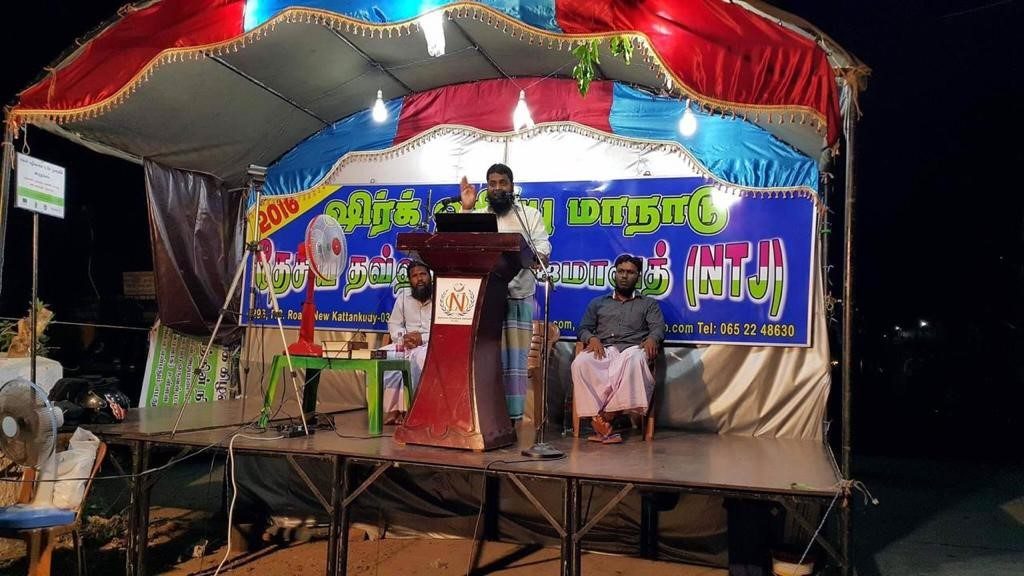
National Thowheed Jamaat (NTJ) is a small outfit that gained notoriety only last year for defacing Buddha statues in Mawanella and although it was a tiny group, the fact that there was media exposure of imminent IS links with Sri Lankans, was an easy guess based on the media reports of IS infiltration in the country.
Despite the NTJ not claiming the Easter Sunday attacks on Churches till today, top military officials say that could be due to fear of being tracked down because their activities were visible and highlighted on local media last year.
Last week the All Ceylon Jammiyathul Ulama (ACJU), holding a press briefing said that Sri Lanka Thowheeth Jama’ath, the Ceylon Thowheeth Jama’at and the National Thowheeth Jama’ath pose a threat to the peace and unity of Sri Lanka and should be banned.
They condemned all forms of terrorism and the Easter Sunday attacks. The ACJU urged the Government to ban these organisations but in the past remained silent.
On 22 July 2015, the ACJU issued a statement against the ISIS. They also said that they had continuously informed the defence authorities about religious extremism in their community and had urged that action be taken against Zahran Hasheem of Katankuddy, who was involved.
The ACJU said that in the name of Thowheeth, there are many organisations but they didn’t know the number of members in these oraganisations operating under different Thowheeth names. The ACJU added that registering Thowheeth organistion is not their job.
The ACJU also declared that it was a member of the NTJ who was behind the attacks and not all. The ACJU said in 2016, the people of Katankudy lodged a complaint about the individual Zahran.
They also said that many other Thowheeth groups, who did not follow Zahran’s, extreme religious views, complained to the Police. They noted that the Government had not officially revealed the name of the terrorist group that had committed this mass crime. They also admitted they don’t know the number of different Thowheeth organisations that exist in Sri Lanka.
There are many Thowheeth organisations working with the ACJU and the NTJ has nothing to do with them,” the ACJU said.
They added that the Sri Lanka Thowheeth Jamaat has no links with them and never comes for discussions with them and they will not accept the suicide bombers’ bodies for the last rituals.
The ACJU overwhelmingly stated that it’s only one individual that should be blamed for the blasts and it was about him and his activities that they have informed to the Police. However, this statement by the ACJU, though strong, comes too late.
The ACJU claimed that they have informed the Police about a growing threat. However, this is the first time that they sought for the banning of these groups and organisations. They did nothing about it in the past.
One of the main tasks of the ACJU is to provide religious guidance to the Muslims of Sri Lanka. They cannot distance themselves from that.
One of the most important aspects for the Muslim community at this time is the Islamic education to quote from their website. The ACJU has established 25 district and 102 divisional branches, and enrolled over 5,000 theologians, most of whom are holders of doctorates, special degrees, master’s degrees or 1st degrees and are involved in community service.
Their utmost contribution is to be in unity and peace and distancing themselves from other Muslim organisations, because the ACJU wants to be the sole representative of the Muslims. This is intolerable notes a Muslim civil society on condition of anonymity. The Muslim Civil Society said that at their convenience they urged the Muslims to remove their burka and wear it is simply not a right gesture.
Hapless Muslims
Looking at the Eastern provinces, the hapless Muslims seems to have been caught between the devil and deep sea. Although the Muslims of Katankudy took to streets against the satanic Zahran, who has been preaching his extreme religious views, their constant attention to get him arrested had been weak. There were no Muslim Ministers joining such protests to call on the Government to arrest him, that could have attracted attention, many say.
Strongmen Cabinet Minister Rishad Bathiudeen from Mannar and Minister Rauff Hakeem could have called for his arrest, joining the people of their constituencies.
Keeping the matter under wraps and sharing their information secretly with the government, has not done any good to the people of Sri Lanka.
Some argued the very same interest in talking about Islamic extremism was not propagated by the Muslims politicians as they do now, after the terrorist committed a brutal attack on three churches and three hotels involving eight suicide bombers.
At last week’s press conference, held by the Muslim politicians, Minister Rauf Hakeem said he ‘knew ‘about these radicals six months ago. He and Minister Bathiudeen and many of their political party associates, who were gathered there, narrated that the Government did not take action despite highlighting the issue.
Have they shared with the mainstream media their report? One of the Governors has been harboring the Katankuddy extremists, says a Civil Society, that works for the North and East Muslims and they added that this has been reported to the government.
It is also said that top Muslim politicians have been visiting Ibrahim, the father of the two blood brothers of Dematagoda, who blew themselves up at Shangri La and Cinnamon Grand. According to information, Ibrahim has funded the Muslim politician for his political career.
The Civil Society says that these politicians have groomed everyone and they know a lot more than others about the current situation of the country. They should be arrested and questioned, the Muslim Civil Society said.
The Muslim Civil Society that did not want to be named also noted that the Muslims operate in isolation. Fanaticism does not arise overnight and this is known to the families if they are together.
Unless the sons and daughters are in isolation in different countries or places, a family cannot miss seeing their children being radicalised while living amongst them.” they noted.
The Muslim Civil Society, further added that other civil society organisations also alerted the Government and Muslim religious leaders about the growing religious extremism in the East. They added that even in the Vanatavillu case there was political influence for the release the suspect.
Government’s inaction
Adding that the current Government’s inaction in the past four years added to the religious extremism, they said It’s an easy guess that Muslim votes will swing if stern action is taken against them. They will crossover if they are put to test.”
According to them, Islamic extremism grew with the end of the war and not six months ago. They also submitted Zharan’s extreme religious views that he had uploaded to the YouTube in February last year. We informed the Government about him and his followers.”
Many of the politicians are talking about the Katankudy people who protested against Zharan and are allegedly trying to shield behind that protest saying the Muslims have informed the Government.
Today, there are other places like Sammanthurai, Ampara, Ninthavur, Sainthamaruthu, etc, where Islamic militants’ hideouts were raided and a couple of them were killed.
In Sainthamaruthu, a family had been blown up. That is the worst form of death in the name of a religion, it is reported.
There were several other places like Colombo Negombo, Maskeliya, Puttalam and Nuwara Eliya where devices used for destructions were detected.
Despite the Government being criticised for being ignorant, they are back on track. Military spokesperson Sumith Atapattu said civil security is on alert and all possible measures have been taken but that does not mean everything is safe.
True enough, because religious extremism is about warring against a mindset that is invisible. It’s only the people around those who have extreme religious ideologies can notice it.
Had Ibrahim informed the authorities about his two sons, who were probably in isolation and involved in secret activities, the Easter carnage could have been avoided. Arresting of religious extremists will only create more hatred in the families and that is not the only solution.
A best way to solve is to keep track on the activities of our bloved ones at home and in the community. The ACJU should join hands without discarding any other Islamic organisation and together introduce a system where young ones are not radicalised but follow Islam in its true form.
Media and Government can do little about religious extremists. It’s a collective mission if we want a safe Sri Lanka. Defending secularism, citizenship and universal rights is the only way forward.
Three suspects were taken into Sri Lanka Navy custody with one kilogram of C-4 explosives and a three-wheeler near the Wellawatte railway station today, Navy Spokesman Isuru Suriyabandar said.
He told Daily Mirror that the suspects were handed over to the Army and they would handover them to the police. (
Former President Chandrika Kumaratunga yesterday called for the banning of Madarasa Islamic Schools in Sri Lanka saying the children are taught extremism in those institutions.
Ms. Kumaratunga expressed these sentiments at the all party-all faith conference held at the parliamentary complex last evening.
Madarasa schools have been existing in Sri Lanka for the last ten years. Children are taught extremism in these schools. I informed about these to the present regime as well but no action was taken,” Ms. Kumaratunga said.
I have been told that some Muslim children who were studying at Ladies College have left that school and had joined a Madarasa school,” she added.
She then said children of all religions should be allowed to go into government schools such as Ananda, Nalanda and Vishaka.
Only Buddhist children go to these schools and I propose that a quota should introduced when it comes to the intake of students where at least five percent of non Buddhist students should be taken in,” she added.
Several Buddhist Monks including Thiyawala Palitha Thera said the Madarasa schools should be regulated. He said the Education Ministry should take steps to this effect.
Anunayaka of Malwathu Chapter Most Venerable Dimbulkumubure Wimaladhamma Thera said IS is out to seize power in Sri Lanka.
Venerable Thera therefore stressed the need for collective effort of all political parties to avert such an eventuality.
Mawlavi Faris Farook said the name ‘Madarasa’ means the ‘Daham Pasal’. Anyone is invited come and visit these schools,” he said. Mowlavi added that Islam has nothing to do with any extremist group. What the extremist groups teach is no Islam,” he said.
President Bishop’s Conference Rev. Winston Fernando said the President, the Prime Minister, the Leader of Opposition and parliament have to be responsible for the mayhem. He said an impartial investigation should be carried out on the matter. (
Three suspects allegedly radical Islamist extremists and two weapons of the two Policemen killed at a checkpoint in Vavunathiwu on November 29, 2018 were recovered by officers of the Criminal Investigations Department today.
Sources confirmed that the three suspects were arrested in Kalmunai and the weapons were recovered in the Vavunathawilluwa area.
” They were members of the radical Islamist Organisation” a high ranking source told the Daily Mirror.
Two Policemen were shot by a unknown assailants and their weapons were taken away at a routine checkpoint in Vavunathiwu on November 29, 2018.
The deceased were 28-year-old police constable Dinesh Alagaratnam and a 35-year-old Niroshan Indika, a father of one from Galle.
Sources confirmed that the three suspects arrested were a part of a a radical Islamist ideology. (
UPDATE: (3.24 p.m.) – UNP Colombo Municipal Councillor Noordeen Mohamed Thajudeen, who was arrested over the discovery of 46 sword in Slave Island, has been handed over to the Colombo Crimes Division (CCD), according to the Police Spokesman.
Colombo Municipal Council (CMC) member, Noordeen Mohamed Thajudeen, has been arrested in connection with the 46 swords discovered in the Slave Island area.
The UNP councillor was taken into custody by police this morning in connection with the incident, police confirmed.
A suspect was arrested yesterday (26) along with 46 swords during a search operation carried out by security forces in the Slave Island area.
A person has been arrested along with 51 sticks of water-gel explosives, 215 detonators and a motorcycle during a search operation at Erakkandi, Trincomalee.
The suspect was arrested with the explosives by Sri Lanka Navy personnel, who were carrying out a search in the area
Police have recovered 49 knives from the premises of a mosque in the Maskeliya area during a search operation carried out this morning.
The police officers who engaged in a search operation of the mosque premises had discovered 49 knives and 3 small axes inside a storage room.
The person in charge of the said storage room was taken into custody as he had failed provide an explanation with regard to the possession of these weapons.
All day people were coming in and out of the house with the pale-pink walls, and neighbours were becoming suspicious. An elder in the village of the eastern Sri Lankan city of Kalmunai was summoned to confront the men who had rented the property a few weeks before.
The discussion soon became tense, and a tall, well-built man whom the elder did not recognise walked out of the house carrying an automatic weapon. You have no business being here,” he said, according to the elder, firing a few rounds into the air and sending neighbours fleeing.
By the early hours of Saturday, 15 people were dead, including three children, and the walls of the house were blackened by the force of three explosions from the suicide bombers who had been cornered inside.
Reuters reported on Saturday that a woman and child injured in the fighting were the wife and daughter of Mohammed Zahran Hashim, the extremist preacher identified as the leader of the terrorist cell responsible for killing at least 253 people in a string of bombings of churches and luxury hotels. Police sources said the woman was in a serious condition.
The 90-minute gun battle in the city, about seven hours’ drive from the Sri Lankan capital, Colombo, is part of an ongoing hunt for accomplices and sympathisers of the suicide bombers that has led to dozens of arrests and controlled explosions of suspicious vehicles and packages.
Sri Lankan leaders have estimated there are at least 70 people still at large, some capable of exploding themselves”, the country’s prime minister, Ranil Wickremesinghe, told the Observer. Both the US and India stepped up their travel warnings for nationals seeking to visit Sri Lanka on Saturday.
The house in Kalmunai had been rented by a man claiming to be a telecommunications engineer, the landlord, who asked not to be named, said. He had paid cash, but unusually, had not asked for a discount for doing so. Money had not appeared to be a problem.
On Friday night a civilian was killed in the crossfire between police and the men inside and at least three others were injured, police said.
On Saturday afternoon, a video started to be shared on Islamic State’s online channels purporting to show three men inside the house. Those who try to destroy us will be a taught a lesson,” says one man, who appears to have just one eye and several mangled fingers. Children can be heard in the background.
The next man speaks holding a rifle in one hand and his toddler son in the other. Those who wish to do us harm are surround us now,” he says. Even if we are destroyed this movement will not be stopped.” It is not clear when the video was shot and its authenticity has not been verified.
Since Sunday’s attack by the radical network, led by Hashim, a previously obscure radical preacher, police are re-examining a series of incidents that they now view as possible red flags that militants in the country were becoming more violent and brazen.
Authorities are now actively investigating whether the murder of two policemen last year at a remote police checkpoint in Vavunathivu, a town in the eastern district of Batticaloa, was also committed by members of the network, sources inside the investigation revealed on Saturday. A gun thought to belong to one of the murdered officers was found inside the house that was raided in Kalmunai on Friday night, sources said. At the time, the murder was suspected to be the work of remnants of the Tamil Tigers.
The vandalism of four Buddhist statues in Mawanella, a central town, about a month after the shooting of the officers is also being seen a crucial change in tactics: the first time men linked to Hashim turned their ire on people of another faith, after years of harassing other Muslims.
This may have been a tryout,” Wickremesinghe said. We know that before the Buddhist images there were attacks on Sufi mosques. So they appeared to be going step by step. First their own Muslims, then the Buddhists, and there was something in a small church near Kandy, information that they wanted to damage the church.”
Authorities received multiple warnings about Zahran from Muslim community leaders and specific intelligence in the weeks, days and possibly hours before the 21 April attacks that the extremist was planning to target churches.
Why those warnings were ignored has been the subject of recriminations this week inside Sri Lanka’s bitterly divided government.
There was a communications breakdown because nothing was being shared with me and the prime minister,” said Ruwan Wijewardene, Sri Lanka’s defence minister, who had been excluded from security council meetings since a constitutional crisis cleaved the government into factions last October.
The country’s president, Maithripala Sirisena, who chairs the security council meetings, says he was never told of the threat either. Blame has fallen on the country’s top defence bureaucrat, Hemasiri Fernando, and the chief inspector of police Pujith Jayasundara.
Fernando quit on Thursday evening after submitting a defiant resignation letter. I have disseminated the information I received and carried out my responsibility, however, certain officials and relevant departments have not acted accordingly, and as a result we had to face this terrible tragedy,” he wrote.
In past months, Sirisena has been deploying the resources of the country’s security apparatus towards a war on drugs inspired by the brutal campaign of the Philippines president, Rodrigo Duterte. A vast network of military and intelligence officials are also spread out through the country’s north, keeping watch on Tamil civilians the embers of the Tamil Tigers militia.
Drugs have always been an issue to us, but we also had to be on our guard against terrorism, global terrorism,” Wickremesinghe said. Some people were looking really at the re-emergence of the [Tigers] but I couldn’t see that.”
Late on Saturday, Sirisena announced he was banning two groups allegedly linked to the Easter bombings under emergency powers that came into effect on Tuesday. His office said National Thawheed Jammath, or NTJ, and Jamathei Millathu Ibraheem, or JMI, would be banned by presidential decree.
Presidential spokesman Dharmasri Ekanayake said the move allowed the government to confiscate any property belonging to the two organisations.
The one-week mark since the devastating attack will be quietly honoured, with churches advised not to hold Sunday masses. A small service will be led by Cardinal Malcolm Ranjith in Colombo, and broadcast on national television. His eminence [the cardinal] has advised us not to gather people in churches,” said a spokesman. In place of that, his eminence is expecting the faithful to watch the mass in spirit.”
Another service is scheduled to be held in a tent outside St Sebastian’s church in Negombo, where last week, a bomber with a backpack entered the middle of the church towards the end of the service, turned his back to the congregation, and detonated himself. More than 100 people were killed there.
President Maithripala Sirisena has taken steps to ban two local Islamist groups in Sri Lanka suspected of carrying out the attacks on churches and hotels on Sunday.
In terms of powers vested in him as the President of the Democratic Socialist Republic of Sri Lanka under Emergency Regulations No. 01 of 2019, the President has taken steps to declare the organizations National Thowheed Jamath (NTJ) and Jammiyathul Millathu Ibrahim (JMI) banned in Sri Lanka.
As such, all activities of those organizations as well as their property will be seized by the government the President’s Media Division said.
Steps are being taken to ban other extremist organizations operating in Sri Lanka, under Emergency Regulations, the statement said.
The Islamic State has claimed responsibility for the coordinated attacks that killed more than 250 people and wounded about 500.
The authorities in Sri Lanka have said the attack had been carried out by a local group, National Thowheed Jamath, with help from international militants and possibly another local militant group, Jammiyathul Millathu Ibrahim.
Colombo, April 27 (Reuters): The wife and daughter of Mohamad Zahran Hashim, the suicide bomber cum mastermind of the serial bombings in Colombo and two other cities on April 21, were injured in the explosion in the Islamic State safe house at Sainthamarudu in Eastern Sri Lanka on Friday night.
The shootout at a safe house erupted as police hunted for people linked to Mohamed Zahran Hashim who has been named as the ringleader of the Easter Sunday bombings.
Yes, the wife and daughter were injured in the attack,” said Mohamed Hashim Mathaniya , sister of Zahran. I was asked to come to identify them but I am not sure I can go, ” she told Reuters from the town of Kattankudy in the east.
Police officials said the injured were believed to be Zahran’s relatives.
At least 15 people including six children were killed in the gun battle, a military spokesman said earlier.The shootout at a safe house erupted on Friday in Sainthamaruthu in Ampara district on the east coast as police hunted for people linked to Mohamed Hashim Mohamed Zahran, who has been named as the ringleader of the Easter Sunday bombings.
Yes, the wife and daughter were injured in the attack,” said Mohamed Hashim Mathaniya , sister of Zahran. I was asked to come to identify them but I am not sure I can go, ” she told Reuters from the town of Kattankudy in the east.
Police officials said the injured were believed to be Zahran’s relatives.
At least 15 people including six children were killed in the gun battle, a military spokesman said earlier.
Sixteen members of the family, including seven children and Zahran’s parents, had gone missing three days before the Easter Sunday blasts.
Madhaniya at her home in Batticaloa. (Express photo: Arun Janardhanan)
A day after 15 individuals, including six children, were reported killed in suicide blasts at a suspected Islamist safe house in the Sri Lankan town of Kalmunai, a plainclothes military intelligence officer arrived at the home of Madhaniya, the 26-year-old sister of Zahran Hashim, the suspected mastermind of the coordinated terrorist bombings that killed over 250 people on Easter Sunday.
The officer asked Madhaniya and her husband Sherif Niyas, a small-time dealer of secondhand vehicles, to come with him to a hospital near Ampara to identify the 15 bodies.
Zahran Hashim blew himself up at the Shangri-La hotel in Colombo on April 21. Another of his and Madhaniya’s brothers, Mohammed Zeyin Hashim, is missing — it is possible he was killed in the attacks, or is still at large, investigators believe.
Among those killed at the safehouse on Friday evening were a third brother of Zahran’s, his wife and their two children; the wife of the missing brother, Zeyin, and their two children; another sister of Zahran’s, her husband and their child; at least one of Zahran’s two children; and Zahran and his siblings’ elderly parents.
Please ask them to show me photos, I will (identify). I cannot go and see (dead bodies),” Madhaniya told Niyas in Tamil. After a word with the officer, he replied to her: He (the officer) says if it is indeed them, this will be the last time you will get to see them. They are terrorists.”
Zahran Hashim blew himself up at the Shangri-La hotel in Colombo on April 21. Another of his and Madhaniya’s brothers, Mohammed Zeyin Hashim, is missing — it is possible he was killed in the attacks, or is still at large, investigators believe.
Among those killed at the safehouse on Friday evening were a third brother of Zahran’s, his wife and their two children; the wife of the missing brother, Zeyin, and their two children; another sister of Zahran’s, her husband and their child; at least one of Zahran’s two children; and Zahran and his siblings’ elderly parents.
The Sunday Express was present when the Sri Lankan military officer visited the two-room, single-storey, rented home of Madhaniya and Niyas in Kattankudy on Saturday afternoon. Later in the evening, Niyas claimed that the officer had showed him pictures of two survivors of the blasts at the Kalmunai safehouse — they were of Zahran’s wife’s and one of their two children’s, he said.
Asked about Niyas’s claim, Brigadier Sumith Atapattu, spokeperson of the Sri Lankan Army, said the military was working in collaboration with the police department, and he could not immediately reveal much information.
Sixteen members of the family, including seven children and Zahran’s parents, had gone missing three days before the Easter Sunday blasts. Madhaniya told The Sunday Express she knew nothing of the so-called Islamic State, which had allegedly inspired her brother to kill so many people.
We (Madhaniya and Zahran) stopped talking in 2017 after he started spitting venom in his speeches. He had been a fiery orator on Islam and a crowdpuller at streetcorner meetings from his teenage days. But I couldn’t take it any longer after he started to preach against the government, the national flag, against elections, and against other religions. He brought catastrophe upon our family,” she told The Sunday Express.
FILE – In this Wednesday, April 24, 2019 file photo, a security officer stands guard outside St. Anthony’s Shrine where bombing was carried out on Easter Sunday, in Colombo, Sri Lanka. Roughly 250 people died in six coordinated suicide bombings that ripped through Sri Lanka on Easter Sunday. (AP Photo/File)
Kattankudy is a Muslim-dominated town on Sri Lanka’s eastern coast. Madhaniya and Niyas’s home is situated barely 100 metres from the National Thowheeth Jama’ath masjid, a large two-storey structure with glass walls, the mosque where Zahran was allegedly radicalised. Residents of the area said on Saturday evening that the mosque has been under renovation for over two years.
Her brother, Madhaniya said, had started to claim that his own interpretation of Islam was the only true faith. He was offensive about other religions, as well as moderate Muslims and Sufis. He would call Sufis drug addicts and smokers. My husband kept away from him as we felt that he was moving in a dangerous direction. The police were already monitoring him,” Madhaniya said.
Even though she had cut off connections with Zahran, she continued to send food to her parents, who stayed with her sister and her family in a nearby street, Madhaniya said. But they disappeared suddenly on Thursday (April 18). Neighbours told us on Friday that they were not at home. Their phones had been switched off. Then the blasts happened, and we learnt the role Zahran had played,” Madhaniya said.
The whole family, she said, might have gone together”, leaving only her and Niyas out because she was strongly opposed to Zahran’s hatred towards the whole world”.
According to Madhaniya, Zahran dropped out of school in Class 6, but retained a strong interest in Islamic studies. He completed a course in Arabic to memorise the Quran, and showed an unusual interest” in propagating his ideas on Islam. In 2006, he started an Islamic studies centre. He lost God because he learnt the Hadiths from the wrong people, and he learnt to kill people instead. I should say that I am happy that he is no more,” Madhaniya said.
On some unverified reports that Zahran visited Tamil Nadu, Madhaniya said that in her knowledge, the only foreign trip he had made was to Japan a decade ago. Someone from Colombo took him to Japan for a month. His job was to give Tamil Muslims there classes on the Quran. After 2017, I doubt he went abroad, because his passport and identification numbers were already with the police by then,” she said.
He would listen to the Quran alone. He considered everything else a sin, and those who listen to music too were sinners for him. He believed that his interpretation of the religion was the best, and all others were bad. His idea of Islam was not ours,” Madhaniya said.
In March 2017, Zahran and his followers clashed with Sufi Muslims, and he made a provocative speech about moderate Muslims. As the heat on him increased, he fled.
He was absconding since March 2017 because he was to be arrested. People in the neighbourhood say that he would visit his parents discreetly, in a vehicle with dark windows. He was the victim of the Wahhabi Islam that Sri Lankans who went to Gulf in the 1980s brought back with themselves. Wahhabism has killed our traditional values, and painted moderate Muslims like us as kafirs,” said H M Ameer, secretary of the Sufi Badhariya Masjid, who had contested Zahran’s ideas.
He challenged and threatened us publicly in meetings. He called us renegades. He ridiculed traditional Islamic practices that we followed. Wahhabi Islam made him a conservative, then an extremist, and finally a terrorist,” said Ameer, who had sent several detailed complaints to the Sri Lankan Defence Ministry and terrorist investigation cells against Zahran.
The National Towheeth Jama’ath can claim that he was expelled after 2017, but his brother headed it afterward. Now this brother is also missing or killed. He (the brother) would speak about the war in Syria, and tell Muslims that they should all live in the Islamic State,” Ameer said.
At the largely deserted National Towheeth Jama’ath mosque on Saturday, The Sunday Express found two young men who had come for prayers. We heard of this (the alleged involvement of the National Towheeth Jama’ath in the blasts). I have seen Zahran here many times. We knew that there were problems, but this is a masjid. What is there to fear about a masjid?” one of the two men said.
PDP chief says Easter bombings aim at pitching people of different religions against one another
KARACHI – Pasban Democratic Party (PDP) Chairman Altaf Shakoor has said that India is the enemy of both Pakistan and Sri Lanka, and recent terrorism in Sri Lanka seems an international conspiracy for which fingers are being pointed at India.READ MORE: Pakistan U19 tour to Sri Lanka postponed
He was speaking at a candlelight vigil arranged by the PDP here Saturday at Karachi Press Club (KPC) to show solidarity with the government and people of Sri Lanka.
The PDP said that people of Pakistan and Sri Lanka have rendered numerous sacrifices for peace and braved huge human and economic losses besides political instability while fighting terrorism. He pointed out that India is not only the enemy of Pakistan but it is also the enemy of solidarity and peace in Sri Lanka. That’s why fingers are being pointed at India regarding recent terrorism in Sri Lanka,” he alleged.
Shakoor said that the masses of Pakistan and Sri Lanka are bound in the relation of friendship and love. He said that people in Pakistan could easily understand the pain of their Sri Lankan brethren. He said the recent terrorism in Sri Lanka is an international conspiracy so as to pitch people of different religions and faiths against one another.
He said Pakistan and Sri Lanka have always raised voice for global peace. He urged the international community to take steps for a lasting world peace after mutual consultations. He expressed heart-felt condolence to Sri Lankan President Maithripala Sirisena and Prime Minister Ranil Wickremesinghe.READ MORE: PPP leaders from KP briefs Bilawal on mega corruption of PTI in Billion Tree project
PDP Karachi chapter president Abdul Hakim Quaid, General Secretary Sardar Zulfiqar, PDP Lyari leader Akram Agaria, Amjad Baloch, Fazal Rabi Khan, Aziz Fatima and others were also present. A large number of citizens, PDP workers and peace activists attended the candlelight vigil.
After
the election of Yahapalana regime in 2015, there are many concerns to people of
Sri Lanka and the major question was whether the government was a responsible
government which focused to protect people and fulfill the needs of people.
Immediate after the election of the president, the Central Bank of Sri Lanka
was robbed and the responsible people for domestic and foreign security
attempted to relax laws and regulations in the name of Yahapalanaya and the
policy actions of the government created a severe risk to Sri Lanka as well as
overseas.
After
the Easter Sunday bombs explosions in churches and hotels and killing innocent
unarmed civilians, it seems that the government and responsible key personnel
of the government are behaving like children without taking responsibility for
what was happening in the country. The public statement of the Defence
Secretary in front of the St Anthony’s Church, Kochchikade in Colombo to a
foreign correspondent was the strong evidence that the government has no
responsibility towards it people as well as towards international people. Modern states are responsible not only to an
individual country but it also responds to the globe.
Another
vital report recorded in Sri Lanka was that Mr. Ranil Wickramasinghe, the Prime
Minister of Sri Lanka stated to foreign journalists that ISIS is a foreign
organization and joining to such an international criminal organization is not
illegal in terms of the laws of Sri Lanka.
Is Mr. Wickramasinghe, the prime minister of Sri Lanka talking to the
world as a responsible person or a person with a conscious mind? It is a reason to shame on entire people, who
were born in Sri Lanka that the Prime Minister of Sri Lanka is a stupid and
irresponsible person. People of Sri
Lanka did not vote to appoint him as the president and in the future, it should
be same as it will be that Mr. Wickramasinghe or a member of his party must not
be elected as the president of the country and it happens, people cannot
imagine what will happen to the country.
ISIS
is an international terrorist organization and becoming a member of this
organization or a similar organization is a punishable offense. ISIS disguisedly associated with killing
people, money laundering, terrorism, and many other criminal activities.
The
other news item I noticed was that Mr. Wickramasignhe was questioning from
foreign ministry official that why didn’t Sri Lanka sign the United Nations
regulations of 2018 to eliminate World Terrorism? The regulations were approved by 77 countries
in the world, why Sri Lanka refrained from such international activity. Mr.
Mangala Samaraweera, Mr. Tilak Marapana and Mr. Ravi Karunanaya were foreign
ministers in Sri Lanka from 2015 and why did they act irresponsibly.
The position Sri Lanka confronts today as a nation
clearly is a case of electing political apologist of terrorism to power before the
nation could recover completely from 30 years of terrorism. Ranil
Wickremesinghe, like his current political mentor Chandrika Kumaranatunge, were
such avowed supporters of the theory of ‘appeasing terrorist to win them over’
to a point where they ridiculed even the attempts of the country’s armed forces
to overcome terrorism. An a result they were both responsible, during their
tenures, in lengthening the period Sri Lanka would suffer under terrorism. The
one hope that many shared when electing Ranil to power in 2015(to a minority
Parliament) is that, ‘now that the terrorism is out of the way, bring us
economic salvation and the rule of law’. But Ranil Wickremesinghe has not only
failed to delivered but has proved that a leader who has no vision on national
security does not deserve to be in power.
The attitude of both these leaders, Ranil and
Chandrika, has been, when cautioned on threats to national security, is to
counter charge the very messenger of being ‘an Extremist’ (Jathiwadi)’. To prove this point we have to
reminiscent how Ranil reacted at instances which implied some form a threat to
the country’s national security during the last 4 years. In all those instances,
if the warning came from the opposition he would labelled the one who brought
it to ntice as an extremist thinker by labelling a ‘Jathiwadi mentor’ taking
the moral highgroungd of a man above petty tribalism.On the other hand if the perceived
threats emenated from within his own officers his attitude had been to dismiss
the same as being too overzealous. In conducting the affairs of the current
regime, Ranil indulgd in a lot of wishful thinking by publicly declaring that ,
‘This country will never face the type of war we had for thirty years’ without
admitting that his pursuit of peace during that 30 year conflict was not just a
complete failure but an antithesis in obtaining peace. Therefore, Ranil’s
excuse that the intelligent information on the pending attack was not presented
to him peronally was mainly due to his own negative attitude towards such
information and his ire towards those who present such information.
The national security of a small nation like Sri
Lanka, in the context of international politics and big power rivalry to
dominate world and its economy, depend very much on that ntions ability to stay clear of big
power shenanigans maintaining its own interest at heart. Global
imperialism works in so many ways
and so many guises. It needs a lot of rationality in your thinking to
realize that global imperialism has evolved today to psychological subjugation
replacing armed subjugation. World nations, especially the big powers, only
have interests and hardly any principles. But Ranil, with his compacent
servility to internationalism will always chose to dismiss anything national as
‘misplaced bigotry’.
Modern civilization, with all its personal rights and
values, have not not been succesfu in making the man give up his innate need to
dominate his kind. Religious domination is
more deadlier than political domination because religions promise
dividends for devotion and commitment only in the after life. As a result some
religions have become ‘death cults’for its followers because they believe that
any means, including indiscriminate violence, could be justified to achieve their after life goals. In such a
context it is naïve to believe that the interests of different religious and
tribal groups present in Sri Lanka, with their international agenda’s, ceases
at the point of national interest.
In the democratic setup politicians are ‘vote greedy’ and Ranil
Wickremesinghe is a spychphant who believes in the votes of the minoritie to a
point of neglecting the interest of the majority. Former Chairman of the UNP
Mr. Panditharatne resigned from his post in 1999 citing the current
leadership’s minority inclination as the reason for UNP’s failure to win the
Presidential elections in 1999. The
preeption of the UNP leadership has not not changed since then and in such a
context it is difficult to expect Ranil to keep the minorities in their places
and then to lose their votes. Especially with the target of achieving his life
long ambition to be the President of Sri
Lanka at the forthcoming election in 2020.
The Catholic and Christian vote base in Sri Lanka has
traditionally been the pocket borough of the UNP. They probably considered the
less suave SLFP to be too nationalistic.
The lesson now however, is that a leader who is more internationalised
to a point iof disregarding the national interest can not be expeted to protect
a minority when he is unable to protect the nation as a whole. Thus with Ranil
Wickremesinghe at the top, the future for a vulnerable nation like Sri Lanka,
with apologist of extremism bound to reign supreme, appears bleak.
There are ample historic records which describe vividly the atrocities
committed by Muslims against millions of Buddhists in several countries. Their
criminality has not subsided despite their living among other religions in
different countries. Buddhists have been the most victimized and harassed
religious community in the world, owing to actions of Muslims guided by their
theistic traditions and beliefs. Buddhists cannot consider Islam as a religion
of compassion and peace. Those professing Islam have been the biggest enemies
of Buddhists and Buddhism throughout history. Before the onslaught of
Islam, Buddhism was the religion of almost the whole of Asia – ancient
countries/regions such as Bactria, Parthia, Afghanistan, Gandhar, Chinese
Turkestan, along with Tibet and Inner Mongolia were Buddhist nations that
formed almost the whole of the Asian continent. Buddhism was the dominant
religion of the people of this vast area of the Asian continent. Islam
destroyed and eliminated Buddhism from almost all these countries.
As far back as in the 10th century, as a result of the
Muslim invasion of what is modern day Afghanistan, Pakistan and India, the
Buddhist religion which formed the basis of life of the people of this part of
the world, was viciously wiped out in an act of virtual genocide. Muslim terror
and atrocities have inflicted severe damage to Buddhism in many Asian
countries, some of which were exclusively Buddhist at one stage in their
histories. In some Asian countries indigenous Buddhist spiritual traditions
have been severely weakened by decades of persecution. It is a well-known fact
that Buddhism disappeared from India under the sword of Islam. Dr. B.R.
Ambedkar, the great Indian Buddhist leader said that there is absolutely no
doubt that the fall of Buddhism in India was due to the invasions of the
Musalmans or the adherents of Islam. For about five hundred years, from the 13th
to 17th centuries, most parts of South Asia especially the Indian
subcontinent was under Muslim rule. During this period, over 50 million
Buddhists and Hindus were massacred by Islamists in greater India which in the
past included the present India, Pakistan, Bangladesh and Afghanistan.
The destruction of the colossal Afghan Bahmian Buddha
statues by fanatic Muslims, is not the first destruction resulting from Muslim
fundamentalism. In the 12th century, Nalanda, the world’s first
university, an illustrious Buddhist university located near ancient Rajagaha in
Bihar, established in the 5th century, was demolished by Muslim
fanatics. It flourished for seven centuries as one of the greatest centres of
learning in the ancient world, attracting scholars from distant countries
including China. Muslims burnt down its priceless library and mercilessly
killed its scholars including Buddhist scholar monks. Islam destroyed Buddhist
sites not only in India but wherever it went. Those conversant with global
affairs, are aware of the fact that, especially in recent years, Muslims have
become a curse to humanity, resorting to violent and unethical means of serving
their religious ends, or to ‘resolve’ their obsessive religion-based issues and
self-created problems. Peace and harmony in many countries in the East
and West have been impaired greatly owing to unwholesome actions of Muslim
religious fanatics. In recent decades Muslim extremism and violence against
Buddhists were well evident in Myanmar, Southern Thailand and Bangladesh.
During the last few decades, Muslims have gained increased strength in
Sri Lanka increased economic power largely owing to favorable opportunities and
privileges made available to them, including local political patronage. In
recent decades, all prominent political leaders of Sri Lanka, have offered them
undue patronage and privileges especially in view of expanding their vote-base,
and to serve their political self-interests.
Madrasas
In recent decades, Muslims of Sri Lanka have received increased tangible
and moral support from Muslim Middle Eastern countries to promote Islamic
religious ideology in Sri Lanka. This led to the establishment of the so-called
madrasas, initially in predominantly Muslim areas and later elsewhere in the
country. Madrasas are exclusively Muslim schools funded by Muslim countries, Saudi
Arabia in particular, to promote fundamentals of Islam, Islamic Sharia law and
the Wahhabi form of Islam. Madrasas as educational institutions are said to offer instructions in
Islamic subjects including but not limited to the Quran. It also includes Jurisprudence
or figh” and Muslim law or Sharia Law and the teaching and practice of sufi”
which encompasses Islamic mysticism. If Muslim Sharia law is given official
recognition by means of registering Madrasas as NGOs, it can result in serious
legal problems in the future. There can be only one law in our country and that
is a secular law which is applicable to all citizens irrespective of their
ethnicity or religious affiliations. There is no need to introduce any other
law, especially religious law such as Muslim Sharia Law, and cause problems in
our country. It is known that Muslim Madrasas work in collaboration
with other foreign Muslim organizations and Madrasas in providing vocational
training for Muslim youth.
In these madrasas, the younger generation of Muslims are being
brainwashed with extremist Islamic fundamentalism. It is reported that Madrasas provide Islamic extremism and militancy and are a
recruiting ground for terrorism. It is widely reported that some Taliban and Al
Qaeda leaders have obtained radical political views at Madrasas. Some
Madrasas are recorded to be promoting a militant form of Islam and teach and
train Muslim students to fight non-believers and stand against the moral
standards of non-Muslim societies. The suicide bombers involved in the July
2005 London terror attack are said to have spent time in Pakistani
Madrasas. The so-called fundamentals of
‘Islam’ that are widely propagated in madrasas have serious negative
implications as far as the national culture and the rule of law of the country
are concerned. It is noteworthy that Madrasas have been banned in
several non-Muslim countries. In recent years, Saudi
Arabia is funding the establishment of a massive Muslim university in Eastern
Sri Lanka in order to promote Islamic religious ideology.
In
some countries such as India, Pakistan, Afghanistan and Bangladesh, Muslims are
among the most deprived communities in terms of education and therefore
establishment of certain type of Madrasas for basic educational purposes has
become necessary and most people find them to be affordable as compared to
other educational institutions in these countries. This is not the case in Sri
Lanka where there is no educational deprivation or backwardness as far as the
Muslims are concerned. In fact, our school system is open to all Muslims if
they wish to attend them, and there are many Muslim students attending regular
schools in Sri Lanka. Also, there are exclusively Muslim national schools in
Sri Lanka and importantly, most international schools in the country are owned
and operated by Muslims where Muslim students predominate. This divisive spirit of Muslims is owing to the influence
of Islamic teachings to keep away from non-Muslims who are considered as inferior
to Muslims. The Koran forbids Muslims to closely associate non-Muslims. Islam
has dualistic ethics with one rule for Muslims and one rule for non-believers
and there is no exception to this rule. Why do Muslims cause disharmony and
bring about conflicts and confrontational situations in all societies they
infiltrate? Why? Buddhists need to be vigilant and need to initiate
actions against the abuse of privileges, aggression and misdemeanor by Muslims.
Their new male and female attire display their desire to look different
and to be exclusive and separate from the nation’s mainstream. This
polarization tendency of the Islamic community is self-imposed. It is not
because they feel marginalized. The so called Burqa outfit or the head covering
of Muslim women have been banned in many countries including China, France,
Belgium, Denmark, Austria, Spain, Italy, Switzerland, Turkey, Morocco, Tajikistan, Latvia, Bulgaria, Cameroon, Chad, Republic of the Congo, Gabon. the Canadian province of Quebec and
finally in Sri Lanka as well after the Muslim violence in April 2019, on Easter
Sunday.
Inciting
Violence Against Sri Lankan Buddhists
It
was not long ago that Islamic fundamentalists and armed Muslim extremists were
inciting violence against legitimate Buddhist activities in the Pottuvil
region. Muslims were forcibly encroaching upon land that rightfully belonged to
Buddhist temples on the southeast coast and demolished Buddhist archeological
sites in the East. Also, the Sri Lanka Muslims Congress and several Islamic
groups of our country had the impudence to oppose the construction of Buddha’s
statues on the island’s southeastern coastal areas which contain Buddhist
historic monuments and important archeological remains which are part of the
cultural wealth of the nation. There were protests and demonstrations by
Buddhists including many Buddhist monks, urging the Government to crack down on
anti-Buddhist activities of Muslim extremists. In a memorandum submitted to the
Buddha Sasana Ministry the protesters cited how the Islamic fundamentalists and
armed Muslim extremists were inciting violence against legitimate Buddhist
activities in the Pottuvil region. According to the Memorandum, the Muslims are
forcibly taking land that rightfully belongs to Buddhist temples on the
southeast coast.
Need
to Protect Cultural Traditions of the Nation
As a nation with a historic cultural tradition that extends to over 2200
years, where freedom, compassion, tolerance and accommodation of people of all
faiths and ethnicities have been the founding principles, it is necessary that
we as a nation take necessary steps to protect and preserve these noble and
wholesome cultural traditions. We cannot allow them to be undermined under any circumstances.
Those
deeply concerned about the need to preserve the quality and character of our
nation, built on a sound Buddhist spiritual foundation, should be deeply
grateful to patriotic organizations such as the Bodu Bala Sena among
several others countrywide, for their bold and commendable initiatives to bring
about increased awareness on the deceitful under-handed activities of extremist
Muslims to undermine the Buddhist identity of the nation and to propagate
archaic and fanatic Muslim fundamentalist customs and lifestyles in the country
that are inconsistent with and contradictory to the Buddhist norms and
principles upon which our nation is founded.
Rapid Increase of Wahhabi Influence
Sufism has been for centuries, the
predominant form of Islam in Sri Lanka. It was a peaceful form of Islam which
enabled cordial relations with people of other faiths. Wahhabi Jihadism is an
extremist, fundamentalist form of Islam followed in Saudi Arabia. Oil rich
Saudi Arabia began to influence Sri Lanka’s Sufi adherents starting in the 1970′s.
With increased funding by the Saudi Arabia with their petro dollars, and other
forms of penetration, the Wahhabi followers have increased in Sri Lanka during
recent decades. This was clearly evident in the Eastern province. Wahhabis
claim that the Sufis or the moderate Sri Lankan Muslims are ignorant of the
basic teachings and practices in Islam. They claim to be the real scholars of
Islam. This has led to sectarian clashes among peace loving Sri Lankan Muslims.
There appears to be an increasing trend in this unruly behaviour pattern of
some sections of the Muslim community, in the East and elsewhere where they
predominate. It is a fact that there is a rising trend of Wahhabi Jihadism in
Sri Lanka. Wahhabi fundamentalism has advanced so quickly in Sri Lanka partly
because the House of Saud has financed the building of many madrasas and
Mosques.
Scholarships
are offered to Muslim youths to go to Wahhabi institutions in Saudi Arabia and
Egypt with the condition that those who complete their Wahhabi studies should
return to Sri Lanka and propagate Wahhabism. This is happening extensively.
Saudi Arabia remains a critical financial support base for al-Qaida, Taliban,
Lashkar-e-Taiba and other Wahhabi terrorist groups. Saudi Arabia spends 87
billion US dollar per year to spread Wahhabism world-wide. Wahhabis are trying
to take the peaceful Islamic community in Sri Lanka down the path of extremism
and violence. The Wahhabis have already created deep divisions in among Sri Lankan
Muslims and have formed gangs that intimidate moderate Muslims who speak out
against Wahhabi fanatics. Like the Christian fundamentalist groups using NGOs
to convert innocent poor families to Christianity, Wahhabis help poor Muslim
families by providing cash and other material benefits to convert them to their
cult. Wahhabis appear to be using Sri Lankan Government agencies to propagate
Wahhabi activities.
During the last two decades, many
Sri Lankan Muslims both male and female, found employment in Saudi Arabia and
other Middle Eastern countries and were strongly influenced by Wahhabism. It is
a fact that there has been a significant increase of Wahhabi followers in Sri
Lanka in recent years and this trend is clear in the Eastern and Northwestern provinces.
Also, many young Sri Lankan Muslims were awarded scholarships by Saudi Arabia
to study Wahhabism in Saudi universities. Upon their return to Sri Lanka they
undertook in an organized manner the propagation of the ideology of Wahhabism.
They were instrumental in the establishment of numerous madrasas where young
Muslims were subject to various forms of brainwashing on Wahhabism including
the jihad approach. This Islamic fundamentalism brought about by Wahhabism
began to cause communal polarisation in Sri Lanka, like in all other southern
Asian countries. In India, the trend of increasing radicalisation of Indian
Muslims owing to Wahhabism has become a serious national security issue. The
growth of radical Islamist streams became visible only in the past two decades.
Wahhabism calls for Jihad, or war against infidels, or non-believers of
Islam
Wahhabism is a new
politico-religious movement that has been sweeping the predominantly Muslim
occupied areas of the country such as the Eastern and Northwestern provinces of
Sri Lanka. Their overall objective is to propagate the movement throughout Sri
Lanka and has raced ahead and taken control of the Jihadist and Al Fatah groups
in Sri Lanka under their wings. Through the lavish inflow of Saudi money into Sri
Lanka Wahhabis has overtaken other Islamic organizations by threats,
intimidation, and coercion. Wahhabism has been encroaching Sri Lanka without
any form of resistance from the governments of the day. Operating through a
movement called Thawheed hugely funded by Saudi Arabian sources, and through
NGOs such as Al Haj Adul Jawad Alim Valiyullah Trust, Wahhabis established
itself fully in Sri Lanka. They have established many new mosques and
madrasas” in many locations’ Sri Lanka. Saudi agents have successfully
penetrated Sri Lankan Muslims social fabric and have managed to defeat the
Sufism in their game. Due to the training afforded by the House of Saud now the
Wahhabis have prevailed over the Sufis. The Muslims in Sri Lanka have been
subdued due to the Wahhabi influence while Buddhists have been agitating for
the release of Rizana Naffek – teenage housemaid from Muthur who was sentenced
to death by a Wahhabi Sharia Court in Saudi Arabia.
Wahhabism in Sri Lanka is
headquartered in Kattankudi is a new politico-religious movement that is
sweeping the Eastern province of Sri Lanka with more than sixty Muslim Wahhabi
organizations helping in propagating the movement throughout Sri Lanka and has
raced ahead and taken control of the Jihadist and Al Fatah groups in Sri Lanka
under their wings. Wahhabism is imported and planted in the midst of
peace-loving Muslims in Sri Lanka, mostly through the lavish inflow of Saudi
money pumped into Sri Lanka has overtaken other Islamic organizations by
threats, intimidation and coercion. Clashes between Sufis and Wahhabi Muslims
in Kattankudi and Oddamavadi have been regular occurrence in the past few
decades. Many homes of Sufi followers were burnt down by Wahhabi Jihadists in
Kattankudi during similar clashes occurred in October 2004. In Kattankudi, the
hatred between Wahhabis and Sufis has widened in the last few years and has
grown in intensity, left many injured, and caused damage to several houses and
vehicles.
All the ‘Islamist’ terror attacks
in South Asia including in Mumbai, Afghanistan and Pakistan had the hallmarks
of Wahhabism. Wahhabi Jihadists are blinded by faith to believe that they have
the mandate of Allah to rid the world of ‘infidels’ and ‘heretics. Until this
Wahhabism is thoroughly discredited, combating Wahhabi terrorism is impossible.
Since the Western countries subterfuge to destabilise Sri Lanka, by
surreptitiously supporting the LTTE failed, now the Western countries will
promote Wahhabi Jihadism to cause strife and trouble to destabilize Sri Lanka.
Wahhabi followers – al-Qaida, Taliban, Lashkar-e-Taiba and other Wahhabi
terrorist groups – have caused untold misery in several countries including
Iraq, Afghanistan, Pakistan and India. Sri Lanka appears to be their next
target. The Sri Lankan government must take immediate strict measures to
control Wahhabi organizations and ban them. Wahhabis have already built several
illegal Mosques in Sri Lanka using Saudi Arabia’s petro dollar. The
overwhelming peace loving, tolerant and intensely patriotic Muslims of Sri
Lanka would extend their support to the government in this matter. As the
Wahhabis are even capable of starting ethnic riots between the peaceful Sinhala
people and the Muslims, the Sri Lankan government must not be lethargic on this
matter. The Government authorities must investigate every Wahhabi school and
propagandist in the Eastern Province to make sure they are not preaching things
that are inimical to Sri Lanka. Saudi Arabia remains a critical financial
support base for al-Qaida, Taliban, Lashkar-e-Taiba and other Wahhabi terrorist
groups. Saudi Arabia spends 87 billion US dollar per year to spread Wahhabism
world-wide. Wahhabis have infiltrated Sri Lanka Broadcasting Corporation
(SLBC). Almost all the participants and staffers in the Muslim section of Sri
Lanka Broadcasting Corporation are Wahabis and use the State radio to propagate
Wahhabism. Not only Wahhabis run private unlicensed radio stations in the
Eastern Province, also armed Wahhabis often attack mosques and leaders of the
Sufi sect.
The
incompetent Prime Minster quite correctly stated that returnees from Syria
could not be punished sufficiently as the law does not cover it. As per the
current Sri Lanka law, they have committed no grave crime. However, can the
people and the nation rely solely on the law and legal means to save
themselves? No. Lives, limbs and property are far more valuable than being
politically correct or legally correct. National security must use legal and
extra-legal means to ensure public security. Otherwise the terror that grips
the nation today, the impending economic collapse and political instability
will be here to stay.
Laws Lag Behind
The
above example is just one. There are plenty of others. The law simply doesn’t
change as fast as terrorists change their tactics. Lawmakers in Sri Lanka are
hardly the smartest. Therefore, one cannot expect them to foresee future
threats and make laws. Thirdly, there are those who oppose tough laws that may
interfere with human rights. All this means the law is far from capable of
ensuring public security.
Implementation of the Law is Inefficient
Even
if the law was perfect, not all terrorists can be nabbed going by the law. The
process is highly inefficient, riddled with obstacles (including
reconciliation) and can be twisted by corruption and collusion. Even if this
process is perfect and all terrorists are produced before court, there is no
guarantee they will be punished and they will not engage in terrorism operating
within the safety of the prison.
Countries
like USA, UK, etc. use outside jurisdictions to punish terrorist suspects where
US human rights don’t apply. Gitmo Bay is one such place. Some suspects were
transported to Pakistan and Algeria to be handled tough. They are entitled to a
high degree of human rights in the US and the EU.
Overcoming the Threat Sustainably
Given
these facts, the only way to sustainably overcome terrorism is to exterminate
terrorists and potential terrorists. Sri Lanka has plenty of evidence of this
method’s success in 1971, 1989 and 2009. It not only save the innocents from
acts of terrorism; it also prevents indoctrination of others. Sri Lanka was
chosen by a global terrorist network because its security was weak. Even if the
terrorists are caught, they can still operate either from their homes (as they
will be released) or even from prisons. Extermination of terrorists and
potential terrorists force them to think twice.
Nonsensical Solutions
Some
writers unaffected by terrorism and mostly living outside Sri Lanka have
proposed nonsensical solutions based on religious philosophies. They look cute
on paper but murderous in reality. Peace didn’t dawn on Sri Lanka from JVP and
LTTE terror using any of this dogmatic nonsense. It was a process of
extermination that brought peace.
When
they join with political parties, a toxic and dangerous mixture is created.
Horror Truth – Sri Lanka Does Nothing to Ensure Public
Security Than Recover Terror Material
So
far, the military has done nothing to ensure public security in the long term!
A number of explosives were recovered. However, this has been happening for
years. There is no difference in what the military did in January 2019 and what
it does today. No terrorist or potential terrorist was killed, abducted or
otherwise eliminated.
Sadly,
this means the threat is not affected at all by military operations. Terrorists
get to fight another day and they will.