An Orwellian Replay: As elections were not held, Democracy is saved

January 10th, 2019

By Jolly Somasundram Courtesy The Island

Two days would be considered black in modern Sri Lanka, one, the horrible events which took place on 25th Friday, July 1983 and the second, a declared election not taking place on 5th January, Saturday, 2019, despite all proper conditions for the conduct of free and fair elections having been met by an independent National Elections Commission. The constitution laid down that sovereignty inheres in the people, specifying a hegemonised triplet, the powers of government, fundamental rights and the franchise. These three were the super- stars of the constitution, all others being logistics for their delivery.

The franchise, exercised in Sri Lanka since 1931, has a long pedigree and a redolent history. It is on par with motherhood. Denying the People their right to exercise their franchise in the 2019 parliamentary elections, the denial having strong support from politicised civil society, marks the beginnings of an anti-democratic creep mimicking current trends in Europe and America. The next round may be that voters would not count but counters certainly would. The non-holding of the election is a precursor of what could happen, possibly ending by rescinding the electoral gains made since 1931. Who would have thought the throwing the Quit India gauntlet in India, would lead to India’s independence? From microscopic seeds, mighty oaks grow. Beware of geeks bearing gaffes!

article_image

5th of January 2019, would be a day for ecstatic celebrations by politicised civil society- a catch all term for political scientists, unrepresentative self-appointed do-gooders and media journalists. Politicised civil society seem to have arrived at a faustian bargain with anti-democrats. It is not surprising that staunch democracies, like US, UK, Canada, who preach the virtues of elections the world over, are part of the anti-election movement in Sri Lanka. One is judged by the company one keeps. Never in the history of representative democracy has a declared election not been held or celebrated. 5th January is a day of mourning, for those deeply concerned with safeguarding their sovereign civic rights, the highest of it being the right to exercise their super-star right of franchise The President is the only person in the country who is directly elected by the People and the only one who could dissolve Parliament. He takes necessary steps to stabilise the country. He is held responsible to Parliament and his electors. No other person, institution or agency could extract an accountability for actions of the president, even if there is a feeling that they are misguided: he has unfettered discretion.

The new Parliament was scheduled to meet on 17th January, with a fresh cabinet in place. It was hoped that many of the Members of Parliament (MPP), who brought infamy to this once hallowed institution and, against whom politicised civil society appeared to carry out campaigns. These have turned out to be faux. By not having an election, these MPP have been given a further lease of life. A fake face must hide what a fake heart doth know. The hope that these MPP would be cleared out in the wash in a 5th January election, is no longer tenable.

The elections did not take place, as the dissolution by the President was held to be inappropriate, since President Sirisena, had advanced the election date by 1 1/4 years. (Normally authoritarian Heads of the state wish to postpone elections). The People of the country have now to wait 1 1/4 further forlorn years, to cast their franchise. Far from being ones endowed with sovereignty, they have become political footballs, ready objects to be kicked around. MPP have been given a fresh lease for their depredations.

Motherhood and the Franchise are immanent endowments with which no human, in a civilised society, should interfere. Motherhood cannot be postponed only advanced and under the closest medical supervision. The franchise has similar restrictions. It can be advanced, as happened when there were two elections in 1960 within six months. In 2018, Sri Lanka postponed a dissolution, shifting elections by 1 1/4 years. Politicised civil society, who claimed to be the embodiment of civic virtue, were delirious.

They, possibly, would now let out an Orwellian cri de couer, “No elections: democracy is saved”.

Answer to the question ‘Who can save Sri Lanka?’

January 10th, 2019

By Rohana R. Wasala Courtesy The Island

Throughout history, it has been the inaction of those who should have known better, the silence of the voice of justice when it mattered most, that has made it possible for evil to triumph.

  • Haile Selassie (Emperor of Ethiopia 1930-74)

The admirable feature article ‘Who can save Sri Lanka?’  written by T.M. Premawardana (presumably in Sinhala) and translated into English by Fr J. C. Pieris (The Island/January 2, 2019) invites constructive critical comments. Hence this attempt at offering some personal suggestions for what they are worth.

However, Premawardana’s piece opens with an observation that is hard to support:

The people of this country did not accept the overturning of power, enacted on the 26th of October 2018 as a political victory. Only the people, paid and instigated by the politicians to light crackers, did so. Nobody spontaneously came forward to celebrate it. After the news of the dissolution of the Parliament they became still more silent.”

In the present writer’s opinion, this is the exact opposite of the popular reaction among ordinary Sri Lankans to the news of that unexpected presidential move.  After reading independent media reports on the internet that this writer considers, based on evidence, to be authentic and unbiased, he stated the following personal view of how the masses responded to the change of government effected on October 26, 2018: The news about Mahinda Rajapaksa having formed a government at the invitation of the president generated a wave of public euphoria across the country: firecrackers were set off in celebration not only in the south but also in the north” (‘Stop outsourcing democracy, hold an election’/ The Island, November 29, 2018). If, as Premawardana alleges, the level of enthusiasm in celebrating the event fell short of what could have been expected on the basis of the scale experienced in the aftermath of the Sri Lanka Podu Peramuna (SLPP)’s sweeping victory at the local government election on February 10, 2018, at  least two strong reasons can be suggested to explain it: these presidential actions were entirely unexpected, and the news took time to reach the ordinary people, which is one reason; the other reason is that in view of Sirisena’s previous role in the Yahapalanaya, his sudden sea change was treated with suspicion by a section of the general public.

The judiciary has settled the disagreement between the executive and the legislature about the happenings on October 26. The president, the parliament, and the public are now abiding by its decision. They accept that constitutionally justice has been served. However, there are criticisms of the judgement among legal experts, about which most ordinary citizens including this writer are ignorant and cannot express any idea, for or against. But the fact remains that a highly unrepresentative legislature is still continuing to legislate, and that a national list (i.e., unelected) MP from a regional party that polled less than 5% of the national vote acts as the most powerful legislator in parliament.  (That the current parliament does not represent the public will was irrefutably proven by the drubbing the mutually estranged Yahapalana partners suffered at the February 10, 2018 local government election). So, the strong perception among the public that the continuing state of affairs constitutes a serious of breach of natural justice will not go away until free and fair parliamentary elections are held soon, and people’s sovereignty restored.

Returning to Premawardana’s opening comments, it is a constantly manifest fact that Mahinda Rajapaksa doesn’t have to bribe people, or to instigate them  by unlawful means, in order for them to celebrate any significant achievement the country makes under his leadership. He has already made history as the only democratic leader ever in the South Asian region (probably in the whole world) who has been constantly visited by grateful citizens in such large numbers wherever he appears, be it his home or some other place, after being defeated at an election. (People still believe that he didn’t deserve to lose in 2015. They soon realized that it was an engineered regime change in which, foreign sponsored NGOs and the JVP, among others, played significant roles.)

In a very recent  article in Sinhala carried in a widely read online journal under a title that may be translated as ‘Who takes responsibility for plunging the people into destruction on December 13 after 51 days of bright new hope?’  (Lankaweb/January 3, 2019), Charles S. Perera, a barrister of the Honourable Society of Lincoln’s Inn, London (which is recognized as one of the world’s most prestigious professional bodies of judges and lawyers, according to the Wikipedia), has the following to say about the roles of the NGOs and the JVP in the present crisis (this writer’s translation):

These NGO and JVP puppets have no concern for the country, the nation, or the religion; neither any sympathy for the general public who have suffered as a result of three and a half years of Yahapalanaya. The NGO puppets have absolutely no feeling for the people. They only want to pander to the (whims and fancies of) foreigners and Diaspora Tamils. The Marxists of the JVP, acting under the delusion that a wonderful opportunity has come for them to gain power, and being blinded by their hunger for the same, are engaged in a plan to reinforce their influence by working in partnership with the TNA and the UNP. Busy promoting the passage of 20A, they have no time for looking into the privations that the people undergo.”

If the people did not accept the replacement of the UNP-led government on October 26 as Premarwardana claims, he should explain his reasons to assume such a thing.  But the ordinary people have enough sense to understand that there are absolutely no grounds for them to prefer the dismissed administration to the temporary caretaker government that the president thought it urgently needed to install for the express purpose of electing a new parliament. The record of the Yahapalanaya cannot be hidden from the highly literate, intelligent and informed Sri Lankan public. The Yahapalanists have done little significant development work worth talking about during four years of their arbitrary rule. They only harped on a nonexistent ‘debt burden’ alleged to have been incurred under the Rajapaksa governments of 2005-2014 (as Ravi Karunanayake revealed recently – lankacnews). Instead of acquiring further economic assets for the country, the Yahapalanists sold out many valuable national assets already acquired by their predecessors. Meanwhile, their mainstay to date has been carping attacks on the Rajapaksas and the prominent government functionaries who had served under them; not a day passed without the Rajapaksas being excoriated for all ills besetting the nation at present. In the process, they have only succeeded in betraying their justifiable (electoral) fear of the Rajapaksas, whom the people have not forgotten for the great service they did by leading a successful national campaign to rid the country of the scourge of terrorism, and by bringing about steady, equitably distributed economic development across the country.

Prewardana states at one point: We have to live in a society, which is highly degenerated. But, our society has always managed to safeguard one eminent quality, the great quality of never tolerating uncouth politics.”

Isn’t a highly degenerate society that nevertheless rejects ‘uncouth’ politics a contradiction in terms? Our society as a whole is not such a degenerate one, as demonstrated by the remarkable forbearance and peacefulness of the overwhelming majority who repose their faith in democracy in today’s trying circumstances, in spite of many provocations at that. The term ‘uncouth’ is repeated at least ten times in the text (showing the importance to the writer Premawardana of the idea in the original that the word ‘uncouth’ stands for). However, probably, the equivalent Sinhala adjective in the original is ‘ashista’ (uncivilized). Since this writer has not seen Prewardana’s own text, he doesn’t know for sure whether he actually uses the word ‘ashista’, but it is most likely. The word ‘uncouth’ is hardly a correct rendering of the strong Sinhala adjective ‘ashista’ or the equivalent that the context calls for. (This is with humble apologies to Fr Peiris for this writer’s apparent presumption.) The English word merely means ‘lacking good manners, refinement, or grace’, according to the Oxford Dictionary. Obviously, lack of ‘polish or poshness’ cannot be what Premawardana means. (The well known ‘couthness’ of the notorious characters involved in the alleged central bank bond scams of 2015 and 2016 has never been in question.) ‘Barbaric’ would have done better in the context. Our people are much more disciplined and dignified than the handful among the 225 MPs that sometimes misbehave in parliament. It is true that the ordinary people do not tolerate rowdy politics, as Premawardana correctly points out. That’s also why the present parliament is detested by the public irrespective of their individual party allegiances.

Premawardana, to his credit, describes the tyranny of the JR Jayawardana era with concrete evidence of wrong doing. Jayawardana had promised a dharmista samajaya or a righteous society, during campaigning for the 1977 parliamentary election which the UNP that he led won with a four fifths majority of seats, defeating the previous ULF administration under Sirima Bandaranaike; but JR’s policies were not conducive to the creation of a righteous society. Strangely, Premawardana fails to make any reference to the R. Premadasa period (1989-1993) that followed. During that time, governmental tyranny became really barbaric thanks to the terrorism unleashed on the people by the JVP, immediately triggered by its violent opposition to the 1987 Indo-Lanka peace accord under which the Provincial Council system – 13A – was forced on Sri Lanka by an interventionist India. However, Premadasa himself was an opponent of the accord that violated Sri Lanka’s sovereignty. The brutal suppression of the equally brutal terror movement by the Premadasa government claimed the lives of some 60,000 young Sri Lankans involved or suspected to be involved in it. Most of them were in their late teens or early twenties. These selfless young idealists were almost entirely Sinhalese Buddhist. They were not racists; they were not communalists or religious bigots. They laid down their lives for a better future for the whole country. The tragic truth was that they were innocent dupes of an outdated Marxist political ideology that would never succeed in Sri Lanka. The case of the abduction, unlawful incarceration, and killing of  twenty-five schoolboys on some frivolous grounds in Ambilipitiya between October 1989 and January 1990 was one of the many gruesome incidents of that kind  that shocked the nation. Lawyers Mahinda Rajapaksa and Vasudeva Nanayakkara, both then active against UNP tyranny, appeared for looking after the interests of the victim students at the Ratnapura high court. (See the Sinhala language book ‘javipe 2veni kaeraella’ or ‘The Second Insurrection of the JVP’ Volume I by journalist Dharman Wickremaratne, December 2016). The glaring omission on Premawardana’s part must be an inadvertent one. However, it would be a mistake if Sajith Premadasa, without a proven track record, and without the ability to escape the menacing shadow of the behemoth of his own party leadership, hopes to beat Mahinda Rajapaksa in mass appeal at this juncture.

The post-independence political history of Sri Lanka is that of a still continuing struggle between nationalist forces that used to be mainly represented by the SLFP until recently (but now by its new incarnation the SLPP) and the opposing bloc comprising the West oriented UNP, certain communalist minority politicians (who somehow manage to have the best of both worlds for themselves personally while betraying the long term interests of all communities by aligning themselves with the dominant one of the two major parties at any time (but not all Tamil and Muslim politicians are communalists), and the constantly rejected, futureless Marxists (currently marooned in the ramshackle JVP). The anti-nationalist bloc, especially the UNP faction of it, has always received Western backing. It was revealed recently in an online source (The writer cannot recall the relevant URL at this moment) that Americans have tried to surreptitiously intervene in Sri Lankan parliamentary elections in favour of the UNP since 1956, in which year they did so in order to help John Kotelawala, the then incumbent UNP prime minister. The undeservedly vulnerable situation of the country today in this regard is not beyond the comprehension of the ordinary people.

Many modern media commentators and political analysts, and even some government and opposition MPs look back upon the seven decades after independence during which the two major parties the UNP and the SLFP  ruled alternately, each by itself or as the principal partner of an alliance with smaller parties, and claim that the country achieved nothing during that period. This is an absolute falsehood, though very popular among certain would be prophets of modernity in the social media, who set much store by an alleged need to destroy the  traditional Buddhist cultural foundation of the country. Both the UNP and the SLFP of the past did much to change the country for the better in various ways despite disagreements between them, though. On the whole, however, the perennial conflict between the aforementioned ‘blocs’ has constantly frustrated the forward march of the country. A section of the same intelligentsia is even more remiss in advocating the leadership of the crumbling JVP for restoring Sri Lanka to a healthy state. They seem to congratulate themselves as discoverers of an infallible truth hitherto hidden from the allegedly less enlightened older generation of Sri Lankans. The writer would like to remind these intellectuals that the fallacy that the JVP represents the best alternative to both the UNP and the SLFP is at least fifty years old, and that it has been repeatedly debunked over that long period.

The Sri Lanka that emerged in 2009, after nearly three decades of civil strife caused by separatist violence, was laying a solid foundation for a decisive break with the past in the following five years. It was the natural culminating achievement of nationalism in Sri Lanka that embraced all Sri Lankans without any sectarian divisions, be they communal, cultural or religious. But nationalism is today condemned as racism by its critics, who are the real racists. This must change.

Premawardana concludes: ‘With some activism organised to unite all the people with the thrust towards good governance we might be able to create a powerful people’s movement over and above political parties’. True. That is exactly what the truly patriotic monks that the people know and look up to (few of the Mahanayakes are among them)  are doing. The Sinhalese Buddhists who form the majority and who are being presently ill treated for all their accustomed tolerance and patience are ever beholden to His Eminence Cardinal Malcolm Ranjith for speaking up recently, as he has repeatedly done over the years,  for the protection of the Buddhist cultural heritage of the country for the whole world to hear, while the most important of the Mahanayakes are  looking on passively.

Premawardana’s proposal is excellent, but it will prove impractical, because no new people’s movement will be successful unless it draws on the support of an already established political leader of adequately proven ability, humanity and honesty. The country is not without such a leader.

Finally, this writer’s answer to the question ‘Who can save Sri Lanka?’ is, as implicit above: The ordinary Sri Lankans organized under a good leader of their choice. His appeal to the powers that be is: Please allow them to do that, without poking your noses into their affairs.

Sinister attempt by Tamil racists to use Muslims as a bait.

January 10th, 2019

By ; A.A.M.NIZAM – MATARA.

Tamils who are champions to mislead the world with bogus ancestry, history and origins do not hesitate to conveniently claim anyone as people belonging to their community and work against the same people after getting their sinister aims achieved.   The claim being made by these Tamil cists about Muslims of Sri Lanka as part of their community attaching the convenient label, the Tamil speaking, is a horrendous part of this claim, when the Sri Lanka Muslim community hails from around 7th century onwards and these distorters of history are aliens who only has a history beginning with Dutch colonial times and then got empowered to higher present positions in the country by British imperialist colonialists.

As per historical records the original Muslims hail with the arrival of Arab traders in the 7th century A.D.  By the 8th century A.D., Arab traders had controlled much of the trade on the Indian Ocean, including that of Sri Lanka. Many of them settled down on the island in large numbers, encouraging the spread of Islam. However, when the Portuguese arrived during the 16th century, many of their descendants now called the Sri Lankan Moors were mainly traders and merchants with spice trading networks spanning to the Middle East. The Portuguese colonists attacked, persecuted and destroyed the Sri Lankan Moor settlements, warehouses and trading networks. Many defeated Moors refugees escaped from the persecution to the interior in central Sri Lanka. The population of Sri Lankan Moors significantly declined during the Portuguese colonial rule due to the pogroms against the Moors. The Sinhalese ruler King Senarat of Kandy, the son of King Wimaladharmasuriya  gave refuge to some of the Muslims in the central highlands and Eastern Province, Historical records indicate the large numbers of Muslims fought the Portuguese in the army of King Wimaladharmasuriya in his battles agaimnst the Portuguese. [2]

During 18th and 19th centuries, Javanese and Malaysian Muslims bought over by the Dutch and British rulers contributed to the growing Muslim population in Sri Lanka. Their descendants, now the Sri Lankan Malays, adapted several Sri Lankan Moor Islamic traditions while also contributing their unique cultural Islamic practices to other Muslim groups on the Island.

The arrival of Muslims from India during the 19th and 20th centuries has also contributed to the growth of Islam in Sri Lanka. Most notably, Pakistani and South Indian Muslims have introduced Shafi’i and the Hanafi school of thought into Sri Lanka, however although most Muslims on the island still adhere to the traditional practices of Sunni Islam.

Muslims generally follow Sufi traditions. The Fassiya ash Shazuliya tariqa flourished by the Al-Fassi family in the 1870s is the most prevalent sufi order among the Srilankan muslims followed by Aroosiyathul qadiriya. The Deobandi Tablighi Jamaat, jamathe islame and thawheed jamath etc. too have centers in Colombo..[4]

In modern times, Muslims in Sri Lanka are handled by the Muslim Religious and Cultural Affairs Department, which was established to prevent the continual isolation of the Muslim community from the rest of Sri Lanka.

the Arab traders who were sea farers and arrived settled down on the coastal belt of the country from Godawaya (Hambantota) to Mannar and thrived  as world recognized exporters of spices, gems, pearls and other local produce such as cinnamon, areca nut betel, pepper etc.  They married Sinhala ladies and these ladies became the matriarchs of the Sri Lankan Muslim society.

Later on another wave of South Indian Muslims belonginmg to  Marakkar, Rawthar. Lebbey and other groups arrived in the country and got integrated with the original Muslim Arab descent settlers. There were some Indian origin sects who periodical migrants..

Claiming Arabic descent, he Marakayar sect has dominated the educational and economic landscape in Tamil Nadu since the 17th century. One notable sea-faring merchant, as recorded in the Chronicles of Thondaiman, was Periya Thambi Nainar Marakkayar who is widely believed to be the first rupee millionaire in the community. His son Seethakaathi, an altruist, was commissioned the penning of Seerapuranam by Umaru Pulavar. By the 20th century, B. S. Abdur Rahman had emerged as the first dollar billionaire. The 11th president of India A. P. J. Abdul Kalam was also born to a Marakkayar boat-builder

Mappila Muslim

They are predominantly foun in Kerala and they constitute around 26% Kerala Muslims, and they are  are the oldest settled native Muslim community in South Asia.they are reported to have originated primarily as a result of the West Asian contacts with Kerala. As per local tradition, Islam reached Malabar Coast as early as the 7th century AD before being vertaken by the Europeans in the spice trade..

Rawthar Society

Considered to be having TurkicArab and Central Asiandescent. The Rowther sect is the second most prosperous sect within the community

Thye Lebbey Society

They were descendents of Arab sea fearers who performed trade with Tamil Nadu and Kerala and they settled in various places along the trade posts, the Labbay sect mainly engaged in religious scholarship.

Mukkuvar Society

The Sri Lankan Moors along with Mukkuvar dominated in medieval era the pearl trade in Sri Lanka. Alliances and intermarriages between both communities were observed in this period.  They held close contact with other Muslims of Southern India through coastal trade.

The Moors (the name wasconnoted to Sri Muslim by Portuguese adopted from the similar society of Iberians – in Sinhala Yonaka) had their own court of justice for settling their disputes. Upon arrival of the Portuguese colonizers in the 16th century, larger population of Moors were expelled from cities such as the capital city Colombo, which had been a Moor-dominated city at that time. The Moors were thus migrating towards east and were settled there by King Senarath of the Kingdom of Kandy to save them from brutal persecution of Portuguese.  The Muslims have played a leading role as soldiers ijn the army of King WimalaDharmasuriya in the battles against the Portuguese.  Robert Knox, a British sea captain of the 17th century, has noted that the Kings of Kandy Kingdom built mosques for the Moors.

Legends and rituals

As a mark of modesty, Sri Lanka Muslim women usually wear white thuppatti (whilst travelling only) which is draped over their body on top of the saree but revealing face. Many used to visit shrines (Dargah) on major life milestones like births, marriages and deaths.

Literature

Culture and literature were heavily influenced by the Qadiri flavour of Sufism. Histoprical evidence point out that ttheir domain ranged from mystical to medical, from fictional to political, from philosophical to legal and spiritual. It should be noted that the Sri Lankan Moorswrote Tamil in the Nastaliq script, known colloquially as Arwi.

Sri Lankan Civil War

The Sri Lankan civil war was a brutal Tamil terrorist aggression against the people of Sri Lanka to establish an exclusive Tamil separatist State in the Northern and Eastern Provinces of the country covering 1/3 of the land territory and 2/3 of the coastal areas with a maritime zone extending to 200 nautical miles and this iollegal aggression lasted for nearly 30 years until it was totally crushed and vanquished under the leadership of President Mahinda Rajapaksa. President Rajapaksa ended this terrorist aggression on 18th May, 2009 after 3 ½ years of coming to power in 2005 that had lasted covering the tenures of four Presidents and a Prime Minister.

Since 1888 under the initiative of Ponnambalam Ramanathan, the Sri Lankan Tamils launched a campaign to classify Sri Lankan Moors who spoke Tamil as Tamils, primarily to bolster their population numbers for the impending transition to democratic rule in Sri Lanka. Their view holds that the Sri Lankan Moors were simply Tamil converts to Islam. The claim that the Moors were the progeny of the original Arab settlers might hold good for a few families but not for the entire bulk of the community

According to some Tamil nationalists, the concept of Arab descent among Tamil speaking moors was, invented just to keep the community away from the Tamils and this ‘separate identity’ intended to check the latter’s demand for the separate state Tamil Eelam and to flare up hostilities between the two groups in the broader Tamil-Sinhalese conflict.

Muslim Ministers, MPs and politicians have vehyemently opposed racisrt Tamils chauvunism against the Sinhalese and extended their fullest cooperation to the Sinhala community. They include Sir Marcan Markar, Sir Razik Fareed, Dr. Badiudeen Mahmoud, Dr. T.B.Jayah, Dr. M.C.M. Kaleel, Minister A.C.S.Hameed, and M.H.Mohamed to name a few.  It isbeing said that Sir Razik Fareed and Dr. Badiudeen Mahmoud have on numerous occasionschallenged Chelvanayagam and other Tamil racist leaders to prove their so-claimed claim of Muslims asa part of the Tamil communitywhich they have failed to rspond.

Unlike the racist Tamils, the Sinhala community has elected many Muslims to the Parliament from the Sinhala majority electorates devoid of party politics  which could never be expected from the Tamils.  The list of members elected in this manner include C.A.S.Marikkar (well known as Sinhala Marikkar from Galagrdera, Aboosaly from Balangoda, M.H.Mohamed continuously elected from Borella which has over 90% of Sinhalese voters and Mrs Anjan Umma from Minuwangoda and the latest S.M.Marikka from the Sinhala majority Kolonnawa electorate despite Marikkar being a person from the deep South Dickwella in the Devinuwara electorate and Cader Masthan from Sinhala majority Vavuniya electorate.  It is said that the Sinhalese people in this diswtrict  are frpom Gndara, Kottegoda and Devinuwara in the Soiuth and from Padaviuya.  Tamils have never nominated a Muslim for any of their electorates.  Unfortunately this Sinhala-Muslim amity as been shattere4d to some extent by power hungry, commercial minded, business politicians like Rauf Hakeem and Rishad Badiudeen who have become vermins eating into the centuries old brotherhood between Sinhala and Muslim communities.

The expulsion of the Muslims from the Northern province was an act of ethnic cleansing carried out by the Tamil militant Liberation Tigers of Tamil Eelam (LTTE) organization in October 1990. In order to achieve their goal of creating a mono ethnic Tamil state in the North Sri Lanka, the LTTE forcibly expelled around100, Muslim population from the Northern Province and confiscated their properties and destroyed the Mosques.

It is widely reported that the expulsion by LTTE still carries bitter memories amongst the Sri Lanka’s Muslims.. There were numerous storied relating to atrocities faced by these expelled Muslims in the hands of LTTE cadres supervising the operation and some families have not even being allo0wed to take with t5he the milk powder they wanted to take with them for their infants.  Ladies have not been allowed to take any jewellry and even their ear rings have been forcibly removed regardless of damage to their ear lobes.

Under these circumstances iot was indeed shameful to find Rauf Hakeem, the self appointed Muslim Congress leader on the instigation of Ranil Wickremasinghe held a meeting with the megalomaniac Prabhakaran and signed an agreement which was adhered to only in breach.  It was also shameful to find Rauf Hakeem advisinf Muslim youths in the East to follow Prabharan as a model.

Historians said thatt Sinhalese language is spoken Moors whose maternal lineage is Sinhalese and Tamil is the mother tongue of the community whose maternal lineage are Tamil, however depending on where they live in the country, they may also additionally speak TamilSinhala and or English. According to the 2012 Census 58.7% ( the  ma jority  ) or 862,397 Sri Lankan Moors spoke Sinhala and 30.4% or 446,146 Sri Lankan Moors also spoke English and Moorish Tamil which bears the influence of Arabic.

Religious sermons, especially on Fridays’ Qutba sermons used to be delivered in Tamil but now there is a growing trend that these sermons are delivered regularly or on alternate Fridays in Sinhala in certain mosques in Colombo and outstations as there is a growing Muslim youth Muslim population who cannot read, write and understand Tamil.

Culture

The Sri Lankan Moors have been strongly shaped by Islamic culture, with many customs and practices according to Islamic law. While preserving many of their ancestral customs, the Moors have also adopted several South Asian practices.

The Moors practice several customs and beliefs, which they closely share with the ArabSri Lankan Tamils and Sinhalese People. Tamil and Sinhala customs such as wearing the Thaali (a fast vanishing practice)  or eating Kiribath were widely prevalent among the Moors. Arab customs such as congregational eating using a large shared plate called the ‘sahn’ and wearing of the North African fez during marriage ceremonies feed to the view that Moors are of mixed Sinhalese, Tamil and Arab heritage.

There have been a growing trend amongst Moors to rediscover their Arab heritage and the Arab customs that are the norm amongst Arabs in Middle East and North Africa. These include  replacing the sari, salwar and other traditional clothing associated with Sinhalese and Tamil culture in favour of the abaya and hijab by the women, the Arab long dress instead of Sarong and shirt by men  as well as increased interest in learning Arabic and appetite for Arab food by opening restaurants and takeaways that serve Arab food such as shawarma and Arab bread Qubus. .

The late 19th century saw the phase of islamization of Sri Lankan Moors, primarily under the influence of M. C. Siddi Lebbe. He was a leading figure in the Islamic revival movement, and strengthened the Muslim identity of the Sri Lankan Moors. He was responsible for the ideological framework for the M uslim ethnicity in Sri Lanka.

Population

The districts of Ampara (43%), Trincomalee (42%) and Batticaloa (26%) The Eastern Province have the highest share of Muslims in Sri Lanka, followed byPuttalam (20%), Mannar (17%), Kandy (14%) and Colombo (12%).

Sri Lankan Moors

The Sri Lankan Moors are mostly native speakers of the Tamil language while a few of them speak Sinhala as primary language, and follow Islam as their religion. Sri Lankan Moors comprise 9.30% (2012 Census) of Sri Lanka’s population,

Islam was spread to Sri Lanka by contacts with the merchant ships operated by the Moor traders between Serendib (Old Persian / Arabic name for Sri Lanka), and various ports in the Arabian Peninsula and North Africa.

Education

Muslim professionals in accounting, medicine, engineering, etc., but at present they are exceeding the national average. Due to the lack of opportunity in Sri Lanka, many Muslim professionals are emigrating to get jobs abroad, such as to the Middle EastUnited StatesCanadaAustralia, and Europe.

East Coast Moors

In the eastern province of the country Muslims are predominant. These Muslims were settled on land given by the Sinhalese King Senarat of Kandyafter the Muslims were persecuted by the Portuguese. The  East coast Sri Lankan Moors are primarily farmers, fishermen, and traders. According to the controversial census of 2007, the Moors are 5% (only Moors, not the entire Muslim population of the eastern province.  This is reported to be a deliberate conspiracy made by Tamils to identify the rest of the Muslim population as Tamils to enhance the so-called Tamil speaking people concept)). Their family lines are traced through women, as in kinship systems of the southwest Indian state of Kerala, but they govern themselves through Islamic law.

West Coast Moors[

Many moors in the west of the island are traders, professionals or civil servants and are mainly concentrated in ColomboKalutaraBeruwalaDharga TownPuttalam, Jaffna and Mannar. Moors in the west coast trace their family lines through their father along with those in the Central Province.

The surname of many Moors in ColomboKalutara and Puttalam is joined with their fathers’ first name, thus retaining similarity to the traditional Arab and middle eastern kinship system.

Sri Lankan Malays

The Malays of Sri Lanka are reported to have originated in Southeast Asia and today consist of over  50,000 persons. Their ancestors came to the country when both Sri Lanka and Indonesia were colonies of the Dutch. Most of the early Malay immigrants were indentured labours, posted by the Dutch colonial administration to Sri Lanka, who decided to settle on the island. Other immigrants were convicts or members of noble houses from Indonesia who were exiled to Sri Lanka and who never left. The main source of a continuing Malay identity is their common Malay language(Bahasa Melayu), which includes numerous words absorbed from Sinhalese and the Moorish variants In the 1980s, the Malays made up about 5% of the Muslim population in Sri Lanka and, like the Moors, predominantly follow the Shafi school of thought within Sunni Islamithin Sunni Islam

දරුවන් මත් උව`දුරින් බේරා ගැනීමට රටේම දෙමව්පියන්ගේ අවÞනය යොමු විය යුතුයි. – විපක්ෂ නායක මහින්ද රාජපක්ෂ මහතා

January 10th, 2019

ශී‍්‍ර ලංකා පොදුජන පෙරමුණ

අද වන විට ශී්‍ර ලංකාව කුඩු ඛෙÞ හැරීමේ මධ්‍යස්ථානයක් බවට පත්ව ඇති බවත් මත්ද්‍රව්‍ය ජාවාරම්කරුවන් ආරක්ෂා කිරීමට දේශපාලන මැදිහත්වීම මෙම ශෝචනීය තත්ත්වය තවතවත් වැඩිවීමට හේතුවන බවත් පෙන්වා දෙන මහින්ද රාජපක්ෂ මහතා රජය දෙස බලා නොසිට රටේ සමස්ත දරුපරපුර මත් උවඳුරින් බේරා ගැනීම සඳහා දෙමව්පියන් පෙරට පැමිනිය යුතු කාලය එළැඹ ඇතැයිද අවධාරණය කලේය.

විපක්ෂ නායක මහින්ද රාජපක්ෂ මහතා මේ බව අවධාරණය කලේ අද (10) මළවැන්න පුෂ්පාරාම මහා විහාරයේ අලූතින් ඉදිකළ දෙමහල් සංඝාවාසය විවෘත කිරීමේ අවස්ථාවට එක් වෙමිනි.

පන්සල ප්‍රමුඛ ආගමික ස්ථාන පෙරටු කර ගනිමින් මත් උවදුර මැඩලීමේ ශක්තිමත් ව්‍යුහයක් ගොඩනගා ගත යුතුව ඇතැයි ද හෙතෙම අවධාරණය කලේය.
පොලීසිය ප්‍රමුඛ ආරක්ෂක අංශ දේශපාලන බලපෑම්වලට යටත් නොවී නිසි පරිදි නීතිය කි්‍රයාත්මක කිරීමට වගබලාගත යුතුව ඇතැයිද මෙහිදී විපක්ෂ නායකවරයා පෙන්වා දුන්නේය.

මෙම අවස්ථාවට පාර්ලිමේන්තු මන්තී්‍ර රමේෂA පතිරණ, චන්දිම වීරක්කොඩි, හිටපු පාර්ලිමේන්තු මන්තී්‍ර ගිතා කු=මාරසිංහ, පාර්ලිමේන්තු මන්තී්‍ර මොහාන් සිල්වා, දකුණු පළාත් සභා මන්තී්‍ර සම්පත් අතුකෝරළ, ඇතුළු පිරිසක් සහභාගි වූහ.

ගාල්ල කරන්දෙනිය මධ්‍ය මහා විද්‍යාලයට වසර 75ක් පිරීම නිමිත්තෙන් සංවිධානය කළ අධ්‍යාපන ප්‍රදර්ශනය අද (10) පස්වැනි දිනයේ ආරම්භ කෙරුනේ ගරු විපක්ෂ නායක මහින්ද රාජපක්ෂ මහතාගේ ප්‍රධානත්වයෙනි.

මෙම අධ්‍යාපනික ප්‍රදර්ශනය සඳහා පාසලේ සිසුසිසුවියන්ගේ නිර්මාණ රැසක් ඉදිරිපත් කර තිබූ අතර විශේෂයෙන්ම මහින්ද චින්තනය යටතේ පාසල්වලට ලබා දුන් මහින්දෝදය විද්‍යාගාරයේ තාක්ෂනික පහසුකම් යටතේ ඉදිරිපත් කර තිබූ නව නිර්මාණ රැසක් මෙහිදී විපක්ෂ නායකවරයාගේ නිරීක්ෂණයට ලක් විය.

මෙම අවස්ථාවේ සිසුසිසුවියන් හා ගු=රුවරුන් ඇමතූ මහින්ද රාජපක්ෂ මහතා සඳහන් කලේ දැයේ දරුවන් නව තාක්ෂනික දැනුමෙන් සන්නද්ධ කිරීම ස`දහා මහින්දෝදය විද්‍යාගාර ඇරඹීමට ලැබීම තම දිවියේ ලද භාග්‍යයක් බවයි.

එයින් ඵල ලබා නව ලොවට Þයාදවන දරුපරපුර පිළිබ`ද තමා ආඩම්බරවන බවද විපක්ෂ නායකවරයා වැඩි`දුරටත් සඳහන් කලේය.
මෙම අවස්ථාවට පාර්ලිමේන්තු මන්තී්‍ර රමේෂA පතිරණ, චන්දිම වීරක්කොඩි, හිටපු පාර්ලිමේන්තු මන්තී්‍ර ගිතා කු=මාරසිංහ, පාර්ලිමේන්තු මන්තී්‍ර මොහාන් සිල්වා, දකුණු පළාත් සභා මන්තී්‍ර සම්පත් අතුකෝරළ, ඇතුළු පිරිසක් සහභාගි වූහ.

විපක්ෂ නායක මහින්ද රාජපක්ෂ මැතිතුමා අද (10) සවස සීනිගම ෙÞවොල් දේවාලයේ පැවැති විශෙAෂ ආගමික වතාවත් සඳහා සහභාගි විය.
මෙහිදී රැස්ව සිටි ජනතාව සමඟ සුහද පිළිසදරක යෙදීමට ද එතුමන් අමතක කළේ නැත.

මෙම අවස්ථාවට පාර්ලිමේන්තු මන්තී්‍ර රමේෂA පතිරණ, චන්දිම වීරක්කොඩි, හිටපු පාර්ලිමේන්තු මන්තී්‍ර ගිතා කු=මාරසිංහ, පාර්ලිමේන්තු මන්තී්‍ර මොහාන් සිල්වා, දකුණු පළාත් සභා මන්තී්‍ර සම්පත් අතුකෝරළ, ඇතුළු පිරිසක් සහභාගි වූහ.

How I discovered my scientific energy saving cooking

January 10th, 2019

Dr Hector Perera        London

I THINK most discoveries are made by sheer accident and my scientific energy saving cooking is another discovery made similar way. Sir Isaac Newton discovered gravity when he was sitting under an apple tree when an apple feel on his head then he discovered gravity. That is a sheer accident. “Eureka!” (I have found it!), Archimedes, a celebrated mathematician, scientist, inventor, and confidant of the king. He was ordered by the King to find out if his thrown was made by mixing other metals other than pure gold. He was not allowed to break to find out the truth. He was thinking about it all the time even when he had a bath. As soon as he got into the bath tub, he got out of it fully naked and ran into the streets saying Eureka” repeatedly then ended up at the palace to meet the King. That discovery was made by sheer accident and it is valid up until now. Galileo made the discovery that the world went round the sun but not the sun went round the world. Since his discovery was against the church, then he was life imprisoned as a punishment but the truth remains all the time. I am sure I can find more discoveries made by sheer accident and I can let you know how I discovered my discovery.

    I knew cooking from Sri Lanka but not scientifically

When I was in Sri Lanka, even when I was studying for Advanced Level science, I started cooking at my boarding place. Sometimes I walked all the way to a hotel to eat but when it rains or when I am late I had to cycle with my food parcel rocking from side to side. One of the reasons is that when I got a packet of meals from a hotel and when I opened to eat, it didn’t quite appeal to me. It looked like that the rice is mixed with other curries but for some time I managed that way until I started to cook at the boarding place. There was no kitchen at the boarding place because that was just rooms only boarding house. Then I thought to keep the cooker near the far end of the rooms where there was the toilet and the bathroom. Since it was a single burner cooker that was no problem to find enough room. Those days we used kerosene as the energy even there was electricity. I must say kerosene cooker also gave a smell while cooking but it was alright since it was on the passage than in the rooms. Even the food gave smell and I thought it was quite normal.

Studying, sleeping and cooking in one room

When I came to England for further studies, I had a single room and they supplied an electric cooker or a hot plate to be kept in the room. I had my lunch at the Polytechnic like everybody in the class. Those days they were named a Polytechnic but much later they changed their name as Universities. I must say that I really didn’t like fish and chips and chicken and chips even for the supper since I had them for lunch. Then I wanted to cook something like what I did in Sri Lanka but there was no facilities. I tried to cook in the room then the food smell remained in the room. When I wore clothes to the University, I couldn’t bear the Asian curry smell on the clothes. No wonder that I had to spray some body spray to cover up these smells. After a while I found the adjoining room was packed with rubbish such as boxes and broken furniture then I thought to use that room for cooking. When I cleared them all I found that was a room with cooking facilities. Soon I moved the cooker to that room for cooking. That room was the kitchen of that house when the place was given as rooms to some boarders and I was one of them.

I gradually applied science to cooking

When I cooked I adjusted the cooker fire so that the smell didn’t spread too much. Any way I did more experiments how to cook at a lower fire so that there was a control of the food smell. I knew food are slow conductors of heat so I thought to supply heat slowly. Then thinking scientifically about the fire and smell then I found how to control the fire so that it cooks at a lower fire. Since I was studying chemistry, I tried to apply chemistry in cooking and it worked. I knew any food is a bad or a slow conductor so I used that idea in cooking. I tried to apply temperature, pressure and volume in cooking. There were gas laws more than 200yrs old and they were related to pressure, volume and temperature. I made use of them in order to cook scientifically.

Demonstrated my cooking to The Sustainable Energy Authority

After a long time of experiments I thought to demonstrate my work to the attention of The Sustainable Energy Authority in Sri Lanka. They were quite happy to issue me a valid certificate as well. That was demonstrated while I was holidaying in Sri Lanka. Then I contacted The Invention Commission about my work. They video recorded my work and added to their official web site.

Sirasa TV live cooking demonstration

The day after I demonstrated my work to The Sustainable Energy Authority, I was lucky to be invited for a live show on the following morning with Sirasa TV. I accepted the invitation and appeared in a live cooking programme on the following morning with Sirasa TV studio near Moratuwa. If anyone wished to see my work then please type my name as Dr Hector Perera then Sirasa cooking on the same line to Google search to see my work. You would see the two TV presenters Juliana and Sameera and a famous cook as well. I must say any British person wished to see this programme then there is a problem with the language because I had to speak both in English as well as in Sinhalese. I never knew the Sinhalese terms for certain scientific terms such as intermolecular reaction, intramolecular reactions and thermodynamic equilibrium condition and many more. I explained all that while doing the cooking demonstration. If British people would like to know my scientific energy saving cooking then I would stick to English language only in my explanation while I am demonstrating.

If my work is good enough to Sri Lanka

The Sustainable Energy Authority’s Director General admitted that I cooked with a gas flame less than 30% or 40% that means nearly 60% of the gas has been not used or in other words saved. Just imagine if one millions of people saved that much energy, who would say that my method of cooking and energy saving would not be useful to the general public? If my work was broadcasted in four different TV in Sri Lanka why not it is good enough to be broadcasted in any TV such as BBC in England? I am sure some people in England also would save some energy in cooking if they followed my method of cooking. Please remember that I am not a chef or a cook but a PhD qualified synthetic organic chemist and a chemistry teacher who made use of well-established gas laws in order to save gas in cooking, as I mentioned before further my work has been approved by The Sustainable Energy Authority in Sri Lanka. Why not I get a chance to demonstrate my scientific energy saving cooking to help the people in England? Your comments are welcomed perera6@hotmail.co.uk

How Britain stole $45 trillion from India And lied about it.

January 10th, 2019

by Jason Hickel  Courtesy Al Jazeera

19 Dec 2018

Lord Louis Mountbatten, the last Viceroy of India, and his wife, Lady Edwina Mountbatten, ride in the state carriage towards the Viceregal lodge in New Delhi, on March 22, 1947 [File: AP]

There is a story that is commonly told in Britain that the colonisation of India – as horrible as it may have been – was not of any major economic benefit to Britain itself. If anything, the administration of India was a cost to Britain. So the fact that the empire was sustained for so long – the story goes – was a gesture of Britain’s benevolence.

New research by the renowned economist Utsa Patnaik – just published by Columbia University Press – deals a crushing blow to this narrative. Drawing on nearly two centuries of detailed data on tax and trade, Patnaik calculated that Britain drained a total of nearly $45 trillion from India during the period 1765 to 1938.

It’s a staggering sum. For perspective, $45 trillion is 17 times more than the total annual gross domestic product of the United Kingdom  today.

How did this come about?

It happened through the trade system. Prior to the colonial period, Britain bought goods like textiles and rice from Indian producers and paid for them in the normal way – mostly with silver – as they did with any other country. But something changed in 1765, shortly after the East India Company took control of the subcontinent and established a monopoly over Indian trade.

Here’s how it worked. The East India Company began collecting taxes in India, and then cleverly used a portion of those revenues (about a third) to fund the purchase of Indian goods for British use. In other words, instead of paying for Indian goods out of their own pocket, British traders acquired them for free, “buying” from peasants and weavers using money that had just been taken from them.

It was a scam – theft on a grand scale. Yet most Indians were unaware of what was going on because the agent who collected the taxes was not the same as the one who showed up to buy their goods. Had it been the same person, they surely would have smelled a rat.

Some of the stolen goods were consumed in Britain, and the rest were re-exported elsewhere. The re-export system allowed Britain to finance a flow of imports from Europe, including strategic materials like iron, tar and timber, which were essential to Britain’s industrialisation. Indeed, the Industrial Revolution depended in large part on this systematic theft from India.

On top of this, the British were able to sell the stolen goods to other countries for much more than they “bought” them for in the first place, pocketing not only 100 percent of the original value of the goods but also the markup.

After the British Raj took over in 1858, colonisers added a special new twist to the tax-and-buy system. As the East India Company’s monopoly broke down, Indian producers were allowed to export their goods directly to other countries. But Britain made sure that the payments for those goods nonetheless ended up in London.

How did this work? Basically, anyone who wanted to buy goods from India would do so using special Council Bills – a unique paper currency issued only by the British Crown. And the only way to get those bills was to buy them from London with gold or silver. So traders would pay London in gold to get the bills, and then use the bills to pay Indian producers. When Indians cashed the bills in at the local colonial office, they were “paid” in rupees out of tax revenues – money that had just been collected from them. So, once again, they were not in fact paid at all; they were defrauded.

Meanwhile, London ended up with all of the gold and silver that should have gone directly to the Indians in exchange for their exports.

This corrupt system meant that even while India was running an impressive trade surplus with the rest of the world – a surplus that lasted for three decades in the early 20th century – it showed up as a deficit in the national accounts because the real income from India’s exports was appropriated in its entirety by Britain.

Some point to this fictional “deficit” as evidence that India was a liability to Britain. But exactly the opposite is true. Britain intercepted enormous quantities of income that rightly belonged to Indian producers. India was the goose that laid the golden egg. Meanwhile, the “deficit” meant that India had no option but to borrow from Britain to finance its imports. So the entire Indian population was forced into completely unnecessary debt to their colonial overlords, further cementing British control.

Britain used the windfall from this fraudulent system to fuel the engines of imperial violence – funding the invasion of China in the 1840s and the suppression of the Indian Rebellion in 1857. And this was on top of what the Crown took directly from Indian taxpayers to pay for its wars. As Patnaik points out, “the cost of all Britain’s wars of conquest outside Indian borders were charged always wholly or mainly to Indian revenues.”

And that’s not all. Britain used this flow of tribute from India to finance the expansion of capitalism in Europe and regions of European settlement, like Canada and Australia. So not only the industrialisation of Britain but also the industrialisation of much of the Western world was facilitated by extraction from the colonies.

Patnaik identifies four distinct economic periods in colonial India from 1765 to 1938, calculates the extraction for each, and then compounds at a modest rate of interest (about 5 percent, which is lower than the market rate) from the middle of each period to the present. Adding it all up, she finds that the total drain amounts to $44.6 trillion. This figure is conservative, she says, and does not include the debts that Britain imposed on India during the Raj.

These are eye-watering sums. But the true costs of this drain cannot be calculated. If India had been able to invest its own tax revenues and foreign exchange earnings in development – as Japan did – there’s no telling how history might have turned out differently. India could very well have become an economic powerhouse. Centuries of poverty and suffering could have been prevented.

All of this is a sobering antidote to the rosy narrative promoted by certain powerful voices in Britain. The conservative historian Niall Ferguson has claimed that British rule helped “develop” India. While he was prime minister, David Cameron asserted that British rule was a net help to India.

This narrative has found considerable traction in the popular imagination: according to a 2014 YouGov poll, 50 percent of people in Britain believe that colonialism was beneficial to the colonies.

Yet during the entire 200-year history of British rule in India, there was almost no increase in per capita income. In fact, during the last half of the 19th century – the heyday of British intervention – income in India collapsed by half. The average life expectancy of Indians dropped by a fifth from 1870 to 1920. Tens of millions died needlessly of policy-induced famine.

Britain didn’t develop India. Quite the contrary – as Patnaik’s work makes clear – India developed Britain.

What does this require of Britain today? An apology? Absolutely. Reparations? Perhaps – although there is not enough money in all of Britain to cover the sums that Patnaik identifies. In the meantime, we can start by setting the story straight. We need to recognise that Britain retained control of India not out of benevolence but for the sake of plunder and that Britain’s industrial rise didn’t emerge sui generis from the steam engine and strong institutions, as our schoolbooks would have it, but depended on violent theft from other lands and other peoples.

Editor’s note: A previous version of this article erroneously had the beginning of the British Raj as 1847. The correct year is 1858.

The views expressed in this article are the author’s own and do not necessarily reflect Al Jazeera’s editorial stance. 

Beg your pardon, Mr Minister?

January 10th, 2019

Laksiri Warnakula

The other day a minister was heard saying ‘Begging is going to be made illegal’!

I beg leave to add a few comments on the above. Let’s begin by defining ‘begging’ and I chose the Oxford Dictionaries for the purpose. Now even though there are quite a few different usages of the word including a couple of idioms, the one, which is relevant to the context here says ‘to ask somebody for money, food etc., especially in the street’. And as an example sentence, it offers; ‘London is full of homeless people begging in the streets.’ A sentence that provides some food for thought too, and showing I hope, the commonness, the ubiquity and the universality of the phenomenon, irrespective of whether it’s the first, the second or the third world.

Now the ministerial intention may be good, which is somewhat a rarity these days. However it begs the question! Is he trying to act like the majority of his predecessors and even contemporaries preferring to display showmanship to stewardship? Is he going for the same strategy of, trying to paint the tombstone white, while forgetting what it hides? Or is he hoping to portray a picture of a well-to-do Sri Lanka to the visitors by presenting them with a beautiful facade masking the reality of poverty in the country?

We all know very well why our people are driven to begging. There is no social welfare system provided for the handicapped, the needy and the old. Unless one is fortunate to have savings to fall on after retirement or becoming disabled, they all become dependents of their offspring, inmates of orphanages and homes for the aged. And for the unfortunate remainder, who can’t have any of the above, the hope lies in the hands of the compassionate public or becoming beggars, in other words.

Same is true for whole families with unemployed or disabled parents with small children. In fact their circumstances may be much worse than that of the solo beggar. And needless to say all these people can become easy prey for all those unscrupulous scum, who are looking for easy money.And it is also quite reasonable to assume that there is a beggar-mafia out there too feasting on the hapless and the helpless.

I have also heard some people say that begging now has become a lucrative profession, where you can earn a healthy income, by doing nothing but begging. There could be individuals, who do this, but their number cannot be big and I do not think that they represent the genuinely poverty-stricken people in our society, who are driven to begging with no other choice.

In some countries there exist acts/laws making begging illegal, ‘Vagrancy Act’ in some Australian and UK states and councils, technically still in force, for example. However these countries have many social welfare programs and payment schemes and even charities that help the needy. Consequently it is often an individual’s own irresponsible behaviour and acts themselves that drive him/her to vagrancy and begging, which the authorities then may deem as illegal. But that’s Australia and UK and not Sri Lanka, where we have no government-run social welfare system for those, who are genuinely eligible for benefits and financial support from the government, except the pension, which only the retired public sector employees receive and the meagre ‘Samurdhi poverty alleviation allowance’, which is also mismanaged as usual.

Our people are driven to begging due to various socio-economic issues that are beyond their control. And then what the Hon. Minister is planning to do with the ones, who are caught’? Fine them or send them to jail? Following a few-months jail term at tax payer’s expense, they will be back at begging once again, perhaps now at another location.

It is generally true that begging in public, around places of religious worship and tourist attractions can become a nuisance to the general public as well as to the visitors. However, there is a plethora of issues that needs to be addressed and solved before such drastic measures are taken.

And this whole issue reminds me of another; liquor ban on women that was imposed one year ago. I am not sure whether any study has been done so far or if there is one on-going to see whether anything good, bad or nothing at all has happened to the society because of that decision. I personally do not think that anything has been or being done of that nature, going by the typical Sri Lankan governmental and political decision making, taking and subsequent actioning methodology; decisions taken with sheer short-sightedness based on inadequate (or bogus) feasibility studies and surveys, then hurriedly carried on to its implementation often accompanied by great fanfare and self-advertising. And then the whole thing is conveniently forgotten, particularly if it fails to live up to its expectations or deliver the goods as loudly promised.

I hope that a proper analysis and a survey will be undertaken covering relevant socio-economic aspects and factors before it is implemented.

Laksiri Warnakula

ඒක සෙල්ලම් පිස්තෝලයක් – හම්බන්තොට නගරාධිපති එරාජ් රවීන්ද්‍ර ප්‍රනාන්දු

January 10th, 2019

සාකච්ඡා කලේ වෛද්‍ය රුවන් එම් ජයතුංග 

එරාජ් කොහොමද

හොඳින් ඉන්නවා

මාව මතකද  ? මම නාලන්දේ රුවන් 

මොකද මතක නැත්තේ

මොනවද මං ගැන මතක ?

අපේ කෙඩෙටිං ප්ලැටූන් එකේ හිටියනේ. ප්ලැටූන් එකේ කතා කරලා නිතරම සාජන් නානායක්කාර ගෙන් ආර් එස් එම් රුවන් කුලතුංග ගෙන් පනිෂ්මන්ට් කාපු එක්කෙනානේ. මට මතකයි ඔයාව.

හරි හරි අපි එහෙනම් පස්සේ ඒවා ගැන කතා කරමු. ඉස්සෙලම කියන්න මොකද දේශපාලනය වගේ මඩ ගොහොරුවකට ගියේ ?

ලංකාවේ දේශපාලනය කියන්නේ මඩ වලක් තමයි ඒත් මිනිසුන්ට ඒ හරහා යම් සේවයක් කරන්න පුලුවන් ඒ නිසා තමයි මම මගේ බිස්නස් පවා අත ඇරලා දේශපාලයට ආවේ. මගේ තාත්තා හිටපු අධ්‍යාපන නිලධාරියෙක්. තාත්තාට තිබ්බේ වාමාංශික අදහස්. අපේ මාමා තමයි ටෙනිසන් එදිරිසූරිය. ඉතින් අපේ ඇඟ පුරා දේශපාලනය තිබ්බා. මම මුලින්ම දේශපාලනය කලේ විජය කුමාරතුංග හා චන්ද්‍රිකා එක්ක. ඒ ගමන තමයි තාමත් යන්නේ.

එරාජ් මොකද ලඟදී දාගත්ත කේස් එක අර පිස්තෝල කේස් එක ?

ඒක මේ බොරු කේස් එකක් නේ 2014 දී එජාප මන්ත්‍රීවරු පිරිසක් හම්බන්තොට වරාය හා මත්තල ගුවන්තොටුපළ නිරීක්‍ෂණය කරන්න ආවා. එතන අපේ ආධාරකරුවන් පිරිසක් නොසන්සුන් උනා. මම ඒ අයව පාළනය කරන්න තමයි දුවගෙන ගියේ.

එතකොට අතේ තිබ්බ පිස්තෝලය ?

ඒක සෙල්ලම් පිස්තෝලයක් . පස්සේ  HQI  හිටන් ඒක අතට අරගෙන බැළුවා. මම පස්සේ අපේ ආධාරකරුවන් සන්සුන් කරවලා යූ.එන්.පී මන්ත්‍රීවරු බස් එකට නග්ගවලා පරිස්සමට පිටත්කරා. මම කාටවත් එතන පහර දුන්නේ නෑ. මාධ්‍ය මාව මේ ෆොටෝ එකත් එක්ක දාලා මැරයෙක් වගේ තමයි පෙන්නුවේ. මේ කේස් එකෙන් පස්සේ  මහින්ද රාජපක්‍ෂ මහත්තයත් මට කෝල් කරලා ඇහුවා මොකක්ද මේ පිස්තෝලයක් අතින් අරගෙන ගිය කේස් එක කියලා. මම කිව්වා සර් එතන උනේ එහෙම දෙයක් නෙවෙයි පිරිස පාලනය කරන්න තමයි මම දුවගෙන ආවේ කියලා.

එතකොට ඔබ සමග දුවගෙන ආපු අනිත් කෙනා, සරම උස්සගෙන දුවගෙන ආපු තැනැත්තා

එයා අපේ ආධාරකාරයෙක්.

එයාගෙ නම මොකක්ද ?

අපි කියන්නේ සුදු මල්ලී කියලා

එතකොට එරාජ් දැන් මේ කේස් එකට නඩුවක් යනවා නේ ?

ඔව් අපි බලමු , මම හිතනවා නඩුවෙන් මට සාධාරණය ඉටු වෙයි කියලා.

නගරාධිපතිකමට පස්සේ මොකක්ද අනාගත බලාපොරොත්තුව ? පාර්ලිමේන්තුව එහෙම ගැන බලාපොරොත්තුවක් නැද්ද

අපොයි නෑ පාර්ලිමේන්තුව කියන්නේ අවුල් ජාලයක්. ඊට වඩා මට ජනතා සේවයක් කරන්න පුලුවන් නගරාධිපති ධූරය හරහා. ඒ නිසා ඒ  බලාපොරොත්තු මගේ ගාව නෑ.


Pethikada, Sirasa TV With Bandula Jayasekara 10 th Of January 2019

January 10th, 2019

Mr. Namal Udara Piyasiri ගොවි පුතුන්ට ඇයි සලකන්නේ නැත්තේ…

Myanmar Buddhists Say International Media Is ‘Unfair’

January 10th, 2019

Viewpoint by Kalinga Seneviratne

This article is the 26th in a series of joint productions of Lotus News Features and IDN-InDepthNews, flagship of the International Press Syndicate.

YANGON, Myanmar (IDN) – When I checked into a hotel at 10.00 pm in Central Yangon near the iconic Sule Pagoda, seeing a lot of South Asian Muslims around the place, I asked the hotel reception if it was safe to walk up the road to get some dinner. The receptionist laughed and said: “It is very safe here, sir.”

For the next eight days in December, I lived in the heart of a Muslim Bengali/Indian community. I walked around the place late at night and early mornings and found that it is a very peaceful community where the Muslims, Buddhists, Hindus and Christians interact well.

The Sule Pagoda is just two streets away, and right next to it the Bengali Sunni Central Mosque. There are four Christian cathedrals (of course built by the British), two Hindu temples and numerous small Buddhist temples.

The Buddhist nuns chanted Pali sutras for about two hours every Saturday night and these were broadcast through a loudspeaker right into the Muslim community – without any problems whatsoever; perhaps both Muslims and Buddhists consider it a blessing.

Mosques broadcast their call to prayer on the loudspeakers (no problem for Buddhists either); Hindus ring their temple bells and play the drums for morning prayer; Christians have decorated the streets for Christmas and are having a huge fair and a Christian concert on a stage erected in a park next to a church and right in front of the Sule Pagoda.

No one had a problem with the Buddhists, Hindus and Muslims joining in the Christmas festivities. The only problem I noted was a group of Christians led by a White missionary distributing leaflets in Burmese about Jesus right opposite the Sule Pagoda. He told me, We want the Burmese to know about the peaceful message of Jesus”. But I asked myself, Are they trying to create conflict on such a festive occasion?”

During the eight days of my stay, I met Buddhists working in the media, scholars at the university and some working directly with the government to find out the media needs of the Buddhist community in Myanmar.

The overwhelming message I got was that the international (meaning western) media was unfair” on Myanmar. They feel the Buddhists are misrepresented overseas. They may have a point, as people overseas hardly hear about such scenes I just described.

When I did a Google search as part of my research before the trip, all I got were pages and pages of articles on Rohingyas and ‘hate speech’ by monks of Ma Ba Tha, an organization banned by the government. Many Buddhists I spoke to said that it is suspected to be a front for the military.

However Buddhists strongly believe that there are foreign forces that are trying to destablise Myanmar to exploit its strategic location by manipulating its delicate ethnic mix.

“In big cities we don’t have problems. Most problems are in border areas,” explains Arthur Myint, Registrar, Abhidhamma Propagation Association. He adds that most Rakhine people see Rohingyas as invaders, with corrupt border controls having contributed to the problem.

“The real issue is very much socio-economic,” argues Toe Zaw Latt, Operations Manager of Democratic Voice of Burma (DVB). “Some minority communities are very rich. Muslim shop owners and their communities are rich. It is easy to report it as a religious issue rather than analyse it as a socio-economic issue.”

During the military regime, DVB was set up with Norwegian funding and operated from overseas. But, today it is registered as a local media company broadcasting via satellite and through social media platforms.

Toe Zaw says that since 2013 there is a lot of media freedom in the country and along with it nationalism has come to the surface. More freedom means nationalist issues get more exposure,” he adds.

After Ma Ba Tha was banned in 2017, it was basically reincarnated via the Buddha Dhamma Parahita National Foundation vowing to protect Buddhism in the country – which they see as a citizen’s right under the 2008 Constitution. I meet its chairman, a soft spoken senior monk Ashin Tilokabhivamsa at Ywana Payiyarti Monastery on the outskirts of Yangon.

He argues that what Myanmar has is an immigration problem and that Islamisation is creeping into the country via the Rakhine state. NGOs are creating this problem, and the media and the UN is under the control of international NGO money,” he claims.

When asked about the extremist” label given to Ma Ba Tha monks, he replies: Ours is true speech and historic facts. We never lie, we speak the truth. This hate speech is like if you show a bottle of honey and keep on saying this is poison, people will ultimately believe it and not touch it,” he says, adding: That is the western media”.

Retired Myanmar diplomat Sein Wen Aung believes that monks have risen up with nationalist sentiments because of interference in the country’s internal affairs by foreigners.

There are over 1000 INGOs (international non-govenmental organisations) operating here and contributing to conflict,” he notes, explaining how the West uses such agencies to destablise countries, which don’t toe their line.

They use these NGOs to distribute information to change governments (from within). It is very dangerous,” he argues. The minister (of information) recently asked independent media supported from outside to be ethical.”

Contrary to foreign media reports, it is the Buddhist who are disadvantaged in Myanmar, argues Sein Wen. Islamic people are supported by OIC (Organisation of Islamic Countries) and also many NGOs here are Christian getting support from overseas. Buddhists don’t have such support,” he laments.

With the opening up of Myanmar’s media, there has been an influx of foreign trainers. But, many Buddhist media practitioners believe their methods of free media practices are not adequate to report the complex socio-economic issues in the country. Because the media was suppressed for so long such analytical reporting is yet to be developed.

Lot of journalism trainers are coming here. They are dominated by INGOs. They brainwash our young people,” says one local media manager who does not want to be named. He says because of such indoctrination, most journalists believe that they have to keep away from nationalist interests. He argues that young journalists need to be taught ethics to report in such a manner that their work protects national interests, which is not necessarily supporting the government or military.

Giving the 43rd Singapore Lecture in August 2018, Aung San Suu Kyi argued passionately about the need to bring development to the poor border states to establish long-term peace and prosperity in her country. She said addressing the terrorist problem in Rakhine state was fundamental to it. She noted that people living outside pick and choose what to report. And they see the Rakhine issue differently to those living inside.

With the current skirmishes between Arakan Army and the military in Rakhine state, this may provide local journalists in particular, the opportunity to focus on socio-economics of the conflicts. The Arakan Army is predominantly Buddhist, but they are not fighting a religious war. This also challenges the western media narrative of the Myanmar army as a Buddhist Army”.

Tow Zaw warns the media against focusing on religion to report on socio-economic conflicts. Our transitional community is very fragile,” he argues. It is not good to use religion to report (socio-economic) political action,” he cautions. [IDN-InDepthNews – 09 January 2018]

Photo: The Sule Pagoda and Bengali Sunni Central Mosque located side by side in Central Yangon. Credit: Kalinga Seneviratne | IDN-INPS

DOES THE METHOD OF DETERMINING TWO-THIRDS MAJORITY OF PARLIAMENT IN SRI LANKA REFLECT THE SOVEREIGNTY OF PEOPLE?

January 9th, 2019

BY EDWARD THEOPHILUS

Many judgments of the Supreme Court of Sri Lanka, which were believed to be the accurate interpretation of the constitution and bills presented to the parliament.  The Supreme Court is the authority to interpret the constitution, ruled in many instances that the legitimation of various bills requires the two-thirds majority of the representatives of the parliament.  The idea of the two-thirds majority of parliament literally means that the condition of two-third majority represents the sovereignty of people. The literal meaning of the sovereignty of people reflects in elected representatives by the people.  This is a quite confused view of ordinary people.

In the parliament of Sri Lanka, there is two type of representatives.  One is representatives elected by the votes of people and others are representatives appointed by the political parties who were not really elected representatives by the votes of people.  How should define the two-thirds majority of parliament was not clearly interpreted by the Supreme Court of Sri Lanka.  Without a clear interpretation, if the Supreme Court of Sri Lanka does rule that appointed representatives also include to the sovereignty of people, it will not accurate.  Sri Lanka needs clarification of this point and corrects the various judgments made by the Supreme Court.

If we deeply investigate the history of appointed representatives, we would find that many appointed representatives were related to corrupt practices or rejected by people in elections or people were selected to appoint as they were relatives or favorites of the party leaders.  In fact, most appointed representatives were against the concept of the sovereignty of people.

The other important point in relation to the sovereignty of people that constitutions in Sri Lanka have not interpreted the meaning of two-third majority and the Supreme Court always considered two-third majority including the appointed members by the political parties.

The unelected members of the parliament became powerful than elected members of the parliament in many instances.  Why did learned judges of the Supreme Court and President Lawyers didn’t consider this point?  The appoint of members is based on various purposes, but is a purely an act against the sovereignty of people.  Compare to the executive president of Sri Lanka, He or She is an elected representative by the people and there is no violation of the sovereignty of people with executive president in Sri Lanka and it is not against the democratic principle, but many members of the parliament are not elected by the people and they are representing against the fundamental principle of democracy.  According to democratic principles, the executive president is represented the sovereignty of people and the attempt of the parliament which include representatives appointed against the sovereignty of the people is purely undemocratic.  The prime minister of Sri Lanka is not a representative elected by the people and his attempt to abolished the executive president and taking to executive power to the prime minister is an attempt to cheat democracy.  How did he get such ideas from Western democratic countries is difficult to understand by ordinary people in Sri Lanka?

My view is the Supreme Court in Sri Lanka needs to clearly interpret the meaning of two-third majority and how to count the two-third majority in terms of the peoples’ sovereignty and democratic principles. Are appointed representatives honestly consider as elected representatives by the people. If not how to count the two-thirds majority according to the accurate principle of the sovereignty of people.

The constitutions approved by the parliament of Sri Lanka in 1972 and 1978 had two third majority of the parliament without appointed members by the political parties and 18th amendment to the parliament also had two third majority of elected representatives by the people, but 19th amendment to the constitution had the two-thirds majority of elected representatives should be reviewed.

Governance and Psychology – 5 The Democratic Socialist Republic of SriLanka

January 9th, 2019

Kanthar Balanathan 

Performance of SriLankan politicians since 1948.

Formation of the Federal Party created the ethnic division. It could be concluded that it was instigated by the west for SJVC to form this party to enable to drive a wedge between the two ethnic groups. (divide & rule), since Ceylon was then under the British within the Commonwealth.

Therefore, the division was instigated by indoctrinating the Tamils and the Sinhalese. Tamils were close to the British anyway. Here the Sinhala people and the lords fail because of their thick foolish head. The Sinhala people were driven by an honest and true BUDDHIST philosophy. However, the Christians and Catholics had assistance from the West, while the Hindu Tamil had assistance from the North, which is Tamil Nadu. India because of Tamil Nadu and the Southern Indians had to depend on Tamil Nadu Tamils for votes in a democratic environment. India basically supported the Tamils in India and SriLankan Tamils rather than Sinhala in SriLanka.

One million Tamils were brought for tea and rubber plantation labor by the British, to which the Sinhala people did not raise any protest. This was marked by feelings of personal megalomania attitude by the Sinhala elites. Maybe they had no knowledge of economic and product proliferation.

The Tamils being close to the British were intelligent enough to get more good colleges built in the N&E. The Sinhala elites being possessive, concentrated in proliferating their personal wealth only.

On independence, the Ceylonese government disfranchised the Indian workers, which was the major disaster to the country’s political future. Even with Srimavo/Shastri pact SL was unable to repatriate the whole Indians. Ref: https://en.wikipedia.org/wiki/Sirima%E2%80%93Shastri_Pact

The Sinhala people should have raised the migrant’s status during the British time and got all out of SL. Disfranchising on independence raised international criticisms and ethnic division. However, if we critically evaluate the SriLankan Tamils/Indian labor relationship, both we at loggerhead as the Jaffna Tamil treated the Indian labor as low on caste basis.

The mothballing effect on political instability was caused by (i) disfranchisement, and (ii) the SWRDB’ s Sinhala only act in 1956. If SWRD was wise he could have implemented the language transition over a period instead of the impulsive transition. The Indian repatriation could have been done through the British before Independence.

SJVC’s indoctrination on Federalism and Tamil state had deep-rooted in the minds of the Tamils which is going on for the last 71 years. Here, the losers are the Sinhala people.

Stability of the NPC system since 2013.

Post 3 highlighted the creation of JVP/TNT/LTTE, the driver and the cause for the creation. Injecting instability into the political and economic system in a country by foreign power destroys the country’s future and it will cause the people and politicians to run to the West and the UN. This exactly happened in the case of SriLanka. LTTE took the upper hand to accumulate wealth and drove Tamils to all over the world to campaign with several lies in favor of the Tamils of SriLanka. This exactly occurred and is occurring.

Sri Lanka was not clever enough to address the political issues of their own country. Agreeing and approving for Provincial Council government was the fundamental mistake by JRJ. JRJ staged a protest march in 1958 against SWRD/Chelva pact. However, was foolish enough to obey the Indian interference in granting PCs. Indians had no business to interfere in a country’s own political affairs unless it was an ethnic cleansing issue.

While LTTE was engaged in killing Sinhala civilians and destroying nations assets worth billions of dollars, India turned a blind eye and was helping the LTTE with arms and ammunition and allowed them to be domiciled and train themselves in Coimbatore and other places in the North. RAW was helping LTTE in the strategical development and military training. This act of India was a cataclysmic violation of freedom, democracy, and a nations territorial integrity.

The conclusion is that JRJ was a FOOL and a COWARD. He had several options to solve the issues internally. Indians massacred Tamils, properties, stole cattle (sheep), etc. Below is the photograph of a house in Valvettiturai where the Indian military was based at the junction. You can observe the modifications they have done in order to position tripod mortars, machine guns etc. The owners told me that when they visited the house on inspection with the approval of the SriLankan military, they observed the Indian military lived like pigs in a pigsty/hog parlor. The Indian military was sent as peacekeeping troops in July 1987, when JRJ was the President. Ref: https://en.wikipedia.org/wiki/1987_in_Sri_Lanka

This is a pure cowardliness of the UNP members.

Has this type of event (loss) occurred in the South to Sinhala families?

It can be directed that this is the fault of JRJ and Prabakaran and both are fools. One is an attorney simpleton and the other an uneducated nincompoop.

There were many hundreds of houses destroyed by the military and people moved out to shelters losing their properties and assets etc.

To be continued.

Governance and Psychology – 6 The Democratic Socialist Republic of SriLanka

January 9th, 2019

Kanthar Balanathan

LTTE Er

While LTTE was engaged in killing Sinhala civilians and destroying nations assets worth billions of dollars, India turned a blind eye and was helping the LTTE with arms and ammunition and allowed them to be domiciled and train themselves in Coimbatore and other places in the North. RAW was helping LTTE in the strategical development and military training. This act of India was a cataclysmic violation of freedom, democracy, and a nations territorial integrity.

It can be directed that this is the fault of JRJ and Prabakaran and both are fools. One is an attorney idiot and the other an uneducated idiot.

There were many hundreds of houses destroyed by the military and people moved out to shelters losing their properties and assets etc.

Members of the UNP political party are centered in their own safety, wealth and unpatriotic and they are not interested in the republic, safety of their own citizens.

Ranil W is no other than a SriLankan, a nephew of JRJ and has the same attitude and core values, and is arrogant, abrupt, does not respect other’s views, and has internal dictatorial attitude concealed in his mind. People should come to know this weakness. Both Ranil and Prabakaran are the same in their mind, thoughts, and concealed actions.

It is a bombshell that Sambanthar, TNA, and MAS knowing all that happened from 1987, have supported the UNP to survive in their parliamentary power. What causes the TNA and the Tamils to support UNP all the way from independence to now. Is it the DNA?

Tamils should not support the FP and TNA if TNA is supporting the UNP. SriLankan politicians should unite, irrespective of political ideology, to protect the nation from vultures taking over for their military base(s). UNP politicians, Sarath Fonseka, Mangala Samaraweera, and Chandrika Bandaranaike & co should stop blabbering supporting the Tamils and talking against the government. They are only helping set up a USA base in Trinco or Hambantota. Tamils think they can be okay with Americans in SL or NP. They should comprehend the social condition of Bangkok today. Jaffna / Trincomalee may become a US Navy club if things are not sorted out quickly.

Period since 2005

It is assumed that Mahinda Rajapaksa’s core values are: Govern personal relationships, Guide business processes, clarify who we are, articulate what we stand for, Help explain why we do business the way we do, guide us on how to teach, inform us on how to reward, guide us in making decisions, Underpin the whole organization, Require no external justification, Essential tenets.

It is just an assumption based on the progress he made and the work he completed within a short time. So many projects like the Jaffna train, Belliatta train, electricity to all villages and towns, durable beautiful roads to places we out not imagine, Port, AirPort, Colombo development, and so many other projects completed.

Mahinda R (MR) is a patriot and a just leader and he loves his country. He does not hate Tamils. He loves all people on the basis that they are all Sri Lankans.

Comparison of MR is to Nehru.

Comparison of Ranil W is to Idi Amin of Uganda, who does not care for his people except POWER.

  1. JVP – who is the JVP?
  2. LTTE – cadre was trained in the west and India.
  • Arms deal – Through the west and UK.
  1. LTTE operatives were working from the UK in the 80s.
  2. Rudrakumaran floating the TGTE in the USA is obvious that the US was supporting the Tamils right from the beginning. USA has no comments on this act, which is a breach of achieving peace in SL.
  3. Norway moved into Karainagar in the name of a project called Fiber Glass” fishing boats in the 70s.
  • More Tamils were taken to Norway in the 70s.
  • Currently, LTTE operatives (Nediyavan) operate from Norway.
  1. Several LTTE operatives are in the UK.
  2. Diego Garcia contract expires possibly in 2016, and renewal is in doubt because African nations and Mauritius may not support the renewal. USA & UK may lose African support. The USA definitely needs a base in the Indian Ocean because they are scared of Russia.
  3. Trincomalee is a natural harbor.
  • Did SL have any strategic study group apart from the Social Study Circle formed by Late Srimavo B.?
  • USA and UK may develop their study 50-100 years ahead.

Finally, it could be presumed that we people in SL are fools fighting between each other, which is what the west wants. Tamils have been indoctrinated and incited by the west leading to intoxication, which gave birth to LTTE. Currently, TNA members are being brainwashed to continue the power act. India may now realize that they made a mistake by training LTTE. India may be a target for the west next. Indians are not to be missed as they have lack of political perception.

The blame goes to UNP members and Chandrika Bandaranaike for not having that perception to study the west’s motive.

To be continued.

ව්‍යවස්ථාව ගැන බොරු කියා මහා විහාරය රැවටීමට පුළුවන්ද

January 9th, 2019

මතුගම සෙනෙවිරුවන්

නව ආණ්ඩු ක්‍රම ව්‍යවස්ථාවක් තවමත් සකස් කර නොමැති බව ජනාධිපති තුමා ප්‍රකාශ කර තිබුණි. ආණ්ඩුව පැත්තෙන් ද ලැබෙන්නේ  ද එම උත්තරයයි.චම්පික ඇමතිවරයා පවසන්නේ නව  ව්‍යවස්ථාවක් සෑදීමට මන්ත්‍රී වරු 225 දෙනාම එකඟ වූ අතර පක්ෂ කීපයකින් ඉදිරිපත් කරන ලද  ව්‍යවස්ථා යෝජනා නවයක් අතුරු කමිටු වාර්තා හරහා ඉදිරිපත් කර ඇති බවයි.ඒවා පාර්ලිමේන්තුවේ විවාද කොට අවසාන කෙටුම්පත සාදන බවද ඔහු පවසා ඇත. 2015 දී යහපාලන ආණ්ඩුව පත් වූ දා සිටම ඔවුන් ගේ මූලික අභිප්‍රාය වී තිබුණේ නව ආණ්ඩු ක්‍රම ව්‍යවස්ථාවක් සකස් කොට සම්මත කර ගැනීමයි. රටේ වෙන ප්‍රශ්ණ කොතෙක් තිබුණද ආර්ථිකය කඩා වැටුණද ස්වභාවික විපත් පැණ නැගුනද ඒවා ප්‍රමුඛ තැනට ගන්නට යහපාලකයන් උනන්දු වී නැත. ඔක්තෝබර් 26 බල පෙරළියට පදනම් වූ එක් කාරණයක් වන්නේ ව්‍යවස්ථාව හරහා රට බෙදෙන ක්‍රියාවලිය වුවත් නැවත බලයට පත් වූ දාසිටම ඔවුන් ගේ ප්‍රධාන ප්‍රකාශය වී ඇත්තේ පෙබරවාර් 04 වන් දාට ප්‍රථම නව ව්‍යවස්ථාවක් සම්මත කර ගැනීමට ගේන බවයි.මෙහිදී ජනතාවට ප්‍රශ්ණයක් වී තිබෙන්නේ පාර්ලිමේන්තු ගැට යොදා ගනිමින් කාටත් හැංගි හොරා අවසාන කොටුම්පත සම්මත කර ගැනීමට තිබෙන ඉඩකඩ ගැනයි.

          රටේ කොටසක් වෙන් කොට ගෙන වෙනමම පාලනයක් ගෙන යෑම පිණිස ප්‍රභාකරන් විසින් මෙහෙයවූ ජන ඝාතක යුද්ධය ප්‍රධාන වශයෙන් සිංහලයන්ට එරෙහි වූවක් විය. උතුරු සහ නැගෙනහිර පළාත්වල ජීවත් වූ සිංහළයන් එළවා දමා බියට පත් කර ඔවුන් පදිංචි වූ ඉඩම් කොටි මහ විරු පවුල් වලට බෙදා දී තනි දෙමළ ප්‍ර දේශයක් බවට පත් කර ගැනීමේ අදිටන රටේ ආරක්ෂකයන් වන ත්‍රිවිධ හමුදාව මුල් වී පරාජය කළ ආකාරය අපි දනිමු.එහෙත් එහි ජීවත් වූ සිංහල සුළුතරයට සාධාරණයක් ඉටු නොවීය. ඉඩම් සම්පූර්ණයෙන්ම ආපසු නොලැබිණ. ඇතැම් විට පදිංචියට යන්නට පාලකයන් ගෙන් අවසර නොලැබිණ.ඒ වෙනුවට උතුරේ අවතැන් වූ දෙමළ සහ මුස්ලිම් ජනතාවට සිය ඉඩම් ආපසු ලැබිණ. හමුදාව විසින් පරිහරණය කළ ඉඩම්ද නිදහස් කෙරිණ.ඒ අතරේ විදෙස් සමාගම් වලට ඉඩම් පවරා දෙන ඉඩම් කොල්ලයක්ද ඇරඹිණ. යහපාලන රජය බලයට පත් වූ පසු ඉඩම් ගැනීමට විදේශිකයන්ට තිබූ යම් යම සීමාවන්ද ඉවත් කෙරුණි. මෙහි අරමුණ කුමක්ද භූමිය පිළිබඳ සාධකය කේන්ද්‍ර කොට විදේශිකයන්ට එම ඉඩම් අත්පත් කර ගැනීමට ඉඩ හැරීමයි . සිංහල බහුතරය එහි විසීමෙන් ඇතිවන බාධාව දෙමළ දේශපාලනඥයන් ගේ උසි ගැන්වීමෙන් ඉවත් කරනු ලැබූ පසු උතුරු සහ නැගෙනිහර සිටින දෙමළ සහ මුස්ලිම් ජනතාව යොදා ගෙන ඔවුන්ගේ නව යටත් විජිත ව්‍යාපෘති ඉදිරියට ගෙන යා හැකිය. බෞද්ධ වෙහෙර විහාර  වලට  නව පණක්  දී නැවත ගොඩ නන්වන ලද්දේ හමුදාව විසිනි. පෙර කී නව යටත් විජිත ව්‍යාපෘති වලට ඒවා බාධාවක් වෙයි. එසේම දෙමළ ජනතාව ඉදිරියේ දී ක්‍රිස්තියානි කර ගැනීමටද බාධාවක් වෙයි. හින්දු ජනතාව සහ බෞද්ධයන් එකට එක් වුවහොත් සීමා පැනවෙන බව ඔවුහු දනිති.

      රටේ ව්‍යවස්ථාව තුළ ඒකීය බව එක වගන්තියෙන් තබා ගෙන අනෙක් පණත් මගින් සහ චක්‍ර ලේඛන මගින්ද බලහත්කාරයෙන්ද භූමිය බෙදා දැක්වීම නව යටත් විජිත උපායයි. ව්‍යවස්ථා ප්‍රතිපාදන එහෙ මෙහෙ කර ගැන්ම කාරක සභා අවස්තාවලදී අමාරු කාරණයක් නොවන බව කීප වරක්ම යහපාලන රජය පෙන්වා දී ඇත. එවිට සිංහලයා රවට්ටා ඒකීය බෝඩ් ලෑල්ල තබා මදය වෙනස් කර ගැනීමට පිළිවන. කොයිතරම් පක්ෂ යෝජනා සහ මහජන අදහස් පැමිණියද ජයම්පතී වික්‍රමරත්න උත්සාහකරන්නේ ෆෙඩරල් ව්‍යවස්ථාවක් හංගා ඉදිරිපත් කරලීමටයි. ජිනීවා යෝජනා වලින්  රජයේ අත කරකවා ඇත්තේ උතුර සහ නැගෙනහිර බෙදා වෙන්කරලීමේ කටයුත්ත බාධාවකින් තොරව කර ගැනීමටයි.ඒසේ කර නැතැයි ජනපති වරයා පුන පුනා පැවසුවද ඔහුත් වංචනිකයෙකු බව අප කීප වරක් කියා ඇත. මේ දිගේලි කරන්නේ නව යටත් විජිත උපාය මාර්ගයයි.රනිල් වික්‍රමසිංහ අනුර දිසානායක එහි දාසයන් වෙති. සුමන්තිරන් එහි ප්‍රතිපත්ති සම්පාදකයෙකි.

      අගමැතිවරයා ගේ නව ආණ්ඩුව පත් වීමෙන් පසු මහා විහාරයට ගොස් කළ පළමු ප්‍රකශය නම් බුද්ධාගමට ප්‍රමුඛස්ථානය හිමිවන වගන්තිය ඉවත් කරන්නේ නැති බවයි. එහෙත් උතුර සහ නැගෙනහිර ස්වයංපාලනයකට මග විවර වුවහොත් උතුරේ බුද්ධ ශාසනය පවතින්නේ නැත. දැනටමත් එහි බුදු පිළීම තැබීමට සීමා පණවා ඇත. මුලතිව් කුරුඳු මලේ පුරාවිද්‍යා රක්ෂිතය මැනුම් කිරීමට ගිය පුරාවිද්‍යාවට ගෙම්බර් දමා පළවා හැර ඇත. මුලතිව් මහේස්ත්‍රාත් තමන්ට අයිති නැති ප්‍රතිපාදන වලින් පුරා විද්‍යාව ප්‍රශ්ණ කරයි. ඒ අතරේ මුලිතිව් අවට නෙදුන්කර්නි වල අවට මහවැලි ඉඩම් වල පදිංචි වන්නට සිටි සිංහලයන්ට මහවැලිය අයිති ජනපති වරයා විසින් තහංචි පණවා ඇත. සිංහලයන්ට ඉඩම් ලබා නොදේ.ඒවායේ පන්සල් අලුත් වැඩියා කරගන්නට ඉඩ නොදේ.ඩඩ්ලි චෙල්වනායගම් ගිවිසුම යටතේ එවකට පැවති ආණ්ඩුව පිළිගත් තත්ත්වය නම් උතුර සහ නැගෙනහිර ප්‍රදේශ වල උසාවි කටයුතු දෙමළ භාෂාවෙන් කළ යුතු ආකාරයයි.එය එලෙසම ඉටු විය.අදටත් උතුරේ හෝ නැගෙනහිර කිසිම උසාවියකින් සිංහල නඩු පිටපතක් ලබා ගැනීමට නොහැකිය. ඉඩම් රෙජිස්ටාර් විසින් නිකුත් කරන බොහෝ ලේඛන දෙමළෙන් පමණක් ලැබේ. එවිට මෙම පළාත් වල තිබෙන විහාරස්ථානයන්හි කටයුතු කිසිවක් සිංහල බසින් කර ගෙන යෑමට ඉඩ සැලසෙන්නේ නැත. දැනට පුරාවිද්‍යා දෙපාර්තමේන්තුව සංස්කෘතික කටයුතු දෙපාර්තමේනුතව ආදී රජයේ ආයතන විසින් කර ගෙන යන කටයුතු සිංහල ඉංග්‍රීසි සහ දෙමළ බසින් පවත්වා ගෙන පැමිණියද නව ව්‍යවස්ථා යෝජනා පරිදි පළාත් සභා සමගාමී ලැයිස්තුව ඉවත් කළහොත් මධ්‍යම රජයේ රැහැන ලිහා වැටේ. එවිට ඓතිහාසික සිද්ධස්ථාන යන් සියල්ල හින්දු හෝ මුස්ලිම් කෝවිල් සහ පල්ලි බවට පත් කර ගැනීමට කිසිම බාධාවක් නැත. පසුගිය දිනවල මුලතිව් අධිකරණයට ඉදිරිපත් වූ දෙමළ නීතී වේදීන් ගේ තර්කය වූයේ මේ සිද්ධස්ථාන සියල්ල හින්දු කෝවිල බවයි.

          අධිකරණ තීන්දුවකින් පසු බලය අත්හරින ලද මහින්ද රාජපක්ෂ ආණ්ඩුව ට අනතුරුව යලි පත්වූ රනිල් වික්‍රමසිංහ රජය අධ්‍යපන නියෝජ්‍ය ඇමතිවරිය ලෙසට විජයකලා මහේෂ්වරන් පත් කරගත්හ. ඇය පසු ගිය කාලයේ දී ජාතිවාදී ප්‍රකාශ කරමින් හුරතල් වූ හැටි අපට මතකය.අමිත් වීරසිංහට ක්‍රියාත්මක නීතිය ඇය වෙනුවෙන් බලපැවැත්වූයේ නැත. එසේම සිංහල බෞද්ධයන්ට ප්‍රසිද්ධියේ අභියෝග කරමින් සිටි අසාද් සාලි මහතා බස්නාහිර පළාත් ආණ්ඩුකාර ධූරයෙන් පිදුම් ලබා තිබේ. උතුරු පළාත දෙමළ පළාතක් ලෙසට පිළිගත්තා සේ එහි ආණ්ඩුකාර ලෙසට සුරේෂ් රාඝවන් මහතා පත් කර තිබේ.ඒ අතර උසස් අධ්‍යාපන අමාත්‍යංශය යටතේ තිබූ බෞද්ධ හා පාළි විශ්ව විද්‍යාලයත් භික්ෂු විශ්ව විද්‍යාලයත් එයින් ඉවත් කරමින් අධ්‍යාපන අමාත්‍යංශය යටතට පත් කර තිබේ. නමුත් පූනානි හි ශරියා විශ්ව විද්‍යාලය උසස් අධ්‍යාපන අමාත්‍යංශය යටතට ගෙන අති බවද දැන් ගන්නට ඇත. යහපාලන රජය බුද්ධ ශාසනයට ප්‍රමුඛස්ථානය හිමි කර දෙනේනේ එලෙසය. අධ්‍යාපන ආමාත්‍යංශය යටතට පත් කර ඇති බෞද්ධ විශ්ව විද්‍යාල තුළ සංහිඳියා වැඩ පිළිවෙල් ක්‍රියාක්මක කිරීමටත් ෂරියා ආයතන තුළ මූල ධර්මවාදය ක්‍රියාත්මක කිරීමටත් දැන් හැකිය.එසේම විජයකලා මන්ත්‍රීවරිය ගේ බලපෑම් මත උතුරේ පාසල් වල ඉගැන්වෙන ඉතිහාසය ඊලාම් ඉතිහාසය වන්නටද ඉඩ ඇත.එවිට නාගදීපය නයිනතිවු ලෙසටද කදුරුගොඩ විහාරය කන්දරෝඩෙයි ලෙසටද දෙමළ ළමුන් ගේ මනස් වලට යෑමට ඉඩකඩක් විවර වේ.

        අස්ගිරි මල්වතු උභය විහාරීය මහනායක ස්වාමීන් වහන්සේලා ඇතුළු එම විහාරයන්හි කාරක සංඝ සභාවන් හි  ගෞරවනීය නායක හිමිවරුන්ට මේ යථාර්ථය තේරුම් ගැනීමට එතරම් අපහසු නැත.ඉතිහාසය පුරාවටම ජාතියේ ශාසනයේ මුර දෙවතාවුන් වහන්සේලා වන එතුමන්ලා සෘජුවම මේ ගැටළු දේශපාලකයන් ගෙන් විමසන්නේ නම් තව දුරටත් රැවටීම් වලට ඉඩක් නැත. මේවාට ආණ්ඩු පක්ෂය විපක්ෂය කියා වෙනසක් නැත. ඒ සියල්ලන්ගේ ම මතය පැහැදිලිවම විමසිය යුතුය. රටේ එකීය බවත් විධායක ජනපති ධූරයත් බුද්ධ ශාසනයත් යනු වෙන් වෙන්ව පවතින දේ නොවේ.එකක් දුබල වුවහොත් අනෙක් සියල්ල කඩා වැටේ.පක්ෂ දේශපාලනය නොව දළදා වහන්සේ මුල් තැනේලා සලකා රට එක සේසත් කළ යුතු බව අප නිරතුරුවම ප්‍රකාශ කරන්නේ ඒ නිසයි.

මතුගම සෙනෙවිරුවන්

ශී්‍ර ලංකා පොදුජන පෙරමුණ මාධ්‍ය සාකච්ඡාව

January 9th, 2019

අද (09) දින මාධ්‍ය සාකච්ඡාවට සහභාගි වූ නියෝජිතයින්
• පාර්ලිමේන්තු මන්තී්‍රනී පවිත්‍රා වන්නිආරච්චි මහත්මිය
• පාර්ලිමේන්තු මන්තී්‍ර රමේෂ් පතිරණ මහතා
• දකුණු පළාත් සභා මන්තී්‍ර සමපත් අතුකෝරාල

• ආණ්ඩුව සිටින්නේ ඔවුන්ගේ ස්වභාවික මරණය අබියසයි.
• සජිත් ප්‍රේමදාසගේ හිතවතුන්ට ඇමැතිකමක්වත් නොදෙන්න රනිල් වික්‍රමසිංහ ප්‍රවේශම් වුනා.
• මහින්ද රාජපක්ෂ මහතාට විපක්ෂ නායකධූරය හිමිවිම රට ලැබූ ජයක්
• දැන් රට ඛෙදන කදවුරේ ශක්තිය බිදවැටිලා
• සරත් ෆොන්සේකා, පාලිත තෙවරප්පෙරුම ද්වන්ද යුද්ධයක
• මංගල සමරවීර හා රවී කරුණානායක ගල උඩ සටනක

පාර්ලිමේන්තු මන්තී්‍රනී පවිත්‍රා වන්නිආරච්්චි මහත්මිය
ආණ්ඩුව සිටින්නේ ඔවුන්ගේ ස්වභාවික මරණය අබියසයි. නායකත්ව අර්බුදය දැවැන්ත ප්‍රශ්නයක් වෙලා. රනිල් වික්‍රමසිංහ අගමැතිවරයා සජිත් ප්‍රේමදාස මහතාට සම්බන්ධ අයට නියෝජ්‍ය ඇමැතිකමක්වත් නොදෙන්න ප්‍රවේශම් වෙලා තියෙනවා. එජාපය ඇතුලේ තියෙන ගැටුම් දැන් තීව්ර වෙලා. සරත් ෆොන්සේකා, පාලිත තෙවරප්පෙරුම ද්වන්ද යුද්ධයක. ඒ වගේම මංගල සමරවීර හා රවී කරුණානායක ගල උඩ සටනක. රවී කරුණානයක කියලා තිබුණා මෝස්තර කාරයෙකුට මුදල් ඇමැතිකම හරි යන්නේ නැහැ කියලා. මෙහෙම එජාපය ඇතුලේ ප්‍රබල ගැටීම් ඇති වෙන කොට මේ ආණ්ඩුවට රටේ ආර්ථීකය ගොඩගන්න බැරිබව මුලූ ලෝකයම දන්නවා. මෙවැනි තත්ත්වයක් යටතේ ණයදෙන ආයතන, ආධාර දෙන ආයතන එන්නේ නැහැ. අවුරුදු 10ට පස්සේ කොටස් වෙලෙදපොලේ අවම දෛනික පිරිවැටුප ජනවාරි 4 වැනිදා වාර්තා වුණා. ඒ යුද්ධය අවසානයේ 2009 ඇති වු තත්ත්වයට සමාන තත්ත්වයක්. රුපියල අවප්‍රමාණ වෙමින් යනවා. ආණAඩුව චීනය, ජපානය වැනි අපේ රටට ආධාර දීපු මිත්‍රශීලි රටවල් තරහ කර ගත්තා. මේ රටවල් සදාකාලිකව ශී්‍ර ලංකාවට මිත්‍රශීලි රටවල්. රනිල් වික්‍රමසිංහ වන්දනාමාන කරන බටහිර රටවලින් අපේ ආර්ථීකයට තල්ලූවක් ලැබුලා නැහැ. ඒ රටවල් අපේ රට සූරාකෑවා විතරයි. අද රනිල් වික්‍රමසිංහ දෙමළ ජාතික සන්ධානයේ හිරකාරයෙක් වෙලා. ඊළමට පාර කපන ව්‍යවස්ථාව ගේන්න යන්නේ ඒ නිසයි. ඒ නිසයි ආනAඩුව ඉන්නේ ස්වභාවික මරණයක් අබියසයි කියලා මම කිව්වේ. මරණ තුනක් ඇති මිනිසෙක් පැනිකෑය කිව්වා වගේ මේ ආණAඩුවත් මරණ තුනක් අතේ තියාගෙන පැණි කනවා. ශී්‍ර ලංකා පොදුජන පෙරමුණ ඉදිරියේ පවතින ඕනෑම මැතිවරණයක් මහින්ද රාජපක්ෂ මහතාගේ ප්‍රධානත්වයෙන් ජය ගන්නවා.
මහින්ද රාජපක්ස මහතාව විපක්ෂ නායක විදියට පිළිගැනීම රටක් විදියට හොද තත්ත්වයක්. ෆෙඩරල් ව්‍යවස්ථාව ගෙනත් ඊළමට පාර කපන ක`දවුර පාර්ලිමේන්තුවේ ශක්තිමත් වෙලා හිටියා. ව්‍යවස්ථා දායක සභාවේ හත්දෙනෙක් පත්කරන්නේ අගමැති හා විපක්ෂ නායක. පසුගිය කාලයේ ලංකාවේ ප්‍රදාන පත්කිරීම් කලේ රනිල් සම්බන්ධන් කදවුරයි. නමුත් විපක්ෂ නායක ධූරය මහින්ද රාජපක්ෂ මහතාට ලැබීමෙන් පසුව රටේ පුරවැසියන් සැනසුම් සුසුමක් හෙලූවා මේ ක`දවුර කඩා වැටිලා සැබෑ විපක්ෂයට විපක්ෂ නායකකම ලැබිම ගැන.

• ඉන්ධන මිල ඉහළ යැවීමේ සූදානමක්
• ඉන්ධනවලට වගේම විදුලියටත්, ජලයටත් මිලසූත්‍ර ගෙන ඒමට ආණAඩුව සූදානම්
• පසුගිය වසර 25 තිස්සේම ජනාධීපති අපේක්ෂකයෝ හයර් කරපු එජාපයේ කුෂලතා සපිරි අපේක්ෂකයෙක් ඉන්නවා දැක්කේ නැහැ.

පාර්ලිමේන්තු මන්තී්‍ර රමේෂ් පතිරණ මහතා
අද පුවත්පත් වාර්තා කරලා තියෙනවා මේ මාසේ 10 වැනිදාට ඉන්ධන මිල වෙනස් වන බව. මිල සුත්‍රය අනුව තෙල් මිල ඉහළ දැමීමටයි ආණ්ඩුව සූදානම් වෙන්නේ. ලෝක වෙළෙ`දපොලේ බොරතෙල් බැරලයක මිල අඩු වෙලා තියෙන අවස්ථාවකත් එහි වාසිය පාරිභෝගික ජනතාවට දුන්නේ නැහැ. මහින්ද රාජපක්ෂ මහතා අගමැතිධූරයට පත්වෙලා ඉතා කෙටි කාලයකින් ඉන්ධන මිල අඩු කරලා එහි වාසිය පාරිභෝගික ජනතාවට ලබා දුන්නා. ඒ නිසා එජාපයට සිදුවුනා තෙල් මිල අඩු කරන්න. මේ මාසේ 10 වැනිදා නැවතත් තෙල් මිල වැඩි වෙන බව අපිට විශ්වාසදායක ආරංචි මාර්ගවලින් දැන ගන්නට ලැඛෙනවා.
තෙල් මිල වැඩිවීම නිසා ප්‍රවාහන පද්ධතිය, කර්මාන්ත පද්ධතියට බලපෑමක් වෙනවා. මිල වැඩිවීමත් එක්ක ඉතිහාසය පුරාවටම සෑම නිෂ්පාදනයකම මිල ඉහළ ගිහින් එහි බර ජනතාව පිට වැටෙනවා අපි දැකලා තියෙනවා. තෙල් මිල අඩුවිමත් එක්ක බේකරි නිෂ්පාදන ඇතුලූ බොහෝ නිෂ්පාදකයින් ස්වේච්ඡාවෙන්ම ඉදිරිපත් වෙලා නිෂාපදන මිල අඩු කරලා ජනතාවට එහි වාසිය ලබා දෙන්න පියවර ගත්තා. නැවතත් තෙල් මිල වැඩිකිරීමෙන් සිද්ධ වෙන්නේ ජනතාව කඹලෙන් ලිපට වැටිමක්. ජාත්‍යන්තර අරමුදලේ නියමයන්ට අනුවයි මිලසූත්‍රය ඉදිරිපත් කලේ. මේ විදියටම ඉදිරියේදී විදුලිබලය ස`දහාත් මිල සුත්‍රයක් ඉදිරිපත් කරන්නයි ආණAඩුව සූදානම් වෙන්නේ. ඉතාම නුදුරේදී විදුලි බිල වැඩි වෙන්න නියමිතයි. ඒ විතරක් නෙවෙයි ජලයටත් මේ සූත්‍රය එනවා.
රටේ ජනතාවට හැමදාම නත්තල් එන යුගයක් උදාකරණ බව රජයේ ඇමැතිවරුන් කිව්වට එදාවේල කන්න විදියක් පවා මේ අකාර්යක්ෂම පාලනය විසින් ඇතිිකරලා. අපේ සමයේ ඇතිවූ ආර්ථීක උද්දීපනය ඉදිරියට ගෙනයන්නයි මැතිවරණයක් ඉල්ලූවේ. නියමිත කාලයට මැතිවරණය පවත්වන්න අවශ්‍යතාවයක් නැතිබව එජාප මන්තී්‍රවරු පවසනවා. ඒ වගේම වහාම ජනාධීපතිවරණයක් පවත්වන්නයි එජාපයේ මන්තී්‍රවරු ප්‍රකාශ කරනවා. මේක මහ මැතිවරණයක් පවත්වන්න කාලය නෙවෙයි කියනවා නම් ජනාධීපතිවරණය පවත්වන්නත් කාලයක් තියෙනවා. 2020 ජනවාරි දක්වා මෛතී්‍රපාල සිරිසේන මහතාට ජනාධීපතිධූරයේ සිටිය හැකියි. මහ මැතිවරණයක් එන්නේත් නැත්නම් ජනාධිපතිවරණයක් තියන්නෙත් නැත්නම් මේ වෙද්දිත් කල් ඉකුත් වෙලා තියෙන පලාත්සභා මැතිවරණය පවත්වන්්න.
කේවල් සහ සමානුපාත්ක ක්‍රමයන්ගේ මිශ්‍රණයක් සහිත ක්‍රමවේදයට මැතිවරණය පවත්වන්නට අකමැති බව දේශපාලන පක්ෂ මේ වෙද්දි ප්‍රකාශ කරලා තියෙන්නේ. ආණ්ඩුවට පුලූවන් මේ සතියේම කැබිනට් මණAඩලයට යෝජනාවක් ඉදිරිපත් කරලා පසුගිය ක්‍රමවේදයට මැතිවරණය පවත්වන්න. ඒ යෝජනාව පාර්ලිමේන්තුවට ගෙනාවාම මන්තී්‍රවරුන් ලැහැස්තියි සම්මත කරලා දෙන්න. ජනතාවගේ ප්‍රජාතන්ත්‍රවාදය ගැන කතා කරන එජාපයට ජනතාවගේ සර්වජන ඡන්ද බලය සුරැකීමේ අයිතියක් තියෙනවා. කුසලතා සපිරි ජනපි්‍රය ජනාධිපතිවරණ අපෙක්ෂකයෙක් එජාපයෙන් ඉදිරිපත් කරන බව පාඨලි චම්පික කියනවා. එවැනි අයෙක් පහුගිය කාලෙම අපි එජාපයෙන් දැක්කේ නැහැ. එක්සත් ජාතික පෙරමුණ පසුගිය වසර 25ම හයර් කරපු අපෙක්ෂකයොයි ඉදිරිපත් කලේ. ඔය කියන කුෂලතා සපිරි අපේක්ෂකයා වෙන්නෙත් රනිල් වික්‍රමසිංහම බව කැට තියලා කියන්න පුලූවන්. මහින්ද රාජපක්ෂ මහත්තයා දිනන්නේ ඒ අය ඉන්නකල් විතරයි කියලා පාඨලි චම්පික කිව්වත් ඔහුට අමතක වෙලා අපි පසුගිය පළාත් පාලන මැතිවරණය ජය ගත්ත බව. දැන් ශී්‍රළනීපයත් පොදුජන පෙරමුණත් එක මතයකට ඇවිත් තියෙන නිසා අපේ ඡන්දප්‍රමාණය පැහැදිලිවම ලක්ෂ 60කට ආසන්නයි.
මාධ්‍ය ආයතනවලට තර්ජනය කරන ආකාරය අපි දැක්කා. ශී්‍ර ලංකා පොදුජන පෙරමුණට සම්බන්ධ වෘත්තීය සමිතිවල අයගෙන පළිගැනිම් අරඹා තියෙනවා. ඉස්සර ජේ’. ආර්. ජයවර්ධන මහතාත් මේ විදියටම දේශපාලන ප්‍රචණ්ඩත්වයක් දියත් කළා. මැතිණියගේ ප්‍රජා අයිතියපවා අහෝසි කරලා දැම්මා. එවැනි කි්‍රයාදාමයකට යන්න එජාපයට අද බැරිවෙලා තියෙන්නේ මෛති්‍රපාල සිරිසේන මහතා ජනාධීපතිධූරයේ සිටීම නිසයි. බැරිවෙලාවත් එජාපයට ජනාධීපතිධූරය ඇතුලූ සියලූ බලතල ලැබුනොත් අපේ රටට දෙවියන්ගේ පිහිටයි කියලා කියන්න තමයි සිද්ධ වෙන්නේ.

• ලේ වැගිරීමකට රට ගෙනයාමේ උත්සාහයක් තියෙනවා.
• පළාත් සභා මැතිවරණය දිනාගැනීමට ජනතාවත් එක්ක අපි පාරට බහින්න සූදැනම්.
• මැතිවරණ කොමිෂමේ සභාපතිවරයාගේ නිර්භීතබව අද කෝ

දකුණු පළාත් සභා මන්තී්‍ර සම්පත් අතුකෝරාල මහතා
එජාපය සුපුරුදු විදියට රට ප්‍රචණAඩත්වයට ගෙනයමින් සිටිනවා. රනිල් වික්‍රමසිංහ බලයට පත්වුනු හැම වෙලාවකම පාතාලය හිස ඔසවනවා. පසුගිය කාලය පුරා සෑම දවසකම මහම`ග මිනිසුන් මැරෙනවා. මහ ස`ගරුවන විද්වතුන් ජනතාව මේ තත්ත්වය ගැන අවබෝධයෙන් සිටිය යුතුයි. ලේ වැගිරීමකට රට ගෙනයාමේ උත්සාහයක් තියෙනවා. නීිතිය පිළිබද විශ්වාසය බි`දවැටෙමින් තිඛෙනවා. අවසානයේ සිද්ධ වන්නේ පාලනයට එරෙහිව කැරළි ගැසීමයි. එවැනි ලේ වැගිරීමක් තමයි රනිල් වික්‍රමසිංහ මේ රටට උරුම කර දෙන්න යන්නේ. එතැනින් රට මුදවා ගන්න නම් මේ රට බේරාගන්න මේ මොහොතේ ඉදිරිපත්විය යුතුයි. පළාත් සභාවේ ආණAඩුකාරවරයාට සංවර්ධන ව්‍යපෘති දියත් කරන්න අයිතියක් නැහැ. වැටුප් ගෙවනවා හැරෙන්නට අයවැය ලේඛණයක් නැතිවයි මුදල් වියදම් කරන්නේ. පාලන බලය තිඛෙන දකුණු පළාත් සභාවේත් අයවැයක් නැතිව අතු=රු සම්මත ගිනුමක් ඉතිහාසයේ ප්‍රථමවරට සම්මත වෙනවා. පළාත් සභාවලට අයිති සියලූ විෂයයන් අද අකර්මන්‍ය වෙලා. රටේ ජනතාව අපේක්ෂා කරන සංවර්ධනය ඉටු වෙන්නේ නැහැ. දකුණු පළාත් සභාවේ කාලය අපි්‍රයෙල් 10 වැනිදා අවසන් වෙනවා. මේ ආණAඩුවට පළාත් සභා මැතිවරනය තියන්න වුවමනාවක් නැහැ. අපි සියලූ පළාත් සභා මන්තී්‍රවරු ජනතාවත් සමග එක්ව මැතවරණයක් දිනා ගැනීමට සටන්කරනවා. මැතිවරන කොමෂමේ සභාපතිවරයගේ කාර්යභාරය මේ මොහොතේ ඉටු වෙන්නේ නැහැ. එතුමාගේ එඩිතර බව අද කොහෙද කියලා මම අහන්න කැමැතියි.

මාධ්‍ය – ව්‍යවස්ථාදායක සභාවේ පත්කිරීම් සම්බන්ධයෙන් මේ වෙද්දි සාකච්චා සිදුවෙනවාද?

පවිත්‍රා වන්නිආරච්චි මහත්මිය – මහින්ද රාජපක්ස මහතා ඒ සම්බන්ධයෙන් ඉදිරියේ පියවර ගනියි. විපක්ෂයේ කණ්ඩායම් රැස්වීම වගේම සතියකට සැරයක් ඒකාබද්ධ විපක්ෂයේ නායකයින් හමුවෙනවා. විපක්ෂ නායක ධූරයට මහින්ද රාජපක්ෂ මහතා පත්වීමෙන් පසුව කෝ්ප් කමිටුව ඇතුලූ කාරක සභාවලට නියෝජිතයින් පත්වීම සිදුවුනා. ව්‍යවස්ථාදායක සභාවට පත්කිරීම ඉදිරියේදි සිදුවෙයි.

මාධ්‍ය – ඔබලා ජනාධිපතිවරණයකට කැමැති නැද්ද

පවිත්‍රා වන්නිආරච්චි මහත්මිය – පවත්වන ඕනෑම මැතිවරණයක් අපි ජය ගන්නවා. අපි ඕනම මැතිවරණයකට සුදානම්. ජනාධිපතිවරණයක් දෙනවාද නැද්ද කියලා මෛතී්‍රපාල සිරිසේන මහතා තීරණය කළයුතුයි. ඒක එජාපයට තිරණය කරන්න බැහැ. අපි පාර්ලිමේන්තු මැතිවරණයක් ඉල්ලූවාට දුන්නේ නැහැ. දෙන්න තියෙන පළාත් සභා මැතිවරණයවත් දෙන්න.

මාධ්‍ය – ජනාධීපතිවරණ අපෙක්ෂකයා කවුද?

පවිත්‍රා වන්නිආරච්චි මහත්මිය – ඒක මහින්ද රාජපක්ෂ මහතා තිරණය කරයි.

මාධ්‍ය – විපක්ෂ නායක නිල කාර්යාලයේ තත්ත්වය දැන් කොහොමද?

රමේෂ් පතිරණ මහතා – නිල විපක්ෂයේ අයිතිය අපිට ලැබිලා තියෙනවා. කාතානායකවරයාගේ පිළිගැනිමත් එක්ක අපිට නිල නිවස හමුවෙයි කියලා හිතනවා. මහින්ද රාජපක්ෂ මහත්තයාට හිමි නිලනිවස ගන්නත් එතුමා සෑහෙන කාලයක් බලාගෙන හිටියා. මේක නිල නිවසක් හෝ කාර්යාලයක් බලාගෙන කරන සටනක් නෙවෙයි. පහුගිය කාලයේ අපිට පාර්ලිමේන්තුවේ කතා කරන්න ලැබුනෙත් විනාඩි 20ක් වගේ කාලයක්. අද අපිට විශාල කාල පරාසයක් ලැඛෙනවා. ප්‍රශන ඉදිරිපත් කිරීමේ හැකියාව තියෙනවා. නිල විපක්ෂයේ අයිතිය ලැබීමයි අපිට වැදගත්. කතානායක තින්දුවෙන් පස්සේ ගැටලූ ටික ක්‍රමයෙන් විසදෙයි කියලා අපි විශ්වාස කරනවා.

Hinduthva Traditionalists Disrupting Main-Stream Science in India – lessons for Sri Lanka.

January 9th, 2019

Chandre Dharmawardana.

The following BBC news item on how Indian Science is being influenced by quacks touting Hinduthvaya-Science  is extremely noteworthy, especially for south-Asian nations.

In Sri Lanka we have influential intellectuals  like Dr. Nalin de Silva, one time Dean of’ the Kelaniya University who seems to have been  a  mentor to Venerable Ratana and Dr. Jayasumana. They  led a politicized campaign negatively affecting agricultural science and health science.

Dr. Silva  taught that ancient “eastern” knowledge, and knowledge obtained from, for example  God Natha,  are the real truths while modern science is a complete deception “(patta-pal” boru = “fully fermented” or “cooked up” falsehoods is the phrase  he uses)”. In spite of it, believe it or not, he was prepared to be the Dean of Science at Kelaniya. He promoted astrology and clairvoyance, rejected the need for evidence-based science.  According to Dr. Silva, “Truth” is specific to each culture, and so “western Science” does not work within the dominant cultural milieu of Sri Lanka.

About a decade before Nalin de Silva we had Dr. Basil Mendis of Peradeniya. He  taught   that the Earth was Flat as directly discerned.  If you look at the social sciences, there have always been  pseudo-historians spinning Ravana Myths, or others claiming that Gauthama Buddha was born in Sri Lanka. Some

Hela Havula historians had a history of Madagaskar, Sri Lanka, and Australia being linked together even in historic times.

The adventure spun off by Dr. Nalin de Silva and other “traditional knowledge and chinthanaya” people  led to claiming that a new kind of Kidney disease (CKDu) affecting the people in the Rajarata was caused by Arsenic in fertilizers, glyphosate from herbicides, and calcium acting together,  poisoning the farmers.

Note that this theory, officially launched by  Jayasumana, Sanath Gunatilleke, and Mrs Senanayake (Natha contact) with the blessing of Dr. Nalin de Silva and his followers blames glyphosate, but  not its additives (like tallowamine) which can be toxic if ingested  in large concentrations. The actual concentrations delivered to the field are in parts per trillion and have no effect.

Strangely enough, those who look for an agrochemical cause do not ask why the cattle, household animals, mice  etc., of the farming communities do not get poisoned, where as they are equally susceptible and are often used as test animals in laboratory explorations of the causes of these diseases.

This misled the public, and also many young scientists and young students who got degrees from Kelaniya. Even the Vidurasa sinhala “science” journal published sheer nonsense articles from Nalin de Silva and his followers, and from  “ecologists” misled by “toxin-free-organic-food” slogans. The public, be it in the USA, or in Sri Lanka,  likes simple solutions to complex problems.

Some editors think that “fairness” demands giving equal weight to the “Patta-Pal-boru” people and main-stream science.

If you go to the Vidurasa Journal, even today you can see this unfortunate policy in display!

Other newspaper editors think that scientist who speak in favour of modern agriculture are paid agents of agri-business multinationals, and hence support the use of agrochemicals. Some editors simply support the “toxin-free nation” slogan and reject all submissions by scientists who try to explain what a toxin is, and what is not a toxin, because the “Professors are selling the poison in cabal with the big companies”.

So a moral accusation and an anti-nationalist accusation are also added against main stream science as a way of tilting the argument against scientific agriculture and the use of technology in solving problems. Thus evidence-based decision making is replaced by ideology-based decision making;  labelling of various individuals as “traitors” is a part of such campaigns.

All this led to political action and the banning of the herbicide costing the country about 50 billion during three years. The ban is still on for key sectors like maize (“Bada Iringu”), and most crops except tea and rubber.

Indian science congress confronted by “Hindu science”

India scientists dismiss Einstein theories

India scientists dismiss Einstein theories

Speakers at a major conference have been criticised for making irrational claims based on Hindu mythology.

The current view on the kidney disease, given by  the Kandy Hospital Kidney Specialist’s Research Unit  may be read in their latest research paper:

[their conclusion is: Based on the molecular pathway analysis in CKDu patients and review of literature, viral infections and fluoride toxicity appear to be contributing to the molecular mechanisms underlying CKDu.]

for the full research article, see:

https://www.researchgate.net/publication/325399594_Transcriptome_analysis_supports_viral_infection_and_fluoride_toxicity_as_contributors_to_chronic_kidney_disease_of_unknown_etiology_CKDu_in_Sri_Lanka

That CKDu was triggered by drinking well water containing fluoride from geological sources, and water hardness  had been proposed by Peradeniya chemists and geologists since 2005.  Hard water, or  `Kivul vatura’ has magnesium ions in the water, and  thermodynamic considerations show this

to be a relevant factor). Once the illness is triggered, viral infections follow.

Scientists had also noted that the people in the Rajarata who drank water from agricultural canals, tanks etc., did not get CKDu. If agricultural effluent was a causative factor, then those who drink water from agricultural canals and tanks should be the most affected. Chandre Dharmawardana.

සිව් වසරක අවපාලනය හා මතු පරපුරට රටක් අහිමි වීමේ අවදානම

January 9th, 2019

මාධ්‍ය  නිවේදනය මහින්ද රාජපක්‍ෂ විපක්‍ෂ නායක

2019 ජනවාරි 9

2015 ජනවාරි 9 වනදා ආණ්ඩු වෙනසින් පසු අවුරුදු හතරක් ගතවෙන මේ මොහොතේ ශ්‍රී  ලංකාව රටක් හැටියට තුන් බියකට ගොදුරු වී සිටී. ඉන් පළමුවැන්න ආර්ථිකය කුමණ මොහොතක හෝ දරුණු බිඳවැටීමකට ලක් වීමේ අවදානමයි. මේ රට නිදහස ලැබූ 1948 පෙබරවාරි මස සිට 2014 දෙසැම්බර් මස අවසානය දක්වා ගතවුණු අවුරුදු 60 කට වැඩි කාලය තුළ විවිධ ආණ්ඩු ලබාගෙන ගෙවීමට ඉතිරි වී තිබුණු මුලු ණය ප්‍රමාණය මෙන් 50%කට වඩා මුදලක් වත්මන් එක්සත් ජාතික පක්‍ෂ  ආණ්ඩුව ගතවුණු අවුරුදු හතර ඇතුළත පමණක් ලබාගෙන ඇත. එජාප ආණ්ඩුව ණය ගන්නෙ අපේ ආණ්ඩුව ගත් ණය ගෙවීමට යැයි කීවද,  ගත් ණය ගෙවීමට පමණක් ණය ගත්තේ නම්, 2015න් පසු සමස්ථ ණය ප්‍රමාණය වැඩි වීමට නොහැක. නමුත් කලින් ආණ්ඩු ගත් ණය එලෙසම තිබියදී ලංකාවේ මුලු ණය ප්‍රමාණය පසුගිය අවුරුදු හතර ඇතුළත 50%කින් වැඩි වී තිබේ. 

2006-2014 අතර අපි රට පාලනය කළ සමයේ මුල් අවුරුදු කිහිපය තුළ රටේ දරුණු යුද්ධයක් පැවතුනි. එයත් සමඟ 2007 ලෝක ආහාර අර්බුදය ඇති විය. 2008-2009 කාලයේ දී 1930 ගණන් වලින් පසු ලෝකයේ ඇති වූ දරුණුම ආර්ථීක අවපාතය අපිට අත් විදීමට සිදුවිය. එපමණක්ද නොව 2006 – 2014 කාලයේදී ඉතිහාසයේ පෙර නොවු විරූ ආකාරයට බැරලය ඩොලර් 140 දක්වා එකදිගටම දරුණු ලෙස තෙල් මිලද ඉහල ගියේය. ඒ සියලුම කලබැගෑනි මැදින් වුවත් 2006 – 2014 අතර මුලු අවුරුදු නවය පුරාම රුපියල ඩොලරයට සාපේක්‍ෂව අවප්‍රමාණය වූයේ රුපියල් 28 කින් පමණි. නමුත් පසුගිය අවුරුදු හතර ඇතුළත පෙර කී ආකාරයේ කිසිම අර්බුදයක් නැතුවත් අපේ මුදල් ඒකකය රුපියල් 53කින් අවප්‍රමාණය වී ඇත. අපේ කාලේ තිබුණු 7.4% ක සාමාන්‍ය වර්ධන වේගය අද 3% ටත් පහල තැනකට වැටී ඇත. ජනාධිපතිතුමා තත්වය අවබෝධ කරගෙන මහ මැතිවරණයක් පවත්වා නැවත රට අපට භාරදීමට උත්සාහයක් දැරුවද ඒ උත්සාහය සාර්ථක වුයේ නැත.  අපි අද සිටින්නේ ඊළඟ සතියේ, ඊළඟ මාසයේ, ආර්ථිකයට කුමක් වේදැයි නොදන්නා තත්වයකය. 

අපි මුහුණ දී සිටින  ඊළඟ බිය වන්නේ, 19 වෙනි ව්‍යවස්ථා සංශෝධනය නිසා මුලු පාලන තන්ත්‍රයම බිඳ වැටීමේ අවදානමයි. 19 වන සංශෝධනය නිසා, ආණ්ඩුවක් අයවැය හෝ රාජාසන කතාව පැරදුනත්, විශ්වාස භංග යෝජනාවකින් පැරදුනත් මොනම හේතුවකටවත් අවුරුදු හතරහමාරක් යන තෙක් පාර්ලිමේන්තුව විසුරුවා හැරීමට නොහැක.  පාර්ලිමේන්තුවක්  යනු විවිධ මතිමතාන්තර, පුද්ගලික උවමනා එපාකම් සහිත සංවිධාන හා පුද්ගලයන් සමූහයකි. පාර්ලිමේන්තු ක්‍රමය ශතවර්ෂ ගණනාවක් තිස්සෙ පරිණාමය වූයේ එවන් පිරිසක් යම්කිසි රාමුවක් තුළ රඳවාගෙන පාලනයක් ගෙන යෑමට හැකි වෙන ආකාරයටය. රටේ පාලනයට බලපෑමක් ඇති වෙන තැනට පාර්ලිමේන්තු ආණ්ඩු පක්‍ෂයක් තුළ මත ගැටුම් ඇති වුවහොත් මැතිවරණයක් කැඳවා ජනතා අභිමතය පරිදි නව පාලනයක් පත් කරගැනීමට ඉඩ හැරීම පාර්ලිමේන්තු ක්‍රමයේ ප්‍රධානම අංගයක් විය. අවශ්‍ය අවස්ථාවල ජනතාව ඉදිරියට යෑමේ ක්‍රමවේදය දැන් අහුරා තිබෙන නිසා ආණ්ඩු පක්‍ෂයට තමන්ගෙම මන්ත්‍රීවරුන් හා සභාග දේශපාලන පක්‍ෂ යම් රාමුවක් තුළ රඳවාගෙන කටයුතු කිරීමේ හැකියාව හීන වී ඇත.    

අපේ රටේ 1952, 1959, 1964, 2001 පාර්ලිමේන්තු විසුරුවීම් සිද්ධ වූයේ පාලක පක්‍ෂය තුළ ඇතිවූ ගැටුම් විසඳීමටය. අවශ්‍ය අවස්ථාවක පාර්ලිමේන්තු මැතිවරණයක් කැඳවා ජනවරම උරගා බැලීමට ඇති අවකාශය ඇහිරීම රටකට කෙතරම් අහිතකර දැයි ඉදිරියේදී කාටත් පෙනෙනු ඇත. 1978 ව්‍යවස්ථාව ගැන මූලාරම්භයේ සිටම තිබුණු ප්‍රධානම විවේචනය වූයේ, ජනාධිපතිවරයා එක් දේශපාලන පක්‍ෂයකින් පත් වි සිටින අතර පාර්ලිමේන්තු බහුතරය තවත් පක්‍ෂයකට ගියහොත්, රටේ පාලනය අවුල් වෙන බවයි. මේ තත්වය මඟහැරීමට 1994 දීත්, 2001 දීත් ඇතිවූ පූර්වාදර්ශය වූයේ, බලයේ සිටින ජනාධිපතිවරයෙක් මහ මැතිවරණයක් කැඳවා, යම් හෙයකින් ඔහුට විරුද්ධ දේශපාලන පක්‍ෂයක් පාර්ලිමේන්තුවේ බලය දිනාගතහොත්, ඒ ආසන්න ජනමතයට ගරු කර රටේ පාලන බලය සම්පූර්ණයෙන්ම පාර්ලිමේන්තුවෙන් පත්වෙන අගමැතිවරයාට හා කැබිනට් මණ්ඩලයට භාර දී ජනාධිපතිවරයා පසෙකට වී සිටීමයි. අද එවැන්නක් කළ නොහැක. 

මහ මැතිවරණයක් කැඳවා ජනවරම උරගා බැලීම ජනාධිපතිවරයාට තහනම් වුවත්, පාර්ලිමේන්තුවේ මන්ත්‍රීවරුන් සමඟ ආණ්ඩු පිහිටුවමින් රට ඉදිරියට ගෙන යෑමේ සම්පූර්ණ වගකීම 19 වන සංශෝධනය විසින්ම පවරා ඇත්තේ එම ජනාධිපතිවරයාටමය. ආණ්ඩුවේ ප්‍රධානියාත්, කැබිනට් මණ්ඩලයේ ප්‍රධානියාත්, වන්නේ ජනාධිපතිවරයාමය. එවන් ආණ්ඩුවක් කරන සෑම දේකටම ජනාධිපතිවරයාටද වගකීමට සිදුවේ. කලින් මෙන් ජනවරම ඇත්තේ කාටදැයි උරගා බැලීමට නොහැකි නිසා ආසන්න ජනවරමට ගරුකොට ජනාධිපතිට පාලනයෙන් අයින් වී සිටීමටද දැන් නොහැක. 2018 පලාත් පාලන ඡන්දයෙන් පසු, එජාපයට ජනවරමක් නොමැති බවත්, ඔවුන් දිගින් දිගටම මැතිවරණ පැවැත්වීම මඟහරිමින් සිටින්නේ ඒ නිසාම බවත් මුලු රටම දනී. එවන් තත්වයක් යටතේ, ජනාධිපතිතුමාට එජාපයට රට භාරදී පසෙකට වී සිටීමට කොහෙත්තම නොහැක. 19 වෙනි සංශෝධනයෙන් ඇතිකර තිබෙන මේ විකෘතිය නිසා රටේ පාලන තන්ත්‍රය සම්පූර්ණයෙන්ම අවුල් වීමේ අවදානමක් ඇත. 

අපේ රට ඉදිරියේ ඇති තුන්වෙනි බිය වන්නේ ව්‍යවස්ථා සම්පාදක මණ්ඩලයට ඉදිරිපත්කිරීමට නියමිත රට බෙදන ව්‍යවස්ථාවයි. ආණ්ඩුව එමඟින් බලාපොරොත්තු වෙන්නේ ස්වාධීන රාජ්‍යයන් වලට සමාන බලතල සහිත ෆෙඩරල් ඒකක නවයකට ලංකාව කැඩිමය. අද මධ්‍යයම ආණ්ඩුව සතු සියලුම බලතල ඒ ඒ පලාත් වලට බෙදා දීමට නියමිතය. මේ හැම පලාතකටම වෙනම පොලීසියකුත් ඇති කිරීමට නියමිතය. හදිසි අවස්ථාවකදීවත්, මධ්‍යම ආණ්ඩුවට රටේ සාමය හා ඒකාග්‍රතාවය පවත්වාගෙන යෑමට ක්‍රියාමාර්ග ගැනීමට නොහැකි වෙන තරමට මධ්‍යම පාර්ලිමේන්තුවත්, නීති පද්ධතියත් බෙලහීන කිරීමට එමඟින් ප්‍රතිපාදන කෙටුම්පත් කර ඇත. මෙම නව ව්‍යවස්ථාව කෙටුම්පත් කර ඇත්තේද 19 වෙනි සංශෝධනය කෙටුම්පත් කර මුලු රටම අවුල් ජාලාවක් බවට පත් කළ අයමය. 

මේ නව ව්‍යවස්ථා කෙටුම්පත සකස් කළ පාර්ශවයම 2017දී පලාත් පාලන හා පලාත් සභා වලට අලුත් මැතිවරණ ක්‍රමයක් හඳුන්වා දුන්නේය. ඒ අලුත් මැතිවරණ ක්‍රමය ගෙන ඒමට උඩ පැනගෙන කටයුතු කරපු අයම දැන් කියන්නේ ඒ ක්‍රමයට නම් ඉදිරියේ මොනම ඡන්දයක්වත් පවත්වන්න එපා කියලාය. මේ පිරිසම හැඳු අලුත් ව්‍යවස්ථාව සම්මත වුවහොත් රටක් හැටියට ශ්‍රී ලංකාවේ පැවැත්ම අවසන් වෙනු ඇත.  අපට ආරංචි වෙන ආකාරයට, මේ ව්‍යවස්ථා කෙටුම්පත සම්මත කර ගැනීමට  මන්ත්‍රීවරුන් මිලදී ගැනීමේ ව්‍යාපෘතියක් නැවත ආරම්භ වී ඇත. ඒ අනුව ශ්‍රී ලංකාව අද මරණ තුනකට මැදි වී සිටි. මෙම තුන් බියෙන් රට ගලවා ගැනීමට හැකියාව ඇත්තේ මීට කලින්ද ජයගත නොහැකි යැයි කියූ අභියෝග ජයගෙන ප්‍රත්‍යක්‍ෂ  ප්‍රතිඵල පෙන්වා ඇති මගේ නායකත්වය යටතේ ඇති විපක්‍ෂයේ දේශපාලන සන්ධානයට පමණක් බව මේ අවස්ථාවේදී සිහිපත් කර සිටීමට කැමැත්තෙමි.   

මහින්ද රාජපක්‍ෂ

විපක්‍ෂ නායක 

Four years of misrule and the fate of future generations in this country

January 9th, 2019

MEDIA RELEASE Mahinda Rajapaksa Leader of the Opposition

Sri Lanka faces three major dangers as we complete four years since the change of government on 9 January 2015. The first among them is the danger of the economy collapsing at any moment. In the past four years, the UNP led government has borrowed the equivalent of 50% of the total national debt that was outstanding as at the end of December 2014 from the loans taken in the six decades after gaining independence in February 1948. Even though the UNP claims to be taking loans to repay the loans taken by my government, if debt was being incurred only to pay off previous debts, the total outstanding debt in the country cannot increase. What has happened however is that while the total outstanding debt as at the end of 2014 has remained as it is, a sum equivalent to more than 50% of that total has been added on to the national debt in the past four years.

When we ruled the country between 2006 and 2014, there was a major war in the country in the first few years. We had to face a world food crisis in the middle of that in 2007. Between 2008 and 2009 came the worst global recession since the 1930s. Between 2006 and 2014, crude oil prices went up continuously in an unprecedented manner touching 140 USD per barrel. Despite all those challenges, in the entire nine years between 2006 and 2014, the Rupee depreciated by only Rs. 28 to the US Dollar. However over the past four years, without any of the crises that we had to face, the Rupee has depreciated by Rs. 53 to the US Dollar. The average growth rate of 7.4% that we maintained has plummetted to below 3%. Even though the President realised the danger of what was happening and tried to hold a general election and hand the running of the country back to us, that did not succeed. We are now in a situation where no one knows what will happen to the economy in the comming weeks and months.

The next danger we face is that of the entire governmental mechanism breaking down due to the 19th Amendment. Under the provisions of the 19th Amendment, Parliament cannot be dissolved under any circumstances, even in the event of a government repeatedly losing votes on the budget, the statement of government policy or no confidence motions. A parliament is a gathering of individuals and organisations with their own views, needs and ambitions. Over the centuries, the parliamentary system evolved certain mechanisms to retain these individuals and organisations within a framework that will enable a government to function in the country. If differences emerge with a parliamentary ruling party to the extent that it disrupts governance, the power to call a general election and allow the people to elect a new government was one of the corner stones of the parliamentary system. Since it is now no longer possible to go before the people when necessary, the capacity of the governing party to retain its MPs and colation partners within a certain framework has been seriously impaired.

The parliamentary dissolutions that took place in this country in 1952, 1959, 1964 and 2001 were due to turbulence within the ruling parties and coalitions of the time. Before long, it will become clear to everyone how inimical it is to a country to block the ability to call a general election when necessary. The main criticism made against the 1978 Constitution from the very beginning was that in the event where the parliamentary majority goes to a political party other than the party of the President, the system could face a situation of gridlock. The precedent that was created in this regard after the general elections of 1994 and 2001 was that in the event where the President calls a general election which is won by a different political party, the President would submit to the people’s mandate, take a step back and hand over the running of the country completely to the Prime Minister and the Cabinet appointed from within Parliament.  That however, is no longer possible today.

Even though the President is now prohibited from calling a general election to seek the people’s mandate, the 19th Amendment itself has placed the responsibility of forming governments with the MPs in Parliament and taking the country forward entirely on the same President. The President continues to be the head of government and the head of the Cabinet. The President will also be responsible for everything done by such a government. The President now cannot call elections to test public opinion and take a back seat if the people’s mandate goes against him. After the 2018 local government election, the whole country knows that the UNP does not have the people’s mandate and that they have been avoiding holding elections for that very reason. In such circumstances, it will be impossible for the President to hand over the running of the country to the UNP and take a back seat. Because of the irrational provisions of the 19th Amendment, there is a clear danger of a breakdown in the governmental mechanism of the country.

The third danger facing the country is the proposed new draft constitution which is to be presented to the Constitutional Assembly. Through this draft constitution, the government seeks to divide the country into nine semi-independent federal units. The powers wielded by the central government today, are to be devolved to the provinces. Each province is to have a separate police force. Provisions have been introduced to weaken the central Parliament and the legal framework in such a manner as to make it impossible for the central government to respond adequately to an emergency in order to safeguard the peace and integrity of the country. This draft constitution has been prepared by the same persons who drafted the completely confused 19th Amendment.

The same parties that drafted this proposed new constitution introduced a new elections system for the local government bodies and provincial councils in 2017. Today, the every people who enthusiastically voted for that new elections system say that no election in the future should be held according to that new system. If the new constitution drafted by the same people is passed, Sri Lanka as we know it, will cease to exist. We now hear that attempts are being made to buy MPs to get this new constitution passed. Thus, Sri Lanka now is confronted with three deadly dangers. In these circumstances, I wish to draw the attention of the people to the fact that the only political force capable of preventing these dangers from becoming a reality is the opposition alliance that I lead, which has an established track record of having overcome even challenges deemed impossible, in the service of this country.

Mahinda Rajapaksa

Leader of the Opposition

Rajapaksa’s Town: A Visit to Hambantota

January 9th, 2019
 A look at developments in the stronghold of Mahinda Rajapaksa’s southern region of Hambantota

In January 2015, when Maithripala Sirisena surprisingly defeated Mahinda Rajapaksa in Sri Lanka’s presidential election, the country was seemingly turning over a new chapter in its bloody recent history. In October 2018, President Sirisena’s decision to suddenly oust his prime minister, Ranil Wickremesinghe, replacing him with former strongman Rajapaksa, threw the country into a fresh constitutional crisis.

Throughout the country, particularly in the south where Rajapaksa comes from, he enjoys new widespread support. In virtually every village, dozens of large posters positively portray Rajapaksa. While president, one of Rajapaksa’s key controversial projects was the building up of Hambantota port at a cost of close to $1 billion. In December 2017, after Sri Lanka was not able to pay its debts, it agreed to hand over the port to China on a 99-year lease.

For this piece, I went there to take a look at things that were already built and what state they are in, and what is being built, and a look at the highway that will connect to the Hambantota port.

In stark contrast to Hambantota are the newer projects launched in Colombo that are transforming the face of the capital. On November 29, Sri Lanka and China signed two multimillion dollar deals for port upgrade projects in Colombo.

On December 15, seven weeks after Sirisena appointed him, Sri Lankan Prime Minister Mahinda Rajapaksa conceded that he didn’t have parliamentary support and resigned. He has since taken up the role of opposition leader.

The reinstatement of Wickremesinghe to the prime ministership and the appointment of a new cabinet means the government will once again function. But tensions remain between Sirisena and Wickremesinghe, ensuring the political crisis is not entirely over.

Out of power (again) for now, Rajapaksa, who dominated Sri Lankan politics for a decade until 2015, remains very much in the picture with widespread popular support. All the while, construction of the Hambantota port and affiliated projects continue.

Nicholas Muller is an American photojournalist and writer.

The attitudinal gap between Colombo and Jaffna is worrying, says Pakistani writer

January 9th, 2019

The distance from Colombo to Jaffna cannot be measured just in kilometers (around 450), or time (about seven hours by road), but in terms of the difference in attitudes.

While the Sri Lankan capital is a thriving city experiencing a construction boom, very few new buildings are going up in Jaffna which has none of Colombo’s sleek cars, glitzy shopping malls and snazzy restaurants. The much smaller northern city seems dirty and depressed by comparison.

The attitudinal gap between Colombo and Jaffna is worrying, says Pakistani writer

Even after 10 years since the end of a vic­i­o­us civil war that lasted a quarter of a century, Jaffna still hasn’t recovered from the cr­­­ushing defeat suffered by the separatist LTTE. Hundreds of houses are either crumb­ling, or reduced to rubble. Their owners fled ab­­road, or to Colombo, to escape the violence.

Mostly, those who escaped were educated, upper-caste Vallalar who had the money to make their lives either in the Tamil diaspora, or in Colombo. Many have done very well. But more than the Sri Lankan army, these successful émigrés feared the Tamil Tigers who imposed heavy taxes on them, apart from demanding that they hand over a son or a daughter to the cause of Tamil independence.

When Sinhala leaders imagined that … from the 1940s to the 1980s, they had been negotiating with the Tamils, it was to the Vellalar class … that they had been talking, whereas the underclass who comprised 65 per cent of the Tamil populace were never stakeholders in those negotiations. It was that underclass that, post-1983 [the year the civil war began], accelerated the ethnic conflict and raised its intensity by several notches.”

For centuries, the Vellalar had dominated the lower castes, and had imposed a stifling set of restrictions on them. This forced the non-Vellalar to remain locked into menial professions, categorised into 151 sub-castes ranging from sanitary workers to gravediggers. They could not enter temples where the Vellalar congregated, nor could they draw water from wells used by the upper caste. These restrictions went against the Sri Lankan constitution, but successive governments feared a Vellalar backlash, and failed to protect the lower caste.

The Tamil struggle had two separate strands: the Vellalar negotiated for an end to their marginalisation under the Sinhala Only policy of 1956, and used secession as a bluff. But when they failed to achieve success, Prabhakaran, the founder of the LTTE, took over the Tamil leadership, violently eliminating many opposition groups, and began to fight the state for a separate homeland in the north and east of the island.

Main street in Jaffna

One reason the fighting was so savage was that there was a long history of conflict between the two communities. There is evidence of a Tamil presence in the north of Sri Lanka since at least the third century BC, and in the following years, the Cholas, a South Indian dynasty, made inroads into the country’s hinterland, establishing kingdoms that endured for centuries. They destroyed Buddhist temples and, in many wars, created havoc among the Sinhalese population.

So clearly, there was a deeply embedded suspicion and resentment that had taken root among the majority Sinhalese population; these sentiments were reignited by the savage acts of terrorism carried out by the LTTE. K.M. de Silva writes in his magisterial A History of Sri Lanka:

… In Sinhala, the words for nation, race and people are practically synonymous and a multiracial or multi-communal nation is incomprehensible to the popular mind. The emphasis on the sense of uniqueness of the Sinhalese past and the focus on Sri Lanka as the land of the Sinhalese and the country in which Buddhism stood forth in its purest form, compared with which a multiracial polity was a meaningless abstraction.”

Thus the air of despondency that hangs heavy over Jaffna has a long history behind it. Even before the war began, Tamils were resentful of outsiders; now, a decade after its end, few Sinhalese businessmen have invested in the deprived province. My Sri Lankan friends tell me that even Tamil expatriates who have returned are not welcomed and are accused of abandoning their people in their hour of need.

In their heyday, the LTTE was a fearsome organization, having pioneered the use of suicide jackets, and having assassinated major leaders, including Rajiv Gandhi. Even now, its cause has been taken up by a well-organized Tamil diaspora of around a million.

The danger is that if somehow, the Tamils are not incorporated into the mainstream, the next generation might take up arms again.

(The featured picture at the top is that of Colombo, lit up for Christmas. Photo by Tang Lu)

Sri Lanka to buy hydrogen-powered and hybrid buses from China

January 9th, 2019

In a recent government survey, it is estimated that by 2030, more than 60 percent of the island’s population will depend on public transport to travel to capital Colombo.

State Minister of Transport and Civil Aviation Ashoka Abeysinghe told a media briefing that he was in discussions with Chinese companies, which manufacture hydrogen-powered buses and hybrid buses, and the procurement plan to purchase the buses had been finalized.

The minister said they hope to expedite the process and open the tenders in the coming 28 weeks.

Sri Lanka to buy hydrogen-powered and hybrid buses from China

I went to China a couple of months ago and visited the Chinese companies,” the state minister said.

We are looking at hybrid buses as we do not have enough charging stations for electric buses,” he added.

Sri Lanka is looking to boost its public transport infrastructure, particularly in Colombo, amid rising tourist numbers and increased road congestion.

NewsIn.Asia adds: The picture at the top shows a Yutong ZK6125FCEVG1 hybrid bus. With the electricity-electricity hybrid power system composed of fuel cells and power batteries, Yutong ZK6125FCEVG1 boasts a fuel cell system with a rated power of 50kW. To avoid the frequent fluctuations of the fuel cell system due to the changing driving conditions, the bus is equipped with power battery system.

Such a combination not only ensures the smooth operation of the fuel cell system, but also help customers cut purchasing costs. Moreover, its strong power and reliable performances are also highly guaranteed. On this vehicle, Yutong also introduces its latest distributed wheel rim driven technology. Thanks to this, the vehicle has significantly improved its power transmission efficiency despite the absence of differentials and other gearing equipment, adds new.

Sri Lanka launches ‘WeChat Pay’ for Chinese tourists

January 9th, 2019

Courtesy NewsIn.Asia

Colombo, Jan 9 (newsin.asia) – Sri Lanka’s banking sector, on Wednesday announced that Chinese tourists visiting the island country could pay for their goods and services through the ‘WeChat Pay’ facility in order to attract more Chinese tourism.
Commercial Bank of Ceylon PLC, one of Sri Lanka’s leading private banks said the ‘WeChat Pay’ channel would be made available through a special Point of Sale (POS) device that would be provided to merchants who attract Chinese clientele in Sri Lanka.
Commercial Bank’s Managing Director and Chief Executive Officer, S. Renganathan said that as Sri Lanka was a country popular among Chinese tourists, this payment solution would not only increase the convenience factor for them, but would also enable Chinese travelers to use a payment option they were familiar with.
Commercial Bank said interested merchants could request the Bank to provide them with the special POS device.
Once this is in place, visiting customers could choose multiple ‘WeChat Pay’payment methods to make payments through QR codes.
This solution also enables them to view the value of their purchases and pay for them in Yuan or any major currency of their choice, without losing out on currency conversion rates,” the Bank said in a statement.
China has become one of the leading markets for Sri Lanka Tourism with the government targeting at least 1 million Chinese tourists per year by 2020.

India invites applications for scholarships

January 9th, 2019

Courtesy NewsIn.Asia

Colombo, January 9, (newsin.asia): The High Commission of India, Colombo on Wednesday announced the offer for the following Indian Council of Cultural Relations (ICCR) scholarships for the 2019-2020 academic sessions:

Nehru Memorial Scholarship Scheme: under this scheme covers allUndergraduate courses(except Medical/Paramedical& Fashion Design course) including Engineering, Science, Business, Economics, Commerce, Humanities and Arts.

Maulana Azad Scholarship Scheme:Masters Degreescourses (except Medical/Paramedical& Fashion Design course) including Engineering, Science, Economics, Commerce, Humanities and Arts. However, preference would be given to the fields of Engineering, Science and Agriculture.

Rajiv Gandhi Scholarship Scheme:Undergraduate coursesin the field of ‘Information Technology’ leading to a B.E or B.Tech Degree.

Commonwealth Scholarship Scheme:PhD Degreesin all subjects except Medical/ Paramedical& Fashion Design course.

The Government of India selects meritorious Sri Lankan nationals for the award of these scholarships. Selection of candidates is done in consultation with the Ministry of Higher Education, Government of Sri Lanka, to pursue undergraduate, postgraduate and PhD Degrees in some of the topmost universities in India.

All scholarships cover full tuition fees for the entire duration of the course, monthly sustenance allowance, and annual grant for books & stationary. The Selected candidates would also be provided hostel facility inside the campus. No student will be allowed to stay in a private accommodation. Besides, all ICCR scholars in India are provided full healthcare facilities, air fare to the nearest destination in India and an annual grant for educational tours to various parts of the country, apart from several other auxiliary benefits.

The eligible candidates can download the application form from the website of Ministry of City Planning, Water supply & Higher Education atwww.mohe.gov.lk.The last date for submission of duly filled up application forms for Undergraduate/ Postgraduate & PhD courses at Ministry of City Planning, Water supply & Higher Education is January 25, 2019.

Prospective students are advised to approach the Ministry of City Planning, Water supply & Higher Education or High Commission of India, Colombo to learn more about the eligibility criteria and selection procedure.

(The picture at the top shows Sri Lankan students off to Kerala in India for graduate studies in the performing arts)

මන්ත්‍රිවරුන් බිලී බාගන්න විශාල මුදලක් දෙමළ ඩයස්පෝරාව හිටපු ජනාධිපතිනියට දීලා

January 9th, 2019

හර්ෂනී අර්සකුලරත්න උපුටාගැණීම  මව්බිම

බෙදුම්වාදයට අවශ්‍ය ෆෙඩරල් ව්‍යවස්ථාව සම්මත වුවහොත් රටේ ඓතිහාසික ගමන එතැනින් එහාට ලියැවෙනුයේ අපේ පෑනෙන් නොව බෙදුම්වාදීන්ගේ සහ විදේශ බලවේගවල පෑනෙන්, ඔවුන්ගේ අභිමතාර්ථයන්ට අනුව බව ජාතික නිදහස් පෙරමුණේ නායක පාර්ලිමේන්තු මන්ත්‍රි විමල් වීරවංශ පවසයි.

එම ව්‍යවස්ථා පෙරළිය නතර කර දැමීමට නම් මන්ත්‍රිවරු 113ක් වත් නොමැතිව මන්ත්‍රිවරු හිඟා කකා ඇවිදින ආණ්ඩුවට 2/3ක බලය අහිමි කළ යුතුව පවතින බවද ඔහු පැවැසීය.

ඔහු මේ බව පැවැසුවේ ඊයේ (8දා) පිටකෝට්ටේ පිහිටි ජාතික නිදහස් පෙරමුණු පක්ෂ කාර්යාලයේ පැවැති මාධ්‍ය හමුවක් අමතමිනි.
මන්ත්‍රිවරයා එහිදී මෙසේද පැවැසීය.

‘දෙමළ ඩයස් පෝරාව විශාල මුදලක් හිටපු ජනාධිපතිවරියක් හරහා ලබාදීලා තිබෙන බවත්, ශ්‍රී ලනිප මන්ත්‍රිවරු සැලකිය යුතු ප්‍රමාණයක් බිලී බාගන්න උත්සාහ කරනවා කියලත් දැනගන්නට තිබෙනවා.
ඒ නිසා මේ වෙලාවේ මෛත්‍රිපාල සිරිසේන ජනාධිපතිතුමාටත් විපක්ෂ නායක මහින්ද රාජපක්ෂ මහත්මයටත් ඉතාමත් වැදගත් ඓතිහාසික වගකීමක් පැවැරිලා තියෙනවා. මේ දෙදෙනාගේ සමඟිය මතයි මේ ගෙන ඒමට නියමිත ව්‍යවස්ථාව සම්මත කරගැනීමට අවශ්‍ය 2/3 බලය අහිමි කළ හැක්කේ.

ඔවුන් හැකි ඉක්මනින් නව සන්ධානයක් ගොඩනඟා ගැනීම අවශ්‍යයි. ඒ සන්ධානය ගොඩනැඟීම පමා වන මොහොතක් මොහොතක් පාසා සිදුවන්නේ මන්ත්‍රිවරු බිලී බා ගැනීමට බලා සිටින පිරිසට ඒ සඳහා ඉඩප්‍රස්තා නිර්මාණය වීමයි. එය සම්මත කරගැනීමට අනියම් සහයෝගයක් එහිදී සිදුවන්නේ.

ව්‍යවස්ථා සංශෝධන ක්‍රියාදාමයකින් රාජ්‍ය මේ විදියට සීසීකඩ බෙදුණොත් මේ රටට අනාගතයක් ඉතිරි වෙන්නෙ නෑ.

සුමන්තිරන් මන්ත්‍රිවරයා කියලා තියෙනවා මේ ව්‍යවස්ථාව ගේන්නෙ අනාගතයේ නැවත වෙනස් කරන්නවත් බැරිවෙන විදියටයි කියලා. ඒ කියන්නේ පාර්ලිමේන්තුව හදපු නීතියක් පාර්ලිමේන්තුවට නැවත හකුළා ගන්න බැරි කරනවා. ඒ නීතිය වෙනස් කරනවා නම් සෙනෙට් මන්ත්‍රි මණ්ඩලයට ගෙනියන්න ඕන. ඒක 2/3 සම්මත වෙන්න ඕන. දමිළ මන්ත්‍රි බහුතරයකින් සම්මත වෙන්න ඕන. නීති හදන ආයතනය වන පාර්ලිමේන්තුවට තමන් හදපු නීතිය තමන්ට වෙනස් කරන්න බැරිවෙන විදියටයි මේක ගේන්නේ. දැනට ඉදිරිපත් කරලා තියෙන කෙටුම්පතේ තියෙන්නෙ එහෙම.

අනාගතයේදීවත් නිවැරැදි කළ නොහැකි වරදකුයි මේ සිද්ධ කිරීමට නියමිතව තිබෙන්නේ. ඒ නිසා එම වරද වෙන එක වළක්වන්න නම් 2/3ක යන එක නවත්වන්න අවශ්‍යයි.

වෙන කවරදාවත් වඩා රනිල් වික්‍රමසිංහ මහත්මයා පන්සල් ගාණෙ දේවාල ගාණෙ යමින් සිල්වත්තු මෙන් හැසිරෙමින් මේ ලැහැස්ති වෙන්නේ මොකටද කියලා මේ රටේ ජනතාව ඉතා හොඳින් කල්පනාවට ගත යුතුයි.
සිංහල බෞද්ධ ජන සමාජයෙන් නැඟෙන විරෝධය සමනය කර ගැනීමටයි මේ දේවල් කරන්නෙ.

දැනටමත් සුමන්තිරන් මන්ත්‍රිවරයා ඔවුන් පැවැත්වූ රැස්වීම්වලදී ප්‍රකාශයට පත් කරලා තියෙනවා, ගෙන ඒමට නියමිත ෆෙඩරල් ව්‍යවස්ථාවෙන් ඉන්දියාවේ ප්‍රාන්ත ආණ්ඩුවකට නැති තරමේ බලයක් තමන්ට ලැබෙන බව. ඒ වගේම පළාත් දෙක ඒකාබද්ධ කිරීමෙන් එහි ජනතාවට බලාපොරොත්තු අයිතිය හිමිවන බව පළාත් සභාවකට මැදිහත් වීමට මධ්‍යම රජයට කුමන හෝ බලයක් තිබුණා නම් එය සම්පූර්ණයෙන් නැති කරන බව.

මේ අපි කියන කතා නෙවෙයි. අනුර කුමාර මහත්තයා හැරුණු කොට රනිල් වික්‍රමසිංහ මහත්තයට ඉන්න අනෙක් ප්‍රධාන ගැලවුම්කරුවයි මෙහෙම කියන්නේ.

තනතුරු අහිමි වුණහම දාලා යන්න බැරි රෝග තියෙන්නේ රනිල් වික්‍රමසිංහ මහත්තයට විතරයි කියලා හිතුවට දැන් බලාගෙන යද්දී ජේ‍යෂ්ඨ දේශපාලනඥයෙක් ලෙස කවුරුත් පිළිගන්න සම්පන්දන් මන්ත්‍රිතුමාටත් වැලැඳිලා.
මමයි විපක්ෂ නායක කියලා කියාගෙන විපක්ෂ නායක කමයි කාර්යාලයයි බහිරවයා වගේ බදාගෙන ඉන්නවා කියන්නේ දේශපාලන වශයෙන් විළි ලැජ්ජා නැති වැඩක්.

රනිල් වික්‍රමසිංහගෙ පණ බේරන්න ගිහිල්ලා තනතුර නැති වුණේ සම්පන්දන්ට විතරක් නෙවෙයි අනුර කුමාර දිසානායකටත් ඒකම සිද්ධ වුණා.

හර්ෂනී අර්සකුලරත්න

මන්ත්‍රිවරයකුට රුපියල් මිලියන 400 බැගින් දීලා ෆෙඩරල් ව්‍යවස්ථාව සම්මත කරගන්න හදනවා

January 9th, 2019

ක්‍රිෂාන් පතිරත් ජයසූරිය උපුටාගැණීම  මව්බිම

සුමන්තිරන් මන්ත්‍රිවරයා යෝජනා කරන ෆෙඩරල් ව්‍යවස්ථාව සම්මත කර ගැනීම වෙනුවෙන් එක් මන්ත්‍රිවරයකුට රුපියල් මිලියන 400ක් පමණ ලබාදීමේ සූදානමක් පිළිබ¼දව කතාවක් පැතිරෙනවා යැයි පිවිතුරු හෙළ උරුමයේ නායක උදය ගම්මන්පිල පවසයි.

ෆෙඩරල් ව්‍යවස්ථාව පාර්ලිමේන්තුවේ සම්මත කරගැනීමට තුනෙන් දෙකක මන්ත්‍රි බහුතරයක් ආණ්ඩුවට නොමැති නිසා මෙසේ මන්ත්‍රිවරුන් මුදලට බිලී බා ගැනීමේ සූදානමක් ඇතැයි ගම්මන්පිල මහතා ප්‍රකාශ කළේය.
ඒ මහතා මේ බව පැවැසුවේ ඊයේ (8දා) කොළඹදී පැවැති පිවිතුරු හෙළ උරුමයේ මාධ්‍ය සාකච්ඡාවකට ක්වෙමිනි.
හෙතෙම මෙසේද පැවැසීය.

පැති මාරුවලින් පස්සේ දැන් එජාපයට ඉන්නේ මන්ත්‍රිවරු 101යි. ශ්‍රී ලනිප මන්ත්‍රිවරුන් හයදෙනාත් එක්ක 107යි. දමිළ සන්ධානයට 14යි. ජවිපෙට 6යි. ආණ්ඩුවේ පුළුල්ම සන්ධානයට ඉන්නේ මන්ත්‍රිවරු 127යි. කථානායකට ඡන්දය ප්‍රකාශ කරන්න බැරි නිසා ඇත්තටම රට බෙදන ෆෙඩරල් ව්‍යවස්ථාවට සහාය දෙන්න ඉන්නේ මන්ත්‍රිවරු 126යි. ෆෙඩරල් ව්‍යවස්ථාව සම්මත වෙන්න නම් පාර්ලිමේන්තුවේ තුනෙන් දෙකේ බහුතරය හෙවත් මන්ත්‍රිවරු 150ක සහයෝගය ලැබෙන්න ඕනෑ. ඒ කියන්නේ ෆෙඩරල් ව්‍යවස්ථාව සම්මත කර ගන්න මන්ත්‍රිවරුන් 24ක් මදි. එහෙම නම් ශ්‍රී ලනිප මන්ත්‍රිවරුන් 21 සහාය ලබාගෙන ෆෙඩරල් ව්‍යවස්ථාව සම්මත කර ගන්නවා කියා සුමන්තිරන් මන්ත්‍රිතුමා කියන්නේ කොහොමද? සුමන්තිරන් මන්ත්‍රිතුමාට ගණන් වැරැදිලා. 21ක් නොවේ 24ක් නැතිව ෆෙඩරල් ව්‍යවස්ථාව සම්මත කර ගන්න බෑ.

ලංකා ඉතිහාසයේ ලොකුම පැති මාරුව තමයි කරු ජයසූරිය මැතිතුමා සමඟ 17 දෙනකු ආණ්ඩුවට එකතු වීම. ඒ 17 එකතු වුණේ ජනතාවගේ ආශීර්වාදය මැද ත්‍රස්තවාදය පරාජය කරන ආණ්ඩුවකට. ඒ වගේම ඒ සියලුම දෙනාට ඇමැති ධුර හිමි වුණා. මෙදා පාර 24 දෙනකු එකතු වෙන්න ඕනෑ රටේ දැවැන්ත විරෝධයක් තිබෙන ෆෙඩරල් ව්‍යවස්ථාව සම්මත කර ගන්න. ඒ වගේම එ් කිසිවකුට ඇමැති ධුර හිමි වෙන්නෙත් නෑ. ඒ නිසා ෆෙඩරල් ව්‍යවස්ථාවක් සම්මත කරගන්න ආණ්ඩුවට සහාය දෙන්න විපක්ෂයේ මන්ත්‍රිවරුන් 24ක් ආණ්ඩුවට එකතු වෙවි කියා මම නම් හිතන්නේ නෑ. 21ක් එනෝ කියලා කෑ ගහන්නේ යම් දෝ නොයම් දෝ කියලා සිතමින් ඉන්න අයට අවශ්‍ය විශ්වාසය ලබා දෙන්නයි.

පසුගිය නොවැම්බර් මාසයේ එජාප මන්ත්‍රිවරු තුන්දෙනෙක් අපේ ආණ්ඩුවේ ඇමැතිවරුන් විදියට දිවුරුම් දුන්නා විතරයි. ප්‍රජාතන්ත්‍රවාදයේ ඊනියා ආරක්ෂකයන් විරෝධතා පුවරු ඔසවා ගෙන සටන් පාඨ කියමින් පාරට බැස්සා. ‘අපේ ඡන්දය වෙන්දේසි කරන්න එපා’ කියලා කෑ ගැහුව්වා. දැන් ඔන්න ශ්‍රී ලනිප මන්ත්‍රිවරුන් හයක් එජාපයට එකතු වෙලා. තවත් 21ක් එනවා කියලා සුමන්තිරන් මන්ත්‍රිතුමා කියනවා. ප්‍රජාතන්ත්‍රවාදයේ ආරක්ෂකයෝ දැන් කෝ?

මන්ත්‍රිවරුන් සන්ධානයට එකතු වන විට ඒක ප්‍රජාතන්ත්‍ර විරෝධියි කියා ප්‍රකාශ නිකුත් කරපු තානාපතිලා නිහඬ ඇයි? මාධ්‍ය නිහඬ ඇයි? රාජ්‍ය නොවන සංවිධාන නිහඬ ඇයි? සුමන්තිරන්ගේ ප්‍රකාශය හෙළා දැකලා ප්‍රකාශයක් නිකුත් නොකරන්නේ ඇයි? මේ කලබගෑනි මැද ඊනියා ප්‍රජාතන්ත්‍රවාදීන් නිරුවත් වෙලා බවයි අපට නම් පේන්නේ.

කිලිනොච්චි පොලිසිය පලෙයි ප්‍රදේශයේදී ලංකාවට රහසිගතව ගෙනා කේරළ ගංජා නමැති මත්ද්‍රව්‍ය විශාල තොගයක් අත්අඩංගුවට ගන්න වැටලීමක් කරනවා. ඒ අවස්ථාවේ මේ අය පොලිසියට පහර දෙනවා. නමුත් මේ අය අත්අඩංගුවට ගන්න පොලිසිය සමත් වෙනවා. පොලිසියට පහර දෙන්න තරම් හයියක් ජාවාරම්කරුවන්ට ලැබුණේ කොහොමද කියන එක හෙළි වෙන්නේ මේ අපරාධකරුවන් පොලිසියට ගෙනාවට පස්සේ.
නොනිල අගමැති ලෙස රටම දන්නා දෙමළ ජාතික සන්ධානයේ යාපනයේ දිස්ත්‍රික්කයේ පාර්ලිමේන්තු මන්ත්‍රිවරයකු පොලිසියට කතා කරලා මේ පිරිස තමන්ගේ ආධාරකරුවන් නිසා වහාම නිදහස් කරන්න කියා නියෝග කරනවා.

මේ අත්අඩංගුවට ගැනීම පිළිබඳව පොලිසියට තදින් බැන වදිනවා. මේ පිළිබඳව පොලිස්පති විසින් විශේෂ විමර්ශනයක් ආරම්භ කර තිබෙන නිසා මේ පිළිබඳ මීට වඩා විස්තර කරන්නට බැහැ.
පිවිතුරු හෙළ උරුමයේ නියෝජ්‍ය නායක මධුමාධව අරවින්ද

ලංකාවේ තියෙනවා දේශපාලන කුණුගොඩක්. ඒ තමයි සිරිකොත කුණු ගොඩ. සිරිකොත කුණු ගොඩේ ඉන්න මහත්වරුන්ට මුකුත් පේන්නේ නැහැ. මෛත්‍රි මහත්තයා ගියේ අපි ළඟ හිටපු කුණු ගොඩවල් සිරිකොතේ තියලා එන්නයි. රාජිත, චම්පික වගේ අය තමයි ඒ කුණු ගොඩවල්. අපි මෛත්‍රිපාල මහත්මයාට ස්තුතිවන්ත වෙනවා ඒ කුණු ගොඩවල් සිරිකොතේ තියලා ආවාට.


PM to table draft constitutional proposals tomorrow

January 9th, 2019

By Saman Indrajith Courtesy The Island

The Constitutional Assembly will meet, at 10.30 am tomorrow with Deputy Speaker Ananda Kumarasiri presiding.

The expert panel report, which contains draft constitutional proposals, will be tabled by Prime Minister Ranil Wickremesinghe during the sitting. The views of political parties are also given in the report and the report will be available in all three languages.

Speaker Karu Jayasuriya is the Chairman of the Constitutional Assembly, but since he is out of the country, the Deputy Speaker will chair the sittings.

Once the report is tabled, the floor will be opened for party leaders to express their views. The Constitutional Assembly will continue till 12.30pm and Parliament will commence at 1.30pm.

The Steering Committee headed by Prime Minister Wickremesinghe presented an interim report on September 21, 2017. It was then debated for five days. The 10-member expert panel handed over its report to the Steering Committee on August 8, 2018.

The members of the Panel of Experts included Prof. Suri Ratnapala, Prof. Austin Pulle, Prof. A.M Navaratna Bandara, N. Selvakkumaran, Prof. Camena Gunaratne, Prof. Kapila Perera, Suren Fernando, Niran Anketell, Asoka Gunawardena and Chamindry Saparamadu. They were appointed based on nominations from different political parties in the Steering Committee.

The Steering Committee had conducted about 80 meetings since its first meeting on April 5, 2016.

Delay in empowering CIABOC: Prez-Speaker powwow soon Treasury bond scams

January 9th, 2019

By Shamindra Ferdinando Courtesy The Island

President Maithripala Sirisena will soon request Speaker Karu Jayasuriya, in writing, to take tangible measures to enact the Presidential Inquiry Commission Amendment Act to enable the speedy prosecution of those responsible for treasury bond scams perpetrated in 2015 and 2016.

President Sirisena will take the issue up with the party leaders via the Speaker against the backdrop of the President himself accusing parliament of sabotaging his efforts to amend the law for over six months.

SLFP spokesman MP Mahinda Samarasinghe yesterday briefed the media of steps that were to be taken by the President to expedite the process.

Samarasinghe said that the Commission to Investigate Allegations of Bribery or Corruption (CIABOC) couldn’t move expeditiously unless it was empowered to utilize evidence/information gathered by the Presidential Commission of Inquiry (P CoI) that probed the treasury bond scams.

The P CoI handed over its report in late Dec 2017 to President Sirisena.

Addressing the media at SLFP office at T.B. Jayah Mawatha, the former Ports and Shipping Minister Mahinda Samarasinghe said that the passage of the Presidential Inquiry Commission Amendment Act would be a priority this year.

Samarasinghe lost his ministerial portfolios due to the UPFA quitting the UNP led United National Front Government.

The parliament on Oct. 26, 2018 deferred a vote on the Presidential Inquiry Commission Amendment Act, indefinitely.

Samarasinghe said that the proposed law should be unanimously endorsed by parliament comprising 225 lawmakers.

The Island asked Samarasinghe whether he really believed all lawmakers would back the Presidential Inquiry Commission Amendment Act as some of them were alleged to have received kickbacks from disgraced primary dealer, Perpetual Treasures Limited (PTL), the SLFP spokesman said that no one had been found guilty in a court of law. Samarasinghe said that he didn’t know who received money.

During the inquiry, it transpired that lawmakers, UNPer Sujeewa Senasinghe and SLFPer Dayasiri Jayasekera received Rs 3 mn and 1 mn, respectively. UNP MP Sarath Fonseka revealed that he received Rs 100,000 during the last parliamentary polls campaign.

Samarasinghe said that President Sirisena was a member of the cabinet. The cabinet was collectively responsible for ensuring President Sirisena’s proposals, in this case enactment of new law to ensure expeditious prosecution, Samarasinghe said. The former minister said so when The Island sought an explanation whether with the presidential election expected to be called in coming late Oct or November, in addition to Provincial Council polls this year and parliamentary polls next, President Sirisena would receive the UNP’s cooperation.

Samarasinghe said that those who sought to deliberately delay judicial inquiry would receive the wrath of the electorate.

Responding to a spate of questions as regards their prospective presidential candidate, Samarasinghe emphasized that the SLFP backed President Sirisena for a second term. The SLFP believed President Sirisena’s candidature would be backed by the Sri Lanka Podujana Peramuna (SLPP), Samarasinghe said, asserting there couldn’t be any ambiguity over the SLFP’s stand on President Sirisena’s candidature.

Samarasinghe said that President Sirisena, in his 2015 presidential polls manifesto, never promised to abolish the executive presidency. The then common candidate promised to dilute presidential powers, Samarasinghe said. The former minister, however, acknowledged that President Sirisena, in his funeral oration to late Ven. Maduluwawe Sobitha thera promised to abolish the executive presidency.

Asked whether the President Sirisena would call early presidential election, Samarasinghe emphasized the election would be called at the right time. The MP ruled out early presidential poll under any circumstances, though the President, in terms of the 19th Amendment could call fresh election once he/she completed four years.

President Sirisena completed four years in office yesterday (January 09).

Responding to another query, Samarasinghe said National Integration, Official Languages, Social Progress and Hindu Religious Minister Mano Ganesan on Tuesday queried President Sirisena whether Governors of provinces were replaced in preparation for forthcoming elections. The issue was raised at lunch when Ganesan walked up to President Sirisena after the inauguration of the latest phase of the Moragahakanda-Kalu Ganga project.

Samarasunghe said that President Sirisena was not in a hurry.

In terms of the 19th Amendment, presidential poll can be called on completion of four years out of the five-year term. Parliament can be dissolved after completion of four and half years out of five year term, in accordance with the 19th Amendment. Parliament enacted 19th Amendment on April 28, 2015.

Samarasinghe pointed out that those who had taken SLPP membership repeatedly declared that they remained loyal members of the SLFP. Therefore, there couldn’t be any issue as regards the SLFP and the SLPP backing President Sirisena’s candidature.

Responding to another query, Samarasinghe asserted that their victory depended on the SLFP and the SLPP backing President Sirisena’s candidature. Referring to the percentages of votes received by the SLFP and SLPP at the last local government polls in February, 2018, the President’s spokesman said that the victory could be theirs only if they reached consensus on President Sirisena’s candidature.

Samarasinghe emphasized the pivotal importance of securing the minority vote at the presidential election. According to him, President Sirisena had the required backing among Tamil and Muslim communities and was likely to further consolidate his position as a result of post-war ongoing development in the Northern and Eastern provinces.

Asked by The Island who the SLFP preferred to face in case the UNP-TNA-JVP-SLMC combine backed a candidate as they did in 2010 and 2015, Samarasinghe expressed confidence combined SLFP-SLPP led grouping could defeat anyone put forward by the UNP led side.

Life finds a way: Microbes on ISS mutating to survive the void of space

January 9th, 2019

Courtesy RT

Good news for future astronauts and budding space tourists alike: spacebound microbes aren’t mutating into the humanity-threatening, antibiotic-resistant superbug form as many had previously feared.

A new study by researchers at Northwestern University found that microbes on board the ISS mutated different genes than their Earthbound counterparts, either as part of natural selection or a possible mutation.

There has been a lot of speculation about radiation, microgravity and the lack of ventilation and how that might affect living organisms, including bacteria,”said Northwestern’s Erica Hartmann, who led the study.

These are stressful, harsh conditions. Does the environment select for superbugs because they have an advantage? The answer appears to be ‘no.’”

Hartmann is an assistant professor of environmental engineering in Northwestern’s McCormick School of Engineering. Her work investigated how bacterial life fares in orbit which will provide early, invaluable insights into how microbes and humans will interact on longer distance voyages through space, like on repeated trips to the moon, Mars or beyond.

People will be in little capsules where they cannot open windows, go outside or circulate the air for long periods of time,”said Hartmann. We’re genuinely concerned about how this could affect microbes.”

Or maybe how the microbes, in turn, might affect the humans on board.

The ISS is already home to thousands of microbes, transferred via the astronauts or cargo. In fact, some superbugs were already transferred there by SpaceX so we can predict mutations back here on Earth. No outbreaks or worrying contaminations have been reported… so far.

ALSO ON RT.COMSpaceX to deliver superbug to ISS – so we can kill it faster in future

Hartmann’s team used publicly available data on ISS microbes to compare strains of Staphylococcus aureus (which lives on human skin and contains the tough-to-treat MRSA ‘superbug’) and Bacillus cereus (likely a control, as it lives in soil and poses no major threat to human health) on the ISS to those back here on Earth.

It looks like bacteria are adapting to live, not evolving to cause disease,” said Ryan Blaustein, a postdoctoral fellow in Hartmann’s laboratory and the study’s first author. He added:

We didn’t see anything special about antibiotic resistance or virulence in the space station’s bacteria.

While this is good news for astronauts, the study’s authors are still wary of the implications for the slowly-growing space tourism industry.

Astronauts are exceedingly healthy people. But as we talk about expanding space flight to tourists who do not necessarily meet astronaut criteria, we don’t know what will happen. It’s like when someone coughs on an airplane, and everyone gets sick.”

Think your friends would be interested? Share this story!

Yahapalana Record Sheet (Jan2015-Jan2018)

January 8th, 2019

Removing Rajapakse corruption & restoring democracy was the campaign slogan that brought Yahapalana to power in January 2015. There is little to debate that what the voters got was nowhere near good governance and the plethora of piling corruptions against yahapalana keeps getting worse. In 4 years the damage done has been far worse than Sri Lanka suffering 30 years of terrorism. Economy is in a state of ruin, natural & national assets are being siphoned to foreign hands never likely to return, national security threats & risks abound, illegals & aliens are entering Sri Lanka as guests – everything is being put to experiments by foreign advisors who are being handsomely paid by the tax payer & not many seem to still understand the larger picture even after members of the TNA clearly spell what the intention behind the new constitution is. Time Sri Lankan citizens seriously kick out allegiance to political parties and realize that their ignorance & don’t care attitude is giving oxygen to politicians to do as they like & ruin our beautiful island nation.
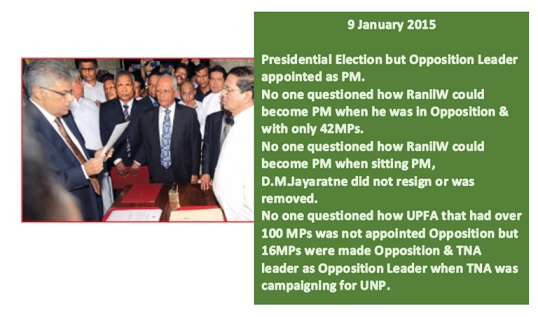
A handful of records by yahapalana since 2015 is presented for you to get an overall idea of the damage that has been done in 4 years.
Appointments:
  • · Legally questionable appointment of RanilW as PM in January 2015 following a Presidential election & not Parliamentary election while RanilW had only 42 MPs in Parliament
  • · Legally questionable appointment of RanilW as PM in January 2015 as sitting PM was not removed by gazette notification.
  • · Speakers refusal to acknowledge the over 50 MPs of the UPFA as Joint Opposition – naming TNA which had just 16MPs as the Opposition & TNA leader Sambanthan as Opposition Leader.
  • · Speaker also appoints JVP with 6 MPs as Chief Opposition Whip. (ironically both JVP & TNA helped Yahapalana to come to power – therefore how can they function as Opposition?) First time that Leader of Opposition voted for a Govt budget when TNA voted in favor of Yahapalana budget in 2016.
  • · Foreigner as Governor of Central Bank despite objections & despite him having a chequered record as BOI head in 2001
  • · Allegedly LTTE-linked former UNP President’s advisor being appointed as Financial Advisor in 2001 & again in 2015.
  • · Brother of former UNP Chairman as Air Lanka head
  • · Alleged appointments of Royalists to key posts
  • · Appointments of family members to ministries & other statutory bodies


Corruptions & Wastage
  • · 2 Central Bank Bond Scams – PM Ranil takes Central Bank directly under PM in Jan2015, nominates his friend a Singaporean national as Governor Central Bank despite protests, assures parliament he would be accountable for Mahendran. After the bond scam was exposed PM Ranil appoints 3 UNP lawyers to investigate, removal of UNP MP Velukumar & replaced with MP Sujeewa S, ArjunaM’s statement to COPE that PM Ranil only ordered change in method for Bond Sales, UNP Members of COPE functioned under direct instructions of PM Ranil, Governor Mahendran was not even sent on leave pending conclusion of inquiry, Chairman & Senior officials of the 3 state banks giving evidence at the Presidential Inquiry in Oct2017 confirmed that RaviK had instructed them to make bids at lower interest rates, not taking action against those responsible for the scam even after its exposure.
  • · Former PM Ranil announced new economic plan in 2016 as Minister National Policies & Economic Management & hired US Consultancy firm McKinsey & Company in November 2016. McKinsey identified 3 areas for accelerated development: Tourism – Agriculture – Manufacturing – Sri Lanka had to pay $2,997,666m for this proposal! Why couldn’t our own people prepare a plan for our development?
  • · On 3 occasions former PM Ranil had presented proposals to privatize Bank of Ceylon, Peoples Bank, National Savings Bank & state pawning outlets. (Derana news & President Sirisena) RW also planned to bring Samurdhi Bank with assets of Rs.200b under Central Bank & Finance Ministry – this too was seen as an attempt to deny the poor relief.
  • · In May 2018 on application filed by Office of Public Trustee & Colombo District Court granted approval for the dept to open 254 last wills lying in a public safe between 1932 & 1992. If there are no heirs to these last wills – wonder what will happen to the fortune/wealth?
  • · Sri Lanka’s Mobil Industry was a key contributor to Sri Lanka’s economy for decades & delivered mobile services at low tariff rates. In 2017, Cellular Tower Levy was introduced & Rs.200,000 per month per tower charged. Monthly operational cost would increase from Rs.115,000 to Rs.315,000 (174% increase) Three of the 5 mobile operators are now running at a loss.


Questionable Bills/Amendments

  • · 19th amendment was passed in April 2015 diluting Presidential powers without mandate of People
  • · Amended Land Ordinance Act presented by Ranil in September 2018 would if passed in November privatized all state land leaving ownership with foreigners.
  • · Amending – Rent Act, No. 7 of 1972 which limits the ownership of houses and the rent to be charged
  • · Amending – Paddy Lands Act, No. 1 of 1958 and the Agricultural Lands Act, No. 42 of 1973 to allow the farming of alternate crops.
  • · Local Government Authorities Elections Act No.16 of 2017 – Bill said to correct technical issues at Committee stage, after second reading, Yahapalana brings totally new amendments & changes entire electoral system. The Bill was not presented to Supreme Court. The Bill finally passed was not the Bill read the 1st & 2nd time or the one that was gazette. UNP, dissident SLFP, JVP, SLMC & ACMC & TNA supported it
  • · Sabaragamuwa, North Central, Eastern PCs were to be dissolved in September/October 2017. But a day or two before dissolution, yahapalana changes Provincial Council Elections System via amended Act. Provincial Councils(AMD) Act No.17 of 2017. AGAIN – sweeping amendments were brought at Committee stage where the gazette was only to increase women’s representation at PCs. Amendments made at Committee stage was not gazette or made available to MPs at 2nd reading stage. Note: Act was passed INSPITE OF Supreme Court ruling that the extension of PCs or postponement of elections require a referendum + 2/3 majority in Parliament
  • · National Audit Bill : Original bill had provision to impose Rs.100,000 on officials who furnish false information during audit queries. This fine was reduced to Rs.5000 in amendment. The original Bill that had provisions for Commission to investigate special projects outsourced to private companies WAS REMOVED. Powers of Auditor General related to internal audits of statutory bodies including govt corporations, boards, authorities also removed. Bill also prevents Right to Information requests on audit queries. WHY GO TO THESE LENGTHS?
  • · Foreign Exchange Act 12 of 2017: HIGHLY CONTROVERSIAL BILL. Petitions against Bill – violating Constitution, claiming Bill deprived & abrogated power of Parliament to control public finance, removed powers of Central Bank/Monetary Board to supervise, regulate & control foreign exchange including gold, currency, payments, securities, debt, import, export, transfer & settlement of property as provided by Exchange Control Act 24 of 1953. Yahapalana was accused of denying challenging of Bill within 7 days by placing it on Order Paper of Parliament on Friday 7 April 2017 as Supreme Court was on holiday thereafter. Bill was adopted by preventing it from being challenged.
  • · Enforced Disappearance Protection Bill: Presented to Parliament twice & withdrawn due to Public protests. But Bill was passed in March 2018 violating Standing Orders & denying Opposition request for more time to debate it. Passed on the same day it was presented! Bill was declared passed in Parliament with only 53 MPs voting in its favor.
  • · Office of Missing Persons Bill 2016: Virtually bulldozed through Parliament by UNP, SLFP dissidents, JVP & TNA despite objections. Less than 40 minutes given to debate this new law. Vote was taken & Speak declared Bill as passed. The Act protects members of the OMP, officers, servants & consultants of OMP from Right to Information scrutiny in respect of matters communicated to them in confidence” Why the need to include such?
  • · Judicature Act No.2 of 1978 – May2018: Act enables to set up permanent High Court at Bar to hear cases relating to offences specified in the Sixth Schedule of the Act. The Bill empowers Permanent High Court at Bar to try offences – theft, dishonest misappropriation of property, criminal breach of trust by public servants, bankers, merchants, agents & dishonestly receiving stolen property… cheating, forgery, making false documents, counterfeit, money laundering etc. MPs, police officers, peace officers, Bribery of Judicial officers & other public officers an be tried. Bill was passed without JO at the Committee Stage with majority of 51 votes.AG & DG for Prevention of Bribery & Corruption were given discretion to select cases to the Court. Prosecuting officers had power to arbitrarily select cases. BASL petitioned challenging Bill to say there is no court called Court at Bar in law. Many referred it as a Kangaroo Court. Bill was passed with majority of 67 votes
  • · 19a Constitutional Council: Normally, a CC must rule if proposed statues are Constitutional after Parliament votes & before President signs into law. Sri Lanka’s CC has nothing to do with the constitution (name is inappropriate) Sri Lanka’s CC = PM, Speaker, Leader of Opposition, 1 person appointed by President, 5 nominated by President on recommendation of PM, Leader of Opposition & 1 person nominated by majority MPs. Tenure is 3 years & consists of 10 members. Main function of CC is to recommend Chairman & members of the National Commissions (Elections, Public Service, Police, Audit Service, HR, Bribery & Corruption, Finance, Delimitation, Procurement, UGC, Official languages. CC recommends 3 & President must choose from 1 from the 3. CC also recommends 3 names for Chief Justice & Judges of SC, President & Judges of Court of Appeal, Members of Judicial Service Commission, AG, IGP. CC is not a Parliamentary committee & not answerable to Parliament – no one knows who CC is answerable to. However the composition of CC gives 7 persons a clear majority & thus controlled & manipulated by politicians for politicized appointments.
  • · Active Liability Management Bill sought authorization to borrow over Rs.1trillion from local & foreign sources separate to the yearly borrowing limit set by Parliament. It enabled bypassing of existing controls for loans and Parliament will have no control in the manner funds are utilized. The Bill also removed civil or criminal liability of those who utilized the money. Though Supreme Court was petitioned the Bill was passed in March 2018.
Anti-democracy
  • · When removed by gazette as PM without accepting the sacking or taking legal measures against it, RanilW goes crying to the western/indian envoys requests them to come to Temple Trees & is regularly in discussions with them – externalizing an internal matter.
  • · President gives reason for removing Ranil as PM – attempting to usurp Presidential powers, exceeding his limits, ruling with arrogance, ignoring collective decisions, these are not what the voters were shown
  • · President accuses RanilW of establishing a fraudulent committee to manage economy & President had no alternative National Economic Council committee which RanilW prevented from functioning by asking the international monetary organization paying the salary of the consultant to stop payment.
  • · When President wanted to visit Central Bank, Ranil’s response was Central Bank belongs to me, why do you want to go there’.
  • · Amendments were made to the Commission on Bribery or Corruption Act & sent to Parliament so that Bond Scam perpetrators would be given due punishment. Parliament has postponed approval of amended Act indefinitely.
  • · Co-sponsorship of legally questionable UNHRC resolution in Sept2015 placing national army in a very embarrassing predicament and agreeing to terms that will pose national security risk while also agreeing to a new constitution
Economy
  • State of the Economy: PM Ranil said yahapalana was saddled with $1900m loans (exclusive loans taken by state institutes) PM Ranil said national debt at 31 Dec 2015 was Rs.4,959.2billion (local) and Rs.3,544b (foreign)
  • Debt had increased to Rs.9,387b in 2016 (57% local & 43% foreign)
  • Foreign loans had increased from $1.82b in 2016 to $2.41B IN 2017
  • Sri Lanka printed currency worth Rs.217b from Jan-Mar2017 to pay public sector salaries & other state expenditure.
  • 50 public institutions (including Sri Lankan Airlines/hotels) lined up for privatization in 2017 budget to cover 2016 budget deficit
Comparing Rajapakse & Yahapalana economy:
2009-2011 – 8% growth
2015 3rd quarter – 4.8% growth
Sri Lanka Rupee depreciated from Rs.132 in 2005 to Rs.153 in March 2017 by end 2018 it was Rs.180
Foreign reserves:
$324.3m withdrawn in 2016
$309m withdrawn in Jan-Feb 2017
official reserves down to $5.5b (Jan2017) compared to $6b end of 2016
Foreign Direct Investment:
Dropped from $658m in 2015 to $300m in 2016
Bloomberg rated Sri Lanka as high risk for investments.
Moody, Fitch, Standard & Poor rating agencies gave Sri Lanka a negative rating for 2017.
Yahapalana loans
Auditor General says loans taken by yahapalana in 2015 was double borrowing limit mandated by Parliament
From Jan2015 to Sept2016 yahapalana had borrowed $2.3b from India, $3.65b through sovereign bonds, $3.1b through SL development bonds & $1.5b from IMF (Total $10.5b in 18 months)
In 2016 yahapalana also arranged with 5 banks (including HSBC, Credit Suisse, Citibank) for a syndicate loan of $3.5b (includes clause that govt can be asked to pay back entire amount)
Yahapalana borrowed Rs.23b from NSB & People’s Bank in Feb2017 to fund Central Expressway Project.
$1.5b from IMF in June 2016.
IMF approved 3year Extended Fund Facility of SDR $1.5b (so far 2 tranches given to value of Rs.239m ($325m)
Chinese govt offered $1000m at 2% so govt would not need to take IMF loan of $15,000m at 6%. IMF loans are subject to conditions that hit the middle class & poor – higher taxes, reducing govt welfare subsidies, sale of state-owned enterprises to foreign buyers, state land given to foreign investors, increasing taxes, liberalizing trade, killing agriculture self-sustenance. Yahapalan govt as per IMF demands has reformed taxes, land ownership & labor laws.
· In Jan2017 Cabinet approved a further USD1500 million bond issue
· Sri Lanka printed currency worth Rs.217 billion from January to March 2017.This was needed to pay public sector salaries50 public institutions had been lined up for privatization in 2017.
· Ranil & Co came to power to ease the domestic burden of the consumer – today prices of food have sky rocketed
· Suspending re-exporting karunka (dried arecanut) which earned Rs.9.1billion in 2015 becoming highest foreign exchange earner. 4 local companies were engaged in this trade. Former Finance Ministery RaviK issued permits to other companies & now the income has dropped from Rs.9.1b in 2015 to Rs.4.9b in 2016.
· Release of state lands for foreign ownership – 2017 budget announced removal of restrictions limiting land ownership rights of listed companies with foreign owners / yahapalana also removed restrictions on foreigners purchasing condominiums below 4th floor.
· PM’s advisor presented in 2015 a proposal by Trimble Navigation Ltd (US company) for Title/Tenure Regularization & Cadastral Registry Modernization’ in Sri Lanka the proposal which had been rejected in 2010. Trimble asked $170m which was reduced to $154m without TENDER to be taken as a loan at 4% interest to be paid in 15 years. Finance Ministry’s External Resource Dept was to negotiate with Trimble – database of 3.6m parcels of state owned land. Trimble given management of SL Survey Dept, controlling SL’s electronic land register & details of land will mean a threat to Sri Lanka’s national security
· In 2018 the National Gem and Jewellery Authority (NGJA) imposed a levy of Rs. 25,000 per 100 carat on gem export sales or contracts and increased the license fee to half a million rupees from only Rs. 35,000. Sri Lanka Gem and Jewellery Association complained that NGJA is stifling the industry by levying such charge on the value of exports resulting in a huge drop in gem and jewellery revenue in exports
· In 2018 Yahapalana placed a 15% tax on gold imports in 2018.
· Protests managed to stop import of eggs which would have destroyed the local poultry industry
· Opening Sri Lanka to foreign retail industry in March 2018 – (shoes, grocery, floor tiles etc) all threatening local businesses. Minimum requirement for foreign investors or JV set by Govt is $5m – foreigners end up paying same tax and duty as Sri Lankans but earn bigger profits as they repatriate their profits and this affects foreign exchange reserves too. Foreigners in retail market are selling foreign goods.
· Hallmarks of every new investment has been the lack of exit clauses, rule, regulations & monitoring mechanisms, cancellations for violations, checks & balances etc (Sri Lankans cannot set up retail outlets in foreign countries as these countries protect their local industries)
· Local metal industry – scrap metal that can be refined locally is being sent abroad illegally avoiding duty, manipulating HS codes. Law allows only export of locally unrefinable scrap
GSP+:
GSP+ is not an incentive to garment producers but a concession given to importers at European end so importer will not have to pay duty when importing garments from Sri Lanka.
Sri Lanka garment industry did not fall even when GSP+ concessions was removed in 2010 & was doing well from 2005 to 2010.
GSP concessions are conditional & conditions have nothing to do with trade & cover human rights, environment, labor laws & even UN compliance.
Job losses as a result of FTA
Giving resident status, foreign labor permission to foreign investors mean that not only there is likely demographic issues in the future but massive job losses & issues related to food, energy and residential problems too likely to emerge.
Burdening the Tax Payer & Small/Medium Businesses
· Proposal to tax EPF 28% (14% on income & 14% on withholding tax) impacting private sector employees who depend on EPF to live after retirement.
· VAT has increased from 11% to 15% burdening the consumer & impacting small & medium businesses
· Using social concern – wayside stalls etc are being targeted (micro enterprises account for 91.8% of total business in Sri Lanka – employing 44.6% labor)
· Rs.1m imposed on import of vehicles in 2017 – mini-trucks jumped from Rs.1m to 1.8m – these were used by small businesses
· A water tariff carrying a sharp increase was imposed, outside the 2017 budget on Schools, religious place and even hospitals
· tax exemption for deposits of senior citizens has been removed and their withholding tax has been increased
· Yahapalana increased import levies on confectionary fats from 60% to 160% in 2016 budget affecting even local consumers resulting in cheap inferior import flooding the market (Lanka Confectionary Manufacturers Association press release)
· Removing taxes on lease of land to foreigners & removed restrictions on ownership of investments enabling foreign companies to set up shop & reside in Sri Lanka which will impact small & medium local industries. Offering 5 year multiple visas to foreign investors & their labor confounds matters further. Tax concessions & visa extensions were given to those who invested over $1.5m
· Special Deposit Account Act in 2017 that allows foreigners with a deposit of $500,000 to obtain resident visa to a period of 10 years. Spouse & minors also eligible to stay. These foreigners can also invest in Sri Lanka. No State monitoring authority is mentioned in act.
· Census Department reported that inflation has increased to 7.9% in August 2017 from 6.3% in July 2017.
· 6000 small & medium scale rice mills closed & 100,000 lost jobs in 2017. Wheat imports from increased from 800,000 tonnes to 1,700,000.
· Tea Industry accuses Ministry of Finance of appropriating Rs.7b from the cess fund of Sri Lanka Tea Board used for global tea promotion. Despite protests tea cess was transferred to Treasury (2016) The 2019 budget plans to take the Tourism cess fund under Treasury too.
· In 2018 Ranil Govt permitted entry of new type of prawn – Pacific White Legged Shrimp imported by a private company. The Economic Research Council headed by former PM Ranil instructed the National Aquaculture Development Authority (NAQDA) to permit import. Experts say this shrimp carries infectious disease & import has not followed proper legal procedure
· Yahapalana proposes to abolish para tariffs (extra tax imposed on goods in addition to usual duties) in 1200 imports. Para tariffs on 253 products removed in 2017.
· Yahapalana killing SL footwear industry: Indian non-leather footwear manufacturer (Veekesy Slippers) allowed to enter market without restrictions using Section 16 of BOI minimum investment $250,000 investment (100% foreign or JV with local) & gives unlimited access to local market sales. Investment promised to purchase raw material from SL, provide 250 direct & 250 indirect employment to locals (when 150 small & medium SL local footwear manufacturers are employing 350,000 workers). BOI then Chairman Upul Jayasuriya had given approval for 10% local manufacturing & 90% exports.
International record sheet speaks for itself
· Economic Freedom Report, places Sri Lanka 112 out of 180 countries, down from 2016. Sri Lanka ranks lower than Uganda, Swaziland, Mali, Nicaragua, Benin, Honduras (Heritage Foundation & Wall Street Journal)
· Global Competitiveness Report 2017/18 (World Economic Forum) Sri Lanka is 85. In 2016/17 Sri Lanka was ranked 71
· Ease of Doing Business Index” 2017 (World Bank) Sri Lanka is 110.
· Corruption Perception Index” (2017) Transparency International, places Sri Lanka 95 out of 176 countries.
How independent are these ‘independent commissions’
Prof. S.Ratnajeevan H. Hoole, a member of the Election commission filed a Fundamental Rights petition seeking an Interim Order restraining the Elections Commission from proceeding to take any steps to conduct the Parliamentary election – he has not even resigned before or after showing his bias and has the audacity to write about what he did.
Anti-Buddhist agenda
· Ven. Devalagama Dhammaratana, sangha nayake of Hambantota said Hambantota lands were to be taken over, they had already measured them. About 100 temples and their lands were included in this takeover.
· In May 2018 university students and sangha demonstrated in Colombo over the removal of ‘Buddhist Philosophy’ as a subject from the University.
· August 2018, Office of National Unity & Reconciliation (ONUR) launched several radio dramas all of which attempted to ridicule Buddhism & insult Buddhists & lack of respect for Buddhist cultural sensitivities.
· government taxed Rs 3.2 million on Buddha statues brought by a Chinese delegation on a request by Mihintale Raja Maha Vihara to be distributed among poor temples in the remote areas.
· planned movement to mislead Buddhists by distorting Buddhism & certain Buddhist monks and laymen were distorting Buddha’s teachings when preaching
· Taxing temple tills
· There are over 40 Buddhist monks in prison – no charges no bail for trivial reasons.
This is an incomplete list of yahaplana blunders, in competencies & selling the countries assets & resources into foreign hands with no reduction in national debt situation or relief to the masses. In privatizing & siphoning off national assets yahapalana has only reduced Sri Lanka’s bargaining power & sovereignty as well. When people eventually realize the damage that has been done in the past 4 years it would be too late and sadly the nation & the future generations will suffer the perpetrators & traitors would absolve itself of all responsibility.
Shenali D Waduge

Proposed constitution

January 8th, 2019

Proposed constitution – What you should know


Copyright © 2026 LankaWeb.com. All Rights Reserved. Powered by Wordpress