A Rs. 100-Million Crematorium for Dogs: Misplaced Priorities in a Rabies-Endemic Island Impending Public Health Crisis
Posted on May 29th, 2026
Champa Fernando Secretary, KACPAW
While Sri Lanka is now sitting on a powder keg of dog rabies, about to ignite, it is bewildering that the 2026 budget allocated Rs.100 million for a dog crematorium cum shelter to one local government body out of 343, and no money for National Dog Sterilization. This is the first time money has not been allocated for National Dog Sterilization since 2008.
Retardation of the National Dog Sterilization Program
Owing to the retardation of the national dog sterilization program for two consecutive years in 2024 and 2025, by 2026 we clearly witness island-wide, an increased dog population, converting once again the target of rabies eradication by 2030 to mere rhetoric.
While no money has been allocated for 2026 for National Dog Sterilization, of the 184 million allocated for 2025, 155 million of unused funds have gone back to the treasury, and likewise 85 million has gone back from the 2024 allocation of 185 million.
Dogs litter twice a year, and if back-to-back sterilizations of dogs are not effected countrywide, whatever sustainability of dog population control already achieved at the cost of billions of Rupees, is quickly nullified and a nation of people is exposed to the risk of rabies contraction with such an uncontrolled increase.
Can such a Cosmetic and Costly Dog Crematorium Be Justified?
Given this volatile backdrop in a rabies-endemic country such as ours, can building a costly Dog Crematorium, a luxury, be justified?
· Rs. 30 million is needed to build such a crematorium.
· The heavy-duty concreted foundation for the incinerator and proper exhaust chimney cost Rs, 10 million.
· Imported Machinery costs around Rs.20 million, with a huge running cost needing gas and diesel, a cost that cannot be estimated owing to the market price fluctuations.
· And we will be spending precious foreign exchange to import gas and diesel to cremate dogs, while staying patiently in queues to get rationed fuel.
· This also initiates a fresh source of environmental pollution. The fumes generated by burning dogs causes fresh environmental issues, not tolerated by residents. For example, the incinerator at the Veterinary Teaching Hospital of the University of Peradeniya is not used owing to protests by the residents, citing air pollution.
Who in Sri Lanka Can Afford Dog Crematorium Services?
A dog crematorium is a luxury in a country like ours, catering to a handful of the affluent.
Most pet owners bury their beloved pets in their gardens somehow and only a few pet owners in Colombo may need some form of pet burial service, which can be privately obtained in Colombo for a cost of 25,000/.
Burying a dog and/or any other animal is not an issue to Sri Lankans in almost all other parts of the island. But being exposed to the rabies risk is.
When most cannot afford to find money to cremate their kith and kin, let alone their dogs, for whose benefit is this crematorium being built at a cost of Rs.100 million to supposedly cremate a few pet dogs or none at all, unless the plan is to incinerate the street dogs to be caught and incarcerated in the adjacent shelter.
Sinister Intentions?
A dog crematorium next to a dog shelter, declared to provide welfare to all street dogs in the Western Province, will be stressful for the shelter inmates, as dogs have a highly advanced ability to smell and sense danger.
And for those of us who have seen gassing of impounded dogs, a dog crematorium next to a street dog shelter is technically a reversion to gassing units next to cages holding impounded dogs, awaiting gassing.
Pilot-Project State Shelter to Hold Street Dogs?
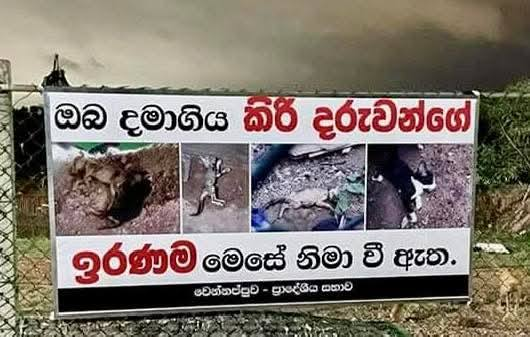
Why do we need a pilot project of a street dog shelter when we have three abysmally failed state-run shelters in Nellikulam, Wennappuwa and Konesapuri, all compelled to shut down within about 6 months of them being set-up?
And, Pilot Projects are initiated to gather hitherto unknown information.
Without controlling the following two external factors, shelters get unmanageably overcrowded and defeat the purpose of setting them up. Merely citing street dog welfare and putting up Fancy Boards are ridiculous.
The two uncontrollable external factors are: 1) dog population growth; 2) dumping.
Without controlling the above two external factors, no amount of technical support by any shelter expert”, if indeed there are such experts, is merely agenda-driven rhetoric, as this shelter too will have to be closed within a few months, because the two uncontrollable external factors which inevitably determine the fate of such places still exist, more than ever now.
Unless of course the sinister plan is to conveniently kill and burn the dumped animals, the excess and the sick.
Negative Factors of Dog Shelters
Dog shelters have the following inevitable outcomes:
· No holistically sustainable results are generated.
· Very expensive to run, artificially taking over the care of self-sufficient street dogs and trying to prolong their natural life by restricting them to ill-managed shelters, that defeats the provision of their welfare.
· A huge long term commitment, which cannot be sustained owing to lack of: 1) funds, 2) committed and caring workers, 3) consistent and proper basic care, 4) consistent vet care.
· These shelters become centers of dumping within months and hence: 1) become disease spreading centers, 2) bring forth new public health issues, 3) cause new environmental issues, and 4) give rise to public nuisance factors, with calls to remove / shut down these shelters, built spending enormous amounts of public funds, which should be ideally channeled towards sterilization.
Solution and Urgent Priority
The National Target should be rabies eradication and zero dog-mediated human rabies deaths cost-effectively. These targets cannot be achieved by providing respectable burials to pet dogs.
What should be prioritized to achieve these targets of utmost public health significance is comprehensive island-wide decentralized dog sterilization via each Pradesheeya Sabha (Local Government Bodies), coupled with the legal arresting of dumping dogs by registering dog owners.
After at least a minimum of three years of such island-wide regular dog sterilization, which eliminates the need to dump, a shelter or two can be meaningfully and safely established as a pilot study.
Champa Fernando
Secretary, KACPAW