අගමැති මහින්ද බලය පතුරයි.. පොලිස්පති ගෙන්වා යටතට ගනී.. සුපිරි ආරක්‍ෂකයා ගොටාත් එයි..[Video]

October 26th, 2018

 lanka C news

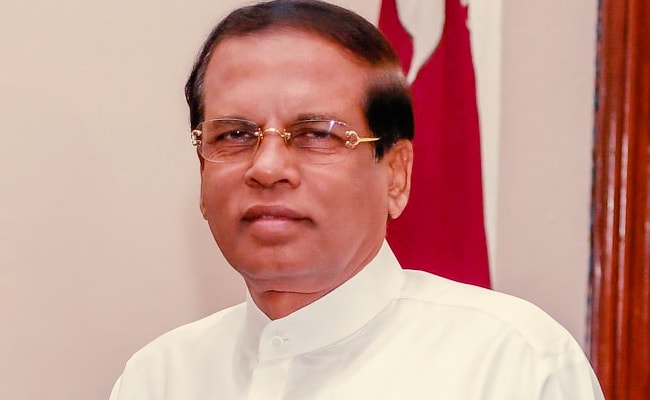
නව අගාමාත්‍ය මහින්ද රාජපක්‍ෂ මහතා මුණ ගැසුණු පොලිස්පති පූජිත ජයසුන්දර මහතා ඇතුළු නියෝජ්‍ය පොලිස්පතිවරුන් කිහිප දෙනෙකුම රටේ ආරක්‍ෂාව තහවුරු කිරීම සදහා අවහ්‍ය උපදෙස් ලබා ගත්තේය.

මෙම විශේෂ හමුව සදහා මහින්ද රාජපක්‍ෂ මහතා සමග හිටපු ආරක්‍ෂක ලේකම් ගෝටභය රාජපක්‍ෂ මහතාද සහභාගී විය.

මෙම තත්වයත් සමග එක්සත් ජාතික පක්‍ෂය පාලනයේ තිබූ පොලිස් බලයද සම්පුර්ණයෙන්ම නව අගමැතිවරයා විසින් සියතට ගෙන ඇති අතර හමුදාවටද අණ දිය හැක්කේ ජනාධිපතිවරයාට පමනි.

4,846 Viewers

රූපවාහිනිය පරිශ්‍රයේදී රාජිත, මංගල හා චතුරව පහරදී එලවා ගනී

October 26th, 2018


UPFA decides to quit unity govt

October 26th, 2018

Courtesy Adaderana

The United People’s Freedom Alliance (UPFA) has decided to withdraw from the unity government.

This was revealed by UPFA General Secretary Mahinda Amaraweera, speaking exclusively to Ada Derana.

He stated that the Speaker of Parliament has been notified of the decision in writing.

President Maithripala Sirisena’s Sri Lanka Freedom Party (SLFP), the main constituent party of the UPFA, and Prime Minister Ranil Wickremesinghe’s United National Party (UNP) had formed a unity government in August 2015 following the general election.

The coalition had grown increasingly strained in recent months. Both coalition partners suffered heavy defeats in local elections in February, and Sirisena loyalists backed a no-confidence motion in April against the prime minister, who survived after a majority of legislators voted to support his coalition government.

Western Imperial Agenda linked to Eelam Map

October 25th, 2018

It is more than clear that the Eelam project has been not simply a Tamil project but one that has been used by not just one foreign government for their own geopolitical agendas. That explains the duration of LTTE reign & it also explains the players coming forward as conflict-resolutionists and reading into some of the solutions offered it also gives a better picture that all of the solutions had nothing to do about Tamil people getting their own administration but a demarcation of land & boundaries that would serve the interest of external agendas. For this purpose the map of Eelam is crucial & important.

Let us first look at the map presented by LTTE as being their Eelam

https://en.wikipedia.org/wiki/Tamil_Eelam

This is the map of Tamil Eelam depicted by the Transnational Government of Tamil Eelam a LTTE front banned under UNSC Resolution 1373 since April 2014.

Don’t you wonder why not a single foreign envoy, not a single UN official, not a single human rights activists or lawyer objects to the TNA & others demanding NO SINHALESE can live or work in the North?

How many statements have been issued by the TNA & Its chief minister demanding the removal of Buddhist sites, archaeological sites being destroyed & demanding Sinhalese are not allowed in the North.

Not a single UN official are even helping the displaced Sinhalese to resettle in the North.

The other important factor is the manner TNA want to shift the Provincial Council office exactly to the border of this line clearly demarcating the importance of the division.

Who are the foreign hands manipulating LTTE

Not just one foreign player has been involved with LTTE. All 15 LTTE fronts banned since 2014 are operating from US, Canada, UK, EU nations, India. None of these countries have launched investigation into their role in materially supporting LTTE inspite of LTTE being banned in their countries.

Norways’ role in Sri Lanka’s conflict is also noteworthy. Karuna Amman has even accused Norway of providing funding to LTTE to purchase lethal weapons. Norway is also associated with handing over high-tech satellite equipment to LTTE during the same period. All this doesn’t shine much light on Norway’s credibility as a genuine peace negotiator or facilitator.

Daya Gamage’s book Tamil Tigers’ Debt to America: US Foreign Policy Adventurism & Sri Lanka’s Dilemma” shows that US treated LTTE eelam & Tamil eelam quest as one and the same. This is clearly indicative of the UNHRC resolutions virtually insisting on war crimes against only the Sri Lankan Armed Forces. Both former US envoy Blake & EU Head of Mission Savage made virtual threats of sanctions, war crimes tribunals even before a complete military end to LTTE occurred.

US inspite of its hyped war on terror has done nothing against the TGTE or its head openly displaying the LTTE flag alongside the US national flag too. MPs in all of these LTTE banned countries not only appear as guests of LTTE front events but even deliver speeches and no investigation is even launched against them. Some have even travelled to Sri Lanka sponsored by these LTTE fronts. Some foreign MPs have even signed petitions generated by these LTTE fronts.

Why would countries allow their leaders to openly promote & assist an internationally banned terrorist movement to prevail. This is no different to the West’s support of the KLA that now runs independent Kosovo, it is no different to many other regime changed countries where the mantle of governance have been given to puppets controlled by the West who allow the West to use the separated territory for West’s geopolitical mechanisms.

Is it possible that Sri Lanka’s Eelam quest is one such project now involved in a tug-of-war between nations who know the importance of Sri Lanka’s geopolitical positioning. Is this why the West have used India as a front to push forward West’s design for its pivot to Asia strategies. India hopefully realizes the faux pas it has made in making Asia vulnerable by warmly welcoming the enemy to Asia’s doorstep thereby making entire South Asian region vulnerable. West have used India’s anti-China card to take India to its side thereby forcing India’s silence at the inroads the West is now making in Sri Lanka with India now in little control to stop it other than taking another detrimental route like creating another rebel force to counter the situation. Is the making of AAVA the alternate ploy?

Be that as it may, having digested the extent of this illegal eelam map with no valid reasons to demand any territory claiming to be any homeland of Tamils, we next come to the real problem at stake.

Now that you have a clear picture of the eelam map where it commences & what areas it covers, please take a look at this map.


This map is available on forever maps (one of the largest satellite maps) & is used by the UN clearly depicting their objective. Where did forever maps get this map … obviously it has to be from a valid source – US or UN?

The line is identical to the TNA poster shown above demanding no Sinhalese in the North.

The line starts South from Mannar and goes North of Trincomalee in Eastern Province.

What is also crucial to note is that this line was not seen before 2016. This line appears only after 2016 wherein a new constitution for Sri Lanka removing the unitary status, incorporating the ITAK confederal objectives is slowly & subtly being drafted by foreign experts & making it appear to look as if it is drafted by various steering committees appointed by locals. Locals are only going through the various internal loopholes & placing their treacherous advice for the dollars & pounds being paid to them as gratitude for their treachery.

The inclusion of the line aligns to the regime change & every measure the West is taking to choke Sri Lanka’s sovereignty & create another Kosovo/ South Sudan out of Sri Lanka presenting it as a change the people asked for.

Now we go to another map source – OpenStreet Maps by a Germany company Skobbler GmbH

https://www.openstreetmap.org/relation/536807

Notice how the northern towns are depicted in Tamil?

Again it is highlighting the exact boundary that demands no Sinhalese can enter.

Now can you understand the reason for the jihadi element in Wilpattu and the manner the area is getting cleared on the pretext of settling people? We all know that West partners with jihadists in Asia for their geopolitical purposes. The people now living in these areas do not even look like our traditionally dressed Muslims, so who exactly are they & where have they come from & who are allowing them into the country without monitoring them? They are helping to create the necessary boundary.

Minorities need to ask pose some fundamental questions to themselves & answer irrespective of their like or dislike of the Sinhalese.

The West declared Saddam Hussein a dictator & claimed to want to liberate the Iraqi people and give them freedom, liberties & rights. Saddam Hussein was removed & later hung to death & are the Iraqi people enjoying freedom & liberty & rights today?

The West declared Gaddafi a dictator & claimed to want to liberate the Libyan people & also give them freedom & rights. Gaddafi was killed in the most unimagineable manner & the West only laughed but are the Libyans free in their country?

Kosovo was created & Serbian leader was also mysteriously put out of the way but are the Kosovars truly enjoying independence & life?

South Sudan was also given independence, Sudan was divided & everyone said by dividing Sudan & giving independence to South Sudan everything would be honky dory. Is South Sudan at peace today? There are enough and more countries that the US, UK & NATO with the help of UN has brought freedom & liberty to but are all of these countries examples of a success story or are they worse off than they were under the supposed dictators?

So do Tamils really think that all this attention the US, UK, Canada, EU & UN are giving to Sri Lanka’s supposed post-conflict development is really with the interest of the Tamils at heart? The same can be said of the interest India claims to place about Tamils, the genuineness of that can be assuaged by the level of poverty, abuses against low castes & Dalits & other human rights violations in Tamil Nadu state. Tamils may also like to question the sincerity of the LTTE diaspora & other eelam lobbyists. All of them are holding foreign passports. They wish to come to Sri Lanka only as holiday goers. Their investments if at all will only be to secure profit for themselves & have nothing related to uplifting the lives of Tamils in a separate Tamil autonomous & independent state. But, such a promise & assurance that has historical weight since the self-determination bid started in Tamil Nadu, gains the emotional backing of the Tamil people and the West are masters at playing psychological games with people’s emotions. They have done plenty of research using Asian, African & Indigenous people as experiments so they are well aware of what ticks in the minds of minorities & they use these as political ploys to advance their geopolitical neo-liberal corporate policies.

Unless and until minorities are able to understand this and the majority too are able to read between the lines of these games that are being played politically, diplomatically even using international trade, UN conventions & resolutions as ploy we will never know who our real enemies.

These maps should give a clear indication that the West has been silently backing an armed militancy to later advance to backing its political proxy with their own intent to administer the new demarcated area by giving limited ‘sovereignty’ to a new area they will declare as eelam. With no standing army & little political weight newly created micro states or their leaders are no match for the powerful countries that will dictate what they should hand over to them & how they should run the people. Eventually it will end up an inguru dee miris gaththawage story.

Shenali D Waduge

ඔරුමිත්තනාඩු වේ  බුද්ධශාසන සංහාරය

October 25th, 2018

මතුගම සෙනෙවිරුවන්             

         දෙදහස්නවය වසරේ කොටි ත්‍රස්ත සංවිධානය පරාජයට පත් කොට ජන ඝාතක යුද්ධය නිමා කළ පසු උතුරේ ජන ජීවිතය නැවත යාථා තත්ත්වයට පත් කරලීමට රජය විශාල මහන්සියක් ගන්නා ලද අතර මහා මාර්ග තනවා එම ප්‍රදේශ වල ජනතාවට අනෙක් ප්‍රදේශ සමග සම්බන්ධ වීමට ඉඩ හසර ලබා දුන්හ. මේ යටිතල පහසුකම් ඇති කිරීමට යුධ හමුදාව කළ කැපවීම ඉතා විශාලය.ජාති භේදයකින් තොරව ඔවුහු ගම්මාන ගොඩ නැගූ බව උතුරේ සිවිල් ජනතාව දනී.මේ ජනතාව යුද්ධය නිසා පීඩාවට පත් වූයේ කොටි ත්‍රස්තයන්ගේ බිහිසුණු ක්‍රියාමාර්ගයන් නිසාවෙනි. උතුරත් දකුණත් අඩු වැඩි වශයෙන් බියෙන් සැකයෙන් නොසිටි දිනක් එකල නොවුණු බව අපට මතක් වේ. රටේ රජයට විරුද්ධව සන්නද්ධ අවි ඔසවා ලූ මේ කණ්ඩායම දණ ගස්වා යුද්ධය නිමා කළ පසු කවුරුත් සැනසුම් සුසුම් හෙලූහ. අවසාන සටන පැවතී නන්දිකඩාල් කලපුවෙන් එගොඩ වී හමුදාව භාරයට පැමිණි සිවිල් ජනතාවද හමුදාවේ ආදරය සහ සැලකිල්ල ලබා ගනිමින් පුනරුත්ථාපනය වූහ. මෙවැනි මානුෂීය මෙහෙයුමක යෙදී සිටි හමුදාවට විරුද්ධව ගතු කියා ජාත්‍යන්තරය උසි ගන්වා  යුධ අපරාධ චෝදනා සකස්කර ලන්නට ඉඩ හසර ලබා දුන් නායකයන් අද රට පාලනය කරති. මේ පාලකයන් රජයට එරෙහිව යුධ වැදුණු කොටි පවුල් වෙනුවෙන් වන්දි ගෙවීමට හානිපූර්ණ පනතක්ද සම්මත කළහ. ඒ පනත දිනවන්නට රජයේ සිටි පනස්නව දෙනෙකු අත් ඉස්සූ බව දැන් හෙළි වී අවසන්ය.

         මෙම හානිපූර්ණ පනතේ කිසිම තැනක කොටින්ට වන්දි ගෙවීමක් ගැන සඳහන් නොවුණත් ප්‍රතිසන්ධානයට අදාල ලියවිල්ලේ ප්‍රකාර ව වින්දියන්ට වන්දි ගෙවීම ගැන දක්වා ඇත. මේ ප්‍රතිසංන්ධානය යනු මංගල සමරවීර විසින් ජිනීවා වලදී එකඟ වූ 30/1 යෝජනාවලියේ සඳහන් ක්‍රියාවලියයි.අනෙක නම් මීට පෙර සම්මත කළ අතුරුදහන් කාර්යාල පනතට අදාලව හෙළිවන පුද්ගලයන් වෙනුවෙන් වන්දි ගෙවීමයි. එවිට ත්‍රස්තවාදීන් සඳහා වන්දි ගෙවීම පිණිස මේ පනත ඉදිරිපත්ව ඇති බව පැහැදිලි වේ.මේ පනත පරාජයට පත් කිරීමට ඒකාබද්ධ විපක්ෂයට  පවා කිසිම වුවමනාවක් තිබූ බව නොපෙනේ. දහනවවන සංශෝධනයට සිය එකඟතාවය පළ කලා සේම හානි පූර්ණ පනතට එකඟ නොවී එහෙත් මග හැර ගොස් සම්මත වීමට ඉඩ හලේ කිනම් දේශපාලන සූදුවක් නිසාදැයි ජනතාව දැන් ක්‍රමයෙන් තේරුම් ගනිමින් සිටිති.

         යුද්ධ කාලයේ උතුරේ යම් නීතියක් ක්‍රියාත්මක වූයේ ප්‍රභාකරන් සිය එකාධිපතිත්වය ඔස්සේ සියල්ල පාලනය කළ බැවිනි. ඔවුහු අවි බලයෙන් වෙනම රටක් දිනාගන්නට තැත්කළහ. එම නිසා උතුරේ සහ නැගෙනහිර පෙදෙස් වල තිබූ පූජනීය ස්ථාන හෝ පුරාවස්තු හෝ විනාශය පත් නොවුණි. කල්ලඩි වැනි තැන්වල ඔවුහු කොටි සම්ප්‍රේෂණ කුළුණු පවා ඉඳි කොට තිබුණද එවා විනාශ නොකළහ. යුද්ධයෙන් පසු හමුදාව විසින් මහ කැලයෙන් වැසී තිබූ පුරාණ බෞද්ධ නටබුන් රාශියක් සොයා ගන්නට යෙදුණි. හමුදා කඳවුරුද ඒව අසල තිබූ බැවින් මෙම තැන්වල බුදු පිළිම පවා තැන්පත් කළහ. නමුත් යහපාලන රජය පත් වූ පසු රජය විසින්ම දෙමළ බෙදුම්වාදීනට පහසුකම් සැපයීම නිසා දකුණ සමග එක් වෙමින් තිබූ උතුර නැවතත් වෙන්කරලීමට පිඹුරු පත් සැකසූහ.උතුරේ මහ ඇමති වරින් වර කරන  ප්‍රකාශ මෙන්ම සිවාජිලිංගම් විජයකලා වැන්නවුන් විසින් නීතිය නොතකා කරන ලද ඇතැම් ක්‍රියා දෙස බලන කල්හි. දකුණේ සිංහලයාට නොමැති නීතියක් උතුරේ දැන් බල පැවැත්වෙයි.ඔවුන් ගේ දෙමළ නිජබිම තහවුරු කලීමට අවශ්‍ය සෑම ක්‍රියාමාර්ගයක්ම ගැනීමට ඔවුහු පසුබට නොවෙන බව පෙනේ. ඔවුන් ගේ අලුත්ම සෙල්ලම පුරාවස්තු ඩෝසර කිරීමයි. මෙම ක්‍රියාදාමය පටන් ගත්තේ මුස්ලිම් අන්තවාදීන් අතිනි. ඒ 2014 දී පමණය.මොට්ටාගල හිරුකෝවිල් වැනි තැන්වල තිබූ ස්ථූපයන් ඔවුහු ඩෝසර කළහ.  කුඹුරු වලට සමතලා කළහ. හිරු කෝවිල් වල දාගැබ දෙපළු කරමින් ඩෝසරය ගමන් කරවූහ.මේවායින් සම්භ වූ පුරාවස්තු තවමත් නැගෙනහිර උසාවි වලගබඩා වල තිබෙන බව දැන ගන්නට ඇත.දැන් දෙමළ ජාතිවාදීන්ද මේ මග ගනිමින් පැරණි ස්ථූප විනාශ කරමින් බෞද්ධ අනන්‍යතාවය නැති කර දමමින් සිටී.ත්‍රිකුණාමලේ සාම්පූර් ස්ථූපය කඩා ඒ මත කෝවිලක් ඉඳි කරන්නට තැත්කළ පූජකවරයෙක් සහ ඩෝසර ක්‍රියා කරුවෙක් අත්අඩංගුවට පත් වූ අතර තවමත් එම ස්ථූපය යථා තත්ත්වයට පත් කරලීමට පුරාවිද්‍යාවට නොහැකිව තිබේ. කුරුන්දි අට්ඨ කතාව ලියූවායි සැලකෙන  කුරුඳුමලේ විහාරයට වැඩම කොට ආපසු එමින් සිටි හිමිනමකට විරුද්ධව ඔඩ්ඩුසුඩාන් පොලීසිය තහනම් නියෝගයක් ගනු ලබනුයේ පුරාවිද්‍යා දෙපාර්තමේන්තුවට යටිතල පහසුකම් සැපයීමට ඉදිරිපත් වීම නිසාවෙනි.මෙම මස විසිදෙවනි දා මුලතිවු අධිකරණය එම තහනම  ඉවත් කර ගත්හ. එහෙත් කිසිම ආගමකට අයත් පිරිස් මේ සංරක්ෂණයට සහාය කර නොගෙන පුරාවිද්‍යා කටයුතු කළ බවටද නියෝගයක් නිකුත් වී තිබේ. එයින් කියැවෙන්නේ කුමක්ද. ආණ්ඩුක්‍රම ව්‍යවස්ථාවේ නව වන වගන්තියෙන් කියැවෙන දේ උතුරේ දී අවලංගු වන බවයි.

              බුද්ධ ශාසනය යන්නෙහි  අර්ථ දැක්වීමක් නව සිය පණස් හතේ බුද්ධශාසන කොමිෂන් සභා වාර්තාවේ සටහන් වී තිබේ..බෝධි වෘක්ෂ පෙති පිළිම ස්ථූපයන්ද එයට අයත්ය.උතුරේ පමණක් පැරණි බෞද්ධ සිද්ධස්ථාන දෙසීයකට අධික සංඛ්‍යාවක්  හඳුනා ගෙන තිබේ. එයට අමතරව ත්‍රිකුණාමල දිස්ත්‍රික්කය තුළ අසූවක්ද  මඩකලපු පළාත ගවේශණය කොට 2017 වසරේදී සම්පූර්ණ පුරාවස්තු 648 ක්  ද හඳුනාගෙන ඇත. ඉන් පන්සීයක් පමණ බෞද්ධ සිද්ධස්ථානයන්ය.මෙම ස්ථාන ගැසට් කිරීමට දෙපාර්තමේන්තුව ක්‍රම දෙකක් අනුගමනය කරති එකක් නම් ස්මාරක වශයෙන් ගැසට් කිරීමයි.අනෙක නම් රක්ෂිත වශයෙන් ගැසට් කිරීමයි. ස්මාරක වශයෙන් ගැසට් කිරීම සරල දෙයක් වුවද රක්ෂිත ගැසට් කිරීමට කල් ගත වේ. මීට වසරකට පමණ ප්‍රථම 2017 ඔක්තෝබර් මාසයේදී අධ්‍යාපන අමත්‍යංශය මගින් චක්‍ර ලෙඛණයක් නිකුත් කරමින් දන්වා සිට ඇත්තේ රක්ෂිත වශයෙන් පමණක් ගැසට් කරන ලෙසටයි. එම නිසා යටකී නැගෙනහිර පළාතේ ස්ථාන නීත්‍යානුකූල කරලීමට යම් බාධාවක් පැමිණ තිබෙන්නේ යයි දැන ගන්නට ඇත.2018 ඔක්තෝබර් මාසයේ   උතුරේ පුරාවස්තු සංහාරය නිරීක්ෂණය කිරීමට පාර්ලිමේන්තු මන්ත්‍රී වරුන් දෙනෛකු මුලතිවු බලා ගියහ.මේවා මාධ්‍ය මගින් ප්‍රකශ වූ පසු කලබලයට පත් සංස්කාතික ඇමතිවරයා 2018 ඔක්තෝබර් මස 10 වන දින පාර්ලිමේන්තුවේදී ප්‍රකාශයක් නිකුත් කරමින් ඉතා නින්දිත කතාවක් සිදු කර තිබේ. එයින් ගම්‍ය වන්නේ මෙරටේ පුරාවස්තු වැඩිපුරම විනාශ කරන්නේ සිංහල ජනතාවව බවයි. අනුරාධපුර දිසත්‍රික්කයෙන් වැඩි පමණයක් පුවස්තු විනාශ සිදු වන බව ඔහු සංඛ්‍යා ලේඛන ඉදිරිපත් කර තිබේ.

        ලංකාවේ දිස්ත්‍රික්ක විසිදෙකෙන් වැඩිමනත් විනාශයන් සිද වන්නේ රජරට බව සැබෑය. ඒ සියල්ල දේහපාලකයන් ගේ ග්‍රහණයට හසුව තිබන තැන්ය. එක් කාලයක් උතුරු මැද පළාතේ මහ ඇමතිවරයෙකු ව සිටි පුද්ගලයෙකු පොකුණු හාරන්නට කියා නිදන් හෑරූහ. තවත් බලවතෙක් යෝධ සංවර්ධන ව්‍යාපර වලට කියා ඉඩම් හෙළි පෙහෙළි කොට  මේ නිදන් හෑරූහ.ඊටත් පෙර එක් අගමැති පුතෙක්ද මේවා ජයටම කර ගෙන ගියිහ.මේ ආදර්ශය ගත් ජනතාවද මේ මග යමින් පැරණි ස්ථාන සොයමින් යකුළු පහර හෙළමින් බුදු පිළිම පවා  විනාශ කර තිබේ.වස්තු තණ්හාවත් මේවායේ ආදීනවත්( වේතරණී නරකයේ උපදින බව ) නොදත් ඔවුහු  බෞද්ධ ස්ථාන පවා කඩා විනාශ කළ බව සත්‍ය්‍යකි.එම නිසාම පුරාවස්තු ආරක්ෂණ කොට්ඨාසයක් පවා පිහිටුවීමට පුරාවිද්‍යා දෙපාර්මේන්තුවට සිදු විය.මුල් කාලයේදී එයින් යහපත් මෙහෙයක් සිදු වුවද පසුවන විට පොලිසියේ තිබෙන අල්ලස සහ පගාව මේවාටද බෝවිය. දඹුල්ලේ කලුදිය පොකුණ අසබඩ සෙල් ලිපියක් ග්‍රයින්ඩර් කළ පුද්ගලයන් පිලිබඳ සාධක තිබියදී පවා මාතලේ පුරාවස්තු අංශයන් අදාල පුද්ගලයන් අත් අඩංගුවට නොගත්තේ අල්ලස සහ පගාව නිසාවෙනි. මේ තත්ත්වය මෙසේ වුවත් උතුරේ සහ නැගෙනහිර දැන් සිදු වන්නේ මීට හාත් පසින් විරුද්ධ පැත්තකි. ඔවුහු නිදන් පස්සේ නොයති. එහෙත් බෞද්ධ ස්ථාන සොය සොයා ඒවායේ ත්‍රිසූල සවි කරමින් කෝවිල් ඇටවීමද ඇතැම  දාගැබ් ඩෝසර කරමින් ඒවායේ කුඹුරු කරවීමද ජයටම කරත්. පසුගියදා මන්ත්‍රී වරු දෙපල මුලතිවු පළාතේ දී මේවා සියැසින් දුටුවහ. යාන් ඔය දාගැබ ඩෝසර කරන ආකාරය සියැසින් දුටුවහ.ඉතින් විජේදාස රාජපක්ෂ ඇමති වරයාට නම් මේ ප්‍රකාශ ජාතිවාදය අවුස්සන සුලු ප්‍රකාශ වෙයි.මේ ඔහුගේ නින්දිත කතාවේ සාරාංශයයි.

     ගරු නියෝජ්‍ය කතා නායක තුමනි මේ කරුණු විශේෂයෙන්ම මේ ගරු සභාවට ඉදිරිපත් කරන්න තීරණය කලේ අපේ රටේ ඉතා වටිනා පුරාවස්තු සහ පුරාවිද්‍යා වටිනාකමක් තිබෙන ස්ථාන විනාශ වනවා කියා මේ දිනවල නිරන්තරයෙන්ම මාධ්‍ය වල විශාල ප්‍රචාරයක් ගෙනයන නිසයි. ඒවා ආගමික භේද ඇති කිරීමේ යටි අරමුණින් කරන බව සමහර මාධ්‍ය කරුණ ඉදිරිපත් කරනවා. ජාතීන් වශයෙන් යම් යම් මතභේද ඇති වන ආකාරයට කරුණු ඉදිරිපත් කර තිබෙනවා.යාපනය විනාශ කිරීම් 01 මන්නාරම 03 කිලිනොචිචිය 03 මුලතිවු 05 අම්පාර 20 ත්‍රීකුණාමලය 24මඩකලපුව 06 .මේ අතින් ගත්තාම ගරු නියෝජ්‍ය කතා නායක තුමනි.බොහොම පැහැදිලි වශයෙන් තිබෙනවා. උතුරේ හෝ නැගෙනහිර සිදුවුණු යම් හුදකලා සිද්දියක් හෝදෙකක් අලලා විශාල වශයෙන් ජාතීන් අතර ඝට්ටන ඇති කරන්න ආගම් අතර ඝට්ටන ඇති කරන්න ජාතිවාදීන් හා ආගම් වාදීන් හදනවා.අන්තාවාදීන් ඉතා සුළු ප්‍රමාණයක් හැම තැනම සිටිනවා.

          ඇමතිවරයා තම ජාම් බේරා ගන්නට හදන්නේ උතුර ගැන නොකියා අනුරාධපුරයේ පුරාවස්තු විනාශ ය ගැන කියමිනි. එක්සත් ජාති පක්ෂයේ හිටපු නායකයෙකු වූ සිරිල් මැතිව් මහතා ගේ යුනෙස්කෝ වාර්තාව පවා ඇමතිවරයා කියාවා නැති බව මෙයින් පෙනේ. එදා සිටම  උතුරේ පුරාවස්තු විනාශ කර තිබෙන්නේ නිදන් සෙවීමේ අරමුණින් නොවේ ඒවා සියල්ල උතුම් බුද්ද ශාසනය අතු ගා දැමීම සඳහා කරන ලද ක්‍රියාවන් වෙති. යෝජිත නව ආණ්ඩුක්‍රම ව්‍යවස්ථාවේ ශ්‍රී ලංකාව ඔරුමිත්තනාඩුවක් ලෙසට නම් කර තිබේ.ඉංග්‍රීසි සිංහල දෙමළ පිටපත් තුනේම එසේය. ඔරුමිත්ත නාඩුව යනු ෆෙඩරල් රාජ්‍යයකි. එසේම ශ්‍රීංකා ජනරජය බුද්ධාගමට ප්‍රමුඛස්ථානය හිමිකරන්නේය. යන්න වෙනස් කොට ශ්‍රී ලංකාව බුද්ධාගමට ප්‍රමුඛස්ථානය හිමිකරන්නේය යනුවෙන් වෙනස් කර තිබේ.පුරාවස්තු ඩෝසර කරමන් දැනටමත් මේ දෙමළ සහ මුස්ලිම් අන්තවාදීන් ඔරුමිත්තනාඩුව ගොඩනගමින් ඇත. ව්‍යවස්ථාව සම්මත වුවහොත් උතුරේ සහ නැගෙනහිර එකදු බෞද්ධ පුරාවස්තුවක් ඉතිරි නොවනු ඇත. ඒ වෙනුවට විකෘති කරන ලද ස්ථාන මත කෝවිල් සහ මුස්ලිම් පල්ලි ඉඳි වීම  සිදු වනු ඇත. ඔක්තෝබර් 23 වන දා එරාවුර් කදුරුවෙල පාරේ මයිලන්ඛාවලි වල තිබෙන බෝධීන් වහන්සේ නමක් යාන්ත්‍රික කියත් භාවිතා කරමින් කපා ඉවත් කරලීමට මුස්ලිම් අන්තවාදීන් කටයුතු කළ ආකාරයද අප දුටිමු.සංහිඳියාව පෙන්වා බුද්ධශාසනය සංහාරය කරන්නේ එලෙසයි.


YAHAPALANA ELECTIONS AND ‘REGIME CHANGE’ Part  11 (A)

October 25th, 2018

KAMALIKA PIERIS

In the modern world we rarely see direct military invasions. Foreign countries invade the economy instead. They create economic partnerships where the powerful country employs a large team of well qualified and trained professional to carefully study all the weaknesses and loopholes of the targeted country. They prepare a well planned and carefully worded agreements and present them to the targeted country saying they want to help smaller countries.  They have agents who start to publicly praise the said agreements and talk of the wonderful benefits that will come from it.  The staff of the small country then come under tremendous political pressure to expedite signing of the agreement to coincide with a preplanned state visit.

Tamara Kunanyagam and   Kamal Wickremasinghe have   looked at the external influences operating on the present Yahapalana government. Tamara starts by commenting on the ‘neo liberal wave’ which is controlling Yahapalana. The academic definition of Neoliberalism is not easy for the general reader to understand. I could not understand it either.  I am therefore providing a colloquial description of Neoliberalism, written with deep feeling by a victim of Neoliberalism. Here it is:

Neo liberalism is an anti-human economic prescription for life.  It is an ideology which denies the existence of community, society and even humanity, reducing life on earth into decimal points on a balance sheet. It is a series of ones and zeros in a computerized market system in which we exist only to serve the financial ends of multinational corporations.”

Neo Liberalism has been trying for the last 30 years to replace democracy with a market-based society. Neo liberalism believes that markets are more efficient than humans can ever be. It believes corporations can do no wrong, and celebrates inequality, claiming it encourages productivity because people envy the rich and try to emulate them.”

Neoliberalism is a form of economic nihilism. An anti democratic system that thrives on our confusion, despair and desperation. All that is left is the pursuit of profit.  Neoliberalism wants to destroy the income support systems on which people who are unemployed and those with disabilities and other low-income earners rely.

In Sri Lanka , says Tamara, the neoliberals seek physical appropriation of territory and all that it contains, targeting the very substance of sovereignty and independence – the inalienable right of the people to full and permanent sovereignty, including possession, use and disposal, over all their wealth, natural resources and economic activities.. In other words to take complete control of the country, like the colonial rulers did.

The State will be transformed radically from an entity in which popular sovereignty is vested and duty-bound to protect the interests of people and nation into one that serves the interests of a small oligarchy, becoming more not less authoritarian. Its role will be to deregulate all legal and administrative controls that interfere with their operations. This new system of law and government is known as Yahapalana in Sri Lanka, said Tamara.

Tamara says the current neo liberal wave, has its origins in the Mont Pelerin Society, a secretive organization founded in 1947 by Friedrich von Hayek of the Austrian School of Economics, with Milton Friedman of the Chicago School, later Economic Adviser to US President Reagan, Allan Walters, who became Chief Economic Adviser to British Prime Minister Margaret Thatcher, members of the US oligarchy, European aristocracy and other neoliberals.

Mont Pelerin Society was named after the place where the Society first met, the Swiss resort of Mont Pelerin.  Its headquarters are still in Switzerland. Membership in Mont Pelerin Society appears to be by invitation. Members are thoroughly screened and the screening process has tightened over the years. The members meet regularly.  There are annual conferences and regional meetings. The   meetings are not secret but the discussions are.  All discussions are ‘private discussions’.

Mont Pelerin Society members are today spread across 82 countries. They include former Australian Prime Minister John Howard, and former Czech Republic president Vaclav Klaus. The Mont Pelerin Society decided around the year 2000, to open up new countries to liberal ideas and to scout for potential new members in those countries. Sri Lanka   would have come into its orbit then. Today, Mont Pelerin Society proudly acknowledges Ranil Wickremasinghe, Prime Minister of Sri Lanka, as a member. The Society held a Special Meeting in Kandalama in 2004 when Ranil Wickremasinghe was Prime Minister.

The Mont Pelerin Society  was set up to  facilitate  the  exchange of ideas between like-minded scholars  wishing to strengthen the principles and practice of a free society and to study the workings, virtues and defects of market-oriented economic systems.” Mont Pelerin was firmly

against the welfare state and centrally planned economies.  It was also engaged in finding out how to combat the Marxism that was sweeping the globe at the time. It was therefore anti Marxist and anti-Socialism.

Mont Pelerin Society poses as an intellectual non political academic body, but it is clear that from the outset it had had a political, interventionist purpose.  Its activities included, involvement with practical policy questions.”  Mont Pelerin Society was successful in manipulating two economies, UK under Thatcher and USA under Reagan. Mont Pelerin also became powerful in Australia, but its influence was speedily detected and exposed. There were angry references to Mont Pelerin in the Australian media.

Mont Pelerin Society shapes economic policies by infiltrating and controlling governments through a powerful elite-led global policy-planning network of over 500 think tanks and numerous business schools, corporate-backed Foundations, media, and University economics departments transformed into ideological centers of neoliberal strategy, said Tamara. Projects are presented as civilizing measures associating Western civilization with progress and development.   “Big government” was equated with totalitarianism.

Mont Pelerin Society works through think tanks, notably, the Washington-based Atlas Network of nearly 500 organizations in 93 countries founded by MPS member Antony Fisher with the support of Milton Friedman and Margaret Thatcher. These think tanks pose as learned societies that are earnestly trying to determine the best interests of the public.

The two most visible MPS linked think tanks in Sri Lanka masquerading under the guise of impartiality, providing cover for the political establishment and profoundly influencing policy changes and far- reaching reforms – including Constitutional – are the Institute for Policy Studies, Sri Lanka and Advocata Institute, continued Tamara.

These two  organizations  illustrate how Western governments, corporates and their think-tanks function together to hijack State sovereignty; how foreign-funded, foreign-controlled entities unaccountable to people and State penetrate Government and work from within – without any impediment – to implement an alien agenda. They highlight the importance of knowing the sponsors and donors of reports from alleged think tanks that advocate sale of the country, and the lobbying connections of its authors, continued Tamara.

Institute for Policy Studies (IPS), Sri Lanka’s main economic policy think-tank claims it is “independent,” but only from the Sri Lankan State, not Western governments or their oligarchs. When established by an Act of Parliament in 1988, it was located in the Finance and Planning Ministry, but co-financed by the Dutch Government and run by a Resident Coordinator from the Dutch Institute for Social Studies.

In 2006, it announced it was moving to full financial independence, but signed an agreement with the Dutch Government to finance construction of a new office building. Today, its direct and indirect donors have expanded to include Canada, the UK and Norway, US corporates, banks and equity funds channeled through the Hewlett Foundation and Bill & Melinda Gates Foundation. They finance its core activities via The Think Tank Initiative, a project of the Canadian government-owned International Development Research Centre, set up to influence policy changes in the South by promoting the establishment of think tanks, said Tamara.

Institute for Policy Studies plays a critical role for the Government, providing cover for unpopular policies and external involvement. In April 2015, only three months after his own appointment, Prime Minister Wickremasinghe appointed Singapore-based Professor Razeen Sally, also a member of Mont Pelerin as IPS Chairman. Sally is Adjunct Scholar at Cato Institute, the most prominent US neoliberal think-tank founded by MPS member Ed Crane. Razeen Sally is also Founder/Co-Director of the Cato-related European Centre for International Political Economy  (ECIPE)linked to Brookings Institute which is the most influential neoconservative think tank in the US.. ECIPE is listed on the Atlas site

(Cato Institute was founded by petrochemical billionaire Charles Koch. Koch is a leading member of Mont Pelerin.  Cato institute has  called for  the total abolition of the welfare state and the privatization of  government institutions  Cato opposes minimum wage laws, overtime regulations, and prohibition of  child labor.)

Institute for Policy Studies  was involved in organizing the January 2016 Sri Lanka Economic Forum under the patronage of President and Prime Minister, bringing together – directly or indirectly – the Harvard University’s Centre for International Development, which works with the PM’s Office, BOI , Development Strategy and International Trade Ministry, the US Administration, George Soros and his Open Society Foundation to prepare the Government’s three-year economic development plan that became Vision 2025. This set the stage for developing government policy along areas identified by the Harvard team led by the Director Prof. Ricardo Hausmann. Subsequently, the PM’s Office and Finance Ministry sent teams to Harvard for a study course, said Tamara.

The Harvard operation, kept secret until the last minute, was funded by multi-billion dollar hedge-fund crook George Soros. Soros became known as the world’s premier currency speculator after demolishing the British monetary system in 1992 in a single day and pocketing more than US$ 1 billion at the expense of the British taxpayer.

IPS aggressively promotes the sale of public assets and State owned Enterprises (SOEs) to Western corporates and replacement of Public Utilities Commission Board members with so-called “independent directors,” meaning foreign, because according to Sally, “having independent anybody in Sri Lanka is very difficult at the moment.” In an interview to Advocata Institute, Sally declared that the “first best solution to the running of SOEs in Sri Lanka is to have a timetable to privatize.” To combat popular opposition, he recommended starting with partial privatization putting into a holding company enterprises that operate in a commercial sphere, then “gradually” increasing private sector stakes until “the time is right politically” to move into majority private ownership, continued Tamara.

Advocata Institute” another influential think-tank linked to MPS and the US Administration, was launched in May 2016 at the Lakshman Kadirgamar Institute. Advocata belongs to the Atlas Network. Advocata describes itself as an independent policy think tank, dedicated to economic development through free-markets.

Atlas Network, to which Advocata belongs, declared it had a commitment to privatize strategic and non-strategic SOEs despite “immense political risk.” It claimed Advocata was “widely influential in this ongoing reform process” and had “spurred” the move to privatize, its report becoming the Government’s “go-to reference” on SriLankan Airines giving “the final push needed to get the government to put the struggling business up for sale.” Sri Lanka was among 10 countries Atlas considered it had “invested successfully” and won, said Tamara.

Advocata’s inaugural report, ‘The State of State Enterprises’ written before the institution existed, disclosed the Advocata project, sale of all SOEs, non-strategic and strategic. It argued reform should go beyond the 55 strategically important SOEs, which, it claimed, had made enormous losses a comprehensive productivity study should determine whether to shut down, privatize them  or hold under a holding company, said Advocata.

Three months later, Development Strategies and Trade Minister, Malik Samarawickrama, used Advocata findings to justify “far-reaching privatization plans.” One month later, Cabinet approved the Prime Minister’s proposal to hire the US firm McKinsey and Company for US$ 2,3 million to establish a Central Programme Management Unit in his Office for “accelerated economic transformation” to monitor projects fast-tracked under a new Development (Special Provisions) Bill that would give sweeping powers to restructure and transform the economy.

Advocata recommendations for Budget 2017 included ‘reactivation’ of so-called Dead Capital, a doctrine articulated by Peruvian economist Hernando de Soto, MPS member associated with Advocata partner, Property Rights Alliance. Advocata was referring to the some 987,000 acres vested in the Land Reform Commission also special mention of “prime real estate blocks” in major cities like Colombo which were occupied by schools, government ministries, and other facilities, which “greatly outweigh their economic value.”

‘Reactivation’ would involve obtaining the value of Dead Capital through accounting property rents at market value and establishing a Land Asset Sales Programme “to dispose of surplus or underutilized land” to be run by “an independent body free of political influence to minimize corruption.” Vision 2025 outlines a programme of legal reform on the lines proposed by Soto, said Tamara.

Advocata organized a forum in October 2017 to coincide with the release of the annual Economic Freedom of the World Report by Canada’s Fraser Institute, in which Sri Lanka was given a low ranking, primarily because of “weaknesses in the legal system and property rights.” Atlas and Fraser, both think tanks founded by MPS member Antony Fisher, partnered the event. A month later, the Central Bank Governor announced legislation to establish a land bank, consideration of land titling, removal of “archaic” laws,

Another vehicle for intervention in Sri Lanka is the Millennium Challenge Corporation (MCC) of the USA, which has a Project Unit physically located inside the Prime Minister’s Office within the strategic Policy Development Unit.1 It claims to be “independent,” but is a US government body chaired by the Secretary of State with, on its Board of Directors, the Treasury Secretary, USAID Administrator, and US Trade Representative. Given its strategic location in the PM’s Office, the question is posed whether and to what extent it is involved in shaping the country’s economic and trade policy and drafting Vision 2025, unveiled only a few months after Cabinet approved establishment of the unit.

MCC’s so-called partnerships are based on coercion and prior implementation of political conditionality unlike traditional foreign aid. Also unlike traditional aid, MCC assistance involves an annual re-selection process. that permits coercion on a permanent basis, depriving the State of space for sovereign decisions, observed Tamara.

In February 2018, a delegation from the US-based financial advisory and asset management firm Lazard visited Sri Lanka to discuss divestment to foreigners  concluded Tamara.  As privatization advisor, Lazard involves both its advisory services branch and asset management branch. On numerous occasions, Lazard has undervalued the price of a company, enabling the latter to purchase the stock at low prices and sell it for a considerable profit, as it did with UK’s Royal Mail and Spain’s Airports and Air Traffic Management.

Kamal Wickremasinghe focuses on the second influence working on Yahapalana, the powerful Neo conservative” movement of the United States of America. A notable feature of  America’s military, economic and political power  was the concentration of relevant policy making within a small coterie of political operatives with vested interests, which  later came to  prominence as the” neocons”, said Kamal. These operatives, coming largely from outside the national security bureaucracy, continues to function regardless of whether Democrats of Republicans are in power.

The Neo conservative movement (neocons”) is a US political movement, which openly advocates American  interference in international affairs, including the aggressive use of force. The Neocon foreign policy is cunningly disguised as one with the noble aim of promoting democracy and the desire to preserve ‘freedom’ in the face of a Communist threat.

The current ‘Neo con’  movement started around 1996 , led by the Jewish monthly review magazine Commentary”, edited by Norman Podhoretz and published by the American Jewish Committee. Norman Podhoretz is considered the founding father of modern neo- conservatism and there is a significant Jewish presence in the Neo con movement. But there are non Jews too in the movement, such as Jeanne Kirkpatrick.    The principal concern of the neo cons is Israel and their main focus is the Middle East, but the rest of the world is not forgotten.

The neoconservative dream world is a world in which the United States is the unchallenged superpower, immune to threats. In the Neocon view, the world can only achieve peace through strong US leadership backed with credible force. They believe that the US has a responsibility to act as a benevolent global hegemon.” In this capacity, the US would maintain an empire of sorts by helping to create democratic, economically liberal governments in place of failed states” or oppressive regimes they deem threatening to the US or its interests.

For example, the neocons objected to the Non Alignment Movement. The Non Alignment Movement demands for reform in global governance including the UN and the Bretton Woods financial institutions, the World Bank and International Monetary Fund, and demand for a new International Information Order, sent shivers down the spines of the neocons. They acted quickly to undermine the countries who led the NAM initiative, through covert programs, Today, the NAM has been ‘deactivated’ for all practical purposes, as evident from the fact that only 10 developing country leaders attended the 17th NAM Conference held in Venezuela in 2017, with India being the most notable absentee.

Neocons are not afraid to force regime change and reshape hostile states in the American image, said analysts.  They were responsible for fomenting color revolutions” in former Soviet republics.  They also have a depopulation policy for Asia.

The Atlas Network which has connections with the neo con Movement has been involved in regime change and destabilization in Latin America. In Honduras, it played an important role in the military coup against Manuel Zelaya, in Argentina, it helped topple Cristina Kirchner, in Venezuela, it supported the 2002 military coup against President Chavez and protests against his successor, Nicholás Maduro, in Brazil, it diverted public anger away from a bribery scandal involving all major political parties to focus on President Dilma Roussef, leading to her impeachment in 2016.

The Neo cons are considered war mongers. They have ‘a marked propensity for using force to achieve its ends.’ Any regime that is outwardly hostile to the US and could pose a threat would be confronted aggressively, not merely contained. If the Neo cons had their way, the US military would be reconfigured around the world to allow for greater flexibility and quicker deployment to hot spots in the Middle East, as well as Central and Southeast Asia. The US would spend more on defense, particularly for high-tech, precision weaponry that could be used in preemptive strikes. It must always act in its best interests.

At national level in developing countries, Neocons seek to nurture local elites naturally ‘allied’ with their plans and ‘ambitious’ subalterns as agents. In the particular case of Sri Lanka, the prime minister and the crooks implicated in the bond scam fall neatly in to these groups. This subservience may, says Kamal, flow naturally from historical family associations. Similarly, those below them, the subalterns seek to align themselves with ‘Neocon’ programs in the hope of benefiting from the ‘crumbs’ that would flow from Neo con interventions. The Neocons also recruit agents in the media to ‘push their barrow’

Neocons benefit from the fact that political parties in many developing societies operate as networks of patronage with party leaders distributing state money to loyal followers. The party protects corrupt members at any cost. The 2015 Bond Scam in Sri Lanka is a classic example of this particular mode of operation.

Without exception however, governments brought in to power through American backed conspiracies have failed to flourish in the longer term. The plight of the current Sri Lankan government adds another case to the long list of such failures the world over. Such failures are attributed largely to the poor quality of people brought to power by the neocons, chosen for political expediency rather than for any level of competence in economic and other policy making or management in general. Such governments make poor economic decisions based firmly on American demands. These poor policy choices drive the economy to the ground, giving rise to increased debt burden and deep social crises, leading to the demise of such puppet governments, concluded Kamal Wickremasinghe.

ශිෂ්‍යත්වයෙන් වලල්ලාවිට ප්‍රථම ස්ථානය නාවලකන්දට , ගමෙන් උපහාර

October 25th, 2018

පේශල පසන් කරුණාරත්න සභාපති සමනල යෞවන සමාජය නාවලකන්ද, මීගහතැන්න

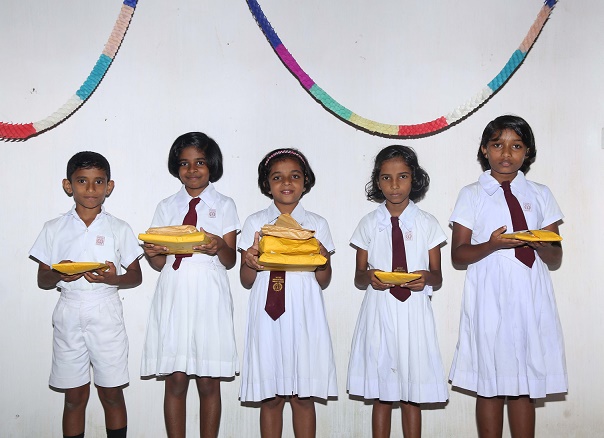
මෙවර 5 ශ්‍රේණිය ශිෂ්‍යත්ව විභාගයේ ප්‍රතිඵල අනුව කළුතර දිස්ත්‍රික්කයේ වලල්ලාවිට ප්‍රාදේශීය ලේකම් කොට්ඨාශයේ 849 – D බෝගොඩකන්ද ග්‍රාම නිලධාරී වසමේ නාවලකන්ද ග්‍රාමයේ  ඩී.වී. තීක්ෂණා තත්සරණි සමරසිංහ දියණිය ලකුණු 190  ක් ලබා  වලල්ලාවිට අධ්‍යාපන කොට්ඨාශයේ ප්‍රථම ස්ථානය හා මතුගම අධ්‍යාපන කලාපයේ දෙවන ස්ථානයත් හිමිකර ගැනීමට සමත් වූවාය. දේවිකා ලක්මාලි මහත්මියගේ සහ චමිල ප්‍රියන්ත සමරසිංහ මහතාගේ එකම දියණිය වන ඇය මීගහතැන්න ප්‍රාථමික විද්‍යාලයේ සිසුවියකි.

ඇය ජීවත් වන නාවලකන්ද ගම්මානය කළුතර දිස්ත්‍රික්කයේ කෙලවරක පිහිටි ඉතා දුෂ්කර ගම්මානයක් වන අතර අවශ්‍ය මූලික පොදු පහසුකම් පවා මෙම ගම්මානයට ලැබෙන්නේ ඉතා අඩුවෙනි. එවැනි දුෂ්කර පසුබිමක් තුල කුඩා දරුවන්ට තම අධ්‍යාපන කටයුතු කරගෙන යාමෙදී දැඩි බාධක එල්ලවීම සිදුවේ. නමුත් එම බාධා දුෂ්කරතා මැඩ ගනිමින් තීක්ෂණා තත්සරණි දියණිය ලැබූ ජයග්‍රහණය මෙම ප්‍රදේශයේ සිසුවෙක් මෙතෙක් ලැබූ ඉහලම ජයග්‍රහණයයි.

මෙවන් ජයග්‍රහණයක් ලබමින් මීගහතැන්න ප්‍රාථමික විද්‍යාලයට නාවලකන්ද ගම්මානයට ඇය ගෙන ආ ගෞරවය වෙනුවෙන් උපහාර පිදීමේ උළෙලක් 2018.10.24 දින නාවලකන්ද, ජම්බුගහහේන ප්‍රජා ශාලාවේදී ිපැවැත්විණි. ගම්වාසීන්ගේ අනුග්‍රහය සමගින් සමනල යෞවන සමාජය සහ රන්තරු ළමා සමාජය විසින් සංවිධානය කල මෙම උපහාර උළෙල 849 D බෝගොඩකන්ද ග්‍රාම නිලධාරී දිමුතු හොරවල විතාන මහතාගේ සහ වළල්ලාවිට හිටපු ප්‍රාදේශීය සභා මන්ත්‍රී ජයසේන මල්ලවාරච්චි මහතාගේ ප්‍රධානත්වය සමගින් ප්‍රදේශවාසී විශාල පිරිසකගේ සහභාගීත්වයෙන් පැවති අතර  ප්‍රථම ස්ථානය දිනාගත් තීක්ෂණා තත්සරණි සමරසිංහ දියණිය ඇතූළුව මෙවර ශිෂ්‍යත්ව විභාගයට පෙනී සිටි ප්‍රදේශයේ අනෙක් දරු දැරියන් ඇගයීමද මෙහිදී සිදුකරන ලදි.

දැඩි කැපවීමක් සිදුකරමින් තීක්ෂණා තත්සරණි සමරසිංහ දියණිය ලැබූ ජයග්‍රහණය සියළුම සිසු දරු දැරියන්ට ආදර්ශයක් බව එම ඇගයීමේි උළෙලට සහභාගීවූ සියළු දෙනාගේ අදහස වූ අතර එවන් දරුවන් දිරිමත් කිරීම වෙනුවෙන් මෙවැනි උපහාර උළෙලක් සංවිධානය කිරීම පිළිබඳව සමනල යෞවන සමාජය සහ රන්තරු ළමා සමාජයට සියළු දෙනාගේ ස්තුතිය හිමි විය යුතු බවද ප්‍රකාශ විය.

පේශල පසන් කරුණාරත්න

සභාපති

සමනල යෞවන සමාජය

නාවලකන්ද, මීගහතැන්න

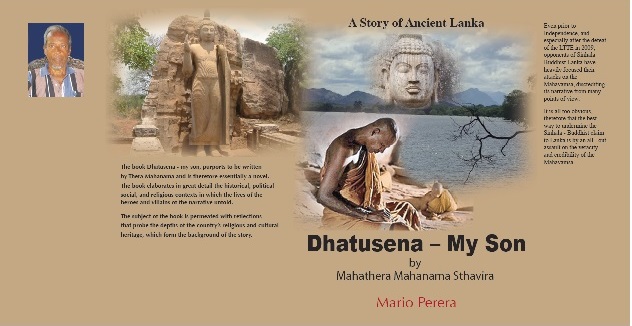
A Story of Ancient Lanka -Dhatusena – My Son by Mahathera Mahanama Sthavira – Mario Perera

October 25th, 2018

The book Dhatusena – my son, purports to be written by Thera Mahanama and is therefore essentially a novel.
The book elaborates in great detail the historical, political social, and religious contexts in which the lives of the heroes and villains of the narrative unfold.
The subject of the book is permeated with reflections that probe the depths of the country’s religious and cultural heritage, which form the background of the story.

Even prior to Independence, and especially after the defeat of the LTTE in 2009, opponents of Sinhala Buddhist Lanka have heavily focused their attacks on the
Mahavamsa, discrediting its narrative from many points of view.
It is all too obvious, therefore that the best way to undermine the Sinhala – Buddhist claim to Lanka is by an all – out assault on the veracity and credibility of the
Mahavamsa.


PREFACE

By Juanita Perera, Ph.D University of Rochester, New York

Even prior to Independence, and especially after the defeat of the LTTE in 2009, opponents of Sinhala – Buddhist Lanka have heavily focused their attacks on the Mahavamsa, discrediting its narrative from many points of view. In this context it will be remembered that the first ever Sinhala – Tamil racial riots were provoked in 1939, as a result of Mr.G.G.Ponnambalam tearing into the Mahavamsa. The riots spread from Nawalapitiya to the East and up to Jaffna.

Recently the polemics around the same subject flared up once more, especially due to anti-Mahavamsa articles published on the Website of D.B.S. Jeyaraj. Northern political leaders themselves joined the fray, adding fuel to the fire with inflammatory declarations that fanned the flame. It is all too obvious, therefore that the best way to undermine the Sinhala – Buddhist claim to Lanka is by an all-out assault on the veracity and credibility of the Mahavamsa.

King Dhatusena who commissioned the writing of the Mahavamsa, has had a following in recent times among authors, writers, and cinematographers. Most noteworthy among such works is the television serial C Raja – Lion King of Jackson Anthony. The book Dhatusena – my son, purports to be written by Thera Mahanama and is therefore essentially a novel. The book elaborates in great detail the historical, political, social, and religious contexts in which the lives of the heroes and villains of the narrative unfold. The subject of the book is permeated with reflections that probe the depths of the country’s religious and cultural heritage, which form the background of the story.

This book is probably the most detailed work of its kind featuring three cornerstones of this country: Dhatusena, Mahanama, and the Fabulous Mahavamsa, the Great Chronicle of Glorious Lanka. The importance of this topic to Sri Lanka of today is unquestionable. Its relevance would seem even more important than before.

Former DIG Nalaka de Silva arrested by CID

October 25th, 2018

UPDATE: Former DIG Nalaka de Silva who was arrested by CID over VIP assassination allegations have been remanded until 7th November.

The former DIG was presented before the Fort Magistrate tonight (25) itself, following the arrest.

Former DIG Nalaka de Silva has been arrested by the Criminal Investigation Department (CID) a short while ago.

This morning (25), former DIG Nalaka de Silva arrived at the CID for the 5th day to record a statement on VIP assassination allegations.

DIG Nalaka de Silva, former Director of the Terrorism Investigation Division (TID), is currently under investigation in connection with an alleged conspiracy to assassinate the President and the former Defense Secretary.

He was previously summoned to the CID on 18th, 19th, 22nd and 23rd October to record statements on the same account and was interrogated by the CID for nearly 33 hours.

Director (Operations) of Anti-Corruption Movement, Namal Kumara, had last month uncovered information of the conspiracy and the alleged conversations that he had with former DIG Nalaka de Silva regarding the matter and other controversial topics.

The CID subsequently commenced investigations regarding the alleged conspiracy and has recorded statements from both Namal Kumara and the former DIG on multiple occasions.

Bitter mangoes

October 25th, 2018

Editorial Courtesy The Island


An elderly woman who has pleaded guilty to stealing 19 mangoes from her neighbour’s garden is to be sentenced by the Anuradhapura Magistrate’s Court shortly, according to a front-page news item we carried yesterday. Immediately below it was our lead story, which revealed an attempt by the Foreign Ministry to obfuscate the issue of the government’s failure to have former Central Bank Governor Arjuna Mahendran’s extradited from Singapore over the bond scams. These two reports shed light on why there has been a severe erosion of public faith in the judicial process.

The police continue to draw heavy flak for being inefficient. This criticism is unfair, in our book. Our guardians of the law easily compare with the best in the world where efficiency is concerned. They have hit headlines by swooping on schoolgirls for stealing small sums of money or a few coconuts. The problem, however, is that their high octane performance is conspicuous by its absence when the offenders happen to have links to the government in power.

The police—the CID, to be exact—will have a hard time, trying to explain why they have not considered the fraudulent acquisition of Treasury bonds as serious as the theft of mangoes, in dealing with suspects. The CID did not make an effort to arrest Mahendran or prevent him from leaving the country even after a presidential commission probe had exposed his involvement in the bond scams. The stable door having been kept wide open, an attempt is purportedly being made to bring back the horse that was allowed to bolt.

Meanwhile, it is up to Singapore to decide whether to send its citizen, Mahendran, here to stand trial, or not. If it does not, it will only be strengthening the hands of the critics of the Sri Lanka-Singapore Free Trade Agreement (SLSFTA). There is the danger of some Singaporean professionals who are to be brought here under the SLSFTA fleeing the country after committing serious offences a la Mahendran. If they do a Mahendran, Sri Lanka will just have to grin and bear it. The Opposition says Mahendran is one of architects of the SLSFTA. If so, he will jeopardise that pact by not coming here to face legal action against the bond scams.

The Sirisena-Wickremesinghe coalition vowed to restore the rule of law and depoliticise the legal and judicial processes. But, some people still remain too big to be caught. The police who usually go out of their way to have suspects remanded for petty thefts do not object to bail being granted to government MPs who are responsible for serious offences such as abductions and attempts to revive terrorism.

The Opposition claims it has lodged many complaints of bribery and corruption against some government grandees, but they have not been probed. The FCID (Financial Crimes Division) steers clear of ruling politicians and their cronies for obvious reasons. High speed trials are being conducted only against some Opposition big guns, accused of abusing power and public funds. Government politicians and their kith and kin are ‘more equal than others’ before the law.

The police have handled some accidents involving government politicians in such a way that a wag says the yahapalana ministers and MPs never get sozzled to the gills, much less ram their SUVs into wayside lampposts; it is the damned lampposts that get drunk, stand in wrong places and get knocked down by the squeaky clean government worthies!

The ordinary public has not benefited from Justitia remaining blindfolded; she cannot see her scales being tilted in favour of the powers that be. It looks as if the time had come for her to tear off the blindfold, see for herself what is happening and use her sword against those who meddle with the judicial process.

Namal Kumara alleges Minister Field Marshal Sarath Fonseka behind DIG Nalaka

October 25th, 2018

Courtesy The Daily Mirror

Anti-Corruption Force Operations Director Namal Kumara yesterday said that in his initial statement to the CID, he had mentioned that Minister Field Marshal Sarath Fonseka’s name and questioned whether Fonseka had got to know about it.

Addressing a media briefing at his home in Ampara, Namal Kumara alleged that Sarath Fonseka had close rapport with former DIG of the Terrorist Investigation Division (TID) Nalaka Silva.

In my first statement to the CID, I have revealed that Fonseka had close links with former DIG Nalaka de Silva. He (Fonseka) was not aware of the secret statement, which I gave to CID about him,” he said.

Several times Sarath Fonseka spoke about me and threatened to expose me. I would say that Fonseka and several others are behind this case. I believe the President will pay attention in this regard,” he said.

Namal Kumara said he was ready to reveal more details in this regard to the President if  asked.

Giving proper place to Buddhism is govt.’s responsibility – Mahinda

October 25th, 2018

Former President Mahinda Rajapaksa says that it is the responsibility of the government to give the proper place to Buddhism.

He mentioned this to the media following an event held in Ambalangoda.

Through the 20th Amendment to the Constitution the status and the protection of Buddhism is being removed, Rajapaksa said.

Meanwhile the government is attempting to wash off its hands of the responsibility of nurturing Buddhism, he further said.

Sri Lanka’s pristine coastline is ripe for exploring like Bali 30 years ago

October 25th, 2018

By Jeremy Drake/www.escape.com.au

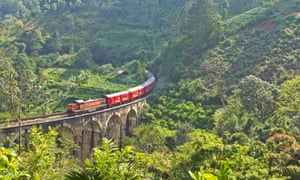
Meandering the Sri Lankan coast by tuktuk is a 30-year throwback to the way Australians once traveled the empty beaches of Bali and Thailand. When rock band Cinderella’s power ballad, Don’t Know What You Got (Till It’s Gone), reached the top of the charts in 1988, Phuket and Kuta were palm-fringed beaches with cheap drinks, world-class surfing and fresh seafood curries.

Times have changed in these parts of South-East Asia but in 2018, by a combination of both luck and misfortune, Sri Lanka still offers a glimpse into a pristine and unspoiled coastline that’s ripe for exploring.

Sri Lanka’s pristine coastline is ripe for exploring like Bali 30 years ago

Sri Lanka is nestled like a jewel that has been delicately placed by hand in the middle of the Indian Ocean. Needless to say the country has endured more than its fair share of tragedy over the past century — a sharp exit by its British colonialists, a civil war that ripped apart the north and south for over two decades and the 2004 tsunami which ravaged the coastline and killed more than 30,000 people. But these defining moments in history are the key reasons why Sri Lanka’s tourism industry is only now hitting its stride.

GETTING AROUND

Tourists are generally told to hop between their destinations by private taxi to save on travel times. Trains can be busy and notoriously late (albeit picturesque) and travelling by bus in Sri Lanka is akin to a game of Russian roulette. With this in mind, we chose a more quintessential mode of transport — tuktuk. We hopped between beach towns and even the bigger cities by hiring a driver in each new location. If we found one we liked, we had him re-collect us for the next leg of our journey. (There are no female tuktuk drivers in Sri Lanka.)

But much like their road rules, their pricing structures are flexible.

There are standardised prices between popular destinations such as Hikkaduwa to Galle (this keeps tourists from bartering too hard) but as a general rule you can estimate your ride at about 40-60 Sri Lankan rupee a kilometre (or about 50c). Don’t be fooled by a driver who won’t negotiate a price upfront and never let them argue an agreed fare.

Long-distance travel by tuktuk is not for the faint-hearted. Be prepared for a slightly more uncomfortable and sometimes white-knuckled way of experiencing the countryside, its people and its culture. But the best thing about travelling this way is that it offers that distinct smell of adventure, the unmissable aroma of salt, petrol fumes and grilled seafood.

Weligama Bay

WHEN TO GO

The southwest and east coasts are separated by two different seasons. In the west, the best weather is between late November and April. The east coast comes into its own from April to September when the rest of the island is under monsoon. The weather is where their differences end. Across both coasts there’s a shared value in the way Sri Lankans communicate and relate with foreign tourists. There’s a warmness, openness, trust and a desire to help or appease instead of fleece or take advantage.

On both coasts, time also has no meaning. It’s almost elastic. The only thing you can do is embrace this. It comes with the territory and an endearing reminder of why the coastline is still so laid-back.

It’s certainly not too late to discover the beaches of Sri Lanka and if you’re thinking of doing it in a tuktuk, hang on and enjoy the ride.

FIVE COASTAL SECRETS

Here’s an insider’s guide on avoiding the crowds, where to eat and where to stay on both coasts.

  1. Narigama

For your first stop be sure to skip the more well-known and busier village of Hikkaduwa, 110km south of Colombo, and head a mere 5km further south to Narigama Beach.

A beautiful stretch of sand, Narigama is tucked away from the hustle and bustle. Guesthouses and more modest accommodation push out onto the sand like gentle tree roots searching for water, while quiet restaurants and bars dot the shoreline offering up one of the best sunset views in Sri Lanka.

Surfing in Narigama beach

Neela’s Guesthouse is the perfect escape (ask for the penthouse on arrival). Top Secret and Funky De Bar are your two go-to sunset watering holes for a cool afternoon drink.

  1. Galle

The historic fortress town of Galle has been touched by its fair share of marauding colonialists. First the Portuguese, followed by the Dutch and rounded off by the British in 1796, Galle is one of those destinations during peak season that people will tell you to just do a day trip”. But to avoid a stay in Galle is like not visiting the Colosseum when in Rome. The city is an ancient, cultural melting pot of architecture and religion and this is reflected in its accommodation choices, its food and people.

Galle Fort sits perched and proud on its rocky peninsula and has been increasingly fortified over the years. A UNESCO World Heritage site, the fort’s bastions make for incredible exploring, best done in the late afternoon to avoid the heat and to catch a breeze off the Indian Ocean. Shanjei, a former advertising exec, runs history tours and helps decode the fort’s magic and the mystery. For food, head to Hoppa or Lucky Fort, which also runs cooking classes.

For overnight stays, Galle Fort Hotel is like sleeping in a history book. More affordable, Stairway Guesthouse is a breathtaking, single-room Dutch colonial villa.

  1. Gurubebila

Gurubebila is a picturesque and idyllic village located just before Weligama Bay and is a hidden alternative to the now popular and overcrowded Mirissa. Guesthouses and a single hotel are set around a vibrant village green peppered with palm trees and local cows — which make for complex fielding obstacles at a ritualistic Thursday night cricket match between locals. Two beginner-to-intermediate reef surf breaks in Gurubebila — Coconuts and Plantations — can be navigated safely with famous local guide, Lucky, who has surfed the area for 30 years.

Boutique hotel Lion’s Rest has a pool and in-house daily yoga, making it a relaxing spot in this fishing village.

  1. Hiriketiya

While the original shine of this horseshoe-shaped hideaway may be waning, it’s still unmissable in a self-guided tuktuk safari. With its distinct and authentic beach village atmosphere if you pick the right time during monsoon, it’s not unusual to have this paradise all to yourself.

Blue Beach has one of the best beginner surf waves on the island. Hiriketiya is a haven for relaxation. There’s the opportunity to dissolve with a book into one of the many modern and up-market beach cafes, such as the newly constructed Grove Lanka. The natural geographical challenges of Hiriketiya’s size make it a location that will be kept free from overdevelopment and tourism growing pains for years to come.

  1. Arugam Bay
It;s fun on the shore

The popular east coast surf town of Arugam Bay is a sleepy, laid-back and hammock-swinging town. On the southwest coast, fishermen have been forced off many beaches to make way for tourist sun beds — but not in Arugam Bay. Depending on the season, there’s a wave for everyone.

The prevalence of Islamic cultural and food influence in the town is indicative of this part of the country. Accommodation choice are varied but Rocco’s is a breathtaking new resort right on the shoreline.

For those looking for wildlife, here’s a tip: a 30-minute tuktuk return trip down to Panama Village before dusk will bring you face-to-face with wild elephants, without need for any safari.

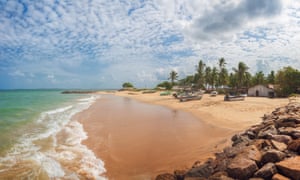
(The featured image at the top is that of Thalpe beach)

A Bouquet to our National Hospital

October 24th, 2018

Garvin Karunaratne

On 23 rd August 2018,  a relation of mine who was unconscious was discharged from a leading Private Hospital in Colombo., because the son and daughter  could no more pay hospital bills They had paid three million rupees to the Hospital  for 17 days stay and had no more funds. Until then they had often graced Private Hospitals.  We  in London were very sad. Everyone expected the worst. The  patient who was not unconscious when admitted, said to be suffering from Viral Flue, diagnosed later  as pneumonia,  even had a bout of heart failure and finally became unconscious.

They contacted the National Hospital in Colombo and explained their plight.  They had no other alternative. They were told that they were welcome to come in

At the National Hospital, the unconscious patient  was admitted to the Intensive Care Unit.. The doctors were very kind and prompt.  ..The doctors and nurses to a man nursed the patient. In a few days the patient recognized the son and daughter. Evidently the patient was out of danger and we in London rejoiced.  The Hospital  brought her around in  twenty six days all due to the care offered by the doctors, consultants and nurses. Consultants Bilshan and Manoj deserve to be congratulated for working beyond  the call of their duty caring for our dear relatives.

The patient was conscious, could talk sensibly and it was great to talk to her over the phone once again.

The patient was released, and asked to gain admission to the Rehabilitation Hospital at Ragama for physiotherapy.

However, though the National Hospital has been taken care of,  the Rehabilitation Center at Ragama where she was next  due to have been admitted for physiotherapy had seen bad days. She has been asked to come as an outpatient on four days a week. There are only some thirteen beds for women and this is all due to the fact that a building is yet under construction. I am told there are some fifty or so women patients who need close attention who have had to reside in nearby homes and become day patients.

It is hoped that the Ministry of Health will take some action- at least to get a temporary donation of a tent from the Army, where more beds can be accommodated till the buildings can be constructed. I hope this request will reach the ears of our Minister or our Hon President.

Many thanks to our National Hospital and its able staff.

Garvin Karunaratne

24/10/18

ජනාධිපති ඝාතන කුමන්ත‍්‍රණය පසුපස ඇමති සරත් ෆොන්සේකා.. නාමල් කුමාරගෙන් රහස් පොලීසියට රහස් ප‍්‍රකාශයක්…

October 24th, 2018

 lanka C news

නියෝජ්‍ය පොලිස්පති නාලක සිල්වා සමගින් දේශපාලනික වශයෙන් ලගම හිතවත්කමක් පවත්වන පුද්ගලයා ඇමති සරත් ෆොන්සේකා යයි තමන් අපරාධ පරීක්‍ෂණ දෙපාර්තමේන්තුවට ලබා දුන් මුල් කට උත්තරයේ සදහන් කරන ලද බව දුෂණ විරෝධී බලකායේ අධ්‍යක්‍ෂ නාමල් කුමාර මහතා සදහන් කරයි.

අද වන විට සරත් ෆොන්සේකා මහතා කරන ප‍්‍රකාශයන්ගෙන් එම ප‍්‍රකාශයේ සත්‍යතාවය තහවුරු වෙමින් ඇතැයිද ඔහු සදහන් කරයි.

‘මේ කේස් එකේ පිටිපස්සේ ඉන්නේ සරත් ෆොන්සේකා මහතා සහ තවත් පිරිසක්’ යයිද ඔහු සදහන් කලේ විශේෂ මාධ්‍ය හමුවක් පවත්වමිනි.

ජනාධිපතිවරයා හා හිටපු ආරක්‍ෂක ලේකම්වරයා ඝාතනය කිරීමට නියෝජ්‍ය පොලිස්පති නාලකද සිල්වා කුමන්ත‍්‍රණය කලේ යයි නාමල් කුමාර මහතා විසින් කරන ලද චෝදනාවක් මත ඔහු විසින් රහස් පොලීසියට ප‍්‍රකාශ ලබා දී ඇත.

ඔහුගේ අද මාධ්‍ය හමුව අනුව ජනාධිපති හා හිටපු ආරක්‍ෂක ලේකම් ඝාතන කුමන්ත‍්‍රණය පසුපස සිටින්නේ සරත් ෆොන්සේකා ඇමතිවරයා හා තවත් පිරිසක් යයි කියැවෙයි.

Is compensating terrorists justifiable? – Gotabaya

October 24th, 2018

Former Defense Secretary Gotabaya Rajapaksa questions the whether it is justifiable to compensate LTTE terrorists.

He mentioned this to the media following an event held in Colombo. The event was attended by former President Mahinda Rajapaksa as well.

Former Defense Secretary points out that when compensating missing persons, the government will have to compensate a suicide bomber who also had disappeared.

Sri Lanka arrests navy officer over wartime murders

October 24th, 2018

 Courtesy Mail Online 

Police said the victims, both from the Tamil minority group, were kidnapped by naval officers and later killed despite their families paying a ransom for their release

Sri Lankan police arrested and charged a senior naval officer Wednesday for the abduction and murder of two Tamil businessmen during the final stages of the island’s brutal civil war.

Lieutenant Commander K. A. Dayananda was taken before a magistrate and remanded in custody over the double murder, which investigators believe took place in January 2009.

Police said the victims, both from the Tamil minority group, were kidnapped by naval officers and later killed despite their families paying a ransom for their release

Police said the victims, both from the Tamil minority group, were kidnapped by naval officers and later killed despite their families paying a ransom for their release.

“The vehicle of the two victims was taken to Welisara navy camp on the pretext that it contained a bomb,” a police official told AFP.

“Later, they dismantled the vehicle and sold the parts after having killed the two men.”

Sri Lanka is investigating the disappearance and presumed murder of 11 young men between 2008 and 2009 in the dying days of the 37-year civil war between government forces and Tamil separatists.

Several navy officers are currently on bail in connection with the alleged disappearances. The missing men are believed to have been murdered before the brutal conflict ended in 2009.

Senior military figures and close associates of former strongman president Mahinda Rajapakse have been accused of murders, cover-ups and extortion during his decade of rule.

Several intelligence officers have also been released on bail for charges related to the assassination of a prominent newspaper editor and attacks on other journalists and dissidents.

The January 2009 killing of journalist Lasantha Wickrematunga, a fierce critic of then-president Rajapakse, sparked international outcry and shone a light on human rights violations in Sri Lanka.

Wickrematunga had accused Rajapakse’s defence secretary and brother Gotabhaya of taking kickbacks in arms purchases, and was due to testify in court when he was murdered.

Gotabhaya Rajapakse has denied running death squads.

The Rajapakses are under investigation for large-scale financial fraud and murder during Mahinda’s presidency, which ended in 2015.

Mahavamsa : 2500-year history of  heroic Sinhalay people mellowed by humanity

October 24th, 2018

By Rohana R. Wasala Courtesy: The Daily Mirror

The  Mahavamsa or The Great Chronicle of Ceylon (to use the title of the English translation by Wilhelm Geiger of the ancient classic) is a book of history in the form of a poem in the Pali language composed by a Bhikkhu named Mahanama at Anuradhapura around the latter part of the 5th or the beginning of the 6th century CE (Common Era). This work was commissioned by King Dhatusena (c. 460 -478 CE). Professor Wilhelm Geiger translated into German his own revised critical edition of the Pali original, which had been published in 1908. He added an introduction, appendices and notes to the German version. Mabel Haynes Bode put Geiger’s German translation into English. Professor Geiger then revised Mrs Bode’s English translation. Geiger’s  Mahavamsa  is in prose. Its first edition, prepared by T.W.Rhys Davids , was published in 1912.

There are several other translations of the Mahavamsa produced before and after this date by  local and foreign scholars such as George Turnour (1837), L.C. Wijesinghe (1889), and Ananda W.P. Guruge (1989), to name some of them. My personal opinion as a lay reader is that the local Sinhalese translators of the book are better guides to its meaning than European oriental scholars because of the formers’ natural cultural affinity with the work and their intuitive attunement to its broad communicative frequency; and it is a fact that visiting European scholars were automatically inclined to consider themselves as being in the intellectual vanguard of those colonizing powers, who hypocritically believed that they were bearing the so-called ‘white man’s burden’ of forcing European civilizational values on them. Naturally, such scholars were reluctant to acknowledge the actual cultural superiority of the Sinhalese that they wanted to ‘civilize’. However, among them Geiger could be an exception. He betrays little evidence of any ‘orientalist’ prejudice (defined by Edward Said in his 1978 book ‘Orientalism’) against the Sinhalese whose ancient cultural-historical classic he tried to interpret.

It was fortunate for us that Western scholars such as Geiger and Rhys Davids tried to understand our history and culture reasonably free from preconceived notions of their own superiority over the ‘natives’ usually prevalent among imperialistic Europeans at that time. Apart from this, the Geiger translation is still the best known and the most commonly used one, particularly among foreign scholars interested in the island history; it is probably the most authentic English version of  The Great Chronicle done by any non-Sinhalese translator. This is the justification of my choice of the Geiger translation as the main source of this brief essay on the monumental work from a nonacademic ordinary reader’s point of view.

The Mahavamsa  is a cherished symbol of the national identity of the Sinhalese, the builders of the unique two and a half millennia old island civilization. Sri Lanka (known in history by an array of different names such as Sivhela/Sihela/Sinhale, Serendib/Swarnadipa, Rathnadeepa, etc) abounds in the ruins of ancient monuments and also restored edifices that bear testimony to that unbroken island-wide historical achievement. There is no evidence of any other independent parallel civilization having evolved within its boundaries. The Mahavamsa gives the Sinhalese a feeling of continuity of nationhood. The danger of the Mahavamsa becoming an unnecessary casualty of ethnic politics is real, but such a fate is something unthinkable for us as a race with a distinct history.

It is criticized by some because it does not  provide a historical precedent that might support  their unjust political claims. Some others treat it with contempt claiming that it divides the Sri Lankans. The truth is that the Mahavamsa refers to the close links that existed between Lanka and India in propitious circumstances in early times, which should actually unite rather than divide different races. Then there are  those  ‘enlightened’ individuals who just cannot  tolerate even the mention of the legitimate claims of the Sinhalese! They are racists who, nevertheless, have no qualms about sticking the label on their victims, the Sinhalese.

The Mahavamsa is a serious book of history, though it was composed at least one thousand five hundred years before modern concepts of historiography evolved. Bhikkhu Mahanama, the author, at the very opening relates himself to the existing historical literature and popular traditions thus: “That (Mahavamsa) which was compiled by the ancient (sages) was here too long drawn out and there too closely knit; and contained many repetitions. Attend ye now to this (Mahavamsa) that is free from such faults, easy to understand and remember, arousing serene joy and emotion and handed down (to us) by tradition, – (attend ye to it) while that ye call up serene joy and emotion (in you) at passages that awaken serene joy and emotion.” Mahanama’s Mahavamsa comes to a conclusion in Chapter 37, which deals with the reign of King Mahasena (c. 325 – 352 CE).

The subject of the Mahavamsa  is  the early phase of the history of the Sinhalese race and that of the establishment of the Buddhist faith in the island. But the Mahavamsa was later continued up to the end of the 18th century by different authors at different times (in the form of the Culavamsa) The Culavamsa  opens in the middle of the 37th chapter where the earlier Mahavamsa came to an abrupt end, and completes the 101th chapter which ends thus: “After they had brought the King, the torturer of his people, to the opposite coast the Ingirisi by name seized the whole kingdom” (i.e. the British took possession of the whole island with the capture of the last king of Sinhale Sri Wickrema Rajasinghe in 1815). The Mahavamsa  has been updated since, and now comprises the whole history of the island to date. So the sixth century Mahavamsa covers roughly the first eight hundred years of the island  civilization since the legendary Vijaya, which period ended about one hundred and fifty years before the reconstruction of its history by Mahanama.

It is appropriate to consider against this background where we are at present in our understanding of our history as a nation (a group of people occupying a specific geographical space, speaking a unique language and generally identified with one spiritual tradition). Today, we have a more national minded generation of local archaeologists and historiographers than before who are free from the enslaving influence of orientalist prejudices of the past, and who are inspired by a sense of  ‘apekame’ (lit. usness) or national pride. Their researches are breaking new ground in the field. For example, the findings of foreign and locally trained archaeologists Drs Shiran Deraniyagala (e.g., relicts of a pre-Vijayan civilization found in excavations in the inner city of Anuradhapura) and Raj Somadeva (objects dug up and rock inscriptions deciphered at many places across the island including Kuragala, Welmeethalawa, and Kegalle, and a gold sheet writing discovered at Vallipuram in Jaffna, for instance) prove beyond doubt that the Sinhalese have a much longer and a more glorious history than that celebrated in the Mahavamsa. Such successful challenges to the authority of the Mahavamsa represent a tribute to its avowed commitment to the elimination of defects found in earlier treatises such as the Dipawansa, which it uses as its sources.

The pre-Vijayan culture predates Vijaya by at least three centuries. Somadeva’s findings (pieces of pottery, bone ornaments, iron implements, clay receptacles found at burial/cremation sites, etc which are signs of a sophisticated culture) have been determined to be over 4350 years through radiocarbon dating. The important thing to mark here is that this culture was independent of any foreign (that is, Indian or other) influence, unlike the Sinhala Buddhist civilization historicized by the Mahavamsa narrative. The brightening prospects of revealing these more ancient historical roots of the Sinhalese (according to Somadeva these could be as old as 6000 years) should not be seen as an emergent threat to the status of the Mahavamsa as the incomparable national monument it is. It only proves that the Sinhalese were heir to a much older, and certainly more advanced civilization than the Mahavamsa author dared to credit them with. The unlocking of the ancient secrets of our history through the use of technologies that are the most advanced to date will be in the interest of not only the Sinhalese and the minorities that make Sri Lanka their common home, but also of the whole of humanity.

The grand purpose of the Mahavamsa author’s whole endeavour was, after all, to compile this history “…for the serene joy and emotion of the pious”, (as the less than ideal English rendering of the original Pali phrase tells us). The book is intended to generate ‘serene joy and emotion’ in the pious. Each chapter  of the Mahavamsa and its sequel the Culavamsa ends with the postscript “Here ends the … chapter, called ‘…….’, in the Mahavamsa, compiled for the serene joy and emotion  of the pious”. (Prof. Geiger glosses the two terms pasada (serene joy) and samvega (emotion) thus: ‘Pasada signifies the feeling of blissfulness, joy and satisfaction in the doctrine of the Buddha, samvega the feeling of horror and recoil from the world and its misery’. This historic monument must be cherished for its humanity as much as for its value as a historical document. It is this noble culture of humanity inspired by Theravada Buddhism that made Sri Lanka a secure home for diverse minorities living in harmony with the majority Sinhalese. Suppressing it is not the way to bring about communal harmony in the land.

Psychological Ailment of Tamil Politicians

October 24th, 2018

Kanthar Balanathan

On independence, GG Ponnambalam became a minister in the Ceylon government. It is to be said that GGP earned his income through his excellent practice in criminal law. SJVC formed the Federal Party joined with several people. For SJVC funds flowed from Malaysia his mother country where he was born. Once they become politicians somehow, they tend to introduce malpractices to earn money. Poor voters without realizing the consequences help people to get jobs, through which Tamil politicians earn money. The author is a Tamil from Vaddukoddai and a nephew of a great medical expert who knew the malpractices of the Tamil politicians. Tamils right from a coolie to the minister had no obligation to be a SriLankan patriot. At KKS cement Officers misused corporation vehicles, tradesmen stole lots of technical items, and most of them were recycled through shops in Jaffna. Tamil Storekeepers were responsible for these corrupt practices. Right from electric bulbs to cables, bearings, and relays etc. were recycled through shops in Jaffna. Executives who try to expose these corrupt practices were threatened by the Coolie gangsters. Therefore, most of Tamil community was/is a corrupt race. It is definite that Prabakaran siphoned explosives from the magazine at cement for his use. Any executive who talks about this was told that it is not his duty to catch a thief and further, it is government property. LTTE damaged transmission towers to make use of the steel and the ancillaries. This is the true history of Tamils in the North.

My intent is to bring out all of the hidden characters of the Tamils.

Ananthi wanted to be a minister. What is the intention? She knows that it will pave the way to accrue wealth. Going through the media readers: please visit this page. Ref: (i) https://www.jvpnews.com/srilanka/04/168361,  (ii) http://www.newjaffna.com/news/14376. If Ananthi wanted to serve the people she could do so without being a minister.

It is a presumption to state that any minister earns money through illegal ways. Ananthi was sworn in on the 29th June 2017. What did she sacrifice for the Tamils? In my view – NONE. Sasitharan AKN Elilan was to be assassinated on the order of V. Prabakaran and he (Sasitharan) went shrouded before the war. Ananthi is/was his wife.

In October 2018 Ananthi has floated a political party. It is called: (ஈழத்தமிழர் சுயாட்சிக் கழகம்) Well the basic translation is: Eelam Tamils Autonomous Corporation. Ananthi; where is this Eelam? Is it buried under the Indian Ocean where your paternal fathers and mothers are? Come to the real world. Do you know about INCARS, red Indians etc. They were the power of the world several thousands of years ago. They all speak English now and live in Americas.the  You  are no different to the red Indians. Some resemblance of the R. Indians. Read the history of Peru, Chilli, Venus vela etc in the S. Americas. Some of you are mentals going in circles shouting Eelam. Where do you think it will take you and your mental mates? CVV is another mental case. Wonder how he got his CJ position?

Well, we knew from the natural characteristics of the Tamils, that when CVV appointed Ananthi as a minister, it was a conspiracy planned to form a party in due course and float funds for such activity. First, he blew up the political situation by floating a congress. Appointed you as a minister and forced you to form a party. The other person is the Terrorist brother, K. Sarveswaran as the minister for education, where money can be siphoned from people. Now Ananthi will be the Secretary-General of ESK (it can only laugh off) and CVV will suck Ananthi and at some stage, it will collapse or merge with TNA. Tamils in the North should understand this strategy.

The main issue here is the character of CV Vigneswaran. How did CVV get his Chief Justice position? Is it by intelligence and/or competency in Law? Or being a relation of Arunachalam? Can he be compared to the former Chief Justice Sriskantharajah? It looks like in his old age, he is acting as if he is suffering from the psychological or bipolar disorder. He has no intention of engaging people in economic and technological development but only accrue power and authority. The main issue here could be attributed to the Tamil Diaspora in the UK forcing him to do things which are outside the norm.

Mr. CVV. A question was thrown to you: What is your IQ score?

To Ananthi- Do you know what IQ score means, and if so, what is your IQ level. Please explain: What has your so-called husband Sasitharan (Elilan)done to the Tamil people?

(Do not assume that IQ means your political crudeness, wickedness or cunningness)

Mr. CVV: Please understand that building a Buddhist temple in the North is the democratic right of the citizens of SL. So many Tamils in Tamil Nadu are Buddhists and in Jaffna will like to pray Buddha.

Basically, with the current illegitimate Opposition and government, you are able to maneuver your way in funding your coffer.

Karuna is able to stand himself as the fifth richest person in SL. Ref: https://www.jvpnews.com/politics/04/163049

Well, the question is he was the commandant for the Eastern province for the LTTE. Apart from that position, is he an engineer, doctor, Architect, or did he do business to earn such 1.7 million US$? The fellow cannot even speak English. He is a murderer and has catchers all over the world with his Ferric Oxide coated money.

The fun part is people think he is an excellent/good politician. The idiocy should be passed onto  Ranil Wickramasinghe and his team to have brought such a killer into politics without realizing the consequences of such an act. The downfall of MR was due to Mervin Silva, Vaas Gunawardane and some untrustworthy people. The downfall of Sirisena and Ranil will be as a consequence of appointing TNA as the opposition and giving into them. Ie being submissive to the TNA.

In the real world is this true governance? It looks like some villagers with lack of education, and most of all lack of intelligence governing a country. All these political imbecilic clowns in SL, visit foreign countries. Why cannot these wags study the system there? Maybe they are governing imbecilic foolish public. If the Jaffna man is supporting Ananthi and CVV, it cannot be ruled out that the public are fools and illiterates.

You cannot be compared to MA Sumanthiran on any functional cerebral capabilities. MAS is a much superior intellect than any of the NPC politicians. Both must read on political science.

The NPC, on the whole, is manned by such people.

The Sinhala politicians are not better, but corrupt unpatriotic foes to the country.

පළාත් සභා ඡන්ද විමසීම හැකි ඉක්මනින් පවත්වන ලෙස ඉල්ලා ප්‍රාදේශිය සභා, නගර සභා, මහ නගර සභාවන්හි යෝජනා සම්මත කර ගන්නා ලෙස කැෆේ සංවිධානය ගරු මන්ත්‍රීවරුන්ගෙන් ඉල්ලයි. 

October 24th, 2018

මාධ්‍ය ඒකකය කැෆේ සංවිධානය 

ආණ්ඩුකාරවරුන්ගේ පාලනයට යටතට පත් කොට ඇති ලංකාවේ පළාත් සභා 9 න් 6 ක හැකි ඉක්මනින් පළාත් සභා ඡන්දය පවත්වන ලෙස ඉල්ලා යෝජනා සම්මත කොට ගන්නා ලෙස කැෆේ සංවිධානය අද සබරගමුව, උතුරු මැද, නැගෙනහිර, වයඹ, මධ්‍ය හා උතුරු පළාත් හි සියළුම පළාත් පාලන ආයතන නියෝජිතවරුන්ගෙන් විවෘත ඉල්ලීමක් සිදු කළේය. 

ආණ්ඩුකාර පාලනය යටතේ පළාත් සභා පැවතීම ඒකාධිපති ව්‍යවහාරයක් බවත්,  හැකි ඉක්මනින් පළාත් සභා ඡන්දය පවත්වා මහජන නියෝජිතයින්ගෙන් සමන්විත පළාත් සභා ස්ථාපනය කිරීමට කටයුතු කරන ලෙස ත්, කැෆේ සංවිධානය යොමු කළ ලිපියේ දැක්වේ.  

එම ලිපිය මේ සමග අමුණා ඇත.>
2018.10.24     

ගරු සභාපතිතුමනි/සභාපතිතුමියනි,

ගරු විපක්ෂනායකවරුනි,

ගරු මන්ත්‍රීතුමනි/මන්ත්‍රීතුමියනි,

 පළාත් සභා ඡන්ද විමසීම පවත්වන ලෙස යෝජනාවක් සම්මත කර ගන්නා ලෙස ඉල්ලීමයි

ලංකාවේ පළාත් සභා 9 න් 6 ක් මේ වන විට මහජන නියෝජිතයින් නොමැතිව ආණ්ඩුකාර/නිලධාරි පාලනයට යටත් කොට ඇති අතර, ඔබගේ පළාත් පාලන ආයතනයේ අධීක්ෂණ කාර්යය ද පැවරී ඇත්තේ එවැනි  කාලය ඉකුත් වූ පළාත් සභාවකට බව ඔබ හොදින් දනී.  

මැතිවරණ කොමිෂන් සභාවේ ගරු සභාපති මහින්ද දේශප්‍රිය මහතා, ඉතා නිවැරදිව ප්‍ර‍කාශ කොට ඇති පරිදි ආණ්ඩුකාර/නිලධාරි පාලනය ඒකාධිපති පාලනයකි.  ඔබ ගේ පලාත් පාලනය ආයතනය ප්‍රජාතන්ත්‍ර‍වාදී නොවන ඒකාධිපති පාලනයක අධීක්ෂණය යටතේ පැවතීම කුමන අයුරකින් හෝ යහපත් ප්‍ර‍ජාතන්ත්‍ර‍වාදී ව්‍යවහාරයක් වන්නේ නැත.

අනෙක් අතට, පළාත් පාලන නියෝජිතයින් ලෙස පුද්ගලිකව ඔබට දේශපාලන ඉනිමගෙහි ඉහළට නැග යාම සදහා වන අවස්ථාව පළාත් සභා ඡන්දය කල් දැමීම තුල ඔබ සියළු දෙනාට අහිමි කොට තිබේ.  පලාත් පාලන ආයතනයන්ට මෙන්ම අනාගත පළාත් සභා ඡන්දයක දී, නාම යෝජනා සැකසීමේ දී කාන්තා අපේක්ෂිකාවන් ගේ නියෝජනය අනිවාර්ය කර ඇත.  ඔබ පලාත් පාලන ආයතනයේ නියෝජිතවරින් ලෙස ප්‍ර‍ශස්ත ලෙස කටයුතු කරන  කරන ගරු මන්ත්‍රීවරියන්ට, පළාත් මට්ටමින් දේශපාලනයට පිවිසීමේ අවස්ථාව ද ඡන්ද කල් දැමීම තුල අහිමි කොට ඇත.

පළාත් සභාවේ  විෂය කේෂ්ත්‍ර‍ට පළාත් පාලන ඇතුලත් ය.  මහජන නියෝජිතයින් විසින් පාලනය වන පළාත් සභාව දී ඔබගේ පලාත් පාලන ආයතනය සම්බන්ධයෙන් තීරණ ගැනීමේ ක්‍ර‍මවේදය වඩා ප්‍ර‍ජාතන්ත්‍ර‍වාදී වේ.  එහ සභාව නියෝජනය කරන දේශපාලන පක්ෂ සාකච්ඡාවට බදුන් කොට, විවාද කර එකගතාවන් ඇති කර සිදු කරන කාර්යයකි.  මහජන නියෝජිතයින් නොමැති පළාත් සභාවක එවැනි සමබර, තීරණ ගැනීමේ ක්‍රිමවේදයක් නොවන අතර පුද්ගලයෙකු හෝ කිහිප දෙනෙකුගේ අත්තනෝමතක තීරණයක් ගේ ගොදුරු බවට ඔබගේ ප්‍රාදේශීය සභාව, නගර සභාව, මහ නගර සභාව පත්විය හැකිය. විශේෂයෙන්ම ජාතික හෝ ප්‍රාදේශීය දේශපාලන නායකත්වයේ අවශ්‍යතාව මත පලාත් පාලන අයතනයන් හි නියෝජිතයින්, පළාත් පාලන ආයතනය පවා පීඩාවට ලක් විය හැකිය.  

ගරු මහජන නියෝජිතවරුනි,

නිදහස් හා සාධාරණ මැතිවරණ වෙනුවෙන් සක්‍රීය කාර්ය භාරයක් ඉටු කරන කැෆේ සංවිධානය ඔබතුමන්ලාගෙන්/ඔබතුමියලාගෙන් ඉතා ගෞරවයෙන් ඉල්ලා සිටින්නේ,

‘‘පළාත් සභා ඡන්ද විමසීම හැකි ඉක්මනින් පවත්වන ලෙසට ඔබගේ පලාත් පාලන ආයතනය විසින් ඉදිරි මහා සභා රැස්වීමේ දී යෝජනාවක් සම්මත කර ගන්නා ලෙසත්, ඒ බව, පළාත් ආණ්ඩුකාරවරුන්, ගරු පළාත් සභා සහ පළාත් පාලන අමාත්‍යවරයා, ගරු අග්‍රාමාත්‍යතුමා, ගරු ජනාධිපතිතුමා වෙත දැනුම්දීම සදහා සුදුසු පියවර ගන්නා ලෙසත්‘‘ ය.

දේශපාලන පක්ෂ භේදයකින් තොරව මෙවැනි යෝජනාවක් ඒකච්ඡන්දයෙන් ඔබගේ පලාත් පාලනය ආයතනය තුල සම්මතවීමට ඇති ඉඩ කඩ පිළිබද කැෆේ සංවිධානය දැඩි විශ්වාසය පළ කරයි. එසේ නොවේ නම්, පළාත් සභා ඡන්ද විමසීම පැවැත්වීමට විරෝධය පළ කරන දේශපාලන පක්ෂ සහ කණ්ඩායම් මෙම යෝජනාව මගින් අනාවරණය කරනු ඇත. එම ප්‍ර‍ජාතන්ත්‍ර‍වාදී මහජන නියෝජනයක් සහිත පළාත් සභාවක් ස්ථාපනය කිරීම සදහා අතිශයින් වැදගත් වනු ඇත. 

එමෙන්ම මෙම යෝජනාව ඉදිරිපත් කිරීම සදහා අදහස් කරන ගරු මන්ත්‍රීතුමන්ලා, මන්ත්‍රීතුමියන්ලාට යම් තාක්ෂණික උපදේශයක්, සහායක් අවශ්‍ය නම් එය ලබා දීමට ද කැෆේ සංවිධානය ඉතාමත් කැමැත්තෙන් සිටින බව ද, එවැනි සහායක් අවශ්‍ය නම් පුද්ගලිකවම 0777791225 දුරකතන අංකයෙන් මා අමතන ලෙස ද ඉල්ලමි.

නිදහස් හා සාධාරණ මැතිවරණයක් මගින් තෝරාපත් කර ගන්නා මහජන නියෝජිතයින්ගෙන් සමන්විත පළාත් සභාවක් ස්ථාපනය කිරීම සදහා ඔබගෙන් ලැබෙන දිරිගැන්වීම, සහාය  ඉතාමත් අගය කොට සලකමි.

මෙයට විශ්වාසී,


කීර්ති තෙන්නකෝන්

විධායක අධ්‍යක්ෂ/කැෆේ සංවිධානය


  1. පළාත් පාලන ආයතනයන් හි ලේකම්වරුන් වෙත – කරුණාකර මෙම ලිපිය ඔබ පළාත් පාලන ආයතනයේ සියළුම මහජන නියෝජිතවරුන්/නියෝජිතවරින් වෙත ලබාදීමට කටයුතු කරන ලෙස කාරුණිකව ඉල්ලමි.


Spousal battery

October 24th, 2018

Editorial Courtesy The Island

Thursday 25th October, 2018

The UNP-SLFP political marriage is on the rocks. They are bashing each other in public. What they are doing to each other may be likened to spousal battery, as it were. Internal problems of the yahapalana coalition have come to a head with the UNP and SLFP leaders clashing at Cabinet meetings. President Maithripala Sirisena has gone to the extent of calling upon the public to elect an honest politician as the next PM. Not to be outdone, the UNP undermines the President’s authority at every turn.

President Sirisena has directed his ire at the UNP apparently for two reasons. He is trying to assert himself vis-a-vis an aggressive UNP. It is also possible that he has chosen to take on the UNP to prevent a further erosion of the SLFP’s support base as his party’s rank and file are not well disposed towards the yahapalana coalition.

Sirisena succeeded in justifying his decision to join forces with the UNP in 2014 to secure the presidency. He praised the UNP to high heaven at Sirikotha, where he received a warm welcome and opened an election office, in Nov. 2014. Now, he is preparing the ground for deserting the UNP and taking swipes at it. He has gone on record as saying, at a recent public function, that today’s UNP is a far cry from the party founded by the late D. S. Senanayake. Nobody will buy into his claim that the UNP is not what he thought it to be, at the last presidential election. He, as the SLFP General Secretary, carried out numerous election campaigns against the UNP, which the SLFP used to vilify.

The President’s current view of the UNP is at variance with the sentiments he expressed in his famous Sirikotha speech in 2014; he spoke very highly of the founders of the UNP as well as its current leaders.

If Sirisena considers the UNP so bad, then it becomes clear that it was out of sheer expediency that he enabled that party to capture power in Jan. 2015 by sacking a strong government led by the SLFP, founded by the late S. W. R. D. Bandaranaike. He also engineered the SLFP-led UPFA’s defeat at a general election about seven months later so that the UNP could win. Under his stewardship, the SLFP coalesced with the UNP to form national governments twice.

President Sirisena must have realised that the UNP was as corrupt as any other political party when the first bond scam was committed a few weeks after the formation of the new UNP-SLFP government in Jan. 2015. The COPE (Committee on Public Enterprises) headed by D. E. W. Gunasekera revealed that scam, but the President dissolved Parliament before it was taken up for debate lest it should ruin the UNP’s chances of winning the August 2015 general election. He admitted, in an address to the nation, in the run-up to the polls that he had been aware of the bond scam. If his commitment to good governance had been genuine he should have allowed Parliament to debate the COPE report so that the people would be able to make an informed decision at the parliamentary polls. The Attorney General’s (AG’s) Department was prevented from prosecuting the perpetrators of the first bond scam and a file recommending legal action shelved. The file (No: C/187/161/2015) containing recommendations for criminal action was later turned into a confidential document (N0: CF/08/2015), recommending civil action and made to disappear.

If Parliament had debated the COPE report on the first bond scam and the AG’s Department had filed criminal action against the racketeers, the second bond racket would not have taken place in 2016; most of all, the then Central Bank Governor Arjuna Mahendran would not have been able to flee the country.

President Sirisena and the SLFP cannot absolve themselves of the responsibility for the yahapalana government’s malpractices which are legion, by bashing the UNP.

Singapore yet to respond to Lanka’s petition Extradition of Mahendran

October 24th, 2018

 By Shamindra Ferdinando Courtesy The Island

  • FM hides behind non-existing clause in the law
  •  Udayanga’s case coming up in Dubai on Oct. 29

The Foreign Ministry, on Tuesday (Oct. 23), declined to disclose information pertaining to ongoing efforts to extradite the former Governor of the Central Bank of Sri Lanka (CBSL) Arjuna Mahendran and former Ambassador in Moscow Udayanga Weeratunga, a non-career diplomat now in the custody of United Arab Emirates (UAE).

Senior Director General (Legal) C. A. H. M. Wijeratne, in his capacity as the Information Officer of the Ministry, said that they weren’t in a position to divulge information at this stage under Article 5 of the RTI (Right to Information Act) as the investigations were ongoing.

article_image

Wijeratne said so in response to the following queries The Island submitted to the Foreign Ministry on Oct 16, 2018 seeking information under RTI Act No 12 of 2016: The Attorney General’s Department recently made representations to Singapore seeking Singaporean Mahendran’s extradition over his alleged involvement in treasury bond scams perpetrated in 2015 and 2016.

The Island understands the Defence Ministry handed over the relevant extradition papers to the Foreign Ministry for onward transfer. The following are the questions (1) When did the Foreign Ministry receive extradition papers from the Defence Ministry (2)When did the Foreign Ministry send extradition papers to Sri Lankan embassy in Singapore (3) When did Sri Lankan embassy in Singapore hand over extradition papers to Singapore Foreign Ministry/relevant authorities (4) Did Singapore respond to Sri Lanka’s request?

In respect of Udayanga Weeratunga’s case now heard in the Federal Court of the UAE in Dubai

(1) Did Sri Lanka handover extradition papers in respect of former Ambassador to Russia? (2) What is the status of the proceedings?

Well informed sources told The Island that Weeratunga’s extradition case would be taken up next Monday (Oct.29) in the Federal Court of the UAE sitting in Abu Dhabi. Sri Lanka made an abortive bid to take charge of Weeratunga in early February this year soon after Weeratunga’s detention at the Dubai airport while in transit to the United States. Sources said that Sri Lanka had no option but to initiate costly legal proceedings there to secure Weeratunga’s custody.

Weeratunga, a close relative of former President Mahinda Rajapaksa, is wanted in connection with ongoing investigations into the acquisition of four MiG 27 fighter jets from Ukrainian arms company ‘Ukrinmash’ in 2006 and overhauling of four MiGs.

The Fort Magistrate issued summons on Weeratunga on July 15, 2016.

Sources said yesterday that Singapore hadn’t so far responded to the extradition papers submitted to the competent authorities there, in respect of Mahendran.

Legal sources told The Island that requests made in terms of the RTI Act No 12 of 2016 couldn’t be simply rejected citing Article 5 of the RTI Act. Sources said that the Foreign Ministry had referred to a non-existing Article 5 of the RTI Act instead of Section 5 (1) that dealt with the denial of access to information.

Responding to another query, sources said that information couldn’t be denied by simply citing the relevant section of the Act. In fact, The Island could now appeal to the Foreign Ministry seeking the specific reason the required information was denied. Sources said that the RTI Act provided for denial of information on the basis of 22 specific reasons and the person seeking disclosure had the right to know why his/her request couldn’t be granted.

Sources said that the RTI Commission intervention could be obtained in case the Foreign Ministry turned down the appeal or fail to respond within the stipulated 21 days.

Mahendran left the country close on the heels of Presidential Commission of Inquiry headed by Justice K.T. Chitrasiri handing over its report to President Maithripala Sirisena in late Dec 2017.

The Criminal Investigation Department (CID) arrested Mahendran’s son-in-law and owner of the Perpetual Treasuries Limited (PTL) Arjuna Aloysius and its CEO Kasun Palisena in early Feb this year in connection with treasury bond scams.

Sri Lanka still to hit on a sensible India policy

October 24th, 2018

Courtesy The Island

Prime Minister Ranil Wickremesinghe chats with Indian premier Narendra Modi during a meeting at Hyderabad House in New Delhi . Wickremesinghe was on a three-day official visit to the Indian capital.

It ought to be quite evident from the most recent controversies in Sri Lanka’s relations with India that the former is continuing to struggle to hit on an appropriate and sensible India policy. Indo-Sri Lanka ties have had their ups and downs over the decades but whether Sri Lanka has ever formulated and practised a far-seeing India policy since 1948 that would protect the legitimate interests of both countries is open to question. The proof of this is the recent discomfiture suffered by Sri Lanka over some completely unwarranted local comments alleging contemplated hostile action towards this country’s President by India’s Research and Analysis Wing.

The Sri Lankan government owes it to this country to lay bare the factual position in this latest controversy, considering its grave nature. What local investigations should come clean on is whether the Sri Lankan President ever accused RAW of attempting to assassinate him. If not, who is responsible for the canard? Needless to say, those responsible for this falsehood should be brought to justice, as the next step. Hopefully, the ‘air will be cleared’ on this unsettling development in this country’s ties with India before long.

article_image

There has been this huge drawback in Sri Lanka’s relations with India of Sri Lanka failing consistently to work in a friendly and constructive spirit with India. It is in this country’s best interests for it to be on the friendliest terms with India. This ought to be a cardinal core value in our India policy. It cannot be otherwise, because, in that case, Sri Lanka will be undermining her national interest.

Considering the highly destabilizing controversies that rock our relations with India every now and then, it ought to be clear that those sections that matter in Sri Lanka are yet to think through this country’s India policy comprehensively and clearly. That damaging rumours do originate in Sri Lanka concerning India in prominent local political circles is proof that important sections of this country’s polity are yet to place optimum value on this country maintaining trouble-free, cordial relations with India, in consideration of the pivotal importance of such ties to Sri Lanka’s national interest.

It is vitally important that local opinion do not in any way permit short term political interests to get in the way and damage this country’s relations with India. If this is continuing to happen, we have here conclusive evidence that thinking in depth on foreign policy issues is not among this country’s strong points. It seems as if talking and acting impulsively comes quite naturally to most local politicians and ‘opinion makers’. It ought to be clear that such proclivities are not in this country’s best interests.

The onus is on Sri Lanka to ensure that she is on the most cordial terms with India. This has to be a dominant strand of our regional policy in general and our India policy in particular. It cannot be otherwise because ‘getting along’ with India is a ‘must’ on account of Sri Lanka’s geographical location in particular. There is, obviously, nothing we could do about this hard reality that would never ‘go away’. It does not follow that Sri Lanka must be ‘subservient’ in any way to India but it is best that the closest neighbours get along on the friendliest of terms. One does not need to be a foreign policy expert to realize this. Common sense would suffice.

There was a time when security was a particularly sensitive issue in India-Sri Lanka relations. Security and defence continue to be principal factors in our ties with India but we have come a considerable distance from those times when the Panikkar Doctrine of Indian origin was a hotly debated topic in Indo-Lanka ties. That is, from that ‘discourse’ some years back when the idea that Sri Lanka comes within the Southern ‘defence perimeter’ of India was a particularly thorny issue. Sections in Sri Lanka were outraged by this notion then and it continues to be a revolting notion among some Southern ultra nationalist groups in Sri Lanka.

The international setting for the dominance of security and defence questions in Sri Lanka’s ties with India was the Cold War. But with the collapse of the Cold War, economics have tended to eclipse security and politics in our bilateral relations. And economics serve to stress the importance of Sri Lanka’s continued good relations with her closest neighbours, as never before.

Local Southern political circles in particular would do well to ponder on the ill consequences Sri Lanka would have to suffer if our current close economic and commercial ties with India are drastically undermined as a result of Indo-Lanka relations turning sour. They should realize that ‘not a shot would need to be fired’ on Sri Lanka if our relatively strong economic relations with India suffer setbacks on account of our politicians being unable to ‘guard their tongues’. A notable drop in our tourist traffic from India would suffice to drive home the point.

The need is great for Sri Lanka’s polity to look well beyond scoring ‘Brownie points’ in local political squabbles. Our considerably strong economic relations with India alone should convince local opinion that it is in Sri Lanka’s national interest to maintain and foster good relations with India. Cordial ties with India should be a principal and inviolable parameter of our India policy. Pragmatic economic considerations, if nothing else, dictate this policy line.

We would be touching on a sensitive issue by stating that there is a ‘primordial fear’ of India among some sections in Sri Lanka. This is most unfortunate and there is no better way to get over it other than by conducting cordial state-to-state relations coupled with increasingly better people-to-people ties. Bridge-building at all conceivable levels needs to be ongoing. And may there be more good will at the tip of Sri Lankan politicians’ tongues.

Sri Lanka calls for global coalition to tackle rising dollar

October 24th, 2018

Courtesy The Island

Colombo, Sri Lanka | AFP | Tuesday: Sri Lanka on Tuesday called for a “coalition of the willing” to help stabilise free-falling emerging market currencies around the globe, as the beleaguered rupee slumped to fresh lows.

The island’s currency bottomed out at a record-low 174.12 rupees to the dollar, resisting a slew of measures by policymakers to arrest its steady decline.

The rupee has shed more than 12 percent of its value this year and Sri Lanka fears it could slide further as US sanctions squeeze Iran, the island’s chief source of oil.

article_image

A stronger dollar has made it difficult for emerging markets to repay debts and battered global currencies from Turkey to India and Argentina.

Finance Minister Mangala Samaraweera invited those nations experiencing currency crises to visit Colombo and hash out a strategy.

“The rise of the dollar is having a serious impact on our currencies. We are not the only one affected,” he told reporters in the Sri Lankan capital.

“I want to build a coalition of the willing to deal with this problem. I don’t see the global situation improving any time soon.”

Washington pulled out of a landmark 2015 nuclear deal with Iran in May and has been reimposing punishing sanctions on the Islamic republic, targeting in particular its financial system.

Iran not only supplies Sri Lanka with most of its oil, but is one of its chief buyers of the island’s celebrated tea.

Samaraweera has warned that blockading Iran will have ripple on effects on Sri Lanka, which has been unable to stop the rupee from nose diving.

Last month, Colombo curbed its state institutions and public servants from importing cars to reduce the outflow of foreign capital.

Banks were also ordered to restrict lending for purchasing overseas and consumer goods, but the rupee has continued its decline.

In August, the government substantially increased taxes on small cars to discourage imports, but officials said there was still pressure on foreign exchange reserves to finance big-ticket imports.

In Lanka President Assassination Plot, Indian Suspect Says Being Framed

October 24th, 2018

Courtesy NDTV

Marceli Thomas appeared in court before the Colombo Fort magistrate on Tuesday.

An Indian national arrested for possible links to an alleged plot to assassinate Sri Lankan President Maithripala Sirisena has told a court that he is innocent saying the police are trying to frame him in the case.

Marceli Thomas appeared in court before the Colombo Fort magistrate on Tuesday.

Thomas said in a written statement that he is innocent but the Sri Lankan police’s criminal investigation department was trying to implicate him in the plot. He said he had been under detention for 34 days and as a result his health had deteriorated.

Thomas was arrested late last month following a complaint by Namal Kumara, who claimed he was representing the Anti-Corruption Force, and who had alleged a plot to assassinate Sirisena and Gotabhaya Rajapaksa, the former top defence ministry bureaucrat and brother of ex-president Mahinda Rajapaksa.

Kumara also claimed that the senior police officer in charge of the police’s counter terrorism division Nalaka Silva had masterminded the plot. Silva has since been interdicted and questioned extensively by the police CID.

The court was also told that voice tapes provided by Kumara and Silva connected to the alleged plot have been verified by the government as carrying their voices.

 In Lanka President Assassination Plot, Indian Suspect Says Being Framed Maithripala Sirisena had called up Prime Minister Narendra Modi over media reports

Last week, it was reported that Sirisena had accused his senior coalition partner, the United National Party (UNP), of not taking seriously an alleged conspiracy to kill him and Gotabhaya Rajapaksa.

A Sri Lankan minister, who declined to be named, had claimed that the president had said India’s external intelligence agency Research and Analysis Wing (RAW) was behind the plot.

The Sri Lankan foreign ministry later termed the reports as “baseless and false”.

COMMENT

Sirisena also called up Prime Minister Narendra Modi and categorically rejected the media reports that he had accused the RAW of plotting his assassination as “utterly baseless and false”.

ජනාධිපති හා එජාප විරසකයට වන්දි ගෙවන්නේ වෙන්නේ පොදු ජනතාවටයි

October 24th, 2018

උදයන්ති මුණසිංහ ඡායාරූප – සරත් කුමාර උපුටාගැණීම  මව්බිම

ජනාධිපති මෛත්‍රිපාල සිරිසේන මහතාට එක්සත් ජාතික පක්ෂය කෙරෙහි දැඩි විරසකයක් සහ විවේචනයක් පැවැතියද වත්මන් ආණ්ඩුව දිගටම ගමන් කරන බවත් ඒ හේතුවෙන් වන්දි ගෙවීමට සිදුවන්නේ මේ රටේ ජනතාවට බවත් ශ්‍රී ලංකා පොදුජන පෙරමුණේ සභාපති මහාචාර්ය ජී.එල්. පීරිස් සඳහන් කළේය.

පසුගියදා බණ්ඩාරනායක අනුස්මරණ ජාත්‍යන්තර සම්මන්ත්‍රණ ශාලාවේදී පැවැති සේනානායක ගුණ සමරු උළෙලට එක්වෙමින් ජනාධිපති මෛත්‍රිපාල සිරිසේන එක්සත් ජාතික පක්ෂය සම්බන්ධයෙන් සිදුකළ ප්‍රකාශය පිළිබඳ අදහස් දක්වමින් ඒ මහතා මේ බව සඳහන් කළේය.

ඒකාබද්ධ විපක්ෂයේ ආර්ථික පර්යේෂණ ඒකකය විසින් ඊයේ (23දා) පුංචි බොරැල්ල පිහිටි වජිරාශ්‍රමයේදී පැවැත්වූ මාධ්‍ය හමුවට එක්වෙමින් ඔහු මෙසේද පැවැසීය.

මෛත්‍රිපාල සිරිසේන මහතා කිව්වා ඩී.එස්. සේනානායක, ඩඩ්ලි සේනානායක යුගයේ දූෂණ වංචා තිබුණේ නැහැ කියලා. නමුත් දැන් තත්ත්වය වෙනස්ලු. ජනාධිපතිතුමාට තේරුම් ගිහින් තියෙන්නේ පස්සේ. ඔහු අවසානයට කිව්වා ඩී.එස්ලා, ඩඩ්ලිලා, ඉඳපු එක්සත් ජාතික පක්ෂයක් යළි බිහිවේවා කියලා ප්‍රාර්ථනා කරනවා කියලා. මේ වගේ ඉතාම විරසකයක්,දරුණු විවේචනයක් තියෙන්නේ එතුමාට. නමුත් මේ ආණ්ඩුව දිගින් දිගටම යනවා. ඒක වෙනස් වෙන්නේ නැහැ. කවුද ඒකට වන්දි ගෙවන්නේ මේ රටේ ජනතාව.

තෙල් මිල සූත්‍රය කිසිම නැවුම් ගතියක් නැහැ. මේ රටට ආනයනය කරන ඕනෑම භාණ්ඩයක් සම්බන්ධයෙන් තියෙන විග්‍රහයම තමයි මේ මිල සූත්‍රයට ඇතුළත් වෙලා තියෙන්නේ.

රටේ ඇතිවෙලා තියෙන ආර්ථික අර්බුදයට හේතුව විදේශීය ගැටලු නෙවෙයි. ඒ වගේම පසුගිය ආණ්ඩුව ගත්ත තීරණ නෙවෙයි. ඒ සියල්ලටම හේතුව මේ ආණ්ඩුවේ තිබෙන ව්‍යාකූලතා හා දුර්වලතා. අපි වගකියන විරුද්ධ පක්ෂයක් විදියට අපි විකල්ප යෝජනා ඉදිරිපත් කළ යුතුයි. රට පත්වෙලා තියෙන තත්ත්වයෙන් ගොඩ එන්න කෙටි කාලීන හා දීර්ඝ කාලීනව ගත යුතු පියවර සහ ප්‍රායෝගික ප්‍රතිකර්ම මොනවාද? කියලා අපි ගැඹුරු විග්‍රහයක් කරනවා. එළඹෙන නොවැම්බර් 05 වැනිදා ඉදිරි අයවැය ඉදිරිපත් කරනවා පාර්ලිමේන්තුවට. ඊට සමාන්තරව අපේ අදහස්, උදහස් යෝජනා ප්‍රතිපත්ති මාලාව අපි ඉදිරිපත් කරන්න බලාපොරොත්තු වෙනවා.

අද උතුරේ පළාත් සභාවත් අහෝසියි. දැන් පළාත් සභා නමයෙන් හයක් අහෝසියි. මෙය ආර්ථිකයට බලපානවා. උතුරේ ආණ්ඩුකාර රෙජිනෝල්ඩ් කුරේ මැතිතුමා ළඟදි විදේශ සංචාරයකදී ප්‍රකාශයක් කළා සම්පූර්ණ අවුරුද්දක කාලයකට උතුරේ ආර්ථිකය භාරව ඉන්නේ එතුමා කියලා. එතුමාට තමයි සියලු වගකීම් තියෙන්නේ උතුරේ ආර්ථිකය මෙහෙයවීමට කියලා. මෙය සම්පූර්ණ නීති විරෝධී වැඩක්, ආණ්ඩුක්‍රම ව්‍යවස්ථාව අමු අමුවේ උල්ලංඝනය කරන ක්‍රියාපටිපාටියක්. ආණ්ඩුකාරවරුන් සියලු බලතල අත්තනෝමතිකව පාවිච්චි කරන්නයි හදන්නේ.

පාර්ලිමේන්තු මන්ත්‍රි බන්දුල ගුණවර්ධන
දැවැන්ත විදියට සිදුවෙන රුපියල මස්තබාල්දු වීම වළක්වා ගැනීම සඳහා ආණ්ඩුව ආරම්භයේ ඉඳලාම ක්‍රියාමාර්ග රාශියක් ගත්තා. නමුත් ඒවායින් කිසිම ප්‍රතිඵලයක් ඇතිවුණේ නැහැ. 2015 වසරේදිත් සියයට නමයයි දශම තුනකින් රුපියල බාල්දු වුණා.
දැන් මේ අර්බුදය ඇතිවුණු අවස්ථාවේදීත් චීන සංවර්ධන බැංකුවෙන් ඩොලර් කෝටි සීයක ණය මුදලක් අරගෙන තියෙනවා. දැන් ජපානයෙනුත් මිලියන 100ක් ණය ගන්න යනවා. මේ නරක තත්ත්වය තුළ ඉතාම විශාල වශයෙන් විදේශ විනිමය කළු කඩේ සක්‍රිය වෙලා තියෙනවා. දැන් මේ යන විදියට 2019 වර්ෂය වනවිට මේ ලෝක වෙළෙඳපළේ ඇතිවන මිල ගණන්වල වෙනස් වීම් සහ ණය සේවාකරණයේ වෙනස්වීම් සැලකිල්ලට ගෙන මේ තත්ත්වයට පිළියම් යෙදුවේ නැත්තම් සියලු දෙනාම දන්නවා 2019 වසරේදී ඩොලරය දෙසීයට ගිහින් තමයි නතර වෙන්නේ.
විදේශ විනිමය ගනුදෙනු ප්‍රමාණයක් ශ්‍රී ලංකාව තුළ කරන්නේ ලංකා බැංකුව සහ මහජන බැංකුව. ඒ බැංකු දෙකේම පසුගිය කාල පරිච්ඡේදවල ඇතිවුණු වංචා, දූෂණ, ආකාර්යක්ෂම කළමනාකරණය නිසා ජනාධිපතිතුමාට නියෝගයක් කරන්න සිද්ධ වුණා දැන් අධ්‍යක්ෂ මණ්ඩල වෙනස් කරලා අලුත් අයව පත් කරන්න. අද වෙනකොට හොරකම, වංචාව වැඩිවෙලා ලංකාවේ ප්‍රධාන රාජ්‍ය බැංකු දෙක හෙල්ලිලා තියෙනවා. මහින්ද රාජපක්ෂ යුගයේදී මේ විදියට බැංකු හෙලවුණේ නැහැ.
තව එක වෙසක් පෝයකින් මේ ආණ්ඩුව භාර ගන්නා ඉන්න පිරිස විදියට අපි මේ ගැන බරපතළ තිගැස්මකට ලක්වෙලයි ඉන්නේ. ඩොලරය දෙසීය දක්වා ගමන් කිරීම වැළැක්වීමේ දැඩි අවශ්‍යතාවක් අපිට තියෙනවා. අපිත් මේ රට කරන්න ඕනි. මේ විදියට ගියහම මේ රටේ කිසිම කෙනකුට ආණ්ඩු කරන්න බැරි තත්ත්වයක් උදාවෙනවා.
ඒ වගේම මේ බැංකු ආයතන පිරිසුදු කරන්න මැදිහත් වෙන්න කියලා පාර්ලිමේන්තුවේදී දිනේෂ් ගුණවර්ධන මැතිතුමා විසින් අගමැතිවරයා දැනුවත් කරන්නත් බලාපොරොත්තු වෙනවා.

Khashoggi’s body parts found in garden of Saudi consul general’s home – sources

October 23rd, 2018

RT.com

With no photographic evidence to support the Sky News sources’ claim, gruesome and unverified images of body parts – supposedly Khashoggi’s – have been making the rounds in Arabic media.

The sources’ claim echoes a statement by Doğu Perinçek, leader of the left-wing Vatan party on Monday night. Perinçek told Turkish television that Khashoggi’s body parts” had been recovered from a well in the Saudi consul’s garden, and added that President Recep Tayyip Erdogan would explain the findings later on Tuesday.

Khashoggi’s body parts found in garden of Saudi consul general’s home – sources


Speaking before the Turkish parliament on Tuesday, Erdogan said that the evidence we have so far collected indicate that Jamal Khashoggi was slain in a vicious, violent murder,” planned in advance by the Saudi government.

Turkish sources have mainteined from the start that Khashoggi was tortured, killed, and dismembered inside the consulate, and claim to have audio recordings of the journalist’s final minutes alive. According to Erdogan, the individuals named by Saudi Arabia as suspects in the murder are also the same as those identified by a Turkish investigation.

Ankara is now particularly interested in a claim that a Turkish party was involved in the disposal of Khashoggi’s body after the murder and wants to bring that person to justice. But it was up to the Saudis to identify this local co-conspirator,” the Turkish leader argued.

A raft of recent revelations seem to lend support to the Turks’ theory that Khashoggi’s murder was a pre-planned hit. A Turkish source shared CCTV footage with CNN showing a body-double leaving the consulate building in Khashoggi’s clothes, moments after the killing. Leaving through the back door, the doppelganger is seen wearing a fake beard and glasses to appear more like his alleged victim. Hours before the killing, the man is seen entering the building in his own clothes, without the beard and glasses.

Additional video footage obtained by Turkish broadcaster A Haber shows two men burning documents at the consulate on October 3, one day after Khashoggi entered the building for the last time. The footage has not been verified.

Further reports in Turkish media have claimed that Saudi Crown Prince Mohammed bin Salman actually phoned Khashoggi and tried to convince him to return to Saudi Arabia. The journalist declined the prince’s offer to fly to Riyadh, thinking he would be arrested and killed there, and was then murdered by the Saudi hit-team after the talk with MBS ended, the paper, pro-government Yeni Safak, wrote.

US President Donald Trump said on Saturday that he is not yet satisfied” with Riyadh’s fist fight” story, but said he will not halt lucrative arms deals with the Saudis. Trump said that the US would consider other things,” possibly sanctions.

CIA Director Gina Haspel reportedly traveled to Istanbul on Monday night to assist the investigation, according to a Reuters source

Autism may reach epidemic proportions in Lanka, warns WHO expert Dr.Saima Wazed Hossain

October 23rd, 2018

Sunday Observer

Colombo, October 21 (Sunday Observer): WHO’s regional champion for autism in South Asia Dr Saima Wazed Hossain says autism has reached alarming numbers worldwide, and that it may reach epidemic proportions in Sri Lanka. But the causes of autism are still unclear, she adds.

Dr Saima Wazed Hossain, a Specialist in School Psychology and the daughter of the Prime Minister of Bangladesh, Sheikh Hasina was in Sri Lanka recently to take part in a health seminar.

Autism may reach epidemic proportions in Lanka, warns WHO expert Dr.Saima Wazed Hossain

An expert on neuro-developmental disorders and mental health and an accomplished speaker, her efforts have led to international awareness, policy and program changes, and the adoption of three international resolutions at the United Nations and World Health Organization.

She is currently the Chairperson of the Bangladesh National Advisory Committee for Autism and Neuro developmental Disorders as well as a Member of the World Health Organisation’s Expert Advisory Panel on Mental Health.

Dr. Wazed Hossain is also the chairperson of Shuchona Foundation – a not-for-profit advocacy, research and capacity-building organisation based in Dhaka. Shuchona has partnered with various Bangladeshi ministries to provide low cost high impact training and awareness programmes for parents, caregivers, health workers and educators.

Excerpts of the interview:

SO: Reports in health journals caution that Autism is reaching epidemic proportions in Sri Lanka. How true is this claim?

SWH: It is an increasing number all over the world, not just in Sri Lanka. We do not know for certain the reasons behind the alarmingly high numbers. It is believed, awareness and better diagnostic mechanisms are exposing more and more numbers that would not have come to light otherwise.

No specific cause has been established for the rise. It takes time to know if there is a connection to our changing lifestyle, if something related is causing this genetic mutation to effect. Autism has no socio economic differences, rural – urban differences, it has nothing to do with education.

One study looked at how much the high levels of the banned insecticide DDT in the blood stream is affecting newborns. DDT can be inherited from your parents and their parents. It is then passed on to your child. That’s very scary. Although parents are careful with food, the chemical can be inherited from earlier generations, because it stays in your system. But again, there is no conclusive research.

Researchers also try to find if there is a relationship between the cosmetics and preserved or processed food and Autism. The increase is universal, it is not distinctive to any specific country. We see an increase in Autism cases worldwide.

SO: Do you think childhood vaccinations may have contributed to the increase in numbers?

SWH: In one study it was said there was a link to childhood vaccinations and Autism, but now it has been debunked. No matter what respectful research they do, this theory has been disproved, the findings were boycotted.

When research is conducted, sponsors play a key role. It is almost like saying find this result for me, hence it is difficult to know if the results are accurate until another independent research, without a third party sponsoring, is carried out to confirm the outcome of the former study.

A lot of people still talk about this research, but no one so far has replicated this study of relationship of childhood vaccinations to Autism.

Autism is linked to your immune system. There are several types of the disease. In most early diagnosed cases, the child starts showing symptoms around the time of the MMR vaccine.

That is when social and emotional development is manifested. So this claim of childhood vaccines having a link to the disease was very easy to latch on to.

Immune systems are important to stay healthy, vaccinations are important to stay healthy. Nevertheless, it will be important to look at how vaccinations are preserved, what age are they really needed – it should not be given at the health systems’, insurance companies’, pharmaceutical companies’ or doctors’ behest or convenience.

It should be based on the health of the child, the vaccinations are put together so that there are fewer shots and are less costly, and perhaps it can be divided and given not at too young an age.

The WHO approved vaccinations do not cause Autism in children. It has actually been proven.

SO: What are the common issues to Bangladesh and Sri Lanka re mental health?

SWH: In the school I visited all the children looked like Bangladeshi to me. That was a startling similarity. There has to be truth to the legend that King Vijaya came from the region of India where now Bangladesh is.

With regard to mental health, there are cultural similarities, hence the challenges and stigma that exist are common to both. The advantages you have are your health professionals – the psychologists and psychiatrists here, who are highly competent.

SO: Did you identify any gaps where perhaps the state officials are failing when trying to address challenges in the mental health sector?

SWH: The gaps are everywhere in the world, mental health is a challenging and complex issue. Sri Lanka is lucky to have competent experts. What was wonderful to see is the motivation of the experts.

And I think the gaps are not for me to identify. You should get the parents’ perspective, it is like a chef cooking a delicious meal and never knowing how his client feels about it. For example parents know the best for their children.

I visited a college which incorporates autistic children with ordinary children. They help other parents learn those techniques, it is not a place where evidence based intervention is used like in a health clinic but it’s about how to interact and learn from experiences of each other.

Ultimately, the idea is to have an independent, productive person.

In this part of the world we value education and achievement so much we don’t want to see any weakness. I grew up with that stigma, I was not good in math, and that was seen as a handicap. Among family members who excelled in math I felt like a failure.

The cultural expectations are common to Bangladesh, Sri Lanka and most other countries in this region.

SO: Where should you start addressing this issue?

SWH: The children are where we should start with, we must create awareness on acceptance and compassion among children. Then you will have children going home and teaching their parents about those values.

When I was working in the US as an early career psychologist, my daughter came home one day from kindergarten and said you know mum not everyone in my class are walking with their feet. I thought she was talking about kids crawling and playing. But she said, mum some children need wheelchairs. I later learned it was an inclusive classroom.

Through such learning we all get to benefit. She learned early to accept differences, feel when someone is feeling left out. Coming after school one day she said, I made this lonely child smile today.”

We can teach children the skills, reading and math but not how to be kind. So inclusiveness is very important, especially, for countries like Sri Lanka and Bangladesh where we’ve had so much of strife, everyone has experiences of pain.

GL welcomes examination of ‘fresh information’, urges govt to use UK dispatches now

October 23rd, 2018

By Shamindra Ferdinando Courtesy The Island

Accountability issues

Former External Affairs Minister and Chairman of the Sri Lanka Podujana Peramuna (SLPP) Prof. G.L. Peiris yesterday urged the current dispensation to review its position as regards the accountability issue in the wake of UN admission that fresh evidence pertaining to Sri Lanka’s war against the LTTE was open for scrutiny.

Prof. Peiris pointed out that the UN had called for immediate repatriation of Sri Lankan commander of a military contingent deployed in Mali on the basis of what a UN spokesperson called recently received information.

article_image

A UN spokesman announced last Friday (Oct. 19) that the request for Lt. Col. Kalana P.L. Amunupure’s repatriation was made ‘based on recently received information.’

Referring to a statement issued by Yasmin Sooka, executive director, International Truth and Justice Project, Prof. Peiris told The Island that if the UN system was open to examine fresh information in respect of allegations, same opportunity should be given to Sri Lanka.

Foreign media recently quoted Sooka, a member of the UN Panel of Experts (PoE) which accused Sri Lanka of killing 40,000 Tamil civilians, as having said: “We are delighted to see the dossier we submitted on Amunupure to the Department of Peacekeeping Operations in June this year has now resulted in this step.”

Sooka’s outfit identified Amunupure as the Second-in-Command of the 11 CLI (Ceylon Light Infantry) attached to the 58 Division. Sooka found fault with Amunupure for his unit role in the assault on Puthukudirippu in Feb 2009 and Puthumathalan in March 2009.

Pointing out that the UN hadn’t called for repatriation of peacekeeping officers previously on the basis of fresh evidence received from any party; Prof. Peiris said that the UN resorted to the humiliating move close on the heels of President Maithripala Sirisena’s much publicized address to the UNGA.

Prof. Peiris said that if the Department of Peacekeeping Operations could examine and act on fresh evidence received from NGO activist Sooka, the Geneva-based United Nations Human Rights Council (UNHRC), too could inquire into genuine wartime British High Commission dispatches from Colombo which disputed the killing of 40,000 civilians.

British dispatches obtained by Lord Naseby by way of UK Right to Information Law were placed before the House of Lords in Oct last year.

Responding to another query, Prof. Peiris said that the Sirisena-Wickremesinghe dispensation refrained from officially bringing British dispatches to the notice of 47-member Geneva Council. The former External Affairs Minister alleged that there was obviously consensus between the UNP and the SLFP of not using British dispatches to alter the 30/1 and 34/1 Geneva Resolutions adopted in 2015 and 2017. “Just give me one reason to justify Sirisena and Wickremesinghe not exploiting the opportunity created by Lord Naseby,” Prof. Peiris said, underscoring the fact that for over 12 months the government deliberately deprived Sri Lanka of a chance to seek reappraisal of the original Geneva Resolution.

Prof. Peiris called the National Unity Government’s refusal to represent national interests at Geneva a treacherous act that couldn’t be condoned under any circumstances.

Prof. Peiris acknowledged that more troops chosen for overseas UN deployment were awaiting clearance by the Sri Lanka Human Rights Council (SLHRC) and the process seemed to have been severely undermined by the government’s refusal to take up Naseby revelations with Geneva.

Military spokesman Brigadier Sumith Atapattu yesterday said that the officer concerned had served under UN command before and was scheduled to complete his current assignment in several weeks. Brig. Atapattu said that the military would fully cooperate with the UN in that regard.

Prof. Peiris said in addition to British dispatches, the government should bring up everything available, including Wiki leaks revelations before Geneva.

Prof. Peiris pointed out that several senior officers such as Major General Chagie Gallage had been denied an Australian visa on the basis of unsubstantiated war crimes allegations. Another serving officer had been denied US War College on the same basis, Prof. Peiris said.

Sri Lanka ranked top country for travel in 2019 by Lonely Planet

October 23rd, 2018

Improved train services mean it’s easier than ever to explore Sri Lanka but campaigners warn a surge in tourism could ruin its natural beauty

Passenger train crossing the nine arches viaduct near Ella, Sri Lanka.
 Passenger train crossing the nine arches viaduct near Ella, Sri Lanka. Photograph: Alamy

Almost 10 years after the end of its civil war, Sri Lanka has been named the best country in the world to visit in 2019 by Lonely Planet. Better transport links, new hotels and a growing number of activities were cited as the reason the south-Asian island was chosen for the top spot in the guidebook publisher ’s annual Best in Travel awards.

Already notable to intrepid travellers for its mix of religions and cultures, its timeless temples, its rich and accessible wildlife, its growing surf scene and its people who defy all odds by their welcome and friendliness after decades of civil conflict, this is a country revived,” says Lonely Planet author Ethan Gelber in the Best in Travel 2019 book, published today.

Unmissable experiences” include wildlife, such as the 300-strong elephant gathering at Minneriya national park, thousand-year old Buddhist monuments, and hiking and train travel through the Hill Country’s tea plantations.

Tourist visits to Sri Lanka have increased dramatically since the end of the 26-year conflict, from 447,890 in 2009 to an all time high of 2.1 million last year, a figure the Sri Lanka Tourism Development Authority hopes to double by 2020. Renovations made to the rail system have opened up Jaffna and much of north for the first time since 1990 – an area that was previously considered too dangerous for tourists. The scenic rail routes in Sri Lanka are now widely thought to be some of the best in the world. Motorways have also been built as far south as Matara, and the number of domestic flight routes has increased in recent years, too: for instance, from the capital Colombo, on the east coast, to Batticaloa, on the opposite of the island, in 45 minutes.

There has also been a huge investment in new visitor accommodation: from homestays to high-end eco retreats – such as the Wild Coast Lodge’s cocoon-like buildings in Yala national park. Major international hotel chains, including Shangri-La, Mövenpick, Sheraton, and Grand Hyatt, are all opening new properties.

The beach near Kalpitiya, Sri Lanka
Pinterest
 The beach near Kalpitiya, Sri Lanka. Photograph: Getty

While the ratio of tourists to residents is relatively low compared with countries where overtourism is now a major issue, some conservationists have expressed concern over the speed of development in certain areas.

Tourism is a major income generator for the country. Unfortunately, much of our tourism is focused on numbers of tourists [rather than] the investment they make in the country,” says Asha de Vos, marine biologist and founder of Sri Lanka-based conservation organisation Oceanswell.

To accommodate the numbers, we are building more hotels and infrastructure and taking over natural spaces. The pressure on our wildlife and cultural sites is immense and destructive. The over-development is ongoing and unending – and because of the lack of coordination and planning, many hotels lie empty. So while tourism has its positives, if done haphazardly and without planning you destroy the very resources that draw people in.”

De Vos says development is affecting coastal areas and national parks in particular, where capacity is being exceeded in peak season and has led to an increase in pollution from rubbish not being disposed of properly.

She believes tourism in Sri Lanka can be beneficial but says the government needs to regulate, educate, have a longer-term vision and protect areas from over-development. Sustainability should be at the core of any tourism product that is created.”

Human rights charities have also criticised large-scale tourism developments for their negative impact on local people.

Lonely Planet’s Best in Travel lists the top 10 countries, cities and regions alongside other travel experiences for the year ahead, ranked by the staff of Lonely Planet, including editors and contributors from around the world. Germany is rated second in the countries list, with a nod to the centenary of Bauhaus next year, and Zimbabwe – where tourists are starting to return after the resignation of Robert Mugabe – comes in third. In fifth position is Kyrgyzstan, which has 2,700km of newly-marked trekking routes. Copenhagen, Shenzhen in China and Nova Sad in Serbia were named as the best cities to travel to in 2019, while top trends include dark-skies tourism (with an increase in people stargazing and solar eclipse trips) and electric road trips, thanks to a rise in the number of car-rental companies offering alternatives to petrol and diesel vehicles.

For the full list of winners, visit lonelyplanet.com


Copyright © 2026 LankaWeb.com. All Rights Reserved. Powered by Wordpress