Australia is desperate. Driven by US hegemony, Australia is on a mission to get anyone it can get to confront China. For this reason, the Australian Defence Minister was in Sri Lanka. The two countries agreed to strengthen defence cooperation and dialog but fell short of any concrete agreement. Sri Lanka has no regional or global security threats or enemies, therefore, Sri Lanka should not invite trouble and certainly not fight others’ wars. This is a golden opportunity for Sri Lanka to put Australia on the mat on Tamil terrorists. Unlike other US military proxies, Australia is yet to ban Tamil terrorist groups. Banning Tamil terrorist groups must be a precondition for any defence understanding with Australia. No deal is possible without it.
Though it is a large country, Australia has a small military. It will be routed easily in a war with China. Its diverse population is very unlikely to take up arms against a war they cannot win. This has led to desperate attempts by Australia to win neighbors for its impending war with China. Despite calling the Indonesian president a human-rights abusing dictator, Australia has reached out to him a number of times begging him to agree to defence deals. All south Pacific nations and other neighbors have been wooed by repeated diplomatic moves.
Sensing the desperation, these countries have played their cards right. They have demanded massive economic and other benefits in return. These include funding for education, infrastructure, sport, English language education, increased migration quotas, recognition of their languages in Australia’s cultural funding mechanisms, mutual recognition of universities, wheat and other food donations and a number of other sweeteners. Sri Lanka must ask the same. This is the time.
However, despite getting these Sri Lanka should not get involved in regional conflicts. The maximum Sri Lanka should do is provide verbal support, diplomatic support and follow the friend to all, enemy to none” stance. If Australia refuses to ban Tamil terrorist groups as banned terrorist groups, Sri Lanka should flatly refuse any defence agreement or discussion. If USA, UK, the EU and India could ban Tamil terrorist groups, there is no reason why Australia cannot. After all Sri Lanka is not looking for backup to fight a losing war with China.
Dr. Mrs. Mareena Thaha Reffai 23a, auburn side Dehiwala
Dear Mr. President,
There is no doubt that we, the people had great hopes when we brought you into power. Whatever the masses may say, the majority still believe in you and we recognize the fact that you need time to fulfil all your promises and some are harder than you imagined and it is highly appreciated you’re allowing the Ministry of justice take its independent course without political interference.
All well and commendable, but unfortunately you have failed miserably in one aspect, which, the intellectuals, the decent people, the educated masses of this country expected dearly. It is the way the behavior of today’s politicians in the parliament. In spite of boasting of educated majority in the parliament – at least on your side, I must say, watching the happenings of the parliament procedures is – to say the least, painful, worse than a fish market.
I remember being taken to watch the parliament procedures as a student those days when my uncle Mr. A.C.S. Hameed was a parliamentarian. I still remember the awe and respect I felt for the politicians – though, then too, there were heated arguments and vehement opposition but all were expressed with due respect and dignity. No thumping of desks nor shouting matches – certainly no personal insults. We students learnt how to conduct a debate or a negotiation and we felt great respect for our law makers.
But now! The procedures may serve as vulgar entertainment for some but certainly it is repulsive and horrible to watch the so called lawmakers. Even in our class rooms such childish, uncouth behavior will not be tolerated, leave alone in any respectable organization. These uncultured so called leaders often behave like village thugs, shout without prior permission to speak often going beyond his/her given time, while the Speaker shouts himself/herself hoarse. Half of what is said is lost in the roar by the opposition. All in all, it is an unruly, unattractive, ugly circus. Yes, that’s what it is.
Known for discipline, we expected from NPP, decent behavior, as opposed to the past politicians, when you took over. But no, the same attitude, same disrespect for the highest echelon of the country, same thuggery and boorish behavior goes on. Those days it was seen only be visitors, but knowing that not only the whole country, even the entire world is watching, these bunch of LEADERS do not feel ashamed to behave in this unbecoming way.
Its time we put this right. Strict rules must be applied in our parliament and the parliamentarians must be given a training on the etiquette of performing in front of million of viewers; and decorum, decency and dignity must be maintained. No wonder there are no manners, no chivalry and no respect to be seen among our countrymen either, as the Tamil saying goes, How the leaders are, so will be the citizens”.
I sincerely hope as our country marches towards a clean, non corrupt governance, it will also bring in the manners of gentlemen and ladies, the manners of the true exemplary leaders to the country and the people, specially the youngsters will really respecting the elders and will feel like emulating them.
Former President Ranil Wickremesinghe is scheduled to appear before the Criminal Investigation Department (CID) on Wednesday (11).
Former President Wickremesinghe will appear before the CID to provide a statement in relation to a complaint made by former Minister of Health Keheliya Rambukwella over the alleged importation of substandard human immunoglobulin vaccines.
Keheliya Rambukwella had previously lodged a complaint with the CID regarding the importation of medicines into the country.
Several ministers from the previous government have already provided statements as part of the investigation related to that complaint.
The Commissioner General of Prisons Thushara Upuldeniya, who was suspended from duty today (09), has been arrested by the Criminal investigation Department (CID), police confirmed.
Accordingly, the CID arrested the Commissioner General of Prisons this evening in connection with investigations into allegations that he aided and abetted the unlawful release of an inmate from Anuradhapura Prison under the Presidential Pardon granted for Vesak Poya.
The suspect is currently in the custody of the CID and is scheduled to be produced before Magistrate’s Court No. 01 at the Aluthkade Courts Complex tomorrow (June 10).
The CID is conducting further investigations into the incident.
Earlier today, a decision was taken by the Cabinet of Ministers to suspend the services of Commissioner General of Prisons Thushara Upuldeniya.
The decision was taken during today’s weekly Cabinet meeting chaired by President Anura Kumara Dissanayake.
The move comes as the CID launched an investigation over claims that an inmate of the Anuradhapura Prison was unlawfully released as part of the Presidential Pardon granted for this year’s Vesak Poya.
Accordingly, in order to facilitate an impartial inquiry, Commissioner General of Prisons Thushara Upuldeniya has been suspended.
Meanwhile, yesterday (08), the Superintendent of the Anuradhapura Prison was arrested by the CID over allegations of unlawfully releasing an inmate of the Anuradhapura Prison under the Presidential Pardon granted for Vesak Poya.
While Sri Lanka waged its final campaign to eliminate the LTTE terrorist organization between 2006 and 2009, the United Nations and UNHRC once again failed in their duty to uphold international law, protect civilians, or address terrorism impartially.
Context Behind Sri Lanka’s Decision to Militarily Defeat the LTTE
Unlike the swift and unilateral military actions taken by the United States and its allies after the 9/11 attacks—such as the bombing of Afghanistan (2001) and invasion of Iraq (2003) [1]—Sri Lanka’s campaign followed nearly three decades of sustained violence, failed peace efforts, and persistent LTTE violations of ceasefire agreements.
The LTTE’s insurgency included over 200 suicide attacks, ethnic cleansing of Muslims and Sinhalese from the North and East, political assassinations (including Prime Minister Rajiv Gandhi and Sri Lankan President Premadasa), and the use of child soldiers[2][3].
In July 2006, the LTTE closed the Mavil Aru sluice gates, cutting off water to 60,000 civilians, triggering a humanitarian crisis condemned by both domestic and international actors [4].
President Mahinda Rajapaksa launched a military campaign with the dual aim of defeating terrorism and rescuing over 300,000 Tamil civilians held hostage as human shields by the LTTE [5].
UN and UNHRC’s Omission of Humanitarian Context
Despite the legitimate and humanitarian basis for the operation:
The UNHRC made no formal acknowledgment of Sri Lanka’s extensive record of ceasefires and negotiations from 1987 to 2006, including the failed 2002 Norwegian-brokered peace process [6].
The Mavil Aru incident, a clear war crime by the LTTE under international humanitarian law (IHL), was never condemned by the UN [7].
Sri Lanka’s 2009 operation is regarded as the largest humanitarian rescue mission during wartime, saving nearly 295,000 civilians, as confirmed by the UN Resident Coordinator and ICRC [8].
The ICRC, active in the conflict zone until May 2009, confirmed government cooperation in civilian evacuations and casualty treatment under the laws of war[9].
International Observations during Final Phase
UN Resident Coordinator Neil Buhne stated in 2009 that the Government cooperated with humanitarian agencies and facilitated civilian movement”[10].
Military attachés from India, China, Pakistan, and several EU countries visited the North and confirmed the Sri Lankan military’s professional conduct, particularly its adherence to minimizing civilian harm [11].
Civilian Protection Measures by the State
The government designatedNo Fire Zones (NFZs) and announced them through radio broadcasts and leaflets in Tamil, encouraging civilians to relocate [12].
Over 1.2 million food parcels were air-dropped into LTTE-held areas via the Air Force and WFP coordination missions [13].
LTTE Violations of International Law
The LTTE deliberately moved artillery into the NFZs and used civilians as human shields, breaching IHL Articles 51 and 58 of Additional Protocol I to the Geneva Conventions [14].
Eyewitnesses, including UN field staff, confirmed LTTE snipers fired on fleeing civilians and laid landmines to prevent escape [15].
UN internal reports from 2009—later redacted—documented these atrocities but were ignored in official UN narratives [16].
Consultative Committee on Humanitarian Assistance (CCHA)
The CCHA, initiated in 2006 and chaired by senior officials, met bi-weekly with participation from the UN, ICRC, EU, USAID, and major INGOs [17].
All operational data and field access were transparently shared. No allegations of war crimes were raised during these meetings—a fact documented in CCHA minutes [18].
UN’s Failure to Condemn LTTE War Crimes
Despite the LTTE being a proscribed terrorist group:
The UN remained silent on the LTTE’s forced recruitment of over 5,700 children (as reported by UNICEF Sri Lanka)[19].
The LTTE’s repeated bombings of buses, trains, and religious sites—including the attack on the Sacred Tooth Relic Temple in 1998—were never the subject of UNHRC resolutions [20].
Global Counterterrorism Standards vs. Sri Lanka’s Experience
Under UNSC Resolutions 1267 (1999) and 1373 (2001), states were urged to freeze assets and take action against terror groups. These resolutions have been enforced against al-Qaeda, Taliban, and ISIS—but never the LTTE [21].
The LTTE was banned by India (1992), USA (1997), UK (2001), and EU (2006)[22]. These bans remain in effect, yet no UN action followed to dismantle LTTE networks operating globally.
Distorted UN Reports and Diaspora Influence
TheDarusman Report (2011), commissioned unilaterally by the UN Secretary-General, disregarded the UN Country Team’s field data and reports [23].
Gordon Weiss, former UN spokesman, admitted in media interviews that the civilian death toll he cited was speculative” and not based on verifiable data [24].
The SLMM (Sri Lanka Monitoring Mission) recorded 3,829 LTTE ceasefire violations between 2002 and 2005[25]. These were never acknowledged in UN assessments.
Post-War Narratives Driven by LTTE Diaspora
Western INGOs, such as those later exposed for receiving funds from LTTE fronts, were primary sources for post-war allegations [26].
Post-conflict claims only emerged after the defeat of the LTTE, when verification and firsthand documentation had ceased—a clear break from accepted human rights investigative standards[27].
UN Inaction in rescuing Tamil Civilians
No UN resolution was passed demanding the LTTE release civilians.
No safe corridors or international protection missions were deployed.
Instead, the UN disproportionately focused on state conduct, despite LTTE’s use of civilians as military shields—an act amounting to war crimes under IHL[28].
Conclusion: UN’s Accountability Gap (2006–2009)
The record reveals:
Selective enforcementof international norms—targeting only state actors like Sri Lanka.
Double standardsin counterterrorism, especially compared to action taken against ISIS or Boko Haram.
Credibility erosiondue to reliance on diaspora allegations and sidelining of real-time field evidence.
Key Questions the UN must answer:
Why was Sri Lanka denied support while combating a proscribed terrorist group?
Why were LTTE atrocities underreported or ignored despite clear documentation?
Why were international norms of neutrality abandoned in favor of post-war politicization?
Until these issues are transparently addressed, the UN’s role in Sri Lanka will remain one of complicity through omission.
Shenali D Waduge
Sources
[1] UN Security Council Resolutions 1368 (2001), 1373 (2001) on Afghanistan/Iraq. [2] LTTE Suicide Attacks Database – Ministry of Defence, Sri Lanka (2009). [3] Children in Armed Conflict: Sri Lanka”, UNICEF Reports 1998–2009. [4] Government of Sri Lanka, Mavil Aru Incident: A Humanitarian Crisis” – 2006 Cabinet Report. [5] Ministry of Foreign Affairs, Humanitarian Operation: Final Report” (2009). [6] Chronology of Peace Talks and LTTE Violations,” South Asia Terrorism Portal (SATP). [7] ICRC Commentaries on the Geneva Conventions – Customary IHL. [8] UN Resident Coordinator Statement – Neil Buhne, May 2009. [9] ICRC Annual Report on Sri Lanka Operations, 2009. [10] UN Press Briefing, May 2009 – UN Sri Lanka Office. [11] Foreign Military Attaché Reports – Ministry of Defence, Sri Lanka Archives. [12] NFZ Announcements and Leaflets” – Ministry of Defence Archive (2009). [13] WFP & SLAF Joint Air Drop Records – 2008–2009. [14] ICRC Database of Customary International Humanitarian Law – Rule 97. [15] UN OCHA Staff Reports (2009) – Restricted Documents Archive. [16] Petrie Report” – UN Internal Review Panel on UN Actions in Sri Lanka (2012). [17] CCHA Meeting Minutes – Available through Ministry of Disaster Management. [18] Interview with Prof. Rajiva Wijesinha – Former Secretary to the Ministry of Disaster Management. [19] UNICEF Sri Lanka Reports – Recruitment of Children by LTTE (2002–2007). [20] LTTE Attacks on Civilians – MoD Archive, 1998–2008. [21] UNSC Resolution 1373 Implementation Tracker – UN CTED. [22] U.S. State Department – Foreign Terrorist Organization List; EU and UK Lists. [23] Darusman Report Review” – Analysis by Legal Advisory Council, GoSL. [24] Gordon Weiss, Interview with ABC Australia, 2010. [25] SLMM Ceasefire Monitoring Reports – 2002–2006. [26] US Senate Hearing on LTTE Diaspora Funding, 2006. [27] UN Guidelines for Human Rights Investigations – OHCHR Manual (2001). [28] Geneva Conventions Additional Protocol I, Articles 51(7), 58(c).
Before you study the economics, study the economists!”
e-Con e-News 01-07 June 2025
June furnishes us with humid, dripping, sopping, sodden, swampy examples of how the media in Sri Lanka lives in another world, perhaps in the City of London, or Wall Street, New York. Look how they act surprised by the annual SouthWest Monsoon, which had already long begun in the ocean outside wintry Southern-Eastern Africa (if there’s such a thing as a beginning, to winds) and seasonally lashes the country as it heads for the Himalayas and further north & east. Yet, like transport investigators tardy to the scene of an Ashok-Leyland bus accident, with news-media editorialists lamenting the loss of housing, roofs & lives, faking tears that are soon flushed away with the bountiful rains, the media then faithfully and belatedly tracks the devastation by flood and landslide, just as they devotedly trail the movement of the sun over our heads from Devundra to Pandatharippu in April & August, pretending to be exacting astronomers. But it is all reaction. There is little information for preparing people for this spell of wind & rain, or its failures, what cultivators & workers (the real majority!) should be doing or do, and the expected consequences… – and,where are the interviews with CEB repairing workersthe 50, 000 power outages across the country? – or, what precautions people may take, let alone discussing appropriate clothing or ‘fashions’! So, who decides this local media’s agendas & priorities? Well, we don’t have to look too far… (& don’t act surprised!).
‘USAID spends over a quarter billion dollars yearly
training & funding a vast sprawling network of more
than 6,200 reporters & nearly 1,000 ‘independent’
news outlets or journalism organizations…
the largest global propaganda network ever created’
– Lee Camp (see ee Media, Giant US Propaganda Web!)
*
‘Overseas School of Colombo’s first-ever Media Open Day sets
a new standard – opening its doors, hearts & soul to the media’
(see ee Workers)
*
‘CIC Holdings delivers resilient FY25 results with 9% topline growth’
(see ee Agriculture)
*
‘LOLC Group posts Rs41bn net profit; assets top Rs2trillion mark
The robust performance was fueled by steady expansion in financial services,
a series of strategic international acquisitions, & improving economic conditions.’
(see ee Finance)
*
Almost every single English medium in Sri Lanka reproduce & repeat company ‘press releases’, most times without changing one hyperbolic word. Since these ‘news’ items are actually non-industrial products (mere hulang) from these import merchant’s public relations (PR) agencies, shouldn’t they be clearly delineated as ‘paid’ advertisements? Most ‘news’ are pure ads, and repeated verbatim throughout media (see ee News Index below)! If this merchant media (owners, editors, reporters) are being paid (over & under the table) to reprint these ‘infocommercials’, shouldn’t they be declared as income and taxed, or exposed by the Bribery Commission? What says the Internal Revenue Department about these ‘paid printers’ who are usually full of ‘shlock & awe’ about politicians’ corruptions, etc? That is, when they are not photocopying corporate junk or state ‘media divisions’ signalling good intentions, all liberally deploying the infinitive tense: ‘to do’, ‘to implement’, with no follow-up on any such thing done or implemented. Then there are the mind-boggling array of prizes and awards being handed out daily – shouldn’t all these elaborate ceremonies be listed as tax-evading expenditures? Does the answer lie with that award-winning & prize-giving Institute of Marketing (SLIM), which claims to be Sri Lankan?
In this month of banks & financial institutions releasing their ‘first quarter’ (1Q2025) statements, shouldn’t their hyper claims about revenues & profits & premiums be modified by use of the words ‘reported’ or ‘claimed’? & how do they make their profits? Is it investment in production? or usury & speculation in real-estate? No such questions are asked! The nouns, verbs, adjectives & adverbs used in headlines include: ‘surpass, highest, top, robust, hike, achieve, leads,historic, strong’ – while providing no investigation into such nouns, verbs, adjectives & adverbs by the so-called ‘independent’ ‘free’ ‘nursemaids of democracy’ and ‘5th Estate’, offer no veracity to such claims. And it’s not just companies but ubiquitous nosey envoys (going far beyond their station, as if sticking up a middle finger in scatological defiance) & so-called NGOS (funded by OGs – other governments) – look (above) at the self-righteous hype of these international schools – which are illegal under the Education Act but operating under the Business Act.
Meanwhile, the Central Bank Governor, that good ‘non-medical Dr’ N Weerasinghe (A Heroic Lion) assures the US Chamber of Commerce in Sri Lanka (AmCham), that the ‘Collapse of the economy in 2028 is a myth’! Yet, one media cheerleader even exerts themselves to caution, albeit in obtuse financial jargon:
Sri Lanka ‘risks’ asset price inflation without real economic gains
‘Merchandise trade indicators reinforce concerns, with import expenditure
jumping 12.7% year-on-year to US$6.57bn in the first 4 months of 2025,
widening the trade deficit to $2.26bn. A notable surge in motor vehicle imports,
up a staggering 707.9% y-o-, has contributed to the imbalance, outpacing
export growth despite a 6.4% uptick in export earnings. While tourism earnings
rose to $257mn & remittance inflows hit $646mn, foreign investments in
government securities saw a net outflow of $12mn signaling persistent
global investor caution. ‘One would take a fleeting look at the data & say
bulls may be charging forward… but they should keep an eye on
storm clouds ahead. Without real economic productivity, Sri Lanka risks
liquidity-fueling asset price inflation rather than sustainable progress.’
(see ee Economists)
*
The controversial Lanka Sama Samaja Party (LSSP) leader NM Perera’s 120th Birth Anniversary falls on June 6. As Finance Minister of a government that had won by a landslide in 1970, he famously informed his PM, Sirimavo Bandaranaike: ‘Madam, the kitty is empty.’ We all know what followed next, in 1971 (insurrection), 1973 (OPEC), 1974 (famine), and 1975 (destabilization), and sabotage of any industrial endeavours. And while now ‘Next’ turns out to be, not what comes after, but another English company stealing our labour, it is apropos that present LSSP leader Tissa Vitarana’s resounds the alarm, with a call to ‘Save Sri Lanka – We are in Danger‘. (see ee Focus)
Indeed, with the US attack on Russia’s nuclear force on June 1, the white world appears ready to imperil the whole world, including themselves. Yet, their media diverted to a purported rift between US President Don Trump and a senior advisor, E Musk, who only appear to differ on the recipe for how to cook & eat us, and our ranking on their menu!
Vitarana recalls the accomplishments of Sri Lanka’s first political party, the LSSP, formed in 1935 under English colonial rule (but, what about AE Goonesinha’s Ceylon Labour Party formed in 1928?). Vitarana lists the LSSP’s early ‘22 Demands’ including ‘free education & health, and complete trade union rights for all employees’. He also recalls the jailing of their leadership by the English (we should note here that SA Wickremesinghe was also jailed by the English, as a founder of the Communist Party of SL, which gave their full support to the USSR’s defeat of Germany’s Nazi war machine).
Vitarana also describes the LSSP’s controversial coalition with the SLFP, which resulted in LSSP leader Colvin R de Silva’s formulation of the first Republican Constitution in 1972. It turns out our English rulers and their readers do not know or care about what a Republic really means. He thus draws attention to the dangerous military agreements demanded by the USA & India that undermine such claims to be a Republic. He also describes the current state of affairs where ‘70% of families in Sri Lanka [live] below the poverty line’, adding: ‘Farmers & their families are deeply in debt to traders & mill owners. Suicides go unreported.’ He notes LSSP leader and Finance Minister NM Perera, who ‘by discouraging imports… promoted the national economy by increasing local food production & value-added industries’. Yet, curiously, there’s no mention of the modern (machine-making) industrialization required (as noted by the Karl Marx he invokes), to sustain all these otherwise utopian demands…
*
While we may wonder about such terms as ‘Global North’ (where Russia & much of Asia is also located) and ‘Western’ (which for us is firstly Andhra, Kerala, Tamilnadu & Africa), Shiran Illanperuma wonders: Can Global South Investments Develop Sri Lanka? (see ee Focus) He quotes the incessantly quoted Singaporean leader Lee Kwan-Yew who noted ‘in many newly independent states, the ‘will to resist often melts in the face of hard power’,’ while noting our bamboo-like wavering between ‘winds’ from the east & west. Illanperuma notes the recently signed ‘$3.2billion investment from Chinese state-owned enterprise Sinopec for an oil refinery’ in Hambantota, which Indian news agency IANS claims has hit ‘obstacles’. If it materializes, the investment would be ‘Sinopec’s firstoverseas refinery, creating opportunities for several downstream chemical industries’. He also notes how ‘monopolyinterests exist at every level of the agricultural sector, from the provision of credit, seeds, and fertilizers, to the processing, storage, transport, and marketing of the finished product’. He points to the crucial lack of ‘a real state-owned development bank’, unlike in the rest of Asia, and the challenge of overall coherence – requiring Sri Lankan people’s own responsibility to impose our priorities.
Illanperuma speaks of a ‘New’ Cold War – however we often wonder about such formulations. The wars in Asia – South, East, West & North – have indeed been ‘frozen’ since 1945, and more than just ‘Cold’, but also quite hot & horrific. The term implies a certain mutuality of aggression, when in fact, the US (& Europe) have for centuries been invading our countries and have only temporarily withdrawn in the face of resistance. How easily this merchant media tries to make us forget. He criticizes the entry of Israel into this country, even as Israel is nothing but a forward settler ‘province’ & frontline of the USA & Europe, etc, formed (clearly as a terrorizing trap for Muslims and Jews!), after the dissolution of the Ottoman Empire, along with various ‘Arab’ satrapies, who also enable the US & EU horror. Naming these wars correctly as white wars would go a long way to recognizing ‘thy enemy’ and who are friends really are…
*
Then following in this ee Focus, Vinod Moonesinghe analyzes the positives & drawbacks of the NPP government’s ‘Budget 2025 Industrial Zone Proposals: Challenges & Solutions’. He notes the allocation of ‘Rs500mn for 5 industrial parks, planned in Kankesanthurai, Mankulam, Iranawila, Galle, and Trincomalee’, but worries about a ‘lack of outstation industrial ecosystems’. He sees the need for large amounts of sulphuric acid from Paranthan, wih the Ministry proposing that the government-owned Lanka Phosphate make ‘ single super phosphate’ from the rock phosphate found in the Eppawela deposit, in Trincomalee – but suggests it ‘would prove very expensive and uneconomical. He believes there is ‘an idea of the ad-hoc nature of economic planning in Sri Lanka, and [a] lack of theoretical knowledge regarding the process of industrialisation’. He notes, ‘Trincomalee could exploit its natural harbour and its proximity to Eppawela to avoid costly inland transport and develop industries based on sulphuric acid and rock phosphate processing’.
He wishes the government would also look ‘to revive rail freight, eg, to reduce logistics costs for bulk chemicals’, which would require rebuilding ‘port-rail links for container transport’, and calls for the offer of ‘subsidised rail rates for industries in the new zones’. He concludes: the ‘2025 Budget’s industrial zone plans have potential but suffer from disjointed planning, transport inefficiencies, and unrealistic scaling’.
*
‘The most difficult struggles of the imperialist countries since
the 18th century had… been with… their own settlers’
– Emmanuel Arghiri, quoted in SBD de Silva’s
The Political Economy of Underdevelopment, 1982
*
This ee Focus continues looking at Sri Lanka’s Import-Export Mafia, via Chapter 5 of SBD de Silva’s monumental study. SBD’s thesis is proved in the incessant & saturated barrage in the media in Sri Lanka on the need for exports & foreign investment (for what? asked de Silva, to import their cars?). He also cogently rooted the English sabotaging of industrialization in Sri Lanka in capitalism’s ‘immanent tendency to stifle, suffocate & push back the full realization of the developmental potential of rival capitalisms. It is the nature of capital itself to demand the ousting of rival businessmen… the very basis of the central contradiction in capitalism arising from the appropriation of surplus value by fewer & fewer capitalists, while the production process is increasingly socialized.’
SBD de Silva saw the world’s economies divided into non-settler colonies like Sri Lanka, where the natives are the majority but are ruled by expatriate investors ruling from metropolitan capitals; whereas in the countries of ‘new settlement’ (US, Canada, Australia, etc) settlers through genocide had become the ruling majority and replicated the metropolitan economies; and then there are settler-colonies (South Africa, Congo, Kenya, Rhodesia, the Maghreb, etc) where there were a sizeable population of settlers, but the natives were still the majority. So genocidal settlers did not call for exports or rely on imports:
Settlers pressed for ‘policies committed to building up
internal rather than export markets, & even for protection
for industrialization despite what they saw to be
the opinion of English manufacturing interests
– MR Dilley
*
In Sri Lanka, English capital has been allowed to remain intact through a ‘post-colonial’ alliance between London’s investors and Colombo’s merchants who are thoroughly proud of their mimicking of English culture. Whereas, in the settler colonies, having first detached from their ‘parent’, they combatted or challenged attempts ‘by metropolitan capitalism to stifle their autonomous growth’ openly fighting London’s investors, shippers & factory owners, proudly ‘sabotaging’ Paris’s dictates. They won this ‘freedom’ through their insistent assertiveness and ‘political conflicts with the metropolitan interests’. Even in the non-settler colonies, relations with foreign investors in European capitals ‘were not entirely harmonious’. In Sri Lanka, eg, the English coffee planters engaged themselves in the country’s first constitutional struggles, ‘demanding a program of public works – roads, bridges and railways – and wanted a hand in the colonial budget’. However, London’s ‘absentee’ investors have always seen their ‘native’ brown satraps as more malleable…
*
With the recent local government elections in Sri Lanka being lamented as a ‘fiasco’, ee Focus continues looking at the 19th century roots of the USA’s political & economic mafia (actually the ruling capitalist class) through that original NGO – the ‘charity’ known as New York’s Tammany Hall, via Gustavus Myer’s history. It examines the origins of the US Democratic & Republican Parties‘ controls of the candidates through the role of ‘inspectors’ who chose delegates to party conventions ‘as they pleased.’ Sometimes factions of parties had simultaneous meetings in the same hall, at other times they prevented factions from entry to meetings through their ownership of the hall’s property, and usually through the use of gangsters – their main concern being their ‘share in the division of plunder’, ie, the ‘spoils’ of office, as they fronted for the then-nascent and rising banks, transport, railway and shipping corporations. We should remind readers of Tammany’s misuse of original American ‘native’ language such as ‘Wigwam’ (Ojibwa) to describe Tammany’s headquarters & ‘Sachems’ (Narragansett) to refer to the real leaders hidden in backrooms: the real rainmakers…
*
ee is dedicated to the memory of the dedicated scholarship of SBD de Silva, whose 7th death anniversary will occur in the coming week. We have wished to bring to ee readers the issues SBD foregrounded (‘Why don’t our garment factories make a pin?’) to transform Sri Lanka’s still-colonial labour-intensive and unproductive import-export plantation economy; to go beyond what our otherwise-occupied mass merchant media wishes to waste our eyes & minds & time on: They prefer to broadcast the retail crimes of petty criminals versus the wholesale crimes of multinational banks & corporations (eg, Unilever, CIC & Ceylon Tobacco Co, Caltex-Exxon, Standard Chartered & Citibank, etc) and the merchants & usurers they puppeteer. SBD, when asked about why he did not seek to express his ideas in the mass media, would retort: ‘What do they know or care about economic issues in Sri Lanka? Let me interview them!’
Captain Ibrahim Traoré delivered a bold, unapologetic speech that directly challenged the International Monetary Fund’s grip on African economies. His message was clear: Burkina Faso will not bow to Western financial pressure. This video breaks down Traoré’s historic words, the global reaction, and what it means for Africa’s economic liberation. 🔑 In this video, you will discover: ✅ President Ibrahim Traoré’s Bold Speech to the IMF Shocks the West ✅ Why Traoré confronted the IMF in his landmark speech ✅ How Burkina Faso plans to escape IMF economic control ✅ The West’s reaction to Traoré’s anti-colonial message ✅ Links between financial sovereignty and military independence ✅ What does this speech mean for Africa’s future with global institutions Traoré’s bold stand for dignity, economic freedom, and true independence
1.Genocide: Quote AI; Genocide is considered an international crime and is defined by the Convention on the Prevention and Punishment of the Crime of Genocide (1948). It involves acts committed with the intent to destroy, in whole or in part, a national, ethnic, racial, or religious group. Article II https://www.un.org/en/genocide-prevention/definition: UN article II defines Genocide” as the following: In the present Convention, genocide means any of the following acts committed with the intent to destroy, in whole or in part, a national, ethnical, racial or religious group, as such:
Killing members of the group.
Causing serious bodily or mental harm to members of the group.
Deliberately inflicting on the group conditions of life calculated to bring about its physical destruction in whole or in part.
Imposing measures intended to prevent births within the group.
Forcibly transferring children of the group to another group. 2.LTTE Firstly, before discussing the LTTE war aspect, let us dissect and analyze whether the act of genocide of Tamils transpired in SL over the past 77 years. Tamils lived and lived in all parts of the island, doing business, carrying out professional work, carrying out legal work etc. Can we quote the British conquering of India and Ceylon as genocide or invasion? It was an invasion. Similarly, Indian Kings of the South also invaded Ceylon. Did history quote in its text as genocide? Therefore, foreign powers coming into another country are referred to as invasions. Was any of the above from Article II committed by the military? We Tamils, particularly the Tamil diaspora, have confused ourselves with the intent of destroying the Sri Lankan reputation or with some malicious intent spreading the word, Genocide” all over the world. The reason is that we are selfish, powerful wealthy hungry humans. The question of racism and racial riots has to be addressed on a different platform. Ref: quote; https://www.un.org/en/chronicle/article/combating-racism-and-racial-discrimination-europe
3.Racism Racism is universal. In any country, people are faced with Racism”. In Sri Lanka racism” prevailed before 2024, and racial riots occurred in 1956,1958, 1977, 1983. Every racial riot had a particular reason to have kicked off. The killing of 13 army soldiers on the main road at Tirunelveli Road in Jaffna kicked off a racial riot in 1983 which was a serious concern by all. The bombing was organized by the LTTE which was a cowardly act. The inner secret of bombing the army staff at Tirunelveli must be addressed in a different chapter. Before 2024, and even now, Tamils were and are still in government jobs, doing business all over the country. The only difference is that the Tamil politicians were involved in protests and caused damage to the economy and growth of the country. The writer can prove that the LTTE group caused serious destruction to the Sri Lankan people and assets (movable & immovable) worth millions of dollars. What is the root cause of this destruction? The author of this article grew up in the Southern village of Kamburupitiya” from 1950 to 1956. This village had no electricity, water, sewage disposal system, no good roads etc. However, even in this village, Tamils were owning shops doing business. Therefore, the writer cannot conclude that Tamils were isolated oppressed and discriminated against. However, the North had good colleges, good roads etc. The writer’s letter to MA. Sumanthiran addresses all these shortfalls. The main driver here is that the Tamil elites are greedy and fond of wealth and power. Tamils wanted to hold all government jobs. Apartheid prevailed in the North & East. The elites who controlled the N&E politics were practising apartheid. The Tamil politicians were not fond of joining the governing party to govern SL. They wanted a separate state or a federal structure so that they could govern themselves. The main driver here is that” Tamils are Racists”. Not only that but also practice apartheid within their own Tamil community oppressing and discriminating against their own Tamils of non-elite groups. The elite Tamils think that non-elites have no brain, perception or intelligence. This is considered a severe weakness in the Tamil race. SJV Chelvanayagam, a Tamil politician who was born in Malaysia was elected the Tamil leader. He was in the state assembly in 1947 during the British time. However, after receiving independence, SJVC demanded a federal structure from the Sri Lankan government, not before independence during the British time. A proper study and analysis will aid us in concluding who the racists are in SL. 4.Post-1987 Post-1987 period: LTTE was instrumental in the murder of most of the leaders of other groups. The question of establishing their base at Mullaitivu, (Mullivaykal) is a different matter with in-depth studies. They planned cunningly to kill political opponents. Uma Maheswaran was the leader of PLOTE and was an educated honest person. He was a surveyor in the government department. He was eliminated by his opponents. The purpose of LTTE moving to Mullaitivu was to develop a deep political strategy by anti-socialists. Quote: The construction of the Hambantota Seaport began in 2007 and was completed in multiple phases in November 2010. Sri Lanka in a controversial move signed an agreement in 2017 wherein a Chinese state-owned enterprise, acquired a 70% stake in the port on a 99-year lease.28 Mar 2024. Also known as: Magampura Mahinda Rajapaksa (MR) Port. Why did SL allow China to build a port in the South? Is it to safeguard its territory from the West, India and the LTTE? It is an opinion that the day the port commenced construction, the LTTE was stamped out by the West. The West and India did not want China to encroach into the Indian Ocean. We can conclude as to why LTTE established its base on the East Coast. India was already against LTTE for the murder of Hon Rajiv Gandhi. When MR knew LTTE was manufacturing heavy weapons at Mullivaykal and they (LTTE) bombed Colombo, MR decided to commence offensive operations against LTTE. LTTE had already kept civilians as human shields at Mullivaykal. What occurred at Mullivaykal was a war between the so-called LTTE and the military. It is known that the military did not start operations to kill civilians, but the LTTE cadre. Death occurs in a war anyway. We Tamils are cashing on this situation that SL carried out genocide. Most Tamils migrate to the West and after some time enter politics and claim genocide. Although they move in as refugees or something, and after some time they enter politics. This is Prabakaran’s theory.
Conclusion Tamil diaspora are only interested in avenging SL for their defeat (LTTE). In the name of LTTE, a significant number of Tamils have become rich and are having a rich life. Even now one joker in Tamil Nadu claims that Prabakaran is alive and his daughter will rise to leadership. The root cause is that the LTTE (leftovers) are running out of money and want to collect money. The Tamil diaspora and the leftover LTTE are influencing the West to support their cause. The LTTE guy known as Kumaran Pathmanathan is alive in SL and could be contacted to know the truth. The government currently holding power is not a communist government but is interested in the welfare of its people and is against bribery and corruption. We the Sri Lankans request the West and the world not to interfere with the affairs of Sri Lanka; however, they could help SL in any way to improve its relations with the rest of the world and improve in technological advancement. The world should punish those who claim what happened in SL is genocide. Sri Lanka shall enact a law in its constitution that anyone who claims falsely that there was a genocide in SL should be debarred from entering SL and punished. This photo depicts the military escorting several tens of thousands of Tamil civilians who were kept as human shields by the LTTE at Mullivaykal to Kilinochi via Nandikkadal to safety. If it was genocide this escort would not have happened. This is Sri Lankan Buddhism theory and practice. Cc: United Nations Brampton Council Mayor Executive President of Sri Lanka
Colombo, June 8 (Daily Mirror) – Alleging that the President’s office and the Prisons Department had made contradictory statements on alleged granting of pardon to a person who was found guilty of misappropriating Rs 4 million just ten days after he was convicted , Samagi Jana Balawegaya (SJB) MP Ajith P. Perera yesterday said he will raise the matter in Parliament during the next sitting week.
Department of Prisons has issued a statement defending the release of W.M. Athula Tilakaratne, a former finance company manager found guilty of misappropriating Rs. 4 million.
Prisons Spokesman Gamini B. Dissanayake said on Saturday that Tilakaratne was among a group of inmates released under the annual Vesak Poya Day general pardon, which is granted to prisoners who fulfill specific eligibility criteria.
The department emphasized that Tilakaratne was not singled out but qualified under general guidelines due to his sentence structure and remission of his fine. He had been convicted under Section 386 of the Penal Code by the Anuradhapura High Court and received a suspended prison term alongside a Rs. 2 million fine, payable as compensation. The court had ruled that failure to pay the fine would result in six months of rigorous imprisonment.
However a statement from the President’s media office said the inmate’s name was not included in the list of inmates who were to be pardoned for Vesak Poya. The statement also said CID has been asked to conduct an investigation on the incident.
We will raise this issue in Parliament continuously as it could be a serious issue. Any criminal can get away by fraudulently including his name in the pardon list,” MP Perera told Daily Mirror.
I will raise this matter in Parliament once again during the next sitting week from the relevant ministers,” he added.
Both the Ministry of Justice and the President’s office should have gone through the list of inmates who were to be granted pardon. The Prison Department sends the qualified list to the Justice Ministry and it is then sent to the President. The President then approves the list and resends it to the Ministry of Justice to implement the release after looking at the list once again. Therefore there cannot be a mistake on the lists of inmates who are to be pardoned unless it is manipulated,” the MP added.
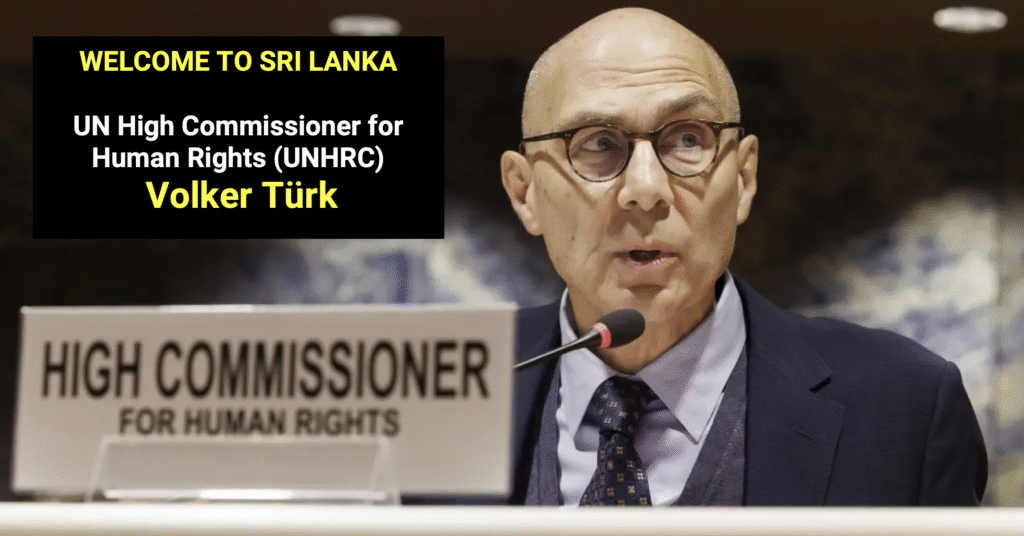
Sri Lanka stands today as the ONLY nation that defeated one of the world’s most ruthless terrorist organizations—the LTTE—without international military assistance. In doing so, it upheld its sovereign duty to protect all citizens, irrespective of ethnicity or religion, and ushered in a lasting peace after 30 years of carnage. Yet, paradoxically, since that historic moment in May 2009, Sri Lanka has faced relentless international censure—driven not by legal objectivity, but by politically influenced narratives, double standards, and unverified claims. This set of questions is respectfully directed to the incoming High Commissioner for Human Rights and the Office of the UNHRC, in the spirit of transparency, fairness, and mutual accountability. These questions demand clarity on legal authority, procedural fairness, factual accuracy, and the continued erosion of Sri Lanka’s sovereignty through repeated country-specific resolutions, all while far graver human rights abuses in other global theatres are left untouched. It is time to ask: Has the UN system become a tool for political pressure, or does it still stand for the impartial protection of human rights and the sovereign equality of nations as enshrined in the UN Charter?
I. Violation of UN Charter & Sovereignty
Under which provision of the UN Charter was the UNSG authorized to appoint a Panel of Experts (PoE) on Sri Lanka in June 2010 without the consent of the General Assembly or Security Council?
Why was the PoE report leaked to the media instead of being officially tabled before the UNSC, UNGA, or OHCHR? Why was Sri Lanka denied the right to officially respond?
Why did the UN fail to consult the democratically elected Government of Sri Lanka before initiating external accountability mechanisms?
How does the UN justify selective scrutiny of Sri Lanka when it has not pursued similar inquiries in Iraq, Afghanistan, Libya, Yemen, or Palestine?
Why has the UN never acknowledged that this is the only instance where post-war punitive action has been taken against a government that defeated a UN-designated terrorist group?
Why has the UNHRC never publicly affirmed Sri Lanka’s right to defend its sovereignty against terrorism, particularly from the LTTE, which employed suicide bombings, assassinations, child soldiers, and mass civilian massacres?
II. Illegitimacy of the UNSG’s Panel of Experts (Darusman Report)
Why was the Darusman Panel appointed in secret, with no Sri Lankan representation, and without UN General Assembly or UNSC mandate?
Is the UNHRC aware that the Darusman Report clearly statesit is not an investigation but merely an advisory report” to the UNSG?
Why did the UNHRC base multiple resolutions and OHCHR reportson an advisory note (Darusman Report) which lacks legal standing and admissibility in courts?
What ethical standardswere followed in releasing the Darusman Report selectively to the public and media, before giving Sri Lanka a chance to respond?
III. Bias & One-Sidedness in UNHRC Resolutions
Why have all UNHRC resolutions singled out Sri Lanka’s armed forces and government, while ignoring the LTTE’s 30 years of mass murder, bombings, child conscription, and use of human shields & hostages?
Why did the OHCHR reports and resolutions omit or downplay the countless war crimes and crimes against humanity committed by the LTTE, including the killing of Tamil civilians who refused to join them?
Why has the UNHRC never conducted or demanded an investigation into international complicity in arming, funding, or politically supporting the LTTE?
IV. Post-War Manipulation, Legal Overreach & Lack of Closure
Why is the UNHRC pressuring Sri Lanka to adopt hybrid courts, transitional justice mechanisms, and foreign interventions while dismissing the success of post-war domestic processes, such as the LLRC, rehabilitation of 12,000 ex-combatants, and reintegration of 594 former child soldiers?
What is the legal basis for proposing hybrid courts and inclusion of foreign judges when Sri Lanka is not a party to any treaty or agreement that compels such interference in its judicial sovereignty?
Why has there been no recognition by the UN or OHCHR of Sri Lanka’s voluntary and unprecedented efforts at post-conflict reconciliation, including the reintegration of former LTTE fighters, demining, and infrastructure rebuilding in war-torn areas?
How does the UNHRC justify persistent country-specific targeting in breach of its own principle of impartiality and equal treatment of all member states?
What is the UNHRC’s legal mandate to apply international human rights law (IHRL) selectively to a non-international armed conflict when the correct legal framework under international law is International Humanitarian Law (IHL)?In armed conflicts, IHL—not HRL—is the governing legal regime. On what basis does the OHCHR elevate human rights law over IHL, particularly when assessing the final stages of the Sri Lankan conflict?
Can the UNHRC clarify why it continues to ignore that during armed conflict, actions are governed by the Geneva Conventions and related customary humanitarian law—not by the framework of civil peacetime human rights law?
V. Inconsistencies, Secrecy & Data Manipulation
Why did the Office of the High Commissioner for Human Rights (OHCHR) continue to quote the unverified figure of40,000 civilian deaths in Sri Lanka’s final war phase, despite lacking independently verified names, forensic evidence, or transparent methodology?
Why has the UNHRC and OHCHR ignoredSri Lanka’s official census data (7,400 deaths) and UN Country Team estimates (7,721 deaths)—both based on ground-level assessments—yet the PoE stated this figure was too small to accept”?
On what grounds has the United Nations refused to release its owninternal wartime communications, situation reports, and casualty logs that would provide an accurate and impartial death toll—especially when those internal records reportedly do not support the inflated death figures circulated by media outlets and repeated in UN resolutions?
Why has the UN system, including OHCHR, failed toaudit and disclose the data sources, field methodologies, and statistical models behind these influential but disputed figures, even when requested by member states?
Is it not a violation ofbasic standards of evidence and fairness for the UN to have permitted unverified claims of mass civilian deaths to be used as the basis for repeated resolutions against Sri Lanka, while denying Sri Lanka the right to challenge the figures or present its own verified data?
VI. Accountability & Transparency in UN Process
Will the UNHRC declassify all communications related to Sri Lanka’s war from 2006 to 2009, including those of the UN Resident Coordinator’s office, NGOs, and affiliated agencies?
What mechanisms does the UNHRC have in place to prevent conflict of interest, where NGOs writing reports also fund or influence UNHRC resolutions?
What steps will the UNHRC take to ensure that Sri Lanka is not coerced into accepting foreign models of justice that violate its Constitution?
VII. Historical Context & Double Standards
Why is the UN silent about the LTTE’s assassinations of Tamil leaders, including Lakshman Kadirgamar, Neelan Thiruchelvam, and hundreds of Tamil civil society leaders?
Will the UNHRC acknowledge that Sri Lanka’s conflict was not ethnicbut caused by separatist terrorism, and apologize for misrepresenting it as Sinhala-Buddhist oppression?
Why does the UN refuse to engage in truth-telling about the foreign governments and NGOs that supported the LTTE directly or indirectly during the war?
VIII. Final Questions of Good Faith
Does the UNHRC believe that Sri Lanka, having ended a ruthless terrorist insurgencyand resettled over 300,000 civilians, deserves recognition rather than condemnation?
Will the new UNHRC leadership commit to impartiality, abandon politicized pressure, and finally allow Sri Lanka to heal without foreign interference?
Will the HRC agree to review and audit the legality of all resolutions passed on Sri Lanka since 2012 and their alignment with the UN Charter?
IX. Defamation of War Heroes & absurdity of Genocide claims
Why is the UNHRC silent while decorated Sri Lankan war heroes—who courageously led operations to end terrorism—are falsely accused of war crimes and genocide, and even subjected to foreign sanctions, despite no credible legal proceedings or evidence?
How does the UN justify branding individuals as war criminals when the very army commander who led the military campaign is not among the accused, exposing the arbitrary and politically motivated nature of these allegations?
Can the UNHRC explain how saving 300,000 Tamil civilians through the largest hostage rescue operation in modern military history can be reconciled with the accusation of deliberately killing 40,000 civilians? Isn’t such a contradiction absurd and defamatory?
Why have foreign governments that actively supported, funded, or harbored LTTE operatives—despite LTTE’s proscription under UNSC Resolution 1373—never been investigated or held accountable?
Why is there no scrutiny of the LTTE-linked diaspora entities still operating in foreign capitals, openly glorifying terrorism and distorting the narrative with fabricated death tolls?
How does the UNHRC justify the repeated citation of the 40,000 civilian death claim when there are no verified bodies, no police complaints, no forensic evidence, and even the UN’s own country team and Sri Lanka’s census data contradict this number?
Is it not time for the UN to call out the propaganda, reject data manipulation, and end this politically driven witch-hunt? The truth must prevail, and false genocide labels must not be allowed to taint a nation that defeated terrorism and safeguarded human lives.
What the JVP–NPP Government & President Anura Kumara Dissanayake must demand from the visiting UNHRC Head:
Declassificationof all UNHRC/OHCHR internal reports and wartime communications related to Sri Lanka.
Reciprocity & equalityin how human rights violations are assessed—especially when Western powers evade similar scrutiny.
A full reviewof all UNHRC resolutions passed against Sri Lanka, including their legal basis and procedural fairness.
These questions and expectations represent the sentiments of a nation that has endured terrorism, protected its sovereignty, and pursued peace—despite external pressures and distortions. The time has come for transparency, fairness, and closure.
Let Sri Lanka remind the incoming High Commissioner for Human Rights that this nation endured three decades of brutal terrorism. If the effort, urgency, and scrutiny that the UN and UNHRC have exerted since the defeat of the LTTE had been applied during the LTTE’s reign of terror, countless innocent lives could have been saved. Instead, the current UN approach appears more focused on questioning how the terrorists were eliminated than on appreciating the peace that now prevails. It is time to acknowledge the undeniable reality:
Sri Lanka is living without terror today—not because of international intervention, but in spite of it.
by A. Abdul Aziz, Sri Lankan Correspondent, Al Hakam, London.
(Given below is the gist of Eid-ul-Adha Sermon delivered by His Holiness Hazrat Mirza Masroor Ahmad – Supreme Head of the Worldwide Ahmadiyya Muslim Community on 6 June 2025 at the Mubarak Mosque in Islamabad, UK, after led the congregational Eid-ul-Adha Prayer)
After reciting the first part of the Arabic Sermon Ahmadiyya Khalifa recited the verses of the Holy Quran Chapter 22 verse 35 – 38, the meaning of which goes:
And to every people We appointed rites of sacrifice, that they might mention the name of Allah over the quadrupeds of the class of cattle that He has provided for them. So your God is One God; therefore submit ye all to Him. And give thou glad tidings to the humble.
Whose hearts are filled with fear when Allah is mentioned, and who patiently endure whatever befalls them, and who observe Prayer, and spend out of what We have provided for them.
And among the sacred Signs of Allah We have appointed for you the sacrificial camels. In them there is much good for you. So mention the name of Allah over them as they stand tied up in lines. And when they fall down dead on their sides, eat thereof and feed him who is needy but contented and him who supplicates. Thus have We subjected them to you, that you may be thankful.
Their flesh reaches not Allah, nor does their blood, but it is your righteousness that reaches Him. Thus has He subjected them to you, that you may glorify Allah for His guiding you. And give glad tidings to those who do good.” (Surah al-Hajj, Ch.22: V.35-38)
His Holiness Hazrat Mirza Masroor Ahmad – Hazrat Khalifatul Masih(may Allah be his Helper) said that these verses explain that true sacrifice isn’t merely sacrificing animals for the sake of it, rather the lesson that is imparted is that lesser things are sacrificed for greater ones. So just as animals are sacrificed for God the Great, in the same way if we are ever required to provide any sacrifice for God we should put ourselves forward.
The commandments given by God should be acted upon, as this is how we will reach the true standard of sacrifice. We should be ever ready to extend our necks for the sake of Allah the Almighty.
Huis Holiness went on to explain that the meat that we distribute and the resulting blood that is spilled does not benefit God. What He wants is your taqwa (righteousness), that you remember to fear Him, and that you always stay aware of how to act upon His instructions to attain His pleasure.
His Holiness mentioned that in Pakistan, Ahmadis are barred from offering the Eid sacrifice, since the past few years. However, the purpose is taqwa, so even though we’re unable to sacrifice an animal on Eid, the important thing is that God is more concerned with our intentions. If our intention is that we want to offer a sacrifice in accordance with the commandments of God and to seek His pleasure, then God will accept that as a sacrifice.
There are many people who buy lots of animals to sacrifice, and make huge announcements about it. But is this really the true essence? Does God instruct those same people to put others through difficulty to attain His pleasure? Not at all. God’s Prophet, Muhammad(PBUH) said that whoever said la ilaha illallah (I bear witness that there is no God but Allah) is a Muslim – but what these so-called Muslims do is against the commandments of God about treating others well.
We should remember that these sacrifices are only to improve our taqwa and lead us closer to God. Whilst acting upon His commands, we should obey Him to the best of our abilities. Even if we aren’t able to sacrifice an animal on Eid, but we act on the rest of our teachings then God will accept the intention of that sacrifice, as He has explicitly mentioned that it’s not the meat of the animals that reaches Him (Surah al-Hajj, Ch.22: V.38). In light of this, we should focus on acting on God’s commandments.
Through these commandments, God has informed us that our true purpose is worship. This can only be done once huqooq-ul-Ibaad (the rights owed to mankind) are fulfilled. HIS Holiness went on to explain that the other side of this, huqooqullah (the rights owed to Allah), consist of the five daily prayers, particularly in congregation at the mosque.
However, if for instance in Pakistan, Ahmadis are stopped from congregating at the mosques, then if there are places or houses where the conditions are not as harsh, Ahmadis should congregate there for their prayers. This way we’ll be able to find solace in God from our opponents.
His Holiness went on to explain that in order to fulfill the rights of this sacrifice made on the day of Eid, we must fulfil the rights of our worship by falling in prostration to God, weeping like children and beseeching Him, in result of which He’ll listen to us and safeguard us from our opponents.
His Holiness instructed the Ahmadis of Pakistan to particularly focus on this because God keenly listens to the supplication of the oppressed. (Jami` at-Tirmidhi, Hadith 3598) Hence, If we give due attention to this we will become the recipients of God’s blessings.
Salat (obligatory prayer) is not meant to just be a tick-box exercise, rather we should offer our prayers in a proper manner. If we do this then God will bless us so much that the obstacles created by our opponents will be removed.
His Holiness emphasised that on this day, we should take an oath to increase the standard of our worship.
This also applies to others across Europe and other parts of the world where Eid is being celebrated.
In Pakistan, Ahmadis cannot offer Eid in congregation due to the authorities, whilst we [outside of Pakistan] are able to pray feely. However, we shouldn’t let this cause despair. His Holiness instructed Ahmadis in Pakistan to offer Eid prayers in their homes and to take an oath to fulfill the rights of God, and to worship in such a manner as if they are at the throne of God. This will result in God’s blessings and favours, so much so that the opponents will wither away.
To fulfil the standard of Salat and worship, we should make our utmost effort. His Holiness explains that the Founder of the Ahmadiyya Muslim Jamaat Hazrat Mirza Ghulam Ahmad – Promised Messiah, peace be on him, has expounded on this philosophy (Al Hakam, 24 July 1902), in which he explains that there are two parts to worship, which are the fear and love of God.
The fear of God is such that it takes us towards the fountain of God, and that we are able to fulfil the rights of worship.
The Promised Messiah, peace be on him, went on to say that man should love God according to His due, by discarding the love of the world and making God the true beloved.
There are many ways to fulfil both of these huqooq (rights), but they are interlinked to the emotions of fear and love. It might seem like a strange thing to have both of these together, how can one love someone Who they fear? However, the fear and love of God is an entirely different philosophy.
The more a person fears God, the more his love for Him will increase and vice versa. This will take him away from vices and bring him closer to good deeds. In this way, both of these emotions are interlinked.
The Promised Messiah, peace be on him, said that to develop both of these emotions, Islam has established Salat (for fear), and Hajj (for love).
Ahmadiyya Khalifa mentioned that these days people have gone for Hajj. This is a show of love [for God]. Although Ahmadis are generally barred from Hajj, many manage to go for Hajj anyway to partake in this endeavour.
Hence, because Salat increases our fear of Allah, to transform that fear into love, God instructed us to perform Hajj.
Hajj includes all pillars of love. A person adorns himself with less clothing than in ordinary circumstances, which is a sign of love, since we’re not concerned with what we’re wearing in that condition. This is like the example of a person who removes their clothing for their beloved. That’s a worldy person’s love – our love for God should be even greater. Other elements of the Hajj also emulate the emotion of love, such as the kissing of the black stone, and the sacrificing of animals which is the highest standard of love.
Hence, Hajj is performed to express this love, as is the sacrifice offered on Eid. Wherever we are stopped and obstacles are placed in front of us, God knows the condition of our hearts and of the standards of our worship. He will bring ease for us. And He will reward us for the worship we are being stopped from, since He is extremely generous.
If we attain the proper standards of worship and fulfill the due rights, we will reach a level of the fear of God which will then culminate into love. As we get closer to God, He will make our opponents disappear.
Our opponents desire to make us leave our faith, but those Ahmadis who have true faith in their hearts do not falter.
We should increase our worship. If we can’t sacrifice an animal, then wherever possible and to whatever degree, we should worship God in our houses and prostrate to Him.
We should increase our worship to such a degree that it is an expression of the true fear of God. This will enable us to reach the highest standards of sacrifice.
We should also obey God’s command of helping the poor, since it’s not just about feeding ourselves and our neighbours. Where animal sacrifices are not possible, other sacrifices can be made to help the poor, for which the Jamaat provides platforms.
People should also help their friends and relatives in other countries who are not as well off. There are many Ahmadis who haven’t just sacrificed animals, but also given lots of financial sacrifice using their money as donations.
So even if we’re being stopped from one path of sacrificing, God has provided us with other routes. The Ahmadis of Pakistan are being stopped from these sacrifices, but in other parts of the world we should step forward and increase our tabligh (preaching) efforts, in line with God’s instructions. Whilst fearing him we should pray that he allows us to understand the true essence of sacrifice.
Additionally, God instructs us to keep away from vices and bad environments. In this day and age, bad environments aren’t merely confined to physical gatherings, rather they include consuming harmful content on the internet, TV, and other digital platforms. This is not an issue limited to the youth, but even older people fall into this vice. If we partake in such things then sacrificing an animal on Eid won’t be of much benefit to us.
The spirit of sacrifice should be in accordance with that of Abraham, peace be on him, Hajra, peace be on her and Ismail, peace be on him. Only in that case will it be considered a true sacrifice.
In Pakistan as well as other places, if people can’t offer animal sacrifice, they should increase their good deeds and sacrifice their desires.
Ahmadiyya Khalifa explained in depth further and concluded sermon, then extended a hearty Eid mubarak” to everyone and led everyone in du‘a (silent prayer).
Smart state planning plus ferocious market competition
In standard western economic textbooks, state planning and market competition are mutually exclusive. Thatcher and Reagan brought western capitalism into the neoliberal phase by claiming Government is not the answer. Government is the problem”, putting market fundamentalism on the altar. On the other side, Soviet central planning proved rigid and wasteful, leading to the eventual collapse of USSR.
Observing and learning from others’ development path, China went through three distinct economic models in the past 70+ years –
1949 – 1978, emulation of Soviet central planning phase, which provided the country a heavy industrial foundation but failed to deliver an adequate standard of living
1978 – 2012, free-wheeling laissez faire full-on capitalist phase, which saw rapid economic growth, rising standard of living but also wealth disparity, environmental degradation, and low value-added industrialization
2012 – now, mixed state planning and market competition phase, which is featured by state-led industrial upgrade programs, intense market-based competition, rapid improvement in industrial sophistication, and hopefully rise above middle-income trap to become the leading industrial powerhouse
I thought it would be interesting to discuss the features of this unique China model and the implications.
The two parts of this model – state planning and market competition – form an integrated approach to national economic development.
State planning incorporates these elements –
Identify key industries to focus
Set concrete and tangible targets (e.g. the 200+ goals set in MIC2025)
Align policy support
The planning function is carried out by the China State Planning and Development Commission, which assembles the best minds in the government, academia, think tanks, and industries and goes through multi-year research, studies, and survey to understand and predict key technological trends and future market demand. Then they iterate and socialize the plans until there is broad buy-in.
Once top-line state planning priorities are set, central government empowers local governments to implement the policies. At the implementation level, fierce market competition becomes the norm.
Local governments compete with each other. Each local government is powerfully incentivized to create local tech and industrial champions as career advancements are typically tied in with achievements of national priorities.
Local governments will unleash suites of policy support measures to attract and help businesses succeed, including –
Preferential tax
Land use priority
Preferential bank loans, even venture capital financing from government agencies (e.g. Shanghai and Shenzhen each has multi-billion dollar semiconductor funds)
Other policy support even extends to –
Establish educational programs at universities to train and develop scientific and technical talents specifically for identified industries and technologies (e.g. AI, robotics, hypersonics, rare earth mining and refining, rail, ship building, etc.)
Roll out talent acquisition programs to provide housing, allowances, and compensation equalization schemes to attract talents to move to their cities. Some governments even provide WeWork type of office facilities to startups for free.
Invest in infrastructure upgrades including 5G coverage, EV charging stations, high speed rail, ports, bridges, etc. to enable smooth operation of large industrial enterprises.
Invest in local parts and components supply chains that can be plugged into specific manufacturing sectors.
Promote successful technical leaders and executives in critical industries into senior government positions (e.g. the head of AVIC, the leading aeronautic business in China, was promoted to become a provincial governor)
The central government went so far as to crack down on monopolistic consumer tech companies such as Alibaba and Tencent in 2019 as these companies were consuming too much financial and talent resources and preventing startups from emerging.
The main goal of the crackdown is to redirect resources (funding, talent) to more productive directions such as AI and hard tech.
As a result, in the key technological and industrial hubs across China, from Shanghai, Shenzhen, Wuhan, Chengdu to Hefei and Changsa, you will find hundreds of EV companies, solar energy companies, AI and robotics start ups, ship builders, and drone companies that are developing innovative technologies, building production capacity, and engage in intense competition for consumers.
In the competition, there are private businesses, state owned enterprises, and foreign companies as well. All have to compete for customers on price and quality and operate with razor thin margin. Innovation and cost efficiency are prized in the never-ending loop of hyper competition.
The Chinese industrial and technological ecosystem is often described by insiders as arena for gladiators”. In a survival of the fittest environment, the winners of such competitions emerge as world class champions.
The same model is replicated in industry after industry from EV, smart phones, solar energy, robotics, ship building, AI large language models, drones, chip making, and biopharmaceuticals.
Many people mistakenly assume the Chinese state planning model means the government picks the winners and losers. That cannot be further from the truth. State planners pick the priority industries, define the swim lane, provide policy incentives, and then market takes over to decide the winner.
In contrast, the US industrial policy is more guilty of government picking winners – just witness how both Biden and Trump surround themselves with senior executives of incumbent tech giants when they announce policies such as the Chips Act, Inflation Reduction Act, or the Stargate program. Almost by definition, the main beneficiaries of these industrial policies will be the companies in the room. Market competition doesn’t seem to play the same decisive rule as in China.
As China accelerates the third mixed-economy phase of its industrial development, we can expect to see more Chinese companies will innovate faster, scale in the largest single market in the world, and become world-class competitors in their industries. Profit margins will be kept low as competition will never rest. However, more consumer surplus will accrue to customers, leading to improvement of living standards for all.
Sri Lanka at the Center of maritime connectivity between ASEAN and GCC need an ‘Asia First” Foreign Policy
Sufian Jusoh and Joanne Lin assess Malaysia’s bold initiative to host the inaugural ASEAN-GCC-China Summit, exploring its strategic rationale, economic potential, and the implications for ASEAN’s centrality in a shifting global order. The ASEAN-GCC-China Economic Summit, set to take place in Kuala Lumpur on 27 May, under the Malaysian Chairmanship of ASEAN, marks a significant diplomatic first. It will bring together leaders from ASEAN, the Gulf Cooperation Council (GCC consisting of Bahrain, Kuwait, Oman, Qatar, Saudi Arabia, and the United Arab Emirates), and China for a formal trilateral gathering. While ASEAN already maintains institutional relationships with both China and the GCC, this summit, initiated by Malaysian Prime Minister Anwar Ibrahim, ushers in an unusual diplomatic configuration whose long-term implications remain uncertain. Malaysia’s bold move is underpinned by strategic calculus. By convening this trilateral platform, it aims to elevate its international profile, expand economic ties with the Middle East and China, and assert leadership within ASEAN amid a shifting global order. The declining influence of the US in the Global South, coupled with increasingly polarising US policies in the Middle East, has opened space for alternative South-South alignments. The imposition of draconian tariffs on Southeast Asian exports under Trump’s second term has further underscored the urgency for the region to diversify beyond traditional Western markets. According to Mr Anwar, it is about ensuring ASEAN’s strategic relevance in a multipolar world”.
There are at least three rationales for the trilateral summit: promoting ASEAN Centrality, creating a new South-South economic alliance, and forming a new partnership to neutralise the geoeconomic impact of the tariff war.
First, the initiative provides an opportunity to further integrate ASEAN into the global economy and reinforce its centrality in global economic relations. It aligns with the Global ASEAN” vision under the ASEAN Community Vision 2045 which emphasises an outward-looking ASEAN. Through partnerships with emerging Global South countries, such as China and in the GCC, ASEAN seeks to pursue joint economic benefits that go beyond traditional Dialogue Partners.
Second, the summit will provide a platform for ASEAN, the GCC and China to explore the promise of deeper economic collaboration through a trilateral framework, beyond their existing bilateral ties. While ASEAN already maintains strong trade and investment relations with both China and individual GCC states, this proposed configuration could lay the groundwork for more structured engagement across regions. According to the World Bank, the combined annual GDP of ASEAN, GCC and China amounts to US$23.70 trillion in 2023, marking 22.3 per cent of the total world GDP in the same year. ASEAN, the GCC and China also make up a large market, with combined population of ASEAN, the GCC, and China at approximately 2.15 billion people.
The trilateral summit aims to harness each other’s strengths in economic activities, especially in trade, investment and supply chains. According to Dato’ Seri Mohamad Hassan, Foreign Minister of Malaysia, the summit is a step forward in forming an influential trilateral alliance to unlock broader economic cooperation among the three parties (building on their existing bilateral ties).
The economic potential from the trilateral arrangement is huge. ASEAN-China trade was US$700 billion in 2023. In the same year, ASEAN-GCC trade was approximately US$130.7 billion, mostly in oil and gas, energy and financial services. Furthermore, the GCC-China trade was approximately US$316.4 billion in 2022. Chinese FDI into ASEAN stood at US$17.7 billion in 2023. FDI from the GCC into ASEAN grew from US$265.8 million in 2018 to US$390.2 million in 2023, mainly in wholesale and retail trade and financial services.
Leaders pose for a family photo during the First ASEAN-GCC Summit in Riyadh, Saudi Arabia on 20 October 2023. (Photo by United Arab Emirates Presidentia / ANADOLU / Anadolu via AFP)
These present immense opportunities for further trade and investment supply-chain, as well as creating new economic opportunities and activities in areas such as clean and renewable energy, digital economy, electric vehicles, financial markets, halal products and services, and infrastructure development. However, whether this potential can be fully realised will depend on the ability of ASEAN, the GCC and China to overcome structural and regulatory differences, and to identify concrete areas for collaboration.
While the trilateral partnership does not entail a new formal trade agreement at this stage, it could explore synergies by building on existing frameworks. For instance, existing agreements such as the ASEAN-China Free Trade Area (ACFTA) and the Regional Cooperation Economic Partnership (RCEP), could serve as useful reference points. While the GCC is not a party to these frameworks, the trilateral partnership may draw lessons from their structures and standards—such as in rules of origin, e-commerce and investment facilitation— as potential models for future cooperation between ASEAN-GCC and GCC-China.
Third, the trilateral summit could potentially assist in countering export restrictions and additional tariffs implemented by the US, through the creation of new markets for ASEAN products and services and providing opportunities to access technologies which the US may restrict. This provides ASEAN, which sees itself as a middle power, to leverage on the GCC and China to collaborate with and function as a counterweight to other major powers. The growing ASEAN trade with China and the United States makes ASEAN vulnerable to the geopolitical tensions between the two major powers. At the same time, the GCC has been working on a new foreign policy approach, allowing the grouping to work with countries and regions with impressive economic growth, looking for regions with surging energy demand, whilst reducing the GCC dependency on the West. In this regard, the GCC has been expanding its economic foreign policy to focus on new partners in Eastern Asia, i.e. to include ASEAN and China. It has been observed that, despite its close geo-political and geo-economic relations with the West, the GCC has continuously built selective economic relations with China.
The summit also provides an avenue for a new coalition of countries supporting a strong multilateral economic order under the World Trade Organisation (WTO). The intra-grouping consensus building involving two major regional economic groupings and the second largest economy in the world can provide an avenue to balance and hedge against an uncertain and challenging world economic order, particularly, the uncertainty surrounding US economic policies under the second Trump’s presidency including tariffs, export restrictions and unilateral trade measures.
Nevertheless, ASEAN must be mindful that the GCC is neither a supranational entity like the EU nor a charter-based organisation like ASEAN. It is a loose coalition where members are free to pursue their own external relations. Internal divisions—such as the Saudi-UAE rivalry, differing positions on the Gaza conflict, and the 2017 Qatar Crisis—underscore the bloc’s fragility. From a functional perspective, areas as mentioned above present promising ground for trilateral collaboration. However, translating these opportunities into actionable outcomes will require clear frameworks, institutional follow-up, and genuine alignment of priorities. Furthermore, although bilateral ties between individual ASEAN countries—such as Singapore, Malaysia and Indonesia—and GCC members, particularly the UAE, have flourished in sectors such as energy, construction, infrastructure, telecoms, tourism and banking, ASEAN-GCC cooperation between the two regional groupings remains relatively underdeveloped. It was only in 2023 that ASEAN and GCC convened their first summit in Riyadh, Saudi Arabia, with both sides agreeing to meet biennially. China, for its part, has expressed willingness to deepen mutually beneficial cooperation” with ASEAN and GCC countries at the summit. However, it has yet to publicly confirm its level of
representation or outline any substantive deliverables. This measured and cautious stance suggests that while the initiative aligns with China’s broader interest in advancing Global South cooperation, its engagement will likely depend on the clarity of the summit’s agenda and how it serves China’s longer-term regional objectives.
For ASEAN, China’s inclusion may enhance the platform’s diplomatic and economic weight, but it also brings added complexity, particularly in terms of geopolitical signaling and institutional coordination. As global rivalries intensify and minilateral arrangements proliferate, ASEAN will need to ensure that this summit complements, rather than competes with its existing frameworks, such as the ASEAN Plus Three and the East Asia Summit, to maintain coherence and regional unity.
While the future of this trilateral format remains uncertain—whether it will be one-off or evolve into a regular fixture—its success hinges on how it is positioned within ASEAN’s broader strategic agenda.
Ultimately, the ASEAN-GCC-China Summit should not be viewed as a geopolitical pivot, but a pragmatic platform for advancing economic and functional cooperation across two dynamic regions. If carefully managed, it could serve as a vital bridge between Southeast Asia, the Middle East and China—expanding ASEAN’s economic reach in an increasingly multipolar world. This vision reflects the spirit of Malaysia’s 2025 ASEAN Chairmanship: to strengthen ASEAN’s relevance, broaden its partnerships and amplify its voice within the Global South.
Avigdor Lieberman said Israeli forces, under prime minister’s orders, are giving weapons to ‘crime families’ in Palestinian enclave
Jun 5, 2025 Israeli opposition leader Avigdor Lieberman has accused Israeli forces, under the approval of Prime Minister Benjamin Netanyahu, of arming crime families” in Gaza.
The accusations add weight to the claim that Israel has used Palestinian gangs to disrupt the distribution of aid in the besieged enclave.
Israel has provided assault rifles and light weapons to crime families in Gaza, on Netanyahu’s orders,” Lieberman, the head of the Yisrael Beiteinu party and a former finance minister and deputy prime minister, told Israeli public broadcaster Kan on Thursday.
The weapons are being transferred to criminals and offenders and are being directed at Israel.
In my opinion, it did not pass cabinet approval. The head of the Shin Bet knows, I’m not sure the chief of staff knows. We’re talking about the equivalent of Isis in Gaza,” he added, referencing the Islamic State group.
He added that no one can guarantee that these weapons will not be directed at Israel. We have no way of monitoring or tracking them.”
In response, Netanyahu’s office said: Israel is working to defeat Hamas in various ways, on the recommendation of all heads of the security establishment.”
There have been several reports in recent months of Israel allegedly backing, or turning a blind eye to, armed gangs looting aid and food warehouses in Gaza.
Several Israeli news websites reported on Thursday that the armed gang is led by Yasser Abu Shabab, a member of a large clan in southern Gaza.
Read also:
Eight killed as Israel bombs, bulldozes Jenin refugee camp
Citing unnamed defense sources, the Times of Israel reported that the weapons Israel provided Abu Shabab’s gang included some that Israeli forces seized from Hamas during the war.
Hamas officials told Reuters that Abu Shabab was wanted for collaborating with the occupation against his people”. The officials said Hamas fighters had killed at least two dozen of Abu Shabab’s men before January, after they had allegedly looted aid trucks. Al Jazeera Arabic’s Anas al-Sharif reported in early May that Israeli forces attacked shopowners and local Gaza security teams who were attempting to protect shops from looting and chaos.
Asaad al-Kafarna, a police officer in Gaza, was killed by Israeli forces near a restaurant on 2 May after pursuing armed looters accused of collaborating with Israel’s military.
In response to such looting by gangs, a number of influential families in Gaza published statements denouncing the scenes. These gangs act in alignment with the goals of the occupation,” the Madhoun family wrote at the time.
In November, an internal UN memo obtained by the Washington Post revealed that gangs may be benefiting from a passive if not active benevolence” or protection” from Israeli troops.
One such gang leader, according to the memo, established a military-like compound” in an area restricted, controlled and patrolled” by Israel’s military. Commentators have suggested that by backing criminal gangs and targeting members of Gaza’s civil administration, Israel was attempting to create a power vacuum and lawlessness.
Massacres of aid seekers A CNN investigation published on Thursday concluded that the Israeli military was behind a deadly shooting of civilians seeking aid near Rafah in southern Gaza over the weekend, which killed more than 30 people.
Read also:
Israel’s Deepening Involvement with Syria’s Rebels
More than a dozen eyewitnesses, including those wounded in the attack, said Israeli troops shot at crowds in volleys of gunfire that occurred sporadically through the early hours of Sunday morning, the investigation said.
Multiple videos geolocated by CNN placed the gunfire near a roundabout where hundreds of Palestinians had gathered about half a mile (800 metres) away from the militarised aid site.
The Israeli military has denied its troops fired on civilians in or around the centre, and both it and the aid centre’s administrator accused Hamas of sowing false rumours. The controversial US-backed initiative to distribute aid, the Gaza Humanitarian Foundation (GHF), said on Thursday it would not hand out any food to starving Palestinians for a second day, saying operations will only restart when maintenance and repair work at its distribution sites are complete.
The suspension of the GHF’s aid distribution system comes after more than 100 Palestinians were gunned down near its sites in less than a week.
Earlier this week, eyewitnesses and local officials told Middle East Eye that Israeli troops opened fire directly on civilians, with many of the fatalities receiving gunshot wounds to their head or chest.
We remind our readers that publication of articles on our site does not mean that we agree with what is written. Our policy is to publish anything which we consider of interest, so as to assist our readers in forming their opinions. Sometimes we even publish articles with which we totally disagree, since we believe it is important for our readers to be informed on as wide a spectrum of views as possible.
Even though India gives shelter to nearly 20 million undocumented people from neighbouring countries like Pakistan, Nepal, Tibet, Sri Lanka, Myanmar and Bangladesh, the Union government in New Delhi always remains aggressive towards the illegal migrants (termed infiltrators, asylum seekers or refugees) from Pakistan since the days of independence. But lately, both the government and people of the south Asian nation have taken an united stand against the Bangladeshi nationals and Rohingya people from western Myanmar too, projecting them as security threat and instigators of demographic changes as well as social unrest. The dramatic change took place soon after the Pahalgam terror attack in the Kashmir valley, where 26 innocent civilians were brutally killed by the Islamists with suspected backing from the Pakistani regime in Islamabad.
Soon after the 22 April Pahalgam incident, a massive wave of public outrages was observed across India demanding a decisive retaliation against Pakistan. It followed an escalation of armed conflicts between the two neighbours and New Delhi launched Operation Sindoor targeting the terrorist hideouts inside the Pakistan-occupied Kashmir and mainland Pakistan. A bilateral understanding for cessation of armed conflicts was accepted on 10 May, but enormous furies against the enemy nation continues among the majority of Indians. Even the Supreme Court came out heavily against the government for taking a longer time to deport the illegal migrants. The apex court also recently rejected a plea to stop the process of deportation involving Rohingya Muslim migrants. It also refused to hear a petition on alleged dumping of 38 Rohingya people in Andaman Sea near to the Myanmar coast, terming it a ‘very beautifully crafted story’.
The particular petition claimed that New Delhi deported those Rohingyas even after possessing identity cards from the United Nations High Commissioner for Refugees (UNHCR). They were reportedly brought to Sri Vijaya Puram (earlier Port Blair), headquarter of the Andaman and Nicobar Islands in the Bay of Bengal, from Delhi in the first week of May and abandoned them on a ship with life jackets in the Myanmar coast with assurances that someone would rescue them. A civil society group named People’s Union for Civil Liberties (PUCL) even condemned the alleged deportation of Rohingyas describing it inhumane and illegal under domestic and international guidelines.
The new found Rohingya menace prompts New Delhi and other province governments to take visible actions against the individuals either entering India illegally or staying after the expiry of their visa periods. The Rohingyas to the tune of 40,000 are staying in Telangana, Rajasthan, Uttar Pradesh, Punjab, Haryana, Delhi, Jammu & Kashmir with other localities. Those Muslim residents from Rakhine (Arakan) province of Myanmar faced brutal military crackdowns in 2016 and 2017, following which over 700,000 Rohingyas fled to neighbouring Bangladesh. Their return became challenging following the military coup in February 2021 and subsequent armed conflicts between the Myanmar military junta and ethnic armed outfits including the Arakan Army.
The Border Guards Bangladesh (BGB) alleged that India had sent over 2000 individuals into Bangladesh since 1 May with no official intimation. BGB director general Ashrafuzzaman Siddiqui claimed that many Bengali speaking Indian Muslims were also pushed in through the borders of West Bengal, Assam and Tripura. The political leaders, security experts and general population expressed serious concern over the incidents of pushing people through land borders and terming the process illogical and illegal. They questioned the deportation of Rohingyas to Bangladesh, as they are not citizens of the country, but Myanmar. The BGB officials detained at least five United Nations High Commissioner for Refugees (UNHCR) recognized Rohingya refugees, who were pushed by the Indian agencies.
Dhaka made it clear that it would accept individuals only after the confirmation as Bangladeshi citizens and repatriated through official channels. The Bangladeshis demanded to stop the practice, levelling it as a threat to their sovereignty, even though the Rohingyas entered India from their territory only.
Meanwhile on 23 May, the UNHCR issued a media statement from Geneva, where it expressed concern over two reported boat tragedies leading to the death of over 400 Rohingya refugees at Myanmar coast. The UN refugee agency stated that around 514 Rohingyas travelled on two separate boats, where one carried around 267 people. Over half of them probably departed from Rohingya refugee camps in Cox’s Bazar of south Bangladesh and the rest left Rakhine province of Myanmar. The boat sank on 9 May, where only 66 survived. Another boat carrying 247 Rohingyas (gathered from both Cox’s Bazar camp and Rakhine localities) capsized on 10 May, where only 21 survived.
The dire humanitarian situation, exacerbated by funding cuts, is having a devastating impact on the lives of Rohingya, with more and more resorting to dangerous journeys to seek safety, protection and a dignified life for themselves and their families,” said Hai Kyung Jun, regional director of UNHCR, adding that the ‘latest tragedy is a chilling reminder that access to meaningful protection, especially in countries of first asylum, as well as responsibility sharing and collective efforts along sea routes, are essential to saving lives’.
UNHCR also called on the international community to stand in solidarity with the countries in the region which are hosting Rohingya refugees. Until the situation in Rakhine becomes peaceful and conducive to safe and voluntary return, the international community must continue to support efforts to provide life-saving assistance to Rohingya refugees. The UN agency reportedly requires $ 383.1 million in 2025 to stabilize the lives of refugees and their host communities across Bangladesh, India, Indonesia, Malaysia, Thailand and those displaced inside Myanmar. So far, only 30 percent of this amount has been received, it added.
IF OTHER LAWS EXISTED TO PROTECT CHILDREN THERE WAS NEVER A NEED TO HAVE 365 OR 365A OR FOR THE GOVT TO STRENGTHEN IT IN 1995 & 2006.
THIS IS THE ONLY 2 SECTIONS THAT SPECIFY SAME-SEX SEXUAL ABUSE & PROTECTS MINORS – IT IS SHAMEFUL THAT ADULTS ACTUALLY WANT TO PUT CHILDRENS LIVES IN JEOPARDY NOT UNDERSTAND THE REAL SITUATION ….
When ‘Discrimination’ demands Freedom to have Sex (carnal intercourse) against the Order of Nature in Public: A Critical Look at LGBTQIA Demands on Penal Code 365 & 365A. Are LGBTQIA Rights Truly Being Denied? Advocates of rights” and freedoms” for the LGBTQIA community frequently claim they face discrimination under Sri Lanka’s existing laws—particularly Penal Code Sections 365 and 365A, which pertain to carnal intercourse against the order of nature and gross indecency. However, these accusations are rarely backed by concrete evidence. The claims are emotional, vague, and often fail to define what specific rights are being denied.
Let us ask plainly:
What constitutional or civil rights are LGBTQIA individuals denied that are not denied to anyone else?
Are they refused education, employment, healthcare, or the right to vote?
In reality, LGBTQIA individuals in Sri Lanka have held, and continue to hold, positions of prominence and influence. Many have served as Presidents, Prime Ministers, First Ladies, Foreign Minister, Ministers, MPs and have excelled as business owners, entrepreneurs, bankers, retailers, educationists, entertainers and human rights activists. They participate fully in society—socially, economically, and politically. This does not reflect systemic exclusion or persecution. They have become who they are with the existence of Penal Code 365 & 365A. There is no tangible evidence to prove that Sections 365 and 365A have resulted in systemic persecution or exclusion.
So, what is the real grievance?
If the only complaint is that the law prohibits specific sexual acts—acts which apply to all individuals regardless of identity, including heterosexuals—then the argument is not about rights at all. It is about seeking legal permission for behaviors that most societies, especially in the East, deem immoral or unacceptable.
Such demands cannot be dressed up as human rights claims, because they are not about access to basic needs or protections. They are about redefining morality, eroding child protection, and legitimizing sexual conduct as identity politics—with no clear social benefit to the wider population.
International Definitions and Interpretations
Carnal Intercourse Against the Order of Nature
General Meaning:
The phrase carnal intercourse against the order of nature” is a legal term traditionally used in many Commonwealth countries’ penal codes to criminalize sexual acts deemed unnatural or immoral by historical or cultural standards. This typically includes anal or oral sex and bestiality (sex with animals)
Legal Origins:
The phrase is largely derived from British law, particularly from the Offences Against the Person Act 1861 and the Criminal Law Amendment Act 1885, which criminalized unnatural offences.” Many former British colonies retained similar language in their penal codes.
Gross Indecency
General Meaning: Gross indecency” is a broader and more vague legal term historically used to criminalize sexual acts that are considered immoral or indecent but may not fall under specific categories like rape or sodomy.
Legal Origins:
This term was notably used in British law, for example in the Labouchere Amendment (1885) which criminalized gross indecency” between men, used to prosecute Oscar Wilde.
The term was intended to capture sexual acts that fell short of sodomy but were deemed immoral, including acts committed in private or public.
International Legal Context:
While the United Nations Human Rights Committee and the UN Working Group on Arbitrary Detention have increasingly advocated for the decriminalization of consensual same-sex sexual acts—framing criminalization as a violation of international human rights, including the right to privacy and freedom from discrimination—these positions primarily reflect Western liberal ideals. Such calls often lack concrete grounding when viewed through the lens of diverse cultural, religious, and social values, particularly in Eastern societies. They tend to focus narrowly on sexual activity itself, disregarding the rich heritage, moral frameworks, and community norms that have strengthened & improved Penal Code Sections 365 and 365A. This raises critical questions about the imposition of universal standards without adequate respect for cultural sovereignty and local societal values.
Understanding Real Discrimination vs. Misusing the Term for Immoral Demands
The public must be able to differentiate between actual discrimination and manipulative misuse of the term. Discrimination is when a woman is denied a job because she is a divorcee. It is when a person with a physical disability is refused employment. It is when a rape victim is shamed and ostracized by society. These are real, tangible forms of injustice that affect an individual’s dignity, survival, and basic human participation.
But demanding the right to engage in public sex, to legalize carnal intercourse against the order of nature, or to challenge laws that protect minors from sexual abuse—as currently covered under Penal Code Sections 365 and 365A—cannot and must not be equated to discrimination. Such demands have nothing to do with denial of access to education, employment, housing, or public services. Rather, they seek legal permission to normalize sexual behaviors that the vast majority of societies—especially in Eastern cultures—deem immoral, indecent, and socially harmful.
Equating laws that uphold public morality and child protection with discrimination” is a dangerous distortion. It not only devalues the struggles of those who face real oppression, but it also opens the door to undermining legal safeguards against indecency, exploitation, and sexualization of society—including children.
Interpretation Variability:
Different countries interpret carnal intercourse against the order of nature” differently. In some jurisdictions, it may apply broadly to all non-penile-vaginal sexual acts, while others specify acts like anal sex or bestiality.
Despite no verifiable evidence of discrimination, there is a concerted push by advocacy groups to demand the rewriting of Penal Code Section 365 and the complete repeal of Section 365A. Yet, both these sections do not deal with discrimination; they specifically address carnal intercourse against the order of nature and gross indecency.
Are we to accept that consensual acts labeled as carnal intercourse against the order of nature” are themselves discrimination against the LGBTQIA community?
Are we to presume that acts deemed grossly indecent” fall under discrimination claims?
If so, where do we draw the line between private conduct and public order?
Penal Code Sections 365 and 365A exist not to target any community, but to protect public morality and vulnerable groups—especially children. These laws are designed to prohibit carnal intercourse deemed unnatural and acts of gross indecency, particularly where they could involve or be committed in the presence of minors.
So, we must ask:
Are we now to believe that protecting children from exposure to or involvement in same-sex carnal acts or gross indecency is a form of discrimination” against the LGBTQIA community? How can legal safeguards intended to shield minors from sexual exploitation be reframed as an infringement on adult sexual freedoms?
This inversion of logic leads us to a disturbing reality: The real discrimination is being committed against Sri Lanka’s 6.1 million children.
Does the Human Rights Commission & the many children’s activists who were intervening petitioners in favor of repealing 365A care about the child?
By attempting to repeal or weaken Sections 365 and 365A under the guise of promoting rights,” these advocacy campaigns are in fact dismantling critical legal protections that exist to prevent same-sex sexual abuse of minors. This is not progress—it is regression wrapped in a human rights slogan.
Child protection is not negotiable. No advocacy—no matter how global, well-funded, or politically supported or threatened with denying loans/aid or trade concessions—should be allowed to compromise the safety, dignity, and future of children. If the demand for so-called rights” comes at the cost of a child’s protection, it ceases to be a right—it becomes a threat.
If these sections are repealed or rewritten, does that imply permission or acceptance of public sexual acts or indecent behavior in public spaces? Should society tolerate sexual acts—consensual or otherwise—in public areas simply because a particular community demands it and a bunch of diplomats, foreign funded organizations & individuals & media are promoting it? What about the impact on families, children, and the general public who expect laws to uphold decency & morals?
Are these legal provisions being mischaracterized by advocacy groups as discriminatory, when in reality they regulate behavior deemed unacceptable by societal standards? Could the real issue be about redefining morality & spreading immorality & destroying our society & individuals rather than addressing discrimination?
Furthermore, can we deduce that some demands from within this community effectively push for normalization of sexual acts with minors, considering the language of these sections?
In the 1980s, Sri Lanka became infamous as a beach boys’ paradise” where young boys were exploited by foreign pedophiles. Has the country forgotten this shameful chapter? Are we prepared to repeat history by removing the very legal protections that were strengthened in the 1990s and 2006 to prevent such abuse?
Repealing these laws under international pressure:
Invites paedophilia under the cloak of consensual behavior.”
Normalizes public sex actsand gross indecency in spaces shared by families, children, and religious communities.
Undermines Sri Lanka’s moral fabric, cultural values, and legal sovereignty.
Final Questions for Society
Should laws protecting children and public morality be repealed because a few NGOs, foreign diplomats, or funded media campaigns demand it?
Are we willing to tolerate public sexual acts or paedophilic interpretations of freedom” simply because they are masked as rights?
Who speaks for the majority? Who defends the child?
Any attempt to rewrite or repeal Penal Code Sections 365 and 365A must begin with a fundamental question: Are we protecting human dignity, or undermining it?
If the cost of legal reform is the erosion of morality, decency, and child protection, then it is not reform at all—it is societal sabotage. Let us not trade our children’s innocence for Western-imposed ideologies cloaked in the language of rights. Let us not call immorality progress.”
In conclusion, before repealing or amending laws, it is vital to thoroughly examine the actual nature of the claims, the evidence presented, and the broader societal consequences. Without clear distinctions between legitimate rights and conduct regulations, the debate risks endorsing actions that undermine both social order and child protection.
We call upon lawmakers, civil society, religious heads and every concerned citizen to stand firm in defense of Sri Lanka’s moral values, legal sovereignty, and child protection. Let us not bow to ideological coercion. Let us protect what truly matters.”
The proposed $3.7 million oil refinery to be built by China’s Sinopec in Sri Lanka’s Hambantota port is facing significant delays over multiple issues like dispute over equity structure, tax concessions, market access, and allocation of land for the project.
The inland port is built in a natural harbour near the town of Hambantota in the district of the same name on the southeastern coast of Sri Lanka, located 250 kilometres from Colombo. Unable to repay its debt, Sri Lanka gave China a controlling equity stake and a 99-year lease for Hambantota port, which it handed over in December 2017.
In the pact signed on January 16, 2025, during the visit of Sri Lankan President Anura Kumara Dissanayake to Beijing from January 14 to 17 following his visit to India in December 2024, China Petroleum and Chemical Corporation, or Sinopec, the world’s biggest refinery, agreed to expand its economic and energy footprints by building a massive oil refinery in Hambantota.
The agreement promised a facility capable of processing 2,00,000 barrels of crude oil per day. Incidentally, the Sri Lankan government had originally envisioned a 1,00,000 barrels per day refinery when Expressions of Interest (EoI) were called. While hailed by Sri Lankan officials as a landmark foreign investment, the deal had raised deep concerns about sovereignty, environmental integrity, and long-term economic independence.
This expansion had raised red flags with China controlling a major deep-water port and a potential mega refinery. However, the project in Sri Lanka is considered a top priority at Sinopec. The refinery is planned adjacent to the Hambantota port that China Merchant Port Holdings controls, on a 99-year lease.
The refinery project in Sri Lanka is a move by the top Chinese and global refiner to secure more markets overseas. The Sinopec investment was cleared in November 2023 during the term of Dissanayake’s predecessor, Ranil Wickremesinghe. Under debt-trap diplomacy, China woos foreign leaders and signs deals, which are dual-use in nature.
The original Request for Proposal (RFP) had stipulated foreign equity to be capped at 20 per cent and mandated 80 per cent of the projected output per day to be earmarked for exports. However, Sinopec is seeking a larger equity share and dilution of the 80 per cent export obligation to enable it to gain wider access to the domestic market in Sri Lanka.
Sri Lanka authorities have, till now, ruled out any changes in the RFP. Separately, the Ceylon Petroleum Corporation (CPC) has raised concerns that unrestricted market access for Sinopec could severely disrupt the petroleum sector in Sri Lanka and adversely affect energy security.
The Sri Lankan government had initially offered 500 acres of land for the project in Arabokka, Hambantota, and Sinopec subsequently requested an additional 200 acres of land just 3.5 kilometres from the Chinese-controlled port.
The authorities concerned are yet to decide on the quantum of land to be allocated, and there is also the related issue of lease duration for the land to be allocated. Hence, no formal agreement has been reached in this regard. Meanwhile, the Central Environment Authority (CEA) had issued the terms of reference to Sinopec to carry out an environmental impact study and submit the report to it.
The President’s Media Division (PMD) has issued an official statement highlighting a serious procedural irregularity involving the release of a prisoner from Anuradhapura Prison, who was not approved under the presidential pardon granted for the 2025 Vesak festival.
According to the PMD, W.H. Athula Thilakaratne, an inmate serving a sentence for financial fraud, was released despite not being included in the list of prisoners approved by the President for a general pardon.
The PMD clarified that under Article 34(1) of the Constitution, the President has the authority to grant pardons to convicted prisoners.
Accordingly, a list of prisoners selected by the Prison Superintendents is forwarded to the Ministry of Justice.
The list is examined by the Ministry of Justice and then sent to the Presidential Secretariat. With the approval of the President, those prisoners are granted a general pardon, the PMD stated.
In this instance, the official list—submitted by the Commissioner General of Prisons on May 6, 2025—included 388 names.
However, the name of the individual imprisoned at Anuradhapura Prison in connection with financial fraud was not included in that list.
This individual was not included in the list of 388 prisoners granted a presidential pardon,” the PMD stated.
In light of this development, the Presidential Secretariat lodged a formal complaint with the Criminal Investigation Department (CID) yesterday (June 6), under the title Release of a Prisoner without Presidential Approval under the Presidential Pardon.”
The PMD further confirmed that a formal investigation has been launched, and disciplinary measures will be taken against any officials found responsible for the irregular release.
The realms of quantum physics and spirituality, though seemingly disparate, have intrigued thinkers, scientists, and spiritual leaders alike due to their overlapping inquiries into the nature of reality. Quantum physics, the science of the very small, delves into the fundamental particles and forces that compose the universe, uncovering phenomena that challenge our traditional understanding of matter and existence. Spirituality, on the other hand, seeks to understand the nature of consciousness, existence, and our place within the universe. We will explore the relationship between quantum physics and spirituality, highlighting how each can inform and enhance the other.
Quantum Physics: A Brief Overview
Quantum physics is a branch of science that describes the behavior of matter and energy at the quantum level, including atoms, photons, and subatomic particles. Key principles include:
Wave-Particle Duality: Particles such as electrons exhibit both wave-like and particle-like properties, challenging classical notions of distinct particles.
Superposition: Particles can exist in multiple states simultaneously until observed, as demonstrated by Schrödinger’s cat thought experiment, which presents a scenario where a cat is both alive and dead until observed.
Entanglement: Particles can become entangled, meaning the state of one particle is instantly connected to the state of another, regardless of distance. This phenomenon, famously termed spooky action at a distance” by Albert Einstein, suggests non-locality in quantum mechanics.
Uncertainty Principle: Formulated by Werner Heisenberg, this principle states that certain pairs of physical properties, like position and momentum, cannot both be measured precisely at the same time.
These concepts fundamentally challenge our classical understanding of reality, suggesting a universe that is interconnected and probabilistic at its core.
Spirituality: A Brief Overview
Spirituality is a broad and multifaceted concept that involves seeking meaning, purpose, and connection beyond the material world. Key elements include:
Interconnectedness: A belief in the interconnectedness of all things, often encompassing a sense of unity with the universe, nature, or a higher power.
Transcendence: The pursuit of experiences that transcend ordinary life, leading to higher states of consciousness and understanding.
Inner Peace and Awareness: Practices like meditation and mindfulness are central to spirituality, promoting self-awareness, inner peace, and a deeper connection with oneself and others.
Search for Meaning: Spirituality involves exploring existential questions and seeking deeper meaning and purpose in life.
The Relationship Between Quantum Physics and Spirituality
Interconnectedness and Non-Locality
Quantum entanglement suggests that particles can be instantaneously connected across vast distances, defying classical notions of separateness. This idea resonates with spiritual beliefs in the interconnectedness of all things, where the universe is seen as a web of interconnected relationships. Spiritual traditions emphasize the unity of all life and the universe, reflecting the non-local connections found in quantum physics.
The role of the observer in quantum mechanics, where measurement affects the state of a particle, raises questions about the nature of consciousness and reality. This aligns with spiritual views that consciousness plays a fundamental role in shaping our perception of reality. Some spiritual philosophies suggest that consciousness is a primary aspect of existence, a concept that finds intriguing parallels in the observer effect of quantum physics.
Both quantum physics and spirituality explore the unknown and the mysterious. Quantum physics describes a universe ruled by probabilities and uncertainties, challenging traditional, deterministic views. Similarly, spirituality often embraces the mysteries of existence, encouraging exploration and acceptance of the unknown as part of the journey toward enlightenment and understanding. Combining these two fields could lead to an altered state of mind, representing a new level of evolution where humanity and technology merge. We are already more than halfway there. Just walk down the street or ride the subway, and observe how many people are so engrossed in their smartphones that they barely notice the world around them.
Quantum physics and spirituality both promote holistic approaches to understanding reality. Quantum theory suggests that particles are interconnected and part of a larger system, while spirituality emphasizes the holistic nature of existence, where everything is interconnected and interdependent. This holistic perspective encourages a more integrated view of science and spirituality, where each can inform and enrich the other.
How Quantum Physics Can Enhance Spirituality
Quantum physics offers a framework for understanding the universe that aligns with many spiritual principles. By highlighting the interconnectedness of all things and the role of consciousness, quantum physics can provide a scientific foundation for spiritual beliefs. This integration can deepen spiritual practices, encouraging a more profound sense of connection with the universe and a greater appreciation for the mysteries of existence.
How Spirituality Can Enhance Quantum Physics
Spirituality can offer quantum physics a broader context for understanding the implications of its discoveries. By emphasizing interconnectedness, consciousness, and the search for meaning, spirituality can inspire new ways of thinking about quantum phenomena and their implications for humanity. This interdisciplinary dialogue can foster a more comprehensive understanding of reality, bridging the gap between science and spirituality.
The intersection of quantum physics and spirituality offers a rich and transformative perspective on the nature of reality. By exploring their shared themes of interconnectedness, consciousness, and mystery, we can develop a more holistic understanding of the universe and our place within it. This synthesis of science and spirituality not only deepens our appreciation for the complexity and beauty of existence but also inspires new pathways for personal growth, discovery, and enlightenment. As we continue to explore this intersection, we may uncover new insights that illuminate both the material and spiritual dimensions of life.
Sri Lanka is once again standing at the edge of a political and national security precipice. A bold and disturbing statement made by Member of Parliament Archuna inside Parliament has triggered ripples far beyond the chamber’s walls. Facing death threats and legal retaliation, he stood firm and declared truths the nation can no longer afford to ignore.
A Bombshell in Parliament
MP Archuna, under threat and likely political expulsion, dropped a bombshell:
323 containers of arms and weapons—originally assembled in Thailand for Prabhakaran in 2009—have now reached Sri Lanka through KP.”
He admits he cannot yet provide documentary proof, but he asserts full responsibility for the claim, placing accountability for his words on the record.
More alarmingly, he revealed:
The President’s pre-election trip to Germany involved meetings with LTTE-linked diaspora groups.
Assurances were given that could not be delivered, causing undisclosed tensions.
A second visit to Germany is imminent, and Archuna alleges it is tied to funding provided by these same diaspora networks.
The Government’s Reaction: Silence and Suppression
Instead of investigating these serious allegations, the Government appears focused on silencing the messenger. Archuna has been summoned to court on 26 June, with efforts reportedly underway to remove him from Parliament.
The Deputy Speaker forced him to publicly reaffirm accountability, but the issue has not been probed further. What does the Government plan to do?
LTTE Glorification vs. Silence for the True Heroes
Archuna claimed that Tamils continue to annually honor LTTE heroes” on November 27, while the backbones govt is refusing to even utter the word Ranaviruwo” in respect to Sri Lanka’s war heroes.
Those in uniform tell me I am at least speaking the truth. But the Government they voted for doesn’t even respect them,” Archuna stated.
This silence is not accidental—it is political appeasement.
Unmasking the Bigger Picture: A Pattern of Betrayal
Sri Lanka has seen this playbook before 1970s–80s: Indian Intelligence trained Tamil militants in secret camps across India.
1983: Carefully choreographed Black July manipulated the world into seeing a Sinhala-Tamil ethnic war, when in truth, many Sinhalese sheltered Tamils. The incident was weaponized to justify armed militancy.
2002: Over 50 military intel officers exposed and killed after Millennium City betrayal under a UNF government.
2009: President Mahinda Rajapaksa ended 30 years of terrorism in just 3 years.
2015: Regime change & ouster of President Mahinda Rajapakse weakened the military:
Intel officers arrested, camps closed.
Military sidelined, demoralized.
Islamist networks ignored, leading to the Easter Sunday massacre in 2019.
Two suicide bombers were sons of a man on the JVP national list—a connection that has never been thoroughly investigated.
A New Wave of Violence: A Diversion?
In the wake of MP Archuna’s revelations, the country is witnessing a disturbing rise in underworld killings and public shootings. This pattern eerily mirrors past efforts to distract the public, create fear, and redirect scrutiny away from political scandals.
Are we, once again, being steered into a choreographed crisis? Is the resurgence of chaos just a smokescreen to bury deeper truths?
The Nation must now Demand Answers
The public, civil society, and opposition must rise above political divides to ask critical, urgent questions:
Are 323 containers of arms truly in Sri Lanka?
If yes, where are they?
Who authorized their entry & who released them & why?
What exactly transpired in the President’s meetings with the LTTE diaspora?
Was there foreign campaign financing – what was promised?
Why is a sitting MP being persecuted for raising national security concerns?
Is Parliament no longer a place of free speech?
Why does the Government remain silent about military demoralization?
Why are those who ended terrorism treated with such contempt?
Why are past incidents like Easter 2019 still unresolved?
Who dismantled the intelligence networks that could have stopped it?
Sri Lanka must choose between Truth and Repetition
If what MP Archuna has said is even partially true, Sri Lanka faces a renewed internal threat, one far more dangerous than open war—a betrayal from within. The cost of silence is once again being measured in lives, fear, and sovereignty.
We cannot walk into another 30 years of bloodshed!
This is not the time for silence. This is the time for accountability, courage, and national unity. Let the truth come out—whatever it may be.
Sri Lankans deserve answers. And the world must stop pretending that terrorism ended in 2009 just because the battlefield fell silent. The terrorists & separatists continue their agenda in different disguises.