Presidential Postscript on Prabhakaran’s battle for Eelam

September 28th, 2018

R Chandrasoma

In the recent address to the United Nations, President Sirisena found it strange that the ‘World Community’ – or more accurately, the movers and shakers in the West – interpreted the extirpation of terrorism in Sri Lanka as a camoflaged assault on the rights of a historic minority – the Tamils.

This stance made  a defensive strategy on the part of the Sri Lankan State appear to foreigners as a war against a racial minority that justifiably resorted to rebellion to further its legitimate claim for a fair place in Sri Lanka. The great question is this – how did this so-called ‘World Community’ woefully misunderstand the true nature of Prabhakaran’s murderous vision of a divided and defeated Sri Lanka? Why was Sri Lanka faulted – even ostracized – for its heroic effort to defeat a political killer?

Here is the answer – our leading political heavy-weights – they were nominally Sinhala and Buddhist of course – were in great fear of the possible rise of a form of militant Sinhala-Buddhist Nationalism  and foolishly thought that by promoting Tamil Nationalism – going on ‘all fours’ before it – the danger of a Buddhist ‘reconquest’ of Sri Lanka  could be annulled.

The upper classes in this country were in greater fear of of Sinhala -Buddhist hegemony than separatism in the distant Northern Territory. Here is  the foundational issue – our English-speaking political elite in interacting  with foreign heavy-weights whispered anxiously about the political threat of a resurgent Sinhala-Buddhist power- base – one that had ominous implications for the stability of the region as a whole. That a Tamil Terrorist could function as the ‘defeater’ of the greater danger of Sinhala Militancy  was keenly appreciated by Western Strategists who worked tirelessly to dismember Sri Lanka so as to diminish the perceived danger of a truoble-maker in the strategic seaways of the Indian Ocean.

Strangely enough, the key factor was linguistic communication – the enemies of Sinhala Nationalism spoke good English, travelled freely to the Power-Bases in the West and and acted more as enemies of their own country than as ambassadors of goodwill. Some were Ministers – even Prime Ministers. It is a bleak but unforgiveable fact these unfriendly people were in high places – the likes of ministers and ambassadors – who gloried in besmirching their own ‘number plate’ to currry favour with the high and mighty in foreign lands.

Their fear of militant Sinhala -Buddhism may be rooted in genuine fears and apprehensions – but as acts of public betrayal they must face public scrutiny and condemnatio, Let us conclude by beseeching President Sirisena to look at the treachery within before addressing the World on a subject that is nototriously resistent to objective analysis.


It is necessary to Walk the Talk ………

September 28th, 2018

Dr Sarath Obeysekera

SL should have an export driven economy to overcome economic crisis: PM

2018-09-27 04:18:54

               Sri Lanka would not have been affected by the current global economic crisis if the country did not get into a debt trap like the one it has got into, Prime Minister Ranil Wickremasinghe said yesterday.

Mr Wickremesinghe expressed this sentiment at the prize giving of Maliyadeva Balika Maha Vidyalaya in Kurunegala in the morning.

Sri Lanka is largely affected by the devaluation rupee because of the debt trap it has got into. We would not have been affected by the devaluation issue if we did not get into a debt trap. We have to pay $ 3,000 million this year to settle debts while a sum of $ 4000 million has to be paid next year. Therefore one could see that what we inherited are past sins. What we have to do now is to overcome this situation,” the Prime Minister said.

Anyhow the current global crisis affects both the household economy and the national economy. We are fully aware of it. Some countries such as Thailand and Vietnam are not severely affected by the global economic crisis as they fully depend on exports,” the Prime Minister added while stressing that Sri Lanka too should go for an export-driven economy in order to get out of the present crisis.

It is necessary to Walk the Talk ………

Let me be very blunt .We had NES (National Export Strategy) launched some time back .Is there a follow up action?

We in boat building Industry cannot see any visible difference? We are also in a gazetted Advisory committee to lead the export development. We had several meetings to discuss and submit proposals. Main stumbling block hampering development of boat building is the amended Regulations of Directorate of Merchant Shipping DMS) where a new rules have been imposed by the Ministry of Shipping to control approval of small boat building .This is called SCV code which stipulates that all boats below the length of 25 feet should be built under a Classification Rules, which means cost will go up .After classification society like Lloyds approves the design and construction.

DMS will again inspect the boat several time requesting the boat builder to do various minor changes, showing that they are not worried about the development boat building but to strangle it.

A shipyard which built a boat under stringent rules of a There was an instance when tags ( marking of instruments like valves) were marked using locally made stickers DMS has refused to allow such stickers ,making the shipbuilder to import the same from Singapore .

Such a bureaucratic procedure will never help boat building under NES…

Same situation prevails in fishing  boat building Industry where role of DMS is taken over by Ministry of Fisheries .to seek approval to build fishing boat locally ,there is a cumbersome procedure to follow .When a used boat is imported various state taxes are waived ,where as local builders have to pay all taxes .

Sri Lanka will never reach targets achieved in Vietnam despite the communist regime which runs economy .because our politicians and bureaucrats do not Walk the Talk.

Four billion export target to achieve in 2022 will be a wild … wild dream of Sri Lanka

Dr Sarath Obeysekera

Overcoming the escalating Trade Deficit

September 28th, 2018

A trade deficit typically occurs when a country does not produce enough goods for its residents. Alternatively, a deficit means that a country’s consumers are wealthy enough to purchase more goods than the country produces. When production cannot meet demand, as in Sri Lanka, imports tend to increase. Persistent trade deficits are detrimental to the country’s economy because it is financed with debt. Sri Lanka currently owes around US $ 65 billion. High Trade Deficit also tends to negatively impact employment, growth, and devaluing its currency. If we are to reduce the trade deficit so that its undesirable effects are reduced, it is essential that exports are increased and imports are reduced as much as possible.

article_image

According to Central Bank Annual reports the Trade Deficit in Sri Lanka, during the last five years, as indicated in Table 1 has continued to increase from US $ 7609 million in 2013 to US$ 9620 million in 2017. A recent Central Bank’s press release reports that the trade deficit for the first half of 2018 had widened to USD 5,709 million, as against USD 4,751 million in the first half of 2017. On that basis, the trade deficit is likely to reach USD 11,000 million this year.

See the Table 1

Increase export earnings

The dire need to increase our export earnings to meet the severe financial crisis we are facing today has been emphasized by many. As indicated in Table 1, exports since 2013 have not increased by any substantial amount in spite of an Export Development Board and numerous other authorities. Increasing exports is of paramount importance to improve our economy. It is because of the importance of increasing exports that the government brought a National Export Strategy. But what are we going to export?

Plantation Sector

Our major exports have been plantation crops tea, tuber and coconut. Around 800,000 ha are cultivated with plantation crops and this sector, in the recent past, played a very important role in increasing our exports earnings. However, as indicated in table 2, production of these major export crops do not show any substantial increase during the last five years. Tea production has been fluctuating around 300 million kg during this period and it is unlikely that tea exports will increase substantially in the near future. As indicated in Table 2, it is the same story in the rubber sector. In fact, the annual total rubber production has decreased from 130 million kg in 2013 to 83 million kg in 2017. Coconut production too has declined during the present decade. This appalling situation in the plantation sector can be attributed to many factors, but the Ministry of Plantation Industries and the relevant authorities appear to have not taken affective strategies to remedy this situation. If the productivity of this sector is raised, it would be possible to increase foreign exchange earnings. However, as it is, it is very unlikely that it would be possible to increase the production of our major plantation crop by any substantial amounts.

A large number of crops other than tea, rubber and coconut cultivated in Sri Lanka have a high potential as export crops. There are 24 agro ecological zones, each characterized by specific climate and soils. This makes it possible the cultivation of different types of crops. Among these are spice crops such as cinnamon, tuberous crops, horticultural and floricultural crops, medicinal herbs etc. which have a considerable export potential. In 2013, spice crops earned around US$ 350 million. There are many organizations such as the Ministries of Agriculture, Industry and Commerce, Export Development Board, Industrial Development Board etc. but, there appears to be no proper plan to increase production of these crops.

See the Table 2

Out of the 6.5 million hectares of land, around 2.0 million hectares are in the Wet Zone. About 75% of it is cultivated and most of this land is of low-productivity due to soil degradation. In the Dry Zone, out of the 4.5 million hectares only about 2 million acres are in productive use. Thus, there is a large extent of potentially cultivable land in the Dry Zone. Most of the soils in the Dry Zone are relatively more fertile than those in the Wet Zone. Non-availability of adequate rainfall during the Yala season is one of the limiting factors of crop production in the Dry Zone. However, better water management practices would reduce this limitation. Also, various major irrigation projects such as Mahaveli, Kirindioya, Muthukandiya and Inginimitiya provide irrigation to about 200,000 hectares in the Dry Zone. The recently inaugurated Moraghakanda project is expected to provide irrigation water to nearly 80,000 ha. The numerous minor irrigation projects too would increase the irrigable area in the Dry Zone. Thus, there is a considerable potential to increase the level of crop production in Sri Lanka, export of which would enable to increase exports.

Agro-Industries:

Promoting agro-industries will have a considerable positive impact on increasing exports. There is an urgent need to develop agro-industries in Sri Lanka, which will have a tremendous impact on unemployment and rural poverty. A large number of crops cultivated in Sri Lanka, including rice, have considerable potential in various agro-industries. However, only rubber, coconut and a few fruit crops are used in industries. Crops such as cassava, horticultural and floricultural crops, medicinal herbs, cane, bamboo, sunflower, castor, ayurvedic herbs, etc. have a considerable potential as export crops, but are not cultivated to any appreciable extent for want of better and improved varieties, technological know-how, relevant market information etc. Development of agro-industries will also increase export income and will have a tremendous impact on the economy of the country, and also provide employment opportunities among rural people. Private sector can be involved in such projects for which appropriate technical assistance need to be given by the relevant public organizations.

However, there appears to be no proper long-term plan to develop agro-industries, except for some ad-hoc projects. The Ministries of Industries and Agriculture should implement an effective Agro-Industrial Development Programme, in collaboration with the private sector, which undoubtedly would improve export income, employment opportunities and incomes in the rural areas.

Small and Medium Term Industries

Products of crop based Small and Medium Enterprises (SMEs), have a high export potential and play a very important role in economic development of Sri Lanka because, they have the capacity to achieve rapid economic growth, while generating a considerable extent of employment opportunities. Promotion of SMEs would result in increasing industrial output of the country, leading to more exports. However, not much emphasis appears to have been placed on improving SMEs, except providing loans from banks. A main factor which limits the SME sector is inadequate raw materials. For example cane is not available for those in this sub-sector. It is so in most of the other sub-sectors too.

There has been rhetoric on promoting exports. It is meaningful and effective actions that are necessary. Giving talks at numerous seminars etc. will not increase exports unless there is a realistic plan implemented effectively.

Reducing Imports

While some talk about strategies to increase exports, there appears to be not much emphasis on reducing imports, which will have an appreciable impact on reducing trade deficit.

As indicated in Table 1 the imports has increased appreciably from US $ 18,000 million in the year 2013 to around US $ 21,000 million in the year 2017. Based on Central Bank reports expenditure on food and beverages in 2013 was US$ 1368 million and this has increased to US$ 1841 million in 2017. The expenditure in 2018 on food imports is likely to be even more due to the depreciation of SL rupee and drought.

Most of the food imported such as sugar, milk food, lentils, onion, maize, etc., involving US$ 1841 million, can be locally produced, thereby reducing expenditure on food imports. For example, nearly 16% of food imports is spent on importing sugar, most of which can be locally produced. Sugar production in the country has not increased by any appreciable amounts during the present decade in spite of three sugar companies, Pelwatta, Sevanagala and Hingurana and the Sugarcane Research Institute. Kanthale sugar factory remains closed over a long period, while a plan to cultivate sugarcane in Bibile remains shelved. There are crops such as coconut, kitul and palmyrah which can be used to manufacture sugar based substances such as jaggery and treacle, but there appears to be no effective strategy to promote the production of these crops.

With regard to milk production we have around 1 million cattle consisting of mostly indigenous cattle. Their productivity is low (1-3 liters/day) mainly due to the poor nature of the breeds and inadequate low quality feed supply. There appears to be no effective plan to improve the local breeds and supply of cattle feed. The dairy industry has a potential to contribute considerably to Sri Lanka’s economic development. But, instead of implementing an effective plan to develop the dairy industry in the country, the government is planning to import 20,000 cattle from New Zealand and Australia involving USD 73 million. There are reports to indicate that some of the previously imported cattle have a virus disease, and it may affect the local cattle. Importing cattle to improve the dairy industry in the country is a futile action, as importing cattle alone is not going to increase milk production in the long run, unless there is an effective programme to upgrade local cattle breeds, promote cultivation of  pasture grasses such as brachiaria, which can be grown under coconut.

Although we say that we are self-sufficient in rice ( a carbohydrate) a large amounts of wheat flour (another carbohydrate) is imported at a cost of around Rs. 45 billion. Annual wheat consumption in the country has increased from 38 kg/per person to nearly 80 kg/per person. There are many tuberous crops such as innala, sweet potato, yams which can replace a part of the wheat flour we import thereby reducing expenditure imports.

Eppawela Apatite (EA), which was discovered a few decades ago still remains partly underutilized. EA can be used to manufacture phosphate fertilizers. But, still we grind the rock and use the ground apatite as a P fertilizer, while spending millions to import Single Superphosphate and Triple Super Phosphate, which can be manufactured from EA.

The expenditure on subsidiary crops such as chillies, green gram, ground nut, potato etc, is millions of rupees. The average per hectare yields and the extent of these crops have not increased to any appreciable amount during the last decade. A few years ago, a former Minister of Agricultural Development Chamal Rajapaksa, appointed an Advisory Panel to make proposals to develop the agricultural sector so that there is a quantitative and qualitative increase in crop production at a lower cost with no damage to the environment. During the last few years numerous programmes such as “AMA’, “Waga Sangramaya” and “Govi Sevana” were implemented. All these activities/programmes, appear to have not made any appreciable positive impact on the agricultural sector of the country indicated by increasing expenditure on food.

Car imports: Import of cars has increased considerably during the last few months resulting in an increase in imports expenditure. In the first half of this year 2018, import of cars has increased involving US$ 810 million. It will also cause an increase in the fuel imports which at present is around US $ 3 billion. In such a situation the government has given permits to import duty free cars which will further increase expenditure on car imports. Already, there is a huge stock of cars in the country and as a result millions of foreign exchange is blocked in the garages of car dealers. A few decades ago only those who earned foreign exchange were given permits to import cars.

Science and Technology.

Effective use of Science and Technology (S&T) would tend to reduce imports and increase exports. During the last two decades, effective use of Science and Technology (S&T) enabled most of the South and South East Asian countries to develop substantially. However, in Sri Lanka, in spite of a number of scientific organizations such as the National Science Foundation, National Institute of Fundamental Studies, The National Research Council of Sri Lanka, National Science and Technology Commission, which use a considerable amount of scarce financial resources, S&T has been used to a relatively very little extent to improve the economy of the country.

A primary objective of use of S&T in a developing country such as Sri Lanka must be to conduct appropriate studies on the critical issues and advice the authorities on relevant action to be taken. Science and Technology need to be used to utilize locally available resources. Conducting research alone will not lead to economic development, unless the technologies developed by research are made use or commercialized. Organizations such as the Industrial Development Board, the Board of Investments etc. need to coordinate with the relevant scientific organizations to attract investments on commercialization of proven technologies. Vidatha Centers have been established in many DS Divisions to commercialize S&T. Perhaps the Ministry of Technology and Research may indicate to what extent these Vidatha Centers have been effective in commercializing S&T.

Import of Fuel

The expenditure on importing petroleum is around US $ 3 billion which is about 15% of the total imports. In 2010, there was an Inter-Ministerial working committee, headed by Prof. Tissa Vitharana, the former minister of Science and Technology, on the use of bio fuel as an alternative to imported fossil fuel. Among the recommendations made by this committee were to promote the use of bi-fuel obtained from sugarcane and jetropha. A seminar on the use of bio-fuel was held in 2009 at the National Science Foundation. Several speakers at this seminar highlighted the possibility of using ethanol and jatropha as alternatives for imported petroleum. Ethanol and jetropha are used in many countries as alternatives for petrol and diesel respectively. However, the institutions responsible for S&T did not follow these recommendations, and now no one appears to be bothered on the use of bio -fuel and Jetropha as sources of fuel which has a potential to reduce our expenditure on importing fossil fuel.

In Sri Lanka, during the last two decades, perhaps a few thousands of research studies, involving billions of rupees worth of scarce resources, have been conducted. Findings of these research projects were presented at numerous conferences, seminars etc. It is important that we utilize these research findings to find solutions to the pressing problems of the country. But, there appears to be no effective system to achieve this. Instead, the authorities are concerned in conducting more and more seminars and symposia without any plan to effectively utilize the findings/conclusions.

Controlling non-essential imports and producing substitutes are essential to reduce the increasing Trade Deficit, which is likely to be around US $ 11 billion in 2018. In Sri Lanka we have been affected by persistent trade deficits over the years, but the relevant authorities appear to have miserably failed to implement effective strategies to ameliorate this situation, indicated by continuous increase of the Trade Deficit during the last few years. Strategies to reduce trade deficit would involve implementation of effective short, medium and long term plans. The responsible organizations need to discuss these issues and take appropriate action. There has been rhetoric on economic development during the last few years. It is meaningful and effective actions that are necessary.

(csweera@sltnet.lk)

UNACCEPTABLE: Placing Sri Lanka Army & LTTE on par but holding War Crimes Tribunals for ONLY SL Army

September 28th, 2018

Several clarifications need to be made. There is a concerted & subtle effort to place a national army on par with a terrorist movement, while at the same time demanding war crimes tribunals only for the SL Armed Forces? How can this be entertained? A country has only one armed force & that is its national army to protect & defend the nation & its people. All others taking up arms with an objective to carve out territory & declare that separate to the nation is involved in an illegal act for which they are criminally liable. Having said that, there are NGO groups interviewing LTTE & Soldiers and placing their stories to give us an impression that the terrorists had a just cause. All these are done through well-funded programs by people who perhaps never lived in Sri Lanka to witness the gruesome murders & mayhem committed by LTTE over 30 years. Would these NGOs dare put the US or NATO on par with Al Qaeda or ISIS or any other terrorist groups that the West is trying to destroy?

Firstly, we need to draw a line on what & who are legal entities.

Sri Lanka’s National Army is legally tasked to defend the nation. It is legitimately tasked to safeguard the territorial sovereignty of a country & the safety of its citizens.

LTTE by virtue of it being banned internationally & by the Sri Lankan state seals its illegal status. The armed forces have a hierarchical command structure & a distinguishable uniform & weaponry given by the State, the soldiers would not have been called to defend the nation & militarily defeat the LTTE if the LTTE had not attacked & killed innocent citizens. LTTE cannot say it was not given chances to surrender & give up its murderous ways. Therefore, individuals & organizations attempting to project LTTE as some innocent group for whom the world must feel sorry for seriously need to get their facts in order. World empathy for LTTE cannot supersede that of their empathy to the innocent victims that LTTE killed for no reason.    

Though there is no internationally accepted definition for a terrorist, in a conflict the rules of war applies even to the LTTE though it does not ratify any international conventions or treaties. LTTE also had a hierarchical structure, their weapons were illegally acquired. LTTE wore uniforms but killed in civilian clothing too.

Unlike Al Qaeda or any of the other jihadi terrorist movements that sprang into being after 9/11, the Sri Lankan Government designated the LTTE as a terrorist movement after decades of terror unleashed by LTTE upon innocent civilians and after 5 peace talks & ceasefires failed to stop LTTE from its murderous ways. So no one can say the LTTE was not given chances. Even the Nordic nations who comprised the SL Monitoring Mission in 2002 recorded close to 4000 violations by LTTE during a ceasefire brokered by Norway which placed the National Army on par with a Terrorist Movement for the first time in history.

Another insidious attempt is to highlight LTTE as political prisoners. LTTE are neither POWs or political prisoners and the GOSL should incorporate Article 3 common to the Four Geneva Conventions & take legal action against LTTE in domestic courts. LTTE has no legal rights. LTTE are unlawful combatants but laws of IHL apply to LTTE.  They refused talks & peace & preferred killing. Their leaders instructed them to kill.

Soldiers are only instructed to kill the enemy in defense of the nation & following the rules of war. Any soldier violating these are dealt in military tribunals. This is where everyone needs to draw a clear distinction.

Today, everyone is crying crocodile tears for LTTE, their spouses (wrongly terming them ‘war widows’ a name tag that should be only referred to soldier wives).

Why do those crying crocodile tears for the LTTE not do the same for dead soldiers, their children, their wives & their parents? There is something amiss when tears are only shed for one party in particular the party that had been carrying out murder & mayhem.

A noticeable feature in those shedding crocodile tears for the LTTE is that they were always in favor of the aims & objectives of the LTTE, or they are working for entities that directly & indirectly supported the LTTE over the years, or they never had a member of their family killed by LTTE or they were enjoying disbursements from LTTE’s global kitty. Can these people be called unbiased & impartial speakers for both parties?

The international community that insisted on talks with the tigers must take part responsibility for the LTTE murders of people during these cease fires & peace talks which were only used by LTTE to regroup & refine their terror tactics & roam the world to purchase more deadly arms & ammunitions.

Anyone who wishes to place LTTE on par with a national army must explain what good are legally bound borders & territorial sovereignty if it is acceptable for terrorist groups to use terror & illegally hold land which with time through their political arm they declare independent citing terms like homeland & self-determination?

If the world looks down at Al Qaeda, ISIS, Bin Laden, Saddam Huseein, Gaddafi, Pol Pot etc what makes Prabakaran & LTTE any different? The world cries over the child of Prabakaran little forgetting thousands of children Prabakaran killed over 3 decades.

The world feels empathy for LTTE wives but what about all of the mother’s whose pregnant bodies were slit open by LTTE killing both mother & baby?

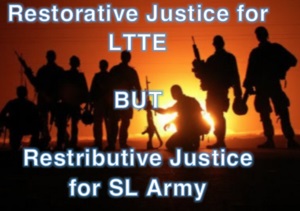
Basically what needs to be said is that LTTE cannot enjoy Restorative Justice & the Sri Lankan Army cannot be meted out Retributive Justice.

In other words the same conflict cannot treat the perpetrators of the crimes as the less guilty party while the national army called into militarily defeat the LTTE cannot be considered the more guilty while the LTTE’s crimes against the State, State property & killing of innocent civilians cannot result in simply forgetting & forgiving the LTTE for their crimes while a War Crimes Tribunal with Foreign Judges are created as Retributive Justice against Sri Lanka’s National Army & the Government Heads that gave orders for the military action against the LTTE.

We do understand that we have to move forward. We are against foreign tribunals primarily because all of the UN tribunals & hybrid courts held have not served justice to the victims. They have been nothing but wasting time & money – this money could have easily been given to the victim families. Moreover, some of these tribunals have run into decades – more often than not the perpetrators may have ended up dead or suffering old age dementia.

What needs to be clearly pointed out in the case of Sri Lanka is that we are not agreeable to having restorative justice for LTTE & retributive justice for the National Army. What confounds the situation is that although the LTTE leader & his ground leadership is no more, the ideology of separatism remains promoted through LTTE agents the TNA & the LTTE fronts that are steering it through their organizations overseas. Moreover, foreign intelligence too have confirmed that the LTTE support networks & LTTE propaganda machinery remains functional. Also, the police & Armed Forces continues to locate hidden arms & ammunition belonging to LTTE while LTTE cadres too are getting caught. All these cannot put to rest & force the citizens to forget LTTE or their ultimate objective of separating a sovereign state.

Anyone coming with all sorts of teary eyed solutions & stories cannot omit these fundamental facts & realities in their fantasy to force everyone to believe in a non-existent forgive & forget theory.

We are prepared to forget IF & ONLY IF the LTTE & their coterie gives up quest to separate Sri Lanka, gives up their false propaganda locally & internationally. However, so long as these objectives continue – sorry to say, we are not prepared to let LTTE or their agents take the cake & eat it too while locking up our national heroes in prison claiming them to be the only culprits.

Shenali D Waduge

Lawyer asks Mangala if he intends to strip MPs of duty free vehicle permits Govt. move to halt super luxury vehicle imports

September 28th, 2018

by Shamindra Ferdinando Courtesy The Island

Attorney-at-law and public litigation activist Nagananda Kodituwakku, yesterday, said that Finance and Media Minister Mangala Samaraweera should explain what he really meant when he said that the super luxury vehicle imports wouldn’t be allowed next year.

Kodituwakku was commenting on Samaraweera’s declaration at an event at the Royal College, Colombo on Thursday (Sept 27) that the importation of super luxury vehicles by members of parliament and others should be stopped forthwith. Underscoring the growing oil import bill, Samaraweera vowed to halt such imports against the backdrop of financial difficulties.

article_image

Samaraweera said that the only way to artificially control the rapid depreciation of the Rupee was to release USD held by the government. Samaraweeara said that however, as the Minister holding the finance portfolio he wasn’t prepared to release funds as such funds were required to settle foreign debt.

Samaraweera also warned that a barrel of crude would go up to USD in case of a conflict between the US and Iran.

Kodituwakku said that the Finance Minister should explain whether he intended to abolish the special duty free permit scheme implemented for the benefit of members of parliament. Responding to a query by The Island, Kodituwakku said that successive governments owed an explanation as to why duty free exemption was gradually increased at the expense of the national economy.

Kodituwakku said that finally minister had been compelled to admit the catastrophic financial crisis caused by uncontrolled import of luxury vehicles. Having failed to convince the Commission to Investigate Allegations of Bribery or Corruption (CIABOC) to inquire into duty free vehicle scam involving members of parliament, Kodituwakku said that he moved the Supreme Court against the CIABOC. Minister Samaraweera’s statement couldn’t have been made at a better time, Kodituwakku recalling Samaraweera’s predecessor Ravi Karunanayake in his first budget presentation in 2015 promising to do away with duty free vehicle schemes for lawmakers as part of the overall measures to strengthen the national economy.

Kodituwakku said that instead of abolishing the scheme, Karunanayake paved the way for members of the current parliament to import duty free vehicles, with each tax exemption amounting to at least Rs 30mn. The majority of those vehicles had been sold and the identities of the buyers, too, were known to the Finance Ministry, Kodituwakku said, challenging the Finance Ministry to release the list of buyers and sellers which he (Kodituwakku) obtained from the Customs under the Right to Information (RTI) law.

Kodituwakku said that all political parties represented in parliament should explain their stand on special perks and privileges received by them at a heavy cost to the national economy. Kodituwakku said that his RTI query had revealed that except six JVP lawmakers in parliament, all other political parties and the Joint Opposition members had brazenly abused the permit scheme.

Kodituwakku urged the Finance Ministry to examine recent CIABOC declaration that transfer of vehicles imported on duty free permits wasn’t contrary to the law.

IMF Staff Concludes Visit to Sri Lanka to Discuss Progress of Economic Reform Program

September 28th, 2018

IMF Communications Department

  • A strong policy mix and exchange rate flexibility are critical to strengthen the economy’s resilience to market volatility, while supporting competitiveness and growth.
  • Advancing revenue-based fiscal consolidation in the 2019 budget can support Sri Lanka’s ambitious social and development goals while reducing public debt.
  • The authorities should sustain reform efforts to support trade, investment, and inclusive growth.

A staff team from the International Monetary Fund (IMF) led by Manuela Goretti visited Colombo during September 13-27, 2018 to hold discussions on the fifth review of the Sri Lanka’s economic program supported by a three-year Extended Fund Facility (EFF). At the end of the visit Ms. Goretti made the following statement:

The mission made significant progress toward reaching a staff-level agreement with the government on completing the fifth review of the EFF. Discussions will continue during the Annual Meetings of the IMF and World Bank in October.

Macroeconomic performance has been mixed in the first half of 2018, with growth recovering gradually and inflation stabilizing in the mid-single digits. The current account deficit widened on the back of higher fuel imports, despite strong export performance, while international reserves declined from their peak level in April, amid volatile global market conditions. Growth is projected to remain below 4 percent in 2018, and gradually reach 5 percent over the medium-term.

The mission commended the authorities on their continued efforts to advance their economic reform program. The quantitative performance target on the primary surplus for end-June 2018 was met and inflation remained within the CBSL’s band, although reserve accumulation and tax revenues fell short of program targets due to the weaker economic environment and delays in policy implementation.

Reforms need to accelerate to strengthen the Sri Lankan economy’s resilience to domestic and external shocks, given still significant vulnerabilities. In the face of greater market volatility in emerging markets, the authorities have maintained a strong policy stance with prudent monetary policy and further fiscal consolidation.

The mission welcomes the authorities’ commitment to amend the Central Bank’s Monetary Law Act supporting the transition to inflation targeting and strengthening CBSL’s governance and accountability frameworks. Renewed efforts by the CBSL to strengthen reserve buffers and a clear commitment to exchange rate flexibility are critical to enhance external competitiveness and protect against adverse global market conditions.

The CBSL’s efforts should be supported by a strong 2019 budget, a well-defined Medium-Term Debt Strategy, and a sound fiscal rule to secure debt on a downward sloping path and support investors’ confidence. With revenues falling short of targets, the focus should remain on implementing the new Inland Revenue Act and other tax policy measures, supported by modernized business processes to strengthen tax compliance. Greater revenue mobilization can make space for critical spending needs, including broader coverage of vulnerable families under the social safety net based on well-defined selection criteria.

Structural reforms need to accelerate to bring transparency, accountability, and cost-efficiency to large state-owned enterprises. In this regard, the mission commended the successful implementation of the fuel pricing reform and encouraged the introduction of an automatic pricing mechanism for electricity.

The authorities should push ahead with their Vision 2025 to support Sri Lanka’s rapid and inclusive growth through sustained efforts to promote trade openness and investment, fight corruption, enhance social protection, and encourage female labor force participation.”

The mission met with Prime Minister Wickremesinghe, Minister of Finance Samaraweera, State Minister of Finance Wickramaratne, Governor of the Central Bank of Sri Lanka Coomaraswamy, other public officials, and representatives of the business community, civil society, and international partners.

President Maithripala Sirisena’s comment at the UN General Assembly only valid if SL withdraws co-sponsorship: Sarath

September 28th, 2018

Courtesy The Daily Mirror

Referring to the remark made by President Maithripala Sirisena at the UN General Assembly that Sri Lanka should be allowed to handle its own internal affairs, former MP Sarath Weerasekara said the President’s comment would only be valid if the government withdraws the co-sponsorship of 30/1.

Rear Admiral Weerasekara, who is in Geneva to counter the pro-LTTE propaganda, said Sri Lanka is legally bound to implement the recommendations in the resolutions unless it is withdrawn as per the President’s remarks.

He said, The technical assistance provided by the UN had already culminated in a resolution charging Sri Lanka of war crimes. This resolution 30/1 was adopted by this council without a debate or a vote because it was co-sponsored by a delegate and he did that without the approval of the President or the cabinet. Hence it has no legal base. The USA has withdrawn from this council accusing it as politically biased and hypocritical. Since the US was the main sponsor of 30/1 the co-sponsorship too should be nullified automatically.

Germany was occupied by UK and USA for years after world war 11. More Germans were killed as prisoners of war after the war than during the war.

Germany still pays reparations to Israel. We saved 300,000 during the war and rehabilitated 12,000 after the war. It’s a pity that Germany and UK of all the countries are now pushing us to implement 30/1.

The US has threatened sanctions against ICC if it persecutes American soldiers. PM Theresa May said she will change the Human Rights laws to protect her soldiers. Our President too thanked our soldiers who defeated terrorism. It implies he rejects the war crimes. Then why 30/1? Many things can be negotiated Mr. President, but sovereignty, never!”

Noyahr’s assaulter will be uncovered – Gotabaya

September 28th, 2018

People did not have the freedom for expression back when people were inflicted with the fear of war, says the former Defense Secretary Gotabaya Rajapaksa.

He stated this joining a religious event held in Piliyandala yesterday (27) at the Sri Sumanarama Viharaya in Batakeththara, Piliyandala to unveil the Samadhi Buddha Statue established at the temple premises.

The event was attended by several public representatives of the Joint Opposition.

Addressing the event, Gotabaya Rajapaksa stated that, although many people claim him to be responsible for the assault on journalist Keith Noyahr, the CID will duly uncover accurate information on the incident.

The attempts of the L.T.T.E to assassinate him in the past have failed, and that law and order prevailed in the country during the administration of former President Mahinda Rajapaksa, he further stated.

Moreover, terrorism was eradicated, underworld activities and drug menace was curbed at the time, Rajapaksa said.

However, the law is unable to curb the occurrence of crimes at present; the public criticizes what they experience, and they should recollect the person who truly liberated the country, former Defense Secretary added.

Fmr. President and fmr. Defense Secretary didn’t hide in fear of war – Fonseka

September 28th, 2018

Former Army Commander Field marshal Sarath Fonseka stated that neither he nor the former President nor the former Defense Minister hid away in fear of the war.

He mentioned this to the media following an annual literary festival held at the Kelaniya Divisional Secretariat this morning (28).

Responding to a journalist’s question on a statement made by President Maithripala Sirisena in New York, he said that there are many other aspects such as administration to pay attention to while a war is ongoing. It is not merely waiting to pull the trigger from the moment war starts, he added.

He further said that those responsibilities fall on to senior officials and during the final weeks of the war, former President had to leave the country, while he, too, had to visit China for an official purpose.

A war can never be decided in 2 weeks and what was left to do during the last 2 weeks was something even a corporal could have done, says Fonseka.

He further says that he wonders how people think that it is possible to finish a war in 2 weeks.

China to push forward cooperation with Sri Lanka under BRI

September 28th, 2018

Courtesy NewsIn.Asia

Colombo, Sept 27 (newsin.asia) – China will continue to push forward its pragmatic cooperation with Sri Lanka under the Belt and Road Initiative in order to bring more tangible benefits between the two countries and its two peoples, China’s Ambassador to Sri Lanka, Cheng Xueyuan said here at the 69th anniversary celebrations of the Founding of the People’s Republic of China on Wednesday evening.

Addressing the gathering, the Ambassador said over the past year, pragmatic cooperation between China and Sri Lanka had developed rapidly especially with the ongoing construction of the Colombo Port City, the Hambantota Port, the Moragahakanda Reservoir Head works Project, the Extension of the
Southern Railway and that of the Southern Expressway linking Colombo and Hambantota, in the south.

He said tourism had also expanded between the two countries in recent years with China now becoming Sri Lanka’s second largest source of tourists.

China to push forward cooperation with Sri Lanka under BRI

According to officials figures, 260,000 Chinese tourists arrived to Sri Lanka in 2017 and this number is estimated to exceed 300,000 in 2018, the Ambassador said.

More Sri Lankans were also traveling to China as China had also become an important destination for overseas study and training for Sri Lankan people.

We are in the best period in history for the friendly and pragmatic cooperation between China and Sri Lanka,” Cheng said.

Let’s work together, stick to our goals, overcome all the disturbance, to push forward China-Sri Lanka cooperation under the Belt and Road Initiative, to build a community of shared future for China and Sri Lanka, and to bring more tangible benefits to our two countries and two peoples,” he added.

In terms of trade, Cheng said China had invited Sri Lankan President Maithripala Sirisena to attend the opening ceremony of China’s first ‘China International Import Expo (CIIE)’ which will be held in Shanghai in November.

Sirisena has been invited to lead the Sri Lankan delegation, to promote the island country and its products to the Chinese people and to deliver more fruits to the friendly and pragmatic cooperation between China and Sri Lanka.

Sri Lanka’s population rises to 21.4 million

September 28th, 2018

Courtesy NewsIn.Asia

Colombo, Sept 28 – Sri Lanka’s mid year population as at 2017 was estimated at 21.444 million, a rise from 21.203 million estimated in 2016, latest official data showed here Friday.

According to a report in Ceylon Today, quoting official data, since 2012, Sri Lanka’s population has increased by 1,019, million. The highest population increase was recorded from the capital Colombo District with a population of 2.419 million and the lowest was from Mullaitivu, in the north. with a population of 96,000.

A total of 169,365 marriages were registered last year in the island country. This was a decrease of 2.6 per cent compared with 2016, where the number of marriages recorded was 173,990.

The number of live births last year was 326,052, down from the 2016 figure of 331,073 while the number of deaths last year was 139,822.

Last year, 8 percent of the population was aged 65 and over. People aged under 15 years comprised 25 percent of the population and 67 percent were aged between 15 to 64.

There were more females than males especially among higher age groups due to the longer life expectancy of females.

යුද්දේ අවසන් සති දෙකේ මම රට ගියේ නෑ.. කොළඹට කොටි ගහන සැලසුමක් ගැන මං දන්නෙත් නෑ..- ජනපතිගේ නිවුයෝක් කතාව ගෝටාත් ප‍්‍රතික්‍ෂෙප කරයි..

September 28th, 2018

 lanka C news

ශ්‍රී ලංකාවේ සිවිල් යුද්ධයේ අවසාන සති කීපය තුළ එල්ටීටීඊ සංවිධානය කොළඹට ගුවන් ප්‍රහාර එල්ලකිරීමට සැලසුම් කළ බවක් තමන් දැන සිටියේ නැතැයි එවකට ආරක්ෂක ලේකම් පදවිය දැරූ ගෝඨාභය රාජපක්ෂ පවසයි.

එමෙන්ම යුද්ධයේ අවසාන දිනවල තමන් විදේශගත නොවූ බව ද ඔහු අවධාරණය කළේය.

හිටපු ආරක්ෂක ලේකම් ගෝඨාභය රාජපක්ෂ ඒ බව සඳහන් කළේ, එවකට ජනාධිපති මහින්ද රාජපක්ෂ, අගමැතිවරයා, හමුදාපති සරත් ෆොන්සේකා හෝ එවකට ආරක්ෂක ලේකම්වරයා යුද්ධයේ අවසාන සති දෙක තුළ ශ්‍රී ලංකාවේ නොසිටි බවට ජනාධිපති මෛත්‍රීපාල සිරිසේන බ්‍රහස්පතින්දා කළ ප්‍රකාශය සම්බන්ධයෙන් ප්‍රතිචාර දක්වමිනි.

අවසාන සති දෙකේ මමයි වැඩ බලපු ආරක්ෂක ඇමතිවරයා. අවසාන සති දෙකේ ලැබුණු වාර්තා තමයි, අවසන් සටන පසුබහින්නේ නෑ එල්ටීටීඊය, දකුණු ඉන්දියාවේ චෙන්නායි හරි කොහේ හරි කැලෑ පැත්තක ඉඳල ඇවිල්ල, කොළඹ සම්පූර්ණ විනාශ කරනවා උඩින් බෝම්බ දාල කියල රජයට තොරතුරු ලැබුනේ. ඒ නිසා තමයි ඔක්කොම ගියේ රටින්,” යනුවෙන් ජනාධිපති මෛත්‍රීපාල සිරිසේන නිව්යෝක් නුවරදී ශ්‍රී ලාංකිකයන් අමතමින් පැවසීය.

යුද්දේ අවසන් සති දෙකේ මම රට ගියේ නෑ.. කොළඹට කොටි ගහන සැලසුමක් ගැන මං දන්නෙත් නෑ..- ජනපතිගේ නිවුයෝක් කතාව ගෝටාත් ප‍්‍රතික්‍ෂෙප කරයි..

කෙසේ වුවත් හිටපු ආරක්ෂක ලේකම්වරයා පවසන්නේ තමන්ට පවා එය අලුත් පුවතක් බවය.

ජනාධිපතිතුමා මම දන්නේ නැති තොරතුරක් ඔය කිවුවේ මම හිතන්නේ ලෝකෙම දැනගෙන හිටියේ නැති දෙයක්. මට නම් එහෙම තොරතුරක් තිබුණේ නැහැ,” ඔහු පැවසීය.

මම නම් හිටියා ලංකාවේ. මම කොහෙවත් ගියේ නෑ.”

කෙසේ වුවත් ශ්‍රී ලංකා ආරක්ෂක හමුදා විසින් යුධ අපරාධ සිදු කළ බවට බොරුවට දෝෂාරෝපණය කරන්නේ” ජනාධිපති මෛත්‍රීපාල සිරිසේන පවසන පරිදි ඔහු යුද්ධයට දේශපාලන නායකත්වය දුන් දිනවලට අදාළව බැවින් ජාත්‍යන්තර වශයෙන් එල්ලවන එම චෝදනාවලින් රට නිදහස් කරගැනීම ජනාධිපතිවරයාගේ වගකීම බව ගෝඨාභය රාජපක්ෂ පැවසීය.

එතකොට ජනාධිපතිතුමා නොදැනුව මං හිතන්නේ එතුමාගේ විදේශ ඇමතිවරයා ජිනීවා නුවරදී යෝජනාවකට සම අනුග්‍රහය දක්වනවා. ඉතින් එතුමා මේක මෙහෙයවපු හන්ද හොඳට දන්නවනේ එහෙම දේවල් සිදු වුනේ නෑ කියල. ඒ නිසා මේක වහාම හකුලාගන්න කියල, මේකෙන් ඉවත්වෙන්න කියල විදේශ අමාත්‍යාංශයට උපදෙස් දෙන්න ඕන.”

එයින් අදහස් වෙන්නේ කිසියම් ලෙසකින් ආරක්ෂක හමුදා විසින් යුධ අපරාධ සිදු කළේ නම් ජනාධිපති මෛත්‍රීපාල සිරිසේන එහි වගකීම භාරගත යුතු බව දැයි විමසූ අවස්ථාවේ හිටපු ආරක්ෂක ලේකම්වරයා කියා සිටියේ, එවැනි කිසිදු අපරාධයක් සිදු නොවූයේ යයි තමන් දන්නා බවය.

යුද්ධයේ අවසාන සති කිහිපයේ තමන්ගේ ජීවිතයට ද තර්ජන පැවති බවත් ජනාධිපතිවරයා නිව්යෝක් නුවරදී සඳහන් කළේය.

ඒ අවසන් සති දෙකේ මම කොළඹ නෙවෙයි හිටියේ. ඒ අවසන් සති දෙකේ මම රටේ තැන් තැන්වල හිටියේ. මොකද මම ඉන්න තැනත් දැනගනීද කියල,” ජනාධිපති මෛත්‍රීපාල සිරිසේන පැවසීය.

ඒ අවස්ථාවේ තමන්ගේ ජීවිතයට ද ජනාධිපති මෛත්‍රීපාල සිරිසේන පවසන අන්දමේ තර්ජනයක් එල්ල වී තිබුණේ දැයි කළ විමසීමට පිළිතුරු දීම ගෝඨාභය රාජපක්ෂ ප්‍රතික්ෂේප කළේය.

හිටපු ජනාධිපතිවරයා, අගමැතිවරයා සහ හමුදාපතිවරයා පිළිබඳව ජනාධිපති මෛත්‍රීපාල සිරිසේන පළ කළ අදහස් ගැන විමසූ විට ඔහුගේ ප්‍රතිචාරය වූයේ මම කතාකරන්නේ මම ගැන නේ,” යනුවෙනි.

– BBC

ෆිල්ඩ් මාෂල් පෙරලාගෙන ජනරාල් ෆොන්සේකා යලි නැගිටී.. ‘යුද්දෙට බයෙන් මහින්ද, ගෝටා හෝ මා රටින් පැන ගියේ නෑ..’ ජනාධිපති මෛත‍්‍රීගේ නිවුයෝක් ප‍්‍රකාශය සමතලා කර දමයි..

September 28th, 2018

 lanka C news

කොටි සංවිධානයට එරෙහිව යුද්දය පැවති අවසන් සති දෙක තුලදී හිටපු යුධ හමුදාපතිවරයා ලෙස තමන් හෝ හිටපු ජනාධිපති මහින්ද රාජපක්‍ෂ මහතා හෝ හිටපු ආරක්ෂක ලේකම් ගෝටාභය රාජපක්‍ෂ මහතා යුද්ධයට බයේ රටින් පැන ගියේ නැති බව හිටපු යුද හමුදාපති ෆීල්ඩ් මාර්ෂල් ඇමති සරත් ෆොන්සේකා මහතා පවසයි.

තොයි සංවිධානය විසින් දැවැන්ත ගුවන් ප‍්‍රහාරයක් එල්ල කර කොලඹ නගරය විනාශ කරන්නේ යයි ලැබ තිබූ වාර්තා මත යුද්දය පැවති අවසන් සති දෙකේදී එවකට හිටපු ජනාධිපතිවරයා, හිටපු ආරක්‍ෂක ලේකම්වරයා, හිටපු හමුදාපතිවරයා රටින් පිටවු බවත් වැඩ බලන ආරක්‍ෂක ලේකම් ලෙස තමන් විසින් යුද්ධය මෙහෙයවූ බව ජනාධිපති මෛත‍්‍රිපාල සිරිසේන මහතා විසින් ඊයේ දිනයේ ඇමැරිකාවේදී කරන ලද ප‍්‍රකාශයෙන් පසු ෆොන්සේකා මහතා මෙම ප‍්‍රකාශය සිදු කලේය.

කැලණිය ප්‍රාදේශීය ලේකම් කාර්යාලයේ පැවති උත්සවයකට සහභාගී වීමෙන් පසු මාධ්‍ය වෙත අදහස් පල කරමින් ෆොන්සේකා මහතා මෙම අදහස් පල කලේය.

කිසිම අවස්ථාවක යුද්දයක් සති දෙකකින් තීරණය නොවන බවත් එම කාලයේ ඉතිරිව තිබුණේ කෝප්‍රල්වරයෙකුට පවා සිදු කල හැකි දෙයක් බවත් පවසන ෆොන්සේකා මහතා යුද්ධය සති දෙකකින් කලේ යයි ඇතැමුන් කෙසේ සිතා සිටින්නේදැයි යන්න පවා ගැටළුවක් යයිද ඔහු පැවසීය.

එහෙම හැංගෙන ජාතියෙ හමුදාවක් අපට හිටියෙත් නෑ. හමුදපතිවරු හිටියෙත් නෑ. මොනව වුණත් ඒ ජනාධිපතියි ඒ ආරක්‍ෂක ලේකමුයි එහෙම හැංගුනෙ නෑ’ යයිද ඔහු කියා සිටියේය.

ඓතිහාසික පිදුරංගල රජමහ විහාරස්ථානයේ පිහිටි ගල මතට නැඟ නිරුවත පෑ 3ක් රිමාන්ඩ්

September 28th, 2018

උපුටාගැණීම  මව්බිම

ඓතිහාසික පිදුරංගල රජමහ විහාරස්ථානයේ පිහිටි ගල මතට නැඟ අඩ නිරුවතින් ඡායාරූප ගෙන මුහුණුපොත හරහා අන්තර්ජාලයට මුදාහැර තිබූ බවට සැකපිට අත්අඩංගුවට ගත් තරුණයන් තිදෙනා ඔක්තෝබර් 03 දින දක්වා රක්ෂිත බන්ධනාගාරගත කරන ලෙස දඹුල්ල මහෙස්ත්‍රාත් කෝසල බණ්ඩාර ඉලංගසිංහ මහතා ඊයේ (27දා) නියෝග කළේය.

මෙසේ බන්ධනාගාරගත වූයේ ගලේවෙල ප්‍රදේශයේ පදිංචි ශාමික දිල්ශාන් අබේවික්‍රම, සපුමල් දීමන්ත සුබසිංහ, එල්.ඒ.ඒ. පියුමාල් යන දහ නව හැවිරිදි වියේ පසුවන තිදෙනායි.

පෙරේදා (26දා) පස්වරුවේ සැකකරුවන් සීගිරිය පොලිසිය මඟින් අත්අඩංගුවට ගෙන ප්‍රකාශ සටහන් කර ගැනීමෙන් අනතුරුව ඊයේ (27දා) දඹුල්ල මහෙස්ත්‍රාත් අධිකරණය වෙත සීගිරිය පොලිසියේ සිට පොලිස් නිල රථයකින් රැගෙන ආහ.

සැකකරුවන් වෙනුවෙන් පෙනී සිටි නීතිඥ එම්. අස්මි මහතා කියා සිටියේ ඔවුන් නොදැනුවත්කම හේතුවෙන් මෙවැනි දෙයක් සිදු කළ බවත් සුදුසු ඇපයක් මත මුදාහරින ලෙසත්ය. වැඩිදුරටත් අදහස් දැක්වූ නීතිඥ එම්. අස්මි මහතා කියා සිටියේ පුරාවිද්‍යා ආඥාපනත යටතේ මෙම සැකකරුවන්ට නඩු පවරා ඇති බවත් මහෙස්ත්‍රාත් අධිකරණයට ඔවුන්ට ඇප දීමේ බලයක් නොමැති නිසා බන්ධනාගාරගත කළ බවත්ය.

එමෙන්ම ලෝක සංචාරක දින උත්සවයකට සීගිරියේදී එක්වෙමින් ඊයේ (27දා) උසස් අධ්‍යාපන හා සංස්කෘතික කටයුතු අමාත්‍ය නීතිඥ ආචාර්ය විජයදාස රාජපක්ෂ මහතා මෙම සිද්ධිය පිළිබඳව විශේෂ ප්‍රකාශයක් කළේය.

පිදුරංගල ගල මතට නැඟී අඩ නිරුවතින් ඡායාරූප ගෙන ඉදිරිපත් කිරීම රටේ අභිමානයට හානියක් බවත් එය නොහොබිනා ක්‍රියාවක් බවත් ඔහු සඳහන් කළේය. මුළුමහත් රටේම ජනතාවගේ අභිමානයට මෙම ක්‍රියාව හානියක් බවද ඇමැතිවරයා කීවේය.

රටේ අභිමානයක් ඇති පෞරාණික වටිනාකමක් ඇති ස්ථාන අපවිත්‍ර කිරීමට තරම් අද රටේ ඇතැම් තරුණ තරුණියන් නිවට නියාලු තත්ත්වයට ඇද වැටී ඇතැයි කී අමාත්‍යවරයා ඒ පිළිබඳව කනගාටුව ප්‍රකාශ කරන බවද කීවේය. මේ පිළිබඳව අනුකම්පා විරහිතව නීතිය ක්‍රියාත්මක කරන බවද සඳහන් කළේය.

SL should have an export driven economy to overcome economic crisis: PM

September 27th, 2018

Sudath Gunasekara Mahanuwara

2018-09-27 04:18:54

Sri Lanka would not have been affected by the current global economic crisis if the country did not get into a debt trap like the one it has got into, Prime Minister Ranil Wickremesinghe said yesterday.

Mr Wickremesinghe expressed this sentiment at the prize giving of Maliyadeva Balika Maha Vidyalaya in Kurunegala in the morning.

Sri Lanka is largely affected by the devaluation rupee because of the debt trap it has got into. We would not have been affected by the devaluation issue if we did not get into a debt trap. We have to pay $ 3,000 million this year to settle debts while a sum of $ 4000 million has to be paid next year. Therefore one could see that what we inherited are past sins. What we have to do now is to overcome this situation,” the Prime Minister said.

Anyhow the current global crisis affects both the household economy and the national economy. We are fully aware of it. Some countries such as Thailand and Vietnam are not severely affected by the global economic crisis as they fully depend on exports,” the Prime Minister added while stressing that Sri Lanka too should go for an export-driven economy in order to get out of the present crisis.

The Prime Minister said Sri Lanka has failed to focus on building up an export-driven economy for the last ten years. It will take at least three years to build such an economy. Attracting investors and establishing export zones is a time-consuming job. However, we have already embarked on such a program. Kurunegala, Kandy and South have been identified as locations where export zones would be opened. The Central highway which is being constructed now will be helpful to the export zone which will come in the North-Western Region. An 800-acre export zone will be built in Bingiriya. Such zones will come in Kurunegala as well. There will be a 10,000-acre zone in Hambantota. There will also be one in Kalutara,” he also said.

Further, the Prime Minister said Sri Lanka will need skilled and knowledgeable people when various kinds of industries come up in Sri Lanka and added that such persons will be produced through a modernized education system. (Yohan Perera)

Comment

I fully agree. But my priority export item is these corrupted politicians. I know no country in the world will like to have them. But at least we can dump the in Mindano deep 32 000 feet below sea level so that none will be able to return.

Let us start this mega export drive with the Prime Minister Ranil, President Sirisena, then the  whole Cabinet followed by all in Parliament and all those Governors, Chief (rather Cheap Ministers) Ministers and Provincial Council members and Pradeshiya Sabha Councilors.

Thereafter we can have a people’s Government in this country instead of a Government of Politicians and rogues.

Then at least we can get rid of the burden of maintaining these animals with no gain what so ever for the country and save the Central Bank and Billions misappropriated and robbed by them to be spent on the welfare of our people and the development of the country or at least we can save the mahapolawa of our motherland from them for posterity.

Sudath Gunasekara Mahanuwara

27.9.2018

WOMEN RIGHTS VIOLATIONS

September 27th, 2018

ALI SUKHANVER

Two years back, a report was compiled about the top-ten countries where incidents of rape had reached an alarming situation. The report said, The super power of the world USA is at the first position in the race of rapes. Males are majorly the rapist holding a proportion of 99%. Out of all the victims, 91% are females while 9% are males.” The U.S Bureau of Justice Statistics states in a report that 91% of rape victims are female and 9% are male, and nearly 99% of rapists are male. According to the National Violence against Women Survey, 1 in 6 U.S. women and 1 in 33 U.S. men has experienced an attempted or completed rape in their lifetime. More than a quarter of college-age women report having experienced a rape or rape attempt since age 14. Out of all, only 16% of the total cases are reported. Outdoor rape is not common in USA rather most of the rape cases take place inside homes.” But encouraging is the fact that the US government has always been doing all its best to put a check on these incidents. The culprits involved in this heinous crime are tackled with iron hands. New laws are being formulated and the law-department tries to settle all rape-related issues urgently on priority basis. If the US government were no so keen about putting a check on the increasing number of rape-incidents, the situation could have been much more horrible.

It is also a reality that the countries where rape-criminals are punished severely and without any delay, situation is far better there. For example rapists in Iran are sentenced to death, sometimes by hanging but sometimes allegedly also by stoning. The punishment for rape in Saudi Arabia is a public beheading after administering the rapist with a sedative. In Afghanistan convicted rapists are shot in the head within 4 days or hanged to death depending on the judgment handed out by the court. Unluckily India has the worst record and worst repute with reference to the rape victims. In most of the cases, the culprits remain scot-free. A very painful fact about India is that rape survivors there face significant barriers to obtaining justice and critical support service. Human Rights Watch said in a recent report, Legal and other reforms adopted since the gang rape and murder of a student, Jyoti Singh Pandey, in Delhi in December 2012 have not been fully realized.” According to the report ‘women and girls who survive rape and other sexual violence often suffer humiliation at police stations and hospitals. Police are frequently unwilling to register their complaints, victims and witnesses receive little protection’.

Barkha Dutt is a renowned Indian television journalist and author. She has authored a very authentic book on serious issues which have become a threat to the Indian society. The name of her book is ‘Unquiet Land: Stories from India’s Fault Lines.’ In one of the chapters of her book she has pointed out the sorry plight of the women victim of rape in India. She says that even the educated and well off women are victims of harassment and abuse. It is ironical that Indian Judicial system in such cases does not give relief to victims. She has referred to a court case in which a low caste woman went to court against her culprits but the judge mercilessly acquitted the accused by saying that an upper caste man would not rape someone of a caste he considered untouchable. So horrible is the situation regarding rape and abuse of women in the Indian society.

Meenakshi Ganguly is the South Asia Director at Human Rights Watch. She said in a comment on deteriorating and worsening situation of women rights in India, It takes time to change mindsets, but the Indian government should ensure medical, counseling, and legal support to victims and their families, and at the same time do more to sensitize police officers, judicial officials, and medical professionals on the proper handling of sexual violence cases.” Government’s inefficiency in dealing with the culprits involved in rape crimes is, in other words, giving a free hand to the rapists in India. And this inefficiency is patronizing those also who are involved in women- trafficking. According to the Indian Ministry of Home Affairs, there were nearly 5,000 reported victims of sexual trafficking in India in 2013. Apart from other crimes against women, acid throwing, honor killings and dowry deaths are also very common in India. The people there are so much frightened of the women-related crimes in India that they go for abortion in case they get news of having a baby girl. According to 2006 UN report everyday 7,000 baby girls were aborted or killed right after birth in India.

The story does not stop here. The government of India is using rape as a weapon too. In the Indian Occupied Kashmir, every year, hundreds of innocent local girls are raped by the officers of the Indian forces forcibly deputed there. In Jammu and Kashmir, rape has always been used as a weapon of war against the Kashmiri population by Indian security forces. A recent report on the sexual exploitation of women in the Indian Occupied Kashmir says, The frequent rape of Kashmiri Muslim women by Indian state security forces routinely always goes unpunished. Many women become victims to rape and sexual assault in Indian Held states of Jammu and Kashmir. It is the responsibility of the international NGOs to raise their voices against this wicked cruelty.


Shouldn’t the UN & World give priority to the VICTIMS of LTTE killings FIRST?

September 27th, 2018

We are a little puzzled at the manner the UN & the so called international community are handling post-LTTE defeat Sri Lanka. Whatever LTTE is now being presented as, what no one can ignore is the fact that the men, women & children that comprised the LTTE were nothing but cold-blooded murderers. No one forced them to take a gun, no one forced them to kill, no one forced them to end innocent people’s lives but that is exactly what they did since 1970s. Where were all these international players when LTTE attacked villages, when innocent civilians were being cut to death & when bombs & suicide missions were taking place throughout the island? Yet, suddenly after the LTTE defeat, a string of international parties & individuals are holding placards about how the war should have been fought & accusing the National Army of committing war crimes totally ignoring that the Armed Forces would not have been called to eliminate the LTTE if the LTTE did not go about murdering innocent people. Justice should be given to the victims of LTTE first. In order to do that the LTTE war crimes have to be investigated & charged first.


While we are concerned about why LTTE began killing people, who funded & trained them & who supported them over the years as well as who championed their propaganda machinery, what cannot be ignored is that the LTTE was the common enemy of not only Sinhalese, Muslims & foreigners but Tamils too. Everyone who went against the LTTE became victims in some way or the other.


So the question that needs to be answered is who supported the LTTE over the years. Whether they are foreigners, foreign governments, foreign intelligence, politicians, businessmen, academics, artists or even civilians – we need to know who were indirectly or directly supporting LTTE. Nothing happened to these people because of their support to the LTTE.


It is only those that went against the LTTE that ended up in their graves prematurely.


As far as these numbers are concerned they far exceed those that are being quoted by LTTE sources as being killed by the Armed Forces and requoted by members of the international community some of whom have direct links to the LTTE fronts operating from foreign shores.

These links completely nullify any credibility to make allegations when none of the allegations are supported by evidence.


If 40,000 are claimed to have been killed the least anyone making the allegations should do is to present the names & details of the dead which has not been forthcoming and we are into the 9th year of this baseless allegation. So where are the names of this 40000 supposed to be killed people which is the basis on which the National Army is being charged of war crimes. If there are no names of the dead, no dead bodies or even their skeletons how can any soldier be accused of murder? It is such a silly allegation and it is surprising that learned experts are actually not asking themselves this basic question.


Even the Presidential Commission on Missing Persons covering period of 1983 to 2009 has had just over 18,000 logged names of which 5000 are of Missing In Action Armed forces personnel.


Sri Lanka’s conflict is treated as a Non-International Armed Conflict where LTTE an internationally proscribed terrorist movement committed many crimes that violate international laws. The fact that LTTE has been proscribed internationally and that the LTTE ban is annually renewed by every country that banned LTTE since 1997 & 2001 with statements by the US authorities that the LTTE ideology, LTTE fund raising & LTTE support networks remain alive still goes to show that the threat of LTTE remains very much alive.


LTTE cadres escaped to foreign shores & recent arrests & charges against LTTE for killings abroad confirms that the threat of the LTTE continues to persist. All that the LTTE today lacks is a leader of the caliber of Prabakaran – all other apparatus is intact. In such a scenario why are the armed forces being unfairly accused in the UN & what is the logic or ulterior motive behind these allegations?


The National Army is called in by the Government in power to defend the nation & its people. This is exactly what the Armed Forces were called in to do when after failed peace talks, negotiations, even foreign-brokered peace deals failed & the lives of the citizens were more important than giving breathing space for a terrorist movement.


It is not that the LTTE were not given chances to lay down their arms & surrender. Twice the President of the country called upon the LTTE to surrender which LTTE refused. If LTTE refused & declared it would fight to its last man, it was the choice of the LTTE & the Armed Forces cannot be held responsible. No armed conflict exchanges roses. Just as soldiers ended up dead so did LTTE cadres.


The problem is confounded by the fact that civilians did die but LTTE confounded the situation because LTTE had its own CIVILIAN TRAINED ARMY. That means LTTE had a civilian force who were trained in combat operations. These Tamil civilians were trained to kill & fight the Sri Lankan Armed Forces. Can we identify such a dead person as a civilian or even a LTTE cadre – NO we cannot. So how can such a person be categorised as a civilian? This is an example of the blur of distinction and the Soldier cannot be faulted for the death. Every second the soldier takes to verify if the other person was a civilian or LTTE cadre means that he would become a dead soldier & no UN or international body would be weeping for him!


In addition to this, LTTE fought both in uniforms & civilian clothing. It is a fundamental rule of law that any civilian who is involved in hostilities loses their right to civilian status. So if any civilian died – what no one is answering is whether this civilian belonged to the LTTE civilian armed force or whether he/she was a LTTE fighting in civilian clothing. Without that being answered the death cannot be credited to the account of the Sri Lankan soldier.


The other forgotten factor is that the LTTE shot at Tamils fleeing to Army controlled areashow many did LTTE shoot & kill. No one is answering this and these deaths too cannot be credited to the account of the Sri Lankan soldier.


Let us never forget that the Sri Lankan soldiers while engaged in combat with the LTTE, saved close to 300,000 people in addition to this the Sri Lankan soldiers also accepted close to 12000 LTTE cadres who were all in civilian clothing with over 500 child soldiers. If the Sri Lankan soldiers were murderers why would they save these 12,000 LTTE cadres?


The UN & the international community become a laughing stock if they are ignoring LTTE killings & concentrating only on a witch hunt of the Sri Lankan Armed Forces.


Who started killing first? The LTTE


Who did the LTTE kill first? Innocent men, women & children in villages, on buses, on trains, in public places etc.


Why would the UN & International Community wish to First investigate supposed killings (without evidence) by the Armed Forces & NOT the killings by the LTTE, FIRST?


By virtue of the LTTE being an internationally proscribed terrorist movement the onus is on the UN & foreign governments as well as the Sri Lankan Government to investigate & punish the LTTE FIRST.


  • How many LTTE killed
  • Who were killed by LTTE
  • Foreign Governments to investigate every LTTE front (for material support) ORIGINALLY proscribed by UN Security Council Resolution 1373 in April 2014 as these are all operating from US, UK, EU countries, Canada, Australia, India, Malaysia – as LTTE remain banned in their countries every leader & member of these LTTE fronts have to be punished under the terror laws that govern their countries.
  • Sri Lanka must also appoint a Commission of Inquiry to accept grievances against LTTE & every individual, local & internationally linked NGO etc that had links to the LTTE since 1970s.
  • The Armed Forces must investigate any allegations forthcoming against any soldier that has violated Military Code of Conduct & through Sri Lanka’s military tribunals punish any soldier or officer.


Any trial has to be of use to the victims not to the international parties funding them or the people getting a handsome salary & perks for sitting & wasting years’ & time offering no justice to the victims.


We really do not need any foreigners to launch tribunals. The examples of the 6 tribunals held since the Tribunal against Yugoslavia & the expense & wastage of years with nothing forthcoming to the victims show the futility of these trials.


This is exactly the outcome of the UN tribunals/hybrid courts held against Yugoslavia, Rwanda, Cambodia, Lebanon, Sierra Leone, East Timor. Therefore, taking these as examples we have every valid reason to say NO THANK YOU TO FOREIGN TRIBUNALS.

https://www.lankaweb.com/news/items/2016/03/16/name-1-un-tribunal-that-has-delivered-justice-for-victims/


If the world is wanting to serve justice – justice must be served to the VICTIMS not justice to the murderers. With no names of the supposed ‘civilians’ killed by the Sri Lankan Forces, there is no valid justification for any War Crimes Tribunal against the Sri Lanka soldiers, on the other hand the LTTE murdered many innocent people and if any justice should be served it should be against LTTE & their supporters for cutting short the lives of innocent civilians while there are thousands of people who remain injured for life (mentally & physically) by LTTE.


Don’t these people matter to the UN & the international community?


Shenali D Waduge

ජාතික දුම්රිය කෞතුකාගාරය නමින් තවත් හොර ජාවාරමක්

September 27th, 2018

මාධ්‍ය නිවේදනයයි එස්.පී.විතානගේ සමකැඳවුම්කරු

ජාතික දුම්රිය කෞතුකාගාරය (National Railway Museum,)  ලෙස නාමකරණය කර දුම්රිය දෙපාර්තමේන්තුවට අයත් නොවන පුද්ගලික සමාගමක් මගින් ජාවාරමක් පවත්වාගෙන යාමට අවශ්‍ය කටයුතු මේ වන විටත් ක‍්‍රියාත්මක කරමින් ඇත.

කොළඹ මරදානේ දුම්රිය මූලස්ථානය අසල දුම්රිය ගබඩා අධිකාරි කාර්යාලය සතු ගොඩනැගිලි මේ සඳහා යොදාගෙන ඇත. මහජන බැංකුව සතු රුපියල් මිලියන 300 ක් වැයකරමින් නාවික හමුදා නිලධාරීන් යොදාගෙන ඉදිකිරීම් කටයුතු කරනු ලබන අතර, දුම්රිය දෙපාර්තමේන්තුවේ නම යොදාගෙන ලියාපදිංචි කරන ලද Railway Museum Gurantee Ltd සමාගම මෙම ජාවාරම කරගෙන යයි. මෙය සම්පූර්ණ වශයෙන්ම දුම්රිය අඥා පනතට පටහැනිව ලියාපදිංචි කරන ලද සමාගමකි.
 
මහජන බැංකුවේ මුදල් යනු මෙරට මහජනතාවගේ මුදල්ය. එනම් රජයේ මුදල්ය. දුම්රිය දෙපාර්තමේන්තුවේ ගොඩනැගිලි හා ඉඩම් යනු රජයේ දේපලය. රජයේ මුදල් හා රජයේ දේපල යොදාගනිමින්, දුම්රිය දෙපාර්තමේන්තුවේ නම යොදාගෙන රජයේ ආයතනයක් ලෙස හඟවා අදෘෂමාන දේශපාලන බලවේගයක් මගින් මෙම පෞද්ගලික සමාගම පවත්වාගෙන යන බව ඉතා පැහැදිලිය.

Railway Museum Gurantee Ltd සමාගමේ අයිතිකරු හේමසිරි ප‍්‍රනාන්දු මහතාය. එම සමාගමට අමතරව JF ටුවර් ඇන්ඞ් ට‍්‍රැවල්ස් ලංකා සමාගම ද ඔහුට හා ඔහුගේ පුත‍්‍ර පවිත‍්‍ර ප‍්‍රනාන්දුට අයත් තවත් සමාගමකි. දුම්රිය දෙපාර්තමේන්තුවට අයත් වෛස්රෝයි (Viceroy) විශේෂ සුඛෝපභෝගි දුම්රිය, Viceroy – 2 විශේෂ සුඛෝපභෝගි මැදිරිය T-1-515 විශේෂ රේල් කාර් රථය ධාවනය කරවීම සඳහා කොන්ත‍්‍රාත් ගෙන ඇත්තේද මෙම න්‍ත්‍ ටුවර් ඇන්ඞ් ට‍්‍රැවල්ස් ලංකා සමාගමය. එමෙන්ම කොළඹ කොටුව දුම්රිය ස්ථානය ආශ‍්‍රිව ඇති “Rail Tours” කාර්යාලයද මොහු විසින් බදු ගෙන ඇත. මෙම කොන්ත‍්‍රාත් වෙනුවෙන් ගෙවිය යුතු රුපියල් තුන්කෝටි පනස් ලක්‍ෂයකට අධික මුදලක් හේමසිරි ප‍්‍රනාන්දු මහතා දුම්රිය දෙපාර්තමේන්තුවට ගෙවා නැත. රජයේ විගණකාධිපති විසින් සිදු කරන ලද විගණන පරීක්‍ෂණයකින් අනතුරුව මෙම මහා චංචාව හෙළිකර ගැනීමට හැකි වී ඇත.

දුම්රිය දෙපාර්තමේන්තුවට එවැනි මහා මුල්‍ය වංචාවක් කළ පුද්ගලයෙකුට දුම්රිය දෙපාර්තමේන්තුවේ නම පාවිච්චි කරමින් සමාගමක් ලියාපදිංචි කිරීමටත්, රාජ්‍ය ආයතනයක නම යොදාගෙන ජාවාරමක් කිරීමටත් මේ ආණ්ඩුව ඉඩ සලසා ඇත. පාඩු ලබමින් මහජන සේවාවක් පවත්වාගෙන දුම්රිය දෙපාර්තමේන්තුවට හානි සිදුකරන මෙවැනි ජාවාරම් කාරයින්ට තවතවත් ඉඩකඩ සලසාදීම යහපාලන ආණ්ඩුවේ කාර්යභාරය වී ඇත.

එමෙන්ම දුම්රිය දෙපාර්තමේන්තුවට ගෙවිය යුතු රුපියල් කෝටි ගණනක් නොගෙවා, රාජ්‍ය මුදල් අවභාවිතා කළ සිරගත කළයුතු ජාවාරම් කාරයෙකු වන හේමසිරි ප‍්‍රනාන්දු ජනාධිපති කාර්ය මණ්ඩල ප‍්‍රධානියා ලෙස පත්කර ගැනීමත් යහපාලන ආණ්ඩු හොරුත් එක්ක හෙළුවෙන් සිටගෙන සිටන බව සනාථවීම කිරීමට තවත් උදාහරන අවශ්‍ය නැත. මේයින් පෙනී යන්නේ මහජන ආයතනයක් වන දුම්රිය දෙපාර්තමේන්තුව විනාශ කිරීම සඳහා පිඹුරුපත් සකස්කරන බවකි. පාලක මණ්ඩල පත්කර දුම්රිය දෙපාර්තමේන්තුව අධිකාරියක් බවට පත්කිරීමට කටයුතු කරන්නේ ද මෙම ජාවාරම් කාරයින් හා ඒ සඳහා ඔහුන්ට ඉඩකඩ සලසන දේශපාලන බලවෙග බවද ඉතා පැහැදිලිය.

ස්තූතියි,

එස්.පී.විතානගේ
සමකැඳවුම්කරු

පිදුරංගල ‘පුක් නඩුව‘ පොලීසිය චෝදනා ගොනු කළ ආකාරය – කැතැයි, නින්දිතයි. විලි ලැජ්ජයි

September 27th, 2018

පුවත්පත් නිවේදනය මාධ්‍ය ඒකකය ශ්‍රී ලංකා මානව හිමිකම් කේන්ද්‍රය


මහා පුක් නඩුවට අද දඹුල්ල මහේස්ත්‍රාත්වරයා වෙත ඉදිරිපත් කළ  ළමයින් තිදෙනාට  චෝදනා ගොනු කළේ ‘පුරා විද්‍යා පනතේ‘ 31 (1) ආ වගන්තිය යටතේය. 

එයින් කියවෙන්නේ, ‘පුරා වස්තුවකට නින්දාවක්, හානියක් සිදු කිරීම‘ පිළිබද වරදකට රුපියල් 50,000 ක අවම දඩයක් නියම කළ හැකි බරපතල වරදකි.

වැදගත්ම දෙය එය නොවේ.  මේ පනත යටතේ මහෙස්ත්‍රාත් අධිකරණයට චූදිතයින්ට ඇප ලබා දිය නොහැකිය.  අවම වශයෙන් මහාධිකරණයට හෝ මේ ළමයින්ට ඇප ලබා දිය නොහැකිය.  තවත් එකකි, ඇප අයදුම්පත ඉදිරිපත් කළ හැක්කේ අභියචනාධිකරණය වෙතය. 

පොලීසිය චෝදනා ගොනු කිරීමේ දී, මේ ළමයින් වැඩිම කාලයක් ඇප රහිතව රිමාන්ඩ් බන්ධනාගාර ගත කිරීම අරමුණ කොට ඇත. අන්ත දිළිදු දෙමාපියන්ගේ දරුවන් වන මේ පිරිසට අභියාචනාධිකරණයේ ඇප ඉල්ලුමපතක් ඉදිරිපත් කිරීමට ශක්තියක් නැත.

පිදුරංගල පුක් නඩුවේ දී පොලීසිය විසින් අද දින චෝදනා ගොනු කිරීමේ දී නීතිය නමා ඇති බව පැහැදිලිය.  මන්ද,  ඡායාරූපයක් ගැනීමෙන් ‘පුරාවස්තුවකට නින්දාවක්, හානියක් සිදු කිරීමට‘ කිසිදු හැකියාවක් නොමැති බැවිනි.  එමෙන්ම, පුරා වස්තු යැයි කියා ගන්නා ස්ථානයන් හි ඡායාරූපයක් ගැනීම හේතුවෙන් ඕනෑම දෙස් විදෙස් පුද්ගයෙකු මෙලෙස ඇප ලබා දිය නොහැකි ආකාරයට රිමාන්ඩ් බන්ධනාගාර ගත කිරීමට හැකි වන ලෙස පොලීසියට චෝදනා ගොනු කළ හැකි නම් එය ‘කැත, නින්දිත විලිළැජ්ජා සහගත‘ ක්‍රියාවක් බව ශ්‍රී ලංකා මානව හිමිකම් කේන්ද්‍රයේ විධායක අධ්‍යක්ෂ කීර්ති තෙන්නකෝන් මහතා පවසයි.


ආණ්ඩුවට බැරිනම් අපිට කියන්න අපි කරන හැටි කියලා දෙන්නමි – මව්බිම ලංකා පදනමේ සභාපති ආරියශීල වික්‍රමනායක

September 27th, 2018

Lanka Lead News

දේශීය ආර්ථිකය රැකගැනීමට ආණ්ඩුවට නොහැකිනම් රටට ආදරය කරන දේශිය කර්මාන්ත කරුවන්ට ආර්ථිකය ගොඩනැගීමේ මග පෙන්වීමට අවස්ථාව ලබා දෙන්නැයි මව්බිම ලංකා පදනමේ සභාපති ආරියශීල වික්‍රමනායක මහතා පවසයි.

පසුගිය (25) වනදා බණ්ඩාරනායක සම්ම‍න්ත්‍රණ ශාලාවේ පැවති උත්සවයකට එක්වෙමින් ඔහු මේ බව කියා සිටියේය.

”අපි ආණ්ඩුවට හැමදාම කියනවා හැමදේම පිටරටින් එනකල් කට ඇරගෙන බලා ඉදල හරියන්නෙ නැහැ. රටේ නිෂ්පාදන ආර්ථිකය දියුණු කරන්න ඕන කියලා. ඒත් ඇහුවෙ නැහැ. දැන් රුපියල කඩා වැටෙනකොට මොළේ පෑදිලා. දැන් කියනවා ආනයන සීමා කරන්න ඕනේ කියලා.

රටට ඕන කිරි ටික, සීනි ටික, හාල් ටික අපට හදාගන්න පුළුවන්. ඒව කරන හැටි කියලා දෙන්න විතරක් නෙවෙයි කරලා පෙන්නන්නත් අපට පුළුවන්.”

ඒ ආරියශීල වික්‍රමනායක මහතාගේ මතයයි. ඔහු එහෙම කියන්නේ පසුගිය 25 වනදා බණ්ඩාරනායක සම්මන්ත්‍රණ ශාලාවේදී පැවැති ”ඔහුගේ කතාව සහ රටේ කතාව” සමාජගත කරන අවස්ථාවේදීයි. ධ්‍යවේදී ඉසුරු ප්‍රසංග විසින් රචිත ”කෙම් බිමට ගමනක්” ආරියශීල වික්ක‍රමනායක මහතාගේ ජීවිත කතාව සහ ඔහු රට වෙනුවෙන් කළ කී දෑ ඇතුලත් සුවිශේෂී ග්‍රන්ථය එළිදැක් වුණි.


”ආගම නැතුව මානව හිමිකම් ගැන වෙනම කතා කරන්න බෑ…”කාදිනල්තුමාගේ ප්‍රකාශය ගැන අස්ගිරියෙන් පැහැදිළි රිරීමක්

September 27th, 2018

Lanka Lead News

මානව හිමිකම් සම්බන්ධයෙන් අගරදගුරු මැල්කම් රංජිත් කාදිනල් හිමිපාණන් සිදු කළ ප‍්‍රකාශය අනුමත කරන බව අස්ගිරි පාර්ශ්වයේ කාරක සංඝ සභාව පවසයි.

එහි මහා ලේඛකාධිකාරී, ආචාර්ය පූජ්‍ය මැදගම ධම්මානන්ද හිමියන් පෙන්වා දුන්නේ කාදිනල්තුමන් මානව හිමිකම් සම්බන්ධයෙන් ඉකුත්දා සිදු කළ ප‍්‍රකාශය නිවැරදි එකක් බවය.

එහිදී මානව හිමිකම් සම්බන්ධයෙන් ආගමික ඉතිහාසයේ මෙන්ම ලෝක ඉතිහාසයේ පවා මුළින්ම අදහස් ප්‍රකාශ කරලා තියෙන්නේ ගෞතම බුදු රජාණන් වහන්සේ. ඒ වගේම වර්තමානයේ මැල්කම් රංජිත් කාදිනල්තුමා ද මානව හිමිකම් පිළිබඳව කතෝලික ප්‍රජාව වෙනුවෙන් අදහසක් ප්‍රකාශ කරලා තිබුණා. එතුමා ඉතාමත් නිවරැදිව පැහැදිළි කරලා තිබුණා ජාත්‍යන්තර වශයෙන් අපේ රටට එල්ල වෙලා තියෙන අභියෝග සහ මානව හිමිකම් මුල් කරගෙන රටට විවිධ බලපෑම් කිරීමට කරන ප්‍රයත්නයන් පිළිබඳව. මානව හිමිකම් කියන්නේ ආගම ඇතුළත තිබෙන දෙයක්. ඒ නිසා ආගම නැතුව මානව හිමිකම් ගැන වෙනම අරගෙන කතා කරන්න බෑ.” යනුවෙන් පැහැදිළි කළේය.

කාදිනල්තුමන් සිදු කළ ප‍්‍රකාශය සම්බන්ධයෙන් එතුමන්ට එල්ල වන විවේචන තරයේ හෙළාදකින බවද ආචාර්ය පූජ්‍ය මැදගම ධම්මානන්ද හිමියන් වැඩිදුරටත් පෙන්වා දුන්නේය.

Cardinal’s words and Mangala’s response

September 27th, 2018

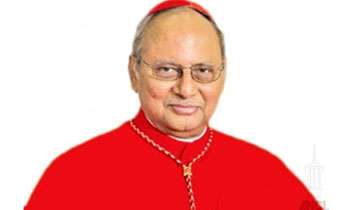
The comments made by Malcolm Cardinal Ranjith last Sunday at the Ekala St Matthew’s church have made waves with Minister Mangala Samaraweera and Saliya Peiris criticising the Cardinal’s words and the former President Mahinda Rajapaksa and several Catholic MPs in the Joint Opposition condemning Samaraweera and Peiris for taking on the Cardinal. What the Cardinal said last Sunday during a sermon delivered in Sinhala was roughly as follows.

“The latest religion in the West is the religion called human rights. Human rights were discovered only recently. It is being regarded as a wonderful new discovery which is being held aloft and we are being relentlessly lectured about it. However our people began adhering to religions centuries ago. Some people in our country talk of a secular society. Human life is not just food and drink and the pursuit of comfort. Many people in the West now regard religion as an outer garment. They use religion when it suits them but if they are required to make sacrifices, theல put religion aside. Our lives are short and if we limit it to the pursuit of pleasure we will come to an unfortunate end. If we adhere to a religion we don’t need human rights. Those who are dependent on human rights are those who have no religion. We must not be misled by these chimeras. We must look at this intelligently.”

article_image

This elicited an immediate Tweet from Mangala who said rudely “the need for human rights was an outcome of the marauding religious zealots of the Inquisition and the crusades where non-believers were massacred en bloc. Pity the Cardinal always seems to get things wrong in trying to be a populist.” Saliya Peiris, who is now the head of the Office of Missing Persons, also responded by Tweeting “If this report is accurate, it’s a shame the way the Cardinal downplays the importance of human rights. He seems to be absolutely ignorant of the concept of human rights. He also fails to realize that there are many people who don’t believe in religion and that religion cannot be forced on people. What a contrast to the progressive thinking of Pope Francis …”

The Cardinal was referring to an ideology

It appears that both Minister Samaraweera and Peiris have understood the human rights referred to by the Cardinal as that involving people being assaulted and tortured while in police custody and that sort of thing. Going by the pronouncements made by the Cardinal over a period of time, it is clear that his Eminence was referring to something wider and in the sphere of ideology – the neo liberal ‘rights’ mania sweeping the West which has come to Sri Lanka as well through various NGOs.

If we take Minister Samaraweera’s comment about the human rights violations committed by the Catholic Church in the past during the Inquisition and the Crusades, Pope John Paul II made a blanket apology for all these transgressions committed in the name of God in March 2000. Pope John Paul II also admitted that church followers had ”violated the rights of ethnic groups and peoples and shown contempt for their cultures and religious traditions” And that there is ”an objective collective responsibility” for past errors that modern Catholics should acknowledge and repent. Hence there is little point in flogging the Catholic Church for their past. The apology that Pope John Paul II made even at the risk of putting the doctrine of the infallibility of the Church and the faith of its followers at risk should be appreciated.

However what Cardinal Ranjith was referring to was not human rights related to physical violence. Nobody in his right mind would say that the Cardinal was advocating torture in police stations and that kind of thing. It was the whole ideology of neo liberal human rights and its use as a weapon of domination that he was obviously referring to. Recently, the Cardinal referred to the fact that a child could not be disciplined in school and that a new generation was growing up with no sense of discipline. He is the first VVIP in this country to refer publicly to a cancer that is eating into the very fabric of our society. It has already half destroyed the West and is now destroying countries like Sri Lanka which are not intellectually equipped to be able to resist these destructive ideological fads comings from the West. The easiest way to explain this is through the reference made by the Cardinal on an earlier occasion to the inability of school authorities to discipline students in schools.

The Cardinal heads an institution that is still on the frontlines as far as education is concerned because there are many assisted schools with Catholic priests heading them. Today, if a teacher in a school canes a student, he will be remanded and he will end up spending his life savings fighting criminal charges. This was due to changes introduced to the law during the Chandrika Kumaratunga years. This results in a situation where teachers lose the ability to control the teaching process in classrooms. Usually, this gives rise to a deterioration in educational standards within a few years. Even though it is now some time since these new ‘child rights’ laws were introduced in Sri Lanka, the reason why educational standards have not gone down as they should, is due to the private tuition culture in our country. Real learning takes place not in the schools but in the tuition classes and the latter have control over the kind of students they take into their classes, so the teaching process is not impaired. No tuition master is going to risk his reputation and a lucrative income by accommodating incorrigibles. But ordinary classroom teachers don’t have choice as to who they have in their classrooms.

In the West, thanks to ‘child rights’ the white Caucasian population are falling back and the educated professions are being taken over by migrants. There are white majority nations where in some hospitals it is difficult to find a single white skinned doctor even though there may be plenty of white skinned janitors. The educated professions are being taken over increasingly by immigrants from Asian countries like China, India and Sri Lanka. In the schools and as well as the universities the best performers are generally migrants. The white populations have been destroyed by this rights mania that they themselves unleashed on the world and are too far gone to be able to take remedial action. We can see the extent to which the white populations of Europe have lost control of their countries and their minds when they are unable to resist a migrant invasion from the Middle East and Africa. The US has temporarily escaped the slide thanks to Donald trump but Europe does not have a Trump. Britain too may escape the worst because they are leaving the European Union.

Why do homosexuals need to ape heterosexuals?

The human rights mania that Malcolm Cardinal Ranjith was referring to is really the attitude of mind of the neo-liberal/globalist camp. In the 1980s, neo-liberalism meant only an economic theory. But after the end of the cold war and with the dawn of the decade of the 1990s, when this economic theory won the ideological battle against Communism and socialism, neo liberalism began to be associated with much more than just an economic theory and assuming the proportions of a religion with a certain way of thinking about human rights, child rights, gay and lesbian rights, animal rights, the environment, and every aspect of life that one can think of. Its most salient feature is a complete loss of commonsense and the lack of a grip on reality. After winning the cold war, much like many wealthy public figures who have earned both money and fame, the West lot its senses and have been trying to promote their psychedelic imaginings and eccentricities in the rest of the world as the way forward for mankind.

After the dawn of the modern era, whatever various archaic laws may have said about ‘sodomy’, homosexuality was tolerated. People did what they liked with their same sex partners and nobody minded. Those homosexuals who stood out by trying to don women’s clothing in public may have been heckled and subject to harassment sometimes, but even that was due to hooliganism on the part of individuals and not a generalized trait in most societies. In many cultures like Sri Lanka even cross dressing homosexuals are not necessarily harassed or discriminated against except for certain natural limitations their appearance would cause. For example, no airline will employ a man in a skirt and lipstick as an air hostess.

The late Lalith Athulathmudali had a cross dresser as his personal valet. The first time I saw a bald man in a skirt and blouse offering me beer, I forgot what I was saying in mid-sentence. Unfazed, Mr. Athulathmudali waited patiently for me to resume what I was saying. Every passive homosexual in Colombo was in love with Vijaya Kumaratunga and they would attend Vijaya’s political events in groups. Nobody chased them away.

Thus on both sides of the political divide in Sri Lanka, there was no active policy of shunning or discriminating against these people. There was the tacit understanding that no man would wear women’s clothing unless there was some compelling reason to do so. Politicians in particular would not shun these cross dressing homosexuals because they are quite useful in their own way. They seem to know everybody and can get many things done in the communities they live.

While all homosexuals should be left alone to do whatever they like, one has to pose the question whether they need to marry like heterosexual couples? Heterosexual couples marry because they have children and raising the children and bequeathing property to them needs the legal framework of a family. However homosexual’s do not produce children and if one partner wants to convey property to his partner after his death, a simple last will can do the trick without a homosexual partner needing to have matrimonial property rights like heterosexual couples. This obsession with homosexual marriage with the whole panoply of dressing up as bride and groom and a priest declaring them as husband and wife with an organ playing ‘here comes the bride’ in the background is a loss of commonsense. This is obviously the kind of ‘rights’ mania that the Cardinal was referring to.

These are not harmless eccentricities either. When all those of a similar bent of mind get together in the neo-liberal camp, it becomes a totalitarian ideology that brooks no opposition. When Malcolm Cardinal Ranjith spoke of human rights as the new religion of the West, he was not far off the mark. To see what a perversion this advocacy of human rights can become, one has only to look at the various war crimes tribunals that were set up in the world starting with the International Criminal Tribunal for the former Yugoslavia. The jurisprudence of all the international war crimes tribunals that were set up subsequently have been influenced and modeled on that of the ICTY. All rules of jurisprudence and evidence that have evolved over several centuries within the criminal courts systems in today’s modern democracies have been thrown overboard. The prevailing philosophy in all these war crimes tribunals is that anyone brought before them should be declared guilty at any cost.

The reason why the goings on in these war crimes tribunals have not gained much publicity is because those coming before them are hapless wretches who have fallen from grace and are from underdeveloped nations. These are the torture chambers and gulags of the neo-liberal human rights mafia. The Roman Catholic Church has realised that heinous crimes have been committed in the name of God in the past and they have tendered an unconditional apology. But the neo-liberal human rights Nazis who still wield power in the world despite their defeat in the US and partial defeat in Britain are far from repenting for the crimes they have committed in the name of human rights. Just take the case of so many Middle Eastern countries like Libya, which were laid waste in the name of democracy and human rights. Today Libya has no democracy, no human rights, and no State and nobody seems to be bothered. Beyond doubt the global neo-liberal human rights mafia is the biggest threat to mankind in this modern era. The Cardinal is absolutely right!

National List MP S.B. Dissanayake points finger at UNP Alleged assassination plot:

September 27th, 2018

Text and pic by Kamal Bogoda Courtesy The Island

Alleging that the plot to assassinate President Maithripala Sirisena and former Defence Secretary Gotabhaya Rajapaksa was a political conspiracy, UPFA dissident and National List MP S.B. Dissanayake yesterday alleged that the UNP had a hand in it.

Addressing the media at UPFA National List MP Tilanga Sumathipala’s residence at the Ananda Rajakaruna Mawatha, Borella, Dissanayake alleged that an impartial police inquiry was unlikely as long as the UNP held the law and order portfolio.

article_image

Dissanayake said that the law and order portfolio should be brought under President Sirisena, who is also the Commander-in-Chief of the armed forces.

Dissanayake said that the assassination of President Sirisena and former Defence Secretary Rajapaksa, tipped to be the JO’s presidential candidate would be advantageous to the UNP.

JO says Police behind plot to kill MR’s family members

September 27th, 2018

Sheain Fernandopulle Courtesy The Daily Mirror

The JO was of the opinion that the Police was behind the conspiracy to assassinate former President Mahinda Rajapaksa and his family members, JO member MP Shehan Semasinghe said today.

The CID informed Colombo Magistrate’s Court on Tuesday that the Indian national had claimed that there was a plot to assassinate President Maithripala Sirisena and former President Mahinda Rajapaksa and his family members.

Addressing a news briefing, MP Semasinghe said the Police were seemed to be unconcerned with regard to the spreading speculation on the plot on the lives of President Rajapaksa and his family members.

We saw on Wednesday as to how Police Spokesman SP Ruwan Gunasekera attempted to brush aside the widespread plot under the carpet, saying that nothing had yet been revealed in connection to such a plot,” the MP said.

In such backdrop, when several news reports are being published in this regard, we can’t fathom as to why the Police has turned a blind eye,” he added.

He insisted the Government to tighten the security of Mahinda Rajapaksa and look into the matter seriously.

Meanwhile, D. V. Chanaka said both Arjuna Ranatunga and Dayasiri Jayasekara were responsible to the downfall of the Sri Lanka cricket.

We recently heard both of them are accusing to each other on the pathetic state of the Sri Lanka cricket,” MP Chanaka.

It is evident that officials are unduly intervening into the affairs of cricket which has resulted in such a desperate state in Sri Lanka cricket,” he added.

People shaped by Buddhist civilization don’t violate HR: Cardinal

September 27th, 2018

Courtesy The Daily Mirror

Archbishop of Colombo Cardinal Malcolm Ranjith yesterday said that people who had been shaped by Buddhist civilization do not violate human rights and added a society which attempts to make human rights a religion, could safeguard human rights effectively through Buddhist teaching.

Cardinal Ranjith expressed these views at the prize giving of Kanduboda Shri Saranankara Daham Pasala in Delgoda organized by the Ven. Parakaduwe Sri Saranankara Thera recently. Chancellor of the Kelaniya University Ven. Dr. Walamitiyawe Kusaladhamma Thera presided over the event.

He said there were threats posed on religions at present and added that Buddhism was the backbone of this country and it was a religion which had been followed by the people in this land for a long time.

Rights of all people in this country are safeguarded when Buddhist culture is safeguarded. Anti religious ideologies are being filtered into the society today. We have to put them aside and safeguard religions,” he said.

Since we have inherited a great culture over the years, there is no need to think about human rights in a special way. Religions are not followed in some countries. Human rights are safeguard in our country much more than what is prescribed by the UN in Sri Lanka because of the Buddhist environment,” he added.

He also said the efforts made by the Buddhist clergy to bring up children according to Buddhist principals were commendable. (Sudath Pubudu Keerthi)

Prez comment only valid if SL withdraws co-sponsorship: Sarath

September 27th, 2018

Courtesy The Daily Mirror

Referring to the remark made by President Maithripala Sirisena at the UN General Assembly that Sri Lanka should be allowed to handle its own internal affairs, former MP Sarath Weerasekara said the President’s comment would only be valid if the government withdraws the co-sponsorship of 30/1.

Rear Admiral Weerasekara, who is in Geneva to counter the pro-LTTE propaganda, said Sri Lanka is legally bound to implement the recommendations in the resolutions unless it is withdrawn as per the President’s remarks.

He said, The technical assistance provided by the UN had already culminated in a resolution charging Sri Lanka of war crimes. This resolution 30/1 was adopted by this council without a debate or a vote because it was co-sponsored by a delegate and he did that without the approval of the President or the cabinet. Hence it has no legal base. The USA has withdrawn from this council accusing it as politically biased and hypocritical. Since the US was the main sponsor of 30/1 the co-sponsorship too should be nullified automatically.

Germany was occupied by UK and USA for years after world war 11. More Germans were killed as prisoners of war after the war than during the war.

Germany still pays reparations to Israel. We saved 300,000 during the war and rehabilitated 12,000 after the war. It’s a pity that Germany and UK of all the countries are now pushing us to implement 30/1.

The US has threatened sanctions against ICC if it persecutes American soldiers. PM Theresa May said she will change the Human Rights laws to protect her soldiers. Our President too thanked our soldiers who defeated terrorism. It implies he rejects the war crimes. Then why 30/1? Many things can be negotiated Mr. President, but sovereignty, never!”

Namal Kumara makes another startling revelation about DIG Nalaka de Silva

September 27th, 2018

Director (Operations) of the Anti-Corruption Force Namal Kumara has made another revelation regarding DIG Nalaka de Silva of TID and a French national sending financial aid to carry out terrorist activities in the country with the knowledge of the DIG.

Namal Kumara had arrived at the CID yesterday (26) and recorded statements for several hours. Reportedly he has produced another CD containing the alleged telephone conversations with DIG Nalaka Silva.

A press conference was held today by Namal Kumara in order to provide explanations on the alleged conversations contained in the CD, which he had given the CID.

Accordingly, Namal Kumara disclosed a conversation to the media, pertaining to the threats made by DIG Nalaka de Silva to him.

He further presented several cheques and receipts to the media, relevant to the financial aid allegedly received from a French national, supposedly an associate of the diaspora, with the intention of causing a conflict between the Muslim and Tamil communities in the Eastern province.

Meanwhile, DIG Nalaka de Silva has been ordered by the court to produce himself before the Government Analyst’s Department tomorrow (28) to record his voice samples.

ඝාතන සැලසුම බරපතළ හෙළිදරව්වක් CIDය අනාවරණය කළේ ගොතපු කතාවක් නොවේ

September 27th, 2018

පහන් විජේසේකර උපුටාගැණීම  මව්බිම

නාමල් කුමාර හෙළිදරව් කළ ඝාතන සැලසුම් සහ අත්අඩංගුවට පත් ඉන්දීය ජාතිකයාගෙන් අනාවරණය කරගත් ඝාතන සැලසුම් සම්බන්ධයෙන් මෙතෙක් සිදුකර තිබෙන විමර්ශන ගැන සෑහීමකට පත්විය නොහැකි බව ඒකාබද්ධ විපක්ෂය අවධාරණය කරයි.

මේ වනතෙක්ම නියෝජ්‍ය පොලිස්පති නාලක ද සිල්වාගෙන් ප්‍රශ්න කිරීමක් හෝ කර නොමැති බැවින් මෙය සත්‍ය තත්ත්වය යටගැසීම සඳහා කරගෙන යන ක්‍රියා පිළිවෙතක් දැයි කියා සැක සංකා මතුවන බව ශ්‍රී ලංකා පොදුජන පෙරමුණේ සභාපති ජී.එල්. පීරිස් මහතා ප්‍රකාශ කරයි.

කොළඹ 07, විජේරාම පාරේ පිහිටි හිටපු ජනාධිපති මහින්ද රාජපක්ෂ මහතාගේ නිල නිවෙසේදී ඊයේ (26දා) පැවැති මාධ්‍ය හමුවකට එක්වෙමින් ජී.එල්. පීරිස් මහතා මේ බව ප්‍රකාශ කළේය.

එහිදී වැඩිදුරටත් අදහස් දැක්වූ ඔහු “පොලිස්පතිවරයා තනතුරේ ඉන්න තාක්කල් විධිමත් අපක්ෂපාතී පරීක්ෂණයක් කරන්න බෑ. මේ සිද්ධිය ගැන විමසන්න සාක්කිකාරයකු විදියට පොලිස්පතිව සී.අයි.ඩී. එකට කැඳවලා තියෙනවා.

ඒ විමර්ශනයට සහභාගි වන සාක්ෂිකාරයකු කොහොමද පොලිස්පති තනතුරේ සිටිමින් ඒ සඳහා දායකත්වය දෙන්නේ..? වෙන කෙනෙක් සම්බන්ධයෙන් නම් මෙලහකටත් නාලක ද සිල්වා පොලිස් අත්අඩංගුවේ. ඇයි ඒ පියවර ගන්නේ නැත්තේ. මහින්ද රාජපක්ෂ හිටපු ජනාධිපතිතුමාට ආරක්ෂාව නැති බව පැහැදිලිවම අපි පෙන්නා දුන්නා. පිරිස් බලය විතරක් නෙවෙයි වාහන හා උපකරණ නැති බවත් කියා සිටියා. ඉදිරි කාලයේදී රැස්වීම්වලට සහභාගි වීම සඳහා දිවයිනේ නොයෙක් ප්‍රදේශවලට මෙතුමාට යන්න සිද්ධ වෙනවා. අනිත් එක මෙතුමාට ලබාදී තිබෙන වෙඩි නොවදින රථයත් පාවිච්චි කළ නොහැකි මට්ටමකයි තියෙන්නේ.

මෙහිදී අදහස් දක්වමින් හිටපු ජනාධිපති මහින්ද රාජපක්ෂ මහතා

හැබැයි කවුරුහරි හිතනවා නම් මම මරණ බයේ රැස්වීම්වලට නොයා ඉන්නවා කියලා ඒක වැරැදීමක්. මේක බරපතළ හෙළිදරව්වක්. මේක කවුරුත් ඇවිත් හදලා කිව්වා කියන්න බෑ. සී.අයි.ඩී. එකෙන්මයි වාර්තා කරන්නේ. මීට ඉස්සරත් මෙවැනි වාර්තා ඇවිත් තිබුණා. ඒවා ඔක්කොම ඉහළ පොලිස් නිලධාරීන්ගේ මට්ටමෙන් නැවතුණා. ඒ ගැන දැන්නුවේ නැහැ.

දැන් තියෙන තත්ත්වය බලනකොට මට විතරක් නෙවෙයි මුළු පවුලටම ආරක්ෂාව දෙන්න වෙයි. හොඳම ආරක්ෂක ස්ථානය “සිරකූඩුව” කියලා කියාවිද දන්නෙ නෑ” යැයි සඳහන් කළේය.

YAHAPALANA   AND THE UNITED STATES OF AMERICA Part 6

September 26th, 2018

KAMALIKA PIERIS

This essay records further US assistance to Yahapalana. Chief Operating Officer Jonathan Nash visited Sri Lanka in September 2018 to continue discussion on the proposed MCC Sri Lanka Compact, a large-scale five-year grant program, Lanka to promote economic growth in Sri Lanka . MCC is an innovative foreign assistance agency of the United States Government established in 2004. It has signed compacts with 29 countries around the world. In December 2016, MCC’s Board of Directors selected Sri Lanka for such a compact

This Compact is in its final stages and is expected to be negotiated with the Government of Sri Lanka soon. MCC will fund the compact entirely through grants which do not need to be repaid rather than loans. “It is designed to spur economic growth and investment by the private sector and increase economic opportunities for the people of Sri Lanka,

“Based on an analysis of Sri Lanka’s economy and the constraints that are holding back private investment and growth, MCC expects to invest in projects proposed by the Government of Sri Lanka in the transport and land sectors. The proposed compact would improve road networks and the bus system in the Colombo Metropolitan Region, and improve road connectivity between the central region and ports and markets in the Western Province. The compact would upgrade more than 300 kilometers of urban and interprovincial roads. In addition, the compact would improve land administration, and strengthen land rights and tenure security, said Nash. On 25th September, 2018, MCC informed that they were giving Sri Lanka a grant of USD 480 million as development aid.

USAID funded a project for more female representation in local government bodies. the Harvard Centre for International Development (HCID) is helping Sri Lanka in attracting foreign direct investments (FDIs) promoting emerging exports, targeting new non-existent industries, identifying and engaging with potential new investors, fixing the investment climate for new emerging industries and figuring out how to create new tourist destinations. Five teams of experts are working with Harvard, all focused on issues relating to exports and FDIs. BOI staff has also been receiving training programmes conducted by Harvard University’s Centre for International Development, McKinsey Consulting and the World Bank Group.

The U.S. embassy signed a Memorandum of Understanding with the Matara Chamber of Industry and Commerce in September 2018 to open an American Corner in Matara. The American Corner will offer free programs and training for the Southern Province’s residents. Programs will include English classes, coding and computer skills, leadership and public speaking training, and a range of film screenings and cultural opportunities.”

This American Corner represents the U.S. embassy’s desire to build a relationship with the people of the Southern Province.” Our free programs will expand economic opportunity in the region and build ties between the United States and Sri Lanka.”The American Corner follows the successful March 2018 launch of the U.S. Embassy’s Information Hub (‘iHub”), which has attracted audiences of different ages and diverse backgrounds. Current programs include public speaking and English.”

In February 2018   Yahapalana signed an agreement with the US to re-establish a US Peace Corps programme in Sri Lanka. The negotiations had started in 2016. The first 25 American Peace Corps Volunteers will arrive in Sri Lanka in late 2019 and undergo three months of comprehensive cultural, language and technical training before they are given their assignments to serve for two years.  Peace Corp volunteers in Sri Lanka will focus on English language education and supporting the Education Ministry, schools, and community groups in coordination with the Sri Lankan English Teachers’ Association. They will complement several other English teaching programs funded by the U.S. Embassy and the U.S. Agency for International Development, the press release stated.

They will be given diplomatic privileges The Diplomatic Privileges Act provisions have been invoked to accord equitable treatment to the Volunteers and persons performing functions under contract with the Peace Corps and their dependents.

the Government will provide to the Peace Corps the same exemptions with respect to taxes on payments that they receive to defray their living costs, on income derived from their officials duties, and on income from other sources outside Sri Lanka; customs duties or other charges on their personal property introduced into Sri Lanka for their own use; and all other taxes or other charges (including immigration/visa fees), except licence fees as provided to members of the administrative and technical staff of the Embassy of the United States in accordance with the Vienna Convention on Diplomatic Relations.

The Government will also exempt from all taxes (including value-added taxes) customs duties, and other charges all equipment, supplies, and other goods and services introduced into or acquired in Sri Lanka by the US Government or any contractor financed by it, for use to enable the US Government to discharge its responsibilities under this agreement.

The Government will also exempt such persons, and members of their families forming part of their households who are not citizens or permanent residents of Sri Lanka from all taxes or income derived from their Peace Corps work or other sources outside Sri Lanka, from all customs duties and other charges on their personal property introduced into Sri Lanka for their own use, and from all other taxes or other charges (including immigration/visa fees) except licence fees.

The question needs to be asked as to how teaching English to Sri Lankan children becomes such an urgent priority, said Kamal Wickremasinghe. This shows American interest in deploying so-called development volunteers at grass roots level in Sri Lankan villages close to a scheduled general election (2019). The return of the controversial US Peace Corps, in 2019 reflects Washington’s fears about the forthcoming General Elections and Presidential Elections, observed Tamara Kunanayagam.

The Peace Corps was returning to Sri Lanka after some 20 years. Peace Corps was in Sri Lanka 1962–1964, 1967–1970, 1983–1998. Prime Minister Sirima Bandaranaike kicked them out after she became Prime Minister in 1970. They came back in 1983 and were sent back in 1998. Their return to Sri Lanka has raised the hackles of many who know the deeply suspicious role played by the Peace Corp in the countries they were sent to.

The US Peace Corps evolved from a CIA front known as the International Voluntary Services Inc. (IVS), during preparations for the war against Vietnam. The US Peace Corps has been expelled from a number of countries for spying for the CIA and other covert activities, meddling in local politics, and running drugs. As recently as September 2017, Cambodia’s Prime Minister demanded the withdrawal of the US Peace Corps for conspiring with the opposition leader Kem Sokha to overthrow his government.

.In 1965, Indonesia ordered them out after 16 months. In 1966, Guinea asked PCs to leave. In 1967, Mauritania severed relations with the US, including the PCs. Pakistan and India also refused to renew approval of PC projects in their countries in the early 1970s. Burkina Faso Peace Corps programme was closed in 2017 In Bolivia, in 2008 Peace Corp volunteers was instructed to report on Cuban and Venezuelan nationals in Bolivia.

Now to military matters. United States will provide nearly $300 million in security assistance to improve security relationships across the Indo-Pacific region, including Sri Lanka, Secretary of State, Mike Pompeo announced at the ASEAN Regional Forum in August 2018.

The security assistance funding will cover projects in Bangladesh, Indonesia, Mongolia, Nepal, the Pacific Islands, the Philippines, Sri Lanka, Vietnam and others, in the areas of Maritime Security, Humanitarian Assistance and Disaster Relief (HA/DR), Peacekeeping Operations and Countering Transnational Crime.

As part of the maritime security theme, we launched the Bay of Bengal Initiative to help enhance the capacity of civilian and military maritime actors in this vital region, which is home to important sea lanes linking the Indian Ocean to East Asia. Under the Bay of Bengal Initiative, the United States will ‘work with other partners in the Bay of Bengal, including Bangladesh and Sri Lanka to enhance the capacity of civilian and military maritime actors in the Indian Ocean Region to improve the target areas of detection, information-sharing, and response to emerging threats.’

In August 2018 the U.S. Department of State announced that it would provide approximately $39 million in Foreign Military Financing for Sri Lanka, pending Congressional approval.”We look forward to discussing with the Government of Sri Lanka how this contribution can support our Bay of Bengal initiative and Sri Lanka’s humanitarian assistance and disaster response priorities”, it said in a statement.

The US Army’s Pacific Region Head Gen. Robert B. Brown made an official visit to the Island in July   2018. He met Chief of Defence Staff. Gen. Brown’s visit was aimed at strengthening military cooperation and mutual friendship and thus deepening the US-South Asia understanding. Lengthy discussions took place on how the US Army can assist the Sri Lankan Army on disaster management activities and as to whether the Sri Lankan Peace Keeping Mission can get international training. Gen Brown also admired the professional competency of the Sri Lankan Army on demining.

The U.S. Coast Guard handed over a high endurance cutter, formerly the USCGC Sherman, to the Sri Lankan Navy in August 2018 at Honolulu. The cutter, a gift from the people of the United States, will be the largest ship in the Sri Lankan fleet. It measures 115 meters long and when fully staffed carries a crew of 167 The ship will increase Sri Lanka’s ability to patrol its Exclusive Economic Zone, providing additional security for ships from all nations that transit the busy sea lanes of the Indian Ocean.

In May 2018, a delegation from the House Armed Services Committee of the U.S. Congress visited Sri Lanka. The House Armed Services Committee, a standing committee of the United States House of Representatives, is a powerful Committee, responsible for the supervision of armed forces and the Department of Defence. The delegation was led by its Chairman Mac Thornberry.

The visit was to find out ways of strengthening defence cooperation between Sri Lanka and USA.   President Sirisena told the delegation that he greatly appreciated the defense training provided by the US, such as the joint military exercises carried out by US and Sri Lanka. Such programmes should continue for security purposes.

The US embassy had arranged for the delegation to meet with civil society organizations and the TNA for private discussions. The US embassy said nothing about these meetings, but the TNA issued a detailed statement to the media.

The TNA statement said, that Sampanthan briefed the Thornberry delegation on the current political situation We are unhappy about the way the country is progressing,” the statement quoted Sampanthan as having told the delegation.

Sampanthan was also quoted as having said: “the majority of the people in this country are willing to address the national issue once and for all. What is lacking is that the courage from the Sinhala leaders to go out to the people and explicitly tell them on the need for a new Constitution and the benefits of framing a new Constitution.  Some Sinhala political leaders are trying to satisfy the hardliners than being just and equal to all people in this country, they cannot go on this path forever, it will only end up in history being repeated.

“Especially the President and the Prime Minister must go to the Sinhala people and genuinely explain the need for a new Constitution. Since 1988 every successive government and President have made several attempts to change the present Constitution, therefore, this should not be a difficult task for the majority of Sinhala people to understand. “We want a solution within a united undivided and indivisible country. The power-sharing arrangements should be in accordance with the international covenant on Civil and Political Rights, International Covenant on Economic Social and Cultural Rights and the Universal Declaration of Human Rights said Sampanthan to Thornberry.

Sampanthan told the US delegation that the legitimate demands of the Tamil people in finding a lasting solution to the national question could only be addressed through adopting a new Constitution. Sampanthan highlighted that his party was confident that if the Constitution was passed in Parliament with a two-thirds majority it would be approved by the people at a referendum, which was necessary for a new Constitution he said.”We may have to rethink and our people will be forced to rethink our position if things do not go well and if things are not achieved within a certain time frame, continued Sampanthan

Sampanthan reminded the delegation that the Government of Sri Lanka has given a commitment to fully implement the UNHRC resolution adopted in 2015 before March 2019. They must fast-track their process to achieve those commitments. Sampanthan urged the delegation that the role of the International community with regard to Sri Lanka must be defined in relation to the UNHRC recommendations. The International community must ensure that the promises and the commitments given by the Sri Lankan Government are adhered to and implemented. The International community cannot be a spectator anymore with regard to Sri Lanka, if the government of Sri Lanka continues to fail in their commitments the international community must clearly state their position on their follow up mechanisms to safeguard the victims and ensure the non-recurrence of the past said Sampanthan.

In September 2018, Sagala Ratnayaka    , Minister of Youth Affairs and Chief of Staff to the Prime Minister visited USA and on his return issued a statement. The statement said that Minster Ratnayaka had met Thornberry, also Ted Yoho, Chairman of the House Foreign Affairs Subcommittee on Asia and the Pacific, as well as senior officials of the National Security Council, the Department of State, the Department of Defence, the U.S. Agency for International Development (USAID) and the U.S. Millennium Challenge Corporation (MCC).  Ratnayaka had discussed with them the ongoing Sri Lanka–U.S. partnership and opportunities for further bilateral cooperation within USA’s Indo-Pacific Strategy. Minister Ratnayaka briefed them on current developments in Sri Lanka.

There were several joint navy exercises.  I will list them chronologically. The world’s largest international maritime warfare exercise (Rim of the Pacific – RIMPAC) took place in the Hawaiian Islands and Southern California in June/August 2018. After 47 years Sri Lanka Navy Marines got the opportunity attend RIMPAC. A Sri Lanka media team joined other international media in documenting the exercise. The many exercises conducted during RIMPAC included the training on the operations of an assault ship USS Bonhomme Richard. Participants gained firsthand knowledge on how rescue operation are conducted, how victims are brought to the ship and transferred to the ICU.

In July 2018 The Joint Combined Exchange Training (JCET) exercise between US Naval Special Warfare Forces personnel and Sri Lanka naval personnel from the 4th Fast Attack Flotilla (4FAF) and Special Boat Squadron (SBS) was inaugurated at the Special Boat Squadron Training School (SBSTS) in Trincomalee. The programme is held annually as part of a mutual understanding and agreements for the training and support requirements of both countries. The four – week course focused on developing professional skills and exchange of knowledge among naval personnel of US Naval Special Warfare Forces and Sri Lanka Navy

The third KDU-CNA Track 1.5 Dialogue on Naval cooperation was held in July 2018 at the Faculty of Graduate Studies, General Sir John Kotelawala Defence University (KDU).The two-day dialogue was a collaborative initiative between KDU and the Center for Naval Analysis (CNA), USA. The KDU-CNA Track 1.5 Dialogue is a one-of-a-kind discussion that we organize at KDU, facilitating interaction between the navies of Sri Lanka and the United States, along with the participation of relevant academics.”

This year’s Track 1.5 Dialogue focused on how bilateral relations between Sri Lanka and the USA could be further improved in a variety of spheres and how the global security concerns are influencing the relations between the two countries. Track 1.5 diplomacy is an initiative to bring together government and non-governmental actors to discuss on a variety of topics that could improve the bilateral relations of countries. As such, this two-day deliberation witnessed the participation of analysts and academics along with naval officials from the navies of both participating countries for a discussion. Held under the Chatham House Rule, this year’s Dialogue included four main sessions, with the 5th and final session being a wrap-up session with the speakers providing forward-looking, implementable suggestions for Sri Lanka and the United States.

In august 2018 a joint humanitarian assistance mission called Pacific Angel, sponsored by the US Pacific Command (USPACOM) concluded at the Alagalla School in Vavuniya, .The mission operated in Vavuniya, Anuradhapura and Sigiriya, The purpose was to provide humanitarian civic assistance and carry out civil-military operations in the Pacific region,

Medical treatment was provided by Pacific Air Forces doctors, including representatives from the Bangladesh Air Force, Maldivian Defence Force, Nepal Army, and Sri Lanka Air Force (SLAF) Medical/Dental officers and nurses. Medical teams treated 3,000 patients the services included primary health care, physical therapy, optometry and dentistry. Vavuniya Nursing School students and Red Cross officials participated. A forum highlighting topics such as modern engineering practices in disaster management and renovation was also held for SLAF civil engineers and technicians. School buildings were also renovated.

Amphibious transport dock USS Anchorage (LPD 23), and the 13th Marine Expeditionary Unit (MEU) arrived at Trincomalee Port in August 2018. Anchorage, is part of the Essex Amphibious Ready Group (ARG), and is deployed to the 7th fleet area of operations to support regional stability, reassure partners and allies and maintain a presence postured to respond to any crisis from humanitarian assistance to contingency operations.

The US  was interested in  trying out the air logistics hub concept which utilizes Sri Lanka’s strategic location in the Indian Ocean to ensure the quick availability of relief supplies, equipment and other material when needed by the US and partner militaries and humanitarian organizations. “The Sri Lankan navy, host nation support team and the U.S. Embassy have provided tremendous assistance and cooperation in developing the first temporary air logistics hub concept in Sri Lanka, said Anchorage officials.

Anchorage aims not only to enhance security cooperation, but to build understanding of the HADR (humanitarian assistance, disaster relief) capability that contributes to disaster, along with sharing of best practices and enabling more efficient joint relief efforts in the event of a future disaster.”

Additionally, sailors and marines will conduct training in visit, board, search and seizure, security force reaction techniques with the Sri Lankan Navy and Marines There will also be damage control training. The US Navy damage control program is the best. The visit is also an opportunity for US Seventh Fleet to explore local logistics support services for visiting naval forces operating throughout the Indo-Pacific region.

During the visit, sailors and marines will have opportunities to meet with their counterparts during exercises with the Sri Lankan Navy and marines. Approximately 300 Sri Lankan naval academy midshipmen and 40 distinguished visitors, will tour Anchorage to learn about the ship’s amphibious capabilities. .

The visit offers US sailors and marines the opportunity to explore the local area and meet their counterparts during exercises with the Sri Lankan Navy and Marines; the statement said “In addition to the professional exchanges, Sailors and Marines will take part in sporting events, including baseball, soccer, basketball and volleyball.

“Our Navy and Marine Corps team is deeply committed to continuing to strengthen our partnership with the Sri Lankan armed forces,” Sailors and Marines are focused on completing a successful mission and representing America in Sri Lanka. “These ship visits help demonstrate the value of the growing U.S.-Sri Lanka partnership,”

The USS Anchorage also joined the Sri Lankan naval ship Suranimila to conduct an exercise at sea.  The exercise allowed the ships to improve crews knowledge and strengthen a wide variety of seamanship skills critical to operating throughout a free and open Indo-Pacific region. During the exercise, multiple ships sailed information to practice communications and maneuvering procedures.  In addition to the Anchorage and Suranimila, two landing craft air cushions (LCACs), one AH-1Z Cobra helicopter, and one UH-1Y Huey helicopter participated. .”

“The Anchorage team and I had an incredible time in Trincomalee and we are proud to be serving alongside the Sri Lankan Navy,” said Captain Dennis Jacko, Commanding Officer of the USS Anchorage.  “Not only do we increase our proficiency in communications, but we continue to build on a strong and lasting partnership with the Sri Lankan Navy.” This was part of a growing U.S.-Sri Lanka naval partnership,

I accept, but I do not agree!

September 26th, 2018

C. Wijeyawickrema, LL.B., Ph.D.

Balu Theendu!

The difference between S. B. Dissanayaka and Albert Gore, who won the US Presidential election by popular vote, but denied it by the US Supreme Court is that Al Gore did not use the words Balu Theendu to express his resent to the court’s deliberate and politically bias decision. Subsequently, one of the conservative judges, Antonin Scalia, admitted the erroneous ruling made by the court in the name of maintaining the ‘sanity’ of the US system of governance (or to avoid a constitutional crisis wrongly perceived by the court).

Judges are human, and the judges and lawyers are a fraternity like the policemen, firefighters or trade unions with their own open and implied rules, customs and habits of scratching each other’s back. In America hundreds of court decisions must be unfair and unjust on a daily basis with the strange system prevailing in the country, to elect most judges by popular elections.  How can a judge resist the temptation to ignore favoring, even slightly, a party before him who voted for him at the last election, even if the judge is not going to contest again!

An elites’ club

One could get a glimpse of the Sri Lanka’s notorious history of misuse and abuse of power and influence by the judiciary and politicians as individuals and as an elite class from the book written by the late S. L. Gunasekara, a prominent lawyer of a Supreme Court judge (Lore of the law and other memories). Even foreign embassies take part in this game. The documentary, Court is Silent by Victor Ivan is a world record on the courage of a reporter to lay naked an entire branch of government aka, independence of the judiciary. No other country has the record of SC CJ’s opposed, ridiculed, punished or sued or disgraced as in Sri Lanka. The only CJ in recent times to save the dignity of the office was Victor Tennekoon who confronted that constitutional dictator JRJ.

Bad judges could manipulate the justice system, because decisions are taken on the basis of facts presented before them, and the potential that exist in each case to interpret the facts for or against a particular law (Thus, in America, the segregation of blacks and whites in public schools under an interpretation, separate but equal (in funds and resources), was overturned by a new interpretation in 1954, that a separation based on race under any circumstances was inherently harmful to student’s mind). This is true irrespective of the situation that the lawyers arguing the case are competent or not even though usually more money means better skills available on behalf of a client. In America or in any other country with a western system of jurisprudence if a client is rich more research can be done to collect more facts, select favorable jury’s or even to buy potential witnesses. In the third world countries run by black-whites even bribing a judge is a possibility. Sometimes even an innocent impartial judge after giving his decision could receive an unexpected offer of ‘recognition’ from a ruler who benefitted from that decision. There was a case of Mrs. B and her brother and the judge S.A. Kulatilaka, who was given ministerial post (cultural affairs) as a delayed gratitude.

White Man’s Law

The historical fact that the law in Sri Lanka is a White Man’s law (suddage neethiya) complicates the picture completely. One aspect of this law, apart from using it for the economic exploitation of the colony, was its use for the expressed and implied purpose of sabotaging the Sinhala Buddhist civilizational foundation in Sinhale. The operational aspect of this was to create disorder in the Sangha fraternity and damage the link between the Sangha and the laymen and women. A simple example was the law that prohibited a new school close to another school, which helped Christian schools to gain a larger service area. The rule that existed that anybody working as an officer of the education department if transferred to Colombo has a right to admit his children to a Colombo school (Royal/Ananda??) is a funny but not stupid law in the final analysis! Sri Lanka’s black-white politicians have failed to change this White Man’s law, because they thrive under it fooling the masses of Sinhala Buddhists.  They all damage the civilizational Trinity in the island, the village-water tank-temple. Today, laws of an evil triangle, -politician-officer-NGO- is crushing this Trinity with crocodile tears by way Gama Naguma, Gam Udava, Gamperaliya etc.

Continuing Education (CE) for Judges

If one re-examines the British colonial history of Sinhale (Ceylon came from the sound Sinhale), as a history of a clash between the white rulers (later black-whites) and the temple, no court or judge could deny the historical role the monks in this island played in the socio-economic-political affairs of the nation. Even if a judge is a non-Buddhist, he/she ought to know this. This is why in other countries judges have compulsory continued education programs conducted by experts in different fields relevant to judges’ performance of their public duties. For example, what I learned as a student of jurisprudence for the past 40 years on applied law (legal geography) in three different countries is good for a two-days CE course for all levels of judges in Sri Lanka. They avoid it at the risk of destroying their own system within as well as justifying extra-judicial inroads (the likes of Ranjan Ramanayakas) to sabotage it from outside.

http://www.colombotoday.com/54927-23/

Bodu Bala Sena Movement

Judges must understand (and read literature) that since 1948, several commission reports, including the Press Commission Report of 1964 and the Kandyan Peasantry (Rehabilitation) Commission Report of 1951, signaled successive black-white ruling parties in no uncertain terms that the Sinhala Buddhists in this country has had a long list of grievances, first such report in 1954-56 and the last in 2002. DS Senanayaka, the first black-white PM sarcastically tried to dismiss the spirit leading to the first report interpreting his white master Ivor Jennings’ advice that there is no such Precept/Refuge in Buddhism called, Anduwa Saranan Gachchami.” The last, a commission appointed by Mrs. Chandrika as a delaying tactics to the Movement floated by the late Ven. Gangodawila Soma, submitted its report in 2002, which was ignored by her, MahindaR and MaithripalaS. The 2005 razor thin election victory of MR was a result of him benefitting from the Ven. Soma dowry. These are social science evidence a court must consider, in the same manner the USSC did so in 1954 for the first time in US legal history.

Bodu Bala Sena (BBS) started in May 2012, had its meteoric rise due to neglect of Buddhist grievances by politicians in power since 1948. BBS did not say a new story, it was the same old message. It was not another failed JHU which was infected with enemies within who destroyed it. The unique difference was that for the first time, reminiscent of the days of Anagaraka Dharmapala in the 1940s, BBS brought open to the public arena the fact that Sinhala Buddhists have no political leader, and that politicians have been habitually treating Sinhala Buddhists as if they were like the proverbial kind-hearted woman. The black-white political machine tolerates any monk who operates within the parameters of the system. When Ven. Soma exhibited signs of going beyond, he had to face an untimely suspicious exit. From the very beginning the BBS cow did not confine itself to the pasture traditionally allowed by the length of the black-white given rope. It broke the rope and jumped over the fence. This made the entire black-white establishment to come after BBS leader’s head, making all kinds of false allegations against him. So many crook politician spades, got branded as spades by BBS. Not a single allegation against BBS has been investigated so far, and not a single act or demand made by BBS could be identified as undemocratic or illegal.

The position of BBS has been that we have grievances and we want discussions with the parties involved to resolve these issues. The last of this, the BBS discussion with the Maharagama Magistrate, on the subject of wholesale harassment of war heroes in the country by a political party perceived as agents of foreign powers trying to divide Sri Lanka, was a dialogue and not a confrontation. In fact, the Magistrate mentioned the role of the parliament in this regard, despite the common knowledge of all that parliament is a dud agency. The You tube video clip attached and a previous video clip of the actual dialogue tells this story making the law and fact issues found by the Court of Appeal look irrational and odd. The Supreme Court now has an opportunity to examine the evidence (facts submitted) and prevent the courts of Sri Lanka being perceived as an agency biased against the Sinhala Buddhist nation of this island. It was Governor North, who first noted the need to tame the monks, and during the last world war in the 1940s Admiral Layton had an alternative plan to take all Buddhist monks into war prison camps, just like what president Rossevelt did to the Japanese residents in USA.

Any reasonable person watching the video clip attached cannot help but have doubts about the way the Court of Appeal handled the BBS case, and the SC has a moral and a legal duty to show the country that not only justice is done, but it appears to be so done. The unusually harsh action by CA looks as if the judges got carried away by a long-awaited conspiracy by some anti-BBS entity to trap the monk capitalizing human weakness, in this case the monk’s emotional anger due to helplessness (The late Ven. Soma also succumbed to such human weakness, when he secretly decided to go to Russia to get a worthless Ph.D. certificate).  The SC cannot inspire public trust and confidence as promised by its motto if judges have tunnel vision and display ignorance and possible selfish future interests. When the last SCCJ  Siripavan said that appointment of national list MPs is not a national issue, what comes to my mind is what Shakespeare said, The first thing we do, let’s kill all the lawyers [judges].”  Public interest lawyer, presidential candidate Nagananda Kodituwakku, should appear in this case as a friend of the court, and educate the judges on the facts beyond the facts in the case file. The sooner we go to a system of Buddhist Jurisprudence (practiced by the Sanga society before it got corrupted by English rules), Sri Lankans will be a less litigious and more contended society, saving time, money and energy for more meaningful ventures.

Unfortunately, I do not have an e-mail address to send this opinion to the SC in Colombo.


Copyright © 2026 LankaWeb.com. All Rights Reserved. Powered by Wordpress