Colombo University Law Students disgraceful behavior should be condemned by all

May 4th, 2018

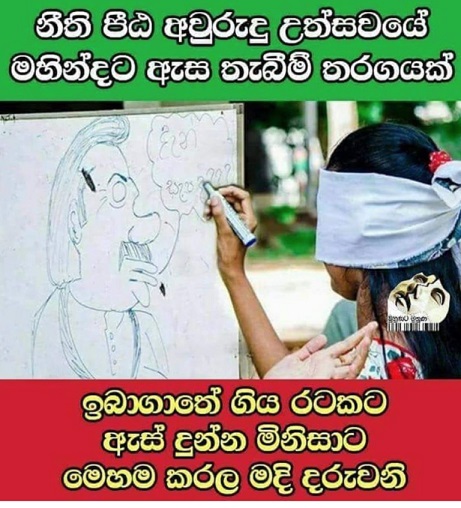
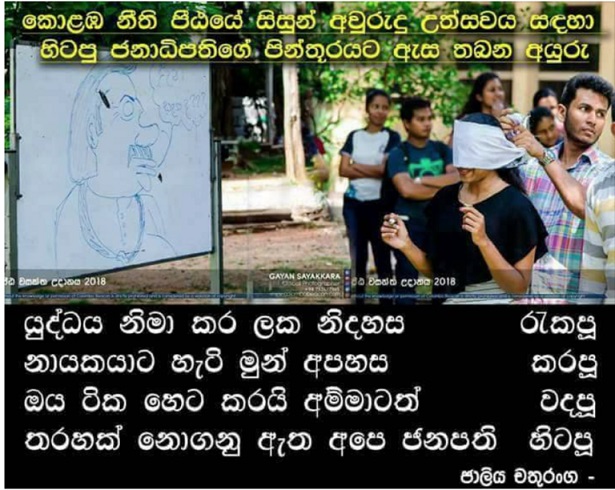
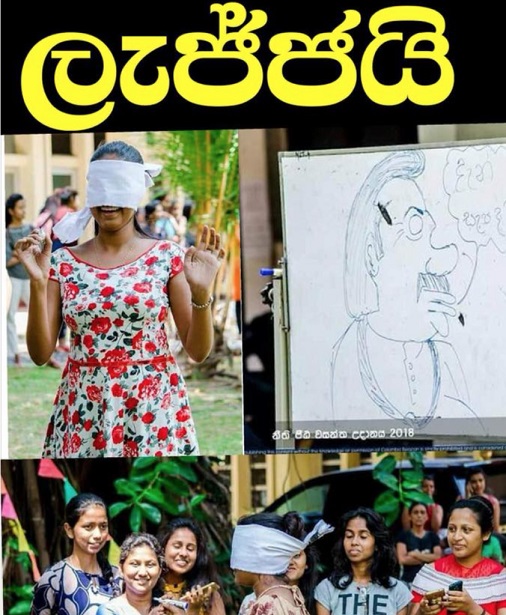
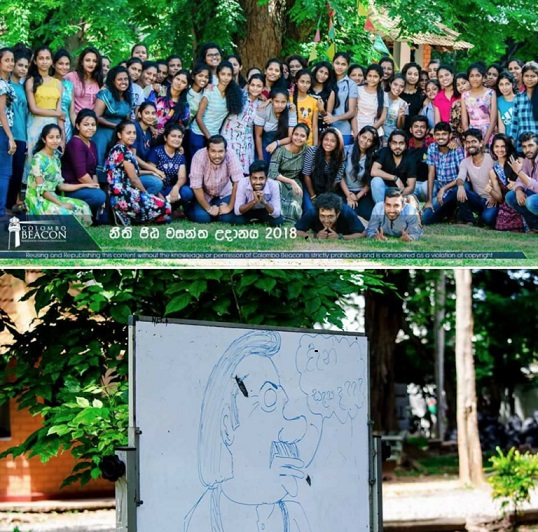
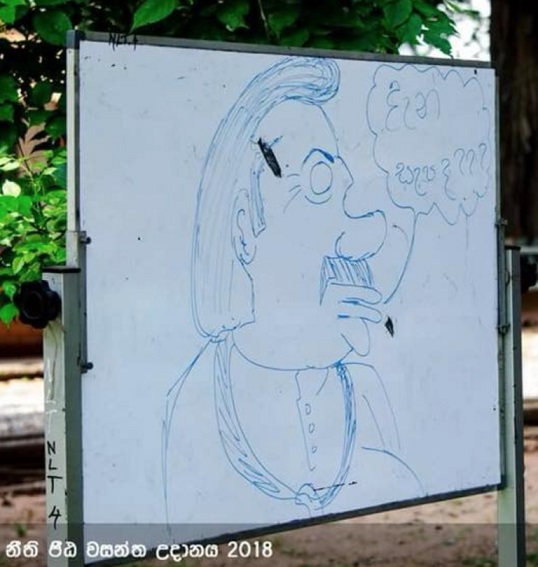
The University of Colombo Law students think they have done a job extraordinaire in the manner they have replaced the traditional Sinhala New Year festive game of placing the eye on the elephant to place the eye on the former President Mahinda Rajapakse. We do not know whose bright idea this was, but for university students in particular law students to stoop so low is utterly despicable and a disgraceful act that every citizen must deplore with condemnation. Are these the students, having benefitted from free education who are to be regarded as the future generation? In stark contrast we can compare to another state university where students and lecturers hold candle lit vigils for terrorist leader Prabakaran & LTTE terrorist cadres. These are the other lot of future coming out. Where will this country end up is our biggest question in viewing these extremes?

These pictures of the manner Law Students of the Colombo University celebrated the Sinhala New Year will no doubt shock every one. Of course there are many messages to be drawn from these, the most important of which is that a paper qualification does not necessary make a person ‘educated’ one’s behavior & actions do.

Many of these are coming from rural homes, where parents have toiled & fallen into debt to educate their children. While many of these parents continue to toil away their children are either on the streets in demonstrations or doing everything but studies. Many of these students are victims of the JVP mafia system continuing inside all universities. These JVPers jealous of any person rising in life follow a sadistic path of brainwashing new entrants, ragging them to mentally ruin their lives, ensnaring them into illicit relationships that leave them distraught and angered with society – it is a complete dehumanizing of innocent individuals to which the academia in their silence and inability to take the bullies and throw them out of university, too stand guilty.

We have had enough of occasions where ragging has gone out of hand why has it been difficult to catch the culprits suspend them and banish them from university before they are able to create a mafia within the university system? Is it that the lecturers themselves prefer when the universities are closed?

The statistics clearly reveal that the standards of Sri Lanka’s universities are declining not only in educational standards but in the quality of the students that are passing out & by the manner the students of the Colombo University Law department have celebrated the Sinhala New Year we are not in the least surprised.

These students are all in the twenties and they are old enough to know what kind of life people led before 2009. Many of them would have gone to school in fright, many of their relations would have died when LTTE blew up buses or trains, being rural youth many of their relations would have joined the armed forces some may have returned in a box. We cannot forget that 30 year old past just because some hate the man who gave orders to end the terrorism that prevailed.

Whether people like it or not, only one President had the guts to stand against foreign pressures to give order as head of the armed forces to finish off the LTTE. None of the previous Presidents had the guts to do so – JR didn’t, Premadasa gave arms to the LTTE and kept them in Hilton hotel, CBK’s 2 terms saw the most number of dead soldiers while the present PM was happy to sign territory to LTTE.

Therefore, no one can belittle what President Rajapakse did as President. If he hadn’t given the orders to proceed even the best of military cannot on its own finish off the LTTE. This is what everyone needs to be made clear of. No military, no army commander could have defeated the LTTE unless orders to do so came from the President and the President undertook to answer the international community while obtaining the arms & ammunition necessary for the military to do their job, for that we have to thank China & Pakistan for the role they played in helping Sri Lanka end terror.

Therefore, when a bunch of students giggling away and thinking they are doing something big by placing the eye on the very President that ended 30 years of terrorism, they must feel ashamed to see their faces now circulating all over the social media and no doubt their parents must be feeling embarrassed as well.

Even if these events are organized by mischief makers foreign or JVP, as law students if they do not have the pluck to refuse to be party to it, then as adults and as future lawyers we can only fear what type of law & order they will usher.

This is not the future generation we want to see passing out. Definitely not the students coming out of Jaffna university lighting candles for LTTE or the present lot of students mocking the very President that finished the LTTE.

All citizens must deplore this act and the university authorities must take some stern action and these students must in the least issue an apology to the former President.

People may not like him but no one has the right to ridicule him for we are all living without LTTE suicide, LTTE assassinations, LTTE bombs because of President Mahinda Rajapakse and the team he chose to end terrorism.
Shenali D Waduge

HOW TO EARN WEALTH

May 4th, 2018

by Ven. Aggamaha Pandita Dr. Walpola Piyananda Chief Sangha Nayake of America (Courtesy The Island)

April 27, 2018, 9:01 pm

Some scholars who have read very little of Buddhist literature have stated that Buddhism is a religion meant only for persons who have renounced household life. Others have tried to show it as a kind of pessimistic religion or, due to their prejudice or lack of knowledge of Buddhism, have tried to prove that Buddhism is a kind of religion hostile to world progress.

But unprejudiced and broadminded scholars have honestly and openly praised it declaring its greatness and practicality for every time. One of the great Pali scholars, the late Mrs. Rhys Davids, said in the introduction to the English translation of Sigalovadasuttanta in Digha-nikaya:

“This Suttanta is called the Vinaya of the Houseman. Hence, in one who practices what he has been taught in it, growth is to be looked for, and not decay.’ And truly we may say even now of this Vinaya, or the code of discipline, so fundamental are the human interests involved, so sane and wide is the wisdom that envisages them, that the utterances are as fresh and practically as binding today and here as they were then at Rajagaha.” (p. 169 Dial. iii)

This world is like a school in which there are beings of varied mental levels. A teacher uses toys and pictures and the like when he teaches the children in kindergarten. The pupils of the middle forms are taught lessons suitable to their level. The students of the highest forms are taught lessons dealing with higher subjects like higher mathematics etc. The Lord Buddha saw the world as a school of many forms and gave instruction suitable to the mental level of his listeners.

One day a poor Brahmin came to the Lord Buddha and said, “Master Gautama, I am a poor person and am going to a distant city to seek a job with a view to earning some wealth. Will you kindly give me some instruction in order to be successful in my job?” The Lord agreed and instructed him on the way to be successful. Some time passed and the Brahmin returned a rich man.

On one occasion the Lord arrived at a village called Veludvaragama. The villagers said to him, “Lord, we are householders working to maintain our families, and have many responsibilities. We do not have any time to devote to higher religious practices. We would like you to instruct us on these two things, to live our present life peacefully and to be born into a happy state after our death.” The Lord knowing their mentality gave instructions to meet their needs.

Concerning the accumulation of wealth Anathapindika, one of His lay devotees, was told that there were five benefits to earning wealth. First, a person can use his wealth to supply all his needs in order to live a healthy, happy and long life. Secondly, a person’s wealth can be used to look after his parents when they are sick, old or in need of his support. Thirdly, a person can support his wife and children, supplying all their needs. A person can help his relatives, friends, servants and others; this is the fourth merit of wealth.

The recluses and priests who have given up household life devote their time for higher religious practices. They depend on the support of the laity which a wealthy person could easily do for them and share in their virtues to be born into a happy state after death. This is the fifth merit of the wealth.

The Buddha taught that it was easier for a rich man to enter heaven, if he properly spent his wealth and fulfilled his duties. It is not wealth but miserliness and other wrong actions that obstruct the way to heaven. He said, “Certainly the miserly cannot go to heaven (whether they are rich or poor).” (Samyutta, Devata)

He praised the generosity of the wealthy saying, “The rich man who gives or helps others and also enjoys himself will be praised here and will go to heaven after death.” (Samyutta, Devata)

Now to answer the question of how can one earn wealth, the Lord taught many discourses like Ujjaya-Sutta, Vyagghapajja-Sutta, Sigalovada-sutta with instructions for successfully earning wealth. His instructions were that a person should be endowed with four things. The first one is to be skilled, earnest and energetic. One should not let slight cold, slight heat, slight rain and the like prevent one from working. Although some times obstacles may cause failure, one should not give up. One should persevere and eventually become successful. At every step, the Lord said, one should be mindful, far-seeing and cautious.

The second thing a businessperson should have is ‘arakkha-sampada,’ which means ‘the ability to protect their wealth.’ This implies being careful in keeping what one earns from being dissipated. The Lord said there were many ways this may happen and therefore one should be careful and vigilant. Sometimes a natural disaster like fire or flood might consume one’s wealth. Sometimes ill-disposed heirs would try to take away one’s wealth. Falling into bad habits like gambling, debauchery and drunkenness drags one down into poverty. One should be on good terms with the government; otherwise one’s wealth could possibly be confiscated. As there are so many ways that could lead to a person’s degradation, one must be vigilant and very careful in keeping one’s wealth from being wasted.

The third thing an earner should be possessed of is ‘Kalyanamittata’ which means ‘having good companions who instruct, help and encourage in carrying out one’s business. A person’s kind parents, relatives, teachers, monks, recluses or priests, whosoever are wise and compassionate hoping for one’s success are good friends or companions. Not finding good companions, one should avoid association with persons who follow evil ways. It is better to keep oneself to oneself carrying out working alone.

The fourth point is ‘sama-jivikata’ which means a balanced or simple way of living. A person in business should spend their money very carefully. Expenditures should not exceed income. If a person with a small income imitates the ways of the rich, before long they fall into insolvency and will become a failure. Therefore the Lord advised every earner to live his life as simply as possible. This does not mean that he should live meanly. If one’s income is great but they live meanly as a stingy person, their effort in earning wealth is useless.

In Sigalovada-sutta, the Lord advised the youth Sigalaka to divide his income into four parts: one portion to be spent for daily expenses; two portions to be used for the advancement of his business; the last part to be deposited carefully for use in the future in case of emergencies.

The Lord said, “Poverty is an ordeal for the person living a household life.” Therefore the Lord Buddha’s advice to householders was to try to earn wealth and to spend it properly to be able to live a useful life.

The Lord speaking about the merchant who would be successful in his business said: “A salesman should know the quality of the goods he buys; know their price; the amount of the profit he will gain; be skilled in the art of buying and selling; be honest and trustworthy so that wealthy would deposit their money under his care.” (Ang. I p. 116)

On another occasion the Lord said that a trader should be active during the day: morning, noon and afternoon. If not, he would not be successful. (pp.114, 115 Ang. i)

Some people live simply, contented with a small amount of income. But if a person expects to do a great service by helping people who are in need, he should try to earn much wealth. If such a person expects to earn much wealth, he must be virtuous, vigilant and energetic. One will never be poor vigilantly following the Lord’s instructions.

At this point one might ask: Isn’t poverty a result of an unwholesome karma from a past life? Poverty may be a result either of a past karma or of a present karma or of both. But most of such karmas can be suppressed and overcome by wise and far seeing steps taken in this life.

Most often it is according to the actions taken in the present life that a past karma, good or bad, rises up and finds the opportunity to give its result. Therefore the effort that is made at present is the preeminent cause of a person’s progress or failure in the case of the majority of people. “Utthahatha, ma pamadattha,” “Get up, loiter not.” Is the Buddha’s frequent advice to the world.

Let us see further what the Buddha has said about wealth and other necessities of life, “these ten things are desirable, pleasing and charming, but hard to achieve in the world. They are Wealth, Beauty, Health, Virtue, Life of holy celibacy, Real friends, Erudition, Wisdom, Genuine teaching, and To be born in heavens. These are all desirable, pleasing and charming, but hard to achieve. (p. 134 Ang. v)

Then there are ten things that are obstacles: Laziness and lack of activity are obstacles to wealth; Lack of finery and lack of adornment are obstacles to beauty; Following unhygienic ways, an obstacle to health. Keeping company with people of foul character is an obstacle to virtue. Unrestraint of senses is an obstacle to life of holy celibacy. Deceit is an obstacle to friends. Lack of recitation and re-reading are obstacles to erudition. Not to listen and not to ask questions are obstacles to wisdom. Lack of practice and lack of contemplation are obstacles to Dhamma. Habitually following evil ways is the obstacle to birth in the heavens. (p. 135 Ang. v)

A person who expects to achieve success both in worldly or religious life should avoid these obstacles and follow the way of growth to success. The Buddha expounded the way to growth and progress as follows: “by increasing in the ten growths, the noble disciple (i.e. a lay follower of a Buddha) grows by taking hold of the essential; taking hold of the best for his progress. One grows in landed property; in wealth and granary; in children and wife; in servants and workers; in four-footed beasts (i.e. cattle and sheep); in faith and virtue; in erudition, and in generosity and wisdom.” (p. 136 Ang. v)

From these words of the Buddha, it is very clear that he valued the growth in wealth and family life as a noble endeavor.

Buddha’s relics from Taxila in Pakistan are being exhibited in various temples in Sri Lanka

May 4th, 2018

Courtesy NewsIn.Asia

Colombo, May 4 (newsin.asia):  The relics of Lord Buddha brought from Pakistan are now being exhibited at Purana Vajirakoth Viharaya, in Kalutara District.

The relics were received by Ven. Gonaduwe Gunananda Thero at the temple. The relics are from the Dharmarajika Vihara at Taxila in Pakistan. The 3 rd.Century BC vihara was built at the time of Emperor Ashoka.

Thereafter, the relics will be taken to Galle (5th May at Sumanaramaya, Kumbalwella), Matara (6th & 7th May at Getambaruwa Raja Maha Vihara), Kurunegala (8thMay at Diyakalamulla Pirivena, Kuliyapitiya), Anuradhapura (9th & 10th May at Sri Sarananda Maha Pirivena) and Kandy (11th May at Balagollla Budhist Centre and 12th May at Ambanwela Raja Maha Vihara) for public exposition.

Buddha’s relics from Taxila in Pakistan are being exhibited in various temples in Sri Lanka

The relics then be will be brought back to Colombo on 13th May, for a three day exposition at the Gangaramaya Viharasthanaya, says a release from the Pakistan High Commission.

Sri Lanka’s Standard Chartered gears up for more business under China’s One Belt One Road

May 4th, 2018

Courtesy NewsIn.Asia

Colombo, May 4 (newsin.asia) – Standard Chartered Bank, on Friday said it is setting up a ‘China Desk’ at its branch in Sri Lanka’s capital Colombo to encourage more Chinese companies to invest in the island under the One Belt One Road initiative.

Sam Xu, Head of Transaction Banking at Standard Chartered in China, who led a delegation of customer relations officers to Sri Lanka, said the markets which all fall within the Belt and Road Initiative are all eligible, important markets which have meaningful bilateral trade relationships with China.

Sri Lanka’s Standard Chartered gears up for more business under China’s One Belt One Road

He said the Sri Lankan economy will also benefit under this initiative and the Standard Chartered was encouraging more business from China to invest  in the country under the One Belt One Road.

Xu said the Chinese Desk which will soon be set up will help Chinese officials who are still new to Sri Lanka to communicate better with a banker who speaks Chinese.

He said this will also help avoid misunderstandings.

Several big Chinese state-run groups like China Harbhour Engineering Company Limited, China Merchants Port and AVIC have already invested in the country, benefiting Sri Lanka’s infrastructure and economic development.

Stirring up old resentments and hopes: The debate on the India-Lanka Accord of 1987

May 4th, 2018

By Veeragathy Thanabalasingham/Courtesy Daily Express

The much-maligned Indo-Lanka Peace Accord of 1987 is back in public focus, courtesy T. Ramakrishnan’s book Or Inapprachinaiyum Or Oppandhamum” (An Ethnic Conflict and An Accord), introduced at an event at the Colombo Tamil Sangam recently.

Ramakrishnan, a senior Indian journalist and an Associate Editor of the The Hindu, had engagements in Kandy and Jaffna promoting his book before the Colombo event.

In the run-up to the event, some journalists asked this writer whether there was any interest among Sri Lankans about the Accord at all. The answer was pretty much in evidence at the Tamil Sangam event.

The Accord was signed on July 29, 1987 by President of Sri Lanka J.R. Jayewardene and Prime Minister of India Rajiv Gandhi, in the backdrop of an island-wide curfew. Beginning with the Black July of 1983, the four years leading up to that moment were an important phase in the history of the national question, specifically because of India’s deep involvement in Sri Lanka’s affairs.

The signing of the Accord marked the high point of the eventful phase, which lasted for nearly three years till the withdrawal of the Indian Peace Keeping Force (IPKF) in March 1990.

Consequent to the Accord, the 13th Amendment to the Constitution of Sri Lanka was introduced, paving the way for the creation of Provincial Councils. But the tragedy is, with the system of the Provincial Councils turning 30 at the end of the year, we are still debating on a meaningful political settlement to the ethnic imbroglio.

Ramakrishnan is not oblivious to the situation. And the first  chapter of his book, titled ‘Why now?’ indicates his level of knowledge. This shouldn’t come as a surprise, for Ramakrishnan, the son of Tamil literary giant Ashokamitran, not only comes from a politically-conscious background, he also served as the Colombo-based Correspondent of The Hindu for Sri Lanka and the Maldives from April 2015 to August 2016.

While noting how the Accord continues to be seen worldwide as a very important attempt to resolve the ethnic problem, Ramakrishnan plays the devil’s advocate and wonders whether it was a failure in the real sense; whether it is still alive and whether the kind of destruction Sri Lanka had seen towards the end of the civil war in May 2009 could have been avoided if the Accord had been implemented fully and properly.

In Ramakrishnan’s words, Or Inapprachinaiyum Or Oppandhamum” seeks to find answers to these questions.

He is very particular that the focus of his work should not be construed as being about the military dimension of the Accord, but about the political facet, which he strongly believes has enormous relevance even after three decades.

Sri Lankan naval rating Wijitha Rohana Wijemuni in the Guard of Honor about to strike Rajiv Gandhi on the head. The Indian Prime Minister got away with an abrasion at the back of his neck

This view has found a believer in R. Sampanthan, leader of the Tamil National Alliance (TNA) and of the opposition in Parliament, who, while addressing the Colombo event, emphasized that India should ensure that the Accord is implemented in letter and spirit.

He said: Our journey continues. We need the Accord. We need to ensure that the spirit of the Accord is implemented and India must do its duty to ensure the same. It is India’s duty and Indian cannot get away from that duty.”

Annamalai Varadaraja Perumal, former Chief Minister of merged North- Eastern Province, who addressed the audience before Sampanthan, spoke of the  ‘many contradictions’ among the diplomatic, bureaucratic and intelligence arms of the Indian establishment at the time the accord was signed, which he said, led to the ‘failure’ of IPKF intervention in Sri Lanka.

He regretted that India had virtually abandoned the Tamil cause because it is now interested in economic expansion and not political hegemony.

Ramakrishnan’s book also touches upon the current thinking of the Indian government on the bilateral agreement, and quotes the discussion that took place in February 2017 between a delegation of TNA leaders led by Sampanthan and Subrahmanyam Jaishankar, the then Foreign Secretary of India.

Responding to a request by Suresh Premachandran that India should exert pressure upon the Sri Lankan government to remerge the Northern and Eastern Provinces as stipulated in the 1987 July Accord,  Jaishankar is quoted as saying that considering the major changes that have taken place in the last 30 years, especially in the area of geopolitics, New Delhi is neither going to exert much pressure on Colombo in regard to the implementation of the 13th Amendment nor does it feel the necessity to do so.

Under such circumstances, Colombo is not going to be concerned about a matter, over which New Delhi has apparently little interest. At the same time, it should also be pointed out that neither India nor Sri Lanka have publicly disowned the Accord.

The author has attempted to answer the question as to whether the Accord was a success, or not. In tones philosophical, he writes that in life, not everything can be expressed in black and white and the same holds good for the Accord as well.

One can superficially say that the agreement had failed but the 13th Amendment, which came into being as a sequel to the Accord, is still part of the law of the land.

Acknowledging that better proposals were drawn up and discussed extensively on the Tamil question after the Peace Accord in the last 30 years, he notes that they have all remained ‘mere proposals’. None of them has been included in the statute book.

LTTE leader V.Prabhakaran with Anton Balasingham, Lt.Gen.Dipender Singh, Brig.Fernandez and Maj.Gen. Harkirat Singh in Palaly 1987.

Another special feature of the Accord was the recognition of Sri Lanka as a ‘multi – ethnic and a multi-lingual plural society’, a reference that continues to have great significance.  The author calls ‘the biggest bonus’ the temporary merger of the North and East Provinces and acknowledges the lament of the leadership of the Tamil parties, that the advantage gained by the Accord was fritted away.

He counters the widely-held belief that the Accord was ‘imposed’ by New Delhi on Colombo and contends that the idea behind the pact originally came from President Jayewardene and not India.  But what emerges as indisputable is that the agreement would not have been possible but for New Delhi’s pressure.

It should also be kept in mind that despite the Provincial Councils not having powers as originally designed, the credit even for at least the present situation should go to India.

Starting from the Banda-Chelva Pact of 1957, the history of attempts to find solutions to the ethnic problem is long and bitter. Given this background, it is futile to expect the Sinhalese political leadership, on its own, to come out with a solution.

However, it is Ramakrishnan’s belief that Sri Lanka still has the capacity and competence to solve the problem. The reason for his optimism is that barring India, this is the only country in the region to witness successive regime changes in the last 70 years through democratic means. The author has every right to have faith in, what he calls, wisdom and maturity of the Sri Lankan polity.

But at the same time, it would be appropriate to remind at this point what a leading political scientist in Sri Lanka, Prof. Jayadeva Uyangoda, wrote in The Hindu in July 2017 to coincide with the 30th anniversary of the Accord.

He wrote: The accord’s story has become part of history in India as well as Sri Lanka. However, has Sri Lanka’s politics changed since the advent of the Accord? The answer is both ‘YES’ and ‘NO.’

The need for good leadership

May 4th, 2018

By Lakshman I.Keerthisinghe Courtesy Ceylon Today

Great leaders are not merely effective, they are ethical. Moral principles guide their purposes and practices.People follow them because they believe in them.Great leaders engender trust in their integrity, their competence and their intentions.”-Michael Josephson (American Professor of Law)

In recent times there has been much discussion in social circles about the necessity of good leaders for our motherland Sri Lanka. It is obvious that without good leaders there can never be good governance in a country.This article attempts to examine the traits of good leadership which would benefit our nation.

The great Greek philosopher Aristotle stated that for a good leader it is more important to do the right thing than it is to please all parties. No person can ever please everybody. Aristotle believed that to become an effective leader, such person must first be a follower, to intimately understand the needs and wants of the people. A person who cannot be a follower cannot be a good leader. Even after one becomes a leader, such person still needs to follow – the concerns, the plight, and the progress of the people such leaders serve. Every good leader is a good follower. Aristotle believed that a person is what he repeatedly does. Thus excellence becomes a habit.


A good leader stands for excellence promoting excellence in what such leader does and those that such leader serves every moment every day. Many people avoid conflict like the plague. They believe it is better to run the other way than to risk a confrontation. But a true leader does not run away but faces it head on, and right away, so that the problem does not grow (as it inevitably will if untreated).This philosopher also said liars even when they speak the truth are not believed. A person’s reputation is that person’s number one asset. The fastest way to erode a reputation is to try and deceive people even if a person is doing it for all the ‘right’ reasons.

Good leaders never lie or deceive the people. Leaders who help people get ahead in this world are those who leave the greatest legacy. Aristotle also said tolerance and apathy are the last traits of a dying society. If a leader is one who is tolerant of laziness, infighting, insubordination, and is indifferent to the concerns and achievements of the people – death to such person’s position, team, department or entire country, could come knocking. If a leader doesn’t have the courage to oppose bad behaviour and if such leader ignores the good deeds of his/her people, such person is not leading. Good leaders show that they don’t give up easily and are courageous. They are patient with their plans and patient with the people.

Patience is sometimes mistaken for stubbornness. The difference is that when one is patient, such person is leading. When one is stubborn, such person is controlling. Patience shows strength and conviction. Long before today’s trend of leading a balanced life, Aristotle believed in what he called the golden mean” to achieve life-long happiness. This is the point between excess and deficiency. In other words, it is the middle ground or the middle path, which the Buddha himself advocated.

Kautilya the ancient Indian philosopher speaking of a leader or king expressed the following thoughts: ‘a king with a depleted treasury eats into the very vitality of the citizens and the country’.  At the same time ‘a king, who impoverishes his own people or angers them by unjust exactions will also lose their loyalty’. Kautilya further stated ‘impoverishment, greed and dissatisfaction are engendered among the subjects, when the king:(i)  ignores the good people and favours the wicked;(ii) causes harm by new unrighteous practices;(iii) neglects the observation of proper and righteous practices; (iv) suppresses dharma and propagates adharma;(v) does what ought not to be done and fails to do what ought to be done;(vi)  fails to give what ought to be given and exacts what he cannot rightly take;(vii) does not punish those who ought to be punished but punishes those who do not deserve to be punished; (viii)  arrests those who should not be arrested but fails to arrest those who should be seized;(ix) indulges in wasteful expenditures and destroys profitable undertakings; (x)fails to protect the people from thieves and robs them himself. A good leader should avoid the above traits.

In conclusion rather than criticizing our present leaders for their alleged weaknesses it is much more productive to guide them in the proper path. For that purpose the advice given by ancient philosophers become very relevant. Personal attacks on leaders especially judges who are presently on the bench are very counterproductive and detrimental to the maintenance of the rule of law as such criticisms in public erode public confidence in the administration of justice. Our leaders should emulate great leaders of yore and serve the nation conscientiously.

(The writer is an Attorney-at-Law with LLB, LLM. MPhil. (Colombo)
keerthisinghel@yahoo.co.uk)

WHEN LEFT HAND DOESN’T KNOW WHAT THE RIGHT DOES!

May 4th, 2018

By  Dr. Tilak S. Fernando Courtesy Ceylon Today

The general perception of the phrase, The left hand does not know what the right hand does” is associated with the biblical quotation by Jesus Christ, in Mathew 6:3. It generally means that all merciful deeds should be kept secret, and not be done for praise by others with the sole purpose of seeking publicity, or to gain fame from the society.  In Buddhism too, it sculpts the same philosophy, which is preached to people almost every day by Bhikkhus, at temples and, through Sri Lankan Buddhist TV channels.

However, this expression is used frequently, in modern times, as a criticism in every society, be it a mercantile institution or the public sector, where corporate adaptations or financial regulations are not communicated precisely to all other tentacles of the organisation. It is evidently prominent in Sri Lankan politics where politicians and the government ministers are deemed not to follow such mastery.

Taking a cue from the symbolic meaning of the phrase, President Maithripala Sirisena himself, at times is seen and heard coming out with statements akin to, I only saw it on TV news or came to know from the newspapers”!

Leaving a broad margin about such assertions and considering the fact that even the Sri Lankan President is only human, as such, he cannot be expected to be omnipotent, but when some of his Ministers in the Unity Government come out with various contradictory statements, willy-nilly, according to their own whims and fancies, it does boil down to the fact that even among the members in Yahapalanaya there is a lack of uniformity.

Well-mixed pickle

It is a travesty that politicians in Sri Lanka, including the Ministers of the Unity Government, as much as members of other political parties, have begun to speak out of turn, without double checking with their leaders, thus making news briefings into a well-mixed pickle! During the recent incident of the ‘no-confidence motion’ against the Prime Minister, a resolute decision was taken by sixteen ministers and deputies to vote in favour of  the motion  to oust the Prime Minister from office, on a matter of principle.  They were convinced that the Prime Minister had a major role to play  in the Central Bank massive fraud, and  he was accountable for the colossal financial losses by appointing a foreigner to head the Central Bank, who apparently is absconding, up to the time of writing this column, disregarding Court orders and red notices from the Interpol.

The rest of the SLFP members abstained from voting during the motion, while some went abroad making it an excuse for their absence. This has demonstrated, beyond any doubt, that those SLFP members who voted to keep Ranil Wickremesinghe in office had certainly given the knife to the sixteen of their colleagues, who voted against the PM, from behind. The final result being, those sixteen had to give up their positions on a matter of principle and were left high and dry. According to news media, the Central Committee of the SLFP had many confidential meetings with the President prior to the no-confidence motion vote in Parliament and had reached a collective decision as a party, to oust the Prime Minister Ranil Wickremesinghe.

An absentee during a voting is generally assumed as favouring any motion which is brought up in Parliament, for whatever reason he/she may decide to back out! Therefore, it was such a misfortune that at the end of the day, when everything was said and done, those sixteen members had no choice but to offer their resignation from their positions from the Unity Government. They have now decided to sit with the Opposition members in the Parliament! Undoubtedly, they could not possibly work with the Prime Minister whom they considered unfit to be in office and voted against on a matter of principle.

It does seem that the rest of the members of the SLFP of which the President is the brains behind, are at loggerheads, which exposes the fact that there is no unity or cohesion within the SLFP any more, as everyone appears to speak to a microphone or a media guy, as they deem fit, with full of contradictory statements.

Provocative remarks

President Maithripala Sirisena, as per Cabinet Paper No. 18/05/576/701/012-1 discarded the Cabinet Committee on Economic Management (CCEM). Subsequently, he called upon the editors and heads of media organizations to a news conference to advise them about the abolition of the CCEM and revealed that all functions of the Committee would thereafter be performed only by the line ministers who are responsible for the subject.

However, the Finance and Mass Media Minister, Mangala Samaraweera, appeared at a news briefing few days later and stressed piquantly and spicily that, the CCEM had not been dissolved and requested the news reporters not   to go by ‘media reports’. He further insisted by saying: I am in the Cabinet. We have not responded or made our observations… we have asked for two weeks.”

However, the whole country by that time was aware of this very fact, except the very Minister in charge of the Mass Media, and every news bulletin carried that news  about the President’s decision on 1 April 2018.

It  further  revealed that the  Ministers at the weekly meeting on 27th March 2018  had endorsed the abolition, and a copy of the minutes had already been  forwarded to the very  Minister of Finance and Mass Media.
What more can be more elaborate than the evidently contradictory statements made by the very Minister, who is in charge of Finance and Mass Media conceitedly denying President’s order publicly? This clearly confirmed the fact about various Cabinet Ministers in the Yahapalanaya regime were going about in a most unprofessional manner, which naturally has given rise to the ever increasing scenario of a destructive disintegration of the Unity Government itself, which has been confusing the general public ever since they came to power in 2015.

Finally, subjecting to public exposure, Minister Samaraweera had to apologise to the infuriated President about his statements to the press with a farfetched explanation that he was not present at the weekly Cabinet Meeting on March 20”! How can a Government run in such a manner when responsible players in governance make such bloomers?

Being President as the Head of the SLFP, and equally of  the Unity Government, people are certain to view him as   failing to cement whatever the hairline cracks that became  structural fissures that were  taking place within the foundation of the Yahapalanaya regime. Such occurrences within the Yahapalanaya clearly and distinctively indicate the failure and to confirm the fact that the left hand in the Yahapalanaya regime does not know what the right hand does!

What is more ironic is why President Sirisena, amidst all such a hullabaloo, gave the freedom to his SLFP Members to  take an independent decision, at the eleventh hour, giving them only a breathing space  to vote for the no-confidence motion according to each ones conscience! Was it because Ranil Wickremesinghe is his partner in the Yahapalanaya, without whose support and back up he would never have become the President of this Country?

It appears that President Sirisena, during the last three years, was playing a saintly game of ‘supreme democracy of non-involvement’, which goes to prove his spiritless stance in a crucial moment of decision taking.
After all, being the President of a Nation, one has to use his full authority within the framework of the Constitution and act firmly as a leader, for the benefit and welfare of the whole nation, exhibiting leadership qualities without exposing himself to the nation as an entertainer or prankster!

Other side of the Coin

On the other side of the coin is the UNP, where Ranil Wickremesinghe continues to be the leader still. Despite being in politics for the last forty-odd years, and people rejecting him nearly equal number of times at elections, the melodrama within the UNP seems to continue, even after the no-confidence motion where he appeared to have convinced some of his opponents within the UNP with promises of reforming the party including the leadership changes.

A fair section of the backbenchers in the UNP wanted him to hand over the leadership to young blood, and  for him to  retire gracefully from politics in order that  the UNP could shine again and reach to the zenith, where suffering of the masses could be eliminated and corruption decimated.

Several staunch UNP members such as Range Bandara and the young Wasantha Senanayake were apparently persuaded to vote against the no-confidence motion on the promise of an overall reformation of the UNP, including the leadership change. Undoubtedly the discontentment within the UNP is brewing once again, as Ranil Wickremesinghe is playing a game of superiority by various shrewd moves of changing several positions in the party and expending his usual tactics to remain in power, as opposed to the weak President, who seems to be thoroughly confused and behaves like a stick in the mud, confining his activities  only to verbal  public diarrhoea.

However, there is not much of a lifespan left for the Yahapalanaya regime to wave a magic wand and to fulfil their promises given in 2015, before their term comes to an end in 2020. It is crystal clear from  what is seen on TV news  on a daily basis to what extent the poor  villagers  and farmers alike are suffering  without water, battling with  a new wave of threats to their properties, cultivations and innocent men and women getting killed  by elephants, while the politicians in Colombo exhibit a vulgar display of their  luxury SUVs, Benz limousines and roaming in Colombo streets at night time to attend meetings of many sorts, in an attempt to look after themselves selfishly in power battles and party tribulations.

tilakfernando@gmail.com

The nonsense of non-science in re-shuffle politics

May 4th, 2018

By Lucien Rajakarunanayake Courtesy The Island

There were many advance statements about the latest Cabinet re-shuffle being done in scientifically. That was a boast of the President, and not questioned by the Prime Minister. For once they seemed to be in agreement, apart from knowing how to be defeated in local government elections, which was the science of defeat.

But what could be the principle of science, if any, applied to this re-shuffle of ministers? It was certainly the longest re-shuffle of ministers – Cabinet, State and Deputies. Was it the science of killing time that was used to spread this shuffle over three days?

Was there any science applied in the allocation of portfolios, other than following the non-science of the previous forming of Cabinets, which is part of the anti-democratic governance being fast promoted by the leadership of all political parties here today? Is it the height of Political or Cabinet Science to give Wildlife to one minister and Forestry to another? Is it a major aspect of Cabinet Science for a member from the Badulla hills, so distant from the ocean, to be given the portfolio of Fisheries? Or was it the science of embracing crooked politicos, to ensure there are no “Appachchi Mala” statements in the future?

article_image

What is the science in having more than forty ministers, in a country of a little over 21 million people and a parliament of 225 members? What is the science of a ‘national government’ where the constitutional limit of 30 Cabinet Ministers, could be exceeded by the majority party joining with one other party in the House, even having one member? And, how can such joining be ‘national’ when the majority of those from the other party – the SLFP – are now very much in the Opposition?

What is the science that brings to the Cabinet, a member who had to resign because his own party – the UNP wanted him to be removed from Justice and Buddhasasana, because of glaring delays in bringing legal action against the corrupt of the former regime, and now give him Higher Education and Cultural Affairs? Was it the science of gratitude or ’Thank You’ for voting against the No-Confidence Motion against the Prime Minister? We are certainly in a wonderful world of science, amidst the politics of the corrupt, today.

We have had members with doctorates in Political Science adorning our legislature in the past, but what is the Science of Politics that we see around today?

Is it the special science of knowing how to forget or abandon the promises given to the people when seeking their votes for election as President? Is it the science of great hope in seeing a 19th Amendment to the Constitution passed that limits one’s term as president to five years, and then asking the Supreme Court whether it should not be six years? Is this the new Presidential Science we must get used to?

What of the Science of Abandonment – considering how the pledge given to the people at election, and at the funeral of the Ven. Maduluwawe Sobitha Thera, not to seek election as president again, is shamelessly abandoned, and crooked paths devised to seek the office again?

The Cabinet that has been sworn in has much to do with many sciences, especially the Science of Crooked Politics, the core values of which are continuance in power with least regard for service to the country and people. It flows from the beginnings of rogue politics to the continuance of political rejects; continues with the politics of the corrupt and that of the Diyawanna Swamp, where perks and privileges from duty free luxury cars, sale of duty free vehicle permits, people paying the undisclosed expenses of electorate offices, and maneuvering decline of sports, and every possible deviation from the honesty of governance is accepted as the Rule of the Day.

There is much said about the decline in standards of education in the country today. True. But what more can be expected when the country is led by those who wallow in the unscientific, while claiming to use science in swearing the corrupt in politics to the highest offices in governance.

It is the Nonsense of Non-science in the politics of the corrupt.

Harpooning whales

May 4th, 2018

Editorial Courtesy The Island


The Commission to Investigate Allegations of Bribery or Corruption (CIABOC), which is often accused of steering clear of sharks, has harpooned two whales! It arrested President Maithripala Sirisena’s Chief of Staff H. K. Mahanama and Chairman of the State Timber Corporation P. Dissanayake for allegedly accepting a huge bribe to the tune of Rs. 100 mn, on Thursday in Colombo. Even the ranks of Tuscany could scarce forebear to cheer!

The CIABOC deserves public plaudits for the successful operation, which must have sent a chill down the spines of other corrupt officials in the public service.

Thursday’s arrests serve to prove how entrenched corruption is and that not even the panjandrums attached to the President’s Office have been vetted properly. The top presidential aide, currently being held on remand, held key positions in the public service previously, as we reported yesterday.

President Sirisena lost no time in ensuring that Mahanama was interdicted. This is in sharp contrast to the manner in which Central Bank Governor Arjuna Mahendran was treated when the first bond scam came to light in Feb. 2015. The UNP went hell for leather to shield him and vilify those who had blown the lid off the racket. Bogus committees were appointed as part of a campaign to protect the beleaguered Central Bank Governor.

The UNP saw to it that the allegations against Mahendran would not be probed. The Financial Crimes Investigation Division, which otherwise works with missionary zeal, looked the other way. Attempts to move the CIABOC against him were in vain. It became manifestly clear that the UNP was protecting Mahendran, for its own sake. We argued, in this space, that it was suicidal for the UNP to defend the bond racketeers and people were the best judges. People gave their verdict on Feb. 10; the UNP suffered an ignominious electoral defeat.

Some Opposition heavyweights have sought to use Thursday’s arrests to demonise the yahapalana dispensation. True, the self-proclaimed crusaders against bribery and corruption have failed to put their own house in order. But the fact remains that the CIABOC was not prevented from arresting the President’s Chief of Staff and the STC Chairman. The anti-graft commission sleuths would not have dared swoop on such a high ranking officer, under the previous government, which openly defended the corrupt within its ranks.

It may be recalled that the police could not raid even night clubs which were awash with drugs, from 2005 to 2015 when the ruling party politicians or their kith and kin were present in those dens of vice. The Police Narcotics Bureau officers were pistol-whipped by a minister’s son and other goons, during a hotel raid. A military intelligence officer also came under a goon attack in another hotel. He was relieved of his service revolver and gold chain. Persons, wanted in connection with serious offences, were seen in the exalted company of the grandees of the previous regime.

Now that the President has allowed the CIABOC to operate freely and interdicted his Chief of Staff, it is up to the UNP to ensure that its man, Mahendran, will come here to stand trial over the bond scams. It brought him in, made him the Central Bank Governor and helped him leave the country. Therefore, it is duty bound to bring him back.

Meanwhile, the CIABOC ought to implement the recommendations, made by the presidential commission which probed the mega bond scams. It should get cracking. It has to launch investigations if it is to refute the claim, being made in some quarters, that UNP ministers and others with links to them have been allowed to remain above the law.

The presidential system should not be abolished

May 4th, 2018

By Neville Ladduwahetty

One of the pressing questions before the nation is whether Sri Lanka should be governed under an Executive Presidential system or a Parliamentary system of government. Sri Lanka was governed under a Parliamentary system from independence up to 1977. From 1978 until 2015 Sri Lanka was governed under an Executive Presidential system. In 2015 the 19th Amendment reduced the powers of the President that had existed under the Executive Presidential system of 1978 and granted more power to the Prime Minister and Parliament. Thus the three options facing the nation are: (1) To restore the Executive Presidential system of 1978 (2) Continue with the existing system where the executive powers of the President are curtailed and (3) Revert back to a Parliamentary system.

The campaign to revert back to a Parliamentary system was initiated by late Rev. Sobitha and a dedicated band of civil society individuals. The primary compulsion for change was of their belief that the Executive Presidential system by its very nature where all executive power vested in one individual is prone to corruption and abuse of power. Advocates of this proposition never explored institutional mechanisms adopted by other countries to minimize corruption and contain abuse of power or its impact on devolved powers, within the framework of a unitary state. Instead their approach was to get rid of the entire system because of their belief that it was beyond redemption. Therefore, there is an urgent need to explore the pros and cons of each of these two systems of government.

The parameters within which such an exploration should be undertaken are: (1) The reality that future governments would either be coalitions or ones that would enjoy marginal majorities; (2) Given the reality of (1) above, how separation of Executive and Legislative branches, meaning an Executive President and Parliament, function under each of the two systems; and (3) The impact of each system on devolution within a unitary framework.

How these parameters would impact on political stability of the government, upon which depends human development and the territorial integrity of the State, both of which are primary concerns, are addressed below.

POLITICAL STABILITY

The Executive Presidential system incorporated in the 1978 Constitution is founded on the principle of separation of powers, albeit not as strictly as in the USA. Consequently, the President as the head of the Executive is elected nationally and functions separately from the Parliament which is responsible for the exercise of Legislative functions. This feature of a separation of powers enables the Executive branch under the President and his Cabinet of Ministers to administer the executive functions of the State without interruption even if the Parliament has to be dissolved for one reason or another. The weakness in this system however is that if the President and the majority in Parliament represent two politically divergent ideologies implementing a common program presents problems, as occurred in the US under the Obama administration, wherein the President was from the Democratic Party and the majority in Congress was Republican. If, on the other hand, the President and the majority in Parliament represent the same political party the situation is similar to what exists under a Parliamentary system because the Prime Minister and his Cabinet of Ministers and the majority in Parliament would be from the same political party or political formation.

Under a Parliamentary system on the other hand, since the Prime Minister and his Cabinet of Ministers and Parliament are all from the same political party with a majority in Parliament, Executive and Legislative functions would be carried out by the government in power. If such a majority party is a coalition and for one reason or another such a government ceases to enjoy a majority in Parliament, both the Executive and the Legislative branches would cease to exist, and fresh elections are unavoidable. This weakness that is inherent in Parliamentary systems is the primary cause for political instability due to the absence of two vital branches of any government. Opportunities for such weaknesses to manifest themselves are particularly strong during coalition governments.

What is evident from the material presented above is that if the current political formation in Parliament functioned under a Parliamentary system and it failed to forge a stable coalition government it would have no option but to call for fresh elections. The experience in UK under the coalition government of Conservatives and Liberals was so unworkable that fresh elections were inevitable. Similarly, Germany did not have a government for nearly six months due to their inability to forge a coalition government. On the other hand, under a Presidential system however unstable the government is, at least the executive branch under the President would continue to function and the administrative functions of the State would continue to operate. This is the advantage Executive Presidential systems have over Parliamentary systems.

DEVOLUTION UNDER the TWO SYSTEMS

The 13th Amendment under the Presidential system mirrors the separation of executive and legislative functions at the center in regard to the devolved subjects. The legislative powers relating to devolved subjects are exercised by the elected Chief Minister and the Provincial Council, while the Executive functions are exercised by the Governor appointed by the President, thus extending the executive powers of the President to the provinces. This makes the Governor the agent of the Executive President in the province. This arrangement makes it possible for the Governor to exercise executive functions in the province even when Provincial Councils cease to function for whatever reason such as what occurred in the Northern and Eastern Provinces during the armed conflict.

Under a Parliamentary system where executive and legislative powers are exercised by the political party in power in Parliament, the arrangements in the provinces would mirror the arrangements at the center, ONLY if executive and legislative powers relating to devolved subjects are exercised collectively by the Provincial Councils. Such an arrangement would make Sri Lanka a federal State because the provinces would be independent of the center within its sphere of influence in respect of devolved subjects (K.C. Whear, Modern Constitutions). Having a person bearing the title of Governor, but without executive powers, would also amount to creating a federal State.

If Sri Lanka is not to be a federal State it is imperative that executive and legislative powers are exercised separately. Since there cannot be two separate systems, one at the center and a completely different system in the province, it must follow that the system at the center and in the provinces should be based on separation of powers if Sri Lanka is not to become a federal State.

PREFERRED SYSTEM

The current arrangement under the 19th Amendment wherein executive power is shared between the nationally elected President and an elected Prime Minister and a Cabinet of Ministers is proving to be totally unsatisfactory. The unworkability of the current arrangement is evident almost on a daily basis, judging from the lack of consensus on fundamentals between the President and the Prime Minister; a fact that could be compounded by either the weakness in the structural arrangement of sharing executive power or by the ideological differences between the two. Whatever the reason, the current arrangement wherein authority and responsibility relating to executive power are shared is a model that is seldom used as an administrative arrangement for the simple reason that it does not work, because it is similar to arrangements that attempt to share sovereignty.

The preferred model is one where executive authority is exercised solely by the President with the assistance of a Prime Minister and a Cabinet of Ministers and responsible to Parliament as it was under the 1978 Constitution with appropriate amendments to contain tendencies for abuse of power. However, it is imperative that executive actions are monitored and scrutinized independently by Parliament under arrangements such as Oversight Committees of Parliament with power and chaired by the members of the Opposition in Parliament in order to ensure diligent scrutiny.

CONCLUSION

The call for the abolition of the Presidential system was a knee jerk reaction to the abuse of power inherent in the system. Accepting the reality that all systems have positive and negative features scraping one system for another is not prudent. Instead a more prudent approach is to address the weakness of a system while retaining its positive features. Therefore, the preferred system should be one where the separation of executive and legislative powers is clear and distinct together with institutional safeguards to contain the exercise of disproportionate power.

An arrangement that best satisfies such a condition is the Presidential system, because separation of powers are distinct unlike in a Parliamentary system where separation of powers is blurred because both functions, executive and legislative, are exercised by the government in power. Furthermore, because of this distinct separation of powers under Presidential systems at least one branch of government could function at any given time, thus ensuring greater stability than under a Parliamentary system where stability is dependent on the survival of the government.

Separation of powers under Presidential systems enables executive powers relating to devolved subjects to be exercised under the authority of the Executive President, thus ensuring the unitary character of the State. If the unitary character is to be retained, it is imperative that executive powers are exercised separately in the provinces. On the other hand, under Parliamentary systems, since executive and legislative powers are exercised jointly at the center by the government in power, separating them in the provinces would mean that the systems in the center would be different to that in the provinces. Such contradictions are unworkable. If such contradictions are to be avoided under Parliamentary systems, it would be necessary for executive and legislative powers in the provinces to be exercised by the Provincial Council, thereby mirroring the arrangement at the center. This would make Sri Lanka a federal state because the provinces would be independent of the center within their spheres of devolved executive and legislative powers. Therefore, it is imperative that the Presidential system is retained because it has the necessary inherent attributes to prevent Sri Lanka from becoming a federal State.

The level of corruption and the degree of discord under the current arrangement of sharing executive power between the President and Prime Minister should convince the nation of the need to scrap it. If abuse of power is the compelling reason for abolishing the Presidential system, advocates of the Parliamentary system seem oblivious of the fact that abuse of power exists now and could exist under Parliamentary systems as well, since both executive and legislative powers are exercised by the government in power. The better safeguard is to separate the powers so that one branch could monitor the other under strict institutionalized arrangements, as in other countries.

At the end of it all, the choice as to the system of government would be decided by the personal interests of the political leaders and not by which system would serve the interests of the people. This had been Sri Lanka’s history; a history that is bound to repeat once again much to the disappointment of the nation. The nation should unite to introduce a system that ensures political stability and territorial integrity in which human development could prosper.

Govt. prevents Joint Opposition (JO) from using Galle Face Green for May Day rally

May 4th, 2018

by Norman Palihawadane Courtesy The Island

Former President Mahinda Rajapaka said yesterday the government had refused to grant the Joint Opposition (JO) permission to use the Galle Face Green for its May Day rally.

Unbearable tax burden, heaped on the people by the government, would be one of the main themes of JO’s May Day rally, scheduled to be held next Monday, Rajapaksa said.

Asked whether the JO had invited the 16 SLFP MPs who voted for the no-confidence motion against Prime Minister Ranil Wickremesinghe to attend their Galle May Day rally, the former President answered in the negative.

He said: “People have found it difficult to cope up with the tax increases and the soaring prices of essential items. In addition, the cronies of the government fleece people by exacting bribes. The prices of milk powder will be increased within the next few hours and that will further aggravate the suffering of people.”

M’nama faced corruption charges before being appointed Chief of Staff … suspect sabotaged USD 100 mn project for over 2 years, manipulated sale of discarded machinery, scrap iron

May 4th, 2018

Two civil society organisations, yesterday, said the Sirisena-Wickremesinghe administration owed an explanation to the general public as to why Dr. T. H. K. Mahanama had been appointed the Chief of Staff of President Maithripala Sirisena, in spite of a serious allegation against him that he deliberately delayed a USD 100 mn project to establish a new sugar factory and interfered in the Cabinet approved sale of discarded machinery and scrap iron belonging to the Kantale Sugar factory.

The Commission to Investigate Allegations of Bribery or Corruption (CIABOC) arrested Mahanama, on Thursday, at a leading hotel in Colombo. The senior administrator received the appointment about a month ago. The CIABOC also took into custody the Chairman of the State Timber Corporation Piyasena Dissanayake.

article_image

Tennakoon

President of the National Movement for Consumer Rights Protection Ranjith Vithanage and Executive Director CaFFE and Executive Director CHR-Sri Lanka Rajith Keerthi Tennakoon told The Island that yahapalana leaders had been aware of corruption allegations against Mahanama. Tennakoon alleged that Mahanama had purposely thwarted the joint venture undertaken by M. G. Sugars Lanka (Pvt) Ltd and Sri Lanka for revival and restructuring of the Kantale Sugar factory. They alleged that the official, who had been the Secretary to the Lands Ministry and Parliamentary Reforms at that time, had also blocked the planned sale of discarded Kantale Sugar factory machinery and scrap metal to Meerigama Lanka Company for Rs. 540 mn, the highest bidder

Having blocked both projects during his tenure as the Secretary Lands and Parliamentary Reforms, Mahanama had tried to sell the discarded machinery and scrap iron to M.G. Sugars Lanka (Pvt) Ltd for Rs 540, a senior CIABOC official told The Island Thursday night. Following negotiations conducted between the company and Mahanama, the latter had brought down the amount to Rs. 100 mn and agreed to accept the money in installments. “We moved in soon after Dr. Mahanama and Dissanayake accepted the money,” the official said.

Mahanama and Dissanayake were produced before the Colombo Chief Magistrate Thursday night and remanded till May 9 pending further investigations.

CIABOC described Mahanama as the mastermind of the operation.

Both Vithanage and Tennakoon said that those receiving top appointments should have been cleared beforehand. Obviously, Dr. Mahanama hadn’t been subjected to scrutiny though civil society groups repeatedly brought accusations against him to the notice of the government. Tennakoon said that he recently told a gathering that Dr. Mahanama could even sell President Sirisena for scrap iron.

A local office to monitor Sinhala language FB content: Is it a wise move?

May 3rd, 2018

By Rohana R. Wasala Courtesy The Island

It is reported that Sri Lanka is to ask Facebook to set up an office in Colombo to help monitor content posted in the Sinhalese language so that the medium is not used for nefarious purposes such as creating communal conflicts” (‘Lanka to ask Facebook to bar objectionable Sinhalese language posts’/ The Island/April 9, 2018). According to The Island report, Austin Fernando, secretary to the President and also the chairman of the TRCSL (Telecommunications Regularity Commission of Sri Lanka) confirmed that such is the case and that a Facebook delegation will be arriving soon to discuss the matter.

(Though completed on April 12, 2018, this article remained unpublished. The circumstances that prompted its writing could have changed by now; the office in question may or may not have materialized, but the topicality of the piece probably still holds, in the writer’s view.)

Needless to say, the proposal to set up an office to monitor Facebook content will be greeted with just opposition from the more than 4.5 million Facebookers, most of whom belong to the Sinhala speaking majority (75%) of the population. (This figure- 4.5 million – is taken from Colombo Digital Marketers estimates 2017; the same source claims that there are over 6 million active internet users in the country.) The decision to initiate such arbitrary censorship over Sinhala language internet traffic is utterly objectionable in its crass racism against the majority community and its callous disregard of all ordinary Sri Lankans’ right to freedom of expression. For the major implication of the proposed move is that it is exclusively the Sinhalese who use Facebook for nefarious purposes such as creating communal conflicts” and that they are inveterate troublemakers. This is adding insult to injury.

What precisely do the authorities mean by ‘nefarious purposes’ that they say lead to communal conflicts? How are they going to ensure that purposes which are absolutely legitimate in the opinion of the Sinhala speaking FB users are not included in this arbitrary category of ‘nefarious purposes’? Won’t the implicit assumptions behind the proposal to monitor Sinhala language FB content give credence to the Goebbelsian lies spread around the world by a section of the so-called Tamil Diaspora about alleged racism on the part of the Sinhalese? Isn’t this violent racism attributed to the Sinhalese an utter falsehood that is nevertheless religiously believed outside of Sri Lanka and is one of the main causes of the growing misery of all Sri Lankans?

Perhaps, the authorities justify the move in terms of ‘Desperate times call for desperate measures’. Obviously, two parties are in states of desperation: the people on the one side and the ‘yahapalanaya’ government or what remains of it on the other. There cannot be any dispute about whose desperation is more important for the country and demands prior attention. But the envisaged Facebook monitoring step seems to be a desperate measure dictated by the desperation of the less worthy and hence more dispensable party.

For most innocent users, Facebook is synonymous with freedom of speech. They unhesitatingly consider it to be a platform for uncensored information exchange among its users. However, that is far from reality. Facebook, like other social networking sites, is primarily a business concern. In fact, it is a corporation whose shares are traded on the NASDAQ (National Association of Securities Dealers Automated Quotations) exchange and the NYSE (New York Stock Exchange), both in America. Social media try to attract and retain users in order to display advertisements to them. Basically, that is their business. It is very much like that of a TV network. They have no concern with upholding democracy or with protecting the users’ right to freedom of speech. As businesses, they are accountable to their shareholders. They are actually service providers whose transactions with their clients are subject to specified terms of service, but the guaranteeing of the clients’ right to free speech, democracy, etc is not included in these. Under democracy, governments are constitutionally required to protect citizens’ right to freedom of speech, but not so the social media including Facebook. (By the way, the foreign funded NGOs that are bringing tremendous pressure to bear on Sri Lanka on ‘accountability’ issues are themselves not accountable to the Sri Lankan public.)

Could a joint project between  the democratic government of an independent sovereign country and a private company with mutually divergent interests be expected to work in the best interest of that country? The American online social media and social networking service company known as Facebook has its rights and responsibilities as a business within the legal framework of that country. It has a right to make editorial decisions (for example, about what content to allow to be published or withdrawn or re-introduced, or modified or deleted, and so on). So, there could be instances where it is seen to impose restrictions on the exchange of certain types of news, videos, etc. No one can find fault with Facebook over this unless the terms of service are shown to be infringed as a result of such censorship. However, it is extremely doubtful whether Facebook authorities could agree to the Sri Lankan government’s request without seriously disappointing a large section of their clientele, particularly the majority Sinhala speakers among them. On the other hand, however, though Sinhala speaking FB users are a drop in the ocean compared with the 2.13 billion FB users across the world (statista.com statistics 2017), and though only about 30% of the Sri Lankan population is exposed to internet penetration (Colombo Digital Marketers 2017), the Facebook corporation will still respond to the government request in an accommodative manner as can be predicted from its past conduct in similar situations. Jillian York, director for international freedom of expression, at the Electronic Frontier Foundation (a non-profit international digital rights group in San Francisco founded in 1990) touches on the subject when he says, “These companies have done a reasonable job of being accountable to government requests, but not to their own private terms of services”, and his words are relevant to Facebook.

According to The Island report, Austin Fernando further said that during the anti-Muslim riots in Kandy district in the first week of March, the government banned Facebook and other social media platforms having found that these had been used to spread communal animosity. Facebook especially had a big role to play as it is very popular in Sri Lanka.” Blaming the social media users – specifically, Sinhala language speakers – for fomenting communal violence is difficult to justify. Facebookers are invariably people with some education, and the vast majority of them are young millennials who are justly impatient with the devious ways of old politicians of every colour and creed. But Austin Fernando claimed that  When there were anti-Muslim riots in Kandy district in the first week of March, the government banned Facebook and other social media platforms having found that these had been used to spread communal animosity. ……”

It is clear that the government is acting on its own initiative in this situation. The government wants Facebook to set up an office in Sri Lanka and employ Sri Lankans to do the job of monitoring. This is easier said than done. First, the key terms involved such as ‘hateful speech’ ‘insulting to some religion or religious leader’ have to be defined. This is no easy task. Now, FB uses two basic ways: automated algorithms and human moderators for monitoring offensive content. Both are open to manipulation in their different ways (‘massaging’ of data can be done to produce a specific favourable – which translates unfavourable – result to one party when two parties are at loggerheads in any situation)  and this is usually detrimental to the rights and interests of the Facebook users as well as to reconciliation interests among them (The Facebook community is a vital part of the most cognizant section of the citizenry).

The only way forward is to impartially investigate and establish the truth about what actually led to the recent flare up of violence in the Kandy district (which, incidentally, going by internet sources, could have been easily prevented). Most probably it will be found that the cause of trouble lies elsewhere, and that must be addressed in all honesty and earnestness without exonerating the guilty and punishing the innocent. The denial or non-action mode (justified almost always as a ‘reconciliation’ or ‘political correctness’ strategy) that previous and present government leaders have traditionally resorted to when confronted with issues such as the encroachment, vandalizing, or destruction of archaeological sites, allegations of surreptitious sterilization, alleged mob attacks on places of worship needs to be seriously reviewed. This is what peace loving ordinary Muslims, Tamils and Buddhist monks demand. But politicizing issues and investigations as appears the order of the day at present must be totally avoided.

ඉංග්‍රීසින්ගේ සිංහලයා නැසීමේ කුමන්තරණ

May 3rd, 2018

පාලිත ආරියරත්න

මත්පැන්,මත් ද්‍රව්‍යය, මත් දුම්, පානය කරන්නන් අතර ඉතාමත් ප්‍රසිද්ධ වැකි කිහිපයක් ඇත.
උදහරණ:

  • කබරයා දැමීම- අධික ලෙස  වමනය යෑම

(වමනය යෑම ඕනෑම පුද්ගලයෙකුට ශරීරයට අපහසු කර්යයක් හා ෙසෳඛක්‍යය සම්පන්න කාරණයක් නොවන බැවින් තමාගේම කැමැත්ටට බී වමනය යාමත් ලැජ්ජාවට කාරණයක් වන බැවින් එම කාරණය සමාජයෙන් ආවරණය කරගැනීමට මත් පැන් භාවිතයට හුරු වුවන්  මෙම විශේෂණ පදය යොදා ගනී)

  • ෂොට් එකක් දාමු හෙවත් අඩියක් ගැසීම හා සෙට් වීම- (ඉංග්‍රීසි පදයක් හා සිංහල පදයක් මිශ්‍ර කොටගෙන සකසා ගත් ඉංග්‍රීසි හුරුවට ඇති වචනයකි මෙයින්  මත් පැන් බිම සඳහා ආරාධනා කිරීමක් හා මත් පැන් බිම සඳහා සහභාගී වීමට ආරාධනය කරයි. ඉංග්‍රීසි පදයක් එකතු  කොටගෙන කතා කිරීමෙන් තමා ඉංග්‍රීසි පන්තියට ලැදි පුද්ගලයෙකු වශයෙන් පෙනී සිටීමටත් (හිතින් ආවර්ජනය කරගැනීම)ෂොට් එකක් හා අඩියක් ගැසීම යන වචනය තුලින් යම්කිසි උද්යෝධාත්මක  වීර ක්‍රියාවකුත්, සෙට් වීම යන වචනය තුලින් සතුටට හේතුවන කාරණයකට අඬ ගැසිමකුත් පෙන්නුම් කිරීමට මත් පැන් බොන්න මෙම වචනය භාවිතයෙන් උත්සහා කරයි.
  • දුමක් ගහාමුද- විශේෂයෙන් ගංජා, අබින්,මත් කුඩු වැනි ඉතා භයානක බරපතල ෙසෳඛක්‍යය හා සමාජයමය ප්‍රශ්ණ ගෙන දෙන මත් ද්‍රව්‍යය ඉරීමට, බිමට, යොදාගන්න උද්යෝධාත්මක වචනයකි. දැන් දැන් පාසල් යන වයස් ඇති දරුවන් අතර ද ප්‍රසිද්ධ වචනයකි. මෙය ඉතා බරපතල තත්වයකි දුමේ වෙනස නොදැන පාසල් ළමුන් දුමක් ගැසීමේ අරමුණින් කිනම් හෝ මත්ද්‍රව්‍යයක් බිමට ආකර්ෂණය  කරගැනීමේ බලයක් මෙම වචනයට තිබේ. (මත් පැන් භාවිතයට ගන්නවුන් උපයෝගී කරගන්නා  සමහර වාක්‍යය ඛන්ඩ තරුණයන් හා පාසල් ළමුන් මත් පැන් භාවිතය කෙරෙහි මානසිකව යොමු කිරීමට දිරිදීමක් සිදුකරයි)

මත්පැන් පානය අපහට උගැන්නුවේ ඉංගිරිසි ජාතිකයන්ය ඔවුන් විසින් මෙසේ කලේ සිංහලයාට තිබෙන හිතෙෂි භාවයකට හෝ නැතිනම් සිංහලයා සතුව නොතිබූ ඉංගිරිසින් විසින් සොයාගත් ඉතා හොඳ ෙසෳඛක්‍යය සම්පන්න ක්‍රියාවක්, සිරිතක් හදුන්වා දීමට නොවේ හුදෙක් සිංහලයා විනාශ කිරීමටයි. ඉංග්‍රීසි විසින් කුමන්ත්‍රණ කාරිව කල ක්‍රියාව නොදැන අදටත් තම ජාතියේ අනාගතය නොතකා විශාල සිංහලයන් ප්‍රමාණයක් උපන් ශිෂ්ටාචාරයත්, සමාජයත් තම ෙසෳඛක්‍යයත් , ඉදිරි පරම්පරාවේ ජාන ද විකෘර්ති වන අන්දමින් තම බේබදුකම  සිදුකරමින් තම ජාතිය වලපල්ලට ඇද දමයි. සිංහලයාගේ බිමේ පුරුද්දේ පසු පස ඇති හේතු සාධකය වර්තමානයේ ප්‍රසිද්ධියක් නොමැති නමුත් අතීතයේදී මෙම සිංහලයා බේබද්දන් කිරීමේ කුමන්ත්‍රනය හදුනාගත් උගතුන් හා ජාති හිතෙෂින් කල ප්‍රකශ කිහිපයක් දෙස හැරී බලමු. බේබදුකම පැතිරීම සමගම ආගම් මාරුවද එකට වේලි තිබී ඇත.

  • යුරෝපිය පාදිලිරාරලා අනුව යන ක්‍රිස්තියානි සහෝදරවරුනි, අප රට සිංහලයන්ට පැමිණ තිබෙන විපත්ති බොහෝයි . එ නම් මත් පැන් පානය කිරීම, ශිල්ප කර්මාන්ත නැතිකමින් දුගීව සිටීම, ඒ නිසා චෟරකම් කිරීම, එයට දඩුවම් ලැබ බන්ධනාගාරවල දැමීම යනාදියයි. මනික්‍යරත්නයක් බඳු වූ අපේ චාරිත්‍ර ඉගෙන ගෙන රටට ජාතියට ප්‍රේමයෙන් ක්‍රියා කරනු. සුද්දා අප රටට වී වර්ෂ සියයක් ගත විය. මේ කාලය තුළ කර්මාන්තාදී යම්කිසි ක්‍රියාවක් අපට නුගන්වා අබින්, අරක්කු, විස්කි, බ්‍රැන්ඩි, බොන්ට ද ගොඝාතක සුකරඝාතකයන් කරවා අපට මහා විනාශද මේ පරදෙශිකයා විසින් පමුණුවනු ලැබ තිබෙයි. සිංහල ජාතිය වර්ෂ 2358 ක් මේ ලංකාව නිසා සාගරය පරදවන්න ලේ පුජා කර තිබේ. සිංහලයනි, යුරෝපියන් ගෙන් අපට ක්ශාන්තියක් මේ තෙක් ලැබී නැත. අප අතර සමගිය නැති කරන්නට යුරෝපියන් කටයුතු කරනු ලැබේ. ඕලන්ද කාලයේ අරක්කු විකිනීමට තිබුනේ නැත. පළමු වැනි වරට මත් පැන් බිම පුරුදු කරන්නට මාර්ග තැනුවෝ ඉංග්‍රීසිසීහු ම ය. වසල සුත්‍රයේ පෙනෙන අන්දමට මත් පැන් පානය කරන්නා ද කරවන්නාද වසලයන් හැටියට ගණන් ගෙන තිබේ.වර්ෂ 2358 ක් කිසි මත් පැන් වර්ගයක් පානය නොකර සිටි සිංහල ජනකාය නැති කරන්නට කට යුතු කළෝ අපට හිතැති සර්වසාධාරණ ඉංග්‍රීසි ජාතිකයෝය. අදායම වැඩි කරගැනීමට මේ සේ කරන්නට ඕනෑය යි පත්‍රයේ ප්‍රසිද්ධ වූ ලියවිල්ලෙන්ද පෙනේ. වීර වික්‍රකමකම් කළ සිංහලයන් ගේ ජාතභුමිය වූ ශ්‍රී ලංකා ද්විපය දෙමළ, ජා, චීන, පරංගි, ඕලන්ද, යන ජාතීන්ගෙන් ආරක්ෂා කරගත් නුමුත් මත් පැන් පොවා අසුරයන් දමනය කළ ශක්‍රයා මෙන් මත් පැන් නැමති විෂ බොන්නට දී සිංහලයන් නැති කිරීමට ඉංග්‍රීසි නිලධරයෝ ක්‍රියාරම්භ කළෝය. ක්‍රමයෙන් ගමක් පාසා අරක්කු බිම වර්ධනයට කට යුතු ය යි ඒ ඉංග්‍රීසි ලියවිල්ලෙන්ද පෙනේ.

අනාගාරික ධර්මපාල තුමා 1911දෙසැම්බර් මස 23

ඉංග්‍රීසි ලියවිල්ල :

‘Cannot here omit mentioning that if Government could be induced to extend the arrack rent throughout the country by degrees it would be attended with good consequences and in time be productive of a considerable revenue’

Ceylon Literary Register, p, 399, Vol. I, 1886

  • විදේශ වලට යවන මිෂනාරිවරුන් හා බයිබල් පොත් සම ගමම ඊට වැඩියෙන් මත් පැන් බෝ තල හා වෙඩි උණ්ඩ යවනු බව පෙනේ. මුලින් කි ද්‍රව්‍යයෙන් සිතත් දෙවනුව කි දෙයින් සිරුරත් වනසනු පිණිසය.
    ඒ.යි බුල්ජන්ස් මහතා 1886

සිංහලයා නැසීමේ කුමන්ත්‍රණ ගැන  දැන දැනත් ඒවා අපි විසින්ම නොයෙකුත් ක්‍රම වලින් හැඩගන්වා රාජ්ජය මට්ටමින්ද, ගම් මාන මට්ටමින්ද,පුද්ගලික මට්ටමින්ද හා තවද නොයෙකුත් ඔල මොට්ටල කම්වලින්ද හැඩගන්වා (ෂොට් එකක් දාමු, කබරයා දැම්මා, මාර ආතල් එක,දුමක් ගහාමු යනාදී දැ ද  )  උසුළු විසුළු කොට බිවු වත්  මැරෙනවා නිකන් හිටියත් මැරෙනවා කියාගනිමින් වීර්ය කොට හෝ අතහැරිය යුතු සුරා පානය අඩියක් ගහමු, දුමක් බොමු, සෙට් වෙමු යැ යි  කියා ගනිමින් බොරු ප්‍රෝඩා කර ආරක්ෂා නොකර පෙර ආගම් මාරුවත් සමගම සිංහලයා නැසීමේ දීර්ඝ කාලින කුමන්ත්‍රනයක් වශයෙන් ආ මත් පැන් රකුසා ගැන සැබෑ තතු හෙළි කොටගෙන කාලය අපතේ නොහැර ඉන් මිදී අනාගතයේ බිහිවෙන,දැනට අප ජාතිය සතුවෙන නිර්මල දරුවන් රැක අධිස්ඨානය කරගමු, සාදයට, සාජ්ජයට, නැටීම, වැයීම, ගීතයට මත්පැන්,මත් ද්‍රව්‍යය, මත් දුම්, උවමනා නැත. ගත සිත දෙකම නසන මත්පැන්,මත් ද්‍රව්‍යය, මත් දුම් ගමේන්  හා රටේන්  තුරන් කර රැ වැටුන වලේ දවල් නොවැටී සිටින එකම ජාතිය අපි වෙමු !

ඔබගේ මතකයට :

ඉංග්‍රීසින් විසින් විදේශ රටවලට විශේෂයෙන් යැවු දැ..

  • මිෂනාරීන් (ආගම් මාරුව සඳහා )
  • බයිබලය (ආගම හදුන්වාදීම සඳහා)
  • වෙඩි උණ්ඩ (සොල්දාදුවන් සහ ඒජන්තලා සමග රට යුද්ධ කොට ඇල්ලීම සඳහා)
  • මත පැන්(ආදයම වැඩිකර ගැනීමට හා විශේෂයෙන් සිංහලයා නැසීමට )

පාලිත ආරියරත්න


Oil Painting on ceremonial opening of the Paththiruppuwa by the last King Sri Wickrema Rajasinghe in 1802,  handed over to the Sri Dalada Maligawa

May 3rd, 2018

THE PATHTHIRIPPUWA OF THE SRI DALADA MALIGAWA DESIGNED BY DEVENDRA MULACHARI ON THE OCCASION OF ITS CEREMONIAL OPENING BY  KING SRI WICKRAMA RAJASINGHA IN SENKADAGALAPURA IN 1802

The Paththirippuwa or Octagon of the Sri Dalada Maligawa, is widely regarded as the epitome or the most admired symbol and representation of Kandyan Sinhalese Architecture.

It was built in 1802 A.D. by Devendra Mulachari, Master Craftsman and Royal Architect, on the instructions of King Sri Wickrama Rajasingha, who was the last King of the Kandyan Kingdom (1798-1815 A.D).

The name ‘ Paththirippuwa‘ is derived from the Dravidian Language. It means – ‘ to sit and see all around’.

‘ Parthu’ means ‘to see’ and ‘ Irippu’ means ‘ seated’.

The original idea for the King to have a new building constructed to enable him to have a sweeping view of the city, from an elevated height, was conceived by Dehigama Nilame.

Background

Early in point of time, where the Paththirippuwa stands, was the Mulpange, the kitchen of the Sri Dalada Maligawa, which was demolished.  Under the authority of the King, Dehigama Nilame commissioned Devendra Mulachari (who had also been the royal artificer for the two preceding Kings, namely, Kirthi Sri Rajasingha (1747 – 1781) and Rajadhi Rajasingha (1782 – 1798) to design and construct the proposed building.

The King wished to see a model of the proposed structure, which was presented to the King, using plantain trees with stems in the shape of the ancient architectural patterned octagon, with pillars and walls. The 8 points of the Paththirippuwa / Octagon represents the 8 directions of the Universe, and the centre of it is the place of power, where the King as the Bhupathi would sit. (A celestial King)

The King was delighted and summoned the royal court to obtain their opinion.  Unamboowe Nilame approved the structure, but suggested that its height should be lower than the height of the Dalada Maligawa, which housed the Tooth Relic of the Buddha.  The building was completed in 1802. King Sri Wickrama Rajasingha was 22 years old at this time, and Pilimatalavuva was Maha Adikaram.

This octagonal shaped masterpiece of Kandyan architecture provided an open space where one could walk around the upper middle room.  The roof was an attractive lean-to roof or Hipped Roof with a steep gradient.

The Paththirippuwa was meant to achieve four main purposes: to spend leisure time in comfort, to watch traditional martial arts like Angampora, elephant and other sports in the Mahamaluwa or the great compound, where he could listen to grievances of the common people who had assembled, and watch the splendour of the Dalada Perahera in ease and comfort. When the tooth relic was paraded in the Dalada Perahera the King would always descend to a lower elevation to watch the Perahera.

The King rewarded Devendra Mulachari with many gifts. including honorific heirlooms like Pata – thaduwa (gold frontlet) worn on the forehead, and Nalal Pata (gold or jewelled forehead plate), and lands at Arattana, Kaudupitiya and Godapola in honour of the unique services Devendra Mulachari had rendered to the King, Buddha Sasana and the city of Senkadagalapura (now known as Kandy). Furthermore, Devendra Mulachari was offered a special seat in the Palace itself by the King, called Vastrasana, a seat usually given to eminent people.

Devendra Mulachari also designed and constructed the moat running along the Dalada Maligawa, curved Walalkulu bamma  or Cloud wall (2060 feet in length),  which had the triangle openings in the wall to be used as a base to place coconut oil clay lamps to illuminate the area.  The Diyarella Bamme with sharp crests underneath show a wave swell of the Kiri muhuda. It is built around the lake. Two to three thousand people are said to have worked at the lake site under the Rajakariya system and they were supervised by Migastenne Adikarum. Devendra  Mulachari is also credited with the designing and construction of the Magul Maduwa or the Audience Hall, among many other novel architectural contributions.

The story line is legendary. One evening when the King was walking on the Mahamaluwa together with his royal favourite architect and craftsman, Devendra Mulachari, he had expressed an ambition to build another Alakamanduwa on the lines of the legendary Kuvera”.

Knowing the practical impossibility of such a task, Mulachari was thinking of a suitable reply, when he witnessed in the sky the pleasing sight of a rolling cloud formation over the original lake, which he eagerly pointed out and showed  the King.  Mulachari suggested a cloud wall be built around the Maligawa and the Paththirippuwa.

With the King’s sanction the lake was constructed, by flooding the paddy fields or rice fields called Tigolwela belonging to the Malwatte Vihare, which connected the palace to the Vihare. Water from the Ampitiya side was diverted to fill the muddy field. Its extent was 19 hectares and depth was 18.24 M. This was completed in December, 1812.

Another significant structure was a small island, known as the Kunda Saale or Diyatilaka Mandape, a miniature palace covered in Kokuuku, where the King spent his leisure hours during the hot weather along with his royal ladies. This was connected to main land by a unique collapsible bridge made to fold and unfold”. This was an engineering feat of high technical skill. Unfortunately this bridge was destroyed by the British Imperial Army in the wake of the First War of Independence launched by the Kandyan Sinhalese led by Veera Keppetipola in 1818.

Occasionally the King used to go boating on the lake, where he had two flat bottom boats, and where he spent happy times feeding the fish. The Ulpenge, a bathing house for the queens which had a pond with fresh water with steps leading on to the lake, for which the cool water came from the springs and water falls of Udawattekele. Next, to the Ulpenge, there was a nelum pokuna which had fish and ducks.

The Kandy Lake, which is in the heart of Kandy, adds a unique beauty to the city. It was called ‘Kiri Muhuda’ or the Milky Ocean because hundreds of white tortoises (Kiri Ibbas) were introduced to create a wave effect of the ‘Kiri Muhuda’.

Devendra Mulachari contributed immensely with his talent and skills to beautify Senkadagalapura or Kandy City as it is called this day.

Note

This oil painting was done by Ms. Avanti Sri Nissanka Karunaratna, former student of Mahamaya Balika Vidyalaya, Kandy, an internationally reputed artist, bio – medical scientist, publisher, gemologist, geologist, and jewellery designer, and acting on the suggestion of Mr. Senaka Weeraratna, Hon. Secretary of the German Dharmaduta Society, Buddhist activist and Attorney at Law, who conceived the idea of the painting.

Much of the information set out here has been gleaned from the historical research study  ‘ Great Royal Artificer of the Kandyan Kingdom – Devendra Mulachari ‘ by D.D.M. Waidyasekera  (former Commissioner of Inland Revenue),  Colombo: Stamford Lake, 2017.

The Painting was handed over to the Diyawadana Nilame, Mr. Pradeeep Dela, at the Sri Dalada Maligawa on April 25, 2018.

Who guards the guards?

May 3rd, 2018

Editorial Courtesy The Island


Simple as the aforesaid question may seem, on the face of it, there has been no clear-cut answer thereto. It has provoked philosophical discourse for centuries. The general consensus, however, is that guards have to guard themselves, for want of a better alternative. According to some philosophers, guards have to train their souls properly. But do guards really care to guard themselves?

Self-proclaimed guards have failed to guard themselves in many a field in this country. A female lawyer has recently made quite a stir and incurred the wrath of her seniors by refusing to ignore the elephant in the room. Sugandika Fernando is her name. A speech she made, at a public event, disclosing the sad state of affairs in the legal profession, the police and the judiciary, has riled some senior members of her profession. They think they are justified in having taken exception to her views. They are entitled to their opinion. But, we believe, she has struck a responsive chord with the ordinary people, who have serious reservations about the aforesaid institutions. One may even argue that she has made no revelations, at all, and only preached to the choir.

People are wary of criticising lawyers, the police and the judiciary in public, for obvious reasons. They are without any defence. They do not want to run the risk of being thrown behind bars for contempt of court or bastinadoed for criticising the police. They need someone who can stand up to the forces they fear, to speak for them. Sugandika has done so, in the public interest. We hope she will not be a victim of a witch hunt for doing that.

If institutions, public or private, are to be cleansed of rogues who bring them into disrepute, those who are concerned about their wellbeing must go beyond whistle-blowing, use megaphones and fight against the forces of evil. There is no other way. This is what some Hollywood actresses have done after suffering in silence for decades. Sexual predators had been a law unto themselves in Hollywood until a few moons ago, when a group of courageous female artistes decided to go public with their stories, which shook the world.

A movie mogul has got exposed for sexual harassment. More and more victims of sexual assault in the movie industry are plucking up the courage to break their silence and take on the sickos who have harmed them with impunity. Thanks to them, the whole world now knows Tinseltown for what it really is and the leading lights therein will have to do something drastic to make it a better place. This would not have happened if the victims of sexual assault had chosen to remain silent, for fear of reprisals.

Sugandika has embarked on a similar mission. She has claimed that some senior lawyers sexually harass their juniors and obtain sexual bribes from the wives of their clients. This is a very serious allegation which must be probed urgently. She deserves praise for having taken up this issue which has gone unaddressed.

Sugandika has made about 20 allegations, as a news report in this newspaper said yesterday. Only an impartial inquiry will help discover the truth or otherwise of her claims. But, we believe, her right to speak up must be defended.

It is said that the only thing necessary for the triumph of evil is for good men to do nothing. Good men and women must be encouraged to fight against evil if it is to be defeated and those who stick their necks out for the sake of fellow citizens must be protected and commended.

Let all those who cherish the freedom of expression and abhor malpractices that plague vital institutions and professions be urged to join forces and defend the courageous men and women who speak out on matters of public concern.

Change was expected from govt and that is to be seen now – Mahinda

May 3rd, 2018

ආණ්ඩුවෙන් බලාපොරෙත්තු වුණේ වෙනසක් – ඒක පේනවා

Wimal claims fraudulent documents were used for FTA with Singapore

May 3rd, 2018

Wimal claims fraudulent documents were used for FTA with Singapore

Wijedasa asked why he accepted ministerial post even after criticizing govt (English)

May 3rd, 2018

Wijedasa asked why he accepted ministerial post even after criticizing govt (English)

20 අකුලනු.. ව්‍යවස්ථා සංශෝධන එපා..- ත්‍රෙනිකායේ නායක හිමිවරුන් සංග ආඥාවක් නිකුත් කරති..

May 3rd, 2018

 lanka C news

බෙදුම්වාදී උවමනාවන් ඉටු කරමින් විධායක ජනාධිපති ධුරය අහෝසි කිරීම සදහා ගෙන එන 20 වන ව්‍යවස්ථා සංශෝධනය වහා නවත්වන්නැයි ජාතික නියෝජිත මහ සග සමුළුව කියා සිටිති.

කොළමදී පැවැත්වූ මෙම සග සමුළුව සදහා නිකායන් නියෝජනය කරමින් ඉහලම නායක හිමිවරුන් සහභාගී වී සිටියහ.

අනුර කුමාර දිසානායක මේ බෝම්බය ගෙන ආවත් පුපුරුවා හරින්නේ දෙමල සන්ධානයේ උවමනාව වත බවත් මේ උත්සාහ කරන්නේ නැට්ට විසින් බල්ලා වන්නන යයි සමුළුව අමතමින් පූජ්‍ය මැදගොඩ අබයතිස්ස හිමියෝ කියා සිටියහ.

20 අකුලනු.. ව්‍යවස්ථා සංශෝධන එපා..- ත්‍රෙනිකායේ නායක හිමිවරුන් සංග ආඥාවක් නිකුත් කරති..

අස්ගිරි පාර්ශවයේ අනුනායක පූජ්‍ය වෙඩරුවේ උපාලි හිමි, එම නිකායේ මහා ලේඛකාධිකාරී පූජ්‍ය මැදගම ධම්මානන්ද හිමි, බෙල්ලන්විල විහාරාධිපති පූජ්‍ය බෙල්ලන්විල ධම්මරතන හිමි ඇතුළු නායක හිමිවරුන් පිරිසක් සභාව ඇමතුහ.

ව්‍යවස්ථාවක් සංශෝධනයක් මේ මොහොතේ අවශ්‍ය නැති බවට සංග සභාව විසින් ගන්නා ලද ඒකමතික තීන්දුව සංඝ ආඥාවක් ලෙසින් ජනාධිපති මෛත‍්‍රිපාල සිරිසේන මහතා වෙත දැනුම් දීමටද එහිදී තීරණය කෙරින.

President’s Chief of Staff Mahanama, STC Chairman arrested

May 3rd, 2018

Darshana Sanjeewa Courtesy The Daily Mirror

The President’s Chief of Staff I. H. K. Mahanama and State Timber Corporation (STC) Chairman P. Dissanayaka were arrested by the Bribery Commission this evening in the act of accepting a bribe of Rs.20 million from an Indian businessman.

A Bribery Commission official said the businessman, who had purchased a land at the Kantale Sugar Factory, had wanted to purchase machinery and building space to start operating the factory.

The suspects had solicited a bribe of Rs.540 million from the businessman promising that they would provide him with the approval needed to obtain machinery and building space for this purpose. However, after negotiations were held between the two parties, it was decided to reduce the asking price to Rs.100 million.

The raid took place while the two suspects were accepting Rs. 20 million as an advance payment in the car park of a leading luxury hotel in Colombo yesterday. The officials said the suspects were in the process of counting the money at the time of the arrest.

The main suspect, Dr Mahanama, was earlier the Secretary to the Ministry of Lands and Parliamentary Reforms. He was appointed as the President’s Chief of Staff two months ago but had told the businessman he still had the power to obtain the approval that was needed.

Officials of the Bribery Commission said the suspects would be produced before the Colombo Chief Magistrate after their statements were recorded.

The second suspect, P. Dissanayake, was formerly the Secretary to former President Chandrika Kumaratunga.

Central Bank’s annual report shows govt has failed economy lock, stock and barrel: Cabraal

May 3rd, 2018

Analyzing the Central Bank’s Annual report 2017 on 77 points and ratios, former Governor of the Central Bank Ajith Nivard Cabraal said yesterday that the government; especially Prime Minister Ranil Wickremasinghe who spearheads the economy, has failed the national economy lock, stock and barrel since the last government passed the baton to the coalition government in January 2015.

article_image

Ajith Nivard Cabraal – Pic – : Kamal Bogoda

“The increase in the debt stock in the past three years by Rs. 2,922 billion has been the highest ever debt increase in the history of the country, but the government has almost nothing to show for it in terms of tangible assets such development projects or progressive social indicators,” he claimed.

The data-points and ratios brought about by former CB Governor along with Dr. Nalaka Godahewa, former chairman of the Securities and Exchange Commission (SEC) at the media briefing held in Colombo yesterday, even questioned the honesty and integrity of key economic indicators including the GDP Deflator, GDP per capita and unemployment rate.

“It stands to reason that if for some reason the GDP Deflator needed to be adjusted, the same reason would have been applicable for a revision or adjustment in the Colombo Consumer Price Index (CCPI) as well. As no adjustment has been carried out in the CCPI , it would be very difficult to justify a huge change in the GDP Deflator unless the intention was to achieve some other ulterior purpose,” he noted.

Further speaking Cabraal said, “The impact of several ‘creative’ adjustments have had a corresponding impact on the GDP per capita as well; both in LKR and US$ terms. Accordingly, annual report 2016 , the GDP per capita had been reported at US$ 3,835 while the GDP per capita for 2015 has been revised downwards by US 81 from US$ 3,924 to US$ 3,843. As a result, the GDP per capita in US$ terms for 2014 has also been revised down by US$ 22 to read as US$ 3,821; the third occasion that the GDP per capita for 2014 has been amended in 3 years”.

Dr. Nalaka Godahewa said that the authorities have executed a shocking series of ‘number massaging practices’ which now seems to be routinely implemented in order to achieve politically and/or economically advantageous results and this has made a mockery of the computation of GDP in Sri Lanka since they are not based upon the hallowed principles of credibility. He went on to say that unemployment figures have also been manipulated to show this rate remains at only 4.2% or in other words, 0.1% less than this figure in 2014.

The former Governor said that the government has notably failed in containing the average inflation as per CCPI which had spiked to 6.6% in 2017 from 3.3% in 2014.

GL says crumbling economy a far greater issue than 20A

May 3rd, 2018

by Maheesha Mudugamuwa Courtesy The Island

Sri Lanka Podujana Peramuna (SLPP) yesterday said the 20th Amendment to the constitution which the JVP had proposed to be presented to the parliament, was not the biggest issue of the country at the moment. The party urged President Miathripala Sirisena to dissolve the parliament to end the current economic and political crisis.

Responding to a query by the media at a briefing held at the party head office at Nelum Mawatha, Battaramulla, SLPP Chairman Prof. G.L Pieris said the 20th Amendment to the constitution had not yet been discussed in parliament and therefore the SLPP had enough time to decide on it.

Meanwhile the Joint Opposition (JO) recently said that it would give a conditional support to the 20th Amendment. MP Bandula Gunawardena said that if the JVP included a clause to the effect that Parliament would be dissolved immediately after the passage of the 20th Amendment to the Constitution, the JO would vote for the proposed amendments.

Alleging that India and Western powers were behind the 20-A project, the Federation of National Organisations (FNO) urged JO to reconsider its decision as it was in line with UNP leader Ranil Wickremesinghe’s promise to those involved in a high profile operation in 2014/2015 to bring the Rajapaksa government to an end.

According to Prof. Pieris, the most important issue at present was to dissolve the parliament and to hold the presidential election next year as the present yahapalana government couldn’t manage the economy of the country and as a result the country’s national resources as well as its citizens had already been put into a very dangerous situation.

He alleged that the government was controlled by the International Monetary Fund (IMF) and the Prime Minister and President were implementing their recommendations such as increasing the taxes and reducing the concessions given to the people.

Highlighting the statistics, Prof. Pieris stressed that the total tax income in 2014 was around one trillion rupees but in 2017 it had doubled to two trillion rupees. Public debt had been increased to Rs. 12,300 billion when the national income was only Rs. 2, 400 billion. Sri Lanka had to pay Rs. 700 billion as loan interests alone.

ජනාධිපති කාර්ය මණ්ඩල ප‍්‍රධානියා දෙකෝටියක අල්ලසක් ගනින්දී අත්අඩංගුවට.. සීනි කතාවක් ගෑවේ.. චන්ද‍්‍රිකාගේ ලේකම්ද අත්අඩංගුවේ..

May 3rd, 2018

lanka C news

ජනාධිපති මෛත‍්‍ර‍්‍රිපාල සිරිසේන මහතාගේ කාර්ය මණ්ඩල ප‍්‍රධානී අයි. කේ. මහානාම හා රාජ්‍ය දැව සංස්ථාවේ සභාපති පියසේන දිසානායක අල්ලස් හෝ දූෂණ චෝදනා විමර්ශන කොමිසමේ නිලධාරීන් විසින් අත්අඩංගුවට ගෙන ඇත.

කොළඹ ගලධාරී හෝටලයේදී මෙම දෙදෙනා අත්අඩංගුවට ගෙන ඇත්තේ කෝටි 10ක අල්ලස් මුදලකින් කොටි 02ක් අත්තිකාරම් ලෙස ලබා ගනිද්දීය.

මුලින් මොවුන් විසින් ඉල්ලා ඇති අල්ලස් මුදල රුපියල් කෝටි 56ක් යයිද වාර්තා වෙයි.

අත්අඩංගුවට ගත් දෙදෙනාගෙන් අල්ලස් කොමිසම විසිින් ප‍්‍රශ්න කරමින් සිටී.

පී. දිසානායක හිටපු ජනාධිපතිනි චන්ද‍්‍රිකා කුමාරතුංග මහත්මියගේ පුද්ගලික ලේකම් ලෙසද කටයුතු කර ඇත.

ජනාධිපති කාර්ය මණ්ඩල ප‍්‍රධානියා දෙකෝටියක අල්ලසක් ගනින්දී අත්අඩංගුවට.. සීනි කතාවක් ගෑවේ.. චන්ද‍්‍රිකාගේ ලේකම්ද අත්අඩංගුවේ..

මෙරටට සිනි ගෙන්වන ඉන්දීය ජාතිකයෙකු විසින් ලංකාවේ සීනි කර්මාන්ත ශාලාවක් ආරම්භ කිරීම සදහා සම්බන්ධයෙන් වූ ගැටළු නිරාකණය කිරීම සදහා මෙම අල්ලස් මුදල ඉල්ලා ඇති බවත් දින කිහිපයක් තිස්සේම මෙම සාකච්චාව වූ බවත් හෙලිව ඇත.

මේ සම්බන්දයෙන් පරීක්‍ෂණ සිදු කරමින් යද්දී අල්ලස් කොමිසමේ ප‍්‍රධානියා විනින් ජනාධිපති මෛත‍්‍රිපාල සිරිසේන මහතා දැනුවත් කර ඇත්තේ ජනාධිපති කාර්යාලයේ ඇතැමුන්ද අල්ලස් ගැනීමකට සම්බන්ධ බවට තොරතුරු ඇති බවයි.

ඊට ප‍්‍රතිචාර ලෙස ජනාධිපතිවරයා අල්ලස් කොමිසමේ ප‍්‍රධානියාට දන්වා ඇත්තේ එවන් චෝදනා ඇති ඔ්නෑම පුද්ගලයෙක් සම්බන්ධයෙන් නීතිය උපරිමව ක‍්‍රියාත්මක කරන ලෙසත් ඒ සදහා තමන්ගේ කිසිදු විරෝධයක් නැති බවත්ය.

කාර්ය මණ්ඩල ප‍්‍රධානියා අත්අඩංගුවට ගත් පසුද අල්ලස් කොමිසම විසින් ඒ බව ජනාධිපතිවරයාට දන්වා ඇති අතර ජනාදිපතිවරයා නැවත සදහන් කර ඇත්තේ මෙම පුද්ගලයා තමන් ලග සේවයට විත් මාස දෙකක්වත් නැති බවත් ඒ කිසිත් නොතකා නීතිය ක‍්‍රියාත්මක කරන ලෙසත්ය.

රජෙක් හිටිය රටක නායකයා අගමැති වෙන්න පුළුවන්ද?

May 2nd, 2018

මතුගම සෙනෙවිරුවන්

මහා වංශය යනු අපගේ ලිඛිත ඉතිහාසයයි. එයට අමතරව දීප වංශය රාජාවලිය ආදී වංශ කතා තොරතුරු වලින්ද හෙළි කරන්නේ සිංහල ද්වීපය නොහොත් සිංහලේ හෙබ වූ රජෙක් රජ පරපුරක් සිටි බවයි. පූර්ව ඓතිහාසික යුගයේ රාවණා නමින් රජෙක්ද මෙරට ආණ්ඩු කල බව කියැවෙන බවද මෙහිදී සඳහන් කළ යුතුය. විල්පත්තු සෙල්ලිපි වල කනශ නම් රජෙක් ගැනද සඳහන්ය.  මෙම ඓතිහාසික තත්ත්වය ආසියාතික රටවල් අතරින් වෙනත් රටකට වඩා ඉහළින් සැලකෙන බවද මෙහිදී සටහන් කළ යුතුය.මෙරට රජවරුන් ගේ මූලික කාර්ය භාරය බුද්ධ ශාසනය ආරක්ෂා කර ගැනීමයි. මාගේ වෑයම බුද්ධ ශාසනය සුරක්ෂිත කිරීමයි යන්න දුටු ගැමුණු රජුගේ උදාන වාක්‍යකි.වසර පන්දහසක් කල් බුදු සසුන පවතින බැව් බෞද්ධයන් විශ්වාස කරන අතර පස්වාන් දහසකට බුදු වන්ඩ දේවයන් වහන්ස යනුවෙන් වැසියන් රජු ඉදිරියේ දනින් වැටෙන්නේ රජු බෝධිසත්වයෙකු මෙන් සැලකෙන බැවිනි .සත්වන අට වන සියවස් වල පටන් රාජ්‍යත්ව පිළිබඳ බෝධිසත්ව සංකල්පය තහවුරු වන අතර අවසාන රාජධානිය වන සෙංකඩගල මහනුවර පවතින නාථ දේවාලයේ රජුගේ අභිෂේකය සිදුව තිබෙන්නේ මේ හේතුවෙනි.එහිදී රාජ අභිධානය රජුට පළඳවන්නට ප්‍රථම නාථ දෙවියන් ගේ ශිර්ෂයේ පළඳවා යම් වේලාවක් තැබිය යුතු විය.රජු දේවත්වයට පත් වන බ ව එයින් කියැවෙයි.

සිංහල රාජ්‍යත්වයට බලවත් ගෞරවයක් රට වැසියා තුළ තිබුණි. රජු ආරක්ෂා කර ගැනීමත් රජ පවුල සුරැකීමත් මතු රජවන කුමාරවරු රැක ගැනීමත් සෙන්පති වරුන් ගේ වකකීම විය. අනුරාධපුරය බිඳ වැටී රට ආරාජික වූ අවස්ථාවේදී සිංහල රජ පවුල වනගතව සිටියදී ඔවුන් පෝෂණය කරමින් රැකගත් රුහුණු දඩනායාක සිත්නරු බිම් බුදල්නාවන් ට දුන් වරප්‍රසාද ගැන මහා විජයබාහු සමයේ  පනා කඩුව තඹ සන්නසින් හෙළි වෙයි. එසේම කාලිංග මාඝ වැනි ආක්‍රමණ හමු වේ සිංහල රාජ පවුල රැක ගත් හැටි ඉතිහාසයේ සඳහන් වෙයි. එසේම දඹදෙණි යුගයේ වත්හිමි නම් කුමරු ඉස්ලම් ආගමට ගොස් රට අන්‍යාගමික වන අතර සැඟවී සිටි ඔටුන්න හිමි කුමරු අන්‍යාගමික පාලකයා බලයෙන් පහකර යලි රාජ්‍යත්වයට පත්ව රටත් දැයත් සසුනත් ආරක්ෂා කරගත් ආකාරය හෙළි වෙයි.මෙම තත්ත්වය එකළ ලෝකයේ විශේෂයෙන්ම රාජ්‍යත්ව තිබූ ආසියාතික රටවලට පොදු ලක්ෂණයක් විය. චීනය කොරියාව  වැනි රටවල පවා සිය රාජ වංශය රැක ගැනීම තිබූ ආරකෂාකාරී සංවිධාන ගැන අපට දැන් දැන ගත හැකි වන්නේ ඒ රටවල සිනමා කරුවන් විසින් නිර්මාණය කරනු ලබන ඓතිහාසික ටෙලි සිත්තම් වලිනි.

සිංහල රජ පවුල බල රහිත තත්ත්වය පත් වීම ආරම්භ වන්නේ යුරෝපීයන් මෙරට ආගමනයත් සමගමය. නමුත් පරංගින් ඇසුරේ හැදී වැඩුණු කොනප්පු බණ්ඩාරයන් නැවත සිංහල බෞද්ධ රාජ්‍යත්වය ආරම්භ කරමින් සෙංකඩතල රාජධානිය ශක්තිමත් කරනු ලැබීය.නමුත් එයින් රජ පවුලේ ස්ථාවරත්වයක් ඇති නොවීය. එවකට දඹදිව තිබූ රාජ වංශයන් සියල්ල මුස්ලිම් ආක්‍රමණ හමු වේ බෙලහීනව යෑම නිසා සිංහල රජු රැක ගැනීම දුෂ්කර විය. රජ වරුන්ට බිසෝ වරුන් ලබා දුන් දන්ත හේමමාලා කීරවැල්ල රජකීය පරපුර 1617 කොන්ස්තන්තීනු සටනින් පසු වල් වෑදිම නිසා රජ පවුලට බිසෝ වරුන් සැපයීමට නැවත ඉන්දියාව දෙසට යොමු වන්න සිදු විය.මුස්ලිම් ආක්‍රමණය හමු වේ හින්දුත්වය රැක ගත් නායක් පෙළපතකින් කුමරියක් මෙරටට ගෙන එන්නේ මේ බලපෑමෙනි.මේ තත්ත්වය නිසා සිංහල රජ පෙළපත වෙනුවට නායක් රජ පෙළපතකට හිස නමන්නට අපට සිදු විය. මේ තේරීම පිටිපස සංඝරාජ ස්වාමීන් වහන්සේ සිටියහ. ඒ උපසම්පදාව නැවත ගෙන ඒමේ අභිප්‍රායෙනි. එහෙත්  උපසම්පදාව තහවුරු කළද අවසානයේ දී බුද්ධ ශාසනය  රැක ගැනීමට නායක්  පෙළපතට  හැකි නොවීය. රදළයන් රජු හා භේද භින්න වීම නිසා 1766 දී මුහුදු බඩ පෙදෙසින් ගව්වක ප්‍රමාණයක් ලන්දේසීනට ලියාදීමට ගිවිසුමක් ඇති කර ගත්හ.මේ සිංහලේ රාජ්‍යයයේ අවසානයේ ආරම්භයයි. මෙයට විරුද්ධව  තැන් තැන් වල  විසිර සිටි රජ පවුල් විසින්ම කැරැලක් ඇති කළද ඔවුහු ලන්දේසීන් ගේ ශක්තියෙන් උඩරට ආක්‍රමණය කළ නිසා භික්ෂූන් වහන්සේලාගෙන් සහ රදළයන්ගෙන් සහාය නොලැබී කැරැල්ල පහසුවෙන් පරාජයට පත් කර ගත හැකිවිය. නමුත් 1812 වන විට තත්ත්වය එසේ නොවීය. රජ වාසල තුළට වැදුණ කුමන්ත්‍රණ කරුවන් විසින් රජු බෙලහීන කරන ලදහ. රදළයන් බිලී බා ගැනීම ඇරඹී තිබුණි.මහ බ්‍රිතානය කිරීටයට රට භාර දෙන්නට ගිවිසුම් ගැසූ රදළයන් සිංහල රජ පවුල සහමුලින්ම ඉවත් කළහ. එතැන් සිට 1948 තෙක් ලංකාව ඉංග්‍රීසි කිරිටයට යටත්ව සිටි  අතර  පසුව  නිදහස යනුවෙන් ව්‍යවස්ථාමය ප්‍රතිපාදනයක් ප්‍රදානය කෙරුණි. එහි අරුත නම්  බ්‍රිතාන්‍ය රජු වෙනුවට නැවත සිංහල රජ පවුලට රට භාර නොදීමයි. එය භාර දෙන ලද්දේ බ්‍රිතාන්‍ය කිරීටයට සුවචව රජය කරවා ලිය හැකි අගමැති වරයෙකුටයි.

1972 වර්ෂයේ ජනරජ ව්‍යවස්ථාව සකස් කර කල්හි. මේ වැරැද්ද නිවරදි කොට ගත හැකිව තිබුණි. නමුත් එය එසේ නොවුණි.තවදුරටත් බ්‍රිතාන්‍ය පොදු රාජ්‍ය මණ්ඩලයට යටත් ව කටයුතු කිරීමට සිංහල නායකයන්ට රිසි විය. මේ වන විට රටේ ඇති වූ අස්ථාවරත්වය ට මූලික හේතුව වූයේ උතුරේ පටන් ගැනුණු ත්‍රස්තවාදයයි. මෙයට විසදුම් සෙවීමට අගමැති ආණ්ඩුක්‍රමයකින් බැරි විය. ඒ වෙනුවට රටටම එක වර ආණ්ඩු කළ හැකි නායකයකු අවශ්‍ය විය. අත්තනග්ලේ මන්ත්‍රී වරියට මුලු රටම ආණ්ඩු කිරීමට වරමක් නොමැති බව ජේ.ආර්. ගේ අදහස විය. ජනතා පරමාධිපත්‍ය විධායකය සඳහා ගොඩ නැගීම ඔහු ගේ අභිප්‍රාය විය. ජයවර්ධන හිටපු ජනාධිපති වරයා 1977 වසරේ බලයට පත් වූ විගසම සිය ව්‍යවස්ථා සංශෝධනය රටට ඉදරිපත් කලේය.1966 වසරේ දී ඔහු මෙම අදහස ප්‍රථම වරට ඉදිරිපත් කොට ඇත්තේ එම වසරේ දෙසැම්බර් මස 14 දි විද්‍යාභිවර්ධන සංගම් ශාලවේ පැවති රැස්වීමකදීය.මේ එහිදී ඔහු පළ කල අදහසයි. විධායකය තෝරා ගැනෙන්නේ ජනතාව විසින් වන අතර එය ව්‍යවස්ථාදායකයට නියමිතව ඇති කාලසීමාව මත රඳා පවතින්නේ නැත. එබඳු විධායකයක් ශක්තිමත් විධායකයක් වේ. එය නියමිත කාලසීමාවක් සඳහා බලයට පත් කොට සිටින අතර ජනතාව තෝරා ගෙන ඇති විධායකයක රුචි අරුචිකම්වලට යටත් වන්නේ නැත. එසේම ජනප්‍රිය නොවූවත් තම පාර්ලිමේන්තු කණ්ඩායමෙහි අප්‍රසාදයට පත් වීමට බිය නැති නිසා අවස්ථාවට අවශ්‍ය පියවර ගැනීමට එය බිය නොවන්නේය. අද අප මුහුණ පා සිටින්නාක් වැනි බරපතළ ප්‍රශ්ණයන්ට මුහුණ පාන අප වැනි සංවර්ධනය වෙමින් පවතින රටකට අත්‍යන්තයෙන්ම අවශ්‍යව ඇති බව මගේ විශ්වාසයයි. මේ යෝජනාව ඊට  අවුරුද්දකට පසු ඔහු සාකච්ඡාවට ගත් කල ඩඩ්ලි සේනානායක මහතා ඊට විරුද්ධ විය. නමුත් ආර්.ප්‍රේමදාස මහතා එම යෝජනාව ස්ථීර කළ බව පැවසේ. ආචාර්ය කොල්වින් ආර්.ද සිල්වා මහතාද සමගි පෙරමුණ කණ්ඩායම මෙහෙයවමින් ඊට විරුද්ධ විය.

ජයවර්ධන ජනාධිපතිවරයා 1978 මැයි 31 වන දින ශ්‍රී ලංකා විශ්ව විද්‍යාලයේ පැවැත්වූ උපාධි ප්‍රදානෝත්සවයේදී ඉතා වැදගත් දේශනයක් කරන ලදී. එහි සාරාංශය මෙසේය.      මම ඡන්දයෙන් තේරුණු පළමුවැනි විධායක ජනාධිපති රාජ්‍ය නායක හා ආණ්ඩු නායකයා මම වෙමි. එය ප්‍රබල පදවියක් වන අතර එහෙයින් වගකීම් සහිත පදවියක්ද වේ. මට පසුව අන්‍යනයන්ද මෙම පදවිය දරණු ඇති  බැවින් මගේ පදවි කාලයේදි අනුගමනය කිරීමට වටිනා පූර්වාදර්ශ සපයනු කැමැත්තෙමි. පළමුව මම නිරතුරුවම කැබිනට් මණ්ඩලය හා පාර්ලිමේන්තුව තුළින් කටයුතු කරන්නෙමි. ඒ සමග පෙර පැවති ලෙස කිසිදු අඩු වීමකින් තොරව පාර්ලිමේන්තු ක්‍රමය සංරක්ෂණය කරන්නෙමි.  ජනාධිපතිවරයාගේ මිනිස්සු හා ගැහැනු යනුවෙන් හැඳින්වෙන පරිදි ජනාධිපතිවරයා කෙරේ බලපාන පුද්ගලයන් කණ්ඩායමක් ගොඩ නොනගමි.ඒ අනුව ඔහු ජනාධිපති ලේකම් කාර්යාලයක් හෝ ප්‍රබල නිළධාරි මණ්ඩලයක් පිහිටුවා ගත්තේ නැත.මේ අයුරින් බලන කල්හි ජේ.ආර්. ජනාධිපතිවරයාගේ දූරදර්ශී නුවණ තේරුම් ගත හැකිය.

විධායක ජනපති ක්‍රමය ස්ථාපිතව 2018 වසරට වසර තිස්එකක් සම්පූර්ණ වෙයි.එහෙත් එහි නියම බලතල ප්‍ර යෝග කරගන්නට  දශක කීපයක් ඉකුත් විය. එය මැනවින් ප්‍ර යෝජනයට ගෙන කොටි ත්‍රස්තවාදය සහමුලින්ම අවසන් කරන ලද්දේ මහින්ද රාජපක්ෂ මහතා විසිනි.

යුද්ධය සංවිධානය කිරීම යුද්ධයට අණ දීම යුද්ධය පැවති කාල වකවානුවේ රාජ්‍ය තාන්ත්‍රිකව කටයුතු කිරීම වැනි අසීරු දෑ ජයගන්නට මහින්ද රාජපක්ෂ මහතා සමත් විය. ඔහුගේ චරිත ලක්ෂණ රජෙක් හා සමාන විය. එම නිසා යුද්ධයෙන් පසු ඔහුට මහරජානෝ යැයි නමක්ද ඇති විය.සැබවින්ම එම නම දැරීමට ඔහු සුදුසු වූයේ යුද්ධයේදී දැක්වූ සමත් නායකත්වය නිසාවෙනි. එහෙත් සිංහල රජ පවුල එහි ස්වභාවය දළදා වහන්සේ හා තිබෙන බැඳීම දශරාජ ධර්මය ආදී කිසිවක් ගැන හැඟිමක් මහින්ද මහතාට නොවීය. ඔහු වැඩ කලේ ඉවෙන් මෙනි. ඔහුගේ තීන්දු තීරණ ගැනීම් වලදී ඔහු විසින් පුරුදු පහුණු කල දෙශපාලන න්‍යයා ප්‍ර යෝජනවත් වූවා මිසක ඉතිහාසයෙන් උගත් පාඩම් ගැන හංකවිසියක් නොවීය. එම නිසා පශ්චාත් යුද්ධ කාලවකවානුවේදී මහින්ද රාජපක්ෂ මහතා අසාර්ථක විය.දූෂණ වංචා පිළිබඳ ඉස්මතු කිරීමට තැතනුවද  ඒවා නිදහස ලැබීමෙන් පසු සෑම අවදියකදීම සිදූවූ පොදු කරුණුය. අඩු වැඩිවීමක් සිදුවූවා පමණකි. නමුත් රට බලපාන බොහෝ තීරණ විශේෂයෙන් ශාසනික තීන්දු වලදී ඔහු දැක්වූ අසමත් කම් බොහෝ විය.එසේම දෙමළ ජාතිවාදය මවාදීව පාලනය කරගන්නටත් මුස්ලිම් අන්තවාදය නීතය මගින් පාලනය කරගැනීමටත් ඔහුට හැකිනොවූ බව සඳහන් කල යුතුය.

කෙසේ වෙතත් රජෙක් රජ පවුලක් සිටි රටක මහජනතාවගේ සිත් සතන් තුළ පවතින පොදු හැඟීම නම් ශක්තිමත් රාජ්‍ය නායකත්වයක් අවශ්‍ය බවයි. එය අගමැතිට ලඝු කරගැනීමෙන් නැවතත් 1948 දක්වා රට පසු බැසීමට හේතුවක් බවට පත් වේ. ඉන්දියන් සාගරයේ කුඩා දූපතක් වන ලංකාව ඒකීය රටක් වශයෙන් ලොව ඉදිරියේ අභිමානයෙන් හිස එසවීමට නම් මේ නායකත්වය අවශ්‍ය බවට විවාදයක් නැත.විධායක ජනපති ක්‍රමය අහෝසි කිරීමෙන් පළාත් සභා සහ මධ්‍යම රජය අතර තිබෙන බැඳීම ගිලිහේ.යම් විදියකින් පළාත් සභා අහෝසි කලද විධායක ජනපති ක්‍රමය සෑමදාටම තිබිය යුතු බවද පැවසිය යුතුය..

මතුගම සෙනෙවිරුවන්

ACWBC Lecture

May 2nd, 2018

Prof. Wasantha Gunathunga, Head, Department of Community Medicine, University of Colombo

will deliver a lecture on

‘Physical and Psychological Health Benefits of Meditation’

on Friday 11th May at 4.00 p.m.

at All Ceylon Women’s Buddhist Congress, 400, Bauddhaloka Mawatha, Colombo 07.

All are welcome.

The Skripal Case and Bombing Syria: Six Things We Learned About Modern Britain

May 2nd, 2018

Neil Clark Courtesy RT

To have been in ‘democratic’ Britain for the past eight weeks has been quite an educational experience.

We’ve seen how the NeoCon Establishment works, how dissent is policed, and how ‘gas-lighting’ techniques are used to try and make us think we’re going crazy for questioning the ‘official narrative’ — a narrative which we know just by employing simple logic, doesn’t make sense.

Here’s a list of the most important things we’ve learnt- that’s if you weren’t aware of them already.

1. The presumption of innocence doesn’t apply to NeoCon targets.

Innocent until proven guilty? Not if you’re in the line of fire of the Endless War Lobby, comrade. Russia was accused of trying to poison the Skripals before a proper criminal investigation had even begun. The Syrian government was blamed for a chemical weapons attack, before we had independently verification that a chemical weapons attack had even taken place. The ‘Official Narrative’ on both cases has unravelled spectacularly. No ‘smoking gun’ evidence of either Russian involvement in the Skripal case or of the Douma CW attack has been produced. On the contrary, witnesses testified last week at The Hague that the Douma attack didn’t happen.READ MORE: Douma Doctors, Witnesses Reveal Lies Behind White Helmets’ Provocation (VIDEO)

But we’re  expected not to notice — as the news cycle — conveniently for the accusers- moves on to other stories.

​2. Rupert Murdoch’s Times newspaper plays an utterly pernicious role in British public life. 

It was the Times which demanded action from Theresa May against Russia. It was the Times which  has demanded (repeatedly, and again after the Skripal incident) that  Ofcom acted against Russian media in the UK, such as RT. It was the Times, which accuses Russian media of peddling ‘fake news’, which reported Sergei Skripal as dead on its 12th March front page.

It was The Times which, on 14th March, falsely reported that ‘almost 40’ people had needed treatment in Salisbury, prompting Dr Stephen Davies, Comsultant in Emergency Medicine to write to the paper stating ‘May I clarify that no patients have experienced symptoms of nerve agent poisoning in Salisbury and there have only ever been three patients with significant poisoning.’

​It was The Times, which on the day the US/UK and France launched illegal attacks on Syria in response to the unverified chemical weapons attack at Douma, carried a front page attack on British academics who dare to challenge the War Party line on Syria. It was The Times which smeared other critics of western foreign policy as ‘Russian trolls’, including a peace campaigner from Finland who had been battling cancer.

​John Wight has called the Times, the in-house organ of the neocon Henry Jackson Society. Its days as Britain’s respected newspaper of record have certainly long gone.

​3. Britain is only what is called a ‘Democracy’.

Just think back to that Parliamentary debate on 14th March. Labour leader Jeremy Corbyn was attacked from his own side, for his cautious approach towards the government’s unproven claims about the Skripal case. To add insult to injury a number of Labour MPs then signed Early Day Motion 1071– which stated ‘This House unequivocally accepts the Russian state’s culpability for the poisoning of Yulia and Sergei Skripal’. Labour’s Shadow Defence Secretary Nia Griffith showed her support for Theresa May by saying ‘We very much accept what the Prime Minister said.’Corbyn, coming under enormous Establishment pressure did buckle, saying the Russian authorities ‘needed to be held to account’, even though later he still quite rightly insisted that ‘absolute evidence’ was needed.

READ MORE: UK Shouldn’t ‘Rush Ahead of Evidence’ in Skripal Investigation — Jeremy Corbyn

In bombing Syria on 14th April, Theresa May not only refused to recall Parliament, she also ignored public opinion which showed only 20% in favour of air strikes.  In a genuine democracy that would have  ruled out action. But May treated public opinion with utter contempt. That wonderful passage from ‘The Comments of Moung Ka’ by the Edwardian comic writer Saki springs readily to mind.

‘The people of Britain are what is called a Democracy’ said Moung Ka. ‘A Democracy?’ questioned Moung Thwa. What is that?’

‘A Democracy’ broke in Moung Shooglay eagerly, ‘is a community that governs itself according to its own wishes and  interests by electing accredited representatives who enact its laws and supervise and control their administration. It’s aim and object is government of the community in the interests of the community’.

‘Then’, said Moung Thwa, turning to his neighbour, ‘If the people of Britain are a Democracy-‘

‘I never said they were a Democracy’, interrupted Moung Ka placidly.

‘Surely we both heard you!’, exclaimed Moung Thwa.

‘Not correctly, said Moung Ka; ‘I said they are what is called a Democracy’.

4. The ‘free press’ doesn’t act as you’d expect a ‘free press’ to act. 

The striking thing about the Skripal case and Syria bombings from a journalist’s point of view has been the uniformity of the media coverage.

Right-wing papers like the Telegraph and liberal ones like The Guardian have taken exactly the same stance ie anti-Russian and anti-Syrian government. Whether its because of DSMA-Notices (see 6, below), or not, there’s been no proper questioning of the UK government’s claims about Salisbury — and not much on Syria either. Investigative journalism? What’s that?

The mainstream media is actually less diverse in its opinions now (on the things that really matter) than at the time of the Iraq war where publications like the New Statesman (now a ‘centrist’ Blairite organ), spoke out strongly against intervention. If you want a different perspective on Skripals and Syria you have had to tune in to Russian media, such as Sputnik and RT, and that of course is threatened by the NeoCon Thought Police, who want everyone to be singing from the same pro-war hymn sheet.

5. The role of the security services in the promotion of ‘official narratives’ is very important.

Every time a wheel has come off the Skripal narrative, we’ve been fed information to bolster it from ‘official sources’. After the head of Porton Down said that the  laboratory there was unable to confirm that the nerve agent allegedly used to poison the Skripals came from Russia, the line was pushed that ‘intelligence-led assessments’ pointed to Russian guilt. Could we see these ‘assessments’? Of course not! We just have to believe that they’re there. Then as the ‘nerve handle placed on the door‘ theory began to gain a head of steam we were told that ‘British Intelligence’ had ‘evidence’ that Russia had been testing the nerve agent on door handles prior to 3rd March. Could we see this ‘evidence’? No, of course not.

Alex Thomson of C4 News reported on 12th March that a ‘D-Notice’ had issued by the UK authorities to stop the media from fully identifying Sergei Skripal’s MI6 handler who lived nearby.

​Were other DSMA-Notices issued too regarding the reporting of Salisbury?  If it was so clear that Russia did it, why would they bother?

6. The British public aren’t mugs (or sheep).

​Despite all the propaganda, all the hysterical headlines, all the blatantly biased coverage, the British haven’t bought it. Literally or metaphorically. Inside the Tent gatekeepers have relentlessly attacked those brave individuals who have questioned the official narratives, but its these

individuals- smeared as ‘crackpots’ and ‘conspiracy theorists’ who the public are turning to for their analysis. Compare the number of retweets the former UK Ambassador to Uzbekistan Craig Murray gets when he publishes on the Skripal case, with those who try and denigrate him. My own Twitter following has increased by several thousands since early March. Citizen Halo got a big boost in followers after she was smeared by The Times. After the lies told about Yugoslavia, Iraq, Libya people no longer tamely accept what the NeoCon Establishment tells us. We’re at an  ‘Emperor’s New Clothes’ moment in British politics where more and more people have found the courage to say out loud ‘The Emperor has no clothes!’. The elite have been lying to us and they know that we know they’ve been lying. The question is: what are we going to do about it?

Follow Neil Clark on Twitter

පිටස්තර බලවේගයක් ජවිපෙ හසුරුවන බව පේනවා – ආචාර්ය නාලක ගොඩහේවා

May 2nd, 2018

පැතුම් වික්‍රමරත්න [Rivira]

මේ වනවිට රට තුළ බරපතළ දේශපාලන අස්ථාවරත්වයක් මතුව තිබෙනවා. ඊට හේතුව ලෙස ඔබ දකින්නේ කුමක්ද?
මෙය වත්මන් රජය බලයට ආ අවස්ථාවේ සිටම අපි දැන සිටි වැළැක්විය නොහැකි අර්බුදයක්. හේතුව වත්මන් රජයේ පාර්ශ්වකරුවන් එකිනෙකට නොගැළපීම. එක්සත් ජාතික පක්ෂය කවදත් ධනේශ්වර පක්ෂයක්. බණ්ඩාරනායක මහතා ආරම්භ කළ ශ්‍රී ලංකා නිදහස් පක්ෂය වාමාංශික නැඹුරුවක් ඇති පක්ෂයක්. මේ පක්ෂ දෙකේ මූලික ප්‍රතිපත්ති, මතවාදයන් එකිනෙකට වෙනස්. එළ හරකෙක් හා මී හරකෙක් නගුලට බැඳගෙන කුඹුරක් හාන්න උත්සාහ කරනවා වගේ එකිනෙකට නොගැළපෙන මතවාදයන් කරපින්නාගත් පක්ෂ දෙකක් ප්‍රධාන කරගත්ත යහපාලන හවුල් ආණ්ඩුව අසාර්ථක වීම පුදුමයක් ‍නෙවෙයි. විටින් විට කැබිනට් සංශෝධන කරමින් මොන ‍පොරොන්දු ජනතාවට දුන්නත් ඉදිරි කාලය තුළ මේ දේශපාලන අර්බුදය එන්න එන්නම උග්‍ර වෙනවා මිස විසඳුමක් බලා‍පොරොත්තු වෙන්න බෑ.

මේ අර්බුද විසඳන්නට ජනාධිපතිවරයා හා අගමැතිවරයා අවංකව උත්සාහ කරනවා කියා ඔබ පිළිගන්නේ නැද්ද?

ඔවුන් රටේ සැබෑ ප්‍රශ්නවලට විසඳුම් දෙන්නට අසමත් බව දැනටමත් පෙන්වා තිබෙනවා. කලින් කලට විවිධාකාර මාධ්‍ය සංදර්ශන හරහා ජනතාවගේ ප්‍රශ්න අමතක කරවන්නට උත්සාහ කරනවා පමණයි. නමුත් ජනතාව දැන් දේශපාලනඥයන්ට වඩා ඉදිරියෙන් ඉන්නේ. ඔවුන් රවටන්නට තවදුරටත් පහසු නැහැ.

අගමැතිට එරෙහි විශ්වාසභංග යෝජනාවෙන් පසු ශ්‍රී ලංකා නිදහස් පක්ෂය තුළ බෙදීමක් මතුව තිබෙන බවක් පෙනෙනවා. රජයේ හවුල්කාර පක්ෂයක් තුළ මතුව ඇති මෙම තත්ත්වය රජයේ ඉදිරි ගමනටත් බලපෑමක් ඇතිකරාවිද?

ලංකා ඉතිහාසයේ විවිධ අවස්ථාවල රජයේ මැති ඇමැතිවරු විශාල කණ්ඩායම් ලෙස ආණ්ඩුවලින් ඉවත් වූ හැමවිටම ඉන් සනිටුහන් වූයේ පවතින රජයේ අවසානයයි. එවැනි ඉවත්වීමකින් පසුව පැවැත්වුණ හැම මැතිවරණයකින්ම බලයේ සිටි රජය පරාජය වුණා. එසේ දේශපාලනඥයන් පවතින රජයක් හැර යන්නේ හරියට ගිලෙන නැවකින් මීයෝ එළියට පනිනවා වගේ ජනතා රැල්ල මොන පැත්තටද කියා ඔවුන්ට ඉව වැටෙන නිසයි. මෙවර 16 දෙනකු රජයෙන් ඉවත් වුවහොත් මීළඟ මැතිවරණයේ ප්‍රතිඵලය ඒ අනුව අපට සිතාගත හැකියි.

විශ්වාසභංගයෙන් පසු යළිත් ජනාධිපති ක්‍රමය වෙනස් කිරීම ගැන සංවාදයක් ඇරඹී තිබෙනවා. මෙහි පෙරමුණ ගත්තේ ජනතා විමුක්ති පෙරමුණයි. මේ ගැන ඔබේ අදහස කුමක්ද?

වත්මන් ජනතා විමුක්ති පෙරමුණේ ක්‍රියා කලාපය දෙස සමීපව බලන කෙනකුට ඇතිවන සැකය නම් ඔවුන් යම් පිටස්තර බලවේගයක් මගින් හසුරුවන බවයි. ඔවුන්ගේ ප්‍රමුඛතා තීරණය වන්නේ කාගේ අවශ්‍යතාවට වුණත් ජනතාවගේ අවශ්‍යතාවන් මත නම් නොවෙයි. විශ්වාසභංගයෙන් පසු එක්සත් ජාතික පක්ෂය හා ශ්‍රී ලංකා නිදහස් පක්ෂයේ මෛත්‍රී කණ්ඩායම විශාල අර්බුදයකට මුහුණ දී සිටියදී ජනතා අවධානය ඉන් ඉවතට යොමු කරවීම සඳහාද හදිසියේ මෙම ජනාධිපති ක්‍රමය වෙනස් කිරීමේ යෝජනාවක් මේ අයට මතක් වුණේ කියා අප කල්පනා කළ යුතුයි.

ජනාධිපති ක්‍රමය අහෝසි කිරීමේ යෝජනාව ගැන ඔබේ අදහස කුමක්ද?

ජේ.ආර්. ජයවර්ධන ගෙන ආ 1978 ව්‍යවස්ථාව මගින් තමයි මේ රටට ජනාධිපති ක්‍රමය හඳුන්වා දෙනු ලැබුවේ. එය එතෙක් පැවති පාලන ක්‍රමයේ බරපතළ වෙනසක්. මේ වනවිට එම ව්‍යවස්ථාව 19 වතාවක් සංශෝධනය වී තිබෙනවා.

ඉන් බොහෝමයක් සුළු සුළු සංශෝධන. නමුත් මේ සංශෝධන අතර සුවිශේෂ සංශෝධනයක් තිබෙනවා. ඒ ලංකාවට 1987දී පළාත් සභා ක්‍රමය හඳුන්වා දුන් 13 වැනි සංශෝධනය. දේශපාලන ඉතිහාසය හදාරන ඕනෑම කෙනකු දන්නවා පළාත් සභා ක්‍රමය ඉන්දියාවේ රජිව් ගාන්ධි විසින් ජේ.ආර්. ජයවර්ධන මත බලයෙන් පටවන ලද ක්‍රමයක් බව. එදා ජේ.ආර්ගේම රජයේ සිටි ලලිත් ඇතුලත්මුදලි හා ආර්. ප්‍රේමදාස වැනි ප්‍රබල ඇමැතිවරුන් පවා මෙයට විරුද්ධ වුණා. අද අපි ජනාධිපති ක්‍රමය වෙනස් කරන්නට සාකච්ඡා කරනවා නම් 13 වැනි ව්‍යවස්ථා සංශෝධනයෙන් ගෙන ආ පළාත් පාලන ක්‍රමයත්, ඒ සමගම යළි සාකච්ඡාවට භාජනය විය යුතුයි. එසේ නැතුව හුදෙක් කාලීන දේශපාලන අවශ්‍යතා සඳහා ජනාධිපති ක්‍රමය පමණක් වෙනස් කළ යුතුයි කියා මා සිතන්නේ නැහැ. ගැඹුරින් සිතා සාකච්ඡා කොට ඕනෑම දෙයක් වෙනස් කළ හැකි වුවත් රටට යහපත් දෙයක් මේ රජය යටතේ නම් සිදුවේවි කියා මා විශ්වාස කරන්නේ නැහැ.

විශ්වාසභංගය, කැබිනට් සංශෝධනය ආදී විවිධ දේශපාලන සංදර්ශන හමුවේ ජනතා ගැටලු පිළිබඳ රජයේ අවධානය ගිලිහී ඇති බවක් පෙනෙනවා?

රජය එය සිතා මතාම කරන දෙයක්. ජනතා ගැටලු යට ගැසීමට ඔවුන් විවිධ දේශපාලන සංදර්ශන මවා පෙන්වනවා. මෙය තමයි රටේ අවාසනාව. අද ජනතාව විශේෂයෙන්ම ආර්ථිකමය වශයෙන් බරපතළ ගැටලුවලට මැදිවී සිටිනවා. නමුත් බොහෝ දේශපාලනඥයන් ජනතාව ගැන සංවේදී නැහැ. පාර්ලිමේන්තුවට ආවට පසු ඔවුන් කල්පනා කරන්නේ ලද අවස්ථාවෙන් උපරිම පෞද්ගලික වාසි ලබාගන්නේ කොහොමද කියන එක පමණයි. රාජ්‍ය බලය තිබෙන අය රාජ්‍ය බලය තබාගන්නා හැටි කල්පනා කරනවා. රාජ්‍ය බලය නැති අය බලය ලබාගන්නා හැටි කල්පනා කරනවා. ජනතාව යළිත් ඔවුන්ට අවශ්‍ය වන්නේ ඡන්දයකදී පමණයි.

ඔබ කී දේශපාලන සංදර්ශනයන්ට මුවා වී රටේ ස්වෛරීභාවයට හානිකර දේවල් මෙන්ම රණවිරු දඩයමද දිගින් දිගටම සිදුවෙනවා. මොකද අමතක කරන්න එපා වත්මන් රජය බලයට ආවේ විවිධ බාහිර බලවේගවල උදව්වෙන්. ඒ බොහෝමයක් බලවේග පිටුපස සිටියේ බෙදුම්වාදීන්. රණවිරු දඩයම හා රට බෙදන ව්‍යවස්ථාව ඔවුන් භාරදුන් කොන්ත්‍රාත්තුවේ කොටස්. ඒ ඉල්ලීම ඉටු නොකර ලබන වාරයේ ඒ බාහිර බලවේගවල සහාය ගන්න බැහැ. ඒ නිසා මේ මොන මාධ්‍ය සංදර්ශනය මැද්දේත් ඒ වැඩපිළිවෙළ ක්‍රියාත්මක වෙමින් පවතිනවා. පසුගිය කාලයේ සම්මත වූ බොහෝ අණපනත් හරහා අවශ්‍ය පසුබිම දැනටමත් සකස් කරලයි තිබෙන්නේ.

රටේ පවතින දේශපාලන අස්ථාවර භාවය ආර්ථිකයටද අහිතකර ලෙස බලපා ඇති බවක් පෙනෙනවා. බදු මිල ඉහළ යාම, රුපියල කඩා වැටීම, දේශීය හා විදේශීය ආයෝජන අඩුවීම, කොටස් වෙළෙඳ‍පොළේ මන්දගාමීත්වය වැනි ගැටලු මෙහිදී විශේෂයෙන් පෙන්වා දිය හැකියි.

පැහැදිලිවම රජයේ ආර්ථික කළමනාකරණයේ තිබෙන අසාර්ථකත්වය තමයි මේවාට බලපා තිබෙන්නේ. රජයට නිසි ආර්ථික ප්‍රතිපත්තියක් නැහැ. ඔබ දන්නවා ඇති පසුගිය වසර 3 තුළ යහපාලන රජය ආර්ථික ප්‍රතිපත්ති ප්‍රකාශන 9ක් දක්වා තිබෙන බව. ඒවායේ අඩංගු බොහෝ කරුණු එකිනෙකට ගැළපෙන්නේ නැහැ. මින් පෙනී යන්නේ රජයට නිශ්චිත ආර්ථික ප්‍රතිපත්තියක් නැති බව නේද? රටක ආර්ථිකය හරියට නූල් බෝලයක් වගේ පටලවා ගත්තොත් ලිහන්න බොහොම අමාරුයි. නොදැන අත ගැහුවොත් තවත් පැටලෙනවා. හොඳ අවබෝධයකින්, ඉවසීමෙන් මේ ගැටලුවලට විසඳුම සොයන්න පුළුවන් අයෙක් වත්මන් රජයේ නැහැ. ඒ නිසා දිනෙන් දින ප්‍රශ්න උග්‍ර වෙනවා මිස ජනතා ආර්ථික ගැටලුවලට විසඳුම් දෙන්නට රජයට බෑ.

ඔබ හිතනවාද වෙනත් රජයකට මේ ගැටලු විසඳන්නට පුළුවන් කියා?

ඇයි බැරි? අත්දැකීම් තිබෙන, දැනුම තිබෙන, නිසි ආර්ථික දැක්මක් තිබෙන කණ්ඩායමකට නිසි නායකත්වය දුන්නොත් මේ ආර්ථික ප්‍රශ්නවලට විසඳුම් සෙවීම මහා ගැටලුවක් නොවෙයි. මතක තබාගන්න මේ රටේ පසුගිය කාලයේ යුද්ධයකුත් තිබුණා. ලෝක මූල්‍ය අර්බුදයක්, ලෝක ආහාර අර්බුදයක්, ලෝක තෙල් අර්බුදයක් වැනි ප්‍රශ්න රාශියක් මැද තමයි මින් පෙර රජයන්ට ආර්ථිකය හසුරුවන්නට වූයේ. අද ඒ ප්‍රශ්න මොකුත් නැහැ. අද තිබෙන ප්‍රශ්නය ඉතා සරලවම කියනවා නම් බැරිකමයි.

පැතුම් වික්‍රමරත්න [Rivira]

කැබිනට් ඇමතිකමක් ගන්න සුදුසුකම හොරෙක් වීමයි.. මාත් හොරෙක් වී කැබිනට් ඇමති වෙනවා..- රන්ජන් [Video]

May 2nd, 2018

 lanka C news

හොරකම් වංචා කිරීම ඇමති ධුරයක් ගැනීමට සුදුසුකමක් වනු ඇතැයි තමනට මෙවර ඇමති සංශෝධනය අනුව සිතෙන නිසා තමනටද හොරකම් වංචා සිදු කිරීමට සිතෙන බව නියෝජ්‍ය ඇමති රන්ජන් රාමනායක මහතා පවසයි.

ඇමති සංශෝධනයෙන් පසු මාධ්‍ය වෙත අදහස් පල කරමින් ඔහු මෙම අදහස් පල කලේය.

Needed: 21-A

May 2nd, 2018

The Editorial Courtesy The Island


Twenty seven State and Deputy Ministers were sworn in, yesterday, before President Maithripala Sirisena, who seems to think that he can usher in good governance by reshuffling the Cabinet. Nobody knows how many more ministers will be appointed in the coming weeks. It looks as if an MP could become a minister by threatening to leave the government or rebelling against the leaders of either the SLFP or the UNP. That may be the reason why some UNP backbenchers are staging protests and criticising the party leadership openly.

With those sworn in, yesterday, now we have 114 ministers, including 42 in the Cabinet and 45 in the provincial councils for a population of only 21 million. If India were to adopt this ratio, god forbid, it would have at least 7,000 ministers at the Centre and in the states.

Indians are lucky that the 91st Amendment (91-A) to their Constitution prevents the number of ministers either in the union government or in state governments from exceeding 15 percent of the total number of members of the Lower House of Parliament or the state legislature respectively.

The yahapalana leaders’ predilection for Indian models is only too well known. Strangely, they don’t seem keen to take a leaf out of India’s book anent the number of ministers.

Meanwhile, it does not make sense to have as many as 225 MPs, because there are nine provincial councils with 441 members. The number of MPs should be drastically reduced.

The JVP has proposed the 20th Amendment to the Constitution, seeking the abolition of the executive presidency. This move has gone down well with some political parties and civil society outfits. Let the Rathu Sahodarayas be urged to propose another amendment, modelled on India’s 91-A, to limit the number of ministers, without provision for increases on any grounds.


Copyright © 2026 LankaWeb.com. All Rights Reserved. Powered by Wordpress