Quest to implicate Gota in Lasantha’s murder

March 17th, 2018

Even though there is supposed to be an ongoing police investigation into the 2009 murder of Sunday Leader Editor Lasantha Wickrematunga,  what we have been seeing for the most part is a series of investigations and arrests in relation to various matters on the sidelines of the murder. One of the first persons to be arrested in this connection was a bystander who had stolen Lasantha’s phone from the crime scene. This was just a theft and the suspect was soon released. In December 2009, the investigation was handed over to the CID. Then came two much more sensational arrests on February 26, 2010. According to a report published in the Sunday Leader, investigators had zeroed in on five SIM cards which on the basis of communication tower data, had been detected as having moved in the same direction as Lasantha’s phone on the day the murder had been committed. It was also said that the five numbers had not been used before or since the day of the killing – a telltale sign that these were SIM cards used for a special operation.

article_image

All five cards were said to have been registered in the name of one Pitchai Jesudasan a garage owner from Nuwara Eliya. When arrested and questioned, he had claimed that he had lost his National ID card, which could have been used to buy the five SIM cards. However he had made no complaint to the police about the loss of his ID card. It later transpired that this Jesudasan was a close associate of one Kandegedara Piyawansa, a Sinha Regiment soldier who was said to be attached to Military Intelligence. He too was arrested by the CID. P. Jesudasan is supposed to have died of a heart attack while in remand on 13 October 2011. Two years later, on September 6, 2013, Kandegedara Piyawansa was released due to the lack of evidence.  Thereafter the investigation into Lasantha’s murder went into abeyance.

Immediately after the Rajapaksa government was defeated in January 2015, the investigation into Lasantha’s murder was revived, but nothing much happened for one and a half years. In July 2016, a Warrant Officer named Premananda Udalagama attached to Military Intelligence was arrested on the charge of abducting and assaulting Lasantha’s driver. Contrary to some confused media reports that appeared at the time, this driver had not been driving Lasantha’s car at the time of the murder. The Colombo Telegraph was later to explain that this driver had been in the habit of getting drunk in the evenings and telling everybody who would listen that it was Gotabhaya Rajapaksa who had got Lasantha killed. Lasantha’s driver obviously had no way of knowing whether Gotabhaya Rajapaksa was responsible for Lasantha’s killing and he was plainly babbling his imaginings after getting drunk. The story is that the driver had been abducted by Army Intelligence and assaulted and told not to go around accusing Gotabhaya Rajapaksa of being behind the killing and then released.

Thereafter the driver had gone underground through fear. After the government changed, the CID had traced the driver and got his story from him and it was on that basis that Warrant Officer Premananda Udalagama had been arrested. The latter is said to have been identified by Lasantha’s driver as the person who had abducted and assaulted him at the identification parade held subsequently. This case is yet being heard. Even if it is found that Warrant Officer had abducted and assaulted Lasantha’s driver, that does not mean that we are any closer to knowing who killed Lasantha. So far there has not been the remotest suggestion that Warrant Officer Udalagama had been involved in Lasantha’s killing.

Latest addition to multiplying storylines

After Warrant Officer Udalagama’s arrest in July 2016, the investigation went into hibernation again for another one and a half years. It was only from the beginning of 2018 that more arrests were carried out, this time of policemen who are supposed to have scuttled the investigation by concealing or destroying information. But between the arrest of Udalagama in July 2016 and the latest spate of arrests in 2018, another story emerged around October 2016 which we had not been heard before. This was about a motorcycle purportedly used in the murder that was said to have been recovered from the Attidiya canal. It appeares that on January 27, 2009, the Mt Lavinia police had recovered a motorcycle from among the attikka bushes on the banks of the Attidiya canal which is supposed to have been used in Lasantha’s murder. According to information pieced together from the B reports filed in the Mt Lavinia Magistrate’s courts and more information that the Sunday Leader had obtained from the CID, the story is basically as follows:

Police Constable Athugal Pedige Priyantha Kumara Athugala is supposed to have told the CID was that he had searched for the motorcycles that were said to have been used in the murder along with SI Tissasiri Sugathapala for two days (on 26 and 27 January 2009). On the second day they had found the motorcycle on the banks of the canal. Police Constable Premasiri Samayawardhana said that he too had participated in the search for the motorcycle in the Attidiya canal and that while they were engaged in the search, SI Sugathapala had received a call telling him to say that a motorcycle had been retrieved from the attikka bushes on the banks of the canal. Constable Samayawardhana had also told the CID that on the days that the search was taking place, two officers of the PSD had come wearing sarongs and shirts and were carrying out propaganda (pracharanaya) saying that a motorcycle used in Lasantha’s assassination was to be recovered from the Attidiya canal.

Police Constable Samayawardhana had gone with SI Lalith Weerasinghe to Vavuniya to arrest the owner of the motorcycle recovered from the canal, Paramasivam Tyagarajah. The story that emerged was that Tyagarajah the owner of the motorcycle, had lent it to one Thangavelu Balraj the owner of a jewellery shop in Vavuniya. On Sunday January 18, 2009, this Balraj had left home with a friend on this motorcycle saying that he was going to Settikulam to collect some money but had never returned. Balraj’s wife and her relatives had then gone towards Settikulam in search of the missing Balraj and stopped at a wayside boutique where they got the information that her husband and his friend had been blindfolded and taken away in a Defender Jeep. The motor bicycle too had been taken away by the same group. The CID had then received information that two unidentified charred bodies had been found in the Anuradhapura area the day after the abduction took place i.e. on January 19, 2009.

The CID got the relatives of these two Tamil youths to identify the pictures of the charred bodies on October 10, 2016. The families had identified the two bodies. The killing of these two youths and the theft of the motorcycle has taken place ten days after Lasantha was killed. Now the story is that the military had planned to connect Lasantha’s murder with the LTTE by killing the two youth and taking their motorcycle and throwing it to the Attidiya canal. This is the latest horror story to be added to the Lasantha Wickrematunga murder investigation. This story about a motorcycle being recovered from the Attidiya canal gives rise to more questions than answers. Firstly, if what the military intelligence wanted was a motorcycle to link the killing to the LTTE, they could have simply stolen a motorcycle from the north or east without going to such lengths and trouble as to murder two people and to hide their bodies in far away Anuradhapura just to get their motorcycle.

Anyone familiar with clandestine operations will know that operatives always try to leave no traces of what they have done. Certainly no operative is going to leave a trail of dead bodies just to obtain a motorcycle. Furthermore, who in his right senses will believe that the assassins who killed Lasantha in Attidiya and sped away on their motorcycles, later came back to the Attidiya area to dispose of the motorcycles used in the operation? Furthermore, who were the two officials from the PSD that Constable Samayawardhana had said were hanging around carrying out the propaganda (pracharanya) that the motorcycles used in Lasantha’s assasination were to be retrieved from the Attidiya canal? PSD officers are police officers and why would two PSD men come in sarong and shirts among other police officers who obviously knew who they were?

This story about a motorcycle found in the Attidiya canal was added to the Lasantha Wickrematunga murder saga only in October 2016. So now we have a mega story with multiple storylines where a series of murders have taken place to cover up one murder. The bottom line however is that despite the multiplication of storylines, we are no closer to knowing who killed Lasantha Wickrematunga.

The motorcycle numbers

The latest spate of arrests began on February 1, 2018, with one Hettiarachchige Don Tissasiri Sugathapala, a former Sub Inspector of police who had been attached to the Mt Lavinia police at the time Lasantha Wickrematunga was murdered, being taken into custody. Former SI Sugathapala had told the CID that he had conducted investigations into the two motorcycle registration numbers that Lasantha had written in his notebook and had obtained their registration details from the RMV. When the Mt Lavinia SP Hemantha Adhikari heard that he was doing this investigation, he had told Sugathapala to stop the investigation at once. Thereafter SP Adhikari had taken him to see their superior DIG Prasanna Nanayakkara who had also berated Sugathapala asking him whether he is trying to get himself killed.  Thereupon the DIG had called the then IGP Jayantha Wickremaratne and explained what had been happening.

After the conversation, the DIG had told Sugathapala that the IGP had told him that Gotabhaya Rajapaksa wants the notebook on which the numbers had been written and also the pages on which details of the investigation had been written and that these had to be handed over to him. Sugathapala had then handed over Lasantha’s notebook to the DIG. Thereafter he had removed the pages on which the details of the investigation had been written from the PCIB book and he had inserted new pages into the book in the place of the pages that had been removed. These pages of the PCIB book had also been handed over to DIG Prasanna Nanayakkara. However, Sugathapala had said that he had taken photocopies of his notes on the PCIB book before handing over the originals to the DIG and he had kept the copies safely. These photocopies had then been handed over to the CID by Sugathapala. He had told the CID that the then DIG Prasanna Nanayakkara had once held a progress review of the Lasantha Wickrematunga murder case and said among other things that “this has been done by someone high up. Gotabhaya is involved, no one else would do this; it is he who had problems with Lasantha”.

The CID had observed in their B report that according to former SI Sugathapala’s statement,  the DIG under whom the investigation had been conducted had been working on the presumption that Gotabhaya Rajapaksa was responsible. Furthermore they had pointed out that DIG  Prasanna Nannayakkara had said that the IGP is asking for Lasantha’s notebook and the PCIB  pages on which details of the investigation into the motorcycle numbers had been written, and that these were to be destroyed on the instructions of Gotabhaya Rajapaksa. CID officer Inspector A.Nishantha Silva had contended that according to the statement given by former SI Sugathapala and the statements given earlier by Lasantha’s daughter, his brother and close associates, a reasonable suspicion arises that Gotabhaya Rajapaksa is a party to this murder.

The constant refrain

Even before the statement given by former SI Tissasiri Sugathapala, CID officer Nishantha Silva had been stating in open court that Gotabhaya Rajapaksa was responsible for Lasantha’s muder and this was reported in the local and international media. More than one year ago on January 17, 2017, the state owned Daily News reported that the CID had informed the Mount Lavinia Magistrate’s Court that Lasantha’s daughter Ahimsa Wickrematunge, currently domiciled in Australia, had told the CID that her father received death threats over his revelations on the MIG deal and that Wickrematunge had told his family members that former Defence Secretary Gotabhaya Rajapaksa was allegedly responsible for the threats.

On 29 January 2017, The Sunday Leader reported that the CID had questioned Field Marshal Sarath Fonseka, and that Fonseka had stated that he had never had any dealings or falling out with Wickrematunge, but that both President Mahinda Rajapaksa and his brother Gotabaya Rajapaksa, had serious disputes with Wickrematunge. Fonseka had drawn attention to a 2006 incident where the then President Rajapaksa had telephoned Wickrematunge, and berated him in vulgar language and sworn to ‘destroy’ him, and the high profile lawsuits brought by Gotabaya Rajapaksa against Wickrematunge and this newspaper. Fonseka had further said that Gotabhaya Rajapaksa directly centralized and supervised all security and intelligence operations in and around Colombo from the Ministry of Defence, through a separate chain of command packed with loyalists, bypassing the normal organizational structures of the three armed forces and the police.

It is through this group, Fonseka alleged, that the Rajapaksas put together a group to plan high profile assaults, abductions and murders of media personalities and others and that the attacks on Keith Noyhar, Upali Tennakoon, Raviraj’s murder and Ekneligoda abduction too were the work of the group under Gotabhaya Rajapaksa. Thus we see that the CID seems quite willing to accept the story that Fonseka was telling them even though it was Fonseka who was originally accused through special statements made in Parliament in July 2008 and January 2009 by the then Chief Opposition Whip Joseph Michael Perera, and Opposition leader Ranil Wickremesinghe of being behind the assaults on Keith Noyhar, Namal Perera, Mahendra Ratnaweera and Upali Tennakoon and the killing of Lasantha Wickrematunga. Those were not accusations that were lightly made. For more than six months the UNP had been consistently accusing Fonseka of being behind the attacks on journalists. (See: The Politicisation of the Lasantha Wickrematunga murder investigation, The Sunday Island, 4 March 2018)

However now with a UNP government in power and Fonseka holding cabinet office in that government, the investigation is being nudged in a different direction. The CID has not bothered to record statements from Joseph Michael Perera and Ranil Wickremasinghe about the statements they made in Parliament in 2008 and 2009. They did record a statement from Fonseka but that has clearly been more for appearances sake. The CID appears to be falling over itself in its eagerness to place the blame for Lasantha’s murder on Gotabhaya Rajapaksa. Back in March 20, 2017, long before former SI Sugathapala gave his statement, Al Jazeera reported that the CID told the Mount Lavinia Magistrate’s court that day that Gotabhaya Rajapaksa led a unit that is accused of assassinating former Sunday Leader newspaper editor Lasantha Wickrematunge.

From the information available to us it appears that hundreds of people have been questioned by the police and the CID with a good proportion of them being from the army. But nearly a decade later, we are no closer to finding out who had actually murdered Lasantha. Last week, on March 15, 2018, the CID had reported to courts that they had questioned seven army men who had been attached to 112 Brigade. The 112 Brigade which was responsible for the security of the Colombo city had motorcycle teams. Though Military Intelligence is often blamed for the killing, we learn that Military Intelligence did not have motorcycle teams. Besides, all the motorcycles registered by the Army would carry the army number plates. Military Intelligence had a limited number of motorcycles with civilian number plates which had been obtained from the Registrar of Motor Vehicles by a special arrangement.

However, the motorcycles used by Military intelligence were ordinary motorcycles which would not attract attention. They did not have trail bikes or other powerful motorcycles which could be used in operations. The most powerful motorcycle that the Military Intelligence unit has had apparently been one with a 200cc engine, and there was only one of those. The others were all inconspicuous ordinary motorcycles which would not attract too much attention. The 112 Brigade which was in charge of Colombo security did have powerful motorcycles for their specialized motorcycle teams. However we are to understand that the CID had informed court last week that the two numbers that former SI Tissasiri Sugathapala had taken down from Lasantha’s notebook appear to be false numbers. Indeed one can never expect anyone going on such an operation to have genuine number plates. So now it appears that the Lasantha Wickrematunga investigation has hit another stone wall.

First there was a man who had stolen Lasantha’s phone from the crime scene. Then there were two men arrested over some SIM cards which had been observed to have followed Lasantha’s movements on that day. Then we had a man who is supposed to have abducted and assaulted one of Lasantha’s employees long after the latter’s death. Now we have two policemen in jail for having concealed information that they need not have bothered to conceal since the numbers that Lasantha is supposed to have written down of the motorcycles that had been following him now apparently have turned out to be false. So there have been a lot of stories around Lasantha’s murder and a fair number of arrests – all leading absolutely nowhere.
USLA Spokespersons Report . April 2017 to March 2018

March 17th, 2018

Dr. Chu;la Rajapakse MNZM Spokesperson, USLA

The year under review was a quiet year by contemporary standards till on the 2nd of March Al Jazeera carried a news item sporting a man with lash marks on his upper back alleging that these along with other evidence of torture”, were inflicted by the security forces in Sri Lanka recently because of his alleged links to the LTTE,. Al Jazeera to conclude that tortue by the security forces” was therefore still in practice in SL, even three years after the present regime came into power, apparently committed to ending such practices.

This gave me an opportunity to respond as follows:

All you have established is that the person in the picture has been tortured but not by whom , when and where. It has been clearly established as a fact and and confirmed in the courts of UK that there are organised rings providing for a fee, torture and tutoring on how to use them to support their claim for refugee status to enjoy the economic advantages of living in  UK  & cue jumping in immigration. A few tell tale marks of lashes was a small price to pay for these advantages and the ill gotten war chest of the Tigers is quite happy to fund these.The current desperation of these “refugees” on such engineered claims is that their charmed life in the west is now under threat, because of lack of violence in SL, and hence the sudden flurry of these allegations. These” refugees” have every thing to gain from these allegations and their demonstrations. On the other hand , the security forces have nothing to gain by inflicting this toture .

Please find below a detailed account of how this racket has operated in the UK for years and is probably only the tip of the ice berg of what goes on internationally.’

This response was carried on the AlJzeera website. I would urge USLA members to be informed that  torture for a fee is an established fact in the UK courts on more occasion than one” so that they could respond appropriately , when the subject of torture still continuing in SL” comes up. My face book page has the article containing  the details and specifics of torture for a fee”.

Looking to the coming year as to the possible challenges USLA could face in staying committed to it’s founding principle of supporting Sri Lanka to remain a sovereign and unitary nation, I foresee  that the advent of a Labour led administration vocally supporting refugee resettlement in  NZ, even offering to take some Australia wants to turn down, would not have gone unnoticed by the International Tiger Diaspora. They are for ever looking to expand their flock and influence in foreign lands like New Zealand, by attempting to settle their flock under the guise of refugees” and the  tortured and discriminated”. Boat people” was the ploy that  New Zealand became accustomed to some years ago but , thanks to a firm refusal by the previous administration, this threat had receeded. The kindness of the new administration would no doubt  be seen as a weakness to be exploited”, by the Tiger Diaspora  leaving some challenges ahead for USLA.

Another challenge may depend on which way the current racial tensions in Sri Lanka are protrayed and interpreted. USLA, would neeed to be armed with uptodate facts to counter mischeivious misinformation of the type seen in July 1983 , if it ever came to that. USLA joins Sri Lanka in hoping that the situation would not descend to that.


Dr. Chu;la Rajapakse MNZM

Spokesperson, USLA

What is Diabetes? I am sure you all heard this before.

March 17th, 2018

Dr Hector Perera       London

The scientists have discovered that there are two types of diabetes that is type 1 and type 2.

Definition of Diabetes

Carbohydrates are the nutrient that impact blood sugars the most. If you have diabetes, it’s important to monitor your carbohydrate intake so that you may discover which foods work best for your blood sugars. Some people with diabetes benefit from following a consistent carbohydrate diet for which they eat the same amount of carbohydrates at the same time daily. Ask your registered dietitian or certified diabetes educator if you’d benefit from eating a fixed amount of carbohydrates at your meals.

Type 1 diabetes isn’t caused by poor diet or an unhealthy lifestyle. In fact, it isn’t caused by anything that you did or didn’t do, and there was nothing you could have done to prevent it. Type 1 diabetes is an autoimmune condition. For reasons we don’t yet fully understand, your immune system – which is meant to protect you from viruses and bacteria – attacks and destroys the insulin-producing cells in your pancreas, called beta cells.

A hormone produced in the pancreas by the islets of Langerhans, which regulates the amount of glucose in the blood is called insulin. The lack of insulin causes a form of diabetes.  It is a protein responsible for regulating blood glucose levels as part of metabolism. It is possible to have diabetes with only very mild symptoms or without developing any symptoms at all. Such cases can leave some people with diabetes unaware of the condition and undiagnosed. This happens in around half of people with type 2 diabetes.

Insulin is crucial to life. When you eat, insulin moves the energy from your food, called glucose, from your blood into the cells of your body. When the beta cells in your pancreas fail to produce insulin, glucose levels in your blood start to rise and your body can’t function properly. Over time this high level of glucose in the blood may damage nerves and blood vessels and the organs they supply.

A condition known as prediabetes that often leads to type 2 diabetes also produces no symptoms. Type 2 diabetes and its symptoms develop slowly.Type 1 diabetes can go unnoticed but is less likely to do so. Some of its symptoms listed below can come on abruptly and be accompanied by nausea, vomiting or stomach pains.

It is important to see a doctor if there is any suspicion of diabetes or if any of the below signs and symptoms are present – prompt diagnosis and management lowers the likelihood of serious complications.

The most common symptoms are related to hyperglycaemia (high blood sugar levels), especially the classic symptoms of diabetes: frequent urination and thirst. Fatigue related to dehydration and eating problems can also be related to high blood sugars. This condition affects 400,000 people in the UK, with over 29,000 of them children. Incidence is increasing by about four per cent each year and particularly in children under five, with a five per cent increase each year in this age group over the last 20 years.

What causes type 1 diabetes?

More than 50 genes have been identified that can increase a person’s risk of developing type 1 diabetes, but genes are only part of the cause. Scientists are also currently investigating what environmental factors play a role.

What is known is that: Destruction of insulin-producing beta cells is due to damage inflicted by your immune system. Something triggered your immune system to attack your beta cells. Certain genes put people at a greater risk of developing type 1 diabetes, but are not the only factors involved. While there are no proven environmental triggers, researchers are looking for possible culprits, such as viral infections and particular molecules within our environment and foods.

Is type 1 diabetes hereditary?

Around 90 per cent of people with type 1 diabetes have no family history of the condition. Although other family members may carry the same ‘at risk’ genes, the overall risk of type 1 diabetes for multiple family members is generally low.

Diabetes is a metabolic disorder

Most of the food we eat is turned into glucose, or sugar, for our bodies to use for energy.

The oxidation of glucose represents a major source of metabolic energy for mammalian cells. Because the plasma membrane is impermeable to polar molecules such as glucose, the cellular uptake of this important nutrient is accomplished by special carrier proteins called glucose transporters. These are integral membrane proteins located in the plasma membrane that bind glucose and transfer it across the lipid bilayer. The rate of glucose transport is limited by the number of glucose transporters on the cell surface and the affinity of the transporters for glucose. There are two classes of glucose carriers described in mammalian cells: the Na+-glucose cotransporters (SGLTs) and the facilitative glucose transporters.

The pancreas, an organ that lies near the stomach, makes a hormone called insulin to help glucose get into the cells of our bodies. When you have diabetes, your body either doesn’t make enough insulin or can’t use its own insulin as well as it should.

This causes sugars to build up in the blood.

Diabetes can cause serious health complications including heart disease, blindness, kidney failure, and lower-extremity amputations.

Diabetes is predicted by a clear set of symptoms, but it still often goes undiagnosed.

The main 3 diabetes signs are: Increased thirst, Increased need to urinate, increased hunger.

Diabetes is becoming increasingly more common throughout the world, due to increased obesity – which can lead to metabolic syndrome or pre-diabetes leading to higher incidences of type 2 diabetes.

Stock Up on Non-Starchy Vegetables

By stocking up on non-starchy vegetables, you’ll increase the volume of food at your meals which can help to reduce total calorie intake. You’ll also increase your fibre intake, which can help to reduce cholesterol and lose weight.

Reduce Your Sodium Intake

A diet that is rich in sodium can increase your risk of developing hypertension (high blood pressure), which is a risk factor for developing heart disease. Because people with diabetes are at increased risk of developing heart disease, keeping your blood pressure at goal is important. In bread, cakes and biscuits there are plenty of sodium because they add sodium bicarbonate to raise the flour. In Sri Lanka people eat “Appa and dosai” to which they add this sodium bicarbonate as to raise the flour but if they eat within limits, I think it should be alright.

You will want to avoid adding salt to your food as well as increase your intake of fruits and vegetables, two food types that are naturally low in sodium and high in potassium which may have favourable effects blood pressure. A diet type that has worked for many people with diabetes is called the DASH diet.

Make It Fit Your Lifestyle

Nutrient-rich plans that are convenient, delicious, and culturally appropriate will help you make long-lasting changes to achieve and maintain body weight as well as prevent or delay complications of diabetes. Start making changes by setting simple, tangible and realistic goals. For example, if you never eat breakfast because you are in a rush in the morning, start by eating breakfast three days per week. Or if you have to start work early, pack breakfast in the morning and eat it at work.

Learn how to choose healthy choices when dining out or taking in food. And if you are not a chef, but want to start cooking, learn about basic skills and simple recipes. It takes time to make new behaviours.

How many diabetics are there?

According to the IDF, the number of diabetics in the world stands at 365 million people, representing around 8.5% of the global population.

There are approximately 2.9 million diabetic people in the UK according to Diabetes UK, and there’s thought to be around 500,000 people who may be diabetic but currently undiagnosed.

How is diabetes controlled?

Type 1 diabetes is controlled with insulin, either by regular injections of insulin or through wearing an insulin pump which drips insulin into the body through the day.

Type 2 diabetes can be controlled through diet and exercise, although it is common for people with type 2 diabetes to need medication such as tablets or injections to help them to keep their blood sugar levels within the normal range. Your comments are welcomed perera6@hotmail.co.uk

Moscow expels 23 UK diplomats & shuts British Council in response to ‘provocative moves’

March 17th, 2018

Courtesy RT

The Russian Foreign Ministry said 23 UK diplomats must leave Russia in response to Britain’s provocative actions and groundless accusations” over ex-double agent Sergei Skripal’s poisoning. The British Council will also be shut.

Britain’s ambassador to Russia, Laurie Bristow, was summoned to the Foreign Ministry on Saturday morning, where he was informed of Moscow’s response to London’s claims that Russia is behind the poisoning of Sergei Skripal, a former double agent, and his daughter, Yulia, on March 4 in Salisbury, UK.

The ministry issued a statement saying 23 employees of the British embassy in Moscow have been declared personae non gratae. The diplomats must leave within a week. It also announced the operation of the British Council in Russia will be ceased given its unregulated status.”

In addition, Russia is revoking its agreement on the opening and operation of the UK Consulate General in St. Petersburg due todisparity in the number of consulate facilities of the two countries.”

The British side has been warned that in case further moves of an unfriendly nature towards Russia are implemented, the Russian side reserves the right to take other response measures,” the statement added.

London earlier ordered 23 Russian diplomats to leave the UK by March 20. Including family members, around 80 people will be uprooted from the country, according to Russia’s ambassador to the UK, Alexander Yakovenko.

Bristow told reporters upon leaving the ministry that this crisis has arisen as a result of an appalling attack in the UK,” again linking Skripal’s murder attempt to a chemical weapon developed in Russia.” He added that London’s steps were not directed against the Russian people.”

On Friday, UK Foreign Secretary Boris Johnson suggested that Russian President Vladimir Putin had personally ordered the suspected nerve agent attack – a claim Kremlin spokesman Dmitry Peskov called shocking and unforgivable.”

Sooner or later the British side would have to present some kind of comprehensive evidence [of Russia’s involvement], at least, to their partners [France, the US, Germany], who declared solidarity with London in this situation,” Peskov added.

Moscow has repeatedly offered its full cooperation in investigating the incident, which London claims involved a Soviet-era nerve agent called Novichok. Both nations are members of the Organization for the Prohibition of Chemical Weapons (OPCW), which means that London is obliged to include Moscow in the investigation.

READ MORE: Russian ambassador to UK confirms expelled diplomats will leave on March 20

Nearly half of Americans will retire broke

March 17th, 2018

Courtesy RT

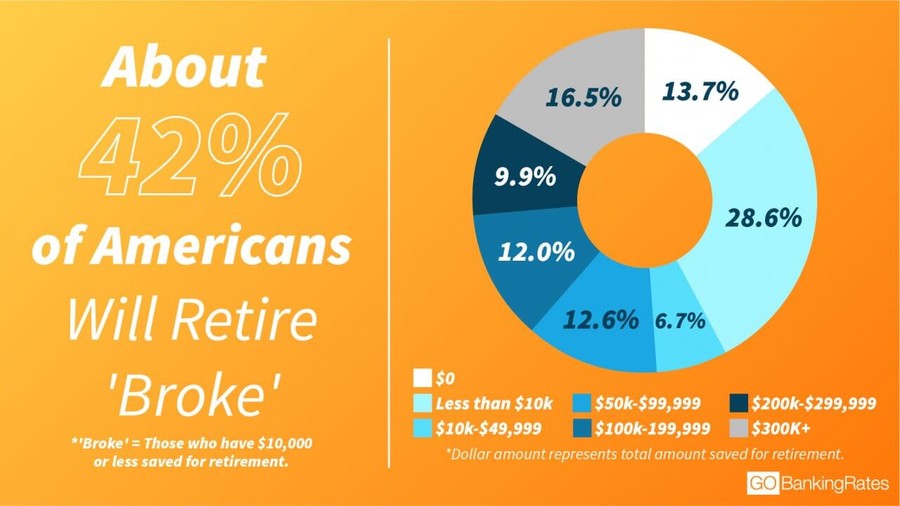
Some 42 percent of elderly US citizens have less than $10,000 put aside for their golden years, according to the report by a personal finance resource GoBankingRates, which polled over 1,000 adults last month.

The survey, carried out for the third consecutive year, suggests that a lack of planning and savings, along with a longer life expectancy, may shatter people’s retirement dreams. The California-based financial advisor also found out that the percentage of Americans with no savings at all had increased from 2016 through 2017.

Nearly half of Americans will retire broke

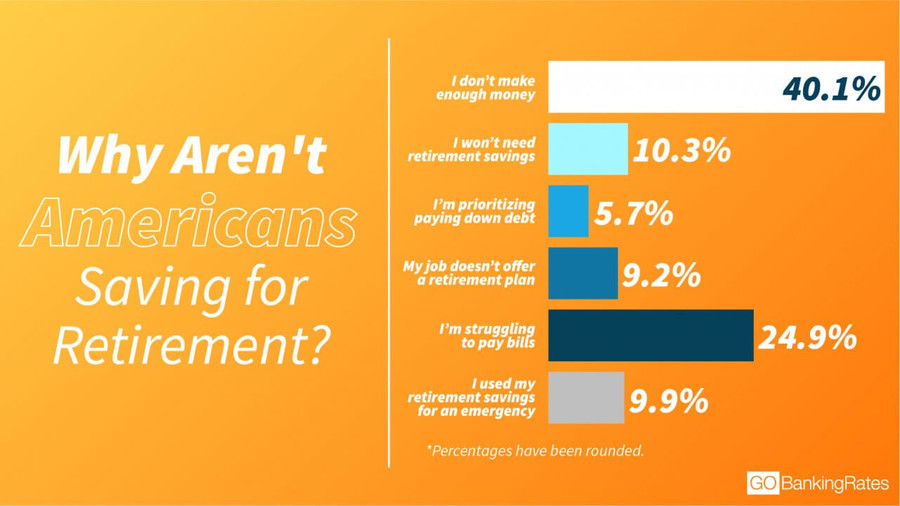
Low salaries or lack of opportunities to earn more is identified as the key factor for 40.1 percent of the surveyed, while 24.9 percent told the personal finance site that they were already struggling to pay bills. Adults 65 and older annually spend almost $46,000, according to the Bureau of Labor Statistics. Nearly 10.3 percent do not stash away money, as they don’t need any retirement savings.

The researcher commonly polls American adults, which are roughly divided into three groups: millennials, Generation X and baby boomers. The respondents are required to answer how much money they may save for retirement by their best estimate, choosing one of the suggested answers.

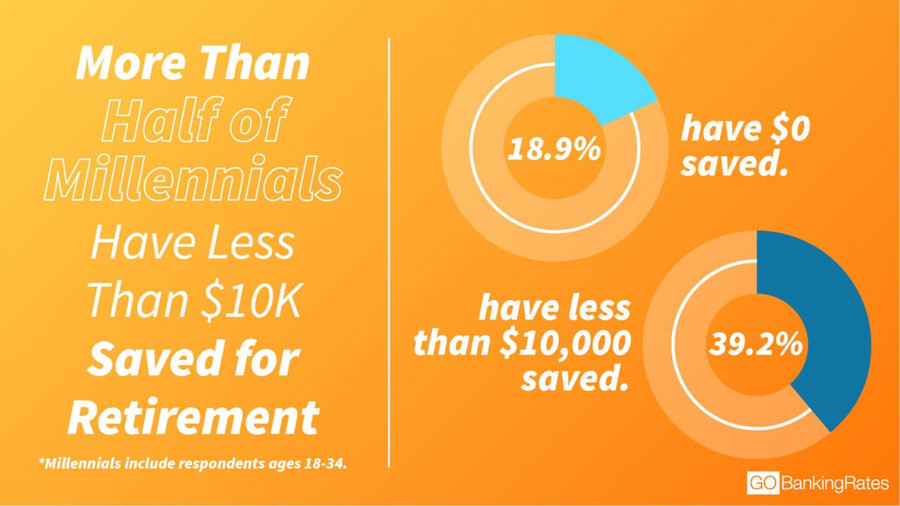
The latest poll reveals that at least 18 percent of millennials aged 18 to 34 have zero savings for retirement. Another 39 percent of respondents in this age group have less than $10,000 put aside.

However, the total number of millennials with nothing or less than $10,000 saved has reportedly dropped to 57 percent this year, from 71 percent in 2017. The percentage of this generation with $300,000 or more saved has increased to nine percent from five percent last year.

Respondents at the age of 55 or over comprise the highest percentage of those who have saved more than $300,000— 23 percent, but about one-third of them have less than $10,000 in savings. At the same time, Gen Xers, aged 35 to 44, are less likely to save, while people over 65 are the most likely to say they don’t have retirement savings because they used the money for an emergency.

For more stories on economy & finance visit RT’s business section

Govt. trying to outsource surveying to US company: Surveyors

March 17th, 2018

Gandara John

Daily Mirror  of 16 Mar 2018
Govt. trying to outsource surveying to US company: Surveyors

The Government Surveyors’ Association (GSA) today resort to a countrywide indefinite work stoppage claiming that there was a move to hand over several operations of the Sri Lanka Surveys Department (SLSD), the second oldest department of the country, to a US-based company.
 
Speaking to the Daily Mirror, GSA President Duminda Udugoda referred to an attempt to transfer the duties of the SLSD including Land Information System (LIS) and Aerial Survey Operations to ‘Trimble Navigation Ltd’, a US-based land administration solutions group, under the guise of providing title deeds to landowners.
Mr Udugoda said the Cabinet approval had been sought to the proposal to handing over the operation under a foreign loan obtain for USD 154 million (Rs.25, 000 million) although the department was capable of completing the task for Rs.10, 000 million.
It was learned that the approval had been sought without a proper tender procedure in an arbitrary decision of several top officials to be retired soon.
Mr Udugoda revealed the attempt could also threaten the national security as according to the measure Trimble Navigation Ltd is permitted to scan the landowner’s eye and get their Biometric authentication and there was a threat to people’s privacy as well………

In the context of the Surveyors strike on 16 March 2018 the article below, which appeared  nearly an year ago in the Lankaweb on April 16th 2017, is relevant. See especially the portions in italics (https://www.lankaweb.com/news/items/2017/04/16/the-world-bank-strips-sri-lankas-judiciary-of-its-powers-enshrined-in-the-constitution-and-further-fingers-the-countrys-constitution/)

The World Bank Strips Sri Lanka’s Judiciary of its  Powers Enshrined in the Constitution and Further Fingers the Country’s Constitution

By
Gandara John

It was in 1998 that the World Bank under the cover of digitalizing Sri Lanka’s Land records did, with the complicity of Kumaranatunge, insidiously introduce a Land Law relating to ‘Land Ownership’; this ‘Law’ was the bedrock for the Neocolonialists to re-colonize the country by encouraging the sale of our lands to foreigners. The law was passed at a time when the country’s attention was riveted to battling terrorism.
The ‘Breton-Wood’ created Bank was successful in injecting this sinister law – the Torrens law – into 51 developing countries; in Sri Lanka it was called ‘Bim Saviya’ (The Title Registration Act of 1998).
In a nutshell, ‘Bim Saviya’ overnight emasculated the Judiciary by stripping it of its powers to adjudicate on disputed land matters.
The Legislature via the Bim Saviya took away those Judicial powers and conferred them on the Executive who delegated these powers to a sole administrator ignorant in the law and responsible only to the Minister of Lands; that administrator’s future lay with the Politician and furthermore he was exposed to the temptation of ‘Big’ money.
To make matters worse Bim Saviya law gave that administrator immunity from prosecution, for his actions.
And simultaneously Bim Saviya took away the rights of the people to challenge the ownership of disputed land and the opportunity to seek judicial redress; redress for a victim, if at all, could only be financial redress, compensation from a near empty fund.
A registered owner, even if he had obtained ownership of a land by extra legal or fraudulent means,has his ownership  protected by Bim Saviya; his ownership of the land could not be changed.
The World Bank induced law interfered with the country’s Constitution, with the country’s Judiciary, with the rights of the people and with the common law. It was never challenged in a Court of Law.
The World Bank, pumping millions of Dollars, percolated through the Bim Saviya an alien concept that ‘Land’ is a commodity that needs to be bought and sold.
In Sri Lanka, this concept is anathema to the majority of the people. ‘Land’ is perceived as being something sacred, as being the crucible of life of the people and as being ‘collectively’  owned by all the citizens of the country. This was the land doctrine adopted by successive Governments even the Senanayake led UNP.
It is not surprising therefore that only 20% of Sri Lanka’s land is privately owned while the rest is Government owned. In short 80% of the country’s land is collectively owned by the people.
While the selling of land to private individuals in Sri Lanka is cautiously done selling of Sri Lankan land to
foreigners is considered taboo in the country.
Selling of Land to foreigners is considered by many as the most extreme form of selling ‘family silver’; buying up of family silver, especially land, is the basis of Neo-colonialism, a strategy pursued aggressively by the defeated Neoliberals in the US and Europe.
This is the underlying thread of Bim Saviya vigorously pushed by the World Bank.
It was in the backdrop of Bim Saviya that Wickramasinghe’s LTTE linked advisor Paskaralingam, dropped a bombshell; in a multi-million Dollar deal Paskaralingam reportedly attempted to give out, lock stock and barrel, for a period of 3 years, Sri Lanka’s Survey Department to a CIA partner Company – Trimble Inc – to do the aerial surveys and mapping of the island.
 
This Company, a close associate of ‘Raytheon’ has partnered the US spy agency, in similar projects in many other third world countries.. ‘Trimble Inc’ specialises, amongst other things, in GPS-reliant technological warfare and Drone based warfare.
 
Military Analysts opine that having ‘Trimble Inc’ on board in the Survey Department and in control of Sri Lanka’s electronic ‘Land Register and Almanac’ is a threat to her National Security; with ‘Trimble’ on board, manipulating and  fabricating  the electronic Land Register, providing GPS data to Raytheon (the ionosphere-heating monster which reportedly has the capability to initiate with near accuracy anywhere in the world droughts, floods, cyclones etc), initiating drone  assassinations and initiating ‘drone’  soil contamination and even crashing the Land Ministry website as mysteriously happened recently (for a near month) are all credible options on the table.
 
Today Paskaralingam is floating the illegal concept of ‘Land Banks’ under the Housing Ministry.
it is ironic that Bim Saviya mandates that all lands whether on primary lease or on secondary lease (when leased or sub leased or sub-sub leased) shall be registered in the ‘Land Register’. Likewise mandated for registration are the plans of those lands, the extent of land, the parties to the Agreement and as per the ‘Compulsory Registration of Leases Act, the terms and conditions of the lease regardless of whether the lease pertains to BOI projects or Projects flowing from bi-lateral Agreements and regardless of the description of the property leased.
How is it then that this information is not available in the land register for people to see in cases such as the projects in Colombo Port, Hambantota Port, Horana (Tyre), and Kuliyapitiya (Volkswagen)?
 
If this information is not available in the Land Register, the relevant Ministers, their Secretaries and the relevant Heads of Departments are transgressing the law and are begging to be prosecuted by the AG.
If the AG does not do what is required of him to be done, the opposition must and if the opposition does not do what is required of them, the citizens must.

Sri Lanka statistics office withdraws GDP data

March 17th, 2018

COLOMBO (Reuters) – Sri Lanka’s Department of Census and Statistics withdrew its 2017 full-year and fourth quarter gross domestic product data on Friday, a day after posting the island nation’s worst economic growth in 16 years.

The data on Thursday showed the economy expanding 3.1 percent in 2017, the slowest pace in 16 years and decelerating from 4.4 percent in 2016. It showed fourth-quarter growth slowing to 1.4 percent year-on-year from 3.74 percent in the third quarter.

We got the last set of data at the last minute. We released the GDP data, but since this is last quarter we need to calculate the full year data and revisions,” A.J. Satharasinghe, director general at the state-run Department of Census and Statistics, told Reuters.

It’s a long process. So we withdrew the data as we can’t allow even a slight mistake in the data. We are recalculating and compiling everything. We will release the data in one or two days.”

The central bank last month had expected growth to have fallen to around 4 percent last year, due to prolonged drought, intermittent floods and tight monetary and fiscal policies.

Reporting by Ranga Sirilal; Writing by Shihar Aneez; Editing by Andrew Roche

Sri Lanka team to submit lawsuit challenging UNHRC’s conduct

March 16th, 2018

Lahiru Pothmulla Courtesy The Daily Mirror

A lawsuit compiled by a team of legal experts with the input of Sir Geoffrey Nice QC would be submitted to the UN Human Rights Council (UNHRC) on Monday challenging the procedure adopted by the UNHRC itself to pass the resolution on Sri Lanka, the Global Sri Lankan Forum (GSLF) today said.

The petitioners of the lawsuit, which is the first ever lawsuit against the UNHRC, are retired Rear Admiral Sarath Weerasekara and Federation of National Organisations Convener Dr Gunadasa Amarasekara.

On behalf of the two petitioners, the GSLF, the Federation of National Organisation and the Professionals for Better Future will hand over the petition to the Communication wing of the UN on Monday (19).

Addressing a news briefing, Professionals for Better Future Director and Secretary Darshani Lahandapura said the UNHRC was not immune to charges.

The procedure which was adopted by the UNHRC with regard to the resolution Sri Lanka is a breach of UN clauses and illegal. We are challenging this procedure and demand an order preventing Sri Lanka from implementing the recommendations of the resolution,” she said.

Meanwhile, Sri Lanka’s Representative of the GSLF Nuwan Bellanthudawa said according to the article 2 (7) of the UN Charter, the UN has no power to intervene in matters which are essentially within the domestic jurisdiction of any state.

Ven. Bengamuwe Nalaka Thera said the attempt of the GSLF to file the lawsuit was a challenge at a time when the Tamil Diaspora and other NGOs speaking against the country at international platforms.

Dr Gunadasa Amarasekara, one of the two petitioners, said the US and the UN were attempting to destabilise the country by threatening the Governments.

They simply want to divide the country,” he said.

Counsel tells SC: Bill to amend Judicature Act politically motivated March 17, 2018, 12:04 pm

March 16th, 2018

President’s Counsel Romesh de Silva in objecting to the Bill to Amend the Judicature Act, yesterday told the Supreme Court that the Bill did not refer to the establishment of the Permanent High Court Trial-at-Bar.

The Bill assumed that such a Permanent High Court Trial at Bar is in existence but it was not so. Hence the Bill could not be proceeded with De Silva P.C. said.

He said the Minister might establish a Permanent High Court Trial-at-Bar whenever he so wished.

The Minister could specify location by publishing a gazette notification. The Attorney General or Director General of the Commission to Investigate Bribery or Corruption, might initiate proceedings in the Permanent High Court Trial-at-Bar.

The set-up will interfere with judicial independence. It violated Article 154(B), 100 of the Constitution of Sri Lanka.Article 154 (B) is very specific.

Accordingly, every High Court is empowered to hear the criminal offences within the Province.

After this proposed Bill is enacted an offence might be committed in Hambantota and the Minister would decide on the province where the High Court inquiry was to be held, the counsel argued.

Some people might be tried under the new Act while another could be charged under the old one for the same kind of offence. This is unequal treatment in violation of Article 12(1) of the Constitution of Sri Lanka, said de Silva.

The Attorney General and the Director General of Bribery would be empowered to determine which offences should be tried in the new High Courts.  That was violative of Article 12(1) on equality, 12(2) on freedom from discrimination and Article 10 on the Right to think. That could target persons politically. If the Chief Justice appointed the three Judges to the new High Court, then the Minister could not decide the location. The Attorney General or the Director General the bribery commission, could not decide on the persons to be prosecuted – that will interfere with the independence of the judiciary.

article_image

Romesh de Silva

This violated Article 4(C) of the Constitution and also Article 12(1) on equality and 12(2) on freedom from discrimination. There could be undue targeting, De Silva, PC explained.

The Judge couldn’t be compelled by the impending law on the postponement of cases. The right to a fair trial was denied. It violated judicial power enshrined in Article 4(1). The right of a lawyer to practise his profession, free of external forces was also denied in violation of Article 14(1) of the Constitution of Sri Lanka.

Romesh de Silva supported a petition, against the Bill.

He appeared for the President of the Bar Association of Sri Lanka, U. R. de Silva P.C.

President’s Counsel Gamini Marapana supported a petition by Professor G. L. Peiris, objecting to the Bill.

He appeared with Kaushalya Molligoda and Navin Marapana.

Gamini Marapana endorsed the position taken up by Romesh de Silva PC that the Bill did not refer to the establishment of the Permanent High Court. It had put the cart before the horse; without reference to the establishment of the Permanent High Court Trial-at-Bar, it referred to the procedure to follow.

The right to postpone cases denied the right to fair trial. If the family member of a counsel died how could he appear in the court? He needed a postponement.

This Bill sought to give the power to the Executive Officer of the State, to take away a case from the Magistrate’s Court and place it somewhere else in violation of the independence of the judiciary, Counsel Marapana maintained. The Attorney General and the Director General of the bribery commission would be interfering with the independence of the judiciary.

The Bill carte blanche to the Attorney General and the Director General Bribery, to send any case before the Permanent High Court Trial-at-Bar.

A day-to-day trial prevented an accused from retaining a counsel of his choice, Gamini Marapana said.

The Bill did not refer to serious crimes such as rape, child abuse, murder. It was politically motivated.

The fundamental right to a fair trial would be denied if the Attorney General and the Director General Bribery decided in which Permanent High Court a case should be heard. Let the Chief Justice decide such issues without completely eroding the judicial powers.

The Counsel requested the Supreme Court to declare that the Bill violated the judicial power of the courts, and was, therefore, unconstitutional.

President’s Counsel Sanjeewa Jayawardene endorsed the submissions previously made by de Silva and Marapana. He objected to the Bill, stating that the Bill did not refer to the establishment of the Permanent High Court Trial-at-Bar.

It was a case of putting the cart before the horse. He appeared for Prof. Channa Jayasumana.

The Bill eroded the powers of the Chief Justice, he said. Waging of war, terrorism, murder, rape kidnapping were not given prominence in the Bill at issue.

Serious criminal offences had not been highlighted, he said.

It seemed to be politically motivated. Victims of rape, murder of family members, drugs had been ignored

Manohara de Silva P.C., supported a petition, which objected to the Bill. He said the Bill of that nature needed to be approved by a two-third in Parliament and by people at a referendum.

He appeared for Dinesh Gunewardene.

The bench comprised Chief Justice Priyasarth Dep, Justice Buwaneka Aluwihare and Justice Nalin Perera.

Watch out – power threat on Social Media

March 16th, 2018

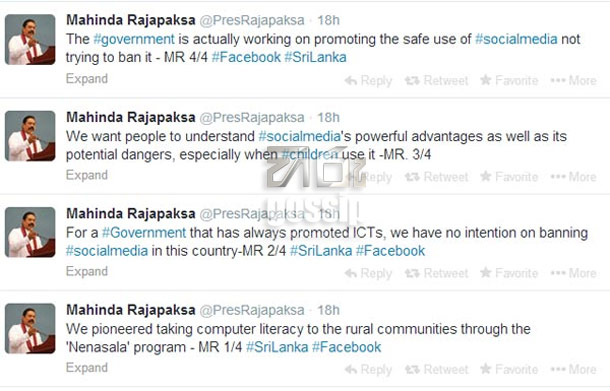
Social Media may well be the new hope of strength of the Yahapalana powers. The big talk today is about the need to control Social Media and curb the use of Hate Speech on the networks of this new media spread.

Just as whatever the Russians did with their nerve agent Novichok that is said to have been used to attack former secret service agent Sergei Skripal, his daughter Yulia, and a British police officer at Salisbury, UK, enabling British Prime Minister Theresa May to push aside all her problems, including attacks from Tory backbenches, and even threats to her office over Brexit, it looks like the situation of the recent violence in the Kandy District has given a huge opportunity to the Yahapalanaya leaders to cover up their weaknesses, and growing unpopularity.

They must be offering many poojas of thanks to the old colonial masters for showing how they can use the tragedy in and around Kandy, to push aside unpopularity with the use of Social Media as the new source of power, just as Theresa May uses Vladimir Putin and nerve agent Novichok to get over her unpopularity.

article_image
For most of our 70 years of independence, we have been under the censorship of the main media – print, radio, and later TV, under various States of Emergency, by both UNP and SLFP-led governments. Our media and journalists had to face Competent Authorities, who were ready with their red ink pens to cut and chop copy whether on trade union issues and strikes, youth uprising with violence, ethnic and communal violence, and later through three decades of war against terror.

We are now moving to new area of the control of Free Expression –the control of Social Media, and it is coming as the reach of the Internet gets wider, and there is increasing use of Social Media by sections of the population that goes far beyond the reach of the regular print, radio and TV media.

What have the users of social media said or done with regard to the cause or spread of the violence in Kandy, and the related ethno-religious rivalry or confrontations? Nothing has been said. All we know is what officials and politicians say about the danger that social media posed at the time, and the need to ban networks such as Facebook, WhatsApp and Viber. It certainly showed all the power the President of Yahapalanaya holds in wielding censorship, but nothing at all of what exactly these networks did that were wrong or dangerous.

There is no question that some users of these networks may have misused the networks, and possibly very dangerously. There is also the possibility that other users would have sent messages of peace, unity, and reconciliation, including what some Buddhist monks actively did to shelter Muslims and prevent further violence. So what exactly is Hate Speech on Social Media, when there is hardly any definition or explanation of Hate Speech on regular media, or among politicians? Just look back at the recent local government poll campaign. Do you recall the vehement speeches by President Sirisena, threatening through his sword of power against all his opponents – in and out of government- yes over corruption? What happens about such speech, if reported on social media? When considering new controls over a new area of media that our people are rapidly getting used to for personal communication, advertising, and business, as well as the new area of blogging that many journalists are engaged in, there must surely be a very satisfactory way of controlling it, especially by people who are ready to threaten the use of the ‘madu valigey’ or the ‘bala kaduva’ – the sword of power.

It is good to remember that those who are calling for controls on social media today, and those who were in power from the time of the killing of Richard de Zoysa ad many other journalists under the UNP, and later the killing of Lasantha Wickrematunga, attacks on several other journalists, and the unknown story of Prageeth Eknaligoda. These are the people who reigned in Cabinets in the White Van days, who were silent about those vans. It must be mentioned that these include the powerful figures of the Pohottuva, too.

The Government may try to win popularity by telling us about the need to control Social Media. They do need something to at least regain some popularity. But, would the new controls on Social Media mean blocking the reportage o f corruption in government? Will these networks be free to talk of the huge commission earned by ministers and political catchers in the dirty record of ‘ayapath palanaya’?

Will Social Media be accused of spreading hate speech if they make a good laugh of the ‘Wi-Fi’ promises of a shaky Prime Minister? Will these networks be wrong to highlight the crooked activities in areas of education and agriculture, or highlight the commission earned from an unoccupied and rented building for the Agriculture Ministry – bringing a huge crop of profit to the minister?

It is time for caution. Social Media is a new area of activity. It would need controls, as any other of communication would. But, one cannot let a government, whose members have huge and ugly records of attacking the Freedom of Expression, from Richard de Zoysa to Lasantha Wickrematunga and later, to have a completely free hand in even the necessary control of this Media.

Such controls could be a new zone of the popularity or management ability of the government. But popularity or management ability of Government must not be allowed to threaten Freedom of Expression. Watch out Social Media!

Leeches invade library

March 16th, 2018

Editorial Courtesy The Island

The colony of political leeches sponging off the public continues to grow rapidly. There has been a twofold increase in the number of local government members. The country needs more professionals and skilled workers to realise its developmental goals, but it is getting burdened with more and more political lamebrains who are liabilities.

We had enough and more bad eggs in the garb of local government members previously. Among them were cattle rustlers, chain snatchers, bootleggers, drug dealers, killers and rapists. The late Ven. Maduluwawe Sobitha Thera told us about a Pradeshiya Sabhha head who had deflowered hundreds of women. God knows how many others of their ilk are among the new entrants. An already bad situation is likely to take a turn for the worse. We hope that we will be proved wrong.

The only solace, if at all, is that there will be a significant female presence in local government bodies. But, we hope and pray that there won’t be, among them, the likes of the ferocious woman who, together with her husband, a southern Provincial Councillor, mercilessly pistol-whipped a screaming private bus driver in full view of the public the other day, and the female MP who had a youth abducted in Colombo a few years ago.

There are said to be many new faces in local government institutions. But, it is doubtful that they will be different. For, most of the new entrants to politics take to corruption as if to the manner born. Ambitious and venal, they don’t scruple to defy the dictates of conscience and do whatever it takes to clear their paths in a bid to achieve their dreams. They need funds to graduate from local council bodies to the provincial councils and from there to Parliament. Therefore, they start making money from the word go and get involved in various rackets.

The increased number of local government members has led to serious problems which the government has not bargained for. The yahapalana leaders don’t think before they leap; they begin to think after leaping and then it is too late. Besides the colossal amounts of public funds they are planning to pour into a bottomless pit by way of allocations for local councillors, most of the Pradeshiya Sabhas and urban/municipal councils will face a huge space problem.

Minister of Provincial Councils and Local Government Faiszer Musthapha has sought to wish away this problem. He says not all the local government members will be present at most sittings as in Parliament, which rarely has a houseful of MPs. He has sent the wrong message to the local councillors, who will feel encouraged to stay away and collect their allowances etc. What if all the members of a council turn up? There will be a mad scramble for seats.

If local government institutions can manage their affairs with fewer members, as Minister Mustapha says, why on earth did the government make laws to provide for electing more? Aren’t the architects of the new electoral system and their political masters responsible for the resultant chaos and waste of public funds?

Meanwhile, disturbing news comes from Ambalangoda. We reported yesterday that the increase in the number of its members had prompted the Ambalangoda Urban Council to take over part of the public library of all places to expand its auditorium. Ideally, it should have been the other way around; people would have benefited if part of the UC premises had been used for expanding the library. The fate of the Ambalangoda library represents in microcosm what is happening in the country as a whole—ignorance taking precedence over knowledge. In a country, where the educated grovel before semiliterate politicians, this is something to be expected. It may be recalled that the Jaffna bibliotheca, a national treasure, was burnt down by pro-UNP goons during the 1981 development council elections.

Bibliothecae are sacred and politicians mustn’t be allowed to desecrate them. It behoves the government to prevent politicians from encroaching on libraries.

The government survives on dead cats!

March 16th, 2018

BY MALINDA SENEVIRATNE

The term is attributed to Lynton Crosby, a political strategist who has managed campaigns of right-of-center parties in several countries.  Boris Johnson, who employed Crosby during London mayoral elections explains the term thus:
There is one thing that is absolutely certain about throwing a dead cat on the dining room table – and I don’t mean that people will be outraged, alarmed, disgusted. That is true, but irrelevant. The key point, says my Australian friend, is that everyone will shout, ‘Jeez, mate, there’s a dead cat on the table!’ In other words, they will be talking about the dead cat – the thing you want them to talk about – and they will not be talking about the issue that has been causing you so much grief.”
Dr Diyanath Samarasinghe, in what is clearly the best explication of the humbuggery associated with the recently concluded local government elections and especially the blatant disenfranchisement and hoodwinking therein, uses a neat example which is worth repeating here. 
Let’s first mention the dead cat. It has a name: The Excise Notification 02/2018 of January 10, 2018. This was to revoke Excise Notification No 666 of 1979, permitting women to purchase alcohol and to work in places where alcohol is sold. 
There was a lot of talk about it. Eleven women went to court invoking fundamental rights enshrined in Articles 12(1 & 2) and 14(1)(g) of the Constitution in spite of which the January 10 Excise Notification was revoked.  
Here’s the context. The  National Action Plan for the Protection and Protection of Human Rights (2017-2021) devotes 22 pages to the rights of women (pages 37-58). There are 26 goals therein, 40 objectives of which 29 are considered deliverable in the short-term and 99 activities. Only one goal, No 6, is about the promotion of women’s economic rights and independence, including access to employment. The relevant objective is worded thus: increased participation of women in the state and private sector employment. It’s a medium-long term goal. 
[For the record the seemingly comprehensive document on human rights says nothing of forced female genital circumcision or of gender inequalities related to marriage-age, divorce procedures etc.]
Against all this, the not-mentioned or alluded to business of allowing women to purchase alcohol and work in places where alcohol is sold, is certainly a dead cat, especially considering the gamut of issues pertaining to women included in the document and their prioritizing. 
And what did this dead cat displace from the table? The reduction of beer taxes which, according to Dr Samarasinghe ‘worked brilliantly for the relevant politicians and their alcohol trade masters.’ One notes that individuals who have never uttered a single word about reducing beer taxes have strangely enough called for it almost immediately after being appointed as Finance Ministers. Obviously officials prevail on them for reasons that are to obvious to mention. Mangala Samaraweera’s predecessors probably did not know of dead cats, we could conclude.  Beer, to put it in a nutshell, is a starter-drink which the industry uses to lure in the young. 
So that’s what dead cats do. Women’s rights activists jumped on the alcohol issue but are strangely quiet over ensuring 25% political representation for women, as Dr Samarasinghe observed. Indeed, if they had paid attention to the amendment to the laws pertaining to local government elections, they would have figured out what a farce it was, and not just for women’s representation. 
Dr Samarasinghe has laid it all out beautifully. In short, a) the public has  been deceived into believing that there has been a 60 – 40 seat allocation (first-past-the-post and proportional representation respectively), b) burdened by almost double the number of representatives, and c) almost all parties that have won the most of directly contested seats are denied their proper share of proportional seats.
It is not possible of course to name the recent violence in Kandy as a dead cat, although the Government has not covered itself in glory considering its sloth, incompetence, garbled messages, infringement of expression-freedom and in certain instances collusion with perpetrators. 
In effect, however, it serves the same purpose. Let’s flag some issues: a) Arjuna Mahendran and the Bond Scam, b) the mess that is the local government election, c) the government’s loss of legitimacy, d) the corruption of the word ‘yahapalanaya,’ d) the Russian ship, e) SriLankan Airlines, f) constitutional reform, g) gross incompetence across the board and h) the no-confidence motion against the Prime Minister and indeed all the noise about his ouster as the Leader of the United National Party.
 All these are off the table. Digana, Teldeniya and Ambatenne, then, together, made a dead cat.  And now, following all that, there’s the issue of blocking social media platforms.
Minister of Digital Infrastructure Technology says that the government is contemplating the monitoring of social media usage. President Sirisena, speaking on the subject, said ‘if something is detrimental to society we will have to contain its effects despite it being useful in some other way.’ Champika Ranawaka called for ‘new regulations to regulate cloud applications like Facebook or WhatsApp to prevent their improper use.’  
The dead cat here is ‘hate speech’, what it intends to displace is the freedom of expression. The instruments of control once in place can be used and abused. We’ve seen this happen again and again. Weeding out the distasteful is a good thing but taste is subjective and preferences are political. 
Interestingly, those who have championed rights issues in the past have gone quiet over this issue. For them, and others who are shocked into silence and inaction by these dead cats, let me repeat something I wrote when the 18th Amendment was tabled in parliament.
The worth of any new legislation should not be measured only in terms of its immediate benefits and whether the principal beneficiary is a political friend; rather, consider the relevant instruments in the hands of an individual who is politically at odds with you, someone whose ideas and practices you abhor.”
This government, more than ever before, needs conversation to cease. Clearing the table citing the presence of a dead cat is convenient. The government needs dead cats. Lots of them. The least that the citizen can do is to refuse to provide them.   
Malinda Seneviratne is a freelance writer. malindasenevi@gmail.com

SOME OBSERVATIONS ON “SINHALA ONLY” Part 1

March 16th, 2018

KAMALIKA PIERIS

The ‘Sinhala only’ story began in the 1920’s and 1930’s, when agitation for ‘swabhasha’ emerged as an anti-imperial or anti-colonial gesture. Sinhala Mahajana Sabha (1919) established a network of local mahajana sabhas in the rural areas. These Mahajana Sabhas conducted their proceedings in Sinhala. The rules and regulations were printed in Sinhala. In 1936, Philip Gunawardene,  then leader of the  Lanka Sama Samaja Party (LSSP) brought a resolution in State Council that proceedings in the law courts and the recording of  statements in police stations should be in Sinhala and Tamil.

In many countries, the indigenous language vanished under foreign rule, but in Sri Lanka, Sinhala survived. Sinhala was a sophisticated language with a well developed script, a substantial written literature and a long, unbroken history. It was Sri Lanka’s national language till   1815. It has also functioned as Sri Lanka’s language of science, trade, manufacture and administration. The people were proud of the Sinhala language and were not prepared to abandon Sinhala.

Throughout British rule, the people kept Sinhala going. Parents sent their children to the temple to learn Sinhala. Conversations in the home were conducted in Sinhala.  Discussions and debates, public and private, were also held in Sinhala.  There was a continuous production of poetry and prose in Sinhala. There was style, even in speech. Arisen Ahubudu recalled that when a Tantirimale gam vaddha was asked what there was to see in the nearby jungle his answer was ‘haa, kadimata nelaapu buduruve novae.’

Sinhala was used not only in the Buddhist temple but also in the Christian church, Roman Catholic and Protestant. This, in my view, is very important aspect of the preservation of Sinhala. There was functional use of Sinhala too. Y. Amarasena de Silva had been employed at Trincomalee   harbor as a signalman in the 1940s.  He invented the Sinhala Morse and semaphore. This was published in a book. He had later taught Sinhala Morse and semaphore to the scouts of Rajapakse College, Ahungalle.

Sinhala was made a subject in missionary schools. Trinity College,  Kandy had started an extra class in Sinhalese, in 1860 to be conducted after school. In 1908, Rev. A.G. Fraser, Trinity’s principal, announced that the Ceylonese pupils could neither read nor write in their native languages and he intended to reduce the emphasis on Latin, and make the vernaculars compulsory for all.

Fraser’s ideas influenced the other Christian schools and thereafter ‘every English school in the island gave a place to the vernaculars.’ S. Thomas College, Colombo, taught Sinhala from 1918. But G.D.Perera recalls that when he was studying at S. Thomas from 1928 to 1938, there was only one Sinhala period for the whole week.

Apart from this limited recognition however, Sinhala was suppressed in the missionary schools. Pupils   were forbidden to converse in Sinhala. If they did so, they were punished. Kirthi Abeyesekera (b.1924) states that in the convent he attended in Bandarawela, ‘we were punished if we spoke in Sinhala’ . Anne Abayasekara reminiscing about her schooldays in the 1930s also confirms that Sinhala was not encouraged in the classroom. She expected a reprimand when she answered in class in Sinhala instead of English.  As a result, very few of those who were educated in English [Christian] schools had any knowledge of the vernaculars, she said.

Sinhala was better looked after in the Buddhist schools. F.L.Woodward, Principal of Mahinda College, Galle from 1903-1919, had included   Sinhala in his school curriculum.  Ananda College too had taught Sinhala. Prizes had been awarded for Sinhala handwriting and Sinhalese literature. One student had got distinctions in Sinhala in the Cambridge Senior in 1919. Not only was this the sole distinction for the whole island, but it was also the first distinction ever obtained in the exam.

P de S Kularatne arriving in Ananda College as principal in 1918, decided to entrench Sinhala fully at Ananda. Kularatne had grown up in a Sinhala speaking village and therefore had experienced Sinhala as a living language. He knew that it was possible to provide secondary education in Sinhala and he thought also that is was desirable to do so. He said that the child who came from a Sinhalese speaking home, not only spoke in Sinhalese, he also thought and felt in Sinhalese. It was best to teach him in that language, not in English which was an alien language.

Kularatne said he had seen what education in an unfamiliar, alien language was doing to the children. A child at a Christian missionary school asked to recite in English, had done so with a set face, without knowing what she was saying, but had responded brightly as soon as she was spoken to in Sinhala.  He also pointed out, very bluntly, that only a small percentage were educated in English at primary school level and even among them, the majority were not sufficiently conversant with English, to use it as a medium of instruction.

In 1920, Kularatne introduced the study of Sinhalese as a subject ‘into every class’ in Ananda College and in 1923 he made Sinhalese compulsory for all students. As an incentive he pointed out in his Principal’s report that Sinhala could be offered as a subject for Senior Cambridge and London exams.

‘Right from the very beginning, Ananda has encouraged the study of our own languages when other schools despised them’ said Kularatne in 1936.’ Even today we, with our sister Buddhist institutions, are the only institutions that provide for the teaching of Sinhalese on the right lines. Judging from the boys that come to us from non-Buddhist schools, I have not the slightest hesitation in saying that Sinhalese is utterly neglected in them.’

Kularatne pointed out that the failure of these schools to teach Sinhalese on the right lines is largely due to the fact that they did not start Sinhala early, in kindergarten and they do not employ teachers with the best qualifications. Kularatne did both. There was a dearth of competent Sinhala language teachers at the time in Ceylon. Ananda could produce only two ‘very competent’ teachers of Sinhala. Kularatne solved the problem by getting bhikkhus to teach Sinhala. When he found that there was no satisfactory primer to teach Sinhala he wrote a book called ‘Parakrama’s first reader.’

At this time, in most English schools, the majority of which were Christian missionary schools, the Sinhalese teacher was laughed at and the Sinhalese period was an hour of entertainment.  Anandians also did not take the Sinhala lesson seriously at first reported K.D.  de Lanerolle,    but Kularatne was firm, ‘the idea took root’    and Ananda eventually achieved a high level of proficiency in Sinhala.

Kularatne then declared in his Principal’s Report, 1940 that ‘Sinhala will be the medium of instruction in all sections of the kindergarten for Sinhalese children. English will be taught as a subject’.  de Lanerolle who was teaching at Ananda at the time and was closely associated with Kularatne in his work, said that Kularatne started this without government approval, with only the consent of the parents. He ran the risk of losing the government grant over this. ‘The results produced were revealing and the government gave its approval.’   Lanerolle called it a courageous and confident move.

Kularatne also encouraged the study of Sinhala literature.   He prescribed Martin Wickremasinghe’s   Geheniyak and W.A. Silva’s Lakshmi for students in the senior classes. He also introduced Sinhala folk stories to Ananda College. This was derided in the English newspapers, saying that this would prevent students from appreciating Greek heroes and ‘the story of Cinderella’. A Sinhalese Literary Study Circle was organized by a member of the staff in 1936.

Next, Kularatne   wanted Anandians to be able to write creatively in Sinhala. The mentors for this were readily available. There were at least three creative writers on the staff to guide the pupils, Ven. S Mahinda, K.D. de Lanerolle and ‘Kayes’. From 1920 onwards, the school magazine included Sinhala articles. By 1939 this had developed into a separate Sinhala section with its own editorial. But Kularatne was not satisfied.   He asked the headmaster of the Primary school, K.D. de Lanerolle to get up a magazine with material in Sinhala suitable for the age group 5-12 years. The result was a monthly magazine called Sinhala Daruwa, commencing in 1937 with de Lanerolle as its first editor.

Sinhala Daruwa contained stories written and illustrated by students and teachers. Students and teachers of the Upper School also got interested and contributed material. There were articles from well-known writers as well. 500 copies of the magazine were distributed in the College. A number of other schools also became subscribers.  ‘The like of this had never been published before in Ceylon’ said de Lanerolle.

Ananda’s role in bringing Sinhala forward was recognized in British Ceylon. Times of Ceylon said in 1936, ‘the emphasis laid on national languages at Ananda is worthy of emulation.  There was a time when snobs in other schools, boys, masters, and principals   talked of the English accent being ruined by giving the national languages their due place in the curriculum. But today such warped minds are few and far between and other schools are following the lead given by Ananda College.”

Ananda College then went on to pioneer science education in Sinhala.  De Lanerolle noted that there was considerable resistance at the time, to teaching science in Sinhala, but Kularatne and Mettananda  together with other science teachers ‘silently showed’ that science could be taught in Sinhala.   when the government ordered schools to teach science in Sinhala,    and present them for the Senior School Certificate and the Higher School Certificate, in the 1950s, Ananda was ready. This emphasis on Sinhala in schools would have spread from Ananda to the other Buddhist schools, making it a broad movement.

I have included the above description of Sinhala at Ananda College because I wish to show that Sinhala was alive and kicking during British rule.  It is this, together with the cultural use of Sinhala, which led to ‘Sinhala only.’ ‘Sinhala only’ was a natural movement, not an unnatural one.

The British administration, however, did not recognize Sinhala.  During British rule, the island was administered in English, which the majority did not understand, even telegrams were in English.  The State Council and the Ceylon National Congress knew by 1943, that independence was round the corner.  It was clear that the island could not be administered in English after Independence. Hardly anybody knew English. The majority used Sinhala.

Therefore, in 1943, J.R Jayawardene presented a resolution to State Council that Sinhala be made the sole official language. This met with immediate protest from the Tamil members of the State Council and it was decided in 1944 that Sinhala and Tamil be the official languages. This was strongly opposed by the Sinhala lobby who wanted ‘Sinhala only’. A Communist Party meeting supporting parity of status for Sinhala and Tamil was broken up by Sinhala Only supporters.

The public found that even after independence, the administration continued to be in English. A letter from the government or a telegram had to be taken to someone who knew English.  The Courts of law and all office administration were in English. The ‘Sinhala only’ lobby gathered momentum throughout the 1950s.   Several town councils and village committees began to conduct business in Sinhala.

There were three groups which pushed strongly for Sinhala Only. They were   known as the ‘sangha, veda, guru’ group. The sangha were long standing supporters of Swabhasha. The ‘veda’ component were the ayurveda physicians.    ‘Guru’ were the vernacular (Sinhala trained) school teachers. They got less pay than the English trained teachers. There were also the ‘vernacular’ educated intelligentsia, who had studied in Sinhala medium and whose prospects, therefore, were limited. There was an Association of Swabhasha Qualified Unemployed” with a voting strength of 20,000 at the time. This ‘sangha, veda, guru’ group together with ‘govi’ and ‘kamkaru’ formed the Pancha Maha Balavegaya which influenced the 1956 General Election.

There was a strong economic basis  for the demand of Sinhala only, observed analysts. Firslty, there was no higher education in swabhasha, university  education  was in English. Secondly, the prestigious and high paying occupations and positions went to those who knew English, thus  affecting very seriously the social chances of the swabhasha educated. Therefore the vernacular educated, primarily rural intelligentsia were, by the 1950’s very resentful of the limited opportunities available to them.

Popular support for ‘Sinhala only’ was so great that all the major political parties succumbed and announced support for ‘Sinhala only’ when the General Election of 1956 was announced. Viplavakari Lanka Sama Samaja Party (VLSSP) and the SLFP announced their support in 1955 and UNP followed in 1956.   If SWRD had not brought up the Sinhala issue someone else would have, observed P.A. Samaraweera.

The General Election of 1956 was a watershed in the modern history of Sri Lanka. The ruling UNP lost to the Mahajana Eksath Peramuna, MEP in a resounding defeat. The MEP consisted of SLFP, its major component, with the original MEP, the Bhasha Peramuna, and VLSSP led by Philip Gunawardena. It had a no contest pact with LSSP and CP.  The MEP got 51 of the 95 seats, but only had 40% of the votes.

Weerawardana remarked that the electorate displayed a surprising maturity. Voter turnout was 69% which was considered good for that period of time. (It is considered good even today, in certain countries) and the electorate voted clearly for the party and not for individuals.  P.A. Samaraweera observed ‘people took all the money lavishly given by rich UNP politicians, wore the green bush shirts given by them, took the lunch packets, went to the polling booth and voted for the MEP.’

In 1956, Parliament passed the Official Language Act no 33 of 1956. It was passed after a marathon debate, with 66 ‘for’ and 20 ‘against.’ The Act said that the Sinhala language ‘shall be the one official language of Ceylon.’ The Act came into effect on 1st January1964.  All government transactions throughout the country had to be in Sinhala from 31.10 1963.  Therefore it was not ‘Sinhala in 24 hours’. That statement is incorrect.

‘Sinhala only’ was never ‘Sinhala only’. Critics observed that the Act had failed to limit the use of Tamil and English, ‘as it should have done’. Nor did it make Sinhala compulsory in schools. No subsidiary legislation was passed under the Act either. Implementation was based solely on administrative orders and Cabinet directions. As a result, state administration was conducted in English above a certain level.

It was only after the Administration of Justice Law of 1973 that the original courts started to work in Sinhala. A critic observed recently that all the administrative legal enactments are not yet available in Sinhala. .  Education continued to be in Sinhala, English and Tamil. Cultural activity took place in all three languages. The private sector continued to work in English.

The changeover to administration from English to Sinhala, took place without much protest. The transition was not a problem for those who knew Sinhala. T.B. Ilangaratne, Minister of Finance, under whom the subject came, when ‘Sinhala Only’  had been introduced, told Neville Jayaweera,  that old entrants into government service were to be treated gently (‘widest accommodation’) and that new entrants must  be given time  ( ‘a few years’) to acquire proficiency in Sinhala.

The transition took place smoothly because officers who knew Sinhala were already in place in the government service. The transition to Sinhala was readily   supported by the bilingual officers who were working in government departments at the time, observed analysts. They made Sinhala administration possible.  Those officers mainly came from the ‘Buddhist schools’,   such as Ananda, Nalanda and Rahula, where Sinhala had been given prominence.

Anandatissa de Alwis, an Anandian,   declared that Ceylon was able to establish Sinhala as the state language because of Ananda College. D.B. Dhanapala another Anandian,  also  observed that  In  1956, when Sinhalese became a national language, Anandians who were well versed in Sinhalese were present, in significant numbers  in the Ceylon Civil Service, Official Languages Department and other state departments.  They were superbly bilingual and could assist in the move from English to Sinhala.

Sinhala had not been used as an official language since the fall of the Udarata kingdom in 1815. Sinhala was now pushed to the front of the stage. It now had to cater to a huge range of situations and activities for which it lacked the vocabulary. The chief criticism of the anti-Sinhala lobby was this lack of Sinhala words to express modern ideas. The Sinhala lobby   over came this very easily.

Sinhala was not a ‘dead’ language, which had to be revived. It was not a ‘new’ language or a   ‘backward’ language either. Sinhala had been existing parallel to three western languages, Portuguese, Dutch and English, for the last 400 years. There would have been interpenetration between these languages. Sinhala    already had a good vocabulary, a systematic grammar and many ‘root’ words, therefore finding suitable Sinhala words for its new role was not difficult.  Modernizing Sinhala was not a daunting task. Specialists in Sinhala language sat down to the task with great dedication.

The Official Languages Department, set up in October 1956 started work on Sinhala glossaries. Other professional bodies also contributed glossaries. There were a few conferences to which those interested in the subject of forming Sinhala technical terms were invited,’ recalled Aelian de Silva.

Opponents of ‘Sinhala only’ ridiculed the whole process. They said that the Sinhala term for ‘universal joint’ was ‘sarvaloka puttuwa’. M.J. Perera, head of the Official Languages Department declared that the word did not exist. This was a hoax. However, this was not an innocent hoax. It showed a deep animosity to Sinhala and fear of Sinhala’s emerging position.

At University of Ceylon, Peradeniya .Prof D.E. Hettiarachchi, as Head of Department, created a Swabhasha office, in the Sinhala department, headed by P.E.E. Fernando, and this office also compiled technical terms.  The Sinhala academics sat for long hours with specialists in the various subjects and compiled the terms.  The glossaries were cyclostyled and distributed.  Those glossaries were later acquired by the Department of Official Languages and formed the basis for the glossaries they published.  This valuable service of the University is now forgotten, said K.N.O Dharmadasa.

Spoken Sinhala also became important after ‘Sinhala Only’. Officials had to speak in Sinhala too, not only write in it. Their speaking had to be correct and effective. After ‘Sinhala only’ more debates in parliament were in Sinhala. There is no information on what the politicians and officials did about this, but Radio Ceylon took action.

Radio Ceylon focused on setting good standards of Sinhala speech. It held workshops where Sinhala scholars gave guidance. Ven. Kalukondayawe Pragnasekera was invited in the 1961 to advice on pronunciation. . K.N.O. Dharmadasa and J.B. Disanayake were invited later for workshops. Staff were drilled in the use of good language.  Later on, Rupavahini also had workshops which KNO attended. KNO had notified MJ Perera whenever he heard language errors on Rupavahini and MJ had taken action.

Foreign diplomats recognized Sinhala. A  Chinese diplomat had, some years ago called on a minister in Colombo.  The minister had instructed in Sinhala ‘this visitor may have diabetes, so bring the tea and sugar separately.’ As he left, the diplomat had said, also in Sinhala ‘I do not have diabetes’. China teaches Sinhala in the Foreign Language Institute in Beijing.

A Japanese diplomat had walked into a shop and the owner had shouted to his staff in Sinhala ‘tell him an inflated price’ and the Japanese had replied in Sinhala, if you inflate the price I will not shop here again’. In the German embassy on one occasion, an official had said in Sinhala ‘do not panic remain silent.’

K.N.O. Dharmadasa had drawn attention to a little known fact, that when the 1972 Constitution was under preparation, Minister of Constitutional Affairs, Colvin R De Silva insisted that that the initial drafting be done in Sinhala. P. E. E. Fernando travelled from Peradeniya to Colombo twice a week to take part in the drafting of the new Constitution and he used to share with us his experiences in constitution making, recalled KNO.

Dharmadasa observed that this was probably the first time the government deviated from the usual practice of drafting first in English with a Sinhala translation   thereafter. The official language policy was enacted in letter and spirit, on that occasion. The constitution says the Sinhala version takes precedence in matters of interpretation.

Today, Sinhala is the common language of discourse in Sri Lanka. This is evident in the discussions heard in shops, markets, railway stations, theatre foyers, and hotel lobbies. English and Tamil are also spoken, but to a lesser extent. Census of Population and Housing for 2001 showed that Tamils of local and Indian origin spoke Sinhala.  They needed Sinhala for jobs and for business. The customer base is Sinhala speaking.

A survey was conducted by an independent research institute, on behalf of the Public Survey and Research Unit (PSRU) of the Presidential Secretariat, in October 2010.  The sample was drawn from western, southern, central, and eastern and Northern provinces, of 1484 citizens of both sexes belonging to the three major ethnic groups, also a mix of occupations.    97% of the Tamils and 100% of the Muslims in the survey said they knew Sinhala. The learning of a language is based on its usability.  The chances of Sinhala being used across the island for wider communication are great, said Rohana Wasala. It was estimated in 2016 that approximately 76% of the population spoke only Sinhala.

‘Sinhala Only’ was an essential part of the re-emergence of   Sri Lanka as an independent state, after 450 years of colonial rule. ‘Sinhala only’ should have been implemented in 1944 itself. According to the 1946 Census there were 69.4% Sinhalese and 11% Tamils.  In   1953 it was    69.3% Sinhalese and 10.3% Tamils and in 2012 it was 74.9% and 11.1 % respectively. Therefore Sinhala was always the language spoken by the majority of the population.

‘Sinhala only’ should also be seen in its broader context. S.W.R.D Bandaranaike’s period as Prime Minister, though short, 1956-1960, was a period of high consolidation and movement towards a modern state. The Sinhala Only  Act was just  one feature of a much larger exercise which involved the Paddy lands Act, the EPF, nationalized services, takeover of Katunayake air base and Trincomalee  navy base and expanded diplomatic relations.

‘Sinhala Only’ was not ‘wrong. ‘Sinhala only’ was ‘right’. It was correct and timely.  ‘Sinhala only’ was a natural movement, not an unnatural one.  It should not be treated with contempt and it should not be sneered at.  Very few languages can show evidence of continuous use from ancient times to modern times as Sinhala can. This includes continuous use as the language of administration too.

UNESCO is said to have predicted that in 25 years Sinhala language will be extinct. Sinhala, far from being a dying language, has many features not found in many world languages, said J.B. Disanayake. Sinhala is among the 15 most creative alphabets in the world along with Chinese, Greek, and Arabic. It is considered a unique language.

A language will not die, as long as there are speakers, say linguists. Today, Sinhala is ranked 75 in the hundred most spoken languages in the world   and 62 in the   top hundred languages ranked by number of native speakers.  Sinhala speakers are proud of Sinhala and have a deep love for the language. They wish to preserve the script too.  They do not want to see it romanised. (Continued)

SOME OBSERVATIONS ON “SINHALA ONLY” Part 2

March 16th, 2018

KAMALIKA PIERIS

Sinhala had started modernizing in the 19th century, long before ‘Sinhala Only’. Hundreds of Sinhala newspapers were published in the 19th century, not always in good Sinhala, said K.N.O. Dharmadasa. However, this helped the language to modernize.

Hikkaduwe Sri Sumangala and Ratmalane Dhammarama and lay scholars such as W.F .Gunawardhana and Kumaratunga Munidasa were able by their teaching and writing to set high standards for Sinhala. There was also a highly active pirivena education to which the lead was given by Vidyodaya (1873) and Vidyalankara. (1875). the high standard of written Sinhala in the first half of the 20th century was due to this.

This tradition of Sinhala scholarship, nurtured in the pirivena was transferred to the Sinhala department of the University. The first two lecturers in Sinhala in University College in the 1940s were Ven. Suriyagoda Sumangala and Ven. Rambukwelle Siddhartha, both from the Pirivena tradition.

Sinhala has always had reformers pouncing on wrong grammar and spelling, but Munidasa Kumaratunga (1887-1944) and his Hela Havula went further. In the 1930s and 1940s they attempted a radical reform of the Sinhala vocabulary and usage. This met with resistance. Kumaratunga’s suggestions went against the grain.  The words he suggested were uncomfortable.

Even when the words he suggested were better than the words that had been coined, Kumaratunga was ignored. Kumaratunga observed that ‘Guvan viduli sevaya,’ for ‘radio broadcasting’ was not suitable, because ‘guvan viduli’ means ‘electricity in the atmosphere’, usually lightening. He    suggested ‘redevkaru’. This has not had any takers. It is still ‘guvan viduli’. However, Kumaratunga’s word ‘hediya’ has replaced the earlier ‘nurse nona.’

Arisen Ahubudu (1920 – 2011)   on the other hand contributed successfully to the growth of Sinhala. He gave meaningful names for the projects in the country such as Gama neguma, Maga neguma and Sisu seriya. The names he gave children were unique and were full of meaning. We can identify the names which have been innovated by him, said Kesaralal Gunasekera.

Aelian de Silva, (d. 2015) an electrical engineer in the Department of Government Electrical Undertakings, was asked to translate the 1951 annual report of the Department.  Aelian, who was a linguist, found that some of the terms in use were not suitable. ‘Bramana chakra yanthraya’, the term used for ‘turbine’ could be applied to a bicycle also since it meant ‘machine with rotating wheels.’ So he had to coin accurate technical terms before he could translate.

Aelian coined the words ‘piripahaduwa’ for refinery, ‘pirithel (petroleum), ‘supirithel’ (super petrol) ‘thekala’ (three phases). The word in use for ‘reservoir’ was ‘jalashaya’ which meant that ‘oil reservoir’ must be ‘thel jalashaya’. So he coined ‘rasyuruva.’ The glossary of Sinhala technical terms prepared by Aelian in 1954   for the CEB has been in use ever since.

Aelian de Silva tried thereafter to make a radical contribution to the modernizing of Sinhala. He was partially successful. His translating exercise brought into use some new Sinhala technical terms which are in day to day use.

He spent a great deal of time in coining meaningful Sinhala terms when he realized that  the Official Languages Department was issuing Sanskrit terms which did not convey the actual meaning.  We, on the ‘Dinamina’ at the time, fully supported Aelian’s effort but he did not get the backing of the Official Language Commissioner and his staff, said one critic.

Aelian compiled a comprehensive list of technical terms in Sinhala, published in 2002 as ‘Sinhalayen Sipyuru Vadan/Technical terms in Sinhala’. The publication comprised two books, one in Sinhala and the other in English under the same cover.

This work showed how to produce technological terms using the existing Sinhala. Aelian gave over 3000 new words in their different forms as verbs, nouns, adjectives, adverbs.   He showed the consistent manner in which words have been formed in Sinhala and how new words could be derived using the same technique. He showed how verbs can be conjugated. One critic noted that the words provided in his book are ‘rational, pleasant sounding, and acceptable.’

Aelian de Silva pointed out that the Sinhala language has been used for centuries to generate technical terms that met ‘the needs of unsurpassed technical development, such as steel manufacture and irrigation works.’  Biso kotuwa comes from biswana kotuwa. If we could invent a good vocabulary in the ancient period, how we get paralyzed now, he asked. A nation should have a language which can generate new ideas.’

We must create technical terms which can effectively, unambiguously and precisely express technological concepts, he said.  The new tem should be as short as possible and  it should have an inbuilt mnemonic to help recall. It should, if possible, be based on a Sinhala verbal root.  The Sinhala verb can be conjugated , giving it a high degree of flexibility,  with the additional advantage that the manner in which this is to be done is pre-determined. Aelian disagrees with the view that the number of verbal roots in Sinhala were limited and therefore cannot be used to modernize the vocabulary.

Any word borrowed from another language, functions only as a noun. It loses flexibility and needs a further Sinhala word to complete the meaning, Aelian said. If the word ‘computer’ is ‘Sinhalized”, we cannot obtain single terms for the derivatives, however, from ‘pirigana’ we can get ‘piriganurayi’ for computerize, and ‘piriginiyaki’ for computable.

Here are some of the words suggested by Aelian de Silva.  The Sinhala equivalents offered by him are much shorter than the Sanskritized words we use today. But no one seems to be interested in using them.

Since recycle is ‘prathichakrikaranaya kereema’, for ‘recycled paper’ we have to say ‘prathichakreeya karanaya karana lada kadadasi.’  If instead we use ‘sisirayi’ for recycle, which means ‘to go round’ we could devise ‘pilisisarayi’ for ‘recycling, said Aelian. ‘Golaya’ means ‘ball’ so ‘goliyakaranaya’ means ‘to make balls’.  Aelian suggests      ‘diyathurava.’ which includes the idea of ‘to spread‘.

‘Thakshana’, used for technology, actually   means carpentry. He suggests ‘siplaku’ instead. Aelian suggests ‘dumdara’ for ‘dendro.’ From ‘gathi’ we  can get  sugathi ( welcome) ‘piliganithi’ ( receive)  ‘ugathi’ ( learn), Some of  the current terms  lead to unwieldy usage, he observed. e.g. ‘peopolise’ is ‘janatha karanaya karanawa,’ therefore ‘non-peopolise’ will have to be ‘janatha karanaya no kereema,’

There has been a tussle between Sanskrit, English and Sinhala in the modernizing of Sinhala. Aelian de Silva has openly opposed the use of Sanskrit when creating new Sinhala words. “Sanskrit was never used for practical technological processes in India. Further, Sanskrit was not the mother language of Sinhala. Sanskrit was a vernacular which was turned into a classical language. Since the English had borrowed frorm Latin, the Sinhalese thought that they must borrow form Sanskrit, he observed.

In Sri Lanka even the existing Sinhala terms, which were simple and accurate, were removed to make room for ‘weird Sanskrit monstrosities.’ we are given ‘pariksha karayi’ while Sinhala provides ‘piriksayi.’ He notes that we have substituted elaborate words for the simpler Sinhala words such as sunakaya for balla, sukaraya for ura.

Sanskrit terms are much longer than the Sinhala ones e.g.   puvatha, (Sin)/pravurthiya (San), pasala (Sin)/patashalava, (San),   diriya (Sin/ Dhairiya (San).  If the Sanskrit word ‘sampreshanaya’ is used for transmission, then the verb will have to be ‘sampreshanaya karanawa’. According to the authorities this long word is automatically understood but the Sinhala term ‘tharaharuma’ is considered unusable, complained Aelian.

DCA of Unawatuna”  writing to the Island  newspaper, said that there is nothing wrong in using ‘subha pathanawa’ as congratulations, regardless of any other meaning it may convey. Aelian de Silva replied that pathanawa is in the future tense, so it cannot be used for congratulations.  He suggested as substitute, ‘ piripasasuwa’ .DCA   responded that Aelian’s word is not in use,  therefore the solution is worse than the problem.  Aelian replied, in that case no new words can be introduced to a language. Another reader joined in, saying wrong usage impairs clarity in communication and Sinhala is a very precise language.

The creation of Sinhala terms for ICT indicates how the process works. The officials concerned genuinely tried to get correct terms.   CINTEC established a committee for the purpose of finding the Sinhala equivalents associated with the English technical terms for ICT.  University of Colombo,    School of Computing placed an advertisement in the newspapers asking the public to forward any     Sinhala technical terms they knew, which were relevant to computers. The response was poor.

CINTEC issued a Glossary of Technical Terms in Computer Science. This was heavily criticized by Aelian de Silva. The specific task of the committee was to create technical terms in Sinhala and not in English or in Sanskrit, said Aelian, but, among the 4000 odd terms suggested by the committee there is not a single technical term newly created by using the Sinhala language.

The committee had decided that there were no Sinhala roots for the subject, probably on the grounds that computers were such a new subject. CINTEC   borrowed technical terms for computer science from English and Sanskrit.  They either had transliterations of the English technical term itself or used Sanskrit words, complained Aelian. CINTEC has simply taken the English word so we get bit= bituwa, loop = loopaya. If this is acceptable, we can create the Sinhala equivalents of all the English technical terms within a few hours, he said. However, he admitted that with these terms, when the students start working in English they will recognize the word instantly.

The committee should have first studied the word formation in Sinhala said the highly critical Aelian de Silva. If the word ‘computer’ is ‘Sinhalized”, we cannot obtain single terms for the derivatives, it will have to be ‘Pariganaka karanawa’, or ‘yediya haki,’ instead Aelian offers ‘pirigani,’ and ‘piriginiya.’ From ‘pirigana’ we can get ‘piriganurayi’ for ‘computerize,’ and ‘piriginiyaki’ for ‘computable’.

Aelian was not the only person who  saw mistakes and blunders in contemporary Sinhala. There were many other Sinhala scholars who also saw mistakes and omissions. But their efforts at improving Sinhala and  keeping it pure were not, in my view ,  at all successful. Popular Sinhala and Official Sinhala disregarded the purists, igored their howls, eagerly  adopted any sanskritised, anglicized vocabulary offered to them, and went happily forward  into the 21 century . (Continued)

SOME OBSERVATIONS ON “SINHALA ONLY” Part 3

March 16th, 2018

KAMALIKA PIERIS

It is nonsense to say that Sinhala has not been able to fashion a language in which new knowledge could be written,  said K.N.O. Dharmadasa . Sinhala has modernized very successfully. There is a word for everything. Sinhala today has a vast vocabulary catering to all subjects and a sentence structure that can communicate it effectively.

Today in any forum in which economics, political science, medicine or a technological subject is discussed in Sinhala, including television and radio; the speakers use the Sinhala medium with great facility and style. Sinhala technical terms come to them with great ease and one feels proud that our language has been able to modernize, to develop a corpus of words for dealing with areas of modern knowledge, a facility which was not there 50 years ago, said Dharmadasa.

The intelligentsia has responded positively to the emphasis on Sinhala. At the Royal Asiatic Society annual conference, 2008   the respected archaeologists, Siran Deraniyagala and Roland Silva who chaired the sessions spoke fluent Sinhala. At the other end of the spectrum, Otara Gunawardene appeared on TV advising on dress style in fluent Sinhala.

There is an unexpected loyalty to Sinhala among the westernized group. Manique Gunasekera, Professor of English, University of Kelaniya ‘took pride in signing her name in Sinhala.’ (Daily News 14.12.15 p 12)  .My cousin’s daughter insisted in the 1990s on doing one subject in Sinhala for her “A” level and her mother had to find a school that would accommodate this.

There has been a determination to see that Sinhala is properly recognized at the UN. Dallas Alahapperuma, MP addressed a UN Forum on Youth in New York, in May 2014 in English,  but when he met with Secretary General Ban Ki Moon he had insisted on speaking in Sinhala with Sri Lanka Permanent Representative Palitha Kohona as interpreter.

The emphasis on standards for Sinhala continues. In 2015, the advertisement for Chief Editor, Sinhala Encyclopedia and Sinhala Dictionary specified that the applicant should have a PhD, have served as a professor or assistant professor in a University and should have proficiency in English, Pali and Sanskrit.

Special skill in usage of Sinhala is recognized. A grade 7 student of Yasodara Balika Vidyalaya, Colombo, 12 year old Hasini Weerasinghe has written a meaningful single sentence using all 56 letters of the Sinhala alphabet, said a news report.  She is an English medium student.  She said that of all subjects she likes Sinhala language and literature the most. (Sunday Observer 21.10.12. p 45)

‘We must start from kindergarten and inculcate a love for the language and its proper usage’, said Dharmadasa. ‘Clarity and elegance of expression have to be upheld and rewarded at every stage of education, which means that bad language has to be punished.  Instead of the attitude ‘we are teaching economics in Sinhala’ it should be ‘good economics can be expressed only in good Sinhala’.

Advertisements in the English newspapers use Sinhala phrases. “Thakadon” said Barefoot in its advertisement in Daily News in 2003. ‘Thakata thaka’ said Merchant Credit in 2006.  Chuttak ahanna said Hutch in 2007. Me para miss nokara, said Nokia in 2007. Lipa gini molavana pani kadju said Elephant House in 2006. Meke maru vasiyak said a car advertisement in 2006. Anthima bus eka giyada asked Dinamina advertising its express service late night bus from Colombo to Matale in 2010.  Choco davatana lada biscut’ said Kandos in Sinhala script   in 2018. ‘Diyatha station’ said another advertisement.  ‘Kirikatiyata singithi baby saban’ said Upali Products, both in Sinhala script in 2018.


Sinhala has been recognized   for labour relations. In 2013, Korean government added an online petition and discussion portal in Sinhala language to the government communication channel. This is to help Sri Lankans working in South Korea to submit their complaints and suggestion to the Korean authorities in their own language.

ILO announced in 2016 the addition of full Sinhala translations of Sri Lanka labor laws to the Salary.lk website.  It was estimated that approximately 76% of the population spoke only Sinhala while 17.9% spoke only Tamil and just 0.2% spoke only English.

Sinhala was recogised commercially too. Canon camera manuals were to be printed in Sinhala in 2015. Commercial Bank mobile banking service provided menus in Sinhala in 2016.

Sinhala has successfully penetrated the marketing sector. Association of International standards (AIS) affiliated to the Ceylon Chamber of Commerce   conducted a seminar introducing the principles of 5S, a Japanese management technique in Sinhala in 2005.

SLIM was conducting its   marketing courses in Sinhala in 2012 using a manual titled ‘Marketing in Sinhala’. SLIM and FCCISL were   promoting a marketing programme in Sinhala across the country in the same year.  Global Academy of Marketing was conducting its programs in Sinhala in 2013.

The first ever Sinhala language workshop for advertising industry was organized by Adskool, under the auspices of the Accredited Advertising agencies Association of Sri Lanka in 2006. This was followed by a Sinhala creative workshop in 2008.

Sinhala has adapted well to the contemporary scene. There is blogging in Sinhala and a Sinhala bloggers union which has organised several Sinhala blog marathons. The Sinhala blogger is a new entrant certainly but has already outstripped his Sri Lanka English counterpart in terms of volume and quality, said Malinda Seneviratne.

Sinhala words are used as website titles. There is ‘ikman.lk’  ‘elakiri.lk’, ‘kiyavamu.lk’(National Library ) and‘Ethalaya.com’ (MTV) . The  shopping guide,’Yamu’  has sections titled  balamu (sights), kamu (food),gamu,  (shops), bomu, (bars) imu,( hotels)  ahamu, ( questions) and  uyamu( cooking).

Nokia launched the first Sinhala mobile phone, with Sinhala key pad and Sinhala software. Microsoft Windows Vista came with inbuilt Sinhala. The web browser Mozilla Firefox has installed a Sinhala browser, siyabas.lk. Google can translate from Sinhala to English and has voice recognition for Sinhala, The first Sinhala mobile game, launched by GTS, appeared in 2008. Wikipedia has a Sinhala section.

There are Sinhala language software packages. Helawadana nawayugaya’ allows Sinhala language computer users to do almost everything with Windows based applications that English language users can do. Including working on Ms word, Excel, PowerPoint etc.

It has been possible to develop a computation model of grammar for the Sinhala language by considering the morphology and the syntax of Sinhala. The Sinhala language is a morphologically rich language when compared to the English language. We have used 85 rules for Sinhala nouns, and 18 to implement kriya gana. Bu using these computational grammars the Sinhala morphological generator has been developed. This can generate all the word forms for the given Sinhala base word, said Hettige and Karunananda.

Sinhala is now appearing in various fonts on computer. Sinhala fonts have been added to the Unicode data base. ICTA created a Unicode for Sinhala. Sri Lanka Sinhala Character Code for Information Interchange, SLS 1134 : 2004 and SLS 1134 : 2011. ICTA    thereafter issued the third revision of the Sinhala language character code, now approved as a SLS standard. This version includes encoding for Sinhala numerals. Also six new stylised fonts, in addition to the ‘serious’ one is now available.

The Internet Corporation for Assigned Names and Numbers (ICANN) and local experts have joined hands to come up with Sinhala language domain names. . This will lead to the Internationalised Domain Name (IDN) program and the Sinhala Generation Panel (GP)  and that will lay the groundwork for allowing complete domain names in the Sinhalese language.  (Continued)


SOME OBSERVATIONS ON “SINHALA ONLY” Part 4

March 16th, 2018

KAMALIKA PIERIS

‘Sinhala Only’ affected education as well. The British had instituted a two-tier system of education with compulsory vernacular education for the majority and a restricted elite education in English for a small minority. Vernacular education was provided from Grade one to Grade five. Most rural children left school after Grade five. From Grade six, education was in English. The English schools were largely in the hands of the Christian missions.

In the 1930s, State Council decided that a sound policy on education was needed. The  Executive Committee for Education  looked into this, and recommended in 1943 that education should be free, compulsory and the medium  of  instruction should be the ‘mother -tongue’ or swabhasha. There was some fuss and opposition, but eventually, this became law in 1947 and swabhasha education commenced in the primary school in 1949.

I belonged to the second batch of pupils who came under this rule. My school made a very smooth transition from English to Sinhala in Grade VI and we children did not feel the difference. But those concerned about Swabhasha education knew the battle was not over.

In 1954, the first batch of swabhasha educated pupils had reached the pre-GCE O level class (then known as Senior School Certificate, SSC). In 1955 a deputation representing All Ceylon Bhikku Congress, Lanka Jatika Guru Sangamaya, All Ceylon Ayurvedic Congress, All Ceylon Literary Association and the Sinhala Jatika Sangamaya met the Prime Minister to urge the implementation of swabhasha at GCE O level in 1955. This was done. Then came the first Higher School Certificate (HSC) in Swabhasha in 1959.

The transition from English to Sinhala for HSC was smooth because the HSC teachers supported the change and worked hard to make it a success. The young graduates who came to teach in the Sixth Form were bilingual and enthusiastic.

I offered Ceylon History and Western History for the exam. My history teacher, who had just graduated from University, did not translate from the prescribed English textbook. She taught us directly in Sinhala glancing at the textbook as she speedily ‘rattled’ on.  She was very confident and therefore made us feel confident too. I wish to recognize her in this essay. She was the sister of the better known Gananath Obeyesekera.

The teacher who took over from her, ignored the textbook altogether and taught us in Sinhala directly from her University notes, which were in English.  I am where I am today because of their good teaching and I remain grateful.

Siri Gamage has something similar to say. ‘I entered the University of Ceylon, Peradeniya in September 1968 from Walasmulla Maha Vidyalaya’, he said. I was among the two who were fortunate enough to enter university;  I studied Buddhist civilization, history, political science for the HSC in 1967. We had not only university graduate teachers who were qualified to teach in the school but they had a passion for teaching.

Vidyalankara and Vidyodaya Pirivenas were elevated to university status in 1958 and its graduates became the first to pass out in the Sinhala medium. But that did not satisfy the ‘Sinhala only’ group. They wanted access to the University of Ceylon.

The HSC   exam also doubled as the University Entrance exam and the first batch of Swabhasha undergraduates entered the University of Ceylon in 1960. This would have been a small group.

The real avalanche came the year after, 1961, when, due to the success of Swabhasha teaching, there was an intake of 1,273 and the University created two categories of residential and non-residential students, to accommodate the lot.  I belong to this group. In the following year 1962, the University admitted 1550 and conducted external examinations for the first time for 1015 candidates. The authorities had insisted on taking in all those who had qualified.

K.N.O Dharmadasa has provided an account of what happened next in the University.  The Arts faculty of the University of Ceylon was to start teaching in Sinhala in 1960 and the science faculties in 1968.   Preparation for this   should have started years before, but 1960 found the university unprepared, said Dharmadasa. Opinion has been divided on the issue of Swabhasha, between the academic body University Senate, and the executive body, University Council, observed Ralph Pieris.

But there was support for Swabhasha from unexpected sources in the university.  I recall Prof C.C. de Silva, then Professor of Paediatrics, a highly westernised person, saying, when he came to dinner at our house, probably around 1958, to the surprise of his listeners, that it should be possible to teach medicine in Sinhala.

Critics  are unaware of the enormity of the task that lay before the university teachers,  said Dharmadasa   There were no textbooks in Sinhala, no Sinhala terminology and the lecturers did not know Sinhala. ‘Even in the arts faculty, they faced difficulties.’

The lecturers responded positively to the language change. Some academics knew Sinhala. Others were not so fortunate. They ran to the department of Sinhala to learn Sinhala. .KNO recalls a lecturer from the Medical faculty, ‘with a Kandyan name’ sitting in his Sinhala for Beginners class which was conducted for foreigners, so that he could teach in Sinhala. He had had his education in English

The Sinhala Department of the University of Ceylon, Peradeniya took up the challenge. The public are not aware of the great responsibility shouldered by this department in the transition from English to swabhasha in the university, said K.N.O. Dharmadasa. ‘They did yeoman service’. (Sunday Island. 8.4.07 p 13).

The Sinhala Dept conducted refresher courses In Sinhala for those who wanted to brush up their Sinhala grammar and writing skills in preparation for the changeover. Dharmadasa recalls helping a senior colleague in the History Department by translating his lecture notes from English to Sinhala. The department did all this with a very small staff, helped by the senior teachers in the Sanskrit and Pali departments. Those who worked included Hettiarachchi, P.E.E. Fernando, D.J.Wijeratne, Sri Rammandala, Peter Silva.  Senior teachers in the Sanskrit and Pali dept helped them.

The issue of terminology was dealt with competently. Prof. D.E. Hettiarachchi,   created a’ Swabasha office’ in the Sinhala department   , headed by Senior lecturer P.E.E. Fernando   where  the  Sinhala lecturers,  assisted by  Sanskrit and Pali lecturers, sat for long hours with  specialists in the different disciplines, coining suitable Sinhala words.  The resulting glossaries were cyclostyled and distributed to the teaching staff to be used in their lectures and tutorials.  These glossaries were later acquired by the Department of Official Languages and used as the base for the Department‘s own glossaries.  This valuable service is now forgotten, said Dharmadasa. It should be placed on record.

The Swabhasha responsibilities of the Department of Sinhala were not confined to the compilation of technical terms. The university created a Question paper Moderation Board and the Sinhala specialists on it, such as Hettiarachchi and P.E.E. Fernando, with other senior dons, went through every Sinhala medium question paper drafted by the other department s to ensure that the language was correct and precise.

Teaching was directly in Sinhala. The lecturers had to accurately summarize what was in the English   language texts, since the students could not read and understand them.  Those who knew Sinhala were able to make a positive contribution. A.V. de S Indraratne and F.R.Jayasuriya pioneered the teaching of economics in Sinhala. They took up the challenge, when others said it was not possible to teach economics in Sinhala, said Indraratne.

Others who knew their limitations and did not even attempt to teach in Sinhala also supported Swabhasha. Indraratne told me that Ralph Pieris had   applauded Indraratne’s economics book in Sinhala ‘Mila Nyaya’ and wanted him given a promotion or increments or something on the strength of it.

Today in any forum in which economics, political science, medicine or a technological subject is discussed in Sinhala, including television and radio, the speakers use the Sinhala medium with great facility and style, said Dharmadasa. Sinhala technical terms come to them with great ease. Our language has been able to develop a corpus of words for dealing with areas of modern knowledge, a facility which was not there 50 years ago.

These terms and expressions were first developed for university teaching. The use of Sinhala in this manner, for extension work, could therefore be considered a valuable byproduct of Swabhasha teaching in university.

University of Ceylon, Peradeniya   had no intention of ever becoming a ‘Sinhala only’ university.  Academics silently anticipated that once Sinhala was securely established in the country, the university would revert to English with Sinhala alongside.

English textbooks were never translated into Sinhala. Where necessary they wrote original works directly in Sinhala. A.V. de S Indraratne wrote ‘Mila niyaya’ (1961) on the theory of price.  ‘Even today it is considered a competent textbook on economic theory at university’ said Indraratne in interview in 2012.

Writing directly in Sinhala was the policy even before Sinhala Only. In 1951 or so Dr S.D. Ratnapala was appointed senior resident obstetrician in Castle street maternity hospital. He was a lecturer to the midwives and nurses and he wrote an excellent book about pregnancy and labor in Sinhala and included Sinhala terms for the technical terms in obstetrics.   Prof G.P. Wannigama wrote a book in Sinhala on carbon chemistry which remains to this day as a landmark feature, said  R.O.B. Wijesekera in 2014.

The University at Peradeniya was determined that the ‘Sinhala Only’ student should not leave the University also as ‘Sinhala Only.’ They were going to be exposed to ‘English also.’ This was done in two ways.

Firstly, students were introduced to English terminology while learning in Sinhala. This was done as soon as the change over came. The importance of this has been ignored. I think this was a spontaneous decision on the part of the teachers. I recall doing this myself, when teaching sociology in Sinhala, for a short time, as a stand in, in a university in the 1990s. No one told me to do so.

Secondly, the University     gave the students a compulsory training in the English language. They were force fed English, whether they liked it or not. At Peradeniya, the University   set up an English language teaching unit as soon as teaching switched to Sinhala. This was in place in 1961. I recall looking for a fellow student to be told that that she had gone for the English class. I think the 1960s students resented the emphasis on English, but later generations realized its value. Anyway the University insisted on it.

The University developed this Unit into a permanent one, with trained teachers who were also graduates of the University and therefore sympathetic to the needs of the undergraduates. The aim of this course was to help the student read and understand an academic text. The focus was on reading and comprehension.

Today all undergraduates are given a compulsory three months intensive, immersive course in English before teaching starts. The course thereafter continues throughout the degree years. The classes are incorporated into the University timetable. In the science faculties, attendance at the classes is compulsory.  Attendance is recorded and they have to pass an exam at the end.  In some cases a certificate of proficiency in English is necessary to obtain the degree certificate. Therefore each generation left the University with some knowledge of English, and hopefully some confidence in using it.

Initially there was a disinterest in acquiring proficiency in English, and hostility towards those who knew English, Now there is a change, said GH Peiris in 2016. Several departments are conducting lectures in English with no resistance from the students.

The swabhasha students   in the pure and applied sciences were able to manage in English. They had mainly to learn scientific terminology   and master specific phrases in English. There was no need for style, dash and imagination.  The customized English courses for medical and engineering   students produced by the Peradeniya English Department were excellent, said a friend who had taught in the course.  Some students also studied on their own and attended private English classes when the University was closed.

By the time I entered the university, I had little to no knowledge of English and even avoided those who spoke English in my first year to avoid embarrassment, said academic Siri Gamage. The university had English classes but their emphasis was to give us reading and comprehension skills.

However, teachers we had such as Hemamali Gunasinghe,  [and Lalitha] Gunawardene  taught us the value of communicative English also. Most of all, their teaching approach helped us to eliminate fear within us about speaking in English. Additional tutorial classes in Gampaha (during university closure due to 1971 insurrection) and in Kandy privately conducted by a talented teacher from Trinity helped me to further my English language skills. The encouragement received from my seniors was invaluable”, concluded Gamage.

I was from a small village in Baddegama Urala area and did not know English when I entered Vidyodaya,” said B. Dhanapala, writing from Quebec, Canada. So first year lectures were in Sinhala and we were e encouraged to write out our chemistry lab reports in English using model answers to copy from. In the final year we were able to use English fairly well. There was no opposition from students for this scheme. When I passed out I was able to read English texts and write answers in English and am now in Canada. At that time, the number of available English teachers was small.”

C.S. Weeraratne observed that almost all the science professionals who were undergraduates in the post 1960 era studied at Advanced level in swabhasha and subsequently in English at University level. A large number of them went abroad, and worked in the English medium, obtained their postgraduate qualifications without any difficult. Learning at A’ level in swabhasha has not been an obstacle for them to pursue higher studies nor to practice their profession effectively.

Many University  alumni  ( who had entered as Swabhasha students] have found lucrative employment both in Sri Lanka and overseas, said Hugh Karunanayake. the system has responded positively in later years, and there seems to be a definite improvement in the quality of Arts Graduates.  The Science faculties have always maintained wholesome standards, he said. in 2018, universities teach in  both Sinhala and English.  This means is that English has returned, but Sinhala has remained. Sinhala does not feel threatened either,

Swabhasha also brought about a vital improvement in university education at Peradeniya. Before 1961, the library, that wonderful storehouse of books that the anti-Swabhasha group talks about so lovingly, was closed at weekends and also closed at 4 p.m. on week days.  ‘The students are simply sitting around at weekends, when they should be in the library,’ complained Prof. J.E.Jayasuriya. The pressure to keep the library open longer came only after the Swabhasha students came in.  The change came after I had entered so the year was probably 1962.

The change over to Swabhasha in the University was not simply a change of language. it was also a significant social revolution. A group of young people, who had been deliberately excluded from University education, were now storming in, confident and demanding. This frightened some and pleased others.

I belonged to the second group of swabhasha entrants into Peradeniya (1961) and was interested in the new group of girls I was meeting.  My recall today is that the pupils who came from Central schools were happy, confident and eager. They had passed a highly competitive exam, and were looking forward to the University experience.  They arrived in groups, not singly. So they knew each other already, unlike the rest of us.  The opposite sex was not a problem either. The Central schools were co-ed schools and  both groups arrived together into University .

The brighter ones were in the Halls of Residence.   I do not think they had any problems adjusting to hall life, they had each other.  But they complained about the food in the halls, which the rest of us, from westernized homes, thought were very good!

The subjects they studied did not frighten them either. Most of them offered arts subjects, because their schools did not teach science. ‘Wait till they introduce science to those schools and see what happens’ said a critic ominously. They all offered Sinhala in which they excelled. This must have helped to shoot the standard for Sinhala literature  in the University sky high!  In my first year, the Sinhala literature lectures were held in the Arts Faculty auditorium ,because there were so many of us. Later,  the Sinhala lectures had to be given in two sessions, the numbers were so large, reported KNO.

The swabhasha entrants came from all over the country. Many in the Halls of residence were from farming families.  I recall  going to see a girl in  Sick Bay, accompanied by another undergrad. I cannot recall why I went, who sent me and what transpired, but I recall her telling me that she came from a village, her parents were very  poor, they had hardly anything and  she was there on a bursary. There would have been more, of course, but that is all I can remember.

The entry of the rural Swabhasha student into University was something that the rural parents had long wanted. It was not something beyond their comprehension. I recall seeing two  people  in sarong standing on the main Galaha road and  gazing at Hilda Obeyesekera Hall, as I was walking past. ‘They can easily put three persons into these rooms,’ one said resentfully to the other. The year would have been 1961 or 1962.

The rural parents coming to see their daughters would arrive by bus around mid morning and an unsympathetic warden (name withheld) would make them stand in the hot sun, outside my Hall of residence, till 4 p.m when the official visiting hours started. I recall once bumping into such a family  in the morning as I was going for lectures. They said that they could not wait till 4.p.m.they had to get back to their village.  They had brought something for ‘ape Kamala’. I offered to hand it over and did so.

It was suddenly announced at dinner in my Hall, that we had to eat using cutlery. This was a deliberate hit at the rural group who had just come in. I thought this was unnecessary and did not comply. Whatever the purpose, this was not the way to do it. Cutlery continued to be optional. I have included these two incidents to show that there were other issues as well when the Sinhala speaking group entered University. Some thought that they should not be there at all .Others thought they should be forcibly westernized.

However, some senior students who had studied in the English medium  took an interest in the Sinhala medium students. A friend of mine,  a brilliant student, who was doing History honours in English, made it a point to coach a younger undergrad who was doing her  History special degree in Sinhala .I am not sure about this, but she may have been the first to   do so. ( names withheld).

I  now come to issue of Intelligence. The Grade V scholarship of the 1970s brought bright rural children into urban schools. They immediately stood out for their superb Sinhala and their exceptional intelligence. ‘They only  lack English,’ said an admiring informant.  I am using this to argue that Swabhasha brought into the University, in the 1960s, highly intelligent young people who deserved a University education, but had been denied this privilege till then.

I think that we undergrads must have been fed the idea that since we were Swabhasha entrants,  rural and backward, our intelligence level would be low. I recall asking Ananda Kulasuriya, then senior lecturer in Sinhala and a relative, whether he thought the  intelligence level  in the University had gone down with us, the Swabhasha entrants and he said, ‘on the contrary, I think the intelligence level of the student is now far superior to what it was.’

Intelligence and potential   do not seem to have   mattered in the old University of Ceylon. What mattered was social class and the knowledge of English. Swabhasha on the other hand, brought in a group of highly intelligent persons who replaced, or rather displaced the mediocrities whose main qualification was that they knew English.   This level of high intelligence in the Swabasha group has persisted. The English unit teachers I spoke to, and the lecturers I approached,    all agreed that throughout the years, the Swabhasha students have continued to be very intelligent. (continued)

PRESS RELEASE -NIRJ DEVA

March 16th, 2018

NIRJ DEVA DL FRSA MEP Conservative MEP for the South East of England Chairman of the Delegation to the Korean Peninsula Vice Chairman of International Development Committee ECR Group Coordinator

14/03/2018 – Strasbourg:

Ladies and Gentlemen, we thank you for coming to what I think is a historic press conference.

I begin by saluting President´s Trump´s acceptance of Korean Leader Kim Jung Un’s invitation to talk; an unprecedented display of diplomacy given that in more than 64 years, there has not been, so much as a phone call, between the leaders of the two nations.

I believe that this, is a moment, of rare courage and foresight that we in the EU, must embrace and support, regardless of the risks. This moment of rare courage was catalysed by the determination and bravery of President Moon of South Korea who relentlessly sought peace and not war on the Peninsula in spite of the sabre rattling from the White House and Pyongyang. The UN sanctions regime as rigidly applied and enhanced by the EU also played a part in driving the protagonist to talk.

I have spent the past three years as Chairman of the EP Delegation for Relations with the Korean Peninsula with my colleagues equally relentlessly advocating the case for dialogue without preconditions.

Preconditions which I knew would abort any successful talks even before they started.

A dialogue which I hope would lead from the current armistice to a lasting peace treaty and an eventual verifiable denuclearised Korean Peninsula. I did much of our advocacy in secrecy with my Colleagues.  It is only now that I am revealing our efforts to a wider audience in the light of the proposed talks.

We put this case forward in over 50 meetings with senior figures in the governments of the Six-Party States; accepting invitations to the Blue House in The Republic of Korea, the White House and State Department in the U.S, bi-laterals meetings in Beijing with Chinese Ministers, and to Japan.

We met in secret with senior North Koreans on 14 occasions. We understood their concerns and they understood ours.

To me, the case is simple. What we are witnessing on the Peninsula is a remnant of the Cold War in which a clash between the opposing ideologies of Communism and Capitalism continue to this day. This is Cold War Mark II.

History teaches us that breaking any deadlock of escalating hostilities will only be achieved through engagement, without preconditions, just as when Margaret Thatcher, Ronald Reagan Helmut Kohl and Mikhail Gorbachev did when they agreed to enter talks, without pre-emptive counterproductive preconditions.

These talks led to the end of the Cold War, to the destruction of thousands of nuclear missiles, the collapse of the Belin Wall, the end of the Warsaw Pact and the Soviet Empire.

We must recognise that, however short-sighted such a perspective might be, North Korea possesses a heightened awareness of the fates of denuclearised Muammar Gaddafi and Saddam Hussein and has radicalised its position on nuclear weapons institutionalising them as the cornerstone of its defence and survival strategy.

2017 marked the worst year in the past 20 for inter-Korean relations, with virtually no communication or cooperation between the two Koreas.

The situation three months ago was near catastrophic. While the EU the USA and the international community ratcheted up the most restrictive sanctions imposed on any country in the world; a countdown to a military strike began in the USA and China started building refugee centres.

It became increasingly obvious that war was inevitable. But the South Koreans never gave up hope; and today that hope can be turned into a lasting peace if we move sensitively recognising all the red lines.

I have come to know in minute detail what the red lines of the six powers involved in this conflict are. Some are complimentary, some contradict each other and some augment one another.

The European Parliament and the EEAS has a vital role in facilitating compromises, reducing opposing red lines and supporting those which complement one another; thus building consensus between the protagonists. In the event of progress being made; the European Union can not only support the dialogue but also announce that it would coordinate with the ROK to provide strictly monitored additional humanitarian aid to the DPRK, targeting vulnerable populations such as pregnant women and children.

This is why we, in the European Parliament Delegation, are quietly beginning confidence building measures, by holding talks between the protagonists on Track 1.5 and Track 2 lines, to support the proposed US – DPRK dialogue.

A journey of a thousand miles begins with a single step. We warmly welcome the steps taken by President Moon´s Policy. It is courageous to pursue the goal of the eventual denuclearising of the Peninsula, working towards a peace treaty that has eluded this conflict for more than 64 years, with only an outdated armistice agreement for a guarantee.

President Trump must also be praised for his willingness to engage directly with the North Korean´s leadership, despite the inherent risks involved. The talks must succeed, for if they fail, the future is unthinkable. To those who say Oh we have been here before” I say in return what is our alternative?”

Our Parliament is usually behind the curve but not in this instance. We have been quietly talking to the North Koreans for the past three years and here we have a huge chance to make a vital contribution through our knowledge of the players; and so be ahead of the curve.

These are undeniably early days and the road ahead, will not be without serious challenges, but they are also, for the first time in recent memory, days of quiet hope.

PRESS RELEASE IMMEDIATE

What was the impact of Japan’s victory over the British Imperial Army in Hong Kong and Singapore in 1942 on indigenous people yearning for freedom in European colonies in Asia and Africa?

March 16th, 2018

Derek Gould, studied at The University of Hong Kong Courtesy quora.com

Japan’s victories in the Pacific War demolished the myth of white superiority even more so than its victory over the Russians in the Russo-Japanese War of 1904–05, because Russia was then in decline while Britain in 1941 was still an world imperial power.

Related to the Japanese victory was Britain’s undertaking to grant independence to India if they would support Britain in the fight against Japan and the other Axis powers.

One consequence of the war was a decline in the number of Britons available or prepared to work in the overseas colonies, coupled with the realisation that post-war Britain could no longer afford to run an empire.

Once British colonial officials started being replaced by locals, the latter acquired skills to run the colonies by themselves and moves towards independence accelerated.

The Netherlands never had the opportunity to resume full colonial administration over the Dutch East Indies because the Indonesia National Revolution immediately followed the end of the war.

USA relinquished sovereignty over The Philippines in 1946.

French colonies in Indo-China nominally gained independence as Japanese puppet states during the war, contemporaneously with Ho Chi Minh’s anti-colonial liberation movement. Vietnam declared independence when Japan was defeated, but real independence for Cambodia, Laos and North Vietnam did not come until French colonial forces had been defeated by the Viet Minh in 1954.

Being neutral, Portuguese colonies were unaffected by the war and did not gain independence until Portugal withdrew from empire in 1975 and finally returned Macau to China in 1999.

WIKILEAKS REVEAL MILIBAND WAS TOUTING FOR TAMIL VOTES JUST LIKE WHAT SOME PRESENT BRITISH MPs DO

March 16th, 2018
David Miliband

 David Miliband, foreign secretary during the Sri Lankan civil war, told an official he was spending two-thirds of his time on Sri Lanka. Photograph: Murdo MacLeod for the Guardian

The diplomatic campaign by former foreign secretary David Miliband to champion aid and human rights during the Sri Lankan humanitarian crisis last year was largely driven by domestic political calculations, according to a Foreign Office official.

A leaked May 2009 cable from the US embassy in London quotes the official, Tim Waite, a Foreign Office team leader on Sri Lanka, explaining Miliband’s intense focus on the plight of the country’s Tamils in terms of UK electoral geography.

“Waite said that much of [Her Majesty’s government] and ministerial attention to Sri Lanka is due to the ‘very vocal’ Tamil diaspora in the UK, numbering over 300,000, who have been protesting in front of parliament since 6 April,” Richard Mills, a political officer at the US embassy, reported.

The Foreign Office said tonight there was nothing wrong or unusual in explaining to a foreign diplomat the political context for UK foreign policy, and a former prime ministerial envoy on Sri Lanka said that the British involvement was motivated firstly by the scale of the humanitarian crisis.

The comments quoted in the US cable were made in the midst of a flurry of activity on Sri Lanka by Miliband, as the long civil war between the government and the Tamil Tigers was reaching a bloody conclusion. At the end, some local doctors estimated that as many as a thousand people, mostly Tamils, were dying each day.

The foreign secretary had just visited Sri Lanka with his French counterpart, Bernard Kouchner on 29 April.

Miliband told parliament two days later that the joint trip had been “to highlight the need to bring the conflict to an end in a way that minimises further civilian casualties; to press the case for the humanitarian relief effort to be ratcheted up, as the UN and EU have been calling for; and to make clear the need for a long-term political settlement that meets the aspirations of all communities in Sri Lanka.”

Internet Society Sri Lanka Chapter Statement of Free, Open, and Inclusive Internet for All-අන්තර්ජාලයේ නිදහස් හා විවෘත ස්වභාවය රැක ගැනීම සදහා

March 16th, 2018

For Internet Society Sri Lanka Chapter,  M.B.B. Kirindigoda, Secretary,  Sagarika Wickramasekara, President

බහූ පාර්ශ්වික සාමාජිකයන් විසින් මෙහෙයවන ශ්‍රී ලංකා අන්තර්ජාල සමාජය 2018 පෙබරවාරි 13 ශ්‍රී ලංකාවේ අන්තර්ජාලයේ වෛරී ප්‍රකාශණය, වැරදි තොරතුරු පළකිරීම හා සමාජ සංහිඳියාවට බාධා පැමිණවීම සහ වර්ථමානයේ අන්තර්ජාලය අවහිර කිරීම පිළිබඳව විවිධ අදහස් දැනගැනීමට හා ඉදිරි පියවර හඳුනා ගැනීමට විවෘත සංවාද සභාවක් පැවත්විණී. මෙම අපේ ප්‍රකාශණය එම සංවාද සභාවේ පොදු එකඟතාවයක ප්‍රතිඵලයකි.

එකී කතිකාවත මත සාමාජිකයින් විසින් ඒකරාශී වෙමින් නිර්මාණය කල  ශ්‍රී ලංකා අන්තර්ජාල සමාජයේ නිදහස් අන්තර්ජාලයේ ප්‍රකාශනය ජනගත කළෙමු. තවද ජනාදිපති ලේකම් කාර්යාලය වෙත ලබාදුන් අතර සියලුම පාර්ශවයන් වෙත මේවන විට බෙදා හරිමින් ඇත. මේවන විට සමාජ ජාල වරණය නවතා ඇතිමුත් අන්තර්ජාලයේ නිදහස් හා විවෘත ස්වභාවය රැක ගැනීම සදහා නිවැරදි ක්‍රමෝපායන් සැකසිය යුතුව ඇත.

Internet Society Sri Lanka Chapter advocating and promoting ethical and effective use of internet and as the most powerful, unbiased internet related Multi-Stakeholder Organization with technical expertise on internet policy and standards, invite all the stakeholders to join forces to end the adverse social and economic impacts of people of Sri Lanka caused by the filtration and restrictions of internet.

As a member-driven multi-stakeholder organization, the Internet Society Sri Lanka Chapter conducted an open and inclusive forum on 13th February 2018 to gather various perspectives on hate speech, fake news, disruption of social harmony and current internet restrictions in Sri Lanka.We have released this statement to Presidential Secretariat and the public media.

We encourage all ISOC Sri Lanka Members to share this information with the public as the threat for Free and Open Internet is not lifted with the Facebook, Viber, and Whatsapp restriction lift.

About Internet Society Sri Lanka

The Internet Society Sri Lanka is an open and inclusive multi stakeholder community organisation formed by pioneers of Sri Lankan Internet. Their work has helped develop the technical, economical and social attributes of Sri Lankan internet since the beginning of Nineteen Eighties. The Internet Society Sri Lanka Chapter was officially formed in 2010 connecting to Global Internet Society with the mission to promote Open, Inclusive and Free internet for all.

The Internet Society Sri Lanka promotes open and inclusive internet, technical standards, security & safety, equality, education and sustainable development using internet. We have been contributing to:

  • Make the internet safer, resilient and innovation
  • Engage people on issues related to Internet and
  • Resolve the issues created while using the internet.
  • Our work to develop internet in Sri Lanka

We have helped developing an open and inclusive internet in Sri Lanka. Our members have largely contributed in developing the internet technology, policy and education for the state and society since the beginning of internet in Sri Lanka. We conduct Internet related events, forums, education programs and projects promoting and innovation of the internet to uplift the standards of living of people in our country. Enabling nationwide Sinhala and Tamil Unicode local language communication is a simple example. Our education programs range from Safer Internet, Access & Accessibility, Preventing Internet Addictions, Understanding Fake News and IoT. Since the inception the ISOC members represented Sri Lanka globally with ICANN, IGF, UNESCAP, WSIS, and APNIC forums to help shape local and global internet policy and standards.

Internet Governance Forum (IGF) Sri Lanka

The IGF is a global multi-stakeholder platform that facilitates the discussion of public policy issues pertaining to the internet. The United Nations Secretary-General formally accepted the establishment of the IGF Sri Lanka in July 2006. We conducted IGF Sri Lanka 2016 and 2017 with the support of the Telecommunication and Digital Infrastructure Ministry. These IGF sessions were highly welcomed by the participation of a wide community of individuals from various fields in the Technical, Academic, Professional, Government, Business, Civil Society and Media backgrounds. The key focus areas of IGF Sri Lanka was to engage multi stake holder participation in internet policy for enabling free and open internet, standards, safety and security, equality and ethical use of internet for socio economic development.

Internet Society on Current Internet filtration and restrictions in Sri Lanka

As a member driven multi stakeholder organization, the Internet Society Sri Lanka Chapter conducted an open and inclusive forum on 13th February 2018 to gather various perspectives on hate speech, fake news, disruption of social harmony and current internet restrictions in Sri Lanka.

Our Voice!

The Internet Society Sri Lanka Chapter stands for free, open and inclusive Internet by its mandate, and we do not approve any form of restrictions on open and inclusive Internet. Internet is not a property of any single country and is not controlled by any. It is a free form of media led by technology and creativity of many stakeholders. It should be governed by its own ecosystem.

We condemn using internet for any ill-acts like hate speech, fake news and publishing of content that harm the privacy, reputation and safety of individuals, organizations, and religious or ethnic groups that disturbs communal harmony among the people in Sri Lanka.

Filtration and restrictions of Internet services technically by authorities, as a solution to forestall violence and civic unrest in the country, has been gaining traction in local and international society.

This practice has been heavily condemned at the international policy circles as being unjustifiable under international human rights law. The blocking in March 2018 has largely damaged the reputation of Sri Lanka as a nation with right to freedom of expression.

Restricting the Internet access fully or partially to large sections of the population has several wide-ranging socio economic consequences, including compromising the right to free speech and freedom of information and knowledge under the constitution of Sri Lanka, in addition to making for an inhospitable environment for businesses and other entities who rely on the Internet for functioning.

This filtration and restrictions imposed on internet has greatly impacted the access to information and communication of individuals, families, universities, small businesses, tourists, visitors, women and disabled people, as well as private, public and state institutions who use internet and social networks for day to day communications. We estimated the affected population as 6.1 million or more.

Our Appeal!

Our appeal is to immediately remove all the restrictions on the use of Internet and reiterate the state commitment to protect the free and open nature of the internet. The current restrictions are unlawful, non-transparent, and technically unsustainable.

The involvement of multinational corporations such as Facebook to reduce the harmful content requires a bottom up, transparent, open and inclusive community driven mechanism. We believe that we can use this problem as an opportunity to introduce ethical, safe and effective use of internet for sustainable development and social harmony.

In order to ensure the freedom of Internet, a National ICT policy needs to be implemented. Now is the high time to make the government officials and relevant agencies, ministries, universities and professional individuals / bodies aware of this requirement.

As a free and rich source of knowledge, the government can consider promoting and supporting the use of Internet technologies for education and creative expression of ideas among young and adult population. Tertiary and Vocational training institutes can include the use of Internet technologies for skills development and self-learning through their curriculum.

The Internet Society Sri Lanka Chapter advocating and promoting ethical and effective use of internet and as the most powerful, unbiased internet related Multi Stakeholder Organization with technical expertise on internet policy and standards, invite all the stakeholders to join forces to end the adverse social and economic impacts of people of Sri Lanka caused by the filtration and restrictions of internet.

For Internet Society Sri Lanka Chapter
M.B.B. Kirindigoda
Secretary

Sagarika Wickramasekara
President

14 March 2018


ශ්‍රී ලංකාව “නොදියුණු සමාජයක්”ද? ස්වදේශ කටයුතු ඇමතිවරයාගේ ප්‍රකාශයේ අරුත කුමක්ද?

March 16th, 2018

උපුටාගැණීම BBC

“නොදියුණු සමාජයක පුරවැසියන්ට නව තාක්ෂණය ඔස්සේ භාෂණයේ හා ප්‍රකාශනයේ උපරිම නිදහස ලබාදීමේ හානිය අද අපට අත්විඳින්න සිදුවෙලා තියෙනවා,” යනුවෙන් ස්වදේශ කටයුතු අමාත්‍ය වජිර අබේවර්ධන පසුගියදා ගාල්ලේ දී පවසා තිබිණි.

අමාත්‍යවරයා ඒ බව සඳහන් කළේ, මහනුවර ඇතුළු ප්‍රදේශවල පැතිර ගිය මුස්ලිම් විරෝධී ප්‍රචණ්ඩ ක්‍රියාවලින් අනතුරුව ආණ්ඩුව විසින් ක්‍රියාත්මක කරන ලද සමාජ මාධ්‍ය ජාල අවහිර කිරීම පිළිබඳ අදහස් දක්වමිනි.

ශ්‍රී ලංකාව, ඇත්තෙන්ම නොදියුණු සමාජයක් ද?

නව තාක්ෂණය

“මුලින්ම ඒ දේශපාලකයෝ තෙරුම් ගන්න ඕන මොකක්ද නොදියුණු සමාජය කියන්නේ කියල. මුලින්ම ඒ කියන දේශපාලනඥයා තමයි නොදියුණු සමාජය නියෝජනය කරන පුරුක වෙන්නේ,” යනුවෙන් සමාජ මාධ්‍ය ජාල ක්‍රියාකාරිනියක වන ආචාර්ය නදීෂා චන්ද්‍රසේන පැවසුවාය.

ශ්‍රී ලංකාවේ සමාජය නොදියුණු යයි වජිර අබේවර්ධන ඇමතිවරයා පවසන්නේ නම්, ඔහු පාර්ලිමේන්තු මන්ත්‍රීවරයෙකු ලෙසින් තේරී පත් වී සිටින්නේ ද “සමාජය නොදියුණු බැවින්” යැයි ඔහු පිළිගත යුතු බව ආචාර්ය නදීෂා චන්ද්‍රසේන බීබීසී සිංහල සේවයට කියා සිටියාය.

“ඇමතිවරයා එහෙම කියනවා නම් ඒකෙ වගකීම ඒ ඇමතිවරයාත් ගන්න ඕන.”

වර්තමානයේ ශ්‍රී ලංකාවේ මතු වී තිබෙන්නේ ශ්‍රී ලංකාවේ සමාජය සම්බන්ධ ගැටලුවකට වඩා ඔහු නියෝජනය කරන සමාජ ක්‍රමය පිළිබඳ ගැටලුවක් බව ඇයගේ මතය වී තිබේ.

“මාධ්‍යවලින් උදේ ඉඳල හවස වෙනකම් අවිද්‍යාව වපුරනවා. මිනිස්සුන්ගේ ඔළුවට මිත්‍යාව දාල, ඊට පස්සේ දැන් ඇමතිවරයා වෙනම ස්ථරයකට ඇවිල්ල කථාකරනවා නොදියුණු සමාජයක් ගැන. මේකට වගකියන්න ඕනේ ඔය ‘සිස්ටම් එක’ පවත්වාගෙන යන උදවියම තමයි.”

ශ්‍රී ලංකාව නොදියුණු සමාජයක් යයි තමන් කිසිසේත්ම විශ්වාස නොකරන බව පවසන වෛද්‍ය සංකල්ප මාරසිංහ, “නොදියුණු සමාජයක් කියල අපි පිළිගත්ත නම් ඒක දියුණු කරන්න අවශ්‍ය මූලිකම දේ තමයි තොරතුරු කියන එක, දැනුම කියන එක,” යනුවෙන් ද පැවසීය.

“එතකොට ඒ දැනුම සම්ප්‍රේෂණය කරන්න තියන මාධ්‍ය වාරණය කළොත් හෝ සීමා කිරීමෙන් සමාජය දියුණු කරන්න තියන අවස්ථා අවහිර වෙනවා.”

මේ තොරතුරුද කියවන්න:

අමාත්‍ය වජිර අබේවර්ධන ඒ අදහස් පළ කළේ ගාල්ලේ ග්‍රාම නිලධාරීන් පිරිසකට ටැබ් යන්ත්‍ර ලබාදීමේ උත්සවයක් අමතමිනිImage copyrightMINISTRY OF HOME AFFAIRS
Image captionඅමාත්‍ය වජිර අබේවර්ධන ගාල්ලේ ග්‍රාම නිලධාරීන් පිරිසකට ටැබ් යන්ත්‍ර පිරිනමමින්

මේ අතර සමාජ ජාල විශ්ලේෂක සහ විද්‍යා ලේඛක නාලක ගුණවර්ධන ද පවසන්නේ ශ්‍රී ලංකාවේ සමාජයේ බහුතරය නොදියුණු යයි කිසිසේත්ම පිළිගත නොහැකි බවය.

“නමුත් පසුගාමී අදහස්, තවමත් නූතනත්වයට නොපැමිණි, නොඑළඹුනු අදහස්, උදහස් අපේ ඇතැම් දෙනා තුළ තියෙනව.”

කෙසේ වුවත් පාලනයකට නතු නොකර නව තාක්ෂණය ඔස්සේ භාෂණයේ නිදහස ලබා දුන් විට එය “වල් බූරු නිදහසක් බවට පත්වෙලා සමාජය විනාශ වෙනවා,” යනුවෙන් අමාත්‍ය වජිර අබේවර්ධන ගාල්ලේ ග්‍රාම නිලධාරීන් පිරිසකට ටැබ් යන්ත්‍ර පිරිනැමීමේ උත්සවයක් අමතමින් සඳහන් කර තිබිණි.

“වඳ බෙහෙත් කතා, හාමුදුරුවරු ඝාතනය කරපු කතා ඔක්කොම ප්‍රචාරය කළේ මේ වල්බූරු නිදහස භාවිත කරලා. ඒවා සියල්ල අසත්‍ය ප්‍රචාර. නමුත් ඒවා පාලනය නොකිරීම නිසා සමාජය විනාශයට ගියා. රජයට දැන් සිදුව තිබෙනවා මෙය පාලනය කරන්න,” යනුවෙන් ද අමාත්‍ය වජිර අබේවර්ධන සඳහන් කළ බව ස්වදේශ කටයුතු අමාත්‍යංශයේ මාධ්‍ය අධ්‍යක්ෂවරයා නිකුත් කළ නිවේදනයක දැක්වේ.

ෆේස්බුක් ඇතුලු සමාජ මාධ්‍ය ජාල ඔස්සේ පැතිර යන වෛරී ප්‍රකාශ පාලනය කිරීම පිණිස නව නීති සම්පාදනය කරන බව අගමැති රනිල් වික්‍රමසිංහ ද පවසා තිබිණි.

කිසියම් පුද්ගලයෙක් “නීති විරෝධී, ජාතිවාදී, රාජ්‍ය විරෝධී” කටයුතු සඳහා සමාජ මාධ්‍ය ජාල යොදාගන්නේ නම් එය වැළැක්වීම පිණිස අනාගතයෙදී “නීති රීති සම්පාදනය කිරීමට” සිදුවනු ඇති බව බීබීසී සිංහල සේවය සමග සාකච්ඡාවකට එක්වෙමින් නීතිය හා සාමය භාර අමාත්‍ය රංජිත් මද්දුම බණ්ඩාර ද කියා සිටියේය.

ඒ පිළිබඳව අදහස් දක්වන නාලක ගුණවර්ධන පවසන්නේ දුර්මත, කට කථා සහ ව්‍යාජ පුවත් පැතිරයාම අලුත් සංසිද්ධියක් නොවන බවය.

“නමුත් ඒ කිසිම දෙයක් නිසා සමස්ත සමාජය ඇද වැටුනේ නැහැ. දැන් අපි දන්නවා 1955 සූර්යග්‍රහණය වෙලාවේ වද කහ මිශ්‍රිත යුශයක් පානය කළොත් ලස්සන වෙන්ව කියල ඒ කාලේ පත්තරවලින් ප්‍රචාරයක් ඇරිය. අමූලික බොරුවක්. වද කහ මිශ්‍රිත පානයක් පානය කරපු බොහෝ දෙනා රෝහල්ගත කෙරුණ. ඉතින් එහෙමයි කියල මුද්‍රිත මාධ්‍ය තහනම් කළේ නැහැනේ?” යනුවෙන් ඔහු ප්‍රශ්න කළේය.

සමාජ මාධ්‍ය ජාල තහනම පනවනු ලැබුවේ මහනුවර පැතිර ගිය ප්‍රචණ්ඩ ක්‍රියාවලින් අනතුරුවය
Image captionසමාජ මාධ්‍ය ජාල තහනම පනවනු ලැබුවේ මහනුවර පැතිර ගිය ප්‍රචණ්ඩ ක්‍රියාවලින් අනතුරුවය

කිසිවෙක් තොරතුරු භාවිත කරන ආකාරයේ වරදක් පවතින්නේ නම් ඒ සඳහා නීති රීති සම්පාදනය කළ හැකි නමුත් තොරතුරු වාරණය කිරීම කිසිදු ආකාරයකින් එයට විසඳුම නොවන බව වෛද්‍ය සංකල්ප මාරසිංහ ද පෙන්වා දෙයි.

“විද්‍යාව කියන දේ පිළිගන්න පුද්ගලයෙක් වශයෙන් මට කියන්න තියෙන්නේ අපි හැම වෙලාවෙම අප වටා තියෙන තොරතුරු විශ්ලේෂණය සහ අවශෝෂණය කරගැනීම මත තමයි අපේ තීරණ සහ ක්‍රියාත්මකවීම රඳා පවතින්නේ. ඒක මත තමයි අපිට පුළුවන් වෙන්නේ සමාජය ඉදිරියට ගමන් කරවන්න.”

එබැවින් අමාත්‍ය වජිර අබේවර්ධන කරන ප්‍රකාශය කිසියම් ‘යටි අරමුණකින්’ කෙරෙන්නක් දැයි සැක පහළ වන බව ද ඔහු පැවසීය.

සමාජ මාධ්‍ය ජාල සම්බන්ධයෙන් වාරණයක් හෝ පාලනයක් අවශ්‍ය නොවන බව පවසන ආචාර්ය නදීෂා චන්ද්‍රසේනගේ අදහස වී තිබෙන්නේ වෛරී භාෂණයට එරෙහිව කළ යුතු වන්නේ “මිනිසුන්ගේ ඔලුව හදාගැනීමට උදවු වීම” බවය.

“ඒක නිසා මේක කෝච්චියට බෙල්ල තියනව මිනිස්සු ඒක නිසා කොච්චි ගමන නවත්තන්න ඕන කියල කියනවා වගේ කතාවක් කියලයි මට හිතෙන්නේ.”

දිගන ඇතුලු මහනුවර දිස්ත්‍රිකයේ පැතිර ගිය ප්‍රචණ්ඩ ක්‍රියාවලින් අනතුරුව පනවනු ලැබූ සමාජ මාධ්‍ය ජාල තහනම ඉවත් කිරීමට නිර්දේශ කළ බව ජනාධිපති මෛත්‍රීපාල සිරිසේන නිවේදනය කළේය.

මේ අතර ජනාධිපති ලේකම් ඔස්ටින් ප්‍රනාන්දු වෙත ලිපියක් යොමු කරන ජාතික මානව හිමිකම් කොමිසමේ සභාපතිනි මහාචාර්ය දීපිකා උඩගම, වෛරී භාෂාවට එරෙහිව ප්‍රතිපත්ති සම්පාදනයේදී භාෂණයේ සහ තොරතුරු දැනගැනීමේ නිදහසට සීමා පැනවිය යුත්තේ ශ්‍රී ලංකාවේ ආණ්ඩුක්‍රම ව්‍යවස්ථාවට සහ ජාත්‍යන්තර මානව හිමිකම් ප්‍රමිතීන්ට අනුකූලව නීත්‍යානුකූල රාමුව යටතේ පමණක් බව පෙන්වා දී තිබේ.

එමෙන්ම වර්ගවාදී ප්‍රචණ්ඩ ක්‍රියා සහ වෛරය පැතිරවීම පිණිස සමාජ මාධ්‍ය ජාල යොදාගන්නා පුද්ගලයන්ට එරෙහිව නීතිය ක්‍රියාවට නැගීමේ හදිසි අවශ්‍යතාව ද මානව හිමිකම් කොමිසම අවධාරණය කර තිබේ.

සමාජ ජාල ඇතුලු විවිධ ආකාරයෙන් ආගමික සහ වාර්ගික වෛරය පතුරවන පුද්ගලයන්ට එරෙහිව නීතිමය පියවර ගන්නා අතරම, රට තුළ භාෂණයේ නිදහසට වැට නොබැඳීමේ වැදගත්කම කොළඹ සිටින බ්‍රිතාන්‍ය මහා කොමසාරිස්වරයා සහ එක්සත් ජනපද තානාපතිවරයා ඇතුලු රාජ්‍යතාන්ත්‍රිකයෝ ද අවධාරණය කර තිබුණි.

http://www.bbc.com/sinhala/sri-lanka-43406340


සබැඳි වාර්තා:

ගෝඨාභය ජනාධිපතිවරණයට ඒවිද? – මහින්දගෙන් පිළිතුරු

March 16th, 2018

උපුටාගැණීම BBC

අගමැති රනිල් වික්‍රමසිංහට එරෙහි විශ්වාසභංග යෝජනාව ලබන සතියේ ගෙන ඒමට නියමිත බව හිටපු ජනාධිපති පාර්ලිමේන්තු මන්ත්‍රී මහින්ද රාජපක්ෂ පවසයි.

ශ්‍රී ලංකා විදේශ වාර්තාකරුවන්ගේ සංගමය සමග විශේෂ සාකච්ඡාවකට එක්වෙමින් හිටපු ජනාධිපතිවරයා ඒ බව කියා සිටියේය.

2016 වසර අවසානයේ හිටපු ජනාධිපතිවරයා විදේශ වාර්තාකරුවන්ගේ සංගමය අවසන් වරට මුණගැසුණු අවස්ථාවේදී සඳහන් කළේ 2017 වසරේ ආණ්ඩුව පෙරළා දමන බවය.

තමන් දැන් ඒ ආසන්නයට පැමිණ ඇති බව මෙවර පැවති හමුවේදී ඔහු කීය.

“ඒ ව්‍යාපෘතිය යනවා, අගමැතිට ළඟදීම යන්න වෙනවා” යනුවෙන් හිටපු ජනාධිපතිවරයා අගමැති රනිල් වික්‍රමසිංහට එරෙහිව විශ්වාසභංග යෝජනාවක් ගෙන එන බව පවසමින් කියා සිටියේය.

“අගමැති යවන්න, එක්සත් ජාතික පක්ෂයේම මන්ත්‍රීවරු කටයුතු කරයි වගේ පෙන්නේ. මට කරන්න දෙයක් නැතිවෙයි” යනුවෙන් ඔහු ප්‍රකාශ කළේය.

එක්සත් ජාතික පක්ෂයේ ඇතැම් මන්ත්‍රීවරු විශ්වාසභංග යෝජනාවට අත්සන් තබනු ඇති බවටත් තවත් මන්ත්‍රීවරු ජන්දයේදී ඊට සසහාය පළකරනු ඇති බවටත් හිටපු ජනාධිපතිවරයා විශ්වාසය පළ කළේය.

මහින්ද රාජපක්ෂ

කෙසේ නමුත් විශ්වාසභංග ඡන්දයකට පෙර අගමැති රනිල් වික්‍රමසිංහ එම ධුරයෙන් ඉල්ලා අස්වනු ඇති බව තමන්ට සිතෙන්නේ යැයි ද මහින්ද රාජපක්ෂ හිටපු ජනාධිපතිවරයා පැවසුවේය.

ගෝඨාභය රාජපක්ෂ

අගමැති සහ ජනපතිImage copyrightGETTY IMAGES

අගමැති රනිල් වික්‍රමසිංහ ආරක්ෂා කරන්නේ ඔබ නේදැයි හිටපු ජනාධිපති මහින්ද රාජපක්ෂගෙන් මාධ්‍යවේදියෙක් විමසු විට ඔහු ඊට සිනහවකින් පමණක් පිළිතුරු දුන්නේ ලබන සතිය වන විට විශ්වාසභංගය ගෙන එන බව පවසමිනි.

තමන් ආණ්ඩුව භාරගැනීමට සුදානම් නොමැති බව පැවසූ හිටපු ජනාධිපතිවරයා ශ්‍රී ලංකා නිදහස් පක්ෂයේ අගමැතිවරයෙකුට විපක්ෂයේ සිට සහාය දීමට සුදානම් බව පැවසුවේය. තමන් ඉල්ලන්නේ ඉක්මන් මහමැතිවරණයක් බව හිටපු ජනාධිපතිවරයා විදේශ මාධ්‍යවේදීන් හමුවේ සඳහන් කළේය.

ඉදිරි මැතිවරණවලදී සිය පාර්ශ්වය ශ්‍රී ලංකා පොදු ජන පෙරමුණ පක්ෂයෙන් තරග කරන බව පැවසූ ඔහු ශ්‍රී ලංකා නිදහස් පක්ෂයට ද එයට එක්විය හැකි බව කියා සිටියේය.

2020 වසරේ පැවැත්වෙන ජනාධිපතිවරණයට හිටපු ආරක්ෂක ලේකම් ගෝඨාභය රාජපක්ෂ ඉදිරිපත් කරනවාදැයි විදේශ මාධ්‍යවේදියෙකු විමසු විට හිටපු ජනාධිපතිවරයා පැවසුවේ තවමත් එවැනි තීරණයක් නොමැති බවය.

“ජනතා කැමැත්ත අනුව එය තීරණය වේවි. ගෝඨාභය ද නැත්නම් වෙන කවුරු හරිද කියලා”

රාජපක්ෂ කඳවුරට රට තුළ තවමත් 50% ක ඡන්ද ප්‍රතිශතයක් නොමැති බවට ආණ්ඩුව ගෙන එන තර්කය ගැන නැගුනු ප්‍රශ්නයකට පිළිතුරු දුන් හිටපු ජනාධිපතිවරයා පැවසුවේ දැන් ශ්‍රී ලංකා නිදහස් පක්ෂයට ලැබුණු ජන්දවලින් 75% ක් ජාතික මැතිවරණයකදී තම කඳවුරට ලැබෙන බවය. ඒ හේතුවෙන් 50% ලබාගැනීම ගැටලුවක් නොවන බව ඔහු සඳහන් කළේය.

A Sri Lankan man rides his bicycle past a burnt vehicle a day after anti-muslim riots erupted in Digana, a suburb of Kandy on March 7, 2018. Sri Lanka on March 5 declared a nationwide state of emergency to quell anti-Muslim riots that have killed at least two people and damaged dozens of mosques and homes, a minister said. 'The cabinet of ministers decided on tough measures, including a 10-day nationwide state of emergency,' Minister of City Planning Rauff Hakeem said as police imposed a curfew in the riot-hit central district of Kandy. / AFP PHOTO / STR (Photo credit should read STR/AFP/Getty Images)Image copyrightGETTY IMAGES

පසුගිය සතියේ මහනුවර ප්‍රදේශයේ ඇතිවූ ජාතිවාදී කෝලාහලය ගැන මෙහිදී අදහස් දැක්වූ හිටපු ජනාධිපතිවරයා පැවසුවේ මෙම කෝලාහලයට තම පොහොට්ටු පක්ෂයේ (ශ්‍රී ලංකා පොදුජන පෙරමුණ) කිසිදු සම්බන්ධතාවක් නොමැති බවය.

ඊට එම පක්ෂය සම්බන්ධ බවට ආණ්ඩුව චෝදනා කර ඇති බව පැවසූ හිටපු ජනාධිපතිවරයා එවැනි සම්බන්ධයක් එම පක්ෂයට නොමැති බව අවධාරණය කළේය.

ප්‍රහාර සම්බන්ධයෙන් පොහොට්ටු පක්ෂයට සම්බන්ධ අය අත්අඩංගුවට ගෙන තිබෙනවා නේදැයි මාධ්‍යවේදියෙකු ඇසූ විට මෙම අවස්ථාවට එක්ව සිටි හිටපු අමාත්‍ය කෙහෙළිය රඹුක්වැල්ල පැවසුවේ රටේ 100 දෙනෙකු අත්අඩංගුවට ගතහොත් එයින් 55 දෙනකු පොහොට්ටුවේ සාමාජිකයන් වනු ඇති බවය. වර්තමානයේ රටේ ජනමතය එය බව ඔහු පැවසුවේය.

“අවාසනාවකට ඔබලා මාධ්‍යවල මේවට හාමුදුරුවරු සම්බන්ධ බවට කිව්වම, මතයක් එන්න පුළුවන් මේකට රාජපක්ෂලා සම්බන්ධයි කියලා” යනුවෙන් හිටපු අමාත්‍ය කෙහෙළිය රඹුක්වැල්ල මාධ්‍යවේදියෙකු නැගු ප්‍රශ්නයකට පිළිතුරු දෙමින් සඳහන් කළේය.

විදේශ ජනමධ්‍යවේදීන් සමග පැවති හමුව
Image captionවිදේශ ජනමධ්‍යවේදීන් සමග පැවති හමුව

මහනුවර ගැටුමේදී කතාබහට ලක්වූ මඩකලපුව ශ්‍රි මංගලාරාමයේ විහාරාධිපති හිමිනම මහනුවර ගැටුමට දින කීපයකට පෙර ජනාධිපති මෛත්‍රිපාල සිරිසේන හමුවූ බව පැවසූ හිටපු ජනාධිපතිවරයා, බොදු බල සේනාවේ ගලගොඩඅත්තේ ඥාණසාර හිමියන් ද ජනාධිපතිවරයා හමුවී ඇතැයි හිටපු ජනාධිපතිවරයා ප්‍රකාශ කළේය.

තම ආණ්ඩු කාලය තුළ අලුත්ගම ගැටුම හටගත් විට එය දිනකින් පාලනය කිරීමට තමන්ට හැකිවූ බව පැවසූ හිටපු ජනාධිපතිවරයා මහනුවර ගැටුම දින ගණනාවක් ඇදී යාම ආණ්ඩුවේ ආසාර්ථක පරිපාලනය පෙන්වන තවත් උදාහරණයක් බව සඳහන් කළේය.

සබැඳි යොමු:

Enforce One Law & Eliminate Extremism in Sri Lanka  

March 15th, 2018

A country must have one common law equal to all & followed by all. Those who set laws must also follow the laws they set. No one can be above the law of the land. While there should be an agreeable set of common laws, we can accept some special privileges but who enjoys these special privileges and why must be made clear. However, this cannot warrant the handful who have special immunity to do as they like. It is the lack of implementing the rule of law without bias while also implementing law with bias that has created all the problems that prevail in Sri Lanka.

People must be aware of the laws & punitive actions for its violations. People must also feel confident that violators are punished without bias. Only then people will learn to respect the laws but also abide by them.

At all times the authorities must address the Actions & Actors of an incident not the Reaction or Reactors.

What is presently happening is that laws have become a sham because not only are they broken by the very persons preaching for good governance but they arrest and punish only targeted and select people.

Traffic laws are often broken by the very rich and police are reluctant to even arrest them knowing that a phone call would entail their release. Letting off an ordinary person for a minor traffic offence is nowhere near allowing a murderer & thief free however rich/poor, influential or not he/she is!

Accumulated similar incidents create anger in people and make them susceptible to external elements who want to play mischief.

These are the instances that lead to riots and violence because people are frustrated when there is selective justice. This results in fringe groups appearing taking the law into their hands. The situation is made worse when authorities take action against only them completely ignoring the other players who instigated the reaction.

Having said that, all are searching for the reasons for extremism. Before that we need to know what the extremisms are.

The below list is compiled having sought views of both minorities & majority and can be used as a basis to eliminate extremism.

Tamil extremism

  1. Attempts to separate Sri Lanka using fictitious reasons by Tamil leaders
  2. Deeming North and even East Sri Lanka to be home to ONLY Tamils hurtful statements by Tamil leaders that Sinhalese are not welcome
  3. Tamil leaders banning Tamils from marrying Sinhalese
  4. Internationally carrying out a campaign claiming ‘colonization’ when use of such terms conflicts with the constitutionally given fundamental right for citizens of Sri Lanka right to live wherever they like
  5. Statement by Tamil leaders to the effect that Buddhist sites/structures should be removed which has given justification for mischief makers to destroy historic & heritage sites. This constitutes cultural genocide
  6. Thesawalamai law introduced by the Dutch which denies right for non-Tamils to purchase lands in Jaffna infringes on the fundamental rights in the constitution giving citizens to right to live & purchase property.
  7. Violation of archaeological & national reserve laws by erecting structures with purposeful intent to destroy or remove remnants of artefacts that proof ancient Sinhala Buddhist ruins existed.
  8. Lies and distortions against Sri Lanka’s Armed Forces


https://www.lankaweb.com/news/items/2017/04/04/racism-of-chief-minister-wigneswaran/


Muslim extremism

When all citizens had to follow one law, Muslim minority saw fit to demand special privileged laws for themselves – these are new customs and trends emerging after 1980s and forced upon the Sri Lankan community on the guise of religious freedom.

Examples of which are

  1. Influence of Wahhabism cult which is now considered a global security threat
  2. Mandatory for all citizens to come under one common law & to be treated equally under Constitution of Sri Lanka & Penal Codes in place, however some Muslims are demanding Shariah law, Quazi Courts (rulings to be above that of the country law)
  3. Marrying children is a criminal offence but some Muslims demand to marry children
  4. Female genital mutilation is a criminal offence but Muslims demand its practice
  5. Marrying more than one person at a time is a criminal offence (Polygamy) but Muslims demand marrying 4 or more women
  6. Legal rights enjoyed by non-Muslim divorced women are not enjoyed by Muslim women
  7. Setting up of Arabic schools/universities as funds are pouring from Arab world when Muslims do not even speak Arabic.
  8. When a statutory body to measure quality & standard of foods exist demand for a Shariah compliant Halal food labeling system based on one minority religion emerged that forced non-Muslim companies to divulge ingredients of their food items and insisted that for a fee paid to a Muslim NGO they would have to label foods consumed locally & exported overseas. Such a system did not exist before. This labeling system continues and questions why a minority religious labeling system for a fee should be charged of all especially non-Muslims.
  9. Violation of archaeological & national reserve laws. Cutting forests/trees is a crime but a Muslim MP is disregarding all laws & settling only one ethnic group inspite even the Presidents intervention and assurance that the forests would not be endangered.
  10. Driving without helmets is a criminal offence for all, but Muslims ride without helmets & no action taken by authorities.
  11. It is mandatory for all citizens to show their face when entering public places (banks, ATM etc) but Muslims are now wearing clothes that even cover the face
  12. When it is statutory to remove full face helmets citing threats to national security, some Muslim women are driving vehicles fully covered in black making distinction impossible. There have been plenty of instances where men dressed as women in robes have robbed banks and homes! Some Muslims are even demanding to sit for public exams in robes where there is a big question mark as to who is sitting the paper when the identity is not revealed and no one can question the identity too. Some Muslims are even demanding NIC photos to be with fully covered photos when all others have strict rules & regulations to follow for the photo to be accepted for NIC or Passport (showing no teeth, clear distinction of one’s ear)
  13. When there is a common banking system for all citizens, some Muslims have insisted and included Shariah Banking/Islamic banking systems that even non-Muslim banks both private & public have had to adopt.
  14. When the Government & private NGOs are encouraging planned parenthood and non-Muslim women are coerced into stopping having children after the birth of the second child, Muslims are being encouraged to have more and more children and many fear this calculated into future years spells demographic change.
  15. Biased judgments – men belonging to an ethno-religious minority with petrol bombs arrested and brought before the magistrate who belonged to same ethno-religion but were immediately released on bail however when unarmed men belonging to the majority faith who were attending a funeral of a victim of the recent clashes were brought before the same magistrate and remanded. Such biased judgements are reasons for animosity. These need to be addressed immediately. If the police, lawyers, judges, magistrates did their job fairly and without bias half of all problems would be solved.
  16. It is also alleged that the allocation of school uniform vouchers for Sinhalese children is less than half of what is given to Muslims.
  17. Coercive methods used to convert non-Muslims.
  18. Black money as a result of illegal narcotic trade


Christian/Catholic extremism

  1. Violation of archaeological & national reserve laws by erecting structures with purposeful intent to destroy or remove remnants of artefacts that proof ancient Sinhala Buddhist ruins.
  2. Setting up faith healing centres in residential areas & adopting coercive methods of conversions especially in poverty stricken rural areas
  3. Christian dominated media/newspapers/websites/journalists fanning communal flames using their pen


Sinhala extremism

  1. Objecting to separating/dividing the country
  2. Claiming there is no Tamil Homeland.
  3. Objecting to Islamization of Sri Lanka having connected the dots in the speed in which mosques are proliferating, Muslim population is increasing (refer census statistics), shariah food labelling, shariah laws, banking, insistence of halal food at all hotels, catering etc, rise in fundamentalism seen by wahhabi influence prevailing over moderate Muslims who lived peacefully previously
  4. Objecting to unethical, biased, anti-Buddhist media coverage with examples
  5. Appealing against surrounding Buddhist heritage sites with mosques, churches which end up dominating the area using influence of money.
  6. Objecting to turning Buddhist heritage of Sri Lanka into a failed multicultural land when the countries that first implemented multiculturalism is now realizing it’s a total failure & reversing it. Attempts to put up mosque in SriPada, the insidious manner a minaret taller than the Dalada Maligawa is being stealthily planned giving various inducements to the temple & other influential parties to give approvals.
  7. Objecting to animal sacrifice creating an animal friendly society, wanting return of the Dasa Raja Dhamma rule as existing prior to arrival of colonials


Government & Public Service/Private Sector  

Majority politicians break laws for votes & monetary influences, public servants do same. This has created unwanted & unnecessary problems and these must now be directly identified and addressed.

Those enjoying illegal benefit cannot cry foul and avoid or impede the veto of these illegalities crying foul and hiding behind slogans of hate speech, racism, discrimination etc.

Therefore, it is good to place the existing laws & against that list the violations and demand that the Government immediately addresses & take action

  1. Illegal religious structures often in residential areas
  2. Inaction by authorities against religious sects that lease/rent houses and with time turn/convert these into prayer centres or madrassas and then cry foul claiming discrimination when complaints are made asking for their removal.
  3. Proliferation of mosques, churches, prayer centres, kovils not in proportion to the pollution of an area. The Government must immediately address this violation & declare a moratorium on construction of religious/faith-based sites as is being done in other countries where this same menace has emerged.
  4. Usage of loudspeakers – inspite of an interim court order which needs to be seriously looked into
  5. Communalism of newspapers responsible for division of People was one of the conclusions of the Press Commission Report of 1964. Present local newspapers stand guilty of tuning their stories to fan communal tensions by generating false conclusions and assumptions against the majority.
  6. No one should confuse free speech with hate speech. If at all what constitutes hate speech must first be clearly defined before authorities deem it fit to take selective action as is taking place presently. A perfect instance is the arrest of 2 schoolboys and keeping them in remand while arresting but releasing men who had petrol bombs in their hands. The allegation of hate speech against the 2 youth is nowhere near a threat as men holding petrol bombs. This highlights some of the biased decisions taken. https://www.youtube.com/watch?v=Z36TBNv3j3A


Shenali D Waduge

පොලිසියේ සිහිය මහජනයා ගැනද දේශපාලකයන් ගැනද

March 15th, 2018

මතුගම සෙනෙවිරුවන්   

 දිගන ඇතිවූ ගැටුම දේශපාලන අන්තවාදී ප්‍රවණතාවයකි.එහෙත් රජය සහ ඇතැම් මාධ්‍ය මෙම සිදුවීම සිංහල අන්තවාදී ගැටුමක් ලෙසට හුවා දැක්වූහ.එම ප්‍රතිරූපයම ජාත්‍යන්තරයට නිකුත් කිරීමට වගබලා ගත්හ.අවසානයේ  දී යහපාලන රජය සැනසුම් සුසුම් හෙලුවාට සැක නැත.ඒ ඔවුන් ගේ අදක්ෂ අකාර්යක්ෂම හිරිකිත පාලනය පිළිබඳ තිබූ විරෝධය යම් තරමකින් යටපත් වූ බැවිනි.දහනව වන සංශෝධනය මගින් තොරතුරු දැන ගැනීම පිළිබඳ නීති  පැණවූ ආණ්ඩුව විසින්ම තොරතුරු වාරණය කරන්නට යෙදූහ.තොරතුරු පණතට යටත් ඇතැම් රාජ්‍ය ආයතන තොරතුරු නොදීමෙන් මග හැර යන පසුබිමක් ද මේ අතර නිර්මාණයව තිබේ.නමුත් මුස්ලිම් සහ දෙමළ අයට අවශ්‍ය තොරතුරු ඉක්මනින් ලැබේ.එවිට ස්වාධීන කොමිෂන් සභා කුමකටද.ඒවා ජාත්‍යන්තර ට්‍රෝජන් අශ්වයන් නොවේද.

          දිගන සිදුවීම් පාලනය කිරීමට අසමත් වූ රනිල් වික්‍රමසිංහ අගමැතිවරයා සහ පොලිස්පති පූජිත ජයසුන්දර මේ වන විට ඉල්ලා අස්වීම කළ යුතුය.එහෙත් මේ සිදුවීම ජගත් තලයට පැතිරුණ කල්හි අගමැතිවරයාගේ ප්‍රතික්‍රියාව වූයේ කැබිනට් සංශෝධනයක් මගින් නීතිය සහ සාමය ඇමති ධූරය රංජිත් මද්දුම බණ්ඩාරට පැවරීමයි.එයින් ගම්‍ය වන්නේ ජනතාවට බය නැති අගමැති ජාත්‍යන්තරයට බය ඇති බව හොඳ හැටි පෙන්වීමයි.

       ලංකාවේ පොලිස් සේවය නිල වශයෙන් පිහිටුවනු ලබන්නේ 1865 පොලිස් ආඥා පණත බල ගැන්වීමත් සමගය. එම දෙපාර්තමේන්තුවට වසර එකසිය පණස් තුනක ආයුකාලයක් ගතව ඇති අතර අත්දැකීම් රාශියකින් එය ජව සම්පන්නව පවතී. පොලිස් (POLICE) නම් ආරක්ෂක සේවය බ්‍රිතාන්‍ය පාලනයේ දායාදයකි.එයට පෙර සිංහල රජ දවසද එවැනිව නීතිය සහ සාමය සුරකින ආරක්ෂක බල මුළුවක් පැවතුණි.එහෙත් බ්‍රිතාන්‍ය සම්ප්‍රදායට අනුව සැදුණු පොලිසිය ඉන් වෙනස් වේ.පොලිස් නම් වචනය විග්‍රහවන ප්‍රධාන අර්ථ හයක් පවතින බව පැවසෙයි. අචාර සම්පන්නබව( polite) කීකරුභාවය (obedient) රාජපාක්ෂික භාවය(loyalty) බුද්ධිමත්කම (intelligent) ප්‍රණාමය (curtsy) සහ කාර්යක්ෂමභාවයයි.(efficient)  පොලිටියා නම් ප්‍රංශ වචනයේ මූලික අර්ථ මේවා නොවන නමුත් බ්‍රිතාන්‍ය සම්ප්‍රදාය විසින් මෙම ආරක්ෂක හමුදාවට අවශ්‍ය ගෞරවය සහ වගකීම ලබා දීමේදී මෙවැනි අර්ථ ගැන්වීමක් කළ බව පැහැදිලිය.

      වසර එකසිය පණස් තුනක් පැරණි මෙම ආරක්ෂක සේවය ඔවුන් ගේම වචන වලින් ගැබ්වන අර්ථ දැක්වීම් අනුව කටයුතු කළ යුතුය.එයට හේතුව අතීත අත්දැකීම් රාශියකින් මෙන්ම විනයානුකූල පසුබිමක්ද එයට තිබෙන නිසයි. පොලිස් දෙපාර්තමේන්තුව පිහිටුවා වසර සීයක් ගත වූ දවසේ ඔවුහු පොලිස් මහජන සම්බන්ධතා අංශයක්ද පිහිටවූහ.එසේම 1974 දී එතෙක් යටත් විජිත යුගයේ පැවති නිල ඇඳුම වෙනස් කොට පොලිස් නිළධාරීන්ට ගෞරවාන්විතව සේවය කිරීමට අවස්ථාව සලසා දුන්හ.පොලිස් දෙපාර්තමේන්තුවේ නිළධාරීන්ට පැවරෙන මූලික රාජකාරි අතර කැරලි මර්ධනය විශේෂ වේ. එම දෙපාර්තමේන්තුවේ ආරම්භක අවස්ථාවට ආසන්නව එනම් 1858 දී සරදියෙල් ඇල්ලීමට ගිය අවස්ථාවේදී පොලිස් නිළධාරියෙකු මිය ගියේය.එසේම ආර්.ප්‍රේමදාස මහතා ජනාධිපතිවරයාව සිටින විට  කොටි වෙනුවෙන් අවි ආයුධ සැපයීමේ ප්‍රතිඵලයක් ලෙසට  පොලිස් නිළධාරීන් 600 ක් ඝාතනය වූ බව සිහිපත් කළ යුතුය.අතීත පොලිස් සේවයේ අපකීර්තිමත්ම අවස්ථාව වන්නේ අටවන පොලිස්පති වශයෙන් පත්වූ හර්බට් ලෙයාඩ් ඩවුබිගින් මහතා ගේ සේවා කාලයයි.

       විසිවන සියවස මුල් භාගයේ ඇති වූ ජනතා උද්ඝෝෂණ විශේෂයෙන්ම කරත්ත කරුවන් ගේ වැඩ වර්ජනය ඉන්පසු අමද්‍යප ව්‍යාපාරයේ ජනතා ඒක රාශිවීම් ආදිය පාලන කිරීමට පොලිසිය යොදවනු ලැබූහ.ඒවායෙන් ලද අත්දැකීම් හිතකාරී නොවේ.විශේෂයෙන්ම 1870 දී පමණ කොළඹ පොලිස්පති කාර්යාලයට මුස්ලිම් කැලිකරුවන් විසින් පහර දීම නිසා වඩා විධිමත් ආරක්ෂක සේවයක් ඇති කිරීමට ඉංග්‍රීසි ආණ්ඩුවට වුවමනා විය. 1912 දී ප්‍රසිද්ධ සුරා පණත මගින් ඇතිවූ කැළඹීම රට පුරා ව්‍යාප්ත වත්ම ජන විරෝධතා මර්දනය කිරීම ද අවශ්‍ය විය. එසේම 1815 වසරේ ගිවිසුමකින් රට ඉංග්‍රීසීන්ට භාර දීම සිදු වීමෙන් වසර සියයක් ගත වීමද යෙදී තිබුණි. මේ නිසා රටේ ජාතික නිදහස වෙනුවෙන් ජාතික නායකයන් නව  මුහුණුවරකින් පැවති ආණ්ඩුවට එරෙහිව වීදි බැස සිටියහ. මෙම කැළඹීම් මර්දනය කිරීමට 1913 දී ඉංග්‍රීසි ආණ්ඩුව විසින් ඩවුබිගින් මහතා පත් කරන්නට යෙදුණහ.

        මේ වන විට 1907 දී  වලහගොඩ දේවාල පෙරහැරට ගම්පොල මරක්කල පල්ලියක් ඉදිරියෙන් යෑමේදී  දැමූ තහංචිය නිසා නොසන්සුන් තාවයක් ඇතිව තිබුණි.එම සිද්දිය උසාවියට යොමු කිරීමේ ප්‍රතිඵලයක් වශයෙන් මරක්කල පාර්ශවයට වාසිදායක තීන්දුවක් දීමෙන් බෞද්ධ ජනතාව කැළඹුණහ. උඩරට ගිවිසුම උල්ලංඝණය කරන ලදැයි ප්‍රකාශ විය. එසේම වෙසක් උත්සවය සඳහා දන්සැල් පැවැත්වීමට මහනුවර නාගරික කොමසාරිස් වරයා ගෙන්  අවසර ගැනීමට ගත් උත්සාහය ව්‍යර්ථ කරනු ලැබිණ. එයට හේතුව දන්සැල් නිසා මුස්ලිම් කඩවලට පාඩු සිදුවන බවට ඔවුන් පැමිණිලි කිරීමයි. කෙසේ හේ වෙසක් උත්සව දිනය යෙදුණු මැයි පස් වනදා බෞද්ධ පෙරහරකට පහර දීම නිසා කෝලාහලයක් ඇති වී රට පුරා එය පැතිර ගියේය. රජය යුද්ධ නීතිය පණවා කැරලි කරුවන් පමණක් නොව එවකට නිදහස වෙනුවෙන් හඬ නැගූ සිංහල නාකයන්ද අත් අඩංගුවට ගත්හ. බොරු චෝදනා එල්ල කරමින් ආතර් වී දියෙස් වැනි ජන හිතෛෂී නායකයන් ද මරණීය දණ්ඩනයට යටත් කළහ. එසේම කොළම නගරාක්ෂක බලකායේ හෙන්රි පේද්‍රිස් තරුණයාට යුද්ධ අධිකරණය මගින් මරණීය දණ්ඩනය නියම කර එම දඬුවම ක්‍රියාත්මක කළහ. මේ කෝලාහලය පිළිබඳව අගනා ග්‍රන්ථයක් රචනා කරන මෝර්නින් ලීඩර් පත්‍රයේ කර්තෘ ආමන්ඩ්ද සූසා මහතා කරන විවරණයේදී පැහැදිලි වන්නේ මෙම කෝලාහලයේදී පොලිසිය ක්‍රියාත්මක වූ අමනෝඥ භාවයයි.

         රාජ්‍ය මන්ත්‍රණ සභිකයකු වූ හැරී ක්‍රීසි මහතා ගේ වචනයක් එහි බහා තිබෙන්නේ මේසේය.මේ කලබල අව්සථාවේ දී පොලිස් හමුදාව  මෙහෙයවනු ලැබූවේ කනිෂ්ඨ නිළධාරීන් තිදෙනෙකු විසිනි. ජූනි 1 දින කොල්ල කරුවන් කොල්ල කමින් මිනිසුන් මරමින් කෝලාහල කරද්දී පොලිස් භටයෝ බැටන් පොලු පමණක් ගෙන වීදි සංචාරය කළහ.මිනිසුන් වීදි වල කොල්ල කද්දී ඔවුන් විසිරුවා නොහරින්නේ මක් නිසාදැයි පොලිස් භටයන්ගෙන් මා ඇසූ කල්හි ඔවුන් කීවේ ඒ සඳහා උපදෙස් ලැබී නැති බවයි.

     මෙම කෝලාහලය සම්බන්ධව කුරුණෑගල උසාවියේ පවරා තිබූ අංක 3649 දරණ නඩුව විභාග කළ ජී. ඩබ්. වුඩ්හවුස් මහතා මුස්ලිම් සිංහල දෙපක්ෂය සමගි කරලීමට බැරි වීම පිළිබඳව පොලීසිය හෙලා දැක්කේය .සමගි කරවීම වෙනුවට පොලිසිය කර තිබෙන්නේ නඩු යාමට දෙපක්ෂයම දිරි ගැන්වීමයයි ඔහු සඳහන් කළේය. 1915 දී බලවත් ජීවිත හානි වලට පසුබිම්  වූ මුස්ලිම් කෝලාහලයට ලංකා පොලිසියේ ප‍්‍රතිපත්තියෙහි පැහැදිලි දුර්වල කම හේතු වී ඇති බව ද හේ වැඩි දුරටත් ප‍්‍රකාශ කලේය.

        මෙම සිදු වීමෙන් දැන් වසර සියයක් ගතවී තිබේ. එයට පෙර 1983 වර්ෂයේ ඇතිවූ සිංහල දෙමළ ගැටුම ද මෙලෙසම පාලනය කිරීමට පොලිසිය අසමත් විය. සමාජ ජාලා නොතිබුණු එවැනි කාලයක වේගයෙන් ඕපාදූප හුවමාරු විය. රට ගිනි තැබීමට මෙන්ම මං කොල්ල කෑමට සැරසී සිටි පිරිසට පොලිසියේ ක්‍රියාකාරිත්වය මහත් පිටිවහලක් විය.2013 දී අලුත්ගම දර්ගා නගරයේ ඇතිවූ ගැටුමටද මූලික හේතුව වූයේ පොලිසිය නිසි පරිදි නීතිය සැමට පොදු ලෙස භාවිත නොකිරීමයි. මෙයින් පෙනී යන්නේ පොලිස් නම් මූලික වචනය අර්ථ ගැන්වෙන පරිදි මෙම දෙපාර්තමේන්තුව කටයුතු කිරීමට සිහි එළවා නොසිටි බවයි. වසර සියයකට වැඩි කාලයක ඇතිවූ ජාතිවාදී ගැටුම් පිළිබඳ ඉතිහාසය හැදෑරීමට පොලිසිය උනන්දු වී නොමැත. එසේ වී නම් බුද්ධිමත්ව ආචාරශීලී කමින් යුතුව කාර්යක්ෂම සේවයක් ලබා දීමට හැකිව තිබුණි. සැබවින්ම මෙම සේවය තුළ ඉතිරිව පවතින්නේ රාජපාක්ෂික බව පමණකි. ඔවුහු පවතින රජය කුමක් වුවද එයට පක්ෂපාතීව තම මූලික වගකීම් අමතක කරමින් කටයුතු කර තිබේ. දිගන සිද්දියේදී විපතට පත් කුමාරසිරි මහතාගේ පවුලට  සහ ගම් වැසියන්ට අවශ්‍ය වූයේ රැකවරණයයි.ලෙන්ගතු කමින් දුක බෙදා ගැනීමට මූලික වීමයි. මළ ගෙයක් සිදු වූ විට සිංහල බෞද්ධයන් මේ මග අනුගමනය කරති. මහජන සම්බන්ධතා අංශයකින් ශක්තිමත්ව සිටින පොලිසියට එවැනි අවස්ථාවකදී විපතට පත්වූවන් සමග බෙදා ගැනීමට දුකක් නොතිබුණි. ඔවුහු දේශපාලකයන්ගේ කීම පිට සහ ඉහළ නිළධාරීන් සමග තිබෙන ගැටුම් මත රාජකාරිය මගහැර සිටියහ.මුස්ලිම් දේශපාලකයන් මැදිහත් වීම නිසා ඝතකයන්ට ලිහිල්ව නීති ක්‍රියාත්මක කළහ.මුස්ලිම් සහ දෙමළ පුද්ගලයන් සහ සිංහලයන් අතර ඇතිවන ගැටුමකදී මේ පොලිස් නිළධාරීන් වඩාත් පරිස්සම් වෙති. නීතිය ක්‍රියාත්මක කිරීමට ගොස් තමුන්ගේ පටි ගැලවේදැයි බියකින් පසුවෙති.පසුගිය කාලය පුරාවටම උතුරේ මහ ඇමති වරයා ශිවාජිලිංගම් මෙන්ම සම්බන්ධන්ද ජාතිවාදී  ප්‍රකාශ කරමින් සිංහල ජනතාව කුපිත කළහ. මියගිය කොටි සමරමින් රජයට සහ දකුණේ ජනතාවට ඔච්චම් කළහ. මේවාට එරෙහිව පොලිසියට නීතිය ක්‍රියාත්මක කළ නොහැකි විය.

      මෙම තත්ත්වය වඩාත් ඛේදනීය වන්නේ පොලිස් නිළධාරීන් දඩ බල්ලන්ගේ තත්ත්වයට ඇද දමා ඇති විටය. දේශපාලකයන්ගේ අවශ්‍යතා මත හැසිරවෙන ඔවුහු දයාව කරුණාව පැත්තකින් තබා මහජනයාට පීඩා කරති.ඒවා පිළිබඳ නිදර්ශන රාශියක් ඉදිරිපත් කළ හැකිය. එහෙත් මේ අතර අවංක කරුණාබරිත මහජනයාගේ හඬට කන්දෙන බොහෝ පිරිසක්ද සිටින බව අප අමතක නොකළ යුතුය. අවශ්‍ය වන්නේ එවැනි පිරිස් වැඩිකර ගැනීමය. එයට සරිලන මානසික පන්නරයක් ලබාදීමය. පොලිස් නිළධාරියෙකු කලුතර අභ්‍යාස විදුහලේ හෝ වෙනත් තැනක මූලික පුහුණුව ලබන විට රටේ ජාතික ඉතිහාසය ගැන අභිමානයකින් ඉගෙනිය යුතුය.තම මුතුන් මිත්තන් කල සටන් සහ එම යුධ උපක්‍රම දැන සිටිය යුතුය.එසේම කලාව සෞන්දර්ය රසාස්වාදය ගැනද සිත පුහුණු කළ යුතුය. කලකට ඉහත ගාල්ල මහින්ද විදුහලේ ළමා අපචාර සිද්දියේදී අත්අඩංගුවට ගත් වීඩියෝ කැසට් පට අතර  මැක්බත් චිත්‍රපටය ද විය. එම පරීක්ෂණය මෙහෙය වූ පොලිස් ස්ථානාධිපතිවරයා පුවත්පතකට කියා තිබුණේ මැක්බත් නම් අසභ්‍ය වීඩියෝ පටයක් හමු වූ බවයි.

         වර්තමානය වන විට පොලිස් කොමිෂන් සභාවක් බල ගන්වා තිබේ.දේශපාලකයන්ගෙන් ස්වාධීන වීමට මෙම සේවයට හොඳටම අවස්ථාව ඇත. එසේම සිය මූලික වචන වල අර්ථය නිති සිහිකරමින් රාජපාක්ෂිකභාවයට එහා යන යහපත් මහජන ආරක්ෂක සේවයක් බිහිකරලීම මගින් නවීන සංකීර්ණ සමාජය විනය ගරුක සංස්ථාවක් බවට පත් කර ගැනීමට අවස්ථාවක් සැලසේ. එයට මේ කාලය බව සිහිපත් කළ මනාය

මතුගම සෙනෙවිරුවන්

It is your role as UNC HR, that no Member State presents a  resolution based on false information against another Member State.

March 15th, 2018

Charles.S.Perera France:

15 March, 2018.

Monsieur Zeid Ra’ad Al-Hussein,
Office of the United Nations High Commissioner for Human Rights (OHCHR)
Palais des Nations
CH-1211 Geneva 10, Switzerland

Dear Commissioner,

It is your role as UNC HR, that no Member State presents a  resolution based on false information against another Member State.

Zeid Ra’ad Al-Hussein is a Prince by his hereditary right, but his thinking and understanding  it seems, are far from that of a  Prince. A real Prince becomes so by his action and ability to see through things to sift facts from fiction to understand the truth to help his people, but in the present case-the mankind, but not by merely been born a Prince.

He  is the man who replaced the South African Tamil woman Navi Pillai as the UN High Commissioner for Human Rights. Navi Pillai was the person who was intent in accusing the Sri Lanka armed forces for supposed to have violated human rights of the Tamils at the final phase of the military operations against the terrorists. Being a Tamil herself from the apartheid South Africa she was not only a sympathiser of the Tamil terrorists Prabhakaran in Sri Lanka, but also one who having suffered under apartheid in her home country romanticised the terrorist Prabhakaran as a  hero of the Tamils against a ruling class.

Yasmin Sooka was one of the members of the UN SG Ban Ki Moon’s Panel of experts  appointed to prepare  a report  on the Sri Lanka Government’s accountability on the elimination of terrorism  in Sri Lanka, which report was later called the Darusman Report. Yasmin Sooka like Navi Pillai is another victim of South African Apartheid. She is a Human Rights lawyer.

Yasmin Sooka,  who was with Navi Pillai on the opposite side of the fence against the Government of Sri Lanka,  still carries out  her compatriot Navi Pillai’s agenda against Sri Lanka Armed Forces. Education has given them no philosophical sensibility, hence they have no  sense of unbiased  justice and righteousness . They are carried away by their personal prejudices. Sooka blinded by her prejudiced mind carries out what Navi Pillai began by piling unsubstantiated accusations against Sri Lanka Armed Forces.

Her recent effort to bring a lawsuit against General Jagath Jayasuriya while he was Ambassador in Brazil through a lawyer Carlos Castrana Fernadez is in pursuit of the anti Sri Lanka Agenda she inherited from Navi Pillai. The lawyer Fernandez had said, in this respect This is one genocide that has been forgotten, but this will force democratic countries to do some thing”. One wonders what are the democratic countries he refers to, and  genocide is a vogue word used by pro-terrorist Tamil diaspora who had not set their feet on the soil of Sri Lanka during terrorism to have experienced what it was like, and racist Tamil politicians who are only seeking political leadership amoung Tamils in Sri Lanka.

But Prince – Zeid Ra’ad Al-Hussein  seems merely carrying out the duties of the UN High Commissioner from where Navi Pillai left it for him, without taking time to think over it himself to come to a more profound  understanding of  this issue. A developing country faced with terrorism by the youth from the Tamil Community of the counry itself, who had been recruited by neighbouring country to be  trained as terrorists.

That is what he should have first done if he had a Princely mind  without acting as a mere bureaucrat without  thoroughly  investigating to understand the rights and wrongs of the accusations,  before he  himself like a  puppet on a string points his own fingers of accusation at Sri Lanka and its Armed Forces which have not committed either war crimes nor geneocide.

Zeid Ra’ad Al-Hussein the UNHCHR should have  examined the USA led resolution against Sri Lanka to find out on what basis the resolution  against its  Armed Forces had been made. No country launches a military action against its own people if the matter could have been settled by other means. If Zeid Al-Hussain had tried to understand the circumstances that led to a military operation , he would have perceived  that Sri Lanka Government was led to take that alternative as a last resort against a group of a ruthless terrorists who refused to sit down around a table and come to a political settlement of their grievances.

Therefore, the  passing of the resolution against the Armed Forces of Sri Lanka  for  War crimes by USA and the West was an absolute harassment against Sri Lanka- a developing country-a Sovereign State , which an unbiased educated Prince should have understood.

On the other hand, unlike Sri Lanka Government and Armed Forces which knew where the terrorists were located, it is the USA and its Allies with the NATO forces that carry out unceasing bombardments against terrorists in Afghanistan, Syria and Iraq without even identifying the areas where the terrorists are located, thus killing large numbers of innocent civilians which the USA and its Allies  put as collateral damage”.

The Prince- Zeid Al-Hussein should look into this  contradiction in the Resolution presented by the USA against Sri Lanka. Is it correct in equity that one country -USA goes with blood of the innocent victims of their  haphazard bombardments on their hands to accuse Sri Lanka carrying out military operations in identified areas against its own identified  terrorists,  in its own country ?

Yasmin Sooka  like a sorceress flinging out her skirts in a macabre dance” accuses the Sri Lanka Government and its Armed Forces without having a shred of real evidence, and  not even knowing what happened in Sri Lanka from 1980s to May,2009 or  even hearing an eye witness account of the events.

The Darusman report she hoists in support of her claim of war crimes by the Armed Forces of Sri Lanka  was written by a three member Panel in which she was a member. The Prince  Zeid Al-Hussein should have investigated how it was prepared before  accepting  that report which in  reality  is no more than a fiction. In fact this Darusman Report has no official validity as  Ban Ki Moon the then UNSG himself said that it was a report prepared for his personal information.

Darusman Report was prepared by the Panelists sitting in separate rooms in the UN Head Quarters, without having  visited Sri Lanka to see for themselves  where the military operations against the terrorists took place.

The Darusman report is a fictitious crime story prepared  sitting comfortably in an  office rooms in the UN Head Quarters with Secretaries and Computers using only e-mails, internet and perhaps telephone calls as evidence of this horrible story.  It was later supported by a  documentary prepared with cut and paste falsified images by a private TV Channel 4  in UK paid for by the Tamil Diaspora.

What does the Prince know of the background to the Darusman report ? Did he investigate to find out whether it is really a reliable document ?

The Darusman Panel  collected information  using the Internet taking evidence through e-mails from various pro terrorist Organisations and their members of the Tamil Diaspora, who had also not visited Sri Lanka during the terrorism, some of them having fled the country when terrorism commenced in Sri Lanka, and others of the second generation Tamil diaspora, only  hearing  fancy stories  related by their parents from what they thought they remembered.

No one accused in the report as having committed war crimes, can challenge and cross examine the witnesses to verify  on the reliability of the  evidence they had given, as their names are not given in the report  and the Panel has ruled that the names of the persons” who gave evidence should not be divulged before twenty years.

The fact is that there were no witnesses who came before the Panel to give evidence ,  …..Can you cross examine  e-mails” ?

The UNSG Ban Ki Moon was wrong to have released that document to the UN Commissioner of Human rights as it is not a legal document. The Darusman Report could be challenged in any court of law as a document which cannot be legally accepted, as the report has been written  on  evidence supposed to have been given by  unknown persons and the evidence cannot be verified  to ascertain the truth or the false of it.

The wise Prince Zeid Al-Husseing had been duped ?

Sometime it is not education in best of schools and experience working in clover that makes one intelligent, one should also have common sense of an ordinary man,  who thinks like an ordinary human being to understand the cultures , way of thinking, of the people of other countries, who have different religious beliefs and think and act differently from a Prince who was born to princely pleasures and a life of luxury.

The Prince Zeid  a graduate of the  John Hopkins University  and received a Ph.D from the University of Cambridge should have known better not to perform his duties as a simple  bureaucrat but to be more vigilant and intellectual to read and understand material put before him to see whether the actions against terrorism taken by the Sri Lanka Government and its Armed Forces have been fairly and justifiable examined before allowing  a damning resolution against a country that had suffered under terrorism for 30 long years, to  be presented at the UN Council for Human Rights in Geneva ?

The Darusman Report  asserts that 40 000 civilian  Tamils had been killed during the last phase of the military operations against the Terrorists.

This number is vastly exaggerated. The USA and Western Government Officials who prepared the  USA resolution PP3/HRC/30/1 were not bothered to verify  the credibility of that figure as  the number of civilians killed by an Armed Forces,  which had on the other hand  rescued over 300 hundred thousand civilians held as human shields by the terrorists

USA State Department  used this number of 40,000 Civilans killed by the Sri Lanka Armed Forces  in preparing the resolution to shock  the UN Human Rights Council by  portraying to  the Council the Sri Lanka Armed Force as  irresponsible, inhuman,  committing mass rape, and practicing  genocide against the Tamils.

The Sri Lanka Armed Force was on the contrary a  model of an Armed Force, of well  disciplined soldiers, human, kindly, not committing rape, or genocide against the Tamils who after all are their compatriots. That the USA with its history of  torture Camps –the Camp X-Ray of Guantanamo, Abu Ghraib cannot understand.

Perhaps it would  educate the Prince  what USA torture is , if he would  go to :  https://www.telegraph.co.uk/news/worldnews/northamerica/usa/11284139/Torture-report-10-examples-of-the-horror-in-the-CIAs-prisons.html

The Officers and Soldiers of the Sri Lanka Armed Forces were aware of their responsibility and aware that the military operations were not against the innocent Tamils civilians,  but against the ruthless terrorists who terrorised not only the other communities but also the Tamils themselves . The Tamil Politicians refuse to give credit to the Sri Lanka Armed Forces for that undivided attention they gave to the Tamil Civilians as much as to the Sinhala and Muslim civilians of the country.

The UN High Commission of Human Rights had a right to question those proposing the resolution as to how they can justify that number of deaths. There are many who questioned the 40,000 deaths claimed by the Panellists  who wrote the fictitious Darusman report. Lord Naseby of UK is one such person who is adamant that the deaths would not have been even 8000.

Why does not the excellent Prince Zeid Al-Hussein take a look at what Lord Neseby had to say on the numbers the false Darusman Fiction had reported ?

If the Prince Zeid Al-Hussein as representing UN had any good sense he should have taken it on himself to have advised the foolish  half witted Mangala Samaraweera , the Minister of Foreign Affairs of Sri Lanka not to sponsor the  US Resolution Against Sri Lanka ,which that foolish man did not understand was  a resolution  against his own Country.

Yours truly,

Charles.S.Perera

Perera.charles@gmail.com

Stop talking and preaching and go for action at least now before the curtain falls on this 2500 year old Sinhala nation in this country.

March 15th, 2018

Dr Sudath Gunasekara 15 3 2018.

I am sending again a list of special privileges given to Muslims by our treacherous and unpatriotic politicians that was first published in Lankaweb (translation by Shenali) around 10th March. I attached this to an article published in the same news site on the 12th appealing authorities to rescind this immediately. I quote my request therein below.

 Therefore we should demand the Government and its treacherous leaders to immediately rescind and remove all these discriminatory privileges conferred on one community (Muslims) as discriminatory against all other communities in this country, more especially the the Sinhala Buddhist majority and also illegal and pause a serious threat to law and order and peace and harmony of this country or else pack up and go home so that some true patriotic Sinhala Buddhist leader will emerge to do it”.

What I wanted to do by this call was to open an active public debate which will finally compel the Government to rescind and withdraw this list so that first, the blatant discrimination caused thereby against all other communities will be removed and secondly, all politicians in this country also will be warned not to commit this type of treacherous and asinine blunders in future at least.

But I regret to note that no one has taken it seriously. Only 2 persons had responded and made some comments irrelevant to the subject. That shows the deep rooted lethargy and the chronic disinterest Sinhaha Buddhists have in protecting their age old traditions from these imminent threats.  I am also adding few more issues at the end of this list in respect of which immediate action is needed to be taken to restore peace, sanity, law and order and good will among all communities in this country.

We should demand the Government in one voice to rescind and withdraw this list immediately and also ask the leaders who allowed them to make a public apology to the whole nation for granting such treacherous privileges to minorities to collect their vote and who betrayed the nation.

The list published on 12.3.2018 in Lankaweb

    When it was mandatory for all citizens to wear a helmet when riding motorbikes, one ethnic group   started riding bikes without helmets

    When it was mandatory for all citizens to show their face in public places, one ethnic group began wearing robes that covered even face.

    When common quality standards for food was applicable, one ethnic group began a new standard based on their religious belief which all had to comply with

    When it was illegal for citizens to cut forests, one ethnic group began raping forests and settling their people

    When the law declared a minimum age for marriage, one ethnic group demanded to marry children

    When all citizens had to come under one equal law, one ethnic group is demanding a separate Shariah law for them above that of the common law

    When marriage/divorce is registered & comes under one common law, another ethnic group wants to marry 4 women and have separate Quazi Courts

    When anyone entering a public & state offices has to remove helmets, jackets another group of people demand to wear a robe that covers everything but their eyes making distinction and recognition impossible

    When motorists were asked to remove full face helmets citing threats to national security, another ethnic group demanded to cover themselves from head to toe including sitting for public exams and having their NIC photos taken in that manner

    When a common banking system prevailed for all citizens, another group of people demanded Shariah Banking

    When people were asked to follow planned parenthood to assist in developing the nation by controlling population growth, another group of people began encouraging more children and has been accused of in promoting drugs and other subtle means of controlling population of others.

Guess these are a good list for this said group to self-question and realize these may be the irritants that cause threats to peaceful coexistence. certainly none of these features existed before 1990s

New items

Ban all ethno-religious political parties like TNA, SLMC etc Immediately

Declare that there is only one nation in this country and stop using words like Siyaluma Jatiin, Sema jatiyakatama etc

Declare that there is only

One country

One nation

One State

One Government

One Law

One official Language

In this country and write them in to the Constitution as non-negotiable and inalienable as long as this nation exists.

Additionally

Restore death penalty by hanging so that we could remove such persons from the society and further  stop making our prisons being the training grounds for expert criminals at public cost

Abolish proportional representations at all levels and re-introduce the first-past-the post system for all elections.

Abolish the cancerous Provincial Councils and the Rajiv –JR Accord of July 29th 1987 at least now

Remove communal atomic bombs like Hekeem, Rishard Badurdeen, Faiser Musthapa and Ashad Sali Vignesvaran, who flare up communal hatred though subversive communal conspiracies first, from their Ministries and thereafter from politics. This type of Communal extremists should be barred from entering politics for life, whether one is Sinhala Muslim or Tamil. We must get the minority people to spearhead such movements activated against the Tamil and Muslim politicians. The question of removing Sinhala politicians on this ground does not arise fortunately as you don’t get such rabid people among Sinhala politicians

Facebook ban lifted in Sri Lanka

March 15th, 2018

By Yusuf Ariff  Courtesy Adaderana

President Maithripala Sirisena has instructed the Telecommunications Regulatory Commission of Sri Lanka (TRCSL) to lift the temporary restrictions imposed on social media website Facebook, with immediate effect.

He stated that the decision was taken after representatives of social media giant had agreed to prevent Facebook from being used to spread spreading hate speech and incite violence, during talks held with President’s Secretary Austin Fernando today (15).

On my instructions, my secretary has discussed with officials of Facebook, who have agreed that its platform will not be used for spreading hate speech and inciting violence.”

As such, I instructed TRCSL to remove the temporary ban on Facebook with immediate effect,” the President tweeted.

The Government took steps last Wednesday (7) to temporarily restrict access to social media websites and messaging platforms, in order to curtail the attempts to spread communal violence across the country, misusing the social media in a manner detrimental to the national harmony.

The government said it was able to control the rapid spread of violence by temporarily imposing restriction on social media as an action to ensure the national and public safety of Sri Lanka.

President Sirisena, who is currently on a state visit to Japan, instructed his Secretary to implement the necessary monitoring and surveillance methods, and allowed access to  Viber from Tuesday night (13) lifting the temporary restriction imposed on it.

Based on further evaluation of the social media networks that are still denied access, President advised the lifting of restrictions on WhatsApp with effect from midnight of yesterday (14).

However, the President stresses the importance of a guided mechanism to prevent the attempts to disturb the livelihoods of people through spreading ethnic-hatred and racism and damaging the image of an individual through false allegations,” a statement said.

A meeting was held under the patronage of Secretary to the President, Austin Fernando and the representatives of Facebook at the Presidential Secretariat today (15), to arrive at a method to ensure the necessary protection and surveillance and lift the temporary restriction on access to Facebook.

MUSLIM INTOLERANCE AND MILITANCY 

March 14th, 2018

Dr. Daya Hewapathirane

Threat to Our National Culture

All ethnic and cultural groups within society are not equal and therefore need not be treated in the same way. All people do not hold the same values. No one can deny the fact that the foundation of our nation, its societal norms and values originates from the Sinhala Buddhist heritage. Whether we choose to live as Sinhala, Tamil, Muslim, Malay, or Burger, or as Buddhists, Hindus, Muslims, Christians or atheists, our right to do so is derived from this heritage and associated way of life. Despite attempts by European colonial powers for over four hundred years, to undermine the nation’s indigenous culture, and other challenges faced during the decades of Tamil terrorism in the country, the fundamental elements of our national culture prevailed. That gave our nation its distinct identity and character. In recent years, the Muslim community in our country has posed a threat to our national culture and way of life founded on Buddhist principles. This trend is clear from the attitude and actions of extremist Muslims and their leaders.

Muslim Communalism and Extremism

Although an insignificant minority of about 9% of Sri Lanka’s population, Muslims insist on living an alienated and un-integrated life, agitating for concessions specified by their Islamic religion. Most evidently, misguided by their leaders, they think and work only to further their own narrow self-interests. The interest of the nation, is not their concern. They have shown no interest in joining the national “mainstream” and work towards national unity and well-being. No Muslim gives any other religion a status of equality with Islam. Such an assumption is against the tenets of their creed. The struggle between Muslim communalism and extremism are serious problems in Sri Lanka, much like in most other Southern Asian countries -Thailand, Myanmar, India, Bangladesh.

History of Sri Lanka reveals vividly the fact that the spirit of tolerance and accommodation of others irrespective of their religious or other differences has been a common distinguishing characteristic of Sinhala Buddhists from very early times. Judging from the fanaticism and confrontational attitudes and actions of Muslims in recent decades, it appears that this spirit of tolerance and accommodation on the part of Buddhists, is not appreciated by the Muslims. It is being exploited as a weakness, to pursue their self-interests of promoting their religion and ways of life at the expense of Buddhism, Buddhist culture and Buddhist way of life.

There are attempts by the extremist Muslims to destroy the socio-cultural cohesiveness of Buddhist communities by the introduction of their Arabian norms and lifestyles. This is having a highly divisive effect on our society leading to social disharmony and turmoil. Muslims are trying hard, using cunning and deceitful means to introduce their crude extremist Saudi Arabian Wahabi cultural norms to our country, thereby undermining our traditional Sinhala Buddhist cultural norms. Their disgusting highly violent halal methods of animal slaughter, their unsightly and repulsive ‘gonibilla’ outfits, their nauseating load speaker shouting at odd times of the day disturbing entire neighborhoods and using internet and other means to insult and discredit our Sangha community are some well-known Muslim (Arabian) cultural garbage they are introducing to Sri Lanka. They disregard the fact that they live in a predominantly Buddhist country and what they are doing is incompatible with the way of life and the social value system of this country. Also, in recent decades, Muslims have been encroaching on Buddhist temple lands and destroying Buddhist monuments and archeological remains in the Eastern Province. Their under-hand, deceitful, and illegal actions in Wilpattu National Reserve are well known.

MOBILIZATION OF BUDDHISTS

In recent years, despite severe challenges and threats, Buddhists, especially concerned patriotic Buddhist youth, have started to mobilize in large numbers under the bold leadership of several organizations, rallying to the Buddha’s call to “go forth… for the good of many, for the benefit and well-being of many’. Given the rising communalism and extremism of Muslims in contemporary times, it is time that patriots, both lay and ordained, young, and old, rise to the occasion, come to the forefront, and express their solidarity with Buddhist organizations promoting appropriate strategies and measures, in a legitimate manner, to counter this rising anti-national, Muslim menace. It is time for action to subdue the ‘anti-Buddhist’ and “anti-national” attitudes and activities of Muslims. It is time that our Buddhist leaders both the ordained and lay, particularly our contemporary Buddhist political leaders, realize how Muslim leaders of today are deceitfully exploiting the conciliatory andaccommodative nature of the Sinhala people, and pursuing their highly communal, separatist, and extremist hidden agendas which are anti-national and anti-Buddhist and affecting the welfare and good image of the country.

Dr. Daya Hewapathirane


Ban backfires

March 14th, 2018

Editorial Courtesy The Island

The government has incurred the wrath of all netizens by unnecessarily extending its ban on social media. It has buckled under pressure and begun relaxing the draconian restrictions at long last. But, its digitally enhanced image has suffered irreparable damage. There seems to be no end to its bungling.

True, some fanatics abused several social media platforms, especially Facebook, to disseminate incendiary propaganda and incite communal violence. Out of its desperation to douse the flames of communalism, the government may have thought restricting access to social media would help it control the deteriorating situation in Kandy. It can’t be faulted for its initial reaction, but, we repeat, it should have promptly lifted Emergency and restrictions on social media immediately after the return of normalcy.

The problem with extraordinary measures such as Emergency regulations and the curtailment of civil liberties is that they are habit-forming. Politicians get addicted to them in next to no time. It is well-nigh impossible for them to kick the habit thereafter. The government has shown its proneness to addiction!

Social media facilitated the 2015 regime change and the yahapalana leaders, including no less a person than President Maithripala Sirisena, profusely thanked them for the role they had played in dislodging the Rajapaksa government. They also bragged that they had used Viber to coordinate their anti-government operations while the Rajapaksas were busy tapping their phones and monitoring their movements. (The Rajapaksa regime claimed that the then Opposition figures were using satellite phones made available by a certain foreign embassy in Colombo to conspire against them!)

Today, social media has turned virulently hostile towards the yahapalana worthies and vice versa. It is only natural that they have fallen out and are at each other’s jugular. The only way social media could score hits, which get monetized by way of advertisements, is to attack the powers that be really hard. Social media, too, are without permanent friends or permanent enemies. The Internet is full of cyber piranhas which don’t spare anyone famous or powerful. Having preyed on the Rajapaksas before 2015 they have now turned on the yahapalana leaders, who, unable to control them, are meting out collective punishment to all netizens.

The government came to power, promising a digital economy among other things. Its leaders never miss an opportunity to talk ad nauseam about the importance of e-commerce and connectivity in a globalised world; the free Wi-Fi project they introduced to facilitate connectivity has come a cropper. Thousands of businesses, dependent on the Internet, have been badly hit by the social media ban. They have suffered staggering losses, we are told. Tourism has also been adversely affected. Many Sri Lankans who have been denied affordable means of communicating with their loved ones abroad have been cursing the government.

Social media have got under the skin of some ministers, who have been making strident calls for monitoring and restricting them. It looks as if the government had extended the social media ban by way of a trial balloon to ascertain public reaction thereto with a view to reimposing them to protect its political interests.

Pressure is mounting on the present administration to fulfil its Geneva commitments, which include a promise to set up of a war crimes tribunal. Sooner or later, it will have to unveil its new Constitution which is currently on the anvil. All signs are that the stage is being prepared for some high-profile show trials against key Opposition politicians. Such moves are bound to run into stiff resistance with its opponents making the maximum use of the social media to crank up anti-government campaign. Besides, there is a limit beyond which the Provincial Council polls cannot be postponed. Facing another electoral contest is a frightening proposition for the Sirisena-Wickremesinghe administration still reeling from the Feb. 10 defeat.

Anti-government propaganda via social media is sure to return with a vengeance after the ban is fully lifted. The best way the yahapalana leaders can tackle this problem is to get their act together without providing grist to its opponents’ mill. Bans always backfire.

මහින්ද ජනාධිපති තුමාගෙ කාලෙදි ෆේස්බුක් වාරණයක් ගැන බොරු භීතියක් පැතිරවූ උදවියට පිළිතුරු.

March 14th, 2018

www.mahinda.info

[1]. 2014 මුල් භාගයේ දිනක එවකට විපක්ෂ නායක රනිල් වික්‍රමසිංහ මහතා පැවසූයේ මහින්ද රාජපක්ෂ ජනාධිපති තුමාගේ ආණ්ඩුව විසින් ෆේස්බුක් වාරණය කරන්නට සැලසුම් කරන බවයි. එහි වීඩියෝව පහත දැක්වේ.

[2]. ඊට හැරෙන තැපෑලෙන් පිළිතුරු දුන් මහින්ද රාජපක්ෂ ජනාධිතිතුමන් පැවසූයේ ෆේස්බුක් හෝ වෙනත් සමාජ ජාල කිසි සේත්ම වාරණය නොකරන බවයි.

[3]. 2014 මුලදී ෆේස්බුක් ‍රැක ගැනීම වෙනුවෙන් කිඹුල් කඳුළු හෙලූ රනිල් වික්‍රමසිංහ මහතා මේ වන විට ශ්‍රී ලංකාව තුළ ෆේස්බුක් තහනම් කර ඇත.

[4]. 2014 මුලදී ෆේස්බුක් තහනම් කරන්නේ නැති බව පැවසූ මහින්ද රාජපක්ෂ ජනාධිපති තුමා, තමන්ට එරෙහිව ෆේස්බුක් හරහා කොතෙකුත් සාහසික මඩ අවලාද එල්ල වුවද, ෆේස්බුක් සමාජ ජාලය එතුමාගේ රජය පෙරළීමට පවා හේතු වුවද, එතුමා දුන් පොරොන්දුව අකුරටම පිළි පදිමින් ෆේස්බුක් වෙත අත තැබුවේවත් නැත.

[5]. නමුත් සැලකිය යුතු පිරිසක් ජනාධිපතිවරණය අවසන් වෙන තුරුම විශ්වාස කළේ එවකට ෆේස්බුක් තහනම් කරනු ඇති බවයි. ඒ හුඹස් බිය මතම මහින්ද රාජපක්ෂ ජනාධිපති තුමන්ට එරෙහි වීමට සමහරුන් කටයුතු කර තිබුණි.

[6]. කී දේ කරන, විශ්වාසය තැබිය හැකි නායකයා” කවුදැයි දැන්වත් ජනතාව අවබෝධ කරගෙන ඇතැයි සිතමු.

[7]. 2014 දී ෆේස්බුක් වෙනුවෙන් දිවි පිදීමට වුවද ලෑස්ති බව පෙන්වූ සමහර යහපාලනවාදීන්, මේ වන විට VPN යොදා ගනිමින් ෆේස්බුක් වෙත පැමිණ ෆේස්බුක් තහනම ෆේස්බුක් එකේ සිටම සාධාරණීකරනය කරන නිර්ලජ්ජිත භාවය ද ඔබට දැකගැනීමට හැකි වෙනු ඇත.


Copyright © 2026 LankaWeb.com. All Rights Reserved. Powered by Wordpress