Foolish Government antagonize China and Russia by obliging the United States

September 13th, 2017

By : A.A..NIZAM – MATARA

Sirisena-Ranil western and Indian slavish Junta claims that they have gained friendship with all countries in the world but openly displays their slavery to the western countries especially to the International thug the United States. This foolish government has issued a statement, clearly on the behest of the United States deploring the nuclear test carried out by North Korea on 3rd September (almost 10 days after the event) and warning that its repeated violations of UN resolutions pose a grave threat to the countries in the region and beyond.  No other country except the American puppet South Korea has issued a condemnation like this.

North Korea is a strategically important country for both Russia and China having their borders on both sides of North Korea.  Recent American threats to North Korea were extensively condemned by Presidents Putin and Xi Jinping at the recently concluded 9th BRICS summit held in China and they emphasized that they will not allow any harm to befall on North Korea

Instead of issuing a statement on the behest of the international thug the Sirisena-Ranil Junta should understand that North Korea carried the nuclear test on 3rd September only three days after two nuclear-capable US B-1B strategic bombers conducted their own test” alongside four F-35Bs and a few Japanese F-15s. It was pointed out at the BRICS Summit that only a freeze on US/Japan/South Korea military drills; will lead to a freeze on North Korea’s nuclear program; and then diplomacy can take over. The Summit also condemned the United States for evoking nuclear capabilities” as a conflict resolution mechanism.

The Russian President addressing a media conference in the sidelines of the BRICS summit on 5th September, after the North Korean nuclear test, said that North Korea Would Rather Eat Grass Than Give Up Nuclear Weapons”.. He also warned that  imposing sanctions on North Korea over its nuclear missile program would be counter-productive and said threats of military action could trigger “a global catastrophe.”  Russia, which shares a border with North Korea, has repeatedly joined China in calling the belligerent United States for negotiations with Pyongyang, suggesting that the United States and South Korea halt all major war games in exchange for North Korea halting its testing program.

The Sirisena-Ranil Junta’s condemnation of North Korea evidently shows that Sri Lanka has obligingly accepted the recent idea floated by the United States for all countries to cut economic links with North Korea to try to strong-arm Pyongyang into changing its behaviour.

Foreign policy analysts have pointed out that the unstable regime in Pyongyang has concluded that its only hope of self-preservation, in the face of provocative threats from the Trump administration, is to try and expand its nuclear arsenal as quickly as possible. They say that North Korean leader Kim Jong-un is acutely conscious of the brutal end of Iraq’s Saddam Hussein and Libya’s Muammar Gaddafi, after they abandoned their so-called weapons of mass destruction.

US Defence Secretary James Mad Dog” Mattis has warned North Korea that it faced a massive military response” to any threat to the US or its allies. The bellicose Trump himself has warned of a US nuclear attack against North Korea when he declared last month that North Korea will confront fire and fury like the world has never seen.”

After September 3rd nuclear test, the White House, along with the American media have turned its fire on China and Russia, underscoring the fact that the US confrontation with North Korea is bound up with far broader strategic aims. American strategists regard domination of the vast Eurasian land mass as the key to US global hegemony and China as the chief obstacle to that goal. US media have also accused that China and Russia were providing economic help” to North Korea. Reports said that what is now being actively discussed in Washington is a total economic embargo, which itself is tantamount to an act of war, and the cutting of trade with those countries who continue to conduct any link with North Korea, above all China and Russia.

The belligerent Trump, who is reported to be preparing trade war measures against China has said that the United States is considering, in addition to other options, stopping all trade with any country doing business with North Korea, and the U.S Treasury Secretary Steve Mnuchin confirmed to the media that he was preparing a sanctions package to send to the President, for his strong consideration.

Economic Analysts point out that if that happens the implications for the global economy are immense and would result in a collapse of trade, plunging the world into economic depression, as in the 1930s. They say that such a possibility is being actively considered is a measure of the depth of the economic and geo-political tensions wracking the world. They also state that the threat of all-out trade war between the world’s two largest economies, China and the United States will be accompanied by the preparations for all-out military conflict.

The Trump administration has accelerated the diplomatic, economic and military challenge to China which was mooted by the former U.S President Barak Obama under his pivot to Asia.” Programme.  Under this programme a massive US military build-up in North East Asia, including the installation of anti-ballistic missile systems and huge and highly provocative joint US-South Korean war games, is directed more at fighting a nuclear war with China than a conflict with the small, backward country of North Korea.

As well as ramping up the confrontation on the Korean Peninsula, the Trump administration has given the green light for more freedom of navigation” operations in another of the region’s volatile flashpoints—the South China Sea. The Wall Street Journal reported that the US Pacific Command is preparing to sail warships and send military aircraft directly into waters and airspace claimed by China around its islets, two or three times in the next few months as part of a regular schedule.

In Europe, the International Thug US is reported to be escalating its confrontation with Russia by taking the first steps towards annulling the 1987 Intermediate Range Nuclear Forces Treaty with the former Soviet Union. German sources have warned, the danger is that the US will construct new missiles and station them in Europe,” raising the terrifying spectre of a nuclear war in Europe between the two countries the US and Russia and that both possess thousands of nuclear warheads.

According to the joint Russian-Chinese de-escalation plan, North Korea would stop work on its missile program in exchange for the US and South Korea halting large-scale war games, allowing tensions to gradually subside.  Russia believes that the policy of putting pressure on Pyongyang to stop its nuclear missile programme is misguided and futile. President Putin has pointed out that the region’s problems should only be settled through a direct dialogue of all the parties concerned without any preconditions and has added that provocations, pressure and militarist and insulting rhetoric are dead-end roads.

Under these circumstances Sirisena-Ranil Junta should feel shameful for issuing a warning to North Korea on the behest of the International thug the United States and thereby antagonizing China and Russia the two countries that firmly stood with us throughout the war period and would help us in the future as well.  If an all out war breaks out unfortunately the government should take full responsibility for all the difficulties that may be confronted by the people of this country.

Government is trying to sell Fishery Harbour Corporation office and harbours ……JVP

September 13th, 2017

Dr Sarath Obeysekera 

I can see that JVP is so bankrupt because they have already lost the grass root level of support from youngsters ,hence they are trying their best to catch the audience by uttering nonsense .

That may be the reason why they talk utter nonsense about fishery harbours being sold .Mutwal/Modera fishery harbour was abandoned after  construction of the Dikovita Harbour and Sri Lanka Navy was using to park the arrested fishing boats which were used to transport migrants to Australia .Previous defence Secretary was plannings to acquire the harbour to be used to park such boats ,thus depriving The Corporation of any financial benefits.In this backdrop ,corporation offered the harbour for private development .

Bankrupt SPLA with  the connivance of a son of a fishery minister who sold the Fishery Corporation land to some scrupulous Russians to build a fish canning factory ,later bolted away because someone  was asking one rupee from  every fish-can produced ,keep accusing the ex fishery minister also for selling out Modera harbour .

The  investors, genuinely obtained the land for lease from  the corporation ,manage to secure a financing package from private sector to develop the harbour,Now the harbour is taking shape to become one of the state of art Fishery Boat Repair Yard with private investment is gearing to repair fishing trawlers plying in the area after lifting of EU sanctions.
JVP and some brainless politicians who have not even  visited the yard to see the unprecedented development are accusing various ministers for taking bribes .

One would like to also ask how JVP had Access to funds to build their head office in Battaramulle if they are so above board ?

JVP should be ashamed of telling utter lies to the public to get their attention. People feel sorry for the JVP as they will not get even a single seat new parliament seat after the amendment to the constitution,

That may be the reason why JVP keep uttering their funeral songs prior to their ultimate political death

Dr Sarath Obeysekera

SLFP’S FUTURE In Game of Thrones, game changes radically

September 13th, 2017

By Dr.Dayan Jayatilleka Courtesy The Daily Mirror

Chandrika faction fails to understand MR is the biggest brand the SLFP has

I had been requested by Mr. Bandaranaike to meet him every Wednesday with Mervyn de Silva.” 

– Elmo Gooneratne, Reminiscences,
CT,September 8, 2017.

When the British uncovered Soviet spies in the Establishment, they often looked the other way because imprisonment would send shock waves throughout the system and disturb social stability and consensus.

The British knew how to manage these things. The Lankans do not. Lalith Weeratunga was the last serving member of a distinguished tribe of gentlemanly civil servants, the survivors of which are Godfrey Gunatilleke, Neville Jayaweera, Tissa Devendra, Bradman Weerakoon and Susil Siriwardhana.

He has been imprisoned and heavily fined for a victimless crime. His careless compliance or impropriety pales into insignificance in comparison with the cold villainy of Mr. Clean Out, the Boss of the bond scam bosses.

The very image of the respectable, affable, hardworking Lalith Weeratunga in handcuffs would have sent psychological shockwaves through the State system and polarised society. It triggered the realisation in me that there are two types of players in this town: those who had better book their one-way tickets to the US or UK just before the national elections of 2019/2020 and those who need not do so.

The Government has failed to understand that even if Mahinda is out of the way, there is Gota, and if Gota is out of the way, there is Chamal, and if Chamal is out of the way, there is Dinesh, and if Dinesh is out of the way there is Dullas

Meanwhile, the Yahapalana Government assures us that the project of Constitutional change, a project that in any self–respecting country is the most sovereign of processes, is motivated and driven by purely national considerations and compulsions.

This claim is made nonsense of by the official testimony of US Assistant Secretary of State Alice Wells, who identified the wellsprings of the reform agenda and confirmed that our Constitutional reform process, among other things, will be under the oversight” of the UN.

These resolutions committed the Sri Lankan Government to transitional justice and prevention of the recurrence of the violence… Specific steps include Constitutional reform devolving more administrative power from the Central Government to Sri Lanka’s regions… and a credible mechanism to investigate and prosecute alleged war crimes. The United Nations will continue its oversight of the implementation of these steps through March 2019,” Ms. Wells said.’ (dailymirror.lk/article)

How did we wind up a UN protectorate as it were, having won Asia’s longest war? And what on earth is the Sri Lanka Freedom Party (SLFP) doing in a Government that has made these commitments, despite the opposition or dissent signalled by President Sirisena (if we are to believe his speech on the party’s 66th anniversary— which I do). What is to become, electorally, of the SLFP, or that section of the SLFP which remains in the Government which is proceeding along the rails prescribed by the US and is driven by the Ruthless Rootless” UNP?

The SLFP was conceived of and born as a moderate alternative to and a democratic substitute for, the rightwing, pro-Western, comprador capitalist UNP. It is built for that purpose. That is its raison d’etre. According to the New Testament, Jesus poses the existential questions: What use is salt if it loses its savour? What does it profit a man if he gains the whole world but loses his soul?” The essential principle involved in these questions is true in any and every realm of endeavour including the political. What befalls a political party if it loses its role and function and its way? What does it profit a politician if he gains all his Cabinet perks but loses his vote base?

The Government is trying to dodge an election of any sort, like a tethered man trying to dodge a bullet.

The JO-SLPP bloc may say to the Government what IRA’s said to Maggie Thatcher after the Brighton bomb blast: you have to be lucky every time, but we have to get lucky only once.” The Government can dodge elections only so long. It can run but it can’t hide. Sooner rather than later, an election will catch up with it. The UNP will lose, probably badly, but it will survive.

There is less at stake. The ‘official’ SLFP however will risk all. If it is beaten into third place as is likely, what will it do? Stay with the Government and go into extinction at the national elections of 2019-2020, hoping to resurrect itself after?

If Chandrika and her serfs hope that the JO-SLPP will be decapitated by legal action, they have failed to calculate the effect of UNP-driven punitive action on the SLFP vote-base, which will react against the SLFP collaborators with fury.

The Government has also failed to understand that even if Mahinda is out of the way, there is Gota, and if Gota is out of the way, there is Chamal, and if Chamal is out of the way, there is Dinesh, and if Dinesh is out of the way there is Dullas.

Who does the UNP have to run for President in 2019 when the dynamic will be one of throwing the rascals out”? Ranil, Fonny, or Champika? Who stands uncompromised and nationally popular?

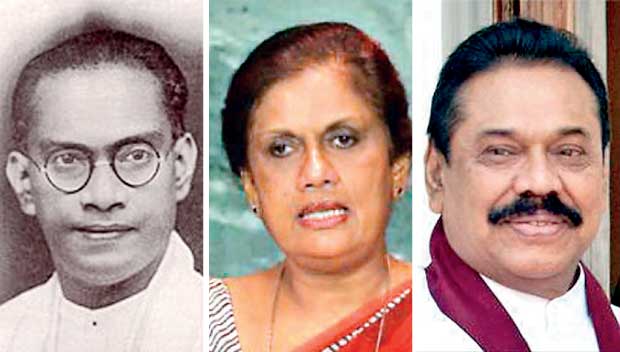
What the Chandrika faction fails to understand is that just as the UNP ran on DS Senanayaka’s achievement of obtaining Independence (Hence the Father of the Nation”), Mahinda Rajapaksa is the biggest brand name that the SLFP has available to display—the man who swiftly won Asia’s longest war beating a dreadful, historically emotive enemy, reunified the state, resurrected the economy and transformed the face of the country.

How did we wind up a UN protectorate as it were, having won Asia’s longest war? And what on earth is the Sri Lanka Freedom Party (SLFP) doing in a Government that has made these commitments, despite the opposition or dissent signalled by President Sirisena  What is to become, electorally, of the SLFP…

Insofar as the 2009 victory was a Second Independence, MR is the equivalent of D.S. Senanayake. Unlike DS he is also alive and active, and is the most loved pubic personality in the country.

In the SLFP canon he is second only to SWRD Bandaranaike, the founding father– and for the current generations of voters perhaps a more significant figure because they never knew SWRD. 2009 was the second 1956.

Running on the SLFP ticket without and against Mahinda Rajapaksa and hoping to retain the loyalty of SLFP voters would be as outrageously silly as Liu Shao Chi or Deng Hsiao Ping trying to wrest the Communist Party away from a live Mao Ze Dong and hoping to retain the loyalty of the party’s peasant base!

 In the SLFP canon he is second only to SWRD Bandaranaike, the founding father– and for the current generations of voters perhaps a more significant figure because they never knew SWRD. 2009 was the second 1956


The SLFP faction in Government has few choices. The LSSP exited the UF coalition in 1975 and even that proved too late—it was wiped out in 1977. Ditto the CPSL which quit in 1976. If the SLFP leaves the Yahapalana coalition after an electoral defeat at the upcoming Local Government or Provincial council elections, why should or would the JO accept it except as the tuft of a tail? And why should the UNP retain its services?

The only momentum to catch is the anti-UNP pendulum swing. The only wave to surf is the anti-Government wave. The SLFP has to pivot right now, get on the exit ramp and head for the exits. It has sins to wash off, credibility to restore, and catching up to do as an anti-UNP party.

The SLFP deserves a rousing cheer for its stand on Constitutional change: no abolition of the executive Presidency, no transfer of the Governor’s powers to the Chief Minister, no amalgamation of provinces, and no abolition of the Concurrent list.

In Game of Thrones, the game has changed radically, as we all know. With the White Walker zombies at the gates, the only dividing line that counts, as Jon Snow says, is between the living and the dead; those who are breathing and those who are not. With the Western White Walkers’ spear-carriers, the Green Walkers, on a state-liquidating rampage, the only dividing line that counts in Sri Lankan politics today is between those who have a politico-electoral future beyond 2020 and those who don’t. Until it quits this Government, the official SLFP will remain stranded in the camp of the electoral Walking Dead.

ASSESSMENT: GOTABHAYA ENTERS POLITICS

September 13th, 2017

Gomin Dayasri Courtesy The Daily Mirror

Bemoan the non-availability of fresh material in the upper tiers of politics to replace the decrepit. For survival, the decayed leadership is ready to reach alliance with a devilish opponent. Unsuitable descendants await, both kinsmen and sycophants, located craftily in the wings of the second tier.


  • TNA, the official minuscule opposition, unable to reach acceptability outside the province
  • Maybe a UNP govt under a new leader is a more pragmatic alternate
  • Wings of SLFP will re-merge under a Sirisena and Rajapakse combine
  • MR’s chief executive stands convicted of failing to keep his boss on the correct path

Among this wild bunch, TNA’s honest Sampanthan stands like a beacon, living under trying circumstances under his invented avenger Wigneswaran and his crazy coots, making TNA, the official minuscular opposition – an unstable parochial outfit, unable to reach acceptability outside the province.

Return of the UNP under a Wickremasinghe administration is out of the reckoning – a cause long lost. Process will be accelerated if an unacceptable constitution is presented to the South leading to a breakdown. Ongoing stupidity will bind the divided SLFP.

MR’s comprehension was not beyond what he last heard from the last meeeting Understatement of a man that won the war many said was unwinnable. Yet, there is an element of wisdom in the utterance

UNP as a party is ahead of its leader in public esteem. Maybe a UNP govt under a new leader is a more pragmatic alternate: prevents their first line of defence from crossing to enemy territory in disgust? Ranil is less self-centred than Mahinda, prepared to yield place to a stronger candidate, as he did in 2015, decision he rues in hindsight. President Sirisena short on votes; waits long to eat into the disgusted UNP’s bases to strengthen his domain. Wings of the SLFP will re-merge under a Sirisena and Rajapakse combine. Promises another corrupt regime in the making. Join the devil to keep afloat is a staying principle. It sidelines Gota – suits Mahinda and Basil. Necessity will make Gota play second fiddle.

If Gotabhaya stands instead of Mahinda as the Presidential/Premiership candidate, majorities will soar in the south as he reflects the want of the Sinhala youth and voters express confidence in his delivery service. He holds a proven track record as against a lackadaisical Mahinda, whose chief executive stands convicted of failing to keep his boss on the correct path. Amount of Rs. 600 million is not peanuts sanctioned out of public funds near election time in distributing sil clothes to devotees. That is not a form of charity that acquires merit. Amount is mind-boggling but the price is equidistant to the fringe benefits picked by Yes Minister” gentlemen.

Elbowing the entrenched elite is virtually impossible where experienced Mahinda upstaged the politically naïve Gotabhaya Rajapakse – came on invitation but took over the centrefold at a seminar organized by an inexperienced coterie displaying Gota’s bare cupboard of talent from an over-crowded think tank [more a reservoir] that took months to gather. Worse, carries segments of the contaminated muck of the last regime.

Initial reaction was a horror story notwithstanding the presence of astute Kamal Guneratne, the military heavyweight with a spotless record and the wavering intellectual stimulator Dr. Dayan Jayatilleke; appear to be the maestro’s attaches for beckoning. Neglected to tap encyclopedic Prof. Gerry Pieris, an intellect par excellence at a well-attended seminar organized with military precision.

Writer declined an invitation to the podium at the seminar, felt uncomfortable in the company of a few disreputable that makes Gota, no more than a provider of sub standard intellectual feeder to his brother’s ancient wannabe cabinet. Gota committed hara-kiri at a posh seminar while a few good men lost their independence in the allotted six minute cameos to be branded as Gota boys” while the corrupt thrived in showing they are soon in business on the back of Gota’s name to mar him success in politics.

The ‘man of the match’ was Mahinda Rajapakse – his domineering personality made his kid brother look juvenile. Gota in a cabinet will play a lesser role than as Defence Secretary: being feeble in the tricky unaccustomed art of politics. His organization lacks depth in knowledgeable politics. Wasted, a chance of a lifetime, with many expecting a change that did not augur well, looking at the front rows of invitees. He needs to change his palace guards discreetly. Most likely ‘Team Gota’ is congratulating each other for a pop show presented with the same old timers singing the same signature tunes. It is economics that matter: a new economic order counts; constitution is the instrument of jointer of the two wings of the SLFP, to place old faces in new places.

UNP can only cut down losses (not win of course) if it brings in more dynamic players into key offices – otherwise leaves the field wide open in bringing – the twice rejected MR back to office with Gota in a reduced role, that would falter from the beginning to fail miserably only to re-establish the UNP at the next session of electioneering. In short the prime cry is for a leadership change. Spirit of our electorate is to rightly fault the holders in office and look lovingly at the team they defeated once, forgetting their sordid past. This psyche leaves Mother Lanka in a state of a troubled trauma?

UNP dropped a ‘sitter’ in a dream situation. They had overcome MR, colossus that won the war overcoming terrorism that created a mini world record; brought a majority of the SLFP under the UNP fold to present a coalition govt; split the SLFP down the centre; won goodwill by restoring the independence of justice; made friends with the heirs of terrorism in the north; replaced the opposition in the hands of a sympathetic TNA; boosted the confidence of a shattered police force that was loyal to the UNP at the elections. UNP are the repository of financial wizardly but handed the subject to the least qualified for the assignment – Ravi Karunanayake. That was the beginning of serial undoing for the UNP. It is finance and economics that bodes ill for the UNP with Ranil Wickremasinghe shattering his claim of a clean image after the bond issue.

Both Ranil and MR are fighting for survival and have no time to think long. Ranil begotten with affairs of state, with a few to rescue him from the mess his countrymen are facing due to the economic collapse caused by two successive regimes. A more leisurely paced MR was never a thinking man, as a esteemed columnist once stated – his comprehension was not beyond what he last heard from the last meeeting. Understatement of a man that won the war many said was unwinnable. Yet, there is an element of wisdom in the utterance.

Sirimavo Bandaranaike rid the party of corrupt parliamentarians that were found guilty of bribery under the Commission of Inquiry Act. She held bye-elections on schedule, won most but lost a few, but never feared of an ouster. She lost a Bill in Parliament and called for general elections and lost it, handed over power and returned to be restored at the next election with a 2/3 majority. MR’s and Ranil’s problems are that they give cover to many alleged crooks and inevitably carry questions marks on their shoulders?

It needs a hostile take over for a genuine regime-change within the political parties: a friendly succession would carry the renewable sewage, reincarnated to resurface as the next coming leader adapts on coming to power. Leaders are preferable to their handlers as they held moments of worthwhile glory. ‘Follow the Leader’ should not be the motto. A parallel leadership must be placed on a gradient/incline where few more of the front liners are trained to succeed in times of need. MR out of office looks at dowdy kinsmen and the boot licking fraternity while Wickremasinghe in office goes for dude friends alienated from realities of local conditions making amiable friends for fellowship on dull evenings. Maithripala Sirisena is a victim of hanging on with too many of dead wood sycophants waiting to jump ship and MR waits to pick any discarded rubbish let loose as he hopes to come to power without the peoples vote if possible under the queer provisions of the constitution. Old men are often in a hurry.

Remember both MR (a great man that dethroned deadly terrorism with bare local hands) and Ranil (never in the mould of the great UNP’s of the past like Gamini Jayasuriya, U.B. Wanninayake, M.D.Banda and M.D.H. Jayewardene) came to politics in the 1970s in the midst of two violent insurrections in the North and South.

Two generations have by-passed them but yet there is no replacement in a country sprouting with emerging unexposed talent because the party structures are non-democratic to any challenge to the leadership, is off-set by a kept second tier. Both leaders need each other to keep them in office as they work in tandem. If one falls other is likely to fade away by compulsion. Ranil – the more likely candidate to back down made a compelling sacrifice being the less selfish in agreeing to make way for Sirisena at a time UNP peaked in popularity after the Badulla provincial election results. Parliamentarians matter as their sole desire is to be re-elected unlikely for many under Ranil’s leadership.

Nation can be proud of a born-again judiciary with brave and bold like Judge Gihan Kulatunga at the helm who listens to both sides attentively, studies the law and gives judgements on the merits, mindful of the needs of society, without delay. What more can be asked from a Judge? Most of his judgements stood in appeal and the respected young Judge has won esteem. We live in hope, as is in many Asian societies to be kept within civilized bounds by an un-kept judiciary.

H. K. D. Chandrasoma’s Case: A Reply to D. B. S. Jeyaraj [1]

September 12th, 2017

Dharshan Weerasekera, Attorney-at-law

D. B. S. Jeyaraj, the LTTE propagandist sometimes also known to masquerade as a ‘journalist,’ has written a lengthy commentary on the judgment in H. K. D. Chandrasoma’s case, published in the Daily Mirror of 19th August 2017 and titled, ‘Federalism is not Separatism, rules the Supreme Court.’

As far as I understand it, Mr. Jeyaraj’s argument is that the judgment is important because of two reasons:  first, it has definitively established that the Illangai Tamil Arasu Kadchi (ITAK) political party is not a separatist party, and second, to advocate for federalism in Sri Lanka is not the equivalent of advocating for separatism.  He goes on to say that the SC has given the ITAK a ‘clean chit.’

If Chandrasoma had won the case, the ITAK would have been proscribed as a separatist party, which means that R. Sampanthan, M. A. Sumanthiran, C.V. Wigneswaran, and a host of lesser lights in the TNA elected to the Parliament or to Provincial Councils under the ITAK banner will have immediately lost their jobs.  So in that sense they dodged a bullet, and the likes of Jeyaraj and others are probably breathing a sigh of relief.

As Counsel for Chandrasoma, I have certain insights into the case that I hope will contribute to a more robust and meaningful public discussion of this important case.  I shall briefly discuss four issues:  one, why Chandrasoma filed the case; two, some salient facts about the background to the 6th Amendment; three, the Petitioner’s main argument and the court’s responses to them (i.e. the essence of the judgment); and finally, why I think the judgment is important for our times.

The reason for filing the case

As much as I understand it, Chandrasoma’s fear – and I think it is a fear shared by many other Sinhalas not just the nationalists – is that the TNA, ITAK and their assorted allies are laying the legal groundwork for a future unilateral secession either through a referendum held just for the residents of the North and East, or by a unilateral declaration of independence by a Provincial Government or an independent group operating within such a province (we can call this later the ‘Kosovo method.’)

My instructions were to explore legal means of preventing such an eventuality.  We decided to go with the 6th Amendment to the Constitution, because it had never been interpreted in its 35-year existence.  Win or lose, at the end of the case there was going to be an interpretation of the 6th Amendment, and that was going to be an advancement of the law.  Now, we do have such an interpretation.

The background to the 6th Amendment

The 6th Amendment to our Constitution is almost a word for word replication of India’s Unlawful Activities Prevention Act of 1967, enacted to combat secessionist and separatist movements.  The difference between the Indian version and our own is that in India the action is filed at the High Court, whereas in our country the action is filed in the Supreme Court.

The advantage in the Indian version is that if the respondent is found guilty he has a chance to appeal, whereas with us, there is no such option.  (In my view, this is a weakness in our law that needs to be addressed, but in any event the petitioner resorted to the law he had in hand.)

The point is that, the Indians have been making vigorous use of their law, unlike in our country, and in fact the Indian Parliament has seen fit to amend the Act six times since `1967, each time making it more rigorous.  There is a rich body of Indian case law which has interpreted the Act and its uses over the years.

In my view, the above facts reveal two things:  first, the Indian Parliament plus the courts have considered that the Unlawful Activities Prevention Act is an effective means of combating secessionism and separatism in that country, and two, that perhaps given a federal system such as what the Indians have, coupled with the realities of communalism which are an integral part of Indian politics, a device such as the UAPA is essential in order to maintain the territorial integrity of the country in the long run.

Since Sri Lanka has adopted key elements of the Indian federal system with the 13th Amendment, Sri Lanka has important lessons to learn from the above two points, especially with respect to using the 6th Amendment.  By facilitating an interpretation of the 6th Amendment, Chandrasoma has made it possible for other concerned citizens to resort to this provision more easily.

The Petitioner’s main arguments  

The Petitioner’s claim was that explicit statements in the ITAK’s Constitution plus reasonable inferences that can be drawn from relevant passages in that document indicate that the arrangement of government the ITAK is seeking is that of a ‘Confederation,’ and that, since a ‘Confederation’ by definition involves a union of sovereign states, ITAK seeks is to establish such a sovereign state, namely, Tamil Eelam.

The Petitioner relied on three arguments in order to support the above claim:  first, an Amendment to the ITAK Constitution in 2008, which substituted the word ‘Innaipachi’ for the word ‘Samasthi’ with reference to the type of government what the ITAK is seeking.  It is not in dispute that the Sanskrit work ‘Samasthi’ means ‘federal.’  Chandrasoma’s claim was that the word ‘Innaipachi,’ read in the context of certain ideas and concepts contained in the relevant passage, can only mean ‘Confederation.’

Second, in its passage on ‘aims and objects’ the ITAK asserts that the Tamils of Sri Lanka have a right to self-determination under international law.  Chandrasoma’s claim was that, a right to self-determination is only claimed by people who want to liberate themselves from another people or a country, such as in the case of colonial occupation.  Therefore, to assert a right to self-determination indicates that the ITAK harbours an intention of separating from the Sinhalas and the rest of Sri Lanka, and this in turn indicates they have an intention of setting up a separate state.

Third and finally, the Petitioner focused on ‘Rule 17’ of the Amendment to the ITAK’s Constitution where ITAK unambiguously endorses ‘all resolutions and actions taken by the Tamil United Liberation Front and the Illankai Tamil Arasu Kadchi from 14th May 1976.’  It is not in dispute that the Vaddukodai Declaration, a seminal separatist document (among other things it was considered by Vellupillai Prabakaran as giving him a mandate for his actions) was signed by the TULF on 14th May 1976.

So, Chandrasoma’s claim was that, the fact that the ITAK has endorsed all TULF resolutions going back specifically to 14th May 1976 means that ITAK has unmistakably endorsed the Vaddukoddai Resolution, which indicates that it continues to harbour separatist intentions.

What does the court say to these charges?  On the first count, the court says that the change in words from ‘Samasthi’ to ‘Innaipachi’ does not connote a change in meaning or objective, and that what ITAK had done was to substitute for a Sanskrit word a pure Tamil word of equivalent meaning.  The court pointed out that ITAK had made such substitutions in a number of other places in the Constitution also.

On the second count, court says that ‘self-determination’ has an internal dimension, and that the fact that someone asserts ‘self-determination,’ does not necessarily mean they harbor an intention to secede, but could mean that they wish to gain more power for themselves within the existing system.  Such an ambition cannot be considered as amounting to a separatist intention.

On the third count, court says that, because the Petitioner had not listed the TULF as a Respondent, and it was the TULF that had originally signed the Vadukoddai Declaration, the fact that the ITAK has endorsed all resolutions and acts of the TULF going back to 14th May 1976 is irrelevant for purposes of the present case.

It is an astute point, because it is possible that the TULF, between 1976 and 2008, adopted a resolution renouncing the Vaddukodai Declaration, in which case the ITAK would necessarily have endorsed such resolution also, as per ‘Rule 17’ of its Constitution.

Such then is the judgment.  All in all, it is a balanced and well-reasoned judgment and far be it for me to criticize it.  I shall now turn to the reasons that I think the judgment is especially important for our times.

The reasons that make the judgment important

I shall discuss two reasons.  First, the court sets out certain principles relating to the definition of ‘federalism.’ The court bases its discussion on the dictionary-definition of ‘federalism,’ and compliments that by referring to certain observations of Chief Justice Sharvananda from the judgment in the 13th Amendment case.

The conclusion of the court, which is an amalgamation of the aforesaid dictionary-definition plus CJ Sharvananda’s observations is that the terms ‘Unitary’ and ‘Federal’ are misleading (i.e. there can be unitary elements in a federal system and vice versa) but the fundamental juxtaposition is between unitary/federal on the one hand and ‘Confederation’ on the other.   The key passage with respect to this is as follows:

‘It is established that there is a clear distinction between the words ‘federation’ and ‘confederation.’  The main issue in this case is whether advocating the establishment of a federal state is tantamount to establishment of a separate state….The labeling of states as unitary and federal sometimes may be misleading.  There could be unitary states with features or attributes of a federal state and vice versa.  In a unitary state if more powers are given to the units it could be considered as a federal state.  Similarly, in a federal state if the centre is more powerful and the power is concentrated in the centre it could be considered as a unitary state.  Therefore, sharing of sovereignty, devolution of power and decentralization will pave the way for a federal form of government within a unitary state.  The Thirteenth Amendment to the Constitution devolved power to the provinces.  The ITAK is advocating for a federalist form of government by devolving more powers to the provinces within the framework of a unitary state.  Advocating for a federal form of government within the existing state could not be considered as advocating separatism.’ (page 17)

To the best of my knowledge, this is the first time that a Sri Lankan court has explicitly articulated the above point, and it has profound ramifications, particularly to ongoing discussions about devolution of power to the Provinces.

To digress a moment, as a general matter, to my knowledge all hitherto discussions of federalism in this country have been based on definitions proffered by various academics, public intellections and suchlike pundits, and the common element in these definitions is that they see federalism as being part of a single continuum, with ‘Unitary’ at one extreme end of it and ‘Confederation’ at the other.

Under the aforesaid definitions, it is possible to interpret federalism as permitting an arrangement where the central government and the peripheral units are equals, or co-equals, ‘supreme within their own spheres of influence.’

What the court has done with Chandrasoma’s judgment is to put an end to the aforesaid speculations.  The court has established that the valid definition of ‘federalism’ at least in terms of its application in Sri Lanka is the dictionary-definition (which is also the classical definition of the concept ‘federalism’), where the fundamental dichotomy is between federalism on the one side and confederation on the other.

Furthermore, by relying on CJ Sharvananda’s observations in the 13th Amendment judgment, the court has identified the distinctive element that turns a federal system into a confederation, to wit:  it is division of sovereignty.  Court cites with approval the following passage from the CJ Sharvananda’s judgment in the 13th Amendment case:

‘In a Unitary State the national government is legally supreme over all other levels.   The essence of a Unitary State is that sovereignty is undivided – in other words, that the powers of the central government are unrestricted.  The two essential qualities of a Unitary State are 1) the supremacy of the central Parliament and 2) the absence of subsidiary sovereign bodies.  It does not mean the absence of subsidiary law-making bodies, but it does mean that they exist and can be abolished at the discretion of the central authority.’  (page 10)

To repeat, the distinctive characteristic of the existing system of government in Sri Lanka, whether we wish to call it ‘Unitary’ or ‘Unitary/Federal,’ is undivided sovereignty. The practical manifestation of this in terms of the distribution of powers between the center and the provinces is that, no matter how much power may be devolved to the provinces, the center must always retain the power to keep the provinces under control, which necessarily includes the capacity to take back the powers of the provinces if needed.

It follows from the aforesaid that if an attempt is made to dilute the powers of the center to an extent where the center can no longer exert effective control over the provinces, such an attempt cannot be justified as an attempt to enhance or further federalism: it is instead an attempt to break out of the federal model and pursue a confederation.

The importance of Chandrasoma’s case is that the aforesaid ideas have now become a part of the constitutional jurisprudence of Sri Lanka.  What are the ramifications of this?  I’ll just explain three lasting ramifications.

First, ITAK is permitted to advocate for ‘federalism,’ but only within the ‘existing system,’ which is to say, the unitary/federal model as now defined by court.  In such a system, there is a distinct limit to the amount of power that can be devolved to the peripheral units, and that limit – the red-line, as it were – is where the centre loses the capacity to impose effective control over the peripheral units, including to take back at its discretion the powers devolved to the units.

Second, under the definition of ‘federalism’ set out by the court, a right to external self-determination does not exist in our country for people dissatisfied for whatever reason with the amount of power devolved to the Provinces.  They must adjust their own demands and expectations and function within the parameters of the existing system.  Court confirms this by citing with approval the famous ruling of the Canadian Supreme Court in Reference re Secession of Quebec.   Court specifically cites the following passage from the aforesaid judgment:

‘The Court was also required to consider whether a right to unilateral secession exists under international law….a right to secession only arises under the principle of self-determination of people at international law where ‘a people’ is governed as part of a colonial empire, where ‘a people’ is subject to alien subjugation, domination or exploitation, and possibly where a ‘people’ is denied any meaningful exercise of its rights of self-determination within the state of which they are a part.  In other circumstances peoples are expected to achieve self-determination within the framework of their existing state.  A state whose government represents the whole of the people or peoples resident within its territory, on the basis of equality and without discrimination and respects the principle of self-determination in its internal arrangements, is entitled to maintain its territorial integrity under international law and to have that territorial integrity recognized by other states.’  (p. 16)

Since the Tamils of Sri Lanka are not under colonial occupation, or under ‘alien subjugation and domination,’ and furthermore, since the democratic rights of Tamils are respected – as evidenced by the fact that members of ITAK are in Parliament and in Provincial Councils – the ITAK cannot claim that the Tamils of Sri Lanka have a right to external self-determination under international law.

The judgment in Chandrasoma’s case now makes it easier to make the above case before the international community, because it has clarified what the ‘existing system’ is.  Also, it opens the way for opponents of devolution – not just of further devolution but even of the amount of devolution that has been affected so far (i.e. under the 13th Amendment)- to say something like this:

‘If what ITAK wants is more power or autonomy for Tamils, and a unitary/federal system allows for devolution of powers as long as the Center retains the unshakeable capacity to control the Provinces effectively including to withdraw the powers given to the Provinces, let’s have such a system, but let the unit of devolution be something other than the Province, say, the District.’

ITAK, and all other ‘federalists’ in this country, will have to give a reasonable reply to a query such as the above, especially if it is asked in the international arena.  And until such an answer is given, they will find it difficult to advance any arguments about the purported right of Tamils in this country to external self-determination under international law.

Third, if it had been the idea of the TNA, the ITAK and their assorted allies to permit the word ‘Unitary’ to remain in the Constitution, but bring in constitutional changes that diluted the powers of the center over the periphery to an extent where the center can no longer effectively control the actions of the Provincial Governments – for instance by curtailing the powers of the President over the Provincial Governor or by eliminating the concurrent list –  without subjecting the related constitutional amendment to a referendum, such a thing is no longer possible.

Now that the meaning of ‘federalism’ has been clarified with respect to its defining characteristic, no matter what one calls the resulting form of government, if there’s a reduction or a change in the power of the Centre vis a vis the Provinces, the issue of whether there’s the potential for that change to result in a division of sovereignty arises.

Sovereignty, as everyone knows, is a matter that comes under Article 3 of the Constitution, long recognized as the very backbone of the Constitution, and one of the Articles that automatically requires a referendum in order to amend.

Therefore, if an attempt is made to sneak in constitutional changes that dilute the power of the Centre vis a vis the Provinces by relying solely on a two-third majority in Parliament, now there’s a chance to challenge the related Bill under Article 3 of  the Constitution, and seek a referendum.  That is a huge advantage for the People at this moment.

Finally, the important point about Chandrasoma’s case is that in the course of it Court ordered an English translation of the ITAK Constitution to be produced by the Department of Official Languages.  To the best of my knowledge this is the only such official translation of the document because the version in the Elections Commissions’ office is in Tamil.

As already mentioned, in ‘Rule 17’ of the Amendment to the ITAK Constitution in 2008, it explicitly states that ITAK endorses all resolutions and acts of the TULF going back to 14th May 1976.  That means ITAK endorses the Vaddukoddai Declaration, an indisputably separatist document, unless in the time between 1976 and 2008 the TULF has passed a resolution renouncing the said Declaration.

In Chandrasoma’s case, the court deemed the above fact irrelevant, and for good reason.  However, the fact that ITAK has endorsed the resolutions and acts of the TULF going back to 14th May 1976 is now in the public domain, thanks to Chandrasoma.  All that is required is for a civic-minded Sri Lankan to re-file an application  against the ITAK solely on ‘Rule 17’ of its Constitution, and this time list the TULF as a respondent also, and then let them come before court and explain themselves.

To the best of my knowledge, the TULF has now renounced the Vaddukoddai Declaration.  So, all they have to do is get on the stand (figuratively speaking) and say so.  In that event, the ITAK is caught, well and good.   Meanwhile, if ITAK tries to amend its Amendment and belatedly renounce the ‘VD,’ they’ll be caught inter alia under Section 8(2)(f) of the Evidence Ordinance (‘subsequent conduct’).  So, they are stuck.

In short, if the ITAK thought that with Chandrasoma’s case they were rid of a headache, they are mistaken.  It may well be that, their troubles – or rather the real ‘fun’ – is just beginning.

[1] A version of this paper was published in lankaweb on 21st August 2017.

The SC Ruling on ITAK and its Seminal Importance to Discussions of ‘Federalism’ in Sri Lanka

September 12th, 2017

Dharshan Weerasekera, Attorney-at-Law

[Author’s note:  The present paper is intended to be read with a previous paper of mine titled, ‘H. K. D. Chandrasoma’s Case:  A Response to D. B. S. Jeyaraj,’ published in lankaweb.  For the convenience of readers that article is republished along with this one]

On 21st August 2017, I published an article in lankaweb titled, ‘H. K. D. Chandrasoma’s case:  A Response to D. B. S. Jeyaraj,’ in which I endeavored to explain why Chandrasoma filed the case, his main claims against ITAK, the court’s answers to those claims, and finally, the aspects of the judgment that I considered to be of seminal importance to the country.[1]

In my view, the lasting importance of the judgment is in the fundamental change or rather development that the court has introduced with respect to the definition of ‘federalism’ that must now apply in Sri Lanka, at least as far as constitutional jurisprudence is concerned, and the ramifications of this to ongoing debates over devolution, including the proposed constitutional reforms.

In the past 2-3 weeks, I have read in the local papers at least two articles that have commented on Chandrasoma’s case, in particular comparing and contrasting the court’s definition of ‘federalism’ with other definitions given by various academics and scholars.  In my view, the writers of these articles are engaging in a futile exercise, because of the following reasons.

As far as constitutional jurisprudence is concerned, the judgment of a court invariably supersedes or trumps the opinions and speculations of academics (to the extent those opinions or speculations have not been incorporated into a judicial ruling).  If there is, say, a future challenge to a constitutional amendment where the definition of ‘federalism’ is a significant factor, our judges will give priority to the definitions generated by fellow judges on the bench.

Therefore, the more reasonable thing to do is to try and understand what exactly the court said about federalism in the instant case, rather than to seek after definitions proffered by various academics and other pundits – definitions the court has neither referred to nor relied on in the judgment.

In this paper, I shall briefly discuss three matters.  First, explain again what I consider to be the court’s definition of ‘federalism’; second, explain the general ramifications of the aforesaid definition to ongoing discussions over devolution; and third, point out the specific ramifications to, one, the Parliamentary Sub Committee report on Centre-Periphery relations tabled in November 2016, and two, Paragraph 16 of UNHRC resolution 30/1, which also explicitly calls for ‘devolution’ as a means of providing a ‘political settlement’ to the Tamils.

The Definition of ‘federalism’

The definition of ‘federalism’ that the court presents in Chandrasoma’s case is based on two things:  the dictionary definition of the word, supplemented by a key portion of Chief Justice Sharvananda’s judgment in the 13th Amendment to the Constitution.  For the dictionary-definition, court has relied on the definition in Black’s law Dictionary, an authoritative source for lawyers.

However, it is possible that a lay-reader might object to this by saying that, as far as he or she is concerned Black’s Law Dictionary does not carry any special authority.  I emphasize that, the definition of ‘federalism’ with respect to its material elements is consistent among all reputable dictionaries, and in order to be on the safe side I shall give the definition of ‘federalism’ found in the Oxford Law Dictionary, right after quoting from Black’s.

The following is the definition of ‘Federal Government’ found in Black’s Law Dictionary (6th Edition) relied on by court:

‘The system of government administered in a nation formed by a union or confederation of several independent States.’

‘In strict usage, there is a distinction between a confederation and a federal government.  The former term denotes a league or permanent alliance between several States, each of which is fully sovereign and independent, and each of which retains its full dignity, organization, and sovereignty, though yielding to the central authority a controlling power for a few limited purposes, such as external and diplomatic relations.  In this case, the component States are the units, with respect to the confederation, and the central government acts upon them, not upon the individual citizens.  In a Federal Government, on the other hand, the allied States form a union (e.g. the United States) not, indeed, to such an extent as to destroy their separate organization or deprive them of quasi sovereignty with respect to the administration of their purely local concerns, but so that the central power is erected into a true national government, possessing sovereignty both external and internal—while the administration of national affairs is directed and its effects felt, not by the separate States deliberating as units, but by the people of all, in their collective capacity, as citizens of the nation. The distinction is expressed by the German writers by the use of two words ‘Staatenbund’ and ‘Bundesstaat’; the former denoting a league of confederation of states, and the latter a federal government or state formed by means of a league of confederation.’[2]

The following is the definition of ‘Federal State’ given in the Oxford Law Dictionary:

‘Federal State:  A State formed by the amalgamation or union of previously autonomous or independent States.  A newly created federal state is constitutionally granted direct power over the subjects or citizens of the formerly independent states.  As such, the new federal state becomes a single composite international legal person.  Those former entities that comprise it have consented to subsume their former sovereignty into that of the federal State, although they retain their identity in municipal law.  Examples of Federal States include the USA and Switzerland.  COMPARE Confederation.’[3]

From both sets of quotes, it is clear that  the defining characteristic of a Federal State is that, one, the power of the central government reaches to the citizens or residents of the individual provinces (by contrast, in a confederation the power of the central government reaches only to the governments of the provinces), and two, the power of the central government is always supreme over that of the provincial governments (this is made especially clear by the Oxford Dictionary, to wit, ‘Those former entities that comprise it have consented to subsume their former sovereignty into that of the Federal State).

A necessary implication of the above is that, in a federal union the peripheral units cannot secede at will i.e., without the consent of the pother units that make up the union, while in a confederation they can.  Similarly, in a federal union a peripheral units cannot persist in acting contrary to the wishes of the center – the center always has the power to bring such recalcitrant unit under control, including taking back the powers given to the peripheral units as such.

I shall now turn to the second component of the court’s discussion of ‘federalism,’ where the court relies on a key portion from Chief Justice Sharvananda’s judgment in the 13th Amendment to the Constitution (1987 2 SLR 319).  The court explicitly refers to the following remarks of CJ Sharvananda from the judgment in the 13th Amendment case:

‘The term ‘Unitary’ in Article 2 is used in contradistinction to the term ‘Federal,’ which means an association of semi-autonomous units with a distribution of sovereign powers between the units and the center.  In a Unitary State the national government is legally supreme over all other levels.   The essence of a Unitary State is that sovereignty is undivided – in other words, that the powers of the central government are unrestricted.  The two essential qualities of a Unitary State are 1) the supremacy of the central Parliament and 2) the absence of subsidiary sovereign bodies.  It does not mean the absence of subsidiary law-making bodies, but it does mean that they exist and can be abolished at the discretion of the central authority.’  (page 10)

I draw the attention of the reader to the first sentence in the above passage, to wit;  ‘The term ‘Unitary’ in Article  2 is used in contradistinction to the term ‘Federal,’ which means an association of semi-autonomous units with a distribution of sovereign powers between the units and the center.’  The importance of this sentence is that, as CJ Sharvananda saw it, our Constitution does not permit an arrangement of government where the center and the peripheral units are equals or co-ordinates only, i.e. where the center cannot assert its authority over the peripheral units if and when needed.  I shall explain the implications of this point in a moment.

I shall now proceed to explain the general ramifications o the judgment both to general discussions of devolution, and the specific ramifications to the Sub-Committee report on Center –Periphery relations, and also UNHRC resolution 30/1.

The general ramifications of the Chandrasoma judgment to discussions of devolution in Sri Lanka

The following is the key passage in the judgment where the court gives its verdict as to whether Chandrasoma has established that ITAK is a separatist party.  The courts says:

‘It is established that there is a clear distinction between the words ‘federation’ and ‘confederation.’  The main issue in this case is whether advocating the establishment of a federal state is tantamount to establishment of a separate state….The labeling of states as unitary and federal sometimes may be misleading.  There could be unitary states with features or attributes of a federal state and vice versa.  In a unitary state if more powers are given to the units it could be considered as a federal state.  Similarly, in a federal state if the centre is more powerful and the power is concentrated in the centre it could be considered as a unitary state.  Therefore, sharing of sovereignty, devolution of power and decentralization will pave the way for a federal form of government within a unitary state.  The Thirteenth Amendment to the Constitution devolved power to the provinces.  The ITAK is advocating for a federalist form of government by devolving more powers to the provinces within the framework of a unitary state.  Advocating for a federal form of government within the existing state could not be considered as advocating separatism.’ (page 17)

In this section I shall briefly explain the general ramifications of the above passage to discussions over devolution in this country.  I shall start with the necessary background information, which involves discussing Article 2 of the Constitution.  Article 2 of the Sri Lanka Constitution states:

‘The Republic of Sri Lanka is a Unitary State’

Nowhere in the Constitution is the term ‘Unitary’ defined.  For instance, there is no interpretation clause which defines that term.  [In my view, Sri Lanka would have been spared a lot of trouble if Mr. J. R. Jayawardena had seen to it to include an interpretation clause that defined ‘Unitary State’ when he first introduced the ’78 Constitution.  For one thing, it would have prevented the lingering controversy over the passing of the 13th amendment, i.e. whether or not it required a referendum.  But all that is beside the point]

The point is this.  Because there is no definition for ‘Unitary’ provided in the Constitution itself, the only valid definition or interpretation of that term as far as our Constitution is concerned is the definition provided by C. J. Sharvananda in the 13th Amendment judgment, quoted earlier.  (This is because of the operation of the maxim, ‘An interpretation of the law obtains the force of law,’ and C. J. Sharvananda’s definition has not been rejected or modified in any way by our courts in subsequent years.)

The problem is that, the 13th Amendment has undoubtedly diluted the power of the central government, and CJ Sharvananda’s definition permits such dilution subject to the condition that there can never be a division of sovereignty.  Unfortunately, this situation has provided an opening for the Eelamists.  As long as the term ‘Federal State’ or ‘federalism’ was left undefined by our courts, C. J. Sharvananda’s definition of ‘Unitary State’ permitted the Eelamists to say something like this:
‘Under the ‘Unitary’ system of Sri Lanka as defined by our own courts, devolution of power is permitted.  A ‘Federal State’ is also an arrangement of government which permits a devolution of power on a sliding scale, that is, in some ‘Federal States’ there can be a strong central government (i.e. the US) and in others there can be a weak central government (i.e. Switzerland) with far more powers devolved to the peripheral units.  We advocate a ‘Federal’ system of government for Sri Lanka, and we are not doing anything wrong, because all we are asking for is just more devolution of power.’

Permit me to quote the actual words of two key Eelamists, in this case R. Sampanthan and M. A. Sumanthiran, to illustrate the above point.  The following is what Mr. Sampanthan said in the course of an important speech in 2012, at the 14th National Convention of the ITAK in Batticaloa:

‘Our expectation for a solution to the ethnic problem of the sovereignty of the Tamil people is based on a structure outside that of a unitary government, in a united Sri Lanka in which Tamil people have all the powers of government needed to live with self respect and self-sufficiency.  We believe that only within such a structure of government can the Tamil people truly enjoy the right to self-determination that is their inalienable right.’[4]

‘The position that the North and East of Sri Lanka are the areas of historical habitation of the Tamil speaking people cannot be compromised in the structure of government.  We must have unrestricted authority to govern our own land, protect our own people, and develop our own economy, culture and tradition.  Powers must be allocated under this structure based on the understanding that meaningful devolution should go beyond the 13th Amendment to the Constitution passed in 1987. This position has been accepted by our party.  Our acceptance of his position does not mean that we consider the 13th Amendment to be an acceptable solution, nor that, in the event our right to internal self-determination is continuously denied, we will not claim our right under international law to external self-determination.  It only means that this is the only realistic solution today.’[5]

The following, meanwhile, are some remarks by Mr. Sumanthiran, from an article published in the Bar Association of Sri Lanka Law Journal of 2015.  The article is part of an ‘exchange’ with three others – Ranil Wickremasinghe, Faiser Mustapha and J. C. Weliamuna – on the principles that must guide the proposed new Constitution.  Mr. Sumanthiran gives his ideas as to the principles that must underpin Center-Periphery relations, and says inter alia:

‘In accordance with this principle [i.e. the purported principle of maximum devolution], the Centre must have the minimum possible subjects and functions and the Centre and the devolved units must be supreme in their respective spheres of competence.’[6]

‘Thus, the list of subjects for the Centre should be limited to matters that are ‘national’ in nature—matters such as National Defence, Foreign Affairs, National Fiscal Policy, Immigration/Emmigration, Citizenship, Customs, Posts, Telecommunications, International Airports, Major Harbours, Railways, National Highways and Maritime Zones.’[7]

‘All other powers must be exercised by the provinces.  This must include exclusive powers over land, development, health and education.’[8]

There are two key elements in what both the aforesaid Eelamists are saying:  first, they consider that the amount or extent of devolution is a matter to be determined by the people demanding such devolution – in this case the Eelamists themselves – and not by natural limits intrinsic to the system; and second, it is possible in the Federal State as they envision it for the Center and the Peripheral Units to be ‘equal,’ i.e. ‘Supreme within their respective spheres of competence.’

It should be noted that, the aforesaid idea is entirely contrary to the definition of ‘federalism’ accepted by most people including the dictionaries.  Recall that, according to the dictionary-definition of ‘federalism,’ the sovereignty of the central government always subsumes that of the peripheral units, which means that, though the peripheral may have exclusive jurisdiction over particular matters, this is always subject to the authority of the central government, i.e. the central government retains the right to withdraw such jurisdiction if it deems such action necessary.

We thus come to the judgment in Chandrasoma’s case.  I shall specify three important ways in which it impacts discussions over devolution in this country.  First, the court has taken judicial notice of the fact that as a result of the 13th Amendment we now have a federal arrangement of government, or at any rate that what we like to think of as a ‘unitary’ system has in reality incorporated significant federal elements.

The court, however, has defined ‘federalism,’ so it is no longer possible for the Eelamists to promote schemes of devolution (which the Eelamists call ‘federal’) but which are entirely contrary to what most people including the dictionaries understand by the word ‘federal.’  According to the definition of ‘federal government’ that court has now set out, the central government must always be superior to the peripheral units, i.e. the sovereignty of the center always subsume that of the peripheral units.

So, ideas such as those being peddled by the likes of Mssrs. Sampanthan and Sumanthiran, to wit:  that they want ‘all the powers of government needed to live with self respect and self-sufficiency,’ that, ‘the Centre must have the minimum possible subjects and functions and the Centre and the devolved units must be supreme in their respective spheres of competence,’ and so on, can no longer be presented as if those ideas were federal ideas.

Second, the idea that the people demanding devolution have an unrestricted right to determine the amount or extent of power to be devolved is no longer viable.  In either a Federal State as defined by the dictionaries, or a ‘Unitary State’ as defined by C. J. Sharvananda, the system sets distinct limits on the amount of devolution possible, namely, the limit is reached when the Center loses the capacity to effectively control the Peripheral Units.

Third, in concluding paragraph of its judgment, the court unequivocally states that, a party advocating federalism in Sri Lanka can do so only within the framework of the unitary system.  It is worth repeating the key portion of that paragraph.  Court says:

‘The Thirteenth Amendment to the Constitution devolved power to the provinces.  The ITAK is advocating for a federalist form of government by devolving more powers to the provinces within the framework of a unitary state.  Advocating for a federal form of government within the existing state could not be considered as advocating separatism.’

To repeat, ITAK (or any other party) can advocate for a federal state, but only within the framework of a unitary state.  So, it is impossible from now on for the Eelamists to play one of their main tricks, namely, saying that what they advocate is ‘federalism within the framework of a united and undivided Sri Lanka.’ It should be noted that, a confederation is also ‘united and undivided’ until one or more of its members decide to separate!

It must be emphasized that, the court does not say, ‘ITAK is advocating for a federalist form of government within the framework of a united and undivided Sri Lanka.’  If ITAK wants to pursue federalism in this country, court expects it to do so within the framework of a unitary state, as such a thing is understood in our constitutional jurisprudence.

What is the definition of a ‘Unitary State,’ valid for our Constitution?  As already explained, it is the definition given by C. J. Sharvananda, quoted earlier.  So, from now on, whatever the Eelamists choose to call the system of government they prefer for our country, in its substance that system must always have a central government that is superior to the peripheral units, and retains the authority inter alia to take back the powers devolved to the peripheral units.

In my view, on each of the aforesaid points, the court has dealt a deathblow to the ambitions of the Eelamists.   All that remains is for me to explain the specific ramifications of the judgment to, one, the Subcommittee report on Center – Periphery relations tabled in November 2016, and Paragraph 16 of UNHRC resolution 30/1, which also calls on the GOSL to reach a ‘political settlement’ with the Tamils by devolving more power to the Provinces.

Unfortunately, the constraints of time prevent me from taking up this matter at this moment.  I shall try to take it up in a future paper.  However, this may be a blessing in disguise.  I urge readers especially if they are law students to complete the task, and contribute something new and interesting to ongoing discussions of this seminal case.

[1] The judgment in H. K. D. Chandrasoma v. Mervai Senathirajah Secretary of the Ilankai Tamil Arasu Kadchi, SC/SPL/03/2014 (delivered on 4th August 2017) is available at www.supremecourt.lk

[2] Pages 9-10 of the judgment

[3] Oxford Law Dictionary, Oxford University Press, 2015

[4] Text of Address by R. Sampanthan at the 14th National Convention of ITAK in Batticaloa, 27th May 2012, www.dbsjeyaraj.com

[5] Ibid

[6] ‘Towards a Desirable Legal Framework for Achieving National Reconciliation in Sri Lanka,’ M. A. Sumanthiran, Bar Association of Sri Lanka Law Journal, Vol. XXI, 2015, pages, 38-41, pg. 40.Ibid,

[7] Ibid

[8] Ibid

Paradigms of Land Policy for Sri Lanka: A Review Article

September 12th, 2017

by Dr. Sudath Gunasekara (SLAS)

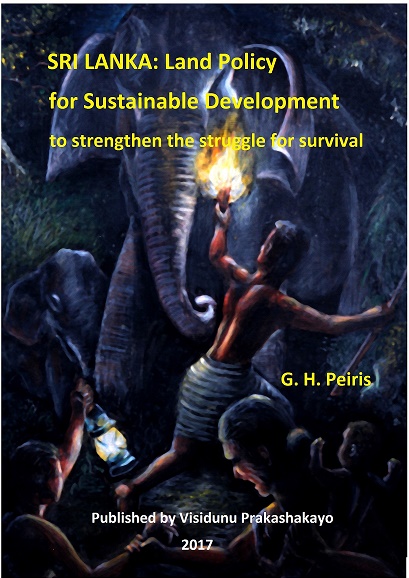
A pre-publication copy of the monograph titled Sri Lanka: Land Policy for Sustainable Development, authored by Gerald Peiris (Professor Emeritus of the University of Peradeniya) which is due to be released on 15 September 2015, has been sent to me with an invitation to evaluate it. In undertaking this task I find it appropriate to place it against the backdrop of the knowledge and experience I have acquired both in the course of my official duties in the executive cadres of the state-sector administrative services that stretched for well over three decades, devoted almost entirely to matters concerning the needs of the more depressed segments of our peasantry, as well as my own research writings, including a doctoral dissertation, on agrarian affairs in the Central Highlands of Sri Lanka.

This monograph is undoubtedly a landmark in studies on land policies in Sri Lanka in that it signifies a radical departure from all conventional studies undertaken so far on this subject in this country which were primarily concerned with matters such as ownership and tenurial relations in land, land-use, forest conservation, subsistence farming and poverty alleviation with a special focus on the peasantry. In this discourse the author has urged a more comprehensive approach to land policy formulation – an approach that takes into account the impulses and impact of land policies that have been pursued from historical to modern times in details not found in any other study on this subject. He has made an in- depth analysis with a sharp insight into a wide range of areas that impinge on land policies in Sri Lanka such as theoretical concepts, evolution of land policies, land reforms, rural poverty, agriculture including both the peasant and commercial plantation sectors, land grabbing and malpractices, and the need for strict and urgent legal measures to arrest this disaster, depletions of forests,  conservation of water resources and  biodiversity, effects of planation agriculture on  Sri Lankan life and  the intricacies of the rural–urban-estate land use systems. I am particularly impressed with the attention he has paid to the need to protect the central watersheds (the ‘Geographical Heartland’, HADABIMA, of Sri Lanka as I call them) against soil erosion and land degradation and depletion of water resources, pivotal for sustainable development and human survival in this country which no other scholar has so eloquently articulated.

He has emphasised the necessity for a complete reorientation of land policies beyond these fields to cover a wider spectrum such as the needs and aspirations of people to meet the demand for land for different competing uses like paddy cultivation, plantation agriculture, livestock rearing, rapidly increasing urban needs and infrastructure development like roads and railways and arresting natural hazards such as landslides and floods and disruption of wetland ecosystems. Besides, he has also called for the need to address a wider range of current issues like territorial integrity, sovereignty, devolution of power relating to lands that are of pivotal significance to governance and all aspects of life in the country, with special reference to the vital importance of reorienting land policy towards enduring the sovereignty and territorial integrity of Sri Lanka. A related perspective highlighted by Peiris is the need to protect land and its resources from foreign and domestic, intrusions driven by subversive ethnic considerations that pauses a serious threat to territorial integrity sand sovereignty of this Island nation.

The text is profusely illustrated and supported by maps, illustrations, charts and tables that have enhanced the academic value of the book. This thesis is equally useful for all sectors including academics and students who look for innovations and knew knowledge, policy makers and administrators involved in land work, looking for visionary land policies and the general public who treat land as their wealth and heritage. In compiling this discourse Professor Peiris has made use of his unparalleled and vast wealth of undisputed scholarly acumen and the wealth of almost sixty years of experience as a University teacher, scholar, researcher and a consultant in a wide range of fields and countries both in the West and the East which has served as the underpinning of this masterly analysis.

One final word on the painting on the front-cover designed by Manjula Peiris. It is, indeed, a masterpiece symbolizing the challenges our nation is facing both for ensuring sustainable development and as well as for the survival in this country which is being imperilled. It depicts symbolically the ominous terror and the plight of hapless rural farmer family. The man, though resolutely trying to drive away the impediment of a herd of charging wild elephants is also desperately struggling to save his family and himself.  He has only a rod and a huluatta (torch brand) for his defence against this terror by a herd of jumbo wild elephants. The anguished mother with the frightened child on her back is pulling the elder by her hand desperately who is holding a lantern in her other hand with trembling heart and soul dramatically portrays the plight of hapless peasants in the country side. Are these miserable peasants invoking god to save them from this ominous challenge before the nation arising from wrong land policies or no policies situation adopted by policy makers and the neglect for which they alone are mainly responsible.

The name of the book is very appropriate and speaks volumes on the thematic essence of the its content.  The need for a comprehensive and meaningful land policy, not only for sustainable development but also for survival in this Island nation is the pivotal message that has epitomized in this masterpiece.

This brief and modest attempt of mine is only a passing glimpse on this great work. One needs to read it in between line and it has to be ‘chewed and digested’ as Francis Bacon has once said of great books, to understand the real value of this unique treaties. But of cause the efforts of Prof Peiris will find their true results only in the implementation of policies embodied in this thesis by the policy makers and those who implement them. I commend this book for all those scholars, teachers and students, policy makers, Administrators and the general public who are genuinely and seriously interested in sustainable development and concerned with the survival of the Sri Lankan Nation.

This book has been published by Gevindu Kumaratunga of the firm ‘Visidunu Prakashakayo‘. It will be formally release at the Annual Book Fair which will open on 15 September 2017 at the BMICH.

Seize! Detain! Kill! — Sri Lanka Readying Legislation to Kill its Dogs!

September 12th, 2017

Champa Fernando Secretary, KACPAW (Kandy Association for Community Protection through Animal Welfare)

A worldwide petition protesting to Minister Faiszer Musthapha, Hon. Minister of Provincial Councils and Local Government, to not to legalize killing of dogs in Sri Lanka has gained close to 30,000 signatures within a week from across the world and within Sri Lanka.

The petition asks to say NO to ITEM 14 of Sri Lanka’s Draft Dog Registration Act – LDO 36/2015, which would give the Provincial Councils the legality to kill ALL straying dogs!

Some Government Officials led by the Secretary to the Ministry of Provincial Councils and Local Government, want as per ITEM 14 of the above Act, ALL STRAY DOGS to be SEIZED by EVERY Local Authority, DETAINED and KILLED if not claimed by payment in 3 Days!!

This would be the beginning of the end of the No-Kill Policy on Dogs, a policy upheld by Minister Faiszer Musthapha as one that cannot be violated. But including Item 14 in the Dog Registration Act will clearly violate the No-Kill Policy, making the Minister’s humane stance hollow and meaningless.

The polarity of opinion of the Minister and some of his officials on this issue is indeed peculiar and needs to be bridged in favour of the civilized, humane option of Non-Killing of Dogs, discarding sinister plans to start killing dogs in Sri Lanka.

Predominantly a Buddhist Country, Sri Lanka enjoys a NO-Kill Policy on Dogs since 2006 and has a National Dog Sterilization Programme annually funded by the Government in place since 2008. This HUMANE approach is lauded world over and Sri Lanka is seen as a trailblazing, civilized and progressive country in the region.

So what is needed is not to go back to the Medieval Age by starting to kill dogs, a method proven over hundred years to be futile with regard to controlling the dog population, but to progress forward on the No-Kill Policy and ensure that the dog sterilization programme is effectively and comprehensively carried out right across this small Island nation so that the dog population is systematically and sustainably and HUMANELY reduced.

The petition can be signed at http://www.thepetitionsite.com/949/809/086/seize-detain-kill-sri-lanka-readying-legislation-to-kill-its-dogs/?taf_id=41835710&cid=fb_na

Champa Fernando

Secretary, KACPAW (Kandy Association for Community Protection through Animal Welfare)

There are some negative Health Effects of Fast Food so you need to be careful

September 12th, 2017

Dr Hector Perera       London

Takeaways are often cheap, convenient and satisfying but, unfortunately, they’re not always very healthy. Some takeaway meals can push you over your recommended daily maximum amount of salt and fat, which can lead to a variety of health problems, such as heart disease and diabetes. Takeaway food are plenty but which one to choose?

A meal cooked and bought at a shop or restaurant but taken somewhere else, often home, to be eaten, or the shop or restaurant itself. A lot of takeaway food is perfectly safe for people with coeliac disease. However, you do need to be careful what you order and be aware of the risk of cross contamination in some takeaway restaurants. Britain will spend almost £8bn a year on takeaways by the end of the decade as a surge in smartphone usage and time-pressed households cooking fewer meals boosts the country’s predilection for takeaway food.

Expenditure on pizza, curry and Chinese food is expected to grow by 28% during this decade to £7.6bn a year according to figures from Euromonitor International. Forget hunting around for paper menus. There are plenty of instantly access a wide array of local favourites, whether you’re after Brighton’s best fish & chips or a full English breakfast in Liverpool. Browse peer-reviewed takeaway menus and filter by opening times, accepted payment methods, deals and discounts. With online payment and convenient re-ordering. Some on line takeaway even got you covered for a wine or beer to go with it. I think even in Sri Lanka, mainly in Colombo city area there are plenty of home delivering takeaways. No wonder some housewives are not bothered to cook at home. Whether they are healthy and clean is your choice, food on the table in no time. Why bother in smoky, dusty and hot kitchens, just pick up the phone then meals come on wheels as fast as they could, what a change!

Fish and chips

There are lots of ways to make your trip to the chippy a healthier one. Have a portion of baked beans or mushy peas with your fish and chips. Watch out for other foods that are high in fat, such as pies and sausages.

The thicker the chips the better, because they absorb less fat. Try to have a smaller portion or share your chips. Ask for your fish and chips without salt – if you want some salt, then add a small amount yourself.

Italian

If you’re having pizza, choose lower-fat toppings, such as vegetables, ham, fish and prawns. You could ask for some extra veg on your pizza to bump up your daily fruit and veg portions. But if you don’t want to increase the saturated fat content and number of calories in your meal, don’t ask for extra cheese.

With pasta dishes, if you want a lower-fat option go for a sauce that’s based on tomatoes or vegetables, rather than cream.

Try to avoid: large deep-pan pizzas, pizzas with a cheese-stuffed crust, triple cheese with pepperoni pizzas, creamy pasta sauces and garlic bread.

Healthier options: small or medium pizzas with a thin base and vegetable or lean meat topping, tomato-based pasta sauces, bruschetta.

Chinese

Anything that’s battered or marked as “crispy” on the menu means it’s deep-fried. Watch out for starters such as prawn crackers and spring rolls, because these are generally deep-fried. Anything in batter will be high in fat. Sweet and sour pork is usually battered.

Try to avoid: sweet and sour battered pork balls with special or egg-fried rice, prawn toast, spring rolls. Healthier options: crab and corn soup, steamed dumplings, steamed vegetables and plain boiled rice, steamed fish, chicken chop suey, Szechuan prawns.

Thai

Try to stick to stir-fried dishes or steamed dishes containing chicken, fish or vegetables instead of curries. Thai curries, such as the popular green and red curries, contain coconut milk, which is high in saturated fat. If you choose a curry, try not to eat all the sauce. Have some steamed rice with your meal instead of egg-fried rice.

Indian

Try to avoid anything that’s creamy or deep-fried. To reduce the amount of fat in your meal, choose dishes with tomato-based sauces, such as tandoori and madras, plain rice or chapatti. Also choose plenty of vegetables, including lentil side dishes (known as dhal).

Kebab and burgers

Doner kebabs can be high in fat. For a healthier option, go for a shish kebab, which is a skewer with whole cuts of meat or fish and usually grilled.

If you’re having a burger, avoid breaded or battered chicken or fish patties, extra cheese, bacon strips and high-fat sauces, such as mayonnaise. Instead, go for a regular, single-patty hamburger without mayonnaise or cheese and have with extra salad.

Try to avoid: large doner kebab with mayonnaise and no salad, burgers with cheese and mayonnaise, thin-cut chips, chicken or fish patties deep-fried in batter. Healthier options: shish kebab with pitta bread and salad, grilled burgers made from lean fish or meat (beef or whole chicken breast) and without cheese and mayonnaise.

Rice & Curry or Rice ‘N’ Curry

I read some reviews about rice and curry in some places in Sri Lanka and this is what they wrote. Age old food still going strong!

This is my go to place when it comes to having lunch on a weekday since this place is situated quite closely to my workplace. For Rs. 200/- you can chose between anything from Fried Chicken, curry chicken, fried fish, curry fish , prawns or cuttlefish and that variety is a major reason when I happen to visit the place quite often. Had lunch on number of occasions and each time I was content with the food. For breakfast they do offer a pasta with chicken and that was fine by normal standards as well but nothing ravishing keep in mind! Service gets a bit late during rush hours but it’s worth the wait compared to what you get at all the other places around here. I have always taken away and never dined in house but there’s space for about ten people to dine in. Would visit again when I need to have a quick lunch on a working day.

Visited the restaurant last week along with family on our vacation. Went with great expectations and the place was laid out like a village set up, rustic seating ,waiters in traditional clothes and complete with a rooster and hen s adding to the ambiance.
Well the atmosphere was great and we opted for the buffet which was laid out on earthenware dished and there were 3 counters one for salads, fresh fruits and desserts, one counter called the toddy shop which had a disinterested lady manning it which served some fried fish and prepared omelettes lying in open dishes which were being sampled by enthusiastic flies yes by flies. We asked her to prepare fresh ones but she merely pointed to the stale ones so I did not pick up any. The main course counter had a lot of dishes both non vegetarian and vegetarian. The NV dishes included Negombo Pork Curry, Chicken curry, dried fish curry, mutton curry, fish head curry (which I quite enjoyed) and the pick of the lot Cuttle fish curry.
There was Plain steamed rice, turmeric rice and red rice but no sight of hoppers or string hoppers. Once you are on holiday in Sri Lanka then you will find out there are far too many takeaway places or ready to eat places in any town. It is your choice to find which ones are better than the others. Your comments are welcomed perera6@hotmail.co.uk

A challenging task for Gotabhaya

September 12th, 2017

By Shamindra Ferdinando Courtesy The Island


The high profile launch of Eliya (light) by wartime Defence Secretary, Gotabhaya Rajapaksa underscored Sri Lanka’s PATHETIC failure to counter unsubstantiated war crimes allegations, directed by a section of the international community, since the conclusion of the war, in May 2009.

Sri Lanka paid a very heavy price for its failure and the previous government can never absolve itself of the responsibility for the situation.

Lt. Gen. Sarath Fonseka’s Army brought the war to a successful conclusion, on the banks of the Nanthikadal lagoon, on the morning of May 19, 2009, when heavy caliber ammunition penetrated LTTE leader Velupillai’s Prabhakaran’s forehead. The Sri Lanka Army (SLA) has credited the Fourth Battalion of the Vijayabahu Infantry Regiment (4 VIR) for Prabhakaran’s killing. A not so celebrated infantry battalion was fortunate to secure unprecedented recognition.

The SLA would never have succeeded in pursuing Prabhakaran, successfully, if the Sri Lanka Navy and the Sri Lanka Air Force had failed to achieve their strategic objectives during Eelam War IV (Aug 2006-May 2009). Vice Admiral Wasantha Karannagoda and Air Marshal Roshan Gunatilleke provided legendary leadership to the SLN and SLAF, respectively, whereas Defence Secretary Rajapaksa ensured an unstoppable offensive, over a period of three years, until the LTTE was brought to its knees. His role, in Sri Lanka’s victory over terrorism, can never be challenged or disputed.

article_image

But the failure on the part of the Rajapaksa administration to counter unsubstantiated war crimes allegations, certainly helped those who had been propagating war crimes allegations as well as accusations in respect of post-war incidents, leading to the change of government, in January, 2015.

The US, EU and India spearheaded the 2015 project in collaboration with the four-party Tamil National Alliance (TNA), one-time political arm of the LTTE.

Although a US led project failed, in January 2010, to oust President Rajapaksa, an identical mission succeeded in January 2015. On both occasions, they used those who had been close to President Rajapaksa, namely the then Gen. Sarath Fonseka and Minister Maithripala Sirisena as battering rams, in 2010 and 2015, respectively.

President Mahinda Rajapaksa facilitated the enemy project by calling presidential polls two years ahead of scheduled time. Among those who had officially requested President Rajapaksa not to do so were then SLFP General Secretary Maithripala Sirisena in April 2014 and D.E.W. Gunasekera, Vasudeva Nanayakkara and Prof. Tissa Vitharana in Oct 2014. President Rajapaksa ignored their sensible advice.

Gajaba Regiment veteran Rajapaksa launched the Eliya project on Sept. 6, 2017, amidst the latest simmering dispute over war-winning Army Chief the then Lt. Gen. Sarath Fonseka accusing the then Vanni Security Forces Commander Maj. Gen. Jagath Jayasuriya of atrocities.

The Eliya project, meant to thwart the ongoing bid to bring in a new Constitution, in accordance with Geneva Resolution 30/1, co-sponsored by the UNP-SLFP government, on Oct 1, 2015, received the backing of the civil society. Among them were distinguished non-career diplomats, Dayan Jayatilleka, who calls himself a Sri Lankan patriot, and also an internationalist, and Tamara Kunanayakam. Jayatilleka and Kunanayakam made brief presentations on behalf of Eliya. It would be pertinent to mention that the Rajapaksa administration unceremoniously removed both Jayatilleka and Kunanayakam, at the expense of Sri Lanka’s defence overseas. Now they are back, along with former MP Prof. Rajiva Wijesinghe, who switched his allegiance to Maithripala Sirisena at the onset of the operation against President Rajapaksa, in late 2014. Prof. Wijesinghe was also present at the launch of Eliya.

Among those who had been present at the launch of Gotabhaya Rajapaksa’s initiative, were twice President Mahinda Rajapaksa and brother Basil Rajapaksa accused of war crimes. They were among four leaders of the war-winning Rajapaksa team blamed by the then US Ambassador in Colombo Patricia Butenis for war crimes. The other accused are Gotabhaya Rajapaksa, on the podium, and now Field Marshal Sarath Fonseka, Regional Development Minister in the UNP-SLFP coalition.

Fonseka’s entry into politics, in late 2009, triggered an unprecedented crisis and, unfortunately, divided the war-winning team. But, whatever political disputes, Sarath Fonseka had been a key member of the war-winning team, and his contribution to Sri Lanka’s war against terrorism can never be challenged. That is the undeniable truth. In fact, Sri Lanka’s triumph over terrorism or resultant war crimes allegations cannot be discussed, under any circumstances, without taking the Fonseka factor into consideration.

Those who had flayed Fonseka for accusations, directed at Jayasuriya, must not forget the Sinha Regiment veteran is also part of the solution, regardless of his political affiliations now.

The writer had an opportunity to take up a range of issues, pertaining to accountability issues, during Balaya, a weekly live programme, hosted by Sudewa Hettiarachchi, Director News, Hiru, on Sept 7, 2017, the day after the launch of ‘Eliya.’ The timing of Balaya couldn’t have been better with naval veteran Rear Admiral Sarath Weerasekera (former Deputy Minister, UPFA), who had addressed the gathering at the ‘Eliya’ launch on the previous, on the ‘Balaya’ panel. The writer teamed up with Weerasekera, whereas the opposing team comprised Gamini Viyangoda of Purawesi Balaya, an influential civil society organization that had forcefully campaigned for President Rajapaksa’s ouster, and Dr. Jehan Perera, executive Director of the National Peace Council (NPC), the foremost NGO funded by successive Norwegian governments, and the recipient of substantial funding from other foreign ‘sources.’

Perera, accompanied the Sri Lankan delegation to the Geneva Human Rights Council sessions, in March 2017. He backed Sri Lanka’s request for an additional two-year period to implement Resolution 30/1.

The debate dealt with war crimes allegations in the wake of Fonseka’s latest outburst directed at Jayasuriya.

Essentially, Viyangoda, a member of the Consultation Task Force on Reconciliation Mechanisms (CTFRM) and Perera strongly pushed for a thorough investigation into accountability issues. Viyangoda reiterated his backing for CTFRM recommendation for foreign judges in domestic war crimes court, in line with Resolution 30/1. Perera threw his weight behind Viyangoda, while faulting the previous government for excessive loss of civilian lives during the Vanni offensive and detention of over 300,000 people at the conclusion of the fighting. They asserted that international intervention could have been averted had the Rajapaksa administration swiftly and decisively addressed human rights concerns. They squarely placed the blame on the previous government for the current crisis, while underscoring the responsibility on the part of Sri Lanka to address domestic as well as international concerns in respect of wartime conduct of political and military leaderships.

Weerasekera lucidly explained how the ongoing Geneva project relentlessly undermined Sri Lanka with the focus on immense sacrifices made by the armed forces and the people. The naval veteran also discussed the failure on the part of the international community to intervene and take punitive action against the LTTE at an earlier stage. Weerasekera recalled the atrocities that had been committed by the LTTE over a period of time while explaining their own efforts to protect civilians. Weerasekera cited the rescue of Sea Tiger leader Soosai’s wife and children by the navy on May 16, 2009, as they were fleeing in a boat towards Tamil Nadu as an example of their approach towards non-combatants. Weerasekera proved that Resolution 30/1, that had been co-sponsored by the current government, was based on the report of the OHCHR Investigation on Sri Lanka, aka OISL, though Viyangoda took a contrary view.

Weerasekera strongly opposed foreign judges as well as other foreign personnel in proposed judicial mechanism whereas the writer expressed the opinion that proper defence strategy following fresh reappraisal of the entire gamut of issues will enable Sri Lanka to successfully counter allegations even before foreign judges. It would be pertinent to stress that the responsibility in proving allegations directed at Sri Lanka lies with those pushing for war crimes probe. The writer asserted that foreign judges wouldn’t be an issue if Sri Lanka, forcefully brought out all relevant factors.

The writer raised the following issues with the panelists.

Thamilini’s revelations

The pivotal importance of establishing the circumstances leading to the resumption of war, in Aug 2006. Sivakamy Sivasubramaniyam alias Thamilini, in her memoirs, Thiyuni Asipathaka Sevana Yata (Under the shadow of a sword), launched in May 2016, following her death in Oct 2015, briefly explained how Prabhakaran had wanted to facilitate Mahinda Rajapaksa’s victory, at the Nov 2005 presidential poll, to enable the LTTE to resume war and bring his campaign to a successful end. There cannot be any dispute over Thamilini’s assertions as regards the LTTE creating an environment for resumption of all out war and the assassination of Foreign Minister Lakshman Kadirgamar, in Aug. 2005, on specific orders given by Prabhakaran as Thamilini’s book was launched by artiste, Dharmasiri Bandaranayake, on her husband Jeyakumar’s request. Viyangoda and senior lecturer Swaminadan Wimal had addressed the gathering at the Sri Lanka Foundation Institute (SLFI). Dharmasiri Bandaranayake or Viyangoda wouldn’t have done anything under any circumstances to justify the war against the LTTE, hence the need to seriously examine Thamilini’s revelations.

Victor Ivan’s disclosure

Former Ravaya Editor Victor Ivan, in a special article on ‘Jeyaraj’, published in Sept 2011, in memory of Minister Jeyaraj Fernandopulle, assassinated in April 2008, revealed how President Rajapaksa had sent Seva Lanka chief Harsha Navaratne to reach an understanding with the LTTE soon after Prabhakaran launched claymore attacks in Dec 2005. The then presidential secretary Lalith Weeratunga had accompanied Harsha Kumara Navaratne. President Rajapaksa had sent Harsha Navaratne again with Fernandopulle to make representations to the LTTE, on his behalf, in the wake of the Mavilaru crisis, caused by the LTTE in June/July 2006. According to Victor Ivan, Navaratne had made the revelations a few months after Fernandopulle’s assassination at Dr. Kumar Rupesinghe’s residence. Among those present had been Minister Dr. Rajitha Senaratne (then an influential member of the Rajapaksa cabinet), TNA leader R. Sampanthan and TNA members of parliament, Suresh Premachandran and Mavai Senathirajah. Victor Ivan also quoted Sampanthan as having said that the war couldn’t be called genocide though he wasn’t prepared to admit that publicly. Victor Ivan underscored that Harsha Kumara Navaratne had made the revelation after the TNA accused President Rajapaksa of resorting to war without making an effort to negotiate with the LTTE.

P’karan’s targets

The LTTE realized the requirement to deprive President Rajapaksa of Lt. Gen. Fonseka and Gotabhaya Rajapaksa at a very early stage of eelam war IV. Had Prabhakaran succeeded in eliminating Fonseka, in April 2006, and Rajapaksa, in Oct 2006, the war effort would have failed. Fonseka had the strength to declare that he wouldn’t leave the war to his successor, while Gotabhaya told Norwegians the problem could be definitely settled through military means, according to Pawns of Peace: Evaluation of Norwegian peace efforts in Sri Lanka released in Sept 2011. Let me reproduce verbatim the relevant section: “On April 6, 2006, Norwegian Special Envoy Jon Hanssen-Bauer and Norwegian Ambassador Hans Brattskar have a tense meeting with Defence Secretary Gotabhaya Rajapaksa. In response to a question about whether the ethnic and political problems could be solved by military means Gotabhaya answers, ‘yes.’

Had Prabhakaran succeeded, the outcome of the war could have been different. The split in the Rajapaksa camp obviously delighted those elements wanting to divide the country on ethnic lines.

Denial of ‘white flag’ allegations

Reappraisal of specific allegation in respect of execution of LTTE cadres on the Vanni east front in mid May 2009 against the backdrop of a public statement made by Lt. Col. Lawrence Smith, US defence attache, in Colombo, in June 2011, regarding the allegation. Lt. Col. Smith denied the allegation at the inaugural Defence Seminar organized by the SLA at the Ramada. Interestingly, the US State Department never denied Lt. Col’s statement, though it declared the officer didn’t make that statement on behalf of the US.

Discrepancy in numbers killed

Requirement to establish the number of civilians killed during the final phase. The UN Panel of Experts (PoE) estimated the number of killed at over 40,000, in March 2011, whereas the Amnesty International, in Sept 2011, placed the number of civilian deaths at 10,000. In Sept. 2011, the British parliament was told of 60,000 civilians and 40,000 LTTE cadres killed during January-May 2009. These vastly different figures should be examined taking into consideration still confidential UN report that placed the number of persons killed in areas under LTTE control during Aug 2008 – May 2009 at 7,721 and 18,479 wounded. The war ended a week after the UN stopped collecting data due to the intensity of the fighting.

TNA’s culpability

Inquire into TNA’s partnership with the LTTE since 2001 when the former came into being. The EU alleged that the TNA secured the lion’s share of electorates/seats in the Northern and Eastern electorates at the April 2004 parliamentary polls, thanks to violence unleashed by the LTTE on those opposed to the TNA and former stuffing ballot boxes of the latter. Having declared the LTTE sole representative of Tamils in 2001, the TNA faithfully served the terrorist group, both in and outside parliament, until the SLA put a bullet through Prabhakaran’s head.

Allegations against the SLA should be probed taking into consideration the TNA support for Fonseka and Maithripala Sirisena at the January 2010, January 2015 presidential polls, respectively. Fonseka had commanded the victorious SLA accused of indiscriminate killings while Maithripala Sirisena held the defence portfolio in the last week of Vanni offensive. The TNA had no qualms in throwing its weight behind them in spite of war crimes allegations. Would Sampanthan have backed them, especially Fonseka, if he really believed in his own accusations?

Wiki leaks revelations

Although, the Paranagama Commission, in its second mandate, referred to Wiki leaks, for some strange reason, the previous government never made use of US diplomatic cables. One such cable, revealed top ICRC official asserting how SLA could have finished off the LTTE quicker if it didn’t take civilian factor into consideration.

The cable, dated July 15, 2009, signed by the then Geneva-based US ambassador, Clint Williamson, cleared the SLA of crimes against humanity during the Vanni offensive. The cable, addressed to the US State Department, was based on a confidential conversation Ambassador Williamson had with the then ICRC head of operations for South Asia, Jacque de Maio on July 9, 2009. Ambassador Williamson wrote: “The army was determined not to let the LTTE escape from its shrinking territory, even though this meant the civilians being kept hostage by the LTTE were at an increasing risk. So, de Maio said, while one could safely say that there were ‘serious, widespread violations of international humanitarian law,’ by the Sri Lankan forces, it didn’t amount to genocide. He could cite examples of where the army had stopped shelling when the ICRC informed them it was killing civilians. In fact, the army actually could have won the military battle faster with higher civilian casualties, yet chose a slower approach which led to a greater number of Sri Lankan military deaths. He concluded however, by asserting that the GoSL failed to recognize its obligation to protect civilians, despite the approach leading to higher military casualties.”

SLA lost 2,400 officers and men in 2009 though the war ended in May 2009.

Tamil victims

In response to Viyangoda’s assertion that 90 per cent of victims were Tamils, the writer pointed out the need to inquire into circumstances under which that community suffered since the Indian military intervention in 1980s. A thorough inquiry should examine the deaths due to Indian Army operations in Sri Lanka (1987-1990), fighting among Indian sponsored Tamil groups, sea borne Tamil terrorist raid on the Maldives in Nov 1988, LTTE executing its own for allegedly plotting against its leader and political killings. It wouldn’t be right to restrict investigations into allegations blamed on Sri Lanka. TNA MP Dharmalingham Siddarthan, Chairman of Center-Periphery Relations Sub Committee that recommended far reaching constitutional reforms meant to weaken the 1978 Constitution is on record as having said that two TULF MPs including his father were abducted and executed by Indian sponsored TELO terrorists at the behest of RAW (Research and Analysis Wing) in 1985.

Humanitarian missions

Proposed accountability mechanism should seek clarification from foreign powers and INGOs in respect of supplies that had been moved overland and then by sea to the area under LTTE control up to the second week of May 2009. The previous government lacked even a basic plan to prepare solid defence to counter lies and to cleverly use vital information provided by foreign sources such as the US (Lt Col. Lawrence Smith) and UN (PoE report). Let India inform the proposed accountability mechanism how its personnel, based at Pulmoddai, north of Trincomalee, received wounded men, women and children evacuated by the ICRC. The writer had the opportunity to visit a makeshift Indian medical facility in late April 2009. The evacuation operation allowed nearly 15,000 civilians, both wounded and relatives to reach Pulmoddai. The accusation that Sri Lanka had waged genocidal war should be investigated keeping in mind how the wounded were evacuated even in the second week of May 2009. War ended on the morning of May 19, 2009.

Role for Norway

Proposed accountability mechanism should thoroughly inquire into efforts made by the international community to save civilians. The then MP and presidential advisor, Basil Rajapaksa, received a one-page missive, on Feb. 16, 2009, from then Norwegian ambassador, Tore Hattrem. The Norwegian embassy delivered the letter to Basil Rajapaksa in the wake of Ambassador Hattrem discussing the situation on the Vanni east front with President Rajapaksa’s brother. Basil Rajapaksa had been exploring ways and means of securing the release of the Vanni population, held hostage by the LTTE, and was in touch with Western diplomatic missions in Colombo, in this regard.

Hattrem’s note to Basil Rajapaksa revealed Norway’s serious concern over the LTTE’s refusal to release the civilians. The Island received a copy of the hitherto unknown Norwegian note, headlined ‘Offer/Proposal to the LTTE’, personally signed by Ambassador Hattrem. The Norwegian envoy was writing to Basil Rajapaksa on behalf of those countries trying to negotiate a ceasefire between the government and the LTTE, to facilitate the release of civilians, held hostage by the latter.

The following is the text of Ambassador Hattrem’s letter, addressed to Basil Rajapaksa:

“I refer to our telephone conversation today. The proposal to the LTTE on how to release the civilian population, now trapped in the LTTE controlled area, has been transmitted to the LTTE through several channels. So far, there has been, regrettably, no response from the LTTE and it does not seem to be likely that the LTTE will agree with this in the near future.”

Those who really want to clear Sri Lanka’s name should face the accusers in a court of law. It would be pertinent to stress that it would be their responsibility and challenge to prove still unproven allegations on which Geneva wanted our Constitution changed to pave the way for a federal structure.

(To be continued on Sept 20)

When the Eagle cries

September 12th, 2017

Editorial Courtesy The Island


US Acting Assistant Secretary of State for South and Central Asian Affairs, Alice Wells is reported to have told a Congressional subcommittee that non-concessional Chinese loans have placed unsustainable debt burdens on Sri Lanka. ‘They are now of concern to the Sri Lankan people in the government,’ she has said. She sounds like the yahapalana leaders who used to clamour against China and Chinese loans while campaigning hard to dislodge the pro-Chinese Rajapaksa government.

Why have some western powers suddenly awoken to the debt burden of the developing world? In the past, they dominated the world through aid, which came with many strings attached. But, their economies are no longer strong enough to do so and they have, therefore, opted for the most economical way of achieving that objective. They are using human rights as a tool to control the developing world. This method has proved to be very cost effective. The western governments now have to fund only some influential INGOs and NGOs operating in the developing world instead of the so-called Third World governments which have an enormous appetite for aid, part of it is siphoned off by corrupt politicians and bureaucrats. They have succeeded in hijacking the UNHRC and using it as a bludgeon against the states, perceived to be hostile to them, and to protect their allies in spite of their grave human rights abuses.

China is now doing what the West is no longer capable of doing; it provides developing countries with loans without trying to run parallel governments therein. It has thus been able to expand the sphere of its influence extensively, posing new geopolitical challenges to the West. It is only natural that Chinese loans causes so much concern to the capitalist bloc, struggling to retain its grip on the world. Interestingly, Europe has had to soften its stand on some African nations, which it used to condemn for human rights violations in a bid to counter China’s growing influence in that region.

There is no love lost between the present Sri Lankan government and China. But, the former has no way of pulling out of China’s sphere of influence due to its economic difficulties. The UNP-led UNF government crashed in 2004 as it could not raise funds even by compromising national security and appeasing the LTTE. It was eyeing a 4.5-billion-dollar aid package which the US, Japan, the EU and Norway—which came to be known as the Tokyo Co-chairs of Sri Lanka’s ‘peace process’—promised; the implementation of their aid pledge was made conditional to progress to be made in negotiations with the intransigent LTTE, which stuck to its Eelam demand like a limpet. The present UNP-led yahapalana administration also expected the western powers which helped engineer the 2015 regime change here to help it financially. Else, it would not have taken on China to the extent of undertaking to scrap the Chinese-funded Port City project. But, it received nothing by way of financial assistance from its admirers in the West.

The Sirisena-Wickremesinghe government wouldn’t have had to swallow its pride and grovel before the Chinese leaders, begging for funds if the US and other western powers had provided it with the much-needed soft loans. Ironically, even some of the western powers critical of Chinese loans are dependent on China, which has been investing in euro zone government debt.

Washington’s concern over Sri Lanka’s debt burden should be appreciated. But, the question is what the US is going to do about it. On Nov. 01, 2016, Chinese Ambassador to Sri Lanka Yi Xianliang, did not mince his words when he asked the then Finance Minister Ravi Karunanayake, who was critical of the Chinese interest rates, why the latter had asked for another loan if the Chinese loans were so expensive. Those who are shedding copious tears for Sri Lanka, in a debt trap, should answer this question and make available loans at lower interest rates if their concerns about this country are genuine.

Sri Lankan minister sacked for rocking coalition

September 12th, 2017

 Courtesy Mail on Line

Sri Lankan President Maithripala Sirisena’s party has been the junior partner in the country’s coalition since August 2015

Sri Lankan President Maithripala Sirisena Tuesday sacked a minister who had threatened to split his coalition government, three weeks after another was fired for publicly criticising a government decision.

Sirisena’s office said Arundika Fernando, junior minister for tourism and Christian affairs, was expelled from the government under the executive powers of the president.

Sri Lankan President Maithripala Sirisena's party has been the junior partner in the country's coalition since August 2015

The brief statement did not give a reason for his dismissal, but official sources said the move prevented Fernando from engineering defections to a breakaway faction of Sirisena’s Sri Lanka Freedom Party.

“With this sacking the president has asserted his authority and sent a signal he won’t hesitate to expel more,” a source close to the presidency said, citing Fernando´s previous assertion that around a dozen ministers were planning to leave the government.

Fernando was not immediately available for comment, but he told the Lankadeepa daily website that his sacking was unlikely to discourage other dissidents in the government.

Sirisena’s party, the junior partner in Sri Lanka’s coalition since August 2015, is already split between him and former strongman president Mahinda Rajapakse, who is an MP and has considerable support within the party.

It is not yet clear whether the potential new faction was trying to join the side of the former president or remain as a third faction within the party.

Three weeks ago Sirisena sacked justice minister Wijeyadasa Rajapakshe, who publicly denounced the government’s $1.1 billion sale in July of a 70 percent stake in a port to state-owned China Merchants Port Holdings.

Sirisena and his Prime Minister Ranil Wickremesinghe have vowed to continue their power-sharing arrangement until 2020 when the next general election is due.

However, there are reports of squabbles within the coalition and many fiscal policy measures have been either toned down or completely withdrawn in recent months due to infighting.

Sri Lankan court remands 12 Tamil Nadu fishermen

September 12th, 2017

Courtesy ANI

Rameswaram (Tamil Nadu) [India], Sep 12 (ANI): 12 Indian fishermen, who were apprehended by the Sri Lankan Navy from Delft Island were produced in Oorkavalthurai court on Tuesday.

The Sri Lankan court has remanded the fishermen in Jaffna jail up to September 26.

Yesterday, 12 Indian fishermen, along with two boats were caught by the Sri Lankan navy and taken to the Kankesanthurai Naval camp for interrogation.

Meanwhile, after the arrest of fishermen Tamil Nadu’s Pudukottai district also announced indefinite strike demanding immediate release of their fellowmen. (ANI)

Countering China’s presence in S Asia

September 12th, 2017

CONSTANTINO XAVIER Courtesy The Hindu

India is reaching out to Sri Lanka, Myanmar, Bangladesh and Nepal. But these smaller countries are keeping options open

China’s inroads into South Asia since the mid-2000s have eroded India’s traditional primacy in the region, from Afghanistan to Myanmar and also in the Indian Ocean. As Beijing deploys its formidable financial resources and develops its strategic clout across the subcontinent, New Delhi faces capacity challenges to stem Chinese offensive in its own strategic backyard.

Prime Minister Modi’s new ‘Neighbourhood First’ policy, unveiled in 2014, has consequently focused on reaching out to other states to develop partnerships across the region. This balancing strategy marks a departure from India’s unsustainable efforts to insulate South Asia as its exclusive sphere of influence and deny space to any extra-regional actors.

Officially, these unprecedented outreach efforts are implicitly referred to as a partnership with like-minded” countries. According to Foreign Secretary S Jaishankar, in its quest for more people-centric” connectivity projects and a cooperative regional architecture,” India is working closely with a number of other international players whose approach is similar.”

New South Asian partners

A range of examples speak volumes about this new strategy. With the US, India now conducts close consultations on smaller states such as Nepal, Bangladesh, or Sri Lanka. In 2015, following Japan’s permanent inclusion into the Malabar naval exercises, Tokyo and New Delhi developed a joint Vision 2025” plan promising to seek synergy… by closely coordinating, bilaterally and with other partners, for better regional integration and improved connectivity,” especially in the Bay of Bengal region. The Asia-Africa Growth Corridor, announced in 2016, further highlights India’s willingness to work with Japan to develop alternatives to China’s Belt and Road Initiative (BRI).

In 2014, India and Russia signed an unprecedented agreement to cooperate on developing nuclear power in third countries, with a focus on Bangladesh and Sri Lanka. Year 2015 saw the first Australia-India Maritime Exercise (AUSINDEX) off India’s Eastern coast. And with the UK, India signed a statement of intent on partnership for cooperation in third countries” with a focus on development assistance in South Asia, and held its first formal dialogue on regional affairs in 2016.

With Brussels, Paris, and Berlin, New Delhi has engaged in dialogues about maritime security and the Indian Ocean region, and shared intelligence to bolster regional counter-terrorism efforts. Finally, contrasting with its past reluctance to involve multilateral organisations, India has enthusiastically endorsed the Asian Development Bank’s South Asia Subregional Economic Cooperation (SASEC) operational programme for 2016-25, focused on improving connectivity between the subcontinent and Southeast Asia.

Expanding partnerships

While many of these partnerships are still nascent, there are measures that will allow their expansion across three sequential levels. First, o increase mutual consultation, New Delhi and extra-regional powers must invest in creating institutional mechanisms dedicated to sharing assessments on South Asia.

Under existing consultations, Afghanistan, Pakistan, or broader Asian strategic issues frequently overshadow Nepal or Sri Lanka. This must give way to specific bilateral dialogues on three specific regional vectors: political and strategic issues, with a focus on China, counter-terrorism, and maritime security; economic issues, with a focus on connectivity, trade, and investment initiatives; and developmental issues, with a focus on aid projects and other economic assistance initiatives.

Second, to increase the prospects for coordination, India and partners can identify bilateral areas for policy coordination across South Asia, agreeing to a division of labour that maximises each side’s advantage. In Bangladesh, for example, India has focused on political and capacity-building objectives, while Japan is concentrating its financial might in infrastructure projects. Similarly, there are also indications that India and the US have successfully coordinated their political postures on the Maldives, with a good cop, bad cop” dynamic leveraging carrots and sticks” to shape Male’s behaviour.

At the third and highest level, in order to contain China and advance concrete cooperation across South Asia, India and its extra-regional partners should aspire to integrate efforts and implement joint projects. This will require expanding bilateral dialogues to include third countries, on the model of the India-US-Afghanistan trilateral. Such partnerships could focus on a variety of specific sectors to strengthen third countries in the region, including joint disbursement, implementation and monitoring of development assistance; establishment of dedicated funds to facilitate infrastructure development or acquisition of military equipment; capacity-building training for administrative and security personnel; democracy assistance to strengthen good governance and the rule of law; and joint military exercises, focusing on humanitarian assistance and disaster relief operations.

Challenges ahead

While India and its extra-regional partners develop efforts to consult, coordinate, and cooperate across South Asia, they will also have to prepare for a variety of challenges. First, extra-regional partners will have to continue to recognise India’s predominant role in the region and defer to its security concerns, whether real or imagined.

For example, by allowing India to take the lead” and consolidate its role as a first responder” to regional crises in recent years (such as the Nepal earthquake), the US has earned much goodwill in New Delhi. Second, as the region’s small states play an increasingly sophisticated balancing game, seeking to play off India and its partners against China, closer consultation and coordination will be key.

Finally, when it comes to the normative dimension of democracy and human rights, New Delhi and its like-minded friends will also face occasional tensions given their different priorities. For India, the focus is naturally on the short-term, with economic and security interests incentivising the pragmatic engagement of any regime type in its neighbourhood. While the West’s liberal interventionist impulse has receded, the US and European partners will, however, continue to privilege a value-based and long-term approach that emphasises pressure on authoritarian regimes.

This last challenge is currently playing out in Myanmar, with clashing Indian and Western positions on the importance of the Rohingya refugee issue. As former Indian diplomat Shiv Shankar Menon presciently noted in the late 2000s, the desire for sanctions” is always directly proportional to the distance from Myanmar of the country demanding it.”

Under rising international pressure, Naypyidaw is tilting back to China for support, further complicating India’s connectivity plans across the Bay of Bengal. Similar balancing dynamics can be observed in Sri Lanka, Bangladesh, Nepal and the Maldives, which further highlight how critical India’s global outreach efforts are to its quest to remain influential in its own region.

The writer is a fellow at Carnegie India in New Delhi. This article is by special arrangement with the Center for the Advanced Study of India, University of Pennsylvania

Is there a mandate from the people for a new constitution ?

September 12th, 2017

Gotabaya Rajapaksa

https://www.youtube.com/channel/UCUOym1NMvhozUuWfBl4wxow/featured

Myanmar’s Just War with Bengali Terrorists no different to Sri Lanka’s against Tamil Terrorists

September 12th, 2017

Shenali D Waduge

We cannot ignore global geopolitics and corporate warfare together with neocolonial aspirations in trying to come to terms with the situation unfolding in Myanmar. The stage is now being set to transfer the geopolitical focus to Asia and Myanmar has been placed centre stage. If groups of people are receiving armed training doesn’t a country have a right to defend itself? These armed groups are neither freedom fighter’s but terrorists for eventually they will even target their own just as the LTTE did in Sri Lanka.

Let’s look at some of the similarities that Sri Lanka & Myanmar share

Both are two of the last remaining Theravada Buddhist countries. Militancy in Sri Lanka was first launched clandestinely from South India trained with the knowledge of the Indian Government. In the case of Myanmar it is well documented that the Rohingya’s have at least 5 armed groups. While all Tamils did not side with LTTE Terrorists in Sri Lanka, it is without a doubt that all Rohingyas are not supporting these Bengali Terrorists. However, both did not have a choice and became victims in the hands of the militants and the governments tasked to defend their country against militancy.

Sri Lanka’s conflict generated a powerful diaspora lobby group who became tasked to fund and flame the conflict as it served their advantage in becoming economic refugees. Both fled in boats seeking better pastures overseas. It is more than possible that many a terrorist would have masqueraded as ‘refugees’ and accompanied the real victims to foreign shores where from these countries they would generate the propaganda necessary to keep the conflict ongoing as it would generate income and begin turning the wheels of how geopolitical maneuvering takes places in arm-twisting elected governments. This is where media/NGOs/ internet/humanitarian organizations enter the scene where a long and lucrative livelihood for them is certain so long as the conflict lasts. Many LTTE diaspora groups are registered as foreign charities/NGOs and humanitarian organizations fleecing foreign governments by making use of tax havens and other welfare freebies.

It is these entities now rushing to produce reports, documentaries, false flag situations, fake news and lies to assist those that are funding them to achieve their corporate/geopolitical objectives. The power of funding and what they can produce was clear in the lies that helped justify the illegal invasions & R2P actions against Yugoslavia carving a separate & independent state (Kosovo), South Sudan, lies that has destabilized Iraq, Afghanistan, Libya & luckily the Syrian people backed their leader making the Syrian exercise placed in a list of surprising failures! Having virtually left Middle East and Africa in flames these same entities using the proxy jihadist partners are now moving to Asia where the political pivot policy was made clear.

When Bengali terrorists are being funded by Al Qaeda and ISIS both of which are now proven creations of the West and their intelligence it is baffling that just because they are using Islam as the slogan and Muslims as their soldiers, that the Muslim world are unable to realize these hard facts and denounce them.

However, it is nothing to be surprised as most Tamils have been silent against LTTE terror even after being militarily defeated and not many are coming forward to even nullify the lies that the LTTE diaspora are cooking up on a regular basis to sustain their existence and continue their livelihood based on their supposed ‘grievance’. It is more than possible that these Bengali Terrorists will be used to carry out a very long drawn out conflict in Myanmar till those pulling the strings are satisfied that they can force India, Myanmar, China to succumb to their machinations. These are serious factors that the governments of India, Myanmar & China need to take stock of. Asia must not be allowed to become another Middle East or Africa or even South America. Already the drugs smuggling, plethora of illegal activities, human smuggling etc have achieved hub status in Asia. Both LTTE and these jihadist terror groups are famous for narcotic smuggling partnering with foreign intelligence agencies.

We saw how hundreds of NGOs virtually opening shop next door to LTTE offices when LTTE ran their defacto state – while all of them wrote handsome reports on child soldiers, the suffering of the Tamils etc none of them did tuppence to stop a single child from being kidnapped from their families and turned into child soldiers. The lady now seated in Sri Lanka’s Constitutional Council stands guilty herself for contributing zero to stop child soldier recruitment and she was named to be part of a fact-finding mission to Myanmar!

This is where Myanmar will also need to take stock of the UN and how UN and its puppet envoys are being used to politically present the need for foreign intervention. Sri Lanka’s case has been easier for we have an appeasing government placed in power after a well-funded regime change who are more than willing to hand over every piece of the administration & national asset to foreign powers! However, they are well aware that Myanmar and its people have more pluck and will refuse to bend down to the whims and fancies even though many accuse Aung San Su Ki of being a Western proxy. Note how the UN is taking out all their jargon – genocide, ethnic cleansing which should immediately warn us what the real gameplan is.

While it is without doubt that the Rohingyas must be suffering as a result of being guineapigs in a bigger game, it is virtually the same scenario that befell the Tamils caught between LTTE and Government troops. Was life better with the LTTE was often a question posed when LTTE was militarily defeated and when despite making USD300m annual profits the LTTE had not even made a single road or building for the people they claimed to be fighting to look after except build lavish bunkers for themselves and homes for their families. Similarly, we cannot ignore the fact that whoever is funding the Bengali militants and using the Rohingyas are doing so to carve out an area which had been historically a place that sought separation just like the Eelam ploy in Sri Lanka. It is baffling how Tamils who originate from Tamil Nadu where the first quest for self-determination started is arguing for a homeland in Sri Lanka’s North and East well while even the ethnicity of Rohingyas in question given that the name itself never existed until the 1950s.

Let us not forget that the British are accountable for the unfolding tragedy in both Sri Lanka and Myanmar through their divide and rule policies. Bangladesh eventually received independence but it is highly unlikely that India which turned down the independence of Khalistan nor supported the self-determination of Tamils in Tamil Nadu would help the Bengali Terrorists in Myanmar though India did use the LTTE militancy to wrest economic and political control over Sri Lanka and Sri Lanka’s leaders failed to adopt a strategy to deal with this reality. The leaders of Asia for petty political brownies against their own neighbors cannot and repeat cannot ignore that the enemy all of Asia is now dealing with will destroy all of these countries if the leaders of these countries do not unite to take the bull by the horns.

Those clamoring to present solutions will doubtless present the notion that taking a line and dividing an area is the solution. Do they need to be getting handsome salary packages to come up with a solution like that! They often completely ignore that in Sri Lanka more Tamils are living peacefully with the Sinhalese outside of the terrain being sought as ‘separate’ while in Myanmar too there are plenty of Muslims living peacefully with the people of Myanmar throughout the country. So what really is the mischief makers upto using Sri Lanka’s North/East and Myanmar’s Rakhine province? This is where the truth gets well hidden behind a plethora of propaganda and lies. This is where intelligence observers and readers and often the victims themselves need to realistically take stock of the situation.

While it is unfortunate that the Rohingyas are being used as bait, it is really no different to how the Vanni Tamils were used and not many Tamils in either Colombo or overseas nor even the Tamil leaders did anything to demand that the LTTE terrorists release their people and stop recruiting children to turn into child soldiers. This was so because the Tamils that the terrorists picked were from poor and low caste homes. Their welfare didn’t matter to Tamils living elsewhere who were beneficiaries of the conflict by using that to apply as refugees on the discrimination ticket and many who are now living overseas. Is this the same scenario for Muslim Rohingyas as Muslims themselves are divided the world over though both lobby as an united front to achieve their demands?

When the scrooge of terror enters the scene and when it is coupled with geopolitics and corporate objectives it is very hard for truth to prevail or for the victims to have any say. Even today, 8 years after LTTE defeat the Tamil people are now victims of Tamil political leadership continuing the separatist game. Rohingyas will no doubt face a similar future. Even if the solution is for them to return to Bangladesh where they originally came from it is unlikely that option would be promoted because these Rohingyas are needed for the Bengali terrorists to justify their existence and penetrate and win over territory while in the background the West and UN will play their part – we saw Western nations lining up to offer ‘aid’ to Rohingyas and we know exactly where that led in Libya, Syria and all other countries which after delivering ‘democracy’ they are now worse off than when under the rule of their supposed ‘dictators’.

We certainly do not wish for Myanmar to become the newest victim of the geopolitical, corporate, neo-imperial agenda using Bengali terrorists as masquerade.

Shenali D Waduge

ඔබ අසා සිටී නම් මම මෙසේ කියන්නම්…… අපබ්‍රංස!

September 11th, 2017

තේජා ගොඩකන්දෙආරච්චි

මහවැසි, ගංවතුර හා නායයාම් මෙන්ම නියඟය හා දුර්භික්ෂයද අපේ රට ගිල ගන්නේ මාරුවෙන් මාරුවටය. එක නිමේෂයකදී ලක්ෂ ගණන් ජනතාව බීමට වතුර පොදක් නැතිව, ඉරි තැලුන බිම්කඩක අතරමං කරන සොබා දහම, ඊලඟ නිමේෂයේදී මහා සැඩ පහරක වෙසින් පැමින ජනතාව ගිලගනී. කලට වැසි ලැබ, කෘෂිකර්මාන්තයෙන් ස්වයංපෝෂිතව තිබූ රටක් මෙවන් තත්වයකට ඇද වැටුනේ කෙසේද?

අතර පොළොන්නරුවේ නව කෘෂි වෙළඳ මධ්යස්ථානයකටමුල්ගලතබන ගමන් ලබන මාසයේ සිටවගා සංග්රාමයක්අරඹන්නට අපේක්ෂා කරන බව ජනාධිපති මෛත්රීපාල සිරිසේන පවසන්නේය. ඔහු ජනාධිපති තනතුරට පත්වී වසර 3 ක් ගතවීමටත් ආසන්න වුවද මේ වන තුරුත් තමන් කරන්නට අදහස් කරන ලොකු ලොකු සිහින ගැන කියවනවා මිසෙක කරලා පෙන්වූ දෙයක් නම් නැත. කොටින් කියතොත් ඉලක්කය තිබුනද කරා ගෙනයන ක්රියාකාරකම් පද්ධතියක් නොමැත. වරක් ඔහුපැහැබර හෙටක්තිරසර රටක්කියා පොත් වගයක් මුද්රණයකර, මහා උත්සවයක් පවත්වා බෙදා හැරියේය. එය එතැනින් අවසන්ය. ඩෙංගු මර්ධනය සඳහා නියාමකවරුන් පත්කර තවත් උත්සවයක් පැවැත්වූ අතර ඉන් මාස කිහිපයක් ගිය තැන ඩෙංගු වසංගතයට ගොදුරුවන ජනතාව ලක්ෂ සංඛ්යාතව ඉහල ගිය කල්හි, මෙවන් පත්වීම් කලාද කියා සිතන්නටවත් ජනතාවට අවකාශයක් නැතිවිය. අතරතුර රටටම ආදර්ශයක් දෙන්නට යයි පවසමින් යෝග ව්යායාම්වල යෙදීම, සුවතා වැඩ සටහන්, දරු පරපුර රැක ගැනීමේ වැඩසටහන් නිමක් නැත. මෙවන් කටින් බතල සිටුවන ගනයේ උත්සව නිසා, ඒවාට වැයවන මුදල් කන්දරාව සහ මේවා වෙනුවෙන් වැයවන නිළධාරීන් ඇතුලු ජනතාවගේ කාලය, එනම් තම තමන්ගේ ප්රශ්න විසඳා ගැනීමට තිබෙන කාලය, අපතේ යනු මිස මෙතෙක් රටට කෙරුන වැඩක් ඇතිද කියා සිතා බැලීම වටී.

ජනාධිපතිවරයාගේම වචනයෙන් කියන පරිදිගොවි පුතෙකුසහතක්සලාවක් බඳු නිවසක හැදුන වැඩුන අයෙකුලෙස ඔහු හැමදාම කියන ප්රධාන මාතෘකාවන් වන දරුවන් සහ කෘෂිකර්මාන්තය සම්බන්ධව මඳක් විග්රහ කිරීම තුල රටේ ජනාධිපති ලෙස ඔහු සතු ධාරිතාව ගැන යම් අවබෝධයක් ලබා ගැනීමට හැකි වනු ඇත.

ඔහු දරු පරපුර ආරක්ෂා කිරීමට කටයුතු කරනවිට ඔවුන් ගිල ගන්නා ව්යසනයන් රටේ කොපමන වේද කියා ඔහුට දැනෙනු ඇතිද? නමුත් අපේ ජනාධිපතිවරයාට ව්යසනයන් ලෙස පෙනෙන්නේ ජංගම දුරකථන සහ අන්තර්ජාලය පමනි. ඔහුට අනුව දරුවන් අතර සිය දිවි හානිකර ගැනීම් වැඩිවී ඇත්තේ කරුණු දෙක නිසාය. මාස කිහිපයකට පෙර විදේශයකදී නව තාක්ෂණයේ ව්යාප්තිය පිලිබඳ උත්සවයකට සහභාගී වෙමින්, ශ්රී ලංකාව නව තාක්ෂණය අතින් අාසියාවේ මුල් තැනට ගෙන එන බව පැවසුවේ ඔහුමය. පාසල් සිසුන්ට ටැබ් එකක් බෙදා දෙන්නට හදිසි වී ඇත්තේද ඔහුගේම කැබිනෙට්ටුවේම අධ්යාපන ඇමතිවරයාටය. මේ ටැබ් එක සමගම මතුවන අනෙකුත් ප්රායෝගික ගැටලු විසඳන්නේ කෙසේද කියා සහතිකයක් ඔහුට තිබේද? මනාව ඉදිකල පාසලකට ගොඩවී, ළමුන්ගේ අත්පොලසන් මධ්යයේ ගිටාර් වාදනයකර, තමාගේ සිහින ප්රබන්ධයන්ගෙන් එකක් පවසා යනවා හැරුනකොට ඉසට හරිහමං සෙවනක් නැතිව හෝ මේස පුටු නැතිව බිම හිඳගෙන අකුරු කරන පොල් අතු, කටු මැටියෙන් ඉදිවූ පාසලකට ඔහු ගොඩ වදිනු ඔබ කිසි දිනෙක රූපවාහිනියෙන් දැක තිබේද


රටේ ඇති පාසල් අතරින් 50% වඩා ඇත්තේ මෙවන් අඩුපාඩු සහිතවය. පාසල් යන වයසේ වුව පාසල් නොයන දරුවන් සංඛ්යාව කොපමන වේද? ළමා පරපුරට ඇති සැබෑ ප්රශ්න මේවාය. ජංගම දුරකථන හෝ අන්තර්ජාල පහසුකම් භුක්ති විඳින දරුවන් සංඛ්යාවට වඩා ඉහත කියූ ප්රශ්නවලට මුහුණ දෙන දරුවන් සංඛ්යාව වැඩිය. මේ පාසල්වල තත්වය නගා සිටුවීමට අධ්යාපන අමාත්යංශය සතු විධිමත් වැඩ පිලිවෙලක් නැත. දරුවන්ගේ ළමාවිය නිදහස සීමා කරන, ඔවුන් තම දෙමව්පියන්ගේ (දෙමව්පියන්ද මෙම අධ්යාපන ක්රමය තුල එතැනට තල්ලු කර දමනු ලැබ ඇත්තෝය) සිහින මාළිගාවල සිරකරුවන් බවට පත් කරන අධ්යාපන ක්රමය විධිමත් කිරීම දරු පරපුර වෙනුවෙන් කල යුතු මූලිකම දේ බව මෙතෙක් සිටි බොහෝ නායකයන්ට මෙන්ම ඔහුටද නොවැටහෙන බව පෙනෙන නිසා 2015 දී සිදුකල ජනතා තේරීමද නිෂ්ඵල බව පැහැදිලිය.


ජීව විද්යාත්මකව කිවහොත් මනුෂ්යයාගේ ජීවිතයේ මොළය, බුද්ධිය සක්රීයතම වන කාලය, විවිධ ඉල්ලීම් කරමින් අද මහාමාර්ගවල ගෙවා දමන සරසවි සිසුන්ට තම සාධාරණ ඉල්ලීම් සඳහා කොලය වසා ගසන ගැහිලි මිස සාධාරණ ඉල්ලීම් නොලැබෙන බැවින් අනාගත පරපුරට අත්වන ඉරණම කිව යුතු නොවේ. මන්ද වත්මන් පාසල් සිසුන්ට තම ළමා ජීවිතය කැප කරමින් වෙහෙසෙන්නට සිදුව ඇත්තේ මේ සරසවි තුලට රිංගා ගැනීමටම වන බැවිනි.


සියල්ලටම වඩා පාසල් දරු දැරියන් අමතා මෙවන් සම්පප්රලාප කියවන විට තම රජය, පසුගිය අයවැයෙන් අධ්යාපනය සඳහා වෙන්කල පිරිවැය අඩකින් කපා දැමූ අයුරු මොහුට සිහිවිය යුතුය. උසස් අධ්යාපනය සහ මහා මාර්ග එකම අමාත්යංශයක් යටතට ගෙන ඇති බැවින්, මේ වන විට අදාල ඇමතිවරයා උසස් අධ්යාපනය අතහැර දමා මහාමාර්ග දෙසට පමනක් ඇස ගසාගෙන සිටින බව පෙනේ. මධ්යම අධිවේගී මාර්ගය පිලිබඳ ටෙන්ඩර් ගණුදෙනු ගැන අද කියවෙන කරුණු කාරණා පදනම් කරගත්විට, ලක්ෂ්මන් කිරිඇල්ල ඇමතිවරයා තම දියණිය සතු ඉදිකිරීම් කොම්පැනියට ලබාදෙන මිලියන ගණන් කොන්ත්රාත්තු දෙස බලනවිට, අධ්යාපනය ඔහුට අමතර හිසරදයක් බව සැක නැත.


අනිත් අතට අධ්යාපනයෙන් නිසි ලෙස පෝෂණය වූ ජනතාවක් සිටීනම් ඔවුන්ට මෙසේ සුරසැප විඳිමින් සුවසේ පසුවන්නට නොහැකි වනුඇත. ජීවිතය ඉගෙන ගන්නට දෑස් විවර කරගෙන බලා සිටින පාසල් දරුවන් අමතමින් ජනාධිපතිවරයා මේ විකාර කියවන්නේද බුද්ධි ශෝධන කොන්ත්රාත්තුවේම කොටසක් ලෙස මිස වෙන කුමකටද


ඊලඟට මේගොවි පුතාගේ ලබන මස සිට අරඹන්නට අපේක්ෂා කරනවගා සංග්රාමයගැන අවධානය යොමු කරමු. කෘෂිකර්මාන්තයට අද අත්ව ඇති ඉරණම ගැන කිසිවෙකුට අමුතුවෙන් කියන්නට අවශ් නොවේ. පලමුව මොහුට මේ වන විට සිදු ඇති පාරිසරික වෙනස්කම් පිලිබඳව අවබෝධ විය යුතුය. නියඟය හා ගංවතුර විසින් රටේ භූමිය මාරුවෙන් මාරුවට ගිල ගන්නා කල්හි ඊට සෑහෙන දුරකට හේතු සාධක වන පරිසර විනාශයන් නවතා ලන්නට, පරිසර විෂය භාර ජනාධිපතිවරයාහට සැබෑ වුවමනාවක් තිබේද? ස්වභාවික උපද්රවවලට අමතරව පවතින අලි මිනිස් ගැටුමට පිලිතුර වශයෙන්, එම විෂයට කොහෙත්ම සම්බන්ධයක් නැති කරුණාරත්න පරණවිතාන ඇමතිවරයා ලඟ ඇති විසඳුම නම් වැඩිපුර සිටින අලි අල්ලා රට පැටවීමයි. රටේ ඇති වරායන්, සරු ඉඩම්, ගුවන් තොටුපොලවල් ආදී සම්පත් ගනයට වැටෙන සියලු දේ විකුණන්නටම සැදී පැහැදී සිටින යහපාලන රජයට අලින්, වල් ඌරන් ආදී සතුන් පමනක් නොව වැඩිපුර සිටින මිනිසුන් හා ගැහැණුන්ද විකුණාගෙන කන්නට සිතක් පහල නොවුවහොත් පුදුමයකි.


මෛත්රීපාල සිරිසේන ජනාධිපතිවරයාගේ ජයග්රහණයේ බලකණුවක් මෙන්ම මහා තේරීමද වූ ශ්රී ලංකා නිදහස් පක්ෂයේ මහලේකම් දුමින්ද දිසානායක යනු යහපාලන රජයේ කෘෂිකර්ම ඇමතිවරයාය. ඔහු විසින් තම අමාත්යංශය වෙනුවෙන් යය කියමින් සිනමා නිළියකගෙන් කුලියට ගත් ගොඩනැගිල්ලට රුපියල් මිලියන 1140 ක් කුලිය පමනක් ගෙවා ඇති බව ජනතාවට රහසක් නොවේ. එසේම සාප්පු සංකීර්ණයක්සඳහා සැළසුම්කල මෙම ගොඩනැගිල්ලට කාර්යාලයක පෙනුම ලබාදීම වෙනුවෙන් නිර්ලෝභීව තවත් රු. මිලියන 249 ක් වෙන්කර ඇත. පසුගිය වසර දෙක තිස්සේ දුමින්ද දිසානායක අතින් සිදුවූ වගා සංග්රාමය එයයි. ගොඩනැගිල්ලේ හිමිකාරිය වූ සබීතා පෙරේරාද මහජනතාවට ()හිමිඒ මුදල තම බැංකු ගිණුමේ දමාගෙන දෙරණලිට්ල් හාට්ස්ව්යාපෘතියේ ප්රචාරක වැඩසටහනට පැමින, හොටු කඳුලු පෙරමින්, සෞඛ් අමාත්යාංශයේ වගකීමක් විය යුතුව ඇති, රිජ්වේ ආර්යා ළමා රෝහලේ හදවත් රෝගී දරුවන් වෙනුවෙන් වාට්ටු සංකීර්ණයක් ඉදිකිරීම සඳහා මුදල් පරිත්යාග කරන ලෙස මහජනතාවගෙන්ම ඉල්ලා සිටියාය. ඉතින් සමහර දෙමව්පියන් තම පොඩිවුන්ගේ කැට පවා පරිත්යාග කලේ රජයේ මැති ඇමතිවරුන්ගේ හිත තම වගකීම්වලින් නිදහස් වනු පිනිසම නොවේද?


සෑම අස්වනු වාරයකම තම වී අස්වැන්න ගබඩා කිරීමට ගබඩා පහසුකම් නැතිව, විකුණා ගැනීමට මගක් නැතිව කඳුලු පිරුනු නෙතින් යුතු ගොවීන්ය. ගොවිතැන් කරන කාලයට ඔවුන්ට එක්කෝ වතුර නැත. නැත්නම් වතුර ඕනෑවටත් වැඩිය. පිට පිට සිදුවන ස්වභාවික උපද්රව නිසා මොවුන්ගේ වගා පාලු වනවිට අමාත්යංශය වන්දි ගෙවන්නේ තම ඇඟෙන් ඇටයක් යනවාක් මෙනි. මාස කිහිපයකට පෙර ත්රිකුණාමලයේ වැවක් ප්රතිසංස්කරණය කර ගොවි ජනතාවට භාර දෙන අතර කල කතාවේදී, තමා පුද්ගලිකව තායිලන්ත අගමැතිට කතාකර ලංකාවට සහල් එවන මෙන් ඉල්ලා සිටි බවත්, තායි අගමැතිවරයා ඊට එකඟ වූ බවත් ආඩම්බරයෙන් පවසා සිටියේය. එසේ නොමැතිව මොහු කිසි දිනෙක තම රටේ නිපදවෙන සහලකින් ජනතාවගේ කුසගින්න නිවන බවක් කෘෂිකර්ම ඇමති සමග සාකච්ඡා කර ඇතිද? කෘෂිකර්ම ඇමතිට ඊට වඩා වැඩ තිබේ. පක්ෂයේ මහලේකම් වශයෙන් ලාහට ගෙම්බන් එකතු කිරීම!


කොටින්ම වගා සංග්රාමය ගැන කතා කරද්දී පවා පැවසුවේ චීනයෙන් සහල් ගෙන්වන අන්දමය. දැන් චීනය යහපාලන රජයේ ගජමිතුරා වී සිටින නිසා මේ ගොවි ජනතාවට කරන තර්ජනයක්ද විය හැක. ‘උඹලගෙ හාල් නැතුවට අපට එක ටෙලිෆෝන් කෝල් එකෙන් හාල් එවන්න අය ඉන්නවාකියා?


වඩාත්ම කණගාටුදායක වනුයේ  වත්මන් ජනතාව එක එක දේශපාලු පිස්සන්ගේ කතා අතර කාලවල් වලදී අතරමංව සිටිනවා හැරෙන්නට ජනාධිපති ප්රමුඛ යහපාලන රජය තම හරසුන් ප්රතිපත්ති ඔස්සේ රට ඇදගෙන යන අගාධය පිලිබඳව සම්පූර්ණ අවධානයක් යොමු නොකිරීමය. 2015 ජනවාරි 08 වන දා, නව අපේක්ෂාවක් ඇතිව මෛත්රීපාල සිරිසේන නම් දේශපාලකයාට ජනතාව ජන වරමක් දුන්හ. එසේ වැඩිපුරම අපේක්ෂාවක් තිබුනේ ජනතාව ලඟද, ජාත්යන්තරය ලඟද යන්න පිලිබඳව විවාදයක් නැත. නමුත් දැන් මේ මිනිසාට රටක් කරගෙන යන්නට හැකි පෞරුෂයක් හෝ බුද්ධියක් තිබේද කියා ජනතාව සිතිය යුත්තේමගේ සටන දූෂිත පාලනය එලවා දමන තුරු පමනයිකියාගෙන මොහු දැන් තවත් වතාවක් රැඳී සිටින්නට තැත් කරන බවක් පෙනෙන බැවිනි. බැඳුම්කර වංචාවේ ප්රධාන වගකිව යුත්තා වූ රනිල් වික්රමසිංහ, නිසි බලයක් නැතිව තිබියදීත් බලයට ගෙනාවේ මෛත්රීපාල සිරිසේනය. ඉතිරි මුලු කැබිනෙට්ටුවම පත්වුනේ මතය. අද කැබිනට් ඇමතිවරු එකිනෙකා පරයමින් මහජන මුදල් අපහරණය කරනවිට පවෙන් ගැලවීමට ජනාධිපතිවරයාට නොහැකි එබැවිනි.


මේ සියල්ල තුල ගම් වන්නේ තැනට සුදුසු පුද්ගලයා හඳුනා ගැනීම සම්බන්ධව ඔහු තුල ඇති නොහැකියාවයි. තබා තමා කියන දේ ක්රියාවට නැංවිය හැකිද කියාවත් තක්සේරුවක් නොමැති අතර වැඩි හරියක් ඔහේ කටට එන වචනය.


මේ විකාර අසා සිට අත්පොලසන් දෙන ජනතාවක් තවමත් සිටීම වඩාත්ම කණගාටුදායක කාරණයයි.

විවිධ ඇමතිවරුන් කරන ප්රකාශයන් නිසා ඇවිස්සෙන ජනතා විරෝධය හමුවේ ඒවා නිවැරදි කරන්නට කාලය ගත වනවා මිස රරටට වැඩක් කරනනට තමාට කාලය නැතැයි ජනාධිපතිවරයා මෑතකදී පවසා තිබිනි

ඇමතිවරු පත්කලේ අප නොවේ. ඔහුමය!

Following the orders of his superior has been accepted as a valid defense by some Courts of law.

September 11th, 2017

Senaka Weeraratna Attorney at Law

On June 4, 1921, the legal doctrine of superior orders was invoked during the German Military Trials that took place after World War I: One of the most famous of these trials was the case of Lieutenant Karl Neumann, who was a U-boat captain accused of the sinking of the hospital ship the Dover Castle. He frankly admitted to having sunk the ship, but he qualified it by saying that he had done so on the basis of orders given to him by the German Admiralty and so therefore he could not be held personally liable for his actions. The Reichsgericht, then Germany’s supreme court, acquitted him, accepting the defense of superior orders as a grounds to avoid criminal liability. That very court had this to say in the matter of superior orders:

… that all civilized nations recognize the principle that a subordinate is covered by the orders of his superiors.

The superior orders defense is still used with the following rationale in the following scenario: An “order” may come from one’s superior at the level of national law. But according to Nuremberg Principle IV, such an order is sometimes “unlawful” according to international law. Such an “unlawful order” presents a legal dilemma from which there is no legal escape: On one hand, a person who refuses such an unlawful order faces the possibility of legal punishment at the national level for refusing orders. On the other hand, a person who accepts such an unlawful order faces the possibility of legal punishment at the international level (e.g. Nuremberg Trials) for committing unlawful acts.

Nuremberg Principle II responds to that dilemma by stating: “The fact that internal law does not impose a penalty for an act which constitutes a crime under international law does not relieve the person who committed the act from responsibility under international law.

The above scenario might present a legal dilemma, but Nuremberg Principle IV speaks of “a moral choice” as being just as important as “legal” decisions: It states: “The fact that a person acted pursuant to order of his Government or of a superior does not relieve him from responsibility under international law, provided a moral choice was in fact possible to him”.
In “moral choices” or ethical dilemmas an ethical decision is often made by appealing to a “higher ethic” such as ethics in religion or secular ethics.”

https://en.wikipedia.org/wiki/Superior_orders

In the case involving Lalith Weeratunga and Anusha Palpita, the application of moral choice would be having to choose between serving the interests of the Buddha Sasana under Article 9 of the Constitution which is a mandatory duty imposed on all public servants (irrespective of religion) and not serve the Buddha Sasana and thereby violate the Constitution.

The duty imposed by the Constitution of Sri Lanka under Article 9 is an inviolable duty and supersedes all other obligations or rules set out under ordinary municipal law or international law.

Presidential Pardon

A Presidential Pardon should be given because of the special nature of the case. These two ‘ convicts’ carried out an Order that was issued directly by a sitting President, and which he (Mahinda Rajapakse ) is now admitting he has done in his capacity as President. If the issue is that of committing a wrong while in office, then the party who issued the Order while in Office should also have been enjoined as a co -accused. That was not done. Convicting those who executed the Order while allowing those who issued the ‘ illegal ‘ order to go scot free without any liability attached is tantamount to a travesty of justice. It is a miscarriage of justice; an act of the legal system that is an insult to the system of justice.

The defence of following orders is a valid defense, though it failed at Nuremberg because the orders to kill innocent people, both Jews and non – Jews, were stricto sensu immoral. There is no question of immorality in distributing ‘ Sil Reddi ‘ to the Buddhist public. Article 9 of the Constitution clearly specifies and gives a mandate to the State to give foremost place to Buddhism. Article 9 is not meant to be treated like a white elephant. It is a living provision and embeds a 2300 year tradition of requirement on the part of the State to serve the Buddha Sasana. All our past rulers before the colonial era served the cause of Buddhism as one of their primary obligations. The motive is irrelevant when performing a service to the Buddhist public. Only the incumbent President can undo the damage done to a public servant for carrying out an Order of a President, by releasing him from Prison through a Presidential Pardon.

Public service decision making unsettled

This Court decision unsettles the entire public service. Any direction given by a Cabinet Minister or even the President himself is now open to a protracted and unnecessarily time consuming evaluation by a subordinate public servant (s) ‘ Should I follow the direction or not’ and risk punishment for insubordination even if he delays in trying to work out a skin saving solution. Indiscipline will grow in the public service because now freedom is given ( by virtue of this Court Order) for public servants to reject Orders from above if they in their discretion find a directive unpalatable. The ultimate losers will be the public but can they complain? In any society the people get the leaders they deserve.

Senaka Weeraratna

Attorney at Law


කෙරවලපිටිය කි.වෝ. 300   විදුලි බලාගාර ටෙන්ඩරය කඩාකප්පල් CCEM බලපෑමෙන් ‘විදුලි ඉංජිනේරු මාෆියාව හා හදිසි ඩිසල් විදුලි සැපයුම්කරුවන්‘ ට ඉල්ලමක් පෑදේ

September 11th, 2017

මාධ්‍ය ඒකකය ශ්‍රී ලංකා මානව හිමිකම් කේන්ද්‍රය

කෙරවලපිටිය LNG විදුලි බලාගාර ඉදි කිරීම ටෙන්ඩරය සම්බන්ධයෙන් රාජ්‍ය නිලධාරීන් හා දේශපාලන නායකත්වය අතර ඇතිවී ඇති ගැටුම හේතුවෙන් විදුලි බිල ඉහළ අනිවාර්යයෙන්ම සිදුවනු ඇතැයි ශ්‍රී ලංකා මානව හිමිකම් කේන්ද්‍ර‍යේ විධායක අධ්‍යක්ෂ කීර්ති තෙන්නකෝන් මහතා නිවේදනයක් නිකුත් කරමින් පවසයි.

කෙරවලපිටිය විදුලි බලාගාරයට අදාළ ටෙන්ඩරය තාක්ෂණික කමිටු නිර්දේශ මත තෝරාගත් කොරියානු සැම්සුන් සමාගම වෙත ප්‍ර‍ධානය කිරීමට විදුලි බල අමාත්‍යාංශය උත්සහ දැරීය.  ඒ සමගම එම ටෙන්ඩරය අහිමි වූ දේශපාලනයට සම්බන්ධ ව්‍යාපාරිකයින් මෙම ටෙන්ඩරය කඩාකප්පල් කිරීමට මේ වන විට සැලසුම් සහගත උත්සාහයක් දරමින් සිටී.  ඔවුන් තාක්ෂණික කමිටුවේ හා ටෙන්ඩර් කමිටුවේ නිලධාරීන්ට තර්ජනය කිරීමත් සමග ශ්‍රී ලංකා පරිපාලන සේවයේ නිලධාරීන් ටෙන්ඩර් කමිටුවෙන් ඉල්ලා අස්විය. 

තාක්ෂණික කමිටුවට අනුව, සුදුසුකම් සපුරා ඇති සමාගම වෙත ටෙන්ඩරය ප්‍ර‍ධානය කිරීම මේ වන විට දේශපාලන බලපෑම මත නවතා දමා ඇත.  දේශපාලන බලපෑම් හා ආර්ථික ‘ආර්ථික කළමනාකරණය සදහා වූ කැබිනට් කමිටුව  (CCEM) හරහා විදුලිබල හා බලශක්ති අමාත්‍යාංශයේ ලේකම්වරයා වෙත බලපෑම් එල්ල වී ඇත්තේ සුදුසුකම් සපුරා නොමැති තෝරාගත් ආයතන 6 ක ටෙන්ඩර් අයදුම්පත් ද විවෘත කරන ලෙසයි.

මේ අතර විදුලිබල ඉංජිනේරුවන් හා පෞද්ගලික ඩීසල් විදුලි ව්‍යාපාරිකයින් මෙම ටෙන්ඩරය කඩාකප්පල් වීමෙන් ‘ක්ෂණික විදුලිය මිලදී ගැනීම් හරහා‘ තමන්ට අති විශාල ලාභයක් ලබා ගැනීමේ අරමුණින් කටයුතු කරමින් සිටින අතර, විදුලි බිල වැඩි කිරීමේ යෝජනාවක් ද ඉදිරිපත් කොට ඇත.

ටෙන්ඩරයේ අඩුපාඩු සකස් කිරීම සදහා අවස්ථාවක් ලබා දෙන්නේ නම් ඒ සදහා සියලුම ටෙන්ඩර්කරුවන් වෙත සාධාරණ අවස්ථාවක් හිමි විය යුතුය.  දේශාපාලන ව්‍යාපාරිකයින්ගේ අවශ්‍යතාව මත රාජ්‍ය නිලධාරීන් වෙත පීඩණයක් එල්ල කිරීම කිසි ලෙසකින් හෝ සිදු නොවිය යුතු තත්වයක් බව ශ්‍රී ලංකා මානව හිමිකම් කේන්ද්‍ර‍ය අවධාරණය කරයි.

කෙරවලපිටිය විදුලි බලාගාර ටෙන්ඩරය විනිවිද භාවයකින් යුතුව, නිසි තාක්ෂණික ඇගයීම් නර්දේශ මත සිදු විය යුතු බව අවධාරණය කරන ශ්‍රී ලංකා මානව හිමිකම් කේන්ද්‍ර‍ය, ඒ සදහා බලපෑම් කිරීමෙන් වලකින් ලෙස ඉල්ලා සිටී.  ජනාධිපති නීතිඥ උපුල් ජයසූරිය මහතාට ශ්‍රී ලංකා ආයෝජන මණ්ඩලයේ සභාපති ධූරය අහිමි වූයේ ද විදුලිබල මිලදී ගැනීම් සදහා වන ආයෝජකයින් සම්බන්ධයෙන් එල්ලවූ දේශපාලන බලපෑම් හේතුවෙනි.

ලංකාවේ දුෂිතව ටෙන්ඩර් ගනුදෙනු අතර විදුලිබල හා පුනර්ජනණීය බලශක්ති අමාත්‍යාංශය ඉදිරියෙන්ම සිටින අතර ගල්අගුරු මිලදී ගැනීම, ජෙනරේටර් මිලදී ගැනීම, ඩීසල් විදුලිය පුද්ගලික අංශයෙන් මිලදී ගැනීම හරහා දිගින් දිගටම අක්‍ර‍මිකතා සිදුවන බව පසුගිය වසර හතර තුල අප විසින් අවධාරණය කර ඇතැයි ද තෙන්නකෝන් මහතාගේ අත්සනින් නිකුත් කල නිවේදනයේ දැක්වේ.

Wijeyadasa demands Rs.500 mn from CHR Executive Director

September 11th, 2017

Thilanka Kanakarathna Courtesy Ceylon Daily Mirror

MP Wijeyadasa Rajapakshe has demanded Rs.500 million as compensation from Centre for Human Rights (CHR) Executive Director Keerthi Tennakoon for defaming him by making false statements during a news conference on August 5.

In his letter of demand the MP said Mr. Tennakoon had made a false statement alleging that Mr. Rajapakshe had obstructed the law being enforced by withholding the committee report on the Welikada riots for more than two years.

The MP said the false allegation had been spread among the public via the publicity given by the media had tarnished his image which he had earned as a professional and a politician for several years.

He said the baseless allegations made him to appear responsible for protecting those behind the Welikada riots.

The MP said legal action would be taken if Mr. Tennakoon failed to pay the money demanded within two weeks.

However, when we contacted Mr. Tennakoon, he said he had heard that a LoD had been sent but had not received any such document. ()

WEERATUNGA, PELPITA VERSUS BOPAGE ‘SIL,’ DEAL AND JAIL!

September 11th, 2017

Random Notes with Ravi Ladduwahetty Courtesy Ceylon Today

“In questions of power, let no more be heard of confidence in man, but bind him down from mischief by the chains of the Constitution.”
― – Principal author of the US declaration of Independence Thomas Jefferson

Today, this columnist debates the role of the public servant in a powerful bureaucracy and the degree of compliance that he/she is expected to perform along with his/her discretion in that role.

This debate comes hot on the heels of senior civil servant Lalith Weeratunga who as Secretary to former President Mahinda Rajapaksa, and former Director-General of the Telecommunications Regulatory Commission Anusha provided Rs 600 Million worth of Sil Redi (the white attire which is used in the practice of observing and reflecting the eight precepts on Poya Days) off State funds as a part of the 2014 Presidential Polls Campaign and for the promotion of the then sitting President Mahinda Rajapaksa and who are now serving a jail sentence of three years each where they are rigourously imprisoned, for serving the orders of the boss (Read President Mahinda Rajapaksa)

Of course, we very well know that Lalith Weeratunga was following the directions of President Mahinda Rajapaksa, that the former President did not gift the sil redi to gain merit for his next life time, to be eligible to be born as a human being! That was purely electioneering and also to boost his public image and ego. That also went the same way as the thousands of people whom he got dined and wined at State expense and also with the tax payer’s money, again not to gain merit to be born as a human being in the next life time!

BOPAGE – DIAMETRICALLY OPPOSITE!

This is in sharp contrast to the response and the attitude of the former Secretary to the Ministry of Media and Parliamentary Affairs Nimal Bopage (now Additional Secretary to the President heading media and Chairman of the Geological and Mines Bureau) who flatly refused to sign the documents which was to approve a Rs 600,000 monthly rental each for Members of Parliament (who were not Cabinet Ministers or Deputy Ministers) who did not have vehicles and for whom the Government did not give vehicles. Whatever the theories are and were, this amount could also be debated as one would have had to spend a maximum of say Rs 200,000 monthly, even for a Montero or a Prado!

The basis of former Secretary to the Ministry of Media and Parliamentary Affairs Nimal Bopage refusing to sign was and the argument that the tenders for the vehicles were called by the Ministry of Finance (before the Media was also tagged to it as it is now) and that the documentation should have been also approved by the Finance Ministry under the circumstances. He indignantly asked as to why he should be merely the rubber stamp as the signatory to the agreements when the tenders were called by the Finance Ministry! He said that it would have been a different story had the original tendering for the vehicles were done by his Media and Parliamentary Affairs Ministry! So, in contrast, the heart of the matter here is a classic case of a senior public servant who stood his ground like a vertebrate!

DISCRETION, THE BETTER PART OF VALOUR!

Now, comes the conjecture. Lalith Weeratunga may have complied with former President Mahinda Rajapaksa’s orders. But the discretion of following the directive or not, was Weeratunga’s. He could not have said, I did it on behalf of the President and I was under orders and that Rajapaksa should also be implicated as he was the cause of the theft!

That excuse is as lame and could be akin to this columnist saying that he robbed to feed his family and that the family should also implicated because the crime was committed on behalf of the family! One does not see that type of crap even in comic books!

Anyway, for all his political opponents who are still under the blissful impression that Rajapaksa should also be serving a prison sentence, they should also be aware that President Rajapaksa could not be tried or charged or sued in a Court of Law under Article 35 of the Constitution! That is to be sued for crimes committed in retrospect. However, if there are other accomplices in either his family or friends, they could be sued. That is the legal aspect of it. But, the ethical and moral aspect of the entire exercise is a different matter.

However, Weeratunga and Pelpita have one safety net. That is whether they have been asked to proceed with the transaction details and the distribution of the sil redi and cloths under duress. It could be that Weeratunga and Pelpita would have been told under pressure. For instance, there has been no evidence that Weeratunga’s Attorney has told Court that he was asked to proceed with the transactions or that a White Van would have been sent to his house or that he would have been terminated from his job! That also has not happened.

So, both Weeratunga and Pelpita committed the crime, irrespective of the fervour of the Sil cloths, did it under their discretion and they have to face the punishment as well.

Now, comes the biggest jokes of the century. This is where MPs Gammnapila and Bandula Gunawardena are fighting to have the Rs 50 million fine each for both Weeratunga to be paid by the members of the public! There are also derogatory posts on Facebook and other social media that moves are afoot for the collection of the Rs 50 million each to redeem the duo from the extension of the three-year jail sentence. But, one thing is for sure.

They have to pay the Rs 50 million fine. Cynics also say that they have to pay the fine as well after allowing the duo to fleece Rs 600 Million , which could have been put to more productive use like repairing some school classrooms and others.

This is indeed a good lesson for all public servants. They should always be aware that they need not always be servile to do the bidding of the Master subject to their conscience. All this is a part of the Second Republican Constitution in 1978 which enabled the Executive to appoint public servants.

Prior to that, it was the Public Service Commission which appointed and or removed all members of the Public Service and they were in a respectable work environment, not serving as doormats for politicos to wipe their feet on!

This columnist could be contacted at ravi.ladduwahetty@ceylontoday.lk

Fonseka has endangered over 300,000 soldiers – Gammanpila

September 11th, 2017

MP Udaya Gammanpila stated that Field Marshal Sarath Fonseka has put the lives of over 300,000 soldiers in danger by stating that he will provide evidence against Military personnel who committed war crimes during the war.

Speaking to the Media at a press briefing today, MP Gammanpila stated that the only way to save the lives of the soldiers is to diagnose the Field Marshal as a mental patient. He made this remark in response to Field Marshal Fonseka stating that former Army Commander Jagath Jayasuriya committed war-crimes during his tenure as Army Chief.

He further went on to state that Sarath Fonseka has appealed to Tamil Separatists who were lying in wait for an opportunity to cause disarray within the public after a hiatus of 8 years. MP Gammanpila stated that parties intending on punishing innocent soldiers need no more evidence than the testimony of the war-time Army Chief to put away the brave sons who fought for the freedom of the nation.

MP Gammanpila stated that the actions of Sarath Fonseka are only appreciated by the Separatists attempting to disrupt the peace of the North.

Lalith did not commit a crime, only fulfilled his public duty – MR

September 11th, 2017

Former President Mahinda Rajapaksa visited his former Presidential Secretariat Lalith Weeratunga and the former TRC Director General Anusha Palpitiya at the Welikada Prison Hospital earlier today (11).

The Former President was accompanied by MP Prof.G.L.Peiris and MP Wimal Weerawansa.

While speaking to the media, the former President stated that unfortunately, Lalith Weeratunga was not physically stale and that his state of health was upsetting. He also mentioned that Lalith Weeratunga was being treated by a team of specialist doctors.

https://youtu.be/-HPxZgnv4OM

The Lalith Weeratunaga and Pelpita Drama, a Kekille brand of yahapalanaya Justice at the behest of vindictive political leadership?

September 10th, 2017

Dr Sudath Gunasekara

10.9.2017

Wrong doers and who rob public money have to be punished. There is no second word about it. But should a public servant (who has ceased to be so in this country after 1987) be punished for carrying out an order given by his Minister. Of cause if such order violates Administrative or Financial Regulations he can always refuse to carry out such orders as such actions will be questioned at the Public Accounts Committee. This is particularly so at the level of a Ministry Secretary. Because under the Constitution, he is the Chief Accounting Office for his ministry and all the Departments and institutions coming under that Ministry. Has there being such a violation in this issue.  Now that the Ex- President has publicly said that he has given an order to distribute silredi, the question arises as to why Lalith and Pelpita were convicted. Was there a mensria on the part of these two officers to do such wrong act?  I do not know whether they have stated in court that they were only carrying out an order from the then President. If it had been said then this order is definitely a Kekille Nadu tiinduwaki.

The next issue is the nature of punishment. RS 52 million each and 3 ½ years RI.

It was I who the one as Secretary to Mrs B in 1994, proposed Lalith,s name as Additional Sec. I met Lalith  as a young, intelligent, dynamic and vibrant SLAS officer in 1992 when I was the President of Sri Lan  ka Administrative Services Association. He was an active committee member. From that time on words I knew him as an efficient and honest man. Knowing him so close I cannot even dream he will do a wrong thing like this. As uch I feel this is not justice at all and the 3 1/2 year rigorous imprisonment and fine 50 million cannot be justified by any conceivable standard. OK silredi has been given. But it is the poor people who have benefited, Neither MR at elections nor these two officers have benefited.  I believe the higher court will deliver better justice.

I think the Yahapalanaya has done this to warn and hurt MR as they are afraid to put him behind bars. This may be a warning to him of things to come. As I have already said in one of my previous posting in this site this is the Kautilyan strategy of attacking the periphery first. Exactly this is what he got Gupta prince to do to attack Nanda regime.

I only hope President Sirisena will prove the metal of his yahapalanya by taking immediate action at least now to arrest the Alibaba and all the thieves who have robed the Nation’s Central Bank starting from him down the line Arjuna Mahendran, his son-in law and put them behind bars immediately, now that the CB scam has been proved beyond all reasonable doubts in the eyes of the public.  Isn’t it a more serious a mega crime that has ruined the whole nation amounting to 2 or more Billions. The whole country is waiting to see what punishment this Government is going to give them

I do not know whether Lalith has done this Silredi distribution under political pressure. If that is the case then you must punish the person who gave such orders and definitely not a poor public servant. These queries will haunt our minds for a long time. As for me I regret very much for the predicament Lalith and his friend had to face. Even if they are exonerated by the Higher Court now the damage is done and it is irreparable.

I wonder why this duplicity by this government in treating different people differently when even people who have lost their civic rights are kept in high positions. Another person who was found guilty for taking a bribe of 10 lakhs was given 20 years imprisonment few days back. Is this yahapalanaya?

One can argue that this is a good lesson for those who indulge in such activities. It certainly sends a clear message for the 1.6 million public servants in this country. But the question left unanswered is whether public servants have the freedom to say no to politicians when such orders are given. If they say no then they will be branded as anti-government and punished. They have no job security under the existing situation. In order to avoid this sad situation the first thing what the government should do is to restore the independence of public service. Eradicate the cause first and let the politicians be exemplary

To avoid this type of disasters to public servants let the 1.6 million Public servants also stand up and agitate for an independent Public Service. I think the Sri Lanka Administrative Service that was once the steel frame of the Administration and the guardian of public interests should wake up from its deep slumber and fight for an Independent and professional public Service and retrieve Public Service in this country from political bungling. They should not allow the politicians to treat them like domestic servants. Take a lesson from the medical profession.

Even under the present situation you can still say no if you have the guts and the courage to say no when it is wrong. As for me I have never gone after politicians for favours in my 36 years of service. I have said no to many including Mrs Tamara Ilangaratna, S.K.K.Suriya arachchi, Gamani Jayasuriya, Presdident Premadasa,. D.B Wijetunga,  Lalith Atulathmudali, Luxman Jayakodi and even  Mrs.B. They all not only appreciated but agreed with what I said and most of them became my lifelong friends. Sans any political support and pull I was able to retire as Prime Minister Mrs Bandaranayaka’s Secretary.  I was able to be Secretary to four Cabinet Ministries.  All this happened on my own merit. So the question I ask is as to why others also cannot do that way, serve the people maintaining the dignity and independence of the public Service and self- respects without giving in and retire happily. Remember you are Public Servants and not servants of any given political party. You are permanent servant of the people until you retire. Politicians on the other hand come and go in every five years, though in Sri Lanka unfortunately it has changed since 1987. In politics today corruption has become the rule rather than the exception. They don’t serve the public but serve themselves only.

Overall today both politicians and public servants have to revisit their roles and both political and administrative cultures need a complete reformation, where both settle down as instruments of delivering public good. Follow the Asokian principles of governance and adhere to the  dictum Bahujana sukhaya  Bahujana hitaya’ the Great Teacher has taught.

විද්‍යා පච්චයා දුක්ඛා?

September 10th, 2017

වරුණ චන්ද්‍රකීර්ති

අපේ අධ්‍යාපනය හරහා අපිට රස්සා හොයාගන්න පොටක් පාදලාදීලා තියෙනවා. ඉතින් උසස් පෙළ හරි උපාධිය හරි පාස්වුනාට පස්සේ මොකක් හරි ජරමරයක් කරලා අපි රස්සාවක් හොයාගන්නවා. අපිට ඉගැන්නුවා නම් රස්සාවලුත් දීපල්ලා” කියලා අපි ආණ්ඩුවටත් කියනවා. ඡන්ද නැති කරගන්න බයේ ආණ්ඩුවත් ඔය මොනව මොනවා හරි රස්සා ටිකක් හදලා අපේ එවුන් ව ඒවාට බඳවාගන්නවා. ඒ රස්සාවලින් රටටවත් මිනිස්සුන්ටවත් ඒ රස්සා කරන එවුන්ටවත් වැඩක් වෙනවා ද කියලා හිත හිතා ඉන්නේ කවුද?

ඉතින් අපේ කට්ටිය හැම දා ම උදේට ඇඳුමක් හොඳට මැදගෙන බත් මුලකුත් බැඳගෙන බස් එකක හරි කෝච්චියක හරි නැගලා රස්සාවට යනවා. පයින් ගිහිල්ලා රස්සාවක් කළොත් කිසි ලකයක් නෑ. ඉතින් ඈත ගම්වල ඉන්න එවුන් මහ පාරට එන්නේ බයිසිකලේක හරි මෝටර් සයිකලේක හරි නැගලා. ඒක පාර කිට්ටුව තියෙන මාමා” කෙනෙක් ගේ හරි අයියා” කෙනෙක් ගේ හරි ගෙදරක ගාල්කරනවා. ඔය දන්න කියන එකෙක් තමන් ගේ වත්තේ බයිසිකලයක් ගාල් කළා කියලා අපේ ගම්වල මාමාලා” අයියලා” සල්ලි ගන්නේ නෑ.

ඉතින් අපි රස්සාවට යනවා. බස් එකක එල්ලිලා යන අපිට සමහර වෙලාවට බස් එකකින් බස් එකකට එහෙමත් නැතිනම් කෝච්චියකට මාරුවෙන්නත් වෙනවා. නොදන්න මිනිස්සු විකාර කතා කිව්වාට මේක සෙල්ලමක් නෙවෙයි. හොඳ පණ යන වැඩක්. ඉතින් ඉර ගහන්න විනාඩියකට දෙකකට කලින් ඔෆිස් එකට රිංගාගන්න පුළුවන් වුනාට ගිය ගමන් ම වැඩ පටන්ගන්න පුළුවන්කමකුත් නෑ. මොකද අපි මේ කතාකරන්නේ ලේ මස් ඇට නහරවලින් හැදිච්ච මිනිස්සු ගැනනේ. හවස වැඩ ඇරුණාට පස්සේ මේ සෙල්ලම උදේටත් වඩා අමාරුයි. ඔෆිස් එක ඇරිච්ච ගමන් ම පණ කඩාගෙන දුවන්න ඕන. එක හුස්මට ගියේ නැතිනම් බස් එක හරි කෝච්චිය හරි අල්ලගන්න බෑ. ඉතින් ආපහු ගෙදර ගිහිල්ලා පහුවදාට ඕන කරන ඇඳුමක් මැදගන්නවා ඇරෙන්න වෙනත් දෙයක් කරන්න හිතකුත් නෑ. ඒත් එහෙම කියලා කොහොම ද? තව කොච්චරක් නම් දේවල් කරන්න තියෙනවා ද?

කවුරු මොනවා කිව්වාත් මේ විදිහේ රස්සාවක් නොකර පුළුවන් ද? මේ විදිහේ රස්සාවක් කරනවා නම් තමයි හොඳ කෙනෙක් – ඒ කියන්නේ මේ විදිහේ රස්සාවක් කරන තව කෙනෙක්; එක්ක කසාදයක් වුනත් කරගන්න පුළුවන්. හොඳට ඉහළට ඉගෙනගෙන ගමරාළ කෙනෙක් ව හරි ගම හාමිනේ කෙනෙක් ව හරි බැඳගන්න පුළුවන් කාට ද? අනිත් එක දැන් කාලේ කුඹුරු ගොවිතැන් කරන්නේ හරියකට ඉගෙනගත්තේ නැති එවුන්. දෙකයි එක්ස් එකතුකිරීම තුනයි වයි කියන්නේ මොකක් ද කියලා ඔය ගමරාළලාට හිතාගන්නවත් බෑ. එහෙම බැරිවෙච්ච හින්දානේ ඕකුන්ට සාමාන්‍ය පෙළවත් හරි හමන් විදිහට පාස්වෙන්න බැරිවුනේ.

ඉතින් රස්සාවක් නොකර බෑ. රස්සාවක් කරනවා නම් වැඩකරන ඔෆිස් එකෙන් හරි බැංකුවකින් හරි ණයක් ඇරගෙන පාරක් අයිනෙන් පර්චස් අටක් දහයක් ගන්න පුළුවන්. එහෙම තැනක ගෙයක් හදාගත්තොත් රස්සාවට යන්නත් ලේසියි. හදාගන්න ගෙදර පොළොවට ටයිල් ටිකක් අල්ලාගන්න ඕන. අඩු වියදම් සිවිලිමක් හරි ගහගන්න ඕන. පොඩියට හරි කාර් එකක් ගන්න ඕන. ණයක් තුරහක් වෙන්නේ නැතුව මේ වැඩ එකක් හරි කරන්න පුළුවන් ද? ඉතින් ඒ විදිහට ගන්න ණයක් වුනත් ගෙවන්න පුළුවන්වෙන්නේ මාස් පතා පඩි ලැබෙන මේ විදිහේ හරි හමන් රස්සාවක් තියෙනවා නම්.

මේක දුකක් තමයි. ඒත් මේ හැම දුකකින් ම මිදෙන්න පුළුවන් දරුවන්ට හොඳින් උගන්න ගත්තොත්. උන් ව හොඳ ඉස්කෝලෙකට නො දා ඒක කරන්න බෑ. ඉතින් ඒකට තියෙන හොඳ ම ක්‍රමය ළමයා ශිෂ්‍යත්වයෙන් පාස් කරවාගන්න එකනේ. උඩ බලාගෙන නිකම් ඉඳලා ළමයා ශිෂ්‍යත්වයෙන් පාස්කරන්න බෑ. ඒක මහා රේස් එකක්. ඉතින් ළමයින් ව පංති යවන්න ඕන. දේශනවලට යවන්න ඕන. පුළුවන් නම් ගුරුවරයෙක් ගෙදරට ගෙනැල්ලා හරි ළමයාට උගන්නන්න ඕන. යාළු මිත්‍රයෝ, නෑදෑයෝ රෙකමදාරු කරන පොත් පත්තර පවා ගෙනැල්ලා දෙන්න ඕන. ඒත් අපි මොන මහන්සිය ගත්තත් සමහර වෙලාවට විභාගය අමාරුකරනවා. තවත් සමහර වෙලාවට විභාගය ලේසියි. හැබැයි වෙලාව මදි. අපි ඒක දැන ගන්නෙත් යාළු මිත්‍රයන්ගෙන්. ප්‍රතිඵල ආව ම තමයි දන්නේ සමහර ළමයි පාස්. අනිත් ළමයි ෆේල්. එහෙම නැතුව ඉතින් වෙන කොහොම වෙන්න ද?

මොක වුනත් ළමයින්ට උගන්නන වැඩේ ඉස්සරහට ම කරගෙන යන්න ඕන. හොඳ ඉස්කෝලෙකට යවන්නේ ඒ ඉස්කෝලේ ගුරුවරු ළමයින්ට හොඳින් උගන්වයි කියන අදහසින් ම නෙවෙයි. ඒවා දිහා බලාගෙන ඉඳලා හරියන්නේ නෑ. සතියේ හැම දා ම ඉස්කෝලෙන් පස්සෙත් සෙනසුරාදාටත් ඉරිදාටත් ළමයින් ව ටියුෂන් යවන්න ඕන. විද්‍යාව කියන විෂයය ඉගෙනගන්න කණ්ඩායම් පංතියකට ළමයා යවන එක තමා වඩා හොඳ කියලා දන්න කියන අය කියන්නේ. ගණන්වලට නම් එහෙම කරලාත් බෑ. ඒ වැඩේ හරියට කරවාගන්න නම් ගුරුවරයෙක් ගෙදරට ම ගෙන්නගන්න ඕන. ඉතින් මේක හරි ජරමරයක්.

මහ එවුන් මොන සෙල්ලම දැම්මාත් ළමයින්ට – විශේෂයෙන් ම, පිරිමි ළමයින්ට; වගේ වගක් නෑ. කෙල්ලෝ නම් ටිකක් පාඩම්කරනවා. ගෙදර වැඩ කරනවා. ඒත් කොල්ලන් ගේ ඔළුවේ තියෙන්නේ වෙන බහුභූත. මේ ළඟ දී මේ ලේඛකයා තමන් හොඳින් දන්න කොලු ගැටයෙක් එක්ක කතාකළා. ඒ හාදයා තව මාස කීපයකින් සාමාන්‍ය පෙළ විභාගයට ලියන්න ඕන. ඒත් ඒකා කැමැති බ්ලැක් මෙටල් කියලා නම් කරලා තියෙන සංගීතයක් උදේ හවස අහන්න. බ්ලැක් මෙටල් කියන්නේ නොර්වේ වගේ ඈත රටවල්වලින් අපේ රටට ආපු සංගීත ක්‍රමයක්. ඒ සංගීත කණ්ඩායම්වල ඩ්‍රම්ස් ගහන එවුන් විනාඩියට පහර 300 ක් විතර වෙන වේගයකින් තමයි ඩ්‍රම් එකට තඩි බාන්නේ. ගිටාර් එක වුනත් ගහන්නේ කණ කීස්ගාන විදිහට. ඉතින් මේවා අහන්න පටන්ගන්න එවුන්ට ටික කාලයක් යද්දී ඒක නැතුව බැරි දෙයක් බවට පත්වෙනවා. හරියට ම කියනවා නම් කුඩු ගැහුවා වගේ තමයි. මේ කියපු හාදයාට වුනත් එහෙමයි. පොතක් බල බලා හිටියත් ඔළුවේ තියෙන්නේ බ්ලැක් මෙටල්. ඉතින් විනාඩි පහෙන් පහට පොඩි ෂොට් එකක් ගහනවා වගේ මේ හාදයා සැරෙන් සැරේට නැගිටලා ගිහිල්ලා හෙඩ් සෙට් එක කණේ ගහගන්නවා.

දෙමව්පියෝ කොහොම ද දන්නේ මේ මඟුල්? උන් පුරුදු විදිහට එළිවෙන්න පැය දෙක තුනකට කලින් නැගිටලා ළමයින්ටත් බත් මාළුපිණි තම්බලා තියලා සල්ලි හොයන්න පුරුදු විදිහට රස්සාවට දුවනවා. ඒ විතරක් නෙවෙයි. ඉස්සර වගේ දැන් කාලේ ළමයි බස් එකේ ඉස්කෝලේ යවන්නත් බෑ. දැන් රට හුඟක් දියුණුවෙලා හින්දා ළමයෙක් කොහොම ද තනියෙන් පාරේ යවන්නේ? ඉතින් ඉස්කූල් වෑන් එකටත් සල්ලි දෙන්න ඕන. ඉස්කූල් වෑන්කාරයා නිවාඩු කාලෙට පවා සල්ලි ගන්නවානේ. කොහොම කොහොම හරි ළමයා සාමාන්‍ය පෙළ පාස් කරගත්තොත් ඊ ළඟට එන්නේ උසස් පෙළ රේස් එක. ඒ වැඩේ දී නම් ඒකායන මාර්ගය තමයි ළමයා ව බයෝ සයන්ස් කරන්න යොමු කරවලා කොහොම හරි දොස්තර කෙනෙක් කරන්න බලන එක. ඒ මග හැර ‍වෙනත් සරණක් කොයින් ද?

දොස්තර කෙනෙක් වුනත් ළමයා දවල් රෑ නැතුව දුක් විඳියි. මොකද ඉස්පිරිතාලේ රස්සාව විතරක් කරලා ඒකාට හරි හමන් විදිහට ජීවත්වෙන්න බැහැනේ. ඉතින් ඒකා ප්‍රයිවට් ප්‍රැක්ටිස් කරන්න ඕන. තව පුළුවන් තරම් සෙල්ලම් දාන්න ඕන. ඒ කොහොම වුනත් ළමයා දොස්තර කෙනෙක් කරන අරමුණ අත්හරින්න හොඳ නෑ. මේ රටේ බැරි නම් බංගලිදේශයට යවලා හරි ළමයා ව දොස්තර කෙනෙක් කරන්න පුළුවන්. මේක තමයි එක ම මග. නත්ථි මෙ සරණං අඤ්ඤං!

කොහොම වුනත් හැම එකෙක්ට ම දොස්තරලා වෙන්න බෑ. ඉතින් එහෙම වුනොත් තියෙන එක ම විකල්පය තමයි කන්තෝරුවක රස්සාවකට යවන එක. ඒක ඉතින් තමන් කරන කන්තෝරු රස්සාවට ඉහළ එකක් වුනොත් හොඳයි. එතකොට ළමයාට බැරිවෙච්ච දේ මුණුපුරාලා හරි කරයි. ඉතින් ඇතුළේ ගම්වල ඉඳලා පාරේ අයිනේ පදංචියට ආපු දෙමව්පියන් ගේ ළමයි ලොකු මහත්වුනාට පස්සේ රස්සා හොයාගෙන කොළඹ කිට්ටුව පදිංචියට යනවා. හතර වටේට ණයවෙලා කොළඹ කිට්ටුව තට්ටු දෙකට ගෙවල් හදාගන්නවා. ඒත් හරියට ජීවත්වෙන්න නම් ඕස්ට්‍රේලියාවට හරි කැනඩාවට හරි ඇමෙරිකාවට හරි යන්න ඕන. ඒක තමයි දැන් කාලේ ඉන්න අපි සෑහෙන දෙනෙක්ට ලබාගන්න පුළුවන් ඉහළ ම මාර්ග ඵලය!

ගම් අත ඇරලා පාරවල් අයිනේ පදිංචියට ආපු එවුන් නාකිවෙද්දි තනිවෙනවා. තටු ආවට පස්සේ පොඩි එවුන් ඉගිල්ලිලා යන එක නවත්තන්න බෑ. දැන් පොඩි එකා ඉන්නේ ඕස්ට්‍රේලියාවේ. අපිට දඹදිව යන්නත් සල්ලි එව්වානේ. කොහොම කොහොම හරි ළමයින්ට උගන්නගත්ත එක ලොකු දෙයක්.” ඉතින් තනිවුනා කියලා දුකක් නෑ. අහල පහළ එවුන් එක්ක කියන්න කතාවක් තියෙනවා. තව ටිකක් බැරිවුනොත් වැඩට කවුරු හරි හොයාගන්න බැරියෑ. ළමයි සල්ලි එවනවානේ. වැඩේ තියෙන්නේ දැන් අපේ ගම්වල සල්ලියක් දීලා වැඩක් කරගන්නවත් එකෙක් නෑනේ. මෙහෙම ගියොත් ඉතින් රටින් තමයි ගෙවල්වල වැඩකරන එවුන් ගෙන්න ගන්න වෙන්නේ.” ඉතින් ගෙදරක වැඩට එකෙක් හොයාගන්න බැරි ව නාකි එවුන් තවත් තනිවෙනවා. මෙහෙම ප්‍රශ්න තිබුණා කියලා ළමයින්ට කරදර කරන්නත් බැහැනේ. මොකද උන් රස්සා කරගන්න ඕන. ළමයින්ට උගන්නගන්න ඕන.

ඉතින් දැන් අපි කරන්න ඕන මොකක් ද? ආදාහනාගාරේ පයයි පාරේ අයිනේ පයයි තියාගෙන අපි ටිකක් හිතමු. ඉගෙනගන්න ඉගෙනගන්න අපි ගමෙන් පාරටත් පාරෙන් නගරයටත් එතැනින් කොළඹටත් අන්තිමේ දී රටිනුත් යන්නේ ඇයි? ඉගෙනගන්න එවුන්ගෙන් ටික දෙනෙක් හරි ගමේ ම තියාගන්න ක්‍රමයක් ගැන අපිට හිතන්න බැරි ද? අපේ අධ්‍යාපනය ක්‍රමය ඒකට ගැලපෙන විදිහට හදාගන්න බැරි ද?

වරුණ චන්ද්‍රකීර්ති

9/11 PLANES HOAX

September 10th, 2017

A plane does not pass through steel & concrete like a ghost!

At none of the the four impact sites were there ever ANY remnants of a Boeing 757 or 767. After seeing a plane wing after hitting a sea gull tell what they’re made of, it is impossible to believe the official story that Aluminum planes could fly 540 MPH at sea level, and than slice through reinforced concrete/steel without losing speed, and let it TOTALLY PULVERIZE by jet fuel fires.

Just like JFK, 50 years from now we STILL will NOT have people punished. They will live their lives out in riches and security, as the World bankers , it is ALL so corrupt

Full Story .https://911planeshoax.com/

Parliamentarian proposes setting up common memorial for Tamils….News Item

September 10th, 2017

Dr Sarath Madduma Banda Obeysekera

Quote from Wikepedia

Ellāḷaṉ is traditionally presented as being a just king even by the Sinhalese.[10] The Mahavamsa states that he ruled ‘with even justice toward friend and foe, on occasions of disputes at law,[11] and elaborates how he even ordered the execution of his son on the basis of a heinous religious crime. Ellāḷaṉ is a peculiar figure in the history of Sri Lanka and one with particular resonance given the ongoing ethnic strife in the country. Although he was an invader, he is often regarded as one of Sri Lanka’s wisest and most just monarchs, as highlighted in the ancient Sinhalesepali chronicle, the Mahavamsa. According to the chronicle, even Ellāḷaṉ’s nemesis Dutugamunu had a great respect for him, and ordered a monument be built where Ellāḷaṉ was cremated after dying in battle. Often referred to as ‘the Just King’. The Tamil name Ellāḷaṉ means ‘the one who rules the boundary”.

Quote from Mahavamsa

The Mahavamsa records – ” Near the south gate of the city the two kings fought ; Elara hurled his dart, Gamini evaded it ; he made his own elephant pierce (Elara’s) elephant with his tusks and hurled his dart at Elara ; and this (latter) fell there, with his elephant. When he had thus been victorious in battle and had united Lanka under one rule he marched, with chariots, troops and beasts for riders, into the capital. In the city he caused the drum to be beaten, and when he had summoned the people from a yojana around he celebrated the funeral rites for king Elara. On the spot where his body had fallen he burned it with the catafalque, and there did he build a monument and ordain worship. And even to this day the princes of Lanka, when they draw near to this place, are wont to silence their music because of this worship”

We have many Sinhala Politicians  claim that they are decedents of Dutugmanu and grandchildren of  Vihara Maha Devi ,but none of them have ever wanted act like King Durugamany after his victory over Elara

Sri Lankans have gone through a bad period of thirty years with Traumatic experience of losing loved ones from both sides and faced many other hardships ,and yet the menace of terrorism should not be allowed to raise the ugly head  again .Sinhalese feely travel to North and Tamils not only feely travel but also chose live anywhere in the island .

If it is the wish of the Tamils and Sinhalese ,we can allow a memorial to Tamils who have lost their lives if it helps reconciliation.

Rather than objecting to the proposal ,I suggest that we shall place a Memorial where King Dutugamunu built the tombstone for Elara and build a memorial for all tigers and Pabhakaran to show that we SInhala Buddhist are compassionate.

Whether it is right or wrong there was a cause for every conflict and we shall respect that wish .

Dr Sarath Madduma Banda Obeysekera


ඉයන් වික්‍රමනායක හමුවීම

September 10th, 2017

වෛද් රුවන් එම් ජයතුංග 

සිරිමාවෝ බන්ඩාරනායක රජයේ සොලිසිටර් ජෙනරාල්වරයා වූ ඉයන් වික්‍රමනායක මහතා 1971 කැරැල්ල මැඩලීමේ ලා විශේෂ කාර්යය භාරයක් කළේය. 1977ට පෙර යුගයේ දී අති බලවත් රාජ්‍ය නිලධාරියෙකු වූ ඉයන් වික්‍රමනායක මහතා හමුවී මාගේ 71 කැරැල්ල පොත​ට ඔහුගෙන් සාකච්ඡාවක් ලබා ගැනීම අත්‍යවශ්‍ය බව මම තීරණය කලේමි.

20/12/2008 දින පෙරවරුවේ මම ඉයන් වික්‍රමනායක මහතා ඔහුගේ නෑනා වන අයිරිස් මුතුක්‍රිෂ්ණා මහත්මියගේ ඇතුළු කෝට්ටේ නිවසේ දී  හමු වූයෙමි. එදා ප්‍රතාපවත් හා බලවත් නිලධාරියෙක් වූ ඉයන් වික්‍රමනායක අද අසූ එක් හැවිරිදි මහල්ලෙකි. ඔහුගේ මතකය ක්‍රම ක්‍රමයෙන් වියැකී යමින් පවතියි. මෑතකදි ඔහු පෙලු ආඝාතය නිසා ඔහුගේ කටහ~ පැහැදිලි නැත. බලය යනු සදාකාලික ප්‍රපංචයක් නොවේ යන්න මා ඉදිරියේ සිටි කෙට්ටු මහළු මිනිසා තුලින් මා පසක් කළෙමි.

ඉයන් වික්‍රමනායක මහතා – (මේ මා විසින් ගත් චායාරූපයකි )

ඔහුට 1971 සිද්ධීන් බොහෝමයක් අමතකය. එහෙත් ඔහුට එක සිද්ධියක් මතක්ව තිබිනි. අසීරුවෙන් වචන ගලපා ඔහු මට එම සිද්ධිය පැවසීය. එම සිද්ධිය නම් 1971 කැරැල්ලට අසුවී යළි පුනරුත්ථාපනය වූ කැරළිකරුවෙක් පූර්ණකාලීනව ගොවි තැනට බැස්සේය. ඔහු විප්ලවකාරි දේශපාලන කටයුතු අත් හලේය. ඔහු තම ගොවිපලේ ප්‍රථම අස්වැන්නෙන් කොටසක් ගෙනවිත් ඉයන් වික්‍රමනායක මහතා හමුවී තම කෘතඥතාව පළ කිරීමට හේ අමතක නොකලේය.

ඉයන් ඇතැම් කැරළිකරුවන්ට පහර දුන් බව ඔවුන්ගේ ප්‍රකාශ වලින් සඳහන් වුනි එහෙත් ඔහු සමහරෙකුට මානුෂිකව සැලකීමටද අමතක නොකළේය. වෙඩි වැදී කපා දැමීමට නියමිතව තිබූ ලොකු අතුලගේ කකුල ඔහුගේ මැදිහත් වීම නිසා වෛද්‍ය ප්‍රතිකාර ලැබ සුව විය. ඔහු වෙළඳ ව්‍යාපාර හා වස්තු භංගත්වයට පත් වූ ඇට්ලස් බණ්ඩාරට ත්‍රී රෝද රථයක් ගැනීමට උපකාර කළේය. නීති සිසුවෙකු වූ මහින්ද ජයවර්ධන හෙවත් බුලට් මහින්දට යළි නීති වෘත්තිය කරගෙන යාමට සහය විය. එපමණක් නොව මහින්ද ජයවර්ධන, තම උසාවි කටයුතු වලදි සහායක නීතිඥයකු ලෙසට වැඩ කිරීමටද ඉඩ ප්‍රස්ථාව ලබා දුන්නේය. 

වරක් මට පාලිත ශාම්දාස්  ඉයන් ගැන කියූ යමක් සටහන් කරමි. පාලිත ශාම්දාස් අත්අඩංගුවට පත් වූයේ 1972 දීය. ඔහුව ඉයන් වික්‍රමනායක හමුවට පමුණුවන  ලදී. ශාම්දාස් අත්අඩංගුවට පත් වන විට නැවති සිටියේ කොළඹ කුලී නිවසක තම අවිවාහක තරුණ සොයොයුරියන් දෙදෙනා සමඟය. නිවෙසේ සිටි තම නැගණියන් දෙදෙනා පාරට ඇද දමනු ඇතැයි බියක් ඔහු තුල ඇති විය. ඔහු ඉයන්ට තම සොයුරියන් දෙදෙනා ගැන කීවේය. ඔවුන්ගේ ආරක්ෂාවට ක්‍රියා කරන්නැයි ඉල්ලා සිටියේය. ඉයන් වහාම ගෙවල් හිමියා ගෙන්වා ගෙන තරුණියන් දෙදෙනා නිවසින් පිටමං නොකරන ලෙස දැන්වීය. ඉයන් විසින් කල සද්කාර්ය ගැන අද වුවද ඔහු ප්‍රශංසා මූඛයෙන් කථා කරයි.

ඔහුට බලය අයුතු ලෙස භාවිතා කිරීම ගැන චෝදනා තිබුණු බව සැබැයි. එහෙත් ඉයන් යනු තනිකරම කළු චරිතයක් නොවේ. ඔබගේ සාගරයක් මැද චිත්‍රපටයේ රඟපෑම විශිෂ්ඨ බව මා ඔහුට පැවසූ විට ඉයන්ගේ දෙනෙත් දිලිසුනේය. ඔහුගේ මුවගට සිනහවක් නැගිණි. අති විශාල බලයක් හිමි කරගෙන තිබු නමුදු ඉයන් වර්තමාන බලකාමින් මෙන් රාජ්‍ය දේපල සොරකමේ නොයෙදුනේය. අදටත් ඔහු ජීවත් වන්නේ තමන්ගේම නිවසක නොවේ.

1971 දි ඔහු සාධු චරිතයක් වී යැයි මම නොකියමි. එහෙත් 1971 කැරල්ලෙන් පසු යළි සමාජගත වීමට ඉඩ ලැබුණු කැරලිකරුවන් දෙස බලන විට 88/89 කැරළි සමයේ ඉයන් වික්‍රමනායක කෙනෙකු නොසිටීමේ අඩුව කැපී පෙනෙයි. එසේ සිටියා නම් 88/89 කැරළි වලට සහභාගී වූවන් අඩක් හෝ මේ වන වට යළි සමාජ ගතවී ජීවතුන් අතර ය.   (මෙම සම්මුඛ  සාකච්ඡාවෙන් වසරකට පමණ පසු ඉයන් වික්‍රමනායක මහතා අභාවය​ට පත් විය )

වෛද්‍ය රුවන් එම් ජයතුංග 

රනිල්- මලික් ඇතුළු දූෂිතයින්ට සියදිවි නසාගැනීම හෝ හිර ගෙදර තෝරා ගැනිමට ඉඩ දෙන්න..

September 10th, 2017

ඩී.කේ.තන්ත්‍රීගේ lanka C news

රනිල්-මලික් දූෂිතයින්ට සිංගප්පූරු ක්‍රමයට දඩුවම් දිය යුතු බව කොළඹදී මාධ්‍ය හමුවක් පවත්වමින් හැට දෙලක්ෂයේ කොටස්කරුවෝ සංවිධානය කියා සිටියහ.

එම මාධ්‍ය සාකච්ඡාවට එක් වු එම සංවිධානයේ කැදවුම්කරුවන් වන බණ්ඩාර අතුකෝරාල සහ ඩිලංක වීරකොන් යන මහත්වරු මේ බව කියා සිටියහ.

රටේ අපි දන්න දවසෙ ඉදලා කුඩු අල්ලනවා. ඒත් කුඩු ගෙන්වන ජාවාරම්කරුවෝ අල්ලන්නේ නෑ. බැදුම්කර වංචාවල් වුනා, ගල් අගුරු වංචා උනා, වරාය විකිනීමේ වංචා උනා, ශ්‍රී ලංකන් ගුවන් සමාගමේ දූෂණ වුනා, නුවර කොළඹ අධිවේගී මාර්ගය ඉදිකිරීමේ වංචා උනා.දක්ෂින අධිවේගී මාර්ගය දිගුවේ මහා වංචා වුනා. මේවා සියල්ල තවම එලිවුනේ නෑ. මේ වංචාවල් සොයලා මේවට සම්බන්ධ නිළධාරීන්ට පමණක් දඩුවම් දීලා මදි. මේවට උපදෙස් දුන් අයට දඩුවම් දිය යුතුයි. ඒ අය මේ ආණ්ඩුව තුළ ඉන්නවා. ජනාධිපතිවරයාට අපි කියන්නේ හැට දෙලක්ෂයේ ජනමතයට ගරු කරමින් ආණ්ඩුවේ ඇත්ලේ ඉන්න දූෂිතයන්ට දඩුවම් දෙන්න. නැත්නම් කුඩු අල්ලනවා වුනාට ගෙන්වන අය අල්ලන්නේ නැති නිසා හැමදාම කුඩු ප්‍රශ්ණයක් වෙලා තියෙනවා වගේ දූෂණය පවතීවි.

අගමැතිවරයා නිතරම කියනවා සිංගප්පූරු ක්‍රමය ගැන සහ එංගලන්ත ක්‍රමය ගැන. එංගලන්ත ක්‍රමය චෝදනාවක් ආවාම ඉල්ලා අස්වීම. සිංගප්පූරු ක්‍රමය ලික්වාන් යු පෙන්නුවා තම ඇමති චේන් වෝ සම්බන්ධව. චෙන් වෝ කියන්නේ ලීක්වාන් යුගේ පාසල් සමයේ ඉදන් මිත්‍රයා. ලී ගේ ආණ්ඩුවේ හොදම අමාත්‍යාංශයකුත් ඔහුට ලබාදුන්නා. නමුත් දූෂණයක් සම්බන්ධ බරපතල චෝදනාවක් ඔප්පුවානුමා ලී විකල්ප දෙකක් දුන්නා. එකක් හිරේ යන්න නැත්නම් සියදිවි නසාගන්න. ජනාධිපතිතුමාට අපි කියන්නේ මේ ආණ්ඩුව තුළ ඉන්න දූෂිතයන්ට ලීක්වාන් යූගේ විකල්ප දෙන්න කාලය ඇවිල්ලා.

මේ ආණ්ඩුව තුළ පාර්ශව දෙකක් ඉන්නවා. එකක් ජනාධිපතිවරයාගේ පාර්ශවය. අනෙක අගමැතිවරයාගේ පාර්ශවය. දැන් ගතවු කාලය තුළ ආණ්ඩුවට එරෙහි බරපතල චෝදනා රාශීයක් ඇතිවුනා. මහබැංකු බැදුම්කර වංචාව, ගල් අගුරු ආනයන වංචාව, හාල් වංචාව, හම්බන්තොට වරායේ වංචාව, සයිටම් වංචාව, ශ්‍රී ලංකන් ගුවන් සේවයේ වංචාව, නුවර කොළඹ අධිවේගී මාර්ගයේ වංචාව වගේ වංචාවල්. මේ සෑම එකක්ම පිටිපස්සෙ ඉන්නේ අගමැතිවරයාගේ පාර්ශවය. විශේෂයෙන්ම රනිල්-මලික් යුගලය. මේ අය නිතරම අගය කරන සිංගප්පූරු ක්‍රමයට ඔවුන්ට දඩුවම් දිය යුතු බව ජනාධිපතිවරයාට යෝජනා කරනවා. මේ අය කරන කැත වැඩ ඔක්කෝටම වගකියන්න වෙන්නේ ජනාධිපතිවරයාට. මම දන්නේ නෑ. මම දැනගෙන හිටියේ නෑ කියන්න එතුමට බෑ.

2005 මහින්ද රාජපක්ෂට බලය දුන්නේ ජනතාව යුද්ධය නවත්වන්න. 2010 දී ෆොන්සේකා මහත්තයා දූෂණය නවත්වන්න කතාකරද්දි ආපහු රාජපක්ෂ මහත්තයට ජනතාවර වරම දුන්නේ රට සංවර්ධනය කරන්න. 2015 දී රාජපක්ෂ මහත්තයා තවදුරටත් සංවර්ධණය ගැන කතාකරද්දි සිරිසේන මහත්තයට ජනතාව ජනාධිපතිවරයා ලෙස හැට දෙලක්ෂයක ජනවරම දුන්නේ දූෂණය වංචාව නවත්වන්න. ඒ ජනවරමට රුපියලක හෝ මුදලක් දූෂණය වංචාවට ලක්කරන්න හෝ ඊට ඉඩ දෙන්න අයිතියක් නෑ. අගමැතිවරයාත් ජනාධිපතිවරයාත් තේරුම්ගත යුතුයි 2015 අගෝස්තුවේ අගමැතිවරයාට පාර්ලිමේන්තුවේ මන්ත්‍රී ධුර 113 ක නැතිනම් බහුතර බලය නොලැබුණු බව. එහෙමනම් මොවුන් කලයුතු වන්නේ මෛත්‍රී පාලනයක් ස්ථාවර රටක් ප්‍රතිපත්ති ප්‍රකාශයේ කරුණු ඉටුකිරීමයි. එය ඉටුකරන්න අගමැතිවරයාගෙන් දායකත්වයක් ලැබෙන්නේ නැත්නම් අපි යෝජනා කරනවා ජනාධිපතිතුමාට අගමැතිවරයා ඉවත් කරලා සුදුසු අගමැතිවරයෙක් පත්කරගෙනහරි හැට දෙලක්ෂයේ ජනවරමට සාධාරණය ඉටුකරන්න.

එහිදී අදහස් දැක්වු සම කැදවුම්කරු ඩිලංක වීරකෝන් මහතා,

මේ ආණ්ඩුවේ ඉන්න ජනතා කැමැත්තකින් පාර්ලිමේන්තුවට එන්නෙ නැතුව ලයිස්තුවලින් ආපු ඇතැම් ඇමතිවරු කරන දේවල් ජනවාරි 08 හැට දෙලක්ෂයේ ජනවරමට සම්පූර්ණයෙන්ම ප්‍රතිවිරුද්ධයි. දැන් කිරුම් මිණුම් දෙපාර්තමේන්තුව විකුනන්න සුදානමක් තිබෙනවා. ඒ ආයතනය සම්පූර්ණයෙන්ම ලාබ ලබන ආයතනයක්. මේ ගනුදෙනුව පිටුපස ඉන්නෙත් මලික් සමරවික්‍රම ඇමතිවරයා. මේ පිළිබද සවිස්තර හෙලිදරව්ව මීලග සතියේ සිදුකරනවා.අපි ජනාධිපතිතුමාට කියනවා රටේ සම්පත් ආයතන වෙන්දේසි කරන්න මලික් සමරවික්‍රමට තිබෙන වරම මොකක්ද? මලික් සමරවික්‍රම ඇමතිවරයා සිහි විකලෙන් කරන දේවල් දිහා තවතවත් බලා ඉන්න ඔබතුමන්ට සදාචාරයක් නෑ. මේවාට එරෙහිව වහා කටයුතු කරන්න.

– ඩී.කේ.තන්ත්‍රීගේ

Hurling stone at AG’s Department

September 10th, 2017

By Hemantha Warnakulasuriya Courtesy The Island

When bookie Mukthar was chained to the hospital bed, accused of violating foreign exchange regulations and being charged before the Criminal Justice Commission, J. R. Jayewardene made a promise to the people that he would abolish those heinous laws and create a dhamista samajayak (a righteous society). True to his word, he abolished the CJC and instead, established the Special Presidential Commission and took away the civic rights of Sirmavo Bandaranaike so that she would not be a threat as long as he ruled. Thereafter, he got Kalu Lucky to throw stones at Supreme Court Judges’ houses and as expected, tried to impeach the fiercely independent Chief Justice Neville Samarakoon.

article_image

UNP backbenchers, and some ministers, hurl abuse at the Attorney General’s Department and Wijeyadasa Rajapakse, who had to resign as the Minister of Justice because he refused to interfere with the AG’s Department on their decision to file or not to file indictments against anyone. So, the fruits of yahapalanaya are there for everyone to reap! Attack the AG, attack any officer of the AG’s Department who refuses to toe the government line and even call the Chief Justice of this country “E Miniha”.

Rajapakse, the former Minister of Justice, has revealed that the Attorney General was summoned to Temple Trees and questioned, criticized and abused by some government MPs, including Ministers.

Attorney General Jayantha Jayasuriya has denied he was abused. He says there was a cordial meeting between the Prime Minister and others and that he has never compromised the independence of his institution.

In Sri Lanka, the Judiciary and the Attorney General’s Department have been held in very high esteem though in the recent past the latter has become a tool of oppression used against the political enemies of the government. There were very many instances where the Department has shown that they would not succumb to the pressure of politicians who are temporarily in power for a limited period, but they are beholden to act under the Constitution.

Attorney General Jayasuriya is aware of the long traditions of his department, and the accepted practice to be carried out by the Attorney General is that the Attorney General could be summoned by four (04) persons, i.e. The President, the Prime Minister, the Speaker and the Minister of Justice. Other ministers, even the most powerful, will have to meet the Attorney General in his office. But, it has been the habit of the yahapalana government to call and get other members to question the Attorney General.

The last time when this happened, Yuvanjan Wijethillake was the AG; he was summoned by President Maithripala Sirisena. He went, accompanied by Solicitor General Suhada Gamlath. At this meeting various matters were discussed and when they questioned him on some cases that were pending in the Attorney General’s Department, Gamlath, PC and Solicitor General promptly said, “We have not come here to discuss cases which we do only in the confines of the Attorney General’s Department and we are not prepared to discuss these with other outsiders”. That statement made the government turn hostile towards him. Although he was the most senior person, recommended by Maithripala Sirisena to become the AG, the Constitution Council created under the 19th Amendment to take away the powers of one man to appoint his favourites to this exalted positions of scheduled offices like the AG, he was overlooked, and Jayantha Jayasuriya was appointed as the AG.

AG Jayasuriya says it was he who requested a meeting with the Prime Minister. But, the fact remains that there were other Ministers and very vociferous backbenchers who do not understand a thing about the workings of the AG’s Department. What has not been denied by any party is that the discussion was on delays in filing of indictments against the opponents of this government.

The most vital question is whether the then Minister of Justice, Wijeyadasa Rajapakse ever instructed the AG not to prosecute or file charges or discharge any of the accused, against whom charges were pending, and the second question is whether the AG did as the minister is alleged to have said. The third question is whether the AG will approve the interference of the Minister of Justice to file cases against the political enemies of the present government?

I recall the manner in which the present yahapalana leaders have handled the Attorney General’s Department. They have revived their slogan, horu allanu (‘Catch thieves!’) The UNP expected the presidential commission to cover up the bond scams and help repair its heavily damaged image. Its hopes have been dashed.

Appointed by Maithripala Sirisena, to inquire into the biggest racket this country has ever known, the bond scams, the Presidential Commission sought assistance from the AG’s Department. Quite unexpectedly, hitherto unknown two most senior lawyers of the Attorney General’s Department, Dappula de Livera PC, and another senior officer of the Attorney General’s Department, Yasantha Kodagoda, were appointed to assist the Commission. De Livera has never sought any undue publicity as he thought it would compromise his position as the Legal Officer of the Attorney General’s Department, as he has been appearing mainly in the Court of Appeal and Supreme Court on very important cases. But, everyone in the profession knows that he is one of the most respected persons with the highest integrity and that he would not be prepared to consider any leniency towards an accused even at the behest of a Senior Counsel or a President’s Counsel, but would act according to his conscience.

The two Supreme Court Justices, Justice K. T. Chitrasiri and Prasanna Jayawardena have earned the respect of all judges, lawyers and the members of the public. People have started sending the commission information which they have refused even to convey to the COPE (Committee on Public Enterprises). The findings of the commission have resulted in the resignation of Ravi Karunanayake and speculation is rife in legal circles that what is being revealed may even implicate the high and mighty of the UNP. Therefore, the government felt the need to attack de Livera and his team and Minister of Justice Rajapakshe.

Mahinda Rajapaksa, as the President, was angry with the Attorney General because she had not heeded his request to prosecute his enemies. After the retirement of C. R. de Silva, PC, Rajapaksa appointed Mohan Peiris as the Attorney General and took the AG’s Department under him. The entire legal profession, even the most loyal supporters of President Rajapaksha, frowned on political interference with the judiciary. The manner in which the Attorney General’s Department prosecuted Sarath Fonseka and acquitted some of Rajapaksha’s supporters from grave crimes caused his government to incur public opprobrium. The process of interfering with the judiciary and penalising the judicial officer who did not toe the government line culminated in the removal of Chief Justice Dr. Shirani Bandaranayake. It was not only her judgment on certain Bills presented by the government, but the decision of the Judicial Services Commission to suspend District Judge, Aravinda Perera, led to her ‘impeachment’. Mahinda Rajapaksa asked CJ Bandaranayake to see him, but the latter wanted to know the reason. She said, unless the reason was given, she and other Members of the Judicial Services Commission, they would not meet the President. That sealed Dr. Bandaranayake’s fate as the CJ.

The yahapalana government was elected to restore the rule of law and make state institutions, including the judiciary, independent. In 2015, Mohan Peiris the then Chief Justice, demonstrated his willingness to toe the line of the new government, but in vain, according to some ministers. Thereafter, the President removed Mohan Peiris by adopting a method advocated by the UNP avoiding impeachment in an unconstitutional manner.

Successive governments have tried to control the Attorney General’s Department. On the other hand, Wijedasa Rajapakse in order to expedite and clear the backlog in the AG’s Department, he had sought to increase the cadre of the Attorney General’s Department by recruiting lawyers to handle these cases which were being investigated by various branches of the police. The Ministry decided to recruit thirty (30) new lawyers in order to speed up the prosecutions piled up at the Department, for lack of personnel. In fact, in order to handle that backlog of cases the Attorney General’s Department needed about one hundred more Attorneys’. But, for the 30 vacant positions only 11 persons applied and most of them were not fully qualified to hold those posts.

Deputy Minister Ajith Perera, who is aspiring to be a Minister, has vociferously campaigned for a new Criminal Procedure Code to prosecute the Rajapaksas. He realized that such a course of action was unconstitutional only when Tilak Marapana said so. Now, Perera says that no new Codes are necessary, and that the present Criminal Procedure Code is sufficient to prosecute corrupt politicians. One of the allegations against Wijeyadasa Rajapakse was that he had not appointed a trial-at-bar and obtain convictions for cases against politicians of the previous regime. This, Perera has said as a fairly senior lawyer. Even a law student knows that the Minister of Justice cannot demand a trial-at-bar and it is a task for the Attorney General, Anyone who demands a trial-at-bar interferes and inter-meddles with the affairs of the judiciary. Even if the Attorney General’s Department meets the demand of politicians to prosecute their enemies, what is the assurance that could be given that the Chief Justice will agree to establish or constitute a trial-at-bar? Ajith Perera and others seems to have forgotten that Mohan Peiris is no longer the Chief Justice and that Priyasath Dep is the current Chief Justice! What is the guarantee that he would appoint a trial-at-bar? Do they expect the Minister of Justice to insist that the Chief Justice appoint a trial-at-bar? This is a most ridiculous argument that has been forwarded by a Deputy Minister cum lawyer. All these years, trials-at-bar have been appointed only in respect of serious cases of murders except on one occasion when Chief Justice Mohan Peiris appointed three judges to hear the case against Sarath Fonseka at the behest of the then President Rajapaksa.

Even Mahinda Rajapaksa could not get the Attorney General to soft-pedal cases against his political supporters, like former Tangalle Pradeshiya Sabha Chairman Sampath Vidanapathirana and even after the conviction and sentencing the accused for 20 years, the Attorney General appealed against the sentence requesting the Supreme Court to enhance punishment.

I am certain that if there is pressure from any quarter to constitute a trial-at-bar, purely on the basis that the accused is a politician, the Chief Justice will not yield to it. Pressuring the judiciary in this despicable manner is perhaps worse than the savage act of stoning the houses of judges under the JRJ regime!


Copyright © 2026 LankaWeb.com. All Rights Reserved. Powered by Wordpress