Galle Face – The writing on the green

May 4th, 2017

By C. A. Chandraprema Courtesy The Island

Back in 2016 when I arrived at the May Day rally of the Joint Opposition in Kirullapone at around 5.00 p.m. and told friends over the phone that the crowd there was much bigger than the UNP and JVP rallies both put together, none of them believed me. I had arrived at the JO rally after having observed the other two rallies from about 4.00 in the afternoon when the rallies are usually at their peak. To say that an opposition grouping had drawn a bigger crowd than the UNP and JVP put together was at that time considered to be an extravagant statement. This was especially so because the drone footage of that meeting did not show what I had seen. At Kirullapone, the majority of the participants went away without having got even a glimpse of the stage.

The crowd that got stuck on Baseline Road never got to look even in the direction in which the stage was situated and the crowd was so dense that it was an exhausting effort to push one’s way through it. I arrived at that rally from the side of the Kirullapone police station but was never able to push through the crowd to observe how far it extended towards the Nugegoda end. Nor was I able to see how far the crowd extended towards Narahenpita along Baseline Road. Despite the incredulity that I was confronted with in 2016 when I said that the Kirullapone rally was bigger than the UNP and JVP rallies combined, I did write about it to this newspaper at that time. The Galle Face rally however is in a class of its own. Though I usually observe all the major rallies being held in Colombo, this year, there was no need to do that. Whatever happened at Galle Face would be the defining event.

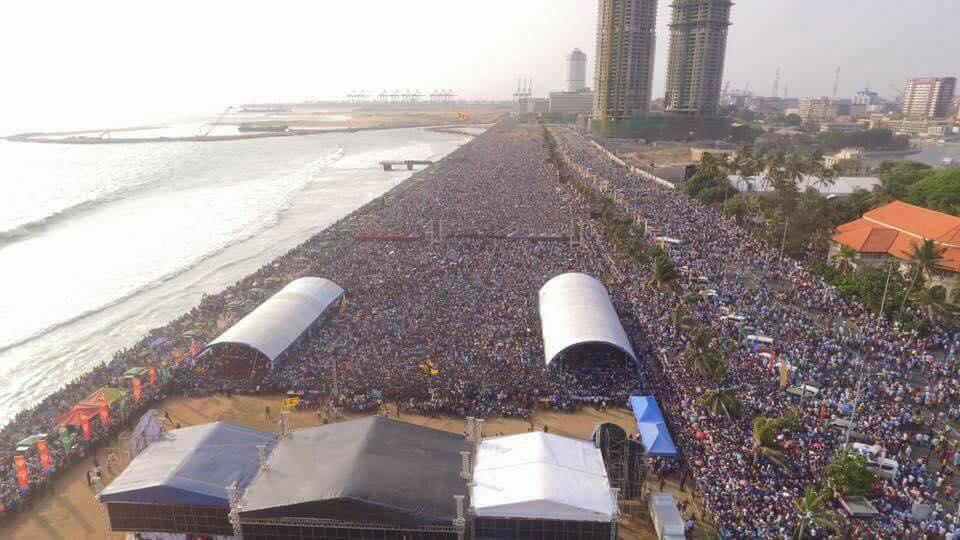
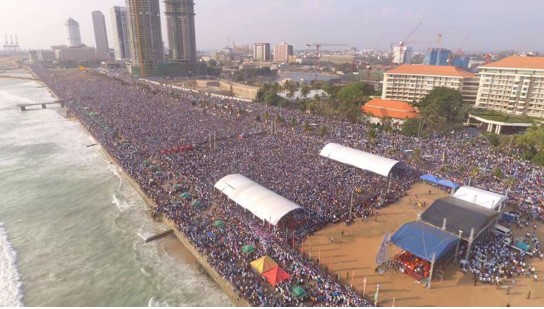
In fact on Sunday, the day before May Day, I took a drive along Galle Face to see whether the Joint Opposition would be able to fill it with crowds and my own assessment was that they may not be able to do it. This mind you, was on the assumption that Galle Face green meant only the ‘green’ part of it without the broad tarred walkway towards the sea side or the Galle Road. But what we saw on May Day was a phenomenon that no one has ever seen in this country. The Galle Face green, the broad walkway on the seaside and the main road were just one sea of heads from the Galle Face Hotel to the Bandaranaike statue on the other side of the esplanade and beyond. There were people lining the road up to the roundabout near the Kingsbury and Galadari hotels. When I was walking down Lotus Road on my way to observe the rally at around 5.00 pm, thousands of people were leaving the meeting. Usually people start leaving such meetings at around 6.00 pm. This time they would have started leaving earlier because everything began earlier.

Usually the peak of a rally would be around 5.00 pm to 6.00 pm. This time the peak of the Galle Face rally would have been around 4.00 pm to 4.30 pm. By the time Wimal Weerawansa and MR made their speeches, large numbers of exhausted people had left. The intolerable heat would have been an additional reason for people to start leaving early. The fact that two elderly participants died in the crush was quite unusual. If anybody was to get crushed or suffocated, that should have been at the Kirullapone rally last year, where the crowd was so dense that one could not even push through it. Galle Face on the other hand is the very definition of a wide open space. In fact in this country, any wide open space is often likened to Galle Face green in ordinary conversation. The fact that anyone can get crushed in such a place is a clear indication of how dense the crowd was at its peak. At around 3.30, this writer got a call from a friend who was near the Galle Face Hotel saying that two ambulances had arrived. The congestion on the green would have been at its height at around that time because of the continuous arrival of more people from both ends of Galle Face.

Crowds at meetings have always been a way of judging which way the political winds are blowing. Those above their mid-fifties and above remember the 1977 May Day held in Maradana which at that time had been considered the mother of all political meetings. But at that time, the roads in Maradana were not even as wide as they are today. Then in the run up to the 2015 Presidential election, Vajira Abeywardene speaking to this writer, predicted that Sirisena would win because the crowds attending their rallies had increased. If such is the case, what is the unmistakable message that is conveyed by the biggest political gathering ever held at Galle Face green and indeed in the country in general? The Joint Opposition was able to make this unprecedented political statement because the government underestimated the JO and gave them Galle Face thinking they would never be able to fill it.

The government in particular should not delude themselves by thinking or saying that this was a crowd that had been transported there to put on a show. Every one of those people there were die hard supporters of Mahinda Rajapaksa. They were motivated and enthusiastic. Buses may have been deployed, but no bus service can transport a crowd of that size. I got late to get to the meeting because I had to get to the Kotahena office of this newspaper before going to the meeting by trishaw, and thinking that there would be no crowd in Fort because the entrance to the Galle Face meeting was supposed to be from the Kollupitiya side, I went to Fort and got stuck in the middle of a river of people near the Fort YMBA, all marching purposefully to enter Galle Face through Lotus Road. The number of people that passed my vehicle near the YMBA would by itself have sufficed for a separate May Day rally. It is quite clear that tens of thousands of people at that meeting had come there entirely on their own.

The government went to the extent of dictating where the stage should be constructed so as to increase the embarrassment of the JO when they were not able to muster sufficient crowds but all this completely backfired on them. This rally, is for Sri Lanka as radical a political milestone as the Brexit vote was for Britain. In Britain, the Brexit platform won even though all the established political parties in Britain – the Conservatives, Labour, Liberal Democrats and even the Scottish National Party all supported the remain campaign. Likewise in Sri Lanka, the Joint Opposition managed to outdo everyone else in a situation where the UNP, SLFP and JVP were all actively openly opposing the Galle Face rally. The Sri Lanka Podujana Party which they formed to contest future elections is just a year old, yet they have already broken all records as a crowd puller not once but on multiple occasions in different locations, Galle Face being the most impressive show of strength yet. The entire political future of this country is being determined by a political force that has taken shape outside the main political parties in the country.

You can,t drink COSTA COFFEE and be working Class…Tory MP News Item in UK Independent Daily Paper

May 4th, 2017

Dr Sarath Obeysekera 

Well .I just read t statement from a conservative MP

It immediately reminds me of Sri Lanka with our newly sprung   Barista  coffee .El Gilato Ice Cream Shops ,Coffee Bean  ,Jeans Coffee, Doughnut   shops  etc .We have a majority working class who cannot even afford to buy a lunch packet at 150 to 200 rupees and when you walk into any of above Coffee shops .you may at least pay 350 Rs for a coffee or 450 Rs for a sandwich

If you ask for our famous cup of tea they will give you a cup of hot water with a bag of Tea Dust and cold container of milk ! Utter disrespect to out indigenous product!!

We still boast about Colombo which was made beautiful by previous regime , with Refurbished Dutch Hospital.Independent Square ,Race Course etc where 90 % of our population cannot even dream of entering

Kaema Suthra ,s hoppers is advertised but you pay 5 time for a horrible hopper with Lunu Miris crushed in from of you on a Miris Gala” .with such a flamboyance !

You go to Ministry of Crabs and spend over 15000 minimum for 2 persons .

Our people including MP,s and Ministers spend 30-40 million rupees for one car where he could have built 40 houses for poor .

You drive through Colombo 15 ,Sedawatta,Kelany Valley ( funny enough this is the constituent of our Minister of Finance !) where you hardly see a Barista except one McDonalds ( catering for ship staff who come to harbour)

We need a balanced approach to economy .Building highways are fine ,but we have to address the main issue .People need houses and industries’ or large scale farming to develop the country .

( I heard few years back about a minister asking for 50m $ from a Middle eastern investor who wanted to establish a mega scale farm in the East with over 500 m$ investment ..They bolted away !  )

Vietnam never had  any of them but now they develop according to quasi socialist system .

As JVP said in their May Day rally ,we need a regime change .It should be a regime with a benevolent dictator who feels the pulse of poor .

Dr Sarath Obeysekera

ඉන්දියාවේදී පරාජය වූ  “ස්වාධින ද්‍රවිඩ රාජ්‍යයක්”  සංකල්පය තමිල් ඊළම ලෙස ලංකාවේ ආරම්භ කිරීම

May 4th, 2017

රුවන් රත්නායක

ස්වාධින තමිල්  රාජ්‍යයක් පිහිටුවීමේ සංකල්පය මුලින්ම බිහි  වන්නේ ඉන්දියාවේ තමිල්නාඩුව මුල් කොට ගෙනය. ද්‍රවිඩස්ථාන් නම් ස්වාධින තමිල් රාජ්‍යයක් ඉන්දියාවේ පිහිටුවා ගැනීම පිණිස වූ  සංකල්පයට හේතුව වනුයේ උතුරු ඉන්දියානු බ්‍රහ්මණ හා උසස්කුල ජනයාගෙන්   දකුණු ඉන්දියාවේ තමිල් ජනයාද තිබූ කෙනෙහිලිකම් හා  පිඩනයෙන් මිදීමට ඔවුන්හට මගක් අවශ්‍ය වීමය. 1884  වසරේදී  මදුරාසි විශ්වවිදියාලයේ උපාධි උත්සවයේ ප්‍රධාන දේශනය පවත්වමින් එවකට සිටි ඉංග්‍රීසි ආණ්ඩුකාරයා විසින් උතුරු ඉන්දියානු ආර්ය ජනයා දකුණු ඉන්දීය අනාර්ය ජනයා හනුමාගේ වදුරු හමුදාව ලෙස අපහස කරනා බව පවසමින් කුල බේදයේ ඉස්මතු වන ආකාරයට තම කතාව පවත්වමින්  උතුරු ඉන්දීය ආර්ය ජනයා පිළිබඳව දකුණු ඉන්දීය අනාර්ය ජනයාගේ අතර තිබු කුල ගැටුම ඇවිස්සිමකට කරන ලදී.  මෙහි ප්‍රතිපලයක් ලෙස මුලින්ම ඇති වන්නේ  තමන්ට සාධාරණයක් දිනා ගැනීම සඳහා වූ අරගලයකි. එහි අරමුණ වුයේ තමිල් සමාජය මත බලපෑ අකටයුතු උතුරු ඉන්දියානු  බ්‍රාහ්මණ අධිකාරිය අවසන්කොට සමාජ සමානතාවය හා වැඩි බලයක් ,පාලනයක් ලබා ගැනීමය . එනම් මෙම ව්‍යාපාරයේ ආරම්භය හුදෙක්ම දකුණු ඉන්දීය තමිල් සමාජය මත ඇති  කුල  පිඩනයට එරෙහිව නැගී ආවෙකි.  තමනට මෙම සාධාරණය දිනාගැනීම සදහා  Justice Party”  හෙවත්  සාධාරණය සඳහා වූ පක්ෂය” නමැති තේරුමෙන් යුත් ලෙස  දේශපාලන පක්ෂය 1917 දී තමිල්නාඩුවවෙදි බිහි කරන ලද අතර එය  1921 දී මැඩ්රාස් ප්‍රසිඩන්සී හෙවත් වර්තමානයේ තමිල්නාඩු ලෙස හඳුන්වන ප්‍රදේශයේ බලයට පත්විය. මෙසේ ඇති වූ සාධාරණයක් දිනාගැනීමට යයි කියූ අරගලය පසුව ඉන්දියාවේ මධ්‍යම රජයෙන් වෙන්වූ ස්වාධින තමිල් රාජ්‍යක් ලබා ගැනීම සඳහා  වන තරමට වර්ධනය විය. පසුව Justice Party නම් දේශපාලන පක්ෂය විසින්  තමිල්නාඩුව වෙනම  ස්වාධින තමිල් රාජ්‍යයක් ලෙස ඉල්ලා සිටින ලදී.  

මුලදී මෙම සවාධින තමිල්රාජ්‍යය හෙවත්  තමිල්නාඩු සංකල්පය” ලෙස   ඉන්දියාවේ තමිල් බස කතා කරන (තමිල්නාඩු)  පෙදෙසට පමණක් සිමා වූ අතර , නමුත් පසුව එය තව දුරටත් විකාශනනය කරමින් අනෙකුත් ද්‍රවිඩ බස කතා කරනා ප්‍රාන්ත වලටත් එනම් ආන්ද්‍රා  ප්‍රදේශය, කෙරලේ සහ කරනාටක සහ ද්‍රවිඩ සුළුතරයක් වූ ලංකාවේ උතුරු නැගෙනහිර පළාත් වලටත් ඉන්දියාවේ ඔරිස්සා හා මහාරාෂ්ට යන පෙදෙසුත් මෙයට ඇතුලත් කර මෙය ද්‍රවිඩනාඩුව” ලෙස හඳුන්වනනට  යෙදින .

තමිල්නාඩුව තමිලයන්ට ලෙස ගෙන ගිය ව්‍යාපාරය  ද්‍රවිඩ නාඩුව ද්‍රවිඩයන්ට ලෙස වෙනස් වීම

තමිල්නාඩුව” තමිලයන්ට ලෙස ගෙන ගිය ව්‍යාපාරය ද්‍රවිඩනාඩුව” ද්‍රවිඩයන්ට ලෙස වෙනස් වූ ආකාරය ද්‍රවිඩනාඩු විකිපීඩියා වෙබ් අඩවියේ මෙසේ සදහන් වේ. In December 1938, the Justice Party Convention passed a resolution stressing Tamil people’s right to a separate sovereign state, under the direct control of the Secretary of State for India in London. In 1939, at the Dravida Nadu Conference for the advocacy of a separate, sovereign and federal republic of Dravida Nadu. In a speech on 17 December 1939, E.V.Ramasamy raised the slogan “Dravida Nadu for Dravidians”, which replaced the earlier slogan “Tamil Nadu for Tamils”.In 1940, the South Indian Liberal Federation (Justice Party) passed a resolution demanding a sovereign state of Dravida Nadu.

සිංහල අරුත – වසර 1938 දෙසැම්බර් මසදී Justice Party දේශපාලන පක්ෂය” තම වාර්ෂික   සමුළුවේදී, ඍජුවම  ලන්ඩනයේ ඉන්දියානු රාජය ලේකම්ගේ යටතේ වූ  වෙනම ස්වාධින තමිල්  රාජ්‍යයක් සදහා තමිල් ජනතාවගේ අයිතිය අවධාරණය   කරමින් යෝජනාවක් සම්මත කරන ලදී. ස්වාධින ෆෙඩරල් ද්‍රවිඩනාඩු ජනතා රාජ්‍යයක් වෙනුවෙන් පෙනී සිටීම සදහා වූ යෝජනාව ද්‍රවිඩ නාඩු සමුළුවේදී සම්මත කෙරින. 1939 දෙසැම්බර් 17 වන දින ඊ . වී. රාමසාමි ඔහුගේ කතාවේදී තමිල්නාඩු තමිලයන්ට” යන සටන් පාඨය ද්‍රවිඩනාඩු ද්‍රවිඩයන්ට” ලෙස  වෙනස් කරන ලදී. 1940 වසරේ දකුණු ඉන්දීය ලිබරල් සම්මේලනලනය හෙවත්”  Justice party නම්   දේශපාලන පක්ෂය” විසින් ස්වාධින වූ ද්‍රවිඩනාඩු රාජ්‍යයක් ඉල්ලා බලකිරීමට  යෝජනාවක් සම්මත කරන ලදී.

මෙම ද්‍රවිඩනාඩුව හැදින්වීමට යොදාගත් අනෙකුත් නම් වන්නේ දකුණු ඉන්දියාව”  (South India), “ඩෙකාන් සම්මේලනය” (Deccan Federation)  සහ දක්ෂිනාපත්” (Dakshinapath)ලෙස  වේ.

තමිල්නාඩුවේ ද්‍රවිඩ කසාගම්(Dravidar Kazhagam)  පක්ෂය හා (ද්‍රවිඩ මුන්නේත්‍ර කසාගම් Dravida Munnetra Kazhagam (DMK) පක්ෂ ඇති වූ ආකාරය.

1944 අගෝස්තු මස , ඊ .වී. රාමසාමි Justice Party  හෙවත් South Indian Liberal Federation”  නම්  දේශපාලන පක්ෂයන් බිඳී ද්‍රවිඩ කසාගම් පක්ෂය (DK)  බිහිකරන ලදී. පසුව 1949 වසරේ ද්‍රවිඩ කසාගම් පක්ෂයේ සිටි අන්නාදුරෙයි සහ  අනෙක් නායකයන් බිඳී වෙන්ව ද්‍රවිඩ මුන්නේත්‍රම කසාගම් පක්ෂය (DMK)  පිහිටුවන ලදී. මෙම පක්ෂය ආරම්භයේදී අන්නාදුරෙයි එවකට පැවති ක්‍රමයෙන් වෙන්  වූ වෙනම ද්‍රවිඩ රාජ්‍යයක් ඇති කිරීම සදහා  ප්‍රතිපත්තියේ දැඩිවම   එල්බ සිටින ලදී .”

ඉන්දියානු මධ්‍යම රජයෙන් වෙන්ව යාම නීති විරෝධී ලෙස ඉන්දියානු රජය  සම්මත කිරීම හා තමිල්නාඩුවේ ද්‍රවිඩ්ස්ථාන සිහිනය අත් හැරිම

1940 -1960 කාල වකවානුව තුල ද්‍රවිඩනාඩු සංකල්පය එහි උපරිම ක්‍රියාකාරිත්වයේ පසුවිය. නමුත් තමිල්නාඩුව විසින් තමිල් ආධිපත්‍ය පතුරාවී යන භීතිය නිසා මෙම ද්‍රවිඩනාඩු සංකල්පයට තමිල්නාඩුව හැර  අනෙකුත් ද්‍රවිඩ ජනයා වෙසෙන කර්ණාටක, කේරල , ආන්ද්‍රා වැනි පෙදෙස්වල  (ද්‍රවිඩ යනු තමිල්, කණ්ණඩි, කේරල, මලයාලම් නැමති දමිළ බසට නෑ කම් කියනා භාෂාවන් කථා කරනා ජන කණ්ඩායම් 4 එකට ගෙන හැඳින්වීමකි ) සහයෝගය ලබා ගැනීමට අපොහොසත් විය.  1956 දී ඉන්දියාවේ  භාෂාව අනුව ප්‍රාන්ත බෙදීම සදහා  රාජ්‍ය ප්‍රතිවීවුහකරන පනත  (States Reorganization Act)  ගෙන එමෙන් පසුව මෙම ද්‍රවිදනාඩු සංකාල්පය තවදුරටත් දුර්වල විය. පසුව 1960 වසරේදී DMK පක්ෂය අනෙකුත් නායකයන් විසින් විසින් ඔවුන්ගේ පක්ෂය තුල ද්‍රවිදනාඩු සංකල්පයේ තදින්ම එලබ සිටි ආන්නාදුරෙයි  නොමැති රැස්වීමකදී  ද්‍රවිඩනාඩුව   සදහා වූ අදහස අතහැර දමන ලදී. 1963 වසරේදී ජවහල්ලාල්  නේරුගේ නායකත්වයෙන් යුතු වූ ඉන්දියානු ආණ්ඩුව වෙන්වයාම (secessionism)” එනම්,වෙනම ඉන්දියානු මධ්‍යම රජයෙන් වෙන්ව ස්වාධින රාජ්‍යයක් ලෙස වෙන්ව  යාම නීති විරෝධී ක්‍රියාවක් ලෙස සම්මත කොට ක්‍රියාත්මක  කරන ලද දැඩි මර්ධනය  හමුවේ ද්‍රවිඩනාඩු සංකල්පය ඉන්දියාවේදී බිද වැටිනි.  පසුව අන්නාදුරෙයිද ද්‍රවිඩනාඩු ඉල්ලීම අතහැර දැමිය . මින් පසු  ø’uq’ lid.ï (DMK) mlaIh 1967 දී n,hg m;a jQ පසු  1969  දී ඉංග්‍රීසින්  විසින් ueârdia m%isvkaish ^Madaras presidency& ලෙස හැදින්වූ කලාපය  ;ñ,akdvqj ලෙස නම් කරන ලදී.  පසුව තමිල්නාඩුව වර්තමානයේ ඇති පෙදෙසට පමණක් සීමාවිය.

තමිල්නාඩුවේ අපි දෙමළු” පක්ෂය (We Tamils Party)  හා ලංකාවේ දෙමළ ඊළම

දකුණු ඉන්දියාවේ ප්‍රධාන දේශපාලන පක්ෂවලින්  ද්‍රවිඩනාඩු සංකල්පය කෙමෙන් ගිලිහෙමින් පවතින අතරතුර, ඉන්දියාවේ බිඳ වැටුණු තමිල් ඊලාම් සංකල්පය පන පොවා එය ලංකාවට ගෙනවිත්  ලංකාව මුල් කොට පිහිටවීමේ මුලික අඩිතාලම දමන්නේ  We Tamils” හෙවත්   අපි තමිල්ලු” (ලංකාවේ ව්‍යවහාර භාෂාවෙන් එනම් අපි දෙමළු) නම් වූ සංවිධනයවේ.

අනෙකුත් දේශපාලන පක්ෂ වලින් ස්වාධීනව හා වෙන්ව ක්‍රියාත්මකව ඉන්දියාවේ ස්වාධින තමිල් රාජ්‍යයක්” ඇති කිරීමේ පදනම මත පිහිටා ආදිත්තනාර්  විසින් 1958 වසරේදීය  අපි දෙමලු” We Tamils” (நாம் தமிழர் கட்சி) සංවිධධානය  ආරම්භ කරන ලදී. මෙහි  මතවාදය, ඊ . වී රාමසාමිගේ ද්‍රවිඩ කසාගම් පක්ෂයේ  ද්‍රවිඩ නාඩු මතවාදයට වඩා දැඩි ලෙස රැඩිකල් ස්වරුපයක් ගන්නා ලදී. එහි ඉල්ලක්කය  ලෙස සටහන්  වුයේ ඉන්දියාවේ හා ලංකාවේ තමිල් කථා කරන ප්‍රදේශ ඒකාබද්ද කොට ස්වදේශීය තමිල් රාජ්‍යයක් ඇතිකිරීමය. ඉන්දියාවේ තමිල්නාඩුවේ පිහිටි  අපි දෙමළු මුලස්ථානය තමිල් ඊලාම්” ලෙස නම් කරන ලදී. 1960 වර්ෂයේ මෙම පක්ෂය විසින් මදුරාසියේ ඉන්දියානු මධ්‍යම රජයෙන් වෙන්වූ  ස්වාධින තමිල්නාඩුවක්  (ස්වාධින තමිල් රාජ්‍යයක් ) පිහිටුවීම අරමුණු කොට විරෝධාතා ව්‍යාපාරයක් සංවිධානය කරන ලදී. මෙහිදී විරෝධතාකරුවන් තමිල්නාඩුව ඉන්දියාවෙන් වෙනකොට සකසන  ලද සිතියම් වල තමිල්නාඩුව හැර අනෙක් කොටස් ගිනි තැබුහ.

පසුව නේරුගේ දැඩි මර්ධන ක්‍රියාකාරිත්වය හමුවේ ඉන්දියාවේ ස්වාධින තමිල් රාජ්‍ය සංකල්පය මුළුමනින්ම අතහැර දැමීමට සිදුවූ අතර එම සංකල්පය තමිල් ඊළම” ලෙස ලංකාවේ උතුරු නැගෙනහිර පෙදෙස් ඒකාබද්ද කරමින් ස්ථාපිත කිරීමට ලංකාවේ බෙදුම්වාදී තමිල් දේශපාලකයන් හා එක්වවී සිදු කිරීමට  මොවුන් විසින් කටයුතු යොදන ලදී. ලංකාවේ තමිල් ඊළාම් ක්‍රියාකාරිත්වය හා සිදුවීම වලට අනුකුලව 1976 වඩ්ඩුකොඩේයි සම්මේලනයෙන් පසු ව්‍යාජ ලෙස ඇති කරන ලද  ලංකාවේ උතුරු නැගෙනහිර තමිල් නිජබිම් සංකල්පය හරහා  ලංකාවේ තමිල් ඊළම ස්ථාපිත කර ගැනීමේ ඉල්ලක්කය මත  පිහිටා ඉන්දියාවේදීද  මොවුන්ගේ ක්‍රියාකාරකම් පෙළ ගස්වන්නට යෙදින. ඒ පිලිබදව We Tamils” වෙබ් අඩවියේ මෙසේ සදහන් වේ.

With the elimination of LTTE Terrorism in Sri Lanka 2009, several activists in Tamil Nadu led by well known movie director and Seeman, gathered in Madurai on 18 May 2009 to review the party as a social outfit for We are Tamils Organization. Ie – Naam Tamilar Iyakkam

On 18 May 2010, a year after the Military Defeat of Terrorism activates of the Elam in Sri Lanka and on the first anniversary of the organization, the Naam Tamilar Iyakkam was converted into the Naam Tamilar Katchi.  Seeman the Chief Coordinator of the Party states, party would be an alternate political party differ from the mainstream political outfits and also claiming that the establishment of an independent Tamil  Elam would be the moral goal

සිංහල අරුත – 2009 වසරේ ශ්‍රී ලංකාවේ  LTTE ත්‍රස්තවාදය අතුගා දැමීමෙන් පසුව තමිල්නාඩුවේ ප්‍රසිද්ධ චිත්‍රපට අධ්‍යක්ෂක වරයකු සහ සීමන්ගේ  නායකත්වයෙන්  ක්‍රියාකාරීන් පිරිසක්, 2009 මැයි 18 වන දින  මදුරාසියේදී එකතුවී තම පක්ෂය (We Tamil Party) සමාජ සංවිධානයක්  ලෙස එනම් Naam Tamilar Iyakkam අපි තමිල් ව්‍යාපාරය” නමින්  ප්‍රතිවිවූහ ගත කරන ලදී.”

2010  මැයි මස 18 වන දින එනම් ශ්‍රී ලංකාවේ තමිල් ඊලාම්  ත්‍රස්තවාදී ක්‍රියාකාරකම් පරදා  පළමුවන අවුරුදු  සංවස්ත්‍ර දින, මෙන්ම 2009 දී ඇති කල අපි තමිල් ව්‍යාපාරයේ ”    (Naam Tamilar Iyakkam ) ප්‍රථම සංවස්තර දිනදී නාම් තමිලර් ඉයක්කම්” සංවිධානය නාම් තමිලර් කාචි( Naam Tamilar Katchi) එනම් අපි තමිල් පක්ෂය” ලෙස වෙනස් කරන ලදී. මෙම පක්ෂයේ ප්‍රධාන සම්බන්ධිකාරක සිමන් පවසා සිටින්නේ, මෙම පක්ෂය ප්‍රධාන  දේශපාලන ධාරාවෙන් බැහැරවූ විකල්ප දේශපාලන පක්ෂයක් වශයෙන් ක්‍රියාත්මක වෙමින් ස්වාධින වූ තමිල් ඊලාම් රාජ්‍යයක් ස්ථාපිත කිරීමේ  ඉල්ලකය අධිෂ්ටාන කොට  ක්‍රියාත්මක වන බවය.”

එනම්, ඉහත දැක්වූ පරිදි තමිල් ඊලාම් නිජබිම් සංකල්පය ප්‍රථමයෙන්  බිහිවන්නේ මැඩ්රාස් ප්‍රසිඩන්සිය  හෙවත් වර්තමාන තමිල්නාඩුවේ වෙනම තමිල් රාජ්‍යයක් නිර්මාණය කර ගැනීමට උදෙසා මිස ලංකාවේ තමිල් ඊළම් රාජ්‍යයේ මුලස්ථානය ඇතිකර ගැනීම සදහා නොවේ. එහෙත් නේරුගේ ආන්ඩුව විසින් බෙදී වෙන්විම  නීතිමය වශයෙන් තහනම් කල අතර පැන නැගුණු  විරෝධතා අධි බලය යොදා ව්‍යර්ථ කල හෙයින් එම දෙමල රාජ්‍ය සිහිනය බොඳ වී ගියේය. ඔවුන්හට තමිල්නාඩු ප්‍රාන්තය ලෙස ෆෙඩරල් ප්‍රාන්තයක්(නම වෙනස්වීම් පමණි , මැඩ්රාස් ප්‍රසිඩන්සියමය)    ලැබුණද  ස්වාධින තමිල් රාජ්‍යයක් ගොඩ නගා ගැනීමට නොහැකි විය.

ප්‍රධාන පක්ෂ නියෝජනය කල  තමිල් නායකයන් තමිල්නාඩුවේ  වෙනම ද්‍රවිඩ රාජ්‍යයක් සංකල්පයෙන් ඉවත්ව ඉන්දියාවේ ඉදිරිපත් වූ ෆ්රෙඩරල් ව්‍යවස්ථාවට අනුකුලත්වය දක්වන්නට විය.  එයට සමගාමිව  1949 වසරේ දී ලංකාවේ දෙමල රාජ්‍ය පක්ෂය”එනම් ඉලන්කෙයි තමිල් අරුසකච්චි   බිහි කොට Fedral Party” ලෙස හඳුන්වා දීම  මගින් පෙනී යන්නේ පක්ෂයේ නමටම අනුව ඉන්දියානු බෙඳුම්වාදී නායකයන් හා මෙරටේ තමිල් නායකයන් අන්තර සම්බන්දතා සහිතව ඉන්දියාවේ ඇති වන සංකල්ප ලංකාවට නිරන්තරයෙන්ම හඳුන්වා දෙමින්  බෙදුම්වාදය දෙරටේම සමගාමිව ක්‍රියාත්මක කල  බවය. භාෂා අනුව බෙදු ප්‍රාන්ත ක්‍රමය ඉන්දියානු තමිල් නායකයන් පිළිගත් බැවින් ඉන්දියාවේ  ගිලිහෙමින් තිබු  තම සිහිනය වන  ස්වාධින තමිල් රාජ්‍ය සංකල්පය ලංකාවට ගෙන ඒමට මුලික අඩිතාලම දැමු   අපි තමිල් පක්ෂයට ” ඉතුරු වූ විකල්පය වුයේ තම පක්ෂයේ ප්‍රතිපත්තියේම සදහන් වන ආකාරයට ඉන්දියාවේ ගිලිහුණු තමිල් ඊලම ලංකාව තුල ස්ථාපිත කරලීමයි. .1920 දශකයේදී  Jaffna Youth Congress එනම් යාපනයේ තරුණ කොංග්‍රසය  හරහා ඉන්දියාවෙන් ගෙනෙන ලද බෙදුම්වාදයේ මුල් බිජ ලංකාවේද වපුරා තිබුනද,  තමිල් බෙදුම්වාදිනට  හා ලංකාවේ තමිල් දේශපාලඥයන්  හට මෙරටේ ස්වාධින තමිල් රාජ්‍යයක් පිහිටවීමට සඳහා මෙම රටට අයිතිවාසිකමක්  කියා පෑමට ඔප්පු කල හැකි කිසිදු සාක්ෂියක්  නොමැති විය. එසේ සිටි ඔවුන් හට කේ. ඉන්ද්‍රපාලන් මහතා 1965 -67 අවටත්  එසේම  1971-72 අවට දී  පත්මනාදන් මහතා විසින් තම පස්චාත් උපාධි  සඳහා ලන්ඩන්  විශ්වවිද්‍යාලට ඉදිරිපත් යාලපනම් වෛපවමාලේ ග්‍රන්ථය පදනම් කොට සැකසු කරන නිබන්දනවලට  උපාධි පිරිනැමීමත්  සමගම යාලපනම් වෛපමාලේ ව්‍යාජ ඉතිහාසයට ශාස්ත්‍රීය වටිනාකමක් ලැබී මෙරටට අයිතියක් කියා පෑමට මාර්ගයක් මෙරටේ තමිල් බෙදුම්වාදී දේශපාලකයන්ට විවර විය. හුදෙක් නිබන්ධනයකට විශ්වවිද්‍යාලයක් හරහා ආචාර්ය උපාධියක් පිරිනැමීම හේතුවෙන් ව්‍යාජ ඉතිහාසයක් සත්‍ය ඉතිහාසයක් වන්නේ නැත. 1815 උඩරට ගිවිසුමෙන් ඉංග්‍රීසින් රට භාර ගන්නා විට සිංහලයා හැර කිසිදු පර ජනයකු මෙරටේ රටවැසියන්/පුරවැසියන් නොවූ අතර ස්ථිර දෙමළ හෝ මුස්ලිම් ජනාවාස මෙරටේ නොවිය. අමු අමුවේ උඩරට ගිවිසුම් 1818 උල්ලංඝනය කල ඉංග්‍රීසින්,  මෙරටේ පරම බලය ඉංග්‍රීසින් බව සහ සිංහලයා යනු යටත් වැසියන් ලෙස  ඒක පාර්ශ්වික නිවේදනයක් නිකුත් කොට මෙරටේ නීති විරෝධී පාලනයක් ස්ථාපිත කළහ.  1948 නිදහස ලබා දුන්නේ යයි සිංහල බසින් අර්ථ දැක්වුවද සත්‍ය වශයෙන්ම සිදු කරන ලද්දේ එංගලන්තයේ  වෙස්ට්මිනිස්ටර් පාර්ලිමේන්තුවේන් මෙරටේ තීරණ ගැනීම මුදවා එය ඉංග්‍රීසි අනුප්‍රාප්තිකය නියෝජිතයන්ගෙන් සැදුම්ලත් වෙස්ට්මිනිටර් පාර්ලිමේන්තුවේ ශාකාවක් ලෙස අර්ථ දැක්විය හැකි ලංකා පාර්ලිමේන්තුවට පැවරීමය. එනම් Indipendance”  යනු රදා පැවතීමෙන් මිදීම මිස Freedom” හෙවත් නිදහස නොවේ. ඉංග්‍රීසින් විසින් මලබාර්” (දෙමළ බස කථා කරන හින්දු හා ඉස්ලාමිය ජනයා) ලෙස පොදුවේ හඳුන්වන ලද දෙමළ බස කථා කරනා දකුණු ඉන්දියාවෙන් ගෙනෙන ලද ජනයා මෙරටේ ස්ථිර ලෙස පදිංචි කොට මෙරටේ නීති විරෝධී ලෙස ජන සංයුතිය වෙනස් කොට, මෙම පර ජනයා ඉංග්‍රීසි අධ්‍යාපනය හරහා ඉහලට ඔසවා,  මෙරටේ සිවිල් සේවයේ හා පාලනය තුල සිංහලයාට එරෙහිව ප්‍රබල ලෙස ස්ථාපිත කරන ලදී. එනම් 1948 නිදහස ලබා නොදී   Indipendance” පමණක් ලබා දී   1972 තෙක් ඩොමිනියන් තත්වයෙන් මෙරටේ පාලන බලය තම ග්‍රහණයේ තබා ගනිමින්  මෙරටේ පාලන තන්ත්‍රය තුල තමිලයන් ස්ථාපිත කිරිමට ක්‍රියාත්මක වූ ඉංග්‍රීසින් විසින්   ඔප්පු නොකරන ලද ව්‍යාජ තමිල් ඉතිහාසයක්ට තමන්ගේ  විශ්වවිද්‍යාලයකින්  ශාස්ත්‍රීය වටිනාකමක් දීමට ක්‍රියාකිරිම අරුමයකට කරුණක් නොවේ. ඉංග්‍රීසින් මෙරටේ පාලන බලය අල්ලා ගත් දින සිට වර්තමාන රජයේ ඉදිරිපත් කිරීමට සැරසෙන ව්‍යවස්ථාව තෙක්ම සෑම විටම ක්‍රියාත්මක වන්නේ  තමිල්යන්ට හිතවත් ආකාරට බව නොරහසකි. ඒ සදහා නිරන්තරයෙන් සෘජුව හා වක්‍රව තම ආධිපත්‍ය ලංකාවේ පාලන තන්ත්‍රය මත ඉංග්‍රීසින් විසින් අද දිනත් ක්‍රියාත්මක කරනු ලබති.

තමිල්නාඩුවේ පිහිටුවීමට සැලසුම් කොට අසාර්ථක වූ ස්වාධින තමිල් රාජ්‍යය” ඉන්දියාවෙන් ලංකාවට  ගෙන ඒමට මාන බලමින් සිටි ඉන්දියාවේ හා ලංකාවේ තමිල් දේශපාලකයන් හා බෙදුම්වාදීන්හට හට ඉහත පෙන්වා දුන්සේ වෛපවමාලේව ව්‍යාජ  සුරංගනා කථාව පාදක කොට ලියැවී සාස්ත්‍රීය වටිනාකමක් ආරෝපිත විශ්වවිද්‍යාල නිබන්දන  සහ  ක්ලේහෙගොන් නැමති මෙරට ප්‍රථම ඉංග්‍රීසි යටත් විජිත් ලේකම් විසින් උදෘතයක් ලෙසින් තබන ලද ව්‍යාජ සටහනක් ස්වාධින තමිල් රාජ්‍යය”  සංකල්පය ලංකාවට ප්‍රවිශ්ට කරවීමට මාර්ගයක් විවර කර දුන් අතර මේවා   අනුසාරයෙන් වඩ්ඩුකොඩේයි  සම්මේලනය හරහා උතුරු නැගෙනහිර තමිල් ඊළම” නිජබිම් සංකල්පය ලංකාවේ එලි දැක් විය.  ඉන්දියාවේ සවාධින තමිල් රාජ්‍ය සංකල්පය බැහැර කලද තමිල්නාඩුවේ සියලුම දේශපාලකයන්ගේ හා දේශපාලන පක්ෂවල ආශිර්වාදය උපකාරය ලංකාව තුල ස්ථාපිත කිරීමට උත්සහ දරන  ස්වාධින තමිල් පාලනය වෙත නිරතුරුවම ලබා දෙන බව නොරහසකි.

මෙහිදී ඉන්දියාවේ තමිල් බෙදුම්වාදය හා ලංකාවේ තමිල් බෙදුම්වාදය අතර අපි තමිල් පක්ෂයේ” සෘජු සම්බන්දතාව හා දායකත්වය සම්බන්දතාව  පහත සදහන් කාරනා  මගින්  මොනවට පැහැදිලි වේ.

අ. අපි තමිල් පක්ෂයේ” ප්‍රතිපත්ති ප්‍රකාශනයේම සදහන් වන ඉන්දියාවේ හා ලංකාවේ  පරමපාරික දමිල  නිජබිම් යයි කියා ගන්නා ප්‍රදේශ  එක් කොට තමිල්  රාජ්‍යයක් තැනීමේ  අරමුණ.

ආ. තමිල්නාඩුවේ ඔවුන්ගේ පක්ෂ මුලස්ථානය තමිල් ඊළම්” ලෙස නම් කිරීමත්

ඇ. LTTE සංවිධනයේ නිල ලාංජනය, අපි තමිල් පක්ෂයේ නිල ලාංජනය විකාශයක් වීමක්,  යන කරුණු වලින් හා ඉහත සදහන් කල සේ ලංකාවේ තමිල් ඊළාම් ක්‍රියාකාරකම් වලට අනුරූපව අපි තමිල් පක්ෂයේ”  ඉන්දියාවේ ක්‍රියාකලාපය හැසිරවීම මත  ලංකාවේ බෙදුම්වාදයට මොවුන්ගේ සෘජු බලපෑම පැහැදිලිව පෙන්නුම් කරයි. 


We Tamil Party”  Flag  (අපි තමිල් කොඩිය)                

LTTE Flag (LTTE කොඩිය)

මිට අමතරව we TImils Party හි  විකිපීඩියා වෙබ්  අඩවියේ සදහන් වන ආකාරයට,  (ශ්‍රී ලංකාවේ තමිල් ඊලාම් ක්‍රියාකාරී කටයුතුවල වෙනස් වීම  කේන්ද්‍ර කොට ගනිමින් ක්‍රියාත්මක වෙමින්)  2009.05.18 දිනම  එනම් ලංකාවේ ත්‍රස්‌තවාදය පරාජය කල දිනම We Tamils Party ලංකවේ උතුරු නැගෙනහිර තමිල් ජනයා සදහා සමාජ සංවිධානයක් ලෙස  Naam Tamilar Iyakkam අපි තමිල් ව්‍යාපාරය” නමින් නම් කිරීමත්, ත්‍රස්තවාදය පරාජකිරීමේ පළමු  සංවත්සර දින එනම්  2010.05.18 මෙම සංවිධානය  Naam Tamilar Katchi නම් වූ දේශපාලනය පක්ෂයක් ලෙස ප්‍රතිසංවිධාන කිරීමෙන් පෙනී යන්නේ ඉන්දියාවේ තමිල් රාජ්‍යය පිහිටුවීමේ අරමුණ නොව වර්තමානයේදී මොවුන්ගේ මුලික අදිටන ලංකාවේ දෙමල ඊළම පිහිටුවීම බවය. ත්‍රස්තවාදය පරාජය කොට වසරකින් පසු තමිල් බෙදුම්වාදීන් දේශපාලන මුහුණුවරකින් පෙනී සිටින්නේ ත්‍රස්තවාදයෙන් නොහැකි වූ දෙය දේශපාලනය හරහා ඉෂ්ඨ  කරගැනීමය. එසේනම් TNA හරහා ශ්‍රී ලංකාවේ  දැන් සිදුවන්නේ එයම නොවේද? 24.09.2106 දින යාපනයේ  එලගු තමිල්” තමිලුනි නැගිටිවූ යනු මෙම දේශපාලන පක්ෂයේ හා ලංකාවේ තමිල් බෙදුම්වාදීන්ගේ හා ඇතැම් තමිල් බෙදුම්වාදී  දේශපලකයන්ගේ ක්‍රියාකරිකමකි. මෙම එළුගු ටැමිල් ක්‍රියාකාරකම් පිටිපස ක්‍රිස්තියානි මිෂනාරීන්ගේ බළල් අත් ක්‍රියාත්මක බවටද චෝදනා එල්ල වී තිබේ.  1987 එවකට ජනාධිපති හා පාර්ලිමේන්තුව, නිජබිම් පිළිගැනීමත් සමගම ලංකාවේ ඉතිහාසය විකෘති කොට දක්වා තමිල්ල්ලු ඇතිවුයේ ලංකාවේ බවත්, පසුව ඔවුන්ගෙන් කොටසක් දකුණු ඉන්දියාවටත් සංක්‍රමණය වූ බවට බොරු මතයක් ගොඩ  නගා පතුරවති . මෙය ආණ්ඩුවේ පාසැල් තුලින් තමිල් ළමයින්ගේ මනසට ඇතුල් කරන බවට චෝදනා ඇත. එනම් ඉදිරියේ බිහිවන තමිල් පරම්පරාව වැරදි ඉතිහාසයක් ඉගෙන ගෙන වර්තමානයට වඩා විනාශයක් සිදු කිරීමේ අවධානමක් පවතී. නවතම ප්‍රවනතාව නම්  පසුගිය 24.09.2106 දින එලගු තමිල්” උද්ඝෝෂණදී උතුරු පළාත් මහඇමති විග්නේශ්වරන් විසින් ඉතිහාසය විකෘති කරමින් කියා සිටියේ තමිල් ජනයාගේ ඉතිහාසය මෙරට වසර 2000 බවත් පසුව තමිල් ජනයාගෙන් කොටසක් සිංහල බවට පත් වී සිංහලයන් ඇති වූ බවය. ඉන්දියාවේ ඇති වූ එලංගු තමිල්” හෙවත් අපි තමිල් ව්‍යාපාරය එදා සිට මේ වනතෙක්ම  ලංකාවේ ක්‍රියාත්මක බව  සහ ලංකාවේ තමිල් දෙෂ්පඥයන්ගේ මෙයට ඇති ඍජු  සම්බන්ධය ඔප්පු කරමින්  24.09.2016 දින උතුරු පළාත් මහ ඇමතිගේ මුලිකත්වයෙන් පන්සල් බුදු පිළිම ඉවත් කරන ලෙස හා සිංහල ගම්මාන , හමුදා කදවුරු ඉවත් කරන ලෙස යාපනයේදී ක්‍රියාත්මකවූ විරෝධතාව ඊට කදිම නිදසුනක් සපයයි. එනම් ඉන්දියාවේ පරාජය වූ බෙදුමවාදය ලංකාවේ ක්‍රියාත්මක කිරීම හා ඊට ලංකාවේ බෙදුම්වාදී දේශපාලකයන්ගේ  සම්බන්දය මින් නිත්‍යලෙස  ගම්‍ය වේ.


මෙරටට වහල් කුලී සේවකයන් ලෙස ගෙනෙන ලද මලබාර් ජනයා ඉංග්‍රීසින් විසින් සිවිල් සේවයේ සහ රාජ්‍ය පාලනය තුල ඔසවා තැබූ පසු 1910 වයවස්තාදයක් සභාවට  දොස්තර මාක්ස් ප්‍රනාන්දු පරදා පොන්නම්බලම් රාමනාදන් ජය ලැබීමත් සමගම මෙරටේ පාලන බලය ග්‍රහණය කර ගැනීමේ සිහිනය තමිල් දේශපාලඥයන්ට  ඇති විය. එහෙත් 1920 මැනින් හා 1930 දශකයේ මුල වූ ඩොනමෝර් ප්‍රතිසංස්කරණය නිසා මොවුන්ගේ සිහිනය ගිලිහි යන ලදී. ලංකාවට මුලින්ම වෙනම තමිල් රාජ්‍ය සංකල්පයේ බීජය ගෙන එන ලද්දේ  යාපන තරුණ කොංග්‍රසය හරහාය.

යාපනයේ  තරුණ  කොංග්‍රසය (Jaffna Youth Congress) 

යාපනයේ ශිෂ්‍ය කොංග්‍රසය 1924 දී පිහිටුවන ලදී. එය 1926 දී යාපනයේ තරුණ කොංග්‍රසය (JYC)  ලෙස නම වෙනස් කිරීමකට ලක් කෙරින . එහි පදනම මධ්‍යම පාන්තික උගත් තරුණයන් අත  පැවති අතර, විශේෂයෙන්ම ඉන්දියාවේ විශ්වවිද්‍යාල වල හා ලංකාවේ අලුත් විශ්වවිද්‍යාල වල තරුණයන්ගෙන් මෙය සමනවිත් විය.ඉන්දියාවේ ප්‍රධානපෙලේ දේශපාලකයෝ යාපනයට පැමිණීමෙන් යාපනයේ තරුණ කොංග්‍රසය සදහා  උද්යෝගයක් හා  මානසික උද්දීපනයක් ඇති විය. වසර 1927 දී යාපනයේ තරුණ කොංග්‍රසය විසින් ඉන්දියාවේ නිදහස් ව්‍යාපාරයේ නායක මහත්මා ගාන්ධිහට යාපනයට පැමිණෙන ලෙස ඇරයුම් කරන ලදී. 1931 වසරේදී කමලාදේව් චට්ටෝපාධ්‍යය් (Kamaladevi Chattopadhyay ) සමාආරම්භ සභාව අමතමින් යාපනයේ තරුණ කොංග්‍රසයේ කුණාටුවක් මෙන් පැතිර යාමකට ලක් කළේය.

ඉන්දියාවේදී  සිදු කල ආකාරයටම, යාපනය තරුණ සංගමයද ක්‍රියාත්මක වුයේ සිංහලයන් සමග  සම්බන්ද නොවී තමන්ටම අන්නන්නය වූ, ලංකාවේ වෙනම තමිල් ස්වාධින  පාලනයක්   බ්‍රිතාන්‍යයෙන් ලබා ගැනීම සදහාය. මෙම හේතුව මත මෙය මෙරටේ දකුණේ බුද්ධිමතුන්ගේ ගෞරවයට පාත්‍රවූ බව ඔවුන් විසින් පවසා සිටින අතර , යාපනය තරුණ කොංග්‍රසයේ සැසිවාරය අමතමින් එස්. ඩබ්ලිවු. ආර් . ඩි බණ්ඩාරනායක මහතා ප්‍රථම වතාවට ලංකාවේ ෆෙඩරල් ව්‍යවස්ථාව වෙනුවෙන් පෙනී සිටියේය. පහත් දේශපාලන වාසි තකා ෆෙඩරල් ව්‍යවස්ථාවක් වෙනුවෙන් පෙනී සිටීම සහ ඒ හරහා ගොඩ නැගුනු ක්‍රියාකාරකම් තුලින්  රටට සිදු වූ මෙම විනාශයේ මුලට උල් පන්දම් දීම  සදහා බණ්ඩාරනායක මහතා විසින් වග කිව යුතු වේ. නිලපෙරුමාල් පරම්පරාවේ  තාත්තා එදා කියූ දේ දුව අද  දුව විසින් සංහින්දියාව  , සහජීවනය, සර්වාගම හා නව ව්‍යවස්ථා සංශෝදනය හරහා ඉෂ්ට කර දෙමින් සිටි.

ඩොනමෝර් ප්‍රතිසංස්කරණ  ලංකාවට හඳුන්වා දෙන අවස්ථාවේ තමිල් ජනයා වෙනුවෙන් ඉල්ලා  සිටින ලද  ස්වයං පාලනයට ඉංග්‍රීසි ආණ්ඩුව එකගනොවූ බැවින්  ප්‍රථම රාජ්‍ය ව්‍යවස්ථාදායක සභා ජන්ද වර්ජනයක් යාපන තරුණ කොංග්‍රසය විසින් ඉතා සාර්ථකව හසුරවන්නට යෙදින.”

මෙමගින් පැහැදිලි වන්නේ ස්වයං පාලනයක් සඳහා වූ බීජය ලංකාවට මුලිකව  පැමිනෙන්නේ ඉන්දියාවේ තමිල්නාඩු ස්වාධින තමිල් රාජ්‍යයක්” යන සංකල්පයයෙන්  බවය. මෙහි බීජය රැගෙන් එන්නේ ඉන්දියානු විශ්වවිද්‍යාල වලින් බිහි වූ උපාධිධාරීන් බව පෙන්වා දී ඇත. එසේම ඉන්දියාවෙන් ගෙන එනලද  මෙම සංකල්පය තමාට උරුම නොමැති ලංකාවේ පාලනය දැහැ ගැනීමට සිහින මවමින් සිටි දේශපාලකයන්ගේ අභිමතාර්ථය හා කදිමට ගැලපුණි. එසේනම් 1921 Justice Party ඉන්දියාවේ ගෙන ගිය අරගලයට සමගාමිව ලංකාවේද සිංහල ජාතියෙන් වෙන්ව වෙනම අනන්‍යතාවයකින් හා බ්‍රිතාන්‍ය මත රදා නොපැවතිය යුතු ස්වයං පාලනයක සංකල්පය මත යාපනයෙන් මෙම ව්‍යාපාරය පටන් ගෙන ඇත. එසේම, 1920 මැනින්  ප්‍රතිසංස්කරණ හමුවේ ලද පරාජයත් සමග පොන්නම්බලම්රාමනාදන්  හට මෙරටේ පාලන බලය අල්ලා ගැනීමේ සිහිනය බොඳ වීමට පටන් ගැනීමත් සමගම ඊට සමගාමිව ඔවුන්ගේ ක්‍රියාකාරකම් හා එකට  යමින්  1931 වන විට  යාපනය තරුණ කොංග්‍රසය හරහා ස්වයං පාලනයක් සදහා වූ ඉල්ලීම් ඉතාම ප්‍රබල මට්ටමින් ඉදිරිපත් කිරීමට යෙදී ඇත. ඩොනමෝර් කොමිසමෙන් එයට අවස්ථාව නොලැබූ විට එය වර්ජනය කිරීමට තරම් මොවුන් ක්‍රියාත්මක විය.  ඩොනමෝර් ප්‍රතිසංස්කරණයෙන් බිඳවැටුණු ලංකාවේ තමිල් ස්වයංපාලන සිහිනය නොයෙක් මුහුණුවර මගින් මෙරටේ නොයෙක් ගැටළු ඇති කරන ලදී. විටෙක එය ෆෙඩරල් සංකල්පයක් ලෙස ඉඟි කෙරින, විටෙක එය සිංහල භාෂාව රාජ්‍ය භාෂාව කිරීමෙන් දෙමළ ජනයාට අසාධාරණයක් වූ බව කියමින් තවත් මුහුණුවරක් ගන්නා ලදී , තවත් අවස්ථාවක ප්‍රථම ශ්‍රී” අකුර සහිත වාහනය යාපනයට ඇතුල් වූ පසු ඝාතනයක් සිදුකොට රථයට ගිනි තැබීම වැනි ප්‍රචණ්ඩත්වය කරා ගොඩ නැගුණි. අවසානයේ වඩ්ඩුකොඩේ සම්මේලනය හරහා උතුරු නැගෙනහිර තමිල් නිජබිම් ලෙස ඉන්දියාවේ මර්ධනය කරනු ලැබූ තමිල් ස්වාධින රාජ්‍ය සංකල්පය ලංකාවේ සාර්ථකව ව්‍යාජ ඉතිහාසයක් හරහා සමාරම්භ කරන ලදී.

.

මේ සියල්ලෙන්ම ඉතාම පැහැදිලිව ඔප්පු වන්නේ මෙරටේ පාලන බලය අල්ලා ගැනීමට මෙරටේ තමිල්  නායකයන් දැරූ උත්සාහය සහ ඉන්දියාව තුල බිහිවූ ස්වාධින තමිල්  රාජ්‍ය සංකල්පය ඉන්දියාවෙන් පරාජය වූ නිසා  අප රටට ගෙනවිත්  එකට එක්කර , දැන් ඔවුන් පිහිටවීමට බලාපොරොත්තුවන මහා ද්‍රවිඩස්ථානයේ  මුලස්ථානය  ලංකාවේ උතුරු නැගෙනහිර ප්‍රදේශ මුල් කොට පිහිටවිමයි. එනම්, ඉන්දියාවේ පෙර ඇති වූ ද්‍රවිඩස්ථාන සංකල්පයට එහා ගිය මහ ද්‍රවිඩස්ථාන සංකලපයක් ගොඩ නගා ඇත. ඔවුන්ගේ පළමු අදියර ලංකාවේ උතුරු නැගෙනහිර ස්වාධින  තමිල්  රාජ්‍යය  පිහිටුවීමට.  දෙවන අදියර ලෙස ලංකාවේ උතුරු නැගෙනහිර මුල් කොටගෙන ඔවුන්ගේ මහ ද්‍රවිඩස්ථාන් රාජ්‍යය ඇති කිරීමය. මේ පිලිබඳ ලංකාවේ හිටපු ඉන්දියානු මහකොමසාරිස්වරයකු වන  ජේ . එන් ඩික්සිත් මහතා විසින් රචිත කොළඹ භූමිකාව කෘතියේ සිංහල පරිවර්තනයේ පිටු අංක 122 හි මෙසේ  සදහන් වේ.  1996 අග වන විට LTTE ප්‍රචාරාත්මක ව්‍යාපාරයහි විශේෂ වැදගත් මට්ටමේ උසස් දේශපාලනික අභිලාෂයන් ඉස්මතු වන්නට පටන් ගති.ද්‍රවිඩ අභිලාෂයන මුදුන් පමුනවා ගැනීම සඳහා මුලික වශයෙන්  තමිල් ඊළාම රාජ්‍යය ශ්‍රී ලංකාව තුල  පිහිටවන අතර ඉන්පසු තමිල්නාඩුව  , ශ්‍රී ලංකාව , අග්නිදිග ආසියාවේ වැඩි වශයෙන් ද්‍රවිඩයන් වාසය කරන ප්‍රදේශ හා මොරිෂස් යා කරමින් ද්‍රවිඩ ඊළම රාජ්‍යයක් පිහිටවීක්ම සදහන් විය .මෙම සංකල්පයේ පදනම වුයේ ඉන්දීය භුමියේ දකුණු දිග කලාපයේ හා ඉන්දියන් සාගරයේ උතුරට වන්නට පැවති අති පැරණි වාර්ගික- භාෂාමය ශිෂ්ටාචාරය වත්මන් ජාතික රාජ්‍ය ව්‍යුහය  ඉක්වමින් යළි ඇති කිරීමයි”

ඉහත සදහන් කරන ලද සියලුම කාරනා සහ  ජේ. ආර් ජයවර්ධන ආණ්ඩු සමයේ මෙරටේ සිටි ඉන්දියානු මහකොමසාරිස්වරයාගේ කෘතියේ එම උදෘතයෙන් උතුරු නැගෙනහිර තමිල් නිජබිම් සංකල්පයේ බොරුව හා ඒ තුල සැඟවූ ඉන්දියාවේ හා ලංකාවේ තමිල් බෙදුම්වාදීන්ගේ හා බෙදුම්වාදී දේශපඥයන්ගේ  යටි අරමුණු ඉතාම හොදීන් පැහැදිලි වේ.

ඉන්දියාවේ සිට ලංකාවට පැමිණි ස්වාධින තමිල් රාජ්‍ය සංකල්පයේ  විකාශනය සංශිප්ත ලෙස මෙසේය ,

තමිල් ජනයාට උතුරු ඉන්දියානු  බ්‍රාහ්මණ වාදයෙන් සාධාරණයක්  > තමිල්නාඩුවේ ස්වාධින තමිල් රාජ්‍යයක් > ඉන්දියාවේ ද්‍රවිඩ බසට නෑකම් කියනා භාෂා  කථා කරනා ප්‍රදේශ එක් කොට ද්‍රවිඩ් ස්ථානයක්   >  ඉන්දියාවේ භාෂා  අනුව ප්‍රාන්ත බෙදීම නිසා ස්වාධින තමිල් රාජ්‍ය සංකල්පය ඇතැම් දෙශපාලකයක් අත් හැරිම හා ඊට සමගාමිව අපි දෙමල ව්‍යාපාරය හා දේශපාලන පක්ෂය  බිහි කොට තමිල්නාඩුව හා ලංකාවේ උතුරු නැගෙනහිර ප්‍රදේශ මුල් කොට ඊලම් රාජ්‍යයක් > ලංකාවේ උතුරු නැගෙනහිර ඊලම් රාජ්‍යයක් > ලංකාවේ උතුරු නැගෙනහිර , ඉන්දියාවේ ද්‍රවිඩ කතාකරනා පෙදෙස් සහ අග්නිදිග ආසියාවේ ද්‍රවිඩ ජනයා සිටිනා පෙදෙස් එක කරමින් මහා ද්‍රවිඩස්ථානයක්. ලෙසට වේ.


රුවන් රත්නායක

Joint Opposition challenges the government to hold an election

May 4th, 2017

By Ayshwarya Yapa Courtesy  Adaderana

We won the challenge made by the Government to fill the Galle Face area for the May Day rally, and we in turn challenge the Government to hold an election without delay, MP Namal Rajapakse says.

He stated this today (03) at a media briefing with the Joint Opposition.

MP Namal Rajapakse stated that the May Day rally gathered people who are against the unpatriotic reign and people who are faithful to Mahinda, adding that he hopes that this will help the President and Prime Minister realize what the country really needs.

He also stated that the country’s power was now completely vested in former president Mahinda Rajapakse and added that he hoped the Government would  rise to the challenge and organize an election as soon as possible.

Parliament has become powerless – Wimal

May 4th, 2017

Parliament has become powerless – Wimal

ආණ්ඩුක්‍රම ව්‍යවස්ථා සම්පාදක මණ්ඩලයේ අතුරු කමිටුවේ වාර්තාව තුළින් පාර්ලිමේන්තුව බෙලහීන තත්ත්වයට පත්ව ඇතැයි ජාතික නිදහස් පෙරමුණේ නායක පාර්ලිමේන්තු මන්ත්‍රී විමල් වීරවංශ මහතා පවසයි.

New Constitution Solution to unknown problems

May 4th, 2017

By Ananda Ariyarathne Courtesy Ceylon Today

“Whether we like it or not, as long as we keep on and identify people as ours, yours, theirs, his or hers, we will set our barriers and obstacles in our own minds. We are first prejudiced and then try to look at issues and automatically we create a frame of mind that cannot be appeased truly. The problem with us is the fact that we try to understand problems, ignoring the true root causes.

Reaching a consensus becomes a matter of fooling ourselves.”

In a recent interview by Mirudhula Thambiah of Ceylon Today, the Northern Provincial Councillor Ananthi Sasitharan had very clearly stated that the leader of the Tamil National Alliance (TNA)

R. Sampanthan has forgotten the issues of their people. The Provincial Councillor went on the say that Sampanthan abandoned the cause of the grievances of the people.

Missing persons

The issue relating to missing persons is one of the strongest allegations levelled against the government. Leaving aside her chauvinistic attitude, there still remains the possibility of mishandling of information. The inability to pursue the issue itself looks awkward as there seems to be an element of uncertainty. In the first place, why should the activists like Ananthi Sasitharan herself leave such a grave thing in the hands of a person like R. Sampanthan? Finding information cannot be that complicated. It is just a case of waiting for things to happen.

Village is a geographical area where everybody knows each other. Is it possible to have people living in secrecy? It is a matter of simple arithmetic. If the village had 500 students, is it difficult to find out how many pursued education? How many of them went abroad to be with their relations? How many ended up in refugee camps in India? How many of them were conscripted into LTTE combat forces? Then where did they serve? Definitely there would be people among the rehabilitated LTTE combatants. With whom were they? Where did they have skirmishes with the armed forces? Who were the commanders and under whom did they serve?

These are some of the simplest questions that would bring about the true picture. If a young person had met with his untimely death, who will know about it? Ananthi definitely has ways and means to find it out. But has she really done anything to find it out?

How many had escaped to different countries but now prefer to stay missing while their closest family members know where they are.

Whether Ananthi accepts or rejects it, the reality that people went missing since the LTTE started its power struggle that resulted in eliminating opponents. Once the LTTE gained full control there was no one to question its methods adopted to increase its cadre?

United Nations

Then another problem crops up. The United Nations and other international agencies which operated in the war regions have given figures which tally with a survey done after the war. Another ridiculous fact is that even the Tamilnet had figures lower than what the government gave. What do all these indicate?

It is a fact that the propagandists use whatever they could get hold of. Thereafter, it became necessary to maintain the figures.

And activists such as Ananthi are busy defending what they stood for. The real problem is whether it is worth.

Silence gains time and time gains endurance. At the end people get used to living with pain. Later people get more time to become rational and their diehard attitudes will also disappear slowly. It is quite possible that Sampanthan has now realized the true nature of the problem. The only answer is reconciliation. If he opens his mouth, he becomes a traitor.

Accusations

Allegations end up as strong accusations and then they ask for foreign Judges settle our disputes. These are naive and childish aspirations. Would the Sinhalese majority who had been losing their traditional lands agree to any proposition that would deteriorate their position further? In spite of all that they are still the majority with over 70 per cent of the population. So, they will not agree to bring down foreign Judges. The Tamil Diaspora would not stop with that demand. They will want to destroy the Sinhalese. They have been doing it in subtle ways. Unfortunately, the Sinhalese are divided in many ways. They are getting fragmented everyday.

The people in the North and East are not demanding to have a flag of their own. What they want is fair opportunities. It is our political system that makes it impossible. At first the party is taken as the most important factor. Then there are those who sing praises about politicians. Even among Tamil politicians, it is the same story. In a way, people like Ananthi have some novel ideas.

However, most of them have a one track mind.

How could a new Constitution change the prevailing position? Whatever the Constitution, the same politicians will be there. They will as usual depend on bureaucrats who are more interested in saving their skins. These are the real issues that have not been looked into.

The biggest Issue we have is the absence of a well-thought out master plan. Our efforts have become sporadic on one hand and on the other hand they are concentrated on random objectives. That is because we have not done a National Needs Analysis. If we have done it, then our efforts will be well synchronized. All such efforts would be connected to components, and those components will be well connected. Finally, the national efforts will bear fruit.

All the other current issues relevant to this are connected to the National Master Plan and they are nothing but the ‘missing components’.

Take the main issue the Provincial Councillor has been harping on. Is it not a clear indication that all the efforts are thoroughly disoriented? While she is chasing her selected target, linked more to the dead or sometimes even imaginary, the living people are stranded. If she is sincere, she should first try to solve the very real and physical problems of the living.

Does she have any idea about the resources of her own region? What are the possible ways to make use of those resources to bring about benefits to those who are living? It should not be misunderstood that she should forget the missing persons’ issue. Now that there is a strong allegation, the best way out is to go deep into it and then satisfy ourselves about what had really happened.

Human resources

In order to develop the country we need human resources with skills. That way, skills development becomes a national issue and there will be a component applicable to the region of the Provincial Concillor. Can she be satisfied that the government has done something in that direction? Then she should start thinking about her own Northern Provincial Council. Does her chief minister have an idea about it?

It ends up with education. Has anyone in her Provincial Council thought of education of the people? There will be schools, both elementary and secondary before having higher education centres. The realistic outcome would be a varying level of qualifications achieved. What are the opportunities for higher education?

Major issues

All those people need houses and we do not need foreign specialists to tell us about them. Every house will need electricity and water in addition to food. In order to buy food, they will need money and that means jobs.

The people will fall ill and they will need healthcare. They will also need transport facilities.

Those are some of the major issues. But we have politicians who are trying to justify themselves about what they are doing.

They seek solutions, but they have no ideas about what the main issues are and what are the root causes of such issues.

Politicians are busy accusing their rivals. Those who lost power are challenging the incumbent government, threatening that they would come back. Politicians like Ananthi are busy trying to keep the wounds open. Some others are busy in speculation and trying their luck.

The government needs funds for development. Funds are raised through budgets while putting the responsibility of economic development on the private sector investment. People become shock absorbers.

Investors try to have hi-tech factories which would need the least number of employees. They will earn unlimited revenue. But, how will a fraction of such revenue trickle down to the people?

How would such development help the nation?

Our attention is still on superficial aspects.

PM reveals plans to develop Trinco tank farm with India

May 4th, 2017

Courtesy The Daily FT

Prime Minister Ranil Wickremesinghe yesterday disclosed in Parliament the recent decisions the Government took to develop the World War II-used tank farm in Trincomalee as a joint venture between the Ceylon Petroleum Corporation and Lanka IOC.

Tabling the Memorandum of Understanding (MoU) on cooperation in economic development projects signed between Sri Lanka and India during his recent Indian visit, the Premier said: Since 2003, the Government receives $ 100,000 per annum from Lanka IOC as lease rental. No issues came up in the past about these moneys.

Untitled-2Now we have decided to lease the respective land to a joint venture, which will help the CPC to use the storage facility to enter into the Indian market. In the absence of a legal bond signed between the two parties we will consult all stakeholders prior to finalising it.”

The MoU also includes a string of development plans including the proposals for a 500 MW LNG plant in Kerawalapitiya, a 50 MW solar power plant in Sampur, appointing a joint committee to develop the Trincomalee harbour, encouraging Indian investors to invest in special economic zones in Sri Lanka, the development of the northern road network and Lankan railway line, construction of a new container terminal at the Colombo Port also with Japan and CPC and the development of agriculture and livestock.

The private sector can make its own investments. Japan and India have expressed their willingness to invest. The operation of the port will be under the Sri Lankan Government. We should be able to deal with any country, attract their investments and develop our country. We are dealing with the companies of those countries and not the governments. We will be unable to pay our debts unless we double our exports. The LNG Terminal/ Floating Storage Regasification Unit in Kerawalapitiya is a project which Sri Lanka, India and Japan will work together. Minister Kabir Hashim proposed to include even Litro Gas Company in this project. Likewise, the concept can be developed through discussion. By any means, we will not let the security of the country be at stake. This has no connection with Mannar gas deposits. Mannar gas deposits belong to our country and it is up to us to decide how to use them commercially,” he added. (AH) – See more at: http://www.ft.lk/article/613019/PM-reveals-plans-to-develop-Trinco-tank-farm-with-India#sthash.6qaOfuEc.dpuf

පාලනාධිකාරියේ කඹ ඇදිල්ලෙන් සමෘද්ධි බැංකු පරිඝණකගත කරන e- Banking වැඩ සටහන යටතේ දත්ත ඇතුලත් කරන ලද බැංකු 300 ක වැඩ අතර මග නවතී.

May 4th, 2017

චාමර මද්දුම කළුගේ,ප‍්‍රධාන ලේකම්.Samurdhi Development Officers Union 

දිවයින පුරා අඩු ආදායම්ලාභී පවුල් ලක්ෂ 38 ට ආසන්න විශාල ගණුදෙනු කරුවන් ප‍්‍රමාණයක් සිටින සමෘද්ධි බැංකු පද්ධතිය පරිඝණක ගත කරන වැඩ සටහන පාලනාධිකාරියේ කඹ ඇදිල්ල මත 2017 ජනවාරි 01 දින සිට අන්තර්ජාලය හරහා පරිඝණක මෘදුකාංගයක් ඔස්සේ වැඩ කිරීමට සියලූ කටයුතු සුදානම් කර තිබු සමෘද්ධි බැංකු 300ක වැඩ නවතා දැමීමට සිදුව ඇති බව අප සංගමය මෙයින් පෙන්නා දෙන්නෙමු.

e- Banking වැඩසටහන යටතේ 2017 ජනවාරි 01 දින සිට පරිඝණක උපයෝගී කර ගනිමින් සිය ගණුදෙණු කටයුතු සිදු කිරීම වෙනුවෙන් 2016 දෙසැ. 31 දිනට සමෘද්ධි බැංකුවේ ගිණුම් පිළිබද  සියලූ දත්ත සියල්ල පරිඝණකයට ඇතුලත් කල යුතුය යන සමෘද්ධි සංවර්ධන දෙපාර්තමේන්තුවෙන් ලද උපදෙස් මත කිසිදු දීමනාවකින් තොරව ස්වේච්ඡාවෙන් දිවා රාත‍්‍රී ඇප කැප වු සියලූ නිලධාරීන්ගේ වෙහෙස මහන්සිය නිෂ්ඵල වී ඇත. තවද 2017 ජනවාරි 01 දින සිට මෙම වැඩසටහන යටතේ සිය දෛනික ගණු දෙණු සිදු කිරීමට සැරසුන සමෘද්ධි බැංකු 300 අතරට මෙවර බැංකු ශ්‍රේණිගත කිරීමේ ජාතික වැඩ සටහනෙහි දිවයිනේ හොදම බැංකු ලෙස සම්මාන දිනු සමෘද්ධි ප‍්‍රජා මුල බැංකු රාශියක් හා දිස්ත්‍රික් මට්ටමින් සම්මාන දිනු බැංකු රාශියක් තිබෙන බව කණාගාටුවෙන් වුවද අප මෙයින් අවධාරණය කරන්නෙමු.

2005 වසරේදී සමෘද්ධි බැංකු පරිඝණකගත කරන වැඩසටහන ආරම්භ කලද පාලනාධිකාරියේ පවතින පසුගාමීත්වය මත ප‍්‍රමුඛ වු මෙම කාර්්‍යය අවසන් කර ගැනීමට බලධාරීන් මෙතෙක් අපොහොසත්ව ඇත.  නැවතත් සෑම දිස්ත‍්‍රික්කයකම සමෘද්ධි බැංකු 35 තෝරා ගනිමින් එම බැංකු සදහා පරිඝණක පවා ලබා දී තිබුනු අතර පාලනාධිකාරියේ අධීක්ෂණයක් නොමැතිවීමෙන් එහි ඇසුරුම් විවෘත කිරීමකින් තොරවම වගකීමේ කාලයද ඉක්මවා ගොස් තිබීම කණගාටුවට කරුණකි.1074 වු සමෘද්ධි බැංකු පද්ධතිය පරිඝණක ගත කර ජාල පද්ධතියක් හරහා කටයුතු කිරිමේදී මේ සම්බන්දයෙන් මෘදුකාංග පිළිබද දැනුම ඇති ඉංජිනේරුවරයෙකු හා දැනුමෙන් සමන්විත නිලධාරී කණ්ඩායමක් දිස්ත‍්‍රික් මට්ටමින් සිටිය යුතුව ඇතත් මෘදුකාංග පිළිබද ඉංජිනේරුවරයෙකු ගැනීමට අමාත්‍යවරයා මැදිහත් නොවීම මෙම ගැටලූව ඇති වීමට මුලික හේතුව වී ඇත.

සමෘද්ධි බැංකුවල දෛනික කටයුතු ලිඛිත ක‍්‍රමවේදයකට සිදු කිරීමෙන් බැංකු කැර්්‍යය මණ්ඩලයට විශාල ශ‍්‍රමයක් හා කාලයක් මෙන්ම දැඩි අපහසුතාවයටද පත්ව ඇති අතර මෙම තත්වය බැංකු සංගම් කාර්්‍යයක්ෂමතාවයකින් හා වඩාත් ඵලදායී මට්ටමකට ගෙන ඒමට භාදාවක්ව ඇත. ජාතික මට්ටමේ වාර්ථා ලබා දීමේදී සේවකයින් හට සිදු වන අපහසුතාවය මෙන්ම සිය සේවාවන් ඉටු කර ගැනීමට පැමිණෙන ලක්ෂ 38 ආසන්න ගණුදෙනු කරුවන්ද මහත් අපහසුතාවයනට ලක්ව ඇත. නවීන තාක්ෂණය ඔස්සේ බැංකුවේ තිරසාර පැවැත්ම වඩාත් ශක්තිමත් කර අනෙකුත් බැංකු සමග තරගකාරී සේවාවක් ලබා දීමට වු  පරමාර්ථය පාලනාධිකාරිය තුලින් විතැන්ව ඇති බව මෙවැනි වු කටයුතු තුලින් මැනවින් පෙන්නුම් කරයි.

1996 වසරේදී ආරම්භ කරන ලද සමෘද්ධි බැංකු වැඩසටහනට වසර 21 ක තරම් වු දිගු  ඉතිහාසයක් තිබුනද මෙතෙක් පරිඝණක ඇතුලූ නවීන තාක්ෂණය උපයෝගී කර ගනිමින් සිය කටයුතු කිරීමට නොහැකි වී ඇත්තේ පැවති සෑම ආණ්ඩුවක් විසින්ම පටු දේශපාලන අරමුණකින් සමස්ථ වැඩ සටහන මෙහෙයවන නිසා බව අප මෙයින් පෙන්නා දෙන්නෙමු. අප විසින් පෙන්නා දෙන මෙම ගැටලූව ප‍්‍රමුඛ කාර්්‍යයක් සේ සලකා අදාල ගැටලූව විසදීමට බලධාරීන් වහා පියවර ගත යුතු බව අප සංගමය මෙයින් අවධාරණය කර සිටින්නෙමු.

ස්තූතියි.

මෙයට,

චාමර මද්දුම කළුගේ,

ප‍්‍රධාන ලේකම්.                                                          

Promoting Buddhism in Europe 

May 4th, 2017

by  Ven. Bhikkhu Bodhi

This is what Bhikhu Bodhi said of Asoka Weeraratna
Are Asoka Weeraratna’s services to the Buddha Sasana being deliberately sidelined at the UN Day of Vesak 2017 related stalls exhibiting services to Buddhism?

Prologue

Asoka Weeraratna was a man of vision who had the drive and stamina to translate his vision into fact. He once told me that his favourite saying of the Buddha was, Do not become discouraged and give up, and do not rest satisfied with partial achievements.” He himself took this piece of advice to heart. Whenever he set himself a goal, he did not merely dream about it and sing praises to its glory. Rather, he worked with incredible foresight and energy to make the goal a reality. Because he followed these guidelines, Asoka Weeraratna’s life was crowned by three great achievements: the establishment of the German Dharmaduta Society in Sri Lanka; the founding of the Berlin Buddhist Vihara in Germany; and the creation of the Nissarana Vanaya Hermitage at Mitirigala.

Already in the 1950s, he foresaw the potential for establishing Buddhism in the West, and to make his own contribution to the westward movement of the Dhamma, in 1952 he founded the German Dharmaduta Society. He started the Society in the back room of the family shop, though later it moved to premises purchased with funds he acquired through a zealous fund-raising drive. Asoka realized that if Buddhism was to send down roots in Germany, it was not enough to set up a base for German Buddhist missions here in Sri Lanka. He saw the need to have a Buddhist centre right in the heart of Germany itself. Thus he personally searched for suitable premises throughout Germany, and he found the ideal site in the lovely Frohnau district of Berlin. The place he discovered was Das Buddhistische Haus, an old Buddhist compound built by Paul Dahlke in 1924. Under his initiative the German Dharmaduta Society purchased the compound, renovated it, and in 1957 brought it back to life as the Berlin Buddhist Vihara. In the same year, Asoka Weeraratna organized the first Buddhist mission to Germany, led by three Sri Lankan Bhikkhus accompanied by himself. From that time to the present, monks from Sri Lanka and elsewhere have lived at the Berlin Vihara, helping to maintain a Theravada presence in Germany.

Asoka Weeraratna later turned his attention to the construction of the Nissarana Vanaya Hermitage at Mitirigala, which became one of Sri Lanka’s most respected meditation monasteries. He equipped the monastery with all the facilities conducive to the meditative life, found an accomplished meditation master, Ven. Matara Sri Gnanarama Mahathera, to direct the meditation training, and then, his mission accomplished, he himself entered the Buddhist order under the name Ven. Dhammanisanthi Thera. Even by establishing Nissarana Vanaya, Asoka continued to make Buddhism available to Westerners, for the hermitage has accommodated Western monks resident in Sri Lanka since 1977.

Asoka and the German Theras

I myself first met Asoka in the early 1980s, when he was known as Ven. Dhammanisanthi. I immediately felt a close bond with him through his commitment to disseminating Buddhism in Germany. Though I am not German myself, my spiritual mentor was the great German scholar-monk Ven. Nyanaponika Mahathera, with whom I lived at the Forest Hermitage for twelve years. Ven. Nyanaponika and his teacher, Ven. Nyanatiloka Mahathera, also German, always had a keen interest in the spread of Buddhism in their native country. In this respect they shared a common vision with Asoka, which they expressed by their support for the German Dharmaduta Society. Ven. Nyanatiloka served as the first patron of the Society during the early 1950s, and through the years Ven. Nyanaponika was always ready to give advice. Before he left for Germany in 1982 to take up residence at the Berlin Vihara, Ven. Dhammanisanthi came to the Forest Hermitage in Udawattakele, Kandy to meet Ven. Nyanaponika. The two monks spent several hours, spread over two days, discussing prospects for the spread of Buddhism in Germany. I still recall that the discussion presented an interesting contrast between Ven. Dhammanisanthi’s enthusiastic optimism and Ven. Nyanaponika’s pragmatic realism and restraint.”

An Opportune Time

The topic of this seminar, The Necessity for Promoting Buddhism in Europe,” is quite appropriate for commemorating Ven. Dhammanisanthi, and reminds us of his life’s mission of trying to bring the Sasana to the West. The topic is also very timely, for the opportunity for disseminating Buddhism in the West is much more ample today than it was fifty years ago when the German Dharmaduta Society was born. At the same time, however, we should not assume that Buddhism is barely known in Europe and has to be introduced almost from scratch. To the contrary, in the past two decades public awareness of Buddhism in the West has increased sharply. In many Western countries 1 today Buddhism is the fastest growing religion. In North America, Western Europe, and Australia-New Zealand, hundreds of Buddhist centres have sprung up almost overnight, offering teachings and meditation retreats even in remote regions. Thus the challenge we face is not that of discussing how to introduce Buddhism to Europe as though it were an utterly unfamiliar creature, but of discovering how to promote the healthy growth of a Buddhism already sending down roots into European soil.

I will deal with my topic in three major parts. First, I will present a short survey of the historical development of Buddhism in Europe. This will necessarily be oversimplified and thus inadequate, but my aim is not so much to lay out all the facts as to show how Buddhism has arrived at its present stage of development in the West. Second, I will raise the question why Buddhism, at just this particular time, is exerting such a strong appeal on Westerners. Then, in the third place, I will briefly discuss a few special problems we face in trying to make our own Theravada form of Buddhism accessible to the West as a living and relevant tradition.

Full Article

http://enlight.lib.ntu.edu.tw/FULLTEXT/JR-AN/an140811.pdf

See also

Asoka Weeraratna


http://asokaweeraratna.org/home.htm

Buddhist Mission to Germany from Sri Lanka

https://www.youtube.com/watch?v=QsTsbEwbMC4

Most Venerable Mitirigala Dhammanissanthi Maha Thero

http://www.nissarana.lk/most-venerable-mitirigala-dhammanissanthi-maha-thero/

The founding father of the Mitirigala Nissarana Vanaya

Life sketch of Ven. Mitirigala Dhammanisanthi Thera ( Asoka Weeraratna)

 http://das-buddhistische-haus.de/pages/de/geschichte/asoka-weeraratna

Asoka Weeraratna – Germany’s ‘Mahinda Thera

http://www.buddhistchannel.tv/index.php?id=9,11192,0,0,1,0#.WQswHUV96Uk

Anagarika and Asoka offer role models to emulate

Sri Lanka’s admirable Buddhist missionary achievements in the West

http://nation.lk/online/2015/08/08/anagarika-and-asoka-offer-role-models-to-emulate.html

Philippine People’s Power Revolution & Lessons for Sri Lanka’s Yahapalana Government

May 4th, 2017

Shenali D Waduge

A series of popular demonstrations with over 2million civilians taking part began in 1983 continuing till February 1986 brought down the Philippine dictator. It also involved the participation of religious groups and political parties. It was called the Yellow Revolution (using yellow ribbons) & ‘the Revolution that surprised the world’. It was a campaign of non-violent civil resistance against corruption, vote buying, and election fraud & regime violence. It led to the ouster of President Marcos and the return to democracy in the Philippines. There are some lessons for Sri Lanka’s leaders & government to draw from the Philippine example.

There are some comparisons relevant to the Rajapakse camp too which cannot deny that it too had its share of follies that made the regime change easier to complete.

Marcos was vying for a 3rd term which the 18th amendment enabled for Rajapakse. While Marcos issued Marshall Law to extend his term, Rajapakse went against advice to hold presidential elections two years ahead of time. Other similarities was the floating of a new constitution in both countries which was aimed at transferring the presidential system to a parliamentary one allowing Marcos to remain in power. We can recall the draft constitution of 2000 in which Chandrika Bandaranaike attempted to do the same. A referendum was held in Philippines after imprisoning all his political opponents for the new constitution and passed with 95% which is probably the modus operandi being floated by the present government in Sri Lanka.

What is looking to be another likely scenario is the manner that immediately after the referendum Marcos ordered the arrest and imprisonment of political opponents and the Commission set up naturally found the accused guilty and were sentenced to death by firing squad. We have lost count of the number of political opponents that the present government in Sri Lanka has arrested on trivial charges that deny bail where the magistrate’s office is opened even at 10p.m. for sentencing. Even public officials have been dragged for questioning with each having to pay for and find their own lawyers to defend them. None of the so called legal defenders or human rights organizations have come forward to question why people are being arrested after being asked to come for questioning and kept without producing evidence against them while denying them bail.

Senator Aquino who was to be sentenced to death declared “I was sentenced to die for allegedly being the leading communist leader. I am not a communist, never was and never will be.” The recent UNP May Day Rally saw the former Presidential candidate publicly declare that the former President should be hanged by his shawl (Satakaya).

Aquino was assassinated on August 21, 1983 and the killing shook the Pilipino people most of whom by now had had enough of the Marcos regime and inspired them to commence a non-violent civil disobedient movement. With chances of history repeating it is advised that assassination attempts should not be considered an option lest it should accelerate public action against the SL government.

Marcos used the ‘Communist’ slogan to align with and obtain the assistance of the US. The present regime is using the former regime’s ties to China as reason to align with the US & India both of whom treat China as their enemy. What is also noteworthy is that Marcos assured the US that Philippine would allow US to use its military and naval bases just as the present PM of Sri Lanka is allowing both US & India to set up bases in Sri Lanka as well as gift Sri Lanka’s strategic assets without the approval of the People of Sri Lanka.

Another noteworthy comparison was the state of the economy in both countries. By 1983 Philippines was plunged into debt no different to the current status quo in Sri Lanka where a government complains of debt by previous government but has enough money to buy super luxury cars, go on frequent foreign jaunts even for gala dinners and has all the money to re-renovate their homes.

What is relevant to the present is the manner that the international community could not ignore the sentiments of the people of the Philippines and the US had no choice but to force Marcos into holding elections. However, election rigging was expected and Marcos declared himself winner though the National Movement for Free Elections (partly funded by the US) declared Corazon Aquino as winner. 35 computer technicians even walked out in protest against the deliberate computer manipulations of the election results to favor Marcos.

However, Marcos claimed stake as winner resulting in the 50 Opposition Members of the Parliament walking out in protest – a marked similarity to the numbers in the Joint Opposition in Sri Lanka! The Pilipino people refused to accept the result, another lesson that the Sri Lankan Government should take note of and probably explains why it is now reluctant to hold elections given that even cheating is not an option to follow.

In what could be another possibility likely to happen was the manner that both candidates taking oaths (Marcos & Aquino) in 2 different locations with people galvanizing around Aquino inspiring her to call for mass strikes and boycotts of media and companies owned by Marcos cronies no different to the current calls to boycott Indian products and Indian petroleum in Sri Lanka. As a result, the crony banks, corporations, and media were hit hard, and their shares in the stock market plummeted to record levels. These too are likely lessons for Sri Lanka.

The wave against Marcos affected the military and probably explains why the present Sri Lankan government has sought to weaken the military and virtually dismantle the country’s intelligence unit. Most of these officers are now in prison for trivial charges without bail and no evidence. In Philippines segments of the army however did plan a military coup however the plot was exposed and arrests were ordered. Lt. Gen Fidel Ramos chief of the Philippine Constabulary (now the Philippine National Police) resigned while the Cardinal condemned the election fraud encouraging the people to rally round the ‘rebels’. Radio Veritas was used to mobilize millions of people. Ironically, the same Radio Veritas tied up with LTTE Voice of Tigers and its Tamil service was run by the Tamil Catholics of Tamil Nadu. Voice of Tigers had a coordinating office” inside St. Sebastian’s Church in Mallavi, Wanni; the office was opened by the pro-LTTE Bishop of Mannar Fr. Rayappu Joseph. Radio Veritas was supported with United States Agency for International Development funds that had been funneled through the Asia Foundation

Marcos sent troops to the main transmitter of Radio Veritas to cut off transmission as it proved to be a valuable communication tool for the people – we can see how the present Sri Lankan government is toying how to handle the social media despite the failure of training given by the US.

While it goes without saying that just as the Catholics and the Church has a major say in the affairs of the people of the Philippines, the place of Buddhists and the Sangha in Sri Lanka remains unshakeable.

The Church provided full support to the rebels – informing of government troop movements, supplying food and essential provisions and even prayer vigils. ‘My Homeland’ song was sung aloud by all protestors who were now occupying the streets. The armed tanks started building up and the nuns holding rosaries knelt in front of the tanks and people began holding arms to prevent the troops and not a shot was fired. The tanks withdraw. Marcos imposes curfew. The US led by President Reagan is forced to take action and openly called for their puppet to resign and troops start deserting to join the ‘rebels’ amidst the cheers of the people. Marcos came on government-controlled Channel 4 tv station refusing to step down and soon the station was captured by the ‘rebels’.

It was a revolution without bloodshed and marked three very significant players which draw parallels to the very same rising dissent in Sri Lanka. The role of the Roman Catholic Church, the demoralized state of the military and the gentle nature of the Filipino people draw parallels to the Buddhist Sangha, the demoralized Sri Lankan military and the compassionate and gentle people of Sri Lanka.

Marcos was replaced by Cory Aquino, wife of the assassinated Ninoy Aquino who belonged to a wealthy family. However, her reign did not prove any better. The poor were still poor, rich were still in charge and capitalism emerged stronger than before. She too became a puppet of the West. The lesson is when a country is sold out to foreign countries who wish to use the geopolitical positioning of the country, the leaders are ‘owned’ and controlled by these countries. Aquino herself had requested US military intervention to stop a coup against her in 1989 (US declassified documents) https://asiancorrespondent.com/2017/01/philippines-cia-declassified-reveals-aquino-us-airstrikes-rebels-1989/

The Rajapakse camp themselves need to acknowledge their former errors. People have forgiven but will not forget and the same follies cannot and should not be repeated.

America had been involved in Philippines since 1898. Independence came in 1946 but American influence remained. If America chose to ignore Marcos’s undemocratic government because of its bases, is it not the same status quo currently applicable to the Sri Lankan Government who are giving handouts of the island in exchange for their silence on the undemocratic methods they are now rolling out? Franklin Roosevelt was to say of US support for Nicaraguan dictator Somoza – ”He may be an S.O.B., but he’s our S.O.B.” Just as the US & India are supporting LTTE & TNA, the Reagan administration viewed Marcos as a ‘freedom fighter’ against the Communists. However, eventually, the same US administration that supported Marcos secretly connived to oust him & this is what the present government must take serious note of. When the wave of unpopularity sets in even those that initially supported, will desert, US deserted Marcos and the likelihood of the same happening to the Sri Lankan Government should not be ignored. The US press did a U-turn and news releases were anti-Marcos and these are clues that the Sri Lankan Government can gage to realize that they are being deserted.

Another noteworthy factor was how Marcos manipulated the Americans by claiming to the press that it was the Americans who advised him to go for early elections! Our present government is also highly capable of outfoxing even the Americans and Indians!

Corazon Aquino also hired US PR firms and incidentally Mark Malloch Brown was assigned to teach her how to respond to the media. This was the same person who has been involved in Sri Lankan affairs too and was deputy to Kofi Annan in 2006.

Marcos eventually departed. He died in Hawaii in 1989.

Marcos was accused of stealing billions no different to the allegations that were part of the campaign slogans against the previous Sri Lankan Government. The Philippine Presidential Commission on Good Government launched to investigate $10 billion amassed between 1965 and 1986 by the Marcos family was asked to end their 30 year investigation in 2013 after failing to recover what was alleged. It is interesting how the same modus operandi is being rolled out currently in Sri Lanka.

What is interesting currently about Philippines is the emergence of the tough-talking Rodrigo Duterte. I’am no American puppet”.

“Hitler massacred three million Jews. Now, there is three million drug addicts. I’d be happy to slaughter them,”

When the EU urged his government to investigate human rights abuses, Mr Duterte launched an obscenity-filled rant and showed Brussels his middle finger and described the EU as hypocrites.

Just as Sri Lanka is of strategic interest to India, US & even China, Philippines has been the regional headquarters, of the Central Intelligence Agency (CIA) for Southeast Asia.

The writings on the wall in Sri Lanka with the reluctance to hold even a municipal election showcases the lack of good governance currently prevailing. The government is advised through the example of the Philippines and their people’s revolution that brought down a dictator, not to take the same path.

Govern the country well, govern the country to meet the aspirations of the people and the future generations not to please the interests of those that brought them to power, because even those who help bring governments to power do not like to be condemned by the people of those countries and when that happens, they do not think twice to replace their puppets whatever the puppets promises them as this government is currently doing.

These are lessons for all of us

Shenali D Waduge

Blues of the Blues

May 3rd, 2017

Editorial The Island

President Maithripala Sirisena is reported to have called for the appointment of a committee to sort out differences between the UNP and the SLFP with a view to strengthening the unity of the government. (He has a monumental propensity for appointing committees and commissions!) Having got tough with the UNP on some issues such as the bond scams, he wouldn’t have struck such a conciliatory note if not for the scare the Joint Opposition’s successful May Day rally gave the SLFP.

Prime Minister Ranil Wickremesinghe must be grinning from ear to ear and rubbing his hands in glee. Now, the SLFP’s split is permanent and it is sure to stand the UNP in good stead at future elections with the JO going it alone. President Sirisena has also become amenable to fence-mending. Lady luck has smiled on Mahinda Rajapaksa, but she is flirting with Ranil!

The UNP threw in its lot with Sirisena at the 2015 presidential election, expecting him to do a D. B. Wijetunga; it wanted him to maintain a low profile, let the Prime Minister run the show, and fade away at the end of his first term. In fact, Sirisena declared, upon being inducted, that he would not seek a second term. But, after savouring power for a few months, he asserted himself to the extent of confronting the UNP. The SLFP-UNP marriage almost collapsed owing to a tug-of-war between him and the PM over the appointment of a new Central Bank Governor. Ministers representing the two main parties have also been at loggerheads on numerous issues with the UNP Cabinet members asking their SLFP counterparts to leave the government.

The UNP is all out to consolidate its power in the government in a bid to ready itself for the 2020 elections. This, it can achieve only by debilitating the SLFP. When media reports said, about two weeks, ago, the PM had ordered that adequate police protection and all necessary facilities be provided for the JO May Day rally at the Galle Face Green, we argued in this space that he was trying to kill two birds with one stone. The UNP would gain politically if the JO failed to bring enough people to fill the Galle Face Green and if the JO succeeded in holding a mammoth rally President Sirisena would get a scare and become more dependent on the UNP, we said.

President Sirisena is now the leader of the SLFP, but, where party members’ allegiance is concerned, he is apparently not in a much better situation than he was before the 2015 presidential polls. Rajapaksa has demonstrated once again, through his May Day muscle flexing, that he not only has the majority of the SLFP MPs on his side but also can mobilise them to achieve his political goal.

President Sirisena is in a dilemma. He cannot give up power after completing the first term for obvious reasons. Many people are now dependent on him for political survival. In case of his retirement in keeping with his pre-election promise, they will face a fate much worse than being ousted from the SLFP. Similarly, his rivals will also go to any extent to make life miserable for him if they capture state power.

It is being argued in some quarters that the DUNF (Democratic United National Front), formed by Lalith Athulathmudali, Gamini Dissanayake and G. M. Premachandra after being sacked from the UNP for an abortive attempt to impeach President Ranasinghe Premadasa, also drew massive crowds to its rallies, but could not achieve its political goal. However, unlike the DUNF, which did not have any sitting UNP MPs within its ranks the JO has as its members about 50 MPs, most of whom represent the SLFP. The SLFP dissidents in the JO haven’t been expelled. The SLFP threatened to take disciplinary action against its MPs if they attended the JO May Day rally. But, now, it is doubtful whether the SLFP leadership will dare take punitive action against them.

President Sirisena’s increasing dependence on the UNP is likely to alienate more SLFPers and make a bad situation worse for the current SLFP leadership. The challenge before the President is to ensure that the SLFP MPs who are currently with him for expediency won’t pole-vault to the other side.

නීතිය හා ජනතා අභිලාශ 

May 3rd, 2017

ධර්මසිරි සෙනෙවිරත්න ..

 වෙනත් රටකත් ලංකාවෙත්  පුරවැසිකම්  ඇති ගීතා කුමාර සිංහ චන්දෙන් පත් කලේ ජනතාව .ඒවුනාට ජනතා අභිලාශය ට නීතිය හිස නමන්නේ නැහැ . එතකොට කාටද මේ නීතිය ජනතාවට නෙමෙයදා . ජනතාව විසින් පන්නපු  උන් කොහොමද මැති ඇමති වරු වෙන්නේ එතකොට . එක නීතියට හරිද .මිනිස්සුන්ට අවශ්‍ය නම්  ජනපති වුනත් කීවරක් පත් වුනාම මොකද .එපානම් එලවන එකනේ ඇත්තේ .ඔය මහින්දත් එලෙව්වේ  .එලවල ආයෙත් දැන් ආපහු ඉල්ලන්නේ . කාටත් වරදෙනවා  වැරදි හදා ගෙන ආයෙත් එනවා . මහසෙන් රජ්ජුරුවෝ වාගේ .බලවත් මහිදත් එලෙව්වට  ජනතාව  ගෙන් බලයට නොආ   අගමැතිකම පිනට ලැබුන  රනිල් එලවන්න  බැරි විදිහට නීති හදලලු . මේවා පිරිසින්දින්න නීති  විශාරදයෝ නැද්ද . අසමත්ජාති මෙහෙව් නීති වලට   විරුධ්ධාවෙන්න ශ්‍රේස්ටාධිකරණයට   බලයක් දෙන නීති හදන්න බැරිද .මුළු නීති පද්ධතියම සිංහල දේශයට ගැලපෙන්නේ නැහැ .පිටරටක කෙනෙක් හා විවාහ වුන කෙනෙ කුට  ඒ රටේ ත් යම් යම් පහසුකම් ලබා ගැනීමට ඇති ඉඩ  තිබුනම මොකද  එයා ලංකාවේ සන්ස්ක්රුතියට  රටට දහමට ලදිනම්  . එයා චන්දෙ ඉල්ලුවම මොකද   . වෙන රටවල පුරවැසිකම්නැති වුනත් රට පාවාදෙන  රනිල් රවී  වනියන්ට   හොඳ  නම් චන්දෙඉල්ලන්න .දේශද්‍රෝහියා ලංකාවේ  විතරක් පුරවැසි කම් දරුවට  උ භයානකය් .,උන්ට පිටරට නැත්තේ පුරවැසිකම විතරය් අනිත් සේරම තියෙනවා  .ඒවා රැකගන්න අපෙරටම දෙනවා .  . මොකක්දෝ  වැරැද්දක් නීතියේ තියනවා .එකය් මේ කියන්නේ  ගීත ගැනම නොවෙය් …

                  ගෝල්ෆේස් රැළියෙන් මහින්දට දෙන පණිවිඩය  මේවා ගැනත් හොයා බලන්න කියලය් .ආයෙත් සිංහල රටක් ඕනේ . බෞද්ධ දේශයක් ඔනෑ .

අලුගෝසුවෝ  බලා හිඳිති

May 3rd, 2017

ධර්මසිරි සෙනෙවිරත්න 

ගෝල්ෆේස් රැලියට ගියාට ඒ මිනිස්සු ආණ්ඩුවේ වෛද්‍ය වරුන්ගේ වැඩවර්ජනයට සහය දෙන්නේ නැහැ.

එකාබධ්ධය වෛද්‍ය වැඩවර්ජනයට සහාය දුන්නොත් මිනිස්සුන්ට එකාබධ්ධෙත් එපාවෙය් .

රනිල්ගේ මර්දනයට හසුවෙන මහින්දලා බේරගන්න වෛද්‍ය වරු එන්නේ නැහැ .

.තව ලක්ෂ ගණනක් මරල හරි රනිල් බලයේ ඉන්නවා . ගෝල්ෆේස් සෙනග දැකල ඉන්දියාවත් රත් වෙලා .රනිල් නැතිවුනොත් ඉන්දියාවට කෙලවෙන බව උන් දන්නවා එනිසා මහා විනාශයකට උන් ලැස්ති වෙනවා .

කලවැදි බෙටි කනවද .නැත්නම් ඌ ටම උගේ බෙටි කවන්න ස්රිසෙන ලවා රනිල් එලවන්න අවශ්‍ය කළමනා සම්පාදනය කරනවද . පස්සේ සිරිසේන ගැන බලාගත්තත හැකි .

දැන් සිරිසේනගේ ජීවිතෙත් අනතුරේ ,,,,අතුරේ යන ගානය් …..එක ගැන සීරියස් ටෝක් එකක් සිරිසේන එක්ක කලොත් නරකද .වැඩවරද්දගෙන රට විනාශ වුනොත් මරාගෙන මැරෙන්න නම් රැලියට ආපු අ ය එන්නෙත් නැහැ

රැලියට ආපු අ යට වඩා තවත් ආපු නැති අ ය ඉන්නවා .උන් කොහොම වෙය් ද .ඉතා පරෙස්සමෙන් කට යුතු කල යුතු අවස්තාවක් .
අලුගෝසුවන් දෙන්නෙක් —බටලන්දයා හා කලවැද්දා -නැකත එනකං බලා ඉන්නේ වැඩ අල්ලන්න

”’බලු අඩියට සෙනග හත ගානේ””’ ගෝල්ෆේස්  ආවේ ඇය් කියල තේරෙනවද

May 3rd, 2017

ධර්මසිරි සෙනෙවිරත්න 

            මේ ප්රශ්නය වැඩියෙන්ම අහන්නේ මහින්ද මහත්තය ගෙන් .එකාබධ්ධ විපක්ෂයේ සිටින අනිත් යත් .සිරිසේන මහතා සමග සිටින සියලු ශ්රී ලංකා නිදහස් පාක්ෂිකයිනුත් .දැන් අමුතුවෙන් මේ ගැන සිතා බැලිය යුතුය් . විතරක්ද  . ජා පයේ  පැල්  බැඳගෙන සිටින සිංහල බෞධ්ධයිනුත්  මේ පණිවිඩය කුමක් දැය් නුවනින් විමසා බැලිය යුතුය් .

                                               අපි පුංචි කාලේ අපේ ගෙදර ඉඳහිට ඇවිත් සතියක් දෙකක් ඉඳල වැඩ පල කර දීල යන ගැහැණු කෙනෙක් හිටිය  කට කම්මිස්සිරියාවක් නැතුව කතා කරන .උන්දැට අපි කිව්වේ  ”—–නැන්ද””  කියල .ගමේ එහෙම තමය වැඩට පලට එන යටත් කතා කරන්නේඇද නගරේ වාගේ ”’දොබි ආවදකියල නොවෙය අහන්නේ  ”රෙදි නැන්දආවද කියල . කොහොමහරි මේ නැන්ද  දවසක් මොකක්දෝ කතාවකදී  කිව්වා ”’බලු අඩියට සෙනග  හත ගානේ ”’ කියන කතාවක් . මම කාලේ ඔය   ”’ ගම් මැදි”  කතා වලට එච්චර ආස නැහැ  ,මොකෝ ඉතින් මාක්ස්වාදය ය්  බටහිර විද්යාවය්  කට ගාගෙන අපේ උරුමයට හිනාවෙන කාලෙනේ .ඉතින් ඔය ගම්වල  ”’නැන්දලගේකතා අහන්නත් කැමති නැහැ කෙලින්ම .හැබය් නොඅසුනාවාගේ අහගෙන ඉන්නත්  ආසාවකුත් තිබුන .එහෙම දෝලනය  වුනේ මම හිතන්නේ  පෙර පිනකට වෙන්නැති . .නැත්නම් දේශ ද්රෝහී මාක්ස් වාදියෙක්  වෙලා රටත් නැහැල මම ත් නැහෙන්න තිබුන .


 ”                    බලු  අඩියේ  ප්රමාණය දන්නවනේඔයාල . එක ඇතුලේ සෙනග 7 ක් ඉන්නවා කිව්වම . කියමනනියම ”’ කියමනක් බව  හරිම රසවත් කියමනක් බව  මට සැනෙකින් තේරුනා .2017 මැයි දිනය දවසේ  මහින්ද රාජපක්ස ප්රමුඛ කණ්ඩායමේ  ගෝල්ෆේස්  රැලියට ආපු සෙනග පින්තුරවලින් දැක්කම  අර කියමන එය ගැලපෙන සිද්ධියක් බව  පළමු වතාවට   මට  පසක් වුනා .

                     මේ ජනකාය මෙහෙමආවේ ඇය් ..සංවිධාන ශක්තිය නිසාම රැස්කර ගත අයද.එකත් එකක් තමය් . ඊටත් වඩා මිනිස්සු දැනගෙන හිටිය තමන් රැවටුන බවත් රැවටීම නිසා රට අගාධයට ගිය බවත්,.යහපාලනය ගෙන එමෙන්.. වේදනාවත් මිනිසුන්ට ඉවසන්න බැරිවුනා පවු නැති කර ගන්නත් ඕනේ වුනා .කැලණිය වැඳකරපු පවු  දුරු කර ගැනීමක් වාගේ . ලඟට නන්දිකඩාල්   ජය ග්රහණයෙන් රට බේරා ගැනීමට   කෙලෙහි ගුන සලකන්නත් ඕනෙවුනා ..යහපාලකයෝ රටබෙරාගත් සියලු දෙනාම  නිග්රහයට භාජන කරන කොට  මේ මිනිස්සු හොඳටම දුක්වෙමින් හිටියේ.රට අනාගමික  කරන ව්යවස්ථා ,මහබැංකු හොරකම , හම්බන්තොට චීනෙටත් ත්රිකුණාමලේ  ඉන්දියාවටත්  විකිනීම  ආදිය ගැන ඇහෙන කොට සිංහල බෞධ්ධයෝ  හිටියේ  විරෝධය පෙන්වන්න අවස්තාවක් එනකං.

                                                               ඉන්දියන් රතු මිරිස් වලට වඩා  ගමේ  ”ගම්මිරිස්ඇඟට ගුණ  බව මිනිස්සුන්ට තේරුනා .දේශපාලන ,සංස්කෘතික හා ආර්ථික  යන හැම කරුණක් ගැනම මොකක්දෝ වින්නැහියක් වීගෙන යන බව මිනිස්සුන්ට ඉවෙන් වාගේ දැනිල තිබුනේ .ඉතිහාසයේ  දැවැන්තම පාවාදීමක් ලගම බව තේරුණ   මේ අවස්ථාවේ එක්  රොක් වුනේ  මහින්ද  නැවත බලයට පත් කිරීම මගින් රට  බේරාගැනීමේ අවශ් තාව  තමන්ට ඇතිබව  විශේෂයෙන්  මහින්දට පෙන් වන්නය් .”” රට බේරා ගැනීමට ”’ මිස””’ රට යථා තත්වයට ”’ පත් කිරීමෙන් මේ මිනිස්සු සෑහීමට පත් වෙන්නේ නැහැ . 13 අහෝසි නොකිරීමෙන් මහින්ද කරපු වරදේ සිට  සියල්ල  නිවැරදි කලයුතුමය් . ඔහු එසේ කරනු අතය්  මේ ජනකාය ඉතා සිතින් බලාපොරොත්තු වෙති. රටේ මේ මහා බිහිසුණු  අවස්ථාවේ මේ ජන ගඟ ගැලුවේ   ඔවුන්ගේ හදවත් හැන්දෑ වැළපුන හැටි කියන්නට මිස  ”’මහින්දට  කඩේ යන්නට නොවේ ””එන්න කිව්වට ආවා නොවේ .. එනිසා සංවිධායකයෝ අනවශ් ලෙස පිම්බෙන්නට තත් නොකළ යුතුය .

                                                     වහාම රනිල් එලිය යුතුය යන පණිවිඩය රැගෙන මොවුන්ගේ මේ ඉල්ලීම මහින්ද අවබෝධ කර ගත යුතුය 2020  එනතුරු බලාසිටියහොත් මේ ජන ගන්ගාවම එකාබධ්ධයට සුනාමියක් වනු ඇත . තවත් බලාසිටීමට බැරිම තනය් මේ මිනිස්සු මෙහෙම රැස්වුණේ තෙරපුනේ නැත්නම් චන්දෙ දාන දවසට විතර එලියට බහින්න තිබුන .මේ  ආවේ සිංහල බෞද්ධයෝ  එක හොඳට මතක තියා ගන්න වා හොඳය් .        


Vesak celebrations and UN Day of Vesak 2017-STATEMENT BY THE NATIONAL JOINT COMMITTEE

May 3rd, 2017

Dr Anula Wijesundere ,Col. Anil Amerasekera Co – Chairpersons, National Joint Committee

Buddhism is the national religion of Sri Lanka ever since the introduction of Buddhism to Sri Lanka 2300 years ago by Arahant Mahinda and ready acceptance and embracement of Buddhism by King Devanampiyatissa and his subjects. It has enjoyed full state patronage right up to the time that the country came under the occupation of three European countries (1505 – 1948).  The state patronage of Buddhism has been restored to some extent, since grant of independence in 1948.

Vesak is the most important Buddhist festival in the annual calendar as it  honours the three auspicious events (Themagula) i.e. birth, enlightenment, and Mahaparibbana of the Buddha. It is commemorated on a large scale as an exclusive Buddhist festival in Sri Lanka and the rest of the Buddhist world.

The United Nations General Assembly has accepted Buddhism as one of the oldest religions in the world contributing to the moral, ethical and spiritual development of humanity for a period in excess of  two and half millennia and acknowledged the importance of Vesak” in 1999 by its resolution 54/115 as worthy of commemoration annually at the United Nations Headquarters and UN Offices.

Sri Lanka has been tasked to host the United Nations International Day of Vesak in 2017, under the theme Buddhist Teachings for Social Justice and Sustainable World Peace”.  The programme includes an International Buddhist Symposium and the participation of a significant number of delegates from 100 countries.

Celebration of Vesak

The National Joint Committee (NJC) while acknowledging the significance of holding the UN International Day of Vesak 2017 in Sri Lanka and resulting boost to the image of the country internationally, has noted with despair several advertisements placed in the leading newspapers of the country recently.

Throughout Sri Lanka’s Buddhist History lasting for over 2300 years Vesak has been an exclusive Buddhist Festival with only Buddhist symbols and decorations been displayed to mark the most important occasion in the Buddhist calendar. Even at worst of times during colonial rule under three Christian powers, this festive day for Buddhists was never highlighted with symbols of other religions.

There appears to be a calculated effort to depart from this long established tradition in Sri Lanka if we are to take cue from these advertisements which have been running in the leading newspapers in the last seven weeks (Sunday Times 2, page 10 – April 9, 2017).

While the main focus of the advertisement is on celebration of Vesak the margins of the advertisement at both the top and bottom ends are lined with the symbols of four religions, namely, Buddhism, Christianity, Islam and Hinduism.

In addition, the advertisement attempts to dissuade the Buddhist public from constructing Dansals to feed the poor, engaging in celebration of Vesak in a fitting manner being a once a year occasion (Festival of Lights), and projecting Sri Lanka as a pre- dominant Buddhist country.

We have noted that while austerity is being advocated for Buddhists in celebration of Vesak this year, no such caution was sounded when Christmas was celebrated under State patronage last December, 2017. An exorbitant and unnecessary amount was misspent and squandered in decorating Colombo streets and public squares (with hardly any people on the Streets compared to Vesak) with fancy lighting and bulbs to show case Christianity including the erection of a massive artificial Christmas Tree on Galle Face Green, disregarding wide protests from the vast majority of Lanka’s citizenry.

The rationale for inserting non – Buddhist religious symbols in respect to celebration of Vesak, in a  newspaper advertisement, is inexplicable except in terms of an agenda with possible State backing towards  Multi –culturalising and downsizing Vesak as an exclusive Buddhist festival.

The NJC is deeply disappointed over this trend. There must be a limit to appeasement under the cover of a so called ‘ Peace and Reconciliation’. The irrepressible mandate of the State under the Constitution (Article 9) is to protect and foster Buddhism, and not  to downsize and multi -culturalise the celebration of Buddhist festivals.

UN Day of Vesak 2017

It would indeed be tragic if the forthcoming UN Day of Vesak 2017 Conference due to be held in Colombo ( May 12 – 14, 2017) was to be used for promoting an agenda to spread inter – faithism and multi-culturalism, which have been introduced to countries with deep roots in Buddhist civilizational history e.g. China, India, Sri Lanka, Myanmar, Thailand, Nepal, Vietnam, Korea, Japan, etc. with a view to marginalise and drive out Buddhism from public life in these countries.

The Buddhist World will be further disappointed if the opportunity that will arise at the forth coming UN Day of Vesak 2017 Conference  will not be used to discuss the problems and challenges facing Buddhists and Buddhist communities in many parts of the world.

       Dr Anula Wijesundere 

       Col. Anil Amerasekera
Co – Chairpersons

National Joint Committee

Diplomatic Hara Kiri: Ranil outfoxing India amidst a record-breaking anti-India May Day Rally in Sri Lanka

May 2nd, 2017

Shenali D Waduge

India took the centre stage of Sri Lanka’s May Day Rally. As the PM’s May Day speech centred around why he was giving India this and that while also dragging Japan into the picture, right in front of the Taj Hotel and adjacent to the Indian High Commission, in what was a record-breaking May Day Rally, anti-India rhetoric was blazing across the diplomatic enclave in Colombo. It will certainly waken the Indian establishment to relook at its Kautilya Mandala policy as against the Gujral Doctrine. It was a show of people force that undeniably sent a clear message to India that its incursions were unwelcome and will be objected to unlike in 1987. Obviously, the present government is hanging onto India for sheer survival by doling out the country which in turn has the Joint Opposition promising to nullify all MOUs that the present government is entering into. These are ground realities that India and even Japan cannot ignore and must take stock of. Do they continue to prop up a handful of people whom the people have openly rejected?

We do not need to remind of the Indian involvement in training and funding Tamil armed militancy that was used to force the then Sri Lankan Government to sign the Indo-Lanka Accord under emergency law, without media coverage and forcing Ministers to sign undated resignation letters. Eventually Indian troops were to land promising to disarm LTTE in 72 hours and the failure to commit the 5 key clauses that India was bound to do by the accord should have applied the principle of International Law ‘Pacta Sunt Servanda’ (agreements must be kept) both parties must execute their mutually agreed obligations in good faith and the Accord should have been nullified for India’s failure to do so. Instead, Sri Lanka has been carrying a white horse in the provincial council system through the 13th amendment that has proven a failure. The opposition to the Indo-Lanka Accord came in the form of the then PM Ranasinghe Premadasa boycotting the signing and Gamini Jayasuriya resigning from his portfolio. Thousands of youth died unnecessarily. This time round the people have clearly given their verdict to India & the Government.

This time round, the people have been wiser. They have now understood that rebel opposition outfits are merely individuals who are on foreign payroll and used to project themselves as an opposition force but in reality are used as Trojan horses for political maneuverings. The slogans of this force at their BRC May Day Rally places the gavel on their coffin as being irrelevant and a force that the people have once again rejected.

It is an open secret that India & the West pumped money and used local foot soldiers to run a well-funded campaign that brought this cocktail of political parties & individuals to power. CBK-Mangala conniving’s and scheming’s have lost their sheen and are outdated. What was obviously not planned for was how to remain in power and the policies that were needed to remain in power. Simply propping puppets into power was not enough for a nation of people who were over 90% literate and were quick to realize their folly and accept the fact that they were fooled.

India & West who have enough of on the ground teams to assuage the popularity of ‘their’ government must begin to acknowledge its growing unpopularity made worse by the manner that the government is virtually doling out the country to India making even the UNP birth certificate vote base shocked at the manner its leader is selling the country for political survival.

India knows too well that it is unpopular amongst its neighbors. The situation in Sri Lanka should make India realize that it has much to lose in particular if the whole country is carrying a wave of anti-India mentality.

India is also destroying the traditional friendship Sri Lanka has had with Japan. Japan should not forget Sri Lanka’s role in re-admitting Japan into the international scene at the San Francisco Conference where Sri Lanka spoke in defense of Japan. Japan has assisted Sri Lanka in many ways since cementing a bond that Japan should not jeopardize by falling prey to becoming scapegoats in geopolitics and have the Sri Lankan populace treat Japan with hostility like it does to India. Both India & Japan must realize that they belong to Asia and must be at fraternity with the Asian nations instead of working against Asia.

As for India, meddling and peddling in internal affairs of Sri Lanka has taken India to a worst case scenario wherein people are openly advocating even the boycotting of Indian goods and the situation is made worse by the fact that the present Government in particular the PM believes that doling out the country as a gift to India would ensure his political survival even the ascendancy to the role of Executive bypassing the current. The Indian PM can be invited for upteen events but it will not change the danger of India losing its strategic interest by increasing the people’s hatred for India. India and the international community which played on the minds of the youth in pulling off a campaign win for the present government would have noted the large numbers of youth who were present at the Joint Opposition rally. These are the new vote base waiting for an elusive election that the present government is shy to hold.

By using India as cover against a wave of nationalist sentiments, the present government is taking India along a path that would be detrimental to India’s diplomatic aspirations. India should note how China has decided to completely disassociate itself from the government having realized that its assurances and its actions are poles apart and have no genuine sincerity and in the East the people regard an assurance as words etched in stone.

The frantic visits by heads from both Sri Lanka & India to sign MOUs must surely come with the realization that these are not legally binding arrangements and can be easily nullified and stalled. Many of India’s incursions and interferences have been handled by former leaders with astuteness and must be commended. But it is shocking to see the manner the current government is handing over Sri Lanka’s strategic assets to India the profits should reap for the generations of Sri Lankans not foreigners (India). The public commitment made at the UNP May Day Rally to give Trinco port and oil tanks to India should make the citizens of Sri Lanka realize the dangers at stake.

When India is pumping millions into developing its own ports in particular Chennai, why should Sri Lanka offer India to develop the Colombo East Terminal when Colombo Port is a direct competitor to India’s Chennai Port? Colombo Port nor Trinco will never be developed. Moreover, in taking the most strategic natural harbor of Trincomalee plus the oil tank storage facility, India will only be using the area as a military base for the Indian Navy and this is going to anger our traditional friends both Russia and China. Given the unpredictability of world politics and the various games being played politically, Sri Lanka will be at the receiving end of any conflict or wars and our people will end up scapegoats and cannon fodder and our traditional friends would desert us simply because we have a set of individuals who are fooling even India simply to survive politically against the wishes of the people.

By continuing to prop up showing solidarity towards a rising unpopular government, India is self-alienating itself amongst its South Asian neighbors all of whom have lists of examples to give of India’s interference and incursions while Japan by foolishly getting involved as middle-man will also end up jeopardizing years of goodwill and friendship Japan and Sri Lankans have developed over the years.

Shenali D Waduge

YAHAPALANA AND THE REPUBLIC OF CHINA Part III

May 2nd, 2017

KAMALIKA PIERIS

Yahapalana government had planned to get rid of China completely once it came to power. This fact is now forgotten. China appeared agreeable. China said that if Sri Lanka paid up all the monies it owed to China, they would leave. China knew very well that Sri Lanka could not do so and that China was going to stay   in Sri Lanka.

Unable to dislodge China, Yahapalana did the next best thing. Yahapalana decided to create a negative image of China. They meddled with the Hambantota project so at to create public anger. They did this beautifully and the ‘Hambantota issue’ provided anti-China critics with a superb opportunity for ‘China bashing’ and ‘demonizing’ China. The anti-China lobby was able to present China as a bogey and USA as a good friend.

Yahapalana deliberately introduced into the Hambantota port deal a further 15,000 acres exclusively   for Chinese companies,  on a 99-year lease, for some sort of industrial zone. The FTZ will consist of 2500 acres from Hambantota, the rest from Moneragala and Matara. It will have 7 zones,  of which the best known at present is the Mirijjawila BOI of 1000 acres.

The Chinese have said they would invest close to USD 6 billion in the next 3-4 years, declared Yahapalana . There will be 2,400 factories within six years,    creating 400,000 employment opportunities. Hambantota, Moneragala, Matara and Ratnapura Districts would benefit,  babbled Yahapalana to anyone who would listen.

Setting-up of a high tech industrial park and inviting foreigners to make investment is one thing, said critics. In such an industrial park, the area is under the control of the host country. But at Hambantota, land is going to be leased out to another country, like the handover of China’s Hong Kong to Britain on a 99 year lease.

Leasing land to China at Hambantota for an exclusive economic zone is not in Sri Lanka’s interest. It should be for any investor, not only China  and should be under the control of the host country. Otherwise political issues will be created.  India will object, critics said.    Further, it will affect the homes, lands and agricultural areas in this zone. It will displace the people ‘who have owned these lands for centuries’.

The government held the inauguration ceremony of the Sri Lanka-China Industrial Zone in Mirijjawila, Hambantota in January 2017. Hambantota villagers feared that their lands would be handed over to China, making them destitute.  Hundreds of protesters defied the court ban relating to the function, and tried to storm the venue.

The clash was a very violent one. TV footage showed strong, aggressive protest. Monks participated and they too were aggressive. Supporters of Yahapalana and opposers of Yahapalana threw rocks at each other. The speeches were also aggressive. Rajitha Senaratne and Sajith Premadasa sneered at the Rajapakse regime.  Clashes continued into the late afternoon. YouTube has the video. Hambantota became a battle ground with thousand of policemen on the streets with barricades and riot gear, observed Chandraprema.

The police and STF brought the protests under control using tear gas and water cannon.  52 persons, including a Buddhist monk,  were taken into custody. 27 were released and 25 remanded, convicted of having caused destruction to public property   and behaving in an unruly manner. Orders were issued on nine Buddhist monks and 26 persons, including Chamal Rajapakse and Namal Rajapakse. Protest rallies were banned in Hambantota for 14 days, in six areas adjacent to the proposed industrial zone. The signing of the final agreement on Hambantota was cancelled. Instead the officials merely laid a foundation stone for ‘Hambantota development zone.’

There was a second mammoth protest at Hambantota junction against the acquisition of land for China. When the Survey Department officers went to Hambantota villagers had protested saying they will not sell the land on which they had lived for decades. These are our ancestral lands. They are fertile. In the Dry Zone,   land with water is special. That is why these lands ‘have been eyed’ Our lives are here, we cannot be uprooted. We don’t want to live 70 km from here,”  said the villagers.

The mass media carried a ‘human interest’ story featuring Vimalabudhi thero, head monk at the Beragama village Buddhist temple.   My biggest fear is that I will be left with a temple and a bunch of Chinese donating alms to me,”  His temple is now a protest command centre, used by villagers to mobilize against the project, the media reported.  Beragama is now in the throes of heated public protests. The surveyors come without any announcement, like a flying squad, that doubles the fear,” said Ven. Vimalabudhi

China made its position clear, through its ambassador in Sri Lanka. The Chinese ambassador said at a press interview that China would only use the BOI lands already available at the port for the first phase of the project.   He stressed that the Hambantota port belongs to Sri Lanka. He had spoken to an audience of around 2000 people living in Hambantota and had told them none of their lands will be acquired by China. China will not take land without permission from Sri Lanka  and China will not take land from farmers. Hambantota would be a basic industrial zone which will help Sri Lanka save on imports, such as sugar, cement, electronic equipments as they will be manufacture here. Hambantota is a Sri Lanka port, it is Sri Lanka land and Sri Lanka zone, stressed the ambassador.  No contract of agreement has made yet, only the framework agreement has been signed.

The third demonstration was over worker employment in the Hambantota port once it was given to China. A large number of casual employees, mostly in their twenties, recruited haphazardly by the last government, were   worried that they would lose their jobs once the port was given to China. They blocked two container vessels from leaving. They held up the Japanese vessel, ‘Hyperion Highway’, for four days, risking their own lives. They positioned forklifts so that it was impossible to untie the ropes and unmoor the ship and they put gantry cranes to block its path out of the channel.  Strikers had blocked the road as well.

The strike went on for 9 days. The government kept the demonstrators waiting in suspense. The strikers were then ordered to return to work by 2 pm on 16.12.2016   or they would lose their jobs.  Legal action would be taken against those who vandalized the port premises. The workers returned to work at the specified time.  The government then told them that they would be absorbed by the Chinese company. The question of course is why it took so long.

When earlier privatizations took place, the workers were sold with the organization.  ‘We don’t recall any previous instance when workers in enterprises earmarked for privatization went on strike due to fear of job losses. In fact that rarely happens even when companies change hands’, said Chandraprema. If the Hambantota port was to be privatized, then the party buying it, would need workers and who better than the existing workforce? Furthermore, in any deal to sell a going concern, there would always be a clause about the employees and payments due to them.

The anti-China lobby had plenty to say against the Hambantota trade zone. The Chinese will shift their labor intensive industries here, they charged. In China economic development has been achieved at the cost of workers’ long hours, low pay, and lack of welfare benefits. There was super-exploitation.  The same will happen here, when 15,000 acres is vested in Chinese hands.

China’s concern for environment has been equally bad, they added. The government must also exert close supervision over the types of industries that are to be operated in the already earmarked industrial zones, the raw material that such factories would use, and the waste that such factories would discharge, so that the lives of people are not affected or disrupted, critics added.

Certain Chinese projects are now heavily criticized. China has been awarded ‘a whole 5 year project’ without competitive bidding for fourth phase of Central expressway, Kurunegala to Dambulla  costing Rs 161 billion excluding VAT. This should have been done in a phased out manner and it should also have been evaluated by a technical evaluation committee first, said critics. Since it was done on a Chinese loan it had to be given to a Chinese company, protested Yahapalana.

There was no urgency for this project and the return and benefits are minimal, replied critics. Yahapalana is getting further into debt. This railway is not a priority and should have been postponed for ten years. The Railway Trades Union Alliance said they could have done the project without foreign loans or foreign assistance. It could have been done by local engineers and workers of Sri Lanka   railway at a much lower cost.

The Chinese workers are getting ‘demonized’.  Daily News.(24.4.2017 p 5)  said a resident of Dambagasara, Dikwella was seriously injured and later transferred to the Matara General Hospital after being attacked by a group of Chinese workers employed on the Dambagasara worksite of the Matara-Beliatta rail road construction project. Residents of Dambagasara said, in a complaint made to the Dikwella police, that lorry loads of soil from the worksite had been transported throughout the night causing environmental pollution and a public nuisance. On April 22 around 11 pm, villagers had blocked the road forcing lorries laden with soil to turn back.

Moments later, a group of Chinese workers armed with iron bars and clubs came to the village in a van and attacked the villagers The Chinese workers had kept away from work at the Dambagasara worksite thereafter.  Those in favor of China observed that the Chinese had built the BMICH, its convention centre as well as Norochcholai without attacking anyone.

Yahapalana government said Yahapalana was forced to enter into the Hambantota agreement because Sri Lanka was facing a colossal debt burden   of about $70 billion, of which over $8 billion is owed to China. The Hambantota deal would not however erase the debt to China, said critics. The money was going into the Consolidated Fund. The Chinese debt would continue.

The USD 1.1 billion from Hambantota was not enough for debt settlement either. The government needed US$ 10 billion more. A new twist was added when Ven. Medagoda Abhayatissa met President Sirisena to request him not to privatize the port. The President had said that the money was needed not just to pay off debts but also to meet day to day expenditure.

Anti-China observers also commented on the politics of the China projects. At Hambantota the Chinese are going to hold an enormous share of 80% of an enormously valuable asset at a very sensitive and strategic location on a very tense and controversial moment in regional geo-politics between US, India and China, they said.  Colombo Port city will give China another 20,000 acres. This is an area larger than the Vatican State, Monaco, Gibraltar, Cocos Islands, Nauru, Spratly Islands and Macao all put together.

Once the Chinese have a harbor and a land mass bigger than seven small states put together, what is going to stop the Chinese from bringing their nuclear submarines into Hambantota? they asked. The Sri Lankan government most certainly will have neither the capacity nor the interest to enforce such a provision and the Indian government most certainly will not be able to prevent the Chinese from doing just as they please in Hambantota. The Chinese are now more powerful than they ever were in Sri Lanka, having both the government and the opposition with them, the anti-China group lamented.

The Chinese Communist Party has an international policy which is not favorable for Sri Lanka. The Chinese entrepreneurial culture is also different to that of Sri Lanka. Therefore, it is not advisable to go only for Chinese aid, advised Razeen Sally, Chairman, Institute of Policy Studies.

ආචාරශීලි නිහඬ ඝාතකයා – පොල්පොට්

May 2nd, 2017

වෛද් රුවන් එම් ජයතුංග 

 ඔහු සන්සුන් නිහඬ චරිතයකි. කථා කිරීමට වඩා සවන්දීමට කැමතිවිය. දක්ෂ ගුරුවරයෙකි. අසන්නන් ග්‍රහණය කරගන්නා අයුරින් කතා කරයි. ඔහු ආචාරශීලිය. සෞම්‍ය ගතිගුණවලින් යුක්තය. ඔහු ජනතාව සංවිධානය කළේය. සිහනුක් රජයේ දූෂණ හා ජනතා පීඩන යාන්ත්‍රණය ඔහුගේ විවේචනයට ලක්විය. දුප්පත් ගොවීන් අතර ඔහු වීරයෙකු විය. සිසුහු ඔහුට සවන් දුන්හ. බොහෝ පිරිස් රැකියා අතහැර දමා පොල්පොට්ට සහයා දීමට ඔහු ක්‍රියාත්මක වූ ග්‍රාමීය ප්‍රදේශයට ගියහ. කම්පුචියාවේ අනාගතය පොල්පොට් බව ඔව්හු කීහ.

දුගී භාවයට, විරැකියාවට, රාජ්‍ය මර්ධනයට එරෙහිව ඔහු කථා කළේය. ජනතාවගේ ආදරයට පාත්‍රවීම ඔහුගේ අපේක‍ෂාව විය. අප දුප්පතුන් අතර ජනප්‍රිය වීමට නම් ඔවුන්ට සමානව ජීවත්වියයුතු බව පොල්පොට් නිතරම කීවේ. ඔහු කථාකළේ ජනතාව වෙනුවෙනි. ජනතා අභිලාෂයන් පිළිබඳවය. ජනතාව අමතන විටදී ඔහු ආකර්ෂණශීලි ලයාන්විත භාෂාවක් යොදාගත්තේය. ආත්ම දමනයෙන් යුතු ඔහු කිසිවිටෙක කෝප ගත්තේ නැත.

පොල්පොට් වටා ගොනුවූ ගොවි ජනතාව ඔහු වෙනුවෙන් සටන් කිරීමට ශපථ කළහ. ගොවීන් වෙනුවෙන් හඬක් නගන මේ පුද්ගලයා සෑම අංශයකින්ම පරිපූර්ණ පුද්ගලයෙකු බව ඔව්හු සිතූහ. පොදු සතුරාට එරෙහිව සටන් කිරීම සඳහා ඔව්හු පොල්පොට් වටා ඒකරාශී වූහ.

නිව්යොක් ටයිම්ස් පුවත්පතේ කතුවරියක් වන එලිසඛෙත් බේකර් තමා පොල්පොට් හමුවූ අවස්ථාව මෙසේ සිහි කැඳවන්නීය. 1978 දෙසැම්බර් 22 අපගේ හමුව සිදුවිය. එය අතිශයින්ම විරල අවස්ථාවක් බව පැවසිය හැක. ඒ මන්දයත්, ඔහුව හමුවීමට අවකාශ තිබුණේ සීමිත පුවත්පත් කලාවේදීන් පිරිසකටය. ඒ අතරින් බොහෝ දෙනෙකු කොමියුනිස්ට් රටවල පුවත්පත් වාර්තාකරුවන් වූ අතර බටහිර ජන මාධ්‍යයට පොල්පොට්ගෙන් සම්මුඛ සාකච්ඡාවක් ලබා ගැනීම අසීරුව තිබුණි.

ඔහු අප ආචාරශීලිව සිනහවකින් පිළිගත්තේය. මෙම පුද්ගලයා මිලියන ගණනාවක් මිනිසුන් මෙලොවින් අතුගා දමා තිබුණු බව මට සිහිවිය. ඔහු සිහින් හඬින් සිත් ඇදගන්නා විලසට කථා කළේය. ඒ අතරවාරයේ කරගැට රහිත සිනිඳු දෑත් මගේ නිරීක‍ෂණයට ලක්වූයේ නිරායාසයෙනි.

මරණයේ ගොවිබිම පිළිබඳ තොරතුරු ලබා ගැනීමට මා කළ උත්සාහය නිරර්ථක විය. ඔහු ඒ සම්බන්ධයෙන් මට කිසිවක් කීවේ නැත. දිගින් දිගටම වියට්නාම් ප්‍රහාර හා වියට්නාමය විසින් කරන ලද හානි ගැන කීවා මිසක මිලියන 3 ක් කම්පුචියානුවන් මිය ගියේ කෙසේද යන්න ඔහුගේ දේශනයට අඩංගු නොවීය.

පොල්පොට්ගේ ඝාතනවලට කෙලින්ම හෝ වක්‍රාකාරයෙන් හෝ සහාය දුන් බලවේග දැන් නිහඬය. ඔහු බලයේ සිටි කාලයේ ඇමෙරිකාව, බ්‍රිතාන්‍ය පවා ඔහුට ආධාර කරන ලදී. වරක් මාඕ ඔහුට ප්‍රශංසා කළේය. ඔබගේ ජයග්‍රහණය අති විශිෂ්ඨය. එක ප්‍රහාරයෙන් සියළුම පන්ති ඔබ අවසන් කළා. විශිෂ්ඨයි. අතිවිශිෂ්ඨයි” පොල්පොට් යන නමේ තේරුම Politique Potentelle හෙවත් සක්‍රීය දේශපාලඥයා යන්නය. එහෙත් මෙම සක්‍රීයතාව ගෙන ආවේ මරණීය පණිවිඩයකි.

කෙමරුජ් දේශපාලන න්යාය

මුල් කාලයේදී කෙමරූජ් සංවිධානය වියට්නාම් කොමියුනිස්ට් පක්ෂයෙන් මාර්ගෝපදේශය ලබා ගත්හ. ක්‍රම ක්‍රමයෙන් එය ස්ටැන්ලිවාදී හා උගතුන්ට එරෙහිව ක්‍රියාකරන පක්ෂයක් බවට විකාශනය විය. මාක්ස්ට එදිරිව යමින් ඔව්හු කම්කරුවන් වෙනුවට ගොවීන් නියම නිර්ධන පන්තිය ලෙස තෝරාගත්හ. කාලයත් සමඟ ඔවුන්ගේ දේශපාලන ව්‍යුහය වෙනස් විය. අවසානයේ ඔවුන් තමන්ට ආවේණිකවූ නව දේශපාලන න්‍යායක් ගොඩ නංවන ලදී.

පොල්පොට් 1963 සිට 1991 දක්වා පක‍ෂයේ මහාලේකම් විය. කම්පුචියාව විදේශ රටවලින් තනිකිරීම ඔවුන්ගේ විදේශ ප්‍රතිපත්තිය විය. කිසිම රටක් සමඟ නිළවශයෙන් සබඳතා නොපවත්වන ලදී. ඔවුන්ගේ දේශපාලන න්‍යාය තුළ පැවතියේ විශාල රික්තයකි. එම රික්තය පුරවනු වස් ද්‍රෝහීන්, කඩාකප්පල්කාරීන්, ප්‍රතිගාමීන්, ජනතා සතුරන් යනුවෙන් හඳුන්වනු ලැබූ අදිසි සතුරන් සොයා විශාල මෙහෙයුම් ක්‍රියාත්මක විය. කම්පුචියානු විප්ලවය සාර්ථක කර ගැනීම සඳහා අවශ්‍ය වනුයේ මිලියන 1-2 අතර ජනග්‍රහනයක් බව කෙමරුජ් නායකයින් ප්‍රසිද්ධියේ ප්‍රකාශ කළහ. ඉතිරිවූවන් පොහොර විය යුතුය. මේ දේශපාලන න්‍යාය මගින් කම්පුචියාවේ ජනගහනයෙන් 25% ක් ඔව්හු මරා දැමූහ. පොල්පොට් තමදේශපාලන න්‍යාය විග්‍රහ කළේ කොමියුනිස්ට් සමාජයටයා හැකි කෙටිමාර්ගයක් ලෙසටය.

අන්කා දහම

කෙමරූජ්වරු අදහන ලද්දේ අන්කා” දේශපාලන දර්ශනයයි. කෘෂිකාර්මික, ආර්ථීක ස්ථරයකින් වටවූ අන්කා දහම” මගින් පෞද්ගලික දේපල, පුද්ගල නිදහස, නිදහස් අදහස් ප්‍රකාශනය, දැඩිලෙස සීමා කරන ලදී. බටහිර තාක්ෂණය ප්‍රතික්ෂේප කරන ලද ඔවුන් ප්‍රජාව ග්‍රාමීය ඉඩම්වලට කොටුකරන ලද්දේ ඔවුන් පාරිශුද්ධත්වයට පත් කරනු සඳහාය. පරාජීර්ණව තිබූ නාගරික ලෝකය වෙනුවට නව ගැමි ජීවිතයක් මගින් සියළු දෑ මුල සිට ආරම්භ කළයුතු බව අන්කා දහම මගින් ඔව්හු පැවසූහ. මුල සිටම ආරම්භ කරන පොදු ග්‍රාමීය සමාජය මගින් ක්‍රම ක්‍රමයෙන් තාක්ෂණය අත්පත් කරගෙන කොමියුනිස්ට්වාදයට පිය නැගීම ඔවුන්ගේ අරමුණ විය.

අන්කා දහම මගින් පොල්පොට් අපේක්ෂා කළේ සෑම පුද්ගලයෙකුම ගොවියෙකු කිරීමය. එවිට පුද්ගලයා ස්වයංපෝෂිත වෙයි. ඔහු තම ආහාර වේල සඳහා එවිට අන්‍යයන් මත යැපෙන්නේ නැත. මේ මගින් ජනතාවට සමෘධිය ලඟාකරදීම පොල්පොට්ගේ දර්ශනය විය. එහෙත් පොල්පොට්ගේ අත්හදාබැලීම කෙළවර වූයේ මහා ව්‍යසනයකින්ය.

අන්කා දහම අනුව ගොවිබිම අප්‍රිය කළ ඕනෑම පුද්ගලයෙක් ජනතා හතුරෙකු ලෙස ගණන් ගැනිනි. ඔවුන්ට අත්වූයේ මරණයයි. සමානාත්මාවය රජයන සමෘධිමත් ලොවක් බිහි කිරීම පොල්පොට්ගේ මූලික අදහස වුවද, එය ක්‍රියාවට නැංවූයේ ජනතාවගේ ලේ සහ කඳුළු මතින්ය. කාලයත් සමඟ කෙමරූජ් නායකයන් අන්කා දහමේ සිරකරුවන් බවට පත්වූහ. ඔවුනට යළි ආපසු යාමක් ගැන සිතීමට පවා නොහැකි වූහ. න්‍යාය ගුරුකොට සෑම තීරණයක්ම ගත් ඔවුන් ප්‍රායෝගික ගැටලුවලදී ළදරුවන් මෙන් අසරණ වූහ.

පසු කාලෙක පොල්පොට් අප ළදරුවන් මෙන් දණ ගෑවෙමු” යැයි ප්‍රකාශ කලේ න්‍යාය සහ ප්‍රායෝගිකවාදය අතර තිබූ පරතරය නිසාය. (Aබටන් යන වචනවට තේරුම් ගණනාවක් තිබේ. Aබටන් යන්න නිර්වචනය කොට ඇත්තේ සංවිධානය, යනුවෙන් වුවද කෙමරූජ්වරු පසුකාලීනව Aබටන් ආගමක් ලෙසට සකස් වූ ව්‍යුහයක් ලෙසට පරිවර්ථනය කළහ.)

මාඕ සහ ස්ටැන්ලිවාදය සමඟ පොල්පොට් න්යාය

මාඕ සහ ස්ටැන්ලිගේ දේශපාලන ව්‍යුහය අගය කළ පොල්පොට් එම ව්‍යුහයන් දෙකේ සම්මිශ්‍රණයෙන් යුත් අළුත් න්‍යායක් එළි දැක්වීය. ජාතිවාදය හා නට්සි අදහස් ද මෙම න්‍යාය තුළ දක්නට ලැබිණ.

සභාපති මාවෝ විසින් හඳුන්වාදුන් ප්‍රගතියේ මහා පිම්ම මගින් චීනයේ නාගරික ජනතාව ග්‍රාමීය ප්‍රදේශ කරා පිටමං කරනු ලැබීය. මෙම ක්‍රමවේදය ආදර්ශයට ගත් පොල්පොට් නොන් පෙන් නගරය ජනයාගෙන් හිස් කරන ලදී.

කම්පුචියාවේ නගරබද කම්කරුවන්ගේ සංඛ්‍යාව සාපේක්ෂව අඩුවූ හෙයින් පොල්පොට්ගේ බලාපොරොත්තුව රැඳී තිබුණේ ගම්බද ගොවීන් කෙරෙහිය. මාඕ මෙන් පොල්පොට් ගොවීන් වැඩකරන පන්තියක් ලෙස ඔහු හැඳින්වීය. පොල්පොට් අදහස් කළ උටෝපියාව ගොඩනැංවීම සඳහා අවශ්‍ය වනුයේ මිලියන දෙකකට ආසන්න ජන ප්‍රමාණයක් බවත් අනෙක් පිරිස පාළන තන්ත්‍රයට බරක් බවත් කෙමරූජ් නායකත්වය විසින් නිබඳවම පවසන ලදී. එම නිසා අතිරේක මිනිසුන් ක‍ෂය කිරීමට ඔව්හු පියවර ගත්හ.

ස්ටාලින් විසින් කලෙක්තිව් හසයිස්ත්වා” යනුවෙන් සඳහන් වූ සමූහ ගොවිපළවල් ක්‍රමය පොල්පොට්ගේ සිත් ගත්තාවිය හැක. එසේම පුද්ගල වන්දනාව මගින් පිරිපුන් ස්ටැලින්වාදය ඔහු ග්‍රහණය කරගත්තේය.

1931 හා 1951 අතරතුර කාලයේදී ස්ටැලින් මිනිසුන් 800,000 ක් මරා දැමීය. ගුලාර්ග් ශ්‍රම කඳවුරුවල සිරගත කෙරුණු මිනිසුන්ගෙන් බහුතරය යළි ජීවග්‍රාහීව පැමිණියේ නැත. ස්ටැලින් කලාක් මෙන් සමූහ ගොවි පළවල් ඇති කිරීම තුළින් ආහාරවලින් කම්පුචියාව ස්වයංපෝෂණය කිරීම පොල්පොට්ගේ අරමුණ වුවද ඔහු එය ක්‍රියාවට නැංවූයේ ස්ටැලින්ටත් වඩා බිහිසුණු අයුරිනි.

පොල්පොට්ගේ ෆැන්ටසිය.

ක්‍රිස්තුවර්ෂ 802 සිට 1431 දක්වා කම්පුචියාවේ පැවති ඉපැරණි ඇන්කෝර් ශිෂ්ඨාචාරය යළි ඇතිකිරීම පොල්පොට්ගේ සිහිනය වූයේය. එකල බටහිරින් තායිලන්ත, බුරුම, දේශසීමාව දක්වා ද, උතුරින් ලාඕසය දක්වා විහිදී පැවති මෙම ඇන්කෝර් ශිෂ්ටාචාර වටා දියුණු වාරිමාර්ග ක්‍රමයක් තිබුණි. මේකොං ගංගාවේ ජලයෙන් ගොවිතැන් කළ ඇන්කෝර් ශිෂ්ඨාචාරය ස්වයංපෝෂිත ශිෂ්ටාචාරයකි.

ඉන්දු භාෂාවක් වන නාගර භාෂාවෙන් ඇන්කෝර් යනු නගරය යන අදහස ගෙන දෙයි. ගල් කැටයම් මගින් සුවිසල් ආරාම බිහිකළ මෙම යුගය කම්පුචියාවේ ස්වර්ණමය කාලවකවානුවයි. රාමායණයෙන් හා මහා භාරතයෙන් ආභාෂය ලැබූ මෙම ඇන්කෝර් ශිෂ්ඨාචාරය මේ වන විට විනාශ වී ගොස් සියවස් 5 කට වඩා අධික කාලයක් ගතවී තිබුණද යළි ඇන්කෝර් යුගයක් ඇතිකිරීම පොල්පොට්ගේ මූලික දර්ශනය විය.

පොල්පොට්ගේ මෙම ෆැන්ටසිය සඳහා මිලියන ගනනාවක ජනතාව ජීවිතවලින් වන්දි ගෙවීමට සිදු වූහ. අතීත ඇන්කෝර් රජවරු දේවත්වයේ ලා සලකනු ලැබිණ. රටවැසියන් යුද සේවයට බඳවා ගන්නා ලද අතර, ආක්‍රමණය කරනු ලැබූ ප්‍රදේශවලින් ජනතාව වහලූන් සේ යදම් වලින් බැඳගෙන එනු ලැබිණ. එමනිසා ඇන්කෝර් ශිෂ්ඨාචාරයට නොකඩවා ශ්‍රමය අවහිරයකින් තොරව ලබාගැනීමට හැකිවූයේය. බලසම්පන්න හමුදාවක් ඔවුන් සතුවිය. තවද මේකොං නදිය වටා නිරන්තරයෙන්ම ගමනාගමනයේ යෙදුණු නාවික බල ඇණිද ඇන්කෝර්වරුන් සතුව පැවතිබවට සාක්ෂි තිබේ.

හින්දු ධර්මය හා මහායාන බුදු දහම ඇදහූ ඇන්කෝර් වාසීන් අසල්වැසි රටවල් සමඟද සබඳතා පැවැත්වූහ. ඉන්දියාව, ග්‍රීසිය, පර්සියාව, යන රටවල් මේ අතර වෙති. ඇන්කෝර් ශිෂ්ඨාචාරයේ පිරිහීම සඳහා හේතුකාරක කිහිපයක් පිළිබඳව පුරාවිද්‍යාඳයෝ මත පළකරති. අභ්‍යන්තර බල අරගල, තායිදේශයේ ආක්‍රමණ, මේ අතර වඩාත් පිළිගත හැකි සාධකවේ.

ඇන්කෝර් ශිෂ්ඨචාරයේ ශ්‍රී විභූතියට වශීවූ පොල්පොට් යළිත් මෙවැනි ශිෂ්ඨාරයක් කම්පුචියාවේ බිහි කිරීමට අදහස් කළේ කෙමරූජ් සංවිධානය මගිනි. එහෙත් මරණයේ ගොවිබිම මිසක අන් යමක් තම ජනතාවට ලබාදීමට ඔහුට හැකිවූයේ නැත. පොල්පොට්ගේ මාරක ෆැන්ටසිය නිසා මිලියන ගණනක් ජනතාව අවතැන් වී මරණයට පත්වූහ.

ඇන්කෝර් ශිෂ්ඨාචාරය හරහා පොල්පොට් දුටුවේ කොමියුනිස්ට් උටෝපියාවකි. විකෘති අන්දමට වැළඳගත් මාක්ස්වාදය හරහා පොල්පොට් නිර්මාණය කළේ මරණයේ ගොවි බිම් සමූහයකි. පැරනොයිඩ ආකෘතියක තැනුනු පොල්පොට්ගේ දර්ශනය මිලියන තුනක ජනතාව මිහිතලයෙන් අතුගා දැමීය.

පොල්පොට්ගේ ෆැන්ටසිය හඳුන්වනු ලැබුයේ Collectivist Utopia වශයෙනි. 1978 දී ඔහු කෙමරුජ් දේශපාලනය ගැන මෙසේ කීවේය. අප අපටම ආවේනිකවූ සමාජවාදයක් ගොඩනංවන්නෙමු. එය කිසිඳු රටකින් ගත් කාබන් කොපියක් නොවේ. අපි කිසිම රටක් ගුරුකොට නොගනිමු. අපි විමුක්ති අරගලයේදී ලද අත්දැකීම් මේ සඳහා භාවිතා කරමු. ගතානුගතික පාසැල්, විශ්වවිද්‍යාල අපගේ නව ක්‍රමය තුල නැත. එවැනි ප්‍රතිගාමි ආයතන කම්පුචියානු විප්ලවයට පෙර බොහෝ තිබුණි. අප මෙවැනි සුන්බුන් ඉවත් කළ යුතුය. අපට මුදල් හෝ ආර්ථීකයක් අවශ්‍ය නැත. නගරවල ඉරණම ජනතාව තීරණය කරනු ඇත. නගරය යනු ධනවාදයේ දුගඳ හමන අසූචි වල බව කෙමරූජ්වරු පැවසූහ. එම නිසා නගරය කෙරෙන් ජනයා දුරුවිය යුතුය.”

Phnom Penh නගරයට පොල්පොට් තුළ තිබුණේ සැඟවුණු වෛරයකි. කෙමරුජ්වරු බලයට පත්වූ වහාම Phnom Penh හි ජනතාව පිටමං කරන ලදී. ග්‍රාමීය ගොවීන් නූගත් අහිංසක කිසිවෙකු සූරානොකන කොට්ඨාශයක් බව පොල්පොට් ඇදහීය. එම නිසා ඔවුන් වඩාත් ශුද්ධ වූ කොටසකි. මේ නයින් බලන කල නගරය දූෂිතය. ඔහුගේ ෆැන්ටසිය අනුව නගරයට හා නාගරිකයන්ට පැවත්මක් නොතිබිනි. Phnom Penh හි ජනයා අප්‍රේල් 17 දින ජනයා හෙවත් නව මිනිසුන්ය. මේ කොට්ඨාශය ධනවාදයේ විෂමචක්‍රය කරකවන්නන්ය. ඔව්හු නව කම්පුචියාවේ සතුරෝ වෙති.

අතීතය පිළිබඳ මතකය රෝගයකි.

කම්පුචියාවේ විප්ලවයට පෙර යුගය පිළිබඳ කල්පනා කිරීම කැමරුජ්වරුන්ට අනුව දරුණු වරදකි. අතීතය පිළිබඳ ශෝකවීම, කාංසාජනකවීම, මිනිසුන් පෙලු රෝගයක් බව කෙමරුජ්වරු පැවසූහ. අතීතය පිළිබඳ මතකය රෝගයකි. අතීතයට පැවැත්මක් නැත. අතීත මතකය නිසා වර්තමානය බිඳී යයි. එබැවින් අතීතය පිළිබඳ කල්පනා කරන්නා රෝගියෙකි. නැතහොත් කඩාකප්පල්කරුවෙකි. ඔවුන්ට දඬුවම් කළ යුතුය.

මේ ශුන් වසරයි

පොල්පොට් බලයට පැමිණි වහාම ශුන්‍ය වසර Year of Zero නිවේදනය කළේය. මේ අනුව 1975 අප්‍රේල් 17 ශුන්‍ය වසරේ ආරම්භය විය. ඔහුගේ අදහස අනුව කම්පුචියාව ධනවාදයේ, බටහිර සංස්කෘතියේ, නාගරික ජීවිතයේ, ආගම්වල හා විදේශීය බලපෑම්වලින් දූෂණයවී තිබේ. මෙම අංශ මගින් අපවිත්‍ර වූ කම්පුචියාව සුපිරිසිදු කළ හැකකේ යළි ශූන්යතාවට ගමන් කිරීම මගිනි. එම නිසා සෑම දෙයක්ම මුලසිට අරඹනු ලැබේ. ඒ සඳහා අතිතයේ හා වර්තමානයේ අංගයන් විනාශ කළ යුතුය.

ශුන්‍ය වසර ශුද්ධ වසරකි. අතීත ස්මරණයන් අමතක කිරීම හෝ විනාශ කිරීම මගින් නව දේශයක් උදාකළ හැක්කේ ඔවුන් තම තමන්ගේ අතීත ස්මරණ වලින් නිදහස් කිරීම මගිනි. ඒ සඳහා ඒකායන මාර්ගය ශුන්‍ය වසරයි. ශුන්‍ය වසර සනිටුහන් කරන්නේ නව ශිෂ්ඨාචාරයේ උපතයි. ශුන්‍ය වසරේ පන්තිභේද නැත. පාසල් නැත. මුදල් හුවමාරුව නැත. පොත්පත් භාවිතය නැත. රෝහල් නැත. අළු මතින් ලොවට එන ශුන්‍ය වසර අළුත් බලපොරොත්තුවක සේයාවක් දල්වයි.

වෛද්‍ය රුවන් එම් ජයතුංග 

Mahinda arrives May Rally at Galle Face Green – මහින්ද ගෝල්ෆේස් මැයි රැළියට පැමිණි අවස්ථාව

May 2nd, 2017

Former president Mahinda arrives May Rally at Galle Face Green organized by Joint opposition
මහින්ද රාජපක්ෂ මහතා ඒකාබද්ධ විපක්ෂය සංවිධානය කරන ලද ගාලු මුවදොර පිටියේදී පැවති මැයි රැළියට පැමිණි අවස්ථාව

https://youtu.be/D6dWRJ5jvz0

Challenge fulfilled successfully: Mahinda Rajapaksa

May 2nd, 2017

  Lahiru Pothmulla Courtesy The Daily Mirror

The challenge of filling up the Galle Face Green with Joint Opposition (JO) supporters was fulfilled successfully and now the government should hold the elections for the local government (LG) bodies without a delay to test people’s franchise, former president and MP Mahinda Rajapaksa challenged today.

Addressing the large crowd that thronged the Galle Face green for the May Day Rally organised by the JO, the former President said the government was trembling and shaking after witnessing the crowd gathered at JO rallies.

We accepted the challenge and fulfilled it. Now, it’s only fair that we challenge the government. We challenge them to hold the elections for LG bodies immediately. However, after seeing this crowd, it will never go for any election,” he said.

If the government still continues to postpone the elections, the JO would have to show the power of the people by even taking to the streets, he said.

While claiming that they have accepted challenges of more magnitude, Mr. Rajapaksa said their My Day rally was historic and it would decide the end of the government.

He said the JO would do what’s necessary in the event the government introduces a Constitution which divides the country. We shouldn’t wait till it does this. As Wimal Weerawansa and Vasudeva Nanayakkara said, people will take it to the streets. That’s when we will teach a lesson to this separatist government,” he said.

He criticized the government of dragging the construction of the Colombo Port City now known as Colombo International Financial City (CIFC), handing over operations of the Trincomalee Harbour to India and alienation.

He went on to note that the people are suffering from the loans obtained by the government and the Central Bank Bond sale issue and not because of the loans obtained during the previous regime.

Meanwhile, he said though Sri Lanka hadn’t become a signatory of the Rome Statute, members of the tri-forces and hierarchy of the commanders could be tried at an international war crime tribunal because of a recent Bill approved by the Government.

He said President Maithripala Sirisena had crippled the country and had removed functional electoral organizers of the Sri Lanka Freedom party (SLFP) on the whims of ‘Sirikotha.’

This May Day rally is not only about trade union action. This should be used as a platform to send this government home,” he said.

Addressing the event, MP Wimal Weerawansa said the people gathered at the rally would surround Temple Trees and the President’s House if the government brought in a separatist constitution.

He said Indian Prime Minister Narendra Modi’s visit to Sri Lanka during the Vesak festival would not be in favour of the country and therefore, requested people to hoist black flags in protest over his visit and handing over of Trincomalee port to India.

He also said the people cannot wait till 2020 general election and said people’s force is the one and only option to go for in order to request for an early election.

MPs Dinesh Gunawardane, Dullas Alahapperuma, Vasudeva Nanayakkara, Sarath Weerasekara, Gamini Lokuge, Dilum Amunugama, Udaya Gammanpila, former Ministers G.L. Peiris, Tissa Vitharana and many others spoke at the May Day rally. Except for one MP, who is abroad, all MPs of the Joint Opposition were attended the rally. (Lahiru Pothmulla)


– See more at: http://www.dailymirror.lk/article/Challenge-fulfilled-successfully-MR-128126.html#sthash.eFQKCAwF.dpuf

May Day fallout

May 2nd, 2017

Editorial Courtesy The Island

The government must now be regretting its decision to allow the Joint Opposition (JO) to hold this year’s May Day rally on the Galle Face Green. It obviously did not think the JO was equal to the task of bringing enough people to fill that long Stretch of land and the adjoining promenade. The yahapalana leaders and their propagandists kept on daring the JO to fill at least one quarter of the venue if it could. Crowds at political events may not necessarily translate into votes at elections, but the JO’s mammoth May Day rally has manifestly had an unsettling effect on the government.

The JO leaders will be mistaken if they think they are now in a position to dislodge the government at a time of its choosing. Instead, their show of strength might galvanize the disparate political forces in the ruling coalition, currently at daggers drawn, into sinking their differences and uniting to hold the Rajapaksas at bay. For, that is the only way they can think of retaining their grip on power.

However, the JO’s ability to rally people in large numbers is a worrisome proposition for the government, especially at a time the latter is planning to devolve more powers through a new Constitution and enter into controversial agreements with some foreign powers amidst protests. The worm has already turned as evident from public demonstrations against dumping Colombo’s garbage in the suburbs of the city. Close on the heels of a petroleum workers’ successful strike, which crippled the country, the government doctors have threatened trade union action.

The government does not seem to be able to realise its strengths and weaknesses let alone assess its opponents properly. If you know your enemy and know yourself, you need not fear the result of a hundred battles, Sun Tzu has said in the world’s oldest military treatise, The Art of War. If you know yourself but not the enemy, he has warned, for every victory gained you will also suffer a defeat. “If you know neither the enemy nor yourself, you will succumb in every battle.” This is true of power politics as well.

President Mahinda Rajapaksa lost the 2015 election because he knew himself but not his enemies. Cocky and powerful, he underestimated his political opponents. The yahapalana leaders have apparently made the same miscalculation. They should have considered the outcome of the 2015 general election, where they failed to secure a working majority, a wake-up call and opted for an immediate course correction. Instead, they sought to neutralise the JO by manipulating Parliament and the SLFP/UPFA. They should have made a serious effort to win over the formidable forces backing the JO by fulfilling their promises and proving the allegations they had made against the JO leaders.

Postponing election involves a heavy socio-political cost as is common knowledge. The SLFP-led United Front regime blundered by delaying elections by two years in 1975 and suffered an ignominious defeat in 1977, paving the way for an autocratic rule. The UNP replaced a general election with a heavily rigged referendum in 1982 and prepared the ground for the JVP’s second uprising albeit unwittingly. The indefinite postponement of local government polls under the present dispensation for political reasons has led to a massive pressure build-up, which found expression in the impressive turnout at the JO’s May Day rally. Had the yahapalana leaders held the mini polls perhaps they may have suffered some electoral setbacks, but there would not have been so much of pent-up public resentment to propel the JO in this manner. Now, all signs are that they may not hold an election in the foreseeable future.

Tolerance used to be the biggest asset of the yahapalana administration; initially, it heeded public opinion and was flexible in handling dissent. Its leaders used to boast of having restored people’s democratic freedoms. But, today, it no longer possesses that virtue if the coercive methods it employs to deal with protesters is anything to go by. It unflinchingly got the STF to crush anti-garbage protests recently.

Usually, a government, troubled by a gnawing sense of being cornered, tends to consider attack the best form of defence. Whether the yahapalana administration, with its enemies emerging stronger, will make that mistake, remains to be seen.

May Day success emboldens JO to go it alone at polls GL: Rapprochement unlikely

May 2nd, 2017


The Joint Opposition yesterday declared that it would go it alone at whatever the next election, under the leadership of war winning former President and Kurunegala District MP Mahinda Rajapaksa.

Local government polls are two years overdue while provincial council polls are scheduled in Sabaragamuwa, North Central and Eastern Provinces in September, 2017.

Declaring that JO’s May Day rally at Galle Face had given a clear signal to the country and the world as to which way the wind was blowing, Chairman of Sri Lanka Podujana Peramuna former External Affairs Minister Prof. G. L. Peiris yesterday said that the new party would go ahead with planned project.

Prof. Peiris was addressing the media at Dr N.M. Perera Centre, Cotta road, Borella. “We are committed to form a new government under former President Rajapaksa’s leadership”, he said.

article_image


Prof. Peiris asserted that massive public participation at the JO May Day rally reflected the growing resentment towards the Sirisena-Wickremesinghe government with the former blindly following UNP policies severely inimical to the country.

“Give the electorate an early opportunity to exercise their franchise at long overdue local government polls,” Prof. Peiris said. The former law professor said that President Maithripala and his group within the UNP led administration weren’t acceptable to genuine SLFPers.

JO heavyweights Dallas Alahapperuma (Matara District MP) and National Freedom Front leader Wimal Weerawansa (Colombo District MP) warned yahapalana rulers of dire consequences unless they heeded public demand for local government polls.

MP Alahapperuma admitted that even they had been nervous when the JO accepted the daunting task to organise the May Day rally at Galle Face. But former President Rajapaksa had always accepted overwhelming challenges, Alahapperuma said, adding that securing local government polls was their priority now.

Underscoring that the JO May Day rally had attracted much more people than the SLFP (Getambe), UNP (Campbell Park) and JVP (BRC grounds) rallies combined, Alahapperuma warned that the government could not indefinitely put off LG polls. The MP said the JO would surround all those responsible for the present situation. Alahapperuma urged the National Election Commission (NEC) to take meaningful measures to hold LG polls and Western diplomatic missions to examine post-May Day situation.

MP Weerawansa estimated the number of people attracted by the JO at 2 mn, surely the largest ever gathering at any event in Sri Lanka’s post-independence history.

Weerawansa said the next time those called to Colombo wouldn’t leave. The firebrand politician said that the Sirisena-Wickremesinghe couldn’t survive political mine field by having what he called an artificial two-thirds majority in parliament.

The NFF Leader urged Speaker Karu Jayasuriya to accept the ground reality. Urging Speaker Jayasuriya to watch some serial video footage of the Galle Face crowds, MP Weerawansa urged the senior UNPer to give due recognition to the JO.

Reiterating that twice President Mahinda Rajapaksa had been a victim of political conspiracy also involving Western powers, Weerawansa explained US strategy here and ongoing efforts to explore ways and means of using Sri Lanka as a US military base as well as a major listening post. The MP alleged that former UK High Commission complex that adjoins the American embassy in Colombo had been taken over by the US to set up an intelligence post and the yahapalana government was fully cooperating with the super power.

Asked by The Island whether the JO accepted the yahapalana government’s shortsighted and wrong policies contributed to public resentment hence the large crowds at Galle Face rather than due to their organizing capabilities, JO members Alahapperuma and Keheliya Rambukwella explained ill fated decisions taken by yahapalana rulers. They explained how yahapalana rulers had earned the wrath of the electorate by taking decisions inimical to the country and the public. A smiling MP Rambukwella said that there had been several meetings at Sirikotha where so called experts decided that the JO could not under any circumstances bring in crowds required to fill Galle Face.

President goes haywire to appoint“Bunch Of Men” As President’s Counsels

May 2nd, 2017

Out of the twenty-five male legal professionals elevated to President’s Counsel, two of them, TNA spokesperson M.A. Sumanthiran MP and Upul Jayasuriya, the chairman of the Board of Investments (BOI), had not applied through the formal channels. However, a number of senior female legal professionals – some of them with over thirty years of consecutive service in the bar – had also applied as per existing rules. It appears that they were not given due consideration.

When asked on the exclusion of eminent women who had applied, gender justice activist Dr. Chamindra Weerawardhana said In a government that presents itself as an advocate of yahapalanaya (good governance), and as promoting gender equality and women’s representation in the professions (including electoral politics), it is a cause for grave concern that such equality measures do not seem to apply to the senior-most women in the legal profession. As it is usually done in countering critiques of this government, one can argue that similar all-male appointments were made under the Rajapaksa administration. However, in voting for good governance, many Sri Lankans expected a change, this certainly is not the ‘change’ voters expected. This is a telling example of continuing business as usual in an extremely patriarchal power structure”.

The appointed members are as follows:

  1. C. Weliamuna
  2. A. Sumanthiran
  3. Upul Jayasuriya
  4. Daya Pelpola
  5. Neville Abeyratne
  6. K. Anuja Kaushika Premarathna
  7. L.M. Hidayatullah
  8. Samantha Rathwatte
  9. Wijerathna Dharmasena
  10. Upali Senarathna
  11. Padma Bandara
  12. K. Malik Peiris
  13. Karunarathna Herath
  14. Mahendra Suwadarathna
  15. P.C.M. Jayasekara
  16. Mohan Weerakoon
  17. R.S.P. Samaranayaka
  18. Ariya B.Rekawa
  19. Ananda Wickramasekara
  20. Anura Bandara Meddegoda
  21. Vijaya Niranjan Perera
  22. Karunadevage Wimaladasa
  23. Mohammad Nisam Kariyappar
  24. Vivekanandan Puvitharan
  25. Nissanka Nanayakkara

The President’s official website said: the President appointed these Senior Lawyers, who have reached eminence in the profession and have maintained high standards of conduct and professional rectitude, according to the power vested in him under the clause 33(2)(e) of the Constitution as President’s Counsels

දෙමලුන්ගේ පට්ටපල් බොරු වලින් සොච්චමක්  -2 (මගේ ”ජාතිය පාවාදීම ‘ පොතෙන් )

May 2nd, 2017

ධර්මසිරි සෙනෙවිරත්න 

 සිංහලය ද්‍රවිඩ භාෂා ගණයට  අයත්ය  යනුවෙන් පමණක් නොව  විජයදා , මොහෙන්දජාරෝ ශිස්ටාචාරයද  ද්‍රවිඩ  ලෙස හඳුන් වමින්  ලංකාව බෙදා වෙන් කිරීමේ න්‍යාය සපයමින්  ජේම්ස් රත්නම් , පෝල්  ජයරාජන් ආදීහු ක්‍රියාත්මක වුහ  1983 =04 =08 දින  කොටුවේ තරුණ බෞද්ධ සමිති ශාලාවේදී  ජෙය රාජන් මේ ගැන දේශනයක් පවත් විය 

,                                         ” ඇ පය,ඔලුව ,කට , කුල්ල , කලව ,තොල ,පැදුර ,පොත්ත ,බද ,ලිඳ ,ලිප , විලුඹ ,කකුල ,   ආදී වචන  තමන් දන්නා  ආර්ය හෝ අනාර්ය  භාෂාවකට  කිසිදු සම්බන්ධ කමක් නැති  බවත්  මේ වචන  ආර්යා ගමනයට පෙර කාලවලට  සම්බන්ධ වචන විය හැකි බවත්  ලංකා විශ්ව විද්‍යාලයීය ඉතිහාසයේ  මහාචාර්ය හෙට්ටි ආරච්චි මහතා  විසින්  දැක්වූ මතය විකුර්ති කරමින් එතුමා එයින් අදහස් කරන්නේ  ඒ වචන                      ”ටැමිල්  මුං  ඩා ”   බව ජයරාජන්  එහිදී ප්‍රකාශ කලේ  තමන් හෙට්ටි ආරච්චි මතය ඉදිරිපත් කරන බව  පවසමිනි . එහෙත් හෙට්ටි ආරච්චි පැහැදිලිවම එහිදී කියා ඇත්තේ  ඒ වචන   ආර්ය හෝ අනාර්ය භාෂාවකට අයත් නොවන බවය් .එවිට අනාර්ය ද්‍රවිඩ බසටත් අයිති නොවේ . ජයරාජන් තත් කලේ ඉතිහාසය නොදන්නා දෙමල හා සිංහලයන් රවටා වික්ෂිප්ත කරන්නටය . එහෙත් ප්‍රශ්න විචාරීමෙදී ඔවුහු තුෂ්නිම්භූත වුහ .

                                                  සිංහල නම් ගම දෙමල පොත් වල ලිවීමේදී  දෙමල භාෂාවට විශේෂවූ  ශබ්දාන්තවන ”’එය් ‘  ම් ” වැනි  ශබ්දාන්ත  සිංහල වචන අගට යොදා  මුල් සිංහල වචන හඳුනා ගැනීමට  පවා නොහැකිවන ලෙස විකුර්ති කර ඇත . සිංහලයේ විවිධ ශබ්ද සඳහා  දෙමල භාෂාවේ  ඇති අකුරු  සීමිතය ,උදාහරණ පහත දැක්වේ ==

ක ,ඛ   ,ග,ඝ , භ සඳහා දෙමළෙහි ඇති එකම  අකුර        –                      ක 

ච ,ඡ ,ජ, ස, ශ,ෂ, සඳහා                    එකම අකුර                                        -ච 

ට හා එහි ,මහප්‍රාණය    ,,ඩ හා එහි මහප්රානය සඳහාඑකම අකුර      ===ට 

ප , ඵ ,බ ,භ                                   සඳහා  එකම අකුර —              ප

ත, ථ,ද ,ධ ,                                    සඳහා එකම අකුර      ==      ත

                                                  මේ අන්දමට”’ ගම -‘කම්’, විල   -විල්   ,දෙනිය ,දෙන හෝ තැන්න-තනෙය් , පා ය – පාය් ,,වත්ත -වත්තෙය් ආදී වශයෙන් දෙමළට හරවාගෙන ඇත .ගල් අමුණ කල්මුනෙය්  කිරීම නිසා සිංහලයොත් කල්මුනේ  කියති .ගන්තලාව  කන්තලෙය්  වී සිංහලයාට කන්තලේ වීඇත .දෙමල වියතෙකුවූ ක් වේලු පිල්ලේගේ  ”යාල්පාන වය්පව කව්මුදු ”පොතේ මේවා  දක්වා ඇත.එහෙත් ඥාන ප්‍රගාසර් වැනි අය වේලු පිල්ලේ කියනදේවල් වසන් කරති       

Chhattisgarh: Blood in the Last Bastion

May 2nd, 2017

Ajit Kumar Singh Research Fellow, Institute for Conflict Management

In the worst attack targeting the Security Forces (SFs), in terms of fatalities, across India, since the June 29, 2010, Jhadha Ghati attack, cadres of the Communist Party of India-Maoist (CPI-Maoist) killed at least 25 Central Reserve Police Force (CRPF) personnel and injured another six in an ambush at Kalapattar in the Burkapal area of the Sukma District of Chhattisgarh on April 24, 2017. According to details available, an estimated 200-300 Maoists attacked the CRPF personnel who were out to provide protection for road construction work in the area. Though the CRPF claimed that “a considerable number of Maoists are believed to have been eliminated (in retaliatory action by CRPF men) as the tell-tale sign indicate from the ground,” only one body of a Maoist fighter was recovered, in the night of April 27, “just 500 metres away from the spot where the gun battle had taken place”. The body was recovered during search operations in the area. The Maoists had also looted at least 21 weapons, ammunition and 22 bullet proof jackets from the possession of the slain CRPF personnel.

On June 29, 2010, 27 personnel of the CRPF, including Assistant Commandant Jatin Gulati, were killed in a CPI-Maoist ambush in Narayanpur District of Chhattisgarh. The attack took place near a hilly stretch known as the Jhadha Ghati, three kilometres from the CRPF’s Dhudhai base camp. However, the Maoist’s worst ever attack targeting the SFs was at the Tarmetla village near Chintalnad in the Dantewada District of Chhattisgarh, on April 6, 2010, in which 75 CRPF personnel and one State Policeman were killed. Significantly, this area now falls under the Sukma District after the bifurcation of Dantewada.

Among other recent major attacks in Sukma, the Maoists had killed 12 CRPF personnel and injured another four when they ambushed a road opening party in the forests near Kottacheru village under the Bhejji Police Station on March 11, 2017. The troops were part of a road clearing party that has been securing an under-construction road between Bhejji and Kottacheru. Maoists looted arms and ammunition from the slain CRPF personnel.

According to partial data compiled by the Institute for Conflict Management (ICM), Sukma has accounted for at least 45 Maoist-related deaths (four civilians, 38 SF personnel, three Maoists) during the current year so far (data till April 30, 2017). Out of 30 districts across six states from where such fatalities have been reported in 2017, Sukma recorded the highest number of killings at 45. Narayanpur District stands at a distant second with 17 fatalities (three civilians, one trooper, 13 Maoists) followed by 13 fatalities each in Bijapur (two civilians, four SF personnel, seven Maoists) and Dantewada (two civilians, two SF personnel, nine Maoists), all Districts of Chhattisgarh.

Since January 16, 2012, the day Sukma was carved out of Dantewada as a separate District, a total of 1,947 fatalities (including 698 civilians, 482 SF personnel, 767 Maoists) have been reported from 82 Districts across 12 states (data till April 30, 2017). Out of these, Sukma alone has accounted for a total of 254 Maoist-related deaths (58 civilians, 123 SF personnel, 73 Maoists), i.e. 13.04 per cent of total fatalities, the highest for any single District in the country, followed by Bijapur (Chhattisgarh), 218; Gadchiroli (Maharashtra), 159; and Malkangiri (Odisha), 141. These were the only four Districts where fatalities reached into triple figures over this period.

More worryingly, Sukma alone has accounted for 25.51 per cent of total SF fatalities during this period (123 out of a total of 482). Bijapur with 49 SF fatalities stands at a distant second. Though, the SFs have secured a positive SF:Maoist kill ratio of 1:1.59 across India, in Sukma it favours the Maoists, at 1.68:1. Out of the 37 Districts in the country from where fatalities in both these categories were reported, the kill ratio was in favour of the SFs in 18, was at par in four, and favoured the Maoists in the remaining 15. There were another 25 Districts from where only Maoist fatalities were reported. Four Districts recorded only SF fatalities.

These numbers clearly suggest that Sukma, located in the Bastar Division of Chhattisgarh, the epicenter of Maoist violence in the country, is the final bastion for the Maoists. The District occupies an area of 5635.79 square kilometres, with a population of 250,159 (Census 2011), and shares its borders with the Maoist-infested Bastar, Bijapur and Dantewada Districts of Chhattisgarh to the north and west; the Malkangiri District of Odisha to the east; and the Khammam District of Telangana to the South. Some 3,500 square kilometres of Sukma, more than 75 per cent of its total area, are under forest cover. The forest cover, terrain and location of the District have given the Maoists a sustained advantage in their campaigns to establish disruptive dominance and evade action by SFs.

The Maoists have suffered massive reverses, but remain relentless in their efforts to retain their hold in Sukma. On the other hand, the Government, with the help of SFs, is trying to build infrastructure, primarily focusing on roads, to provide better connectivity in order to extend welfare and development to the people. Sukma is among one of the least developed Districts in India. New roads would also enable SFs to further intensify their pressure on the Maoists. It is not a coincidence that the last two major incidents in the District, on March 11 and April 24, were both targeted against SFs deployed to provide security cover to road construction workers.

Indeed, claiming both these incidents, Maoists ‘spokesperson’ for the ‘Dand Karanya Special Zonal Committee (DKSZC)’ Vikalp, in an audio clip released on April 27, declared,

.The present ambush (at Burkapal on 24 April) is a continuation of the 11 March attack to protect our revolution. The roads, railway lines and mobile towers are being constructed for the protection of paramilitary forces and the police in these areas in the garb of providing relief to the common public, but it is being done to loot natural resources, to exploit common masses and to make sure easy transport of security forces (sic). To oppose this open loot and to make sure these resources are used for the welfare of the common public, these retaliatory attacks are being carried out.

Maoist resurgence.

Long term exposure to cooking aroma brings cardiovascular and respiratory problems

May 2nd, 2017

Dr Hector Perera          London

If anyone watched British TV cooking programmes, you would notice the contestants always produce far too much cooking aroma while cooking. When they cook, they have to stay there that means they invariably inhale those unhealthy fumes. The so called judges appear to be not taking any notice of how the contestants cook as far as the final products are palatable to them. Who would agree that kind of cooking and judgements are right and let the public watch that kind of competitions. Sometimes TV is a media for educating the public but these kinds of cooking certainly would not help the public to cook in the correct manner.

Research findings about cooking aroma

Exposure to cooking fumes is abundant both in domestic homes and in professional cooks and entails a possible risk of deleterious health effects. When food is cooked at temperatures up to 300°C, carbohydrates, proteins, and fat are reduced to toxic products, such as aldehydes and alkanoic acids which can cause irritation of the airway mucosa. Cooking fumes also contains carcinogenic and mutagenic compounds, such as polycyclic aromatic hydrocarbons and heterocyclic compounds. Exposure to cooking fumes has also been associated in several studies with an increased risk of respiratory cancer. Recently, the International Agency for Research on Cancer has classified emissions from high temperature frying as probably carcinogenic to humans.

Frying at high temperatures also produces aerosols of fat with small aerodynamic diameters of 20–500 nm which disperse in the air of the kitchen and nearby facilities. Such aerosols, containing fatty acids, irritate the airway mucosa, and can cause pneumonia. It has also been shown that the inhalation of aerosols of oil mist from other kinds of oils can cause small airway obstruction. Chinese investigations have shown that exposure to cooking fumes at work can be associated with rhinitis, respiratory disorders, and impaired pulmonary function. Have you noticed some people start to scratch the eyes or drop tears due to sprays from onions and green chillies that is also a sign of rhinitis irritation? Irritation of the airways can be produced by a number of dusts, gases, vapours and fumes. These gases can also irritate the eyes. The part of the respiratory tract affected by a gas or fume is determined by its solubility. Highly soluble gases, such as ammonia, have immediate effects on the upper respiratory tract (and eyes). Usually, if someone is exposed to an irritant they’ll move away from the source, limiting any damage. In two Norwegian studies, it has been shown that cooks and kitchen workers had an increased occurrence of respiratory distress associated with work and increased mortality from airway disease. Few other studies have addressed the biological effects of exposure to cooking fumes in western domestic and professional kitchens. The so called judges in cooking programmes must be aware of these facts and advice the contestants how to reduce those things.

Spirometry is the most common, and also a quite sensitive pulmonary function test. It has been used for a long time in many investigations, for detecting chronic work-related impaired lung function in general, but it has also been possible to study short term cross-shift changes in different settings. The traditional spirometric time-volume curve measures the bowl function of the lungs, while flow-volume curves and other measures also give indications of the function of the smaller and more peripheral airways.

No ventilation due to loss of heat

The aim of this study was to see if short term exposure to moderate levels of cooking fumes in an indoor environment causes changes in pulmonary function. In cold weather countries, they hardly ventilate the sitting room and bedrooms due to loss of heat. When cooking aroma got stuck inside these places, the occupants have no choice other than to inhale those gases. Fortunately back in Sri Lanka, the rooms and sitting rooms have wide opened windows so that any unwanted gases just easily escape. Now the things are changed a bit due to air conditioners but not in all places.

Smell in restaurants

Commercial cooking produces fumes that pollute air and may harm our health. Sometimes one get this cooking aroma smell in restaurants, even when you walk past those places then how about the situation inside? Some restaurants have already changed the way they cook as a result of the findings. To protect yourself at home, you might want to bake and steam instead of broiling or deep-frying.

Cooking smoke contains particles known to both pollute air and cause cancer, scientists reported this week at a meeting of the American Chemical Society in San Francisco. The study zeroed in on the dirtiest emitters: broiled hamburgers and wok-fried chicken. Some major restaurant chains have already changed the way they cook as a result of the research, and parts of California have enacted new emissions standards for commercial kitchens. The findings should also help experts to develop better filtering technologies and consumers to make healthier, more environmentally sound choices in the kitchen.

Cooking is a very old habit

People have been cooking food for more than 100,000 years, said Tim Farrell, a chemical engineer and independent consultant in St. Paul, Minn. Ventilating windows and chimneys have likewise been around since the Dark Ages. Yet, it wasn’t until the mid-1990s that scientists started probing the contents of cooking smoke and how that smoke might contribute to air pollution.

The first comprehensive study looked at a handful of appliances commonly used in restaurants, hospitals, schools and other commercial settings. That study, conducted about a decade ago, found that the most and the dirtiest emissions came from broiling hamburgers under high heat. Other methods lagged far behind, including cooking French fries in a deep fryer or baking pizza in an oven.

In the new study, Kuehn and colleagues used state-of-the-art analytical equipment to examine in even more detail the vapours and particles that come out of a larger variety of cooking methods and foods. They found that the dirtiest smoke by far came from diced chicken cooked with peanut oil in a wok. Broiled hamburgers came next. With chemical analyses, the researchers identified compounds called polycyclic aromatic hydrocarbons (PAHs) in both particle and vapour released in cooking plumes. PAHs are known carcinogens.

In China more cooking done by women

So far, there are no proven health risks to breathing in cooking fumes, but it’s a hard link to make. As with cigarette smoke, though, the worry is that tiny particles in cooking smoke could get lodged deep into our lungs, where they might cause cancer or other problems.

One study conducted more than a decade ago found that cooking was by far the largest contributor to air pollution inside homes, Kuehn said. Another study in China, also conducted more than 10 years ago, found the highest rates of lung cancer in women, even though men smoked the most tobacco. Women do more of the cooking there, and the researchers speculated that their exposure to food fumes explained the trend. In Chinese cooking they cook in many different ways such as stir fry, oil velveting, blanching, dry roasting, steaming, poaching, braising, deep frying, hot pot, pan fry and steam combo and also by roasting.

Based on the new research, home cooks can make healthier choices in their own kitchens, Kuehn said. Because greasy foods cooked over extra-high heat produce the dirtiest emissions, stick with low-fat foods. Steam or bake food instead of broiling or frying. If you want to grill, do it outside, and make sure the hood in your kitchen forces air outside instead of recirculating it indoors. As a hungry consumer, Farrell added, you might want to avoid restaurants with particularly strong food smells, as odour indicates the presence of emissions. If you see grease dripping out of outdoor exhaust fans, that’s a bad sign, too. The good news is that advances in ventilation are coming. Your comments are welcomed perera6@hotmail.co.uk

When and where was the Tipitaka first written?

May 2nd, 2017

Bhante S. Dhammika Australia Courtesy The Island

In an article I wrote for The Island and which was published on 21st April 2017, I highlighted several well-known details about the life of the Buddha, which most Buddhists assume come from the Tipitaka, but which in fact cannot be found there. I went on to suggest that some of these stories may well have been created centuries after the Buddha. Several people have responded to this article, including Dr. Chandre Dharmawardene of Canada. In his response he mentions that the Tipitaka was first committed to writing in the 1st century BCE at Aluvihara in Sri Lanka. In saying this Dr. Dharamawardene is of course in accordance with generally accepted and oft repeated ‘fact.’ However, it is a ‘fact’ that I would like to reassess.

Firstly, where does this piece of information come from? It comes from the Dipavamsa and is, I think, repeated in the Mahavamsa also. Both these great Chronicles were composed in circa 3rd – 4th century and CE and 5th century CE respectively, that is, they are reporting an event that took place at least 500 years earlier. This is in itself no reason to doubt this information, but it is good to keep it in mind. A lot can happen in 500 years. But far more important than this, is that the chronicles are doing nothing more than reporting an event that took place in Sri Lanka; the committing of the Tipitaka to writing. For reasons that are not clear it is widely assumed that therefore this was the first time this had ever been done anywhere. But was it? Might it not have been written down in India, some time before this? Quite possible, indeed quite likely!

article_image

I will be arguing from silence here, but nonetheless, I think there is good reason to assume that the Buddhist scriptures were first committed to writing in India during the Mauryan period, in particular, during the reign of King Asoka (268-232). Consider this – Asoka was a devoted Buddhist and very clearly he wanted the Dhamma to be as widely known as possible. To this end he sent religious delegations throughout India, to the West, to Suvanadvipa (probably southern Myanmar), and of course to Sri Lanka. Tradition says he built numerous stupas, a tradition backed up by archaeology, in that many Indian stupas are known to have been first built during the Mauryan period. Tradition also says that he convened a council to try to reform the Sangha, something hinted at in his Allahabad and Sarnath edicts. But even more significant, Asoka made wide use of writing in his public polity; in fact, his edicts are the oldest decipherable writing from India. As far as writing is concerned Asoka was an innovator. Further, in his edict of 256 BCE he urged monks “to listen to and remember” certain suttas from the Tipitaka, which he also named. In asking them “to listen to” certain suttas he may have been referring to listening to them being chanted, but he also may have meant listening to them being read out from a palm leaf book. In short, it is not a major jump from all this to saying that the Tipitaka was written during the reign of King Asoka.

But there is more. The so-called British Museum scrolls, extracts from the Tipitaka recently discovered in Afganistan, have been shown to date from about 100 BCE. This is conclusive proof that Indian Buddhists had already written down at least parts of the suttas by that time. And of course the task of doing this may well have begun earlier.

But there is yet more. In a Buddhist text called the Manjusrimulakalpa, it makes the startling claim that the Tipitaka was first written during reign of Udayibhadda, the son of King Ajatasattu. If this is correct, it would mean that the writing down of the Tipitaka took place only some 30 years after the Buddha. The Manjusrimulakalpa dates from about the 8th century CE, although there is little doubt that parts of it draw on much older material.

One big difference between ancient Sri Lankans and ancient Indians is that the former were fairly good record-keepers and the Indians were not. Further, vast amounts of information about ancient India that may have once existed have simply not survived; records written on palm leaf easily fall prey to termites, mould and damp. Our knowledge of the progress of Buddhism, particularly during its first 500 years, is extremely sketchy. Perhaps some Indian monks did write the Tipitaka and recorded the fact, but the record of it has not survived. The Dipavamsa, etc. did survive and it tells us of an event of enormous importance that took place in Sri Lanka in the 1st century BCE. But it tells us almost nothing about things that did or might have taken place in India. It was the recording Sri Lankan history, not the history of India, of which it probably knew little.

Bhante S. Dhammika

Australia

The Sinhala Federal Party

May 2nd, 2017

By Dr. DAYAN JAYATILLEKA


Rajitha Senaratne was neither the first nor the most important ‘Yahapalana’ political figure to make a pitch for federalism. The first and most significant was ex-President Chandrika Bandaranaike Kumaratunga two years ago. The second was Mangala Samaraweera, who keeps saying “what’s wrong with federalism? It is not separation”. The fact that Rajitha chose to make an even stronger pitch for federalism two years later when the political situation is changing, is significant.

When he endorsed and advocated federalism in his SJV Chelvanayakam memorial lecture this year, Rajitha was not speaking in his capacity as Cabinet spokesperson. But what is important is that we have for the first time, a Cabinet spokesperson who is a federalist, just as we have for the first time, a Foreign Minister who is a federalist, and a former President who is also in charge of reconciliation, who is a federalist.

One cannot fault the TNA or the organizers of the SJV Chelvanayakam memorial lecture for having cherry-picked CBK and Rajitha, for this speaking slot. One can however fault the speakers concerned. More important than fault-finding though, is to understand what their common stand signifies.

article_image

Chandrika belongs to the SLFP, and Rajitha and Mangala to the UNP. The first two named also belonged, as I did, to the SLMP of which Vijaya Kumaratunga (martyred by JVP assassins)was the iconic founder-leader, and the United Socialist Alliance (USA), a broad Left front of which the SLMP was the largest party.

What is striking is that federalism was never and is not now, the stand of either the SLFP or the UNP, to which these personalities belong. Yet, they chose to espouse that cause.

If one is to tend towards charity and claim that this stand is a throwback, nostalgic or otherwise, to shared progressive past, that would also be inaccurate, or simply put, a lie. Neither Vijaya nor the SLMP nor the United Socialist Alliance (USA) ever stood for federalism. Vijaya and the SLMP as well as the USA were for devolution, which is the transfer of power downwards and outwards, from center to the provincial periphery. Vijaya supported the Bandaranaike-Chelvanakayam Pact of 1957 and the Indo-Sri Lanka Accord of 1987 (though he was opposed to the merger).

As was made clear by Vijaya in a lecture delivered at the Center for Society and Religion (CSR) about a year before he died, Vijaya relied mainly on a social rather than a political solution to the ethnic question, though he certainly did advocate provincial devolution.

His faith resided mainly in encouraging as a matter of policy the growing interaction between the youth of North and South, dismaying the more bookishly dogmatic young student activists in the CSR audience by saying only half-jokingly, that Sinhala, Tamil, Muslim and Burgher youngsters meeting, getting to know each other, falling in love, getting married and having children would be the best guarantee of national integration.

In its entire history the Ceylonese/Sri Lankan Left supported federalism only once and that was fleetingly, in the 1940s when it presented its views to the Soulbury Commission. When SJV Chelvanayakam raised the banner of federalism, the Left was unambiguous in its rejection and none were so sharp and sustained in their criticism of federalism than the Tamil Marxists of the Communist party and the LSSP. Of these, N Sanmugathasan stood out for his polemical vehemence.

The Marxist left was so allergic to federalism and suspicious of the Federal Party that it did not actively support even the non-federal B-C Pact in 1957, when arguably it should have.

Therefore, when CBK, Rajitha and their few fellow-travelers attempt to cover up their federalism in a red, pink or purple cloak, they are being deceitful and hypocritical.

To move from the orthodox or traditional Marxists to the democratic New Left that Vijaya pioneered, or, to the put it more accurately, to understand the common stand taken by the Left of both ‘Old’ and ‘New’ streams, one only has to look at the voluminous document presented by them and accepted by the Political Parties conference convened by President Jayewardene in June 1986, in response to a letter from Vijaya Kumaratunga.

The Left was represented at the Conference by Vijaya, Pieter Keuneman, Dr. Colvin R de Silva, Vasudeva Nanayakkara, DEW Gunasekara et al. It was the ‘A Team’ of the anti-chauvinist Left movement. The document they produced, which Vijaya subsequently summarized and defended in a superb performance on TV when interviewed by Prof Tilak Ratnakara, and was published in full by the Government Press, had no mention whatsoever of either federalism or the abolition of the executive presidency—the two pillars of the current proposal for a new Constitution, supposedly aimed at politically solving the ethno-national issue. In fact the Left’s stand did not support the merger of the North and East. The proposal was a detailed working out of a scheme of devolution to nine provinces.

Thus, if the federalist stand is not that of the UNP, SLFP or the Left, but is articulated by those who belong to and often claim to speak on behalf those formations (or once did), then who and what are these individuals representing? Whose stand is it really?

Apart from the TNA of course, the three mainstream politicians who make a plug for federalism—Chandrika, Mangala and Rajitha—have something in common. What is common to them, apart from their federalism, is CBK herself. They are old ‘Sudu Nelum’ and ‘Package’ operators, belonging to a faction and ideology that hardcore SLFPersin the CBK administration like Anuruddha Ratwatte and Ratnasiri Wickremanayake detested.

Mangala and Rajitha are CBK loyalists more than they are UNP or she is SLFP. This troika acts as a lobby or pressure group, pushing for a federal new Constitution on two flanks i.e. within the UNP and the SLFP. This is of course the line, not only of the TNA, but of the Tamil Diaspora, the international NGOs, the West, and tacitly India.

Their federalism does not stem from any progressive thinking but precisely from the ideology they really adhere to and are practitioners of, namely neoliberal globalization. Their commitment is not to Sri Lanka but to the neoliberal world order. Their federalism is part of their neoliberalism.

The federalist lobby of CBK-Mangala-Rajitha has no mandate to canvass the cause of federalism. This federalist caucus is operating as a Fifth Column behind UNP and SLFP lines, causing grave social, political and electoral harm to both parties, the stability of the Government in general and the interests of the President in particular.

PM: Draft Constitutional Proposal ready soon ‘International support needed to resolve domestic problem’

May 2nd, 2017

UNP leader Premier Ranil Wickremesinghe yesterday said that Draft Constitutional Proposal for Sri Lanka could be taken up in the Constitutional Assembly within the next two or three months.

Premier Wickremesinghe said that a Steering Committee appointed by the Constitutional Assembly was in the process of preparing the Draft Constitutional Proposal.

The 20 member Steering Committee comprises members of all political parties represented in parliament.

The UNP leader was addressing an event held by the side of the statue of the late leader at Mihindu Mawatha near Hulftsdorp court complex with the participation of President Maithripala Sirisena to commemorate slain President Ranasinghe Premadasa.

The LTTE assassinated President Premadasa near Armour Street police station on May Day, 1993.

article_image

Premier Wickremesinghe said that the government would discuss the Draft Constitutional Proposal with the Buddhist clergy and other religious leaders as well as civil society organizations parallel to deliberations in the Constitutional Assembly.

The Draft Constitutional Proposal is based on the reports prepared by six Sub Committees also appointed by the Constitutional Assembly in respect of specified subject areas relevant to the making of a Constitution.

The UNP leader said that their intention was to reach a consensus after having discussed the Draft Constitutional Proposal with all stakeholders.

Commenting on the progress so far made in the constitutional making process, Premier Wickremesinghe said that discussions had been held with many stakeholders. The UNP leader said that ways and means of devolving power without dividing the country and safeguarding Sri Lanka’s unitary status had been discussed with Chief Ministers of Provincial Councils. In addition to that, human rights, electoral reforms, religious and foremost place for Buddhism had been discussed, Premier Wickremesinghe said.

Calling for public support to achieve genuine post-war national reconciliation, Premier Wickremesinghe said that creation of a national government under President Maithripala Sirisena’s leadership was meant for the above mentioned purpose.

Premier Wickremesinghe expressed confidence that the government could achieve national unity as President Premadasa once wanted during the current term of parliament.

President Premadasa’s unfortunate death occurred as he was participating in May Day procession, the PM said.

Referring to Sri Lanka co-sponsoring a US led resolution at the Geneva-based United Nations Human Rights Council in March, 2017, Premier Wickremesinghe said that the international community had given Sri Lanka two years to achieve unity and national solution. Premier Wickremesinghe said the support of the international community was essential to resolve the national issue.

The Premier said they could move forward under the leadership of President Maithripala Sirisena though they faced daunting task at the onset of the new administration.

Commenting on President Premadasa’s style of governance, Wickremesinghe said the then UNP leader pursued a two-pronged strategy to address major issues confronting the country. President Premadasa had sought to provide equal opportunities to the poor and uplift their living standards. However, having realised that approach was insufficient, President Premadasa took measures to solve the ethnic issue. Recalling President Premadasa, too, had resorted to military operations to eradicate terrorism, Premier Wickremesinghe said, while underscoring the late leader’s efforts to reach consensus on political settlement against the backdrop of terrorism in the North as well as the South, simultaneously.

Premier Wickremesinghe recollected President Premadasa having talks with all stakeholders, including armed groups.

The LTTE quit direct negotiations with President Premadasa in June 1990 following 14 month long truce in the wake of the Indian Army pulling out of Sri Lanka.

Wickremesinghe pointed out that President Premadasa had been killed before the then Opposition lawmaker Mangala Moonesinghe presented his report on a political settlement. Premier Wickremesinghe dealt with Chandrika Bandaranaike Kumaratunga abortive bid to provide a political solution after her victory in August 1994, the UNP-led UNF regaining power in Dec 2001 leading to fresh round of talks with terrorists. When terrorists rejected that offer there was consensus that national unity should be achieved after eradicating terrorism.

Premier Wickremesinghe said the country couldn’t achieve peace though the war ended. Blaming the then leadership for failing to achieve post-war national reconciliation, Premier Wickremesinghe said that instead there was instability.

The Rajapaksa administration brought the war to a successful conclusion in May 2009.

Wickremesinghe alleged that the failure on the part of the then government to fulfill promises given to the international community isolated Sri Lanka.

He emphasized that the international support was required to resolve the domestic problem by way of a political solution acceptable to all.

The election of Maithripala Sirisena as the president at January 2015 presidential poll had paved the way for a fresh bid achieve genuine reconciliation, the PM said.

At the onset of his speech, Premier Wickremesinghe briefly discussed Premadasa’s role in the run up to 1977 general election and as the Prime Minister during JRJ presidency.

ඒකාබද්දයේ ගාළු මුවදොර මැයි රැළියේ විකාශණය මෙන්න.. The Joint Opposition May Day Rally

May 1st, 2017

Over 100 trade unions to join Joint Opposition May Day rally
අදට යෙදී ඇති ජාත්‍යන්ට කම්කරු දිනය වෙනුවෙන් කොළඹ ගාළු මුවදොර පිටියේදී හිටපු ජනාධිපති මහින්ද රාජපක්‍ෂ මහතාගේ ප‍්‍රධානත්වයෙන් පැවැත්වෙන ඒකාබද්ද විපක්‍ෂයේ මැයි දින රැළියේ සජීවි විකාශණය


Copyright © 2026 LankaWeb.com. All Rights Reserved. Powered by Wordpress