මිලියන ගණනක ජනගග දැහැන් වදී.මහින්දගේ ගොල්ෆේස් සම්පූර්ණ කතාව මෙන්න..May Rally SLPP 01 May
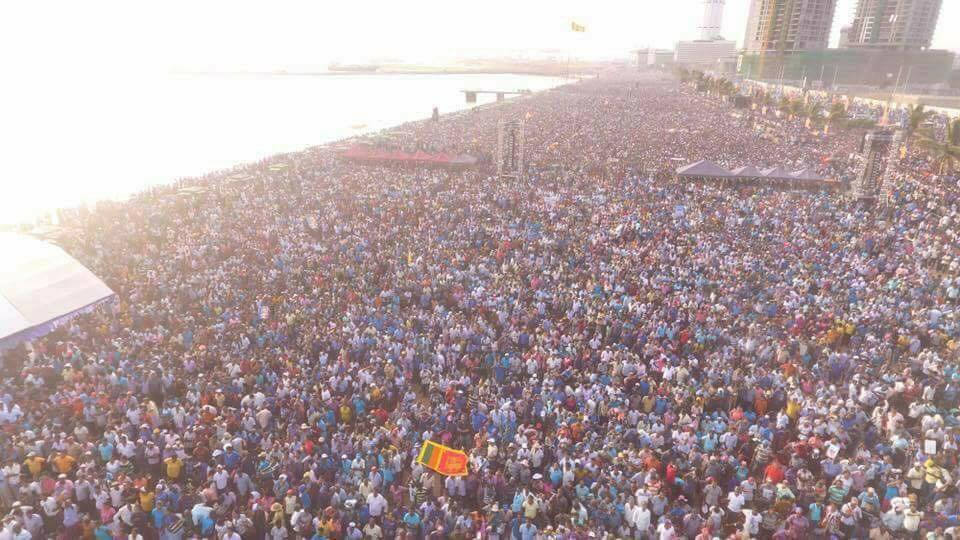
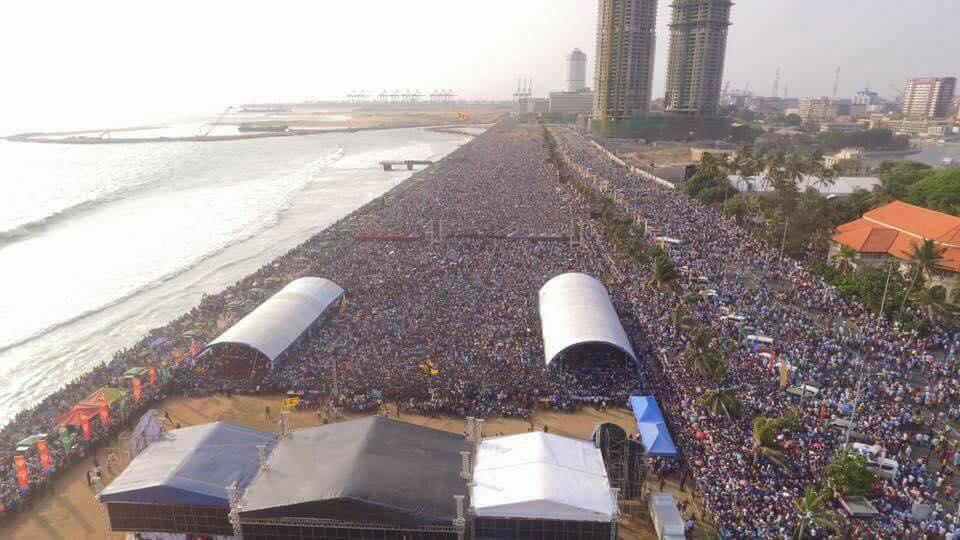
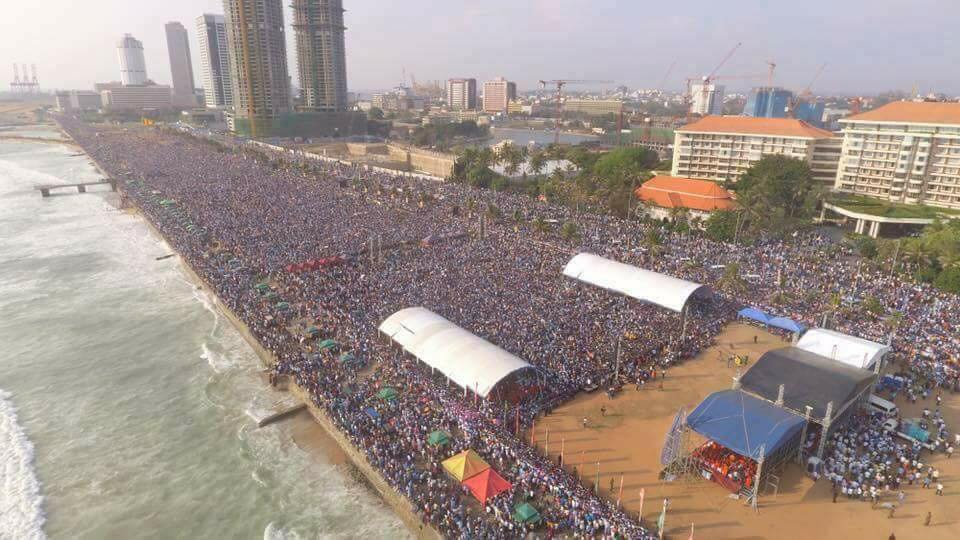
May 1st, 2017ගාළු මුවදොර පැවති ඒකාබද්ද විපක්ෂයේ අති දැවැන්ත මැයි දින රැළිය අමතමින් හිටපු ජනාධිපති මහින්ද රාජපක්ෂ මහතා විසින් කරනු ලැබූ සම්පූර්ණ කතාව.
|
|
 |
According to initial plans, drawn up during the Rajapakse regime, the Hambantota Port, when completed, would have consisted of four terminals and 12 berths. This new Port was meant to be a “free port” covering an area of 2,000 hectares where goods could be manufactured and shipped, as well as trans-shipped, with minimum delays. The first phase of the project became operational in 2011, The investment in the construction of the Port up to 2014 was approximately USD 450 million for the first phase, USD 70 million for the bunkering facility, and USD 802 million for the second phase, totaling USD 1,322 million. This cost was financed as loans from China.
Rajapaksa government also entered in to a Supply Operate and Transfer (SOT) management contract for 40 years with a joint venture between China Harbour Company and China Merchant Company to supply equipment such as cranes, and to operate the Hambantota Container Terminal. In return, the Hambantota Port was to receive a lease rental of USD 35,000 per hectare per year for the 56 hectares in the Container Terminal (a total of approximately USD 2 million per year), a royalty of USD 2.50 on every container loaded or unloaded, a wharf rate of USD 30 per container for cargo brought into Sri Lanka, as well as other usual harbour charges.
All terminals in the Port and the 2,000 hectare industrial zone, other than the Container Terminal, were to be controlled by the Ports Authority, and the Authority would have derived substantial income from the cargo passing through their numerous terminals, as well as enjoyed the capital growth derived by the project over the years.
Until the Port started to show profits, the Rajapakse government planned to utilize the revenues of approximately USD 100 million generated from the Colombo East Terminal to pay the loan and interest payments. The Port would break even within 10 years. However, Hambantota Port started making profits early. There was an operating profit of about Rs. 900 million in 2014, and Rs 1,200 million in 2015. The trans-shipment of vehicles began in 2012, with 70% of the vehicles that were discharged in Hambantota being trans-shipped to other destinations. By 2014, 335 vessels called at the Hambantota Port, with 295 docking in 2015.
G.L.Peiris observed that if the deal had been done the way Rajapakse had intended, Hambantota would have been a sustainable entity. The Rajapakse agreement was only to lease a terminal of the port, not the whole port. By 2020, Hambantota port would have been a viable concern, investors were required to bring in $1.1billion and they had to pay a minimum of $50000 for lease/rent per hectare. There was certainly no agreement to hand over 15000 hectares to a Chinese company either. That was not even thought of.
Unfortunately however, as soon as the new government took office, it made some reckless decisions, observed Nivard Cabraal. First, the government unilaterally abrogated the management contract for the Hambantota container terminal that was entered into with China Harbour Company and China Merchant Company. Second, the government halted the development of the Colombo East Terminal, which, had it been proceeded with, would have generated revenues of more than USD 100 million a year from 2016 onwards. Third, the agreements that the Rajapaksa government had signed by the end of 2014 with several foreign and local companies to lease out about 80 hectares in the industrial zone at a minimum rate of USD 50,000 per year per hectare, were abrogated by the new government. This affected revenue and placed the entire project at grave risk.
Yahapalana government thereafter announced that the Hambantota Port was a “white elephant” which cannot generate revenue, and said that the Hambantota Port had to be “privatized” in order to raise the money to pay the loans that were taken to build it. A Framework Agreement was signed with it after a protracted process. The clauses in the agreement had been changed four times. A Concession Agreement is now awaited
Yahapalana wanted to sign an agreement with China to sell 80 percent of Hambantota port to China through a joint venture, for 99 years, while the balance 20 percent will be held by the Sri Lankan Government. There would be an option for China to sell back 20 percent of the port to Sri Lanka in 10 years. After the lapse of five months, 20 percent of China’s share will be available in the share market, said Yahapalana soothingly. Within five months, we can reduce 80 percent stake of the China Merchant Company to 60 percent. We can up our stake upto 40 percent. It is not known what price Sri Lanka will have to pay to get it.
The Chinese ambassador stated that China had only wanted 51% of the Hambantota project. The Yahapalana government had urged it to take a bigger share. Dayan Jayatilleke checked on this and two ministers had confirmed that this statement was correct. Dayan was also told that a better option of renting the land at USD 50,000 per hectare per month had been presented to the cabinet subcommittee but instead the subcommittee had preferred to ask China to take a higher percentage of ownership.
Further, two Chinese owned companies made rival bids to take the Hambantota Port on a 99-tyear lease. The China Harbour Corporation put in a bid that was favourable to Sri Lanka and China Merchant Co put in a bid that was not so favourable. The Chinese government obviously expected the Sri Lankan government to accept the China Harbour Co bid but the less favourable bid was accepted.
Yahapalana also planned to privatize the harbour operations, as well as hand landlord rights over the entire 2,000 hectare port, including a 44 hectare artificial island outside the Port, to China. China would then be able operate the entire Port and have complete control over the industrial zone as well. Investments for the third stage terminals and cranes will be made by China and Sri Lanka will not have to put in the cash.
Critics observed that no other income is to accrue to the government or the Ports Authority for the next 15 years, and even after that the Ports Authority will receive dividends only on their 20% stake; and that too, only if profits are made and dividends are declared by the Chinese shareholder. For a decade and a half there will be no income accruing to Sri Lanka from the Chinese company in Hambantota Port, but Sri Lanka will be obliged to continue to service the Chinese debt. That is not all. The original Hambantota Port master-plan had provision for the construction of another 20+ berths in the years to come, and the rights over those berths too, seem to have been promised to China.
The security arrangements within the Hambantota port, the employment of people, cargo etc, would all be the responsibility of the Chinese company. The company can employ who they want. They are taking the assets not the liabilities, observed critics. Until the port reaches 50 percent capacity, Sri Lanka is prevented from developing another terminal with 100 km radius. None of these was part of the original deal, observed G.L.Pieris
There was strong opposition to this plan. The leasing of the entire Hambantota Port and its surrounding real estate for 99 years and handing over a highly sensitive industrial zone to a foreign private company is an action that will deprive the economy of the massive future potential of this Port, and that too, for a very small consideration, said angry commentators. The government should renegotiate the terms of loans, reduce the interest rates, and ask for more time to repay loans. Sri Lanka Ports Authority (SLPA) had raised about 30 concerns on matters like the valuation method on the Rs.2500 per perch proposed as opposed to the current figure of $50,000 per hectare.SLPA wanted to operate the port without handing it over to a third party. They had plans for it.
The Sri Lankan government has now asked for the renegotiation of the lease period in the Hambantota Port Agreement. We have asked that it be reduced from 99 years and the China Merchant Port Holdings Company is looking into whether they can achieve the same results with the current model or change it to a different one if the time period of the lease is to be changed,” It can now be anything between 50 and 70 years. Similarly, the shares could be 60% (Chinese company) and 40% (Sri Lanka Government).
It was clear from the beginning that the construction of the Hambantota harbor would mean greater Chinese involvement in that part of Sri Lanka. Hambantota was to be a hub servicing the shipping route across the Indian Ocean. One of the main nations serviced by those shipping routes is China. The Hambantota Port has become a sensitive area of China-Sri Lanka relations. (CONTINUED)
ඉන්දීය අගමැති නරේන්ද්ර මෝදි මහතා වෙසක් සමයට ලංකාවට පැමිණෙන බව ද රාජ්යතාන්ත්රිකව ගනුදනු කීපයක් සිද්දවන බවද දැනට වාර්තා වී තිබේ. බුදුන් වහන්සේ උතුම් තෙමගුල සිහිපත් කරන වෙසක් දිනය බෞද්ධ ජනතාවට අතිශයින් වැදගත් වන අතර එම දිනය ලංකාවේ නිවාඩු දිනයකි. බෞද්ධ කොඩිය ජාත්යන්තරව පිළිගනු ලැබ පවතින අතර වෙසක් දිනය නිවාඩු දිනයක් වශයෙන් එක්සත් ජාතීන් ගේ සංවිධානය විසින් පිළිගනු ලැබ ඇත.ඒ 1999 දී හිටපු විදේශ අමාත්ය ලක්ෂ්මන් කදිරගාමර් මහතා ඉදිරිපත් කල යෝජනාවක් අනුවයි. මේ වන විට වියට්නාමය තායිලන්තය චීනය ටිබෙටය ලාඕසය ඉන්දුනීසියාව බංගලිදේශය නේපාලය ආදී රටවල් වෙසක් පොහෝ දින නිවාඩු දිනයක් ලෙසට සලකයි.ඉන්දියාවේ එය පොදුවේ පූර්නිමා වෛශාඛ්ය ආදී නම් වලින් හඳුන්වති. වෙසක් දිනය සමරන බෞද්ධයන් රාශියක් ඉන්දීය ප්රාන්ත වල ජීවත් වේ. නරේන්ද්ර මෝදි ඉන්දීය බෞද්ධ ජනතාව වෙනුවෙන් එම දිනය රජයේ නිල උත්සව දිනයක් කරන්නේද යන්න මෙතෙක් ප්රකාශයට පත් කර නොමැත.
යහපාලන රජය ඉන්දීය අග්රාමාත්ය නරේන්ද්ර මෝදි ගේ රජයේ ඉල්ලීම මත ත්රිකුණාමල තෙල් ටැංකි සම්පූර්ණයෙන්ම බදු දීමට සූදානම්ය. තෙල් සංස්ථා සේවකයන්ගේ වර්ජනය නිසා මේ තීරණය මදක් ආපස්සට ගෙන ඇති නමුත් අග්රාමාත්ය වරයා ඉන්දියාවට ගොස් ආපසු පැමිණෙන විට මෙම තීරණ උපක්රමශීලිව වෙනත් වංගුවකින් තහවුරු කරන්නට ඉඩ තිබේ.මේ අතර ඉක්ටා ගිවිසුම සහ උතුර සහ නැගෙනහිරට බලය බෙදන නව ව්යවස්ථාව සම්මත කර ගැනීම පිළිබඳවද තීරණයන්ද ගැනීමට ඉඩ තිබේ. එසේ වූ විට නරේන්ද්ර මෝදී ගේ වෙසක් මුහුණ ගැලවෙන්නට කාරණා යෙදෙනු ඇත..
පැරණි දඹදිව සහ පැරණි ලංකාව අතර තිබූ අවිච්ඡින්න බැඳීම ඇතැම් විට ඵලදායී රාජ්ය තාන්ත්රික සම්බන්ධයක් විය.ඇතැම්විට එය බලහත්කාරී විය. ආක්රමණශීලි විය. නමුත් වඩා උපක්රමශීලි රජවරු තමන්ගේ අනන්යතාවයන්ද ආරක්ෂා කරගනිමින් භාරතීය පාලකයන් ගෙන් ශක්තිය ලබා ගැනීමට සමත්වූහ.උතුරු ඉන්දියාවේ මෝගල් පාලකයන් විසින් ආක්රමණශීලීව රටේ විවිධ පළාත් තම පාලන බලයට යටපත් කරගන්නා විටද ඉස්ලාම් ආගම රාජ්ය ආගම බවට පත් කරගත් විටද ලක් රජවරු බුද්ධ ශාසනයත් රටත් ජාතියත් සතු ස්වාධීනත්වය දිවිපුදා ආරක්ෂා කර ගත්හ. බුදුන් වහන්සේ උපන් රට සහ බුදු දහම සමග බැඳුණු නොයෙකුත් සිහිවටන පවතින රටක් ලෙස වර්තමාන ඉන්දියාව දෙස සිංහල බෞද්ධයන්ගේ දෘෂ්ටිය බොහෝ මට සිලිටිය. දඹදිව වන්දනාව යනු ජීවිතයේ එක් වරක් හෝ යෑමට පුල පුලා සිටින ගමනකි. වර්ෂයකට ලක්ෂ හතරකට ආසන්න සංඛ්යාවක් මෙම වන්දනාවට එක් වෙයි. නමුත් බිහාර් ප්රාන්තය ඇතුලු බොහෝ සිද්ධස්ථාන සහිත ස්ථානයන් තුළ බෞද්ධයන් වෙනුවෙන් සලසා ඇති පහසුකම් ඉතා අවමය. සංකස්ස නුවර වැනි අගනා ස්ථානයකට යන ගමන් මාර්ගය ඉතා අබලන්ය. මේවා පිළිසකර කරවීමට ඉන්දීය රජයට අවශ්යතාවයක් ඇතැයි නොසිතේ. සංකස්ස පූජ්ය ස්ථානය ද තවමත් හින්දූන් ගේ ආධිපත්යට යටත් වී ඇත. එය වසර කීපයකට පමණ ඉහතදී කඩා වැටී කැලෑවට යට වී ඇත. එය බෞද්ධයින්ගේ ස්ථානයක් වට පත් කර ගැනීමට කතා කිරීමට දැන් නොහැකිය. ධර්මපාල තුමා ගත් මග ගැන්මට වර්තමාන සිංහලයින් බිය වෙති.. කි.මී. 800 ක් එක දිගට අධිවේගී මාර්ග වල හා ග්රාමීය පාරවල් වල යනෙන විය ගිමන් නිවා ගන්නට ස්ථානයක් වැසිකිලි පද්ධතියක් සකස් කරලීමට අවශ්ය තාවයක් ඉන්දීය රජයට නොමැත. අපගේ කාන්තාවන්ට පවා එම ගමන් වලදී වැසිකිලි යාමට සිදු වී ඇත්තේ පාරවල් අයිනේ ළඳු කැලෑවලය. සමහරක් විට ඉන්දියාවේ අතිශය දිළිඳු පීඩිත පන්තියට මෙන් අපට සලකා මුදල් පමණක් ලබා ගැනීමේ චේතනාව ඔවුන්ට ඇතැයි මොහොතකට සිතේ. කපිල වස්තු ප්රදේශයේ යම් කිසි වපසරියක් ඉන්දියාවටද අයත්ය. එම ස්ථානයෙන් ලැබුණු සර්වඥ ධාතූන් වහන්සේලා වැඩ සිටින්නේ නවදිල්ලියේ කෞතුකාගාරයේය. එහෙත් ඒවා නැරඹීම හා වන්දනාවට ඉඩ හසර ලැබෙන්නේ කලාතුරකින් කෙනෙකුටය. හෝටල් කරුවන් සහ වන්දනා තැරැව්කරුවන්ගේ ග්රහණයෙන් එපිට පූජනීය වන්දනාවකට යෙදීමට ඉඩ සැලසෙන්නේ ඉතාමත් අතලොස්සකට පමණකි.
ඉන්දියාවේ ප්රථම ජනාධිපතිවරයා වූ රාජේන්ද්ර ප්රසාද් මහතා 1959 දී පමණ ලංකාවට පැමිණියේය.ඒ විද්යාලංකාර විශ්ව විදයාලයේ මංගල තෑගි ප්රදාන උත්සවයටයි. ඒ අවස්ථාවේ එතුමා ඉත් ගැඹුරින් දෙරට අතර සම්බන්ධය පිළිබඳ සටහන් කර තිබේ. තමා විද්යාලංකාරයට අමුත්තකු නොවන බව කී ඉන්දීය රාෂ්ට්රපති තුමා මීට අවුරුදු බොහෝ ගණනකට පෙර තමා මෙහි පැමිණ සාහිත්ය දර්ශනවාදය සහ ඉතිහාසය පිළිබඳ විශාරද සේවයක් කිරීමෙන් මුළුමහත් ඉන්දියාව පුරා පතළ කීර්තියක් ලැබ සිටි රාහුල සංකෘත්යාන පඬිතුමාණන් සමග විසූ බැව් පැවසුවේය. ඉන්දීය සහ විදේශීය ශිෂ්යයන් විසින් බුද්ධාගම හදාරනු ලබන නාලන්දාවේ පාලි විද්යාතනයේ කටයුතු කරන විද්යාලංකාර ආදී ශිෂ්යයකු වන ජගදීශ කාශ්යප ස්වමීන් වහන්සේ ගැනද ශ්රී රාජේන්ද්ර ප්රසාද් සඳහන් කෙළේය. අප අතර ඇති සාගරයක් ඔබ්බේ පිහිටි ඉන්දීයාවේ වැසියන් වන අපි විද්යාලංකාර විශ්ව විද්යාලයෙන් කෙරෙන වැඩත් එහි වර්ධනයත් ගැන දැඩි සැලකිල්ල යොමු කරන්නෙමු යයිද හින්දු ධර්මය සහ බුද්ධාගම එකිනෙකට අසම්බන්ධ යයි හෝ ප්රතිවිරුද්ධ යයි හෝ අප නොසලකන බැවින් අපේ මේ උනන්දුව සැබවින්ම අවංක එකක් යයිද එදා පවසා ඇත. බුද්ධාගම පිළිබඳ මහජන ප්රසාදයක් මෑත කාලය තුළ ඉන්දියාව පුරා ඇති වී යයි කී එතුමා බුදුන් වහන්සේ ගේ මහා පරිනිර්වාණයෙන් 2500 යේ බුද්ධ ජයන්ති මහොත්සවය කෙරෙහි දැක්වුණු උද්යොගයත් පැරණි නාලන්දාව පිහිටි තැන බෞද්ධ ශාස්ත්රායතන පිහිටුවීමෙනුත් විවිධ විශ්ව විද්යාලයන් බුද්ධාගම කෙරෙහි දක්වන උනන්දුවෙනුත් ඒ බැව් පැහැදිලි වන්නේ යයි කීය. බුද්ධාගම හැදෑරිය හැකි අගනා විශ්ව විද්යාලයක් ඉන්දියාවේ ඇතද ඉන්දීය ශිෂ්යයන් විද්යාලකාරයට පැමිණ මේ විශ්ව විද්යාලයේ ජීවය උරා ගන්නවා පමණක් නෙව ලංකාවේ ශිෂ්යයන්ද භාරතීය මධ්යස්ථානයන්හි සිප්සතර හදාරනු දැක්මට කැමැත්තෙමි යැයි එතුමා වැඩිදුරටත් සඳහන් කර තිබේ.
එදා බුද්ධගයා නඩුවෙන් ධර්මපාල තුමා පැරදුණු පසු එය බේරා දුන්නේද ඉන්දියාවේ ප්රථම ජනාධිපති රාජේන්ද්ර ප්රසාද් තුමාය.එහෙත් වත්මන් ඉන්දීය ජනාධිපතිවරයා ලංකාවට පැමිණෙන්නේ රට දෙකඩ කිරීමට අවශ්ය පිඹුරු පත් සමගින්ය. ඔහු වෙසක් මුහුණක්ද පැළඳගෙන පැමිණෙන බැවින් ලංකාවේ ජනතාව අතරින් බහුතරයක් ඔහුට ගරුසත්කාර පවත්වනු ඇත. ඇතැම් විට මහා සංඝරත්නයද මුල්ව එය සිදු කරනු ඇත. නමුත් තිත්ත ඇත්ත නම් ඔහු උතුර සහ නැගෙනහිර සඳහා සවයං පාලනයක් ලබා දෙනු පිණිස සහ මධ්යම කඳුකරයේ දෙමළ ජනතාවට වෙනත් සවයංපාලනයකට යෑම සඳහා පාර කැපීමට උත්සාහ කරනු ඇති බවයි. වත්මන් යහපාලන රජයේ නව කඳුකර ගම්මාන අමාත්යංශය යනු මේ ඉන්දීය වුවමනාව පිණිස සැදුම් ලද්දකි.එසේ හෙයින් මෝදී ගේ වෙසක් මුහුණ යනු වෙස්මුහුණක් බව පෙන්වා දිය යුතුය. වත්මන් යහපාලන රජය සිංහල බෞද්ධයන් වෙනුවෙන් කිසිවක් කර නැත. අන්තවාදීන් විසින් රටේ බෞද්ධ සිද්ධස්ථාන ආක්රමණය කරන විට යහපාලනය මුනිවත රකී.විදේශයන්හි ස්වාමීන් වහන්සේලා ලංකාවට අධ්යාපන කටයුතු සඳහා පැමිණෙන විට අය කරනු ලබන වීසා ගාස්තුවද මේ වන විට වැඩි කර තිබේ.පිරිත් දේශනා විකාශනය කරන විහාරස්ථාන වලට සහ අලි ඇතුන් ළඟ තබා ගන්නා හිමිවරුන්ට යහපාලනයේ අදිසි හස්තයන්ගෙන් නඩු පවරන කල්හි ජාත්යන්තරයට පෙනෙන්නට වෙසක් උත්සවයක් සැමරීම බොරු ප්රදර්ශනයකි.නරේන්ද්ර මෝදි අග්රාමාත්ය තුමාගේ දේශපාලන කාරණා වෙසක් උත්සවය හා මුසු කිරීමද බලවත් වැරැද්දකි. විශේෂයෙන්ම මෝදි මැති තුමා මහානායක ස්වාමීන් වහන්සේලා මුණ ගැසීමට යන බැවින් මේ වෙස් මුහුණ ගැලවීමට කටයුතු සැලසේ නම් වඩා යහපත්ය. නමුත් දෙරට අතර තිබෙන යහපත් බෞද්ධ සබන්ධය සහ රජ්යතාන්ත්රික බාවය ඉස්මතු කර පෙන්වා දෙරටේ අනන්යතාවය ට හානියක් සිදු නොවන පරිදි කටයුතු කළ යුතු බවට අනුශාසනනා කරවීම වඩාත් වැදගත් යයි සිතමි.
මතුගම සෙනෙවිරුවන්
කම්පුචියාව යන රට තිඛෙන්නේ කොතැනකද යන්න මම තවම නොදනිමි”, යන මේ ප්රකාශය කරන ලද්දේ සුප්රකට රාජ්යතාන්ත්රිකයෙකු වූ මෙන්ම ඉතිහාසඥයෙකු වන වින්සන්ට් චර්චිල් විසිනි.
අප්රකට කම්පුචියාව පසුකලෙකදී මුළුලෝකයේම ප්රසිද්ධියට පත් රටක් විය. ඒ පොල්පොට් හා මරණයේ ගොවිබිම්” නිසාය. 1975 වර්ෂයේදී බලයට පැමිණි පොල්පොට්ගේ නායකත්වයෙන් යුත් කෙමරූජ්වරු (ණයපැර ඍදමටැ – රතු කම්පුචියානුවන්) කම්පුචියාව පාළනය කළේ මාස 44 වැනි කෙටිකාලයකි. ඒ කාලය ඇතුළත ශතවර්ෂ ගණනාවක් පවතින විනාශයක් ඔව්හු කම්පුචියාව තුළ සිදු කළහ.
අන්තවාදීන් සුළු පිරිසකට රටකට කළ හැකි උපරිම විනාශය පිළිබඳව පෙන්වා දියහැකි හොඳම උදාහරණය කම්පුචියාව මගිනි. ඔව්හු රටේ ආර්ථීකය, සංස්කෘතිය හා අනාගතය විනාශ කළහ. කෙමරූජ්වරු ගිය මගෙහි ඔවුන්ගේ ධ්රැවගත මනස් දුටුවේ ද්රෝහියන් පමණකි. ඔවුන් ද්රෝහියන් ලෙස නම්කොට මුළු ජනගහණයෙන් 1/3 විනාශ කර දමන ලදී. අවසානයේදී කම්පුචියාවේ ඉතිරිවූයේ ඇටසැකිළි හා හිස්කබල් පමණි. කෙමරූජ්වරු රටේ අධ්යාත්මය විනාශ කොට දමන ලදී. මේ වනවිට කම්පුචියාවේ ජනගහනයෙන් 43% ක් ජීවත් වනුයේ අන්ත, අසරණ, දුගී ජීවන මට්ටමකිනි. ඔවුන් කම්පුචියාවට කළ විනාශයේ දෝංකාරය තව ශතවර්ෂ ගණනාවකටත් වඩා පවතිනු ඇත.
කම්පුචියාවේ ඉතිහාසය
පුරාවිද්යාත්මක සාක්ෂි අනුව ක්රිස්තු පූර්ව 4200 යුගයේ සිට කම්පුචියාවේ ජනාවාස පැවතින. නියොලිතික යුගයට අයත්වූ මොවුන් සංක්රමණය වූයේ දකුණු චීනයෙනි. 9 වන සියවසේ සිට 13 වන සියවස දක්වා පැවති ණයපැර අධිරාජ්යය කම්පුචියාවේ ස්වර්ණ යුගයයි. හත්වන ජයවර්මන් රජු සමයේ කම්පුචියාව සුවිසල් දියුණුවක් ලැබීය. එසේම ඔව්හු අසල්වැසි රාජ්යයන්ද ආක්රමණය කළෝය.
ඇන්කෝර් ශිෂ්ඨාචාරය බිඳ වැටීමත් සමඟම කම්පුචියාවට උදාවූයේ අඳුරු සමයකි. 15 වන සියවසේ සිට 19 වන සියවස දක්වා කම්පුචියාවේ දේශසීමා අසල් වැසි රාජ්ය මගින් කොල්ලකනු ලැබීය. බුරුමය හා වියට්නාම් ආක්රමණ නිසා කම්පුචියාවේ අවනතියක් ඇතිවිය.
1863 දී නරෝඩොම් රජු ආක්රමණ වලින් බේරීමේ උපක්රමයක් ලෙස ප්රංශය සමඟ ගිවිසුමකට එළඹියේය. මෙම ගිවිසුම උපයෝගි කරගත් ප්රංශය කම්පුචියාව සිය යටත් විජිතයක් කරගනු ලැබීය. දෙවන ලෝක මහායුද්ධයෙන් පසුව ප්රංශ යටත් විජිත වාදයෙන් මිදෙනු වස් සිහනුක් රජු ජිනීවා සාකච්ඡා හරහා කම්පුචියාව නිදහස් කරගැනීමට මූලික පියවර ගත්තේය.
1953 ඔක්තෝම්බර් මාසයේ සිහනුක් රජු කම්පුචියාව නිදහස් රටක් බවට ඒකපාර්ශිකව ප්රකාශ කළේය. 1950 සිට 1960 දක්වා කම්පුචියාවේ පැවතියේ විදේශ මැදහත්වීම් වලින් තොර දශකයකි. එහෙත් කම්පුචියාවේ ඇතැම් ප්රාන්තවල උතුරු වියට්නාම් හමුදා මධ්යස්ථාන ඇතිකරන ලදී. මෙම මධ්යස්ථාන මගින් දකුණු වියට්නාම් හමුදාවලට එරෙහිව ප්රහාර දියත් කරන ලදින් 1969 දී දකුණු වියට්නාමයේ එක්සත් ජනපද අරකෂාව සහිතව මාස 14 කාලයක් කම්පුචියාවේ උතුරු වියට්නාම් හමුදා මර්මස්ථානවලට ගුවන් ප්රහාර එල්ල කරන ලදී. මෙම ගුවන් ප්රහාර වලින් සිවිල් වැසියන් රැසක්ද මරු දුටුහ.
උතුරු හා දකුණු වියට්නාම් අර්බුදයට මැදිවීමට සිහනුක් රජු අකමැති වුවද භූගෝලීය සාධක මත උතුරු වියට්නාමයට කම්පුචියාවේ දේශසීමා අරක්ෂක භූමියක් විය. එම නිසා ඔවුහු වියට්නාම්, කම්පුචියා දේශසීමා පවා උල්ලංඝනය වන අකාරයෙන් තම හමුදා මෙහෙයුම දියත් කළහ, මේ හේතුවෙන් දකුණු වියට්නාමයේ හා එක්සත් ජනපදයේ ප්රහාර වලට කම්පුචියාව ද ලක්විය. එක්සත් ජනපදය දුටුවේ සිහනුක් රජු උතුරු වියට්නාම් රජයට සහය දෙන්නකු ලෙසට ය. එම නිසා ක්ෂමා සංවිධානය සිහනුක් රජු බලයෙන් පහ කිරිම සඳහා පිඹුරුපත් සැකසුහ.
මේ යුගයේ දී සොන් සෙන්, ඉයෙංසාරි පොල්පොට් වැන්නවුන් සිහනුක් රජයට එදිරිව ක්රියා කළහ. දෙස් විදෙස් මැදිහත් වීම නිසා සිහනුක් කුමරුගේ බලය පිරිහෙන්නට පටන් ගත්තේය. ජෙනරාල් ඛදබ භදක කම්පුචියාවේ නව රජයක් පිහිටුවිය. අවුල් වියවුල් වලින් ගහන වූ මෙම කාලය නිසා ජෙනරාල් ඛදබ භදක ගේ රජය පැවතියේ 1967 දක්වා පමණි. 1968 හා 1969 වසර වල රජයට එරෙහි ගරිල්ලා ප්රහාර දැඩිවිය. 1970 වන විට සිහනුක් රජු වෛද්යහේතූන් මත රටහැර ගියේය.
1970 දී ඇමෙරිකානු ක්ෂමා සංවිධානයේ ආධාර ඇතිව ජෙනරාල් ඛදබ භදක කුමන්ත්රණයක් දියත් කොට කම්පුචියාවේ බලය අල්ලා ගැනීමට ක්රියා කළේය. 1970 ඔක්තෝම්බර් 9 වන දින කම්පුචියාවේ රාජ වංශය අහෝසි කරනු ලැබීය. උතුරු වියට්නාමයේ බලය බිඳිනුවස් අමෙරිකාව කම්පුචියාවේ නව රජයට ආධාර කළේය. මෙම ආධාර සමන්විත වූයේ යුධ අවි හා යුධ තාක්ෂණයෙනි.
දකුණු වියට්නාම් හමුදා හා ඇමෙරිකානු යුධ උපදේශකයන් 1970 වන විට කම්පුචියාවේ රැඳී සිටිමින් උතුරු වියට්නාමයට එදිරිව සටන් කළහ. මෙය ජනාධිපති නික්සන් පවා පසුව පිළිගන්නා ලදී.
මෙම ගැටුම පවතින විට පොල්පොට් තම ගරිල්ලන් මගින් ඛදබ භදක ගේ රජයට එරෙහිව ප්රහාර වැලක් දියත් කළේය. 1973 වන විට පොල්පොට්ගේ නායකත්වයෙන් යුතු කැමරුජ් සංවිධානය කම්පුචියානු භූමියෙන් 60% ක් පාළනය කළහ. 1975 අප්රේල් 17 දින ඛදබ භදක ගේ රජය බිඳ වැටුන අතර කැමරුජ් සංවිධානය කම්පුචියාවේ බලය තහවුරු කර ගත්තේය. ඉන් පසුව එළඹුනේ තවත් අඳුරු යුගයකි. භීෂණයෙන් වෙළුන එම කාලයේ දී දහස් දහස් ගණන් ජනතාව වධ බන්ධනයන්ට පත් කරනු ලැබීය. බොහෝ දෙනෙකු මරු දුටුහ.
නරොඩම් සිහනුක් රජු
1945 සිට 1970 දක්වා කම්පුචියාවේ බලය තිබුනේ සිහනුක් රජුට ය. පසුගාමි අදහස් නිසා ද, වැඩ වසම් යුගය තවදුරටත් පවත්වා ගැනීමේ අභිලාශයන් නිසා ද, ජනතාව අතර ඔහු ජනප්රිය නායකයකු නොවීය. සිහනුක් කම්පුචියාව පාලනය කළ වකවානුව තුළදී ද රාජ්ය නිලධාරීන් හා හමුදා නිලධාරීන් විවිධාකාර දූෂණ වල යෙදුනහ. ජනතාව ජීවත් වූයේ දරිද්රතාවයේ ගිලෙමිනි.
කොමියුනිස්ට්වාදීන් කෙරෙහි සිහනුක් තුළ තිබූ බිය හා වෛරය නිසා ඔහුගේ රජය නිබඳව ම කොමියුනිස්ට්වාදීන් දඩයම් කළේය. මේ නිසා රහසිගත දේශපාලන ව්යාපාරවල යෙදුන පොල්පොට් වැන්නවුන් සිහනුක්ගේ පොලිසියට අසුනොවීම සඳහා නාගරික ප්රදේශ වලින් ඔබ්බට පලා ගියහ. සිහනුක්ගේ පාලනය නිසා අගතියට පත් වූ ජන කොටස් මුල් කාලයේ දී පොල්පොට් ට සහය පල කළ බව සැබෑය. ග්රාමීය ප්රදේශ වල සිට ගරිල්ලා යුද්ධයක නියැලූණු පොල්පොට්ට ගැමි ජනතාව සහය දෙන ලදී.
අසාර්ථක සිසුවා පැරිසියේ ඉබාගාතේ යයි
ඒ 1953 වසරයි. රේඩියෝ කාර්මික ශිල්පය ඉගෙන ගැනීමට පැරිසියට පැමිණි සලොත්සාර් (අනාගත පොල්පොට්) නම් තරුණයා සිටියේ ඉච්ඡාභංගත්වයට පත්විය. විභාග අසමත් වීම නිසා ඔහුගේ අනාගතය අඳුරුය. 1949 දී තරුණයෙකු ලෙස කම්පුචියාවේ (එකල කම්පුචියාව ප්රංශ ඉන්දුචීනයේ කොටසක් විය) පැරිසියට පැමිණ ඔහු තුළ අනාගත සිහින රැසක් තිබුණි. දැන් ඒ සෑම සිහිනයක් ම දියවී ගොසිනි. අවිනිශ්චිත අනාගයකට මුහුණ දෙනුවස් තව නොබෝ දිනකින් මවුරට බලා යාමට ඔහුට සිදුවේ.
සලොත් සාර් උපත ලැබුවේ 1925 වසරේදී ය. කුඩා කාලයේ බෞද්ධ ආරාමයක ඉගෙනුම ලැබූ ඔහු ද්විතියික අධ්යාපන ලැබුවේ රෝමානු කතෝලික පාසලකය. ඉගෙනීමට දක්ෂකම් දැක්වූ ඔහුට ශිෂ්යත්වයක් දිනා ගැනීමට හැකි විය. රේඩියෝ කාර්මික ශිල්පයට ඇළුම් කළ සලොත් සාර් ප්රංශයට පැමිණියේ රේඩියෝ කාර්මික ශිල්පය ප්රගුණ කරනු සඳහා වුවත් ඔහුට මුණ ගැසුණු මිතුරන් ඔහුව දේශපාලනය කරා කැන්දන් ගියහ. රේඩියෝ කාර්මික ශිල්පය වෙනුවට මාක්ස්වාදය හැදෑරූ ඔහු දේශන අතපසු කළේය. එහි ප්රතිඵල ලෙස ඔහු විභාගයෙන් අසමත් විය. එම නිසා ඔහුගේ ශිෂ්යත්වය අවලංගු කරනු ලැබීය.
පැරිසියේදී ඔහුට හමුවූ කම්පුචියානු ජාතිකයන් අතරින් ඉයෙං සාරි, කියු සම්පෙන්, කියු පොනරි සහ සොන්සෙං මුල් තැනක් ගත්තේ, ඔවුන් මාක්ස්වාදය කෙරෙහි දැක්වූ භක්තිය නිසාවෙනි. සලොත් සාර් ගේ පැරිසියේ නේවාසිකාගාරයට රැස්වන මෙම පිරිස රෑබෝවන තුරු විප්ලවීය සමාජවාදය ගැන සාකච්ඡා කළහ. කුඩා අඳුරු කාමරයේ එක්රැස් වූ මෙම පිරිස අනාගත කෙමරූජ් රජයේ නායකයන් වනු ඇත.
පැරිසියේදී අධ්යාපනය ලැබූ කාලයේ ද ඔහු ප්රංශ (ඡ-28) කොමියුනිස්ට්වාදීන් සමඟ ද සබඳතා පැවැත්විය. එහෙත් දැන් සියල්ල අවසන් ය. පැරිසිය තව දුරටත් ඔහුට ජීවත් වීමට සුදුසු භූමියක් නොවේ. ශිෂ්යත්වය අවලංගු කිරීම නිසා ඔහුගේ අතේ ඇත්තේ සීමිත මුදලකි. යළි උපන් දේශයට යනු මිසක අනු විකල්පයක් ඔහුට ඉතිරිව නැත.
සවස්වරුවේ ඒ මේ අත ඇවිද ගිය සලොත් සාර් කුඩා අවන්හලකට ගොඩවැදී කෝපි කෝප්පයක් පානය කළේය. ඔහුගේ හිස එක අරමුණක නොවීය. මනාව ඇඳ පැළඳගත් ප්රංශ ගැහැණු පිරිමි ඔහුගේ අවධානයට ලක් නොවූ අතර, ඔහුගේ මනස රැඳී තිබුනේ අනාගතයේ දී කළ යුතු කාර්යන් කෙරෙහි ය. එහෙත් ඔහුට නිශ්චිත ඉලක්කයක් නොවීය. තව නොබෝ දිනකින් මව් රට බලා යාමට ඔහු අදිටන් කර ගත්තේය.
ඉතිහාසය හා භූගෝල විද්යා ගුරුතුමා
1953 වසරේ පැරිසියේ සිට කම්පුච්යාවට පැමිණි සලොත් සාර් නොහොත් පොල්පොට් පුද්ගලික පාසලක ඉතිහාසය හා භූගෝලය ඉගැන්වීය. ඉගැන්වීමට අමතරව සිසුන්ට ග්රහණය කර ගැනීමට හැකි අන්දමේ පෞරුෂයක් ඔහුට හිමි විය. ඒ නිසා ඔහු නිතැතින්ම ජනප්රිය ගුරුවරයෙකු විය. 1953 වසරේ දී යටත් විජිත වාදයට හසු වී තිබුණ කම්පුචියාව නිදහස ලැබීය. රට පාලනය කරන ලද්දේ නරදම් සිහනුක් කුමරු විසිනි. රහසිගත දේශපාලනයට අවතීර්ණ වූ පොල්පොට් කාම්පුචියානු කොමියුනිස්ට් පක්ෂය බිහි කළේය. තවමත් කළල තත්වයේ පැවති කොමියුනිස්ට් පක්ෂය පාලකයන්ගේ අවධානයට යොමු වූ හෙයින් පොලිස් ඇසින් බේරෙනු වස් ඔහු ඇතුළු ඔහුගේ සහයකයන් කාම්පුචියාවේ ග්රාමීය පෙදෙස් කරා පලා ගියහ.
මෙම කාලයේදී ඔහු මාඕසේතුං හා ස්ටැන්ලි වාදය කෙරෙහි වඩාත් කිට්ටුවිය. එහෙත් ඔහු ක්රියාත්මක කිරීමට බලාපොරොත්තු වූයේ මාක්ස් හෝ ලෙනින් අනුගමනය කළ ක්රියා පටිපාටියට හාත්පසින්ම වෙනස් තමන්ට ආවේනික වූ ක්රමවේදයකි. එහි ප්රතිඵල ලෙස රටේ ජනතාවගෙන් 25% ක් මරු දකිනු ඇත.
නාගරික ජීවිතය පිරිහීමේ දොරටුවයි.
පොල්පොට් විශ්වාස කළ පරිදි නාගරික ජීවිතය ප්රතිගාමීත්වයෙන් පිරුණු එකකි. මුදල් සංසරණය, භාණ්ඩ මිළඳී ගැනීම, සංස්කෘතිය යන මේ සියල්ලම ප්රතිගාමිත්වයේ ලකෂණ ලෙස ඔහු සැලකීය. ජනතාවට විමුක්තිය දෙනුවස් ඔවුන් ග්රාමීය ප්රදේශවලට ගාල්කළ යුතුය යන සංකල්පය ඔහුට ඇති වූයේ මේ කාලයේ දීය. එය ජෝශප් ස්ටාලින් කලාක් මෙන් අවි බලයෙන් ජනයා සමූහ ගොවිපළවල් වලට පළවා හැරිය යුතුය. නැතහොත් කුබානයේ මෙන් කෘතිම සාගත ඇතිකළ යුතුය. කම්කරුවන් සටන්කාමි පන්තියක් ලෙස නුදුටු පොල්පොට්ගේ පූර්ණ අවධානය යොමුවූයේ ග්රාමීය ගොවීන් කෙරෙහිය. උගතුන් කෙරෙහි වෛරය, නාගරික ජිවන පිළිවෙත කෙරෙහි සතුරු ආකල්ප හා ජාතිවාදය ඔහුගේ මූලික ධර්මතා විය.
පැරිසියේ ශිෂ්ය කවය යළි සක්රීය වෙයි
පොල්පොට්ගේ පැරිසියේ මිතුරන් බොහෝ දෙනෙක් 1960 වන විට කම්පුචියාවට පැමිණ සිටියහ. පැරිසියේ ශිෂ්ය කවය ලෙස හැඳින්වුනු මෙම කණ්ඩායම අනාගත කම්පුචියාවේ විප්ලවය සඳහා කුමන මගක් ගත යුතුද, යන්න සාකච්ඡා කළහ. ඔවුන් ‘උඡණ’ හෙවත් උදරනැරි කමිටුවේ බලය තහවුරු කරගෙන සිටියහ. මෙම කමිටුවේ තෙවන ප්රධාන ස්ථානය හිමිවූයේ පොල්පොට්ටය. පොල්පොට් චීනය හා වියට්නාම් කොමියුනිස්ට්වරුන් සමගද සම්බන්දතා පැවැත්විය. නිරන්තරයෙන්ම කමිටුවේ උච්ච ස්ථානයකට යාමට වෙරදැරූ ඔහු 1963 වන විට උඡණ කමිටුවේ ප්රධාන ලේකම් ධුරයට පත්වීමට සමත් විය. මුඛරි බව හා සංවිධාන ශක්තිය මගින් කමිටුව තුළ තම බලය වර්ධනය කර ගැනීමට පොල්පොට්ට හැකි වූ බව පෙනී යයි.
වියට්නාම් කොමියුනිස්ට්වරුන් සමඟ පොල්පොට් සබඳතා පැවැත්වුවද, ඔවුන් පොල්පොට්ගේ ජාතිවාදී, ආකල්ප කෙරෙහි දැක්වූයේ විවේචනාත්මක බවකි. නරොදම් සිහනුක් කුමරුගේ පොලිස් මෙහෙයුම් නිසා යටිබිම්ගතව දේශපාලනයේ නියැළුණු පොල්පොට් හට වියට්නාම් සහයෝගය අවශ්ය විය. එහෙත් වියට්නාමයේ ඇමරිකානු මැදිහත්වීම් නිසා වියට්නාම කොමියුනිස්ට්වරුන්ට පොල්පොට්ගේ අභිලාෂයන්ට සහයෝගය දැක්වීම ප්රමාද වූයෙන් ඔහු මාඕසේතුංගේ සහය පැතීය.
1966 වසරේ පොල්පොට් ප්රථම වතාවට චීනයට ගොස් මාඕසේතුං හමුවිය. මේ සමය වන විට චිනයේ සංස්කෘතික විප්ලවය ආරම්භ වී තිබුණි. සංස්කෘතික විප්ලවය සියැසින් දුටු පොල්පොට් උද්ධාමයට පත්විය. කම්පුචියාවේද මෙවැනි ආකාරයේ සංස්කෘතික විප්ලවයක් කළයුතු බවට ඔහු ඉටාගත්තේය. චීනයේ ගතකළ කාලයේදී මාඕගේ ධර්මයට වශීවූ පොල්පොට් යළි කම්පුචියාවට පැමිණෙන විට ඔහුගේ වියට්නාම් සබඳතා ඉරිතලා තිබුණි. තවදුරටත් වියටිනාම් කොමියුනිස්ට් වරුන්ගෙන් සහයෝගය ලබා ගැනීමට වඩා චීනය දෙසට හැරීම සුදුසු බව ඔහු වටහා ගත්තේය.
කෙමරූජ් සංවිධානය බිහිවෙයි.
උඡණ හෙවත් උදරනැරි නියෝජනය කළේ කම්පුචියානු කොමියුනිස්ට් පක්ෂය විය. එහෙත් මෙම පකෂය පිරිසිදු කිරීමට ඉටාගත් පොල්පොට් 1966 දී කෙමරූජ් සංවිධානය බිහි කළේය. කෙමරූජ් යව වචනයේ අරුත රතු කාම්පුචියානුවන් යන්නය. මෙම සංවිධානයේ අසහාය නායකයා වූයේ පොල්පොට්ය. ඔහු කෙමරූජ් සංවිධානය Aබටනදර (සංවිධානය) ලෙස හැඳින්විය.
කම්පුචියානු කොමියුනිස්ට් ජනරජය බිහිවීම
1976 දී පොල්පොට් ඉයෙං සාරි, නුඔන්චියා හා සොන්සෙන් යන කෙමරූජ් නායකයන්ගේ මූලිකත්වයෙන් කම්පුචියානු කොමියුනිස්ට් ජනරජය බිහිකරනු ලැබීය. සාමාජිකයන් 250 කින් සමන්විත වූ මෙම දේශපාලන බල බණ්ඩලයේ සුක්කානම හිමිවූයේ පොල්පොට්ට ය.
නව රජය කම්පුචියා සමාජය ප්රතිව්යුහගත කිරීම ආරම්භ කළේය. පැරණි සමාජයේ සියල්ලම හෙලා දුටු ඔවුන් බුදු දහම හා කතොලික දහම යටපත් කිරීමට ක්රියා කළහ. බැංකු හා මුදල් ගනුදෙනු අවලංගු කරනු ලැබිණ. කාර්මිකරණයට අකුල් හෙලු ඔවුන්ගේ මුළු අවධානය යොමුවූයේ සාමූහික ගොවිපලවල් ක්රමයටයි.
විදේශ භාෂා කතා කිරීම, උපැස් පැළඳීම, ආහාර ගබඩාකරගැනීම, මිය ගිය ඥාතීන් සිහිපත් කිරීම, අතීතය ගැන කල්පනා කිරීම සහ මුලින්ම තහනම්වූ අතර, මේ නීති කඩකිරීම් නිසා බොහෝ දෙනෙකු කෲර මරණයන්ට ගොදුරු වූහ.
හිටපු ව්යාපාරිකයන්, රජයේ නිලධාරීන් උගතුන්, පුවත්පත් කලාව්දීන්, තෝර තෝරා පවුල් පිටින් සමූලඝාතනය කෙරෙණි. එම නිසා ජනතාව තම ඇත්ත ජීවිත සැඟවූහ. යම් හෙයකින් ඔවුන්ව හඳුනාගනු ලැබුවේ නම් හෝ යමෙකු විසින් පාවාදෙනු ලැබුවේ නම් අත්වූ ඉරණම භයංකාර විය. ජනතා සතුරන් ලෙස නම් කරනු ලැබූ ඔවුන් වෙඩි තැබීමෙන්, පොලූපහර දීමෙන් හෝ පිහිවලින් ඇනීමෙන් හෝ මරා දමනු ලැබීය.
උගතුන් රටේ ඉතිරි කරනු ලැබුව හොත් ඔවුන් කෙමරූජ්වරුන්ට එදිරිව විප්ලවයක් කරුනු ඇතැයි පොල්පොට් බියවිය. එම නිසා නායකත්වය හා සංවිධානගත වීම වලකා දමනු පිණිස ඔහු කෙමරූජ් සංවිධානයට තර්ජනයක් වියහැකි යැයි සිතූ සෑම පුද්ගලයෙකුම මරාදැමීම සඳහා නියෝග දුන්නේය.
සංවිධානයේ නායකයන්ගේ අණ පිළිගත් කෙමරූජ් කණිෂ්ඨ නායකයන් තම රාජකාරිය අකුරටම ඉටුකළහ. ජනතා විරෝධීන් හඳුනාගෙන ඔවුන් මරාදැමීමට ප්රමාද වූ සමහර කෙමරූජ් ප්රාදේශීය නායකයන් සිරබාරයට ගන්නා ලදී. එසේම සමහරුන්ට ජීවිතයෙන් වන්දි ගෙවීමට සිදුවිය.
1975 දී කාම්බෝජයේ ජනගහනය මිලියන 7.3 දක්වා පහළ බැස්සේය. 1975, 1979 කාලය අතරතුර මිලියන 3 ක කම්පුචියානු ජනතාව කෙලින්ම හෝ වක්රාකාර ලෙස ඝාතනයට ලක්වූ බව වාර්තාවේ. 600,000 කට වඩා අධික පිරිසක් අවතැන් වූහ.
නිදහස අහිමිකරන ලද කම්පුචියානු ජනතාව ජීවත්වූයේ මරණභයෙනි. පුවත්පත්, ගුවන්විදුලිය, වැනි මාධ්ය වාර්තාකරණයක් නොවීය. කෙමරූජ් රජය බාහිර ලෝකය සමඟ තිබූ ගනුදෙනු නතර කළහ. ඔවුන් එක්සත් ජාතීන්ගේ සංවිධානයටද කම්පුචියාවේ දොර වසා තිබුණි.
ජනජීවිතයේ සෑම අංශයක්ම පාලනය කරනු ලැබුවේ රජය විසිනි. නුඹලා ජීවත්කරවීම අපට පලක් නැත. නුඹලාගේ මරණය අපට පාඩුවක් නොවේ, යන්න නව රජයේ දර්ශනය විය.
වෛද්ය රුවන් එම් ජයතුංග
Last year I wrote anout May day which in the following link …..
https://www.lankaweb.com/news/items/2016/04/30/may-day-may-day-industry-is-in-a-peril/
Nothing has changed except that a colossal amount is spent by the short sighted politicians of both sides to prove their might ……..
They should extract what has been said last year and show the people that promises have beeb fulfilled
I am sure all the parties will be screaming and insulting at each other and nothing about the workers’ rights
Only the private bus owners ,three wheeler drivers ,Doctors ( privately treating demonstrators who may get intoxicated and hurt during rallies ) University students ( who go for rallies and get free liquor and food) ,……….all of them were holding protests during last year to achieve their rights .
We as investors and industrialists shall have a protest of their own to show that our rights have not been looked after ,
The guy who died in Haymamarket in USA who fought for rights will be shaking with anger .
Good bless working and also exploiting class
Dr Sarath Obeysekera
අනුර කුමාර දිසානායක කියන පරිදි දැන් මේ ඉස්මතු වී තිබෙන්නේ එම නොසන්සුන්තාවයි. නොසන්සුන්තාවට හේතුව ආණ්ඩුව මේ ගැන ස්ථිර වශයෙන් යමක් නොකීමට පරිස්සම් වීමය. ඒ පරිස්සමට හේතුව කුමක් හෝ කොලේ වසා ගැසිල්ලක් බව විශ්වාසයෙන් කිව හැකිය. අගමැතිවරයා තෙල් ටැංකි ඉන්දියාවට පවරන්නේ නැතැයි ලිත පොරොන්දුවක් දුන් පසු, තෙල් ටැංකි 14 ක් ඉන්දියාවට පවරන බවත්, 74 ක් හවුලේ පාවිච්චි කරන බවත් රාජ්ය ව්යවසාය සංවර්ධන අමාත්යවරයා කියන අප්රභබංස කතාව අපට තේරෙන්නේ නැත. ඇත්තම කතාව නම් බ්රිතාන්ය පාලකයන්ගෙන් පසුව කවර හෝ පාලකයකු මේ තෙල් ටැංකි භාවිතයට ගන්නවා තබා ඒවායේ නඩත්තු කටයුතු ගැන හෝ හරි හැටි සැලකිල්ලක් දක්වා නැති බවය. නිවරිදිවම කීවොත් නම් මේ වන විටත් ඉන්දීය ඔයිල් සමාගම භාවිතයට ගන්නා ටැංකි 14 හැරුණු විට අනෙක් ටැංකි ගැන හරි හැටි අවධානයක් යොමු වූයේ අත්සන් කිරීමට නියමිත ගිවිසුම හේතුකොටගෙනය. 2003 දී අත්සන් කරන ලද ගිවිසුමෙන් පසු එම භූමියට ඛනිජ තෙල් සංස්ථාවේ කිසිදු නිලධාරියකුට, ඉංජිනේරුවරයකුට ඇතුළු වීමේ ඉඩකඩ තිබුණේ නැත. මේ මොහොතේ දී ද එය එලෙසින්ම ක්රියාත්මක වේ.
ඔබට පමණක් නොව අප කාටත් දැන් සතුටුය. ඛනිජ තෙල් වෘත්තීය සමිති එකමුතුව විසින් ආරම්භ කරනු ලැබූ වැඩ වර්ජනය නතර කර තිබේ. ඔවුන් වැඩ වර්ජනය ආරම්භ කරන ලද්දේ ත්රිකුණාමලයේ තෙල් ටැංකි ඉන්දියාවට බදු දීමට එරෙහිවය. වර්ජනය අත්හිටුවූයේ, අගමැතිවරයා සමඟ කරන ලද සාකච්ඡාවකින් පසු “එය එසේ වන්නේ නැතැයි” දුන් ලිත පොරොන්දුවත් සමඟිනි.
තෙල් පිරවුම්හල් අසල පෝළිමේ සිටි අයට “බොහෝ සතුටු” නමුත් අපේ කල්පනාව නම් ඒ සතුට තාවකාලික බවය. කොටින්ම කීවොත් මේ කතාන්දරය එතැනින් අවසන් නැති බවය.

අපට ඊට ආසන්නතම උදාහරණත් ගෙනහැර දැක්විය හැකිය. ඒ රාජ්ය ව්යවසාය සංවර්ධන අමාත්ය කබීර් හෂීම් කී කතාවය. ඔහු කියන ආකාරයට ත්රිකුණාමලය තෙල් ටැංකිවල මූලික අයිතිය ශ්රී ලංකා රජයට හිමිවන පරිදි එයින් 14 ක් ඉන්දියානු තෙල් සමාගමට ද, 10 ක් ඛනිජ තෙල් නීතිගත සංස්ථාවට ද, ඉතිරි 74 හවුල් ව්යාපාරයක් ලෙසද පවත්වාගෙන යැමට දෙරට අතර එකඟතාවක් ඇතිව තිබේ. ඒ අනුව ඉන්දියාවට පවරන්නේ නැතැයි කියන තෙල් ටැංකි ඉන්දියාවට පැවරීමේ පෙර එකඟතාවක් තිබෙන බව ඇමැතිවරයා පිළිගෙන තිබේ.
ත්රිකුණාමලය තෙල් ටැංකි ඉන්දියාවට පැවරීමේ කතාව අදක ඊයෙක ඉතිහාසයක් තිබෙන කතාවක් නොවේ. 2003 වර්ෂයේදී එක්සත් ජාතික පෙරමුණු රජය සමයේ මෙම තෙල් ටැංකි සමූහයෙන් යම් ප්රමාණයක් ඉන්දියානු තෙල් සමාගමට 39 අවුරුද්දකට බද්දට දී තිබේ. ඉදිරියේදී “එට්කා” සමග ඉන්දියාවට ලබාදීමට තීරණය කර ඇති බොහෝ දේ සමඟ නැවත මේ තෙල් ටැංකි ද ඉන්දියාවට ලබාදීමට නියමිත බවට සැකයක් නැත. මේ කොලේ වසා ගැසීම තේරුම් ගන්නට පෙරාතුව ත්රිකුණාමලය තෙල් ටැංකි පරිශ්රය සම්බන්ධයෙන් ඇති ඉතිහාසගත වැදගත්කමත්, එය අපේ රටට වටින්නේ ඇයි දැයි යන්නත් අවබෝධ කරගත යුතුය.
මොනවද මේ ත්රිකුණාමල තෙල් ටැංකි
මෙම තෙල් ටැංකි සමූහය පිහිටා ඇත්තේ ත්රිකුණාමලය චීන වරාය ආශ්රිතවය. එම තෙල් ටැංකි සමූහය බ්රිතාන්යයන් විසින් ඉදිකරනු ලැබූවකි. එහි විශාල ප්රමාණයෙන් යුත් තෙල් ටැංකි 101 ක් ඉදිකිරීමට බ්රිතාන්ය පාලකයන් විසින් කටයුතු කරනු ලැබ තිබිණි.
බ්රිතාන්ය පාලකයන් ත්රිකුණාමලය ආශ්රිත මෙම ප්රදේශය ඒ සඳහා තෝරාගෙන ඇත්තේ සුවිශේෂී කාරණා කිහිපයක් මුල්කරගෙනය. දකුණු ආසියාවේම එවන් ඉදිකිරීමක් සඳහා මෙවැනි බිම්කඩක් තිබී නැත. මෙම තෙල් ටැංකි සියල්ලම ඉදිකර ඇත්තේ පොළොව තුළ ගිලී යන ආකාරයෙන් ස්වාභාවිකව පිහිටි ස්ථාන මනා නිරීක්ෂණයකින් තෝරා ගැනීමෙන් පසුවය. එපමණක් නොව එම ස්වාභාවික පිහිටීම නිසාම යම් නොසිතූ විරූ පුපුරා යැමකට හෝ අනතුරකට ලක්වුවහොත් මෙම තෙල් ටැංකි කඩාවැටෙන්නේ භූමියෙහි ඇතුළටය. විශේෂයෙන්ම එම ගිලී යන ස්වභාවය නිසාම පුපුරා ගිනිගන්නා ටැංකියෙන් අනෙකුත් ටැංකිවලට ගින්න පැතිරීම වැළැක්වේ. මෙම සියුම් සහ විශිෂ්ට සැලසුම සකස් කරන ලද බ්රිතාන්ය සැලසුම්කරුවෝ, මුහුද ආසන්නයේ පිහිටුවා ඇති තෙල් ටැංකිවල ආරක්ෂාවට විශාල කොන්ක්රීට් ආවරණයක් ද ඉදිකොට ඇත්තාහ. මුහුදු පෙදෙසින් ප්රහාරයක් එල්ල වුවද තෙල් ටැංකි ආරක්ෂා කිරීම එහි අරමුණයි.
මෙම එක් ටැංකියක් අඩි 45 ක් පමණ උස් වන අතර වට අඩි 365 ක වට ප්රමාණයකින් යුක්තය. මෙම ටැංකියක ධාරිතාව තෙල් ලීටර් එක්කෝටි හතළිස්හතර ලක්ෂ හතළිස්දහසකි. අක්කර 600 කට වඩා වැඩි භූමි ප්රමාණයක විහිද ඇති මෙම තෙල් ටැංකි 101 ක් වූ ප්රමාණයෙන් අද ඉතිරිව තිබෙන්නේ 99 ක් පමණි. ඉතිරි ටැංකි දෙක විනාශ වී ඇත්තේ 1942 අප්රේල් 9 වැනි දින උදැසන ජපනුන් විසින් ත්රිකුණාමල වරායට බෝම්බ හෙළනු ලැබීම නිසාය. බ්රිතාන්ය ප්රහාර හේතුවෙන් අඩපණ වූ යානයක් කඩාවැටී ඇත්තේ 91 වැනි ටැංකිය මතටය. ඒ ප්රදේශයේ පැරැන්නන් කියන ආකාරයට කඩාවැටෙන ගුවන් යානයේ නියමුවා ඉවතට පැන පැරෂුට් ආධාරයෙන් දිවි ගලවා ගැනීම වෙනුවට 91 වැනි ටැංකියට යානය යොමුකරවීමෙන් උත්සාහ දරා ඇත්තේ තෙල් ටැංකි සමූහයම පුපුරුවා හැරීමටය. කෙසේ හෝ ඒ හේතුව නිසා විනාශ වී ඇත්තේ තෙල් ටැංකි දෙකක් පමණි. ත්රිකුණාමල වරායටත්, තෙල් ටැංකි සමූහයටත් ප්රහාර එල්ල කළ ගුවන් නියමුවන් වන ෂිගනොරි වතනබේ, ටොකියා හොතෝ, ටිසුතොමු තොෂිරා යන තිදෙනා සිහිවීම පිණිස කුරුසියක හැඩය ගත් ස්මාරකයක් ද එහි පිහිටුවා තිබිණි. ඒ මත එක් සොල්දාදුවකුගේ හිස්කබල ද ගුවන් යානයක කොටස් ද තබා තිබෙනු දක්නට ලැබිණි. කෙසේ හෝ මේ වන විට එම ප්රදේශයේ සංචාරක ආකර්ෂණය බෙහෙවින් උදාසීන මට්ටමක පවතින බව කිව යුතුය. මෙම තෙල් ටැංකි සමූහය පිහිටා ඇත්තේ ඉහළ සංකීර්ණය සහ පහළ සංකීර්ණය ලෙස කොටස් දෙකකින් සමන්විතවය. ඒ අනුව ඉහළ සංකීර්ණය ටැංකි 82 කින් ද පහළ සංකීර්ණය ටැංකි 17 කින් ද (විනාශ වූ ටැංකි ද ඇතුළත්ව) යුක්තය. ඉහළ සංකීර්ණයෙහි ඇති විශේෂත්වය වන්නේ දුම්රිය තෙල් ටැංකි සඳහා තෙල් පිරවීමේ පහසුකම්වලින්ද යුක්ත වීමය.
ත්රිකුණාමල වරාය ආශ්රිතව පිහිටි මෙම භූමිය ජාත්යන්තරයේ බොහෝ රටවල බෙහෙවින් ප්රකටය. ලොව දෙවැනි විශාලතම වරාය ලෙස සැලකෙන ත්රිකුණාමල වරායේ උපායශීලී වැදගත්කම වන්නේ යුදමය වශයෙන් මර්මස්ථානයක් වීමය. දකුණු හා අග්නිදිග ආසියාව කේන්ද්ර කොටගත් යුරෝපා ජාතීන්ගේ ගවේෂණ ඉතිහාසය පෙන්වා දෙන පරිදි පෘතුගීසීන්, ලන්දේසීන්, ප්රංශ ජාතීන් හා ඉංග්රීසීන් ත්රිකුණාමලය තමා සතුකර ගැනීමට ගැටුම් ඇතිකරගෙන තිබේ. අද වන විට ත්රිකුණාමල වරාය ගැන විශාල කෑදරකමක් ඇතිකරගෙන සිටින රටවල් අතර ඉන්දියාව ද ඉදිරියෙන් සිටී. 1987 අත්සන් කරනු ලැබූ ඉන්දු – ලංකා ගිවිසුමෙහිද සටහන් වූයේ ඉන්දීය ආධිපත්යයට හානියක් වන අයුරින් ත්රිකුණාමල වරාය විදෙස් රටක භාවිතයට ලබා නොදිය යුතු බවය. එසේ බලන කල මෙම තෙල් ටැංකි සමූහය පිහිටි පෙදෙස් වුව ඉන්දියාවට කොතරම් වැදගත් ද යන්න අමුතුවෙන් කිවයුතු නැත.
වර්තමාන කතාව
2003 වර්ෂයේ දී මෙම තෙල් ටැංකි සමූහය පිහිටි සංකීර්ණය එනම්, තෙල් ටැංකි සංකීර්ණය, තෙල් ටැංකි පොම්පාගාරය සහ අනෙකුත් ගොඩනැඟිලි සමූහය ඉන්දියානු තෙල් සමාගමට 39 අවුරුදු බද්දකට පවරා දීමේදී වුව ඒ ගැන එතරම් කතාබහට ලක්වූයේ නැත. එහෙත් එම තීරණය හේතුවෙන් ශ්රී ලාංකික ඉන්ධන වෙළෙ\මෙන් සැලකිය යුතු කොටසක් ඉන්දියාවට හිමිව තිබෙන බව අමුතුවෙන් කිව යුතු නැත. රටක ස්වාධිපත්යයට බලපෑම් කළ හැකි ආකාරයෙන් ආහාර, ඉන්ධන, ගමනාගමනය, විදුලිය වැනි අත්යවශ්ය සේවාවන් කවර රටකට වුව අලෙවි කිරීම රට ගැන හිතන කාගෙත් අවධානයට ලක් විය යුතුය.
2003 වර්ෂයේ සිට ඉන්දියානු තෙල් සමාගමට එය පවරා දෙනු ලැබීමෙන් පසු ඔවුන් එහි නඩත්තු කටයුතු කෙරෙහි කිසිදු සැලකිල්ලක් දක්වා නැති බවට එකල ද ආරංචි පැතිරිණ. කොහොමත් ඉන්දියානු තෙල් සමාගමට තමන්ගේ ලාභ අරමුණ කරගත් ව්යාපෘති ක්රියාත්මක කරනවා විනා තෙල් ටැංකි සමූහය රැකගැනීමේ සැබෑ අරමුණක් තිබෙන්නට බැරිය.
වර්තමානයේ කතාව සැඟවී ඇති එකක් වුව ඒ ගැන වඩාත් විමසිලිමත් විය යුතු බව අපි තදින්ම විශ්වාස කරමු. ජවිපෙ පාර්ලිමේන්තු මන්ත්රී අනුර කුමාර දිසානායක පැහැදිලි කරන මේ කාරණා ගැන අවධානය යොමු කරන්න (2016.07.08 පාර්ලිමේන්තුවේදී)
මෙම පහළ සංකීර්ණයේ ටැංකි යම් ප්රමාණයක් ලංකා ඛනිජ තෙල් සංස්ථාව විසින් භාවිත කරන ලද අතර ඒවා 2003 වසරේදී ඉන්දියානු තෙල් සමාගමට කුලියට දීමට එවකට ආණ්ඩුව කටයුතු කළා. ඒ ඛනිජ තෙල් සංස්ථාව සහ ඉන්දියානු තෙල් සමාගම සමඟ අත්සන් කරන ලද අවබෝධතා ගිවිසුමක් මගිනුයි. එහෙත් ඛනිජ තෙල් සංස්ථාවට ටැංකි පිහිටා ඇති භූමියේ අයිතියක් නොතිබූ බැවින් එය නීත්යනුකූල පැවරීමක් නෙමෙයි. අත්සන් තබන ලද ගිවිසුමේ මාස 06 ක් ඇතුළත නීතිමය ලියවිලි සකස් කරන බව සඳහන් වුවත් මේ දක්වා එවැන්නක් සකස් වී නොමැති බැවින් නීත්යනුකූලව සියලුම සම්පත් රජය සතුව පවතිනවා.
ඉන්දියානු තෙල් සමාගම විසින් පරිහරණය කරනු ලබන්නේ පහළ සංකීර්ණයේ ටැංකි 17 න් යම් ප්රමාණයක් පමණි. රටේ තෙල් ඉල්ලුම ඉහළ යැම සැලකිල්ලට ගත් විට දුම්රිය මගින් බෙදාහැරීමේ පහසුකම් ද සහිත මෙම ප්රයෝජනවත් ගබඩා සංකීර්ණය මෙතෙක් පාවිච්චියට නොගැනීම බලවත් අපරාධයකි. අලුතින් තෙල් ගබඩා ඉදිකිරීම විශාල වියදම් දැරිය යුතු කටයුත්තක් බැවින් ලංකා ඛනිජ තෙල් සංස්ථාවට විශාල අමතර වැය බරකින් තොරව මෙම ටැංකි සංකීර්ණය පාවිච්චියට ගත හැකිව තිබෙනවා. එසේම ගබඩා සංකීර්ණයේ විශාලත්වය හේතුවෙන් රට තුළ සැපයුමට පමණක් නොව ජාත්යන්තර තෙල් වෙළෙඳපොළට ප්රවේශ වීමටද ඛනිජ තෙල් සංස්ථාවට මෙමගින් ඉඩකඩ පාදා ගත හැකියි.
විශේෂයෙන් ඛනිජ තෙල් සංස්ථාව පාර්ලිමේන්තුවේ කෝප් කමිටුව හමුවට කැඳවන ලද අවස්ථාවක මෙම තෙල් ටැංකි පාවිච්චි කිරීමේ හැකියාව සොයා බලන ලෙසට නිර්දේශයක් ද කරනු ලැබ තිබුණා. සංස්ථාවේ වෘත්තීය සමිති විසින් ද මෙම ගබඩා සංකීර්ණය පාවිච්චියට ගැනීමේ අවශ්යතාව බලධාරීන්ට පෙන්වා දී තිබුණා. ඒ අනුව සංස්ථාවේ නිලධාරීන් විසින් ටැංකි 17 ක් පරීක්ෂා කොට බලා ලබා දුන් තාක්ෂණික වාර්තාවේ ඒවා එම තත්ත්වයෙන්ම පාවිච්චි කළ හැකි බවත් විනාශ කරනු ලැබ ඇති නළ පද්ධතිය පමණක් අලුතින් ඉදිකළ යුතුව ඇති බවත් පෙන්වා දී තිබුණා. ඒ සඳහා වන වියදම සංස්ථාවට දැරිය හැකි මට්ටමේ වන බවද එහි සඳහන්ව තිබුණා.
දැනගන්නට ඇති අන්දමට ටැංකි සංකීර්ණය නවීකරණය කොට සංස්ථාවේ පාවිච්චියට ගැනීම වෙනුවෙන් අමාත්යවරයා විසින් කැබිනට් පත්රිකාවක් ඉදිරිපත් කර ඇති අතර එයට අනුමැතිය ද පළ වී තිබෙනවා. කෙසේ වුවද ඒ අනුව සංස්ථාව විසින් නවීකරණ කටයුතු ඇරඹීඹට සූදානම් වෙමින් සිටියදී කිසියම් අදිසි හස්තයක් විසින් එම කටයුතු නතර කර ඇති බව වාර්තා වෙනවා. ඒ අනුව මෙම ටැංකි සංකීර්ණයේ ඉතිරි ටැංකි ප්රමාණය ද ඉන්දියානු තෙල් සමාගමට ලබා දීමට ආණ්ඩුව සූදානම් වන බවට ඛනිජ තෙල් සංස්ථා සේවකයන් අතර ද මේ මහා ජාතික සම්පත පිළිබඳ උනන්දු වන ජනතාව අතර ද මහත් නොසන්සුන්තාවක් වර්ධනය වෙමින් තිබෙනවා.
අනුර කුමාර දිසානායක එද්ර කී කියන පරිදි දැන් මේ ඉස්මතු වී තිබෙන්නේ එම නොසන්සුන්තාවයි. නොසන්සුන්තාවට හේතුව ආණ්ඩුව මේ ගැන ස්ථිර වශයෙන් යමක් නොකීමට පරිස්සම් වීමය. ඒ පරිස්සමට හේතුව කුමක් හෝ කොලේ වසා ගැසිල්ලක් බව විශ්වාසයෙන් කිව හැකිය. අගමැතිවරයා තෙල් ටැංකි ඉන්දියාවට පවරන්නේ නැතැයි ලිත පොරොන්දුවක් දුන් පසු, තෙල් ටැංකි 14 ක් ඉන්දියාවට පවරන බවත්, 74 ක් හවුලේ පාවිච්චි කරන බවත් රාජ්ය ව්යවසාය සංවර්ධන අමාත්යවරයා කියන අප්රභබංස කතාව අපට තේරෙන්නේ නැත. ඇත්තම කතාව නම් බ්රිතාන්ය පාලකයන්ගෙන් පසුව කවර හෝ පාලකයකු මේ තෙල් ටැංකි භාවිතයට ගන්නවා තබා ඒවායේ නඩත්තු කටයුතු ගැන හෝ හරි හැටි සැලකිල්ලක් දක්වා නැති බවය. නිවරිදිවම කීවොත් නම් මේ වන විටත් ඉන්දීය ඔයිල් සමාගම භාවිතයට ගන්නා ටැංකි 14 හැරුණු විට අනෙක් ටැංකි ගැන හරි හැටි අවධානයක් යොමු වූයේ අත්සන් කිරීමට නියමිත ගිවිසුම හේතුකොටගෙනය. 2003 දී අත්සන් කරන ලද ගිවිසුමෙන් පසු එම භූමියට ඛනිජ තෙල් සංස්ථාවේ කිසිදු නිලධාරියකුට, ඉංජිනේරුවරයකුට ඇතුළු වීමේ ඉඩකඩ තිබුණේ නැත. මේ මොහොතේ දී ද එය එලෙසින්ම ක්රියාත්මක වේ.
කවර පාලකයකු හෝ වේවා මේ තෙල් ටැංකි පරිශ්රයේ ඇති වටිනාකම අවබෝධ කර නොගැනීම ජාතියේ අවාසනාවකි. මෙම තෙල් ටැංකිවලට ඉන්ධන පුරවා අවම වශයෙන් අහල පහල රටවලට බෙදාහැරීමේ හෝ ක්රමවේදයක් ගොඩනැඟීමට නොහැකිවීම ගැන ඇත්ත වශයෙන්ම අප ලඡ්ජා විය යුතුය. ඒ සඳහා අවශ්ය ආර්ථික සැලසුම්, ජාලගත ව්යාපෘති නැත. වත්මන් ආණ්ඩුව ජාතික සම්පත් විදේශයන්ට විකුණා දැමීම “ආර්ථික සැලසුම” බවට පත් කරගෙන ඇති බවක් පෙනේ. ත්රිකුණාමල වරාය ආශ්රිත ප්රදේශය ගැන අපේ රටේ උදවියටත් වඩා වෙනත් රටවල උදවිය බොහෝ සේ උනන්දුවක් ඇති බව කිව යුතුය. ඒ ආශ්රිත ප්රදේශය වෙනුවෙන් පෘතුගීසි, ලන්දේසි, ඉංගී්රසි, ප්රංශ අධිරාජ්යවාදීන් සටන් වැදුනේ ඒ නිසාය. කෙටියෙන්ම කීවොත් චීනයත්, ඉන්දියාවත් අතර මේ ප්රදේශය වෙනුවෙන් නොපෙනෙන ගැටුමක්ද නිර්මාණය වී හමාරය. මුහුද හත් ගව්වක් තිබියදී අමුඩ ගැසීමෙන් ඵලක් නැත. එහෙත් මෝදිගේ ලංකා සංචාරයට පෙර අමුඩ ලේන්සු සෝදාගෙන තිබීම කාගෙ කාගෙ යහපතට හේතු වේ.
අනාගත මැතිවරණ දෙස පමණක් බලාගෙන දේශපාලනය කරන්න බැහැ. මැතිවරණ ලබා ගැනීම වුව ද දේශපාලන සටනක්. කම්කරුවන්ගේ නොවන කම්කරු දිනයේ දී හෙවත් දේශපාලන පක්ෂ තම බලය උරගා බලන දිනයේ දී මේ පිළිබඳ ව සිතා බලන එක වැදගත්. කම්කරුවන්ට මැයි දිනය අහිමි වූවා සේම බෞද්ධයනට වෙසක් දිනය අහිමි වීමට යනවා. මෙවර පවත්වන්නේ බෞද්ධයන්ගේ වෙසක් දිනයක් නොව එක්සත් ජාතීන්ගේ වෙසක් දිනයක්. එය ඊනියා සර්වාගමික කටයුත්තක් වීමට ඉඩ තිබෙනවා. කොහොමටත් එහි ප්රධාන අමුත්තන් හින්දූන්. ඒකට ජෙනීවාහි හුසේන්වත් ගෙන්වා ගන්ත තිබුණා. ථෙරවාදී රටකින් නායකයකු ගෙන්වා ගන්න බැරි ඇයි? එක්සත් ජාතීන්ගේ නත්තල් උත්සවයක්, තෛපොංගල් උත්සවයක්, රාමලාන් උත්සවයක් එහෙම තියෙනවා ද? එක්සත් ජාතීන්ගේ සංවිධානයේ බුද්ධාගමට ප්රමුඛස්ථානය ලැබිල ද?
එක්සත් ජාතීන්ගේ සංවිධානයේ වෙසක් දිනය නිසා තෙමඟුල පස්සට ගිහිල්ලා. බෞද්ධයන්ගේ වෙසක් උත්සවයට මෙවර සූදානම බොහෝ අඩු වෙලා. ඉදිරි දින දහයේ දී එක්සත් ජාතීන්ගේ සංවිධානයේ වෙසක් උත්සවය වෙනුවට බෞද්ධයන්ගේ වෙසක් උත්සවය පැවැත්වීමට මෛත්රිපාල මහින්ද කණ්ඩායම් ඉදිරියට පැමිණිය යුතුයි. සිංහල බෞද්ධ සංස්කෘතිය ගැන හැඟීමක් නැති රනිල්ට බෞද්ධයන්ගේ වෙසක් උත්සවයට වඩා එක්සත් ජාතීන්ගේ සංවිධානයේ වෙසක් උත්සවයත් නත්තලත් වැදගත්. ඒත් මහින්දටත් මෛත්රිපාලටත් එහෙම වෙන්න බැහැ.
අද රටේ ප්රධාන ප්රශ්නය ව්යවස්ථාව මිස අනෙකක් නො වෙයි. ඒකාබද්ධ විපක්ෂය ව්යවස්ථා මණ්ඩලයේ කටයුතුවලට සහභාගි වීමෙන් වරදක් කෙරුවා. ඔවුන් අනුකාරක කමිටුවලින් නම් ඉවත් වූවා. ඒත් තවදුරත් මෙහෙයුම් කම්ටුවේ හා සමස්ත මණ්ඩලයේ කටයුතුවලට සහභාගි වෙනවා. ඔවුන් එහි වරද තේරුම් ගන්නා විට ප්රමාද වැඩි වන්න පුළුවන්. අප කීවාට ඔවුන් ඉන් ඉවත් වන්නේ නැහැ. රාජිතගේ ජනමත විචාරණය සමහර විට පාර්ලිමේන්තුව මග හැර ව්යවස්ථා මණ්ඩලයෙන් පමණක් ව්යවස්ථාව සම්මත කර ගැනීමේ අවශ්යතාව පෙන්නුම් කරනවා විය හැකියි.
ඒ අතර ඩිව් ගුණසේකරත් ජනමත විචාරණයකට කැමතියි. ඩිව් ගුණසේකර මෙවර වෙන ම මැයි දිනයක් පවත්වන්නෙ ඒකාබද්ධ විපක්ෂෙ ජාතිවාදයට විරුද්ධව කියලයි කියනවා. ඩිව් ගුණසේකර සිංහල විරෝධී දේශපාලනඥයෙක්. ඔහුටත් දෙමළ ජාතිවාදයට කප්පන් දෙන ව්යවස්ථාවක් ඕන. ඔහුට අද හොඳම තැන එ ජා පක්ෂයයි. ලංකාවේ කොමියුනිස්ට් පක්ෂය බිහි වූයේත් ඊනියා දෙවැනි ලෝක යුද්ධයට පක්ෂව. ඔවුන් එකලත් මූල එ ජා පක්ෂයට සහාය දැක්වූවා. ඩිව් ගුණසේකරට රනිල්ට රාජිතට එකට පෙළ ගැහෙන්න පුළුවන්.
ව්යවස්ථාව පරාජය කිරීම, මැතිවරණ ලබා ගැනීම, රනිල් අගමැති ධුරයෙන් ඉවත් කිරීම ආදිය එකම ක්රියාලියක්. එහි මුලට ම ඇත්තේ රනිල් ඉවත් කිරීම. ජනතාවට බොරු කියන, තමන් අදෘශ්යමාන ප්රාණීන්ගෙන් ප්රතිකාර ගනිමින් ඊනියා විද්යාත්මක ක්රමයක් ගැන කියන, පෞද්ගලික දේශපාලන අරමුණු සඳහා වර්ජන කිරීමට අරඅඳින ඇතැම් බටහිර වෛද්යවරුන් ලවා ආණ්ඩුව බිඳ වැට්ටවීමට කිසිවකු බලාපොරොත්තු නොවිය යුතුයි. ඔවුන්ට රෝගීන් උගස් තියන්න රෝගීන් ඉඩ දෙන එකක් නැහැ. සරත් ෆොන්සේකාට රෝගීන්ට වෙදකම් කිරීමට බැරි බව ඇත්ත. ඒත් රෝගීන්ටත් අයිතියක් තිබෙනවා තම රෝගවලට තමන් කැමති අයකුගෙන් ප්රතිකාර ලැබීමට.
ඇතැම් වෛද්යවරුන්ට ප්රියන්තා සේනානායක මහත්මිය හරහා අද්යශ්යමාණ ප්රාණීන්ගෙන් ප්රතිකාර ගැනීමට හැකි වුවත් සියලු රෝගීන්ට ඒ අවස්ථාව ලැබෙන්නේ නැහැ. රෝගීන්ට ප්රතිකාර ගැනීමට ඇති අයිතිය නැති කිරීමට බටහිර වෛද්යවරුන්ට වෛද්ය සභාවෙන් අවසර දී තිබෙනවා ද? වෛද්යවරුන්ගේ ප්රධාන කාර්යභාරය කුමක් ද? රෝගීන්ට ප්රතිකාර ගැනීමට ඇති අයිතිය මානව අයිතියක් දැයි දැනගැනීමට ජෙනීවා යෑමට අවශ්ය නැහැ. ජනතාවට හිරිහැර කරමින් වර්ජන කරන සියලු වර්ජකයන් ජනතාවගේ අයිතිය සත පහකට මායිම් කරන්නේ නැහැ. ඔවුන් තමන් ජනතාව වෙනුවෙන් වැඩ වර්ජන කරන බවක් කීවාට එය විශ්වාස කරන්න බැරි ජනතාවට ඒ වර්ජනවලින් හිරිහැර වීමත් ජනතාවගේ අයිතීන් නැති වීමත් නිසා.
මේ පුහු වර්ජකයන් දිහා බලාගෙන ඉන්නෙ නැතිව අද කළ යුත්තේ රනිල් අගමැති ධුරයෙන් ඉවත් කිරීමට කටයුතු කිරීම. ඇහැළෙපොළට ඇඳගත් මෛත්රිපාල රනිල් බලයට ගෙන ඒමට කටයුතු කළා. ඒ වගේමයි බොහෝ ඊනියා යුග පෙරළිකාරයන්. අද ඔවුන් සියල්ලන්ට තේරිලා ඇති ඔවුන් කළ වරදේ තරම. අද ඔවුන් සියල්ලන් ම කළ යුත්තේ වහාම රනිල් ඉවත් කිරීම. අද මෛත්රිපාල කණ්ඩායමත් මහින්ද කණ්ඩායමත් එකිනෙකාට චෝදනා කර ගන්නවා ශ්රී ල නි පක්ෂය කැඩීම පිළිබඳවත් රනිල් සමග ඩීල් (ගණු දෙනු) දැමීම පිළිබඳවත්. ඒ චෝදනා කොහොම වුණත් අද රනිල් බලයේ තබා ගෙන ඉන්නේ මෛත්රිපාල හා මහින්දයි. මෛත්රිපාල ඇහැළෙපොළට ඇඳීම මගින් රටටත් ජාතියටත් ආගමටත් ද්රෝහි වුණා. ඒත් අද ඔහුට ඒ වරද නිවැරදි කර ගැනීමට සහාය දිය යුතුයි. ඒ සහාය නොදෙන්නේ නම් මහින්ද කරන්නේත් අපරාධයක්. ඒ රනිල් බලයේ තබා ගැනීම මගින්. මෛත්රිපාල චන්ද්රිකාගේ කීමට පක්ෂ සංවිධායකයන් අස් කිරීම මගින් කරන්නේත් ඒ සහාය ලබා ගැනීමට ඇති ඉඩ ඇහිරීමක්. ඔහුත් කරන්නේ අපරාධයක්. මේ සියල්ලෙන් බැට කන්නේ සිංහලයන්. විශේෂයෙන් ම සිංහල බෞද්ධයන්.
වෙසක් උත්සවය බෞද්ධයන්ගෙන් පැහැර ගත් බටහිරයන් රනිල් ලවා තව තවත් දේ කර ගනීවි. ඔහු අගමැති ධුරයේ තබා ගැනීම සිංහලයන්ට ද්රෝහි වීමක්. මහින්ද හා මෛත්රිපාල ඒ ද්රෝහිත්වය පරාජය කිරීමට එක් විය යුතුයි. මොන වැරදි තිබුණත් එකිනෙකාට චෝදනා නොකර එක්විය යුතුයි. අප මහින්ද අගමැති කරමු යැයි කීවේ ද්රෝහී යහපාලනය බිහි වූ මුල් යුගයේ දීමයි. අද ඒ සඳහා හෝ වෙනත් සුදුසු අගමැතිවරයකු පත් කිරීම සඳහා හෝ ඉඩක් ලැබෙමින් පවතිනවා.

ගැටබේට වඩා කැම්බල් එකහමාරක් ලොකුයි.. ගෝල්ෆේස් 8 ගුනයක් ලොකුයි.. දෙකේම එකතුව මෙන් තුන් ගුණයක් ගෝල්ෆේස් ලොකුයි.. කෙස් කෙලින් කරවන ගූගල් මැප් වර්ගඵලය මෙන්න..
මැයි පළමුවැනිදාට යෙදී ඇති ජාත්යන්තර කම්කරු දිනය වෙනුවෙන් මෙරට ප්රධානතම දේශපාලන දහරාවන් තුන විසින් සිය මැයි රැළි පැවැත්වීම සදහා තෝරාගෙන ඇති ස්ථානයන් සම්බන්ධව ගූගල් සිතියම් ඔස්සේ ගණනය කිරීමේදී පෙනී යන්නේ කොළඹ ගාළු මුවදොර පිටියේ භූමි ප්රමාණය කැම්බල් පිටිය හා ගැටඹේ පිටිය යන දෙකේම වර්ගඵලයන්ගේ එකතුව මෙන් තුන් ගුණයකටත් වඩා වැඩි බවයි.
ඒ අනුව විශාලතම මැයි රැලියට අවශ්ය ස්ථානය වෙන් කරවා ගෙන ඇත්තේ ශ්රී ලංකා පොදු ජන එක්සත් පෙරමුණ ප්රමුඛව පොදු විපක්ෂයේ කණ්ඩායමයි. එය අක්කර අක්කර 18.5 ක් විශාල කොළඹ ගෝල්ෆේස් පිට්ටනියයි. මහින්ද රාජපක්ෂගේ ප්රධානත්වයෙන් ආණ්ඩුවට විරුද්ධව පැවත්වෙන ප්රධාන මැයි රැලිය එහිදි පැවත්වේ.
අගමැති රනිල් වික්රමසිංහ මහතාගේ ප්රධානත්වයෙන් බොරැල්ල කැම්බල් පිටියේදී ආණ්ඩුවේ එක්සත් ජාතික පක්ෂ මැයි රැලිය පවත්වනු ලබන අතර එය අක්කර අක්කර 3.6කි. එය ගැටබේ ක්රිඩා පිටියට වඩා එකහමාරක ගුනයක් එය විශාලය.
මෛත්රීපාල සිරිසේන ජනාධිපතිවරයාගේ ප්රධානත්වටෙන් පවත්වනු ලබන ආණ්ඩුවේ අනික් මැයි රැලිය මහනුවර ගැටබේ ක්රිඩා පිටියේ දි පැවත්වේ. එම ක්රිඩාපිටෙයේ විශාලත්වය අක්කර 2.4 ක් වන අතර මහින්ද රාජපක්ෂගේ හිටපු ජනාධිපතිවරයාගේ මැයි රැලිය පවත්වන ගෝල්ෆේස් පිටියට වඩා ගැටබේ ක්රිඩා පිටියට 8 ගුනයකින් කුඩාය.
ආණ්ඩුවේ මැයි රැලි පවත්වන ගැටබේ ක්රිඩා පිටිය සහ බොරැල්ල කැම්බල් පිටියේ විශාලත්වය එකතු කලවිට අක්කර 6කි, ආණ්ඩුවට විරුද්ධව පැවත්වෙන ගෝල්ෆේස් පිටිය ඊට වඩා 3 ගුණයකට වඩා විශාලය.
පෘථිවියේ ඔබට කැමති ඕනෑම තැනක වර්ගඵලයක් ආසන්න දශමස්ථානයකට ගූගල් සිතියම් ආශ්රයෙන් ගණනය කරන්න මෙතනින්
සමාන අනුපාතයන් යටතේ සකසන ලද පින්තූරයක් මුලින් දැක්වෙන අතර පිට්ටනි වෙන් වෙන් වශයෙන් ඒවායේ වර්ගඵලයන් සහිතව ඊට පහලින් දැක්වෙයි. (සියළු පාර්ශවයන්ට පොදු වන සේ ගණනය කිරීම්වලදී කිසිදු මාර්ගයක් ගණනය කර නැත)


Cambell
14832.61 m² | 0.01 km² | 3.67 acres | 1.48 hectares | 159656.94 feet² | 0.01 square miles | 0.00 square nautical miles

Gatambe
9736.50 m² | 0.01 km² | 2.41 acres | 0.97 hectares | 104802.79 feet² | 0.00 square miles | 0.00 square nautical miles

These 15 issues are in addition to the four (4) issues already discussed in details that appeared on 29th Lankaweb
The four issues are
1 Agitation by Tamils and Muslims to withdraw military and other Armed forces from North and East and returning land armed forces are occupying in the North and the East and Mannar area.)
2 Agitation by Tamils and Muslims against the Government declaring certain forest areas as reservations and sanctuaries in the north and east and in Mannar District particularly by the Gazette Notification of 24 March 2017 declaring four forest areas north of the Wilpattu sanctuary as reserves
3 Vandalizing ancient Buddhist Monuments, Encroaching on Temple land donated to Buddhist temples by the ancient Kings in the yore for their sustenance and protesting against restoring and rehabilitation of ancient religious monuments in the Northern and Eastern Provinces jointly by Tamil and Muslim politicians and even media men and women and activists of the two ethnic groups like Sulochana Ramiah Mohan and Muslims vandalism against Buddhist places even in the interior of the country, (for example in Kuragala and Katarantenna in Mawanella area).
4 The Crisis of Disintegration of SLFP
(Please see Lankaweb 29th for details)
Part 11
1 Assume full authority as the Executive President of this country and sack the illegally appointed Prime Minister, by you on 9th Jan 2015, Ranil Wickramasinha, for having failed to deliver the goods in his role as the PM as expected by you and now who is only going round the world selling the country and its resources on a public selling spree on the advice of India and his Western allies, having laid down the trap to push you in to the political dustbin at all elections in future, while Sri Lanka is on Fire
In the event you fail to take this crucial step you are, in the first place, passing on the destiny of the country on a silver tray to Ranil the dictator even before you find your alignments. Secondly if something unexpected happens to you due to natural causes or other reasons like a impeachment, conspiracy or possible assassination, by your own people on the advice of Raw or the West or the Church. Thereafter it is Ranil who will be the Executive President until 2020 Jan. Ranil knows very well that he can never win a Presidential election. That is why he is waiting for a chance to become the President by some other way. The whole world knows, though you may not know, both India and the western world now do not like you. Their honey moon with you is now over. The same way they removed MR with your help, they will remove you as well. In that process you should not expect civility or morality. You may not have fully understood who Ranil is. Who knows what conspiracy he may have hatched in India with Modi promising him not only Trinco harbor and all the oil tanks and part of Colombo harbor. It can happen at any time before you or anybody else could even realize what happened. You are now very badly trapped in Ranils net. He like an octopus has netted you all round. You have no escape. Your own trusted friends like Rajita, Champaka and many others could change their colours at any time. What is the guarantee that they will not betray you the same way they did to MR? They are so untrustworthy and ambitious.
Being a frustrated and vengeful man with no Sinhala Buddhist values and who has never got a popular mandate to rule this country, but armed only with the legacy of his uncle JR, who wanted to hand over this country on a platter to India in 1943 and who actually did it in 1987 through the JR-Rajiv Accord and the infamous 13th Amendment, Ranil will play hell with the full support of UK, USA, Norway, India and all other anti-Sinhala and anti-Buddhist countries of the so-called International Community, to destroy this country and the Sinhala nation along with Buddhism, though his friend Malwatta Prelate cannot understand it.
2 Forget the past and reconcile with Mahinda Rajapaksa in the name of the Country, Nation, the Sambuddha Sasana and the SLFP and ask him to form a new interim Government under you with your blessings until 2020 and appoint a person who can command the majority in the Opposition as the legitimate Leader of the Opposition in Parliament for the democratic process to function legitimately within the Parliament. I can assure you that you will be much safer than you think with MR as PM than Ranil. He will not harm you as he loves the SLFP than you do.
As I have no authority as a citizen, either Constitutional, Conventional, religious or social to warn you over this imminent danger, I opt to advice you all in good faith as a man who loves his country, nation and the Sasanaya than his own life to give up your vengeance against MR and reconcile as he is the only person who could be called the Man of the Hour’ as he has already demonstrated and been accepted by the people of this country as the Man who won the LTTE war and brought about an unprecedented infra-structure development Programme in this country covering the entire Island and who has already gone down in the annals of history of this country as a great statesman of the 21st century Sri Lanka, whether you like it or not. So no one can erase it from the pages of Mahavamsa. It is now history. You have to accept it.
If you continue with this UNP contract and strict to it, your SLFP will not get even 5 seats from the whole Island at a general election. You also must remember that you won the Presidency last time not as the General Secretary of the SLFP but purely as a UNP nominee though you were called the Common Candidate. All you polled were the UNP, Tamil, Muslim and JVP votes. You mark it you will see your real strength only after the poll.
It is in this backdrop I am making this fervent appeal to you Mr President in the name of our holy Trinity ‘The Rata, Deya and Samaya because I personally prefer you to Ranil as the President in this country.
3 Reduce the Cabinet to 30 immediately as stipulated by the 19th Amendment and re-classify portfolios on a meaningful and functional basis,grouping allied subjects together For Eg Ministry Agriculture, irrigation and Lands and not like Higher Education and High Ways or Samaja Subhasadana saha Samaja Balagenviime Amatyansaya as if all other Ministries are doing nothing for social welfare.
4 Take immediate steps to bring down the sky rocketing cost of living, to relieve people and enable the suffering masses to keep their heads above water.
5 Immediately stop the criminal sellout of Trico Oil Tanks and Harbour to India and Hambantota to China by Ranil Wikramasinha on terms the Government has agreed. Also reverse the 2002 deal with the IOC and return the Tanks and distribution of petroleum and allied fuel to the CPC
6 Take immediate steps to abolish the JR/Rajiv Accord of 1987 and the 13th Amendment together with the Huniyama called Provincial Councils that have completely disorganized and destabilized the District administration in this country, burdened the nation with a gang of parasitic third grade politicians and impoverished the country in trillions during the past 30 years.
7 Stop entering in to any International, whether bilateral, tripartite or otherwise including ETCA with India without first getting the approval of the Parliament
8 Immediately stop the duty free permit system to all politicians, selected Officials or any other and also all extravagant payments to politicians (it will save billions for you to meet Government bills)
9 Ban all ethnic and religious Parties like TNA, Muslim Congress and encourage them to join the National Parties
10 Immediately take all steps to arrest invasion and colonization of this Sinhala Buddhist Land especially in the North and East by illicit immigrant Tamils from South India and Muslim Jihadist illicit immigrants from some Arab countries and repatriate them to countries from where they have come within three months from now (you need to have a full survey of land in these districts illegally occupied by these illicitimmigrants.)
11 Rescind the Pension system to all politicians and their personal staff
12 Immediately stop all actions on the proposed new Constitution aimed at dividing the country on the so-called devolution of power and reconciliation
13 If anyone is sincerely interested in reconciliation with the native Sinhalese who constitute 75 % of the total population, whether they are Tamil, Muslim or any other let them all learn the language of the land that is Sinhala and embrace Buddhism, take Sinhala names and get integrated with the sons of the soils as it was done right throughout history. This is the only way you can achieve sustainable reconciliation in this country. This was how it was done from Vijatya to end of the Kandyan period. The best example is the present day Salagama and Karave people in the SW coastal belt who had come from Kerala and other parts of South India in Medieval times. Today they are better Sinhalese Buddhists than even some of the Mahanayakas of this country. If they could have volunteered to do so why can’t the present day South Indians who were brought here by Colonial powers as slaves to work on their farms and plantations and Muslims some of whom had already taken even Sinhala ge -names like Vidanelage and Mudiyanselage do the same thing if they want to live in somebody else’s country. The so-called fake Tamil diaspora can live where they are at present as they are already citizens of those countries
This was and it is the custom and practice all over the world. For example President Putting and Australian PM have clearly said that all those who want to live there has to learn the language of the natives (that is Russian and English) and live as Russians and Australians only. Those who cannot were asked to go back to their own countries and they cannot live in either Russia or Australia. Even President Trump has said the same thing. That is reality. Either you agree or disagree. Those who disagree will certainly have to leave to their loved countries without asking for EELAMS and Jehadian lands on this soil.
Why can’t our leaders also say this openly and clearly to these minority trouble makers just as Putting, Trump and the Australian PM have done. This is how our ancient Kings too did. All of them loved and love their Motherlands. But none of our leaders do. They only love votes, power and wealth for themselves. This is the tragedy on our land.
If it cannot be done, then resign and go home so that a true Sinhala Buddhist leader who will emerge like the proverbial phoenix from ashes from among the masses will definitely do that.
I am no soothsayer like the one who cried Beware of ides of March” but I would like you to take my sincere advice seriously and request you to discard all advices of Chandrika, the well-known destroyer of Bandaranayaka policies, for your own good. She is only an assorted lump of meat, neither fish, chicken beef, Polk or nor lamb.
13 Hold the local Government election delayed by you by two years immediately and allow democracy to come back and let people solve their simple problems like water, garbage, roads etc
14 Immediately create a Ministry of Buddhasasana directly under you and assume the role of its custodian as the Kings of the yore did it.
And finally (For the time being)
15 Create a supreme Advisory Council of 15 advisors as given below.
1The Mahanaayka Theras of the Three Nikayas
Asgiriya, Malwatta Ramanna and Amaarapura 4
2 Nayaka Theras of Kalyani and Rohana Sects Dambulla and 3
3 Two erudite monks nominated by the 7 Mahanayaka Theras 2
4 Three representative from Hindu, Catholic and Islam 3
5The chief Justice 1
6 President of the Uttara Mantarana Sabha 1
7Head of the Public Service(Sec toTreasuryand M/Finance) 1
Powers and functions of this Council
1Advising the Government on all matters pertaining to State and National policy, Foreign Policy, Agreements and treaties with foreign countries and appointments to key posts both at Home and abroad
2The Government must obtain the consent and approval of this Council for all matters pertaining to above matters
This will serve as a strong check and balance mechanism against arbitrary action by the government and always provide a guarantee to national interest
Part 111 will follow.
තවත් මැයි දිනයක්! පසුගිය වර එජාපයේ අය කැම්බල් පිටියට රැස් වෙත්දී ශ්රීලනිපයේ අය ගාල්ලට සහ කිරුළපනට බෙදී ගියහ. කිරුළපනට යන අය ගැන තීරණයක් ගන්නා බව සන්ධානයේ මහ ලේකම්වරයාද, ශ්රීලනිපයේ මහ ලේකම්වරයාද පාරම් බෑහ. මැයි 2 වන දා හිටපු ජනාධිපතිවරයාගේ ආරක්ෂාව අඩකින් අඩු කරනු ලැබිනි. ඒ ප්රතික්රියාව පෙන්වූයේ කිරුළපන මැයි රැලියේ තත්වය මත ඔවුන්ට රිදුන නිසා බව පැහැදිලිය. යහපාලන රජය විසින් ඒකාබද්ධ විපක්ෂයට මඩ ගසන්නට යොදාගෙන ඇති ප්රධානම ඇමතිවරයා වූ විජිත් විජිතමුණි සොයිසා ද ගාල්ල ක්රීඩාංගනය සේරුවකටත්, කිරුළපන ලලිත් ඇතුලත්මුදලි ක්රීඩාංගනය හුණ්ඩුවකටත් උපමා කරමින් කිරුළපනට පැමිනි සෙනග අවතක්සේරු කලේය. නමුත් මෙවන් පක්ෂ රැස්වීමකට සහභාගි වන සෙනග ඇඳ පැළඳ සිටින ආකාරය, සපයන ප්රවාහන ක්රම විධි, සපයන අනෙකුත් සැපයුම්, ආදිය විමසා බලන කල්හි මේ සෙනග ආවාද, ගෙනාවාද යන්න වටහාගත හැකිය.
මෙවර ප්රශ්නය ගැටඹේද, ගාලු මුවදොරද යන්නයි. ගාලු මුවදොරට යන ඒකාබද්ධ විපක්ෂයේ පිරිස සම්බන්ධව දැඩි තීරණයක් ගන්නා බව ශ්රීලනිප මහ ලේකම් දුමින්ද දිසානායක තදින්ම පවසා සිටියි. එස්. බී. දිසානායක, ජෝන් සෙනවිරත්න ඇතුලු ශ්රීලනිපයේ සමහරු නම් සිටින්නේ තාප්පය උඩ සිටින බළලුන් මෙනි. තමන් පනින්නේ මොන පැත්තටද යන්න වැඩේ වෙන හැටියට ඔවුන් තීරණය කරනු ඇත.
2015 ට පෙර මෙම තාප්පය උඩ සිටින බළලාගේ භූමිකාව ඉටු කලේ තොන්ඩමන්, රවුෆ් හකීම් ආදීහුය. ඒ එකල ප්රධාන පක්ෂ දෙක අතර බලය දෝලනය වූ කාලයේදීය. දැන් ශ්රී ලංකා නිදහස් පක්ෂය තුලම සිටින පිරිසක් මෙසේ තාප්පය මත සිටින බළලුන්ගේ චරිතය භාරගෙන ඇත්තේ ඇයි? එයින් ගම්ය වන්නේ පක්ෂය දැනටම දෙකඩ වී ඇති බවත්, ඒ දෙකොටස අතර බලය දෝලනය වෙමින් පවතින බවත්ය.
1951 සැප්තැම්බර් මස 2 වන දින ශ්රී ලංකා නිදහස් පක්ෂය බිහිවූයේ ජාතික පදනමක් ඇතිවය. 1952 දී පැවැත්වුන පාර්ලිමේන්තු මැතිවරණයේදී හා හා පුරා කියා ඉදිරිපත්ව ආසන 9 ක් දිනා ගැන්මට ශ්රීලනිපය සමත් විය. මනාප ක්රමය මත නොව කොට්ඨාශ ක්රමය අනුව චන්ද විමසූ ඒ යුගයේ, බිහිවී වසරක් යන්නටත් මත්තෙන් මේ තත්වය ශ්රීලනිපය ලබාගත් විශාල ජයග්රහණයක් විය. ඒ ලද පන්නරය තුලින් සංවිධානය වූ ඔවුහු 1956 මහ මැතිවරණය ජයගෙන රජයක් පිහිටුවීමට සමත් වූහ. සඟ, වෙද, ගුරු, ගොවි, කම්කරු යන පංච මහා බලවේග ඒකරාශී කරගත් පොදු ජනතාවගේ පක්ෂයක් ලෙස ශ්රීලනිපයට වූ පිලිගැන්ම මෙම ජයග්රහණයේ රහසයි.
1948 දී බ්රිතාන්යය වෙතින් නිදහස ලැබුවද ත්රිකුණාමල වරාය වැනි දිවයිනේ ප්රධාන ආරක්ෂක මර්මස්ථානයන්හි බ්රිතාන්ය හමුදාවන් දිගටම රැඳී සිටියහ. බණ්ඩාරනායක රජය විසින් මෙම බ්රිතාන්ය හමුදාවන් ඉවත්කර ආරක්ෂක වැඩපිලිවෙලෙහි පාලනය ශ්රී ලංකා හමුදාවන් යටතට පත් කරන්නට කටයුතු කරන ලදී. එකල චන්ද බලය හිමිවීම සඳහා තිබූ වයස 21 හි වයස් සීමාව වයස 18 දක්වා අඩුකලේ ද ඔවුන්ය. 1958 දී ස්ථාපිත කල සේවා නියුක්තිකයන්ගේ භාරකාර අරමුදල මෙන්ම බලයට ගෙනා කුඔුරු පනත තුල පක්ෂයේ කොඳු නාරටිය බඳු වූ වැඩ කරන ජනතාව සහ සුලු ගොවීන්ගේ අනාගතයට පදනමක් වැටුනි. ආයුර්වේද පර්යේෂණ ආයතන හරහා දේශීය වෛද්ය ක්රමයට නව එළියක් ලැබුනු අතර වරාය සහ ප්රවාහන සේවා ජනසතු කිරීම, පේෂ කර්මාන්තය ඇතුලු දේශීය කර්මාන්ත නගා සිටුවීම සඳහා දේශීය සම්පත් යොදා ගැනීම ආදී කාර්යභාරය ශ්රී ලංකා නිදහස් පක්ෂය අතින් සිදුවූ අනුපමේය මෙහෙවරයන්ය. ගැසට් නිවේදනයක් මගින් මැයි දිනය රජයේ, බැංකු සහ පුද්ගලික අංශයේ නිවාඩු දිනයක් බවට පත් කලේද මේ වකවානුවේදීය. මේ සේවාවන් තුල ජාති භේදයක් නොතිබුන නමුදු අද අවාසනාවට සඳහන් වනුයේ සිංහලය රාජ්ය භාෂාව බවට පත් කිරීමේ කාරණය පමනි.
1948 දී ලද නිදහසින් පසු පත්වූ එක්සත් ජාතික පක්ෂ රජය ගෙනගිය ධනවාදී ප්රතිපත්ති සහ බටහිරට බරවූ සම්බන්ධතා වෙනුවට ශ්රී ලංකා නිදහස් පක්ෂය සතුව තිබුනේ ප්රජාතන්ත්රවාදී – සමාජවාදී ප්රතිපත්ති සහ නොබැඳි සම්බන්ධතාවන්ය. 1959 දී බණ්ඩාරනායක මහතා ඝාතනය වන්නට හේතු වූයේද මෙම ප්රතිපත්තිම බව පැහැදිලිය. එයද බටහිර කුමන්ත්රණයක කොටසක් ලෙස විග්රහ වනුයේ එහෙයිනි. බණ්ඩාරනායක ඝාතනය සිදුවූ වහාම පත්කල භාරකාර රජයේ අග්රාමාත්ය තනතුරේ වගකීම භාරගත් විජයානන්ද දහනායක, තමා ගැනම ඇතිවූ අධි තක්සේරුව ඔස්සේ ලංකා ප්රජාතන්ත්රවාදී පක්ෂය නමින් නව දේශපාලන පක්ෂයක් පිහිටුවාගෙන 1960 දී පැවැත්වුන මහ මැතිවරණයට ඉදිරිපත් වූයේ ශ්රීලනිප නායිකාව බවට පත්වූ සිරිමා බණ්ඩාරනායකගේ ප්රතිවාදියෙකු ලෙසය. නමුත් ඒ මැතිවරණයේදී ඔහුට තම අසුනත් අහිමිවිය. ඔහු යලි බලයට පැමිනියේ 1965 දී එක්සත් ජාතික පක්ෂය සමග එක්වීමෙනි.
මේ වන විට ශ්රී ලංකාවේ ජනාධිපති වන මෛත්රීපාල සිරිසේනගේ කෙරුවාව දෙස බලන කල්හි මෙයට යම් සමාන කමක් පෙන්වයි.
ශ්රී ලංකා නිදහස් පක්ෂයට කවදත් එරෙහි වන එජාපයේ හිතමිතුරු බටහිර රටවල් චන්ද්රිකා බණ්ඩාරනායක පාලන සමයේ ඈ සමග යම් හිතමිතුරු ප්රතිපත්තියක් පවත්වාගෙන ගියහ. එමෙන්ම ඒ වන විටත්, කාලයක් තිස්සේ ඇදී ගොස් 1983 දී උච්ඡත්වයට පත්වූ සිංහල දෙමළ වර්ගවාදී ප්රශ්නය හමුවේ ශ්රී ලංකාවට ජාත්යන්තරය ඉදිරියේ දණ නමන්නට සිදුව තිබිනි. චන්ද්රිකා පාලන සමයේදී සොල්හයිම්, මිලිබෑන්ඩ්, අකාෂි ආදීහු මේ ප්රශ්නයට අත දමන්නට ආවේ ඒ නිසාය. චන්ද්රිකා තමාගෙන් පසු මහින්ද රාජපක්ෂට බලය ලබා දුන්නේ මහත් අදිමදියෙනි. නමුත් මොකක්දෝ හේතුවකට රාජපක්ෂ රජය සමයේදී මේ අය අපේ ප්රශ්නවලට අත දමන්නට ආවේ නැත. මේ සියල්ල තුල එකම ශ්රීලනිපය වුවද චන්දිකා සහ මහින්ද රජයන්හි විදේශ ප්රතිපත්ති අතර වෙනස පැහැදිලි වෙයි.
2009 දී කෙලවර වූ වර්ගවාදී යුද්ධය නිසා රාජපක්ෂ රජයේ ජනප්රියත්වය විශේෂයෙන් දකුණේ ජනතාව අතර වැඩිවන්නට විය. මේ සාධකයන් ඔස්සේ රනිල් වික්රමසිංහ නායකත්වය සැපයූ එජාපය මැතිවරණ ගණනාවකින් පරාජය වූවා පමනක් නොව පක්ෂ අභ්යන්තරයේ ඇවිලුනු භේද බින්නකම් හමුවේ මහත් අස්ථාවර භාවයකට පත්ව තිබිනි. මේ නරාවලෙන් ගොඩ එන්නට රනිල්ට මෙන්ම, ඕනෑ එකටත් එපා එකටත් අත දමන අමෙරිකාව ප්රමුඛ බටහිර රටවලටද අවශ්යතාවය තිබුන බව නොරහසකි. ඔවුන්ගේ අභිප්රාය වන්නට ඇත්තේ තමන්ගේ පදයට නොනටන ලිබියාවට හෝ ඉරාකයට අත්කල ඉරණම රාජපක්ෂ රජයටද උදාකර දීම වූවාට සැක නැත. මේ කාර්යය ඉටුකර ගැනීමේදී ප්රතිවාදියා ලෙස කෙලින්ම තමා ඉදිරිපත් වීම පලක් නොවන බව වටහා ගත් රනිල් 2010 දී ඇමක් ලෙස යොදා ගත්තේ ජයග්රාහී යුද හමුදාවට නායකත්වය සැපයූ සරත් ෆොන්සේකාය.
යුද අපරාධ ගැන රාජපක්ෂට චෝදනා කරමින් ඔහුව ජාත්යන්තර යුද අධිකරණයට ඇදගෙන යන්නටත්, විදුලි පුටුවේ හිඳුවන්නටත් පුල පුලා බලා සිටි ජාත්යන්තරයට යුද ජයග්රහණයේ නියමුවා, වීරයා යන ලේබලය අලවාගෙන සිටි සරත් ෆොන්සේකා හොඳ වුනේ කෙසේද? එජාපය යනු සැමදාම බටහිරවාදී ජාත්යන්තරය තෘප්තිමත් කරන්නට සැදී පැහැදී සිටින, බටහිර ගැති ප්රතිපත්ති කරපින්නාගෙන සිටින පක්ෂයකි. එජාපයේ වචනය යනු බටහිර ජාත්යන්තරයේ වචනයමය. රාජපක්ෂ රජයට යුද අපරාධ ගැන චෝදනා කරන්නටත්, එජාපය සරත් ෆොන්සේකා තම පොදු අපේක්ෂකයා ලෙස තෝරා ගනිද්දී ආශීර්වාද කරන්නටත් හේතුව අප වටහා ගත යුතුය.
මෙසේ මහින්ද රාජපක්ෂට එරෙහිව දියත් කල කුමන්ත්රණය, මහින්දට එරෙහිව නොව ශ්රී ලංකා නිදහස් පක්ෂයට එරෙහිව සිදුවූවක් බව පැහැදිලිය. 1956 දී පටන්ගත් මෙම කෝන්තරයට හේතුව ශ්රී ලංකා නිදහස් පක්ෂය සතුව තිබූ පොදු ජන පදනම තුල ශ්රී ලංකාව සමාජවාදී හා ස්වාධීන මාවතකට පිවිසීමේ ලක්ෂණ පෙන්නුම් කල නිසාවිය යුතුය. පසු කලකදී පක්ෂ නායිකාව වශයෙන් සිරිමාවෝ බණ්ඩාරනායක විසින් අනුගමනය කල නොබැඳි විදේශ ප්රතිපත්තිය තුල මෙය තහවුරු විය.
විශේෂයෙන් 1970-77 සමගි පෙරමුණු රජයේ පාලන සමය පිලිබඳව සමහරු අදත් ‘සත් වසරක සාපය’ ලෙස පැවසුවත් ඒ කාලය තුල ශ්රී ලංකාව ණය බරින් නිදහස් වූ බව බොහෝ දෙනෙකුට දැනුමක් නැත. ණය බර යනු මුදලින් ගෙවිය යුතු ආපසු ගෙවීමක් පමනක් නොව ණය ලබා දෙන්නාගේ කොන්දේසිවලටද යටත් වීමකි. ණය හිමියා විසින් ණයකරු අල්ලේ නැටවීම සාමාන්ය ස්වභාවයයි. එදා ඒ කියන ‘සාපයෙන්’ මිදී එජාපය අද වර්ණනා කරන ‘ජාත්යන්තර සහයෝගයේ’ යතාර්ථය එයයි.
කෙසේ වුවද මහින්ද රාජපක්ෂට එරෙහිව බටහිර ලෝකයම එක්වූ මොහොතේ පවා ශ්රීලනිපය පහත හෙලමින් රට තුල මහින්දව පරාජය කරන්නට තරම් පෞරුෂයක් තමාට නොමැති බව රනිල් වික්රමසිංහ වටහා ගත්තේය. මහින්දට එරෙහිව ජනතාව හමුවට ඉදිරිපත් කරන්නට ශ්රීලනිපයේම අයෙකු තෝරා ගත්තේ එහෙයිනි. මේ පොදු අපේක්ෂකත්වය සඳහා ප්රබල පෞරුෂයක් හිමි අයෙකු හරි නොයන්නේ එවන් කෙනෙකු බලයට පැමිනියහොත් එජාපයට පාලනය කරගත නොහැකි නිසාය. ඉතින් ශ්රීලනිප මහ ලේකම්ද, රාජපක්ෂ රජයේ ප්රධාන පෙලේ ඇමතිවරයෙකු වූද මෛත්රීපාල සිරිසේන මේ සඳහා නම්මා ගැනීමට ඔවුහු සමත් වූහ. සරත් ෆොන්සේකාට මෙන් ඔහුට අලුතෙන් චන්ද රැස් කරන්නට අවශ්ය නැත. ඔහුට ශ්රී ලංකා නිදහස් පක්ෂය තුල වසර 30 ක් පමන තිස්සේ ගොඩ නැගුනු චන්ද පදනමක් තිබිනි. තම පොදු අපේක්ෂක භූමිකාව නිසා එජාපය සමග ගොඩ නැගුනු දීගය ඔස්සේ ශ්රී ලංකා නිදහස් පක්ෂයෙන් කොටසක් කැඩී යන බව මෛත්රීපාල සිරිසේන නොදන්නවා නොවේ. අද ශ්රීලනිපය කඩන බවට මහින්ද රාජපක්ෂට චෝදනා කලද, සැබෑවටම තම පාක්ෂිකයන් අතරමං කලේ මෛත්රීපාල සිරිසේන ජනාධිපතිවරයාය. එජාපයේ පසුගිය සංවත්සරයේදී තමාට චන්දය දුන් එක්සත් ජාතික පාක්ෂිකයන්ට ස්තුති කිරීම තුල ඔහු මේ බව ඔප්පු කලේය.
තමා ජනාධිපතිකමට පත්වූ විගස පාර්ලිමේන්තුවේ ආසන 43 ක් පමනක් ඇතිව සිටි එජාපයට බලය ලැබෙන පරිදි ඔහු කටයුතු කලේ රනිල් වික්රමසිංහ අගමැති පදවියේ පිහිටුවා ලමින්ද අනිත් 41 දෙනෙකුට ඇමති තානාන්තර ලබාදීම තුලින්ද ය. එය පැහැදිලි ව්යවස්ථා උල්ලංඝනයකි. යහපාලන රජය ශක්තිමත් කිරීමටය කියමින් ඊට ඈඳා ගත් ශ්රී ලංකා නිදහස් පක්ෂ ඇමතිවරු පිරිස තුලින් ඔහු එක්සත් ජාතික පක්ෂයේ අභිප්රාය වූ ශ්රී ලංකා නිදහස් පක්ෂය දෙදරවාලීමේ කොන්ත්රාත්තුව ඇරඹීය. තම පෞරුෂයේ ඇති දුර්වලකම් ගැන දැන සිටි ඔහු තමාට සිහිනයක් වූ ජනාධිපතිකම ලබාදීම පිලිබඳව එජාපයට කෘතගුණ සැලකුවේ එලෙසය.
මෙසේ දින 100 රජය සඳහා ශ්රීලනිප පාර්ලිමේන්තු කණ්ඩායම දෙකඩ කිරීම තුලින් පක්ෂය තුල ඇතිකල බෙදීම ඔස්සේ 2015 අගේස්තුවේ පැවැත්වූ මහ මැතිවරණයට ඉදිරිපත් වූ කල්හි එජාපයට වැඩි ආසන සංඛ්යාවක් හිමිවිය. නමුත් 1977 සිට 17 වසරක් රට පාලනය කල එජාපය චන්දදායකයාට අප්රිය වූ තරම අර ‘සත් වසරේ සාපයටත්’ වැඩිවූ බව දැනුනේ රජයක් පිහිටුවීමට අවශ්ය අවම ආසන සංඛ්යාව වූ ආසන 113 වත් ලබා ගැන්මට ඔවුන් අපොහොසත් වීමෙනි.
කෙසේ වුවද එජාපයේ අඩුපාඩු සම්පූර්ණ කරන්නට, ජනතාව වෙතින් ප්රතික්ශේප වූ දේශපාලකයින් පිරිසක් ජාතික ලැයිස්තුවෙන් බඳවාගෙන තම පාක්ෂියන්ගේ මතයද, ප්රජාතන්ත්රවාදයද හෑල්ලු කරන්නට කටයුතු කලේද මේ මෛත්රීපාල සිරිසේනමය. අද වන විටද ඔහුගේ කොන්ත්රාත්තුව ශ්රීලනිපය දියකර හැරීමය.
ශ්රීලනිපයට හිතෛශී අති විශාල ජනතාවක් රට තුල සිටිති. පුද්ගලිකකරනයඔස්සේ, දේශීය සම්පත් විජාතිකකරණය ඔස්සේ සහ රජයේ නොයෙකුත් ධනවාදී ප්රතිපත්ති ඔස්සේ ප්රතිලාභ ලබන සීමිත පිරිසක් හැර මේ වන විට රටේ බහුතරයක් වූ පහල මධ්යම පාන්තික හා දිළිඳු ජනතාව සම්පූර්ණයෙන් අනාථව සිටින්නා්ය. ජනාධිපතිගේ මග පෙන්වීම ඔස්සේ එජාපය සමග එක්ව එක මග යන ශ්රීලනිප කොටස නිසා ප්රධාන විපක්ෂය බවට පත්ව ඇත්තේ 13% ක් වූ ජනතාවගේ අභිලාෂය ‘පමනක්’ නියෝජනය කරන්නෝය. ඒ අනුව එජාපයේ ප්රතිපත්තිවලට එරෙහිව ශ්රීලනිපයට චන්දය දුන් ජනතාවගේ හඬ නියෝජනය කිරීමට නිළ වශයෙන් පිරිසක් පාර්ලිමේන්තුව තුල නොමැත. ඒකාබද්ධ විපක්ෂය සිටියත් ඔවුන්ට කරන කෙනහිලි කම් තුල ගැබ්ව ඇත්තේ එවන් හඬක් ඕනෑ නැතිය යන පණිවුඩය නොවේද?
වත්මන් ජනාධිපතිවරයා වන පක්ෂ සභාපතිට සහ පක්ෂයේ මහලේකම්වරයාට අවශ්යව ඇත්තේ එම බහුතරයකගේ හඬ නිහඬ කිරීම බව ඉතාම පැහැදිලිය. ජනතාවගේ මනාප ඉහලින් ලබාගත් ආසන සංවිධායකයන් පලවා හරිමින්, ඉතා සුලු මනාප ප්රතිශතයක් ලබාගත් පිරිස්වලට එම තනතුරු ලබා දීම තුල ඔවුන් ඉතා නින්දිත ආකාරයට සැහැල්ලුවට ලක් කරන්නේ තම පාක්ෂිකයන්ගේ කැමැත්තයි. අද ගැටඹේ සහ ගාලු මුවදොර පාදක කරගෙන කරන තර්ජන සැබෑවේ නම් එම ක්රියාවලිය සම්පූර්ණ වනු ඇත. එය එසේ සම්පූර්ණ වේ නම් තමාට වසර කිහිපයකට පැළඳ ගන්නට ලැබුනු කිරුළ වෙනුවෙන් කලගුණ සැලකීම සඳහා 2020 දී රනිල් වික්රමසිංහගේ ජනාධිපති සිහිනය සැබෑ කරගනු පිනිස වත්මන් ජනාධිපතිවරයා ඉටු කරන භූමිකාව පල දරනු ඇත.
සමහරවිට සමාජයේ විවිධ කටකතාවල කියවෙන පරිදි 2020 දී වැරදිලාවත් ගෝඨාභය රාජපක්ෂ ජනාධිපතිවරණයට ඉදිරිපත් වුවහොත් එය පැහැදිලිව රනිල් වික්රමසිංහගේ ජනපති සිහිනයට එල්ලවන ප්රබල අභියෝගයක් වනු නියතය. අද වන විට කරලියට පැමින ඇති, සරත් ෆොන්සේකාට ත්රිවිධ හමුදාපති බලතල ලබාදී නටන්නට සැරසෙන නාඩගම මේ බාධකය ඉවත් කිරීමට යොදා ගන්නා එකක්ද විය හැක.
කෙසේ වුවද මේ පසුබිම තුල මහින්ද රාජපක්ෂ ඇතුලු ඒකාබද්ධ විපක්ෂයේ භූමිකාව පිලිබඳවද සෑහීමකට පත්විය නොහැක. තම ඉදිරි වැඩ පිලිවෙල ගැන කෙලින් නොකියමින් දැනෙන යමක් නොකරමින් හුදෙකලා රැස්වීම් වරින්වර පවත්වමින් පමනක් ඔවුන් ගෙනයන වැඩ පිලිවෙලද ජනමතය හා හැංගිමුත්තන් සෙල්ලම් කිරීමක් බඳුය.
2015 දී යහපාලන රජය බලයට පත්කර ගැනීම තුල උතුරේ හෝ වතුකරයේ ද්රවිඪ ජනතාව යමක් අපේක්ෂා කලා නම් ඔවුන්ට ලැබී ඇත්තේ කුමක්ද? තම ප්රශ්න විසඳීම කෙසේ වුවත් යහපාලන රජය ජාත්යන්තරය ඉදිරියේ රඟ පා පෙන්වන ව්යාජ නාටකය නිසා ඔවුන්ට මෙතෙක් බටහිර රටවලින් ලැබුනු සුලු රැකවරණයද අහිමිවීම පමනකි.
මේ සියල්ල තුල අද ශ්රී ලංකා නිදහස් පක්ෂයේ අනාගතය නම් අවිනිශ්තය.
1951 සැප්තැම්බර් 2 වන දා පොදු ජනතාව වෙනුවෙන් අපේක්ෂා රැසක් දරාගෙන එදා ශ්රී ලංකා නිදහස් පක්ෂය උපත ලබත්දීම එහි විනාශය සනිටුහන් කරන්නාගේ උපතද ඊට පසුවදාම සිදුවීම දෛවෝපගත සිද්ධියකි!
ජනාධිපති මෛත්රීපාල සිරිසේනගේ උපන්දිනය 1951 සැප්තැම්බර් මස 3 වනදා ය!!!
අද ලෝක කම්කරු දිනයයි. අප එය සමරන්නේ දැවැන්ත ගෝල්ෆේස් පිටියේය. හයිඩ් පාක් එක රැස්වීමකට වෙන් කරගත්තුවිට උන්මත්තකයන්සේ කටයුතු කල යහපාලකයෝ මෙවර මුළු ගෝල්ෆේස් පිටියම ඒකාබද්ධ වීපක්ෂයට ලබාදීම තුලින්, තමන්ගේ කතානායකවරයාට අමතක නොවන ආකාරයේ කනේ පහරක්දී ඇත. හොදින් බලව ඔය ලංකාවේ ප්රබලම දේශපාලන බලවේගය ඇත්තේ ඒකාබද්ධ විපක්ෂය නම්වූ කතානායකවරයාට නොපෙනෙන දේශපාලන දහරාවට බව ගෝල්ෆේස් පිටිය ඒකාබද්ධ විපක්ෂයට ලබාදීම තුලින් බලවත් පණිවුඩයක් සමාජගත වුවද, එවන් පණිවුඩයක් ජනතාවට ලබාදීම යහපාලනයේ අරමුණ නොවන බැවින්, තම වසර දෙකක යහපාලන පිළිවෙතට පයින් ගසා ඒකාබද්ධ විපක්ෂයට ගෝල ෆේස් පිටිය ලබාදීම තුල බලවත් අරමුණක් ඇත. මේ අරමුණ කුමක්ද? මෙය ඉතා වැදගත් පැනයක් වන අතර, ඒ අරමුණ තුල ගැබ්ව ඇත්තේ, විනාශයක පැතුම මිස හොදක් නම් නොවන බව ඒකාබද්ධ විපක්ෂය වටහා ගත යුතුය. එය එසේ යයි වටහා ගැනීමට විශේෂ දැනුමක් අවශ්ය නැත.
“භගවත් ගීතාවේ ” පවසන ආකාරයට කුරු ක්ෂේත්ර යුධ බිමෙහි, හමුදාව රැස්වෙන ආකාරයට සමානවූ ලෙස මේ වනවිටත් මහජනතාවෝ ගෝල්ෆේස් පිටිය කර ඇදෙමින් සිටි. මෙය යුද්ධයකි. අසාධාරණය හා සාධාරණය අතර යුද්ධයකි. එබැවින් සාධාරණය උදෙසා පෙනී සිටින සියල්ලන්ම, තමන්ට හැකි ආකාරයෙන් ගෝල්ෆේස් පිටිය කරා ඇදෙනු ඇත. ඒ කුරු යුධ ක්ෂෙත්ර භුමිය විසින් සාධාරණත්වයට උගන්වා ඇති පාඩමයි. භගවත් ගීතාව අපට උගන්වන වැදගත්ම පාඩම වන්නේ, යුද්ධය සමග සෙල්ලම් නොකරනසේ කරන බලපෑමයි. සතුරාගේ පාර්ශවය නියෝජනය කරන්නේ, තමන්ගේ දරුවන්ද, ඥාතින්ද, නැති නම් මිතුරන්ද යන්න නොබලා ඒ සැම තමන්ව හා තම සේනාවන් විනාශ කරන්නට එන සතුරන් බව තේරුම් ගෙන ඔවුන් සියල්ලක්ම කඩුගා දැමිය යුතු බව පවසයි. එමනිසා මේ ගෝල්ෆේස් පිටියට රොක් වෙන මහජනසේනා තමන්ගේ හමුදාව බව වටහාගෙන ඔවුන් සුරැකීම, ඔවුන් මතවාදීව සන්නද්ධ කිරීම ඒකාබද්ධ විපක්ෂය විසින් ඉටු කලයුතු ප්රධාන කාර්යභාරය බවට පත්ව ඇති මේ මොහොතේ, තම සංවිධානයේ, ආරක්ෂාව ප්රධානම කටයුත්ත බව වටහාගත යුතුය. තම සංවිධාන කටයුතුවල නියාලිමටවත් කාලවේලාවක් නැති සතුරා ඒකාබද්ධ විපක්ෂයේ, වේදිකා ඉදිකිරිම සම්බන්ධව කොතරම් විමසිලිමත්දයි පසුගිය දිනවලදී සිදුවීම් වලින් පැහැදිලිවේ. දැන් අප මේ වේදිකාව ඉදිකරන්නේ,සතුරාට අවැසි තැනකය. සතුරා මේ තැනම වේදිකාව ඉදිකරන්නයි බලකරන්නේ, එය සතුරා වඩාත් කැමති තැන බැවිනි. ඒකාබද්ධ විපක්ෂයේ, වේදිකාව මේ ස්ථානයේම ඉදිවෙනවට සතුරා කැමති ඇයිද යන්න ප්රශ්නාර්ථයක් සේ අප ඉදිරියේ නැගී සිටින මේ මොහොතේ, අපේ සිහියට ගාමිණි දිසානායකලා, ලලිත් ඇතුලත්මුදලිලා, ආර්. ප්රේමදාසලා සිහි ගන්වයි. මැයි පළවෙනිදා ප්රේමදාස මහතාව ඝාතනය කල කොටි රංචුව රටම පාලනය කරන මේ මොහොතේ, ඉලක්කය හබ එන්නේ කුමන ආකාරයෙන්දැයි නිශ්චිත නැති බැවින,කෝකටත් අවධානයෙන් පසුවීම සුබදායකය. ජයවේවා! සියලුම දෙව් රැකවරණය ලැබේවා!
There is much hype being generated about investigations against those who have misused public resources.
There are also allegations that investigations are being carried out selectively targeting political rivals.
In this context it behoves one to examine the bona fides of the Government and the investigating agencies. An important aspect in such examination is to also examine the past history of the Key Government actors of today, and their present day dealings, in this same regard.
I have been in the forefront of the project aimed at the Protection and Prevention of Abuse of Public Property initiated and directed by Attorney-at-Law J C Weliamuna, especially during election times since November 2001 – First with the Institute of Human Rights (PPP/IHR) and then with Transparency International/ Sri Lanka Chapter (PPPR/TISL), as Director Investigations.
The first major exercise was during the run up to the General Election held on 5/1/2001.Several Advertisements were published in the print media calling upon the general public and public servants to cooperate with PPP/IHR. The public and many public servants responded positively by providing valuable information revealing large scale misuse of public property causing colossal losses to the national revenue. The information/complaints thus received were verified by a team of experienced investigators under my directions and the confirmed information was reported to the Commissioner of Elections, Auditor General, the Commission to Investigate allegations of Bribery or Corruption (CIABOC), Secretaries to the relevant Ministries, the Inspector General of Police and to the public through the media that gave wide publicity.
The main offenders as disclosed by the confirmed information were:-
( 1 and 2 are taken from Supreme Court Writ No. 2/2002 – details of which appear further below)
Printing and distributing PA propaganda leaflets to the Armed Services and the Police, and also airlifting the leaflets at State cost with knowledge and direction of the Army Commander, in two flights, much to the chagrin of senior officers who were unhappy about involving the Army in unlawful election propaganda.
A satellite address by HE the President, Chandrika Kumaratunga at state cost :-
Three teams were sent to Jaffna by a special flight with equipment and three stations were set up for this purpose – one each at Palali (Wasawillan Camp), Jaffna (Headquarters 51st Division) and Kankesanturai (Naval Base). Thus HE the President made apolitical speech canvassing votes for the PA and the speech was telecast several times totally facilitated by public resources.
5. Mahaweli Authority – The under mentioned 14 employees selected by Minister Maithripala Sirisena have been sent to Aralaganwila by letter No. MA/ADM/12 dated 16.11.2001 of the Director Administration of the Mahaweli Authority, Miss Daya Mediwela, purportedly for a training course from 17.11.2001 to 2.12.2001. These employees are presently engaged in the election campaign of Minister Sirisena who is a PA candidate for Polonnaruwa District.” (list of 14 employees was attached).
Mr Maithripala Sirisena, the General Secretary of the SLFP, the main party of the PA coalition was the Minister in Charge of Mahaweli who directed operations.”
(From the final report on Abuse of Public Resources during the Presidential Election 2005- Published by TISL)
02 – Sri LankaPorts Authority (SLPA). The Programme for Protection of Public Resources (PPPR/TISL) has reliable information about the ‘hiring’ of 10 vehicles for the use in the Presidential Election campaign of the P.A.Candidae. This information is supported with documentary evidence.
Confidential inquiries made by PPPR/TISL investigators have revealed the following facts:
A Quotation has been called and a decision taken to hire 10 vehicles on monthly basis with fuel and drivers from M/S Wiranga Travels and tours at the rate of Rs 70,000/= per month for 3000 km and Rs20/- for every additional km, and to release the advance of 50% (Rs 350,000/=). All this has taken place on 21.10.205 and a cheque drawn in favour of WiorangaTravels & Tours also on the same day pending SLPA Board approval,on the orders of the newly appointed Chairman SLPA through a Management Committee appointed by him. As there was no current account in the name of Wiranga Travels & Tour, a cheque has been drawn in favour of its proprietor MASC Ranaweera on 24-10-2005.
Although the payment is for the hire of ten vehicles on a monthly rental basis, confidential inquiries made by PPPR revealed that the 10 vehicles in fact have not been supplied by Mr Ranaweera to the SLPA.”( He has had nothing to do in this matter other than signing the cheque). High secrecy is maintained in connection with this transaction for no bona fide reasons, giving credence to the information that this is an exercise to utilize State Resources for the PA election campaign by devious means.”
06 – From Report No 3. Sri Lanka Ports Authority (SLPA) House No. 380/83 Sarana Road off Baudhaloka Mawatha Colombo 8, belonging to SLPA is being used to house a group of PA supporters engaged in the PA election campaign. This group includes two Rupavahini Cameramen with TV cameras. A printing machine has also been set up and election propaganda materials are being printed here.”
(From the Final Report on Abuses of Public Resources – General Election April 2004 – published by TISL)
31st March 2004
Press Release and Report No. 04
The following vehicles belonging to the above mentioned Ministries are seen very actively campaigning for the UNF and its Nuwera Eliya candidate, Minister S.B. Dissanayake at the places indicated against the vehicle numbers.
In spite of a spate of allegations of corruption against him, he was given nomination by the PA in the last General Election of August 2015, and although rejected by the people, was taken in under the national list and also given a cabinet portfolio! He now sings for his supper.
Though trying to keep a profile as ‘Mr Clean’, he is perceived as resorting to nepotism and protecting his cronies in large scale frauds such as the Central Bank bond Scam.
We read more reports about secret deals of his cronies of the like of his ‘Super Minister’ Malick Samarawickrama, carelessly squandering public money by entering into secret deals without consultation – and who knows how much greased whose palms?
*****************
Official Complaint to the Commission to Investigate Bribery or Corruption (CIABOC)
On 6.11.2001, Director PPP/IHR JC Weliamuna and I met the Chairman CIABOC, Justice Ananda Coomaraswamy and requested that the CIABOC take action on abuse of public resources by politicians and State officers during the general election scheduled for 5.12.2001. The chairman CIABOC agreed that these abuses fall within the offence of corruption and that action has to be taken appropriately.
Six periodic reports of confirmed information were submitted to CIABOC and its attention was drawn for appropriate action under the Bribery Amendment Act.
By letter dated 13.12.2001 CIABOC informed PPP/IHR that The material submitted in the said reports do not come within the purview of the Act of Bribery or Corruption” thereby failing to act under the Bribery Amendment Act. Such failure was unlawful, unfair, arbitrary and ultra vires the provisions of the Act.
In January 2002 I petitioned the Supreme Court applying for writs of Certiorari and Mandamus – (a) to quash the decision of the CIABOC and (b) to issue a mandate in the nature of writ of Mandamus compelling the CIABOC to conduct investigations into the communications submitted by PPP/IHR in terms of the provisions of the Act. (Supreme Court Writ No. 2/2002 refers)
On 18.3.2002 my application was taken up for hearing before Chief Justice (CJ) SN Silva presiding and Justices Gunasekera and Ismail. After hearing submissions from my Counsel Manohara de Silva and Senior State Counsel (SSC) S Rajaratnam for the Attorney General, the CJ indicated to the SSC that the allegations fell within the purview of CIABOC.
The CJ however, without proceeding to make the appropriate order granting relief by way of the writs applied for, pushed for a settlement – the SSC submitting that Wherever information disclosed warrants any action in terms of the Bribery Act, necessary steps would be taken and the petitioner would be informed of the result”. I was not happy with the non sequitur order but due to the intimidating attitude of the CJ my counsel acquiesced. No action was taken by CIABOC and I had no intimation whatsoever of any result.
Relevant extracts from Section 70 of the Bribery (Amendment) Act No. 20 of 1994, as applicable to this case in point reads :- Any person who, with intent to ——- , or to confer a wrongful or unlawful benefit, favour or advantage on himself or any person, or with knowledge that any wrongful or unlawful loss will be caused to any person or the Government, or that any wrongful or unlawful benefit, favour or advantage will be conferred on any person, does or forebears to do, any act which he is empowered to do by virtue of his office as a public servant, ——– shall be guilty of the offence of corruption.”
(The meaning of public servant” applicable to the Bribery or Corruption Act, includes Judicial officers – Sec. 14 of the Bribery Act refers)
It is quite clear that those misusing public resources, the Secretaries to the relevant Ministries, the Police, CIABOC and the Supreme Court are all culpable of corruption as defined in the Bribery Amendment Act. Only the media exposures before the light of human conscience and the bar of public opinion” had public interest in mind.
This was the state of affairs in the country when Mr. Maithripala Sirisena and several key Government actors of today were in power earlier. Mala fides are perceived when the pot calls the kettle black.
Bribing of opposition members of Parliament with Cabinet Portfolios for supporting the government, irrespective of their reputation for corruption, with a view to increase its majority in Parliament, and thereby incurring a colossal drain on the dwindling State coffers and thus adding to the already unbearable burdens on the people, amounts to huge misuse of State resources for political gain.
All this gives substance to the allegations that the present investigations into corruption related offences are carried out selectively against political rivals.
(The writer is a Retired Senior Superintendent of Police)
First of all I want to thank Fran Diaz for appreciating my article on ORIGINS OF SRI LANKA ACCORDING TO THE OLA MANUSCRIPTS” which was posted on April 21st, 2017.
This is another mystery unveiled by the OLA Manuscripts.
From the first coronation of King Maha Kalasena, it was customary that a special oath was pledged to honor and safeguard the merits of The Dharma and its Springfield the Sinhala Nation and the people of its origin; by placing the hands on the sacred Ark of the covenant; which was a golden Ark which carried the sacred Cowry sea stone which marked the wealth of the ocean upon the motherland, and the Dharma foot meditative stone; which marked the walk in the Dharma; before the sacred council of the Buddhist High Priests of those golden days.
These sacred monuments are preserved to this date without its golden ark in sacred private custody; where through greatest difficulty I was able to get its photos, to show the world of the unique heritage of the true nature of the ancient Sinhala Kingdom as of then.
Sacred Cowry sea stone

Dharma foot meditative stone
China sees Sri Lanka as a country with much potential. You have 65,000 kilometers of land. You always say a small island country. No, Sri Lanka is a big country. It is a great country. You have good culture, you have long history, you have a legal system, education is okay. You should be proud of the culture, history and your country conditions. So why do you call yourself a tiny island, asked the Chinese Ambassador in 2016.
Sri Lanka is No 1 in the region said the Chinese ambassador at the 2017 University of Colombo, Sujata Jayawardene Memorial talk. The China-Sri Lanka relationship is a bilateral one, not unilateral, he continued. It is joint support. It is a people-to-people exchange, not simply government to government. Chinese tourists are increasing. His emphasis throughout the talk was on friendship with Sri Lanka. He said this over and over again. There will be no occupation of Sri Lanka.
China is Sri Lanka’s No 1 financial support, also the longest aid giver, continued the ambassador. Last year our grants, donation and commercial and concessionary loans to Sri Lanka amount to RMB 10 billion. China has also given an outright loan of USD 77.2 million. China is Sri Lanka’s second largest trading partner and Sri Lanka’s second most significant source of import, as well. Sri Lanka exports to China have been growing at a faster rate than with the rest of the world.
Sri Lanka was China’s second most preferred place for investments. The South Terminal of the Colombo harbor was constructed and operated by China Merchant Holdings on a 35-year BOT deal. The terminal commenced operations on August 2013, almost 15 months ahead of schedule. This terminal is the first deep-sea port in Sri Lanka capable of handling mega container ships. The China Aero Technology international engineering Corporation CATIC-ENG) complete the Katunayake runway overlay project 18 days ahead of schedule, CATIC used it own funds of USD 35 million.
China is culturally active in Sri Lanka. A Chinese Buddhist roofing ceremony, carried out by a Shaolin Buddhist delegation took place in August 2009 to mark the completion of Phase 1 of Norochcholai coal power plant. A Buddha statue in Shaolin tradition was to be installed there. There were also plans in 2009 for a high level Chinese Buddhist delegation of 102 members to visit Sri Lanka to enhance the bilateral Buddhist cultural relations of over 1000 years between China and Sri Lanka.
Chinese language is now taught in Sri Lanka, with help from the Confucius Institute, China. China’s largest private retailer, Kumming Xinzhi group opened it fifth overseas Chinese bookstore in 2013 in Colombo. It sells books which teach the Chinese language. In 2015, Ladies College, Colombo, announced that they would be teaching Mandarin Chinese at its Department of Vocational Studies. For ‘public relations’ China had a calligraphy painting session for children at the J.D.A. Gallery, Colombo. It held a joint art exhibition with Sri Lanka participants at BMICH in 2016, under the title ‘One belt One Road (OBOR) exhibition’.
Pathfinder Foundation has signed MOUs with ‘China Institute of Contemporary international Relations’ (CICIR) ‘Chinese Peoples Association for peace and Disarmament’, Hainan based ‘Boao Forum for Asia’ and China’s Fujian province Commerce department. Pathfinder Foundation has also set up the ‘China-Sri Lanka cooperation studies centre’ (CSLCSC) in 2015. It will link with the ‘Shanghai Institute for International Studies.’ After the inauguration of this centre, the Chinese ambassador had a discussion, which lasted for over an hour, with a group of erudite Buddhist monks. He said he would help them learn Chinese and study in China.
Relations between Mahinda Rajapakse and China were always excellent. During his period of government China-Sri Lanka relations went from ‘everlasting friendship’ to ‘strategic cooperation’. In 2011, President Mahinda went to China to celebrate the 70 anniversary of China’s University of Foreign studies and the University’s Sinhala language studies Unit’s 50th anniversary. 14 Chinese students were studying for their first degree in Sinhala language while three others were studying for the MA in Sinhala.
In 2013, Rajapaksa paid a four-day state visit to China at the invitation of Chinese President Xi Jinping. The two sides agreed to upgrade their relations to a strategic cooperative partnership, and vowed to promote cooperation in such areas as trade, investment, tourism and defense. In 2014, Xi met Rajapakse in Shanghai during the Conference on Interaction and Confidence Building Measures in Asia. During their meeting, Xi called for joint efforts to build the 21st Century Maritime Silk Road and promote the China-Sri Lanka free trade talks. The Sri Lankan president vowed to facilitate maritime cooperation with China and invited Xi to visit his country.
Former President Chandrika Kumaratunga said that the Chinese authorities gave President Mahinda Rajapaksa Rs.15 billion. The Chinese embassy when contacted, said that they had not met Ms Kumaratunga for more than a year. The story was a malicious falsehood .The embassy had communicated this to Rajapaksa’s Secretary.
China had built the Hambantota port, Mattala airport and had started on the Colombo Port City when the Yahapalana government took office in 2015. The Yahapalana government started off by criticizing China. They wanted to show that they were now under the protection of America. Yahapalana made its anti-China policy a main plank of its 2015 presidential election campaign. It undertook to drum China out as a development partner immediately after capturing power. it also made a solemn pledge to stop the showpiece Chinese project, the Colombo Port City. Yahapalana was going to put a stop to the Port City. They were not going to allow China to own any part of it.
Then Yahapalana government got into financial difficulties. No one was prepared to give them money, especially when International rating firms like Fitch reduced the nation’s credit rating. America has no money to give either. So Yahapalana government had to turn to China. They had to physically go to China. China was not coming to Yahapalana. President Sirisena went to China once and Prime Minister Ranil Wickremasinghe went twice to negotiate.
Yahapalana wanted China to restructure its USD 8 billion debt, waive certain loans and also give fresh loans. Prime Minister Ranil Wickremasinghe tried to get China to swap part of the USD 8 billion it owes to China into equity in infrastructure projects and offered to sell stakes in Sri Lanka companies. However Sri Lanka was not allowed to renegotiate the matter. China pointed out that China had incurred a loss of USD 140 million due to Port City project being suspended for about one and a half years. There was also a USD 125 million penalty demanded by the Chinese contractor for the delay. But Sri Lanka was a ‘dear friend’ so China won’t ask for compensation. No port city, no nothing said China. So Ranil returned home to announce that the Port City in Colombo was on again.
The Chinese ambassador later said at a China-Sri Lanka business meeting in Colombo that incidents such as the suspension of the Port City project should not happen again. Projects must be implemented on the legal contracts entered into. Island editorial said that Yahapalana administration is likely to experience some more turns of the Chinese screw in time to come.
China also made it clear that Yahapalana cannot insult China. The Chinese ambassador called a media conference at the embassy on 1.Nov 2016 to complain that the Minister of Finance, Ravi Karunanayake was asking for more loans after publicly criticizing Chinese funding as ‘expensive’. He said that China gave loans at 2% interest while Europe gave interest at 5.8%. Chinese diplomats never speak out of turn and when they say something it is what the Chinese government wants them to say. Therefore observers wondered whether China sees a regime change ahead.
The National University Teachers Association (NUTA) of Sri Lanka congratulated the ambassador for saying all this. They said that the rapid economic development of Sri Lanka after the war was due to China’s help. China and Pakistan had consistently stood up for Sri Lanka in UN forums, while USA, UK, India and most European countries advocated a separate state and supported the anti- Sri Lanka diaspora at international forums.
China considers Sri Lanka strategically important and is prepared to work with the present Sri Lanka government. Chinese Foreign Minister Wang Li visited Sri Lanka in July 2016. Yu Zhengsheng, chairman of the National Committee of the Chinese People’s Political Consultative Conference (CPPCC), visited in April 2017. His tour also included Pakistan. The President of China would visit Sri Lanka later in 2017. A branch of China Development Bank will open in Colombo and the yuan will have the same status as US dollar.
In 2016, Sri Lanka entered into a MoU with the Government of China over an agreement on comprehensive implementation of investment, economic and technological cooperation”. This would be followed by an MOU with the National Development and Reform Commission (NDRC) of China, which exercises broad administrative and planning control over the Chinese economy.
New agreements were signed in April 2016. These agreements are not known to the public, but ‘all Chinese funded projects are back on track’. There was a separate agreement for the Port City. Ceylon Chamber of Commerce and the Beijing Chamber of international Commerce signed an MOU to work together to promote trade and commerce between the two countries. University of Ruhuna has signed two agreements with ‘Chinese Academy of Sciences’ for a joint masters degree programme in sciences and a China-Sri Lanka joint research progamme (2016) China has donated Rs 2 million to the National Library of Sri Lanka for digitisation.
China is to finance a total of 28 projects amounting to USD 7.6 billion in Sri Lanka. The projects are spread among power, energy, roads, transport, telecommunication, airport and aviation, port, irrigation and water. They include Moragahakanda project, Puttalam coal power, and greater Kurunegala water supply project. An Aircraft overhaul wing was set up at Katunayake. Chinese specialists will run the project until SLAF acquire capability to operate the facility on its own. China is funding a 9 story outpatient department (OPD) wing for the National Hospital, Colombo. The bottom line is that Sri Lanka cannot do without Chinese investments,’ said G.L .Pieris.
Several multimillion dollar development projects in Polonnaruwa district are to be given on a single bid to China without tender procedure. The projects include railway extension from Kurunegala to Habarana, Maduru oya right bank development project, road network extensions and the supply of drinking water. China Harbor Engineering Company will conduct a feasibility study of towns east of Polonnaruwa for the water supply project. China State Construction Engineering Corporation will do a feasibility study on rail track and railway stations from Maho to Batticaloa and Gal Oya to Trincomalee. Both free of charge. (continued)
කෙලින් කියන්න බැරි හය්යෙන් කියන්න බැරි බොහෝ අ ය මුමුණති .murmerහෙවත් කෙඳිරිල්ලට ”මිමිණුම ”යන වචනය යෙදුවේ මුනිදාස කුමාර තුන්ගයය් මම අසා ඇත්තෙමි .කදිම වචනයකි .දේශප්රේමීන් හෙවත් ජාතික වාදීන් ලෙස පෙනී සිටිමින් මේ වනවිට බොහෝ අ ය දැන් ජාතික වාදය ට නව අර්ථ කතන දෙන්නට තත් කරති .ඔවුහු ජාතික වාදයට කෙලින්ම විරුද්ධ නොවෙති .එහෙත් රට ජාතිය වෙනුවෙන් කැපවෙන බොහෝ අ යට නිගාවෙන අ යුරින් මුහුණු පොත භාවිතා කරති .තමන් ”පෙර භවයේ ”සිටම ජාතිය වෙනුවෙන් කැපවුවෙකය්අනුන්ට හැඟෙන පරිදි නොයෙක් සටහන් දමති. එහෙත් ඔවුන් මෙහෙයවන්නේ බෙදුම් වාදීන් විසින් දෝ යන සැකයක් අපට නිතැතින්ම ඇති වන්නේ මුහුණු පොතේ පලකරන ව්යක්ත දෙසුම් හා රචනා තරමට ඔවුන්හා සමීපව කතා කරන විට එවැනි ව්යක්ත බවක් හෝ පරිනත බවක් හෝ ජාතිකත් වයක් හෝ අපට නොදැනෙන නිසාය .මුහුණු පොතේ ඇති සියල්ල admin කෙනෙකුගේද ..මෙයනම් භයානක තත්ව යකි .
පසුගිය දා සරත් වීරසේකර ජෙනීවා යන විට එංගලන්තයේදී පිළිගැනීමේ රැස්වීමට නොපැමිණ එහෙත් මුහුණු පොත මගින් තමන් ඒ සියල්ලම සංවිධානය කල අ යෙකුමෙන් ද පෙනීසිටි , එමෙන්ම විරෝධතා රැස්වීම අවසන් වෙන අවස්ථාවේ පමණක් පැමිණ පින්තුර ටිකක් ගෙන තමන් ඒ සියල්ලට සහභාගිවෙමින් මේ ජාතික කර්තව්යයට උර දුන් බවක් පෙන්වමින් දේශ ප්රේමීන් තමන් වටා රොක් කර ගැනීමට කෙනෙක් උත්සාහ දරා ඇත . එමගින් තමන් වටා රොක්වෙන දන හඳුනාගන්නා ලංකාවේ අ ය අතර මුදුනා වී පසුව ජාතික වාදීන් භේද භින්න කිරීම සඳහා ”මේ අ ය ”’ බෙදුම්වාදීන්ගේ ගේ ඉත්තෙකු ලෙස වැඩ කරන්නේදය් සැක සිතන්නට කාරනා ඇත .කිසියම් කලෙක යමෙක් කොටින්ට නෑ කම් කිව්වේද ,හිතවත් කම් පෑ වේද ,නැතහොත් පෙම් සබඳ තා පැ වත් වුයේද , එවැන්නෙක් උන් හිටි ගමන් මතුවී දේශ ප්රේමීන් අතර ”ස්මාට් වීමට ..” උත්සාහ කරන්නේනම් සැබෑ ජාතික වාදීහු උන්ගෙන් ප්රවේසම් විය යුතුය ..
මිමිනුම තේරුම් ගැනීම අපහසුය.එනිසාම භයානකය . සිංහ නාදය අවශ්ය තැනට මිමිණුම් අනවශ්යය .
It is not that I agree wit his politics, but I vote gainst the extra nationalist Marine Le Pen from being elected.
Some call Macron the ambitious man on the move” , an anti-System Candidate”, the maverick centrist outsider” and yet others call him a political Prince.. If elected at 39 he would be the first youngest elected President in the history of France. He calls himself a liberal – one who stands for change or reform not abandoning entirely his Socialist hue. He prides calling himself a child of Provincial France. He is supported mainly by the young and the not so young. He is no receipt holder of membership to any political party. He leads his own political movement- En March.
Macron former investment banker with Rothschild & Co., is a stranger to French political system having served only a short period of counselling economics to President François Holland,and then as his Minister of Economics for two years.
He is unconventional in all sense and proved his willingness to keep his promise against all odds by marrying his former High School professor 24 years his senior. He even joked about his gay tendencies, evoking the surprise of his wife Brigitte as to how he manages it despite her being with him 24 hours of the day.
At the beginning of his odd man Presidential election campaign the elder political elite did not pay any attention to him, but Macron relentlessly worked on to wriggle himself into the political lime light to give short shivers to serious Presidential candidates to be. His centrist voice finally won and he had qualified for the second run with more chances than Marine Le Pen to finally win the Presidential election.
He is not anti Muslim and does no believe in keeping closed the European boaders from immigrants. He says anyone should have the right to practice his religion with dignity. He has no sympathy to low wage earners and wishes to reduce some of their welfare benefits. He is business friendly promoting the upper class than the underdog.
I disagree on his foreign policy which does not differ from both right and left governments of the past. He is to increase defence spending , which is permissible as far as the protection of France is concerned, but not the use of the military for intervention in foreign lands. There is no need to attack Syria, and the government of its elected President Bashar Al-Assad.
No government in the West has the correct politics to suit the present time. Today there is a mounting surge of violence in the world expanding to become ruthless terrorism. Hence the World Governments have to invent strategic politics not to curb terror by terror, but by finding other means to stop the surge and dissuade violence taking the form of terrorism.
None of the Western Governments are people friendly. They are more for the upper and business class. It was Francois Mitterand who was the more popular people friendly French President. More would have been pleased to vote for Jean Luc Mèlnanchon who would have been another people friendly President after François Mitterand.
In Syria there was anti government activities by certain groups which was immediately taken over by the Western countries to promote a regime change in Syria as they did in Libya, and Sri Lanka as well in 2015. The Russian Government fortunately intervened to protect the elected Bashar Al-Assad whose government was really attacked by armed Syrian terrorists, which interpretation was refused by the USA and the West for whom the other people’s terrorists are not their terrorists.
That Russian intervention in Syria stopped the escalation of war in that country and the other countries around. It was USA, under George Bush and Barrack Obama, with his war monger” Hillary Clinton, which was out to intervene militarily in foreign countries, to maintain the leadership of USA in the world. France and the rest of the European countries and Canada joined in with their NATO forces for this world class military assassination of Nations.
The time is now ripe for all Nations of the world to start settling issues in dialogue, as UNO has failed to accomplish this role. USA has also invented Human Rights as a means to interfere in to internal affairs of Sovereign States they consider are lead by political leaders unfriendly towards the USA and the West.
The USA intervention in Ukrain was a mistake that lit the fires of dissention amoung the European countries. It is essential that European countries join hands with Russia as a partner. instead of carrying on a cold with trade blockades. The Governments may disagree but that is no reason why people are made to suffer by imposing trade blockades. Political dissention between countries should be settled by healthy dialogue.
Emmanuel Macron if elected should re think about his political stand vis-à-vis Russia, and Bashar Al-Assad. All elected political leaders of all Sovereign states both those of the developed countries and the developing countries should respect each other, that is the clef to a peaceful world where people may share each others happiness and prosperity.
Emmanuel Macron should when elected make an effort to revitalise the UN as an instrument for world peace, without allowing it to follow the rich USA and the West, to isolate the poor developing nations.
It is with those thoughts in mind that I will vote for Emmanuel Macron at the final round of Presidential Election in France.
April 30, 2017, 7:26 pm
The Secretary General of Amnesty International, Mr. Salil Shetty has stated during his recent visit to Sri Lanka that “a credible investigation was required to ascertain the number of civilians as well as enforced disappearances during the conflict in Sri Lanka” (The Island, April 6, 2017). The report added: “Salil didn’t mince his words when he declared that people were sceptical about the local judiciary and the AI. too, shared their opinion”
In this regard, it is pertinent to bring to public attention a speech I delivered as early as March 1987, as a member of the Sri Lanka Union of USA, during a seminar at a prestigious hotel in New York City, on an AI Report titled “Sri Lanka – Disappearances”. My analysis immediately followed the AI representative’s presentation. The response of the audience was very positive.

Despite establishing with clarity the many flaws, contradictions and ambiguities in the AI Report, their practice of transforming unsubstantiated allegations into credible truths continues. Furthermore, there are many fellow travelers among INGOs and local NGOs who unhesitatingly accept whatever the likes of AI or their local equivalents dish out as “credible truths”, even after glaring contradictions and lack of evidence are brought to their attention. The reason for the current state of affairs is the extreme politicization of every aspect of human activity at the behest of handlers who finance the work of the INGOs and local NGOs. These INGOs/NGOs have as their mission, the transformation of unsubstantiated allegations into credible truths.
Abridged TEXT OF A SPEECH DELIVERED in NEW YORK in March 1987 in REPLY TO THE AMNESTY INTERNATIONAL REPORT TITLED “SRI LANKA – DISAPPEARANCES” by Neville Ladduwahetty, Member, Sri Lanka Union of the USA. A REPLY TO THE AMNESTY INTERNATIONAL REPORT TITLED “SRI LANKA – DISAPPEARANCES”
Among speakers was Hon. Lalith Athulathmudali, Minister for National Security,Sri Lanka.
“The treatment of the current tragedy unfolding in Sri Lanka, where minority Tamils, claiming discrimination at the hands of the majority Sinhalese, are demanding a separate state, does not meet the standards of truth and justice that we have come to expect from INGOs such as AI. The investigators from AI have not only carried out “impartial research” but also failed to diligently search for the truth and thereby, have misrepresented facts and have arrived at wrong conclusions. Their report titled “Sri Lanka – Disappearances” is reflective of misrepresentations of the truth. Some of the more glaring instances of these are dealt with below…….”
“….For example on AI’s page 27 of the report an incident is referred to as described by the Secretary General of AI, Mr.Ian Martin, in the text of a letter that appears in the Saturday Review, a Jaffna-based newspaper, on November 15, 1986: “You were asked about the disappearances on 17 May 1985, of some 40 young men, most of them in the Eastern province, alleged to have been taken by Special Task Force personnel, ordered to dig their own graves, shot, their bodies subsequently being disposed of in secret.
AI states that one of its objectives is to carry out impartial research, yet page 27 is devoted to giving a summary of the above incident as covered by the international press. Is the international press the only source of information for an inquiry that embodies serious charges against a country’s government?
Discussed below are examples of discrepancies and inaccuracies pertaining to this incident:
1. Pages 1 and 29 refer to a small boy known as Tambimuttu Packiarajah. However, on page 80, the age of this same person is. given as 22 — some small boy !
2. Page 31 states that the bodies were reportedly removed by 6 or 8 Special Task Force personnel on the 18th of May. Yet, on the same page, an eye-witness account states, “removed the corpses from the said burial site on 19 May and again on 21 May” .
3. Page 30 states -“the Police Superintendant with a police party, five parents and one Paul Nallanayagam tried to exhume the bodies on the 20th of May, and the eye-witness account states” it could not be dug out as the soft sand was collapsing” – referring to the one body that they found. That is, nearly a dozen men tried to exhume one body and failed, yet 6 or 8 Special Task Force personnel are supposed to have removed over 40 bodies. Further, we have 3 contradictory dates on which the bodies are supposed to have been removed, and another convenient date in between when they tried to exhume the body.
This exemplifies the generally poor quality of the research into incidents in Sri Lanka cited in the AI report. The obvious discrepancies in the dates, the improbable and contradictory reports given by the eye-witnesses seem to have gone unquestioned.
In contrast to AI’s attitude to Sri Lanka, it is interesting to examine AI’s handling of the situ ation in Kampuchea. I quote from an article that appeared in the Washington Times dated July 14, 1986. “We learn that Amnesty’s Secretary General sent off a cable “expressing concern for civilians detained in areas of conflict”, while noting prudently that allegations of mass execution were based on “flimsy evidence and second-hand accounts”. Amnesty also sent off a cable congratulating the new regime on the “large national union without distinction of class, religious belief or political tendency” it had just proclaimed. By the following year, Amnesty had to deal with a barrage of press reports of mass executions based on accounts of Kampuchean refugees arriving in Thailand. But, Amnesty remained sceptical. Many allegations, it said, seemed to be based “on the belief, rather than evidence, that people who disappear from a village or other place of work have been taken away by the army to be executed.
It is paradoxical that on the one hand, in the case of Kampuchea, “allegations seemed to be based on belief rather than evidence” and in the case of Sri Lanka, allegations are considered fact although the statements of eye witnesses begin with statements like “Reports from people which again I have no means to verify or confirm” (page 31), and “Reports from people which my neighbours and I could not verify or confirm” (page 30). On page 2 is stated “we came to hear conversation that boys from various places including the boys of our place have been shot”. This particular incident is spread over 2 or 3 days depending on which story one believes- yet not one witness actually saw any of the mass killings. Yet, there is no ambiguity in the letter by the Secretary General of AI , Mr. Ian Martin .
Page 15 of the AI report gives an account of a mother who saw her son being taken in a truck by security force personnel. The mother states “We saw the vehicle coming with my son and my son was taken off the vehicle and taken into the camp. I went to the camp one week later and made inquires for my son”. It is difficult to conceive that this anguished mother who went so far as to follow the army vehicle, should wait one whole week to make any inquiry. On the other hand, it is not difficult to conceive that this son was one of the boat people who came to Canada seeking greener pastures, and that the safest reason that the mother could give to explain the absence of her son was to say that he was taken by the Security Forces.
Page 19 of the report deals with “the case study of Father Mary Bastian”. Briefly, the incident referred to is that on the mid-night of January 5, 1986, the Security Forces surrounded St.Anne’s church and in the ensuing shoot-out the priest along with some others were killed. The report adds that the body of the priest was removed by the forces. Despite the details covered in the AI report on this incident, it fails to mention a judicial inquest that was held in the church premises by a judge of the High Court. At that inquest, the nuns attached to the church did not give evidence. Also, those who claimed to have seen the incident were found not to be truthful in their evidence, because it was established that they could not have witnessed the incident from where they claimed to have been. It became clear during the inquest that the findings contradicted the statements made by the eye-witnesses.
What is surprising is that Amnesty International covered only the eye-witness accounts and failed completely to mention the inquest held by the High Court judge. It is obvious that the omission of vital facts is deliberate. If Amnesty is interested in seeking the truth, perhaps it will not rush into hasty conclusions that are prejudiced. For instance, it is well known that a Tamil youth who joins the terrorist movement is given a nom-de-guerre, which is not known even to his parents; in fact most of these parents are unaware that their sons are terrorists. A witness in the Paul Nallanayagam case, when cross-examined at the trial, admitted as such:
Q. You say that even a person living in the area may not be able to distinguish between terrorists and a non-terrorist?
A. Yes, because I know sometimes that the parents are also unaware that their son is a terrorist.
Q. Another question. At that point of time, if you telephoned the security forces and asked “Have you got a person by the name of “X”, and the boy had given the name “Y”, the response you would receive would be “No, we have not arrested him?”
A. Yes.
“This is another possible explanation for the cases listed as disappeared by Amnesty International.
On page 55 of the AI report we find the following statement: ‘The ineffectiveness of this traditional legal remedy – even in cases of people arrested on criminal charges – has been the object of criticism by the Sri Lanka Bar Association which is reported to have adopted the view that habeas corpus does not provide expeditious relief for people held beyond 24 hours. The President of the Sri Lanka Bar Association when contacted went on record to say that the statement contained on page 55 of AI’s report is completely untrue. Here is an example of blatant misreporting via omission of the full facts.
Clearly, these are several instances where the evidence presented in AI’s report is either inconclusive and contradictory, or false. A valid question that may be asked is :Are instances of disappearances being fabricated in order to cover up the many thousands of Sri Lankan Tamils illegally fleeing abroad, seeking asylum for economic reasons of one sort or another, participating in the illegal international trafficking of drugs, or avoiding being conscripted by the terrorists ?
The Christian Science Monitor of October 4, 1983 reports a story that has relevance to this question. It states -“Shanmugarajan tells his story. He says he obtained a visa to enter Mexico, then crossed the Mexican border to enter the US without a visa in October 1982. S. Nadanasabesan gained entry into the US after being rescued when a merchant freighter he worked on collided with another vessel off Cape Cod. Another -Rasiah, says he also came across the Mexican border with no US visa. These young men like most of the estimated 1000 Sri Lankans living in the Boston area are Hindu Tamils”
Recently, the chairman of the West German Red Cross said that 99% of the estimated 20,000 Sri Lankan Tamils seeking political asylum had gone to this country for economic reasons “purely to seek greener pastures”. In October 1984, the Swiss government decided to repatriate 1700 Sri Lankan Tamils seeking asylum after a 8-day Swiss Justice Dept. investigation in Sri Lanka concluded that “at present there is no discrimination against the Tamils”.
“We all know about the 150 Sri Lankan Tamils who arrived in Canada after their famous ocean cruise. They could not sustain the lies they spouted, and ended up admitting the truth that they were there for economic reasons, that their ship had not originated in Sri Lanka but in Germany, and that they had not, been dumped overboard but had planned a strategy to make it appear that way. One interesting question that never seems to be asked is, “Why are all these refugees able-bodied young men?” Surely, if the situation in Sri Lanka is as horrendous as they make out, would they not want to protect their families? Would they not want to escape the country with their women and children…..”?
“……..In fact, the simplest and most effective way to explain the absence of a young man is to say that the Security Forces arrested him and that he has disappeared. This explanation suits the terrorist groups, for it focuses the blame on the Security Forces and the international press and Amnesty International are immediately contacted for the prized mileage such publicity could bring the “cause”……”
“…..It is interesting to contrast the AI report on “Disappearances” with the 1986 report titled “Tamil Terrorism -Nationalism or Marxist ” by Penelope Tremayne of the Institute for the Study of Terrorism, London. On page 12 is stated “The civil population, both Sinhala and Tamil were stampeded into believing any atrocity story, however obviously untrue, and neither journalist nor general public appeared to notice that there were very few Security Forces on the ground to carry out the rumoured atrocities. The Security Forces, badly armed and completely untrained, did not go on the senseless killing-spree attributed to them, but they lost their heads over and over again, and under attack, would fire at anything that moved. The terrorists meantime supplied themselves with uniforms like those of the Security Forces in which they found it easy to commandeer vehicles and carry out attacks for which the blame could be laid elsewhere. It was in this way that, for example, they drove into the town of Anuradhapura in May 1985 and killed 150 people. The report further states on page 16 “But, though accurate figures are hard to come by, it is clear that more Tamils have been killed by other Tamils than by the Security Forces.
“This aspect of Tamil involvement in killings and disappearances of their own people is ironically endorsed by an item in the Saturday Review of November 15, 1986. To quote from this: “Jaffna University undergraduates launched a fast Campaign on Thursday demanding the unconditional release of fellow undergraduate Vijitharan, who mysteriously disappeared…While all militant groups have categorically stated that they had nothing to do with Vijitharan’s disappearance, the undergrads maintain that it is impossible for Vijitharan to disappear just like that, especially when Jaffna is under the firm control of the freedom fighters”. Since that time the killings of hundreds of fellow Tamils due to in-fighting among the rebel groups has received extensive press coverage internationally.
It is clear that the Amnesty International investigation of the Sri Lankan situation was carried out with preconceived motives that prevented them from checking the accuracy of their facts. In fact it is obvious that the Tamils in Sri Lanka have taken the Amnesty International investigators for a ride, or, has the powerful Tamil lobby brought sufficient influence and pressure on Amnesty’s report to give it the correct slant so as to influence donor countries in their attitudes regarding Aid to Sri Lanka? It is hoped that this is not the case, rather, that it is a reflection of inefficiencies that have affected an organization that has existed for nearly 25 years. Whatever its reasons, Amnesty has gone out of its way to give Sri Lanka extra special treatment that includes advertising in newspapers (The Washington Post), and billboards (Rhode Island Ave., Washington D.C.). This commercial slant has not been taken by AI in the handling of human rights abuses by any other country. It has taken the attack from research and reports to an entirely new area. Again, one has to ask, “Why? – Why are we in Sri Lanka singled out – what is the motive, when even South Africa was never attacked this way?” Is there some special influence pressuring this purpose that Amnesty finds hard put to turn down, and if so, who or what is the source of this influence?” (End of speech).
CONCLUSION
It is crystal clear from the flaws, contradictions and ambiguities in the many statements above, presented as “credible facts”, that AI has forfeited the right to this credibility. This goes for the local NGOs as well who align themselves with the likes of AI. Hopefully, Mr. Shetty does not continue with “traditions” left behind by his predecessors.
Mr. Shetty’s assertion is that a “credible investigation” exists as it is possible to distinguish between bona fide civilians and combatants. This ability is unique to Mr. Shetty because such capabilities have failed all others; a fact admitted by the UNHRC in its OISL Report that stated in paragraph 1267: “Counting or estimating the exact number of civilian casualties during the different stages of the armed conflict is impossible…..”.
The same problem exists with regard to distinguishing between “enforced disappearances” and the hundreds of thousands who sought asylum in foreign countries. These countries have already refused to co-operate with the Sri Lankan Government to establish their identities. However, just this week it was reported that a doctor had created burn marks on a Tamil refugee in order to support the latter’s allegation of torture by the SL Army.
Despite such existential realities, individuals such as Mr. Shetty – and there are too many of them – who make such incredibly stupid claims that cannot be fulfilled and are made purely for political capital, do a tremendous disservice to the Sri Lankan People because at the end of it all what is left is disappointment and resentment for building up their hopes. Therefore, the biggest service the likes of Mr. Shetty could do is apologize for asserting that he has a magic formula to ascertain the number of the dead and disappeared civilians through a so called “credible investigation “.
April 30, 2017, 12:00 pm
-kwk_-1.jpg)
According to the loquacious logician of the ‘Yahapalana’ government – Minister of Health Rajitha Senaratne, the President has requested Minister Field Marshal Sarath Fonseka to quit his ministerial portfolio to become army commander or overall commander for two years to discipline the country.
The idea is comical, senseless and monstrous. The signal it sends out is outrageous. Yet, the undeniable and evident truth that we must squarely confront is that the Sirisena –Wickremesinghe duumvirate is exhausted and has outlived its patch and purpose.
No doubt, in due course, there will be the usual back-pedaling and claims that rambling Rajitha misquoted and or quoted out of context. There will also be further explanations of the envisaged role of the Field Marshal.
Amidst the many mistakes this government has made some progress. The Encomiast Intelligence Unit has made the following prognosis. “The risk of political instability will be high throughout 2017 as strains within the governing coalition, such as over a proposed new constitution, are set to increase. Fiscal austerity measures and tax increases implemented under an IMF programme will further dampen public support for the government and weigh on business sentiment. A new exchange-rate and inflation-targeting framework will support macroeconomic stability, but will come at the cost of a depreciating currency.” [http://country.eiu.com-Sri Lanka]
The common candidate elected President of the republic on 8th January 2015 was entrusted with the task of dismantling tyranny. That was, and still is a complex task.
The painfully prolonged investigations in to the disappearances, abductions and murders during Mahinda’s watch, demonstrate the resilience of the deep, state political police apparatus that Gotabaya Rajapakse installed after the end of the civil war.
The Rajapakse dictatorship was a modern form of political domination. Gotabaya Rajapakse perfected a political police that became the overarching instrument of governance.
Post 8th January 2015, our sanguine view of the future blinded us to the reality that Gotabaya Rajapakse’s predominant instrument of power that helped neutralize opposition was not only intact but was functioning in high gear in a new survival mode. That made President Sirisena discover the inviolability of the ‘Ranaviru Honour’. It compelled Justice Minister Wijedasa Rajsapakse to find hitherto hidden facets of judicial integrity. Meanwhile the Prime Minister and the better part of his government found itself mired in an unbelievably stupid bondage.
Even before the parliamentary elections the UNP got working. It was their ‘Janayugaya’! They got going with their own modern economic growth theory- of giving value to financial assets issued by their handpicked elite.
The idea of 8th January 2015 was to move from the rule of a privileged few to the rule by a selected group vetted by the movement for a just society headed by the late and much lamented Venerable Sobhitha Thero that was accountable to the people.
The idea was to move from the rule of three brothers, Mahinda presiding, Basil procuring and Gota protecting to a new form of consensual rule by a coalition. A coalition where Maithripala presided and Ranil administered an accountable and transparent form of ‘good governance’.
But things did not pan out as we hoped. The new President decided that securing his political base in the SLFP was priority number one. The new Prime Minister decided that his top priority was to reward his cronies and party loyalists in that order for the years that they spent in opposition. The regime transformation of 8th January 2015 only changed the intermediaries between the people and the regime. Instead of the brothers and their flunkeys we now had rule by two cliques one fawning on the insecure President and the other commanded by a beleaguered Prime Minister.
The autocracy has been replaced by a chosen group of politicians to whom politics is business as usual. Instead of the Rajapakse autocracy we have a ‘parasitocracy’ that falls far short of honest democracy that we voted for and the genuine meritocracy we hoped for.
This ‘parsitocracy’ is the direct outcome of the current convergence of the two main political parties. Even before the convergence, the two parties held similar views on matter economic and deferred on some nuanced cultural issues.
The politicians of the ‘yahapalanaya’ worked for no one but for themselves. The current comic opera in the SLFP is demonstrative of the self-serving governance objectives of the false messiah that we elected on 8th January 2015. The current SLFP parliamentarians stand neither for the party nor the constituency they claim to represent. The entire circus is centered on getting elected to parliament by resorting to whatever method that will win elections.
If the retired Lieutenant Colonel is to be replaced with a Field Marshal it is time for us to confront truth in all its harsh facets.
Hannah Arendt the Political Philosopher in 1967 wrote an essay published in the magazine ‘The New Yorker’ that was titled Truth and Politics. Hannah Arendt who experienced Nazi tyranny first hand and later watched liberal democracies practicing deceptive democracy had a deep sensitivity to truth in public affairs. ‘No one’ she wrote ‘has ever doubted that truth and politics are on rather bad terms with each other, and no one as far as I know, has ever counted truthfulness as among political virtues. Lies have been regarded as necessary and justifiable tools not only of the politician’s or the demagogue’s but also of the statesman’s trade.”
Hannah Arendt offers a solution to our present predicament with our faltering hopes for good governance and Rajitha’s strange logic.
” Only the occasional liar will find it possible to stick to a particular falsehood with unwavering consistency; those who adjust images and stories to ever-changing circumstances will find themselves floating on the wide-open horizon of potentiality, drifting from one possibility to the next, unable to hold on to any one of their own fabrications.”
Rajitha Senaratne presumes that we are a bunch of imbeciles immune to his lack of factual objectivity. He described Field Marshall Sarath Fonseka as being eminently suitable to infuse discipline to our dysfunctional democracy. Rajitha Senarathne and Wimal Weerawansa formed an entertaining duo during the Presidential election of 2010. They were the most vociferous critics of Presidential Candidate Sarath Fonseka whom they accused of wrong doing in the ‘Highcorp’ affair and profiteering with his son in law. Rajitha Senaratne belongs to a political class that is convinced of their unique and hegemonic ‘right to rule.’
Making the gruff Field Marshal to maintain public order is an appealing proposition even to this writer who is sorely tempted to smash the TV screen whenever the GMOA secretary appears on it.
That said, the solution lies elsewhere. This make believe coalition government has lost its credibility. This Parliament should resolve to dissolve itself and allow a true realignment of contending forces. People decide on constitutions. Writing constitutions is not the business of do-gooders.
දිනය අවසන් වෙලා
රාත්රිය උදා වෙලා
බ්ලොග් ලෝකය
සෝ සයුරක ගිල්වා
විචාරක සමු අරන්

වෙනදා දැණුම බෙදූ
අසමි දකිමි සොයමි
බ්ලොග් එක නිහඞයි
අවසාන සටහන ලියා
විචාරක සමු අරන්
වෛද්ය රුවන් එම් ජයතුංග
කැබිනට් සංශෝධනයේ දී තමා දැනට දරන ධුරයෙන් ඉවත් කළහොත් පසුපෙළෙහි අසුන් ගන්නා බවත් ආණ්ඩුව අභ්යන්තරයේ ඇතැම් රහසිගත දේවල් හෙළි කිරීමට තමා පියවර ගන්නා බවත් මුදල් අමාත්ය රවී කරුණානායක මහතා අග්රාමාත්යවරයා හමුවී ප්රකාශ කර ඇත.
එමෙන්ම සරත් ෆොන්සේකා මහතාට එජාපයේ උපනායක තනතුරක් ලබා දීමට දරන ප්රයත්නය සම්බන්ධයෙන් ද අමාත්ය විජේදාස රාජපක්ෂ මහතාගෙන් අගමැතිවරයාට විරෝධයක් එල්ල වී ඇති බවත් සිරිකොත ආරංචි මාර්ග සඳහන් කරයි.
පසුගිය මාර්තු මාසයේ සිට මුදල් ඇමැති ධුරය සහ විදේශ අමාත්ය ධුරවල මාරුවක් සිදු කිරීමට ජනාධිපතිවරයා තීරණය කර තිබුණි. එයට බලපෑ මූලිකම හේතුව වූයේ මුදල් ඇමැති රවී කරුණානායක මහතාට එල්ල වී තිබූ චෝදනාය. මෙරට ආර්ථිකය බරපතළ අර්බුදකාරිත්වයකට ලක් කළ බවට සහ පිළිගත් මූල්ය නීති රීතිවලට එපිටින් ගොස් ඔහුගේ හිතවත් ව්යාපාරිකයන් වෙත වැඩි වශයෙන් සැලකීමට යාම සම්බන්ධයෙන් ඇමැතිවරයාට චෝදනා රැසක් එල්ල වී තිබුණි.
කෙසේ වෙතත් අගමැති රනිල් වික්රමසිංහ මහතාට රවී කරුණානායක සිය තීරණය දැනුම් දීමත් සමඟ ඇමැති ධුර සංශෝධනය කල් ගොස් තිබේ. කැබිනට් සංශෝධනය මෙම මස 26 වන දින සිදු කිරීමට මීට පෙර ජනාධිපතිවරයා තීරණය කර තිබිණි.
මේ අතර ආණ්ඩු පක්ෂයේ මන්ත්රී කණ්ඩායම් රැස්වීමේ දී එක්සත් ජාතික පක්ෂයේ සහ නිදහස් පක්ෂයේ මන්ත්රීවරුන් අතර ගැටුමක් හටගෙන ඇත. ඊට හේතු වී ඇත්තේ ජනාධිපතිවරයාට හිතෙන හිතෙන ආකාරයට මන්ත්රී ධුර වෙනස් කළ නොහැකි බව පාර්ලිමේන්තු මන්ත්රී නලින් බණ්ඩාර මහතා ප්රකාශ කිරීමය. එහි දී නිදහස් පක්ෂයේ මන්ත්රීවරුන් පවසා ඇත්තේ මේ රටේ ජනතාව බලය ලබා දී ඇත්තේ ජනාධිපතිවරයාට පමණක් බැවින් විධායකයට තීරණ ගැනීමේ බලයක් ඇති බවටයි. එසේම මෙම එජාප මන්ත්රීවරයාගේ මෙම ප්රකාශයෙහි අරමුණ ඇමැති මණ්ඩල සංශෝධනය කල් යාම කෙරෙහි නැඟෙන විරෝධය යටපත් කිරීම බව එජාප අභ්යන්තර ආරංචි මාර්ග සඳහන් කරයි.
මීට අමතරව එජාපය තුළ සිදු කිරීමට නියමිතව තිබූ නිලතල වෙනස ද එනම් සරත් ෆොන්සේකා මහතාට එක්සත් ජාතික පක්ෂයේ උපනායක තනතුර පිරිනැමීම ද කල් යමින් පවතියි. එම වෙනස සිදු කිරීමට නියමිතව තිබුණේ පක්ෂයේ දැනට පවතින උපනායක තනතුරු සංඛ්යාව වැඩි කිරීමෙනි. එහෙත් මීට විරුද්ධ වෙමින් විජේදාස රාජපක්ෂ මහතා ප්රකශ කර ඇත්තේ ඇමැතිකම පවා අත්හැර පැමිණි තමන් සහ තවත් පුද්ගලයන් සිටිය දී ඡන්ද පදනමක් නොමැති සරත් ෆොන්සේකාට උපනායක තනතුරක් ලබා දීමේ පදනමක් නොමැති බවයි. එවැනි තීරණයක් ගතහොත් තමන් එක්සත් ජාතික පක්ෂයෙන් ඉවත් වන බවට ඔහු පවසා ඇතැයි වාර්තා වේ. මේ තත්ත්වය තුළ කැබිනට් සංශෝධනය දින නියමයක් නොමැතිව කල් ගිය බව ද දැනගන්නට තිබේ.
සිතාරා කුලරත්න
සත්හඬ
‘At least there’s freedom now!’ This has been the stock (consolation?) response of those who defend the yahapalana regime whenever it is pointed out that corruption, nepotism, abuse of state resources for political purposes and other wrongdoings have not ceased after the January 8 ‘revolution’. No more white van abductions, true. Journalists have not been beaten up, true. Demonstrations and marches organized by the Opposition have not been attacked, this is also true. Does this mean there’s ‘freedom’ or that ‘relative merits’ is what counts? Not necessarily.
Not necessarily, because things are getting bad. And not necessarily, because playing relative merits is a cop out. There are signs to be read and nothing stands in-your-face as the disarray, confusion and clowning with respect to law and order; in particular the issue of putting Saraath Fonseka in charge.
April 29, 2017, 6:41 pm
-DMP-3.jpg)
There was talk that Fonseka would be put in charge of the Army. A politician in charge of the Army would of course be a disaster not to mention that small detail of it going dead against the yahapalana spirit. Fonseka, thankfully, has shot that idea down, as he shot down (he says) the presidential offer of a post called ‘Security Division Head’. Fonseka however stated that President Sirisena had made a request and that cabinet had approved it. The request is this: ‘taking over the responsibility of carrying out duties when essential services were disrupted.’ Fonseka has said that a mechanism to implement such a programme would have to be drafted, implying that Parliament would have to approve it.
Fonseka, clearly, has taken it seriously. Minister of Social Empowerment and Welfare S.B. Dissanayake objects, though. He says ‘the President was joking’. The joke, according to SB, was about making Fonseka the Army Commander. He implies thereafter that the President was not joking about ‘the post,’ presumably the one Fonseka referred to which, according to SB, would ‘streamline the services of the Army’.
All this comes after Cabinet Spokesman Minister Rajitha Senaratne stated that ‘President Maithripala Sirisena had requested Minister Field Marshal Sarath Fonseka to quit the ministerial portfolio and take up the post of Army Commander or Overall Commander for two years to discipline the country.’ Senaratne, like SB, alluded to a Special Act of Parliament and slipped in the caveats about the primacy of operating within the existing laws.
Minister WIjith Wijayamuni Zoysa sang a different tune. Maybe SB and Rajitha are mouths whereas Fonseka and Zoysa are tongues following the Sinhala dictum kata boru kiwwath diva boru kiyanne nehe (although the mouth may lie, the tongue will not). Whereas Fonseka may have been, as per his style, said it as it was, clinically and dispassionately, Zoysa’s was a blurting out: “Several underhand forces are operational to hinder the development of the country [and] for that there should be special forces to suppress them.”
Fisheries and Aquatic Resources Development Minister Mahinda Amaraweera had a sober take on the affair. He told a news conference that the President only asked whether Mr. Fonseka could help implement a mechanism to ensure uninterrupted supply of essential services for which Mr. Fonseka agreed. Here’s the reasoning: “It was discussed during the cabinet meeting that people had to face inconveniences due to the strike launched by trade unions without prior notice. It was said that the situation had arisen due to the overuse of freedom given by the government. The President said a special mechanism should be set up to provide essential services without any disruption.” He adds, “there were such mechanisms even during the war.”
So what do we have here? Simply put, things have gotten out of control. The allusions are to some ‘sinister hand at work’. The concern is about ‘misuse of freedom’. The answer then is about ‘streamlining freedom,’ if we were word it mildly. The different takes of the worthies mentioned above clearly indicates confusion. Shed the whole thing of hilarity and we are left with a proposal for a mechanism relating to law and order. This means that either the existing mechanisms are inadequate or else the personnel in charge are incompetent. A third, if you will, is that the Government has proven to be utterly incompetent in handling issues, which can be put down to several possible factors such as a) lack of policy-coherence, b) abysmal skill in handling objection, c) poor communication and d) poverty of ideas and imagination. This is the obvious conclusion when a regime gets to a point where it is forced to talk about ‘lurking evil’ and the need to exorcise it by any means necessary — which, by the way, is what all these statements collapse into.
So what of ‘freedom’ now, ladies and gentlemen, especially those of you for whom ‘more freedom’ has been the last line of defence of the yahapalana regime? This regime has seamlessly picked up the baton of everything-that-was-wrong-about-the-Rajapaksas. If regime change euphoria yielded a window of opportunity, it’s almost closed now. If ‘change’ prompted a freedom-honeymoon, it’s almost done. It took the previous regime at least six years to lose the professionals, the academics and the artists; the yahapalanists have beaten the Rajapaksa by several years in this aspect. The most telling ‘drop out’ is the business community, traditionally a UNP bastion; their dismay is less about policies that are detrimental to their interests but the lack of clarity in policy.
The ‘solution’ says it all. The ‘solution’ is a clear vote of no confidence on both system and personnel. More than that, it is an acknowledgment of failure on the part of the regime. It has boiled down to a game of political survival. Ideas, clearly, are not swaying anyone and when that happens it’s the batons that are swung. The yahapalana regime has come to this point just a little over two years into its term (or less than two years, if you take August 2015 as the true ‘Beginning’).
The freedom-argument has all but run its course. The yahapalanists have essentially got freedom by its metaphorical throat (what irony!). So let’s hope that somewhere in the corridors of power there is sanity that can be gathered in adequate quantities to counter the insane and the stupid. If not, ‘crack down’ will be on the cards and what ensues when that happens can be easily imagined if we turn the pages of post-independence history back to 1988-89.
Refined, sophisticated and articulate Dr Shashi Tharoor (ST hereafter), an accomplished and skilled international civil servant, was in Sri Lanka a few days prior to the Sinhala and Tamil New Year break. He delivered the key note address at Dinesh Weerakkody’s book ‘Ranil Wickremesinghe: A Political Biography’. http://www.ft.lk/article/608598/Dr—Shashi-Tharoor-talks-India-way-for-Sri-Lanka Yet, his address smacked of a thinly veiled caveat to Sri Lanka of its dealings with China.
After serving the United Nations for 29 years, he returned to his native India in 2006. He was elected to the Indian parliament, Lok Sabha from the Indian National Congress from Thiruvananthapuram, in Kerala in 2009. He was Minister of State for External Affairs and subsequently, Human Resource Development in former Prime Minister Manmohan Singh’s cabinet. He currently serves as Chairman of the Parliamentary Standing Committee on External Affairs.

Dr Shashi Tharoor
Accolades for his impassioned speech at the Oxford Union Society in July 2015 were many, https://www.youtube.com/watch?v=f7CW7S0zxv4 from both at home and abroad, including from this writer. The debate was titled ‘This House believes Britain owes reparations to her former colonies’, which was hosted by the world-famous debating society. In content, it was brilliant. In delivery, it was par excellence.
ST spoke of the economic toll that British rule took on India (at the time of the arrival of the East India Company in the sub-continent, India in its current form did not exist). He highlighted India’s share of world trade of 23% when the British arrived (in 1614) which had dropped to 4% when they departed (in 1947). He attributed the decline due to India being governed for the benefit of Britain. He further stated, “Britain’s rise for 200 years was financed by its depredations in India. In fact, Britain’s industrial revolution was actually premised upon the de-industrialization of India.” ST concluded his speech stating: “As far as I’m concerned, the ability to acknowledge a wrong that has been done, to simply say sorry, will go a far, far, far longer way than some percentage of GDP in the form of aid. What it required is accepting the principle that reparations are owed. Personally, I’d be quite happy if it was one pound a year for the next two hundred years, after the last two hundred years of Britain in India.”
Many aspects of ancient and more recent Indo–Lanka relations and cooperation were highlighted in ST’s key note address. He waxed eloquent of relations dating all the way back to India’s sacred epic, the Ramayana, striking similarities of the Kandyan and Orissa dance forms, not forgetting the historical bonds and ties of kinship and cultural affiliations of Sri Lanka’s minority Tamil community with their kinsmen in India’s southern state of Tamil Nadu. He referred to the growth in trade and investments, cooperation in the fields of education, culture and defense, frequent cricket matches, a broad understanding on major issues of international interest and a relationship marked by frequent and close contact at the highest political level.
He overlooked the absence of a visit to Sri Lanka by an Indian Prime Minister for 28 years between 1987 and 2015, including the tenure of Prime Minister Manmohan Singh in whose government he served.
ST availed of this opportunity to voice India’s concerns over China’s interest in the Indian Ocean region which according to him, “undermines India’s historical links and cultural networks built over generations and centuries.” The new Chinese ‘Maritime Silk Road’ initiative was compared with a previous Silk Road avatar undertaken by the celebrated Chinese Admiral Zheng He in the fifteenth century. ST cautioned “those who seek to revive historical links might also wish to remember historical inequities”.
Inequities apply equally to the one time Chinese invader and multiple Indian invaders who invaded Sri Lanka from 205 BC. The Yongel Emperor’s magnanimity and graciousness in restoring and returning to Sri Lanka of King Alakeshvara, imprisoned and taken to Nanjing by Admiral Zheng, was craftily avoided.
This writer, in a previous essay, wrote how most Indian statesmen, politicians, intellectuals and many others justify Indian involvement in the internal affairs of Sri Lanka, based on reasons of kinship between the 1.2 million Tamil community in Sri Lanka and 70 million Tamils in the politically volatile Tamil Nadu. ST too sang from the same copy book. He justified India’s continued engagement with Sri Lanka. “This is not a case of New Delhi interfering gratuitously in the internal affairs of its southern neighbor. India cannot help but be involved, both because it is Sri Lanka’s closest neighbor geographically and because its own Tamil population – some 70 million people in the politically important southern state of Tamil Nadu—remains greatly concerned about the wellbeing of their ethnic cousins across the Palk Straits”.
However, India does not apply the same theory to the wellbeing of 4.8 million Indian Muslims in Indian occupied Kashmir and the concern for their wellbeing of 3.6 million Muslims in Assad Kashmir and 181 million Muslims in Pakistan across borders. Suffice to state, India need to manage its 70 million Tamil population in the same manner Pakistan manage its 181 million Muslims, when Kashmir is in turmoil. Till then, it is a case of India utilizing its brawn rather than brain in its dealings with Sri Lanka.
The “Indian perspective of distinct warmth towards China and Pakistan” referred to by ST is, from a Sri Lankan perspective, India’s own doing. It declined to sell desperately needed weapons to defeat a terrorist movement which India, to begin with, had nurtured, based, trained and armed compelling Sri Lanka to look elsewhere. Friendship towards helpful nations is best explained by the word ‘gratitude’ in the Oxford Dictionary and ‘aabhaar’ in the Hindi language. Nevertheless, the visit by Chinese submarines to the Colombo harbor in late 2014 was a monumental blunder of the previous Lankan administration.
Indian politicians and intellectuals of the likes of ST need understand, notwithstanding the garlands, drummers and pandals arranged at welcome ceremonies, ordinary Sri Lankans view India with extreme suspicion and resentment. A simple test would be a cricket match between India and Pakistan played in Colombo. There will be few locals cheering for the Indian side. Reasons are many, both historical and more recent.
Our history books contain details of repeated invasions of the island by South Indian kings in ancient times. It is compounded by India’s involvement in the birth and growth of multiple Tamil terrorist groups in Sri Lanka, the Indo – Sri Lanka Agreement culminating in the arrival of IPKF and imposition of the 13th Amendment to our constitution in more recent times, confirmed in the writings of one time Indian High Commissioner in Colombo, JN Dixit. Compelling Sri Lanka to abandon Operation Liberation (Vadamarachchi) which would have ended LTTE terrorism in 1987 followed by India’s own Operation Eagle Mission 4 (Poomalai) is a case in point. There are many young persons born after 1987 who are now adults but feel no differently to their elders who lived through such ignominies. Key to this situation is India’s continued involvement in Sri Lanka’s national question. It may be argued that India has lately played a more subdued role. Nevertheless, the constant appeals by local Tamil leaders, the patient hearing given to them by Indian leaders including Prime Minister Modi and the perceived adjudicator role being played by India contributes to the theory of interference. Sri Lanka is a small island comprising of 65.5 thousand square kilometers and a population of less than 21 million. Yet, India has diplomatic representations in Colombo, Kandy, Jaffna and Hambantota besides numerous cultural centers. It has only three offices in London, Birmingham and Edinburgh despite an Indian community in excess of 1 million living in UK. Most Lankans view such acts by India with extreme distrust. Voting against Sri Lanka repeatedly during several UNHRC sessions despite its stated policy of not voting on country specific issues is yet another sour point. India’s total lack of interest in resolving the issue of South Indian fishermen poaching in Sri Lanka’s Northern waters is confirmation of Indian high handedness when dealing with Sri Lanka. Whether called hard power or soft power, it is a projection of Indian muscle power.
The volume of bilateral trade, which stood at USD 4.6 billion in 2014 is heavily in favor of India. The Indian share amounted to USD 4 billion as opposed to Sri Lanka’s share of USD 600 million. Sri Lanka’s small size and inability to produce/manufacture any item in required numbers to meet the demands of the huge Indian market is a factor. That is the very reason India should not brow beat Sri Lanka to purchase Indian helicopters and other such items, especially when more suitable and cost effective alternatives are available elsewhere. Thousands of Maruti ‘Alto 800’ brand made in India vehicles were imported to Sri Lanka from early 2015. It was facilitated by a substantial slash in import duty and simultaneous increase in import duty for hybrid vehicles by a grateful government, assisted by India to win the election. It further enhanced the trade imbalance
ST lamented of inordinate delays faced by Indian private sector firms due to Environmental Impact Assessment regulations which according to him, are applied to Indian firms. A leading local biscuit manufacturer once narrated to this writer of having invested in a biscuit manufacturing plant in India only to close it down after a few years. They found Indian regulations and bureaucracy impossible to work with. Some Sri Lanka exporters complain of inordinate delays ranging from two to three weeks in clearing consignments at Indian ports such as Chennai and Mumbai due to bureaucratic impediments, further aggravated due to long periods transporting cleared goods to large cities, due to poor transport logistics. These periods in transit at times drastically reduce a product’s shelf life thus negatively impacting a possible sale which results in financial losses. Suffice to state, problems are faced by exporters from both sides of the divide.
Far from the role of security provider for littoral and neighboring states, its intimidating attitude has earned India, the coveted title of Regional Bully. India should think deep and hard of reasons for joint Nepal China military exercises two weeks ago, attended by the Chinese Minister of Defense himself. Indian meddling in Nepal’s constitution making on behalf of the Madeshi community having close ties to people in India, is a duplication of the Indian involvement in Sri Lanka.
India would do well to concentrate on the big picture, that of supplementing its security through friendly relations with its neighbors. On the other hand, if it persists on its current course of meddling in the internal affairs of neighboring countries related to minority communities with ties in India, it might choke of the strangle of its oceanic neck by a Chinese ‘string of pearls’, despite the claimed thick neck.
To conclude, to apply ST’s own words during the Oxford Union debate, the ability to acknowledge a wrong that has been done, to simply say sorry, will go a far, far, far longer way than all the housing projects, rail tracks and other projects in the form of aid and soft loans. What is required is an apology and accepting the principle that reparations are owed for the billions lost during nearly three decades of civil war. Only then could we think of walking forward, hand in hand.
ST’s address in Colombo is at variance from his much acclaimed fifteen-minute contribution during the Oxford Union Society debate.
Meanwhile, the leaders of Sri Lanka should take the polite yet unmistakable caveat presented by Tharoor to heart and effect course correction before it is too late.
April 29, 2017, 7:20 pm
Sri Lanka will raise $2.5 billion through sovereign bonds and syndicated loans amid delays in securing the latest instalment of an International Monetary Fund bail out, the finance minister said Thursday.
The island was hoping to issue about $1.5 billion in bonds by June, while nearly $1 billion extra will come from a syndicated loan to be raised in late May, Ravi Karunanayake said.
Talks with the IMF to obtain the third tranche of a $1.5 billion bailout were ongoing, he said, but there was no agreement yet on the conditions.
“There is no hiding the fact that there are differences (with the IMF),” the minister told reporters in Colombo.
The IMF is insisting on tax reforms and corrections in monetary policy, and has asked that Sri Lanka speed up reforms to its loss-making state enterprises.
Colombo is hopeful an agreement can be reached so the next instalment of $162 million can arrive by June, roughly two months behind schedule.
“The money we get from them is not significant, but the IMF (program) helps us demonstrate that we have managed the economy well,” Karunanayake said.
The government plans to sell off stakes in its ports, and the loss-making national airline has stalled due to opposition protests and the lack of investor interest.
“Progress on implementing structural benchmarks was somewhat uneven with some of the reforms lagging behind intended timelines,” the IMF said last month.
Official reserves — resting at $6 billion at the end of last year — declined to $5.11 billion at the end of March, down from $5.63 billion a month earlier.
Last June, the government received the $1.5 billion bailout in seven instalments from the IMF after facing a balance of payments crisis.
Early last month, the IMF said Sri Lanka’s current account remained stable, but the financial account weakened with the resumption of capital outflows.
The IMF also warned that a prolonged drought on the island could raise food and oil imports with adverse impacts on economic growth, inflation, and the balance of payments.
Writing his forward to the booklet on the Proposals under the first 6 year Plan 1954/55-1959/60, this is how Mr A. Ratnayaka then Minister of Home Affairs scribed his great expectations on the outcome of the Kandyan Peasantry Commission Report of 1951.
At last justice is being meted out to two Provinces of Ceylon-Central and Uva which enshrine some of the most glorious chapters of our Island history. In the fight for liberation from British these two Provinces were in the vanguard, and inevitably they paid the toll of the two rebellions of 1818 and 1848. It was a happy augury that the dawn of Independence in 1948 saw in motion persistent efforts by Kandyan Members of Parliament in particular for adequate redress after decades of neglect.
It fell to my happy lot both as a Member of Parliament in a Kandyan area and as Minister of Home Affairs to spearhead the agitation.
May the coming years bring up to view a grand vista in these two Provinces redolent of the glories of the pristine past!”
As I turned over the pages of this slim document few days ago, which was given to me in 1966 by my friend Ekanayaka the Head Clerk of the Coordinators Office of the Kandyan Peasasntry Rehabilitation as it was called then, (I was a cadet attached to Kandy Kachcheri at that time), I find that not even 5 % of its recommendations in that report are completed up to date. For example the Mahaoya and Heenganga schemes in my own Village, Meemure, that were expected to be completed by end of 1958 are still uncompleted up to date. If you go through the other works the situation want be better.
What happened to the spirit of the persistent efforts by those great Kandyan Members of Parliament. They would definitely turn in their graves If they could come to know this pathetic situation and the inexcusable betrayal and neglect by the these post- independent politicians and their failure to redress their own people on whose shoulders they have gone to Parliament, even after 68 years of Independence, I have no doubts they will rise from their graves. These sons of the soil who had been subjected to one and half centuries of subjugation, destruction, vandalism and exploitation by the British colonial mongers are left high and dry by their own politicians. What the hell the present day spineless and ungrateful politicians are doing when their own people and a great nation is being buried alive or left fall a prey to vultures of Indian expansionism? Do these idiotic politicians realize that they will not get a single vote from these estate Tamils in future. Do they know that they will also have to get passports and visa to enter this region already called MALAYAHA by the Wijenayaka committee under the Yahapalanaya government.
What happened to the proposal made by the patriotic members of that 1951 Commission ‘to set up a Development Board nominated by the Governor General on the advice of the Prime Minister to prepare a plan and programme for the development of these areas. This Development Board was to have its own Secretariat, funds and staff. The finances were to be provided by Government contributions and Development Tax on plantations, firma or persons carrying on business within specified areas. This was never set up as the then Cabinet was against regional development and regional Taxation. Wasn’t it a tragedy that even at that time there wasn’t a single Kandyan Mp who had the guts to stand up against the non –Kandyan politicians lead by MDH Jayawardhana the then Minister of finance.
Years after, in1958 an Administrative Officer designated as the Coordinating Officer for Kandyan peasantry rehabilitation was set up under the Home Ministry sans wings or teeth. In the year 1964, this officer was re-designated as the Commissioner of Kandyan Peasantry Rehabilitation, and a separate c” Grade Department was established on 01.04.1968 to implement the development projects of the Upcountry Peasantry Rehabilitation: it was upgraded to class B” in 1990, and subsequently to class A” in 1994. A similar powerless Ministry of Upcountry Development (rather feeling shy or afraid to use the word Kandyan) was created without a Minister and after years of shifting from one to another finally it was brought under M/Economic development and Basil Rajapaksa who put the last nail to the coffin of the subject of Kandyan Peasants on Jan 2014abolishing it.
This is how all post- Independent Governments have treated the Kandyan peasants who fought against the invaders and died to protect their country for posterity for the past 68 years.
Furthermore,
I sent a letter under registered cover to the President on 20th of Dec 2015, requesting an appointment from him to discuss this all important national issue. I note with much concern and regret to say that I haven’t got even an acknowledgement up to date from him.
This also clearly shows the duplicity of this Yahapalanaya Government and the open discrimination it displays against the Kandyan peasants.
On the other hand to collect the Estate Tamil Vote Bank
A separate Ministry for Hill Country Village and Infrastructure Development has been set up with a ten-year special development Project with UNDP funds obtained as loans to develop the Tamil settlements on the hills under Minister Palani Dgambaran
This government has already started a programme of giving 10 perches per Tamil family in 2015 and collected the entire hill country vote bank at the last election. It is this factor that enabled Minister Kiriella to increase his votes to 1,99.603 in August 2015 from 53,306 he got at the 2010 election.
In addition three separate Ministries have set up for estate sector Tamils. Besides, there will be a “Hill Country New Villages Development Authority, with “strong institutional mechanism” to carry out the functions of planning and coordination. A few days ago, the Cabinet gave its nod for a Bill in this regards. This Programme is scheduled to be completed in 2025.
This is the tragic way how our politicians have treated the Kandyan Peasants and continued to be treated with impunity.
Only yetsterday President declared open the first 75 housing Project at Bogawantalava where even ChandrikaKumaratunga took part ,the first exclusive Tamil Village of the future Malayanadu, the Sri Lankan parallel of Tamilnadu in India.
Where are those great Kandyan Members of Parliament of the pre-Independence who fought for their people. What are the nearly 80 odd so-call d representatives who have robbed the votes of these poor and enjoying the luxuries of office, the Nilames and Buddhist monks who subsist on these peasants are doing
Instead of taking corrective measure to restore this national damage the present government has now created an all powerful ministry called the Upcountry (Malayaha) Estate Tamil Development and Infrastructure Development) as Wijenayaka Report on Constitutional reforms has named it
Under these circumstances what is the future of the Sinhala people, the sons of the soil called the Kandyan Peasants?
Who will liberate this great nation and when? is my million dollar question I pose to you my dear Sinhala brothers and sisters.
The most fundamental problem as I see it is we don’t have a leader or leaders to liberate our people from this Augean mess. Tamils and Muslims have them in dozens. But we don’t have a single. Even the Me harakas after all (water buffaloes) have leaders. But alas! We have none.
 අභාවප්රාප්ත මේජර් ගුණරත්න හෙවත් විචා තුමාට උපහාර පිණිස එතුමා විසින් ලියන ලද ලිපියක් පල කරමි.

April 29, 2017, 5:47 pm
Swarna, in Sanskrit, means ‘gold’. And so this is about the death of a ‘golden lady’, Swarna Sugunasiri, nee Bellana, my beloved wife of 53 plus years. She bid adieu to this life in the early hours of April 20, 2017, at Mt Sinai hospital, Toronto, following a couple of critical falls. She passed away peacefully in her sleep, surrounded by family, me holding her hand almost to the end. It was undoubtedly in serene peace that she received the personal Paritta blessings of Bhantes Udupihille Wimalabuddhi and Ahangama Ratanasiri of the Toronto Mahavihara.
If her last hours, too, were filled with Paritta chanting on tape, it was with a sense of enjoyment she would have listened in between to the mellifluous voices of her favourite Visharadas – Amaradeva and Victor Ratnayaka, not to mention the Indian classical Sitar music to the accompaniment of the Tabla. When on occasion she opened her eyes, she was to have the benefit of a glimpse of the pictures of herself and family. In our private moments, she heard all about my confident prediction of being born in Tusita Heaven where Queen Mahamaya ended up, too, and the pious hope that she would win her liberation. If the name means golden, was she golden in her life? You bet! Yes, in her achievements. A graduate of Peradeniya University, she tells us, “I was the only one from our school who had earned a direct pass, … passing all four subjects – Economics, History, PoliSci and Sinhala. [and] said to be the first student ever to earn the honour … ” (Girl Among Boys: Childhood Memories of Growing up in Ceylon, 2012, p. 267) (see below). She was “a girl who soaked up everything she read – Concentration had never been a problem for me.” (236). Upon graduation, she came to teach, first in her home town Panadura itself, and then at the Malabe High School.

Earning a second degree in Canada, combined with a Teacher Training Certificate (1971), she had retired, after nearly three decades of teaching, as Head of English as a Second Language, the only non-white Head of Department in the subject at the York Board of Education. In her final days, she was certainly happy to meet a nurse in the hospital ward who had learned her first English from Swarna. If then there were the umpteen number of new immigrants whose initial and continuing communication needs were met by her personally or her staff, another way of servicing the new immigrant was in her capacity as Counselor. It was to the great satisfaction of her Principal that she, unlike her mainstream colleagues, brought an insider perspective, in dealing with student needs.
Another golden feature of hers was her fearlessness in meeting challenges. During our courtship, I had cautioned her that she was marrying into poverty. She had no qualms! Having been in government service for nearly a decade, I had ended up as an Assistant Assessor at Inland Revenue. But not wanting to be glued to files in a closed office for the rest of my life, I decided to leave the lucrative and prestigious position, just shy of the ten year minimum to qualify for a government pension. If giving up a salary almost double that of a teacher dragged us to the trenches of poverty, there were no protestations or wailings. My Column in the Sinhala daily Dawasa, on art and culture, following my resignation, may not have alleviated our economic marginalization, but she possibly found compensation in the larger picture of what I sought to draw out of the cultural life, under the pseudonym Madhupa ‘honey-sucker’!
When in 1964 I got word that I had been selected for a Fulbright Scholarship, our son had just been born. When, at short notice, I left our shores, he was barely three weeks old. But Swarna was not one to complain about the burden of having to look after a baby all by herself even as she continued to teach in those days of no maternity leave. And so it was that I could go on my scholarship with every confidence and assurance. When in 1973, we returned to Canada after a short sojourn of two years in Lanka, my immediate goal was to get my PhD. Swarna, who had already taught in Toronto, found no difficulty getting back to the classroom. And so it was that she now had to be the breadwinner again – for a full five years! Happily, once I had my degree, it was a grateful husband that conferred upon her the degree, PHT – Put Hubby Through!
Yet another gold in Swarna was how she kept our family of four – now with a daughter, on a nourishment cruise. She had hardly ever stepped into the kitchen growing up among seven boys. Pet of the family, mom Mary Nona, dad James, and brothers were only too happy to keep her well-fed. So it was without cooking ability that she entered betrothal. Back in Lanka, of course, she had help in the kitchen. With no such luck overseas, joining me in Michigan in the second year of my scholarship, it was at square one that she had to begin. But soon, we were on a food cruise, benefiting from her three navigational guidelines – nourishing, tasty and pleasing to the eye. And what she put on the table was the result of culinary adventure – neither Sri Lankan, Sinhala nor Canadian/Western, but not Sri Lankan nor Canadian / Western either. It was with delight that the members of her Book Club looked forward to her turn to host them. Never mind the book they were reading, there was the delicious treat for the palate waiting! And it is all these ingredients, East and West, in her own creative admixture, then, that found their way to her book, Cooking from the Heart – Loving Spoonfuls from a Sri Lankan Family Kitchen (2006), Authorhouse Publishing (available on Amazon). But it was a different publication that brought out her gold in writing skills. Here, then, is a glimpse – the opening lines in her publication, Girl Among Boys: Childhood Memories “I started my tree climbing career when I was seven. I loved climbing the kaju trees and the guava trees. I could climb up about two branches, and even crawl along the strong branches to reach for the fruit I was eyeing. And sometimes I would hang from the branches and jump into a pile of dead kaju leaves. With practice, I was able to jump a good distance. As a scrawny kid with a big appetite for mischief, I was proud of my achievements”! (p. 7). In later home life, her “cherished allies” were “my concentration, study skills, love of learning and a sense of responsibility for my younger brothers..” (p. 237).
It was amidst all this mischief of early years that she kept up a steady study regimen. It may be another gold for her that while it is English that brought out the Teacher and the Author in her, it is only after passing the SSC – Senior School Certificate at Grade 10 in the Sinhala medium, that she had her first taste of English. That is to say that it was only with two years of English that she made it to the English-medium University, passing in all subjects! It was the same daring she brought to learning her driving, shh!, on the Highways of the US! Both of us were selected for an International Student Camp at the very end of my scholarship years (1967). We had been given $ 250.00 each for return train fare, from Ann Arbor, Michigan to San Francisco, California. Pooling these funds, we purchased our first car, a second-hand Rambler. I had got my international driving License before I had left on my scholarship, having owned a Peugeot 203 at the time I served as a Labour Officer. Driving miles and miles on relatively empty US State Highways, as contrasted by the busy city roads, the temptation was too much to let go of the golden opportunity. And so it was that sitting tightly close to me, in the bench-type front seat of the days of yore, she eased her way into driving. And it was only at the end of our first lap, of a thousand miles or so, on the side roads, that she must have sat in the driver’s seat for the first time, surreptitiously, of course! Given the innovative but extensive introduction to driving, getting her Driver’s License in Canada was a piece of cake. Needless to say, another outstanding gold was the extraordinary support and encouragement I always received from her in my own studies, professional work, writing, public service and maintaining my good health, but most importantly, my spiritual practice. But she was no mere proverbial wife behind the successful husband, but a success in her own right. If that seems innocent enough, predicted in her horoscope is that she would live overseas. So, for all my brag bag, it was my lovable wife’s stellar positioning at the point of her birth that can be said to be behind it all! And it was in our travels, across the US, Canada, Sri Lanka and around the world, that her joie de vivre gold shone to no measure. Getting further training in driving skills, we were now driving south from San Francisco to Los Angeles, and then back through Salt Lake City and Colorado, covering about 3,000 miles. With the Canadian visa still not received, the Rambler was now heading East, to Philadelphia, New York, Washington DC, ending up in Florida. Coming back, we would cover another 3,000 miles. It was in the same Rambler that we crossed the border to Canada on September 1, 1967, as landed immigrants, crossing the border over the Detroit River.
Visiting China in 1972, at the height of the Cultural Revolution, we were to be welcomed at a school, by a huge banner ‘Welcome to Our Friends from Ceylon’. Joining an hour long Tea Ceremony in Japan, Swarna was now a Japanese beauty in Kimono. But, no it was not in a Kimono that we went to watch a Kabuki play. In the backwaters of New Zealand we were to see the Maori Dances. Another highlight of our travels over time was our visit to Cuba, one of them in on the 50th Anniversary of the Revolution. If it was Buddhism that took us to Thailand, it was Christian art and architecture that took us to Italy and other European countries in a rented Benz, with our friends Namel and Malini Weeramuni. If it was sarees that took her to Madras, it was literary memory that took us to Martin Wickremasinghe’s Madolduwa and the Anuradhapura, Polonnaruwa and Sigiriya historic treasures. It was a cruise that took us to the Bahamas and the West Indies. The gold shine in Swarna in all this, of course, was her huge presence and the traveling companionship through her interest in places, scenery, people, history, legend, art and architecture, etc. A final gold was a gift of a blanket for a just-born. The memory of knitting a blanket for our first grandchild, a baby girl, (the first in the extended family) was inspiration enough for her to knit the blanket. If this was for the third generation, the wider blanket has been the sponsorship of the Bellana clan – now into the hundreds, counting three generations.
For all such excitement and fullness of life, the Eightfold Wheel of Reality (atthaloka dhamma cakka) – Gain and Loss, Infamy and Fame, Blame and Praise, Happiness and Dukkha suffering (laabho alaabho ayaso yasoca nindaa pasamsaa sukhamca dukkham), was beginning to turn. Now nearly 20 years into retirement beginning about five years ago, the gold came to receive some tarnish of a series of health challenges. And it was with class, in business class, headed to Lanka, in fact, that it all began, when she had her first fall (in the flight), but happily with no injury. The more serious business came while in Lanka, falling face down, followed by emergency surgery. Back in Canada, over the last two and a half years, the punishment came to be in five hospitals, three Rehab Centres, two outpatient Rehab treatments, Chiropractor treatment, you name it, she had it all, restricted to bed with arthritis on both knees from October to December of 2015. Then it was knee surgery, the first in January 2016, followed with the second in June. Working her way through Rehab exercises, including simple walking, she was just getting to walk without a walker or a stick when she had the critical falls. The first was when she just rolled over from bed, hitting her head against a metal handle of the bedside table. Rushed to Emergency by Ambulance, she came home with sutures on her head. A week later was another head on fall. Rushed to emergency, a CT scan showed two medical conditions. The topmost disks (C1, C2) of the spine put her in a neck brace. Invisible to the naked eye, there was a bleeding in the brain. Recovering at a Rehab Centre, she was to have another fall. Rushed to Emergency, a CT scan showed a widening of the bleeding, said to be irreversible with surgery ruled out. Now the medical team was in a quandary, literally between a rock and a hard place. If her open heart surgery 25 years ago had rendered her a bionic woman, with both the aortic and the mitral replaced with metal valves, it also called for a continuing dose of a blood thinner. Continuing with it would widen the bleeding. But, if pulled out, then there would be coagulation of the blood. Faced with the dilemma, the doctors decided to pull out the blood thinner. It was then the inevitable blood clotting that put her to her final sleep followed.
Now there came to be the standard question from the doctor: Do you want her to be resuscitated in the event of heart failure, and sustained on machines? The answer was a clear No! Swarna and I had discussed the matter, and I was only delivering her words. But then there were other related issues. Deciding that palliative care would serve the patient best meant the least amount of intervention. And this meant that, with Swarna’s constant tugging at the intravenous, supplying food through a tube through the nose was ruled out. However, it brought us to the issue of saline, which she was receiving at the time. Medical research evidence is said to show that giving saline made not much of a difference at this final stage, and at most, would add a few more days to the patient’s life. But then that would be to extend the suffering. As if agreeing with this psychically, Swarna was to literally pull out the saline intravenous, on the very morning of the day that we were sitting down with the doctors to discuss, among others, the matter of saline! It had all the signs of a symbolic support of the medical argument. So the inclination of her doctors was to withdraw saline.
Although she was no more by the time of our next meeting to decide on the issue, happily, saline solution continued, with the Palliative Doctor seeming to agree with my position, likely because of her Japanese, and perhaps, Buddhist background. Swarna pulling out the saline intravenous tube was not the only symbolism. If she died around 4 am, her most recent, and critical, fall was also around 4 am! Now, what would you say? Is it unsymbolic that her Canadian Driver’s License expired on April 14, 2017, just a day after her condition of bleeding in the brain was declared to be irreversible, with her life license terminating a week later? But, what is the symbolism of her final critical fall being the same night returning home after making a baby girl warm with the blanket knit by her? Any symbolism that my current academic research happens to be on the very topic of Death and Rebecoming (punabbhava) in Buddhianscience?
For all the symbolisms, it was not an unhappy Golden One that faced her death. First, as she was going from one agony to another, she began to say that she was now ready to go. Second, after the pronouncement by the medical team that the time had come, she lasted only a week in that semi-conscious state, attributable to her good kamma. Third, the pronouncement was followed by the Easter weekend – Good Friday and Easter Monday. So for a full four days, she was surrounded by family and relatives, who might not have been able to make it on working days. Shown photos and videos, of herself and family, and listening to tapes – Paritta and music, she was clearly happy, when on occasion, she would even grip a hand, force a word or two, and give a smile! Finally making her happy, though present only from above, would undoubtedly have been the blessings, at the pansukula ceremony, by four Sangha members – Bhantes Kulugammana Dhammavasa and Dr. Saranapala of the West End Buddhist Temple, in addition to the two Bhantes from Toronto Mahavihara who had chanted Paritta (see above) while she was alive.
Surely why not be happy? There was not anything more to cry for, I mean to live for. Mischievous brat, school netball player, brilliant student throughout, loving wife, caring mom, professional educator, writer, music lover, world traveler, creative cook, the better half of the ‘model couple’ ( a friend’s view), et cetera, et cetera, et cetera! Children well established into family life and professions, what more was there to live for? Kata kicco, kata karaniyo, ohita bhaaro – done this, done that, burden delivered! And to bid adieu, happily, within a weak of bleeding irreversibility, speaks amply to her golden kamma. And it was in a final deep social and spiritual responsibility that she had signed papers to donate her body for medical research.
I also know that Swarna was with me to the very last mind-moment. Having spent the penultimate night at her bedside, and going home to catch up a bit on sleep leaving her with her caregiver, I had said to myself that she should not, would not, die without me around. And so it is exactly how it happened. Told by the doctors that she may not last the night, I had also hoped that she would die in the early hours, to allow enough time to arrange the pansukula ceremony, under the tight schedule of 24 hours. Again, that is how it happened! So Swarna seems to have received my thoughts on both my wishes! Thank you, love, for bringing me solace.
Love as I do with all my heart, my samsaric spiritual companion, and love me as you did with all your heart, may I respectfully, kindly and spiritually, beseech of you, with a bow of my head, to now turn the page, and jettison your love of me, please, and love of any other, jettisoning all other Thirsts (tanha) and Clingings (upaadaana) as well, unfolding the spiritual in you, through the powers of concentration (samaadhi) you already possess. Bhava avamam yaava nibbana pattiya! May you have a minimum of Rebecomings until Nibbana comes. May you, in your next human life, come by the experience of the grand liberation of Nibbana! Saadhu saadhu saadhu!
(The writer may be reached at suwanda.sugunasiri@utoronto.ca.)
After Independence, Sri Lanka continued to look to Britain for guidance, though USA had taken over world leadership. USA had first of all, make Sri Lanka aware of the USA, take its gaze away from Britain. The United States Information Service (USIS) set up cultural centers in Colombo, Kandy and Jaffna. These centers lent American fiction and records of American music and showed American films.
There were live performances too. The Golden Gate quartet visited in the 1950s. Marian Anderson came in 1957. These performers sang in Colombo and Kandy to appreciative audiences. Duke Ellington performed at University of Peradeniya in 1963. Martha Graham Dance Company performed in Colombo in 1956. J.H. Esterline said the performance appealed to the Colombo fine arts cognoscenti, ‘which was exactly the opinion setting audience we sought.’ A team of American tennis players including Althea Gibson came to play exhibition tennis matches in Colombo, in 1956. Gibson was the first African American to win the French, US, Australian and Wimbledon championships.
Ceylonese who could become future leaders in Ceylon were invited to visit the US at US government expense. Each was given a custom made itinerary. The US- Sri Lanka Fulbright Commission was founded in 1952 by an Agreement between the Government of the United States of America and the Government of Ceylon for the administration of educational exchange programmes in Sri Lanka. The programme aimed to promote cultural understanding between the United States and Sri Lanka through mutual academic exchange. Fulbright scholarships were offered for postgraduate study in America.
But after some time, the US decided that this ‘hearts and minds’ strategy was not working. It was necessary to intervene directly in the politics of the island. From 1977 when J.R.Jayewardene became President, there was a tilt towards the USA. President Jayawardene permitted US naval ships to enter Trincomalee and wanted to give the Trincomalee oil tanks to America. Voice of America started to broadcast from Iranawila.
Izeth Hussein recalls, US Ambassador James Spain had sought a meeting with the Minister of Foreign affairs, on the day of the Indian parippu air drop in 1987. Ambassador Spain had to convey an urgent message from his government. India was going to suggest something and Sri Lanka should not over react, he said. That ‘something’ was the Accord. USA was behind the India-Sri Lanka accord of 1987.
Hussein told W.T. Jayasinghe, Permanent Secretary, Foreign affairs, that almost certainly a third party was involved in the Indo-Lanka accord. Jayasinghe, who was present at the signing, ‘told me later that I was correct.’ Just after the signing of the document, Ambassador Spain handed over an envelope to Rajeev Gandhi, obviously a congratulatory and goodwill message from Reagan. Clearly the contents of the agreement were already known to the US government. In addition, visiting US senator Charles H. Percy had carried a letter from US President Reagan to President Jayawardene offering to be of any assistance in conveying a message from J.R. to Rajiv Gandhi. We are not told the date of this meeting.
Around 2004, the US tried to persuade Sri Lanka to sign an agreement under the US Tropical Forestry Conservation Act of 1998. This Act said that if a tropical country has at least one globally important tropical forest that country can sign an agreement with the United States to reduce its debt with the US. Under this arrangement the forests will be managed by a committee of representatives from the US government and International NGOs.
This would give US control over all Sri Lankan forest assets against interest on monies borrowed by Sri Lanka from USA. The Sri Lankan cloud forests would belong to the President of the United States of America, said one critic. The agreement will also give them exclusive access to the medicinal plants in these forests. The search for pharmaceuticals is a multimillion-dollar industry, carried out mainly by US firms and US pharmaceutical companies are well known for getting patents for plant based pharmaceuticals.
There were a number of Sri Lankans supporting this move, saying that the motive was only to help conserve tropical forests. Others like Environmental Foundation had ‘serious doubts about the genuineness of this action’. The US would benefit from this in several ways, they said. Under the Kyoto Protocol a country has to either reduce its carbon emission or buy carbon entitlements from other countries. US could say that it need not reduce its Carbon dioxide levels because it is protecting so much of tropical forests in the world. These will act as sinks to absorb the Carbon dioxide which the US releases. However, there were heavy protests from some Environmental NGO’s led by the Wildlife & Nature Protection Society regarding this Agreement and it was stopped. But there is nothing to stop the Agreement from raising its head again, as many of the original players are back in the ring today, critics said.
We now fast forward to the present period. In 2014 Sri Lanka had a visit from Stephen J. Rapp , the US Ambassador on War Crimes, Rapp heads the Office of Global Criminal Justice at the US State Department. He advises the Secretary of State and the Under Secretary of State for Civilian Security, Democracy, and Human Rights on issues related to war crimes, crimes against humanity, and genocide. The Office also coordinates the US Government stance on international and hybrid courts currently prosecuting persons responsible for genocide, war crimes, and crimes against humanity, not only for such crimes committed in the former Yugoslavia, Rwanda, Sierra Leone, and Cambodia ,but also in Kenya, Libya, Ivory Coast, Guatemala, and elsewhere in the world.
Rapp met a broad cross section of government officials, political leaders and civil society activists during his visit to Sri Lanka. The civil society activists he met included Pakiasothy Saravanamuttu and representatives of the Tamil National Alliance (TNA). Rapp visited the North and met Northern Provincial Council Chief Minister C.V. Wigneswaran. He toured former conflict zones and heard eyewitness accounts of human rights abuses in the country.
Critics wanted to know, how did a foreign official dare to enter their country with the stated objective of meeting government officials and others to discuss Sri Lanka’s justice, accountability and reconciliation processes? His visit lacked legitimacy. Critics also commented on the ‘surreptitious methods’ the US embassy in Colombo has used to organize meetings with ‘dubious NGOs’ and opponents of the government.
USA was active underground during the Rajapakse period, but came to the surface with the regime change of 2015. Yahapalana has a firm link with the USA. This is particularly visible in the many visits of American officials and in the developing relationship between Sri Lanka Navy and the US Navy. The state banks now want to know whether you are a ‘US person’ or a ‘politically exposed person’ when opening a Fixed Deposit. Yahapalana is also linking with the countries that are tied to the US.
Sri Lanka had a highly publicized , triumphant visit from Secretary of State John Kerry, In May 2015,after Yahapalana had taken over. Kerry did not hide the fact that Sri Lanka was of great strategic importance to Washington. He said, “Your country sits at the crossroads of Africa, South Asia, and East Asia. The Indian Ocean is the world’s most important commercial highway.. And with its strategic location near deep-water ports in India and Myanmar, Sri Lanka could serve as the fulcrum of a modern and dynamic Indo-Pacific region” he went on to say .”The US could play a leadership role in making this happen.” US saw itself as a convener and partner in Sri Lanka , said Tamara Kunanayagam.
Sri Lanka is an important country, she sits in the middle of one of the busiest sea lances in the world and the US realized that it would be far better to engage Sri Lanka than push it away, said Kohona. A delegation from the U.S. House of Representatives came in February 2017 for three days of meetings, as part of the House Democracy Partnership (HDP) .This Partnership is a bipartisan, twenty-member commission of the U.S. House of Representatives, that works directly with partner countries around the world to support the development of effective, independent, and responsive legislative institutions. The 8 member delegation is the largest ever US Congress Group to visit Sri Lanka. It included 4 each from Democratic and Republican Parties.
The aim of the visit was to promote the on-going partnership between HDP and the Sri Lanka Parliament while strengthening democratic institutions and deepening bilateral relations. The HDP delegation stated that is pleased to continue the important partnership begun with the signing of a Collaboration Agreement between the U.S. House of Representatives and the Parliament of Sri Lanka on September 14, 2016 in Washington D.C. The visit serves to underscore the strong bipartisan support for Sri Lanka in the U.S. Congress.
The delegation met President Sirisena and held discussions about the steps to be taken to further strengthen bilateral relations. The delegation told President Sirisena that USA will stand by Sri Lanka in its challenging journey towards economic development. It expressed admiration on behalf of the US House of Representatives for the transformation process that the President has led after his election two years ago. President Sirisena, briefed the delegation over the major achievements of the government. The delegation also met Minister of Foreign Affairs, Mangala Samaraweera and discussed issues of mutual interest.
A high powered US delegation visited Hambantota sea port and Yala national sanctuary in March 2017. The delegation consisted of three American Congress members, members of the Congressional staff , one member each from House Democracy Partnership Majority and House Democracy Partnership Minority, and Chaplain of the US House of Representatives. The delegation was accompanied by a US military escort. They visited the Yala national sanctuary to see for themselves the fauna and flora of the country and admire the natural beauty because they plan to donate towards the development of the wildlife parks and sustainable development in Sri Lanka. They also admired the beauty of the Pattanagala rock and the sandy beach.
The US, through its embassy in Colombo has taken a deep interest in various social and economic sectors of Sri Lanka . The United States has increased assistance for two important programmes in Sri Lanka – Strengthened Partnership for Democratic Reform and Social Integration” and Increased and Equitable Growth and Public Financial Management.”
U.S. Millennium Challenge Corporation (MCC) selected Sri Lanka as eligible for an MCC compact five-year development grant linked to reforms that can spur growth and alleviate poverty. Countries are selected based upon rigorous standards for good governance, anti-corruption and anti-trafficking efforts, and respect for human rights. Senior officials from the U.S. Millennium Challenge Corporation (MCC) visited Sri Lanka in January 2017 to discuss joint efforts to fight poverty and promote economic opportunity for all Sri Lankans. During this visit, MCC representatives met with Sri Lankan government officials as well as representatives of industry and civil society to hear their views and explain the MCC process in detail. MCC projects rely on locally-driven solutions to help increase prosperity.
The US is also helping with Sri Lanka’s economic policy. Ricardo Hausman, Director of Harvard’s centre for International development and Robert Z. Lawrence, Professor of International trade and investment have been in Sri Lanka for over a year, starting 2016, to restructure exports. They have been looking at ways to improve growth using Export Development Board, Board of Investment, Sri Lanka Tourism development Board and Ministry of Development Strategies Harvard Business School and World Bank are advising the BOI.
Kamal Wickremasinghe observed in 2013 that the USA was planning to empower youth to support the reconciliation process. They were also going to use civil society groups in Sri Lanka to initiate several programmes supporting reconciliation. This plan sounds suspiciously like a programme of funding and training of internal subversive groups and government must take serious note of this, said Wickremasinghe . The Youth Climate Summit of 2017, a climate education process to empower youth, was funded by the US embassy. It is organized by the Community Resilience Centre, a voluntary organization dedicated to promoting community capacity against challenges such as natural disaster, environmental pollution and climate change.
The Government Surveyors’ Association (GSA) said in January 2017, that there was a move to hand over several operations of the Sri Lanka Survey Department (SLSD), including Land Information System (LIS) and Aerial Survey Operations to Trimble Navigation , a US-based land administration solutions group, for 15 years ‘The required plans are already in place to complete the transfer. It appears that the US government had forced Yahapalana to agree to this. This may help to revive the abandoned US Tropical Forest Act as well said observers.
Mo’ Mojo, an American zydeco band, came in February 2017 on a U.S. Embassy sponsored visit .There were public performances in Jaffna and Colombo; workshops for music students; and master classes for Sri Lankan musicians.We bring American musicians here to increase understanding of the United States diverse musical heritage and to strengthen our cultural connections with Sri Lankans,” the embassy said.
USA is interested in influencing the Sri Lanka armed forces. In 2002 the US Pacific Command team was invited to report on the Sri Lanka armed forces. The team prepared a top secret report which was also shown to the Sri Lanka authorities. In early 2012 US officials in Colombo met 15 or so business executives representing companies that were importing from or exporting to US . The US embassy wanted regular feedback about security related matters in this country. The meeting was sponsored by the Overseas Security Advisory Council of the US State Department which looked after US business interest.
A Sri Lanka Marine Corps was set up with US help. President Sirisena thanked the US for resuming training of Sri Lankan armed force members, and urged the US to increase technical training to naval officials. The Institute of National Security Studies Sri Lanka (INSSSL) briefed a delegation from the Young Alakai Warriors of the U.S. Army Pacific on Security Challenges of Sri Lanka in the Next Decade” in 2017.
For seven decades from the end of the World War II, the US Seventh fleet dominated the Pacific area . After Yahapalana victory, ships of the 7th Fleet, now visit Sri Lanka regularly. The first US navy ship to arrive was Blue Ridge’, in March 2016. When Blue Ridge came, the US ambassador said that this would be the first of many to come. They would like to bring more of their Seventh Fleet to Sri Lanka. Thereafter, US guided missile destroyer USS Hopper arrived on a goodwill visit in January 2017. It conducted training for the Sri Lanka navy and also played cricket, baseball, volley ball and basketball with them.
The USNS ‘Fall River’, a transport ship of U.S. Pacific Fleet arrived at the Port of Hambantota in March 2017 to engage in the first Pacific Partnership goodwill mission. Chief of US Pacific Fleet, Rear Admiral Gabrielson was present at the launch. Admiral Gabrielson said Sri Lanka was selected as the first of four nations for the 2017 Pacific Partnership programme because Sri Lanka government had made the request. Hambantota area was selected out of about 48 areas proposed. It takes a lot of effort to build trust and credibility. This exercise will make it easier for us to help each other when the unthinkable happens,” said Gabrielson. 100 US, Japanese and Australian marines including 60 air borne US marines and navy personnel participated. SLNS Samudura (formerly of the US Coast Guard) joined the 10-day exercise.
The Pacific Partnership medical teams will join Sri Lankan doctors and nurses for training at the General Hospital and Nurses Training School in Hambantota, the Tissamaharama Base Hospital and other local clinics and hospitals. Free public medical and dental clinics in select cities will also be conducted by mission doctors and nurses, said the press release.
The activities would include free community health clinics, school and hospital renovations, learning exchanges for medical and disaster-relief responders, seminars to promote women’s roles in peace and security and public performances by the U.S. 7th Fleet Band. Local organizations, working together with U.S. Navy civil engineers, will complete renovations of the Ambalantota Divisional Hospital, Wishaka Mahila Preschool, Sri Gunananda Preschool and multiple Maternity and Child Clinic Centres.
The U.S. 7th Fleet Band held joint public concerts at the Galle Fort, Tangalle City Centre, Hambantota Beach Park , Bata Atha Agro Park, Matara Beach Park and several schools in the area. Television news showed the Pacific Partnership team attending a pinkama at Ambalantota Sunadararamaya.
USS ‘Comstock’ arrived for a four day training workshop at Colombo harbour in March 2017. ‘USS Comstock’ is at present a part of the 7th fleet. The training will be to enhance skill sets and strengthen relations between the two militaries. This is the third such military-to-military exchange between U.S. Sailors and Marines and their Sri Lankan counterparts in the past 12 months, the authorities observed, ‘and this will form the basis of further cooperation between our militaries.’
Approximately 325 U.S. sailors and marines joined 175 participants from the Sri Lankan Navy and Marine Corps as part of this exchange. Training focused on the movement and logistics support needed to successfully conduct humanitarian assistance and disaster relief operations,. US marines showed the Sri Lanka Marine Corps, procedures for life-saving skills, convoy operations, humanitarian assistance, disaster relief training and amphibious vehicle familiarization. Thereafter members of the U.S. Embassy, including U.S. Ambassador joined this group in donating toys and renovating children’s dormitories at the School for the Deaf and Blind in Ratmalana.
America is now in decline but will remain more powerful than any other state for the foreseeable future, said observers. This is not yet the China century, US remains central to the global balance of power. But American preeminence in military, economic and soft power terms will not look like it once did. The US share of the world economy will fall, and its ability to wield influence and organize action will become less. It is quite a challenge for a super power with declining influence to keep its traditional leadership role when other countries are rising, critics observed.
For seven decades from the end of the World War II the US Seventh fleet dominated the Pacific area and provided much of its security. There are American troops in Europe, Japan and Korea today. Over 28,000 US troops are stationed in S Korea. It is cheaper to station troops overseas than in the US.
US is supported by the ‘Five Eyes’ a highly secretive intelligence alliance comprising Australia, Canada, New Zealand, the United Kingdom and the United States.. Singapore also partners with the Five Eyes. This expanded to Nine Eyes with Denmark, France Holland Norway. And Fourteen Eyes with Germany, Belgium, Italy, Spain and Sweden joining in.
From its Secretary General downwards the United Nations is strongly influenced or controlled by the US . We lead the world in part by leading at the UN said Samantha Power. The United States needs the UN. The UN goes to places that the US will not go. If the US reduced its contribution to the UN, then Russia and China would step in. If there is less US leadership in UN other countries will step in to fill the void.
US often throws its weight around at the UN , bullying and threatening those who did not support UN policy. US uses its financial clout to threaten developing nations who refuse to fall in line on critical UN voting in the Security Council, the General Assembly and Human Rights Council. In 1990, when Yemen, an American ally and member of the Security Council, voted against a US-sponsored resolution to militarily oust Iraq from Kuwait, US cut off its aid to Yemen.
US Ambassador to the UN, Nikki Haley issued a veiled threat to member states who defy Washington on US-sponsored resolutions. She spoke of ‘taking names’ of those who don’t do as she says and singling them out for retribution”. If we are strong and stand by those loyal to us more countries will want to be our allies and those that challenge us will think twice before they challenge us, she said. The UN is only one of the institutions controlled by the US.
Western countries, which Sri Lanka considers rich and powerful, such as UK and the European Union, also Japan and Korea are heavily dependent on USA for their military security and military protection. They depended wholly on USA for their military defence. They could not face a world war without the US.
These countries were scared when Trump won the American Presidency. They were frightened that USA would abandon its role of the leading economic and military power. These countries, it appears cannot stand on their own. They need a protector. New Zealand said they like US being in the region, but if the US is not there the void has to be filled and it will be filled by China.
Europe depends heavily on NATO for its protection. The main contributor to NATO is USA which gives about 70% of the money. When Trump won the US Presidency, EU was apprehensive, about the fate of NATO on which their defence depended. Trump wanted to reduce US spending on NATO and make the other NATO countries contribute more. American officials reassured nervous European counterparts over Washington’s commitment to NATO and pressed them to increase their contribution, to give 2 per cent of their economic output. Germany flatly refused to do so. Two per cent would mean military expenses of some 70 billion Euro. That is not possible, Germany said.
President Trump wishes to abrogate the free trade agreement with South Korea and also reduce aid. US has asked South Korea to pay for the USD 1 billion missile defence system the two have installed in South Korea, to oppose North Korea. South Korea says No”. It will provide the site and USA will spend on the missiles. South Koreans are now becoming ambivalent about their link with USA. China is hitting them where it hurts. There has been a boycott of Korean shops and one firm has had to shut down 85 of its 99 stores in China after the new missile defence system was installed. China has stopped tourists from going to South Korea and this had greatly affected the tourist trade. Korea could suffer up to USD 14 billion losses from the lost of Chinese tourist trade over the next two years.
Sri Lanka is mainly concerned with American foreign policy, not the country or its people. But USA has serious domestic worries. America’s highways, waterways and subways, built decades ago , are in dire need of upkeep. Where did the US wealth go? Jack Ma of Alibaba observed that multinationals such as IBM, Microsoft and Cisco had made huge profits, but US squandered it on 13 wars in 30 years. There is a second race problem looming in USA. The Latin American group is overtaking the blacks and the whites in America. California which is full of Latinos wants to secede.
USA has a very poor Human Rights record. US has engaged in torture, legal rendition and Cold War assassinations. USA admitted before the UN Committee against Torture that they had ‘crossed the line’ at its CIA site at Guantanamo. USA’s Human Rights record was criticized by the UN HRC in 2010. US dismissed its recommendations. US dropped more than 2 million tons of bombs on Laos 1964-1973 during the Vietnam War. Khammouan province in Central Laos is still littered with unexploded bombs. One bomb went off at a picnic, when they lit a fire over it. In 1969 US launched “Operation Breakfast”, covert carpet-bombing of defenseless and neutral Cambodia.
BANGKOK, Thailand — Mindfulness, the meditative practice, which has its roots in Buddhism as Vipassana Bhavana, encourages people to focus on the present, rather than on the anxieties of the past or future.
In the previous decade, however, it has become somewhat of a fad around the world. Particularly in the U.S., it is now everywhere: in schools, law firms, banks, governments, and even in the U.S. military. They are all offering mindfulness sessions to staff.
But Buddhists are worried about ‘secularisation’ of the practice that pays little heed to its moral and ethical aspects.
While welcoming the fact that a 2500 year old teaching that originated in Asia is now offering a panacea for Westerners and others around the world to overcome the stressful life they have created for themselves, they fear that it could be used for the wrong purpose such as making military officers become better snipers by improving their concentration or corporate bosses better exploiters of their workforce to increase productivity.
Buddhist scholars and monks attending the 8th International Lay Buddhist Forum (ILBF) from August 19 to 23 in Padang Sidempuan, North Sumatra in Indonesia recently expressed these concerns.
| Personally I rejoice over the fact that the ancient techniques passed down by the Buddha are being shared around the world,” noted Dr. Christie Yu-Ling Chang, ILBF President. That is the positive side,” she said, adding: On the other hand I do share concerns (that) using techniques without understanding of the context. If you don’t have ethical principles, the mindfulness will be abused.”
German Buddhist, Dr. Bee Scherer of the Canterbury Christ Church University in the UK, an executive committee member of ILBF, said in an interview with Lotus News Features: I’m worried, if we take the sila (Buddhist teachings on morality) out of mindfulness, it could become a tool in perfecting capitalist exploitation so as to make people become better employees by doing their job more mindfully.” Dr. Scherer, who presented a paper at the Forum on mindfulness as a Buddhist response to addressing the excesses of capitalism and consumerism, argues that Buddhist mindfulness is not ethically neutral and that focusing on therapeutic side-effects of mindfulness could distract from its main purpose in Buddhism of attaining insight and cultivating compassion. It (mindfulness) can challenge values of profit maximization, economic materialism, competitiveness and individualism by counteracting greed, hatred and the delusion of an independent self (as understood in Buddhism),” he noted, adding: Mindfulness is becoming part of the disease that it ought to cure. It is seen as a source of competitive advantage, a means to progress in life, thus loosing its rationale”. Since 2005, there have been over 15 programs introduced to the U.S. public school system to train students in mindfulness that claims to improve working memory, social skills and regulate emotions to better self-esteem. Its secular application includes practice of mindful meditation that typically consists of directing attention to a specific focus, such as breath, sensation or feeling. It is in the area of feeling that the Buddhist concept of loving kindness could come in – in a secular setting. Buddhism is a rationale philosophy that does not require you to have faith in a divine power. There is no need to convert to become a Buddhist to practice its teachings known as the ‘dhamma’. As Venerable Nyanabhadra, an Indonesian Buddhist monk who has taught mindful meditation in France explains: A lot of Catholics and Muslims come to practice mindfulness … the word ‘meditation’ is not confortable to them, but when I say mindfulness they are eager and positive. We can share mindfulness practice without using any Buddhist terms. We can share the practice without the need to covert them to Buddhism as long as their way of thinking, speech, behavior conforms to dhamma no matter whether they are Buddhists or not.” Emma Barnett, in a BBC Radio feature produced in 2015, observed that mindfulness has become an industry in the West with a growing amount of research indicating that it works as a cognitive therapy. About 30 percent of British General Practitioners are believed to be referring patients with mental anxieties for mindfulness-based treatment. “Some companies I visited spoke dreamily of improving their employees’ productivity and happiness with these new lunchtime sessions of workplace wellbeing” (even though the two outcomes could well be deemed diametrically opposed). And yet, this snack-sized approach won’t sort people out, it will only ever be a sticking plaster if the root cause of the stress isn’t being addressed,” argued Barnett in an article in The Telegraph. “Twenty minutes of inhaling in a boardroom is pointless if a lawyer is going back out on the floor to complete a 16-hour day, endlessly interrupted by emails. It also jars that an essentially peaceful practice is being used to help train soldiers to kill with greater precision, as well as cope with debilitating PTSD at the other end of combat. What would Buddha say?” added Barnett. “For, It is our lives and how we lead them that really needs to change if we are to improve our mental well-being. Ironically this is what the Buddhist version of mindfulness teaches – a moral and ethical world view – as opposed to this new corporatised McMindfulness – which in the long term will do as much as a McDonald’s Happy Meal to sate a person’s gnawing hunger for a richer life.” Dr. Scherer warns: As Buddhists we must say it is good you want to use our techniques but please understand what is the foundation of these techniques. Mindfulness without compassion is nothing. It can be a tool for evil.” The diabolic nature of mindfulness must be understood very carefully,” argues Indian Buddhist leader Gauthama Prabhu. In mindfulness meditation what we are focusing is on 5 hindrances and if these 5 hindrances are being understood then your mindfulness practice is in pure nature.” The five hindrances Prabhu refers to, include sensory desires, inactivity, and developing hatred. Self-doubt is another problem. The hindrances need to be addressed by developing loving kindness. If you do not realize the implications of what you are doing, you end up to become like machine,” he argues. Any Muslim or Christian can practice it … the essence of mindfulness lies in morality creation of harmonious society.” Taiwanese neuro-scientist Dr James Wong is also worried about the one-dimensional approach to mindfulness. We cannot say any training is mindfulness because the attention and meaning is quite different,” he told Lotus News Features. People just closing their eyes and thinking of nothing or controlling breathing is not mindfulness.” Mindfulness,” argues Dr. Wong, is something positive … meditation must involve understanding other peoples’ feelings, that’s compassion… when you do imagery training that’s a different area … Imagery training is not mindfulness.” Dr. Christy is happy that the popularity of mindfulness in the West is arousing interest among Asian youth who have been drifting away from Buddhist teachings, viewing these as not relevant to their modern lifestyles. They (in the West) are very skillful in putting together a package to relieve personal suffering. Asians can learn from that approach,” she argues, and asks: If they are using mindfulness why don’t we top on that?” The Taiwanese educationist who has lived in the U.S. for a long time points out that instead of saying you are not doing the right thing; Asians can top on that by introducing the Buddhist sutras (Buddha’s sermons) to young Asians through mindful practices. Many of my American students were introduced to Buddhism via mindfulness…. We got to strengthen our own practice of mindfulness and be ready to share Buddha’s teachings on common ground … it’s is in our hands how we can help,” she argues. Courtesy: Buddhist Channel http://www.buddhistchannel.tv/index.php?id=70,12935,0,0,1,0#.WQRN40V96Uk |
Appearing on Sirasa Pathikada anchored by Bandula Jayasekera yesterday morning Devapriya faulted the high powered ministerial committee that included both President Maithripala Sirisena and Prime Minister Ranil Wickremesinghe for the crisis. At the onset of yahapalana administration, Premier Wickremesinghe headed the committee. Subsequently, President Maithripala Sirisena joined the decision making outfit responsible for advising the cabinet of ministers.
Devapriya alleged that the committee had handed over the management of the Meethotamulla garbage dump to Megapolis and Western Development Ministry headed by yahapalana heavyweight Patali Champika Ranawaka at the expense of a well studied project backed by the Central Environment Authority as well as the Waste Management Authority.
Note
I wonder whether finding a scapegoat for this disaster will help to solve the problem. We have a calamity situation and garbage is now transported to Muthurajawela were CMC is dumping the 7-800 tons in the 200acre land which I identified earlier as a suitable location .
My proposal given which given 2 years back .was to use dry garbage from Meethotamulle to fill the 200 acre land with combination of sea sand which is already available in the site. UDA .CMC and Megapolis should have agreed to that ,and ,this disaster could have been avoided .
After part clearing of Meethotalmulle to accommodate baling raw garbage could have been carried out in situ and send to Muthurawela for storage until Processing Units are installed by Koreans and other investors.( Western power who was given the right to process has not been able attract an investor so far and the original promoter during previous government has sold the project to a blue chip company ,which is more keen to generate liquor rather than processing garbage )
I sent this proposal to CM also .None of them took notice
Now CM and Ministers are trying to pass the buck will not solve the problem
CM is also talking about CECM chaired by PM and blame them for disregarding his proposal to use a UK based company to take over garbage project .He should have implemented what I proposed instead .
CMC will continue to dump the garbage in the new site and the government is still dilly dallying ,an infighting among each other .
We have experience with CECM, where various decisions were made by the committee where President overruled them or the respective minister disregarding the orders from CECM .
I hope Sarath Fonseka will be the Pied Piper of Hamln and take over the dirty jobs” like dealing with Trade Unions in time to come .
As a contemporary Anandian among Royalists I will gladly help him !
Dr Sarath Obeysekera from London Standing near Thames River
My friend Asoka Jayawardena in New Jersey who often despatches vital information on health matters sent me an interesting brief on ‘Moringa‘ (Murunga) with a request to write an article on the subject and, if possible, to get it published in a Sinhala newspaper, as the advantages of a Sinhala publication would be far more beneficial to the average Sri Lankan reader.
His advice made me dive into my archives where many moons ago I had written on Moringa, under the headline, “The ultimate answer to polluted water” and to revitalize the topic in a different perspective as it would be far more valuable in the present climate where Chronic Kidney Disease (CKDU) is attributed to contaminated water that has become a matter of trepidation in Sri Lanka.

Sinhala publication, of course, will be a different ball game altogether. Once I attempted to get an English article translated by a young and keen deputy editor of Silumina (upon his own request, akin to Asoka’s request) where he himself translated the article into Sinhala, and approached the editor. To his dismay, the poor fellow received a rebuff from the editor with a thunderous justification, thus: “People will think we have no articles when we start translating English articles and publish in Silumina”. God help the Sinhala readership! I told the young deputy editor.
Murunga
Murunga tree, which grows abundantly and wildly in our country could be the ultimate answer to purify water within a matter of an hour, thanks to a research done by a British scientist, Dr. Geoff Folkard, at Leicester University some years ago. The writer’s article on Murunga at the time went viral on the Internet, got translated into some foreign languages too, and an Australian Horticultural Magazine sought permission and published the same article under the writer’s byline. The article focussed on the Sri Lankan authorities particularly as an alternative means of water purification, as much as highlighting various other benefits out of this miracle tree.
The research team of Dr. Geoff Folkard at Leicester University had their options open to help any country in water processing techniques out of Moringa at the time. Had Sri Lanka taken the initiative to accept their offer, sufferings of thousands of villagers and their agonies would have been a thing in the past. VIPs and VVIPs at times point a finger at Sri Lankan journalists being biased or always being critical when skeletons in their cupboards are pulled out. Here was a total missed opportunity where it is either due the contemporary politicians being unable to read or do not at all read English newspapers, consequence of which amounts to ‘missed opportunities’ that are published in the English newspapers. By such avoidance or neglect, aren’t they overlooking their moral, social and political obligations and, in a manner of speaking, forcing innocent victims of CKDU towards suffering and pre-mature death forcing them to use contaminated water for drinking and cooking purposes.
The original research on water purification of Moringa was funded by the British Overseas Development Agency and the European Union. They established how crushed seeds of Murunga were capable of attracting and sticking bacteria and other viruses to be trapped in filter beds with other toxic particles in the water. On a brighter side, it is encouraging to see various private NGOs and Associations, with the help of their membership, voluntarily getting involved in the supply and installation of modern filters on a village-to-village basis due to their limited financial resources.
Chemicals and expenditure
Aluminium Sulphate serves as a coagulant and flocculating agent (causing bacteria to form into small clumps or masses) in water treatment plants and potable water. Aluminium Sulphate is also important for lake treatment and restoration. In such a backdrop, the Murunga tree naturally becomes a path breaking innovation to purify water at a cost of only a fraction of the conventional process of chemical treatment, which costs the government millions.
Researchers at the time were vigorously campaigning to persuade governments and international agencies to commence a campaign to promote planting of the Moringa trees extensively worldwide. Dr. Folkard’s research not only identified the plant (Moringa Oleifera) as a miracle tree, but revealed how small and rounded Murunga leaves are packed with an incredible amount of nutritious protein, calcium beta carotene, vitamin C, potassium et al, which were used over four thousand years on medicinal purposes.
Murunga plant is identified as Moringa Oleifera, Drumstick tree, Horseradish tree, Ben oil tree, or Benzoyl tree that is capable of resisting all weather conditions throughout the year. The research also revealed how Moringa seeds could be processed to extract vegetable oil for cooking, to be used as a fuel for lamps, and even for soap manufacture and cosmetics using it as a raw material.
Other spin-offs were said to be the production of ointments to heal bacterial skin infections and using it as a pulp for papermaking. Going by the ‘old granny theories’, the Sri Lankan housewives still use Murunga leaves as an absorbent agent of toxic elements in cooking shellfish, especially prawns and crabs.
Health booster
The presence of isothiocyanates (a chemical compound) in Moringa leaves is supposed to have an anti-diabetic effect. Some statistics reveal by consuming seven grams of Moringa leaf-powder on a daily basis for three months will reduce one’s fasting blood sugar levels by 13.5 per cent to 8 per cent. Another test has revealed by adding 50 grams of Moringa leaves to a meal could reduce the rise in blood sugar by 21 per cent among diabetic patients.
Murunga is said to have a cholesterol-lowering effect equivalent to drug Simavastin (Journal of Ethno pharmacology). From a digestive standpoint, it has a ‘mopping effect’ of the intestines in the removal of extra grunge left over from greasy diets. Its anti-bacterial properties are supposed to get rid of H. Pyrol, a bacteria implicated in gastritis, ulcers and gastric cancer.
Domestic use
Those who are health conscious and are able to afford expensive cold-pressed Moringa oil (Ben Oil) is recommended as the best substitute even for olive oil, which of course costs approximately 15 times over the price of Olive oil.
All parts of this miracle plant are used to treat inflammation, infectious disorders and various problems of the cardiovascular and digestive organs, while improving liver function and enhancing milk flow in nursing mothers. The benefits of Moringa are well documented in both the ayurvedic and Unani systems of traditional medicine, which are one of the ancient healing systems in the world. As per Unani medicine, diseases are created and also healed in the human system by the types of food consumed by the people.
If balanced diets are consumed, the human body in its stable form is able to digest fully prior to leaving the Colon, which minimizes the chances of creating illnesses to a modicum. When the digestive system is in imbalance only, blood, phlegm, catarrh, yellow bile and black bile could create havoc in the human body and make any individual sick.
In the present scenario where thousands are suffering and dying of CKDU in Sri Lanka wouldn’t it be prudent for the government authorities and the health lords to concentrate on water purification with the help of Murunga, which is said to be far more effective than many of the synthetic and chemical materials used currently by importing chemicals at a cost of millions to the tax payer?
tilakfernando@gmail.com
Copyright © 2026 LankaWeb.com. All Rights Reserved. Powered by Wordpress