
ජ.වි.පේ ඝාතකයන්ට නොබියව මුහුණ දුන් වෛද්යවරිය
April 19th, 2017වෛද්ය රුවන් එම් ජයතුංග
වෛද්ය ග්ලැඩිස් ජයවර්ධන ගැන නව පරපුර නොදන්නවා විය හැකිය. එසේම තරුණ වෛද්යවරුන් ද වෛද්ය ග්ලැඩිස් ජයවර්ධන ගැන නොදන්නවා විය හැකිය.
ග්ලැඩිස් ජයවර්ධන යනු විශේෂඥ කායික වෛද්යවරියක් පමණක් නොව ලංකාව විසින් බිහි කරන ලද දුබල වර්ගයේ ශාස්ත්රාලයීය කතකි. ඇය අධ්යාපනය ලබන්නේ කොලඹ කාන්තා විද්යාලයෙනි. ඉන්පසු කොලඹ වෛද්ය පීඨයට තේරෙන ඇය සාර්ථව වෛද්ය උපාධිය නිම කරන්නීය. වෛද්යවරියක් වීමෙන් පසු වැඩිදුර අධ්යාපනයේ යෙදෙන ඇය ලන්ඩන් විශ්ව විද්යාලයෙන් Parasitology විෂය හදාරා එම විෂයට ආචාර්ය උපාධියක් ලබා ගත්තාය. Parasitology විෂයට ආචාර්ය උපාධියක් ලබාගත් ප්රථම ලාංකික කාන්තාව වූයේද වෛද්ය ග්ලැඩිස් ජයවර්ධනයි.

ලන්ඩන් විශ්ව විද්යාලයේ අධ්යාපනය හදාරා ලංකාවට පැමිනීමෙන් පසු වෛද්ය ග්ලැඩිස් ජයවර්ධන වෛද්ය පරියේෂණ ආයතනයේ සභාපතිනිය ලෙස පත්වීම් ලැබුවාය.
වෛද්ය පරියේෂණ ආයතනයේ සේවය කිරීමෙන් පසුව දී ඇය රාජ්ය ඖෂධ සංස්ථාවේ සභාපතිනිය ලෙස පත් කරනු ලැබීය. ලෝක සෞඛ්ය සංවිධානයේ නිර්දේශය පවා ලැබුනු විජනලයේදී ළමුන්ට ප්රතිකාරයක් ලෙස භාවිතා කරන ජීවනී නම් මුඛ සජලන ප්රතිකාරය සඳහා භාවිතා කරන ඖෂධය නිපදවන්නේ ඇයගේ සමයේදීය. මෙම දියර ඖෂධය නිසා ළමුන් දස දහස් ගනනකගේ ජීවිත බේරා ගැනීමට ඇය සම්මාදම් වූවාය.
1988- 98 කාලයේදී ජවිපෙ විසින් ඉන්දියානු ඖෂධ තහනමක් පැනවීය. මේ නිසා දරුණු ඖෂධ හිඟයක් රෝහල් වල ඇති විය. මෙයින් පහර වැදුනේ දිළිඳු ජනතාවටය. මිලෙන් අඩුමුත් ඉන්දියානු ඖෂධ තහනම් නිසා දුප්පත් රෝගීන්ට විශාල මුදල් ප්රමාණයක් වැය කොට ඇමරිකාව , එක්සත් රාජධානිය, ජර්මනිය වැනි ධනපති රටවල් විසින් නිපදවන ඖෂධ පුද්ගලික ඔසුහල් වලින් ගැනීමට සිදු විය.
රේගුවේ රජයේ රෝහල් වලට බෙදීමට ගෙනා ඉන්දියානු ඖෂධ කන්ටේනර් ගොඩ ගැසී තිබුනද ජවිපෙ මරණ තර්ජන වලට බිය වූ රාජ්ය ඖෂධ සංස්ථාවේ නිලධාරීන් මේ ඖෂධ රේගුවෙන් මුදවා ගැනිමට ගියේ නැත. වෛද්ය ග්ලැඩිස් ජයවර්ධනට ජවිපෙ මිනීමරුවන් ගෙන් තර්ජන එල්ල වෙමින් තිබුනි. ඉතා හොඳ රැකියාවක් , හොඳ ජීවන තත්වයක් ලබා ගැනීම සඳහා ඉතා පහසුවෙන් බටහිර රටකට යාමේ හැකියාව තිබුනද ඇය ලංකාවේ නැවතී ජනතාවට සේවය කලාය.
ජවිපෙ මරණ තර්ජන වලට බිය නොවූ වෛද්ය ග්ලැඩිස් ජයවර්ධන දුප්පත් රෝගීන් ගේ යහපත වෙනුවෙන් ඖෂධ රේගුවෙන් මුදවා ගැනිමට කටයුතු කලාය. මේ නිසා ජ.වි.පෙ ඝාතකයන් විසින් වෛද්ය ග්ලැඩිස් ජයවර්ධන 1989 සැප්තැම්බර් මස 12 දින ඉතා නිහින ලෙස මරා දමනු ලැබීය. ඇයව මරා දැමීම මගින් අත්පත් කරගත් විමුක්තියක් නැතත් මේ කුරිරු ඝාතනය නිසා අන්තර්ජාතික කීර්තියට ලක්වූ උගත් කාන්තාවක් ලංකාවට අහිමි විය.
වෛද්ය රුවන් එම් ජයතුංග
Sri Lankan government selling the country, says Rajapaksa
April 19th, 2017Courtesy Adaderana
April 18, 2017 07:41 am
Mahinda Rajapaksa was President of Sri Lanka from 2005 to 2015. He is a human rights lawyer by profession, but has been the butt of widespread outrage and criticism for alleged human rights violations by the Sri Lankan armed forces during the final stages of the 30-year long civil war against the armed separatist group, the Liberation Tigers of Tamil Eelam (LTTE), which invented the suicide bomb”, forcibly recruited child soldiers and used civilians as human shields. In his first global television interview since his election defeat in 2015, Rajapaksa spoke to WION’s senior international correspondent Padma Rao Sundarji for the World Is One: Global Leadership” series at his residence in Colombo.
Padma Rao Sundarji: President Mahinda Rajapaksa, it’s a pleasure to see you again. Thank you for receiving me and WION for this exclusive interview. I’ll start with India/China/Pakistan -the region. Sri Lanka is today steeped in external debt to China. The current government under President Maithripala Sirisena is under tremendous pressure. It is slated to give China up to 80% stake in the port of Hambantota and a 99-year lease on 15,000 acres of land nearby. Your critics say that it is your government that began the dependency on China, your supporters blame the present government in Colombo. Either way, India is not happy. Who is more responsible?
Mahinda Rajapaksa: They say we are responsible and we say the present government is responsible. Some even say India is responsible. We had decided to consciously re-orient our countries towards Asia, which, of course, means the two power houses India and China. We did this for more than one reason. Firstly, we identify ourselves as Asians and therefore we identify our destiny as part of that of the continent of Asia. Secondly, Asia is our civilizational and cultural comfort zone. Thirdly, we look to Asia to protect us and help counter-balance pressures on our nation’s sovereignty from outside the region. We continue to hope to benefit from the economic rise of Asia propelled by the growth of its two giants, India and China. But there was no dependency on China under my government — I must tell you that. All projects were income-yielding. Repayment was commercially feasible. Take the Hambantota sea port. First, I went to India, and I requested them I want a harbour port here and asked whether they could please help us. But you know…the Indian way. You can’t blame them either because the private sector is involved and then there was red tape, etc. All in all, they were not prepared to accept because the (Sri Lankan civil) war was going on, not only the north and east, but even in other parts of the country. Then, I think in 2006, I went to China. There, I negotiated the port. They immediately gave it to me within that year. But it was a loan that we could afford, because we knew from the income we get that we can pay it back. We were not depending on them (China). It was a direct loan, for which we never gave them the port. After that and for the second and third phases, we negotiated with them on a Supply-Operate-Transfer (SOT) basis. But only for the terminal. not the port! And even in the terminal, they had to pay for the land. We never gave them land like this (the current government). Unfortunately with this government, it’s their approach. As soon as they came to power, they cancelled all these contracts, all these agreements with China and antagonised Beijing. Thereafter, of course everything changed. Now they are offering 15,000 acres – we never offered them anything like that. What they are doing now is — I would say, they are selling the country.
Padma Rao Sundarji: China is Sri Lanka’s largest trading partner and biggest investor. Even some Sri Lankans say that China is slowly colonising your country. You and the factions supporting you are yourselves protesting the Hambantota deal with China. And yet, your prime minister, Ranil Wickremesinghe is expected to initial the deal when he visits China in May. Colombo’s Port City Project too is steaming ahead. And through the docking of its nuclear submarines, China has already made it clear that it has larger, strategic interests in Sri Lanka and the Indian Ocean region. Is it too late to revert this process of near colonisation of Sri Lanka by China?
Mahinda Rajapaksa: There was no idea of colonisation in our time. China is a valued friend and a partner in development, that’s all. However, there is a significant difference between our approach and that of the present government. The Chinese projects were negotiated by the last government (ours) as per the structures I described. For Hambantota, it was a Supply-Operate-Transfer (SOT) arrangement only for the terminal and the land was leased to them. So there can be no talk of colonisation as such. But this government has changed all those policies. That is why all this is happening now.
Padma Rao Sundarji: To decimate the Liberation Tigers of Tamil Eelam (LTTE), against whom there was a brutal civil war for 30 years, your government received arms, training and even aircraft from China and Pakistan. Did you ask India to help at the time and if so, how did New Delhi react?
Mahinda Rajapaksa: But they helped us! We didn’t have to ask! Because I was fighting your war, India’s war, not my war, actually. The LTTE killed your prime minister, Rajiv Gandhi and so many other people in India and on your soil, not ours. So in that way, it was not only my war, it was an Indian war, it was a humanitarian war. India helped us in every possible way. We didn’t want to publicise it, tell the press too much. And not only China and Pakistan, even the British and the Americans helped us.
Padma Rao Sundarji: Pakistan is a hotbed of Islamist terrorism, mostly targeted at India. The Maldives too, have been home to the maximum number of Islamic State recruits in South Asia and is being rapidly influenced by Saudi Wah’abi Islam. Bangladesh has seen IS terror and sleeper cells. Your justice minister recently said that 31 elite Sri Lankan Muslims” had joined the IS too. Given all this, it’s surely better for Sri Lanka to improve relations with India, than ignore the dangers from Islamist terrorism in the region?
Mahinda Rajapaksa: We believe in improving relations with all countries in our neighbourhood, this I must tell you. Both India and Pakistan have helped us as best as they can, we have traditionally been friends of both. And that friendship has not been mutually exclusive and contradictory, that is, friendship with one has not been at the expense of the other. We are mindful of the sentiments of our citizens of Islamic faith. You will remember that our former PM, Mrs Sirimavo Bandaranaike was a close friend of the Islamic world. Of course, we have only one neighbour, India. It’s a subcontinent and where our Tamil citizens have cultural, linguistic and civilizational links. For all those reasons our relationship and friendship with India is quite special. Even unique, I would say.
Padma Rao Sundarji: Mr Rajapaksa, you had promised to bring about a solution to the demand for Tamil autonomy in your Northern and Eastern Provinces. India insists on the implementation of the so-called 13th Amendment to the Sri Lankan constitution which Rajiv Gandhi’s government had co-authored and both parties signed in 1987. Thirty years on, is it the best solution?
Mahinda Rajapaksa: I won’t say it’s the best solution. If it were, the problem would have surely been solved by now. We must remember that all communities must get together to give a solution. You can’t come up with one solution only to satisfy one section or community. We have to satisfy all.
Padma Rao Sundarji: The fishermen’s issue and the Kachaithivu agreement make headlines in both India and Sri Lanka every day. What’s at the bottom of both and how can they be resolved once and for all times?
Mahinda Rajapaksa: Fishermen only follow the fish, they are not worried about borders. But it is our duty – that of Delhi and Colombo – to stop this, we must have the political will to do so. Indian fishermen come here and deplete the entire seabed of fish by using bottom trawlers. So this must stop. And New Delhi must have the political will to stop it.
Padma Rao Sundarji: You had accused India, specifically its Research and Analysis Wing (RAW) of engineering your election defeat in 2015. How so?
Mahinda Rajapaksa (laughs): You know, I don’t want to go into the past. What’s done is done. It’s a new page now.
Padma Rao Sundarji: If you were to return to power – either with the Sri Lanka Freedom Party (SLFP) faction that supports you or some other new party, would you want to recalibrate your relationship to India which was very tense during your years in office?
Mahinda Rajapaksa: Frankly, I think both my government and this government and may I say even earlier governments like that of President JR Jayawardene have learned lessons in geopolitics and economics! No Sri Lankan government can fail to recognise that Sri Lanka cannot afford to antagonise the two Asian giants – China and India. We have learned our lessons by now. So it’s in our national interest to very carefully balance and maintain equilibrium between the two.
Padma Rao Sundarji: A report in The Hindu suggests that you and your brother, former defence secretary Gotabhaya Rajapaksa have fallen out and that Ram Madhav, Indian PM Narendra Modi’s special man for Sri Lanka, is involved in engineering some sort of a political arrangement which will include your brother and suit Indian interests. Can you comment on that report?
Mahinda Rajapaksa: I didn’t see the report, only heard about it. But there has been no falling out between Gotabhaya and me in the past, in the present and there will not be one in the future either. Our relationship is based on love, mutual respect, shared patriotic values but also the dangerous shared experience during the war. Why, he had dropped in only yesterday. I really don’t know why they make stories up like this. It’s not good for their paper, or even for the writer…
Padma Rao Sundarji: What is your personal equation with PM Modi? You have met him several times, including at his own inauguration. Would you have any anecdotes to narrate?
Mahinda Rajapaksa: I regard myself a friend of your PM Modi. I admire what he has done for your country, India. And his international prestige. I really like the way he has harnessed the support of the Indian diaspora in a way I couldn’t! I admire his patriotism and his drive at modernising India. Yes we admire him, there’s no question.
Padma Rao Sundarji: Earlier this year, several former rehabilitated” LTTE cadres were arrested for being part of a diaspora-hatched conspiracy to kill moderate Tamil leader MA Sumanthiran. Two years ago, three former Tigers including one Gobi” were chased and gunned down and caches of weapons found in Sri Lanka’s Northern Province. The Liberation Tigers have regrouped outside Sri Lanka. Does all this mean that the rehabilitation program started by your government has proved to be a failure?
Mahinda Rajapaksa: Not at all. Our rehabilitation effort was successful and humane. What has been a disaster is the weakening of our security forces and our safety network in the former conflict areas. Weakening them has been a deliberate policy of the present government. I fear that disaster is looming. When we released them – about 12000 people – some were rehabilitated fully, then underwent the entire course. Then there were those who had taken only half of it. Finally there were others who somehow managed to escape that rehabilitation program. The LTTE diaspora is collecting money and they are powerful. So it is essential to have a good security network. Our intelligence networks must be strengthened. Instead, they have weakened it, because they are listening to the LTTE diaspora.
Padma Rao Sundarji: But if the rehabilitation program was successful, then these stories of an LTTE resurgence are surely just politically-motivated rumors ?
Mahinda Rajapaksa: No, they are not. They’re probably the tip of the iceberg.
Padma Rao Sundarji: So you feel the problem is much larger?
Mahinda Rajapaksa: Yes, much larger.
Padma Rao Sundarji: Former Tiger Karuna has formed the Tamil Freedom Party in Batticaloa, another former Tiger the Rehabilitated Liberation Tigers Party in Trincomalee. ”Tamil freedom”, Liberation Tigers” – surely no Election Commission in united, post-war Sri Lanka can and should accept such party names?
Mahinda Rajapaksa: Well, I support and encourage Karuna. He took a personal risk by coming into the mainstream and that cost him his brother Reggie’s life – he was killed by the Tigers. Now if Karuna’s forming a political party, I wish him luck. I don’t know enough about the other party you mention. But rehabilitees must be able, free to start political parties. We must encourage them to come into peaceful, democratic, non-separatist politics.
Padma Rao Sundarji: But surely with better names?
Mahinda Rajapaksa: Yes, I suppose so….I think the election commissioner will advise them..
Padma Rao Sundarji: You are widely credited – even by your detractors – as the first Sri Lankan president to bring the 30-year civil war to an end. Corruption charges against your family persist now. And yet, your popularity seems on a phenomenal upswing. A new party has been formed, it is asking you to leave the SLFP and lead it instead. Either way, will the next election see the return of Mahinda Rajapaksa into the fray?
Mahinda Rajapaksa: Mahinda Rajapaksa never left the fray. As long as my country, my nation, my people are in danger and need me, I remain in the fray.
Padma Rao Sundarji: So whether as PM or President, you will come back, in whichever role?
Mahinda Rajapaksa: I must tell you that patriotic politics is not a job. It is my life’s vocation.
-Wionews
-Agencies
– See more at: http://www.adaderana.lk/news/40213/sri-lankan-government-selling-the-country-says-rajapaksa#sthash.TcNBcMqq.dpuf
Malai Nadu State – the new threat to Sri Lank’s Unitary Status
April 18th, 2017By: A.A.M.NIZAM – MATARA
The Tamil slavish government which has completely abandoned all its promises to the people is committed and determined to fulfil the diktats of the TNA, the Tamil diaspora, the pro-Tamil western powers and the pro-Tamil anti Sri Lankan NGO vultures, and is hell bent on adopting a federal structured new constitution, repealing of the Prevention of Terrorism Act, demilitarizatiom of the North and East, imposing punishment for our gallant war heroes in vengeance for vanquision terrorism from the soil of this country, granting land and Police powers to the provinces, and fulling the terms and conditions imposed in the abhorrent UNHRC resolution No, 30 of 2017 which was co-sponsored by our western servile idiotic Foreign Minister.
TNA’s Sambandan-Sumanthiran duo has urged the government to prioritize the adoption of the new constitution and have expressed the belief that the referendum related to the constitution can be won with the bloc votes of the minorities supported by the UNP votes. The duo has also stated that even if the referendum becomes unsuccessful they do not have to worry because they can cite the minority block vote as a mandate given in favour of their demands and in that scenario they will use it as what was successfully done by Amirthalingam to make use of the 1977 General Election results in the North and East as a mandate given to them for establishing a separate State in the North and East and thus they could make the International community to accept this new development. Therefore it is imperative that all patriotic people in Sri Lanka to join together devoid of party politics, ethnicity, and religious differences to defeat this latest move by the Tamil separatists and in this connection, house to house joint campaigns to enlighten the people the importance of voting against the constitution should be carried out.
Meanwhile, Sri Lanka has a potential major threat from the Indian origin Tamil community for its very existence as a unitary State. This threat is bound to aggravate if the Sinhala community does not take far sighted precautionary action from now onwards. The self appointed leader of the Indian Origin Tamil community (the IOTs) Mano Ganeshan who was an ardent follower and supporter of the megalomaniac Prabhakaran has already stated that they are entitled for 14 Parliamntary seats in the country and he gradually makes demands to promote their cause and his demand for making both Sinhala and Tamil as the official languages of the country should be considered as the first step in the direction of creating a Malai Nadu” in the country.
Former Prime Minister Madam Sirimavo Bandaranaike who was a great patriot and a visionary foresaw the potential danger to Sri Lanka from the Indian slavish IOTs and entered into an agreement with the then Prime Minister Lal Bahadur Shastri of India to deport the IOTs to their country of origin, India. Accordingly, 625,000 hill country Tamils who now call themselves as IOTs were to be deported to their country of origin India under thr Sirima Shastri Pact and registration of these IOTs to be repatriated was underway when the Adarmishta government of J.RJayadhana came into power in 1977. For political expediency the short-sighted Jara Wardhana conceding to the request of Thondaman suspended the repatriation of IOTs while some of their first generation slaves brought to Sri Lanka by the British Imperialists were still living in the country were granted Sri Lankan citizenships to them. It should be remembered that these slaves were brought to Sri Lanka merely to punish the Sinhala people who fervently refused to carry out slavish work for the British Imperialists and they remained as a migrant community to and from India and not as a permanently settled community without any attachments to Sri Lanka.
Accordingly they have now become majority in the Nuwara Eliya and Badulla districts and in some electorates in the Kandy, Matale, and Moneragala districts. They have also become predominant in certain electorates in the Colombo district as well. It is certain that in the next general electon many of the IOT candidates will get elected from these districts and electorates defeating the Sinhala candidates regardless of the party they contest from. It is because the IOTs will cast their votes only for the IOT candidates.
This is a very perilous situation and with the UNP supporting them Mano Ganeshan’s dream of getting 14 IOTs elected to Parliament can certainly be achieved in the next Parliamentary election. This potential should be thwarted by launching an immediate resolute plan to make them minorities in the threatened electorates. In this connection Sinhala people in large numbers should be settled in these threatened electorates to negate the IOT majority and it should be carried out without any further delay as the purpose of the programme will become meaningless if the new settlers could not be included in the voters’ list applicable for the next general election .
If this was not done, after getting 14 members elected as they visualize, another ethnic struggle for creating a Malai Nadu” State in addition to the struggle for a separate State of North and East will emerge and the Sinhala population in the threatened areas will be expelled from these areas as it was done by megalomaniac Prabhakaran in the Norrh and East. Unlike North and East the IOTs in this envisioned Malai Nadu State will be totally slavish to India and will pose a great threat to Sri Lanka. The situation will create the Sinhala people only to lament saying how can we stretch our hands and legs and live peacefully when Tamils are dominant in the North and East and in the Hill country and we only have to jump into the sea and perish?
Meeriyabedda and Meethotamulla are Opportunity Costs of Corruption
April 18th, 2017Dr. Chandana Jayalath
Corruption can be defined as the abuse of public power, resources and belongings for personal ends. It takes many forms and shapes. Perpetrators are skilled in developing new ways to be corrupt and cover their trickeries, frauds and scams. It has always existed in the world and now a global concern.
The opportunity cost of anything is the highest valued alternative that must be forgone when a choice is made. It is actually a cost, like a loss. The ‘loss’ here means the loss of benefits derivable from the alternative missing or not chosen. Countries with the weakest governance structures tend to be those that most need economic development. Sri Lanka is a classic example.
It is your uncle that died in a road traffic accident, due to bad roads; your cousin who died in childbirth; the people that have died from lack of infrastructure in hospitals would stay dead; similarly, those who had to leave their lives due to garbage heaps forcefully stockpiled adjacent to living areas by municipalities. So it’s not about getting the money back. It is about ensuring that the money doesn’t get stolen in the first place.
Truly, the citizens are compelled to pay for services that should be free; state budgets are pillaged by corrupt politicians; public spending is distorted as decision-makers focus spending on activities likely to yield large bribes like major public works; foreign investment is stymied as businesses are reluctant to invest in uncertain environments; and economies suffer.
But corruption not only costs in terms of money. It costs in terms of public trust and citizens’ willingness to participate in their societies. Corruption often has links to organized crime and fosters, as well as thrives, in conflict and war. Indeed, high levels of corruption can increase the likelihood of a protracted conflict. For example, efforts to tackle climate change can also be undermined by corruption as bribes are paid to ignore environmental protection rules in the pursuit of quick profits. Just talk about mosquitoes. Who are at the payroll of mosquito ring manufacturers? None other than the dirty politicians! In these ways state security and the very values of democracy can also be undermined. Finally, the development goals are a myth.
There is a proper function of opportunity cost in corruption. On one hand, it takes place due to the intention of officials to acquire additional benefit out of their legal remunerations. They are assuring of accusation in any time. They are aware of the aftereffects of the practice. So they will compare the benefit, which acquired in illegal manner and the humiliation due to being accused. Corruption occurs only if anyone offers an amount which compensates the cost of being accused and humiliations.
When corruption is widespread, it can have devastating effects on a society. In a paper published in the Journal of Economic Perspectives, Svensson surveys the literature on the economic effects of corruption, and they can be severe. He notes that there is a strong negative correlation between the wealth of a nation and its level of corruption, and that this corruption often harms the poorest in a society. The badly needed are often fallen into neglect. Meeriyabedda and Meethotamulla are classic examples.
Most of the time, corrupt officials are like parasites that feed off society and benefit only themselves. Furthermore, as corruption becomes more prevalent, ethical people lose faith in the system and are sapped of their drive to work honestly. This is opportunity cost of an activity which is equal to the next best alternative. Corruption is a serious public issue causing heavy public injustice. Frankly speaking the general masses have no sensitivity as to figures involved. Opportunity costs of corruption are much more than the actual prima-facie direct losses. Finally, the cost of corruption goes beyond money, i.e. corruption kills.
NEVER SAY DIE!
April 18th, 2017By Dr. Tilak S. Fernando
‘Never say die’ was the slogan adopted by Senaka Edirisinghe in Kandy, from the time his daughter Jeewanthi was in his wife’s womb.
At first, it was a hard fought battle with the gynecologist who monitored his wife’s pregnancy from the beginning. The baby was due on 24th October 2009, but the birth did not take place on the date. Meanwhile, Mrs. Edirisinghe, through her maternal instincts, became apprehensive when she felt ‘less movement’ of the baby, which was conveyed to her husband.
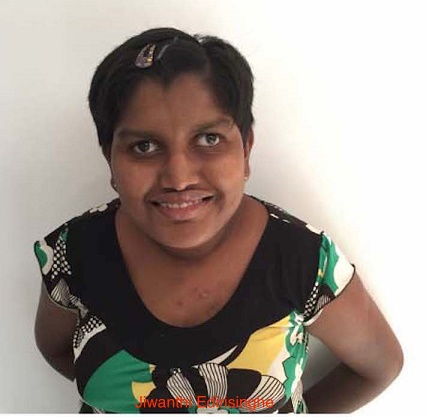
Senaka panicked and contacted the gynecologist, who paid no heed to his comments! Worried Senaka then became an irritation to the medical team and began to plead with the doctors to perform a caesarean operation “to save his wife and the unborn child,” but the attitude of the medical team at the Peradeniya Hospital was inconceivable.
Finally, the medical team, on their own decision, performed the caesarean operation on 6th November 2009 but, as expected by the child’s parents, it was too late! The newborn baby suffered from brain damage due to ‘starvation of oxygen’ as a consequence of which, the child did not cry like any other normal baby when born, except a minor squeaking; she did not cry at all for three long years!
Dyslexia
During this traumatic period of three years the child’s parents contacted medical experts to seek further advice on her condition, but only to be informed that the child was suffering from dyslexia and ‘there was no medicine for it’!’ From the time of her birth, Jeewanthi’s speech and language skills followed a different development pattern in comparison with other normal children of the same age. At 4½ years of age, Jiwanthi started to crawl progressively but took her own time to develop her speech. Her father steadfastly trained her to walk and helped her with physiotherapy exercises to tone up her under-developed calf muscles. When it came to a stage where she needed assistance 24/7, Senaka Edirisinghe resigned from his lucrative position in the hotel industry to attend to his daughter’s daily needs.
Schooling
In 2004 she was admitted to Mahamaya Girls’ School, Kandy where she had her primary education up to the 5th Grade, where the same teaching staffs were deployed, but from 5 – 13 grades was a different kettle of fish with the interchange of teachers for different subjects. A male teacher was allotted to cater for children with special needs, but he visited the school only once a week for ‘ special education’. This hindrance was compounded when the Principal at Mahamaya Girls School decided that ‘no girl should be left alone with the male teacher’ at any time, unless at least one of the teaching staff was in the vicinity.
Perturbed Senaka Edirisinghe did not want to make a hue and cry about the Principal’s decision, which he thought would affect his elder daughter’s progress, who was a student at Mahamaya Girl’s school at the time. Instead, diplomatically he removed Jeewanthi from Mahamaya Girls School and made arrangements for her to attend St. Anthony’s Girls School at Katugastota in 2007.
Gratitude
Senaka Edirisinghe makes no bones about expressing his gratitude publicly to Randeniya Fernando (Jeewanthi’s class teacher) and Principal, Pathma Lekamge at St Anthony’s Girl School, for identifying Jeewanthi’s special aptitudes and capabilities in music as opposed to Mahamaya school’s blatant rejection and impeding his daughter’s progress on her refracted talents. “There was a complete lack of attention for differently- abled children at Mahamaya Girl’s School, for there were no facilities such as training on drawing, dancing, music, sports and such things ” Senaka Edirisinghe still vents his frustrated views.
In contrast, Lekamge encouraged and induced Jeewanthi’s embryonic talents by requesting her to partake in every school concert to increase her emotional intelligence whereby to enhance her mental faculties psychosomatically.
Senaka, being a musician himself, was an asset to his daughter whenever she performed on stage by playing a backup musical instrument. When Mrs. Lekamge noticed the father and daughter rehearsing once, she made a bold a request for the duo to perform on stage during a school concert. They received a standing ovation at the end of their performance.
Accolades of Merit
Due to the vigour and encouragement she gained at St. Anthony’s Girls School at Katugastota, Jiwanthi was successful in winning a Certificate of Distinction from the Sri Lanka Festival for Performing Arts in Vocals (solo) in 2011, and the special Gold Medal for Entertainment organised by the Kandy Educational Division in 2015. On 16th January 2017, Social Services Department coordinated a function to distribute educational scholarships for 100 differently-abled children in Kandy. Jeewanthi had the rare opportunity to perform in the presence of the Minister of Social Services, on that occasion, who was overwhelmed by this young girl’s talents. The Minister walked up to the stage (after the concert), praised her and made an immediate request on the spot to the Director General Social Services to explore all possible avenues to help and propagate the future of this young lass.
With much hope and expectation, Senaka Edirisinghe and Jeewanthi travelled to Colombo one morning to meet up with the Director General, Social Services only to be disappointed and to be told, ‘there were hardly any music teachers to cater for differently- abled children of Jeewanthi’s calibre’. They were further informed that ‘even if there was an opportunity, her training programme could be limited to a maximum of two months only!
Senaka Edirisinghe feels that the attitude of the officials of the department of education and social services towards this category of differently- abled children is awfully disconsolate in recognising their artistic talents and deflected abilities, and in providing facilities and opportunities for them to reach up to national level whereby they could receive the attention of the nation so that they will have some hope of a future.
He says, ‘here is a clear cut case of proving commonsense as the most uncommon commodity’, as otherwise, just by utilising Jeewanthi’s already proven talents, the social services department along with the department of education could benefit by appointing her as an ambassador for differently-abled children to organise fund raising musical concerts throughout the country, the benefits out of which could be expended to improve facilities for such children as much as opening up obscured talents of differently- abled children!
With his resolute determination, Senaka Edirisinghe has managed finally, by his own efforts, where everyone else has failed, an institution that caters for the differently- abled children. The ACT4 has accepted Jeewanthi, as a visiting trainee, having observed her awe-inspiring performances, which of course, is at a cost.
The ACT4 is an organisation run by an NGO where 88 partly-abled children are already accommodated presently at their premises, while 350 children attend a specially organised fully loaded daily programmes, which incorporates psychomotor therapy, vocational training skills, computer coaching and guidance, Acqua treatment – such as swimming. The dedicated staff at ACT4 are volunteers from Holland, who work enthusiastically and completely free of charge, which drives the Sri Lankan Social Services and Educational pundits into a sense of perplexity and shame!
Jeewanthi will continue her schooling at St. Anthony’s Girl School till the end of 2017. She performed at the Sirasa Avurudu Wasanthaya on the 8th of April 2017 at Delthota, sponsored by Sirasa T.V.
tilakfernando@gmail.com
Mahinda Rajapaksa being interviewed by Padma Rao Sundarji of WION’s senior international correspondent
April 18th, 2017Sudath Gunasekara 18.4.2017.
Brilliant response by Mahinda Rajapaksa. How much Padma has tried to trap MR in this interview. But he has cleverly avoided all her attempts. His answers clearly show how matured a politician he is by now. Particularly I admire his love for the country and the people.
Even Padma has been more careful in choosing her words and posing tricky questions to MR than Ranil when she interviewed him on 2. 4. 2017 MR in this interview is leagues ahead of and much sharper than Ranil, who had throughout meekly given in to Padma often getting trapped.
On the other hand MR has answered every question Padma posted wittingly and intelligently
I am particularly impressed the way he had handled Questions nos. 3 4 5 6 7 8 9 10 11and 12
I see avery big difference between this and his previous interviews I have read.
I have no doubt you will surely enjoy the following interview
Mr/ Padma Rao Sundarji
Exclusive: Sri Lankan government selling the country, says ex-president Mahinda Rajapaksa
Rajapaksa spoke to WION’s senior international correspondent Padma Rao Sundarji for the ‘World Is One: Global Leadership’ series
Mahinda Rajapaksa spoke to WION at his residence in Sri Lankan capital Colombo. (AFP)
Colombo, Western Province, Sri Lanka | Apr 17, 2017, 03.28 PM (IST)
Mahinda Rajapaksa was President of Sri Lanka from 2005 to 2015. He is a human rights lawyer by profession, but has been the butt of widespread outrage and criticism for alleged human rights violations by the Sri Lankan armed forces during the final stages of the 30-year long civil war against the armed separatist group, the Liberation Tigers of Tamil Eelam (LTTE), which invented the “suicide bomb”, forcibly recruited child soldiers and used civilians as human shields
In his first global television interview since his election defeat in 2015, Rajapaksa spoke to WION’s senior international correspondent Padma Rao Sundarji for the “World Is One: Global Leadership” series at his residence in Colombo.
Padma Rao Sundarji: President Mahinda Rajapaksa, it’s a pleasure to see you again. Thank you for receiving me and WION for this exclusive interview. I’ll start with India/China/Pakistan -the region. Sri Lanka is today steeped in external debt to China. The current government under President Maithripala Sirisena is under tremendous pressure. It is slated to give China up to 80% stake in the port of Hambantota and a 99-year lease on 15,000 acres of land nearby. Your critics say that it is your government that began the dependency on China, your supporters blame the present government in Colombo. Either way, India is not happy. Who is more responsible?
1 Mahinda Rajapaksa: They say we are responsible and we say the present government is responsible. Some even say India is responsible. We had decided to consciously re-orient our countries towards Asia, which, of course, means the two power houses India and China. We did this for more than one reason. Firstly, we identify ourselves as Asians and therefore we identify our destiny as part of that of the continent of Asia. Secondly, Asia is our civilizational and cultural comfort zone. Thirdly, we look to Asia to protect us and help counter-balance pressures on our nation’s sovereignty from outside the region. We continue to hope to benefit from the economic rise of Asia propelled by the growth of its two giants, India and China. But there was no dependency on China under my government — I must tell you that. All projects were income-yielding. Repayment was commercially feasible. Take the Hambantota sea port. First, I went to India, and I requested them I want a harbour port here and asked whether they could please help us. But you know…the Indian way. You can’t blame them either because the private sector is involved and then there was red tape, etc. All in all, they were not prepared to accept because the (Sri Lankan civil) war was going on, not only the north and east, but even in other parts of the country. Then, I think in 2006, I went to China. There, I negotiated the port. They immediately gave it to me within that year. But it was a loan that we could afford, because we knew from the income we get that we can pay it back. We were not depending on them (China). It was a direct loan, for which we never gave them the port. After that and for the second and third phases, we negotiated with them on a Supply-Operate-Transfer (SOT) basis. But only for the terminal. not the port! And even in the terminal, they had to pay for the land. We never gave them land like this (the current government). Unfortunately with this government, it’s their approach. As soon as they came to power, they cancelled all these contracts, all these agreements with China and antagonised Beijing. Thereafter, of course everything changed. Now they are offering 15,000 acres – we never offered them anything like that. What they are doing now is — I would say, they are selling the country.
Padma Rao Sundarji: China is Sri Lanka’s largest trading partner and biggest investor. Even some Sri Lankans say that China is slowly colonising your country. You and the factions supporting you are yourselves protesting the Hambantota deal with China. And yet, your prime minister, Ranil Wickremesinghe is expected to initial the deal when he visits China in May. Colombo’s Port City Project too is steaming ahead. And through the docking of its nuclear submarines, China has already made it clear that it has larger, strategic interests in Sri Lanka and the Indian Ocean region. Is it too late to revert this process of near colonisation of Sri Lanka by China?
2 Mahinda Rajapaksa: There was no idea of colonisation in our time. China is a valued friend and a partner in development, that’s all. However, there is a significant difference between our approach and that of the present government. The Chinese projects were negotiated by the last government (ours) as per the structures I described. For Hambantota, it was a Supply-Operate-Transfer (SOT) arrangement only for the terminal and the land was leased to them. So there can be no talk of colonisation as such. But this government has changed all those policies. That is why all this is happening now.
Padma Rao Sundarji: To decimate the Liberation Tigers of Tamil Eelam (LTTE), against whom there was a brutal civil war for 30 years, your government received arms, training and even aircraft from China and Pakistan. Did you ask India to help at the time and if so, how did New Delhi react?
3 Mahinda Rajapaksa: But they helped us! We didn’t have to ask! Because I was fighting your war, India’s war, not my war, actually. The LTTE killed your prime minister, Rajiv Gandhi and so many other people in India and on your soil, not ours. So in that way, it was not only my war, it was an Indian war, it was a humanitarian war. India helped us in every possible way. We didn’t want to publicise it, tell the press too much. And not only China and Pakistan, even the British and the Americans helped us.
Padma Rao Sundarji: Pakistan is a hotbed of Islamist terrorism, mostly targeted at India. The Maldives too, have been home to the maximum number of Islamic State recruits in South Asia and is being rapidly influenced by Saudi Wah’abi Islam. Bangladesh has seen IS terror and sleeper cells. Your justice minister recently said that 31 elite Sri Lankan Muslims” had joined the IS too. Given all this, it’s surely better for Sri Lanka to improve relations with India, than ignore the dangers from Islamist terrorism in the region?
4 Mahinda Rajapaksa: We believe in improving relations with all countries in our neighbourhood, this I must tell you. Both India and Pakistan have helped us as best as they can, we have traditionally been friends of both. And that friendship has not been mutually exclusive and contradictory, that is, friendship with one has not been at the expense of the other. We are mindful of the sentiments of our citizens of Islamic faith. You will remember that our former PM, Mrs Sirimavo Bandaranaike was a close friend of the Islamic world. Of course, we have only one neighbour, India. It’s a subcontinent and where our Tamil citizens have cultural, linguistic and civilizational links. For all those reasons our relationship and friendship with India is quite special. Even unique, I would say.
Padma Rao Sundarji: Mr Rajapaksa, you had promised to bring about a solution to the demand for Tamil autonomy in your Northern and Eastern Provinces. India insists on the implementation of the so-called 13th Amendment to the Sri Lankan constitution which Rajiv Gandhi’s government had co-authored and both parties signed in 1987. Thirty years on, is it the best solution?
5 Mahinda Rajapaksa: I won’t say it’s the best solution. If it were, the problem would have surely been solved by now. We must remember that all communities must get together to give a solution. You can’t come up with one solution only to satisfy one section or community. We have to satisfy all.
Padma Rao Sundarji: The fishermen’s issue and the Kachaithivu agreement make headlines in both India and Sri Lanka every day. What’s at the bottom of both and how can they be resolved once and for all times?
6 Mahinda Rajapaksa: Fishermen only follow the fish, they are not worried about borders. But it is our duty – that of Delhi and Colombo – to stop this, we must have the political will to do so. Indian fishermen come here and deplete the entire seabed of fish by using bottom trawlers. So this must stop. And New Delhi must have the political will to stop it.
Padma Rao Sundarji: You had accused India, specifically its Research and Analysis Wing (RAW) of engineering your election defeat in 2015. How so?
7 Mahinda Rajapaksa (laughs): You know, I don’t want to go into the past. What’s done is done. It’s a new page now.
Padma Rao Sundarji: If you were to return to power – either with the Sri Lanka Freedom Party (SLFP) faction that supports you or some other new party, would you want to recalibrate your relationship to India which was very tense during your years in office?
8 Mahinda Rajapaksa: Frankly, I think both my government and this government and may I say even earlier governments like that of President JR Jayawardene have learned lessons in geopolitics and economics! No Sri Lankan government can fail to recognise that Sri Lanka cannot afford to antagonise the two Asian giants – China and India. We have learned our lessons by now. So it’s in our national interest to very carefully balance and maintain equilibrium between the two.
Padma Rao Sundarji: A report in The Hindu suggests that you and your brother, former defence secretary Gotabhaya Rajapaksa have fallen out and that Ram Madhav, Indian PM Narendra Modi’s special man for Sri Lanka, is involved in engineering some sort of a political arrangement which will include your brother and suit Indian interests. Can you comment on that report?
9 Mahinda Rajapaksa: I didn’t see the report, only heard about it. But there has been no falling out between Gotabhaya and me in the past, in the present and there will not be one in the future either. Our relationship is based on love, mutual respect, shared patriotic values but also the dangerous shared experience during the war. Why, he had dropped in only yesterday. I really don’t know why they make stories up like this. It’s not good for their paper, or even for the writer…
Padma Rao Sundarji: What is your personal equation with PM Modi? You have met him several times, including at his own inauguration. Would you have any anecdotes to narrate?
10 Mahinda Rajapaksa: I regard myself a friend of your PM Modi. I admire what he has done for your country, India. And his international prestige. I really like the way he has harnessed the support of the Indian diaspora in a way I couldn’t! I admire his patriotism and his drive at modernising India. Yes we admire him, there’s no question.
Padma Rao Sundarji: Earlier this year, several former “rehabilitated” LTTE cadres were arrested for being part of a diaspora-hatched conspiracy to kill moderate Tamil leader MA Sumanthiran. Two years ago, three former Tigers including one Gobi” were chased and gunned down and caches of weapons found in Sri Lanka’s Northern Province. The Liberation Tigers have regrouped outside Sri Lanka. Does all this mean that the rehabilitation program started by your government has proved to be a failure?
11 Mahinda Rajapaksa: Not at all. Our rehabilitation effort was successful and humane. What has been a disaster is the weakening of our security forces and our safety network in the former conflict areas. Weakening them has been a deliberate policy of the present government. I fear that disaster is looming. When we released them – about 12000 people – some were rehabilitated fully, then underwent the entire course. Then there were those who had taken only half of it. Finally there were others who somehow managed to escape that rehabilitation program. The LTTE diaspora is collecting money and they are powerful. So it is essential to have a good security network. Our intelligence networks must be strengthened. Instead, they have weakened it, because they are listening to the LTTE diaspora.
Padma Rao Sundarji: But if the rehabilitation program was successful, then these stories of an LTTE resurgence are surely just politically-motivated rumors ?
12 Mahinda Rajapaksa: No, they are not. They’re probably the tip of the iceberg.
Padma Rao Sundarji: So you feel the problem is much larger?
13 Mahinda Rajapaksa: Yes, much larger.
Padma Rao Sundarji: Former Tiger Karuna has formed the Tamil Freedom Party in Batticaloa, another former Tiger the Rehabilitated Liberation Tigers Party in Trincomalee. “Tamil freedom”, “Liberation Tigers” – surely no Election Commission in united, post-war Sri Lanka can and should accept such party names?
14 Mahinda Rajapaksa: Well, I support and encourage Karuna. He took a personal risk by coming into the mainstream and that cost him his brother Reggie’s life – he was killed by the Tigers. Now if Karuna’s forming a political party, I wish him luck. I don’t know enough about the other party you mention. But rehabilitees must be able, free to start political parties. We must encourage them to come into peaceful, democratic, non-separatist politics.
Padma Rao Sundarji: But surely with better names?
15 Mahinda Rajapaksa: Yes, I suppose so….I think the election commissioner will advise them..
Padma Rao Sundarji: You are widely credited – even by your detractors – as the first Sri Lankan president to bring the 30-year civil war to an end. Corruption charges against your family persist now. And yet, your popularity seems on a phenomenal upswing. A new party has been formed, it is asking you to leave the SLFP and lead it instead. Either way, will the next election see the return of Mahinda Rajapaksa into the fray?
16 Mahinda Rajapaksa: Mahinda Rajapaksa never left the fray. As long as my country, my nation, my people are in danger and need me, I remain in the fray.
Padma Rao Sundarji: So whether as PM or President, you will come back, in whichever role?
17 Mahinda Rajapaksa: I must tell you that patriotic politics is not a job. It is my life’s vocation.
Watch
We need emergency declared by the Executive. Otherwise there will be anarchy ……
April 18th, 2017Dr Sarath Obeysekera
Read the news item below .
-
නාගරික සංවර්ධන අධිකාරියේ ඉඩම්වලට කුණු දැමීම තහනම්…
සිරිමන්ත රත්නසේකරනාගරික සංවර්ධන අධිකාරියට අයත් කිසිදු රජයේ ඉඩමකට මැයි පළමු වැනිදා සිට කසළ බැහැර කිරීම තහනම් කිරීමට එම අධිකාරිය තීරණය කර ඇත.මේ අතර යම් නගර සභාවකට, ප්රාදේශීය සභාවකට හෝ රජයේ ආයතනයකට කසළ බැහැර කිරීමට අවශ්ය වන්නේ නම් එම ආයතන සතු ප්රතිපාදනවලින් විසඳුම් සපයා ගැනීමට සිදුවන බව එම අධිකාරියේ සභාපති ආචාර්ය ජගත් මුණසිංහ මහතා ඊයේ (17 වැනිදා) “දිවයින” ට සඳහන් කළේය
-
Don’t dump Colombo’s garbage in Kotikawatte
Kotikawatta residents this evening staged a protest against moves to dump garbage collected from the Colombo Municipality limits in Kotikawatte. They burnt tyres and blocked the Old Avissawella Road.
-
Colombo garbage trucks were sent back by protestors in Ja Ela and Dompe – Protests against dumping garbage at Kotikawatta as well
Marshal Law should be imposed to implement any plan by the government .Such demonstrations held in every suburb could not have been happening few years back .
Right or wrong ,state was determined to do what they want to do .Land were acquired ,water bodies were expanded into private lands and canals were widened ,houses were demolished to widen roads ,highways were built across private lands ,and none dared to protest.
Now we have democracy and Yahaplanaya and state –tolerance .
State allows demo’s and all the development work is at stand still
It is high time that Chief Executive of the country declares emergency and mobilize forces and do whatever needed at this hour of need .
Dr Sarath Obeysekera
GARBAGE PROBLEM –AT LEAST ONE MINISTER TALKS SENSE
April 18th, 2017Dr Sarath Obeysekera
I will be very open to name and praise one minister of the Yahaplalana government and the rest should be named and shamed .
Hon Susil Premjayantha told me today during the morning walk that around 200 tons can be sent to Dompe where a state of the art garbage treatment facility is in operation where 25 tons are treated daily and the balance kept on holds to drain the leachate ,pump out treat it properly before discharging to ground.Another part should be sent to Karadiyna where collection center is already functioning where there are no un authorised houses right around .
Fairway Inc is in in the process of starting treatment facility soon in Kardiyana
Balance should be sent to Muthurajawela onto 1-20 acre land out of 200 acre already available for filling ( EIA completed and SLLRDC owns the crown land) and part filled with garbage and sand mixed with earth ,
This is what I also suggested in many articles and now government has opened eyes
He also reckon that the whole operation should be carried out by the forces with a dynamic civil person overseeing the work .SLLRDC ,UDA CMC ,WPC etc should keep away and let the operation carried out by the team nominated and authorised by the President .
I suggested to transport at least half of the dry garbage from Meethotamulle to alleviate risk of more land slides before the pending SW monsoon at the door step.
I also suggested to import few bailing and wrapping machinery costing about 150 million rupees and stack the garbage in sane area in Muthurawela for power generation later
Meethotamulla garbage dump may collapse again if it rains, expert warns new item”
Hopefully this issue will be solved unless Walking high (tall ) minister and Walker low (short ) CM objects !
SLLRDC should keep their hands off in managing except ledn equipment and engineers to the execution team
Read more
Dr Sarath Obeysekera
WHO IS BEHIND THE PUSH FOR WW3 2017?
April 18th, 2017Forbidden Knowledge
No doubt, no doubt, no doubt,” that Bashar al-Assad carried out a chemical attack against his own people”, says the psyops machine known as the Mainstream Media.
It’s déjà vu all over again. Instead of Yellowcake” and WMDs”, we have a Sarin gas attack”.
The ‘Invasion of the Body Snatchers’ is at full throttle and Trump has evidently been replaced by an unrecognizable pod person. The Mainstream Media, whose only role is to further the agenda of the Deep State is suddenly goo-goo for the Replacement Robotoid in Chief. The reinstated fraud, news” anchor, Brian Williams waxes maniacally about Beautiful weapons”.
Are the American people going to stand for boots on the ground in Syria? Is Russia going to stand for American boots on the ground in Syria?
Canadian journalist, Eva Bartlett isn’t. She puts a smarmy Country Club reporter in short pants, in a priceless exchange, here. Everyone reading this now knows enough to do the same. Let’s stop these psychopaths in their tracks.
https://youtu.be/W7EKBhbAiSM
Grodno Medical University in Belarus to branch out to Sri Lanka .
April 18th, 2017GRODNO, 18 April (BelTA) – The Grodno State Medical University in Belarus intends to open a branch in Sri Lanka, BelTA learned from the university’s Rector Viktor Snezhitsky.
A delegation of the Grodno State Medical University is now busy negotiating in Sri Lanka. We intend to open a branch of the university’s preparatory courses department.
The idea will be implemented in 2018 if not in 2017. We are considering hiring local teaching staff. Specialists from Grodno will be sent to Sri Lanka for short-term business trips for the sake of control, performance review, and educational support,” said the rector. If the plans are implemented, Sri Lanka will be the first country with a branch of the Grodno State Medical University of its own.
It is a normal practice for many universities. If the project produces the effect the university counts on, the practice will be expanded, noted Viktor Snezhitsky. The Grodno State Medical University has trained foreign students for more than 20 years. Education services with English as the language of instruction have been available for over 15 years.
At present two thirds of foreign students at the Grodno State Medical University are instructed in English during the entire six-year period of education. Our teachers are ready for it. We constantly recruit more young professionals, who speak foreign languages,” added the rector. The quality of training of foreign students at the Grodno State Medical University is highly rated, competition among foreign students exceeds two people per place.
A roundtable session of the Education, Science, Culture, and Social Development Commission of the Council of the Republic of the National Assembly of Belarus took place at premises of the Grodno State Medical University on 18 April. Ways to improve medical university education and science in Belarus were discussed during the session.
Read full text at: http://eng.belta.by/society/view/grodno-medical-university-to-branch-out-to-sri-lanka-100566-2017/
If you use BelTA’s materials, you must credit us with a hyperlink to eng.belta.by.
Garbage: Adopt Gota’s proposal, says PHU
April 18th, 2017Lahiru Pothmulla Courtesy The Daily Mirror
The best solution for Colombo’s garbage disposal quagmire was given by former defence secretary Gotabaya Rajapaksa and the government should implement it without being fixated on who will receive the credit, MP Udaya Gammanpila said today.
He said dumping garbage at Karadiyana or somewhere else was not the best solution to this crisis.
He said Mr. Rajapaksa had suggested that the garbage collected daily within the Colombo Municipal Council limits and those already piled up at Meethotamulla and Bloemendhal be transported by train to the Aruwakkalu limestone quarry in Puttalam.
Mr. Rajapaksa had suggested that the limestone pits be turned to ‘sanitary land fills’ prior to depositing garbage in them. Cabinet approval was given to the proposal in August 2014 and Rs.2 billion allocated in the 2015 budget for the project. However, with the change of government, the project was abandoned,” he told a news conference organised by the Pivithuru Hela Urumaya.
Mr. Gammanpila said the government had claimed that the project had hit a snag after the Wildlife Department had opposed it because some of the limestone pits were situated within the Wilpattu National Park buffer zone.
“Although unauthorised human activities are banned within a buffer zone, activities approved by the authorities can be carried out or otherwise the buffer zone could be moved 300 meters towards the perimeter of the national park,” he said.
Referring to the Megapolis and Western Development Ministry’s announcement that it would not permit garbage to be dumped on Urban Development Authority (UDA) lands, Mr. Gammanpila said it was not a solution and the UDA should assist the local government (LG) authorities by providing expertise when disposing garbage.
“The LG bodies are not capable of handling this crisis alone. This is an act of side stepping the issue,” he said.
Meanwhile, Mr. Gammanpila said western Province Chief Minister and Megapolis Minister don’t see eye to eye when it came to the garbage crisis in Colombo. However, the President also remains silent by allowing the two to work things out which will never happen,” he said.
– See more at: http://www.dailymirror.lk/article/Garbage-Adopt-Gota-s-proposal-says-PHU-127333.html#sthash.LN485Wcy.dpuf
Meethotamulla and the fate of the executive presidency
April 18th, 2017By DR. DAYAN JAYATILLEKA
April 18, 2017, 7:39 pm
A few days after the Meethotamulla tragedy in Sri Lanka, a referendum was held in Turkey. The people of Turkey rejected Western liberal warnings and voted in favour of an executive presidency.
The Meethotamulla tragedy, which occurred utterly inauspiciously as it were during the Sinhala and Tamil New Year holiday, was symbolic. Two years into the neoliberal Yahapalana government (and a perennially UNP Municipal Council), at least 30 people died horribly, buried under an avalanche of a visibly growing mountain of garbage, neglected and deprioritised despite warnings (including from Cardinal Malcolm Ranjith) and protests by the residents.
It is eerily symbolic of this government’s policies and performance which taken together is a growing pile of dangerous neglect and toxicity, which will bury this country and its people under the collective and growing weight of its colossal callousness and incompetence.
It is clear. This country will have to bury this government under an electoral avalanche first, or this Government will bury us. Furthermore, it seems imperative to retain the Executive Presidency to put in place the kind of strong leader who has the foresight and ability to save us from yet another such catastrophe by timely and determined action. It would be fortunate if the country had the choice of a person who has proven successful in matters of conceptualizing and managing urban development and renewal, to work the same developmental miracle on a national scale, leaving no garbage dump, literal or metaphorical, uncleared. We need a man who strategized, organized, cut through red tape and managed to clear all ‘uncleared’ areas.

But, how to bury this government? May Day this year is the chance for the Opposition to drop the political equivalent of the ‘Mother of All Bombs’ on the Government. But will it? A referendum is the best occasion to bury the Government. What is the line the Joint Opposition rally on May Day at Galle Face Green will take on the abolition of the Executive Presidency and therefore the Referendum that will be automatically triggered if the Executive Presidency is to be abolished? On this crucial issue, what is the signal that will be sent from Galle Face? Who will send what signal to whom?
One has to distinguish between a President and the Presidency. There are those in the JO who are opposed to both the President and the Presidency. There are those who are opposed to the Executive Presidency only because they are opposed to this President or because they think they themselves cannot be elected president. There are those in the Yahapalana coalition who are opposed to the Presidency but not so much to the President. Then there are those in both the JO and the Yahapalana constituency who are not opposed either to the Presidency or to the President as much as they are to the Prime Minister. Anyway, that’s where I stand. Where do you stand?
The slightest acquaintance with Political Science teaches one the difference between the State and the Government. Unfortunately, strategy in the Opposition movement is being impacted by persons who do not understand this or who deliberately ignore and confuse this issue. In the name of the struggle against the Government, they take up positions which are anti-State; which weaken the State. The Executive Presidency—not this or that President—is part of the State.
Sri Lanka has a Presidential form of State. Our Executive Presidency is the centrepiece of what Prof AJ Wilson rightly termed ‘The Gaullist System in Asia’. Turkey has just voted YES in a referendum to introduce an elected Executive Presidency, such as we have had since 1978. Those who target the Executive Presidency, rather than merely criticizing this or that policy, or action or inaction, of the current President, are targeting and weakening the State. From my perspective of ‘State patriotism’ I must denounce and oppose this, despite the fact that I am sharply critical of the Government and its policies, including many of those of President Sirisena.
A faction of the Government led by Prime Minister Wickremesinghe and supported by his TNA allies, propose to weaken the Sri Lankan State by abolition of the Executive Presidency, quasi-federalization of center-periphery relations, and the massive sell-off of state assets. Ironically, a faction of the Opposition too wants to weaken the Sri Lankan State by the abolition of the Executive Presidency.
Only “master manipulators” who are politically illiterate do not understand the theory of contradictions. There are contradictions within everything and as Mao said one must identify “the principal contradiction” and “the principal aspect of the contradiction”. The formula that “the main enemy is the Government” ignores the fact of important contradictions between (I) the interests of the State and the Government as well as (II) within the Coalition Government! As Mao again said “one divides into two”. Obviously the SLPP strategists do not know this, but genuinely well-read progressive politicians such as Dullas Alahapperuma and Vasudeva Nanayakkara do.
It was CBK as President who presented the federalization (‘union of regions’) package, brought in the Norwegians, double crossed the Karuna rebellion and signed off on the PTOMS, but it was also her i.e. the Presidency, that had to be motivated and leveraged to remove Ranil and finally did so. The Presidency is still the Archimedean point of the System.
Prime Minister Ranil Wickremesinghe is trying to cede strategically precious parts of the country and its economy to foreign powers in the treacherous hope that they would annex these parts (e.g. Trincomalee) and keep him in office to safeguard their acquisitions by any means necessary, including military interventionism against the local populace. For Ranil the slogan is not “Sri Lanka is Open for Business”. Instead, Ranil’s slogan is “Sri Lanka for Sale!”Therefore, the principle contradiction in Sri Lanka today is between the nation and this nihilistic anti-national project.
The formula that Maithri and Ranil “are the same” or are “two sides of the same coin” rather than regarding Sirisena and his SLFP as actually or potentially a vacillating intermediate element i.e. a crucial variable, are revealed for the dangerous silliness it is when one ponders the question of how fast and fully the worst elements of Ranil’s agenda would have gone forward without Sirisena. The sell-off of Trincomalee and Hambantota, the fast-track federalizing Constitution pushed through outside of Parliament (Ranil’s January 9th 2016 draft Resolution), the full implementation of the Geneva resolution with a hybrid court and foreign judges, would all be realities today.
One only has to recall the draft 19th amendment of 2015 that was challenged in the Supreme Court and then modified, as well as the draft resolution of January 9th 2015 which was also modified by the SLFP and adopted in March 2015, to know that if not for Sirisena and his SLFP faction’s covert dissent or vacillation—and the tacit support of the JO– Sri Lanka would have, by this time, a Constitution in which Ranil Wickremesinghe is the powerful executive PM, Sirisena the nominal President, with Wigneswaran and the Northern Provincial Council with qualitatively more powers than it has now. Perhaps that is the outcome that some Fifth Columnists in the Opposition were hoping for or are still awaiting and working towards.
The outstandingly brilliant Greek Marxist and political thinker Nicos Poulantzas who died tragically while still young, wrote that any serious political strategy had to take into account three types of struggle and operate along three axial routes: (I) struggles against the State (II) struggles within the State and (III) struggles at a distance from the state. We can adapt this to the present context.
The third type of struggle, “at a distance” from the regime, are being waged by the FSP, JVP, trade unions, GMOA, student unions etc. They confront the regime directly and physically but are “at a distance” because they do not and perhaps cannot directly pose the question of replacing the regime and taking political power, while a broad “JO+ SLFP + patriotic UNP” bloc can.
The JO and SLPP are waging and must wage the first type of struggle, namely struggles directly against the regime. But they must also recognize that there are potential and actual struggles going on within the regime which must be encouraged and supported. The JO’s senior parliamentary leadership does this, but this is precisely what the line of the “master manipulator” of the SLPP fails to do—possibly because “manipulation” is not political strategy!
The SLPP’s political line needs to be clarified and rectified. Antonio Gramsci explains that “Lenin said…‘separate yourselves from Turati and then form an alliance with him.’ ” That is precisely what the JO/SLPP must do with President Sirisena’s SLFP, or more correctly, with the SLFP and patriotic elements of the UNP, with or without President Sirisena.
All three types of struggles identified by Poulantzas, along all three routes, must be waged simultaneously in order to defeat the government and replace the regime, while defending and protecting the State.
In this centenary year of the October Revolution, it is apt that I conclude with a little lesson from Lenin: “…to refuse beforehand to manoeuvre, to utilize the conflict of interests (even though temporary) among one’s enemies, to reject agreements and compromises with possible (even though temporary, unstable, vacillating and conditional) allies—is this not ridiculous in the extreme?”(Collected Works, Vol XXV, p. 210).
It is ridiculous in the extreme “to reject agreements and compromises with possible (even though temporary, unstable, vacillating and conditional allies)”, such as the official SLFP in Government, especially over issues like the Constitution.
A political line that does not aim to build the broadest possible alliance by uniting all forces that can be united and neutralizing vacillators instead of pushing them back into the enemy camp; a political line that refuses to win over the middle ground, alienates potential allies, concentrates on the secondary enemy and lets the primary enemy go free; only benefits and can only benefit the primary enemy. In short, a political line that exclusively attacks Maithripala Sirisena and makes passing reference to Ranil Wickremesinghe can only benefit Ranil Wickremesinghe—which is perhaps what it is meant to do!
The formula that “the main enemy is the government” and seeing Sirisena and Wickremesinghe as one monolithic enemy and target, is politically naïve and strategically dangerous. It is this kind of nonsensical “manipulative” thinking that lost us two national elections in 2015, and three successive votes, in 2012, 2013 and 2014, in the global arena, at the UNHRC in Geneva—which began the regime change.
If this is the line that’s being urged on the SLPP and the JO by the “manipulators”, then a serious political and ideological struggle will have to waged against this “deviation” within the ranks of the Opposition, to put it back on the right track and prevent one faction of it from objectively being a Trojan Horse or Fifth Column of Prime Minister Wickremesinghe.
Why CHINA Not India?- Economic and Geo-political commentary
April 18th, 2017By Abdul Samad Courtesy Ceylon Today
This article is with reference to Mr. Dayan Jayatilleka’s write-up published on colombotelegraph.com dated 7 April 2017. It was titled, The Avurudu sale of Sri Lanka-Who will stop it? The writer makes a very valid point arguing the case for Sri Lanka to be with China as opposed to India. He also criticizes the Prime Minister’s vision of the ETCA with India and rightly so. It simply does not make any economic and geo-political sense. This article is an attempt to compare both India and China in economic/geo-political terms, keeping Sri Lanka in the context.
The Economic Context
It is a well established fact that China enjoys far greater economic supremacy as opposed to India. The table provides some information on key economic indicators comparing the two countries.
It is clear beyond any doubt that China reigns above India in all major economic indicators. The Chinese economy is at least three times bigger. The biggest advantage China has is its workforce, which is double the size of India. It is also worth mentioning, China is the world’s largest exporter valued at 2.21 trillion as of 2013 versus India’s 313 billion. China is also the second largest provider of foreign direct investment in the world, providing $115 billion in the year of 2016.
Henceforth, it makes perfect economic sense for Sri Lanka to pursue its diplomatic efforts more inclined towards China. During the post-war era China has made unprecedented investment in infrastructure development of Sri Lanka. More importantly, China has shown a more result oriented approach to investment. India on the other hand has decreased its financial assistance to Sri Lanka as revealed by their Finance Minister Arun Jaitley in his last budget.
Prime Minister Ranil Wickremesinghe’s inclination to the ETCA does not make any sense for Sri Lankans as India’s commitment to the development of Sri Lanka is questionable. I conclude, China has a far more important and greater role to play if Sri Lanka is to realize its economic potential.
Geo-Politics of India and China
It is important that we realize the political landscape of both the countries. China largely operates in a Communist structure. Single party rule, that ensures the core decision- making rests with the State and demands absolute control.
Henceforth, she offers greater political stability. Foreign policy and decision-making is very stable and does not carry the risk of changing with government change. China also view’s Sri Lanka as a strategic location in South Asia. Chinese presence in Sri Lanka effectively acts as shield against India. Sri Lanka does not have to be viewed as a State that’s intimidated by its large neighbour when closely associated with an economic superpower. It is worth noting, China’s trade decisions have little or no bearing on Sri Lankan sovereignty. It is one of the few countries that always supported Sri Lanka at the United Nations,
Co-sponsoring of UNHRC
resolution
Unity government’s decision to co-sponsor the 30/1 resolution was a diplomatic insult to China and diplomatic relations. It is a foreign policy debacle that has damaged our credibility with one of the largest economic super powers in the world.
The timing of all this is even more crucial at a time when FDIs in Sri Lanka are next to nothing. The government has left absolutely no room to humiliate and antagonize Sri Lanka’s largest FDI provider in recent times.
China’s close diplomatic ties with Pakistan, another country that consistently supported Sri Lanka at UN, makes its geo-political presence in South Asia all the more important. Pakistan and Sri Lanka have always enjoyed cohesive diplomatic ties. Combining with China and Pakistan Sri Lanka is perfectly placed to challenge India both on the economic and political fronts.
India operates as the world’s largest democracy. It is this very political and governance ideology that has been the cause for India’s failure to match China’s economic and political domination. A primitive society, that’s governed by ancient principles and diverse ethnic political participants. Henceforth, offers little political stability and even lesser stable foreign policy. Policy is subject to the government in power.
The information furnished in the above table also reflects India has much to do on its own domestic front. More than 400 million people still live in poverty and are deprived of basic needs. Does it make sense for Sri Lankan politicians to expect assistance from India?
India is also home to diverse ethnicities that are powerful States domestically. Tamil Nadu, one such State with a majority of Tamils has close links to the Sri Lankan Tamil population. It has also openly supported the brutal LTTE that killed so many innocent civilians in Sri Lanka. In this context, does it make sense for the Sri Lankan Government to pursue meaningful diplomatic ties with India?
Diplomatic efforts should be channelled to bear meaningful results. The unity government’s allegiance to India and the West has borne nothing so far. In fact, it is plunging Sri Lanka into a deeper conflict brewing situation in the name of ethnic reconciliation and war crime investigations.
Conclusion
It is worth mentioning that India views Sri Lanka’s strong macroeconomic fundamentals as a direct threat to its economic presence in the SAARC region. It is a much easier task to develop a country the size of Sri Lanka compared to India. The post-war economic expansion was one reason for India to sponsor the unity government to power.
It was very clear two traditional political rivals cannot synchronize in unison to make decisions that are in the best interest of the country. The political instability also allows India to keep Sri Lanka in its shadows which has been the case historically.
President Maithripala Sirisena’s and Prime Minister Ranil Wickremesinghe’s allegiance to India is more a political favour than a strategic initiative in the best interest of Sri Lanka. India is directly using the unity government to undermine the Chinese presence in Sri Lanka. In doing so, it is holding the Sri Lankan economy as bait.
Millions worth infrastructure projects are being kept on hold which can be long-term competitive advantages. For what? Only to satisfy India and the West! I want my readers to be clear such policy debacles do not affect the politicians. They continue to live extravagant lives obeying instructions of their masters.
Sri Lankan citizens at large are deprived of a better country, a better life, a world class economy and infrastructure. By aligning Sri Lanka’s interests to negative forces the country is being pushed into deeper economic problems. India has achieved its ambitions by halting a rapidly expanding Sri Lankan economy and vibrant socially integrated society.
China, a powerful State that initiated massive development for Sri Lanka has been largely neglected and isolated to the detriment of the Sri Lankan people.
Samsaleem01@hotmail.com
Gota blames Government
April 18th, 2017By Shaahidah Riza Courtesy Ceylon Today
Had the incumbent government followed through the plan to create a sanitary landfill, the Meethotamulla tragedy could have been prevented, said former Defence Secretary Gotabaya Rajapaksa. He added that the 2015 Budget had allocated funds for this plan.
Within the last two years if this plan was implemented, the issue with regard to the Meethotamulla garbage dump would have been solved, he said.
“They didn’t do that. They will have to find another site and dump there. They will create the same situation there as well,” Rajapaksa said.
He added that the government has to find an alternative solution to sort out the accumulated garbage. The quality of Sri Lanka’s garbage is wet, he said and went onto note that therefore discourse pertaining to recycling and power generation are not workable.
Speaking to Ceylon Today, he explained further, “We had a plan which we finalized following a lot of research. It was a World Bank initative. The World Bank assisted us with their funding to get expert advice on this. So we realized that the only solution to the Sri Lankan garbage crisis was sanitary dumping. When we looked at various places, ultimately we realized, that Arawakkalu, a site in the Puttalam District, was ideal to create a sanitary landfill with the appropriate technicality. The plan was to have a transit place in Meethotamulla and take all of this garbage on daily basis via rail wagon to Arawukkalu. This would have been a sanitary dumping process. They talk of Megapolis and so on; I don’t know why this plan was not implemented.”
The plan was neglected due to the change of government, Rajapaksa said and noted that the problems pertaining to Meethotamulla had been ignored for the last two years.
Ranil’s Worst Betrayal: Giving Trincomalee To India
April 18th, 2017By Dayan Jayatilleka –
Prime Minister Wickremesinghe is about to give Trincomalee to the Indians—and by this (upcoming) Vesak! According to the Political Column of a respected English-language Sunday paper, he rejected the mild concerns of two SLFP Ministers, derisively addressing the pair in Sinhala as Oi!” at the last Cabinet meeting. The imminent ceding of strategic Trincomalee is summarized by Meera Srinivasan in The Hindu:
India and Sri Lanka have, in principle, agreed to jointly operate the World War-era oil storage facility in Trincomalee, the strategically advantaged port town located on the island’s east coast…Both the nations are hoping to firm up the deal before Indian Prime Minister Narendra Modi’s scheduled second official visit to the island in early May.
Indian Oil Corporation subsidiary Lanka IOC, engaged in bunkering operations, runs 15 out of the 99 storage tanks in the lower oil tank farm in Trincomalee. The proposed joint venture pertains to the remaining 84 tanks in the upper farm, but Sri Lanka would retain 10 of those for use by the Ceylon Petroleum Corporation…
During his visit to Sri Lanka in March 2015, Mr. Modi had said the project to develop the upper tank farm in Trincomalee would help the coastal town become a regional petroleum hub.” (‘Sri Lanka, India to develop Trincomalee oil tank farm’, The Hindu, April 9th)
Retaining a mere 10 out of 99 oil tanks i.e. a measly 10%, means giving the oil tank farm to India. Given the other agreements about ‘developing’ the Port, an oil refinery and highways with India means ceding Trincomalee to India—a country of which the state of Tamil Nadu, just a few miles away, is a major stakeholder.
Ceding Trincomalee gives the Indians a footprint and a foothold in that strategically vital port, ethnically sensitive border area and former warzone. India, like any big power, will now have a strategic reason for entrenching itself and ‘protecting’ what it has been conceded; its stake. Its warships will constantly visit Trinco; there will be a security presence to guard the oil tank farm from Islamic terrorists, etc. India will never leave. Trincomalee will become an Indian base and mini-colony.
With a large Indian footprint in Trincomalee there will be an ethnic power-shift in the North and multiethnic East, marginalizing the Sinhalese. The Government’s draft for the new Constitution will be presented in May and will propose the transfer of all land and Police powers to the Provinces as well as the abolition of the Concurrent List and the neutering of the Governor. This and the Indian entrenchment in Trincomalee are sufficient conditions for the erection of Tamil Eelam. Any administration in Delhi can be pressurized someday by the Tamil populace of the North and East as well as the electorally crucial Tamils of Tamil Nadu, to carve out a separate entity (a la Kosovo and Iraqi Kurdistan) in our North and East.
Did our military men fight and die, defeating the Tigers, for Trincomalee to be given to the Indians (and ETCA signed)? Can one think of a worse betrayal?
From DS Senanayake on, our governments protected us as much as they could from India, knowing the impact of an Indian presence on the island’s ethnic balance and domestic geopolitics. A great patriotic UNP leader Ranasinghe Premadasa pushed the Indians out of Sri Lanka. By contrast, Prime Minister Wickremesinghe is not only facilitating Indian expansionism on our soil but will be responsible for the long term consequences for the country and especially the Sinhalese community (most particularly in the East). One can imagine what his distant relative Ravi Jayewardene would have said and done! I can hardly think of a more heinous historic crime than the one about to be committed by the Yahapalana Government.
But what can be done?
The administration of Prime Minister Wickremesinghe rests on one factor alone: the schism within the ranks of the broad anti-UNP forces and the SLFP in particular. He has learned from his father, Esmond, and his distant uncle JR Jayewardene, the strategic value of a split in the center-Left and especially within the SLFP –and how best to exploit it.
The SLFP was not split by Mahinda Rajapaksa and his loyalists. In August 2015 at a crucial strategy meeting, I incurred the ire of Susil Premjayanth and Anura Priyadarshana Yapa by urging President Rajapaksa in the presence of the Feb 18th ‘Mahinda Movement’ leaders, to rupture with and contest separately from the SLFP because (1) we could preserve the militant spirit of the Mahinda Movement without dilution (2) the country was seeking something new and (3) MR would be under the official SLFP leadership whatever the election result. Mahinda demurred.
From my early meeting with defeated President Rajapaksa at the residence of the Speaker, his brother Chamal, on January 10th 2015 through to the Feb 18th 2015 meeting at Nugegoda, I had been part of the fight-back at a time when some prominent SLFP (now SLPP) personages had decamped from Sri Lanka.
Of those at the August 2015 meeting at MR’s residence in Mirihana, only two of us took the same position on fielding a separate list—Gotabhaya Rajapaksa and I– and we did so independently of one another. Neither of us wanted to be taken for a ride, or more crucially, for Mahinda and his supporters to be taken for a ride. We wanted to be politically self-reliant, not dependent on the decision-making of other power centers. But no one else supported us (apart from some friends, close loyalists and well-wishers of MR who came in as the meeting was dispersing)—not even Basil Rajapaksa or the present JO and SLPP personalities. Mahinda just did not want to split the SLFP and nor did they. Days later, when a dispute erupted over the able and loyal young Prasanna Ranatunga, MR was ready to split, but I thought that was too personal an issue over which to do so, after morale had been raised by the unified SLFP slate.
One might then ask why I seem to be opposing the SLFP split now. I am not! Even in Feb-August 2015, addressing grassroots audiences throughout the country, my line was that we should break with the collaborationist faction of the SLFP, establish our independent identity in Parliament, and then unite with the SLFP in a single front—not a party—against the UNP. That is still my line. I am opposed to a combined list at the upcoming PC and PS elections, but I am for joint non-UNP administrations afterwards.
The SLFP was not split by the formation of the SLPP. The SLFP split because—and when–the party leadership decided (or agreed with CBK) to overrule the mandate obtained by the SLFP at the August 2015 parliamentary election. That explicit mandate was to reject a coalition with the UNP. Ignoring it, the party leadership hived off 40 plus SLFP MPs, having appointed through the National List quite a few who failed to secure preference votes, and ‘leased’ them out as a prop for the UNP.
Every betrayal exacts a price in terms of blowback. The formation of the new party, the SLPP, was an inevitable response to the August 2015 morning after” betrayal. It also meets the requirements for an alternative or substitute for the collaborationist SLFP and an electoral option for the pro-MR caucus of SLFPers who have refused to collaborate with the UNP. If not for the SLPP, the SLFPers who are faithful to the popular mandate of August 2015 could be blackmailed by the threat of expulsion and political homelessness. So it’s mostly good. But the SLPP’s political line needs to be clarified and rectified. Antonio Gramsci explains that Lenin said…‘separate yourselves from Turati and then form an alliance with him.’ ” That is precisely what the JO/SLPP must do in relation to President Sirisena’s SLFP.
Governors, CMs favour abolition of Concurrent List, Austin Fernando Isura Devapriya and Niluka Ekanayake (Apr 8, 2017 Nation)
April 17th, 2017Dr Sudath Gunasekaram Ex Secretary to PM. MRS Sirimavo Bandaranaike and President Mahanuwara Sinhala Bauddha Jesta Puravesiyange Sanvidhanaya. 17 4. 2017.
Their’s is like the seven blind men describing the elephant
Each one of these three persons is looking at Provincial Councils as the seven blind men describing the elephant after feeling different parts of the animal with their hands. You all know how they described the elephant. Similarly all these political henchmen calling themselves Governors or Ministers carefully use words to defend the system. Because, It is their bread and butter. What other better princely job could they get with so much of luxuries without doing any work perhaps without any qualification
None of them look at PCC from the angle of a subject citizen who see this system as a big curse and a colossal white elephant to the country. None of them see the wastage, clumsiness, overlapping, duplication and the useless ness of having this system which has made governance in this country an Augean mess since it was started in 1987. Not only PCC have destabilized the country’s governance but has already laid the foundation to a Federal structure and has fully served the hidden objective of the Indian Government had in mind when they force it down the thought of JR to sign the 1987 Rajiv /JR Accord and imposed the 13th Amendment to create the latest Sothern most State of the Indian Empire, perhaps that might end up as an annex of Tamilnadu.
I ask not only these three parasitic political appointees but all other Governors, Chief Ministers/Ministers and Provincial Councilors and all citizens of this country as to what contribution these Provincial Councils have made to this country, other than providing employment and princely luxuries to these political rejects and misfits at Parliamentary elections and other third grade politician and lackies, for their families since their inception in 1987 at the expense of the tax payers to suck the blood of the masses
I ask these people who try to defend this system tooth and nail as to what service these Councils have done over the past 30 years other than providing a stage and a world of luxuries with the best of official residences with all facilities and luxury vehicles in addition to duty free vehicle permit worth 3, 4 millions once in every five years and full salary as alifetime pension for robbing the nation etc for these political parasites and wring worms to attend sport meets and prize giving at schools, funerals, foundation stone laying ceremonies and openings of work often done by others, weddings, Pinkamas, dane ceremonies in temples to show off, meetings and rallies organized by the their political parties and also collect traveling and subsistence while subsisting on others, at the expense of tax payer’s money and the privilege of going on pleasure trips abroad and getting duty free princely vehicle and practically everything under the sun just for carrying firewood and water for the leaders and collecting votes at elections and commissions throughout. This system had been bleeding the country and the nation to death for the past 30 years.
As none in this ‘monkey cage’ called Parliament will ever call for it’s abolition for obvious reasons, as ‘it is their bread and butter’, Ranil, the leader of this team of Alibaba and the 225 thieves is now going round the world selling Hambantota and Colombo to China, Trinco and the whole country to India, and the hill country , North and East to Tamils at Home..
The whole country must rise up in one voice and force the President to abolish this Jatika Huniyama before it finally gobble up this whole nation, built up by our ancestors on their sweat and blood. If the president also fail to respond then there is only one alternative left, that is to chase out all these parasites out of office and hand over the country to a set of leaders who are prepared to
The people of this country should as the last resort surround the temples of Mhanayaka Theras and demand them to get up from the deep slumber in which they are languishing and take the leadership in this mass movement, in the name of this country and the nation.
xxxxxx
Governors, CMs favour abolition of Concurrent List
By Ruwan Laknath Jayakody –
Apr 8, 2017 Nation
Austin Fernando | Isura Devapriya | Niluka Ekanayake
Both, Provincial Governors and Provincial Chief Ministers expressed favour with regard to the abolition of the Concurrent List.
Among the Provincial Governors include those affiliated to the ruling United National Party government while among the Chief Ministers are those affiliated to the governing Sri Lanka Freedom Party.
The Ninth Schedule of the Constitution contains
List I, which is the Provincial Councils List (the subjects under this have been fully devolved to the Provinces),
List II which is the Reserved List (only the Central Government has the power) and
List III which is the Concurrent List. In the case of the latter, although the Provinces can exercise power in this regard, prior to the passing of any legislation on subjects coming within the purview of the Concurrent List, the Provincial Councils have to consult Parliament and seek the legislature’s opinion with regard to the provisions of the proposed laws.
The same applies when Parliament seeks to pass a law on a subject in the said List. In both cases, neither the Provincial Councils nor the Parliament is however bound to give effect to whatever opinions expressed by either party.
Governor of the Eastern Province, former Defence Secretary Austin Fernando while acknowledging the possibility of not having the Concurrent List and it being given up, pointed out that it is better to have clarity rather than the duplication of functions. Chief Minister of the Western Province, Isura Devapriya too concurred with Fernando. Calling for subjects to be separately allocated for the government and the Provincial Councils, Devapriya, noted that: Without the concurrent list, it can instead be decided as to what subjects are to be handed over to the Provinces, whether it is for example, education or health.” Meanwhile, addressing the questioning of how the said List could be amended, Fernando added that on the question of the Provincial Councils and the Centre, a decision must be taken on what powers are to be reduced and how the functions are to be allocated.
There is a definite need for review. There must be a solution regarding the divisions. Part must go to the Centre and part to the Provinces. This is a national issue,” he explained.
Elsewhere, on the question of what constituted the meaningful devolution of power, while Governor of the Central Province, Niluka Ekanayake was of the view that the 13th Amendment to the Constitution should not be fully implemented, Devapriya suggested that aspects in the said Amendment, aside of police and land powers, should be strengthened.
Fernando on the other hand, highlighted that in order for the country to move forward, there would have to be some sort of devolution, which he explained should be based on the principle of subsidiarity and the understanding and maintenance of the distinction between delegation and decentralization. He also warned against encroachment by the government upon the Provincial Councils and vice versa.
Fernando was also of the view that the governors, appointees of the Executive, wielded too much power including certain powers which, according to him were a little too excessive.” Yes, I agree that there must be certain changes. Whether politicians should be appointed as Governors too is a matter that has to be reviewed. There is no value however in a cosmetic governor,” he emphasized, while Devapriya stressed the vital importance of consultations being held between the Governors, the Chief Ministers and the Provincial Councils during decision-making processes as a solution to various ills plaguing the current situation.
Major General (Rtd.) Dipankar Banerjee Delivers Public Lecture at INSSSL
April 17th, 2017The Institute of National Security Studies Sri Lanka (INSSSL).
Major General (Rtd.) Dipankar Banerjee was the speaker at a public lecture hosted by the Institute of National Security Studies on 5th April 2017. Given the speakers’ immense experience in the subject of defence and security, he focused on the very important topic of National Security: Changing Times, Shifting Paradigms.” Director General of INSSSL, Asanga Abeyagoonasekera introduced the speaker as a retired officer of the Indian Army with over 27 years of involvement with strategic planning at the national level. He was a Senior Fellow at the Institute for Defence Studies and Analyses, New Delhi from 1987-1990 and later its Deputy Director from 1992-96. Subsequently he was the founder and Co-Director of the autonomous think tank the Institute of Peace and Conflict Studies (IPCS), New Delhi from 1996 to 1999. From May 1999-2002 he was the Executive Director of the Colombo based South Asian think tank, Regional Centre for Strategic Studies. He next spent a year as a Jennings Randolph Fellow at the US Institute of Peace, Washington, DC before reverting as the Director and Head of the IPCS. During this period the IPCS emerged as a leading think tank on strategic and disarmament issues in all of Asia.
The speaker’s association with Sri Lanka, he said goes back twenty years to 1997 which was the 10th anniversary of the Rajiv Gandhi-J.R. Jayewardene Accord. He credited Sri Lanka with the only country to attain victory over violent terrorism and the most developed country in South Asia in terms of human development indices and many other factors in measuring security. However, he noted that in the new era, there are new challenges that are emerging. The primary focus of his lecture being how to deal with these challenges. South Asia and Sri Lanka in particular being located in an area of growing geo strategic contestations was shown as a crucial factor when conflicts especially in Asia are moving away from land-based conflicts to oceanic conflicts and attention and development will be entered around oceans in Asia. The situation will be in conditions of global and regional ethno-religious strife. Here, he drew parallel with Samuel P. Huntington’s ‘clash of civilisations’ as that factor can be seen playing out in much of Asia with different ideologies between governments that have created conflict with each other. It is to be considered that these are times of international socio-economic turbulence and possible global protectionism which is manifest in the ‘Trump-era’ as he calls it. He pointed out that this phenomena might also be seen in greater parts of Europe in time to come. The crucial meeting this week between President Trump and his counterpart Xi Jinping, he said, will shape the nature of the world order in the immediate future. It is noteworthy that these occurrences take place in times of greater global interdependence. Therefore, Sri Lanka, although with its island status and being secured by the seas around it, cannot remain removed from the larger global dimensions of conflict in a rapidly changing global environment.
In this backdrop emerges what he calls the new concepts of security. The current world order which was based essentially on the Westphalian treaty in the 17th century has now evolved where countries have decided to lay out the parameters of national sovereignty and how states interact with each other. Therefore, the conflicts more recently have been of a different nature. He further stated that there is now a distinct shift from territorial security to economic security of individuals and citizens of a nation, moving from physical security to ideals of human security. The goal of nations today is not just to secure its territory but to promote the economic wellbeing further economic interests of the state, therefore security is becoming more comprehensive, cooperative with emphasis on the human factor which is a distinct shift which has evolved from nation states to regional organisations and a shared sovereignty.
As regards Sri Lanka and challenges to its national security, Gen. Banerjee pointed out that the primary challenge would be to ensure peace and security within a nation. Thus, ensuring development and prosperity; trade and economic growth; high quality education; acquiring modern day skills and improved standards of living are present-day challenges facing Sri Lanka and any other nation state. In this context, he noted that the importance of considering the emerging global challenges such as great power contestations, inward-looking isolationist policies of the west, the rise of Asian giants, Islamic radicalisation which could well lead to a clash of civilisations which could fundamentally alter the security of nation states and finally, environmental issues. As such, the current global security landscape is one which has evolved from traditional military challenges to that of hybrid threats. The speaker further highlighted a group of emerging strategic challenges. Today, he says, wars are being fought in six dimension as compared to three dimensions of land, sea, air in conventional warfare. The new and considerably more severe spheres being dimensions of space with satellites that play a vital role not just in communication but in the deployment and direction of weapons, cyber warfare capabilities which can inflict physical violence to interfere with important systems which govern and control systems, the unchartered territory deep under the ocean was also shown as a sphere of the possibility for future warfare. Robotics, computers, artificial intelligence and mass casualty weapons such as bio and chemical are also possible future security challenges to a nation state. These, he pointed out would require different leadership strategies in governance as the aim of current warfare is to undermine socio-economic resilience of a hostile nation.
Several senior members of the tri-forces, academia and media were among those present at this very informative discussion.
ද්රවිඩයන්ට පවාදුන් අපේ සිංහල අලුත් අවුරුද්ද සහ අපේ කරගත් ක්රිස්තියානි වසර
April 17th, 2017ආචාර්ය සූරිය ගුණසේකර සමග රුවන් රත්නායක
හෙළ බසින් වසර හා සංස්කෘතයෙන් වර්ෂ ලෙස හැඳින්වෙන්නේ දවස් 365 ක සූර්ය වර්ෂයක් අවසාන වී නව වර්ෂයක් ඇරඹීමයි. ලංකාව වැනි නිරක්ෂයට කිට්ටු රටවලට සූර්යයා ඇසුරින් එබඳු වසරක් හැඳිනගත හැක. නමුත් මධ්යම හා ඉහළ අක්ෂාංශවල නොහොත් සෞම්ය හෝ ශීත කලාපයේ රටවලට එම හැකියාව නැත. එබැවින් යම් සිද්ධියක් මුල්කර සම්මත වර්ෂයක්ව ඇති කරගත යුතුය.
2014 ජනවාරි පළමු වෙනිදා නව වසරක් ඇරඹින. මීට මුල් වූ සිදුවීම කුමක්ද ? බයිබලයට අනුව දෙසැම්බර් 24 දා මධ්යම රාත්රී 12 ට බෙත්ලෙහෙමේ ගවගාලකදී ජේසු බිළිඳා මෙලොව එළිය දිටී. බිළිඳෙකු ඉපදී දවස් 7 ක් අවසන්වීමට පළමුව එම බිළිඳා බෞතීස්ම කිරීම ක්රිස්තියානි සම්ප්රදායයි. දෙසැම්බර් 24 දා මධ්යම රාත්රියෙන් පසු නත්තලද, ඉන් දින 7 ක් ගෙවුන විට දෙසැම්බර් 31 දා මධ්යම රාත්රියෙන් පසු නව වසර එළඹෙන්නේ මෙම පදනම පිටය.
යුරෝපයයන්ගේ පැමිණීමෙන් පසු ලංකාවේ මුහුදු බඩ පළාත්වලට ජනවාරි 1 දා නව වසරක් ඇරඹුනේ පෘතුග්රීසීන් හා ලන්දේසීන් නිසාය. මුළු රටටම ජනවාරි 01 දා නව වසර ලෙස සැලකෙන්නට වුනේ බි්රතාන්ය ආධිපත්යය තුලය. ඔවුන්ගේ කැමැත්ත හැමවිට ලංකාව තුළ ක්රියාත්මක වුනි. මේ නිසා අපේ්රල් 14 දා ඇරඹුණු සිංහල නව වසර යටපත් වී ගියේය.
බුද්ධ වර්ෂයක් මෙරට බෞද්ධ පොත්පත්වල සඳහන්වී ඇත්ද ඒ අනුව වර්ෂ ගණන් බැලීම අනුරාධපුර මහා විහාරයට පමණක් සීමා විය. ඒද භික්ෂු සමාජය තුලය. ගිහි සමාජයේ බුද්ධ වර්ෂයකින් කාලය මැනීමක් නොවීය. බුදුන් පිරිනිවන් පෑවේ ක්රි.පූර්ව 543 වෙසක් පසලොස්වක දින බව පිළිගැනීමක් පමණක් පැවතුනි. පැරණි කාලයේ වෙසක් පූජාවන් රජු විසින් අගනුවරදී සිදු කළා මිස සමාජය තුල වෙසක් උත්සවයක් නොවීය. විහාරස්ථානවල පහන් වැටි සිය ගණන් දැල්වීමක් පමණක් මෙදින සිදු වී ඇත. බුදු දහම හා සසුන මෙරටට ගෙන ආ පොසොන් පසලොස්වක දිනද පහන් වැටි දැල්වීම පමණක් සිදු විය. වෙසක් හා පොසොන් උත්සව සමාජය තුළ උත්සව බවට පත් වුනේ 19 සියවසේදීය.
ජෝතිෂ්යයේදීත් සිංහල අවුරුද්ද හැඳින්වීම සඳහාත් භාවිතා කරන ශක වර්ෂයක් ද අපට ඇත. සම්පූර්ණ වර්ෂයක් චක්රාකාරව ආවරණය වීම නිසා ‘‘චක්රය’’ යන අර්ථයෙන් සක වර්ෂ වූයේද යන්න කීමට දන්නා අයෙකු නැත. වෛද්ය ජෝන් ඬේවි විසින් 1821 දී ලියා පළ කරන ලද ලංකාව පිළිබඳ ග්රන්ථයේ සඳහන් වන්නේ ක්රි.වර්ෂ 48 දී ලංකාවේ රජ වූ ශක නමැති රජෙකු නිසා ශක වර්ෂය බිහි වූ බවය. මෙය සනාථ කිරීමට වෙනත් සාධක කිසිවක් නැත. මෙය ඉන්දියාවේ කාෂේක අධිරාජ්යයා සිහිවීමට ඇති වූයේ යැයි ඉංග්රීසි උගතුන් සඳහන් කළද එය පිළිගැනීමට නොහැක. ඉන්දියාවේ කනිෂ්ක වර්ෂයක් නොමැතිවීමෙන් ලංකාව මහායාන බෞද්ධ රටක් නොවීමත් නිසා මෙසේ සිතිය හැක. කනිෂ්ක අධිරාජයා මහායාන බුදු දහමේ මහා අනුග්රාහකයෙකි. මෙය මහනුවර යුගයේ ජනප්රිය වූ වූ වර්ෂයක් නිසා එය වඩුග රජවරුන් විසින් භාවිතා කරන ලද යම් ඉන්දියානු වර්ෂයක් විය හැක.
බි්රතාන්ය අධිරාජ්යය 19 සියවසේ දී ලොව වසාගෙන පැතිරී තිබුණ නිසා එම ආධිපත්යය හේතු කොට ඔවුන්ගේ ජනවාරි 1 දායින් ඇරඹෙන ක්රිස්තු වර්ෂය මුළු ලොවේම භාවිතාවීම ඇරඹුනි. ඉංග්රීසි භාෂාවද ලෝක භාෂාව වූයේ එම ආධිපත්යය නිසාය.
2016 දෙසැම්බර් 24 දා මධ්යම රාත්රියේ රතිඤ්ඤා සහ වෙඩි හඬ ඇසුනු අතර දෙසැම්බර් 31 දා මධ්යම රාත්රියේ අහස පොළව ගුගුරුවමින් එම හඬ ඇසෙන්නට විය. මේ අනුව 24 දා රාත්රියේ කිතුනුවන් විසින් දිළිඳු උපත ගැන මඳ වශයෙන් රතිඤ්ඤා පිපිරවූ අතර බිළිඳාගේ බෞතීස්මය අලලා දෙසැම්බර් 31 දා රාත්රියේ අහස ගිගුම් දුන්නේ බෞද්ධයින්ගේ රතිඤ්ඤා හඬින් බව සිතාගත හැක. ඒ අතර අරක්කු බෝතල දහස් ගණනක්ද ඔවුන් විසින් හිස් කරන්නට ඇත. ලොවට ප්රකාශ වුනේ ඔවුන්ගේ හිස් බව පමණි. අනුන්ගේ දේ තමන්ගේ කරගන්නට උත්සාහ දැරීම ගැන බෞද්ධයන් ලැජ්ජා විය යුතුය. ඔවුන් කොතරම් උඩ පැන්නද ක්රිස්තියානින්ගේ ජනවාරි 1 දා නව වසර හැමදාටමත් ක්රිස්තියානියන්ගේය. ජේසු බිළිඳා ඔවුන්ගේ වීම ඊට හේතුවයි.
සිංහල අවුරුද්ද එළඹෙන්නේ මන්නාරම, කනගරායන්කුලම් සහ නැදුන්කර්නි රේඛාවට ඉර මුදුන් වන අප්රේල් 14 දාය. එබැවින් එදින සිංහල අවුරුද්ද ඇරඹේ. මෙය ජොතිෂ්යානුකූලව ස්වභාවිකව ලෝකය තුල සිද්ධ වන ක්රියාවලියක් බැවින් මෙයට යම් පදනමක්ද ග්රහ තාරකාවල මනුෂ්යයන්ට සත්වයන්ට ඇති කරන ව්යූහාත්මක බලපෑම පිහිටුවීම සිංහල අවුරුද්ද පදනම ඇති බවටද, මෙය සිංහලේ ප්රථම රජු මන්නාරමෙන් බිහි වූ මනු රජ කාලයේ සිට පිළිගත් සම්ප්රාදායානුකුල චාරිත්රයන් බව අරිසෙන් අහුබුදු ශූරීන් පවසා ඇත. එම මතය බිඳීමට මෙතෙක් කිසිදු අභියෝගයක් හෝ සාක්ෂි ඉදිරිපත්ව නැති බැවින්, සිංහල වර්ෂ හැටියට ව්යවහාර වර්ෂ අපේ්රල් 14 වන දා අප සිංහලයන්ගේ නියම අළුත් අවුරුද්දේ පළමු වන දින විය යුතුය.
මන්නාරමට සූර්යයා මුදුන් වන රේඛාව දකුණු ඉන්දියාවටත් පොදු අතර, දකුණු ඉන්දියාවේ ද්රවිඩයන් එය ඔවුන්ගේ අළුත් අවුරුද්ද සේ නොසලකයි. එවැනි චාරිත්රයක් දකුණු ඉන්දියාවේ හෝ වෙනත් රටකට අදටත් නොපවතී.
මෙම සූර්යයා උදාවීම මත ගණනය කරන ලද 365 වූ රේඛා මගින් අවුරුද්ද කාල පරාසයක් ගණනය කර ඇත. මෙම රේඛා අක්ෂාංශ හා දේශාංශ වශයෙන් බෙදා ඇත.
අපේ මේ හෙලයට අයත් වූ අළුත් අවුරුද්ද සුද්දන්ගේ පාර්ලිමේන්තුවට ඉදිරිපත් කරන ලද පනත් කෙටුවේ පනත් මගින් (Holiday Bill) සම්මත කර දෙමළ ජාතියටත් නිවාඩුවක් දීමට මෙය සිංහල හින්දු අළුත් අවුරුද්ද ලෙස විග්රහ කර ඉදිරිපත් කරන ලදි. මෙය 1886 ජනවාරි 21 වන දා ගැසට් අංක 4692 මගින් ඉංග්රීසින් විසින් නිශ්චිත කරන ලදි.
1984 ජේ.ආර්. ජයවර්ධන රජය සමයේදී සිංහල ජාතිය තවදුරටත් පාවා දෙමින්, රාජ්ය සේවකයන්ට ලබා දෙන දින පොතේ සහ මේස කැලැන්ඩරයේ ‘‘සිංහල දෙමළ’’ අළුත් අවුරුද්ද ලෙස සටහන් කරන ලද අතර, අදට එය සියළුම මුද්රිත සහ ඉලෙක්ට්රෝන මාධ්ය ම`ගින් වැරදි දෙය සමාජගත කරමින් සිටින අතර මේ සියල්ල වහා නිවැරදි කළ යුතු අතර අප සියලූම පරගැති අවුරුද් සහ අවුරුද් චාරිත්ර වර්ෂ ක්රම ප්රතික්ෂේප කර සිංහල අවුරුද්දේ අයිතිය සිංහලූන්ට පමණක් තහවුරු කර සිංහල අවුරුද්ද ජාතික උත්සවයත් වෙසක් උත්සවය ප්රධාන ආගමික උත්සවයක් ලෙස සැමරිය යුතුය.
ආචාර්ය සූරිය ගුණසේකර සමග රුවන් රත්නායක
MINISTER OF PORTS RIDING ON NASHEED OF MALDIVES –DISPOSED EX PRESIDENT
April 17th, 2017Dr Sarath Obeysekera
I was passing by the Sri Lanka Ports Authority and noted that a banner was hung with a very unusual and controversial content ,It carried a large photograph of Nasheed –the ousted ex president of Maldives and a heading which say The way Port Minister acts ( bearing in mind about the country ) when Hambantota Port is handed over to Chinese is excellent .-Nasheed !!
I was wondering whether a powerful minister in the current government which is maintaining a cordial relationship with current Maldivian government headed by Gayoom ,who is on a Collison course with Nasheed ,is allowed to have such a banner in the port under his control ?

Nasheed may have been an elected president who was convicted of an offence as stated below
The former President was sentenced to serve 13 years in jail after having being proven guilty of illegally detaining Criminal Court Judge Abdullah Mohamed in Girifushi island by using MNDF officials.
In this backdrop name of such a convicted ex-president’s should not be used by any Sri Lankan minister which may undermine the cordial relationship between the two governments.
This why my snippet published recently talked about Yahaplana Cart pull in many directions”
Dr Sarath Obeysekera
Deaths in Meethotamulle should be considered as multiple homicide and the culprits should be arrested and punished ………………..
April 17th, 2017Dr Sarath Obeysekera
If such a thing happened in any other country, prevailing law in the country will be applied and arrest the people responsible for the heinous crime .
Arm of the law shall arrest following personnel
- Minister
- Chief Minister
- Mayor/Commissioner
- Chairmans
- ( all MP’s representing Kollonnawa !)
They should be arrested as suspects of the multiple murders and issue charge sheets and keep them in remand indefinitely

In Russia if such crime happened before perestroika state takes all the top brass into custody and keep them locked up until case is heard in court of law
There is joke which says that everyone who are responsible for such a crime are not only arrested but also sacked and punished ( by sending to Siberia) including the poor Russian woman who cleans and mops the floor in those departments !
All the officers who are responsible should also be arrested and locked up .We need a stassi” or a KGB type organizations to look take such action.
Dr Sarath Obeysekera
පන්සලේ ඉතිහාස කතාවෙන්
April 17th, 2017චන්ද්රසිරි විජයවික්රම, LL.B.,Ph.D.
කාඩිනල්තුමා හා පන්සල
සෑම දෙයකම අනිත්යභාවය හා වෙනස්වන සුළු ස්වභාවය බුදු දහමින් අපට පෙන්වා දෙයි. පසේනදී කොසොල් රජතුමා දුටු සීන දාසැය ඇස්කණා පිට සැබෑවෙමින් ඇති මෙවැනි අවධියක ලංකාවේ පන්සල්වල මෑත ඉතිහාසය පිළිඹඳ විමසා බැලීම කාලෝචිත වන්නේ ඉන් අපට ඉගෙනගත හැකි පාඩම් නිසාය. බොහෝ සිද්ධි චක්රාකාර බවක්ද පෙන්වයි. උදාහරණයක් වශයෙන් ලංකා කතෝලික සභාවේ කාඩිනල්තුමා විසින් මෑතදී කල ප්රකාශ දෙක ගැන සිතන්න. මේ රට ගොඩනැඟී ඇත්තේ සිංහල බෞද්ධ පදනම මත බව රටේ අනිත් ජන කොටස් විසින් වටහා ගතයුතු බවත්, අයුතු හා අශීලාචාර ලෙස සිදුවන ක්රිස්තියානී මූලධර්මවාදී අන්යාගමීකරණය නතරකල යුතුබවත් එතුමා කියා සිටියේය (මෙවැනි එක් මූලධර්ම එවැන්ජලිකල් ව්යාපාරයක් මෙහෙයවන්නේ වත්මන් ආණ්ඩුවේ උප ඇමති හා පක්ෂ භාන්ඩාගාරික වරයාය).
මෙය යුරෝපයෙන් එන්ජිිෝ හරහා එන බහු ජාතික, ඉන්ටර්ෆේත් යනාදී ලණු ගිල සිටින මේ රටේ නිල්, කොළ හා රතු පිරිත්නූල් කළු සුද්දන්ව අන්දමන්ද කල ප්රකාශයක් බව නිසැකය. එසේ වුවත් 2017 වෙසක් උත්සවය වෙනුවෙන් පත්තරවල දැන් පලවන රජයේ දැන්වීම්වල වටේ රාමුවේ අන්යාගම්වල ලාංචන ඇතුලත් කරන්නේ කවුද කුමක් නිසාද යන්න උභතෝකෝටික ප්රශ්නයක් නොවේද? මෙහි පහතින් ඇති සිතියමින් පෙන්වන්නේ ඩොලර් බිලියන් ගණන් ඇති ලෝක ක්රිස්තු සංවිධාන මඟින් හවුලේ ගෙනයන 10-40 ජනේලය යනුවෙන් නම්කර ඇති (උතුරු අක්ෂාංශක 10-40 අතර) ලෝකයේ ක්රිස්තියානි කිරීමට ප්ලෑන්කර (ටාගට්කර) ඇති කලාපයය.
1505 දී පෘතුගීසින් මෙම දිවයිනට සේන්දුවූ වර්ෂයේ සිට කාඩිනල්තුමා විසින් මේ ප්රකාශය කල 2017 දක්වා සිංහල බෞද්ධ ශිෂ්ටාචාරය රැකබලාගත්ගේ මේ රටේ පන්සල් විසින් ය. ඓතිහාසිකව මේ පන්සලේ දොර පල්ලිවලට හා මිනිස් බැටළුවන් සොයා ඈත ගම් සිසාරා ගිය පූජකයින්ටද හැම විටම විවෘතව තිබුණේය. රෑට නතරවීමට පන්සලට එන මෙවැනි ආගන්තුකයින්ට, තමන් රෑට නිරාහාරව සිටියදීත්, රෑ කෑමත් පිසදුන් වෙනත් ආගමක් ලෝකයේ තිබුණාද? එහෙත් ඒ සමගම මේ පන්සල් වලට බෞද්ධ අවිහිංසා ධර්මයට යටත්ව, සුද්දන් හා කළු සුද්දන් සමඟ නොනවතින අරගලයකටද මුහුණ දීමට සිදුවිය. මේ නිසා ඇත්තටම කියනවා නම් පන්සලේ ඉතිහාස කතාව වනාහි විශේෂයෙන් පන්සල හා කළු සුද්දන් (ඔවුන්ගේ පාලන සමය) අතර සිදුවූ (හා සිදුවෙන) ගැටුමක් ලෙසද හඳුන්වා දිය හැකිය. සෙසු රටවල ථෙරවාදී බුදු දහම අතුගෑවී යද්දී එය අවුරුදු 2,500 ක් මෙසේ රැකගෙන ඒම විශ්මය ජනක මිනිස් ක්රියාවකි. යුදෙව්වන් හා අයිරිස් ජාතිකයින් ලොවට රැක දුන් දායාද ගැන පොත් ලියැවී ඇත. ලංකාවේ පන්සල් විසින් ලොවට රැකදුන්නේද මෙවැනි දායාදයකි. තවද මේ වනවිට යුදෙව් ක්රිස්තියානි යුරෝපා රටවල බුදු දහම ශීඝ්රයෙන් පැතිරෙමින් තිබේ.
මොන්ටෙස්කි හා පන්සල
උග්ර ධනවාදී, ලොකු මාළුවා පොඩි මාළුවා ගිල ගන්නා සමාජයක, බොහෝ විට සතියේ දින හයක්ම දිනකට පැය දහයකටත් වඩා අධික ශ්රමය සූරාකෑමට අසුවී මිරිකී සිටින ලංකාවේ තරුණයින් පාසැලෙන් අස්වූ වහාම ණයවී ත්රීවීලර් එකක් ගන්නේ ඉන් තමන්ට ලැබෙන ස්වාධීනත්වය නිසාය. ඓතිහාසිකව ගමේ පන්සල හා විහාරාධිපති තනතුරද මෙවැනිම ස්වාධීන ආයතනයක් විය. ලෝකයේ අන්ය ආගම් මෙන් යම් ඈත නගරයක මධ්යම සංවිධානයක් මඟින් ගෙනයන පාලනයක් හෝ පහල සිට උඩට දායක මුදල් මාරුවීමක් හෝ ගමේ පන්සල්වලට නැත. ලංකාවේ පන්සල්වල තිබෙන්නේ ප්රංශයේ මොන්ටෙස්කි (1689-1755) විසින් ඇත්තවශයෙන්ම කිව්වා යයි දැන් හරියාකාරව තේරුම්ගෙන ඇති මූලධර්මයය. ඔහු කියා ඇත්තේ කලින් සිතා සිටි අන්දමට විධායක, ව්යවස්ථාදායක හා අධිකරණ යන රාජ්ය බලතල (gavarmantal pavar) කොටස් තුනකට වෙන්කර බෙදීම (සෙපreexan of pavars) නොව ඒ බලතල තුනම හැකිතාක් වැඩිම විසිරී ගිය කුඩා ආයතන විශාල සංඛ්යාවකට පවරාදීමය. නීතියේ ආධිපත්යය (ruul of loo) කියන දෙයක් රැකෙනවාය යන කලින් සිතූ ක්රමයේ තිබෙන මිථ්යාව වෙනුවට නීතිය, නීතීඥයින්ගේ තර්ක අනුව හා සල්ලි අනුව නොව, මහජන යුක්තිය හා සාධාරණය මත පදනම් වන්නේ මෙවැනි සම්මුතිවාදී කුඩා ඒකක හරහාය. ගම-වැව-පන්සල යන සිංහලේ අනාදිමත් ත්රිත්වය මෙහි ප්රතිමූර්තිය විය.
බයිබලය-කඩුව-බෝතලය
කොලම්බස්ගෙන් හා වස්කෝදගාමාගෙන් ආරම්භවුණ යුරෝපීය ජාතිකයින් විසින් ලෝකයේ සෙසු රටවල් අල්ලා ගැනීමේ ව්යාපාරයට, 1505 දී කොළොම්තොටට පැමිණ, 1551 වනවිට කෝට්ටේ රාජධානියට ක්රිස්තියානි රජකෙනෙක් පත්කර ගැනීමට පවා හැකිවිය. අද කෝට්ටේ රජ මහා විහාරයට අල්ලා ක්රිස්තියානි පල්ලියක් තිබෙන්නේ මේ නිසාය. පෘතුගීසීන් විසින් ලංකාවේ කළ ජන සංහාරයේ ශාපය කෙතරම්ද යත්, ඒ නිසා දෙවියන් වහන්සේ ඔවුන්ට ලංකාව අහිමිකළා කියා පෘතුගීසී පූජකයෙක් ඒ කාලයේදී ලිව්වේය. මුහුදුබඩ ප්රදේශයේ ඇති පල්ලි, පරණ පන්සල් කඩා ඒ මත සැදූ ඒවා නොවේද?
ප්රංශයේ ලූවර් දී මෙන් යම් දේව ප්රාතිහාර්යයක් දැක නොව ලංකාවේ ජනයා ක්රිස්තියානි ආගමට හැරුනේ ඉඩකඩම්, තාන්න මාන්න, රස්සාවල් යනාදී වාසි ලබාගැනීමටය. ඔවුන් කළේ රට, ජාතිය හා ආගම පාවාදීමය. ඔත්තු සැපයීමය. මව් පියන් වාසි තකා ආගම මාරුකළ විට කුඩා දරුවන් ඒ යටතේ හැදෙන්නේ අඳුරු බැටළු එඬේර ලෝකයක මිස ඒහි පස්සිකෝ පරිසරයක නොවේ. මෙවැනි කළු හා සුදු අසවේදුලාට වුවත් කරුණාවෙන් හා දයාවෙන් සැළකූ සිංහල බෞද්ධ සමාජය වැන්නක් ලෝකයේ වෙන කිසිම රටක තිබී නැත. අද මුස්ලිම් හා කතෝලික ගම්මාන රට ඇතුලේ තිබෙන්නේ සිංහල රජු පිළිවෙලින් පෘතුගීසි හා ලන්දේසි ඝාතනවලින් ගැලවී උඩරටට පලaaේමට ඔවුන්ට ඉඩලබාදුන් නිසාය.
පෘතුගීසීන් හා ස්පාඤ්ඤයින් ආවේ වෙළඳාම් හා ලාභ සොයා වුවත් යුරෝපයේ ජනයාට ඒ රටවල පාලක පන්තිය දුන් පින්තූරය වූයේ විදේශවල ඉන්නා ම්ලේච්චයින් පවෙන් ගලවා දෙවියන් වහන්සේට භාරකිරීම සඳහා බයිබලය සමඟ කඩුවද ගෙනයනවා කියාය. 1905 වනවිට මෙය සුදු මිනිසාගේ කරපිට පැටවුන බරක් යයි කියැවින (wහිටෙ මන්’ස් බුර්ඩෙන්).ඉන්දියාවේ පැවති ස්වාමියා මළවිට බලෙන් ස්ත්රිය සොහොනට තල්ලු කරණ චාරිත්රය හා උඩරට නායක්කර් දෙමළ රජුන් යටතේ දුන් දැන් කාලයේ ශාරියා නීතිය යටතේ දෙන අමානුෂික දඩුවම් වැනි දකුණු ඉන්දියානු දඬුවම් අනුව සිතන විට ම්ලේච්චයින් යන තර්කයේ යම් සත්යයක් ඇත. මිනිස් ශරීරය හා සෙල්ලම් නොකරණ නොහොත් හම කපන හෝ පුරුෂ ලිංගයට වඳින හෝ මිනිස් ලේ හෝ සතුන් බිලි පූජා නොකරණ, හේතු ඵල වාදය මත පදනම්වූ එකම ආගම බුදු දහම නොවේද කියා මට සිතේ. පල්ලියේදී පූජකතුමා කටටදාන පෙත්ත ජේසුතුමාගේ ලේ පිළිඹිඹු කරනවාය කියා මා අසා ඇත.
වැලිවිට ශ්රී සරණංකර සංඝරාජ සමය (1698-1778)
අද පක්ෂ දේශපාලකයින්ට බිලිවී අතරමංව පාරේ කඳුළු ගෑස්කන තරුණ හාමුදුරුවරුන් රට ජාතිය වෙනුවෙන් පරිත්යාග කරණ අය නොවන බව ඔවුන්ට නොතේරෙන්නේ විද්යොදය හා විද්යාලංකාර පිරිවෙන් භික්ෂූන් සඳහා පමණක් කැපවූ නූතන සරසවි නොකිරීමේ විපාකයක් වශයෙනි. ගිහියන් හා ස්ත්රීන් බඳවා ගැනීමෙන් හා මාක්ස්වාදින් රිංගා ගැනීමෙන් ඒවා විනාශ විය. මේ අය දුටුගැමුණු-තිස්ස ගැටුම වැළැක්වූ හෝ වළගම්බා රජුට රැකවරණය දුන් හෝ සිවුර පසෙක තබා යුද්ධයට ගිය ථේරපුත්තාභය යෝධයා හෝ මෙන් ජාතියේ මුර දේවතාවන් නොවේ. පන්සලේ ඉතිහාස කතාවක් ලිවීමේදී ඊට මේ අය අයත් නොවේ.
පන්සලේ නූතන ඉතිහාස කතාව ආරම්භ විය යුත්තේ අන්ත අසරණවී පිරිහී තිබුණ බෞද්ධ භික්ෂූ ශාසනය නැවත ගොඩ නැඟීමට, එහි පුනර්ජීවනයක් ඇතිකිරීමට කීර්ති ශ්රී රාජසිංහ රජු දවස වැලිවිට ශ්රී සරණංකර සංඝරාජයන් වහන්සේ කළ මහඟු සේවාවෙන් ය. තුන්වරක් යත්නදරා, උන්වහන්සේ විසින් 1753 දී සියම් රටින් භික්ෂූන් ගෙන්වාගෙන උපසම්පදාව නැවත පිහිටුවන්නට පෙර පන්සල් කියා බොහෝවිට තිබුණේ සාමනේරලාගේ හා ගනින්නාන්සේලාගේ ගෙවල් ය. වත්මන් කාලයේ සමහර ආසියාවේ මහායානික හාමුදුරුවරුන්ට මෙන් මේ ගනින්නාසේලාටද භාර්යාවන්, දූ දරුවන් සිටියේය කියා අප අසා ඇත. සරණංකර සමයේ භාෂාව හා ශාස්ත්රීය අංශයෙන්ද බලවත් උද්යෝගයක් ඇතිවිය. උන්වහන්සේව විනාශ කිරීමට තැත්කල කොටසක්ද සිටියේය. මන්දාරම්පුවත නම් කෘතියේ සඳහන් වන්නේ මෙසේ හමුදුරුවන්ව වස පොවා ඝාතනය කිරීමට කොළඹ සිට ක්රිස්තියානි මිෂනාරීන් ගත් ප්රයත්නයය. 1760 ගණන් නායක්කාර් වංශය ඉවත්කිරීමට නොයෙක් කුමණ්ත්රනද සිදුවූ කාලයක්ද විය.
මීට කලින් හයවන පරාක්රමබාහු (1412-1467) කාලයේදී ලංකාව එක්සේසත් කිරීමක් සිදුවුවත්, පසුව හත්වන විජයබාහු රජුගේ පුතුන් තිදෙනා 1521 දී ඔහුව මරාදමා රට තුනට බෙදාගත්තේය. විජයබා කොල්ලය නමින් හැඳින්වෙන්නේ මේ විනාශයය. මෙවැනි විනාශ ලෝක ඉතිහාසය පුරාම දක්නට ලැබේ. හයවන පරාක්රම රජ සමයෙන් ඇරඹුණ සිංහල බෞද්ධ පුනර්ජීවනයේදී තොටගමුවේ ශ්රී රාහුල, වීදාගම මෛත්රී හා වෑත්තෑවේ හාමුදුරුවරු පෙරමුණේ සිටියේය. මුහුදුබඩ මේ කාලයේත් කන්ද උඩරට ක්රිස්තියානි මිෂනාරී ආක්රමණ වලින් මුළුමණින්ම යටවීමට පෙර සරණංකර සමයේත් සිදුවූ ජාතික ආගමික අවධිය යළි හිස ඔසවන්නේ 1840 ස් ගණන් වලදීය. ෆ්රැන්සිස් ක්ෂේවියර්තුමාගේය කියමින් දැන් ගෝවේ නගරයේ ඇත්තේ තොටගමුවේ රාහුල හිමියන්ගේ ශරීරයය යන ප්රවෘත්තිය කෝට්ටේ යුගයේ ඇතිවූ ශ්රී විභූතිය විදහාපාන්නක් වන්නේ ඉතාමත් සරල ඩී එන් ඒ පරීක්ෂණයක් මඟින් මේ සැකය විසඳීමට පල්ලිය දක්වන අකමැත්ත නිසාය.
පන්සල කොටුකිරීම
මාතර ගජමන් නෝනා ගෙන් සිංහල ඉගෙනගත්තා යයි කියන ජෝන් ඩොයිලිගේ උඩරට අල්ලාගැනීමේ ව්යාපාරයට පෙර, නෝත් ආණ්ඩුකාරයාත්, පසුව උඩරට ඈඳාගත් බ්රවුන්රිග් ආණ්ඩුකාරයාත් දැන සිටි කරුණක් නම් පන්සල හා ගම අතර ඇති බැඳීම කෙසේ හෝ කඩා දැමිය යුතුය යන කාරණයය. ගහට පොත්ත මෙන් තිබූ මේ බැඳීම කුමණ භාධක ඉදිරියේ වුවත් දිගටම පැවතුනේය. දෙවන ලෝක යුද්ධය කාලයේදීත් සුද්දන්ට මේ හිසරදය තිබූ බව පෙනී යන්නේ ජපනුන් ලංකාවට ගොඩ බැස්සොත් (1942 අප්රියෙල් කොළඹට බෝම්බ දැමීම) පන්සල් වලින් හාමුදුරුවරුන් එකතුකර (ඇමෙරිකාවේදි පර්ල් හාබර් එකට ජපන්නු බෝම්බ දැමූ විට එහි සිටි ජපන් ජනයා හිරකල අයුරුම), හිර කඳවුරුවලට ගෙනයාමට යුද ආඥාදායක අද්මිරාල් ලේටන් විසින් ප්ලෑන් කිරීමෙනි.
පොලිටිකල් මන්ක්ස්
දේශපාලන හාමුදුරුවරු (පොලිටිකල් මන්ක්ස්) යයි නමක්ද පටබැඳ තමන්ගේ දේශපාලනයට හාමුදුරුවරු ඇඟිලි ගැසීම මොට කිරීමට සර් ඩී බී ජයතිලක හා ඩී එස් සේනානායක යන දෙන්නාද 1930 ස් 40 ස් ගණන්වල සිට ක්රියා කලේය. මහණ නොවී අනාගාරික ගිහියෙකු ලෙස ධර්මපාලතුමා ක්රියාකලේ මේ නිසාද කියා සිතෙන්නේ මේ දෙන්නා එතුමාගේ දේශපාලනයටද අකුල් හෙලූ නිසාය. ද වර්ක් ඔෆ් කින්ස්: ලංකාවේ අළුත් බුද්ධාගම (1999) යන පොතට එව් එල් සෙනෙවිරත්න විසින් ඒ නම දී ඇත්තේ මැලේරියා උවඳුර සමයේදී එක්තරා ගමක ගැමියෙක් විසින් හීනටියන ධම්මාලෝක හාමුදුරුවන්ට රජවරුන්ගේ කාරියට හාමුදුරුවරු මැදිහත් නොවියයුතු යයි කී කතාව නිසාය. ධර්මයට, භාවනාවට හා පන්සලට හාමුදුරුවරු සීමා වියයුතුය යන මේ අදහස අදද ගතානුගතිකව, විශ්ලේෂණයකින් තොරව වංචනික ලෙස පිටකරන දේශපාලකයින් හා දුර්වාභොධයෙන් යුත් මහජන කොටස් එමට සිටී. සිල්වත් කම හා සමාජ සේවයේ යෙදීම හෝ නොයෙදීම අතර පැටලවීමක් අවශ්ය නැත. විරුද්ධ දේශපාලන අදහස් දැරීම හෝ ඇත්ත ඇති සැටියෙන් කීම හෝ නිසා ඊට දඬුවම් වශයෙන් ජේ ආර් විසින් ගැටඹේ පන්සල වටකර කටු කම්බි ගැසුවේ සිල්වත්-අසිල්වත් කමක් සළකා බලා නොවේ.
1815 ගිවිසුමේ මොනවා ලියා තිබුණත් බුද්ධාගමට වෙනස්කම් කිරීම හා ඊට අකුල් හෙලීමට ක්රිස්තියානී මිෂනාරීන්ට ඉඩදීම බ්රිතාන්ය ප්රතිපත්තිය විය. පන්සල් වලින් ලබාදුන් අධ්යාපනය බකල් කිරීමට ඔවුන් ක්රියාකලේ යාපනය මිෂනාරී පරාදීසයක් කිරීමට ඉඩ සලසා දෙන ගමන්මය. මුඩුබිම් පණත් යටතේ ගැමියාගේ ඉඩම් කොල්ලකෑම, පන්සල්වල පාසැල් බකල් කිරීම, ජන සංහාර, සිංහල භාෂාව නොමැරී මැරීයාම, ඉංග්රීසි දන්නා පන්තියක් බෝකර ගැනීම හා බුද්ධාගමට උසුළු විසුළු කෙනෙහිලි කිරීම 1818 සිට 1848 දක්වා කාලය තුලදීත් ඉන්පසුවත් අඛන්ඩව කෙරීගෙන ගියේය. 1820, 1823, 1834 හා 1842 යන වර්ෂවල කුඩා කැරලි හා කුමන්ත්රණ හටගත්තේ ඒ නිසාය. 1818 හා 1848 මෙන්ම 1915 දීත් ක්රිස්තියානි සිංහල කළු සුද්දන් ගත්තේ සුද්දන්ගේ පැත්තය.
කළු සුද්දන්ගේ බෝවීම
නායක්කාර් පාලන කාලයේදී රජුට හා බිසවලාට ආවඩන සිංහලයින් පිරිසක් බිහිවී සිටි බව පෙනෙන්නේ 1815 ගිවිසුමට දෙමළෙන් අත්සන් ගැසූ අය සිටීමෙන් ය. එහෙත් මේ අයට කළු සුද්දන් යයි කීමට කීමට නොහැකිය. කළු සුද්දන් බිහිවන්නේ 1815 ට පසුවය. උදාහරණයක් වශයෙන් රජු අල්ලා ගැනීමේ ව්යාපාරයේදී බණ්ඩාරනායක කෙනෙකුත්, ජයවර්ධන කෙනෙකුත්, මන්නාරමේ මුතුපර නිසා පොහොසත්වූ යාපනේ කුමාරස්වාමි මුදලියාරුත් උදව්වට ගියේය. ලන්දේසි කාලයේ සිට තව තවත් මුදලිලාද තැන තැන සිටියේ ය. මේ හැමෝම ක්රිස්තියානියට හැරුණු මෑතදී සිංහලීකරණයට ලක්වූ දකුණු ඉන්දියාවේ සිට ආ ගොවිගම මෙන්ම කරාව, දුරාව හා සලාගම කුලවල අය විය.
මෙම පිරිසේ දරුවන්ට ඉංග්රීසි කට ගස්වා සුවච කීකරු සේවක පැලැන්තියක් සාදා ගත හැකිබව නෝත් ආණ්ඩුකාරයාද කියා සිටියත්, එය නිලවශයෙන්ම ප්රකාශ වූයේ 1832 දී කෝල්බ්රැක්-කැමරන් කොමිසමෙන් ය. මේ අනුව 1836 දී ආරම්භකල ප්රථම පාසැල අද රෝයල් කොලේජ් නමින් හැඳින්වේ. සැන් තෝමස් (1851), ට්රිනිටි, නුවර (1872), වෙස්ලි (1874), සැන් ජෝන්, පානදුර (1891) තවත් ඒවාය. මේ සංකල්පය 1835 දී ඉන්දියාවේදී ප්රචලිත කලේ තෝමස් මැකෝලි විසිනි. හමේ පාටින් හා ලේ වලින් ඉන්දියානු වුනත් හැසිරීමෙන් හා සිතුවිලිවලින් ඉංග්රීසිවන, පාලකයින් හා මහජනයා යන දෙකොටස අතර අතරමැදියන් සේ සිටිනා “දුඹුරුපාට බ්රිතාන්යයින්” කොටසක් බිහිකල යුතු බව ඔහු කියා සිටියේය. අද ලෝකයේ, පරණ යටත් විජිතවල, දක්නට ලැබෙන අභාග්යසම්පන්න තත්වය මැකෝලි ඇතිකල මේ පන්තියේ ක්රියාවල ප්රතිපලයකි. සුද්දන් රටවල් අතහැර ගියේ මේ කළුසුද්දන් ගැන ඇති විශ්වාසය නිසාය. කළුසුද්දන් හරහා රටවල් සූරා කෑම දුර සිට කරගෙන යා හැකි නිසාය (රිමෝට් කොන්ට්රෝල්). අප්රිකාවේ ටැන්සානියාවේ ජනාධිපතිව සිටි ජුලියස් නියරෙරේට අනුව මෙය වගකීමක් නැතිව ලැබෙන පාලනය කිරීමේ බලයකි. මෙසේ ඉංග්රීසි අධ්යාපනයක් ලබා මුදලි වලව්වකින් පැමිණ සිංහල භාෂාව රැක ගැනීම සඳහා තනි සටනක් ගෙන ගිය දුර්ලභ උදාහරණයක් නම් ඔබේසේකර-බණ්ඩාරනායක ක්රිස්තියානි පවුලෙන් ආ ජේම්ස් ද අල්විස් (1823-78) පඬිතුමාය.
වලානේ ශ්රී සිද්ධාර්ථ නාහිමි
පන්සල් පාසැල් (1828 පාසැල් 94 ක් තිබුණි) හා පිරිවෙන් අධ්යාපන ක්රමයට අකුල් හෙලා, සිංහල භාෂාව, බයිබල් සිංහල හා කුස්සියේ සිංහල බවට පෙරලවා, බුද්ධාගමට අපහාස කරමින් පැවති යුගයක අසරණවූ ගැමියා අනාගතයේ තමන් දුකෙන් ගලවා ගැනීමට එන දියසේන කුමාරයෙක් ගැන සිතමින් හූල්ලන කාලයක, පානදුරේ වලානේ ශ්රී සිද්ධාර්ථ හාමුදුරුවන් (1811-68) ගත් තීරණය විෂ්මය ජනකය. එය නම් කැමරන්ලා, මැකෝලිලා ඉංග්රිසී කටගාගත් කළු සුද්දන් පිරිසක් බෝකරනවා වගේම, ඊට ප්රතිුත්තරයක් වශයෙන් සිංහල-පාලි-සංස්කෘත උගත් හාමුදුරුවරුන් පිරිසක් බිහිකිරීමය. මෙසේ 1842 දී එතුමා වලානේ පන්සලේ සිට රත්මලානට වැඩමකර පරම ධම්මචේතිය පිරිවෙණ ආරම්භකලේය. ඈත ගමේ සිට, අරගලය සිදුවන නගර පර්යන්තයට යායුතුය යන්න මේ සංක්රමණයේ අර්ථය විය. 1862 දී ලක්මිණි පහන ප්රවෘතිපත්රයද ආරම්භ කලේය. පසු කලෙක විද්යොදය (1873 ) හා විද්යාලංකාර (1875) පිරිවෙන් බිහිකලේ මේ පිරිවෙණේ උගත් උන්වහන්සේගේ ගෝලයින්වූ හික්කඩුවේ ශ්රී සුමංගල හා රත්මලානේ ශ්රී ධර්මාලෝක යන හාමුදුරුවරුන් දෙන්නා විසිනි.
ඌරාගේ මාළු උගේ පිටේම කැපීම (1842-1883)
වලානේ සිද්ධාර්ථ හාමුදුරුවන් රත්මලානට ආගමනය වීමේ සිට 1883 කොටහේන කතෝලික-බෞද්ධ ගැටුම දක්වා කාලය පසු කාලීන ලේඛකයින් විසින් නොයෙක් ආකාරයට හඳුන්වාදුන් සිද්ධීන් සහිත අවධියක් විය. 1873 පානදුරා මහා වාදය නිසා මෙය බෞද්ධ පුනරුද අවධිය ලෙස සැළකේ. මිගෙට්ටුවත්තේ ගුණානන්ද (1823-90) හිමියන් මිලිටන්ට් බුඩිසම් යන අදහසට මුල පිරුවා යනුවෙන්ද කියැවේ. වරක් දුම්කොළ වෙලෙන්දෙකු ලෙස වෙස්වලාගෙන පලාගිය එතුමා විසින් බෞද්ධ ප්රතිවිරෝධී ජාතික ව්යාපාරයකට පදනම දැම්මේ, පිණ්ඩපාතේ වඩිනා විට කොටහේනේදී පාත්තරයට ගොම තැම්බක් දමන තරමට බෞද්ධ විරෝධී කටයුතු අන්තයටම ගොස් තිබියදීය. බෞද්ධ පෙරහැරට පහරදුන් නිසා හටගත් කොටහේන ගැටුමේදී සුද්දන්ගේ ආණ්ඩුව ගත්තේ ක්රිස්තියානි පැත්තය. බෞද්ධයින් මොඩනයිස් කිරීම හෙවත් ක්රිස්තියානි උපක්රම කොපි කිරීම ප්රොටෙස්ටන්ට් බුඩිසම් කියාද හැඳින්වෙන්නේ පෝප්ට විරුද්ධව මාර්ටින් ලූතර් (1521) විසින් කල ප්රොටෙස්ට් එක අනුව යමින් ය. යුරෝපීකරණයට ලක්වූ (යුරෝපය ශ්රේෂ්ඨය) ලාංකිකයින් විසින් ඇමෙරිකානු සරසවිවල සිට ඉංග්රීසියෙන් ලියනලද පක්ෂග්රාහී ඉතිහාසකතා මිස සිංහලෙන් ලියනලද පොත් පත් විරලය.
පත්රිකා සටන
බුද්ධාගමට අපහාස කරමින් මිෂනාරීන් නිකුත්කල ප්රකාශන වලට විරුද්ධව බෞද්ධයින් ආණ්ඩුවට පෙත්සම් ගැසුවත්, හෝර්ටන් ආණ්ඩුකාරයා වරක් ඒ ගැන වෙස්ලියන් මිෂනාරීන්ට අවවාද කලත් ඉන් වැඩක් නොවීය. ජෝන් ගොගර්ලි විසින් 1849 දී ලියූ ක්රිස්තියානි ප්රඥප්තිය නම් ප්රකාශනයට 1861 දී එකතුකල හැඳින්වීමකින් බුද්ධාගම ආගමක් නොවේ යයි කීමත් සමඟ ඊට පිළිතුරු දීමට, අළුත් ආගම් සටනකට, හාමුදුරුවරු ඉදිරිපත්විය. 1840 සිට පැවති ගොස්පල් පැතිරවීමේ සමාගම කොපිකරමින් 1862 දී මිගෙට්ටුවත්තේ හාමුදුරුවන් බුද්ධාගම පැතිරවීමේ සමාගමක් පිහිටුවන ලදී. මිෂනාරීන්ට මෙන් ඔවුන්ටද මුද්රණාලයක් අවශ්යවූ නිසා, බෞද්ධ විරෝධී ප්රකාශන සඳහා කලින් අවුරුදු 30 ක් පුරාම යොදාගෙන තිබී 1855 දී විකුණා දමන ලද කෝට්ටේ මිෂනාරි මුද්රණාලයක් 1862 දී මෙම සමාගම විසින් මිලදී ගන්නා ලදී. මීට අමතරව 1862 දී ලංකෝපකාර නමින් මුද්රණාලයක් සියම් රජුගේද ආධාර ඇතිව ගාල්ලේ ආරම්භවිය. හික්කඩුවේ සුමංගල හාමුදුරුවෝ (1827-1911) එය භාවිතාකලේය.
1832 දී සීනිගම ධීරක්ඛන්ද හාමුදුරුවන් විසින් ආරම්භකල කොටහේනේ දීපදුත්තාරාමයේ වැඩවිසූ මිගෙට්ටුවතේ ගුණානන්ද හිමියන් ගොගර්ලිට පිළිතුරු වශයෙන් මාසික සඟරාවක් වශයෙන් දුර්ලභ්ධි විනෝදනිය 1862 ජූනි මාසයේදි නිකුත් කරණ ලදී. ඊට පිළිතුරු වශයෙන් ගොගර්ලි සුධර්ම ප්රකාරණය නමින් සඟරාවක් ජූලි මාසයේදී පිටකලේය. ගොගර්ලි ගෙන් පසු මෙම මුද්රණ වාද වෙස්ලියන් පූජක ඩේවිඩ් දි සිල්වාගේ කරපිටට වැටුනේය. ඊට පෙරද බද්දේගම (1865), වරාගොඩ, උදුන්විට හා ගම්පොළද වාද සිදුවුවත් අන්තිමේදී වේදිකාවක් මත සිදුකල 1873 පානදුරා මහාවාදයෙන් මිෂනාරී කළු සුද්දන් බුද්ධාගමට කල හිරිහැර අවසාන විය.
සුදු බෞද්ධයා
මෙසේ වචනයෙන් හා මුද්රණයෙන් බෞද්ධයින් ජය ගත්තත් අධ්යාපනය මාර්ගයෙන් ගෙන ගිය ක්රිස්තියානි හානියට මුහුණ දීමට හාමුදුරුවරුන්ට හැකියාවක් නොවීය. පිරිවෙන්වල අංක ගණිතය හා භූගෝල විද්යාවට තැනක් නොලැබුණා වගේම ක්රිස්තියානි පූජක ක්රමයට මෙන් හාමුදුරුවරුන්ට බිස්නස් මැනේජර් වැඩ ගැන දැනුමක් නොවීය. ප්රථම ගිහි බෞද්ධ පාසැල දොඩන්දූවේ පියරතන හිමියන් (1826-1907) විසින් 1869 දී දොඩන්දූවේත්, පසුව කොරතොට සෝභිත හිමියන් (1829-1903) කොරතොට, හඳපාන්ගොඩ හා හෝමාගමත් ආරම්භ කලත් ඒවා දිගටම පවත්වාගෙන යාම දුෂ්කරවිය. ලෝකයේ ප්රථම සුදු බෞද්ධයා ලෙස සලකන ඇමෙරිකන් ජාතික කර්නල් ඕල්කොට් 1880 වෙසක්දා ගාල්ලේ වරායෙන් ගොඩ බැසීම සුදු පාලකයින් හා වාද කලහැකි සංවිධානාත්මක කුසලතාවයෙන් යුත් සුදු මිනිසෙකු ලංකාවේ හාමුදුරුවරුන්ට ලැබීම බව පෙනෙන්නේ බෞද්ධයින් වෙනුවෙන් කතා කිරීමට, සියම් හා අමරපුර නිකායවල හාමුදුරුවරුන් හත් නමකගේ බලපත්රයක් සහිතව 1884 දී ඔහුව ලන්ඩන්වලට යැවීමෙනි. 1883 කතෝලික-බෞද්ධ ගැටුමේදී අසාධාරණ ලෙස ඉංග්රීසි ආණ්ඩුකාරයා ගත්තේ කතෝලික පැත්තවීම මෙසේ ලන්ඩන් යෑමට ආසන්න හේතුව විය.
1884 දී වෙසක් දිනය රජයේ නිවාඩු දිනයක් කිරීම, 1885 දී බෞද්ධ කොඩියක් නිර්මාණය කිරීම, පරම විඥානාර්ථ සමාගම හරහා සිංහල බෞද්ධයින් සඳහා ඉංග්රීසි මාධ්ය හා සිංහල මාධ්ය පාසැල් පිහිටුවීම යන කටයුතු වලදී ඕල්කොට්තුමා හා ඔහුට සහායවූ සුදු ජාතිකයින් බලවත් සේවයක් ඉටුකරණ ලදී (සුදු මිෂනාරී පාසැල් යාපනයට ගියේ 1815 දී උඩරට ඈඳාගත් වහාමය). බර්ගර් පවුලකින් ආ බුල්ජින්ස් මහතා බෞද්ධ සේවකයෙක් වීම නිසා ඔහුගේ නම සැන් තෝමස් ආදි ශිෂ්ය ලේඛනයෙන් මකා දමන ලදී. සිවිල් සේවකයෙක් වශයෙන් ලංකාවට ආ ඉංග්රීසි ජාතික රීස් ඩේවිඩ්ස් මහතාටද (1881 දී පාලි ත්රිපිටක පොත් සමාගම පිහිටුවු) වෙනත් විදේශික විද්වතුන්ටද හාමුදුරුවරු බෙහෙවින් උපකාර කලේය.
කළු සුද්දන්ගේ දේශපාලනය, 1883-1956
1873 පානදුරා වාදය නිසා ඇතිවූ බෞද්ධ ප්රභොධය, 1880 ඕල්කොට් ආගමනය, 1883 කොටහේන කතෝලික-බෞද්ධ ගැටුම හා 1884 දී වෙසක් දිනය රජයේ නිවාඩු දිනයක් කිරීම, සිංහල බෞද්ධයින්ට ඉංග්රීසි-සිංහල පාසැල් යනාදී වෙනස් වීම් සිදුවෙද්දී, 1911 වර්ෂයේ සිට දේශපාලන වශයෙන් සිදුවූ පරිවර්තනයේදී සිංහල බෞද්ධයින් කියා පිරිසක් රටේ ඉන්නවාද, පන්සල් කියා දෙයක් රටේ තිබෙනවාද යන්න මුළුමණින්ම අමතකවී ගියා සේ පෙනේ. ධනය හා අධ්යාපනය අනුව පදනම්වූ චන්ද බලය පැතිරී ගියත් 1921 දී ව්යවස්ථාදායක සභාවේ සිටියේ එක සිංහල බෞද්ධයෙකු පමණය. 1911 න් පසුව ආරම්භවූයේ ක්රිස්තියානි සිංහල කළු සුද්දන් හා දමිළ නායකයින්වන පොන්නම්බලම් සහෝදරයින් අතර රටේ දේශපාලන බලය පිළිඹදව ඇතිවූ අරගලයකි. 1921-24 කාලයේදී වෙනම දමිළ ඊලමක් සඳහා ව්යවස්ථාදායක සභාවෙන් ඇරඹුණ මේ අරගලය අද 2017 දීත් එසේම පවතින්නේ බුද්ධාගම, පන්සල හා අශොක අධිරාජයාගේ ධර්ම විජය පාලන ක්රමය කෙසේ වෙතත්, ලිච්චවි බෞද්ධ රාජ්ය පාලන ප්රතිපත්ති කතා කිරීමටවත් කෙනෙක් චන්දයෙන් තේරී පත් නොවූ නිසාය. 1931 දී සර්වජන චන්දබලය දීමට විරුද්ධ නොවූ එකම දේශපාලකයාවුයේ කම්කරු නායක ඒ ඊ ගුණසිංහ මහතා පමණය. පසු කාලයක ආ නිදහස් අධ්යාපන පණතටද මෙවැනිම විරුද්ධත්වයක් පැනනැඟුණි. ගිහියන් සමඟ පන්සල හා හාමුදුරුවරුත් දේශපාලන පෙරලියට එක් වූවා නම් සිංහල-දෙමළ කළුසුද්දන් අතර 1911 සිට ඇතිවූ බල අරගලය වෙනස් මුහුණුවරක් ගන්නට තිබුණේය.
සුද්දන්ට ආවැඩූ පවුල් දෙක
1833 දී ඇරඹූ කෝල්බ්රෑක් ආණ්ඩුක්රමය යටතේ සිංහල, දෙමළ හා බර්ගර් යනුවෙන් ව්යවස්ථාදායක සභාවට නිල නොලත් සාමාජිකයින් තුන්දෙනෙක් පත් කලත්, ඉන් දෙමළ හා සිංහල යන දෙන්නා පවුල් දෙකකට සීමාවිය. යාපනේ කුමාරසූරියර් මුදලියාර්ගේ නෑයින් අදත් ලංකා දේශපාලනයට හවුල්වී සිටී. ඒ වගේම බණ්ඩාරනායක-ඔබේසේකර-ද සේරම් පවුලේ අන්තිම පුරුකක්සේ චන්ද්රිකා මැතිතිණිය සිටී. වෙසක් රජයේ නිවාඩු දිනයක් කිරීමේ යෝජනාවට ආණ්ඩුකාරයාත් දෙමළ නියෝජිතයාත් පක්ෂවුවත් ක්රිස්තියානි සිංහල නියෝජිත ද සේරම් ඊට විරුද්ධවූයේ දෙසැම්බර් මාසයේ ඕනෑතරම් ආගමික නිවාඩු තිබනවා නේද කියමිනි.
ගුණානන්ද, සුමංගල යන හාමුදුරුවරු පවා කුඩා කාලයේ ක්රිස්තියානි බෞතීස්ම කල අය විය (ඊට අමතරව දරු උපත් පල්ලියේ ලියා පදිංචිකිරීම නතර කලේ 1884 දීය). පානදුරා වාදයට පෙර සිටම හාමුදුරුවරුන්ගේ සටනට උදව්කලේ ක්රිස්තියානි පරම්පරාවල සිට පසුව බුද්ධාගමට හැරුණු දූ දරුවන් ය. අරක්කු රේන්ද, මිනිරන් පතල්, වතුවගා, කොන්ත්රාත් ආදිය මඟින් ධනවත්වූ විශේෂයෙන් බස්නාහිර හා දකුණේ මුහුදුබඩ පලාත්වල ජීවත්වූ කරාව සලාගම කුලවලට අයත් පවුල් සියම් නිකායට අමතරව අමරපුර හා රමඤ්ඤ නිකායවල් පිහිටුවීමට රුකුලක් විය (1860 දී සියම් නිකායේ කැළණි පාර්ශවය පිහිටුවන ලදී). ධනය තිබුණත් සුද්දන් විසින් රාජ්යපාලනයේදී තැනක් නොදීම මොවුන්ට මානසික ප්රශ්නයක් වූවා නිසැකය. ධර්මපාලතුමාගේ සුදු පඹයෙකු හදා ඊට පයින් ගැසීමේ යෝජනාව සුදු පාලකයින් විසින් යටත් විජිත වැසියන්ට හීනමානය ජනිත කරවීමේ ව්යාපාරයට කළ කදිම පිළිතුරක්වූයේ මේ නිසාය.
ව්යවස්ථාදායක සභාවට පත්කල දෙමළ පවුල හින්දු වුවත්, සිංහල පවුල බෞද්ධ නොවීය. සිංහල ක්රිස්තියානි හා සිංහල බෞද්ධ යනුවෙන් නියෝජිතයින් දෙන්නෙක් පත් නොකරන්නේ ඇයිදැයි විමසීමට සංවිධානයක් නොවීය. පැල්මඩුල්ලේ 1865 සිදුවූ ත්රිපිටක සංඝායනාවේදී හාමුදුරුවරු එකමුතු වුනත් 1880 න් පසු ගිහියන් අතර මෙන් හාමුදුරුවරුන් අතර ක්රිස්තියානි පල්ලියේ මෙන් සංවිධානය වීමක් නොසිදුවූ බව ඕල්කොට්තුමා විසින්ද පෙන්වාදී ඇත. සුදු ආණ්ඩුව විසින් 1815 ගිවිසුමේදී දුන් බොරු පොරොන්දුව, මල්වතු-අස්ගිරි විහාර එංගලන්තයේ රජු මෙන් නාමික ආයතන කිරීම, විද්යොදය පිරිවෙන රජුට, ආණ්ඩුකාරයාට ශ්ත්රොත්ර ලියන ආයතනයක් බවට පෙරලීම යනාදී නොයෙක් කාරණා නිසා, සම්බොඩීස්ලා වූ නෝබොඩීස්ලාගේ යුගයක් 1911 න් පසු උදාවිය. සුදු සිවිල් සේවා නිලධාරීන්ගේ උනන්දුව බෞද්ධ පුරා වස්තු රැකදීමට හේතූපකාර විය. 1940 ස් ගණන් වලදී කළු කොඳයාවේ හාමුදුරුවන්ට, ග්රාම සංවර්ධන හා අපරාධ මර්ධන ව්යාපාරයට හවුල්වූ පොලිස් නිලධාරියාව එය හොඳිණ් තහවුරු වනතුරු ස්ථානමාරුවක් නොදී තැබීමට දුන් පොරොන්දුව වත්, සුදු පොලිස්පතිගේ රෙගුලාසි අභිභවා ක්රියාත්මක කරන්නට ඩොනමෝර් ඇමති මණ්ඩලයේ නායක ඩී බී ජයතිලක මහතාට නොහැකිවිය. සුද්දන්ගේ හා කළුසුද්දන්ගේ බලය එතරම් ය.
පෙත්සම් ගසා කල නිදහස් සටන
ඉන්දියාව දෙකඩ කැඩුවා වගේම, ලංකාව හා ත්රිකුණාමළය ඉන්දියාවේ අණසක යටතට පත් නොකිරීම ඉංග්රීසි අරමුණක් විය. ලංකාවේ දෙමළ බෙදුම්වාදය 1948 ට පෙර අසාර්ථක වුනේ ඒ නිසාය. දෙමළ නායකයින් සතුටු කිරීම සඳහා එක්සත් ලංකාවක් සඳහා යයි සේනානායක මහතා ගෙනගියේ බෞද්ධ දර්ශනය මත පදනම්වූ ප්රතිපත්තියක් නොවීය. සිංහල දෙමළ සමඟිය ටයිකෝට් දමාගත් කොළඹ ඉංග්රීසි කතාකරණ ක්රිස්තියානි පිරිසකට ඇතිකල හැකි දෙයක් නොවන බව ඔහුගේ කළු සුද්දෙකුගේ මනසට නොවැටහුනේය. ඔහු ජෙනින්ස් ලවා හදවා ගත් ව්යවස්ථා කෙටුම්පතේ (පසුව 29 වෙනි වගන්තියවූ) බෞද්ධයින්ගේ නැතිවූ අයිතීන් නැවත ලබා ගැනීමට හා බෞද්ධයින්ට කල වෙනස්කම් ඉවත්කිරීමට නොහැකිවන ආකාරයේ වගන්තියක් දැම්මේ ඒ නිසාය. රටේ උරුමය අයිති ජාතියට මෑත අතීතයේ කල හිරිහැර ඉවත්කිරීම තවත් ජන වර්ගයකට කරන හානියක් නොවන බව කළු සුද්දන්ට නොතේරුණා නොවේ.
1880 දී ඕල්කොට්තුමාගේ ඒමෙන් පසු ගිහියන් ඉදිරියට පැමිණි හා හාමුදුරුවරුන් පසුබිමට වැටුණු අවධියක් නිර්මාණය විය. සිංහල බෞද්ධ ලෙස පෙනී සිටි පිරිසක් 1915 සිංහල-මුස්ලිම් ගැටුමට පසුව හා 1931 සර්වජන චන්දබලය යටතේ ඩොනමෝර් රාජ්ය මන්ත්රණ සභාවට ඒම (නෝබොඩීස් සම්බොඩීස් වීම) මීට හේතුවක් වන්නට ඇත. ඊට කලින් තිබුණේ ක්රිස්තියානී ව්යවස්ථාදායක සභාවක් ය. මාක්ස්වාදීන්ද ඇත්තවශයෙන්ම කළු සුද්දන් පිරිසක්ම වුවත් ඔවුන්වත් හාමුදුරුවරුන්වත් දේශපාලනයෙන් ඉවත්කර තැබීම සුද්දන්ගේ හා කළු සුද්දන්ගේ උපක්රමයක් විය. මෙවැනි පසුබිමක 1900 දශක වල ධර්මපාලතුමාගේ (1864-1933) පණිවුඩය ගිහි-පැවිදි දෙපක්ෂයටම කළු සුද්දන්ගෙන් ගැලවීමට කල ආයාචනයක් විය.
ධර්මපාලතුමා ඉන්දියාවට ගියාට පසුව කළු සුද්දන්ට තිබුණේ පන්සල්, දෙමළ ප්රශ්නයෙන් ජාංබේරා ගෙන ගොඩaේමේ (සුද්දන් ලවා නිදහස් කොළය අත්සන් කර ගැනීමේ) සැලැස්මට බාධාවක් කරාවි යන සිතිවිල්ල නිසාය. අමධ්යප ව්යාපාරය, ගව ඝාතනය වැලැක්වීම, කොස් පැල සිටවීම යනාදීය ගිහි කටයුතු වලට පන්සල සීමාවිය. මේ අතරතුර කුමාරතුංග මුණිදාස මහතා විසින් ගෙන ගිය හෙල සටනේදී (1939-44) කලින් තිබූ රට-ජාතිය-ආගම යන ත්රිත්වය වෙනුවට බස-රැස-දෙස ඉදිරියට ආවේය. මේ නිසා බෞද්ධ-ක්රිස්තියානි ගැටුම, සිංහල-දෙමළ භාෂා ගැටුමක් දෙසට තල්ලුකිරීමට කළු සුද්දන්ට අළුත් දොරක් විවෘත විය. එහෙත් හෙල ව්යාපාරය හා පන්සල අතර ගණුදෙනුවක් නොවීය.
කළු සුද්දන් පන්සල ගැන දැක්වූ ආකල්පය හා පන්සල සමාජ සේවයට ක්රියාත්මකව සහභාගීවීමට අදාල කදිම නිදසුනක් වන්නේ 1930ස් 1940ස් ගණන් වලදී තරුණ සහකාර පොලිස් අධිකාරී ඔස්මන්ඩ් ද සිල්වා හා සුප්රිම් උසාවි නඩුකාර අක්බාර් මහතා සමඟ කළුකොඳයාවේ ප්රඥාශේඛර නාහිමියන් ආරම්භකල අපරාධ මර්ධන හා ග්රාම සංවර්ධන ව්යාපාරයය. මෙය කඩාකප්පල් කිරීමට සුද්දන්, කළු සුද්දන් හා නිලධාරීන් ක්රියාකලේය. මේ කාලයේම වාගේ, 1932 දී විල්මට් ඒ පෙරේරා මහතා ග්රාමීය ලංකාවේ ප්රශ්න යනුවෙන් පොතක් ලියුවේය. ඩී එස් සේනානායක මහතා එයට හැඳින්වීමක්ද ලියුවේය. රයිගම් කෝරළයේ ග්රාම ප්රතිසංස්කරණ සමිතියක්ද පිහිටුවන ලදී. එවකට සමූපාකාර කොමසාරිස්ව සිටි ගුණසේන ද සොයිසා විසින් 1942 දී ග්රාම ප්රතිසංස්කරණ කටයුතු පිළිඹද වාර්තාවේ විල්මට් ඒ පෙරේරා මහතාව වර්ණනා කර ඇතත් ජාතික ව්යාපාරයක් වශයෙන් මහජනයා සමඟ ගොඩ නැඟූ කළුකොඳයාවේ හාමුදුරුවන්ගේ ව්යාපාරය අමතක කර දමා ඇත (ගුණදාස ලියනගේ විසින් ලියනලද විල්මට් ඒ පෙරේරා මහතාගේ ජීවිත කතාව, 1985, 29 පිටුව). හාමුදුරුවරු බණ කීමට අමතරව සමාජ සේවයේද නිරත වියයුතුබව උන්වහන්සේ ක්රියාවෙන්ම පෙන්වා දුන්නේය.
විද්යාලංකාර හාමුදුරුවරු
පක්ෂ දේශපාලනය නොව රට ගොඩනගන සම්මුති දේශපාලනය ගම් මට්ටමින් ක්රියාවට නැංවූ කළුකොඳයාවේ නාහිමියන්ට පසුව එන්නේ වල්පොල රාහුල හා යක්කඩුවේ ප්රඥාරාම ප්රමුඛ හාමුදුරුවරුන් විසින් ඩී එස් සේනානායක ඇතුළු කළු සුද්දන් පන්සල කොටුකිරීමට ගත් උත්සාහයට විරුද්ධව කල සටනය. රාජ්ය පාලනයට අතගැසීමට භික්ෂුවට ඇති අයිතිය1946 පෙබරවාරි 13 පිරිවේනාධිපති කිරිවත්තුඩුවේ ප්රඥාසාර හිමියන්ගේ නමින් ප්රසිද්ධකල විද්යාලංකාර ප්රකාශනයේත්, ඉන් පසුව 1946 දීම නිකුත් වුන වල්පොල රාහුල හාමුදුරුවන් ලියූ භික්ෂුවගේ උරුමය යන පොතේත් පෙන්වා දෙන ලදී. හාමුදුරුවරු පක්ෂ දේශපාලනයට අසුවී අමාරුවේ වැටීමත්, හාමුදුරුවරු ජාතික ප්රශ්නවලදී ඉදිරියට ඒමත් එකක් නොව කාරණා දෙකක් ය. නොෙසේ නම් 1944 ඇමති මණ්ඩලය සැදූ (අයිවොර් ජෙනින්ස් සැදූ) ව්යවස්ථා කෙටුම්පත කතෝලික පල්ලියට පෙන්වා එහි අනුමතිය නම් ලබාගන්නේ කුමටද?
අවස්ථාවාදී දේශපාලකයින් හාමුදුරුවරුන්ව චන්ද ලබාගැනීමට ඉත්තන් ලෙසද යොදාගත්තේය. 1947 චන්දයට පෙර හේන්පිටගෙදර ඥානසාර හාමුදුරුවන්ට භික්ෂූන් පුහුණු කිරීමේ පිරිවෙනක් සඳහා රජයේ ආධාර ලබා දෙන්නට පොරොන්දුවූ ඩී එස්, චන්දයට පසුව අගමැතිවී හාමුදුරුවන්ට කිව්වේ 29 වගන්තිය අනුව එය කල නොහැකි බවය. ආණ්ඩුව සරණං ගච්චාමි කියා පදයක් නැතැයි ඔහු කිව්වේය. නැවත අගමැති කාර්යාලයේ පස් නොපාගන්නට හාමුදුරුවන් තීරණය කලේය. මෙවැනිම පිළිතුරක් ගුණපාල මලලසේකර මහතා ප්රමුඛ ලංකා බෞද්ධ සම්මේලනයේ නියෝජිත පිරිසටද ඔහු දුන්නේ බෞධයින්ගේ ප්රශ්න සොයා බැලීමට කොමිෂමක් පත්කරණ ලෙස ඉල්ලා සිටි විටය.
රජයෙන් කරණ ලද සාධාරණ ඉල්ලීම ඉදිරියේ හිරකාරයෙක්ව ඩී එස් හැසුරුණු නිසා හාමුදුරුවරුන් හත් දෙනෙකු හා ගිහියන් හත් දෙනෙකු ගෙන් යුත් බෞද්ධ තොරතුරු විමර්ශන කොමිෂමක් සමස්ත ලංකා බෞද්ධ මහා සම්මේලනය විසින් තෝරාගෙන එහි වාර්තාව 1956 පෙබරවාරි මාසයේදී බුද්ධාගම පාවාදීම යන නමින් නිකුත් කරන ලදී (අප්රියෙල් චන්දයට පෙර). මෙම කොමිෂමට අයත්වූයේ මල්වත්තේ අනූනායක අඹන්වෙල සිංද්ධාර්ථ ධම්මානන්ද, අස්ගිරි පාර්ශවයේ හාලියාලේ සුමනතිස්ස, විද්යොදය පිරුවනේ උප ප්රධානාචාර්ය පළන්නොරුවේ විමලධම්ම, බලගල්ල සරස්වතී පිරිවෙනේ ප්රධානාචාර්ය බලංගොඩ ආනන්ද මෛත්රී, එහිම උප ප්රධානාචාර්ය ශ්රී ඥානාලෝක, විද්යාලංකාර පිරිවෙනේ උප ප්රධානාචාර්ය කොටහේනේ පංඤ්ඤාකිත්ති, මඩිහේ පංඤ්ඤාසීහ යන හාමුදුරුවරුත්, ගුණපාල මලලසේකර, තෙන්නකෝන් විමලානන්ද, පී ද එස් කුලරත්න, ඩී සී විජයවර්ධන (ධම්ම විජය නොහොත් පන්සලේ විප්ලවය යන පොත 1953 දී ලියූ), එල් එච් මෙත්තානන්ද හා සී ඩී එස් සිරිවර්ධනත් ය (ටී බී එල්ලෙපොළ අතරමඟදී ඉල්ලා අස්විය).
1956 පොදුජන විප්ලවයට සංඝයාවහන්සේ දායකවුවත්, ගිහියන් විසින් එය කළු සුද්දන්ට පාවා දුන්නේය. 1959 අගමැති ඝාතනය, හුදෙක් එක් දුශ්ශීල භික්ෂුවකගේ පුද්ගලික පළිගැනීමක් නොව ඇමෙරිකාවේ කෙනඩි ඝාතනය (1963) මෙන් විශාල බෞද්ධ විරෝධී කුමණ්ත්රනයක ප්රතිඵලයක් බව නිසැකය. 1962 පොලිස් ක්රිස්තියානි කුමණ්ත්රණය වැලැකුණේ එකම එක සිංහල බෞද්ධ පොලිස් නිලධාරියෙක් නිසාය. නිල් හා කොල සිංහල දේශාපාලකයින් විසින් බුදු දහමේ ඉගැන්වීම් වලින් පිට පැනීම නිසා සෑම අංශයකින්ම රටට සිදුවූ විනාශය 2000 වනවිට සිංහල බෞද්ධයයි කීමට ලැජ්ජාවන තරමේ අඳුරු යුගයක් බිහිකලේය. නොසිතූ අන්දමට ගංගොඩවිල සෝම හිමියන්ගේ භූමිකාව මතුවූයේ එවන් පසුබිමකය. ක්රිස්තියානී හා මාක්ස්වාදී වික්ටර් අයිවන් පන්සලේ විප්ලවය (2006) යන නමින් පොතක් ලිව්වේ සෝම හාමුදුරුවන් අපවත්වුනා මිස (2003 දෙසැම්බර් 12) අපවත්කලා නොවන බව ලොවට කීමටය!
කින්ස්ලි ද සිල්වා මහතා විසින් හවුලේ ලියූ ජේ ආර් ජයවර්ධන (චරිතය) නම් යෝධ කෘතිය කියවන විට පෙනෙන කරුණක් නම් ලංකාවේ දේශපාලන පක්ෂ හා රාජ්ය නායකයින් කෙතරම් කුහක, ආත්මාර්ථකාමි, අබෞද්ධ පිරිසක්ද යන්නය. මේ අය කර ඇති හානිය සාමන්යයෙන් පෘතග්ජන පුද්ගලයෙකුට සිදුවෙන වැරදි නොව ජාතික අපරාධය. අදද සිටින මෙවැනි පුද්ගලයින් ලංකාවේ අවාසනාවට පහලවූ අයය. එහි පෙන්වා දී ඇති අන්දමට බෞද්ධ කොමිෂන් වාර්තාවට හේතුපාදකවූ අදහස් ක්රියාවට නැඟීම සඳහා දේශපාලන නායකයෙක් සොයමින් සිංහල බෞද්ධ නායකයින් ඩඩ්ලි සේනානායක මහතා ලඟට ගියවිට බණ්ඩාරනායක ලඟට යන්නැයි ඔහු කියා ඇත. ඩඩ්ලිගේ මව ක්රිස්තියානි වූ අතර අගමැතිවූ බණ්ඩාරනායක මහතා හැර මුළු බණ්ඩාරනායක පරම්පරාවල්ම ක්රිස්තියානින් විය. මේ දෙන්නාටම රටේ ඉතිහාසය, භූගෝල විද්යාව හෝ බෞද්ධ ප්රතිපත්ති සාර ධර්ම යනාදිය ගැන හරි හමන් දැනුමක් හෝ දැකුමක් නොවූ බව පෙනෙන්නේ ඔවුන් චෙල්වනායගම් මහතා හා අත්සන්කල ගිවිසුම් (1957 හා 1965) දෙස බලන විටය. වෙන මොනවා නැතත්, භාෂාව අනුව බෙදූ වෙනම රටක් ඉල්ලන කෙනෙකුට දෙමළ නිජ භූමියයි කියාගන්නා ප්රදේශවල ඉඩම්වල පාලන අයිතිය දීමට එකඟවීම හා ඒ දිස්ත්රික්වල දැනටමත් සිටින සිංහල ජනයාට කලින් කොළඹ හෝ ගාල්ලේ ඉන්නා දෙමළ ජනයාට ඒ ඉඩම්වල පදිංචිවීමට ප්රමුඛතාවය දීමට එකඟවීම සිංහල ජාතියේ සිය දිවි නසා ගැනීමක් බව ඔක්ස්ෆර්ඩ්, කේම්බ්රිජ් ගිය මේ දෙන්නාට තේරුනේ නැත. බද්දේගම විමලවංශ හිමියන් පළවෙනි ගිවිසුමට විරුද්ධවූයේ මේ නිසාය. එසේ තිබියදී එවැනිම දෙවන ගිවිසුමක් ගැසීම බලයට ඇති කෑදරකමක් මිස වෙන කුමක්ද?
සුදුසුකම හා කුසලතාවය උඩ මිස යමෙකු බෞද්ධ නොවීම නිසා රක්ෂාව නොදීම බෞද්ධයෙකුගේ හැසිරීම නොවේ. මෙසේ සී සී දිසානායකට (මුදල් ඇමති රවි කරුණානායකගේ මවගේ පියා) පොලිස්පතිකම නොදීම නිසා 1962 පොලිස් කුමණ්ත්රනය ඇතිවුනා කීවොත් එය නිවැරදිය. 1956 දී සිංහල බෞද්ධයින්ට බලපෑ යම් යම් වෙනස්කම් සිදුවුවත් ඒවා සියල්ලම වාගේ කළු සුද්දන්, කළු සුදු නිලධාරීන් විසින් අඩපණ කිරීම හෝ අසාධාරණ ලෙස ක්රියාවට යෙදවූ බව පෙනේ. ශ්රී බස් යාපනයට යැවීම වගේ මා දන්නා තවත් කරුණක් නම් පේරාදෙණියේ දෙමළ ශිෂ්යයින්ට 1960 මැදදී මහජන බැංකුව විසින් ඉංග්රීසි කොපියක්වත් නැතිව සිංහලෙන් පමණක් ශිෂ්ය ණයට අදාල ලියුම් යැවීමය.මෙය පන්සලේ ක්රමය නොවේ. යාපනේ අමානුෂික ලෙස සැලකීම් ලබන පහත්කුලවල යයි කියන හරිජනයා කලින් සිංහල මිනිසුන් යයි කියා කතාවක් තිබුණත්, අම්බෙඩ්කාර් මහතා ඩලිට් ජනයා සමඟ බුද්ධාගමට ආවා මෙන් යාපනයට ගොස් බුද්ධාගම පැතිරවීමටවත් හාමුදුරුවරු මැදිහත්වුයේ නැත.
1956 දී ලංකාවේ ධාර්මික බෞද්ධ සමාජයක් ගොඩ නැඟීමට තිබුණ අවස්ථාව බණ්ඩාරනායක අගමැතිතුමා අහිමිකර ගත්තාද, කළු සුද්දන් එය ඔහුට අහිමිකරාද යන්න විවාද ජනකය. තරුණ එස් ඩී බණ්ඩාරනායක මහතා ඇමතිකමක් ගන්නට ප්රතික්ෂේපකලේ රටේ සියේට 40 ක චන්දයක් ලබා සිටි යූ එන් පී එකත් අනිත් පක්ෂත් ආණ්ඩුවට හවුල්කර ගන්නා ලෙසත්, සිංහල හා දෙමළ ලිපිකරුවන් තොගයක් ආණ්ඩුවේ සේවයට බඳවා ගන්නා ලෙසත්, ඉංග්රීසි-සිංහල සේවක වැටුප් විෂමතාව නැතිකරන ලෙසත් ඔහු ගෙනා යෝජනා අගමැති විසින් ප්රතික්ෂේපකල නිසාය (1972 (ජනවාරි) දී ජේ ආර්. ජයවර්ධන මහතා විරුද්ධ පක්ෂයේ නායකයා වශයෙන් මෙවැනි යෝජනාවක් ගෙනාවේය). 1956 අප්රියෙල් මස බලයට ආ බණ්ඩාරනායක ආණ්ඩුව ගැන ඊට බෙහෙවින් දායකවූ ජාතික බෞද්ධ බලවේගයේ නායක එල් එච් මෙත්තානන්ද මහතා ජූලි මාසය වනවිටම තම කලකිරීම ලිපියකින් ප්රසිද්ධියේම එලිකිරීම, 2015 දී මාදුළුවාවේ සෝභිත හිමියන් මුහුණදුන් අකරබැද්දිය සිහිපත් කරවයි.
ඔහු කතාකල ලිබරල් නිදහස් වාදය, පොදු ජන යුගය බෞද්ධ රාජ්ය ප්රතිපත්තිම බව අගමැතිවරයාට පෙන්නා දීමට හාමුදුරුකෙනෙක් සිටි බවක් අප නොදනී. කළුකොඳයාවේ හාමුදුරුවන් ක්රියාත්මක කල ගම් මට්ටමේ සම්මුතිවාදී රට සංවර්ධන මොඩලයට ඔහු එකඟවූවා නිසැකය. එහෙත් ඔහුට ඒ සඳහා කාලයක් ලැබුණේ නැත. පන්ති හතුරා නම් දේශපාලනය රටට ගෙනා මාක්ස්වාදීන් ඔහුව නොමරා මැරුවේය. අනිත් අතට දුශ්ශීල භික්ෂූන් දෙදෙනෙකු මඟින් මුළු සංඝ ශාසනයටම පාරට බැසීමටවත් නොහැකිවන කාලයක් ඇතිකිරීමට කළු සුද්දන්ගේ කුමණ්ත්රනයකට හැකි විය. මෙවැනි කුමණ්ත්රනකාරයෙක් නොවුනත් ආත්මාර්ථකාමි ලෙස හැසිරෙමින් ඔහුගේ කළු සුදු ක්රිස්තියානි පවුල් පසුබිමෙන් ගැලවීමට ජේ ආර් ජයවර්ධන මහතාට ඓතිහාසික වශයෙන් නොහැකිවූ ආකාරය ඔහු ගැන ලියා ඇති ඉහත සඳහන් කල පොතේ පේලි මැදින් කියවන විට පැහැදිලිවේ.
කළුකොඳයාවේ හාමුදුරුවන් කියන අන්දමට 1957 ජනවාරි 6 දා අගමැති බණ්ඩාරනායක මහතා උන්වහන්සේ හමුවීමට පැමිණ බෞද්ධ තොරතුරු පරීක්ෂක සභාවේ වාර්තාව රජයෙන් පිළිගෙන ඇති බවත් බෞද්ධ මණ්ඩලයක් ඇතුළු එහි නිර්දේශ ක්රියාත්මක කිරීම සඳහා ක්රියා මාර්ගයක් යෝජනා කරණ ලෙස කොමිෂන් සභාවක් පත් කරණ බවත්, ඉන්පසු එය ක්රියාත්මක කිරීමට පොරොන්දුවන බවත් පවසා එම කොමිෂමේ වගකීම භාරගන්නා ලෙස බැගෑපත් ආයාචනයක් කලේය (485 පිටුව). එපමණක් නොව නිරතුරුව එහි ප්රගතිය සොයා බලා සාකච්චා කලේය. 1957 මාර්තු 4 දා පත් කල මෙම කොමිෂම 1959 ජූලි 7 එහි වාර්තාව භාර දෙන ලදී. පිටු 700 වැඩිවූ එහි ශාසන ඉතිහාසය, භික්ෂූ හා ගිහි අධ්යාපනය, සඟසතු දේපොළ, විහාර දේවාලගම් පණත, සංඝාධිකරණය, බෞද්ධ සංවිධානය, බුද්ධ ශාසන පණත යනාදී කාරනා රැසක් අඩංගු විය. එහි අනිකුත් සාමාජිකයින් වූයේ බලංගොඩ ආනන්ද මෛත්රීය, මොටුන්නේ ධර්මකීර්තිශ්රී සොනුත්තර ඉන්දසාර, දඹවින්නේ සුමනසාර, ඉඳුරුවේ උත්තරානන්ද, මඩිහේ ප්රඤ්ඤාසීහ, හාල්දඬුවන ධම්මරක්ඛිත, කෙසෙල්වතුගොඩ රතනජෝති, කොටහේනේ පඤ්ඤාකිත්ති, හේනපිටගෙදර ඥාණසීහ යන හාමුදුරුවරුනුත්, හේරත්බණ්ඩා කිරිමැටියාවේ දිසාව, පී ද ඇස් කුලරත්න, ටී එස් ගොඩමුන්නේ, ඩී එස් සිරිවර්ධන, පරාක්රම සිරිවර්ධන යන ගිහියනුත් ය.
1960-2000 අතර අඳුරු කාල පරිච්ජේදය
බෞද්ධයින්ගේ දුක් ගැනවිලි ගැන නොයෙක් කොමිෂන් වාර්තා (උඩරට ගැමි පුනරුත්ථාපන කොම්ෂමද ඇතුළුව) පිටවුවත් මැලේෂියාවේ භූමි පුත්ර සංකල්පය වැන්නක් ලංකාවේ ඇතිනොවූයේ කුමණ කළු සුදු කොටස්වල බලපෑම නිසාද? ඉරිදා වෙනුවට පෝය පෙර පෝය නිවාඩු කිරීම, මහානායක හාමුදුරුවරුන්ට නිල නිවාස, නිලවාහනදීම, බුද්ධාගමට නිසිතැන දෙනවා කියා ව්යවස්ථාවට බොරුවට දැමීම, සතේකට වැඩක් නැති බුද්ධ ශාසන යයි අමාත්යාංශයක් පිහිටුවා නිලධාරීවාදයකට පන්සල් යටකිරීම, පක්ෂ දේශපාලනයට පන්සල් යටකර ගැනීම යනාදිය මිස මේ කොල, නිල් දේශපාලකයින්ගෙන් වැඩක් වුනේ නැත. බෞද්ධ දර්ශනය පිළිඹඳ මාහාචාර්යවූ ඩබ්ලිව් එස් කරුණාරත්න මහතා රට වටේ යවමින් ධර්මිෂ්ට සමාජයක් පිහිටුවන්නට පොරොන්දුවූ ජේ ආර් ජයවර්ධන යුගය ඉතාමත් අධර්මිෂ්ට පාලනයක් වූ අන්දම එදිරිවීර සරච්චන්ද්ර මහතාගේ ධර්මිෂ්ට සමාජයක් නම් කෘතියේ පෙන්වා දෙන ලදී. ඔහුටත්, මාදුළුවාවේ සෝභිත හිමියන්ටත් මැරවරයින් ලවා පහර දෙන ලදී. ඉන්පසු උදාවූයේ නිධන් කඩනවා යයි කටකතා පැතිරුණ කාලයකි. හාමුදුරුවරුන් බලෙන් රැස්වීම්වලට ගෙනයන අවධියකි. මෙසේ බලෙන් ගෙන ගිය හා පසුව ජීවිතය ගලවාගත් හාමුදුරුනමක් මට ඇමෙරිකාවේදී හමුවිය.
ගංගොඩවිල සෝම හිමියන්
1997සැප්තැම්බර් 17 නිකුත්කල සිංහල කොමිෂන් අතුරු වාර්තාව එවකට සිටි ආණ්ඩුව ගෙනා ඩිවොලූෂන් පැකේජ් එකෙන් සිංහලයින්ට සිදුවන හානිය හා රට කෑලිවලට කැඩී විනාශ වී යාම පෙන්වාදෙන ලදී. 2002 බුද්ධ ශාසන කොමිසමේ වාර්තාවේ කල එක් වැදගත් යෝජනාවක් නම් පක්ෂ දේශපාලනයට හාමුදුරුවරුන් අල්ලා ගැනීම ගැන දේශපාලකයින්ට දොස් නඟා එය නීතියෙන් තහනම් කරන ලෙස ඉල්ල සිටීමය. මෙම කොම්ෂමේ සිටියේ බෙල්ලන්විල ඥානවිමල (සභාපති), වරකව ධම්මාලෝක, කොටුගොඩ ධම්මවංශ, වැලමිටියාවේ කුසලධම්ම, බලංගොඩ ප්රඥාවංශ යන හාමුදුරුවරුන් හා ඕල්කොට් ගුණසේකර, අනුලා විජේසුන්දර, මැන්ඩිස් රෝහණධීර, පී ඒ සේනාරත්න, එස් කාරියවසම් (ලේකම්) යන ගිහියන් ය.
සිංහල බෞද්ධයින් දේශීය හා විදේශීය බලවේගවලින් හැම පැත්තෙන්ම බැටකන කාලයක් 2000 වනවිට උදාවී තිබුණත් ඊට මුහුණ දීමට ආත්මශක්තියක් තිබූ ගිහියෙක් ලංකාවේ නොසිටියේය. මේ ජාතික හා ආගමික මෙහෙවර ඉටුකිරීමට ඉබේමවාගේ පරිණාමය වූයේ ගංගොඩවිල සෝම හිමියන් ය. මෙය දේශපාලනයක් නොව ජාතික මෙහෙවරකි. මෙම ජාතික මෙහෙවරට විකෘති අර්ථයක් දී හාමුදුරුවරුන්ට මඩ ගැසීම කූඨ දේශපාලන කළු සුද්දන්ගේ ශූක්ෂම උපායය. ලංකාවේ පක්ෂ දේශපාලකයින් 1931 හෝ 1948 හෝ සිට රටටකල විනාශය හා ඒ මඟින් සිංහලයින්ට හා බුද්ධ ශාසනයට වන නැස්පත්තිය බණ මඩුවේ බණක් වශයෙන් මෘදු මටසිළුටු භාෂාවෙන් පෙන්වා දුන් උන්වහන්සේට මේ විනාශය නැවැත්වීමට නම් දේශපාලන බලයක් අවශ්යබව ක්රමයෙන් තහවුරු විය. 1930ස් 40 ස් ගණන්වල අනාගාරික ධර්මපාලතුමාද මේ පනිවුඩයම දුන්නත් විරුද්ධව විශාල බලවේගයක් විසින් එතුමාට රට එපා වෙනතුරුම හිරිහැර කලේය. එහෙත් සෝම හාමුදුරුවන් වටා එක්වූ මහජන බලවේගය උන්වහන්සේව රටේ ජනාධිපති ධූරයට තරඟ කරණ තුන්වන බලවේගයක් දෙසට තල්ලු කලේය. බුදු දහමේ කියන අනිත්යය සිහි කරවමින්, පෘතග්ජනයෙකු වශයෙන් සිදුවූ අතපසුවීම් නිසා වැලිවිට ශ්රී සරණංකර සංඝරාජ හිමියන්ට වස දීමට සැදූ ආකාරයට අනුව සෝම හාමුදුරුවන්ද රුසියාවේ දරුණු ශීතලයට ගොදුරුවී සිංහල බෞද්ධයින්ට අහිමිවිය (2003 දෙසැම්බර් 12). කඹ තරම් මහත පිරිත් නූල් අතේ බැඳීම දේශපාලකයින්ගේ යුනිෆෝම් එකේ අංගයක් වූයේ සෝම හිමියන්ගේ දායාදයට හොට දමා ගැනීමේ කූට ආශාව නිසාය.
සෝම හිමියන්ගේ දායාදයෙන් රටට වුණ සේවයක් නම් මහින්ද රාජපක්ෂ මහතා 2005 දී නූලෙන් බේරී ජනාධිපතිවී අන්තිමේදී ගෝඨාභය නිසා තිස් අවුරුදු යුද්ධයෙන් රට බේරා ගැනීමය. එහෙත් ඔහු යටතේ බෞද්ධ ප්රතිපත්ති මත රාජ්ය පාලනයක් සිදු නොවීය. සිංහල බෞද්ධයින්ට ඔහු යටතේ සිදුවූ වෙනස්කම් නිසා 2012 මැයි මාසයේදි ගලබොඩාත්තේ ඥානසාර හිමියන්ගේ නායකත්වයෙන් බොදු බල සේනා සංවිධානය බිහිවිය. පන්සලේ ඉතිහාසයේ ප්රථම වරට සිංහල බෞද්ධයයි පෙනී සිටිමින් ලංකාවේ දේශපාලකයින් සිංහල බෞද්ධයින් රවටා ඇති ආකාරය සෝම හාමුදුරුවන් මෙන් බණ මඩුවල නොව, ප්රසිද්ධ වේදිකාවල පෙන්වා දුන්නේ බොදු බල සේනාවය. ගුණානන්ද හාමුදුරුවන්ගේ මිලිටන්ට් කමට, ධර්මපාලතුමාගේ රළු පරුෂ වාග්මාලාව එක්කර ඥානසාර හිමියන් කල කතා නිසා ලංකාවේ මුළු කළු සුද්දන් සංහතියම අන්දමන්දවී ගියේය. සියළුම පක්ෂ දේශපාලකයින් එය විනාශ කිරීමට කුමණ්ත්රනය කලේ මේ නිසාය. 1966 දී හේන්පිටගෙදර ඥාණසීහ හිමියන් බොරු කුමණ්ත්රන චෝදනාවක් යටතේ ජේ ආර් විසින් හිරේ දැම්මාට පසුව (ඩඩ්ලි ඇමෙරිකාවේ ඉස්පිරිතාලයක සිටිද්දී) නැවත දේශාපලනයට අදාල නිමිත්තක් උඩ හිරගෙදරට ගියේ ඥානසාර හිමියන් ය. අලි පැටියෙක් නිසා උඩුවේ ධම්මාලෝක හිමියන් හිරේ දැමීම මීට වෙනස් ය.
කබරගොයා තලගොයාවීම
හාමුදුරුවරු දේශපාලනයට නොා යුතුයයි ඉංග්රීසීන් විසින් 1802 සිටත් කළු සුද්දන් විසින් 1940ස් ගණන්වල සිටත් රටේ ගෙන ගිය ව්යාපාරයට හොඳ පිළිතුරක් 2012 දී බොදු බල සේනාවෙන් දෙන ලදී. මක්ස්වාදී, ක්රිස්තියානි දෙමළ ඉංජිනේරුවකු වන කුමාර් ඩේවිඩ් විසින් මාදුළුවාවේ සෝභිත හිමියන් පොදු අපේක්ෂකයා වශයෙන් ජනාධිපතිධූරයට තරඟ කලයුතුයයි යෝජනා කිරීමත්, අටපිරිකර රැගෙන ඇමෙරිකන් තානාපතිනි මිෂෙල් සිසන් කෝට්ටේ නාගවිහාරයට යෑමත් බෞද්ධ බලවේගය (හාමුදුරුවරුන්ගේ බලය) පිළිගැනීමක් නොවේද? ඇය මල්වත්තට හෝ අස්ගිරියට නොගියේ කඩුගන්නාවේ කන්ද නැඟීමට තිබෙන නිසාද? අවාසනාවකට මෙන් තුන්වන බලවේගයක් ගොඩනඟනවා වෙනුවට සෝභිත හාමුදුරුවන් කලේ ඉඟුරුදී මිරිස් ගැනීමය. ලිබියාවේ මෙන් සිංහලයින් දෙකට බෙදා රට අරාජක කිරීමේ බටහිර ප්ලෑන් එක දැන් රටේ ක්රියාත්මක වෙනවා නොවේද? දෙමළ බෙදුම්වාදය හා ශාරියාවාදය නොනැවතී ඉදිරියට යන අතර හාමුදුරුවරු පක්ෂ දේශපාලනය අතහැර එකමුතුවන බවක් නොපෙනේ. ගිහියන් අතර පමණක් නොව සංඝ සමාජයේද විශාල විනය පිරිහීමක් දක්නට ලැබේ. හැමදෙනාම කතා කරනවා මිස සමඟිව ක්රියාකරන්නට සූදානම් බවක් නොපෙනේ.
කොඩි හා කොඩියේ පොල්ල
ඇල්ලේ ගුණවංශ හාමුදුරුවන් කියා සිටින්නේ බෞද්ධයින් (හාමුදුරුවරු?) කොඩි අරගෙන දේශපාලකයින්ට පෙරහැරේ ගියමුත් අන්තිමේදී බෞද්ධයින්ට ඉතිරිවූයේ කොඩියේ පොල්ල පමණක් බවය. ජාතික හෙළ උරුමයට හා මාදුළුවාවේ සෝභිත හිමියන්ට පන්සලේ ඉතිහාස කතාවේදී හිමිවෙන ස්ථානය කුමක්දැයි මට නොතේරේ. බොදු බල සේනාවද ශූක්ෂම කුමණ්ත්රනයකට හසුවූවා වියයුතුය. රට දෙකට කැඩීයාමේ ව්යාපාරය හා ශාරියා හා ක්රිස්තියානී විදේශ ආගමික ආක්රමණ බුද්ධ ශාසනයේ විනාශයට හේතුවනු නිසැකය. පක්ෂ දේශපාලකයින් විසින් සංඝ සමාජයද විනාශ කරමින් සිටී.
පන්සල හා භූගෝල විද්යාව
1956 බෞද්ධ තොරතුරු කොමිෂන් වාර්තාවේ රටේ අගනුවර කොළඹින් ඉවතට ගෙනයාමට යෝජනා කර තිබුණි. ඉන් අදහස් වූයේ කොළඹින් සැතපුම් 10 ක් දුර මඩවඟුරකට පාර්ලිමේන්තුව ගෙනයාම නොවේ. රජ රටට එය ගෙන යාමය. ලංකාවේ හාමුදුරුවරු රටේ භූගෝල විද්යාව දැන සිටියා නම් 1833 සිට පලාත් නවයකට රට බෙදීමේ කෘතිම බව වැටහෙන්නට ඉඩ තිබුණි. මෙවැනි දෙයක් පේරාදෙණිය විශ්ව විද්යාලයේ භූගෝල විද්යා දෙපාර්තමේන්තුවෙන් නොවිමසුනේ සර් අයිවෝර් ජෙනින්ස් එහි උපකුලපතිවී සිටීමත්, අනිත් දෙපාර්තමේන්තුමෙන් භූගෝල විද්යාවත් දමිළ මහාචාර්යවරුන් යටතේ තිබීමත් යන්න විය යුතුය. ලංකාව ගොඩනඟා ගතහැක්කේ ගම් මට්ටමින් බව 1931-32 දී කළුකොඳයාවේ නාහිමියන් ක්රියාවෙන් ඔප්පුකර පෙන්වීම විෂ්මය ජනක වන්නේ මේ නිසාය. ගම-වැව-දාගැබ යන ත්රිත්වය රටේ භූගෝල විද්යවය. රටේ පරිසරය රැක ගැනීම, බෙදුම්වාදී දෙමළ දේශපාලකයින්ට නොව, දෙමළ මිනිසුන්ට බලය පවරාදීම යන ප්රශ්න ඉදිරියේ කළුකොඳයාවේ ග්රාමීය සංවර්ධන මොඩලය අනුව යමින් ජන සභා ක්රමයක් යටතේ හැකිතාක් දුරට පරිපාලන බලය මහජනයාට මාරු කිරීමේ ව්යාපාරයක අවශ්යතාවය ලංකාවේ පන්සල්වලට පෙන්වාදීමට දැනට ඇති එකම මාර්ගය සිංහල බෞද්ධයා පුවත් පමණක් නේද කියා මට සිතේ. 2006 ජූනි 11 සමස්ත ලංකා බෞද්ධ මහා සම්මේලනය විසින්, ශ්රී ලංකාවේ බෞද්ධයින් සදාචාර විරෝධී හා කූට උපක්රම මඟින් අන්යාගම්වලට හරවා ගැනීම පිළිඹඳව පරීක්ෂා කර බලා වාර්තා කිරීම සඳහා පත් කරනු ලැබූ කොමිෂන් සභා වාර්තාව 2009 දී නිකුත් විය. bauððhayin yayi kiyaa gannaa síhala ðeezapaalakayin miita pera síhala komixamee vaarþaavata (1997) men mee vaarþaavaða yatagæsuu nisaa කාඩිනල්තුමාට 2017 දී vaþ මේ වාර්තාවේ යෝජනා ක්රියාත්මක කිරිමට මැදිහත් විය හැකිනම් එතුමාගේ සද්භාවය රටටම ඔප්පුවෙනු ඇත
muulaazra
Kithsiri Malalagoda, Buddhism in Sinhalese Society 1750-1900: a study of religious revival and change (1976).
George D. Bond, The Buddhist Revival in Sri Lanka: religious tradition, reinterpretation and response (1988).
K. M. de Silva & H. Wriggins, J,R, Jayawadene of Sri Lanka, (1988).
K.N.O. Dharmadasa, Language, Religion and Ethnic Assertiveness: the growth of Sinhalese nationalism in Sri Lanka (1992).
H. L. Seneviratne, The work of kings: the new Buddhism in Sri Lanka (2000).
කුණු ප්රශ්නයට වග කිව යුත්තෝ
April 17th, 2017නලින් ද සිල්වා
මීතොටමුල්ල කුණු කන්දට යට වී ජනතාව මිය යෑම ගැන කණගාටුයි. ඒත් ඒ කණගාටුවෙන් ඒ ජනතාවට වැඩක් නැහැ. ඒ ජීවිත ලබා දෙන්න කිසිවකුට බැහැ. ඒ ජීවිත හානියට වග කිව යුත්තේ කවු ද? දේශපාලනඥයන්, නිලධාරීන් ආදීන් මෙන් ම ජනතාවත් එයට වග කිව යුතුයි. අප සියලු දෙනාම වග කිව යුතුයි. මේ තමයි ඊනියා දියුණුව. ශිල්ප දන්නා අයට වැදගත්කමක් නොදී ශාස්ත්ර නොදැන ශාස්ත්ර ගැන පුරසාරම් දොඩන අය මෙයට වග කිව යුතුයි.
මේ ලෝකයේ මෙවැන්නක් සිදු වූ පළමු අවස්ථාව නො වෙයි. මෑතක දී ඊනියා තුන්වැනි ලෝකයේ තවත් රටක කුණු කන්දකට යට වී ජනතාව මිය ගියා. දැන් ඔවුන්ට එය අමතක වී ඇති. අපටත් මීතොටමුල්ල ටික දිනකින් අමතක වේවි. ඉස්සර අපේ රටවල කුණු කඳු තිබුණේ නැහැ. අදට වඩා ජනගහණය වැඩි කාල මෙරට තිබී තියෙනවා. ඒ කාලෙ කුණු තිබුණෙ නැද්ද? සුද්දන්ගෙ කාලෙත් අනුරාධපුරේට එකතු වුණු මහා සෙනග තමන් ආපසු ගම් රටවල් බලා යන්න ඉස්සර හිටපු තැන් සුද්ද පවිත්තර කරල ගියයි කියලා සුදු නිලධාරීන්ගෙ වාර්තාවල ම සඳහන් වෙනවා. අපට ඉතා මැතක් වන තුරුම සිංහල බෞද්ධ සංස්කෘතියෙන් ලැබුණු පිළිවෙළක් තිබුණා. දැන් ඒ පිළිවෙළ නැහැ. ඒ විතරක් නම් කමක් නැහැ. අපට බටහිරයන්ගේ පිළිවෙළත් නැහැ.
අපේ වත්මන් දියුණුවේ ආකෘතිය බටහිරයන්ගෙන් ලැබුණු එකක්. ඒ අප මත පටවනු ලැබූ එකක්. අපට පිළිවෙළකට රථවාහන පදවන්න බැහැ. අප බටහිරයන්ගේ පිළිවෙළ අරගෙන නැහැ. අප වේගයෙන් දියුණු වෙන්න හදනවා. ඒ කියන්නෙ වේගයෙන් බටහිර දියුණුවේ ආකෘතිය පසු පස යනවා. බටහිරයන් අද ඉන්නා තත්වයට පත් වුණෙ අවුරුදු තුන් හාරසීයක් ගිහිල්ලා. බටහිර රටවල කුණු ප්රශ්නය නැහැ. අප ඔවුන්ගේ විසඳුම ගන්නෙ නැත්තෙ ඇයි? ගන්න බැරි නිසා ද? ඒ සඳහා මුදල් නැද්ද? අප අනුකාරකයන් නොවේ යැයි ඊනියා ශාස්ත්රවන්තයන් සිතන නිසා ද?
බටහිරයන්ගෙ විසඳුම් ගණනාවක් තිබෙනවා. කුණු වර්ග කරලා ඔවුන් විශේෂ ක්රියාමාර්ග ගන්නවා. පසුගිය දා ලංකාවෙත් කුණු වර්ග කරන්න පියවර ගත්තා. කවුරු හරි බටහිර රටවලින් ඉගෙන ගත්ත දෙයක් මෙහෙ කරන්න ලැහැස්ති වෙන්න ඇති. ඒත් ඔය බටහිර දිහා බලාගෙන පාරෙ කහ ඉරි සුදු ඉරි කරනවා වගේ අනෙක් දේවල් කිරීම ලෙහෙසි නැහැ. අපට ගැලපෙන ක්රමයක් සකස් කරන්න ශිල්පත් බැරි ශාස්ත්රත් බැරි ඊනියා ශාස්ත්රවන්තයන්ට බැහැ. අලුත් අවුරුදු නැකැත් සියල්ල බටහිර දෙස බලා අනුගමනය කරන ආකාරයට සකස් කර ගත්ත නම් හොඳ ද කියලත් හිතෙනවා. කොහොමටත් මේ අවුරුද්ද නම් හොඳ වෙන පාටක් නැහැ.
කුණු කන්ද මීතොටමුල්ලෙන් ගෙන යනවට ඒ ප්රදේශයෙ අය පක්ෂ වේවි. කොළඹ කුණු මීතොටමුල්ලෙ දාන්නෙ නැතිව වෙනත් තැනක දානවට ඒ අදාළ ප්රදේශයේ ජනතාව විරුද්ධ වේවි. මීතොටමුල්ලෙ කුණු කන්ද වෙනත් තැනකට ගෙනියලා ප්රශ්නෙ විසඳන්න බැහැ. ඒකෙන් වෙන්නෙ වෙනත් ප්රශ්න හැදෙන එක. කොහොමත් කුණු කඳු ගහන එක අර ඩෙංගු මදුරුවාට සුභ ද? හිස් ඉඩමක කුණු ටිකක් දැක්කම ඩෙංගු මදුරුවන් එනවයි කියලා ඩෙංගු නිලධාරීන් ඉඩම් අයිතිකාරයට නඩු පවරන්න හදනවා. නිලධාරීන්ට කුණු දාන මිනිසුන් අල්ලගන්න බැහැ. ඩෙංගු මදුරුවන්ට මීතොටමුල්ල පෙනුනෙ නැද්ද? ඩෙංගු නිලධාරීන්ට කුණු දාන අය පේන්නෙ නැද්ද? මීතොටමුල්ලට කොළඹ කුණු දාන්නෙ හොරෙන් ද? කොළඹ මහ නගර සභාව මේ ගැන මොකුත් දන්නෙ නැද්ද? ඩෙංගු මදුරුවා පිිරිසිදු ජලයට කැමති කියලයි ඒ දවස්වල කිවුවෙ. දැන් බටහිර විද්යාඥයන්ට අනුව ඩෙංගු මදුරුවන් අපිරිසිදු තැන් හොයනවා ද? පඬියකු කියන්න බැරි නැහැ ඩෙංගු නොවෙයි ඩෙංගි කියලා. එහෙම කිවුව ම ප්රශ්නෙ විසඳේවි!
කුණු ප්රශ්නයට බටහිර රටවල් දී ඇති විසඳුම් දෙන්න අපට සල්ලි නැද්ද? බටහිරයන්ගෙ දියුණුව ම දේශපාලනඥයන්ට, නිලධාරීන්ට හා ජනතාවට ඕන නම් බටහිරයන් ක්රමයෙන් මේ තත්වයට ආපු හැටි ඉගෙන ටිකෙන් ටික ඊනියා දියුණුව කරා අපට ඔරොත්තු දෙන වේගයකින් යන්න ඕන. කොහොමටත් පිටරට සවාරියක් ගහල විසඳුම් හොයන ශිල්ප නොදන්නා ශාස්ත්රවන්තයන් ද නොවන අයට ප්රශ්නයට විසඳුමක් දෙන්න බැහැ. බටහිර දියුණුව අත්පත් කර ගැනීමට යෑමේ විපාක අද මීතොටමුල්ලෙ ජනතාවට විඳින්න වෙලා. ඒ ඔවුන්ගෙ වරදකට නො වෙයි. කුණු ප්රශ්නයට විතරක් නොවෙයි ගංගා ඇළ දොළ ආදී වශයෙන් පරිසර දූෂණයට යොමු වුණු පරිසර ඝාතකයන් ද බිහි වී ඇත්තේ ළදරු බටහිර දියුණුවේ ආකෘතිය අනුගමනය කරන්න ගිහින්. ඔවුන් අඩුම තරමෙන් බටහිරයන් දැන් අනුගමනය කරන ක්රම දන්නෙ නැහැ. මා එයින් කියන්නෙ ඒ ක්රමවලින් අවසානයේ දී වැඩක් වෙනවයි කියන එක නො වෙයි.
කුණු ප්රශ්නයට විසඳුම් මේ රටෙන් ම හොයා ගන්න පුළුවන්. ඊනියා ශාස්ත්රවන්තයන් ශිල්පීය හැකියාවන් ඇති තරුණයන්ට වැදගත්කමක් දෙනවා නම් ඒ තරුණයන් ප්රශ්නයට විසඳුම් දේවි. ඔවුන් බටහිර විද්යාවට අනුව වුවත් කුණු ශක්තිය බවට පත්කිරීමට ක්රමයක් කියලා දේවි. ඒත් ඔවුන්ගෙන් සහතික ඉල්ලන්න නම් සූදානම් වෙන්න එපා. මෙරට ප්රශ්න බොහොමයකට හේතුව දේශපාලනඥයන්ටත් වඩා සහතික ලත් උගතුන්.
නලින් ද සිල්වා
The Greatest Crime of Islam – Destruction of world largest Ancient Academic institution
April 17th, 2017ShankhNaad
The greatest Crime islam committed in its whole history was the destruction of Nalanda, the world’s first University the seat of learning and wisdom, the birthplace of Wisdom and Philosophy the womb of Buddhism the fruit of culture and progressive thought and the pride of mankind east or west.
Where great souls like Buddha, Mahavira, Kautilya and Paninni stayed and taught . Founded between 550 and 600 BC and imparted knowledge to thousands of students till AD 1193 where courses were drawn from every field of learning secular and sacred , native and foreign Science Mathematics, Metallurgy, Medicine, Astronomy , Philosophy, Logic, Physics , Anatomy , Yog shastras , Vedas Scriptures and even philosophies from abroad and across the seas which attracted pupils and scholars from Greece , Korea Japan, China, Tibet, Indonesia, Persia and Turkey. An architectural masterpiece accommodation over 10,000 students and 2000 teachers with eight separate compounds, 10 Temples, meditation halls classrooms, lakes and parks. The library was a seven story building where texts were meticulously prepared.
In AD 1193 Muslim Invaders under Bhaktiyar Khalji Khajli captured it . He asked is there a Kuran here ?. Thousands of monks were burned alive and beheaded as he uprooted Buddhism and planted ISLAM by sword what did the innocent monks do to deserve slaughter ? All their mouths could utter was “Buddham Sharanam Gacchami” even when they were burned on poles. The building were demolished till the 4 foundation walls. Centuries and Centuries of manuscripts were turned to Ash and Dust . The burning of the library went on for months .as the daughter of culture was ravished by bigotry and narrow mindedness.
“Smoke from the burning manuscripts hung for days like a dark pall over the low hills ”
Facebook Fan page:
http://www.facebook.com/rajivmalhotra…
http://www.facebook.com/subramaniansw…
http://www.facebook.com/narendramodi….
http://www.facebook.com/swamiramdev.o…
http://www.facebook.com/rajivdixit.of…
http://www.facebook.com/TheShankhNaad
http://www.facebook.com/TheShankhNaad…
Twitter:
http://twitter.com/Swamy39
http://twitter.com/narendramodi
Channels on YouTube:
http://www.youtube.com/user/DrSubrama…
http://www.youtube.com/user/narendramodi
http://www.youtube.com/user/TheBharat…
http://www.youtube.com/user/RajivMalh…
http://www.youtube.com/user/Sudarshan…
http://www.youtube.com/user/SRIRAMCHA…
Differences between Theravada and Mahayana Buddhism
April 17th, 2017www.biographyonline.net
Theravada Buddhism and Mahayana Buddhism share the same core beliefs and devotion to the life and teaching of Buddha but they do have some differences. Mahayana Buddhists believe that enlightenment can be attained in a single lifetime, and that one can guide and teach the doctrine to others while still on the course for enlightenment. Theravada Buddhists believe that one may take several lifetimes to achieve enlightenment and has to achieve enlightenment first before guiding and teaching others. In a 2010 study, the Mahāyāna tradition was the largest Buddhist tradition with 53.2% practitioners, compared to 35.8% for Theravada and 5.7% for Vajrayana.
Theravada Buddhism is associated with South East Asia and is perhaps closer to the original Indian form of Buddhism. As Mahayana Buddhism spread north through Tibet and China, it took on more local customs.
Location of Buddhist Paths
- Theravada Buddhism – Southern (Sri Lanka, Thailand, Burma, Laos, Cambodia, parts of Southeast Asia)
- Mahayana Buddhism – Northern (Tibet, China, Taiwan, Japan, Korea, Mongolia, parts of Southeast Asia )
Scriptures
- Theravada in Pali (Pali Cannon).
- Mahayana in Sanskrit (Sutras)
- Both share the common basic Buddhist teachings of Four Noble Truths, Eight-fold path.
Language Difference
Theravada Buddhism is more conservative. It places importance on the original Pali language as the birth language of the Buddha. Pali is used in worship.
Bodhisattvas
- In Theravada Buddhism the main Bodhisattvas is Maitreya.
- In Mahayana Buddhism Maitreya plus non-historical figures.
- Mahayana Buddhism suggests Boddhisatva’s delay their realisation to stay in Samsara and help other struggling humans.
- Theravada suggests Bodhisattvas seek enlightenment first before they can help others stuck in Samsara. In Mahayana Buddhism, Bodhisattvas have greater prominence.
- In Mahayana Buddhism, Bodhisattvas have greater prominence.
Goal of Buddhism
- Theravada Buddhists place greater emphasis on arhat – liberation or Nirvana.
- In Mahayana Buddhism, the role of the Bodhisattva path is given more prominence.
Teachings
Theravāda promotes the concept of vibhajjavāda teaching of analysis”. This suggests the seeker should gain insights from his own experience, application of knowledge, and critical reasoning, though this should be weighed against scripture and wise monks. This means self-enlightenment before disseminating knowledge to others.
Mahayana promotes the idea that an aspirant should not just seek personal enlightenment but also the enlightenment of all beings. This means teaching others whilst still on the path to self-enlightenment. It explains the mixing of the teachings with pre-existing local beliefs and rituals as Buddhism spread north and east from India.
Type of Meditation
Theravada
Mainly silent-mind, mindfulness meditation. There are two main types of Theravada meditation:
- Samatha: Calming meditation
- Vipassana: Insight meditation
Mahayana
- Mahayana Buddhism greater emphasis on mantras, chanting, especially in Tibetan Buddhism.
- Though Tibetan Buddhism is based on Mahayana, it could be seen as its own strand – Vajrayana. Tibetan Buddhism is based on Tantric disciplines.
Modern expressions
Mahayana Buddhism
- Pure Land,
- Zen,
- Vajrayana (or Tantric) Buddhism
Theravada
- Thai Forest Tradition
- Vipassana
Monastic traditions
There is a monastic tradition in both branches of Buddhism. The monastic tradition in Theravada is perhaps considered more important and there is a strong relationship between monks/nuns and lay people.
Mahayana Buddhism also has a strong monastic tradition.
Imported workers fill gaps in short-handed building sites
April 17th, 2017By Kasun Warakapitiya and Shaadya Ismail Courtesy The Sunday Times
Sri Lanka’s construction industry is facing a shortage of manual labour, sources say, and Indians and Chinese workers are filling the gaps.
The Board of Investment estimates that 60,000 manual workers are needed in the construction sector, but 20,000 are employed.
Companies registered under the Ceylon Chamber of Commerce also report labour shortages. Some companies have sought BOI approval for visas to import labour.
Indian workers at construction sites in Colombo. Pix by Nissanka Meegoda
In 2016, the BOI granted visa recommendations for more than 5,700 skilled” workers from India and China. (See separate story for details)
The Sunday Times spoke to some in the building sector for their views.
Prasanga Sanjeewa from Wattala, who is working in Wellawatta as chief mason, said finding trained people was tough and many who come do not stay on the job for long. Many are unable to save because of food costs.
We work until eight at night and then we spend the night on site. In the beginning we lived in boarding houses, but that was difficult as we had to shift once a month. Now the company has promised to provide us a house in a couple of weeks,” he said.
Mr Sanjeewa said a mason would be paid Rs 1,500 and a helper gets Rs 1,300 a day. But masonry workers demand at least Rs 2,300 and the helpers want Rs 1,700 a day.
A. M. Jayarathna from Anuradhapura is the chief mason at a construction site in Dehiwala. He said there are 15 skilled and unskilled workers and six masons at the site. It is very difficult to employ labourers for construction. Skilled workers are difficult to find as they prefer working overseas and the unskilled labourers do not want to accept the ususal wage. Most young people do not want to join the construction industry and learn a trade.”
Indian workers at construction sites in Colombo. Pix by Nissanka Meegoda
Safraz Cader, the project client of a Dehiwala construction site, said skilled workers go overseas, while others choose to operate a three-wheeler.
Most of them say that driving a three-wheeler is easier unlike working as a mason or helper. Nobody is willing to learn a new trade.”
Many who do accept work take leave every week and some work only three days a week, he said.
An immigration official said companies inform them of their needs for overseas workers. They inform us of their foreign labour requirement and get the approval of the particular ministry and then we issue the visas.”
Visas are issued on the condition that the worker is employed strictly at a particular company. Changing jobs is prohibited.
The work visa is only valid for one year. There are instances where people come on tourist visas and work here and there are instances when they overstay,” the official explained.
Chamber of Construction Industry, president, Dr Surath Wickramasinghe said at least another 200,000 construction workers – skilled and unskilled – are needed for the port city project undertaken by China.
Dr Wickramasinghe, who is also an architect, said poor starting salaries and the arduous nature of the work discourage anyone from entering the sector.
There is a shortage of technically qualified staff including engineers, architects, skilled and unskilled labourers,” he said.
He said many prefer to be three-wheeler drivers or security guards.
Dr Wickramasinghe said the government has been asked to resolve the issue.
Chamber of Construction Industry President, Dr Surath Wickramasinghe
Several measures can be taken to make the work of a labourer a more attractive option such as by addressing them with a more dignified name as well as offering more incentives such as lodging, insurance, secure employment as well as higher wages as in South Korea,” he suggested.
The general manager of the State Engineering Corporation, D.T Rajasekaran, said even the government found it hard to recruit labourers and engineers.
Projects can get delayed because of a lack of workers. For this reason, projects are undertaken as joint ventures, or a contractor is hired for small segments of a project.
He also said state-run training centers receive few applicants.
Most engineers leave the country after achieving the certification from the Construction Industry Development Authority.”
He expects foreign workers will have to be imported to meet the industry shortage.
We still don’t need to take such measures since we have a cadre of 1,200 unskilled and skilled workers. But, in the near future, foreigners will have to be recruited. These will include engineers,” he said.
He also said even though between 1,500 and 2,000 people graduate from vocational training institutes every year, they do not join the workforce.
Chinese, Indian, and Thai nationals are coming to work. They will work for less due to the lack of jobs in their countries but will take Sri Lankan money out of the country.”
He said foreign workers should be imported based on education, health, work experience and so on. The government should not allow them to work under tourist visas.”
The president of the State Engineering Corporation Employees Union, N. Ruwan Pathirana said those who want to work as labourers expect big wages instead of gaining more knowledge and skills so they could earn more.
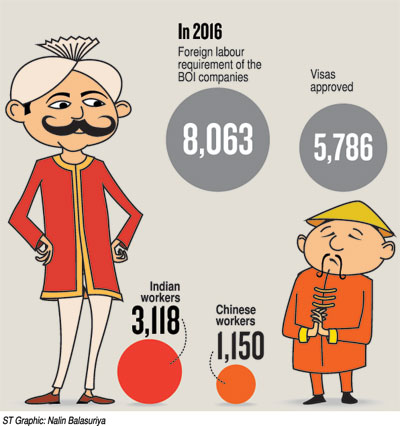
| 4,268 Indians, Chinese form biggest labour importsMore than 4,200 Chinese and Indians are among foreign workers that companies operating in Sri Lanka have been approved to import last year.
Last year 5,786 foreign skilled workers were granted visa recommendations by Board of Investment-approved companies to work in Sri Lanka. BOI director of media and publicity, Dilip Samarasinghe, said these include 3,118 Indians and 1,150 Chinese. These two groups add up to a total of 4,268, the largest number of imported workers. He said that last year BOI companies needed 8,063 foreign workers and 5,786 visas had been approved. Under BOI guidelines, visas for foreign workers are given only if required skills are not available locally and if the skills are in high demand, Mr Samarasinghe said. He added the number of expatriate workers should be below 50 per cent of the total during the period of a project. |
ගැහැණු මනස
April 17th, 2017නලින් ද සිල්වා
බටහිර විද්යාවට අනුව ඊයෙ පෙරේදා කියලා තිබුණා පිරිමින්ගෙ හා ගැහැණුන්ගෙ මොළවල වෙනස්කම් තියෙනවා කියලා. හැබැයි ඒ වන තුරු බටහිර විද්යාඥයන් එක හඬින් කියා සිටියෙ පිරිමින්ගෙ හා ගැහැණුන්ගෙ මොළවල වෙනස්කම් නැහැ කියලා. ඒ අර ඊනියා සමානත්වතාවෙන් මතුවෙච්ච අදහසක්. දැන් බටහිර විද්යාඥයන් මේ අලුත් නිගමනයට ඇවිත් තියෙන්නෙ මොළ දහස් ගණනක් නිරීක්ෂණය කිරීමෙන් පසුව කියලයි කියන්නෙ. මේ නිරීක්ෂණය පිරිමි විද්යාඥයන්ගෙ ද කියල අහන්න එපා. කොහොමටත් බටහිර විද්යාවෙ හැටි ඔහොම තමයි. අද කියපු දේ හෙට නැහැයි කියනවා. එසේ වීමට හේතුත් කියනවා!
බටහිර විද්යාඥයන් තවමත් හිතන්නෙ මනස කියන්නෙ මොළයෙ ක්රියාකාරීත්වයකට කියලා. බටහිර විද්යාඥයන්ට මොළේ නැහැ කියලා මා කියන්නෙ නැහැ. ඔවුන් හිතන්නෙ ද්රව්යවාදීන් ලෙස. ද්රව්යයෙන් තොර මනසක් ගැන ඔවුන්ට හිතන්න බැහැ. දෙවියන් වහන්සේ ගැන විශ්වාස කරන බටහිර විද්යාඥයන් ඇති. ඒත් බටහිර විද්යාවෙදි ඔවුන් හිතන්නෙ ද්රව්යවාදී ව. මෙරට ජාතිකත්වය මත කටයුතු කරන කලාකරුවන් ඉන්නවා. ඒත් ඔවුන්ගෙන් බොහෝ අය තම ඊනියා කලා කතිකාවතෙහි යෙදෙන්නෙ පඬි සංකල්ප මත පදනම් වෙලා. එහෙම නොකළොත් ඔවුන්ට පිළිගැනීමක් නැහැ. දෙවියන් වහන්සේ ගැන විශ්වාසයක් තිබුණත් නැතත් බටහිර විද්යාඥයන් ආරම්භයක් ගැන විශ්වාස කරනවා. ඔවුන් කල්පනා කරන්නෙ රේඛීය චින්තනයක. මනස මොළයට සම්බන්ධ කර ඌනිතවාදීව හා ද්රව්යවාදීව හිතනතාක් බටහිර විද්යාඥයන්ට මනස ගැන අවබෝධයක් ලබන්න බැහැ. සමහරුන් නිවුටන් අනුගමනය කරමින් මනස කොටස්වලට කඩන්න උත්සාහ කරනවා!
ගැහැණුන් හා පිරිමින් මොළය අතින් වෙනස් වුවත් නැතත් ඔවුන්ගේ මනස් නම් වෙනස්. ඒ කියන්නෙ හැම පිරිමියකුට ම පිරිමි මනසක් තියෙන බවවත් හැම ගැහැණියකට ම ගැහැණු මනසක් තිබෙන බවවත් නො වෙයි. සාමාන්යයෙන් ගත්තොත් පිරිමි මනස හා ගැහැණු මනස වෙනස්. ඔවුන් හිතන හැටි වෙනස්. ඔවුන්ගේ ප්රමූඛතා වෙනස්. අද දේශපාලනයට වඩා යොමු වන්නෙ පිරිමි. ඒක මේ දේශපාලනයෙහි හා ඒ පදනම් වූ සංස්කෘතියෙහි ප්රතිඵලයක්. ගැහැණුන්ගේ ප්රමුඛතාව රට පාලනය කිරීම නොව ගෙදර බලා ගැනීම. එය ඊනියා පුරුෂාධිපත්යයක් නිසා වෙන දෙයක් නො වෙයි. අද දේශපාලනය පිරිමි දේශපාලනයක්. බටහිර විද්යාවත් පිරිමි වැඩක්. ඒවාහි ගැහැණු නැතිවා නො වෙයි. ඒ බොහෝ විට පිරිමි මනසක් තියෙන ගැහැණු. පිරිමින්ට සාමාන්යයෙන් ගැහැණුන්ට වඩා වියුක්ත චින්තනයක් තියනවා. හේතුවාදීයි. ඇරිස්ටෝටලීය තර්කයට අනුගත වෙන්න හැකියාවක් තිබෙනවා. ඒත් ලංකාව වගේ රටවල පිරිමින්ට එහෙමකට කියලා වියුක්ත චින්තනයක් නැහැ.
අද පාර්ලිමේන්තුවෙ ඉන්න මන්ත්රීවරියන් සංඛ්යාව බොහොම අඩුයි. දැන් ඒක කෘත්රීම ව වෙනස් කරන්න හදනවා නීතියෙන් අහවල් ප්රතිශතයක් ගැහැණු වෙන්න කියලා. ඒක ස්වභාව ධර්මයට විරුද්ධව යෑමක්. කවුරු හරි කියන්න පුළුවන් මා පුරුෂාධිපතිවාදියෙක් කියලා. මා දන්නවා අද දේශපාලනයෙ ඉන්න ගැහුණුන් වුණත් බොහෝ විට එතැනට ඇවිත් තියෙන්නෙ පවුල් පසුබිම නිසා කියලා. බොහෝ දේශපාලනඥවරියන්ගේ පියා හරි ස්වාමිපුරුෂයා හරි දේශපාලනඥයෙක්. සාමාන්යයෙන් ගැහැණුන් පිරිමින්ට වඩා පෞද්ගලික සම්බන්ධකම් ගැන සංවේදීයි. බුදුදහමට අනුව බුදු වීමට නම් පළමුව මනුෂ්යයකු විය යුතුයි. දෙවනුව පිරිමියකු විය යුතුයි. එයින් කියන්නෙ බුදුදහම පුරුෂාධිපත්යය මත පදනම් වූවක් කියලා බොරු පඬියකු කියන්න පුළුවන්. ගැහැණුන්ට නිවන් අවබෝධ කර ගැනීමට හැකි වුවත් තනියම සියලු බැඳීම්වලින් වියෝ වෙන්න බැහැ. මහාභිනිෂ්ක්රමණයක් කරන්න බැහැ. මා ඉන් කියන්නේ ගෙදරින් තරහ වෙලා යන එක නො වෙයි. පඬියන්ට මහාභිනිෂ්ක්රමණය තේරෙන්නෙ නැහැ. දෙවියන් භූතයන් අතර ඉන්න පඬියන් බුදුදහම මනුෂ්යාධිපතිවාදී කියනව ද දන්නෙ නැහැ.
ගැහැණුන්ගේ නුවණ හැඳි මිටේ දිග ය කියා කතාවක් තියෙනවා. ගැහැණුන්ට පිිරිමින්ට තරම් සැලසුම් කරන්න බැහැ. දුර දිග පේන්නෙ නැහැ. ඒත් ගැහැණුන්ට හොඳ ඉවක් තියෙනවා. පිරිමි මනස වියුක්ත සැලසුම් කිරීමෙහි දක්ෂතාවක් පෙන්නුම් කරනවා. පිරිමින්ට වියුක්ත ප්රවාද ගෙතීමේ හැකියාවක් තිබෙනවා. පිරිමි ගැහැණුන්ට වඩා බොරු කාරයො. ගැහැණුන් ඇඟට දැනෙන විධියට වැඩ කරනවා. ඔවුන් බොහෝ දේ ඇඟට ගන්නවා. දේශපාලනයෙ යෙදෙන්න හරි ඉහළ නිලයක් දරන්න හරි ඇඟට ගන්නෙ නැතිව වැඩ කිරීමේ හැකියාවක් තියෙන්න ඕන. පිරිමින්ට ඒ හැකියාව ගැහැණුන්ට වඩා තියෙනවා. පිරිමින්ට පංචෙන්ද්රියවලට ගෝචර නොවන දේ ගැන හිතන්න පුළුවන්. ඒත් ඒ හැකියා ඉස්මතු වෙන්නෙ සංස්කෘතික පසුබිම්වල. ගැහැණු පිරිමින්ට වඩා එදිනෙදා ඇඟට දැනෙන වැඩ කරන්න කැමතියි. එකම දේ දිගින් දිගට ම කරන්න ගැහැණුන්ට තිබෙන හැකියාව අධිකයි. සාමූහිකව වැඩ කිරීමට ගැහුණුන් පිරිමින්ට වඩා දක්ෂයි.
සිංහල පිරිමි බොහෝ විට හිතන්නෙ ගැහැණු වගේ. බුදුවෙන්න පුළුවන් පිරිමියකුට විතරක් වුණාට බුදුදහම තරම් ගැහැණුන් ගැන ගැහැණුන් මෙන් හිතන්න පුරුදු කරන දහමක් තවත් නැහැ. සිංහල බෞද්ධ පිරිමිත් බොහෝ විට හිතන්නෙ ගැහැණුන් වගේ. මීතොටමුල්ල ගැන කල්පනා කරන්න. සිංහලයන් ඒ ගැන කම්පා වෙනවා. එයට ප්රධාන හේතුව බටහිර දියුණුවට අනුගත වීමට සැලසුම් කිරීමට සිංහල පිරිමින්ටත් නොහැකි වීම බව අප කී විට එයට කිසිවකු සවන් දුන්නේ නැහැ. අප කියන හේතුව ඇඟට දැනෙන්නෙ නැහැ. ඔවුන්ට තේරෙන්නෙ එක එක ආණ්ඩු කුණු දාන්න කටයුතු කළ/නොකළ අන්දම පමණයි. සිංහල පිරිමින් සැලසුම් කිරීමේ දී ගිවිසුම් අත්සන් කිරීමේ දී පරදිනවා. ඔවුන්ටත් බොහෝ විට ඇඟට දැනෙන හේතුවලින් ඔබ්බට යන්න බැහැ. පෘතුගීසීන් පැමිණි දින සිට අපට ඒ බව දැක ගන්න පුළුවන්. 1815 ගිවිසුම, ඩීල් ඩොයිලිගේ ඩීල්වලට යටවීම, ඉන්දු ලංකා ගිවිසුම, අද එක්ටා ගිවිසුම, හම්බන්තොට ගිවිසුම ආදිය ඒ සම්බන්ධ උදාහරණ.
බටහිර පිරිමින්ට විශේෂයෙන් ම යුදෙවුවන්ට ඇඟට නොදැනෙන දේ ගැන හිතන්න පුළුවන්. ඔවුන්ට හිතෙන් මවා ගන්න බැරි දේ ගැනත් හිතන්න පුළුවන්. වෛදික බමුණන්ගෙත් මේ ලක්ෂණ යම් ප්රමාණයක් තිබුණා. අප බමුණු මත කියලා කියන්නෙ බමුණන් නිර්මාණය කරපු ප්රචාදවලට, නැත්නම් කතන්දරවලට. ගැහැණු මායම් ගැන කතා හැදුවෙ බමුණන්. අප බමුණු මත ප්රතික්ෂෙප කළා. අදත් ඉන්දියාවෙ බමුණන්ගෙ මේ ලක්ෂණ දකින්න පුළුවන්. ගිවිසුම් හදන්නෙ පිරිමි මනසින්. පහුගිය කාලෙ ඉන්දියාවෙ ගිවිසුම්වලින් අප කෙතරම් බැට කාලා තියෙනව ද? ඉන්දියාවෙ විදේශ අමාත්යාංශය පාලනය කරන්නෙ බමුණන්. විශේෂයෙන් ම කේරළයේ බමුණන්. සිංහල බෞද්ධයන් බමුණු මත පිළිකෙව් කළත් ඔවුන්ට ඒවාට විරුද්ධව යමක් කරන්න අමාරුයි. උම්මග්ග ජාතකය ලියන කාලෙත් බමුණන් මෙරට ආධිපත්යයක් දෑරුව. උම්මග්ග ජාතකය ලිවුවෙ බමුණු ආධිපත්යයට විරුද්ධව. මාර්ටින් වික්රමසිංහ බමුණු කුලයක් වැටීම ගැන අවස්ථාවාදී ව පනස්හයට පෙර නොව පසුව කතා කෙළෙ බමුණන්ගේ ලක්ෂණ දැනගෙන නොවෙයි.
බටහිර මානව විද්යාඥවරියක වූ මාග්රට් මීඩ් මොනව කියලා තිබුණත් මේ ආධිපත්යය නිෂ්පාදනය මත පදනම් වෙච්ච දේ නොවෙයි. ඒ ද්රව්යවාදී අදහසක්. බමුණන් ක්ෂත්රියයන් ද පරදවා සමාජයේ ආධිපත්යය ලබා ගත්තෙ කිසිම නිෂ්පාදනයකට හවුල් වෙලා නො වෙයි. ඔවුන්ගේ මතවල ශක්තියෙන්. පිරිමින් ලෝකය පාලනය කරන්නෙ ඔවුන්ට ඇති වියුක්ත චින්තනය, සැලසුම් කිරීමේ හැකියාව ආදිය මත පතනම් වෙලා. පිරිමින්ගෙ අදහස් බලපාන සමාජවලට පීතෘ මූලික සමාජ කියලා කියනවා. ගැහැණුන්ගේ අදහස් බලපාන සමාජවලට මාතෘ මූලික සමාජ කියලා කියනවා. දැන් මුළු ලෝකය ම වගේ පීතෘ මූලිකයි. සමහර ගැහැණු ඊනියා පුරුෂාධිපත්යයකට විරුද්ධ වෙලා කරන්නෙ පිරිමි වගේ වැඩ කිරීම. ඒකෙන් මාතෘ මූලික සමාජ ඇති කරන්න බැහැ. ඒකෙන් වෙන්නෙ පිරිමි අදහස් තව තවත් තහවුරු වීම පමණයි. ඒත් දැන් පිරිමින්ගෙ ඇරිස්ටෝටලීය න්යාය, තර්ක කිරීම, හේතුවාදය හෙවත් බුද්ධිවාදය, වියුක්ත චින්තනය ආදිය කඩා වැටෙන්න පටන් අරන්. කරුමෙකට ගැහැණුන්ට ඒක තේරෙන්නෙ නැහැ.
නලින් ද සිල්වා
පිළිකාවේ චණ්ඩිකම් ඉවරයි; කරවිල වීරයා බිහිවෙයි අතුරු අබාධ නෑ වයස් බේදයකින් තොරව පාවිච්චි කල හැක
April 17th, 2017සමන්තී වීරසේකර උපුටා ගැන්ම දිවයින
 අපේ සිංහලයා ආදි කාලයේ පටන්ම තමන්ගේ සෞඛ්ය ගැන බොහොම කල්පනාවෙන් විමසිල්ලෙන් කටයුතු කළ බව නොරහසක්. හෙළ වෙදකම නැත්නම් දේශීය වෛද්ය ක්රම භාවිත කරමින් ආදිතම මිනිසා නීරෝගී සම්පත්තිය ලැබුවේ ඒ නිසයි. ඇතැම් රෝග තත්ත්වයන්ට එදා ඔසුවක් සේ හෙළයා තමන්ගේ බත්පතට ගත් ආහාර අද වැඩිදුර අධ්යයනයන් ඔස්සේ විවිධ රොගයන්ට ප්රතිකාර ලෙස ලබා ගන්නා අන්දම අප දැක ඇත්තෙමු.
 මෙයද ඊට සමාන අවස්ථාවකි. පේරාදෙණිය විශ්වවිද්යාලයේ පශු වෛද්ය පීඨයේ, ව්යාධිවේදී දෙපාර්තමේන්තුවේ ජ්යෙෂ්ඨ මහාචාර්ය ජයන්ත රාජපක්ෂ මහතාගේ මූලිකත්වයෙන් යුතු කණ්ඩායමක් පිළිකා සෛල නසන , පිළිකා සෛල වර්ධනය නොකරන ඖෂධයක් නිපදවීමට සමත්ව තිබේ. එය තවදුරටත් මහනුවර මහ රෝහලේ පිළිකා රෝගීන් අතර පර්යේෂණ මට්ටමේ පවතී.
පර්යේෂණය සිදු කරන කණ්ඩායම ලෙස මේ මොහොතටත් කටයුතු කරන්නේ, ජ්යෙෂ්ඨ කථිකාචාර්ය අනුර ජයසූරිය සත්ත්ව හා පෝෂණවේදය පිළිබඳ ආචාර්ය මධුජිත්, ජ්යෙෂ්ඨ මහාචාර්ය සෑම් කුලරත්න, පිළිකා රෝග පිළිබඳ විශේෂඥ වෛද්ය ඡේ. හිල්මි යන මහත්වරු සහ පශ්චාත් උපාධි අපේක්ෂක ශිෂ්ය කණ්ඩායම වන නිශා රණසිංහ, අමල් ධර්මප්රිය, කෞශල්යා කරුණාතිලක, තක්ෂිලා රණවීර යන කණ්ඩායමය. ඔවුහු මෙම ඉතිහාසගත විය යුතු ඖෂධය සොයා ගැනීමේ භාරදූර කාර්යය සඳහා තවදුරටත් වෙහෙස මහන්සි වෙමින් සිටින්නේ දිනෙන් දින වසංගතයක් තරමටම ව්යාප්ත වෙමින් පවතින පිළිකාව නැමැති රෝග තත්ත්වයට පිළියමක් කවුරු හෝ සෙවිය යුතු නිසාය.
“කරවිල උයන්න සුද්ධ කරනකොට බොහොමයක් දෙනා කරවිල ඇට ටික විසිකරනවා. සම්බෝලයක් විදිහට හැදුවත් ඇට අයින් කරලා කනවා. එතනින් අපි කරගන්නේ විශාල පාඩුවක්. මොකද කරවිල ඇටය ඇතුළේ තමයි, ඇඟට අවශ්යම කරන පෝෂක කොටස තියෙන්නේ.. අපි එම කොටස වෙන්කරලා අරගෙන බෙහෙත් කරලක් තුළට දාලා රෝගීන්ට ලබා දෙන්න හැකි ක්රමවේදයක් සකස් කළා. මේ බෙහෙත් කරලක් හදන්න කරවිල ඇට දහයක් විතර අවශ්ය වෙනවා. අපිට පරීක්ෂණ කරන්න සම්පත් ලබා දෙන්න මහාචාර්ය ජයන්ත රාජපක්ෂ මහතා බොහොම වෙහෙසක් ගත්තා. එතුමාගේ මිත්රයෝ රැසක් මේ සඳහා සම්පත් ලබා දෙන්න ඉදිරිපත් වුණ නිසා අපේ වෑයම සාර්ථක කරගන්න හැකි වුණා යෑයි මෙම කර්තව්යයට දිවා රෑ නොබලා වෙහෙස වූ පශ්චාත් උපාධි අපේක්ෂක කණ්ඩායමේ නිශා රණසිංහ කියා සිටියාය.
මහාචාර්ය ජයන්ත රාජපක්ෂ මහතා සිය ජාතික මෙහෙවර ගෙනහැර දැක්වූයේ, මෙසේයි.
“පශු වෛද්ය පීඨය කාලයක් තිස්සේ, පටන්ම ශාකවල ඇතිකරන රසායනික ප්රතික්රියාවන් පිළිබඳව පරීක්ෂණ සිදුකරමින් සිටිනවා. අපි දැනට වසර පහකට පමණ පෙර සිට රටේ පවතින අර්බුදකාරී ගැටලුවලට විසඳුම් සොයා යන්න පුළුවන්ද කියන කාරණාව ගැන අවධානය යොමුකළා. බොහොමයක් රටවල පිළිකා නාශක ඖෂධ වර්ග නිපදවීම කෙරෙහි අවධානය යොමු කර තිබෙනවා. ජපානය, ඔස්ටේ්රලියාව ඇතුළු තවත් රටවල් බොහොමයක් ෆැටී ඇසිඩ් හරහා පිළිකා සෛල විනාශ කරන්න පුළුවන්දැයි පරීක්ෂණ සිදු කරනවා. ඒ අනුව අපි අවධානය යොමු කළා මේ කියන ෆැටී ඇසිඩ් වර්ගය අපේ දේශීය ආහාර වල තියෙනවාද නැද්ද කියලා හොයලා බලන්න. ඒ අනුව, අපි හොයා ගත්තා කරවිල ඇටවල අභ්යන්තරයෙහිත් දෙළුම් ඇට වල අභ්යන්තරයෙහිත් මේ කියන ඇල්ෆා ඊලියෝස්ටියරික් ඇසිඩ් Eleostearic acid නම් ඔයිල් එක නැත්නම් තෙල් වර්ගය අඩංගුවෙලා තියෙන බව. මේ ඔයිල් එක දිනපතා ලබා දුන්නාම පිළිකා සෛල මැරෙනවාද කියලා බලන්න අපි පර්යේෂණ පටන් ගත්තා.
අපේ අදහස වුණේ දෙළුම් යොදාගෙන පරීක්ෂණ කරන්න. නමුත් දෙළුම් කිව්වාම කෘතිමව නිපදවන ලද දෙමුහුන් බීජවලින් සැකසූ දෙළුම් සුදුසු නැහැ. ගමේ ගොඩේ හැදෙන දෙළුම් තමයි යොදා ගත යුතු වන්නේ. අපි කෘෂිකර්ම දෙපාර්තමේන්තුව සමග එක්ව දෙළුම් හෙව්වා. නමුත් ප්රමාණවත් ලෙස දෙළුම් හොයා ගන්න බැරිවුණා. ඒ නිසා අපි හිතුවා කරවිල උපයෝගි කරගෙන පර්යේෂණ පවත්වන්න.
කෘෂිකර්ම දෙපාර්තමේන්තුවේ උද්යාන බෝග දෙපාර්තමේන්තුවේ කුමුදු අබේකෝන් මහතා සමග සාකච්ඡා කරලා සතියකට කරවිල කිලෝ දහයක් ලබා ගත්තා. ඒවායෙහි ඇති කරවිල ඇට යොදාගෙන ඔයිල් ලබා ගත්තා.
ඔන්න ඒ එක්කම අපේ පර්යේෂණ ක්රියාවලිය පටන් ගත්තා. ජාතික පර්යේෂණ සභාව ඒ සඳහා අපට මූල්ය දායකත්වය ලබා දුන්නා. ඔවුහු නොසිටින්න අපි තවමත් මුල් අදියරේ. කොළඹ වෛද්ය පර්යේෂණ ආයතනය විසින් සත්තු ලබා දුන්නා.
මූලික පර්යේෂණ කටයුතු සඳහා මවුස් නමින් හඳුන්වන කුඩා මීයන් තිහක් පමණ යොදා ගත්තා. නිරෝගී මියන් එක් කණ්ඩායමකට අපි මාස හයක් පුරා කරවිල ඇටයේ ඇති ඔයිල් එක දුන්නා. කාටවත් ඒවා විස වුණේ නැහැ. පසුව තවත් මීයන් කණ්ඩායමකට පිළිකා සෛල ලබා දුන්නා. ඒ අනුව එක් එක් මියන්ගේ අක්මාවේ, පියයුරුවල, ස්නායුවල, රුධිරයේ, අමාශයේ, බඩවැල්වල පිළිකා වර්ධනය කළා. පිළිකා හැදුන මීයන් ආයෙත් වර්ග කළා. ඉන් එක කණ්ඩායමකට කරවිල ඔයිල් එක දුන්නා. අනෙක් කණ්ඩායමට කරවිල ඔයිල් එක නොදී සිටියා. මාස දෙකක් එක දිගටම ඒ පර්යේෂණය සිදු කරද්දී අපට පැහැදිලිව දක්නට ලැබුණා.. පිළිකා සෛල වර්ධනය වූ මීයන්ට කරවිල ඔයිල් දුන්නාම සෛල වර්ධනය අඩාල වන හැටි සහ යළි නිරෝගිමත්භාවයට පත්වන අයුරු. ඔයිල් නොදී සිටි පිළිකා වර්ධනය වූ මීයන් අතර මගදී විවිධ රෝගයන්ට ගොදුරු වෙලා මිය ගියා. තවත් සමහරුන්ගේ සිරුර පුරා පිළිකාව වර්ධනය වුණා. බෙහෙත දීපු මීයෝ කණ්ඩායමත් අපි පර්යේෂණ සඳහා සිරුර අභ්යන්තරයේ පරීක්ෂණ කළා. එතනදි සමහර මීයන්ගේ අක්මාව නැවත යථා තත්ත්වයට පත්වෙලා තියෙනවා දැක ගන්න පුළුවන් වුණා. අපි බෙහෙවින් සතුටට පත්වුණ එක් අවස්ථාවක් තමයි ඒ.
ඒත් අපි පර්යේෂණ නතර කළේ නැහැ. නැවතත් මවුස්ලා අසූවක් ගෙනැත් පර්යේෂණ ආරම්භ කළා. මවුස්ලා කණ්ඩායම් හතරකට බෙදුවා. එතනදි අපි කණ්ඩායම් තුනකට පිළිකා වර්ධනය කළා. පිළිකා නැති කණ්ඩායම තමයි හතර වැනි කණ්ඩායම. මේ කණ්ඩායම් හතරටම බෙහෙත් දෙනවා. ඒ අතරේ පිළිකා වර්ධනය වී ඇති බෙහෙත් ලබා දෙන අතරේ පිළිකා සෛලත් ලබා දෙන කණ්ඩායම ගැන දිගුකාලීනව පර්යේෂණ පවත්වමින් සිටිනවා. තවත් කණ්ඩායමක් පිළිකා ඇතිව දිගුකාලීනව බෙහෙත් ගන්නවා. අනෙක් කණ්ඩායම කඩින් කඩ බෙහෙත් ගන්නවා. අපි දිගින් දිගටම මේ සම්බන්ධයෙන් අවධානය යොමු කරනවා.
ඒ අතර මහාචාර්ය සෑම් සහ විශේෂඥ වෛද්ය ඡේ. හිල්මි මහතාගේ දායකත්වය මත මෙම බෙහෙත රෝගීන් අතරේ පරීක්ෂා කරලා බලන්න අපි කල්පනා කළා. මහනුවර මහ රෝහලේ සායනික රෝගීන් යොදාගනිමින් අපි මේ වන විටත් පර්යේෂණ සිදු කරනවා. අපේ එකම අරමුණ රෝගීන් අතරට මේ ඖෂධය ලබා දීම සඳහා අවශ්ය වැඩපිළිවෙළක් යෙදීමයි. ඒ සඳහා ක්රමවේදයක් තියෙනවා. අපි පියවරෙන් පියවර ඉදිරියට යා යුතුයි. මේ වනතුරු ම අපි සාර්ථකව පර්යේෂණ සිදු කර තිබෙනවා…….”
මහනුවර රෝහලේ පිළිකා රෝග පිළිබඳ විශේෂඥ වෛද්ය ඒ. ඡේ. හිල්මි මහතාගෙන් කරුණු විමසුවෙමු.
“පිළිකාව කියන්නේ මේ කාලේ දැඩි ලෙස ව්යාප්ත වන බවක් පෙනෙන්නට තියෙන රෝගයක්. ඒ සඳහා ප්රතිකාර ක්රමයක් අපේ රට තුළම සොයාගැනෙනවා කියන්නේ ආඩම්බර විය යුතු කාරණයක්. මේ ඖෂධය අපි දැනට කණ්ඩායම් කිහිපයකට ලබා දෙමින් පර්යේෂණ සිදු කරනවා. අපේ සායනයට සහභාගි වන රෝගීන් අතරින් අමාශය සහ අන්ත්ර, බඩවැල් ආදියෙහි පිළිකා සෛල වර්ධනය වී ඇති රෝගීන් මෙම පර්යේෂණ කණ්ඩායමට ඇතුළත් කළා. ඒ අයට දැනට සිදුකරන බටහිර වෛද්ය ප්රතිකාර අතර තුර මෙම පර්යේෂණාත්මක ඖෂධය ලබා දීමට කටයුතු කරනවා. කරවිල කියන්නේ අපි එදිනෙදා ආහාරයට ගන්න එළවළුවක්. මෙම කරල් සැකසීමේදී කිසිදු රසායනික සංයෝගයක් එකතු කර නැති නිසා මෙම ස්වභාවික ඖෂධයක් කියන්න පුළුවන්. අපේ රෝගීන් අතරේ ශල්යකර්මයන්ට බඳුන් වූ සහ බඳුන් නොවූ රෝගීන් මෙම පර්යේෂණ කණ්ඩායමට ඇතුළත් කර තිබෙනවා. තවත් කෙටි කලක් මෙම පර්යේෂණ සිදු කළ යුතුවෙනවා. දැනට මේ තාක් සිදුකළ පර්යේෂණ සාර්ථකයි….”
හිත කියන්නේ මහා අමුතුම දෙයක්. බොහොමයක් රෝගීන් නිරෝගි වන්නේ, හිත ප්රීතිමත්ව ඇත්නම් පමණයි. මෙම ඖෂධය ඇත්තෙන්ම තමන්ට නිවසේදී වුවත් පාවිච්චි කරන්න පුළුවන්. පෙති කරල් විදිහට නෙවෙයි. කරවිල මාළුවක් විදිහට. එහෙමත් නැතිනම් කරවිල සලාදයක් මැල්ලුමක් විදිහට තව නැතිනම් කරවිල ඇට බැදුමක් විදිහට. කඩල කනවා වගේ කරවිල ඇට බැදලා මිරිස් දාලා වුණත් කන්න පුළුවන්. ඒ මොන විදිහට කෑවත් ඒ හැම අවස්ථාවකදීම නොනැසී ඇල්ෆා ඊලියෝස්ටීයරික් ඇසිඩ් ශරීරයට ලැබෙනවා. ඉන් පිළිකා සෛල නැසෙන්නත් , වර්ධනය නොවෙන්නත් අවැසි පසුබිම සිරුර තුළ ගොඩනැඟෙනවා. මේ ඇසිඩ් ඔයිල් එක සිරුරට කොහෙත්ම අහිතකර නැහැ. අපේ පර්යේෂණ කණ්ඩායම දිනපතාම මේ ඖෂධය පාවිච්චි කරනවා. රුධිර සාම්පල පරීක්ෂා කරනවා. ඒ නිසා සියයට සියයක්ම විශ්වාසය තබා ඒ බව ප්රකාශ කරන්න පුළුවන්. අනෙක් වැදගත්ම කාරණය තමයි, මෙම ඖෂධය නිසා අතුරු ආබාධ ඒ කියන්නේ හිසරදය වමනය කැරකිල්ල කෑම අරුචිය ක්ලාන්තය මේ කිසිවක් නැහැ. ඒ නිසා වයස භේදයකින් තොරව ඕනෑම කෙනකුට පාව්ච්චි කරන්නත් පුළුවන්. අපේ පර්යේෂණවලට යොදා ගත්තේ, පින්නවේලි, එම්. සී. 43, සහ දේශිය කළු කරවිල කියන වර්ග තුන. ඉන් වැඩි ප්රතිඵල තියෙන්නේ කළු කරවිල වල. මේවා ඕනෑම අවස්ථාවක කැමති විදිහට ආහාරයට ගන්න පුළුවන්. තුඹ කරවිල වල වුවත් මේ ඇසිඩ් ඔයිල් අඩංගුයි. නිරෝගිකම වෙනුවෙන් කළ හැකි පහසුම දේ අපි ගෙදරදිම කරමු කරල් පෙති ලෙස වෙළෙඳපොළට හෝ රෝහලට එනතෙක්…….
මහාචාර්ය ජයන්ත මහතා ලංකාවාසීන්ට එලෙසින් ද පණිවුඩයක් දෙමින් සිය වගකීම යුතුකම ඉටු කළේය.
An “unusual” manual intervention -Central Bank bond probe
April 17th, 2017The Presidential Commission of Inquiry probing the controversial Treasury bond issuance in February 2015 met this week too, continuing the recording of evidence from Assistant Governor of the Central Bank of Sri Lanka (CBSL) S. Sepala Ratnayake. One of the most significant factors revealed before the Commission on Monday (April 3) was that the principle of offering the same rates to different investors for the same bond for the same volume when making private placements had been violated on certain occasions.
Ratnayake said that offering the same rates to different investors for the same bond of the same volume was a basic principle followed by the Public Debt Department of the CBSL during direct placements. He added that they did not find any reasonable reason to violate the practice during the placements.
However, Harsha Fernando, the legal counsel of Deputy Governor of the CBSL P. Samarasiri, showed the Commission one example at a bond issuance in 2011 where the People’s Bank had made two placements of Rs 500 million each and the Employees Provident Fund (EPF) had made a placement of Rs 500 million. Two different rates, amounting to a difference of eight basis points, had been given for the placements made by the People’s Bank and the EPF.
With eight cents per every 100 (Sri Lankan) rupee unit, the impact an eight base point difference would make on an offer of Rs 1 billion is almost Rs 80 million. It was brought to light that such a violation of the practice would greatly disadvantage a primary dealer.
Ratnayake who was the day’s witness said that the rates for the private placements are offered by the officials in the front office of the Public Debt Department. The counsel who were appearing for the Perpetual Treasuries Limited (PTL) and former Governor of the CBSL Arjuna Mahendran also questioned the witness over the authenticity, acceptance and the methodology which he had used to prepare the graphs produced by him before the Commission last week.
During the cross examining, Ratnayake reiterated that he had pointed out to the rest of the members of the Tender Board that they should not accept others’ instructions even if they were held at gunpoint and forced to do so. Senior Deputy Solicitor General Priyantha Nawana who led the evidence of Ratnayake asked about the reactions of Samarasiri. The witness did not mention any objection being raised by Samarasiri during the Tender Board meeting on February 27, 2015. However, Samarasiri who gave evidence before the Commission during the previous week said that it was he who had opposed the instructions given by Mahendran.
The second day of the week began with the recording of statements from Additional Director of the Information Technology (IT) Department of the CBSL, K. Vasantha Kumara Alwis. Deputy Solicitor General Milinda Gunetilleke leading the evidence for the day said that throughout a specific date, PTL had funded all the purchases of Treasury bonds through the borrowings of Treasury bonds and the intraday liquidity facility (ILF). The Commission requested Alwis to analyze how the CBSL’s IT system functions. He explained to the Commission using data printouts derived from the Real-Time Gross Settlement System (RTGS). However, the time period was limited from February 29, 2016 to April 1, 2016. Gunetilleke showed the Commission that an ILF provided for a primary dealer is to be returned at the end of every day. An ILF is not a loan but free money given by the CBSL to a primary dealer that should be settled within the same day.
He further added that the PTL had a total outstanding of Rs 11.6 billion worth ILF by April 1, 2016. He pointed out that based on the said default, the PTL had been fined. It has happened only four times in the past. The largest other violation of the ILF is Rs 350 million. The PTL’s violation is 33 times more than the past largest violation,” the Attorney General’s Department told the Commission.
However, counsel for the PTL, Nihal Fernando PC, explained to the Commission that the ILF taken from the CBSL was entirely based on government securities. He also said that almost all other primary dealers had followed the same practice of borrowing from the CBSL in order to purchase Treasury bonds. His explanation came during the Attorney General’s Department official’s questioning of the witness and Gunetilleke strongly objected to the PTL counsel’s intervention.
The Commission Chairman subsequently had to intervene to sort out the issue.
The Commission did not sit for its hearings on Wednesday, and Thursday’s session began again with Alwis. On Thursday, the significant factor that was revealed was Gunetilleke suggesting that when the total amount of ILF outstanding due on April 1, 2016 was settled by the PTL on April 4, 2016, an unusual” manual intervention had released them from paying a sum of Rs 88 million.
Alwis admitted that a sum of Rs 88 million was credited through an authorization issued by the Public Debt Department, signed by Deputy Governor of the CBSL, Dr. P. Nandalal Weerasinghe and Assistant Governor of the CBSL, Janaki Mampitiya (the latter has retired since).
The witness further said that such a manual intervention to the CBSL’s Lanka Settle System had never been done before according to his knowledge. He also said that the payment system must be closed daily at 4.30 pm but on this particular day, the system had been kept open until the PTL could complete their returns.
Fernando PC contradicted the suggestion of an unusual manual intervention” being made to the CBSL’s Lanka Settle System. However, he admitted that it was a costly mistake on the part of his client for not having bid under smaller portions, adding that the Company had failed to pay the defaulted amount as at April 1, 2016.
He said that his client had settled all amounts outstanding by the next working day and had also paid a penalty of Rs 13.6 million for the delay.
Meanwhile, the Commission also observed Mahendran who had previously obtained special permission to observe the proceedings of the hearings, using his mobile for over 20 minutes during the period the sessions were going on.
The Commission chairman warned Mahendran’s counsel and advised him to inform his client to switch off the mobile phone during the time the sessions were in progress.
On Friday, Director of the Domestic Operations Department of the CBSL, P.W.D.N.R. Rodrigo was summoned before the Commission. Rodrigo also reiterated that Mahendran had visited the Public Debt Department twice and on the second occasion had been accompanied by two other officials. He also narrated what took place on 2015 February 27. He said that almost all the Monetary Board members were surprised with the suggestion to raise Rs 10 billion made by the Public Debt Department on the instructions of Mahendran. He said that the most vocal in terms of opposition to the move was Ratnayake and Additional Director of the Statistics Department of the CBSL, Dr. M.Z.M. Aazim. He also added that, Samarasiri’s body language showed that he was also not happy. At the request of the Monetary Board members, he tried to contact Mahendran via intercom, but had failed.”
Rodrigo also said that Samarasiri who went out of the room, came back after around five to six minutes and had spoken in Sinhala, Apita meka ganna wenawa (We will have to take this)”. He also said that the minutes were dictated by Samarasiri. The counsel appearing for the PTL suggested that the unusual manual intervention” to the CBSL’s LankaSettle System which was previously revealed by Alwis was purely done to rectify an error made by the system. He also suggested that the reason why the system gates were kept open beyond the usual time was upon the request by the PTL in order to rectify the said error. Rodrigo admitted that he had received a letter from the PTL in this regard. The sittings of the Commission were concluded for the week on Friday and it will meet again on April 24 following the New Year vacation.
Cabinet Committee on Economic Management asks FCID not to probe procurements after 2015
April 17th, 2017Courtesy Sunday Times
The Cabinet Committee on Economic Management (CCEM) has asked the Financial Crimes Investigation Division (FCID) not to probe procurements after 2015.
The move means that only procurements before 2015, which were under the Mahinda Rajapaksa administration, would be probed.
They have been told to direct all such investigation to the National Procurement Commission. At a recent discussion, it was noted that the FCID summoned public officers for investigations on procurement issues.
The CCEM has said it is of the view that procurement issues could be handled by the National Procurement Commission.
How come the CCEM is giving directions to the FCID? This is the multimillion-rupee question.