With Bashar al-Assad having fled Damascus to one of his 20 luxury suites in Russia (valued at $30 million), it is worth taking note of a time, not that long ago, when Assad was on more amicable terms with the American regime and opened his dungeons to the CIA for the torture and interrogation of unfortunate people, such as Maher Arar, who were mercilessly swept up in the War on Terror. These grim services to the empire earned the Assad regime no lasting favors from the US and the enduring animosity of many in the Arab world. This article is excerpted from my book Grand Theft Pentagon: Tales of Corruption and Profiteering in the War on Terror.
A sleek Gulfstream V jet with the tail number N379P has racked up more international miles than most passenger jets. Since October 2001, this plane has been spotted in some of the world’s most exotic and forbidding airports: Tashkent, Uzbekistan; Karachi, Pakistan; Baku, Azerbaijan; Baghdad, Iraq; and Rabat, Morocco.
It has also frequently landed at Dulles International, outside Washington, D.C., and is cleared to land at US military air bases in Scotland, Cyprus, and Frankfurt, Germany. Observers around the world have noticed men in hoods and chains being taken on and off the jet.
The plane was owned by a company called Bayard Marketing, based in Portland, Oregon. According to FAA records, Bayard’s lone corporate officer was a man called Leonard T. Bayard. There was no contact information available for Bayard. Indeed, there’s no public record of Bayard at all. No residential address. No telephone numbers. Nothing.
In fact, Bayard Marketing was a dummy corporation and Leonard Bayard is a false identity. They were both created by the CIA to conceal an operation launched after the attacks of September 11, 2001, to kidnap suspected terrorists and transport them to foreign governments where they could be interrogated using methods outlawed in the United States that is, tortured and sometimes killed.
Bayard Marketing was one of five or six different front companies the CIA has used to hide its role in the clandestine rendition” (the term of art for this process) of suspected terrorists. In this case, the CIA’s desire to keep the program a secret doesn’t spring from a need to protect it from al-Qaeda or other hostile forces but from public exposure. The rendition of captives for the purpose of torture violates international and US law.
Unfortunately for the CIA, the jet and its human cargo have been something of an open secret since early 2002, when spotters at international airports began to take note of its regular arrivals and departures, usually at night, from military air bases from Jordan to Indonesia.
A notorious example: On September 26, 2002, Maher Arar, a Canadian engineer born in Syria, was arrested by US intelligence officials at John F. Kennedy Airport in New York as he was changing planes. Arar and his family were returning home to Canada from a vacation in Tunisia. Arar was held in a federal cell for 13 days while he was interrogated about a man US intelligence believed was linked to al-Qaeda. Arar told his captors that he had never met the man in question, although he had worked with his brother on a construction project.
Then, one night, two plainclothes officers came for Arar, placed a hood over his head, secured his hands with plastic cuffs, and shackled his feet in leg irons. He was taken from the federal jail to the airport, where he was placed on the Gulfstream V jet. The plane flew to Washington, DC, then to Portland, Maine. It stopped once in Rome, then landed in Amman, Jordan. During the flight, Arar recalls hearing the pilots and crew referring to themselves as members of the Special Removal Unit.”
Arar was held in a cell in Amman for 10 hours. He pleaded with his captors to release him or allow him to talk with a lawyer. They refused. He was placed in a van and driven across the border into Syria, where he was handed over to a secret police unit. He was taken to a dark underground cell, and immediately, his interrogators began to beat him with battery cables. The beatings went on day after day.
A year later, Arar was released by the Syrians at the behest of the Canadian government. He was never charged with a crime. The CIA had ordered his detention, interrogation and torture. He has received no apology. Arar is one of at least 150 people the CIA has captured and taken to other countries in a covert program known as extraordinary rendition.”
While Arar ended up in Syria, other detainees have stayed in Jordan, where the CIA runs a ghost prison” for the detention, interrogation and torture of some of the most senior members of al-Qaeda captured by US forces over the last three years. According to an article in the Israeli daily Ha’aretz, 11 top al-Qaeda operatives have been sent to the al-Jafr prison in Jordan’s southern desert, where they have been interrogated and tortured. Among those being held in Jordan are Abu Zubaydah, Riduan Isamuddin and Khalid Sheikh Mohammed.
Khalid Sheik Mohammed, a suspected planner of the 9/11 attacks, was captured in Pakistan in March 2003. Mohammed was taken to a US base in Afghanistan for his initial interrogation and then was sent to the prison in Jordan, where he was subjected to a range of tortures, including the infamous water-boarding” technique, where the victim is bound tightly with ropes to a piece of plywood and then dunked in ice cold water until he nearly drowns.
The water-boarding method was one of several varieties of torture approved by President Bush in an executive order issued in February 2002. Bush’s order, which exempted the CIA from compliance with the rules of the Geneva Conventions, was extended seven months later by an August 2002 memorandum signed by Assistant Attorney General Jay S. Bybee. The Bybee Memo (primarily written by his deputy John Yoo) called for the continuation of CIA interrogation methods, including rendition, and blessed as legal methods of physical and psychological coercion that inflicted discomfort equivalent in intensity to the pain accompanying serious physical injuries, such as organ failure, impairment of bodily function, or even death.”
The prison in Jordan is only one of 24 secret detention and interrogation centers worldwide operated by the CIA. According to a report by Human Rights Watch, at least half of these operate in total secrecy.”
Originally, the Gulfstream V that flew Arar to Amman was owned by an outfit called Premier Executive Transport Services, Inc., a company based in Dedham, Massachusetts. An investigation by the Washington Post’s reporter Dana Priest revealed that the corporate papers filed by Premier Executive included a list of executive officers and board members who, in Priest’s words, exist only on paper.” The names Bryan Dyess, Steven Kent, Timothy Sperling, and Audrey Tailor had been issued new Social Security numbers and included only Post Office box numbers for addresses.
The Post Offices are located in Arlington, Virginia, Oakton, and Chevy Chase, Maryland, and the District of Columbia. Over the past few years, those very same Post Office boxes have been registered to 325 other fictitious names, as well as a company called Executive Support OFC, another CIA front.
The Bush administration didn’t try very hard to keep its torture-by-proxy program a secret. That’s because the administration’s torture lawyers, such as John Yoo, former deputy to Alberto Gonzales and now a law professor at Berkeley, argued that the administration is free to breach international and domestic laws in its pursuit of suspected terrorists. While working for the Bush administration, Yoo drafted a legal memo that set the framework for the rendition program. He argued that the US was not bound by the Geneva Accords (or US prohibitions on torture) in its pursuit of al-Qaeda members or Taliban soldiers because Afghanistan was a failed state” and, therefore, not subject to the protections of the anti-torture laws. The detainees were slotted into a newly created category called illegal enemy combatants,” a legal rubric that treated them as subhumans lacking all basic human rights.
Why is it so hard for people to understand that there is a category of behavior not covered by the legal system?” Yoo proclaimed. Historically, there were people so bad that they were not given protection of the laws. There were no specific provisions for their trial or imprisonment. If you were an illegal combatant, you didn’t deserve the protection of the laws of war.”
Of course, in the absence of a trial, who determines if the people detained as illegal combatants” are either illegal” or even combatants”?
Even more brazenly, Yoo contends that the Bush administration was free to ignore US laws against torture.
Congress doesn’t have the power to tie the hands of the President in regard to torture as an interrogation technique,” said Yoo. It’s the core of the Commander-in-Chief function. Congress can’t prevent the president from ordering torture.”
Yoo claims that if Congress had a problem with Bush flouting its laws, the solution is simple: impeachment. He also argued that the US public had its shot at repudiating Bush’s detention and torture program and instead endorsed it. The issue is dying out,” Yoo told the New Yorker magazine. It has had its referendum.”
As in so many cases with the Bush administration, it appears that Dick Cheney himself gave the green light for the kidnapping and torture scenario. Cheney even dropped a public hint that the Bush administration was going to deal savagely with suspected terrorists. During an interview on Meet the Press,” a week after the attacks on the World Trade Center and the Pentagon, Cheney said that the administration wasn’t going to shackle itself to conventional methods in tracking down suspected terrorists.
A lot of what needs to be done here will have to be done quietly, without any discussion, using sources and methods that are available to our intelligence agencies, if we’re going to be successful,” Cheney said. That’s the world these folks operate in. And so it’s going to be vital for us to use any means at our disposal, basically, to achieve our objective. We may have to work through, sort of, the dark side.”
The island cannot sustain the entire human and animal population it currently has. It is an undeniable fact. The only solution is to cull the most damaging animals to its food security and economic activity. There isn’t enough food to go around for all. Unless humans are protected from hunger, malnutrition, under development and resultant health and economic calamities, Sri Lanka has no future in any human pursuit. Prolonged droughts and other natural disasters are only going to be more frequent and more devastating as global temperatures rise. An immediate cull of elephants, monkeys, giant squirrels and peacocks to sustainable levels can save at least 45% of food crop that is wasted by these animals. It is a huge boost to national food supply and it can reduce dependence on food imports too.
Other nations cull their animals to save their food supply so that those nations will not fall victim to hunger and foreign manipulation through food and funds. Unfortunately, Sri Lanka’s fat-belly politicians, well-fed intellectuals with low common sense, religious extremists and fat cat officials try to achieve other worldly bliss at the expense of the nation and do not support these moves. They can privately do meritorious deeds at their own expense. Let the nation and its most vulnerable people survive.
Like it or not, similar to almost all nations today the Sri Lankan Constitution awards fundamental rights only to humans and not to animals. Therefore, it is not the man who should be curtailed but animals.
One reason for the surge in the number of these animals is the destruction of forests and killing predators. Blame can be passed but deforestation cannot and will not be reversed. The number of animals the existing forest cover can sustain should be determined and the rest must be culled. Otherwise, human-animal conflict and hunger are going to kill both of these groups anyway. Only difference is it will be a far more painful death.
Natural predators including leopards and bears have been killed in large numbers over the years. This too contributed to the increase in monkeys, peacocks, giant squirrels and other animals.
In addition to agricultural pests, stray dogs and cats must also be culled. They too carry disease and contribute to pollution. Sri Lanka is unfortunately still grappling with rabies despite being an island.
Culling can also save carbon emissions benefiting the entire world.
If it is not done, more Sri Lankans will go hungry, conflicts between man and animal and man and man will worsen with deaths on both sides, food will have to be imported and multiple economic crises will worsen. A pragmatic and modern approach is needed for the nation to survive. Hope the rulers have the bests interests of Sri Lanka at heart and not religious dogma. They earn no merit for the next world or life by starving 22 million people. It is a sin and a crime bigger than culling pests.
‘Before you study the economics, study the economists!’
e-Con e-News 08-14 December 2024
*
BJP National Spokesperson & MP Sambit Patra directly accused
the US State Department of trying to ‘destabilise India’
& claimed that the US ‘Deep State’ is working
to ‘target Prime Minister Narendra Modi‘.
– MK Bhadrakumar (see ee Sovereignty, Beware the US Deep State)
*
‘Lisa Curtis, a Senior Fellow & Director of the Indo-Pacific Security
Program at Center for New American Security, is a foreign policy &
national security expert in the US government, including at the
National Security Council, CIA… Her work has centered
on US policy toward the Indo-Pacific & South Asia, with a
particular focus on US-India strategic relations…
& China’s role in the region.
– see ee Sovereignty, Pathfinder hosts US South Asia Expert
*
‘In times of major crisis, regional collaboration & timely sharing of information
is critical to an effective & rapid response. We must prepare ourselves
for every scenario, which includes ensuring that we can respond to
any Chemical, Biological, Radiological, & Nuclear incident in the region
– to save the lives of our people,maintain our economies, & protect our way of life.’
– Roy Baran in Colombo (see ee Sovereignty, US International Security)
*
The masked Lone Ranger & his native informant Tonto
find themselves surrounded by hostile Apache:
The Ranger asks Tonto: ‘Wha’ we gonna do, Tonto?’
Tonto replies: ‘What you mean we, white man?’
– An American Fairy Tale
*
Yes, indeed! Who’s we? Who or what or where on earth does this Roy Baran mean by ‘our people… our economies …our way of life’? There was little publicity given to Baran’s 3-day December ‘Disaster Workshop’ in Colombo, even as the US embassy ensured there was many glossy photos handed out focusing on the US State Department’s ‘Coup-lees’ – laughing Imran-Coupster Donald Lu, USAID’s Anjali Kaur, with the US Treasury’s Robert Kaproth, USAID Mission Director Gabriel Grau & US Embassy’s Political Officer Shawn Gray, trailing behind the ubiquitous Jiyoon (Julie) Chung.
*
• With US Coup-lees of Color Chung & Lu & Kaur Providing Shade –The assassinated African American leader Malcolm X, noting the penchant for the US white-settler government to send Black officials & celebrities (Ralph Bunche, Louis Armstrong, etc.) to whitewash their imperialist designs across the world, called them ‘State Department Kneegrows’ – for they knelt before the white man’s horrors. The word ‘coolie’ (resonating in ‘wage slavery’ in Sinhala and Tamil; & ‘bitter strength’ – kuli – in Chinese) is an equally reprehensible word as ‘negro’, and was used to denote predominantly enslaved Asians. So here, Lu & Chung et al are referred to as ‘State Department Coup-lees’, as the descendants of collaborators with US & English & Japanese imperialists who sought to enslave China, Korea & India, and now wish to enslave us further.
*
Roy Baran, a Senior Analyst at US State Department’s Bureau of International Security & Nonproliferation led a ‘SR2 Sri Lanka’ workshop, sponsored by the US Embassy & Sri Lanka’s Disaster Management Centre. They wish to ‘improve readiness for Chemical, Biological, Radiological & Nuclear (CBRN) emergencies’. 40 actors (or reactors!) joined him from the US, Maldives, Bangladesh & India as well. The workshop is part of a series by the US Office of Weapons of Mass Destruction Terrorism ‘to deter & defend against the increasing use of CBRN weapons globally’. As far as we can recall, the only state to use nuclear weapons is the USA itself. And as for ‘Weapons of Mass Destruction’ (WMD), Iraqis at least know what that has meant for their country. (see ee Sovereignty, US & SL Advance Emergency Preparedness)
So what does ‘terrorism’ mean, when the USA, unable to get their own working-class grunts to kill abroad, are backing settler-Israel & Ottoman-dreaming Turkey, to fund, arm & direct Zionist baby-killers & Al Qaeda & ISIS head-choppers to decapitate Syria. ISIS? April 2109, anyone? Why are the Colombo Archbishops, Anglican & Catholic, radio silent about the slaughter of their fellow-believers in Syria (let alone Palestine)? The Muslim leadership, too. Silent as Judas. Though, it’s not about religion after all, no? It’s politics, and more precisely ‘political economics’.
Much of Asia is still colonized by the white man, outside of China, Free (aka North) Korea, Vietnam, Russia. So what disaster is Baran preparing us for? Is the disaster, their fear, that Sri Lanka may eventually reject their genocidal ‘way of life’ and opt for ‘the threat of a good example’ that China et al offer? Another ‘way of life’ they are desperately trying to prevent the world from seeing?
In this ee Focus, Shiran Illanperuma in Shanghai reports on the recent Global South Academic Forum there, with the theme ‘Global South & Global Modernization’, where over 250 guests from 35 countries & regions concluded:
‘Without socialism, independence movements
in weaker nations during the imperialist era,
cannot address issues of new & old colonialism’
*
• So who’s to stop us? Well, there were even less publicity about the entry of another angel of death, hosted in Colombo by the Exxon-Rockefeller Pathfinder Foundation’s tête-à-tête – Lisa Curtis, the National Security Council & CIA expert on ‘US-India strategic relations… & China’s role in the region‘. The supine media tells us the workshop was to prepare for the advent of the latest nuclear-gunslinger-in-charge Donald Trump. And who was there? – un-named ‘experts on security & academia, representatives from the Ministry of Foreign Affairs, diplomats, & leaders from trade, commerce & industry’. (see ee Sovereignty, Pathfinder…)
So who could these ‘experts’ be? Especially from ‘trade, commerce & (non-existent) industry?’ It turns out that there were no election-promised ruling-NPP ‘negotiations’ with the IMF, because both sides of the table include these expert ‘private bondholders’.
*
‘While the Government trumpets its recent ISB restructuring, a closer look reveals
a sweetheart deal for a select few, struck at the expense of the Sri Lankan people.
Local entities including commercial banks, represented by the Ceylon Chamber of Commerce,
whose Chair Duminda Hulangamuwa is now an advisor to the incumbent President,
were allowed to swoop in like financial vultures during the Covid crisis, snapping up
Sri Lankan ISBs at fire-sale prices – discounts of up to a staggering 45-50%.
This windfall for the privileged few came at a steep price
for the nation, further draining our dwindling foreign reserves.’
(see ee Focus, D Pathirana)
*
And, as Pathirana suggests, the local bondholders include local private banks who cashed in on the ‘debt default’ in 2020. Why didn’t the then (SLPP) government, in 2020, buy back the debt at ‘fire sale prices’ as Ecuador under Rafael Corea did, in 2008, when they ‘boldly repurchased their defaulted ISBs at a mere 10% of their original value?’ Will the NPP-JVP also be hijacked by the import merchants & moneylenders, agents of the multinational corporations, themselves puppets of the imperialists, who have assassinated, couped (militarily & otherwise) and waged terrorist wars (against popular leaders in Sri Lanka)? What Pathirana does not say is that these ‘local banks’ are not local at all, but agents of foreign banks. The largest local private bank, Commercial Bank of Ceylon is also owned by the World Bank’s International Finance Corporation (IFC), which has their claws in numerous other import cartels (Sunshine Holdings, Star Garments, to name just 2) and dismantling state enterprises (SL Telecom, SriLankan Air), and banks (DFCC) etc. – see ee Focus, House of Cards
We should add that Ecuador’s Corea also offered to train the US government in real ‘human rights’. They also formed a public debt commission, which ruled that country’s debt earlier incurred were illegal due to the unfair private gains, etc.The US then funded a judicial coup against Corea…
*
• Right after the State Department’s laughing coup-lees & their dour handlers flew away, the US government targeted Lanka’s ex-envoy to Russia, Udayanga Weeratunga, and former Sri Lankan Airlines CEO Kapila Chandrasena, sanctioning their families as well. Their crime is (other than being allied to Gotabhaya and Mahinda Rajapakse….But strangely, leaving out Basil R…) for buying aircraft from US industry’s competitors, Russian MIGs, and France’s Airbus. So what’s this ‘Cola-very’ about? Simultaneous with the latest US sanctions on Sri Lanka, we find out:
*
‘Transparency International Sri Lanka (TISL) unveiled the
‘Corruption Risk Mapping Research: a Study on Sri Lanka’s Private Sector’
on Dec 12 in Colombo, presenting an in-depth analysis of corruption risks…
allegations of private sector entities engaging in political lobbying &
significant market manipulation through the creation of monopolies…
women were at a higher risk of being solicited for sexual bribes
in exchange for jobs, promotions or even to provide a service.’
(see ee Economists, US TISL launches research report)
*
So, look at all this timing, such synchronicity? Have they just discovered the private mother of all corruptions? This eeFocus looks at the curious & curiouser origins of Transparency International. In 1955 ‘the most predatory aspect’ of the world economy was exposed in the operations of such Multinational Corporations (MNCs) Unilever, etc – then called Transnational Corporations (TNCs). The Bandung Final Communiqué of the NonAligned Movement (NAM) pointed to TNCs like Unilever, who had emerged under colonial rule, a product of colonial theft with privileged access to raw materials & captivemarkets. The attempt at a New International Economic Order (NIEO) in the 1970s sought to control TNCs either by regulation or restriction. In 1974 the UN Centre for Transnational Corporations (UNCTC) was set up.However, the TNCs struck back. In the 1960s many scholars like Samuel Huntington even argued that corruption ‘humanises government’! In such influential ‘modernisation literature’, corruption was treated as an ‘utterly normal & beneficial’!
Then after 1989, organizations like TI emerged after the withdrawal of the Soviet Union, with the word ‘corruption’ increasingly used by multilateral agencies & NGOs (to be honest, FGO – foreign government organizations). Corruption now meant ‘bribery, extortion, & embezzlement’ only by public officials, rather that the ‘normal’ practices of MNCs: ‘transfer mispricing, trade misinvoicing, accounting irregularities, financial mismanagement, & tax avoidance’. The idea that TNCs/MNCs were corrupt ‘completely vanished in this theory’.
*
‘They lobbied the governments of France & Germany to stop
the policy of what, in Germany, is called Schmiergeld (bribe money);
these countries not only allowed bribes to be paid in foreign jurisdictions,
but then permitted companies to deduct these payments from tax obligations.’
(see ee Focus, Capitalism wields Corruption)
*
In 1992, under US government pressure, the UNCTC was integrated into UN Conference on Trade & Development (UNCTAD). In 1995, in place of the UNCTC’s TNC Code of Conduct, Transparency International released its annual Corruption Perceptions Index (CPI). Now, corruption became a disease, and the answer was ‘more privatisation & less government oversight’.
The accounting world then ‘developed a new form of theft’ called ‘sustainability reporting’, part of the new methods by ‘tax magicians’ (lawyers, accountants, etc) to hide money from tax authorities and legalise corruption. This ‘greenwashing’ allows accounting firms to disclose ‘environmental, social & governance (ESG) factors’, to discount their taxable income, while making false or misleading claims about the environmental benefits of a product, service, or investment. Accounting practices are not obligated to produce or follow a proper environmental assessment, nor are they concerned about the displacement of residents from an area of operation, degradation of ecosystems, misuse of agricultural land, consumption…and for ee – to ensure no investment in modern industry.
If ee readers examine our weekly news compendium (Section D) – mostly trash produced by a corrupt (sorry, we mean corporate) media, especially the ee Agriculture section – one cannot miss (headlines in ‘green’ ink) their disproportionate emphasis on such ‘greenwashing’, not just to whitewash MNCs like Unilever & Ceylon Tobacco & CIC-ICI, who are primarily responsible for the degradation of the environment. Their job is to prevent the emergence of other modern industrial societies. In a country, where offices, both private & public, are afraid to answer their phones, they are claiming that digitalization will reduce or eliminate corruption! Another fantasy. All it will do is centralize power in even fewer hands, familied or not. It is a law of capitalism!
Having encoiled governments, willingly or otherwise, in debt traps, the US state is signaling it will ignite chaos in Sri Lanka if the country does not submit to their imperialist agenda. Meanwhile, India is on alert for a regime-change operation, with the opposition leader (improved Italian) Rahul Gandhi in Washington, calling for US intervention in India! And then there’s Punjab, Manipur, Tamilnadu? In Sri Lanka, Eelam and East Arabistan? Let us see what the President AKD’s visit to India will bring. Himalayan enlightenment, perhaps? Is it all we can do? Let us see….
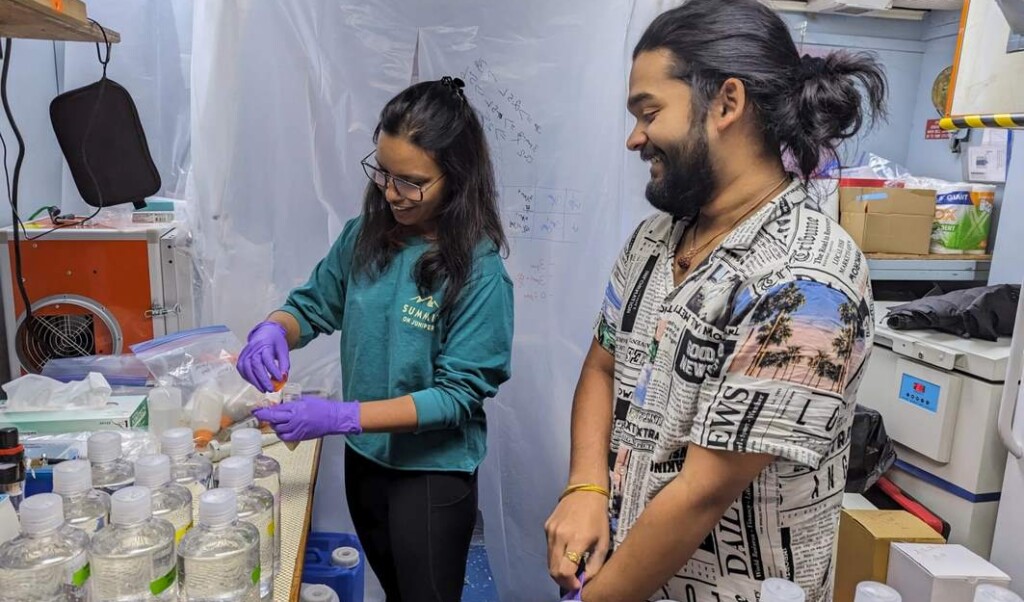
First authors Diksha Sharma, left, and Vignesh Menon lead experiments on seawater collected from the Gulf of Maine – Credit: Annie Kandel, released
American scientists have proposed a new method for recruiting trillions of microscopic sea creatures and their insatiable appetites for the fight against climate change.
The technique harnesses the animals’ daily habits to essentially accelerate the ocean’s natural cycle for removing carbon from the atmosphere, which is known as the biological pump, according to the paper in Nature Scientific Reports.
The study, published by researchers at Dartmouth College, reported that spraying clay dust on the surface of the ocean converts carbon into food the animals would eat, digest, and send deep into the ocean as carbon-filled feces.
They explain that the process would begin with spraying the clay dust at the end of algae blooms. These blooms can grow to cover hundreds of square miles and remove about 150 billion tons of carbon dioxide from the atmosphere each year, converting it into organic carbon particulates. But once the bloom dies, marine bacteria devour the particulates, releasing most of the captured carbon back into the atmosphere.
The researchers found that the clay dust attaches to carbon particulates before they re-enter the atmosphere, redirecting them into the marine food chain as tiny sticky pellets the ravenous zooplankton consume and later excrete at lower depths.
Normally, only a small fraction of the carbon captured at the surface makes it into the deep ocean for long-term storage,” says Mukul Sharma, the study’s corresponding author and a professor of earth sciences. Sharma presented the findings on December 10th at the American Geophysical Union annual conference in Washington D.C.
The novelty of our method is using clay to make the biological pump more efficient—the zooplankton generate clay-laden poops that sink faster,” says Sharma, who received a Guggenheim Award in 2020 to pursue the project.
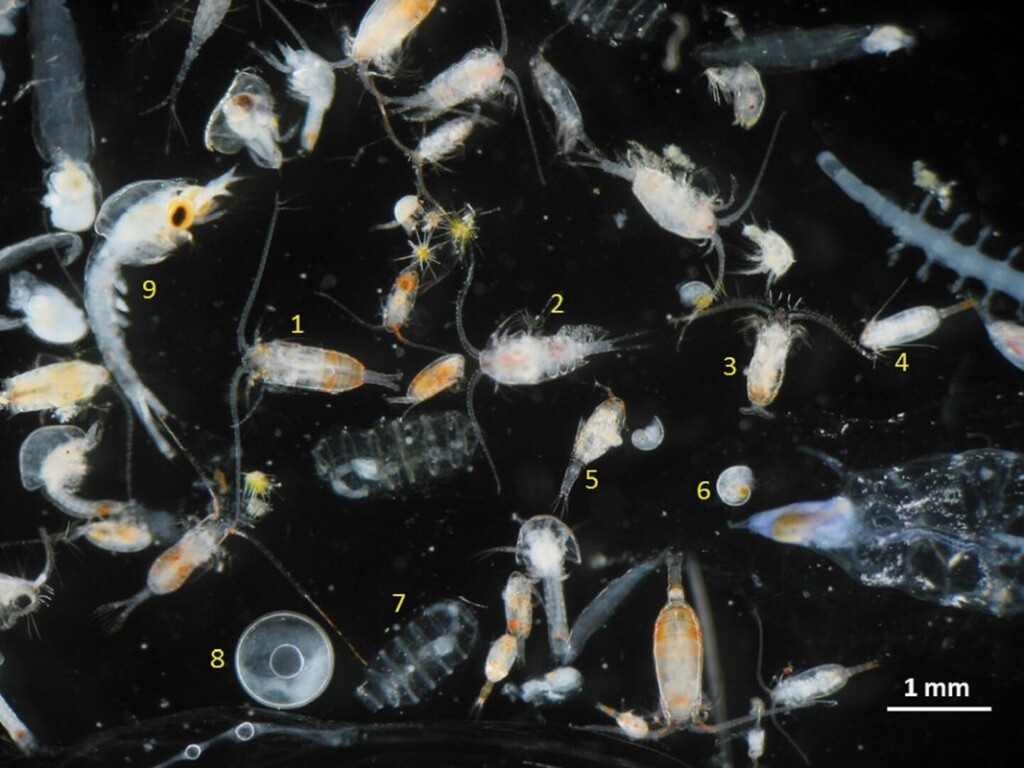
A mixed zooplankton sample including common species – Credit Adriana Zingone, Domenico D’Alelio, Maria Grazia Mazzocchi, Marina Montresor, Diana Sarno, LTER-MC team CC 4.0. BY-SA
This particulate material is what these little guys are designed to eat. Our experiments showed they cannot tell if it’s clay and phytoplankton or only phytoplankton—they just eat it,” he says. And when they poop it out, they are hundreds of meters below the surface and all that carbon is, too.”
The team conducted laboratory experiments on water collected from the Gulf of Maine during a 2023 algae bloom. They found that when clay attaches to the organic carbon released when a bloom dies, it prompts marine bacteria to produce a kind of glue that causes the clay and organic carbon to form little balls called flocs.
The flocs become part of the daily smorgasbord of particulates that zooplankton gorge on, the researchers report. Once digested, the flocs embedded in the animals’ feces sink, potentially burying the carbon at depths where it can be stored for millennia. The uneaten clay-carbon balls also sink, increasing in size as more organic carbon, as well as dead and dying phytoplankton, stick to them on the way down, the study found.
In the team’s experiments, clay dust captured as much as 50% of the carbon released by dead phytoplankton before it could become airborne. They also found that adding clay increased the concentration of sticky organic particles—which would collect more carbon as they sink—by 10 times. At the same time, the populations of bacteria that instigate the release of carbon back into the atmosphere fell sharply in seawater treated with clay, the researchers report.
In the ocean, the flocs become an essential part of the biological pump called marine snow, Sharma says. Marine snow is the constant shower of corpses, minerals, and other organic matter that falls from the surface, bringing food and nutrients to the deeper ocean.
We’re creating marine snow that can bury carbon at a much greater speed by specifically attaching to a mixture of clay minerals,” Sharma says.
Zooplankton accelerate that process with their voracious appetites and incredible daily sojourn known as the diel vertical migration. Under cover of darkness, the animals—each measuring about three-hundredths of an inch—rise hundreds, and even thousands, of feet from the deep in one immense motion to feed in the nutrient-rich water near the surface.
When day breaks, the animals return to deeper water, where they deposit the flocs as feces. This expedited process, known as active transport, is another key aspect of the ocean’s biological pump that shaves days off the time it takes carbon to reach lower depths by sinking.
Sharma plans to field-test the method by spraying clay on phytoplankton blooms off the coast of Southern California using a crop-dusting airplane. He hopes that sensors placed at various depths offshore will capture how different species of zooplankton consume the clay-carbon flocs so that the research team can better gauge the optimal timing and locations to deploy this method—and exactly how much carbon it’s confining to the deep.
It is very important to find the right oceanographic setting to do this work. You cannot go around willy-nilly dumping clay everywhere,” Sharma told Dartmouth press. We need to understand the efficiency first at different depths so we can understand the best places to initiate this process before we put it to work. We are not there yet—we are at the beginning.”
Colombo: Sri Lanka’s tourism sector is on a promising trajectory, with the country inching closer to its ambitious target of 2.3 million tourist arrivals for 2024. The latest data from the Sri Lanka Tourism Development Authority (SLTDA) reveals that 1,804,873 tourists have visited the island so far this year, with November alone accounting for 184,158 arrivals.
Indian travellers are at the forefront of this surge, with 41,120 tourists from India arriving in November, making them the largest contributor to Sri Lanka’s tourism boom. Russia follows as the second-highest source, with 29,053 arrivals during the same period.
During the COVID-19 pandemic, Indian tourists made headlines by becoming a lifeline for regional tourism when much of the world was shut down. With international borders closed, India pioneered travel corridors, including the much-publicized travel bubble” with the Maldives. This initiative not only revived the Maldives’ tourism-dependent economy but also gave it fresh vigor, as Indian travelers flocked to the island nation, ensuring its resorts and businesses stayed afloat during the global crisis.
Today, a similar narrative unfolds in Sri Lanka, where Indian tourists are again at the forefront, revitalizing the economy and reshaping the neighborhood’s travel dynamics.
Tourism earnings have played a pivotal role in Sri Lanka’s economic recovery, with November’s revenue reaching $272.9 million, a significant increase from $205.3 million in November 2023. Year-to-date earnings from January to November 2024 stand at $2.8 billion, reflecting a robust 56% growth compared to the $1.7 billion recorded in the same period last year.
In addition to tourism, Sri Lanka has seen growth in foreign remittances from migrant workers. November’s remittances amounted to $530.1 million, a slight increase from October’s $517.4 million. Cumulatively, remittances from January to November 2024 reached $5.96 billion, marking a 10.4% year-on-year growth.
India’s contribution to Sri Lanka’s tourism industry goes beyond numbers. The country has emerged as a favored destination for Indian tourists due to its proximity, affordability, and cultural ties. Moreover, the island is increasingly being featured in Bollywood productions, attracting film crews for its scenic beaches, lush landscapes, and historic architecture.
This dual influx of tourists and film crews underscores the growing prominence of Sri Lanka as a cultural and recreational hub for Indian travelers. It also strengthens bilateral ties between the two nations, as Indian tourists contribute significantly to local businesses and communities.
Sri Lanka’s tourism and remittance sectors remain critical to its post-crisis recovery. With the target of 2.3 million arrivals within reach, authorities are banking on continued support from its largest markets, especially India. As travel demand grows and Bollywood shines a spotlight on the island, Sri Lanka is well-positioned to further solidify its place as a top destination for Indian tourists.
The combined gains from tourism and remittances are a testament to Sri Lanka’s resilience and its ability to adapt to global economic trends. With strategic investments in tourism infrastructure and strengthened partnerships, the nation is set to sustain its upward trajectory well into the next year.
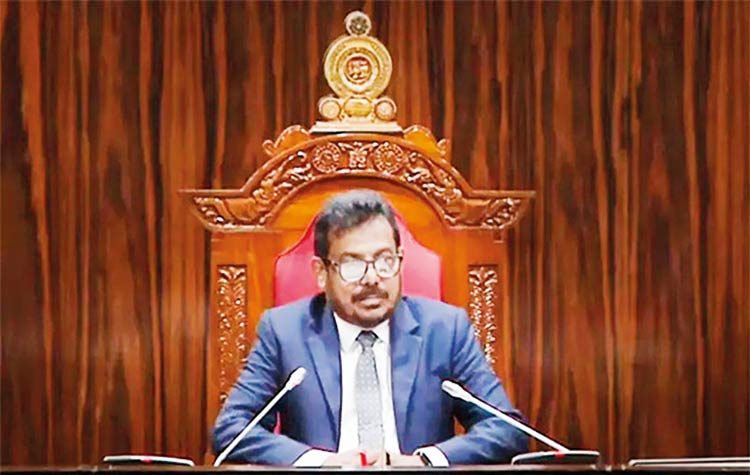
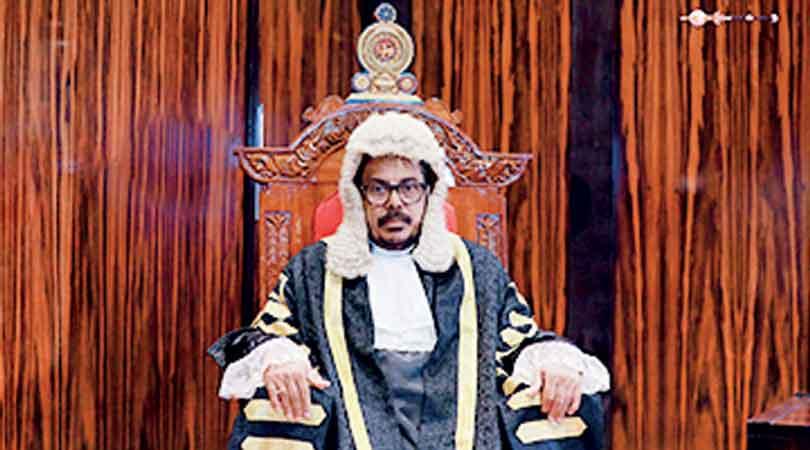
It is more than two weeks since the matter of the Speaker, Asoka Ranwala’s doctorate, or lack of it, was raised in public. If he does have one, it is sufficient time for him to have produced the necessary evidence and laid to rest the ongoing speculation. When my daughter acquired a doctorate from a university in England, she was ceremoniously presented with an ornately inscribed scroll, on thick, parchment paper , along with a foolish hat.
To me, a non-academic, it seemed a paltry outcome for the several years of intense study which preceded the award but that, apparently, is how these systems work. Perhaps Waseda University of Japan, the institution alleged to have conferred the doctoral degree on Ranwala, does not emulate old-fashioned British institutions, but there still needs to be tangible, physical evidence of such an award, with which Ranwala came away from that institution.
Ignore the flippancy of the above paragraphs. The issue of the Speaker’s doctorate is a very serious matter. I understand that Ranwala has been using the prefix, Dr”, for many years before his investiture as the Speaker of the 10th parliament of Sri Lanka. During the run-up to the recent presidential election, he has been introduced on stage as Dr Ranwala”. Therefore, he deliberately made the world believe that he was a, Dr.”
Recently there was some talk of Ranwala’s daughter offering an explanation but that is a ridiculous, unacceptable response. An explanation must come from Ranwala, personally, and not from a member of his family. It is a very simple matter, actually; either he has a doctorate or he has been deceiving the world for many years. In the case of the former he needs to furnish immediate proof to the public and if the latter is the reality, he must apologize for having been a public fraud and withdraw from governance.
To be the Speaker of the Parliament of Sri Lanka, a person must be compliant with the conditions of Articles 89 and 91, of the Constitution of the Republic of Sri Lanka. Neither of those articles specify that the Speaker should be literate, or that he should even be able to read, write and speak, in any known language. In fact, there are simply no minimum educational qualifications for those aspiring to represent the people of Sri Lanka in parliament, although there are clearly specified minimum educational qualifications for any person who applies for employment within the Parliament premises, even if it be the position of security guard, premises cleaner, or a minor employee, respectfully distributing glasses of water and cups of tea, to thirsty legislators within the chamber of representatives.
Then why is the issue of the Speaker’s qualifications of such importance?
When public figures, especially those occupying vital positions such as the Speaker of the Parliament, make a false claim about their educational qualifications, it undermines public trust in the political system. The NPP-JVP machine captured power in the last general election, largely on the promise of restoring principled governance to a corrupt country. I voted for candidate AKD at the presidential election in the fervent expectation of transparent governance. Thus, every elector who contributed to elevating the NPP to power, has the right to know whether Ranwala actually possesses the educational qualifications he claims, although those have no relevance to his current position in Parliament, or to the effective delivery of his responsibilities.
This matter is important because it highlights broader issues of accountability and transparency within governance. When public officials are permitted to misrepresent themselves, it points to a lack of scrutiny in the vetting of candidates for positions of power and influence. The fact that such claims go unchecked, also calls in to question the mechanism the party has in place, for ensuring ethical standards and honesty among its members.
Therefore, the quick and equitable resolution of this issue is crucial and central to entire ethos of the NPP regime, as the expectations of honourable conduct it has inspired within the public, is greater by an order of magnitude than that which was expected of any previous regime. It is also an issue which has been seized gleefully by an enfeebled Opposition, to discredit the government, and to move public focus away from the investigations into issues of corruption within earlier regimes, represented by many members now in the Opposition. The Ranwala affair is the first litmus test, of the present regime’s publicly declared ethos of doing only what is right. It needs to prove to the expectant polity that it means business, on every front.
Speaking of the Opposition, the ridiculous, just concluded (or is it?) charade regarding the appointment of individuals to the respective national lists of the Samagi Jana Balawegaya (SJB) and the New Democratic Front ( NDF), illustrates the incompetence, the indecisiveness and the lack of leadership ability of the two party chiefs concerned. It is relevant to remind the reader that these two, Ranil Wickremesinghe (RW) and Sajith Premadasa (SP), were highly vocal in the run-up to both the presidential and the general election, about the lack of governance experience within the NPP. It immediately begs the question, if one does not have the necessary control and influence within the party, to decide on a simple but important internal party issue like a nomination, how can one aspire to govern the country? In reality it is not just an internal party issue but one that concerns the entire national polity, as it is entitled, as of civic right, to see that all 225 seats in the legislature are filled.
Moving on to two equally pressing issues, the high price of coconuts and the non-availability of popular varieties of rice, both are embedded in histories which long precede the installation of the present government.
Coconuts have become progressively more expensive because of increasing consumption and declining production. According to the Sri Lanka Export Development Board (EDB), the annual production ranges from 2,800 mn nuts to 3,000 mn, whilst the combined domestic and export processing demand is around 4,000 mn nuts, annually.
The year-to-year variability of production is linked to climate variations, further compounded by a steady increase in coconut based products since 2012 (EDB). Coconut trees have an economically productive life-span and need to be replaced periodically. However, new planting has also declined drastically, with 2.28 million seedlings being issued in 2021, as against 9.73 million in 2012 and 6.81 million in 2013 (EDB). The 2021 crop had been very high (CRI) but the embargo on inorganic fertilizer imposed around that time by President Gotabaya Rajapaksa, has resulted in declining yields thereafter.
Wild animal depredation also has had a significant impact, suppressing yields and discouraging new planting, resulting in possible decline of production for the future as well. The industry assessment is that the 2024 production will reflect a 40% decline on the 2023 output. Around 33% of the total production is assigned for value added export products with the balance going in to domestic consumption. Thus, with the off-take by industries remaining constant, the volume available to the domestic sector has declined drastically. The grim reality is that unless the national industry is realigned, with viable, sustainable solutions for current problems, coconut prices will continue to rise periodically, well in to the foreseeable future. Solutions should also be able to strike a sensible balance between animal rights and farmer requirements. Animal rights activism, which takes place largely in affluent zones of residential Colombo- acted out by well-to-do urbanites of the city who have never had to defend a paddy harvest from a hungry elephant- has no relevance to the desperate realities of destroyed crops in Dehiattakandiya, Girandurukotte and Ethiliwewa.
The rice shortage, notwithstanding the obvious causes which have been ignored by successive governments in thrall to wealthy rice millers – again not attributable to the present regime – needs both a short-term and a long-term solution. Importing rice from India, as a knee-jerk response to the hunger of an angry nation, is not a sustainable solution but a one-time fix. It cannot happen again as the same scenario is played out the next year as well. The unalterable reality is that we are a rice eating nation and irrespective of the obstacles, that need must be appeased. Let them eat cake”, whether Marie Antoinette said it or not, is not acceptable.
This regime has a two-thirds majority in Parliament and is headed by a president with supreme power. Should he, as an immediate solution, decide to take the most drastic steps in order to break the rice-millers’ stranglehold on rice stocks, a famished nation will applaud and the Opposition, if they understand what is good for them politically, will not dare raise a whisper in protest.
There are also the many questions which are being asked, regarding the status of pending investigations related to past corruption in high places. The difficulties in resurrecting dormant criminal investigations are understood; files are mislaid, papers vanish, evidence is lost, witnesses die, disappear or are terrorized in to silence, impartial investigators are neutralized and replaced with compliant stooges, cases by the dozen, against the high and mighty, are dismissed whilst authority is subverted. Previous regimes, especially those with the members of the Mahinda Rajapaksa famiglia” in the right places, reduced these tactics to an exact science.
President AKD himself, in his speech at the recent Anti-Corruption Day, with brutal clarity, exposed the issues involved with reference to actual cases. In the audience were officials who, during previous regimes, may have been complicit in the very acts described in the previous paragraph. This nation, which catapulted the NPP-JVP to power as a last resort, will appreciate a commentary from the president himself, on all of the above issues. From time to time it needs to be assured that the regime is moving in the right direction, and the best person to put its collective mind at rest is the president himself.
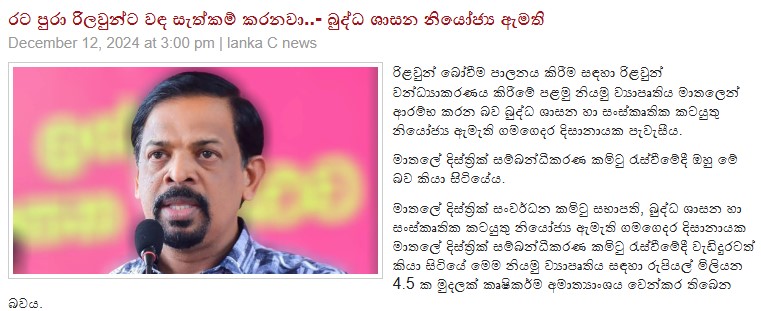
The process of re-checking and updating the information of all MPs on the parliamentary website is underway following the discovery that some titles were fake, an informed source said.
The parliamentary authorities have also decided to call for explanations from those in charge of updating information on the web.
Meanwhile, the Communication Department of Parliament said that the title of ‘’Dr.’’ was mentioned before the name of the Minister of Justice and National Integration Harshana Nanayakkara, in the directory of Members of Parliament on the parliamentary website.
It is important to note that Harshana Nanayakkara has not indicated holding a doctoral degree in the information provided to Parliament. The appearance of the title before the Minister’s name was a result of an error in entering the relevant data. Accordingly, steps have been taken to rectify this mistake.
Undoubtedly a global reset is taking place. The sudden changes we are witnessing in 2024 will accelerate in 2025. India must be viewing the fall of Syria with concern, coming months after the fall of Bangladesh, the sudden Marshall Law declared in South Korea and everyone now wonder which nation is next.
Apart from the usual diplomatic mumbo jumbo of working in harmony, behind doors planning is probably afoot to ensure the safety of over 9million Indians working in the Middle East.
Syria and India have had close ties & the 2016 statement by Syria’s ambassador to India Riad Abbas affirmed Syria’s position on Kashmir anyone who raises a weapon against the government, we call them terrorists and the government must take action against them”.
More than any other factor India will be concerned about the resurgence of terror groups venturing into India, apart from the proxies that India has under its belt. India would know given the trips made by Sri Lanka’s Easter Sunday suicide bombers to India on numerous occasions prior to the bombings in 2019. India will also remember that the terrorists it trained & armed in the 1970s-1980s preferred new foster parents & ended up killing an Indian Prime Minister on Indian soil. The invisible hands behind this should be further investigated. Therefore, India should not experiment with terrorism as even their proxies can make u-turns!
Already the US & UK are removing the Syrian rebels” from their terrorist lists while UK government has declared 11million pounds to the rebels. How come govts suddenly have money to hand to terrorist movements! Having dismembered Yugoslavia & the Soviet Union, India was warned in 1998 that it too would be balkanized eventually. This eventuality has to be foremost on the mind of India in particular with the scurry to make geopolitical changes prior to President Trump taking oaths.
While India’s pressing for 13th amendment has nothing whatsoever to do with any concern for Sri Lanka’s Tamils, the use of credit lines, loans & the financial crisis has enabled India to penetrate into key areas in the North. This taken together with the proposed connectivity of air, sea, electricity, road, rail, ports, harbors & other agreements with India strategically aligns with Arkhand Bharath Hindutva plan that includes Sri Lanka as well. This poses a major challenge & threat to the Buddhist archaeology & historical heritage of Sri Lanka.
Arkhand Bharath will pose a direct challenge to the Tamil Nadu leadership most of whom are Christians & aligned to West & very much linked to the LTTE fronts who are also operating from the West & with Church-alignments. The upcoming Tamil Nadu leaders foray into politics saw a massive turn out & the Indian government should view this as a challenge.
A Tamil Nadu that the Central Govt cannot control is as dangerous as Sri Lanka’s North under West’s control! Shouldn’t India be helping Sri Lanka’s Govt control entire Sri Lanka rather than weakening Sri Lanka’s Govt?
This is why India should take a back foot in demanding the full implementation of the 13th amendment as it would be disadvantageous to India given its Hindu hold in both North Sri Lanka & Tamil Nadu is weakening. Majority of key Tamil leaders in Sri Lanka too are more West aligned and only namesake Hindus.
This is also why India should desist from encouraging the Himalayan Declaration, a bogey that is being peddled by West-aligned LTTE fronts using some clueless Buddhist Theros who the Sinhala Buddhists do not accept as representing the Sinhalese, the Buddhists or the Sri Lankan state/nation. This should be one of the key areas to be discussed with the new Sri Lankan President who will visit India shortly.
While India & West make diplomatic demands for the implementation of 13thamendment, it is not out of any concern for Tamils. Autonomy of the North & East Sri Lanka make it easier for India or West to take control of the 2 strategic provinces for their geopolitical goals. Majority of Tamil politicians are fully aware of this while they soft peddling it for their own political gains. LTTE fronts are mere coolies for the western governments chirping demands aligned to Wests geopolitical goals. Thus, the sudden open demands being made by them.
The Indian government should not ignore that their key Quad partner is making forays into every nook & corner that India had been controlling. The US envoy is regularly meeting segments of the Tamil community which they have strategically filtered – Malayali Tamils, Estate Tamils, Eastern Tamils, Northern Tamils, Colombo Tamils. The US has mastered their thinking & their behavioral patterns. The election results is another clue to question who is influencing Tamil vote change & why! At every previous election the outcome of the Tamil votes in North & Estate sector was a foregone conclusion. What triggered the change this time round? Who gave the orders for the change of vote are factors that all Sri Lankans & India should consider. Let us not forget, how India’s Subramaniam Swamy too questioned the 2010 Presidential Election when majority of Tamils in the North voted for the former army commander despite alleging the armed forces were war criminals! Thus, bloc vote changes give deeper meaning than meets the eye & should question who calls the shots from behind the scenes!
The Indian PM & Foreign Ministry must have noticed pro-LTTE website questioning why the Sri Lankan military has not closed down military camps in the North inspite of the Cabinet deciding to do so! Why would a new government facing mounting economic issues wish to remove military camps immediately after coming to power especially when the pro-LTTE media infer some kind of understanding? The new government must be mature enough to comprehend the larger picture & the outcome being carved.
India’s interference in Sri Lanka is often based alongside a statement that India is concerned about threats to its security. Is this why India is making forays into Sri Lanka attempting to dictate & control Sri Lanka’s energy, territory, resources, retail/wholesale, biometrics, digitalization & even media?
Is India demanding full implementation of 13th amendment in order to make Sri Lanka’s North & East part of Indian Arkhand Bharath terrain? Would the US inspite of being a QUAD partner allow this or allow it as it would eventually fall into Wests hands upon balkanizing India?
What are Sri Lanka’s leaders, diplomats, policy advisors digesting from these developments? Have they not comprehended the larger picture or are they euthanized into simply nodding their heads to every demand made from either India or West? Who is protecting Sri Lanka’s sovereignty & territorial integrity?
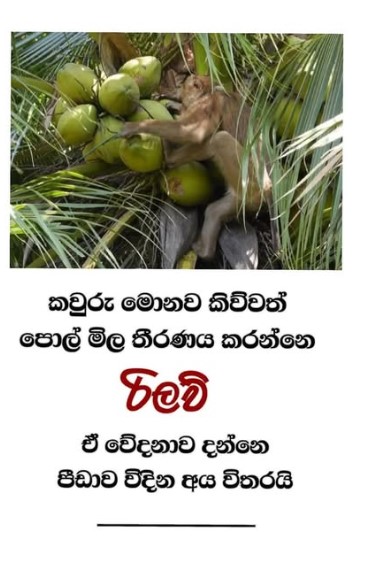
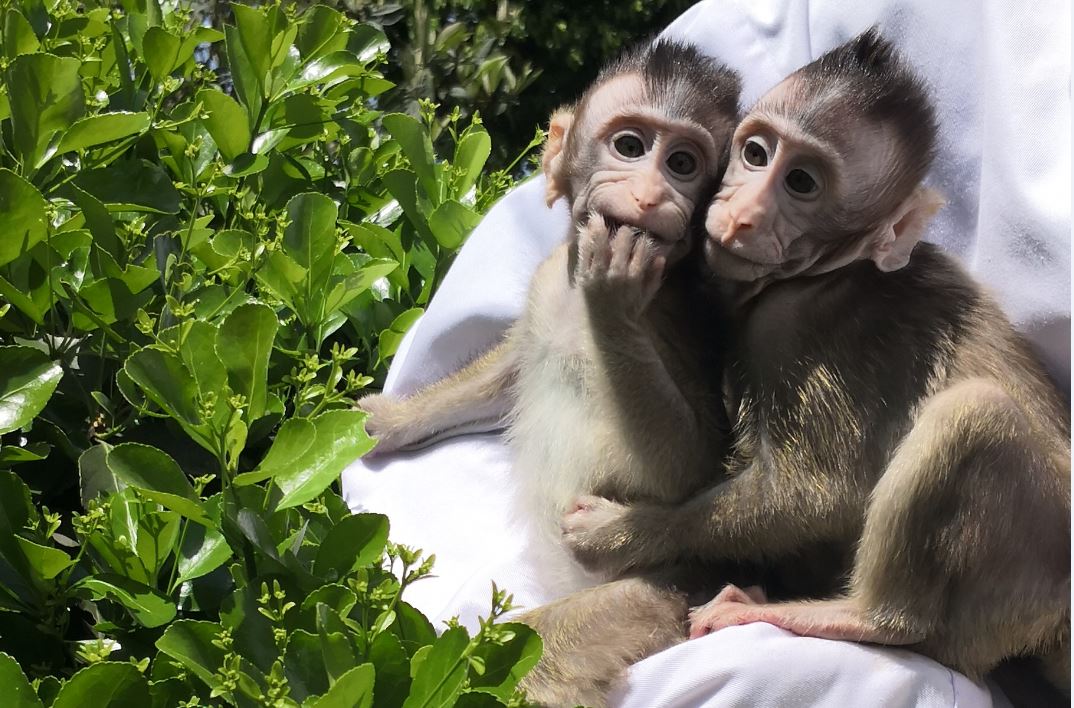
Some time back on a private members motion in the Parliament there was a debate on the damage done to the agricultural crops done by monkeys (Toque macaque}. There was unanimity across the party divide that crop damage by monkeys has increased very rapidly and now is in a crisis proportion. It was mentioned that monkey population has multiplied to around 3.8 million. The damage caused by animals mainly monkeys is estimated as close to Rs 8 billion. While the government is urging the farmers to produce more food are destroying around 40% of the crop mainly the coconut crop. No wonder that there is a shortage of coconuts, and the prices have shot up to over Rs 150 per nut. It has become a serious problem and a threat to food production and even of children from the marauding monkeys. The loss to food production is estimated over 40%. But nobody suggested a practical solution. It was again plenty of talk and with no outcome on effective and immediate action.
It is useful to go back a few years when this problem was not there. It started with the removal of shot guns from farmers in the late 80s. After that there was an illegal circular from a former secretary of Defense to the Police that persons over 60 years of age should not be given gun licenses. This prevented older generation of farmers who are the majority among farmers obtaining licenses.
The immediate solution is to withdraw that circular and give back the shot guns to all farmers irrespective of age. If they can handle a mamoty they should be able to handle a shot gun. The objection that there is an increase of crime with the use of guns is not valid as such crimes are caused with the use of T56 weapons or 9mm pistols. At the same time legal protection of peafowl and giant squirrels should be lifted.
Farmers would not kill every animal invading their property. A blank shot now and then is enough to keep monkeys away. Monkeys are intelligent animals. They can recognize even the human wielding a gun. The very sight of the person is the cue for them to withdraw.
Elephant Damage
Elephant damage has become a more serious problem today with animals breaking into houses in search of food. Expensive electric fences have failed to keep them out. It suggested to use DRONES to drive them away. Drones can be used to drop chili powder or spray chili mix on herds of animals. A simple and inexpensive method is the use of chili smoke which is practiced in East Africa and even in Assam.
The method is to burn chilies the smoke of which is supposed to be unbearable to the very delicate nose of the animal. (which is supposed to be more than 1000 times more sensitive than that of humans) There seem to be many ways of using chilies. I believe it should be effective enough if chili smoke is used when elephants invade the compounds and even attack houses.
Chili smoke is supposed to be unbearable to the very delicate nose of the animal. (which is supposed to be more than 1000 times more sensitive than that of humans) There seem to be many ways of using chilies. I believe it should be effective enough if chili smoke is used when elephants invade the compounds and even attack houses
Some time back National Gegraphic Magazine reported that:-
In Tanzania they fill a condom with chili powder. Mix in small rocks and sand for weight. Add a firecracker for a bang. Launch condom at elephant. Save elephant’s life.
All it takes is one elephant rumbling through a field to destroy a family’s food supply for an entire year, so it’s no surprise that a farmer might turn to the only tool he has available—a spear. But this elephant warning system gives farmers a low-tech way to scare these animals away from their crops without violence.
Each night, a member of the team will keep watch over the crops, looking out for elephants. If one is spotted, the volunteer begins the four-step warning system.
First, there are the strobe lights. Shining a bright, flashing light at an elephant in the dark is sometimes enough to make it turn around and leave. If that doesn’t work, the volunteer will sound an air horn. Step three is the chili-firecracker condom. Elephants are extra sensitive to smells, so a cloud of chili powder is usually unpleasant enough to make them leave.
Elephants are critical to Tanzania’s tourism industry, but for farming communities located near elephant populations, there’s often little choice but to kill them.
A “chili cloud,” made from chili powder, sand, and a firecracker, won’t harm an elephant—it just makes him uncomfortable enough to turn around and leave.
Elephants can eat 990 pounds (450 kilograms) of food a day. And they uproot and scatter almost as much as they eat. Crop raiding, as its called, puts the livelihoods and lives of people in Tanzania, Kenya, Uganda, Mozambique, Botswana, India, Indonesia, and other countries at risk. Each year, elephants cause millions of dollars in damage to crops and trample people to death. But with the elephant population under pressure from the ivory trade—some 30,000 are poached each year—protecting them is crucial. Bell said crop destruction can even encourage farmers to turn to poachers because poachers can “sort out the problem for them.”
The chili condom grenades are just one tool in a growing arsenal of elephant deterrents. Fences made of beehives, tobacco dust, recordings of tiger growls, and advance-warning text messages are just a few of the ways people are working to help farmers and elephants in African and Asia peacefully coexist.”
This story was produced by National Geographic’s Special Investigations Unit,
We should try these simple methods at least on a trial basis.
Dr Sudath Gunasekara Mahanuwara. (SLAS) Former Secretary to Pime Minister Mrs, Sirimavo Bandaranayake and President Sri Lanka Administrative Services Association (1991-94)
We welcome his choosing India for the first foreign visit as a good gesture, since it is our closest neighbor and it is also the country with whom we had the closest and the longest international relations in history.
But I would advise him to be very careful with the present-day Indian sharks both political and bureaucratic, before he is taken for a ride along a blind alley as they did to Ranil and Basil by getting both of them to succumbed to their tactics and dictates to meet their own needs. To avoid such disasters again, I would like to suggest to him to open his negotiations with Indian leaders with the following introduction, so that they won’t be able to tame him the same way they did to Ranil and Basil, to agree for everything they tabled.
” I would like to begin my talks with my esteemed Indian friends here, by requesting you first to take your mind back to the unique and nostalgic past historical, political, the cultural and spiritual relationship that existed between our two countries from the time of Gautama the Buddha, the greatest human being ever given to this world by Bharath Desh or any other Land. Lord Buddha ‘s first international visit was to Sri Lanka that was in 588 BC, in the ninth month after he attained enlightenment, to Mahiyangana to settle a waring dispute between two native tribes Yakkas and Nagas, the ruling elite of this Island at that time.
On the verge of his attaining Parinibbana, he also selected Sri Lanka as the only land in which his Dhamma will last for 5000 years to come, in spite of the fact that Jambudviipa was his beloved birth place. At the same time, he also advised Sakka the King of Gods to protect Prince Vijaya, a Sakya Prince from northern Bharath, who found the Sinhala nation, and his retinue of 700 who landed in Lanka in 543 BC. That marked the Birthday of the Sinhala Buddhist nation on this Island. Thence forth this country had been named as the land of the Buddha. It was Emperor Asoka, another great son of Bharatha who was acclaimed as the greatest Emperor the world had ever known, who officially gifted the Buddha sasana to this country during the reign of his erstwhile friend King Devaanampiyatissa, in 307 BC, who was the King in Lakadeepa at that time and who was also supposed to have added the Devanapiya” part to his name Tissa as a mark of respect to his friend as it happened to be the first name of Emperor Asoka. The close religious, spiritual, cultural and political, ties between the two countries thenceforth were made the stronger by Asoka, by sending his own son Mahinda Mahathera and daughter Sangamittaa as the royal emissaries, who brought the Buddha ‘s noble message and the Sacred Bo tree to Lanka, the land of the Sinhala people, known as Lanka Deepa at that time. This unique relationship between these two countries laid the foundation for a unique and unmatched human civilization on this beautiful Island. Ever since, the teachings of the Buddha and the sacred Bo tree became the two cornerstones of the Sinhala Buddhist civilization in this country and the Sinhala nation. The Sacred Tooth Relic was brought to Sri Lanka during the reign of King Megawanna (325-377 A.D.) by Prince Danta and Princess Hemamala from India in 371 A.D. Ever since, the sacred Tooth Relic assumed the symbol of Royalty in this Island Kingdom and the age old tradition that only a person who held sway over the Sacred Tooth can be the King of the Sri Lankan Kingdom got permanently established on this soil and the protection of the Sacred tooth became the foremost duty of the King of this Island thereafter.
But this golden past was first, marred by a recurrent wave of invasions from South Indian Dravida Kings from 2nd century BC up to the most devastative Kalinga Maga invasion in the 13th Century. With this most devastative and savages South Indian invasion the Rajarata Sinhala Kingdom shifter towards the South West and the Kandyan provinces.
Even in the mid-18th century when the Sinhala Royalty ended with the death of the last King Narendra Sinha, it was towards India, the Buddhist Monks and the ruling elite extended their hands and installed Sri Vijaya Rajasinha, a member of the Madurai royal family as the King of the Sinhale Kingdom and after him another three members of the same clan ruled this country in the same tradition followed by 187 Sinhala Buddhist Kings of the yore, until the demise of last king of the Sinhale Kingdom Sri Wikrama Rajasinha took place in 1815 with the annexation of the Kandyan Kingdom to the British Empire by the Kandyan Convention of March 2nd. That was the unique and remarkable level of the close and cordial relationship that existed between our two countries, from the time of Gauthama the Buddha for the next 26 centuries up to date.
But again, unfortunately in modern history a black mark of Indian invasion again emerged in 1987 orchestrated by Rajiv Ghandhi with his infamous Parippu invasion with the incursion of six military jets entering Sri Lankas air space simultaneously and there by marring all previous cordial relationships and violating all civilized international diplomatic norms. This was followed by the even more infamous Rajeev/JR Accord of 30th July 1987 singed by the two heads of states and JR was compelled to sing under duress and intimidation after declaring an Island wide curfew imposed all over the Island, against some members of his own prominent Cabinet including Prime Minister Premadasa, Defense Minister Lalith Athulathmudali and Gamani Jaya Jaysooriya boycotted the event amidst strong opposition and public protest and demonstrations against it, spearheaded by Mrs Sirimavo Bandaranayaka the leader of the opposition with the participation of all opposition members of Parliament in the capital Colombo, that was also suppressed by killing many of patriotic demonstrators. Ever since it has been a period of regular unpleasant intervention and arm twisting in the internal governance of this country by India in pressing the Government of this country to grant various demands by the Tamil community living in this country and also by the communal Tamil politicians in Tamilnadu to meet the domestic political needs at the expense of the freedom, independence, the sovereignty and the self-respect of this Island nation.
In this extremely grey backdrop, I would like to remind the Sri Lankan President that he should be extra careful in dealing with India as we have to settle many an issue as a fully independent, free and a sovereign nation on equal terms. He should be extremely careful not to repeat the political and economic blunders committed by JR, Ranil, Basil and Milinda Moragoda, (the founder of the Path finder, a pro-western organization) all of whom wanted to make this country the 29th State of India, whose collective actions were always pro-Indian and anti-Sri Lankan, amounting to naked betrayals of the motherland. J R of cause had this ambition to make this Island as a part of India from 1944 in his State Council days.
I only hope the President, with his past patriotic Sri Lankan policies, as clearly articulated in their first lesson of the famous 5 JVP lessons articulated in late 1960s, will never agree to any anti Sri Lankan policies, like the selling of our national resources or assets like the Trinco Oil farm, the ports, handing over of the Kandyan Kingdom to Indian estate labour (who have got RS 1 citizenship only in 1988 under the Rajeev/JR accord of 1987) or any other sell out as left below in full detail.
The JVP having being a patriotic political party right from the inception has always stood against Indian invasions, I hope the President will be mindful of this and will not agree with Indian agenda, however powerful it may be, even though Ranil Wickramasinha, in his recent visit has already paved the way for a knave yielding before Indian leaders, suggesting the new President to comply with all agreements, he had recently entered in to with India, forgetting the fact that has singed all his agreements illegally without the approval of Parliament of this country.
List of few more important issues, I want the President to be extremely cautious and not to commit.
1.All Sri Lankan patriotic people including even those who have not voted him or his party, expect President Mr Anura Disanayaka, not to allow India to dictate terms for this country, as if it is already a suzerainty of India and to point out to India that we are also an independent and sovereign country with equal status along with the Indian Subcontinent, although we are a small country in size.
2 We Also expect him to point out to India, that this country had been a sovereign Sinhalese Kingdom from 543 BC without any break even after it was annexed to the British throne in 1815 by the Kandyan convention, drawn on mutually agreed conditions.
3.The present-day Tamils living in this country are only immigrant minorities who have no right to claim equality, dignity, self-respect bla bla in this land of the Sinhalese and none of them including Muslims have any right here for self-determination or separate States as they all are only immigrant minority communities, either come here on their own for trade (Muslims) or South Indian Malabar cooly labour brought by Dutch and British after 1800 AD. to work on their projects and Plantations (hill country) to realize their ulterior political and colonial policies of colonial settlements, to destroy the Sinhala Buddhist nation and it’s unique civilization in this country .
4. All those who are called estate labour who claim 200 years as of permanent settlement ( a blatant lie never established) under the slogan naam 200 years” are only the descendants of seasonal immigrant slave labour who never had a continues residence in this country as they were brought here in batches by the colonial British to work for them after 1840 as colonial settlers, and who also regularly travelled between India their motherland and this country as a place of labour employment until 1948. They were left behind by the British as a band of stateless Indian labour when they left the shores of this Island in 1948 after granting a fake freedom to this country, leaving all colonial nooks tightly fastened around the neck of the Sinhala Buddhist nation along with a legacy and a burden of 1.2 million Indian Tamils and therefore none of them has a right to claim a separate territory and self-declared as nationhood in this country that has remained as an independent sovereign Kingdom from 543 BC to date.
5. Furthermore, the entire hill country of this land together with the rest of the Island was the historical Homeland of the Sinhala Nation at least from 543 BC. Therefore, no outsider can have any claim over this land.
6. The President has to tell the Indian Government very clearly that these lands cannot be given to this Indian immigrant estate labour as the lands has to be restored to their original native owners from whom the land was illegally robbed by force at gun point and under draconian laws by the British colonial invaders after 1840, making all native owners landless and destitute.
7. All Sri Lankans are vehemently against the Rajiv/JR Accord of 1987 forced on our heads by India by force at gun point under Indian military intervention, that resulted in a complete travesty of the 25 centuries of unbroken history of a great nation and paved the way to hand over 1/3 of the country and 2/3 of the coastal belt and the oceanic territory to about 5 % of the total population of the country who are descendants of Malabar slave labour brought to this country a by the Dutch and British in late 18th century and the 19th century under the colonial settlement programme who has no right to claim an inch of land from this land, leaving aside a separate territory in this country of the Sinhalese people.
8 Even Tamils are not interested in devolution or separation or the 13th Amendment the illegitimate child born out of the Rajeev/JR Accord of July 30 1987, as proved by the latest election results of the recent Parliamentary election marks the end of Chelvanayagam racial politics. In this back drop the people of this country wants the Rajeev/JR Accord as well as the 13th A that have completely destabilized and destroyed the internal administration of this country and wasted trillions of public funds making the county bankrupt and a Beggers bowl, to be abolished as soon as possible.
7 I hope and wish president Disanayaka will not betray the country and the tens of thousands of patriotic warriors who have sacrificed their lives to Protect the Motherland from a terrorist gang led by Prabhakaran who killed even Rajeev Ghandhi, his benefactor who gifted even his bullet proof Jacket to Prabhaakaran and who did everything to divide this country in to two territories and destroy it.
8. I only wish that the President will not betray the Motherland, the Sinhala nation and at least the 61% voters who have voted his him and his party at the last elections in to power with so much of hopes.
9. Sri Lankan President also will have to clearly impress India that we are a separate free, independent and sovereign country as it had been from the inception of history and not a Suzerainty or dependency of India
10.Finally, I hope and sincerely wish he will go through this letter and take my advice given in good faith seriously, as this is his first foreign visit. Because the outcome of this visit I think, will largely decide his political future specially within the framework of growing uncertainties and political confusions in Parliament and also in the country.
Former Sri Lankan Deputy High Commissioner Himalee Arunatilaka has been ordered to pay another $117,000, on top of $543,000. (Flickr: UN Photo/Jean Marc Ferré under Creative Commons)
In short:
Sri Lanka’s former Deputy High Commissioner to Australia has been ordered to pay a further $117,000 to a domestic worker she paid less than 65 cents an hour for three years in Canberra.
Priyanka Danaratna was paid $11,212.70 for roughly three years of work, and has already been awarded $543,000 from the former Commissioner Himalee Arunatilaka.
What’s next?
Ms Arunatilaka is yet to pay any of the penalties to the worker.
Sri Lanka’s former Deputy High Commissioner to Australia has been ordered to pay a further $117,000 to a domestic worker she paid less than 65 cents an hour for three years in Canberra.
Priyanka Danaratna came to Canberra in 2015 from Sri Lanka to work as a “domestic servant” for Deputy High Commissioner Himalee Arunatilaka, until she escaped in 2018.
She could not read or speak English, and had her passport confiscated by Ms Arunatilaka on arrival.
The Federal Court heard Ms Danaratna worked seven days a week from 6:00am to 10:00pm for roughly three years, only taking two days off over that time when she burned her hand cooking at the residence.
She would undertake “all the domestic tasks” for the Deputy High Commissioner, including cooking, cleaning and laundry, and would sometimes work until 1am when Ms Aruntilaka would host events.
“Ms Arunatilaka did not allow me to leave the house without permission,” Ms Danaratna told the court.
“She gave me permission from time to time to go for a short walk around the neighbourhood.
“I was not allowed to go to the shops or do other activities outside the house by myself. Sometimes Ms Arunatilaka would take me to the shops if I wanted to buy something.”
Ms Danaratna was able to escape on one of her walks in the neighbourhood with the help of the Salvation Army, who picked her up and took her to a safe house in Sydney.
When not working at her employer’s residence, Ms Danaratna would also sometimes attend the Sri Lanka High Commission to assist in preparing for functions. (Wikimedia Commons under Creative Commons)
Worker yet to be paid court-ordered penalties
Justice Elizabeth Raper described the $11,212.70 Ms Danaratna received over her three years of work as a “paltry sum contained in the unlawful contractual bargain they had made”.
When Ms Danaratna began working in Australia, the national minimum wage for a 38-hour week was $656.90.
In August, Ms Arunatilaka was ordered to pay her former employee $374,000 in unpaid wages by the Federal Court, plus another $169,000 in interest.
In a judgement handed down on Thursday, the Federal Court imposed a further penalty on Ms Arunatilaka of $117,000 in order to deter similar behaviour from diplomats, and for the former Deputy High Commissioner’s lack of participation in the court process.
In August’s judgement, Justice Raper said Ms Arunatilaka had “never engaged” in the proceedings, filing no defence or submissions and not attending any hearings.
Justice Raper said on Thursday Ms Arunatilaka is yet to pay any of the money.
“She has not paid Ms Danaratna the amounts owing, has shown no remorse or contrition and has taken no steps to ensure that this does not happen again,” Justice Raper said.
Ms Danaratna would undertake “all the domestic tasks” for the Deputy High Commissioner, including cooking, cleaning and laundry. (Getty: Pocketlight)
‘Message needs to be sent’
Justice Raper said there was a “heightened need for general deterrence” in this case, being the second example this year of a diplomat being fined for underpaying a domestic worker.
“[The cases] reveal that this kind of contravening conduct is occurring in Australia and amongst those who serve in the diplomatic corps and may come to Australia,” Justice Raper said.
“There is a particular need for penalties to be imposed which deter diplomat employers from exploiting foreign workers who they bring to Australia to work in their private, diplomatic residences.
“A strong, clear message needs to be sent to those involved in the diplomatic corps as to the consequences for engaging in like conduct and to deter contravening conduct of this kind.”
Ms Arunatilaka has left Australia, and is now the Permanent Representative of Sri Lanka to the United Nations Office at Geneva.
The Sri Lankan High Commission has been contacted for comment.
Hoodwinking people who trust you, though you did not mean it,is dishonorable
The NPP for decades has rightly been attributing all socio economic ills of this country to the moral degradation of politicians and vowed to change the political culture. Ranwala’s issue gains significance and validity in that context
The moral high ground occupied by National People’s Power (NPP) government has been threatened by the issues surrounding the title Dr. used by Speaker Asoka Sapumal Ranwala after many people started questioning and challenging the authenticity of it. The sudden eruption of this controversy seems to have left the NPP at a loss and even an otherwise witty Cabinet spokesman Minister Nalinda Jayatissa who is also holding the same title but in the medical field, evaded the questions posed by the journalists on the matter a few days ago. He failed to defend the Speaker in this regard and closed the matter by stating that he would inform them next week what the government would do in either scenarios depending on whether the allegations against the Speaker areproved or not. Almost all agree that the matter is not a legal one but a moral one. No qualification is specified for the post of Speaker, as only being an MP is sufficient. The qualification for an MP is in turn is the same as that of a voter, being a citizen of Sri Lanka and not serving or completed serving, during the period of seven years immediately preceding, of a sentence of imprisonment for a term not less than six months for an offence punishable with imprisonment for a term not less than two years.
Vowed a Change
Hence, Ranwala is legally qualified for the post of Speaker even in case his Doctorate is proved to be unauthentic. However, he would not be morally competent then to provide leadership to a group of people who were elected to make up a morally strong Parliament. The NPP for decades has rightly been attributing all socio economic ills of this country to the moral degradation of politicians and vowed to change the political culture. Ranwala’s issue gains significance and validity in that context. Many people including intellectuals such as Professor Nirmal Ranjith Devasiri and former Chairman of the Election Commission Mahinda Deshapriya who toiled to change the public opinion in favour of the NPP during the recent Presidential and Parliamentary elections have been demanding the proof of the authenticity of Speaker Ranwala’s Doctorate or his resignation otherwise, since this matter cropped up days ago. They also demand the NPP to take due action in this regard.
Price Hikes and Fake Doctorates
Things have gone too far with the inaction on the part of the NPP. In spite of this sometimes being a temporary setback for the NPP, many supporters of it who are genuinely craving for a system change seems to be agitated and humiliated by this unexpected turn of events. They have been attempting to placate themselves in the face of recent price hike of essential items such as rice and coconut since the root causes of those problems were deep buried in the corrupt and inefficient actions of the past governments. They who have been claiming moral high ground over the supporters of other parties around them have begun to lose confidence with the delay in explanation or action by the NPP leadership. A famous You Tube activist a few days ago quoted Ranwala’s daughter as confirming her father’s Doctorate while in the same breath claiming that he has not used the title before his name. What she expected by claiming that her father’s avoidance of usage of his title is not clear. Similarly, his tolerance of others using his title when referring to him in that context is also questionable. The doubt on the credibility of the Ranwala in this matter was buttressed with the hesitance on the part of the NPP leaders to straightforwardly defend him. They might have been prompted to buy time to explain the issue till next week anticipating some documentary proof of Ranwala’s title. However, the title has been used prefixed his name in various document for the past several years during which time he could have obtained such documents, if there are. NPP, no doubt, won the trust of the people,in a way, by including a large number of educated men and women in their candidates lists submitted for the last month’s General election. And people identified these candidates as educated with the titles such as Dr, Professor and Attorney-at-Law prefixing their names. If the number of such titles really attracted the votes, using a nonexistent title is tantamount to fraud, something the NPP had vowed to eliminate. Therefore, it is not something that should not be ignored or trivialised. This is a moral issue and one can argue against those who compromised their own morality in politics criticising Ranwala or the NPP. In fact, the argument bears a great weight. How can a political party question Ranwala’s morality after creating a situation where over 60,000 people were killed some three decades ago by proscribing another party without any valid ground? Those who defended in parliament the accused of the recent importation of substandard drugs endangering lives of thousands of people have no moral right to speak about a matter like that of Asoka Ranwala. Similarly, there are people who question Ranwala’s title whereas the Supreme Court has found their leaders guilty of postponing elections on false grounds.
Titles offered for Money
However, the ordinary people have an inalienable right to question immoral acts of politicians whether they represent the ruling party or the opposition. If a politician uses a false title and gets undue advantage out of it, wittingly or unwittingly, he should be taken to task. Identifying oneself with a fake title is not a crime as there are institutions that offer such titles for money. However, hoodwinking people who trust you, though you did not mean it,is dishonorable and contemptible. It would be appropriate for Ranwala, to resign as Speaker or from Parliament unless he fails to clear his name and that of his party which has received a massive mandate for clean politics. Finally, a worthless issue has outweighed the rising cost of living which should have been the top priority for the government as well as the people.
Colombo, Dec 13 (Daily Mirror) – Russian Ambassador Levan S. Dzhagaryan alleged yesterday that Latvia, a European Union country, blocked a shipment of free fertiliser to Sri Lanka for over two years.
The ship carrying 55,000 MT of Potassium Chloride fertiliser arrived at the Colombo harbour last morning.
The consignment, granted by Russia under the World Food Programme, will be distributed to Sri Lankan farmers, with over 30,000 MT allocated to paddy farmers and the remainder to coconut cultivators.
Ambassador Dzhagaryan stated that the fertiliser, part of a 260,000 MT shipment, had been held at the Riga port since 2022 due to Western sanctions on Russia.
“We were waiting for this fertiliser shipment to arrive for over two and a half years. Unfortunately, it was blocked in Latvia, one of the European Union countries, because of the illegal sanctions imposed against the Russian Federation. Finally, the shipment has reached Colombo,” the Ambassador said.
He expressed gratitude to the Sri Lankan government, UN agencies and Uralchem Group for their support in facilitating the delivery.
The United National Party (UNP) and the New Democratic Front (NDF) have decided to submit a proposal recommending to establish a Select Committee to verify the educational qualifications of the Ministers and MPs representing the National People’s Power (NPP).
The relevant proposal will be presented to the parliament by MP Jeevan Thondaman, according to political sources.
The Speaker of Sri Lanka’s Parliament Asoka Ranwala has resigned from his position, in the wake of the controversy surrounding his educational qualifications.
The NPP Parliamentarian confirmed this decision issuing a special statement today (13).
In his statement, the parliamentarian noted that an issue concerning his educational qualifications had surfaced over the past couple of days. Ranwala assured that he has never made a false statement regarding his educational qualifications at any point.
However, the MP stated that at this moment he is not in possession of certain documents required to confirm his educational qualifications and that while he has requested for them from the relevant institutions, it is difficult to urgently produce these documents at this moment.
MP Ranwala further stated that while the relevant documents can be obtained from the research institution affiliated with Japan’s Waseda University which had awarded him the doctorate, he intends to present them as soon as possible.
However, considering the situation which has arisen, and in order to avoid inconveniencing the government and the people who had placed their trust in us, I have decided to resign from the position of Speaker of Parliament,” he said.
Various reports were circulated on social media over the doctorate of Ashoka Ranwala recently, and the controversy had escalated, with the Sri Lanka Parliament website recently removing the title Dr.” from his profile in the members’ directory.
Opposition parties had demanded a clarification on whether he genuinely holds a doctorate and have called on the government to clarify and dispel growing public suspicion surrounding the matter.
The Speaker reportedly used the title Dr.” in his introductions prior to contesting the general elections. Following his election as Speaker, his name was listed as Dr. Asoka Ranwala on the official website of the Parliament of Sri Lanka.
However, the issue gained attention when university professors and other individuals questioned on social media whether the Speaker’s doctorate was legally granted or recognized.
Adding to the speculation, doubts have been raised about the removal of the title Dr.” from his name on the Parliament’s website.
In response, Mr. Ranwala had subsequently stated that he would address the allegations at the appropriate time.
Meanwhile, the Samagi Jana Balawegaya (SJB) parliamentary group, led by Opposition Leader Sajith Premadasa, today commenced signing the Motion of No Confidence against the Speaker of Parliament over the issue.
Sarath Wijesinghe President’s Counsel Sri Lanka, Solicitor in England and Wales, former Chairman consumer Affairs authority and President Ambassador’s forum in UK/SL
Cost of living
Cost of living is the cost incurred to an average family to make ends meet comfortably computed by the governments, trade and consumer organizations in various ways as index of the cost of living, and guides to the Cost of living by the governments, international organizations, international organization socializing on consumerism which is steady rising world over but sky rocketing in Sri Lanka. Whilst steadily increasing the cost of in other developed parts of the world which is a common feather in the competitive market regime. Due to checks and balances in Sri Lanka it flows with no control leaving the trader to decide the prize of consumer items in the absence of a prize control system, as we had before the introduction nod curfew act no 9 of n2003 (CAA ACT) It is the cost of living standards of a family that is utilized to compute the rate of inflation which is a guide of the computation of cost of living based on price of basic necessities of a family unit or an individual. Identification of basic necessities has become a difficult task today due to the complexity of the modern lifestyle is – still complicated in urban areas – as it is a relative term considering the needs/demands of the family and young to maintain the basic standards such as (even) the smart phone that has penetration over 110% in Sri Lanka still increasing with sophisticated modern additions is argued to be a necessity for a family. Tuition has become so widespread to the extent the students in remote areas too using smart phones in remote villages and it was shown students climbing mountains and trees for want of WIFI. Basic necessity which is considered to compute ‘’COL’’ cost of living index are basic needs of the average consumer a relative term in the complex consumer society exposed to the world via the smart phones spread country over with free exposure to the internet ‘WIFI’ and data available in abundance with a penetration high as mentioned before and still increasing with effective social media and availability of ‘WiFi’ and data to the citizen quite easily. Basic necessity is a relative term when in the UK heating is a basic necessity to a family considering on international living conditions and standards.
Shortages and high prizes are so common
Prices of rice which is the staple food, coconut as important as rice as a part of the main meal, egg the cheapest contributor as the proteins to the children in when the prize of fish and meat are extremely expensive, state machinery is helpless before the errant trader and the middle man extracting exorbitant profits from consumer items freely in the absence of an effective mechanolatry, organizations and a consumer organization network to look after the consumer.
Solution to the current situation that effects all citizens
Everybody is going through difficulties due to the rise of cost living and the governance appear to be helpless, due to a lack of vision and a strategy to the current silent suffering of the citizen. The main legal instrument is the CAA act which is a deathless lion, with many other ager old ineffective legal structure in the inefficient system of governance with 1.5 million inefficient state sector which is grossly overstaffed, eating into a sizable portion of the gross income generated with great efforts, due to bribery, corruption and inefficiency, which directly contributes to the high cost of living. Trade is monitored and managed by jointly the state and private sector, consumerism as an intergyral part of the system.
Village life on consumerism
In the village life in Sri Lanka where villagers are the majority basic needs could be food, shelter, clothing and source of income by cultivation or other means used to a simple life where elders lived the maximum lifespan at ease and happiness leading a ‘semi commune’ life sharing and assisting the needs in a most friendly way. Clean water is available free and fresh vegetables are in abundance generally given to neighbours when required with great pleasure. Average citizen aspires to lead a comfortable happy life anywhere with less pressure and burden on economic front with the family or alone to make ends meet with the limited income of the average citizen. Pressure is less in the village as needs are limited for a simple life – yet complex in urban life with ambitions and needs are more. Consumer index computed by the government shows it far too high in Sri Lanka still increasing with the downward trend of the economy with less developments and no strategies to recover despite bribery and corruption is spread like air in real life. Village is gradually transforming to a semi urban area as a result of modern technology and modern trends on consumerism.
Cost of Living
This is ever increasing worldwide. Bread is a stable food in UK where the price has risen from 10 pence to one pound today despite the ‘Bread Ordinance’ still in operation in UK , pint of milk in 1990 was 25 p rose to 42 p in 2020, which is inevitable and common to Sri Lanka too and world over while salaries are increased proportionately and safeguards for the poor given such as social security strengthening with the rise of cost of living in UK but not necessarily in countries with less resources and less developed. In Sri Lanka rice is the major stable food which is monopolized by few dealers despite the existence of the Consumer Affairs Authority and Trade Ministry – the regulators of consumer items and services the price is fast increasing steadily with unbearding an colossal sums despite the maximum price determined by section of 19 of the consumer affairs authority act where the Minister by his powers have gazetted the maximum price of named consumer items- the trader appear not to have any notice of. Cost of living is strongly felt in poor economies despite state assistance for needy which is generally insufficient for existence due to economic deprivation of the people and the governance. Cost of index (COLA) is computed by the respective countries worldwide as a measure of cost of living of a family unit , in order to find solutions to help needy citizens as cost of living is a hot topic anywhere which is difficult to fight back. Fighting cost of living can not be effectively controlled by the state alone as it is a complicated process to be jointly operated by the consumer (citizen) state ( regulator) trader ( to be reasonable for the good of everybody) and organized consumer movement that includes media that is effectively functioning in the United Kingdom USA , EU and the West where consumer activism ( consumerism) is effective and operation at the highest ebb. In UK ‘’DTI’’ department of trade and industry and the organization WHICH playing a main role with the media and community to ease the consumer of the pressure of high prizing of consumer items and services to be provided at a reasonable price. Consumer they say is powerful like a king when organized but unfortunately it is not so in Sri Lanka an less developed nation whilst there exists a organized and powerful network of consumer movements in the west. Consumer movement with the citizen with reasonable trader monitored by state and self-regulated competition law and practice is the ideal combination for a successful consumerism regime to satisfy the consumer and promote trade and relations with the necessary parties namely the trader, consumer, many factures and the regulator. Cost of living is felt by the citizen and has become the hot topic in media social and well as traditional and international and considers the main enemy of the nation as it bites every citizen who are consumers at every stage of life. Despite the bread ordinance and the guaranteed prizes and weight of bread supermarkets sell bread with exorbitant prizes , when the average citizen is used to supermarket culture and to live on loans by credit cards with interest in a debt ridden society following the west.
Law and Practice
The main legislation in Sri Lanka on consumerism is the Consumer Affairs Authority act no 9 of 2003 which is outdated ineffective and requires drastic changes to meet the demands of the consumer and consumerism today including fighting cost of living as a priority when the prices of consumer items and services are increasing with no control or monitoring due to o reasons of inefficiency, lack of vision knowledge and leadership, and mainly the deficiencies if outdated legislation and practices on consumerism.. The other legislation and the institutions connected are the Ministry of Trade, Ministry of Health, Standard of Bureau, Local bodies and many more organizations and government institutions headed by the CAA as the main regulator in the process which appear to be ineffective without a proper vision leadership and effective legislative mechanism to cater the demands and needs of the consumer aggrieved by errant traders, inductivists and ineffective regulatory procedure expected to be performed by the CAA and the connected statutory bodies and activist organizations. What we consume daily as cooked and uncooked food, vegetables, fruits, fast food and aerated waters including bottled water are mostly of substandard contaminated and it is no exaggeration to say many are semi poisonous that goes undetected freely consumed by the citizen – a great pity – at the cost of the health of the nation especially the younger generation awaiting to take nation forward. There is many more legislation ineffective and even unknown to the society gradually transforming to a sick nation. Whilst CAA and connected legislation is base don consumer law the civil law applies in civil courts and civil suits on commerce and litigation with special courts of commercial matters but not on competition law and arbitration too plays a main role in commerce and trade connected to consumerism. Let us discuss the remedy at the latter part of this article. Law and practice are apart as in practice consumer is at the receiving end aggrieved by the errant traders and ineffective regulators due to non implantation of the legislation and regulations properly and effectively.
Complicated Urban Life
Urban life the needs are more and consumer goods have to be purchased at the price with 6the limited income and needs too are more due to additional unavoidable commitments. Citizen is expected to maintain standards according to the position of the society and the expenditure accordingly for the consumer items purchased. In consumerism there are important players namely the trader, industrialist, consumer and the regulator taking their parts and responsibilities in the life of the citizen in relating and determination of the cost of living that is the living cost of a unit or an individual consuming items and services at a price decided and regulated by the trader and manufacturer subject to the supervision of the state under the rules and regulations formulate to regulate prices of consume items in the interest of the consumer generally in the receiving end with the strength and the monopoly of the trader. This is the scenario on international definitions and in Sri Lanka the main regulator acting on behalf of the state is the Consumer Affairs Authority formulated by act no 9 of 2003 which has not amended despite many needs to serve to cater the needs of the current digital age with modern platforms and when consumerism changing at a rapid rate and a phase. In the free economy the trader has independence to sell at a price indicated in the consumer item expecting to sell items of reasonable quality at a reasonable price. Citizen is steadily chosen the urban life for reasons left to themselves and the family unit is pressed with needs on educating the members of the family, Cost of living is mostly felt be the urban population depending on the consumer items available at the price they nominate in the absence of a price control regime when the main three acts in operation under English law including the price control act was abolished at the introduction of CAA 5on year 2003 transferring the legal basis of consumerism completed transformed to Regula ration of in place of price control and related legislation introduced by British which is still 3carrying on in UK successfully with the Department of Trade and industry and powerful consumer activism backed by the magazine WHICH a powerful consumer weapon. Due to modern technology the village too trends to commercialise with an impact of uniformity of applicability cost of living with a uniform trend.
Prices of Consumer Items
Prices of consumer items are steadily rising as happening worldwide in a rapid rate in Sri Lanka due to the economic downturn, economic deprivation, mismanagement, corruption bribery and so many factors while the citizen accuse the state machinery and the trader for the souring of prices to the highest from rice, bead, coconut ,vegetables to all consumer items in the open market in the open economic conditions with inactive regularly powers and absence of price control mechanism. Price of the consumer items is decided and controlled by the trader and manufactory jointly and state policy, agriculture sector, economy effectiveness of the regulator are factors decided in the computation prices, pricing and the cost of living as a whole expected to be streamlined by competition yet not properly applied and implemented in Sri Lanka though CAA is provided for a mechanism and procedure. Starvation and malnutrition is supposed to be in the increase, with shortage of food items and medicines taking place the bribery, corruption, mismanagement, nepotism continues despite the promised changes for a better Sri Lanka – a sorry state indeed, to be considered seriously.
Fighting cost of living – the main enemy of the Nation and the way forward
It should be a collective effort by the consumer, trader, industrialist, and the regulator – the state to launch the fight against the powerful enemy of the in the interest of all lest all citizens-consumers are the losers to be perished as a failed nation where all suffers collectively due to the heavy and unborable cost of living. The fight is to be based on education and understanding of respective parts to be played by the parties concerned. Consumer as the aggrieve part must be thoroughly educated on their rights, duties, and the task as the aggrieved party who will be bestowed with general sympathy and powerful as the majority namely the ‘KING’ in the consumer world. This power sometime unknown to the consumer to utilize power given to them by law yet and community to be organized by consumer activism in the western countries assisted by the states and the civil legal systems and academic and professional writings. Smart and educated consumer is a necessity to beat the cost of living any situation when he carefully chooses the consumer articles at the affordable price of the required standard. Today the main issues on cost of living has been eggs, coconut and rice which is the stable food of the nation. Rice issue is mismanaged and is in the hands of the leading monopolies with 97% the rice in the absence of the paddy board and inefficiency of the trade and agriculture Ministries unfortunately not making use of the available legal machinery and the network of the consumer organizations and ever ready to cooperate with the governance on any process to being relief to the citizen. The governance is a miserable failure and CAA too is a failed institution in the hands of the monopolies which are illegal under law an d practice at the cost of the citizen – consumer at the receiving end. This applies to all other consumer items and services with no proper control or supervision by the statutory and public institutions leaving the public open for exploitation, when there is a solution under the limited circumstance with limited legal structure and the network of systems and personnel expected to work round the clock countrywide.
Amend, Change, modify and replace if necessary, the existing outdated legislation and the practice
It is time to amend or introduce let legislation to meet the new digitized world when the citizen is ready to use modern and international platforms on e and digital commerce at the doorsteps of Artificial Intelligence era Sri Lanka has already approached. The regulator that is the CAA has to fight the fight against the corrupt and illegal regime of errant trader and illegal industrialists armed with consumer education in all levels and proposed consumer organizations as the cradle of the fighting mechanism. It is not rocket science.It needs strategy, planning educating and commitments with proper leadership from the top with proper knowledge an understanding. A joint effort with consumer, regulator, trader and consumer organizations will have to unite with proper strategy and understanding to work hard in their interests if the bomb ticking explode it is may be a difficult task to diffuse the situation easily as the day is not too late citizen will walk into the street to seek the redress when the trader is exploiting the citizen with no notice of the regulator and governance inactive and ineffective with no vision, legal framework or a plan of action with a proper leadership. It is time the consumer organizes themselves as in UK wo Brough the errant trades to kneel with the assistance of two powerful media when Sri Lanka is unfortunate to have a strong consumer movement to help the citizen in danger and suffering. The need is grave, great at and imminent to introduce a new act on consumerism with provisions for Consumer Ombudsman, Consumer Courts, Provision for a strong network of consumer organizations, as an immediate need in addition to strengthening the state machinery with a vision and a visionary leadership. ( sarathdw28@gmail.com – Case for a Consumer Ombudsman 26.10.24 Lanka Web / Protecting Consumer FT on 14.10.22/ Small Claim Courts to Protect Consumer 3.10.22 Lanka Web/ Egg and Poultry Crisis Telegraph 26.10.23)
Adani Ports opts out of DFC loan from the US, cutting American involvement in the development of the Colombo West International Terminal in Sri Lanka to counter Chinese influence
In a new development to the growing strain between the US and Indian industrialist Gautam Adani following his DOJ and SEC indictments last month, Adani Group announced that it would not seek American funding for its ongoing port project, the Colombo West International Terminal (CWIT), in Sri Lanka.
The port unit of the conglomerate led by Gautam Adani in a late regulatory filing announced that Adani Ports and SEZ Ltd plans to fund the Sri Lankan project with internal accruals” in line with its capital management strategy and that it had withdrawn its financing request from the US International Development Finance Corporation (DFC) filed in 2023.
The DFC in 2023 had agreed to a USD 553 million loan, one year before the US department of justice (DOJ) indicted Gautam Adani and others on allegedly bribing Indian officials” and hiding it from American investors of Adani Green Energy. The SEC also brought out a statement specifically naming Gautam Adani and his nephew Sagar Adani in its civil complaint.
While Adani Group refuted allegations that they violations under the US Foreign Corrupt Practices Act (FCPA), they also confirmed the directors were charged on three counts in the criminal indictment” that comprised alleged securities fraud conspiracy, alleged wire fraud conspiracy, and alleged securities fraud” in the same announcement in the last week of November.
In an exclusive interview with THE WEEK, UN Environment Programme’s former executive director Erik Solheim said, …only India can question him, not the US.”
Adani Ports was seeking the loan to aid the development, construction, and operation of a deep-water container terminal at the Port of Colombo in Sri Lanka, which is being developed by a consortium that includes itself, John Keells Holdings, and the Sri Lanka Ports Authority (SLPA). The loan was also in line with the US policy to counter a growing Chinese influence in the region.
From a maritime point of view, Colombo is a geopolitically important region, especially with the presence of China in the region. The US was actively trying to increase its influence in the region. However, it now would not come to fruition with this port project.
Not only did the DFC state that it was assessing the ramifications” of the latest allegations against Adani executives, but it also stalled the loan disbursement by asking for an agreement between Adani Ports and the Sri Lanka Ports Authority. Adani Ports, which owns 51 per cent of the project, has now decided to proceed without the US loan under such conditions.
The closest international port in India, the Vizhinjam International Seaport in Thiruvananthapuram, Kerala, is also operated by Adani Ports.
Indian Prime Minister Narendra Modi, Russian President Vladimir Putin and Chinese President Xi Jinping at the BRICS Summit in Russia (Source: ING Website)
BRICS (Brazil, Russia, India, China, South Africa) has proposed ambitious financial reforms, including the creation of a common currency. The BRICS New Development Bank and regional development banks are seen as key players in promoting mutual trade and reducing reliance on the dollar. Proponents argue that a common BRICS currency, potentially backed by gold or other resource assets, could transform the global monetary system and strengthen economic ties within the bloc.
De-dollarisation refers to the reduced dominance of the US dollar in global transactions, tracked through its declining share in areas such as international reserves, cross-border lending, debt securities, derivatives, and payments. To accurately assess trends, currency shares are adjusted for exchange rate fluctuations.
BRICS+, an informal bloc of nations, consists of the core five members (Brazil, Russia, India, China, South Africa) and four recent additions (Egypt, Ethiopia, Iran, UAE), collectively representing 37% of global GDP (by PPP) and 44% of the world’s population. Numerous countries, including Azerbaijan, Bangladesh, Turkey, and Venezuela, have applied for membership, contributing an additional 5% of GDP and 8% of the global population. Saudi Arabia, producing 11% of the world’s oil, has been invited but has yet to respond.
The de-dollarisation process has notably benefited BRICS and other emerging market (EM) currencies. Over the past four years, BRICS currencies have increased their share of cross-border bank claims by 6 percentage points (pps) to 15%, while other EM currencies grew by 4 pps to 19%. In international debt securities, BRICS currencies gained 5 pps to 11%, with other non-core currencies rising 4 pps to 9%. On the broader external debt level, BRICS currencies show a consistent upward trend, currently accounting for 34%.
However, the feasibility of such a currency remains uncertain. Analysts highlight significant obstacles, including low liquidity in local currencies, the volatility of digital currencies, and the yuan’s restricted convertibility. Even within BRICS, there are divergent interests regarding the modalities of a common currency, reflecting broader geopolitical tensions.
Strategic Choices and Global Dynamics
The rise of the BRICS alliance, coupled with recent trends towards de-dollarization, has placed India at the centre of a complex geopolitical and economic debate. As emerging economies seek alternatives to the US dollar, India faces a conundrum: whether to align with the BRICS’ de-dollarization efforts or prioritize its strategic partnerships with the West, particularly the United States. This essay critically examines India’s position, the broader implications of de-dollarization, and the strategic choices facing New Delhi in the shifting global economic landscape.
Strategic Implications for India and Global Power Dynamics
The de-dollarization debate within BRICS highlights the broader reconfiguration of global power dynamics. China’s push for financial reforms and its emphasis on integration of integrations” within BRICS aim to reshape the international monetary system. However, this vision often clashes with India’s aspirations to lead the Global South and maintain strategic autonomy.
India’s dual alignment strategy—engaging with BRICS while deepening ties with the G7 and the Quad—illustrates its attempt to balance competing interests. However, China’s growing influence within BRICS poses a direct challenge to India’s regional and global ambitions. The lack of clarity in India’s foreign policy, particularly regarding its relationship with Moscow and alignment with Western powers, complicates its strategic calculus.
India’s Position on De-Dollarization: Pragmatism Over Ideology
India’s External Affairs Minister, S. Jaishankar, recently articulated New Delhi’s cautious stance on de-dollarization at the Carnegie Endowment for International Peace. He emphasized that India has not actively targeted the dollar as part of its economic strategy, underscoring a pragmatic approach to maintaining economic stability while exploring alternatives. India’s decision reflects its broader foreign policy objectives: fostering economic growth, maintaining regional stability, and asserting leadership in the Global South.
However, India’s position is challenged by the endorsement of de-dollarization by other BRICS members, particularly China and Russia. Russian President Vladimir Putin and Chinese President Xi Jinping have aggressively pursued alternatives to the dollar, framing it as a geopolitical strategy to counter US hegemony. While their motivations align with broader BRICS goals, India recognizes the risks of such a shift, particularly given its reliance on dollar-denominated trade and investments.
India’s Strategic Path
Experts have advised that India must adopt a multifaceted approach which include, strengthening economic resilience, prioritize economic policies that enhance trade diversification and reduce vulnerabilities to external shocks. Promoting regional cooperation: India can play a leadership role in fostering regional financial autonomy within South Asia and the Indo-Pacific, aligning with countries like Japan and Australia to counterbalance China’s influence. Engaging constructively with BRICS: While remaining cautious about China’s dominance. Leveraging multilateral platforms: India’s active participation in the G20, Quad, and other multilateral forums can strengthen its global standing and counterbalance the influence of authoritarian regimes within BRICS. And focusing on currency stability, means recognizing the continued importance of the dollar, India should avoid premature shifts to alternative currencies that could destabilize its economy.
The Expansion of BRICS and India’s Economic Concerns
The 2024 BRICS Summit in Kazan marked a significant moment with the inclusion of new members—Egypt, Ethiopia, Iran, Saudi Arabia, and the UAE. While proponents argue that the expansion strengthens BRICS’ influence, skeptics, including many in India, highlight the challenges it poses.
Firstly, the economic benefits of BRICS membership remain uneven. For instance, while India has pursued bilateral projects, like the Chabahar Port development, these initiatives are not directly tied to BRICS. Moreover, China’s economic dominance within the bloc has led to concerns about its disproportionate influence. China’s trade aggression and its strategic use of the BRICS platform to advance its agenda undermine the cooperative spirit that BRICS ostensibly represents.
Secondly, the inclusion of countries like Saudi Arabia and Iran complicates consensus-building within BRICS. The European Union has expressed concerns that the expanded bloc could disrupt the Bretton Woods order and complicate international decision-making, particularly on issues like the Ukraine war.
De-Dollarization and the US Factor
The push for de-dollarization is not just an internal BRICS debate but also a response to perceived vulnerabilities in the US financial system. The US dollar’s dominance has been challenged by rising debt levels and declining foreign-held reserves, which have fallen from 33% in 2015 to 22% in 2023. These trends raise questions about the long-term stability of the dollar as a global reserve currency.
The return of Donald Trump as US President in 2024 adds another layer of complexity. His protectionist policies, including threats of 100% tariffs on countries decoupling from the dollar, could have severe economic repercussions for India, particularly in sectors like tea and rice exports.
A study by the Atlantic Council’s GeoEconomics Center confirms that the U.S. dollar remains the dominant global reserve currency, with neither the euro nor BRICS nations making significant progress in reducing global reliance on it. The Dollar Dominance Monitor underscores the dollar’s continued leadership in foreign reserve holdings, trade invoicing, and currency transactions, securing its primacy for the foreseeable future. The dollar’s strength is attributed to the robust U.S. economy, tighter monetary policy, and heightened geopolitical risks. While Western sanctions on Russia have spurred BRICS to explore alternative currency systems, their de-dollarization efforts have seen little success.
Impact on Seri Lanka
Sri Lanka stands to benefit significantly from alternative trade systems, such as a common currency or a barter system independent of the US dollar, especially with key partners like India, China, Russia, and Iran. Such mechanisms, potentially based on purchasing power parity, could alleviate the country’s dollar shortages and ease its economic struggles.
However, China’s growing influence within BRICS raises concerns about Sri Lanka’s ability to balance relations with both BRICS nations and Western allies, given its reliance on favourable trade agreements with the EU and the US. While closer ties with BRICS, especially China, could strengthen economic security, Sri Lanka risks diminished Western influence, aligning with China’s strategic goals.
At the recent BRICS summit, Sri Lanka emphasized the importance of fairness, justice, and respect for sovereignty, calling for a balanced global system where all nations have equitable opportunities. The country’s non-aligned foreign policy adds complexity, as joining BRICS+ may be perceived as favouring one bloc over others. Nonetheless, BRICS members and potential entrants are largely non-aligned, suggesting that Sri Lanka’s foreign policy stance could remain intact while seeking economic and geopolitical security.
(The writer, a senior Chartered Accountant and professional banker, is Professor at SLIIT University, Malabe. He is also the author of the Doing Social Research and Publishing Results”, a Springer publication (Singapore), and Samaja Gaveshakaya (in Sinhala). The views and opinions expressed in this article are solely those of the author and do not necessarily reflect the official policy or position of the institution he works for. He can be contacted at saliya.a@slit.lk and www.researcher.com)