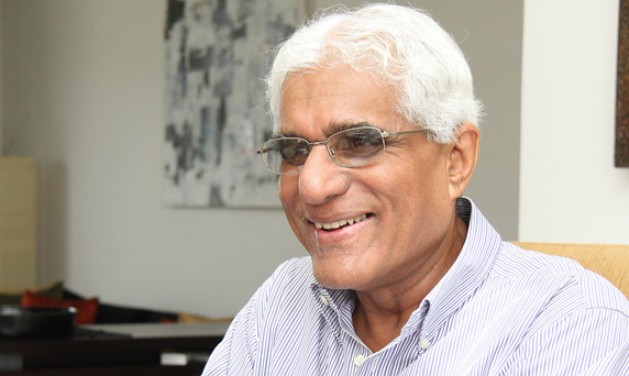
කොටි රාජ්රත්නම්ගේ ලේකම්ට මහ බැංකුව බාර දීම නරියට කුකුල්ලූ බාර දුන්නා වගේ..

July 5th, 2016

lanka C news

කොටි රාජ්රත්නම්ගේ ලේකම්ට මහ බැංකුව බාර දීම නරියට කුකුල්ලූ බාර දුන්නා වගේ..රට තුළ බලයේ සිටින අයගේ වැරදිවලට නීතිය ක‍්‍රියාත්මක නොවන නමුත් ආණ්ඩුවට අභියෝගයක් වන ජාතිකවාදී, ප‍්‍රගතිශිලී නායකයන් කවර වරදක් හෝ පෙරට දමා සිරගත කරන මෙහෙයුමක් ක‍්‍රියාත්මක වන බව ජාතික නිදහස් පෙරමුණේ නායක, විමල් වීරවංශ මහතා පෙන්වා දෙයි.

ජාතික නිදහස් පෙරමුණේ ප‍්‍රචාරක ලේකම්, හිටපු පාර්ලිමේන්තු මන්ත‍්‍රී මොහොමඞ් මුසම්මිල් මහතාට එරෙහි නඩුව කොටුව මහේස්ත‍්‍රාත් අධිකරණයේදී විභාගයට ගැනීමෙන් අනතුරුව මාධ්‍ය වෙත අදහස් දක්වමින් ඒ මහතා මෙසේ පැවසීය.

එහිදී වැඩිදුරටත් අදහස් දැක් වූ විමල් වීරවංශ මහතා මෙසේද සඳහන් කළේය.

‘‘අද රටේ නීතිය ක‍්‍රියාත්මක වන්නේ එක් එක් පාර්ශ්වයන්ට වෙනස් ආකාරයන්ටයි, මහදවල් තරුණයන් යටකරගෙන යන ඇමතිවරුන් අඩුම ගණනේ එම සිදුවීමේ සැකකරුවකු බවටවත් පත් වන්නේ නැහැ. ඊට අදාළ සීසීටීවී දර්ශන මැකෙනවා, හඳුනා ගැනීමේ පෙරෙට්ටුවක්වත් අඩුම තරමින් පවත්වන්නේ නැහැ. නීතිය නිසි පරිදි ක‍්‍රියාත්මක නොවන බවට වන මෙවැනි උදාහරණ  ඕනෑ තරම් අපට පෙන්වා දෙන්න පුළුවන්. නමුත් බලයේ සිටින පාර්ශ්වයේ අයට නීතිය ක‍්‍රියාත්මක නොවන රටේ මේ ආණ්ඩුවට අභියෝගයක් වන ජාතිකවාදී, ප‍්‍රගතිශිලී නායකයන්ට එරෙහිව කවර හෝ වරදක් පෙරට දමලා හිරේ දමන මෙහෙයුමක් අද ක‍්‍රියාත්මක වෙනවා. ඒ මෙහෙයුමෙහි ගොදුරක් බවට තමයි අද මොහොමඞ් මුසම්මිල් මහතා පත්ව සිටින්නේ. මොහොමඞ් මුසම්මිල් මහතා අද යහපාලනයේ කටු ලෙවකන තත්වයකට පත්ව සිටියානම්, වාහන එකක් නොවෙයි 100ක් පාවිච්චි කළත් කිසිම ප‍්‍රශ්නයක් වෙන්නේ නැහැ. ඒක තමයි අද මේ රටේ තත්වය. මේ තත්වය පරාජයට පත් කිරීම සඳහා මේ රටේ ප‍්‍රගතිශිලී ජනතාව පෙළගැසෙන්න  ඕනෙ. එහෙම නොවුණොත් මේ අය තමන්ට අභියෝගයක් වන සෑම දේශපාලන නායකයකුම සිරගත කරන තත්වයකට පත් වෙයි.

එහිදී මාධ්‍යවේයකු නැගූ වෙනත් ප‍්‍රශ්නයකට පිළිතුරු දුන් විමල් වීරවංශ මහතා,

  • ප‍්‍රශ්නය :- පත්කරන ලද මහ බැංකු අධිපතිවරයා පිළිබඳව ඔබ සෑහීමකට පත් වෙනවාද?
  • පිළිතුර :- නව මහ බැංකු අධිපතිවරයාගේ පැටිකිරිය සොයා බැලූවාම අපට සෑහීමකට පත් වෙන්න බැහැ. රාජ් රාජරත්නම් මහතාට අයත් ආයතනයක ඔහු ලේකම්වරයකු ලෙස කටයුතුකර තිබෙනවා, රාජා රාජරත්නම් කියන්නේ කුප‍්‍රකට කොටි හිතවාදී ව්‍යාපාරිකයෙක්. අද වරදකරුවකු ලෙස  ඇමෙරිකානු සිරිගෙදරක දඩුවම් විඳින කෙනෙක්. නව මහ බැංකු අධිපතිවරයා එලෙසම පෞද්ගලික ව්‍යාපාරික කටයුතුවල යෙදෙන කෙනෙක්. මෙවැනි පුද්ගලයකුට මහ බැංකුවේ අධිපතීත්වය භාර දුන්නාම ඒක හරියට ‘නරියාට කුකුල්ලූ භාර දුන්නා වගේ’ වැඩක් කියලයි අපට නම් හිතෙන්නේ. ඒක සුදුසු පත් කිරීමක් ලෙස අපි පිළිගන්නෙත් නැහැ.
  • අනෙක් අතට හිටපු මහ බැංකු අධිපතිවරයා මේ රටට කර තිබෙන මහා පරිමාණ වංචාව සහ පාඩුව සම්බන්ධයෙන් කිසිම නීතියක් ක‍්‍රියත්මක වන්නෙත් නැහැ. අද බැඳුම්කරවලින් කෝටි ගණන් වංචා කරපු අයට නිදහසේ ඉන්න පුළුවන්. ‘වාහනයක් වෙනුවට තවත් එකක් පාවිච්චි කළාද?’ කියන ඒවාටයි අද උසාවිවල නඩු ඇහෙමින් තිබෙන්නේ’’

අනුරුද්ධ බණ්ඩාර රණවාරණ
මාධ්‍ය ලේකම්

Gammanpila questions new CB Governor’s integrity

July 5th, 2016

The Courtesy Daily Mirror

Pivithuru Hela Urumaya (PHU) General Secretary Udaya Gammanpila today said they had no doubt about new Central Bank Governor Dr. Indrajit Coomaraswamy’s capabilities since he was an experienced and a qualified person, but they had questions about his integrity.

He was charged in an insider trading case. Founder of the Galleon Group, an American-based investment fund management firm Raj Rajaratnam was jailed for 11-years in that case.

In 2009, when the incident took place, our newly appointed Central Bank Governor was an adviser to the group. Further, he worked as a director of a subsidiary company of the Galleon Group,” Mr. Gammanpila said.

He claimed that Mr. Rajaratnam, who employed Dr. Coomaraswamy, was a person who funded the LTTE. “The Government’s decision to appoint Dr. Coomaraswamy to replace former CB Governor Arjuna Mahendran is similar to exchanging ginger for chilli,” Mr. Gammanpila said.

He said the 66-year-old Dr. Coomaraswamy would not be able to handle nationally responsible job because at that age he would lack the physical and mental fitness for it. (Piyumi Fonseka) –

See more at: http://www.dailymirror.lk/112031/Gammanpila-questions-new-CB-Governor-s-integrity#sthash.M7Jt3XWh.dpuf

Sri Lanka cannot be a China or Vietnam: An Economic Science lesson to political liars-Dr. Indrajit Coomaraswamy   -Opion

July 4th, 2016

Dr Sarath Obeysekera

I have read the above statement made by new Governor of CB with dismay ,as he has not specified what reforms we need to initiate .

As an economist he will speak about GDP ,Export Potential, High Labour cost and nothing about how to improve the productivity.

He talks about attracting investors, but he does not know about the unbearable obstacles Industrialist and investors are facing to get a project of the ground

( I as an investor is facing so much difficulties in  getting the  approvals from  agencies like CCD.CEA ,SLPA ,UDA,MEEPA  .Megapolis,Southern Development Board  etc etc etc to start a foreign currency generating project which will also provide employment  )

The governor also states that under such a situation, Sri Lanka should plan its future economic growth through a policy of promoting increased private sector centric exports and attracting more direct foreign investments.

Can he spell out how to attract those foreign investors??

As an industrialist and a foreign investment promoter let me suggest  what we should do .

Our labour laws are too democratic and too anti productive ,hence we need to have hire and fire  policy to make the labour force and blue collar workers to have a fear  psychosis from losing the job. If they get fired ,the whole family may starve hencethey will be reluctant to strike.

State should make them borrow more for education ,health care and  housing at a reasonable low rate of interest to entice them to have a high loan burden.

When they have a obligation to repay high loan instalment, they will work harder and become fearful in losing the job .

With a democratic government we cannot have strict labour laws. In Vietnam and China they do not have much democracy, hence the labour force cannot revolt.

Second suggestion is to get the women be  the head of the family who should be signing for the borrowing, as they are more responsible in repayment of loans ,In order to repay the loans she will not allow her somewhat revolutionary husband to play around with his job.

(This idea was given to me by an ex JVP leader in seventies –Mr Susil Siriwardane !)

Third suggestion is for the mighty president to suspend the constitution and become a Benevolent Dictator ( The way he appointed the Governor and now tackling VAT issue, amply proves that he does not have to listen to MP’s !)

If I have a chance of being his right hand man to implement above ,I will work harder as I will be a worker who will have a  fear of getting fired.

Lastly, stop giving and financing facility to buy cars ,three wheelers and  lend the money  to Industrialists so that they  work harder to repay the loans and produce more and more .

I cannot think any other way to come out of this economic mess

Dr Sarath Obeysekera


මට ‘මහරජාණෝ’ කියලා නම දැම්මේ මෛත‍්‍රී.. – මහින්ද නොකී රහසක් හෙලි කරයි…

July 4th, 2016

තමනට මහ රජාණෝ යන නම දැම්මේ වත්මන් ජනාධිපති මෛත‍්‍රීපාල සිරිසේන මහතා බව හිටපු ජනාධිපති මහින්ද රාජපක්‍ෂ මහතා පවසයි.

ඔහු මේ බව කියා සිටියේ බලංගොඩ ප‍්‍රදේශයේ පැවති උත්සව සභාවක් අමතමිනි.

එසේ අමතනු එපා යයි තමන් නිතරම කියූවද පලක් නොවූ බවද රාජපක්‍ෂ මහතා පැවසීය.

BREXIT: Lessons to be learnt

July 4th, 2016

By Neville Ladduwahetty Courtesy The Island

It would take months and years for the world to absorb the aftershocks of the stunning decision taken by the People of Great Britain to leave the European Union (EU). The consequences of this decision would be felt globally and would affect the lives and livelihoods of millions in Britain and around the world,not only in the near term but also in the long term as well. The decision to exit the EU has been described by some as the end of history,perhaps because the diminished role of Britain in global politics would redefine the role of the West in a manner that cannot be fathomed at this time. The President of the EU Parliament is reported to have stated that “A whole continent is taken hostage because of an internal fight in the Tory party.” (Washington Post, June 27, 2016).

The internal politics was not confined only to the Tory Party. There are divisions within the Labour Party as well. Whatever the nature of the internal divisions 3/4th of the Parliament was for remaining within the EU. However, the fact that the British people voted to defy their elected representatives reflects a disturbing disconnect between all those associated with the political establishment, the elected representatives and their people thus projecting a shocking breakdown in representative democracy.

An article in the Washington Post states: “The gap between the people and their representatives has never before, at least on an issue of this significance, been so wide. You do not speak for us, voters said, and we hold you in some contempt for your failure to represent, or even understand our concerns” (June 26, 2016). What happened in Britain should serve as a wake-up call for all elected representatives in democracies,and of the need for them to be in close touch with their electors if they are to fulfill their responsibilities.

READING the SIGNIFICANCE of the VOTE

A host of explanations have been offered to explain the reasons why the British People decided to opt out of the EU. They range from age differences to class differences to urban versus rural and how each views their place inside or outside the EU. The young see issues in the context of a globalized world in which they are comfortable. To the young remaining in the EU means greater integration, bigger markets and greater opportunities, all of which means support for globalization. It also means economic growth, tangible prosperity for the educated ending in a greater share for the “haves”. As a United Kingdom with the 5th largest economy the young see a greater role for UK in which they could participate in shaping the future of the global landscape.

The older generations and the rural people, on the other hand, see their sovereignty and lives being marginalized from the effects of globalization. They see the influx of immigrants from Europe threatening their job security and straining the social entitlements they had once enjoyed(and threatening their job security). They also see their identity being compromised in a subsumed multiculturalism that they find hard to accept. They see integration as having to conform to standards dictated by a distant bureaucracy in Brussels over which they have no control. The vote to exit the EU is how they expressed their wish to retake control of their lives and their place in Britain.

The concerns of this section of British society are so immediate and compelling that they are not concerned about the consequences of exiting from the EU even if it means isolating Britain from the stage of world affairs because of its diminished role. Similar inward looking trends exist in other parts of the world. The call by a prospective US Presidential candidate to take back America reflects similar sentiments. In respect of class, the wine drinking class see globalization as an opportunity whereas the beer drinking class see globalization as a threat to their identities and to their livelihoods. These differences saw a 52% vote mostly by the elderly and the rural to exit the EU and 48 % mostly young and urban voting to remain.

These contrasting views reflect a divided society with contrasting values attributed in the main to byproducts of globalization. Without addressing such pressing issues political parties in most democracies are preoccupied with their internal politics. Commenting on this situation the Washington Post cites the views of Anthony King, Professor of Politics at the University of Essex who states: “In the face of that change in public attitudes, much of the political class is behaving the way it used to behave, the old arguments, the old fights, the adversarialism. That has created what he calls ‘the palpable disconnect’ between political leaders and ordinary people. That is true across much of the democratic world” (June 28, 2016).

LESSONS for SRI LANKA

The inability of the political establishment in Britain to recognize the divisions in the society arising from contrasting values that obviously had been festering for some time reflects a breakdown in the abilities of elected representatives to be sensitive to the disconnects in their democracies. Similar fractures are taking place in Sri Lanka as well. What is visible in Sri Lanka are the gathering protests by traders in various parts of Sri Lanka against taxes imposed by the government; the protests by the farmers for denying the entitlements they had previously enjoyed, and the concerted campaign by the professionals against globalization in the form of Trade Agreements particularly with India such as ETCA to prevent mass immigration to Sri Lanka; a fact that was downplayed by the British Government but turned out to be in far higher numbers than predicted. Promoters of ETCA in Sri Lanka are also downplaying the possibility of an influx of immigrants from India, but what they fail to recognize is that the combination of serious unemployment in India and much higher wages in Sri Lanka would tempt every loophole in the Agreement to be exploited,after which it would be too late to take any meaningful action to contain the tide.

Instead of recognizing and responding to the concerns of a significant section of Sri Lanka’s citizens,the obsession of the current Government to push for robust urbanization and greater engagement with India reflects the degree of disconnect between the political establishment and the people. The intention of the Government to bring prosperity to the country through urbanization and greater global engagement in the hope that its benefits would trickle down is a flawed approach. While it is hoped that the visible protests would not gather momentum and spiral out of control as happened in the revolt of the English Peasants in 1381,the invisible and yet muted protests against the push for urbanization in the form of Port Cities and Project Megapolis would further marginalize sections of the society outside these urban centers thereby exacerbating the divisions that already exist.

Those who are for urbanization are driven by values similar to the Brits who are for remaining within the EU; these being a wider world view that promotes connectivity with the world and unrestricted freedom of movement etc. etc. Those opposed to urbanization see its effects on the society where those currently outside urban areas would become guest workers who end up living in the margins providing services to the urban elite and yet others who would be left behind in the rural hinterland as it is with most mega cities. When those left behind end up being the “have nots”, the societal schisms could precipitate electoral outcomes that end up being a rebuke and a dismissal of the establishment as has been demonstrated in Britain.

The report cited above states: “The seeds of what has brought Britain to this moment exist elsewhere, which makes this country’s problems the concern of leaders elsewhere. In Belgium and Brazil, democracies have faced crises of legitimacy; in Spain and France, elected leaders have been hobbled by their own unpopularity…” In Sri Lanka too there is a crisis of legitimacy and popularity. There is also a deficit in democracy both at the level of the leadership and at the level of the elected representatives due to their preoccupation with personal issues to a degree that is making them insensitive to the simmering disconnect within the polity.

In Britain it was essentially the agricultural heartland that voted to exit the EU. In Sri Lanka also the discontent is most palpable among those engaged in agriculture, in particular, the paddy farmers and the tea and rubber small holders. Of these, the most vulnerable are the paddy farmers because they live from harvest to harvest. Consequently, they are victims of the money lenders in between harvests and are victims of powerful millers after harvest. One possible way to bring relief to this significantly large section of the population is to arrange for a percentage of the guaranteed price for paddy based on average yield per hectare to be paid to them monthly. This would make the farmer independent of the money lenders and place them in a position of strength to negotiate with the millers for the best price. Whatever the arrangement, successive Governments have failed to address the plight of a section of society that assures food security for the whole nation.

CONCLUSION

The prevailing disconnect between the political establishment and the people’s needs whether in Britain, Sri Lanka or any other democracy is due to a failure of the political leadership and the elected representatives in democracies to read the rising anxieties in their respective countries. Collectively, they are preoccupied with either retaining power or gaining power. The effect of this preoccupation is to ignore the issues that matter to the people. Stark evidence of this phenomenon is the decision of the British majority to exit from the EU much to the shock of the political establishment as well as to others associated with the establishment.

At the end of the day what really should be the role of elected representatives and their leaders in a democracy? Are they to lead the nation in a direction that from their perspective is best for the people, or should they work towards fulfilling the needs of the People in respect of what matters to them or is it a combination of both. What we have today in Sri Lanka is a trend towards the former.This is reflected in the focus for greater global engagement for which the needed infrastructure is urbanization in the form of Port Cities and Mega-cities with facilities to meet the demands of the high rollers both within and without who patronize them. The fact that such a direction has a social and environmental cost not to mention the attendant cultural degradation is not factored.

On the other hand, the priorities of people in most countries concern their immediate livelihood. To them the GDP rank of the country means little. What matters to them are freedoms and opportunities to pursue meaningful and prosperous lives that are sustainable both for themselves and for the future generations. This was the message that the people of Britain brought to the attention of the world. They were not prepared to bear the cost of the global engagement that their leaders set out for them. The message in the protests in Sri Lanka is no different.

For the people of Britain their place in Britain is more important than Britain’s place in the world. Such a vision also goes for most in Sri Lanka and most other countries. This does not mean a tendency to look inward or a hard-nosed nationalism, but a view where people in general want to engage with the world without losing sight of who they are and the values they nourish and stand for. The people of any country would respect a leadership that could answer such a call.

Sri Lanka cannot be a China or Vietnam: An Economic Science lesson to political liars-Dr. Indrajit Coomaraswamy

July 4th, 2016

Courtesy Adaderana BIZ

Sri Lanka is currently stuck in a position while being unable to compete against countries with lower labor costs or labor productivity. If to emerge from this trap, Sri Lanka has to go for reforms immediately, warns an economic academic.

Dr. Indrajit Coomaraswamy points out that Sri Lanka is unable to compete with countries like Bangladesh with lower labour costs since the island’s labour costs are higher.

Furthermore, since Sri Lanka is trapped by being unable to compete with countries like Thailand where labour productivity is higher, it has to immediately go in for wide reforms in its labour force to increase productivity, adds Dr. Coomaraswamy.

Sri Lanka cannot become a China or Vietnam

Dr. Indrajit Coomaraswamy identified the government’s foreign loan funded infrastructure development projects and the utilization of neglected capacities as significant reasons for Sri Lanka’s development growth after the end of the war.

Though the lower foreign borrowing countries like China and Vietnam follow a policy of economic growth through state investments, it is difficult for Sri Lanka to widen its state investments any further through foreign loans since the island’s foreign borrowings are nearly 75 per cent compared to its GDP.

Similarly, the neglected capacities have been utilized to their maximum by now, points out economic academic Dr. Indrajit Coomaraswamy.

The way forward for Sri Lanka

Under such a situation, Sri Lanka should plan its future economic growth through a policy of promoting increased private sector centric exports and attracting more direct foreign investments, says Dr. Coomaraswamy.

Hence, Sri Lanka’s policy planners should immediately introduce economic reforms which could promote exports and attract more direct foreign investments, he added.

Attracting direct foreign investments towards a 10 per cent economic growth is something feasible and productivity should be enhanced in ways to expose the creativity of Sri Lanka’s labour force, Dr. Coomaraswamy added further.

Interim budget and relief package

Sri Lanka’s macro-economic stability has been weakened due to the unbearable relief packages provided through the recent interim budget and hence it is vital that Sri Lanka reconsiders whether it is treading on the right path, said Dr. Coomaraswamy.

It is not so easy to find the funds for the relief measures provided through the interim budget and this would force the increasing of taxes and interest rates, control expenditure or to some similar mixed decisions, he pointed out.

http://bizenglish.adaderana.lk/sri-lanka-cannot-be-a-china-or-vietnam-an-economic-science-lesson-to-political-liars/

බදු, පොලී වැඩි කර වියදම් පාලනය කල යුතුයි… පුද්ගලික අංශය මූලිකයි.. – මෙන්න අලුත් මහ බැංකු අධිපතිගේ දැක්ම..

July 4th, 2016

lanka C news

2015.05.28– biz.adaderana.lk

බදු, පොලී වැඩි කර වියදම් පාලනය කල යුතුයි… පුද්ගලික අංශය මූලිකයි.. – මෙන්න අලුත් මහ බැංකු අධිපතිගේ දැක්ම..

ශ්‍රමයේ මිල අඩු රටවල් සමග හෝ ශ්‍රමයේ ඵලදායීතාවය වැඩි රටවල් සමග තරග කිරීමට නොහැකි ලෙස ලංකාව මේ වනවිට හිරවී තිබෙන බවත් මේ උගුලෙන් ගොඩඒම සඳහා ලංකාව වහ වහා ප්‍රතිසංස්සකරණ කළ යුතුව ඇති බවත් ආර්ථ ශාස්ත්‍රඥයෙකු අවධාරණය කරයි.

ආචාර්ය ඉන්ද්‍රජිත් කුමාරස්වාමි මහතා පෙන්වා දෙන්නේ මෙරට ශ්‍රමයේ මිල වැඩි නිසා ශ්‍රමයේ මිල අඩු බංග්ලාදේශය වැනි රටවල් සමග තරග කිරීමට ලංකාවට මේ වනවිට නොහැකි බවයි.

මීට අමතරව, තායිලන්තය වැනි ශ්‍රමයේ ඵලදායීතාවය වැඩි රටවල් සමගද තරග කිරීමට ලංකාවට මේ වනවිට නොහැකිවී තිබෙන නිසා ලංකාව හිරවී තිබෙන බවත් මෙම උගුලෙන් ගොඩඒම සඳහා ශ්‍රම බලකායේ ඵලදායීතාවය නැංවීමේ පුළුල් ප්‍රතිසංස්කරණ ඉතාමත් ඉක්මනින් කළ යුතුව ඇති බවත් කුමාරස්වාමි මහතා පැවසීය.

චීනය සහ වියට්නාමය වගේ වෙන්න අපිට බෑ

ලදායිතාවය නැංවිය යුතු බවත් කුමාරස්වාමි මහතා වැඩිදුරටත් කීය.

අතුරු අයවැයේ සහන මල්ල ගැන කියූ කතාව

පසුගිය අතුරු අයවැ

යුද්ධයෙන් පසුව ලංකාවේ ආර්ථික වර්ධනයට ප්‍රධානතම හේතු ලෙස විදේශ ණය මත රජය සිදුකළ යටිතල පහසුකම් සංවර්ධන ව්‍යපෘති සහ අත්හැර දමා තිබුණු ධාරිතාවයන් ප්‍රයෝජනයට ගැනීම කැපී පෙනුණු බව ඉන්ද්‍රජිත් කුමාරස්වාමි මහතා සඳහන් කළේය.

විදේශීය ණය අඩු චීනය සහ වියට්නාමය රාජ්‍ය ආයෝජන මගින් ආර්ථික වර්ධනය ඉහළ නැංවීමේ ප්‍රතිපත්තියක සිටියත් මේ වනවිට, ලංකාවේ විදේශ ණය ප්‍රමාණය දළ දේශීය නිෂ්පාදිතයට ප්‍රතිශතයක් ලෙස සියයට 75කට ආසන්න නිසා තවදුරටත් ණයට මුදල් ගෙන සිදුකරන රාජ්‍ය ආයෝජන පුළුල් කිරීම මෙරටට අසීරු යැයි හෙතෙම කීය.

එසේම, අත්හැර දමා තිබූ ධාරිතාවයන්ද අපි මේ වනවිට උපරිමයෙන් ප්‍රයෝජනයට ගෙන ඇතැයි අර්ථ ශාස්ත්‍රඥ ආචාර්ය ඉන්ද්‍රජිත් කුමාරස්වාමි මහතා පෙන්වා දුන්නේය.

අපි ඉදිරියට යා යුත්තේ කෙසේද ?

මෙවැනි තත්ත්වයක් තුළ ලංකාවේ ඉදිරි ආර්ථික වර්ධනය සැලසුම් කළ යුත්තේ පුද්ගලික අංශය කේන්ද්‍ර කරගනිමින් අපනයන වර්ධනය කිරීම සහ වැඩිපුර සෘජු විදේශීය ආයෝජන කැඳවා ගැනීමේ ප්‍රතිපත්ති ප්‍රවර්ධනය කිරීම මගින් යැයි කුමාරස්වාමි මහතා අවධාරණය කළේය.

මේ නිසා, අපනයන ප්‍රවර්ධනය වන ආකාරයේ සහ සෘජු විදේශීය ආයෝජන වැඩිපුර කැඳවා ගතහැකි ආර්ථික ප්‍රතිසංස්කරණ මෙරට ප්‍රතිපත්ති සම්පාදකයින් විසින් වහාම හඳුන්වා දිය යුතුයැයි හෙතෙම පැවසීය.

සියයට 10ක ආර්ථික වර්ධනයක් ලබාගැනීමට හැකි සෘජු විදේශීය ආයෝජන ගෙන්වා ගැනීම කළ හැකි දෙයක් බවත් ලංකාවේ ශ්‍රම බලකායේ නිර්මාණශීලීත්වය එළි දකින ආකාරයෙන් ඵ

ය මගින් ලබාදී ඇති ඔරොත්තු නොදෙන සහන හේතුවෙන් මෙරට සාර්ව ආර්ථික ස්ථායීතාවය දුර්වල කර තිබෙන බවත් අපි යන්නේ හරි පාරේදැයි නැවතත් විමසා බැලීම වැදගත් බවත් කුමාරස්වාමි මහතා සඳහන් කළේය.

මෙම අයවැය මගින් ලබාදී තිබෙන සහන සඳහා මුදල් සොයාගැනීම එතරම් පහසු නොවන බවත් මේ හේතුවෙන් බදු සහ පොලිය වැඩිකිරීමට, වියදම් පාලනය කිරීමට හෝ එවැනි මිශ්‍ර තීන්දු ගැනීමට සිදුවනු ඇති බවත් හෙතෙම පැවසීය

2015.05.28
– biz.adaderana.lk

New Central Bank Governor Gets official appointment from Prez today

July 4th, 2016

Sri Lanka news

President Maithripala Sirisena announced on Saturday that he will appoint Economist Dr. Indrajit Coomaraswamy as the Governor of Central Bank. Dr. Indrajit Coomaraswamy will receive his appointment as the Governor of Central Bank from President Maithripala Sirisena today (4).

Dr. Coomaraswamy had met the President on Saturday (2) after his decision was announced on the next CBSL Governor.
This appointment had ended the controversial rift between the President and Premier on a suitable person taking over the heart of the finances in the country.

indrajith


Dr. Indrajit Coomaraswamy

Indrajit Coomaraswamy – born April 3, 1950 – is a Sri Lankan economist, hails from one of the country’s most respected Tamil families. He is  the son of the iconic diplomat, Raju Coomaraswamy, alias ‘ Roving Raju’, and a brother of Radhika Coomaraswamy, a human rights activists who is also a member of Sri Lanka’s Constitutional Council..

Educated at the Royal College, Colombo and at Harrow School in England, he gained his undergraduate degree at Cambridge University and obtained his Doctorate at the University of Sussex.

Joining the Central Bank of Sri Lanka in 1973 he served in the Economic Research, Statistics and Bank Supervision Divisions as a staff officer till 1989. From 1981 to 1989 he was seconded to the Ministry of Finance and Planning.

Thereafter Coomaraswamy worked for the Commonwealth Secretariat from 1990–2008, holding the posts of Director, Economic Affairs Division and Deputy-Director, Secretary-General’s Office and was brought back to the Commonwealth Secretariat to head the Social Transformation Programme Division, as Interim Director.

Indrajit played first-class cricket in 1971 and 1972 for the Cambridge University team. He also played Rugby for Cambridge University, and later captained Sri Lanka in Rugby in the 1974 Asiad.

He also served as a special adviser to the Galleon group, founded by controversial businessman Raj Rajaratnam, a Sri Lankan American currently serving a 11 year prison term. Rajaratnam has been convicted in the USA on nine counts of securities fraud and five counts of conspiracy. Prosecutors have said he made up to $63.8 million in illicit profit from 2003 to 2009.

Incumbent Finance Minister Ravi Karunanayake was once accused of depositing funds sent by convicted hedge fund owner Raj Rajaratnam, in a private bank without informing the Central Bank. Karunanayake’s name, however, has been cleared by the Colombo High Court which heard the case for nearly four years.

The Galleon Group.

The Galleon Group was one of the largest hedge fund management firms in the world, managing over $7 billion, before closing in October 2009.The firm was the center of a 2009 insider trading scandal. The firm was founded by Raj Rajaratnam, a former equity research analyst and eventual president of Needham & Company, in 1997.The New York headquartered firm was named for the galleon, a large sailing ship used from the 16th to 18th centuries in Europe.

Insider trading investigation of Galleon

In October 2009 Rajaratnam and five others were arrested and charged with multiple counts of fraud and insider trading. Rajaratnam pleaded not guilty and remained free on $100 million bail, the largest in United States history. He was indicted by a grand jury in December 2009[5] and found guilty in U.S. District Court on 14 charges in May 2011. He was sentenced by U.S. District Judge Richard Holwell to 11 years in prison on October 13, 2011.

Other former and current traders at Galleon were subsequently arrested and charged with contributing to the alleged conspiracy. Several former employees of the firm have cooperated in the investigation. As of January 2012 over fifty people have been convicted or pleaded guilty to date in the sprawling probe stemming from Galleon (not all of them Galleon employees).

Zvi Goffer, an ex-Galleon Group LLC trader, was found guilty of all 14 counts of conspiracy and securities fraud against him and sentenced by Judge Sullivan “to 10 years in prison for his role in a scheme to trade on inside information provided by lawyers”. Goffer had asked for a lenient sentence and prosecutors had recommended more than 10 years.

Adam Smith, an ex-Galleon Group LLC trader, pleaded guilty and cooperated in the criminal trial of Raj Rajaratnam. He was sentenced in June 2012 to only a period of probation and no jail time by Judge Jed Rakoff, who took over the case from Judge Richard Holwell when the latter retired from the bench. (Wikipedia)

One problem solved; many others remain

July 4th, 2016

Editorial Courtesy The Island

President Maithripala Sirisena took one step back and two steps forward on the question of the appointment of a new Governor to the Central Bank; Prime Minister Ranil Wickremesinghe took one step back and another forward. Wickremesinghe managed to prevent Sirisena’s first choice being appointed Governor and Sirisena succeeded in scuttling Wickremesinghe’s plan to grant another term to Arjuna Mahendran under a cloud! Dr. Indrajith Coomaraswamy got the coveted job thanks to their prestige battle.

‘Even the shadow of a doomed marriage is crooked’ as a popular local saying goes. It is true of the political marriage of convenience between the SLFP and the UNP.

President Sirisena has, for once, sought to assert himself vis-à-vis the UNP’s relentless efforts to undermine his authority. He admitted in the run-up to the last parliamentary election that he had called for the removal of Mahendran as the Central Bank Governor, but in vain. He also objected to a government plan to jack up VAT and even threatened to send the officials responsible for it home. VAT was increased! He has recently vowed to revise VAT. Whether he will put his foot down again remains to be seen.

The late Ranasinghe Premadasa, when he was the Prime Minister in President J. R. Jayewardene’s government lamented that he was no better than a peon where his powers were concerned. He told the truth. When the Prime Minister and the President come from the same party, the former is reduced to the level of a peon. But, it is the other way around when they represent two different parties as we saw from 2001 to 2004 with Chandrika Kumaratunga and Ranil Wickremesinghe as the President and the Prime Minister respectively at each other’s jugular. At that time, the Constitution provided for the President to dissolve parliament one year after the formation of a government. Kumaratunga made use of that provision to sack the UNP-led UNF government. Stripped of that power and troubled by moves to clip his wings further, Sirisena is doing his damnedest to prevent himself from being reduced to a lame duck president.

Speculation was rife in political circles towards the latter part of last week that the tug-of-war between the President and the Prime Minister on the Central Bank issue might even lead to a break-up of the government. Should what is being speculated come to pass the President will find all odds stacked against him.

Most of the votes President Sirisena polled at the last presidential polls were from the UNP, the TNA and the JVP. His ability to secure a sizeable chunk of the voters straddling the fence helped him score a historic win. But, not all the forces that helped him grab the presidency are solidly behind him at present. The SLFP is divided between him and his former President Mahinda Rajapaksa. The Tamil and Muslim voters will follow their leaders who are most likely to back the UNP at the next presidential election. This is a worrisome proposition for President Sirisena, who is expected to seek a second term.

Having successfully used Sirisena as a battering ram against the Rajapaksa government and shored up its electoral fortunes, the UNP is now in a position to survive without the SLFP’s support. With 106 seats in hand it needs only nine seats more to muster a working majority in Parliament. Nine super luxury vehicles, plum Cabinet posts and enough dosh will help it raise the required number with ease by engineering crossovers. Even if it fails to spring defections from the UPFA, it can depend on the TNA to deny its opponents a majority in Parliament; it can remain in power with or without a formal alliance with the main Tamil party the way the SLFP-led People’s Alliance ran a ‘probationary government’ with the help of the JVP in 2000 before crashing.

What really keeps the warring factions of the government together is their fear that former President Mahinda Rajapaksa might make a comeback if they break ranks.

Meanwhile, there were many good governance activists including prominent members of the UNP who accused Ajith Nivard Cabraal of a pyramid scheme link and argued that he was unfit to hold the post of the Central Bank Governor as a result. But, strangely, they have chosen to ignore Dr. Coomaraswamy’s alleged Galleon connection; it has been reported that once he was allegedly involved in a research outfit, a subsidiary of the US-based Galleon, founded by Raj Rajaratnam, who was sentenced to jail for insider trading. A clarification is called for!

The new Governor is sure to find himself in an unenviable position as he will be under pressure from the political authority like some of his predecessors to make unpopular, unprofessional decisions. The first task before him will be to win the trust of the Central Bank staff and give the institution a radical shake-up. Besides infusing professionalism into the bank and boosting the sagging morale of its workers, he will have to hold the bond vultures at bay and ensure that no crooked deals will be put through at the expense of the state banks and the Employees’ Provident Fund (EPF). This, no doubt, will be a tall order.

A state-controlled newspaper has given an interesting headline to its report on the appointment of Dr. Coomaraswamy—‘Cometh the man’. It is hoped that the hour won’t come when the chosen ‘man’ runneth away!

Winter of discontent

July 4th, 2016

By Rohana R. Wasala

Now is the winter of our discontent
Made glorious summer by this sun of York.– 
         Opening lines of the Shakespeare play ‘Richard III’ uttered by (the Duke of) Gloucester who later became King Richard III

‘Listening to discontent’ by Sanjana Hattotuwa (Sunday Island/June 26, 2016) attempts an answer to the writer’s own query: ‘What is it about this Government that makes them so unwilling and unable to speak with, and listen to the public?’ A friend of mine who had read this article quipped: What if they don’t have anything to communicate? My reply to him was: they certainly have something to communicate to the people, but they don’t seem to have anything that they can communicate to the common people without alienating them further.

The writer’s thesis that ‘communication is key to reform’ and that ‘it begins with listening’ is a self-evident truth in a democratic society if what is to be communicated is an acceptable ideology. The communication meant here is between the rulers and the ruled, the government and the people. Three elements are involved in the thesis statement indicated by ‘communication’, ‘reform’ and ‘listening’. What is there to be communicated, what reforms are proposed to be implemented, and what is there to be listened to? , that is, what are the complaints, grievances, problems, etc. to be addressed. In the specific context we have implicitly in mind, that is, in the essential interaction that ought to take place between ruling politicians and the ordinary people who have temporarily delegated their sovereign power to them to rule on their behalf (for in theory sovereignty lies with the people), the government leaders must inquire into the people’s complaints and grievances, while acknowledging their compliments, if any; they must set before the people their ideological preferences, and the policies they want to adopt in order to remedy the shortfalls the masses are pointing out, and they must thus try to win their support for required changes (reforms) to be introduced in relation to different aspects of governance such as the basic law of the country (i.e., the constitution), economic strategies, national security, etc. The question is why this interaction seems to have gone by default at present.

‘The government today believes citizens don’t know what they want. It is elitism of the worst sort, where instead of leveraging class, caste and power to engage and to the extent possible, convert, we have instead a few who believe they alone have the solutions to what ails the country; that they alone can garner the buy-in from political elites to support their solutions; and finally, by doing this, that the people will invariably follow’. This observation of the writer seems to be correct! Actually, the citizens know what they want (and, more importantly, what they need as well): what they want is to live happily in peace and harmony with  each other, free from the fear of terrorist bombs, dwelling, working, or travelling wherever they like in their island home without let or hindrance; what they need are good jobs, houses, schools, hospitals, roads, harbours, airports, and other things that are essential for a decent life in the modern world.

The author of the piece correctly observes: ‘A government wins or loses public confidence by marketing ideas, and the delivery of promises’. The spreading public outcry against many of the current regime’s policies is an indication of  what people are thinking about it. In my opinion, the previous government under its charismatic leader won public confidence overwhelmingly ‘by marketing ideas, and the delivery of promises’ (This is my view, not Sanjana’s obviously). My assertion here is based on the successes the previous government scored at periodically held elections: people were told what the government was going to achieve for the country as promised, and through sound policies, it did make its promises good. It is true that the elections were staggered in order that the government could maximize its electoral gains. As a strategy for winning elections, this was the antithesis of hoodwinking the voters by attractive pre-election promises which the candidates did not mean to fulfill after success.

A good idea badly communicated can cause anger and opposition among the people, the writer argues, explaining it with examples: ‘Take federalism, the dreaded f-word in politics; or in the recent past, the perception of human rights. As a political idea around the configuration of the State, or framed as the protection of basic human decency and dignity (and importantly, in line with core tenets of the dhamma), both find traction even amongst those who would violently decry embracing federalism as an organising principle of any future Constitution, and by those who think of human rights as a Western, neo-liberal agenda to name and shame those in the previous government, or imprison “war heroes”’.

Here I cannot agree with him about what he implies to be public perceptions in Sri Lanka of the concepts of federalism and human rights. His dragging in of ‘the dhamma’ is irrelevant, and only betrays his cynical ignorance of the dhamma. The Sinhalese Buddhists should not be expected to go and meditate while their house is being robbed. Lawyer Manohara de Silva, PC, during a recent lecture at the Yuthukama Colloquium, referred with approval to a simple explanation that a Buddhist monk had given of the difference between a unitary state and a federal system: ‘unitary means one government, federal means a number of governments’. It may be a very simplistic characterization of the concept, but it states an essential truth. The problem is about the applicability of federalism to our country. The federal system seems to work well for big countries such as America and India, with powerful central/federal governments, but it will definitely be a problem for our small country because of important factors that are unique to it, such as the ethnically intermingled composition of the population, the proximity of Tamil Nadu which is home to some 80 million Tamils, the demand for the re- merger of north and east, which will invariably be vulnerable to separatist pressure, and so on.

The late Lakshman Kadirgamar  clearly rejected the idea of a separate state, which he considered to be a threat to the Tamils as much as to other communities. The common perception that federalism can be fatal to Sri Lanka’s survival as it is, that is strong among the general public, not exclusively among the Sinhalese, cannot be ignored by constitution reformers. The opposition of the majority Sinhalese and others to federalism is not unreasonable; it is not due to their narrow-mindedness or tribalism or barbarism or any of the many common negative attributes that the Sinhalese are usually insulted with.

We know that, in the last phase of the fighting in 2009, army casualties unnecessarily escalated because they had to fight amidst (expected) lethal odds (landmines, booby traps, ambushes, restricted arms use, etc.) in order to save civilian lives. They rescued 300,000 entrapped Tamil civilians (many LTTE cadres who had shed their combat uniforms among them) and brought them to safety; some 11,000 combatants were  rehabilitated, some were even found foreign employment by the government. Vicious racist Tamil Diaspora  misinformation (supported by the manipulative Western media) project an image of Sri Lanka’s security forces that is the exact opposite of what they really are. Please, don’t grudge the war heroes the well deserved dignified, respectful epithet ‘war hero’, an honour  involuntarily accorded to them in token of gratitude by the multiethnic general public. The Sinhalese must have the freedom to live normally like any other ethnic group without having to apologize to the world for doing so..

Talking further about the present government’s failure to communicate, the writer rightly comments that communicating what something is and indicating what something is not are equally important. He  adds that  ‘it (the present government) is supremely bad at both’. Comparing Maithri and Ranil, the writer asserts: ‘The President is more charismatic, the Prime Minister more cosmopolitan and visionary.’ I regret to say that I categorically refute this false assertion. I don’t want to waste my time and column space explaining my reasons for saying this. But I wish to say that I unhesitatingly subscribe to the common view prevalent among ordinary Sri Lankans that the former president had all three qualities in abundance, which accounts for his lasting popularity both in Sri Lanka and in friendly foreign countries, and his often practically demonstrated concern with the welfare of people of all classes, races, religions, not only in Sri Lanka, but abroad (It is not for nothing that a street in Palestine is named after Mahinda Rajapaksa).

I totally agree with the writer’s idea that both the Prez and the PM ‘are political animals, with decades of experience in realpolitik’ (the problem is that they now appear to be pulling in opposite directions) and also with his assumption  about the common ground that they occupy with regard to their preoccupations. Their shared desire to keep the Rajapaksas at bay is the first of these preoccupations he mentions. In addition to this determination to balk a Rajapaksa return to a position of power, ‘consolidating power over the long term, managing the expectations of yahapalanaya and the need to keep a motley coalition together by the glue of incentives, which include for example luxury vehicles’ form the other segments of the common space the two share. What the yahapalana expectations are I have no idea of. All that they have been morbidly preoccupied with is rubbishing the image of the popular leader they ousted by poisoning the minds of the foolish gullible minority of the electorate using wild allegations of corruption. But there were no substantive criticisms for his opponents to make against him. While Rajapaksa remained among his own people, closely interacting with them, his opponents had to rely on outside help to replace him. ‘What are corruption charges when weighed against the immense benefits his rule brought to the country?’ is the rhetorical question common people now ask.

According to the writer of the article ‘Listening to discontent’, the government’s failure to communicate, its ‘silence’, will help no one except ‘those who wish to regain what they lost on January 8, 2015’. This supposedly dire consequence is not so universally feared as imagined by the diehard ‘change’ converts . Who gained and who lost on January 8 are questions that are engaging the attention of the thinking public. The January verdict had been decided on by anti-national conspirators. The yahapalanists are acting as if they have nothing to communicate to an impatiently waiting public  – nothing by way of a clear vision, plan of action to set things right, save perfunctory promises.

කඳන් තුවක්කු

July 3rd, 2016

වෛද් රුවන් එම් ජයතුංග

මම ග්‍රාමීය ප්‍රදේශ වල රෝහල් වල සේවය කල කාලයේදී කඳන් තුවක්කු හෙවත් ට්‍රැප් ගන් නිසා තුවාල ලැබූ බොහෝ දෙනෙකුට ප්‍රතිකාර කලෙමි. කඳන් තුවක්කු බඳින්නේ සතුන් දඩයම් කිරීමටය​.  මුවා, ගෝනා, ඌරා යනාදී සතුන් දඩයම් කර ගැනීමට විවිධ වර්ග වල කඳන් තුවක්කු තිබේ. මෙම තුවක්කු වලට යකඩ බට  යොදා ගන්නා අතර අහස් කූරු වෙඩි බෙහෙත්  (සමහරක් විට ගිණිකූරු පෙට්ටි දහයක පමණ ගිණිකූරු හිස් සූරා වෙඩි බෙහෙත් එකතු කරනු ලැබේ) සහ යකඩ ඇණ කැබලි යොදා වෙඩිල්ල සකස් කරයි. ඉන්පසු සතුන් යන මාර්ගයක මේ කඳන් තුවක්කුව සකසා තබයි.

කඳන් තුවක්කු නිසා මෙම පලාත් වල මිනිසුන් ආබාධිත වී තිබේ. එසේම සමහරු මිය ගොස් ඇත​. කඳන් බැඳීම නිසා සිදුවුන පාද අහිමිවීම් හා මරණ සංඛ්‍යාව යුද්ධය නිසා උතුරු නැගෙනහිර ආබාධිතයන් බවට පත්වීම්වලට මුහුණ දුන් අයට වඩා වැඩි බව වාර්තා වී තිබේ.

කඳන් තුවක්කුවක් පත්තු වීම නිසා දණහිස තුවාල වූ ගොවියෙකුට මම මාතලේ රෝහලේදී ප්‍රතිකාර කලෙමි. තුවක්කුවේ තිබූ සියුම් යකඩ කෑලි ඔහුගේ අස්ථි තුලට කාවැදී තිබීම නිසා වරින් වර ඔහු කකුලේ අස්ථි ඇටමිදුළු ආසාදනය වන ඔස්ටියෝමයලයිටිස් තත්වයෙන් පෙළුනේය​. මේ නිසා ඔහු ජීවිත කාලයටම ආබාධිතයෙක් විය​.

weapon (1)

තවත් ගොවියෙකු කඳන් තුවක්කුවකට ගොදුරු වන ලද්දේ ඔහුගේ හරක් සොයා කැලෑ වැදීමෙනි. වෙඩි පහර ඔහුගේ දණහිස කුඩු කරගෙන ගොස් තිබුනි. මෙම පුද්ගලයාගේ ජීවිතය බේර ගැනීම සඳහා ඔහුගේ කකුල දණහිසෙන් ඉහලින් කපා දැමීමට සිදු විය​. තවත් වරෙක කඳන් තුවක්කුවක් පත්තු වීම නිසා තුවාල ලබා තිබුනේ පාසල් දරුවෙකි. ඔහු වසරකට ආසන්න කාලයක් රෝහල් ගතවී ප්‍රතිකාර ලැබුවේය​. මේ තුවාල හේතුවෙන් ඔහුගේ අධ්‍යාපනයද අඩාල විය.

ග්‍රාමීය ප්‍රදේශ වල  සේවය කල කාලයේදී අප සමහරක් විට කැලෑ ප්‍රදේශ වල අැවිදීමට ගියෙමු. ඒ යන විට රිටක් අතින් ගෙන මාර්ගය පාදාගෙන යාමට අප පුරුදුව සිටියෙමු. ඒ මන්ද යත් කඳන් තුවක්කු තිබුනේ නම් ඊට ගොදුරු නොවීම සඳහාය​.

වරක් මම නෙළුවේ පවත්වන ලද කඳවුරක සෞඛ්‍යය සේවයට ගියෙමි. නෙළුවේ ප්‍රාදේශීය සභාවේ සභාපතිවරයා කඳවුරට පැමිණි හමුදා නිලධාරීන් සාදරයෙන් පිලිගෙන ඔහු විසින් දඩයම් කරන ලද වල් ඌරෙකුගේ ගාතයක් රාත්‍රී ආහාර සඳහා දුන්නේය​. ඌරු- කණ් මහත්තයා ලෙස හඳුන්වනු ලැබූ මෙම ප්‍රාදේශීය සභාවේ සභාපතිවරයා දක්‍ෂ දඩයම්කරුවෙකු විය​. පසුකාලයක ඔහු දඩයමේ යද්දී ගෝනෙකුට සකස් කරන ලද කඳන් තුවක්කුවක් පත්තු වී මරණයට  පත් වූ බව අපට ආරංචි විය​.

වෛද් රුවන් එම් ජයතුංග 

And some thought Thewarapperuma was mad – Namal

July 3rd, 2016

මේ වන විට ජාත්‍යන්තර සංචිතයේ ලංකාව සතු අරමුදල 8.2 සිට 4.3 දක්වා පහළ බැස ඇති බව ඒකාබද්ධ විපක්ෂය පෙන්වා දෙයි.

Pathfinder inks a MOU with The United Service Institution of India (USI)

July 3rd, 2016

Pathfinder Foundation

Research on Security & Strategic Issues and Exchanges to be the focus

The recently established ‘Centre for Indo-Lanka Initiatives’ (CILI) of the Pathfinder Foundation (PF) has signed a Memorandum of Understanding (MOU) with The United Service Institution of India (USI) based in New Delhi, founded nearly one and half centuries ago in 1870.

Pathfinder Foundation Chairman Bernard Goonetilleke and Director of USI Lieutenant General P K Singh PVSM, AVSM, (Retd.), former GOC-in C South Western Command, signed the MOU.

USI is the oldest think tank in India. It has niche expertise in national security strategy, art of warfare, trans-border security challenges, defence planning, economic development, maritime trade and blue economy, international relations etc. The USI is an autonomous institution with a membership exceeding 15,000. It conducts research projects on multi-dimensional themes and hosts national and international seminars, Round Table Discussions, workshops and lectures by eminent speakers from India and abroad.  It has established robust bilateral and multi-lateral programmes with institutions at the national and international level. Over the years, the USI has succeeded in bringing the strategic community and policy-makers on one platform for informed debates and reflection on contemporary and evolving national security and economic issues in a global backdrop.

The Pathfinder Foundation (PF) is an independent, not for profit Sri Lankan institution focusing on research, advocacy, consultancy, strategic & security issues and building partnerships with like minded foreign institutions to promote people-to-people relations. Since its inception, PF has undertaken research work on these core areas and has carried out substantive Track II programmes to strengthen Sri Lanka’s bilateral relations with China, India and several other countries. In 2015, PF established ‘China-Sri Lanka Cooperation Studies Centre’ in collaboration with the Shanghai Institutes of International Studies (SIIS), and the ‘Centre for Indo-Lanka Initiatives’ aimed at further improving bilateral relations with India and China. In the conduct of its activities, PF works with a number of institutions in India such as, the Vivekananda International Foundation, Institute for Defence Studies and Analysis, Carnegie India etc.

Through this initiative, both institutions expect to work together to engage in joint research projects, and contribute to policy development processes in the two countries, exchange outputs and publish research work relating to strategic studies jointly undertaken by the two institutions. The MOU in general would serve to build academic and scholarly ties between the two institutions on security issues and national and international developments.

Following a meeting Mr. Milinda Moragoda, Founder of PF had with Mr. Ajit Kumar Doval in New Delhi in early 2014, then Chairman of the Vivekananda International Foundation (VIF), who is the current National Security Advisor to Prime Minister Modi, Pathfinder Foundation signed a Memorandum of Intent with VIF, a leading international relations and strategic studies think-tank based in New Delhi. This relationship facilitated exchange of visits and publication of joint papers on issues of importance to promote bilateral relations between India and Sri Lanka.

In February this year, PF entered in to another MOU with the Institute for Defence Studies and Analysis (IDSA), India’s leading strategic studies institute. IDSA’s governing Executive Council is headed by India’s Defence Minister and consists of both the Secretary of External Affairs and the Defence Secretary. The United Service Institute is the third prestigious think-tank with which Pathfinder Foundation has entered in to formal arrangements for joint work.

Both USI and PF plan to engage in a unique tri-lateral relationship with the Sichuan University of Chengdu, the second largest university in China. This relationship would complement Pathfinder Foundation’s own network of relations with several other Chinese institutions such as Chinese Peoples’ Association for Peace and Disarmament (CPAPD), Chinese Institutes of Contemporary International Relations (CICIR) and Boao Forum for Asia, in addition to Shanghai Institutes for International Studies (CIIS).

‘Whites Only’ Esmond Wickramasinghe Creates a Bridgehead in Sri Lanka for Corporate Colonialists – RW Files (Part 1)

July 2nd, 2016

By Gandara John

Ranil Wickramasinghe toting a dubious crown as the most unpopular Prime Minister ever in the history of the island nation – a view endorsed even by members of his own United National Party – is hailed by Sri Lankans as the Country’s First ever Unconstitutional Prime Minister and now as the Charlatan Pretender to the Presidential ‘throne’.

RW was eased into those positions by a political coup d’état hatched by the powerful global and regional neo feudal forces, brazenly interfering into Sri Lanka’s domestic affairs at the Presidential election of 08 Jan 15.

A deal was done; sirisena would appoint RW as Prime Minister in return for the massive financial and ‘other’ support the Indo – US axis forces would extend sirisena at the Presidential Election.

Within hours of the announcement of his marginal victory in an election marred by the worst vote rigging ever  by anti government elements ably assisted and funded by NGOs  also known as ‘White Western Country Funded Organisations’ (WWCFOs) – even terrorist VP could not achieve a 90% voter response in the Northern and Eastern Provinces – the ‘dealster’ went on to unconstitutionally appoint RW as Prime Minister whilst a constitutionally appointed Prime Minister, enjoying the full confidence of Parliament, was yet in office; this was done, ignoring Parliament, in gross violation of Sri Lanka’s Constitution and the People’s sovereignty.

RW was born to a feudal family that, to put it mildly, fawned on the White Western Community. He was brought up, in cloistered circumstances, in a matriarchal environment. Some of his personality traits that erupted in later years had their roots perhaps in this stifling upbringing.

As a youngster at Royal College, RW by demeanour and personality attracted the attention of the ‘Big Boys’.

The ‘schoolster’, mollycoddled at home, developed a ‘dependency’ syndrome, a dependency on the ‘Big Boys’. The sated ‘Big Boys’, gleefully recompensed RW by sorting out for him the normal peer problems faced by any average boy at school.

This tendency was to become a characteristic trait of RW’s later life; he has to have around him those who would, in parliament, laugh aloud at his feeble attempts at humour; he has to have around him the ‘Big Boy’, now reduced to a pathetic voice box – His Master’s Voice- to issue dire threats to journalists and to the opposition. RW developed the mind frame of a classic comprador Feudalist who sees nothing wrong in keeping the front door of the house ajar at night for the ‘Big Boy’ in the neighbourhood to creep in and take liberties with a subdued matriarch in return for a few favours for himself.  In class RW surrounded himself with similar minded boys.

At the university in later years, RW displayed a distinct penchant for Netball; hiding the netball from the girls and such like pranks amused him no end.

RW’s father Esmond Wickramasinghe, at a relatively young age, experienced a transcendent event in his life; he was miraculously transformed overnight from a Trotskyist to a Feudalist, by marriage.

During the ‘50s, the ‘60s and the ‘70s, EW the grand master of the White man’s lodges, was the point guard of the White Western Community in Sri Lanka.

EW used the assets of his dowry to aggressively safeguard the White Colonial interests in the country, deliberately mangling the brilliant arguments advanced by SWRD and the old Left on the true nature and motives of the White Western Countries.

EW, whose father – in – law had a virtual hegemony of the print media in the country at the time, hired the most brilliant of journalists in the country to work in his newspapers.

When SWRD took the bold anti imperial step of removing English as the ‘Official’ language of the sovereign State of Ceylon, the ‘Whites Only’ EW was quick to cloak it  pithily and mischievously, as ‘Sinhala only’ perverting the anti imperial thrust of SWRD’s action and coating it with an ethnic toxin.

The Feudalists in the South and the Feudalists in the North of the country (the Vellalys) shared a common motivation to terminate SWRD with extreme prejudice. This motivation was shared by the Global White Feudalists who had been booted out of the military Bases in Trincomalee and Katunayake and were appalled when, against the prevailing World Order of that day, SWRD took the decision to up sticks from the White Western block and pitch tent in the Non Aligned camp.  Analysts ask, Did SWRD unwittingly sign his death warrant on that day?”

Traditionally, the Feudal Sinhalese and the Feudal Tamils have been the palanquin bearers of the White Colonial Interests in this country; they coordinated with each other and collaborated with the White Global Feudalists then, as they do now.

The Feudal Sinhalese and the Feudal Tamils were grievously hurt by SWRD’s initiative of removing English as the official language of the country. The writing on the wall stared them in the face; they would lose their preeminent position in Government ‘Administration’ held purely (and unfairly) by reason of their knowledge of the English Language.

The Feudalists in the South and the Feudalists in the North (the Vellalys) were quick to latch on to EW’s insidious racial slant; it was in the interest of both the Tamil and Sinhalese Feudal classes to fan and fuel ethnic hatred throughout the country. The grim theatrics that unfolded on both sides of the divide, a divide if it were, are the patrimony of the Sinhalese and Tamil Feudalists distinguishable in the ball park, by caste in the North and ‘Right – Wing – Political- Party’ affiliation in the South.

EW succeeded in distracting the people in the North and in the South from their real enemy, the White Western Countries which are at the vanguard of the Global Corporate offensive to recolonise the territories lost in the aftermath of World War 2.

In fanning and fuelling ethnic hatred in the country the Feudalists in the North and the South while causing incalculable harm to the fabric of Sri Lanka’s society were successful in creating a strategic beachhead for  intervening regional and global forces.

Did Sri Lanka commit ‘war crimes’? International Legal luminaries Sir Geoffrey Nice & Rodney Dixon looks at Ban Ki Moon report & say NO.

July 2nd, 2016

Shenali D Waduge

How can a panel personally commissioned by the UN Secretary General be used as the foundation for successive resolutions against a UN member state and have the same report being extensively quoted by the UNHRC Head in deeming that Sri Lanka must carry out a war crimes tribunal when both the PoE commissioned by Ban Ki Moon and the OISL investigation are not tabled in either the UN General Assembly or the UN Security Council if Sri Lanka has committed war crimes as a segment of officials with close links to LTTE diaspora claim?

Complete report by Sir Geoffrey and Rodney Dixon

http://www.island.lk/index.php?page_cat=article-details&page=article-details&code_title=121959)

Sir Geoffrey has worked on the International Tribunal for the Former Yugoslavia and led the prosecution of Slobadan Milosevic, he also worked for the ICC in the Hague.

Rodney Dixon has prosecuted and defended cases before the International Tribunal for the Former Yugoslavia, Rwanda Tribunal, Special Court for Cambodia, War Crimes Chamber of Bosnia and Herzegovina and Special Court for Sierra Leone.

  • The Panel of Experts was appointed to advise the UN Secretary General on the implementation of the accountability measures following the end of conflict in May 2009.
  • The Panel found credible allegations if proven” will indicate both the GOSL and LTTE committed violations of international humanitarian and human rights law.
  • The Panel found credible allegations’ of shelling in the Vanni which caused civilian deaths, also in the No Fire Zones and on certain hospitals in these zones and on the front lines (against GOSL)
  • The Panel says the civilians death is ‘a range of upto 40,000’ but needs further investigation
  • The Panel does not identify the sources for the ‘upto 40,000’ figure – the figure is widely disputed and no breakdown given of where and how these alleged deaths occurred and how to verify they were civilians and who were responsible – this is a shortcoming
  • The Panel says there are ‘credible allegations’ against the LTTE that approximately 300,000 – 330,000 civilians were kept hostage by the LTTE in the Vanni, they were prevented from leaving and used as human shields and as ‘strategic human buffer’ to the advancing Sri Lanka Army.
  • The Panel says the civilians were forced to join ranks of the LTTE, dig trenches and prepare defences ‘thereby contributing to blurring the distinction between combatants and civilians’. Civilians were shot by LTTE, LTTE fired artillery ‘in proximity’ to large groups of civilians and fired from civilian ‘installations’ including hospitals.
  • The Panel concludes “many civilians were sacrificed on the altar of the LTTE case and its efforts to preserve its senior leadership”.
  • The Report does not give any figures for the number of civilians allegedly killed or injured by the LTTE and provides no analysis of any kind of the precise circumstances in which these deaths and incidents allegedly occurred.”
  • The Report also details alleged violations by both sides that occurred outside the conflict zone and after the conflict had ended. They include alleged offences committed by Government forces during the screening and detention of those who left the conflict zone and, as against the LTTE, alleged attacks on civilians by the LTTE outside ‘the conflict zone.”
  • Panel concludes the Government’s efforts at the time of the Report to address accountability fell short of international standards in which the rights of victims to truth, justice and reparations should be central.”
  • The Panel makes certain recommendations for the investigation of alleged crimes and the adoption of measures to advance accountability in the short and longer term.”

The present review will not

  • Follow approach of the Ban Ki Moon Panel
  • Reach conclusions on whether crimes of particular types were committed
  • Venture into area of policy by recommendations of what the GOSL should do or should not do

The present review will

  • Give government well-informed opinions whether offences were or were not committed as alleged by the Panel (without being dependent on evidence of third parties to establish such crimes)

Legal opinion on Ban Ki Moon’s Panel’s workings and findings

  • the Panel’s findings in respect of the alleged criminal violations fall well short of the legal standards usually associated with a rigorous and impartial inquiry into evidence in order to make such findings.” (we knew this all along)
  • The evidence and information on which the Report’s findings are based are virtually all un-sourced, whether in the main body of the Report or in the footnotes and annexes.” (isn’t it based on these un-sourced findings that step two was taken to have a OHCHR investigation?)
  • This is not to say that these sources do not exist, but ………very few have been identified in the Report. The Report only refers in the most general terms to the categories of information that were relied on. The reader of the Report cannot, thus, gauge the extremely serious allegations against sources and evidence that may exist in order to assess the strength of the allegations. Further, as the full body of evidence that was taken into account is unknown, it is alike impossible to know what has been taken into account and whether any particular piece of evidence which may he important to counter an allegation has been overlooked.” (in other words this report of Ban Ki Moon’s panel was a childish exercise in humiliating a government and its troops)
  • This makes the task of conducting any further investigation – as recommended by the Report – much more difficult. Without a ‘starting point’ of existing evidence where should the new investigator begin a search? To which witness or evidence should s/he turn?” (this is why we are not only laughing at the PoE but the OISL and now the OHCHR’s recommendations for hybrid courts too… all have no foundational basis)
  • there is no analysis of any identifiable and verifiable evidence that may be relied on (mostly un-sourced as it is), by reference to the relevant legal elements of the offences, all of which would require proof of mental states in those committing or directing the allegedly criminal acts.”
  • repeated assertion that civilians were shelled by the Sri Lanka Army in various locations and were unlawfully killed as a matter of international law is not deconstructed in order to allow the reader to form a reasoned opinion on whether the factual or mental state requirements of the alleged crimes may be the subject of available evidence.”
  • there is no analysis offered in the Report of (i) the evidence of the circumstances of each of these alleged attacks, (ii) the presence of any legitimate military targets and objects, (iii) how it can be determined on the evidence from where the attacks emanated, and (iv) whether any of those attacked were civilians, and if so in what proportion.” (hope Ban Ki Moon and his 3 panelists read this)
  • Analysis of the complex and intricate legal requirements for an unlawful attack under international humanitarian law and customary international law to the facts in each particular case is completely lacking in the Report. This deficiency is compounded by the lack of identifiable sources of evidence to substantiate factually the allegations that are made.” (the PoE team were going round the world as if they had produced a masterpiece)
  • When allegations in the Report against both sides are viewed together, it is not clear on what basis the Panel makes conclusions about the responsibility of the Government for all, or any particular portion, of the civilian deaths that occurred, and is able to determine that any such responsibility is criminal as a matter of international law.” (we thought so too… it was as if the Panel was mandated to only pin blame on the Government’s troops)
  • The Panel acknowledges that the civilians in the Vanni were hostages of the LTTE, were used by them as human shield and as combatants to fight the Sri Lanka Army and were also targeted by the LTTE including in the very areas and hospitals that the Government is accused of shelling.” (precisely, the LTTE has taken the civilians, fires at them even in areas the govt is accused of shelling)
  • how is the Panel able to find that the Government was nevertheless responsible for killing these same civilians unlawfully or to make any necessary distinctions between who could have been criminally responsible in accordance with the standards under international law that render military attacks unlawful.” (good question – the problem is no one is answering this)
  • The Panel’s approach also assumes that the persons killed, whatever the number, were in fact civilians as opposed to persons who had taken up arms voluntarily or under compulsion on the side of the LTTE.” (thankfully the legal experts have realized what we have been saying all along….silence from OHCHR and its head though)
  • complex questions which the Panel does not address in its Report. The Panel has instead taken a ‘broad brush’ approach and ascribed responsibility in a general way to both sides in order to get on to its primary task of considering appropriate accountability mechanisms. Yet any discussion about these mechanisms can be of little relevance or use without an accurate account of the conflict and of the alleged violations that were committed in it” (precisely…. What the UNHRC is out to do is to accept GOSL as guilty and then look for the crimes to fix them… this is nothing but a racist judicial tribunal)
  • This is unfortunate as it does not advance the inquiry to find the truth save by a generalised recommendation that these matters need to be investigated further. The Report does not confine itself to saying, as it should given its approach to the evidence, that there are many disputed allegations which require further investigation. On the contrary, it positively claims that the allegations are credible and reliable. It elevates them to trustworthy allegations that should be accepted and that now need to be refuted.” (we have been saying all along that these ‘credible allegations’ are all from LTTE sources)
  • as a result of publication of the Report there have been many subsequent statements, reports and recommendations which have regarded the Report’s findings as conclusive.”
  • Sooka Report, for example, stated that, “There is plenty of evidence available from other reliable sources to corroborate the allegations made in this report. Since 2009, there were a number of reports, including that of the UN Secretary-General’s Panel of Experts published in March 2011, documenting violations of international humanitarian law and international human rights law”. (This Sooka was on the Ban Ki Moon panel – this is a monkey praising monkey scenario)
  • Herein lies the danger – whether intended or not – of the claims that are made in the Report about the criminal responsibility of the Government and its forces. Without a robust and disciplined investigation with legal analysis of the evidence, properly sourced and carefully scrutinised, tested and weighed according to the highest legal standards, it can be very risky to publish findings of the sort set out in this Report, even if the Report states formally that any allegations made are not proven.” (we knew it … this was a witch hunt by the vanquished ..using their illegally gotten money)
  • Panels of experts established by the UN should be ‘on guard’ against the risk that unsourced assertions or allegations appearing in a sequence of reports allow the development of ‘false collateral’ of one report by another, that may have been constructed on the same un-sourced allegations. Narratives develop in opinion-formers and decision-makers, none of whom may have the time to read, let alone rigorously to analyse, reports that, like the instant Report, are often hundreds of pages long.” (yes… everyone is copying the same version and praising it and no one cared to ask the proper questions)
  • Such reports can be relied on within the international community to draw conclusions which are in fact unproven but which are repeated and reproduced over time. The reports become the accepted narrative of a conflict and of those responsible for criminal behaviour without independent investigation and verification of the ‘facts’, let alone any judicial findings following a proper legal inquiry. A cornucopia made of insubstantial elements is itself insubstantial.” (Another Goebbels approach – tell a lie long enough and it becomes the truth… this was the basis of all allegations against the Sri Lankan troops)
  • International courts and tribunals have not placed reliance on reports of this nature as being probative evidence to prove allegations in trials for war crimes and crimes against humanity.” (thank god for that!)
  • As set out in the jurisprudence of these courts, the present Report would be of virtually no value to a court seeking to establish the truth, and it should not be given any more weight outside of the courtroom.” (what a relief but what a crime that the PoE was lifted to the status of being God’s gift of a report to mankind)

Approach of Ban Ki Moon Panel to verifying allegations of violations

  • The shortcomings of the Report may be explained by the fact that, as it acknowledged, the Panel did not conduct fact-findingor reach “factual conclusions regarding disputed facts”, and nor did it “carry out a formal investigation that draws conclusions regarding legal liability or the culpability of States, non-state actors, or individuals”. (shortcoming of the report – what golden words!)
  • The Report goes so far as to state that “the Panel’s mandate precludes fact-finding or investigation”.
  • Yet, in order to advise the Secretary-General on accountability measures the Panel recognised that it had to make certain determinations about the violations for which such measures should be tailored. The Panel’s mandate would come to nothing in the absence of the Panel finding clearly identified violations of a widespread and systematic character.” (Panel has not identified violations of widespread and systematic character – why are we having war crimes tribunals then????)
  • Panel adopted a ‘halfway house’ solution. It did not conduct a full fact-finding investigation as the police would do in any national jurisdiction, but consulted various individuals and organisations and examined available `information’. This approach, in the Panel’s view, permitted it to make factual findings on- the basis of its work but without the detailed inquiries that characterise a full investigation.” (aha… now who were these individuals and organizations … probably all associated and funded by LTTE money)
  • This methodology arguably produced the worst of both worlds – no conclusions based on any detailed investigation according to recognised legal standards in a Report emboldened to reach clear findings which point the finger at those allegedly responsible.”
  • The Panel described its work in the following terms:

o   The Panel’s programme of work was organized in two phases. In the first phase, the Panel gathered a variety of information regarding the armed conflict in Sri Lanka from individuals and institutions with expertise or experience related to its mandate. Some of this information came in written form, consisting of both public documents – e.g. governmental, United Nations or reports of nongovernmental organizations (NG0s) – and material conveyed confidentially to the Panel. Other information was gathered through numerous meetings of the Panel of its secretariat. The Panel met with officials of the United Nations and international organizations as well as representatives of Governments and NG0s and individuals directly affected by the events of the final stages of the war. In the second phase of its work, the Panel drafted this report. The report was written in a manner that makes it suitable for publication.

o   The Panel’s assessment is based on a careful examination and weighing of the allegations of fact that have been made regarding the final stages of the war. The Panel’s examination included both written sources of information as well as interviews with various individuals. The written sources included reports, documents and other written accounts by the various agencies, departments, funds, offices and programmes of the United Nations, other inter-governmental organizations, NG0s and individuals, such as journalist and experts on Sri Lanka. It included satellite imagery, photographs and video materials of the final phase of the war. It also included submissions received by the Panel during the course of its work in response to its notifications posted on the United Nations website. While these could not be individually verified, at times they served to corroborate other sources. Some relevant media sources, referring, for example, to statements of the Government of Sri Lanka or other public statements, are cited in this chapter, but serve only to corroborate the information gathered by the Panel. A number of NGO reports exist on events in the Lanni. While the Panel reviewed some of these reports, it did not rely on them to compile these allegations, but rather carried out its own assessment of the nature and scope of allegations.

o   The Panel consulted a number of individuals with expertise or experience related to the armed conflict, including officials of international organizations, NG0s, journalists, diplomats, academics, and other individuals, some of whom were in Sri Lanka or in the Vanni during the relevant period.

(based on the parties the Panel mentions as obtaining its information from and the legal opinion by Sir Geoffrey and Rodney Dixon – we can assume that all of the parties mentioned above were clueless or all joined in to pin blame only on the Sri Lankan troops as such they all share guilt for conniving and aiding and abetting false reports of no legal basis to accuse a national army of war crimes)

  • It is evident from these general statements that the Panel consulted several sources, but the raw evidence from these sources is not made available in the Report. In particular, the statements and other evidence (for example documents, videos etc if any were produced by witnesses) of those who were interviewed and consulted were not submitted with the Report.” (so what is being hidden or is there nothing to produce as videos, documents etc and that is why even the ‘witnesses’ have been given 20 years anonymity …by that time who remembers to ask for these witnesses)
  • Indeed, witness statements — assuming there were anyare not even quoted anonymously as can readily happen and as does happen in other authoritative reports of crimes committed in conflicts.” (we knew it …. these were all lies and nothing but lies)
  • The Panel stressed that the only allegations included in the Report as credible are those “based on primary sources that the Panel deemed relevant and trustworthy”. (and pray how can the panel deem them trustworthy… did they take a lying test)
  • However, it is impossible to discern from the Report which primary sources were decisive for its findings, and there is no record of the discussions and assessments carried out by the Panel having considered these and other sources.” (this is like the ghost civilian deaths being quoted!!!)
  • The Report might have achieved greater credibility for its assessment of the unidentified evidence on which it has relied if it candidly acknowledged that it failed to reveal – or even intentionally obscured for some reason – its process of ratiocination”. (key words – Panel might have achieved greater credibility…. )

Standard of the Proof adopted

  • This central weakness in the Report is exacerbated by the standard of proof that it professed to adopt. A non-legal analysis – as by a journalist or academic, a ‘tinker, tailor soldier or spy’ or anyone else – can use any standard s/he likes: ‘A felt sure’, ‘A felt reasonably confident’, ‘A was absolutely convinced’, ‘A had my suspicions’ etc. In a document dealing with alleged criminality on a major scale – that names those who may be responsible and who merit further judicial and other process – it might be thought better to turn to, and carefully to apply, the standards of proof recognised by international criminal courts. This is something the Report failed properly and consistently to do.” (we have been saying all along that this report was nothing but a witchhunt for ending a conflict that a lot of people were making hay from)
  • The Panel also offered no definition of the ‘reasonable basis to believe’ standard it said it was applying and it is, thus, not possible to be certain whether they had in mind the `reasonable basis to believe’ test in international law for which authoritative definition does exist.” (very cunning method of avoiding defining the standard adopted)
  • It should be noted that international courts and tribunals have confirmed that the `reasonable basis to believe’ standard — if that is what the Panel had in mind — is the lowest evidentiary standard of proof.. The standard does, nevertheless, require that there exists a proper foundation of identifiable evidence on which to form a reasonable belief that crimes have been committed. It allows for, and expects, an ability on the part of anyone applying the standard to be able to articulate why the standard has been met. That ability is not revealed by this Panel where it asks its readers to take its analysis of evidence — and its partition of primary from secondary corroborative evidence — entirely on trust.” (Ban Ki Mons panel has been taking all of us for a ride)
  • The highest standard of proof is that of ‘beyond a reasonable doubt’ which is required to convict an accused of a crime. Below the standard of ‘beyond reasonable doubt’ is a standard of ‘substantial grounds to believe’. At the ICC, this standard is considered during the confirmation of charges process and requires that the Prosecution provide the Chamber with sufficient evidence to establish that “substantial grounds [exist] to believe that the person committed each of the crimes charged.” (the long and short of this is that neither the PoE or the OISL or the OHCHR head has even the lowest standard of ‘evidence’ to claim a war crimes tribunal… what is our foreign minster doing in agreeing to all that the UNHRC is demanding)
  • The ‘reasonable basis to believe’ standard is used at the ICC to determine whether an investigation should be launched and if any persons should be charged as a result of this investigation. Although this standard does not require that the available evidence lead only to one conclusion, it does demand that there is sufficient reliable and verifiable evidence available to establish “the criminal responsibility of an individual” which can result in charges being brought and the person losing her / his liberty through arrest and detention pending trial.” (this means there is absolutely nothing against the Sri Lanka Army or they would have produced them by now – its over 7 years since the conflict ended!!!)
  • The ICC has held that “the Chamber must be satisfied that there exists a sensible or reasonable justification” for the allegations after “evaluating the available information provided by the Prosecutor.” The ICC has emphasised that the ‘reasonable basis to believe’ standard must be viewed in light of its purpose and the context in which it operates — “to prevent the Court from proceeding with unwarranted, frivolous, or politically motivated investigations that could have a negative effect on its credibility.” (Bingo – this is exactly what is happening …this kangaroo court that the OHCHR is trying to create is an unwarranted, frivolous and politically motivated exercise to send our war heroes to the gallows and make the entire country feel guilty of committing war crimes – WE HAVE NOT and THE BAN KI MOON and OISL and all others connected do not have a shred of legally acceptable evidence to prove so….)
  • The European Court of Human Rights has defined this standard (which it termed to be one of “reasonable suspicion”) to require “the existence of facts or information which would satisfy an objective observer that the person concerned may have committed the offence.” (FACTS-Ban K Moon Panel or the OISL do not have any)
  • The Panel seems to have used the standard that is recognised under international law to be at the very lowest end of the calibration of proof of allegations, but which nevertheless requires clear and demonstrable evidence (which is open to examination) to support the allegations relied on. It is hard to understand why the Panelthat had legal expertise available to it — should have failed to articulate openly and precisely which recognised standard it was applying, and how. The fact that it did not do so makes it easier to look with skepticism at its work and to fear that it may be characterised by amateurism and enthusiasm. The advantage of applying known legal tests strictly to work that requires legal analysis is that anyone reviewing the product of that work will have more, not less, confidence in its reliability and trustworthiness. The reverse, as in this case, has also to be true.” (amateurish and enthusiastic effort – wonder on behalf of whom!!!)
  • The Panel’s findings could have very serious consequences for Sri Lanka and its leaders but are based on the very lowest threshold of proof while using the language and discourse of international courts to introduce these findings without adopting — or seeming to pay any regard to — the practices of these courts that would reveal and explain the evidence on which the Panel has proceeded to its conclusions. The neutral observer might find it hard to overlook the fact that this has all been done in a time when — right or wrong — there has been substantial publicity adverse to the Sri Lankan Government. It would be naive not to recognise that in such times it is easier to advance conclusions in line with publicity without proper evidential support but in the hope, and with the reasonable expectation, of a busy world accepting what is asserted.” (YES, the LTTE propaganda bandwagon got the better of politicians and influential people and organizations in their illegal payroll…)
  • The Panel does acknowledge that its findings require further investigation but it has not set out what human or documentary sources should form the subject of such an investigation. Moreover, the concession that further investigation is required is overshadowed by the Panel asserting that it has conducted its own inquiries, applied a legal standard of proof, and found the allegations to be credible. It is these claims which have allowed the Report to become much more than a record of allegations and counter allegations that require diligent investigation before any conclusions are reached. The Panel has gone substantially further in concluding that its findings are reliable and trustworthy, and accordingly that the case put forward by the Government should be rejected.” (another monkey praising monkey scenario)

Primary source materials not identified by Ban Ki Moon Panel

  • As noted above, although the Panel was at pains to stress that it only relied on primary sources to find that the allegations were trustworthy, the reader is left in the dark as to which were the primary sources.” ( J do we laugh or cry!!!)
  • It could be that confidentiality required that certain of these sources remained undisclosed. The Panel noted that, In some instances, the Panel received written and oral material on the condition of an assurance of absolute confidentiality in the subsequent use of the information. The Office of Legal Affairs (OLA) confirmed through formal legal advice that the provisions set out in the Secretary-General’s Bulletin on “Information sensitivity, classification and handling’ (ST/SGB/2007/6) could be applied to its records. This Bulletin provides for classification of a document as “strictly confidential” with correspondingly strict limits on any access fora period of 20 years, following which a declassification review may be undertaken that weighs the equities involved in retention or release. Moreover, OLA confirmed that, where necessary and appropriate for the Panel’s work, the Panel could give an undertaking of absolute confidentiality in the subsequent use. As a result, nearly all of the Panel’s substantive records will be classified as “strictly confidential” with, in some cases, additional protections regarding future use.”
  • These key sources therefore remain completely anonymous, which further weakens the weight that can be given this evidence and the findings based upon it.” (how can any soldier be crucified as a war criminal when there is not a shred of evidence to prove it???)
  • The Panel did not indicate whether consideration had been given to making anonymised, redacted or summarised versions of this evidence available for evaluation when considering the Report’s findings and recommendations. The reader has no idea about the quantity and scope of this evidence even in the most general of terms.”
  • There are very many instances in the Report in which strong allegations and statements are made with no sources to substantiate the findings put forward, for example:

o   First NFZ: paras 80-89 of the Report allege that the Government unlawfully shelled civilians; however, not a single source for this accusation is identified, except a footnote referring to a Government denials of the shelling. It appears that UN staff were present but there is no evidence provided from these persons whose need for absolute anonymity would be hard to justify if relied on. The Report acknowledges that the LTTE were firing “from approximately 500 metres away” from the UN hub in the NFZ and “from further back in the NFZ”. No evidence is provided about these positions and what actions the LTTE were taking. As set out below, this is a repetitive shortcoming of the Report – it lacks analysis of the nature of the attacks and detailed consideration of their lawfulness as a matter of international law, particularly in respect of military necessity and proportionality.”

o   The Report claims that UN convoys into the Vanni were allegedly being used by the parties in the conflict, yet there is no evidence of the way in which this occurred, nor any analysis of the consequences for legitimate military action.”

o   Alleged shelling of the PTK hospital – paras. 90-96 of the Report: there are some sources provided – including from the ICRC – about this alleged attack which confirm that incidents of shelling and killings occurred, but no evidence is provided about those who may have been responsible. This occurs in other parts of the Report as well – certain sources report on the occurrence of an incident but without providing evidence of those who may have been responsible. It may be that these sources are in possession of such evidence, but without them being identified and made available it is impossible to assess their veracity. The overall value of the Report is undoubtedly diminished as a result”. (should have been thrown into the dustbin)

o   In this part the Report does note that the PTK hospital “was a strategic stronghold in the LTTE’s fight against the SLA” and that the LTTE thus had a “sizeable presence” in the PTK. The Report acknowledges that the LTTE were firing artillery from the vicinity of the hospital. Once again, the significance of this evidence (which is not made available in any form) is unexplored. It is essential when considering the alleged attacks to take full account of these factors both to determine the source of the attacks and (depending in part on the answer to this question) the legality and proportionality of the return military action.”

o   Some journalistic accounts are footnoted as sources. However it is unclear whether these are cited merely for corroborative purposes, or whether they are regarded in any way and if so when, as primary sources. If they ever have been, questions over the reliability of such materials might arise; notoriously one particular series of news programmes (Channel 4) has drawn substantial, sustained and evidence-based criticism of unreliability from the Sri Lankan Government.”

o   Given that the UN had withdrawn from the Vanni by September 2008, as the Reports notes, there were virtually no international observers able to report on what was happening in the Vanni . The Report states that journalists working with the SLA or LTTE continued to report from the area as did other organisations, including Tamil Net, a pro-LTTE website. It is unclear from the Report the extent to which the information from these bodies has been relied on by the Panel and taken in account when shaping the Report.”

o   Second NFZ: paras 109-114 of the Report include allegations about the SLA inflicting civilian casualties “at the same time” as breaking through the LTTE defences. UNICEF and ICRC reports are referenced, but it is not clear that these reports contain any concrete evidence about the lawfulness of the alleged attacks and who was responsible for the particular deaths reported on. It is also not clear whether these are the primary sources relied by the Panel or whether there are witness statements or other confidential reports that constitute the underlying principal evidence.

o   Other hospitals: the Report refers to attacks on other hospitals by the SLA, such as the Putimattalan hospital where only a single source is footnoted, an ICRC news release, which does not appear to assist with identifying the alleged perpetrator/s on the basis of any clear evidence. This news release could of course be a piece of evidence to consider in any investigation, ‘but the question is left open when these allegations are reviewed about whether there is any primary evidence in existence on which the Panel based its conclusions. The extent to which the LTTE targeted the population and prevented injured persons from leaving the area, including via ICRC ships”, is not taken into account at all in the Panel’s assessment of who may have been responsible for alleged attacks on civilians in hospitals.”

o   The same lack of sourcing is evident in the findings of the Panel in respect of the alleged violations that occurred after the end of hostilities. No source is provided for the wide-ranging allegations that are made about Government clandestine operations’ against the LTTE . Similarly, the allegations about there being a policy to target, torture and execute LTTE and other persons after the conflict are made as statements of fact without a body of clearly identifiable primary evidence, including witness statements, to back them up.” (didn’t we say this was a witch hunt against the SL Army)

o   The lack of proper sourcing is a matter of particular concern when considering the Report’s overall findings about the alleged shelling into the NFZs (which as noted above forms a major part of the Panel’s discussion of the alleged violations). The Panel acknowledged that the LTTE did not accept the NFZs as “binding”. According to the Report, the LTTE were present in the NFZs, firing from them and in them, and keeping the civilian population hostage: Report says  Retaining the civilian population in the area that it controlled was crucial to the LTTE strategy. The presence of civilians both lent legitimacy to the LTTE’s claim for a separate homeland and provided a buffer against the SLA offensive. To this end, the LTTE forcibly prevented those living in the Vanni from leaving. Even when civilian casualties rose significantly, the LTTE refused to let people leave, hoping that the worsening situation would provide an international intervention and a halt to the fight. It used new and badly trained recruits as well as civilians essentially as “cannon fodder” in an attempt to protect its leadership until the final moments.”

o   The Report records that as the LTTE suffered military setbacks in the final phases of the war, the NFZs were used as places to retreat with the civilian population being used by the LTTE to bolster their military campaign. The extent to which the use of the civilian population — whether acting voluntarily or forced into action and whether this was known or not by the Government forces — should be taken into account when determining the lawfulness of any Government military action against the LTTE is not addressed at all in the Report. It could well be a critical issue. The truth may be — and it may be an underlying truth of greater significance than the Panel might like to be understood and known — is that the evidence of what occurred in these final phases in and around the NFZs is simply not available for analysis by the Panel and this has severely limited the Panel’s ability to comment on these crucial questions. Its failure properly and fully to acknowledge this limitation on its ability to do its work and to address a highly significant legal issue smacks of the same possible amateurism and enthusiasm referred to above. The issue would certainly be central to any full and robust legal inquiry into the alleged incidents, something the Panel has simply not undertaken.

o   The civilians as LTTE fighters issue (above) is exacerbated as a problem for the Panel’s conclusions by the Panel’s failure to clarify the extent to which the civilian population – which was estimated to be about 300,000 – 330,000 persons – was itself targeted and killed by the LTTE. This may be an absolutely critical question given that the Report appears to allege that these same persons were unlawfully targeted by the Government. Once again, the lack of identified primary sources and analysis of these sources means that these vital questions are not addressed and the Report’s credibility and integrity are much diminished as a result.

Alleged civilian deaths

  • This very same problem arises in the Panel’s findings about the number of civilian deaths. The Panel notes that “a number of credible sources” have estimated there to have been as many as 40,000 civilian deaths. None of these sources is named in the Report, yet the figure is used in the Report and has been relied on repeatedly after publication of the Report as the correct figure with which to accuse the Government. (precisely – how can a national army be accuse of killing an X number when there are no sources to show)”
  • there are other sources which estimate the figure to be much lower, but these are not mentioned in the Report. At the very least it would be expected that a UN report of this type should set out the various competing accounts. The Panel does acknowledge that only a proper investigation can lead to the identification of an accurate figure, but it has not provided the full range of views from which to begin this important task.” (this Panel needs to be investigated first)
  • The UN Country Team figure of 7,721 (up until 13 May 2009) is mentioned in the Report but then disputed by the Panel without it explaining how it is that over 30,000 people could have been killed in the final days of the war up until 18 May 2009 if the figure of 40,000 is ever to be correct and accurate. The Report provides no concrete evidence to support the considerable leap from the UN Country Team’s figure of less than 10,000 to the substantial number of 40,000 adopted by the Report.” (we believe this figure was purposely inflated to lay blame on Sri Lanka’s national army)
  • As noted above, the use of this figure by the Panel, over that of the UN Country Team, has been a central pillar in the argument of those who have accused the Government of being responsible for unlawfully killing civilians. The Report’s reliance on such a high fatality figure has naturally drawn attention, condemnation, and the leveling of strong accusations. Hence, the need for scrupulous accuracy — which is lacking in the Report —before circulating any figures which can then be taken as credible when they are entirely unsubstantiated. Otherwise, the very real danger exists that those with genuine concerns about the truth of what happened can be misled and have their views fuelled and provoked by accounts that lack any truth and substance.”
  • The Panel also refers to the numbers of persons who were able to leave the Vanni at different times (which it claims total approximately 290,000), but again without any reliable source materials. It is thus hard to see how any of these figures can be relied on to try to support the very high fatality figures that are alleged.”
  • An obvious gap in the Report’s discussion of the number of deaths is how it can be said that these are all civilian deaths (whatever the number) or what portion of those who died were civilians entitled to the full protections of international humanitarian law. There is no analysis of this vital issue which would plainly have, to be at the centre of any assiduous investigation. (without any of these questions answered what right does the UNHRC have to propose hybrid courts for war crimes trials – even the basic prima facie case cannot be established????

Lack of analysis of the alleged attacks under international law

  • The Report provides an overview of the law applicable to military attacks. Yet it does not apply these intricate legal standards in any detail to the available evidence in reaching its conclusions about the unlawfulness of each particular alleged attack. The assertion is simply made repeatedly in the Report that the Government forces indiscriminately killed civilians, for example:

o   Para. 100: “the SLA continuously shelled within the area that became the second NFZ from all directions. It is estimated that there were between 300,000 and 330,000 civilians in that small area”. No source is provided for these figures other than a footnote that UN documents “generally reference this number”.

o   Para. 105: “While individual incidents of shelling and shooting took place on a daily basis, destroying the lives of many individuals and families, the SLA also shelled large gatherings of civilians capable of being identified by UAVs [unmanned aerial vehicles]. On 25 March, an MBRL attack on Ambalavanpokkanai killed around 140 people, including many children”. No sources are given for these claims and no evidence-based analysis is provided of the circumstances of the alleged incident.

o   Para. 117: “The shelling within the third [and final] NFZ [declared on or about 8 May 2009] was such that it was impossible for the ICRC to conduct any more maritime rescues. As the SLA neared the hiding places of the senior LTTE leadership, its offensive assumed a new level of intensity, in spite of the thousands of civilians who remained trapped in the area”. No study is made of the nature of the military actions involved, and no account is properly taken of the fact that, as noted by the Panel in the very next sentence, the LTTE leadership were sending many persons in to die in their defence, “including through suicide missions”.

o   Annex 3: the Panel attaches some examples of satellite imagery (of damage to certain sites) and diagrams of SLA artillery positions apparently derived from satellite images which purport to show the direction in which SLA artillery batteries were pointed at the NFZs over time. No expert report or evidence is provided with this material to explain its probative value and relevance to establishing whether any of the alleged attacks were unlawful. The Panel concedes that the images do not assist in showing which artillery hit any of the hospitals. The materials are discussed briefly in the Report in order to accuse the SLA of adjusting their artillery to target the NFZs. No consideration is given to any evidence about whether these positions were used, and if so in what specific circumstances, to attack NFZs. The Report notes that the LTTE also had heavy weapons (although fewer and in less space from which to fire them). No attempt is made in the Report to assess the extent of the LTTE’s targeting of the NFZs and other areas with its heavy weapons and, most importantly, to juxtapose such evidence with any evidence of SLA artillery fire. The diagrams do not show or confirm any artillery fire.

o   Para. 195: The Report asserts that “the Government of Sri Lanka did not respect the fundamental principle distinction [between combatants and civilians]”. Yet it offers no examination of the particular circumstances in which this is said to have occurred with the requisite intention to render the Government forces’ conduct unlawful as a matter of international law, or of the very real difficulties of making the distinction [between combatants and civilians] given the ways in which the LTTE was using the population in their final stand, and the fact that, as the Report notes, uniforms were not always worn by the LTTE, its supporters and those who fought for them. The Report accepted that the line between combatants and civilians was “blurred”, but fails to apply this factual reality to any of the attacks under consideration.

o   This overly simplistic approach to characterising the alleged attacks represents a major flaw, as the Report simply does not grapple with the difficulties and intricacies of establishing whether any particular attack was justified militarily on all of the available evidence.”

o   It is well-established under international law that military objects may be targeted and that an attack which causes loss of civilian life may be justified if it is not excessive in relation to the concrete and direct military advantage anticipated. The range of factors to be taken into account when applying these legal standards to the evidence in question is sizeable and their application demands a meticulous study of all available evidence.

ICRC


  • “Several States have indicated that in their target selection they will consider the military advantage to be anticipated from an attack as a whole and not from parts thereof The military manuals of Australia, Ecuador and the United States consider that the anticipated military advantage can include increased security for the attacking forces or friendly forces.”
  • Many military manuals state that the presence of civilians within or near military objectives does not render such objectives immune from attack. This is the case, for example, of civilians working in a munitions factory. This practice indicates that such persons share the risk of attacks on that military objective but are not themselves combatants. This view is supported by official statements and reported practice. Such attacks are still subject to the principle of proportionality … and the requirement to take precautions in attack … The prohibition on using human shields is also relevant to this issue”.
  • “State practice often cites establishments, buildings and positions where enemy combatants, their material and armaments are located and military means of transportation and communication as examples of military objectives. As far as dual-use facilities are concerned, such as civilian means of transportation and communication which can be used for military purposes, practice considers that the classification of these objects depends, in the final analysis, on the application of the definition of a military objective. Economic targets that effectively support military operations are also cited as an example of military objectives, provided their attack offers a definite military advantage. In addition, numerous military manuals and official statements consider that an area of land can constitute a military objective if it fulfils the conditions contained in the definition.”
  • The ICRC has also clarified that in relation to the principle of proportionality and assessing the potential military advantage of any attack:

o   “Several States have stated that the expression ‘military advantage’ refers to the advantage anticipated from the military attack considered as a whole and not only from isolated or particular parts of that attack. The relevant provision in the Statute of the International Criminal Court refers to the civilian injuries, loss of life or damage being excessive ‘in relation to the concrete and direct overall military advantage anticipated’ … The ICRC stated at the Rome Conference on the Statute of the International Criminal Court that the addition of the word ‘overall’ to the definition of the crime could not be interpreted as changing existing law. Australia, Canada and New Zealand have stated that the term ‘military advantage’ includes the security of the attacking forces.”

o   “Upon ratification of Additional Protocol I, Australia and New Zealand stated that they interpreted the term ‘concrete and direct military advantage anticipated’ as meaning that there is a bona fide expectation that the attack would make a relevant and proportional contribution to the objective of the military attack involved. According to the Commentary on the Additional Protocols, the expression ‘concrete and direct’ military advantage was used in order to indicate that the advantage must be ‘substantial and relatively close, and that advantages which are hardly perceptible and those which would only appear in the long term should be disregarded’”

o   It should also be taken into account that the ICTY Appeals Chamber has emphasised that the assessment of what constitutes an unlawful attack is a complex one that requires several factors to be taken into consideration. The Appeals Chamber specifically rejected the Trial Chamber’s standard for determining whether an attack was lawfully carried out against a military target — “that all impact sites within 200 metres of a target deemed legitimate could have been justified as part of an attack offering military advantage.”

o   Instead, the Appeals Chamber found that such a determination requires a much deeper and more detailed analysis of the facts and evidence. The Appeals Chamber noted that the Trial Chamber’s standard failed to “explain the specific-basis on which it arrived at a 200 metre margin of error as a reasonable interpretation of evidence on the record” and provided “no indication that any evidence” supported this standard. The Appeals Chamber found that “detailed evidence” of such factors as “muzzle velocity, wind speed, air temperature and density” must be provided to ascertain the range of error compared to the location of impact. In addition, the Appeals Chamber found that a rigid standard based on the impact site cannot be applied uniformly especially considering that the factors listed above “such as wind speed would affect range of error” and also that “increased distance from a target would increase range of error” as well. The Appeals Chamber found that “detailed evidence” must be provided fully to evaluate these “crucial findings and calculations” before making a conclusion on the lawfulness of the attack.

o   In addition, the Appeals Chamber found that evidence must be examined to determine whether there was “any indication that targets of opportunity existed” and whether the specific impact sites of the attack were “reasonably attributed to lawful attacks on opportunistic targets.” The Appeals Chamber found that any evidence supporting a conclusion that the alleged perpetrators “could identify tactical targets of opportunity, such as police and military vehicles” must be addressed and “discount[ed], If there is evidence supporting such a conclusion, the evaluation of the evidence must examine “how, in these circumstances, it could exclude the possibility that … [the perpetrator’s] … attacks were aimed at mobile targets of opportunity.”

o   The Appeals Chamber thus rejected the notion of “Impact Analysis” being critical in determining whether an attack was unlawful.

The Darusman Report, however, that was published without the advantage of the law as more recently articulated at the ICTY, appears to consider only the impact of the shelling, and does not identify, let alone consider in any detail, any of the various factors and issues set out above when addressing the particular attacks under consideration, or the final stages of the conflict as a whole. On the contrary, the Panel made sweeping and unsubstantiated conclusions based on its finding of “credible allegations” that “attacks on the NFZs were broadly disproportionate to the military advantage anticipated from such attacks.” This completely pre-judges the issue without any authentic and careful examination of all of the factors relevant to determining the lawfulness of military action.

Accountability mechanisms

  • The Report provides a very thorough overview of the different accountability mechanisms which could be adopted. This part of the Report appears to be the primary purpose of the Report. However, as the Report itself recognises, the various potential avenues of accountability must by definition be shaped by the nature and extent of the alleged violations that were committed. It is here that the Report falls short in its assessment of the alleged violations which should be the subject of any accountability process.”
  • This Review has thus focused on the Report’s analysis, or rather its lack of rigorous analysis, of the underlying alleged violations by the parties to the conflict. The Report claims that the Government of Sri Lanka has failed to pursue effective accountability measures, but this is to put the ‘cart before the horse’ as any assessment of the Government’s post-conflict inquiries and initiatives depends entirely on the what the available evidence shows about the nature and extent of any transgressions
  • It is thus imperative that the proper precursor to any evaluation of the Government’s accountability measures is a good faith and impartial examination of the available evidence of what actually occurred in the final stages of the war taking into account the developing and often complex legal standards applicable to armed attacks in times of armed conflict under international law.
  • There are at least four key issues that must be addressed on the available evidence, properly sourced and verified, in order that any appropriate accountability measures can be devised:
  • The nature and extent of the LTTE’s use of the population in the Vanni as part of their military campaign in the final phases of the war
  • The specific circumstances of the particular alleged attacks in the Vanni, analysed in light of the applicable legal requirements under international law including of distinction, necessity and proportionality to cover and compare both the actions of the Government and the LTTE (who the Report acknowledges were firing from and within the NFZs);
  • The manner in which persons were treated after the conflict in order to ensure that hostilities were at an end and to guarantee the human rights of those on both sides under national and international law; and,
  • The accurate numbers of deaths during the final period of the conflict (to the best extent possible), and the degree to which these were properly to be counted as civilian in all of the circumstances of the conflict. This figure must, of course, include the numbers killed by the LTTE as a result of their actions during and after the conflict.
  • The current work of the national authorities in Sri Lanka to investigate and prosecute any perpetrators, including prosecutions that have taken place, should also not be overlooked, based as they are on the available evidence.”

Concluding remarks

  • A report of this kind, emanating from experts in the area, could have carried significant weight. The proper conclusion, on analysis, may be that this Report chaired by Mr Darusman missed a great opportunity and has failed to do what it should, and could, have done in the interests of all the citizens of Sri Lanka.
  • This Review has highlighted the shortcomings of the Panel’s work when measured against well-established legal standards for the assessment of evidence. The absence of identified and verified primary sources of evidence and information, susceptible to rigorous analysis, is a clear and substantial gap in, and weakness of, the Panel’s workings. It dilutes / undermines / invalidates the Panel’s conclusions and recommendations. (best news we’ve heard – INVALIDATES THE PANELS CONCLUSIONS AND RECOMMENDATIONS – THIS MEANS NO WAR CRIMES AGAINST SRI LANKA ARMY)
  • The Panel has, it is true, candidly indicated that further investigation would be required but the Panel has hampered – or perhaps rendered impossible – such an investigation by its Report’s own – but unexplained – failure to reveal any of its primary sources, to the extent they exist in any useable form. (THESE SOURCES ARE LIKE THE GHOST FIGURES QUOTED AS DEAD J )
  • The work of the Panel has in many ways fallen between two stools. On the first stool the Panel accepted that it was not capable of conducting a full investigation. Despite that, and on its second stool, the Panel went on to make certain inquiries and to gather some evidence from sources (mostly unidentified) in order to make pronouncements of responsibility, however subtly expressed.(Panel has wronged a UN member state by its conduct – we demand an apology)
  • In a long (241 page) document such inconsistency might go undetected. This is why the Government’s concern fora detailed analysis of the Panel’s work was justified. It is also justification for how the Panel’s work may now be exposed as having fallen between the two stools on which the Panel sought to stand”
  • Before starting its work the Panel should have sought a mandate to conduct a proper investigation in accordance with international legal standards, making plain that without such a mandate all it would be able to do was no more than to assemble allegations and counter allegations from all sides but without making any findings. It should have explained that without such a mandate it would inevitably be recommending further investigation in due course, investigation that would have to start from scratch, as is now the position. Instead, the Panel sought to reach conclusions and to make recommendations without showing any proper reservation about, or even understanding of, its willingly-accepted and very limited abilities” (unacceptable – Ban Ki Moon)
  • Any future investigation – and any findings and recommendations by the UN or other bodies – will only be given any weight if it / they address this fundamental weakness and seek to contribute meaningfully to establishing an evidence-based, reliable record and only thereafter to identify appropriate accountability measures.
  • Accepting – without more – the present findings of the Panel as reliable and as having been established (even though the Panel has stated that they are not proved) would be to subjugate cool reason and intelligence to what may be seen as an outcome popular for those with limited understanding of the complex realities of the sort of armed conflict that was s undertaken by the Government of Sri Lanka. The authors of this Review repeat that they have formed no conclusions, one way or another, about any of the issues central to the Darusman Report. Through this Review they note the incompleteness of the Report that, unhappily, purports to be what it cannot be.

You can only read this and immediately call to mind all those who showered praises on the Ban Ki Moon panel report claiming it to be some marvellous document of indictment against the Sri Lankan army for war crimes. Reading the opinions of Sir Nice and Rodney Dixon anyone would now laugh at the whole mess and the racism behind the judicial process being pushed. As the two legal luminaries have noted the whole aim was to push for a punishment mechanism against the only army that defeated a terrorist group.

Here’s the US praising it : United States welcomes today’s public release of the UN Panel of Experts’ report on Sri Lanka. We appreciate the detailed and extensive work of the panel and believe it makes a valuable contribution to next steps that should be taken in support of justice, accountability, human rights, and reconciliation in Sri Lanka. We commend the Secretary General for his decision to release the report publicly.” http://transcurrents.com/tc/2011/04/united_states_welcomes_public.html

Here’s the UK praising the report : The report sets out the importance of a genuine and independent investigation, so that allegations of abuses are seen to have been addressed. We encourage Sri Lanka to use its response to the UN report and the report’s recommendations to strengthen the process of accountability and support lasting peace and security. http://transcurrents.com/tc/2011/04/uk_foreign_office_welcomes_un.html

The legal opinion of these two legal luminaries clearly suggests the Ban Ki Moon report deserves to go into the trash!

Shenali D Waduge

බලන් කඩතුරා හැර දෑසේ …..

July 2nd, 2016

තේජා ගොඩකන්දෙආරච්චි

බස්ගාස්තු 15% කින් වැඩි කරන ලෙස ඉල්ලමින් පුද්ගලික බස් හිමියන් ජුලි මස 4 වන දින සිට වර්ජනයක් ආරම්භ කරන බවට එකඟතාව පලවී තිබේ. සාමාන්යයෙන් අප සැමදා අත්දුටු පරිදි මේ වර්ජනයද බස් හිමියන්ගේ ජයග්රහණයෙන් කෙලවර වනු ඇති අතර පොදු ප්රවාහන සේවාවන් ප්රයෝජනයට ගන්නා පොදු ජනතාව මත තවත් අමතර බරක් පැටවෙනු ඇත. නමුත් මේ බර ඔවුන්ට දැනෙනු ඇත්තේ දවස් කීයකටද? ඔවුන් තම තත්වය පිලිගන්නට පුරුදු වනු ඇති අතර මේ ප්රශ්ණ අමතක වී යන ආකාරයේ කොමඩි, ත්රාසජනක පුවත් ඕනෑ තරම් රස විඳීමේ අවස්ථාව ජනතාවට තිබේ. රූපවාහිනී නාලිකාවන් බොහෝ සංඛ්යාවක් ඔස්සේ දිනපතා විකාශනය වන ටෙලි නාට් වලට අමතරව ඔවුන්ගේ ඇස කණ අවදියෙන් තබන, අවධානය ඇද ගන්නා දේශපාලන ඇස්බැන්දුම් අපමනය.


අලුත්ම පුවත වනුයේ සංස්කෘතික නියෝජ් ඇමති පාලිත තෙවරප්පෙරුමගේ ක්රියාදාම ඉදිරිපත් කිරීම් පෙලයි. මේ සිද්ධියට මුල් වූ දරුවන් දස දෙනාගේ පසුබිම නොදැන යම් පාර්ශ්වයකට චෝදනා කිරීම සැබැවින්ම අපහසුය. විදුහල්පති සහ තවත් ගුරුතුමියකගේ ප්රකාශයට අනුව මේ දරුවන්ට ඇතුලු වීමට ඔවුන් පදිංචි නිවාස අසල වෙනත් පාසල් තිබේ. එය සැබෑ නම් ඇමතිවරයා මේ සිදු කලේ බරපතල වරදකි. කෙසේ වුවද මේ ක්රියා කල ආකාරය නම් පමනට වැඩිය. බලහත්කාරය සහ බිය වැද්දීම මෙහිදී පැහැදිලිව පෙනෙන්නට තිබිනි.


තම පුතාගේ අකල් වියොවින් පසුව තෙවරප්පෙරුම ඇමතිවරයාට යම් මානසික ව්යාකූලතාවයක් ඇතිව තිබෙන බවත්, මේ සම්බන්ධව ඔහුව මානසික වෙෙද්යවරයෙකු වෙත යොමු කිරීමට පියවර ගන්නා බවත් අධ්යාන ඇමතිවරයා පැවසීය.


පාලිත තෙවරප්පෙරුමගේ මේ මානසික ව්යාකූලතාව කවදා පටන් ඇතිවීද


වරක් ඔහු දිගින් දිගටම ප්රදේශයේ මාර්ග සහ වෙනත් ඉදිකිරීම් සම්බන්ධව හාරා අවුස්සා බලමින් ඒවායේ ඇති බාල ප්රමිතිය ඉස්මතු කොට දක්වමින් කලබගෑනියක් ඇති කලේය. මාර්ග අයිනේ අක්රමවත්ව බැහැර කරන කසල සම්බන්ධ ප්රශ්ණය ඇද්දේය. ඒවා කිසි සේත් වැරදි නැත. මන්ද එම මාර්ගයන්හි කාපට් ඇතිරීමේදී කොන්ත්රාත් කරුවන් විසින් සිදු කරන ලද වංචාකාරී පිලිවෙත එහිදී රටට හෙලිදරව් විය. කෙසේ හෝ මේ කොන්ත්රාත්කරුවන්ට එම ටෙන්ඩරය ලැබුනේ කෙසේද යනාදිය පිලිබඳව රහසක් ලෙස තබා ගනිමින්ම එම කතාව වසා දැමිනි. මාධ්යයන් වුව එවේලේසමහර විට තෙවරප්පෙරුමගේ ඉල්ලීම පරිදි පසුපස ගියා විනා ඉන්පසුව සිදු වූයේ කුමක්දැයි යන්න සොයා බැලීමට උනන්දුවක් නොගත්හ. ඇයි? වත්මන් දේශපාලන පිටිය තුල උණු කැවුම් මෙන් අලෙවි වන මාතෘකාවන් වැල නොකැඩී ගලා එයි. එබැවින් එවන් පුවතක් රූපවාහිනියෙන් පෙන්වන විට අසන, නරඹන ජනතාවටද ඊලඟ දිනයේ ලැබෙන වෙනත් කුතුහලාත්මක පුවතකින් තමා කලින් නැරඹූ පුවත අමතක වෙයි. කණගාටුවට කරුණ වන්නේ එය ඇමතිවරයාටම අමතක වීමය. එය සැබැවින්ම අමතක වීමක් නම් තම ජනප්රියත්වය තකා කරනු ලබන ක්රියාදාම රූ ගැන්වීම් පෙලේ තවත් එකක් පමනක් විය හැකිය. එසේත් නැතිනම් තමන් විසින් සොයාගත් මෙවන් කරුණු ක්රමානුකූලව පෙල ගස්වා, ගැටලුව ලිහාගෙන අවසන් ප්රතිඵලය දක්වා යාමේ සංවිධිත ක්රමවේදයක් ඔහුගේ දැනුම් පරිමාව තුල නොතිබෙනවා වන්නටත් පිලිවන. මන්ද ඔහු වරක් වව්නියාවට එපිට වනාන්තරයක සිදුකල දැව ජාවාරමක් හෙලි කලේය. අධ්යාපන ඇමතිගේ තක්සේරුවට අනුව මෙසේමානසික රෝග ලක්ෂණපහලවීගෙන එන විට ඊට සිදු කෙරෙන මූලික ප්රතිකාරයක් වශයෙන්දෝ රජය විසින් ඔහුට නියෝජ් ඇමති තනතුරක් පිරිනමන ලදී.


මේ මීගහතැන්න පාසලේ සිද්ධියට සමගාමීව ඔහු ගාල්ල දෙවටේ, නිසි සනීපාරක්ෂක ප්රමිතීන්ගෙන් තොරව පවත්වාගෙන ගිය හෝටලයක තොරතුරුද අනාවරණය කලේය. මේ හෝටලය පිලිබඳ සිද්ධියේදී මාධ් විසින් උලුප්පා පෙන්වූයේ නියෝජ් ඇමතිවරයාගේ නොඉවසුම් සහගත හැසිරීමයි. තම හෝටලයට ස්වයංක්රීය කැමරා පද්ධති සවි කරන්නට සැලකිලිමත් වන නමුදු, පිරිසිදුකම පවත්වාගෙන යන්නට කටයුතු කල හෝටල් හිමිකරුවාගේ වරද රටට පෙනුනේ ඉතා අඩුවෙනි. සාමාන්යයෙන් රටතොට ඇවිදින, හෝටල්වලින් (තරු පන්ති ඒවා නොවේ) කන බොන පොදු ජනතාව මේ හෝටල්වල සැබෑ තත්වය හොඳින් දනිති. කිසිවෙකු ආහාර ගත් විගස වමනය කල විටහෝටලයක් දැම්මායන කියමන ජනතාව අතර ව්යවහාර වන්නේ මේ නිසාය. මේ සම්බන්ධව මහජන සෞඛ් පරීක්ෂකවරුන්ගේ රාජකාරිමය වගකීම් පැහැර හැරීම ආදිය ගැන වගකිව යුත්තේ සෞඛ් අමාත්යංශයයි. අවාසනාවට මීගහතැන්න ප්රාථමික විදුහලේ අවාසනාවන්ත සිද්ධිය සිදු නොවිනි නම් මේ හෝටල් සිද්ධිය ඉදිරියට එනු ඇත. එසේ වී නම් සෞඛ් ඇමතිවරයාගේ වගකීම, තමා කරගසා පත් කරගත් යහපාලන රජයේ කුණු සුද්ධ කිරීම පමනක්ද යන්න මීට වඩා විධිමත්ව කතා කිරීමට ජනතා සංවිධානවලට අවස්ථාවක් ලැබෙන්නට තිබිනි.


මේ හෝටල් නිසා පමනක් නොවේ. නිවසින් පිටව ගමනක් යන්නට බසයකට, දුම්රියක ගොඩවූ තැන් පටන් පොදු ජනතාවට තමා ගෙවන මුදලට සරිලන සේවයක් ලැබෙනවාද යන්න සිතීමත් කණගාටුවට කරුණකි. ප්රශ්ණය නම් මෙවන් දේ ගැන සිතන්නටවත් පොදු ජනතාවට ඉඩකඩක් නැති වීමය. අහස උසට ඇති ජීවන වියදම සමග තමා උපයන සොච්චම ගලපා ගන්නට වෙර දරන ඔවුන්ට, තම අතිරේක කාලය ගෙවා ගැනීමට සවන් දෙන රට තොටේ පුවත් මේ ආකාරයේ නම්, එවන් පුවතක ඉස්මතු කල යුතු යතාර්ථය වෙනුවට වැරදි කෙලවරකින් ගත් වෙනත් මනස කළඹවන සුලු බහුභූත ඉස්මතු වී ඇත්නම් එසේ හැඩ ගස්වන සමාජය පිලිබඳ කුමක් කතා කරන්නද?


මේ සිද්ධිය සම්බන්ධව අධ්යාපන ඇමතිවරයාගේ ප්රකාශය වූයේ නි. ඇමතිවරයා මානසික වෙෙද්යවරයෙකු වෙත යොමුකරන බව පමනි. මෙය සමහර විට සිද්ධියේ බරපතල කම අඩුකර, රෝහලකට රිංගාගෙන, වරදට දඬුවම් කරන ලෙස නැගෙන ජනතා හඬ යටපත් කිරීමට තෙවරප්පෙරුමට ලැබුනු අවස්ථාවක් විය හැක. නමුත් අධ්යාපන ඇමතිවරයා මේ සිද්ධියේ සුලමුල සොයත් නම් අධ්යාපන ක්ෂේත්රයේ ඇති දහසකුත් එකක් අක්රමිකතා හෙලිදරව් වනු ඇත. මේ ළමුන් දස දෙනා තමන්ට නිවෙස් අසල පාසල් තිබියදී මේ කියන විදුහලටම ඇතුලත් කරන්නට දෙමව්පියන්ට අවශ් වූයේ ඇයි? මොවුන් අහම්බෙන් තම දරුවන් පාසලට ඇතුලත් කර දෙන ලෙස නි. ඇමතිවරයාගෙන් ඉල්ලුවා නොවේ. දරුවකු පාසලට ඇතුලත් කිරීමේදී අනුගමනය කල යුතු ක්රියා පටිපාටිය ඔවුනුත් අනුගමනය කරන්නට ඇත. අනුව ඔවුන්ට පදිංචිය සනාථ කරන ලිපි ලේඛණ පාසලට භාර දෙන්නට සිදුවෙයි. ඔවුන් නියමිත දුර සීමාවෙන් පිටත සිටියා නම් එසේ ලිය කියවිලි සෑදුවේ කෙසේද යන සැවොම පිලිතුර දන්නා ප්රශ්ණය මතුවේ. දරුවන් සිටින බොහො අය මෙවැනි ගැටලු සඳහා කටයුතු කල හැකි ක්රම සහ විධි දනිති. ඔවුන් සිටියේ දුර සීමාව තුල නම් තවත් ප්රශ්ණයකි. ඔවුන්ගේ නම් කැපී ගියේ කෙසේද? වෙනුවට පාසලට ඇතුලත් කර ගත් සියලු දරුවන්ගේ සුදුසුකම්අවංකවසැපිරී තිබිනිද? සොයා බැලිය යුත්තේ මෙවන් කරුණුය. පාසල් වලට සිසුන් ඇතුලත් කර ගැන්මේ ක්රමවේදයන්හි කිසිදු විනිවිද භාවයක් නොමැති හෙයින්ද, සෑම පෙදෙසකම පාලිත තෙවරප්පෙරුමලා නැති හෙයින්ද පාසලට සිසුන් ඇතුලත් කිරීමේ ක්රමවේදය විධිමත් කිරීම රජය සතු ශුද්ධ වූ වගකීමකි.  


තවත් ප්රශ්ණයක් තිබේ. පසුගිය කාලය මුලුල්ලේම අධ්යාපන ඇමතිවරයාගේ මුවග රැඳි සුලභ කියමනක් වූයේඅපි ලඟම පාසල හොඳම පාසල කරනවායන්නයි. එසේ නම් මේ දරුවන්ගේ දෙමව්පියන් තම නිවෙස් වලට වඩා ලඟ වූ පාසල් ප්රතික්ශේප කලේ ඇයි? පාසල් වල ඇති අඩුපාඩුව කුමක්ද? පාලිත තෙවරප්පෙරුම නි. ඇමතිවරයා මානසික වෙෙද්යවරයෙකුට යොමු කරන අතරම මෙවන් කාරණා සොයා බලන්නටත් අධ්යාපන ඇමතිවරයා වහාම පියවර ගත යුතුය. එය ඔහුගේ ප්රධානතම වගකීමයි. මේ කාර්යයන් දෙකෙන් ඔහුගේ ප්රමුඛතාවය ලැබිය යුත්තේ එයටය. සමාජයේ සෑම ක්ෂේත්රයක්ම පිසගෙන හමායන දූෂිත බවේ සුළං රැළි පිලිබඳව හොඳම උදාහරණ මේ සිද්ධි දාමය තුලින් සපයයි


අනිත් අතට මානසික වෙෙද්යවරු වෙත යොමු කරනවානම්, වත්මන් සෞඛ් ඇමතිගේ සිට සෑහෙන ප්රමාණයක් ලැයිස්තු ගතකල හැකිය. පසුගිය රජය පෙරලා දමා බලයට ඒමේදී තමන් පැවසූ කරුණු කාරණා අමතක වීම සම්බන්ධ අමතක වීමේ රෝගය ජනාධිපතිගේ සිට බොහෝ මැති ඇමතිවරුන්ට ඇති රෝගී තත්වයකි. ඔවුන් තම රජය විසින් සිදු කරන වැරදි සාධාරණීකරනය කිරීමට දරන උත්සාහය පිලිකුල් සහගතය.

මත්පැන් මත්ද්රව් ජාවාරම් වලට සම්බන්ධ දේශපාලකයින් ගැන තමා දන්නා බවත්, මේවා හෙලි කරන්නට ගියොත් රජය පවත්වාගෙන යා නොහැකි බවත් ඉතා මෑතකදී ජනාධිපති මෙෙත්රීපාල සිරිසේන පැවසීය. ඊට පෙරද වංචා දූෂණ චෝදනාවන්ට ලක් වූ ඇමතිවරු රජයට එක් කර ගැනීම සම්බන්ධව මාධ්යවේදිනියකගේ ප්රශ්ණයකටද ඔහු ලබා දුන්නේ මෙවන් පිලිතුරකි. වෙලාවේ රජය ස්ථාවරව සදා ගන්නට අවශ් වූ බවත්, ඊට කලු සුදු බල බලා ඉන්නට බැරි බවත් ඔහු කීය. රටේ ජනාධිපතිවරයා ලෙස ඔහු මෙසේ නිර්ලජ්ජිතව තම මතය ප්රකාශ කරන විටයහපාලනයයන වචනයේ මූලික අර්ථයවත් ඔහුට මතක් විනිද?


ඔහු මෙසේ කතා කරන විට පෙරදී ඔහු විසින් රාජපක්ෂ රජය සම්බන්ධව නැඟූ චෝදනාද, එම පාර්ශ්වය හැර ඒමේදී ගැන කියූ හේතුද සම්බන්ධව ජනතාව කෙසේ වටහා ගනු ඇතිද? රටක පලමු පුරවැසියා තම රජය පිලිබඳව මේ අයුරින් කතා කරන විට, ඔහුට මානසික රෝගයකුත් නැතිනම් 2015 ජනවාරි 8 වනදා තමන්ව විශාල බොරුවකින් රවටනු ලැබූ බව ජනතාවට සාක්ෂාත් වන විට ඔවුන් මානසික පීඩනයකට ලක්වනු වැලැක්විය හැකි නොවනු ඇත.


තවත් යමක් මතක් කරමි. පසුගියදා සමාජ වෙබ් අඩවි ඔස්සේ ප්රචාරය වූ වීඩියෝ පටයක, අද අප රටේ පැතිර යන වර්ජන රැල්ල පිලිබඳව අගමැතිවරයා කෝපයෙන් බැණ වදිනුයේමේ සෙල්ලම් නතර කරන්න ඕනෑබව කියමිනි. දහසකුත් එකක් පොරොන්දු දී බලයට පැමින පොරොන්දු ජනතාවගේ දෑස් ඉදිරියේ කඩා බිඳ දමනවිට, ජනතාවගේ කරපිට පැටවෙන බර සම්බන්ධව ඔවුන් දක්වන ප්රතිචාරයසෙල්ලමක්සේ දකිනවා නම් අගමැතිවරයාද මනෝ වෙෙද්යවරයකු වෙත යොමු කිරීමට අධ්යාපන ඇමති පියවර ගන්නේ නම් මැනවි. ඔහු සම්බන්ධව පසුගිය කාලයේ සිදු වූ සිදුවීම් එකිනෙක ගෙන බැලූ විට එය ඉතා කාලෝචිත බව ඔවුන් දෙදෙනාටම වැටහෙනු ඇත


මේනයින් අප රට කරවන ඇත්තන්ගේ කියුම් කෙරුම් දෙස බලත්දී ඔවුන්ගෙන් 3/4 ක් පමන මානසික වෙෙද් ප්රතිකාර සඳහා යොමු කරන්නේ නම් සුදුස බව පෙනී යයි. මේ සියල්ලටම ඉහලින් මොවුන්ව මේ තැනට ගෙන එන්නට කතිරය ගසන ජනතාවගේ තත්වය කෙසේ පවසම්ද? රැවටීමේ තිමිර පටලයකින් වැසුනු මනෝ අන්ධ භාවයයි

සියලු පෘථග්ජනයෝ උන්මත්තකයෝ බව බුදු වදනේ සඳහන් වේ !

නාහිමියනි අපහට කරුණාවෙන් කියලාදෙනවාද -බුදුන්ද රනිල්ද වැඩිය හොඳ –

July 2nd, 2016

ධර්මසිරි සෙනෙවිරත්න

වසර 3000 කට පමණ පෙර මේ සිංහල භූමියේදී තිලෝගුරු බුදුපියාණෝ  දහම්  දෙසා පුණ්‍ය භූමියක් පතිරුප දේශයක්  කල දාසිට මිහිඳු මාහිමියන ඇතුළු මහරහතන් වහන්සේලා විසින් කල අනුශාෂනා පරිදි  මේවන විට සිටින උජුපටි පන්න හා සුපටි පන්න  සංඝයා වහන්සේලා විසින් රක බලාගත් මේ බෞද්ධ  දේශය, බෝසත් රජවරුන් ගේ පාලනය යටතේ මුළු ලොවටම ධර්මය බෙදා දෙමින් සුවිශේෂී දේශයක් ලෙස විරාජමාන විය .සොලීන් පරංගින් ලන්දේසින් හා ඉංග්‍රීසින් වැනි  මංකොල්ල කාරයන්මෙරට ආක්‍රමණය කලද බහුතර බෞද්ධ ජනතාව බෞද්ධ කමෙන්  ඉවත් කිරීමට ඔවුන්ට පහසුනොවීය . 1815 දී මුළු රටම යටත් කර ගත ඉංග්‍රීසින්  පවා මේ රට පාලනය කල යුත්තේ සිංහල බෞද්ධ ව්‍යවස්ථාවක් යටතේ බව ත් හැම විටම  බුද්ධාගම ට  සුවිශේෂී ස්ථානයක්  දිය යුතු බව ත් පිළිගත්හ.  එසේ වුයේ මෙරට ජනතාව ගේ මුළු මහත් ජීවන ක්‍රමයම බුදු දහමට අනුගත ගිහිවතක් වූ නිසාය
                                                       සමහර රටවල් වලඅ  ය   මේ රට ගැන අසු පමණින් බුධ්ධාලම්බන ප්‍රීතියෙන් යුතුව සාදුකාර දුන් හැටිත් බුදුදහම ඉගෙන ගැනීමට ලංකාද්වීපයට යන අයගේ දෙපා වදින්නට තරම් උසස් කොට සලකු හැටිත් වරුණ චන්ද්‍ර කීර්ති නොබෝදා පෙන්වා දී ඇත . එහෙත් ත වමත් 70% සිටින බෞධයන්ට  මේ හන්ගීමෙන් අඩක්වත් තිබෙදය් සැ ක සිතෙන තරමටකරුණු යෙදෙමින් තිබීම ඉතා ම කන ගා ටු දායකයපන්සල් දහදාහක් ඇත භික්ෂුන් තිස් දහසක් ඇත .  බෞද්ධ ගිහියෝ සීයට 70 ක් ම ඇත . මේ සීයට 70න සීයට  30  කට පමණ බුදු දහම හෝ බෞද්ධ සංස්කෘතිය හෝ ජීවන ක්‍රමය අවශ්‍යම නැත   ඒ   රනිල් ප්‍රමුඛ පක්ෂයට චන්දය දෙනඅ  යය් .
                                                                      ත්රය්නිකායික මහනාහිමිවරුන්  නම් බුද්ධ සාෂණය  රනිල් ගෙන් බේරා ගැනීමට උනන්දුවක් ගන්නෙම නැත .මෙතුවක් කල් මෙරට බෞද්ධ රටක් ලෙස ව්‍යවස්ථාවෙන්ම  පිළිගෙන තිබීම රනිල් ඇතුළු අන්‍යාගමිකයන්ට  ඇහේ කටු අනින්නක්ම විය . කිසිදා ජනතා චන්දයෙන් බලයට පැමිණිය නොහැකි  රනිල්  බෞධ්ධයන්ටත් බෞද්ධ රටටත්  ”’කෙලවමිය් ””” සිතා බටහිරයන් හා ඉන්දියානුවන් සමග  මන්ත්‍රණය කොට රට බේරාගත් විරුවන් උපායෙන් පලවා හැර ‘කෙවට්ටයෙක් මගින් රටේ බලය අල්ලා ගත්තේ ඉහතින් කියූ 30% ක  නාමික බෞධ්ධයන්ගේත් ඔවුන්ව  මෙහෙයවන”’ පර චින්තනයත් ”’ ක්රියාත් මක කිරීමෙනි ඉංග්‍රීසින් විසින්ම මෙරටට ගෙන ආඅ දෙමල වෙල්ලාලය නහා මුස්ලිම් කම්කරුවන් සමග මේ 30% අත්වැල් බැඳ ගත්තේ  මේ බෞද්ධ රට  අබෞද්ධ රටක් කිරීමටය   .
                                      මේ සියට 30 ට නම්  යන්නට සතර අපාය  ඇත .
ලාල් විජේනායක නම්  මාක්ස් වාදියෙක් ඇතුළු පරගැතියන් රැසක් ලවා  මෙරට අබෞධ්ධරටක් කිරීමේ ව්‍යවස්ථාවක් දැන් සකස් කර ඇත්තේ රනිල් ය   මේ ඇන්ග්ලිකන් කාරයා ට  පිරිත් නුල් බැඳ සෙත් පතන්නේ  විශේෂයෙන් මල්වතු
 පාර්ශවයය් . .පැත්ත නික්කුජ්ජන කර්මයෙන් ප්‍රතික්ෂේප කලයුත් රනිල් පන්සලට වැද්ද ගත යුතුවත් නැත . එහෙත්  මේ නාහිමිවරින්ට බුදුන්ටත් අඩිය රනිල් ලොකුවී ඇත . මුළු මහත් ජාතියම වඳ   කර බුද්ධ සාෂණය මෙරටින් තුරන් කිරීමට .පෙරුම් පුරාගෙන ආ රනිල්ට  විරුද්ධව  මේවන විටනායක  භික්ෂුන් වීදි බස සිටිය යුතුය . .එහත් එසේ වන බබක් පෙනෙන්නට නැත  ‘  පිරට්ටු මේ දේ ශයට වැ ඳ නමස්  කාර කරන විට අපේ ම භික්ෂුන්  ගලේ පහරු බළලුන් මෙන්  මෙසේ උකටලීවන්නේ ඇ ය් .   බෞධ්ධයිනි ඇස හැර බලවු මේ වෙන්න යන්නේ මොකක් ද . සිරිසේන නම් ගමේ බවුධ්ධයෙක් බිලීබාගෙන  මේ  ඔබව රවටා  මුන් කරන්නට යන්නේ බෞද්ධ දේශය  අබවුධ්ධ දේ ශයක්  ලෙස කණපිට හරවීමය් .  තෙපි නිවන් අවභොද  කර ගන්නට යන්නේ වතිකානුවක හෝ ඇෆ්ගනිස්තානයක සිටද          

ජවිපෙ පාලනය විජේවීරගෙන් ගිලිහෙයි

July 2nd, 2016

ධර්මන් වික්‍රමරත්න         

උතුරේ දෙමළ බෙදුම්වාදී සන්නද්ධ සංවිධානයන්හි ක්‍රියාමාර්ගයන් නිසා අසූව දශකය මැද භාගයේදී දකුණේ දේශපාලනයද අලුත් මඟකට පිවිසිණි. දකුණේ සිදුවූ රාජ්‍ය ත්‍රස්තවාදය හමුවේ ඇතමෙක් සඳහටම නිහඬ විය. තවත් පිරිසක් කිසිවක් කරකියා ගත නොහැකිව නිහඬ විය. එමෙන්ම දේශප්‍රේමයෙන් ඔද වැඩී නිහඩව පමණක් නොව එයට ආවැඩූ පිරිසක්ද විය. මෙවැනි වටපිටාවක් තුළ දුෂ්කර අවධියක් ඔස්සේ දේශපාලනයේ නියුතුවූ ජවිපෙ තම අරගලය නොයෙක් උපක්‍රම ඔස්සේ ගෙන යන්නට විය.

Dharman Wickremaratne2ධර්මන් වික්‍රමරත්න විසිනි.

එබැවින් පාලකයින්ගේ එකම සහ පරම හතුරාද එය විය. නිෂ්චිත වූ දේශපාලන කියවීමක් ඇතුවා හෝ නැතිව පීඩනයන් හමුවේ එයට එරෙහිව අරගල කිරීමට සූදානම්වූ අලුත් පරම්පරාවක්ද බිහිවෙමින් තිබිණි. ඔවුුහු සමාජය වෙනස් කල යුතුව ඇති බව පමණක් කියා නොනැවතී 2වැනි කැරැල්ල හරහා ජනයා අතරට ගොස් වැඩ කළහ. ජනයා දැනුවත් කිරීමට වෙහෙසුණහ.

dharman03071602රෝහණ විජේවීර.

ජවිපෙ ආරම්භ කල 1965 සිට ගමන්මඟ වැටී තිබුණේ රෝස මල් ඇතිරූ සුමට මඟක නොවේ. එය අභියෝග, අර්බුද, කුමන්ත්‍රණ, පාවාදීම්, දෝහිකම්, කල්ලිවාදයන්, මර්දනයන් සහ ඝාතනයන් මැද ආ අතිශය සංකීර්ණ හා දුෂ්කර එකක් විය. ජවිපෙ දෙවැනි කැරැල්ලේ මැදභාගය වන විට එනම් 1988 අගෝස්තු මස වන විට සාධනීය ලක්ෂණ අභිබවමින් නිෂේධනීය ලක්ෂණ ඉස්මතු වන්නට විය. ඒ අනුව වසර 1988 අගෝස්තු මාසය වන විට ජවිපෙ යම් ප්‍රමාණයක අභියෝගයන්ට මුහුණ දෙමින් තිබිණි. ඉතිහාසයේ කිසිම දිනක අත්දැක නොතිබූ මර්ධනයකට මුහුණදීමේ ප්‍රවේශය විවෘත වී තිබිණි. රාජ්‍ය අනුග්‍රහය ලත් නිල හා නිල නොවන ඝාතක කණ්ඩායම් ජවිපෙ කැරළිකරුවන් සහ හිතවතුන් සිය ගණනක් ඝාතනය කිරීම අරඹා තිබිණි. මර්ධනය උග්‍ර වෙත්ම ජවිපෙ බොහෝ රහස් සහ තොරතුරු, පුද්ගල නම්, සංවිධාන රටාවන් ආදි සියල්ල ආරක්ෂක හමුදා වෙත පත්විය. එය ඔවුන් අතට පත්වූයේ ආරක්ෂක හමුදාවන්හි දක්ෂතා මත නොව පාවාදෙන්නන්ගේ සහ දුර්වලයන්ගේ හෙළිදරව් කිරීම් මතය.

ජවිපෙ දෙවන කැරැල්ලේ දේශපාලන මණ්ඩලයේ සාමාජිකයින්වන ප්‍රධාන නායකයින් 13 දෙනාගෙන් 8 දෙනෙකු 1971 අප්‍රේල් කැරළිකරුවන්ය. උපාධිධාරින් සහ උපාධි අපේක්ෂකයින් 11දෙදෙනෙකු ඒ අතර විය. ‍එම 13 දෙනා අතරින් 4 දෙනෙකු  තම රැකියාව අතහැර පූර්ණකාලීනව එක්වූ අතර සෙසු 9දෙනා උපාධියෙන් පසු හෝ සරසවි උපාධිය අතහැර පූර්ණකාලීනව ජවිපෙට එක්වූ අය වේ. ඉන් 6 දෙනෙක් වයස 40 සිට 47ත් අතර වූ අතර තිදෙනෙක් වයස 35 සිට 40 දක්වා විය.  වයස 32 සිට 35 අතර වූ ප්‍රධාන නායකයින් සංඛ්‍යාව 4කි.

dharman03071603ජවිපෙ 2වැනි කැරළි සමයේ දේශපාලන මණ්ඩල සභිකයින් වූ ප්‍රධාන ලේකම් උපතිස්ස ගමනායක, ඩී.එම්. ආනන්ද, සමන් පියසිරි ප්‍රනාන්දු, ලලිත් විජේරත්න, ශාන්ත බණ්ඩාර, එච්.බී. හේරත්, පී.බී. විමලරත්න, සෝමවංශ අමරසිංහ මෙහි ඉහළ වමේ සිට වේ. සෙසු දේශපාලන මණ්ඩල සභිකයින් වන පියදාස රණසිංහ, සුමිත් අතුකෝරාල, ගුණරත්න වනසිංහ සහ නන්දතිලක ගලප්පත්ති යන 4 දෙනාගේ ඡායාරුප ඇත්නම් අපවෙත යොමු කරන්න.

ජවිපෙ දේශපාලන මණ්ඩල සභිකයෙකු 2වැනි කැරැල්ලේදී ප්‍රථමවරට ඝාතනයට ලක්වූයේ 1988 අගෝස්තු මසදීය. ඒ ජවිපෙ මූල්‍ය ලේකම් සහ වයඹ පළාත් නායක පී.ඩී.එන්. විජේනායක නොහොත් සුමිත් අතුකෝරාලය.  පුත්තලම ලුණුවිල දෙමටපිටියේදී අත්අඩංගුවට ගත් ඔහු තිරස්ථීන වධදි ඝාතනය කර සිරුර බඩල්ගම මහඔය පාලමෙන් 1988 සැප්තැම්බර් 4වැනිදා පහළට දමන ලදී. එම ඝාතනයේ චෝදනාව එල්ලවූයේ දංකොටුව පොලිස් පරික්ෂක ආනන්ද අල්විස්ටය. දෙවනුව ඝාතනයට ලක්වූයේ නන්දතිලක ගලප්පත්තිය. ඒ 1989 මැද භාගයේදීය. කෑගල්ල දිසා කමිටුව රඹුක්කනදී රැස්වූ අවස්ථාවකදී එය වැටලු ආරක්ෂක අංශ ඔවුන්ට යටත්වන ලෙස නියෝග කලද ඔහු යටත් නොවී සටන් කිරීම නිසා එහි සිටි 5 දෙනාම සමඟ ඝාතනයට ලක්විය. තෙවනුව ඝාතනයට ලක්වූයේ පී.බී විමලරත්න නොහොත් ට්‍රින්කෝ විමල්ය. ඒ 1989 සැප්තැම්බර් 12වැනිදා බදුල්ලේ සිට බසයකින් කොළඹට පැමිණීමේදී බණ්ඩාරවෙල පදිංචි ජවිපෙ හිටපු පූර්ණකාලීනයෙකුගේ ඔත්තුවක් අනුව ප්‍රා සංවිධානය වෙනුවෙන්  වාස් තිලකරත්න සහ රංජිත් පීරිස් මැදිහත්වීමෙන් කර්නල් බලල්ලගේ මෙහෙයවීමෙන් අවිස්සාවේල්ල සාලාව ආරක්ෂක ඒකකය මගින් අත්අඩංගුවට ගැනීමෙන් පසුවය. මේ කිසිවෙකු කුරිරු වධ බන්ධනවලට ලක්වූවද ජවිපෙ පිළිබඳව කිසිදු තොරතුරක් අනාවරණය නොකර ඝාතනයට ලක්විය.

ජවිපෙ 2වැනි කැරැල්ලේ කැරළිකරුවෝ සටන් කළේ ජීවත්වීම සඳහා පමණක් නොවේ. නිවහල් සහ නිදහස් මිනිසෙකු ලෙස ජීවත්වීම සඳහා කැරළි ගැසීමට ඔහුට බල කළේය. විටක අරගලයේ උණුසුම් අවස්ථාවේදී සටන්කාමී ජීවය පුරවාගෙන ඔවුහු ජනතාව අතරට ගියහ. තවත් විටක රුදුරු මර්ධනය ලේ ඉව කරන හෝරාවේදි අධිෂ්ඨානයද ධෛර්යයද රැගෙන ජනතාව සොයා ආවේය. කැරැල්ලේ මුල්භාගය එනම් 1986 සිට 1988 අවසාන භාගය දක්වා කැරළිකරුවන්ගේ ක්‍රියාදාමය ජීවිතයට ආදරය කරන්නටද ජීවිතය සහ බැදෙන්නට ජනයාට ඉගැන්වුයේය. එහෙත් ජනාධිපතිවරණය 1988 දෙසැම්බර් මස පැවැත්වීමට නියමිතව තිබියදී 1988 අගෝස්තු පමණ වන විට සියල්ල උඩු යටිකුරු විය.

dharman03071604පේරාදෙණිය විශ්ව විද්‍යාලයේ මහා ශිෂ්‍ය සභාවේ 1979/80 සඳහා තේරි පත්වූ ශිෂ්‍ය සභා නියෝජිතයින් සමූහ ඡායාරූපයකට මුහුණ දුන් අවස්ථාව. රතු රවුමකින් ලකුණුකර සිටිනේනේ පේරාදෙණිය ශිෂ්‍ය සභාවේ එහි ලේකම් ඩී.එම් නන්දසේන නොහොත් ඩී.එම් ආනන්දය. ඉදිරිපෙළ වාඩිවී සිටින්නේ වමේ සිට එච්. ඒ ප්‍රේමවතී, ඒ.ඩබ්ලිව් සෝමවතී, උප සභාපති ඒ.ඒ සහබන්දු(විද්‍යා පීඨය), ධම්මික හිමි, ලේකම් ඩී.එම්. නන්දසේන නොහොත් ආනන්ද(කලා පීඨය), ජේෂ්ඨ භාණ්ඩාගාරික ආචාර්ය රංජිත් අමරසිංහ, උපකුලපති මහාචාර්ය බී. එල් පණ්ඩිතරත්න, සභාපති එම්.ඒ ධර්මවර්ධන(කලා පීඨය), පඤ්ඤාමවුලි හිමි, කණිෂ්ඨ භාණ්ඩාගාරික එම්.එම් රතනපාල(ඉංජිනේරු පීඨය), සීතා මැණිකේ, සහ එස් ජයසිංහ.

මෙරට නිල නොවන වධක කල්ලි ගණනාවක් 87 සිට 90 දක්වා කාලය තුළ රජයේ නිල නොවන ආශිර්වාදය යටතේ ක්‍රියාත්මක විය. ඒ අතර ප්‍රා, ස්‍රා, කලු බළල්ලු, කහ බළල්ලු, උකුස්සා, මකරා, ‍ගෝනුස්සා, ලේ මාපිල්ලු නම් වේ. අසූව දශකය අවසාන භාගය  වන විට එනම් 1988 මැද භාගය වන විට ජවිපෙ දෙවැනි කැරැල්ල දරුණු ලෙස මර්ධනයට ලක්වීම මතුවූ අතර අරගලය තුළ භාවිතා වූ බොහෝ ක්‍රියාමාර්ග නිසා ජනතා විමුක්ති පෙරමුණ සාමාන්‍ය ජනතාවගෙන් හුදකලා වන්නට පටන් ගත්තේය.

dharman03071605ඩී.එම් ආනන්දගේ සමීපතම සටන් සගයෙකුවූ පේරාදෙණිය මහා ශිෂ්‍ය සභාවේ 1979/80 සභාපති එම්. ඒ ධර්මවර්ධන නොහොත් ධර්මවර්ධන මුණසිංහ(ජවිපෙ 2වැනි කැරළි සමයේදී මධ්‍යම කාරක සභිකයෙකි), ඩී.එම් ගේ සරසවි සමකාලිනයෙකුව සිට 1989 ජවිපෙ ක්‍රියාකාරිකයෙකු වශයෙන් සිටියදී ඝාතනයට ලක්වූ තලාවේ නන්දසේන වික්‍රමආරච්චි, ඩී. එම් යටතේ තිබූ ජවිපෙ සංස්කෘතික අංශයේ කටයුතු කල මීගමුවේ සේනාරත්න ද සිල්වා සහ ඩී.එම් යටතේ තිබූ භික්ෂු අංශයේ කටයුතු කල වර්තමානයේ උපැවිදි වී බ්‍රිතාන්‍යයේ ජීවත්වන තිදරු පියෙකුවූ අරවින්ද නොහොත් එකල තඹරළුවේ ජිනානන්ද හිමි.

විජේවීර රටේ පවතින තත්ත්වය පිළිබඳව තොරතුරු උකහාගැනීම සඳහා ගුණාත්මක පර්යේෂණ ක්‍රමවේදයක්ද 1986 සිට ක්‍රියාවට නඟා තිබිණි. ඒ පක්ෂයේ සංවිධාන හරහා ලැබෙන තොරතුරු වලට පරිබාහිර වශයෙනි. දේශපාලන මණ්ඩල සභිකයින්ගේ තොරතුරු මතම පමණක් ඔහු පදනම් නොවූ අතර සමස්ථ චිත්‍රය පිළිබඳව ගැඹුරු දැක්මක්ද විජේවීර සතුවිය. සන්නද්ධ අරගලය මගින් සමාජවාදය ගොඩනැගීමේදී ප්‍රචණ්ඩත්වය තිබිය යුත්තේ යම් මාත්‍රාවකින් පමණක් බවට විජේවීරගේ දැක්ම විය.

dharman03071606කොළඹ වෛද්‍ය පීඨයේ සිසු පද්මසිරි ත්‍රීමාවිතාරණගේ 1988 ඔක්තෝබර් 31 පැවති අවමගුල් පෙරහැරේ සටන්පාඨ කියමින් ගමන්ගන්නා දහස් සංඛ්‍යාත පිරිසෙන් කොටසක්. ත්‍රීමාගේ අවමඟුල් පෙරහැර සංවිධානය කල අදිසි නියමුවා වූයේද ජවිපෙ තරුණ සහ ශිෂ්‍ය අංශ භාරව කටයුතු කල ඩී.එම්. ආනන්දය.

දේශපාලන මණ්ඩලයට බාහිරව මෙවැනි බුද්ධි මණ්ඩල සාකච්ඡා පැවැත්වීම සඳහා බදුල්ල සහ කොළඹ ස්ථාන කිහිපයක්ම විජේවීර පරිහරණය කළේය. කොළඹ ස්ථානයක් වූයේ කොල්ලුපිටියේ සණස මන්දිරයේ කුලියට සිටි පෞද්ගලික සමාගමක කාමරයකය. බදුල්ලේ එය පැවැත්වූයේ බණ්ඩාරවෙල සහ දියතලාව රෝහල්වල කටයුතු කල වෛද්‍ය වසන්ත බණ්ඩාරගේ නිවාසයන්හිදිය. රෝහණ විජේවීරගේ පෞද්ගලික වෛද්‍ය කටයුතු 1984 සිට 1988 අගෝස්තු දක්වා භාරව සිටියේද  දන්ත වෛද්‍ය කුලතුංග මුදියන්සේලාගේ(කේ.එම්) වසන්ත බණ්ඩාරය. අනුරාධපුර මධ්‍ය මහා විද්‍යාලයේ අධ්‍යාපනය හැදෑරූ වසන්ත බණ්ඩාර 1975දී ජවිපෙට සම්බන්ධ වන්නේ 71 කැරළිකරුවෙකුවූ අනුරාධපුරයේ විපුලසේන රාජපක්ෂ හරහාය. පේරාදෙණියේ වීරසූරිය ඝාතනයට එරෙහිව උද්ඝෝෂණය කිරීමේ හේතුවෙන් 1976 නොවැම්බර් මස රිමාන්ඩ් බාරයේද සිටි වසන්ත පේරාදෙණිය සරසවියේ දන්ත වෛද්‍ය පීඨයට ඇතුල්වූයේ 1978දීය. පේරාදෙණිය සරසවියේ මහා ශිෂ්‍ය සභාව ජවිපෙට බලය ලබාගැනීමට හැකිවන්නේ වෛද්‍ය සහ දන්ත පීඨයේ ශිෂ්‍ය නියෝජිතයින්ගේ ඡන්දයෙනි. එහිදී සිසු නයුවෙකු වශයෙන් ඉස්මතුවන වසන්ත 1983දී දන්ත වෛද්‍යවරයෙකු විය. ජවිපෙ 1983 ජුලි තහනමින් පසු පක්ෂයේ ඉල්ලීම මත 1984දී බණ්ඩාරවෙල රෝහලට ස්ථාන මාරුවක් ලබාගන්නා වෛද්‍ය වසන්ත පසුව දියතලාව රෝහලට මාරුවිය. දියතලාව ගුවන් හමුදා කඳවුරේද අර්ධකාලීන වෛද්‍යවරයෙක් ලෙස ඔහු සේවය කල අතර විජේවීර හල්දුම්මුල්ල හාල්ඇටතැන්න නිවසේ  සහ බණ්ඩාරවෙල නෙළුව ලෙව්ගොඩවත්තේද යන නිවෙස්වල පදිංචිව සිටියදී 1984 සිට 1988 අගෝස්තු දක්වා වෛද්‍ය වසන්ත සමඟ සමීප සබදතා පවත්වාගෙන ගියේය. බදුල්ල දිසා ලේකම් ලෙස මැගසින් බන්ධනාගාරයෙන් පළාආ පියසේන රාමනායක 1988 දෙසැම්බර් අවසානයේදී  පැමිණ තිබුණද විජේවීර සිටින තැන දැන නොසිටියේය.

dharman03071607විජේවීර සහ පවුලේ සාමාජිකයින් මුල්වරට නැවතී සිටි හල්දුම්මුල්ලේ වල්හපුතැන්නේ නිවස(ඉහළ වම), රෝහණ විජේවීරගේ පෞද්ගලික වෛද්‍ය කටයුතු 1984 සිට 1988 අගෝස්තු දක්වා භාරව සිටි දන්ත වෛද්‍ය කේ.එම් වසන්ත බණ්ඩාර(ඉහළ දකුණ), විජේවීර අවසන්වරට ජීවත්වූ සහ අත්අඩංගුවට පත්වූ උලපනේ සෙන් මේරිස් වතුයායේ නිවස ඉදිරිපිට වසර 17කට පසු ඡායාරූපයකට මුහුණදුන් ජවිපෙ 4වැනි නායක සෝමවංශ අමරසිංහ.

රටතුල 1988 අවසානයේ සිට 1989 මැද භාගය දක්වා ද්විත්ව ආණ්ඩුවක් නිර්මාණය වී තිබූණේය. එහෙත් ජවිපෙ පාලනය ඒ වන විට රෝහණ විජේවීරගෙන් ගිලිහී තිබිණි. විජේවීරට ඉතිරිව තිබුණේ බහුතර මතයට එකඟවී වැඩ කිරීම පමණි. අවසාන කාලයේදී ජවිපෙ බහුජන සංවිධානවල නායකයාවූ  ඩී.එම් ආනන්දගේ සහ ජවිපෙ සන්නද්ධ නායකයාවූ සමන් පියසිරි ප්‍රනාන්දුගේ විෂය පථය ජවිපෙ නායක රෝහණ විජේවීරගේ කාර්යභාරයටත් වඩා පුළුල් විය. රටපුරා ජවිපෙ බහුජන සංවිධාන බලය ඩී.එම් ආනන්දටද රටපුරා ජවිපෙ සන්නද්ධ බලය සමන් පියසිරි ප්‍රනාන්දු යටතේද විය. දේශපාලන මණ්ඩලය තුළ සමන් සහ ආනන්ද පිළිබඳව නායක විජේවීරගේ විරසකය මතුවූයේ 1988 අගෝස්තු මස සිටය.

රෝහණ විජේවීර මෙම බරපතල ගැටලු සියල්ල හොදින් අධ්‍යයනය කළේය. සතුරන්ගේ සහ පාවාදෙන්නන්ගේ හෙළිදරව් කිරීම් මත ජවිපෙ යම් තරම් හෙළිදරව් වෙමින් පවතී. දේශපාලන මණ්ඩලයේ ඇති බෙදීම් ඔඩුදුවා ගියහොත් එය සංවිධානය තුළ කණ්ඩායම්වාදය කරා ගමන් කරනු ලැබේ. එමෙන්ම සංවිධානයේ අභ්‍යන්තර අර්බුදයන් රාජ්‍ය මර්ධනයන් වේගවත් කරනු ඇත යන්නය.

dharman03071608ජවිපෙ තහනම් කල පාර්ලිමේන්තු මැතිවරණය පැවති 1989 පෙබරවාරි 15වැනිදා ජවිපෙ ඇදිරිනීතියද නොතකා ඡන්දය දැමීමට ගිය සිය ගණනක් ඝාතනය කල අතර මේ මාතරදී එසේ ඝාතනය කරන ලද ඡන්දදායකයෙකුගේ දේහය අසළ ඔහුගේ බිරිඳ සහ දියණිය හඬා වැලපෙන අයුරුය.

ශ්‍රි ලංකා නිදහස් පක්ෂය ඇතුළු සුළු පක්ෂ කිහිපයක් සමඟ දේශප්‍රේමි එක්සත් පෙරමුණක් ගොඩනැගීම සඳහා විජේවිර 1988 ජුලි මස ප්‍රබල උත්සාහයක් අවංකව දැරුවේය. එයට හේතුව වූයේ ව්‍යවස්ථාවට අනුව ජනාධිපතිවරණයක් වසර අවසානයේ පැවතිය යුතු බැවිනි. ජවිපෙ නායක විජේවීරගේ ආකල්පය වූයේ පොදු එකඟත්වයකින් ශ්‍රිලනිප ජනාධිපතිවරණ අපේක්ෂකයාට සහාය දී ඔහු හෝ ඇය බලයට පත්කර තම ඉල්ලීම් දිනාගත යුතු බවය. එහෙත් ඒ පිළිබඳව දේශපාලන මණඩලය තුළ සාකච්ඡා කිරීමේදී ජයගත්තේ ඩී.එම් ආනන්ද සහ සමන් පියසිරි ප්‍රනාන්දු ඉදිරිපත්කල උපක්‍රමයක් ලෙස ඒ සඳහා ජවිපෙ සහභාගිවී ශ්‍රිලනිප ඇතුළු විරුද්ධ පක්ෂ සමඟ සාකච්ඡා පවත්වා එජාප ආණ්ඩුවෙන් කිසිදා ඉටු නොවන ඉල්ලීම් වූ ආණ්ඩුව ඉල්ලා අස්වීම, ඉන්දුලංකා ගිවිසුම අහෝසි කිරීම, පළාත් සභා විසුරුවා හැරීම වැනි ඉල්ලීම් ඇතුළත් වගන්ති 45ක් ඉදිරිපත් කර ඒවා ඉටුකල පසු භාරකාර ආණ්ඩුවක් යටතේ ජනාධිපතිවරණය සහ මහා මැතිවරණය පැවැත්වීය යුතු බවටවූ යෝජනාවය. ජවිපෙ ගොඩනඟා තිබූ සමාජ බලය බලපෑම් සහගත යොදාගෙන සාකච්ඡා අසාර්ථකවීමේ වගකීම ශ්‍රිලනිප වෙත පවරා සමාජ බලවේගයන් ඉදිරියේ ශ්‍රිලනිප තනිකර පහරදීමටද එජාපයේ  අගමැති ප්‍රේමදාස ජනාධිපතිවරණයෙන් පසු ජයගත්විට එජාපයම තවදුරටත් බලයේ සිටීම බැවින් ආණ්ඩු විරෝධී බලවේගයන් කළමණාකරණය කරගැනීමේ වාසිදායක තත්ත්වයක් නිර්මාණය වන අතර එය ජාතික විමුක්ති අරගලයක් තුළින් සමාජවාදය දිනා ගැනීමට රාජ්‍ය බලය ලබාගැනීමේදී ජනග්‍රහණයට ඉවහල් වන බවද ආනන්ද සහ සමන් පියසිරි ඇතුළු දේශපාලන මණ්ඩල සභිකයින් බහුතරය අවධාරණය කළහ.

එම මතයට එරෙහිව විජේවීරගේ මතය සමඟ පෙනී සිටියේ පියදාස රණසිංහ, එච්.බී හේරත් සහ පී.බී විමලරත්න පමණි. සෝමවංශ අමරසිංහ මධ්‍යස්ථ මතයක සිටියේය. ආනන්ද සහ සමන් පියසිරි නියෝජනය කල මතවාදය අධිතක්සේරුව සහ අපරිණිතකම මත සිදුවූවක් බව ඉතිහාසය කියා පෑවේය. සුළුතර මතය නියෝජනය කල නායක විජේවීර ඇතුළු කණ්ඩායමට සිදුවූයේ බහුතර මතයට එකඟව ප්‍රායෝගිකව කටයුතු කිරීමය. ඒ වන විට ජවිපෙ පාලනය සමන් පියසිරි සහ ආනන්ද අතට පත්ව තිබූ අතර ඔවුන්ගේ මතයට එරෙහිව කටයුතු කලහොත් අභ්‍යන්තර මත ගැටුම අභියෝගයට ලක්වී සන්නද්ධ ගැටුමක් බවට පත්විය හැකිව තිබිණි. ගරිල්ලා උපායමාර්ගයකට නැඹුරුවීම සිය දෙවුර මත තබා කටයුතු කල සමන් සහ ආනන්ද එම උපායමාර්ගයන්හි වගකීම් සම්භාරයේ උරුමකරුවන් ලෙසද කටයුතු කළේය. ශිෂ්‍ය ව්‍යාපාරයේ ලත් අත්දැකීම්වලින් බොහෝදුරට පන්නරය වූ ඔවුහු දැඩි වේගයකින් සමාජයේ සෙසු පැතිකඩයන් නොසලකමින් සිය ඉලක්කයන් පමණක් සොයා පියාසරකල අය විය. ශ්‍රිලනිප ඇතුළු සාකච්ඡාවන් මෙහෙයවීමද ආනන්ද සියතට ගත් අතර ඒ වෙනුවෙන් සාකච්ඡාවලට සහභාගි කරවූයේ විජේවීර මතය නියෝජනය කල සෝමවංශ අමරසිංහ සහ මධ්‍යම කාරක සභික ආනන්ද ඉඩමේගමය. ඔවුනට සාකච්ඡාවන්ට යාමට පෙර කලයුතු දෑ සියල්ල අදාළ දිනයන්හිදී ආනන්ද පවසනු ලැබීය. ඒ අනුව ජවිපෙ සාකච්ඡාවන්ට ගියේ ෂයිලොක් මස් රාත්තලම ඉල්ලීමේ න්‍යායෙනි.

dharman03071609

ජවිපෙ මගින් 1989දී ඝාතනය කරනලද පොලිස් නිලධාරියෙකුට අවසන් ගෞරව දක්වන පොලිස් නිලධාරින් සහ ඥාතීන්  පිරිසක්.

විජේවීරගේ මතය දේශපාලන මණ්ඩලය හමුවේ 1988 අගෝස්තු මස පරාජයට පත්වීමෙන් පසු දේශපාලන මණ්ඩලය තුළ යම් බෙදීමක් ඇතිවී තිබිණි. ජනාධිපතිවරණයට 1989 නොවැම්බර් නාමයෝජනා කැදවනු ලැබීය. විජේවීරගේ යළිත් මතය වූයේ ශ්‍රිලනිප ප්‍රමුඛ විපක්ෂ අපේක්ෂිකා සිරිමා බණ්ඩාරනායක දිනවා ගොඩනැගී තිබෙන දේශපාලන ව්‍යාකූලභාවය වෙනස් කර එය උපායමාර්ගිකව පාවිච්චිකල යුතු බවය. ජනපතිවරණය අවසානයේ ප්‍රතිඵල අනුව රාජ්‍ය යන්ත්‍රය විසින් කැරැල්ල ගිල ගන්නා බැවින් සිහිබුද්ධියෙන් එයට මුහුණ දිය යුතු යැයි දේශපාලන මණ්ඩලය හමුවේ කරුණු දැක්වීම් කර ඇත. සිදුව තිබුණේ පක්ෂය තුළ නායකයා වශයෙන් විජේවීරට තිබූ බලය අහිමිවීමක් නොව ගිලිහීමකි. පක්ෂ තහනම යටතේ සැඟවි සිටීමට සිදුවීම නිසා විජේවිරට රටතුළ නිල තත්ත්වයක්ද නොවීය. වසර 1988 ජුලි තෙක් ජවිපෙ දේශපාලනය හැසිරිමේ බලය ජවිපෙට නාභිගතව තිබූ නමුදු ඉන් පසු එම බලය සන්නද්ධ සහ බහුජන ක්‍රියාමාර්ගයන් හරහා බිම් මට්ටමට යොමුවී තිබිණි. දේශපාලනය හැසිරිමේ බලය තිබුණේ සන්නද්ධ අංශයේ නායක සමන් පියසිරිට සහ බහුජන අංශයේ නායක ආනන්දට පමණි. හමුදා අත්අඩංගුවට පත්වූ විගස ආයුධ බිමතබා පසුබසින ලෙසට රෝහණ විජේවීර කිමටද මෙම තත්ත්වය බලපා තිබිණි.

ජනපතිවරණයෙන් පසු ජවිපෙ ඇද වැටීම බරපතළ ලෙස ආරම්භ වූයේ හමුදා සහ පොලිස් භටයින් ඉන් ඉවත් නොවීම නිසා එම පවුල්වල අය ඝාතනයට පත්කිරීමට 1989 ජුලි මස ජවිපෙ ගත් තීරණයක් සමඟය. ජවිපෙ අවසාන අරමුණ වූයේ ජාතික විමුක්ති ආණ්ඩුවක් ඇතිකර ගැනීමය. ඒ සඳහා අවසාන සංවිධානාත්මක ප්‍රහාරය 1989 ජුලි මසින් අරඹා 1989 ඔක්තෝබර් අවසන් වන විට මුළු රාජ්‍ය යන්ත්‍රයම අඩපණ කොට රාජ්‍ය බලය ලබාගත හැකි බව ජවිපෙ දේශපාලන මණ්ඩලයේ බහුතර නිගමනය විය. ආරක්ෂක හමුදාවන්ට අගෝස්තු සන්නද්ධ හමුදාවෙන් ඉවත් නොවුනහොත් ඔවුන් සහ ඔවුන්ගේ පවුල්වල අය ඝාතනය කරන බවට ජවිපෙ දේශපාලන මණ්ඩලය තීරණය කළේ 1989 ජුනි 2වන සතියේ පැවති රැස්වීමකදීය. ඒ වන විට ජවිපෙ දේශපාලන මණ්ඩලය තුළ අරක්ගෙන සිටි කණ්ඩායමක් ජවිපෙ උපායමාර්ගික ගමන් මගෙන් පිටතට ඇදගෙන ගොස් තිබිණි.

dharman03071610ආරක්ෂක හමුදා මගින් 1988දී ඝාතනය කරන ලද ජවිපෙ කැරළිකරුවන් පිරිසක්.

ජවිපෙ සන්නද්ධ අංශය මගින් 1989 ජුලි 15වැනිදා නිවේදනයක් නිකුක් කරමින් ආරක්ෂක සේවාවලින් 1989 අගෝස්තු 20වැනිදාට පෙර සේවයෙන් ඉල්ලා අස්වන ලෙසට ත්‍රිවිධ හමුදා සාමාජිකයින්ට නිවේදනයක් නිකුත් කරන ලදී. එය රටපුරා පොස්ටර් මගින් සහ පත්‍රිකා මගින් ප්‍රචාරය කරනු ලැබීය. එමෙන්ම රටපුරා බහුතර හමුදා පවුල්වලට පෞද්ගලිකව ලිපි මගින් ඒ පිළිබදව දැනුවත් කරන ලදි. එසේ ඉවත් නොවූහොත් ආරක්ෂක හමුදා පවුල්වල සාමාජිකයින්ට දඩුවම් කරන බවට පොස්ටර් පත්‍රිකා සහ ජවිපෙ රණහඩ ගුවන්විදුලියෙන් ප්‍රචාරය විය. මෙම වකවානුව වන විට වෙනත් විකල්පයක් ජවිපෙ සතුව නොවූ අතර එය අවසන් තුරුම්බුව බවට පත්වී තිබිණි. ආරක්ෂක රාජ්‍ය ඇමති රංජන් විජේරත්න විසින් හමුදා කාර්ය මණ්ඩල ප්‍රධානී මේජර් ජනරාල් සිසිල් වෛද්‍යරත්නට ඒකාබද්ධ මෙහෙයුම් ඒකකය(ඔප්ස් කම්බයින්) පිහිටුවා එහි නායකත්වය 1989 අගෝස්තු 4වැනිදා ලබාදීමත් සමඟය. ‘අපේ එකෙකුට තොපේ 12ක්’ න්‍යාය යටතේ ආරක්ෂක හමුදා මෙහෙයුම් ජවිපෙට එරෙහිව ක්‍රියාත්මක විය.

ජවිපෙ පාලනය විජේවීරගෙන් ගිලිහිමට බලපෑ හේතු සාධකයක්වූ ජවිපෙ බහුජන සංවිධාන නායකයා වූ ඩී.එම් ආනන්ද කලක් බස්නාහිර සහ සබරගමු කලාපයේ දේශපාලන ලේකම්වරයා විය. අමල්, අධිකාරි නොහොත් අරුණ ලෙසද හැදින්විණි. ජවිපෙ නායකයන්වූ විජේවීර සහ ගමනායකට පසු දේශපාලන මණ්ඩලයේ ප්‍රබලතම තෙවැනියා බවටද පත්විය. අවසාන භාගයේදී ආනන්ද ශිෂ්‍ය, තරුණ, කාන්තා, භික්ෂු යන අංශවලට මෙන්ම සංස්කෘතික අංශයේද නායකයා විය. ඩී.එම් ආනන්ද උපන්නේ 1957 වාරියපොල මිනුවන්ගැටේය. ඔහුගේ නම දිසානායක මුදියන්සෙලාගේ නන්දසේනය. එනම් ඩී.එම් නන්දසේනය. ආනන්ද යනු ජවිපෙන් ඔහුට දුන් නමය. පියා වෘත්තියෙන් හේන් ගොවියෙකුවූ(1988දී ආනන්දගේ පියා මිය ගියේය) අතර මව ගෘහණියකි. ආනන්දට කණිටු සොහොයුරෙක් සහ සොහොයුරියක්ද සිටියේය. පවුලේ දැඩි ආර්ථික දුෂ්කරතාවයන් සහ දෙමාපියන්ගේ වියවුල් හේතුවෙන් කුඩාකල ආනන්ද හැදී වැඩුනේ මිත්තණිය ලඟය. පසුව රිදිබැඳිඇල්ල පන්සලේදී මහණ වීමෙන් පසු ආනන්ද වාරියපොල නාරද පියනන්ද හිමියන් බවට පත්විය. පිරිවෙන් අධ්‍යාපනය ලැබූ නාරද හිමියෝ අපොස උසස් පෙළ විභාගයෙන් සමත්ව පේරාදෙණිය සරසවියේ කලා අංශයට උපාධි අපේක්ෂකයෙකු වශයෙන් ඇතුළත්වූයේ 1977 ඔක්තෝබර් 17වැනිදාය.

නාරද හිමියෝ පේරාදෙණිය සරසවියට ඇතුළුවන විට එහි මහා ශිෂ්‍ය සභාවේ සභාපති වූයේ අනුරාධපුර මහවිලච්චියේ චන්ද්‍රපාලය. ලේකම් කෝට්ටේ ශාන්ත බණ්ඩාරය, භාණ්ඩාගාරික පසුකළෙක දකුණු පලාත් සභාවේ ජවිපෙ මන්ත්‍රීවරයෙකුවූ ජයන්ත පතිරණය. පේරාදෙණිය සරසවියේ 1977දී ජවිපෙ සමාජවාදී ශිෂ්‍ය සංගමයේ සභාපතිවූයේ මාතලේ කුඹියන්ගොඩ ලලිත් සේනාරත්නය. එවකට පේරාදෙණිය සරසවිය භාරව සිටි ජවිපෙ සංවිධායකවරයා සහ ජවිපෙ නුවර දිසා ලේකම් වූයේ පුස්සැල්ලාවේ පුංචි බණ්ඩා(පී.බී) දිසානායකය. එකල ජවිපෙ නුවර කලාපයට කුරුණෑගල, නුවරඑළිය, නුවර සහ මාතලේ දිස්ත්‍රික්කයන් අයත්ව තිබිණි. නුවර දිසාලේකම්වූ පී.බී 71 කැරළිකරුවෙකුද වූ අතර පසුව 1983 ජවිපෙ පක්ෂ තහනමින් පසු ජවිපෙන් ඉවත් විය. සරසවියට පැමිණීමේදී ජවිපෙ සබදතාවයක් නොතිබුණු නාරද හිමියන්ට(පසුව ඩී.එම්. ආනන්ද) ජවිපෙ කොක්ක ගසන්නේ ශාන්ත බණ්ඩාරය. ප්‍රථමවරට ආනන්ද ජවිපෙ පන්ති වලට සහභාගි වන්නේ 1978 මාර්තු මස පේරාදෙණි සරසවි සංඝාරාමයේදීය. ජවිපෙ දෙසතියක ජාතික අධ්‍යාපනික  කඳවුරක් 1978 ජුනි මස හාරිස්පත්තුවේදී පැවැත්වෙන අතර ආනන්ද එයට එක්වේ. එම කඳවුර සඳහා දේශන කල අය අතර ශාන්ත බණ්ඩාර, වාස් තිලකරත්න, දයා වන්නිආරච්චි ඇතුළු කිහිපදෙනෙක් වූ අතර අවසාන දින දේශනයට පැමිණියේ රෝහණ විජේවීරය. සරසවියේ ප්‍රථම වසර සමත්වීමෙන් පසු ජවිපෙට වඩාත් ක්‍රියාකාරි මෙහෙයක් ඉටුකිරීම සඳහා පක්ෂයේ ඉල්ලීම මත වාරියපොල නාරද හිමියෝ උපැවිදිවී ඩී.එම්. නන්දසේන බවට පත්වේ. ජවිපෙ ඔහු නම්  කරන්නේ ඩී.එම් ආනන්ද නමිනි.

ඩී.එම් ආනන්දගේ පේරාදෙණිය සරසවියේ සමකාලීනයින්වූ කලා පීඨයේ එම්. ඒ ධර්මවර්ධන නොහොත් ධර්මවර්ධන මුණසිංහ, අරුක්ගොඩ විතානගේ සෝමාවතී, පී ආරියසේන, දිසානායක රාළලාගේ සීතා මැණිකේ ඇතුළු කණ්ඩායමක් පළමු වසරේදීම ආනන්ද සමගින් ජවිපෙට ක්‍රියාකාරීව එක්වෙති. ශිෂ්‍ය ව්‍යාපාරය ගොඩනැගීම සඳහා 1978 සිට අභියෝගවලට මුහුණ දෙමින් ඔවුහු ඇතුළු පිරිසක් කටයුතු කරති. එහි ප්‍රතිඵලයක් ලෙස පේරාදෙණිය සරසවියේ ශිෂ්‍ය සභාවේ බලය ජවිපෙ සමාජවාදී ශිෂ්‍ය  සංගමය   සතු කරගනී. ධර්මවර්ධන මුණසිංහ එහි සභාපතිවරයා වන අතර ඩී.එම් ආනන්ද එහි ලේකම්වරයාය. මෙම වකවානුවේ ආනන්ද පේරාදෙණිය ජවිපෙ සමාජවාදී ශිෂ්‍ය සංගමයේ සභාපතිවු අතර ජයවර්ධනපුර සරසවියේ සමාජවාදී ශිෂ්‍ය සංගමයේ සභාපතිවරයා වූයේ එච්.බී  හේරත්ය. වසර 1979/80 වන විට කැලණිය, කොළඹ, මොරටුව, පේරාදෙණිය සහ ජයවර්ධනපුර යන සරසවි 5 බලය ජවිපෙ සමාජවාදී ශිෂ්‍ය සංගමය විසින් අත්පත්කරගත් අතර ඒ හරහා අන්තර් විශ්ව විද්‍යාල ශිෂ්‍ය බල මණ්ඩලයේද(අන්තරේ) බලය ජවිපෙ ස්ථාපිත කරගන්නා ලදී.  කැඳවුම්කරු බවට ජ’පුර සරසවියේ එච්.බි හේරත් පත්විය. අන්තරේ කැඳවුම්කරු බවට ආනන්ද පත්වූයේ 1982 ජනවාරිය. එජාප ආණ්ඩුව ගෙනආ අධ්‍යාපන ධවල පත්‍රිකාවට එරෙහිව දැවැන්ත අරගලයක් කර එය පරාජය කිරීමට ශිෂ්‍ය ව්‍යාපාරය සමත්වූ අතර 1982 ජනවාරි 20 ගාලුමෝදර පාර්ලිමේන්තු භූමිය වටකරමින් පැවති දැවැන්ත උද්ඝෝෂණය ඒ අතරින් ප්‍රධානය. සරසවියේ අවසාන විභාගයට 1981 අගෝස්තු පෙනී සිටි ආනන්ද පසුව උපාධිධාරියෙකු වුවද තෝරාගත්තේ ජවිපෙ පූර්ණකාලීන දේශපාලනයයි.

ආනන්දගේ පේරාදෙණිය සරසවියේ සමකාලීනයන්වූ ජවිපෙ ක්‍රියාකාරිකයින් වන ධර්මවර්ධන මුණසිංහ පසුව ජවිපෙ 2වැනි කැරළි සමයේදී අජන්ත නමින් මධ්‍යම කාරක සභිකයෙකු ලෙස කලක් ගම්පහ සහ දිස්ත්‍රික්ක කිහිපයක දිසා ලේකම් විය. හම්බන්තොට වලස්මුල්ල වරාපිටිය විදුහලෙන් 1972දී අපොස සාමාන්‍යපෙල සමත්වූ ධර්මවර්ධන මුණසිංහ බද්දේගම රතනසාර පිරිවෙනෙන් සහ වරාපිටිය විදුහලෙන් උසස් අධ්‍යාපනය ලැබිමෙන් පසු පේරාදෙණිය සරසවියට ඇතුළ්වූහ. අලව්ව හුලංබුලුවේ සෝමාවතී පසුව ගුරුවරියක්වූ අතර ජවිපෙ ක්‍රියාකාරියෙකුවූ ජයරත්න සමඟ විවාහ විය. එක්දරු මවක්වූ ඇය 2013දී පෞද්ගලික ප්‍රශ්නයක් මත සියදිවි නසා ගත්තාය. සිතා මැණිකේ විවාහ වූයේ ලලිත් සේනාරත්න සමඟය. ආනන්දගේ සමීපතමයෙකුවූ පේරාදෙණිය සරසවියේ 1977 කණ්ඩායමේ ආදි විද්‍යාර්ථියෙකුවූ නන්දසේන වික්‍රමආරච්චි පසුව ගුරුවරයෙකුවූ අතර ජවිපෙ ක්‍රියාකාරිකයෙකු වශයෙන් සිටියදී 1989දී ඝාතනයට ලක්විය.

ජවිපෙ මධ්‍යම කාරක සභිකයෙකු ලෙස 1983 පත්වූ ඩී.එම් ආනන්ද 1984 අවසානයේදී දේශපාලන මණ්ඩල සභිකයෙකුද විය. උපතිස්ස ගමනායක ජවිපෙ පක්ෂ තහනමින් පසු 1989 නොවැම්බර් දක්වා නිල වශයෙන් ප්‍රධාන ලේකම්වූ අතර අභ්‍යන්තර ලේකම්වරයා වූයේ පියදාස රණසිංහය. 1989 පෙබරවාරි සිට ජවිපෙ අභ්‍යන්තර ලේකම්වරයා ලෙසද ඩී.එම්. ආනන්ද පත්විය. ආනන්ද සූර සංවිධාන ශක්තියෙන් හෙබිය. දක්ෂ කථිකයෙකි. පෞද්ගලිකත්වය වෙනුවට පොදු අරමුණක් වෙනුවෙන් විශාල කැපකිරීමක් කල අයෙකි. ඕනෑම අභියෝගයක් සාර්ථකව ඉටුකිරීමට සමත් නායකයෙකි. එහෙත් අවසාන කාලයේ සිය බලය අයුතු ලෙස පරිහරණය කල බවට චෝදනා ලැබූවෙකි. එමෙන්ම අවිවාහකයෙකුවු ඔහු පෙම්වතියන් කිහිපදෙනෙකුද සමීපව ඇසුරු කල බවටද ඉන් ගම්පහ තරුණියක් ගැබිණි මවක් කල බවටද චෝදනා විය. තවත් සමීපතම පෙම්වතියක් වාරියපොල සිටි අතර ඇය පසුකාලයේ ජවිපෙ ප්‍රාදේශීය සභා මන්ත්‍රීනියක්ද වූවාය.

ඩී.එම් ආනන්ද යටතේ ශිෂ්‍ය අංශයේ සමාජවාදී ශිෂ්‍ය සංගමය, අන්තර් විශ්ව විද්‍යාල ශිෂ්‍ය බල මණ්ඩලයද, දේශප්‍රේමී ශිෂ්‍ය ව්‍යාපාරයද, ජාතික ශිෂ්‍ය මධ්‍යස්ථානයද තරුණ සහ කාන්තා අංශවන සමාජවාදී තරුණ සංගමය සහ සමාජවාදී කාන්තා සංගමයද භික්ෂු අංශය යටතේ සමාජවාදී භික්ෂූ සංගමය, අන්තර් විශ්ව විද්‍යාල භික්ෂු බල මණ්ඩලයද අයත් විය. සංස්කෘතික අංශය යටතේ මාධ්‍ය සම්බන්ධීකරණය, විකල්ප මාධ්‍යයන් ප්‍රචලිත කිරීම, ප්‍රකාශන එළි දැකිවීමද සිදුවූයේ ආනන්ද යටතේය.ඩී.එම් යටතේ සංස්කෘතික සහ කලා අංශයේ සම්බන්ධීකරණය සිදුකළේ මහානාම විසිනි. පේරාදෙණිය සරසවියේ කලා පීඨයේ ප්‍රේමානන්ද හිමිව සිට උපැවිදිවූ මහානාම අවසානයේ බිල්ලෙකු බවට පත්විය. සීදුවේ නිවසේ සිය පෙම්වතිය සමඟ සිටියදී 1990 ජනවාරි මස ආරක්ෂක හමුදා අත්අඩංගුවට පත්වූ මහානාම පසුව ඝාතනයට පත්විය. ජවිපෙ සංස්කෘතික අංශයේ ක්‍රියාකාරීන් අතර හලාවතදී 1952 ජනවාරි 3වැනිදා උපන් මීගමුවේ පදිංචි දින ඇදුරගේ සේනාරත්න ද සිල්වා ඇතුළු කිහිප දෙනෙක්ම ඉදිරියෙන්ම විය. ආනන්ද ශ්‍රී ලංකාවේ ඉන්දීය තානාපති කාර්යාලයේ නිල සහ නිල නොවන නිලධාරීන් වූ ගුරුජිත් සිං සහ හර්දීප් ජූරි ආදීන් සමඟද සබඳතාවක් පවත්වා ගෙන ගියේය. ජනාධිපති ප්‍රේමදාස සමඟද ජවිපෙ වෙනුවෙන් ඩී.එම්. ආනන්ද වරෙක සුචරිතයට ගොස් සාකච්ඡා කළේය.

ඩී.එම් ආනන්ද 1989 ඔක්තෝබර් 28වැනිදා රත්නපුරට නොදුරු හමුදා මුරපොලකදී අත්අඩංගුවට ගැනීමෙන් පසු රෝහණ විජේවීර හෝ උපතිස්ස ගමනායක හෝ දේශපාලන මණ්ඩලයේ කිසිදු සභිකයෙකු පාවාදුන් බවට විවිධාකාර චෝදනා පැවතියද එහි පිළිගත හැකි සත්‍යතාවයක් නොමැත. මත්තේගොඩ සහ කොළඹ නීති පීඨ ආරක්ෂක හමුදා කඳවුරුවල රඳවාගෙන සිටි ඩී.එම් ආනන්ද 1989 නොවැම්බර් 15වැනිදා ඝාතනයට ලක්විය.

ජවිපෙ පාලනය විජේවීරගෙන් ගිලිහිමට බලපෑ තවත් හේතු සාධකයක්වූ ජවිපෙ සන්නද්ධ නායකයාවූ සෙල්ලප්පෙරුමගේ සමන් පියසිරි ප්‍රනාන්දු හොරණ පොලිස් වසමේ පෝරුවදණ්ඩේ පදිංචිකරුවෙකි. ජවිපෙ දේශපාලන මණ්ඩලය වෙනුවෙන් එහි සන්නද්ධ අංශයවු දේශප්‍රේමී ජනතා  ව්‍යාපාරයේ අණදෙන නිලධාරියා ඔහුය. ඔහු කිර්ති විජේබාහු, කබ්රාල්, මෙන්ඩිස් අංකල්, මහින්ද, බාප්පා, ධම්මික සහ ජනක යනුවෙන්ද හැදින්විණි. වීජේවීර, ගමනායක සහ ඩී.එම් ආනන්දගෙන් පසු ජවිපෙ දේශපාලන මණ්ඩලය තුළ සිව්වන ප්‍රබලයාවූයේ ඔහුය. සමන්ගේ වැඩිමහල් සොහොයුරිය විවාහවී සිටි අතර මව සහ බාල නැගණිය සමඟ කලක් මොරටුවේ සහ ගම්පහ ගනේමුල්ලේද පදිංචිව සිටියේය. උස අඩි 5 අගල් 2ක් වූ ඔහු උපත ලැබුවේ 1958 මාර්තු 23වැනිදාය. පක්ෂය 1983 ජුලි තහනමින් පසු ජවිපෙ ශිෂ්‍ය අංශය නැවත නඟා සිටුවීමට සමන් පියසිරිද ක්‍රියාකාරිකව හවුල් වූයේය.  කැළණි සරසවියේ උපාධිධාරියෙකු වූ සමන් පියසිරි සරසවි ඉතිහාසයේ දෙවන ස්ථානයට වැඩිම ලකුණු ප්‍රමාණයක් ලබාගත් සිසුවෙකි.

දේශප්‍රේමී ජනතා ව්‍යාපාරය ඉතාම කෙටි කලක් තුළ ආකර්ෂණීය සහ ජව සම්පන්න සන්නද්ධ අංශයක් බවට පරිවර්ථනය කළේ සමන් පියසිරිගේ නායකත්වයෙනි. සන්නද්ධ පුහුණුව ලබාදීම සඳහා අවි පුහුණු කඳවුරු 50කට ආසන්න සංඛ්‍යාවක් රටේ සිංහරාජය, නකල්ස්, හම්බන්තොට, රත්නපුර, අවිස්සාවේල්ල, නමුණුකුල ඇතුළු ස්ථාන ගණනාවක පවත්වාගෙන ගියේය. සන්නද්ධ අංශයේ පුහුණුව සහ ප්‍රහාර සඳහාද ඔත්තු ලබාදීම සදහාද හමුදා සේවය අතහැර පැමිණි සහ පළාගොස් සිටි අය පමණක් නොව සේවයේ යෙදී සිටි 300කට ආසන්න පිරිසක් ජවිපෙ සමඟ දෙවැනි කැරැල්ලේදී එක්වී තිබිණි. ජවිපෙ 2වැනි නායකයා බවට විජේවීර ඝාතනයෙන් පසුව පත්වූ සමන් නාවලදී 1989 දෙසැම්බර් 27වැනිදා ආරක්ෂක හමුදා අත්අඩංගුවට පත්වූ අතර  1989 දෙසැම්බර් 29වැනිදා රාත්‍රී ඝාතනයට ලක්විය. සමන් පියසිරි ප්‍රනාන්දු සියළු වධවේදනාවන්ට ලක්වූවද කිසිදු තොරතුරක් ඔහු අනාවරණය නොකළේය. සමන් පියසිරි අත්අඩංගුවට ගැනීමේදි ඔහුගේ පෙම්වතියවූ ජවිපෙ හිටපු නායකයෙකුවූ දයා වන්නිආරච්චිගේ නැගණිය වන ඉන්ද්‍රානි, සමන්ගේ මව සහ සමන්ගේ නැගණිය රංජනීද එම නිවසේදීම අත්අඩංගුවට ගන්නා ලදී.

කැරැල්ලේ අවසාන කාලයේ එනම් 1989දී සැප්තැම්බර් වන විට ඩී.එම් ආනන්ද සහ සමන් පියසිරි අතරද උපාය උපක්‍රමයන් පිළිබඳව විරසකයක් හටගෙන තිබූ අතර ඔවුන්ගේ ඉහළ මට්ටමේ සමීපතම ක්‍රියාකාරිකයින් අතර පවා එය මතුවී තිබිණි. අවසානයේදී සිදුවූයේ ජවිපෙ නිර්මාතෘ රෝහණ විජේවීර පමණක් නොව දේශපාලන මණ්ඩලයේ 13දෙනාගෙන් 12 දෙනෙක් ඇතුළු ජවිපෙ කැරළිකරුවන් සහ හිතවතුන් 60,000කට ආසන්න ප්‍රමාණයක් ජීවිතවලින් වන්දි ගෙවීමට සිදුවීය. ජවිපෙ බිඳී විසිර ගියේය. කොටසක් බන්ධනාගාරගත විය, පිරිසක් වනගත විය. එලියේ හැංගීද කොටසක් සිටියේය. පිරිසක් විදේශගතවිය.

ජවිපෙ 2වැනි කැරැල්ල පරාජය කිරීමට බලපෑ එකම සහ ප්‍රධාන සාධකය ජවිපෙ පාලනය රෝහණ විජේවීර අතින් ගිලිහීමයාම නොවූවද එය එසේ නොවූවේනම් ඒවන විට අත්අඩංගුවට ගෙන සිටි 10,000කට අධික සැකකරුවන්ට මරණය වෙනුවට 1971දී මෙන් පුනරුත්ථාපන කඳවුරු උරුමවීමටද ඉතිහාසය වෙනස් ආකාරයකට ලියැවෙන්නටද ඉඩ තිබිණි.(ජවිපෙ 2වැනි කැරළි සමයවූ 1986 සිට 1990 දක්වා පළවන මෙම ලිපි මාලාව ලබාගැනීම පිළිබද විස්තර පහත ලිපිනයට ඔබගේ ලිපිනය යොමු කිරීමෙන් ලබාගත හැකිය. ධර්මන් වික්‍රමරත්න, තැපෙ 26, ශ්‍රී ජයවර්ධනපුර. දුරකථනය: 011-5234384 විද්‍යුත් තැපෑල: ejournalists@gmail.com) (The writer is a senior journalist who could be reached at ejournalists@gmail.com OR 011-5234384)


SINHALA PLACE NAMES IN ANCIENT JAFFNA

July 2nd, 2016

KAMALIKA  PIERIS

The place names in ancient Jaffna were Sinhala because Jaffna was a part of the Sinhala kingdom. The British administrators working in the Northern Province recognized this fact and said so in their reports.   Henry Parker, an irrigation engineer, presented a series of Sessional Papers to the Legislative Council in 1886 on the subject of irrigation in the Northern Province. In addition to irrigation, he had also looked into the historical information available on the places he was working in. He found that Tamil place names had been substituted for the original Sinhala names. Maha Kachchatkodi tank was originally Tittaveli, Maha Iranpaikkulam was originally Rambewetiya, Iluppaikkadavai was Sallariya, Kuruntur maai was Piyangala and Kuruntankulam was Kurunegama.

J.P. Lewis, of the Ceylon Civil Service, in 1896 presented a paper before the Royal Asiatic Society, Ceylon branch, titled ‘The place names in the Vanni ‘. He said Vanni was colonized by the Tamils only recently. The original Sinhalese inhabitants had been driven out and new Tamil place names given. Some place names were Tamilised versions of the original Sinhala names. Galkandamadu became Kallukondamadu. In Tamil ‘k’ is used for ‘ga’ and ‘ha’. Many of the Tamil names in the Vanni had their exact equivalents in Sinhalese villages. ‘Mandukoddai’ was Manadukanda, ‘Uhanda’ was Okanda. Lewis found heaps of Puliyankulams in the Vanni. Kulam is Tamil for tank. The original name of one such Puliyankulam was Siyabalagaswewa. ‘Vilankulam’ was earlier Diwulwewa. Sinhalese tended to name places after trees, plants or incidents connected to the place, said Lewis.

  1. Horsburgh published an essay on Sinhalese place names in the Jaffna Peninsula”, in the Ceylon Antiquary and Literary Register, 1916. He said that the Sinhalese had earlier occupied the north portion of the mainland, which is now Tamil country. ‘There is ample evidence carried in stone all over Mannar and Mullaitivu district. In Jaffna the evidence is in the place names,’ he said. At least thirty of the place names in Jaffna were Sinhala in origin. He pointed out that Tamil place names which ended in ‘kalappu’, ‘vattei’, ‘palai’, ‘kam’, ‘pai’ and ‘vil’ were meaningless in Tamil. ‘Vil’ is bow in Tamil, ‘pai’ is net or sail. However the names made sense when they were seen as translation of Sinhala names. Valikamam and Vimankam have no meaning in Tamil but made sense as the Tamilised versions of Weligama and Vimangama. Chunnakam was Hunugama, Kokkuvil was Kokavila, Uduvil was Uduvila, Tanankalapu was Tanankalapuwa, Saravattai was Sarawatte and Manipai was Mampe.

Horburgh’s views met with a favorable response. Rev. S. Gnana Prakasar and S.W. Coomaraswamy wrote to the Ceylon Antiquary agreeing with Horsburgh and giving their own lists of Tamilised place names. S. Sabaratnam partially agreed with Horsburgh.  Rev. Gnana Prakasar   listed more villages ending in ‘vil’ such as Kandavil and Inuvil.  He drew attention to villages ending in ‘vattei’, such as  Polvattei and  Sittavattei, villages ending with ‘kumbura’ such as Markkamburei, villages using ‘yaya’ such as Moolay , ‘deniya’ as in Narandanei and  ‘eliya’  as in  Puloly.  S.W. Coomaraswamy said Manipai was not Mampe but Mampaya and Sandituppay was probably Sandurupaya.  J.P. Lewis gave Tamilised Sinhala place names from Mannar and Mullaitivu.

Paul  E. Pieris (1917) also observed that place names in Jaffna derived from Sinhala. He mentioned Valikamam (Weligama), Kodikaman (Godigamuwa), Kat pokkanari (Gal pokuna)and  Udupiti (Udupitiya). He stated that the 1645 Jaffna Foral of the Portuguese used the word ‘gama’ to describe the lands in Vanni allotted to Tamils for cultivation. Godakumbura ( 1968)  said Kantarodai was originally known as Kadurugoda. He thought that  Chunnakam  was not Hunugama, it could be Sulanagama from the Pali word  Cullanagagama

it could be Kannangara in his book Jaffna and the Sinhala heritage (1984) says Tisamalai was   earlier Tissagama,  Mallakam was Mallagama, Keerimalai was Mugatikanda and  Puloli was  Kaputota.  Tellippalai was Telipola. He observed that the Sinhala Nam Pota mentions Telipola. Sinhala Nam Pota  also gave the name Puvangu divaina to Pungudutivu. The place was also called Piyangudipa. Piyangudipa is mentioned in the Vallipuram gold plate which speaks of ‘Piyaguka tissa who built a monastery there…’ Kannangara  observed that at  ‘Gothamaluwa watta’ on Ponnali, on Point Pedro road,  the name is still in original Sinhala.

P.A.T. Gunasinghe said in The Tamils of Sri Lanka    (1984) that place names like Polvattai refer to the Sinhala used in the 14th century. They showed that Jaffna was populated by Sinhalese  in the medieval period. He added that in the east too,  place names like Mattakalapu are direct borrowings from Sinhala. Madakalapuwa in Tamil is Chattakuli. Somapala Gunadheera (2011) pointed out that Omanthai is from Omatta.

Present day commentators such as D.G.A. Perera  also point out that many Sinhala names in the north and east have been Tamilised. The list includes Dambakolapatuna (Sambilturai), Gangahistota (Kankesanturai) Girikande (Keerimalai) Girinuwara (Mutur) Meenipitya (Manipai), Nagadeepa (Nainativu), Somapura (Sampur) and  Udupitiya (Udippidi).

The name given to Jaffna peninsula today is ‘Yalpanam.’ The origin of this name is given as a fanciful legend. Simon Casie Chetty  in Tamil Plutarch (1859) says Yalapana Nayanar, a blind minstrel came to the peninsula, having had a quarrel with his wife in Tamilnadu. The Tamil king was pleased with his  playing and gave him a piece of land which turned out to be the Jaffna peninsula. The peninsula was uninhabited. Yalpana nayar cleared it and brought down a colony of Tamils to settle in it and called it Yalapana nadu. The Skanda Purana  gives a different story. It says that the king, pleased with the playing of a  musician named Susangita , gave him the name Yalpana since he was always with a lute in his hand. Susangita  cleared the land he was given, established a settlement and called it Yalpanam. (Denham 1911 p 71)

Horsburgh dismissed the legend as pure myth, saying it had no historical foundation whatever. He though that ‘Yapana’ had come from ‘Yapa’ which was a good Sinhala word and ‘na’ was used as an ending as in Habarana. ‘Yalpanam’ he thought was a later elaboration. E.T.Kannangara   said  that Yapane would have come from Yapapatuna, which means ‘town of the crown prince.’ Yapane, according to this, is not a name at all, it is a description.

Paul E Pieris  stumbled on the correct ancient  name for Jaffna, while researching the Buddhist ruins of Jaffna.  He wanted to find out the location of Nagadipa. According to the Mahavamsa the second visit of Gautama Buddha was to Nagadipa.   The main embarkation point to north India in ancient times was Jambukola in ‘Nagadipa’. From Jambukola it took seven days to get to Tamralipti, a port at the mouth of the Ganges. Jambukola therefore had to be in the Jaffna peninsula. Pieris   concluded that the name given to the Jaffna peninsula and its islands was ‘Nagadipa’.

Pieris read a paper before the Royal Asiatic Society, Ceylon Branch,  saying that ‘Nagadipa’ was the name given to the Jaffna peninsula and its islands. John M Senaveratne present at the talk said that Pieris has ‘confirmed for us what was for long suspected and indicated’ by B. Horsburgh and J.P.Lewis that Jaffna was a part of the ancient Sinhala Buddhist civilization. The paper was published as ‘Nagadipa and Buddhist remains in Jaffna’ (1917).  The Vallipuram gold plate, found around 1936, settled the matter. It confirmed that ‘Nakadiva’ was the ancient name for Jaffna.  In 1968 C.E.  Godakumbura reiterated,  through the Journal of the Royal Asiatic Society , Ceylon Branch,  that the ancient name for Jaffna peninsula was Nagadipa. (http://www.island.lk/index.php?page_cat=article-details&page=article-details&code_title=147882)

Humorous, serious and feature articles

July 2nd, 2016

By Dr. Tilak S. Fernando

It does not mean to say there aren’t many successful humorous article writers at all (continuing from the thread on ‘humorous articles and humourist writers’ in my previous column), but those are experienced journalists who have gone through the journalistic ‘mill’. Perhaps they might have started as cub reporters or cartoonists in provincial papers, tabloids or magazines and contributed the occasional factual article and become exposed as experienced journalists on how to write a factual article technically, before embarking on humorous type.

serious article jpg

Amitha Abeysekera

I am reminded of my good friend, the late Amitha Abeysekera, who became popular as a cartoonist towards the end of his teaching career, attached to “The Island” newspapers with his daily cartoons for a number of years continuously under the heading: “This is my Island“. He later spent six months in London, after visiting his daughter, when he was able to display his refracted talents in satirical pieces and proved himself with a new series under the topic of ‘Godaya from London’ by concentrating on factuality, from his own observations and experiences in London with a mixture of wit thrown in. The most serious article he ever published was an excellent piece in the form of an eulogy to his dear wife when her life was taken away on a Sri Lankan road by an 18-year-old driver.

This goes to prove that it does not necessarily mean to deter those who feel they have a genuine humorous way with words from trying a hand in that field, but they are meant as a guideline to the path of success in that sphere which is much more difficult than those who are in the field of the straightforward, factual article writers. All in all, the best option would be to master the basic principles of writing.

Wisest Endeavour

It would, therefore, be the wisest endeavour to a budding journalist at first to concentrate on informative articles, clearly and without convolution. In this instance the writer has to be aware of his / her facts and not wholly made up of what he has taken the trouble to find out. Journalists are basically persons who satisfy other peoples’ curiosity, but they need to satisfy first their own, to find out the answers to the questions they and their readers are asking.

In journalism it is important for every journalist to bear in mind that people largely are more interested in people than in things, and they are still more interested in things than in abstract ideas. For example, people would be interested in reading an article written about a popular President of a country who has promised the nation a ‘just governance’ but not many would be interested in an article dealing with the plane he travels in, whether he travels economy or first class, whether he chose the national carrier or an international airline but many would be interested in an article exploring the philosophy of the politician and to what extent he is prepared to discharge his duties, obligations and promises he has made before getting elected to the hot seat.

When a journalist attempts to discuss things, ideas and people, it is possible to break down the feature articles into perhaps a dozen or more different types viz:

  • The smouldering topic feature
    • The anniversary feature
    • The personality feature
    • The place feature
    • The magazine feature
    • The news feature

News features

As the name implies it is concentrated on current news and topics which are focused as headlines. The most feature articles in newspapers are news features but rarely found in magazines due to the obvious reason being the time factor, which is always against the magazine catching the topical moment. For example, let’s take a news report that flashes in a newspaper, say on a Monday. A magazine will be able to publish it on Saturday and the magazine technically will hit the news-stand only on Monday. By that time the ‘hot news’ may have dropped right out of the headlines completely. When it comes to a monthly or quarterly magazine the situation becomes even worse. This makes a clear-cut example of ‘closing the stable door after the horse has bolted.’

Therefore, a journalist who has an intention of getting a news feature published, he certainly needs to think in terms of the newspaper as a market for such news. However, it is important to note that a ‘news feature’ is not a news report. It will contain the amplified version of the news with a bit of dressing up and meat added to it which is new and / or unusual and delving more deeply into the background of the subject.

For example, supposing at a political news conference, a politician makes a damning speech condemning the mountains of garbage piled up in a conurbation and alleging the government or municipality’s inefficiency or lackadaisical approach to the problem which, as a consequence poses a positive danger to health of the residents in the area. Like what happened during the recent floods, the speech clearly would be reported under big headlines in all the national newspapers. However, that report will go only a part of the way towards satisfying the readers’ curiosity as this is a matter which could affect every single man, woman, and child in the whole area.

It cries out to ‘look more deeply into the problem’, which is where the feature-writer steps in. He has to find out what is the true situation about the town’s garbage dumping operation which causes such heaps and mountains of rubbish on a daily basis. Are the politician’s allegations wholly true or partly true? Or are they false? When did such dumping operations start? What option is there to rectify such unhealthy situations and pollution of the environment? What does the Public Health Officer /DMO/ Public Health Engineer have to say about the allegation, especially being a health hazard to thousands of residents living in the area?

If the feature writer makes his piece of writing in a clear, concise and readable style in a fashion that would prompt an enquiry with the answers to the questions and problems raised, then he would certainly have a sound and a saleable news feature article.

tilakfernando@gmail.com

The writer holds a PhD in Philosophy of Media Communication 

Some wanted to harm my relationship with Muslim community – Mahinda

July 2nd, 2016

මහින්ද රාජපක්ෂ මුස්ලිම් ජනතාවට ආදරේ කරනවා ..

What happens when an elephant sees a flaming torch? – Mahinda

July 2nd, 2016

ගිණිසිළුවක් අලියට පෙන්නුවහම මොකද වෙන්නේ?

ඒ බියකරු මහරජා එලෙවුවේ මමයි.. මං අගමැතිට කීකරුද.. – ජනපති උත්තර දෙයි..

July 2nd, 2016

lanka C news

ඒ බියකරු මහරජා එලෙවුවේ මමයි.. මං අගමැතිට කීකරුද.. – ජනපති උත්තර දෙයි..මීට පෙර සිටි ජනාධිපතිවරු හැසුරුණු ආකාරයට හැසීරීමට තමා සූදානම් නොමැති බව අවධාරණය කරන ජනාධිපතිතුමා තමා ප‍්‍රජාතන්ත‍්‍රවාදය සහ සාමුහිකත්වය අගය කරන සියලූදෙනාගේ හඩට ඇහුම්කන් දෙන ජනාධිපතිවරයෙක් බව පැවසීය.

දැන් සිටින ජනපති, අගමැතිටත් කීකරුයි, යැයි හිටපු අමාත්‍යවරයෙකු කර තිබූ ප‍්‍රකාශය ද සිහිපත් කළ ජනාධිපතිතුමා කියා සිටියේ තමා කීකරු මේ රටේ පොදු මහජනතාවට පමණක් බවයි.

පැවති ඒකාධිපති පාලනය ජනතාවගෙන් ප‍්‍රතික්ෂේපවීමේ ප‍්‍රතිඵලයක් ලෙස තමා මේ රටේ ජනාධිපති ධූරයට පත්වූ බව ද සිහිපත් කළ ජනාධිපතිතුමා තමා තීන්දු තීරණ ගන්නේ සැමගේ හඩට ඇහුම්කන් දෙමින් රටේ අවශ්‍යතාවය මත බව ද කියා සිටියේය.

එමෙන්ම සමූපකාර සමිති සදහා 2017-2018 වසර දෙක තුළ තීරුබදු රහිත ලොරි රථ ලබාදීමේ යෝජනාවක් කැබිනට් මණ්ඩලයට ගෙන එන බව ද ජනාධිපතිතුමා කියා සිටියේය.

වැට් බදු ක‍්‍රමය සමග ජනතාවගේ දෛනික ජන ජිවිතයේ මතුව ඇති ගැටලූවලට විසදුම් ලබාදෙමින් අවශ්‍ය සහන සැලසීම සදහා මේ වන විටත් අග‍්‍රාමාත්‍යවරයා සහ අමාත්‍ය මණ්ඩලය සමග එක්ව සාකච්ඡුා කර පැහැදිළි තීන්දුවක් ගැනීමට සූදානමින් සිටින බව ද ජනාධිපතිතුමා මෙහිදී ප‍්‍රකාශ කළේය.

රජයක් ලෙස කිසිදු අවස්ථාවක මහජනතාව මත බර පැටවීමට සූදානම් නොමැති බවද අවධාරණය කළ ජනාධිපතිතුමා අද ජාතික ආර්ථිකය මුහුණ දී තිබෙන ප‍්‍රධාන ගැටලූවන ණය බර පියවා ගැනීම, විදේශ සංචිත ශක්තිමත් කර ගැනීම මෙන්ම ආනයන, අපනයන වෙළද ශේෂය අවම කර ගැනීම යන ගැටලූ සදහා විධිමත් සැළසුම් ඔස්සේ විසදුම් සොයන බව ද කියා සිටියේය.රට සංවර්ධනය කළ බවට කවුරුන් කෙසේ උදම් ඇනුවත් පසුගිය වසර ගණනාව තුළ අපේ රටේ දේශීය කර්මාන්ත ක්ෂේත‍්‍රයේ මහත් කඩාවැටීමක් සිදුව තිබෙන බව ද ප‍්‍රකාශ කළ ජනාධිපතිතුමා දේශීය ආර්ථිකය ශක්තිමත් කරමින් රටේ ආදායම් තත්ත්වය ඉහළ නංවා ගැනීම නව රජයේ අපේක්ෂාව බව ද වැඩිදුරටත් පැවසීය.

– maithripalas FB

9,427 Viewers

Central Bank time bomb to explode

July 2nd, 2016

When Sir John Kotelawala was the Prime Minister of Sri Lanka, he arranged a banquet for the British Bank Governor at the Temple Trees for which the Central Bank Governor at that time N.U. Jayawardena was also invited. While the dinner was in progress, Sir John suddenly flew into a rage at N.U. Jayawardena, and said, “I say, I am informed that you are earning a lot from the Central Bank monies”. This made NU’s face to turn red. “You’d better understand I can probe your foreign assets under the Foreign Exchange Act,” NU yelled at Sir John.

It was on that day Sir John decided to appoint a Commission to investigate into NU’s corruption and frauds. After the Commission was appointed, and NU was found guilty, J. R. Jayewardene went to meet Sir John and had discussions on behalf of NU. JR advised Sir John, as NU’s caste representation was most essential to the government and the party, to re consider the decision. JR and NU were intimate friends. Sir John chased JR away. It was based on the Commission’s decision NU was dismissed.
Journalists went to meet NU after his dismissal from the post. While the journalists were expressing their sorrow over the incident, NU made an intriguing statement, “my friends, you must be telling like this about me now, but just wait and see. I shall stage a come-back soon. When that happens you must splash it in the newspapers as headlines”.


NU was a friend of United Nations Permanent Representative R.S.S. Gunawardena. The latter was the best man at the wedding of Bandaranaike. NU through him ingratiated himself into the company of Bandaranaike.
After his dismissal from the post of Governor, Central Bank, NU did not idle away his time. He actively campaigned to defeat Sir John at the 1956 elections, while also spending heavily in that direction. He even mustered the support of those representing his caste and campaigned for Bandaranaike.
Sir John Kotelawala
When Bandaranaike won the elections, he freed NU of the charges mounted against him by the Commission appointed by Sir John. That was on his appeal.
That was how the bomb of the first Governor of Sri Lanka’s Central Bank ripped apart Sir John’s Government. This old incident comes to memory when analyzing the storm of controversy that has been triggered now owing to Arjuna Mahendran the Central Bank Governor. In any event the Central Bank is a place where disputes originate. The dispute between Sir John and NU started from the Central Bank, and JR was also in a corner of it.
Prior to that, during the period of Dudley’s Government the Central Bank bomb exploded in JR’s hand. That was when JR the then Finance Minister went to prepare the budget on the advice of American national John Exter, the first Central Bank Governor of Sri Lanka. Following the demise of D.S. Senanayake, it was Exter the Central Bank Governor who advised Dudley Senanayake after his appointment as the Prime Minister to go for a snap election. This is how it is mentioned in the Biography of Late J. R Jayewardene.
Dudley, some days after becoming PM dissolved Parliament on 4 April 1952. There were several reasons that prompted Dudley to go for a snap election. Let us state first, this necessity arose because Exter the Central Bank Governor advised to go for elections before the country’s economic predicament aggravated.
As John Exter prophesied, Dudley by going for general elections won convincingly. It is thereafter Exter began advising JR cut relief to resuscitate the economy. In accordance with Exter’s advice, JR as Finance Minister made cut backs on the rice ration which precipitated the 1953 hartal. Owing to a shooting incident, Dudley had to resign. Dudley resigned in anger against JR. The pro-Dudley groups instilled poison into Dudley’s mind that JR conspired with Exter to drive Dudley into a quagmire. In the biography of late JR this is how it is related.
While the country’s economy was booming and there was a revival in 1954, Dudley regretted that his decision to resign (1953 July) taken too hastily owing to the hartal and the unsavoury budget was a shortsighted step. He thought JR must have got rattled because of Exter’s pressures and debates for and against. Erosion of Dudley’s implicit faith in JR’s political acumen was a long lasting outcome of the hartal, yet he did not approve of the criticism levelled against JR by Dudley’s relative Neela – sister of R.G. Senanayake, that JR’s rice ration cut backs was a deception practised on Dudley.
In the end, Exter had to go home. Now Ranil the nephew of JR has to face issues because of the Central Bank Governor he appointed.
The issue of the Central Bank Governor is a time bomb planted within the government. It is the masses who appointed the government into power who are waiting to see how Ranil is going to defuse the bomb.

Did Sri Lanka commit ‘war crimes’? International Legal luminaries Prof. Crane and Sir Desmond de Silva say NO.

July 1st, 2016

Shenali D Waduge

The previous government sought the legal opinion of Prof D M Crane and Sir Desmond de Silva on the legal issues pertaining to the use of human shields and hostage taking by the LTTE. Their legal opinion sheds to pieces the findings of the PoE and the OISL as well as the OHCHR Heads reports and their insistence on war crimes tribunals against Sri Lanka. It is a good wake up call for all parties to realize that the nonsense of dramatic propaganda must stop and that the UN & UNHRC are duty-bound to look at the legal aspects of a non-international armed conflict before concluding that war crimes have been committed by a sovereign state as is already seen by the biased statements coming out of the mouth of the OHCHR head and his reports.

Complete opinion of Prof. David Crane and Sir Desmond de Silva http://www.island.lk/index.php?page_cat=article-details&page=article-details&code_title=121568

Questions

  • Did LTTE attempt to immunise its military leadership and assets through the criminal act of hostage taking
  • Was the internment of civilians near areas of strategic importance an international crime of human shielding
  • Was the evaluation of the customary principle of Proportionality relative to the government’s military operations affected by LTTE’s intentional use of civilian hostages as human shields with the intent of using the loss of civilian life to discredit the government.
  • Do civilians lost their protected status by becoming voluntary ‘hostages’ for the purpose of creating a human shield in order to assist a belligerent party in gaining a military advantage?
  • Did LTTE decision to use combatants not in uniform to enter the conflict to gain military advantage by intentionally making it difficult to distinguish between combatants and civilians thus blurring the distinction between civilians and combatants affect the government’s military’s evaluation of the customary principle of distinction

{ Clearly neither the PoE, the OISL or OHCHR head bothered to even look at these key factors before concluding Sri Lanka’s military had committed war crimes. On the part of a supposed to be unbiased entity the UN & UNHRC has been exposed }

Legal issues pertaining to the use of human shields and hostage taking by LTTE (Factual Assertions)

  • It is asserted that, for thirty years, the Liberation Tigers of Tamil Eelam (LTTE) were responsible for conducting numerous attacks against the government of Sri Lanka (GOSL or the Government) and its citizens as part of its effort to create a separate Tamil state.” (and UN did nothing)
  • After repeatedly bailing to reach a peaceful settlement with the LTTE leadership through peace talks, the Government was forced to confront the LTTE’s determined effort to utilize the presence of the civilian population of the Vanni so as to immunize their positions from attack, to avoid defeat in battle, and to ensure the preservation of the LTTE leadership to enable them to continue waging their war.” (OISL & UNHRC please get this clear – LTTE was using civilians to save themselves and avoid defeat)
  • After the fall of Kilinochchi in the 2nd January 2009 to the SLA, in order to secure the safety of hundreds of thousands of civilian Tamils the Government set up a series of No Fire Zones (NFZ’s). Despite this effort, the LTTE allegedly refused to recognise the NFZs. International law requires that safe areas, ceasefires and truces are accepted by both warring parties: agreement is a pre-requisite for legitimacy. Due to the refusal of the LTTE to recognise any such NFZs the laws relating to such zones have less relevance to any analysis of the situation in the last stages of the conflict.” (NFZ has to be recognized by both parties to be effective – LTTE did not recognize NFZ)
  • It is asserted that the LTTE fighters took advantage of the NFZs, embedded themselves in the NFZ’s and began firing at the military forces from within the zones.’ (Hope OISL and OHCHR head reads this bit)
  • LTTE allegedly held thousands of civilians and some UN aid workers hostage in the NFZs as human shields in order to deter the military from firing upon them while they conducted their attacks.” (Unthinkable… would LTTE hold foreign aid workers? Inspite of this foreign aid workers were demanding to go inside battlezone… is it to be taken hostages and add to drama?)
  • Eventually, the GOSL declared victory on 19th May 2009, but allegations that tens of thousands of civilians were killed in the final phase of the war and that civilian property, such as local hospitals, were damaged have been used to support the argument that the government committed war crimes during this operation.” (LTTE funded propaganda)
  • However, the Government contends that civilians and the hospitals were never the intended target of their attacks, rather the SLA were returning fire against enemy targets embedded as they were amidst civilians and close to hospitals.”
  • other allegations have been made that the government killed LTTE leaders after they had already surrendered and had laid down their arms. This is based on video footage received by local media.” (We would first like to know who funds C4 videos on Sri Lanka this will reveal the real intent of the videos)
  • legal implications of the LTTE’s alleged hostage taking and use of human shields as it relates to the potential liability on the part of the Government of Sri Lanka for alleged war crimes.”

Legal status of the Conflict

  • In law – Sri Lankan conflict is classified as a non-international armed conflict (NIAC)
  • During the ICTY, the Appeals Chamber in its landmark decision on Tadic established whether a NICA qualifies as a) protracted, armed violence b) governmental authorities and organized armed groups within a state. The Special Court for Sierra Leone and the ICC also adopted this.
  • Conflict between LTTE and GOSL lasted almost 30 years – ICTY says that some degree of organization by the parties will suffice to establish what constitutes an ‘organized armed group’
  • well documented that the LTTE has been a “disciplined and highly effective conventional fighting force” since the late 1990s, possessing both naval and air assets. The LTTE’s military capabilities are certainly sufficient to establish the second element of the argument.” – this satisfies both elements!!! (PoE boasted about LTTE being highly disciplined too J)
  • most impartial judges would agree that the Sri Lankan conflict is properly categorized as a NIAC and that any analysis of the legal issues appurtenant to that conflict should be categorised accordingly.” (key words are most impartial judges!)

Issues Presented

  • Did LTTE attempt to immunize its military leadership and assets by criminal act of hostage taking and internment of civilians near areas of strategic importance which is an international crime of Human Shielding?
  • Did evaluation of customary principle of proportionality of govts military operations get affected by LTTE’s intentional use of civilian hostages as human shields whereby LTTE hoped to use loss of civilian life to discredit the government?
  • Do civilians lose their protected status by becoming voluntary ‘hostages’ for the purpose of creating a human shield to assist a belligerent party in gaining military advantage?
  • Did the customary principle of distinction relative to governments military operation get affected by LTTE’s decision to use combatants not in uniform to enter the conflict with intent to gain a military advantage making it difficult to distinguish between combatants and civilians thus blurring the distinction between civilians and combatants (Lest we forget LTTE did have a trained civilian force, civilians had to undergo compulsory armed training – we need to know how many of these were posing as civilians)

Discussion 1 : Did LTTE attempt to immunize its military leadership and assets by criminal act of hostage taking and internment of civilians near areas of strategic importance which is an international crime of Human Shielding?

  • In both international and non-international armed conflicts, customary international law prohibits the use of civilians to shield military objectives and operations. This practice, known as human shielding, has been held as a “grave breach” and a violation of the “laws or customs of war” by the ICTY Trial Chamber.” (clearly LTTE has violated)
  • when addressing the law applicable to the Sri Lankan Armed Conflict in 2009, the United States categorically affirmed this position, declaring that “the civilian population must not be used to shield military objectives from military attack.”” (US also confirms LTTE cannot use civilians as human shields)
  • In 1996, the ICTY determined that the facts contained in an indictment against Radovan Karadzic and Ratko Mladic were sufficient to constitute the crime of Human Shielding. According to the indictment, the accused had captured at least 248 UN personnel and ordered their subordinates to place the hostages at several potential NATO air targets, such as ammunition bunkers and military communication centres, in order to make it difficult for NATO to target those sites.”
  • The ICTY has also determined that, as long as protected detainees (civilians or POWs) are being used to shield military objectives from attacks, a war crime has been committed regardless of whether the detainees were actually harmed or attacked.” (This clearly finds LTTE the guilty party)
  • `In Blaskic, the accused was convicted of using civilian hostages as human shields to protect his headquarters at the Hotel Vitez, but appealed on the grounds that the hotel was not under attack at the time and that the hostages did not suffer any mental or physical harm. The court affirmed the conviction holding that it was sufficient just to prove that the civilians were placed at the hotel for the strategic purpose of protecting the headquarters.” (this means that LTTE who rounded up civilians and took them clearly intended to use them as human shields)

Discussion 2 : Is there evidence to suggest LTTE fired artillery at the SLA from the NFZ from the very outset of its creation?

  • The Bishop of Jaffa in a letter to the President on 25 January, 2009, stated;

    “We are also urgently requesting the Tamil Tigers not to station themselves among the people in the safety Zone and fire their artillery shells and their rockets at the army. This will only increase more and more the death of civilians thus endangering the safety of the people.”

  • Throughout the final months of the Sri Lanka Conflict in 2009, it has been asserted that the LTTE kept up its attacks on the SLA from all NFZ’s that were set up by the Government. This was allegedly done with the intent to immunise themselves from attacks by government security forces; the very same activity and intent which the Monadic court found sufficient to constitute human shielding.”
  • Geneva Convention IV, Art. stands for the premise that even the mere presence of protected persons cannot be used to render a military target immune from attack. In other words, a belligerent who hides within an area with high concentrations of civilians is committing the crime of Human Shielding even if the belligerent party is not ‘actively placing them into a location.” (OHCHR head please read this legal aspect very carefully)
  • there are numerous reports of LTTE holding UN personnel and their families hostage in the NFZs in order to prevent or make difficult any counter attack by the SLA; facts which are nearly identical to those which the Mladic court relied upon in its determination of the sufficiency of the indictment against the defendants for the crime of Human Shielding.”
    (does make you wonder why these NGOs wanted to get inside the war zone when the SLA were saying it was not safe)
  • LTTE’s activities as alleged, both in hostage taking and redeployment to the NFZ’s with the intent of immunising its assets from attack—if true—would likely support LTTE liability for the crime of Human Shielding.” (LTTE is guilty – clearly)

Discussion 3 : When government’s military operation and customary principle of Proportionality was affected by LTTE’s intentional use of civilian hostages as human shields so that loss of life would discredit the government?

  • The laws and customs of war prohibit the “launching [of] an attack which may be expected to cause incidental loss of civilian life, injury to civilians, damage to civilian objects, or a combination thereof, which would be excessive in relation to the concrete and direct military advantage anticipated”
  • This principle has been applied coequally to operations involving both attack and the exercise of self-defence, with the principle operative factor being whether damage and loss of life is excessive in relation to any anticipated military objective. 34 Relative to self-defence, the International Court of Justice (ICJ) has held that customary international law “warrant[s] only measures which are proportional to the armed attack and necessary to respond to it…” In determining proportionality generally, as demonstrated in the Case Concerning Oil Platform and the Advisory Opinion on Nuclear Weapons respectively, international courts will consider, inter alia, both the scale of the operation as a whole, and the risk associated with the weapons used.”
  • Modern warfare has seen a dramatic increase in the use of human shields as the battlefronts have moved from open fields to urban population centres. Involuntary human shields, that is, persons who are “forcibly located around a military objective” in order to prevent that position from being targeted are the most frequently encountered situation of human shielding. However, involuntary human shielding has also been interpreted in the Commentary on the Additional Protocols to include not only the forcible location of civilians but also the act of taking advantage of voluntary movements of persons. In situations where a belligerent employs involuntary human shields, those persons being used as such cannot be considered as taking an active part in hostilities, and thus their presence would have to be weighed in any analysis of the proportionality of an attack.” (there is also the important fact that the LTTE had a civilian force trained in armed warfare)
  • international legal commentators are split as to what extent the presence of involuntary human shields affects the proportionality analysis. The prevailing view holds that persons used as involuntary human shields do not lose their protected status and thus casualties resulting from an attack are only defensible as collateral damage provided they are not excessive when compared to the military advantage anticipated by the attack.” (all of US/NATO killings go as collateral damage… no war crimes for them.. is the Law Racist, we have to ask)
  • a view which has gained some recognition holds that requiring the impeded party to factor involuntary human shields into the proportionality equation at all would allow the shielding party to profit from a clear violation of the laws of war, and thus should not be allowed.” (this was LTTE’s exact strategy – wonder who they consulted, probably that Scandinavian country now re-entering to create more trouble)
  • Yoram Dinstein says in cases involving involuntary human shields, “the actual test of excessive injury to civilians must be relaxed”, making allowances for the unavoidable fact that, “if an attempt is made to shield military objectives with civilians, civilian casualties will be higher”.
    An example of this, he argues, can be found in the Israeli bombardment of Beirut in June and July of 1982 where, despite the high number of civilian casualties, some commentators recognised that the number was “not necessarily excessive given the fact that military targets were placed among the civilian population.”
  • In such cases, Dinstein has argued that, since the belligerent state is not vested by the laws of war with the power to immunise an otherwise lawful target by placing civilians in harm’s way, the ultimate responsibility for civilian casualties should fall upon the shielding party rather than on the impeded party. (the shielding party was the LTTE)
  • in the context of its 2006 conflict with Hezbollah, there were several reports of Hezbollah militants using Lebanese civilians as human shields, firing rockets and otherwise conducting combat operations from within residential areas. Because of this, the IDF had launched thousands of air and artillery strikes into southern Lebanon that caused the deaths of over 1000 Lebanese civilians. Israel has since been accused of war crimes as a result of those deaths.”
  • In response, the Israeli Ministry of Foreign Affairs adopted the above principle in a statement which declared: “the deliberate placing of military targets in the heart of civilian areas is a serious violation of humanitarian law, and those who choose to locate such targets in these areas must bear responsibility for the injury to civilians which this decision engenders.” (this means it is the LTTE that has to bear responsibility for the injury or death to civilians)
  • The Ministry re-emphasized this point in a similar statement a year later, which stated that while the attacking party still has the responsibility to minimize civilian casualties, the ultimate responsibility for civilian loss will lie with the party deliberately placing civilians in harm’s way. (LTTE your crimes are now clear)
  • Amnon Rubenstein, another highly qualified publicist, agrees with Dinstein’s view that the proportionality evaluation should be adjusted when involuntary human shields are used. However, Rubenstein asserts that such adjustment is only appropriate when the targeted objective poses a “clear and present danger” to the impeded party’s troops or civilians, such as targeted positions from which mortars or missiles are being fired.
  • These uncertainties in international law could not have made it easy for Sri Lankan field commanders. Deciding whether to act or refrain from acting against the position of an adversary — especially when that position presents a clear and present danger to military assets and civilians— is a decision which carries grave consequences if made incorrectly.” (the dilemma the Sri Lankan commanders on the field faced)
  • Sri Lankan commanders often faced the difficult choice of neutralizing active LTTE artillery positions at the cost of casualties among purported civilian groups, or refraining from action at the cost of suffering military losses or failing to protect its own civilian population.” (commanders faced the question of even sacrificing their men)
  • In either scenario, the legal uncertainty as to the proper value assigned to casualties resulting from human shielding within an analysis of proportionality likely made it very difficult for Sri Lankan field commanders to conform their conduct to the law; and it is asserted that this difficulty was frequently and deliberately exploited by the leadership of the LTTE.”
  • The difficulties facing a field commander are compounded by the blurring of the differences between combatants and civilians where hostages are taken. This “forced choice” aspect is faced by many modern military commanders who have to contend with terrorist organisations suborning civilian populations into acting as human shields. They have to make on the spot decisions as to whether civilians are assuming the risk involved by their voluntary actions, or if they are civilians acting under duress.” (do people at least now realize the dilemma that the field commanders of the SL Army had to deal with?)
  • weaker parties have also engaged in a tactic known as “Jawfare” which “exploits legal norms to impede the enemy’s operations”, essentially punishing law abiding nations for their observance of the laws of war and rewarding the non-state actors who disregard them.” (this is the exact Kangaroo Court that the UNHRC is setting up – punishing the ONLY COUNTRY to have got rid of a menace – the LTTE terrorists)
  • As Rubenstein points out, if this trend continues in its failure to account for the interests of impeded states, IHL itself is in danger of “falling into disrepute.” (we believe this has already happened… UNHRC and the UN is now a laughing stock)
  • humanitarian operation launched by the GOSL was justified by a host of compelling military objectives, namely ending the nearly 30 year campaign of violence by the LTTE which included assassinations on duly elected officials and attacks on civilian objects such as the Central Bank of Sri Lanka, the international airport,” and the Mavilaru sluice gate, in the latter case depriving the populace of access to water.”
  • Even taking the highest figures ascribed to the deaths of Vanni civilians, assuming that there were up to 330,000 civilians in the NFZ as the Darusinan Report contends –7,000 of whom were killed– this presumes a loss of life of approximately 2% of that civilian population. The respected UTHR report compiled by a group of Tamil academics places the “hostage” population at 300,000. If there were as many as 40,000 killed, this would be a loss of approximately 12% of that population. Whatever the figure in terms of a hostage rescue operation where some 295,000 were saved — it is a successful operation.” (THIS IS THE MOST IMPORTANT PART OF THE LEGAL OPINION)
  • GOSL, while declaring the NFZs, had to contend with LTTE efforts to utilise human shields to immunise their positions from attack. Once inside the NFZs, the LTTE carried out artillery and mortar strikes on security forces while simultaneously endangering the lives of the civilians in the area and shooting those that attempted to flee.” (REALLY… Did LTTE carry out artillery and mortar strikes while using civilians as human shields to immunise them from attack???)
  • Gordon Weiss, who was working on ground at the time of the conflict later stated,
    ….The population also served as a recruiting pool, a practice that would become more voracious and unforgiving as the fighting progressed. Just what proportion of those in the Tiger ranks were forced to serve against their will can never be known but it is certain that the rate of reluctant recruits increased dramatically as the last battles sapped the remaining experienced tiger stalwarts into the fight. There were numerous accounts of brutal forced recruitment of children in the final days, including the daughter of one UN staff member, who eventually managed to desert and escape the siege. Most ominously of all, there is good evidence that at least on some occasions the Tamil Tigers fired artillery into their own people. The terrible calculation was that with enough dead Tamils, but all would eventually be reached that would lead to international outrage and intervention… “
  • Under the Rubenstein view, the fact that the LTTE was using their shielded position within the NFZs to carry out artillery strikes against GOSL forces represents precisely the sort of clear and present danger Rubenstein argued could logically support a diminution of the value of civilian casualties in a proportionality calculation.”
  • under the Dinstein view, the ultimate responsibility for civilian casualties resulting from the LTTE’s practice of taking and keeping hostages near military assets would fall on the LTTE and not the GOSL, since the laws and customs of war do not permit a belligerent to immunise a position from attack through the use of involuntary human shields. (please send a copy of this to OHCHR head and OISL as well as the PoE team of ‘lawyers’)
  • Under the Dinstein view, civilian casualties are a consequence of any military situation involving the use of involuntary human shields and so the analysis ends where they are intentionally used by one side to frustrate attacks by another.”
  • Under the prevailing view, the anticipated military advantage sought must be proportional to the civilians endangered in the targeting of that objective with no associated reduction in the value of civilian_ casualties. Yet, even under this view, which affords no leniency regarding civilian casualties, it is likely that one could find that the destruction of the LTTE and the removal of some 295,000 civilians from danger of death, a proportional amount of civilian casualties. This would be particularly so in view of the fact that it is now impossible to estimate what proportion of those civilians were killed by the LTTE firing upon them with a view to achieving an international propaganda victory by assigning those deaths to SLA forces. Indeed the arithmetic is further complicated by the number of LTTE fighters not in uniform whose deaths could be treated as civilian when in fact they were full combatants. (Let us also remember that some 12,000 LTTE cadres that surrendered did so wearing civilian clothing – if the SL Army were killers they could have easily shot all 12,000 dead)
  • In summary it appears that a proportionality analysis under either the prevailing view, or either of the scholarly views would support the legality of the operations carried out by the forces of the GOSL.

Discussion 4 : Did civilians lose their protected status by voluntarily becoming hostages’ to create a human shield to assist LTTE to gain military advantage?

  • Under customary international law, there is a distinction drawn between the protection afforded to civilians and the protection afforded to civilians taking direct part in hostilities.”
  • In both NIAC and IAC civilians enjoy protection from attack unless and for such time as they take a direct part in hostilities. In other words, when civilians directly participate in hostilities, they become lawful targets and are thus not taken into account in a proportionality assessment when military targets in their proximity are attacked.
  • Voluntary human shielding occurs as a matter of law when a person seeking to shield a position remains in an area with the intent to frustrate enemy operations. Several highly qualified publicists agree that when civilians voluntarily act as human shields in this manner, they may be considered to be taking a direct part in hostilities in appropriate situations. In such cases, depending on the site being shielded, the presence of civilians situations serving as human shields can directly cause actual harm to the attacking party even if it is passive, thus resulting in a discount or reduction of the value of that civilian presence in the proportionality analysis.

Discussion 5 : To what extent did 300,000-330,000 civilians voluntarily went with the LTTE as LTTE retreated after the fall of Kilinochchi on 2 January 2009?

  • Robert Blake, former American ambassador spelt it out eloquently when he stated,
    “…As the Sri Lankan army was pushing north into the Tamil areas, the predominantly Tamil areas that were controlled by the LTTE for more than two decades, they displaced… the Sri Lankan army displaced a large number of Tamil civilians and they all began to move northwards. The LTTE systematically refused international efforts to allow those internally displaced persons to move south. To move away from conflict areas where they could have been given food and shelter and so forth. So they systematically basically refused all efforts and in fact violated international law by not allowing freedom of movement to those civilians. So had the LTTE actually allowed people to move south, none of this would have happened in the first place, so it’s important to make that point. I think that often gets lost in the debate on this…” (We hope Ambassador Blake does not regret he said this…)
  • but for the alleged hostage takings by the LTTE – either voluntarily or forced – there would have been no civilian casualties in any significant numbers.” (the long and short of the story is that no civilian would have got harmed in any way if LTTE had not forced them to come with them)
  • Sir John Holmes speaks as follows: “As the LTTE retreated, the Tamil civilian population from the area they had controlled were going with them, which obviously exposed them to huge risks. How voluntary was this? It was hard to say for certain.”
  • it is extremely unlikely that some 20,000 cadres of LTTE, at that stage, could have taken up to 330,000 hostages against their will”. (Now this is a very important point…. How come OISL and PoE missed this)
  • probability is that a large section of the civilians went voluntarily with the LTTE in order to play a part, albeit passive, in the LTTE war effort. It is asserted that this effort included seeking international intervention on the basis of a humanitarian crisis. Such an intervention, if it occurred, would or may have prevented the LTTE leadership from losing the war, which, after their defeat at Killinochchi (2 January 2009) looked inevitable.” (we would like to know how many Tamils went voluntarily with the LTTE)
  • After the fall of Killinochchi there appeared to be a point of no-return for the Tamil Tigers.  An important question that arises is the extent to which the civilian population voluntarily played their part in furthering the war crimes of the LTTE, even if only to achieve international intervention and thus preserve the LTTE leadership from losing the war.”

Discussion 6 : Did the customary principle of distinction relative to the SL Army’s operations get affected by LTTE’s decision to use combatants not in uniform to enter conflict with intent to gain military advantage by making it difficult to distinguish between combatants and civilians or to blur the distinction between civilians and combatants?

  • An adversary commits the crime of perfidy when he engages in an act that is intended to make the other party believe that it deserves protection under IHL in order to obtain a military advantage.”
  • The crime of perfidy is committed any time when simulating a civilian status with intent to deceive the enemy and obtain militancy advantage.
  • simply failing to wear a distinguishable military uniform is not, on its own, perfidious conduct. Additionally, conduct that constitutes the ordinary “ruses of war”, such as the use of camouflage, mock operations, misinformation, and decoys – will not be considered perfidious because they are only designed to mislead the enemy rather than deceive him into believing that the actor deserves a protected status.”
  • Finally, perfidy, like most war crimes is often “perpetrated by a multitude of persons . . . acting in unison or, in most cases, in pursuance of a policy”. As a general principle of customary international law, where all participants share the same intent to commit a crime, even if that intent did not extend to the ultimate result – such as death– all participants may still be held liable if the death was a natural and foreseeable result of their common criminal plan.
  • The ICTY has made it clear that IHL strictly prohibits the feigning of civilian status in an internal armed conflict under the rule against perfidy.”
  • State practice has also shown that those who conceal themselves as civilians in order to conduct an attack to be engaging in perfidious conduct. In U.S. v. Jawad a Military Commission Judge found that the government could prosecute an individual as an unlawful combatant for perfidious conduct as a result of feigning civilian status. In that case, the accused had dressed in civilian attire in order to approach U.S. military personnel and kill them with a grenade that he had concealed.”
  • The U.S. also utilised the principle that suicide bombings are sufficient to constitute the crime of perfidy in the al-Nashiri case where the accused was charged with using perfidious and treacherous conduct in the 2000 bombing of the USS Cole. The government alleged that he had masterminded the attack in which the attackers approached the USS Cole on a civilian vessel in order to get close enough to detonate its bombs. Israel has also historically adopted similar principles. In the 1994 Swarka case, an Israeli Military Tribunal found that two members of the Egyptian military had committed perfidy and could not benefit from POW status after disguising themselves as civilians in order to get closer to Israeli military forces and launch attacks from civilian territory. 105 Another example can be found in Afghanistan in connection with Operation: Enduring Freedom (OEF). In that scenario the Taliban used civilians to approach U.S. forces and attack them from residential areas, which ultimately forced them to “wait for insurgents to attack and then attempt to ensnare them. This latter example illustrates one of the major problems the U.S. has faced as a result of perfidious conduct.
  • the LTTE amount to perfidy. It is alleged that the LTTE has had a long history of engaging in perfidious conduct throughout the 30 year conflict with the GOSL. For years, it allegedly disguised its attackers as civilians to gain access to the SLA forces and then kill them through the use of suicide bombs. In 2002, LTTE suicide bombers accounted for “over one third of the total suicide bombings in the world.”
  • According to the UN Secretary General’s Panel of Experts Report on the conflict, the LTTE continued this practice during the last three months of the war in 2009 by conducting numerous suicide missions against SLA forces, which resulted in the deaths of civilians as well. These allegations of suicide attacks represent clear illustrations of perfidy because the LTTE allegedly disguised themselves as civilians in order to obtain better access to GOSL forces for the purposes of increasing effectiveness of its attacks.
  • A number of those fighting for the LTTE failed to wear a recognisable military uniform thus blurring the difference between LTTE fighters and civilians.
  • an- act of feigning civilian status with the intent of gaining an advantage amounts to unlawful perfidious conduct.” (add one more to LTTE guilt list)
  • As with most other war crimes, the party who intended the conduct to be carried out, as well as all co-perpetrators who shared the same intent may be held liable for consequences which were natural and foreseeable results of that conduct. Therefore, it is likely that one could find that the LATE had committed perfidy during the last three months of the conflict, and could thus be held liable for an unknown number of deaths that resulted. ……….this fact could potentially exonerate the SLA from liability for deaths resulting from their failure to precisely distinguish between lawful and unlawful targets.” (boo hoo… all the LTTE sympathizers must be disappointed)
  • the customary principle of Distinction between civilian and military targets is one of the fundamental principles of IHL. The principle of Distinction prohibits indiscriminate attacks, that is, those attacks that are not directed solely against military objectives.”
  • NIAC is the obligation to take “all practicable precautions, taking into account military and humanitarian considerations, to minimize incidental death, injury, and damage to civilians.”
  • “the general rule is that feasible precautions must be taken to avoid or minimize death and injury to the civilian population.””‘ Feasibility in this context is defined as “those precautions which are practicable or practically possible taking into account all circumstances ruling at the time, including humanitarian and military considerations” and is an obligation which belongs to both attackers and defenders in a NIAC.
  • Especially in conflicts where asymmetric warfare is present, the weaker adversaries have resorted to acts of perfidy by feigning civilian status in order to make it difficult for the other to distinguish between appropriate military targets and civilians, and the instant case likely falls into this category of conflicts.” (exactly what the LTTE did)
  • this conduct has led to several instances in which the members of the side complying with IHL face the choice of either not responding in the face of danger or risking the lives of innocent civilians.” (exactly what happened – LTTE broke the laws and the SLArmy has to answer)
  • principle of distinction is usually violated in situations where the presence of members of an armed group in an area is used to justify the destruction of that entire area.”
  • statement made by the Sudanese Minister of Defence in 2005 that the presence of even one rebel was sufficient for making the whole village a legitimate military target.”
  • statement made by Mr. Stephen Smith, the Australian Minister of Foreign Affairs regarding the actions of the LTTE during the last three months of the conflict in Sri Lanka. There, the Minister expressly condemned the numerous civilian deaths as a result of the LTTE’s use of “bombs and artillery” in the NFZs and targeting of civilians that attempt to leave the conflict zones as a violation of the rules of war.”
  • Blaskic, the ICTY held that the accused had committed grave breaches of IHL by indiscriminately killing Muslim women and children. In that case, amidst combat in the Lasva valley in April 1993, the soldiers under the direction of the accused indiscriminately fired artillery shells “without regard for where the shells landed” and, even after the combat was over, the soldiers entered civilian houses while killing Muslim women and children.
  • in 2009, the Israeli High Court of Justice found that the principle of distinction was not violated during “Operation Cast Lead” when the IDF hit medical transports, buildings, and ambulances with its rocket attacks toward Hamas. The Court reasoned that, because Hamas militants had resorted to using such locations traditionally protected by IHL, they became legitimate military targets and that the civilian deaths that occurred as a result were the responsibility of Hamas.”

Discussion 7 : LTTE’s liability for perfidious conduct and forced recruitment of civilians, execution of civilians trying to escape and placement and firing of their weapons from within civilian and hospital zones – who ?

  • most unlikely that the SLA could be held liable for incidental civilian deaths from any failure on the part of the SLA to distinguish lawful targets from civilians because the liability is more likely to fall upon the LTTE as the party intending to foster and exploit the environment which made distinction difficult in the first place.” (what a relief… our soldiers are exonerated…)
  • This principle of liability was illustrated by the Israeli Supreme Court in 2009 when it held Hamas was liable for the civilian deaths resulting from IDF strikes on otherwise protected objects due to Hamas’s decision to use those objects for their operations. It follows logically that civilian deaths area natural and foreseeable result of perfidious conduct intended to make it difficult to comply with the principle of distinction in the context of an armed conflict.”
  • it is clear that, the LTTE’s alleged engagement in perfidious conduct by feigning civilian status, blurring the distinction between combatants and civilians, compelling civilians into the front line, executing civilians who sought to escape, and generally putting civilians in harm’s way as a part of their strategy results in the LTTE having to bear the principle liability for civilian casualties. As noted, the principle of distinction requires that adversaries conduct attacks with discrimination and take all feasible precautions to minimize the civilian casualties.” (what have you to say now UNSG, PoE, OISL and OHCHR Head…. What a load of lies you have been telling the world and trying to promote hybrid courts undermining our sovereign status)
  • GOSL attempted to minimize civilian casualties by setting up NFZs and scaling down the methods of attack so that they were more precise. The area of the first NFZ was a fraction of the territory then controlled by the LTTE. Instead of conducting its warfare from that territory, the LTTE moved into the NFZ, demonstrating their intent to conduct their war against the SLA whilst embedded amongst civilians and civilian structures. By engaging in perfidy and human shielding, it was the LTTE that failed to take the necessary precautions to minimize civilian casualties and so it is the LTTE that was truly liable for failure to comply with the principle of distinction and thus for civilian deaths that resulted. (THANK YOU – WHAT A RELIEF THAT THE LEGAL ARGUMENTS ARE IN FAVOR OF OUR WAR HEROES – THE SRI LANKA ARMED FORCES)

CONCLUSION

  • As unfortunate as it is, the civilian casualties should be considered collateral damage and the ultimate responsibility for their loss would rest on the LTTE due to their grave breaches of IHL.” (ALL THE MEMORIALS NOW SHOULD FIND FAULT WITH LTTE AND NOT THE SRI LANKA ARMY… LTTE DIASPORA PLEASE TAKE NOTE)
  • LTTE likely committed the international crime of using human shields during an internal armed conflict.” (Finally – the War Criminals are LTTE and not the SLArmy)
  • According to principles derived from international court opinions like Mladic and Blaskic, any belligerent who conducts military operations in areas of high civilian concentration or forcefully places civilians in danger to make it difficult for the other side to comply with IHL has committed the crime of Human Shielding.” (Truth wins the day….)
  • By placing its military assets in the NFZs, attacking GOSL forces from therein, and forcing civilians to remain there at gunpoint, the LTTE is liable for the crime of Human Shielding. This is a very different picture to that which has been presented to the world by some commentators, namely, that the GOSL declared an NFZ in order to get civilians to locate themselves in that NFZ for the purpose of the SLA seeking to then eliminate them by shelling those very areas.” (The Propaganda Lies are now shredded to pieces)
  • This unlawful use of human shields by the LTTE is a legally operative factor in determining whether the GOSL’s attacks against the LTTE were proportional. As discussed, what impact human shielding has on proportionality is an unsettled area of the law. Of the many opinions that exist, the Rubenstein approach, which diminishes the protection requirement in the face of clear and present danger, is the best approach. The SLA complied with proportionality by endeavoring to create NFZs, however, the LTTE’s steadfast refusal to agree to such zones may be a clear indication that it was the LTTE’s intention that there should be no safe zones for Tamil civilians so as to be able to exploit such civilians for their own military or political advantage.
  • if civilians willfully participate in a human shield with the intent to assist in the military objectives of the LTTE, they are considered direct participants and lose their protected status, taking them out of the proportionality assessment. It is important to emphasize that any voluntary human shields are legitimate targets. (OUR ARMY ARE NO WAR CRIMINALS – LTTE ARE THE WAR CRIMINALS)
  • In conclusion, as the nature of conflict changes, IHL needs to keep abreast with modern asymmetric warfare so as to allow a rethinking of the rules of war that does not favour the violators of international law. Currently the West is faced with these very problems with organisations such as ISIS operating out of civilian and urban areas and endangering the lives of civilians. With such threats continuing to present themselves, Sri Lanka and the situation it faced in the recent past should help pioneer thinking in this regard towards a favorable resolution of the existing lack of consensus in this area of international law. At the end of the day the rule of law must govern the battlefield and civilians ultimately protected.

Thank you Prof. David M. Crane and Sir Desmond de Silva

These excellent points clearly shift legal blame to the LTTE and away from the hysteria generated over media by LTTE funded campaigns to which very powerful and influential people and organizations have played a part. These legal opinions are far superior to the shoddy reports that have come from the UN/UNHRC wherein the biased and vindictive nature is made clear. Is this racism coming to the fore?

What is this kangaroo court being recommended likely to do and that too the recommendations come from countries that have still to atone for centuries of racist colonial crimes they have committed. People of Sri Lanka must seriously wake up to realize that our soldiers did not commit war crimes and as such we should not agree to hold any type of court whatsoever. In so agreeing we are only paving the way to create a worser situation than in 1815 – we may not have a country at all. All these propaganda and humiliations is to make us feel guilty and repent? Why should we when clearly the international experts point all guilt to the LTTE. Its time that all of us now stand united and defend our forces without believing the lies that have been circulated globally only because the party that faces the guilt has the power of money and influence. Truth cannot be compromised by lies and money. Wake up Sri Lankans…

Shenali D Waduge

Did Sri Lanka commit ‘war crimes’? International Legal luminaries Sir Geoffrey Nice and Rodney Dixon says NO.

July 1st, 2016

Shenali D Waduge

It is just as well that the previous government sought the legal opinion of a group of distinguished international legal luminaries who have been involved in war tribunals and who knew the laws related to conflicts. Reading these expert opinions against the PoE and the OISL reports as well as the biased and interfering statements of the OHCHR head, many would realize that the UNHRC has been compromised and the question is by whom! The legal arguments and the laws quoted by these two distinguished legal luminaries are worth reading to understand the nature of the bias and one-sided propaganda based vendetta that the UN/UNHRC and others have stooped to.

Prof. Sir Geoffrey Nice QC is a barrister and has been involved in the war crimes tribunal for the former Yugoslavia. He prosecuted the ICTY the cases of the Bosnian Croat Dario Kordić. He has been involved in ICC and doing pro bono work for victim groups.

Rodney Dixon QC is an expert in international law, public law, and human rights. http://tgchambers.com/member-profile/rodney-dixon-qc/

Legal opinion on Law applicable to military operations in the final stages of the armed conflict

  • Various reports produced to date have blamed the Government of Sri Lanka for its armed forces unlawfully attacking civilians in the final stages of the conflict. However none of these reports has considered properly, or at all, the complex legal standards applicable to military operations at the stage in a conflict that had been reached in this conflict in early 2009.” (PoE, C4, LTTE diaspora propagandists, all other lackeys joining false propaganda bandwagon and OISL please read this part over and over again)
  • As a minimum, principles of distinction and legitimate targeting, military necessity and proportionality have to be addressed before judgment about the rights and wrongs of a military attack can be made.”
  • The law ……..requires very careful consideration to be given to the circumstances of any conflict before judgments about legality or illegality of military actions in the conflict are made publicly. The relevant law, it can be argued, should not be discussed in a casual way – in the press, on television, in international organisations etc – if its possible application to parties in armed conflict is going to lead to lasting condemnation of one side and exoneration of the other.” (we have heard nothing other than propaganda about Sri Lankan forces being war criminals)
  • no report to date has sought to provide a thorough analysis of the application of the law, as presently defined  and understood, to the specific factual circumstances of the latter stages of the Sri Lanka – LTTE conflict. Nor has any report –so far as is known – proposed alternatives to the military approach taken by the Government of Sri Lanka and backed up such proposed alternatives by expert military opinion” (there goes PoE into the dustbin)
  • the applicable legal standards did allow Sri Lanka Government forces to attack the LTTE and its military locations”
  • Any attack, aimed as it was at defeating and finally destroying the LTTE, would only have been lawful if civilian casualties were not excessive and disproportionate in the circumstances.”
  • To meet this test the Government forces would need to have assessed – as accurately as possible – the number of civilians at risk, a task made extraordinarily difficult where the LTTE were deliberately and unlawfully protected by civilian ‘human shields’ in embedded positions.”
  • assessments had to be made from a distance about whether the human shields were (i). voluntarily involving themselves in the hostilities and thus to be treated as legitimate targets under International Humanitarian Law (IHL), or (ii) were ‘hostages’ who had been forced to act as shields and / or perform military tasks.” (this is the question we have been asking UNHRC has not bothered to answer)
  • The Sri Lankan Government had a responsibility to recover its proper lawful authority but it had to comply with relevant international law.”
  • There is no hard and fast rule on the precise limits of acceptable civilian casualties under IHL, and each situation must be assessed on its merits.”
  • Government’s forces should, in accordance with the rules of IHL, be afforded a margin of latitude commensurate with the military exigencies that they encountered and taking into account the widespread unlawful use of civilians by the LTTE.” (Please re-read this OISL & OHCHR Head)
  • The problem the Government faced was not one that, at the time, could be solved ‘on paper’ by lawyers any more than it could now be established by lawyers alone” (OHCHR please read)
  • The legal luminaries point out that a government’s military senior officers make judgements deeming it is lawful, and these judgements are made in the heat of battle and it is only military experts who will know the nature of these judgements. (PoE nor OISL sought independent military analysis of these decisions)
  • ‘Instead it has generated an emotional response by presenting emotionally charged visual imagery and a simple explanation of the law (at best), all coupled to statistical information that is usually or always highly controversial” (C4, PoE, OISL shame on you).

Key facts

  • No other known conflict has mirrored the characteristics of this decisive stage of the conflict in Sri Lanka when the LTTE was on the verge of being conquered after over 30 years of war”
  • LTTE in the final stages of the conflict exerted considerable control over large sections of the civilian population, many of whom were its supporters in the broadest sense, in the Vanni…… to protect the LTTE and advance its military cause” (note the underlined words)
  • LTTE ‘deployed’ the civilian population in various ways to support its war effort including by using them as ‘human shields’ and compelling them to serve as part of their armed forces and support their military objectives”
  • Much of this activity occurred in the Government’s designated No-Fire Zones where the civilian population gathered to seek protection. This strategy was employed by the LTTE in an attempt at any cost to prevent the Government from obtaining an outright military victory in the final months of the conflict as the LTTE faced a comprehensive defeat.” (OISL have you read these legal opinions???)
  • The Report of the Secretary-General’s Panel of Experts on Accountability in Sri Lanka found that there were “credible allegations” that in the time period between September 2008 and 19 May 2009 around 300,000 to 330,000 were held as hostage in the Vanni area by the LTTE and used as human shields at times to seek to avoid being vanquished.’ The Report states, inter alia, that:

(Quoting PoE report) “Despite grave danger in the conflict zone, the LTTE refused civilians permission to leave, using them as hostages, at times even using their presence as a strategic human buffer between themselves and the advancing Sri Lanka Army. It implemented a policy of forced recruitment throughout the war, but in the final stages greatly intensified its recruitment of people of all ages, including children as young as fourteen. The LTTE forced civilians to dig trenches and other emplacements for its own defences, thereby contributing to blurring the distinction between combatants and civilians and exposing civilians to additional harm. All of this was done in a quest to pursue a war that was clearly lost; many civilians were sacrificed on the altar of the LTTE cause and its efforts to preserve its senior leadership. From February 2009 onwards, the LTTE started point-blank shooting of civilians who attempted to escape the conflict zone, significantly adding to the death toll in the final stages of the war.”

  • The legal luminaries say that the LTTE used this tactic to draw international attention and intervention and to arrange a ceasefire to prevent its demise and buy time to re-group.
  • LTTE combatants fired artillery from civilian areas and from civilian installations in the No-Fire Zones in order to seek to shield themselves from attack by Government forces”
  • It is also reported that the LTTE continued to pursue its policy of using suicide bombers to target the civilian population during the conflict and even after it had ended
  • the lack of uniforms worn by LTTE forces often made it very difficult to be able to draw clear distinctions between civilians and armed forces”.
  • Darusman Report says LTTE’s “positioning of mortars and other artillery among IDPs” and the fact that “LTTE cadre were not always in uniform” led to “retaliatory fire by the Government, often resulting in civilian casualties.”
  • “The Darusman Report further found that forcefully using civilians to dig trenches and other military facilities contributed “to blurring the distinction between combatants and civilians and exposing civilians to additional harm.” – this is important considering the application of the law on distinction and proportionality, particularly in circumstances when human shields are being employed either voluntarily or under compulsion.

Sir Geoffrey and Rodney Dixon quotes various reports

  • In 2011, Amnesty International published a report that concluded that, based on information independently gathered such as eyewitness testimony and information from aid workers, “the LTTE used civilians as human shields and conscripted child soldiers.”
  • The ICRC Head of Operations for South Asia, Jacques de Maio, informed US officials that the LTTE were trying to keep civilians in the middle of a permanent state of violence.
  • A US cable of de Maio’s information states that the LTTE “saw the civilian population as a protective asset’ and kept its fighters embedded amongst them.”
  • On 26 March 2009, the UN Under Secretary-General for Humanitarian Affairs and Emergency Relief Coordinator, John Holmes, informed the UN Security Council that “the LTTE continue to reject the Government’s call to lay down their arms and let the civilian population leave, and have significantly stepped-up forced recruitment and forced labour of civilians … at least two UN staff, three dependents and eleven NGO staff have been subject to forced recruitment by the LTTE in recent weeks.”
  • Further reports stated that the LTTE used the protection and resources provided by the UN and various NGOs for military purposes: for example, boats given by `Save the Children’ tents from the UNHCR, and a hospital built with INGO support were found to have been used by the LTTE forces to bolster their military campaign.
  • The testimony of eyewitnesses like Dr. Shanmugarajah before the Commission of Inquiry on Lessons Learnt and Reconciliation in November 2010 may also be relevant. Dr. Shanmugarajah’s testimony described the time period from January to May 2009. He stated that his work at Kilinochchi and Mullaitivu hospitals, that was affected by the nearby fighting, included the treatment of both civilians and LTTE combatants who sustained injuries from shelling attacks nearby the hospital. He also stated that civilians would come to the hospital after being shot by LTTE forces for trying to move to safer areas.
  • Darusman Report found that the LTTE “fired artillery in proximity to large groups of internally displaced persons (IDPs) and fired from, or stored military equipment near, IDPs or civilian installations such as hospitals.”
  • On 26 March 2009, the UN Under Secretary-General for Humanitarian Affairs and Emergency Relief Coordinator, John Holmes, briefed the UN Security Council on the humanitarian situation in Sri Lanka stating that: “The Government have promised on several occasions to refrain from using heavy weapons and to uphold a ‘zero civilian casualty’ policy. However, there are continuing reports of shelling from both sides, including inside the ‘no-fire zone, where the LTTE seems to have set up firing positions.”
  • On 27 January 2009, US Ambassador Robert Blake stated that “The LTTE must immediately desist from firing heavy weapons from areas within or near civilian concentrations.”
  • On the same day, Ambassador Blake sent an Action Request to the Norwegian Ambassador, Torre Hattrem, noting that “The U.S. has publicly urged the LTTE to allow IDPs freedom of movement and to not fire from positions in or near IDP concentrations “.
  • In January 2009, the Bishop of Jaffna Rt. Rev. Dr. Thomas Savundaranayagam wrote a public letter to President Mahinda Rajapaksa stating: “We are urgently requesting the Tamil Tigers not to station themselves among the people in the safety zone and fire their artillery — shells and rockets at the army. This will only increase more and more the death of civilians thus endangering the safety of the people.”
  • A US cable relaying information obtained from the ICRC Head of Operations for South Asia, Jacques de Maio stated that “De Maio said that the LTTE commanders’ objective was to keep the distinction between civilian and military assets blurred. They would often respond positively when the ICRC complained to the LTTE about stationing weapons at a hospital, for example. The LTTE would move the assets away, but as they were constantly shifting these assets, they might just show up in another unacceptable place shortly thereafter.”

Number of civilian deaths (leaving aside who was responsible for these deaths)

  • How many of these persons were directly participating in hostilities which would have allowed them to be legitimate targets under IHL?” (this question OHCHR and OISL evades to answer)
  • The Darusman Report claims that the figure for civilian deaths is “a range of up to 40,000” but concedes that further investigation is required
  • Although the Darusman Report asserts that there are a “number of credible sources” for this figure, none is identified and the Report fails to give any description or breakdown of the circumstances of each of these deaths, the basis for their alleged ‘civilian status’, or who may be responsible. (finally there are some people asking the correct questions… OISL we hope you have a copy of this)
  • Other sources estimate the figure to be much lower including a US State Department Report which stated that between January and April 2009 a figure of 6,710 casualties represented deaths of both LTTE cadres and civilians.
  • It also has to be taken into account that there is evidence that the LTTE sought to exaggerate the number of civilian casualties”. (please give a print out to OISL and OHCHR head)
  • The true number of people killed in the conflict is of critical significance to the application of the laws of war, especially in respect of whether any civilian loss of life (as opposed to deaths of persons who were killed while participating in hostilities) was proportionate to the military advantage of any particular attack or series of attacks (assuming that such persons were killed in these attacks and not by other means).” (we are now seriously wondering whether they were even born…!!!)

Applicable legal standards under International Law

  • 1) Principle of Distinction, military necessity and proportionality, complexities of their application
  • 2) Whether use of civilians in hostilities and as human shield (was a deliberate policy) to prevent military objectives from being attacked lawfully
  1. Protection of Civilians and the Principle of Proportionality
  • Given that the conflict in Sri Lanka was an internal armed conflict, and not an international conflict, it should be noted that Additional Protocol II, which applies to internal armed conflicts, also prohibits the civilian population from being the subject of attack. Article 13 of Protocol II sets out similar protections as those provided in Protocol I.
  • IHL requires that parties to a conflict do not target and attack civilians and civilian population
  • Article 51(1) and (2), and Article 57(1) of Additional Protocol I prohibit attacks on civilians.
  • Article 52(1) provides the same protection for civilian objects “Civilian objects shall not be the object of Attack or of reprisals.”
  • Military objects (whether individuals, equipment, locations etc), on the other hand, may be attacked.
  • Article 52(2) of Additional Protocol I provides that “Attacks shall be limited strictly to military objectives. In so far as objects are concerned, military objectives are limited to those objects which by their nature, location, purpose or use make an effective contribution to military action and whose total or partial destruction, capture or neutralization, in the circumstances ruling at the time, offers a definite military advantage.”
  • Article 51 of Additional Protocol I prohibits parties from carrying out indiscriminate attacks which do not specifically strike a military object or employ a method or means of combat which can be specifically directed at a military object only.
  • In particular, any attack which strikes both military and civilian objects without distinction constitutes an indiscriminate attack and is prohibited
  • Therefore, a party is obligated to do “everything feasible to verify that the objectives to be attacked are neither civilians nor civilian objects and are not subject to special protection but are military objectives.
  • The concept of military necessity requires a balance to be struck between protecting civilians and the necessities of military operations. It is described as a “symbiotic relationship”28 where “military forces in planning military actions are permitted to take into account the practical requirements of a military situation at any given moment and the imperatives of winning… winning the war or battle is a legitimate consideration, though it must be put alongside other considerations of IHL.”
  • ICRC notes that: “The entire law of armed conflict is, of course, the result of an equitable balance between the necessities of war and humanitarian requirements. There is no implicit clause in the Conventions which would give priority to military requirements. The principles of the Conventions are precisely aimed at determining Where the limits lie; the principle of proportionality contributes to this.
  • The rule of proportionality is set out in Article 57 of Additional Protocol I.31 ….It is accepted that the loss of civilian life may be incidental and unavoidable during attacks on military objects, but a party to the conflict is obligated to refrain from launching an attack which would result in the “incidental loss of civilian life, injury to civilians, damage to civilian objects, or a combination thereof, which would be excessive in relation to the concrete and direct military advantage anticipated. An attack anticipated to cause collateral damage which is excessive in relation to the military advantage must be cancelled or suspended and if carried out could be categorised as a prohibited `indiscriminate attack’
  • there is no clear rule on what constitutes excessive’ collateral damage or what is considered appropriate ‘military advantage’. In other words, there is no set formula or ratio (of civilian losses to the intended military advantage) to determine the proportionality of any given attack.”
  • The UK Manual on the Law of Armed Conflict notes that “law is not clear as to the degree of risk that the attacker must accept. The ICRC accepts that it is a “subjective evaluation, the interpretation must above all be a question of common sense and good faith for military commanders. In every attack they must carefully weigh up the humanitarian and military interests at stake.”
  • Evaluation of the proportionality of an attack, and whether the resulting collateral damage could be ‘excessive’ should thus be based on a thorough assessment of the prevailing facts
  • The ICTY has held that “in determining whether an attack was proportionate it is necessary to examine whether a reasonably well-informed person in the circumstances of the actual perpetrator, making reasonable use of the information available to him or her, could have expected excessive civilian casualties to result from the attack.
  • In 2009 the US State Department issued a ‘Report to Congress on Incidents During the Recent Conflict in Sri Lanka’ which stated that: “The principle of proportionality requires that parties to a conflict refrain from attacks on military objectives that would clearly result in collateral civilian casualties disproportionate to the expected military advantage. Accordingly, some level of collateral damage to civilians — however regrettable — may be incurred lawfully if consistent with proportionality considerations. All parties to a conflict must take all practicable precautions, taking into account both military and humanitarian considerations, in the conduct of military operations to minimise incidental death, injury, and damage to civilian objects.”
  • The Israeli Ministry of Foreign Affairs has stated that “the core question, in assessing a commander’s decision to attack, will be (a) whether he or she made the determination on the basis of the best information available, given them circumstances, and (b) whether a reasonable commander could have leached a similar conclusion.”
  • The ‘military advantage’ of an attack must be weighed in the calculation against the civilian loss of life to determine whether the loss incurred was excessive and thus unlawful. The military advantage anticipated from a particular attack should be assessed from the standpoint of the overall objective of the military operation.
  • The ICRC has observed that the military advantage “can only consist in ground gained and in annihilating or weakening the enemy armed forces.”
  • “Military advantage may legitimately include protecting the security of the commander’s own forces.”
  • In the ICJ’s Advisory Opinion on the use of nuclear weapons the Court did not rule out the use even of nuclear weapons in seeking a military advantage, stating:”the Court is led to observe that it cannot reach a definitive conclusion as to the legality or illegality of the use of nuclear weapons by a State in an extreme circumstance of self-defence, in which its very survival would be at stake”
  • Additional Protocol II do not expressly include the principles of proportionality as set out in Additional Protocol I, they should be taken into account when considering the present conflict. It has been held that these rules apply in all conflicts irrespective of the nature of the conflict.44 In any event, in order to assess the lawfulness of the military operations in the present case, it is appropriate to draw on these principles and rules of IHL.
  1. Use of civilians in the military campaign and as human shields
  • Use of human shields by parties to a conflict is prohibited under IHL. Article 51(7) of Additional Protocol I provides that: “The presence or movements of the civilian population or individual civilians shall not be used to render certain points or areas immune from military operations, in particular in attempts to shield military objectives from attacks or to shield, favour or impede military operations. The Parties to the conflict shall not direct the movement of the civilian population or individual civilians in order to attempt to shield military objectives from attacks or to shield military operations.”
  • Use of civilian objects as shields is prohibited in Article 12 (4) of Additional Protocol I : “Under no circumstances shall medical units be used in an attempt to shield military objectives from attack.” The ICRC commentary on the Geneva Conventions notes that this prohibition applies in both international and non-international armed conflicts.
  • A distinction must immediately be drawn between those civilians who voluntarily act as shields, as opposed to those who are forced to participate in this unlawful activity. (we keep asking this, no one answers)
  • Those who voluntarily act as human shields and take part in hostilities lose their status and protections as civilians. They may be legitimately targeted while taking part in hostilities” and are not to be “taken into account when assessing collateral damage.” (how many is that please!!!)
  • Article 51(3) of Additional Protocol I and Article 13(3) of Additional Protocol 11 both provide that civilians enjoy protection “unless and for such time as they take a direct part in hostilities.” The ICRC commentary notes that once the civilian ceases to take part in the hostilities, the civilian regains his right to protection.
  • Involuntary or forced human shields…….retain their civilian status and protections under IHL at all times. In a situation where civilian or civilian objects are involuntarily used as shields, Article 51(8) of Additional Protocol I states that the violation of the prohibition against shielding “shall not release the Parties to the conflict from their legal obligations with respect to the civilian population and civilians, including the obligation to take the preliminary measures provided for in Article 57 [cited above] ,.5′ The ICRC’s commentary on Article 51(8) does not forbid attacks on military objectives in the event that they are shielded by civilians but explains that it is compulsory to apply the provisions relating to the protection of civilians before proceeding with such an attack.
  • Accordingly, the “use of [involuntary] human shields does not necessarily bar attack on a lawful target” but the attack must nevertheless be conducted in accordance with the rules of IHL, including the application of the principle of proportionality to assess whether the military advantage of the attack outweighs the humanitarian protections afforded to the civilians in question. (We really hope that OISL and OHCHR head gets a copy of this)
  • The fact that the enemy has acted unlawfully and placed civilians in harm’s way can be taken into account as an important factor when assessing whether the number of civilian casualties is so excessive as to outweigh the military advantage. In other words, specific allowance can be made for the enemy’s unlawful conduct in the ‘proportionality’ calculation as it is inevitable that civilian casualties will be higher in these circumstances.
  • The UK’s Manual of the Law of Armed Conflict provides that “if the defenders put civilians or civilian objects at risk by placing military objectives in their midst or by placing civilians in or near military objectives, this is a factor to be taken into account in favour of the attackers in considering the legality of attacks on those objectives”, and that “The enemy’s unlawful activity may be taken into account in considering whether the incidental loss or damage was proportionate to the military advantage expected.””
  • The ICRC’s Model Manual on the Law of Armed Conflict for Armed Forces states that the attacking commander is “entitled to take the defending commander’s actions into account when considering the rule of proportionality.” (thankfully no one associated with PoE and OISL took part in writing
  • Human Rights Watch on human shields used in the conflict in Iraq “a military objective protected by human shields remains open to attack, subject to the attacking party’s obligations under IHL to weigh the potential harm to civilians against the direct and concrete military advantage of any given attack, and to refrain from attack if civilian harm would appear excessive.”
  • A policy paper from the US Joint Chiefs of Staff states that “Joint force targeting during such situations is driven by the principle of proportionality, so that otherwise lawful targets involuntarily shielded with protected civilians may be attacked, and the protected civilians may be considered as collateral damage, provided that the collateral damage is not excessive compared to the concrete and direct military advantage anticipated by the attack.”
  • Leading scholars, experts and publicists in IHL have stressed that “the proportionality assessment… cannot be detached from the shielding party’s actions and ought to take into account the incentive to illegally use civilians as human shields.”57 It has been explained that “the measure of proportionality must be adjusted” particularly “when the use of involuntary or unknowing human shields is part of a widespread or systematic policy.”58 The principle of proportionality must be applied but “the appraisal whether civilian casualties are excessive in relation to the military advantage anticipated must make allowances for the fact that — if an attempt is made to shield military objective with civilians —civilian casualties will be higher than usual.
  • A leading expert and publicist Major-General A.P.V. Rogers states that a court approaching the issue should take into account the use of human shields and give the necessary weight to this consideration so as to redress the balance between the rights and duties of the opposing parties “which otherwise would be titled in favour of the unscrupulous.” (did the OISL or PoE do this? )
  • The basic rule is – it is not unlawful under IHL to target military objectives (including soldiers, military equipment, locations etc) when they are guarded or surrounded by involuntary civilian human shields or hostages. This rule is contingent on adherence to the laws applicable to military attacks – including respect for the principles of proportionality – but by taking into account that the ‘proportionality’ equation must be considered in light of the unlawful use by the opposition of civilians and by adjusting the proportionality ratio accordingly. Scholars contend “this adjustment is necessary precisely to achieve greater protection for civilians”
  • Rubenstein and Raznai identify that use of human shields by a party “can – in order to compensate for its military disadvantage, or, alternatively, to enhance its military capacity – effectively immunize a military objective from an attack by placing enough civilians at risk, thereby gaining a direct benefit from violating international law.” They explain that in these circumstances the application of the proportionality requirement should not shift “the responsibility from the shielding party to the impeded one” as this “increases – and perhaps even legitimizes – the danger to civilians during hostilities, rather than reducing it”. They add that “if one party continuously and persistently uses civilians as shields, the adversary would eventually and inevitably forsake its commitment to spare civilians and would attack enemy combatants and targets despite the human shields’ presence. Ongoing and systematic use of civilians as human shields would justify this adjusted assessment, since it would also create an incentive to lessen the use of the human shields tactic, ultimately enhancing civilian protection during armed conflicts. (what have you to say now OISL & UNHRC head)
  • W. Hays Parks emphasises that “While an attacker facing a target shielded from attack by civilians is not relieved from his duty to exercise reasonable precautions to minimize the loss of civilian life, neither is he obligated to assume any additional responsibility as a result of the illegal acts of the defender. Were an attacker to do so, his erroneous assumption of additional responsibility with regard to protecting the civilians shielding a lawful target would serve as an incentive for a defender to continue to violate the law of war by exposing other civilians to similar risk.
  • The ICRC has stated that “if one of the Parties to the conflict is unmistakably continuing to use this unlawful method for endeavoring to shield military objectives from attack, the delicate balance established in the Conventions and the Protocols between military necessity and humanitarian needs would be in great danger of being jeopardized and consequently so would the protection of the units concerned”
  • An appropriate adjustment must therefore be made in determining whether the civilian loss is justified in circumstances in which the other side has violated IHL to itself seek to gain a military advantage. As has been noted, in these circumstances, ‘proportionality’ must itself be proportionate.

Application of these legal standards to factual circumstances

  • LTTE forces systematically used civilians as human shields in the final stages of the conflict to survive as a military force and gain military advantage. They took an estimated 300,000 to 330,000 civilians as hostages and their use as human shields for military purposes to defend LTTE’s military objectives constituted widespread violations of the prohibition on use of civilians and civilian objects as human shields. (you seriously have to wonder whether PoE or OISL or even UNHRC head knows the laws of combat!!!)
  • It would have been very difficult for the Government forces to determine at the time the extent to which these civilians were voluntarily serving as human shields, and were thus legitimate military targets while taking part in the hostilities.” …………..”the Government forces were entitled under IHL, however harsh this sounds, to regard the deaths of civilians who were forced to participate as human shields as in theory justifiable ‘collateral’ consequences of their attacks, given the military objective of the attacks.”
  • the Government forces would have been assisted by the rules of IHL which permitted commanders to adjust the ratio of civilian deaths as set against the intended military advantage in favour of the attainment of the military objectives given that the forces they opposed pursued a widespread unlawful policy of using civilians to seek to press their own military advantage and to undermine the military mission of the advancing forces.
  • ” It might also be argued as reasonable for Government forces to have assessed the specific circumstances (involving tens of thousands of civilians being marshaled by the LTTE to avoid defeat at any cost in the final weeks of the conflict) to be at that end of the spectrum which would most favour a marked adjustment in the ‘proportionality’ calculation to take account of the widespread unlawful conduct of the LTTE and of the revealed past conduct of the LTTE to expose innocent civilians to death, for example by its policy of suicide bombings. As noted above, this policy continued in the final phases of the conflict and thereafter.”
  • The military objective of putting an end to the implementation of this policy and the obvious danger it caused to citizens, would be a factor that Government forces could have taken into account when assessing the proportionality of any attacks aimed at destroying the perpetrators of this policy and the collateral effects of such attacks on any civilians.”
  • It would seem that the Government forces would have been entitled to take into account a variety of factors at the time, which reasonable commanders in their same position would have thought necessary and prudent to consider when deciding on the nature, target and proportionality of any military attack”
  • There were undoubtedly LTTE military objects situated throughout the Vanni including in the No-Fire Zones which could be legitimately targeted with the aim of completely overwhelming and destroying the LTTE to bring to a conclusive end to this extended conflict.” (OISL and OHCHR please read this)
  • LTTE’s strategy was to use the civilian population of the Vanni (whether voluntarily or not) for the sole purpose of defeating the Government’s military campaign to conquer the LTTE and for the LTTE to continue to exist and be able to fight against the Government.”
  • As already highlighted, any assessment of the portion of civilians who were voluntarily assisting the LTTE, and hence participating in the hostilities, would have been extremely difficult or impossible to make accurately; but this could not of itself free the Government forces from their duty to act with the legitimate military objective of ending the conflict.”
  • Moreover, the LTTE had conscripted civilians of all ages into the LTTE forces making it very difficult for the Government forces to differentiate between civilians and fighters, as well as between fighters and human shields.” (obviously UN & UNHRC in Air Conditioned rooms do not understand this)
  • The absence of any uniforms worn by the LTTE combatants would have made the distinctions to be drawn between civilians and fighters even harder, for the Government forces.”
  • Various reports indicate that LTTE forces fired artillery from civilian areas or near civilian installations to attempt to shield themselves from attack and total destruction. LTTE forces also stationed weaponry in civilian locations such as hospitals.”
  • LTTE forces were using heavy artillery which was fired from locations in the Vanni, including the No-Fire Zones. These weapons and locations would have been regarded as legitimate military targets and could themselves have been targeted with weaponry appropriate and proportionate to seeking the destruction of the LTTE’s weapons.”
  • Government of Sri Lanka stated throughout the conflict that it was actively distinguishing between civilians and those involved in hostilities in its planning of attacks. For example, in suggesting the demarcation of a ‘no-fire zone’ for keeping civilians and IDPs away from fight, the Government directed that “the presence of Internally Displaced Persons (IDPs) and civilians should be taken in account, to guarantee their safety and security, in order to avoid any collateral damage. A US cable dated 27 January 2009 noted that the “Government has gained considerable credit until this point for conducting a disciplined military campaign over the past two years that minimized civilian casualties.”
  • ….there is no known case law that assists on the specific subject of proportionality in the context of human shields.”
  • Particular attacks and the overall pattern of attacks must fall to be assessed on the particular circumstances at the time and how they would have been known to the commanders charged with the mission of winning (and ending) the war.”
  • a well-established set of rules under IHL would permit some loss of civilian lives in the specific circumstances of the final phase of the conflict in the Vanni. It may also be argued that the justifiable number of such losses could take account of the opposing party’s unlawful reliance on the civilian population, which in the present case was by all accounts substantial and widespread and likely in the mid- and longer- term to lead to yet more substantial loss of life.”
  • It is clear from the above analysis of the law and from authoritative commentary (from the ICRC and from legal authorities of the ICTY and other courts) that assessments of the lawfulness of attacks must take account of the reaction of commanders on the ground to the situations they faced.
  • Post facto, such ‘would-be’ assessments can only be reconstructed by top-level military personnel from countries completely uninvolved in the conflict. This is an exercise those criticising the Government of Sri Lanka have not performed. (This is why we say we want experts from Russia, China, Venezuela, Cuba and countries who have had no links with LTTE or LTTE fronts

Conclusion

  • The Opinion sets out a legal framework within which the Government forces could have been permitted to act without transgressing the limits of IHL, and against which their actions can be measured in accordance with properly defined legal standards.”
  • Any future inquiry, whether by the UN or any other body, is strongly encouraged to draw on this legal framework for its work, and to avoid making findings based on generalised statements about the law that lack rigorous analysis. Similarly unfortunate would be any such inquiry failing to understand the need for calculations to be made of what, for any particular attack, would have been the assessments of the putative reasonable commander in the field.

The complete opinion of Sir Geoffrey Nice and Rodney Dixon – http://www.island.lk/index.php?page_cat=article-details&page=article-details&code_title=121064

The UNSG, UNHRC, OHCHR Head and all others should really feel ashamed at their reports when reading the legal opinions of these international experts.

Shenali D Waduge

Did Sri Lanka commit ‘war crimes’? International Legal luminary Prof. Michael Newton says NO.

July 1st, 2016

Shenali D Waduge

 Luckily the previous government had sought the legal opinion of international legal experts whose opinions should now be used to compare the OISL and UNHRC Heads reports and demands that contravene Article 2.7 of the UN Charter by interfering in the internal affairs of a sovereign nation. Reading Prof. Newton’s legal opinion alongside that of the OISL and the PoE any would laugh at the childishness of the report produced, the premises and insinuations made. Any would have to wonder for whose interest the report has been written and for whose benefit the recommendations have been made.


Who is Prof. Michael Newton?

He is an expert in terrorism, accountability, transnational justice, conduct of hostilities and has published more than 80 books, articles, op-eds. He has been an expert witness in terrorism related trials. He has also been the senior advisor to the Ambassador-at-large for War Crimes issues in the US State Dept.


Prof. Newton’s resume – http://law.vanderbilt.edu/files/cvs/2016_Newton_CV.pdf


Prof. Michael Newton on civilians being used by LTTE

§  LTTE refused to permit some 330,000 fellow Tamils to flee away from zone of conflict

§  LTTE used them as human shields

§  GOSL declared area as safe civilian (no fire zone) to protect innocent civilians but LTTE refused to agree to its creation. This he says constitutes prima facie evidence of LTTE’s intent to use civilians/civilian objects for its military campaign.

§  LTTE embedded its heavy artillery within the NFZ and intentionally shelled Sri Lankan positions from amidst civilian population

§  Using civilians Prof. Newton says is ‘roughly comparable to the war crime of perfidy’ because the LTTE sought to use the government’s compliance with the laws & customs of warfare to gain unwarranted military advantage.’ (this nullifies OISL allegation against SL Army)

§  LTTE intentionally used the civilians to shield military operations – this Prof. Newton says constitutes a war crime

§  Prof. Newton says that the obligation to protect civilians within the zone of conflict (as given in Article 57(1) of Protocol 1 to the Geneva Convention of 1949)

§  Prof. Newton says ‘there is no evidence to suggest that Sri Lankan commanders ignored this fundamental obligation. As reported by the US Embassy the Sri Lankan military expressly took the utmost care” to avoid civilian casualties, despite the intentional warping of its operational environment by the LTTE”. (this completely demolishes OISL’s claims)


Prof Newton – Distinguishing civilians from combatants

§  Question is how to distinguish civilian population from combatants and civilian objectives from military objectives to direct military operations only against military objectives as required by Article 48 of the Protocol 1

§  Assessment of US ambassador at the time gives clearly that the operational goal of the LTTE was to effect military advantage against the Sri Lankan forces and so LTTE forcibly prevented evacuations of civilians who wanted to leave (again OISL premise is demolished)

§  Prof. Newton states that the ‘Elements of Crimes for the Rome Statute’ adopted in June 2000 was clear that action by a perpetrator with the intent to ‘shield a military object from attack’ or to take advantage of one or more civilians to ‘shield, favour or impede military operations’ constitutes a war crime (OISL – it is LTTE who has committed the war crime not SL Army)

§  Prof. Newton also demolishes Ban Ki Moon’s Panel of Experts who claimed that ‘credible evidence of the LTTE deliberately moving civilians towards military targets to protect the latter from attacks”. (PoE argument legally thrown to the dustbin)

§  Prof. Newton also says that the ‘crime of using human shields is committed by any perpetrator that intentionally moved or otherwise took advantage of the location of one or more civilians or other persons protected under the international law of armed conflict” (LTTE becomes a clear war criminal)

§  Prof. Newton authoritatively says LTTE committed the war crime of using human shields on any occasion that it took advantage of the presence of innocent civilians with the intent of protecting its military assets from any attack or to “shield, favour or impede military operations.” (LTTE by attempting to gain inappropriate military advantage from the presence of civilians/civilian objects commits the war crime of using human shields with or without deliberate moving of civilians) – there goes another unfounded premise of the OISL and PoE to the dustbin.

§  Prof Newton says that ‘there is no per se prohibition against attacking targets protected by human shields’ so long as government artillery strikes comply with the principle of proportionality and after taking ‘all feasible precautions in the choice of means and methods of attack with a view to avoiding, and in any event to minimizing, incidental loss of civilian life, injury to civilians and damage to civilian objects”.

§  Prof. Newton says that both Hamas and LTTE used human shields unlawfully to favour military operations.


Prof. Newton on military attacks

§  Evidence clear that targets were ‘specifically attacked in response to LTTE fire emanating from within the civilian areas”

§  To elucidate this Prof. Newton brings out other examples

o   ‘no government has declared the illegality of Israeli strikes simple because they were directed into civilian areas (law is that artillery fire into civilian areas cannot be deemed per se unlawful but must be subjected to the traditional analysis drawn from principles of distinction, military necessity, and proportionality.

§  Response of the German government following the 2009 Israeli incursion into Gaza was that it supported the assertion that there is no per se prohibition on the use of artillery shells in urban areas: The Federal Government has no reliable information on the use of such ammunition. The use of means of warfare which cannot be directed against a specific military objective, so called indiscriminate attacks, would be prohibited …This would depend not only on the type of ammunition, but also on the circumstances of their use”

§  Gotovina case – neither ICTY Trial Cambers nor Appeals Chambers asserted that use of artillery fire directed against purported military objectives located in civilian urban areas is in itself dispositive of illegality.


Prof. Newton on principle of distinction

§  Principle of distinction requires parties to distinguish at all times “between the civilian population and combatants, between civilian and military objectives, and accordingly direct attacks only against military objectives.”

§  It is prohibited to target civilians in customary international law

§  Galic Appeal Judgement, “Article 51(2) of Additional Protocol I “states in a clear language that civilians and the civilian population as such should not be the object of attack”, that this principle “does not mention any exceptions”, and in particular that it “does not contemplate derogating from this rule by invoking military necessity.”

§  Article 51(2) “explicitly confirms the customary rule that civilians must enjoy general protection against the danger arising from hostilities” and “stems from a fundamental principle of international humanitarian law, the principle of distinction, which obliges warring parties to distinguish at all times between the civilian population and combatants and between civilian objects and military objectives and accordingly to direct their operations only against military objective.”

§  Prof. Newton says that There is no requirement that particular areas or zones be designated as civilian or military in nature” because a distinction is to be made between the civilian population and combatants, or between civilian and military objectives – on a case-by-case basis.

§  Sri Lankan government did not require labelling area as safe or protected so long as attacks were on lawful targets using lawful weapons in a lawful manner as permitted under the laws & customs of warfare.

§  Prof. Newton on rethinking Proportionality with modern human shielding

§  The problem – human shields present military decision-makers a challenge to ensure civilians are protected from hostilities (unless they take part in hostilities) and the violation by one side who locates military objectives within or near densely populated areas and fails to take the necessary precautions to protect civilian populations.

§  Prof. Newton says that the commander in the field has to either cede an unlawfully obtained military advantage to the enemy and suffer casualties or undertake careful strikes in response. He goes on to say that ‘if the law is warped to permit the enemy to unlawfully exploit human shields with no possibility of recourse, then it becomes irrelevant and essentially obsolete”. He says the only to way to balance is to apply good faith application of the law of proportionality. (another OISL premise against SL Army demolished)

§  Prof. Newton adds a very important answer no military commander in the world, and by extension no political official that authorizes the use of military force, should accept a legal premise that military forces must suffer the lethal force of the enemy while under a legal obligation not to respond using lawful force in self-defence” (this is exactly what the UN/UNSG, PoE and the OISL demands of the SL Army – to become guinea pigs for LTTE fire)

§  Prof. Newton confirms that ‘LTTE enemy deliberately misused civilians to protect military targets, and ignored governmental efforts to establish safe areas for civilians while hindering their ability to seek safety”

§  He says that the right of the Sri Lankan government to respond using lawful weapons against identifiable military targets must be respected.

§  Prof Newton says that LTTE deliberately ignores its own legal duties, disconnects between aspirational legal rules”  

§  Prof. Newton says that the warning of the U.S. Ambassador that strikes should not be undertaken against clearly identified military objectives when the LTTE used the presence of civilians in the so-called NFZ to launch military strikes is both naive and unfounded in modern international law.

§  What the essential argument is that the Sri Lankan forces cannot be shown the red card and charged when the other side is violating all rules of law and laws of proportionality.


Prof. Newton on voluntary human shields

§  Voluntary human shields, even though they do not wear uniforms, carry guns openly, or follow a chain of command, seem to have chosen directly to participate in the war effort and even place themselves in the line of fire. Once they are on the battlefield they are passive rather than active, but they intend to affect the war by their passivity, and the passivity is often even more efficacious than those soldiers who are carrying weapons and are actively ready to fire them.

§  To be a voluntary human shield, a person must intentionally seek to put herself or himself between a likely attack and a military target. This volitional conduct epitomizes the essence of the principle from Article 51(3) of Protocol I that civilians enjoy express protections “unless and for such time as they take a direct part in hostilities.”

§  Voluntary human shields risk their own lives for a particular military or political objective. They are therefore intellectually identical to unlawful belligerents or other insurgents in the sense that they participate in hostilities but do not enjoy combatant immunity or benefit from the full range of rights that accrue to lawful combatants.”

§  Prof. Newton says Neither the principle of discrimination nor the principle of proportionality applies to persons no longer legally categorized as civilians.” (OISL has still to answer how many of the people they term ‘civilians’ were truly civilian as LTTE did have a civilian trained army)

§  express right to protection derived from civilian status is forfeited by voluntary participation in the conflict”

§  Prof Newton quotes the theory of Emer de Vattel that the law should not be fashioned or applied in order to favour oppressors – which means LTTE should not use human shields to gain asymmetric advantage. Prof. Newton says that LTTE exploited the presence of civilians to favour military operations tilting the application of proportionality to disfavour the lawful and limited responses of the government.


Prof Newton concludes that the military responses to illegal LTTE actions is proportionate

§  In psychological terms – SL Army strikes were directed at military objectives despite presence of human shields. Prof. Newton says that more lives were saved than lost.

§  Even when Sri Lanka forces issued effective warnings to the civilian population (which negates the accusation by OISL that SL Forces did not) these warnings came to nought as LTTE prevented civilians from leaving to safety. Prof. Newton says that LTTE rejected the area declared safe for civilians and nullified the warnings and thus LTTE bears ‘responsibility for civilian deaths because their own conduct was the causal factor in such deaths’.  

§  ‘no evidence in the record to suggest that the government used inherently indiscriminate weapons such as barrel bombs or Grad rockets 15, that are typically used for their capacity to affect a wide area at great range (this again demolishes OISL specific claims about SL military using such weapons – this is a key factor that absolves the military and shames the OISL for lying)

§  The SLA can almost certainly produce evidence that it undertook artillery strikes in compliance with the best practices designed to minimize or to eliminate civilian casualties.” For example, artillery experts will attest that frequent adjustments to equipment are needed to account for wind changes, humidity changes and temperature changes that affect the predictability of artillery round trajectories. These practices in turn served to decrease the foreseeable civilian casualties by ensuring that rounds were directed specifically to the lawful LTTE targets (what does the OISL have to say now… an apology to the SL Army is fine for starters)

§  Similarly, commanders are experts at using the artillery batteries that are best positioned to respond to a given attack. Use of on-scene observers whenever possible and stringent rules of engagement to require higher level approval under specific operational conditions for the return of artillery fire into the safe zone served to minimize civilian casualties.” (don’t you just wonder what the OISL is upto when reading Prof. Newton’s legal opinion?)

§  Prof. Newton says proof that the SL Army did their best to anticipate causal factors that could have made worse civilian casualties and so fired at military objectives from a greater distance which indicates the SL army compliance with proportionality principle. He concludes that ‘the Sri Lanka military cannot be responsible for a higher margin of error than anticipated’.


Prof. Newton on Civilians, Combatants and Loss of Civilian status


§  Prof. Newton says ‘civilians that intentionally shielded LTTE targets forfeited their otherwise protected status by virtue of having directly participated in hostilities’ (we now want to know how many civilians intentionally shielded LTTE targets)

§  ‘the reported inflation of estimated civilian casualties sought to aggrandize the wrongfulness of the military responses, and to obscure the prior war crimes committed by the LTTE precisely to achieve a propaganda victory that might translate into strategic success’ (how will the OISL respond to this)

§  In my opinion, the Sri Lanka military had every right to respond to those provocations with artillery fires targeting the LTTE positions, provided that the estimate of civilian casualties was not “clearly excessive” in relation to the anticipated military value.

§  commanders have every right to consider the safety of their own forces in making proportionality determinations because, the perspective of the commander (or other warfighting decision maker) is entitled to deference based on the subjective perspective prevailing at the time.”

§  it is my unqualified opinion that the overarching necessity of ending the multi-generational struggle against the LTTE permitted Sri Lanka commanders to consider means of attack that accomplished the vital goal of “final victory”, even as they sought to protect their own forces. It would be ludicrous to suggest that there is some precept of international law that required them to send ground forces into the NFZ to respond to the LTTE artillery fire. I cannot imagine a knowledgeable expert in my field that would suggest otherwise.”


Full opinion – http://www.island.lk/index.php?page_cat=article-details&page=article-details&code_title=120653


Reading Prof. Newtons opinion one can realize the level of lies that the UNHRC has stooped to in trying to twist and turn the law to favour the illegal combatants the LTTE and the audacity of the UNHRC head to demand that the present government ‘rein in Sri Lanka’s military’ shows he is going well over his limits.


Shenali D Waduge

UNHRC head too big for his boots: Does UNHRC have a prima facie case to accuse Sri Lanka of war crimes?

July 1st, 2016

Shenali D Waduge

UNHRC cannot push for a war crimes tribunal against a UN member state accusing it of war crimes and THEREAFTER LOOK FOR THE WAR CRIMES TO PROSECUTE SRI LANKA. Essentially what this means is that UNHRC must first showcase that it has a prima facie case for war crimes against a sovereign country. The confusing factor is that the other party is an internationally proscribed terrorist movement and globally a war on terror has the Western allies bombing all corners where they say terrorists exist and all killings (civilians included) are categorized as collateral damage & UN looks the other way while UN is relentlessly pursing and seeking punishment against the ONLY Country that vanquished the terrorists (at least the ground force). All UNGA members must be appraised of the revengeful manner the UNHRC is PURSUING action ONLY against a UN member state while the UNHRC head is blatantly interfering in the internal affairs of a sovereign government violating Article 2.7 of UN Charter. To accuse a country of committing war crimes is a very serious allegation to make. The UNHRC head is even seeking changes to Sri Lanka’s constitution while also claiming Sri Lanka’s judiciary is incompetent. The UNHRC head must be asked to explain his behaviour. A nation cannot be accused of war crimes using people who are being kept invisible for 20 years on witness protection anonymity, and accepting reports from people linked to and funded by LTTE fronts and obtaining data from LTTE terrorist sources – these do not constitute evidence for war crimes. How dare UNHRC head say to ‘rein in the Sri Lanka’s security forces’.

The UNHRC is bound to first produce evidence that Sri Lanka has violated international laws relevant to a non-international armed conflict

The case is confusing because we have 2 parties one of which is the national army the other is a globally banned terrorist movement wherein laws are confused as to how the armed movements can be internationally punished for their crimes. To date no international terrorist group has faced international legal action for violations of international laws. What is also important is that the LTTE had a civilian force. LTTE trained civilians in armed combat. Civilians were given compulsory training in armed warfare. Civilians were handed arms during the last stages of the war and sent to the battleground. Do we know how many of these civilians with arms died in combat? No, we do not know and the UN or the UNHRC are making no attempts to even find out.

Without answering the question of how many civilians took part wilfully or by force and perished as a result no one can answer how many were real civilians who died not taking part in hostilities. We have a well-funded campaign about 40,000 or more dead but still no one has produced a shred of evidence to even prove these people lived! In 7 years not even 100 names have been given of the supposed to be 40,000 dead. A Missing Persons Commission was set up and now a Missing Persons Office is being set up but we are still eagerly awaiting the solid evidence that these 40,000 or more people claimed to be dead were even born to be dead! https://www.lankaweb.com/news/items/2016/06/24/sri-lanka-missing-persons-office-steps-to-be-taken-before-establishing-any-war-crimes-court/

Then there is the question which again UNHRC is not willing to answer which relates to why the LTTE took such a lot of people by force with them. That the Sri Lanka Army rescued close to 300,000 people (a number which included unknown number of LTTE cadres and civilians who played some role in combat is still unknown) is evidence dismissing accusations that the Sri Lanka Army were genocidal and were following orders to kill. If so, the army would not have saved such a large number of people at the sacrifice of soldier lives who died saving them. Moreover, the UNHRC also ignores to answer the question why the army took months to finish off the conflict and save such a large number of people when they could have easily bombed the area and finished off the entire operation similar to the manner US & NATO dropped bombs in their military interventions. The fact that close to 300,000 people were brought to safety totally nullifies and dismisses all baseless allegations that the Sri Lanka Army were following orders to kill. If so the accusers must produce dead people and so far they cant even name 200 dead!

There are many violations that the LTTE has committed all of which are conveniently ignored by the UNHRC – displacing civilians by taking them by force from their homes (Additional Protocol 1 & Customary International Law Rule 129), using them as hostages and human shields, using them as cover to hide LTTE equipment and machinery, subjecting civilians to forced labor digging up trenches and bunds, denying food and other essentials sent by the GOSL and aid organizations (these were confiscated and distributed to only LTTE families), conscripting children under age of 15 and sending them to battle (Additional Protocol II/Convention of the Rights of the Child). The crux of the matter is if the LTTE had not taken people by force none of them would have suffered any form of injury. LTTE made civilians as object of attack to use as a means to buy time. LTTE had even abducted relief workers. LTTE should have faced their enemy without behaving as cowards! LTTE has destroyed so many civilian objects over 30 years but total silence from the UN.

Moreover LTTE has a history of destroying Buddhist places of worship in the North and East. The report by late Cyril Mathew gives an account of the numerous historical Buddhist sites in the North which have been destroyed. We have seen no attempt by the UN to even investigate these destructions by the LTTE though it is a violation of Additional Protocol II. Let us remind the world again that the LTTE struck Cultural Property – Buddhists sacred sites of Temple of the Tooth in Kandy and the Sacred Sri Maha Bodhiya too as well as Kattankudy mosque (Additional Protocol II / Customary International Law Rule 38).

Leaving all that aside the UNHRC head has but a handful of cases to put on the table claiming to be ‘war crimes’ a few of which are related to the deaths of terrorists themselves as if they are squeaky clean. In the meanwhile, UNHRC is visited and lobbied by parties that have been proscribed as LTTE fronts incorporating UNSC 1373 resolution. The other reports being used are either funded by parties associated with these LTTE fronts or the authors of these reports are regular invitees to events held by these LTTE fronts – one such regular report writer is described as a ‘comrade’ and she never fails to put out a report before a UNHRC session.

Be that as it may, Sri Lanka sought the legal expert opinion of international legal luminaries who had served in war crimes tribunals, who were terrorism experts and who had extensive legal background to determine if war crimes had been committed by the State of Sri Lanka. Their opinions do not show any such war crimes or crimes against humanity by Sri Lankan state had been committed.

Judicial precedence needs to occur. The UN cannot have one law for one party and a different law for another.

These were the principle findings of the OISL investigation calling for war crimes. Reading this list anyone would laugh and ask where are the cases for war crimes against a country!!!

Part 3 of the OISL report gives its Principal Findings from pages 1113 to 1174 (61 pages) A/HRC/30/CRP.2

OISL claims that there are reasonable grounds to believe that gross violations of international human rights law, serious violations of international humanitarian law and international crimes were committed by ALL parties and that if established before a court of law, these allegations would amount to war crimes/or crimes against humanity. OISL also says that these acts were ‘apparently committed in discriminatory grounds’.

Unlawful killings – OISL says

  1. ‘reasonable grounds to believe the Sri Lankan security forces and paramilitary groups associated with them were implicated in unlawful killings carried out in a widespread manner against civilians and other protected persons during the period covered by OISL’s report. ‘Tamil politicians, humanitarian workers and journalists’ targeted.
  2. ‘discernible patterns of killings, for instance in the vicinity of security force checkpoints and military bases, and also of individuals while in custody of the security forces’.
  3. OISL takes pains to pin point unlawful killings to Karuna Group after its split with LTTE in April 2004 and points to ‘unverified allegations that killings as well as disappearances were ordered by senior government officials’ and chain of command.
  4. ‘reasonable grounds to believe that LTTE also unlawfully killed Tamil, Muslim and Sinhalese civilians’. ‘LTTE targeted rival Tamil political parties, suspected informers and dissenting Tamils including political figures, public officials and academics as well as members of rival paramilitary groups’. ‘civilians were among the many killed or injure by LTTE indiscriminate suicide bombings and claymore mine attacks’.
  5. OISL footnote claims it has investigated allegations of extrajudicial executions of identified LTTE cadres and unidentified individuals at the end of the fighting on or around 18 May 2009, some of whom were known to have surrendered to the Sri Lankan military. ‘some facts remain to be established, based on witness testimony as well as photographic and video imagery, there appears to be sufficient information in several cases to indicate that they were killed after being taken into custody by the security forces’
  6. ‘during the final stages of the conflict, the LTTE also fired at Tamil civilians who were trying to leave the conflict zone resulting in some deaths and instilling widespread fear of reprisals if people tried to leave.

Note of the 6 areas covered 4 are against the Sri Lankan security forces.

Violations related to the deprivation of liberty – OISL says

  1. ‘OISL documented long-standing patterns of arbitrary arrest and detention by government security forces’ which led to enforced disappearances and extrajudicial killings (OISL also names Karuna Group and EPDP – no mention of LTTE)
  2. ‘typical modus operandi involved the arbitrary arrest or abductions of individuals by security forces…. Sometimes with the assistance of paramilitary group members operating in unmarked white vans” ‘.
  3. ‘detainees held for long periods under Emergency Regulations or the PTA”
  4. ‘those abducted or arbitrarily detained as described above were frequently subjected to torture and/or other cruel, inhuman or degrading treatment or punishment and/or sexual violence’………. ‘these violations were not isolated or sporadic but rather were committed in a widespread manner’ (what an allegation without facts!)

Note all 4 allegations are against only the Sri Lankan security forces.

Enforced disappearances – OISL says

  1. ‘Sri Lanka has one of the highest rates of reported cases of enforced disappearances worldwide many of which date back decades to earlier periods of conflict & insurgency (statement out of scope of investigation)…however OISL says that it has ‘reviewed reliable information on hundreds of cases of enforced disappearances that occurred within the period of its mandate’ especially in the North and East (again the OISL is doing its best to pin blame only on the security forces)
  2. reasonable grounds to believe that enforced disappearances may have been committed as part of a widespread and systematic attack against the civilian population, given the geographical scope and timeframe in which they were perpetrated by the same security forces and targeting the same population” (wonder who wrote this part!)
  3. there are reasonable grounds to believe that those who disappeared after handing themselves over to the Army at the end of the conflict were deliberately targeted because they were or were perceived to be affiliated with LTTE forces”.

Note all 3 allegations are against only the Sri Lankan security forces.

Torture and other forms of cruel, inhuman or degrading treatment – OISL says

  1. ‘OISL documented particularly brutal use of torture by the Sri Lankan security forces, particularly in the immediate aftermath of the armed conflict when former LTTE members and civilians were detained en masse” OISL documented the ‘use of torture following similar patterns by a range of security forces in multiple facilities, including army camps, police stations and rehabilitation camps, as well as secret, unidentified locations”.
  2. reasonable grounds to believe that this torture was committed on a widespread scale” – breaches the absolute prohibition of torture and Sri Lanka’s international treaty and customary obligations’. ….’amount to crimes against humanity if committed as part of a widespread or systematic attack”.

Note both allegations are against only the Sri Lankan security forces.

Sexual & gender-based violence  – OISL says

  1. ‘reasonable grounds to believe that rape and sexual violence by security forces personnel was widespread against both male and female detainees particularly in the aftermath of the war’….’patterns ….appear to be deliberate means of torture to extract information and to humiliate and punish persons who were presumed to have some link to the LTTE”.
  2. ‘victims reported being subjected to sexual crimes, including the penetration of a part of their body with a sexual organ, or of the anal or genital opening of the victim with an object or any other part of the body; or being forced to perform sexual acts on alleged perpetrators.
  3. ‘reasonable grounds to believe that violations of international human rights law & international humanitarian law related to sexual violence have been committed by the government security forces’ amounting to war crimes/crimes against humanity.

Note all 3 allegations are against only the Sri Lankan security forces.

Abduction and Forced recruitment  – OISL says

  1. ‘abductions leading to forced recruitment by LTTE until 2009. Victims and families who tried to resist, were physically mistreated, harassed and threatened’.( contravention to Common Article 3 of Geneva Conventions)
  2. movement of those forcibly recruited was severely restricted’ …
  3. OISL considers this may amount to a deprivation of liberty, however additional information would be necessary to sustain that this part of a systematic practice (no LTTE would not do such crimes !!!)
  4. grounds to believe that LTTE also violated international humanitarian law by abducting adults and subjecting them to forced labor and exposing civilians to attack, including those trying to leave the Vanni” (that can’t be.. LTTE would not do such things)

Note all 4 allegations are against LTTE.

Recruitment of children and use in hostilities  – OISL says

  1. ‘extensive recruitment and use of children in armed conflict by the LTTE over many years”
  2. information on child recruitment by the Karuna Group after its split from the LTTE
  3. OISL takes pains to establish child recruitment by Karuna and GOSL link to Karuna to inadvertently insinuate GOSL is part responsible for child recruitment as well.

Note all 3 allegations are against LTTE & Karuna as well as insinuation against GOSL.

Impact of hostilities on civilians and civilian objects  – OISL says

  1. ‘reasonable grounds to believe that many of the attacks reviewed in this report did not comply with the principles on the conduct of hostilities notably principle of distinction” (this area the international experts have dealt with and answered)
  2. OISL claims that ‘NFZs were established in areas where the LTTE military was already positioned’
  3. ‘NFZs as a whole could not be considered a lawful military target’
  4. ‘OISL notes with grave concern the repeated shelling of hospitals in Vanni’
  5. ‘directing attacks against civilian objects and/or against civilians not taking direct part in hostilities is a serious violation of international humanitarian law’ (this too the international experts have answered)
  6. OISL mentions use of weapons by Sri Lanka security forces – multi-barrelled rocket launchers
  7. OISL has obtained no information indicating that any specific warnings were issued to the civilian population inside the NFZs informing them that military operations were about to be conducted (an utter lie the samples of leaflets distributed were given)
  8. ‘OISL’s investigation did not uncover evidence suggesting that hospitals and other civilian facilities, including those of the UN were used by the LTTE for military purposes (yes, LTTE were such humane fighters, so kind and loving to civilians and the security forces!)
  9. OISL contradicts itself in next line OISL’s investigations indicate that there was a presence of LTTE military positions and personnel in the densely populated civilian areas of the NFZ”
  10. ‘LTTE fighters were seen carrying weapons in close proximity to hospitals and food distribution centres including whilst wearing civilian clothes (OISL contradicts itself again)
  11. reasonable grounds to believe that LTTE launched attacks from close proximity to these locations”.
  12. LTTE repeatedly constructed military fortifications and positioned artillery and other weapons in close proximity to and often adjacent to civilian areas including humanitarian and medical facilities and surrounding areas of IDP concentration in the NFZs (OISL contradicts itself again)

Note a lot of contradictions by the OISL.

Control of Movement  – OISL says

  1. ‘reasonable grounds to believe that LTTE had a clear high level policy of controlling the movement of civilians in and out of the Vanni for years through a pass system, thereby unlawfully interfering with the liberty of movement”………..’a number of individuals, including several children were shot dead, injured or beaten by LTTE cadres as they tried to leave, in contravention of their right to life and physical integrity’ (really, can’t believe LTTE would shoot at their own)
  2. OISL can’t believe it too so they suggest ‘further investigation ….to the nature, scale and frequency of incidents where LTTE shot directly at civilians as they tried to escape to ascertain if such shootings were part of an official LTTE policy to prevent civilians from leaving (the shots must have been fired accidentally, LTTE would not shoot civilians)
  3. ‘compelling civilians to remain within the area of active hostilities and by threatening and intimidating civilians in an attempt to discourage them from trying to leave, LTTE violated its obligation under international humanitarian law (LTTE has not signed any such law)
  4. ‘LTTE knew or had reasons to know that the security forces would target it, yet despite this knowledge it did not take measures to remove civilians from the vicinity of military objectives nor did it warn the civilians’ (OISL statement contradicts its own accusing the military)
  5. ‘LTTE exposed the civilian population to military operations, in particular shelling and gunfire from the military’.
  6. ‘witnesses told OISL that they continue to suffer from the psychological trauma of having been restricted in their movement while exposed to artillery strikes and gunfire’ (trauma from being kept by LTTE)

Note a lot more contradictions by the OISL raising doubts about the initial accusations against the Sri Lankan forces.

Denial of humanitarian assistance  – OISL says

  1. ‘OISL found that throughout the armed conflict, the Govt maintained stringent controls over all goods, including humanitarian relief entering the Vanni’
  2. OISL is accusing the GOSL of imposing ‘severe restrictions on food, non-food humanitarian assistance, medicines and medical supplies’. (These can be easily dismissed as statistical data of all provisions sent is available with proof)
  3. ‘GOSL placed considerable restrictions on freedom of movement of humanitarian personnel and on humanitarian activities in the Vanni’ (what if a foreigner died … the blame would again go to the GOSL)
  4. ‘LTTE also failed to respect its obligations to respect and protect humanitarian relief personnel and not to restrict their freedom of movement’.
  5. ‘consistent patterns of nutrition levels being significantly below the national average’ (can people become malnutritioned in a month!)

Note OISL will land itself in a lot of trouble when the data is brought out to show how far the GOSL had provided essentials. No country has fed a terrorist enemy over 30 years!

Screening and deprivation of liberty of IDPs  – OISL says

  1. ‘OISL believes that the IDPs held in Manik Farm and other closed camps were deprived of their liberty for periods far beyond what would have been permissible under international law (how many years have millions of IDPs been kept in open following military interventions in Iraq, Afghanistan, Libya etc)
  2. Restriction of movement of IDPs
  3. IDPs were treated as suspects (12,000 LTTE cadres surrendered in civilian clothing, how many didn’t surrender)

Now please read the expert opinions of these legal luminaries which will make any to laugh at the OISL report and how childish its case for war crimes tribunal against a UN member state is.

WAR CRIMES IN SRI LANKA – What the international experts say (1)

http://www.island.lk/index.php?page_cat=article-details&page=article-details&code_title=120653

WAR CRIMES IN SRI LANKA – What the international experts say (2)

http://www.island.lk/index.php?page_cat=article-details&page=article-details&code_title=121064

WAR CRIMES IN SRI LANKA – What the international experts say (3)

http://www.island.lk/index.php?page_cat=article-details&page=article-details&code_title=121568

WAR CRIMES IN SRI LANKA – What the international experts say (4)

http://www.island.lk/index.php?page_cat=article-details&page=article-details&code_title=121960

WAR CRIMES IN SRI LANKA – What the international experts say (5)

http://www.island.lk/index.php?page_cat=article-details&page=article-details&code_title=122895

Prof. Michael Newton – his resume http://law.vanderbilt.edu/bio/michael-newton

Sir Desmond de Silva – http://www.sirdesmonddesilvaqc.com/

Sir Geoffrey Nice – https://en.wikipedia.org/wiki/Geoffrey_Nice

Shenali D Waduge

ඩීමන් ආනන්ද ගේ පොත්

July 1st, 2016

වෛද්‍ය රුවන් එම් ජයතුංග 

පාසල් යන කාලයේදී ඩීමන් ආනන්ද  ගේ පොත් කියවීමට අප උනන්දුවක් දැක්වූයෙමු. ජේම්ස් බණ්ඩා 009 නඩු නැත උසාවි නැත ; නීතිය ඇසට ඇසක් , උණ්ඩයට උණ්ඩයක් යන වැකි සහ ඔහුගේ මුවග රැඳුනේ චේරූට් වර්ගයේ සුරුට්ටුවකි යන විස්තර වර්ණනා අප සිත් ගත්තේය​.

කෙසේ නමුත් මම මේ පොත් බැලුවේ හොරෙනි. මරදානේ දුමින්ද එරන්ද කලෙයිමගල් සමාගමෙන් රුපියලට එකයි පණහට ගන්නා මෙම පොත් අතිනත යයි. එසේම අනෙකුත් ළමුන් සමගද මාරු කොට අප ඩීමන් ගේ පොත් බැළුවෙමු. සමහර විට පාසල අසල ප්‍රභාත් කඩේද ඩීමන් ආනන්ද  ගේ පොත් මෙන්ම ධර්ම ශ්‍රී කල්දේරාගේ  ලන්දේසි හටන , සුසිල් ප්‍රේමරත්න ගේ මරු පිම්ම , වැනි පොත් තිබේ. දහවල් ආහාරය සඳහා දෙන මුදල් ඉතිරිකොට අප මේ පොත් ගන්නෙමු.

deeman

වරක් සෞඛ්‍යය පාඩමේදී මම පාඩමට සවන් දෙන බව පෙන්වමින් කළවා උඩ ඩීමන් ආනන්ද ගේ ඔපරේෂන් ටයිගර් යන ජේම්ස් බණ්ඩා පොත රඳවාගෙන හිස පහත් කරගෙන කියවූයෙමි. අපට සෞඛ්‍යය ඉගැන්වූ ශ්‍යාමා ටීච හෙවත් ශ්‍යාමා ධර්මරත්න මහත්මිය මගේ අමුතු හැසිරීම දැක බඩුත් එක්ක හොරු අල්ලා ගත්තාය​. ඉන්පසුව ජේම්ස් බණ්ඩා පොත රාජසන්තක කරන ලදි.

මම දින ගනනාවක් ශ්‍යාමා ටීච ගේ පුතා වූ සිදත් ධර්මරත්න වෙත ගොස් ඔපරේෂන් ටයිගර් යන ජේම්ස් බණ්ඩා පොත යළි ලබා ගැනීමට අසාර්ථක උත්සහයකද නිරත වූයෙමි. ඉන් පසුව මම ඩීමන් ගේ පොත් කියවූයේ ආරක්‍ෂක විධි විධාන යොදා ගනිමිනි.

අපගේ නිවස ආසන්නයේ ජීවත් වූ චන්දන ජයවර්ධන ඉහල පංතියක සිටි ආනන්දේ  සිසුවෙකි. ඔහු ලඟ ඩීමන් ගේ පොත් ගනනාවක් තිබූ අතර වරක් ඔහු ඒවා මට දුන්නේය​. මම මේ නිධානය රැගෙන ගෙදර ආවෙමි ඉක්බිතිව ඒවා දෙමාපියන් ගෙන සඟවා තියාගෙන එකින් එක වැසිකිලියේදී කියවූයෙමි. (චන්දන ජයවර්ධන ගම්පෙරලිය චිත්‍රපටයේ තිස්සගේ ළමා කාලය නිරූපනය කල නළුවා විය.​ ඉන්පසුව ගල්කිස්ස හෝටලයේ විධායකයෙකු වූ ඔහු වර්තමානයේදී කැනඩාවේ ජෝජ් බ්‍රවුන් විශ්ව විද්‍යාලයේ හෝටල් කළමනාකරණය පිළිබඳව මහාචාර්‍යවරයෙකි )

චන්දන ජයවර්ධන මට දුන් පොත් අතර   ඩීමන් ගේ වවුලා නම් කතා පොතක් ද විය​. ඩ්‍රැකියුලා ආශ්‍රයෙන් ලියා තිබූ මෙම පොතේ ඉන්ස්පෙක්ටර් ඩිකී වීරකෝන් ජොනතන් හාකර් මෙන් වවුලා යන ලේ උරා බොන අමනුශ්‍යයා හඹාගෙන යයි. මෙම පොත කියවීමේදීමට භීතියක් ආවේය​. වඩාත්ම බිය දැනුනේ මිය ගිය අනුරුද්ධිකා මිනී වලෙන් නැගිට එන විස්තරයටය​.

ඩීමන් ගේ ගොපළු කතාද මට ප්‍රිය විය​. ඩීමන් ලියූ  හොඳ නරක සහ කැත මිනිසුන් පොත ක්ලින්ට් ඊස්ට්වුඩ් රඟපෑ ගුඩ් බෑඩ් ඇන්ඩ් ද අග්ලි යන චිත්‍රපටය අනුසාරයෙන් බව මම දැනගත්තේ  පොත කියවීමෙන් පසු කාලයකට පසුවය​.
ඩීමන් ගේ පොත් කියවීමෙන් පසුව අප පුස්ථකාලයේ තිබූ ජී.බී සේනානායකගේ, කුලසේන ෆොන්සේකාගේ පොත්  කියවූයෙමු. ඒවාට තහංචි නොවීය​.

2002 වසරේදී මම අධ්‍යාපන ප්‍රතිකාර නමින් පරියේශන පොතක් ලියූවෙමි. මෙම පොතෙන් ළමුන් ගේ අධ්‍යාපන ගැටළු වලට බලපාන වෛද්‍ය   විද්‍යාත්මක මනෝ විද්‍යාත්මක කරුණු මම සාකච්ඡා කලෙමි. මේ සඳහා   අධ්‍යාපන ගැටළු පෙන්වූ ළමුන් 600  අධික ප්‍රමාණයක් මම පරික්‍ෂා කලෙමි. මට පෙනී ගිය  පරිදි කියවීමේ   දුබලතා කියවීමේ ඌණතා බොහෝ අධ්‍යාපන ගැටළු ඇති කරන ලදි.

මගේ අදහස අනුව අපගේ පරම්පරාවේ කියවීමේ දුබලතා කියවීමේ ඌණතා මග හරවාගැනීමට ඩීමන් ආනන්දගේ පොත් ඉවහල් විය​. 2002 – 2003 අතර කාලයේදී මම ඩීමන් ආනන්ද මහතාට දුරකථනයෙන් කතා  කොට මේ බව කීවෙමි. බොහෝ විචාරකයන් අතින් විවේචනයට ලක් වූ   තමන් සාහිත්‍ය සේවයක් කර තිබෙන බව දැනගන්නට ලැබීම සතුටක් බව එතුමා මට කීවේය​.

වෛද්‍ය රුවන් එම් ජයතුංග 

World leaders and Human Rights Groups and everyone seeking justice for the: Get Ranil Wickremasinghe PM of Sri Lanka to resign

July 1st, 2016

Why this is important -Dr IMR Chandrika Iriyagolle

He and the United National Party committed crimes against humanity-near genocide of Sinhalese Buddhists constructing torture chambers 1987-19992  in Sri Lanka.   Estimated torture and murder ofBuddhist
Sinhalese youth island wide is 140,000.   Death squads were established in addition to construction of torture chambers,  the most notorious(local Auschwitz) Batalanda housing detention centre administered by the Counter Subversive was directly under Ranil
Wickremaasinghe.     found guilty but not  judge or brought to justice as the president C. Kumaratunge was a personal friend.     Today  an eye witness a retired police ASP A?P.karunaratne describes the gruesome atrocities, torture committed at Batalanda on the YouTube.   Evidence against Ranil Wickreamasinghe appear on  many websites.   Wijayadasa Liyanarachchi a brilliant young human rights lawyer was tortured to death at Batalanda torture chamber  Ranil Wickremasinghe according to eye witness(ASP Karunaratne) questioned the vulnerable victim whilst under torture.

VOTE NOW

or Fpllow the Link below

https://secure.avaaz.org/en/petition/World_leaders_and_Human_Rights_Groups_and_everyone_seeking_justice_for_the_Get_Ranil_Wickremasinghe_PM_of_Sri_Lanka_to_r/?mqtHXjb

The civilised world should intervene to prevent criminals guilty of horrendous barbaric crimes against humanity gaining political power thus paving the way for the perpetuation of crimes against humanity.

Dr IMR Chandrika Iriyagolle
www.savethesinhalese.org


Copyright © 2026 LankaWeb.com. All Rights Reserved. Powered by Wordpress