PRAIRIE AWARDS FOR LANKAN JOURNALISM — Focus on Manik de Silva -Part 3

October 3rd, 2015

By Shelton A. Gunaratne

Professor of communication emeritus, MSUM, and lead author of Mindful Journalism and News Ethics in the Digital Era: A Buddhist Approach (New York: Routledge, 2015)

The manner of interaction of the Five Aggregates that conditioned the namarupa of Mervyn de Silva and Manik de Silva respectively showed marked contrasts. Mervyn showed the characteristics of a connection-oriented Tigger (spontaneous, playful, witty, fun-loving and energetic, but irresponsible and disruptive) while Manik showed the characteristics of a status-quo oriented Eeyore (who enjoys being alone, likes independent activities, and shows profundity–a synthesis of learning and insight). Since Mervyn became the boss in 1970, Manik was probably indebted to Mervyn for granting him a year’s leave of absence to take up the Harvard fellowship.  I suspect that Manik was not surprised to see Mervyn’s abrupt downfall just three years later.

[Let me note in passing that I hesitate to guess how Manik might call me in relation to the four famous Disney characters–Winnie the Pooh, Rabbit, Tigger and Eeyore. I know that neither Manik nor I have succeeded in eliminating our illusion of self (atta) for we still brag” about our two fellowships in the United States whenever the opportunity arises. We do so because we, like many other sentient beings, mistakenly believe in an immanent self.]

Despite Manik’s political connections, however, he had to wait until 1981 to become the editor of the Daily News. Four editors warmed the editor’s chair in the interim five years after Mervyn’s departure–Fred de Silva, S. Pathiravitane, B.H.S. Jayewardene and Clarence Fernando.

It was during the early 1980s when journalists first started using computers in the newsroom. Manik went on a tour of the U.S. newspapers in 1984 to look at the changes occurring in newsrooms as a result of the digital revolution. During his visit to Salt Lake City, Utah (on Feb. 13), he told The Deseret News staff writer Kathy Fahy that his Sri Lanka newspaper decided to move slowly from hot type to more modern methods of printing to prevent job loss of employees. He explained that his newspaper shifted to computer equipment in early 1980s though it was still using printing methods that some would consider antique.” On his role as editor of a state-owned newspaper, Manik claimed that during the first three years since he became editor, the management has not interfered with the decisions of the editorial floor except on a couple of occasions when they suggested I remove a line or two.”

Manik impressed on Fahy that the state takeover of Lake House did not result in a stooge press.” He said, The government has realized that if a newspaper is to retain its credibility, it must present the news fairly.” This is the journalistic guideline that Manik followed during his 15 years as editor of the Daily News. In the 2010 Hattotuwa interview, Manik explained that fairness included prompt correction of errors and not misusing the presumed power of the press to disparage adversaries.

At the time that Manik was appointed the Daily News editor, business tycoon Upali Wijeyawardene, a cousin of Ranjith who chaired Lake House until its takeover, commenced the Upali Newspapers Ltd.in 1981. Upatissa Hulugalle (Island, 9 Sept. 2001) recalls that Upali offered the editorship of the Sunday Island, to Manik, who had just assumed the then prestigious editorship of the Daily News. However, after consulting President Jayewardene, Manik decided to stick with the Daily News.

But the state of dukkha (unsatisfactoriness) conditioned by the interaction of the Five Aggregates that constituted Manik’s illusionary self” began a move negatively in the mid-1990s. In my view, he failed to use his mind consciousness to discipline his defilements because he paid little attention to the basic truth that cyclic existence is marked by dukkha, anatta, and anicca.

He began to reveal a demeanor of arrogance” wrought by his attachment to the prestige” of the editorship of the Daily News. His attachment to the Daily News was a mistake. For he failed to take advantage of the opportunity that emerged when the former Lake House boss Ranjith Wijeyawardene started the Sunday Times, the reincarnation of the Sunday newspaper of the defunct Times of Ceylon newspaper group, which came out in 1987 as the flagship of the new newspaper publishing company, the Wijeya Newspapers.

Soon after, the country’s transition of power from Jayewardene to President R. Premadasa in January 1989 led to another convulsion” at Lake House that changed the pecking order of journalists that diminished Manik’s position as the Daily News editor.

I returned to Lake House in 1991on a 10-week consultancy to assist H. L. D. Mahindapala, the editor of the Sunday Observer (1990-94) appointed by the Ranasinghe Premadasa regime. (Mahindapala, a Premadasa favorite from the 1960s, was the news editor of the Daily News at the time I left on my WPI fellowship in 1966. He had immigrated to Australia in the 1970s because of his dissatisfaction with the Lake House convulsions.” Premadasa arranged Mahindapala to return from his exile.) The American Society of Newspaper Editors sponsored my consultancy as a summer internship” that enabled U. S. journalism educators to refresh their practical skills.

I was unaware of the internal politics at Lake House when I arrived in Sri Lanka to take up my internship. Let me briefly cite from my autobiography, From Village Boy to Global Citizen: The Life Journey of a Journalist, Volume 1 (Bloomington, IN: Xlibris, 2012):

On June 4 [1991] when I again climbed the staircase at the Beira Lake entrance to enquire about my internship schedule, Mahindapala was nowhere around. He was visiting Australia. My diary entry for June 4 reads as follows:

At Lake House, I met with ANCL Chairman Sunil Rodrigo, who said I should await the arrival of Mahindapala to make the work arrangements. He also called Manik de Silva, editor of the Daily News, who was not friendly. Thereafter, I had the opportunity to meet with several Observer journalists.”

Not friendly” is an understatement. Arrogant” would be a more accurate description of his demeanor. I suspect that he was expressing his resentment over his decline and Mahindapala’s rise in the Lake House hierarchy. In retrospect, I could empathize with Manik’s attitude in the light of the internal convulsions” at Lake House. However, what he didn’t know was that I hardly knew anything about them. Manik never touched base with me during my brief internship” at the Observer.

Meanwhile, as Manik revealed in the Hattotuwa interview, he felt his gradual marginalization at Lake House towards the mid-1990s. He said he was kicked out” of Lake House in 1996 after 35 years of service. I was summarily removed and made an editorial consultant,” he recalled. For one year or more, he had to sit in a room where he had absolutely nothing to do.” He used the time to write to the foreign press as he earned more money by stringing than his editor’s salary. When Lake House discovered” a story he filed for the Far Eastern Economic Review, they quickly accused him of misusing company stationary.  I think I was sacked. In reality, they paid me to resign,” he clarified.

When Manik left Lake House in 1996, he was pleased to accept the Upali Newspapers’ second invitation to become the editor of the Sunday Island, where he as been able to

pursue his philosophy of journalism with greater ease.

Although both of us are old codgers in our mid-70s, I retired as a professor of journalism at Minnesota in 2007 while Manik still continues as a professional journalist. In terms of wampum,” some might consider me to be better off, but Manik might be the better off in terms of job satisfaction. I read his editorials every week and savor his memories of the debating skills of the good people” in the parliament of the 1960s and his penchant for accuracy and error correction.

After the defeat of the LTTE in 2009, three of us expatriate journalists who are now American citizens–Thalif Deen, Philip Fernando and I–wrote a joint feature extolling the virtues of three Tamil dons who taught us at the Peradeniya campus–A. J. Wilson, Tawney” Rajaratnam and S. Arasaratnam. Manik published it in the Sunday Island without making us feel that he was doing a favor.  Thereafter, he invited me to write my memories of our Lake House days in the 1960s. The Sunday Island published them from July 5 to September 27 [2009]. The initial articles pleased him. But when I started to expand the series beyond my journalism days to write my life story, he asked me to cut off the fat and discontinued the series. From my point of view, this was another demonstration of his arrogance.”

With no intention of disparaging him, I think Manik has failed to make a substantial contribution to transform the culture of journalism beholden to the values of the West to one that reflects mindfulness, particularly as defined in Buddhist phenomenology. To make this possible, news outlets should recruit and train journalists who understand the Buddhist Middle Path (magga)–the only personally verifiable method available for releasing dukkha (unsatisfactoriness) that is coterminous with cyclic existence (samsara).  The most suitable journalists who can lead humanity along this path should bear the characteristics of the harmony-oriented Winnie the Pooh, the supreme embodiment of the Daoist ziran-wuwei (spontaneity-nonaction) way of life: sensitive, caring, warm and giving.

Unfortunately, mainstream journalism focuses on training of production-oriented journalists with the characteristics of the Rabbit–logical, systematic, organized, bossy, demanding and perfectionistic. I reckon that Ernest Corea and Mahindapala showed these characteristics.

Thumbs up” to Manik for his 55 years of dedication to journalism. I ask him to read our book on mindful journalism (the Chinese, Sinhalese and Thai renditions of which will be available in the near future), and initiate the implementation of its principles in the newspapers of the Upali group. I rejoiced the honor bestowed on him in July 2009 as the president of the Editors Guild. I congratulate him in anticipation of his 20 years of service to Sunday Island in 2016.

Disappearance of Buddhism From India: An Untold Story

October 3rd, 2015

             Naresh Kumar

The complete disappearance of the religion of the Buddha from the land of
its birth is one of the greatest puzzles of history. Once holding sway
throughout the length and breadth of the subcontinent, Buddhism today
survives only in the Himalayan fringes along the Tibetan frontier and in
small pockets in northern and western India among recent Ambedkarite Dalit
converts.

Various theories have been put forward which seek to explain the tragic
eclipse of Buddhism from India. According to one view, corruption in the
Buddhist sangha or priesthood precipitated Buddhism’s ultimate decline.
While it is true that with time the Buddhist priests became increasingly
lax in the observance of religious rules, corruption alone cannot explain
the death of Buddhism. After all, Buddhism was replaced by an even more
corrupt Brahminism. Another theory is that Buddhism disappeared from India
in the wake of the Arab and Turkish invasions in which many Buddhists were
said to have been killed. However, this theory, too, seems not to be
convincing as a complete explanation of the extinction of Buddhism in
India. After all, in places such as Bengal and Sind, which were ruled by
Brahminical dynasties but had Buddhist majorities, Buddhists are said to
have welcomed the Muslims as saviours who had freed them from the tyranny
of ‘upper’ caste rule. This explains why most of the ‘lower-caste’ people
in Eastern Bengal and Sind embraced Islam. Few, if any, among the ‘upper’
castes of these regions did the same.

Since Buddhism was replaced by triumphant Brahminism, the eclipse of
Buddhism in India was obviously primarily a result of the Brahminical
revival. The Buddha was a true revolutionary – and his crusade against
Brahminical supremacy won him his most ardent followers from among the
oppressed castes. The Buddha challenged the divinity of the Vedas, the
bedrock of Brahminism. He held that all men are equal and that the caste
system or varnashramadharma, to which the Vedas and other Brahminical
books had given religious sanction, was completely false. Thus, in the
Anguttara Nikaya, the Buddha is said to have exhorted the Bhikkus, saying,
“Just, O brethren, as the great rivers, when they have emptied themselves
into the Great Ocean, lose their different names and are known as the
Great Ocean Just so, O brethren, do the four varnas – Kshatriya, Brahmin,
Vaishya and Sudra – when they begin to follow the doctrine and discipline
propounded by the Tathagata [i.e. the Buddha], renounce the different
names of caste and rank and become the members of one and the same
society.”

The Buddha’s fight against Brahminism won him many enemies from among the
Brahmins. They were not as greatly opposed to his philosophical teachings
as they were to his message of universal brotherhood and equality for it
directly challenged their hegemony and the scriptures that they had
invented to legitimize this. To combat Buddhism and revive the tottering
Brahminical hegemony, Brahminical revivalists resorted to a three-pronged
strategy. Firstly, they launched a campaign of hatred and persecution
against the Buddhists. Then, they appropriated many of the finer aspects
of Buddhism into their own system so as to win over the “lower” caste
Buddhist masses, but made sure that this selective appropriation did not
in any way undermine Brahminical hegemony. The final stage in this project
to wipe out Buddhism was to propound and propagate the myth that the
Buddha was merely another ‘incarnation’ (avatar) of the Hindu god Vishnu.
Buddha was turned into just another of the countless deities of the
Brahminical pantheon.

The Buddhists were finally absorbed into the caste system, mainly as
Shudras and ‘Untouchables’, and with that the Buddhist presence was
completely obliterated from the land of its birth. Dr.Bhimrao Ambedkar
writes in his book, The Untouchables, that the ancestors of today’s Dalits
were Buddhists who were reduced to the lowly status of ‘untouchables’ for
not having accepted the supremacy of the Brahmins. They were kept apart
from other people and were forced to live in ghettos of their own. Being
treated worse that beasts of burden and forbidden to receive any
education, these people gradually lost touch with Buddhism, but yet never
fully reconciled themselves to the Brahminical order. Many of them later
converted to Islam, Sikhism and Christianity in a quest for liberation
from the Brahminical religion.

To lend legitimacy to their campaign against Buddhism, Brahminical texts
included fierce strictures against Buddhists. Manu, in his Manusmriti,
laid down that, “If a person touches a Buddhist he shall purify himself by
having a bath.” 
Aparaka ordained the same in his Smriti. Vradha Harit
declared entry into a Buddhist temple a sin, which could only be expiated
for by taking a ritual bath. Even dramas and other books for lay people
written by Brahmins contained venomous propaganda against the Buddhists.
In the classic work, Mricchakatika, (Act VII), the hero Charudatta, on
seeing a Buddhist monk pass by, exclaims to his friend Maitriya “Ah! Here
is an inauspicious sight, a Buddhist monk coming towards us.” The Brahmin
Chanakya, author of Arthashastra, declared that, “When a person entertains
in a dinner dedicated to gods and ancestors those who are Sakyas
(Buddhists), Ajivikas, Shudras and exiled persons, a fine of one hundred
panas shall be imposed on him.” Shankaracharaya, the leader of the
Brahminical revival, struck terror into the hearts of the Buddhists with
his diatribes against their religion.

The simplicity of the Buddha’s message, its stress on equality and its
crusade against the bloody and costly sacrifices and ritualism of
Brahminism had attracted the oppressed casts in large numbers. The
Brahminical revivalists understood the need to appropriate some of these
finer aspects of Buddhism and discarded some of the worst of their own
practices so as to be able to win over the masses back to the Brahminical
fold. Hence began the process of the assimilation of Buddhism by
Brahminism. The Brahimns, who were once voracious beef-eaters, turned
vegetarian, imitating the Buddhists in this regard. Popular devotion to
the Buddha was sought to be replaced by devotion to Hindu gods such as
Rama and Krishna. The existing version of the Mahabharata was written in
the period in which the decline of Buddhism had already begun, and it was
specially meant for the Shudras, most of whom were Buddhists, to attract
them away from Buddhism. Brahminism, however, still prevented the Shudras
from having access to the Vedas, and the Mahabharata was possibly written
to placate the Buddhist Shudras and to compensate them for this
discrimination. The Mahabharata incorporated some of the humanistic
elements of Buddhism to win over the Shudras, but, overall, played its
role of bolstering the Brahminical hegemony rather well. Thus, Krishna, in
the Gita, is made to say that a person ought not to violate the “divinely
ordained” law of caste. Eklavya is made to slice off his thumb by Drona,
who finds it a gross violation of dharma that a mere tribal boy should
excel the Kshatriya Arjun in archery.

The various writer of the puranas, too, carried on this systematic
campaign of hatred, slander and calumny against the Buddhists. The
Brahannardiya Purana made it a principal sin for Brahmins to enter the
house of a Buddhist even in times of great peril. The Vishnu Purana dubs
the Buddha as Maha Moha or ‘the great seducer’. It further cautions
against the “sin of conversing with Buddhists” and lays down that “those
who merely talk to Buddhist ascetics shall be sent to hell.” In the Gaya
Mahatmaya, the concluding section of the Vayu Purana, the town of Gaya is
identified as Gaya Asura, a demon who had attained such holiness that all
those who saw him or touched him went straight to heaven. Clearly, this
‘demon’ was none other the Buddha who preached a simple way for all,
including the oppressed castes, to attain salvation. The Vayu Purana story
goes on to add that Yama, the king of hell, grew jealous at this, possibly
because less people were now entering his domains. He appealed to the gods
to limit the powers of Asura Gaya. This the gods, led by Vishnu, were able
to do by placing a massive stone on the “demon’s” head.  This monstrous
legend signified the ultimate capture of Budhdhism’s most holy centre by
its most inveterate foes.

Kushinagar, also known as Harramba, was one of the most important Buddhist
centres as the Buddha breathed his last there. The Brahmins, envious of
the prosperity of this pilgrim town and in order to discourage people from
going there, invented the absurd theory that one who dies in Harramba goes
to hell, or is reborn as an ass, while he who dies in Kashi, the citadel
of Brahminism, goes straight to heaven. So pervasive was the belief in
this bizarre theory that when the Sufi saint Kabir died in 1518 AD at
Maghar, not far from Kushinagar, some of his Hindu followers refused to
erect any memorial in his honour there and instead set up one at Kashi.
Kabir’s Muslim followers were less superstitious. They set up a tomb for
him at Maghar itself.

In addition to vilifying the fair name of the Buddha, the Brahminical
revivalists goaded Hindu kings to persecute and even slaughter innocent
Buddhists. Sasanka, the Shaivite Brahmin king of Bengal, murdered the last
Buddhist emperor Rajyavardhana, elder brother of Harshavardhana, in 605 AD
and then marched on to Bodh Gaya where he destroyed the Bodhi tree under
which the Buddha had attained enlightenment. He forcibly removed the
Buddha’s image from the Bodh Vihara near the tree and installed one of
Shiva in its place. Finally, Sasanka is said to have slaughtered all the
Buddhist monks in the area around Kushinagar. Another such Hindu king was,
Mihirakula, a Shaivite, who is said to have completely destroyed over 1500
Buddhist shrines. The Shaivite Toramana is said to have destroyed the
Ghositarama Buddhist monastery at Kausambi.

The extermination of Buddhism in India was hastened by the large-scale
destruction and appropriation of Buddhist shrines by the Brahmins. The
Mahabodhi Vihara at Bodh Gaya was forcibly converted into a Shaivite
temple, and the controversy lingers on till this day. The cremation stupa
of the Buddha at Kushinagar was changed into a Hindu temple dedicated to
the obscure deity with the name of Ramhar Bhavani. Adi Shankara is said to
have established his Sringeri Mutth on the site of a Buddhist monastery
which he took over. Many Hindu shrines in Ayodhya are said to have once
been Buddhist temples, as is the case with other famous Brahminical
temples such as those at Sabarimala, Tirupati, Badrinath and Puri.

http://www.sikhspectrum.com/022008/buddhism.htm

පාලම හා පාලම් පාරුව

October 3rd, 2015

චන්ද්‍රසිරි විජයවික්‍රම

ප්‍රංශය හා එංගලන්තය අතරත්, ඉන්දියාවේ ධනුෂ්කොඩි හා ලංකාවේ තලේමන්නාරම අතරත් ඒ කාලයේ තිබුණේ පාලම් පාරුය. ලංකාවේ තේ වතුවලට ඉන්දියන් කම්කරුවන් ආවේ හා නිවාඩුවට ආපසු ගියේ කෝච්චියෙන් තලෙයිමන්නාරමට ගොස් පාලම් පාරුවෙන් ය.  ප්‍රංශය හා එංගලන්තය අතර වාෂ්පයෙන් දුවන නැව් තිබුණේ සාගරය ගැඹුරු නිසාත්, එතෙර-මෙතෙර යන ජන සංඛ්‍යාව වැඩිවූ නිසාත් ය.

නැපෝලියන්ට හා හිට්ලර්‌ට එංගලන්තය අල්ලා ගන්නට නොහැකිවූයේ එය දුරින් පිහිටි දූපතක් වුණ නිසාය. මෙම දූපත හා යුරෝපා මහාද්‌වීපය දුම්‍රිය මාර්‍ගයකින්, බිංගෙයක් මඟින් එකට එක් කල යුතුයයි තීරණය වුනේ යුරෝපා සංගමය බිහිවී, යුරෝ පාස්පෝට් එකකින් හා යුරෝ සල්ලි භාවිතා කරමින් මිනිසුන් යුරෝපා සංගමය තුල එහෙ මෙහෙ යාමට පටන් ගත් නිසාය. මුලින්ම යුරෝපා සංගමයක් හදන්නට ප්‍රංශය හා ජර්‌මනිය පියවර ගන්නා විට එයට සහභාගිවීමට අතීත බ්‍රිතාන්‍ය රජයවල් ප්‍රතික්‍ෂෙපකලේ, තමන්ගේ යටත් විජිත හරහා පොහොසත් වී සිටි ඔවුන්ට දුෂ්කරතා වලින් පිරී සිටි යුරෝපයේ ලෙඩ වලට කර ගසන්නට හේතුවක් නොවූ නිසාය. එහෙත් අන්තිමේදී දණින් වැටී එයට එකතුවීමට ඔවුන්ට සිදුවිය. එපමණක් නොව ජර්‌මනිය අළුගසා දමා නැගී සිටි අතර බර්ලින් තාප්පය බිඳ වැටී කොමියුනිස්ට් රුසියාව කැබලිවී, දියාරුවී ගියේය.

ලංකාව හා ටැමිල් නාඩ් අතර පාලම් පාරුව වෙනුවට පාලමක් දැමීමේ අවශ්‍යතාවයක් නැතුවා පමණක් නොව, යුරෝපයේ දුපත හා මහාද්‌වීපය අතර මෙන් ඉන්දියා උප මහාද්‌වීපය හා ලංකා දූපත අතර දැන් ඇති පසුබිම අනුව, පාලමක් දැමීම ලංකාව විසින් සිය දිවි නසා ගැනීමකි. ඉංග්‍රීසිකාරයින් තමන්ගේ අධිරාජ්‍යයේ කුලී වැඩ සඳහා යොදාගත්තේ දකුණු ඉන්දියාවේ මැඩ්‍රාස් ප්‍රන්නතයේ අන්ත දුගී මිනිසුන්වය. පහත්ම කුලවලට අයත් වූ හා ඩලිත් කුල අප්‍රිකාවේ, ජැමෙයිකා වැනි මධ්‍යම ඇමෙරිකා දූපත් වල, මැලේසියා දූපත්, ෆිජි දූපත් වලට ගෙනගියේ ඔවුන්ව අර්‌ධ වහල් හෝ වහල් මිනිසුන් ලෙස වැඩට යොදාගත හැකිවූ නිසාය. මෙසේ සුද්දන් වතුවල ගෙන ගිය මේ වහල් ක්‍රමය ඇමෙරිකා එක්සත් ජනපදයේ දකුණේ කපු වතුවල තිබූ කළු මිනිසුන් යොදාගෙන ගෙන ගිය වහල් ක්‍රමයට නොදෙවෙනි විය.

මෙම ක්‍රමයේ කොටසක් ලෙස ලංකාවේ කෝපි හා තේ වගාවට ගෙන ආ මිනිසුන් සැළකිය හැකිය. දුම්කොළ වගාව සඳහා ලන්දේසිකාලයේ ගෙනා මලයාලි ලෙස හැඳින්වූ මිනිසුන් හෝ ඉංගිරිසිකාරයින් වන්නියේ දෙමළ ජනයා පදිංචිකරවීමට කල අසාර්‌ථක ව්‍යාපාරය මෙන් නොව මේ අළුත් ජනයා හරියට දැන් ලංකාවේ සිංහල මිනිසුන් අරාබි රටවල කුලී වැඩ සඳහා යනවා සේ තාවකාලික කම්කරුවන් විය. ඒ සඳහා පාලම් පාරුව හොඳටම සෑහින.

මහාචාර්ය තෙන්නකෝන් විමලානන්ද මහතා විසින් ද්‍රවිඩ මුනේත්‍ර කසාගම් ව්‍යාපාරය ගැන 1960 ගණන්වල ලියූ කුඩා පොතක පෙන්වා දී ඇති අන්දමට, ලංකාව හා ඉන්දියාව අතර තිබූ ලංකාවට අයත් දූපත් (කොදෙව්), ලංකාවේ අතීත ඉතිහාසයේ වැදගත් කොටසක් විය. මෙම මූණත අතපසු කිරීම හෝ අමතක කිරීම කල නොහැක්කේ එය ලංකාව අමතක කරගැනීමක් වන නිසාය.  මේ නිසා මෙම කොදෙව් කතාව දේශපාලකයින් විසින් සෙල්ලමට දඟලන කතාවක් නොවිය යුතුය. ප්‍රභාකරන්ගේ තිස් අවුරුදු ත්‍රස්තවාදයට කලින් හා වැල්වෙටිතුරේ හොර බඩු ජාවාරමට හෝ ලංකා මුහුදේ මාළු, මුහුදු පතුලම අතුගා සූරාකෑමේ ටැමිල්නාඩ් මාළු මුදලාලිලාද අමතක කර සිතනවිට දෙරට අතර ඇති මේ නොගැඹුරු මුහුද උතුරේ දෙමළ තරුණයින්ට විනෝදය ගෙන දෙන පරිසරයක් විය. ටැමිල් නාඩ්වල අළුත් දෙමළ චිත්‍රපටියක් පෙන්වන්නට යන විට හා එය ලංකාවට ඒමට පෙර එය බැලීමට ඔවුන් ගියේ කුඩා ඔරු වලිනි. රෑ පිටත්‌වන ඔවුන් පසුදා මැට්නි ෂො එක බලා එදින රෑ ආපසු ගෙදර ඒමේ කතාව කියවූවිට මට ඇතිවූයේ සතුටකි. මුහුද සමහර තැන්වලදී අඩි දහයක්වත් නොවේ යයි මා අසා ඇත.

දකුණු ඉන්දියාවේ ටැමිල් නාඩ්, ලංකාවේ එකම අල්ලපු වත්තේ අසල්වැසියා ය. වෙන අසල් වැසියෙක් ලඟක නැත. දූපතක් වශයෙන් තිබීම නිසා ලංකාව, ලෝකයේ අනගි හා කදිම සංස්කෘතියක් සහිත හා අවුරුදු 2600 ක අඛන්ඩ ශිෂ්ටාචාරයක් වශයෙන් ජීවත් වුනේය. ඉන්දියාවෙන් නොයෙක් දේ ලබාගෙන ඒවා සිංහල බෞද්ධ කෝවට දමා ගෙන ඉන්දියාවේ කොටසක් නොවී සිටියේ මුහුද දෙරට වෙන් කල නිසාය. අඛන්ඩ භූමියක් නීතියෙන් වෙන්කල මායිම් සහිතව ඉන්දියාව හා ලංකාව ලෙස තිබුණා නම්, අද අප්‍රිකාවේ, මැදපෙරදිග අරාබි රටවල් හා මධ්‍යම ඇමෙරිකාවේ රටවල් එකිනෙකා මරාගන්නා අන්දමේ ව්‍යසන මෙන්, සිංහලේ කියා රටක් ඓතිහාසිකව ඉතුරුවන්නේද නැත.

මුහුද වැටක්, තාප්පයක් මෙන්ම මහා මා‌ර්‍ගයක් ලෙසද ද්‌වන්‌ධ කාර්යයක් ඉටුකරයි. එසේ තිබියදී වැට හෝ තාප්පය ඉවත් කරන්නේ ඇයි? වතුර මට්ටම එක සමාන ලෙස නැත්නම් ඉහළ වතුර පහලට ගලා යයි. දැනට එංගලන්තය හා ප්‍රංශය අතර වතුර මට්ටමේ (ආර්ථික, සාමාජික, දේශපාලන වතුර මට්ටම්) වෙනසක් නැත. ප්‍රංශ හෝ ජර්‌මන් ජනයා ඉංගිරිසි ජනයා යටත්කර ගන්නට යනවා යන බයක්  නැත. ලංකාව හා ටැමිල්නාඩ් අතර තිබෙන්නේ ටැමිල්නාඩ් ජල කඳ, උතුරේ පෙඩරල් හා කඳුරට මලයනාඩු ජලාශද සමග එක්‌වී සිංහල විල යටකර දමාවි යන බයය.

මුහුදක් නැතත් ගොඩබිම පමණක් මායිම් වන රටවල අසමතාවය, විෂමතාවය නිසා මතුවන යථාර්‌ථය ඇමෙරිකා එක්සත් ජනපදයේ, කැනඩා හා මෙක්‌සිකෝ මායිම් දෙක දෙස බැලීමෙන් පෙනීයයි. කැනඩා-ඇමෙරිකා මායිම වතුර මට්ටම එක සමාන බව පෙන්වයි. වැටක්, තාප්පයක් නැත. පාලම් රැසක් ඇත. කැනඩාවේ ජනයා ඇමෙරිකාවට හොරෙන් එතැයි බයක් නැත. මෙක්සිකෝ මායිම එසේ නොවේ. වැටවල්, තාප්ප, පොලිස් බල්ලන්, කැමරා, හෙලිකොප්ටර්, කාර් පැට්‍රොල්, ඉණිමං හා යුද්ධ හමුදාව පවා යොදාගෙන මෙක්සිකෝවෙන් එන ජනයා පාලනය කිරීමට සිදුව ඇත්තේ දෙපැත්තේ ඇති දේශපාලන, ආර්ථික හා සාමජීය විෂමතාවය නිසාය.  වතුර මට්ටම් දෙකක් නිසාය.

ටැමිල්නාඩ් වලින් ලංකාවට ඇති උවදුර වැනි උවදුරක් මෙක්සිකෝවෙන් ඇමෙරිකාවට නැත.  මෙක්සිකෝ ජනයා පැමිණ ඇමෙරිකාව අල්ලා ගැනීමේ හදිසි දේශපාලන තර්‍ජනයක් නැත. එහෙත් ලංකාවට ටැමිල්නාඩ් වලින් ඇත්තේ මරණ තර්‍ජනයකි. සිංහල ජාතිය විනාශවේය යන භීතියය. ටැමිල්නාඩුවෙන් ලංකාවට පලා ඒමට ඉඩක් ඇත්නම් ඒ සඳහා ඒමට ලක්‍ෂ සංඛ්‍යාත ජනයා එහි සිටින්නේය. දැන් එය කිරීම ලෙහෙසි නැත්තේ මුහුද නිසාය. පාලමක් දැම්මොත් මෙය ඉතාමත් පහසු කාරියක්වේ. වයිකෝ, ජයලලිතා, කරුණානිධි වැනි දේශපාලකයින්ට අමතරව, පගා ක්‍රමය පාලමේ දෙපැත්තේම ක්‍රියාත්මකවෙනු ඇත.

ටැමිල්නාඩ් යනු කලබල සහිත, කුල භේදයෙන් දුක් විඳින, චිත්‍රපටි නළුවන් බලය සඳහා පොරකන, දුගී අස්ථාවර සමාජයක් හා, ලංකාව හා බලනවිට ඉතාමත් කටුක වියලි දේශගුණයක්, ස්වාභාවික පරිසරයක් ඇති ප්‍රදේශයකි. මෙය හොඳට පෙනෙන්නේ ලංකාවේ සිට ඩුබායි පැත්තට ගුවන් යානයෙන් යන විටය. හින්දි භාෂාව රටේ භාෂාව කරනවාට විරුද්ධවූ එකම ඉන්දියානු ප්‍රාන්තයද මෙයය. 1930 ස් ගණන්වලදී, පාකිස්ථාන් ව්‍යාපාරයට සමගාමීව, වෙනම රටක් ඉල්ලා 1938 දී ලන්ඩන්වලට පෙත්සම් ගැසුවේද මේ මැඩ්‍රාස් ප්‍රාන්තයේ සිටි හින්දි විරෝධී පිරිසක් විසින් ය. ප්‍රභාකරන් දිනුවා නම් ඔහු ටැමිල්නාඩ්ද අල්ලා ගන්නා නිසා දිල්ලිය ඔහුව පරදවන්නට ලංකාවට උදව් කලේය.

මෙහි පහත ඇති සිතියමේ පෙන්වා ඇත්තේ මේ කාලය වනවිට ටැමිල්නාඩ් මුහුණ දෙන ප්‍රශ්නය. එහි රතු පාට ඊතල වලින් දක්වන්නේ ටැමිල්නාඩ් ප්‍රාන්තයට පිටතින් එන බලපෑම් ය. දිල්ලි ආණ්ඩුවෙන් එන හින්දි භාෂා කොමිසමේ බලපෑම, දෙමළ ජනයාට හින්දි භාෂාව ඉගෙන ගැනීමට බලකරයි.  ජාතික ජල සම්පාදන ව්‍යාපාර, න්‍යෂ්ටික බලාගාරය, සේතු සමුදුරම් නාවික ඇල යන මේවා දිල්ලි ආණ්ඩුවෙන් ටැමිල්නාඩුවේ කරගෙන යන ක්‍රියාවන් ය. සමහර අය සිතන්නේ මේ ඇල වැල්වෙටිතුරෙයි හා ටැමිල්නාඩ් අතර සම්බ‌න්‌ධය කැඩීමට හේතුවන උපායක් කියාය. අසල්වැසි ප්‍රාන්ත සමඟද වතුර යුද්ධ හා ආශ්‍රිත මායිම් ගැටුම් නිතරම හටගනී. පොන්ඩිචේරි යනු ටැමිල්නාඩ් තුල ඇති ඊට අයත් නොවන භූමි ඒකක දෙකෙන් එකකි.

බොහෝ අය නොදන්නා කරුණක් නම් ටැමිල්නාඩ් තුල වෙනම ප්‍රාන්ත දෙකක් ඉල්ලන කොටස් දෙකක් සිටින බවය. රාමඩෝස්ගේ පී එම් කේ පක්‍ෂය වන්නියාර් කුලවල අයට වෙනම ප්‍රාන්තයක් ඉල්ලන අතර, ඒ අනුව යමින් ඩලිත් කුල තමන්ටද වෙනම කෑල්ලක් ඉල්ලා සිටී. මෙවැනි තුනට කැඩීමේ අවදානමක් ඉදිරියේ ලංකාවේ දෙමළ ප්‍රශ්න ගැන ටැමිල්නාඩ් දේශපාලකයින් ඉදිරිපත්‌වීම, දේශපාලකයින් ලෝකය පුරාම ගෙනයන උපාය මාර්‍ගයක් නොවේද?

ලංකාවේ බොහෝ අය නොදන්නා තවත් කරුණක් නම් රාමා-සීතා කතාව ටැමිල්නාඩ් වල පවතින්නේ උතුරු ඉන්දියාවේ පවතින කතාවට වෙනස්ව බවය. ඉන්දියාවෙන් කැඩී වෙනම දෙමළ රටක් හදාගැනීමේ ව්‍යාපාරය ආරම්භකල රාමස්වාමි නායිකර්‌ට අනුව මහාභාරතයේ එන රාම-සීතාලා සවුත්තු මිනිසුන් ය. රාවණා යනු ඉතාමත් ධාර්මික දෙමළ රජෙකි. ලංකාවේ වතුකරයේ උපන් එම් ජී රාමචන්ද්‍රන් චිත්‍රපටිවල රඟපෑවේ මේ රාවණා ලෙසය. මෙසේ සැදූ ලාභ චිත්‍රපටි ටැමිල්නාඩ් වලත්. ලංකාවේ කඳුකරයේත් ඉතාමත් ජනප්‍රිය විය.

මෙවැනි පසුබිමක් යටතේ බලනවිට, ටැමිල්නාඩ් සිට බලනවිට, ලංකාව, දෙමළ ජනයාට මවා ඇති ක්‍ෂේම භූමියක් නොවන්නේද? හෝටල් කාමරවල කෑම උයා ගනිමින් රාම-සීතා සැඟවුණු ස්ථාන බලා ගැනීමට එන උතුරු ඉන්දියන් සංචාරකයින්ට හාත්පසින්ම වෙනස් ආකල්පයක් එසේම කෑම උයාගන්නා ටැමිල්නාඩ් දෙමළ සංචාරකයින් තුල ඇතිබව දන්නේ කී දෙනාද?

රනිල් වික්‍රමසිංහ මහතාට 2002 දීද මේ ඉන්දියන් පාලම් දොලදුක හැදී තිබුණේය. ඒ වාගේම ඔහුට තිබුණ ආශාවක් නම් කොළඹ මෙග කොළඹක් කිරීමය. දැන් 2015 දී ඔහු නැවත මේ අදහස් ඉදිරියට ගෙන ඒමෙන් පෙනෙන්නේ ඔහු වයෝවෘධවීමත් සමඟ ලංකාවේ ඉතිහාසය හා භූගෝල විද්‍යාව ඉගෙන ගෙන නැති බව නොවේද?  දෙවියන් වහන්සේ ලෝකය මැව්වා නම් ඔහු ගොන්ඩ්වානාලන්තයෙන් ඉන්දියාව වෙන්කරද්දී, ඉන්දියාවෙන් ලංකාව වෙන්කලේ යම් හේතුවක් නිසා වියයුතුය. මේ නිසා දෙවියන් කලදේට පටහැනිව ක්‍රියාකරන්නට යාම උචිතද? ටෛටැනික් නැව එහි මංගල ගමන ඇරඹීමට පෙර, මේ නැව නම්  දෙවියන් වහන්සේටවත් ගිල්ලන්නට නොහැකියයි එහි අයිතිකාරයෙක් ගාම්භීරයෙන් කී බවත්, එය අසා සිටි අයෙක් ඒ ගැන බලවත්සේ සසළවුණාය කියාත් මා අසා ඇත.

චන්ද්‍රසිරි විජයවික්‍රම
01-10-2015

Shall we start afresh Mr President?

October 3rd, 2015

By Malinda Seneviratne -Courtesy The Nation

President Maithripala Sirisena is no saint. He has not attained arahathood. He’s new to the job. He is, however, a seasoned politician. He has seen many leaders make many mistakes; enough to have enabled him to learn some lessons. He’s been a big disappointment so far in terms of the much advertised promise of change.

Here’s a recap: He abused   presidential powers to remove a Chief Justice and appoint a new one. He violated the basic principles of democracy in his machinations to take control of the Sri Lanka Freedom Party. He turned into people’s representatives (via the national list) those who were rejected by the people and arranged cabinet portfolios for them to boot. He has seen no wrong in his daughter Chathurika arrogating on herself presidential powers to turn state officials into minions. He took his son Daham, a man without any official status, to the UN General Assembly. All this after pledging to put an end to nepotism.

Let’s forget all that. Human beings are by definition frail. They are victims of circumstances. They are constrained by forces beyond their control. They are often made to assess victory not in terms of territory gained but ground not conceded.

Change gives hope. It makes everyone feel that things can get better. The fact of regime change as well as the freedom-pledges mouthed by the victors was certainly ‘freeing’. It is an easy out, for example, for journalists to explain reticence in certain situations to the fact that owners of media institutions determine the terms of engagement and the parameters of the possible.

Sure, we all work ‘within frames’. There are stated and un-stated boundaries. Some play safe and others test the edges. Sometimes we ‘go overboard’. There are ‘penalties’ to pay. Journalists know all this. During the Rajapaksa regime, for example, when ‘ownership’ by and large replaced ‘censorship’, outfits controlled by those close to the political leadership tested journalists to the maximum. To be fair, the President rarely interfered. In the case of ‘The Nation’, during the past four years, there was only one request made and that too had nothing to do with the Rajapaksas.

And yet, there were ‘holy cows’. Naming and shaming were of the no-can-do kind. We took liberties and sometimes got away. Also, since there are many ways to skin a cat, by and large we said what had to be said, one way or another. Not enough, some would say. Well, we do what we can or else do nothing. We note that those who screamed slogans and waved banners hardly ever strung words together in a coherent sentence. And we note that certain institutions (overtly anti-Rajapaksa) were essentially bank-rolled by that regime through the channeling of advertisements from state institutions to help recover costs incurred in defamation cases.

Still, it was far from ideal. Regime change freed us all. Those who were brave remain brave and those who were not found some courage. And yet, sadly, the scandalous reluctance of the media in general to take on the President and the Prime Minister shows that it is less a fear instilled by a particular brand of governance than a syndrome of servility. Anyway, we are grateful for the ‘unleashing’ shall we say? We are waiting and not with bated breath the promised passage of the Right to Information Act.

So, returning to our not-so-perfect President, let us agree to put the past behind us, including the recent past (leading to Daham Sirisena’s antics). Here’s something that President Sirisena might find interesting.

In 2001, the then British Prime Minister Tony Blair made a speech. This was when his son Euan, then 16, was arrested in London ‘for drunkenness’. He was almost in tears. This is what he said: ‘We should take action against violent, aggressive and disorderly conduct and I’m afraid that applies to my son as well as anybody else’s. I don’t ask for any special preference for my kid. I guess most of us at the age of 16 have done something we might later regret. Not everybody has to see it in the newspapers, but that is the life we have to lead. I hope he would be deterred from behaving wrongly.’

Now Tony Blair is not my favorite politician. He is a liar and went to war on the basis of a lie. He is a war criminal in my book. And yet, there’s something in what he said. He gets top marks for it.

This is where President Maithripala Sirisena can give a new boost to the notion of ‘change’. He can do something that will restore some credibility to the term ‘good governance’, a term that is fast becoming a joke. President Sirisena can start afresh. Still. All he needs is a bit of humility. It’s a fuel that can take him and his stated program very far.
Here’s a start: ‘I erred’.

Recommendation to establish an international inquiry mechanism exceed the mandate – Ambassador Zameer Akram

October 3rd, 2015

Geneva, 03 October, (Courtesy Asiantribune.com):

The High Commissioner’s Report contained in document A/HRC/25/23 is not balanced and some of the elements including recommendation to establish an international inquiry mechanism exceed the mandate granted by HRC resolution 22/1 said Permanent Representative of Pakistan Ambassador Mr. Zameer Akram.

Permanent Representative of Pakistan Ambassador Mr. Zameer Akram

He further alleged, that Pakistan was also disappointed over the discriminatory approach followed by the OHCHR with regard to placement of Sri Lanka’s comments in response to the report on the extranet.

Ambassador Mr. Zameer Akram, Permanent Representative of Pakistan further said while making a statement on the Report of the Office of the United Nations High Commissioner for the Human Rights on Sri Lanka:

My delegation believes in a culture of engagement for ensuring the promotion and protection of human rights. We believe that country-specific initiatives are confrontational and counter-productive and seriously undermine the spirit of cooperation and coordination on important human rights issues.”

Sri Lanka is a country with excellent democratic credentials. It has successfully overcome 30 years of brutal terrorism by the LTTE with external support. Now is the time for international community to help the people of Sri Lanka to heal their wounds and not penalize them for defeating the LTTE at the behest o f people who still continue to align themselves with these terrorist forces.

There is also a need to acknowledge the commitment and cooperation, extended by the government of Sri Lanka to the entire human rights machinery.

Since the end of the terrorist conflict in May 2009, Sri Lanka has continued to regularly and voluntarily engage with the Council as well as the Missions based in Geneva on the progress in their reconciliation process. Pakistan lauds the progress achieved by Sri Lanka in implementing the National Plan of Action (NPOA) and recommendations of the Lessons Learnt and Reconciliation Commission (LLRC).

As part of this continued engagement, the High Commissioner undertook a week-long official visit to Sri Lanka from 25 to 31 August 2013 on the invitation of the Government. The Government arranged a comprehensive programme and provided unfettered access during the visit, a fact she herself has acknowledged.

The OHCHR as well as members of the HRC must refrain from advocating a course of action that will exacerbate the challenges that the Sri Lankan people are trying to overcome after 30 years of terrorist and separatist violence. The international community should act as a facilitator for peace and stability and be part of the solution rather than part of the problem.

There is a dire need to comprehend and cooperatively address the enormous challenges being faced by Sri Lanka rather than penalizing the country for rooting out terrorism from its soil – Concluded Ambassador Mr. Zameer Akram


–              Asian Tribune –

Comprehensive report of the Office of the UNHCHR on Sri Lanka – Recommendations

October 3rd, 2015

Geneva, 03 October, (Courtesy Asiantribune.com):

The Report of the Office of the United Nations High Commissioner for Human Rights on Sri Lanka contains the principal findings of the comprehensive investigation conducted by the Office of the United Nations High Commissioner for Human Rights into alleged serious violations and abuses of human rights and related crimes during the armed conflict in Sri Lanka.

Human Rights Commissioner Prince Zeid Al Hussein

The report on Sri Lanka by the Office of the High Commissioner on Human Rights (OHCHR) was taken up for discussion by the UN Human Rights Council on Wednesday the 30th September.

In introducing the OHCHR report on Sri Lanka to the Council, the Human Rights Commissioner Zeid Al Hussein was unrelenting in his criticism of Sri Lanka.

Even though he did say that this report on SL was being released in circumstances very different to that in which it was mandated, he engaged in an overall condemnation of Sri Lanka which applies to the present government almost in the same measure as to the previous one. The overall tenor of his speech was interventionist. No respect was shown for the new government.

The Office of the United Nations High Commissioner for Human Rights on Sri Lanka reviews human rights-related developments in the country since March 2014, in particular reforms and the steps taken towards accountability and reconciliation by the new President elected in January 2015, and the new Government elected in August 2015. The report concludes with recommendations of the High Commissioner on the way forward, including on the establishment of a hybrid special court to try war crimes and crimes against humanity allegedly committed by all parties to the armed conflict.

Conclusions and recommendations:

*             The findings of the OHCHR investigation contained in the present report were born out of the past failure of the Government of Sri Lanka to address accountability for the most serious human rights violations and crimes. Ending the impunity enjoyed by the security forces and associated paramilitary groups, and holding to account surviving members of LTTE, will require political will and concerted efforts to ensure that these violations and crimes do not recur.

*             The commitments made by the new Government in this respect are welcome, but it needs to convince a very sceptical audience – Sri Lankan and international – that it is determined to show results. Prosecuting a few emblematic cases will not be sufficient; Sri Lanka needs to address the patterns of serious human rights violations and other international crimes that hav

*             The High Commissioner remains convinced that, for accountability to be achieved in Sri Lanka, it will require more than a domestic mechanism. Sri Lanka should draw on the lessons learned and good practices of other States that have succeeded with hybrid special courts, integrating international judges, prosecutors, lawyers and investigators. Such a mechanism will be essential to give confidence to all Sri Lankans, in particular the victims, in the independence and impartiality of the process, particularly given the politicization and highly polarized environment in Sri Lanka. OHCHR stands ready to continue to provide its advice and technical assistance in the design of such a mechanism.

*             The High Commissioner also believes that the Human Rights Council has played – and should continue to play – a critically important role in encouraging progress on accountability and reconciliation in Sri Lanka. As the process now moves into a new stage, he urges Council members to sustain their monitoring of developments in Sri Lanka with a view to further actions that may be required at the international level should concrete results not be achieved.

*             In particular, the High Commissioner wishes to highlight the following recommendations below.

  1. Government of Sri Lanka
  1. General
  1. The High Commissioner recommends that the Government of Sri Lanka:

(a)          Set up a high-level executive group to develop a coordinated, time-bound plan and oversee progress in implementing the recommendations contained in the present and previous reports of the High Commissioner submitted to the Human Rights Council, as well as relevant outstanding recommendations of the Lessons Learnt and Reconciliation Commission and past commissions of inquiry;

(b)          Invite OHCHR to establish a full-fledged country presence to monitor the situation of human rights, advise on implementation of the recommendations made by the High Commissioner and the Human Rights Council in its resolutions and to provide technical assistance;

(c)           Initiate genuine consultations on transitional justice, in particular truth-seeking and accountability mechanisms, reparations and memorialization, with the public, victims and witness groups, civil society and other stakeholders; these should be accompanied by public education programmes that ensure informed participation in the process;

(d)          Invite the Special Rapporteur on truth, justice, reparations and guarantees of non-recurrence to continue his engagement in accompanying and providing advice in this process, and invite other relevant Special Representatives of the Secretary-General and special procedure mandate holders, in particular the Special Rapporteur on extrajudicial, summary or arbitrary executions and the Special Rapporteur on torture and other cruel, inhuman and degrading treatment or punishment, to make early country visits.

  1. Institutional reforms

(e)          Through the Constitutional Council, appoint qualified new members to the Human Rights Commission of Sri Lanka of the utmost independence and integrity, and review legislation to strengthen the Commission’s independence and its capacity to refer cases to the courts;

(f)           Issue clear, public and unequivocal instructions to all branches of the military and security forces that torture, rape, sexual violence and other human rights violations are prohibited and that those responsible, both directly or as commander or superior, will be investigated and punished; and order an end to all surveillance, harassment and reprisals against human rights defenders;

(g)          Develop a full-fledged vetting process respecting due process to remove from office military and security force personnel and any other public official where there are reasonable grounds to believe that they have been involved in human rights violations;

(h)          Prioritize the return of private land that has been occupied by the military and end military involvement in civilian activities;

(i)            Take immediate steps to identify and disarm groups affiliated with political parties, and sever their linkages with the security forces, intelligence services and other government authorities;

(j)           Initiate a high-level review of the Prevention of Terrorism Act and its regulations and the Public Security Ordinance Act with a view to their repeal and the formulation of a new national security framework fully compliant with international law;

  1. Justice

(k)          Review the Victim and Witness Protection Act with a view to incorporating better safeguards for the independence and effectiveness of the witness protection programme in accordance with international standards; ensure the independence and integrity of those appointed to the Witness Protection Authority and that the police personnel assigned to the programme are fully vetted; and ensure adequate resources for the witness protection system;

(l)            Accede to the International Convention on the Protection of All Persons from Enforced Disappearance, the Additional Protocols to the Geneva Conventions, and the Rome Statute of the International Criminal Court;

(m)         Enact legislation to criminalize war crimes, crimes against humanity, genocide and enforced disappearances without statutes of limitation; and enact various modes of criminal liability, in particular command or superior responsibility;

(n)          Adopt specific legislation establishing an ad hoc hybrid special court, integrating international judges, prosecutors, lawyers and investigators, mandated to try war crimes and crimes against humanity, with its own independent investigative and prosecuting organ, defence office and witness and victims protection programme, and provide it with the resources necessary for it to be able try those responsible to promptly and effectively;

(o)          Carry out a comprehensive mapping of all criminal investigations, habeas corpus and fundamental rights petitions relating to serious human rights violations, and of the findings of all commissions of inquiries where they have identified specific cases, and refer these cases to the special court upon its establishment;

(p)          Reinforce the forensic capacity of the judiciary and ensure that it is adequately resourced, including for DNA testing, forensic anthropology and archaeology;

(q)          Review all cases of detainees held under the Prevention of Terrorism Act and either release them or immediately bring them to trial; and review the cases of those convicted under the Act and serving long sentences, particularly where convictions were based on confessions extracted under torture;

  1. Truth/right to know

(r)           Dispense with the current Presidential Commission on Missing Persons and transfer its cases to a credible and independent institution developed in consultation with families of the disappeared;

(s)           Develop a central database of all detainees, with independent verification, where relatives may obtain information of the whereabouts of family members detained, and publish a list of all detention centres;

(t)           Publish all unpublished reports of the many human rights-related commissions of inquiry, the Presidential Commission on the Missing and the Army Court of Inquiry into civilian casualties;

(u)          Develop a comprehensive plan/mechanism for preserving all existing records and documentation relating to human rights violations, whether held by public or by private institutions;

  1. Reparations

(v)          Develop a national reparations policy that takes into account the specific needs of women and children, and make adequate provision from the State budget;

(w)         Strengthen programmes of psychosocial support for victims.

  1. United Nations system and Member States
  1. The High Commissioner recommends that the United Nations system and Member States:

(a)          Provide technical and financial support for the development of transitional justice mechanisms, provided that they meet international standards; and set up a coordination mechanism among donors in Sri Lanka to ensure focused and concerted efforts to support the transitional justice process;

(b)          Apply stringent vetting procedures to Sri Lankan police and military personnel identified for peacekeeping, military exchanges and training programmes;

(c)           Wherever possible, in particular under universal jurisdiction, investigate and prosecute those responsible for such violations as torture, war crimes and crimes against humanity;

(d)          Ensure a policy of non-refoulement of Tamils who have suffered torture and other human rights violations until guarantees of non-recurrence are sufficient to ensure that they will not be subject to further abuse, in particular torture and sexual violence;

(e)          Continue to monitor human rights developments and progress towards accountability and reconciliation through the Human Rights Council; if insufficient progress is made, the Council should consider further international action to ensure accountability for international crimes.

– Asian Tribune –

When nepotism grants regal status

October 3rd, 2015

Courtesy The Nation

The problem with his being in the UN delegation for Sri Lanka is obvious. The Government of Sri Lanka allowed it. The Foreign Policy Establishment allowed it.

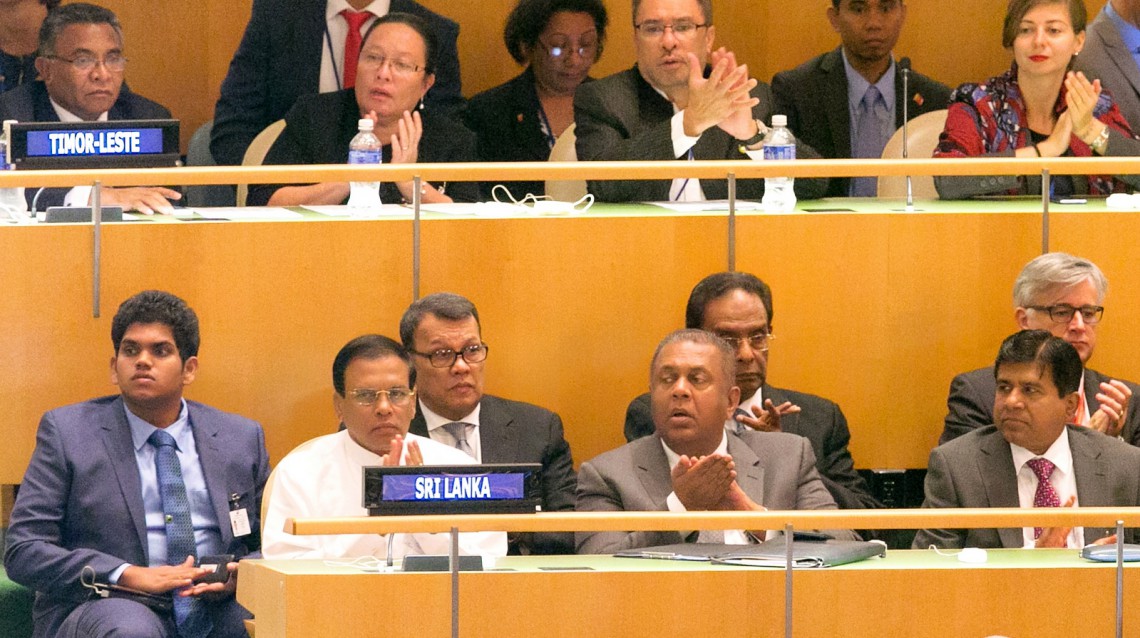
President Maithripala Sirisena’s son was part of the Sri Lankan delegation to the United Nations, and he was front and centre when his father met the Prime Minister of India Narendra Modi in the sidelines of the General Assembly.

He (Daham Sirisena) can write the most hilarious drivel about his UN visit for all we care. He’s not accountable to the public and neither is he a public figure as he claims to be

There were no ifs and buts about it. The son, who is no diplomat or politician, had no business being part of the official Sri Lankan delegation at either the UN or the summit meeting with Modi. If be there he must, he should have been in the public gallery and have had no part in the UN proceedings.

This fact was instantly recognized in social media, and many including some previous Sirisena and Wickremesinghe apologists voiced their unequivocal displeasure.

The young man however for his own part seems to be rather taken aback by the unanimous criticism, and has chosen to write to his ‘friends’ on Facebook explaining the situation.

The Asipatha CutsHe said there was no ‘nepotism’ involved as he was merely standing in his mother.
The atrocious English in that post could be excused, and so could the substance. This young man must know that his mother too would not have played any part as a member of the Sri Lankan delegation. If she was there, she would have been accommodated in a public gallery as well. Perhaps she would have had special accommodation as a Head of State’s spouse, but she would not have had any part to play in that delegation, and if she did, she would have rightly met with the same measure of harsh criticism.

But this columnist is not going to be so churlish as to fault somebody who is probably barely out of his teens and owning a Facebook page, for attempting to justify the absurd. He can write the most hilarious drivel about his UN visit for all we care. He’s not accountable to the public and neither is he a public figure as he claims to be.

The problem with his being in the UN delegation for Sri Lanka is obvious. The Government of Sri Lanka allowed it. The Foreign Policy Establishment allowed it.

The President had no objections. That is putting it rather hilariously. There is no way the young fellow would have been there without an invitation from his father.

The young man could say     anything he wants on his Facebook page. What matters is the attitude of the powers that be, and in particular the Head of State, who was responsible for an act of inexcusable nepotism and boorishness.

That Obama who raised a glass to the president of this country saw nothing objectionable in this conduct is very much in character. For Obama’s understudy Sirisena, in his latest satrapy, this exhibition of nonchalant dictatorship was good enough, and was probably a good sign too. It signaled that the Sri Lankan leadership; now under U.S. tutelage, was free to do absolutely anything, and be admired in the West for it.

This is the publication Counter Punch saying it straight: Obama declared Washington’s purpose to be one of preventing bigger countries from imposing their will on smaller ones.” Imposing its will is what Washington has been doing throughout its history, especially under Obama’s regime.

When Assad drops bombs it oppresses people, but when Washington drops bombs, it liberates them. Obama justified Washington’s violence as liberation from dictators,” such as Assad in Syria, who garnered 80% of the vote in the last election, a vote of confidence that Obama never received and never will, writes the former Assistant Secretary of the U.S. Treasury, Paul Craig Roberts, in the publication Counter Punch.

In Sri Lanka, democracy is being held in a state of suspension under the jackboot of a U.S. satrapy administration. Nobody cares, certainly not in the United States. As Paul Craig Roberts writes, the impunity enjoyed by the U.S. is near absolute, and this impunity rubs off on the satrapy dictatorships, of which Sri Lanka is a front ranking one now.

The shenanigans go on. Smuggling candidates who lost the election through a National List, making a Presidential son holding no elected or public office a part of a UN delegation, disenfranchising 47 million people entirely by forming a so-called National Government for which there was absolutely no mandate, rigging elections by forceful takeover of party machinery when election laws are in force – this dictatorship is absolute and unadulterated. It is similar to many US backedsham regimes in many parts of the world: shameless, hypocritical, and doing nothing more than extending the Imperial writ, as decided in Washington.

None of these politicians, journalists, civil society shamans and other so-called public figures popping up this regime of imposters, are honorable. They are all acquiescing in, if not actively aiding and abetting this recolonization of the country by an imperial power. All of these people who back the regime run from Washington are scoundrels, but you will see a great many of them being feted and celebrated just as Obama is celebrated when he bombs foreign lands and says he does it for their ‘liberation.’

Here’s more from that article by Paul Craig Roberts:
The UN has done nothing to stop Washington’s invasions and bombings, illegal under international law, of seven countries, or Obama’s overthrow by coup of democratic governments in Honduras and Ukraine, with more in the works. End quote.

White is black indeed, and vice versa in this topsy turvy world.

The sickening charade goes on, and is no more grating when it is now at home, with a propped up, illegal regime of buffoons in Colombo.

But take heart. The arc of the moral universe is long, and it bends towards justice!
This flagrant show of moral degeneration would be over, though it could be later, rather than sooner.

‘I should not have taken my father to the UN’

October 3rd, 2015

Courtesy The Nation

Daham Sirisena, son of Sri Lanka’s President Maithripala Sirisena, today admitted that he should not have taken his father on his recent trip to the UN General Assembly after significant public backlash caused a media uproar.

In a Facebook update posted few days ago, Daham said, ‘I was officially invited to the UN as part of the Sri Lanka delegation to participate in youth session (a.k.a. lets have chat and then go get plastered on UN expenses). Unfortunately my mother could not attend and my father decided to take up her invite. The freeloader. Of course it was a mistake to agree to this decision as was evidenced by his lack of decorum during the trip – not only did he fail to properly tuck in his shirt, he also decided to stand right in front of me at the UN General Assembly and make a speech. I was appalled by his behavior and disappointed that my nepotism resulted in my father taking all the headlines despite my efforts to get them for myself.’

‘Despite having no official status in the delegation, I had to meet Modi and the President of Switzerland and watch them talk to my father instead of me. I even had to take Mangala along. This is the last time I travel with my father’ he added
Asked for a comment former first son Namal said ‘My father was ahead of the times. No one can match his nepotism and the voters failed to appreciate that’.
source: www.newscurry.co

Daham Sirisena, the entertainer

October 3rd, 2015

Courtesy The Nation

I’ve had a fantastic time reading all that’s being written about Daham Sirisena. The Big D, as I now think of him, is a fantastic creature. I mean, who wouldn’t want a walking, talking, Facebook-ing PR nightmare for a son, am I right?

sirisenaatun

Let’s assume for a moment that Maithripala Sirisena actually reads this (hah! Fat chance). Mr Sirisena, here’s a question for you:

ARE YOU STUPID?

Look at him.

JUST LOOK AT HIM.

This is Daham Sirisena, Public Figure.

His crowning achievements in life? 48,000 likes on Facebook, shaking hands with Narendra Modi, being the Lucky Sperm and sporadically waving a gun in someone’s face. By all the gods, is that what it takes to get into the UN? If so, hold my beer. I got this.

Look, Mr. Sirisena. A whole bunch of us voted you in; a whole bunch of us didn’t. Those who did vote for you voted not because of your heritage or your spectacles or your  (disturbingly) cheery face in press photos, but because we were bloody tired of the Rajapakse clan. You presented a much saner vision of government. You got the job.

But let’s get one thing clear: we voted for you, not for the Sirisena version of the Rajapakse dynasty. This isn’t even the first time. We were perfectly alright with brushing off your daughter’s media tour. (Oh wait, we weren’t, but Maharaja’s media network was perfectly alright with slowly *cough* making those videos disappear from their channels).
But I digress. Your son is not a world leader – not yet. No-one’s voted for him. Maybe he will be, in time, but that’s in the future. Right now, he’s a gormless 22-year old so stupid that he typed in the dictionary definition of nepotism and then argued against it and ended up pleading not to be placed in the same category as Namal Rajapaksa and Co.
Namal must have laughed his rear end off after seeing that. Heck, Tutankhamun’s corpse probably sat up in the darkness and winced. Let me remind you that Namal was an actual, elected Member of Parliament. Even with all the horseplay and the rugger nonsense and the lawyering he still had more legitimacy than Daham Sirisena.

Like it or not, Daham, at best, is a nonentity with a Facebook page. At worst he’s part of a breed of circlejerk activists whose sole purpose in life seems to be self-promotion. Even so, he’s hardly the choice of weapon for the UN: Colombo is host to seasoned,
professional #activists who do this day in and day out. They’ve got skills Daham wouldn’t even dream of – including, but not limited to knowing how to construct a logical argument on Facebook. If you need someone useless in tow, please send one of them the next time.

If you do want to take the guy around, fine; just don’t make him part and parcel of the whole bloody media kit. Don’t take him on the official tour. Don’t have him sit behind the board saying SRI LANKA” in front of the whole world. If that’s what he wants, lock him up in his room and throw away the key.  Plenty of world leaders have children. They manage them just fine.

It’s about time, Mr. Sirisena, that you put the brakes on this farce. It didn’t work out for your predecessor: it’s not going to work out for you.
source: icaruswept.com

Geneva going and USA hammering

October 3rd, 2015

By A Patabendige  Courtesy The Nation

I am sick and tired of war. Its glory is all moonshine…. War is hell’ (Gen William T Sherman the US General who made ‘Georgia howl’ and burned Atlanta in the Civil war)
The USA made sure that Sri Lanka dug its own grave in Geneva in 2015. Looks like the GTF, the Policy Alteration boys, and the International Community (read white eyes only”) had been working overtime on wording the joint submission by USA and good old SL.
The so called HR abuses read like a US Army Regimental war diary from its many wars in so many countries (Korea, Vietnam, Iraq, Afghanistan, and a hundred others).

The term ‘human shield’ which is how the LTTE kept the Sri Lanka army at bay for a time, are conspicuously absent from HRC Zeid’s final statement. This is weird. Only a few weeks ago a US DOD rules of war circular made it clear that if hostages are used as human shields by one party to a conflict, those engaged in taking down that party will not be held responsible for  death or  injury caused to the hostages.


Of course Sri Lanka knows that the terrorists waged their war against destitute Sinhala villagers in the ‘border’ villages and the Armed Forces | (File photo)

Zeid knows that the USA floats Jordon with hundreds of millions in dollars as aid.
The knockout blow was to write off the Sri Lanka judiciary and the best of the Army, leaving Sri Lanka defenseless.  Will Sri Lanka be under UN/US law while justice systems, judges, and lawyers helped by local collaborators? Will ‘white eyed’ troops replace Sri Lanka soldiers in the North? Will they invade Sri Lanka like they did in Iraq, Afghanistan, and Granada in recent memory?

After the harrowing 26-year-old conflict ended in the defeat of the terrorists, Sri Lanka was bullied at Geneva by the West for 4 years. Did they know what it was to live in Sri Lanka then? Diaspora funds propelled them, after all.

This time Sri Lanka’s tormentor is dressed as its savior, in made in Sri Lanka garments. The Foreign minister has asked the UN to give more slots to Sri Lanka’s armed forces on UN Peace-keeping missions. The President has offered infantry, Special Forces, transport companies etc.

Is this craven appeasement all over again? After all, the entire Madawachchi, Grandpass, Thoppigala mockingbirds are convening again.

Their leader once recalled that no one in 500 years had marched successfully through the Wanni. Was it any wonder that the ‘international’ community to whom prayers were offered on a 24/7 basis for years and whose praise for ‘democracy’ amusing, believed that the terrorists could not be defeated? When the unbelievable happened in 2009, these geography and history masters went into a spin.

Sri Lanka will not forget.

For some reason the delegation to Geneva forgot to mention the Paranagama report, contributed to by eminent people in Sri Lanka and foreigners like Sri Lanka-born Trinitian, Sir Desmond de Silva QC, Sir Geoffrey Nice, Prof David Oran, and former SAS Commander Maj Gen John Holmes, and their findings. Had they submitted it, the great HR merchandisers of IC and Jordon would have been stalled. Hybrid would have turned out to be Hermaphrodite.

The Foreign Minister, in yet another new suit, believed that the draft on Sri Lanka by the head of OHCHR at Geneva was not such a ‘hot potato’. However, distinguished diplomats and former diplomats said it was a ‘pol-mess’. The FM was beginning to boil in his own stew. Would he also have to fry in his own grease? The Sri Lanka diplomat has now apparently been told to direct all answers to questions in Geneva to the Ministry thereafter.

Meanwhile, the president couldn’t quite make up his mind on Geneva. He thought the new draft which he hailed was either 100 or 1,000 times better than the previous resolution. He did not bother to explain how this came about. One wonders what response a Military commander would get if he had told the then acting Defence Minister, identified by Channel 4, that he wasn’t sure whether the casualties in a battle were 100, 1,000, 4,000, 40,000 (Gordon Weiss), or even 100,000 (Frances Harrison).

Now what will be the quid pro quo this time? Will Sri Lanka have to allow rendition flights again since the old firm that allowed it in the early 2000s are back in the saddle?  Or will Sri Lanka have to join the US/EU fight against ISIS or even al Qaeda disguised as UN Peace Keepers?

The Diaspora is giving high-fives and turning somersaults in glee. This is not only because the PM has ‘educated’ Sri Lanka that Diaspora does not mean Tamils always, but because they also see that their master-plan is being polished and calibrated by Sri Lanka itself. After all the Diaspora is not all Tamil”, as our PM said.     Of course, Sri Lanka knows that the terrorists waged their war against destitute Sinhala villagers in the ‘border’ villages and the Armed Forces. As peace prevails, those who procrastinated on ending the war can now boldly malign the LTTE. They, in the same breath while welcoming the ‘resolution’ that intends to purge the Forces, vouch that they will defend those same Forces.

The TNA, which then supported the LTTE unreservedly, now supports the government. It is adept at playing a double game if it is also inscrutable. They acted as a political mouthpiece for the LTTE. Were they not collaborators? They too have now turned about remarkably and added the LTTE to the evil doers list. Ranawaka has kept them in his sight.

Meanwhile, as all this went on, in Sri Lanka a spate of killings was highlighted in the media. This was in addition to spiraling numbers of RTA deaths and suicides. Mass hysteria developed island-wide. Calls went out for vigilante justice in Yahapalana. Ministers and even some priests joined in.

The president also, never to be left out, jumped in. He said he would bring back the death penalty next year (2016). It had been suspended for very good reasons for many decades in this 60-70% Buddhist land. Was this Yahapalanaya too?

At Geneva however the Foreign Minister had by then already assured the Council that the death penalty would be removed in the same year (2016).  Sri Lanka had signed the Universal Declaration of Human Rights to respect ‘Right to Life’. Going counter to it now appears to be an ill advised and crude exercise in cheap popularity.

Many concerned folks voiced their objections to the Presidential outburst on a Friday. The pre August Justice Minister broadcasted similar views immediately after visiting the  heads of the Buddhist clergy. He may hereafter be best known in judicial circles for this extraordinary contribution, in the 21st century, to Sri Lankas system of justice.

The PM says that Geneva is ’more concerned with SL’s judiciary than with the military’. So it was when Supreme Court judges were stoned in their houses in the Dharmista government about 30 years ago in which the PM was then a minister. Did he not notice that?

If anyone would say that the Sri Lankan government is confused, confounded and mesmerized and running in circles, not many would disagree.

The Minister (for what is listed as Mega Police” on the president’s website up to 27 September 2015  but is known as Megapolis too) queries about having external judges, prosecutors, and lawyers for a UN mandated inquiry into the conflict. He wants those who supported the terrorists to be taken to task. If so what about those who gave orders to the Armed Forces from 1983 up to 2015?  Are the combatant troops to be hauled up?
Reconciliation may be a never-ending trial as the USA/UN wants the Sri Lanka forces in the dock. Geneva appears to want courts dishing out sentences as in 1915. But the leadership of the defeated LTTE is apparently not going to have to answer anything. It is said that all their leaders are dead. Are they? Who has the credibility in Sri Lanka to vouch for the deaths of the LTTE leaders? Is anybody in the IC or in India hiding them?
No mention, by the way, is made as to who was responsible for beginning the conflict that consumed 100,000 lives. Was it the terrorists or the Sri Lankan government or even as is often alleged, an outside power?

Should this war be considered ‘a bastard, born of an illicit love affair, without a father to acknowledge it’? (John Keegan).
Who then should be in the dock?

How the SLFP was reduced to a kavandaya

October 3rd, 2015

By Gunadasa Amarasekera Courtesy The Nation

If nations have their origins in civilizations, derive their nationhood from a civilizational premise, the only ethnic group  that is entitled to claim the term ‘nation’, is the Sinhala ethnic group responsible for the creation of a civilization-the Sinhala Buddhist civilization. No other ethnic group can make that claim, though they have contributed to its evolution at different periods. It is time we admit this fact without resorting to hiding behind the vacuous bogus hypocritical notion of a ‘Sri Lankan nation’.

That hypocritical stance is not going to take us to reconciliation or anywhere else.  It could only provide a façade for politicians to hide their ulterior motives.

The SLFP came into being to represent the Sinhala Buddhist Civilization of this country. Though the UNP still gets the support of a substantial section of the Sinhala Buddhists it cannot claim similar representation.  It has forfeited its right for such a claim with its pro-Western, capitalist anti-Buddhist stance right from the inception of its Ceylon National Congress avatar.


Political analysts have loudly echoed that the SLFP has become a kavandaya or headless body | (file photo)

If the SLFP is facing dissolution, it is justifiable to assume that the civilization it represented as well as the Sinhala nation is facing the same predicament. That is why it should be of utmost concern to all of us.

It is now almost an established fact that the victory of the yahapalana regime was a result of a conspiracy by America and the Western imperialists with some contribution from India.  Unfortunately while the rest of the world is fully aware of it, it is the people of this country who seem to know the least about it. It is the arrogance, lack of awareness and the foolhardiness of the Rajapaksa regime that are responsible for this situation.
In an essay written in 1987 I insisted that this terrorism had nothing to do with a so called ethnic problem, but was the outcome of a conspiracy by foreign powers to destabilize this country. The NGO gang labeled me as the originator of this ‘theory of a conspiracy’.  Hence a recent exposition by one who has very little sympathy with my views, who also cannot be labeled as a Sinhala chauvinist may be useful here.

Prof. TissaVitharana came out with a graphic description regarding this conspiracy in The Sunday Island (August 30, 2015):

‘Ashok Metha, retired Indian Army General and now a noted defense and political analyst writing in ‘The Hindu’ soon after the Presidential election let the cat out of the bag. He clearly says that the result was the culmination of a conspiracy that began 18 months earlier in London (implying that not only Britain, but that America too was involved), and passed through Delhi (implying India’s involvement) and was implemented in Sri Lanka, with the leadership being provided by Ranil Wickremesinghe, Chandrika Kumaratunga, Mangala Samaraweera, Rev. Maduluwawe Sobhitha, Jayampathi Wickramaratne and Kumar David.’

Mehta states that Maithripala Sirisena was brought in during the last two months. However the groundwork for the latter was prepared months earlier when he was invited and felicitated in the USA and given a special award for his ‘great contribution to the upliftment of health service in Sri Lanka’.

The main objectives of this conspiracy were to oust Mahinda Rajapaksa and thereafter destroy the SLFP which was the rallying point of the nationalist forces. Both these have been achieved now.

Nearly thirty years ago, when I delivered the Bandaranaike Memorial Oration, I made the observation that the SLFP had become a kavandaya (headless body).  Instead of cultivating a head, the party attempted to graft a Marxist horse head and a liberal donkey heads to it. Today the party leadership has forsaken and betrayed that vast body and sunk to the lowest depths of moral degradation.  Its leadership thrives on deceit and lies. The behavior of the present leader, how he left the party to become the leader of another party, sought the backing of the UNP and the minorities, took over the leadership of the SLFP and after that somersault, violated the Constitution several times, is not in keeping with that of a national leader, but that of a tinpot dictator subsumed by inordinate ambition coupled with moral idiocy.

The moral degradation that sets in prior to decomposition has already begun to seep into that vast body the constituency. This explains the apathy, the indifference of the SLFP voter at the last general elections.

We need to ask whether this is a recent development within the ranks of the SLFP leadership, its power struggles and rivalries, or were the seeds of this dissolution there right from the inception?

A highly perceptive observation was made by a Thai intellectual associated with the Buddhist Socialist movement in that country.  He concluded that there were three countries that had the potential to go back to their civilization foundations prior to foreign rule, and formulate a governance model suitable to modern times based on that foundation: Burma, Cambodia and Ceylon. According to him U Nu of Burma was successful in evolving such a model and was able to rule for ten years till he was overthrown in a military coup.  Prince Shihanouk of Cambodia did not get a chance. When the Sinhala Buddhists of Ceylon voted Bandaranaike into power in 1956 this was what was expected of him.  Bandaranaike with his head full of Western liberal ideas could not comprehend this.

The only leader I believe who realized this potential was Anagarika Dharmapala. Going through his writings, especially the English, one can see how he was able to point out the broad outlines of such a modern day civilizational state. Not being a politician, he was not interested in spelling it out in political terms. The rest of the leaders we have had have been either Marxists or liberals and incapable of going beyond their imitative thinking. The irony is that we are still burdened with them.

If the earlier generation which was morally and intellectually more competent and more acceptable to that body could not do it, how can the current bunch of opportunists and degenerates provide a head to the kavandaya? A good number of them were rejected by that body at the last elections (how many of those MPs who have not joined the Jathikaa anduwa will remain so is anybody’s guess).

However unpalatable it may be, one will have to accept that the SLFP has outlived its historic mission. It has even forfeited the right for a decent burial.

Bye Obama, hello Putin

October 3rd, 2015

Editorial – Courtesy The Nation

What does it take to defeat terrorism? Well, the answer will vary depending on who is being asked the question. Here in Sri Lanka, for years, no decades, the dominant cry was ‘address and eliminate the conditions which cause people to take up arms’. In other words, it’s like cleaning up breeding grounds to deal with the Dengue mosquito.

If those, who consider methodologies such as suicide bombers, human shields and of late summary execution that is videotaped and posted in social media, are capable to listening to reason, then the Mossie Plan, if you will, might work. The point is that there are two kinds of political agents broadly speaking, the corrigible and the incorrigible. Terrorists fall into the latter kind. They are called ‘rebels’ or ‘revolutionaries’ only by people living in places relatively untouched by these angels or else are directly or indirectly supportive of them.

In Sri Lanka’s encounter with terrorism, we saw many who advocated the Mossie Plan. They believed, moreover, that the LTTE was a product of policies gone wrong. They even said ‘grievances are legitimate’ and argued that if they are addressed the need for anyone to see armed struggle as a ‘necessity’ to achieve ends would disappear. The ‘grievances’, at best, are contestable. Aspirations, the other ‘reason’ that was tossed around during this time, are themselves ‘incorrigible’ because they can encompass anything and everything. No state, however resourceful, can deliver everyone’s aspirations.

The tragedy and indeed irony of terrorism is that they inevitably postpone the addressing of the very grievances whose alleviation they claim to be fighting for. Terrorists know one language. So when the question is asked ‘What does it take to defeat terrorism?’ the answer has to be sought in the one language which makes communication possible. The Mossie Plan advocates will cry foul and will, after the fact of elimination, try to punish the victors. This is simply because their outcome preferences did not materialize and because they are not the angels they would like others to think they are. That’s the Sri Lankan story in a nutshell.

There was a time when the LTTE was the most ruthless terrorist outfit in the world. Even if the LTTE was still around, today it would be second best to the ISIS. So how should the world deal with the ISIS? The Mossie Plan will not work, that much is clear.

The United States has demonstrated over several years that it has no clue when it comes to dealing with terrorism. Vladimir Putin didn’t mince his words when he told the US that it has to stop dithering and fight. Uncle Sam’s fixation with securing access to resources and the need to generate growth for the arms industry has raised serious questions over its commitment to its loudly articulated policy ‘Zero tolerance of terrorism’. Indeed Washington has shown it is part of the problem. It’s version of the Mossie Plan is actually a perversion since it deliberately spawns the killers. Al Qaeda is Washington’s baby and so is the ISIS.

This is where Vladimir Putin steps in. There’s a time to deal with spawning ground and there’s a time to deal with the spawn. This is the time for the latter for the simple reason of incorrigibility. Sri Lanka wasted close to three decades trying to undercut ‘reasons for terrorism’ simply because a) there were no such ‘reasons’ and b) utter lack of political will. Putin doesn’t appear to be anything like the suckers who ruled Sri Lanka before Mahinda Rajapaksa. And that’s a good thing.

If we left it to the USA, we would have more Iraqs, more Afghanistans and more Syrias and who knows other outfits like the ISIS to deal with.

Finally, there’s no-nonsense resolve from a world leader. If China emerged as the leading economy in the world, then Russia has taken over the task of determining political direction. That should tell our leaders whose friendship, however worrisome it may be, counts. That’s a different matter of course. For now, there’s Putin. And that’s a good thing. Relatively speaking.

Pakistan warns on critics of Sri Lanka

October 3rd, 2015

By Deepal Warnakulasuriya -Courtesy The Nation

Pakistan making a special statement says that those who have been critical of Sri Lanka’s effort to overcome terrorism and separatism funded from abroad would do well to look at their own track record on the so-called war on terror.

Permanent Representative of Pakistan Zameer Akram made these observations in a statement to the media on Friday commenting on the Report of the Office of the United Nations High Commissioner for the Human Rights on Sri Lanka

The statement said Pakistan has always supported Sri Lanka in its efforts to overcome terrorist and separatist elements over the last 30 years. We believe that after the end of struggle against terrorism, the people of Sri Lanka deserve the support and assistance of international community to rebuild their country. Despite the challenges of last three decades, Sri Lanka has remained a free and democratic society.”

Permanent Representative of Pakistan Akram also said that the High Commissioner should also demonstrate the same alacrity that he has demonstrated regarding Sri Lanka to other cases of torture and violence in their course of countering terrorism by several major powers.

He also reminded Within the Human Rights Council, Pakistan has always maintained that if needed recourse is to be made to a country-specific resolution to address the human rights situation, the only choice is to pursue a resolution acceptable by the country concerned. We welcome the fact that after several years this approach has been accepted by the sponsors of the resolution on Sri Lanka.”

As a sovereign and proud nation, Sri Lanka has the right to chart its own course in pursuing its domestic agenda. As a long-standing and reliable friend of Sri Lanka, Pakistan will continue to extend its unconditional support.

Sri Lanka submits to US diktat – UN RESOLUTION

October 3rd, 2015

Courtesy The Nation

The Sri Lankan Government co-sponsored the US led resolution at the United Nations Human Rights Council (UNHRC) without contesting the draft resolution, despite a pledge made by Prime Minister Ranil Wickremsinghe to media heads last week that Sri Lanka would seek amendments to the preamble.

Prime Minister Ranil Wickremesinghe, speaking with heads of media institutions and editors last Sunday (September 27), stated that the Government is in agreement with the operational paragraphs of the draft resolution, but was discussing amendments to the preamble.

However, in response to a query made by The Nation, Sri Lanka’s Permanent Representative in Geneva, Ravinatha Aryasinha said ‘no changes’ had been made to the draft after September 24 as no changes had been sought. Aryasinha added this was the draft that was passed by consensus last Thursday (October 1).  Critics of the Resolution have argued that it compromises Sri Lanka’s sovereignty and facilitates unnecessary interference in the country’s judicial affairs.

UNHRC Resolution A/HRC/30/L.29 entitled ‘Promoting reconciliation, Accountability and Human Rights in Sri Lanka,’ was presented by a ‘Core Group’ of sponsors led by the United States. The other countries in the group included the former Yugoslav Republic of Macedonia, Montenegro and the United Kingdom.

UNHRC chief Zeid Al Hussein

October 3rd, 2015

By A Special Correspondent Courtesy Island

article_image

• Zeid Al Hussein in broadside against Sri Lanka
• Ravinatha registers timid and cowed response
• Pakistan, Russia say what SL should have said
• Maxwell Paranagama Commission specifically targeted
• Former Khemer Rouge war crimes prosecutor coming to SL

The report on Sri Lanka by the Office of the High Commissioner on Human Rights (OHCHR) was taken up for discussion by the UN Human Rights Council on Wednesday the 30th September. In introducing the OHCHR report on Sri Lanka to the Council, the Human Rights Commissioner Zeid Al Hussein was unrelenting in his criticism of Sri Lanka. Even though he did say that this report on SL was being released in circumstances very different to that in which it was mandated, he engaged in an overall condemnation of Sri Lanka which applies to the present government almost in the same measure as to the previous one. The overall tenor of his speech was interventionist. No respect was shown for the new government.

Hussein said that there are reasonable grounds to believe that the Sri Lankan security forces and armed paramilitary forces associated with them were implicated in widespread and wilful killings of civilians and other protected persons and that Tamil politicians, humanitarian workers and journalists were particularly targeted. He also stated that identified LTTE cadres and unidentified individuals may have been killed extra judicially around 18th of May 2009 after surrendering to the Sri Lankan military and made reference to ‘long standing patterns’ of arbitrary arrest and detention by government security forces and abductions by paramilitary organisations in unmarked white vans. He also referred to ‘widespread’ torture by the Sri Lankan security forces of LTTE members and civilians detained en masse in the immediate aftermath of the conflict and said that there were reports of the widespread use of rape and other forms of sexual violence by security forces against both male and female detainees. The Human Rights Commissioner also said that there were reasonable grounds to believe that repeated shelling by the government forces on hospitals and humanitarian facilities in the densely populated no fire zones which the government itself had announced. (However in this instance, Hussein was charitable enough to acknowledge that “The presence of LTTE cadres directly participating in hostilities and operating within the predominantly civilian population, launching attacks in close proximity to these locations and the LTTE policy of forcing civilians to remain within the area of hostilities may also have violated international humanitarian law.”) Hussein also said that the OHCHR investigation had also found that the government had placed considerable restrictions on humanitarian access and may have deliberately blocked the delivery of sufficient food and medical supplies essential to the survival of the civilian population and that this may amount to the use of starvation of civilians as a method of warfare.

Referring to the manner in which screening processes were carried out at the end of the war to separate civilians from LTTE combatants, Hussein said that almost 300,000 IDPs were deprived of their liberty in camps far beyond what is permissible under international law and that there are also reasonable grounds to believe that the IDPs were treated as suspects and detained because of their Tamil ethnicity which may amount to discrimination and to the crime against humanity of persecution.

To this our Ambassador in Geneva Ravinatha Ariyasinghe basically gave a timid and capitulationist response referring to an ‘epoch making event in January this year when people voted decisively for change’ and that the culture of impunity where the rights of the individual had been violated for almost a decade had ended. He further stated that the new government was committed to the freedom of expression, the rule of law, good governance and the protection and promotion of all human rights. He said that the government of Sri Lanka will “take note of the OHCHR report and will ensure that its contents and recommendations receive due attention.”

However the changed situation in Sri Lanka does not seem to have impressed Al Hussein to the extent that the government would have wished. In referring to the present situation in the country, Hussein described the total failure of domestic mechanisms to conduct credible investigations. He further insisted that the Maxwell Parananagema Commission (on enforced disappearances) should be disbanded and its cases transferred to a credible investigating body established in consultation with the families of the disappeared.

(The reason why Zeid Al Hussein singled out the Maxwell Paranagama Commission for condemnation is quite clear. Some of the world’s foremost experts on the international law of armed conflict including the Sir Desmond de Silva QC, Sir Geoffrey Nice QC, David Crane, Paul Newton and Rodney Dixon provided legal opinions to this commission on the law of armed conflict and Desmond de Silva had further provided to the Paranagama Commission a comprehensive analysis of the law of armed conflict in relation to the allegations against Sri Lanka. These legal opinions by experts who have long years of experience within international war crimes courts basically takes the bottom out of the case that the OHCHR was trying to make against Sri Lanka. That is obviously why Hussein wants the Maxwell Paranagama Commission out of the way completely.)

Be that as it may, Al Hussein was also reluctant to admit that any significant ‘improvement’ had taken place in the situation in Sri Lanka. He charged that intimidation and harassment by the military and intelligence services is still going on in the North and East and that this “This demonstrates the pervasiveness of the structures and institutional culture that created the repressive environment of the past and highlights the importance of much more fundamental security sector reforms.” This is the purge of the armed forces that the OHCHR report and the American sponsored resolution continue to demand from the Sri Lankan government.

To bolster his contention that Sri Lanka is unable to look after its own affairs Hussein further said that reports have continued to suggest the existence of secret and unacknowledged places of detention’ which require urgent investigation and that from January to August, 19 people were arrested under the PTA, and 12 of them continue to be in detention and 14 cases of torture have been reported by credible sources since January 2015. Hussein stresses that “In our previous reports to the Human Rights Council we had described the total failure of domestic mechanisms to conduct credible investigations into past events and provide redress to victims. He further stated that the state security system and justice system have been distorted and corrupted by decades of impunity. The independence and integrity if key institutions such as the attorney general’s office and the human rights commission remain compromised which is why he recommends the establishment of a hybrid special court integrating international judges, prosecutors, lawyers and investigators mandated to try war crimes and crimes against humanity.

The only challenge to what Zeid Al Hussen was saying did not come from Sri Lanka but from two steadfast friends of Sri Lanka in the UNHRC, Pakistan and Russia. They were not in a position to oppose the report as Sri Lanka herself had all but accepted it. Given Al Hussein’s aggressive pitch for intervention, Russia stressed that Sri Lanka should itself without influence from outside define what help it needs and on what issues. Colombo itself should decide what advise it would follow in national reconciliation and investigating past crimes and the process should take place exclusively by the Sri Lankans themselves. (One would think that it should be Ravinatha Ariyasinghe who should have said that and not the Russian Ambassador.) The Pakistani Ambassador said that those who have been critical of Sri Lanka’s efforts to overcome separatism and terrorism would do well to look at their own track record in the so called war on terror. The High Commissioner on Human Rights should demonstrate the same alacrity that he has demonstrated regarding Sri Lanka to other cases of violence and torture in the cause of countering terrorism by several major powers. The Japanese Ambassador said that Japan will be sending Moto Noguchi a former international judge of the Extraordinary Chamber in the Courts of Cambodia to Sri Lanka next month. However the government of Sri Lanka has not said that they have sought Japanese help to set up a hybrid war crimes court. Furthermore Ambassador Ariyasinghe made no mention of any special Japanese help either.

So, it looks as if Sri Lanka were being frog marched to establishing a war crimes court by her ‘international partners’. Truly this is the lowest point we have reached as a sovereign nation!

Afghan hospital attack in Kunduz possibly criminal – UN

October 3rd, 2015

Courtesy BBC

Air strikes on a hospital in the Afghan city of Kunduz that killed 19 people were “tragic, inexcusable and possibly even criminal”, the UN human rights chief says.

High Commissioner Zeid Ra’ad Al Hussein urged a full and transparent investigation into the attack.

Medical charity Medecins Sans Frontieres said at least 12 of its staff and seven patients were killed.

US forces were carrying out air strikes at the time.

At least 37 people were seriously injured, 19 of them MSF staff.

“All indications currently point to the bombing being carried out by international Coalition forces,” MSF said.

The Nato alliance has admitted its forces may have hit the hospital.

Media captionFootage from the scene showed the still smoking remains of the clinic

MSF hospital in Kunduz, 3 Oct 15Image copyrightAP
Image captionFire swept through the hospital after the air strikes
MSF hospital in Kunduz, 3 Oct 15Image copyrightAP
Image captionThe scale of the destruction was clear at first light

High Commissioner Zeid said: “International and Afghan military planners have an obligation to respect and protect civilians at all times, and medical facilities and personnel are the object of a special protection.

“These obligations apply no matter whose air force is involved, and irrespective of the location.”


Read more on the battle for Kunduz:


MSF said that all parties to the conflict, including Kabul and Washington, had been told the precise GPS co-ordinates of the hospital on many occasions, including on 29 September.

In a statement, the charity said all indications pointed to the bombing being carried out by international coalition forces.

It reported that from 02:08 until 03:15 local time, the hospital was hit by a series of aerial bombing raids at approximately 15-minute intervals.

Media captionDr Bart Janssens, MSF: Hospital “extremely badly damaged”

The main central hospital building – housing the intensive care unit, emergency rooms, and physiotherapy ward – was repeatedly hit during each aerial raid while surrounding buildings were left mostly untouched, it added.

“The bombs hit and then we heard the plane circle round,” said Heman Nagarathnam, MSF head of programmes in northern Afghanistan.

“There was a pause, and then more bombs hit. This happened again and again. When I made it out from the office, the main hospital building was engulfed in flames. Those people that could had moved quickly to the building’s two bunkers to seek safety.”

MSF staff in shock in one of the remaining parts of MSF hospital in KunduzImage copyrightMSF
Image captionThese MSF staff appear to be in shock following the attack (MSF photo)

MSF president Meinie Nicolai described the incident as “abhorrent and a grave violation of international humanitarian law”.

She added: “We demand total transparency from coalition forces. We cannot accept that this horrific loss of life will simply be dismissed as ‘collateral damage’.”

A spokesman for US forces in Afghanistan, Col Brian Tribus, said: “US forces conducted an air strike in Kunduz city at 02:15 (local time)… against individuals threatening the force.

Surgery activities underway in the aftermath of the bombing of hospital (3 October 2015)Image copyrightMSF
Image captionMSF says surgery took place in the undamaged parts of the hospital following the attack

“The strike may have resulted in collateral damage to a nearby medical facility.”

In a statement, US Defence Secretary Ash Carter said: “While we are still trying to determine exactly what happened, I want to extend my thoughts and prayers to everyone affected.

“A full investigation into the tragic incident is under way in co-ordination with the Afghan government.”

Gen John Campbell, the commander of US forces in Afghanistan, later confirmed the air strike was “in the vicinity” of the MSF facility but was targeting “insurgents who were directly firing upon US service members”.

Afghan President Ashraf Ghani said the US-led Nato force had offered condolences over the incident.

Taliban denial

The Afghan interior ministry said a group of 10 to 15 militants were hiding in the hospital.

“They are killed, all of the terrorists were killed, but we also lost doctors,” ministry spokesman Sediq Sediqi said.

The Taliban denied that any of its fighters were there.

A Taliban statement described the air strikes which hit the hospital as “deliberate”, and carried out by “the barbaric American forces”.

MSF says that staff and patients critically injured in the attack on the hospital have been transferred to a hospital in Pul-e Khumri, two hours’ drive away.

There has been intense fighting in Kunduz since Taliban fighters swept into the northern city on Monday.


12 MSF staff, 7 patients killed in Kunduz attack, US admits airstrike ‘in vicinity’ of hospital

October 3rd, 2015

Courtesy RT

A hospital in the Afghan city of Kunduz was hit in an overnight aerial attack that killed at least 19 people, including nine Medecins Sans Frontieres staff and three children. The US has confirmed that it conducted an airstrike in the vicinity” of the hospital.
http://www.rt.com/news/317482-afghanistan-kunduz-msf-hospital/


Dinesh says Sri Lanka must present its case to war crimes court… expresses strong opposition against external intervention

October 3rd, 2015

by Shamindra Ferdinando Courtesy Island

Mahajana Eksath Peramuna (MEP) leader Dinesh Gunawardena, MP, yesterday, said that the country could bring to the notice of the war crimes court envisaged for Sri Lanka, the circumstances under which the armed forces had brought the LTTE to its knees in May 2009.

Reiterating his strong opposition to external intervention meant to undermine Sri Lanka’s sovereignty, Opposition heavyweight said that the country could make representations to the court. Sri Lanka should be ready to present its case relating to the crushing of the world’s most ruthless terror outfit.

Former UPFA minister asserted that Sri Lanka should fight its case keeping in mind that it was a free country. MP Gunawardena was speaking live on Sirasa yesterday.

MP Gunawardena denied the assertion that those still faithful to former President Mahinda Rajapaksa were against Geneva process.

The MEP leader stressed that the pivotal importance was for all to work together to meet the challenges faced by the country.

Asked whether former President Rajapaksa would give leadership to their efforts in the face of Geneva threat, MP Gunawardena said that they hadn’t so far met Rajapaksa on this particular issue. However, other UPFA constituents and other civil society organizations had reached consensus on a strategy to defend Sri Lanka’s sovereignty.

Referring to President Maithripala Sirisena’s address to the recent UNGA, MP Gunawardena said that he tackled about three important issues. However, the Maithripala Sirisena-Wickremesinghe government’s decision to co-sponsor an amended Geneva resolution that dealt with Sri Lanka was a big mistake. Geneva adopted the resolution titled ‘Promoting reconciliation, accountability and human rights in Sri Lanka’ without a vote on Thursday. MP Gunawardena warned the government of severe consequence due to co-sponsoring of the resolution.

When the interviewer Bandula Jayasekera queried whether they would commit political ‘hara-kiri’ by succumbing to international pressure, MP Gunawardena alleged that the government was obviously of the opinion that nothing could go wrong as long as it retained the required numbers in parliament.  Gunawardena asserted that the country was heading for a major crisis.

The MEP leader said the creation of a ministry for Highways and University Education reflected the new government lopsided thinking. The Finance Ministry had been split in such a way the Finance Minister was deprived of playing his entitled role. Pointing out that some sectors, including the Central Bank had been brought under the Prime Minister; MP Gunawardena described some changes effected by the new administration as a tragedy.

Former Minister Gunawardena appreciated UNP Chairman Malik Samarawickrema receiving Development Strategies and International Trade as a step in the right direction. He described Samarawickrema as an experienced businessman.

Responding to another query, the MP denied accusations that a section of UPFA members, including him exploited former President Rajapaksa’s popularity to gain entry to parliament.

Gunawardena said that Mahinda Rajapaksa was a seasoned politician. The MP insisted that Rajapaksa couldn’t be taken for a ride nor had they deceived him. Even after his defeat, Mahinda Rajapaksa retained popularity among the people, a situation never experienced by any previous leader.

Further commenting on war crimes accusations, MP Gunawardena said that those in the genuine Opposition would act responsibly. The MP said that they would protect the sovereignty and independence regardless of consequences.

Emphasizing that the country could explain accusations directed at the previous government, Gunawardena said that Sri Lanka should be ready to counter false claims. The former Minister said that allegations pertaining to 40,000 killed during the final offensive could be countered by the Paranagama report.

He said the truth was that former President Rajapaksa restored democracy in the country. Acknowledging that conflict always caused damages, MP Gunawardena pointed out that the four-party Tamil National Alliance was freed from the LTTE thanks to the previous government.

Sri Lanka, the land of the ‘Rising Son’

October 3rd, 2015

Dr. Suneth Rajawasan Mt. Lavinia Courtesy Island

Nepotism. One of those many isms that beg definitions. No it’s not a mental condition like autism, but recent events have led me to believe otherwise.

We as a nation voted out a first family earlier this year. The people rose up against family rule, against squandering public wealth for personal gain and against parading ego-displays by powerful children of the elected leaders. It was disgusting as it was excessive, and eventually democracy spoke up against it. Democracy of course, had a very powerful voice during this time: embodied by our very own present President Maithripala Sirisena. Weren’t we all enthralled when he waxed lyrical about the thoroughbred stallions imported from ‘Buckingham stables in the USA’ for the personal use by the Rajapaksa children? I do quite fondly recall the President promising to sincerely end this deplorable practice once and for all.

Daham Sirisena (left) with President Maithripala Sirisena and ministers, Mahinda Samarasinghe, Mangala Samaraweera and D.M. Swaminathan at the UN

Then imagine my unpleasant surprise at seeing one Mr. Daham Sirisena, dressed in all his baby blue finery, a smug smile on his face, sitting beside his father at no higher echelon than the UN General Assembly. Questions rose to my mind faster than the bile that rose to my throat.

1. How did he get there?

Mr. Sirisena Jnr. is, to the best of my knowledge, a plus-one for his father’s entourage. Since his mother didn’t accompany the President, he must be simply filling her place. But then, isn’t there a separate viewing gallery for the family members? I didn’t see the children of any other world leader sitting with the council members.

  1. Who paid for this?

No cable TV, no porn, no minibars, his father instructed. I’m dying to know who exactly sponsored this young lad’s trip to USA. Was it you and I? And the taxes we pay?

  1. What qualifications does he have to represent Sri Lanka at the holiest of international forums?

Mr. Sirisena Jnr, again to the best of my knowledge, is no statesman. Nor is he qualified in any field even remotely connected to diplomacy, leadership, politics or even human resource management for that matter, to be able to bypass so many eligible, young, capable men and women who would have been a valuable asset to our delegation to the UN. I speak of people who could actually open their mouths and contribute something that will positively impact the country. Sadly Mr. SirisenaJnr’s very presence is the polar opposite of that. It just goes to show that we are still very much a banana republic giving free rides on the gravy train.

In response to the furore over social media on this matter, Mr. Sirisena Jnr. has shared a rebuttal on his Facebook page, stating:

“Dear friends, What is nepotism? The real meaning behind it is the abuse of power with influence favoring one’s children, relatives and friends especially by giving them occupations. Open your minds to this definition and take a moment to think whether this is being practiced in Sri Lanka now. Many have been criticizing my visit to the Delegation, saying that it is nepotism and that i am unjustifiably abusing my father’s power. Let me put my friends’ minds at rest, by firstly saying that i was officially invited to the Delegation since my mother couldn’t attend. Secondly by attending the event i got the opportunity to attend the youth-led event of SDG which made me understand the goals which is needed for the country to be more prosperous. How could my attendance be a negative effect to the country? How could my attendance be the downfall of the country? I urge you all not to compare me and my family with the past regimes as we are far different from them. At the event The officials stated that, next time to bring in more youths with more innovative ideas which could in turn enrich our country by seeing my presence. I believe that this is a great opportunity to give positive recognition to our country.”

This statement gives rises to more questions than answers. This brilliant young man has gone on to cut and paste the very definition of Nepotism from the Oxford online dictionary, and then gone on to vehemently justify how and what he did was not so, whilst stating what he did do, which sounds a lot like what he said he didn’t do! It also goes to cement the old adage: “it is wiser to close your mouth and look a fool than open it and remove all doubt.”

To young Daham, I have this to say: you have a long way to go to earn the right to represent this country. You and your sister have of late been involved in some interesting public relations brouhaha which is only further derogatory to your fathers’ vision. So, without making a mockery of yourself and your family any further, might I suggest you first wash down that foot you so heartily swallowed when making the above statement, and then concentrate on working harder towards earning the right to be a true statesman of Sri Lanka and someday maybe be more than your father could ever be. It’s much cooler when he’s referred to as “Daham’s dad” rather than you being referred to as “HE’s son” but alas at your age you will not see the pride in this.

I grieve over how many talented, deserving, articulate, intellectual, intelligent, and frankly more presentable youth were overlooked so that one little boy could tick another number off his bucket list, and take a few selfies in the meantime.

Those who voted for this regime did so with so much hope and such high expectations. Yahapalanaya was meant to be the panacea for the corruption that had swallowed our country and expelled it out the other end.

Instead all I see is history repeating itself. Will we never learn?

Barba non facit philosophum

Dr. Suneth Rajawasan

Mt. Lavinia

UNHRC an “Honorable Victory” says Ranil-Sirisena, the new Mudalyars of the West

October 2nd, 2015

Shenali D Waduge

During colonial occupation as part of divide and rule policy the Portuguese, Dutch and the British were quick to shower titles and select locals who would be their virtual servants, do anything that the colonials demanded and happily go against their own people. These locals were even given titles for their subservient roles. Fast forward to 2015 we seem to return to the past with the manner in which the Sri Lankan delegation are proud to have co-sponsored a resolution giving foreign interference & decision-making right into how Sri Lanka’s land, laws, justice systems, security & military will be changed according to what the West deems fit.

The Resolutions and Investigations passed ignore answering the illegality of using the UNSG’s personally appointed panel report to form the basis of resolutions/investigations by the OHCHR. A lone plaintiff has filed a case to argue this illegality. The UN however has mixed up its immunity to act with impunity and illegally and it is puzzling how Member nations of the UN are ready to watch the UN take over the sovereign rights of nations.

The Draft resolution contained 24 preamble paragraphs and 26 operative paragraphs

The Resolutions have been based on

  • Unsubstantiated accusations & reports that are either sourced from pro-LTTE or hidden from the public using a bogus ‘witness protection’ excuse.
  • Allegations and co-sponsorships by the very countries that had had indirect links to the LTTE over the years
  • Evidence sourced from pro-LTTE fronts that are declared banned under UNSC 1373 resolution.
  • Evidence from pro-LTTE websites and propaganda channels
  • Evidence from pro-LTTE supporters
  • Evidence from parties linked to LTTE
  • Statements from foreign parliamentarians linked to LTTE organizations – Labour Party MP, Siobhain  McDonagh claimed 100,000 had been killed during the last phase. Her colleague Joan Ryan, formerly of the Labour Party parliamentary group, is now policy advisor to UK headquartered Global Tamil Forum (GTF) another banned LTTE front. Just as Miliband took a pro-LTTE stand to garner Tamil votes in his electorate!
  • False evidence exposed: one example Thayaparajah alleged to have been abducted by Sri Lanka military and killed in September 2009 (accusations coming from Robert Blake, University Teachers for Human Rights Jaffna, Australian Government Refugee Review Tribunal, Tamilnet, European Centre for Constitutional & Human Rights and others) but Thayaparajah appeared in person with family in India questioning how many other ‘dead or missing’ may be living in India and other Western nations!!!

The Resolutions ignores

  • Answering the illegalities by the UNSG/UNHRC
  • That 2 international investigations could not provide evidence
  • Unanswered questions about LTTE’s role under legal definitions.
  • LTTE is an internationally banned terrorist organization
  • The fact that it was only after 30 years of suffering loss of lives and property and failure of peace talks, cease fires that the decision to militarily end the LTTE was taken and LTTE was offered several opportunities to lay down arms and surrender which they refused.

What bloc countries voting against Sri Lanka ignore

  • LTTE’s material support came from individuals and organizations living and operating in foreign countries that have banned LTTE
  • These individuals and organizations openly canvass and promote separatism under a camaflaged name ‘self-determination’
  • The root of militancy is in India which first trained unemployed Sri Lankan Tamils in arms and guerilla warfare. India has been covertly destabilizing Sri Lanka. If Charles Taylor languishes in a UK prison for aiding and abetting war crimes in neighboring Sierra Leone, what is the UN stand on India’s role

UN Charter violated : Sri Lanka’s sovereign status violated

  • UNHRC enforcing foreign judges and prosecutors/investigators when the illegality of the UN/UHRC is itself in question and the fact that despite 2 investigations no credible and legally acceptable evidence has been provided by either of the international investigators that were part of both investigations.
  • UNHRC enforcing appointment of a Special Counsel another word for Special Prosecutor
  • UNHRC changing the national laws / national systems and giving themselves the right to do as they please given that the GOSL has co-sponsored the resolution.

Where are those representatives of Sri Lanka’s national interest?

  • Politicians are silent, lawyers & judges have not opposed appointment of foreign judges/prosecutors only a handful of national organizations and patriots are bringing out the dangers and ramifications of the current Resolution to which the Ranil-Sirisena Govt have meekly succumbed

A government that cannot defend the nation and its armed forces simply because its political greed takes precedence and revenge stops them from giving credit to the Rajapakse’s for winning the terror over LTTE cannot be respected by the public or relied upon.

That the current government went to Geneva purposely unprepared and unwilling to defend the military victory by asking fundamental questions that would have stopped the UNHRC from bulldozing their way into creating precedents that would affect other nations is shameful and one that should go down in history. It was nothing other than unwillingness to give credit and defend all those that were party to a very difficult end to 30 years of terror that enabled the UNHRC to wriggle illegalities upon Sri Lanka making use of the mentality of our politicians.

Why has the GOSL simply accepted without a whimper a resolution that is one that is first of a kind, unique and which had never been done previously. Shouldn’t this have made the GOSL and officials wondered whether this exercise was being used as a test and Sri Lanka as a guinea pig case study on how to implement changes to sovereign nations which has not been touched because of the need to respect a country’s sovereign status!

How can the GOSL agree to

  • Co-sponsoring a resolution that allows the intrusion into Sri Lanka’s internal affairs?
  • Agree to co-sponsor a resolution thereby abandoning nations that have stood by Sri Lanka over the years against the biased bloc votes by US / UK & EU nations?
  • How can the GOSL agree to ‘effective security sector reforms’ when it means that outsiders would determine how the security of Sri Lanka takes shape.
  • How can the GOSL agree to demilitarize when it is the right of a sovereign state to position troops in its own country!
  • How can the GOSL even agree to downsize the military
  • How can the GOSL simply accept the suggestion to repeal the Prevention of Terrorism Act, change Penal Codes and command structures of the military?
  • What is the outcome when a Government agrees to make fundamental changes to land laws, distribution of political and administrative powers, change the criminal laws that exist, establish ‘special courts’ as being suggested …. And can we be happy that the current government have agreed to all above and more (which we will only come to know much later) and we are made to feel happy that just because they use the word ‘unitary’ nothing much will get changed. After agreeing to change virtually everything the Sirisena-Ranil duo seem to think that they have done an admirable job and brought honorable victory to the country.
  • Why did the GOSL not use solid arguments that had been prepared by patriots in defense of Sri Lanka as well as the Paranagama Report which would have shown in no uncertain terms the lies that the OHCHR investigations had relied on?
  • Why did the GOSL simply accept the names of the defence forces and not question the list of LTTE as the OHCHR says ‘both parties’ if so where is the guilt list of the LTTE and how about those that had been materially supporting the LTTE. Shouldn’t the GOSL not have insisted on actions against the UNSC 1373 Resolution banned 16 LTTE fronts and 400 individuals banned and called upon actions against them? This was an area that the former government should have used as a leverage by regularly presenting evidence on these organizations to the foreign nations and demanding actions against them through the foreign ministry as well domestically initiating inquiries against TNA/TULF & other Tamil parties & individuals that were linked to LTTE.

It is a tragi-comedy that the Sirisena-Ranil Government chose to say yes to all that the UN/UNHRC/West/India put across the table and accepted all recommendations without batting an eyelid simply because they did not want to defend or protect those that defeated the LTTE and brought peace to a nation that suffered 30 years of LTTE terror. Just to spite the Rajapakse’s and lack of national respect for the armed forces that defeated the LTTE the Sirisena-Ranil Government and officials have committed hara-kiri upon a nation that has been penalized for being the only nation to have defeated internationally banned terrorists.

Shenali D Waduge

ජිනීවා… මරේ… හායි

October 2nd, 2015

ධර්මන් වික‍්‍රමරත්න

රිවිර සිකුරාදා පුවත්පත සදහා ධර්මන් වික්‍රමරත්න ලියන මුරගල තීරු ලිපිය – 123 2015 ඔක්තෝබර් 02 සිකුරාදා(වචන 1,438)   

සහශ්‍ර සංවර්ධන ඉලක්ක ප්‍රගතිය දැක්වෙන එක්සත් ජාතීන්ගේ වාර්තාව පෙරේදා නිකුත්වූ අතර එහි සදහන් වන්නේ දුප්පත්කමේ සීමාවට පහලින් ජීවත්වන ජනතාව අර්ධයකින් අඩු කිරීමේ ඉලක්කය ශ්‍රීලංකාව ගිවිසගත් කාලයට වසර 7කට කලින් සපුරාගත් බවය. මෙය ඉකුත් සන්ධාන ආණ්ඩුව පිළිබදව හොද සහතික‍යකි.

ශ්‍රී ලංකාවේ වර්තමාන ජාතික ආණ්ඩු සංකල්පය ඉදිරියට ගෙන එන්නේ දශක 6ක් පුරා විසම්මුතිවාදී දේශපාලනය වෙනුවට සම්මුතිකවාදී රාජ්‍ය පාලනයක් නිර්මාණය කිරීමට ක්‍රියාකරන බවට හුවා දක්වමිනි. මේ මොහොතේ  එය ගෙනවිත් තිබෙන්නේ ඒ සඳහා නොව එක්සත් ජාතින්ගේ සංවිධානය හරහා එක්සත් ජනපදය ප්‍රමුඛ අධිරාජ්‍යවාදී රටවල අවශ්‍යතාවය වෙනුවෙන් ජිනීවා හයිබ්‍රිඩ් යාන්ත්‍රණය ගෙනඒම සඳහා ජනමතය යටපත් කිරීමටය. අධිරාජ්‍යවාදීන්ගේ මෙම ක්‍රියාවලියේදී අගමැති රනිල් වික්‍රමසිංහ සම්භාව්‍ය දැති රෝදයක් වන අතර ජනාධිපති මෛත්‍රිපාල සිරිසේන ග්‍රාම්‍ය දැති රෝදයක් වේ. රනිල් වික්‍රමසිංහට මෙන්ම මෛත්‍රීපාල සිරිසේනටද මෙම උවමනාවන් ජයග්‍රහණය කරගැනීමෙහිලා උවමනාවන් ඇත.

DharmanWickremeratne02101

මෙතෙක් අධිරාජ්‍යවාදී රටවලට බාධාවක් වූයේ ජාතික ආණ්ඩුවක් පිහිටුවිමෙන් මතුවන නව දේශපාලන රාමුව තුළ පක්ෂ දෙකෙන්ම බැහැරවන බලවේග පන්තිමය වශයෙන් ධනේෂ්වරයට සතුරු දේශපාලන පක්ෂය වන ජනතා විමුක්ති පෙරමුණ වටා එක්විමේ තර්ජනයක් පැවතීමය. වර්තමානයේ ජවිපෙද ජාතික ආණ්ඩුව හමුවේ කටයුතු කරන්නේ එකගෙයි කෑමේ ප්‍රතිපත්තිය නිසා එම තර්ජනය දැන් නැත. පෙරටුගාමී සමාජවාදී පක්ෂයට එම රික්තය පිරවීමට තවමත් අපහසුය. එහෙත් නව තර්ජනයක් මතුවෙමින් පවතී. ඒ අධිරාජ්‍ය විරෝධී ජාතිකවාදී ‍කොටස් එක ජාතික පෙරමුණක් වශයෙන් අත්වැල් බැදගෙන පෙරට ඒමේ හැකියාව වැඩිවීමය. වර්තමාන දේශපාලන වාතාවරණය උඩ විපක්ෂයේ සිටින සියළුම මන්ත්‍රීන් වෙනුවෙන් හඬක් නැති ජනතාවගේ හඩ වී ඇත්තේ ජාතික නිදහස් පෙරමුණේ නායක විමල් වීරවංශ සහ පිවිතුරු හෙළ උ‍රුමයේ නායක නීතිඥ උදය ගම්මන්පිලය. ඔවුහු ගැරහුම් විවේචන හමුවේ නොසැලවිය යුතුය. මක් නිසාද යත් තැලෙන යකඩය මුවහත්වන අතර තලන එකා හෙම්බත්වන බැවිනි.

DharmanWickremeratne021002

ජනාධිපති පුත් දහම් සිරිසේන ජිනීවා සමුළුවට සහභාගිවූ ජිනීවා නියෝජිත පිරිස අතර සිටීම ප්‍රශ්ණයක් බවට පත්කළේ ජනාධිපති මාධ්‍ය අංශය නිකුත් කල ඡායාරූප සහ වීඩියෝ දර්ශන මගිනි. තම පිරිවර සමඟ ඕනෑම අයෙක් ගෙන යෑමේ අයිතිය විධායක ජනාධිපතිවරයා සතුය. එය යහපාලන සදාචාරයට නොගැලපීම වෙනම අවුලකි. වරෙක ජනාධිපති මාධ්‍ය අංශය මහින්ද රාජපක්ෂ ජනාධිපතිව සිටියදී හාන්සි පුටුවකට බරදී නව කථාවක් කියවන අයුරින් උගත් පාඩම් කොමිෂන් වාර්තාව කියවනු ඡායාරූපයක් මාධ්‍යයට නිකුත් කළේය. රට දිනවූ යුද්ධයෙන් පසු පුරවැසියන්ගේද අදහස් සැලකිල්ලට ගනිමින් විද්‍වතුන් විසින් සාක්ෂි ලබාගෙන සකස්කල වාර්තාව සැහැල්ලුවෙන් අවධානයට ගතයුතු වාර්තාවක් බවට එම ඡායාරූපය විදහා පෑවේය. පසු කලෙක උඩුදුවන තුවාලයක් බවට එය පත්වූයේ උගත් පාඩම් කොමිෂන් වාර්තාව සැහැල්ලුවෙන් ආණ්ඩුව සලකන බවට ජනමතයක් ලොව පුරා ඇති කරමිනි.

තාත්තයි පුතයි සම්බන්ධය කිසිවෙකුට අකාමකා දැමිය නොහැක. මෛත්‍රීපාල සිරිසේන ජනාධිපති වූවද තාත්තා කෙනෙකුගේ වගකීම අහිමි කල නොහැක. නාමල් රාජපක්ෂ කලද දහම් සිරිසේන කලද එහි වරදක් නැත. ජනාධිපතිකම තවමත් විධායක හෙයින් පියාගේ අධිකාරි බලය පාවිච්චි කරමින් ඔක්කොම කකුළුවෝ යන්නේ ඇදේටය. ජනාධිපති මෛත්‍රීපාලට සිය පුත්‍රයා නිල පරිවාරක දූත පිරිසට එක්කර ගැනීමට අවශ්‍යනම් කල යුත්තේ සුළු දෙයකි. එනම් දහම් සිරිසේන ජනාධිපති සම්බන්ධීකරණ ලේකම්වරයෙකු කිරීම පමණි. එය වැටුපක් නොගෙන ගරු සේවයක් ලෙසද කල හැකිය. ඇතැම් බයියන් සහ ටොයියන් මෙයට ‍එරෙහිවී කොහොල්ලෑ බබාගේ සටන් පාඨය පෙරට ගැනීමෙන් ජිනීවා සම්මුතියට එරෙහි හඬ වෙනත් දිසාවකට යොමුවීමේ ප්‍රවණතාවයක් දිස්විය.

DharmanWickremeratne021003

ජනාධිපති සිරිසේනද තමා සිතන ලෝකය නිර්මාණය කිරීම පිළිබදව සිහින දකින්නෙකි. සාමය, ආරක්ෂාව, මානව හිමිකම් සුරකීමේ වැඩපිළිවෙලක් සුරකීමට රජය කැපවී සිටින බව ඔහු පවසන්නේය. ඉදිරි වසර 5 සදහා රජයේ සංවර්ධන දැක්ම වන්නේ බහුවිවිධත්වය, සංහිදියාව සහ තිරසාර සංවර්ධනය බවද හෙතෙම වැඩිදුරටත් ප්‍රකාශ කර තිබේ. එවැනි නිර්මාණාත්මක මිනිසුන් නොමැති සමාජයක් පැවතිය නොහැකි බව සත්‍යයක් වූවද සැබෑ ලෝකය විනාශකර එය ගොඩනැගීම ලෙහෙසි පහසු කටයුත්තක් නොවේ. ඒ සදහා රටේ ජනතාවගේ විශ්වාසය දිනාගත යුතුය. අනුන් හදාදෙන පාරක යන විට ඊළගට හමුවන්නේ වංගුවක්ද පල්ලමක්ද යනු කිසිවෙකු නොදනී. ඒත් තමන්ම පාර කපාගෙන යන විටදී ඕනෑම තැනකින් පාර හදා ගැනීම පහසුය. එසේ නොවුනහොත් සිදුවන්නේ මහින්ද රාජපක්ෂ ආණ්ඩුව මුහුදේ වරාය නගර හදන විට සභාග ආණ්ඩුවට ආණ්ඩුවට රේක්කයෙන් මුහුදු වෙරළේ කුණු එකතු කිරීමය.

ජිනීවා යෝජනා සිංහලට පරිවර්තනය කර ඇත්තේද විකෘති කරමිනි. විදේශ අමාත්‍යාංශයේ වෙබ් අඩවියෙහි පළකර තිබූ ශ්‍රී ලංකාව පිළිබඳ මානව හිමිකම් කවුන්සිලයේ 30 වන සැසිවාරයට ඉදිරිපත් කර ඇති යෝජනා කෙටුම්පතෙහි සිංහල පරිවර්තනයේ ලොකු වැරදි දෙකක් තිබිණි. මෙම වැරදි දෙකම ඇත්තේ කෙටුම්පත් යෝජනාවේ ඉතාම වැදගත් ජේදයක් වන අන්තර් ජාතික විනිසුරන් ශ්‍රී ලංකාවේ වගවීමේ යාන්ත්‍රණයට සම්බන්ද කර ගැනීම පිලිබඳ ජේදයේ ය. මෙම වැරදි පරිවර්තනය ශ්‍රී ලංකාවේ ජයග්‍රහණයක් සේ හුවා දැක්වීම පටන් ගනු ලැබීය. වෙස් මුහුණු බැදන් කුමන නාඩගම් නැටුවද ජනතාව රැවටීම ලෙහෙසි පහසු නැත.

DharmanWickremeratne021004

එදා ජේ.ආර්. ජයවර්ධන ආණ්ඩුව 1978දී නව ව්‍යවස්ථාවක් සෑදීම, 1982 ලාම්පු කලගෙඩි ජනමත විචාරණ සෙල්ලම පැවැත්වීම, 1987 ඉන්දු ලංකා ගිවිසුම බලහත්කාරයෙන් පැටවීම වැනි දෑ අවසානයේ පරා වලල්ලක් බවට පත්විය. බලහත්කාරයෙන් කිසිදු යෝජනාවක් ජනතාව පිට පැටවුවහොත් එහි ප්‍රතිවිපාක කෙදිනක හෝ මතුවන බව ඉතිහාසය රටට කියාදෙන පාඩමයි.

ලෝක මතයට වඩා රටක් ගරු කල යුත්තේ තම රටේ ජනතාවගේ මතයටය. ඊජිප්තුවේ කයිරෝ නුවර විශ්ව විද්‍යාලය සිය කාන්තා අධ්‍යයන මණ්ඩල සාමාජිකාවන් ඔවුන්ගේ මුහුණ ආවරණය කරන නිකාබ් පැළදීම ඉකුත්දා තහනම් කළේය. නිකාබ් යනු මුස්ලීම් කාන්තාවන් සිය දෙඇස පමණක් ඉතිරි කරමින් සිය මුහුණ සහ හිස සහමුලින්ම වැසෙන පරිදි අදින ශීර්ෂාවරනයයි. බහුතරයක් හින්දු භක්තිකයින් සිටින ඉන්දියාවේ  ප්‍රාන්ත බොහෝමයකම ගව ඝාතනය රජයේ නීතියෙන්ම තහනම්ය. ගවයා දේවත්වයේලා හින්දු ජාතිකයින් සලකන බැවින් ගව ඝාතනය, වෙළදාම සහ පරිභෝජනය සම්බන්ධයෙන් පවතින නීති රිති දැඩි කිරීමටද ඉන්දිය ආණ්ඩුව කටයුතු කළේය. මෙවැනි දේවලින් අප උකහා ගත යුතු දෑ බොහෝය.

ජිනීවා ‍යෝජනාවලින් අවසානයේ සිදුවන්නේ 30 වසරක යුද්ධය පරාජය කර රට රැකගත් රණ විරුවන්ගේ ආත්මය බිලිදීම පමණි. රට සහ මිනිසුන් රැකගත් රණවිරුවන් සුරකීමට බැරිනම් එය ජාතියක් වශයෙන් කරන ලොකුම පාපය වේ. සාක්ෂි රහිත සාවද්‍ය චෝදනා මගින් මේ සිදුකරන්නේ අවසානයේදී ශ්‍රී ලංකාව දෙමළ ජාතික සන්ධානයේ ඉල්ලීමට අනුව රට කලාප 5කට බෙදීමටය. කලාප දෙකකට වෙනම පාලනයක් එවිට ලැබෙනු ඇත. ඉඩම් සහ පොලිස් බලතල සමගින් එම කලාප ශක්තිමත් වී අවසානයේදී අසාධාරණයට ලක්වූවායැයි කියමින් වෙනම රටක් වුවද ලබාගැනීමට හැකියාවක් ඇත. අන්තර් ජාතික නීතිය යට‍තේ එය සාධාරණීයකරණය කිරීමට යෝජනාවක් සම්මතවූවහොත් කිසිවෙකුට වැලකිය හැකි නොවේ. මේ පාර කපන්නේ එයටද? ගොනා හැරෙන්නේ පොල් පැළය කන්නට බවට කියමනකි.

ජාතික ආණ්ඩුවකට ශ්‍රිලනිප බලහත්කාරයෙන් ‍නිල  වශයෙන් එකතු කර ගැනීමෙන් ඇමති තනතුරු ගත් සන්ධාන මන්ත්‍රීවරුන්ට සතුටු විය හැක්කේ එමගින් තම ආධාරකරුවන්ට සැලකිය හැකි බැවිනි. මිනිසුන් ජීවමාන ප්‍රපංචයකට ආදරය කරන විට ඉන්ද පෙරළා ප්‍රතිලාභ බලාපොරොත්තු වේ. වර්තමාන සමාජක්‍රමය තුළ දක්ෂ දේශපාලඥයෙකු යනු කිසිදු හිරිකිතයකින් තොරව ප්‍රතිපත්ති පාවා දෙන, වෙනස් කරන පුද්ගලයන්ය. මේ ක්‍රමය ඇතුලේ බොහෝවිට සාර්ථක විය හැක්කේ එබදු පුද්ගලයින්ටය. ඔවුන‍්ගේ පැවැත්මේ ප්‍රධාන කොන්දේසිය වන්නේ හෘද සාක්ෂිය වලලා දැමීමය.

යහපාලන පොලිසියද අයාලේ යන සෙයක් පෙනේ. කුඩු චෝදනා තිබෙන ඇමතිවරුන් සිටිනාවා කීවද මේදක්වා චෝදනා ගොනුකොට නැත. තාජුඩීන්ගේ සිරුර යළි ගොඩ ගත්තද සැකකරුවෝ තවමත් නැත. ප්‍රදීප් එක්නැලිගොඩ පැහැරගත් සැකකරුවෝ රඳවා තබා ප්‍රශ්ණ කරනවා කීවද පරික්ෂණ තවමත් ඉබි ගමනේය. වෙලේ සුදාගේ දුරකථනයේ තිබූ නම් ලැයිස්තුව වාෂ්ප වී ගොසිනි. සේයා දැරිය දූෂණය කල බවට සැක කරමින් වයස 17 පාසැල් සිසුවෙක් අත්අඩංගුවට ගෙන ජාන පරික්ෂණයකින් නිදොස් කිරීමකින් පසු නිදහස් කලේ එම සිසුවාගේ ජීවිතයම විනාශකර දමමින් සහ එම දෙමාපියන්ගේද ආත්ම ගෞරවයද විනාශ කිරීමෙනි. පොලිස් ප්‍රකාශකගේ ඇති තතු හා ප්‍රබන්ධ අතරත් සත්‍ය හා අසත්‍ය අතරත් වෙනසක් නැතැයි සාමාන්‍ය ජනතාවට මෙසේ ගියොත් ඉදිරියේදී පසක් වනු ඇත.

ඉකුත් ආණ්ඩුව කාලේ සුදුවෑන්, ස්ත්‍රී දූෂණ, මංකොල්ලකෑම්, දාමරික ක්‍රියා රැසක් තිබූ බවට හඬ නැගිණි. එවැනි චෝදනාවලට ලක්වූ අයගෙන් බහුතරයම වාගේ දැන් සිටින්නේ සම්මුතිවාදී ආණ්ඩුවේය. එසේත් නැත්නම් රජයේ සාක්කිකරුවන් ලෙස එක්වී හමාරය. ඉකුත් මාස 9 තුළදී සමාජ සාරධර්මයන් උඩු යටිකුරු වී තිබෙනු දක්නට ලැබේ. ‍එයට හේතුවී ඇත්තේ මිනිස් සිත් සතන් තුළ අකුසල් ජනිත කරවන වර්තමාන සමාජ වටපිටාවය. එක් පසකින් අවශ්‍යතා වර්ධනය කරවන වෙ‍ළඳපොල ආර්ථික ක්‍රමය වන අතර අනෙක් පසින් මිනිස් සිත්තුළ අකුසල් සිත් ජනිත කරවන ක්‍රියාපිලිවෙත්ය. සන්ඩේ සිල්ය. මන්ඩේ කිල්ය.

යාපනයේ විද්‍යා සමූහ දූෂණයට ලක්කලේය. සේයා දැරිය දූෂණය කර මරා දමනු ලැබීය. වැල්ලව දැරියක් පැහැර ගත්තේය. අතුරුගිරියේ දරුවෙක් කපා කොටා මරා දමාය. කඩුවෙල උසාවිය තුළදීම සැකකරුවෙකුට වෙඩි තබනු ලබයි. කොටකෙතන තවත් ස්ත්‍රී ඝාතනයකි. සිව් හැවිරිදි දැරියක් පනපිටින් ලිදට දමා ත්‍රිත්ව ඝාතනයක් සිදුවේ. සැමියා බිරිඳ සහ දරුවා මුහුදට තල්ලු කරයි. කහටගස්දිගිලියේදී පොලිසිය ආබාධිතයෙකුට බිම පෙරළා පහර දෙයි. දියවන්නාව ඇතුලු ස්ථාන කිහිපයකින් නාදුනන මල සිරුරු හමුවේ. පාතාල කල්ලි එකිනෙකා අතර යුද්ධයකි. මාර්ග නීති ‍නොපිලිපැදීම නිසා අනතුරු රැසකි.

“අයි හැව් අ ගන්. අයි විල් ෂූට් යූ. ගිව් ‍ඕල්ද මනී” යැයි චිට් එකක් අයකැමිට කියමින් 24 හැවිරිදි ‍වෛද්‍ය සිසුවෙකු බැංකුවකින් සල්ලි කොල්ලකති. තනි මිනිසෙකු අගනුවර බැංකුවකට කඩා වැදී ලක්ෂ 50ක් පැහැරගෙන යති. මේ පිළිබදව කිසිවෙකු නෝ කථාය. පෙම්වතියට තෑග්ගක් ගන්නට රුපියල් 1500ක් නොදීම නිසා සිය මව ඝාතනය කල පුතෙකු සිටින රටක කිඹුලෙකු සමඟ පොරබැද සිය මවගේ ජීවිතය බේරාගත් වීර පුතුන්ද නොසිටිනවා ‍නොවේ.

සන්ධානයට ඡන්දය ලබාදුන් ලක්‍ෂ 47කට පමණ ආණ්ඩු පක්‍ෂයේ වරප්‍රසාදය ද විපක්‍ෂයේ වරප්‍රසාදයද යන දෙකම අහිමිකොට තිබීම මහා ඛේදවාචකයෙකි. ඔවුන්ට තමා සිටින්නේ කොතනැද, නියෝජනය කරන්නේ කුමන දේද යන දේ ගැන පවා ව්‍යාකූලතාවක් ඇතිකොට තිබේ. තම දේශපාලන නියෝජිතයින් හරහා තම ගැටළු පාර්ලීමේන්තුවේ දී කීමට ඇති ජනතා අයිතිය මර්දනය කොට තිබේ. මෙය බරපතල තත්වයකි. මූලික මිනිස් අයිතිවාසිම් පමණක් ‍නොව, මානව නිදහසද දැඩිව තලාපෙළා දමන තත්වයකි. එය ජයවර්ධන ආණ්ඩුව මුල්කාලයේ එල්ලකල පීඩනය හා සමානය. එය නුදුරේම පුපුරා ගියහොත් පුදුමයට කරුණක් නොවේ. සෙස්ස පස්සටය.

දැන් ඉතිරිව ඇත්තේ සුදු නෙළුම රැගෙන නැවතත් තවලම දැක්කීම පමණි. එය කලින් ආචාර්ය වික්‍රමබාහු කලාක් මෙන් අතමිට සරුවන සාම එන්.ජී.ඕ. ව්‍යාපෘතියකි. සාමයේ නාමයෙන් මේ මොහොතේ කරන ඕනෑම ව්‍යාපාරයකට අතදිගහැර සපෝට් කරන්‍නට විදේශ බලවේග සූදානම්ය. බිංකුණ්ඩෝ බොල තෝත් නටාපිය මාත් නටන්නම් කියා දෙපිරිසටම එක්ව කා බී ගී ගයමින් සතුටු විය හැක.  

ඇතැමුන් පවසන පරිදි ආණ්ඩුව හයිබ්‍රිඩ්ය. ජනතාව හයිජැක්ය. ජිනීවා… මරේ… හායි නොවේ. එය මර උගුලකි. ජනතාව සිරුවෙන්ය. ඒ හයිබ්‍රිඩ් යාන්ත්‍රණය ට්‍රෝජන් අශ්‍වයෙක් බැවිනි. සැබෑ ජනහඩ ඇසෙන්නේ අද නොව හෙටය.

ධර්මන් වික්‍රමරත්න 

ejournalists@gmail.com

GL Peries – Geneva war crime report against Sri Lanka [Full speach]

October 2nd, 2015

එක්සත් ජාතීන්ගේ මානව හිමිකම් පිළිබද මහ කොමසාරිස් විසින් ඉදිරිපත් කරන ලද ශ‍්‍රී ලංකාවට එරෙහි මානව හිමිකම් වාර්තාව පිළිබදව මහජන එක්සත් පෙරමුණ විසින් සංවිධානය කරන ලද දැනුවත් කිරීම් මාලාවේදී මහාචාර්ය ජී.එල්. පීරිස් මහතා දැක්වූ අදහස්..

Dayan Jayatilleke – Geneva war crime report against Sri Lanka [Full speach]

October 2nd, 2015

එක්සත් ජාතීන්ගේ මානව හිමිකම් පිළිබද මහ කොමසාරිස් විසින් ඉදිරිපත් කරන ලද ශ‍්‍රී ලංකාවට එරෙහි මානව හිමිකම් වාර්තාව පිළිබදව මහජන එක්සත් පෙරමුණ විසින් සංවිධානය කරන ලද දැනුවත් කිරීම් මාලාවේදී ආචාර්ය දයාන් ජයතිලක මහතා දැක්වූ අදහස්..


Saudi Arabia sinks UN war crimes probe in Yemen, Washington stays silent

October 2nd, 2015

Courtesy RT

 The Netherlands dropped their bid to establish an independent UN-led probe into alleged war crimes in Yemen, yielding to an alternative resolution proposed by Saudi Arabia, which stands accused of causing most of the civilian deaths in the conflict.

The Saudis are leading a coalition of countries, whcih since late March has been using their military to attack Houthi rebels in Yemen in an attempt to put ousted President Abd Rabbuh Mansur Hadi back into power. According to UN numbers published on Tuesday, at least 2,355 civilians have been killed during the six months of the conflict. The majority of them died in Saudi attacks.

People gather at the site of a Saudi-led air strike which targeted a tunnel leading to the presidential house near the Petrol Station in Yemen's capital Sanaa, October 1, 2015. © Mohamed al-Sayaghi

The latest of alleged atrocities in the Yemen war is an apparent Saudi airstrike that killed 131 guests at a wedding party. The Saudis, who have air superiority in Yemeni airspace, denied any involvement.

According to Amnesty International, many civilian killings in Yemen can be considered war crimes. In September, UN human rights chief Zeid Ra’ad Al Hussein called for an independent, international inquiry into alleged war crimes in the country. The Netherlands submitted a draft resolution to the UN Human Rights Council (HRC) shortly after, which among other things called for UN experts to be sent to Yemen to investigate allegations of crimes committed by all parties involved. The proposal was backed by a number of European countries.

The document was opposed by Saudi Arabia and its Arab allies Qatar and the United Arab Emirates, all members of the council, as well as the Yemeni government in exile. The Saudis allegedly won their place at the council through a secret deal with the British government, according to the cables exposed by whistleblower website WikiLeaks.

The Saudis proposed an alternative resolution that doesn’t provide for an independent international inquiry and instead calls on the UN to support a probe led by the Hadi government. Human rights groups objected to the Saudi draft resolution, saying it would put a belligerent party in charge of the probe and would ultimately leave Saudi crimes obscured.

READ MORE: WikiLeaks cables implicate UK & Saudi Arabia in secret deal to secure UNHRC seats

While the Saudis kept pushing for their draft resolution to be passed, the US kept mostly silent on the debate, and didn’t voice support for the Dutch proposal. Last week, American UN envoy Samantha Power released an ambiguously worded statement on the issue, which said Washington was following the ongoing discussions in Geneva closely.”

“We do believe the Human Rights Council and OHCHR [Office of the High Commissioner for Human Rights] have an important role to play regarding the humanitarian situation, and look forward to working with our colleagues in Geneva,”Powers said.

The US helps its Arab ally Saudi Arabia in the Yemen bombing campaign with logistics and targeting. America is also the biggest provider of weapons for Saudi’s armed forces.

On Wednesday, the Netherlands announced they were dropping their draft resolution, leaving the Saudi document the only contestant for UN endorsement. Washington’s de facto opposition to the document played a significant role in its eventual demise, according to Vice News.

“It was terrible, the US was silent for a very long time,” Nicolas Agostini, Geneva representative for the International Federation For Human Rights, told Vice News. The Dutch should have had public support from key partners including the US throughout the process.

By the second week of negotiations, it became clear they wouldn’t get that kind of support. [America’s] very late public expression of support for the Dutch text, and emphasis on the need to reach consensus, de facto benefited the Saudis.”

Human Rights Watch condemned the UN HRC’s failure to create an independent Yemen inquiry, saying the Yemenis would suffer because of it.

Such a mechanism would have been crucial to confront continued impunity for crimes committed in the country… The increasingly desperate Yemeni population should not be ignored by the world’s preeminent human rights body,” the rights group said in a statement.

“It’s all been about Saudi Arabia protecting itself from an international probe, really,” commented Philippe Dam, HRW deputy director in Geneva.

The Buddhist belief supported by science

October 2nd, 2015

Courtesy http://national.deseretnews.com/

It looks like science is now backing up that theory. A new research paper published in the academic journal CellPress found that the brain and body are, in fact, always changing.

“Buddhists argue that nothing is constant, everything changes through time, you have a constantly changing stream of consciousness,” Evan Thompson, a philosophy of mind professor at the University of British Columbia, told Quartz. And from a neuroscience perspective, the brain and body is constantly in flux. There’s nothing that corresponds to the sense that there’s an unchanging self.”

The research found that people change as their brain physically changes, since the ability to change your ‘self’ isn’t limited to one part of the brain, according to Quartz. So as parts of your brain grow and change, so do you.

“Self-processing in the brain is not instantiated in a particular region or network, but rather extends to a broad range of fluctuating neural processes that do not appear to be self specific,” the study’s authors wrote.

It’s not surprising that science has proved an aspect of Buddhism. David Barash of Scientific American made the case that Buddhism is a science-friendly religion, since the Buddha never described himself as a god, and much of the Buddhist teachings are based off of writings about improving quality of life, rather than ways to embrace and live through a god or diety.

“[A]mong the key aspects of Buddhism, we find insistence that knowledge must be gained through personal experience rather than reliance on the authority of sacred texts or the teachings of avowed masters; because its orientation is empirical rather then theoretical; and because it rejects any conception of absolutes,” Barash wrote.

Barash highlighted a quote from Tenzin Gyatso, the 14th Dalai Lama, in which the religious leader spoke about how Buddhists should embrace scientific discoveries, regardless of whether or not they relate to a Buddhist principle.

Suppose that something is definitely proven through scientific investigation, that a certain hypothesis is verified or a certain fact emerges as a result of scientific investigation,” Gyatso said. And suppose, furthermore, that that fact is incompatible with Buddhist theory. There is no doubt that we must accept the result of the scientific research.”

One of these scientific findings came in 2013, when a study found that people still experience a level of consciousness during deep meditation, something that Buddhists have long believed. In fact, Buddhists believe in nine levels of consciousness that are accessible through deep meditation.

But not everything between science and Buddhism matches up. For example, Buddhism touts the idea that the self and soul can exist without the human body, where as scientists don’t think that’s possible, Quartz reported.

Similarly, Buddhism promotes heavy amounts of meditation, which can have varying results for different people, according to John Horgan, the director for the Center for Science Writings at Stevens Institute of Technology.

In his 2003 Slate piece, and reaffirmed again in a 2011 blog post for Scientific American, Horgan made the case that meditation has proven to be no more helpful for people’s stress and well-being than sitting, despite Buddhist claims that it is a major vehicle for achieving enlightenment.”

Still, Thompson, who has previously written and researched about Buddhism, told Quartz that he believes some aspects of Buddhism, including the idea of the self, exist.

In neuroscience, you’ll often come across people who say the self is an illusion created by the brain,” Thompson said. My view is that the brain and the body work together in the context of our physical environment to create a sense of self. And it’s misguided to say that just because it’s a construction, it’s an illusion.”

For more on meditation:

The rise of meditation on college campuses

Meditation is on the rise among stressed-out Americans

How to take advantage of the health benefits of meditation

Herb Scribner is a writer for Deseret News National. Send him an email at hscribner@deseretdigital.com or follow him on Twitter @herbscribner.

Read more at http://national.deseretnews.com/article/6154/The-Buddhist-belief-supported-by-science.html#T0dElvZ6dquk2IEX.99

සරත් වීරසේකර  ට ආයාචනයක්

October 2nd, 2015

 ධර්මසිරි සෙනෙවිරත්න

ඔබ පාර්ලිමේන්තුවේ  සිටිය යුතුම අයෙකි  ඇත්තම කිව්වොත්  මහින්ද මෙන් ඔබ වැනෙන අයෙක් නොවේ  ජාතික ගීය දෙමලෙන් ගැයීම  වැනි දේවල් වලදී ඔබේම පක්ෂයේ  මහින්දලා ඇතුළු ය නිහඬව සිටිද්දී  ඔබ හර්දයසාක්ෂිය අනුව යමින්   එකහෙලා එයට විරුද්ධව හඬ නැගුවේය   අම්පාර ඔබට  සුදුසු පෙදෙසක් නොවේ ඔබ  ආයුත්තේ හෝමාගම  මහර ගම  වැනි ප්‍රදේශයකිනි අම පාරේ තම්බිලා  ඔබ වැනි අභෙඑථදෙශප්රෙමෙඑ රණවිරුවෙකුට චන්දය දෙන්නේ නැත  අලිමදිවට හරක් කීවාක් මෙන් එක පතේ කාගෙන ඉන්න ශ්‍රිලනි  පාක්ෂික අපේක්ෂකයන්ද හොරෙන් හොරෙන් ඔබ පාවාදී  කටුව ගසන්නේ ඔබටත් නොදැනීමය  ඔබ  චන්ද 170 ගණනකින්  පැරදුනේ  මේ කැපිලි නිසාය .
 මහින්ද ගැන ඕනාවට වඩා විශ්වාසය නොතබා  රාජපක්ෂ පවුල ඇතුව හෝ නැතුව  වෙනම දේශ හිතෛෂී පෙරමුණකින්  විමල් ගම්මන්පිල දිනේෂ්  වැනි ය සමග එකතුවී  ඉදිරියට එන්න  අම්පාර අමතක කරන්න  .      මහරගම  වැනි සෝම හාමුදුරුවන්ගේ  ජයබිම ඔබට ඉතාම හොඳය .  තිස් තුන් කෝටියක් දෙවියන්ගේත් සියලු සාෂනාරක්ෂක දෙවියන්ගේත් විශේෂයෙන්   ගංගොඩවිල සෝම හිමියන්ගේත් පූර්ණ ආශීර්වාදය  මහර ගමදී ඔබට ලැබෙනු ඇත 
                                                                             කිසිවිටෙකත්  මයිත්රීපාලලාගේ  ඇ මවල් ගිලින්න එපා . උන්ගේ කොන්දේසි වලට යට වී ඔබේ නම කතාකර ගන්න එපා  මහින්ද බලය තිබුන කාලයේ 13අ අහෝසි  කර අපේ සිංහලයන්ගේ  උරුමය සුරකින අලුත් ව්‍යවස්ථාවක් සකසා තුනෙන් දෙකේ බලයෙන්  අනුමත කර  බෙදුම්වාදය  ගෙල මුලින්ම සිද දැම්මානම්   අද ද්‍රෝහීන්ට   තැනක් නැත . එහෙත් ඔහු එය කලේ නැත  එවෙනුවට  කලේ  බෙදුවාදී දෙමලුන්ගේ ආර්ථිකය හා සමාජ තත්වය දියුණු කිරීමටයය් කියා අපේ තුට්ටු දෙක උතුරේ දියුණුවට යෙදවීමය්
. මොනවා දුන්නත් රටම දෙන තුරු උන් සෑහීමකට පත් නොවෙන බව  මහින්දගේ  ගොන් මොලයට වට හුනේ නැත්තේ  ඔහුගේ  ෆෙඩරල් වාදී  උපදේශකයින්  නිසාය ජී  එල් පීරිස්  ගේ කෙරුවා  හා පැටිකිරිය කවුරුත් දනිති  දැන් දැන්  මහින්ද වෙනුවෙන්  වේගවත් කඩේ  යන  දයාන් ජයතිලක ද  ජාතික චින්තනයට විරුද්ධව  අයෙකි . තිසරනී  මහජන බැංකුවේ පර්යේෂණ අද්යක්ෂිකා වශයෙන්  පත්කරවා ප්‍රේමදාසගේ කාලයේ  ආර්ථික විමසුම  සඟරාවේ    වෙන කලාපයක් ”” ජාතික චින්තනය එපා ”’ යනුවෙන් පොල්ගෙඩි අකුරෙන් ලියා පලකලේ  දයාන්ගේ  අනුමතියෙනි . ප්‍රංශයේ තානාපතිකාර්යාලයේ  බුදුපිළිමය කහල ගොඩට වීසිකලේ දයාන්ය  13අ ජාත්‍යන්තරට දැම්මේ  ඔහුය . මහින් ද රවට්න්නෙත් මොවුන්ටය හැකිනම්  ගෝටා  ඉස්සර කරගෙන  එන්න නැත්නම් ඒ පවුලම නැතුව හෝ එන්න .සමහරවිට මහින්දගේ කිල්ලොටයේත්  ”චුන්නම්” ඇති නැත්නම් මොකද  අලුත් පෙරමුණකට පස්ස ගහන්නේ .
                                           දැන් අවශ්‍ය පස්ස ගහන අ  ය නොවේ කඩා ගෙන බිදගෙන ඉදිරියට යන   .අ  යය් .නලින්ද සිල්වා වැනි   අ  ය ටත් මහින්දගේ මේ හෝන්දු මාන්දුව  අල්ලන්නේ නැත . එහෙත් මහින්ද   නැගිටින පාටක් නැත . චන්ද්‍රිකා දුව විසින් විනාශ කල බණ්ඩාරනායකගේ පක්ෂය   මහින්දට රැකගත නොහැක . මහින්ද  බල්ලන් සමග ලගින්නට කැමතිනම් එසේ ලගපු දෙන්
                                      සරත්  ඉදිරියට ගෙන එන්නට කැපවෙන්න මහරගම වැසියනි සෝමහිමියන්ගේ කාර්ය භාරය ඉදිරියට ගෙන ගොස් රට   රැ ක  ගන්නට  සරත් අනන් මහරගමට අවශ්ශ්‍යය .
 මහරගම චන්දදායකයිනි මේ ඔබට අවස්තාවය්   ”’ කළෝඅ  යං  තේ ”’   

අත්අඩංගුවේ පසුවන බුද්ධි අංශ නිලදාරින්හට සෙත් පතා පවත්වන මහා බෝධි පුජාව

October 2nd, 2015

‘සැමට ප්‍රජාතන්ත්‍රවාදය’ සදහා වූ සංවිධානය එංගලන්ත කණ්ඩායම

“”තම ජිවිත දෙවනු කොට සලකමින් , රටේ සහ ජාතියේ ආරක්ෂාව වෙනුවෙන් වරෙක තම ජිවිත ආශාවන් පවා අත හැරමින් හමුදා බුද්ධි අංශ යට ජවයක් දෙමින් , රණවිරු කර්නල් මුතාලිෆ් ට ගේ අකල් වියෝවෙන් වූ අඩුව පිරවීමට අපේ රටේ පිනට පහලවූ බුද්ධි අංශ නායකයින් ඇතුළු බුද්ධි අංශයේ කිහිප දෙනෙකු පසුගිය දා අත් අඩංගුවට ගෙන පවතින නිතිය තම අතට ගෙන රටට ඉතා වටිනා සම්පතක් වූ මේ… රණවිරුවන් රදවා තබා ගැනුනේ, ඊනියා දේශපාලුවන්ගේ අදුර දර්ශි අමන වැඩ වලට උඩගෙඩි දෙමින් ජාතික ආරක්ෂාව ලගු කොට තම මඩිය තරකර ගනිමින් දේශපාලුවන්ගේ බත්බුදින අතුරුගිරිය මහා බුද්ධි අංශය පාවාදීමේ දෙවන අදියර ආරැබූ යුධ හමුදා වේ අතලොස්සක් වූ අමන නිලධාරීන්ගේ උපදෙස් මතය.

දැනට අත්අඩංගුවේ පසුවන තම රාජකාරියේ ආරක්ෂාව තරකරනු වස්, පදක්කම් නොපෑලදූ එහෙත් යුදහමුදාවේ එදා මෙදා තුර ඇති ඉහලම පදක්කම් වලින් සම්මනා ලබන්නට ඉහලින්ම සුදුස්සන් වූ අපේ මේ සොයුරන්ගේ කායික සහ මානසික චිර ජීවනය හා ඉක්මන් නිදස ප්‍රර්ථනා කරනු වස් කින්ස්බරි ශ්‍රී සද්ධාතිස්ස බෞද්ධ මහා විහාරයේදී පැවැත්වීමට සුදානම් වන බෝධි පුජා වැඩසටහනට ලබන මස 11 දින සවස 4 ට සහ බාගීවන මෙන් රට ජාතියේ ආරක්ෂාව අගයන සියලු දේශ මාමක ශ්‍රී ලාංකිකයිගෙන් ඉල්ලා සිටිමු. “”


New plan of action to advance human rights: President Sirisena

October 2nd, 2015

Courtesy Adaderana

We intend to implement a new programme and plan of action in Sri Lanka to advance human rights, President Maithripala Sirisena said at the General Assembly of the United Nations during the 70th Session of the UN General Assembly Meeting held at the UN Headquarters.

Sri Lanka has played a very active and responsible role as a member state of the United Nations. We intend to implement a new programme and plan of action in Sri Lanka to advance human rights.

Sri Lanka succeeded in eliminating terrorism, which continues to throttle other developing countries from Asia to Africa and Latin America. We believe that Sri Lanka’s conflict and post-conflict experience can be shared with the rest of the developing world.

The new consensual government under my leadership has already taken several steps to introduce and operationalize the reforms required. Our social and human development approach is founded on pluralism, reconciliation and sustainable development. Within the first six months, my Government introduced essential amendments to the Constitution in order to strengthen democracy in Sri Lanka. With my personal facilitation, some of the executive presidential powers were transferred to Parliament and other independent institutions.
Our new vision for the country involves achieving the twin objectives of sustainable development and reconciliation. I was able to unite the two major political parties in the country to create an alliance for consensual governance in the country.

In dealing with the past, we will follow a process of truth seeking, justice, reparation and non-recurrence.

Resorting to terrorism as a means to solve grievances as well as action taken to eliminate terrorism can create problems. Development should result in the empowerment of women and youth and assure security for children. Youth is the driving force for sustainable development. We should transform youth to a skilled workforce to succeed in the 21st-century. We should similarly launch a national programme to empower women and thereby enhance their contribution in development.

My understanding of sustainable development is not to have sectorally or group-wise isolated development, but to have an inclusive model of development that is capable of uplifting development standards globally.”

Full text of the Speech:

Mr. President,
Mr. Secretary-General,
Excellencies,
Delegates,
Ladies and Gentlemen,

Being a long standing member of the United Nations, it is indeed an honour and a pleasure for me to address the United Nations annual General Assembly as the newly elected President of the Democratic Socialist Republic of Sri Lanka.

Your Excellency Mogens Lykketoft, on behalf of the Government and people of Sri Lanka, please accept my heartfelt congratulations on your election as the President of the 70th Session of the General Assembly.

Let me also convey my gratitude to the former President His Excellency Sam Kutesa who contributed immensely to the achievements of the 69th Session of the General Assembly.

The United Nations now has a distinguished track record of seventy years. We in the UN have consistently engaged in the responsible and challenging task of ensuring global peace, security and development during these past seventy years. However, I realize that similar challenges still lie ahead of us.
Mr. Trygve Lie, the first Secretary-General of the United Nations, when leaving office at the height of the Korean crisis in 1953 described the Secretary-General’s position as: The most impossible job in the world”. It is no secret that all Secretaries-General who have held office contributed substantively to promote the universality of the United Nations and make it an organization that could serve humanity well in to the future.

The incumbent Secretary-General His Excellency Ban Ki-moon has also made an excellent contribution to the Organization. Secretary General Ban Ki-moon, please accept my honoured gratitude and that of my people for the service you have rendered.

Mr. President,

Sri Lanka has been a member of the United Nations for sixty years. As a member state we have played a very active and responsible role in this organization.

Sri Lanka is a nation that respects the purposes and principles of the Charter of the United Nations and international conventions and treaties. A main objective of the UN is to recognize, safeguard and promote human rights. Sri Lanka remains committed to fulfil this responsibility. In this respect, we intend implementing a new programme and plan of action in Sri Lanka to advance human rights.

Sri Lanka plays a multi-faceted role in the United Nations. Our contribution to UN peacekeeping missions that began in the 1960s continues. Sri Lanka looks forward to enhancing further, our committed contribution to UN Peace Keeping in the future.

Mr. President,

A new era of democracy dawned in Sri Lanka on January 08th 2015 ushering in justice, freedom and equality. Our social and human development approach is founded on pluralism, reconciliation and sustainable development. The development vision of my Government for the next five years is also based on the same.

The theme of this Session – Seventy Years of the UN: the Way Forward to Peace, Security and Human Rights”, is therefore very much in consonance with the vision of my Government. Moreover, my Government is committed to developing a proactive and practical programme in Sri Lanka to further ensure peace, security and human rights.

Mr. President,

The people of Sri Lanka elected a new President and a new Government in two consecutive elections during the last eight months. Within the first six months, my Government introduced essential amendments to the Constitution in order to strengthen democracy in Sri Lanka. These amendments have reinforced the foundations of good governance through institutional reforms that strengthened pluralism and democracy. With my personal intervention and facilitation, some of the executive powers vested in the Presidency were transferred to the Parliament and other independent institutions.

Following the General Elections in August this year, I was able to unite the two major political parties in the country to create an alliance for consensual governance in the country, changing the confrontational political culture that prevailed in the country for six decades.

Our new vision for the country involves achieving the twin objectives of sustainable development and reconciliation. A fundamental requirement in this context is dealing with the past honestly and building a modern Sri Lankan Nation.

In dealing with the past, we will follow a process of truth seeking, justice, reparation and non-recurrence.

It is imperative that Sri Lanka adopts a new social, economic and political approach to rise up to the challenges of the 21st century. In this regard, reconciliation receives priority attention in my country. The new consensual government under my leadership has already taken several steps to introduce and operationalize constitutional and institutional reforms required to accelerate the achievement of these goals.

Mr. President,

Sri Lanka is a country that has suffered from conflict. While conflict brings destruction to a society, there are also many lessons that could be learnt during and after a conflict.

All forms of war and terrorism are a disgrace to humanity. The Preamble of the Universal Declaration of Human Rights states the manner in which such rebellions break out. Whatever their root cause is, the challenge of this era is to find ways and means to defeat such brutality against humanity. Resorting to terrorism as a means to solve grievances as well as action taken to eliminate terrorism can create problems. Sri Lanka succeeded in eliminating terrorism, which continues to throttle other developing countries extending from Asia to Africa and Latin America.

We defeated one of the world’s most ruthless terror outfits. Equally, our post conflict experiences also have been significant. We believe that all these experiences can be shared fruitfully with other developing countries affected by terrorism. Sri Lanka remains prepared to engage in a more active dialogue with these countries and will continue to speak and advocate against terrorism.

Mr. President

It is in this context that I wish to address the theme of this Session.
We all know that the United Nations was established with the objective of preventing the recurrence of human tragedies derogatory to mankind that took place in the twentieth century. The theme this year is: Peace, Security and Human Rights”. This theme motivates us to review whether we have lived up to the initial expectations of the United Nations during the past seven decades.

Mr. President,

I believe that for global development, it is important to have a dialogue within the South as much as between the North and South. My country that represents the South can contribute immensely to nurture such South-South dialogue.

Mr. President,

Sri Lanka is in the forefront among the oldest representative democracies in the South Asian region. We have been fortunate in preserving the democratic ethos in our country despite the prolonged conflict. Despite several factors militating against maintaining a high economic growth rate, we succeeded in sustaining the state social welfare policies that were carried over from Independence. We never compromised on these policies which includes universal free education, free healthcare and eradication of poverty.

Following a path of social democracy, Sri Lanka has succeeded in achieving high levels in the Human Development Index, even during the years of conflict. This success is testimony to our commitment for achieving the Millennium Development Goals of the United Nations.

Mr. President,

Development should result in the empowerment of women and youth and assure security for children. Frustration in youth usually leads to conflict. Nevertheless, Youth is the driving force for sustainable development.
Therefore, we should transform the youth to a totally skilled workforce to succeed in the 21st century knowledge-based world. It should be a lead component of the Post 2015 Sustainable Development Agenda.

We should similarly launch a national programme to empower women and thereby enhance their contribution in development. Special programmes to protect the children and safeguard their rights are also an essential factor to develop an efficient and humane society.

My understanding of sustainable development is not to have sectorally or group-wise isolated development, but to have an inclusive model of development that is capable of uplifting development standards globally. For this purpose, I stress on the need for a fresh universal approach.

Mr. President,

As we learn from the Buddhist ethos prevalent in Sri Lanka, I recognize there are three kinds of human conflicts.

The first is the conflict between the human being and nature. We are constantly engaged in this conflict in order to enjoy material comforts in life. As a result, modern human beings seek to exploit natural resources extensively in the name of development.

The second is the conflict between ‘human’ and ‘human’. Such conflicts occur among individuals, among communities and among nations. The Universal Declaration of Human Rights affirms that such conflicts occur when human rights are not protected by rule of law.

The third is the conflict within the human being. The two kinds of conflict I mentioned earlier occur when we lose the battle within us as human beings. Therefore, this is the root cause of all conflicts.

Mr. President,

Extremism, over-consumption, arbitrary exploitation of the environment, violation of human rights, vicious disparities in income are all results of our inability to overcome our craving. Among other problems, they cause insecurity, conflict, violation of rights, and exploitation.

The edifice of sustainable development should therefore be built upon the foundation of self-discipline and equity. If this could be practised at a personal, community, national and global level, it would mark a giant leap forward for human kind.

I propose that we, as national leaders, take cognizance of this self-discipline and equity-based approach when drawing relevant Action Plans for the future.

May the Noble Triple Gem Bless you.

Item 2- Adoption of the resolution ‘Promoting reconciliation, accountability and human rights in Sri Lanka’ (A/HRC/30/L.29)

October 2nd, 2015

Statement by the Democratic Socialist Republic of Sri Lanka

30th Session of the Human Rights Council

1 October 2015


Remarks by H.E. Mr. Ravinatha P. Aryasinha

Ambassador / Permanent Representative of Sri Lanka

 Item 2- Adoption of the resolution ‘Promoting reconciliation, accountability and human rights in Sri Lanka’ (A/HRC/30/L.29)

 Mr. President,

I wish to thank all the members of this Council as well as Observer States, for the support that they have extended today for the adoption of Resolution 30/29 titled ‘Promoting reconciliation, accountability and human rights in Sri Lanka’, by consensus.

My delegation sees this resolution as a measure of encouraging and inspiring the Government and the people of Sri Lanka to travel the path it has already begun on the 8th of January, to uphold human rights, establish rule of law, end impunity, strengthen democracy and good governance.

In a clear departure from the past when this Council witnessed the Sri Lanka situation as divisive, today, the Council is joining my delegation to adopt a resolution by consensus, reflecting the common objective of my country, members of this Council and the larger community of stakeholders in Sri Lanka.

This path-breaking outcome is the result of the courageous and confident leadership of President Maithripala Sirisena and Prime Minister Ranil Wickremesinghe, and the commitment of the Government and people of Sri Lanka to uphold, promote and protect human rights, both civil and political as well as economic, social and cultural rights, in a manner that their benefits will reach every individual and every community living in Sri Lanka.

Mr. President,

Sri Lanka is pleased to join as a co-sponsor of this resolution as a further manifestation of Sri Lanka’s commitment to implement the provisions of the resolution in a manner that its objectives are shared by the people and all stakeholders in the country, for their benefit. We are eager to commence wide ranging consultations for this purpose as soon as possible in a manner to expand the ownership of its content by all stakeholders.

My delegation looks forward to join the Office of the High Commissioner for Human Rights to report the progress made on the ground, as requested in the resolution, in time to come.

Thank you.

The Essentials of Global Mental Health

October 2nd, 2015

Anthony Ekwo MD, MPH Department of Psychiatry & Behavioral Sciences Meharry Medical College Nashville, TN

Essentials of Global Mental Health has recently received a certificate of high commendation at the British Medical Association 2015 book award.

globalmentalhealth

 The Essentials of Global Mental Health identifies the great burden of mental health disorders in global health. The authors thoroughly examines various practical community level approaches for prevention and promotion of mental health through the sharing of best information about common mental health problems especially among low and middle income countries. The book defines evidence based steps toward addressing inequality in global psychiatry. I found this book very useful in designing preventive measures in my psychiatry practice every day. I would therefore strongly recommend this book to policy makers, students and teachers involved in the practice of public health and mental health worldwide.

Anthony Ekwo MD, MPH

Department of Psychiatry & Behavioral Sciences

Meharry Medical College Nashville, TN

The Essentials of Global Mental Health

Contributors :

Professor Samuel O. Okpaku (Editor)

Professor Daya Somasundaram

Dr. Robert Kohn

Constitutional Court Justice Edwin Cameron

Professor David M. Ndetei

Professor Athula Sumathipala

Dr Ruwan M Jayatunge


Copyright © 2026 LankaWeb.com. All Rights Reserved. Powered by Wordpress